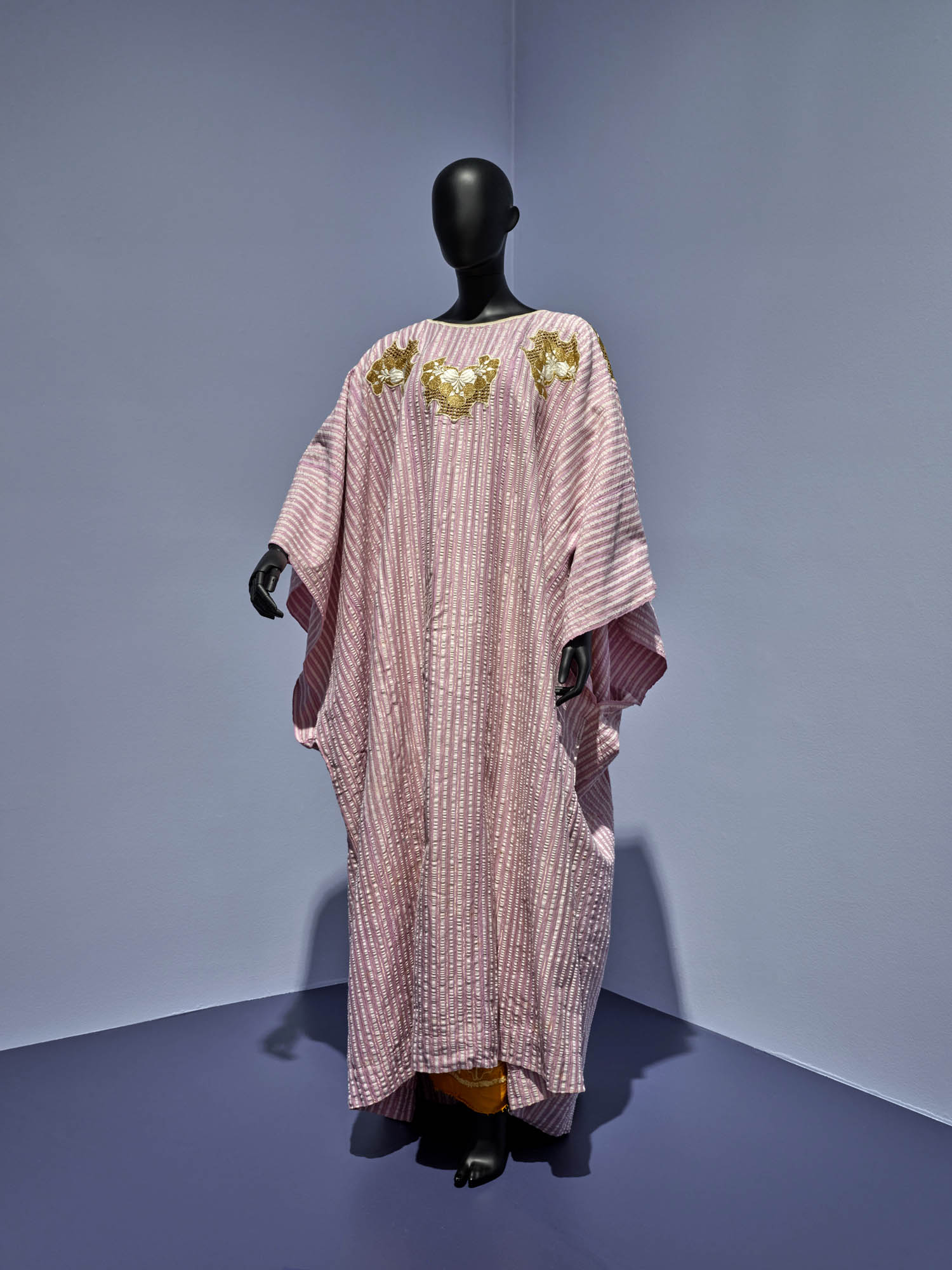
Exhibition: ‘Seydou Keïta: A Tactile Lens’ at the Brooklyn Museum, New York

Exhibition dates: 10th October, 2025 – 17th May, 2026

Curators: Guest curator Catherine E. McKinley with Imani Williford, Curatorial Assistant, Photography, Fashion, and Material Culture, Brooklyn Museum
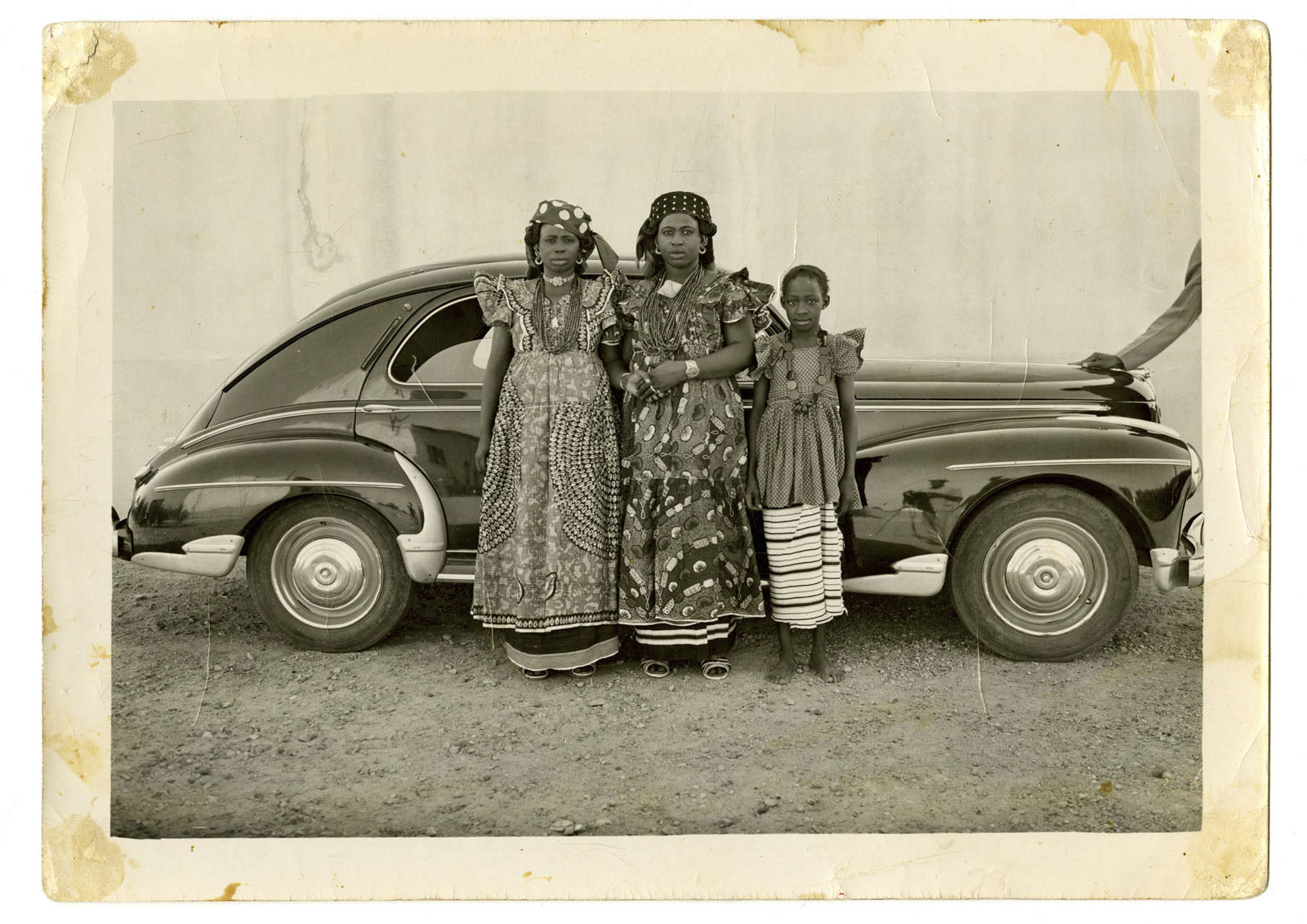
 

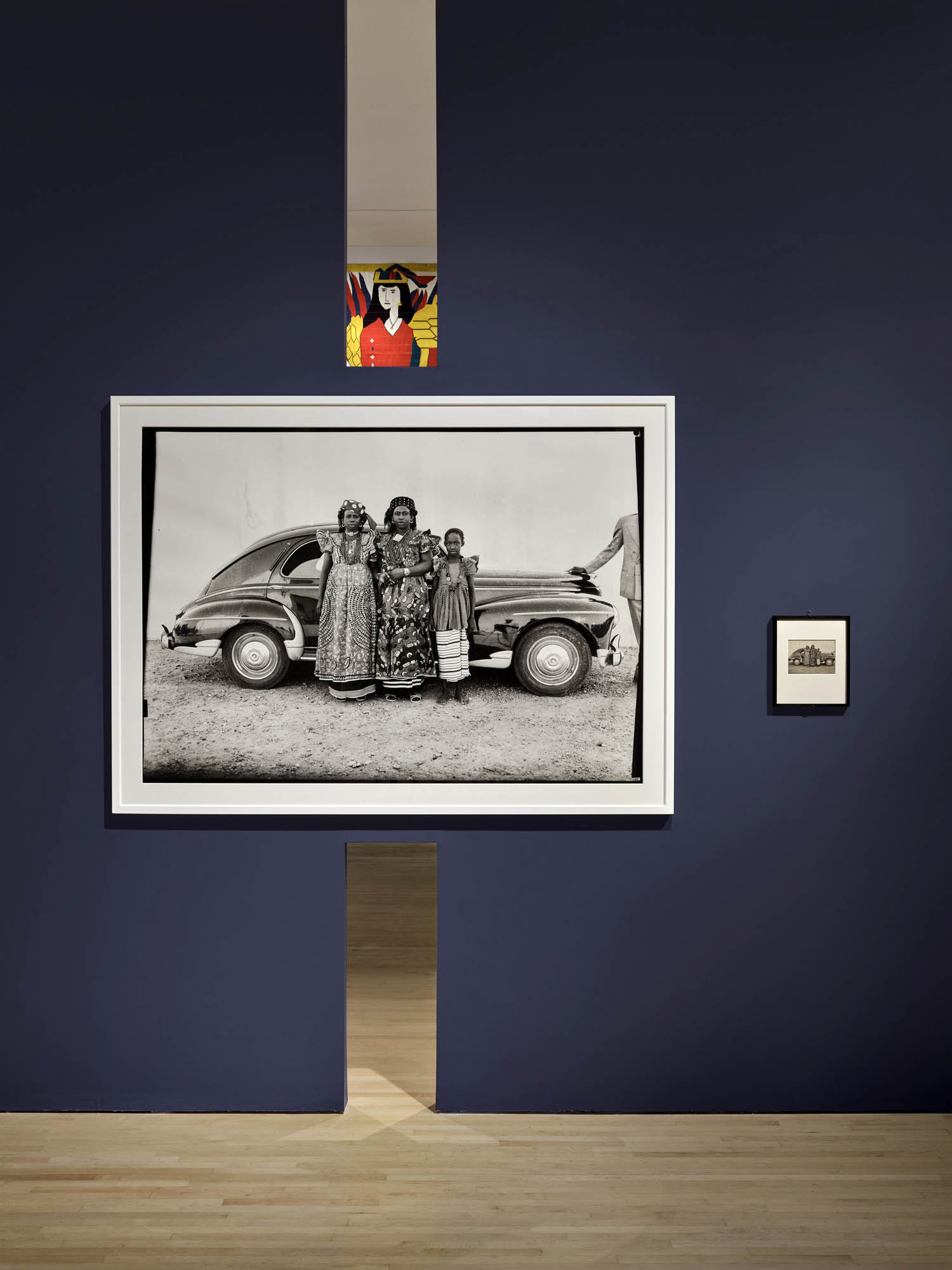
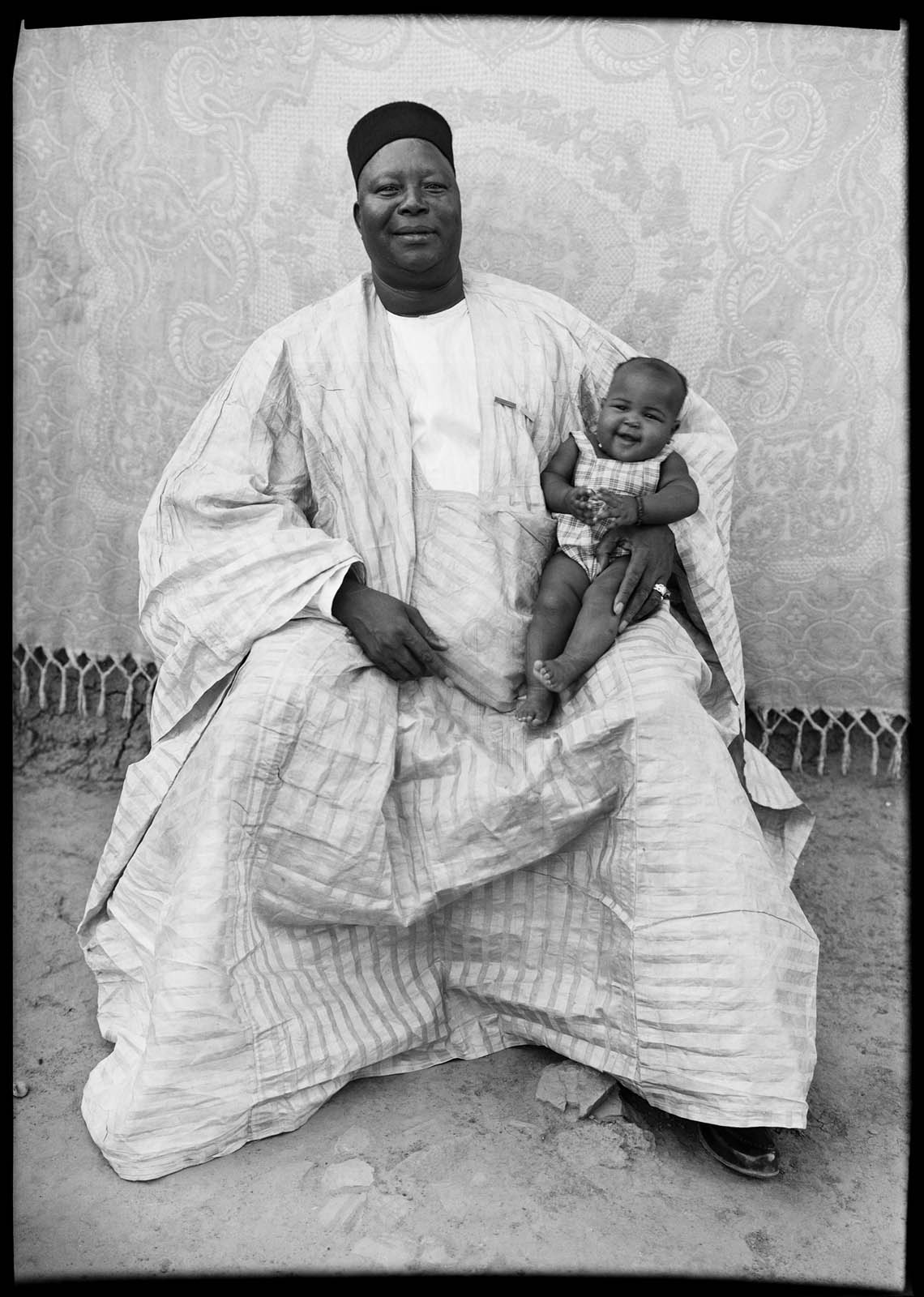
Seydou Keïta (Malian, c. 1921-2001) 'Untitled' 1954 from the exhibition Exhibition: 'Seydou Keïta: A Tactile Lens' at the Brooklyn Museum, New York, October 2025 - May 2026


Seydou Keïta (Malian, c. 1921-2001)
Untitled
1954
Vintage gelatin silver print
Courtesy of The Jean Pigozzi African Art Collection
© SKPEAC/Seydou Keïta
Courtesy The Jean Pigozzi Collection of African Art and Danziger Gallery, NY


In African light

The Brooklyn Museum continues to orchestrate (now that’s an appropriate word) wonderful exhibitions that select, organise, and interpret items in “interpretive exhibitions”- curating and contextualising these items in order to establish their meaning, history, and cultural significance. In this regard the magnificent exhibition Seydou Keïta: A Tactile Lens is no exception.

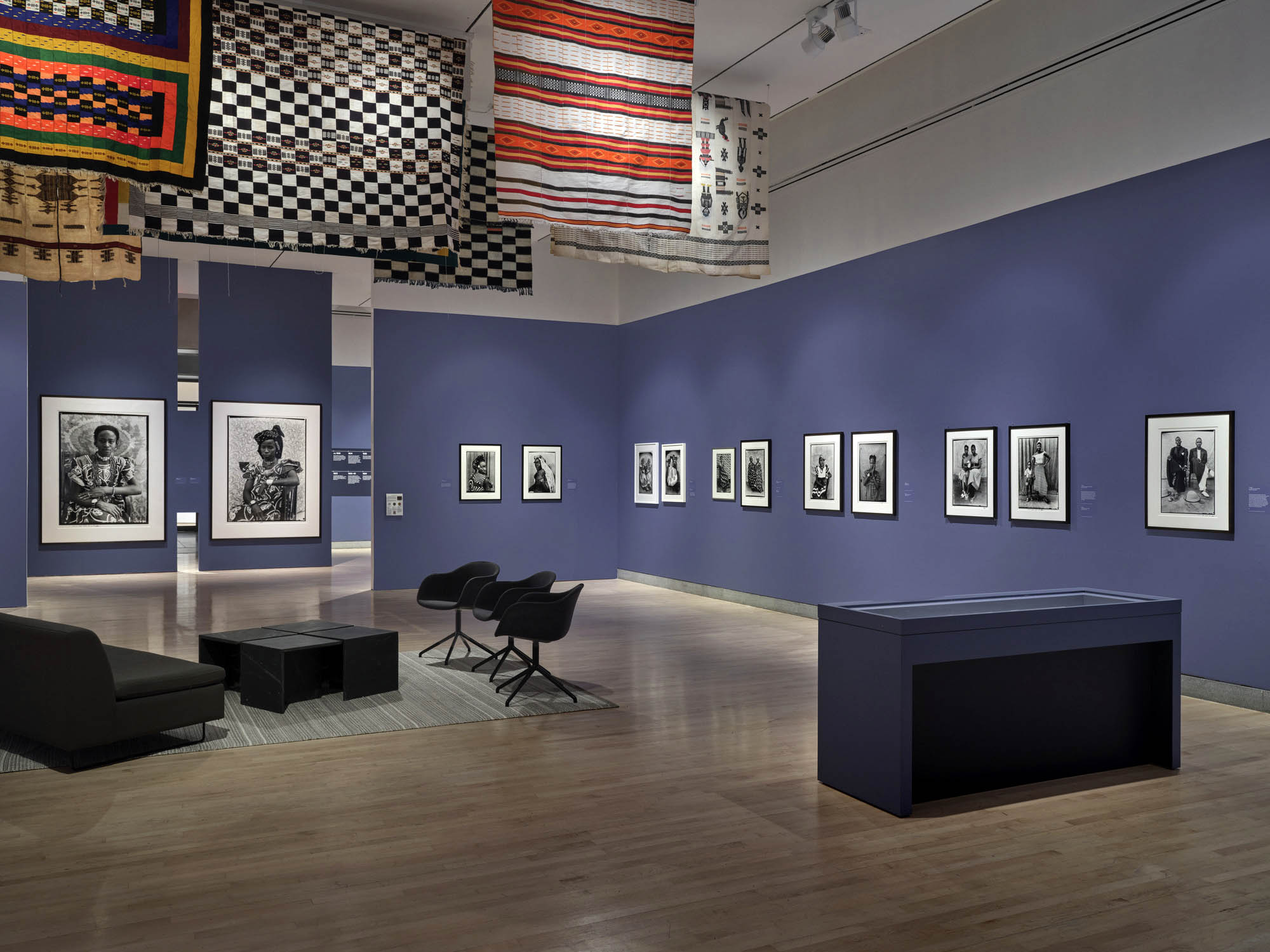
In the exhibition Keïta’s direct, honest, and incisive black and white photographs – often taken outdoors on bare earth in natural light with mud walls, hanging textiles and blankets as backdrops – are contextualised with regard to West African history, placed in context “in a period defined by a rapidly expanding modern world and a new sense of Bamakois identity.” (Press release)

In the Brooklyn show Keïta’s photographs from the African environment are surrounded by cultural artefacts that reflect a new sense of nationhood as Mali moved toward independence post-French colonialism – “clothing, hand-fashioned dresses … pagnes (wrappers), wall hangings, and commemorative cloths that span the rich history of Malian textile design and trade”, gold, jewellery, lace, marabaka (a Czech-style hat that became a widespread symbol of Pan-African solidarity), traditional and modern textiles, blankets, family heirlooms, family photographs and a trove of film negatives – all combining to create a rich mosaic of references, an intertextuality (where things refer to, influence, or interrelate with one another) of identity, place and space.

What is particularly interesting about the presentation at the Brooklyn Museum is the mixture of vintage and modern prints, where the viewer can compare the scale and tonalities of old and new, where small jewel-like gold toned and hand-coloured prints of great presence and intensity can be compared to larger, contrast laden modern prints (for which the artist has become famous) which reveal hidden details in the negative.

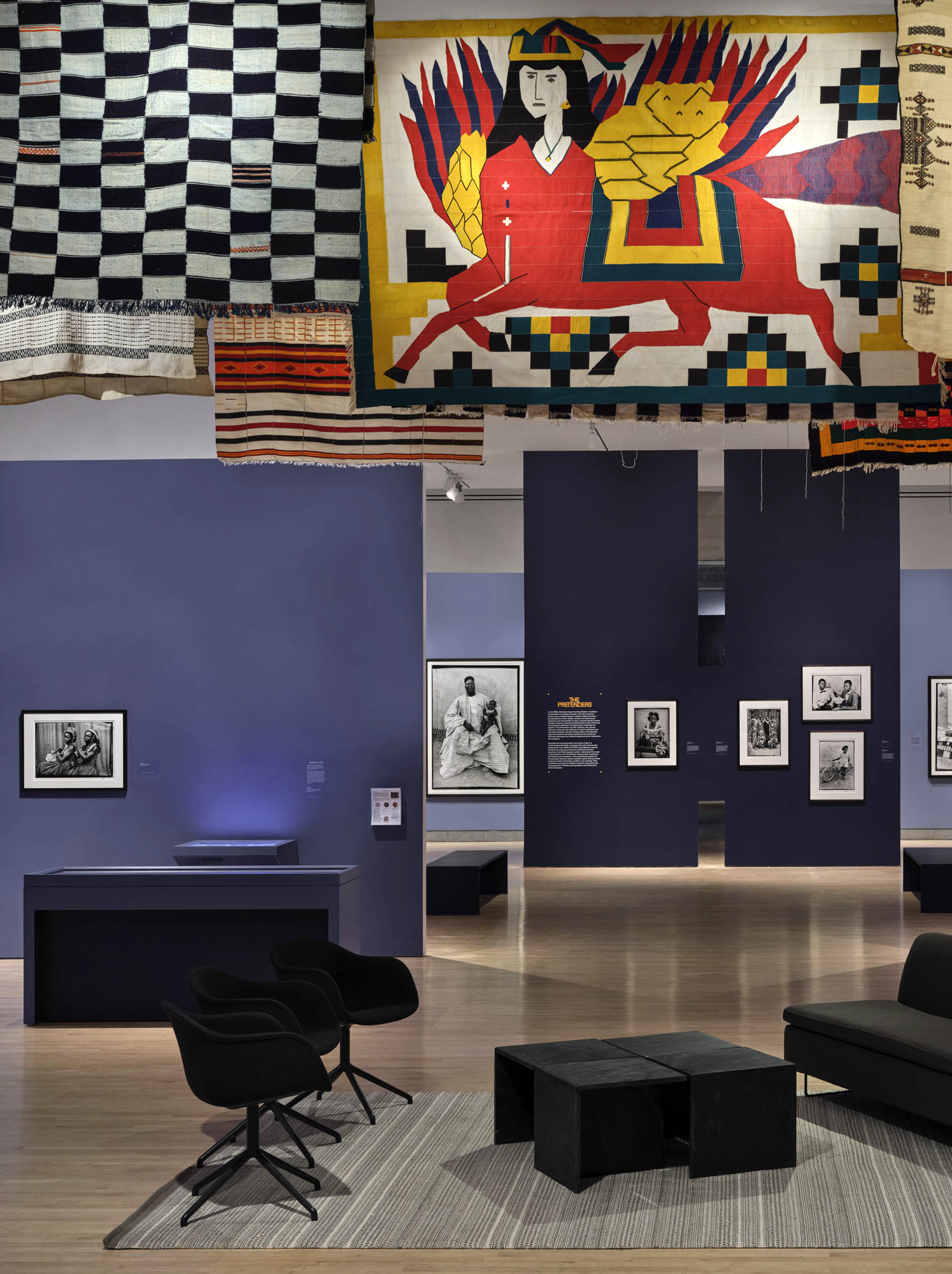
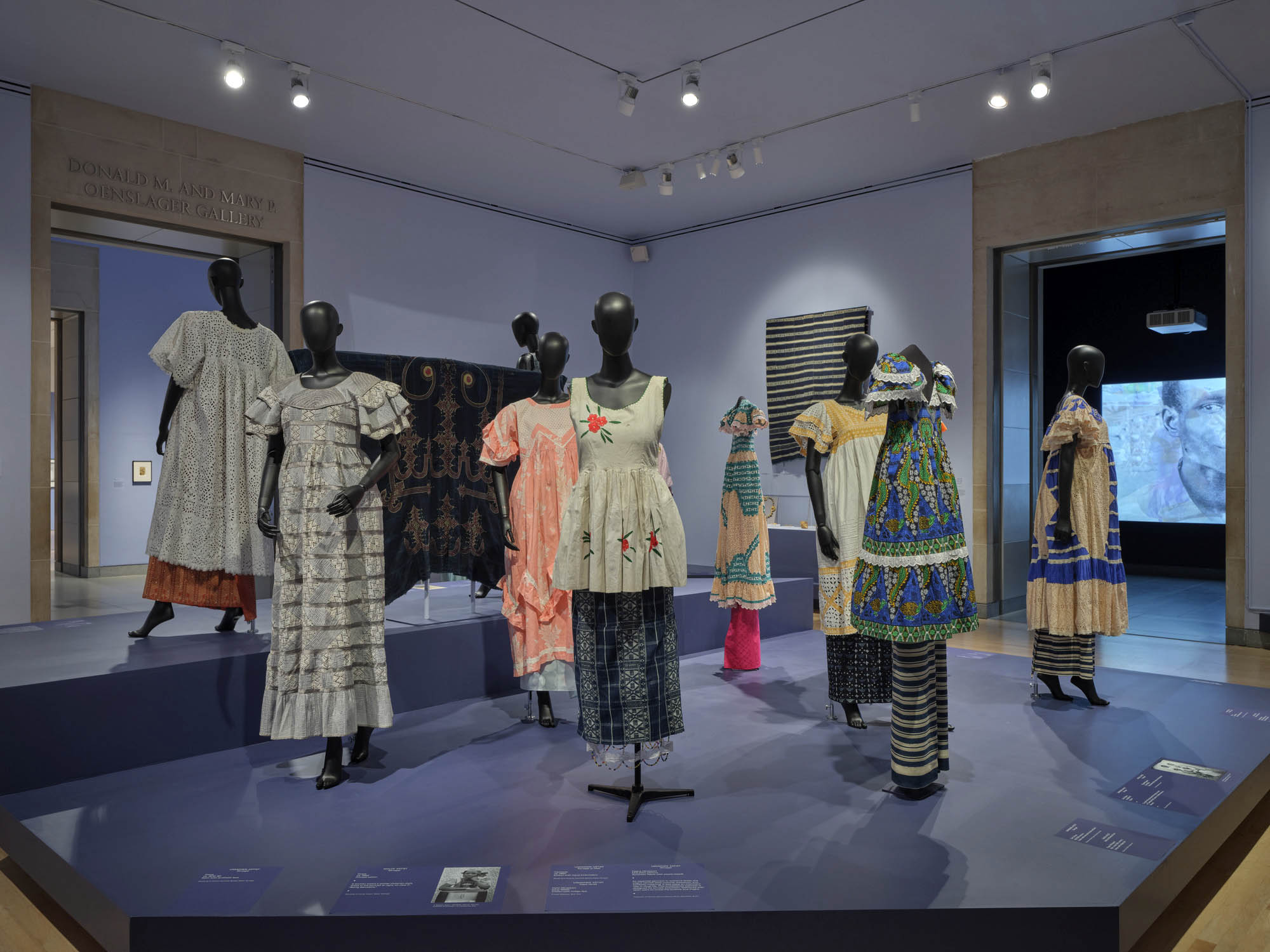
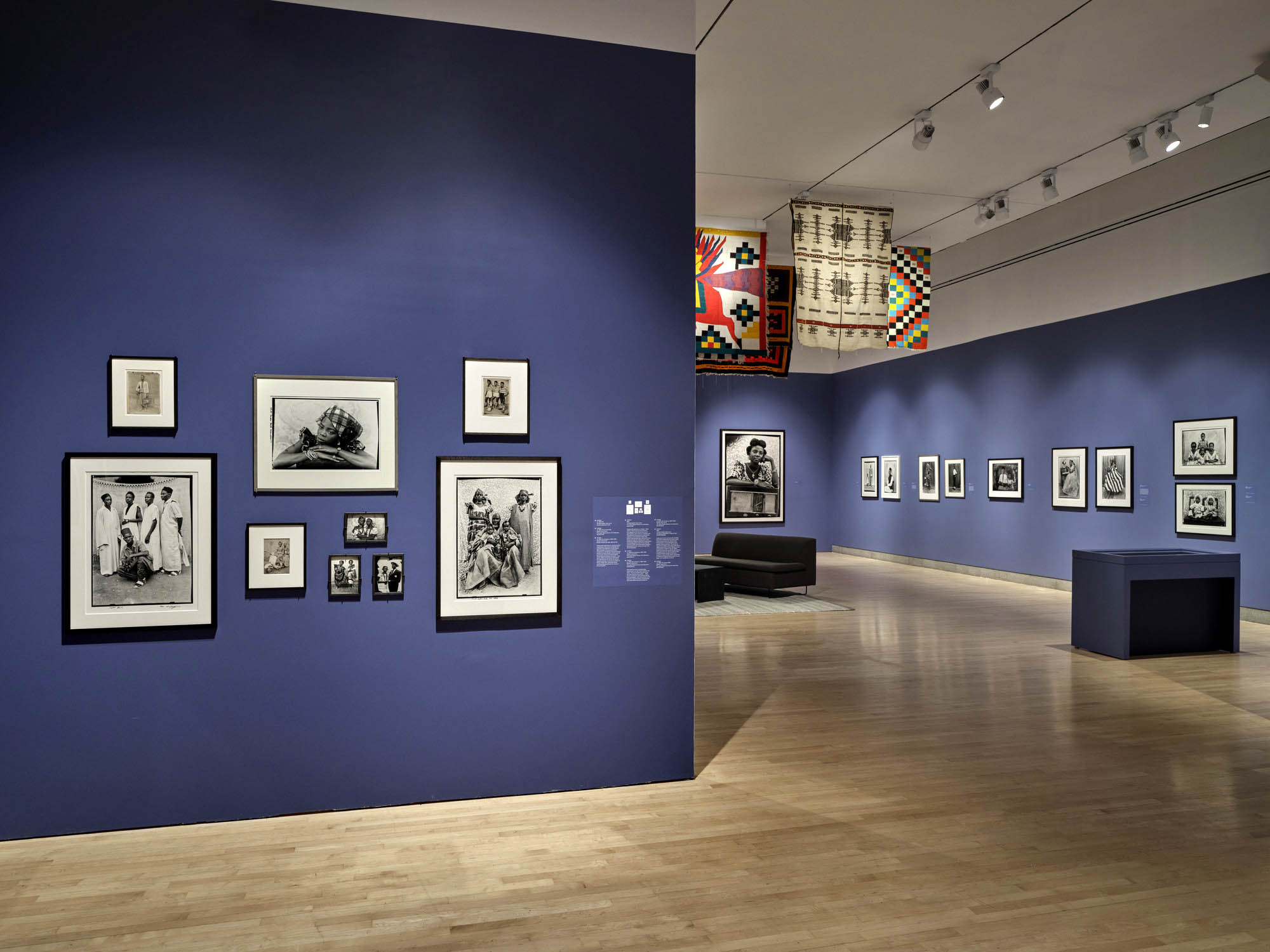
Also of interest is the exhibition design itself in which the different colour of the walls, the spaces between them, the symmetrical layout, together with the clothing, textiles and wall hangings … all add a terrific spatial dimension to the whole. Witness the entrance to the exhibition where Keïta’s vintage photograph Untitled (1954, above) is placed in communion with a larger modern print, allowing the viewer to compare and contrast both old and new, one of the major pictorial themes of the exhibition. Then – and this is to me the essence of good exhibition design – you look at the line of sight of that entrance and in the space between the walls hanging in the distance, hovering above the photographs, is a colourful textile banner with face and garment which the viewer can visually correlate to the garments of the three women standing in front of the car in the modern print below. Just a small thing but inspiring exhibition design nonetheless, which reflects the holism of the exhibition.

Along with the work of other African photographers such as Malike Sidibé (Malian, 1935-2016), James Barnor (Ghanian, b. 1929) and Sanlé Sory (West African, b. 1943), Keïta’s photographs help touch, in African light, that most wonderful sense of the spirit and culture of a nascent independent nation, evidenced in his images through an intimate interconnection between people and place.

What is undeniable is that there is nothing like a photograph to remind you of difference, to challenge your perceptions on how you view and interact with the world around you, to open up new ways of seeing (Professor Stuart Hall). Thus the photographs in this exhibition may allow us a deeper insight into not only the conditions of our own becoming (while human beings have agency, the circumstances under which they act and develop their humanity are largely shaped by existing material, social, and historical conditions that they did not choose) but the conditions of other people’s becoming.

Hopefully these insights in turn promote a greater understanding and acceptance of difference in others in opposition to learnt bigotry and racism.

Just the joy of picturing, and being, and living, human.

Dr Marcus Bunyan


Many thankx to the Brooklyn Museum for allowing me to publish the photographs in the posting. Please click on the photographs for a larger version of the image.
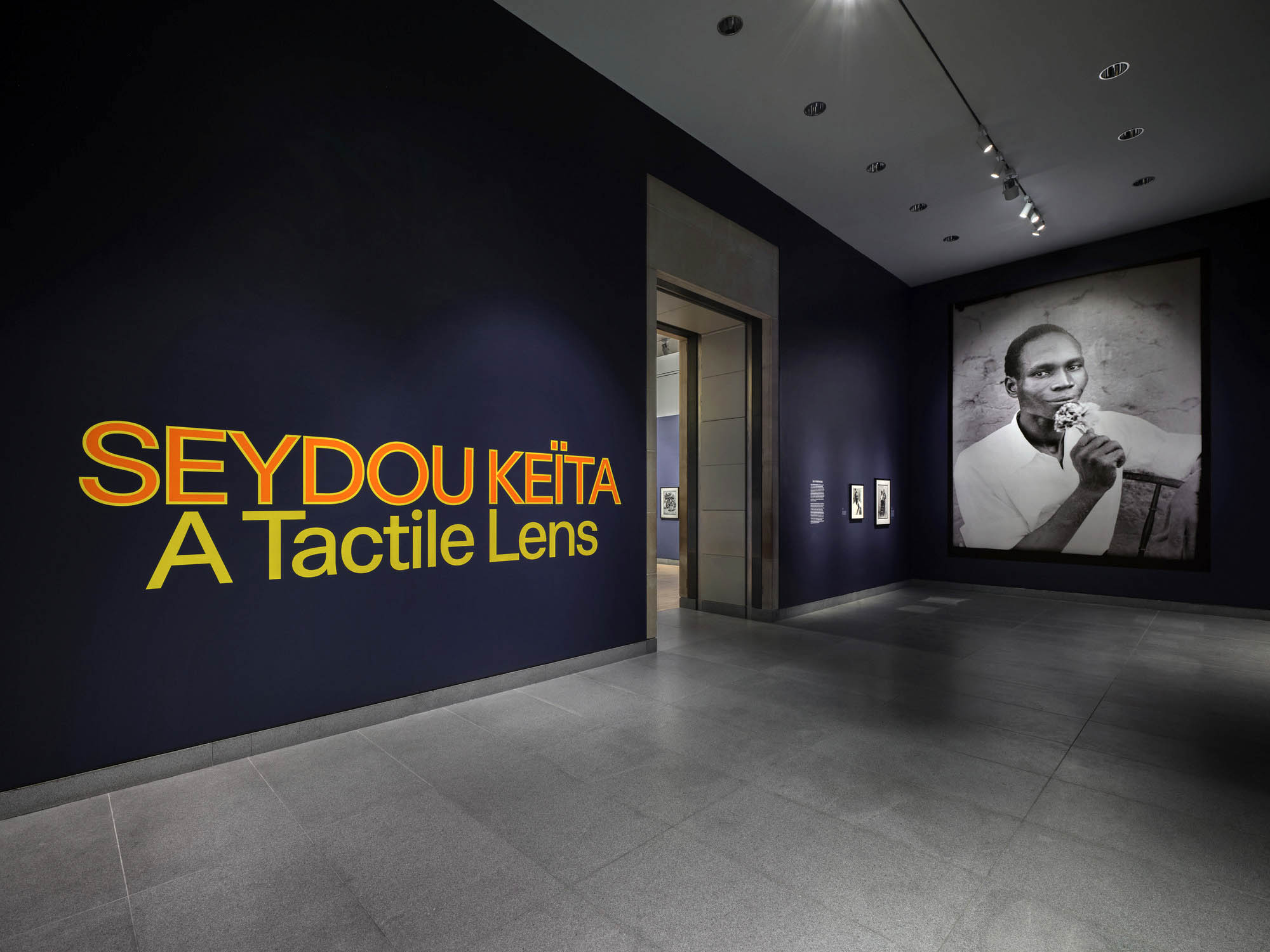
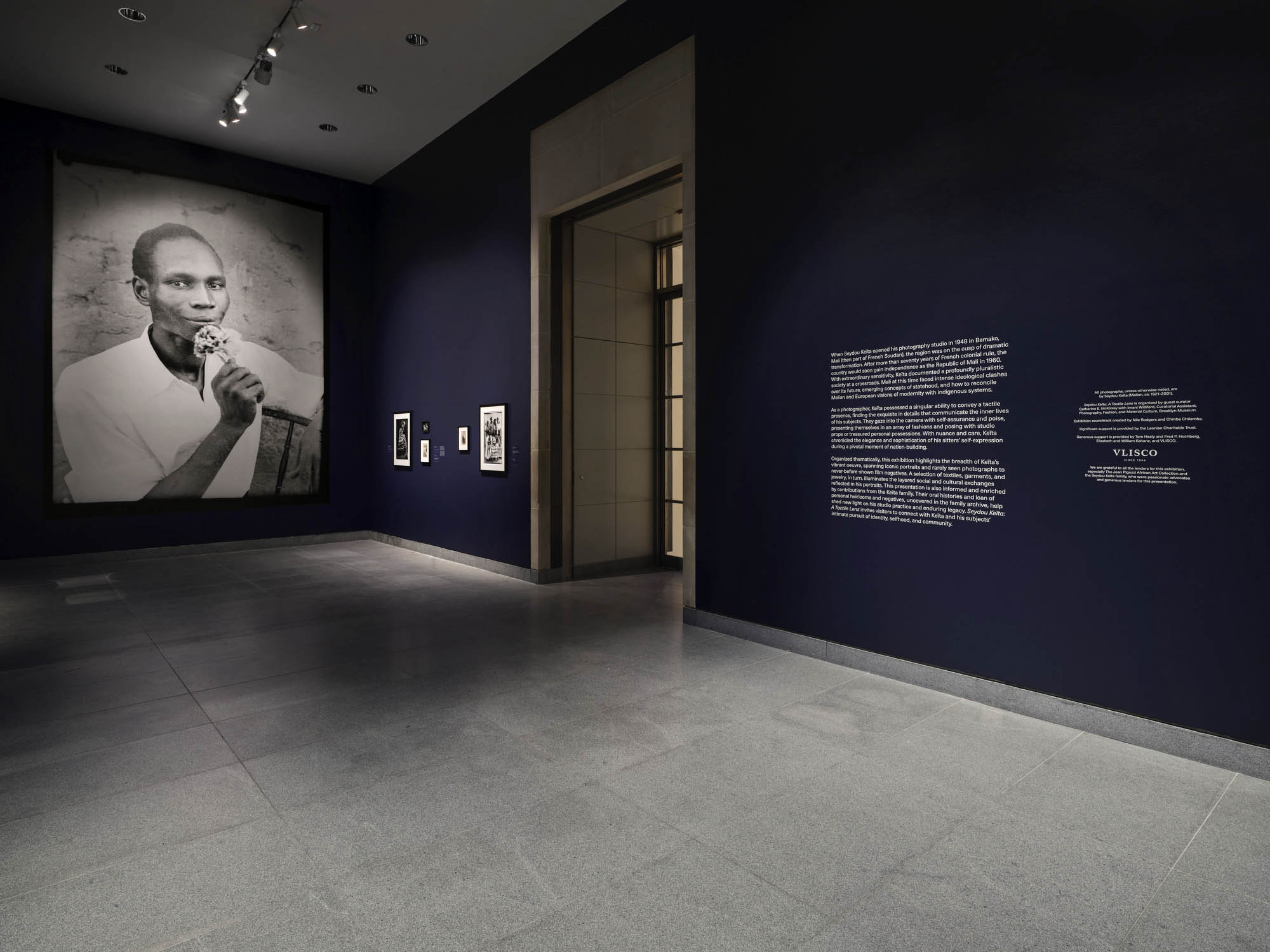


Installation view of the exhibition 'Seydou Keïta: A Tactile Lens' at the Brooklyn Museum, New York, October 2025 - May 2026


Installation views of the exhibition ‘Seydou Keïta: A Tactile Lens’ at the Brooklyn Museum, New York, October 2025 – May 2026 showing Keïta’s self-portrait Untitled, 1956


Dressed in a crisp white shirt, holding a flower gently to his chin, Keïta turns the camera on himself with the same control and precision he granted his subjects. As French Soudan faced political uncertainty and turmoil in the lead-up to independence, Keïta’s studio, whether indoors or on the street, offered sitters a place to create a self of one’s own.
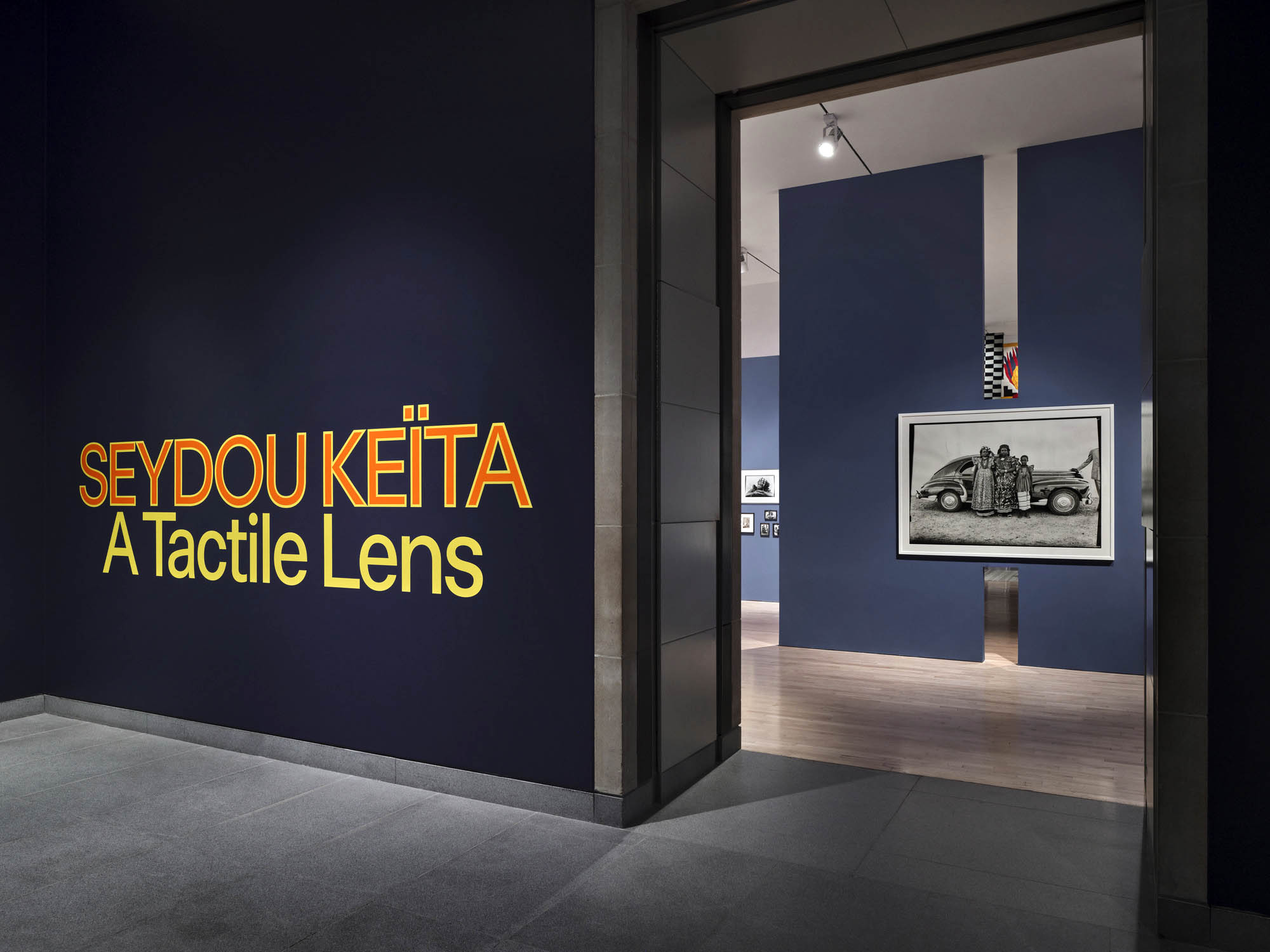
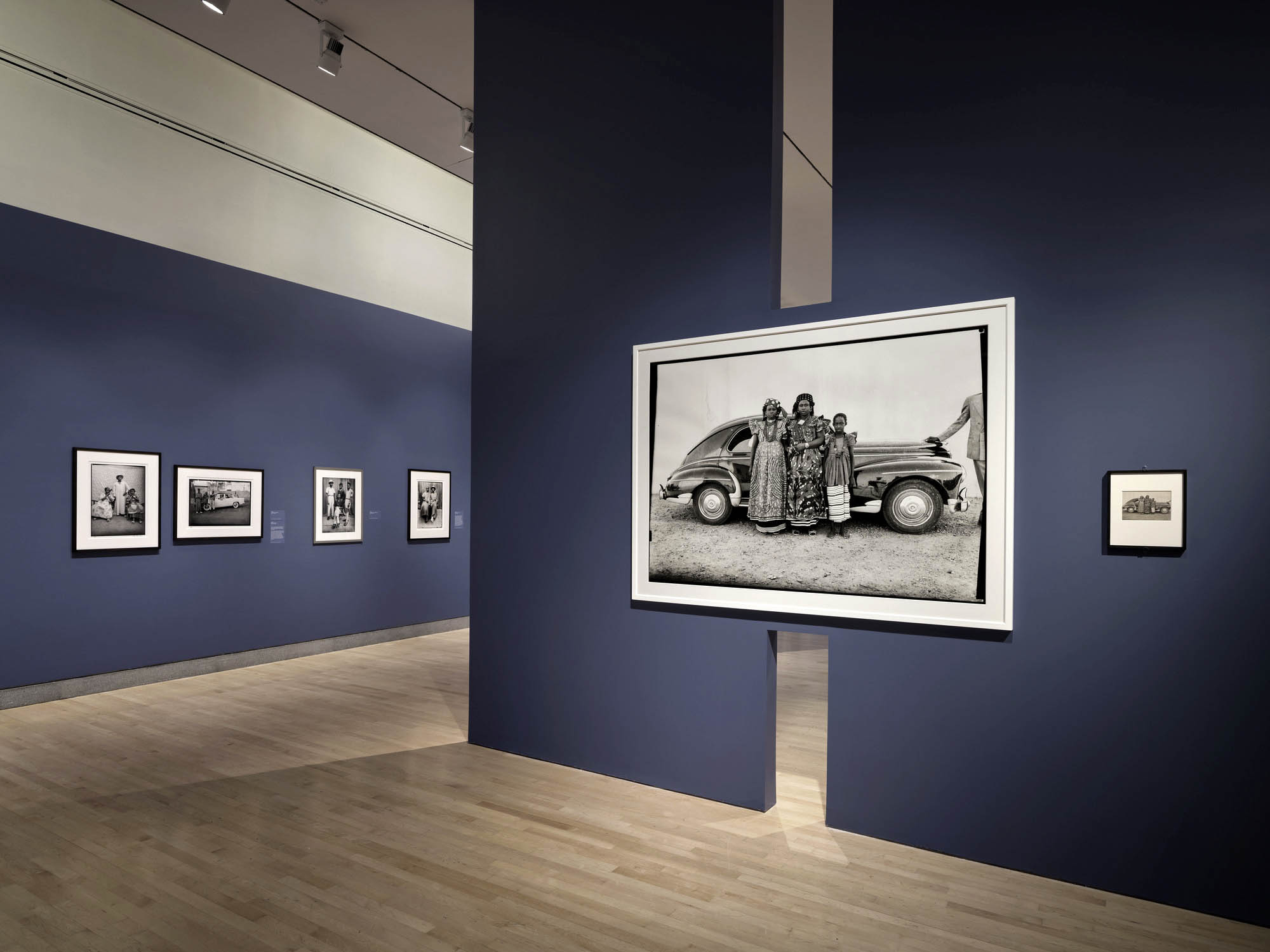
 

Installation view of the exhibition 'Seydou Keïta: A Tactile Lens' at the Brooklyn Museum, New York, October 2025 - May 2026
Installation view of the exhibition 'Seydou Keïta: A Tactile Lens' at the Brooklyn Museum, New York, October 2025 - May 2026 showing Keïta's photograph 'Untitled' 1954


Installation views of the exhibition Seydou Keïta: A Tactile Lens at the Brooklyn Museum, New York, October 2025 – May 2026 showing in the bottom two images, Keïta’s photograph Untitled 1954 (above)


The smaller, vintage print and the larger, modern one of Keïta’s 1954 photograph highlight the material and historical distinctions between the types of prints on view in the exhibition. Often made by Keïta himself, the vintage prints were produced around the time the photograph was taken. Such works feature a particular range of tonalities – the result of earlier technologies, less environmental control in the darkroom, and the paper’s age. The modern prints were made later in Keïta’s life, some of them posthumously. These works are larger, in part, to accentuate the details of the image, such as Keïta’s own reflection on the car’s surface. Following his landmark New York and Paris exhibitions in the 1990s, Keïta came to be known for the distinctive black-and-white tonalities of these modern prints.

Reflecting on his work in 1997, Keïta revealed he had always hoped to make large-format prints (30 x 40 in., 40 x 50 in., and 50 x 60 in.) but seldom had the chance. Sitters rarely requested them due to cost. Together, both vintage and modern prints demonstrate the range and impact of Keïta’s artistry. They also inspire questions about photography’s nature as both artwork and heirloom objects imbued with social and ritual meaning as they pass from hand to hand.


Encounter an artist who changed the face of portrait photography. Seydou Keïta: A Tactile Lens is the most expansive North American exhibition of the legendary Malian photographer’s work to date. More than 280 works include iconic prints, never-before-seen portraits, textiles, and Keïta’s personal artifacts, all brought to life with unique insights from his family.

Organised by the Brooklyn Museum, the exhibition brings us to Bamako from the late 1940s to early 1960s, an era of profound political and social transformation. Collaborating closely with his sitters, Keïta recorded Mali’s evolution through their choices of backdrops, accessories, and apparel, from traditional finery to European suits. These bold yet sensitive photographs began to circulate in West Africa nearly 80 years ago. In the early 1990s, they reached Western viewers, rocking the art world and cementing Keïta as the premier studio photographer of 20th-century Africa – a peer of August Sander, Irving Penn, and Richard Avedon.

Witness the power of photography through these richly layered images, which reveal not only Malians’ emotional landscapes but also the textures of life in a rapidly changing country.

A fully illustrated catalogue accompanies the exhibition, offering new insights into the photographer, his work, and Malian material culture. The publication features a biography by Catherine E. McKinley based on extensive interviews with Keïta’s heirs, as well as essays by prominent scholars and curators including Drew Sawyer, Howard W. French, Duncan Clarke, Awa Konate, Sana Ginwalla, and Jennifer Bajorek.

Text from the Brooklyn Museum website
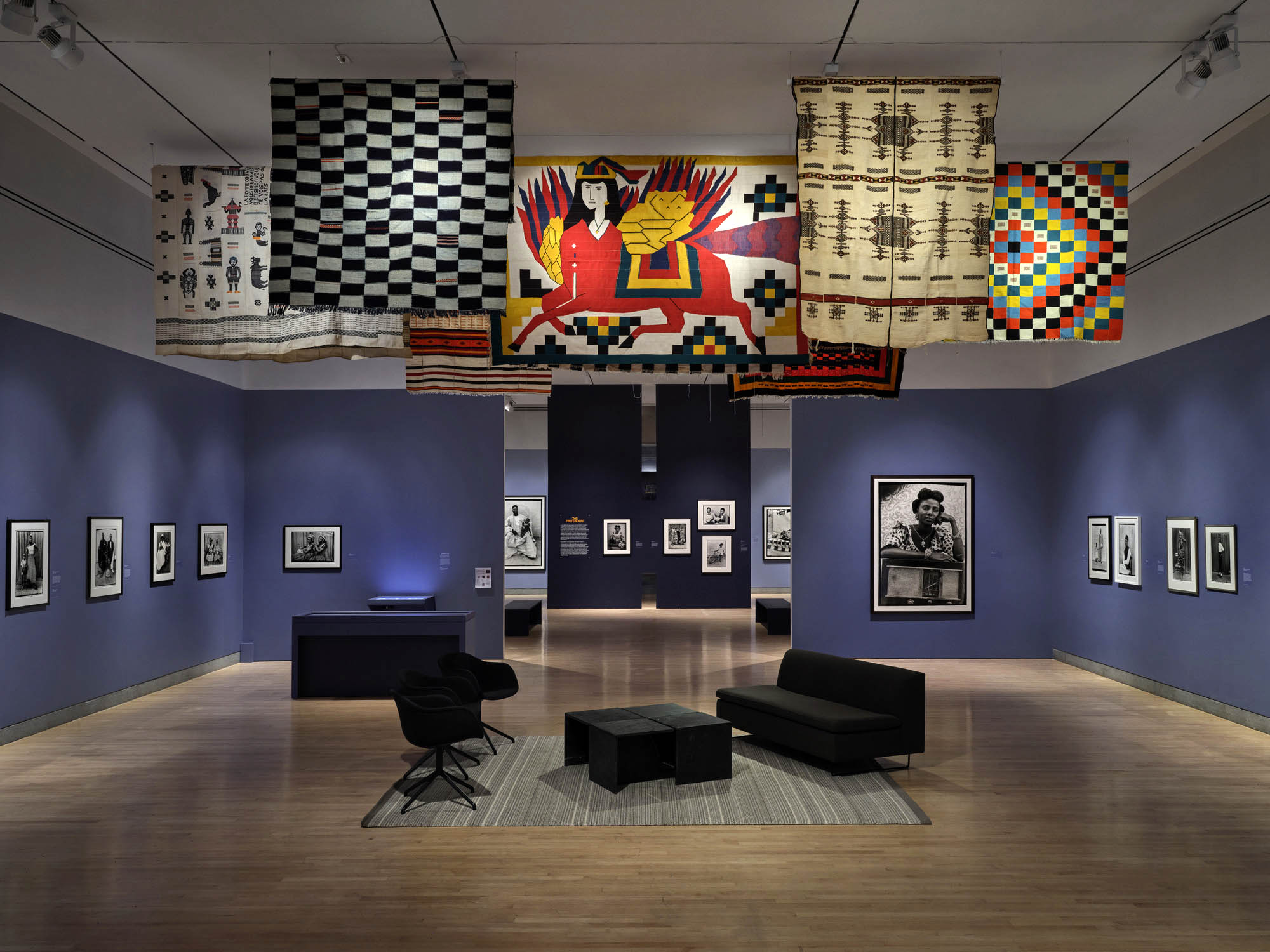
 

Installation view of the exhibition 'Seydou Keïta: A Tactile Lens' at the Brooklyn Museum, New York, October 2025 - May 2026


Installation views of the exhibition Seydou Keïta: A Tactile Lens at the Brooklyn Museum, New York, October 2025 – May 2026 showing at left in the bottom image, Keïta’s photograph Untitled 1949-1951 (below)
 

Seydou Keïta (Malian, c. 1921-2001) 'Untitled' 1949-1951, printed 1998


Seydou Keïta (Malian, c. 1921-2001)
Untitled
1949-1951, printed 1998
Gelatin silver print
Courtesy of The Jean Pigozzi African Art Collection
© SKPEAC/Seydou Keïta
Courtesy The Jean Pigozzi Collection of African Art and Danziger Gallery, NY


The exhibition Seydou Keïta: A Tactile Lens honors the artistry and legacy of Seydou Keïta (Malian, c. 1921-2001), who documented a critical chapter in West African history – one of immense hope, politically and socially – in a period defined by a rapidly expanding modern world and a new sense of Bamakois identity. The show features over 280 works, including renowned portraits, rare images, and never-before- seen negatives as well as textiles, jewellery, dresses, and personal items that fully immerse visitors in Keïta’s rich photographic landscape. Seydou Keïta: A Tactile Lens is organised by guest curator Catherine E. McKinley with Imani Williford, Curatorial Assistant, Photography, Fashion, and Material Culture, Brooklyn Museum.

Keïta was born around 1921 to a Malinke family in Bamako-Coura, or New Bamako, a growing colonial commercial center within the historic Malian city. His childhood saw emerging liberation struggles across the continent and growing expressions of modernism as Bamako served as the capital of French Soudan and subsequently the newly independent Mali in 1960.

Keïta documented Malian society in the late 1940s to early 1960s, an era of transformation and aspirations for independent statehood. A master at lighting and composition, Keïta has a unique ability to capture the tactile qualities of his sitters – from their fashion and choice of accessories to the personality and self-presentation they put forward. In collaboration with his subjects, he sculpted their poses, clothing, and style, forming monuments to their selfhood. When they first reached Western viewers in the early 1990s, his images drew unprecedented attention in the worlds of art, music, fashion, design, and popular media, forever changing the global cultural landscape. Today, these bold and engaging portraits continue to invite viewers into direct dialogue with Keita’s sitters.

Largely self-taught, Keïta first received a camera as a gift from his uncle at age 14. In 1935, he became an apprentice to his mentor, Mountaga Dembélé (1919-2004), Mali’s first professional photographer to earn a living with his studio. From there, Keïta opened his own studio in 1948 in front of his family home in Bamako-Coura, becoming Mali’s second photographer. The studio became a destination for people from all levels of Malian society, welcoming not just the elite citizens of Bamako but also remote villagers, international travelers, and those passing through on the Dakar-Niger railroad. Keïta’s work is notable for capturing how the people in his studio saw themselves, allowing for a playful self-expression backgrounded by increasing political tensions and rapid evolutions in the government. His studio offered props, including European and Malian clothing, motorbikes, Western watches, and novelties. Through the years, Keïta developed his very own style of portrait photography and a new type of modernist expression.

This period lasted until 1963, when Keïta was enlisted to work for the newly independent Socialist Republic of Mali. Forced to relinquish his studio, he documented state affairs and performed forensics for increasingly punitive governments until 1968 when he retired to work in camera and automotive repairs. In May 1991, the exhibition Africa Explores: Twentieth Century African Arts opened at the Center for African Arts in New York, where Keïta first debuted to Western audiences. In 1994, the Fondation Cartier in Paris presented Keïta’s first solo exhibition, which rocked the art and photography world, cementing him as the premiere African studio photographer of the twentieth century. The exhibition positioned Keïta as a peer of noted photographers such as Irving Penn, August Sander, and Richard Avedon, his contemporaries in portrait photography, and created enormous interest in Keïta’s work.

“Thirty-four years since Keïta was first introduced to American audiences we have an opportunity to view new discoveries in his work and understand just how singular he was, practicing at one of the most pivotal moments in African and world history. He had an extraordinary artist’s ability to render the tactile. We can visually ‘finger the grain’ of the sitter’s lives and better understand them beyond just their relationship to studio photography or documentary,” says Catherine E. McKinley, guest curator, author of The African Lookbook, and director of The McKinley Collection.

“It is very exciting and deeply moving to rediscover Keïta’s work and to feel the presence of his sitters – some of whom we meet here for the very first time – thanks to Catherine E. McKinley’s thoughtful research,” says Pauline Vermare, Phillip and Edith Leonian Curator of Photography. “We hope visitors feel the wonder and possibility that Keïta’s studio represented for so many people.”

A Tactile Lens brings together a remarkable range of Keïta’s photographs, which demonstrate the breadth of his oeuvre and the splendour of his artistry. Thanks to a generous loan from the Keïta family, an extraordinary group of never-before-published works has been preserved and imaged by the Museum on the occasion of the exhibition. A selection of the portraits will be displayed – on lightboxes and as a projection – for the first time. In addition, an array of vintage prints, many made by Keïta himself, and some of which are hand-painted, offer renewed emphasis on the photographic object itself. Rounding out the selection are larger prints made later in Keïta’s life, or posthumously, which feature the distinctive black-and-white tonalities that Keïta came to be known for. Joining the photographs is an immersive installation of personal belongings, textiles, garments, and jewellery that can be seen in Keïta’s portraits.

Together, these objects highlight the self-invention, search for identity, and syncretism of Mali that Keïta’s sitters sought in the mid-twentieth century.

A fully illustrated catalogue will accompany the exhibition, featuring a new biographical essay by Catherine E. McKinley based on extensive interviews with his heirs and from leading art professionals and historians such as Jennifer Bajorek, Duncan Clarke, Howard W. French, Sana Ginwalla, Awa Konaté, and Drew Sawyer, offering new insights into the photographer, his work, and Malian material culture.

Press release from the Brooklyn Museum
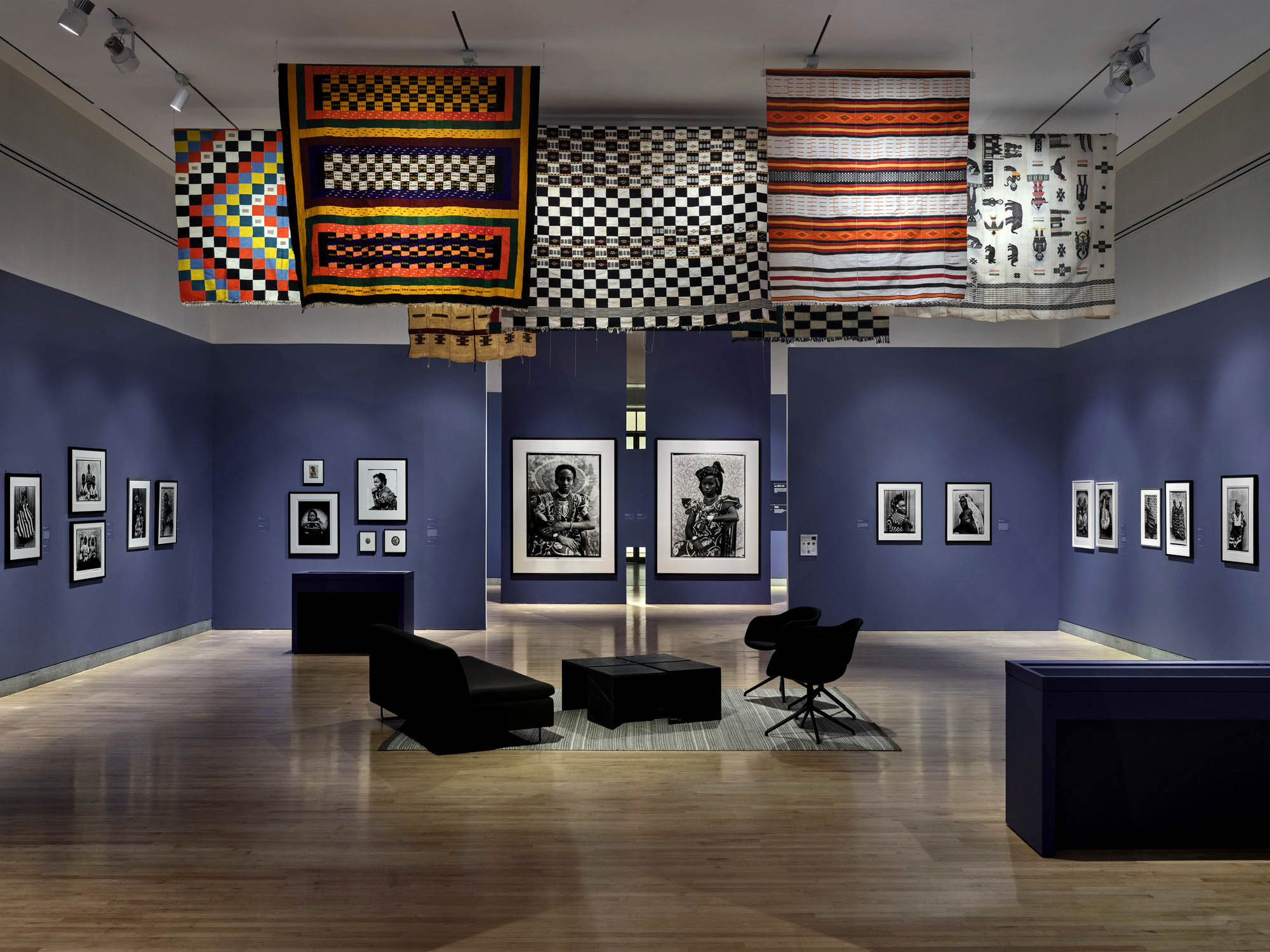
 

Installation view of the exhibition 'Seydou Keïta: A Tactile Lens' at the Brooklyn Museum, New York, October 2025 - May 2026


Installation views of the exhibition Seydou Keïta: A Tactile Lens at the Brooklyn Museum, New York, October 2025 – May 2026 showing at third left in the bottom image, Keïta’s photograph Untitled 1952-1955 (below); and at right, Untitled 1956-1957 (below)
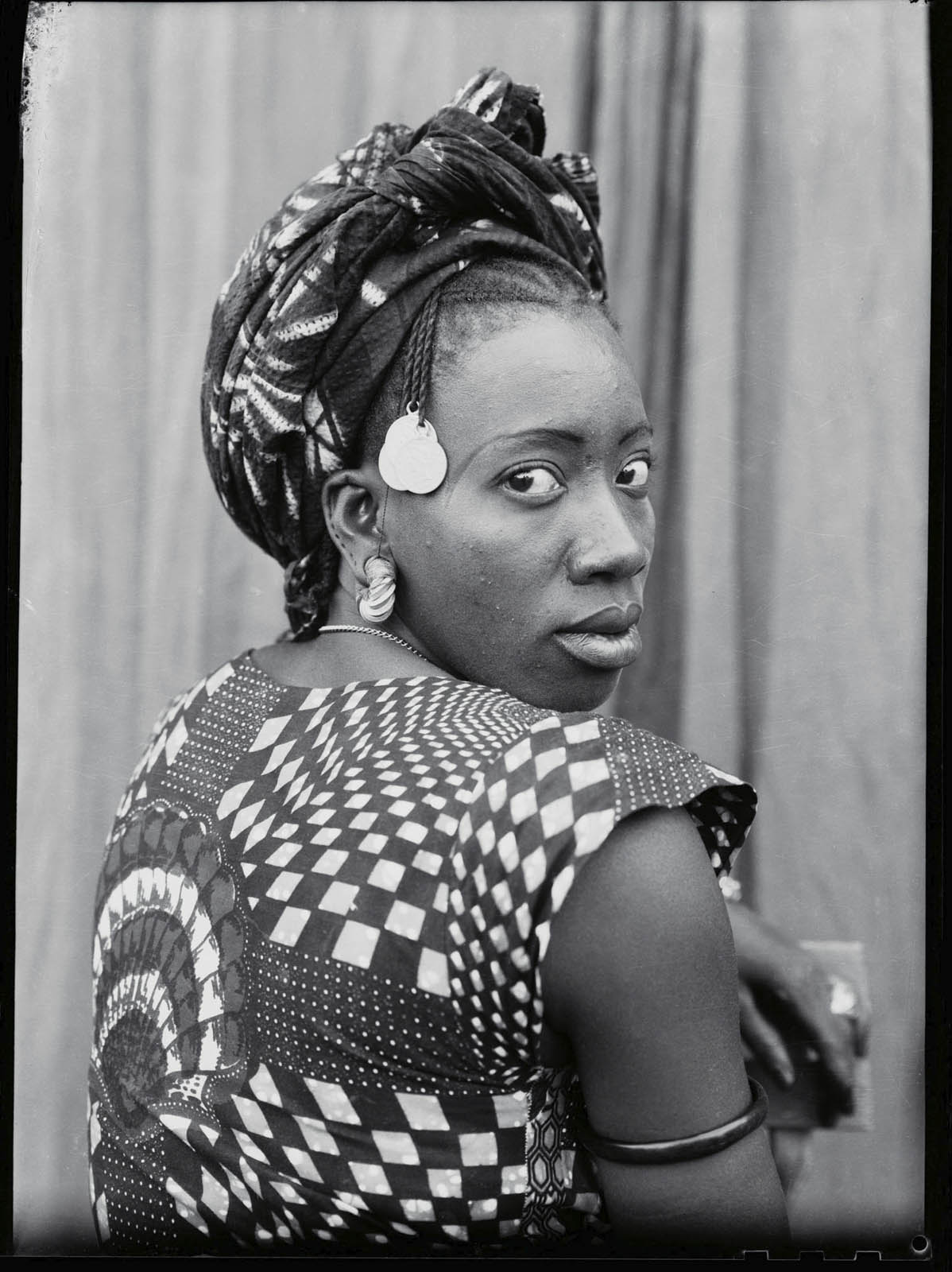
 

Seydou Keïta (Malian, c. 1921-2001) 'Untitled' 1952-1955, printed 1994


Seydou Keïta (Malian, c. 1921-2001)
Untitled
1952-1955, printed 1994
Gelatin silver print
© SKPEAC/Seydou Keïta
Courtesy The Jean Pigozzi Collection of African Art and Danziger Gallery, NY


Looking over her shoulder, her back to the camera, this woman flaunts the French coins – called Louis d’or – hanging at her temples. Gold held decorative and talismanic properties: the shine of the metal was believed to ward off
the evil eye and protect the head and soul of the wearer.
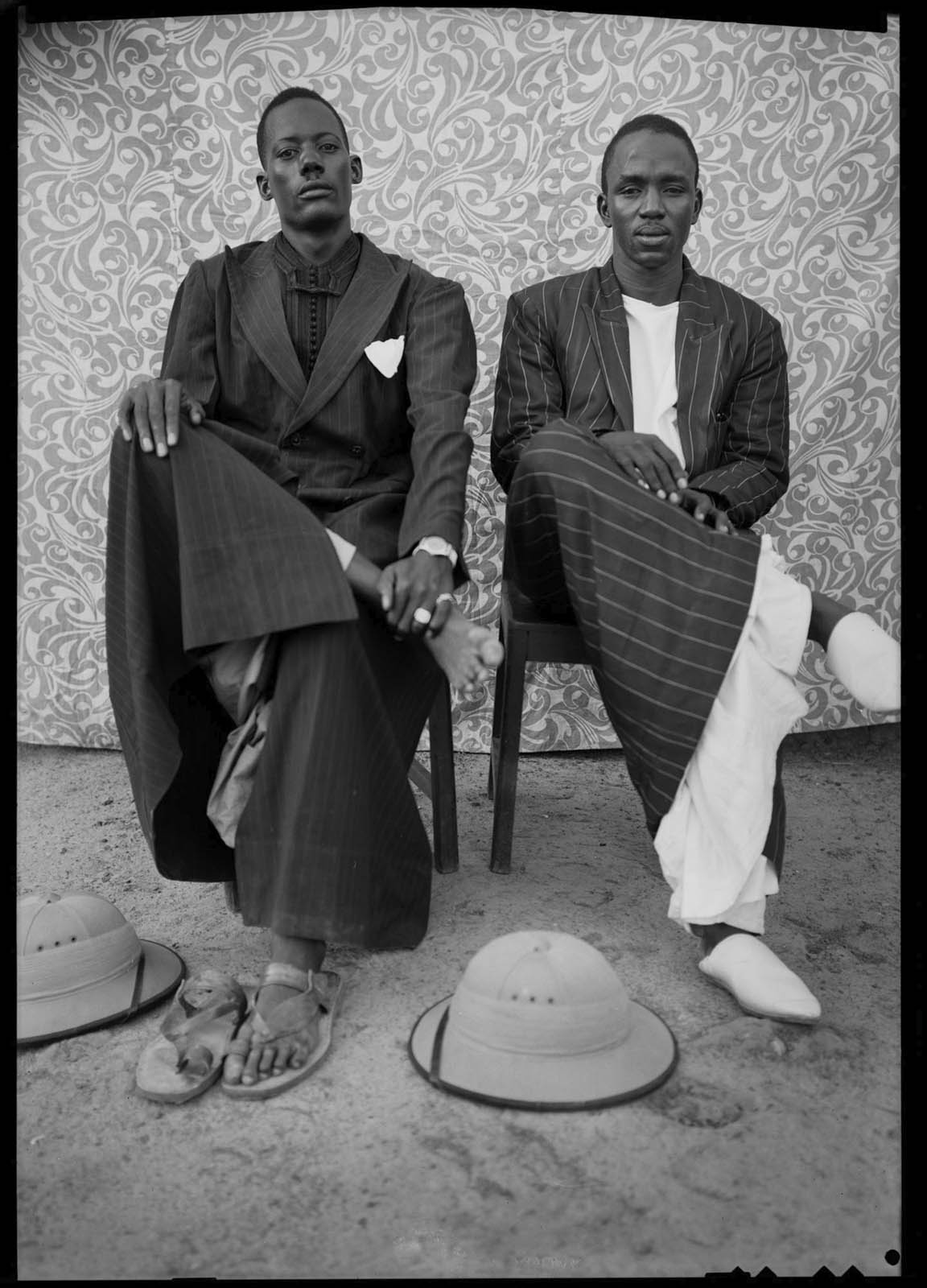
 

Seydou Keïta (Malian, c. 1921-2001) 'Untitled' 1956-1957, printed 1994


Seydou Keïta (Malian, c. 1921-2001)
Untitled
1956-1957, printed 1994
Gelatin silver print
© SKPEAC/Seydou Keïta
Courtesy The Jean Pigozzi Collection of African Art and Danziger Gallery, NY


When Seydou Keïta opened his photography studio in 1948 in Bamako, Mali (then part of French Soudan), the region was on the cusp of dramatic transformation. After more than seventy years of French colonial rule, the country would soon gain independence as the Republic of Mali in 1960. With extraordinary sensitivity, Keïta documented a profoundly pluralistic society at a crossroads. Mali at this time faced intense ideological clashes over its future, emerging concepts of statehood, and how to reconcile Malian and European visions of modernity with indigenous systems. 

As a photographer, Keïta possessed a singular ability to convey a tactile presence, finding the exquisite in details that communicate the inner lives of his subjects. They gaze into the camera with self-assurance and poise, presenting themselves in an array of fashions and posing with studio props or treasured personal possessions. With nuance and care, Keïta chronicled the elegance and sophistication of his sitters’ self-expression during a pivotal moment of nation-building. 

Organised thematically, this exhibition highlights the breadth of Keïta’s vibrant oeuvre, spanning iconic portraits and rarely seen photographs to never-before-shown film negatives. A selection of textiles, garments, and jewellery, in turn, illuminates the layered social and cultural exchanges reflected in his portraits. This presentation is also informed and enriched by contributions from the Keïta family. Their oral histories and loan of personal heirlooms and negatives, uncovered in the family archive, helpshed new light on his studio practice and enduring legacy. Seydou Keïta: A Tactile Lens invites visitors to connect with Keïta and his subjects’ intimate pursuit of identity, selfhood, and community.

Self-portraiture

Seydou Keïta’s photography business expanded and deepened the relationships between the artist, his family, and his art. His younger siblings and children were active participants in his studio. They arranged and held up backdrops as he shot, assisted with equipment, and performed the tea rituals that were at the centre of social exchanges. Family members often waited late into the evening for the final sitters to leave before coming to sleep in the studio – one of the few places in Bamako with electricity – while Keïta worked well into the night in his darkroom. 

Keïta often used the final frames on a roll of film to photograph himself and his family – intimate and striking images that became part of his oeuvre. These portraits reflect his deeply felt responsibility as a Malinke patriarch, able to provide for his large extended family a life of modern comfort due to an unusual and enviable talent that would reach a world stage. His brothers describe Keïta’s “immaculate” presentation of a social self – a man who valued social reserve and Malinke tenets of modesty and stern leadership. In these portraits, we also see him as a self-styled bon vivant, carefree in his European sportswear and playfully connected to those around him.
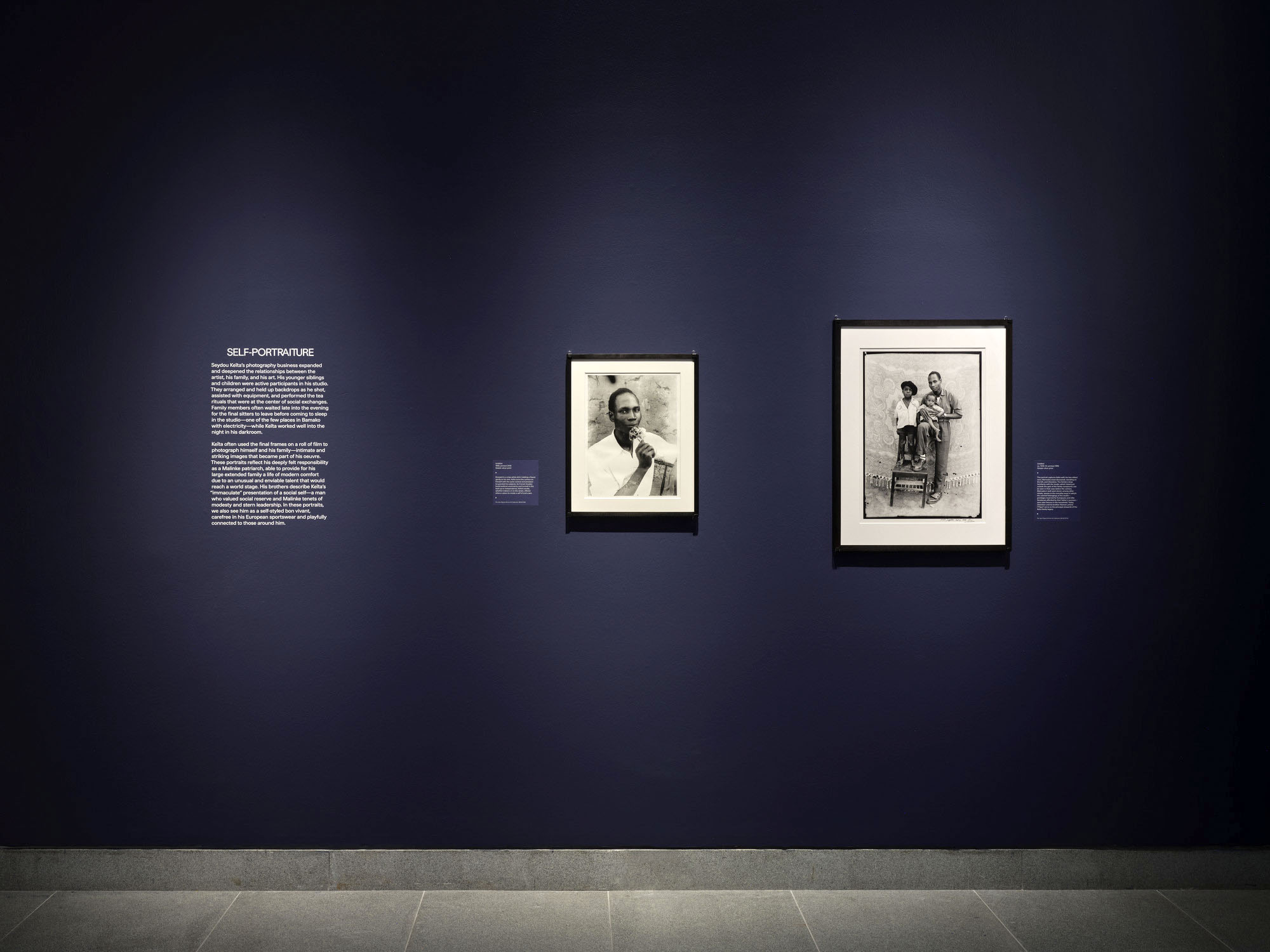
 

Installation view of the exhibition 'Seydou Keïta: A Tactile Lens' at the Brooklyn Museum, New York, October 2025 - May 2026 showing at left text for the section "Self-portraiture" and then Keïta's 'Untitled' 1956, printed 2018


Installation view of the exhibition Seydou Keïta: A Tactile Lens at the Brooklyn Museum, New York, October 2025 – May 2026 showing at left text for the section “Self-portraiture” and then Keïta’s Untitled, 1956, printed 2018


Dressed in a crisp white shirt, holding a flower gently to his chin, Keïta turns the camera on himself with the same control and precision he granted his subjects. As French Soudan faced political uncertainty and turmoil in the lead-up to independence, Keïta’s studio, whether indoors or on the street, offered sitters a place to create a self of one’s own .


Being Bamakois

In 1960 Mali achieved independence, becoming one of seventeen African countries to end colonial rule. “The Year of Africa,” as 1960 became known, intensified vital questions about self-determination, national identity, and the shape of a post-independence future. Even as many Malians embraced the prospect of a free and modern nation-state, debates grew over the roles that religion, the military, and traditional societal structures would play in governance and civil life. 

Bamako’s population doubled in the mid-twentieth century, driven by increased colonial settlement since the 1930s and labor migration from rural areas. Long a cosmopolitan city, post-independence Bamako became a site of new social tensions. The rigid strictures of the systems of French class and indigenous caste, which had coexisted uneasily in the colonial era, were increasingly at odds as Mali became entrenched as a socialist Islamic state. 

In Seydou Keïta’s portraits, Bamako’s citizens sought to express a vision of self and society that mirrored the promises of the growing city. Questions around status, decolonisation, and the ever-evolving definition of what it means to be both Bamakois and modern play out in the symbolic choices behind the making of each photograph.
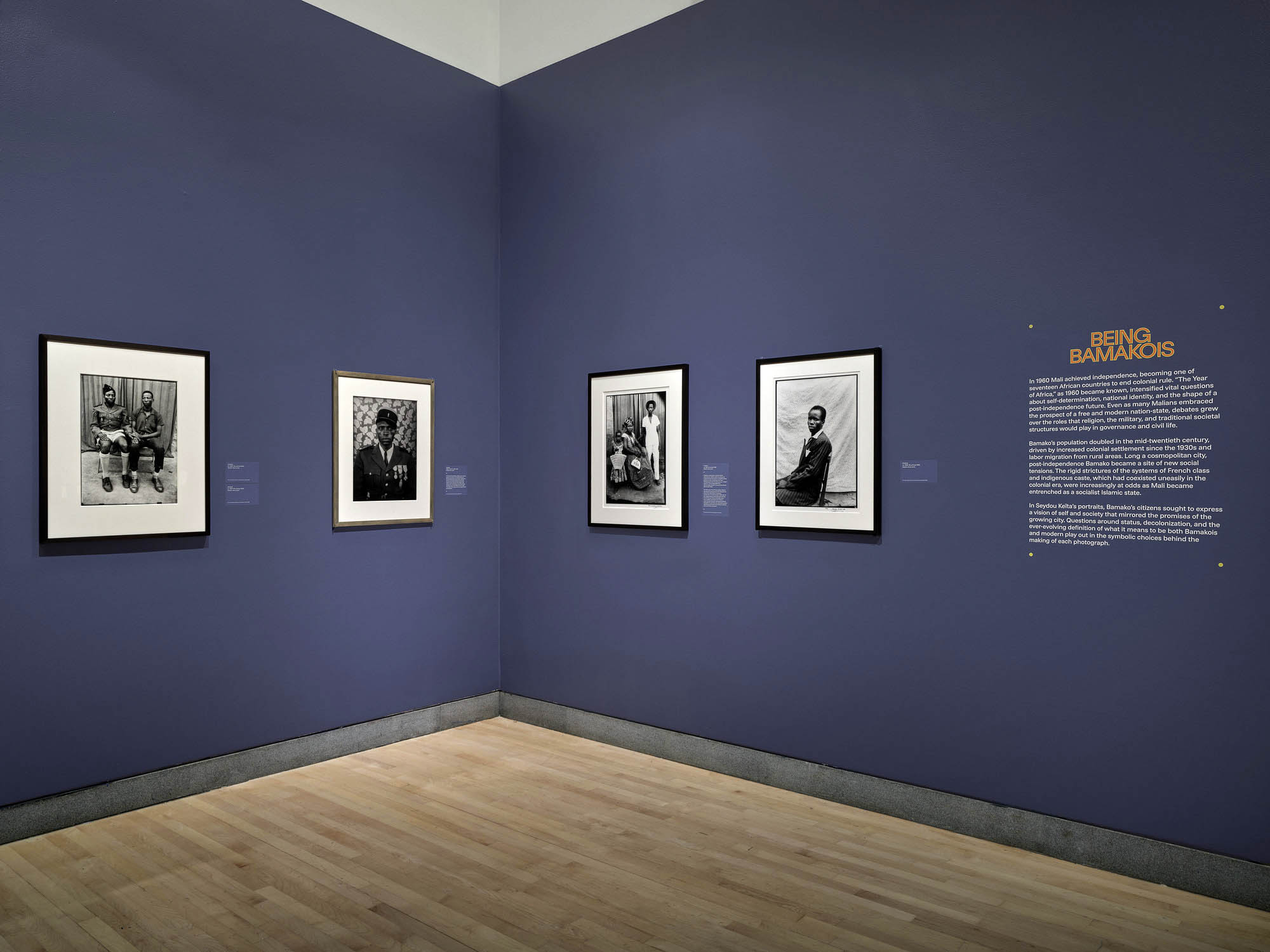
 

Installation view of the exhibition 'Seydou Keïta: A Tactile Lens' at the Brooklyn Museum, New York, October 2025 - May 2026


Installation views of the exhibition Seydou Keïta: A Tactile Lens at the Brooklyn Museum, New York, October 2025 – May 2026 showing in the bottom image at bottom second left, Keïta’s photograph Untitled 1957 (below)
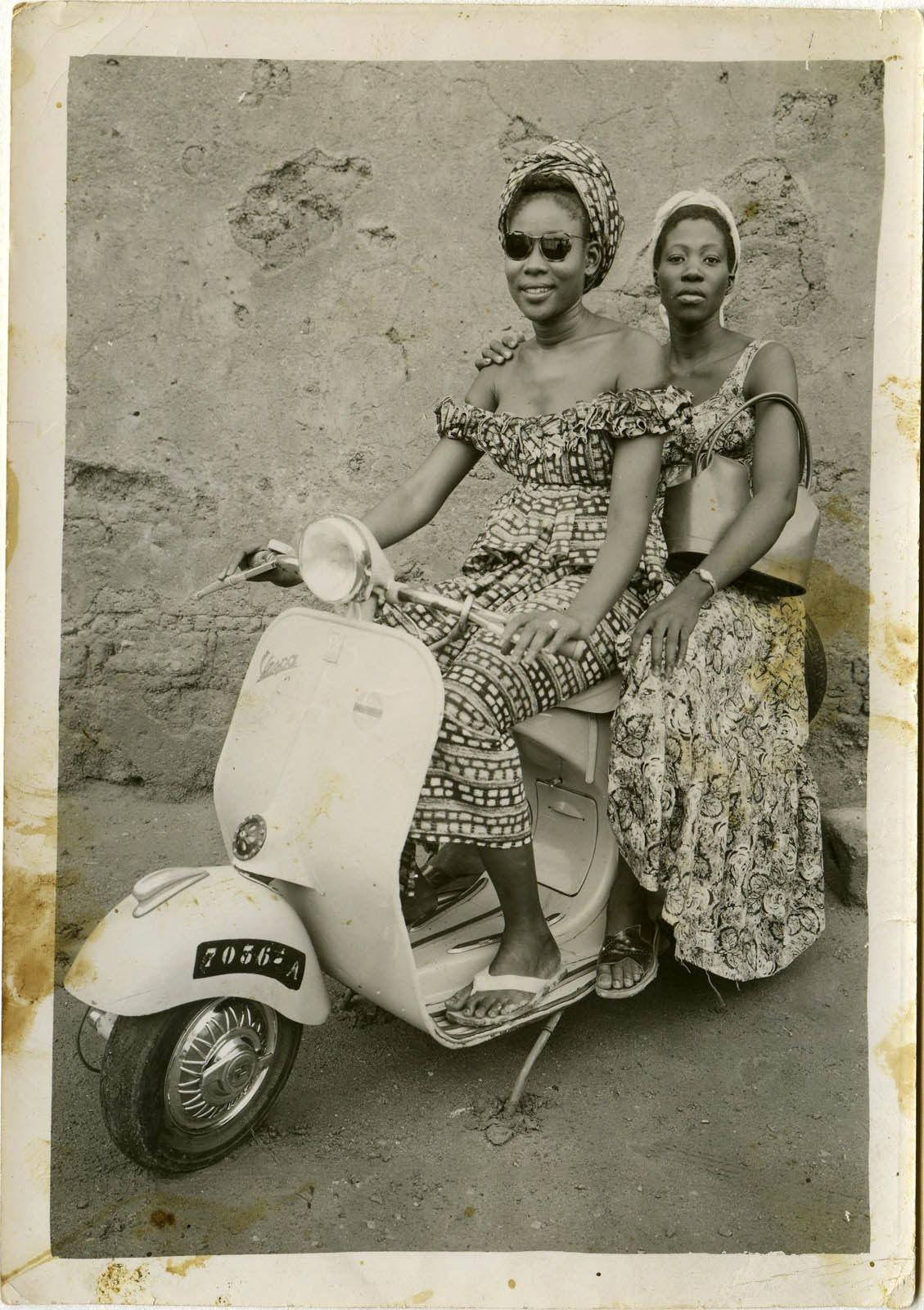
 

Seydou Keïta (Malian, c. 1921-2001) 'Untitled' 1957


Seydou Keïta (Malian, c. 1921-2001)
Untitled
1957
Vintage gelatin silver print
© SKPEAC/Seydou Keïta
Courtesy The Jean Pigozzi Collection of African Art and Danziger Gallery, NY


Posing with aplomb on a Vespa – likely Keïta’s – these women have become the subjects of one of his most iconic photographs, seen here as a vintage print. They present themselves as aspirational members of the Bamako Vespa Club, whose membership was reserved for men. Expensive and rare, Vespas were costly symbols of affluence that were inaccessible to most Bamakois in the French colonial economy. Keïta, one of the club’s founders, purchased his own using earnings from his photography.


The Pretenders

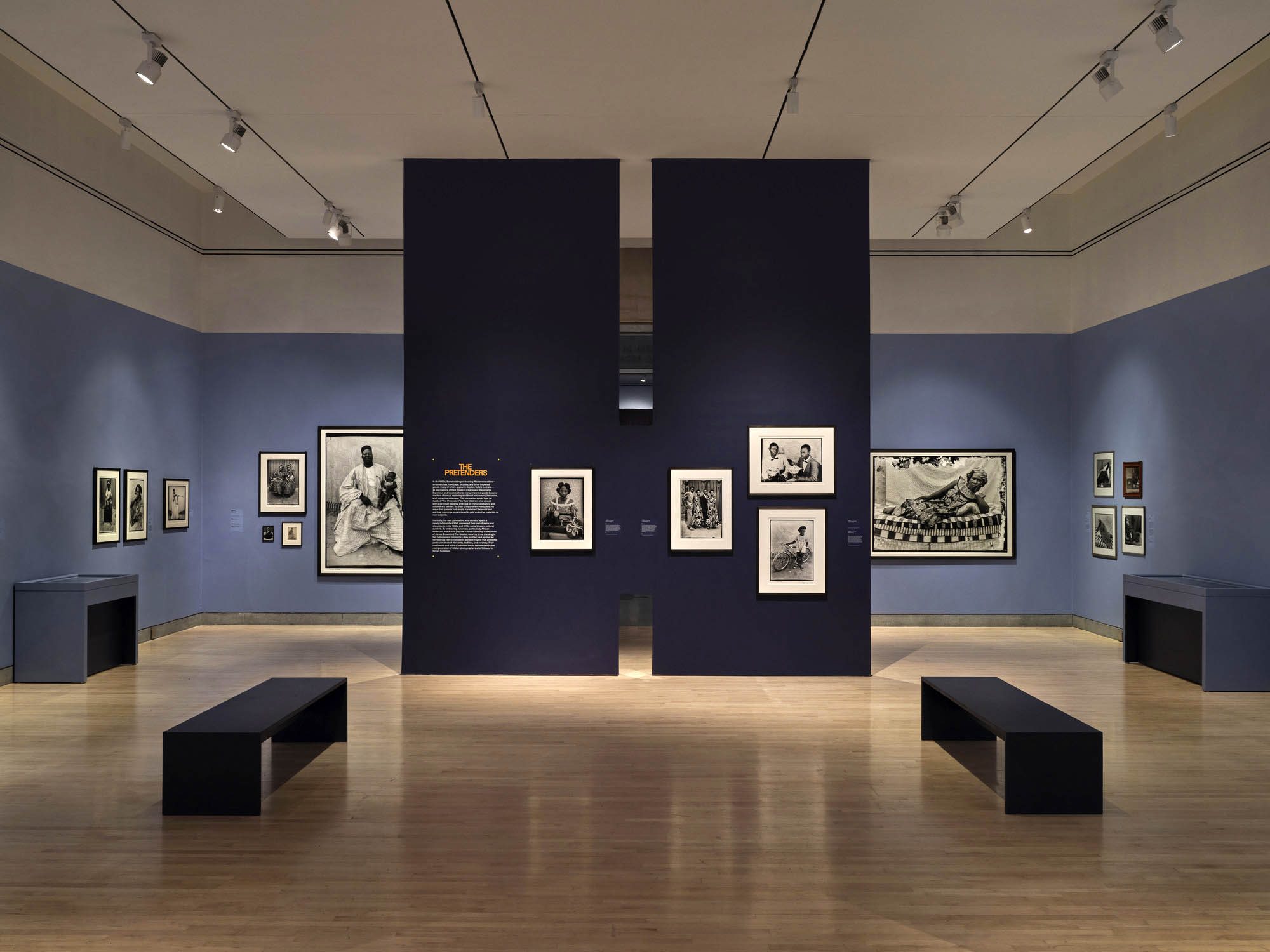
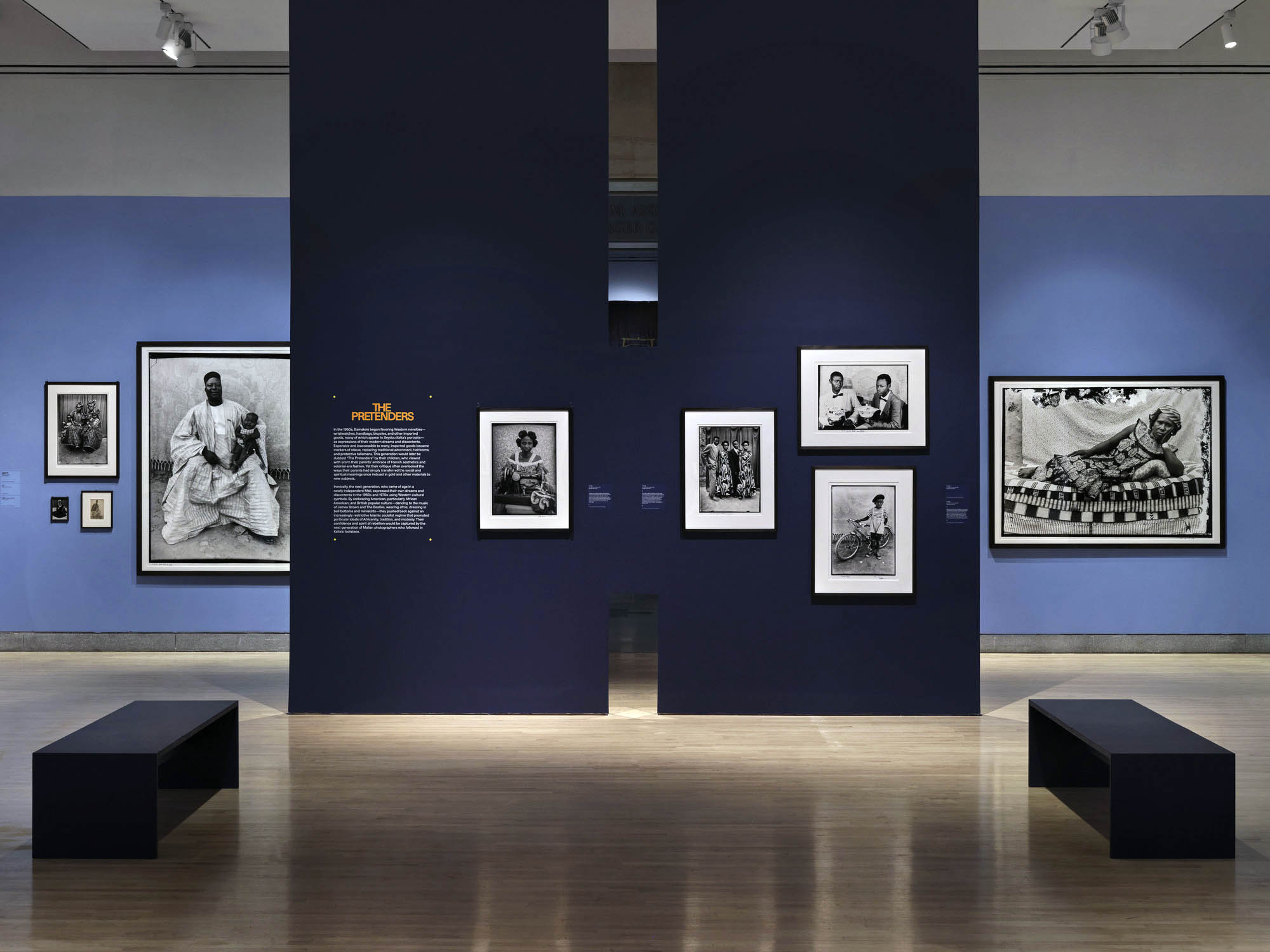
In the 1950s, Bamakois began favouring Western novelties – wristwatches, handbags, bicycles, and other imported goods, many of which appear in Seydou Keïta’s portraits – as expressions of their modern dreams and discontents. Expensive and inaccessible to many, imported goods became markers of status, replacing traditional adornment, heirlooms, and protective talismans. This generation would later be dubbed “The Pretenders” by their children, who viewed with scorn their parents’ embrace of French aesthetics and colonial-era fashion. Yet their critique often overlooked the ways their parents had simply transferred the social and spiritual meanings once imbued in gold and other materials to new subjects. 

Ironically, the next generation, who came of age in a newly independent Mali, expressed their own dreams and discontents in the 1960s and 1970s using Western cultural symbols. By embracing American, particularly African American, and British popular culture – dancing to the music of James Brown and The Beatles, wearing afros, dressing in bell bottoms and miniskirts – they pushed back against an increasingly restrictive Islamic socialist regime that promoted particular ideals of Africanity, tradition, and modesty. Their confidence and spirit of rebellion would be captured by the next generation of Malian photographers who followed in Keïta’s footsteps.

Coming of Age

Young men and women often arrived at Seydou Keïta’s studio dressed in their best clothing and adorned with jewellery that hinted at the worth of future dowries or the scale of family ambitions. They posed for portraits that became cherished mementos. Such small-format photographs were exchanged as offerings of friendship, used in matchmaking and marriage proposals, and commemorated births and weddings. They also served as keepsakes of religious holidays such as Eid and Tabaski (Eid al-Adha). Together, the works on view celebrate the beauty of youth and the significance of coming of age – moments of transformation, growth, and entry into adulthood.

The Elegants

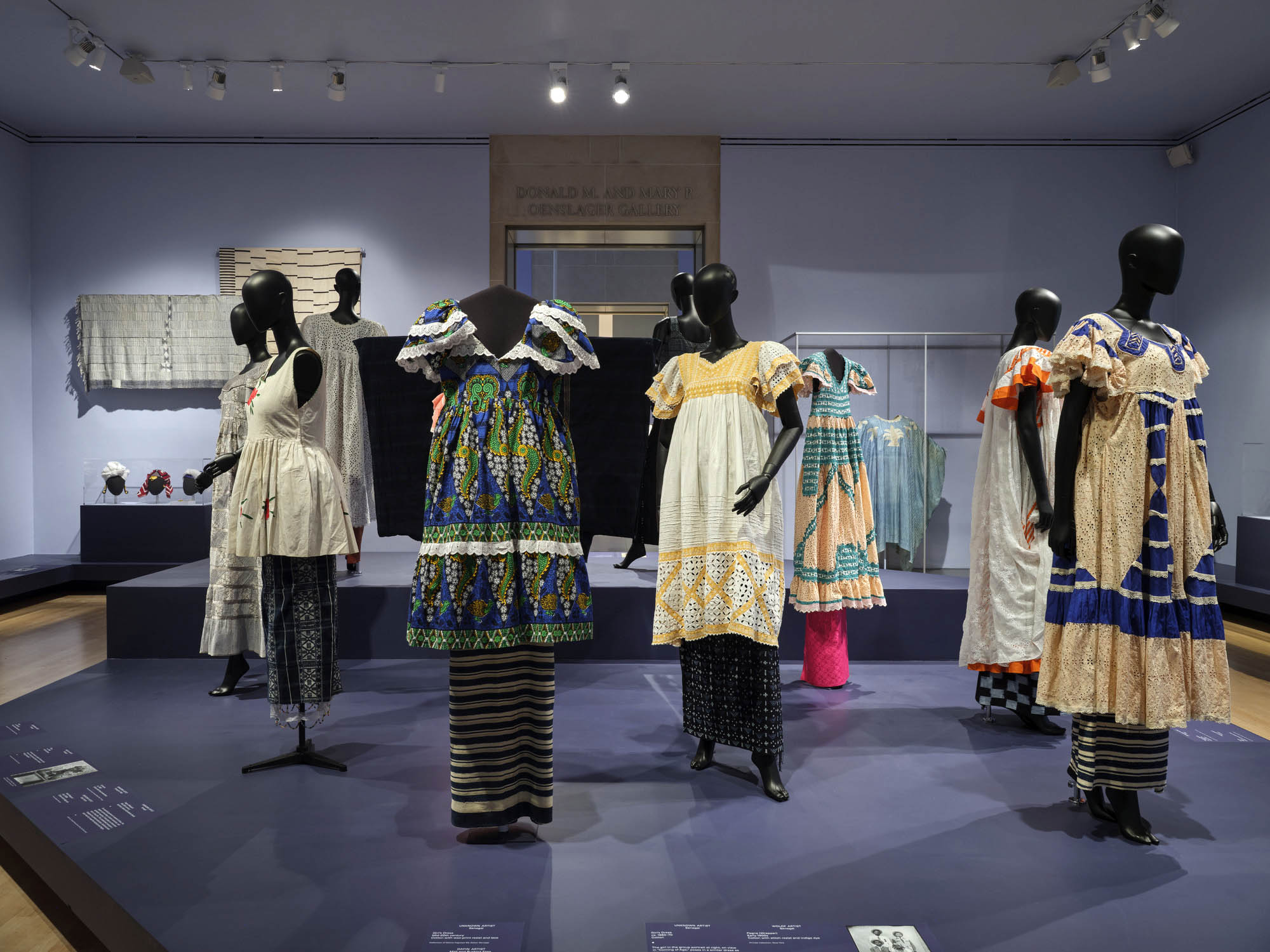
Seydou Keïta’s subjects radiate elegance in every photograph, resplendent in tailor-made ensembles that reflect the wearer’s ingenuity and creativity. Many of the outfits seen in Keïta’s portraits blend handwoven West African textiles with Islamic fabrics and imported European cloth, often in inventive ways. Whether made from velvet, Dutch wax print, or eyelet lace, a gown could always be paired with a traditional pagne (wrapper) showing at the hem, adding the requisite touch of beauty. The men, women, and youths on view present themselves as mirrors to the cultural syncretism and self-invention of mid-twentieth-century Bamako. 

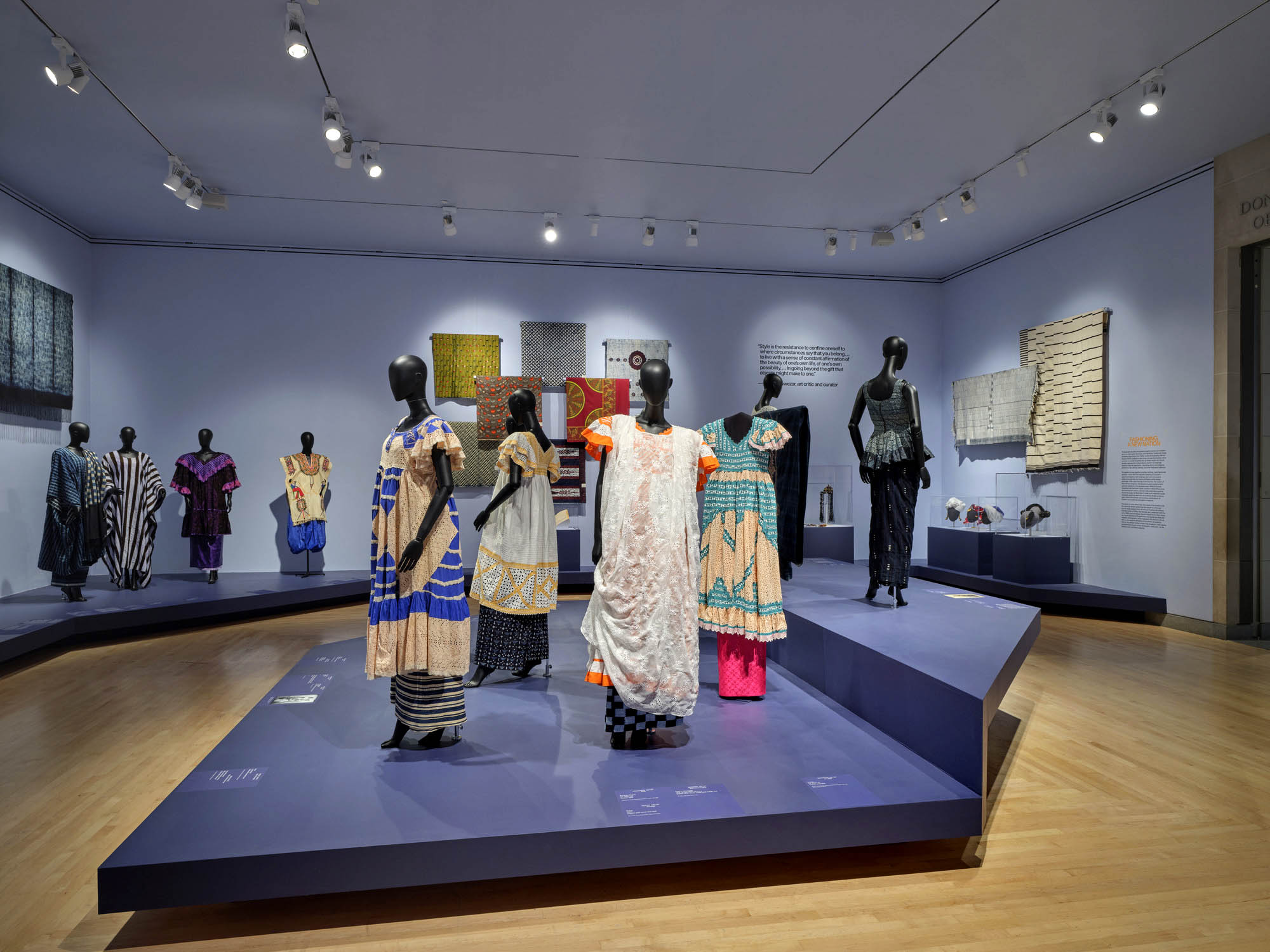
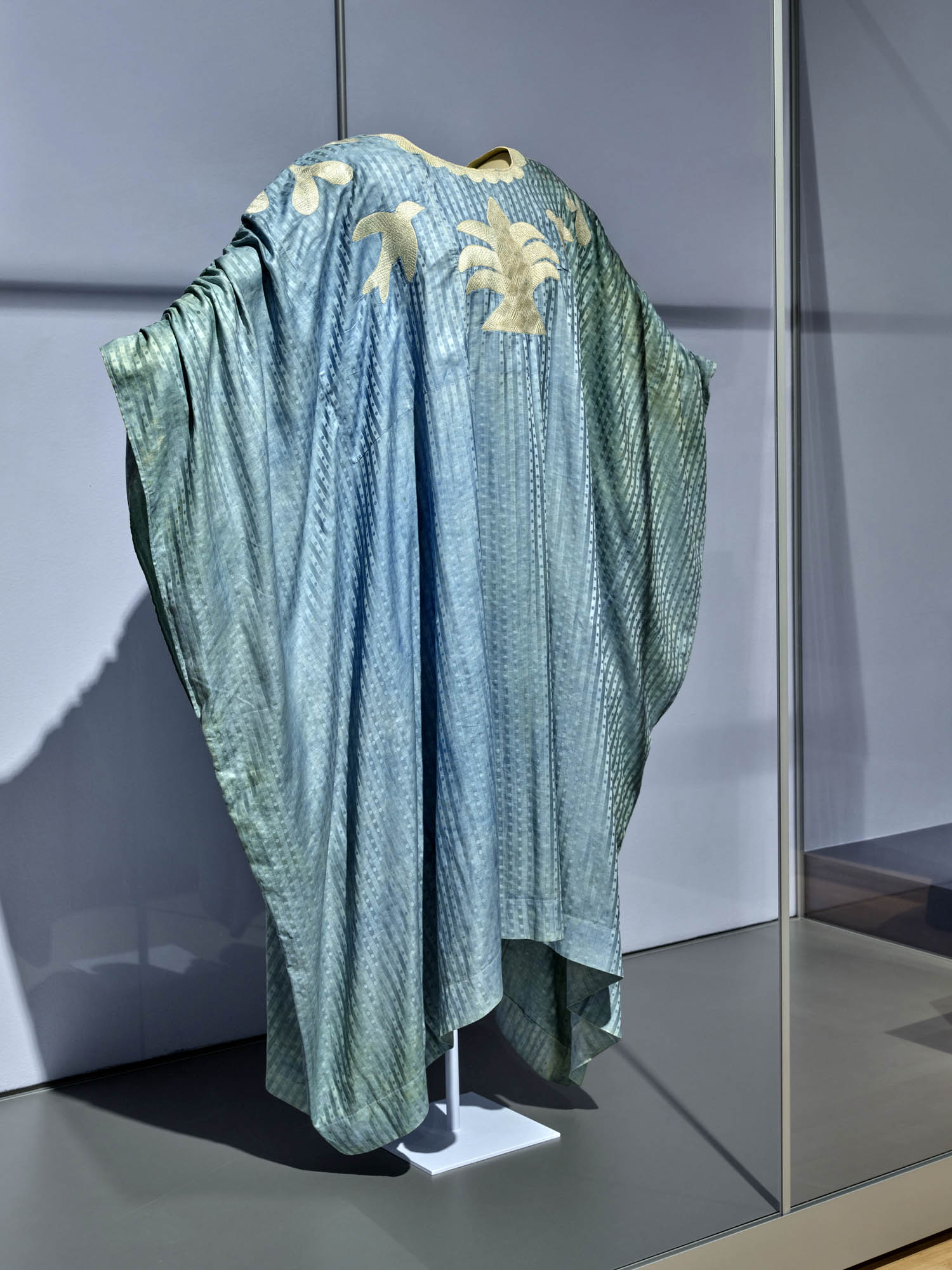
As the Islamic socialist regime rose to power in the 1960s and 1970s, it began imposing increased restrictions on dress, enacting punishments and “re-education” for the wearing of Western or secular clothing. Keïta’s portraits capture a brief window just before these strictures took hold – a moment when his sitters fashioned an expression entirely their own. He helped document, in the words of Nigerian art critic Okwui Enwezor, fashion’s power to offer people a means of “resistance to confining oneself.”
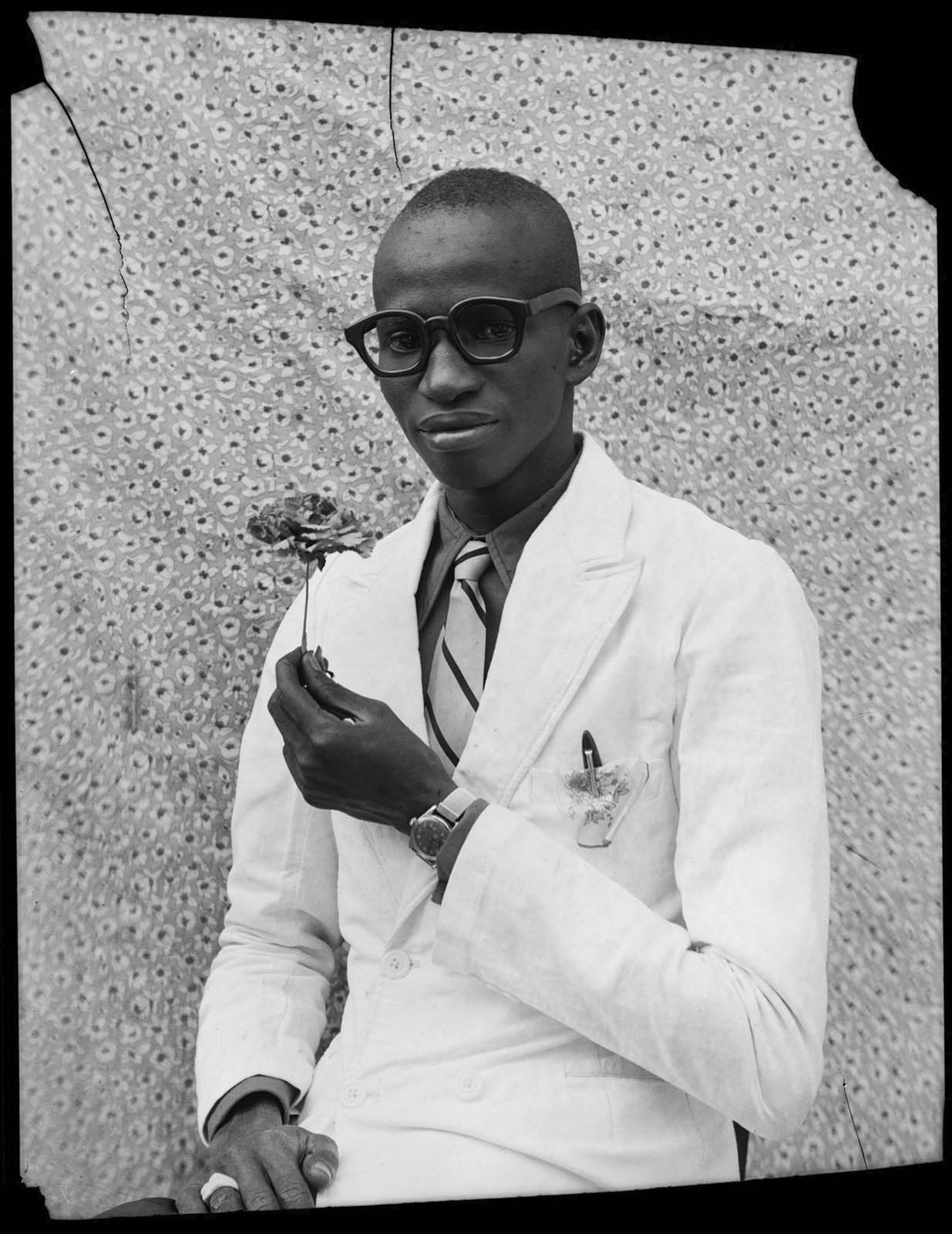
 

Seydou Keïta (Malian, c. 1921-2001) 'Untitled' 1959, printed c. 1994-2001


Seydou Keïta (Malian, c. 1921-2001)
Untitled
1959, printed, c. 1994-2001
Gelatin silver print
© SKPEAC/Seydou Keïta
Courtesy The Jean Pigozzi Collection of African Art and Danziger Gallery, NY


Delicately presenting a plastic flower, this man exudes elegance and poise in his double-breasted suit, silk handkerchief and fountain pen tucked neatly in his breast pocket. He meets the camera’s gaze with inviting eyes that exude a quiet openness. His confident, relaxed presence speaks to Keïta’s gift for making his subjects feel at ease – enabling them to fully express themselves in front of the camera.


The Loungers

The figure of the languid, reclining odalisque, or female attendant, is seen by many American and European viewers as an exoticizing colonial trope. However, in Seydou Keïta’s portraits, the lounger appears as a modern Bamakois – worldly, confident, adorned with the enduring garments, jewellery, and symbols of her heritage. In these portraits, each woman asserts her power, status, wealth, and values. The self-fashioned, richly layered settings re-create the intimate interiors of domestic life. The beds, textiles, and Islamic tea ceremonies shown here reflect the subject’s mastery of hospitality – an essential trait for the model Soudanaise woman – as well as her standing in family and society. 

With slender, henna-stained hands and feet, modest dress, and composed bearing, these women affirm traditional social values even as they shape a modern visual identity. These photographs are an ode – to the women, their world, and the form of the lounger herself.
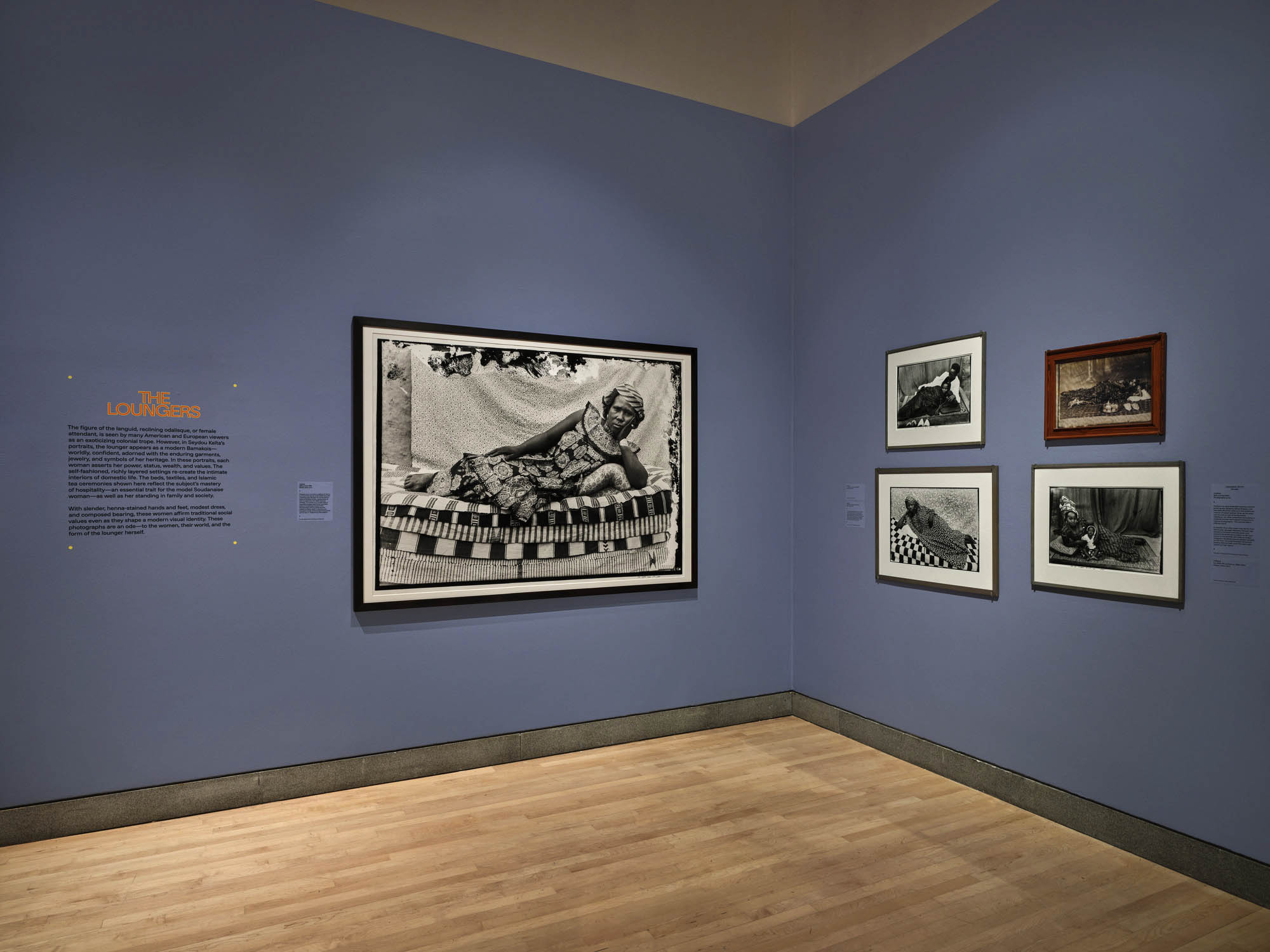
 

Installation view of the exhibition 'Seydou Keïta: A Tactile Lens' at the Brooklyn Museum, New York, October 2025 - May 2026 showing at second right bottom, Keïta's photograph 'Untitled' 1953-1957


Installation view of the exhibition Seydou Keïta: A Tactile Lens at the Brooklyn Museum, New York, October 2025 – May 2026 showing at second right bottom, Keïta’s photograph Untitled 1953-1957 (below)
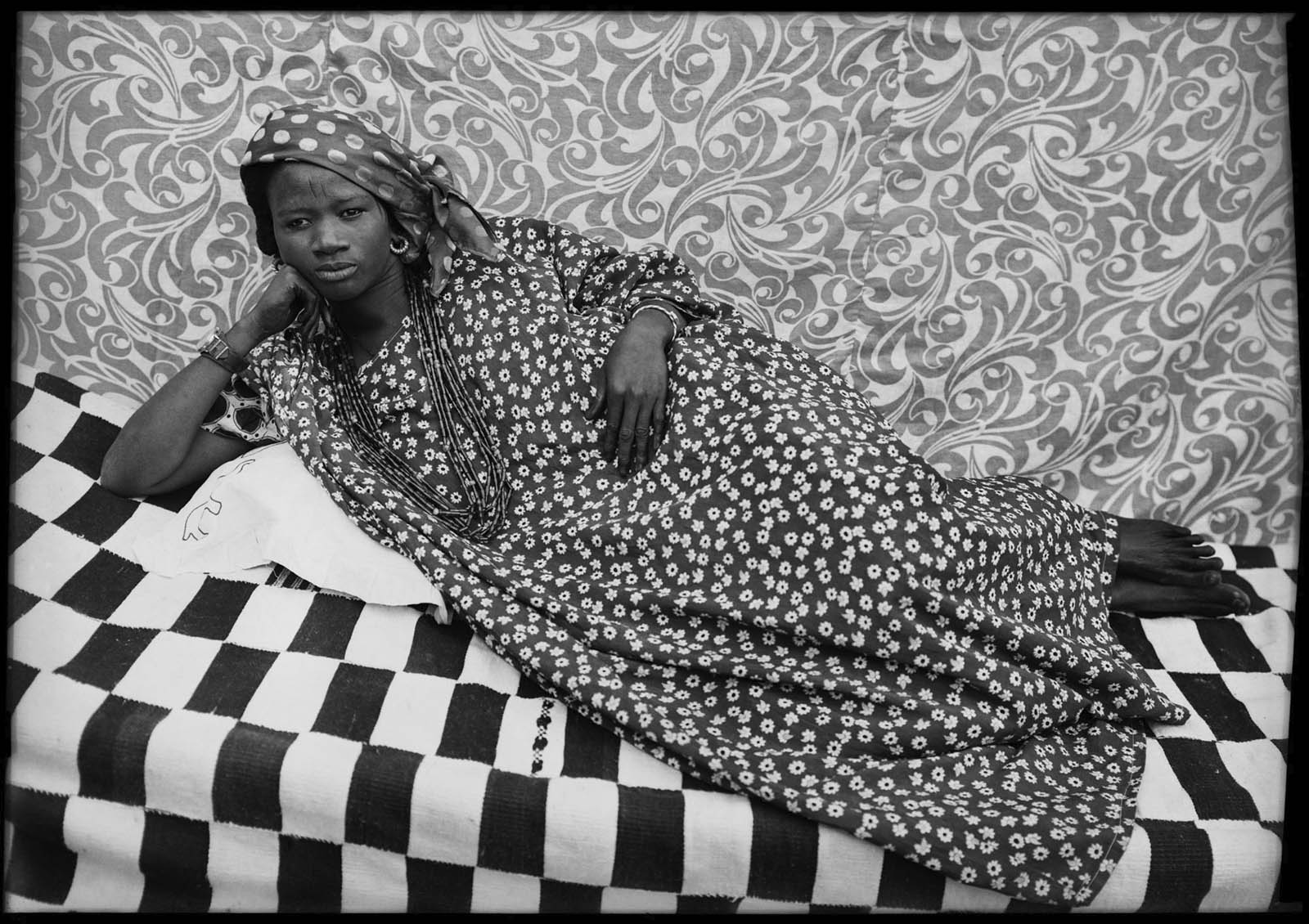
 

Seydou Keïta (Malian, c. 1921-2001) 'Untitled' 1953-1957, printed c. 1994-2001


Seydou Keïta (Malian, c. 1921-2001)
Untitled
1953-1957, printed c. 1994-2001
Gelatin silver print
© SKPEAC/Seydou Keïta
Courtesy The Jean Pigozzi Collection of African Art and Danziger Gallery, NY


Keïta La

“Keïta La” offers a glimpse into the world of Seydou Keïta’s studio – and into his family’s efforts to steward and preserve his legacy. Together, the objects on view pose important questions about conservation and personal and artistic archives.

In the mid-twentieth century, near the elegant colonial centre of Bamako-Coura, Keïta La, the family compound, sat on a wide avenue that buzzed with traffic and was lined with a canopy of trees, casting dappled shadows that lent a lazy air. Just outside the compound’s walls was the artist’s studio. As a photographer, Keïta moved seamlessly between the compound yard, the avenue, the nearby walls of sites, and the studio and darkroom where he made prints late into the night. Keïta ran the studio until 1963, when he was forced to dedicate himself exclusively to government service. He turned the business over to his brother and sons, who had become familiar with cameras as children. Upon his retirement, he returned to Keïta La – but not to his studio. Instead, he embraced his second love: the repair of cameras and cars.

Today, the Keïta family have been vital collaborators in the conceptualisation of this exhibition, their oral histories enriching our understanding of the man behind the camera. In addition, their loan of the photographer’s few remaining family heirlooms and a trove of film negatives imbues this section with Keïta’s personal presence. These negatives, which have been preserved and imaged by the Brooklyn Museum on the occasion of this exhibition, expand our knowledge of Keïta’s oeuvre. A selection of these portraits is presented here – on lightboxes and as a projection – for the first time.
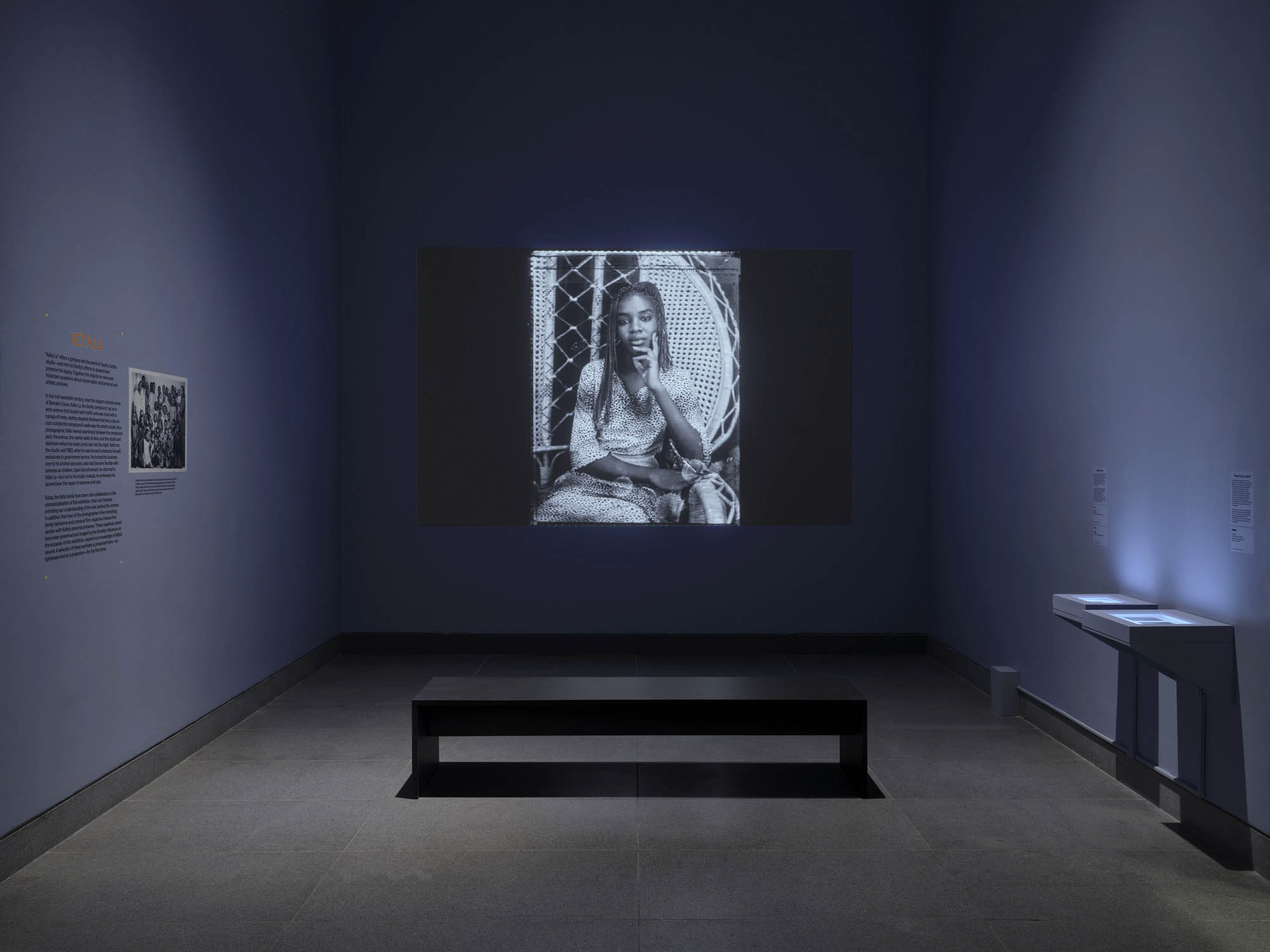
 

Installation view of the exhibition 'Seydou Keïta: A Tactile Lens' at the Brooklyn Museum, New York, October 2025 - May 2026 showing text for the section "Keïta La" on the left hand wall, as well as the photograph 'Undated family portrait taken in Seydou Keïta's studio'


Installation view of the exhibition Seydou Keïta: A Tactile Lens at the Brooklyn Museum, New York, October 2025 – May 2026 showing text for the section “Keïta La” on the left hand wall, as well as the photograph Undated family portrait taken in Seydou Keïta’s studio (below)
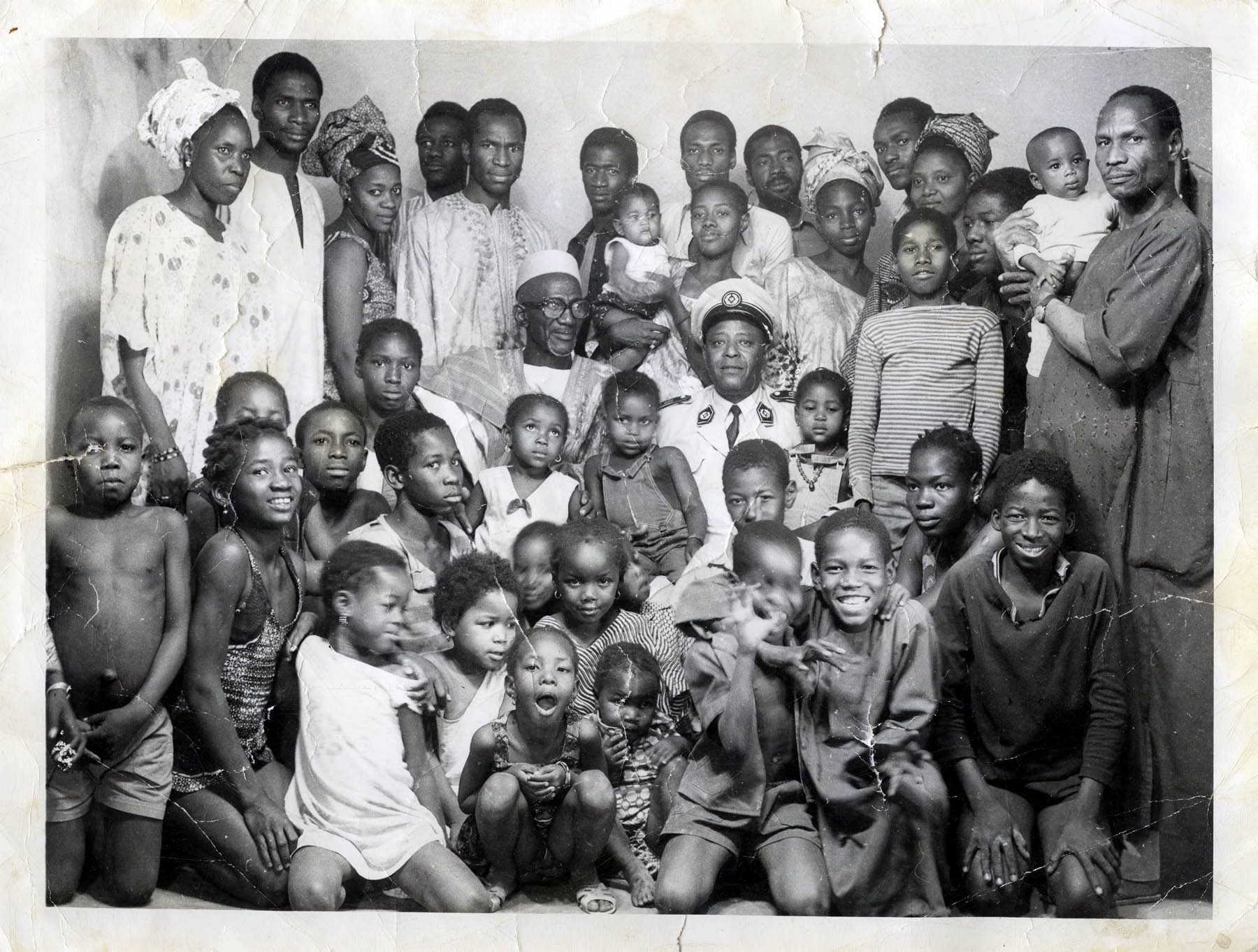
 

Undated family portrait taken in Seydou Keïta's studio


Undated family portrait taken in Seydou Keïta’s studio
Seated left of centre is Keïta’s uncle Tièmòkò Keïta (wearing eyeglasses), with Hamed Lamine “Papa” Keïta behind him at left and Cheickine Keïta at far right (holding child). Today, Papa and Cheickine serve as the principal stewards of the Keïta estate
Courtesy the Seydou Keïta Family
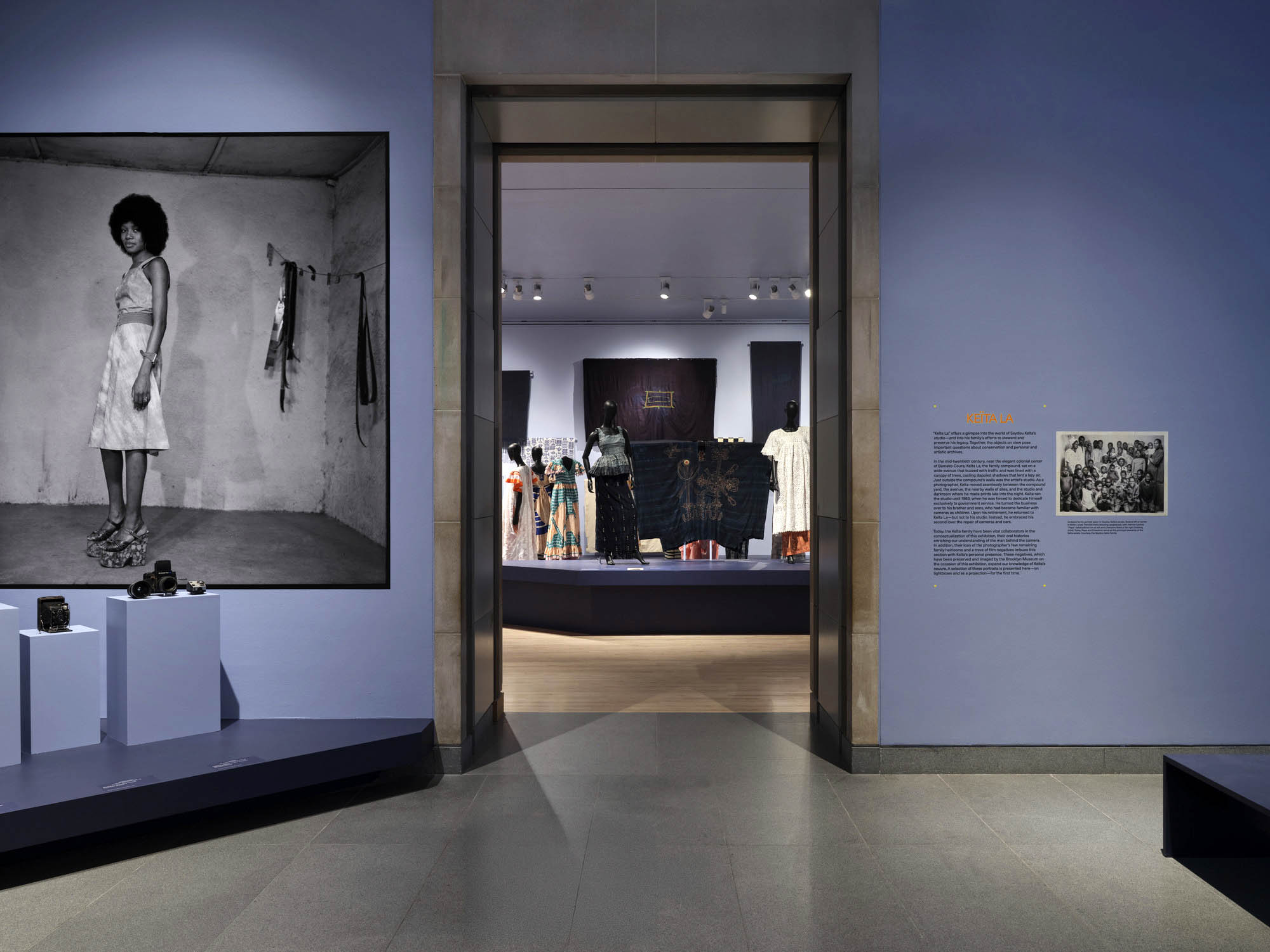
 

Installation view of the exhibition 'Seydou Keïta: A Tactile Lens' at the Brooklyn Museum, New York, October 2025 - May 2026 showing at left, Keïta's photograph 'Untitled' late 1940s to mid-1970s; and at right, text for the section "Keïta La" together with the photograph 'Undated family portrait taken in Seydou Keïta's studio'


Installation view of the exhibition Seydou Keïta: A Tactile Lens at the Brooklyn Museum, New York, October 2025 – May 2026 showing at left, Keïta’s photograph Untitled late 1940s to mid-1970s (below); and at right, text for the section “Keïta La” together with the photograph Undated family portrait taken in Seydou Keïta’s studio (above)


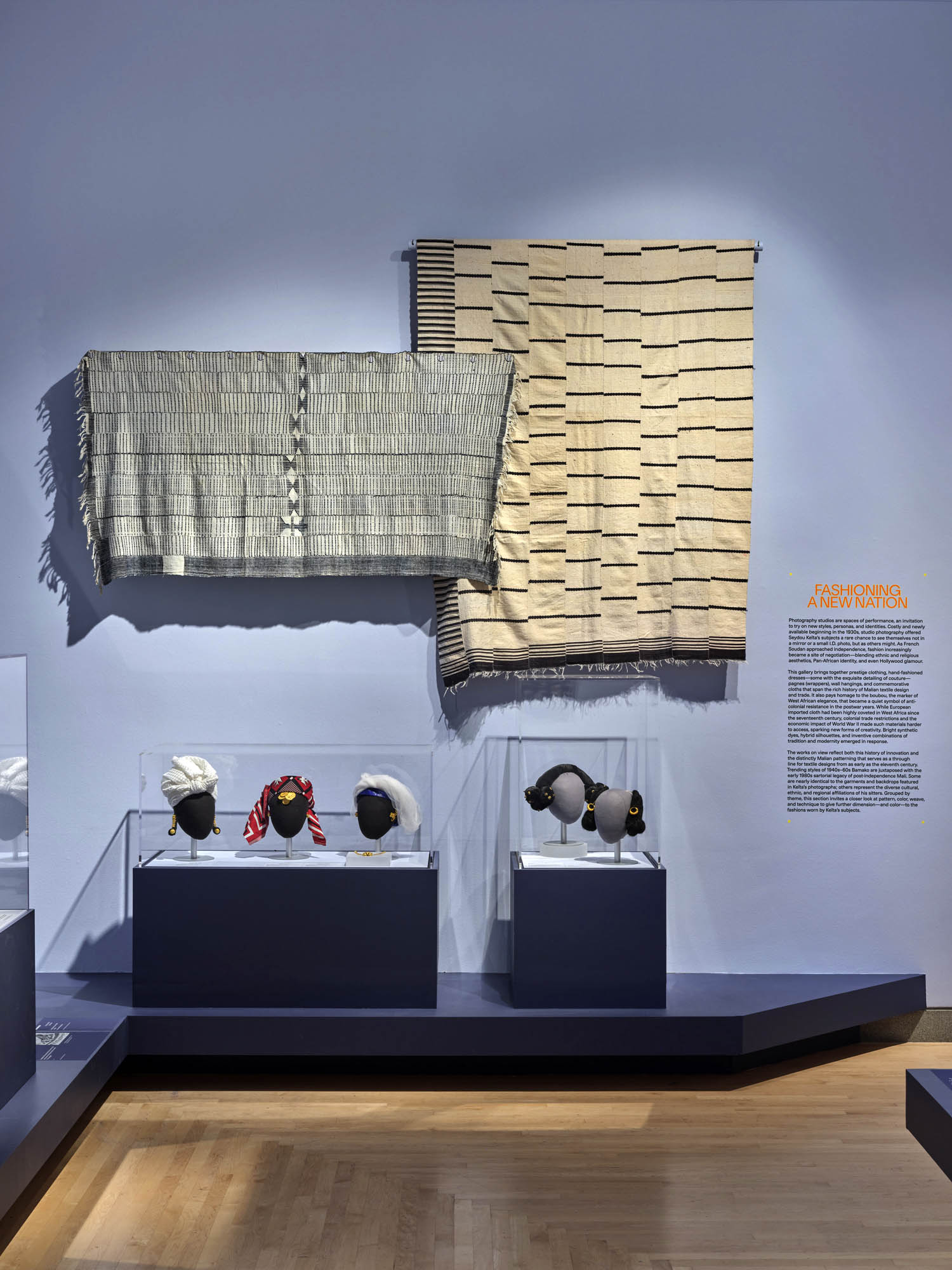
Fashioning A New Nation

Photography studios are spaces of performance, an invitation to try on new styles, personas, and identities. Costly and newly available beginning in the 1930s, studio photography offered Seydou Keïta’s subjects a rare chance to see themselves not in a mirror or a small I.D. photo, but as others might. As French Soudan approached independence, fashion increasingly became a site of negotiation – blending ethnic and religious aesthetics, Pan-African identity, and even Hollywood glamour. 

This gallery brings together prestige clothing, hand-fashioned dresses – some with the exquisite detailing of couture – pagnes (wrappers), wall hangings, and commemorative cloths that span the rich history of Malian textile design and trade. It also pays homage to the boubou, the marker of West African elegance, that became a quiet symbol of anti-colonial resistance in the postwar years. While European imported cloth had been highly coveted in West Africa since the seventeenth century, colonial trade restrictions and the economic impact of World War II made such materials harder to access, sparking new forms of creativity. Bright synthetic dyes, hybrid silhouettes, and inventive combinations of tradition and modernity emerged in response. 

The works on view reflect both this history of innovation and the distinctly Malian patterning that serves as a through line for textile designs from as early as the eleventh century. Trending styles of 1940s-60s Bamako are juxtaposed with the early 1980s sartorial legacy of post-independence Mali. Some are nearly identical to the garments and backdrops featured in Keïta’s photographs; others represent the diverse cultural, ethnic, and regional affiliations of his sitters. Grouped by theme, this section invites a closer look at pattern, colour, weave, and technique to give further dimension – and colour – to the fashions worn by Keïta’s subjects.
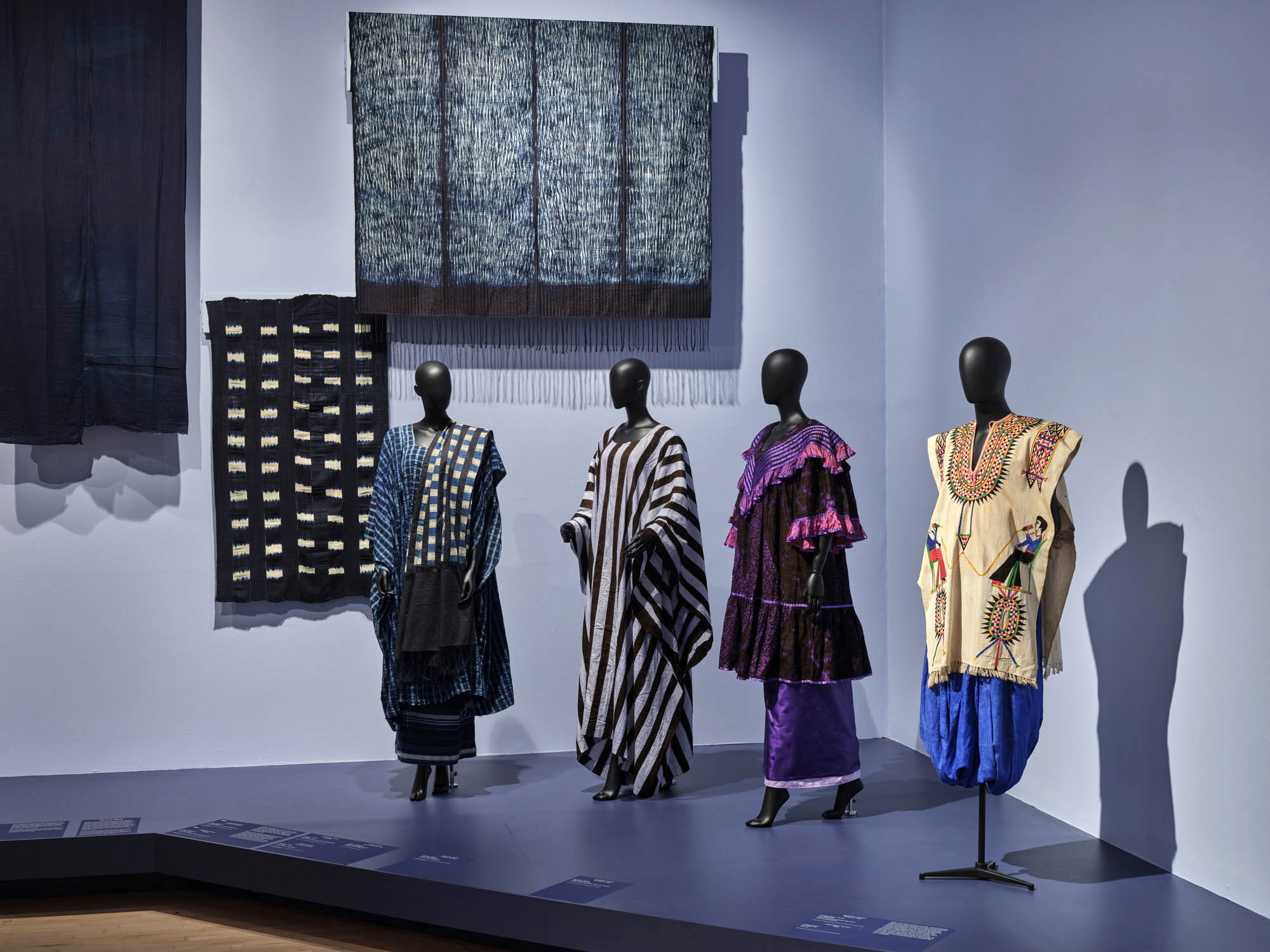
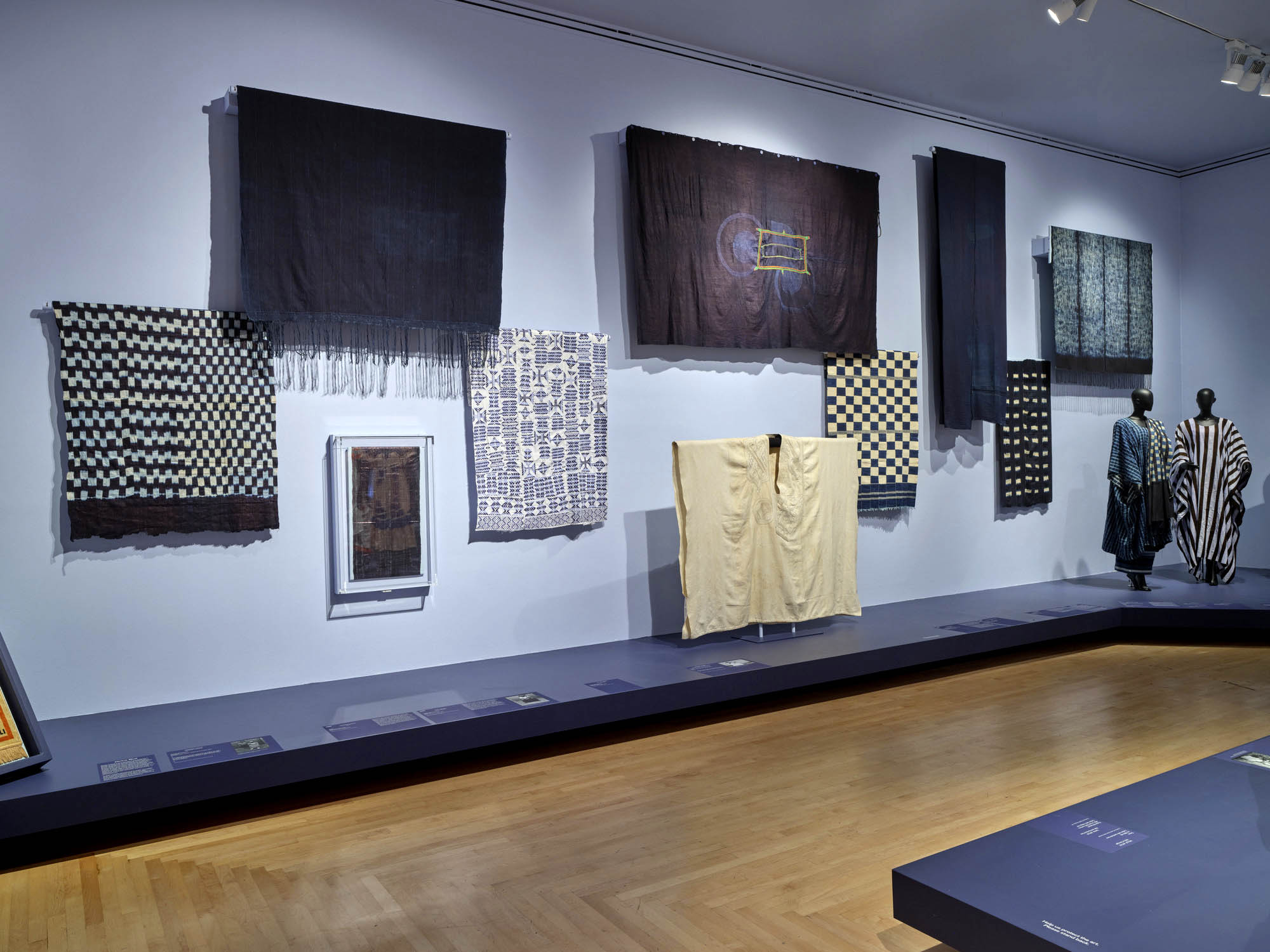
 

Installation view of the exhibition 'Seydou Keïta: A Tactile Lens' at the Brooklyn Museum, New York, October 2025 - May 2026


Installation views of the exhibition Seydou Keïta: A Tactile Lens at the Brooklyn Museum, New York, October 2025 – May 2026 showing text from the section “Fashioning A New Nation”


Handheld

“Fly dirt,” pen marks, dog-eared corners, red Sahelian dust, humidity, and traces of touch infuse Keïta’s vintage prints with a particular life and beauty. Each print is indelibly marked by the photographer, the printer, and the many hands through which it has passed – as tokens, gifts, souvenirs, expressions of love, ritual displays, or precious heirlooms. 

Since Keïta first became known in Europe and the United States in the 1990s, vintage prints of his photographs have made their way into private collections and institutional archives. Despite consisting of the same images, they were often considered secondary to the modern prints that were produced, exhibited, and stored as fine art pieces. Only recently has this value system been upended, reflecting shifts in the art market and in the field of art history. As African studio photography continues to gain recognition, artists and arts professionals of the African diaspora have called for such images to be valued not by colonial or market standards but by their material history and significance as loved, cherished objects.
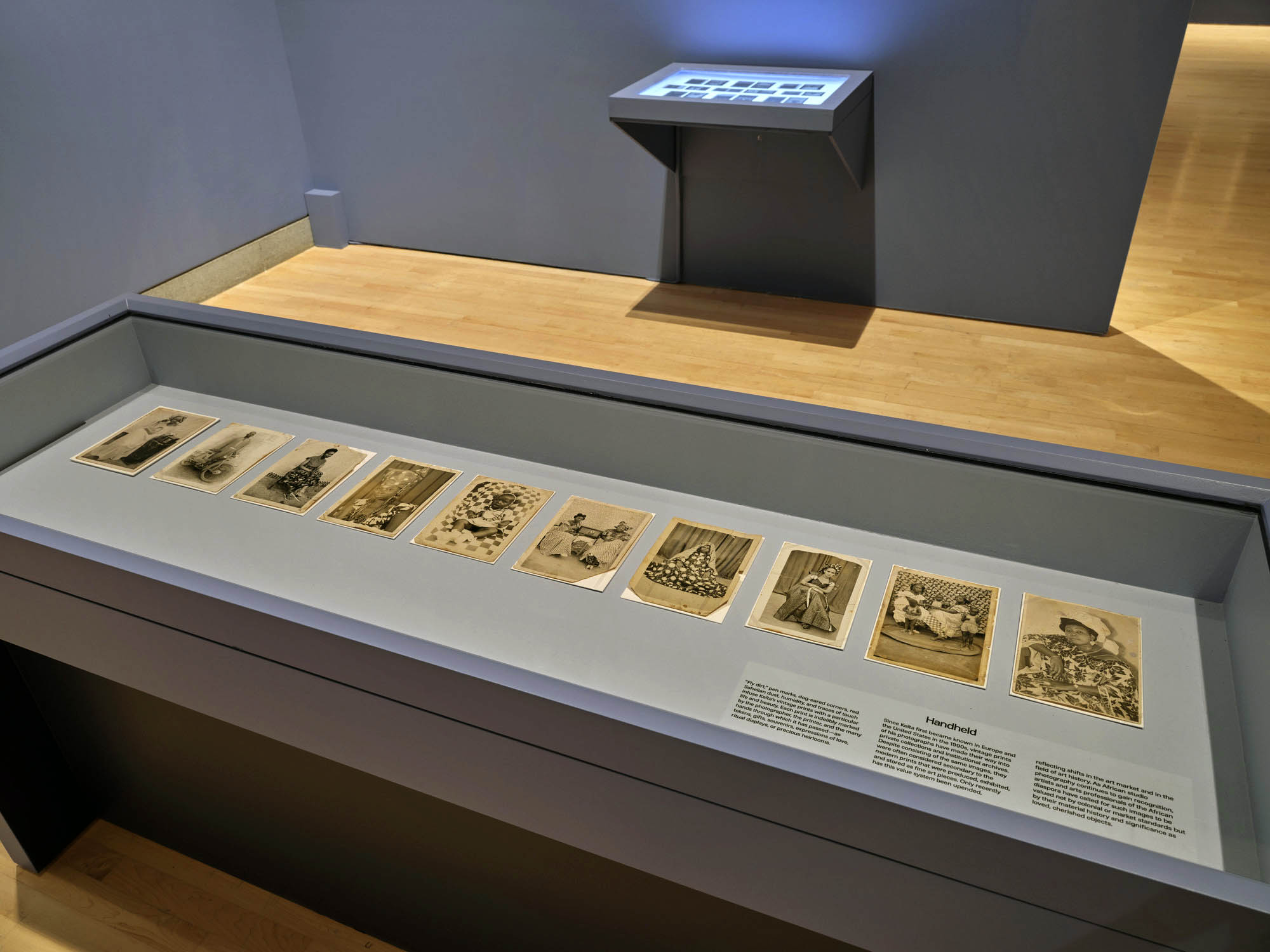
 

Installation view of the exhibition 'Seydou Keïta: A Tactile Lens' at the Brooklyn Museum, New York, October 2025 - May 2026 showing a vitrine with text from the section "Handheld"


Installation view of the exhibition Seydou Keïta: A Tactile Lens at the Brooklyn Museum, New York, October 2025 – May 2026 showing a vitrine with text from the section “Handheld”


The Self That Travels

Over time, African studio photography by Keïta and other artists became part of a global circulation of images. A photographic print could be sent from Bamako to a relative stationed during the war years in France, or Indonesia, or Russia. Portraits were exchanged locally, regionally, and farther afield through a web of relations in matchmaking attempts between families. A private image may have been usurped by a colonial publisher for use on a postcard. Perhaps a collector on eBay, fifty years later, was delighted by the image or recognised Keïta’s stamp and had it shipped to the United States from Belarus. All told, vintage prints are part of an economy that reveals complex histories of commerce and human desire.
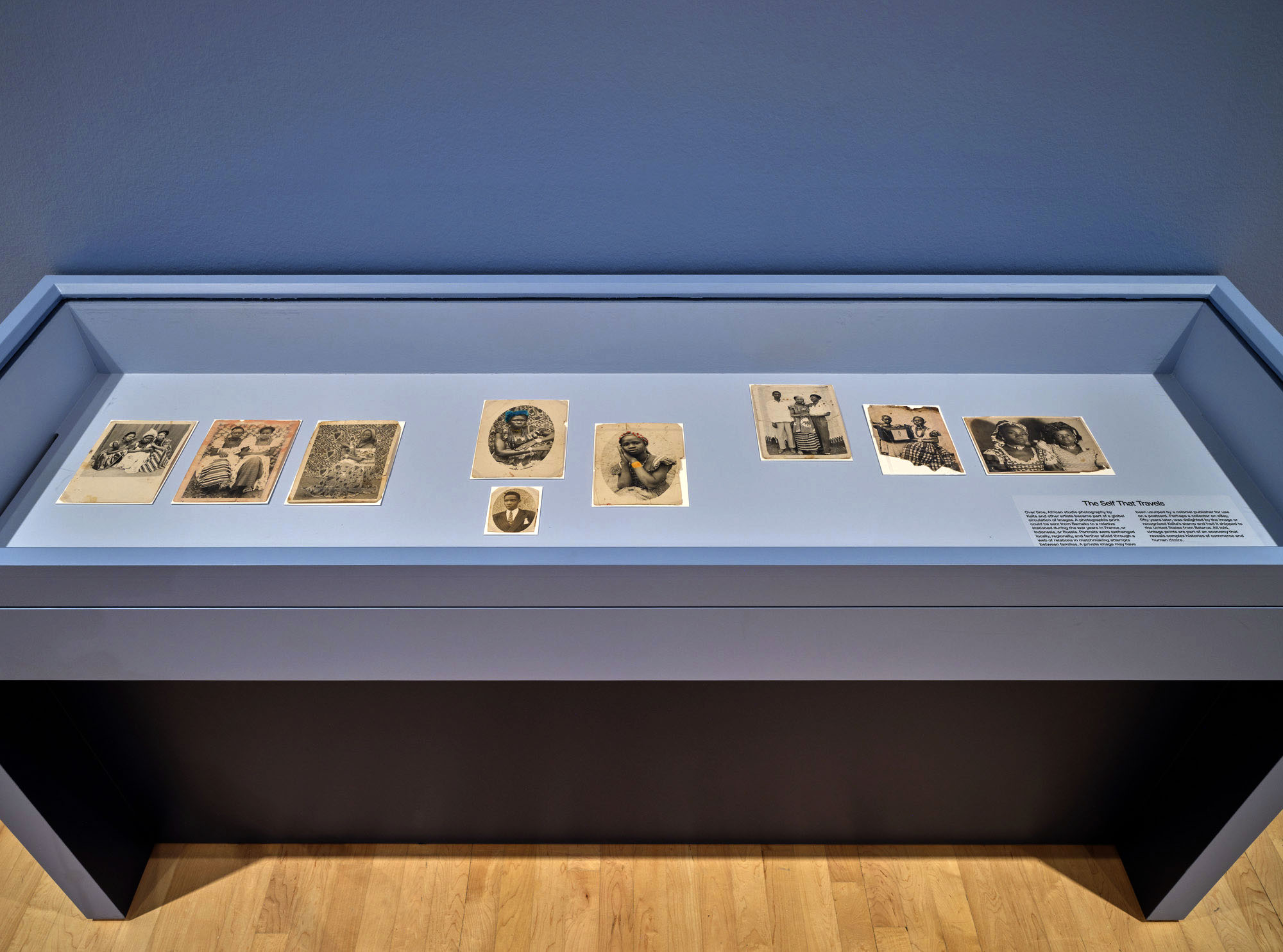
 

Installation view of the exhibition 'Seydou Keïta: A Tactile Lens' at the Brooklyn Museum, New York, October 2025 - May 2026 showing a vitrine with text from the section "The Self That Travels"


Installation view of the exhibition Seydou Keïta: A Tactile Lens at the Brooklyn Museum, New York, October 2025 – May 2026 showing a vitrine with text from the section “The Self That Travels”


A Golden Touch

After printing, photographs could be tinted by hand to heighten the subject’s beauty and status – and to imbue the photograph with the protections afforded by gold. Chekna Touré was a picture framer who hand-coloured photographs for many of Keïta’s clients, often highlighting the subject’s gold jewellery, accessories, and cosmetics. As a marker of wealth, beauty, and identity, gold was essential to Malian women’s dress. 

Mali’s vast gold reserves are some of the world’s oldest and a source of national pride. Its lustrous qualities carried talismanic powers, yet the metal also inspired fear. Believed to be a living organism, gold was said to have its own soul and powers. Goldsmiths would thus meld the element with other metals to help shield the wearer from its full force. 

The vintage prints in this case feature colorisation. While Touré colourised many of Keïta’s photographs, the differing skill levels seen here suggest other people also performed this work, perhaps doing so at home.
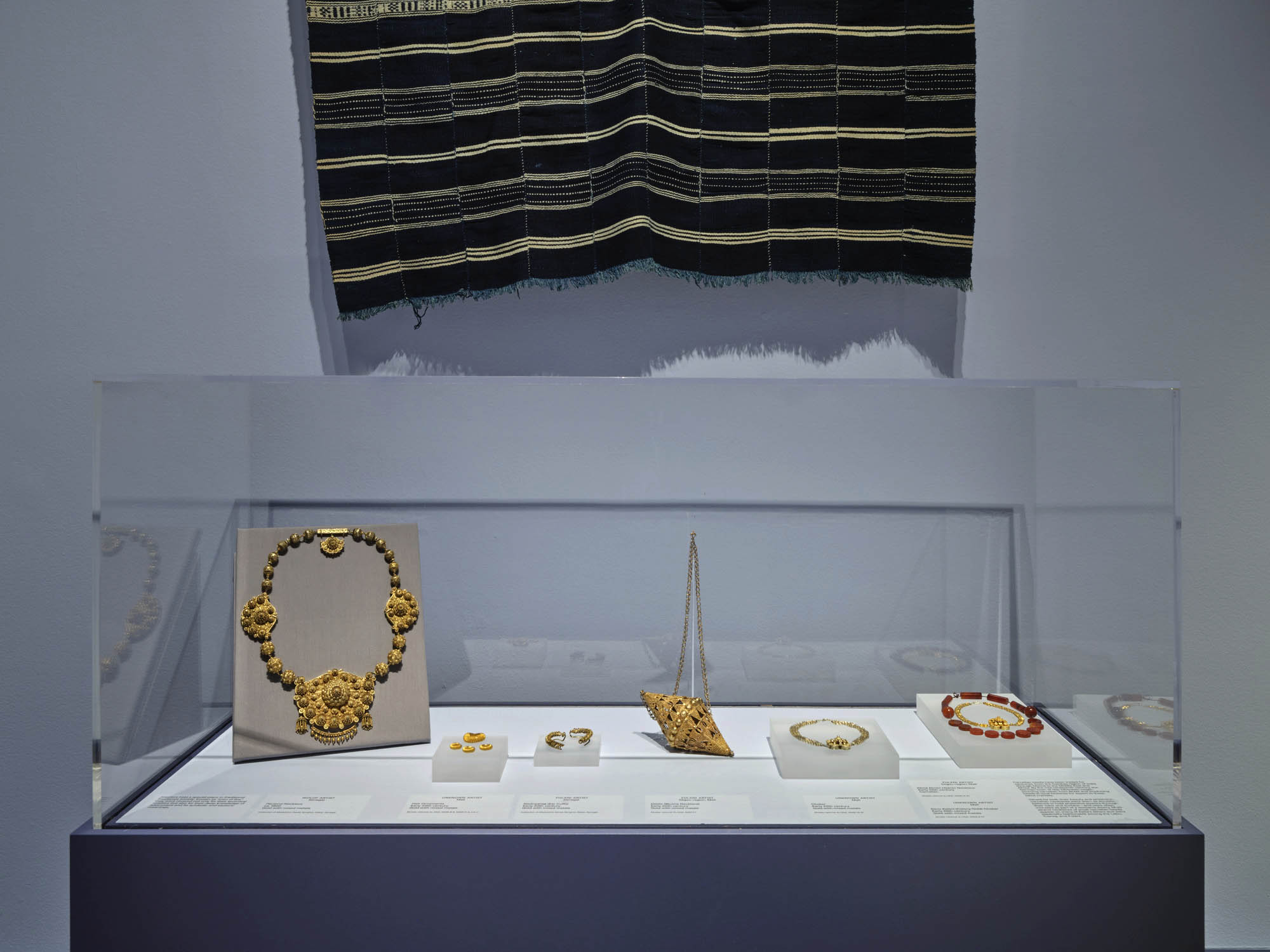
 

Installation view of the exhibition 'Seydou Keïta: A Tactile Lens' at the Brooklyn Museum, New York, October 2025 - May 2026 showing gold and carnelian jewellery


Installation view of the exhibition Seydou Keïta: A Tactile Lens at the Brooklyn Museum, New York, October 2025 – May 2026 showing gold and carnelian jewellery
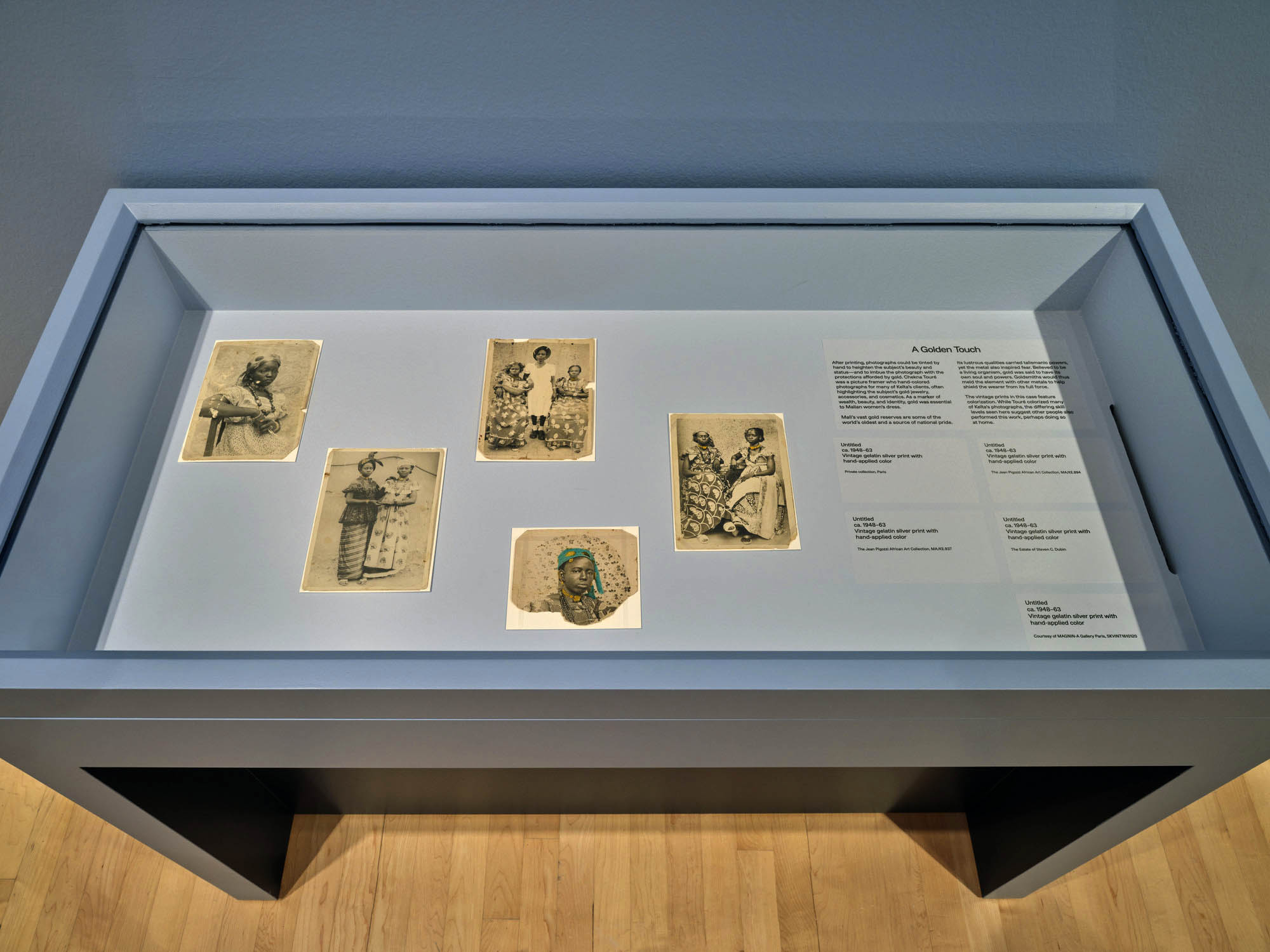
 

Installation view of the exhibition 'Seydou Keïta: A Tactile Lens' at the Brooklyn Museum, New York, October 2025 - May 2026 showing text from the section "A Golden Touch" with at bottom centre, Keïta's photograph 'Untitled' c. 1948-1963


Installation view of the exhibition Seydou Keïta: A Tactile Lens at the Brooklyn Museum, New York, October 2025 – May 2026 showing text from the section “A Golden Touch” with at bottom centre, Keïta’s photograph Untitled c. 1948-1963 (below)
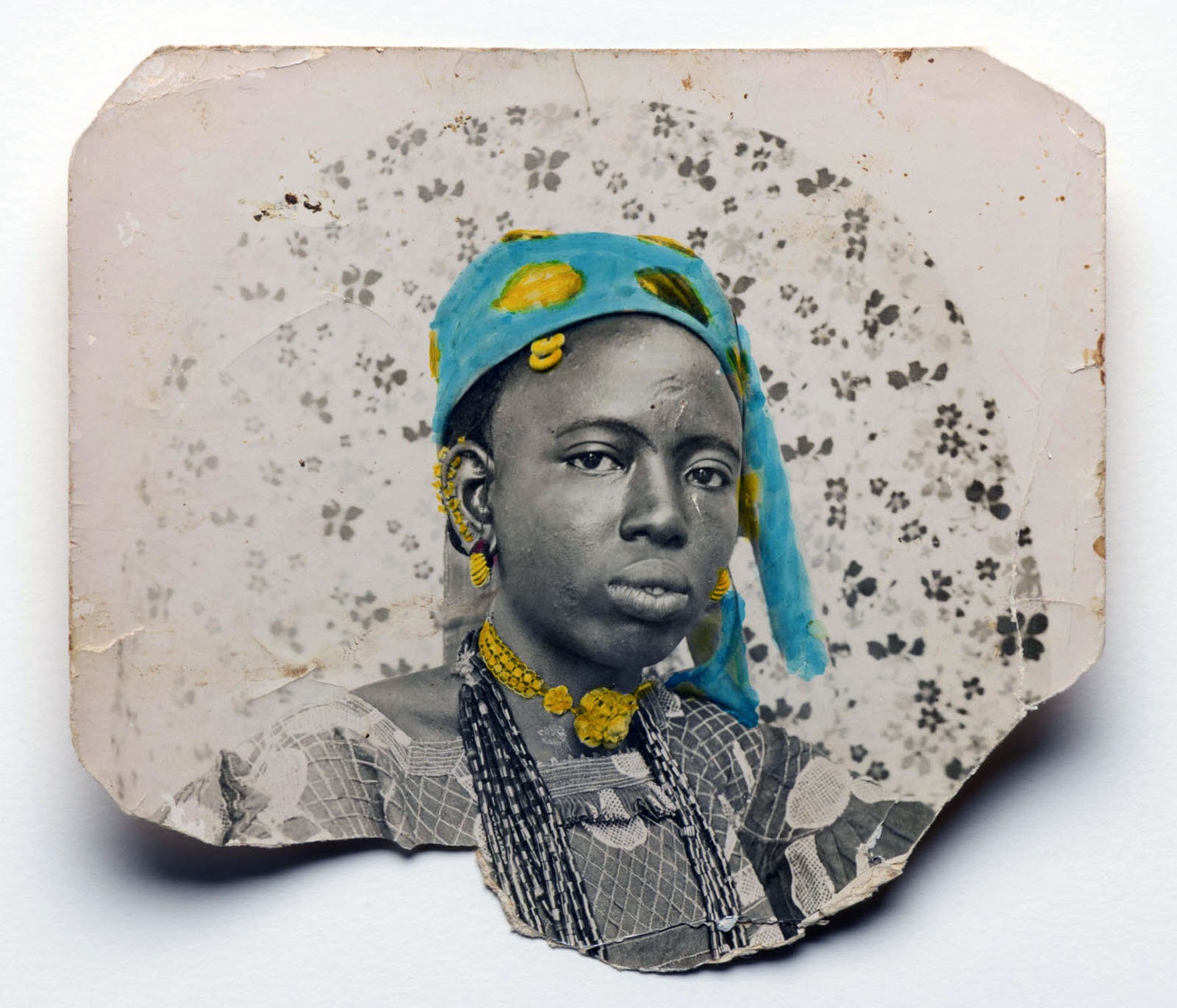
 

Seydou Keïta (Malian, c. 1921-2001) 'Untitled' c. 1948-1963


Seydou Keïta (Malian, c. 1921-2001)
Untitled
c. 1948-1963
Vintage gelatin silver print
The Estate of Steven C. Dubin
© SKPEAC/Seydou Keïta
Courtesy The Jean Pigozzi Collection of African Art and Danziger Gallery, NY
Photo: Brooklyn Museum


Preserving A Legacy

The Keïta family’s generous loan of film negatives from the estate’s remaining archive presents a rare opportunity to reflect on the practical, ethical, and technical questions involved in the preservation of African photography. Conservation of African photographic archives from the continent faces distinct challenges, ranging from climate-related degradation and limited access to preservation materials and technologies to an overall lack of institutional infrastructure and support for artists and their legacies.

Too fragile to survive extensive handling or prolonged light exposure, Keïta’s negatives could not be cleaned or scanned without risking damage. Instead, each was photographed under controlled conditions at a conservation lab and reproduced for the exhibition.

Lace

Lace features prominently in Keïta’s photographs – appearing as trim on dress sleeves, integrated into garments made from wax print and other fabrics, worn as full lace dresses or as sheer boubous layered over other clothing. European lace was highly coveted, expensive, and difficult to obtain. In response, Soudanaise women created their own lace by hand, layering two pieces of white cotton percale and cutting intricate patterns using stencils. These garments, now rare heirlooms, were once considered second to colonial imports. Today, they are recognized for their exceptional beauty and craftsmanship, emblems of pride in Soudanaise women’s creativity and cultural identity.

Carnelian Beads

Carnelian beads have been traded for centuries, from the Cambay region of India through Mecca to the Middle East and Africa. By the mid-nineteenth century, the German town of Idar-Oberstein began sourcing carnelian from Brazil and producing beads in local factories for export to these same markets. 

Valued for both their beauty and protection, carnelian necklaces were worn as amulets – believed to hold protective powers through their colour and surface – and were often included as part of a woman’s dowry. Multi-strand necklaces of small carnelian beads appear on many of Keïta’s sitters and were especially fashionable among the Lebu, Tuareg, and Fulani.

Marabaka

During the independence era, anticolonial leader Amílcar Lopes Cabral popularised the marabaka, a Czech-style hat that became a widespread symbol of Pan-African solidarity. First imported from Czechia, the hat, known as zmijovka in Czech, derives its zigzag pattern from that observed on the skin of a viper (zmije in Czech). 

In West Africa, the hat’s black-and-white design is reminiscent of Islamic aesthetics seen on indigenous textiles such as Dogon and Bamana resist cloths and weaving. The snake motif also speaks to the region’s affinity for the culturally significant serpent and water snake. 

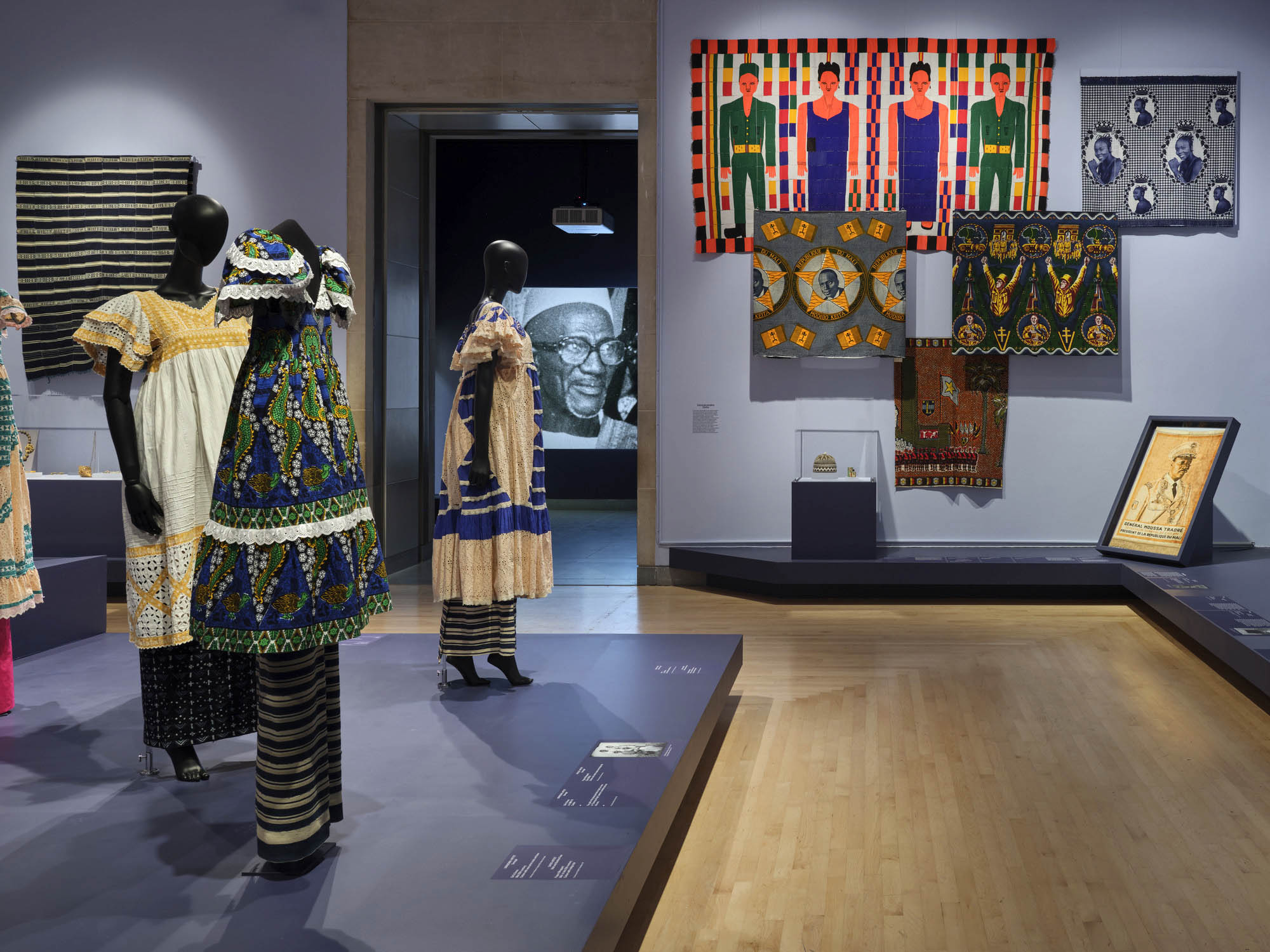
Commemorative Cloths

In the post-independence era, political leaders often commissioned commemorative cloths bearing their own images to bolster support and cultivate loyalty – and even foster cults of personality. Citizens wore such cloths regardless of political affiliation, at times out of fear of reprisal. Advances in textile printing and the development of more affordable “fancy print” cloths in the 1940s made many commemorative cloths inexpensive to produce. The examples on view span a range of iconography, from wax-print cloths honouring African soldiers who served in World War II and Mali’s first post-independence president, Modibo Keïta, to a fancy print featuring French President Charles de Gaulle . 

Pagne

A woman’s pagne is the foundation of her wardrobe. Typically woven or cut to a length of about two yards, the pagne functions as a wrap that conceals the waist, thighs, and buttocks. Beyond their function, pagnes also symbolize lineage, protection, and a woman’s evolving identity. 

Finely woven and dyed pagnes are presented at birth and during key life rituals such as dowry exchanges, marriage celebrations, and pregnancies. Women rarely part with their pagnes. Above all, they are talismans – protective layers passed down from generation to generation. A woman selects which ones to give to her children and which, ultimately, will accompany her to the grave. 

Dutch Legacies

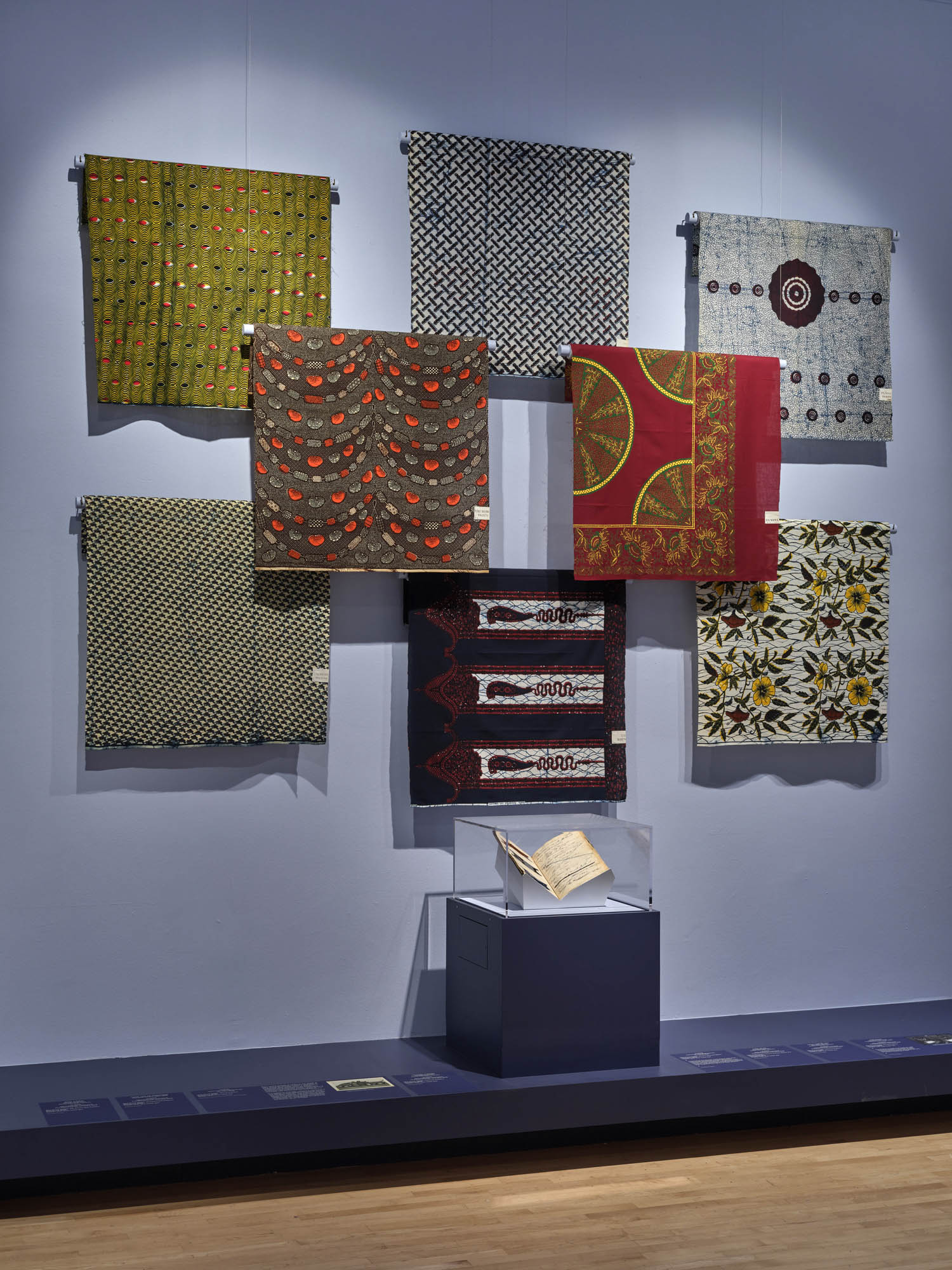
Known in the postwar era as “the Chanel of Africa,” the Dutch textile company Vlisco has been the foremost purveyor of African wax-print textiles since the late nineteenth century. The company industrialised the Indonesian batik process, in which patterns are drawn in wax on cotton fabric that is then dyed. When the wax is removed, the design is revealed, protected from the dye by the wax resist.

Though Vlisco did not actively market its products in the Sahel region in the 1940s to 1970s, wax prints spread through African trade networks and became widely popular, including among many of Keïta’s sitters. While the patterns were created by Dutch designers, they were named by Ghanaian and Togolese female fabric traders and their female clients, who interpreted the patterns’ meanings through a local, social, or spiritual lens .

The colour, design, and pattern names of wax prints thus carry personal and communal meanings – much like Keïta’s photographs.

Widely associated with coming-of-age rituals, wax prints have long marked key life events such as birth, puberty, and marriage. As independence movements gained momentum across the continent, wax-print textiles came to symbolise cosmopolitanism and a growing sense of Pan-African identity.

The Studio Backdrop

In Keïta’s photographs, traditional and modern textiles appear as studio backdrops or layered on European-style beds, their bold patterns often echoed in the sitters’ garments. Featuring examples of such textiles, this installation highlights the evolution of Malian weaving traditions during the independence era. The 1950s and early post-independence years saw rapid innovations in textile design, particularly in the use of colour. In contrast with traditional indigo and earth tones produced using natural dyes, these modern fabrics feature vivid hues made from synthetic dyes and incorporate more elaborate, figurative motifs that reflect the period’s shifting social concerns and aspirations.

These blankets served multiple functions. In everyday use, they provided protection from mosquitoes, cold temperatures, and sandstorms in the Sahel. When folded and draped over the shoulder of a well-dressed man, they signaled status. They were also important in systems of exchange – traded, gifted, and ceremonially displayed, most notably during dowry presentations and marriage celebrations.
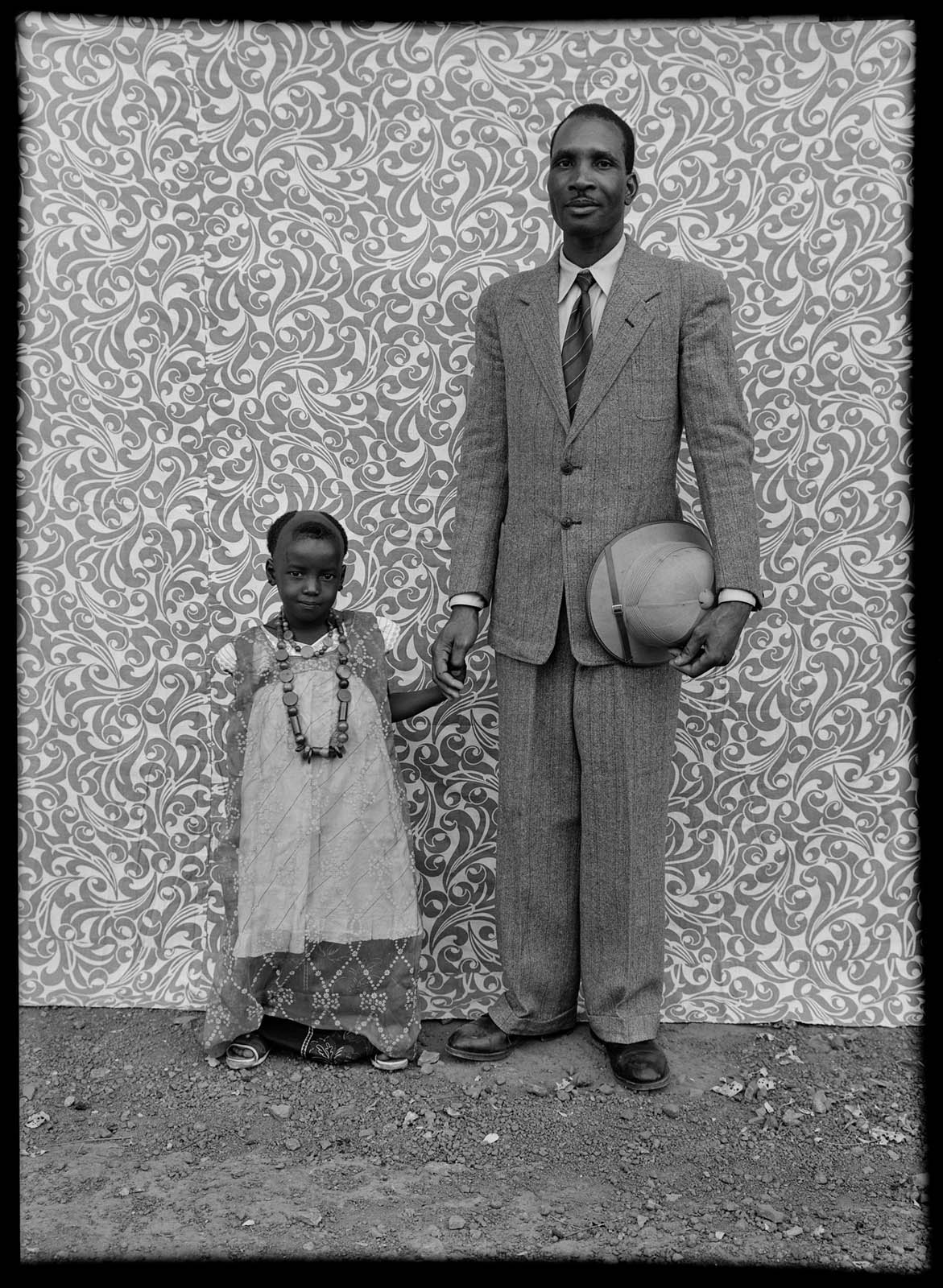
 

Seydou Keïta (Malian, c. 1921-2001) 'Untitled' 1957-1960, printed 1994


Seydou Keïta (Malian, c. 1921-2001)
Untitled
1949-1951, printed 1995
Gelatin silver print
© SKPEAC/Seydou Keïta
Courtesy The Jean Pigozzi Collection of African Art and Danziger Gallery, NY
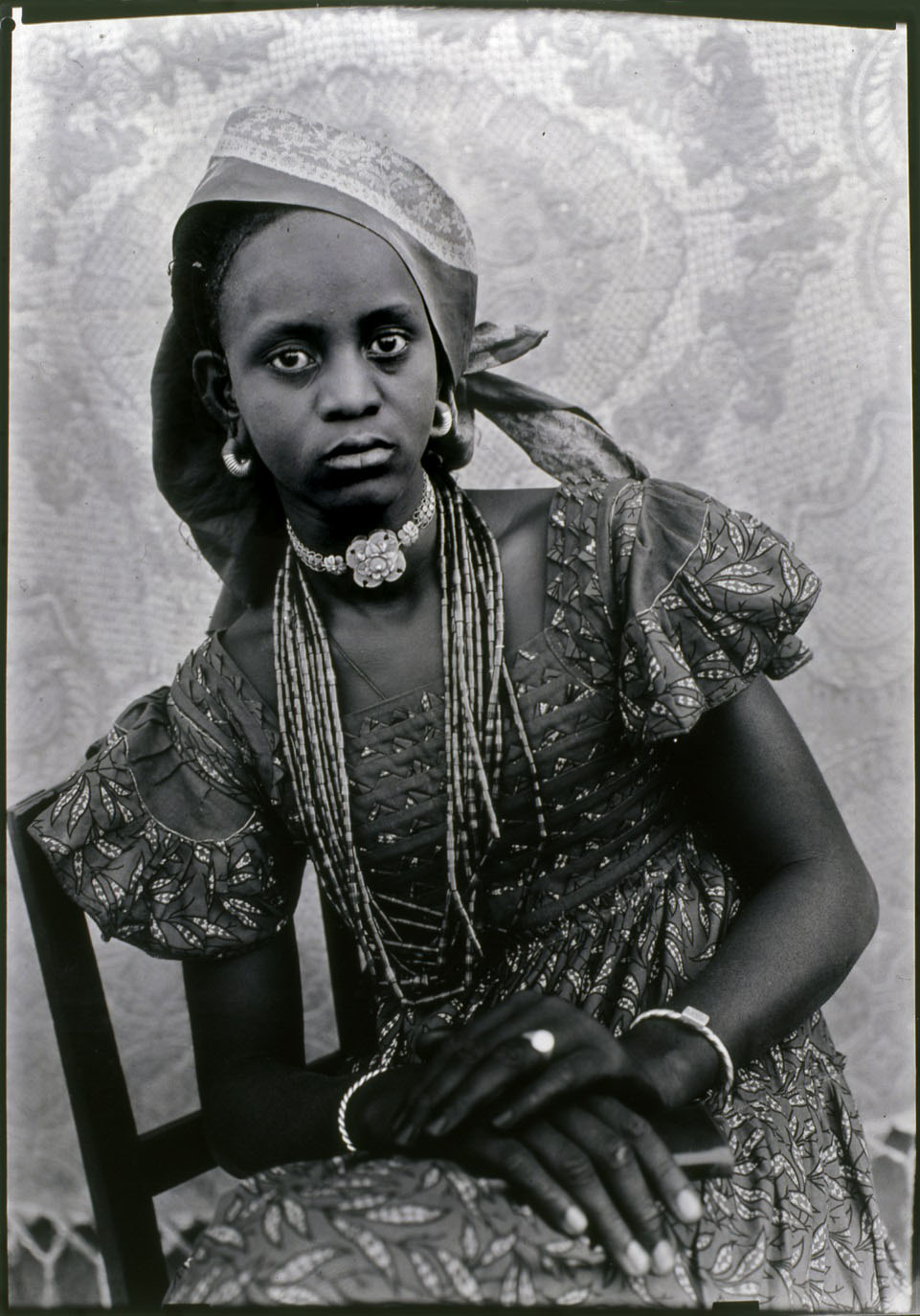
 

Seydou Keïta (Malian, c. 1921-2001) 'Untitled' 1949-1951, printed 1995


Seydou Keïta (Malian, c. 1921-2001)
Untitled
1949-1951, printed 1995
Gelatin silver print
© SKPEAC/Seydou Keïta
Courtesy The Jean Pigozzi Collection of African Art and Danziger Gallery, NY
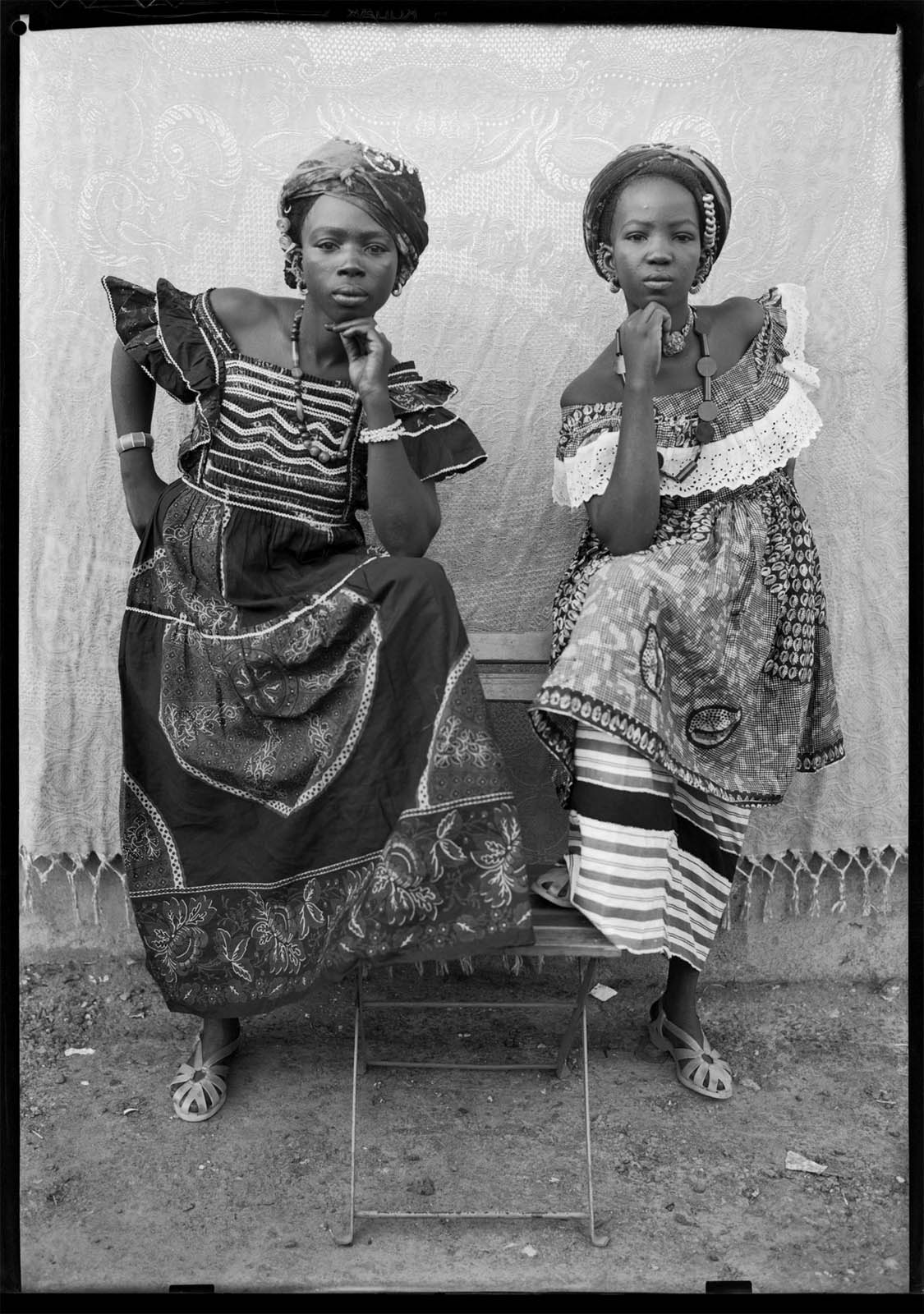
 

Seydou Keïta (Malian, c. 1921-2001) 'Untitled' 1952-1955, printed ca. 1994-2001


Seydou Keïta (Malian, c. 1921-2001)
Untitled
1952-1955, printed c. 1994-2001
Gelatin silver print
© SKPEAC/Seydou Keïta
Courtesy The Jean Pigozzi Collection of African Art and Danziger Gallery, NY
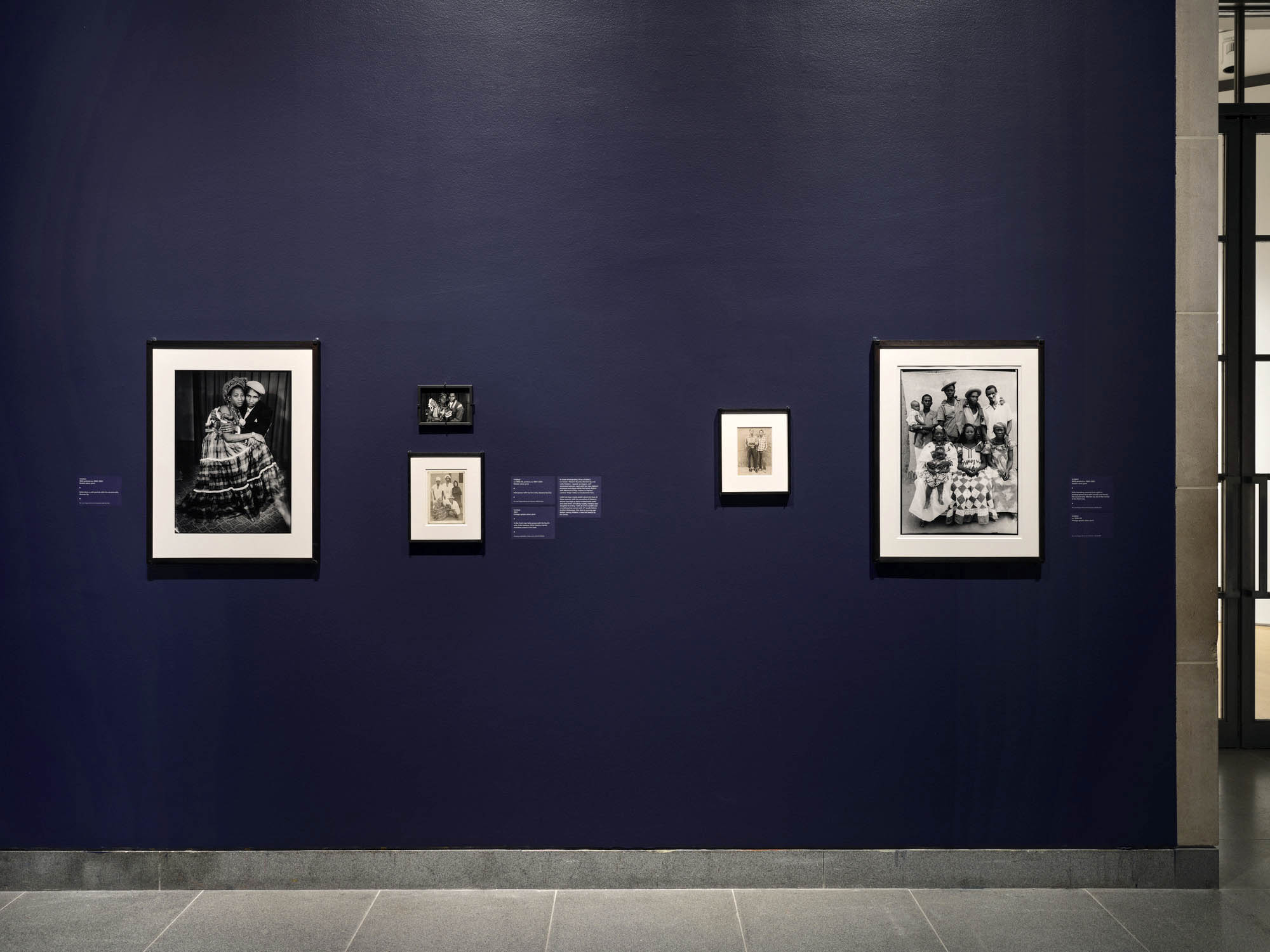
 

Installation view of the exhibition 'Seydou Keïta: A Tactile Lens' at the Brooklyn Museum, New York, October 2025 - May 2026


Installation view of the exhibition Seydou Keïta: A Tactile Lens at the Brooklyn Museum, New York, October 2025 – May 2026
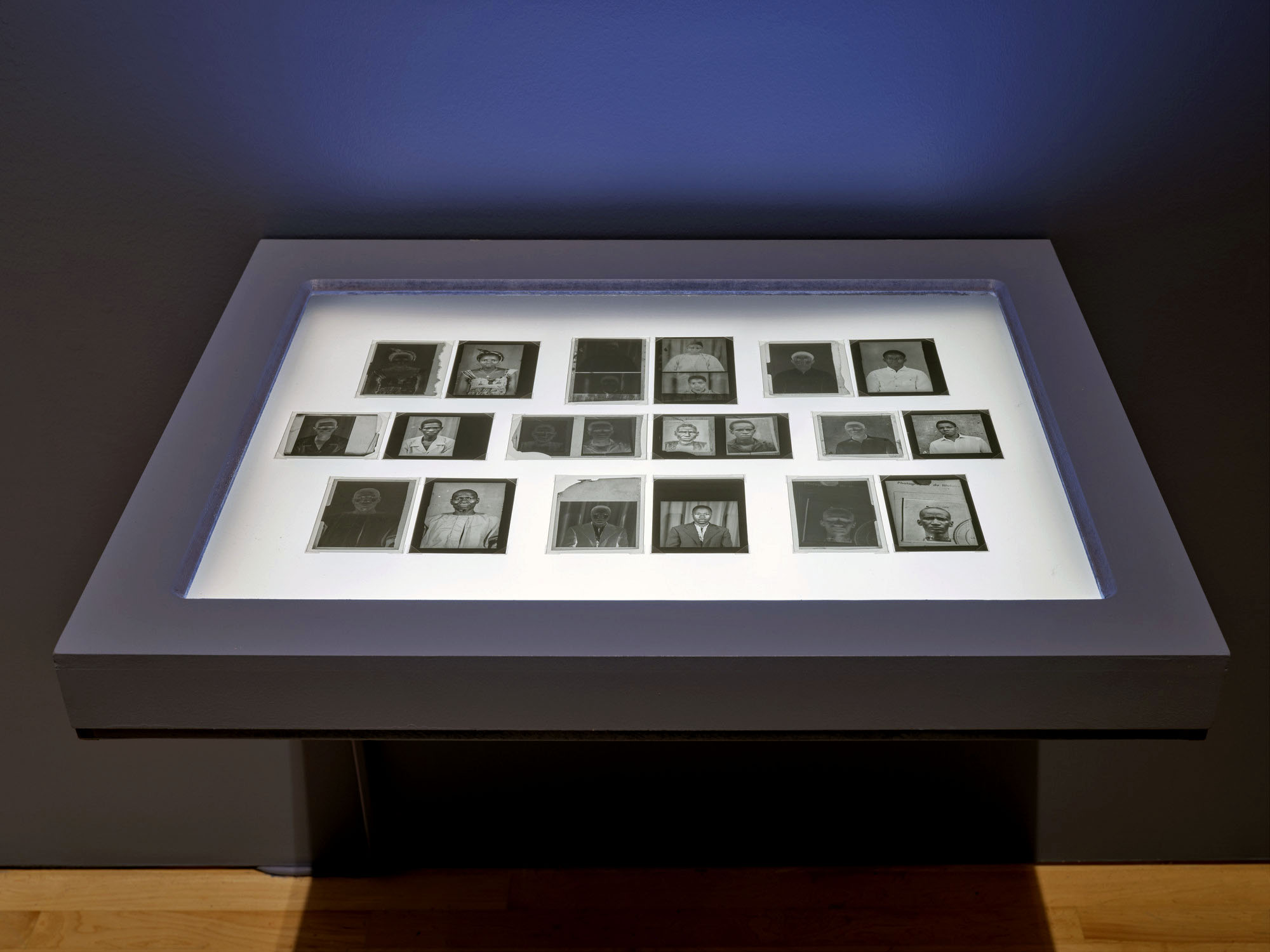
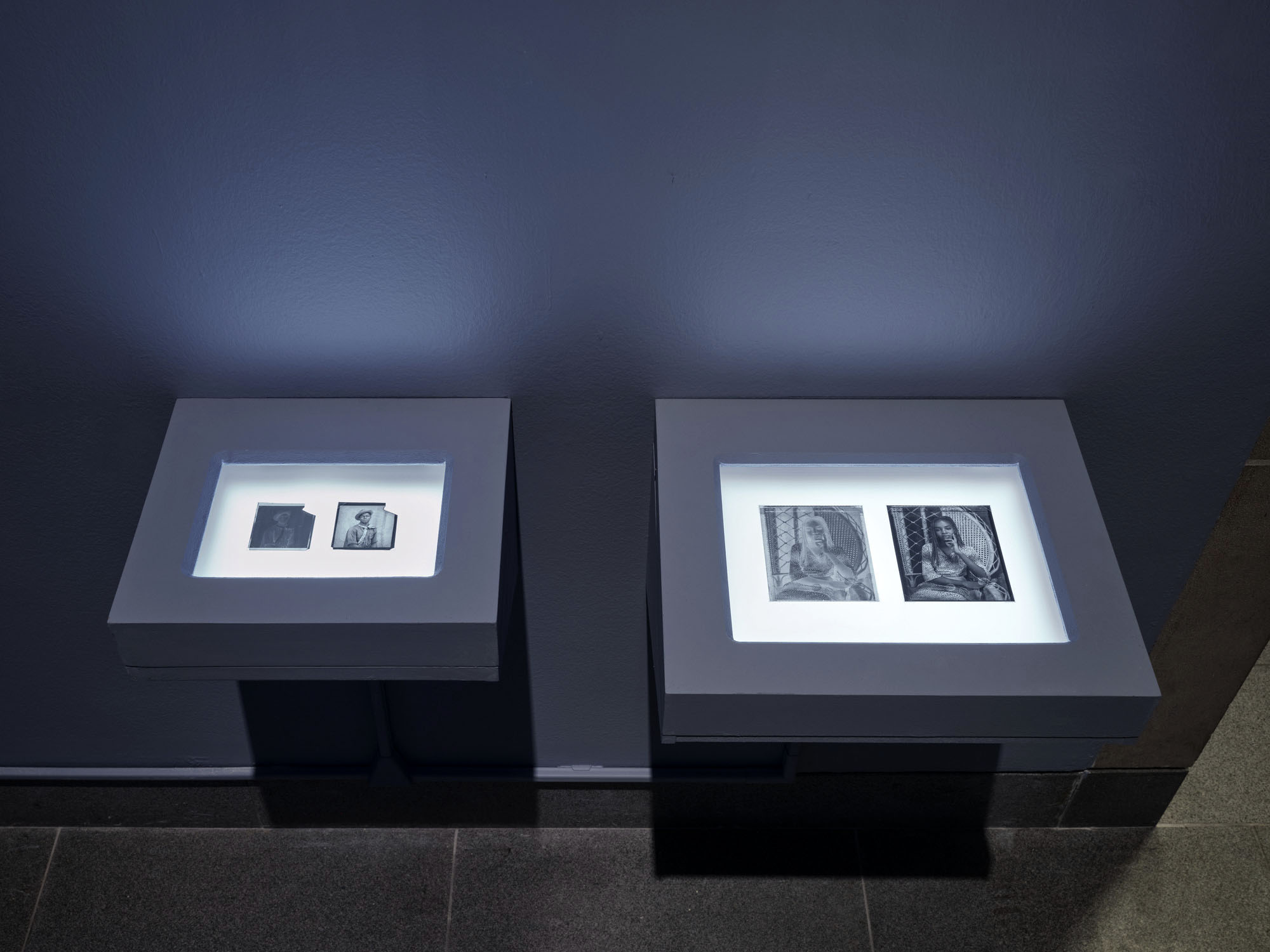
 

Installation view of the exhibition 'Seydou Keïta: A Tactile Lens' at the Brooklyn Museum, New York, October 2025 - May 2026 showing vitrines with facsimile cellulose acetate negatives and positive reproductions from digitised negatives c. 1950-1959
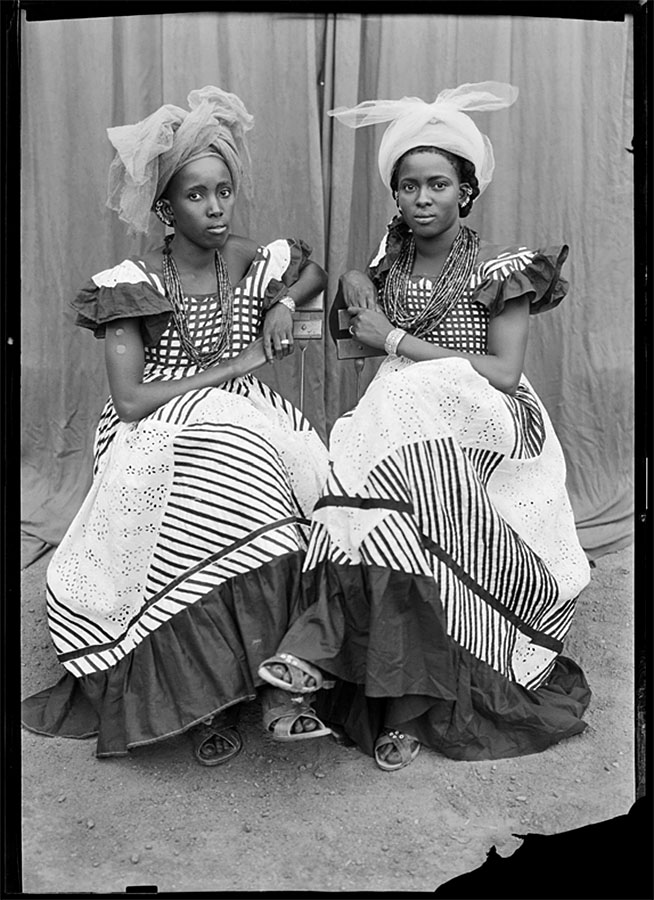


Installation views of the exhibition Seydou Keïta: A Tactile Lens at the Brooklyn Museum, New York, October 2025 – May 2026 showing vitrines with facsimile cellulose acetate negatives and positive reproductions from digitised negatives c. 1950-1959


Seydou Keïta (Malian, c. 1921-2001) 'Untitled' 1959


Seydou Keïta (Malian, c. 1921-2001)
Untitled
1959, printed 1998
Gelatin silver print
© SKPEAC/Seydou Keïta
Courtesy The Jean Pigozzi Collection of African Art
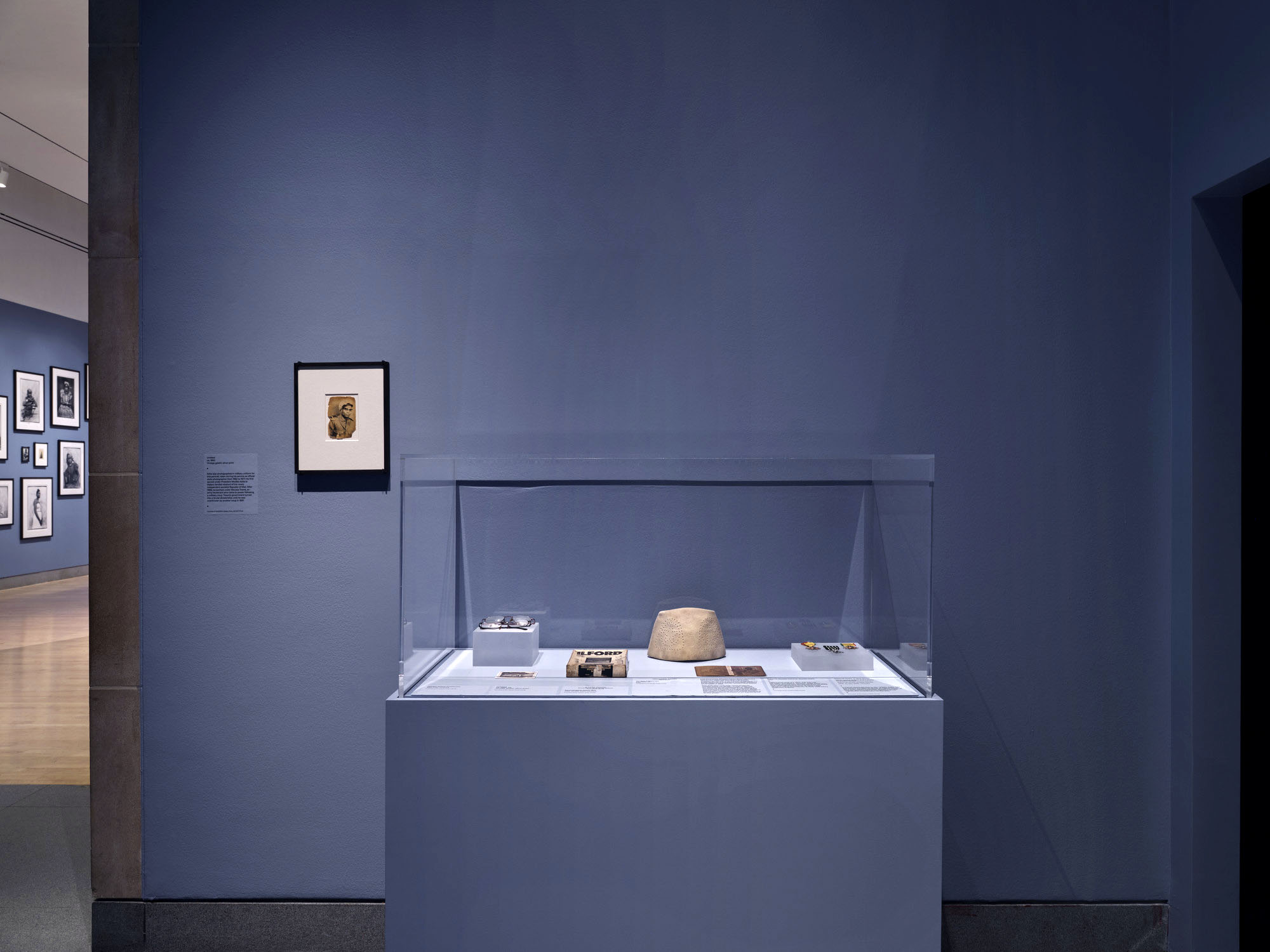
 

Installation view of the exhibition 'Seydou Keïta: A Tactile Lens' at the Brooklyn Museum, New York, October 2025 - May 2026


Installation view of the exhibition Seydou Keïta: A Tactile Lens at the Brooklyn Museum, New York, October 2025 – May 2026
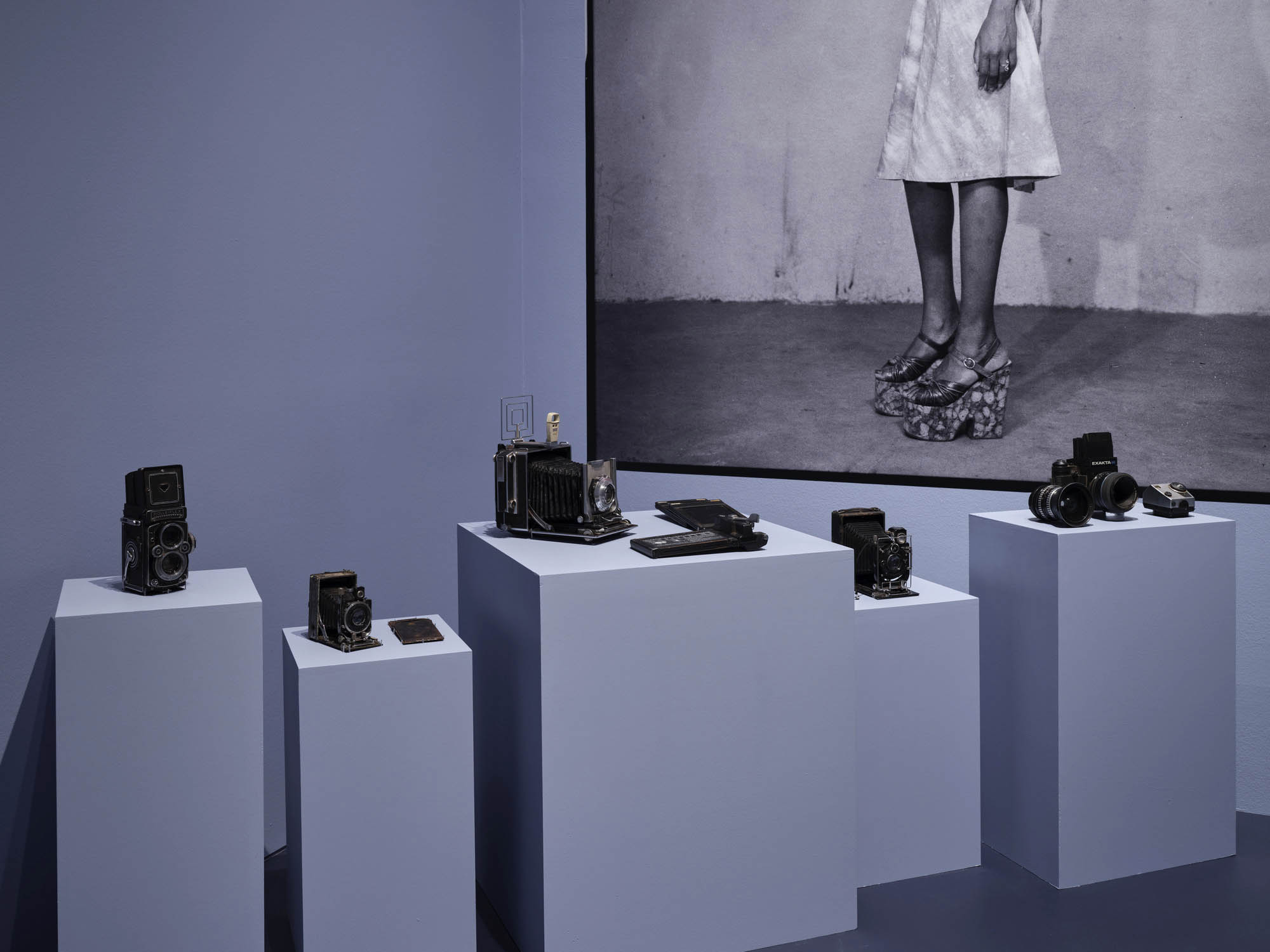
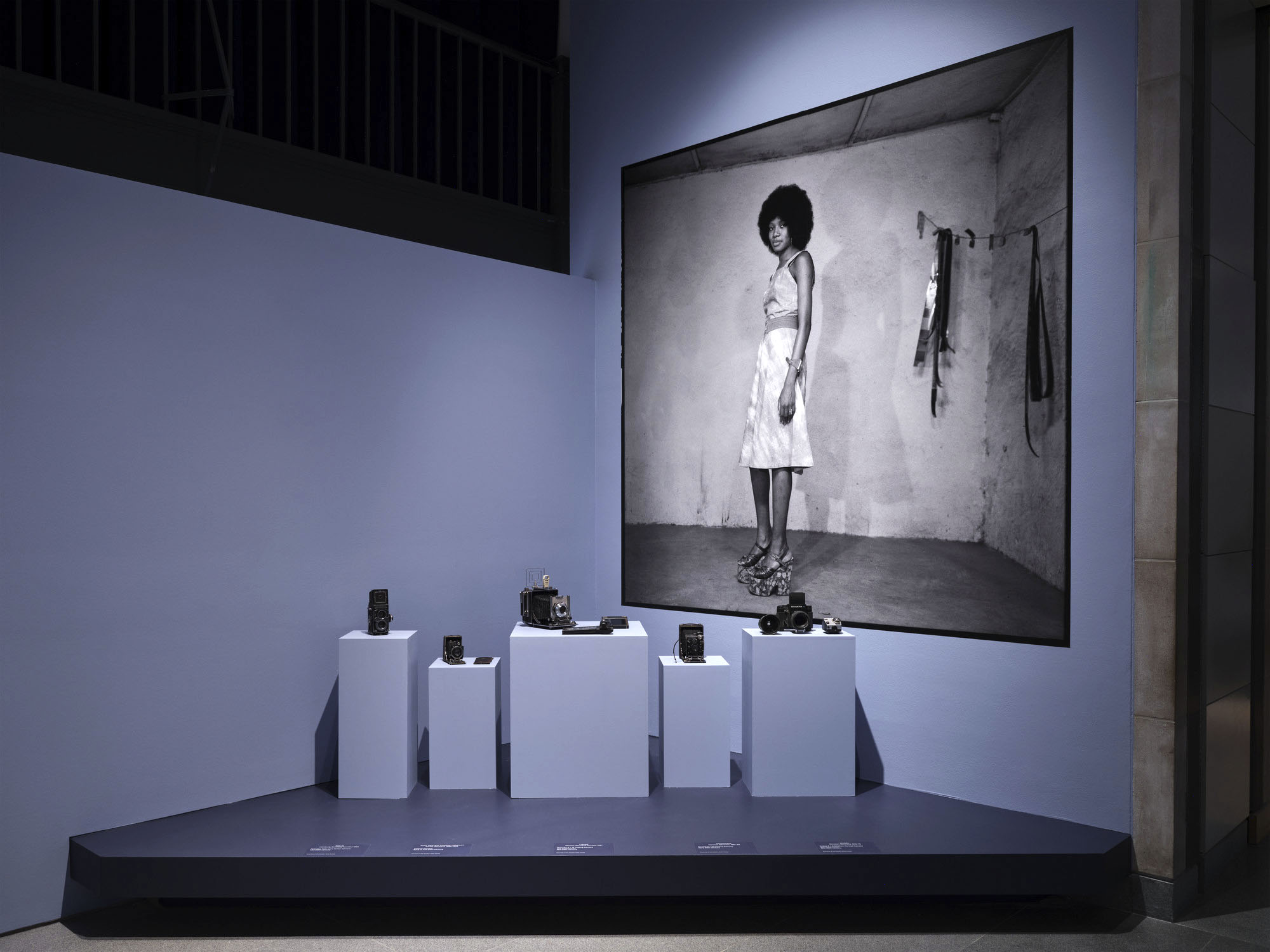
 

Installation view of the exhibition 'Seydou Keïta: A Tactile Lens' at the Brooklyn Museum, New York, October 2025 - May 2026 showing Keïta's medium format cameras and his photograph, 'Untitled' late 1940s to mid-1970s


Installation views of the exhibition Seydou Keïta: A Tactile Lens at the Brooklyn Museum, New York, October 2025 – May 2026 showing Keïta’s medium format cameras and his photograph, Untitled late 1940s to mid-1970s (below)
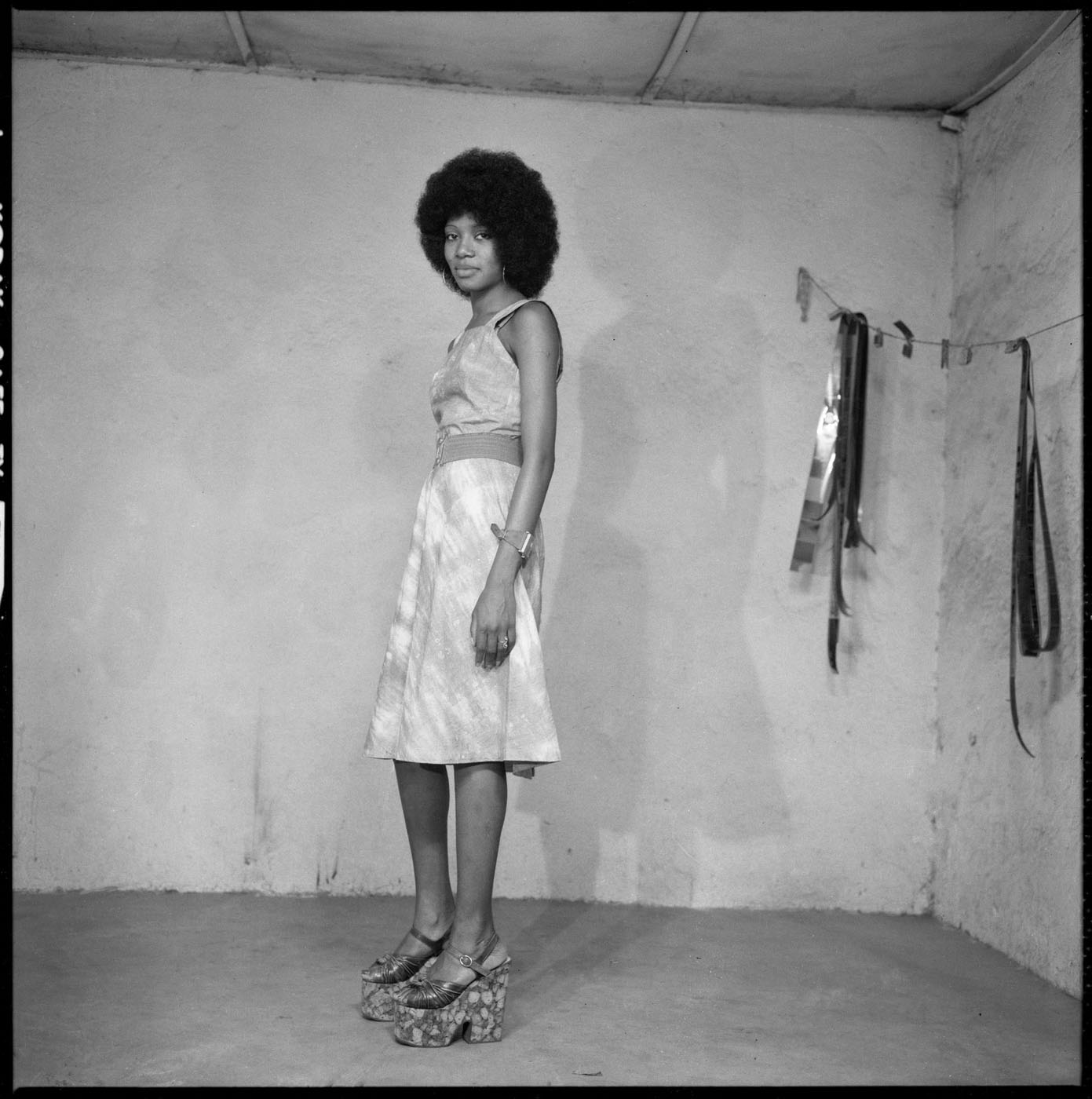
 

Seydou Keïta (Malian, c. 1921-2001) 'Untitled' late 1940s to mid-1970s


Seydou Keïta (Malian, c. 1921-2001)
Untitled
late 1940s to mid-1970s
Positive reproduction from digitised negative
Courtesy of the Seydou Keïta Family
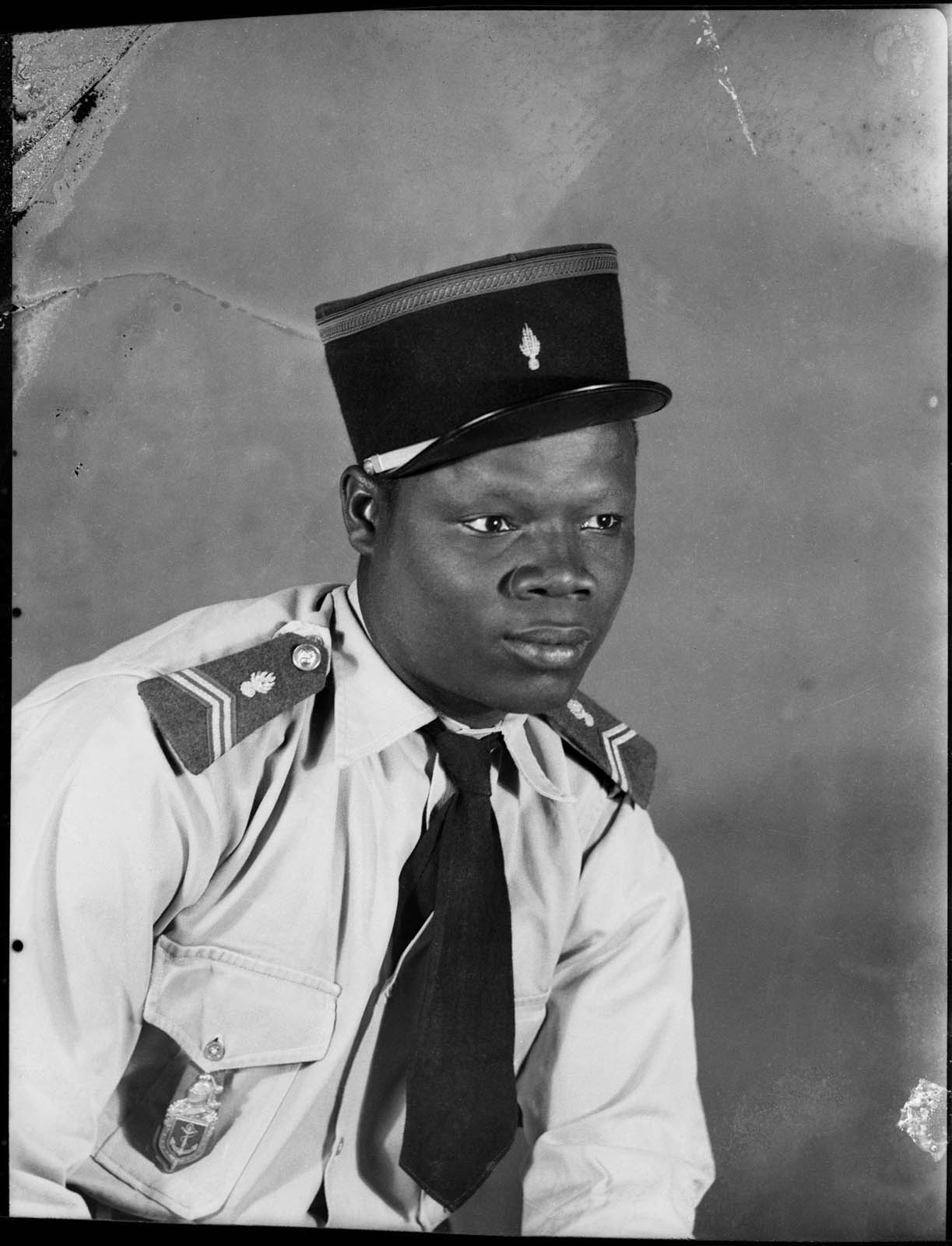
 

Seydou Keïta (Malian, c. 1921-2001) 'Untitled' late 1940s to mid-1970s


Seydou Keïta (Malian, c. 1921-2001)
Untitled
late 1940s to mid-1970s
Positive reproduction from digitised negative
Courtesy of the Seydou Keïta Family
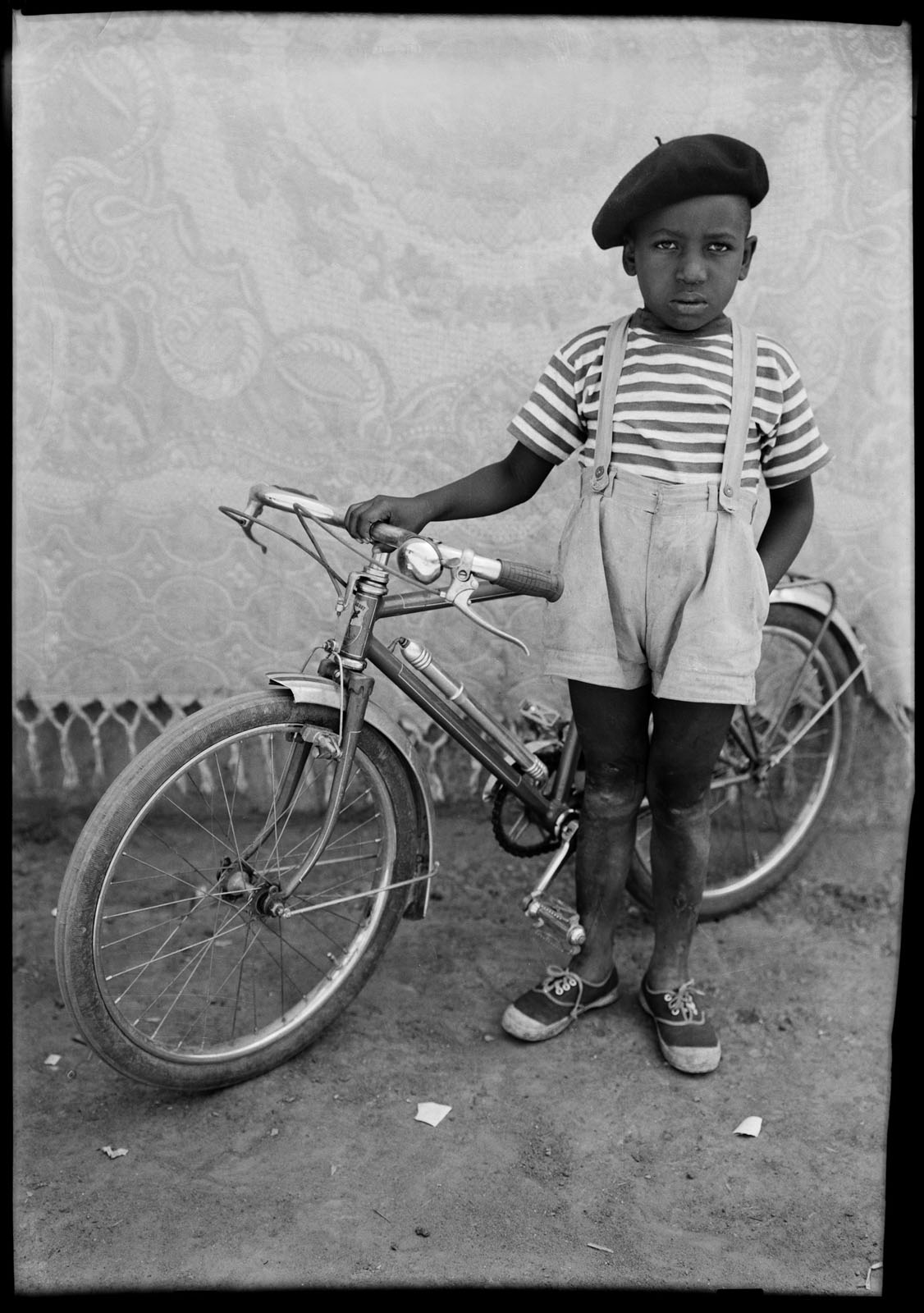
 

Seydou Keïta (Malian, c. 1921-2001) 'Untitled' 1949-1951, printed 1995


Seydou Keïta (Malian, c. 1921-2001)
Untitled
1949-1951, printed 1995
Gelatin silver print
© SKPEAC/Seydou Keïta
Courtesy The Jean Pigozzi Collection of African Art and Danziger Gallery, NY


With one hand on the handlebars of a bicycle and the other tucked in his pocket, this child meets the camera with a stern expression. Here, the boy’s French beret, shoes, and bicycle – imported goods reserved for the elite – speak to the deep-rooted impact of French colonialism across generations, even as the country moved toward independence.
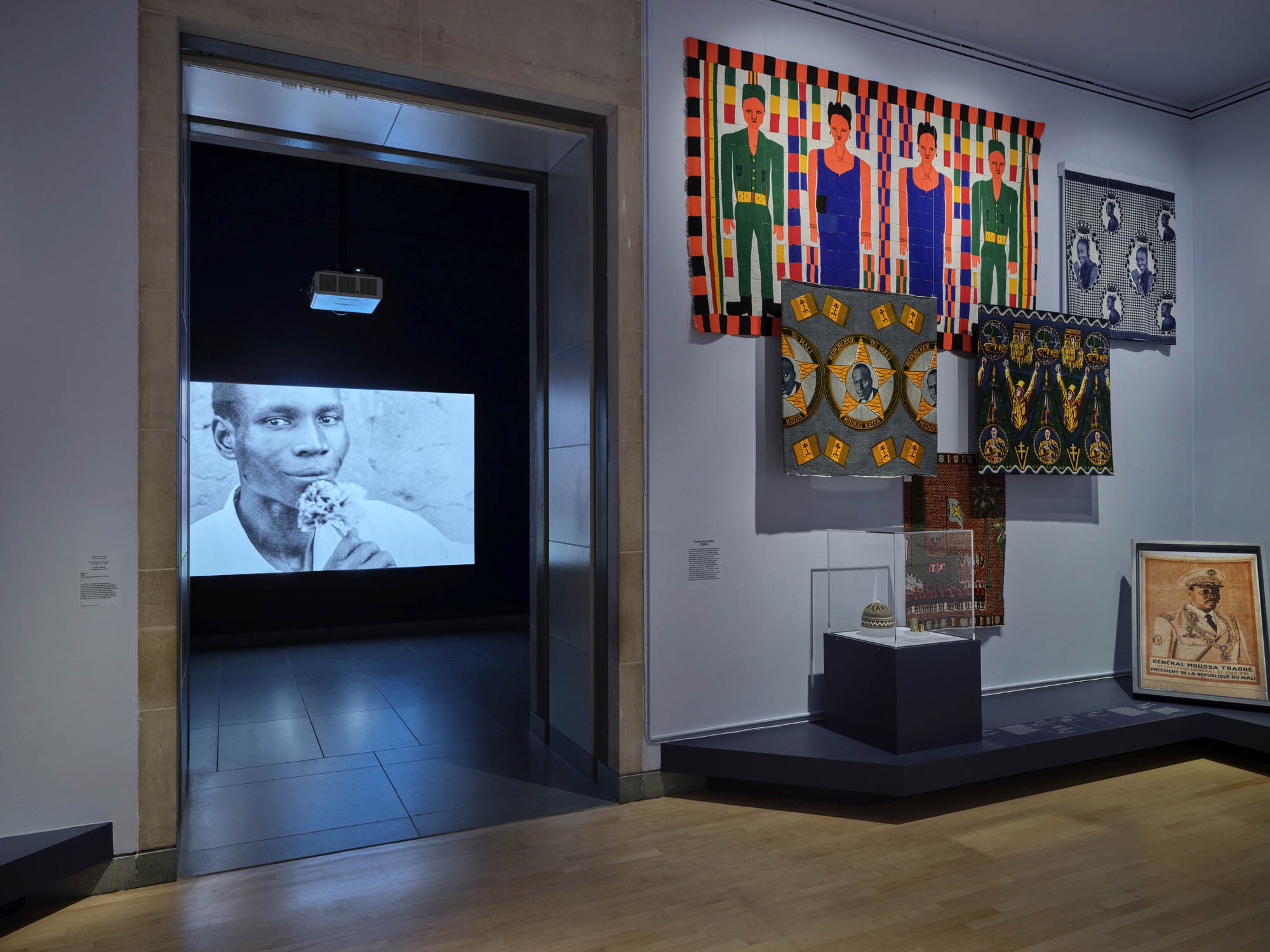
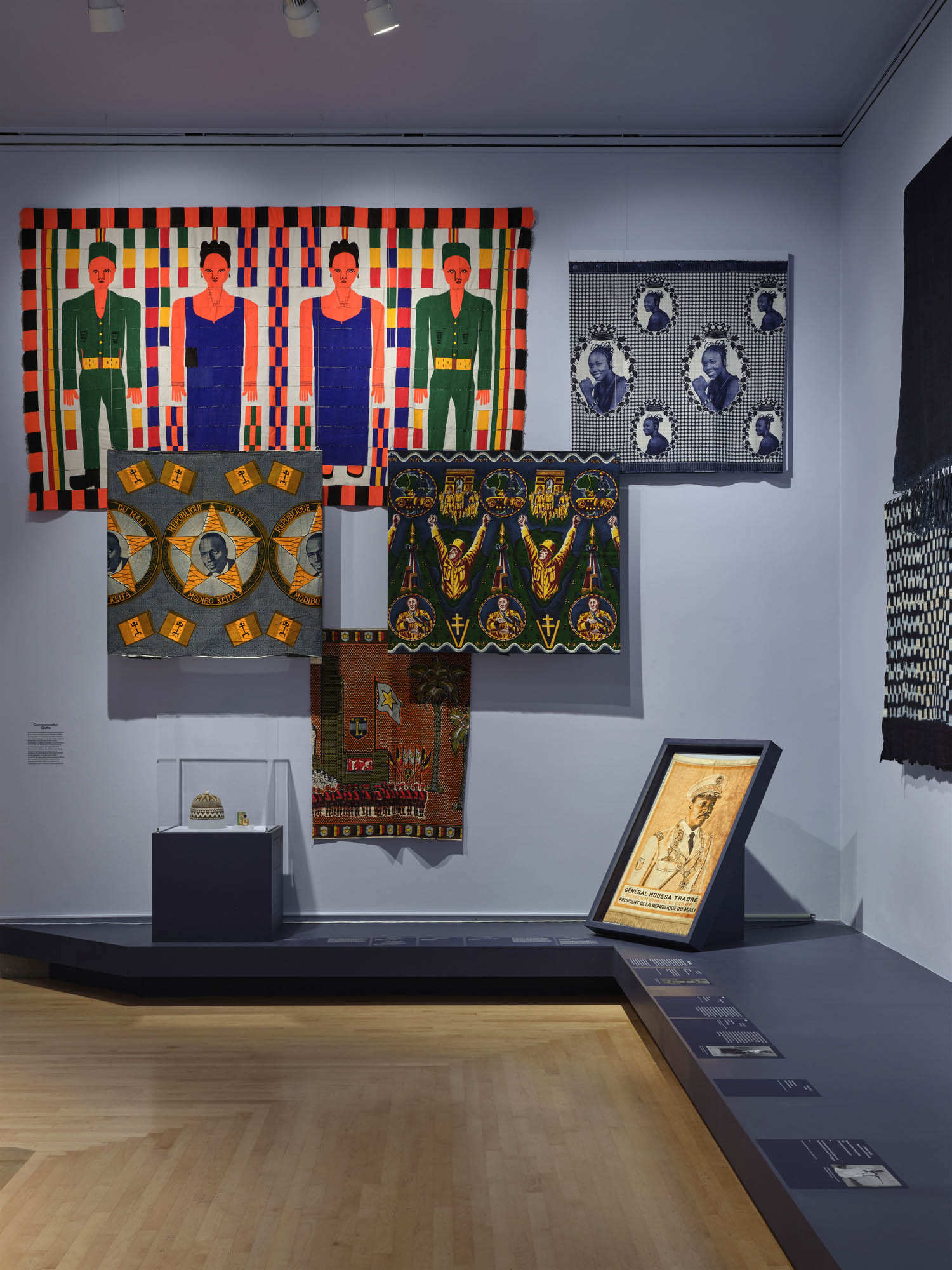
 

Installation view of the exhibition 'Seydou Keïta: A Tactile Lens' at the Brooklyn Museum, New York, October 2025 - May 2026


Installation views of the exhibition Seydou Keïta: A Tactile Lens at the Brooklyn Museum, New York, October 2025 – May 2026


Brooklyn Museum
200 Eastern Parkway
Brooklyn, NY 11238-6052
Phone: (718) 638-5000

Opening hours:
Wednesday – Sunday 11am – 6pm
Closed Mondays and Tuesdays
Closed Thanksgiving, Christmas, and New Year’s Day

Brooklyn Museum website

LIKE ART BLART ON FACEBOOK

Back to top

Text: ‘Un/settling Aboriginality’ Dr Marcus Bunyan / Exhibition: ‘Brook Andrew: 52 Portraits’ at Tolarno Gallery, Melbourne

Exhibition dates: 15th June – 20th July 2013


Many thankx to Tolarno Gallery for allowing me to publish the photographs in the posting. Please click on the photographs for a larger version of the image.

Download the text Un/settling Aboriginality (1.1Mb pdf)


Un/settling Aboriginality

Dr Marcus Bunyan

Abstract

This text investigates the concepts of postcolonialism / neo-colonialism and argues that Australia is a neo-colonial rather than a postcolonial country. It examines the work of two Australian artists in order to understand how their work is linked to the concept of neo-colonialism and ideas of contemporary Aboriginal identity, Otherness, localism and internationalism.

Keywords

postcolonialism, postcolonial, art, neo-colonialism, Australian art, Australian artists, Aboriginal photography, hybridism, localism, internationalism, Otherness, Australian identity, Brook Andrew, Ricky Maynard, Helen Ennis.


Australia and postcolonialism / neo-colonialism

Defining the concept of postcolonialism is difficult. “To begin with, “post-colonial” is used as a temporal marker referring to the period after official decolonisation,”1 but it also refers to a general theory that Ania Loomba et al. call “the shifting and often interrelated forms of dominance and resistance; about the constitution of the colonial archive; about the interdependent play of race and class; about the significance of gender and sexuality; about the complex forms in which subjectivities are experienced and collectivities mobilized; about representation itself; and about the ethnographic translation of cultures.”2

“Postcolonial theory formulates its critique around the social histories, cultural differences and political discrimination that are practised and normalised by colonial and imperial machineries… Postcolonial critique can be defined as a dialectical discourse which broadly marks the historical facts of decolonisation. It allows people emerging from socio-political and economic domination to reclaim their sovereignty; it gives them a negotiating space for equity.”3

While colonialism and imperialism is about territory, possession, domination and power,4 postcolonialism is concerned with the history of colonialism, the psychology of racial representation and the frame of representation of the ‘Other’. It addresses the ongoing effects of colonialism and imperialism even after the colonial period has ended.
“Past and present inform each other, each implies the other and… each co-exists with the other.”5 Even after colonialism has supposedly ended there will always be remains that flow into the next period. What is important is not so much the past itself but its bearing upon cultural attitudes of the present and how the uneven relationships of the past are remembered differently.6 While the aims of postcolonialism are transformative, its objectives involve a wide-ranging political project – to reorient ethical norms, turn power structures upside down and investigate “the interrelated histories of violence, domination, inequality and injustice”7 and develop a tradition of resistance to the praxis of hegemony.

McCarthy and Dimitriadis posit three important motifs in postcolonial art.8 Briefly, they can be summarised as follows:

1/ A vigorous challenge to hegemonic forms of representation in Western models of classical realism and technologies of truth in which the eye of the Third World is turned on the West and challenges the ruling narrating subject through multiple perspectives and points of view.

2/ A rewriting of the narrative of modernity through a joining together of the binaries ‘centre’ and ‘periphery’, ‘developed’ and ‘underdeveloped’, and ‘civilised’ and ‘primitive’. “Culture, for these [postcolonial] artists, is a crucible of encounter, a crucible of hybridity in which all of cultural form is marked by twinness of subject and other.”9

3/ A critical reflexivity and thoughtfulness as elements of an artistic practice of freedom. This practice looks upon traditions with dispassion, one in which all preconceived visions and discourses are disrupted, a practice in which transformative possibilities are not given but have to worked for in often unpredictable and counter-intuitive ways.


According to Robert Young the paradigm of postcolonialism is to “locate the hidden rhizomes of colonialism’s historical reach, of what remains invisible, unseen, silent or unspoken” to examine “the continuing projection of past conflicts into the experience of the present, the insistent persistence of the afterimages of historical memory that drive the desire to transform the present.”10 This involves an investigation into a dialectic of visibility and invisibility where subjugated peoples were present but absent under the eye of the coloniser through a refusal of those in power to see who or what was there. “Postcolonialsm, in its original impulse, was concerned to make visible areas, nations, cultures of the world which were notionally acknowledged, technically there, but which in significant other senses were not there…”11 In other words, to acknowledge the idea of the ‘Other’ as a self determined entity if such an other should ever exist because, as Young affirms, “Tolerance requires that there be no “other,” that others should not be othered. We could say that there can be others, but there should be no othering of “the other.”12

The “Other” itself is a product of racial theory but Young suggests that “the question is not how to come to know “the other,” but for majority groups to stop othering minorities altogether, at which point minorities will be able to represent themselves as they are, in their specific forms of difference, rather than as they are othered.”13 Unfortunately, with regard to breaking down the divisiveness of the same-other split, “As soon as you have employed the very category of “the other” with respect to other peoples or societies, you are imprisoned in the framework of your own predetermining conceptualisation, perpetuating its form of exclusion.”14 Hence, as soon as the dominant force names the “other” as a paradigm of society, you perpetuate its existence as an object of postcolonial desire. This politics of recognition can only be validated by the other if the other choses to name him or herself in order to “describe a situation of historical discrimination which requires challenge, change and transformation… Othering was a colonial strategy of exclusion: for the postcolonial, there are only other human beings.”15

Important questions need to be asked about the contextual framework of postcolonialism as it is linked to race, culture, gender, settler and native: “When does a settler become coloniser, colonised and postcolonial? When does a race cease to be an oppressive agent and become a wealth of cultural diversities of a postcolonial setting? Or in the human history of migrations, when does the settler become native, indigenous, a primary citizen? And lastly, when does the native become truly postcolonial?”16


This last question is pertinent with regard to Australian culture and identity. It can be argued that Australia is not a postcolonial but a neo-colonial country. Imperialism as a concept and colonialism as a practice are still active in a new form. This new form is neo-colonialism. Rukundwa and van Aarde observe that, “Neo-colonialism is another form of imperialism where industrialised powers interfere politically and economically in the affairs of post-independent nations. For Cabral (in McCulloch 1983: 120-121), neo-colonialism is “an outgrowth of classical colonialism.” Young (2001: 44-52) refers to neo-colonialism as “the last stage of imperialism” in which a postcolonial country is unable to deal with the economic domination that continues after the country gained independence. Altbach (1995: 452-56) regards neo-colonialism as “partly planned policy” and a “continuation of the old practices”.”17

Australia is not a post-independent nation but an analogy can be made. The Australian government still interferes with the running of Aboriginal communities through the NT Intervention or, as it is more correctly known, Northern Territory National Emergency Response Act 2007. Under the Stronger Futures legislation that recently passed through the senate, this intervention has been extended by another 10 years. “Its flagship policies are increased government engagement, income management, stabilisation, mainstreaming, and the catch cries “closing the gap” and “real jobs”.”18 As in colonial times the government has control of a subjugated people, their lives, income, health and general wellbeing, instead of partnering and supporting Aboriginal organisations and communities to take control of their futures.19

Further, Australia is still a colony, the Queen of England is still the Queen of Australia; Britannia remains in the guise of the “Commonwealth.” Racism, an insidious element of the colonial White Australia Policy (which only ended in 1973), is ever prevalent beneath the surface of Australian society. Witness the recent racial vilification of Sydney AFL (Aussie Rules!) player Adam Goodes by a teenager20 and the inexcusable racial vilification by Collingwood president Eddie McGuire when he said that Goodes could be used to promote the musical King Kong.21

“The dialectics of liberation from colonialism, whether political, economic, or cultural, demand that both the colonizer and the colonized liberate themselves at the same time.”22 This has not happened in Australia. The West’s continuing political, economic and cultural world domination has “lead to a neo-colonial situation, mistakenly called post-coloniality, which does not recognize the liberated other as a historical subject (in sociological theory, a historical subject is someone thought capable of taking an active role in shaping events) – as part of the historical transforming processes of modernity.”23 As has been shown above, Aboriginal communities are still thought incapable of taking an active role in shaping and administering their own communities. The result of this continuation of old practices is that Australia can be seen as a neo-colonial, not postcolonial, country.

Kathryn Trees asks, “Does post-colonial suggest colonialism has passed? For whom is it ‘post’? Surely not for Australian Aboriginal people at least, when land rights, social justice, respect and equal opportunity for most does not exist because of the internalised racism of many Australians. In countries such as Australia where Aboriginal sovereignty, in forms appropriate to Aboriginal people, is not legally recognised, post-colonialism is not merely a fiction, but a linguistic manoeuvre on the part of some ‘white’ theorists who find this a comfortable zone that precludes the necessity for political action.”24


Two Australian artists, two different approaches

There are no dots or cross-hatching in the work of Ricky Maynard or Brook Andrew; no reference to some arcane Dreaming, for their work is contemporary art that addresses issues of identity and empowerment in different ways. Unlike remote Indigenous art that artist Richard Bell has labelled ‘Ooga Booga Art’ (arguing that it is based upon a false notion of tradition that casts Indigenous people as the exotic other, produced under the white, primitivist gaze),25 the work of these two artists is temporally complex (conflating past, present and future) and proposes that identity is created at the intersection of historically shifting subject positions, which destabilises any claim to an ‘authentic’ identity position and brings into question the very label ‘Aboriginal’ art and ‘Aboriginality’. By labelling an artist ‘Aboriginal’ or ‘gay’ for example, do you limit the subject matter that those artists can legitimately talk about, or do you just call them artists?

As Stephanie Radok has speculated, “surely as long as we call it Aboriginal art we are defining it ethnically and foregrounding its connection to a particular culture, separating it from other art and seeing it as a gift, a ‘present’ from another ethnography.”26 Be that as it may, artists can work from within a culture, a system, in order to critique the past in new ways: “The collective efforts of contemporary artists… do not reflect an escapist return to the past but a desire to think about what the past might now mean in new, creative ways.”27

Ways that un/settle Aboriginality through un/settling photography, in this case.


Since the 1980s photographers addressing Indigenous issues have posed an alternative reality or viewpoint that, “articulates the concept of time as a continuum where the past, present and future co-exist in a dynamic form. This perspective has an overtly political dimension, making the past not only visible but also unforgettable.”28 The perspective proposes different strategies to deliberately unsettle white history so that “the future is as open as the past, and both are written in tandem.”29

Artists Ricky Maynard and Brook Andrew both critique neo-colonialism from inside the Western gallery system using a relationship of interdependence (Aboriginal/colonial) to find their place in the world, to help understand who they are and, ex post facto, to make a living from their art. They both offer an examination of place, space and identity construction through what I call ‘the industry of difference’.

Ricky Maynard works with a large format camera and analogue, black and white photography in the Western documentary tradition to record traditional narratives of Tasmanian Aboriginal people in order to undermine the myth that they were all wiped off the face of the planet by colonisation. Through his photography he re-identifies the narratives of a subjugated and supposedly exterminated people, narratives that are thousands of years old, narratives that challenge a process of Othering or exclusion and which give voice to the oppressed.

Portrait of a Distant Land is done through the genre of documentary in a way that offers authenticity and honest image making in the process. It has to deal with all those ethical questions of creating visual history, the tools to tell it with and how we reclaim our own identity and history from the way we tell our own stories. It comes from the extension of the way the colonial camera happened way back in the 19th century and how it misrepresented Aboriginal people. The Government anthropologists and photographers were setting up to photograph the dying race. Of course it simply wasn’t true. That was a way that colonial people wanted to record their history. You see those earlier colonial and stereotypical images of Aboriginal people in historic archives, their photographic recordings were acts of invasion and subjugation used for their own purpose.”30


Ricky Maynard (Australian, b. 1953) 'Coming Home' 2005


Ricky Maynard (Australian, b. 1953)
Coming Home
2005
from Portrait of a Distant Land
Gelatin silver print
34 x 52cm, edition of 10 + 3 AP


“I can remember coming here as a boy in old wooden boats to be taught by my grandparents and my parents.

I’ll be 57 this year and I have missed only one year when my daughter Leanne was born. Mutton birding is my life. To me it’s a gathering of our fella’s where we sit and yarn we remember and we honour all of those birders who have gone before us. Sometimes I just stand and look out across these beautiful islands remembering my people and I know I’m home. It makes me proud to be a strong Tasmanian black man.

This is something that they can never take away from me.”

Murray Mansell Big Dog Island, Bass Strait, 2005 31


Ricky Maynard (Australian, b. 1953) 'Vansittart Island, Bass Strait, Tasmania' 2005


Ricky Maynard (Australian, b. 1953)
Vansittart Island, Bass Strait, Tasmania
2005
from Portrait of a Distant Land
Gelatin silver print
34 x 52cm, edition of 10 + 3 AP


“As late as 1910 men came digging on Vansittart and Tin Kettle Islands looking for skeletons here. We moved them where none will find them, at the dead of night my people removed the bodies of our grandmothers and took them to other islands, we planted shamrocks over the disturbed earth, so the last resting place of those girls who once had slithered over the rocks for seals will remain a secret forever.”

Old George Maynard 1975 32


Ricky Maynard (Australian, b. 1953) 'The Healing Garden, Wybalenna, Flinders Island, Tasmania' 2005


Ricky Maynard (Australian, b. 1953)
The Healing Garden, Wybalenna, Flinders Island, Tasmania
2005
from Portrait of a Distant Land
Gelatin silver print
34 x 52cm, edition of 10 + 3 AP


“It’s pretty important you know, the land, it doesn’t matter how small, it’s something, just a little sacred site, that’s Wybalenna. There was a massacre there, sad things there, but we try not to go over that. Where the bad was we can always make it good.”

Aunty Ida West 1995 Flinders Island, Tasmania 33


Maynard’s photographs are sites of contestation, specific, recognisable sites redolent with contested history. They are at once both local (specific) and global (addressing issues that affect all subjugated people and their stories, histories). Through his art practice Maynard journeys from the periphery to the centre to become a fully recognised historical subject, one that can take an active role in shaping events on a global platform, a human being that aims to create what he describes as “a true visual account of life now.”34 But, as Ian McLean has noted of the work of Derrida on the idea of repression, what returns in such narratives is not an authentic, original Aboriginality but the trace of an economy of repression: “Hence the return of the silenced nothing called Aboriginal as the being and truth of the place, is not the turn-around it might seem, because it does not reinstate an original Aboriginality, but reiterates the discourses of colonialism.”35

Sad and poignant soliloquies they may be, but in these ‘true’ visual accounts it is the trace of repression represented through Western technology (the camera, the photograph) and language (English is used to describe the narratives, see above) that is evidenced in these critiques of neo-colonialism (a reiteration of the discourses of colonialism) – not just an authentic lost and reclaimed Aboriginality – for these photographs are hybrid discourses that are both local/global, European/Indigenous.

In his art practice Brook Andrew pursues a more conceptual mutli-disciplinary approach, one that successfully mines the colonial photographic archive to interrogate the colonial power narrative of subjugation, genocide, disenfranchisement through a deconstructive discourse, one that echoes with the repetitions of coloniality and evidences the fragments of racism through the status of appearances. “Through his persistent confrontation with the historical legacy of physiognomia in our public Imaginary”36 in video, neon, sculpture, craniology, old photography, old postcards, music, books, ethnography and anthropology, Andrew re-images and reconceptualises the colonial archive. His latest body of work 52 Portraits (Tolarno Galleries 15 June – 20 July 2013), is “a play on Gerhard Richter’s 48 Portraits projects, which lifted images of influential Western men from the pages of encyclopaedias, 52 Portraits shifts the gaze to the ubiquitous and exotic other.”37 The colonial portraits are screen-printed in black onto silver-coated canvases giving them an ‘other’ worldly, alien effect (as of precious metal), which disrupts the surface and identity of the original photographs. Variously, the unnamed portraits taken from his personal collection of old colonial postcards re-present unknown people from the Congo, Africa, Argentina, Ivory Coast, Brazil, Algeria, Australia, South America, etc… the images incredibly beautiful in their silvered, slivered reality (as of the time freeze of the camera), replete with fissures and fractures inherent in the printing process. Accompanying the series is an installation titled Vox: Beyond Tasmania (2013), a Wunderkammer containing a skeleton and colonial artefacts, the case with attached wooden trumpet (reminding me appropriately of His Master’s Voice) that focuses the gaze upon an anonymous skull, an unknowable life from the past. In the catalogue essay for the exhibition, Ian Anderson observes, “His view is global – and even though my response is highly local – I too see the resonances of a global cultural process that re-ordered much of humanity through the perspective of colonizing peoples.”38

While this may be true, it is only true for the limited number of people that will see the exhibition – usually white, well-educated people, “The realities of the commercial art world are such that it is chiefly the white upper crust that will see these works. Make of that what you will.”39 Through a lumping together of all minority people – as though multiple, local indigeneties can be spoken for through a single global indigeneity – Andrew seems to want to speak for all anonymous Indigenous people from around the world through his ‘industry of difference’. Like colonialism, this speaking is again for the privileged few, as only they get to see these transformed images, in which only those with money can afford to buy into his critique.

Personally, I believe that Andrew’s constant remapping and re-presentation of the colonial archive in body after body of work, this constant picking at the scab of history, offers no positive outcomes for the future. It is all too easy for an artist to be critical; it takes a lot more imagination for an artist to create positive images for a better future.


Conclusion

By the mid-eighties black and indigenous subjectivities were no longer transgressive and the ‘black man’s’ burden’ had shifted from being a figure of oblivion to that of a minority voice.40 Black subjectivities as minority identities use the language of difference to envisage zones of liberation in which marginality is a site of transformation. But, as Ian McLean asks, “Have these post or anti-colonial identities repulsed the return of coloniality?”41 In the fight against neo-colonialism he suggests not, when the role of minority discourses “are simultaneously marginalised and occupy an important place in majority texts.”42 Periphery becomes centre becomes periphery again. “Minority artists are not left alone on the periphery of dominant discourse. Indeed, they are required to be representatives of, or speak for, a particular marginalised community; and because of this, their speech is severely circumscribed. They bear a ‘burden of representation’.”43 McLean goes on to suggest the burden of representation placed on Aboriginal artists is one that cannot be escaped. The category ‘Aboriginal’ is too over determined. Aboriginal artists, like gay artists addressing homosexuality, can only address issues of race, identity and place.44

“Aboriginal artists must address issues of race, and all on the stage of an identity politics. Black artists, it seems, can perform only if they perform blackness. Reduced to gestures of revolt, they only reinforce the scene of repression played out in majority discourses of identity and otherness. Allowed to enter the field of majority language as divergent and hence transgressive discourses which police as much as they subvert the boundaries of this field, they work to extend certain boundaries necessary to Western identity formations, but which its traditions have repressed. In other words, minority discourses are complicit with majority texts.”45

As social constructs (the heart of the political terrain of imperial worlds) have been interrogated by artists, this has led to the supposed dissolution of conceptual binaries such as European Self / Indigenous Other, superior / inferior, centre / periphery.46 The critique of neo-colonialism mobilises a new, unstable conceptual framework, one that unsettles both imperialist structures of domination and a sense of an original Aboriginality. Counter-colonial perspectives might critique neo-colonial power through disruptive inhabitations of colonialist constructs (such as the photograph and the colonial photographic archive) but they do so through a nostalgic reworking and adaptation of the past in the present (through stories that are eons old in the case of Ricky Maynard or through appropriation of the colonial photographic archive in the case of Brook Andrew). Minority discourses un/settle Aboriginality in ways not intended by either Ricky Maynard or Brook Andrew, by reinforcing the boundaries of the repressed ‘Other’ through a Western photographic interrogation of age-old stories and the colonial photographic archive.

Both Maynard and Andrew picture identities that are reductively marshalled under the sign of minority discourse, a discourse that re-presents a field of representation in a particularly singular way (addressed to a privileged few). The viewer is not caught between positions, between voices, as both artists express an Aboriginal (not Australian) subjectivity, one that reinforces a black subjectivity and oppression by naming Aboriginal as ‘Other’ (here I am not proposing “assimilation” far from it, but inclusion through difference, much as gay people are now just members of society not deviants and outsiders).

Finally, what interests me further is how minority voices can picture the future not by looking at the past or by presenting some notion of a unitary representation (local / global) of identity, but by how they can interrogate and image the subject positions, political processes, cultural articulation and critical perspectives of neo-colonialism in order that these systems become the very preconditions to decolonisation.

Dr Marcus Bunyan
July 2013

Word count: 3,453 excluding image titles and captions.


Endnotes

1/ Abraham, Susan. “What Does Mumbai Have to Do with Rome? Postcolonial Perspectives on Globalization and Theology,” in Theological Studies 69, 2008, pp. 376-93 cited in Kenzo, Mabiala Justin-Robert. What Is Postcolonialism and Why Does It Matter: An African Perspective. Nd [Online] Cited 13/06/2013. No longer available online

2/ Loomba, Ania et al. “Beyond What? An Introduction,” in Loomba, Ania et al. (ed.,). Postcolonial Studies and Beyond. Durham, N.C.: Duke University, 2005, pp. 1-38

3/ Rukundwa, Lazare S and van Aarde, Andries G. “The formation of postcolonial theory,” in HTS Teologiese Studies / Theological Studies 63(3), 2007, p. 1174

4/ “Neither imperialism nor colonialism is a simple act of accumulation and acquisition. Both are supported and perhaps even impelled by impressive ideological formations that include notions that certain territories and people require and beseech domination, as well as forms of knowledge affiliated with domination: the vocabulary of classic nineteenth-century imperial cultural is plentiful with such words and concepts as ‘inferior’ or ‘subject races’, ‘subordinate people’, ‘dependency’, ‘expansion’, and ‘authority’.”
Said, Edward. “Overlapping Territories, Intertwined Histories,” in Said, Edward. Culture and Imperialism. London: Chatto and Windus, 1993, p. 8

5/ Ibid., p. 2

6/ Ibid., p. 19

7/ Young, Robert J.C. “Postcolonial Remains,” in New Literary History Vol. 43. No. 1. Winter 2012, p. 20

8/ See McCarthy, Cameron and Dimitriadis, Greg. “The Work of Art in the Postcolonial Imagination,” in Discourse: Studies in the Cultural Politics of Education 21(1), 2000, p. 61

9/ Ibid., p. 61

10/ Young, Op. cit., p. 21

11/ Young, Ibid., p. 23

12/ “Critical analysis of subjection to the demeaning experience of being othered by a dominant group has been a long-standing focus for postcolonial studies, initiated by Frantz Fanon in his Black Skin, White Masks (1952).”
Young, Robert J.C. “Postcolonial Remains,” in New Literary History Vol. 43. No. 1. Winter 2012, p. 36

13/ Ibid., p. 37

14/ Ibid., p. 38

15/ Ibid., p. 39

16/ Rukundwa, Op cit., p. 1173

17/ Ibid., p. 1173

18/ Anon. “The 30-year cycle: Indigenous policy and the tide of public opinion” on The Conversation website 06/06/2012 [Online] Cited 16/06/2013

19/ Karvelas, Patricia. “Senate approves Aboriginal intervention by 10 years,” on The Australian website June 29, 2012 [Online] Cited 16/06/2013. No longer available online

20/ ABC/AAP. “AFL: Adam Goodes racially abused while leading Sydney to Indigenous Round win over Collingwood Sat May 25, 2013” on the ABC News website [Online] Cited 15/06/2013

21/ Anon. “Eddie McGuire, Adam Goodes and ‘apes’: a landmark moment in Australian race relations,” on The Conversation website, 31 May 2013 [Online] Cited 15/06/2013

22/ Araeen, Rasheed. “The artist as a post-colonial subject and this individual’s journey towards ‘the centre’,” in King, Catherine. View of Difference. Different Views of Art. Yale University Press, 1999, p. 232

23/ Ibid.,

24/ Trees, Kathryn. “Postcolonialism: Yet Another Colonial Strategy?” in Span, Vol. 1, No. 36, 1993, pp. 264-265 quoted in Heiss, Anita. “Post-Colonial-NOT!” in Dhuuluu Yala (To Talk Straight): Publishing Aboriginal Writing in Australia. Canberra: Aboriginal Studies Press, 2003, pp. 43-46

25/ Skerritt, Henry F. “Drawing NOW: Jus’ Drawn'” in Art Guide Australia, September/ October 2010, pp. 34-35 [Online] Cited 17/06/2013.

26/ Ibid.,

27/ Ennis, Helen. “The Presence of the Past,” in Ennis, Helen. Photography and Australia. London: Reaktion Books, 2007, p. 141

28/ Ibid., p. 135

29/ Ibid., “Black to Blak,” p. 45

30/ Maynard, Ricky quoted in Perkins, Hetti. Art + Soul. Melbourne: The Miegunyah Press, Melbourne University Publishing, 2010, p. 85

31/ Mansell, Murray quoted on the Stills Gallery website [Online] Cited 22/06/2013

32/ Maynard, George quoted on the Stills Gallery website [Online] Cited 22/06/2013

33/ West, Ida quoted on the Stills Gallery website [Online] Cited 22/06/2013

34/ Maynard, Ricky. “The Craft of Documentary Photography,” in Phillips, Sandra. Racism, Representation and Photography. Sydney, 1994, p. 115 quoted in Ennis, Helen. Photography and Australia. London: Reaktion Books, 2007, p. 106

35/ McLean, Ian. “Post colonial: return to sender” 1998 paper delivered as the Hancock lecture at the University of Sydney on 11/11/1998 as part of the annual conference of the Australian Academy of Humanities which had as its theme: ‘First Peoples Second Chance Australia In Between Cultures’

36/ Papastergiadis, Nikos. “Brook Andrew: Counterpoints and Harmonics.” Catalogue essay for Brook Andrew’s exhibition 52 Portraits at Tolarno Galleries, Melbourne, June 2013

37/ Rule, Dan. “Brook Andrew: 52 Portraits,” in Arts & Entertainment, Lifestyle, in The Saturday Age newspaper, June 29th 2013, p. 5

38/ Anderson, Pangkarner Ian. “Re-Assembling the trophies and curios of Colonialism & the Silent Terror.” Catalogue essay for Brook Andrew’s exhibition 52 Portraits at Tolarno Galleries, Melbourne, June 2013

39/ Rule, Dan. Op. cit.,

40/ McLean, Ian. “Post colonial: return to sender” 1998

41/ Ibid.,

42/ Ibid.,

43/ Ibid.,

44/ “Whether they like it or not, they [Aboriginal artists] bear a burden of representation. This burden is triply inscribed. First, they can only enter the field of representation or art as a disruptive force. Second, their speaking position is rigidly circumscribed: they are made to speak as representatives of a particular, that is, Aboriginal community. Third, this speaking is today made an essential component of the main game, the formation of Australian identity – what Philip Batty called ‘Australia’s desire to know itself through Aboriginal culture’.”
McLean, Ian. “Post colonial: return to sender” 1998

45/ Ibid.,

46/ Jacobs observes, “As the work on the nexus of power and identity within the imperial process has been elaborated, so many of the conceptual binaries that were seen as fundamental to its architecture of power have been problematised. Binary couplets like core / periphery, inside / outside. Self / Other, First World / Third World, North / South have given way to tropes such as hybridity, diaspora, creolisation, transculturation, border.”
Jacobs, J. M. “(Post)colonial spaces,” Chapter 2 in Edge of Empire. London: Routledge, 1996, p. 13


Bibliography

Anderson, Pangkarner Ian. “Re-Assembling the trophies and curios of Colonialism & the Silent Terror.” Catalogue essay for Brook Andrew’s exhibition 52 Portraits at Tolarno Galleries, Melbourne, June 2013

Araeen, Rasheed. “The artist as a post-colonial subject and this individual’s journey towards ‘the centre’,” in King, Catherine. View of Difference. Different Views of Art. Yale University Press, 1999, p. 232

ABC/AAP. “AFL: Adam Goodes racially abused while leading Sydney to Indigenous Round win over Collingwood Sat May 25, 2013” on the ABC News website [Online] Cited 15/06/2013.

Abraham, Susan. “What Does Mumbai Have to Do with Rome? Postcolonial Perspectives on Globalization and Theology,” in Theological Studies 69, 2008, pp. 376-93 cited in Kenzo, Mabiala Justin-Robert. What Is Postcolonialism and Why Does It Matter: An African Perspective. Nd [Online] Cited 13/06/2013

Anon. “Eddie McGuire, Adam Goodes and ‘apes’: a landmark moment in Australian race relations,” on The Conversation website, 31 May 2013 [Online] Cited 15/06/2013

Anon. “The 30-year cycle: Indigenous policy and the tide of public opinion,” on The Conversation website 06/06/2012 [Online] Cited 16/06/2013

Ennis, Helen. “The Presence of the Past,” in Ennis, Helen. Photography and Australia. London: Reaktion Books, 2007, p. 141

Heiss, Anita. “Post-Colonial-NOT!” in Dhuuluu Yala (To Talk Straight): Publishing Aboriginal Writing in Australia. Canberra: Aboriginal Studies Press, 2003, pp. 43-46

Jacobs, J. M. “(Post)colonial spaces,” Chapter 2 in Edge of Empire. London: Routledge, 1996, p. 13

Karvelas, Patricia. “Senate approves Aboriginal intervention by 10 years,” on The Australian website June 29, 2012 [Online] Cited 16/06/2013

Kenzo, Mabiala Justin-Robert. What Is Postcolonialism and Why Does It Matter: An African Perspective. Nd [Online] Cited 13/06/2013.

King, Catherine. View of Difference. Different Views of Art. Yale University Press, 1999

Loomba, Ania et al. “Beyond What? An Introduction,” in Loomba, Ania et al. (ed.,). Postcolonial Studies and Beyond. Durham, N.C.: Duke University, 2005, pp. 1-38

Maynard, Ricky. “The Craft of Documentary Photography,” in Phillips, Sandra. Racism, Representation and Photography. Sydney, 1994, p.115 quoted in Ennis, Helen. Photography and Australia. London: Reaktion Books, 2007, p. 106

McCarthy, Cameron and Dimitriadis, Greg. “The Work of Art in the Postcolonial Imagination,” in Discourse: Studies in the Cultural Politics of Education 21(1), 2000, p. 61

McLean, Ian. “Post colonial: return to sender” 1998 paper delivered as the Hancock lecture at the University of Sydney on 11/11/1998 as part of the annual conference of the Australian Academy of Humanities which had as its theme: ‘First Peoples Second Chance Australia In Between Cultures’

Papastergiadis, Nikos. “Brook Andrew: Counterpoints and Harmonics.” Catalogue essay for Brook Andrew’s exhibition 52 Portraits at Tolarno Galleries, Melbourne, June 2013

Perkins, Hetti. Art + Soul. Melbourne: The Miegunyah Press, Melbourne University Publishing, 2010, p. 85

Phillips, Sandra. Racism, Representation and Photography. Sydney, 1994, p. 115

Rukundwa, Lazare S and van Aarde, Andries G. “The formation of postcolonial theory” in HTS Teologiese Studies/Theological Studies 63(3), 2007, p. 1174

Rule, Dan. “Brook Andrew: 52 Portraits,” in Arts & Entertainment, Lifestyle, in The Saturday Age newspaper, June 29th 2013, p. 5

Said, Edward. “Overlapping Territories, Intertwined Histories,” in Said, Edward. Culture and imperialism. London: Chatto and Windus, 1993, p. 8

Skerritt, Henry F. “Drawing NOW: Jus’ Drawn'” in Art Guide Australia, September/ October 2010, pp. 34-35 [Online] Cited 17/06/2013

Trees, Kathryn. “Postcolonialism: Yet Another Colonial Strategy?” in Span, Vol. 1, No. 36, 1993, pp. 264-265 quoted in Heiss, Anita. “Post-Colonial-NOT!” in Dhuuluu Yala (To Talk Straight): Publishing Aboriginal Writing in Australia. Canberra: Aboriginal Studies Press, 2003, pp. 43-46

Young, Robert J.C. “Postcolonial Remains,” in New Literary History Vol. 43. No. 1. Winter 2012, p. 20


Brook Andrew (Australian, b. 1970) 'Portrait 19 (Manitoba, Canada)' 2013


Brook Andrew (Australian, b. 1970)
Portrait 19 (Manitoba, Canada)
2013
Mixed media on Belgian linen
70 x 55 x 5cm
Edition of 3 + 2 AP
Real photo postcard
Title: An Old Savage of Manitoba


Brook Andrew (Australian, b. 1970) 'Portrait 9 (Arab)' 2013


Brook Andrew (Australian, b. 1970)
Portrait 9 (Arab)
2013
Mixed media on Belgian linen
70 x 55 x 5cm
Edition of 3 + 2 AP
Real photo postcard
Title: Danseuse arabe
Publisher: Photo Garrigues Tunis – 2008
Inscribed on front: Tunis 20/8/04


Brook Andrew (Australian, b. 1970) 'Portrait 7 (Australia)' 2013


Brook Andrew (Australian, b. 1970)
Portrait 7 (Australia)
2013
Mixed media on Belgian linen
70 x 55 x 5cm
Edition of 3 + 2 AP
Title: “An Australian Wild Flower”
Pub. Kerry & Co., Sydney One Penny Stamp with post mark on image side of card. No Address.


Brook Andrew (Australian, b. 1970) 'Portrait 40 (Unknown)' 2013


Brook Andrew (Australian, b. 1970)
Portrait 40 (Unknown)
2013
Mixed media on Belgian linen
70 x 55 x 5cm
Edition of 3 + 2 AP
Title: “Typical Ricksha Boys.”
R.111. Copyright Pub. Sapsco Real Photo, Pox 5792, Johannesburg
Pencil Mark €5


Brook Andrew (Australian, b. 1970) 'Portrait 44 (Syria)' 2013


Brook Andrew (Australian, b. 1970)
Portrait 44 (Syria)
2013
Mixed media on Belgian linen
70 x 55 x 5cm Edition of 3 + 2 AP
Real photo postcard
Title: Derviches tourneurs á Damas
Printed on verso: Turquie, Union Postal Universelle, Carte postale


Brook Andrew (Australian, b. 1970) 'Vox: Beyond Tasmania' 2013

Brook Andrew (Australian, b. 1970) 'Vox: Beyond Tasmania' 2013

Brook Andrew (Australian, b. 1970) 'Vox: Beyond Tasmania' 2013

Brook Andrew (Australian, b. 1970) 'Vox: Beyond Tasmania' 2013 (detail)

Brook Andrew (Australian, b. 1970) 'Vox: Beyond Tasmania' 2013 (detail)

Brook Andrew (Australian, b. 1970) 'Vox: Beyond Tasmania' 2013 (detail)


Brook Andrew (Australian, b. 1970)
Vox: Beyond Tasmania (full piece and detail shots)
2013
Timber, glass and mixed media
267 x 370 x 271cm


Brook Andrew’s newest exhibition is a blockbuster comprising 52 portraits, all mixed media and all measuring 70 x 55 x 5cm. The portraits are of unknown people from Africa, Argentina, Ivory Coast, Syria, Sudan, Japan, Australia … They are based on 19th century postcards which Brook Andrew has collected over many years. These postcards were originally made for an international market interested in travel.

‘Colonial photographers made a trade in photographic images, which were on sold as postcards and souvenirs,’ writes Professor Ian Anderson in Re-assembling the trophies and curios of Colonialism & the Silent Terror. According to Brook Andrew, ‘names were not recorded when Indigenous peoples were photographed for ethnographic and curio purposes. The history and identity of these people remain absent.  In rare instances, some families might know an ancestor from a postcard.’

The exhibition takes it title from a book of drawings by Anatomist Richard Berry: TRANSACTIONS of the ROYAL SOCIETY OF VICTORIA. Published in 1909, Volume V of this rare book contains FIFTY-TWO TASMANIA CRANIA – tracings of 52 Tasmanian Aboriginal skulls that were at the time mainly in private collections.

‘These skulls,’ says Brook Andrew, ‘represented a pan-international practice of collecting Aboriginal skulls as trophies, a practice dependent on theories of Aboriginal people being part of the most primitive race of the world, hence a dying species. This theory activated many collections and grave robbing simultaneously.’

In 52 Portraits Brook Andrew delves into hidden histories such as the ‘dark art of body-snatching’ and continues his fascination with the meaning of appearances. ‘He zooms in on the head and torso of young men and women,’ says Nikos Papastergiadis. ‘Brook Andrew’s exhibition, takes us to another intersection where politics and aesthetics run in and over each other.’

The original images embody the colonial fantasies of innocence and backwardness, as well as more aggressive, but tacit expression of the wish to express uninhibited sexual availability. Brook Andrew aims to confront both the lascivious fascination that dominated the earlier consumption of these images and prudish aversions and repressive gaze that informs our more recent and much more ‘politically correct’ vision. His images make the viewer consider the meaning of these bodies and his focus also directs a critical reflection on the assumptions that frame the status of these images.

The centre piece of the exhibition is a kind of Wunderkammer containing all manner of ‘curiosities’ including a skull, drawings of skulls, a partial skeleton, photographs, diaries, glass slides, a stone axe and Wiradjuri shield. Titled Vox: Beyond Tasmania, the Wunderkammer/Gramophone plays out stories of Indigenous peoples.

In the interplay between the 52 Portraits and Vox: Beyond Tasmania, Brook Andrew aims to stir and open our hearts with his powerful 21st century ‘memorial’.

Press release from the Tolarno Galleries website


Tolarno Galleries
Level 4
104 Exhibition Street
Melbourne VIC 3000
Australia
Phone: 61 3 9654 6000

Opening hours:
Tuesday – Friday 10am – 5pm
Saturday 1pm – 4pm

Tolarno Galleries website

LIKE ART BLART ON FACEBOOK

Back to top