Exhibition: ‘Photography & place: Australian landscape photography, 1970s until now’ at the Art Gallery of New South Wales, Sydney

Exhibition dates: 16th March – 29th May 2011


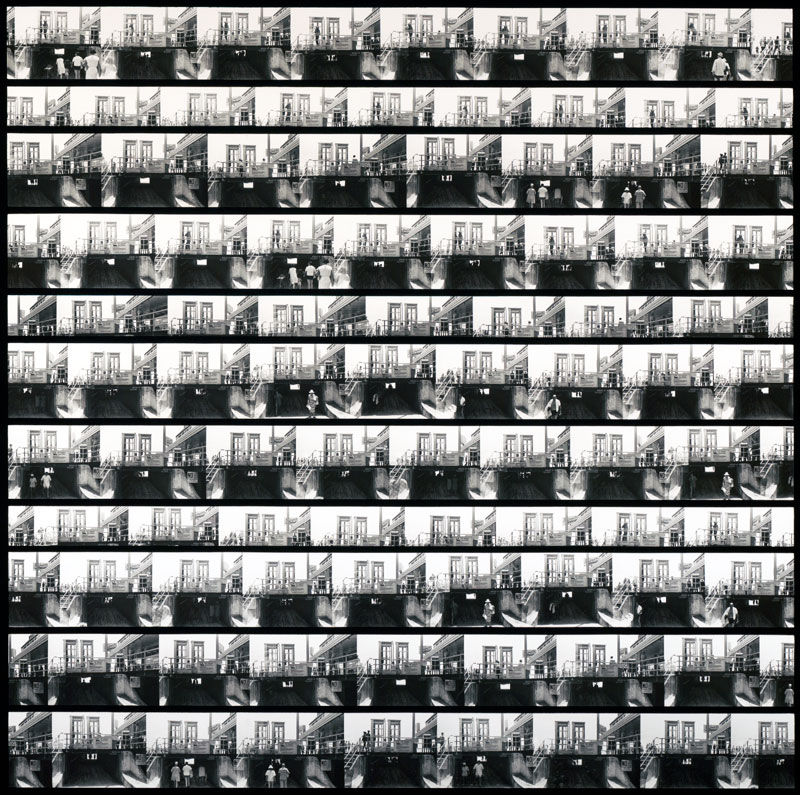
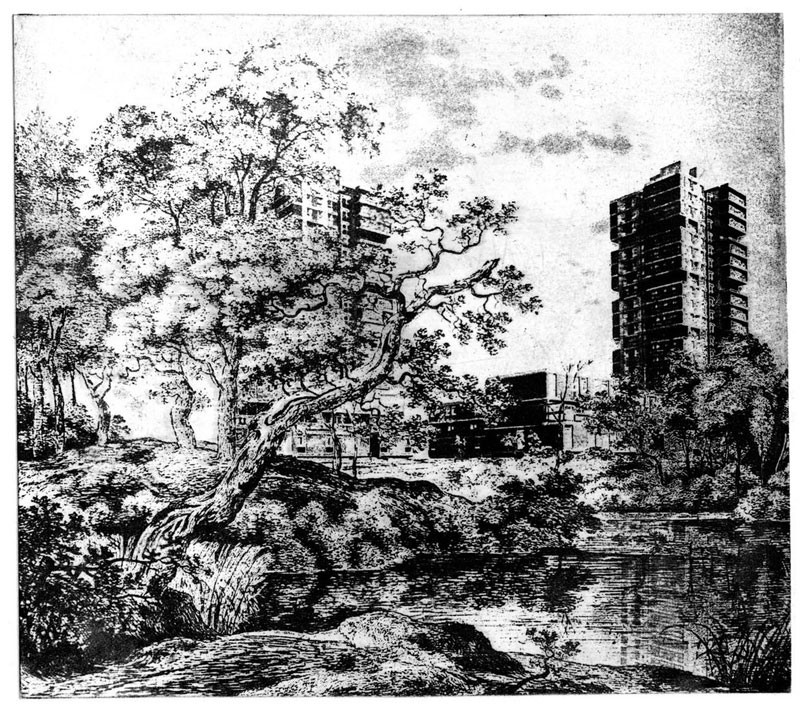
Debra Phillips (Australian, b. 1958) 'Untitled 7 (view from model plane launch area)' 2001


Debra Phillips (Australian, b. 1958)
Untitled 7 (view from model plane launch area)
2001
From the series The world as puzzle
Two Type C photographs
68 x 80cm each
Image courtesy the artist and BREENSPACE, Sydney
© Debra Phillips


Hot on the heels of my reviews of Stormy Weather: Contemporary Landscape Photography at NGV Australia and Sidney Nolan: Drought Photographs at Australian Galleries, Melbourne comes the exhibition Photography & place: Australian landscape photography, 1970s until now at the Art Gallery of New South Wales. An insightful, eloquent text by Vigen Galstyan (Assistant curator, photographs, AGNSW) accompanies the posting.

Dr Marcus Bunyan


Many thankx to Susanne Briggs for her help and to the Art Gallery of New South Wales for allowing me to publish the photographs and the text in the posting. Please click on the photographs for a larger version of the image.


Douglas Holleley (Australia, United States of America, b. 1949) 'Bottle-brush near Sleaford Bay, South Australia' 1979


Douglas Holleley (Australia, United States of America, b. 1949)
Bottle-brush near Sleaford Bay, South Australia
1979
Four SX-70 Polaroid photographs
61 x 76cm
AGNSW collection, purchased 1982
© Douglas Holleley


Australian born and American based photographer Douglas Holleley has experimented with many aberrant photographic techniques over the course of his career. Holleley received a Bachelor of Arts in Psychology in 1971 at Macquarie University before relocating to America to undertake a Master of Fine Arts, studying at the Visual Studies Workshop in Rochester, New York between 1974 and 1976. Founded by Nathan Lyons in 1969 and affiliated with important photographers including Minor White and Frederick Sommers, the Visual Studies Workshop was a bedrock institution that fostered innovative photographic practice from the 1970s onwards. It was here that Holleley received tutelage from Ansel Adams in 1975. His early photographic output includes hand coloured black and white photographs as well as photograms and gridded arrangements of Polaroids. He later began experimenting with digital photography, applying the same principles of the photogram to his experiments with a flatbed scanner.

During the time spent studying photography in America in the 1970s Holleley became interested in Polaroid technology. When he returned to Australia in 1979, before later relocating permanently to America, Holleley commenced an extensive photographic project of documenting the Australian bush with a Polaroid SX-70 camera, effectively becoming one of the first professional practitioners of the medium in the country. The resulting images were presented as a series and published as a book – Visions of Australia – in 1980. Employing a refined formalist vocabulary, Holleley produced photographic mosaics by arranging his Polaroids into gridded compositions.

Dissected, disassembled and then collated within the pictorial frame, the landscape in Holleley’s works becomes slightly unnatural and detached. These works negate linear single point perspective by focusing on the ground and reducing the scene to a formal composite. Here, the expanse of the view and the horizon does not dominate the space of the image. The tessellating images produce a ‘whole’ that is slightly misaligned and unsettled. In some works, the photographer’s shadow is visible. It asserts itself as an ambivalent presence that is not tethered to the scene. This spectral form heightens the sense of disquiet that pervades the images.

Text from the Art Gallery of New South Wales website [Online] Cited 16/01/2020


Ian North (New Zealand, b. 1945) 'Canberra suite no 2' 1980, printed c. 1984


Ian North (New Zealand, b. 1945)
Canberra suite no 2
1980, printed c. 1984
From the series Canberra suite 1980-81
Type C photograph
37 x 45.7cm
AGNSW collection, gift of the artist
© Ian North


Ian North (New Zealand, b. 1945) 'Canberra suite no 7' 1980, printed c. 1984


Ian North (New Zealand, b. 1945)
Canberra suite no 7
1980, printed c. 1984
From the series Canberra suite 1980-81
Type C photograph
37 x 45.7cm
AGNSW collection, gift of the artist
© Ian North


Ian North is an Adjunct Professor of Visual Arts at both the University of Adelaide and the University of South Australia. He is a photographer, painter and writer, and was the founding curator of photography at the National Gallery of Australia 1980-1984. Throughout his career, he has been concerned with the legacy of Australian landscape, the impact of colonial narratives and their established visual conventions and, as a consequence, the politics of representing the subject. …

North’s methodology is concerned with the processes of vision and interaction as they have shaped the landscape. In Canberra Suite North presents an encyclopaedic record of Walter Burley Griffin’s intricately designed city, exploring the spatial interface between nature and humanity. The works are absent of human life – reminiscent of Ed Ruscha’s Twenty-six Gasoline Stations. The emotional ambivalence of the images is reflected in their use of colour, like that of postcards. As one of the first instances of larger format colour art photography in Australia, the images topographically map space as a depersonalised, banal subject. Yet their colour, like that of landscape painting, highlights flora, revealing the number of non-native plants included in Canberra’s design. As such, these artefacts of North’s private wanderings and systemic mode of looking are able to subtly critique colonialism.

Text from the Art Gallery of New South Wales website [Online] Cited 16/01/2020


EARTH SCANS AND BUSH RELEVANCES: Photography & place in Australia, 1970s till now

For many of us, landscape is a noun. A view from the window or the balcony, a strange immaterial ‘thing’ that makes people exclaim in awe, point to in pride, recall nostalgically, pose in front of or be used to bump up real estate prices. If one is an urban dweller, which most Australians are, then the landscape exists essentially as a mirage, something to create in the backyard, occasionally look at on holidays or hang on the walls. However, noted American cultural theorist and art historian W. J. T. Mitchell has proposed that we should think of landscape as a verb: an act of creation on our part that engenders cultural constructs, national identities and shared mythologies.

Photography & place is an exhibition that investigates this process of ‘landscaping’ through the work of 18 Australian photographers between the 1970s and now. Their significant contribution to representation of landscape broke new ground in what has always been a confounding topic. Indeed, as Judy Annear has pointed out in a 2008 essay in Broadsheet magazine, the practice of documenting and interpreting the notion of ‘place’ in Australian photography has been fragmentary in comparison to traditions in America, Europe or New Zealand. This reluctance to focus on the natural environment is perhaps a residue of the ‘terra nullius’ polemic, which shifted the attention of many photographers on the building of colonial Australia. Photography from the mid 19th to the early 20th century by photographers such as Charles Bayliss and Nicholas Caire actively documented the conquest of nature by white settlers, or presented views of untouched wilderness as epitomes of the picturesque: endless waterfalls, lakes, forests in twilights, enigmatic caves and an occasional nymph like creature prancing. Despite Bayliss’ efforts to show the indigenous people on their land, they are, as Helen Ennis observed in her 2007 book Photography and Australia, conspicuous by their absence: the land that we see surrounding them in early Australian photography by the likes of J.W. Lindt is often a mass-produced painted studio backdrop.

The advent of modernism in the 1930s only served to entrench the photographers deeper into the urban space. ‘Place’ is the city and it is here that industry, progress and culture shapes the Australian identity. It is still difficult to dislodge the iconic images of Max Dupain and David Moore as epitomes of Australianness, promulgated as they were through countless renditions in mass media and consumer culture. But as post-modern anxiety started to seep through the patchwork of the Australian dream, it was landscape that many critically informed photographers turned to as a tool for analysis and revision.

A number of factors conflated in the mid 1970s, engendering a radical shift in perspectives. One of the primary forces that began to reshape the approaches to landscape in Australian photography was the awareness of new artistic movements taking place in USA and Europe. The enormously influential exhibition New Topographics: Photographs of a Man-Altered Landscape held in 1975 at the George Eastman House, Rochester, consolidated the spread of minimalist and conceptually informed photography which was avidly embraced by a younger generation of Australian photographers. One can also cite the rise of the Australian greens movement in Tasmania, the increasing awareness of Indigenous cultures and rights and not the least, the phenomenon of university-educated photographers as key milestones during this decade.

Lynn Silverman, Douglas Holleley, Jon Rhodes, Wes Stacey and Marion Marrison were among the practitioners who pointed their lenses out of the city, often exploring the fringes of human settlement and sometimes as in the case of Silverman, Stacey and Holleley, venturing into the desert. The element that collectively stamps their work is the ostensible fragmentation of the landscape. Instead of the holistic, positivist postcard views of Australia, we get something resembling a lunar vista. The palpable sense of alienation in American expatriate Lynn Silverman’s striking Horizons series from 1979 echoes in the disorienting grid-based Polaroid assemblages by Holleley conjuring up a space that appears hostile and to a degree indifferent to our presence. The foreignness of these landscapes is not necessarily a malevolent force as was customary to show in a slate of Australian New Wave films of the 70s and 80s. Rather a much more meditative stance is taken in regards to our relationship to a place which has been claimed without being understood or in many ways respected. Ingeborg Tyssen’s photographs hint at existing presences, forms and phenomena which are full of life and meaning that remain perpetually unresolved to an outsider. The imported paradigms of Western culture can not take root in this environment. One could easily define the landscape photography of this period in Lynn Silverman’s words as “an orienting experience” and a belated attempt at a proper reconnaissance of the land.

The coolly detached outlook that underlines the investigative drive of most of these photographers is magnified by their adoption of serial or multi-panel formats. It was certainly a way to expand and collapse the accepted faculties of the pictorial field, challenging and questioning the accepted notions of photographic ‘truth’. Jon Rhodes demonstrates the inherent power of this simple device in his cinematically sequential Gurkawey, Trial Bay, NT 1974, which transforms a seemingly wild and uninhabitable swamp into a joyful playground of an Aboriginal child.

In some instances the photographic approach is more concerned with elucidating the nature of the photographic image itself and the way it can influence and control our perception. As Arnold Hauser has lucidly described in his groundbreaking Social History of Art, images have always been used to secure and infer political power. As such, the metamorphosis of a visual representation into an iconographic one carries within it an element of danger as images begin to seduce the viewer away from objectivity. Indeed, images of Australia have been the most relentlessly and carefully used signifiers in promoting a (colonial) national consciousness by political, commercial and cultural institutions. In this light, it is not difficult to see the works of Wes Stacey and Ian North as acts of iconoclasm. Stacey’s droll and gently parodic series The road 1973-1975, charts a snapshot journey that goes nowhere. Seemingly random, half-glimpsed shots of empty dirt roads, sunburnt grass mounds and endless highways emanate a sense of rootlessness and displacement, negating any possibility of objectification or identification with the landscape. Instead of epic grandeur and jingoism we get something that is confronting, uncomfortably real and in no way ‘advertisable’.

‘The Real’ is even more startling in Ian North’s subversive Canberra suite 1980-81, where the utopian dream capital has been reduced to banal ‘documents’ of depopulated, custom-made suburbia. The hyperreal concreteness of North’s Canberra gives the city an aura of a De Chiricoesque waking nightmare. In line with the set practices of conceptual photography of the period, North has distilled his images from any sign of formal mediation, forcing the viewer to focus on the raw content. It is through this forensic directness that the strange incongruity of human intervention within the landscape becomes ostensible.

Daniel Palmer has noted that North’s images “are highly prescient of much photography produced by artists in Australia today”. Certainly by the 1980s photographers became more actively engaged in analysing the nature / culture median. Strongly influenced by feminist and post-colonial theory, a number of practitioners used photography as a medium to document ideas rather than objective reality. Anne Ferran and Simryn Gill are particularly notable in this regard. Both artists are concerned with the historical and political dimensions of the locations they chose to photograph, resulting in multi-layered and complex strategies that require more involved intellectual interaction from the audience. Gill’s ‘staged’ photographs relate to us the agency of nature and time upon the cultural environment. Synthesis and amalgamation of outwardly irreconcilable elements – imported plants, Australian bush, cotton shirts – slowly, but surely melt into new, as yet unknown entities in Rampant 1999. The force of inevitable decay is absolute yet imbued with generative power as well. Exploring the constantly shifting certainties of what constitutes a ‘place’ the artist draws the audience into questioning its own role in this transformative process.

Ferran takes a more archaeological position in relation to her subject matter. Her eerie surveys of rather ordinary grass mounds in the series Lost to worlds 2008 become evocative paeans to obliterated lives, once we learn that the mounds are all that remain of the factories where convict women were sent to work. Looking at these shimmering ghost worlds one is reminded of Walter Benjamin’s essay The Ruin where the writer analyses the capacity of ruins to reveal the “philosophical truth content”. It is through this allegorical device that Ferran achieves a degree of rehabilitation for the absent histories she photographs.

History, in its manifold and troubling guises, is directly ‘exposed’ in the landscapes of Ricky Maynard, Michael Riley and Rosemary Laing. As Indigenous photographers, Maynard and Riley have played an important role in translating the cultural and political status of Aboriginal peoples into a ‘language’ that is universally understood. Their work remains firmly rooted in the traditions of contemporary art, yet the heavily symbolical slant shows a more ardent and personal engagement with the Australian landscape. Riley’s expressionistic series flyblown 1998 sums up in a few strategically juxtaposed metaphors the spiritual dimension of the landscape, while simultaneously revealing the diverging connotations of Australia’s fundamentally divided identity. The colonial legacy is shown as one of conquest and domination that clashes with the artist’s engagement with country. Maynard’s Portrait of a distant land 2005, explores the same dichotomy in more site specific terms. After permanently settling in Flinders Island, Maynard decided to return to the portrayal of Tasmanian Aborigines, taking a more collaborative approach. He sees this as a way of bypassing the propensity of the photographic image “to subjugate its subjects”. The resulting series is a profoundly poetic treatment that rises above social documentation to suggest the wider implications of historical change and disclose the ability of people to overcome what the artist has described as victimisation through a deeply compassionate relationship with the land. Ultimately Maynard gives us an edifying testimony to the affirmative power of the landscape as collective memory.

Interest in the political aspects of landscape photography has continued unabated into the 21st century. Yet a more philosophically inclined thread has become evident in the last two decades. No longer is it enough to deconstruct and pull apart ideas about landscape’s relationship to identity and nationhood. What photographers like Bill Henson, David Stephenson, Simone Douglas and Rosemary Laing question is the very possibility (or impossibility) of seeing itself. If positioning oneself in relation to nature seems like a distinct, albeit problematic proposition in the 1970s and 80s, the later works in the exhibition are resolutely ambivalent on the subject.

What can one grab onto when faced with the endless expanses of white in Stephenson’s The ice 1992, the terrifying darkness of Henson’s night scenes or the infuriating haze of Douglas’s twilight worlds? Perhaps the only recourse is to dissolve into the beckoning ‘forever’ of the vanishing point in Laing’s To walk on a sea of salt 2004. This void is not a boundary point between nature and culture – it is where culture ends and an entirely new state of consciousness begins: the realm of the sublime and the imagination. As history seems no longer to be trustworthy, ‘place’ can only be constructed as a metaphysical entity. It is a curious turnabout in some ways that echoes some of the early, turn-of-the-century encounters with the Australian landscape by photographers such as John Paine and Norman C. Deck. The sense of fear and awe towards the unfamiliar environment permeates their images, transcending the merely investigative / didactic motives of most colonial photography. What has eventuated from walking into this environment? Subjugation? Destruction? Incomprehension? Indifference? By going back to the point zero of the void and the sublime, contemporary photography negotiates a second attempt at engagement with nature through a renewed and deeper understanding of humanity’s symbiotic relationship with this life-giving force.

Vigen Galstyan
Assistant curator, photographs1


1/ Galstyan, Vigen. “EARTH SCANS AND BUSH RELEVANCES: Photography & place in Australia, 1970s till now,” in Look gallery magazine. Sydney: Art Gallery Society of New South Wales, 2011, pp. 25-29.


Rosemary Laing (Australian, b. 1959) 'After Heysen' 2005


Rosemary Laing (Australian, b. 1959)
After Heysen
2005
Type C photograph
110 x 252cm
On loan from The Australian Club, Melbourne
Image courtesy of the arts & Tolarno Galleries, Melbourne
© Rosemary Laing


Rosemary Laing (Australian, b. 1959) 'to walk on a sea of salt' 2004


Rosemary Laing (Australian, b. 1959)
to walk on a sea of salt
2004
Type C photograph
110 x 226.7cm
Image courtesy of the arts & Tolarno Galleries, Melbourne
© Rosemary Laing


Jon Rhodes (Australian, b. 1947) 'Hobart, Tasmania' 1972-75 from the album 'Australia'


Jon Rhodes (Australian, b. 1947)
Hobart, Tasmania
1972-75
From the album Australia
1 of 53 gelatin silver photographs
11.9 x 17.7cm
Art Gallery of New South Wales, purchased 1980
© Jon Rhodes


Jon Rhodes (Australian, b. 1947) 'Tuncester, New South Wales' 1972-75 from the album 'Australia'


Jon Rhodes (Australian, b. 1947)
Tuncester, New South Wales
1972-75
From the album Australia
1 of 53 gelatin silver photographs
11.9 x 17.7cm
Art Gallery of New South Wales, purchased 1980
© Jon Rhodes


Michael Riley (Australian, 1960-2004) 'Untitled' 1998 from the series 'flyblown'


Michael Riley (Australian, 1960-2004)
Untitled
1998
From the series flyblown
Pigment print
82 x 107.8cm
Art Gallery of New South Wales, Sydney
Anonymous gift to the Aboriginal & Torres Strait Islander and Photography collections 2010
© Michael Riley Estate. Licensed by Viscopy, Sydney


Michael Riley (Australian, 1960-2004) 'Untitled' 1998 from the series 'flyblown'


Michael Riley (Australian, 1960-2004)
Untitled
1998
From the series flyblown
Pigment print
82 x 107.8cm
Art Gallery of New South Wales, Sydney
Anonymous gift to the Aboriginal & Torres Strait Islander and Photography collections 2010
© Michael Riley Estate. Licensed by Viscopy, Sydney


Michael Riley received his first introduction to photography through a workshop at the Tin Sheds Gallery in Sydney, 1982. A Wiradjuri / Kamilaroi man, the artist moved to Sydney from Dubbo in his late teens. He became part of a circle of young Indigenous artists drawn together in the city at that time. A founding member of the Boomalli Aboriginal Artists Co-operative Riley was also a key participant in the first exhibition of Indigenous photographers at the Aboriginal Artists Gallery, Sydney in 1986 (curator Ace Bourke). In 2003 Riley’s work was selected for the Istanbul Biennial, and in 2006 his work was permanently installed at Musée de quai Branly, Paris. A major retrospective toured nationally in 2006-2008.

Riley’s fine art photography began in black and white but he quickly progressed to large-scale colour, a format that also expanded the cinematic qualities of his images, no doubt reflecting the influence film and video were having upon the artist as he worked simultaneously with these media. He produced, for example, the documentaries Blacktracker and Tent boxers for ABC television in the late nineties.

The photographic series flyblown bears a close relationship to the film Empire which Riley created in 1997. Like the film, these photographs give expression to the artist’s concern with the impact of European culture upon that of Australia’s Indigenous population, specifically, as he described it, the ‘sacrifices Aboriginal people made to be Christian’ (Avril Quaill, ‘Marking our times: selected works of art from the Aboriginal and Torres Straight Islander Collection at the National Gallery of Australia’, National Gallery of Australia, Canberra 1996 p. 66).

Christian iconography looms large in the series, as it has across much of Riley’s work. In flyblown, an imposing reflective cross is raised in the sky. Repeated in red, gold and blue its presence is inescapable. A symbol capable of inspiring awe, fear, devotion, Riley also engages with its elegiac qualities so that it functions as memorial marker. Another image depicting a bible floating face down in water conceptualises the missionary deluge, perhaps; submersion and loss through baptism, definitely.

flyblown reverberates with a subtle ominous hum – the quiet tension that precedes a storm. The parched earth beneath a dead galah seems to ache for the rain and water promised in the other images of clouds and dark skies. The nourishment Christianity offered and the inadvertent drowning of traditional culture that often followed is implied.

Visually linking the natural environment with religious symbolism Riley articulates Indigenous spirituality’s connections to country and widens his examination beyond to examine the sustained environmental damage. The negative side effects of pastoralist Australia are indicated by contrasting images of the long grass of cattle pastures with that of drought and wildlife death.

Riley’s success in articulating these issues and complexities, incorporating religious iconography so laden by history and meaning is a testament to his sensitivity and subtlety. Allowing room for ambiguity, Riley provides space for the mixed emotions of the subject and its history.

Text from the Art Gallery of New South Wales website [Online] Cited 16/01/2020


Simryn Gill (Singapore, Malaysia, Australia, b. 1959) 'Untitled' 1999 from the series 'Rampant'


Simryn Gill (Singapore, Malaysia, Australia, b. 1959)
Untitled
1999
From the series Rampant
Gelatin silver photograph
25 x 24cm
AGNSW collection, gift of the artist, 2005
© Simryn Gill


In Rampant, Simryn Gill turned her eye once more on Australia ‘… to see if I could find friends among the local flora’. This series of photographs was shot in sub-tropical northern New South Wales and shows unnerving images of trees and plants dressed up in clothes. In the photographs these ghostly forms are seen lingering in groves of introduced plants such as bamboo, bananas, sugar cane and camphor laurels. The plants are dressed in lungis and sarongs, generic clothing from South and South- East Asia, where many of these plants originate. Rampant is a form of memento mori, a record of the aspirations that saw plants only too successfully introduced into a pristine terrain which was unable to offer any resistance to their feral ways.

French philosopher Gaston Bachelard condenses his complex thinking on creativity and the human imagination into the metaphor of a tree, with its living, evolving growth and the simultaneity of being earth bound and heaven reaching, symbolising both the real and ideal.1 However, what happens when that tree is a camphor laurel, an admirable thing in its native land but out of place and wrecking havoc along the creeks of rural New South Wales?

Many once-useful species are now noxious weeds and over-successful colonisers, despised for their commonness, their success, their over-familiarity, and for being where we feel they should not be. They disrupt the order we would like to impose and remind us of our fallibility when attempting to play god and create our own earthly Edens. The language of natural purity that we use to protect our landscape also resonates with the nationalist rhetoric used to police our borders and to decide who are acceptable new arrivals and who are illegal aliens, often determined through scales of economic and social usefulness.

Text from the Art Gallery of New South Wales website [Online] Cited 16/01/2020


1/ Gaston Bachelard, ‘The totality of the root image’, On poetic imagination and reverie, editor and translator Colette Graudin, Spring Publications, Quebec, 1987, p. 85.


    Anne Ferran (Australian, b. 1949) 'Untitled' 2008 from the series 'Lost to worlds'


    Anne Ferran (Australian, b. 1949)
    Untitled
    2008
    From the series Lost to worlds
    Gelatin silver print
    © Anne Ferran


    Anne Ferran (Australian, b. 1949) 'Untitled' 2008


    Anne Ferran (Australian, b. 1949)
    Untitled
    2008
    From the series Lost to worlds
    Gelatin silver print
    © Anne Ferran


    Wesley Stacey (Australia, b. 1941) 'The road: Outback to the city 3' 1973-1975


    Wesley Stacey (Australia, b. 1941)
    The road: Outback to the city 3
    1973-1975
    Folio 1 from “The Road” a portfolio of 280 photographs
    Fuji Colour machine print
    © Wesley Stacey


    Wesley Stacey (Australia, b. 1941) 'The road: Surfers to Hobart 15' 1973-1975


    Wesley Stacey (Australia, b. 1941)
    The road: Surfers to Hobart 15
    1973-1975
    Folio 16 from “The Road” a portfolio of 280 photographs
    Fuji Colour machine print
    © Wesley Stacey


    Wesley Stacey (Australia, b. 1941) 'The road: Port Hedland / Wittenoon / Roeburne, WA 14' 1973-1975


    Wesley Stacey (Australia, b. 1941)
    The road: Port Hedland/Wittenoon/Roeburne, WA 14
    1973-1975
    Folio 10 from “The Road” a portfolio of 280 photographs
    Fuji Colour machine print
    © Wesley Stacey


    Art Gallery of New South Wales
    Art Gallery Road, The Domain, Sydney NSW 2000, Australia

    Opening hours:
    Open every day 10am – 5pm
    except Christmas Day and Good Friday

    Art Gallery of New South Wales website

    LIKE ART BLART ON FACEBOOK

    Back to top

    Exhibition: ‘Nicholas Nixon: Family Album’ at Museum of Fine Arts, Boston

    Exhibition dates: 28th July, 2010 – 1st May, 2011


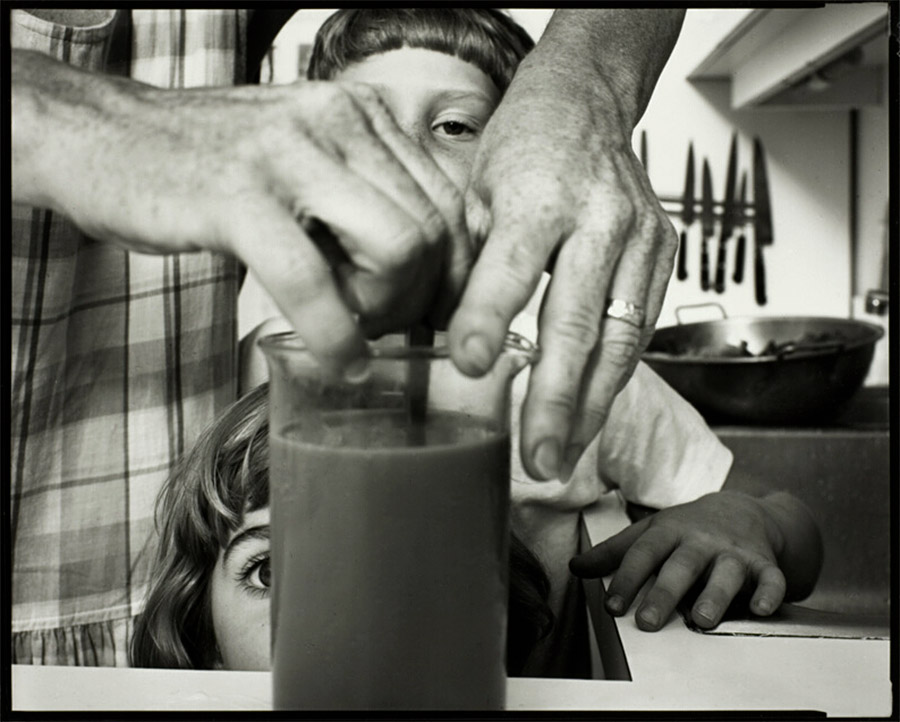
    Nicholas Nixon (American, born in 1947). 'Bebe, Cambridge' 1980


    Nicholas Nixon (American, b. 1947)
    Bebe, Cambridge
    1980
    Gelatin silver contact print
    Museum of Fine Arts, Boston. Museum purchase with funds donated by the National Endowment for the Arts and Richard L. Menschel, Bela T. Kalman, Judge and Mrs. Matthew Brown, Mildred S. Lee, and Barbara M. Marshall
    © Nicholas Nixon, Courtesy Fraenkel Gallery, San Francisco
    Photograph © Museum of Fine Arts, Boston


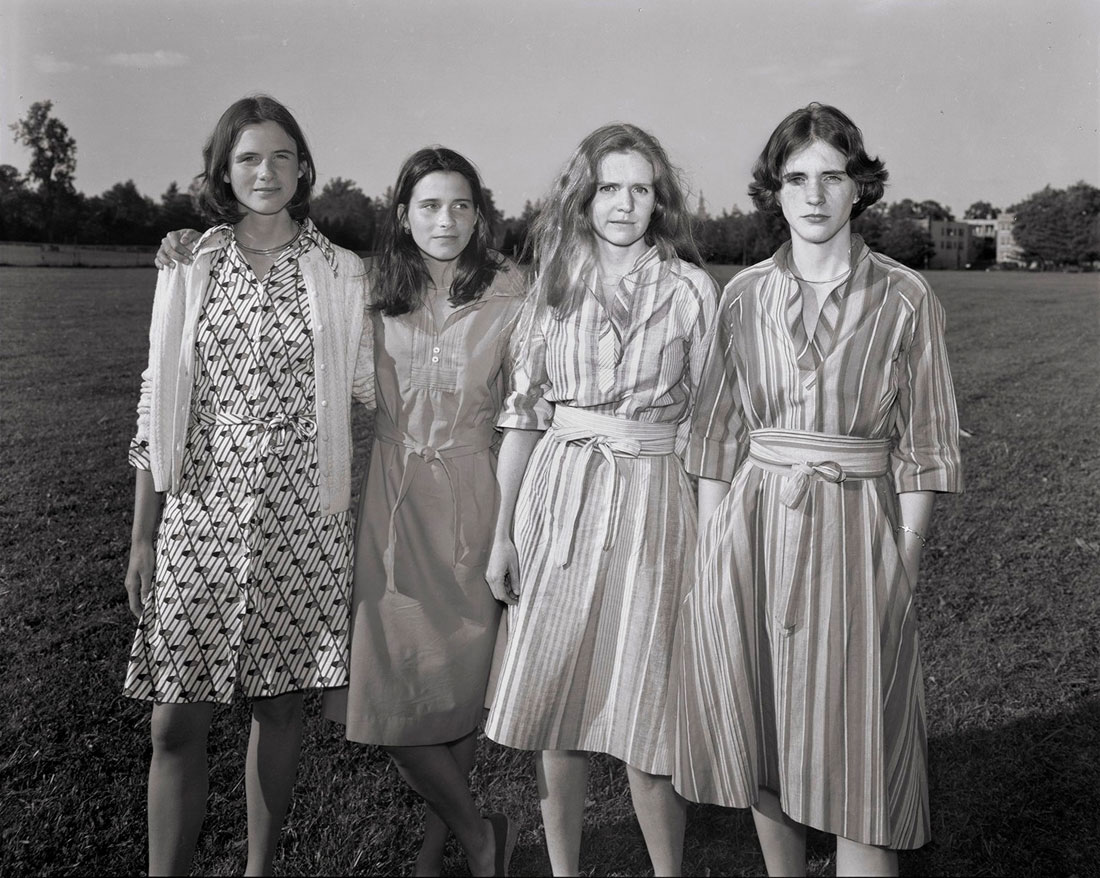
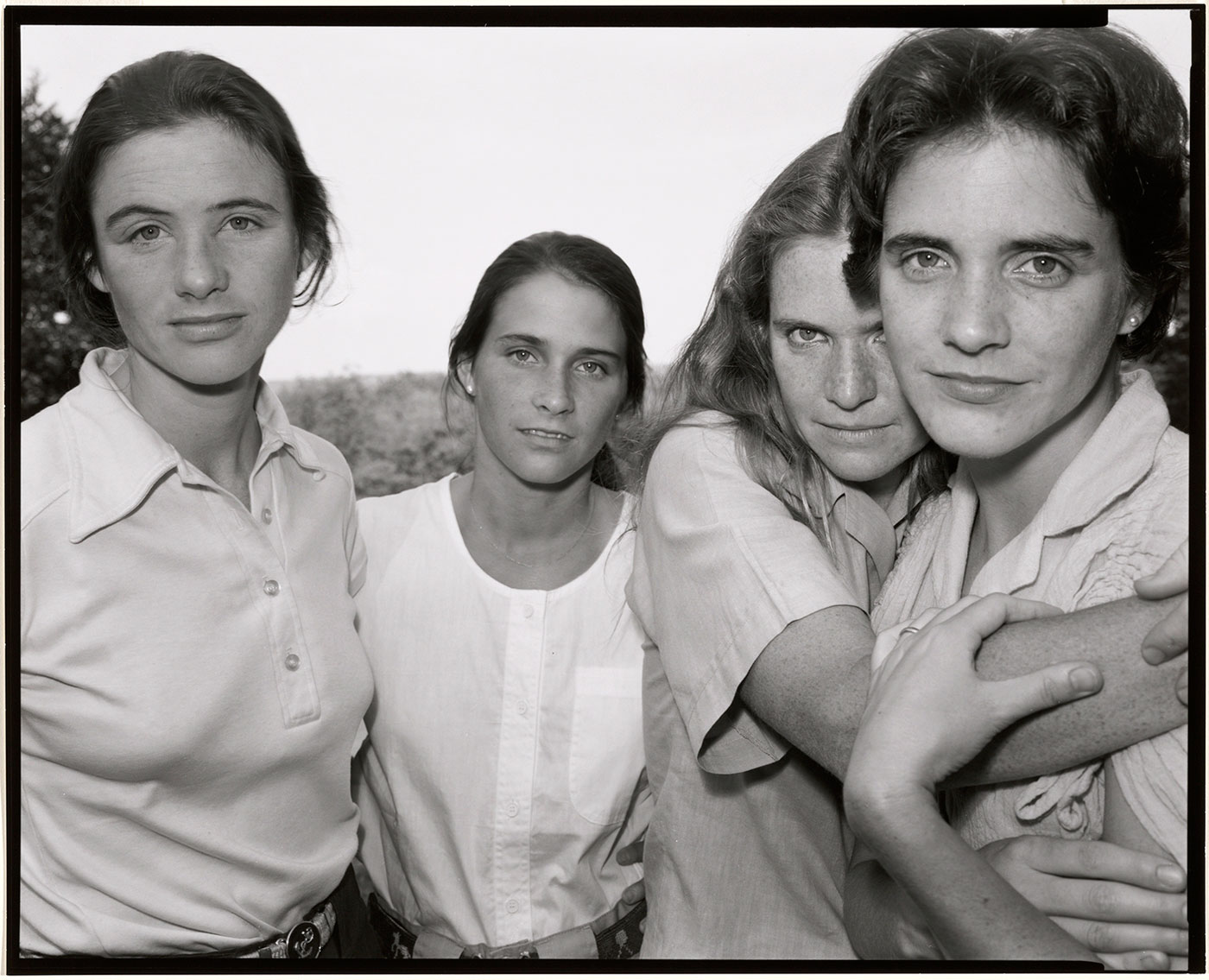
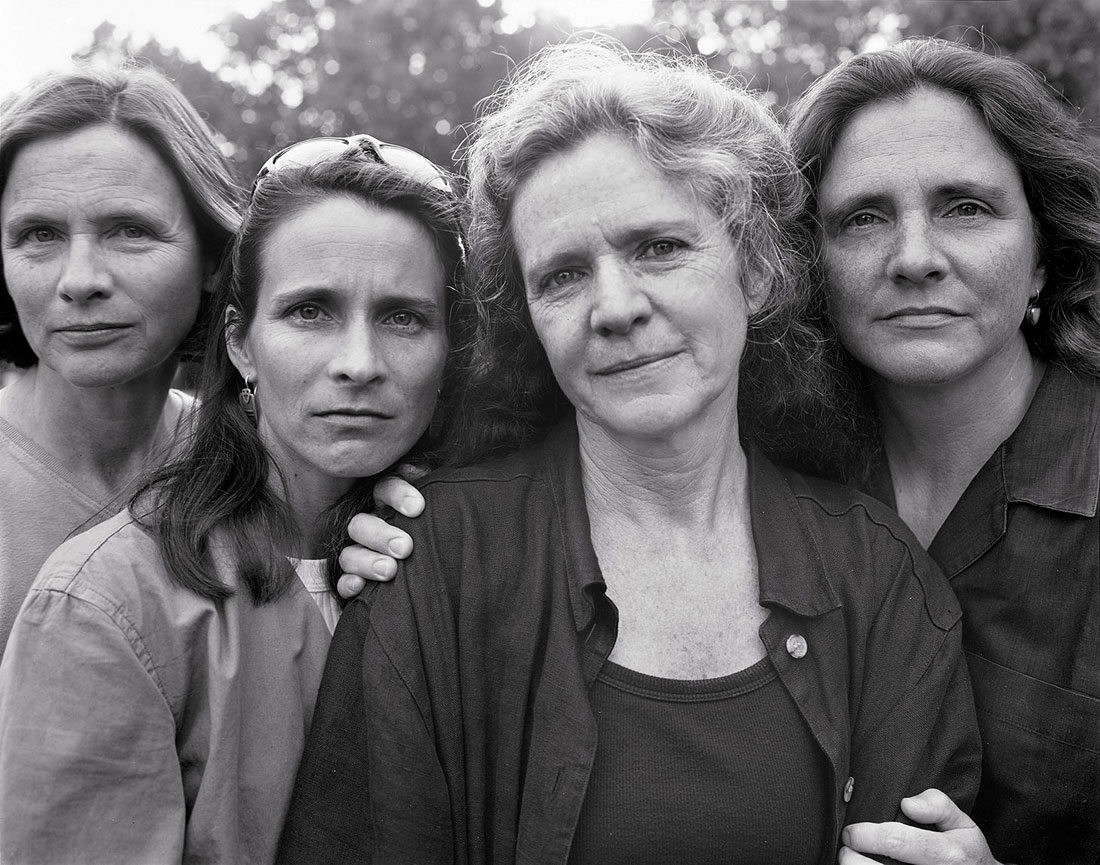
    In the history of group photography Nixon’s ongoing series of family portraits The Brown Sisters (1975- ) is the best in the world. Beautifully structured and composed the photographs are nuanced and sensitive to the people portrayed and the passage of time. The subjects project and recede within the image frame, exposing vulnerability, intimacy and strength. Simply breathtaking!

    Dr Marcus Bunyan


    Many thankx to Amelia Kantrovitz for her help and to the Museum of Fine Arts, Boston for allowing me to publish the photographs in the posting. Please click on the photographs for a larger version of the image.


    Nicholas Nixon (American, b. 1947)
'Chestnut Street, Louisville, Kentucky' 1982


    Nicholas Nixon (American, b. 1947)
    Chestnut Street, Louisville, Kentucky
    1982
    Gelatin silver print
    Gift of the photographer
    © Nicholas Nixon, Courtesy Fraenkel Gallery, San Francisco
    Photograph © Museum of Fine Arts, Boston


    Nicholas Nixon (American, born in 1947). 'Clementine and Bebe, Cambridge' 1985


    Nicholas Nixon (American, b. 1947)
    Clementine and Bebe, Cambridge
    1985
    Gelatin silver print
    Gift of Nicholas Nixon
    © Nicholas Nixon, Courtesy Fraenkel Gallery, San Francisco
    Photograph © Museum of Fine Arts, Boston


    Nicholas Nixon (American, b. 1947)
'Clementine and Bebe, Cambridge' 1985


    Nicholas Nixon (American, b. 1947)
    Clementine and Bebe, Cambridge
    1985
    Gelatin silver print
    Gift of Nicholas Nixon
    © Nicholas Nixon, Courtesy Fraenkel Gallery, San Francisco
    Photograph © Museum of Fine Arts, Boston


    Nicholas Nixon (American, b. 1947) 'Cambridge' 1986


    Nicholas Nixon (American, b. 1947)
    Cambridge
    1986
    Gelatin silver print
    Gift of the photographer
    © Nicholas Nixon, Courtesy Fraenkel Gallery, San Francisco
    Photograph © Museum of Fine Arts, Boston


    Nicholas Nixon (American, b. 1947)
'Clementine and Bebe, Cambridge'
1986


    Nicholas Nixon (American, b. 1947)
    Clementine and Bebe, Cambridge
    1986
    Gelatin silver print
    20.3 × 25.4cm
    Gift of the photographer
    © Nicholas Nixon, Courtesy Fraenkel Gallery, San Francisco
    Photograph © Museum of Fine Arts, Boston


    Nicholas Nixon (American, b. 1947)
'Clementine and Sam' 1990


    Nicholas Nixon (American, b. 1947)
    Clementine and Sam
    1990
    Gelatin silver print
    Gift of the photographer
    © Nicholas Nixon, Courtesy Fraenkel Gallery, San Francisco
    Photograph © Museum of Fine Arts, Boston


    Themes such as the passage of time and the enduring nature of close family relationships are brought into focus in the exhibition Nicholas Nixon: Family Album at the Museum of Fine Arts, Boston (MFA). The show, on view from July 28, 2010, through May 1, 2011, in the MFA’s Herb Ritts Gallery, features more than 70 black and white portrait photographs by Nicholas Nixon, one of the most celebrated American photographers of this generation. Among them are pictures of Nixon’s wife, Beverly (Bebe) Brown Nixon, and their two children, Clementine and Sam. Nicholas Nixon also includes The Brown Sisters, the ongoing annual series of portraits of Bebe and her sisters taken each summer for the past 35 years. Nixon will take another photograph of the sisters this summer, which will be hung in the gallery during the course of the exhibition.

    The promised gift to the MFA of The Brown Sisters series is the impetus for Nicholas Nixon. The group of photographs has been lent to the Museum for the exhibition from the collection of James Krebs, a Distinguished Benefactor of the MFA, and his late wife, Margie. Also included are works by Nixon purchased by the Museum, and a number that were given and lent to the MFA by the artist. Nicholas Nixon is presented with support from the Shelly and Michael Kassen Fund.

    “Nicholas Nixon rose to prominence in the mid 1970s for his large-format black-and-white views of Boston and New York. Since then, he has turned almost exclusively to portraiture, and has produced many celebrated series of pictures – of the elderly, people with AIDS, and couples – but his portrayals of his family are particularly evocative and beloved. Nick has been a friend of the MFA for a long time and has generously given the Museum many of his photographs,” said Malcolm Rogers, Ann and Graham Gund Director of the MFA.

    Nicholas Nixon’s photographs of family are both personal in nature and have a universality with which observers can connect. These pictures, a number of which have never been publicly displayed, celebrate the bonds of close family relationships, especially as they grow over time. Included in the exhibition is the luminous image that Nixon took of his wife in the bathtub, Bebe, Cambridge (MFA, Boston, 1980). The beautiful glowing light on her face suggests her interior state, as well as the depth of their long relationship. There are also many photographs in the show that highlight the richness and warmth of daily life with children. In an image from 1985, a cropped view of Bebe pictures her gazing downward, as Clementine’s fist emerges from the bottom of the frame, evoking the power of a new life. A close-up of Clementine’s face made the following year, with her wide eyes gazing upward, captures the toddler’s impression of wonder. The latest photograph of Clementine in the exhibition dates to 2003 and depicts her as a young woman, embracing her mother. Images of Nixon’s son, Sam, are also included, showing him in different stages over the years and in portraits with his sister.

    The most recognised images in the exhibition are those that Nixon has taken of the Brown sisters each summer since 1975. The four women – Heather, Mimi, Bebe, and Laurie – always appear in the same order in the portraits, from left to right. These compelling photographs reveal the evolving nature of the sisters’ relationship over time. The serial portraits begin with The Brown Sisters, 1975 (James and Margie Krebs Collection, 1975), which captures them as young women, ranging in age from 15 to 25. With each passing year, observers can note changes in appearance, stance, and demeanour. In several of the portraits, the presence of the photographer is suggested through the shadow of himself and his camera projected across the figures, which makes reference to his role in the family dynamic. The series unfolds in a grid display on the central wall of the Ritts Gallery.

    “In his serial pictures of family, Nicholas Nixon explores a classic conundrum in photography: how to suggest the passage of time by means of an instrument that records the instantaneous image. His effort is related to that of several predecessors – Alfred Stieglitz, Edward Weston, Harry Callahan, to name the most important – who, like him, used their wives as subject matter, photographing them over a period of years. What Nixon has added to the discussion – beyond recording facets of appearance, personality, or emphasising formal concerns – is his emphasis on the meaning of family,” said Anne Havinga, the MFA’s Estrellita and Yousuf Karsh Senior Curator of Photographs, who curated the show with Emily Voelker, the MFA’s Estrellita and Yousuf Karsh Assistant Curator of Photographs.

    Born in Detroit in 1947, Nixon graduated from the University of Michigan in 1969 with a bachelor’s degree in English, and from the University of New Mexico in 1974 with a Masters of Fine Arts degree. Later that year, he moved to Boston, where he teaches at the Massachusetts College of Art and Design. Nixon is known for his documentary photography, especially city views and portraits rooted in the snapshot tradition. He works primarily in black and white, creating gelatin silver prints with a 8 x 10-inch view camera as did many of the great photographers who influenced him, including Alfred Stieglitz, Edward Weston, and Walker Evans. Working in large format and making contact prints enables him to create images of crisp detail and subtle tone. In recent years, Nixon has also begun to experiment with colour, although the photographs in the exhibition are all black-and-white, for which he is best known. He is the recipient of three National Endowment for the Arts Fellowships and two Guggenheim Fellowships, and, in addition to the MFA, his work is included in numerous museum collections, among them, the Metropolitan Museum of Art and the Los Angeles County Museum of Art.

    Press release from the Museum of Fine Arts, Boston website [Online] Cited 26/04/2011 no longer available online


    Nicholas Nixon (American, born in 1947). 'The Brown Sisters' 1976


    Nicholas Nixon (American, b. 1947)
    The Brown Sisters
    1976
    Gelatin silver print
    Promised gift of James and Margie Krebs
    Courtesy, Museum of Fine Arts, Boston


    Nicholas Nixon (American, born in 1947). 'The Brown Sisters' 1978


    Nicholas Nixon (American, b. 1947)
    The Brown Sisters
    1978
    Gelatin silver print
    Promised gift of James and Margie Krebs
    Courtesy, Museum of Fine Arts, Boston


    Nicholas Nixon (American, born in 1947). 'The Brown Sisters' 1980


    Nicholas Nixon (American, b. 1947)
    The Brown Sisters
    1980
    Gelatin silver print
    Promised gift of James and Margie Krebs
    Courtesy, Museum of Fine Arts, Boston


    Nicholas Nixon (American, born in 1947). 'The Brown Sisters' 1996


    Nicholas Nixon (American, b. 1947)
    The Brown Sisters
    1996
    Gelatin silver print
    Promised gift of James and Margie Krebs
    Courtesy, Museum of Fine Arts, Boston


    Nicholas Nixon (American, born in 1947). 'The Brown Sisters' 1999


    Nicholas Nixon (American, b. 1947)
    The Brown Sisters
    1999
    Gelatin silver print
    Promised gift of James and Margie Krebs
    Courtesy, Museum of Fine Arts, Boston


    Museum of Fine Arts, Boston
    Avenue of the Arts
    465 Huntington Avenue
    Avenue of the Arts
    Boston, Massachusetts 02115-5523
    617-267-9300

    Opening hours:
    Thursday and Friday 10am – 10pm
    Saturday – Monday 10am – 5pm
    Closed Tuesday and Wednesday

    Museum of Fine Arts, Boston website

    LIKE ART BLART ON FACEBOOK

    Back to top

    Exhibition: ‘Dorothea Lange’s Three Mormon Towns’ at Brigham Young University Museum of Art, Provo, Utah

    Exhibition dates: 20th January – 30th April 2011


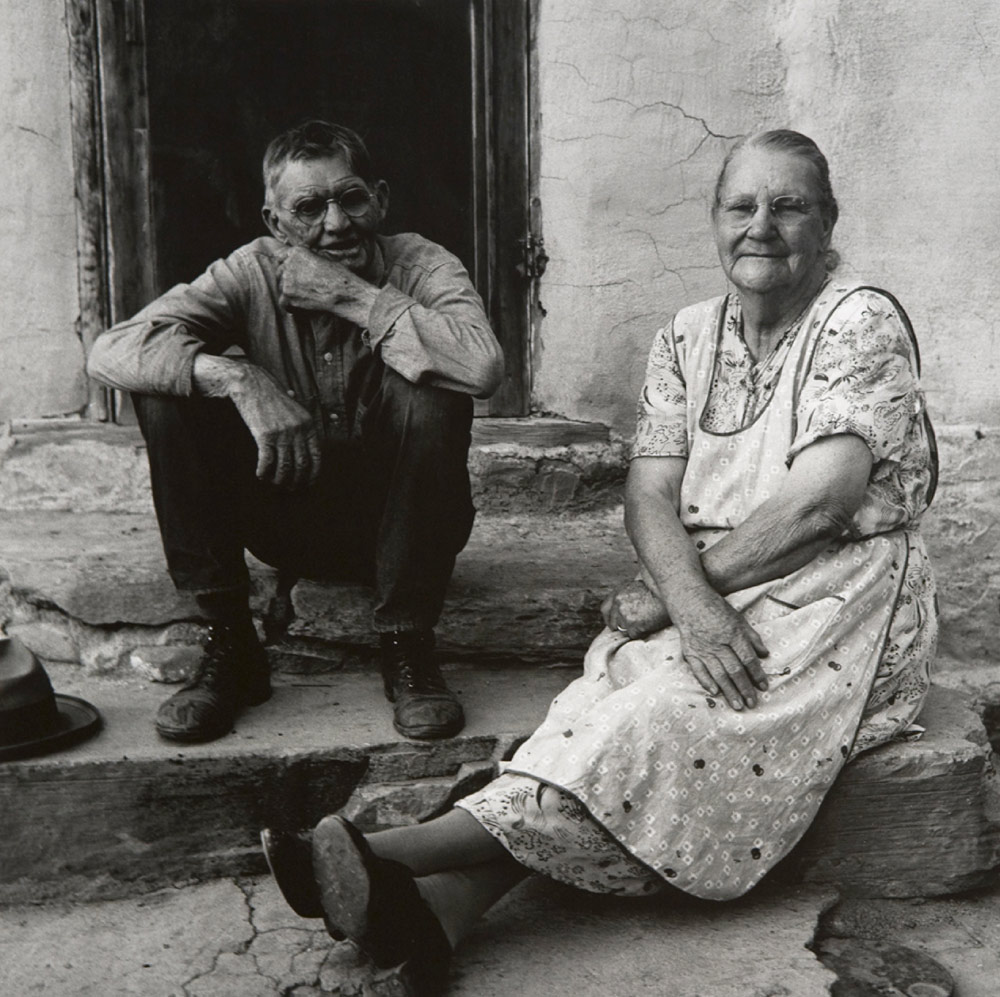
    Dorothea Lange. 'Couple Seated on Porch, Gunlock, Utah' 1953


    Dorothea Lange (American, 1895-1965)
    Couple Seated on Porch, Gunlock, Utah
    1953
    Silver gelatin photograph
    Brigham Young University Museum of Art, purchased with funds provided by Jack and Mary Lois Wheatley


    “The camera is an instrument that teaches people how to see without a camera.”


    Dorothea Lange


    Lange observes the minutiae, the precise details that go to make up the lives of these three towns and puts them together in a wonderful symphony of beautifully calculated, seemingly happenstance associations. Masterful!

    Dr Marcus Bunyan


    Many thankx to the Brigham Young University Museum of Art for allowing me to publish the photographs in the posting. Please click on the photographs for a larger version of the image. All photographs by Dorothea Lange © Dorothea Lange Collection, Oakland Museum of California, City of Oakland. Gift of Paul S. Taylor.


    Toquerville, Utah

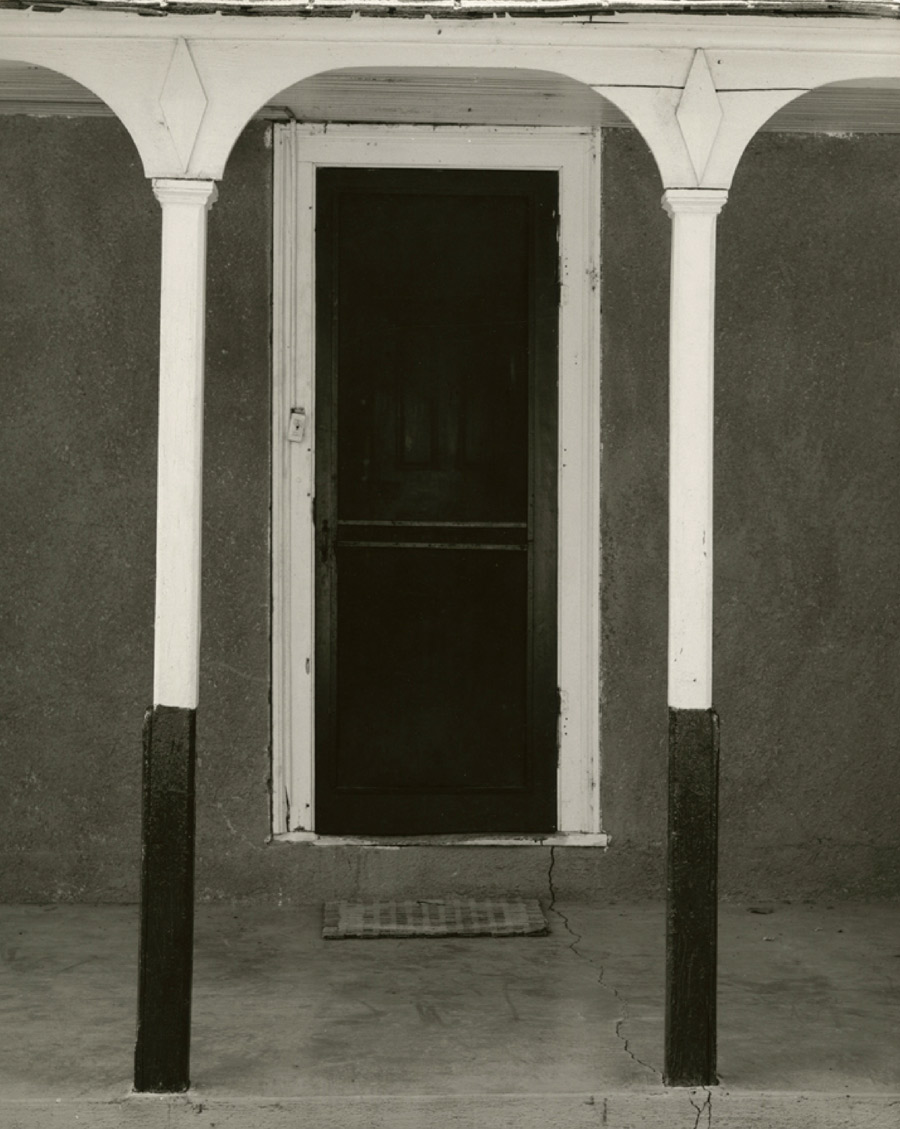
    Dorothea Lange. 'Doorway, Toquerville, Utah' 1953


    Dorothea Lange (American, 1895-1965)
    Doorway, Toquerville, Utah
    1953
    Silver gelatin photograph
    Brigham Young University Museum of Art, purchased with funds provided by Jack and Mary Lois Wheatley


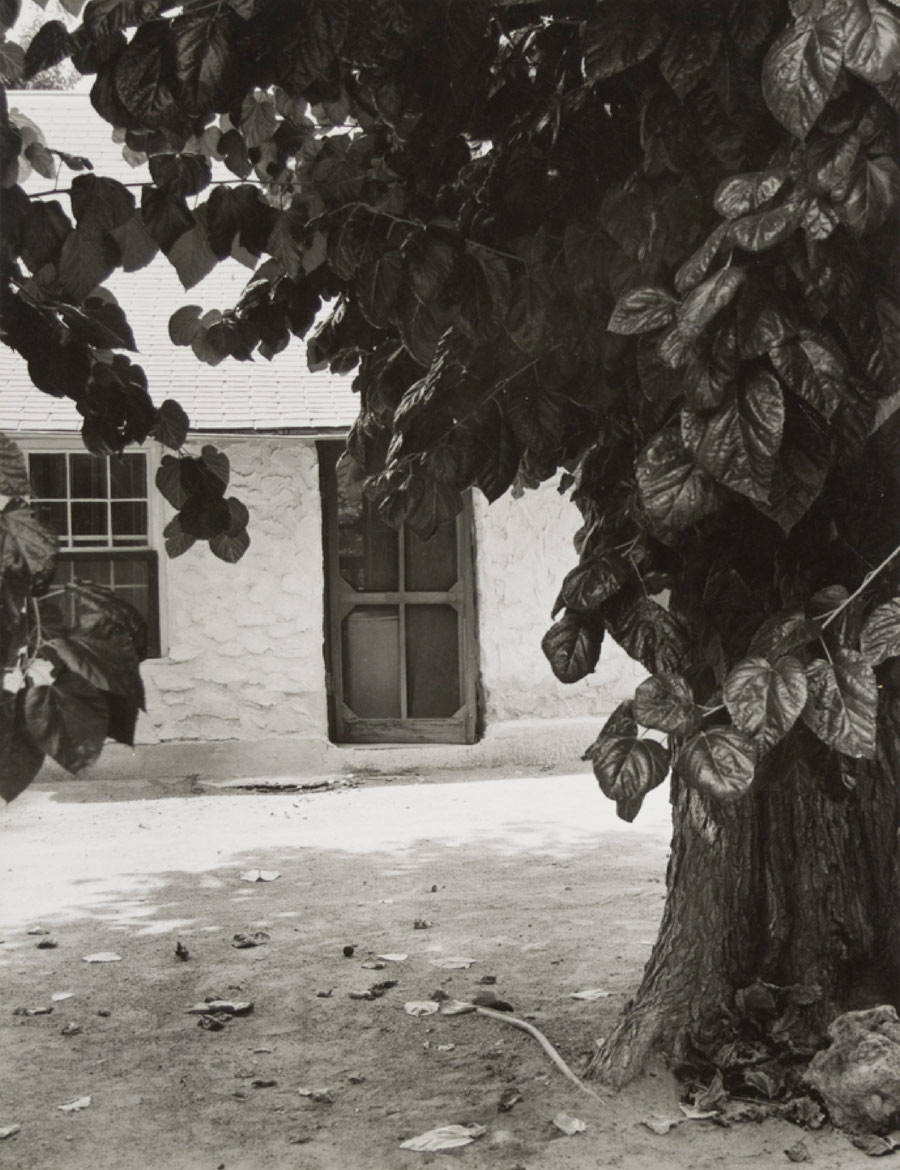
    Dorothea Lange. 'Mulberry Tree, Neagle Home, Toquerville, Utah' 1953


    Dorothea Lange (American, 1895-1965)
    Mulberry Tree, Neagle Home, Toquerville, Utah
    1953
    Silver gelatin photograph
    Brigham Young University Museum of Art, purchased with funds provided by Jack and Mary Lois Wheatley


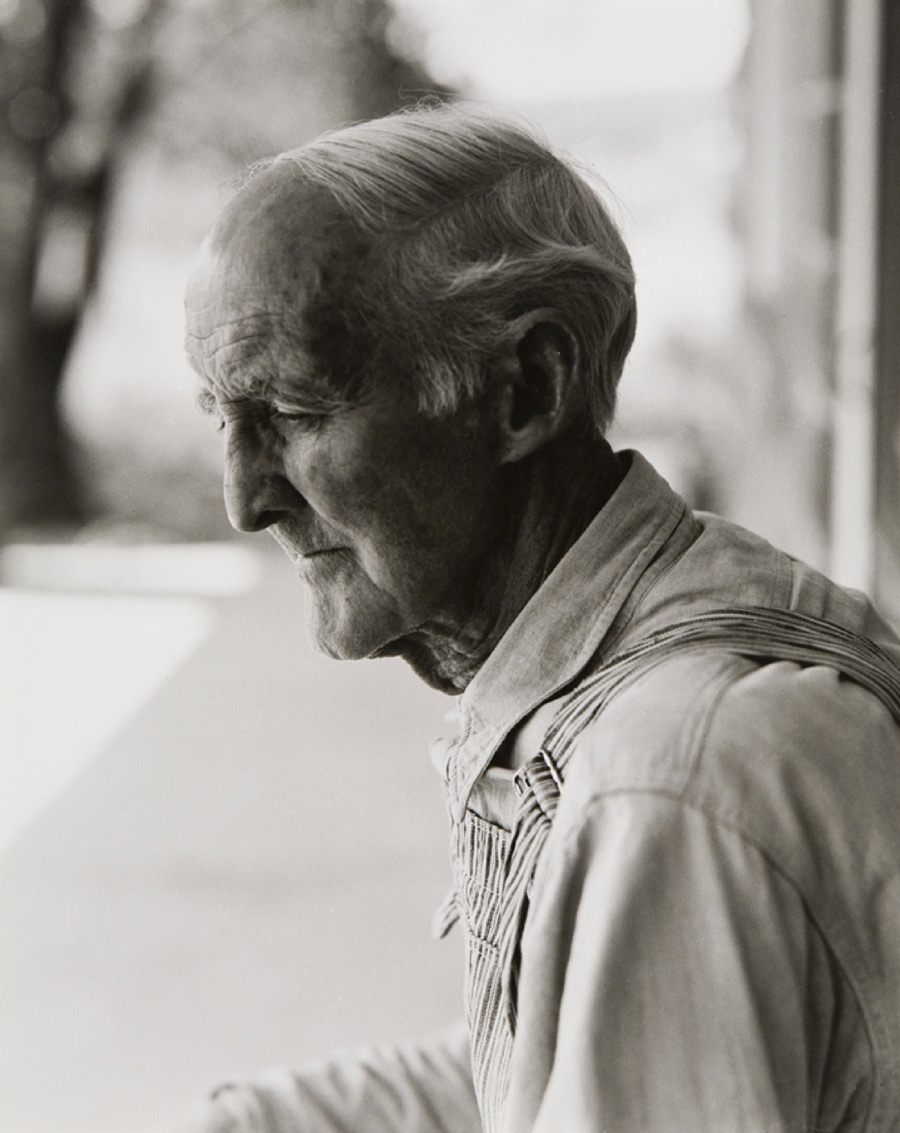
    Dorothea Lange. 'Riley Savage, Toquerville, Utah' 1953


    Dorothea Lange (American, 1895-1965)
    Riley Savage, Toquerville, Utah
    1953
    Silver gelatin photograph
    Brigham Young University Museum of Art, purchased with funds provided by Jack and Mary Lois Wheatley


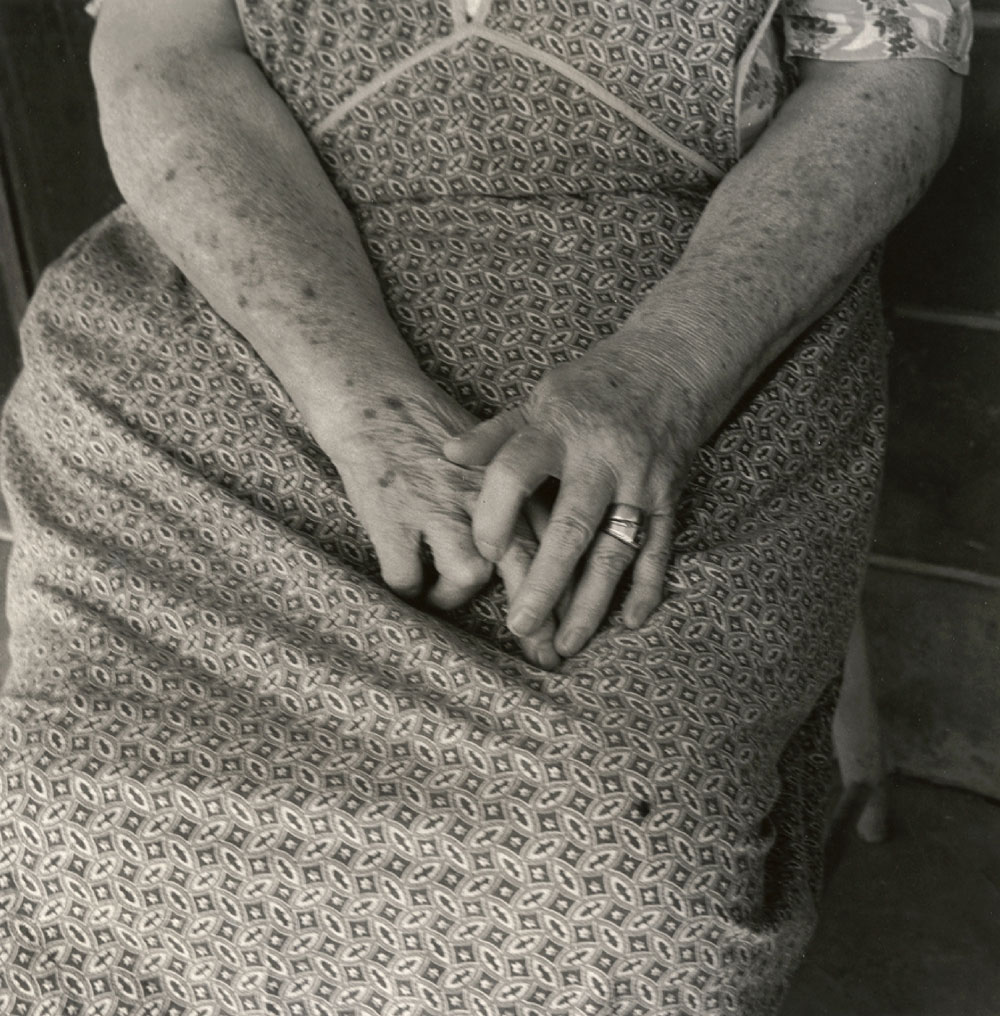
    Dorothea Lange. 'Hands, Toquerville, Utah' 1953


    Dorothea Lange (American, 1895-1965)
    Hands, Toquerville, Utah
    1953
    Silver gelatin photograph
    Brigham Young University Museum of Art, purchased with funds provided by Jack and Mary Lois Wheatley


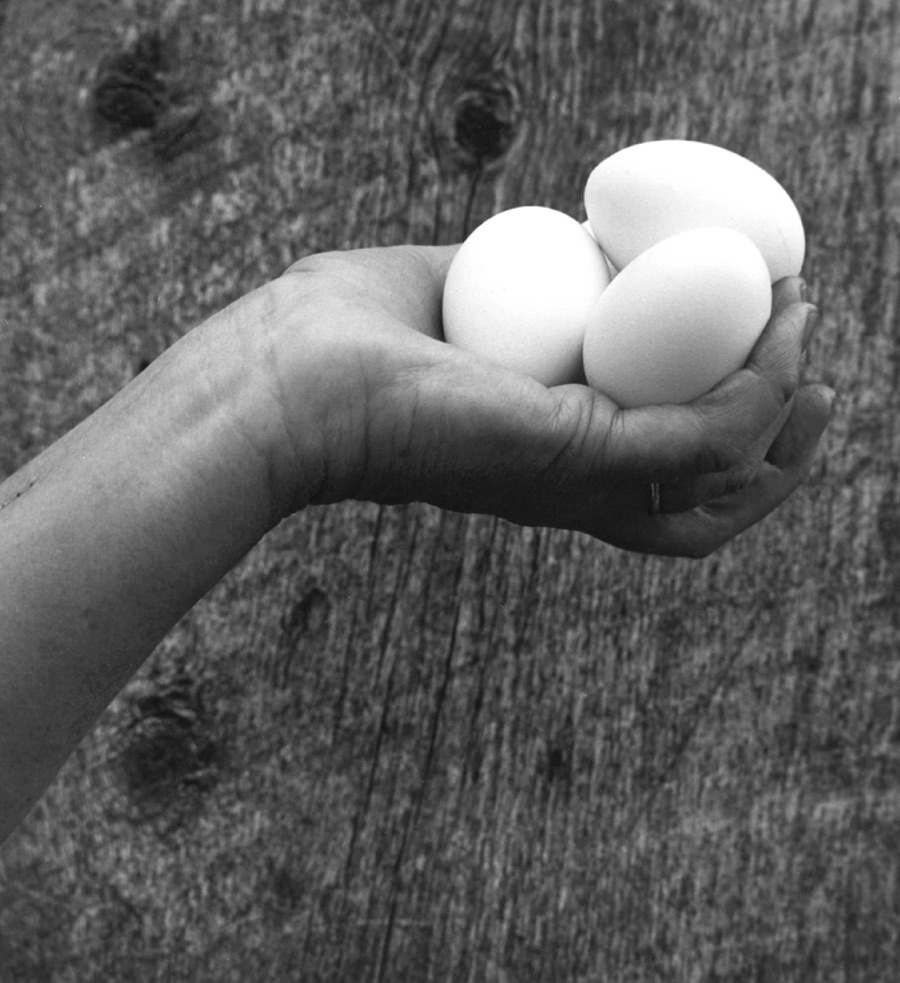
    Dorothea Lange. 'Eggs, Toquerville, Utah' 1953


    Dorothea Lange (American, 1895-1965)
    Eggs, Toquerville, Utah
    1953
    Silver gelatin photograph
    Collection of John and Lolita Dixon


    In August 1953, renowned American photographer Dorothea Lange travelled to southern Utah where she met up with her long-time friend Ansel Adams. The two photographers spent three weeks photographing the landscape and people of Toquerville, Gunlock and St. George with the intention of publishing the work in LIFE magazine.

    Lange’s enthusiasm for her subject yielded hundreds of photographs from which she composed an extended essay of 135 photographs, including images by Ansel Adams. Thirty-five of those photographs with text by Daniel Dixon appeared under the title Three Mormon Towns in the September 6, 1954 issue of LIFE.

    “Dorothea Lange’s Three Mormon Towns,” a new exhibition at the Brigham Young University Museum of Art, features 21 of Lange’s photographs from this series acquired by the museum. The exhibition also draws from the collections of the J. Paul Getty Museum of Art, the Museum of Contemporary Photography, Columbia College Chicago, and the collection of John and Lolita Dixon.

    The 62 vintage prints in the exhibition, accompanied by excerpts from Dixon’s original text, examine Lange’s lasting interest in the people of southern Utah and their relationship with the land, their heritage and the transformation of the West in post-war America.

    “Subtle and poetic, the series of photographs that has come to be known as Three Mormon Towns is a bridge between Lange’s famous Depression Era photographs and her detailed photo essays of the 1950s,” Diana Turnbow, Curator of Photography at Brigham Young University Museum of Art, said.

    Utah attracted Lange’s interest when she and her first husband, Maynard Dixon, spent the summer of 1933 camping and working in Zion National Park. She originally intended to photograph southern Utah with the support of a Guggenheim Foundation fellowship in 1941; however, a family crisis, followed by the onset of World War II prevented Lange from traveling to Utah. Yet, the desire to photograph the Mormon towns of southern Utah never faded. In 1953, Lange returned to the place that had captured her attention decades earlier.

    “While Lange’s photographs depict communities bound together by hard work and religion in the formidable landscape of the Colorado Plateau, they also explore the changes that were beginning to affect not only Utah, but rural communities throughout the United States,” Turnbow said. “Three Mormon Towns was a study of contrasts – of old and new, of quiet villages and a growing city, of deep roots and transient highways. In this series, Lange memorialised the dignity and simplicity of agrarian life in light of post-war urbanisation.”

    Published in the September 6, 1954 issue of LIFE magazine, the series of photographs that has come to be known as Three Mormon Towns bridges Dorothea Lange’s famous Depression era photographs with her detailed photo essays of the 1950s. Featuring sixty-two vintage photographs from the series, this exhibition considers Dorothea Lange’s lasting interest in the people of southern Utah and their relationship with the land, their heritage, and the transformation of the West in post-war America.

    Known for her candid and sympathetic depiction of people, Dorothea Lange (1895-1965) is one of the most revered photographers of the twentieth century. For over four decades she explored the human psyche through portraiture and documentary photography. The probing portraits of her early career prepared Lange to photograph the people involved in the tumultuous events of the San Francisco labor strikes of 1934, the Great Depression, and the Japanese internment during World War II. Her 1935 photograph, The Migrant Mother, is one of the great icons of the American century.

    In the 1950s, Lange began to create photographic essays for the popular picture and news magazine LIFE. She eventually completed five major essays for publication, with two of the essays, including Three Mormon Towns, printed in LIFE. In addition, Lange was a founding member of Aperture magazine and played a role in organising the influential Family of Man exhibition that premiered in New York in 1955.

    In the later part of her life, Lange photographed and traveled extensively with her husband, Paul Taylor, in conjunction with his work in international development. Her photographs of South America, Africa, and Asia were deft and subtle, exploring a rich visual landscape populated with diverse objects and people.

    In 1964, Lange was diagnosed with terminal cancer. Sustained by determination, she worked steadily to complete a number of projects including a retrospective exhibition of her work at the Museum of Modern Art in New York City. She passed away on October 11, 1965, content with the life that she had been able to live.

    Text from the Brigham Young University Museum of Art website [Online] Cited 24/03/2011 no longer available online


    Gunlock, Utah

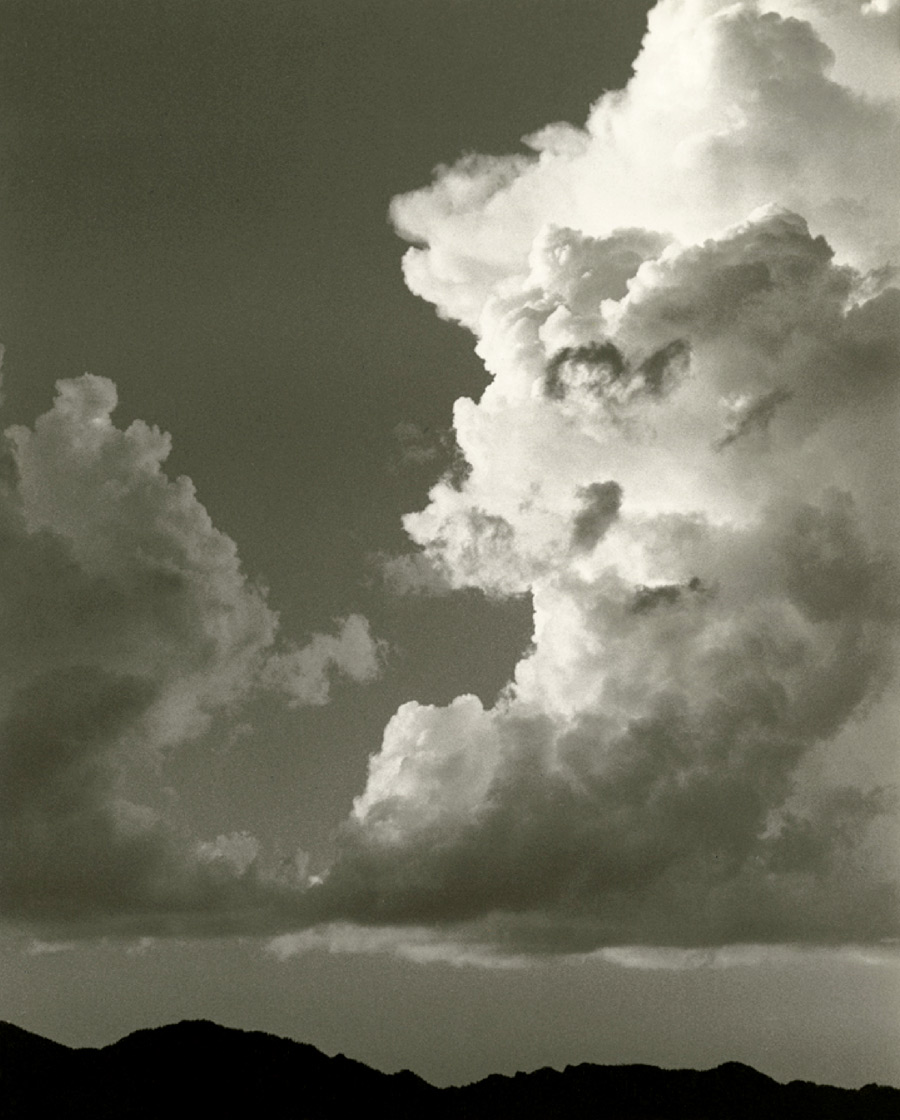
    Dorothea Lange. 'Sky and Clouds, Gunlock, Utah' 1953


    Dorothea Lange (American, 1895-1965)
    Sky and Clouds, Gunlock, Utah
    1953
    Silver gelatin photograph
    Brigham Young University Museum of Art, purchased with funds provided by Jack and Mary Lois Wheatley


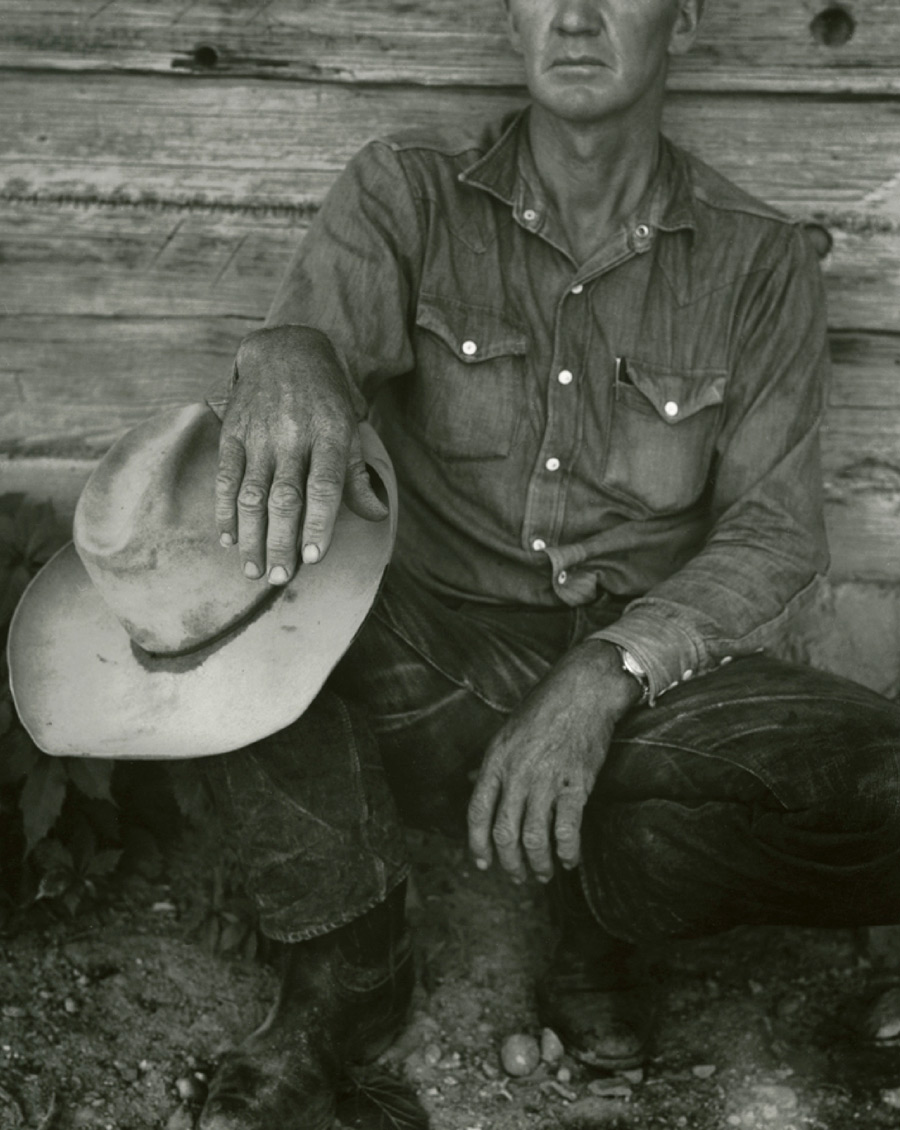
    Dorothea Lange. 'Jake Jones’ Hands, Gunlock, Utah' 1953


    Dorothea Lange (American, 1895-1965)
    Jake Jones’ Hands, Gunlock, Utah
    1953
    Silver gelatin photograph
    Brigham Young University Museum of Art, purchased with funds provided by Jack and Mary Lois Wheatley


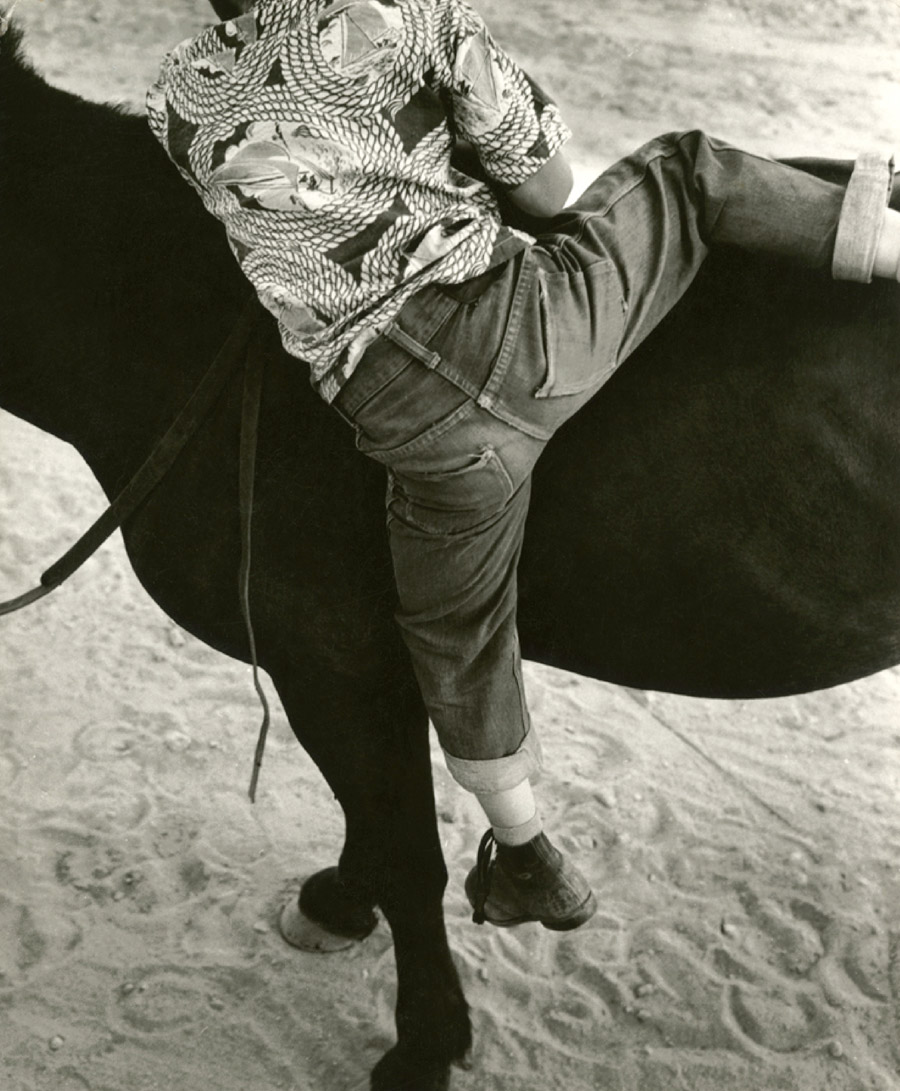
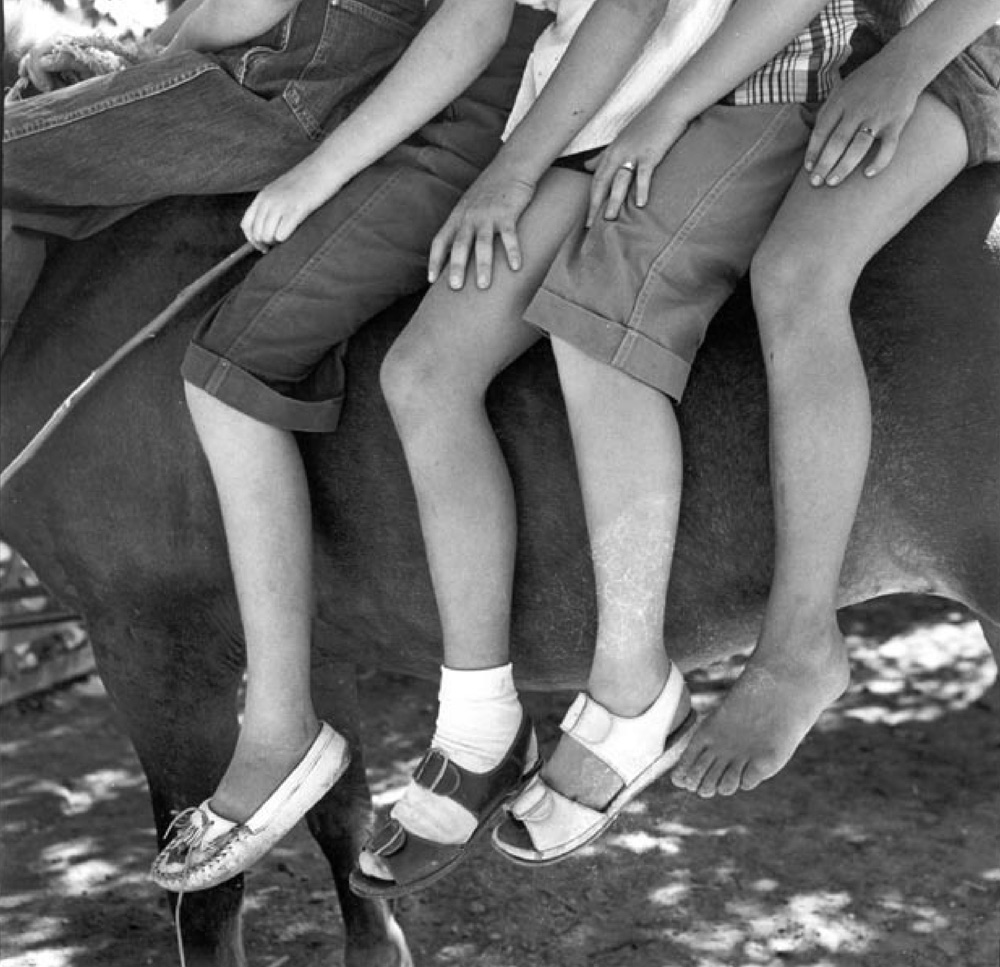
    Dorothea Lange. 'Horseplay, Gunlock, Utah' 1953


    Dorothea Lange (American, 1895-1965)
    Horseplay, Gunlock, Utah
    1953
    Silver gelatin photograph
    Brigham Young University Museum of Art, purchased with funds provided by Jack and Mary Lois Wheatley


    Dorothea Lange. 'Four Young Riders in Summer' 1953


    Dorothea Lange (American, 1895-1965)
    Four Young Riders in Summer
    1953
    Silver gelatin photograph
    Museum of Contemporary Photography, Columbia College Chicago


    St. George, Utah

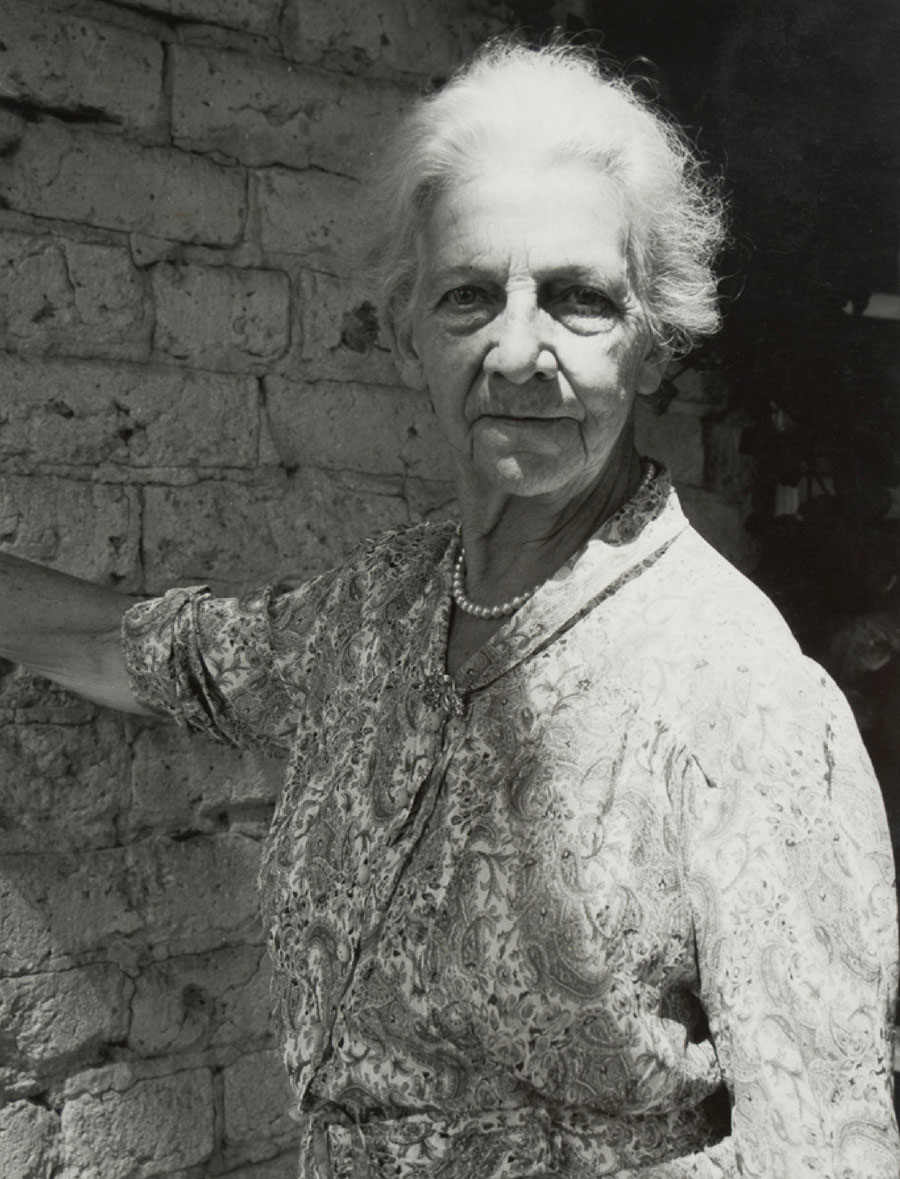
    Dorothea Lange. 'Anne Carter Johnson, St. George, Utah' 1953


    Dorothea Lange (American, 1895-1965)
    Anne Carter Johnson, St. George, Utah
    1953
    Silver gelatin photograph
    Brigham Young University Museum of Art, purchased with funds provided by Jack and Mary Lois Wheatley


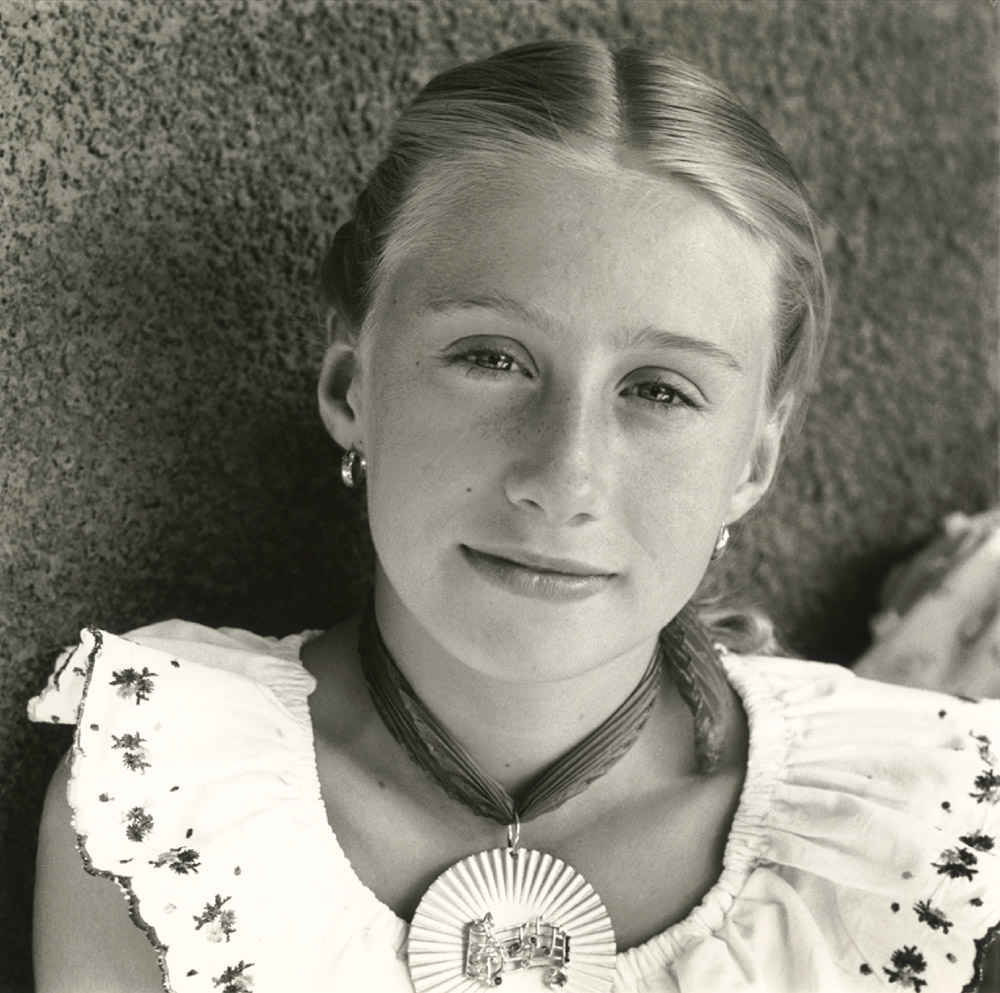
    Dorothea Lange. 'Young Woman, St. George, Utah' 1953


    Dorothea Lange (American, 1895-1965)
    Young Woman, St. George, Utah
    1953
    Silver gelatin photograph
    Brigham Young University Museum of Art, purchased with funds provided by Jack and Mary Lois Wheatley


    Brigham Young University Museum of Art
    North Campus Drive, Provo, UT 84602-1400

    Opening hours:
    Monday – Thursday: 10am – 6pm
    Friday: 10am – 9pm
    Saturday: 10am – 4pm
    Sunday: Closed

    Brigham Young University Museum of Art website

    LIKE ART BLART ON FACEBOOK

    Back to top

    Exhibition: ‘An Edwardian Summer: Sydney & beyond through the lens of Arthur Wigram Allen’ at the Museum of Sydney

    Exhibition dates: 11th December, 2010 – 25th April, 2011


    Many thankx to the Museum of Sydney for allowing me to publish the photographs in the posting. Please click on the photographs for a larger version of the image. All images © Arthur Wigram Allan, courtesy Mitchell Library, State Library of NSW.

    More photographs can be found on the An Edwardian Summer website.


    Arthur Wigram Allen (Australian, 1894-1967) 'We left Medlow at 10.15 am & drove through Blackheath & Mt Victoria to Bathurst' Nd


    Arthur Wigram Allen (Australian, 1894-1967)
    We left Medlow at 10.15 am & drove through Blackheath & Mt Victoria to Bathurst
    Nd
    Mitchell Library, State Library of New South Wales


    Arthur Wigram Allen (Australian, 1894-1967) 'AWA & Boyce at lunch' Nd


    Arthur Wigram Allen (Australian, 1894-1967)
    AWA & Boyce at lunch
    Nd
    Mitchell Library, State Library of New South Wales


    Arthur Wigram Allen (Australian, 1894-1967) 'Kitty and Katha working at the drawn work' Nd


    Arthur Wigram Allen (Australian, 1894-1967)
    Kitty and Katha working at the drawn work
    Nd
    Mitchell Library, State Library of New South Wales


    Family and friends

    Arthur Allen spent many hours recording his home life and outings with family and friends. The Allens’ circle comprised a large extended family and a close-knit group of friends, who came and went as they liked and were always welcome at the various Allen households. They often stayed at the Allens’ properties on the coast and in country New South Wales, as did visiting celebrities, particularly those from the theatre.

    While the social and legal status of Australian women improved toward the end of the 19th century, the Allen girls, their cousins and a small group of friends were still taught by governesses. This in turn helped to foster close ties between the members of their social class.

    Sydney society among the wealthy classes was like a big, familiar club of relatives and friends, with a continual round of visiting, parties and picnics that also included, for example, visiting naval officers. There were also lively, large-scale social events organised to coincide with special occasions, such as the visit of the Duke of York in 1901, and charity fundraisers for causes in Australia and abroad, including annual Red Cross charity balls and local functions to support soldiers serving in the war.

    Arthur Allen owned many cars but drove only one type – Detroit Electric broughams, one of which is now in the Powerhouse Museum, Sydney. Its batteries needed charging every 60 kilometres, but the recharging device was formidable.

    Text from the An Edwardian Summer website [Online] Cited 11/01/2020


    Arthur Wigram Allen (Australian, 1894-1967) 'Wedding Group at 'Merioola', Saturday 23rd December 1911. Wedding Group consisting of Lieutenant Knowles (best man), Joyce Pat and Kitty, Alex Leeper's two daughters Valentine and Molly [Kitty's half-sisters]' December 1911


    Arthur Wigram Allen (Australian, 1894-1967)
    Wedding Group at ‘Merioola’, Saturday 23rd December 1911. Wedding Group consisting of Lieutenant Knowles (best man), Joyce Pat and Kitty, Alex Leeper’s two daughters Valentine and Molly [Kitty’s half-sisters]
    December 1911
    PX*D596 Negative 240
    Mitchell Library, State Library of New South Wales


    Arthur Wigram Allen (Australian, 1894-1967) '11 November 1917 Mrs Frank Osborne and Miss Catterall wait in the back of one of Arthur Allens Detroit Electric broughams' 1917


    Arthur Wigram Allen (Australian, 1894-1967)
    11 November 1917 Mrs Frank Osborne and Miss Catterall wait in the back of one of Arthur Allens Detroit Electric broughams
    1917
    Mitchell Library, State Library of New South Wales


    An Edwardian Summer, a new book and an exhibition opening 11th December 2010 at the Museum of Sydney showcases for the first time an extraordinary collection of photographs that capture Sydney at the turn of the century at one of the most rapidly changing times in Australia’s history.

    A talented amateur photographer, lawyer and Sydney identity Arthur Wigram Allen was fascinated by the social and technological changes that occurred during his lifetime, 1862-1941. Allen created 51 albums now held by the State Library of NSW.

    In 1885 after the sudden death of his father and uncle and at the age of just 23, Allen was thrust into the role of heading up the family law firm founded by his grandfather George Allen, known internationally today as Allens Arthur Robinson. While Allen’s photographs span 1890-1934, the book and exhibition concentrate on the Edwardian years, 1890s-1915, a brief often overlooked but important period in Australia’s history that heralded a new century of significant inventions and social changes, including powered flight, the rise of the motorcar and a new federated Australia.

    Through Allen’s lens, we see the first mixed bathing on Sydney beaches, sporting events, pageants and processions, dramatic shipwrecks, the latest fashions as well as intimate family events such as motoring and harbour excursions and bush picnics. Meticulously captioned by Allen, his exquisitely personal and beautiful photographs capture a time of optimism and new ideas as Sydney emerged from the strict moral codes of the Victorian era.

    Both the book and exhibition feature art works from the era by Australian artists including Arthur Streeton, Rupert Bunny, Grace Cossington Smith and Theodore Penleigh Boyd. The exhibition will also showcase items from the Historic Houses Trust collection and from the Powerhouse Museum, including examples of Edwardian fashion, children’s dress up costumes, jewellery and accessories and furniture.

    Text from the Sydney Museum website [Online] Cited 08/04/2011 no longer available online


     Sydney lawyer and identity Arthur Wigram Allen, a tirelessly enthusiastic photographer, was fascinated by the social and technological changes occurring during his lifetime. His talent for amateur photography produced extraordinary pictures that offer a fresh insight into the Edwardian years in Sydney.

    The Edwardian era was sandwiched between the great achievements of the Victorian age and the global catastrophe of World War I. The death of Queen Victoria in January 1901 heralded a new century of significant inventions and social changes, including powered flight, the rise of the motorcar and a new federated Australia.

    An Edwardian Summer will present a selection of Arthur Allen’s beautiful images, depicting intimate moments with family and friends, motoring and harbour excursions, theatrical celebrities, bush picnics, the introduction of surf bathing on Sydney beaches, processions, pageants and mass celebrations, and new freedoms in fashion. Most have never before been published, and they form an unrivalled personal pictorial record of these rapidly changing times.

    The exhibition will also include artworks by Rupert Bunny, Ethel Carrick Fox, Arthur Streeton and Grace Cossington Smith, examples of male and female fashion including evening and day wear, motoring ensembles and children’s dress-up costumes, jewellery and accessories, furniture and decorative embellishments characteristic of the Edwardian era.

    Text from the Sydney Museum website [Online] Cited 11/01/2020


    Installation view of the exhibition 'An Edwardian Summer: Sydney & beyond through the lens of Arthur Wigram Allen' at the Museum of Sydney, December 2010 - April 2011
    Installation view of the exhibition 'An Edwardian Summer: Sydney & beyond through the lens of Arthur Wigram Allen' at the Museum of Sydney, December 2010 - April 2011
    Installation view of the exhibition 'An Edwardian Summer: Sydney & beyond through the lens of Arthur Wigram Allen' at the Museum of Sydney, December 2010 - April 2011


    Installation views of the exhibition An Edwardian Summer: Sydney & beyond through the lens of Arthur Wigram Allen at the Museum of Sydney, December 2010 – April 2011


    Arthur Wigram Allen

    Sydney lawyer and identity Arthur Wigram Allen, a tirelessly enthusiastic photographer, was fascinated by the social and technological changes occurring during his lifetime. His talent for amateur photography produced extraordinary pictures that offer a fresh insight into the Edwardian years in Sydney.

    Arthur Wigram Allen was born in 1862 into a large family of wealthy Sydney solicitors. One of 11 children and third in a line of six boys he attended Sydney Grammar School before moving to Melbourne in 1880 to study law at Trinity College at the University of Melbourne. In 1885 after the sudden death of his two elder brothers Arthur assumed control of the familíes Sydney firm and many business interests.

    Allen married Ethel Lamb in 1891 and they went on to have four children: Ethel Joyce, born in 1893, Arthur Denis Wigram in 1894, Ellice Margaret in 1896 and Marcia Maria in 1905.

    Fascinated by the new inventions of the era, he became interested in photography, purchasing the latest cameras. He soon proved to be a talented amateur photographer, capturing images of his family and friends, the city and its surrounds.

    Arthur died in 1941, aged 79; his photographs, taken from the 1890s through to 1934, provide a detailed photographic record of a changing society and the emergence of the great city of Sydney.

    A man of extraordinary vitality, Allen was fascinated by the times in which he lived, and tried to photograph everything he saw: family and friends; visiting ships and theatrical celebrities; bush picnics; the first mixed bathing on Sydney beaches; dramatic shipwrecks; processions, pageants and mass celebrations; coal miners; domestic life and fashion; house interiors; and sporting events. These photographs, contained in 51 albums, are now held by the Mitchell Library, State Library of New South Wales, and provide a view of the dramatic changes that took place in Edwardian Sydney.

    Arthur Allen’s photographs span 1890 to 1934, but the Edwardian Summer exhibition and book concentrate on those depicting the Edwardian years, a brief, often-overlooked but important period in Australia’s history. The photographs, most of them never published before, form an unrivalled personal pictorial record of these rapidly changing times.

    Text from the An Edwardian Summer website [Online] Cited 11/01/2020


    Arthur Wigram Allen (Australian, 1894-1967) 'Self-portrait' August - October 1890


    Arthur Wigram Allen (Australian, 1894-1967)
    Self-portrait
    August – October 1890
    PX*D 562 negative 162​
    Mitchell Library, State Library of New South Wales


    Arthur Wigram Allen (or AWA as he often referred to himself) was a man of many interests and a talented amateur photographer, capturing images of family and friends, city and surrounds. He is seen here on the steps of Wantabadgery homestead, site of a famous siege in 1879 between police and the gang of bushranger Captain Moonlight.


    Arthur Wigram Allen (Australian, 1894-1967) 'Album 05: Photographs of the Allen family'
August 1890 - October 1890


    Arthur Wigram Allen (Australian, 1894-1967)
    Album 05: Photographs of the Allen family
    August 1890 – October 1890
    PX*D 562 FL576221 / FL576430
    Mitchell Library, State Library of New South Wales


    Arthur Wigram Allen (Australian, 1894-1967) 'Cecil Healy in the dinghy, 'Port Hacking', October 16 1904' 1904


    Arthur Wigram Allen (Australian, 1894-1967)
    Cecil Healy in the dinghy, ‘Port Hacking’, October 16 1904
    1904
    PX*D 575 negative 858
    Mitchell Library, State Library of New South Wales


    Cecil Healy (1881-1918) found fame as the captain of Manly Surf Club and a champion swimmer; he won gold and silver medals in the 1912 Stockholm Olympics.

    Cecil Patrick Healy (28 November 1881 – 29 August 1918) was an Australian freestyle swimmer of the 1900s and 1910s, who won silver in the 100 m freestyle at the 1912 Summer Olympics in Stockholm. He also won gold in the 4 × 200 m freestyle relay. He was killed in the First World War at the Somme during an attack on a German trench. Healy was the second swimmer behind Frederick Lane to represent Australia in Swimming and has been allocated the number “2” by Swimming Australia on a list of all Australians who have represented Australia at an Open International Level.

    Text from the Wikipedia website


    Arthur Wigram Allen (Australian, 1894-1967) '[Roller skating on the verandah at Moombara]' Nd


    Arthur Wigram Allen (Australian, 1894-1967)
    [Roller skating on the verandah at Moombara]
    Nd
    PX*D575 negative 836
    Mitchell Library, State Library of New South Wales


    Roller skating on the verandah at Moombara, September 24, 1904. “Ethel and I and the children came down this afternoon for the Michaelmas holidays bringing Janet & Bob Rabete also. Immediately on arrival Joyce, Denis & Bob began to skate on the verandah and they used Janet & Margaret as horses to pull them along. Margaret also had some splendid rides on her tricycle”

    Perhaps the greatest joy for the Allen children was the family’s waterfront holiday house, Moombara, where they played, swam, rode horses and roller skated around the verandah. Roller skating was a popular pastime of the era, with numerous rinks being built from the inner city to the beaches in the late 1880s. The Sydney Skating Club was formed in 1906 and skating displays were a common form of entertainment.

    Text from the An Edwardian Summer website


    Childhood

    The four Allen children had a happy home life. Their somewhat reserved Victorian mother was balanced by their gregarious father, and as in many affluent families of the era they had numerous domestic helpers, including a nurse, Florence, who remained with the family until the children were almost grown.

    The family enjoyed many excursions to local Sydney attractions as well as seaside visits, picnics and journeys further afield, including to their beach property at Port Hacking. The children celebrated birthdays with elaborate parties and were dressed in the latest fashions, which were still very much influenced by Britain. Little girls had to contend with layers of petticoats, profuse frills and, during the 1890s and 1900s, increasingly wide-brimmed hats; and neither boys nor girls could be seen in public without hats, gloves, coats and shoes.

    Public education in New South Wales, established in the 1860s, also grew steadily towards the century’s end. The three Allen girls, however, like many children from wealthier families, were tutored at home by a governess. The only boy, Denis, attended a private boarding school and was then sent to England to complete his schooling.

    Text from the An Edwardian Summer website


    Arthur Wigram Allen (Australian, 1894-1967) 'This afternoon Marcia Lamb [centre] and I took Lord Orford and Lady Dorothy Walpole [right], also Nell Knox [left] for a drive to South Head, Bondi and Coogee' February 22, 1911


    Arthur Wigram Allen (Australian, 1894-1967)
    This afternoon Marcia Lamb [centre] and I took Lord Orford and Lady Dorothy Walpole [right], also Nell Knox [left] for a drive to South Head, Bondi and Coogee
    February 22, 1911
    PX*D594 negative 4188
    Mitchell Library, State Library of New South Wales


    Brief stop on a drive to South Head, Bondi and Coogee, February 22, 1911. As Sydneysiders embraced the outdoors, they began picnicking at every opportunity, flocking to local beauty spots or favourite retreats such as Coogee Beach. Although the beach was thronged with bathers and spectators, Coogee’s headland provided a quieter spot for picnicking and, for Arthur Allen, taking photographs. Seen here is his camera equipment, including the box of his Guardia and Newman camera that took 5 x 4 inch (13 x 10 cm) photographic plates. The women are wearing elaborate motoring hats with scarves, which were also useful for securing their hats on a windy cliff to prevent their hair from blowing out of style.

    Text from the An Edwardian Summer website


    The beach

    The pleasures of sea-bathing had been discouraged in colonial Sydney on the grounds of both risk and indecency, and early laws prohibited bathing during daylight hours. People gradually defied the daylight bathing laws and by 1900 there were reports in the press of whole families bathing. In 1902, a male swimmer at Manly Beach entered the water at midday. Although arrested, he was not charged, and by 1903 new laws were introduced that permitted surf bathing but required neck-to-knee outfits and prohibited the sexes to mingle. Mixed bathing soon followed, but swimming attire continued to be stringently regulated for some years to come.

    Sydneysiders increasingly flocked to the coast to enjoy the cooling summer breezes and the glorious ocean views. The ‘pleasure palaces’ near many beaches provided popular entertainment for all ages. For picnics, families sought out Clark Island, quiet beaches around Middle Harbour or the popular Manly Beach.

    Bondi and Coogee beaches in Sydney’s east were connected to the city by public transport and provided the ideal day-trip for large crowds of visitors. With growing numbers of people taking to the surf, the dangers of beach bathing became apparent, and in 1906 the first surf lifesaving club in the world was founded at Bondi Beach.

    Text from the An Edwardian Summer website


    Arthur Wigram Allen (Australian, 1894-1967) 'Sea bathing: Coogee'
January 27, 1900


    Arthur Wigram Allen (Australian, 1894-1967)
    Sea bathing: Coogee
    January 27, 1900
    PX*D 582 negative 2563
    Mitchell Library, State Library of New South Wales


    The immense and immediate popularity of sea bathing: Coogee Beach on a summer’s day. The boy in the tie and straw boater contrasts with the enthusiastic swimming groups clad in simple black singlets and shorts or cut-down dresses. In truth, most are just paddling, as few had learnt to swim properly.


    Arthur Wigram Allen (Australian, 1894-1967) 'Wonderland city near Bondi' December 26, 1906


    Arthur Wigram Allen (Australian, 1894-1967)
    Wonderland city near Bondi
    December 26, 1906
    PX*D580 negative 2002
    Mitchell Library, State Library of New South Wales


    Wonderland city near Bondi (there were 26 000 people there today). Wonderland city, a large amusement park, the Royal Aquarium and Pleasure Grounds at Tamarama near Bondi, December 26, 1906. By 1901, Bondi Beach was already a fashionable tourist destination. A tramline had been built to the beach in 1894, and a large amusement park, the Royal Aquarium and Pleasure Grounds, had opened at nearby Tamarama in 1887. Wonderland City – promoted as ‘Sydney’s Great Playground’ – opened in December 1906, also at Tamarama. Described as the Coney Island of Australia, its 50 major attractions were ‘designed by artists in architecture and landscape gardening’, with ‘no expense spared in achieving the highest standard of excellence’.1 The wooded slopes featured pleasure palaces, brightly coloured sideshows, a switchback (roller-coaster), scenic railway, slippery dips and underground rivers.

    1/ Caroline Mackaness (ed.), An Edwardian Summer: Sydney and Beyond through the Lens of Arthur Wigram Allen, Historic Houses Trust, Sydney, 2010

    Text from the An Edwardian Summer website


    Arthur Wigram Allen (Australian, 1894-1967) 'Walter resting after lunch' November 19, 1898


    Arthur Wigram Allen (Australian, 1894-1967)
    Walter resting after lunch
    November 19, 1898
    PX*D566 negative 3649
    Mitchell Library, State Library of New South Wales

    Rex Walter and I went to day to Bulli mainly to see some land which had been offered to us to purchase but also to show Walter (Who had never been to Illawarra) the scenery. We lunched at the fig tree not far from the Pass Road at the Bulli “B” pit.


    Renowned for its beauty, the Illawarra district was home to towering forests of turpentine and fig trees and tangled, dense stands of ferns and cabbage palms, tinted by the conspicuous red flowers of the Illawarra flame tree. Arthur Allen, his brother Walter and brother-in-law Rex travelled in a horsedrawn wagonette to Bulli, a small coal-mining town in the northern Illawarra, via the steep Bulli Pass road, which was built in 1867. The journey down the Bulli Pass afforded many spectacular views of the south coast.

    Text from the An Edwardian Summer website


    The bush

    In the later 19th century, city dwellers’ attitudes to the Australian bush changed. Formerly a foreign wilderness, it now became a place of Arcadian bliss, offering something peculiarly Australian and very different from the more familiar urban landscapes.

    Nationalism increased in the 1890s, and with it the Australian bush legend was born. Artists such as Tom Roberts and Frederick McCubbin created nostalgic bush scenes, depicting rural life as a simplistic and uniquely Australian ideal. Writers such as Banjo Paterson and Henry Lawson fashioned similar impressions in poetry and prose, strengthening the link between the bush and the Australian national identity.

    By the early 1900s, the attributes of bush life were seen as an intrinsic part of the nation’s greatness. Bush characters were imbued with the same pioneering qualities as the diggers on the goldfields. By World War I these characteristics would be identified as uniquely Australian traits in our soldiers.

    Expanded road and railway networks in the second half of the 19th century opened the bush to city visitors. Roads were cut to link sights of interest, and clear tracks were carved into the bush to allow access to vantage points. Swathes of descriptive tourist guides promoted the state’s many health, holiday and tourist resorts.

    Text from the An Edwardian Summer website


    Arthur Wigram Allen (Australian, 1894-1967) 'Crossing a creek, Belmore Falls, south of Robertson, on the edge of the Illawarra escarpment' February 13, 1899


    Arthur Wigram Allen (Australian, 1894-1967)
    Crossing a creek, Belmore Falls, south of Robertson, on the edge of the Illawarra escarpment
    February 13, 1899
    PX*D567 negative 3822
    Mitchell Library, State Library of New South Wales


    The Belmore Falls, south of Robertson, are on the edge of the Illawarra escarpment at the headwaters of Barrengarry Creek. They cascade into the Barrengarry Creek Valley, with the main fall dropping a spectacular 78 metres. A road from Robertson was cut through the scrub in 1887, making the falls accessible to tourists, who had been arriving in increasing numbers since the Southern Highlands railway to Mittagong was opened in 1867. The picturesque scenery and cooler climate of the Southern Highlands had made the region a popular summer holiday retreat for well-to-do Sydneysiders. Guesthouses and country homes were built from the 1870s, encouraging the expansion of road networks to connect various sights of interest.

    Text from the An Edwardian Summer website


    Arthur Wigram Allen (Australian, 1894-1967) '"Lunch at the head of the river" Royal National Park. Frida, Herbert, Ethel, William Wate, Jack, Hilda' Nd


    Arthur Wigram Allen (Australian, 1894-1967)
    “Lunch at the head of the river” Royal National Park. Frida, Herbert, Ethel, William Wate, Jack, Hilda
    Nd
    PX*D566 negative 3656
    Mitchell Library, State Library of NSW, November 26, 1898


    In 1879, an area 32 kilometres south of Sydney was dedicated as Australia’s first national park. It could be reached by road or rail, and swiftly became ‘a national pleasure ground’1 and a popular destination for Sydneysiders on a day-trip. Picnic sites were fashioned throughout the park, rustic bridges and furniture decorated the landscape and imported flora and fauna enhanced the native scenery. By 1886 a boatshed and jetties had been established, enabling visitors to hire boats and explore the park via its waterways. Parties of ladies and gentlemen favoured the freshwater river above the dam, rowing to suitable locations for a relatively informal picnic on the rocky banks by the water.

    Text from the An Edwardian Summer website


    Arthur Wigram Allen (Australian, 1894-1967) 'One of the new boilers just installed at the mine' November 22, 1907


    Arthur Wigram Allen (Australian, 1894-1967)
    One of the new boilers just installed at the mine
    November 22, 1907
    PX*D581 negative 2403
    Mitchell Library, State Library of New South Wales


    One of the new boilers just installed at the mine. November 22, 1907.

    Mt Kembla was one of a series of towns established in the Illawarra region in the mid 19th century after coal mining began at nearby Mt Keira in 1848. The first coal export from the Illawarra left Wollongong harbour in 1849 destined for Sydney. Coal was mined at Mt Kembla from 1865, and in 1880 the Mount Kembla Coal and Oil Company was formed, building a loading wharf at Port Kembla in 1883 and installing a rail link from Mount Kembla to Port Kembla in 1886. By 1900, the Illawarra mines employed 2300 men. In 1902 a disastrous gas explosion, caused by the naked flames of the miners’ torches, killed 94 men.

    Text from the An Edwardian Summer website


    Further afield

    During the Edwardian era, touring became immensely popular. With the introduction of better working conditions and shorter working hours many people had more leisure time, and took every opportunity to enjoy it. Even before the arrival of the motorcar, a growing love of the outdoors led the people of Sydney to flock to beauty spots in the Blue Mountains and Southern Highlands. Rural and waterside retreats around Sydney were as popular then as they are now, and the Allen family and their friends spent many weekends and vacations at their holiday houses at Port Hacking and Burradoo in the Southern Highlands.

    To escape the hectic and at times unhealthy city, Sydneysiders sought the more relaxed lifestyle offered in rural locations. People began to enjoy the physical pleasures of life outdoors and the benefits of sun and clean air, and this was reflected in the way they behaved and dressed away from the confines of the city.

    People who lacked their own transport could still enjoy tourism via the ever-expanding railway network. For those with private carriages and later motorcars, the ability to travel was only limited by the condition of the roads. The coming of the motorcar changed both the physical development of Sydney and the way people spent their leisure time, as they toured ever further.

    Text from the An Edwardian Summer website


    Arthur Wigram Allen (Australian, 1894-1967) 'Florence and the children on the lawn at Moombara'
July 1903


    Arthur Wigram Allen (Australian, 1894-1967)
    Florence and the children on the lawn at Moombara
    July 1903
    PX*D 572 negative 6
    Mitchell Library, State Library of New South Wales


    One of the most important people in the lives of the Allen children was their nurse, Florence, who remained with the family until the children were almost grown. She is shown here relaxing with her charges on the lawn at Moombara, the family holiday home that Arthur Allen purchased in 1903. Located between the unspoilt landscape of the Royal National Park and the beaches of Cronulla, it was built on a steep slope with a magnificent view over the river and pristine bushland. Soon after Allen bought the property, a second storey was added to accommodate the family and their many visitors. It was a popular place for family and friends to spend their honeymoon, and came to be nicknamed ‘Honeymoombara’.

    Text from the An Edwardian Summer website


    Arthur Wigram Allen (Australian, 1894-1967) ''Moombaha'. 5.45 pm on the wharf, Jacob having just caught a large conger eel, Little Turriell Bay at Port Hacking' December 7, 1904


    Arthur Wigram Allen (Australian, 1894-1967)
    ‘Moombaha’. 5.45 pm on the wharf, Jacob having just caught a large conger eel, Little Turriell Bay at Port Hacking
    December 7, 1904
    PX*D 575 negative 921
    Mitchell Library, State Library of New South Wales


    Moombara was located on Little Turriell Bay at Port Hacking. In 1901-02 nearly a third of a million tonnes of sand had been removed from the Simpsons Bay area of the estuary to create access to a fish hatchery in Cabbage Tree Basin. This helped to make the area more navigable for boating and better for fishing, both pastimes that the Allens and their friends enjoyed. With increasing numbers of residential subdivisions, the area’s waterways became popular for recreational use.

    Text from the An Edwardian Summer website


    Arthur Wigram Allen (Australian, 1894-1967) 'Joyce preparing to dive 15 January 1905' 1905


    Arthur Wigram Allen (Australian, 1894-1967)
    Joyce preparing to dive 15 January 1905
    1905
    Mitchell Library, State Library of New South Wales


    Out and about

    Edwardian Sydney offered entertainment for every taste. Apart from the large-scale parades, military displays and massed bands that accompanied public celebrations, annual events such as the Royal Easter Show and the Public Schools’ Amateur Athletics Association carnival drew crowds from all walks of life. Expanding tram and rail networks carried passengers to venues such as the Zoo (then at Moore Park), Sydney Stadium at Rushcutters Bay and the Glaciarium Skating Rink, which operated at Ultimo from 1907.

    Among the more popular leisure activities was horse racing, with racecourses as far afield as Randwick, Canterbury, Moorefield and Warwick Farm. The annual amateur picnic race held at Bong Bong, near Moss Vale, was as popular with Sydneysiders as with locals.

    The growth in international sporting competition also provided spectacles for large crowds. Due to Australia’s success in rowing, the world championship sculling contest was regularly held on the Parramatta River, while in 1909 the Davis Cup tennis tournament came to Rose Bay. Cricket, cycling, athletics and football were also popular, with the Sydney Cricket Ground a versatile venue.

    Text from the An Edwardian Summer website


    Arthur Wigram Allen (Australian, 1894-1967) 'Ladies double championship rowing race held on the Parramatta River between Abbotsford and Mortlake' Saturday 4 August 1906


    Arthur Wigram Allen (Australian, 1894-1967)
    Ladies double championship rowing race held on the Parramatta River between Abbotsford and Mortlake
    Saturday 4 August 1906
    PX*D 579 negative 1817
    Mitchell Library, State Library of New South Wales


    On Saturday 4 August 1906, eager onlookers crowded the banks of the Parramatta River and hundreds of launches, boats and steamers plied the water in anticipation of the veteran scullers’ handicap and the ladies’ double sculling championship, contested by a field of ten crews. One week earlier, Stanbury and Towns had competed for stakes of £500 each plus a lucrative share of the steamer takings, but on this day the ladies rowed for a more modest £20. On the 1.5-mile (2.4-km) course between Abbotsford and Mortlake, the Newcastle team of Mrs Hyde and Mrs Woodbridge narrowly beat Misses G and K Lewis of North Sydney for first place.


    Arthur Wigram Allen (Australian, 1894-1967) 'Joyce and Denis at the ostrich farm' 15 November 1903


    Arthur Wigram Allen (Australian, 1894-1967)
    Joyce and Denis at the ostrich farm
    15 November 1903
    PX*D 573 negative 580
    Mitchell Library, State Library of New South Wales


    Children hold baby Emus at Ostrich Farm at South Head, 15 November 1903. Joseph Barracluff’s Ostrich Farm at South Head was established in 1889, when ostrich feathers were a popular women’s fashion accessory for boas, hats and fans. Arriving in Australia from Lincolnshire in 1884, Barracluff originally established a small business selling feathers from a shop on Elizabeth Street, before setting up the farm with birds reportedly imported from South Africa and Morocco. A trip to Barracluff’s farm soon became a popular excursion, and patrons could select feathers to be cut directly from a flock of 100 birds. In 1901, as a memento of her visit, the women of Sydney presented the Duchess of Cornwall and York with a gold mirror and fan embellished with tortoiseshell and Barracluff’s feathers, grown and curled on site.


    Arthur Wigram Allen (Australian, 1894-1967) 'The 'Electra' … T. H. Kelly, Denis, Miss Kelly, Joyce, W. Kelly. The children's first experience of yachting Arthur Allen. The children's first experience of yachting' 14 April 1901


    Arthur Wigram Allen  (Australian, 1894-1967)
    The ‘Electra’ … T. H. Kelly, Denis, Miss Kelly, Joyce, W. Kelly. The children’s first experience of yachting Arthur Allen. The children’s first experience of yachting
    14 April 1901
    PX*D 571 negative 95
    Mitchell Library, State Library of New South Wales


    Yachting built up a strong following among the wealthy during the Edwardian years, with boats from the Royal Sydney Yacht Squadron regularly competing in organised races on the harbour. Joining Arthur Allen and his two elder children, Joyce and Denis, in this photo are members of the Kelly family: Thomas, William and their sister. Thomas Kelly was managing director of the family firm, the Sydney Smelting Company, and chairman of the Australian Alum Company; his brother William was a politician. Both brothers were considered dashing young men about town. The Kellys were keen yachtsmen and closely involved with Royal Sydney Yacht Squadron, founded in 1863.


    A day on the harbour

    Sydney’s waterways were the focus of both industry and pleasure in the Edwardian era. From its colonial foundations Sydney Cove had developed as the hub of a trading port and working harbour with a strong shipbuilding industry and other maritime trades.

    During the Edwardian years, full-rigged ships gradually disappeared from Sydney Harbour, and after the bubonic plague arrived in 1900, large areas of residential and commercial buildings around Darling Harbour, Millers Point and The Rocks were resumed by the government and rebuilt.

    By the early 1900s Circular Quay was dominated by ferry wharves and served as an interchange for all the traffic – pedestrian and vehicular – between Sydney and the north shore. This was the heyday of the harbour ferry, with commuter craft dominating the waters during peak hour. On weekends, the ‘great picnic trade’ ferried Sydney’s multitudes to the harbour’s pleasure destinations, many of which were owned and operated by the ferry companies.

    Other Sydneysiders preferred to spend a day on the water, enjoying a leisurely steamer excursion, messing about in a small boat or sailing a yacht. Sporting events provided a further form of entertainment, with annual yachting and rowing regattas held on the harbour.


    Arthur Wigram Allen (Australian, 1894-1967) 'Another who is not quite so sure' Nd


    Arthur Wigram Allen (Australian, 1894-1967)
    Another who is not quite so sure
    Nd
    Mitchell Library, State Library of New South Wales


    Arthur Wigram Allen (Australian, 1894-1967) 'The 'Euryalus' in dock' 17 August 1905


    Arthur Wigram Allen (Australian, 1894-1967)
    The ‘Euryalus’ in dock
    17 August 1905
    PX*D 577 negatives 1279
    Mitchell Library, State Library of New South Wales


    HMS Euryalus was the flagship of the Australian station of the Royal Navy between 1904 and 1905. The 144-metre armoured cruiser was built in England in 1901, and Arthur Allen photographed it in August 1905, while it was being overhauled in the Sutherland Dock at Cockatoo Island.[1] Soon afterwards the Euryalus was replaced by HMS Powerful, and in 1920 it was broken up in Germany. On its completion in 1890, the Sutherland Dock was the world’s largest dry dock. The island’s smaller Fitzroy Dock had been built by convicts between 1839 and 1847. Cockatoo Island became the Commonwealth Naval Dockyard in 1913 and shipbuilding continued there until the dockyard closed in 1991.


    Museum of Sydney
    cnr Bridge & Phillip Streets, Sydney

    Opening hours:
    Open daily 10am – 5pm

    Sydney Living Museums website

    An Edwardian Summer website

    LIKE ART BLART ON FACEBOOK

    Back to top

    Exhibition: ‘Stieglitz, Steichen, Strand’ at The Metropolitan Museum of Art, New York

    Exhibition dates: 10th November 2010 – 10th April 2011


    Many thankx to the The Metropolitan Museum of Art for allowing me to publish the photographs in the posting. Please click on the photograph for a larger version of the image.


    Alfred Stieglitz (American, 1864-1946) 'The Terminal' 1893


    Alfred Stieglitz (American, 1864-1946)
    The Terminal
    1893, printed 1920s-30s
    Gelatin silver print
    8.9 x 11.5cm (3 1/2 x 4 1/2 in.)
    The Metropolitan Museum of Art
    Alfred Stieglitz Collection, 1949


    As proprietor of the Little Galleries of the Photo-Secession and publisher of the photographic journals Camera Notes and later Camera Work, Stieglitz was a major force in the promotion and elevation of photography as a fine art in America in the late nineteenth and early twentieth centuries. His own photographs had an equally revolutionary impact on the advancement of the medium.

    Stieglitz took this picture using a small 4 x 5″ camera, an instrument not considered at the time to be worthy of artistic photography. Unlike the unwieldy 8 x 10″ view camera (which required a tripod), this camera gave Stieglitz greater freedom and mobility to roam the city and respond quickly to the everchanging street life around him. The Terminal predicts by over a decade the radical transformation of the medium from painterly prints of rarified subjects to what the critic Sadakichi Hartmann dubbed “straight photography.” This new photography would take as its subject matter the quotidian aspects of modern, urban life, using only techniques that are unique to the medium.

    Text from The Metropolitan Museum of Art website


    Edward Steichen (American, born Luxembourg, 1879-1973) 'The Little Round Mirror' 1901, printed 1905


    Edward Steichen (American born Luxembourg, 1879-1973)
    The Little Round Mirror
    1901, printed 1905
    Gum bichromate over platinum print
    48.3 x 33.2cm (19 x 13 1/16 in.)
    The Metropolitan Museum of Art
    Alfred Stieglitz Collection, 1933


    Alfred Stieglitz (American, 1864-1946) 'The Hand of Man' 1902


    Alfred Stieglitz (American, 1864-1946)
    The Hand of Man
    1902, printed 1910
    Photogravure
    24.2 x 31.9cm (9 1/2 x 12 9/16 in.)
    The Metropolitan Museum of Art
    Alfred Stieglitz Collection, 1949


    The Hand of Man was first published in January 1903 in the inaugural issue of Camera Work. With this image of a lone locomotive chugging through the train yards of Long Island City, Stieglitz showed that a gritty urban landscape could have an atmospheric beauty and a symbolic value as potent as those of an unspoiled natural landscape. The title alludes to this modern transformation of the landscape and also perhaps to photography itself as a mechanical process. Stieglitz believed that a mechanical instrument such as the camera could be transformed into a tool for creating art when guided by the hand and sensibility of an artist.

    Text from The Metropolitan Museum of Art website


    Edward Steichen (American, born Luxembourg, 1879-1973) 'The Flatiron' 1904


    Edward Steichen (American born Luxembourg, 1879-1973)
    The Flatiron
    1904
    Gum bichromate over platinum print
    47.8 x 38.4cm (18 13/16 x 15 1/8 in.)
    The Metropolitan Museum of Art
    Alfred Stieglitz Collection, 1933


    Edward Steichen (American, born Luxembourg, 1879-1973) 'Alfred Stieglitz' 1907


    Edward Steichen (American born Luxembourg, 1879-1973)
    Alfred Stieglitz
    1907
    Autochrome
    23.9 x 18cm
    The Metropolitan Museum of Art
    Alfred Stieglitz Collection, 1955


    For the first time in more than 25 years, The Metropolitan Museum of Art will display five of its original Autochromes by Edward Steichen and Alfred Stieglitz for one week only – January 25-30, 2011 – as part of the current exhibition Stieglitz, Steichen, Strand. Invented by Auguste and Louis Lumière in 1907, Autochromes are one-of-a-kind color transparencies that are seductively beautiful when backlit.

    The invention of the Autochrome was a milestone in the history of photography. It was the first commercially available means of making color photographs. Steichen was enthralled by the process and recommended it to his fellow photographers. Praising the luminosity of the new medium, he wrote, “One must go to stained glass for such color resonance, as the palette and canvas are a dull and lifeless medium in comparison.” Among the five Autochromes exhibited are Steichen’s portrait of Rodin in front of his sculpture The Eve and his widely reproduced portrait of Stieglitz holding an issue of his influential publication, Camera Work.

    These fragile photographs – composed of minute grains of potato starch dyed red, blue, and green – cannot withstand the exposure of long-term display without suffering irreversible damage. Because of the high risk of the color fading, the Metropolitan – like most museums – has had a policy of not exhibiting its important collection of Autochromes. The Metropolitan recently completed a three-year study of the stability and light-sensitivity of Autochrome dyes, conducted by Luisa Casella, the Museum’s first Mellon Research Scholar in Photo Conservation, in close collaboration with Masahiko Tsukada of the Museum’s Department of Scientific Research, and supervised by Nora Kennedy, Sherman Fairchild Conservator of Photographs at the Metropolitan Museum. The study established that the Autochrome dyes are partially, though not completely, protected from light fading when in an environment where all oxygen has been removed.

    Guided by this research, the Museum will display five original Autochromes by Steichen and Stieglitz within individual oxygen-free enclosures and under carefully controlled lighting conditions from January 25 to 30 in the exhibition Stieglitz, Steichen, Strand. During the other weeks of the exhibition, facsimiles of the photographs are displayed in their place.

    Text from The Metropolitan Museum of Art website


    Edward J. Steichen (American born Luxembourg, 1879-1973) 'Balzac, The Open Sky - 11 P.M.' 1908


    Edward J. Steichen (American born Luxembourg, 1879-1973)
    Balzac, The Open Sky – 11 P.M.
    1908, printed 1909
    Direct carbon print
    48.7 x 38.5cm (19 3/16 x 15 3/16 in.)
    The Metropolitan Museum of Art
    Alfred Stieglitz Collection, 1933


    In late summer 1908 Rodin moved the plaster of his sculpture of the French writer Honoré de Balzac out of his studio and into the open air so that Steichen, who disliked its chalky aspect in the daylight, could photograph it by the moon. Waiting through several exposures as long as an hour each, Steichen made this exposure at 11 p.m., when the moonlight transformed the plaster into a monumental phantom rising above the brooding nocturnal landscape. Steichen recalled that when he presented his finished prints some weeks later, an elated Rodin exclaimed: “You will make the world understand my Balzac through your pictures. They are like Christ walking on the desert.”

    Text from The Metropolitan Museum of Art website


    Stieglitz, Steichen, Strand

    Go behind the lens with Sarah Greenough and Joel Smith as they speak about the relationships between three giants of early twentieth-century photography – Alfred Stieglitz, Edward Steichen, and Paul Strand – whose diverse and groundbreaking works are among the Metropolitan’s greatest photographic treasures. Followed by a discussion among the participants. Malcolm Daniel, Curator in Charge, Department of Photographs, MMA, introduces the program.

    “Steichen, Stieglitz, and the Art of Change”
    Joel Smith, Curator of Photography, Princeton University Art Museum

    “Stieglitz and Strand: Mentor and Protégé/Friend and Rival”
    Sarah Greenough, Senior Curator of Photographs, National Gallery
    of Art, Washington.


    Stieglitz and the New York Art Scene (1905-46)

    Lisa M. Messinger, associate curator, Department of Nineteenth-Century, Modern, and Contemporary Art, The Metropolitan Museum of Art


    Three giants of 20th-century American photography – Alfred Stieglitz, Edward Steichen, and Paul Strand – are featured at The Metropolitan Museum of Art, New York, through April 10, 2011, in the exhibition Stieglitz, Steichen, Strand. The diverse and groundbreaking work of these artists will be revealed through a presentation of 115 photographs, drawn entirely from the Museum’s collection. On view will be many of the Metropolitan’s greatest photographic treasures from the 1900s to 1920s, including Stieglitz’s famous portraits of Georgia O’Keeffe, Steichen’s large coloured photographs of the Flatiron building, and Strand’s pioneering abstractions.

    Alfred Stieglitz (1864-1946) was a photographer of supreme accomplishment and a forceful and influential advocate for photography and modern art through his gallery “291” and his sumptuous journal Camera Work. Stieglitz also laid the foundation for the Museum’s collection of photographs. In 1928, he donated 22 of his own works to the Metropolitan; these were the first photographs to enter the Museum’s collection as works of art. In later decades he gave the Museum more than 600 photographs by his contemporaries, including Edward Steichen and Paul Strand.

    Among Stieglitz’s works to be featured in this exhibition are portraits, views of New York City from the beginning and end of his career, and the 1920s cloud studies he titled Equivalents, through which he sought to arouse in the viewer the emotional equivalent of his own state of mind at the time he made the photograph, and to show that the content of a photograph was different from its subject.

    The exhibition will also include numerous photographs from Stieglitz’s extraordinary composite portrait of Georgia O’Keeffe (1887-1986), part of a group of works selected for the Museum’s collection by O’Keeffe herself. Stieglitz made more than 330 images of O’Keeffe between 1917 and 1937 – of her face, torso, hands, or feet alone, clothed and nude, intimate and heroic, introspective and assertive. Through these photographs Stieglitz revealed O’Keeffe’s strengths and vulnerabilities, and almost single-handedly defined her public persona for generations to come.

    Stieglitz’s protégé and gallery collaborator, Edward Steichen (1879-1973), was the most talented exemplar of the Photo-Secession, the loosely-knit group of artists founded by Stieglitz in 1902, seceding, in his words, “from the accepted idea of what constitutes a photograph,” but also from the camera clubs and other institutions dominated by a more retrograde establishment. In works such as The Pond – Moonrise (1904), made using a painstaking technique of multiple printing, Steichen rivalled the scale, colour, and individuality of painting.

    Steichen’s three large variant prints of The Flatiron (1904) are prime examples of the conscious effort of Photo-Secession photographers to assert the artistic potential of their medium. Steichen achieved coloristic effects reminiscent of Whistler’s Nocturne paintings by brushing layers of pigment suspended in light-sensitive gum solution onto a platinum photograph. Although he used only one negative to create all three photographs, the variable colouring enabled him to create three significantly different images that convey the chromatic progression of twilight. The Metropolitan’s three prints, all donated by Stieglitz in 1933, are the only exhibition prints of Steichen’s iconic image.

    In 1908 Steichen photographed the plaster of Rodin’s sculpture of Honoré de Balzac in the open air, by the light of the moon, making several exposures as long as an hour each. In Balzac, The Silhouette – 4 A.M., the moonlight has transformed the plaster into a monumental phantom rising above the brooding nocturnal landscape. Steichen recalled that when he presented his finished prints to Rodin, the elated sculptor exclaimed, “You will make the world understand my Balzac through your pictures.”

    Among the unique early-20th-century works by Stieglitz and Steichen in the Museum’s collection are Autochromes, an early process of colour photography that became commercially available in 1907. Because of the delicate and light-sensitive nature of these glass transparencies, five original Autochromes by Stieglitz and Steichen will be displayed for one week only, January 25-30, 2011. During the other weeks of the exhibition, facsimiles of these Autochromes will be on view.

    Stieglitz’s and Steichen’s younger contemporary, Paul Strand (1890-1976), pioneered a shift from the soft-focus aesthetic and painterly prints of the Photo-Secession to the straight approach and graphic power of an emerging modernism. Strand was introduced to Stieglitz as a high-schooler by his camera club advisor, Lewis Hine, the social reformer and photographer. He quickly became a regular visitor to “291,” where he was exposed to the latest trends in European art through groundbreaking exhibitions of works by Cézanne, Picasso, Matisse, and Brancusi.

    Strand incorporated the new language of geometric abstraction into his interest in photographing street life and machine culture. His photographs from 1915-1917 treated three principal themes: movement in the city, abstractions, and street portraits. Stieglitz, whose interest in photography had waned as he grew more interested in avant-garde art, saw in Strand’s work a new approach to photography. He showed Strand’s groundbreaking photographs at 291 and devoted the entire final double issue of Camera Work (1917) to this young photographer’s work, marking a pivotal moment in the course of photography.

    In From the El (1915), Strand juxtaposed the ironwork and shadows of the elevated train with the tiny form of a lone pedestrian. In 1916, he experimented with radical camera angles and photographing at close range. Among the astonishingly modern photographs he made that summer is Abstraction, Twin Lakes, Connecticut, one of the first photographic abstractions to be made intentionally. When Stieglitz published a variant of this image in Camera Work, he praised Strand’s results as “the direct expression of today.”

    In the same year, Strand made a series of candid street portraits with a hand-held camera fitted with a special lens that allowed him to point the camera in one direction while taking the photograph at a 90-degree angle. Blind, his seminal image of a street peddler, was published in Camera Work and immediately became an icon of the new American photography, which integrated the humanistic concerns of social documentation with the boldly simplified forms of Modernism. As is true for most of the large platinum prints by Strand in the exhibition, the Metropolitan’s Blind, a gift of Stieglitz, is the only exhibition print of this image from the period.

    Stieglitz, Steichen, Strand is organised by Malcolm Daniel, Curator in Charge of the Metropolitan Museum’s Department of Photographs, assisted by Russell Lord, Jane and Morgan Whitney Fellow in the Department of Photographs.

    Text from the Metropolitan Museum of Art website


    Alfred Stieglitz (American, 1864-1946) 'The City of Ambitions' 1910


    Alfred Stieglitz (American, 1864-1946)
    The City of Ambitions
    1910, printed 1910-1913
    Photogravure
    33.8 x 26.0cm (13 5/16 x 10 1/4 in.)
    The Metropolitan Museum of Art
    Alfred Stieglitz Collection, 1949


    This photograph belongs to a series of dynamic images Stieglitz made of New York of 1910. It appeared in the October 1911 issue of Camera Work along with eight other examples of his lyrical urban modernism – a contemporary vision certainly not lost on Coburn, Struss, and Strand.


    Alfred Stieglitz (American, 1864-1946) 'Old and New New York' 1910, printed in or before 1913


    Alfred Stieglitz (American, 1864-1946)
    Old and New New York
    1910, printed in or before 1913
    Photogravure
    33.2 x 25.5cm (13 1/16 x 10 1/16 in.)
    The Metropolitan Museum of Art
    Alfred Stieglitz Collection, 1949


    Paul Strand (American, 1890-1976)
'From the El' 1915


    Paul Strand (American, 1890-1976)
    From the El
    1915
    Platinum print
    33.6 x 25.9cm (13 1/4 x 10 3/16 in.)
    The Metropolitan Museum of Art
    Alfred Stieglitz Collection, 1949


    Paul Strand was introduced to Alfred Stieglitz by his teacher Lewis Hine, and quickly became part of the coterie of painters and photographers that gathered at Stieglitz’s gallery at 291 Fifth Avenue. There he was exposed to the latest trends in European vanguard art through groundbreaking exhibitions of Cézanne, Picasso, Matisse, and Brancusi. Strand incorporated their abstracting compositional techniques into his work, marrying the new language of geometric surface design to his interest in street life and machine culture.

    Strand’s vision of the city during these years often focuses on the problematic exchange between the sweep and rigor of the urban grid with the human lives that inhabit and pass through it. From the El is a good example of this dialectical approach, with the graphic power of the ironwork and street shadows punctuated by the tiny, lone pedestrian at the upper right. Strand addresses the effects of the new urban condition obliquely here, embedding a subtle political statement within the formal structure of the image.

    Text from The Metropolitan Museum of Art website


    Alfred Stieglitz (American, 1864-1946) 'From the Back Window – 291' 1915


    Alfred Stieglitz (American, 1864-1946)
    From the Back Window – 291
    1915
    Platinum print
    25.1 x 20.2cm (9 7/8 x 7 15/16 in.)
    The Metropolitan Museum of Art
    Alfred Stieglitz Collection, 1949


    At the turn of the century, Stieglitz’s duties as gallery owner, publisher, editor, and promoter left him little time to photograph. When the mood struck him, however, which began to happen with some frequency about 1915, he did not look far afield but photographed his colleagues at the gallery and the view from his window with a modernist rigor exceeded only by Strand.


    Paul Strand (American 1890-1976) 'Blind woman, New York' 1916


    Paul Strand (American, 1890-1976)
    Blind
    1916
    Platinum print
    34 x 25.7cm (13 3/8 x 10 1/8 in.)
    The Metropolitan Museum of Art
    Alfred Stieglitz Collection, 1933


    Alfred Stieglitz (American, 1864-1946) 'Hodge Kirnon' 1917


    Alfred Stieglitz (American, 1864-1946)
    Hodge Kirnon
    1917
    Palladium print
    24.6 x 19.9cm (9 11/16 x 7 13/16 in.)
    The Metropolitan Museum of Art
    Alfred Stieglitz Collection, 1949


    One of the least well known and most beautiful of Stieglitz’s portraits, this photograph depicts Hodge Kirnon, a man Stieglitz saw in passing every day. When preparing to close his historic gallery “291” in 1917 as a result of World War I, Stieglitz assessed his work and life and saw that Kirnon – who operated the elevator that transported the gallery’s visitors, its critics, and its provocative modern art – had been a true fellow passenger on the momentous trip.

    Text from The Metropolitan Museum of Art website


    Alfred Stieglitz (American, 1864-1946) 'Georgia O'Keeffe – Hands' 1917


    Alfred Stieglitz (American, 1864-1946)
    Georgia O’Keeffe – Hands
    1917
    Platinum print
    22.6 x 16.8cm (8 7/8 x 6 5/8 in.)
    The Metropolitan Museum of Art
    Gift of Georgia O’Keeffe, through the generosity of The Georgia O’Keeffe Foundation and Jennifer and Joseph Duke, 1997


    Georgia O’Keeffe – Hands is one of the images that Stieglitz made during his first portrait session with O’Keeffe, in 1917, when she traveled by train to New York to see her second show of drawings and watercolours at 291. “A few weeks after I returned to Texas, photographs of me came,” she recalled. “In my excitement at such pictures of myself I took them to school and held them up for my class to see. They were surprised and astonished too. Nothing like that had come into our world before.” The notion that an expressive portrait might be made without including the sitter’s face was indeed novel.

    Text from The Metropolitan Museum of Art website


    Exhibition Overview

    This exhibition features three giants of photography – Alfred Stieglitz (American, 1864-1946), Edward Steichen (American, b. Luxembourg, 1879-1973), and Paul Strand (American, 1890-1976) – whose works are among the Metropolitan’s greatest photographic treasures. The diverse and groundbreaking work of these artists will be revealed through a presentation of approximately 115 photographs, drawn entirely from the collection.

    Alfred Stieglitz, a photographer of supreme accomplishment as well as a forceful and influential advocate for photography and modern art through his gallery “291” and his sumptuous journal Camera Work, laid the foundation of the Met’s collection. He donated twenty-two of his own works in 1928 – the first photographs to be acquired by the Museum as works of art – and more than six hundred by other photographers, including Steichen and Strand, in later decades. Featured in the exhibition will be portraits, city views, and cloud studies by Stieglitz, as well as numerous images from his composite portrait of Georgia O’Keeffe (American, 1887-1986), part of a group selected for the collection by O’Keeffe herself.

    Stieglitz’s protégé and gallery collaborator Edward Steichen was the most talented exemplar of Photo-Secessionist ideas, with works such as his three large variant prints of The Flatiron and his moonlit photographs of Rodin’s Balzac purposely rivaling the scale, color, and individuality of painting. By contrast, the final issue of Camera Work (1917) was devoted to the young Paul Strand, whose photographs from 1915-1917 treated three principal themes – movement in the city, abstractions, and street portraits – and pioneered a shift from the soft-focus Pictorialist aesthetic to the straight approach and graphic power of an emerging modernism.

    Text from The Metropolitan Museum of Art website


    Alfred Stieglitz (American, 1864-1946). 'Georgia O'Keeffe - Neck' 1921


    Alfred Stieglitz (American, 1864-1946)
    Georgia O’Keeffe – Neck
    1921
    Palladium print
    23.6 x 19.2cm (9 5/16 x 7 9/16 in.)
    The Metropolitan Museum of Art
    Gift of Georgia O’Keeffe, through the generosity of The Georgia O’Keeffe Foundation and Jennifer and Joseph Duke, 1997


    Alfred Stieglitz (American, 1864-1946) 'Dancing Trees' 1922


    Alfred Stieglitz (American, 1864-1946)
    The Dancing Trees
    1922
    Palladium print
    24.2 x 19.3cm (9 1/2 x 7 5/8 in.)
    The Metropolitan Museum of Art
    Gift of David A. Schulte, 1928


    Alfred Stieglitz (American, 1864-1946) 'Spiritual America' 1923


    Alfred Stieglitz (American, 1864-1946)
    Spiritual America
    1923
    Gelatin silver print
    11.6 x 9.2cm (4 9/16 x 3 5/8 in.)
    The Metropolitan Museum of Art
    Alfred Stieglitz Collection, 1949


    In the decade leading up to the Great Depression, American modernism was a highly contested concept. Stieglitz, perhaps justifiably, considered himself one of the few qualified to dictate its course, having surrounded himself with a group of like-minded and devoted artists, critics, and writers whom he directed in an almost shamanistic fashion. Spirituality loomed large in his vision of American identity, but he was disheartened and offended with what he viewed as a pent-up, materialist, and culturally bankrupt American way. In a rare attempt at ironic commentary, Stieglitz produced this picture of a harnessed, castrated horse – a pure representation of eradicated sexual prowess and restrained muscular energy – and labelled it Spiritual America. In effect, he suggested that America was lacking in spirit by reinterpreting the horse, a traditional American symbol of unstoppable force, as a trussed-up pattern of slick geometry.

    Text from The Metropolitan Museum of Art website


    Edward J. Steichen (American born Luxembourg, 1879-1973) 'Gloria Swanson' 1924, printed 1960s


    Edward J. Steichen (American born Luxembourg, 1879-1973)
    Gloria Swanson
    1924, printed 1960s
    Gelatin silver print
    24.0 x 19.1cm (9 7/16 x 7 1/2 in.)
    The Metropolitan Museum of Art
    Gift of Grace M. Mayer, 1989


    Paul Strand (American, 1890-1976) 'Wild Iris, Maine' 1927-28


    Paul Strand (American, 1890-1976)
    Wild Iris, Maine
    1927-1928
    Gelatin silver print
    24.8 x 19.8cm (9 3/4 x 7 13/16 in.)
    The Metropolitan Museum of Art
    Alfred Stieglitz Collection, 1955
    Courtesy Aperture Foundation, Inc., Paul Strand Archive


    Alfred Stieglitz (American, 1864–1946) 'Looking Northwest from the Shelton, New York' 1932


    Alfred Stieglitz (American, 1864-1946)
    Looking Northwest from the Shelton, New York
    1932
    Gelatin silver print
    24.2 x 19.2cm (9 1/2 x 7 9/16 in.)
    The Metropolitan Museum of Art
    Ford Motor Company Collection
    Gift of Ford Motor Company and John C. Waddell, 1987


    Stieglitz recorded the construction of the skyscrapers of midtown Manhattan from the windows of his gallery and of his nearby apartment in the Shelton Towers. His photographs seem not to celebrate the astonishing growth of new buildings but rather almost geological permanence and stability: “Crammed on the narrow island the million-windowed buildings will jut glittering, pyramid on pyramid…,” as John Dos Passos wrote.


    Alfred Stieglitz (American, 1864-1946) 'Georgia O'Keeffe – Hand and Wheel' 1933


    Alfred Stieglitz (American, 1864-1946)
    Georgia O’Keeffe Hand and Wheel
    1933
    Gelatin silver print
    24.1 x 19.5cm (9 1/2 x 7 11/16 in.)
    The Metropolitan Museum of Art
    Gift of Georgia O’Keeffe, through the generosity of The Georgia O’Keeffe Foundation and Jennifer and Joseph Duke, 1997


    Paul Strand (American, 1890-1976) 'Cristo - Oaxaca' 1933, printed 1940


    Paul Strand (American, 1890-1976)
    Cristo – Oaxaca
    1933, printed 1940
    Photogravure
    25.4 x 20.2cm (10 x 7 15/16 in.)
    The Metropolitan Museum of Art
    David Hunter McAlpin Fund, 1940


    Paul Strand (American, 1890-1976) 'Church, Coapiaxtla' 1933, printed 1940


    Paul Strand (American, 1890-1976)
    Coapiaxtla, Church
    1933, printed 1940
    Photogravure
    16.2 x 12.7cm (6 3/8 x 5 in.)
    David Hunter McAlpin Fund, 1940


    The Metropolitan Museum of Art
    1000 Fifth Avenue at 82nd Street
    New York, New York 10028-0198
    Information: 212-535-7710

    Opening hours:
    Sunday – Tuesday and Thursday: 10am – 5pm
    Friday and Saturday: 10am – 9pm
    Closed Wednesday

    The Metropolitan Museum of Art website

    LIKE ART BLART ON FACEBOOK

    Back to top

    Review: ‘NETWORKS (cells & silos)’ at Monash University Museum of Art (MUMA), Caulfield

    Exhibition dates: 1st February – 16th April 2011


    Installation photograph of one of the galleries in the exhibition 'NETWORKS (cells & silos)' at Monash University Museum of Art (MUMA) with Nick Mangan's 'Colony' (2005) in the foreground


    Installation photograph of one of the galleries in the exhibition NETWORKS (cells & silos) at the newly opened Monash University Museum of Art (MUMA) with Nick Mangan’s Colony (2005) in the foreground
    Photo: Marcus Bunyan


    This is a vibrant and eclectic exhibition at MUMA, one of the best this year in Melbourne. The curator Geraldine Barlow has gathered together some impressive, engaging works that are set off to good effect in the new gallery spaces. I spent a long and happy time wandering around the exhibition and came away visually satiated and intellectually stimulated.

    The exhibition “explores the connections between artistic representation of networks; patterns and structures found in nature; and the rapidly evolving field of network science, communications and human relations.” (text from MUMA)

    Networks connect – they describe (abstract) connections between people and things. Networks map simple or complex systems and can be real or an abstract representation of those systems. Networks form a nexus, “a sort of concentrated nodal point among a series of chains of markers” that reveals the centralising structure of networks (such as Facebook and Google). Robert Nelson in his review of this exhibition in The Age notes, “Geert Lovink and Ned Rossiter [in their catalogue essay] describe the way networks paradoxically disorganise you, creating a disempowering messy grid of protocols that colonise your headspace … It’s commonplace to celebrate networks because they stimulate excitement about belonging, about extending your reach and joining in. These hopes are as pervasive as the networks themselves. But in structural terms, networks are also insidiously colonising and hierarchical, built on the principle of the rich becoming richer and the poor becoming more dependent.”1

    I believe that networks can also be altruistic and non-heirarchical, offering a horizontal consciousness rather than a vertical one: points of view and perspectives on the world that open up these (virtual) spaces to fluidity, mutation, transgression and subversion. Catherine Lumby observes that,

    “The contradictory, constantly shifting nature of contemporary information and image flows tends to erode the moral authority of any social order, patriarchal or otherwise. It is this very collapse which has arguably fuelled social revolutions such as feminism and gay and lesbian rights, but which equally disrupts attempts by some to ground them in identity politics.”2

    Critical to understanding the construction of these constantly shifting networks in contemporary society are the concepts of weaving and intertexuality. Intertextuality is the concept that texts do not live in isolation, “caught up as they are in a system of references to other books, other texts, other sentences: it is a node within a network… Its unity is variable and relative (Foucault, 1973)3. In other words the network is decentred and multiple allowing the possibility of transgressive texts or the construction of a work of art through the techniques of assemblage (Deleuze and Guattari) – a form of fluid, associative networking that is now the general condition of art production.4

    Infection of the network (by viruses for example) disrupts the pattern/randomness binary and may lead to mutations, ‘differance’ in Derrida’s terminology, spaces that are both fluid and fixed at one and the same time; neither here nor there.


    On to (some of) the work.

    Masato Takasaka’s series of fibre-tipped pen and pencil on paper, Information Superhighway (2006-07), are wonderful, kaleidoscopic works – inventive and fun, full of rhizomic, multi-layered dimensionality. Nick Mangan’s mixed media sculpture Colony (2005, see photograph below) is a spiky, totemic, figurative creature made of axe, shovel and hammer handles and riddled with holes like driftwood that looks like a bizarre, Medieval torture instrument.

    Bryan Spiers paintings Shadowmath and New descending (both 2010, see photograph below) are excellent, puzzle-like reinterpretations of delicate, Futuristic movements. As he describes them, “I think of my paintings as puzzles or visual toys. They are images to be manipulated by the viewer; reconfigured, recomposed, expanded upon. Trajectories of change are implied by repeated shapes and graded colour transitions. They describe a continuum to be followed to its logical conclusion outside of the picture plane. This leads to the dissolution of the image, proposing new images yet to be made.”

    Heath Bunting’s 3 panel work from The Status project (all 2010) features interrelated data sets that reach a “level of absurdity in attempting to relate radically different but inter-related information.” This mind mapping schematic of connections (coloured connections with labels, markers and legends) based around Bristol, England has some unbelievable entries if you look really closely:

    ~ A1072 Able to provide natural person date of birth 2010
    ~ A1073 Able to access the Internet
    ~ A1003 A terrorist
    ~ A1047 Providing instruction or training in the use of imaginary firearms such as sticks
    ~ A1088 Providing training in leopard crawling


    Aaron Koblin’s beautiful video Flight patterns (2010) offers a mapping of thousands of plane journeys across the USA over time (based on East Coast time) so that the explosion of their frequency becomes like a fireworks display. Andrew McQualter’s fantastic acrylic paint wall drawings Three propositions, one example (2010-11), painted directly onto the gallery wall show various people, isolated from each other and from the viewer, talking and listening to their iPhones. As Robert Nelson comments, “They’re isolated individuals, all on their own plane, presumably doing social networking or communicating. If you walked past them, they wouldn’t respond because, with heads bowed, they’re absorbed in another reality. Their hands and minds are busy with a reality elsewhere.”

    Present but not present, (not) here and there at the same time. This is a critical debate in contemporary culture: do these type of networks lessen our ability to build friendships and connections in the real world or are they just another element in our rhizomic network of associations that help with our interconnectivity: utopian or dystopian or equal measure of both? Does it really matter?

    From the UK Kit Wise’s large digital print on aluminium series (including KTM SEA MOW RUH 2010, see below) are effective, offering solarised, negative, brightly coloured collages of seemingly atomised cities (the titles refer to the cities airport abbreviation codes). Mass Ornament (2009) by American artist Natalie Bookchin is one of my favourite works in the exhibition. In a horizontal panel of wall mounted screens play videos of people dancing in their bedroom. Bookchin has gleaned these gems from uploaded personal videos on YouTube – there are handstands, contortions, tap dancing, all manner of performances (some then deleted by the performer) – then collated by the artist and set to a Broadway-type music number. Mesmeric and amazing!

    Koji Ryui’s spatial constructions Extended network towards the happy end of the universe (2007-2011, see photograph below) are made of bendy, plastic drinking straws of different colours, encased and moulded into cellular shapes (reminding me of the white of the Melbourne Recital Centre exterior). Trailing off these structures in different colours are airborne-like filaments similar to the plant Old Man’s Beard. “Ryui repeats and arranges these objects in space to create peculiar environments and accidental narratives. In his installations, relationships or spaces between objects are equally as important as the objects themselves.” Wonderful.

    Last but not least my favourite work in the exhibition: heart of the air you can hear by Sandra Selig (2011, see photographs below). The photographs do not do the work justice. Made simply from spun polyester, nails and paint this Spirograph-like construction is beautiful in its resonance and colour, captivating in its complexity. Built into a corner of the gallery the work floats at eye level, twists and turns and changes intensity of colour when viewed from different angles. From the front it looks like a spaceship out of Star Wars woven by light!


    There are many other excellent works in the exhibition that I have not mentioned. Some of the work disrupts the continual reiteration of norms by weaving a lack of fixity into the network’s existence. Other work visually makes comment on and reinforces the structure of such networks. Whichever it is this is a truly engaging exhibition that no single body, let alone a networked one, should miss.

    Dr Marcus Bunyan


    1/ Nelson, Robert. “Networks, Cells and Silos” review in The Age newspaper. Melbourne: Fairfax Media, 23/02/2011 [Online] Cited 23/03/2011

    2/ Lumby, Catharine. “Nothing Personal: Sex, Gender and Identity in The Media Age,” in Matthews, Jill (ed.,). Sex in Public: Australian Sexual Cultures. St. Leonards: Allen and Unwin, 1997, pp. 14-15

    3/ Foucault, Michel cited in Thumlert, Kurt. Intervisuality, Visual Culture, and Education. [Online] Cited 01/04/2011 no longer available online

    4/ “To understand the production of art at the end of tradition, which in our lifetime means art at the end of modernism, requires, as the postmodern debate has shown, a careful consideration of the idea of history and the notion of ending. Rather than just thinking ending as the arrival of the finality of a fixed chronological moment, it can also be thought as a slow and indecisive process of internal decomposition that leaves in place numerous deposits of us, in us and with us – all with a considerable and complex afterlife. In this context all figuration is prefigured. This is to say that the design element of the production of a work of art, the compositional, now exists prior to the management of form of, and on, the picture plane. Techniques of assemblage, like montage and collage – which not only juxtaposed different aesthetics but also different historical moments, were the precursors of what is now the general condition of production.”
    Fry, Tony. “Art Byting the Dust,” in Hayward, Phillip. Culture, Technology and Creativity in the Late Twentieth Century. London: John Libbey and Company, 1990, pp. 169-170


    Many thankx to Monash University Museum of Art for allowing me to publish the text and photographs in the posting. Please click on the photographs for a larger version of the image.


    Kerrie Poliness (Australian, b. 1962) 'Blue Wall Drawing #1' 2007-2011


    Kerrie Poliness (Australian, b. 1962)
    Blue Wall Drawing #1
    2007-2011
    Photo: Marcus Bunyan


    Hilarie Mais (British/Australian, b. 1952) 'The waiting - anon' 1986


    Hilarie Mais (British/Australian, b. 1952)
    The waiting – anon
    1986
    Photo: Marcus Bunyan


    An interview with the curator: Geraldine Barlow

    Where did your interest in networks come from?

    I’ve long been fascinated by network maps of human relationships – the graphical representation of something seemingly so complex and multi-layered. The structure of the brain and how this relates to theories of mind is also an area of personal interest. Our society, bodies and relationships are all made up of different kinds of networks, and artists have long been interested in mapping out these structures. I realised some time ago that the visual representation of networks might make for an interesting exhibition, from this point on I collected and ‘tested’ different ideas of what the exhibition might include.

    How is this explored in the exhibition?

    Human relationships feature in some of the works in the exhibition, but not all. I hope the exhibition offers a wide variety of links between people’s familiar world and daily experiences on the one hand, and more abstract ideas on the other.

    There are a number of works from the Monash University Collection included in the exhibition. Can you tell us about these and why you selected them?

    The Monash University Collection is a great source of inspiration, it is a wonderful collection, but also, I think any artwork considered closely and over time opens up in surprising ways and offers unexpected insights, working with the works in the collection over a period of years allows me to think about them in a long and slow way.

    Dorothy Braund’s work Christ with the disciples listening 1966 was given to the University in 1974. It is a very beautiful formal painting of a series of shaded circles and ellipses. At first glance it is simple and seems to represent a ring of figures, their heads and bodies gathered together. On closer examination it is not so clear where one figure ends and another begins, as a whole the clustered forms seem to operate more like a cell. Historically this cell of men and the ideas attributed to them has had a profound impact, in their day they might have been seen as a kind of terrorist cell.

    Through the sensitive composition and balance of abstract form, the artist has created a complex representation of the relationships between people: the ways in which we are both connected to each other, and yet might also circulate ideas in a tight ‘Chinese whispers’ type circle. This work was painted in 1966, long before our current awareness of social and telecommunications networks, but it can still offer us insights in our contemporary world and the way we relate to each other.

    How did the new gallery space affect the installation of the exhibition?

    The exhibition was slowly forming in my mind, even as Kerstin Thompson’s wonderful gallery space was being designed and built. The gallery has offered a wonderful armature and character for the exhibition to work with, hopefully in the manner of a conversation. Kerstin was been very interested in understand and reflecting the essential structure of the building, not building over what was pre-existing. The exhibition like-wise has an interest in structural models, geometries and patterns – in finding a balance between the regular and the slightly warped. In the central corridor which runs down the spine of the gallery, Thompson has chosen to leave the mechanical services exposed, to allow the essential structure of the building to be a form of ornament. Many of the artists in the exhibition also have an interest in the relationship between structure and ornament.


    Sandra Selig (Australian, b. 1972) 'heart of the air you can hear' 2011


    Sandra Selig (Australian, b. 1972)
    heart of the air you can hear
    2011
    Photo: Marcus Bunyan


    Sandra Selig (Australian, b. 1972) 'heart of the air you can hear' 2011 (detail)


    Sandra Selig (Australian, b. 1972)
    heart of the air you can hear (detail)
    2011
    Photo: Marcus Bunyan


    Koji Ryui (Australian/Japanese, b. 1976) 'Extended network towards the happy end of the universe' 2007-2011


    Koji Ryui (Australian/Japanese, b. 1976)
    Extended network towards the happy end of the universe
    2007-2011
    Photo: Marcus Bunyan


    The connections between artistic representations of networks and the rapidly evolving field of network science are the subject of the latest exhibition at the Monash University Museum of Art (MUMA).

    Presenting the work of Australian and international artists, NETWORKS (cells & silos) reflects the organising principles and dynamics of our increasingly networked society, and related patterns found in organic, social and engineered forms.

    MUMA’s Senior Curator, Geraldine Barlow conceived and developed the exhibition as a way of continuing the dialogue about the role and effect of different networks in society.

    “Art and aesthetics are often treated as very separate enclaves from science, physics and mathematics,” Barlow says. “But art offers us a way to re- contextualise our associations and interactions with the networks around us and look at the effect they have on us. I hope the exhibition will prompt people to think about the networks in their lives and how they mould and shape us.”

    A key inspiration for the exhibition was Annamaria Tallas’ documentary, How Kevin Bacon Cured Cancer, which features the work of network scientist Albert-László Barabási.

    “The documentary explores the thesis that all networks – both natural and man-made – conform to a similar mathematical formula, with the same patterns emerging over and again,” Barlow said.

    The artworks featured in NETWORKS (cells & silos) explore networks as diverse as those found in urban planning and cities, biology, organisations, travel and of course social networks, as well as the dual qualities of hyper-connectedness and isolation that technology has heightened in modern life.

    Extending the dialogue about the possibilities of networks is of great interest to MUMA Director, Max Delany, particularly in the university context.

    “Within a university we have a vast array of specialist disciplines – science, technology, humanities – all having conversations about how the world is and where we want to be heading,” Delany says. “Often these conversations are held in isolation from each other, but considered together, and from the standpoint of artists, the possibilities of collaborative networks become very exciting.”

    This collaboration can be seen in Kerrie Poliness’ work Blue Wall Drawing #1 (2007/2011). Students from Monash University have created the piece, following the formal and conceptual guidelines set out by the artist. Each version of Poliness’ work creates unique patterns and networks as the collaborative team choose how to implement the drawing rules which are structured to allow a different outcome in each space where they are applied.

    The exhibition’s accompanying publication contains essays from curator Geraldine Barlow, network and social theorists Geert Lovink and Ned Rossiter, and science documentary filmmaker Annamaria Tallas, all exploring the exhibition’s theme. Digital and hard copies are available on request.

    Press release from the Monash University Museum of Art


    Bryan Spier (Australian) 'Shadowmath' 2010 (and) 'New descending' 2010 (installation view)


    Bryan Spier (Australian)
    Shadowmath and New descending (installation view)
    both 2010
    Photo: Marcus Bunyan


    Kit Wise (Australian born England, b. 1975) 'KTM SEA MOW RUH' 2010


    Kit Wise (Australian born England, b. 1975)
    KTM SEA MOW RUH
    2010
    Digital photograph


    Monash University Museum of Art (MUMA)
    Ground Floor, Building F.
    Monash University Caulfield campus
    900 Dandenong Road
    Caulfield East, VIC 3145
    Phone: +61 3 9905 4217

    Opening hours:
    Tuesday – Friday 10am – 5pm
    Saturday 12 – 5pm

    Monash University Museum of Art (MUMA) website

    LIKE ART BLART ON FACEBOOK

    Back to top

    Exhibition: ‘ “Our Future Is In The Air”: Photographs from the 1910s’ at the Metropolitan Museum of Art, New York

    Exhibition dates: 10th November 2010 – 10th April 2011


    Aleksey Ivanovich Saveliev (Russian, 1883-1923) 'At the Prepared Grave' 1910


    Aleksey Ivanovich Saveliev (Russian, 1883-1923)
    At the Prepared Grave
    1910
    Gelatin silver print
    8.9 x 13.3cm (3 1/2 x 5 1/4 in.)
    The Metropolitan Museum of Art
    Gift of Pierre Apraxine, 2010


    These six photo-postcards show various places and moments surrounding the death and burial of Leo Tolstoy. In November 1910 the eighty-two-year-old novelist walked away from his great wealth to devote himself to Christian charity and died in a stationmaster’s house after falling ill on a train. Tolstoy’s death was of tremendous national importance, and how he was to be mourned – whether to kneel or stand at the grave, for instance – signified a contrast between old and new that would be decided during the Russian Revolution seven years later.

    Text from the Metropolitan Museum of Art website


    What an eclectic group of photographs in this posting as well as a great title for an exhibition!

    Marcus


    Many thankx to the The Metropolitan Museum of Art for allowing me to publish the photographs in the posting. Please click on the photograph for a larger version of the image.


    Aleksey Ivanovich Saveliev (Russian, 1883-1923) 'Peasant Carts with Funeral Wreaths' 1910


    Aleksey Ivanovich Saveliev (Russian, 1883-1923)
    Peasant Carts with Funeral Wreaths
    1910
    Gelatin silver print
    8.9 x 13.3cm (3 1/2 x 5 1/4 in.)
    The Metropolitan Museum of Art
    Gift of Pierre Apraxine, 2010


    Aleksey Ivanovich Saveliev (Russian, 1883-1923) 'Deputation of the Yasno-Polyanskyi Peasants' 1910


    Aleksey Ivanovich Saveliev (Russian, 1883-1923)
    Deputation of the Yasno-Polyanskyi Peasants
    1910
    Gelatin silver print
    8.9 x 13.3cm (3 1/2 x 5 1/4 in.)
    The Metropolitan Museum of Art
    Gift of Pierre Apraxine, 2010


    Felix Thiollier (French, 1842-1914)
'A Village Street in the Auvergne' c. 1910


    Felix Thiollier (French, 1842-1914)
    A Village Street in the Auvergne
    c. 1910
    Gelatin silver print
    The Metropolitan Museum of Art
    Twentieth-Century Photography Fund, 2008


    An industrialist and serious amateur photographer in Saint-Étienne, Thiollier left to posterity a vast archive of photographs and negatives. Most are landscapes done in the Pictorialist style, but his more unusual images depict factories and daily life outside major cities in early twentieth century France.


    Paul Haviland (American, 1880-1950)
'Passing Steamer' 1910


    Paul Haviland (American, 1880-1950)
    Passing Steamer
    1910
    Platinum print
    The Metropolitan Museum of Art
    Gilman Collection
    Purchase, Harriette and Noel Levine Gift, 2005


    The son of a well-off china manufacturer in Limoges, Haviland encountered Alfred Stieglitz’s Little Galleries of the Photo-Secession in 1908. He soon contributed articles to and published photographs in Stieglitz’s journal Camera Work (and acted as the gallery’s secretary at one point), even bankrolling the gallery’s three-year lease for Stieglitz when the rent was raised. In 1915 he started – with the Mexican-born caricaturist and gallerist Marius de Zayas and the journalist Agnes Ernest Meyer – a new magazine called 291, named for Stieglitz’s gallery at 291 Fifth Avenue.

    This image appeared as a photogravure in a 1912 issue of Camera Work. While the soft focus and platinum printing are traces of the waning Pictorialist style, the unexpected vantage point and stark design made Passing Steamer a harbinger of things to come.

    Text from The Metropolitan Museum of Art


    Anton Giulio Bragaglia (Italian, 1890–1960) 'Change of Position' 1911


    Anton Giulio Bragaglia (Italian, 1890-1960)
    Change of Position
    1911
    Gelatin silver print
    12.8 x 17.9cm (5 1/16 x 7 1/16 in)
    The Metropolitan Museum of Art
    Gilman Collection
    Purchase, The Horace W. Goldsmith Foundation Gift, through Joyce and Robert Menschel, 2005


    At age nineteen, Bragaglia became enamored of the Italian Futurist movement, which espoused the beauty of speed and war, the interdependence of time and space, and the total dissolution of time-consecrated institutions. Not following the stop-motion photography of Eadweard Muybridge and Étienne-Jules Marey from the previous century, Bragaglia left the camera’s shutter open to register the absolute fluidity of motion itself – in this case, the trajectory created by the sweeping, continuous arc of a simple change of body position. The result is a dissolution or dematerialisation of the man’s body in a seamless picture of active life. Although later banished from the Futurists’ ranks, the photographer created perhaps the first truly avant-garde images with the camera – the kind that would become prevalent across the continent only a decade later.

    Text from The Metropolitan Museum of Art


    Adolph de Meyer (American born France, 1868-1949) '[Dance Study]' c. 1912


    Adolph de Meyer (American born France, 1868-1949)
    [Dance Study]
    c. 1912
    Platinum print
    The Metropolitan Museum of Art
    Alfred Stieglitz Collection, 1949


    De Meyer – who would become Vogue magazine’s first official fashion photographer, in 1913 – photographed the dancer Nijinsky and other members of Sergei Diaghilev’s troupe when L’Après midi d’un Faun was presented in Paris in 1912. It has been suggested that this photograph, the only nude by de Meyer, has some connection to the Russian ballet, but if so, it remains mysterious. In 1913 Mabel Dodge, a patroness of the avant-garde, wrote: “Nearly every thinking person nowadays is in revolt against something, because the craving of the individual is for further consciousness, and because consciousness is expanding and bursting through the moulds that have held it up to now.”

    Text from The Metropolitan Museum of Art


    Stanislaw Ignacy Witkiewicz (Polish, 1885-1939) 'Tadeus Langier, Zakopane' 1912-1913


    Stanislaw Ignacy Witkiewicz (Polish, 1885-1939)
    Tadeus Langier, Zakopane
    1912-1913
    Gelatin silver print
    12.6 x 17.6cm (4 15/16 x 6 15/16 in)
    The Metropolitan Museum of Art
    Gilman Collection
    Purchase, Denise and Andrew Saul Gift, 2005


    Jacques Henri Lartigue (French, 1894-1986) 'Le Grand Prix A.C.F.' 1913


    Jacques Henri Lartigue (French, 1894-1986)
    Le Grand Prix A.C.F.
    1913
    Gelatin silver print
    11.5 x 17.1cm (4 1/2 x 6 3/4 in)
    The Metropolitan Museum of Art
    Gilman Collection
    Purchase, Ann Tenenbaum and Thomas H. Lee Gift, 2005
    © Ministère de la Culture-France/AAJHL


    A painter who considered photography a hobby, Lartigue was seven when his father, an accomplished amateur photographer, presented him with his first camera. reserving his images from childhood onward in album after album, Lartigue created a rich chronicle of the sporting life and entertainments of his upper-class milieu but one that, like his diaries, remained essentially private. Until 1963, when a show at the Museum of Modern Art, New York, revealed Lartigue as a major photographer, his work was known only to a group of friends.

    [This print has] been made by Lartigue prior to his public recognition, in his customary intimate scale. He made the Grand Prix picture by swinging the camera from left to right as the racing car sped by. It captures the same awestruck, slate-erasing feeling that inspired the Futurist Marinetti to rhapsodise four years earlier, “A roaring motor car which seems to run on machine-gun fire, is more beautiful than the Victory of Samothrace.”

    Text from The Metropolitan Museum of Art


    Unknown Artist, British School. 'The Great British Advance in the West: A Raiding Party Waiting for the Word to Go' 1914-1918


    Unknown Artist, British School
    The Great British Advance in the West: A Raiding Party Waiting for the Word to Go
    1914-1918
    Gelatin silver print
    The Metropolitan Museum of Art
    Twentieth-Century Photography Fund, 2010
    Wikipedia Commons public domain


    Unknown Artist, French School. 'The Great Nave: Wounded Soldiers Performing Arms Drill at the End of Their Medical Treatment, Grand Palais, Paris' 1916


    Unknown Artist, French School
    The Great Nave: Wounded Soldiers Performing Arms Drill at the End of Their Medical Treatment, Grand Palais, Paris
    1916
    Gelatin silver print
    The Metropolitan Museum of Art
    Gilman Collection
    Purchase, Ann Tenenbaum and Thomas H. Lee Gift, 2005
    Wikipedia Commons public domain


    During World War I, wounded soldiers who had been sent to Paris to recover were drilled in the cavernous Grand Palais to prepare them for a return to the front.


    Unknown Artist, American School. '(Charlie Chaplin and Douglas Fairbanks Selling Liberty Loans during the Third Loan Campaign at the Sub Treasury Building on Wall Street, New York City)' 1918


    Unknown artist (American School)
    (Charlie Chaplin and Douglas Fairbanks Selling Liberty Loans during the Third Loan Campaign at the Sub Treasury Building on Wall Street, New York City)
    1918
    Gelatin silver print
    19.4 x 24.1cm (7 5/8 x 9 1/2 in)
    The Metropolitan Museum of Art
    Purchase
    The Horace W. Goldsmith Foundation Gift, through Joyce and Robert Menschel, 1996


    The twentieth century was truly born during the 1910s. This exhibition, which accompanies Stieglitz, Steichen, Strand, surveys the range of uses to which photography was put as its most advanced practitioners and theorists were redefining the medium as an art. The title “Our Future Is in the Air is taken from a military aviation pamphlet that figures prominently (in French) in a 1912 Cubist tabletop still life by Picasso; it suggests the twinned senses of exhilarating optimism and lingering dread that accompanied the dissolution of the old order.

    Photography was handmaiden and witness to the upheavals that revolutionised perception and consciousness during this tumultuous era. Space and time were overcome by motorcars and airplanes, radio and wireless, and man seemed liberated from the bounds of gravity and geography. This seemingly limitless expanse was mirrored by a new understanding of the unconscious as infinitely deep, complex, and varied – a continent ripe for discovery. The camera was seen as the conduit between these two states of self and world, and “straight photography” – stripped of the gauzy blur of Pictorialist reverie – was espoused by Alfred Stieglitz and Paul Strand among others.

    This turn was not accidental: since handheld cameras became available in the late 1880s, anyone could be a photographer; similarly, photography had snaked its way into every corner of the culture. Elevated perception would distinguish the new artists from the amateur and the tradesman. The exhibition casts the widest possible net in order to show the foundations upon which the medium staked its claim as an independent art.

    The 1910s – a period remembered for “The Great War,” Einstein’s theory of relativity, the Russian Revolution, and the birth of Hollywood – was a dynamic and tumultuous decade that ushered in the modern era. This new age – as it was captured by the quintessentially modern art of photography – will be the subject of the exhibition “Our Future Is In The Air”: Photographs from the 1910s, on view at The Metropolitan Museum of Art from November 10, 2010, through April 10, 2011.

    An eclectic centennial exhibition devoted to photography of the 1910s, “Our Future Is In The Air” provides a fascinating look at the birth of modern life through 58 photographs by some 30 artists, including Eugène Atget, Alvin Langdon Coburn, Eugène Druet, Lewis Hine, Jacques-Henri Lartigue, Adolph de Meyer, Christian Schad, Morton Schamberg, Charles Sheeler, and Stanislaw Witkiewicz, among others. Drawn exclusively from the Museum’s collection, the exhibition also features anonymous snapshots, séance photographs, and a family album made by Russian nobility on the eve of revolution. “Our Future Is In The Air” complements the Museum’s concurrent presentation of groundbreaking photographs by Alfred Stieglitz, Edward Steichen, and Paul Strand in the exhibition Stieglitz, Steichen, Strand. The exhibition’s title is taken from a pamphlet for military aviation that figures prominently (in French) in a 1912 Cubist tabletop still-life by Picasso, but is used here because of its double meaning: the feelings of excitement and anxiety that accompanied such radical change.

    “Our Future Is In The Air” opens in dramatic fashion with a series of photographs showing moments in the funeral procession and burial of Leo Tolstoy on November 9, 1910. The great Russian novelist passed away just after walking away from his great wealth and literary fame to lead a life of Christian charity. Certain details that can be seen in the photo-postcards – such as whether or not to kneel by the grave – represented a long simmering struggle between old and new, spiritual and secular, that would lead to revolution seven years later.

    As cameras became smaller, faster, and easier to operate, amateur photographers such as the child prodigy Jacques-Henri Lartigue pushed the medium in directions that trained photographers shied away from. Since Lartigue was only recognised much later as a key figure in photography, prints such as the ones included here – showing speeding motorcars – are exceedingly rare. Lartigue made one of his most memorable photographs, Le Grand Prix A.C.F. (1913), by swinging his camera in the same direction as the car, as it sped by.

    The camera also afforded access to the previously invisible, whether capturing a broken leg bone, revealed in an X-ray from 1916 or the trajectory created by a simple change in body position, in a 1911 motion study by the Futurist artist Anton Giulio Bragaglia.

    At the same time, photography became an agent of democratic communication, and documentary photographers used its growing influence to expose degrading conditions of workers, the injustice of child labor, and the devastation of war. Beginning in 1908, Lewis Hine made 5,000 photographs of children working in mills, sweatshops, factories, and street trades; six of his photographs will be featured in this exhibition, including Newsboy asleep on stairs with papers, Jersey City, New Jersey, February 1912. Hine’s reports and slide lectures were meant to trigger a profound, empathetic response in the viewer.

    During World War I, photography was utilised to document the mass casualties of mechanised warfare; in the exhibition, an affecting image from 1916, by an unknown artist, shows wounded French soldiers performing drills in the nave of the Grand Palais in Paris as part of their rehabilitation.

    Also in the exhibition is an evocative 1918 photograph, again by an unknown artist, of Charlie Chaplin and Douglas Fairbanks entertaining a huge crowd at a war bonds rally on Wall Street.

    “Our Future Is In The Air” accompanies the exhibition Stieglitz, Steichen, Strand, which focuses on contemporaneous works by three modernist masters of American photography: Alfred Stieglitz, Edward Steichen, and Paul Strand. It includes photographs by several friends and compatriots of Alfred Stieglitz, from Adolph de Meyer, Alvin Langdon Coburn, Paul Haviland, and Karl Struss to Morton Schamberg and Charles Sheeler, in whose works one can trace the transition from soft focus Pictorialism to a harder-edged, more detached “straight photography.”

    Press release from the Metropolitan Museum of Art website


    Alvin Langdon Coburn (British born America, 1882-1966) 'The Octopus' 1909


    Alvin Langdon Coburn (British born America, 1882-1966)
    The Octopus
    1909
    Platinum print
    The Metropolitan Museum of Art
    Ford Motor Company Collection, Gift of Ford Motor Company and John C. Waddell, 1987


    During the early 1910s, photographers such as Paul Strand, Karl Struss, and Coburn were using Pictorialist techniques from the previous century to depict startling perspectives on contemporary urban subjects, such as this dizzying, bird’s-eye view of New York’s Madison Square from a new skyscraper.


    Unknown Artist, American School. '(Man Holding Baseball in Catcher’s Mitt)' 1910


    Unknown artist (American School)
    (Man Holding Baseball in Catcher’s Mitt)
    1910
    Gelatin silver print
    13.8 x 8.7cm (5 7/16 x 3 7/16 in.)
    The Metropolitan Museum of Art
    Funds from various donors, 1998


    Lewis Hine (American, 1874-1940)
'11:00 A.M. Monday, May 9th, 1910. Newsies at Skeeter’s Branch, Jefferson near Franklin. They were all smoking. Location: St. Louis, Missouri' 1910


    Lewis Hine (American, 1874-1940)
    11:00 A.M. Monday, May 9th, 1910. Newsies at Skeeter’s Branch, Jefferson near Franklin. They were all smoking. Location: St. Louis, Missouri
    1910
    Gelatin silver print
    The Metropolitan Museum of Art, Gilman Collection
    Gift of Phyllis D. Massar, 1970


    Trained as a sociologist at Columbia University, Hine gave up his teaching job in 1908 to become a full-time photographer for the National Child Labor Committee. The success of the reform agency, created four years earlier, was largely dependent on its ability to sway public opinion.

    Influenced by Jacob Riis’s pictures of slum conditions on New York’s Lower East Side, Hine obsessively documented the working conditions of children in mills, factories, and fields across the country, often going undercover to gain access to his subjects. The results – more than five thousand photographs – were used in field reports, exhibitions, pamphlets, and slide lectures. Hine’s decidedly unromantic, understated pictures served as a potent weapon of persuasion.

    Text from The Metropolitan Museum of Art


    Lewis Hine (American, 1874-1940) 'Addie Card, 12 years' 1910


    Lewis Hine (American, 1874-1940)
    Addie Card, 12 years. Spinner in North Pownal Cotton Mill. Girls in mill say she is ten years. She admitted to me she was twelve; that she started during school vacation and now would “stay”. Location: Vermont, August 1910
    1910
    Gelatin silver print
    24.4 x 19.3cm (9 5/8 x 7 5/8 in)
    The Metropolitan Museum of Art
    Gilman Collection
    Purchase, Anonymous Gifts, by exchange, 2005


    Lewis Hine (American, 1874-1940) 'Newsboy asleep on stairs with papers, Jersey City, New Jersey' February 1912


    Lewis Hine (American, 1874-1940)
    Newsboy asleep on stairs with papers, Jersey City, New Jersey
    February 1912
    Gelatin silver print
    Image: 11.5 x 16.8cm (4 1/2 x 6 5/8 in)
    Metropolitan Museum of Art
    Gilman Collection, Purchase, Ann Tenenbaum and Thomas H. Lee Gift, 2005


    Exhibition Overview

    The twentieth century was truly born during the 1910s. This exhibition, which accompanies Stieglitz, Steichen, Strand, surveys the range of uses to which photography was put as its most advanced practitioners and theorists were redefining the medium as an art. The title “Our Future Is in the Air” is taken from a military aviation pamphlet that figures prominently (in French) in a 1912 Cubist tabletop still life by Picasso; it suggests the twinned senses of exhilarating optimism and lingering dread that accompanied the dissolution of the old order.

    Photography was handmaiden and witness to the upheavals that revolutionised perception and consciousness during this tumultuous era. Space and time were overcome by motorcars and airplanes, radio and wireless, and man seemed liberated from the bounds of gravity and geography. This seemingly limitless expanse was mirrored by a new understanding of the unconscious as infinitely deep, complex, and varied – a continent ripe for discovery. The camera was seen as the conduit between these two states of self and world, and “straight photography” – stripped of the gauzy blur of Pictorialist reverie – was espoused by Alfred Stieglitz and Paul Strand among others.

    This turn was not accidental: since handheld cameras became available in the late 1880s, anyone could be a photographer; similarly, photography had snaked its way into every corner of the culture. Elevated perception would distinguish the new artists from the amateur and the tradesman. The exhibition casts the widest possible net in order to show the foundations upon which the medium staked its claim as an independent art.

    Text from the Metropolitan Museum of Art website


    Eugène Atget (French, 1857-1927) 'Boulevard de Strasbourg' 1912


    Eugène Atget (French, 1857-1927)
    Boulevard de Strasbourg
    1912
    Albumen silver print from glass negative
    22.4 x 17.5cm (8 13/16 x 6 7/8 in.)
    The Metropolitan Museum of Art
    Gilman Collection
    Purchase, Ann Tenenbaum and Thomas H. Lee Gift, 2005


    Atget found his vocation in photography in 1897, at the age of forty, after having been a merchant seaman, a minor actor, and a painter. He became obsessed with making what he termed “documents for artists” of Paris and its environs and compiling a visual compendium of the architecture, landscape, and artefacts that distinguish French culture and history. By the end of his life, Atget had amassed an archive of more than eight thousand negatives, which he organized into such categories as Parisian Interiors, Vehicles in Paris, and Petits Métiers (trades and professions). In Atget’s inventory of Paris, shop windows figure prominently and the most arresting feature mannequin displays. In the 1920s the Surrealists recognised in Atget a kindred spirit and reproduced a number of his photographs in their journals and reviews. Antiquated mannequins such as the ones depicted here struck them as haunting, dreamlike analogues to the human form.

    Text from The Metropolitan Museum of Art


    Stanislaw Ignacy Witkiewicz (Polish, 1885-1939) 'Jadwiga Janczewska, Zakopane' c. 1913


    Stanislaw Ignacy Witkiewicz (Polish, 1885-1939)
    Jadwiga Janczewska, Zakopane
    c. 1913
    Gelatin silver print
    The Metropolitan Museum of Art
    Gilman Collection
    Museum Purchase, 2005


    Witkiewicz was prolific in many mediums, writing plays, novels, and philosophical treatises as well as painting and making darkly brooding photographic portraits and self-portraits. In all his work, he describes a proto-existential sense of the self struggling in vain against the undifferentiated mass of men and the indifference of death; he often turned to drugs to recover this missing plenitude of existence.

    Between 1912 and 1913, when he thought he was going mad, Witkiewicz made a series of extraordinary self-portraits and portraits of friends, his dying father, and his fiancée, Jadwiga Janczewska. After this time, his engagement with photography was brief, as he devoted himself instead to literature and painting. He took his life on the day Russian troops entered Poland in 1939 – in part a gesture of national solidarity.

    Text from The Metropolitan Museum of Art


    Karl Struss (American, 1886-1981)
'Claremont Inn, Riverside Drive' 1915


    Karl Struss (American, 1886–1981)
    Claremont Inn, Riverside Drive
    1915
    Platinum print
    The Metropolitan Museum of Art
    Warner Communications Inc. Purchase Fund, 1977


    A member of the Photo-Secession, Struss was a student of Clarence White and a friend of Alfred Stieglitz. He made dozens of photographs of New York City at dusk, delighting in the way things merged and were illuminated by strings of fine lights. This photograph, with its gleaming automobiles and electric lights, shows a popular summer restaurant housed in a colonial-era home on the Upper West Side. Four years later, Struss moved to Los Angeles to work as a still photographer in the burgeoning movie business. He wound up being hired as a cameraman by Cecil B. DeMille and in 1927 won the first Oscar for cinematography for his work on F. W. Murnau’s Sunrise.

    Text from The Metropolitan Museum of Art


    Morton Schamberg (American, 1881–1918) '[View of Rooftops]' 1917


    Morton Schamberg (American, 1881–1918)
    [View of Rooftops]
    1917
    Gelatin silver print
    The Metropolitan Museum of Art
    Ford Motor Company Collection, Gift of Ford Motor Company and John C. Waddell, 1987
    Public domain


    Had he not died of influenza in 1918, Schamberg likely would have remained one of the best avant-garde painters and photographers of his generation in America. He absorbed the lessons of Cubism through his contacts with the Stieglitz and Arensberg circles, and in photographs such as this one he demonstrated his deft application of the new artistic idioms.

    After reaching a point of almost pure abstraction in his painting in the wake of the Armory show of 1913, Schamberg turned in 1915 toward more objective machine forms in his pastels and paintings, and toward urban images in his photographs.

    Like Stieglitz’s photographs of the city made from the windows of his galleries, Schamberg’s New York is seen from an elevated perspective, but unlike the elder photographer’s images, Schamberg’s photograph is cool, altogether lacking in human or natural references, and celebrates an almost wholly geometric order underscored by his calculated framing and point of view. For many years this print, the only one Schamberg made from this negative, belonged to his closest friend, Charles Sheeler.

    Text from The Metropolitan Museum of Art website


    Morton Schamberg (American,  1881-1918) Elsa von Freytag-Loringhoven (German, 1874–1927) (sculptor) '"God" by Baroness Elsa von Freytag-Loringhoven and Morton Schamberg' 1917


    Morton Schamberg (American, 1881-1918)
    Elsa von Freytag-Loringhoven (German, 1874-1927)
    “God” by Baroness Elsa von Freytag-Loringhoven and Morton Schamberg
    1917
    Gelatin silver print
    24.1 x 19.2cm (9 1/2 x 7 9/16 in.)
    The Metropolitan Museum of Art
    The Elisha Whittelsey Collection, The Elisha Whittelsey Fund, 1973
    Wikipedia Commons public domain


    This photograph of a drain pipe attached to a miter box documents one of the most famous examples of American Dada. The sculpture God, a Readymade in the spirit of Marcel Duchamp’s upended urinal Fountain, has traditionally been attributed to Schamberg. Recent scholarship suggests, however, that it was primarily the creation of Baroness Elsa von Freytag Loringhoven, a poet, shoplifter, junk collector, and Duchamp worshiper famous for strolling the streets of Greenwich Village with cancelled postage stuck to her face and a birdcage with a live canary dangling from her neck. The sculpture’s irreverent title recalls the sculptor Beatrice Wood’s unattributed comment, included in a published defence of Duchamp’s Fountain, “The only works of art America has given are her plumbing and her bridges.”

    Text from The Metropolitan Museum of Art


    Charles Sheeler (American, 1883–1965) 'Dan Mask' c. 1918


    Charles Sheeler (American, 1883–1965)
    Dan Mask
    c. 1918
    Gelatin silver print
    24.2 x 18.2cm (9 1/2 x 7 3/16 in.)
    The Metropolitan Museum of Art
    Gilman Collection, Purchase, Denise and Andrew Saul Gift, 2005


    When Charles Sheeler took up the camera sometime in 1910-11, he was already a modestly accomplished painter. He began to photograph domestic architecture in the Philadelphia area, and within three years he had a successful sideline documenting fine private and public American collections of Chinese bronzes, Meso-American pots, and modern painting and sculpture by Cézanne, Picasso, and Duchamp. Through this work Sheeler met Walter Arensberg, Alfred Stieglitz, and other important collectors and dealers; to a few of them he sold his paintings.

    The rigorous demands of detailed record photography soon influenced his painting as the direct, generally frontal assessment of both an object’s form and structure retrained and refined his eye. By 1916, Sheeler had begun to paint from photographs and also to pursue photography as an end in itself. With his first exhibition of photographs, a three-person show with Paul Strand and Morton Schamberg at Marius de Zayas’s Modern Gallery in 1917, Sheeler emerged as one of America’s few prominent artists equally skilled with brush and camera.

    This photograph of a Dan mask from Ivory Coast may have been commissioned by John Quinn, a New York lawyer, collector of African art, and patron of the avant-garde. The ceremonial mask emerges from virtual obscurity, filled with mystery, its highly polished wood surface animated by a raking, angular light. The photograph functions as a fetish, speaking with its own voice, commanding our attention, and even, it would seem, judging our response.

    This photograph was published in the March 1923 issue of “The Arts,” in an article by de Zayas entitled “Negro Art.”

    Text from The Metropolitan Museum of Art website


    Charles Sheeler (American, 1883-1965) 'Doylestown House - Stairs from Below' 1917


    Charles Sheeler (American, 1883-1965)
    Doylestown House – Stairs from Below
    1917
    Gelatin silver print
    21 x 15cm (8 1/4 x 5 15/16 in.)
    The Metropolitan Museum of Art
    Alfred Stieglitz Collection, 1933


    The Metropolitan Museum of Art
    1000 Fifth Avenue at 82nd Street
    New York, New York 10028-0198
    Information: 212-535-7710

    Opening hours:
    Sunday – Tuesday and Thursday: 10am – 5pm
    Friday and Saturday: 10am – 9pm
    Closed Wednesday

    The Metropolitan Museum of Art website

    LIKE ART BLART ON FACEBOOK

    Back to top

    Review: ‘Sidney Nolan: Drought Photographs’ at Australian Galleries, Melbourne

    Exhibition dates: 3rd March – 27th March 2011

    Curator: Damian Smith


    Sidney Nolan (Australian, 1917-1992) 'Untitled (desiccated horse carcass sitting up)' 1952


    Sidney Nolan (Australian, 1917-1992)
    Untitled (desiccated horse carcass sitting up)
    1952
    Archival inkjet print
    23 x 23cm


    “In the meantime the landscape presents scenes of desolation which mark the memory of all who see it. Thousands of carcasses are strewn on the baked and cracked plains. There is a brooding air of almost Biblical intensity over millions of acres which bear no trace of surface waters. The dry astringent air extracts every drop of moisture from the grass, leaving it so brittle that it breaks under foot with the tinkling of thin glass.”


    Sidney Nolan. Epic Drought in Australia 1952


    “Peering into the pantry, which held a particular fascination for me, my eye was caught by several jars of preserved fruit that stood on the otherwise empty shelves and by a few dozen diminutive crimson apples on the sill of the window darkened by the yew tree outside. And as I looked on these apples which shone through the half-light … the quite outlandish thought crossed my mind that these things … had all outlasted me …”


    W.G. Sebald. The Rings of Saturn 1988


    This is a superb exhibition of 61 black and white photographs by Sidney Nolan. The photographs were shot using a medium format camera and are printed in square format from the original 1952 negatives. They were taken near the Birdsville Track in Queensland and were commissioned at the time by the Brisbane newspaper The Courier Mail. Although not intended to be studies for the later ‘Drought paintings’ they have become, were the beginning of, can be seen as, preparatory ideas pre sketching and painting.

    There are two proof sets of the Drought Photographs (including the one displayed on the gallery wall) that are printed on a cool-toned Type C photographic paper (analogue to digital to analogue) at about 8″ square. These are the less successful of the prints for the “beauty is in the box.” The more impressive prints are the edition of 10 that is for sale, either as individual prints or as a whole folio, that are printed at approximately 10″ square on a slightly warm-toned Canson Infinity 310 gsm archival inkjet paper (analogue to digital). These are the knockout prints with lots of mid-toned hues – for the warm tone of the paper more closely matches the feel of the dusty Outback. They possess a very “inky” atmosphere and wonderful light. Make sure that you get the gallery staff to show you some of these prints!

    The work itself is a joy to behold. The photographs hang together like a symphony, rising and falling, with shape emphasising aspects of form. The images flow from one to another. The formal composition of the mummified carcasses is exemplary, the resurrected animals (a horse, for example, propped up on a fifth leg) and emaciated corpses like contemporary sculpture. Here I am reminded of some of the work of Henry Moore.

    The handling of the tenuous aspects of human existence in this uniquely Australian landscape is also a joy to behold. Through an intimate understanding of how to tension the space between objects within the frame Nolan’s seemingly simple but complex photographs of the landscape are previsualised by the artist in the mind’s eye before he even puts the camera to his face. Unfortunately I don’t have any photographs to show you of these works but for me they were one of the highlights of the exhibition, rivalling any of the work of the Farm Security Administration (FSA) photographers photographing in the American Dustbowl during the 1930s. Finally, some great Australian landscape photographs!!

    As the curator Damian Smith notes of both strands, “Throughout the series emphasis shifts from detached observation to intimate contemplation – between the forces of the outer landscape to the darkness of the animals’ inner being.”

    I would not say the landscapes are ‘detached observation’. Both forms require intimate contemplation.

     
    Let us investigate the presence of these images further.

    “Barthes mentions the apparently “universal” experiences of birth and death, experiences that, he points out, are in fact always mediated by historical and thus political circumstances. Echoing a famous remark by Bertolt Brecht, he contends that “the failure of photography seems to me to be flagrant in this connection: to reproduce death or birth tells us, literally, nothing.””1

    “To reproduce death or birth tells us, literally, nothing.” Hence, you could argue, through an appeal to nostalgia for a mythology of the Australian bush we are held at the surface of an identity. Drought, desolation, despair, death. But these photographs go beyond the reproduction of death, go beyond mere nostalgia, by pushing the prick of consciousness, Barthes punctum, into a sense of spatial immediacy and temporal anteriority – an experience Barthes “sums up as the “having-been-there” that is the basis of every photograph’s sense of witness.”2

    The new punctum becomes other than the detail – no longer of form but of intensity, of Time: conjuring past, present and future in a single image.3 We, the viewer, bring our own associations to the image, our knowledge of drought in this big land – the knowledge that this drought has happened, it did happen and it will happen again and again and again in the future, probably with more frequency than it does now. The photograph becomes an active, mental representation of the material world. It becomes the world’s ‘essence’.

    The photographs stand for something else, some other state of being, much as this work can be seen as one small aspect of Nolan’s art that stands for the whole – a close examination of a small part of something that represents the whole, like a sail represents a yacht, a metonymic resonance. They tell us something through time, of life and death. As the great author W. G. Sebald eloquently observes in his quotation at the top of this posting these things outlast us – in our imagination.

    Dr Marcus Bunyan

     1/ Batchen, Geoffrey. “Palinode: An Introduction to Photography Degree Zero,” in Batchen, Geoffrey (ed.,). Photography Degree Zero: Reflections on Roland Barthes’s Camera Lucida. Cambridge, MA: MIT Press, 2009, p. 6
    2/ Ibid., pp. 8-9
    3/ Ibid., p. 13


    Many thankx to Ingrid Oosterhuis (General Manager Melbourne) for her help and to Australian Galleries for allowing me to publish the text and the photographs in the posting. Please click on the photographs for a larger version of the image.


    Sidney Nolan (Australian, 1917-1992) 'Untitled (calf carcass in tree)' 1952


    Sidney Nolan (Australian, 1917-1992)
    Untitled (calf carcass in tree)
    1952
    Archival inkjet print
    23 x 23cm


    In 1952 Sidney Nolan was commissioned by the Brisbane newspaper The Courier Mail to travel through far northern Queensland to record his impressions of one of the worst droughts in Australia’s history. Throughout this journey Nolan took numerous black and white photographs using a medium format camera, resulting in a host of startling and memorable images. Focusing on both the macabre spectre of the many animal carcasses strewn across the landscape and on the singular dwellings announcing a tenuous human presence, Nolan created numerous iconic images.

    Having returned to Australia after an extended period traveling in Europe, Nolan commented that the animal carcasses reminded him of the petrified bodies he had seen at Pompeii. Throughout the series emphasis shifts from detached observation to intimate contemplation – between the forces of the outer landscape to the darkness of the animals’ inner being. With their carefully composed compositions the photographs represent a dramatic shift from the artist’s earlier photographic experiments. In place of a prior spontaneity, drought-stricken animal carcases are framed in formally rigorous compositions, the moment seemingly trapped in time.

    For the first time this exhibition includes the complete and unabridged series of Sidney Nolan’s Drought Photographs, including images previously unavailable for public exhibition.

    Damian Smith
    Archivist for the Nolan Estate 1996-1999


    Sidney Nolan (Australian, 1917-1992) 'Untitled (camp bed)' 1952


    Sidney Nolan (Australian, 1917-1992)
    Untitled (camp bed)
    1952
    Archival inkjet print
    23 x 23cm


    Epic Drought in Australia

    Australia has not a very long history, but it is long enough to indicate that she must expect a major drought once every decade. Even so the present drought which the north and west of the continent is enduring, is by far the worst in living memory.

    Rivers which have not been dry for over a century are now beds of hot sand, and even the aborigines can find no parallel in their mythology for a drought of this magnitude.

    To cattle raising areas, failure of the annual monsoonal rains spells near tragedy. Of a total of 11.4 million beef cattle 1.5million have already perished.

    The position is complicated by the lack of a railway connecting the North-centre of Australia with the eastern seaboard. Had such a railway been in existence many thousands of cattle could have been shifted to agistment areas and saved. As it is, the cattle must survive journeys from 500 to 1500 miles on stock routes, and this is generally impossible owing to the weakened positions of the animals. Thus cattle men must face the prospect of watching their herds dwindle until at least the end of the year when there is the probability of early summer storms bringing relief.

    In the meantime the landscape presents scenes of desolation which mark the memory of all who see it. Thousands of carcasses are strewn on the baked and cracked plains. There is a brooding air of almost Biblical intensity over millions of acres which bear no trace of surface waters. The dry astringent air extracts every drop of moisture from the grass, leaving it so brittle that it breaks under foot with the tinkling of thin glass.

    Death takes on a curiously abstract patter under these arid conditions. Carcasses of animals are preserved in strange shapes which have often a kind of beauty, or even grim elegance.

    Over the whole country there is a silence in which men and animals bring forth the qualities necessary for survival. Patience, endurance – and for many Australians, a bitter and salty attitude of irony.

    Sidney Nolan, August 1952

    Text from the Australian Galleries website [Online] Cited 18/03/2011 no longer available online


    Sidney Nolan (Australian, 1917-1992) 'Untitled (cow in tree)' 1952


    Sidney Nolan (Australian, 1917-1992)
    Untitled (cow in tree)
    1952
    Archival inkjet print
    23 x 23cm


    Sidney Nolan (Australian, 1917-1992) 'Untitled (Brian the stockman mounting dead horse)' 1952


    Sidney Nolan (Australian, 1917-1992)
    Untitled (Brian the stockman mounting dead horse)
    1952
    Archival inkjet print
    23 x 23cm


    Australian Galleries is delighted to present this fascinating exhibition of selected photographs by Sidney Nolan curated by Damian Smith, Archivist for the Nolan Estate 1996-1999.

    Smith states in the accompanying exhibition catalogue:

    “In 1952 Sidney Nolan was commissioned by the Brisbane newspaper The Courier Mail to travel through far northern Queensland to record his impressions of one of the worst droughts in Australia’s history. Throughout this journey Nolan took numerous black and white photographs using a medium format camera, resulting in a host of startling and memorable images. Focusing on both the macabre spectre of the many animal carcasses strewn across the landscape and on the singular dwellings announcing a tenuous human presence, Nolan created numerous iconic images. This exhibition includes the complete and unabridged series of Sidney Nolan’s Drought Photographs, including images previously unavailable for public exhibition.”

    In his 1952 essay Epic Drought in Australia Sidney Nolan remarked on the poignancy of the images, noting the following:

    “Death takes on a curiously abstract patter under these arid conditions. Carcasses of animals are preserved in strange shapes which have often a kind of beauty, or even grim elegance.”

    To coincide with the exhibition Drought Photographs, Australian Galleries will be showing a selection of Drought Drawings by Sidney Nolan that include works previously exhibited at the National Gallery of Victoria, in it’s landmark survey of Nolan’s work Desert Drought in 2003.

    Sidney Nolan Drought Photographs
    Curated by Damian Smith

    In 2010 Damian Smith established Words For Art, a consultancy specialising in art writing and curatorial projects.

    Damian has always had a strong interest in Nolan’s work, he was appointed the inaugural archivist for the estate of Sidney Nolan in 1996. Since that time he has curated numerous Nolan exhibitions including a major exhibition, Unmasked: Sidney Nolan and Ned Kelly 1950-1990 for the Heide Museum of Modern Art in 2006.

    Building up to the Heide exhibition, Damian was based at Sidney Nolan’s home ‘The Rodd’ at Herefordshire, a 16th Century manor on the border of England and Wales. During that research period he developed an interest in Nolan’s life-long engagement with photography. He discovered vintage prints of Nolan’s photographs of outback Australia and the devastating drought in far northern Queensland, which were included in the landmark survey Sidney Nolan: Desert and Drought, at the National Gallery of Victoria in 2003. The exhibition included previously unseen photographic images from 1949 to 1952.

    In the NGV exhibition, numerous small-scale contact prints showing Nolan’s ‘Drought animals’ were featured, as were larger black and white prints from the same series. Additional small-scale prints were sourced as well through Nolan’s step-daughter Jinx Nolan. Of note was Nolan’s now famous Untitled (Brian the stockman mounting a dead horse at Wave Hill Station), 1952, a startling image that first featured in the 1961 Thames & Hudson monograph Sidney Nolan, where it appeared titled Desert.

    Having researched and written about these images, Damian recognised that Nolan had spent many hours studying the images, notating them and ultimately using them in the development of his now famous Drought paintings. Nolan offered the photographs to Life Magazine, New York in a bid to bring this extraordinary series to public attention. This bid was unsuccessful.

    After all of the years since these photographs were taken, Damian made the decision to resurrect Nolan’s photographs working closely with Sidney Nolan’s widow Mary Nolan, nee Boyd. The result being this exhibition at Australian Galleries, Melbourne in 2011.

    Keen to preserve the artist’s vision, the photographs have been produced to a scale consistent with the vintage prints and all are printed from the original negatives which were discovered at ‘The Rodd’.

    Text from Australian Galleries Melbourne


    Sidney Nolan (Australian, 1917-1992) 'Untitled (cow carcass and cow skull)' 1952


    Sidney Nolan (Australian, 1917-1992)
    Untitled (cow carcass and cow skull)
    1952
    Archival inkjet print
    23 x 23cm


    Sidney Nolan (Australian, 1917-1992) 'Untitled (cow and calf carcass covered in dirt I)' 1952


    Sidney Nolan (Australian, 1917-1992)
    Untitled (cow and calf carcass covered in dirt I)
    1952
    Archival inkjet print
    23 x 23cm


    Australian Galleries
    35 Derby Street [PO Box 1183]
    Collingwood 3066
    Phone: +61 3 9417 4303

    Opening hours:
    Open 7 days 10am – 6pm

    Australian Galleries website

    LIKE ART BLART ON FACEBOOK

    Back to top

    Exhibition: ‘Pictures by Women: A History of Modern Photography’ at The Museum of Modern Art (MoMA), New York

    Exhibition dates: 7th May, 2010 – 4th April 2011


    Ilse Bing (American born Germany, 1899-1998) 'Self-Portrait in Mirrors' 1931


    Ilse Bing (American born Germany, 1899-1998)
    Self-Portrait in Mirrors
    1931
    Gelatin silver print
    10 1/2 x 12″ (26.8 x 30.8cm)
    The Museum of Modern Art, New York
    Joseph G. Mayer Fund
    © 2010 The Ilse Bing Estate / Courtesy Edwynn Houk Gallery


    How I wish I could have been in New York to see this exhibition!

    Marcus


    Many thankx to the Museum of Modern Art (MoMA) for allowing me to publish the photographs in the posting. Please click on the photographs for a larger version of the image.


    Frances Benjamin Johnston (American, 1864-1952) 'Physiology. Class in emergency work' 1899-1900


    Frances Benjamin Johnston (American, 1864-1952)
    Physiology. Class in emergency work
    1899-1900
    Platinum print
    7 9/16 × 9 1/2″ (19.2 × 24.2cm)
    The Museum of Modern Art, New York
    Gift of Lincoln Kirstein


    “It is wrong to regard photography as purely mechanical. Mechanical it is, up to a certain point, but beyond that there is great scope for individual and artistic expression.” ~ Frances Benjamin Johnston


    After setting up her own photography studio in 1894, in Washington, D.C., Frances Benjamin Johnston was described by The Washington Times as “the only lady in the business of photography in the city.”1 Considered to be one of the first female press photographers in the United States, she took pictures of news events and architecture and made portraits of political and social leaders for over five decades. From early on, she was conscious of her role as a pioneer for women in photography, telling a reporter in 1893, “It is another pet theory with me that there are great possibilities in photography as a profitable and pleasant occupation for women, and I feel that my success helps to demonstrate this, and it is for this reason that I am glad to have other women know of my work.”2

    In 1899, the principal of the Hampton Normal and Agricultural Institute in Virginia commissioned Johnston to take photographs at the school for the 1900 Exposition Universelle in Paris. The Hampton Institute was a preparatory and trade school dedicated to preparing African American and Native American students for professional careers. Johnston took more than 150 photographs and exhibited them in the Exposition Nègres d’Amerique (American Negro Exhibit) pavilion, which was meant to showcase improving race relations in America. The series won the grand prize and was lauded by both the public and the press.

    Years later, writer and philanthropist Lincoln Kirstein discovered a leather-bound album of Johnston’s Hampton Institute photographs. He gave the album to The Museum of Modern Art, which reproduced 44 of its original 159 photographs in a book called The Hampton Album, published in 1966. In its preface, Kirstein acknowledged the conflict inherent in Johnston’s images, describing them as conveying the Institute’s goal of assimilating its students into Anglo-American mainstream society according to “the white Victorian ideal as criterion towards which all darker tribes and nations must perforce aspire.”3 The Hampton Institute’s most famous graduate, educator, leader, and presidential advisor Booker T. Washington, advocated for black education and accommodation of segregation policies instead of political pressure against institutionalized racism, a position criticized by anti-segregation activists such as author W. E. B. Du Bois.

    Johnston’s pictures neither wholly celebrate nor condemn the Institute’s goals, but rather they reveal the complexities of the school’s value system. This is especially clear in her photographs contrasting pre- and post-Hampton ways of living, including The Old Well and The Improved Well (Three Hampton Grandchildren). In both images, black men pump water for their female family members. The old well system is represented by an aged man, a leaning fence, and a wooden pump that tilts against a desolate sky, while the new well is handled by an energetic young boy in a yard with a neat fence, a thriving tree, and two young girls dressed in starched pinafores. Johnston’s photographs have prompted the attention of artists like Carrie Mae Weems, who has incorporated the Hampton Institute photographs into her own work to explore what Weems described as “the problematic nature of assimilation, identity, and the role of education.”4

    Kristen Gaylord, Beaumont and Nancy Newhall Curatorial Fellow, Department of Photography, 2016

    1/ “Washington Women with Brains and Business,” The Washington Times, April 21, 1895, 9
    2/ Clarence Bloomfield Moore, “Women Experts in Photography,” The Cosmopolitan XIV.5 (March 1893), 586
    3/ Lincoln Kirstein, “Introduction,” in The Hampton Album: 44 photographs by Frances B. Johnston from an album of Hampton Institute (New York: The Museum of Modern Art, 1966), 10
    4/ Quoted in Denise Ramzy and Katherine Fogg, “Interview: Carrie Mae Weems,” Carrie Mae Weems: The Hampton Project (New York: Aperture, 2000), 78


    Cindy Sherman (American, b. 1954) 'Untitled #92' 1981


    Cindy Sherman (American, b. 1954)
    Untitled #92
    1981
    Chromogenic colour print
    24 x 47 15/16″ (61 x 121.9cm)
    The Museum of Modern Art, New York
    The Fellows of Photography Fund
    © 2010 Cindy Sherman


    Nan Goldin (American, b. 1953) 'Nan One Month After Being Battered' 1984


    Nan Goldin (American, b. 1953)
    Nan One Month After Being Battered
    1984
    Silver dye bleach print (printed 2008)
    15 1/2 x 23 1/8″ (39.4 x 58.7cm)
    The Museum of Modern Art, New York
    Purchase
    © 2010 Nan Goldin


    JoAnn Verburg (American, b. 1950)
'Still Life with Serial Killers' 1991


    JoAnn Verburg (American, b. 1950)
    Still Life with Serial Killers
    1991
    Chromogenic print
    19 9/16 × 27 11/16″ (49.7 × 70.4cm)
    The Museum of Modern Art, New York
    Horace W. Goldsmith Fund through Robert B. Menschel
    © 2025 JoAnn Verburg


    One day I went to the market in Spoleto, Italy, where my husband and I spent every summer and my flowers were wrapped up in a newspaper that I brought home and realised had a photograph of the serial killers, Charlie Manson and Jeffrey Dahmer, and an article in Italian that asked why these things happen in America. I knew immediately that I wanted to incorporate it into a photograph. And in our bedroom, I had leaned some jumbo postcards from the Courtauld Museum in London on the dresser.

    Although the photograph could have a lot of traditional still life elements in it, you know, the bottle or the fruit, or the flowers, I like the fact that an aspect of the still life work that I’m able to bring in is the news that’s going on in another part of the world.

    In my still lives, bringing in the newspaper allows me to connect these things that might seem very disparate, a fragment of a painting by a French painter from another century, put together with a news article about murder. But in fact, the nature of our contemporary lives is that we’re flipping the channels all the time. We’re experiencing so many things at once, and we’re not able to selectively engage only one thing at a time.

    Text from the The Museum of Modern Art website


    The Museum of Modern Art draws from its rich collection of photography to present the history of the medium from the dawn of the modern period to the present with the exhibition Pictures by Women: A History of Modern Photography, from May 7 to August 30, 2010. Filling the entire third-floor Edward Steichen Photography Galleries with photographs made exclusively by women artists, this installation comprises more than 200 works by approximately 120 artists, including a selection of exceptional recent acquisitions and works on view for the first time by such artists as Anna Atkins, Claude Cahun, Rineke Dijkstra, VALIE EXPORT, Nan Goldin, Helen Levitt, and Judith Joy Ross. The exhibition also includes masterworks by such luminaries as Berenice Abbott, Diane Arbus, Gertrude Käsebier, Dorothea Lange, Lisette Model, Tina Modotti, Cindy Sherman, and Carrie Mae Weems, as well as pictures, collages, video, and photography-based installations drawn from other curatorial departments by artists such as Hannah Höch, Barbara Kruger, Annette Messager, Yoko Ono, Lorna Simpson, Kiki Smith, and Hannah Wilke. The exhibition is organised by Roxana Marcoci, Curator; Sarah Meister, Curator; and Eva Respini, Associate Curator, Department of Photography, The Museum of Modern Art.

    The Edward Steichen Photography Galleries comprise a circuit of six rooms devoted to a rotating selection of photographs from the Museum’s collection. The galleries featuring works from 1850 to the 1980s open on May 7, 2010, and remain on view through March 21, 2011. The most contemporary works in the exhibition are currently on view in The Robert and Joyce Menschel Gallery, and they remain on view through August 30, 2010.

    For much of photography’s 170-year history, women have contributed to its development as both an art form and a means of communication, expanding its parameters by experimenting with every aspect of the medium. Self-portraits and representations of women by a variety of women practitioners are a recurring motif, as seen in works by artists ranging from Julia Margaret Cameron to Lucia Moholy, and from Germaine Krull to Katy Grannan. Significant groups of works by individual photographers are highlighted within this chronological survey, including in-depth presentations of the work of Frances Benjamin Johnston, Käsebier, Modotti, Lange, Levitt, Arbus, Goldin, and Ross.

    Marking the entrance to The Edward Steichen Photography Galleries is a large-scale photographic wallpaper, Fluxus Wallpaper, realised by Yoko Ono and George Maciunas in the early 1970s. This work depicts the serial repetition of a set of buttocks, an image originating from a provocative Fluxus film made by Ono in 1966.

    Pictures by Women opens with a gallery of nineteenth and early twentieth-century work, representing the variety of photography’s applications. The earliest photograph in the installation was made in the 1850s by British photographer Anna Atkins, who used the cyanotype process to record her many plant specimens. Presented side by side are in-depth groupings of work by American photographers Frances Benjamin Johnston and Gertrude Käsebier. In 1899 the Hampton Institute commissioned Johnston to take photographs at the school that were featured in an exhibition about contemporary African American life at the Paris Exposition of 1900. On view is a selection of pictures taken from a larger album of 156, which exemplify Johnston’s talent for balancing pictorial delicacy and classical composition with the demands of working on assignment. Käsebier – another woman who produced photographic works of art while operating a successful commercial studio – is best known for her portraits and symbolic, soft-focus pictures of the mother-and-child theme.

    The rise of photographic modernism in the 1920s and 1930s is traced in the second gallery primarily with the work of European women artists. A wall of portraits of women showing the range of artistic expression and experimentation during this period includes Claude Cahun’s radical gender-bending self-portrait in drag (1921); Lucia Moholy’s striking portrait of fellow Bauhaus student Florence Henri (1927); and Hannah Höch’s Indian Dancer: From an Ethnographic Museum (1930), a collage evoking the modern woman. Included here is also a photocollage by the little known Japanese artist Toshiko Okanoue, titled In Love (1953). Cannibalising images from U.S. magazines such as Life and Vogue, this surreal collage represents a young Japanese woman’s perception of the Western way of life. A group of pictures taken in Mexico in the late 1920s by Italian photographer Tina Modotti possess an aesthetic clarity and beauty that reflect her increasing political involvement within her adopted country. Also included is Ilse Bing’s Self-Portrait in Mirrors (1931), a picture staging a complex mise-en-scène between two reflections – one in the mirror and the other in the camera’s eye – as well as similarly powerful works by Imogen Cunningham, Florence Henri, Germaine Krull, and Lee Miller, who experimented with mobile perspectives of the handheld camera and graphic compositions.

    The third gallery features photographers who devoted themselves to the complex challenge of exploring the social world in the interwar and postwar periods. Largely comprising work by American women, this gallery includes comprehensive presentations of two of America’s leading photographers, Dorothea Lange and Helen Levitt. The breadth of Lange’s accomplishments is represented through a selection of approximately 20 photographs, all of women, including her iconic Depression-era picture Migrant Mother, Nipomo, California (1936); the memorable One Nation, Indivisible, San Francisco (1942); and pictures capturing the bustle of postwar life in America, such as Mother and Child, San Francisco (1952). Opposite these works is a wall of colour photographs taken by Levitt in the 1970s on the streets of New York City. These lively, spontaneous pictures are full of humour and drama, and continue the rich tradition of the American documentary genre that Levitt helped establish in the 1940s with her black-and-white photographs. The rest of the gallery includes a variety of work made during the period, including Berenice Abbott’s documents of the changing architecture and character of New York City in the 1930s, and Barbara Morgan’s elegant 1940 photograph of dancer Martha Graham performing her dramatic piece “Letter to the World,” based on the love life of American poet Emily Dickinson.

    Photography’s documentary tradition in the postwar period continues in the fourth gallery, most notably with a selection of Diane Arbus’s portraits of women, such as A Widow in Her Bedroom, New York City (1963); Identical Twins, Roselle, New Jersey (1966); and Girl in Her Circus Costume, Maryland (1967). This gallery also includes work by artists of the 1960s and 1970s who embraced photography not just as a way of describing experience, but as a conceptual tool for appropriating and manipulating existing photographs. Examples include Martha Rosler’s collage Cleaning the Drapes (1969-1972), which juxtaposes images of domestic bliss taken from women’s magazines with news pictures of the war in Vietnam. The gallery also introduces several notable examples of acts performed for the camera, including Adrian Piper’s self-portrait series Food for the Spirit (1971), a meditation on transcendental being through an analysis of Kant’s Critique of Pure Reason; and VALIE EXPORT’s provocative Action Pants: Genital Panic (1969). Presented as a set of posters, this work memorialised a performance in which the Austrian artist marched into an experimental art-film house in Munich wearing crotchless trousers, challenging mostly male viewers to “look at the real thing” instead of passively enjoying images of women on the screen.

    The emergence of colour photography as a major force in the 1970s is seen in the fifth gallery, with large photographs, including Tina Barney’s Sunday New York Times (1982) and a picture from Cindy Sherman’s celebrated Centerfolds (1981) series. This gallery also includes the work of postmodern artists associated with The Pictures Generation, such as Barbara Kruger, Louise Lawler, Sherrie Levine, and Laurie Simmons, who played with photography’s potential to comment on the increasingly image-saturated world of the late twentieth century. Representing the other end of the photographic spectrum is the diaristic aesthetic of Nan Goldin. A group of Goldin photographs dating from 1978 to 1985 capture the shared experience of an artistic downtown New York community – a generation ravaged by drug abuse and AIDS. These pictures of the artist’s friends, lovers, and Goldin herself explore the highs and the lows of amorous relationships. These are presented opposite work by Gay Block, Sally Mann, and Sheron Rupp, who use the probing vision of straightforward photography to explore the world around us.

    Concluding the installation in The Robert and Joyce Menschel Gallery are major groups of works that suggest the diversity of artistic strategies and forms in contemporary photography. A group of Judith Joy Ross portraits of very different women – a graduation guest (1993), a soldier (1990), a congresswoman (1987), and a visitor to the Vietnam Veterans Memorial (1984) – invite us to reflect upon the relationship between social roles and the unique identities of the individuals who fulfil them. Presented on the same wall is Rineke Dijkstra’s ongoing series Almerisa, comprising 11 photographs made over a period of 14 years. Dijkstra first photographed Almerisa – a six-year-old Bosnian girl whose family had relocated from their war-torn native country to Amsterdam – as part of a project documenting children of refugees. Dijkstra continued to photograph her at one- or two-year intervals, chronicling not only her development from childhood through adolescence and into adulthood but also her cultural assimilation from Eastern to Western Europe. A selection from Carrie Mae Weems’s series From Here I Saw What Happened and I Cried (1995) superimpose sand-blasted text over found photographs to dissect photography’s historical role in imposing stereotypes upon African Americans. Rounding out this gallery is a wall dedicated to portraits of women, including work by Valérie Belin, Tanyth Berkeley, Katy Grannan, and Cindy Sherman, suggesting the plasticity of photography and, indeed, of female identity itself.

    Press release from the MoMA website


    Julia Margaret Cameron (British born India, 1815-1879) 'Untitled' c. 1867


    Julia Margaret Cameron (British, 1815-1879)
    Untitled
    c. 1867
    Albumen silver print
    13 3/16 x 11″ (33.5 x 27.9cm)
    The Museum of Modern Art, New York
    Gift of Shirley C. Burden


    Gertrude Käsebier (American, 1852-1934) 'The Manger' 1899


    Gertrude Käsebier (American, 1852-1934)
    The Manger
    1899
    Platinum print
    12 13/16 x 9 5/8″ (32.5 x 24.4cm)
    The Museum of Modern Art, New York
    Gift of Mrs. Hermine M. Turner


    Tina Modotti (Italian, 1896-1942) 'Campesinos (Workers' Parade)' 1926


    Tina Modotti (Italian, 1896-1942)
    Workers Parade
    1926
    Gelatin silver print
    8 7/16 x 7 5/16″ (21.5 x 18.6cm)
    The Museum of Modern Art, New York
    Given anonymously


    Lucia Moholy (British, 1894-1989) 'Untitled (Florence Henri)' 1927


    Lucia Moholy (British, 1894-1989)
    Untitled (Florence Henri)
    1927
    Gelatin silver print
    14 5/8 x 11″ (37.1 x 28cm)
    The Museum of Modern Art, New York
    Thomas Walther Collection. Gift of Thomas Walther
    © 2010 Lucia Moholy Estate/Artists Rights Society (ARS), New York/VG Bild-Kunst, Bonn


    Hannah Höch (German, 1889-1978) 'Indian Dancer: From an Ethnographic Museum' 1930


    Hannah Höch (German, 1889-1978)
    Indian Dancer: From an Ethnographic Museum (Indische Tänzerin: Aus einem ethnographischen Museum)
    1930
    Cut-and-pasted printed paper and metallic foil on paper
    10 1/8 x 8 7/8″ (25.7 x 22.4cm)
    The Museum of Modern Art, New York
    Frances Keech Fund
    © 2019 Hannah Höch / Artists Rights Society (ARS), New York / VG Bild-Kunst, Germany


    Through the cut-and-pasted elements of Indian Dancer, Höch assembled references to film, Central African sculpture, and the domestic sphere. Her collaged model is the actress Renée (Maria) Falconetti (also known simply as “Falconetti”), appearing in a publicity still for Carl Theodor Dreyer’s 1928 film The Passion of Joan of Arc. Half of Falconetti’s face is replaced with the ear, eye, and mouth of a wooden dance mask from Cameroon. Atop her head rests a crown of cutlery: cutout shapes of spoons and knives, set against glinting metallic foil.

    This work belongs to a series of photomontages called From an Ethnographic Museum (1924-1934), in which Höch juxtaposed images of women with reproductions of tribal art cut from magazines. The artist cited a visit to the ethnographic museum in Leiden, in the Netherlands, as an influence in the conception of this series; however, she used material from other cultures mostly as a point of departure for commentary on the status of women in contemporary German society. Invoking an androgynous fifteenth-century French martyr as embodied by a glamorous movie star, capping her with the finery of a domestic goddess, and aligning her with a cultural Other, this composite representation examines the complex facets of modern femininity.

    Publication excerpt from MoMA Highlights: 375 Works from The Museum of Modern Art, New York (New York: The Museum of Modern Art, 2019)


    Grete Stern (Argentine born Germany, 1904-1999) 'Photomontage for Madí, Ramos Mejía, Argentina' 1946-1947


    Grete Stern (Argentine born Germany, 1904-1999)
    Photomontage for Madí, Ramos Mejía, Argentina
    1946-1947
    Gelatin silver print
    23 9/16 × 19 7/16″ (59.8 × 49.4cm)
    The Museum of Modern Art, New York
    Latin American and Caribbean Fund and partial gift of Mauro Herlitzka
    © 2025 Galería Jorge Mara-La Ruche


    Toshiko Okanoue (Japan, b. 1928) 'In Love' 1953


    Toshiko Okanoue (Japan, b. 1928)
    In Love
    1953
    Cut-and-pasted printed papers on printed paper
    14 x 9 5/8″ (35.6 x 24.4cm)
    The Museum of Modern Art, New York
    Committee on Photography Fund and Committee on Drawings Funds
    © 2019 Toshiko Okanoue


    Martha Rosler (American, b. 1943) 'Cleaning the Drapes' from the series 'House Beautiful: Bringing the War Home' c. 1967-1972


    Martha Rosler (American, b. 1943)
    Cleaning the Drapes from the series House Beautiful: Bringing the War Home
    c. 1967-1972
    Pigmented inkjet print (photomontage), printed 2011
    17 5/16 x 23 3/4″ (44 x 60.3cm)
    The Museum of Modern Art, New York
    Committee on Photography and The Modern Women’s Fund
    © Martha Rosler


    Rosler conceived Bringing the War Home during a time of increased intervention in Vietnam by the United States military. Splicing together pictures of Vietnamese citizens maimed in the war, published in Life magazine, with images of the homes of affluent Americans culled from the pages of House Beautiful, Rosler made literal the description of the conflict as the “living-room war,” so called in the USA because the news of ongoing carnage in Southeast Asia filtered into tranquil American homes through television reports. By urging viewers to reconsider the “here” and “there” of the world picture, these activist photomontages reveal the extent to which a collective experience of war is shaped by media images.

    Gallery label from The Shaping of New Visions: Photography, Film, Photobook, April 16, 2012 – April 29, 2013


    Helen Levitt (American, 1913-2009)
'New York' 1977


    Helen Levitt (American, 1913-2009)
    New York
    1977
    Chromogenic print, printed c. 2005
    17 15/16 × 11 15/16″ (45.6 × 30.4cm)
    The Museum of Modern Art, New York
    Gift of Marvin Hoshino
    © 2025 Film Documents LLC


    The Museum of Modern Art
    11 West 53 Street
    New York, NY 10019
    Phone: (212) 708-9400

    Opening hours:
    Daily 10.30am – 5.30pm

    MoMA website

    LIKE ART BLART ON FACEBOOK

    Back to top

    Review: ‘Navigating Widely’ by Vanila Netto at Arc One Gallery, Melbourne

    Exhibition dates: 1st March – 26th March 2011


    Vanila Netto (Brazil, b. 1963) 'Pole Relief' 2011


    Vanila Netto (Brazil, b. 1963)
    Pole Relief
    2011
    50 x 50cm
    Archival pigment ink on cotton rag paper


    “There’s an odd diaristic quality to Vanila Netto’s photographic, still life, video and neon works. What at first might seem like a hotchpotch of gestures, assemblages and moments reveals a lateral narrative – still points on a fluid map.”


    Dan Rule in The Age newspaper


    Netto’s work moves from one place to another, Navigating Widely. Some elements are more successful than others. The grainy colour field photographs of extruded objects (foam packing, the detritus of cardboard) fail to impress lacking the fidelity that the subject matter requires and the ability to integrate successfully into the lateral narrative. The Super 8 film transferred to digital video It is time to bridge (2011) is excellent, evoking as it does the utopian ideals of industrialisation, planes and rockets becoming “permanent and sedentary residents” of an abandoned dream park. The diptych neon installation Elation, Deflation (Inner Tubes) (2011) is also effective in evoking the interface between human and machine.

    The best work in the exhibition is the series of small square format, analogue colour photographs that have been printed digitally (see photographs below). There is a lovely spatial resistance in these photographs – hints of colour, slices, markings on walls, the collision of opposites – that elevates them above the rest of the exhibition. In these photographs, the punctum pricks our consciousness but is it enough? Although these are interesting photographs, are they photographs that you would remember in a week, a month or a year? More was needed to hang your hat on, perhaps an ambiguous sense of Time that stretched the frame of reference.

    Overall, the hotchpotch of gestures, assemblages and moments needed a more substantial grounding and, for me, became points on a confused map: a collection of complexities, both global and personal, that needed a focusing of rationale and conceptualisation. Less is more! Drawing what are some good ideas and threads together in a simplified form would add to the strength of the work for there is talent here. Perhaps concentrating on one idea and exploring it more fully would be a step along the path. I look forward to the next literation.

    Dr Marcus Bunyan


    Many thanxk to Angela Connor for her help and to Arc One Gallery for allowing me to publish the photographs in the posting. Please click on the photograph for a larger version of the image.


    Vanila Netto (Brazil, b. 1963) 'Colossus' 2011


    Vanila Netto (Brazil, b. 1963)
    Colossus
    2011
    100 x 100cm
    Archival pigment ink on cotton rag paper


    Vanila Netto (Brazil, b. 1963) 'Mir' 2011


    Vanila Netto (Brazil, b. 1963)
    Mir
    2011
    50 x 50cm
    Archival pigment ink on cotton rag paper


    Vanila Netto (Brazil, b. 1963) 'Wheeling Consorts' 2011


    Vanila Netto (Brazil, b. 1963)
    Wheeling Consorts
    2011
    50 x 50cm
    Archival pigment ink on cotton rag paper


    Vanila Netto (Brazil, b. 1963) 'Solaris' 2011


    Vanila Netto (Brazil, b. 1963)
    Solaris
    2011
    50 x 50cm
    Archival pigment ink on cotton rag paper


    Vanila Netto (Brazil, b. 1963) 'Air Buzzing' 2011


    Vanila Netto (Brazil, b. 1963)
    Air Buzzing
    2011
    50 x 50cm
    Archival pigment ink on cotton rag paper


    Arc One Gallery
    45 Flinders Lane
    Melbourne, 3000
    Phone: (03) 9650 0589

    Opening hours:
    Wed – Sat 11am – 5pm

    Arc One Gallery website

    LIKE ART BLART ON FACEBOOK

    Back to top