Exhibition: ‘Summers Past: Golden Days in the Sun 1950-1970’ at The Victorian Archives Centre, North Melbourne

Exhibition dates:  15th November 2011 – 15th April 2012


Many thankx to The Victorian Archives Centre for allowing me to publish the photographs in the posting. Please click on the photographs for a larger version of the image.


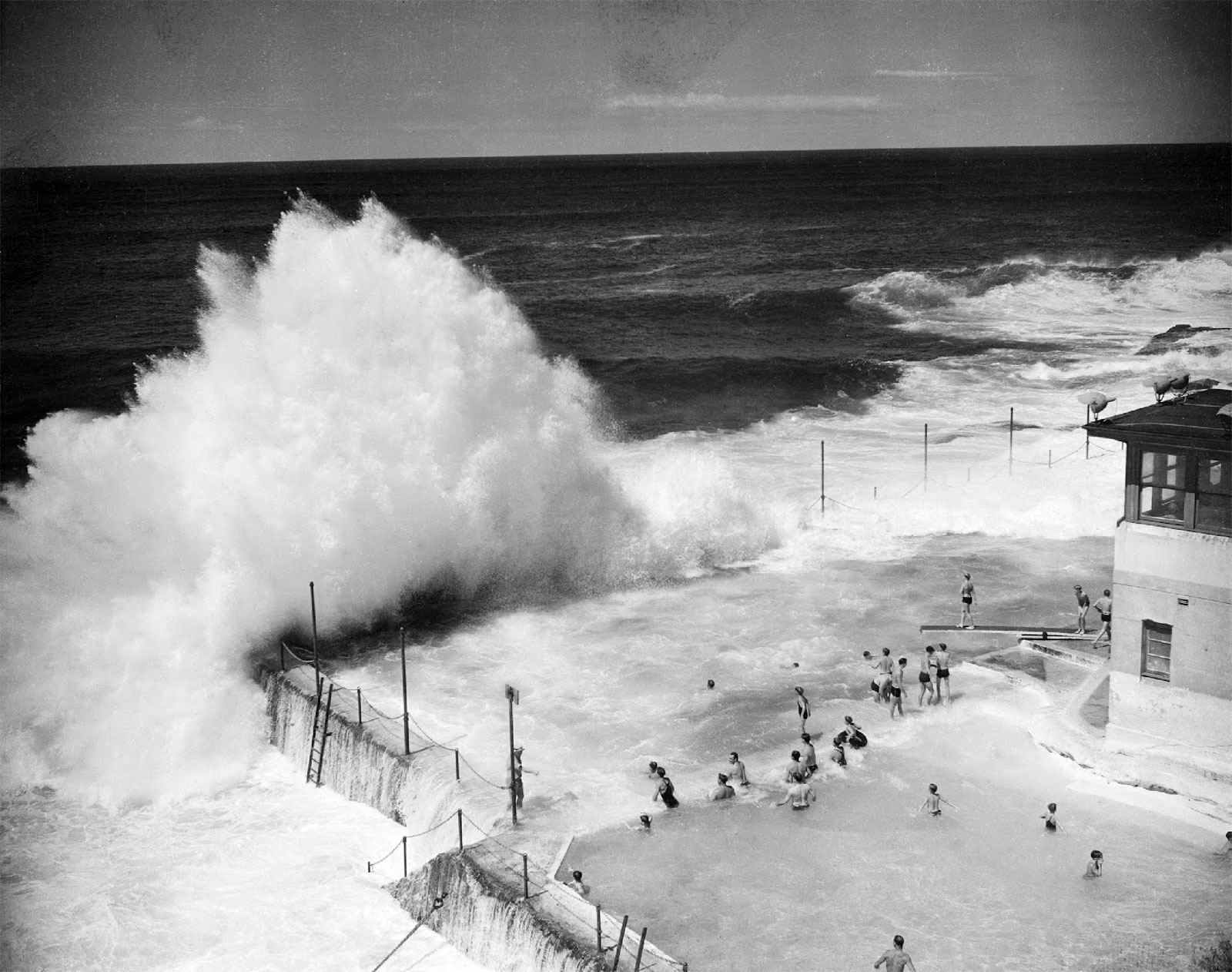
Unknown photographer (Australian) 'Waves breaking into the pool' 1945


Unknown photographer (Australian)
Waves breaking into the pool
1945
Australian News and Information Bureau collection
National Archives of Australia


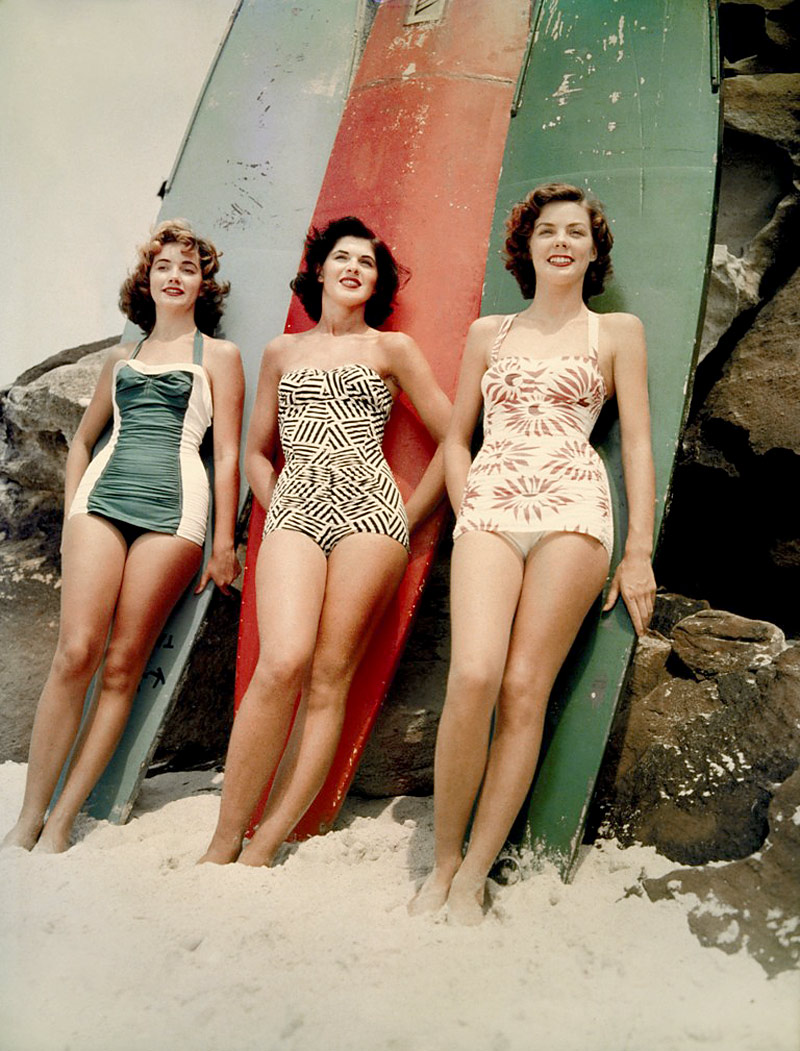
Anonymous photographer (Australian). '1952 Miss Pacific finalists Mary Clifton, Pamela Jansen and Judy Worrad, stand in front of surfboards on Bondi Beach, Sydney' 1952


Anonymous photographer (Australian)
1952 Miss Pacific finalists Mary Clifton, Pamela Jansen and Judy Worrad, stand in front of surfboards on Bondi Beach, Sydney
1952
National Archives of Australia


Anonymous photographer (Australian). 'Sunbathing, Sydney Beach, NSW' c. 1955


Anonymous photographer (Australian)
Sunbathing, Sydney Beach, NSW
c. 1955
National Archives of Australia


Cossies, togs and bathers

Until the 1940s, Australian women wore decidedly modest, albeit colourful, one-piece swimsuits. But the bikini was already in vogue overseas and by the early 1950s Australian women were daring to wear it. Discover the many fashion statements that could be made by wearing a favourite pair of cossies, togs or bathers!


Anonymous photographer (Australian). 'Christmas party on Bondi Beach, Sydney' 1959


Anonymous photographer (Australian)
Christmas party on Bondi Beach, Sydney
1959
National Archives of Australia


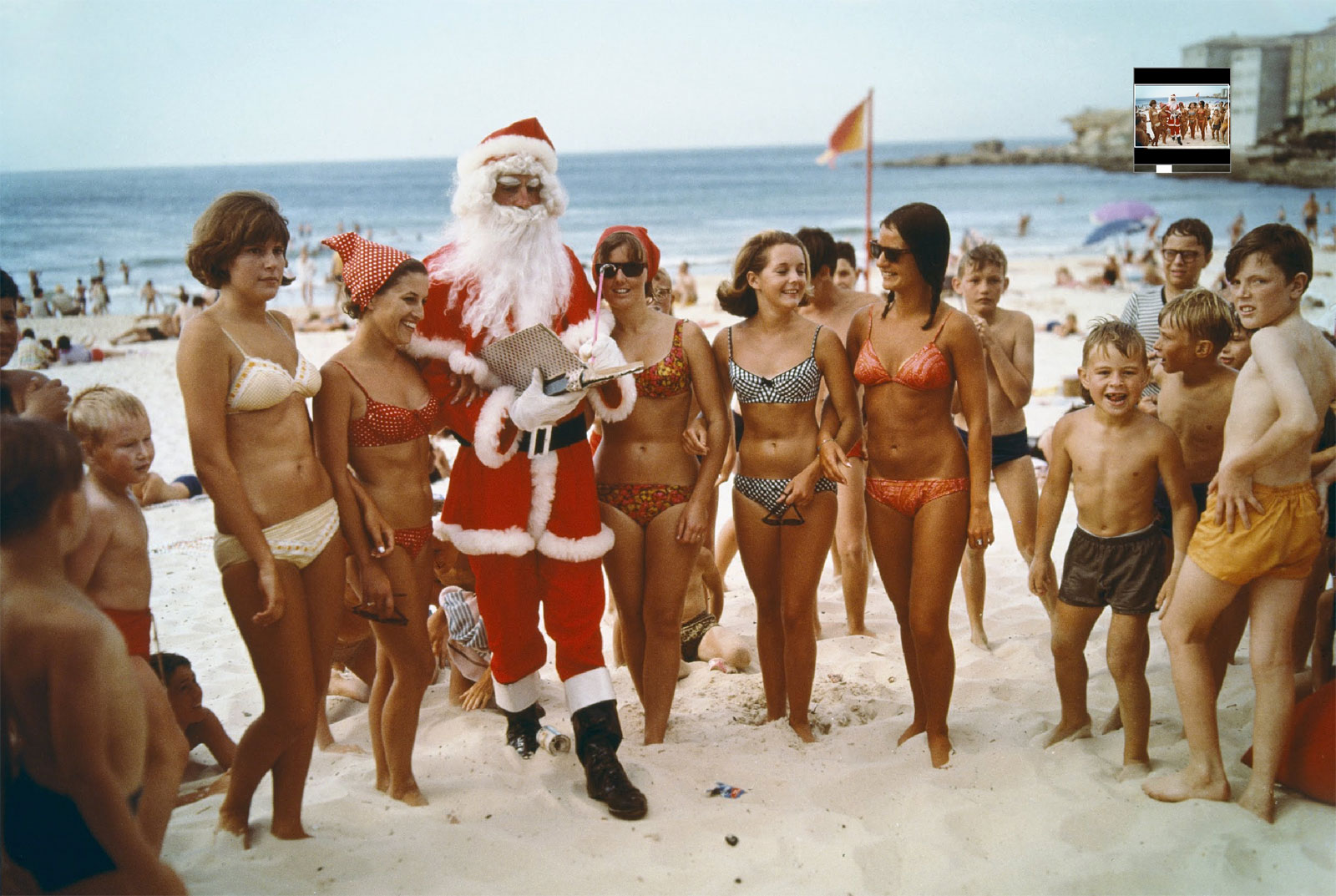
Anonymous photographer (Australian) 'Santa Claus visits a Sydney beach' 1969


Anonymous photographer (Australian)
Santa Claus visits a Sydney beach
1969
Australian News and Information Bureau collection
National Archives of Australia


At the beach

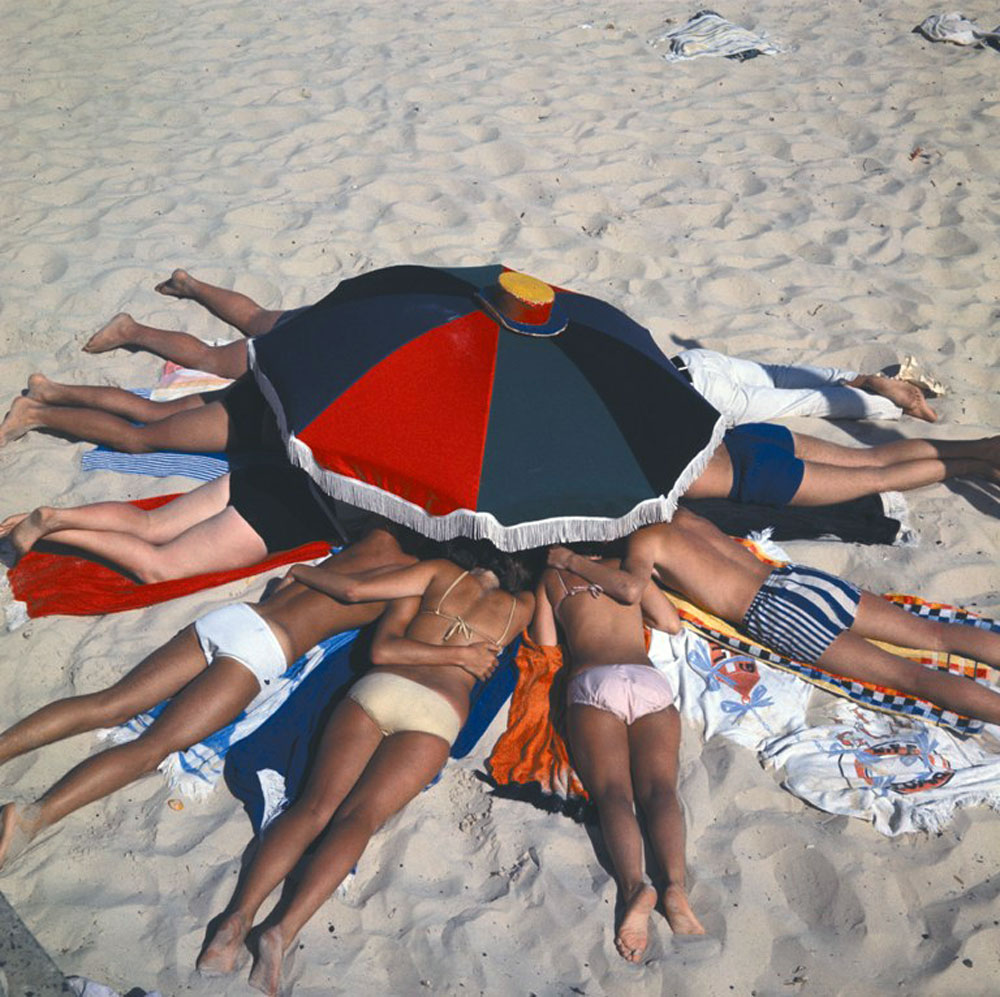
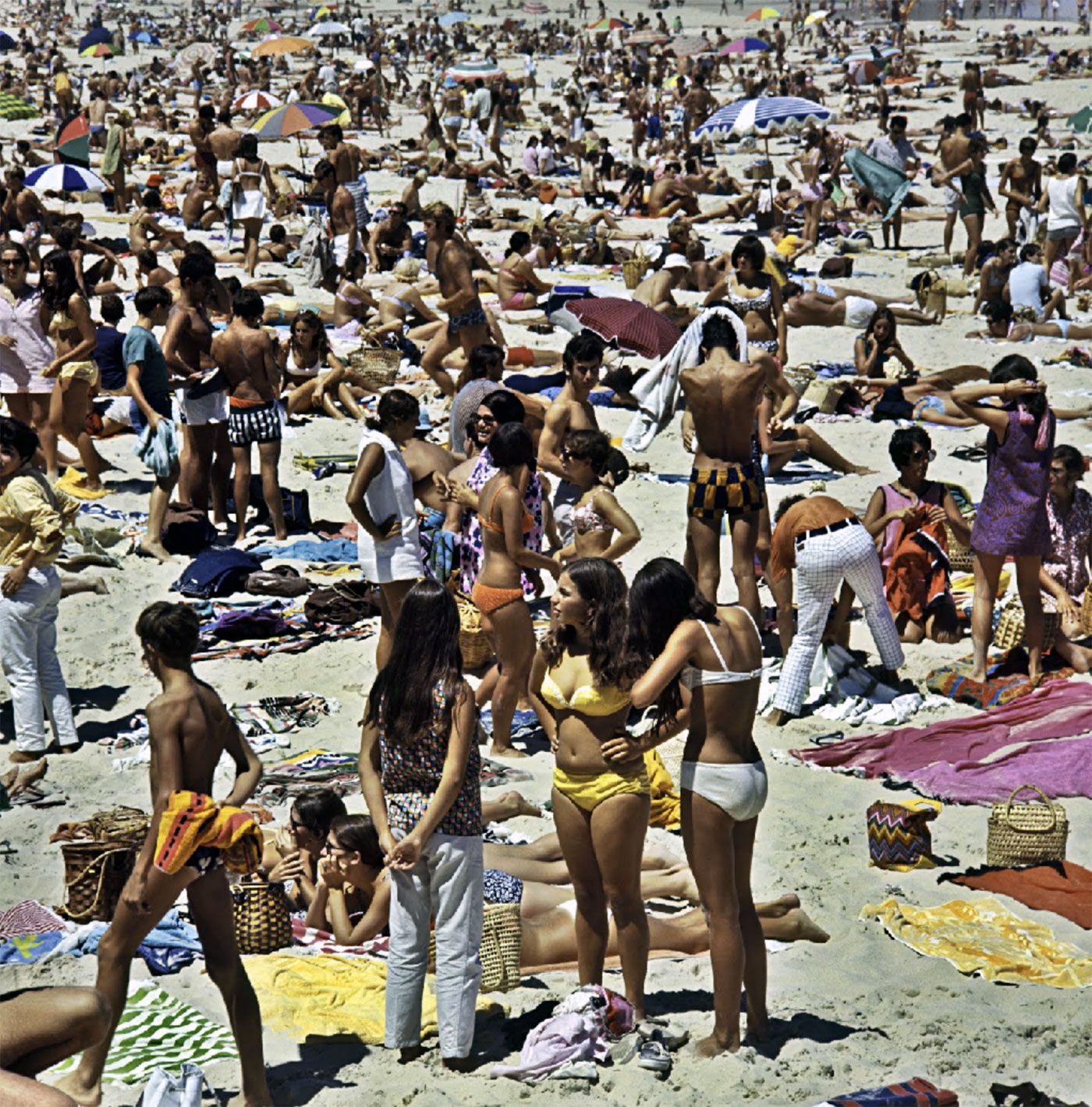
In the 1950s and 1960s, Christmas heralded the start of annual summer holidays for many Australian families. Those who didn’t already live near the coast usually headed towards it, mostly in Holdens and sometimes hauling a caravan. They made tracks to seaside places such as the Gold Coast, Manly, Byron Bay and Sorrento, plonking their bodies on the warm sand, transistors to their ears, to bake in the summer sun. Back then most people seemed unconcerned about sunburn and, as the images show, even beach umbrellas were in short supply.


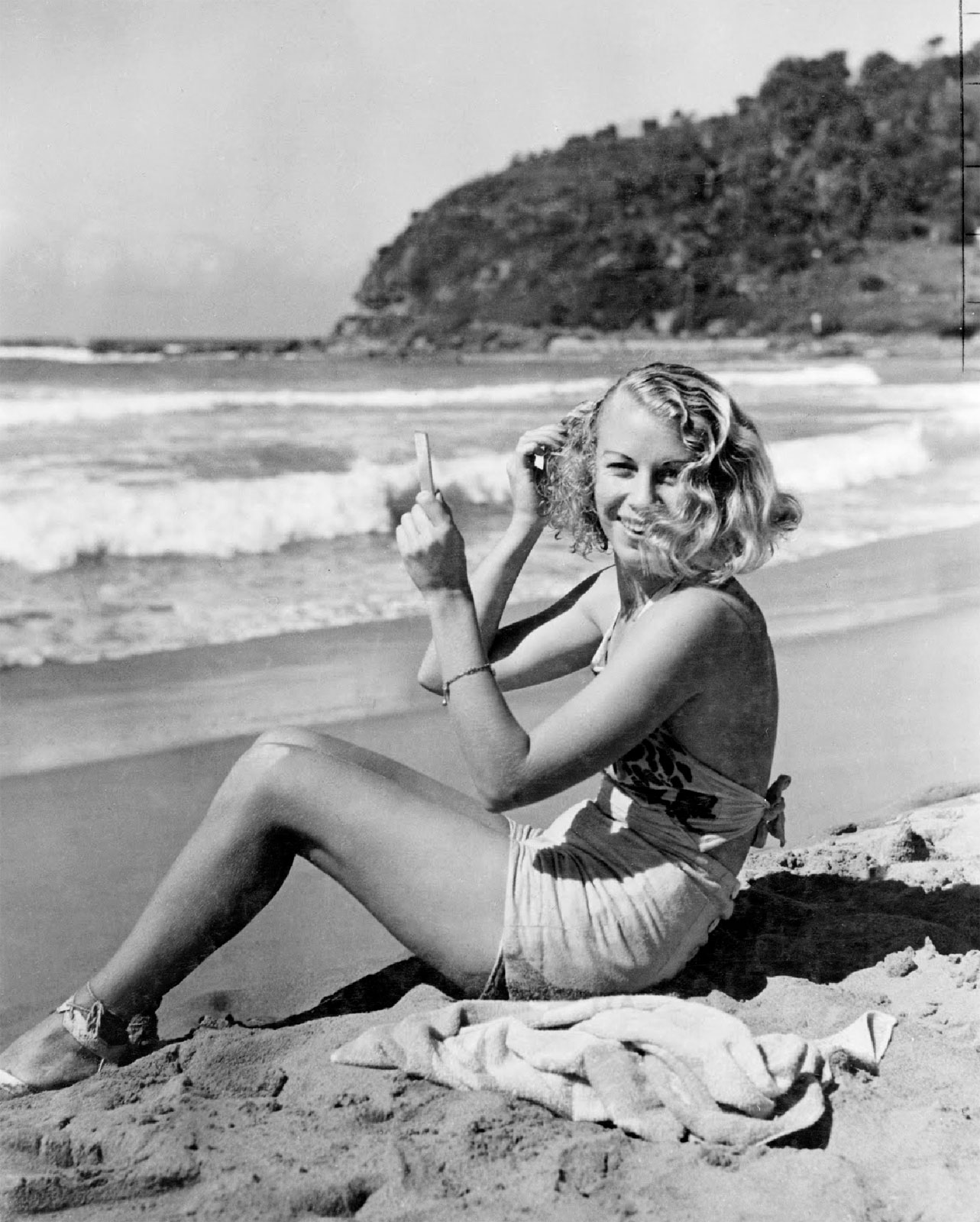
Anonymous photographer (Australian) 'Bathing beauty' 1955


Anonymous photographer (Australian)
Bathing beauty
1955
Australian Travel Industry Association collection
National Archives of Australia


This image comes from the Australian Travel Industry Association collection, now held in the National Archives. This series consists of black and white prints and negatives of photographs used in publications, notably Walkabout magazine, produced by the Australian National Travel Association (ANTA).


The Victorian Archives Centre plays host to regular displays of original records from our collection as well as touring exhibitions about Victorian stories. Over Summer, the Victorian Archives Centre will present Summers Past: Golden Days in the Sun 1950-1970, a fascinating photographic exhibition highlighting Australia’s fascination with the sun and sea.

Summers Past will explore our enduring love affair of all things summer, invoking memories of carefree sunny days at the beach in the 1950s, 1960s and 1970s. This is your last chance to view this exhibition before it returns to the National Archives of Australian in April 2012.

So slip on your cossie, slop on the sunscreen and head down to the Victorian Archives Centre this summer!

Summers Past: Golden Days in the Sun 1950-1970 will be on display until April 2012. Entry is free.


Anonymous photographer (Australian). 'Sunbathers relax under a low umbrella at Bondi, NSW' 1956


Anonymous photographer (Australian)
Sunbathers relax under a low umbrella at Bondi, NSW
1956
National Archives of Australia


Anonymous photographer (Australian) 'Sydney beach scene' 1969


Anonymous photographer (Australian)
Sydney beach scene
1969
Australian News and Information Bureau collection
National Archives of Australia


Anonymous photographer (Australian). 'Surfer and bikini girl on the sand' 1969


Anonymous photographer (Australian)
Surfer and bikini girl on the sand
1969
National Archives of Australia


Anonymous photographer (Australian) 'Holiday makers at Surfers Paradise' 1959


Anonymous photographer (Australian)
Holiday makers at Surfers Paradise
1959
Australian News and Information Bureau collection
National Archives of Australia


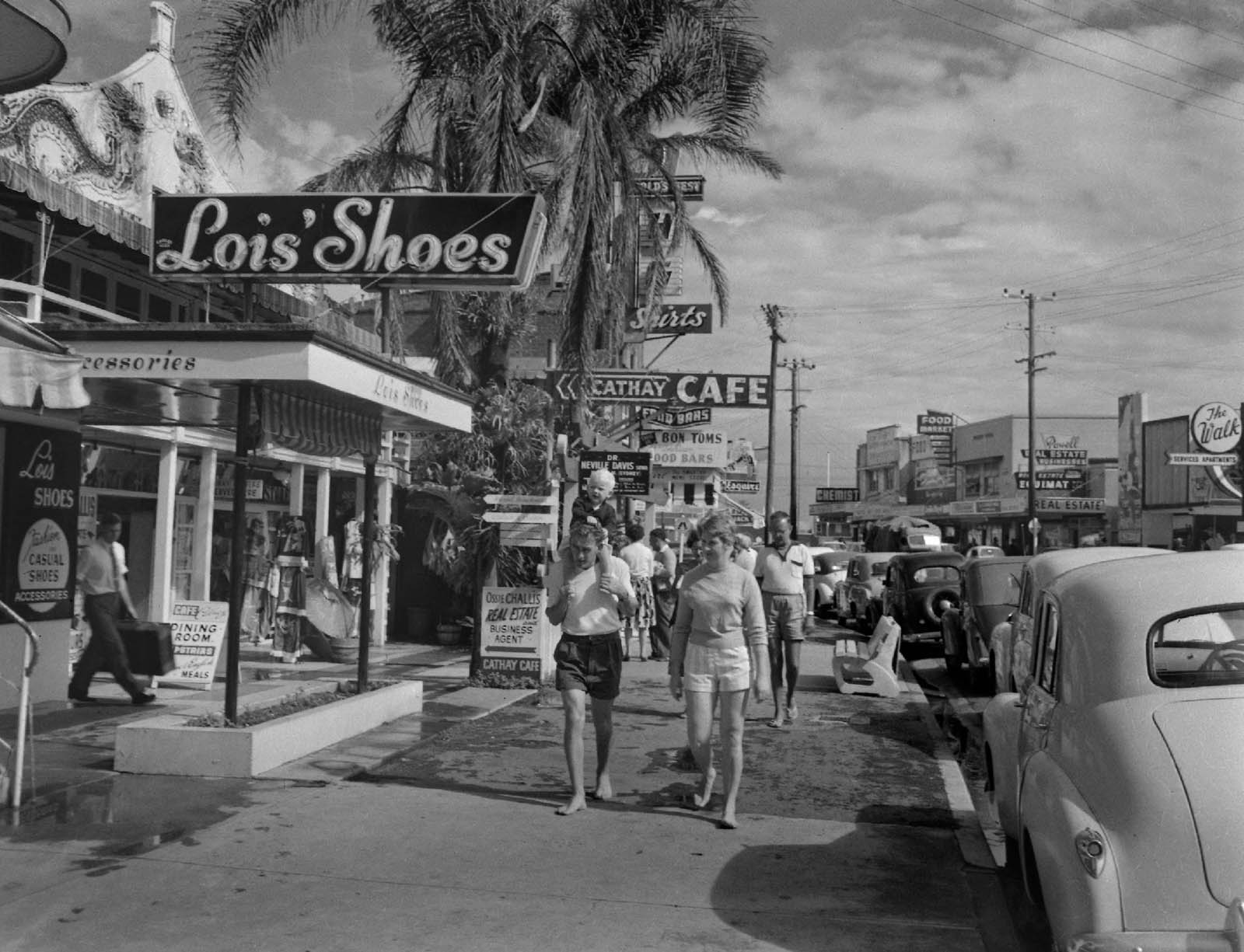
Anonymous photographer (Australian). 'Snack bar, Surfers Paradise, QLD' 1971


Anonymous photographer (Australian)
Snack bar, Surfers Paradise, QLD
1971
National Archives of Australia


Out and about

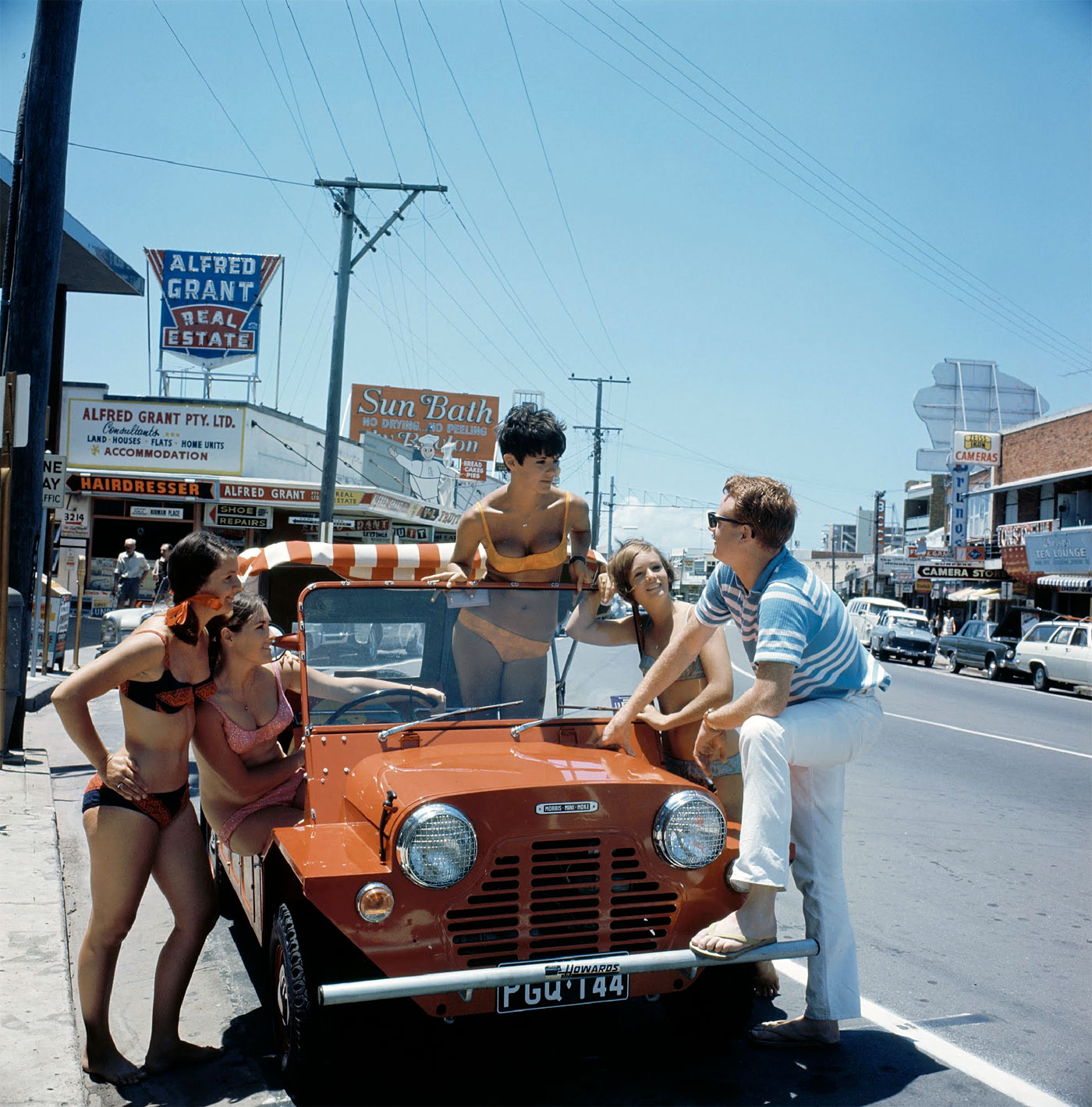
Australians have always been fairly laid back and never more so than in summer. Looking at these images from the 1950s and 1960s, it’s plain that sophistication was seldom a consideration when choosing what to wear. On holidays, most people preferred to be comfortable rather than trendy, and bare feet were common on coastal streets, as were unbuttoned shirts and even swimwear.


Anonymous photographer (Australian) 'Holiday makers gather around a car on a hot summer's day' 1964


Anonymous photographer (Australian)
Holiday makers gather around a car on a hot summer’s day
1964
Australian News and Information Bureau collection
National Archives of Australia


Anonymous photographer (Australian). 'Surf lifesaving, Bondi Beach' 1960


Anonymous photographer (Australian)
Surf lifesaving, Bondi Beach
1960
National Archives of Australia


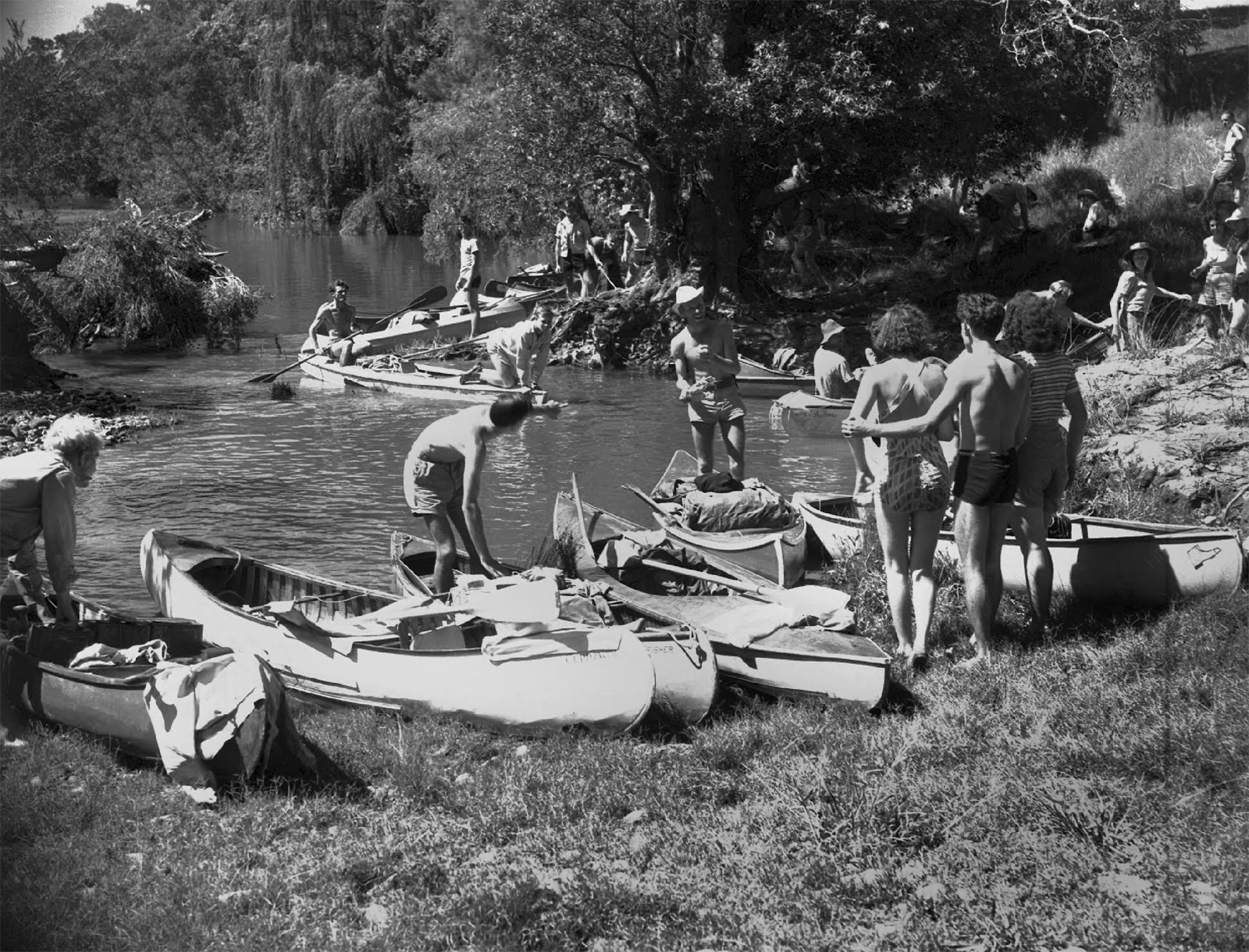
Cliff Bottomley (Australian, c. 1907-1981) 'Preparing canoes' 1948


Cliff Bottomley (Australian, c. 1907-1981)
Preparing canoes
1948
Australian News and Information Bureau collection
National Archives of Australia


This image comes from the Australian News and Information Bureau collection, now held in the National Archives. This vast archival resource is the legacy of nearly half a century’s work by Bureau photographers who captured hundreds of thousands of photographs of Australians at work and play.


Cooling off

It’s no secret that Australia can be very hot, especially in summer. As the song says, we are girt by sea, and for 85 per cent of Australians a blissful dip in the ocean has always been less that two hours’ drive away. For those living further inland, sanctuary was found in a nearby river or lake, or the town’s public swimming pool.


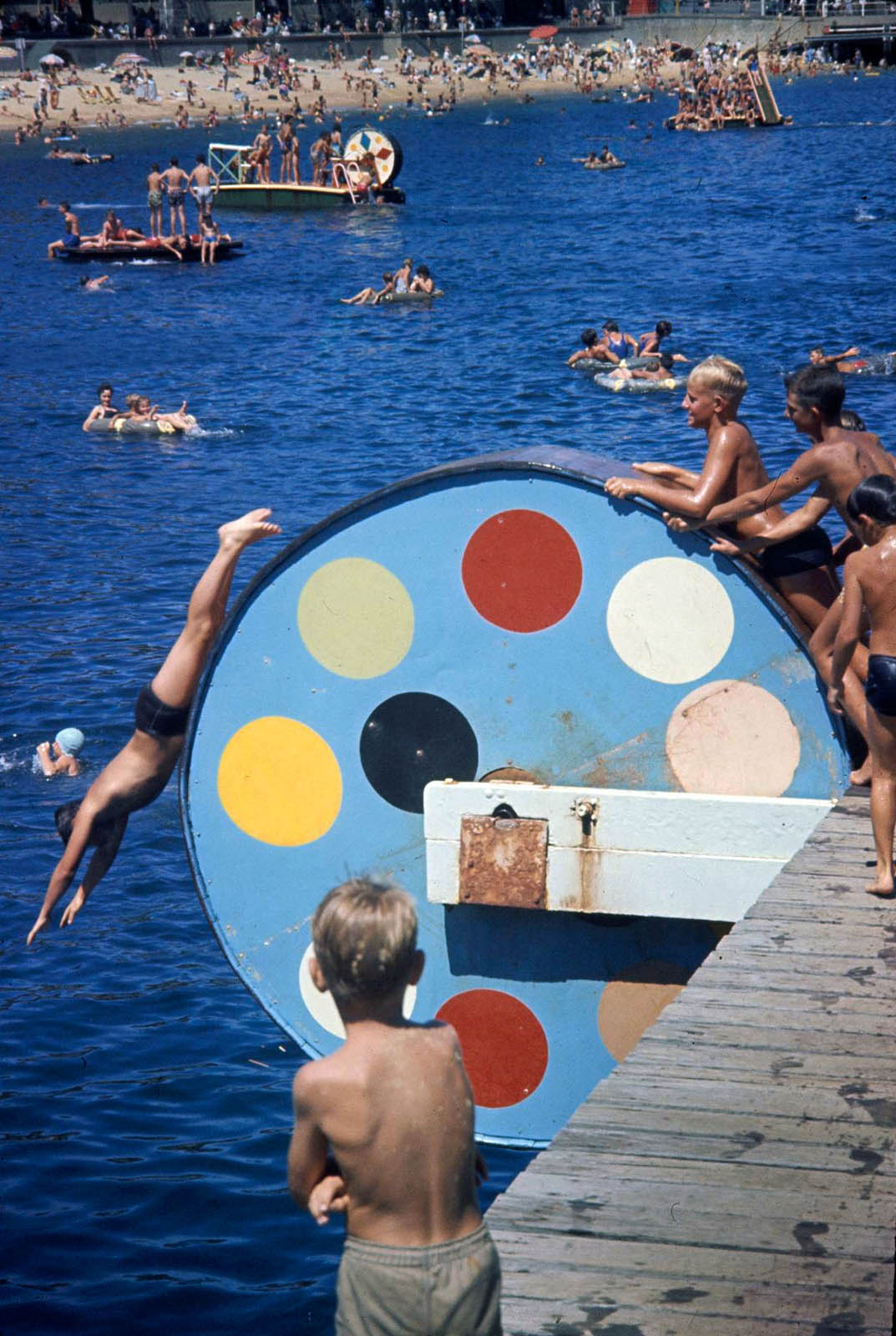
Anonymous photographer (Australian) 'Harbour swimming pool, Manly, New South Wales' 1960


Anonymous photographer (Australian)
Harbour swimming pool, Manly, New South Wales
1960
Australian News and Information Bureau collection
National Archives of Australia


This image comes from the Australian News and Information Bureau collection, now held in the National Archives. This vast archival resource is the legacy of nearly half a century’s work by Bureau photographers who captured hundreds of thousands of photographs of Australians at work and play.


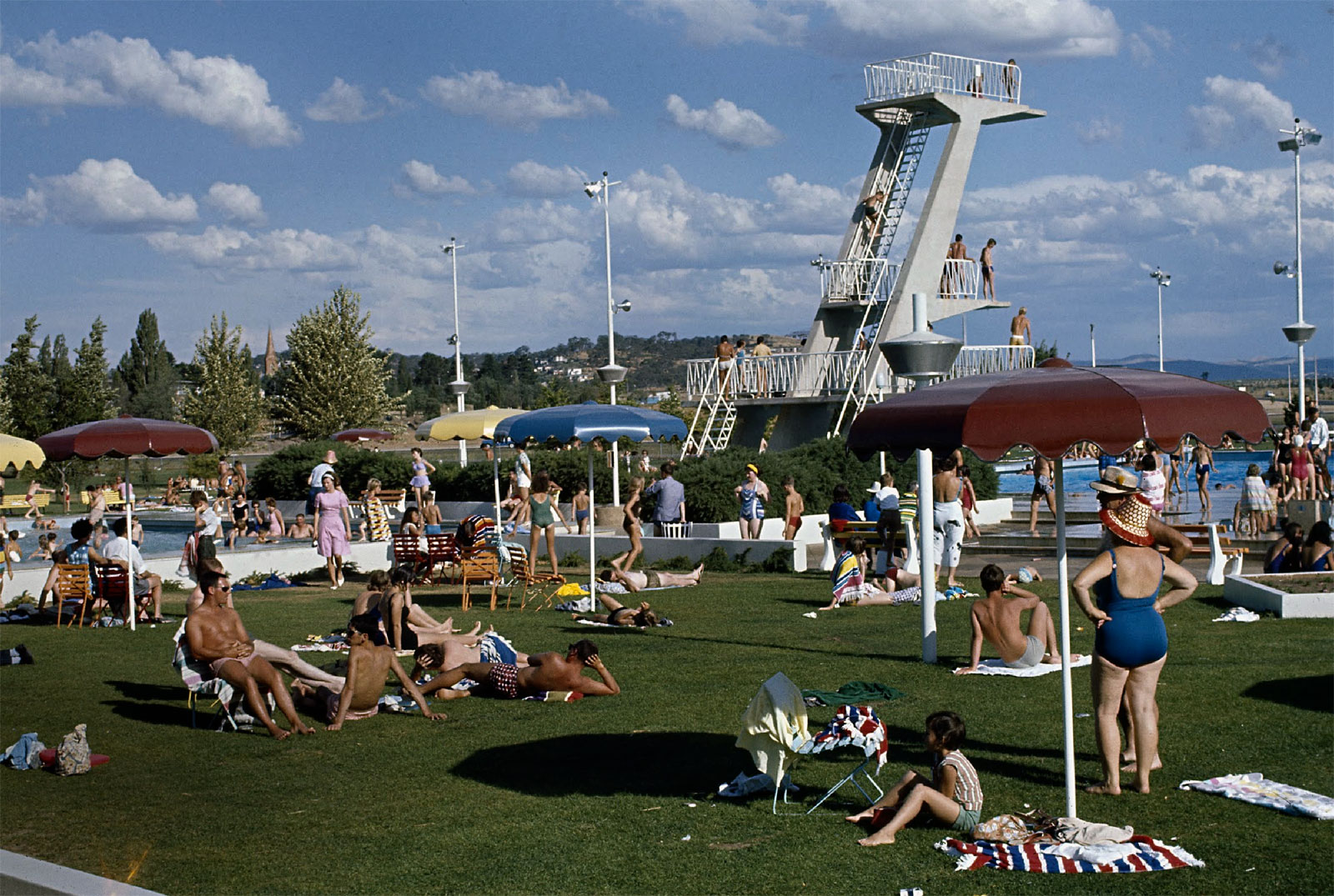
Anonymous photographer (Australian) 'Sunbathers relax on the lawn at the Olympic Pool, Canberra, Australian Capital Territory' 1966


Anonymous photographer (Australian)
Sunbathers relax on the lawn at the Olympic Pool, Canberra, Australian Capital Territory
1966
Australian News and Information Bureau collection
National Archives of Australia


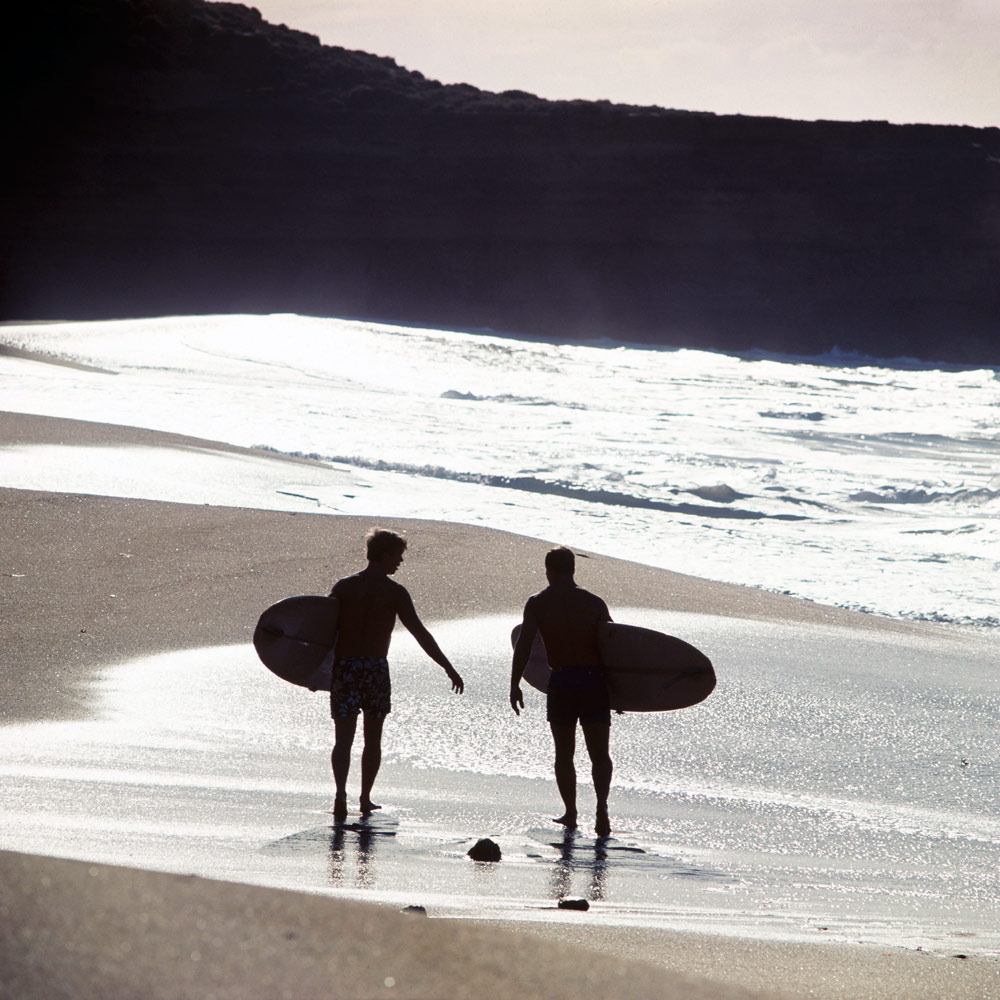
Anonymous photographer (Australian). 'Surf board riders, Torquay, VIC' 1967


Anonymous photographer (Australian)
Surf board riders, Torquay, VIC
1967
National Archives of Australia


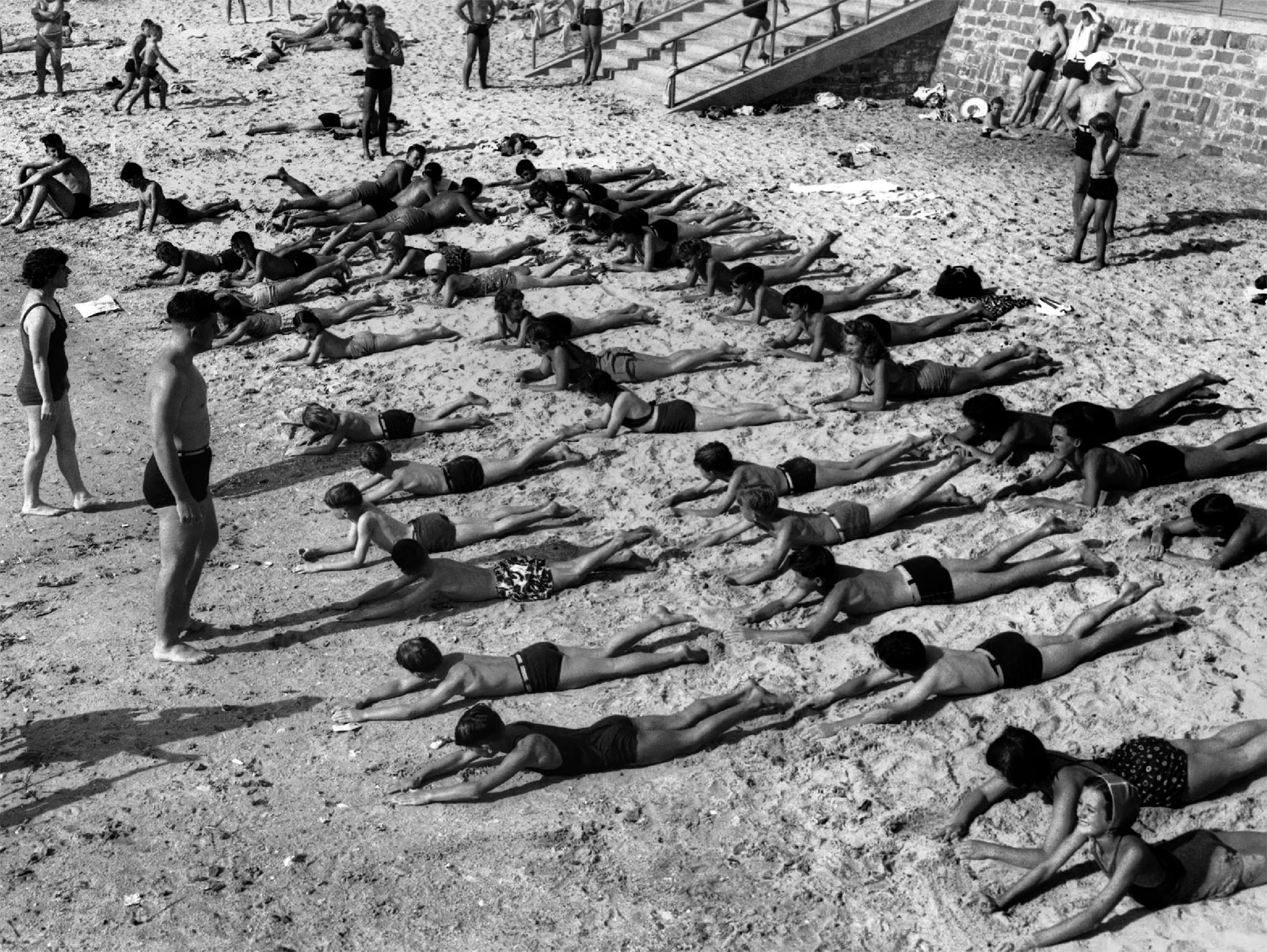
Anonymous photographer (Australian) 'Children learning to swim' 1945


Anonymous photographer (Australian)
Children learning to swim
1945
Australian News and Information Bureau collection
National Archives of Australia


Nice one, sport!

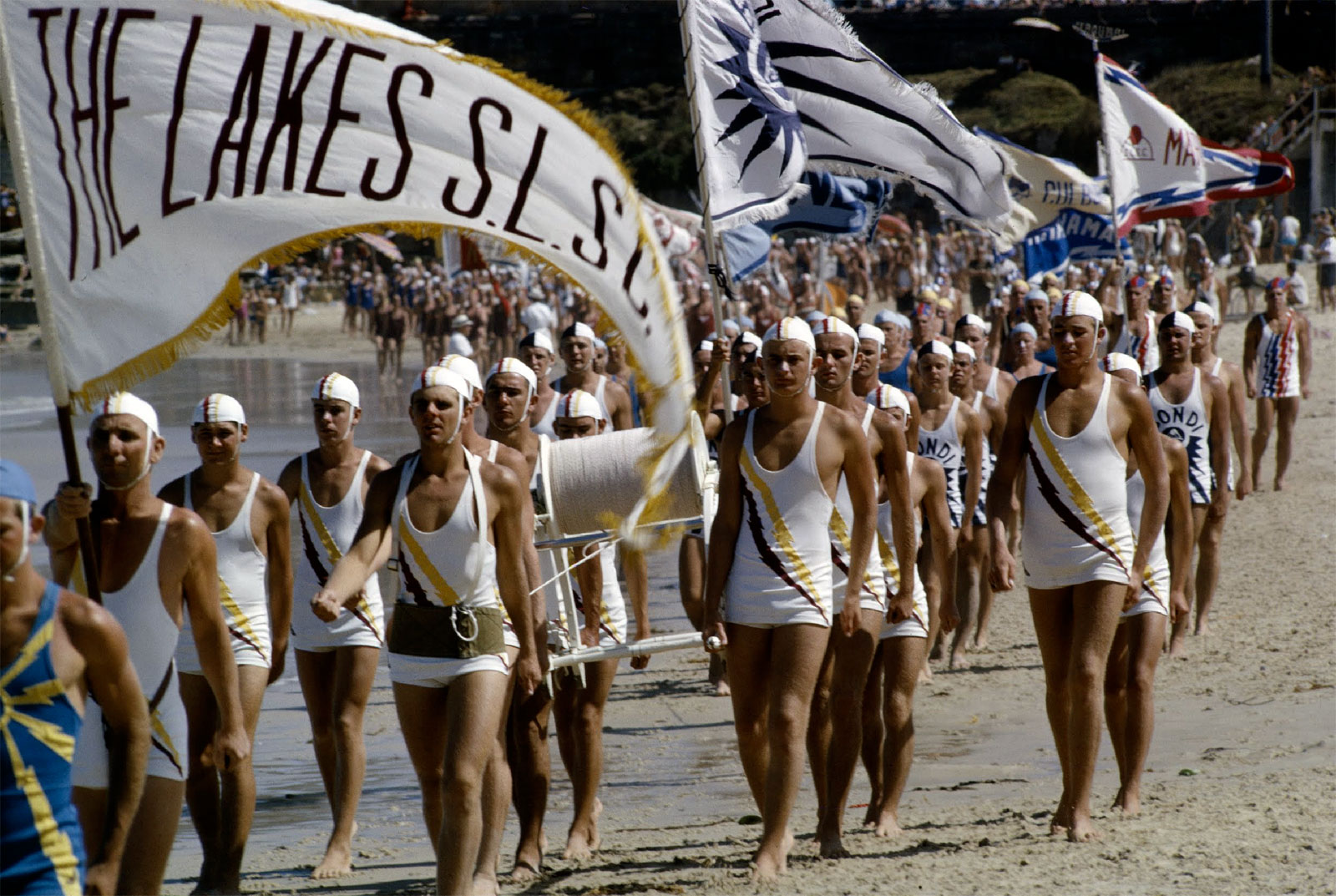
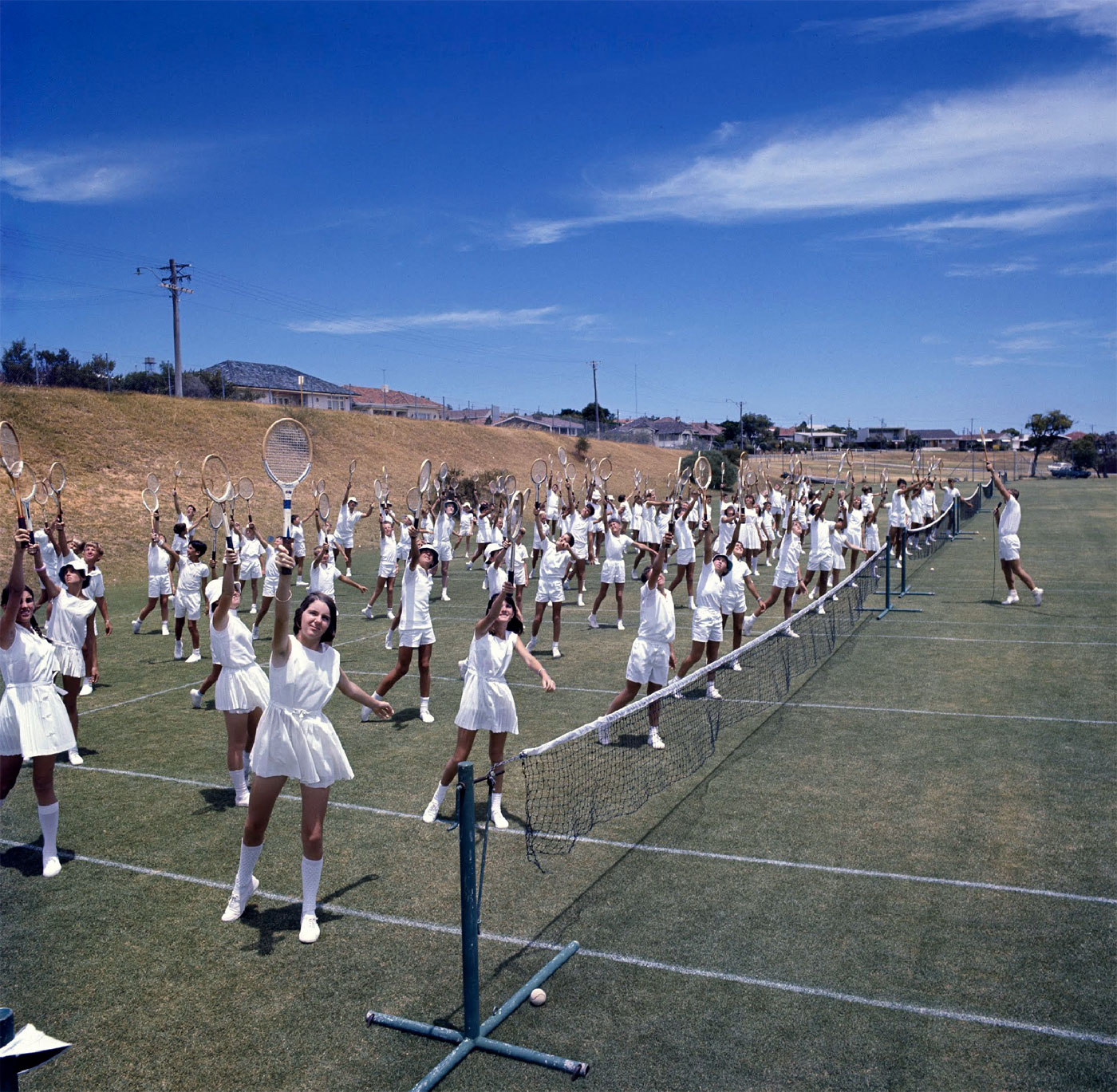
Between 1950 and 1970, Australia was triumphant in all the sports we loved. We dominated in the pool, won the Davis Cup a remarkable 15 times, and boasted an impressive record against every Test cricket nation. As these images show, Australian youngsters were keen to play the game, and on most summer Saturdays all around the country, boys and girls would play tennis or cricket, or swim like champions.


Anonymous photographer (Australian) 'Boys with kites' 1965


Anonymous photographer (Australian)
Boys with kites
1965
Australian News and Information Bureau collection
National Archives of Australia


Anonymous photographer (Australian) 'Surf carnival' 1966


Anonymous photographer (Australian)
Surf carnival
1966
Australian News and Information Bureau collection
National Archives of Australia


Anonymous photographer (Australian) 'Mass tennis class' 1967


Anonymous photographer (Australian)
Mass tennis class
1967
Australian News and Information Bureau collection
National Archives of Australia


The Victorian Archives Centre
99 Shiel Street
North Melbourne, Victoria 3051
Australia

The Victorian Archives Centre website

LIKE ART BLART ON FACEBOOK

Back to top

Exhibition: ‘Caravaggio and His Followers in Rome’ at the Kimbell Art Museum, Fort Worth, Texas

Exhibition dates: 16th October 2011 – 8th January 2012


Simon Vouet (French, 1590-1649) 'The Fortune Teller' c. 1620


Simon Vouet (French, 1590-1649)
The Fortune Teller
c. 1620
Oil on canvas
National Gallery of Canada, Ottawa


Observe if you will:

1/ The treatment of the background behind Boy Bitten by a Lizard (1594-1596)

2/ The tension of the hands in this painting

3/ The pallor of the skin of Sick Bacchus (1593-1594)

4/ The colour of the bunch of grapes in the same painting

5/ The critical distance between the two apricots and the bowed sash resting on the pediment in the same painting

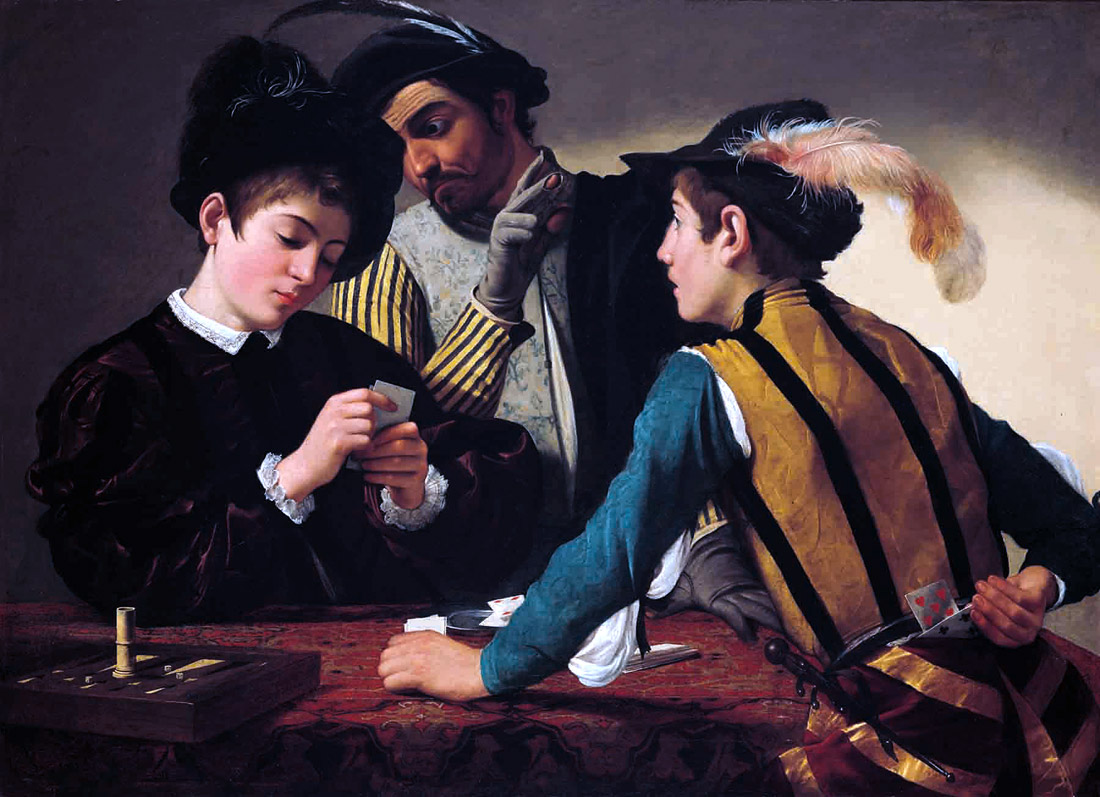
6/ The youthful innocence of the dupe in The Cardsharps (c. 1595)

7/ The deep, foreboding shadows under the eyes of Saint John the Baptist in the Wilderness (1604-1605)

8/ The astonishingly beautiful skin tones in Gerrit van Honthorst’s Saint Sebastian (c. 1623) and how the blood from the leg wound at left runs in two directions: one direction when Saint Sebastian was standing up, one when he has slumped down. Inspired.


Dr Marcus Bunyan


Many thankx to the Kimbell Museum of Art for allowing me to publish the artwork in the posting. Please click on the photographs for a larger version of the image.


“Not since Michelangelo or Raphael had one artist affected so many of his contemporaries and so irrevocably changed the course of European painting. Caravaggio created a new kind of art: dramatic, deeply emotional, grounded in the vivid details of everyday life, and overwhelmingly human. He used live models, sometimes prostitutes and the very poor, who posed in the studio for his powerful religious scenes as if the events were happening on the streets of Rome. Breaking the boundaries between art and life, he overturned the artistic conventions of the day. He played down details of the setting of a scene, focused on the expressive human figure, and invented a brand of stark realism that shocked many of his patrons.”


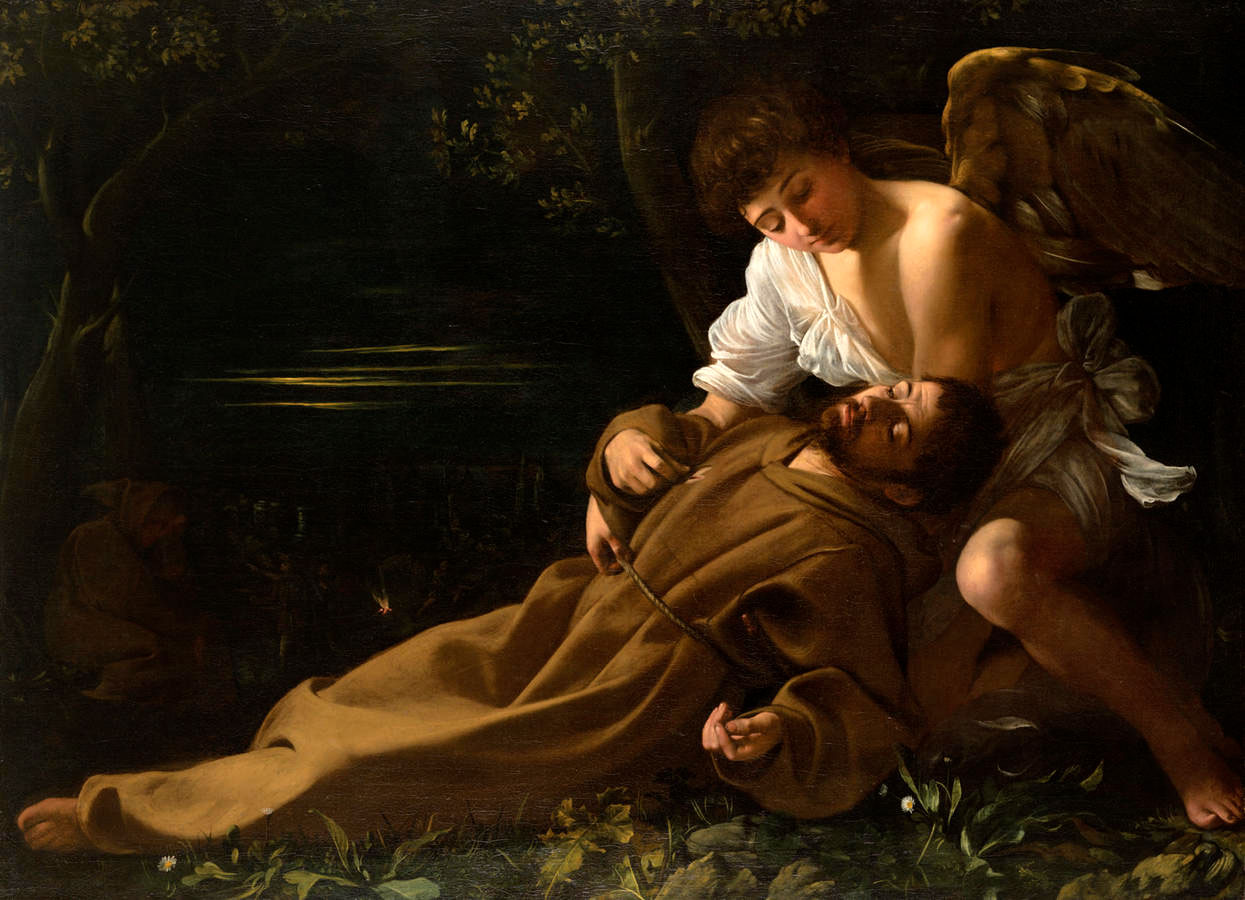
Michelangelo Merisi da Caravaggio (Italian, 1571-1610) 'Saint Francis in Ecstasy' c. 1594-1595


Michelangelo Merisi da Caravaggio (Italian, 1571-1610)
Saint Francis in Ecstasy
c. 1594-1595
Oil on canvas
Wadsworth Atheneum Museum of Art, Hartford, Connecticut
The Ella Gallup Sumner and Mary Catlin Sumner Collection Fund


Michelangelo Merisi da Caravaggio (Italian, 1571-1610) 'The Gypsy Fortune Teller' c. 1595


Michelangelo Merisi da Caravaggio (Italian, 1571-1610)
The Gypsy Fortune Teller
c. 1595
Oil on canvas
45 1/4 x 59 in. (115 x 150cm)
Pinacoteca Capitolina, Musei Capitolini, Rome
Public domain


One of the most influential figures in the history of art, Caravaggio (1571-1610) overturned the artistic conventions of the day and created stunningly dramatic paintings, both sacred and secular. This ambitious exhibition explores the profound impact of his work on the wide range of painters of Italian, French, Dutch, Flemish, and Spanish origin who resided in Rome. Arranged by theme, it includes over 50 paintings, with Caravaggio’s compelling images juxtaposed with those he inspired. This is the second largest display of his paintings in North America and only the third Caravaggio exhibition to be held in the United States.


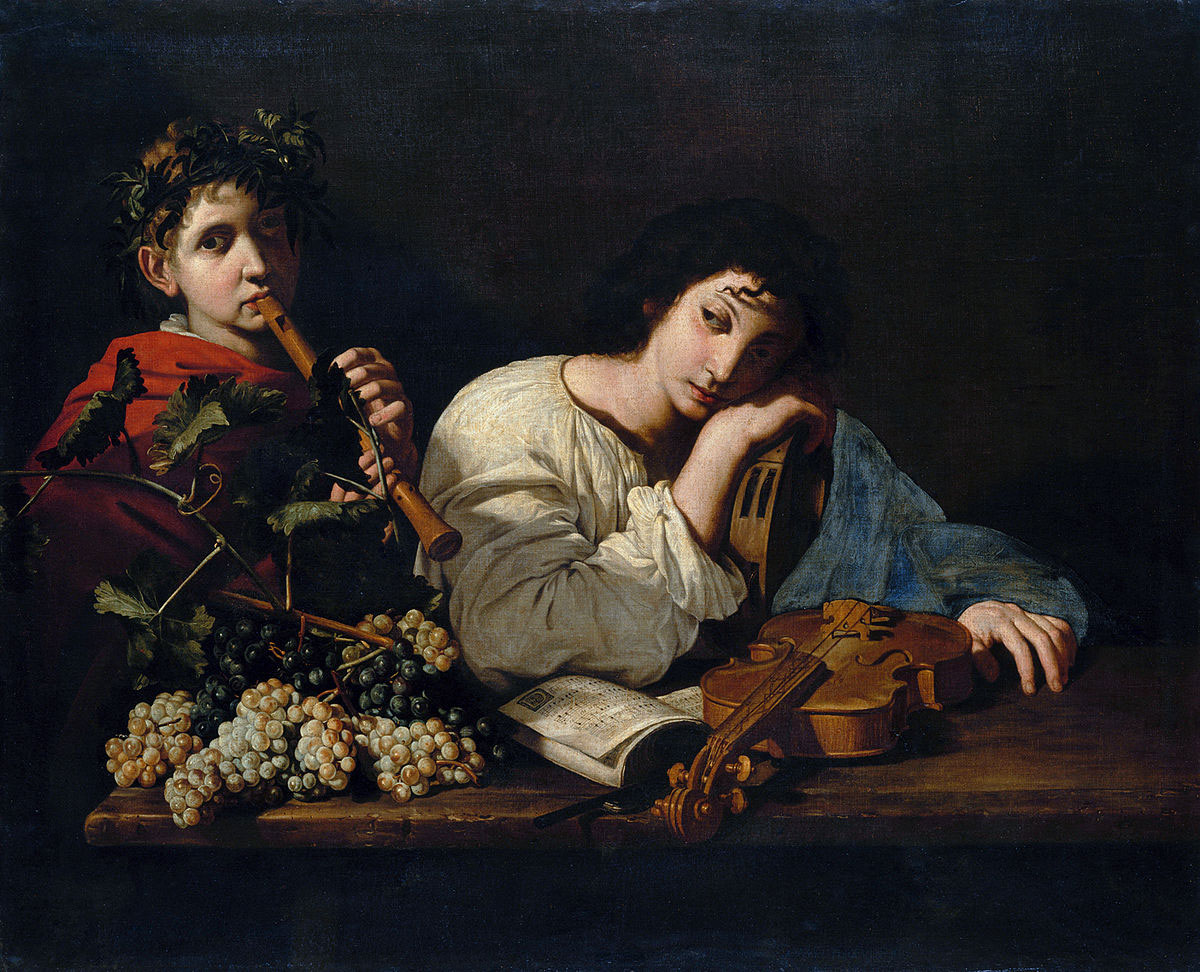
Music and Youth

Many of Caravaggio’s early paintings feature handsome youths, whether singly or in groups. He seems to have used the same favorite models repeatedly – and sometimes his own features, which a contemporary tells us he studied in a mirror. The origins of these novel paintings lay in the types of pictures – portraits, still lifes, and allegories – that were painted in a realistic style in the artist’s native Lombardy, in the north of Italy, although he blurred the boundaries between genres to suggest real-life scenes. Caravaggio’s paintings of musicians would have appealed to Roman collectors who were passionate patrons of music, and likely were created to decorate rooms used for performances. They have a dreamy, slightly melancholy air. If the songs are about love, as we can assume they are, they are surely about the painful side of love rather than its joys. Caravaggio’s early paintings of youths are usually scenes of sensual pleasure but with a built-in warning against indulgence, as when a youth has his finger bitten by a lizard lurking in some fruit. He brings us close to his figures, often having them make eye contact with us, and includes lovingly observed still-life details that enhance the naturalism and immediacy of the scene. Even when there is a visitation from the beyond, like the winged Cupid in The Musicians, he treats this in a matter-of-fact way, attentive always to breaking down the boundaries between the painted world and our own. Caravaggio’s musical paintings caught on throughout Europe in the work of his followers, who brought their own innovations to the genre.


Michelangelo Merisi da Caravaggio (Italian, 1571-1610) 'The Musicians' c. 1595


Michelangelo Merisi da Caravaggio (Italian, 1571-1610)
The Musicians
c. 1595
Oil on canvas
36 1/4 x 46 5/8 in (92.1 x 118.4cm)
The Metropolitan Museum of Art, New York. Rogers Fund, 1952


In this scene, Caravaggio shows some young musicians preparing for a concert. We are brought very close to the figures, as if we share the same space. Caravaggio breaks down the boundaries between art and life, and our reality and the painted world become entwined. The instruments are modern, but the musicians wear antique-inspired dress. The lute player tunes his instrument, and the horn player (possibly a self-portrait) catches our gaze. Another youth studies the musical score; it is no longer legible, but doubtless featured love madrigals. The winged Cupid with a quiver of arrows who is handling some grapes makes explicit the bond between music and love. Wine, like music, makes the spirits light. This painting belonged to Cardinal Francesco Maria del Monte, who hosted concerts at his palace and invited musicians to live in his household, along with artists like Caravaggio.


Theodoor Rombouts (Flemish, 1597-1637) 'A Lute Player' c. 1620


Theodoor Rombouts (Flemish, 1597-1637)
A Lute Player
c. 1620
Oil on canvas
43 7/8 x 39 1/4 in (111.1 x 99.7cm)
Philadelphia Museum of Art. John G. Johnson Collection, 1917


Caravaggio’s paintings of musicians inspired Rombouts’s depiction of a musician tuning his lute. His intense expression suggests that he is both listening to the sound and sizing up the viewer, his audience. The vividly described carpet and still-life objects on the table recall Caravaggio’s similar close-up presentations. However, the colourful treatment of the costume and the robust delineation of the objects place Rombouts’s work within traditions of Flemish and Dutch painting. The still life, like ephemeral music, serves to remind us of the pleasures of life, but also that pleasure is fleeting. The artist also alludes to the five senses: hearing (the lute), taste (the tankard), smell (the pipe), sight (the musical scores), and touch (the knife).


Michelangelo Merisi da Caravaggio (Italian, 1571-1610) 'Boy Bitten by a Lizard' 1594–1596


Michelangelo Merisi da Caravaggio (Italian, 1571-1610)
Boy Bitten by a Lizard
1594-1596
Oil on canvas
25 5/8 x 20 1/2 in (65 x 52cm)
Fondazione di Studi di Storia dell’Arte Roberto Longhi, Florence


One of Caravaggio’s biographers wrote that “he also painted a boy bitten by a lizard emerging from flowers and fruits; you could almost hear the boy scream, and it was done meticulously.” The picture has suggested various interpretations. As an allegory of touch, it provides the basis for a study of how emotion is expressed physically, and arguably Caravaggio alludes to all the five senses (flowers as smell and so on). With the still life of fruits and roses, common emblems of love, he invokes age-old adages – pain can follow pleasure, and love is a rose with thorns that prick. Poets from Petrarch onward played on the similarity of the Italian words for “love” and “bitter” – amore and amaro – to which Caravaggio adds ramarro (lizard), ingeniously enlarging the joke.


Michelangelo Merisi da Caravaggio (Italian, 1571-1610) 'Sick Bacchus' 1593-1594


Michelangelo Merisi da Caravaggio (Italian, 1571-1610)
Sick Bacchus
1593-1594
Oil on canvas
Galleria Borghese, Rome


Cardsharps and Fortune Tellers

The young Caravaggio introduced another new kind of painting to the Roman art world with his scenes from the seamy side of life, its frauds and ruses. He painted these works on a large scale with half-length figures, and they were among his most widely imitated creations. His followers played countless variations on the same themes, trying various levels of subtlety and buffoonery in the humour and facial expressions. These highly animated compositions conjure up an underworld of wily cardsharps, soldiers of fortune, foolish dupes, sensuous and deceitful gypsy women, pickpockets, and thugs. They are based partly on everyday observations in the streets, partly on the stock characters and improvised comedies of the commedia dell’arte, partly on sheer fantasy. In such works, Caravaggio and his followers developed ingenious ways of involving us in the action. We read these amusingly moralising pictures through gestures and expressions – but to unravel the trickery takes time. Despite being frozen in a static image, the story seems to unfold before our eyes like one of the popular plays that were its inspiration. The artist extends the theme of deception by painting his subjects with such a high level of naturalism that the viewer is duped and astounded by his artistry.


Michelangelo Merisi da Caravaggio (Italian, 1571-1610) 'The Cardsharps' c. 1595


Michelangelo Merisi da Caravaggio (Italian, 1571-1610)
The Cardsharps
c. 1595
Oil on canvas
37 1/8 x 51 5/8 in (94.2 x 130.9cm)
Kimbell Art Museum, Fort Worth


The players are engaged in a game of primero, a forerunner of poker. Engrossed in his cards, the dupe is unaware that the older cardsharp signals his accomplice, who reaches to pull a hidden card from his breeches. The fingertips of the cheat’s gloved hand are exposed to better feel marked cards. According to an early biographer, Cardinal Francesco Maria del Monte, a great patron of the arts, took the young Caravaggio into his household soon after purchasing this picture. It hung along with The Gypsy Fortune Teller in his palace. Together they would surely have reminded the cardinal and his guests of the story of the prodigal son, warning about the perils of greed and fraud. Caravaggio has treated this subject not as a caricature of vice but in a fresh way, in which the interaction of gesture and glance evokes the drama of deception and lost innocence in the most human of terms. He structures the picture to allow us to witness everything, implicating us in the trickery.


Saints

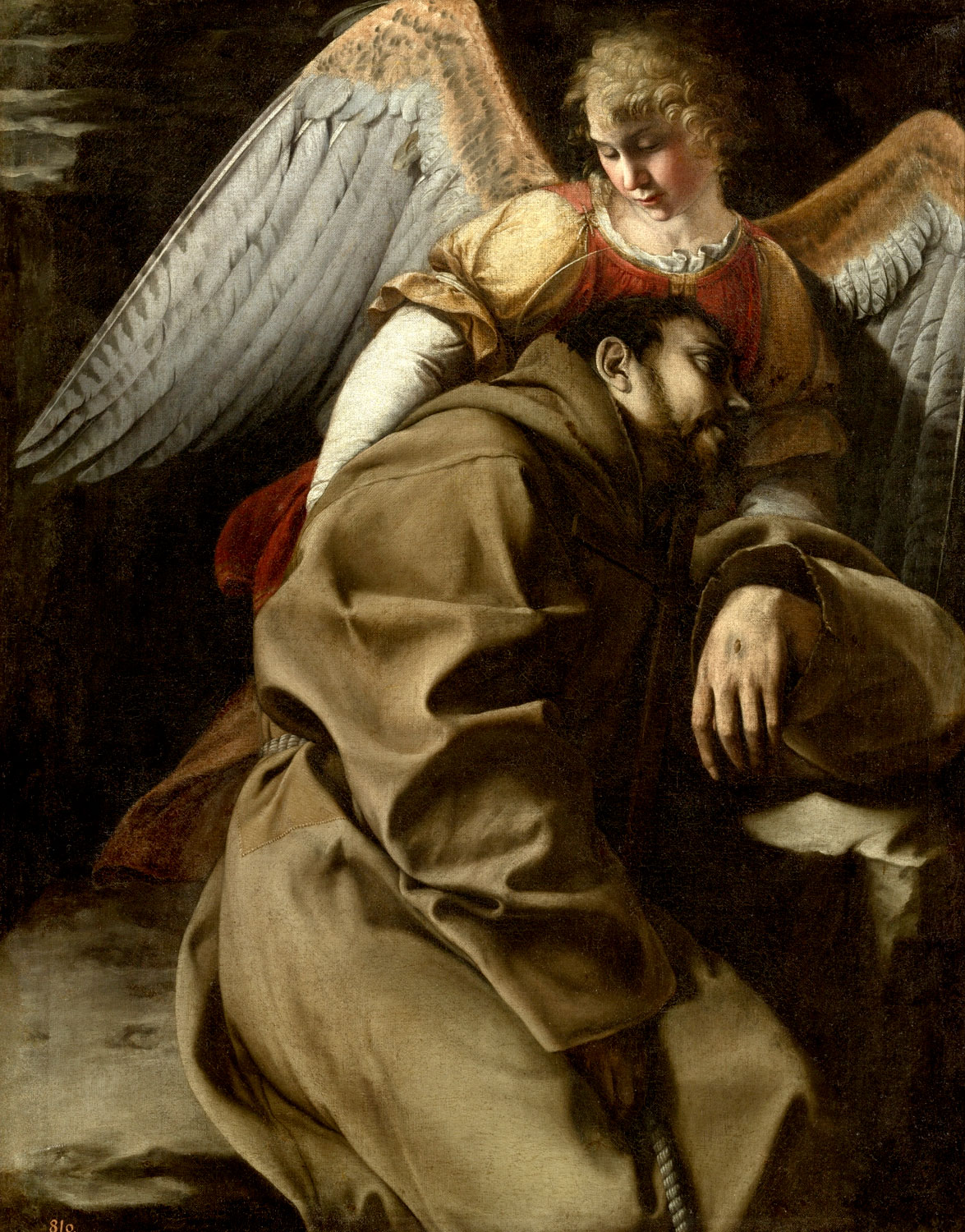
Caravaggio grounded his saints in everyday reality, indicating their spiritual states by means of natural phenomena, especially light. In his early painting of Saint Francis, he shows the saint’s ecstasy – his mystic identification with Christ – by directing a strong light upon his figure and the consoling angel. God’s grace is signalled by light in other images of the saints, such as the scene of Mary Magdalene’s conversion from her former life of sin. In paintings of Saints Matthew and Jerome in their studies, much emulated in Caravaggio’s circle, light is a metaphor of divine inspiration. Generally the saints seem to be emerging from darkness into light, which adds drama, symbolism, and also a sense of mass – as if they were sculpted, not merely painted. In a break from Roman and Florentine traditions, Caravaggio rejected the practice of refining his composition through drawings before he began to paint and instead worked directly from a live model in the studio, preserving that model’s particular appearance, never making the features or body conform to an ideal of beauty. The effect, central to Caravaggio’s art and that of many of his followers, was startling. At this time, many people believed that the painting of sacred personages such as saints called for a special, elevated style that set them apart from the mundane reality of the here and now. Caravaggio’s radical departure from this principle brought him much harsh criticism. He was accused of merely copying and so failing to capture a higher truth. But others recognised in his work a new kind of religious art that directly engaged the faithful and made old subjects new and alive.


Michelangelo Merisi da Caravaggio (Italian, 1571-1610) 'Saint John the Baptist in the Wilderness' 1604


Michelangelo Merisi da Caravaggio (Italian, 1571-1610)
Saint John the Baptist in the Wilderness
1604-1605
Oil on canvas
68 x 52 in (172.7 x 132.1cm)
The Nelson-Atkins Museum of Art, Kansas City, Missouri. Purchase William Rockhill Nelson Trust


Caravaggio’s practice of painting a live model in his studio brings this young, brooding saint to life – as if his image were inhabited by the model’s being. Ottavio Costa, a Roman banker, commissioned this painting for a chapel on a pilgrimage route in the countryside outside of Genoa, where his family had its origins. We can imagine what a powerful experience it would have been to encounter the image of the scarlet-robed saint there, dramatically emerging from the shadows into a strong light. When Caravaggio delivered the painting, Costa decided to keep it and placed a copy in the chapel. But even the copy proved inspiring. An early guide described how it “moves not only the members of the brotherhood but also visitors to penitence.”


Gerrit van Honthorst (Dutch, 1592-1656) 'Saint Sebastian' c. 1623


Gerrit van Honthorst (Dutch, 1592-1656)
Saint Sebastian
c. 1623
Oil on canvas
The National Gallery, London


The Sacred Narrative

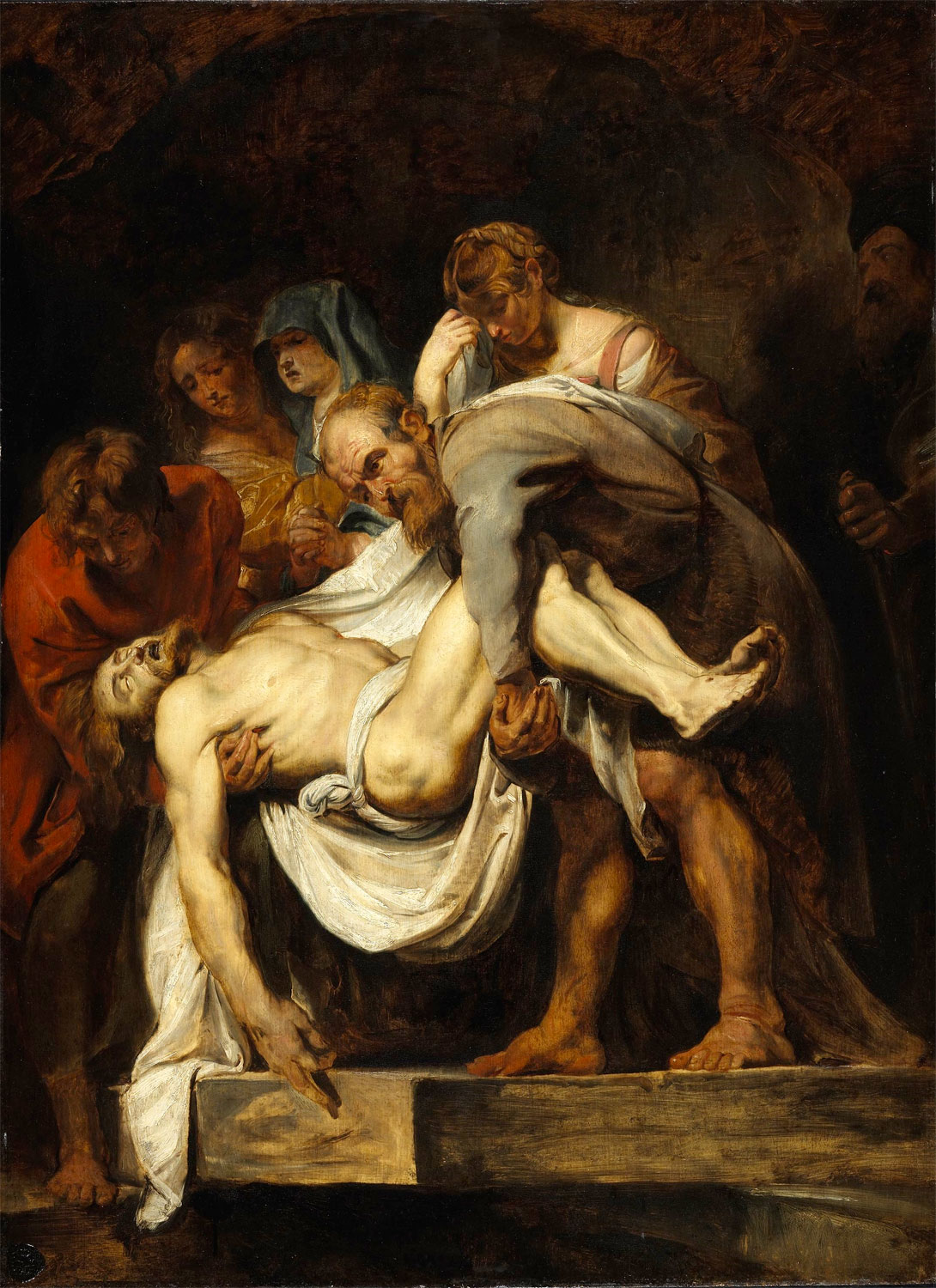
Caravaggio was a masterful storyteller who could bring home the drama and significance of a biblical event with tremendous power. In his scenes from the Old and New Testaments, he created a new kind of painting – dramatic, even theatrical, yet grounded in the observation of ordinary reality – and it proved infectious among his contemporaries in Rome. His approach was to make the scene clear and simple, with the main actors in the drama seen close-up and caught in mid-action at a decisive moment, embodying the whole meaning of the event. He played down the setting, sometimes to the point that it is a mere pool of darkness from which the figures emerge. It was the actions and states of mind of the characters in the story that counted, and Caravaggio presented these with sometimes shocking directness and intensity, breaking all the rules of decorum that restrained more conventional painters. He mastered the art of concealing art, re-creating a scene with such a flavour of reality that it comes across as an eyewitness account. It was his power to draw viewers into the emotion and importance of a scene that made his work an essential object of study, even for such an independent genius as the great Peter Paul Rubens.


Michelangelo Merisi da Caravaggio (Italian, 1571-1610) 'Martha and Mary Magdalene' c. 1598


Michelangelo Merisi da Caravaggio (Italian, 1571-1610)
Martha and Mary Magdalene
c. 1598
Oil and tempera on canvas
38 1/2 x 52 1/4 in (97.8 x 132.7cm)
Detroit Institute of Arts. Gift of the Kresge Foundation and Mrs. Edsel B. Ford


Martha’s expressive hands, intensely illuminated, underscore her attempt to convert her sister Mary Magdalene from a life of worldly pleasures to one of spirituality. Several details recall Mary’s life of indulgence: the elegant dress, the ivory comb, the alabaster cosmetic jar. The mirror, a powerful symbol of vanity, becomes here an instrument reflecting the divine light that is penetrating Mary’s soul. Martha’s words seem to have been convincing, and her open mouth signals her amazement as she witnesses Mary’s transformation. The orange blossom in Mary’s right hand and the ring on her left indicate her new status as the blessed bride of Christ.


Michelangelo Merisi da Caravaggio (Italian, 1571-1610) 'Sacrifice of Isaac' 1602-1603


Michelangelo Merisi da Caravaggio (Italian, 1571-1610)
Sacrifice of Isaac
1602-1603
Oil on canvas
41 x 53 1/8 in (104 x 135cm)
Galleria degli Uffizi, Florence


Orazio Gentileschi (Italian, 1563-1639) 'Saint Francis in Ecstasy' c. 1607


Orazio Gentileschi (Italian, 1563-1639)
Saint Francis in Ecstasy
c. 1607
Oil on canvas
49 5/8 x 38 5/8 in. (126 x 98 cm)
Museo Nacional del Prado, Madrid


Peter Paul Rubens (Flemish, 1577-1640) 'The Entombment' c. 1612-1614


Peter Paul Rubens (Flemish, 1577-1640)
The Entombment
c. 1612-1614
Oil on panel
34 3/4 x 26 1/8 in. (88.3 x 66.5 cm)
National Gallery of Canada, Ottawa
Purchased 1956
Public domain


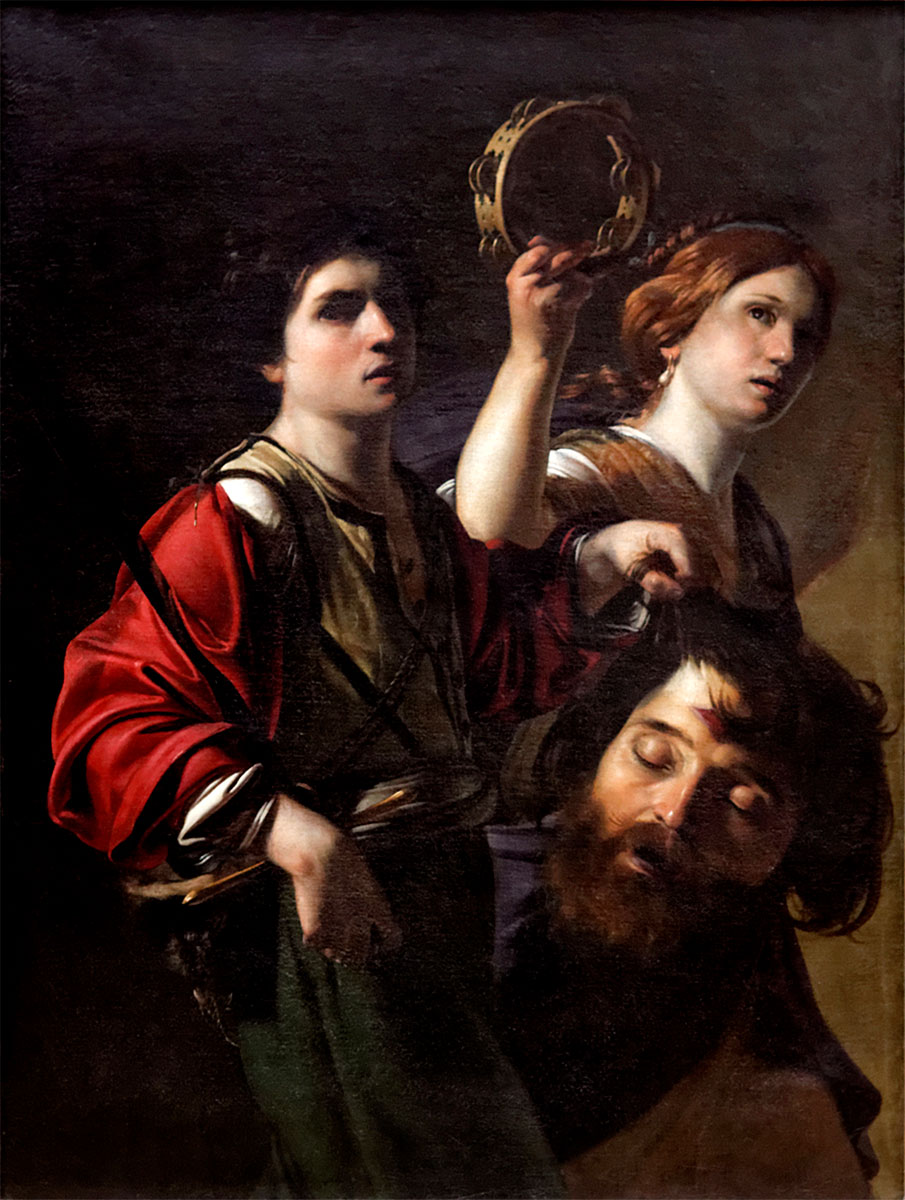
Bartolomeo Manfredi (Italian, 1582-1622) 'David and Goliath (The Triumph of David)' c. 1615


Bartolomeo Manfredi (Italian, 1582-1622)
David and Goliath (The Triumph of David)
c. 1615
Oil on canvas
50 3/8 x 38 1/4 in. (128 x 97cm)
Musée du Louvre, Paris
Acquired in 1990


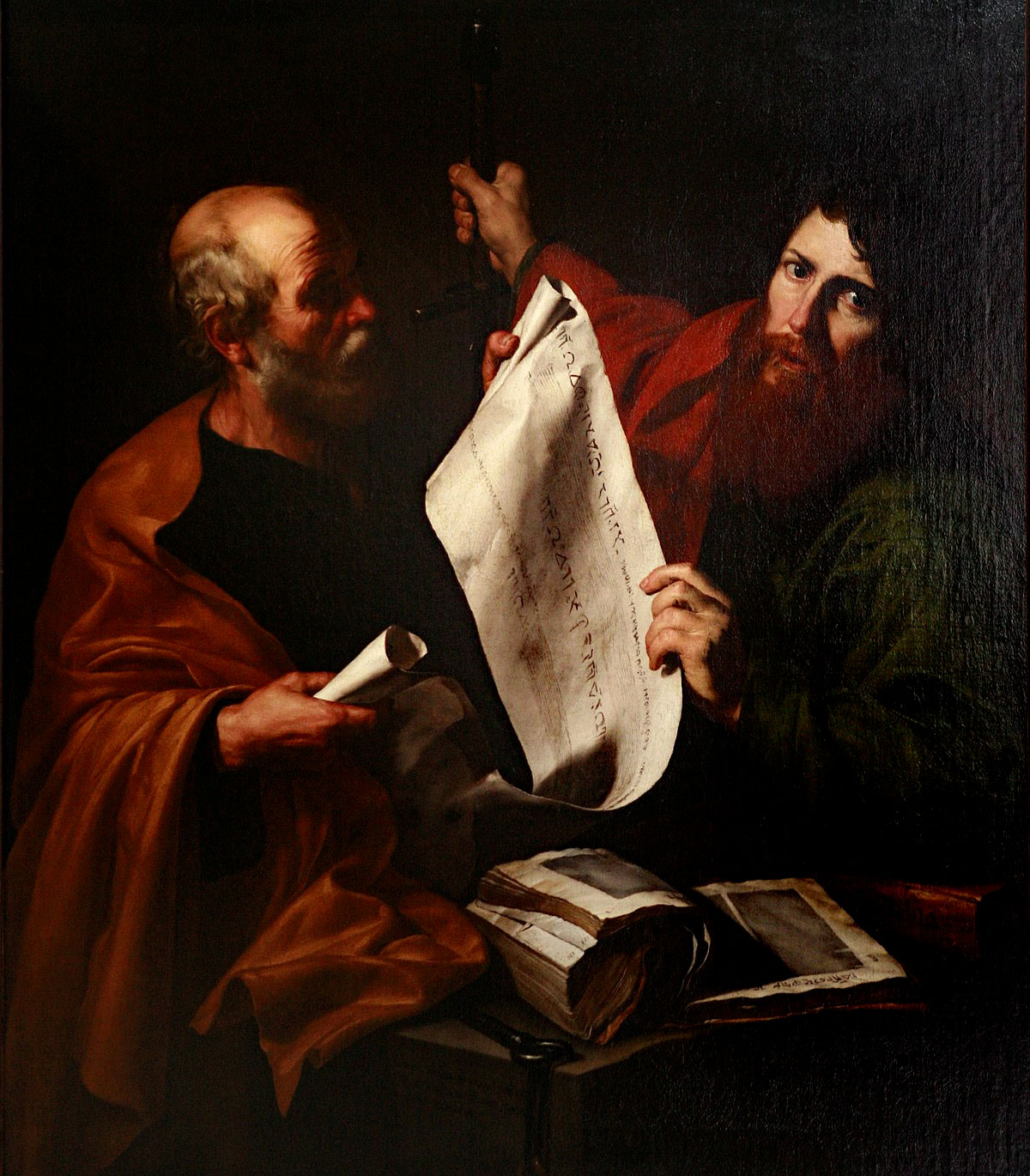
Jusepe de Ribera (Spanish, 1591-1652) 'Saints Peter and Paul' c. 1616


Jusepe de Ribera (Spanish, 1591-1652)
Saints Peter and Paul
c. 1616
Oil on canvas
49 5/8 x 44 1/8 in. (126 x 112cm)
Musée des Beaux-Arts, Strasbourg
Public domain


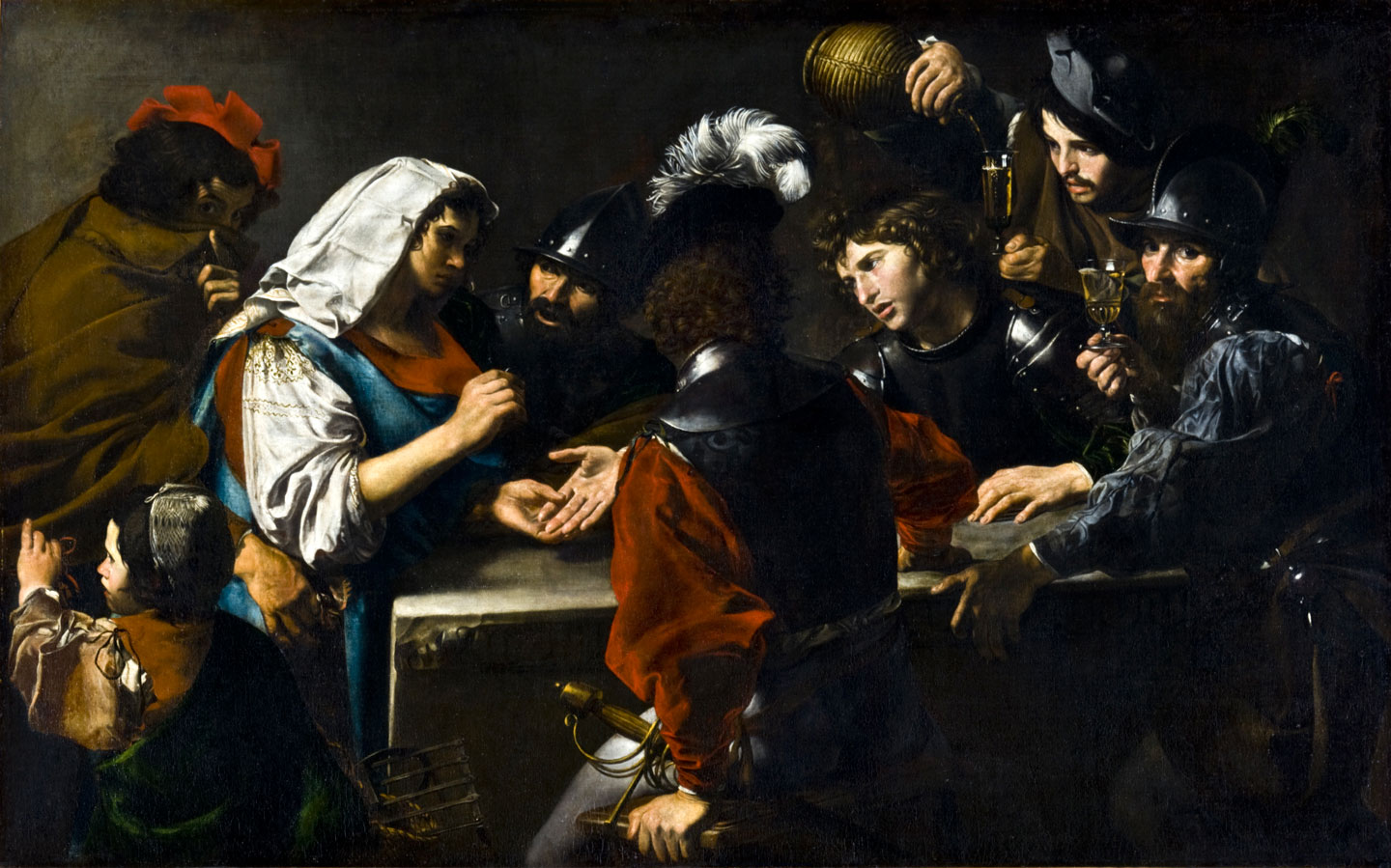
Valentin de Boulogne (French, 1591-1632) 'Fortune Teller with Soldiers' c. 1620


Valentin de Boulogne (French, 1591-1632)
Fortune Teller with Soldiers
c. 1620
Oil on canvas
58 7/8 x 93 7/8 in. (149.5 x 238.5cm)
Toledo Museum of Art
Purchased with funds from the Libbey Endowment. Gift of Edward Drummond Libbey
Public domain


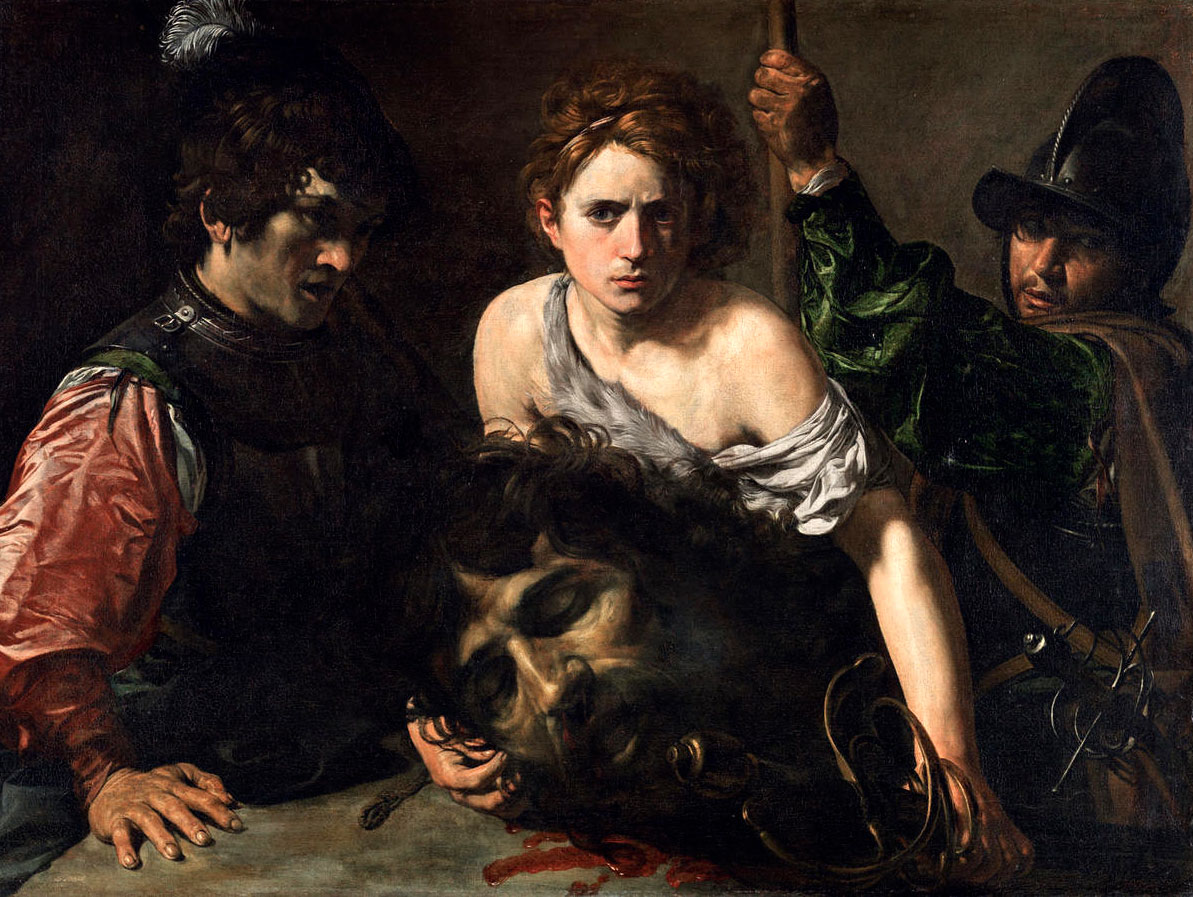
Valentin de Boulogne (French, 1591-1632) 'David with the Head of Goliath and Two Soldiers' 1620-1622


Valentin de Boulogne (French, 1591-1632)
David with the Head of Goliath and Two Soldiers
1620-1622
Oil on canvas
Museo Thyssen-Bornemisza, Madrid
Public domain


Bartolomeo Cavarozzi (Italian, 1587-1625) 'The Sorrows of Aminta' c. 1625


Bartolomeo Cavarozzi (Italian, 1587-1625)
The Sorrows of Aminta
c. 1625
Oil on canvas
39 3/8 x 47 1/4 in. (100 x 120cm)
Musée du Louvre, Paris
Gift of Paul Jamot, 1937
Public domain


Kimbell Art Museum
3333 Camp Bowie Boulevard,
Fort Worth, TX 76107

Opening hours:
Tuesday – Sunday 10am – 5pm
Closed Mondays

Kimbell Art Museum website

LIKE ART BLART ON FACEBOOK

Back to top

Exhibition: ‘After the Gold Rush: Contemporary Photographs from the Collection’ at The Metropolitan Museum of Art, New York

Exhibition dates: 22nd March, 2011 – 2nd January, 2012


Many thankx to The Metropolitan Museum of Art, New York for allowing me to publish the photographs in the posting. Please click on the photographs for a larger version of the image.


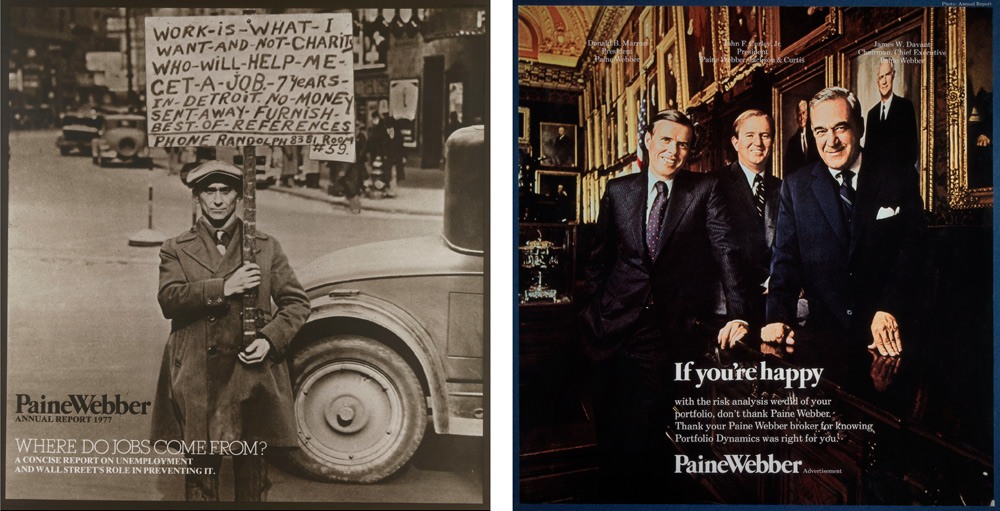
Hans Haacke (German, born 1936). 'Thank You, Paine Webber' 1979


Hans Haacke (German, b. 1936)
Thank You, Paine Webber
1979
Gelatin silver print and chromogenic print
The Metropolitan Museum of Art
Purchase, Vital Projects Fund Inc. Gift, through Joyce and Robert Menschel, 2010
© Hans Haacke


Since the early 1970s Haacke has taken on the intertwined political and corporate forces that use cultural patronage as a smokescreen to advance interests that are often antithetical to the vitality of free speech and expression in democracies. Haacke made this work just as the strategy of appropriation – lifting an image out of its original context and re-presenting it in critical fashion – began to make waves in the New York art world of the late 1970s. Like all effective appropriation, it exposes a prior instance of borrowing – in this case, how the investment firm Paine Webber used a documentary photograph to give its annual report the veneer of social concern. The artist then pointedly contrasted it with an image from the same annual report of a beaming trio of executives in a painting-lined gallery. As a counterpoint to the protestor’s signboard, Haacke dropped in text from a different Paine Webber ad campaign to show on whose backs the “risk management” is taking place – a biting indictment, the relevance of which has only increased since the recent economic downturn.

Wall text


Jeff Wall (Canadian, born 1946). 'The Storyteller' 1986


Jeff Wall (Canadian, b. 1946)
The Storyteller
1986
Silver dye bleach transparency in light box
The Metropolitan Museum of Art
Purchase, Charlene and David Howe, Henry Nias Foundation Inc., Jennifer and Robert Yaffa, Harriet Ames Charitable Trust, and Gary and Sarah Wolkowitz Gifts, 2006
Image courtesy of the artist
© Jeff Wall


Wall’s staged tableaux straddle the worlds of the museum and the street. His subjects are scenes of urban and suburban disarray that he witnessed firsthand – the kinds of things anyone might see while wandering around a city and its outskirts. Working like a movie director, he restages the scene using nonprofessionals as actors and presents his photographs as colour transparencies in light boxes such as those of large-scale public advertisements found at airports and bus stops. The scale and ambition of his pictures – scenes of everyday life shot through with larger intimations of political struggle – equally evoke the Salon paintings of nineteenth century French painters such as Gustave Courbet and Édouard Manet, which were themselves brazen combinations of canonical and contemporary subjects.

The Storyteller is set in a barren, leftover slice of land next to a highway overpass in Vancouver, where the artist lives. Various groupings of modern urban castaways – perhaps descendants of the Native Americans who occupied the land before the arrival of Europeans – are dispersed around the hillside, a mini-catalogue of art-historical reference. Like the upside-down, half-submerged figure of Icarus in the background of Brueghel’s Landscape with the Fall of Icarus, the woman speaking and gesticulating to the two men listening at the lower left becomes the key to unifying the fractured and alienating environment from which Wall’s picture is constructed.

Wall text


Laurie Simmons (American, b. 1949). 'Walking Gun' 1991


Laurie Simmons (American, b. 1949)
Walking Gun
1991
Gelatin silver print
The Metropolitan Museum of Art
Purchase, Anonymous Gift, 1998
© Laurie Simmons


The early 1990s marked the last moment when a wide swath of women artists responded to the sexism they saw as pervasive in the culture – from the rape trial of William Kennedy Smith to the Supreme Court nomination hearings for Clarence Thomas. A pioneer of set-up photography, Simmons dramatically expanded the scale of her constructed tableaux for a series of spotlighted puppet-like objects perched atop doll legs: revolvers, houses, cameras, and cakes. This armed and dangerous example refers to the old-movie cliché where a man carrying a gun is shown in shadow profile. Here, Simmons offers instead the death-dealing seductress – also familiar from film noir – in monumental miniature, a doll capable of turning on its master at a moment’s notice.

Wall text


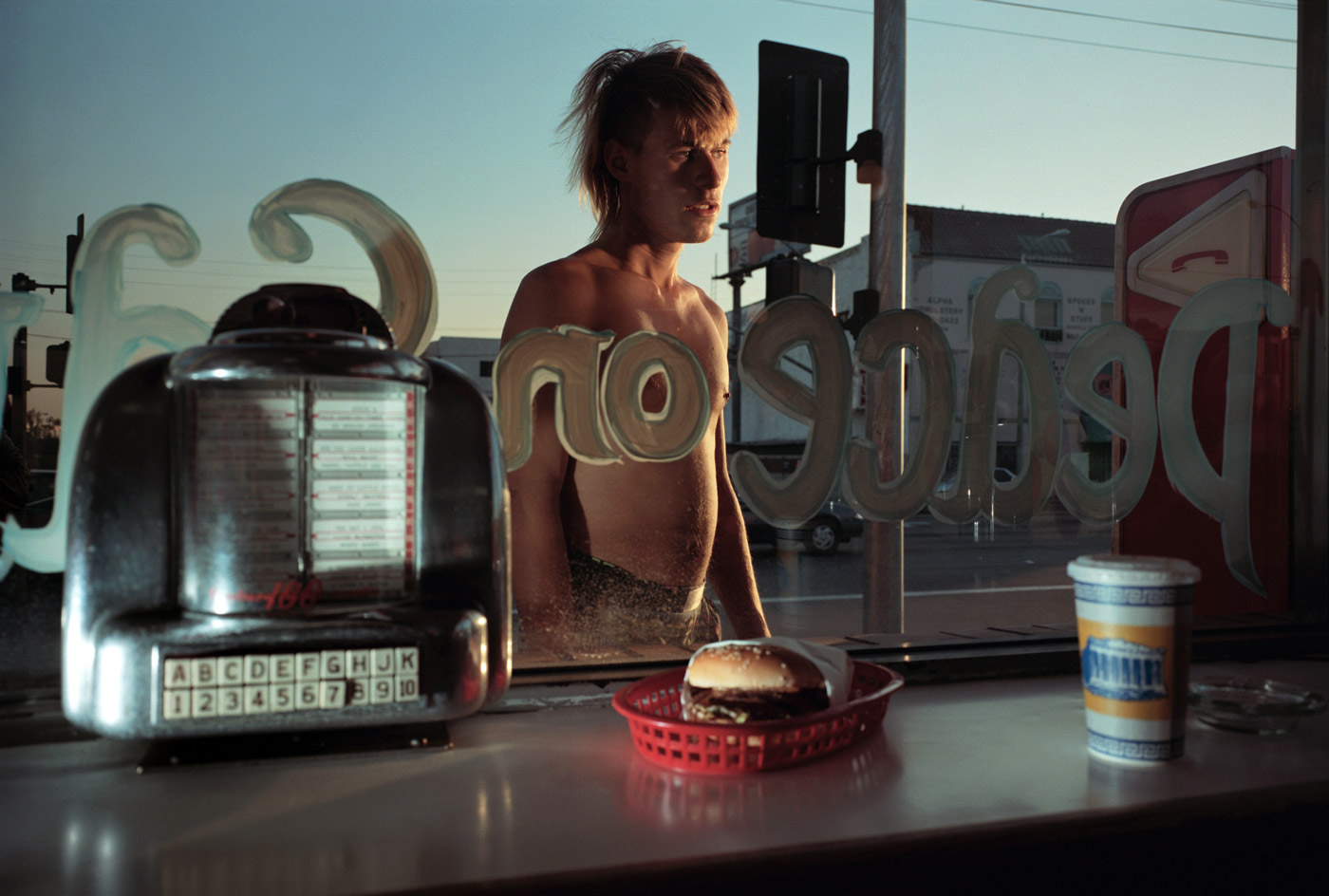
Philip-Lorca diCorcia (American, b. 1953). 'Todd M. Brooks, 22 Years Old, from Denver, Colorado, $40' 1991


Philip-Lorca diCorcia (American, b. 1953)
Todd M. Brooks, 22 Years Old, from Denver, Colorado, $40
1991
Chromogenic print
The Metropolitan Museum of Art
Purchase, The Horace W. Goldsmith Foundation Gift, through Joyce and Robert Menschel, 1991
Image courtesy the artist and David Zwirner, New York
© Philip-Lorca diCorcia


In the middle of the 1990’s, diCorcia gained international recognition for his large color photographs of street scenes and passersby. For an earlier series, he traveled to Los Angeles on a fellowship from the National Endowment for the Arts, and worked on a part of Santa Monica Boulevard frequented by male prostitutes and drug addicts. For each picture he made there, he carefully composed his setting, then asked young men to pose for him, giving them a small fee (from twenty to fifty dollars) that was negotiated each time.

At that time, NEA support of artists such as Robert Mapplethorpe was highly controversial, and diCorcia had to sign a document stating that he would not produce any “obscene” work while on his fellowship. He set up the whole negotiating procedure as a symbolic way of sharing his grant with people whose behavior would surely have been condemned by the censors. The titles always mention the name, the age and the origin of the model, as well as the amount paid. The staged situation interacts with the raw reality of the exchange of money, blurring the boundaries between documentary and fiction, yet preserving an authentic emotional charge.

Text from The Metropolitan Museum of Art website


Philip-Lorca diCorcia (American, b. 1953) 'Eddie Anderson, 21 Years Old, from Houston, Texas, $20' 1991


Philip-Lorca diCorcia (American, b. 1953)
Eddie Anderson, 21 Years Old, from Houston, Texas, $20
1991
Chromogenic print
Image: 39.2 x 57.8 cm (15 7/16 x 22 3/4 in.)
The Metropolitan Museum of Art
Purchase, The Horace W. Goldsmith Foundation Gift, through Joyce and Robert Menschel, 1991
Image courtesy the artist and David Zwirner, New York
© Philip-Lorca diCorcia


The Metropolitan Museum of Art will present After the Gold Rush: Contemporary Photographs from the Collection from March 22, 2011, through January 2, 2012, in the Joyce and Robert Menschel Hall for Modern Photography. Drawn entirely from the Museum’s permanent collection, the exhibition features 25 photographs dating from 1979 to the present by 15 contemporary artists.

The exhibition’s title, After the Gold Rush, is taken from a classic 1970 song by Neil Young, whose verses contrast a romanticised past with a present of squandered plenty and an uncertain future. Inspired by the recent political and economic upheavals in America and abroad, this selection juxtaposes new photographs that take the long view of the world’s current condition with prescient works from the 1980s and 1990s that remain startlingly relevant today.

This is the first occasion for the Museum to present recently acquired works by: Gretchen Bender, James Casebere, Moyra Davey, Katy Grannan, Hans Haacke, An-My Lê, Curtis Mann, Trevor Paglen, and Wolfgang Tillmans. Also featured are photographs by: Philip-Lorca diCorcia, Robert Gober, Adrian Piper, Laurie Simmons, Jeff Wall, and Christopher Williams.

After the Gold Rush begins with Hans Haacke’s Thank You, Paine Webber (1979) – the first work by this legendary provocateur of Conceptual art to enter the Metropolitan’s collection. Haacke’s biting photo-diptych is so pertinent to the recent economic downturn that it seems as if it could have been made yesterday. In this work, the artist appropriated images from the investment firm’s annual report to convey his viewpoint that big business provides a veneer of social concern to mask the brutal effects of the “risk management” they offer their clients.

Other works in After the Gold Rush use varying degrees of artifice and photographic realism to reflect on marginalised and repressed voices. Measuring over 14 feet long and presented as a backlit transparency in a light box, The Storyteller (1986) is Jeff Wall’s signature image and is typical of his method. Working from memory, the artist uses nonprofessional actors and real locations to meticulously restage a scene of urban blight that he witnessed in his native Vancouver. Wall plays this photographic verisimilitude against compositions and figural poses indebted to French painters such as Gustave Courbet, Edouard Manet, and Georges Seurat. A comparison of Wall’s Storyteller with Courbet’s Young Ladies of the Village (1852), on view in the Museum’s galleries for Nineteenth and Early Twentieth-Century European Paintings and Sculpture, reveals parallels: in both, a keenly observed moment of telling social interaction taking place on a sloping landscape. Each artist has combined a daringly modern subject with references to earlier art.

Philip-Lorca diCorcia is another key figure in the development of staged photography. In the early 1990s, the artist created a series of works in response to the political attacks on gays and federal funding of the arts in the U.S. DiCorcia hired male hustlers to pose for their portraits out on the streets – and paid them with grant money he received from the National Endowment for the Arts. At the same moment, a wide swath of women artists addressed issues of sexism and racism: examples of this politically pointed art are represented by Laurie Simmons’ Walking Gun (1991) – a spotlighted puppet of doll legs and a revolver that seems capable of turning on its master at a moment’s notice – and Adrian Piper’s 1992 work Decide Who You Are #24 (A Moving Target), which includes a childhood image of Anita Hill as part of a blistering meditation in word and image on racial politics. Such works are missives from a time not so long ago when artists regularly commented on present-day politics and culture through their art. (Because of light sensitivity, this work by Adrian Piper will be on view through Sunday, September 26.)

Although the recently made photographs in After the Gold Rush seem at first glance to be less overtly political than their predecessors, they nevertheless address vital issues about contemporary society. James Casebere’s epic vision of America, Landscape with Houses (Dutchess County, NY) #1, (2009), is based on a tabletop model that the artist spent 18 months building. The photograph shows a suburban subdivision of the kind recently ravaged by the foreclosure crisis, and its sunny sense of “Morning in America” comments ironically on the country’s future prospects. An-My Lê’s similarly sweeping five-part photographic piece Suez Canal Transit, USS Dwight Eisenhower, Egypt (2009) will also be featured. Lê is interested in the way in which U.S. armed forces come into contact with the rest of the world. This major new work – which seems at first to be a straightforward panorama of military might overseas – subtly undercuts the viewer’s expectations to question the current position of the U.S. on the global stage.

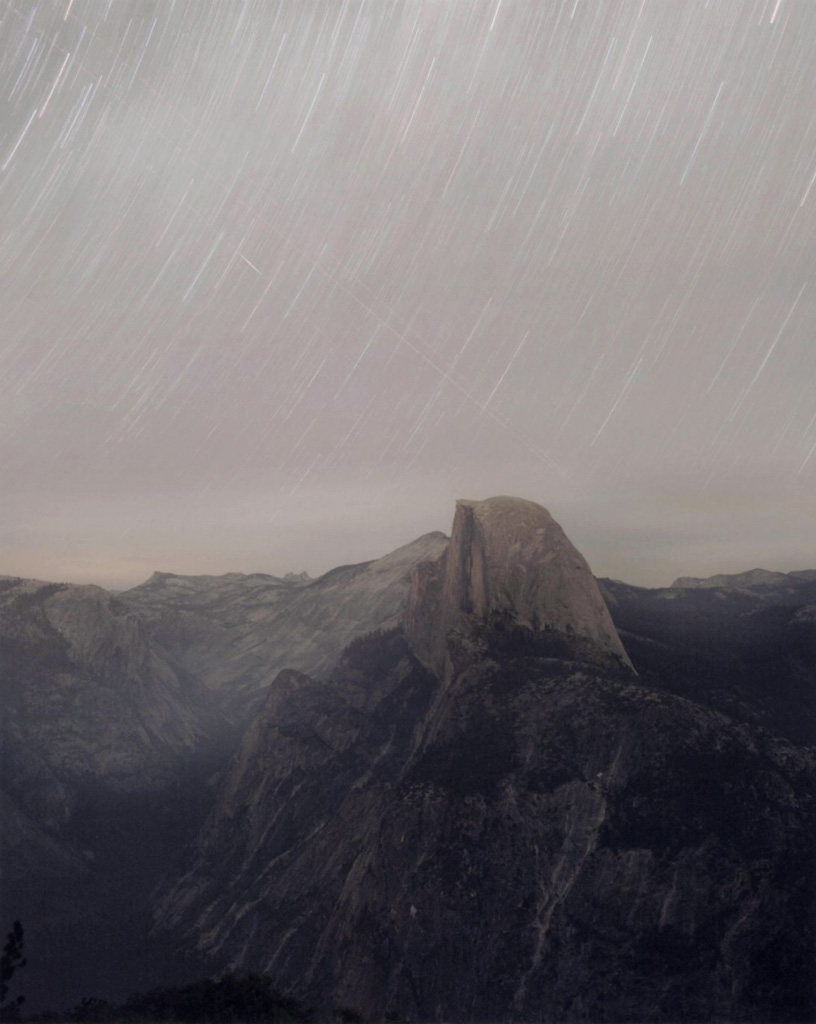
Trevor Paglen is a young artist whose works plot the “black world” of covert military operations, from telephoto images of predator drones taken from miles away, to software that follows planes used for the extraordinary rendition of suspected terrorists. Paglen’s 2008 photograph KEYHOLE IMPROVED CRYSTAL from Glacier Point (Optical Reconnaissance Satellite; USA 186) shows the ghostly white streak of an American reconnaissance satellite bisecting star trails above Yosemite’s Half Dome, a rock formation photographed in the 1860s by artists including Carleton Watkins. To make these and other photographs, Paglen collaborated with amateur astronomers who were originally trained by the U.S. government to look out for Soviet satellites during the Cold War, but turned their attention to American surveillance in recent years.

The final piece in After the Gold Rush is a suite of five recently acquired photographs from 2007-2009 by the celebrated photographer Wolfgang Tillmans. The grouping shifts focus from macro to micro: from expansive aerial views of Shanghai and Dubai to close ups that suggest the smallest increments of sustenance and regeneration. Taken together, they evoke the interconnectedness of all things and a grounding of the political in the personal as a way for an engaged yet expressive art.

Press release from The Metropolitan Museum of Art website


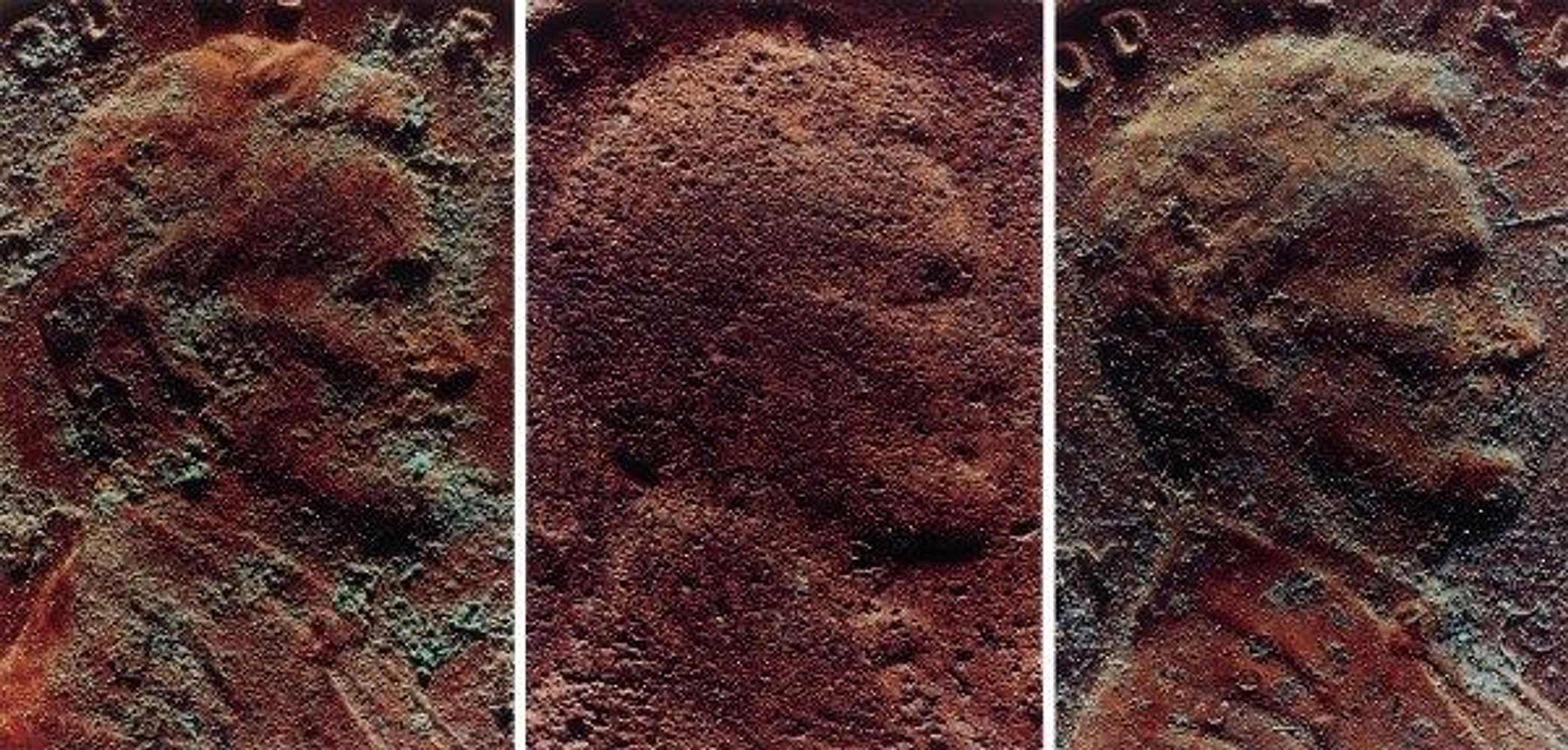
Moyra Davey (American born Canada, b. 1958) 'Copperhead Grid' 1990 (detail)


Moyra Davey (American born Canada, b. 1958)
Copperhead Grid (detail)
1990
Chromogenic prints
Image: 8 3/4 in. × 6 in. (22.3 × 15.3cm) each
Sheet: 10 × 8 in. (25.4 × 20.3cm) each
The Metropolitan Museum of Art
Purchase, Vital Projects Fund Inc. Gift, through Joyce and Robert Menschel, 2011
© Moyra Davey


It was in 1990 – at the height of a worldwide economic recession that also marked the end of the 1980s art bubble – that Davey began photographing the scratched, worn-away surfaces of pennies, the most devalued and lowest form of currency. Her accumulation of one hundred micro-photographic specimens is constructed around the readymade patterns of decay that countless anonymous owners have unconsciously wrought upon their surfaces; their base materiality is incisively contrasted with the most elevated of national symbols. As with all of Davey’s work, there is a melancholic sense of loss that connects subject and form: like pennies, photographs are objects of exchange imprinted by contact with the world around them.

Text from The Metropolitan Museum of Art website


Adrian Piper (American, born 1948). 'Decide Who You Are #24: A Moving Target' 1992


Adrian Piper (American, b. 1948)
Decide Who You Are #24: A Moving Target
1992
Photo-mechanical processes on three panels
The Metropolitan Museum of Art
Gift of Peter Norton Family Foundation, 1994
© Adrian Piper


Piper is an artist and a philosophy professor who works in a variety of media, including performance, video, sound pieces, photography, drawing, and writing. She often explores issues of autobiography, racism, and stereotyping. For her 1992 series Decide Who You Are, the artist used a triptych format in which a different appropriated photograph is flanked by an image of the “three wise monkeys” maxim advocating “See No Evil, Speak No Evil, Hear No Evil” at left, and at right a photograph of a young girl who, though not identified, is Anita Hill – who had recently been thrust into the spotlight for accusing then-nominee for Supreme Court Justice Clarence Thomas of sexual harassment. The verse in the left panel changes in each individual work in the series, while that on the right is unchanging – what the artist once described as “a comprehensive, textbook compendium of commonly invoked litanies of denial and intimidation, from the bland to the vaguely menacing” and “a must for novices and aspiring leaders in business, politics, and culture.”

Wall text


Christopher Williams (American, b. 1956). '3 White (DG's Mr. Postman) Fourth Race, Phoenix Greyhound Park, Phoenix, Arizona, August 22, 1994' 1994


Christopher Williams (American, b. 1956)
3 White (DG’s Mr. Postman) Fourth Race, Phoenix Greyhound Park, Phoenix, Arizona, August 22, 1994
1994
Gelatin silver print
The Metropolitan Museum of Art
Purchase, Charina Foundation Inc. and Jennifer and Joseph Duke Gifts, 2003
© Christopher Williams


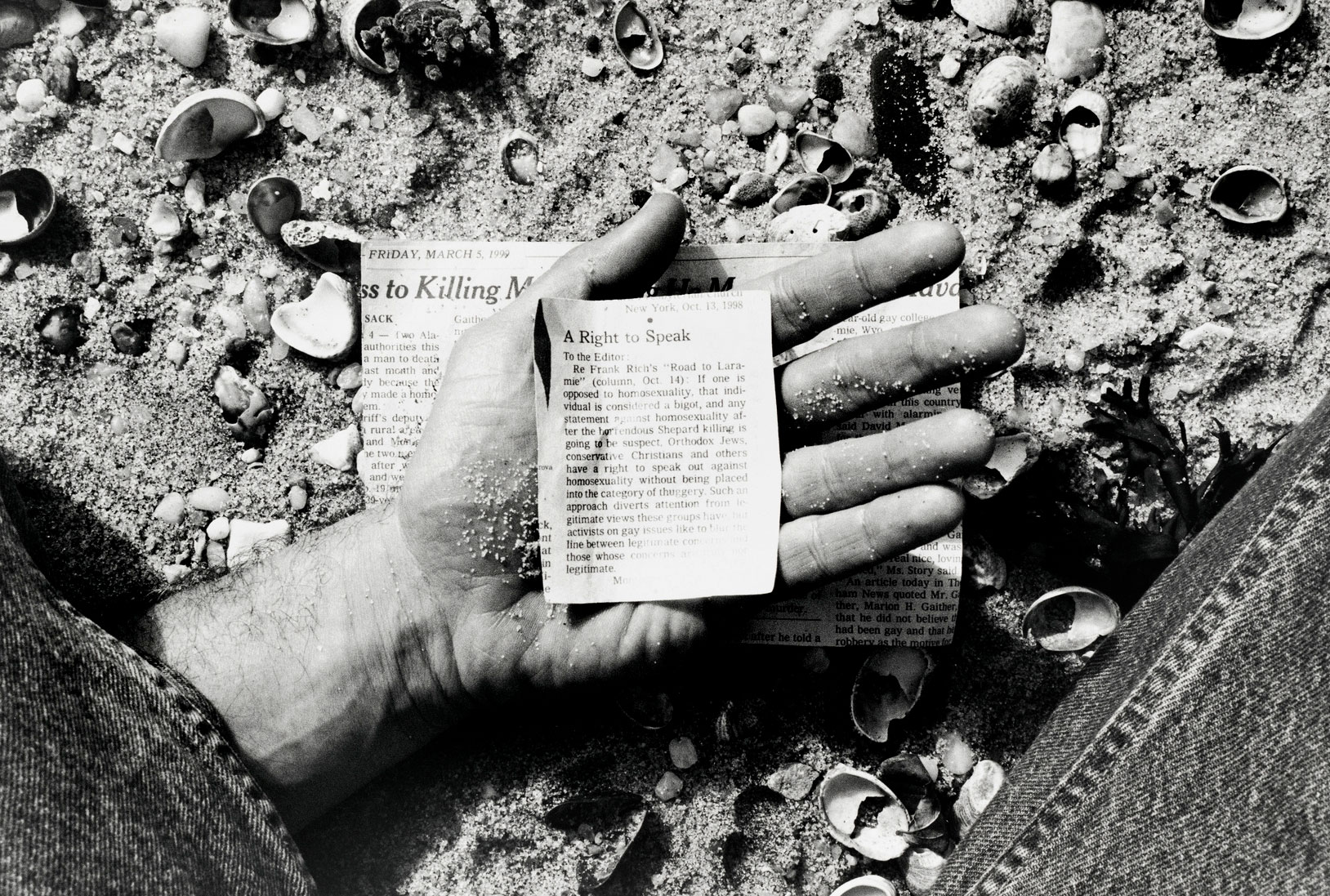
Robert Gober (American, b. 1954) 'Page 12 / Untitled (Detail from 1978-2000)' 1978-2000


Robert Gober (American, b. 1954)
Page 12 / Untitled (Detail from 1978-2000)
1978-2000
Gelatin silver print
40.6 x 50.8cm (16 x 20 in.)
The Metropolitan Museum of Art
Purchase, Charina Foundation Inc. Gift, 2002
© Robert Gober


Robert Gober works primarily in sculpture, installations, and photography. He is perhaps best known for his delicate, ghostly hand crafted versions of domestic fixtures, such as drains, beds, doors, and sinks. Through these uncanny replicas, Gober invests mass produced objects with personal meaning – the private, unruly desires and memories of the individual. This image appeared in the book (his first in the genre) that Gober created to accompany his installation representing the United States at the 2000 Venice Biennale. In it, the artist interweaves his own journey to New York in 1978 as a young gay man with the toxic fallout of homophobic recrimination that accompanied the murder of the Wyoming college student Matthew Shepard twenty years later.

Text from The Metropolitan Museum of Art website


Robert Gober superimposes a man’s hand between two newspaper articles, clipped neatly and placed on a shell-strewn beach. Below his hand, the article refers to Matthew Shepard’s death. Above it, a letter to the editor argues that “Orthodox Jews, conservative Christians and others have a right to speak out against homosexuality without being placed in the category of thuggery.” While the piece obviously precedes Jonathan Rauch’s provocative and important piece in the December issue of the Advocate arguing that gay people should tolerate a certain amount of anti-gay sentiment as a sign that they’re legally and socially secure enough to practice tolerance, it’s a useful encapsulation of the dilemma behind that argument. It’s hard to cast off past threats if you’re not entirely sure they’re past.

Alyssa Rosenberg. “Gay Americans, Censorship, And ‘After The Gold Rush’ At The Metropolitan Museum Of Art,” on the Think Progress website November 28, 2011 [Online] Cited 11/12/2024


Robert Gober (American, b. 1954). 'Untitled (Detail from "1978-2000")' 2000


Robert Gober (American, b. 1954)
Untitled (Detail from “1978-2000”)
2000
Gelatin silver print
The Metropolitan Museum of Art
Purchase, Jennifer and Joseph Duke Gift, 2002
© Robert Gober


James Casebere (American, b. 1953). 'Landscape with Houses (Dutchess County, NY) #1' 2009


James Casebere (American, b. 1953)
Landscape with Houses (Dutchess County, NY) #1
2009
Chromogenic print
The Metropolitan Museum of Art
Purchase, Alfred Stieglitz Society Gifts, 2011
© James Casebere


Trevor Paglen (American, b. 1974) 'KEYHOLE IMPROVED CRYSTAL from Glacier Point (Optical Reconnaissance Satelltte; USA 186)' 2008


Trevor Paglen (American, b. 1974)
KEYHOLE IMPROVED CRYSTAL from Glacier Point (Optical Reconnaissance Satelltte; USA 186)
2008
Chromogenic print
Image: 95.3 x 76.2cm (37 1/2 x 30 in.)
Frame: 96.5 × 77.5cm (38 × 30 1/2 in.)
The Metropolitan Museum of Art
Purchase, Vital Projects Fund Inc. Gift, through Joyce and Robert Menschel, 2011
© Trevor Paglen


Trained as a geographer, Paglen is an artist who plots the topography of a new global and celestial space – the “black world” of covert military operations. Examples of his subjects include the supposed sites used for the extraordinary rendition of prisoners, which he shoots with specially designed cameras from up to forty miles away, and the network of private planes used to transport them under the radar. This image shows the ghostly white streak of an American reconnaissance satellite bisecting star trails above Yosemite’s Half Dome, a rock formation photographed in the 1860s by the photographer Carleton Watkins when the West was still being explored. In order to track such spacecraft, Paglen uses a database created by amateur astronomers who were trained by the U.S. government to search the skies for Soviet sputniks but continued their hobby after the end of the Cold War by tracking our own satellites. In this work, the artist brings into one composition two historically disparate moments in geographic and celestial colonisation.

Text from The Metropolitan Museum of Art website


Wolfgang Tillmans (German, b. 1968).' Oriental Pearl' 2009


Wolfgang Tillmans (German, b. 1968)
Oriental Pearl
2009
Inkjet print
The Metropolitan Museum of Art
Purchase, Vital Projects Fund Inc. Gift, through Joyce and Robert Menschel, 2010
Image courtesy the artist and Andrea Rosen Gallery, New York
© Wolfgang Tillmans


The Metropolitan Museum of Art
1000 Fifth Avenue at 82nd Street
New York, New York 10028-0198
Phone: 212-535-7710

Opening hours:
Sunday – Tuesday and Thursday: 10am – 5pm
Friday and Saturday: 10am – 9pm
Closed Wednesday

The Metropolitan Museum of Art website

LIKE ART BLART ON FACEBOOK

Back to top

Exhibition: ‘Robert Adams: The Place We Live, A Retrospective Selection of Photographs’ at the The Denver Art Museum (DAM)

Exhibition dates:  25th September 2011 – 1st January 2012


Many thankx to The Denver Art Museum for allowing me to publish the photographs in the posting. Please click on the photographs for a larger version of the image.


Robert Adams (American, b. 1937) 'Burning oil sludge, north of Denver, Colorado' 1973-1974


Robert Adams (American, b. 1937)
Burning oil sludge, north of Denver, Colorado
1973-1974
Gelatin silver print
Yale University Art Gallery, purchased with a gift from Saundra B. Lane, a grant from the Trellis Fund and the Janet and Simeon Braguin Fund


Robert Adams (American, b. 1937) 'North of Keota, Colorado' 1973


Robert Adams (American, b. 1937)
North of Keota, Colorado
1973 printed 1989
Gelatin silver print
Yale University Art Gallery, purchased with a gift from Saundra B. Lane, a grant from the Trellis Fund and the Janet and Simeon Braguin Fund


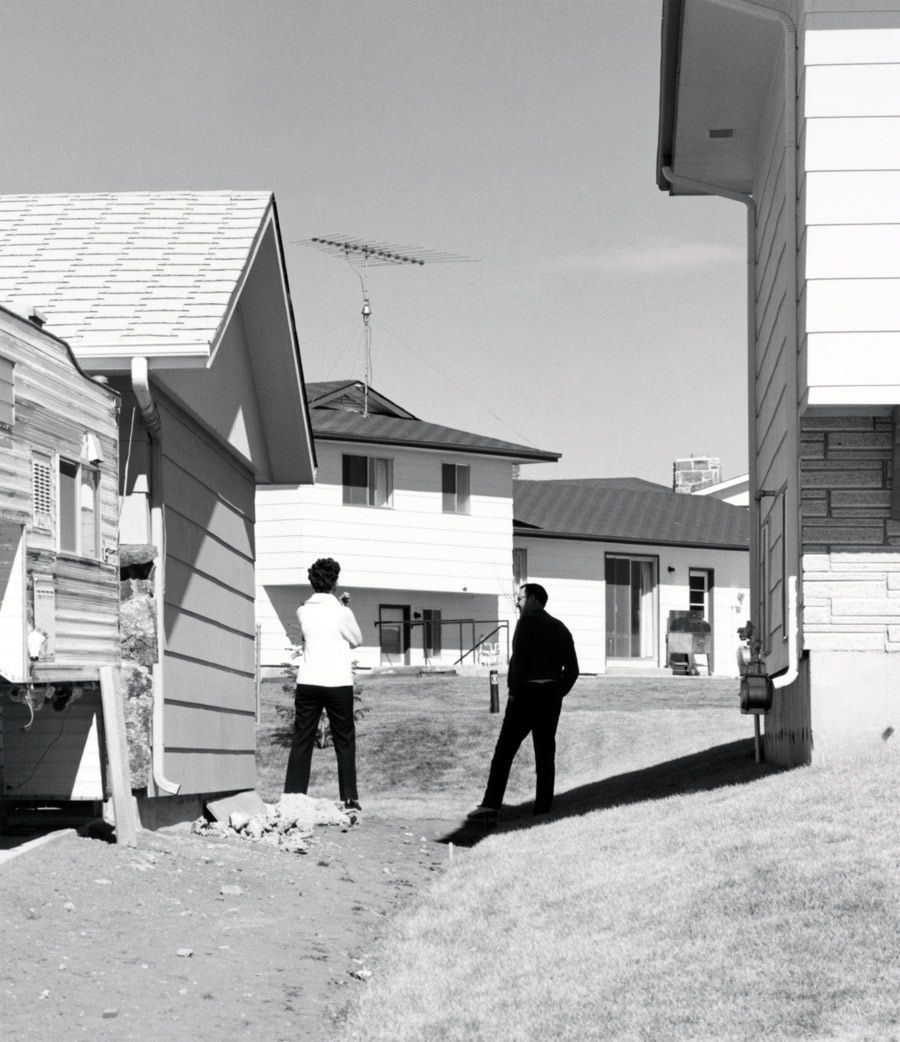
Robert Adams (American, b. 1937) 'Mobile home park, north edge of Denver, Colorado' 1973-1974


Robert Adams (American, b. 1937)
Mobile home park, north edge of Denver, Colorado
1973-1974
Gelatin silver print
Yale University Art Gallery, purchased with a gift from Saundra B. Lane, a grant from the Trellis Fund and the Janet and Simeon Braguin Fund


The Denver Art Museum (DAM) is the first U.S. venue for Robert Adams: The Place We Live, A Retrospective Selection of Photographs. The exhibition features more than 200 black-and-white photos spanning Adams’s 45-year career, showcasing the artistic legacy of the American photographer and his longstanding engagement with the contemporary Western landscape. Adams lived and worked in Colorado for nearly 30 years. Many of his most acclaimed images were taken in the Rocky Mountain region and will strike a familiar chord with visitors. The exhibition, organised by the Yale University Art Gallery, will be on view September 25, 2011 – January 1, 2012 in the museum’s Gallagher Family Gallery.

“We’re excited to host the work of one of the foremost photographers of our time,” said Eric Paddock, the DAM’s curator of photography. “Robert Adams’s striking yet quiet photos provoke thought about current economic, political and environmental issues Westerners confront every day. We think visitors will see something very familiar in his work.”

Since becoming a photographer in the mid-1960s, Adams has been widely regarded as one of the most significant and influential chroniclers of the American West. Adams’s photographs and writing insist that the realities of everyday landscapes are as beautiful as idealised scenes from nature. They ask questions about the ways people change and interact with nature, and what it means to live simply and quietly in today’s world. This commitment earned Adams prominence in photography’s “New Topographics” movement of the late 20th century and lends authority to his ongoing work. His photographs of Colorado suburban growth and clear cut forests in the Pacific Northwest, for example, express shock at mainstream social and economic values.

“The Denver Art Museum is pleased to be the first U.S. venue for The Place We Live, showcasing our continued commitment to our photography program,” said Christoph Heinrich, Frederick and Jan Mayer Director of the DAM. “Colorado has a rich photography history and we’re excited to have visitors engage with these artworks that provide a narrative to the American experience and take a fresh look at their surroundings.”

Featuring more than 200 gelatin silver prints, The Place We Live weaves together four decades of Adam’s work into a cohesive, epic narrative of American experience in the late 20th and early 21st centuries. Each of the photographer’s major projects is represented, from early pictures of quiet buildings and monuments erected by prior settlers of his native Colorado to his most recent images of forests and migratory birds in the Pacific Northwest.

Biography

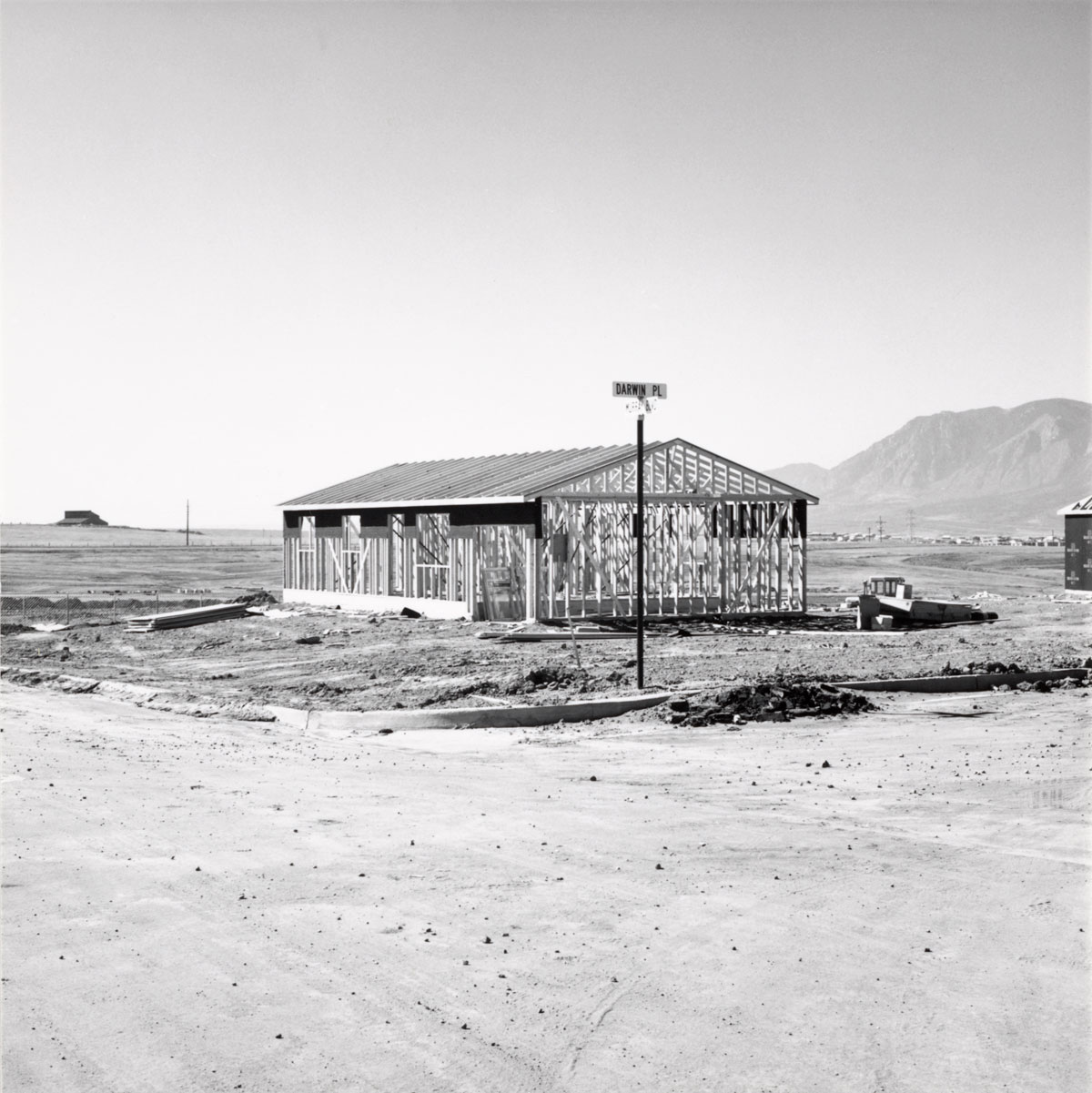
Born in Orange, N.J., in 1937, Robert Adams moved with his family from Madison, Wis., to Denver, Colo., at the age of 15. He earned a doctorate degree from the University of Southern California and, intent on pursuing an academic career, returned to Colorado in 1962 as an assistant professor of English at Colorado College. Disturbed by the rapid transformation of the Colorado Springs and Denver areas, Adams began photographing a landscape transformed by tract housing, highways, strip malls and gas stations. “The pictures record what we purchased, what we paid and what we could not buy,” Adams wrote. “They document a separation from ourselves, and in turn from the natural world that we professed to love.” Since 1997, he has lived and worked in Oregon.”

Press release from The Denver Art Museum


Robert Adams (American, b. 1937) 'Lakewood, Colorado' 1968-1971


Robert Adams (American, b. 1937)
Lakewood, Colorado
1968-1971
Gelatin silver print
Yale University Art Gallery, purchased with a gift from Saundra B. Lane, a grant from the Trellis Fund and the Janet and Simeon Braguin Fund


Robert Adams (American, b. 1937) 'In a New Subdivision, Colorado Springs, Colorado' 1969


Robert Adams (American, b. 1937)
In a New Subdivision, Colorado Springs, Colorado
1969
Gelatin silver print
Yale University Art Gallery, purchased with a gift from Saundra B. Lane, a grant from the Trellis Fund and the Janet and Simeon Braguin Fund


Robert Adams (American, b. 1937) 'Frame for a Tract House, Colorado Springs, Colorado' 1969


Robert Adams (American, b. 1937)
Frame for a Tract House, Colorado Springs, Colorado
1969
Gelatin silver print
Yale University Art Gallery, purchased with a gift from Saundra B. Lane, a grant from the Trellis Fund and the Janet and Simeon Braguin Fund


Robert Adams (American, b. 1937) 'Pikes Peak, Colorado Springs, Colorado' 1969


Robert Adams (American, b. 1937)
Pikes Peak, Colorado Springs, Colorado
1969
Gelatin silver print
Yale University Art Gallery, purchased with a gift from Saundra B. Lane, a grant from the Trellis Fund and the Janet and Simeon Braguin Fund


Robert Adams (American, b. 1937) 'Denver, Colorado' c. 1970


Robert Adams (American, b. 1937)
Denver, Colorado
c. 1970
Gelatin silver print
Yale University Art Gallery, purchased with a gift from Saundra B. Lane, a grant from the Trellis Fund and the Janet and Simeon Braguin Fund


Robert Adams (American, b. 1937) 'Longmont, Colorado' 1973-1974, printed 2007


Robert Adams (American, b. 1937)
Longmont, Colorado
1973-1974, printed 2007
Gelatin silver print
Yale University Art Gallery, purchased with a gift from Saundra B. Lane, a grant from the Trellis Fund and the Janet and Simeon Braguin Fund


Robert Adams (American, b. 1937) 'Eden, Colorado' 1968


Robert Adams (American, b. 1937)
Eden, Colorado
1968
Gelatin silver print
Yale University Art Gallery
Purchased with a gift from Saundra B. Lane, a grant from the Trellis Fund and the Janet and Simeon Braguin Fund


Robert Adams (American, b. 1937) 'Colorado Springs, Colorado' 1974


Robert Adams (American, b. 1937)
Colorado Springs, Colorado
1968
Gelatin silver print
Yale University Art Gallery
Purchased with a gift from Saundra B. Lane, a grant from Trellis Fund, and the Janet and Simeon Braguin Fund


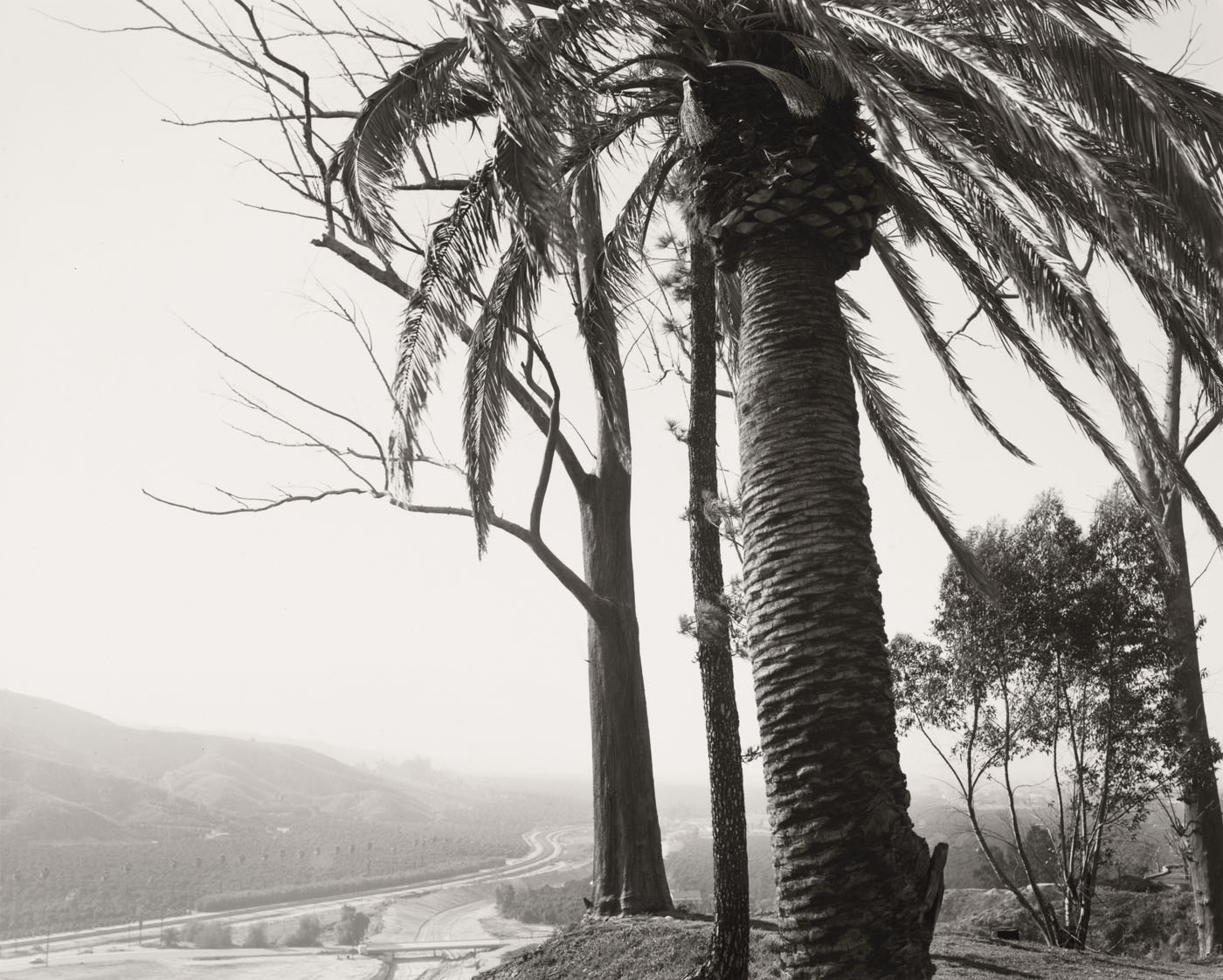
Robert Adams (American, b. 1937) 'Edge of San Timoteo Canyon, Redlands, California' 1978


Robert Adams (American, b. 1937)
Edge of San Timoteo Canyon, looking toward Los Angeles, Redlands, California
1978
Gelatin silver print
Yale University Art Gallery
Purchased with a gift from Saundra B. Lane, a grant from the Trellis Fund and the Janet and Simeon Braguin Fund


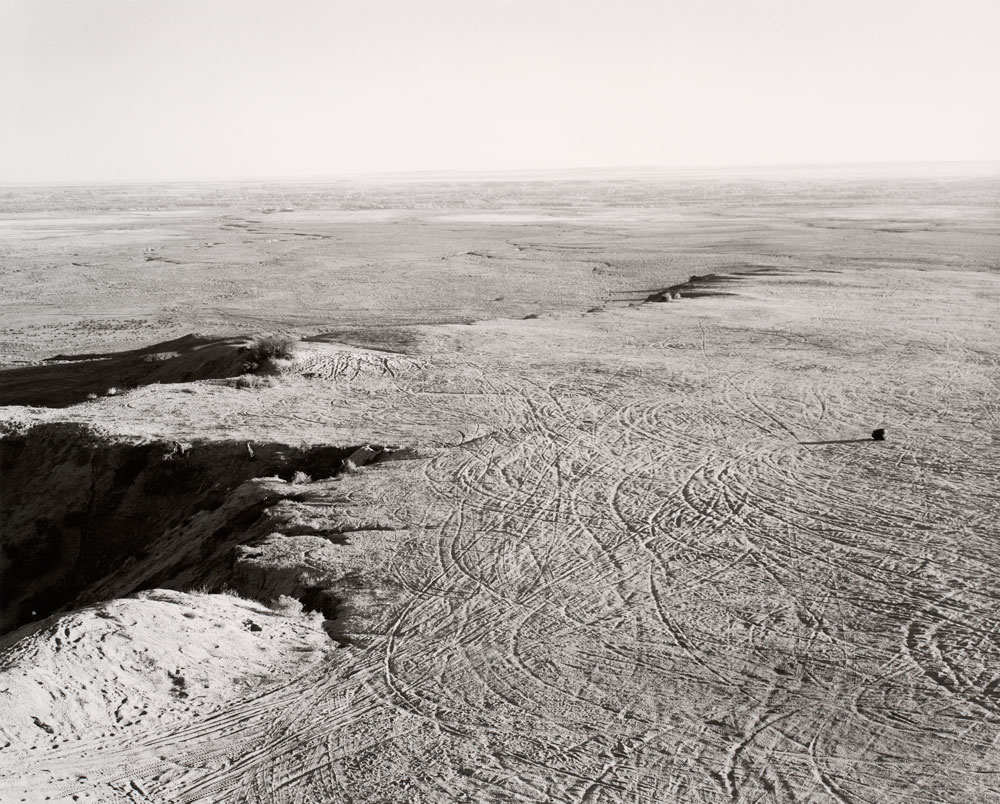
Robert Adams (American, b. 1937) 'Quarried Mesa Top, Pueblo County, Colorado' 1978


Robert Adams (American, b. 1937)
Quarried Mesa Top, Pueblo County, Colorado
1978
Gelatin silver print
Yale University Art Gallery
Purchased with a gift from Saundra B. Lane, a grant from Trellis Fund, and the Janet and Simeon Braguin Fund


Robert Adams (American, b. 1937) 'Longmont, Colorado' 1979, printed 1985


Robert Adams (American, b. 1937)
Longmont, Colorado
1979, printed 1985
Gelatin silver print
Yale University Art Gallery, purchased with a gift from Saundra B. Lane, a grant from the Trellis Fund and the Janet and Simeon Braguin Fund


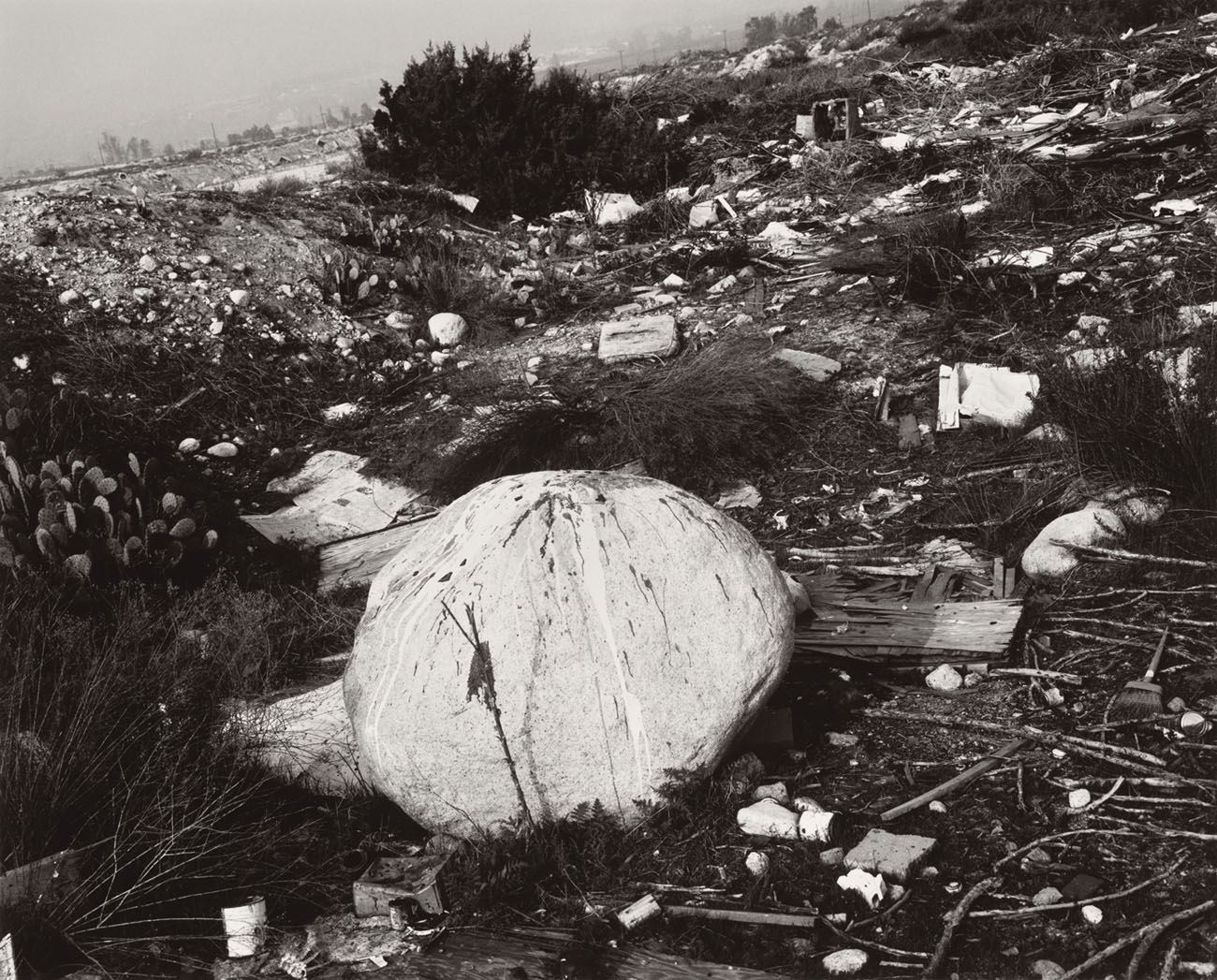
Robert Adams (American, b. 1937) 'Santa Ana Wash, Redlands, California' 1982


Robert Adams (American, b. 1937)
Santa Ana Wash, Redlands, California
1983, printed 1991
Gelatin silver print
Yale University Art Gallery, purchased with a gift from Saundra B. Lane, a grant from the Trellis Fund and the Janet and Simeon Braguin Fund


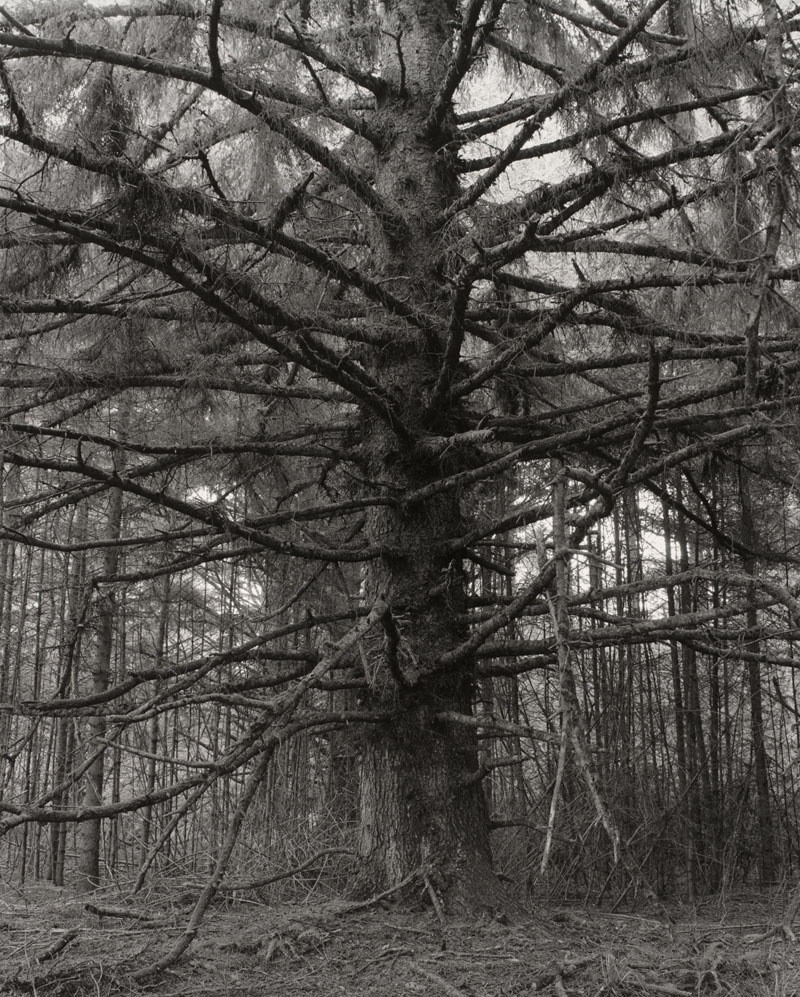
Robert Adams (American, b. 1937) 'Sitka spruce, Cape Blanco State Park, Curry County, Oregon' 1999-2000


Robert Adams (American, b. 1937)
Sitka spruce, Cape Blanco State Park, Curry County, Oregon
1999-2000
Gelatin silver print
Yale University Art Gallery, purchased with a gift from Saundra B. Lane, a grant from the Trellis Fund and the Janet and Simeon Braguin Fund


The Denver Art Museum
Civic Center Cultural Complex
located on 13th Avenue between Broadway and Bannock in downtown Denver

Opening hours:
Daily 10am – 5pm

The Denver Art Museum website

LIKE ART BLART ON FACEBOOK

Back to top

Review: ‘The mad square: Modernity in German Art 1910-37’ at The National Gallery of Victoria, Melbourne

Exhibition dates: 25th November 2011 – 4th March 2012


Irene Bayer (American, 1898-1991) 'No title (Man on stage)' c. 1927


Irene Bayer (American, 1898-1991)
No title (Man on stage)
c. 1927
Gelatin silver photograph
Printed image 10.6 h x 7.6 w cm
Purchased 1983
National Gallery of Australia, Canberra


This is one of the best exhibitions this year in Melbourne bar none. Edgy and eclectic the work resonates with the viewer in these days of uncertainty: THIS should have been the Winter Masterpieces exhibition!

The title of the exhibition, The mad square (Der tolle Platz) is taken from Felix Nussbaum’s 1931 painting of the same name where “the ‘mad square’ is both a physical place – the city, represented in so many works in the exhibition, and a reference to the state of turbulence and tension that characterises the period.” The exhibition showcases how artists responded to modern life in Germany in the interwar years, years that were full of murder and mayhem, putsch, revolution, rampant inflation, starvation, the Great Depression and the rise of National Socialism. Portrayed is the dystopian, dark side of modernity (where people are the victims of a morally bankrupt society) as opposed to the utopian avant-garde (the prosperous, the wealthy), where new alliances emerge between art and politics, technology and the mass media. Featuring furniture, decorative arts, painting, sculpture, collage and photography in the sections World War 1 and the Revolution, Dada, Bauhaus, Constructivism and the Machine Aesthetic, Metropolis, New Objectivity and Power and Degenerate Art, it is the collages and photographs that are the strongest elements of the exhibition, particularly the photographs. What a joy they are to see.

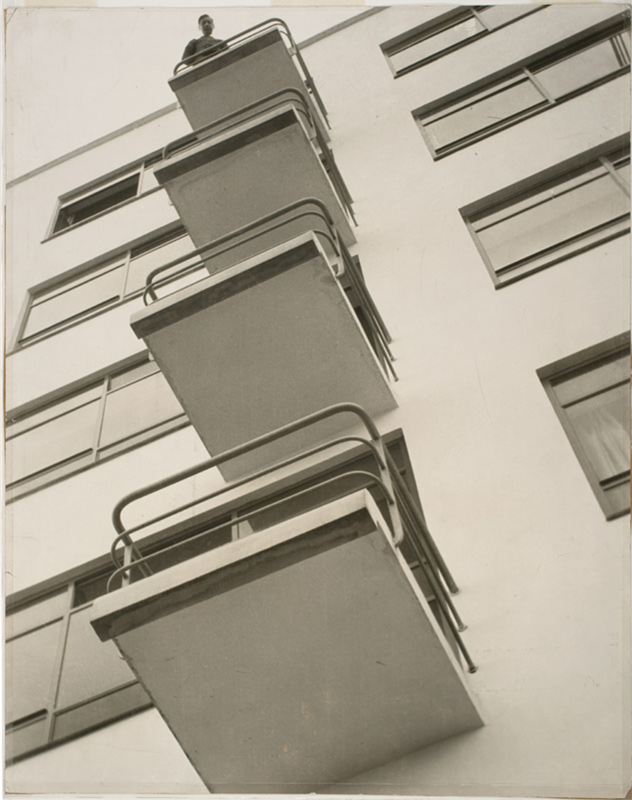
There is a small 2″ x 3″ contact print portrait of Hanna Höch by Richard Kauffmann, Penetrate yourself or: I embrace myself (1922) that is an absolute knockout. Höch is portrayed as the ‘new women’ with short bobbed hair and loose modern dress, her self-image emphasised through a double exposure that fragments her face and multiplies her hands, set against a contextless background. The ‘new women’ fragmented and broken apart (still unsure of herself?). The photograph is so small and intense it takes your breath away. Similarly, there is the small, intimate photograph No title (Man on Stage) (c. 1927) by Irene Bayer (see above) that captures performance as ‘total art’, a combination of visual arts, dance, music, architecture and costume design. In contrast is a large 16 x 20″ photograph of the Bauhaus balconies (1926) by László Moholy-Nagy (see below) where the whites are so creamy, the perspective so magnificent.

No title (Metalltanz) (c. 1928-1929) by T. Lux Feinenger, a photographer that I do not know well, is an exceptional photograph and print. Again small, this time dark and intense, the image features man as dancer performing gymnastics in front of reflective, metal sculptures. The metal becomes an active participant in the Metalltanz or ‘Dance in metal’ because of its reflective qualities. The print, from the J. Paul Getty Museum in Los Angeles is luminous. In fact all the prints from the Getty in this exhibition are of the most outstanding quality, a highlight of the exhibition for me. Another print from the Getty that features metal and performance is Untitled (Spiral Costume, from the Triadic Ballet) by T Grill c. 1926-1927 (see below) where the spiral costume becomes an extension of the body, highlighting its form. Also highlighting form, objectivity and detachment is a wonderful 3 x 5″ photograph of the New Bauhaus Building, Dessau (1926) by Lucia Moholy from the Getty collection, the first I have ever seen in the flesh by this artist. Outstanding.

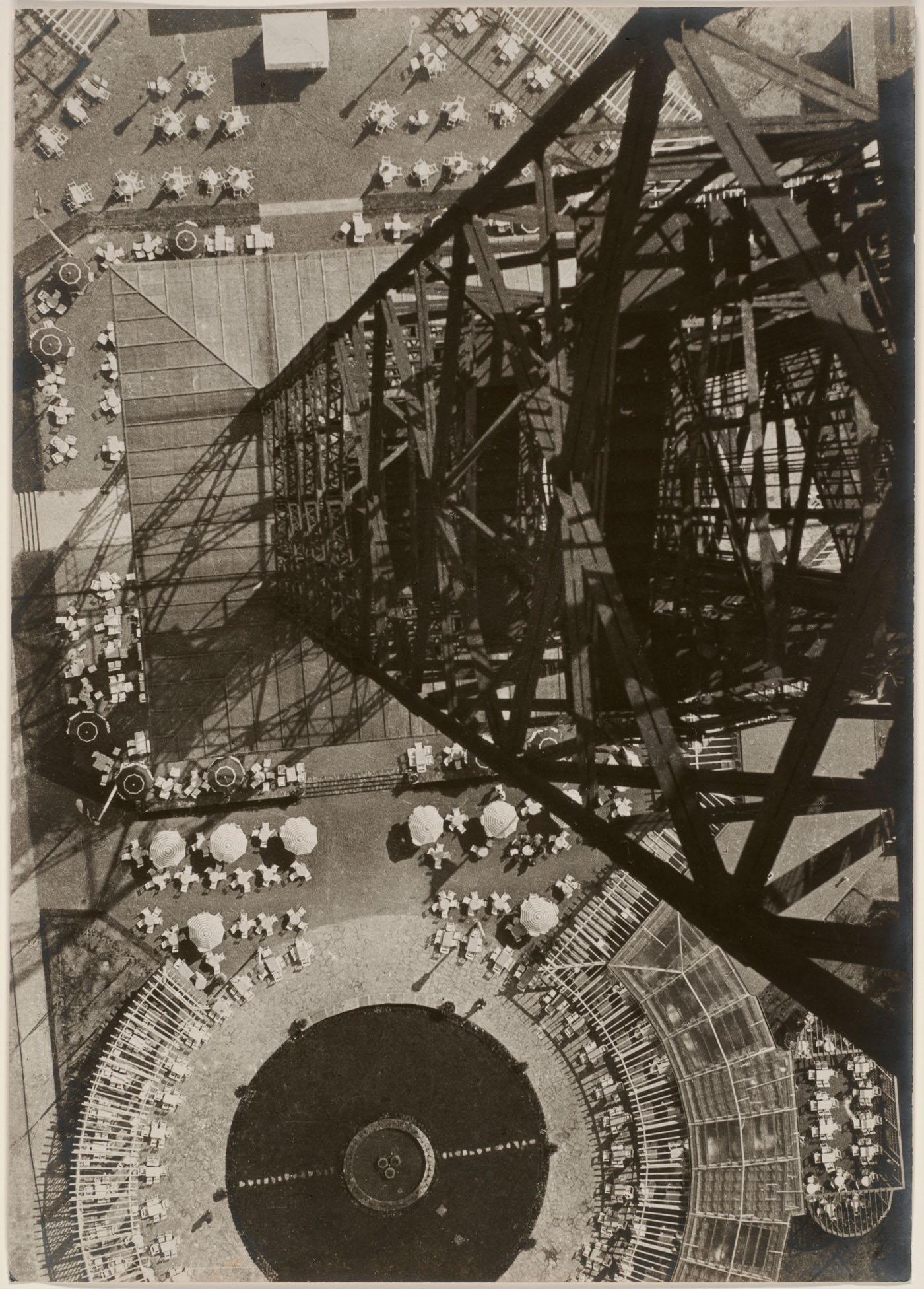
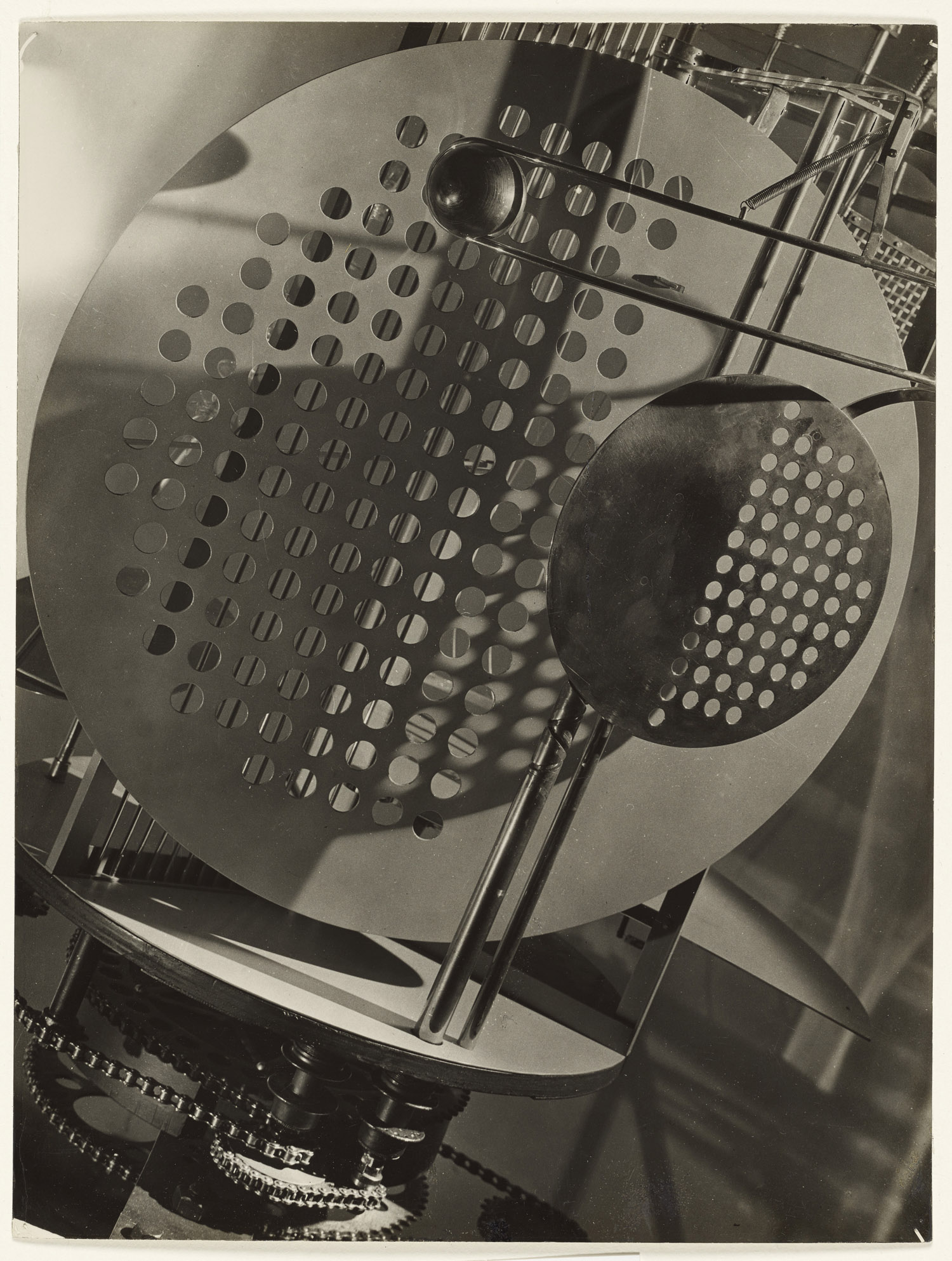
Following, we have 4 photograms by Lucia’s husband, László Moholy-Nagy which display formalist experimentation “inspired by machine aesthetic, exploring a utopian belief that Constructivism and abstract art could play a role in the process of social reform.” Complimenting these photograms is a row of six, yes six! Moholy-Nagy including Dolls (Puppen) 1926-1927 (Getty), The law of the series 1925 (Getty), Lucia at the breakfast table 1926 (Getty), Spring, Berlin 1928 (George Eastman House), Berlin Radio Tower 1928 (Art Institute of Chicago) and Light space modulator 1930 (Getty). All six photographs explore the fascinating relationship between avant-garde art and photography, between they eye and perspective, all the while declaiming what Moholy-Nagy called the “new vision”; angles, shadows and geometric patterns that defy traditional perspective “removing the space from associations with the real world creating a surreal, disjointed image.” This topographic mapping flattens perspective in the case of the Berlin radio tower allowing the viewer to see the world in a new way.

Finally two groups of photographs that are simply magnificent.

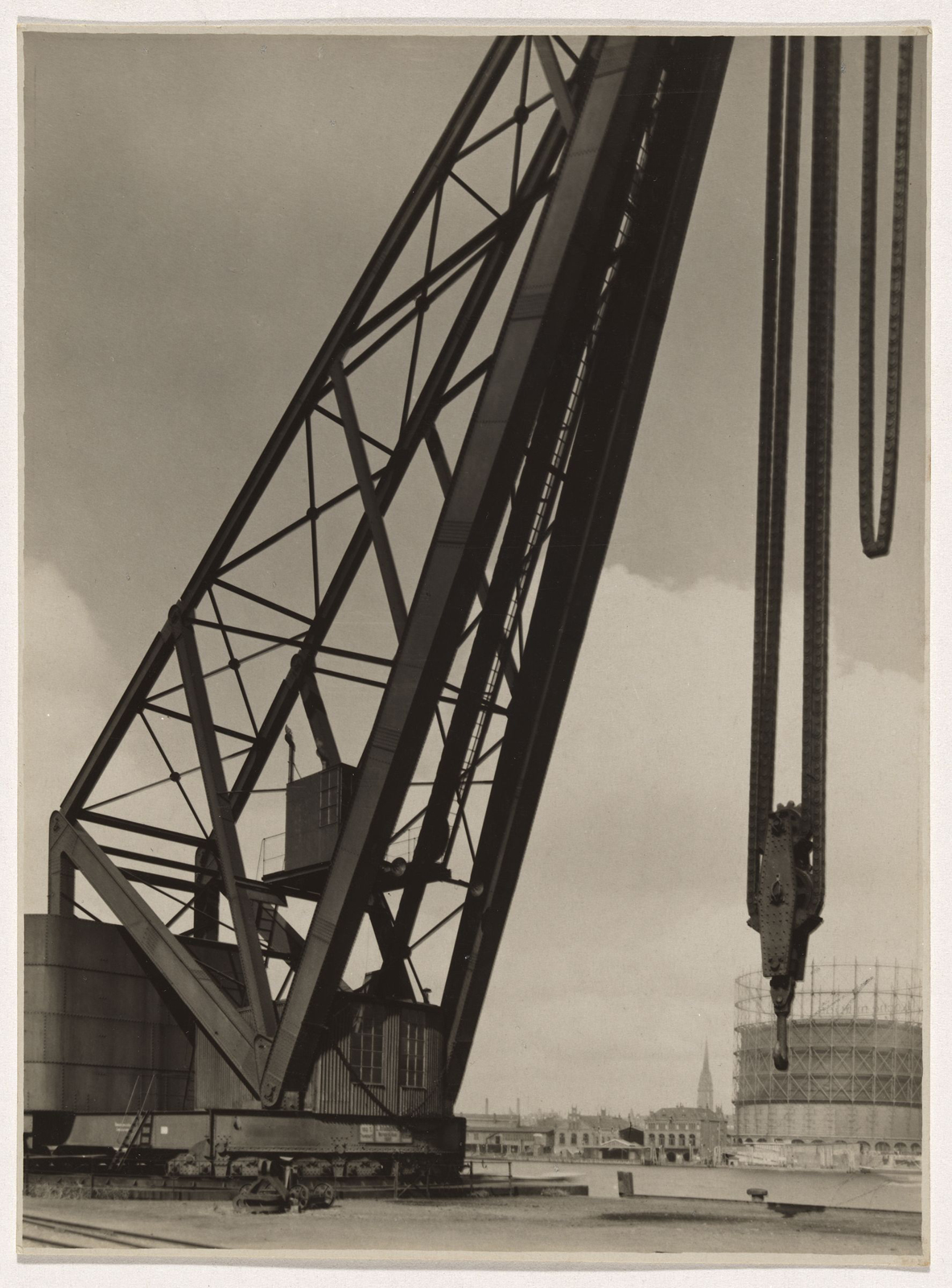
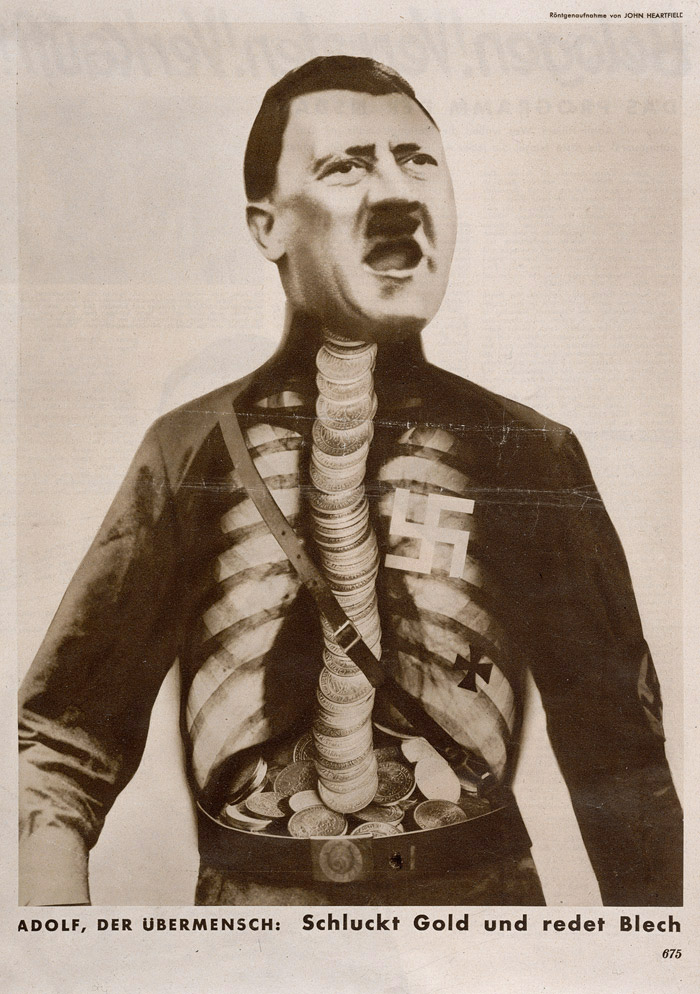
First 8 photographs in a row that focus on the order and progressive nature of the modern world, the inherent beauty of technology captured in formalist studies of geometric forms. The prints range from soft pictorialist renditions to sharp clarity. The quality of the prints is amazing. Artists include the wonderful E. O. Hoppé, Albert Renger-Patzsch (an outstandingly beautiful photograph, Harbour with cranes 1927 that is my favourite photograph in the exhibition, see below), Two Towers 1937-1938 by Werner Mantz and some early Wolfgang Sievers before he left Germany for Australia in 1938 (Blast furnace in the Ruhr, Germany 1933, see below). These early Sievers are particularly interesting, especially when we think of his later works produced in Australia. Lucky were many artists who survived in Germany or fled from Nazi persecution at the last moment, including John Heartfield who relocated to Czechoslovakia in 1933 and then fled to London in 1938 and August Sander whose life and work were severely curtailed under the Nazi regime and whose son died in prison in 1944 near the end of his ten year sentence (Wikipedia).

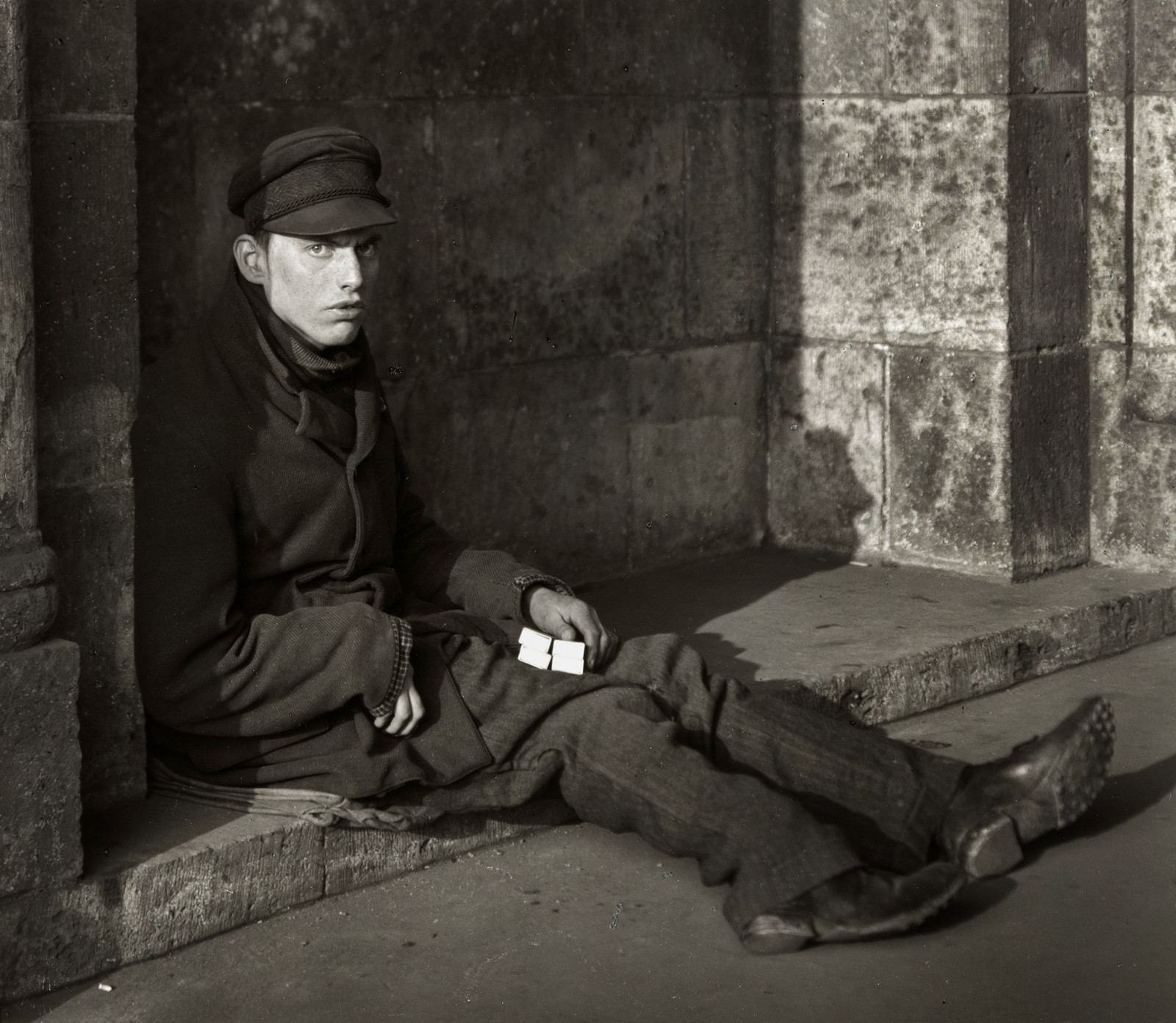
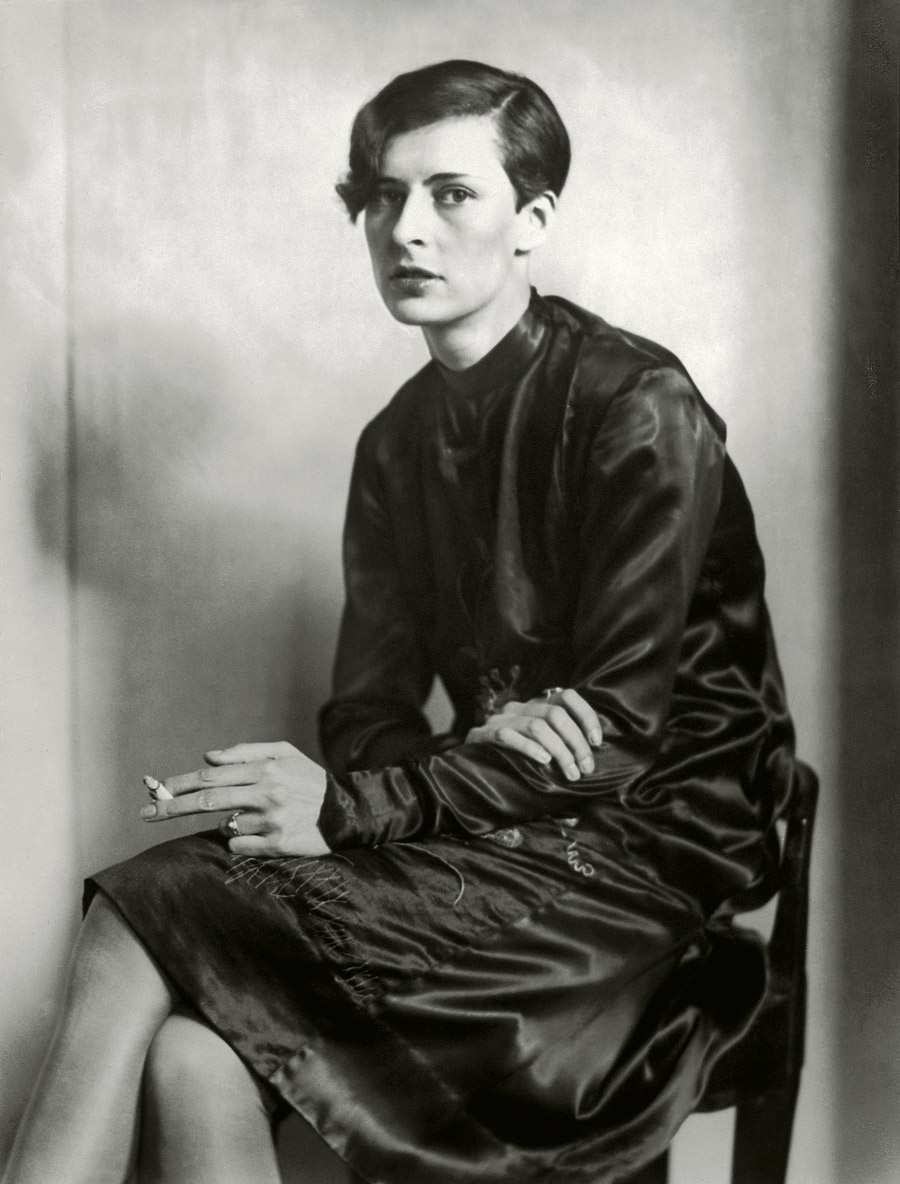
August Sander. Now there is a name to conjure with. The second magnificent group are 7 photographs that are taken from Sander’s seminal work People of the 20th Century. All the photographs have soft, muted tones of greys with no strong highlights and, usually, contextless backgrounds. The emphasis is on archetypes, views of people who exist on the margins of society – circus performers, bohemians, artists, the unemployed and blind people. In all the photographs there is a certain frontality (not necessarily physical) to the portraits, a self consciousness in the sitter, a wariness of the camera and of life. This self consciousness can be seen in the two photographs that are the strongest in the group – Secretary at West German radio in Cologne, 1931 and Match seller 1927 (see below).

There is magic here. Her face wears a somewhat quizzical air – questioning, unsure, vulnerable – despite the trappings of affluence and fashionability (the smoking of the cigarette, the bobbed hair). He is wary of the camera, his face and hands isolated by Sander while the rest of his body falls into shadow. His right hand is curled under, almost deformed, his shadow falling on the stone at right, the only true brightness in this beautiful image the four boxes of matches he clutches in his left hand: as Sander titles him ironically, The Businessman.

Working as I do these days with lots of found images from the 1940s-1960s that I digitally restore to life, I wonder what happened to these people during the dark days of World War 2. Did they survive the cataclysm, the drop into the abyss? I want to know, I want to reach out to these people to send them good energy. I hope that they did but their wariness in front of the camera, so intimately ‘taken’ by Sander, makes me feel the portent of things to come. How differently we see images armed with the hindsight of history!

In conclusion, this is a fantastic exhibition that will undoubtedly be in my top ten of the year for Melbourne in 2011.

Dr Marcus Bunyan


Many thankx to Michael Thorneycroft for his help and The National Gallery of Victoria for allowing me to publish the accredited photographs in the posting. Please click on the photographs for a larger version of the image.


Felix Nussbaum (German, 1904 - after September 1944) 'The mad square' (Der tolle Platz) 1931


Felix Nussbaum (German, 1904 – after September 1944)
The mad square (Der tolle Platz)
1931
Oil on canvas
97 x 195.5cm
Berlinische Galerie
Public domain


László Moholy-Nagy (American born Hungary, 1895-1946) 'Photograph (Berlin Radio Tower)' 1928/1929


László Moholy-Nagy (American born Hungary, 1895-1946)
Berlin Radio Tower
1928
Gelatin silver print
36 × 25.5cm
Julien Levy Collection, Special Photography Acquisition Fund
© 2018 Artists Rights Society (ARS), New York / VG Bild-Kunst, Bonn


Over the winter and spring of 1927-1928, Bauhaus professor László Moholy-Nagy took a series of perhaps nine views looking down from the Berlin Radio Tower, one of the most exciting new constructions in the German capital. Moholy had already photographed the Eiffel Tower in Paris from below, looking up through the tower’s soaring girders. In Berlin, however, Moholy turned his camera around and pointed it straight down at the ground. This plunging perspective showed off the spectacular narrowness of the Radio Tower, finished in 1926, which rose vertiginously to a height of 450 feet from a base seven times smaller than that of its Parisian predecessor (which opened in 1889). Moholy attached exceptional importance to this, his boldest image: he hung it just above his name in a room devoted to his work at the Berlin showing of Film und Foto, a mammoth traveling exhibition that he had helped to prepare. Moholy also chose this view and one other to offer Julien Levy, the pioneering art dealer, when Levy visited him in Berlin in 1930. The following year the pictures went on view at the Levy Gallery in New York, in Moholy’s first solo exhibition of photographs.

Text from the Art Institute of Chicago website


László Moholy-Nagy (American born Hungary, 1895-1946) 'Photograph (Light Prop)' 1930


László Moholy-Nagy (American born Hungary, 1895-1946)
Das Lichtrequisit (The light prop)
1930
Gelatin silver print
24 × 18.1cm (9 7/16 × 7 1/8 in.)
J. Paul Getty Museum, Los Angeles
© 2014 Estate of László Moholy-Nagy / Artists Rights Society (ARS), New York


The Light-Space Modulator is the most spectacular and complete realisation of László Moholy-Nagy’s artistic philosophy. Machine parts and mechanical structures began to appear in his paintings after his emigration from Hungary, and they are also seen in the illustrations he selected for the 1922 Buch neuer Künstler (Book of new artists), which includes pictures of motorcars and bridges as well as painting and sculpture. Many contemporary artists incorporated references to machines and technology in their work, and some, like the Russian Constructivist Vladimir Tatlin, even designed plans for fantastic structures, such as the ambitious Monument to the Third International, a proposed architectural spiral of glass and steel with moving tiers and audiovisual broadcasts. (See Tatlin’s Tower.)

In the Light-Space Modulator, Moholy-Nagy was able to create an actual working mechanism. Although he censured capitalism’s inhumane use of technology, he believed it could be harnessed to benefit mankind and that the artist had an important role in accomplishing this. Moholy had made preliminary sketches for kinetic sculptures as early as 1922 and referred to the idea for a light machine in his writings, but it was not until production was financed by an electric company in Berlin in 1930 that this device was built, with the assistance of an engineer and a metalsmith. It was featured at the Werkbund exhibition in Paris the same year, along with the short film Light Display Black-White-Gray, made by Moholy-Nagy to demonstrate and celebrate his new machine.

The Light-Space Modulator is a Moholy-Nagy painting come to life: mobile perforated disks, a rotating glass spiral, and a sliding ball create the effect of photograms in motion. With its gleaming glass and metal surfaces, this piece (now in the collection of the Busch-Reisinger Museum at Harvard University) is not only a machine for creating light displays but also a sculptural object of beauty, photographed admiringly by its creator.

Katherine Ware, László Moholy-Nagy, In Focus: Photographs from the J. Paul Getty Museum (Los Angeles: J. Paul Getty Museum, 1995), 80 © 1995 The J. Paul Getty Museum


Albert Renger-Patzsch (American born Hungary, 1895-1946) 'Harbour with crane' c. 1927


Albert Renger-Patzsch (American born Hungary, 1895-1946)
Harbour with crane
c. 1927
Gelatin silver photograph
Printed image 22.7 h x 16.8 w cm
Purchased 1983
National Gallery of Australia, Canberra


Wolfgang Sievers (Germany 1913 - Australia 2007) 'Blast furnace in the Ruhr, Germany' 1933


Wolfgang Sievers (Germany 1913 – Australia 2007)
Blast furnace in the Ruhr, Germany
1933
Gelatin silver photograph
27.5 h x 23 w cm
Purchased 1988
National Gallery of Australia, Canberra


The Ruhr region was at the centre of the German acceleration of industry in pre-war Germany, with rapid economic growth creating a heavy demand for coal and steel. In keeping with Modernist trends in photography, Sievers shot this blast furnace – the mechanism that transforms ore into metal – from an unusual, dynamic angle. It dominates the frame, appearing menacing and strange. Despite being imprisoned and beaten by the Gestapo, Sievers studied and taught at a progressive private art school until graduation in 1938. In that year he escaped Germany after being called up for military service, ending up in Australia.

Text © National Gallery of Australia, Canberra


August Sander (German, 1876-1964) 'Match seller' 1927


August Sander (German, 1876-1964)
Match seller
1927
From the portfolio People of the 20th century, IV Classes and Professions, 17 The Businessman


Robert Wiene, Director (German 1873-1938) Still from the 'Cabinet of Dr Caligari' 1919


Robert Wiene, Director (German 1873-1938)
Still from from the Cabinet of Dr Caligari
1919
5 min excerpt, 35mm transferred to DVD, Black and White, silent, German subtitles
Courtesy Transit Film GmbH
Production still courtesy of the British Film Institute and Transit Film GmbH


Felix H Man (German, 1893-1985) 'Luna Park' 1929


Felix H Man (German, 1893-1985)
Luna Park
1929
Gelatin silver photograph
18.1 x 24cm
National Gallery of Australia, Canberra
Purchased, 1987
© Felix H Man Estate


Hannah Höch (German, 1889-1978) 'Love' 1931


Hannah Höch (German, 1889-1978)
Love
1931
From the series Love
Photomontage
21.8 x 21cm
National Gallery of Australia, Canberra
Purchased, 1983


Hannah Höch made some of the most interesting Dada collages and photomontages, including Love, an image of two strange composite female. Höch’s technique of pasting images together from magazine clippings and advertisements was a response to the modern era of mass media, and a way of criticising the bourgeois taste for ‘high art’. In many of her works, Höch explores the identity and changing roles of women in modern society.


The Mad Square takes its name from Felix Nussbaum’s 1931 painting which depicts Berlin’s famous Pariser Platz as a mad and fantastic place. The ‘mad square’ is both a physical place – the city, represented in so many works in the exhibition, and a reference to the state of turbulence and tension that characterises the period. The ‘square’ can also be a modernist construct that saw artists moving away from figurative representations towards increasingly abstract forms.

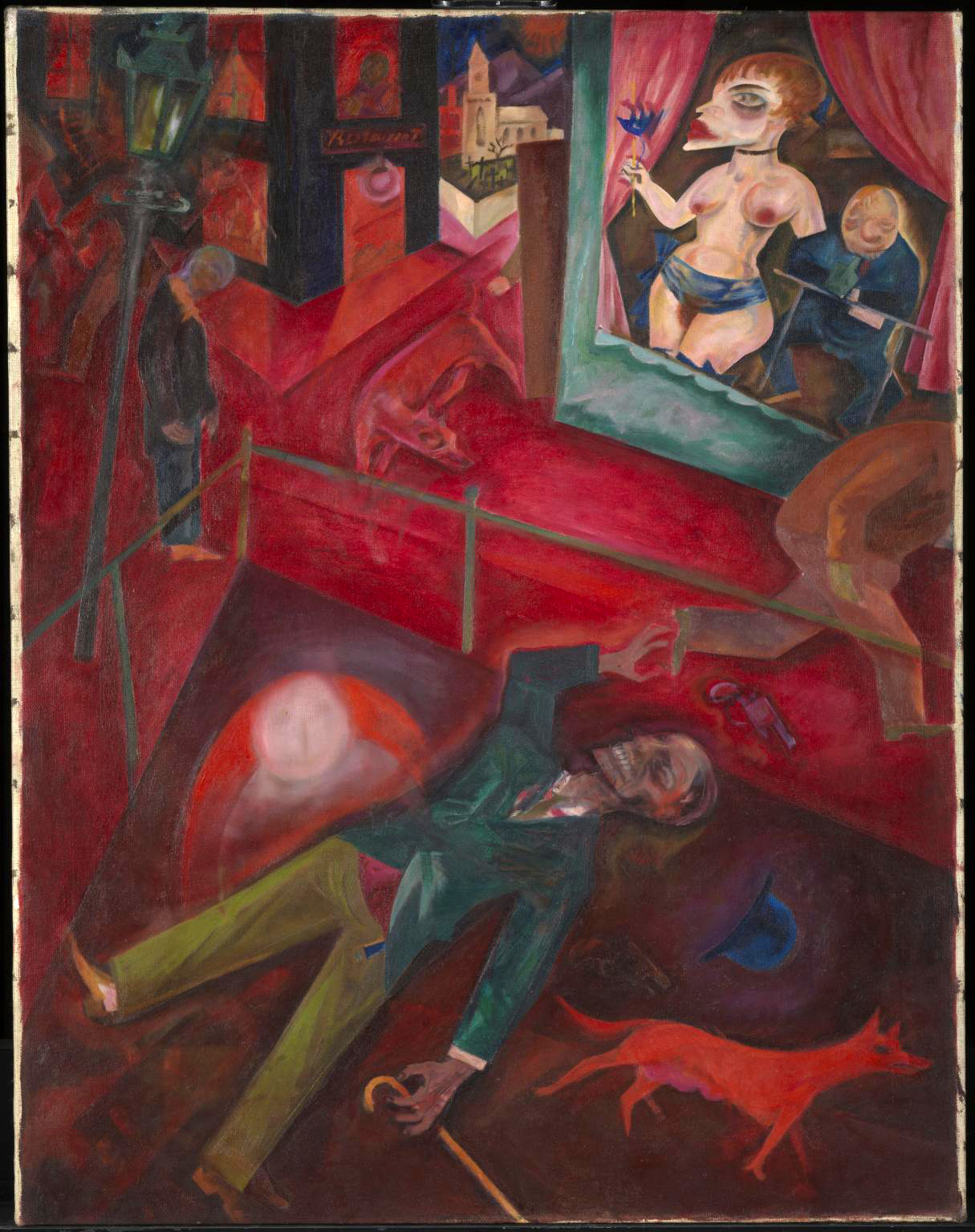
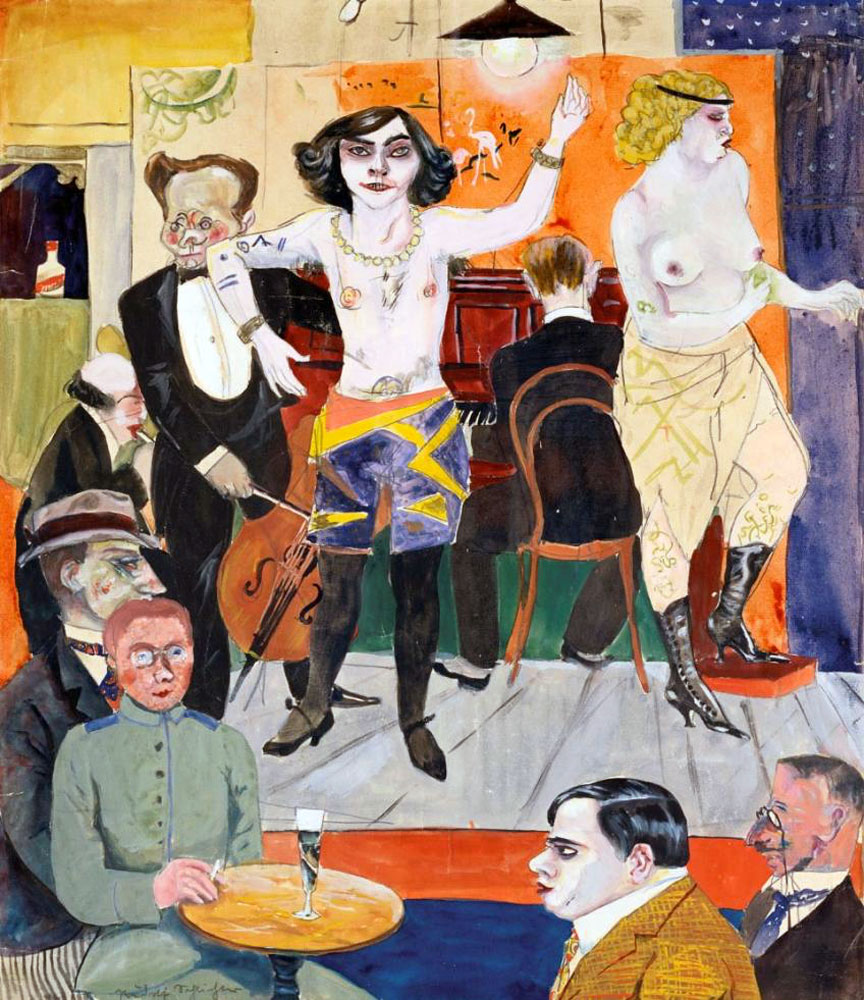
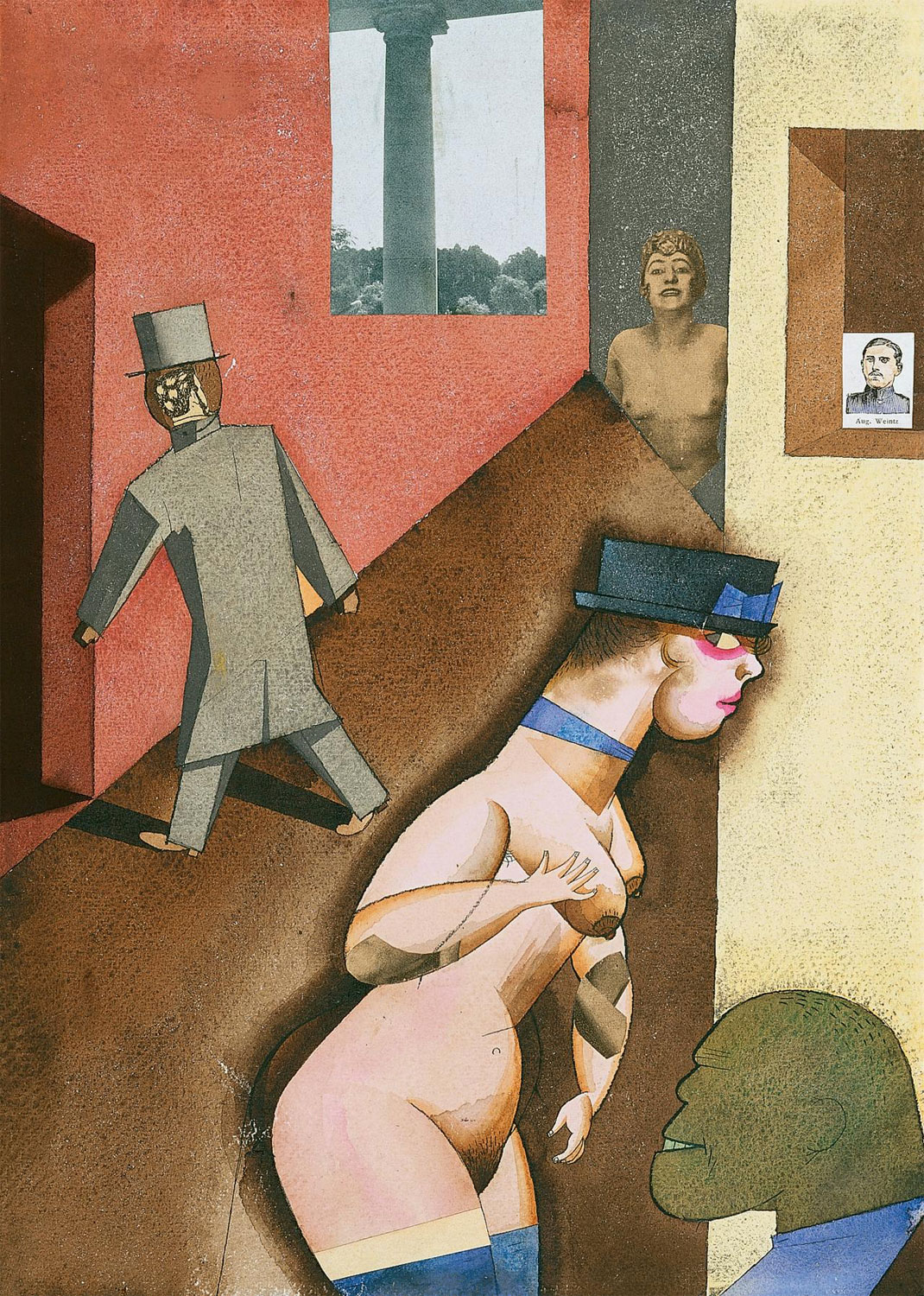
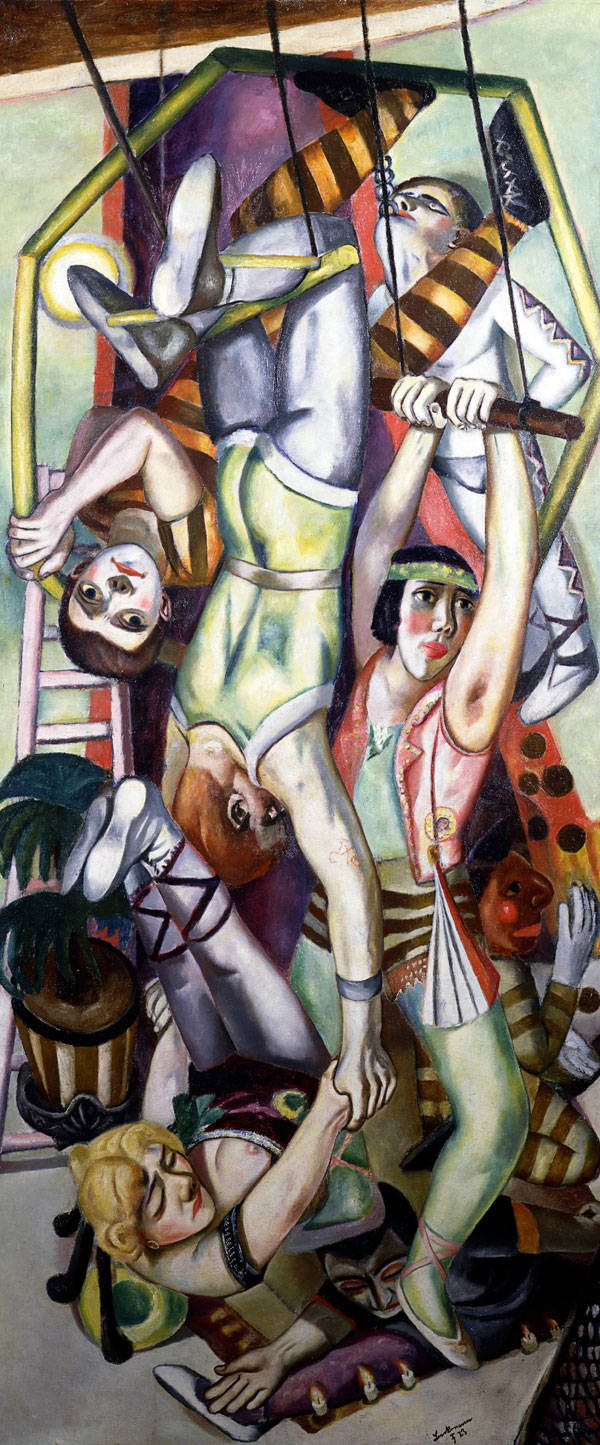
The exhibition features works by Max Beckman, Otto Dix, George Grosz, Christian Schad, Kurt Schwitters and August Sander. This group represents Germany’s leading generation of interwar artists. Major works by lesser known artists including Karl Hubbuch, Rudolf Schlichter and Hannah Höch are also presented in the exhibition in addition to works by international artists who contributed to German modernism.

The Mad Square brings together a diverse and extensive range of art, created during one of the most important and turbulent periods in European history, offering new insights into the understanding of key German avant‐garde movements including – Expressionism, Dada, Bauhaus, Constructivism, and New Objectivity were linked by radical experimentation and innovation, made possible by an unprecedented freedom of expression.

World War 1 and the Revolution

The outbreak of war in 1914 was met with enthusiasm by many German artists and intellectuals who volunteered for service optimistically hoping that it would bring cultural renewal and rapid victory for Germany. The works in this section are by the generation of artists who experienced war first hand. Depictions of fear, anxiety and violence show the devastating effects of war – the disturbing subjects provide insight into tough economic conditions and social dysfunction experienced by many during the tumultuous early years of the Weimar Republic following the abdication of the Kaiser

Dada

The philosophical and political despair experienced by poets and artists during World War 1 fuelled the Dada movement, a protest against the bourgeois conception of art. Violent, infantile and chaotic, Dada took its name from the French word for a child’s hobbyhorse or possibly from the sound of a baby’s babble. Its activities included poetry readings and avant‐garde performances, as well as creating new forms of abstract art that subverted all existing conditions in western art. Though short‐lived, in Germany the Dada movement has profoundly influenced subsequent developments in avant-garde art and culture. The impact of the Dada movement was felt throughout Europe – and most powerfully in Germany from 1917-21.

Bauhaus

The Bauhaus (1919‐1933) is widely considered as the most important school of art and design of the 20th century, very quickly establishing a reputation as the leading and most progressive centre of the international avant‐garde. German architect Walter Gropius founded the school to do away with traditional distinctions between the fine arts and craft, and to forge an entirely new kind of creative designer skilled in both the conceptual aesthetics of art and the technical skills of handicrafts. The Bauhaus was considered to be both politically and artistically radical from its inception and was closed down by the National Socialists in 1933

Constructivism and the Machine Aesthetic

Having emerged in Russia after World War I, Constructivism developed in Germany as a set of ideas and practices that experimented with abstract or non-representational forms and in opposition to Expressionism and Dada. Constructivists developed works and theories that fused art and with technology. They shared a utopian belief in social reform, and saw abstract art as playing a central role in this process.

Metropolis

By the 1920s Berlin has become the cultural and entertainment capital of the world and mass culture played an important role in distracting a society traumatised by World War 1, the sophisticated metropolis provided a rich source of imagery for artists, it also come to represent unprecedented sexual and personal freedom. In photography modernity was emphasised by unusual views of the metropolis or through the representation of city types. The diverse group of works in this section portray the uninhibited sense of freedom and innovation experienced by artists throughout Germany during the 1920s

New Objectivity

By the mid 1920s, a new style emerged that came to be known as Neue Sachlichkeit or New Objectivity. After experiencing the atrocities of World War 1 and the harsh conditions of life in postwar Germany, many artists felt the need to return to the traditional modes of representation with portraiture becoming a major vehicle of this expression, with its emphasis on the realistic representation of the human figure

Power and Degenerate Art

After the seizure of power by the National Socialists in 1933 modern artists were forbidden from working and exhibiting in Germany, with their works confiscated from leading museums and then destroyed or sold on the international art market. Many avant‐garde artists were either forced to leave Germany or retreat into a state of ‘inner immigration’.

The Degenerate art exhibition, held in Munich in 1937, represented the culmination of the National Socialists’ assault on modernism. Hundreds of works were selected for the show which aimed to illustrate the mental deficiency and moral decay that had supposedly infiltrated modern German art. The haphazard and derogatory design of the exhibition sought to ridicule and further discredit modern art. Over two million people visited the exhibition while in contrast far fewer attended the Great German art exhibition which sought to promote what the Nazis considered as ‘healthy’ art.


Karl Grill (German active Donaueschingen, Germany 1920s) 'Untitled [Spiral Costume, from the Triadic Ballet]' c. 1926-1927


Karl Grill (German active Donaueschingen, Germany 1920s)
Untitled (Spiral Costume, from the Triadic Ballet)
c. 1926-1927
Gelatin silver print
22.5 x 16.2cm
J. Paul Getty Museum, Los Angeles


In 1922, Oskar Schlemmer premiered his “Triadic Ballet” in Germany. He named the piece “Triadic” because it was literally composed of multiples of three: three acts, colours, dancers, and shapes. Concentrating on its form and movement, Schlemmer explored the body’s spatial relationship to its architectural surroundings. Although an abstract design, the spiral costume derived from the tutus of classical ballet.

Text from the J. Paul Getty Museum website


August Sander (German, 1876-1964) 'Secretary at West German radio in Cologne' 1931, printed by August Sander in the 1950s


August Sander (German, 1876-1964)
Secretary at West German radio in Cologne
1931, printed by August Sander in the 1950s
From the portfolio People of the 20th century, III The woman, 17 The woman in intellectual and practical occupation
Gelatin silver photograph
29 x 22cm
Die Photographische Sammlung /SK Stiftung Kultur, August Sander Archiv, Cologne (DGPH1016)
© Die Photographische Sammlung /SK  Stiftung Kultur – August Sander Archiv, Cologne. Licensed by Viscopy, Sydney


Timeline

1910

~ Berlin’s population doubles to two million people

1911

~ Expressionists move from Dresden to Berlin

1912

~ Social Democratic Party (SPD) the largest party in the Reichstag

1913

~ Expressionists attain great success with their city scenes

1914

~ World War I begins
~ George Grosz, Oskar Schlemmer, Otto Dix, Ludwig Hirschfeld Mack, Ernst Ludwig Kirchner, Max Beckmann and Franz Marc enlist in the army

1915

~ Grosz declared unfit for service, Beckmann suffers a breakdown and Schlemmer wounded

1916

~ Marc dies in combat
~ Dada begins at Cabaret Voltaire in Zurich

1917

~ Lenin and Trotsky form the Soviet Republic after the Tzar is overthrown

1918

~ Richard Huelsenbeck writes a Dada manifesto in Berlin
~ Kurt Schwitters creates Merz assemblages in Hanover
~ Revolutionary uprisings in Berlin and Munich
~ Kaiser Wilhelm II abdicates and flees to Holland
~ Social Democratic Party proclaims the Weimar Republic
~ World War I ends

1919

~ Freikorps assassinates the Spartacist leaders, Karl Leibknecht and Rosa Luxemburg
~ Bauhaus established in Weimer by Walter Gropius
~ Cologne Dada group formed
~ Treaty of Versailles signed

1920

~ Berlin is the world’s third largest city after New York and London
~ Inflation begins in Germany
~ National Socialist German Workers Party (NSDAP) founded
~ Kapp Putsch fails after right‐wing forces try to gain control over government
~ First International Dada fair opens in Berlin

1921

~ Hitler made chairman of the NSDAP

1922

~ Schlemmer’s Triadic ballet premiers in Stuttgart
~ Hyperinflation continues

1923

~ Hitler sentenced to five years imprisonment for leading the Beer Hall Putsch
~ Inflation decreases and a period of financial stability begins

1924

~ Hitler writes Mein Kampf while in prison
~ Reduction of reparations under the Dawes Plan

1925

~ New Objectivity exhibition opens at the Mannheim Kunsthalle
~ The Bauhaus relocates to Dessau

1926

~ Germany joins the League of Nations

1927

~ Fritz Lang’s film Metropolis released
~ Unemployment crisis worsens
~ Nazis hold their first Nuremburg party rally

1928

~ Bertolt Brecht and Kurt Weill’s The threepenny opera premieres in Berlin
~ Hannes Meyer becomes the second director of the Bauhaus

1929

~ Street confrontations between the Nazis and communists in Berlin
~ Young Plan accepted, drastically reducing reparations
~ Stock market crashes on Wall Street, New York
~ Thomas Mann awarded the Nobel Prize for literature

1930

~ Resignation of Chancellor Hermann Müller’s cabinet ending parliamentary rule
~ Minority government formed by Heinrich Brüning, leader of the Centre Party
~ Nazis win 18% of the vote and gain 95 seats in the National elections
~ Ludwig Miles van der Rohe becomes the third director of the Bauhaus
~ John Heartfield creates photomontages for the Arbeiter‐Illustrierte Zeitung (AIZ)

1931

~ Unemployment reaches five million and a state of emergency is declared in Germany

1932

~ Nazis increase their representation in the Reichstag to 230 seats but are unable to form a majority coalition
~ Miles van der Rohe moves the Bauhaus to Berlin
~ Grosz relocates to New York as an exile

1933

~ Hindenberg names Hitler as Chancellor
~ Hitler creates a dictatorship under the Nazi regime
~ The first Degenerate art exhibition denouncing modern art is held in Dresden
~ Miles van der Rohe announces the closure of the Bauhaus
~ Nazis organise book burnings in Berlin
~ Many artists including Gropius, Kandinski and Klee flee Germany
~ Beckmann, Dix and Schlemmer lose their teaching positions

1934

~ Fifteen concentration camps exist in Germany

1935

~ The swastika becomes the flag of the Reich

1936

~ Spanish civil war begins
~ Germany violates the Treaty of Versailles
~ Olympic Games held in Garmisch‐Partenkirchen and Berlin
~ Thomas Mann deprived of his citizenship and emigrates to the United States

1937

~ German bombing raids over Guernica in Spain in support of Franco
~ The Nazi’s Degenerate art exhibition opens in Munich and attracts two million visitors
~ Beckmann, Kirchner and Schwitters leave Germany
~ Purging of ‘degenerate art’ from German museums continues 1


1/ Timeline credit: Chronology compiled by Jacqueline Strecker and Victoria Tokarowski from the following sources:

~ Catherine Heroy ‘Chronology’ in Sabine Rewald, Glitter and Doom: German portraits from the 1920s, Metropolitan Museum of Art, New York, exh cat, 2006, pp. 39‐46
~ Anton Kaes, Martin Jay and Edward Dimendberg, eds, ‘Political chronology’, The Weimar Republic sourcebook, Berkely 1994, pp. 765‐71
~ Jonathan Petropoulos and Dagmar Lott‐Reschke ‘Chronology’ in Stephanie Barron, ‘Degenerate Art’: the fate of the avant‐garde in Nazi Germany, Los Angeles County Museum of Art, exh cat, 1991, pp. 391‐401


László Moholy-Nagy (American born Hungary, 1895-1946) ‘Bauhaus Balconies’ 1926


László Moholy-Nagy (American born Hungary, 1895-1946)
Bauhaus Balconies
1926
Silver gelatin photograph


John Heartfield (German, 1891-1968) 'Adolf, the superman: swallows gold and spouts rubbish' from the 'Workers Illustrated Paper', vol 11, no 29, 17 July 1932, p. 675


John Heartfield (German, 1891-1968)
Adolf, the superman: swallows gold and spouts rubbish
1932
From the Workers Illustrated Paper, vol 11, no 29, 17 July 1932, p. 675
Photolithograph
38 x 27cm
John Heartfield Archiv, Akademie der Künste zu Berlin
Photo: Akademie der Künste, Berlin, Kunstsammlung, Heartfield 2261/ Roman März
© The Heartfield Community of Heirs /VG Bild-Kunst, Bonn. Licensed by Viscopy, Sydney


John Heartfield’s photomontages expose hidden agendas in German politics and economics of the 1920s and 30s. This image was published six months before the National Socialist Party came to power, and shows Hitler with a spine made of coins and his stomach filled with gold. The caption says that he ‘swallows gold’, alluding to generous funding by right-wing industrialists, and ‘spouts rubbish’.


Ernst Ludwig Kirchner (German, 1880-1938) 'Woman in hat' 1911


Ernst Ludwig Kirchner (German, 1880-1938)
Woman in hat
1911
Oil on canvas
Art gallery of Western Australia, Perth


George Grosz (German, 1893-1959) 'Suicide' (Selbstmörder) 1916


George Grosz (German, 1893-1959)
Suicide (Selbstmörder)
1916
Oil on canvas
100 × 77.5cm
Tate Modern
Public domain


Rudolf Schlichter (German, 1890-1955) 'Tingle tangel' 1919-1920


Rudolf Schlichter (German, 1890-1955)
Tingle tangel
1919-1920
Oil on canvas


George Grosz (German, 1890-1945) 'Tatlinesque Diagram' 1920


George Grosz (German, 1890-1945)
Tatlinesque Diagram
1920
Watercolour, collage and ink on paper
41 x 29.2cm
Museo Nacional Thyssen-Bornemisza, Madrid


Otto Dix (German, 1891-1969) 'Dr Paul Ferdinand Schmidt' 1921


Otto Dix (German, 1891-1969)
Dr Paul Ferdinand Schmidt
1921
Oil on canvas
63 x 82cm
Staatsgalerie, Stuttgart, Germany


El Lissitzky (Russian, 1890-1941) 'New Man (Neuer)' 1923


El Lissitzky (Russian, 1890-1941)
New Man (Neuer)
1923
Color lithograph on wove paper
12 × 12 1/2 in. (30.5 × 31.8cm)


Max Beckmann (German, 1884-1950) 'The trapeze' 1923


Max Beckmann (German, 1884-1950)
The trapeze
1923
Oil on canvas
196.5 x 84cm
Toledo Museum of Art
Purchased with funds from the Libbey Endowment, Gift of Edward Drummond Libbey
Photo: Photography Incorporated, Toledo


Werner Graul (German, 1905-1984) 'Metropolis'
1926


Werner Graul (German, 1905-1984)
UFA (Universum-Film-Aktiengesellschaft) (publisher)
Metropolis
1926
Lithographic poster


Christian Schad (German, 1894-1982) 'Self-Portrait' (Selbstbildnis mit Modell), 1927


Christian Schad (German, 1894-1982)
Self-Portrait with Model (Selbstbildnis mit Modell)
1927
Oil on wood
29 15/16 x 24 3/16 in. (76 x 61.5cm)
Private collection, courtesy of Tate
© 2015 Christian Schad Stiftung Aschaffenburg/Artists Rights Society (ARS), New York/VG Bild-Kunst, Bonn


Heinrich Hoerle (German, 1895-1936) 'Three invalids' c. 1930


Heinrich Hoerle (German, 1895-1936)
Three invalids
c. 1930
Oil on canvas


NGV International
180 St Kilda Road

Opening hours:
Daily 10am – 5pm

National Gallery of Victoria website

LIKE ART BLART ON FACEBOOK

Back to top

Review: ‘Selina Ou: New York’ at Sophie Gannon Gallery, Richmond

Exhibition dates: 25th October – 19th November 2011


Selina Ou (Australian born Malaysia, b. 1977) 'Tim, Hair Stylist, Lower East Side, New York' 2011


Selina Ou (Australian born Malaysia, b. 1977)
Tim, Hair Stylist, Lower East Side, New York
2011
C-type print
100 x 100cm


A strong, nuanced body of work by Selina Au at Sophie Gannon Gallery in Richmond. In the flesh these large colour photographs have a wonderful, polyvocal presence. The solo portraits are stronger in terms of composition and intertextuality than the double portraits.

Derived from the Latin intertexto, meaning to intermingle while weaving, intertextuality is a term first introduced by French semiotician Julia Kristeva in the late sixties.1 Intertextuality “is always an iteration which is also a re-iteration, a re-writing which foregrounds the trace of the various texts it both knowingly and unknowingly places and dis-places.”2 Intertexuality is how a text is constituted. It fragments singular readings. The reader’s own previous readings, experiences and position within the cultural formation influences these re-inscriptions.

Reminding me of a contemporary redefinition of the work of Diane Arbus, Ou’s reconceptualisations of space “produce a plurality of meanings and signifying / interpretive gestures that escape the reduction of knowledge to fixed, monological re-presentations, or presences.”3 Through a process of materialisation, using the technique of assemblage, Ou weaves a lack of fixity into her photographs. She creates a kind of tapestry in the surfaces of her images, a play of pattern / randomness that redefines the significations of the body in the fold of inscription.

Take the first three portraits in this posting, for example. The photograph Tim, Hair Stylist, Lower East Side, New York weaves space, time and memory within the pictorial frame. The physical space between the portrait on the wall at rear, Tim and the clock at right is crucial to a reading of this photograph, as is the disjuncture between the appearance of the man in the framed photograph (in jacket and tie) and the casual attire of Tim. Just as important is the memorialisation of both men within the same space (where both presumably work/ed), the collapsing of past and present into a fluid space that is neither here nor there (the past of the man in the framed photograph, the moment of passing of Tim when the photograph was ‘taken’ and the present of the photograph being looked at). There is no fixed, monological representation here: the reading of this photograph hovers between past and present, between memory and reality and haunts the body of the subject, Tim.

Similarly, Raquel, Waitress and Fashion Designer, Nolita, New York and Jerome, Retail Assistant and Fashion Designer, Soho, New York offer radical re-iterations of space, this time with less temporal associations. In Raquel, two red chevrons at top left and right frame the face of the subject, playing off the colour-changing hair of the waitress/fashion designer, the title of the photograph an ironic comment on the intertextual nature of contemporary life: a waitress (low paid, menial labourer) and a fashion designer (famous, highly visible entrepreneur). The nonchalantly limp-wristed, ringed hand and over large glasses, coupled with the bedraggled threads of the black shorts – echoing the tousled nature of the subjects hair – also belies the statement “fashion designer.” The word Cervesas (beer) offers a dichotomy with the coloured bottles of flavoured water that surround the lower half of the subject while the reflection in the window behind Raquel provides a metaphorical vista into this distorted world view.

In Jerome, the same problem in a person’s relationship with self and others is evident: the context of Jerome as both a retail assistant (low paid, menial labourer) and a fashion designer (famous, highly visible entrepreneur). The narcissistic, self-importance of Jerome is beautifully portrayed by Ou as she balances the context of his body in space – his polka-dot shirt reflecting the dotted neon of the shops name, his logo emblazoned necklace doing the same, while the reflections in the shop window again hint at outside forces (the car and consumerism) and other worlds. The defiant, could not give a shit gaze of the subject into the camera lens hints at years of subjugation and unrequited ambition for this is not his shop, these are not his clothes despite the label “fashion designer.” He is just a retail assistant, the subject of his own con(text).

The strength of these photographs is that they blur the outlines of the fixed image dispersing an image of totality, “into an unbounded, illimitable tissue of connections and associations, paraphrases and fragments, texts and con-texts.”4 In this sense the solo portraits are much more successful than the rest of the work as Ou magically weaves the tapestry of life into her compositions, ready for the reader to bring their own experiences to these re-inscriptions. In a word these photographs are, literally, breath-taking.

Dr Marcus Bunyan


Many thankx to Sophie Gannon Gallery for allowing me to publish the photographs in the posting. Please click on the photographs for a larger version of the image.


Endnotes

1/ Keep, Christopher, McLaughlin, Tim and Parmar, Robin. “Intertextuality,” on The Electronic Labyrinth website [Online] Cited 13/11/2011. No longer available online

2/ Ibid.,

3/ Thumlert, Kurt. Intervisuality, Visual Culture, and Education. [Online] Cited 10/08/2006. No longer available online

4/ Keep Op cit.,


Selina Ou (Australian born Malaysia, b. 1977) 'Raquel, Waitress and Fashion Designer, Nolita, New York' 2011


Selina Ou (Australian born Malaysia, b. 1977)
Raquel, Waitress and Fashion Designer, Nolita, New York
2011
C-type print
100 x 100cm


Selina Ou (Australian born Malaysia, b. 1977) 'Jerome, Retail Assistant and Fashion Designer, Soho, New York' 2011


Selina Ou (Australian born Malaysia, b. 1977)
Jerome, Retail Assistant and Fashion Designer, Soho, New York
2011
C-type print
100 x 100cm


Selina Ou (Australian born Malaysia, b. 1977) 'Darren, Model and Carlito, Artist, Soho, New York' 2011


Selina Ou (Australian born Malaysia, b. 1977)
Darren, Model and Carlito, Artist, Soho, New York
2011
C-type print
100 x 100cm


Selina Ou (Australian born Malaysia, b. 1977) 'Carolyn and Jane, Lolitas, Brooklyn Botanical Garden, New York' 2011


Selina Ou (Australian born Malaysia, b. 1977)
Carolyn and Jane, Lolitas, Brooklyn Botanical Garden, New York
2011
C-type print
100 x 100cm


Selina Ou (Australian born Malaysia, b. 1977) 'Issa and Lamine, Taxi Mechanics, Upper West Side, New York' 2011


Selina Ou (Australian born Malaysia, b. 1977)
Issa and Lamine, Taxi Mechanics, Upper West Side, New York
2011
C-type print
100 x 100cm


Selina Ou (Australian born Malaysia, b. 1977) 'Clementine, Liz and Billy Bob, Mercer-Houston Dog Run, Greenwich Village, New York' 2011


Selina Ou (Australian born Malaysia, b. 1977)
Clementine, Liz and Billy Bob, Mercer-Houston Dog Run, Greenwich Village, New York
2011
C-type print
100 x 100cm


Selina Ou (Australian born Malaysia, b. 1977) 'Derek, Student, Chrystie st, New York' 2011


Selina Ou (Australian born Malaysia, b. 1977)
Derek, Student, Chrystie st, New York
2011
Chromogenic photograph
100 x 100cm


Sophie Gannon Gallery
2, Albert Street
Richmond, Melbourne

Opening hours:
Tues – Saturday 11am – 5pm

Sophie Gannon Gallery website

LIKE ART BLART ON FACEBOOK

Back to top

Exhibition: ‘Joel Meyerowitz – Aftermath’ at the Miami Art Museum

Exhibition dates: 19th August – 6th November 2011


Joel Meyerowitz (American, b. 1938) 'Searchers in Rubble' 2001


Joel Meyerowitz (American, b. 1938)
Searchers in Rubble
2001
Vintage contact print
Collection Miami Art Museum, gift of Steven E. and Phyllis Gross


And do you know what “the world” is to me? Shall I show it to you in my mirror? This world: a monster of energy, without beginning, without end; a firm, iron magnitude of force that does not grow bigger or smaller, that does not expend itself but only transforms itself; as a whole, of unalterable size, a household without expenses or losses, but likewise without increase or income; enclosed by “nothingness” as by a boundary; not something blurry or wasted, not something endlessly extended, but set in a definite space as a definite force, and not a space that might be “empty” here or there, but rather a force throughout, as a play of forces and waves of forces, at the same time one and many, increasing here and at the same time decreasing there …


Frederick Nietzsche, The Will to Power


Sadness. And light. Hope. Amidst the inferno. Study the masterpiece Finding More Fireman (below) in the enlarged version and you cannot fail to be moved. It is all there: monumental, intimate, hellish, redemptive – a modern, “disastrous” form of the Rembrandt’s The Night Watch.

Dr Marcus Bunyan


Many thanxk to the Miami Art Museum for allowing me to publish the photographs in the posting. Please click on the photographs for a larger version of the image.


Joel Meyerowitz (American, b. 1938) 'Flower Offering' 2001


Joel Meyerowitz (American, b. 1938)
Flower Offering
2001
Vintage contact print
Collection Miami Art Museum, gift of Steven E. and Phyllis Gross


Joel Meyerowitz (American, b. 1938) 'Pit Looking North' 2002


Joel Meyerowitz (American, b. 1938)
Pit Looking North
2002
Vintage contact print
Collection Miami Art Museum, gift of Steven E. and Phyllis Gross


Joel Meyerowitz (American, b. 1938) 'Smoke and Spray' 2001


Joel Meyerowitz (American, b. 1938)
Smoke and Spray
2001
Vintage contact print
Collection Miami Art Museum, gift of Jeffrey Hugh Newman


Joel Meyerowitz (American, b. 1938) 'Moving the Monument' 2001


Joel Meyerowitz (American, b. 1938)
Moving the Monument
2001
Vintage contact print
Collection Miami Art Museum, gift of Jeffrey Hugh Newman


Joel Meyerowitz (American, b. 1938) 'Finding More Fireman' 2001


Joel Meyerowitz (American, b. 1938)
Finding More Fireman
2001
Vintage contact print
Collection Miami Art Museum, gift of Charles S. and Elynne B. Zucker


Joel Meyerowitz (American, b. 1938) 'Searchers' 2002


Joel Meyerowitz (American, b. 1938)
Searchers
2002
Vintage contact print
Collection Miami Art Museum, gift of Charles S. and Elynne B. Zucker


Joel Meyerowitz (American, b. 1938) 'Welders in South Tower' 2001


Joel Meyerowitz (American, b. 1938)
Welders in South Tower
2001
Vintage contact print
Collection Miami Art Museum, gift of Charles S. and Elynne B. Zucker


In commemoration of the 10th anniversary of 9/11, Miami Art Museum presents Focus Gallery: Joel Meyerowitz – Aftermath, an exhibition of photographs taken by the only photographer granted right of entry into Ground Zero after the September 11, 2001 attacks on the World Trade Center in New York City. For nine months during the day and night, Meyerowitz photographed “the pile,” as the World Trade Center came to be known, and the over 800 people a day that were working in it. The exhibition consists of 24, recently-donated photographs, presented in the Focus Gallery section of the Museum’s Permanent Collection installation. Admission to Miami Art Museum will be free to all emergency personnel, including police and firefighters, and their guests throughout the exhibition’s run, August 19 – November 6, 2011. A special preview for emergency personnel will be held on Thursday, August 18, 2011, 4-7pm. Author and photography critic Vicki Goldberg will give a lecture entitled “What Remains” on Thursday, September 8, 2011, beginning at 6:30pm.

After September 11, 2001, the Ground Zero site in New York City was classified as a crime scene and only those directly involved in the recovery efforts were allowed inside. The press was prohibited from the site. Influenced by Walker Evans’s and Dorothea Lange’s work for the Farm Security Administration during the Great Depression, Meyerowitz, long recognised as one of the pioneers of colour photography, was convinced that if a photographic record of the unprecedented recovery efforts was not made, “there would be no history.” With the help of sympathetic officials, he managed to become the only photographer granted right of entry into Ground Zero.

“I was making photographs for everyone who didn’t have access to the site,” says Meyerowitz, “I wanted to communicate what it felt like to be in there as well as what it looked like: to show the pile’s incredible intricacy and visceral power. I could provide a window for everyone else who wanted to be there, too, to help, or to grieve, or simply to try to understand what had happened to our city.”

Armed with a large-format wooden camera, Meyerowitz spent nine months photographing the site. In the first few weeks, he was chased off the site repeatedly, but over time, with the help of officials on and off site, the use of forged workers’ passes, and by assuming the “uniform” of hard hat, goggles, respirator, gloves, boots and duct taped pants, Meyerowitz became “woven into the fabric of the site.”

About the experience, Meyerowitz has written, “The nine months I worked at Ground Zero were among the most rewarding of my life. I came in as an outsider, a witness bent on keeping the record, but over time I began to feel a part of the very project I’d been intent on recording… the intense camaraderie I experienced at Ground Zero inspired me, changing both my sense of myself and my sense of responsibility to the world around me. September 11th was a tragedy of almost unfathomable proportions. But living for nine months in the midst of those individuals who faced that tragedy head-on, day after day, and did what they could to set things right, was an immense privilege.”

The photographs in MAM’s collection are from a unique set of contact prints (photographs printed on a 1:1 scale from the negatives) issued by the artist in 2006. As a group, they span the entire nine month period that Meyerowitz was on site, presenting a poignant, condensed view of the clean up effort, including portraits of the workers involved. The set is introduced by a single image of the World Trade Center towers taken by the artist in the 1980s from his apartment window.

The entire set of more than 8,000 photographs taken by Meyerowitz form an archive at the Museum of the City of New York. The Aftermath series was the focus of a 2006 book, Aftermath: World Trade Center Archives published by Phaidon (reissued this year in a special 10th anniversary edition) and an exhibition organised by the US Department of State that traveled worldwide from 2002 to 2005.

Press release from the Miami Art Museum website


Joel Meyerowitz (American, b. 1938) 'Explosion Squad Detective' 2001


Joel Meyerowitz (American, b. 1938)
Explosion Squad Detective
2001
Vintage contact print
Collection Miami Art Museum, gift of Steven E. and Phyllis Gross


Joel Meyerowitz (American, b. 1938) 'Steps Down to Plaza' 2001


Joel Meyerowitz (American, b. 1938)
Steps Down to Plaza
2001
Vintage contact print
Collection Miami Art Museum, gift of Jeffrey Hugh Newman


Joel Meyerowitz (American, b. 1938) 'Fireman at Last Column' 2002


Joel Meyerowitz (American, b. 1938)
Fireman at Last Column
2002
Vintage contact print
Collection Miami Art Museum, gift of Charles S. and Elynne B. Zucker


Joel Meyerowitz (American, b. 1938) 'Building #5 and Woolworth' 2001


Joel Meyerowitz (American, b. 1938)
Building #5 and Woolworth
2001
Vintage contact print
Collection Miami Art Museum, gift of Simon and Bonnie Levin


Joel Meyerowitz (American, b. 1938) 'Welder and Rubble' 2001


Joel Meyerowitz (American, b. 1938)
Welder and Rubble
2001
Vintage contact print
Collection Miami Art Museum, gift of Steven E. and Phyllis Gross


Miami Art Museum
101 W Flagler St., Miami, FL 33130

Opening hours:
Monday 11am – 6pm
Tuesday – Wednesday Closed
Thursday 11am – 9pm
Friday – Sunday 11am – 6pm

Miami Art Museum website

LIKE ART BLART ON FACEBOOK

Back to top

Exhibition: ‘Raphaël Dallaporta: Observation’ at Foam, Amsterdam

Exhibition dates: 2nd September – 26th October 2011

Foam Paul Huf Award 2011


Raphaël Dallaporta (French, b. 1980) 'Fragile, Blood 1' 2010


Raphaël Dallaporta (French, b. 1980)
Fragile, Blood 1
2010
© Raphaël Dallaporta


Antipersonnel. The positive pleasure of inflicting cruelty at an ambiguous physical and ethical distance. Use limited only by the imagination of the user. Detonated remotely using a laptop computer. 10 million times. US$3 each.

Dr Marcus Bunyan


Many thankx to Foam for allowing me to publish the photographs in the posting. Please click on the photographs for a larger version of the image.


Raphaël Dallaporta (French, b. 1980) 'Domestic Slavery, Angha' 2006


Raphaël Dallaporta (French, b. 1980)
Domestic Slavery, Angha
2006
© Raphaël Dallaporta


Domestic Slavery, 2006

Cold, distant images of building facades are associated with text. The narratives are written by Ondine Millot to describe the events that took place at the exact address of the buildings in the photographs. The spectator comes to understand that the series deals with an often undocumented consequence of human trafficking: modern slavery.

The images force us to come to terms with the upsetting reality that is hidden behind the ordinary facades. Raphaël Dallaporta denounces unbearable situations where one human being reduces another to the status of thing, and gives it depth through the distance of the photographs and his refusal to sensationalise.

Text from the Musée Nicéphore Niépce website [Online] Cited 29/03/2020


Raphaël Dallaporta (French, b. 1980) 'Domestic Slavery, Henriette' 2006


Raphaël Dallaporta (French, b. 1980)
Domestic Slavery, Henriette
2006
© Raphaël Dallaporta


Raphaël Dallaporta (French, b. 1980) 'Ruins (Season 1), The Balkh-AB gorges, Afghanistan' 2011


Raphaël Dallaporta (French, b. 1980)
Ruins (Season 1), The Balkh-AB gorges, Afghanistan
2011
© Raphaël Dallaporta


Ruin, Season 1, 2011

In the autumn of 2010, Raphaël Dallaporta took part in an archaeological mission in the Bactriane region in Afghanistan, scene of Alexander the Great’s mythical conquest. Using a drone he designed himself, he took aerial photographs of endangered or heretofore unknown archaeological sites in a country at war. The remote controlled device was timed to take photos of unrivalled precision every five seconds. The way the images are put together with their voluntarily asymmetrical contours depict these inaccessible monuments and places at their best. The most cutting-edge technology reveals the artist’s themes – destruction, the precariousness of things. It brings to light that which was and is no longer. Is this not the very definition of all photography?

Text from the Musée Nicéphore Niépce website [Online] Cited 29/03/2020


Raphaël Dallaporta (French, b. 1980) 'Fragile, "Four Moods", Black Bile'  2010


Raphaël Dallaporta (French, b. 1980)
Fragile, “Four Moods”, Black Bile 
2010
© Raphaël Dallaporta


Fragile, 2010

Raphaël Dallaporta photographs organs, like the encyclopaedic colour plates for an anatomy class. The legend, again, explains the origins of these silent images. The organ represented is not the issue; the reason for its presence on the slab is the issue. The apparent neutrality of the shot, according to a strict protocol (frontal shot, on a black background enabling the strong lighting of the “subject”), isolates each fragment of the body as a clue that enables to determine the cause of death. These relics of flesh and bone have a real role to play. But the way they are shot lends them a metaphysical and philosophical dimension that reminds us of life’s ephemeral nature and human vulnerability.

Text from the Musée Nicéphore Niépce website [Online] Cited 29/03/2020


Raphaël Dallaporta (French, b. 1980) 'Fragile, Cardiopulmonary system' 2010


Raphaël Dallaporta (French, b. 1980)
Fragile, Cardiopulmonary system
2010
© Raphaël Dallaporta


Undetermined circumstances

The body of the subject whose presumed identity is …, aged 92, was found in a ditch around 10.05am by a walker whose attention had been attracted by his dog.

The autopsy that we carried out on the body showed the presence of a state of extremely advanced putrefaction with partial skeletonisation, consistent with a death dating back one month in an outdoor environment; it is not possible to be more precise. There is no immediately detectable cause of death. No lesions suggesting recent detectable violence were observed. As for identification, the deceased is an adult male, wearing a pacemaker and an old surgical scar on the abdominal wall.


Raphaël Dallaporta (French, b. 1980) 'Fragile, Pacemaker' 2010


Raphaël Dallaporta (French, b. 1980)
Fragile, Pacemaker
2010
© Raphaël Dallaporta


French photographer Raphaël Dallaporta (b. 1980) received the Foam Paul Huf Award earlier this year from an international jury. The prize is organised by Foam and is awarded annually to up and coming international photographers below the age of 35. A major aspect of the award is an exhibition. Observation appears at Foam from 2 September to 26 October. Characteristic of the show’s four series is the clinical, perceptive style of photography. Dallaporta’s photos possess an inner tension that stems from the beauty of the object and the serious tone of the subject. The photographer works intensively with specialists in fields relating to his series. Jury chair François Hébel (director of Les Rencontres d’Arles international photography festival) comments on Dallaporta’s work that ‘He combines involvement with a highly analytical approach to social perversities. His uncompromising, conceptual and extremely creative approach mark him as an authentic artist who stands out in the young generation of photographers.’

The landmines in the Antipersonnel series have an exquisite beauty: small, with pleasant colours and an attractive form. Elegantly photographed, simply framed and persuasively presented, their aesthetic quality is what first attracts attention. Until we realise the full purpose of their existence: pure cruelty.

Fragile features frontal and objective shots of organs and limbs taken from corpses. Dallaporta worked with a team of forensic surgeons for this series. While the physicians were looking for causes of death, Dallaporta recorded the body parts they examined and the instruments they used. The power of this work comes from the combination of apparently neutral images and texts relating to human pain.

Dallaporta also worked with experts when making Ruins. He travelled with a team of French archaeologists to Afghanistan. Using a drone – a small remote-controlled helicopter – he took numerous photos of the war-ravaged landscape. In combination, these form a single large aerial picture that also shows traces of ancient civilisations. Past and present come together in this series of almost scientific photos.

In Domestic Slavery, Dallaporta (pictures) and Ondine Millot (text) tackle the tragic reality of this phenomenon: people, many unregistered migrants, held against their will in places where their voice cannot be heard. While their names have been altered, the stories are true. Dallaporta’s clinical, unsentimental pictures of the buildings in which these modern-day slaves are kept testify to the banality of day-to-day inhumanity.

Text from the Foam website


Antipersonnel, 2004

Unknown objects seem to emerge from the darkness. The legend quickly informs us that they are anti-personnel mines. Raphaël Dallaporta deals with the object reproduced to scale and lets us imagine the consequences of its existence. There are no bloody reportage images to illustrate the mutilations caused by these devices. The photographer presents us with contemporary still life that appear inoffensive but that tend to be aestheticised by photographic techniques all the better to erase the actual use of the object.

Text from the Musée Nicéphore Niépce website [Online] Cited 29/03/2020


Raphaël Dallaporta (French, b. 1980) 'Antipersonnel, Blast Mine Type 72B China' 2004


Raphaël Dallaporta (French, b. 1980)
Antipersonnel, Blast Mine Type 72B China
2004
© Raphaël Dallaporta


Type 72 blast mines are said to make up 100 million of China’s 110 million antipersonnel landmine stockpiles (Chinese officials claim this figure is exaggerated). Manufactured by China North Industries Corporation (NORINCO), Type-72s are reportedly priced at US$3 each. The Type-72B includes an anti-handling mechanism that makes it impossible to neutralise – if the mine is moved more than 8º from the horizontal, it will explode, amputating the limb that activated it.


Raphaël Dallaporta (French, b. 1980) 'Antipersonnel, Submunition BLU-­3/B USA' 2004


Raphaël Dallaporta (French, b. 1980)
Antipersonnel, Submunition BLU-­3/B USA
2004
© Raphaël Dallaporta


On release from a CBU-2C.A bomb this 785 g submunition – known as the “Pineapple” – is stabilised and slowed in its descent by six fins. Each CBU-2C/A contains 409 BLU-3/Bs, of which nearly 25 percent do not explode on impact. d: 73mm W: 785g


Raphaël Dallaporta (French, b. 1980) 'Antipersonnel, Bounding Fragmentation Mine M-16, USA' 2004


Raphaël Dallaporta (French, b. 1980)
Antipersonnel, Bounding Fragmentation Mine M-16, USA
2004
© Raphaël Dallaporta


When detonated the M-16 antipersonnel bounding fragmentation mine is shot up approximately 1.5m in the air and explodes within 0.5 seconds, creating a lethal radius of 10m. Nicknamed the “Bouncing Betty,” each mine is supplied with four tripwires (two olive-green, two sand-coloured) and a wrench. In September 2002 (the most recent statistics available) the USA had 465,330 M16s in stock.


Raphaël Dallaporta (French, b. 1980) 'Antipersonnel, Directional Fragmentation Mine M-18/A1, USA' 2004


Raphaël Dallaporta (French, b. 1980)
Antipersonnel, Directional Fragmentation Mine M-18/A1, USA
2004
© Raphaël Dallaporta


A “Claymore” directional fragmentation mine releases 700 steel balls when detonated by a hand-turned dynamo, a tripwire or, when used with the “Matrix” system, remotely using a laptop computer. (Multiple Claymores can also be linked together using a detonator cord.) A 1996 Department of the Army filed manual states that, “the number of ways in which the Claymore may be employed is limited only by the imagination of the user.” In September 2002 (the most recent available statistics), Claymores made up 403,096 of the 10,404,148 landmines stockpiled by the USA.


Raphaël Dallaporta (French, b. 1980) 'Antipersonnel Bounding Fragmentation Mine, V-69, Italy' 2004


Raphaël Dallaporta (French, b. 1980)
Antipersonnel Bounding Fragmentation Mine, V-69, Italy
2004
© Raphaël Dallaporta


Antipersonnel Bounding Fragmentation Mine, V-69, Italy. The V-69 can be set off by footfall pressure or through a tripwire. When detonated the fuse sets off propellant gases that fire the mine’s inner body 45cm above the ground. This explodes sending out more than 1,000 pieces of chopped steel. Between 1982 and 1985, its manufacturer Valsella sold around 9 million V-69s to Iraq. The mine was given a nickname by Iraqi minelayers: the “Broom”. 120mm, 3.2kg.


Foam
Keizersgracht 609
1017 DS Amsterdam
The Netherlands
Phone: + 31 20 5516500

Opening hours:
Mon – Wed 10am – 6pm
Thu & Fri 10am – 9pm
Sat & Sun 10am – 6pm

Foam website

LIKE ART BLACK ON FACEBOOK

Back to top

Opening: ‘Movement and Emotion’ and ‘Jodie Noble Solo’ exhibitions at Arts Project Australia, Melbourne

Exhibition dates: 20th October – 26th November 2011

Curator of Movement and Emotion: Paul Hodges

Artists: Steven Ajzenberg, Patrick Francis, Brigid Hanrahan, Paul Hodges, Chris Mason, Cameron Noble, Jodie Noble, Lisa Reid, Anthony Romagnano and Cathy Staughton


Catherine Staughton (Australian, b. 1968) 'Juggle Ball Hand Jump Roller' 2011


Catherine Staughton (Australian, b. 1968)
Juggle Ball Hand Jump Roller
2011
Gouache and felt pen on paper
38 x 56cm


Opening night speech by Dr Marcus Bunyan

Thank you for your welcome to Arts Project Australia on this auspicious occasion, the first ever exhibition to be curated by an Arts Project artist, Paul Hodges. Together with the Jodie Noble solo exhibition in the front gallery I am sure you will agree that the gallery is full of vibrant work. There are some things that may be said about both bodies of work.

I asked Paul what had been the inspiration behind Movement and Emotion. He said that he often goes to the National Gallery of Victoria and looks at the pictures and imagines the artist painting. He wonders how they were feeling and he visualises the pictures coming to life, especially pictures of dancers in which he has a personal interest. He came back to Arts Project and started thinking about the work in the collection and after much thought made the selection you see here tonight. He used his imagination, his feelings and his understanding of the world to curate the exhibition.

Let’s consider the title Movement and Emotion.

Emotion can be defined as an agitation, a strong feeling, a departure from the normal calm state of an organism. The logos of emotion begins in the experience of ‘being moved’ in some manner. Any emotion holds within its structure some potential for movement, whether it be physical or mental. You can be physically still yet be mentally moved, causing you to have emotion. Some emotions occur over a period of seconds (for example, surprise), whereas others can last years (for example, love). In the word ’emotion’ is the very act of movement, namely motion. Hence e/motion is the root of this wonderful feeling that I get from these artworks. Emotion is movement. Emotion is feeling. Emotion is passion.1

And it is this very act that sustains the work in both exhibitions. The work is personal. It speaks from the heart. It is intimate, transcendent and enigmatic. It moves me like little contemporary art ever does. When I first saw the artwork in the space at the back of the gallery, when they were revealed to me I gasped at their simple, eloquent beauty. Whimsical and playful these works possess an element of the carnivalesque,2 a riot of colour and form that exist on the border of art and life. Mingling depictions of high culture and personal narrative the works have no pretence but a visceral immediacy: a direct connection from the artists imagination of the world, through the eyes to the hand and the paper to depict what is in the world. As Susan Sontag observes, “A work of art is a thing in the world, not just a text or commentary on the world…”3

Some of you may be familiar with the American photographer Walker Evans – his famous US Depression era pictures are a thing in the world, as well as text/commentary on the world. He refers to this working method as ‘transcendent documentary’4: a watchful intelligence that recognises a moment of seeing, a movement of emotion – and then describes it. Yes, a quest for ‘the thing itself’ but more than that, the imagination to describe the substance of our existence, the nature of reality. Objects, people and places are transformed from things seen to things that we known. Intimately. Inherently.

In their unique vision it is the artists relation to self, the nature of what they see and feel around them that creates e/motion. They transcend form while ordering it at the same time. It is both the immediate world, simply described, perceived as it stands with the whole of consciousness coupled with the imagination as always there, between our eyes and the world, for it is the imagination that defines our humanity, declares our consciousness. They imagine, they perceive the simple radiance of what is.

That is what these artists do.

Perceive.

What is.


In Movement and Emotion, and in the portraits of Jodie Noble we see what is and imagine what should be. The photographer Elliott Erwitt in his book Personal Exposures (1988) said, “The work I care about is terribly simple … I observe, I try to entertain, but above all I want pictures that are emotion.”5

Those pictures are here, e/motioning, all around us. I enjoy these pictures tremendously. Congratulations to all the artists for the experience that you have given us.

Dr Marcus Bunyan


Footnotes

1/ See Robbins, Brent Dean. Emotion, Movement & Psychological Space: A Sketching Out of the Emotions in terms of Temporality, Spatiality, Embodiment, Being-with, and Language. Duquesne University, 1999 [Online] Cited 08/10/2011

2/ Bakhtin, Mikhail. Rabelais and His World (trans. Helene Iswolsky). Cambridge: MIT Press, 1968, p. 7

3/ Sontag, Susan. “On Style,” in Against Interpretation and Other Essays. New York: Delta Book, 1966, pp. 21-22

4/ Anon. “”A Revolutionary Project” Brings Cuba to the Getty Museum,” on Cuban Art News [Online] 05/10/2011 Cited 08/10/2011. No longer available online

5/ Erwitt, Elliott. Personal Exposures. W. W. Norton & Company, 1988 quoted on Anon. “Photographer Elliott Erwitt’s Archive to be Housed at Harry Ransom Center,” on Harry Ransom Center: The University of Texas website [Online] 22/09/2011. Cited 08/10/2011. No longer available online


Brigid Hanrahan. 'Not titled (Ballet Dancers)' 2009


Brigid Hanrahan (Australian)
Not titled (Ballet Dancers)
2009
Colour pencil and fineliner on paper
20 x 30cm


Jodie Noble. 'Not titled (red dog)' 2006


Jodie Noble (Australian)
Not titled (red dog)
2006
Pastel on paper
76 x 57cm


Paul Hodges (Australian, b. 1974) 'Not titled (Pink Dancer)' 2010


Paul Hodges (Australian, b. 1974)
Not titled (Pink Dancer)
2010
Ink on paper
50 x 35cm


Steven Ajzenberg (Australian, b. 1964) 'Harlequin' 2010


Steven Ajzenberg (Australian, b. 1964)
Harlequin
2010
Gouache on paper
55.5 x 38cm


Jodie Noble. 'Not titled (girl wearing pink dress)' 2010


Jodie Noble (Australian)
Not titled (girl wearing pink dress)
2010
Prisma colour pencil on paper
50 x 35cm


Cameron Noble. 'Not titled (Blue Lady)' 2011


Cameron Noble (Australian)
Not titled (Blue Lady)
2011
Dry pastel on paper
57 x 37.5cm


Jodie Noble. 'Geisha Girl' 2011


Jodie Noble (Australian)
Geisha Girl
2011
Dry pastel on paper
35 x 25cm


Movement and Emotion

This exhibition will explore movement in paintings and the emotions of people in everyday life. These works are vibrant, expressive and each work is unique; they jump out at you. Key themes investigated include carnival, dance and portraits. This is the first exhibition Paul Hodges has curated.

“This is a wonderful show presenting movement and emotion in art by ten artists that I have collected from Arts Project Australia’s studio.”

Paul Hodges, 2011

“When I walk past Jodie Noble’s paintings I can almost feel what she is feeling … Jodie is telling us what she is feeling through her paintings.”

Paul Hodges 2010


Jodie Noble Solo

Jodie Noble’s current work is figurative and often incorporates an autobiographical narrative. While occasionally painting from life, her work also references popular culture. In particular, Noble is inspired by contemporary famous figures, from Frida Kahlo and Francisco Goya to Queen Elizabeth II. Noble’s work is descriptive, expressive and infused with a sense of physicality.

In this exhibition, Noble has selected a series of portraits on paper that are autobiographical and of people she knows in her life. This is Jodie’s second solo exhibition.


Lisa Reid (Australian, b. 1975) 'Not titled (Adam Baddeley)' 2001


Lisa Reid (Australian, b. 1975)
Not titled (Adam Baddeley)
2001
Pastel and pencil on paper
50 x 33cm


Lisa Reid (Australian, b. 1975) 'Great Aunt Edna' 2003


Lisa Reid (Australian, b. 1975)
Great Aunt Edna
2003
Gouache on paper
55 x 37.5cm


Anthony Romagnano (Australian, b. 1985) 'Madonna' 2010


Anthony Romagnano (Australian, b. 1985)
Madonna
2010
Prisma colour pencil on paper
50 x 35cm


Jodie Noble. 'Not titled' 2010


Jodie Noble (Australian)
Not titled
2010
Ink and fine-liner on paper
38 x 28.5cm


Cameron Noble. 'Not titled' 2011


Cameron Noble (Australian)
Not titled
2011
Dry pastel on paper
38.5 x 32.5cm


Patrick Francis (Australian, b. 1991) 'Not titled' 2011


Patrick Francis (Australian, b. 1991)
Not titled
2011
Acrylic on paper
70 x 50cm


Arts Project Australia
24 High Street
Northcote Victoria 3070
Phone: + 61 3 9482 4484

Gallery location:
Level 1 Perry Street Building,
Collingwood Yards
Enter via 35 Johnson Street
or 30 Perry Street, Collingwood

Opening hours:
Wed – Fri 11am – 5pm
Sat & Sun 12 – 4pm

Arts Project Australia website

LIKE ART BLACK ON FACEBOOK

Back to top

Essay / review: ‘In camera and in public’ at the Centre for Contemporary Photography, Melbourne

Exhibition dates:  16th September – 23rd October 2011

Curator: Naomi Cass

Artists: ASIO de-classified photos and footage, Denis Beaubois (France/Australia), Luc Delahaye (France), Cherine Fahd (Australia), Percy Grainger (Australia/USA), Bill Henson (Australia), Sonia Leber and David Chesworth (Australia), Walid Raad (Lebanon/USA), Kohei Yoshiyuki (Japan)


Persons Of Interest - ASIO surveillance 1949 -1980. 'Author Frank Hardy in the doorway of the Building Workers Industrial Union, 535 George St, Sydney, August 1955'


Persons Of Interest – ASIO surveillance 1949-1980
Author Frank Hardy in the doorway of the Building Workers Industrial Union, 535 George St, Sydney, August 1955
NAA A9626, 212


Un/aware and in re/pose: the self, the subject and the city

Keywords: surveillance, surveillance photography, the gaze, the camera, photography, stolen images, voyeurism, scopophilia, public/private, disciplinary systems, facework, civil inattention, portrait, social history, persons of interest, the city, the self, subject, awareness, repose, reciprocity, the spectacle, the spectator.


“The paradox is the more we seek to fix our vision of the world and to control it the less sure we are as to who we are and what our place is in the world.”


Marcus Bunyan 2011


“Stare. It is the way to educate your eye, and more. Stare, pry, listen, eavesdrop. Die knowing something. You are not here long.”


Walker Evans


“Texts that testify do not simply report facts but, in different ways, encounter – and make us encounter – strangeness.”


Shoshana Felman and Dori Laub 1


Curated by Naomi Cass as part of the Melbourne Festival, this is a brilliant exhibition at the Centre for Contemporary Photography, Melbourne. The exhibition explores, “the fraught relationship between the camera and the subject: where the image is stolen, candid or where the unspoken contract between photographer and subject is broken in some way – sometimes to make art, sometimes to do something malevolent.”2 It examines the promiscuity of gazes in public/private space specifically looking at surveillance, voyeurism, desire, scopophilia, secret photography and self-reflexivity. It investigates the camera and its moral and physical relationship to the unsuspecting subject. Does the camera see something different if the subject is unaware? Is the viewer complicit in the process as they (repeatedly) stare at the photographs? Are we all implicated in a kind of “mass social surveillance” based on Foucault’s concept of the self-regulating disciplinary society, a society that is watched from a single, panoptic vantage point (that of the omnipresent camera lens) and through the agency of the watchers watching each other?3 More on this later in the writing.

To the left

A selection of photographs from the series The Sleepers by Cherine Fahd, A4 sized black and white photographs of homeless people, asleep on the grass in a park, taken in secret from a sixth floor apartment in Kings Cross, Sydney. Fahd “went to great pains to make sure her subjects were anonymous, unidentifiable, their faces turned away”4 resulting in photographs of corpse-like bodies on contextless backgrounds – wrapped, isolated, entwined, covered in shadow, the bodies disorientated in space and consequently disorientating the gaze of the viewer.

To the right

A selection of photographs from the Crowd Series (1980-82) by Bill Henson. Snapped in secret these black and white journalistic surveillance photographs (‘taken’ in an around Flinders Street railway station in Melbourne) have a brooding intensity and melancholic beauty. Henson uses a flattened perspective that is opposed to the principles of linear perspective in these photographs. Known as The Art of Describing5 and much used in Dutch still life painting of the 17th century to give equal weight to objects within the image plane, here Henson uses the technique to emphasise the mass and jostle of the crowd with their “waiting, solemn and compliant” people.

“When exhibiting the full series, Henson arranges the works into small groupings that create an overall effect of aberrant movement and fragmentation. From within these bustling clusters of images, individual faces emerge like spectres of humanity that will once again dissolve into the crowd … all apparently adrift in the flow of urban life. The people in these images have an anonymity that allows them to represent universal human experiences of alienation, mortality and fatigue.”6


Henson states, “The great beauty in the subject comes, for me, from the haunted space, that unbridgeable gap – which separates the profound intimacy and solitude of our interior world from the ‘other’… The business of how a child’s small hand appearing between two adults at a street crossing can suggest both a vulnerability, great tenderness, and yet also contain within it all of the power that beauty commands, is endlessly fascinating to me.”7 His observation is astute but for me it is the un/awareness of the people in these photographs that are their beauty, their insertion into the crowd but their isolation from the crowd and from themselves. As Maggie Finch observes, it is “that feeling of being both alone and private in a crowd, thus free but also exposed.”8

In the sociologist Erving Goffman’s terms the photographs can be seen as examples of what he calls “civil inattention”9 which is a carefully monitored demonstration of what might be called polite estrangement, the “facework” as we glance at people in the crowd, holding the gaze of the other only briefly, then looking ahead as each passes the other.

“Civil inattention is the most basic type of facework commitment involved in encounters with strangers in circumstances of modernity. It involves not just the use of the face itself, but the subtle employment of bodily posture and positioning which gives off the message “you may trust me to be without hostile intent” – in the street, public buildings, trains or buses, or at ceremonial gatherings, parties, or other assemblies. Civil inattention is TRUST as ‘background noise’ – not as a random collection of sounds, but as carefully restrained and controlled social rhythms. It is characteristic of what Goffman calls “unfocused interaction.””10


This is what I believe Henson’s photographs are about. Not so much the tenderness of the child’s hand but a fear of engagement with the ‘other’. As such they can be seen as image precursors to the absence/presence of contemporary communication and music technologies. How many times do people talk on their mobile phone or listen to iPods in crowds, on trams and trains, physically present but absenting themselves from interaction with other people. Here but not here; here and there. The body is immersed in absent presence, present and not present, conscious and not conscious, aware and yet not aware of the narratives of a ‘recipro/city failure’. A failure to engage with the light of place, the time of exposure and an attentiveness to the city.

As Susan Stewart insightfully observes,

“To walk in the city is to experience the disjuncture of partial vision/partial consciousness … The walkers of the city travel at different speeds, their steps like handwriting of a personal mobility. In the milling of the crowd is the choking of class relations, the interruption of speed, and the machine.”11

On a pedestal

Travelling in the city, in a machine (in this case a subway train) is the subject of the next body of work in the exhibition, represented by the book L’Autre (The Other) by French artist Luc Delahaye.12 Using a hidden camera Delahaye photographs the commuters faces in repose.

“I stole these photographs between ’95 and ’97 in the Paris metro. ‘Stole’ because it is against the law to take them, it’s forbidden. The law states that everyone owns their own image. But our image, this worthless alias of ourselves, is everywhere without us knowing it. How and why can it be said to belong to us? But more importantly, there’s another rule, that non-aggression pact we all subscribe to: the prohibition against looking at others. Apart from the odd illicit glance, you keep staring at the wall. We are very much alone in these public places and there’s violence in this calm acceptance of a closed world.”13


This is another example of Goffman’s civil inattention as Delahaye stares into the distance and feigns absence long enough to get his stolen photograph (much like Walker Evans earlier photographs of people on the New York subway photographed with Evans’s camera concealed inside his overcoat).14 Here the photographs are much closer cropped than Evans’, allowing the viewer no escape from staring at the stolen faces. The faces seen in repose remind me of the composite portraits of criminals and the diseased, Specimens of Composite Portraiture c. 1883 by Sir Francis Galton, remembering that one of the earliest scientific functions of the camera was to document the likenesses of criminals, degenerates and other aberrant beings. We must also remember that, as Geoffrey Batchen suggests, “we are so used to the idea that we are always being watched that we might have turned our whole lives into “a grand, impenetrable pose” because we assume the camera eye is always present.”15

In the physiognomy of these faces the viewer is asked to assess a person’s character or personality from their outer appearance. While the viewer may be complicit in this task we must also remember that the photographer who stole these photographs has also re/posed these faces, choosing which people to secretly photograph and culling images that did not meet his conceptual project. We find no smiling or laughing faces in the book, no context is given (the photographs being tightly cropped on the body and face) and the phatic image, the one that grabs us has been manipulated, reposed and restaged for our edification. While the subject may be unaware of being photographed and their face may be in repose, this repose is as much a cultural construct as if they had known their photograph was being taken.

As John Berger and Jean Mohr write,

“The photographer choses the events he photographs. This choice can be thought of as a cultural construction. The space for this construction is, as it were, cleared by his rejection of what he did not choose to photograph.”16

On the wall in front

Series of images from Persons of Interest: ASIO surveillance photographs 1949-1980 taken in secret to record the state’s purported enemies (ASIO is the Australian Security Intelligence Organisation, Australia’s national security service, which is responsible for the protection of the country and its citizens from espionage, sabotage, acts of foreign interference, politically-motivated violence, attacks on the Australian defence system, and terrorism). The photographs were not taken as art and served a purely utilitarian purpose, that of recording and documenting the conversations and movements of persons of interest to the powers that be. “The camera can’t change the world, but there’s an idea that it can protect us – hence surveillance, which promises to watch over us, and watch out for us, rather than merely watch.”17

According to Haydn Keenan, director of the documentary Persons of Interest “Surveillance secretly records an image of someone so that the recorder so that the recorder can have advantage over the subject. Sometimes it’s political, sometimes social, but the very essence of surveillance is the secret theft of the image.”18 Keenan goes on to identify four types of photographic surveillance:

1/ Photographs taken by ASIO agents who are known to the person of interest. These are particularly disconcerting because they are the kind of intimate photographs that you would see in a family album
2/ ASIO photographer taking photographs in public, at demos and public meetings, always happening to get the person of interest “in the frame” so to speak.
3/ Long lens photographs taken by setting up an observation post and then sitting down and waiting.
4/ Photographs taken by what was called a ‘butterbox’ – a camera concealed in another object like a briefcase.19


There are thousands of these images, photographs of people in the wrong place at the wrong time. The closely cropped black and white photographs have an intimacy and anonymity to them. They build up a mental image of the changing face of what the State saw as threat: Aboriginal land rights, gay rights, women’s liberation, anti-Vietnam demonstrations, youth culture, Communism – and now terrorism. These photographs evince an inherent suspicion about social issues and they had the power to dramatically alter lives (through the loss of work or home, through imprisonment). “Yet what ASIO didn’t realise is that they were constructing an invaluable social history of Australian dissent as they gradually confused subversion with dissent.”20 The eye of the beholder cast a dark shadow but one that would not remain private forever.

Around the corner

The largest series of the exhibition, The Park by Japanese photographer Kohei Yoshiyuki (1971-1979), features twenty-five luscious A3 sized black and white photographs with deep blacks, framed in thin white, wood frames. The photographs were taken in Japanese parks at night where fornicating couples use public space as private space. In most cases the couples were not aware they were being observed by voyeurs and if they were, “with exhibitionist complicity, they fornicate to an audience of peeping Toms.”21 What they were definitely not aware of was that they were being photographed. As Amelia Groom observes, “The levels of complicity, performativity and victimisation of the subjects remains ambiguous.”22

These informal, grainy, infra-red flash photographs, “were first published in 1972 in the popular ‘secret camera’ genre magazine Shukan Shincho and were not initially considered as art photography … however they also sit within a broad tradition of voyeurism in Japanese art.”23 Starting in mid-distance the photographs eventually close right in on the subject matter, tightly composed on the mass of hands going everywhere, the flash over exposing various elements of the infra-red composition. The photographs are most effective when the viewer does not see the object of desire, but is positioned behind the voyeur who is hidden behind the hedge, looking. The viewpoint of the erotic act is denied, is out of shot/sight. We are literally “lined up right behind Yoshiyuki in the chain of voyeurism”24 imbibing the camera’s active, desiring masculine gaze. “Looking at Yoshiyuki’s images induces an uneasiness that has something to do with seeing the seer looking while seeing ourselves being seen looking.”25 The photographs are multiply voyeuristic, implicating the watchers, the photographer and us.26 But they implicate us only as part of a larger cultural signification.

Penny Modra in The Sunday Age M magazine observes of these photographs that, “you are a peeping Tom peeping at peeping Toms peeping at people.”27 I believe it is more than that. The definition of “peeping” is that of stealing a quick glance; to peer through a small aperture or from behind something (peering through a small aperture number is quite an appropriate metaphor since we are dealing with the photographic lens). While this may be true of the act of photography itself it is not true of the process of photography that took place to get the photographer to the point of exposure. Yoshiyuki himself “assembled the story of his association with the park voyeurs and details how the series was shot after spending six months getting to know those observers in the shrubbery.”28 Much as Diane Arbus befriended the subjects in her photographs, Yoshiyuki, rather than having a furtive glance of desire, planned his series using the all seeing narrative eye trained on its target over several months. He positions his subject squarely in his line of sight. And while a voyeur “can be defined as a person who observes without participation, a powerless or passive spectator … a photographer, contemplating a nude or any sexual subject is also a voyeur, but someone with a camera, or the means to distribute a photograph, is not entirely passive or powerless.”29 This power can be seen in the fame that the series has bought the photographer, his infamous series now heralded around the world.

At the centre

Black and white ‘snapshot’ photographs from the series Lust Branch by Percy Grainger, printed between 1933 and 1942, that document his sadomasochistic sexual practices including ‘self beating’ which he believed were intrinsic to his creativity. The envelope containing some of the photographs was marked “Private Matters: Do Not Open Until 10 (ten) Years After My Death.” The archive has the quality of forensic records as it documents, in a quasi-scientific Victorian tradition, evidence of his proclivities, his normalcy. The dark 4″ x 5″ brown-toned photographs show Grainger posing in a domestic setting (in Kansas) with a chair and also show the use of a suspended mirror to document his fustigations. Robert Nelson states that the shock of these images isn’t the flagellantism itself but that we’re looking at it. “The transgression isn’t the perversity but the breach of privacy the composer orchestrated: he lashed himself not only with a whip but a camera.”30 Personally I don’t register this shock as S/M practices have regularly been part of my life. What I find more disquieting is people who try to define what is normal and what should be recorded or not and by whom and who gets to see them.

I vividly remember going to the Minor White archive at Princeton University and seeing photographs of erect penises taken by White (who was gay) and thinking why I hadn’t seen these photographs before. The shock was not of seeing them but the fact that they were still hidden and had never been reproduced. Similarly, at The Kinsey Institute there are colour photographs of 1950s physique magazine body builders having full on sex, never to be seen in public. Also at the Kinsey are erotic photographs by the gay George Platt Lynes, taken for his own pleasure but never exhibited in public.31 Lynes had to resort to sending his erotic work to an early German pornographic magazine to get the photographs published. Taking these photographs is not a breach of privacy but an expression of normalcy, freedom and creativity.

In conclusion

“The idea of a photographic ‘gaze’ relates to a specific way of looking, and being looked at through the camera, and implies a certain psychological relationship of power and control.”32 Foucault’s analysis of the gaze as a means of surveillance, which is predatory and controlling, used to classify and discipline, allows the camera and mirror to be equated as tools of self-reflection and surveillance, where the double (created through self-reflection and surveillance) can be alienated from the self, taken away (like a photograph) for closer examination.33 Victor Burgin in his seminal 1977 essay Looking at photographs “argues that the ‘recording eye’ of the camera sets it apart from the subject at which it looks. The camera creates an ordering device which ‘depicts a scene and the gaze of the spectator, an object and a viewing subject.'”34 The camera’s gaze is not passive, it is active; it imparts its own subjectivity forming a triangular relationship between the object being photographed, camera and photographer. It has its own reality.

In a society where we are living in the age of ubiquitous networked photography35 the borders between public and private are collapsing. The idea that the gazer is able to see but not be seen; in essence, that the looking is anonymous36 is becoming a fallacy. Everything, even the watcher, becomes visible (after an ever shorter time). The separation that takes place between the looker and the looked-at is disappearing; we all know we are being watched even as we watch (and post) ourselves. “The act of seeing and the thing seen, the seer and the spectacle … are [becoming] one.”37

I would suggest that there is no fixed definition of private and public. For example even after people sign out from Facebook the sites they visit are still tracked.38 Anything that you post on Facebook, the music you like – if you just listen to it, Facebook takes it to mean that you approve of it and distributes it too your friends. Similarly with CCTV, ASIO images, mobile phone images, what is thought of as an invasion of privacy is eventually made public through FOI, leaking, teenage girls posting online (Ricky Nixon) etc … As noted earlier someone with a camera, or the means to distribute a photograph, is not entirely passive or powerless.

Even as the photographer “lifts” the object of his attention with his machine, the camera, he “takes” a picture, “and in so doing he makes a claim for that object or that composition, and a claim for his act of seeing in the first place … transposing a particular and emphatically personal point of view”39 and making a claim for the very act of seeing itself. The thing itself (the object photographed) and the way the photographer looks at it cannot be separated. In other words, in constant oscillation, we stand behind but also in front of the metaphorical camera: “I am nothing; I see all.”40

We know that we are being monitored and so we conform; even if no one is there, even if we cannot see the guard (as in Jeremy Bentham’s Panopticon prison) we suspect we are being watched and so self regulate our behaviour. “And yet, our contemporary society … has ironically embraced surveillance … This is most apparent in social media where millions of people regularly upload their most intimate moments via webcam … we happily embrace the mechanisms devised to control us and turn them into a kind of freefall celebration.”41

“It is though the millions of people, artists or not, who produce and publish images of themselves, their friends, surroundings and ideas in a sort of mass social surveillance (while often being tracked by the devices they are using) are implicated … in surveillance as a source of entertainment and personal gratification.”42

Surveillance, sousveillance as the sight of (perverse) resistance.


These contradictory, constantly shifting contemporary information and image flows tends to erode the moral authority of any social order, patriarchal or otherwise, opening up an expanded and abstracted terrain of becoming. Images exceed, incorporate or reverse the values that are presumed to reside within them.43 These phatic images, for that is what they are – targeted images that force you to look and hold your attention – “produce a ‘message-intensification’ within the visual image that accentuates pictorial detail while simultaneously forcing image context and location to recede or disappear. The phatic image is at once technically-mediated, manipulable, intensified and perhaps most importantly for [Paul] Virilio de-localized.”44 This can be observed in bodies of work in this exhibition: most have no image context or defined location while intensifying their message through close-up details. All have been circulated around the world for consumption. Vision is everywhere and nowhere at one and the same time.

The person who gazes is not unfamiliar with the world upon which he looks; he understands the image as seen from without as another would see it, in the midst of the visible.45 No longer is the image seen or considered from a certain spot. That vision is decentred by the networks of signifiers that come to me from the social milieu …

“The viewing subject does not stand at the center of the perceptual horizon, and cannot command the chains and series of signifiers passing across the visual domain. Vision unfolds to the side of, in tangent to, the field of the other. And to that form of seeing Lacan gives a name: seeing on the field of the other, seeing under the Gaze.”46


While the self and environment are under constant surveillance in an attempt to resemble the truth, to re-assemble the referentiality of the image, it is not the breakdown of an already existing web of visuality (the disciplinary gaze of surveillance) but the wilful amending of its intent that opens up new terrains of becoming. In the public city it is the publicity of the image that will continue to thwart the controlling eye. We are all actors in a performative space, transforming the gaze and collapsing its vision into the tactile worlds of virtual reality (Ron Burnett), “engaging with ideas of pose, of masquerade, of performance, of witness and record as they transact across increasingly contingent boundaries of private and public, fact and artifice,”47 to question who we become in the necessarily public register of the photographic – the public register of memory and history.48

Each enframing of reality opens up the possibility of new discourses. The paradox is the more we seek to fix our vision of the world and to control it the less sure we are as to who we are and what our place is in the world. Does the painting emerge from the figure or the figure from the painting?

Does the image/reality emerge from the image …


Dr Marcus Bunyan

Word count: 3,870


Many thank to the CCP and Naomi Cass for allowing me to publish the text and photographs in the posting. Please click on the photographs for a larger version of the image. Text © Centre for Contemporary Photography 2011.


Endnotes

1/ Felman, Shoshana and Laub, Dori. Testimony: Crises of Witnessing in Literature, Psychoanalysis, and History. London: Routledge, 1992, p. 5 quoted in  Fisher, Jean. “Witness for the Prosecution: The Writings of Coco Fusco,” in Fusco, Coco. The Bodies That Were Not Ours. London: Routledge, 2001, pp. 227-228

2/ Stephens, Andrew. “Who’s watching you?” in The Saturday Age. 23rd September 2011 [Online] Cited 14/10/2011

3/ Foucault, Michel. Discipline and Punish: The Birth of the Prison. Translated from the French by Alan Sheridan. New York: Pantheon Books, 1977 cited in McDonald, Helen. “It’s Rude to Stare,” Footnote 9 in Radok, Stephanie (ed.,). Artlink: Art & Surveillance. South Australia: Artlink, Vol. 31, No. 3, 2011, p. 25

4/ Stephens, Op. cit.,

5/ See Alpers, Svetlana. The Art of Describing: Dutch Art in the Seventeenth Century. University Of Chicago Press, 1984

6/ AnonBILL HENSON: early work from the MGA collection. Education Resource. A Monash Gallery of Art Travelling Exhibition [Online] Cited 14/10/2011. No longer available online

7/ Henson, Bill quoted in the exhibition catalogue. First published as a pdf for the exhibition In camera and in public. Curated by Naomi Cass. Centre for Contemporary Photography, 16 September – 23 October 2011

8/ Stephens, Op. cit.,

9/ See  Goffman, E. Behaviour in Public Places. New York: Free Press, 1963

10/ Giddens, Anthony. The Consequences of Modernity. Cambridge: Polity Press, 1991, pp. 82-83

11/ Stewart, Susan. On Longing: Narratives of the Miniature, the Gigantic, the Souvenir, the Collection. Durham: Duke University Press, 1993, p. 2. Prologue

12/ Delahaye, Luc. L’Autre. Phaidon Press, 1999

13/ Delahaye, Luc quoted in the exhibition catalogue. First published as a pdf for the exhibition In camera and in public. Curated by Naomi Cass. Centre for Contemporary Photography, 16 September – 23 October 2011

14/ Morrison, Blake. “Exposed: Voyeurism, Surveillance and the Camera,” on the The Guardian website 22nd May 2011 [Online] Cited 14/10/2011

15/ Stephens, Op. cit.,

16/ Berger, John and Mohr, Jean. Another Way of Telling. New York: Pantheon Books, 1982, pp. 92-93

17/ Morrison, Op. cit.,

18/ Keenan, Haydn. “A Job for the Dogs,” in Radok, Stephanie (ed.,). Artlink: Art & Surveillance. South Australia: Artlink, Vol. 31, No. 3, 2011, p. 18

19/ Ibid.,

20/ Keenan, Haydn quoted in the exhibition catalogue. First published as a pdf for the exhibition In camera and in public. Curated by Naomi Cass. Centre for Contemporary Photography, 16 September – 23 October 2011

21/ Nelson, Robert. “Snapped in the moment – forever,” in The Age newspaper. Wednesday, October 5th 2011, p. 19

22/ Groom, Amelia. “Seeing Darkness,” in Kohei Yoshiyuki: The Park. Institute of Modern Art pamphlet for the exhibition

23/ Cass, Naomi quoted in the exhibition catalogue. First published as a pdf for the exhibition In camera and in public. Curated by Naomi Cass. Centre for Contemporary Photography, 16 September – 23 October 2011

24/  Groom, Op. cit.,

25/ Ibid.,

26/ Goldberg, Vicky. “Voyeurism Exposed,” on Artnet magazine website. 2010 [Online] Cited 14/10/2011

27/ Modra, Penny. The Sunday Age M magazine. September 25th, 2011

28/ Gefter, Philip. “Sex in the Park, and its Sneaky Spectators,” in The New York Times, 23rd September 2007 cited in Lida, Shihoko. “Gaze without Subjectivity: Kohei Yoshiyuki and Yoko Asakai,” Footnote 4 in Radok, Stephanie (ed.,). Artlink: Art & Surveillance. South Australia: Artlink, Vol. 31, No. 3, 2011, p. 28

29/ Goldberg, Op. cit.,

30/ Nelson, Op cit.,

31/ See Bunyan, Marcus, “Thesis Notes II – Research Notes and Papers: Research Notes on the Photographs from the Collection at The Minor White Archive and The Kinsey Insitute,” in Pressing the Flesh: Sex, Body Image and the Gay Male. 2001 [Online] Cited 14/10/2011. No longer available online

32/ Finch, Maggie. Looking at Looking. Melbourne: National Gallery of Victoria, 2011, p. 2

33/ Ibid.,

34/ Burgin, Victor, “Looking at photographs,” in Burgin, Victor (ed.,). Thinking Photography. London: Macmillan Education, 1987, p. 146 quoted in Finch, Maggie. Looking at Looking. Melbourne: National Gallery of Victoria, 2011, p. 3

35/ Palmer, Daniel and Whyte, Jessica. “‘No credible photographic interest’: photographic restrictions and surveillance in a time of terror,” in Philosophy of Photography Vol. 1, No. 2, 2010, p. 182

36/ Mulvey, Laura. “Visual Pleasure and Narrative Cinema.” Film Theory and Criticism: Introductory Readings in Braudy, Leo and Cohen, Marshall (eds.,). New York: Oxford UP, 1999, pp. 833-44 cited in Boen, Ashley. “The Male Pornographic Gaze,” on Boen, Ashley. Cultures of the Camera: The Male Gaze website [Online] Cited 15/10/2011. No longer available online

37/ Parrington, Vernon Louis. Main Currents in American Thought 1927-1930. New York: Harcourt Brace and Co., 1930 quoted in Blinder, Caroline. “”The Transparent Eyeball”: On Emerson and Walker Evans,” Footnote 11 in Mosaic: a Journal for the Interdisciplinary Study of Literature. Winnipeg: Dec 2004. Vol. 37, Iss. 4; pg. 149, 15 pgs

38/ Bloomberg. “Facebook in tracking suit,” in The Age newspaper. Monday, October 3rd 2011, p. 3

39/ Blinder, Caroline. “”The Transparent Eyeball”: On Emerson and Walker Evans,” Footnote 11 in Mosaic: a Journal for the Interdisciplinary Study of Literature. Winnipeg: Dec 2004. Vol. 37, Iss. 4; pg. 149, 15 pgs

40/ Ibid.,

41/ Marsh, Anne. “Surveillance Art: Genre and Political Action,” in Radok, Stephanie (ed.,). Artlink: Art & Surveillance. South Australia: Artlink, Vol. 31, No. 3, 2011, p. 57

42/ King, Natalie and Fraser, Virginia. “People Who Love To Watch,” in Radok, Stephanie (ed.,). Artlink: Art & Surveillance. South Australia: Artlink, Vol. 31, No. 3, 2011, p. 15

43/ Lumby, Catharine. “Nothing Personal: Sex, Gender and Identity in The Media Age,” in Matthews, Jill (ed.,). Sex in Public: Australian Sexual Cultures. St. Leonards: Allen and Unwin, 1997, pp. 14-15

44/ Virilio, Paul. “A topographical amnesia,” in The Vision Machine. London: British Film Institute, 1994 cited in Thumlert, Kurt. Intervisuality, Visual Culture, and Education. [Online] Cited 10/10/2011. No longer available online

45/ Merleau-Ponty, Maurice. Le Visible et l’invisible. Paris: 1964, p. 177 (trans. by Alphonso Lingis, Evanston, 1968, p. 134) quoted in Damisch, Hubert. The Origin of Perspective. (trans. John Goodman). Cambridge, MA.: MIT Press, 1994, pp. 34-35

46/ Foster, Hal (ed.,). Vision and Visuality. Bay Press, Seattle: Dia Art Foundation Discussions in Contemporary Culture, Number 2, 1988, p. 94

47/ French, Blair. “The Things That Bill Sees,” catalogue essay from the exhibition Perfect Strangers. Canberra: Canberra Contemporary Art Space, 2000, np.

48/ Ibid.,


Cherine Fahd (Australian, b. 1974) 'Untitled' from the series 'The Sleepers' 2005-2008


Cherine Fahd (Australian, b. 1974)
Untitled
From the series The Sleepers
2005-2008
Lightjet print
28.5 × 40.2 cm
Courtesy the artist
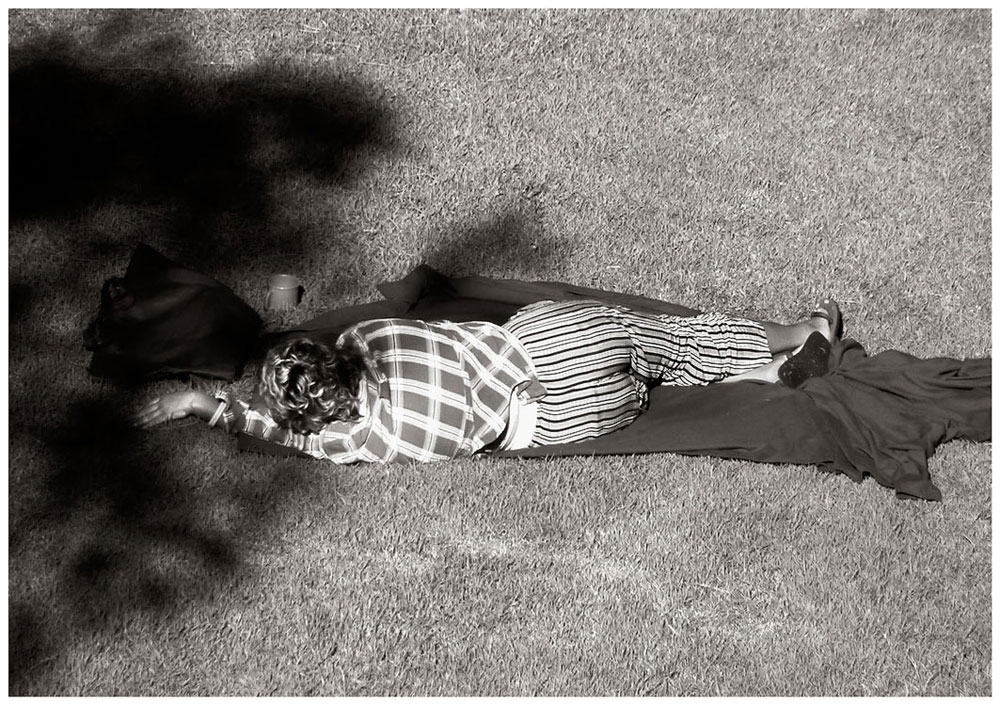
 

Cherine Fahd (Australian, b. 1974) 'Untitled' from the series 'The Sleepers' 2005-2008


Cherine Fahd (Australian, b. 1974)
Untitled
From the series The Sleepers
2005-2008
Lightjet print
28.5 × 40.2 cm
Courtesy the artist


In 2003 I began photographing people I didn’t know in the streets of Paris, working in a conventional street photography style. I became a prowler searching for photographic opportunities in the faces and gestures of total strangers, fascinated with capturing private moments within the public realm.

In 2005 I was living on the sixth floor of an apartment in Kings Cross, Sydney, below was a park unadorned by play equipment or even a bench. From my window I could see homeless people asleep on the grass in the middle of the day. What struck me most were their bodies resting in dappled light and gesturing in ways usually saved for private moments. The drape of their clothes and the quality of light reminded me of so many paintings I had seen.

So The Sleepers began. I photographed people asleep in the park with my mini DV camera, which allowed me to zoom in and capture detail but also allowed for a grainy image reminiscent of surveillance footage. In the sleeping posture – curled up or lying flat – people generally covered their faces, ensuring their anonymity. I liked this aspect of the work. Although I was photographing them unawares, I wasn’t really intruding if I couldn’t see their faces. Oddly, I have stopped working in this candid way. I wasn’t sure why at the time. In retrospect I understand that it became too difficult because audiences became obsessed with whether I had permission to photograph people. I never considered asking anyone if I could take their photo. It would have defeated the whole point. People change when they know there is a camera present, better to let them be.

The moral dilemmas engulfing candid photography are not something I am interested in addressing in my work. I would much rather ponder whether their faces, or their bodies, or their gestures are cues to something more mysterious, spiritual and human.

Cherine Fahd 2011 text from the exhibition catalogue


Kohei Yoshiyuki (Japanese, b. 1946) 'Untitled' 1971 From the series 'The Park'


Kohei Yoshiyuki (Japanese, b. 1946)
Untitled
1971
From the series The Park
Gelatin Silver Print
© Kohei Yoshiyuki, Courtesy Yossi Milo Gallery, New York
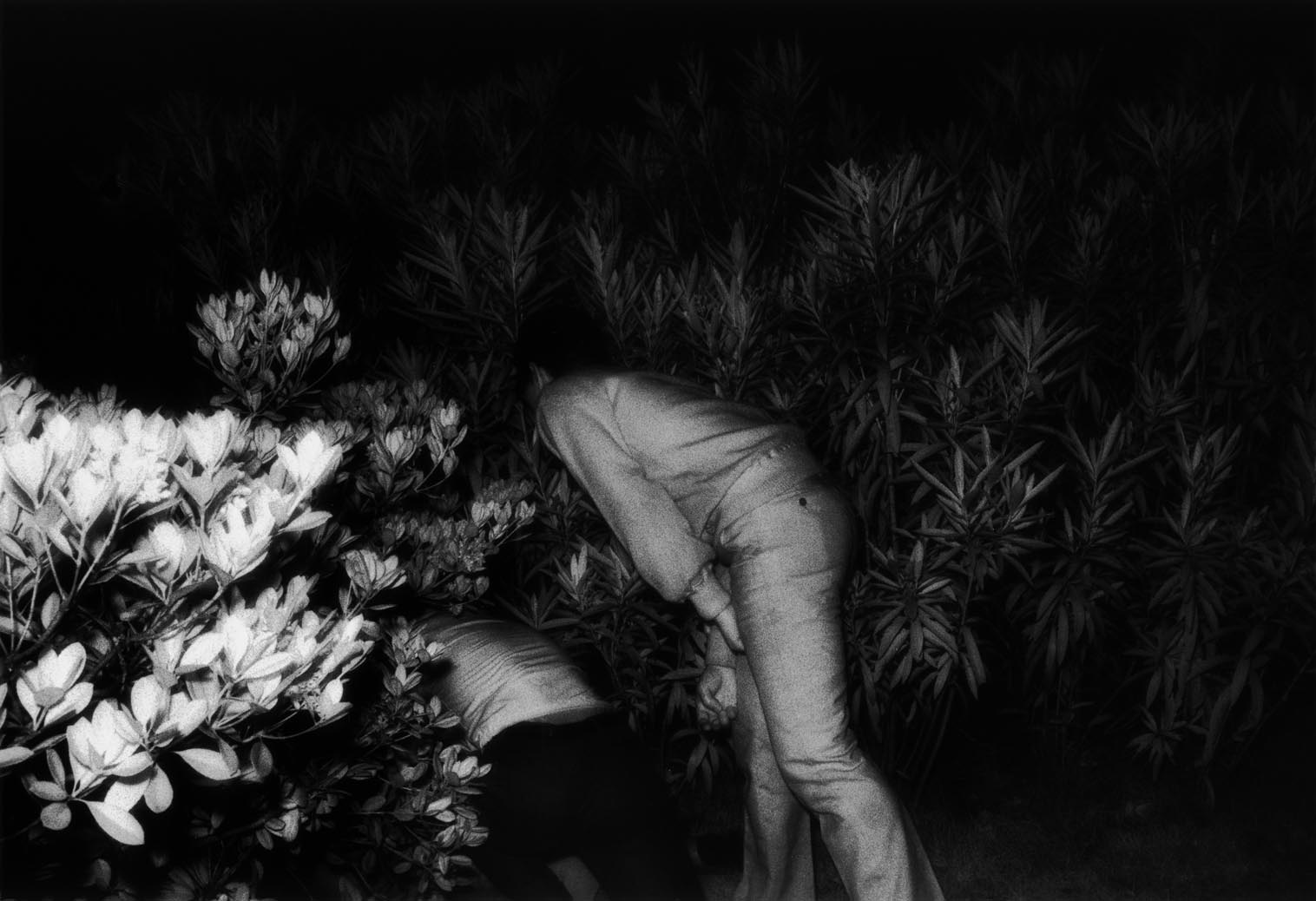
 

Kohei Yoshiyuki (Japanese, b. 1946) 'Untitled' 1971 From the series 'The Park'


Kohei Yoshiyuki (Japanese, b. 1946)
Untitled
1971
From the series The Park
Gelatin Silver Print
© Kohei Yoshiyuki, Courtesy Yossi Milo Gallery, New York


Kohei Yoshiyuki’s now infamous documentation of voyeurism features confronting photographs of public space clandestinely used as private space at night: Japanese parks where, in the absence of privacy, young people perform intimate acts while being watched by onlookers.

During the 1970s, young commercial photographer Kohei Yoshiyuki (a pseudonym; his real name remains unknown) frequented Tokyo’s Shinjuku, Yoyogi and Aoyama parks at night with a 35mm camera, infrared film and a flash. Photographed over a decade, the series was exhibited at the Komai Gallery in Tokyo in 1979 where the images were printed life-size and exhibited in the dark while visitors used hand held torches to view the photographs. These prints were subsequently destroyed.1

Images from The Park were first published in 1972 in the popular ‘secret camera’ genre magazine Shukan Shincho and were not initially considered as art photography.2 However, Yoshiyuki’s series also sits within a broad tradition of voyeurism in Japanese art, including eighteenth and nineteenth century erotic ukiyo-e prints and in cinema.

In 1980 Yoshiyuki published a further selection and, in 1989, he wrote about the process of getting to know the park voyeurs. In 2006 Yoshiyuki was included in Martin Parr’s publication The Photobook: A History: Volume 2 as an unknown innovator, prompting Yossi Milo Gallery to track down the reclusive artist and convince him to reprint the remaining negatives for what became a highly successful exhibition in 2007.

Of the relationship between couples and voyeur Yoshiyuki wrote: ‘The couples were not aware of the voyeurs in most cases. The voyeurs try to look at the couple from a distance … then slowly approach toward the couple behind the bushes, and from the blind spots of the couple they try to come as close as possible, and finally peep from a very close distance. But sometimes there are the voyeurs who try to touch … and gradually escalating – then trouble would happen.’3

Naomi Cass text from the exhibition catalogue


1/ Amelia Groom. “Seeing Darkness,” in Kohei Yoshiyuki: The Park exhibition catalogue, IMA, Brisbane, July 2011
2/ Shihoko Iida, “Gaze without subjectivity,” in Artlink: Art and Surveillance, 31: 3, 2011, p. 28
3/ Philip Gefter, “Sex in the Park, and its Sneaky Spectators,” in The New York Times, 23 Sept 2007


Luc Delahaye (French, b. 1962) 'Untitled' from the series 'L'Autre' 1995/1997


Luc Delahaye (French, b. 1962)
Untitled
1995/1997
From the series L’Autre
Courtesy the artist and Galerie Nathalie Obadia


I stole these photographs between ’95 and ’97 in the Paris metro. ‘Stole’ because it is against the law to take them, it’s forbidden. The law states that everyone owns their own image. But our image, this worthless alias of ourselves, is everywhere without us knowing it. How and why can it be said to belong to us? But more importantly, there’s another rule, that non-aggression pact we all subscribe to: the prohibition against looking at others. Apart from the odd illicit glance, you keep staring at the wall. We are very much alone in these public places and there’s violence in this calm acceptance of a closed world.

I am sitting in front of someone to record his image, the form of evidence, but just like him I too stare into the distance and feign absence. I try to be like him. It’s all a sham, a necessary lie lasting long enough to take a picture. If to look is to be free, the same holds true for photographing: I hold my breath and let the shutter go.

Luc Delahaye, from L’Autre, Phaidon Press, London, 1999 text from the exhibition catalogue


Luc Delahaye (French, b. 1962) 'Untitled' from the series 'L'Autre' 1995/1997


Luc Delahaye (French, b. 1962)
Untitled
1995/1997
From the series L’Autre
Courtesy the artist and Galerie Nathalie Obadia


To photograph people is to violate them, by seeing them as they never see themselves, by having knowledge of them that they can never have; it turns people into objects that can be symbolically possessed. Just as a camera is a sublimation of the gun, to photograph someone is a subliminal murder – a soft murder, appropriate to a sad, frightened time.


Susan Sontag On Photography 1977


In camera and in pubic is about the relationship between camera and subject when this is fraught in some way, in particular, where the subject is not aware of being photographed, where the contract between photographer and subject has been broken.

Candid photography has been critical in the development of art and evidential photography, in revealing aspects of our history and society which have been hidden, ignored, lied about or simply abandoned. Candid photography has delivered some of the most widely regarded, potent and treasured images.

However, the camera is merely a technical device and some would even say a dumb device, which can be, and is used for contradictory and malicious ends. Candid photography has also hurt, harmed and destroyed people. There are more images in the world than ever before, and image sharing technologies in the hands of those with subversive, destructive or immature desires. Paradoxically, on one hand there is greater access to unmediated information of all genres through the internet but also a counter move of public disquiet about candid photography. Many well-regarded, indeed renowned photographers will no longer photograph at the beach, by a pubic pool, at a junior sports match, on the street. The context for photography has changed.

This exhibition looks at the physical and moral proximity of camera to subject in both historical and contemporary work by Cherine Fahd, Bill Henson, Luc Delahaye, Sonia Leber and David Chesworth, Kohei Yoshiyuki, Denis Beaubois, Percy Grainger, Walid Raad and declassified ASIO images from the late 1940s to the 1980s.

In viewing In camera… it is sobering to consider where the photographer is positioned, to viscerally experience the proximity of camera to unsuspecting subject because, importantly, the exhibition moves from candid photography taken with the sole intention of making art (Henson, Fahd, Delahaye, Leber and Chesworth, Raad and Yoshiyuki) through to the intention of surveillance. Not surprisingly, on first view, even the declassified ASIO images are compelling and beautiful.

Of the artists, the viewer might well ask, have you obtained permission to photograph? But as we all know the unprepared body and face reveals quite a different story than the figure composed for the camera. It is the non-composed figure which is the lifeblood of much art and photography.

Surveillance is in part the subject of work by Denis Beaubois, Walid Raad and to some extent in Leber and Chesworth’s multi-media work. Certainly Beaubois, Leber and Chesworth consider the role of architectural space and the all-seeing eye of the state and in the latter, the eye of god within the panopticon of the domed cathedral. Walid Raad puts the tedium of surveillance in perspective when his fictional operative repeatedly forgoes his designated work to relish the setting sun.

In camera and in public exploits the form of CCP’s nautilus galleries and reflects the progress of the camera turned towards an unsuspecting subject until Gallery 4 where, in the hand of Percy Grainger, the camera is turned towards himself, in an astonishing series of vintage photographs, possibly created for display in the Grainger Museum. ‘In camera’ and in public, indeed. In 1941 Grainger wrote, “Most museums, most cultural endeavours, suffer from being subjected to too much taste, too much elimination, too much selection, too much specialisation! What we want (in museums and cultural records) is all-sidedness, side lights, crossreferences.”

We all love to stare, to linger, to see what we might have missed, and with advancing technologies, to see what is unavailable to the naked human eye, and here lies the problem. In looking at these images, are we implicated in an act of transgression?”

Text Naomi Cass September 2011 from the exhibition catalogue


Denis Beaubois (Mauritius, b. 1970) 'In the event of Amnesia the city will recall…' 1996-1997


Denis Beaubois (Mauritius, b. 1970)
In the event of Amnesia the city will recall…
1996-1997
DVD
9 mins 30 secs
Courtesy the artist


This work explores the relationship between the individual and the metropolis. Twelve sites were selected around the city of Sydney where surveillance cameras are prominently placed, the locations were mapped out and the stage for this work was created. A daily pilgrimage was made to the sites for a period of three days. No permission was sought for the use of these sites. The performer arrived unannounced and carried out his actions. Upon arrival the performer attempted to engage with the electronic eye. The performer’s actions were directed to the camera, which adopted the role of audience.

The primary audience was the surveillance camera (or those who monitor them). Their willingness to observe is not based upon the longing for entertainment. It stems from a necessity to assess and monitor designated terrain. Imbued with a watchdog consciousness, the primary audience scans the field for suspects, clues and leads. Like many audiences, it assesses the scene and attempts to pre-empt the plot. However this audience is extremely discerning and, ultimately, by assessing and reacting to the event it also adopts the role of performer.

Within this metropolis the walls do not have ears but are equipped with eyes. The city must understand the movements of those who dwell within its domain. To successfully achieve this it must be capable of reading its inhabitants. What can be read can be controlled in theory. Yet the city’s eyes are not content following the narrative provided by its inhabitants. The city weaves its own text within the surface narrative. A paranoid fiction based on foresight.

Denis Beaubois 1997 text from the exhibition catalogue


Denis Beaubois (Mauritius, b. 1970) 'In the event of Amnesia the city will recall…' 1996-1997


Denis Beaubois (Mauritius, b. 1970)
In the event of Amnesia the city will recall…
1996-1997
DVD
9 mins 30 secs
Courtesy the artist


In camera and in public represents a very different approach to this year’s Festival theme of protest and revolution. Taking a look at society through the lens of the state, the street photographer, the artist and the eye of the voyeur, this exhibition curated by Naomi Cass examines the abandonment of the contract between photographer and subject.

Ranging from candid street photography through to surveillance photography, In camera explores the camera and its relationship to the subject, unaware of being photographed. From images taken in public spaces, including a series of striking faces taken on the Paris metro, the exhibition proceeds to the grainy anxiety of declassified ASIO photos from the 1960s.

Kohei Yoshiyuki’s now infamous documentation of voyeurism, The Park (1970-1979), features confronting photographs of public space clandestinely used as private space at night: Japanese parks where, in the absence of privacy, young people perform intimate acts while being watched by onlookers.

At the heart of CCP galleries are Percy Grainger’s extraordinary naked self-portraits from his so-called ‘lust branch’ collection, hand printed by Grainger between 1933 and 1942. Here the camera is turned on himself, in camera.

Cherine Fahd offers frank photographs of daytime sleeping bodies in a Kings Cross park taken from her 6th floor apartment, while Bill Henson captures hauntingly beautiful crowd scenes during the 1980s. Sonia Leber and David Chesworth secretly film from the dome of St Pauls Cathedral, London and Walid Raad impersonates a fictional operative who failing in his surveillance task, repeatedly films the sunset.

Finally, Denis Beaubois, with a playful and performative video, seeks a kind of revenge of the subject, through his attempts to engage with a number of surveillance cameras, inviting the camera to respond to pleas earnestly delivered on cue cards.

Press release from the CCP website


Bill Henson (Australian, b. 1955) 'Untitled 1980/82'


Bill Henson (Australian, b. 1955)
Untitled 1980/82
Gelatin silver chlorobromide print
From a series of 220
57.5 × 53.4cm
Courtesy the artist and Roslyn Oxley9 Gallery, Sydney


Bill Henson (Australian, b. 1955) 'Untitled 1980/82'


Bill Henson (Australian, b. 1955)
Untitled 1980/82
Gelatin silver chlorobromide print
from a series of 220
57.5 × 53.4cm
courtesy the artist and Roslyn Oxley9 Gallery, Sydney


The great beauty in the subject comes, for me, from the haunted space, that unbridgeable gap – which separates the profound intimacy and solitude of our interior world from the ‘other’ and in trying to show, in this case through envisioning the crowd, how an awesome, unassailable, even monumental, beauty and grace might attend the undulating, fluid mass of a wall of people as they move toward you.

It is the contradictory nature of life and the way in which this can be suggested in art which first drew me to photograph crowds – much as this underpins my interest in any art form…

The business of how a child’s small hand appearing between two adults at a street crossing can suggest both a vulnerability, great tenderness, and yet also contain within it all of the power that beauty commands, is endlessly fascinating to me.

Bill Henson 2011 text from the exhibition catalogue
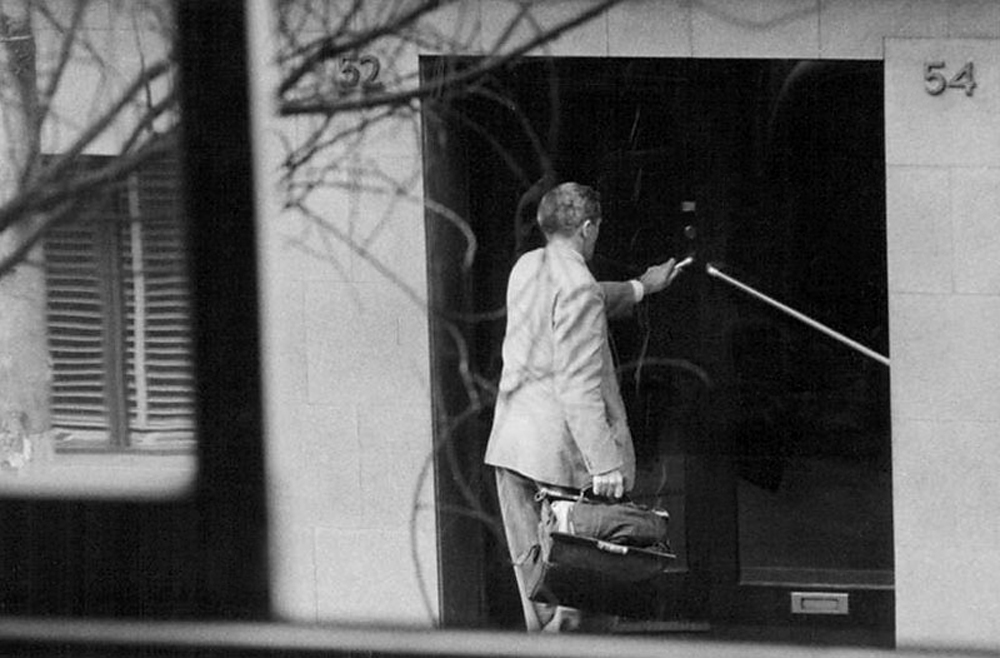
 

Persons Of Interest - ASIO surveillance 1949-1980 'Writer Frank Hardy, St Kilda, July 1964'


Persons Of Interest – ASIO surveillance 1949-1980
Writer Frank Hardy, St Kilda, July 1964
NAA 9626, 212


Persons Of Interest - ASIO surveillance 1949 -1980. 'Eddie Mabo, CPA district conference, Townsville, September 1965'


Persons Of Interest – ASIO surveillance 1949-1980
Eddie Mabo, CPA district conference, Townsville, September 1965
NAA A9626, 162


Persons Of Interest – ASIO surveillance 1949-1980
Curated by Haydn Keenan
Selected surveillance images from a forthcoming documentary series from Smart Street Films


I discovered these images as part of my research for our documentary series Persons Of Interest which will be screened on SBS early next year. They are part of a massive archive of pictures secretly recorded by the Australian Security Intelligence Organisation (ASIO) from 1949 onwards.

These images are not art. Unlike art these pictures have the power to alter lives dramatically. Be photographed at the wrong place and you’ll find it hard to get a job, when you do you’ll get the sack soon after. Appear in these images and your career will go nowhere without explanation. The eye of the beholder will cast a shadow you will not see until thirty years later when you get access to your file.

The photos create a strange world of frozen youth, high hopes and issues that were seen as subversive then but are now so integrated into the mainstream that they need explanation for Gen Y. ASIO was created to hunt down and eliminate a Soviet spy ring operating in Canberra in the late 1940s. Most of the members of the spy ring were connected with or were members of the Communist Party of Australia. For the next forty years ASIO followed everything the Party did.

The purpose of photographic surveillance is to identify Persons Of Interest in a definitive manner and to record their associations and contacts thereby building a network. Surveillance would occur during demonstrations, May Day marches and at political meetings. It would also occur at specific locations and everyone entering or leaving the location would be recorded. Each person in a photograph with an ASIO file would have an identifying number marked on the image next to them.

I have thousands of these images and what I have noticed is that one builds up a mental image of the changing face of what the State saw as a threat. What starts as the hunt for Communist spies gradually evolves into suspicion about social issues like Aboriginal land rights, youth culture, Women’s Liberation, anti Vietnam, Apartheid – even amateur actors at New Theatre were thoroughly photographed. There’s even a file on the Mother’s Club at Gardenvale Primary School. The absurdity is evident in hindsight. Yet what ASIO didn’t realise is that they were constructing an invaluable social history of Australian dissent as they gradually confused subversion with dissent.

They recorded many people, especially in the 1960s filled with youthful exuberance, high in hope and action. These people were questioning the central values of a society their parents had created. Here they are frozen in the malevolent eye of the security services. Whilst it’s invasive, seedy and incompetent, even they can’t diminish sunlit youth.

Haydn Keenan 2011 text from the exhibition catalogue


Percy Grainger (Australian, 1882-1961) 'Private Matters: Do not open until 10 (ten) years after my death' 1955-1956
 

Percy Grainger (Australian, 1882-1961)
Private Matters: Do not open until 10 (ten) years after my death
1955-1956
Envelope
25.1 x 32cm
Courtesy the Grainger Museum, The University of Melbourne


Internationally renowned Australian pianist and composer Percy Grainger (1882-1961) built new sounds by modifying old instruments. He built electronic instruments from recycled materials; he built new words, new types of garments and previously unforged links between folk and classical music. He also built the Past-Horde-House, his term for museum, in which he curated his life.

In these photographs, hand printed between 1933 and 1942, Percy Grainer turns the camera on himself (and to a lesser degree his wife Ella) to document his sexual practices, which he believed were intrinsic to his being and his creativity. These works form part of what Grainer called the ‘lust branch’ of his Museum.

Grainger was a sadomasochist and wrote to his partners and friends quite openly about his thoughts on sex, including what he called ‘self beating’. However when in 1956 Sir Eugene Goossens, British composer and Sydney Symphony Orchestra conductor was detained for bringing pornography into the country, and was subsequently destroyed by the scandal, Grainger, like a number of prominent Australian artists, either left the country or outwardly restrained their behaviour. Consequently, Grainger sealed his ‘lust branch’ of the Museum, a selection of books, whips and photographs related to sadomasochistic behaviour in a travelling trunk, and left the instruction: Not to be opened until 10 (ten) years after my death (exhibited). Contained within the accompanying envelope is a kind of manifesto in the form of a letter, the pages of which are carefully bound together by hand, in which he writes, ‘The photographs of myself whipped by myself in Kansas City and the various photographs of my wife whipped by me show that my flagellantism was not make-believe or puerility, but had the element of drasticness in it. Nevertheless my flagellantism was never inhuman or uncontrolled.’

While Grainger was the subject of intense, international media scrutiny, marketing and photography, to document their sadomasochistic practices Grainger had to teach himself photography. The archive he left has the quality of forensic records, consistent with the quasi scientific method he practiced in other aspects of his life. Exhibited is Grainger’s self-printed, hand-made album, Photo-skills Guide in which he makes technical observations, similarly evident in and on other ‘lust branch’ photographs.

Grainger considered his sexual expression integral to all aspects of his life, indeed for Grainger sexuality was inseparable from his renowned life as a pianist and composer. It is probable that the ‘lust branch’ images were designed for display in the Museum, in a more enlightened period. In 1941 Grainger wrote, ‘I have a bottomless hunger for truth … life is innocent, yet full of meaning. Destroy nothing, forget nothing … say all. Trust life, trust mankind. As long as the picture of truth is placed in the right frame (art, science, history) it will offend none.’

Naomi Cass 2011 text from the exhibition catalogue


Centre for Contemporary Photography
Level 2, Perry St Building
Collingwood Yards, Collingwood
Victoria 3066

Opening hours:
Wednesday – Saturday 11am – 5pm

Centre for Contemporary Photography website

LIKE ART BLART ON FACEBOOK

Back to top