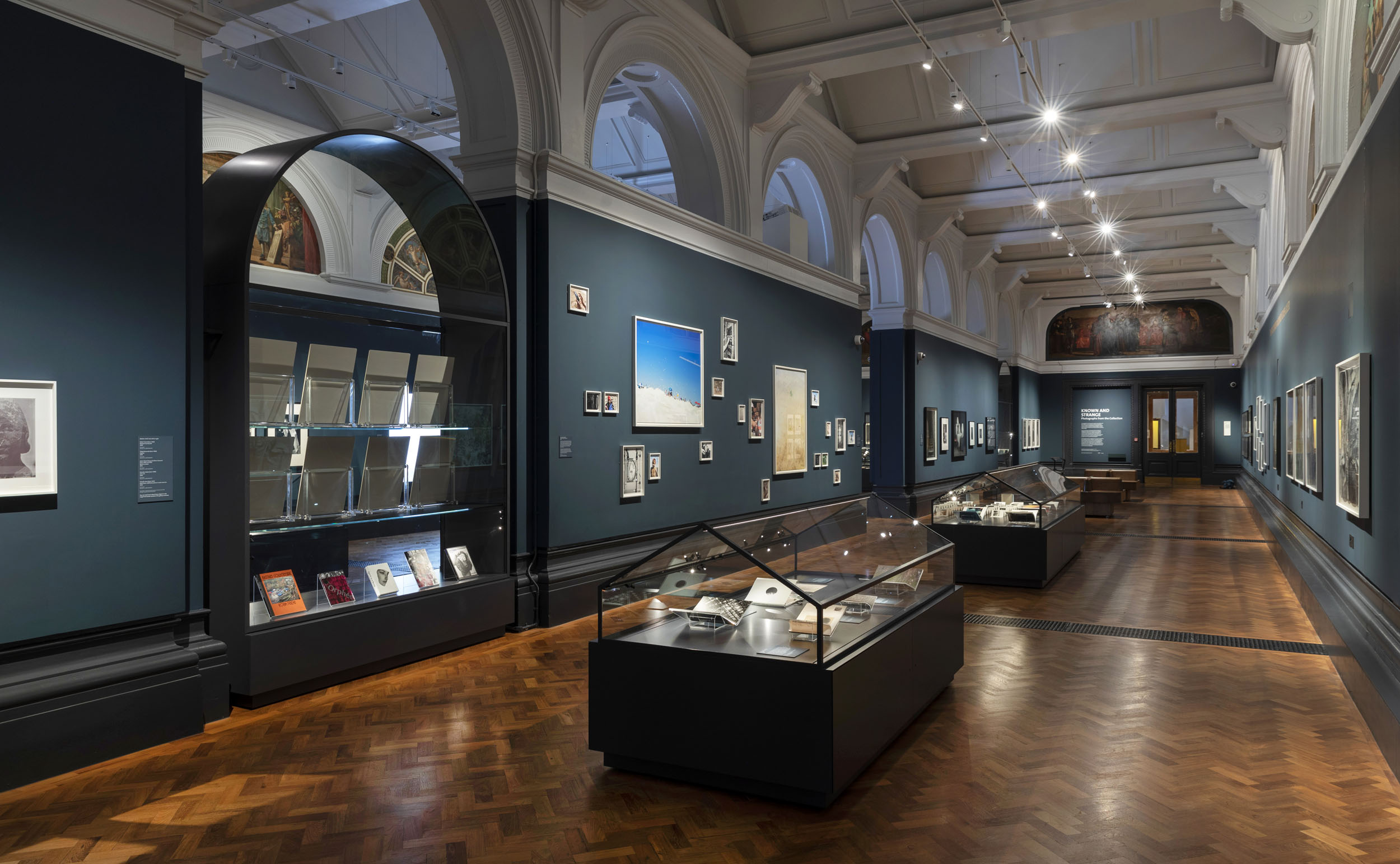
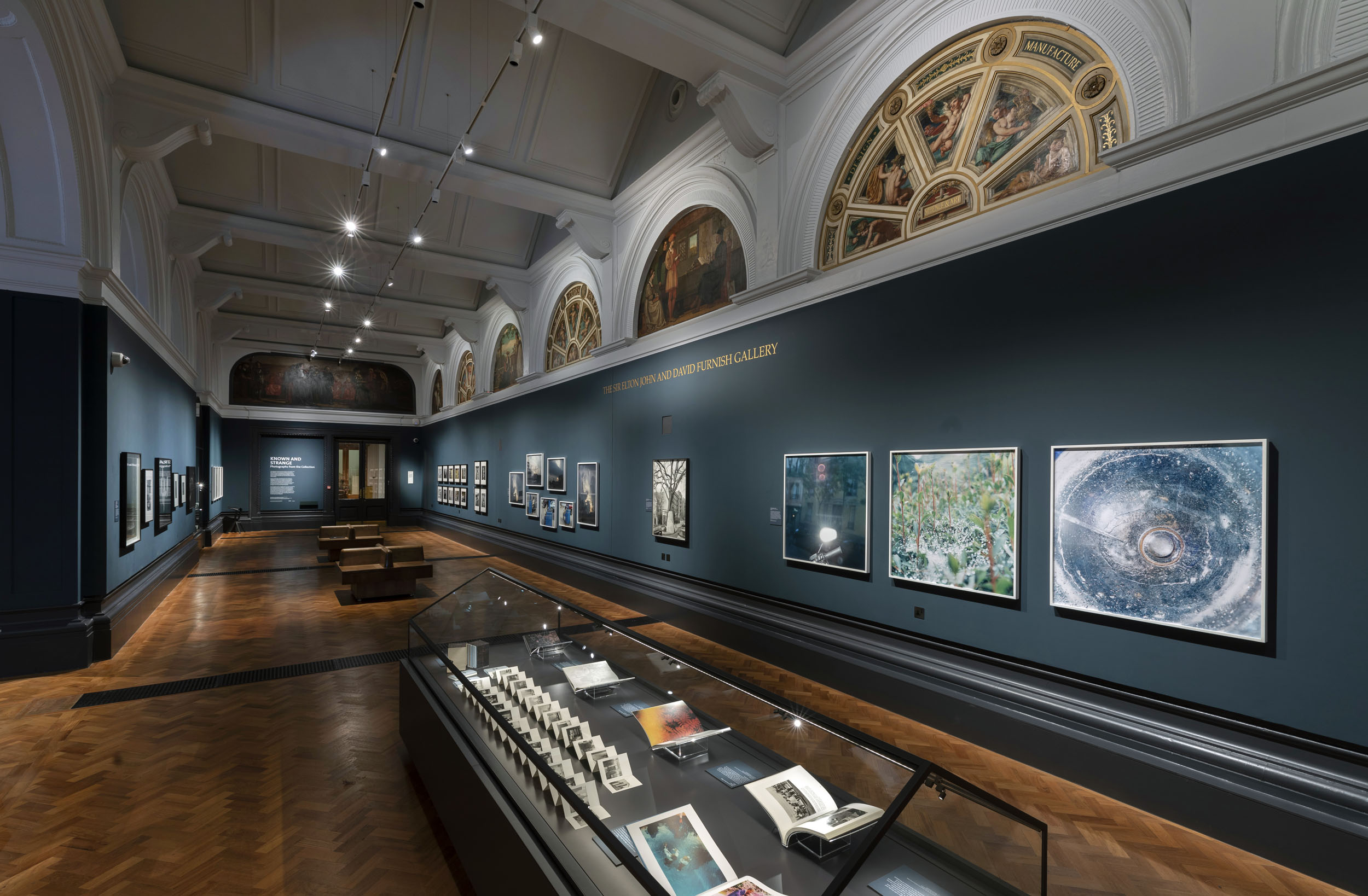
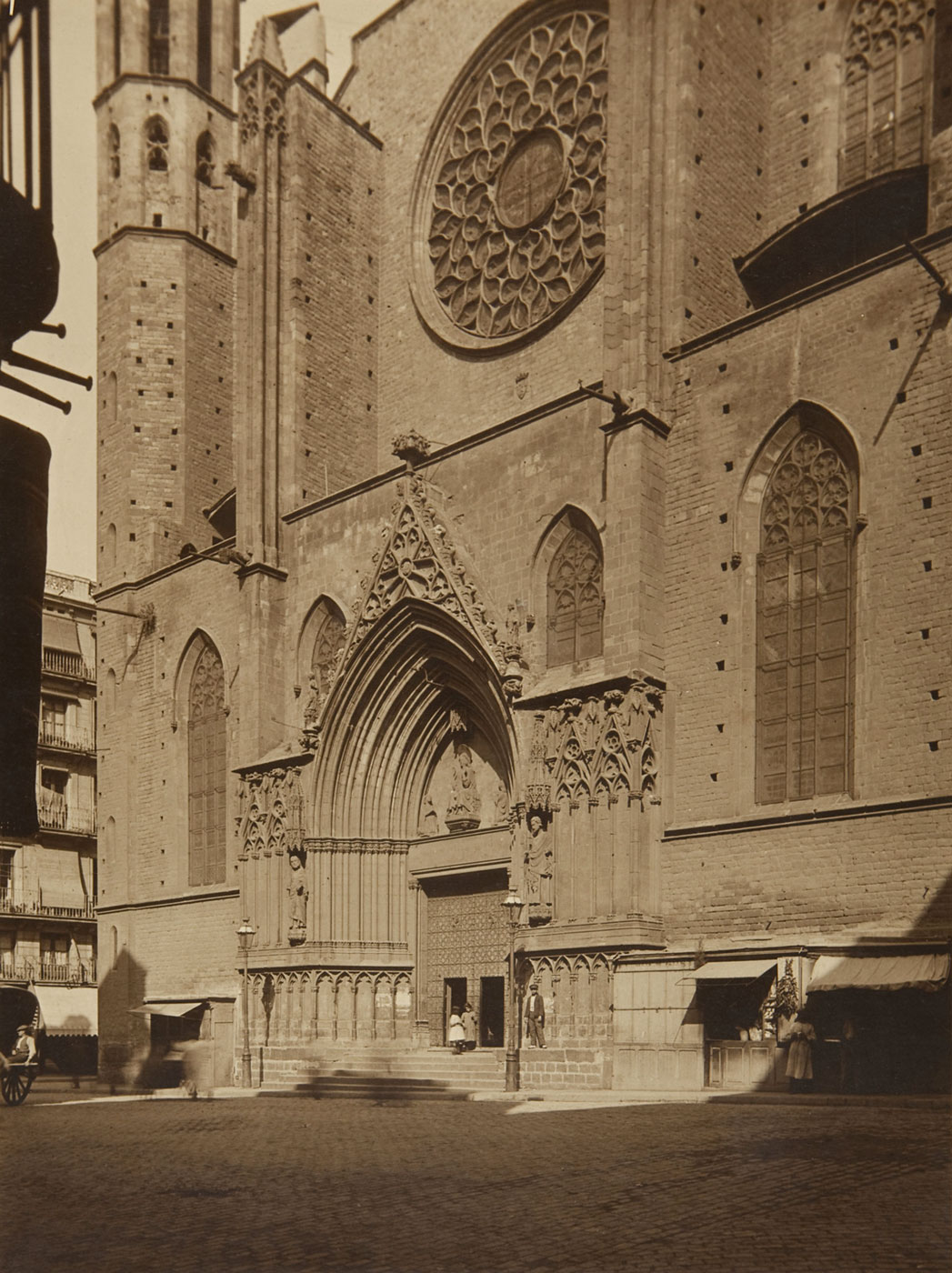
Exhibition: ‘A New Power: Photography in Britain 1800-1850’ at the S T Lee Gallery, Weston Library, Bodleian Libraries, Oxford

Exhibition dates: 1st February – 7th May, 2023

Curator: Geoffrey Batchen, Professor of the History of Art at the University of Oxford
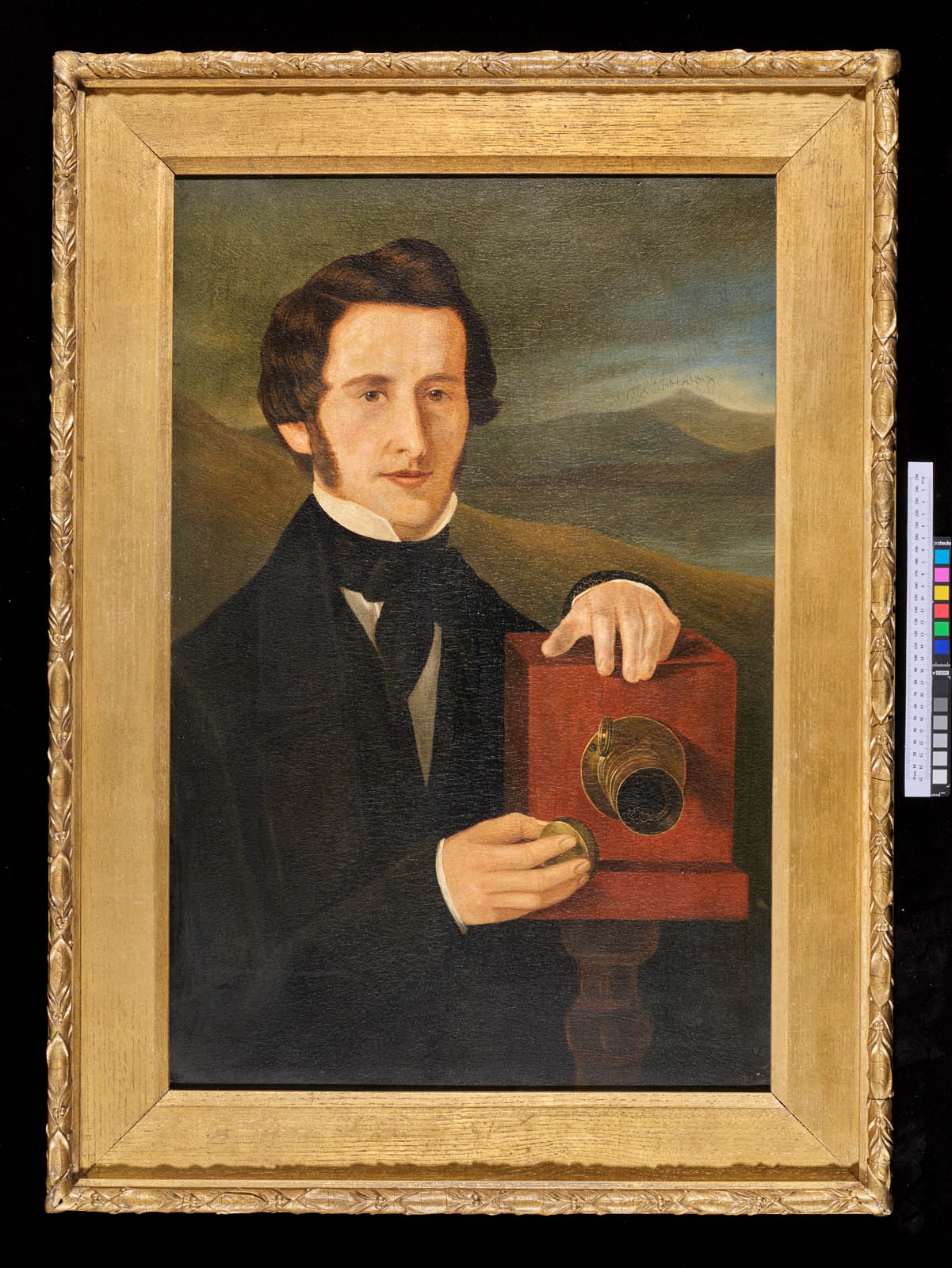
 

Artist unknown (England) 'Portrait of a man (resembling Jabez Hogg) operating a daguerreotype camera' c. 1845 from the exhibition 'A New Power: Photography in Britain 1800-1850' at the S T Lee Gallery, Weston Library, Bodleian Libraries, Oxford, February - May, 2023


Artist unknown (England)
Portrait of a man (resembling Jabez Hogg) operating a daguerreotype camera
c. 1845
Oil on canvas
The Bodleian Libraries, University of Oxford


This painting was acquired by the Bodleian Libraries at an auction and is the only known painting of a daguerreotypist at work. The man bears a strong resemblance to the photographer (and later ophthalmic surgeon) Jabez Hogg, who in 1843 published a ‘Manual of Photography’ and worked at the Illustrated London News from 1850 to 1866.


Fickle, fleeting time: illuminating a relationship between adaptability and uncertainty

The new medium – (in art) the substance the artist uses to create a piece of artwork, (in science) the substance that transfers the energy, or light from one substance to another substance or from one place to another, or from one surface to another, (in spirit) a person reputedly able to make contact with the world of spirits – of photography possessed the power to capture a pictorial truth to reality that could liberate, educate and memorialise while at the same time being used by the coercive power of the state, police, scientists and doctors (for example) to classify and control the sick, criminals, deviants, “natives” and “other” subjugated peoples.

In the Age of Machinery this instrument of new power harnessed technology and science to capture light in order to reflect back to man an image of himself as he would like to be seen – freezing a moment in time – as indeed the sitter had to stand still in order for their likeness to be captured in the early photographic processes. This action machine, an all dancing singing mix of paraphernalia, lens, metal, wood, glass and chemical reaction, forced a stillness in the sitter commensurate with the stillness of the resulting portrait image, im/mortal at one and the same time. By then by reflecting on that captured image the viewer could transcend time, bringing past time to present future time.

Imagine having never seen your picture before except in a cut-out silhouette or in a portrait drawing or oil painting. Imagine the shock of seeing your likeness before your eyes as a manifestation of a truth: this is what I look like at this point in time from the camera’s point of view – a manifestation of the energy of a person captured through the suspension of time, through the the spirit of the medium and, perhaps, through the medium of the spirit. That moment when the photograph is taken when you are taken out of yourself into another time and space. And then by looking at that image, coming to the understanding that you were already picturing your own death.

Within this exhibit one could dwell upon the Power of the new medium (to do what? to illuminate – make (something) visible/to help clarify or explain. What something is it helping to explain?) but rather, you might like to consider its adapt/ability to be so many things to so many people, to time travel a singular truth into the many truths to which reality points us. The shadow moves. In a medium where everything is supposedly “fixed” nothing is fixed, for everything is up for negotiation. Despite classification systems used to define categories and stereotypes in a bourgeois capitalist industrial society, this uncertainty of representation would have been incredibly confronting to a Victorian sensibility based on order and control – where everything, and every body (literally), had to be kept in its place.

Dr Marcus Bunyan


Many thankx to the Bodleian Libraries for allowing me to publish the photographs in the posting. Please click on the photographs for a larger version of the image.


“We are in the infancy of invention with sun pictures, and no man can predict the results which may be obtained from a further advance in the paths of discovery … an instrument of new power [has been] placed at the disposal of Ingenuity and of Art.”


From a leaflet published in 1846


A New Power: Photography in Britain 1800-1850 is a free exhibition in the Weston Library, running until the 7th May, 2023. This exhibition explores the early history of photography and its impact on British life. It examines the invention of the medium in its earliest incarnation, and how the broad range of uses had an unequivocal impact on British culture. From the invention of celebrity to the very first ‘travel photography’ and how this helped to consolidate colonial sensibilities. By showing how photography intersected with all aspects of a nascent modernity, A New Power reveals photography’s crucial role in making Britain the society it is today.

“The advent of photography was a complex historical event involving social, cultural and technological changes in about equal measure. These changes included significant developments in European society, such as the onset of the Industrial Revolution, but also important advances in scientific thinking and technology, and revolutionary shifts in the experience of time, space and subjectivity. All these elements were necessary to the conception of photography in the early 19th century.”

Exhibition text


Philippe Jacques de Loutherbourg RA (French, 1740-1812) 'Iron Works, Coalbrook Dale' c. 1824 from the exhibition 'A New Power: Photography in Britain 1800-1850' at the S T Lee Gallery, Weston Library, Bodleian Libraries, Oxford, February - May, 2023


Philippe Jacques de Loutherbourg RA (French, 1740-1812)
Iron Works, Coalbrook Dale
c. 1824
From The romantic and picturesque scenery of England and Wales, London 1805, pl.[7]
Etching, aquatint


“The men, women, children, country and houses are all black … The country continues black, … everywhere, smoking and burning coal heaps, intermingled with wretched huts and carts and little ragged children”

~ The Princess Victoria in a diary entry about a trip to Birmingham, 1832


The advent of photography was a complex historical event involving social, cultural and technological changes in about equal measure. These changes included significant developments in European society, such as the onset of the Industrial Revolution, but also important advances in scientific thinking and technology, and revolutionary shifts in the experience of time, space and subjectivity. All these elements were necessary to the conception of photography in the early 19th century.

“Were we required to characterise this age of ours by any single epithet, we should be tempted to call it … the Mechanical Age. It is the Age of Machinery, in every outward and inward sense of that word”

~ Thomas Carlisle (1829)


J. W. Lowry (British, 1803-1879) 'Power loom factory of Thomas Robinson Esqr. Stockport, Cheshire' c. 1849-1850


J. W. Lowry (British, 1803-1879)
Power loom factory of Thomas Robinson Esqr. Stockport, Cheshire
c. 1849-1850
(after drawing by James Nasmyth)
From Andrew Ure, The Philosophy of Manufactures
Engraving trimmed to platemark
17.5 x 32cm
Science Museum Group Collection
© The Board of Trustees of the Science Museum
Creative Commons Attribution 4.0


View of factory interior with five rows of c. 100 power looms using overhead lathe drives, operatives women, visitor and children looking around, spare rollers in corner. [James Nasmyth patents for printing calicoes etc, 1849-1850; Thomas Robinson textile machinery patents, 1844-1849] Factory located in Stockport, Cheshire.


About the exhibition

The announcement of photography’s invention in January 1839, first in Paris and then in London, introduced a ‘new power’ into British life. This new power – derived from photography’s capacity to automatically capture the images created in a camera – was soon being used for every conceivable purpose.

A New Power: Photography in Britain 1800-1850 explores the early history of photography, starting with the invention of the medium and the earliest dissemination of photographic images in Britain and ending with the famous Great Exhibition of 1851. It examines the broad range of uses that photography would quickly come to fill, from documenting the invention of celebrity to the very first ‘travel photography’ and how this helped to shore up colonial sensibilities.

By showing how photography intersected with all aspects of a nascent modernity, A New Power reveals photography’s crucial role in making Britain the society it is today.

Early experiments

In June 1802, Thomas Wedgwood and Humphry Davy co-authored an essay in the Journals of the Royal Institution. It described various experiments the two men had undertaken on making images by exposing to light some pieces of white paper or leather moistened with a solution of silver nitrate. The essay is often considered to be the first to describe specifically photographic experiments. Davy’s colleague Thomas Young made further experiments with silver nitrate in 1804.

 
“White paper, or white leather, moistened with solution of nitrate of silver, undergoes no change when kept in a dark place; but, on being exposed to the day light, it speedily changes colour, and, after passing through different shades of grey and brown, becomes at length nearly black … Nothing but a method of preventing the unshaded part of the delineation from being coloured by exposure to the day is wanting, to render the process as useful as it is elegant.”

~ Humphry Davy and Thomas Wedgwood (1802)


“I formed an image of the rings, by means of the solar microscope, with the apparatus which I have described in the Journals of the Royal Institution, and I threw this image on paper dipped in a solution of nitrate of silver, placed at the distance of about nine inches from the microscope”

~ Thomas Young (1804)

Scientific entertainments

Scientific experiments were frequently presented as public entertainments in the early 19th century. One satirical cartoon shows an experiment conducted at the Royal Institution in London by Thomas Young. He is seen administering nitrous oxide, or laughing gas, to Sir John Coxe Hippisley, with hilariously unfortunate results. On Young’s left is Humphry Davy, holding a pair of bellows. The audience includes many celebrities of the time. Davy and Young also conducted photographic experiments in this laboratory.

Fleeting time

A number of artists in the early 19th century tried to reconcile ‘fleeting time’ with the stasis of a painted landscape. In 1822, Louis Daguerre and his fellow artist Charles Marie Bouton opened their Diorama building in Paris. In the Diorama, viewers sat on a platform that slowly moved so that different views of the same painted scene, enhanced by special lighting and other effects, could appear to gradually reveal themselves. This apparatus was described by its inventors as ‘imitating aspects of nature as presented to our sight, that is to say, with all the changes brought by time, wind, light, atmosphere’.


“An attempt has been made to arrest the more abrupt and transient appearance of the Chiar’oscuro in Nature … to give ‘to one brief moment caught from fleeting time’ a lasting and sober existence”

~ John Constable (1833)


John Constable (British 1776-1837) 'Study of clouds' 1822


John Constable (British 1776-1837)
Study of clouds
1822
Oil on paper, laid on canvas [verso inscribed ’31 Sep.r 10-11 o’clock morning looking Eastward a gentle wind to East’]
H 48 x W 59cm
Ashmolean Museum, University of Oxford
Presented by Sir E. Farquhar Buzzard, Bt, 1933


One of a group of cloud studies from 1822 which are so accurate in their record of weather conditions, that Constable’s mistake in dating this example can be silently corrected to 1 October 1822.


Computing and photography

Shortly after his announcement of photography, William Henry Fox Talbot sent Charles Babbage eight examples of his photogenic drawings. Babbage went on to display Talbot’s photographs at his famous London soirées, intellectual gatherings that Talbot and his family occasionally attended in person. The other entertainments included a working model of a portion of Babbage’s first computing machine, the Difference Engine. Visitors therefore encountered photography and computing together, seeing both for the first time at the same time.


“Many thanks for the loan of those beautiful photographs. They were much admired last Saturday Evg … In the meantime, I gave Lady Byron a treat to whom I lent them for a few hours”

~ Charles Babbage, in a letter to William Henry Fox Talbot, 26 February 1844

Women and photography

Women played an often overlooked but important role in the development of British photography. Pioneering scholars like Elizabeth Fulhame and Mary Somerville were among the first to conduct experiments with light-sensitive silver salts and publish their results.


“The possibility of making cloths of gold, silver, and other metals, by chymical processes, occurred to me in the year 1780 ….”

~ Elizabeth Fulhame, from An Essay On Combustion with a View to a New Art of Dying and Painting, wherein the Phlogistic and Antiphlogistic Hypotheses are Proved Erroneous (November 1794)


“In my experiments … I employ the chloride of silver, which Mr Faraday was so kind as to prepare for me, and which, accordingly, was perfectly pure and white. It was liquid and might be uniformly spread over the paper.”

~ Mary Somerville, from ‘Extract of a letter from Mrs Somerville to M. Arago: Chemical Rays of the Solar Spectrum’, The Edinburgh New Philosophical Journal (October 1836 – April 1837)

Beautiful shadows

English scientist William Henry Fox Talbot first conceived of the possibility of a photographic process in 1833 and soon began experimenting with light-sensitive chemistry at his home, Lacock Abbey in Wiltshire. Initially, he only shared the results of his experiments with family members, including his sister-in-law, Laura Mundy. Her reply is the earliest description we have of photographic images.


“Dear Mr Talbot, Thank you very much for sending me such beautiful shadows.”

~ Laura Mundy, in a letter to William Henry Fox Talbot, 13 December 1834


Sir Francis Leggatt Chantrey RA (English, 1781-1841) 'Bust of Miss Mundy' 1825-1826


Sir Francis Leggatt Chantrey RA (English, 1781-1841)
Bust of Miss Mundy
1825-1826
Plaster
Ashmolean Museum, University of Oxford


Inventing photography

“The most transitory of things, a shadow, the proverbial emblem of all that is fleeting and momentary, may be fettered by the spells of our natural magic, and may be fixed for ever in the position which it seems only destined for a single instant to occupy.”

~ William Henry Fox Talbot, writing in January 1839


The invention of the daguerreotype – a photographic process in which an image is recorded on a sheet of silver-plated copper – was announced in Paris on 7 January 1839. Daguerreotypomania ensued. The extraordinary news was reported in British newspapers just a few days later. This prompted English scientist William Henry Fox Talbot to reveal that he, too, had been working on photographic experiments, a paper-based process that he called photogenic drawing. These twin announcements heralded the advent of photography in Britain. Soon, actual examples could be seen in shops or in reproduction.


“M. Daguerre has discovered a method to fix the images which are represented at the back of a camera obscura; so that these images are not the temporary reflection of the object, but their fixed and durable impress.”

~ Hippolyte Gaucheraud, as translated in The Literary Gazette, 12 January 1839

Photogenic drawings

William Henry Fox Talbot published the details of his invention of photogenic drawing in January 1839, so that anyone with the means and some chemical knowledge could use the process. John Herschel soon devised his own light-sensitive formula and made a camera picture, a view of the framework of his father’s forty-foot telescope. He ‘washed out’ the image with hyposulphite of soda, which, unlike Talbot’s use of table salt, entirely prevented further development. In contrast, Talbot’s photogenic drawings remain light sensitive and therefore cannot be displayed in this exhibition.
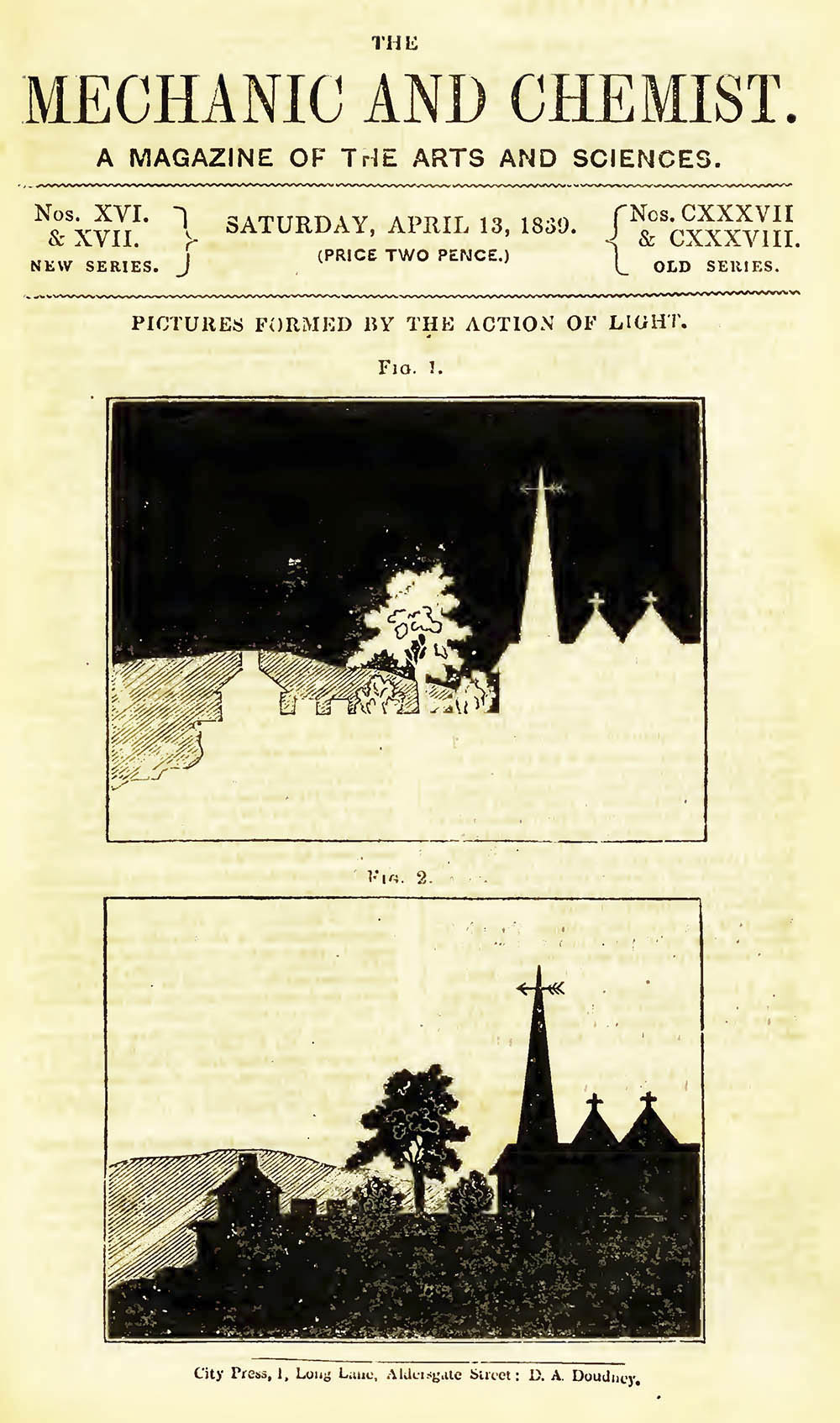
 

'Pictures Formed by the Action of Light' From 'The Mechanic and Chemist: a Magazine of the Arts and Sciences' (13 April 1839)


‘Pictures Formed by the Action of Light’
From The Mechanic and Chemist: a Magazine of the Arts and Sciences (13 April 1839)
Wood engravings after photogenic drawings
Radcliffe Science Library, University of Oxford


The Mechanic and Chemist was one of the better-established of the pioneering illustrated journals, already entering its fourth year of publication. It was started by George Berger, a publisher and bookseller based in the Strand, who launched a wide range of such publications. Most of these collapsed by the mid-1840s, but were in their heyday in 1839. Wood engravings were the most practical way for these publications to include pictures. Far less expensive and much faster for ‘woodcutters’ or ‘woodpeckers’ to produce than steel or copper engravings, unlike lithographs they were intaglio and could be printed alongside the type in a conventional letterpress. The journal had already published accounts of Daguerre’s and Talbot’s inventions, with a strong bias towards Daguerre, and on 13 April 1839 it attempted to express these inventions in visual form. The photographer here, ‘Q.E.D’, said that the silhouette negative had been “taken with the sun behind, forming a strong contrast of light and shade: the preparation not being sensible enough to show the intermediate shades directly.” Apparently overlooking the fact that Talbot had published the idea of making a print from the negative right from the start, Q.E.D. thought he had invented “a method of transforming such pictures into true representations of nature.””

Larry J Schaaf. “Revelations & Representations,” on the the Talbot Catalogue Raisonné blog 27th May 2016 [Online] Cited 21/02/2023
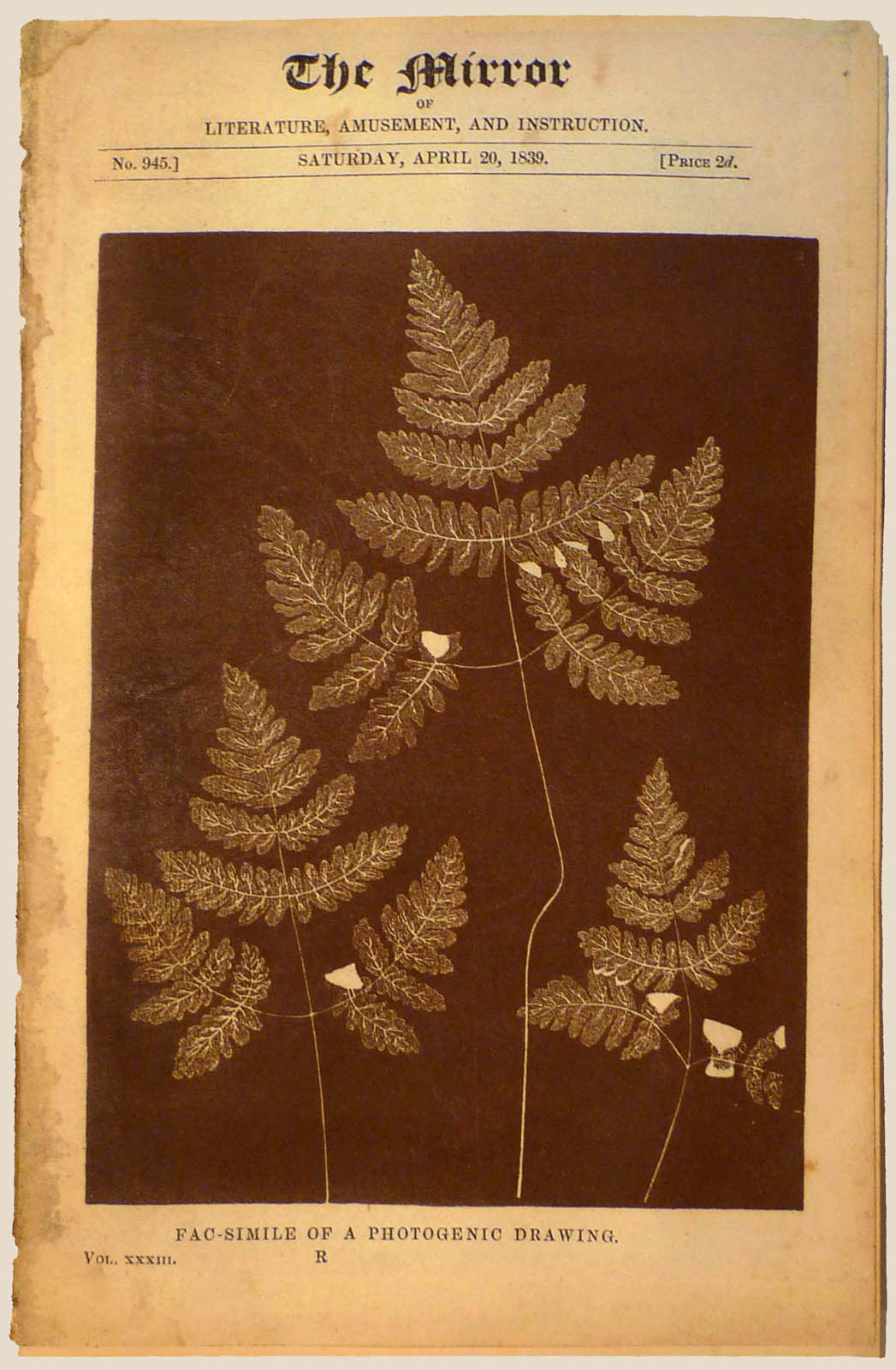
 

Golding Bird. 'Fac-Simile of a Photogenic Drawing' From 'The Mirror of Literature, Amusement, and Instruction' (20 April 1839) from the exhibition 'A New Power: Photography in Britain 1800-1850' at the S T Lee Gallery, Weston Library, Bodleian Libraries, Oxford, February - May, 2023


‘Fac-Simile of a Photogenic Drawing’
From The Mirror of Literature, Amusement, and Instruction (20 April 1839)
Wood engraving after a photogenic drawing contact photograph by Golding Bird


My personal favourite early woodcut representation of a photogenic drawing is this one, published a week later and coming much closer to mimicking the nature of one of Talbot’s originals. The Mirror of Literature, Amusement, and Instruction had taken the exceptional step of printing the wood block in a brown ink similar to the tone of photogenic drawings; this would have required a second printing of that sheet in black in for the type and represented a willingness to go to extra expense for the sake of accuracy. (Before colour printing became ubiquitous, I wish that publishers in the 1960s-1980s had recognised the value of this approach more often). The Mirror was one of the older illustrated journals, having started in 1822, and not everyone favoured its antiquarian editor, John Timbs. He explained that “our prefixed engraving is a fac-simile of a photogenic drawing, for which we are indebted to the kindness of Dr. Golding Bird, a distinguished botanist, who has published the following very interesting paper on the application of the photographic art to botanical purposes, in that excellent periodical, the Magazine of Natural History.” Dr. Bird (1814-1854) had been an outstanding chemist ever since a child. By 1836 he held the chair of Natural Philosophy at Guy’s Hospital in London.  The next time your physician applies his stethoscope to your chest you will be benefitting from one of Bird’s many inventions. Bird wrote about the effects of light before 1839 and once photography was announced he devoted considerable attention to it in his publications. He at first tried Daguerre’s little-known process on paper, but preferred Talbot’s process, although noting that he wished that Talbot had published even more detailed instructions. Sadly, he died early and none of his own photographs are known to have survived.

Larry J Schaaf. “Revelations & Representations,” on the the Talbot Catalogue Raisonné blog 27th May 2016 [Online] Cited 21/02/2023


George William Francis. 'Fac-Similes of Photogenic Drawings' From 'The Magazine of Science' (27 April 1839) from the exhibition 'A New Power: Photography in Britain 1800-1850' at the S T Lee Gallery, Weston Library, Bodleian Libraries, Oxford, February - May, 2023


‘Fac-Similes of Photogenic Drawings’
From The Magazine of Science (27 April 1839)
Wood engravings after photogenic drawing contact photographs by George William Francis


A very new journal, The Magazine of Science featured the work of a botanist contemporary with Talbot, George William Francis (1800-1865). In 1843 he emigrated to Australia, forming the first Botanic Garden there, in Adelaide. Francis explained that he had photographically sensitised boxwood blocks and made the above photographic impressions directly on them. These were then sent to the wood engraver. The editor felt that the lace was accurately represented but “in the flowers he has failed to express the delicacy and beauty of the drawings.”

Unlike the other journals, The Magazine of Science had delayed publishing about the new invention “because we were desirous in this, as in all things else, to test and, if possible, improve upon the experiments suggested by Mr. Talbot, and since pursued with such ardour by all the philosophers and artists of this country, of France, and of Germany. We now however proceed to give all the information in our power, having tried all the different receipts published.”

Larry J Schaaf. “Revelations & Representations,” on the the Talbot Catalogue Raisonné blog 27th May 2016 [Online] Cited 21/02/2023


Sir John Herschel (British, 1792-1871) 'Experimental photogenic drawing of the mounting of Sir William Herschel’s 40-foot telescope in the garden of Herschel’s house at Slough' October 1839


Sir John Herschel (British, 1792-1871)
Experimental photogenic drawing of the mounting of Sir William Herschel’s 40-foot telescope in the garden of Herschel’s house at Slough
October 1839
Photogenic drawing
History of Science Museum, University of Oxford


At the time that this was taken, Sir William Herschel’s 40-foot telescope was already a famous astronomical symbol, although it was being demolished – hence the absence of the telescope’s tube. The only camera images Sir John Herschel is know to have taken are of his father’s telescope; they also include the first photograph to be taken on glass (now in the Science Museum, London).

Anonymous. “Photogenic Drawing 5,” on the Museum of the History of Science website Nd [Online] Cited 19/02/2023. No longer available online


Daguerreotypes and their copies

Shortly after the announcement of the invention of the daguerreotype in France, British enthusiasts began to import examples of such photographs. The glass shop owned by Claudet & Houghton also offered their customers a selection of French engravings derived from daguerreotypes. Daguerreotypes were taken in London as public demonstrations for the edification of audiences eager to see the latest advances in science and technology. In September 1840, the English journal Westminster Review published two lithographic images, traced from daguerreotypes that had been made in the Polytechnic Institution in London.


Studio of Noël Marie Paymal Lerebours (France) (French, 1807-1873) 'West façade of Notre Dame cathedral, Paris' 1839-1840


Studio of Noël Marie Paymal Lerebours (France) (French, 1807-1873)
West façade of Notre Dame cathedral, Paris
1839-1840
Daguerreotype
Magdalen College, University of Oxford


Lerebours, an optical instrument maker, quickly embraced photography in his business, and pioneered both the market in architectural and scenic Daguerreotypes, as well as their reproduction as engravings, as witnessed in his serial work Excursions Daguerriennes. The plate size is 8.5 x 6.5 inches, the image is laterally reversed, and there is no gold toning – all characteristics of early Daguerreotypes from the period before portraiture became possible.

Anonymous. “Daguerreotype 1,” on the Museum of the History of Science website Nd [Online] Cited 19/02/2023. No longer available online
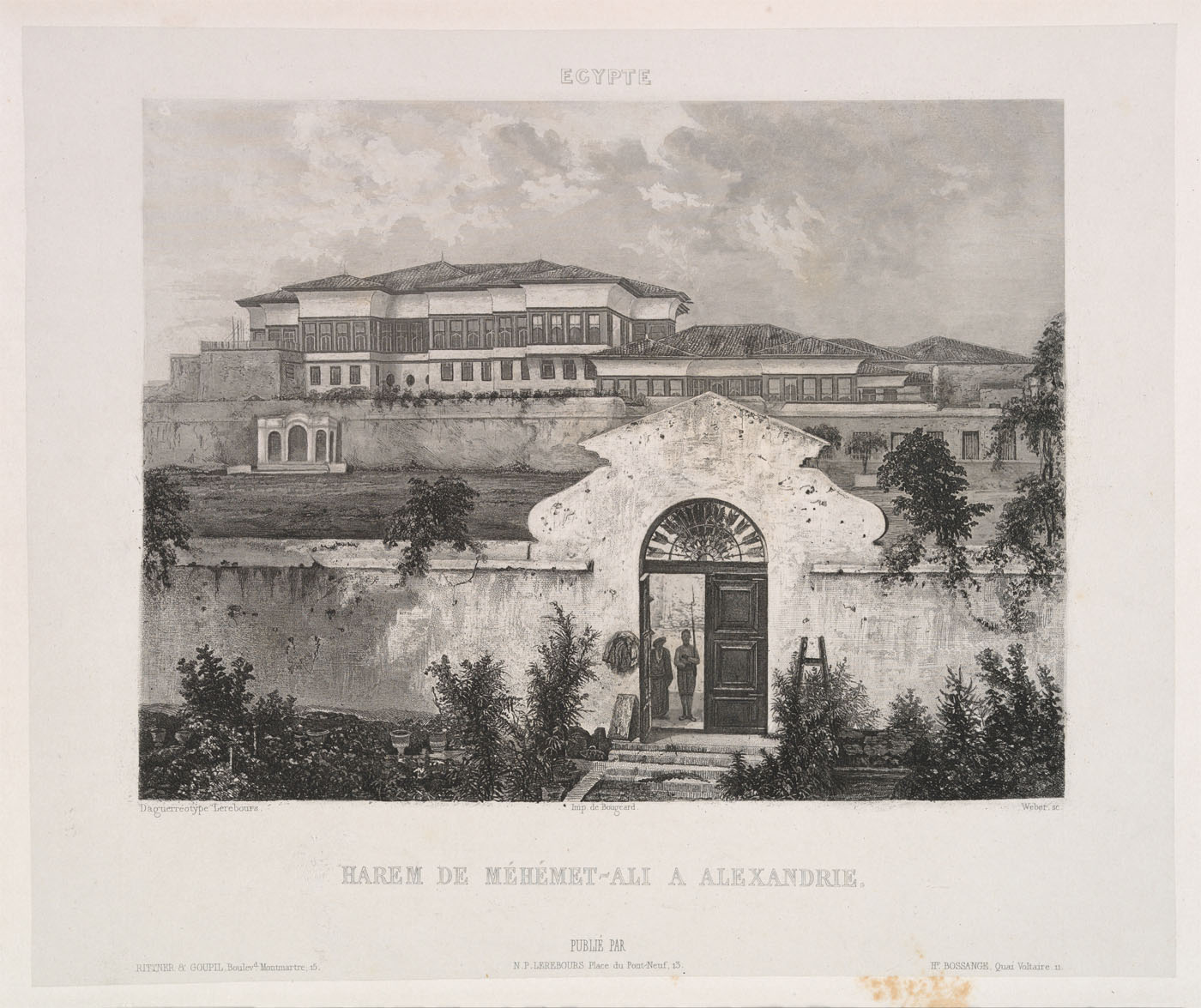
 

Noël Marie Paymal Lerebours (French, 1807-1873) 'Plate 6: Egypte: Harem de Méhémet-Ali a Alexandre' c. 1840


Noël Marie Paymal Lerebours (French, 1807-1873)
Plate 6: Egypte: Harem de Méhémet-Ali a Alexandre
c. 1840
From Excursions daguerriennes, vues et monuments les plus remarquables du Globe (Paris: Rittner & Goupil, 1840-1842)
Engraving after daguerreotype
10 13/16 × 15 1/2 × 2 3/16 in. (27.5 × 39.3 × 5.5cm) (Book)
Public domain


This print played an important role in popularising the notion of the artist-daguerreotypist as trustworthy eyewitness. In March 1840, while Goupil-Fesquet and his teacher, Horace Vernet, were on a daguerreotype tour of Egypt and the Levant, a fake story circulated in the Parisian press claiming that Vernet had gained access to Muhammad ‘Ali’s harem. With this print and the accompanying text, Goupil-Fesquet aimed to prove, as “both ocular witness and daguerreotype operator,” that they had seen only the guarded entrance.

Text from the Metropolitan Museum of Art website


Noël Marie Paymal Lerebours (French, 1807-1873) 'Plate 4, England, St Pauls and London' c. 1840


Noël Marie Paymal Lerebours (French, 1807-1873)
Plate 4, England, St Pauls and London
c. 1840
From Excursions daguerriennes, vues et monuments les plus remarquables du Globe (Paris: Rittner & Goupil, 1840-1842)
Engraving after daguerreotype
10 13/16 × 15 1/2 × 2 3/16 in. (27.5 × 39.3 × 5.5cm) (Book)

Courtesy of a Private Collection


L.L. Boscawen Ibbetson (English, 1799-1869) 'Fossils, engraved on a daguerreotype plate' 1840


L.L. Boscawen Ibbetson (English, 1799-1869)
Fossils, engraved on a daguerreotype plate
1840
From The Westminster Review September 1840, p. 460
Ink-on-paper lithograph by A. Friedel


Captain Levett Landon Boscawen Ibbetson (1799 – 8 September 1869) was an English 19th century geologist, inventor, organiser and soldier. He is particularly associated with early developments in photography. He was a member of the London Electrical Society and later a Fellow of the Royal Society (elected 6 June 1850). Capt. Ibbetson developed a method of taking lithographic impressions from daguerreotypes… His illustration of a fossil, “Transverse section of madrepore” in The Westminster Review of September 1840 is credited with being the first example of the use of limelight to shorten exposure times when making daguerreotypes.

Text from the Wikipedia website


Photography and publishing

Paper photographs had one distinct advantage over daguerreotypes: they could be printed in multiple copies and pasted into publications. A number of books and journals containing photographs were produced, seeking to demonstrate the efficacy of the new medium as a means of illustration. These publications met with mixed success, as the unreliable quality of their photographs could not compete with traditional engravings.

Anna Atkins and cyanotype

In a paper delivered to the Royal Society on 13 June 1842, John Herschel proposed a photographic process involving an iron salt that resulted in Prussian-blue images. He decided to call this ‘cyanotype’. Exploiting this invention, the English botanist Anna Atkins issued albums of cyanotype prints of seaweed and algae from 1843, and these are often regarded as the earliest photographic books.


Anna Atkins (British, 1799-1871) 'Sargassum bacciferum' 1843


Anna Atkins (British, 1799-1871)
Sargassum bacciferum
1843
From Photographs of British Algae: Cyanotype Impressions (1843-1853)
Cyanotype
25.3 x 20cm (9 15/16 x 7 7/8 in.)

This photograph: The Metropolitan Museum of Art, Gilman Collection, Purchase, The Horace W. Goldsmith Foundation Gift, through Joyce and Robert Menschel, 2005.
Public domain

The photograph in the exhibition: Oriel College, University of Oxford


The first book to be photographically printed and illustrated, Photographs of British Algae was published in fascicles beginning in 1843 and is a landmark in the history of photography. Using specimens she collected herself or received from other amateur scientists, Atkins made the plates by placing wet algae directly on light-sensitised paper and exposing the paper to sunlight. In the 1840s, the study of algae was just beginning to be systematised in Britain, and Atkins based her nomenclature on William Harvey’s unillustrated Manual of British Algae (1841), labelling each plate in her own hand.

Although artistic expression was not her primary goal, Atkins was sensitive to the visual appeal of these “flowers of the sea” and arranged her specimens on the page in imaginative and elegant compositions. Uniting rational science with art, Photographs of British Algae is an ambitious and effective book composed entirely of cyanotypes, a process invented in 1842 by Sir John Herschel and long used by architects to duplicate their line drawings as blueprints.

Anonymous. “Photographs of British Algae: Cyanotype Impressions,” on the Metropolitan Museum of Art website Nd [Online] Cited 22/02/2023


Success and failure

In 1846, the editor of the journal The Art-Union asked William Henry Fox Talbot to supply approximately 7000 salt prints to accompany a story about the calotype process. These prints were made at the Reading Establishment, a printing business run by Talbot’s former Dutch valet Nicolaas Henneman. Unfortunately for Talbot and Henneman, the Art-Union project proved to be a promotional and financial disaster, with most of the photographs, made in a rush, fading soon after publication.


William Henry Fox Talbot (English, 1800-1877) 'View of one of the towers of Orleans Cathedral' Taken on 21 June 1843


William Henry Fox Talbot (English, 1800-1877)
View of one of the towers of Orleans Cathedral
Taken on 21 June 1843
Published in The Art‑Union: Monthly Journal of the Fine Arts and the Arts, Decorative, Ornamental (June 1846)
Salted paper photograph from calotype negatives
16.3 x 20.2cm (6 7/16 x 7 15/16 in.)

This photograph: The Metropolitan Museum of Art, Purchase, Barbara Schwartz Gift, in memory of Eugene M. Schwartz, and Rogers Fund, 1996. Public domain

The photograph in the exhibition: Private Collection


In 1840 Talbot devised a negative/positive process that allowed multiple prints of a single image – the procedural basis of nearly all photography since. Talbot’s negatives were made of thin writing paper; the fibrous texture obscured some detail, but it imparted softness and a graded tonality to the resulting print. This photograph, showing the upper levels of one tower of Orléans Cathedral, was made on June 7, 1843, when Talbot was en route to Paris to sell the French rights to his patented process. Because he was unsuccessful in this enterprise, the French did not make paper photographs for another decade.

Anonymous. “Cathedral at Orléans,” on the Metropolitan Museum of Art website Nd [Online] Cited 22/02/2023


Nicolaas Henneman (Netherlands/England, 1813-1898) 'The West Façade of Westminster Abbey' Taken before May 1845


Nicolaas Henneman (Netherlands/England, 1813-1898)
The West Façade of Westminster Abbey
Taken before May 1845
Published in The Art-Union: Monthly Journal of the Fine Arts and the Arts, Decorative, Ornamental (June 1846)
Salted paper photograph from calotype negatives
The Metropolitan Museum of Art
Gift of Jean Horblit, in memory of Harrison D. Horblit, 1994


Talbot’s negative-positive photographic process, first made public in 1839, would change the dissemination of knowledge as had no other invention since movable type. To demonstrate the paper photograph’s potential for widespread distribution – its chief advantage over the contemporaneous French daguerreotype – Talbot produced The Pencil of Nature, the first commercially published book illustrated with photographs. With extraordinary prescience, Talbot’s images and brief texts proposed a wide array of applications for the medium, including portraiture, reproduction of paintings, sculptures, and manuscripts, travel views, visual inventories, scientific records, and essays in art.

Despite the revolutionary nature of Talbot’s undertaking, or perhaps because of it, The Pencil of Nature was not a commercial success. Today fewer than forty substantially complete copies – many quite faded – are extant. The present example, containing all twenty-four plates and still in its rare original fascicle covers, was formerly in the collection of Talbot’s daughter Matilda.

Anonymous. “Westminster Abbey,” on the Metropolitan Museum of Art website Nd [Online] Cited 22/02/2023


Nicolaas Henneman (Netherlands / England, 1813-1898)

Born in the Netherlands village of Heemskerk on December 8, 1813, virtually nothing is known about the life of Nicolaas Henneman, until he was hired as a member of inventor William Henry Fox Talbot’s domestic staff shortly after relocating to England in 1838. He quickly progressed to his master’s valet, and finally his most trusted darkroom assistant. Mr. Henneman was an eager student, and was soon collaborating with Mr. Talbot on a wide range of photographic experiments. He became an expert in the intricate calotype process that required both advanced chemistry knowledge and technical precision, but most of all patience. …

In 1843, Mr. Henneman accompanied his boss to France, where his photographs were subsequently featured in Mr. Talbot’s The Pencil of Nature publication. Buoyed by the critical acceptance, he took the bold move of leaving his employment with Mr. Talbot to open his own full-service calotype business, believed to be the first of its kind. Within the modest grounds of a former schoolyard, Mr. Henneman constructed a glass house to serve as his studio, and he received some modest commissions to illustrate various historical texts, including Mr. Talbot’s Sun Pictures in Scotland and Sir William Stirling’s Annals of the Artists of Spain. In 1848, chemist Thomas Malone became a junior partner, necessitating a name change to Henneman & Malone. With the appointment as “Photographer in Ordinary to Her Majesty,” his conversion to wet-collodion processing, and his successful experiments to reduce exposure times, Mr. Henneman seemed assured of financial prosperity. However, his target market was too small, and his business closed with little notice.

Although Nicolaas Henneman was of the industry’s earliest architects, by the mid-1850s, the London photographic community was becoming exceedingly overcrowded. The soft-spoken Dutchman found himself being pushed out by a younger generation. After Mr. Henneman’s business went bankrupt, his steadfast champion Mr. Talbot quietly paid off his creditors. He moved to Birmingham, where he became an operator for master photographers Napoleon Sarony and Robert White Thrupp, among others. This proved to be both commercially unsuccessful and creatively unsatisfying. Ever the survivor, Mr. Henneman bought and operated a lodging house at 18 Half Moon Street in London during the 1870s. He died on January 18, 1898 at the age of 84, with his photographic contributions virtually forgotten. Fortunately, however, many of Nicolaas Henneman’s photographs have been preserved and can be seen in the collections of Lacock Abbey, Bradford’s National Media Museum, and in Amsterdam’s Rijksmuseum.

Anonymous. “Nicolaas Henneman,” on the Historic Camera website 3rd May 2020 [Online] Cited 22/02/2023


William Henry Fox Talbot (English, 1800-1877) 'Palace of Justice, Rouen' Taken in May 1843


William Henry Fox Talbot (English, 1800-1877)
Palace of Justice, Rouen
Taken in May 1843
Published in The Art-Union: Monthly Journal of the Fine Arts and the Arts, Decorative, Ornamental (June 1846)
Salted paper photograph from calotype negatives


Talbot may not have intended his brief diversion to Rouen to be as significant as it has become, but during those four days of miserable weather, the creative baton was handed from art to photography – from Turner to Talbot. During a brief “éclairci” from bad weather, Henry took his camera half a mile from the hotel and into another era of history. Le Palais de Justice was one of the secular buildings of medieval Rouen, completed in 1508, occupying three fifths of an acre in a three sided quadrangle. It was described as an elaborately florid style “sumptuous in its decorations both without and within; its triple canopy windows enriched with mullions and tracery.”

Talbot concentrated on the ornate detail of these windows, isolating the intricate elements sculpted by skilled stonemasons over three centuries earlier. Now housing the Rouen criminal courts, Le Palais de Justice represented Henry’s liberation from rain-soaked captivity. The image above stands in magnificent contrast to his study of the lace curtained view from within the Hotel l’Angleterre. This time he was outside looking in.

Rose Teanby. “Talbot’s Rouen, a tale of two cities,” on the the Talbot Catalogue Raisonné blog 9th March 2018 [Online] Cited 21/02/2023


“The most transitory of things, a shadow, the proverbial emblem of all that is fleeting and momentary, may be fettered by the spells of our natural magic, and may be fixed for ever in the position which it seems only destined for a single instant to occupy.”


William Henry Fox Talbot, writing in January 1839


Most extraordinary

A first-hand account of a demonstration of the daguerreotype process was given by two naval architects from India in a book they published in 1841: ‘And we also saw [at the Adelaide gallery in London] the Daguerreotype which is the most extraordinary production of modern times. We know not how better to describe it than to say, that it is embodying a shadow … In a room fitted up as a Theatre, with shutters by which the light can be totally excluded, M. Dele Croix, a French gentleman, explains all the process’.

 
“The appearance of these drawings is very peculiar. The shadows are a dull grey, varying until they become almost blacky and though the pictures they delineate are accurate in the extreme, they are not pleasing. They appear unnatural and look somewhat like a moonlight scene. The Daguerreotype, with all its necessary apparatus, is manufactured and sold in Paris, for about £20. In Bombay, where the sun is always powerful, pictures of scenery could daily be produced.”

~ Jehangeer Nowrojee and Hirjeebhoy Merwanjee, Journal of residence of two years and a half in Great Britain, London, 1841


Views of London

The earliest photographs of London were taken by visiting Frenchmen. Soon, however, demonstrations of the new process were being offered to audiences at the Polytechnic Institution and Adelaide Gallery in London. In early 1842, Antoine Claudet was commissioned by the newly established Illustrated London News to make a series of daguerreotype views of London. A wood-engraved panorama of the city was then derived from them. This panorama, ‘a picture bigger than anything previously issued’, was promised in the News‘s inaugural issue of 14 May 1842 as a gift to all who subscribed to the journal for six months.


M. de St Croix (French) 'Parliament Street from Trafalgar Square' 1839


M. de St Croix (French)
Parliament Street from Trafalgar Square
1839
Daguerreotype in wood frame
Victoria & Albert Museum, London


This is the oldest photograph in the Museum’s collection. It is a daguerreotype, a unique image formed on a silvered copper plate. The daguerreotype was the first photographic process, publicised in January 1839. It was named after its inventor, Louis Daguerre. Just a few weeks after the French Government revealed the secrets of daguerreotypy in Paris in August 1839, Monsieur de St Croix organised the first public demonstration of the process in London. This is therefore among the very first photographs taken in London. The scene is reversed – as is characteristic of the process – and the image on the shiny surface is difficult to read. However, once caught at the correct angle, amazing detail emerges. In the foreground there is a statue of Charles I and in the distance the royal Banqueting House. There are also traces of the people who stayed still long enough to register on the exposure, which probably lasted some minutes.

Anonymous. “Parliament Street from Trafalgar Square,” on the V&A website Nd [Online] Cited 22/02/2023


Ebenezer Landells (engraver) et al 'London in 1842, Taken from the Summit of the Duke of York's Column (north view)'


Ebenezer Landells (engraver) et al
‘London in 1842, Taken from the Summit of the Duke of York’s Column (north view)’
From the Illustrated London News (7 January 1843)
Hand-coloured panoramic print, from wood engravings after daguerreotypes by Antoine Claudet taken in 1842


A view of London looking northwards from the summit of the Duke of York’s statue, with Carlton Gardens in the foreground, beyond is Waterloo Place, lower Regent Street and Piccadilly circus.


London labour, London poor

Numerous engraved portraits of members of the working class are featured in Henry Mayhew’s London Labour and the London Poor, first published in 1851. Mayhew’s text provided a richly ethnological and often racialised commentary on London’s street workers, based on interviews and social analysis, given added force by the addition of wood engravings based on daguerreotypes.


'Portrait of Henry Mayhew' (From a Daguerreotype by BEARD)


Portrait of Henry Mayhew (From a Daguerreotype by BEARD)


“My earnest hope is that the book may serve to give the rich a more intimate knowledge of the sufferings, and the frequent heroism under those sufferings, of the poor.”


'The London Coffee-Stall' (From a Daguerreotype by BEARD)


The London Coffee-Stall (From a Daguerreotype by BEARD)


“The struggle to get a living is so great, that, what with one and another in the coffee-trade, it’s only those as can get good ‘pitches’ that can get a crust at it.”
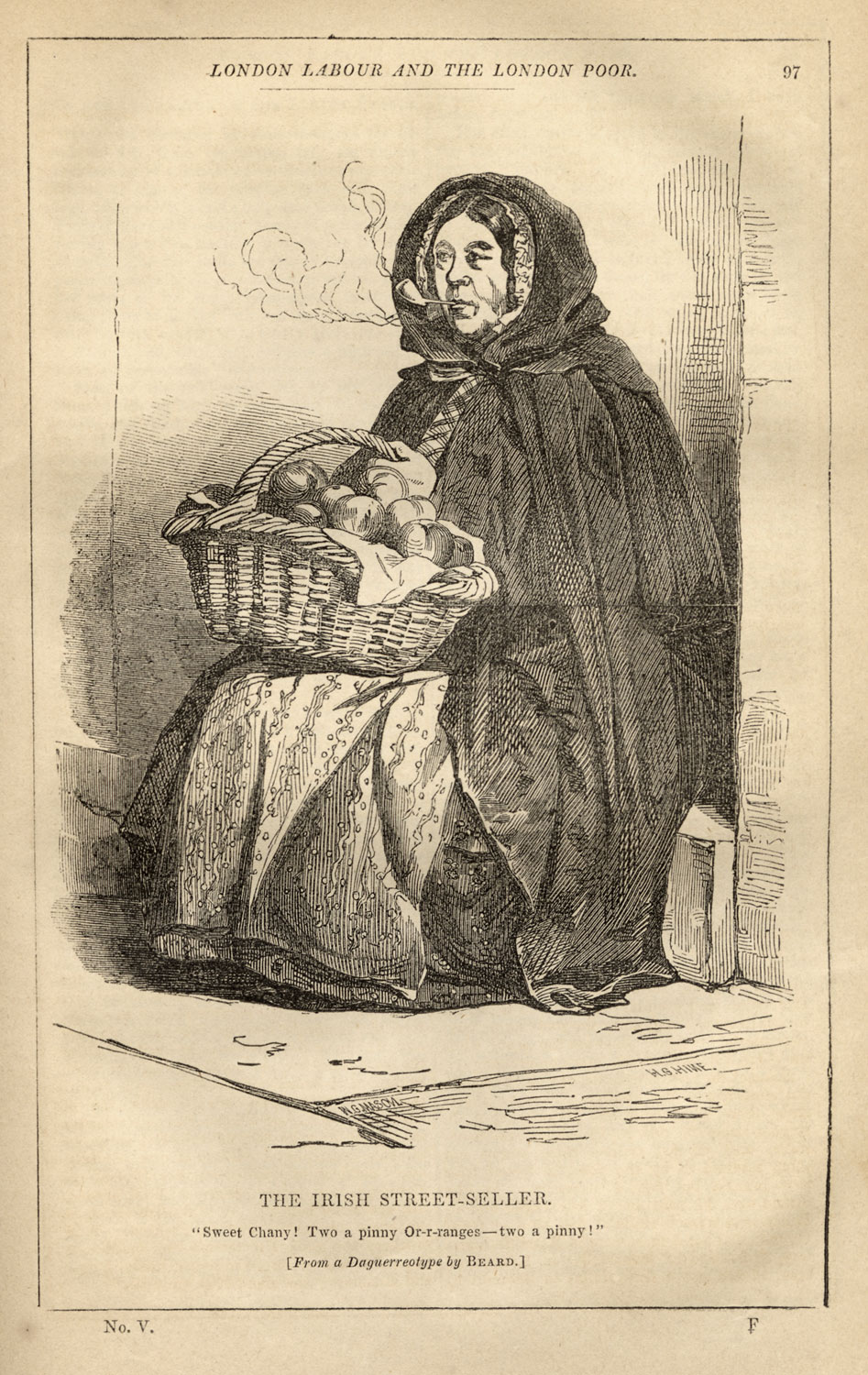
 

'The Irish Street-Seller' (From a Daguerreotype by BEARD)


The Irish Street-Seller (From a Daguerreotype by BEARD)
From Henry Mayhew’s ‘London labour and the London poor: a cyclopedia of the condition and earnings of those that will work, cannot work, and will not work’, Volume 1 page 97, 1851.
Bodleian Libraries, University of Oxford


“I wish people that thinks we’re idle now were with me for a day. I’d teach them.”
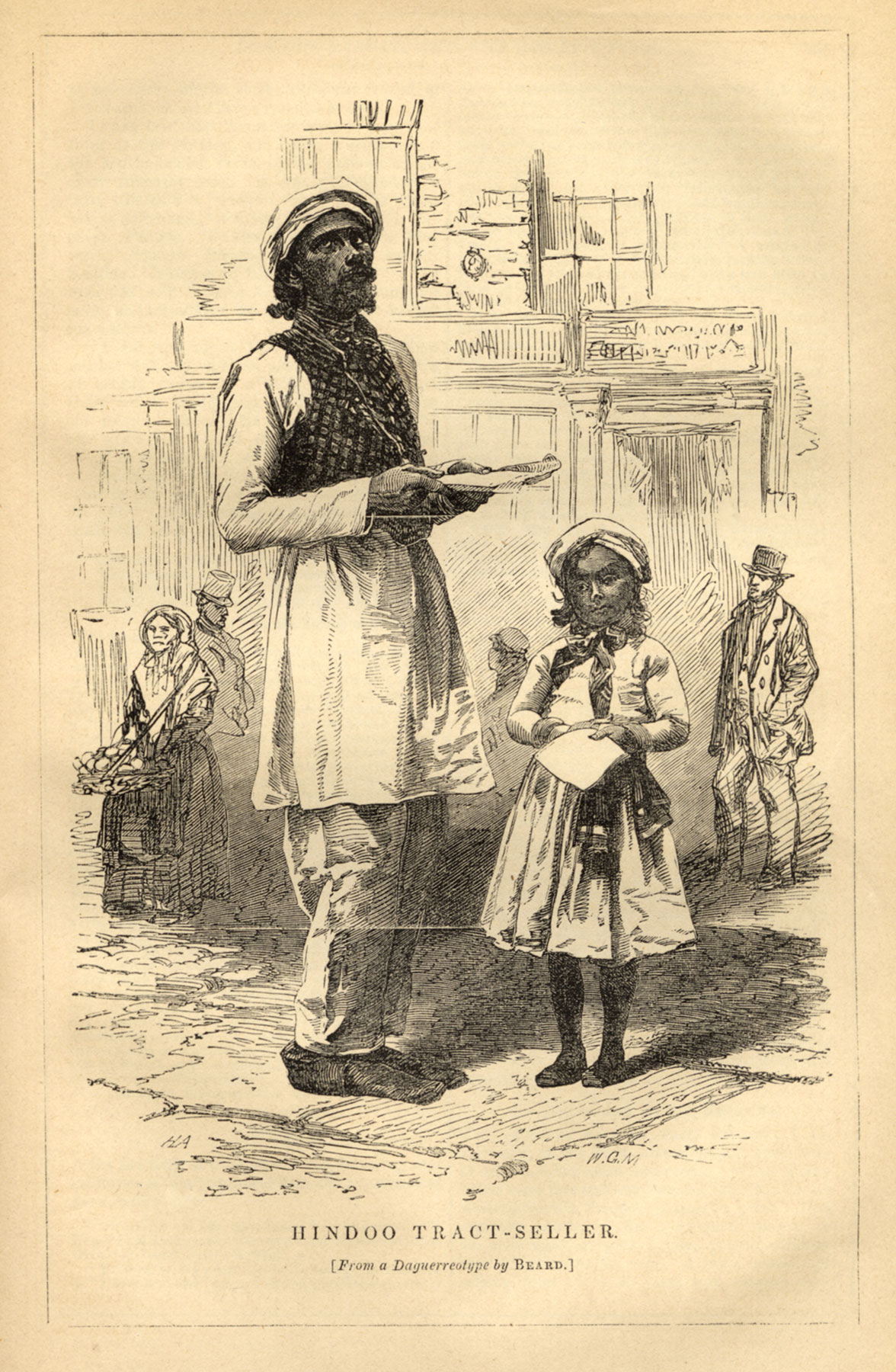
 

'Hindoo Tract-Seller' (From a Daguerreotype by BEARD)


Hindoo Tract-Seller (From a Daguerreotype by BEARD)


“The man whose portrait supplies the daguerreotyped illustration of this number is unable to speak a word of English, and the absence of an interpreter, through some accident, prevented his statement being taken at the time appointed.”
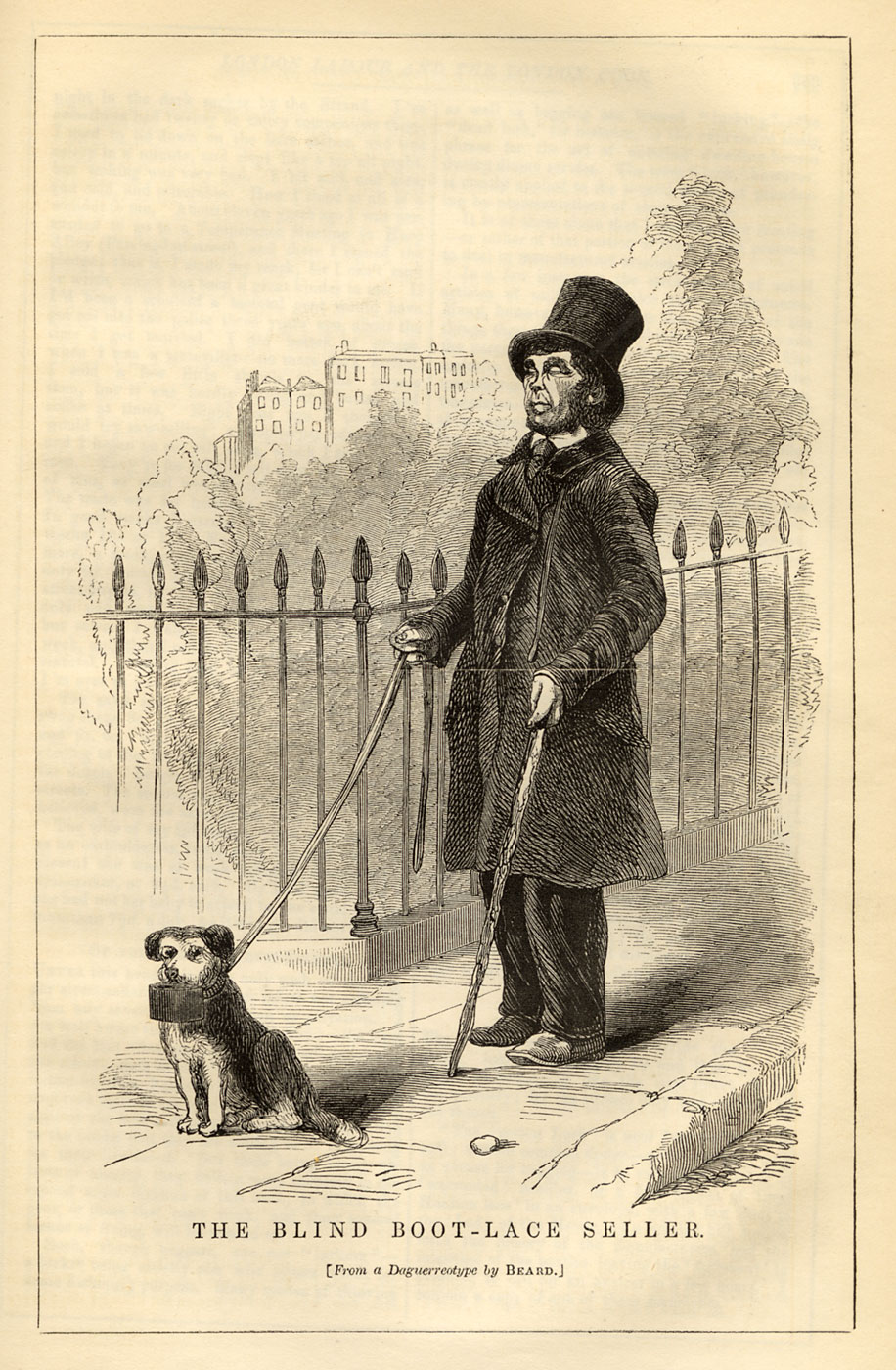
 

'The Blind Boot-Lace Seller' (From a Daguerreotype by BEARD)


The Blind Boot-Lace Seller (From a Daguerreotype by BEARD)


“I only wish vaccination had been in vogue then as it is now, and I shouldn’t have lost my eyes. God bless the man who brought it up, I say; people doesn’t know what they’ve got to thank him for.”


All from

Henry Mayhew (English, 1812-1887)
London labour and the London poor; a cyclopedia of the condition and earnings of those that will work, those that cannot work, and those that will not work: The London street-folk; comprising, street sellers. Street buyers. Street finders. Street performers. Street artizans. Street labourers. With numerous illustrations from photographs
London, 1851

‘London Labour and the London Poor’ is an oral account of London’s working classes in the mid-19th century. Taking the form of verbatim interviews that carefully preserve the grammar and pronunciation of every interviewee, the completed four-volume work amounts to some two million words: an exhaustive anecdotal report on almost every aspect of working life in London.

Henry Mayhew (25 November 1812 – 25 July 1887) was an English journalist, playwright, and advocate of reform. He was one of the co-founders of the satirical magazine Punch in 1841, and was the magazine’s joint editor, with Mark Lemon, in its early days. He is also known for his work as a social researcher, publishing an extensive series of newspaper articles in the Morning Chronicle that was later compiled into the book series London Labour and the London Poor (1851), a groundbreaking and influential survey of the city’s poor.
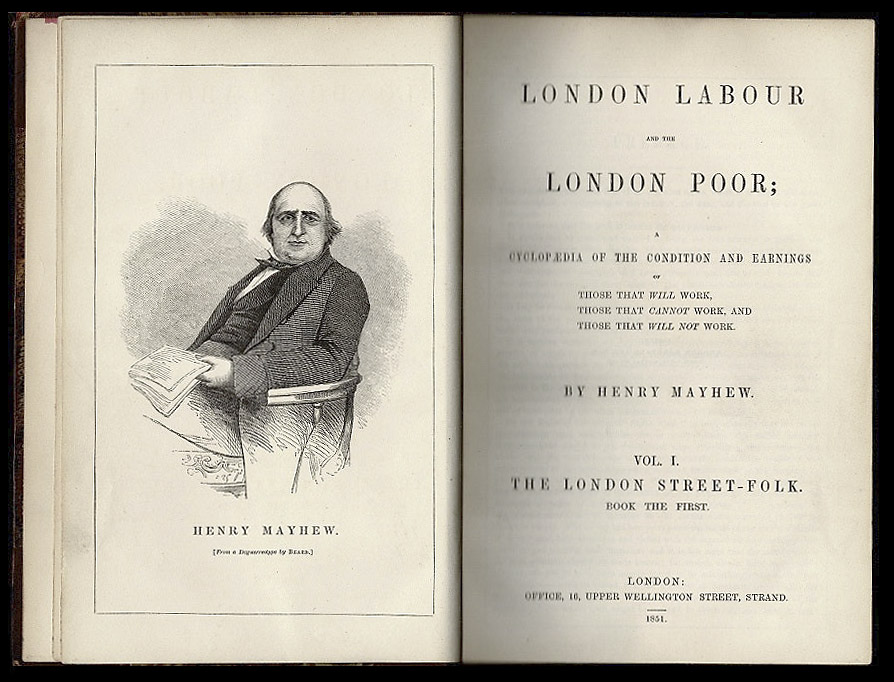
 

Henry Mayhew (English, 1812-1887) 'London labour and the London poor; a cyclopedia of the condition and earnings of those that will work, those that cannot work, and those that will not work: The London street-folk; comprising, street sellers. Street buyers. Street finders. Street performers. Street artizans. Street labourers. With numerous illustrations from photographs' London, 1851


Henry Mayhew (English, 1812-1887)
London labour and the London poor; a cyclopedia of the condition and earnings of those that will work, those that cannot work, and those that will not work: The London street-folk; comprising, street sellers. Street buyers. Street finders. Street performers. Street artizans. Street labourers. With numerous illustrations from photographs
London, 1851


Priests and politicians

All sorts of celebrities were celebrated in engravings based on daguerreotypes, from priests to politicians. One example is Lájos Kossuth, former regent-president of the Kingdom of Hungary, who arrived as an exile at the port of Southampton on 23 October 1851. Over the next three weeks he toured Britain, giving lectures in support of the struggle to free Hungary from the Hapsburg Empire. During this period, he and his family visited Antoine Claudet’s studio in London to have a number of daguerreotype portraits made. Versions of these images were subsequently distributed around the world in the form of lithographs or engravings.


Alonzo Chappel (American, 1828-1887)(engraver) 'Thomas Chalmers: Likeness from a daguerreotype by Claudets [sic]' 1873


Alonzo Chappel (American, 1828-1887)(engraver)
Thomas Chalmers: Likeness from a daguerreotype by Claudets [sic]
1873
Steel engraving of a Scottish clergyman after a daguerreotype by Antoine Claudet studio in c. 1847
Public domain


Alonzo Chappel (March 1, 1828 – December 4, 1887) was an American-Spanish painter, best known for paintings depicting personalities and events from the American Revolution and early 19th-century American history.

Thomas Chalmers FRSE (17 March 1780 – 31 May 1847), was a Scottish minister, professor of theology, political economist, and a leader of both the Church of Scotland and of the Free Church of Scotland. He has been called “Scotland’s greatest nineteenth-century churchman.”


Notable commissions

A particularly notable commission for the Beard studio involved making daguerreotype portraits in May 1845 on the deck of the H.M.S. Erebus. The subjects were fourteen of the officers about to set out under the command of Sir John Franklin in search of the Northwest Passage above Canada. These pictures became particularly famous when the entire expedition disappeared, never to be heard from again. After a public campaign by Lady Franklin in the illustrated press, many other ships were sent over during the ensuing years to try and find the expedition.


Installation view of Studio of Richard Beard daguerreotypes of 'Sir John Franklin' (May 1845) and 'Lieutenant Graham Gore, Commander' (May 1845)


Installation view of Studio of Richard Beard daguerreotypes of Sir John Franklin (May 1845, below) and Lieutenant Graham Gore, Commander (May 1845, below)


Studio of Richard Beard (English, 1801-1885) 'Sir John Franklin' May 1845


Studio of Richard Beard (English, 1801-1885)
Sir John Franklin
May 1845
Daguerreotype in leather case
The Scott Polar Institute, University of Cambridge
Public domain


Sir John Franklin, 16 May 1845, suffering from influenza before leaving for the Arctic. He is wearing the 1843-1846 pattern Royal Navy undress tailcoat with cocked hat.

Lady Franklin commissioned daguerreotype photographs of the twelve senior officers of HMS Erebus and Captain Crozier of HMS Terror. They were taken on board the Erebus at the dockside in Greenhithe on 16 May 1845, just before the ships sailed. Franklin was fascinated by this new technology and included photographic apparatus as part of the expedition’s equipment.

Sir John Franklin KCH FRS FLS FRGS (16 April 1786 – 11 June 1847) was a British Royal Navy officer and Arctic explorer. After serving in wars against Napoleonic France and the United States, he led two expeditions into the Canadian Arctic and through the islands of the Arctic Archipelago, in 1819 and 1825, and served as Lieutenant-Governor of Van Diemen’s Land from 1839 to 1843. During his third and final expedition, an attempt to traverse the Northwest Passage in 1845, Franklin’s ships became icebound off King William Island in what is now Nunavut, where he died in June 1847. The icebound ships were abandoned ten months later and the entire crew died, from causes such as starvation, hypothermia, and scurvy.

Richard Beard (22 December 1801 – 7 June 1885) was an English entrepreneur and photographer who vigorously protected his photographic business by litigation over his photographic patents and helped to establish professional photography in the UK.
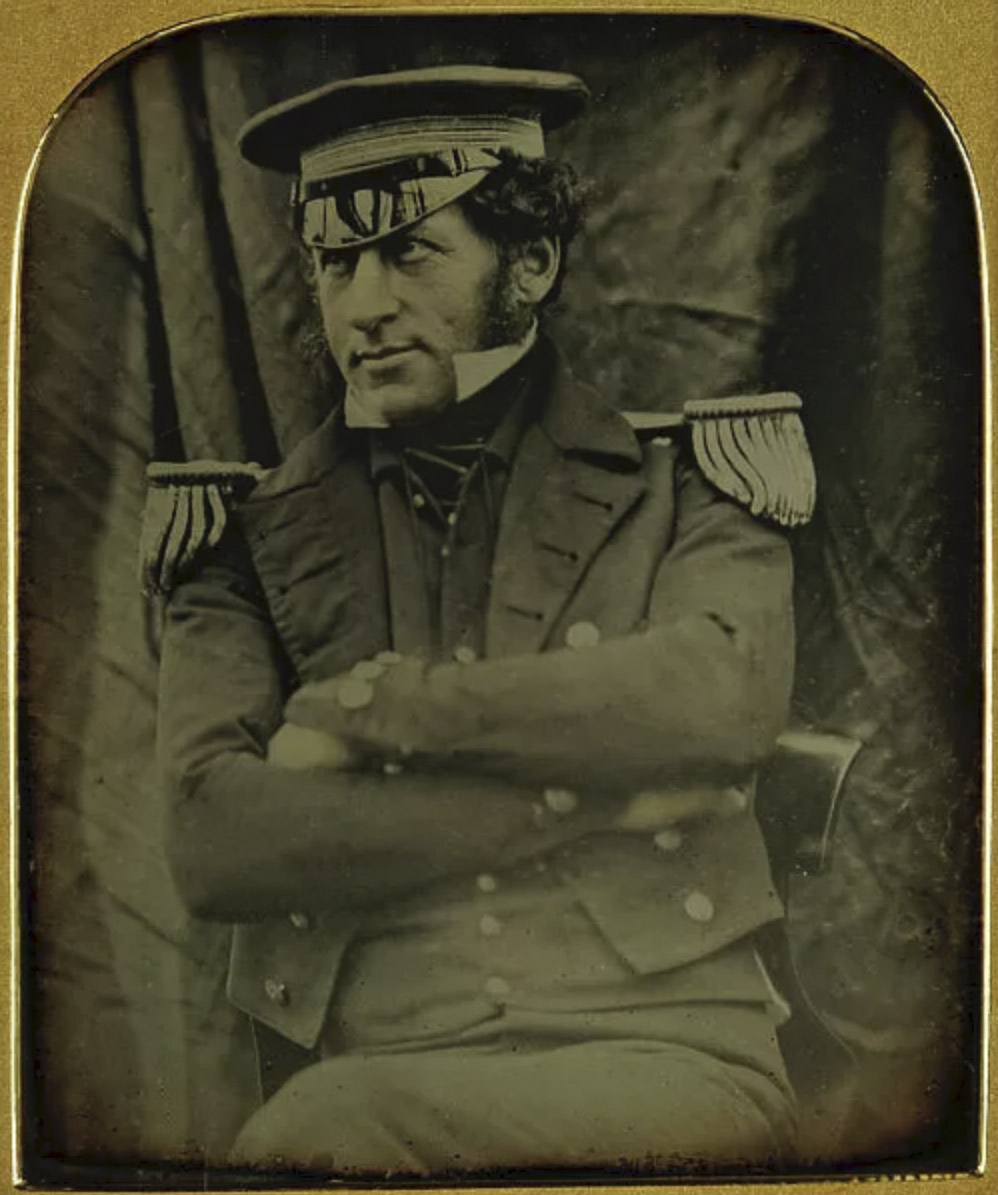
 

Studio of Richard Beard (English, 1801-1885) 'Lieutenant Graham Gore, Commander' May 1845


Studio of Richard Beard (English, 1801-1885)
Lieutenant Graham Gore, Commander
May 1845
Daguerreotype in leather case
The Scott Polar Institute, University of Cambridge
Public domain
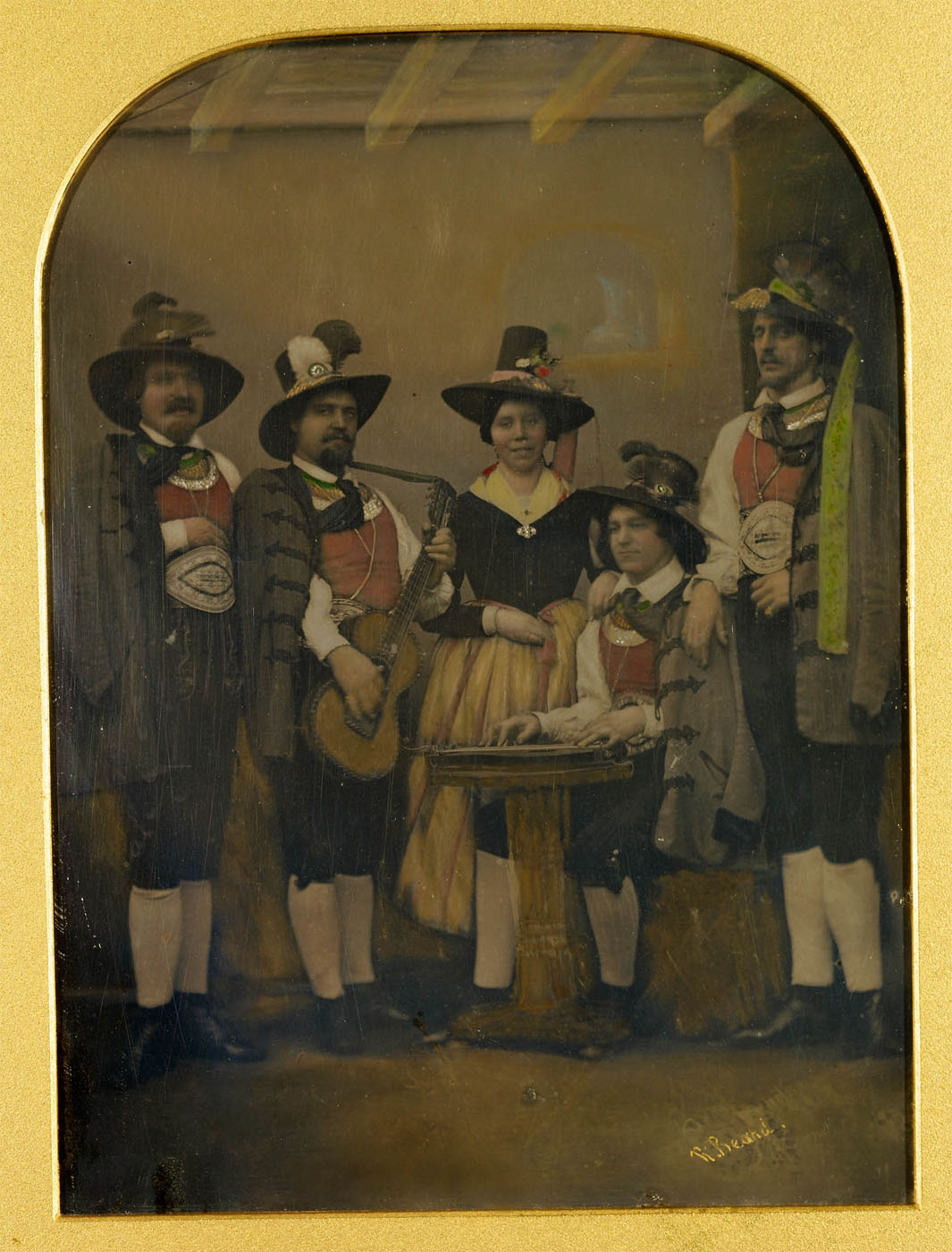
 

Studio of Richard Beard Jr. (London) 'Tyrolese Singers' 1851-1852


Studio of Richard Beard Jr. (London)
Tyrolese Singers
1851-1852
Hand-coloured enamelled daguerreotype
14.1 x 10.3cm
Royal Collection Trust
Acquired by Queen Victoria and Prince Albert in 1852
© His Majesty King Charles III 2022


This daguerreotype, produced and enamelled by the studio of Richard Beard, was purchased by Queen Victoria in 18522, the same year in which her mother, the Duchess of Kent, arranged for the Tyrolese minstrels to surprise the Queen with a serenade at breakfast for her birthday at Osborne. About the event, the Duchess wrote: “Victoria appeared very much pleased with the surprise.”


Hand-coloured enamelled daguerreotype of a group of Tyrolese singers called Klier, Rainer, Margreiter, Rahm and Holaus. Rahm is seated facing partly left playing a dulcimer and Rainer holds a guitar. All are wearing traditional Tyrolese costume, coloured with both dark and pastel tones. The daguerreotype is mounted in a large dark blue leather case with a red velvet interior. Queen Victoria had first seen this troupe of Tyrolese singers at Kensington Palace in 1833. Her mother, the Duchess of Kent, later arranged for the singers to perform at Osborne on her birthday in 1852. The Duchess recorded in her diary that ‘dearest Victoria appeared very much pleased with the surprise’. Later the same year Queen Victoria acquired this daguerreotype. Beard had shown examples of his enamelled daguerreotypes at the Great Exhibition in 1851. The process involved varnishing the daguerreotype and then heating and adding another coat of varnish after the colour pigments had been added.

Text from the Royal Collection Trust website


Tyrolese minstrels

This daguerreotype shows Tyrolese minstrels in carefully tinted folkloric costumes and holding musical instruments. A variant view was the basis of a wood engraving published in the Illustrated London News in 1851 (below). For Queen Victoria’s birthday at Osborne in 1852, her mother, the Duchess of Kent, arranged for the singers to serenade her at breakfast. ‘Victoria appeared very much pleased with the surprise’, the Duchess wrote. This daguerreotype, enamelled according to Beard’s patented formula, was purchased by the Queen in the same year.
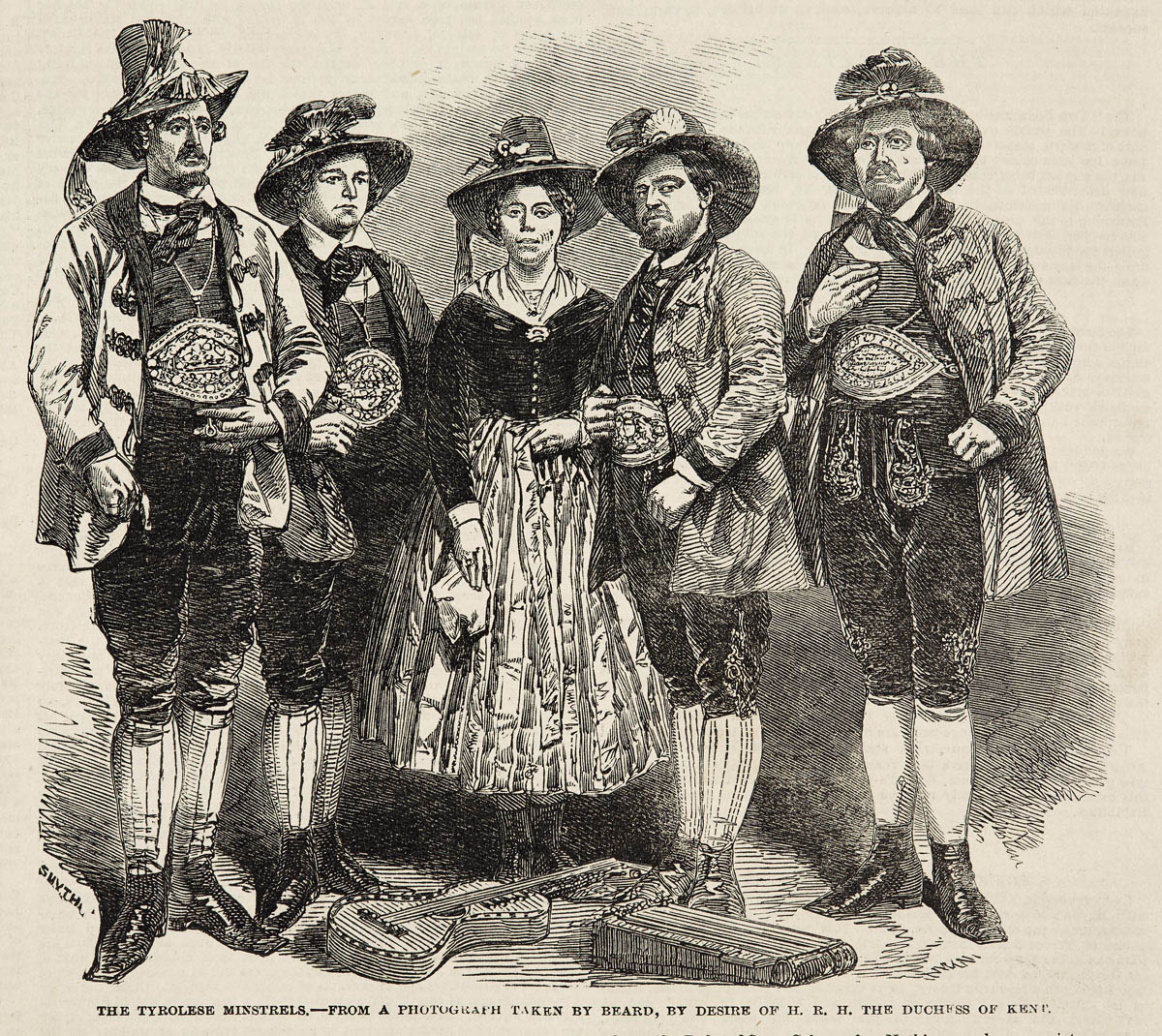
 

Smyth (engraver) 'The Tyrolese Minstrels – from a photograph taken by Beard, by desire of H.R.H. The Duchess of Kent'


Smyth (engraver)
‘The Tyrolese Minstrels – from a photograph taken by Beard, by desire of H.R.H. The Duchess of Kent’
From the Illustrated London News (6 December 1851)
Wood engraving after a daguerreotype by Richard Beard Jr.
Private Collection


Fascinating people

The popular press, and especially the Illustrated London News, soon included wood engraved copies of photographic portraits of celebrities and indigenous people from the colonies of the British Empire. Equally exotic to middle-class viewers, however, were photographic illustrations of members of the British working class. In every case, the daguerreotype was destroyed during the tracing process that led to its wood-engraved copy, leaving these reproductions behind as a kind of shadow history of the medium. In this form, photographic images circulated all around the globe.


Photographer unknown (English) 'Seated man holding a copy of the 'Illustrated London News'' c. 1850


Photographer unknown (English)
Seated man holding a copy of the Illustrated London News
c. 1850
Hand-painted daguerreotype in leather case
Private Collection


Engraver unknown (England) 'The Walpole Islanders at the Panopticon. – From a photograph by Claudet' 1856


Engraver unknown (England)
‘The Walpole Islanders at the Panopticon. – From a photograph by Claudet’
1856
From the Illustrated London News (12 July 1856), page 41
Courtesy of a Private Collection


Modern art and swansdown

These ‘lords and ladies’ dressed in historical costumes for a ball appeared as wood engravings after daguerreotypes taken by Richard Beard Jr. in the Illustrated London News in July 1848. A review in the Nottingham Mercury on 6 October 1848 commended the photographer for the quality of his work, calling it ‘modern art combined with science’.

“Swansdown on black is produced in the most exquisite style, and the finest white lace brought out in bold relief on a dress of white satin.”

~ Nottingham Mercury (6 October 1848)


Smyth (engraver) 'The Spitalfields Ball. Costume Portraits, from daguerreotypes, by Beard'


Smyth (engraver)
‘The Spitalfields Ball. Costume Portraits, from daguerreotypes, by Beard’
From the Illustrated London News (15 July 1848, p. 24)
Wood engravings after daguerreotypes by Richard Beard Jr.
Bodleian Libraries, University of Oxford


Extraordinary Australians

The English-born photographer Douglas T. Kilburn (brother of Edward Kilburn) arrived in Melbourne, Australia, in 1847. Kilburn made a series of daguerreotypes of local indigenous people in about October of that same year. These daguerreotype images were then reproduced around the world in various media. They found their widest audience when a number of them were reproduced as wood engravings in an 1850 issue of the Illustrated London News, along with an accompanying text that expressed the usual racial prejudices of the time.


Unknown engravers (England) 'Australia Felix'


Unknown engravers (England)
‘Australia Felix’
From the Illustrated London News (26 January 1850, p. 53)
Wood engravings after daguerreotypes by Douglas Kilburn, Melbourne
Private Collection


Daguerrotype studios

The first commercial photography studio in England was opened by Richard Beard in the Royal Polytechnic Institution in London in March 1841. It made small daguerreotype portraits using an American invention, a camera that employed a concave mirror rather than a lens to focus the light. Soon, superior, lens-enhanced cameras and more light-sensitive plates allowed for larger and more lively portraits to be made by an ever-increasing number of professional studios.

One of the earliest clients of the Richard Beard studio in London was the 73-year-old Anglo-Irish writer Maria Edgeworth. She had several portraits taken, at a guinea each, during mid-morning on 25 May 1841. About five years later, she returned to the same studio and had a second portrait made.

Her letter to her half-sister Fanny Wilson describes her first portrait session.

“I fear you will not like any of my daguerreotype faces – I am sure I do not – the truer, the worse”

~ Maria Edgeworth, in a letter to Fanny Wilson, 28 May 1841


‘Lestock came with me to breakfast here at 8 o’clock and then he took Honora and Captain Beaufort and me to the Polytechnic and we all had our likenesses taken and I will tell you no more lest I should some way or other cause you disappointment. For my own part my object is secure for I have done my dear what you wished. It is a wonderful mysterious operation. You are taken from one room into another up stairs and down and you see various people whispering and hear them in neighbouring passages and rooms unseen and the whole apparatus and stool on high platform under a glass dome casting a snap-dragon blue light making all look like spectres and the men in black gliding about like &c. I have not time to tell you more of that’.

Maria Edgeworth, Letter to Fanny Wilson, 25 May 1841
MS. Eng. Lett. c. 710, fol. 1r
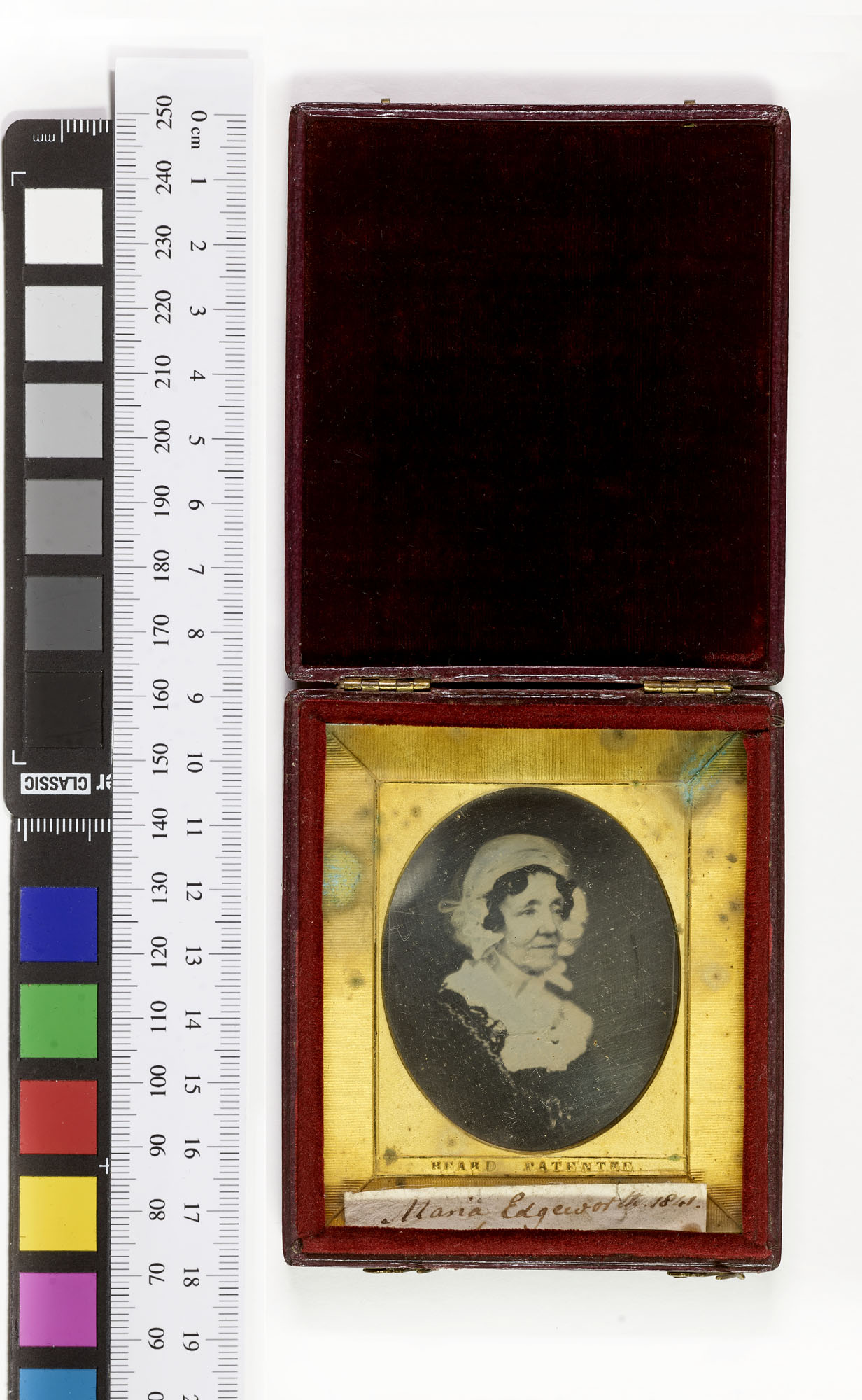
 

Studio of Richard Beard (English, 1801-1885) (Royal Polytechnic Institution, London) 'Portrait of Maria Edgeworth' May 1841


Studio of Richard Beard (English, 1801-1885) (Royal Polytechnic Institution, London)
Portrait of Maria Edgeworth
May 1841
Daguerreotype in vertical leather case
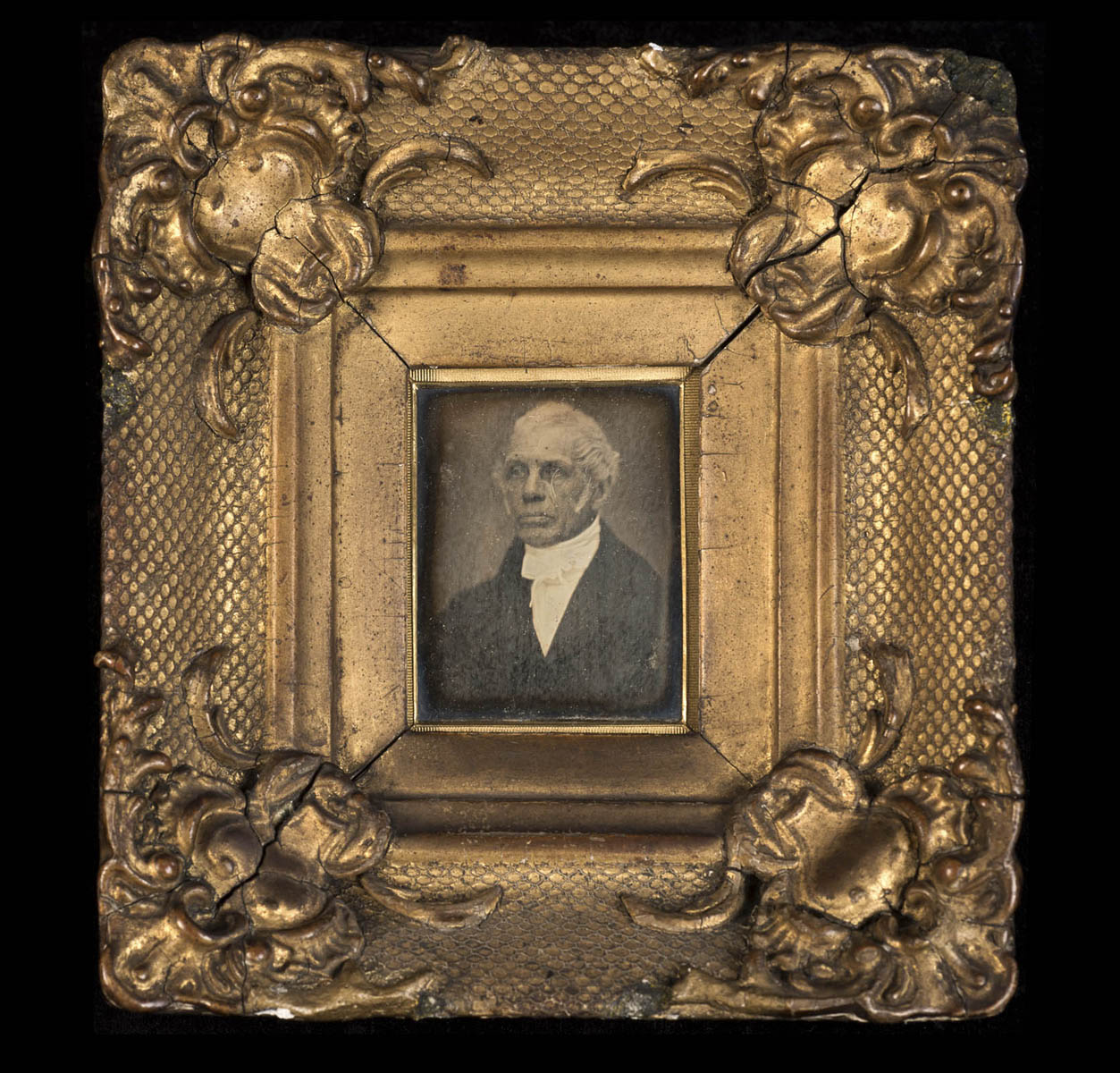
 

Studio of Richard Beard (English, 1801-1885) (Royal Polytechnic Institution, London) 'Portrait of an older man' c. 1841


Studio of Richard Beard (English, 1801-1885) (Royal Polytechnic Institution, London)
Portrait of an older man
c. 1841
Courtesy of a Private Collection


Forty a day

Using a number of different operators, the studio owned by Richard Beard claimed to make about 40 daguerreotype portraits per day. Soon he ran three such studios in London and had licensed a dozen more elsewhere in England. As the English patent holder for the daguerreotype process, Beard insisted that each of these daguerreotypes be stamped with the words ‘Beard Patentee’, wherever they were made. Having established photography as a franchise system, he became, in effect, the Colonel Sanders of early English photography.


Laman Blanchard ed. 'Photographic Phenomena' 'George Cruikshank's Omnibus' (London Tilt and Borgue, 1842) London, 1842


Laman Blanchard ed.
‘Photographic Phenomena’
George Cruikshank’s Omnibus (London Tilt and Borgue, 1842)
London, 1842
Wood engraving by George Cruikshank of the Beard Studio and a poem by S.L. Blanchard
Courtesy of a Private Collection


Fierce enemy

Disputing who had exclusive rights to the commercial use of the daguerreotype process, Richard Beard and Antoine Claudet took several legal actions against each other. In a letter to William Henry Fox Talbot dated 18 January 1843, Claudet refers to Beard as his ‘competitor and fierce enemy’. Having overturned an injunction prohibiting his use of the process, Claudet quickly became Beard’s greatest rival. Soon, however, other competitors also opened studios in London, with those run by Edward Kilburn and John Mayall among the most significant.


Studio of Antoine Claudet (French, 1797-1867) (Adelaide Gallery, London) 'Portrait of Michael Faraday' c. 1848


Studio of Antoine Claudet (French, 1797-1867) (Adelaide Gallery, London)
Portrait of Michael Faraday
c. 1848
Daguerreotype and leather case
History of Science Museum, University of Oxford


Claudet invented one of the improvements that made the Daguerreotype fast enough to take portraits; Faraday’s association with photography began in January 1839 when he announced Talbot’s discovery at the Royal Institution in London.

Michael Faraday FRS (22 September 1791 – 25 August 1867) was an English natural philosopher who contributed to the study of electromagnetism and electrochemistry. His main discoveries include the principles underlying electromagnetic induction, diamagnetism and electrolysis.


Antoine François Jean Claudet (French, 1797-1867)

Antoine François Jean Claudet (August 18, 1797 – December 27, 1867) was a French photographer and artist active in London who produced daguerreotypes. …

Early in his career Claudet headed a glass factory at Choisy-le-Roi, Paris, together with Georges Bontemps, and moved to England to promote the factory with a shop in High Holborn, London. Having acquired a share in L. J. M. Daguerre’s invention, he became one of England’s first commercial photographers using the daguerreotype process for portraiture, improving the sensitising process by using chlorine (instead of bromine) in addition to iodine, thus gaining greater rapidity of action.

He invented the red darkroom safelight, and it was he who suggested the idea of using a series of photographs to create the illusion of movement. The idea of using painted backdrops has also been attributed to him.

From 1841 to 1851 he operated a studio on the roof of the Adelaide Gallery (now the Nuffield Centre), behind St. Martin’s in the Fields church, London, where in 1843 he took one of only two surviving photographs of Ada Lovelace. He opened additional studios at the Colosseum, Regent’s Park (1847-1851) and in 1851 he moved his entire business to 107 Regent Street, where he established what he called a “Temple to Photography.”

It has been estimated that he made 1,800 pictures every year with subjects including Michael Faraday and Charles Babbage. His daguerreotype of Hemi Pomara, in the National Library of Australia, is the oldest known photograph of any Māori person.

In 1848 he produced the photographometer, an instrument designed to measure the intensity of photogenic rays; and in 1849 he brought out the focimeter, for securing a perfect focus in photographic portraiture.

He was elected a fellow of the Royal Society in 1853, and in 1858 he produced the stereomonoscope, in reply to a challenge from Sir David Brewster.

Claudet received many honours, among which was the appointment, in 1853, as “Photographer-in-ordinary” to Queen Victoria, and the award, ten years later, of an honor from Napoleon III of France.

Text from the Wikipedia website


Antoine Claudet (French, 1797-1867) (18 King William St Strand) 'Portrait of seated man and woman' c. 1850


Antoine Claudet (French, 1797-1867) (18 King William St Strand)
Portrait of seated man and woman
c. 1850
Half-plate daguerreotype with applied colour in stamped leather case
Courtesy of a Private Collection


Claudet learned photography from Louis Daguerre in the late 1830s, and established his first daguerreotype studio in London in 1841 behind St Martin-in-the-Fields church, receiving honours from both Queen Victoria and Napoleon III for his skills as a photographer. However, he is best known for his experiments with photographic instruments and his chemical experiments, which succeeded in speeding up the photographic process.


Unfortunately horrid

François Arago, in a report to the Chamber of Deputies in Paris on 3 July 1839, warned that touching the surface of a daguerreotype was like ‘brushing the wings of a butterfly’. This fragility is demonstrated in an 1852 group portrait of Queen Victoria and her family. Apparently, Victoria had been captured with her eyes closed. So, she scratched out her face on the plate in a blizzard of annoyance, leaving herself decapitated but the children unblemished. Despite this experience, Victoria and Albert were enthusiastic patrons of photography.
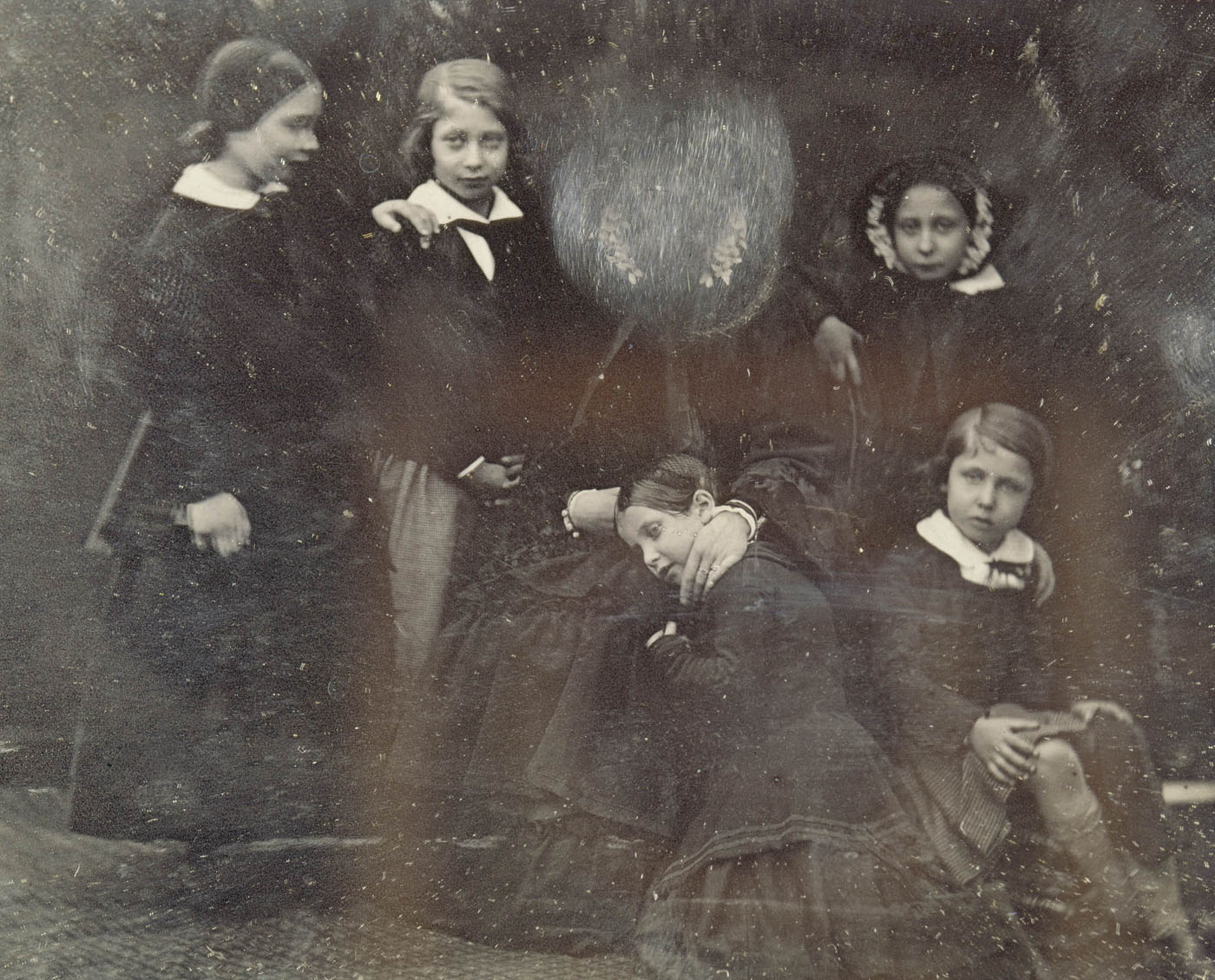
 

William Edward Kilburn Studio (English, 1818-1881) 'Queen Victoria et al' 17 January 1852


William Edward Kilburn Studio (English, 1818-1881)
Queen Victoria et al
17 January 1852
Scratched daguerreotype
Royal Collection Trust
© His Majesty King Charles III 2022


This group portrait of Queen Victoria with her five eldest children was taken in January 1852 by William Edward Kilburn, who, as one of the leading photographers in London, was commissioned to photograph the Royal family on a number of occasions. The Queen was portrayed with her eyes closed, which is why she wiped out her face on the plate, but spared the images of the children.


“Went back to the Gardens, where a Daguerreotype by Mr. Kilburn was taken of me & 5 of the children. The day was splendid for it. Mine was unfortunately horrid, but the children’s were pretty.”

~ Queen Victoria, from a diary entry, 1852


William Edward Kilburn Studio (English, 1818-1881) 'Prince Albert' (1819-1861) 1848


William Edward Kilburn Studio (English, 1818-1881)
Prince Albert (1819-1861)
1848
Hand-coloured daguerreotype
6.3 x 8.7cm
Royal Collection Trust RCIN 2932486
© His Majesty King Charles III 2022


Hand-coloured daguerreotype of Prince Albert, seated and facing partly right. His left arm rests on the arm of the chair and his right rests on his lap. He is wearing a beige jacket and a dark brown waistcoat. The background is painted blue with white clouds and the daguerreotype is mounted under glass. On the reverse there is a label reading ‘The Prince from Life 1848’, handwritten by Queen Victoria. Prince Albert was an early enthusiast of photography and closely followed the development of the medium. In February 1847 Kilburn showed examples of his coloured daguerreotypes, made by adding fine coloured powders to the photographic plate, to the Society of Arts. In 1848 Prince Albert commissioned a portrait using the new technique. This is one of two surviving hand-coloured daguerreotypes produced from the sitting. Commissioned by Prince Albert in 1848

Anonymous. “Prince Albert (1819-1861),” on the Royal Collection Trust website Nd [Online] Cited 23/02/2023


Applied colour

By the mid-1840s, it was common for middle-class British citizens to have a daguerreotype portrait made. Often, these were enhanced with applied colour, giving a touch of life to an otherwise monochrome medium.


Studio of Richard Beard (English, 1801-1885) 'Portrait bust of a man' c. 1845


Studio of Richard Beard (English, 1801-1885)
Portrait bust of a man
c. 1845
Hand-painted daguerreotype in vertical leather case
Courtesy of a Private Collection


Richard Beard was a businessman who purchased a licence to use the daguerreotype process in 1841 and opened the world’s first photographic studio. It was set up in a glasshouse on the roof of London’s Royal Polytechnic Institution to provide all-round lighting necessary to the daguerreotype process. There were huge profits from his studios in London and Liverpool and from the sale of licences to take daguerreotypes, but Beard was ruined by his many legal actions against rivals, and went bankrupt in 1850.


Itinerant and transnational

The career of James William Newland exemplifies the itinerant, transnational character of many early photographers. Born in Suffolk in about 1810, Newland opened his first daguerreotype studio in 1845 in New Orleans in the USA. He subsequently travelled throughout Central and South America and then across the Pacific to Sydney, Australia. In 1848, he established a studio there and exhibited 200 daguerreotypes he had taken during his journey. After Australia, he headed back to England for a brief visit, before moving to India to set up a studio in Calcutta. It was there that he died, killed during the Indian Uprising of 1857.


J.W. Newland (English, c. 1810-1857) 'Portrait of a standing man, Calcutta' c. 1855


J.W. Newland (English, c. 1810-1857)
Portrait of a standing man, Calcutta
c. 1855
Quarter-plate daguerreotype in leather case with red velvet pad
Courtesy of a Private Collection


Photo journalism

This daguerreotype records the immense crowds at one of the Chartist rallies held in South London in 1848. Calling for political reform, the Chartist movement was seen by many as a terrifying threat to the established order. Fears were so great, the Duke of Wellington stationed troops across London and the royal family was moved to Osborne House on the Isle of Wight. In the event, the rally passed peacefully, and Prince Albert himself purchased this record of it.


Studio of William Edward Kilburn (English, 1818-1881) (234 Regent St, London) 'The Chartist Meeting on Kennington Common, 10 April 1848' 10 April 1848


Studio of William Edward Kilburn (English, 1818-1881) (234 Regent St, London)
The Chartist Meeting on Kennington Common, 10 April 1848
10 April 1848
Daguerreotype Royal Collection, London


Daguerreotype of a large crowd of supporters of the Chartist movement gathered together on Kennington Common. At the centre of the crowd there is a platform for the speakers, and a number of people hold banners and flags. Behind the crowd there is a tall factory chimney and a large house to the right. In the foreground a man stands facing the crowds in a horse-drawn cart. The daguerreotype is mounted under glass.

This daguerreotype records the immense crowds at one of the Chartist rallies held in South London in 1848. Calling for political reform, and spurred on by the recent February Revolution in France, the Chartist movement was seen by many as a terrifying threat to the established order. Fears were so great that on the eve of the meeting, the Duke of Wellington stationed troops across London and the royal family were moved to Osborne House on the Isle of Wight. In the event the rally passed peacefully. Prince Albert later spoke about his concern for the working classes at a meeting of the Society for the Improvement of the Condition of the Labouring Classes, 18 May 1848. This is one of a pair of daguerreotypes of the event acquired by Prince Albert.

One of a pair of daguerreotypes of the Chartist Meeting on Kennington Common purchased by Prince Albert in 1848

Anonymous. “The Chartist Meeting on Kennington Common, 10 April 1848,” on the Royal Collection Trust website Nd [Online] Cited 23/02/2023


Ruskin and photography

Although his opinion of photography evolved over the years, John Ruskin was initially enthusiastic about the daguerreotype, importing early examples from France and learning the process himself in order to make photographic sketches of architecture and landscape.

“Daguerreotypes taken by this vivid sunlight are glorious things. It is very nearly the same thing as carrying off the palace itself: every chip of stone and stain is there, and of course there is no mistake about proportions… It is a noble invention.”

~ John Ruskin, in a letter to his father from Venice, 7 October 1845


John Ruskin (English, 1819-1900) and John Hobbs (?) 'View of the façade of a building in Venice' c. 1850


John Ruskin (English, 1819-1900) and John Hobbs (?)
View of the façade of a building in Venice
c. 1850
Daguerreotype
History of Science Museum, University of Oxford
Minn Collection
Bequeathed by Henry Minn in 1961


John Ruskin (8 February 1819 – 20 January 1900) was an English writer, philosopher, art critic and polymath of the Victorian era. He wrote on subjects as varied as geology, architecture, myth, ornithology, literature, education, botany and political economy.

Ruskin’s writing styles and literary forms were equally varied. He wrote essays and treatises, poetry and lectures, travel guides and manuals, letters and even a fairy tale. He also made detailed sketches and paintings of rocks, plants, birds, landscapes, architectural structures and ornamentation. The elaborate style that characterised his earliest writing on art gave way in time to plainer language designed to communicate his ideas more effectively. In all of his writing, he emphasised the connections between nature, art and society.

Ruskin was hugely influential in the latter half of the 19th century and up to the First World War. After a period of relative decline, his reputation has steadily improved since the 1960s with the publication of numerous academic studies of his work. Today, his ideas and concerns are widely recognised as having anticipated interest in environmentalism, sustainability and craft.

Ruskin first came to widespread attention with the first volume of Modern Painters (1843), an extended essay in defence of the work of J. M. W. Turner in which he argued that the principal role of the artist is “truth to nature”. From the 1850s, he championed the Pre-Raphaelites, who were influenced by his ideas. His work increasingly focused on social and political issues. Unto This Last (1860, 1862) marked the shift in emphasis. In 1869, Ruskin became the first Slade Professor of Fine Art at the University of Oxford, where he established the Ruskin School of Drawing. In 1871, he began his monthly “letters to the workmen and labourers of Great Britain”, published under the title Fors Clavigera (1871-1884). In the course of this complex and deeply personal work, he developed the principles underlying his ideal society. As a result, he founded the Guild of St George, an organisation that endures today.

Text from the Wikipedia website


Stereoscopic still life

This stereo-daguerreotype includes a selection of the instruments found in the studio of London photographer Antoine Claudet in 1853. They include a focimeter (a device of his own devising that aided focus), a distillation device hanging on the back wall, a telescope on a stand, an upside-down globe, an array of chemical jars and glass vessels, a centrifugal force speed controller, a photographometer (an early kind of light metre), three different kinds of stereoscope, the Post Office London Directory of 1852, a magnifying glass, a slide rule, a glass prism, a French treatise on photography, two of his dynactinometers (another device of his own invention), a mortar and pestle, and an apothecary’s scales.

Photographs of paintings

Daguerreotypes were used to make records of paintings and prints. Sometime in the 1850s, the studio of London-based photographer Edward Kilburn was commissioned to make a daguerreotype of a painting then thought to be by Raphael. The client was the British art dealer Morris Moore. Moore engaged in a decades-long struggle to have this painting, now titled Apollo and Marsyas and attributed to Perugino, accepted as an early work by Raphael. This daguerreotype no doubt played a part in that campaign. Moore displayed it, for example, in Berlin in 1856.

Keepsake and memory

Ada Lovelace, the English mathematician and computing pioneer, had a number of daguerreotype portraits made of herself. The last of these, taken by an unknown photographer, is of a small painted portrait of Lovelace. Frail and thin and suffering from cancer, she is shown sitting at her piano. Shortly before she died, Lovelace wrote a note in which she leaves ‘a daguerreotype from Philips’s picture of me’ to her mother’s friend, a Mary Millicent Montgomery.


Photographer unknown (English) 'Copy of an 1852 painting of Ada Lovelace by Henry Wyndam Phillips' 13 August 1852


Photographer unknown (English)
Copy of an 1852 painting of Ada Lovelace by Henry Wyndam Phillips
13 August 1852
Daguerreotype
Private Collection
Reproduction courtesy of Geoffrey Bond
Public domain


Augusta Ada King, Countess of Lovelace (née Byron; 10 December 1815 – 27 November 1852) was an English mathematician and writer, chiefly known for her work on Charles Babbage’s proposed mechanical general-purpose computer, the Analytical Engine. She was the first to recognise that the machine had applications beyond pure calculation, and to have published the first algorithm intended to be carried out by such a machine. As a result, she is often regarded as the first computer programmer.

Text from the Wikipedia website


2th Sept 1852
I leave to my Mother’s oldest
Friend, Mary Millicent Mont=
=gomery, three articles, viz:
1. A Red Cornelian Brooch which
I have much used I have much used, & to which
I desire my
Hair to be added;
2. A Daguerreotype from Philip’s
Picture of me;
3. 4 Books printed out by me.
I request this Paper also to be
given to Mary Millicent Mont=
=gomery; & I wish her to
understand that I leave her …


As well as being customers of the new photographers, Ada Lovelace and her circle were intrigued by the science of photography and the contribution photographic processes might make to science. Apart from her famous paper on Babbage’s Analytical Engine, her only other known publication is in the form of long footnotes to an article by her husband, William Earl of Lovelace, in the Royal Agricultural Society journal. The article, which he describes as being written for the ‘leather-gaiter-and-top-boot-mind’, reviews a paper by the French economist Gasparin, about possible laws linking climate and the yield of crops, referring to a wide variety of observations of weather and plants collected by both professionals and amateurs. Ada Lovelace observes that photographic devices, such as the actinograph designed by her friend John Herschel, allow the construction of ‘meteorological instruments of the utmost delicacy’, and criticises Gasparin ‘who seems to write unaware of the means which photography has offered’.

In similar vein, she reflected on the potential of photography in providing objective evidence of psychic phenomena. In an unpublished article she writes, ‘If amateurs, of either sex, would amuse their idle hours with experimenting on this subject, & would keep an accurate journal of their daily observations, we should in a few years have a mass of registered facts to compare with the observation of the Scientific’, concluding that ‘we believe that it is as yet quite unsuspected how important a part photography is to play in the advancement of human knowledge’.

A third poignant daguerreotype, by an unknown photographer, is a photograph of a small portrait of Ada Lovelace, frail and thin, painted by Henry Wyndham Phillips in the last months of her life, when she was in great pain from uterine cancer. Her husband recorded progress on the portrait in his diary – on 2 August ‘she managed to remain long enough when he came for him to make some progress’, on 3 August that he was ‘getting on with the portrait’, and on 13 August that though ‘the suffering was so great that she could scarce avoid crying out’, yet ‘she sat at the piano some little time so that the artist could portray her hands’. The Bodleian archives contain a note written in her last days, in which she leaves ‘a daguerreotype from Philips’s portrait of me’ to her mother’s friend, Miss Montgomery.

Professor Ursula Martin CBE, University of Oxford. “Only known photographs of Ada Lovelace in Bodleian Display,” on the Bodleian blogs Ada Lovelace website 14 October 2015 [Onlinr] Cited 23/02/2023


George Hollis (British, 1793-1842) (engraver) 'Mr Couldock as Richard III' 1851


George Hollis (British, 1793-1842) (engraver)
Mr Couldock as Richard III
1851
From Tallis’s Drawing Room Table Book of Theatrical Portraits, Memoirs and Anecdotes
Hand-coloured steel engraving after daguerreotype by William Paine of Islington

This engraving: The British Museum CC BY-NC-SA 4.0

The engraving in the exhibition: Private collection


Celebrity actors

Tallis’s Drawing Room Table Book of Theatrical Portraits, Memoirs and Anecdotes offered a series of engraved copies of daguerreotype portraits of celebrated Shakespearean actors. Sometimes these actors are shown as if in a portrait studio, but more often they are posing in costume (and even in blackface), as if in the midst of a performance. The series is a reminder of the popularity of the theatre and actors in the mid-19th century (even Queen Victoria bought a copy of this publication), but also of the casual racism that was part of everyday British life.
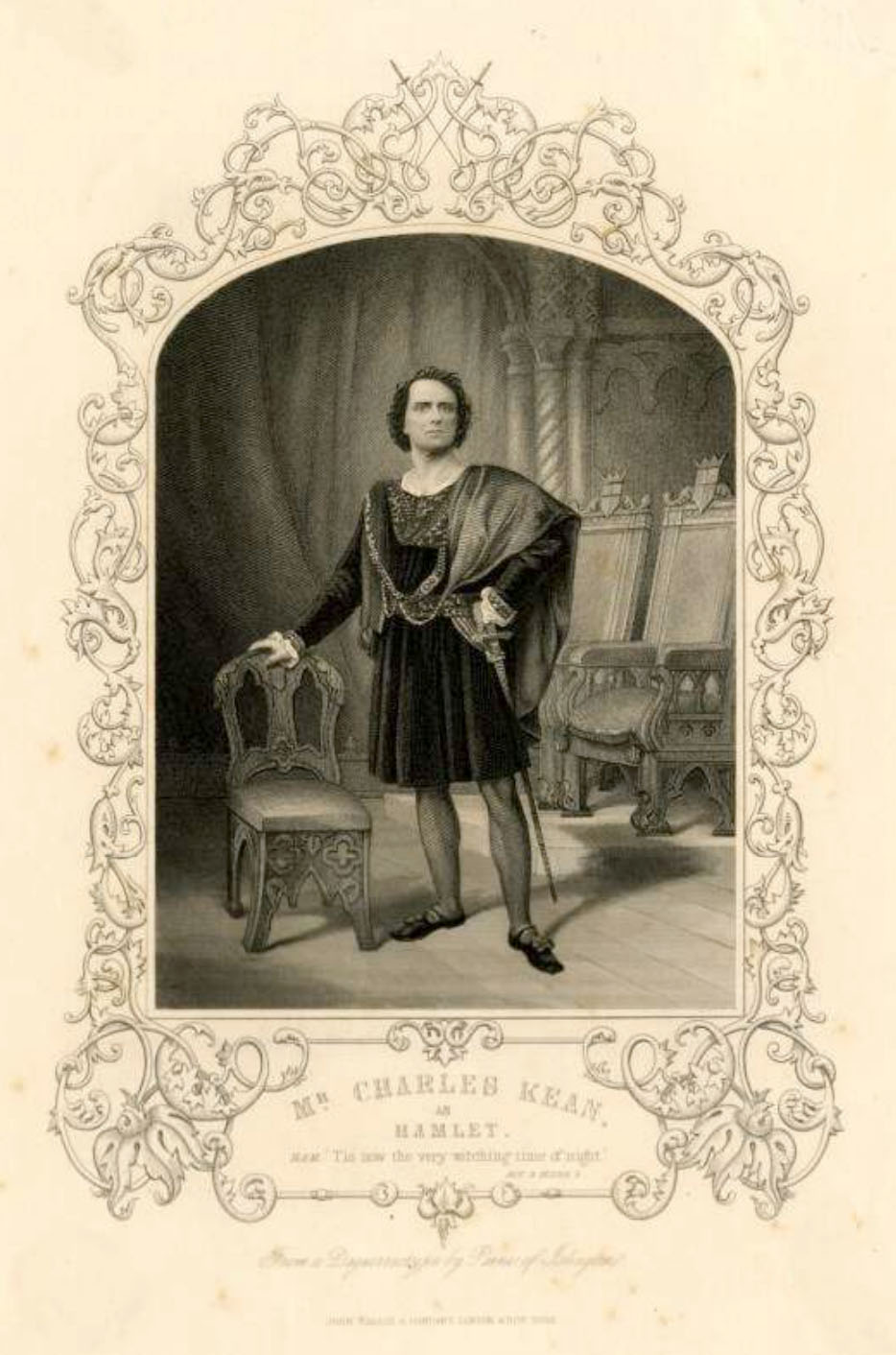
 

Engraver unknown (British) 'Mr Charles Kean as Hamlet' 1851


Engraver unknown (British)
Mr Charles Kean as Hamlet
1851
From Tallis’s Drawing Room Table Book of Theatrical Portraits, Memoirs and Anecdotes
Steel engraving after daguerreotype by William Paine of Islington

This engraving: The British Museum CC BY-NC-SA 4.0

The engraving in the exhibition: Private collection


'Mr Ira Aldridge as Aaron in Titus Andronicus' From 'Tallis's Drawing Room Table Book of Theatrical Portraits, Memoirs and Anecdotes' c. 1851


‘Mr Ira Aldridge as Aaron in Titus Andronicus’
From Tallis’s Drawing Room Table Book of Theatrical Portraits, Memoirs and Anecdotes
c. 1851
Steel engraving after daguerreotype by William Paine of Islington
Bodleian Libraries, University of Oxford


Ira Aldridge

Born in New York, Ira Aldridge (1807-1867) was an African-American actor, playwright, and theatre manager. From 1824, the year he emigrated to the UK, Aldridge made his career largely on the London stage and in Europe. He became well known as a performer in plays by Shakespeare, including roles usually played by white actors, such as Richard III, King Lear and Macbeth. Aldridge’s career took off at the height of the movement to abolish slavery throughout the British Empire. He chose to play a number of anti-slavery roles and often addressed his audiences on closing night, speaking passionately about the injustice of slavery.

The Great Exhibition

Six million people – equivalent to a third of the entire population of Britain at the time – visited the Great Exhibition of the Works of Industry of All Nations, an international showcase for goods, raw materials and industrial products and machinery. It took place in Hyde Park, London, from 1 May to 15 October in 1851. Photographs were among the thousands of exhibits, but the Great Exhibition was itself much photographed, as evidenced in the many photographic images reproduced in the illustrated press.

“Today is sunshine and mild weather. I peeped in thro’ a window at the East End of the Crystal palace, and found myself in the territories of the United States, who ought rather to have been located in the Far West of the building. The perspective looked beautiful.”

~ William Henry Fox Talbot, in a letter to his wife Constance, 30 April 1851


Engravers unknown (English) 'The Great Exhibition: The east nave, viewed from the south-western gallery' 1851


Engravers unknown (English)
The Great Exhibition: The east nave, viewed from the south-western gallery
1851
From Illustrated London News, 6 September 1851, p. 296
Stipple and line engraving from daguerreotype by William Edward Kilburn
210 x 270 mm
Courtesy of a Private Collection


Held at Crystal Palace in London in 1851, the Great Exhibition of the Works of Industry of All Nations was one of the most influential cultural events of the 19th century and the Illustrated London New did not fail to record its scale and significance using an equally influential invention that would shape the current century and those to come.

Sir Joseph Paxton (1801-1865) began his career as a gardener’s boy, eventually becoming head gardener for the Duke of Devonshire. He remodelled the Duke’s gardens at Chatsworth and Chiswick, designing large glass and iron conservatories for them. These later became the model for his design of the Great Exhibition building, now known as the Crystal Palace, for which he received his knighthood. After this success, Paxton continued to work on landscape gardening and public parks as well as designing various country houses. Published by Peter Jackson, London.

Sir Joseph Paxton (English, 1801-1865)

Sir Joseph Paxton, (born Aug. 3, 1801, near Woburn, Bedfordshire, Eng. – died June 8, 1865, Sydenham, near London), English landscape gardener and designer of hothouses, who was the architect of the Crystal Palace for the Great Exhibition of 1851 in London.

He was originally a gardener employed by the duke of Devonshire, whose friend, factotum, and adviser he became. From 1826 he was superintendent of the gardens at Chatsworth, the duke’s Derbyshire estate; he built in iron and glass the famous conservatory there (1840) and the lily house for the duke’s rare Victoria regia (1850). Also in 1850, after a cumbersome design had been officially accepted by the Great Exhibition’s organisers, Paxton’s inspired plan for a building of prefabricated elements of sheet glass and iron was substituted. His design, based on his earlier glass structures, covered four times the area of St. Peter’s, Rome, and the grandeur of its conception was a challenge to mid-19th-century technology. Although it was built within six months and he was knighted for his efforts (1851), it was not until later that the structure was seen as a revolution in style. In 1852-1854 its components were moved to Sydenham Hill in Upper Norwood, where they remained (reerected in a different form from the original) until destroyed by fire in 1936.

Paxton was a member of Parliament for Coventry from 1854 until his death. During the period of his glass structures, he also designed many houses in eclectic styles and laid out a number of public parks.

Kathleen Kuiper. “Sir Joseph Paxton,” on the Britannica website Nd [Online] Cited 23/02/2023


Joseph John Jenkins (English, 1811-1885) (engraver) 'Joseph Paxton, designer of the Crystal Palace' c. 1851


Joseph John Jenkins (English, 1811-1885) (engraver)
Joseph Paxton, designer of the Crystal Palace
c. 1851
Stipple and line engraving from daguerreotype by William Edward Kilburn

This engraving: from the Britannica website

The engraving in the exhibition: Private collection


Joseph John Jenkins (1811 – 9 March 1885) was a British engraver and watercolour painter. He is best known for his portraits and landscapes paintings.

Jenkins engraved many portraits, and among other works, Susanna and the Elders, after Francesco Mola, and The Greenwich Pensioner and The Chelsea Pensioner, after Michael William Sharp. He engraved plates and drew illustrations for the annuals, such as The Keepsake and Heath’s Book of Beauty, Plates from his drawings are in Charles Heath’s Illustrations to Byron and similar works.

Grand Panorama

The Illustrated London News issued a commemorative Grand Panorama of the Great Exhibition of All Nations 1851 in its December issue. Comprising fold-out pages, each sheet was based on daguerreotypes of the interior of the Exhibition taken by an operator from the Beard studio. The panorama showed frontal views of each side of the interior of the Crystal Palace, with distinct sections suitably captioned and clusters of figures added to give interest to an otherwise drab set of facades.

Commodities and things

The taking of photographs inside the building was restricted to between 6 and 9 am, before it opened to the public, or on Sundays, when it was otherwise closed. Often, the resulting views are undemonstrative and frontal, even if they are also sometimes animated by the engraver through the addition of figures peering at the exhibits. These scenes confirm the fetishisation of the commodity that was the Great Exhibition’s singular attraction, turning that spectacle into a picture to be gazed at in its turn.


John Tallis (English, 1817-1876) and Jacob George Strutt (British, 1790-1864) 'Tallis's history and description of the Crystal Palace, and the exhibition of the world's industry in 1851' (p. 13) 1852


John Tallis (English, 1817-1876) and Jacob George Strutt (British, 1790-1864)
Tallis’s history and description of the Crystal Palace, and the exhibition of the world’s industry in 1851 (p. 13)
1852
Steel engravings, from original drawings and daguerreotypes by Beard and Mayall studios


The Swedish Nightingale

Prizes were awarded to photographers whose displays at the Great Exhibition were considered to be particularly notable. One of those prizes was awarded to Edward Kilburn. The jury was particularly impressed by a full-length daguerreotype portrait made by Kilburn in 1848 of Swedish opera singer Jenny Lind, known as the Swedish Nightingale. Lind is posed so that her image is reflected in a large mirror; ‘that the reflection in the glass is equally perfect with the original is the point worthy of remark and commendation’.

“… a masterpiece of this art, not excelled, if equalled, by any other specimen exhibited throughout the entire building.”

~ Illustrated London News (1851)


Studio of William Edward Kilburn (English, 1818-1881) (234 Regent St, London) 'Portrait of Jenny Lind standing at a piano' 1848


Studio of William Edward Kilburn (English, 1818-1881) (234 Regent St, London)
Portrait of Jenny Lind standing at a piano
1848
Daguerreotype
11.5 x 9.1cm
© Royal Collection, London


Daguerreotype of a full length portrait of Jenny Lind standing beside a piano, facing away from the camera, with her head and upper body turned left towards the camera. Her right hand rests on the top of the piano and her left hand is touching the keys. She is wearing a long dress and a dark colour lace shawl. The mirror on the wall to the right reflects her back and there is an ornate side table beneath it. The daguerreotype is mounted under glass.

Queen Victoria attended the first London performance given by the Swedish soprano Jenny Lind on the 4th of May 1847. She described the occasion in her journal: ‘The great event of the evening however was Jenny Lind’s appearance & her complete triumph. She has the most exquisite, powerful, & really quite peculiar voice’. She later sang among the choristers at the wedding of the Prince of Wales in St George’s Chapel in 1863.

William Kilburn exhibited several daguerreotypes at the 1851 Great Exhibition, with this image being particularly well received. The exhibition jury commented: ‘For novelty of design we may mention a small picture of the interior of a room, including a whole-length portrait of Jenny Lind: beside, and near her, is a large mirror, in which the figure is reflected. That the reflection in the glass is equally perfect with the original is the point worthy of remark and commendation’.

The daguerreotype was also reproduced with significant cropping in carte-de-visite format, such as in the example today kept at the Victoria & Albert Museum, London (Museum Number S.138:66-2007). Acquired by Queen Victoria and Prince Albert in 1849.

Anonymous. “Jenny Lind (1820-1887),” on the Royal Collection Trust website Nd [Online] Cited 23/02/2023


Really marvellous

Stuffed frogs being shaved and promenading under an umbrella were among the most remarkable of the exhibits daguerreotyped by the Claudet studio at the Great Exhibition. The animals were prepared for anthropomorphic display by Hermann Ploucquert, a taxidermist at the Royal Museum in Stuttgart. The stall at which these creations were exhibited was apparently perpetually surrounded by a crowd. Queen Victoria herself described them in her diaries as ‘really marvellous’. Claudet’s images were issued as a book of coloured wood engravings titled The Comical Creatures from Wurtemberg.

News from home

The dissemination of engravings after daguerreotypes in the Illustrated London News meant that photographic images became itinerant entities. Distributed all over the world, the same image was capable of being experienced, simultaneously, in – say – Sydney, Hong Kong, Calcutta, New York, and London. By 1851, when Harden Melville completed the painting that this coloured engraving commemorates – titled Australia: News from Home – even settlers in outback Australia were able to get copies. One of them is looking at an issue of the Illustrated London News that celebrates the opening of the Great Exhibition in London.

Official reports

Not one of the many photographs exhibited in the Great Exhibition was by William Henry Fox Talbot, England’s claimant to the medium’s invention. Nevertheless, Talbot’s calotype process was chosen to illustrate the official reports on the event, even if the majority of these illustrations was shot and printed by French photographers rather than English ones. The other claimant to photography’s invention, the Frenchman Louis Daguerre, lived long enough to read about London’s Great Exhibition but died two months after it opened. Fittingly, his obituary in the Illustrated London News was accompanied by a wood-engraved portrait based on a daguerreotype.

The Duke of Wellington

The Ryall engraving faithfully imitates the composition and details of the daguerreotype made by the Claudet studio, but reverses the orientation of the Duke’s body. A story in the Illustrated London News, published on 13 November 1852, tells us that the Duke himself was not particularly impressed by the print. Apparently, ‘he looked at it for a moment, shook his head, and, with a half smile and half frown of recognition, muttered “Very old! Hum!” and turned away in thought’. This engraving was in turn copied by others, reappearing in a variety of media over the next few decades, and especially in 1852, the year of Wellington’s death.


Edward J. Pickering, for studio of Antoine Claudet (London) 'Portrait of the Duke of Wellington' 1 May 1844


Edward J. Pickering, for studio of Antoine Claudet (London)
Portrait of the Duke of Wellington
1 May 1844
Daguerreotype

This image: Getty
Public domain

Image in the exhibition: Wellington Collection, Stratfield Saye House


John Sartain (English, 1808-1897) 'The Duke of Wellington' 1852


John Sartain (English, 1808-1897)
The Duke of Wellington
1852
Mezzotint, etching and aquatint engraving (‘engraved by J. Sartain after Claudet’s portrait’)
7 x 4 15/16 in. (17.78 x 12.54cm)

This engraving: Pennsylvania Academy of the Fine Arts
Bequest of Dr. Paul J. Sartain
Public domain

The engraving in the exhibition: Private collection


Salt prints

In September 1840, William Henry Fox Talbot discovered how to greatly increase his photographic paper’s sensitivity to light. This new process produced a latent image which remained invisible to the eye until it was developed for a second time. The result was a sharp negative from which numerous positive salt prints could be made. Resisting his mother’s entreaty to call this process ‘Talbotype’, after himself, he gave it the more modest name of ‘calotype’ (‘beautiful picture’). Other photographers soon took up this new process, including Welshman Calvert Richard Jones and the Scottish duo of David Hill and Robert Adamson.

“A better picture can now be obtained in a minute than by the former process in an hour.”

~ William Henry Fox Talbot, in a letter to the Literary Gazette, 13 February 1841


William Henry Fox Talbot (English, 1800-1877) 'Lace' Early 1840s


William Henry Fox Talbot (English, 1800-1877)
Lace
Early 1840s
Salt print from a calotype negative
22.7 x 18.7cm


Rev. Calvert Richard Jones (Welsh, 1804-1877) 'Colosseum, Rome, 2nd view' 1846


Rev. Calvert Richard Jones (Welsh, 1804-1877)
Colosseum, Rome, 2nd view
1846
Salt print (printed by Nicolaas Henneman) from a calotype negative

This image: Metropolitan Museum of Art
Public domain

Image in the exhibition: MS. WHF Talbot photogr. 6


The Reverend Calvert Richard Jones was the son of a landowner from Wales. He became a marine painter, draftsman, and daguerreotypist before turning to the calotype, the negative/positive paper process invented by William Henry Fox Talbot, with whom Jones occasionally photographed. During travels to Italy in 1841, Jones stopped in France, where he met and photographed with Hippolyte Bayard, the French inventor of direct positive prints on paper. Through Jones, Bayard and Talbot were introduced to each other and their respective pioneering processes.

Jones was enthusiastic about the creative possibilities of photography. He used the photographic panorama, a device that provided the viewer with a wide-angle view of a given scene. His body of work includes marine landscapes and genre portraits of local men and women at work and leisure, as well as travel landscapes of Italy and France. After 1856 Jones apparently gave up photography, although he continued to paint.

Text from the J. Paul Getty Museum website


William Henry Fox Talbot (English, 1800-1877) 'Loch Katrine' 1844


William Henry Fox Talbot (English, 1800-1877)
Loch Katrine
1844
Salt print (printed by Nicolaas Henneman) from a calotype negative


David Octavius Hill and Robert Adamson (Scottish, 1802-1870 and Scottish, 1821-1848) 'Portrait of James Inglis' 2 October 1844


David Octavius Hill and Robert Adamson (Scottish, 1802-1870 and Scottish, 1821-1848)
Portrait of James Inglis
2 October 1844
Salt print from a calotype negative
History of Science Museum, University of Oxford
Presented by Sir John R. Findlay in 1929


Calotype (salted paper print from a calotype negative) of James Inglis, a doctor from Halifax, seated nearly three-quarter length, head very nearly in profile looking left, a leather glove on his left hand; photographed at the British Association for the Advancement of Science meeting at York in 1844. Mostly greenish sepia, pale at edges, retaining the original brown only at centre; discolouration mark from juxtaposed paper on back. For fuller descriptive and historical commentary see narratives.

David Octavius Hill (1802-1870) and Robert Adamson (1821-1848)

Brewster, sensing that Hill’s intention to sketch each of the several hundred ministers before they returned to the far corners of Scotland would be close to impossible, suggested that the painter use the services of the newly established Adamson to make photographic sketches instead. “I got hold of the artist,” Brewster wrote to Talbot in early June, “showed him the Calotype, & the eminent advantage he might derive from it in getting likenesses of all the principal characters before they were dispersed to their respective homes. He was at first incredulous, but went to Mr. Adamson, and arranged with him preliminaries for getting all the necessary portraits.” Within weeks Hill was completely won over, and the two were working seamlessly in partnership. As artistic director, Hill composed each picture, placing his sitters as they might appear in the finished painting.

Adamson operated the camera and carried out the chemical manipulations. Hill and Adamson were a perfect team. Hill, twenty years older than Adamson, was trained as a painter and had important connections in artistic and social circles in Edinburgh; he easily attracted a distinguished clientele to the team’s portrait studio at Adamson’s home, Rock House. Most of all, he possessed a geniality, a “suavity of manner and absence of all affectation,” that immediately set people at ease and permitted him to pose his sitters without losing their natural sense of posture and expression. Adamson was young but had learned his lessons well. He was a consummate technician, excelling in – and even improving upon – the various optical and chemical procedures developed by Talbot. Both men had a profound understanding of the way the world would translate into monochrome pictures.

If in May Hill had been incredulous, by June he was convinced; by July he was proud to exhibit the first photographs as “preliminary studies and sketches” for his picture, and by the end of the year he and his partner had photographed nearly all the figures who would have a place in his grand painting. Their hundreds of preparatory “sketches” ranged from single portraits to groups of as many as twenty-five ministers posed as Hill envisioned them in his ambitious composition. Some portraits, such as that of Thomas Chalmers, first moderator of the Free Church, were used as direct models for the finished work. However, at each sitting, Hill and Adamson made numerous photographs in various poses, and many photographs of the ministers have no direct correspondence with the painting. Still other portraits, of people who were not present for the signing of the Deed of Demission – but whom Hill apparently thought should have been – were used as models for the painting.

“The pictures produced are as Rembrandt’s but improved,” wrote the watercolorist John Harden on first seeing Hill and Adamson’s calotypes in November 1843, “so like his style & the oldest & finest masters that doubtless a great progress in Portrait painting & effect must be the consequence.” In actuality, though, it was so easy to make the portrait “sketches” by means of photography that Hill’s painting was ultimately overburdened by a surfeit of recognizable faces: 450 names appear on his key to the painting. The final composition – not completed for two decades and as dull a work as one can imagine – lacks not only the fiery dynamism of Hill’s first sketches of the event but also the immediacy and graphic power of the photographs that were meant to serve it.

By August 1844, Hill and Adamson clearly understood the value of their calotypes as works of art in their own right and decided to expand their collaboration far beyond the original mission, announcing a forthcoming series of volumes illustrated with photographs of subjects other than the ministers of the Free Church: The Fishermen and Women of the Firth of Forth; Highland Character and Costume; Architectural Structures of Edinburgh; Architectural Structures of Glasgow, &c.; Old Castles, Abbeys, &c. in Scotland; and Portraits of Distinguished Scotchmen. Although these titles were never issued as published volumes, photographs intended for each survive, and those made in the small fishing town of Newhaven are a particularly noteworthy group.

Malcolm Daniel. “David Octavius Hill (1802-1870) and Robert Adamson (1821-1848),” on the Metropolitan Museum of Art website October 2004 [Online] Cited 23/02/2023


William Henry Fox Talbot (English, 1800-1877) 'An Ancient Door in Magdalen College, Oxford' April 1843


William Henry Fox Talbot (English, 1800-1877)
An Ancient Door in Magdalen College, Oxford
April 1843
Salted paper print from paper negative
Dimensions overall: 18.8 x 22.7cm (7 3/8 x 8 15/16 in.)

This image: National Gallery of Art, Robert B. Menschel Fund
CC0 1.0 Universal

Image in the exhibition: MS. WHF Talbot photogr. 4, item 3


A New Power: Photography in Britain 1800-1850 is made possible through the generosity of donors and lenders. In particular the Bodleian Libraries would like to thank: Professor Raymond Dwek CBE FRS and Mrs Sandra Dwek Sir Brian and Lady Pomeroy Ian and Caroline Laing
Lenders
His Majesty King Charles III
Blackie House Library and Museum, Edinburgh
The Trustees of the British Museum
English Heritage Trust
Polar Museum, Scott Polar Research Institute, University of Cambridge
Victoria and Albert Museum
The Wellington Collection, Stratfield Saye House
Ashmolean Museum, University of Oxford
History of Science Museum, University of Oxford
Oxford University Museum of Natural History
The President and Fellows of Magdalen College
The Provost and Fellows of Oriel College
The Principal and Fellows of Somerville College
Geoffrey Batchen
G C Bond
K & J Jacobson
Gregory Page-Turner
William Zachs


We would like to thank HM Government for providing Government Indemnity for the loans and the Department for Culture, Media and Sport and Arts Council England for arranging the indemnity. We are also grateful to those whose skill and labour have made this exhibition possible.


'A New Power: Photography in Britain 1800-1850' exhibition poster


A New Power: Photography in Britain 1800-1850 exhibition poster


Weston Library
Broad Street, OX1

Opening hours:
Monday – Saturday: 10am – 5pm
Sunday: 11am – 4pm
Bodleian Libraries website

LIKE ART BLART ON FACEBOOK

Back to top

Exhibition: ‘Documentary Genealogies: Photography 1848-1917’ at the Museo Nacional Centro de Arte Reina Sofía, Madrid

Exhibition dates: 16th November, 2022 – 27th February, 2023


Eugène Atget (French, 1857-1927) 'Sur les quais – La sieste / Les p'tits métiers de Paris' c. 1898-1900 from the exhibition 'Documentary Genealogies: Photography 1848-1917' at the Museo Nacional Centro de Arte Reina Sofía, Madrid, Nov 2022 - Feb 2023


Eugène Atget (French, 1857-1927)
Sur les quais – La sieste / Les p’tits métiers de Paris
On the quays – The siesta / The little jobs in Paris 

c. 1898-1900, printed 1904
Collotype
8.8 x 13.7cm
Museo Nacional Centro de Arte Reina Sofía


“While human truth may be ephemeral qualities like justice are not; the struggle is to define justice and to live it. And for artists to display it.”


Dr Marcus Bunyan


Another fascinating exhibition that extends the remit of “documentary” photography back to the earliest days of the medium and the “the empire of photography”: the rise of a new visual regime that became an instrument for the system of bourgeois, industrial and colonial culture in the second half of the nineteenth century.

In other words in the hands of the powerful (both national and personal) photography became an instrument which reinforced the entitlement and social position of the privileged while depriving the disenfranchised of a visual voice, and thus legitimacy and recognition of their plight. Photography also became the means to form a taxonomic ordering of supposed genetic deficiencies, ethnicities, criminals, homosexuals and revolutionaries, amongst others.

“The democratic promise of photography was long unfulfilled and remained, for over almost a century, an instrument in the hands of bourgeois culture and its means of representation. Thus, the portraits of the working and subaltern classes were an accidental and marginal incursion, an involuntary presence inside pictures with another intention.” (Press release)

Here I would disagree with the assertion that portraits of the working classes were an accidental and marginal incursion, an involuntary presence inside pictures with another intention. “Incursion” means an invasion or attack. “Involuntary” means done without will or conscious control. So images of the poor appear, without any conscious control, as an attack inside / against images that reinforce their prerogative meaning?

Perhaps the poor are just human beings that lived and breathed the same air as the photographer, that perchance appeared through serendipity in the images with no ulterior motive attached to their being … other than those that have been attached to their representation at a later date. Interpretations of photographs change over time and we have to think how these photographs would have been read when they were first taken.

The terms accidental and marginal are critical. In the work of politically engaged now called social documentary photographers – for example Lewis Hine, Jacob Riis, John Thomson, Hill and Adamson, O.G. Rejlander and Paul Martin – these artists captured photographs of the working classes that are neither accidental nor marginal. They are deliberate and provocative photographs taken to raise awareness of social conditions and injustice in order to bring about a change in the law (such as the anti-slavery laws and child labor laws in the United States) or a change in social conditions of the poor such as the state of slum housing  or tenement house evils for example.

There is nothing marginal about these photographs, no margin in which to ostracise, nor any accident of inclusion, for the human beings in them are placed front and centre before the public ‘in order’ to expose an immorality or injustice that was supposed to be hidden from view.

Dr Marcus Bunyan


Many thankx to the Museo Nacional Centro de Arte Reina Sofía for allowing me to publish the photographs in the posting. Please click on the photographs for a larger version of the image.


“During the 1830s, a period covered by [the novel] Middlemarch, much was changing in terms of class/social structure. During the Victorian era, the rates of people living in poverty increased drastically. This is due to many factors, including low wages, the growth of cities (and general population growth), and lack of stable employment. The poor often lived in unsanitary conditions, in cramped and unclean houses, regardless of whether they lived in a modern city or a rural town. Victorian attitudes towards the poor were rather muddled. Some believed that the poor were facing their situations because they deserved it, either because of laziness or because they were simply not worthy of fortune. However, some believed it was up to personal circumstances. It is important to note that many charities have their roots from this era in English history, because of how overwhelming the issue of poverty became at this time.”


Anonymous. “The life of the poor in Victorian England,” on the Cove website Nd [Online] Cited 23/02/2023


Installation view of the exhibition 'Documentary Genealogies: Photography 1848-1917' at the Museo Nacional Centro de Arte Reina Sofía, Madrid showing at centre Lewis Hine exhibition panels 1913-1914

At centre, Lewis Hine exhibition panels 1913-1914 (see below)

Installation view of the exhibition 'Documentary Genealogies: Photography 1848-1917' at the Museo Nacional Centro de Arte Reina Sofía, Madrid

Installation view of the exhibition 'Documentary Genealogies: Photography 1848-1917' at the Museo Nacional Centro de Arte Reina Sofía, Madrid

Installation view of the exhibition 'Documentary Genealogies: Photography 1848-1917' at the Museo Nacional Centro de Arte Reina Sofía, Madrid showing at left rear, pages from Carl Dammann's '[Races of Mankind]: Ethnological Photographic Gallery of the Various Races of Men' 1876

At left rear, pages from Carl Dammann’s [Races of Mankind]: Ethnological Photographic Gallery of the Various Races of Men 1876 (see below)

Installation view of the exhibition 'Documentary Genealogies: Photography 1848-1917' at the Museo Nacional Centro de Arte Reina Sofía, Madrid

Installation view of the exhibition 'Documentary Genealogies: Photography 1848-1917' at the Museo Nacional Centro de Arte Reina Sofía, Madrid showing Wounded men from the American Civil War

Wounded men from the American Civil War

Installation view of the exhibition 'Documentary Genealogies: Photography 1848-1917' at the Museo Nacional Centro de Arte Reina Sofía, Madrid showing pages from the book 'Oriental and Occidental Northern and Southern Portrait Types of the Midway Plaisance' by N.D. Thompson Publishing Company, 1894, photographs by unknown artists, with at centre left an image of Bachibonzouk, a Greek wearing traditional Turkish needlework and embroidery reminiscent of the uniforms worn by the Sultan's officers, as seen at the World's Columbian Exposition in Chicago, Illinois, 1893

Pages from the book Oriental and Occidental Northern and Southern Portrait Types of the Midway Plaisance by N.D. Thompson Publishing Company, 1894, photographs by unknown artists, with at centre left an image of Bachibonzouk, a Greek wearing traditional Turkish needlework and embroidery reminiscent of the uniforms worn by the Sultan’s officers, as seen at the World’s Columbian Exposition in Chicago, Illinois, 1893 (see below)


Installation views of the exhibition Documentary Genealogies: Photography 1848-1917 at the Museo Nacional Centro de Arte Reina Sofía, Madrid


Documentary Genealogies. Photography 1848-1917 starts from Walter Benjamin’s remark in his essay The Work of Art in the Age of Its Technological Reproducibility (1936) on the parallel emergence of photography and of socialism. Following such parallel allows the hypothesis that the ideas and iconographies used to represent the everyday life of the working class – which is the constitutive impulse for the rise of documentary discourse and practices in the 1920s, as a specific form of filmic and photographic poetics – were already latent or active in 1840s visual culture. The seminal figure of the bootblack on Boulevard du Temple [Boulevard of the Temple, 1838], one of Louis Daguerre’s first daguerreotypes, is the first appearance of the worker in photography: the root of the historical narrative around class relations and conflicts, an axis for the documentary discourse to come.

This exhibition presents a cartography of practices related to the appearance and evolution of representations of subaltern identities – workers, servants, proletarians, beggars, the deprived – stretching from the rise of photography to the turn of the century (more specifically, between the European revolutionary cycle of 1848 and the Russian Revolution in 1917), and inside the framework termed by historian André Rouillé as “the empire of photography”: the rise of a new visual regime that became an instrument for the system of bourgeois, industrial and colonial culture in the second half of the nineteenth century. Such subaltern figures can also be understood as metaphors of Charles Baudelaire’s famous and seminal condemnation to photography which he consigned to a subordinate position, as “the servant of the arts”. The democratic promise of photography was long unfulfilled and remained, for over almost a century, an instrument in the hands of bourgeois culture and its means of representation. Thus, the portraits of the working and subaltern classes were an accidental and marginal incursion, an involuntary presence inside pictures with another intention.

Documentary Genealogies. Photography 1848-1917 closes a series that began in 2011 in the Museo Reina Sofía with the exhibitions A Hard, Merciless Light. The Worker Photography Movement, 1926-1939 and continued in 2015 with Not Yet. On the Reinvention of Documentary and the Critique of Modernism, both of which offered an alternative narrative of the rise and evolution of documentary discourse in the history of photography, based on case studies at key moments in the twentieth century. This final exhibition contributes to this narrative from a different, proto-historical perspective: an observation of the early promises and potential of photography contained in the fact that the documentary idea and function are as old as photography itself.

Text from the Museo Nacional Centro de Arte Reina Sofía website


Louis Daguerre (French, 1787-1851) 'Boulevard du Temple' Between 24 April 1838 and 4 May 1838


Louis Daguerre (French, 1787-1851)
Boulevard du Temple
Between 24 April 1838 and 4 May 1838
Daguerreotype
Public domain

This image is not in the exhibition


Boulevard du Temple, Paris, 3rd arrondissement, Daguerreotype. Made in 1838 by inventor Louis Daguerre, this is believed to be the earliest photograph showing a living person. It is a view of a busy street, but because the exposure lasted for 4 to 5 minutes (see shutter speed Daguerre photo explained) the moving traffic left no trace. Only the two men near the bottom left corner, one apparently having his boots polished by the other, stayed in one place long enough to be visible. As with most daguerreotypes, the image is a mirror image.

Text from the Wikipedia website


Unknown photographer. 'Rahlo Jammele. (Jewish Dancing Girl.)' c. 1894 from the exhibition 'Documentary Genealogies: Photography 1848-1917' at the Museo Nacional Centro de Arte Reina Sofía, Madrid, Nov 2022 - Feb 2023


Unknown photographer
Rahlo Jammele. (Jewish Dancing Girl.)
c. 1894
From the book Oriental and Occidental Northern and Southern Portrait Types of the Midway Plaisance
N.D. Thompson Publishing Company, 1894


Unknown photographer. 'Jeanette Le Barre. (French Peasant Girl.)' c. 1894


Unknown photographer
Jeanette Le Barre. (French Peasant Girl.)
c. 1894
From the book Oriental and Occidental Northern and Southern Portrait Types of the Midway Plaisance
N.D. Thompson Publishing Company, 1894


Unknown photographer. 'William. (Samoan.)' c. 1894


Unknown photographer
William. (Samoan.)
c. 1894
From the book Oriental and Occidental Northern and Southern Portrait Types of the Midway Plaisance
N.D. Thompson Publishing Company, 1894


Oriental and Occidental Northern and Southern Portrait Types of the Midway Plaisance

N.D. Thompson Publishing Company, 1894

Putnam, F. W. (Frederic Ward), 1839-1915/ Oriental and occidental, northern and southern portrait types of the Midway Plaisance: a collection of photographs of individual types of various nations from all parts of the world who represented, in the Department of Ethnology, the manners, customs, dress, religions, music and other distinctive traits and peculiarities of their race: with interesting and instructive descriptions accompanying each portrait, together with an introduction. St. Louis : N.D. Thompson, 1894.


Paul Strand (American 1890-1976) 'Blind woman, New York' 1916 from the exhibition 'Documentary Genealogies: Photography 1848-1917' at the Museo Nacional Centro de Arte Reina Sofía, Madrid, Nov 2022 - Feb 2023


Paul Strand (American, 1890-1976)
Blind Woman
Camera Work 49/50, July 1917
Photoengraving on paper
23.3 x 16.7cm
Museo Nacional Centro de Arte Reina Sofía


Lewis Hine (American, 1874-1940) 'Making Human Junk' 1913-1914 from the exhibition 'Documentary Genealogies: Photography 1848-1917' at the Museo Nacional Centro de Arte Reina Sofía, Madrid, Nov 2022 - Feb 2023


Lewis Hine (American, 1874-1940)
Making Human Junk
Exhibition panel from the National Child Labor Committee Facsimile reconstruction
1913-1914
Image courtesy of Prints & Photographs Division, Library of Congress, Washington D.C.


Lewis Hine (American, 1874-1940) 'Children's Rights vs States' Rights' 1913-1914


Lewis Hine (American, 1874-1940)
Children’s Rights vs States’ Rights
Exhibition panel from the National Child Labor Committee Facsimile reconstruction
1913-1914
Image courtesy of Prints & Photographs Division, Library of Congress, Washington D.C.


George Bretz (American, 1842-1895) Miner using coal auger, Kohinoor Colliery, Eastern Pennsylvania c. 1884


George Bretz (American, 1842-1895)
Miner using coal auger, Kohinoor Colliery, Eastern Pennsylvania
c. 1884
Albumen paper
19.5 x 23cm
Photography Collection, University of Maryland, Baltimore County


George M. Bretz (1842-1895) was an American photographer who is best known for his photographs of the Northeastern Pennsylvania Coal Region and its coal miners.

A collection of Bretz’s original glass plate negatives from the Kohinoor Mine at the Shenandoah Colliery were recently rediscovered at the National Museum of American History. Taken circa 1884, this was one of the earliest fully illuminated photo shoots in an underground mine. These photographs were displayed at the 1884 World Cotton Centennial in New Orleans, and again at the 1893 World’s Columbian Exposition in Chicago. Bretz is also known for his photos of alleged Molly Maguires, radical coal miners who fought against unfair labor practices in the coal fields. For the rest of his life, Bretz was considered an authority on coal mining, and articles about his photography were widely published.

Text from the Wikipedia website


Coal mining was central to the lives of the people in Eastern Pennsylvania especially during the era of 1870 to 1895 when photographer George M. Bretz (1842-1895) lived and worked in Pottsville, the gateway to the Anthracite Coal Mining Region. Bretz achieved distinction if not fame for his photographs related to coal mining and the people who depended upon coal for their livelihood.

Born in Carlisle, Pennsylvania, Bretz worked at local businesses in Carlisle before heading to New York City where he worked successively for two companies in 1859. Letters of reference indicated that he had become a fine young businessman. He worked briefly in 1862 for a photographer before receiving an appointment as a clerk in the quartermaster’s department of the Union Army in Tennessee during the Civil War. Although he was not on the front lines, he was close enough to the war that being captured was often on his mind. He even wrote a will describing the disposition of his body in case he was killed. Serious illness rather than capture or death took him away from the war in 1863. He was sent home to Carlisle to recuperate, and did not rejoin the service until the next year when he became a clerk in the provost marshal’s office, a job that he held until the end of the war.

Photography became Bretz’s focus after the war. He and a friend opened a studio in Newville, Pennsylvania, and continued in operation until 1867 when Bretz went to work in the studio of A.M. Allen in Pottsville. In 1870, Bretz opened his own studio in Pottsville, and made sculptures as well as photographic portraits and landscape views. Among the portraits that Bretz made were images of the alleged Molly Maguires, radical coal miners who turned to violence against unfair labor practices in the coal fields. Bretz made portraits of the alleged Mollies in 1877 on the day before the ten men were to be hanged. Such iconic photographs became the rule rather than the exception for Bretz. In 1884 at the request of the Smithsonian Institution, Bretz descended into a coal mine to photograph miners at work. Using a dynamo that had been set up in the mine, electric light was generated to provide illumination. One critic at the time wrote: “Even in direct sunshine one would hardly undertake to photograph a heap of anthracite coal.” So successful were Bretz’s photographs in the mines, that he gained notoriety for his accomplishment. The photographs were displayed at the New Orleans World’s Industrial and Cotton Centennial Exposition in 1884, and again with additional images at the 1893 World’s Columbian Exposition in Chicago. For the rest of his life, Bretz was considered an authority on coal mining and articles about him were periodically published in newspapers and photography magazines.

Anonymous. “George Bretz Collection,” on the University of Maryland, Baltimore County (UMBC) website Nd [Online] Cited 02/02/2023


Unknown photographer. 'Work scenes from the Krupp Works at Essen' Nd


Unknown photographer
Work scenes from the Krupp Works at Essen: wheel tire transport
Nd
Silver chloride gelatin
22 x 18cm
Historisches Archiv Krupp, Essen


This exhibition presents a specific cartography within the set of practices that André Rouillé termed “the empire of photography”: the new visual regime created by the rise of photography in the bourgeois, industrial, and colonial cultural system in the mid-nineteenth century. Within this new visual regime, the exhibit traces the appearance and early evolution of the representations of subaltern subjectivities: hired-hands, beggars, workers, the unemployed, slaves, prison inmates, the sick, the ill and so on. The representation of the working classes will be the emancipatory impulse for the rise of documentary discourse in the 1920s, but it appears early on as an accidental or marginal interruption, a presence running against the grain in images that have another intention altogether.

1848

The historical narrative begins with the earliest photographic images of a revolution, namely the European revolutionary cycle of 1848. Contemporary historiography cites this “Springtime of the Peoples” as the moment when the proletariat acquired class consciousness, and as the starting point of working-class political struggles. A contradictory starting point, indeed. In January 1848, Karl Marx and Friedrich Engels released The Communist Manifesto with the famous diagnosis that the specter of communism was haunting Europe – to be confirmed a month later with the uprisings in Paris. However, shortly after in The Eighteenth Brumaire of Louis Bonaparte (1852), Marx would offer a critical interpretation of 1848 as a parody of the 1789 French Revolution: great world-historic events happen twice, first as tragedy, then as farce.

Image of the People

Beginning in the 1850s, photographic campaigns documenting national monuments, such as the Heliographic Mission in France, were one of the defining drives behind the rise of the “empire of photography”. The Heliographic Mission is a paradigm of how the discourse of national historic monuments was instrumental for the ideology of the nation-state and for nationalist discourses throughout Europe. Several European countries launched their own such campaigns, the pioneer in Spain being Charles Clifford. Clifford retraced Queen Isabella II’s travels in album form, which constitute the earliest photographic statement on the Spanish nation and its heritage. However, the bourgeois nationalist ideology underlying these campaigns and albums was countered by the appearance of certain figures of alterity around the periphery of these images: servants in palaces, the Roma in the Alhambra, small trade and work scenes, beggars, and picturesque street characters who appear spontaneously alongside the architecture.

The Other Half

A second catalyst for the “empire of photography” was the spatial reorganisation of historic urban centres according to the logic and demands of industrialisation. The expansions and reforms, undertaken around 1860 in cities such as Paris, Vienna, Barcelona, and Madrid, gave rise to photography campaigns of both the old streets and medieval city walls that were being demolished, as well as of the new avenues and urban infrastructure. Most emblematic of this process was Charles Marville’s documentation of Georges-Eugène Haussmann’s renovation of Paris, which also included images of construction workers and labourers.

As a counterpoint to these photographs of grand urban redevelopments, we find the first images of the urban proletariat. In the New York of the 1880s, muckraking journalist Jacob Riis photographed the miserable conditions of the Lower East Side working-class tenements. He used the images as slides in his public lectures and published the foundational book How the Other Half Lives (1890). With a similar focus and use at public slide lectures, in 1904 Hermann Drawe photographed the Viennese underworld of vagrants and the poor, in collaboration with journalist Emil Kläger. Their reportage was also published as a book. The turn-of-the-century urban peripheries, the terrains vagues [The French term ‘terrain vague’ is used by architects and urban planners to describe forgotten spaces which are left behind as a result of post-industrial urbanisation] created by the razing of the old city walls, and their poor inhabitants, or subproletarians, were photographed by Eugène Atget in Paris, by Heinrich Zille in Berlin, and by Ferdinand Ritter von Staudenheim in Vienna.

Men at Work

The promotion of the new industrial processes, and the grand feats of engineering and infrastructure – another facet of the mid-nineteenth-century construction of the modern nation-state – were also the target of the nascent photographic visual regime. World’s fairs were the mass events that closely followed and helped spread industrialisation. They were also a means for photography to burst into the public sphere. The Great Exhibition of 1851 in London was, in this sense, a key moment. In Spain, Charles Clifford was once again a pioneer, documenting such works as the Isabella II Canal – inaugurated in 1858 to definitely solve the issue of Madrid’s water supply. It is also in this context that the first images of factory labor and industrial workers appeared. The 1890 photographic studies of workers and machinery in the Krupp steelworks in Essen are possibly the pioneering images of the kind. They laid the basis for the most influential iconographies of industrial labor of the twentieth century.

Forced labour was often employed in the grand infrastructure projects, which attests to how industrial capitalism prospered upon the radical exploitation of the working class. In fact, some images of public works and penal colonies may easily be mistaken for one another. In the daguerreotypes of the works led by engineer Lucio del Valle, a pioneer in Spain for photographic documentation of public works, we see prison labourers in chains. Convicts and enslaved labourers are to be found, as well, in images of railroad construction and other work sites during the Civil War period in the United States, and also at the turn of the century in the mines of the Russian penal colony on Sakhalin Island. As part of his production for the Fortieth Parallel Survey, Timothy O’Sullivan reported underground mining using an innovative system of lighting. It is interesting to relate these images to the enigmatic scenes of the Paris catacombs taken by Nadar, souvenirs from a hellish underworld.

The Body and the Archive

Another subtext in photography’s rise during the colonial era is its inscription in modern technologies of social discipline and governance. Photography as a technology of industrialisation was part of a new episteme in the natural and social sciences, and contributed to a new archival unconscious that was symptomatic of the hegemony of positivism. While photography in service of geological exploration had its early golden age in the surveys of the US Western territories that began in the late 1860s after the Civil War. The first such survey was of the Fortieth Parallel, led by geologist Clarence King, with Timothy O’Sullivan as lead photographer.

The immense encyclopaedic catalog of human races by German photographer Carl Dammann, published from 1874 onward, is one of the great monuments to the aspirations of positivism in the study of human diversity. Photography changed the methodology of the human sciences. Another example is the art historian Aby Warburg’s study of Hopi Indians in the US southwest in 1895, which he thought of as a journey into the ancient pagan world and led to a famous slide conference in 1923. The trip and conference were instrumental for the emergence of Warburg’s iconological method, which would change the historiography of art by introducing a cultural or anthropological approach. However, it was the work on the Trobriand Islands, by Bronisław Malinowski and his collaborators around 1900, when the use of photography in fieldwork would finally reach maturity. A series of the Trobriand people photographs would later be published, in 1922, in a book that would be essential for modern ethnography, Argonauts of the Western Pacific.

The expansion of anthropological uses of photography in the last decades of the nineteenth century ran parallel to its rise in the medical and judiciary practices. The Civil War in the US yielded a notable corpus of anatomical photographs and various catalogs of the wounded, amputees, and deceased. In Europe, Nadar had already carried out some photographic experiments on medical issues around 1860, such as his research on “hermaphroditism.” Yet the great pioneer of photography in medical experimentation would be neurologist Jean-Martin Charcot, who studied the then so-called hysteria in women and other neuropsychiatric pathologies in the Parisian Hospital de Pitié-Salpêtrière, beginning in the 1870s. His illustrated publications from the following decade had a huge influence on modern neurology. These practices emerged at the same time as the judiciary and police use of photography, and the standardisation of modern methods of photographic identification, based on the work of Alphonse Bertillon in France, Cesare Lombroso in Italy, and Francis Galton in England. Just as medical photography is inextricable from discourses on health versus pathology or on deviations from the norm, police photography produces typologies of criminal and deviant personalities.

Revolution

The 1871 Paris Commune stands as a foundational experiment in working class self-government. It would become a legendary reference for the political culture of the workers’ movement. The Commune was also the first event to generate an extensive photographic market of a revolution, one which grew from the seeds of the 1848 Parisian daguerreotypes. As a consequence, a visual grammar for the future of revolutionary iconography was set – even if the multiple images of the uprising, produced industrially as albums and souvenirs, had in fact a counterrevolutionary focus. The visual catalog of the barricades, the destruction of monuments such as the Vendôme Column, and the burning of major institutional buildings such as the Paris city hall creates a dystopian, undisciplined image of the city in ruins – as corresponds to the time of uncertainty following the dissolution of the established governmental order.

Social Photography

Following the different revolutionary outbursts and the organisation of the workers’ movement throughout the nineteenth century, some improvements in social rights came about, as well as new public policies to ease the living conditions of the working class within a fledgling welfare state. Lewis Hine was a pioneer in the articulation of photography and social reform politics. Begun in 1907, his photographic work for the National Child Labor Committee “(NCLC)” makes him a founding figure.

Lewis Hine was a professor of photography at the Ethical Culture School in New York City. One of his students was Paul Strand, rendered the founder of photographic modernism because of his work begun in 1916. Influenced by the reception in New York of the Paris pictorial avant-garde, Strand published two portfolios in the modernist magazine Camera Work (1916 and 1917), jointly shaping a sort of manifesto for the future of photography. The 1930s were a time of ideological awakening for Strand, and he would become involved with the Photo League, the New York branch of the international Worker’s Photography Movement. His role as a link between an era that was coming to an end and another that was about to begin make him both the symbol and the most significant symptom of the ambiguity between factuality and idealisation that the documentary idea will carry throughout twentieth-century photography.

Text from the Museo Nacional Centro de Arte Reina Sofía


Charles François Thibault (French) 'Barricade de la Rue de la Faubourg du Temple' 25 June 1848


Charles François Thibault (French)
Barricade de la Rue de la Faubourg du Temple
25 June 1848
Daguerreotype, facsimile copy (original from 1848)
Musée Carnavalet – Histoire de Paris
CCO Paris Musées / Musee Carnavalet – Histoire de Paris


This daguerreotype is part of a series of two exceptional views of the barricades taken during the popular insurrection of June 1848. Disseminated in the form of woodcuts in the newspaper L’Illustration at the beginning of the following July, these photographs were realised by an amateur named Thibault, from a point of view overlooking the Rue Saint-Maur-Popincourt, June 25 and 26, before and after the assault. The first photographs reproduced in the press, they show the value of proof given to the medium in the processing of information since the middle of the nineteenth century, well before the development of photomechanical reproduction techniques. The inaccuracies and ghostly traces caused by a long exposure time limit the accuracy lent to the medium. Also the engraver allowed himself to “rectify” the views for the newspaper, adding clouds here and there and specifying the posture or the detail of the silhouettes. The remarkable interest of these daguerreotypes, however, resides in their indeterminate aspect. In fact, they reveal the singular temporality of these events: both short (since each second counts during the confrontations) and at the same time extended (in the moments of preparation and waiting). The temporalities proper to events and photography are thus combined in order to offer the perennial image of an invisible uprising and therefore always in potentiality.

Text from the Jeu de Paume website translated by Google translate


The first photo of an insurrectionary barricade

This photo was taken by a young photographer, by the name of Charles-François Thibault, at the level of no. 92 of the current rue du Faubourg-du-Temple on the morning of Sunday June 25, 1848. The insurrection is coming to an end, and only the last defences of the working-class districts of eastern Paris resist.

Thibault used twice, probably between 7 am and 8 am, his daguerreotype, a primitive process of photography which fixed the image on a metal plate. These two pictures are visible in Parisian museums, the first at the Carnavalet museum, the second (featured image) at the Musée d’Orsay. One distinguishes there in particular a flag planted in the axle of a wheel on the first barricade (which according to the researches of Olivier Ilh [La Barricade reversed, history of a photograph, Paris 1848, Editions du Croquant, 2016] carried the inscription “Democratic and social Republic”) as well as silhouettes of back.

These are the first pictures showing an insurrection and complete barricades. This scene is also regarded as the first photographic illustration of a report in the newspapers, since it was published a few days later in the form of engraving (one could not reproduce at the time directly the daguerreotype in a printed document) in the newspaper L’Illustration, with the caption “The barricade on rue Saint-Maur Popincourt on Sunday morning, from a plate daguerreotyped by M.Thibault.”

Anonymous text. “The first photo of a barricade,” on the Un Jour de Plus a Paris website [Online] Cited 11/11/2021.


On the Rue du Faubourg du Temple in June 1848. The shot is said to be the first photographic illustration of a newspaper report. The scene captured by this famous daguerreotype is the Rue du Faubourg du Temple during the bloody days of June 1848. The picture shows a barricade on an empty street at 7.30am, Sunday 25 June. On the following 8 July the newspaper L’Illustration published two of these shots as woodcuts. Against the backdrop of insurrection, they celebrated the return to order. Yet even though two of Thibault’s plates have been kept at the Orsay Museum, and another at the Carnavalet Museum, little is known about their author. The plates are nevertheless considered to be one of the founding events of the history of photography. Manifestly, the place photographed, the operator’s identity, the motive behind the shot: everything here is indeed enigmatic.

Olivier Ihl. “In the Eye of The Daguerreotype. On the Rue du Faubourg-du-Temple in June 1848.” Abstract. August 2018 on the Researchgate website [Online] Cited 03/02/2023


Unknown photographer (French) 'Barricade de la Rue de la Roquette, Place de Bastille' 18 March 1871


Unknown photographer (French)
Barricade de la Rue de la Roquette, Place de Bastille
18 March 1871
Albumen print
Album de photographies et d’articles de journaux sur la guerre Franco-Prussienne et la Commune de Paris
Album of photographs and newspaper articles on the Franco-Prussian War and the Paris Commune
1870-1871
Musée Carnavalet – Histoire de Paris
CCO Paris Musées / Musee Carnavalet – Histoire de Paris


Commune of Paris

Commune of Paris, also called Paris Commune, French Commune de Paris, (1871), was an insurrection of Paris against the French government from March 18 to May 28, 1871. It occurred in the wake of France’s defeat in the Franco-German War and the collapse of Napoleon III’s Second Empire (1852-70).

The National Assembly, which was elected in February 1871 to conclude a peace with Germany, had a royalist majority, reflecting the conservative attitude of the provinces. The republican Parisians feared that the National Assembly meeting in Versailles would restore the monarchy.

To ensure order in Paris, Adolphe Thiers, executive head of the provisional national government, decided to disarm the National Guard (composed largely of workers who fought during the siege of Paris). On March 18 resistance broke out in Paris in response to an attempt to remove the cannons of the guard overlooking the city. Then, on March 26, municipal elections, organised by the central committee of the guard, resulted in victory for the revolutionaries, who formed the Commune government. Among those in the new government were the so-called Jacobins, who followed in the French Revolutionary tradition of 1793 and wanted the Paris Commune to control the Revolution; the Proudhonists, socialists who supported a federation of communes throughout the country; and the Blanquistes, socialists who demanded violent action. The program that the Commune adopted, despite its internal divisions, called for measures reminiscent of 1793 (end of support for religion, use of the Revolutionary calendar) and a limited number of social measures (10-hour workday, end of work at night for bakers).

With the quick suppression of communes that arose at Lyon, Saint-Étienne, Marseille, and Toulouse, the Commune of Paris alone faced the opposition of the Versailles government. But the Fédérés, as the insurgents were called, were unable to organize themselves militarily and take the offensive, and, on May 21, government troops entered an undefended section of Paris. During la semaine sanglante, or “bloody week,” that followed, the regular troops crushed the opposition of the Communards, who in their defense set up barricades in the streets and burned public buildings (among them the Tuileries Palace and the City Hall [Hôtel de Ville]). About 20,000 insurrectionists were killed, along with about 750 government troops. In the aftermath of the Commune, the government took harsh repressive action: about 38,000 were arrested and more than 7,000 were deported.

“Commune of Paris” 1871 on the Britannica website [Online] Cited 03/02/2023


Bronislaw Malinowski (Polish-British, 1884-1942) 'The tasasoria on the beach of Kaulukuba: stepping the masts and getting the sails for the run' 1915-1916


Bronislaw Malinowski (Polish-British, 1884-1942)
The tasasoria on the beach of Kaulukuba: stepping the masts and getting the sails for the run
Plate from the book Argonauts of the Western Pacific
1915-1916
Gelatin silver print
LSE Library, The British Library of Political and Economic Science


Frederic Ballell (Spanish, 1864-1951) 'La Rambla. Enllustrador de sabates' (La Rambla. Shoeshiner) 1907-1908


Frederic Ballell (Spanish born Puerto Rico, 1864-1951)
La Rambla. Enllustrador de sabates (La Rambla. Shoeshiner)
1907-1908
© Arxiu Fotogràfic de Barcelona


Federico Ballell Maymí (Spanish, 1864-1951)

Federico Ballell Maymí (Guayama, 1864 – Barcelona, ​​1951) was a Spanish photojournalist, born in Puerto Rico. …

Work

Photo of the Garcia-Bravo couple April 12, 1913 published in Mundo Gráfico on April 30, 1913 as an advertisement for Capilar Americano distributed at the American Clinic in Barcelona by Juan Garcia-Bravo Menéndez.

Ballell’s photographic work is important due to its volume, the quality of his photographs and the wide range of topics covered. He was one of the founding members of the Barcelona Daily Press Association, where he participated until 1940. The work he did after the 1920s is little known. Reliable information on Ballell is not available again until 1944, when he contacted the Barcelona City Council , concerned about the future of his collection of negatives, which, in July 1945, would end up in the Historical Archive of the City of Barcelona.

His work has been exhibited on various occasions: thus, in April 2000 his first anthology was presented with the title “Frederic Ballell, photojournalist” at the Palacio de la Virreina. The figure of the photographer was presented with a selection of copies of the time to show the different photographic procedures used, in addition a thematic selection was presented again in large enlargements, which allowed showing the great thematic diversity treated by the photographer throughout of his trajectory. The same year a part of his production related to marine disasters was exhibited in the exhibition hall of the Historical Archive of the City of Barcelona with the title “Disaster”, organised by the Photographic Archive of Barcelona. These exhibitions were later exhibited in other places outside of Barcelona.

In 2010, an exhibition of a unique set of photographs was held at the headquarters of the Barcelona Photographic Archive, entitled “Frederic Ballell. La Rambla 1907-1908”. In this exhibition it was possible to see more than one hundred original photographs that offered a vision of La Rambla and the different characters that made it up. In this set of images, Ballell captured the daily evolution of one of the most important communication centres of the early 20th century.

Photographic background

Frederic Ballell’s photographic collection contains a wealth of information on life in Barcelona, ​​mainly in the first quarter of the 20th century. His participation in the important public acts of the moment make him a faithful follower of the evolution of citizen events, both urban and social. His constant presence led him to generate a corpus of some 2,600 photographs published only in Ilustració Catalana and Feminal between 1903 and 1917. Also in the magazine Actualidades since its creation in 1908.

He was a correspondent for Blanco y Negro, Nuevo Mundo, 1 ​ABC and La Esfera, where we found many images also published in this period.

His collection was acquired between June and July 1945 and the set of negatives entered the Historical Archive of the City of Barcelona. Subsequently, a selection of negatives was made that was taken to be printed in Francisco Fazio’s photographic workshop and made available to the public, those that were not printed were stored in the Archive depository. In 2000, after documentary research and physical conditioning of the negatives and positives, the entire collection was left for public consultation at the Photographic Archive of Barcelona .

Text translated from the Spanish Wikipedia website by Google Translate


Carl Dammann (German, 1819-1874) publisher. 'Amazonenstrom-Gebiet' 1873-1876


Carl Dammann (German, 1819-1874) publisher
Amazonenstrom-Gebiet (Amazon River area)
1873-1876
From [Races of Mankind]: Ethnological Photographic Gallery of the Various Races of Men 1876
Albumen, paper, cardboard
Museo Nacional de Antropologia MNA FD 4325


Carl Dammann (German, 1819-1874) publisher. 'Australian' 1873-1876


Carl Dammann (German, 1819-1874) publisher
Australian
1873-1876
From [Races of Mankind]: Ethnological Photographic Gallery of the Various Races of Men 1876
Albumen, paper, cardboard
Museo Nacional de Antropologia MNA FD 4350


Carl Dammann (German, 1819-1874) publisher. 'Brazilian Neger' 1873-1876


Carl Dammann (German, 1819-1874) publisher
Brazilian Neger
1873-1876
From [Races of Mankind]: Ethnological Photographic Gallery of the Various Races of Men 1876
Albumen, paper, cardboard
Museo Nacional de Antropologia MNA FD 4324


Carl Dammann (German, 1819-1874) publisher. 'Indischer Archipel' 1873-1876


Carl Dammann (German, 1819-1874) publisher
Indischer Archipel (Indian archipelago)
1873-1876
From [Races of Mankind]: Ethnological Photographic Gallery of the Various Races of Men 1876
Albumen, paper, cardboard
Museo Nacional de Antropologia MNA FD 4340


Carl Dammann (German, 1819-1874) publisher. 'Kaukasien' 1873-1876


Carl Dammann (German, 1819-1874) publisher
Kaukasien (Caucasian)
1873-1876
From [Races of Mankind]: Ethnological Photographic Gallery of the Various Races of Men 1876
Albumen, paper, cardboard
Museo Nacional de Antropologia MNA FD 4344


Carl Dammann (German, 1819-1874) publisher. 'Malaischer Archipel' 1873-1876


Carl Dammann (German, 1819-1874) publisher
Malaischer Archipel (Malay Archipelago)
1873-1876
From [Races of Mankind]: Ethnological Photographic Gallery of the Various Races of Men 1876
Albumen, paper, cardboard
Museo Nacional de Antropologia MNA FD 4341


Carl Dammann (German, 1819-1874) publisher. 'Mittel-Aegypten' 1873-1876


Carl Dammann (German, 1819-1874) publisher
Mittel-Aegypten (Central Egypt)
1873-1876
From [Races of Mankind]: Ethnological Photographic Gallery of the Various Races of Men 1876
Albumen, paper, cardboard
Museo Nacional de Antropologia MNA FD 4310


Carl Dammann (German, 1819-1874) publisher. 'Ostkuste von Afrika' 1873-1876


Carl Dammann (German, 1819-1874) publisher
Ostkuste von Afrika (Eastern coast of Africa)
1873-1876
From [Races of Mankind]: Ethnological Photographic Gallery of the Various Races of Men 1876
Albumen, paper, cardboard
Museo Nacional de Antropologia MNA FD 4308


Carl Dammann

Photographer based in Hamburg
Author of “Ethnological photographic gallery of the various races of men.”

C. Dammann
F.W. Dammann

Collectors of anthropological photographs and some were published in C. & F.W. Dammann, 1876, [Races of Mankind]: Ethnological Photographic Gallery of the Various Races of Men, (London: Trubner).

24 pages of plates: illustrations, portraits; 32 x 43cm
Cover title: Races of mankind


Museo Nacional Centro de Arte Reina Sofía
Sabatini Building
Santa Isabel, 52
Nouvel Building
Ronda de Atocha (with plaza del Emperador Carlos V)
28012 Madrid
Phone: (34) 91 774 10 00

Opening hours:
Monday 10.00am – 9.00pm
Tuesday Closed
Wednesday – Saturday 10.00am – 9.00pm
Sunday 12.30am – 2.30pm

Museo Nacional Centro de Arte Reina Sofía website

LIKE ART BLART ON FACEBOOK

Back to top

Exhibition: ‘Life Magazine and the Power of Photography’ at the Museum of Fine Arts, Boston (MFA)

Exhibition dates: 9th October, 2022 – 16th January, 2023

Curators: Kristen Gresh, Estrellita and Yousuf Karsh Senior Curator of Photographs at the MFA; Katherine A. Bussard, Peter C. Bunnell Curator of Photography at Princeton University Art Museum; and Alissa Schapiro, an independent curator and doctoral candidate in art history at Northwestern University


Margaret Bourke‑White (American, 1904-1971) 'Flame Burner Ann Zarik' 1943, printed about 2000 from the exhibition 'Life Magazine and the Power of Photography' at the Museum of Fine Arts, Boston (MFA), Oct, 2022 - Jan, 2023


Margaret Bourke‑White (American, 1904-1971)
Flame Burner Ann Zarik
1943, printed about 2000
Gelatin silver print
Princeton University Art Museum
© LIFE Picture Collection.
Courtesy Museum of Fine Arts, Boston


Continuing the illustrated magazine theme from the last Bill Brandt post, here presented are images, cover and photo essay by major photographers such as Robert Capa, Alfred Eisenstaedt, Margaret Bourke‑White, Henri Cartier‑Bresson and Gordon Parks which appeared in the influential American magazine Life (1926-1972).

“This exhibition takes a closer look at the creation and impact of the carefully selected images found in the pages of Life – and the precisely crafted narratives told through these pictures – in order to reveal how the magazine shaped conversations about war, race, technology, national identity, and more in the 20th-century United States. The photographs on view capture some of the defining moments – celebratory and traumatic alike – of the last century, from the Birmingham civil rights demonstrations to the historic Apollo 11 moon landing. Far from simply nostalgic and laudatory, the exhibition critically reconsiders Life‘s complex, and sometimes contradictory, approach to such stories through works by photographers from different backgrounds and perspectives who captured difficult images of ethnic discrimination and racialised violence, from the Holocaust to white supremacist terror of the 1960s.” (Exhibition text)

Of particular interest in the posting is the contact sheet to Eisenstaedt’s famed set of the sailor kissing the nurse and other images of the Times Square VJ‑Day celebrations (1945, below) … in order to note how the artist chose that particular negative out of the four (good exposure, less confusing background to the central characters); how he marked the contact sheet with the usual red pencil that black and white photographers use to indicate his negative preference and the cropping of the image that was required (notice the arrow at bottom left, a crop which was not heeded in the final print); and how the final print is much darker than the contact sheet (notice the dark pavement and lack of detail in the sailors outfits).

In the final print the negative has been cropped up from the bottom to tension the lifting of the nurse’s raised leg as it floats above the ground (here, the distance from the bottom of the shoe to the bottom of the image is critical in order to make the shoe “float”), the man at right now makes half an appearance, and the man at far left has been included and “burnt in” under the enlarger so that he recedes from and does not detract from the importance of the figures in the foreground. The background figures form a triangle behind the sailor and the nurse, forming a stage for them, and a supporting and encircling cast of characters. The vanishing point of the image and the buildings does the rest.

Dr Marcus Bunyan


Many thankx to the Museum of Fine Arts Boston for allowing me to publish the photographs in the posting. Please click on the photographs for a larger version of the image.


Margaret Bourke‑White (American, 1904-1971) 'Mrs. Nelson and her two children outside her laundry which she operates without running water' 1936 from the exhibition 'Life Magazine and the Power of Photography' at the Museum of Fine Arts, Boston (MFA), Oct, 2022 - Jan, 2023


Margaret Bourke‑White (American, 1904-1971)
Mrs. Nelson and her two children outside her laundry which she operates without running water
1936
Gelatin silver print
The Howard Greenberg Collection – Museum purchase with funds donated by the Phillip Leonian and Edith Rosenbaum Leonian Charitable Trust
© LIFE Picture Collection
Courtesy Museum of Fine Arts, Boston


Margaret Bourke‑White (American, 1904-1971) 'At the Time of the Louisville Flood' 1937 from the exhibition 'Life Magazine and the Power of Photography' at the Museum of Fine Arts, Boston (MFA), Oct, 2022 - Jan, 2023


Margaret Bourke‑White (American, 1904-1971)
At the Time of the Louisville Flood
1937
Gelatin silver print
The Howard Greenberg Collection – Museum purchase with funds donated by the Phillip Leonian and Edith Rosenbaum Leonian Charitable Trust
© LIFE Picture Collection
Courtesy Museum of Fine Arts, Boston


Margaret Bourke‑White (American, 1904-1971) 'Fort Peck Dam, Montana' 1936


Margaret Bourke‑White (American, 1904-1971)
Fort Peck Dam, Montana
1936
Gelatin silver print
Life Picture Collection
© LIFE Picture Collection.
Courtesy Museum of Fine Arts, Boston


'Life', November 23, 1936 (Cover photograph by Margaret Bourke-White) 1936


Life Magazine (1883-1972)
Life, November 23, 1936 (Cover photograph by Margaret Bourke-White)
1936
Illustrated periodical
Life Picture Collection
Photo by Life Magazine
© LIFE Picture Collection.
Courtesy Museum of Fine Arts, Boston


In the period from the Great Depression to the Vietnam War, the majority of photographs printed and consumed in the U.S. appeared on the pages of illustrated magazines. Among them, Life – published weekly from 1936 to 1972 – was both extraordinarily popular and visually revolutionary. Estimates for pass-along readership – the number of people who shared each copy of Life in spaces like waiting rooms and offices – suggest that the magazine may have regularly reached about one in four people in the country. The photographers who worked for Life bore witness to some of the most defining moments of the 20th century – and the magazine’s use of photography shaped the way many Americans experienced, perceived and remembered these events. Co-organised by the Museum of Fine Arts, Boston (MFA), and the Princeton University Art Museum, Life Magazine and the Power of Photography offers a revealing look at the collaborative processes behind many of the publication’s most recognisable, beloved and controversial images and photo essays. The exhibition brings together more than 180 objects, including original press prints, contact sheets, shooting scripts, internal memos and layout experiments – drawing on unprecedented access to Life‘s picture and paper archives. Added to the exhibition for its presentation at the MFA, Life Magazine and the Power of Photography also incorporates works by contemporary artists Alexandra Bell, Alfredo Jaar and Julia Wachtel, whose critical reflections on photojournalism and the politics of images frame urgent conversations about implicit biases and systemic racism in contemporary media.

Life Magazine and the Power of Photography is on view at the MFA from October 9, 2022 through January 16, 2023 in the Ann and Graham Gund Gallery. Member Preview takes place October 5-8. Timed-entry exhibition tickets, which include general admission, are required for all visitors and can be reserved on mfa.org starting September 14 for MFA members and September 20 for the general public.

Life Magazine and the Power of Photography is sponsored by Bank of America. Generously supported by Patti and Jonathan Kraft, with additional support from Kate Moran Collins and Emi M. and William G. Winterer. With gratitude to the Phillip Leonian and Edith Rosenbaum Leonian Charitable Trust for its generous support of Photography at the MFA. The exhibition is co-organised by the Museum of Fine Arts, Boston and the Princeton University Art Museum.

“This major exhibition is an invitation for our visitors to experience a time when photographs first began to influence world events and narratives – and how they continue to do so today,” said Matthew Teitelbaum, Ann and Graham Gund Director. “Life‘s groundbreaking use of photography shaped important 20th-century dialogues in the U.S. around war, race, technology, art and national identity. Through a generous collaboration with the Princeton University Art Museum, we are exploring this process in a more critical and complex way than ever done before, and at a moment when technologies of distribution have evolved and disrupted the recording of history.”

Life Magazine and the Power of Photography was curated by Kristen Gresh, Estrellita and Yousuf Karsh Senior Curator of Photographs at the MFA; Katherine A. Bussard, Peter C. Bunnell Curator of Photography at Princeton University Art Museum; and Alissa Schapiro, an independent curator and doctoral candidate in art history at Northwestern University. In 2016 the curators were among the first to delve deeply into the Time Inc. Records Archive, which was newly available at the New-York Historical Society. In 2019, the MFA and Princeton University Art Museum became the first museums to be granted full access to the LIFE Picture Collection, the magazine’s photographic archive. (The exhibition debuted at Princeton in February 2020, but closed after three weeks due to the COVID-19 pandemic.). The exhibition and the accompanying book grew out of these unparalleled research opportunities, which helped to advance new scholarly perspectives on Life’s pictorial journalism. The book was named the 2021 recipient of the Alfred H. Barr Jr. Award for museum scholarship.

“I am thrilled to be adding three contemporary moments to the exhibition in Boston. Through powerful and provocative works by Alexandra Bell, Alfredo Jaar and Julia Wachtel, who each interrogate news media through their practice, viewers are invited to reflect on contemporary media consumption and our inherited historical narratives,” said Gresh.

Exhibition Overview

Among the over 30 photographers featured in Life Magazine and the Power of Photography are Margaret Bourke-White, Robert Capa, Henri Cartier-Bresson, Frank Dandridge, Alfred Eisenstaedt, Charles Moore, Gordon Parks and W. Eugene Smith. The exhibition also emphasises the contributions of women to the magazine’s success – not only photographers such as Bourke-White, whose monumental image of the Fort Peck Dam graced the first issue, but also negative and picture editors such as Peggy Sargent and Natalie Kosek. Additionally, Life Magazine and the Power of Photography considers the ways in which the magazine – through the vision of its founder, Henry R. Luce, its editorial teams’ points of view and the demographics of its readers – promoted a predominantly white, middle-class perspective on politics, daily life and culture, even when documenting the country’s reckoning with racism and xenophobia. The exhibition makes a point to trace Life‘s complex, and sometimes contradictory, approach to such stories through the inclusion of works by photographers from different backgrounds and perspectives that captured difficult images of ethnic discrimination and racialised violence, ranging from the Holocaust to white supremacist violence of the 1960s.

The exhibition is divided into three historical sections, interspersed with immersive contemporary moments. The first section, “Getting the Picture,” focuses on the creation of Life photographs, exploring multiple factors such as the details of the assignment, the idea for the story developed by the editorial staff, the selection of a particular photographer for the job, and the photographer’s own decisions about how to best capture the images needed to construct a story. Once a photographer completed an assignment, his or her undeveloped rolls of film and notes were sent to Life‘s offices, where editorial teams selected images and determined how to adapt them for the printed page. The second section, “Crafting Photo Stories,” examines the making of a photo-essay, a format with stunning visuals and minimal text that Life claimed to have invented. The complex process involved negative editors, picture editors, art directors, layout artists, writers, researchers and fact-checkers in the construction of each page. The third section, “Life‘s Photographic Impact,” considers the power and reach of the magazine, whose circulation peaked at 8.5 million in 1969. Here, the exhibition explores not only responses from readers – who wrote letters to the editor and even offered assistance to individuals profiled in the magazine – but also how Life perpetuated its own influence by repackaging its photographs and using technical sophistication and business savvy to outpace its competitors.

Contemporary works by Alfredo Jaar (born Santiago, Chile, 1956), Alexandra Bell (born 1983) and Julia Wachtel (1956) appear in immersive moments installed between the three historical sections. Jaar questions the ethics of representation and the politics of images in his photography, installations, films and new media works. The exhibition features Real Pictures (1995) from his Rwanda Project and the U.S. debut of his multimedia installation The Silence of Nduwayezu (1997) from the same series. It also includes the triptych Life Magazine, April 19, 1968 (1995), in which he manipulates the magazine’s iconic photograph of Dr. Martin Luther King Jr.’s funeral procession to point to the disproportionate number of Black mourners relative to white ones. Similarly, works from Bell’s Counternarratives series (2017-2018) highlight racial biases in annotated pages from The New York Times. Finally, in a newly commissioned work by the MFA, Wachtel directly responds to photographs from Life and engages in deep critical discourse about popular culture and politics, as well as media consumption.

Publication

The accompanying 336-page book, published by the Princeton University Art Museum and distributed by Yale University Press, examines Life‘s groundbreaking role in mid-20th-century American culture and the history of photography by considering the complexity of the magazine’s image-making and publishing enterprise. The book includes essays and contributions by the three co-curators and 22 additional scholars of art history, American studies, history and communication studies. It was the winner of the College Art Association’s 2021 Alfred H. Barr Jr. Award, praised for “bring[ing] a new complexity to Life‘s legendary picture-making enterprise and suggest[ing] why Life‘s signal role in fostering consensus and collective memory is ripe for further unpacking.”

Press release from the Museum of Fine Arts , Boston


Gjon Mili (American born in Albania, 1904-1984) 'Stroboscopic image of intercollegiate champion gymnast Newt Loken doing floor leaps' 1942


Gjon Mili (American born in Albania, 1904-1984)
Stroboscopic image of intercollegiate champion gymnast Newt Loken doing floor leaps
1942
Gelatin silver print
Life Picture Collection
© LIFE Picture Collection.
Courtesy Museum of Fine Arts, Boston


Margaret Bourke‑White (American, 1904-1971) 'Blast furnace cleaner Bernice Daunora, part of the top gang at Carnegie‑Illinois Steel Corp., wearing protective breathing apparatus fr. escaping gas fumes' 1943


Margaret Bourke‑White (American, 1904-1971)
Blast furnace cleaner Bernice Daunora, part of the top gang at Carnegie‑Illinois Steel Corp., wearing protective breathing apparatus fr. escaping gas fumes
1943
Gelatin silver print
Life Picture Collection
© LIFE Picture Collection
Courtesy Museum of Fine Arts, Boston


Robert Capa (American born in Hungary, 1913-1954) 'Normandy Invasion on D‑Day, Soldier Advancing through Surf' 1944


Robert Capa (American born in Hungary, 1913-1954)
Normandy Invasion on D‑Day, Soldier Advancing through Surf
1944
Gelatin silver print
The Howard Greenberg Collection – Museum purchase with funds donated by the Phillip Leonian and Edith Rosenbaum Leonian Charitable Trust
© International Center of Photography / Magnum Photos
Courtesy Museum of Fine Arts, Boston


Carl Mydans (American, 1907-2004) '(Young man playing guitar in the stockade, Tule Lake Internment Camp, Newell, California)' 1944


Carl Mydans (American, 1907-2004)
(Young man playing guitar in the stockade, Tule Lake Internment Camp, Newell, California)
1944
Gelatin silver print
International Center of Photography, the LIFE Magazine Collection, 2005
© LIFE Picture Collection
Courtesy Museum of Fine Arts, Boston


Alfred Eisenstaedt (German active in the United States, 1898-1995) 'Contact sheet w. frames from photographer Alfred Eisenstaedt's famed set of the sailor kissing the nurse and other images of the Times Square VJ‑Day celebrations' 1945


Alfred Eisenstaedt (German active in the United States, 1898-1995)
Contact sheet w. frames from photographer Alfred Eisenstaedt’s famed set of the sailor kissing the nurse and other images of the Times Square VJ‑Day celebrations
1945
Gelatin silver print, contact sheet
Life Picture Collection
© LIFE Picture Collection.
Courtesy Museum of Fine Arts, Boston


Alfred Eisenstaedt (German active in the United States, 1898-1995) 'Contact sheet w. frames from photographer Alfred Eisenstaedt's famed set of the sailor kissing the nurse and other images of the Times Square VJ‑Day celebrations' 1945 (detail)


Alfred Eisenstaedt (German active in the United States, 1898-1995)
Contact sheet w. frames from photographer Alfred Eisenstaedt’s famed set of the sailor kissing the nurse and other images of the Times Square VJ‑Day celebrations (detail)
1945
Gelatin silver print, contact sheet
Life Picture Collection
© LIFE Picture Collection.
Courtesy Museum of Fine Arts, Boston


Alfred Eisenstaedt (German active in the United States, 1898-1995) 'Contact sheet w. frames from photographer Alfred Eisenstaedt's famed set of the sailor kissing the nurse and other images of the Times Square VJ‑Day celebrations' 1945 (detail)


Alfred Eisenstaedt (German active in the United States, 1898-1995)
Contact sheet w. frames from photographer Alfred Eisenstaedt’s famed set of the sailor kissing the nurse and other images of the Times Square VJ‑Day celebrations (detail)
1945
Gelatin silver print, contact sheet
Life Picture Collection
© LIFE Picture Collection.
Courtesy Museum of Fine Arts, Boston


Alfred Eisenstaedt (German active in the United States, 1898-1995) 'VJ Day in Times Square' 1945


Alfred Eisenstaedt (German active in the United States, 1898-1995)
VJ Day in Times Square
1945
Gelatin silver print
Alan and Susan Solomont
© LIFE Picture Collection
Courtesy Museum of Fine Arts, Boston


Reconsidering the pictures we remember. Revealing the stories we don’t know.

From the Great Depression to the Vietnam War, almost all of the photographs printed for consumption by the American public appeared in illustrated magazines. Among them, Life magazine – published weekly from 1936 to 1972 – was both wildly popular and visually revolutionary, with photographs arranged in groundbreaking dramatic layouts known as photo-essays. This exhibition takes a closer look at the creation and impact of the carefully selected images found in the pages of Life – and the precisely crafted narratives told through these pictures – in order to reveal how the magazine shaped conversations about war, race, technology, national identity, and more in the 20th-century United States. The photographs on view capture some of the defining moments – celebratory and traumatic alike – of the last century, from the Birmingham civil rights demonstrations to the historic Apollo 11 moon landing. Far from simply nostalgic and laudatory, the exhibition critically reconsiders Life‘s complex, and sometimes contradictory, approach to such stories through works by photographers from different backgrounds and perspectives who captured difficult images of ethnic discrimination and racialised violence, from the Holocaust to white supremacist terror of the 1960s.

Drawing on unprecedented access to Life magazine’s picture and paper archives as well as photographers’ archives, the exhibition brings together more than 180 objects, including vintage photographs, contact sheets, assignment outlines, internal memos, and layout experiments. Visitors can trace the construction of a Life photo-essay from assignment through to the creative and editorial process of shaping images into a compelling story. This focus departs from the historic fascination with the singular photographic genius and instead celebrates the collaborative efforts behind many now-iconic images and stories. Particular attention is given to the women staff members of Life, whose roles remained forgotten or overshadowed by the traditional emphasis on men at the magazine. Most photographs on view are original working press prints – made to be used in the magazine’s production – and represent the wide range of photographers who worked for Life, such as Margaret Bourke-White, Larry Burrows, Henri Cartier-Bresson, Frank Dandridge, Gordon Parks, and W. Eugene Smith.

Interspersed throughout the exhibition, three immersive contemporary “moments” feature works by artists active today who interrogate news media through their practice. A multimedia installation by Alfredo Jaar, screen prints by Alexandra Bell, and a new commission by Julia Wachtel frame larger conversations for visitors about implicit biases and systemic racism in contemporary media.

Life Magazine and the Power of Photography offers a revealing look at the collaborative processes behind many of Life‘s most recognisable, beloved, and controversial images and photo-essays, while incorporating the voices of contemporary artists and their critical reflections on photojournalism.

The exhibition is accompanied by a multi-authored catalogue, winner of the College Art Association’s 2021 Alfred H. Barr Jr. Award.

Text from the Museum of Fine Arts, Boston website


Gordon Parks (American, 1912-2006) 'Red Jackson, Harlem, New York' 1948


Gordon Parks (American, 1912-2006)
Red Jackson, Harlem, New York
1948
Gelatin silver print
Princeton University Art Museum
Courtesy of and copyright The Gordon Parks Foundation
Courtesy Museum of Fine Arts, Boston


Life Magazine (1883-1972) '[Harlem Gang Leader opening spread]' 1948


Life Magazine (1883-1972)
[Harlem Gang Leader opening spread]
1948
From LIFE Magazine, November 1, 1948, pages 96-97
Illustrated periodical
Princeton University Art Museum
Photograph by Gordon Parks. Courtesy of and copyright The Gordon Parks Foundation
Text © 1948 LIFE Picture Collection
Courtesy Museum of Fine Arts, Boston


Henri Cartier‑Bresson (French, 1908-2004) 'Untitled (Peiping)' 1948


Henri Cartier‑Bresson (French, 1908-2004)
Untitled (Peiping)
1948
Gelatin silver print
Life Picture Collection
© Fondation Henri Cartier-Bresson / Magnum Photos
Courtesy Museum of Fine Arts, Boston


Jay Eyerman (American, 1906-1985) '3-D Movie Contact Sheet' 1952


Jay Eyerman (American, 1906-1985)
3-D Movie Contact Sheet
1952
Gelatin silver print, contact sheet
Life Picture Collection
© LIFE Picture Collection
Courtesy Museum of Fine Arts, Boston


Jay Eyerman (American, 1906-1985) 'Audience watches movie wearing 3‑D spectacles' 1952


Jay Eyerman (American, 1906-1985)
Audience watches movie wearing 3‑D spectacles
1952
Gelatin silver print
The Howard Greenberg Collection – Museum purchase with funds donated by the Phillip Leonian and Edith Rosenbaum Leonian Charitable Trust
© LIFE Picture Collection
Courtesy Museum of Fine Arts, Boston


Fritz Goro (American born in Germany, 1901-1986) 'Red laser light focused through a lens blasts a pin‑point hole through a razor blade in a thousandth of a second' 1962


Fritz Goro (American born in Germany, 1901-1986)
Red laser light focused through a lens blasts a pin‑point hole through a razor blade in a thousandth of a second
1962
Photograph, colour transparency
Life Picture Collection
© LIFE Picture Collection.
Courtesy Museum of Fine Arts, Boston


National Aeronautics and Space Administration (NASA) 'Vintage NASA Photograph of the Apollo 11 Moon Landing' 1969


National Aeronautics and Space Administration (NASA)
Vintage NASA Photograph of the Apollo 11 Moon Landing
1969
Photograph, chromogenic print
Abbott Lawrence Fund
Courtesy Museum of Fine Arts, Boston


Alfredo Jaar (Chilean living New York, b. 1956) 'Life Magazine, April 19, 1968' 1995


Alfredo Jaar (Chilean living New York, b. 1956)
Life Magazine, April 19, 1968
1995
Suite of three pigment prints on Innova paper
© Alfredo Jaar
Courtesy Alfredo Jaar and Galerie Lelong & Co., New York
Courtesy Museum of Fine Arts, Boston


Alfredo Jaar (Chilean living New York, b. 1956) 'The Silence of Nduwayezu' 1997

Alfredo Jaar (Chilean living New York, b. 1956) 'The Silence of Nduwayezu' 1997


Alfredo Jaar (Chilean living New York, b. 1956)
The Silence of Nduwayezu
1997
One million slides, light table, magnifiers, illuminated wall text
78 7/10 × 118 1/10 in. (200 × 300cm)


One million slides featuring eyes in close-up of boy who witnessed murder of his parents.

“In 1994, in the face of what he described as “the criminal, barbaric indifference of the so-called world community”, Jaar travelled to Rwanda to witness the horrific aftermath of one of history’s most violent conflicts. Three months prior, an estimated one million Rwandans had been systematically killed during one hundred days of civil unrest. The artist dedicated six years to this project in which he seeks to bring attention to personal stories to pay tribute to the victims of the genocide.

The centrepiece of the exhibition is an installation titled The Silence of Nduwayezu, which comprises one million slides featuring a pair of eyes in close-up. The eyes belong to Nduwayezu, a five year old Tutsi boy who Jaar met at a refugee camp in Rubavu. Like many Rwandan children, Nduwayezu had witnessed the killing of his own parents, a trauma so deep it affected his ability to speak.

“The installation tangibly represents the steadily escalating number of Tutsis killed in the massacre by showing one million identical slides of Nduwayezu’s eyes piled high on a giant light table. […] By borrowing Nduwayezu’s eyes and making them stare at us as if we were gazing in a mirror, Jaar reminds us of the silence of the international community – the absence of images – that exacerbated the calamity and consequences experienced by the people of Rwanda. […] The Silence of Nduwayezu fills the information void left by the silence of the international community, yet at the same time, it is also a meditative gesture, casting doubt on the ability of photographs to ever relay the enormity of raw human experience, or to make it part of the viewer’s world.”

Anonymous text. “Alfredo Jaar: 25 Years Later,” on the Goodman Gallery website January 2022 [Online] Cited 06/12/2022. No longer available online


Alexandra Bell (American, b. 1983) 'Gang Leader' 2019


Alexandra Bell (American, b. 1983)
Gang Leader
2019
Screenprint, chine colle on paper and archival pigment print on paper
25 x 44 inches each
Courtesy of the Artist
Photograph © Museum of Fine Arts, Boston


“It’s imperative to show how a turn of phrase or a misplaced photo has real consequences for people at the margins who are still suffering under the weight of unfair and biased representation.” ~ Alexandra Bell


Presented as a series of boldly reworked New York Times articles, each of the six works exhibited in Counternarratives perform visual examinations that reveal news media’s complicity in perpetuating racial prejudice in America. Through redactions of original text, revised headlines, and margins replete with red sharpie annotations, Bell reveals the implicit biases that control how narratives involving communities of colour are depicted and in turn disseminated under the aegis of journalistic ‘objectivity.’ Bell identifies misleading frameworks and false equivalencies in journalism’s coverage of events like the murder of the unarmed 18-year-old Michael Brown by Ferguson, MO police officer, Darren Wilson in 2014, which is explored in her work “A Teenager With Promise.” The series demonstrates the extent to which white-centered, sympathetic news coverage remains pervasive within even liberal news organisations. By arguing back and calling out these inequities, Bell gives voice to the ways in which power operates through language to articulate our lived, bodily experiences in the world.

Anonymous text. “Alexandra Bell: Counternarratives,” on the Charlie James Gallery website 2019 [Online] Cited 07/12/2022


Alexandra Bell (American, b. 1983) 'A Teenager with Promise (Annotated)' 2018


Alexandra Bell (American, b. 1983)
A Teenager with Promise (Annotated)
2018
Screenprint, chine colle on paper and archival pigment print on paper
44 x 35 inches/each
Courtesy of the Artist
Photograph © Museum of Fine Arts, Boston


Museum of Fine Arts, Boston
Avenue of the Arts
465 Huntington Avenue
Boston, Massachusetts

Opening hours:
Saturday – Monday, Wednesday 10am – 5pm
Thursday – Friday 10am – 10pm
Tuesday closed

Museum of Fine Arts, Boston website

LIKE ART BLART ON FACEBOOK

Back to top

Exhibition: ‘Boris Mikhailov: Ukrainian Diary’ at Maison Européenne de la Photographie (MEP), Paris

Exhibition dates: 7th September, 2022 – 15th January, 2023

Curator: Laurie Hurwitz


Boris Mikhaïlov (Ukrainian, b. 1938) From the series 'Luriki' (Coloured Soviet Portrait) 1971-1985 from the exhibition 'Boris Mikhailov: Ukrainian Diary' at Maison Européenne de la Photographie (MEP), Paris, Sept 2022 - Jan 2023


Boris Mikhaïlov (Ukrainian, b. 1938)
From the series Luriki (Coloured Soviet Portrait)
1971-1985
Hand-coloured gelatin silver print
61 x 81cm
© Boris Mikhailov. Collection Pinault. Courtesy Guido Costa Projects, Orlando Photo


This is the last posting for the year 2022, and what a year it has been… personally, now retired, surviving an appendicitis where they had trouble stabilising me after the operation, and in terms of the world: living with COVID, further destruction of habitat and species, global warming, and the invasion of the sovereign country of Ukraine by a Russian aggressor, and let’s call it what it really is – the war in Ukraine.

Can you imagine a creative, dissident, free-thinking political artist like Boris Mikhaïlov existing, being alive, under the dictatorship of Putin’s Russia if that country were to conquer Ukraine. He’d either be dead or packed off to a forced-labour camp in Siberia, quick smart, unless he escaped to the West.

“Since the 1960s, he has been creating a haunting record of the tumultuous changes in Ukraine that accompanied the collapse of the Soviet Union and the disastrous consequences of its dissolution. …

Early in his career, he was given a camera in order to document the state-owned factory where he was employed; he used it to take nude photographs of his wife. He developed them in the factory’s laboratory, and was fired after they were found by KGB agents.

Determined to take up the camera full-time, he eked out a living making photographs on the black market, in parallel creating a body of experimental personal work in reaction to the idealised images of Soviet life. He showed his work in “dissident kitchens”, clandestine exhibitions organised among friends in private flats, and became an active member of a collective of non-conformist photographers that would later become the core of the Kharkiv School of Photography.

At the time, taking images of the naked body or unflattering images of daily life, of people who were poor, ill, or in distress, was utterly taboo. Artists whose work did not conform to the official USSR aesthetic risked arrest, interrogation, even imprisonment. Under constant surveillance, Mikhailov was frequently harassed, his cameras broken and his rolls of film destroyed.” (Press release)

Speaking to Le Figaro, Mikhailov reflects on the early years of his career working in the former Soviet Union: “The most terrifying thing was on the street: anyone could call the police just because you took a photo, and you would be questioned. There was a very strong climate of mistrust, an omnipresent spy hunt.” (Lydia Figes)


Mikhailov’s lack of formal training as a photographer has served him well for he was able to experiment freely and was not beholden to any aesthetic or photographic style. Through irony, the artist subversively undermined official art, notably “art and its history under the Soviet Union, from the avant-garde montages of Alexander Rodchenko to the kitsch propagandist images of Socialist Realism.” (Lydia Figes) His photographs “range from political scenes to staged photos, landscapes, self-portraits and erotic images, often soiled and blemished by scratches, tears, blotches and hand-colouring.” (Exhibition text)

His surreptitious photographs are full of overlappings, slippages, collages, assemblages, and links to early photographic processes (sepia and cyanotype); full of introduced dust and scratches, application of fixer and hand-colouring; and full of concepts which deconstruct, dissect and disrupt the “official” reading of an image. “By allowing chance to connect disparate images, Mikhailov wants to bring ‘together several topics into a single, common world view inextricably linked to mass culture, memory and the collective unconscious of Soviet people in the 1960 and 1970s’.” (Boris Mikhailov quoted in Lydia Figes)

“Mikhailov has constructed his own distinct artistic language in series that vary enormously in terms of technique, format and approach. In an extraordinarily rich body of work that defies categorisation, he challenges visual codes, and uses documentary photography to conceptual ends. Combining numerous working methods, he alternately creates a dialogue between photography and text as well as between the images themselves, in superimpositions and diptychs and with blur, cropping or hand-colouring, giving them a feeling of irony, poetry or nostalgia.” (Exhibition text)


Mikhailov has constructed his own distinct artistic language, one in which “he combines humour and tragedy, consistently defending a wild and energetic artistic freedom as both a means of resistance to oppression and potential emancipation. For the artist, even the most serious subjects have a deep comedy, and every joke is deadly serious.” (Exhibition text)

His photographs are emotionally powerful, politically astute and uncannily effective conversations with the world… about subjects that should matter to all of us: war, destitution, poverty, oppression, and the power of an authoritarian state to control the thoughts and actions of human beings under its control. They are about the freedom of individual people to live their lives as they choose; and they are about the freedom of a group of people which form a country to not be subjugated under the rule of another country to which they are historically linked.

His photographs are about choice and difference, they are about life.

They perform a task, that is, they bring into consciousness … the ground on which we stand together, against oppression, for freedom. Of course, no country is without its problems, its historical traumas, prejudices and corruption but the alternative is being ruled over without a choice, which is totally unacceptable.

Against the “failed promises of both communism and capitalism” and the “economic history that is written on the flesh” of the poor, Boris Mikhaïlov’s Ukrainian diary documents day after day the dis-ease and fragility, but also resilience, of his subjects and the world in which they live. He uses his art as a visual tool for cultural resistance. And the thing about his images is: you remember them.

They are unlike so much bland, conceptual contemporary photography because these are powerful, emotional images. In their being, in their presence, they resonate within you. Photographs such as those from my favourite series Case History remain with you as a reminder, no, not a reminder, as a prick to your consciousness – never forget! This can so easily happen to you!

Happy New Year to you all.

Dr Marcus Bunyan


Many thankx to the Maison Européenne de la Photographie (MEP) for allowing me to publish the photographs in the posting. Please click on the photographs for a larger version of the image.


PS. What I find so ironic about the current war in Ukraine is the Russian pronouncement that they were invading the country to “denazify” it… to discredit Ukrainian nationalism as Nazism. When they themselves fought to rid themselves of a tyrannical, invading regime.

“One of the Kremlin’s most common disinformation narratives to justify its devastating war against the people of Ukraine is the lie that Russia is pursuing the “denazification” of Ukraine. Russian President Vladimir Putin has referred to Ukraine’s democratically elected government as a “gang of drug addicts and neo-Nazis,” while Russian state media and propagandists have repeatedly called for the “denazification” of the entire population of Ukraine.

By evoking Nazism and the horrors associated with World War II and the Holocaust, the Kremlin hopes to delegitimize and demonize Ukraine in the eyes of the Russian public and the world. The Kremlin attempts to manipulate international public opinion by drawing false parallels between Moscow’s aggression against Ukraine and the Soviet fight against Nazi Germany, a source of pride and unity for many people of the former Soviet republics who made enormous sacrifices during World War II, including both Ukrainians and Russians.

More than 140 international historians have denounced Russia’s “equation of the Ukrainian state with the Nazi regime to justify its unprovoked aggression,” calling Moscow’s propaganda “factually wrong, morally repugnant and deeply offensive” to the “victims of Nazism and those who courageously fought against it.””

Anonymous. “To Vilify Ukraine, The Kremlin Resorts to Antisemitism,” on the U.S. Department of State website July 11, 2022 [Online] Cited 28/12/2022


A lengthy list of historians signed a letter condemning the Russian government’s “cynical abuse of the term genocide, the memory of World War II and the Holocaust, and the equation of the Ukrainian state with the Nazi regime to justify its unprovoked aggression.”

They pointed to a broader pattern of Russian propaganda frequently painting Ukraine’s elected leaders as “Nazis and fascists oppressing the local ethnic Russian population, which it claims needs to be liberated.”

And while Ukraine has right-wing extremists, they add, that does not justify Russia’s aggression and mischaracterization. …

Laura Jockusch, a professor of Holocaust studies at Brandeis University in Massachusetts, told NPR over email that Putin’s claims about the Ukrainian army allegedly perpetrating a genocide against Russians in the Donbas region are completely unfounded, but politically useful to him.

“Putin has been repeating this ‘genocide’ myth for several years and nobody in the West seems to have listened until now,” she says. “There is no ‘genocide,’ not even an ‘ethnic cleansing’ perpetrated by the Ukraine against ethnic Russians and Russian-speakers in the Ukraine. It is a fiction that is used by Putin to justify his war of aggression on the Ukraine.”

Rachel Treisman. “Putin’s claim of fighting against Ukraine ‘neo-Nazis’ distorts history, scholars say,” on the NPR website March 3, 2022 [Online] Cited 28/12/2022


Boris Mikhailov (Ukranian, b. 1938) 'Untitled' 1971-1985 From the series 'Luriki'


Boris Mikhaïlov (Ukrainian, b. 1938)
From the series Luriki (Coloured Soviet Portrait)
1971-1985
Hand-coloured gelatin silver print
61 x 81cm
© Boris Mikhailov. Collection Pinault. Courtesy Guido Costa Projects, Orlando Photo


“A photographer is not a hero. He has no great desire to be there at the end of the world to document the most important, the most interesting and the hardest things. A photographer is not a hero.”

“Art can compromise an ideology by aesthetic means.”

“A photographer’s task is to always find this subtle and vague border between the permitted and the prohibited. This border is constantly changing, like life itself.”


Boris Mikhailov


“”Boris Mikhailov: Ukrainian Diary,” which opened recently at the Maison Européenne de la Photographie (M.E.P.) in Paris, is the biggest show of his life and – to spell it out – arrives as Ukrainian culture receives attention for the worst possible reason. It includes no fewer than 800 photographs, covering almost all of the series he undertook before and after the fall of the Soviet Union. There are burlesque self-portraits, but also straight reportage from the 2013-14 Maidan Uprising in Kyiv. Conceptual mockery of “lousy” Soviet pictures, as well as aching collages of poetry and everyday snaps. Preparations for the show were well underway when Russia invaded Ukraine on Feb. 24, and the war has reformatted “Ukrainian Diary” into a show of improbable resistance: to Soviet repression and now to Russian historical revisionism, to the fraudulence of official Communist art and to the global market’s appetite for trauma porn. …

I’d stood there in Kyiv this past summer, looking up at that kitschy angel, who looked back down onto the square that the invading army planned to parade through and never reached. To see it again, through Mikhailov’s eyes, was to see at last how all of the parts fit together: the trashy and the conceptual, the heroic and the parodic, the busted utopias of the past century and the Ukrainian bravery of 2022.

“Soviet history gave us a common culture, and we had a connection to Moscow, but less and less with time,” Mikhailov told me. “And this is why Maidan happened: because people waited and waited and did not get anything.” He showed me a photo from Kyiv, one more ironic record from a lifetime spent under misrule, and said: “Whatever system there might have been, it was broken, and it brought a lot of grief. But on the other hand, that grief made the country.””


Jason Farago. “The Life’s Work of Photography’s Great Trickster, and Ukraine’s Greatest Artist,” on The New York Times website Oct. 28, 2022 [Online] Cited 21/11/2022


Boris Mikhailov (Ukrainian, b. 1938) 'Untitled' 1997-1998 From the series 'Case History' from the exhibition 'Boris Mikhailov: Ukrainian Diary' at Maison Européenne de la Photographie (MEP), Paris, Sept 2022 - Jan 2023


Boris Mikhailov (Ukrainian, b. 1938)
Untitled
1997-1998
From the series Case History
Chromogenic colour print
93″ x 49 15/16″ (236.2 x 126.8cm)
© Boris Mikhailov. Collection Pinault. Courtesy Guido Costa Projects, Orlando Photo


The MEP is proud to present, from the 7th of September, 2022 to the 15th of January, 2023, the most important retrospective to date devoted to the Ukrainian artist Boris Mikhailov (born in 1938 in Kharkiv): Boris Mikhaïlov – Ukrainian diary. Considered one of the most influential contemporary artists from Eastern Europe, he has been developing a body of experimental photographic work exploring social and political subjects for more than fifty years.

The exhibition

Boris Mikhailov’s pioneering practice encompasses documentary photography, conceptual work, painting and performance. Since the 1960s, he has been creating a haunting record of the tumultuous changes in Ukraine that accompanied the collapse of the Soviet Union and the disastrous consequences of its dissolution. Conceived in close collaboration with the artist, the exhibition brings together more than 800 images drawing on more than twenty of his most important series, up to his most recent work.

In an extraordinarily rich body of work that defies categorisation, Mikhailov unsettles visual codes. Inventing his own distinct artistic language in series that vary enormously in terms of technique, format and approach, he bears witness to the harsh social realities and absurdities of his time.

Combining humour and tragedy, Boris Mikhailov unceasingly defends artistic freedom as both a means of resistance. Through his uncompromising treatment of controversial subjects, he demonstrates the subversive power of art.

For more than half a century, he has been bearing witness to the grip of the Soviet system on his country, constructing a complex and powerful photographic narrative on Ukraine’s contemporary history that in light of current events, is all the more poignant and enlightening.

The artist

Born in 1938 in Kharkiv, Ukraine, and trained as an engineer, Boris Mikhailov is a self-taught photographer. Early in his career, he was given a camera in order to document the state-owned factory where he was employed; he used it to take nude photographs of his wife. He developed them in the factory’s laboratory, and was fired after they were found by KGB agents.

Today seen as one of the most important figures on the international art scene, he has received many prestigious awards, among them the 2015 Goslar Kaiserring Award, the Citibank Private Bank Photography Prize (now the Deutsche Börse Photography Foundation Award) in 2001 and the Hasselblad Award in 2000. He represented Ukraine at the Venice Biennale in 2007 and again in 2017.

His work has been exhibited in major international venues, including the Tate Modern in London, MoMA in New York, and more recently, the Berlinische Galerie and C/O Berlin in Berlin, the Pinchuk Art Center in Kyiv, the Sprengel Museum in Hannover and the Staatliche Kunsthalle in Baden Baden.

Boris Mikhailov is represented in Paris by the Suzanne Tarasieve Gallery. He also shows his work at the Sprovieri Gallery in London, Guido Costa Projects in Turin, Barbara Gross in Munich and Galerie Barbara Weiss in Berlin.

He lives between Berlin and Kharkiv with his wife, Vita.

Text from the MEP website


Boris Mikhailov (Ukrainian, b. 1938) 'Untitled' 1997-1998 From the series 'Case History' from the exhibition 'Boris Mikhailov: Ukrainian Diary' at Maison Européenne de la Photographie (MEP), Paris, Sept 2022 - Jan 2023


Boris Mikhailov (Ukrainian, b. 1938)
Untitled
1997-1998
From the series Case History
Chromogenic colour print
93″ x 49 15/16″ (236.2 x 126.8cm)
© Boris Mikhailov. Collection Pinault. Courtesy Guido Costa Projects, Orlando Photo


Boris Mikhailov’s pioneering practice encompasses documentary photography, conceptual work, painting and performance. Since the 1960s, he has been creating a haunting record of the tumultuous changes in Ukraine that accompanied the collapse of the Soviet Union and the disastrous consequences of its dissolution. Conceived in close collaboration with the artist, the exhibition brings together more than 800 images that draw on more than twenty of his most important series, up to his most recent work.

Mikhailov has constructed his own distinct artistic language in series that vary enormously in terms of technique, format and approach. In an extraordinarily rich body of work that defies categorisation, he challenges visual codes, and uses documentary photography to conceptual ends. Combining numerous working methods, he alternately creates a dialogue between photography and text as well as between the images themselves, in superimpositions and diptychs and with blur, cropping or hand-colouring, giving them a feeling of irony, poetry or nostalgia.

The series produced while Ukraine was part of the Soviet Union deconstruct propaganda images and question collective memory, and reflect the societal contradictions that existed at the time. In “Yesterday’s Sandwich”, starting in 1965, the artist shows a dual reality, ambiguous and poetic, juxtaposing beauty and ugliness. In “Red” (1968-1975), he underlines the omnipresence of the colour red, evoking the pervasive presence of the communist regime and the way it introduced itself into individual consciousness and collective memory. The series “Luriki” (1971-1985) and “Sots Art” (1975-1986) are a cynical reflection on the way propaganda images artificially idealise reality. The underside of the proselytised utopia is also revealed in “Salt Lake” (1986), images of bathers taken clandestinely on the shore of a lake in southern Ukraine.

Boris Mikhailov also frequently uses humour as a weapon, a means of resistance to oppression and of potential emancipation. In provocative self portraits, he uses self-deprecation and irony in series such as “Crimean Snobbism” (1982), “I am not I” (1992), “National Hero” (1992) and “If I were a German” (1994), rather than making a more frontal critique of society.

Other series realised during and after the collapse of the USSR bear witness to the failure of both communism and capitalism in Ukraine and shed light on the roots of war, from “By the ground” (1991) and “At Dusk” (1993) to “Case History” (1997-1998), “Tea, Coffee, Cappuccino” (2000-2010) and “The Theater of War, Second Act, Time Out” (2013). The iconic series “Case History” depicts a devastating portrayal of the disenfranchised in Kharkiv, left homeless by the new capitalist society; while “The Theater of War” powerfully documents the occupation of Maidan Nezalezhnosti, the central square in Kyiv, during violent protests that are inextricably linked to the current conflict.

Through his uncompromising treatment of controversial subjects, Boris Mikhailov demonstrates the subversive power of art. For more than half a century, he has been bearing witness to the grip of the Soviet system on his country, constructing a complex and powerful photographic narrative of Ukraine’s contemporary history that in the light of current events, is all the more poignant and enlightening.

The exhibition gathers more than twenty series, most being shown in France for the first time, in loaned works from major institutions and from the artist’s personal collection. From projected images and large-scale installations to small-format vintage prints or artist’s books in display cases, the hanging reflects his indefatigable investigations of photographic techniques and styles as well as his frequent oscillation between conceptual and documentary work as he explores the shifting landscape of his native Ukraine.

The exhibition is curated by Laurie Hurwitz in collaboration with Boris and Vita Mikhailov.

The exhibition is accompanied by a catalogue in French and English published by Morel Books, London, with an introduction by Simon Baker, director of the MEP.

Text from the MEP website


Reality, aesthetic innovations and the dissolution of the USSR

The first half of the exhibition introduces a number of the artist’s most important aesthetic innovations from the mid-1960s to the early 1990s – black-and-white documentary, conceptual work, superimpositions of slides, hand-colouring prints, combinations of text and image, “bad” photography – in an experimental visual language that is poetic, playful and uncompromising. At certain moments, the order of the works is non-chronological, in order to highlight connections or contrasts between the series.


Boris Mikhaïlov (Ukrainian, b. 1938) From the series 'Luriki' (Coloured Soviet Portrait) 1971-1985


Boris Mikhaïlov (Ukrainian, b. 1938)
From the series Luriki (Coloured Soviet Portrait)
1971-1985
Hand-coloured gelatin silver print
61 x 81cm
© Boris Mikhailov. Collection Pinault. Courtesy Guido Costa Projects, Orlando Photo


“Ironically, it was the Ukrainian’s lack of photographic training that led to his success, providing him with a unique and peripheral perspective. “As an unofficial photographer, I discover, I observe, I clandestinely stalk,” he said. Mikhailov’s proclivity for risk underpinned his career, though it came at a price. Speaking to Le Figaro, Mikhailov reflects on the early years of his career working in the former Soviet Union: “The most terrifying thing was on the street: anyone could call the police just because you took a photo, and you would be questioned. There was a very strong climate of mistrust, an omnipresent spy hunt.” He became known for showing his work in “dissident kitchens”, clandestine exhibitions organised in private flats, and became an active member of a collective of non-conformist photographers, later known as the Kharkiv School of Photography. In the words of his long-term friend and fellow artist Ilya Kabakov, “From the way that Boris takes pictures, I have the complete impression of a catastrophic shot on the verge of self-destruction”.”


Lydia Figes. “The MEP opens a retrospective of one of the most influential photographers from Eastern Europe, Boris Mikhailov,” on the British Journal of Photography website 22 September 2022 [Online] Cited 21/11/2022.


“Mikhailov’s series “Luriki” (1971-85) took found black-and-white photographs of anonymous soldiers and sailors, or of happy families who are all alike, and overpainted them with hand coloring – a common technique in the Soviet Union, where color printing was expensive. These were probably the first artworks in the Soviet Union to use found imagery to capture the Soviet zeitgeist and tweak the regime. Yet their garishness gave him an out with irony-blind censors, to whom he could always explain that he was just trying to make the sitters look prettier.”


Jason Farago. “The Life’s Work of Photography’s Great Trickster, and Ukraine’s Greatest Artist,” on The New York Times website Oct. 28, 2022 [Online] Cited 21/11/2022


Luriki, 1971-1985

Starting in the late 1960s, Mikhailov worked as a commercial photographer and earned extra money enlarging, retouching and hand-colouring family snapshots of weddings or newborns, or of someone lost during the war. In what is considered the first use of found material in contemporary Soviet photography, Mikhailov appropriated the photos in order to conceptualise this technique and create ironic works of art. Often using kitsch colours, he made them more “beautiful” while mocking the way Soviet propaganda glorified mundane events.

Sots Art, 1975-1986

The title “Sots Art” refers to a movement created in 1972 by the Moscow born duo Vitally Komar and Alexander Melamid, who deconstructed Socialist Realism and combined it with elements of Western Pop art. Boris Mikhailov took photographs depicting sanctioned socialist imagery (parades, students in military training, athletic youth…), then subverted them using garish colours that reflect his disillusionment with false Soviet ideals.


Boris Mikhaïlov (Ukrainian, b. 1938) From the series 'Yesterday's Sandwich' 1966-1968


Boris Mikhaïlov (Ukrainian, b. 1938)
From the series Yesterday’s Sandwich
1966-1968
© Boris Mikhailov, VG Bild-Kunst, Bonn. Courtesy Galerie Suzanne Tarasiève, Paris


“A photographer’s task is to always find this subtle and vague border between the permitted and the prohibited. This border is constantly changing, like life itself.”


Yesterday’s Sandwich, late 1960s – late 1970s

While developing colour slide film, the artist nonchalantly threw it on the bed and two slides accidentally stuck together “like a sandwich,” he says. “Suddenly, I saw a totally new, metaphoric image”. He began randomly exploring combinations in what he called “programmed accidentality” to create surreal, highly poetic images that act as a metaphor for the duality of Soviet life, between the idealised images imposed by those in power and the drab reality. “Yesterday’s Sandwich” fuses opposites or unrelated images as a way of introducing forbidden imagery, conflating beauty and the grotesque, and visualising the world of memory and the collective unconscious in a visual language not unrelated to the cinema of Andrei Tarkovsky. “I made these compositions at a time when, given the scarcity of real news, everyone was on the lookout for the smallest piece of new information, hoping to uncover a secret or read between the lines. Encryption was the only way to explore forbidden subjects such as politics, religion, nudity”, Mikhailov explains. The MEP exhibition presents the work in a large-scale projection set to Pink Floyd’s The Dark Side of the Moon, which for the artist explores the “exaggeration of beauty” and “a paradise lost”, along with individual prints.


Boris Mikhaïlov (Ukrainian, b. 1938) From the series 'Yesterday's Sandwich' 1966-1968


Boris Mikhaïlov (Ukrainian, b. 1938)
From the series Yesterday’s Sandwich
1966-1968
© Boris Mikhailov, VG Bild-Kunst, Bonn. Courtesy Galerie Suzanne Tarasiève, Paris


Boris Mikhaïlov (Ukrainian, b. 1938) From the series 'Black Archive' 1968-1979


Boris Mikhaïlov (Ukrainian, b. 1938)
From the series Black Archive
1968-1979
Black-and-white print
24 x 18cm
© Boris Mikhailov, VG Bild-Kunst, Bonn. Courtesy Galerie Suzanne Tarasiève, Paris


“By adding something previously unacceptable to my photos, I was violating the canons of Soviet photography: I was shooting allegedly wrong things in an allegedly wrong way…”

“As a photographer without official credentials, I discover, I observe, I clandestinely stalk.”


Boris Mikhailov


“These unofficial pictures were printed on cheap paper; they incorporated blurs and backlighting and too much headroom; the nudes, especially, could have gotten him packed to Siberia. Mikhailov, along with other artists of what’s now known as the Kharkiv School of Photography, could exhibit only in private, usually in friends’ kitchens. (“They were free artists,” Vita said, “because they didn’t think, ‘We should sell for money’.”) And the lack of public opportunities, not to mention a market, inspired a self-sufficiency guarded long after the Soviet censors faded from view.”


Jason Farago. “The Life’s Work of Photography’s Great Trickster, and Ukraine’s Greatest Artist,” on The New York Times website Oct. 28, 2022 [Online] Cited 21/11/202


Black Archive, 1968-1979

Small-format black-and-white vintage prints, “Black Archive” documents everyday life in Kharkiv, often revealing the disparity between outside and inside. In the public space, images taken clandestinely (at the time, anyone making photos on the street could be taken for a spy, and Mikhailov’s studio was frequently searched by the KGB) capture solitary pedestrians, often from behind and at odd angles, while in contrast, the private sphere is seen as a space of liberty, as in joyful shots of naked woman proudly showing off their curves.

The series introduces another of Boris Mikhailov’s concept of “bad” photography: unlike his fellow photographers, who sought technical perfection, his prints were deliberately low-contrast, blurry, full of visible flaws, on poor-quality paper. While it was quite difficult to procure high-quality Soviet-made film, paper or chemicals, these defects more importantly express Mikhailov’s very personal idea of beauty. They were also a way of subverting the glorified imagery of social realism; he felt glossy, impeccably crafted photographs could never reflect the hardships of the life he saw around him.


Boris Mikhaïlov (Ukrainian, b. 1938) From the series 'Black Archive' 1968-1979


Boris Mikhaïlov (Ukrainian, b. 1938)
From the series Black Archive
1968-1979
Black-and-white print
24 x 18cm
© Boris Mikhailov, VG Bild-Kunst, Bonn. Courtesy Galerie Suzanne Tarasiève, Paris


Boris Mikhaïlov (Ukrainian, b. 1938) From the series 'Dance' 1978


Boris Mikhaïlov (Ukrainian, b. 1938)
From the series Dance
1978
Gelatin silver print
16.2 x 24.5cm
© Boris Mikhailov, VG Bild-Kunst, Bonn. Courtesy Galerie Suzanne Tarasiève, Paris


Boris Mikhaïlov (Ukrainian, b. 1938) From the series 'Dance' 1978


Boris Mikhaïlov (Ukrainian, b. 1938)
From the series Dance
1978
Gelatin silver print
16.2 x 24.5cm
© Boris Mikhailov, VG Bild-Kunst, Bonn. Courtesy Galerie Suzanne Tarasiève, Paris


Dance, 1978

“Dance” captures light-hearted moments of open-air dancing in Kharkiv. These scenes reflecting Mikhailov’s interest in photographing very ordinary subjects and anti-heroes, “some sort of general uniqueness, a group of people that could easily be from anywhere.” In many images, women dance together as if preparing subconsciously for war, when the men would be sent away again.


Boris Mikhaïlov (Russian, b. 1938) From the series 'Series of four' 1982-1983


Boris Mikhaïlov (Russian, b. 1938)
From the series Series of four
1982-1983
Silver gelatin print, unique copy
From a 20-part series
Each 18 x 23.80cm


Boris Mikhaïlov (Russian, b. 1938) From the series 'Series of four' 1982-1983


Boris Mikhailow (Russian, b. 1938)
From the series Series of four
1982-1983
Silver gelatin print, unique copy
From a 20-part series
Each 18 x 23.80cm


Series of Four, early 1980s

In “Series of Four” Boris Mikhailov printed four small-format, black-and-white pictures on the same sheet, as if creating a single image. Once again an accident, here due to a technical constraint – a shortage of photographic paper – is conceptualised. Multiple viewpoints become a metaphor for a complex reality, an ambiguous, fragmented view of a world in constant flux, one that invites viewers to look for connections between them. Taken in the suburbs of Kharkiv, these “bad” images, poorly aligned and full of imperfections, depict a series of non-events.


Boris Mikhaïlov (Russian, b. 1938) From the series 'Viscidity' 1982


Boris Mikhaïlov (Russian, b. 1938)
From the series Viscidity
1982
Gelatin silver print with hand-colouring and handwritten texts
© Boris Mikhailov. VG Bild-Kunst, Bonn Private collection


Viscidity, 1982

Combining text and image in a conceptual way, Mikhailov created a new kind of artist’s book, one that would have an enormous influence on his peers and on generations of younger artists. Mikhailov carelessly pasted his photographs onto pieces of paper, then scribbled thoughts – banal, poetic or philosophical – in the margins. His fragmentary thoughts were not meant as captions, nor as an interpretation or elucidation of the photos, and did not even necessarily relate to them; they were also meant to be as important as the images and to inspire unexpected associations. “Viscidity” for Mikhailov talks about a period he calls viscous, “at the threshold of something unknown… no catharsis nor nostalgia – only frozen dayto- dayness”. In this time of “deep political stagnation”, he said “nothing is happening – nothing at all is interesting… There was a kind of certainty that society was at the threshold of something unknown, something everyone was anticipating”.

Unfinished Dissertation, 1984

On the back of each yellowed page of a tattered university thesis found in the bin, Mikhailov pasted in two messily printed, black-and-white photographs of insignificant moments, often taken just a few moments apart, then jotted down his thoughts on art and life in the margins. Totally subjective (as its subtitle, “discussions with oneself”, suggests) and bereft of any scientific value, in this project, in which he says the “text gives new life to boring pictures”, Mikhailov puts forth his own “dissertation” about a new aesthetic.


Boris Mikhaïlov (Russian, b. 1938) From the series 'Red' 1968-1975


Boris Mikhaïlov (Russian, b. 1938)
From the series Red
1968-1975
Digital chromogenic print
45.5 x 30.5cm
© Boris Mikhailov, VG Bild-Kunst, Bonn


“The word ‘red’ in Russian contains the root of the word for beauty. It also means the Revolution and evokes blood and the red flag. Everyone associates red with Communism. Maybe that’s enough. But few people know that red suffused all our lives, at all levels.”


Boris Mikhailov


Mikhailov’s work is a rich and self-referential homage to art and its history under the Soviet Union, from the avant-garde montages of Alexander Rodchenko to the kitsch propagandist images of Socialist Realism. The series Red appropriates the old-fashioned technique of making hand-coloured prints. The colourful overlaid slides in Yesterday’s Sandwich, to a degree, echo the uncanny montages of the Surrealists. By allowing chance to connect disparate images, Mikhailov wants to bring “together several topics into a single, common world view inextricably linked to mass culture, memory and the collective unconscious of Soviet people in the 1960 and 1970s.”


Lydia Figes. “The MEP opens a retrospective of one of the most influential photographers from Eastern Europe, Boris Mikhailov,” on the British Journal of Photography website 22 September 2022 [Online] Cited 21/11/2022


Red, 1965-1978

Bridging documentary and conceptual art, the “Red” series brings together 84 colour photographs taken in Kharkiv between 1968 and 1975. All contain the colour red – a powerful symbol of the revolution and the Soviet empire – either in patriotic objects (a flag, a billboard, a military parade) or mundane details (a tomato, a garage door, painted toenails, a headscarf). For the artist, together they showed the extent to which everyday life was permeated by communist ideology. Printed in small format and left unframed, the photographs are hung together in a loose, pseudo-organised grid several meters long, in random order. Drawing visitors into a disjointed vision made up of small, disparate moments, this immersive installation invites viewers to become active participants in the work.


Boris Mikhaïlov (Russian, b. 1938) From the series 'Red' 1968-1975


Boris Mikhaïlov (Russian, b. 1938)
From the series Red
1968-1975
Digital chromogenic print
45.5 x 30.5cm
© Boris Mikhailov, VG Bild-Kunst, Bonn


Boris Mikhaïlov (Russian, b. 1938) From the series 'Red' 1968-1975


Boris Mikhaïlov (Russian, b. 1938)
From the series Red
1968-1975
Digital chromogenic print
45.5 x 30.5cm
© Boris Mikhailov, VG Bild-Kunst, Bonn


Performance, social documentary and the roots of war


Boris Mikhaïlov (Russian, b. 1938) From the series 'By the Ground' 1991


Boris Mikhaïlov (Russian, b. 1938)
From the series By the Ground
1991
Gelatin silver print, toned sepia
11.5 x 29.5cm
© Boris Mikhailov, VG Bild-Kunst, Bonn. Courtesy Galerie Suzanne Tarasiève, Paris


By the Ground, 1991

In two seminal series created before and after the dissolution of the Soviet Union, Mikhailov wandered the streets with a Russian-made swing-lens Horizon camera with a rotating lens that took in a 120-degree panoramic view. Holding the camera at hip height, the artist guides the viewer’s gaze downward, as if to bring us closer to the experience of destitute figures queuing for food or lying in the street.

In “By the Ground”, Mikhailov hand-painted the silver prints with sepia, evoking dirt and dust, while imbuing the pictures with a sense of nostalgia. The bleak street scenes reminded him of Maxim Gorki’s play The Lower Depths (1901-1902) and the extreme poverty of Russia’s lower class it depicts. The artist’s protocol for installation accentuates this effect: hung low, in a single row, they force viewers to stoop down, symbolising the new, destabilising social order.


“Everything fell, collapsed, died: both the environment and human beings. Space was destroyed, people fell to the ground… I tried to express this photographically, in sepia toned, aged panoramic images.”


Boris Mikhailov


Boris Mikhaïlov (Russian, b. 1938) From the series 'At Dusk' 1993


Boris Mikhaïlov (Russian, b. 1938)
From the series At Dusk
1993
Chromogenic print
66 x 132.9 cm
© Boris Mikhailov, VG Bild-Kunst, Bonn. Courtesy Galerie Suzanne Tarasiève, Paris


At Dusk, 1993

Taken shortly after the collapse of the Soviet Union, this series is toned with cobalt blue, the colour of twilight, the transition from day into night, alluding to Ukraine’s transition to independence after the collapse of the Soviet Union. For the artist, the colour blue is also linked to the artist’s traumatic memories from World War II, when at age three he was awakened by the wailing of air-raid sirens in the middle of the night: “Blue for me is the colour of the blockade, hunger and the war… I can still remember the bombings, the howling sirens and the searchlights in the wonderful, dark-blue sky…”

A related work, “Green”, a monumental triptych of hand-coloured silver prints, shows a world falling apart: an abandoned factory, surrounded by an overgrown landscape with a figure attempting to reactivate a rusty tractor.

The second part of the exhibition introduces Mikhailov’s performative work. We see him using irreverence and humour as tools for corrosive social criticism, for revealing our fragility and the lies of Soviet propaganda – mise en scène reflects a world in which everyone seems to be playing a role. This part of the exhibition also includes Mikhailov’s best known social photography, bridging documentary work and a conceptual approach, and evoking the failures and tensions that have since led to war.


Boris Mikhaïlov (Russian, b. 1938) From the series 'At Dusk' 1993


Boris Mikhaïlov (Russian, b. 1938)
From the series At Dusk
1993
Chromogenic print
66 x 132.9 cm
© Boris Mikhailov, VG Bild-Kunst, Bonn. Courtesy Galerie Suzanne Tarasiève, Paris


“In the Soviet Union, heroism had already been destroyed by ideology. So there could only be an anti-hero.”


Boris Mikhailov


I Am Not I, 1992

In provocative, dramatically-lit black-and-white images, the naked artist plays the role of anti-hero in burlesque, self-deprecating self-portraits that mock the traditional masculine stereotype idealised by the Soviet regime. At times recalling Buster Keaton or pantomime artist Marcel Marceau, he dons a curly black wig, brandishing a sword or artificial phallus or holding an enema bag; exposing his ageing, vulnerable body, “trying on the icons of Western mass culture, like Rambo,” he assumes pseudo-athletic or contemplative poses that call to mind works by Rodin or Caravaggio. The images are presented here in a composition imagined by the artist especially for the MEP with vintage prints from his archives.


Boris Mikhaïlov (Russian, b. 1938) From the series 'I am not I' 1992


Boris Mikhaïlov (Russian, b. 1938)
From the series I am not I
1992
Sepia silver print
30 x 20 cm
© Boris Mikhailov, VG Bild-Kunst, Bonn. Courtesy Galerie Suzanne Tarasiève, Paris


Boris Mikhaïlov (Russian, b. 1938) From the series 'National Hero' 1991


Boris Mikhaïlov (Russian, b. 1938)
From the series National Hero
1991
Chromogenic print
120 x 81cm
© Boris Mikhailov, VG Bild-Kunst, Bonn. Courtesy Galerie Suzanne Tarasiève, Paris


National Hero, 1992

Dressed in Soviet military garb with Ukrainian insignia, Mikhailov creates a seemingly simple portrait of troubling ambiguity, in which the face’s delicate beauty and the pink background challenge classic images of masculinity.


Boris Mikhaïlov (Russian, b. 1938) From the series 'Crimean Snobbism' 1982


Boris Mikhaïlov (Russian, b. 1938)
From the series Crimean Snobbism
1982
Gelatin silver print, toned sepia
15 x 20cm
© Boris Mikhailov, VG Bild-Kunst, Bonn
Tate: Purchased with funds provided by the Russia and Eastern Europe Acquisitions Committee and the Photography Acquisitions Committee 2016


Boris Mikhaïlov (Russian, b. 1938) From the series 'Crimean Snobbism' 1982


Boris Mikhaïlov (Russian, b. 1938)
From the series Crimean Snobbism
1982
Gelatin silver print, toned sepia
20 x 15cm
© Boris Mikhailov, VG Bild-Kunst, Bonn
Tate: Purchased with funds provided by the Russia and Eastern Europe Acquisitions Committee and the Photography Acquisitions Committee 2016


Crimean Snobbism, 1982

Mikhailov turned the camera on himself for the first time in tongue-in-cheek snapshots of his holidays with his wife Vita and their friends in Gursuf, a seaside resort on the Crimean Peninsula and a popular destination for Russian intellectuals in the 19th century. Sepia-toned images, like photos from another era, capture the carefree protagonists swimming, sunbathing on the rocks, spouting seawater, frolicking in the park or on the pier. But their idyllic vacation is also a game, “playing at being bourgeois”; on closer inspection, the poses feel forced, exaggerated, as if mimicking the luxurious and carefree lifestyle of the West that was inaccessible to Ukrainians at the time.


Boris Mikhaïlov (Russian, b. 1938) From the series 'Crimean Snobbism' 1982


Boris Mikhaïlov (Russian, b. 1938)
From the series Crimean Snobbism
1982
Gelatin silver print, toned sepia
20 x 15cm
© Boris Mikhailov, VG Bild-Kunst, Bonn
Tate: Purchased with funds provided by the Russia and Eastern Europe Acquisitions Committee and the Photography Acquisitions Committee 2016


If I Were a German, 1994

In the early 1990s, Mikhailov, his wife Vita founded a group called “Fast Reaction” with their artist friends Sergei Bratkov and Sergei Solonski. In this controversial series, they engaged in darkly provocative, satirical role play, staging scenes inspired by interviews with Ukrainians who had witnessed the country’s wartime occupation by the Germans during World War II. At times donning Nazi uniforms, the artists pose in tableaux vivants, some with captions quoting Goethe or Dürer, in scenarios that explore how they might have felt as either victim or oppressor, and probe difficult questions about guilt, accountability and shame: “What if we had been a German? How would we have treated others? Who or what is the real enemy?”


Boris Mikhaïlov (Russian, b. 1938) From the series 'Salt Lake' 1986


Boris Mikhaïlov (Russian, b. 1938)
From the series Salt Lake
1986
Chromogenic print toned sepia
75.5 x 104.5cm
© Boris Mikhailov, VG Bild-Kunst, Bonn. Courtesy Galerie Suzanne Tarasiève, Paris


Salt Lake, 1986

Mikhailov’s large-format sepia prints of bathers were taken on the edge of a lake in Sloviansk, his father’s native city, in the Donbass region of southern Ukraine, whose inhabitants, he was told, were convinced the warm, salty water had healing properties. He found a popular bathing spot where little suggested anything salubrious: a murky, heavily polluted industrial site surrounded by factories. Mikhailov’s clandestine photographs of these scenes in which families enjoying their “freedom” with total indifference to their surroundings are both compassionate and scathing.

Promzona, 2011

A guest at the first Kyiv Biennale, Mikhailov returned to abandoned industrial sites in Donetsk, in the Donbass region, long famous as a centre for mining, steel production and machine manufacturing, largely left behind by socioeconomic transformations. The former engineer explores a constructivist aesthetic in compositions that at times echo works by Rodchenko, with their sharp, unusual camera angles and rigid geometry. “For me, these pictures are an anthem to the technologies of a past age,” says the artist.


Boris Mikhaïlov (Russian, b. 1938) From the series 'Salt Lake' 1986


Boris Mikhaïlov (Russian, b. 1938)
From the series Salt Lake
1986
Chromogenic print toned sepia
75.5 x 104.5cm
© Boris Mikhailov, VG Bild-Kunst, Bonn. Courtesy Galerie Suzanne Tarasiève, Paris


Boris Mikhaïlov (Russian, b. 1938) From the series 'Tea, Coffee, Cappuccino' 2000-2010


Boris Mikhaïlov (Russian, b. 1938)
From the series Tea, Coffee, Cappuccino
2000-2010
Chromogenic print
25.5 x 80cm
© Boris Mikhailov, VG Bild-Kunst, Bonn. Courtesy Galerie Suzanne Tarasiève, Paris


Boris Mikhaïlov (Russian, b. 1938) From the series 'Tea, Coffee, Cappuccino' 2000-2010


Boris Mikhaïlov (Russian, b. 1938)
From the series Tea, Coffee, Cappuccino
2000-2010
Chromogenic print
25.5 x 80cm
© Boris Mikhailov, VG Bild-Kunst, Bonn. Courtesy Galerie Suzanne Tarasiève, Paris


“Only when one sees misery in a picture, does one begin to notice it in the street.”


Boris Mikhailov


Tea, Coffee, Cappuccino, 2000-2010

In a continuation of “By the Ground”, “At Dusk” and “Case History”, the artist photographs Kharkiv nearly two decades after the fall of the USSR, in an independent Ukraine that has adopted the Western capitalist model. Colourful advertisements and billboards, McDonald’s, an ocean of cheap plastic objects and tote bags, anonymous figures waiting at tram stops, and the cries of street vendors who once sold only tea or coffee, but now propose cappuccino as well – they capture a moment of transition, in between east and west, past and present, and a new era of “doing business” in which “anything can be bought and sold, even children,” says Mikhailov.

Part of “Tea, Coffee, Cappuccino” was first presented in the Ukrainian Pavilion at the 2007 Venice Biennale.


Boris Mikhaïlov (Russian, b. 1938) From the series 'Tea, Coffee, Cappuccino' 2000-2010


Boris Mikhaïlov (Russian, b. 1938)
From the series Tea, Coffee, Cappuccino
2000-2010
Chromogenic print
25.5 x 80cm
© Boris Mikhailov, VG Bild-Kunst, Bonn. Courtesy Galerie Suzanne Tarasiève, Paris


Boris Mikhaïlov (Russian, b. 1938) From the series 'Tea, Coffee, Cappuccino' 2000-2010


Boris Mikhaïlov (Russian, b. 1938)
From the series Tea, Coffee, Cappuccino
2000-2010
Chromogenic print
25.5 x 80cm
© Boris Mikhailov, VG Bild-Kunst, Bonn. Courtesy Galerie Suzanne Tarasiève, Paris


The Theater of War, Second Act, Time Out, 2013

In late December 2013, Boris Mikhailov and his wife Vita documented those who had pitched their tents a few weeks earlier on the central square in Kyiv, Maidan Nezalezhnosti, to protest the Ukrainian government’s sudden decision not to sign the Association Agreement with the European Union – a key moment in the ongoing tensions that recently led to war. In photographs of the protestors’ everyday life behind the barricades, their faces express a palpable sense of anxiety. Some of the images recall 19th-century Russian realist paintings. “Emotions were so high”, the artist explains, “that at first glance, the scenes almost felt as if they had been staged”.


Boris Mikhaïlov (Russian, b. 1938) From the series 'The Theater of War, Second Act, Time Out' 2013


Boris Mikhaïlov (Russian, b. 1938)
From the series The Theater of War, Second Act, Time Out
2013
Chromogenic print
© Boris Mikhailov, VG Bild-Kunst, Bonn. Collection Akademie der Künste, Berlin


Boris Mikhaïlov (Russian, b. 1938) From the series 'The Theater of War, Second Act, Time Out' 2013


Boris Mikhaïlov (Russian, b. 1938)
From the series The Theater of War, Second Act, Time Out
2013
Chromogenic print
© Boris Mikhailov, VG Bild-Kunst, Bonn. Collection Akademie der Künste, Berlin


Boris Mikhaïlov (Russian, b. 1938) From the series 'Case History' 1997-1998


Boris Mikhaïlov (Russian, b. 1938)
From the series Case History
1997-1998
Chromogenic print
172 x 119cm
© Boris Mikhailov, VG Bild-Kunst, Bonn Private collection


“Now the war has sent Ukraine into an economic tailspin, and Russia’s attacks on Ukraine’s electrical grid threaten millions with scarcity and worse. Mikhailov never shied from misfortune and crisis, especially in the first years of Ukrainian independence, when the country fell into a spiral of hyperinflation that peaked at 10,000 percent. A new underclass of homeless people appeared in Kharkiv’s city parks, without any state aid to help them.

Out of that misery came the unshrinking “Case History,” for which Mikhailov photographed Kharkiv’s most desperate people and printed them at billboard size. He frequently had them pose nude, laughing or crying in the snow. He posed them in positions that recall a Pietà or the Descent from the Cross. He showed their chapped, burned, infected skin, their tumorous bellies and misshaped genitals; economic history is written on the flesh. Boris and Vita paid these subjects, and often invited them into their home – the 400 or so pictures of “Case History” were not reportage. They were a requiem for all of the failed promises of both communism and capitalism, a danse macabre on the grave of the 20th century.

The “Case History” pictures have compelled, disturbed and enraged viewers for two decades now, with a corpus of academic literature now trailing behind them. They certainly defy Ukraine’s current projection of itself through viral propaganda, though with their indictment of local corruption, the images in “Case History” also call forward to Ukraine’s two revolutions of the 2000s: the Orange Revolution of 2004 and especially the Revolution of Dignity in 2014, which pushed the whole country, Russian- and Ukrainian-speaking alike, into a new democratic era.”


Jason Farago. “The Life’s Work of Photography’s Great Trickster, and Ukraine’s Greatest Artist,” on The New York Times website Oct. 28, 2022 [Online] Cited 21/11/202


Boris Mikhaïlov (Russian, b. 1938) From the series 'Case History' 1997-1998


Boris Mikhaïlov (Russian, b. 1938)
From the series Case History
1997-1998
Chromogenic print
© Boris Mikhailov, VG Bild-Kunst, Bonn Private collection


Case History, 1997-1998

After spending a year in Berlin on a stipend from DAAD (German Academic Exchange Service), Mikhailov returned to Kharkiv and saw that the city had changed drastically post-communism. A new ruling elite of millionaires had emerged, but a considerable part of the population had been plunged into poverty, and the number of homeless people, or bomzhes, had swollen dramatically. A series of some 400 raw, difficult, deeply empathetic portraits, “Case History” is Mikhailov’s requiem; it documents the deeply troubling situation of this disenfranchised community. Some embrace in poignant moments of tenderness or gesticulate drunkenly; others pose in compositions that allude to scenes in paintings by Leonardo da Vinci or Rembrandt or evoke actors in a passion play; many openly exhibit their wounded bodies for the camera.

While these photographs may look like traditional photojournalism (the title even evokes the clinical detachment of a medical history), they also distance themselves from this genre – Mikhailov and his wife Vita paid their subjects, often taking them home to feed them and give them baths, in exchange for posing. Mikhailov intentionally subverted the codes of photojournalism, exploring the limits of objective representation. While this approach was controversial and perceived by some as unethical, he argued that his often theatrical shots might help draw attention to the degradation and suffering of his subjects.

For this exhibition, the artist proposed to show a selection of large-format works along with small-scale prints of the series and medium-format works specially created by the artist for the MEP collection.


“The work itself can be difficult to look at. The colour, life-size prints are unsparing in their documentation of the disease and frailty of Mikhailov’s subjects, and the grit and grime of their humble surroundings. Directed to stand naked, clothes in hand, some appear, in his words, ‘like people going to gas chambers.’ Others share heartbreaking moments of tenderness, while a few appear comatose with drink” (Little).


Boris Mikhaïlov (Russian, b. 1938) From the series 'Case History' 1997-1998


Boris Mikhaïlov (Russian, b. 1938)
From the series Case History
1997-1998
Chromogenic print
© Boris Mikhailov, VG Bild-Kunst, Bonn Private collection


Boris Mikhaïlov (Russian, b. 1938) From the series 'Case History' 1997-1998


Boris Mikhaïlov (Russian, b. 1938)
From the series Case History
1997-1998
Chromogenic print
© Boris Mikhailov, VG Bild-Kunst, Bonn Private collection


Temptation of Death, 2017-2019

This elegiac installation, composed of more than 150 diptychs, was awarded Shevchenko National Prize, the first official recognition of Mikhailov’s work in Ukraine in 2021. The project was inspired by an unfinished building for a working crematorium in Kyiv, where construction, begun in 1968, was fraught with conflict. Sensitive to the fact that the subject of cremation could provoke memories of the mass killing of Ukrainian Jews during World War II, the architects proposed a modernist design that also included a park and a huge bas-relief, “The Wall of Remembrance”. But after more than ten years of work, the government buried the wall under a layer of concrete, calling it inconsistent with the “principles of socialist realism”. Boris Mikhailov juxtaposed new photographs of the structure with images made throughout his career in a dialogue about past and present, raising questions about transformation, vulnerability and mortality.


Boris Mikhaïlov (Russian, b. 1938) From the series 'Diary' 1973-2016


Boris Mikhaïlov (Russian, b. 1938)
From the series Diary
1973-2016
Black-and-white print with hand colouring
29.5 x 21cm
© Boris Mikhailov, VG Bild-Kunst, Bonn Courtesy Galerie Suzanne Tarasiève, Paris


Diary, 1973-2016

In 2016, Boris Mikhailov published “Diary”, bringing together five decades of his work presented as an intimate scrapbook. “Diary” was not conceived in a retrospective manner; and there is no obvious historical narrative or linear progression. The selection of images, many of which are outtakes from his different series, range from political scenes to staged photos, landscapes, self-portraits and erotic images, often soiled and blemished by scratches, tears, blotches and hand-colouring.

In work often marked by irony and self-mockery, Boris Mikhailov plays with a wide range of everyday and propaganda imagery to bear witness, in uncompromising terms, to both the harsh social realities and absurdities of his time. He combines humour and tragedy, consistently defending a wild and energetic artistic freedom as both a means of resistance to oppression and potential emancipation. For the artist, even the most serious subjects have a deep comedy, and every joke is deadly serious. The interplay of these haunting images – by turns beautiful and ugly, disturbing and poignant, brutal and tender – gives rise to a compelling and unique view of history that resonates today more than ever before.


Boris Mikhailov


Boris Mikhailov
© Nobuyoshi Araki


Boris Mikhailov a dissident artist

A key figure of the Kharkiv School of Photography (KSOP)

In 1971, Boris Mikhailov was one of eight photographers who established the Vremya group in Kharkiv, an experimental non-conformist art collective that is considered the core of the Kharkiv School of Photography. The group’s members (Boris Mikhailov, Evgeniy Pavlov, Jury Rupin, Anatoliy Makiyenko, Oleg Malyovany, Oleksandr Sitnichenko, Oleksandr Suprun, and Gennadiy Tubalev), thus formalised an underground movement sparked in an informal photo club in the 1960s, to create a visual tool for cultural resistance. Although the name Vremya (Time) sounds banal, it was a call for revolution – a statement of defiance against a painful system from the past. They called their artistic objective the “blow theory”, to produce works whose impact would strike the viewer hard and fast. Boris Mikhailov, who emerged as their informal leader, was the driving force for much of their shared aesthetic.

Vremya developed a diverse but recognisable photographic language that frequently depicted nudes and an unseemly Soviet reality. Persecuted by the party’s ideological watchdogs, routinely searched by the KGB, its only public exhibition of their works, held in Kharkiv in 1983, shut down on opening day, the Vremya collective dissolved in the 1980s. The group nevertheless formed the basis for the school established a few years later.

The group’s influence was far-reaching and continues to be deeply felt throughout Ukraine; a second and third wave of younger artists are still inspired by their ideas today. Boris Mikhailov continues to be a beloved mentor for many of them. In 2018, the Museum of Kharkiv School of Photography was also founded through the initiative of Sergiy Lebedynskyy, a member of the Shilo Group, in close collaboration with Boris and Vita Mikhailov.

Biography

Born in 1938 in Kharkiv, Ukraine, and trained as an engineer, Boris Mikhailov is a self-taught photographer. Early in his career, he was given a camera in order to document the state-owned factory where he was employed; he used it to take nude photographs of his wife. He developed them in the factory’s laboratory, and was fired after they were found by KGB agents.

Determined to take up the camera full-time, he eked out a living making photographs on the black market, in parallel creating a body of experimental personal work in reaction to the idealised images of Soviet life. He showed his work in “dissident kitchens”, clandestine exhibitions organised among friends in private flats, and became an active member of a collective of non-conformist photographers that would later become the core of the Kharkiv School of Photography.

At the time, taking images of the naked body or unflattering images of daily life, of people who were poor, ill, or in distress, was utterly taboo. Artists whose work did not conform to the official USSR aesthetic risked arrest, interrogation, even imprisonment. Under constant surveillance, Mikhailov was frequently harassed, his cameras broken and his rolls of film destroyed.

Today seen as one of the most important figures on the international art scene, he has received many prestigious awards, among them the 2015 Goslar Kaiserring Award, the Citibank Private Bank Photography Prize (now the Deutsche Börse Photography Foundation Award) in 2001 and the Hasselblad Award in 2000. He represented Ukraine at the Venice Biennale in 2007 and again in 2017.

His work has been exhibited in major international venues, including the Tate Modern in London, MoMA in New York, and more recently, the Berlinische Galerie and C/O Berlin in Berlin, the Pinchuk Art Center in Kyiv, the Sprengel Museum in Hannover and the Staatliche Kunsthalle in Baden Baden.

Boris Mikhailov is represented in Paris by the Suzanne Tarasiève Gallery. He also shows his work at the Sprovieri Gallery in London, Guido Costa Projects in Turin, Barbara Gross in Munich and Galerie Barbara Weiss in Berlin.

His work is currently on display in the exhibition This is Ukraine: Defending Freedom at the Scuola Grande della Misericordia in Venice, as part of the official program accompanying the Venice Biennale.

Text from the press pack from the MEP website


Boris Mikhaïlov (Russian, b. 1938) From the series 'Case History' 1997-1998


Boris Mikhaïlov (Russian, b. 1938)
From the series Case History
1997-1998
Chromogenic print
© Boris Mikhailov, VG Bild-Kunst, Bonn Private collection


Maison Européenne de la Photographie (MEP)
5/7 rue de Fourcy
75004 Paris
Phone: +33 (0)1 44 78 75 00

Opening hours:
Wednesday and Friday 11am – 8pm
Thursday 11am – 10pm
Weekend 10am – 8pm (Only for MEP members on Sunday 10 am – 11 am)
Closed Mondays and Tuesdays

Maison Européenne de la Photographie (MEP) website

LIKE ART BLART ON FACEBOOK

Back to top

Exhibition: ‘Frank Horvat. 50-65’ at Jeu de Paume, Château de Tours

Exhibition dates: 17th June – 30th October, 2022

Curator: Virginia Chardin


Frank Horvat (Italian, 1928-2020) 'Muslim wedding, fiancé discovering his fiancée's face in a mirror, Pakistan' 1952 from the exhibition 'Frank Horvat. 50-65' at Jeu de Paume, Château de Tours, June - Oct, 2025


Frank Horvat (Italian, 1928-2020)
Muslim wedding, fiancé discovering his fiancée’s face in a mirror, Pakistan
1952
Modern silver print
© Studio Frank Horvat, Boulogne-Billancourt


Another male photographer, this time one who underlines the commonalities between his work as a photo-reporter and his work for fashion. But other than a few transcendent images (the Givenchy Hat duo in particular) I find his work to be very stylised, of the 1950s era, and not particularly memorable.

Can you imagine the artist Susan Meiselas in her work Carnival Strippers (1972-1975) taking an image of a naked female and then naming the work for themselves, “self-portrait”, Self-portrait with stripper, The Sphinx, Paris (1956, below) even as the photographer is obscured with the camera machine up to his face recording with the male gaze and the gaze of the camera the body of a anonymous woman? Just a stripper?

I know Meiselas’ work is from a later generation when feminism was rising but the objectification of the female body in Horvat’s work is unsavoury, even as the press release says he ensured the “complicit, amused and moving participation of the young women.” (To be complicit means to be involved with others in an activity that is unlawful or morally wrong)

From the look on the woman’s face, I don’t think so…

Dr Marcus Bunyan


Many thankx to the Jeu de Paume for allowing me to publish the photographs in the posting. Please click on the photographs for a larger version of the image.


“Thus, putting aside the notions of truth or deception in the representation of women, and in leaning instead on this concept that Griselda Pollock called the woman-as-image, it becomes possible to analyze the mechanisms of fetishism, voyeurism and objectification who form and inform the representation of women.”


Abigail Solomon-Godeau, “Representing Women: The Politics of representation of the self,” in Chair à canons. Photography, discourse, feminism, Paris, Textual, coll. “Photographic writing,” 2016, p. 234.


The Jeu de Paume pays tribute to the photographer Frank Horvat, who died on October 21, 2020 at the age of ninety-two, with an exhibition presented at the Château de Tours from June 17 to October 30, 2022. Accompanied by a monograph, it brings a renewed vision of the fiery activity of the photographer during his first fifteen years of career, from 1950 to 1965, a period during which he affirmed an extraordinary personality as author-reporter and fashion photographer.

Made from the archives kept by the author in his home-studio in Boulogne-Billancourt, the exhibition is based on period documents: vintage, publications, writings, in order to follow and explain the photographer’s approach, in the context of the evolution of the illustrated press at the time. He strives to discern the deep driving forces of the work and to bring out its strength and points of tension. He underlines the commonalities between his work as a photoreporter and his work for fashion. Fascination with beauty, the motif of the viewer-voyeur, attention to physical or amorous disorder, are some of the recurring themes of Frank Horvat, who appears above all as a photographer of the body and the intimate. It also reveals the melancholy facet of an independent and sometimes solitary author, living as an outsider despite his success as a fashion photographer.


The Jeu de Paume pays tribute to the photographer Frank Horvat, who died on October 21, 2020 at the age of ninety-two, with an exhibition presented at the Château de Tours from June 17 to October 30, 2022. Accompanied by a monograph, it brings a renewed vision of the fiery activity of the photographer during his first fifteen years of career, from 1950 to 1965, a period during which he asserted an extraordinary personality as author-reporter and fashion photographer.


Frank Horvat (Italian, 1928-2020) 'Howrah Bridge, Kolkata, India' 1953-1954 from the exhibition 'Frank Horvat. 50-65' at Jeu de Paume, Château de Tours, June - Oct, 2025


Frank Horvat (Italian, 1928-2020)
Howrah Bridge, Kolkata, India
1953-1954
vintage contact sheet


Frank Horvat (Italian, 1928-2020) 'Boxing fight between children, Cockney Borough of Lambeth, London, England' 1955 from the exhibition 'Frank Horvat. 50-65' at Jeu de Paume, Château de Tours, June - Oct, 2025


Frank Horvat (Italian, 1928-2020)
Boxing fight between children, Cockney Borough of Lambeth, London, England
1955
Modern silver print
© Studio Frank Horvat, Boulogne-Billancourt


Frank Horvat (Italian, 1928-2020) 'Prostitutes in the Bois de Boulogne, Paris' 1955


Frank Horvat (Italian, 1928-2020)
Prostitutes in the Bois de Boulogne, Paris
1955
Modern silver print
© Studio Frank Horvat, Boulogne-Billancourt


1/ The beginnings of a photo-reporter 1928-1954

Francesco Horvat was born on April 28, 1928 in Abbazia, Italy (today Opatija in Croatia). Around 1951, he decided to become photo-reporter, meets Henri Cartier-Bresson, buys a Leica then embarks on a trip to Pakistan and India from 1952 to 1954. His subjects earned him publications in the international press and one of his images is selected for the exhibition “The Family of Man”, presented at Museum of Modern Art (MoMA) in New York in 1955.

2/ London and Realities 1954-1959

In 1954, he moved to London for a few months, where the English inspire him with humorous images, even frankly ironic. Initiating new formal experiences,he crops his images for close-up effects, hardens his prints by accentuating the grain of the image and works his layouts. Settled in Paris at the end of 1955, Francesco, who now signs Frank Horvat, establishes ongoing relationships with the French monthly Réalités, for which he produced a report on pimping, then in 1959 social subjects on the Parisian suburbs, London or the Borinage.

3/ Telephoto Paris 1956

His wanderings in Paris led Frank Horvat to acquire a telephoto lens that he tests on the urban landscape. Intrigued by the effects he obtained from it, he experimented with high views, overlooking monuments and crossroads where crowds and vehicles intermingle. He is interested in graphic games drawn by the signs, the urban furniture, the roofs and the ubiquitous typography of the town. These images earned him significant recognition by international photography journals.

4/ Shows and spectators 1956-1958

In 1956, the author manages to get behind the scenes the Sphinx striptease cabaret, place Pigalle, and ensures the complicit, amused and moving participation of the young women. This series earned him orders from Jours de France for an “Evenings in Paris” section. The book I like striptease, published in 1962 by Rencontre à Lausanne with an amazing layout by the graphic designer Jacques Plancherel, initiator of the magazine Die Woche, brings together images from these series.

5/ Fashion on the street 1957-1961

In 1957, William Klein introduced Frank Horvat to Jacques Moutin, the artistic director of the magazine Jardin desModes, who offers to transpose the style of his views Parisians in fashion images. Taken with a Leica, without artificial light, the freshness of his images is a sensation, and other magazines appeal to him for his free and natural way to pose his models. He becomes the representative of a “reportage style” in fashion.

6/ Successful fashion photographer and muses 1960-1964

This room brings together some of the iconic images and sophisticated shots made by the photographer for British Vogue and Harper’s Bazaar. Most models represented are exceptional women who have experienced an unusual fate. Maggi Eckardt, Judy Dent, Simone d’Aillencourt, Benedetta Barzini, Deborah Dixon, Carol Lobravico, Vera Valdez, Iris Bianchi or China Machado are the heroines of this room. So many portraits of women only fashion images, these photographs demonstrate a collaborative complicity between the photographer and his models.

7/ A photographer’s world tour 1962-1963

In 1962, the German magazine Revue asked Frank Horvat to produce a report on large non-European cities. Staring games between men and women, fleeting intimacy between watched and watchers, the melancholy and solitude of bodies make this photographic essay one of the most personal of Frank Horvat. The gist of this report having never been published, the vintage prints presented in this room are therefore largely unpublished. Over there following years, Frank Horvat will hardly carry out any more reporting, apart from a few colour subjects for Réalités. This series thus ends his career as a photo-reporter for the press.


Frank Horvat (Italian, 1928-2020) 'Telephoto Paris, Strasbourg-Saint-Denis metro station, Paris' 1956


Frank Horvat (Italian, 1928-2020)
Telephoto Paris, Strasbourg-Saint-Denis metro station, Paris
1956
Vintage silver print
© Studio Frank Horvat, Boulogne-Billancourt


Frank Horvat (Italian, 1928-2020) 'Telephoto Paris, traffic in front of Saint-Lazare station, Paris' 1956


Frank Horvat (Italian, 1928-2020)
Telephoto Paris, traffic in front of Saint-Lazare station, Paris
1956
Vintage silver print
© Studio Frank Horvat, Boulogne-Billancourt


Frank Horvat (Italian, 1928-2020) 'Telephoto Paris, bus, Paris' 1956


Frank Horvat (Italian, 1928-2020)
Telephoto Paris, bus, Paris
1956
Modern silver print
© Studio Frank Horvat, Boulogne-Billancourt


Frank Horvat (Italian, 1928-2020) 'Telephoto Paris, Christmas at Galeries Lafayette' 1956


Frank Horvat (Italian, 1928-2020)
Telephoto Paris, Christmas at Galeries Lafayette
1956
Modern silver print
© Studio Frank Horvat, Boulogne-Billancourt


Frank Horvat (Italian, 1928-2020) 'Telephoto Paris, Christmas at Galeries Lafayette' 1956


Frank Horvat (Italian, 1928-2020)
Telephoto Paris, Christmas at Galeries Lafayette
1956
Modern silver print
© Studio Frank Horvat, Boulogne-Billancourt


Frank Horvat (Italian, 1928-2020) 'The Sphinx, Paris' 1956


Frank Horvat (Italian, 1928-2020)
The Sphinx, Paris
1956
Gelatin silver print
© Studio Frank Horvat, Boulogne-Billancourt


Frank Horvat (Italian, 1928-2020) 'Self-portrait with stripper, The Sphinx, Paris' 1956


Frank Horvat (Italian, 1928-2020)
Self-portrait with stripper, The Sphinx, Paris
1956
Gelatin silver print
© Studio Frank Horvat, Boulogne-Billancourt


Frank Horvat (Italian, 1928-2020) 'The Lido, Paris' 1956


Frank Horvat (Italian, 1928-2020)
The Lido, Paris
1956
Gelatin silver print
© Studio Frank Horvat, Boulogne-Billancourt


“If Horvat is a part, along with a few others, of a generation that has indeed renewed photography of fashion by desecrating the mannequin and mixing systematically life to artifice, he no doubt owes it to his training and his work as a photojournalist. This exhibition and this book, with largely unpublished content, focusing for the first time on its first fifteen years as a professional photographer who saw him go from fashionable reportage, precisely intend to reconcile the two sides of his work. On the one hand, his first works for the post-war European and then American press, in the lineage of its elders, Cartier-Bresson at the head, a time of trips that he himself called “the happiest period of his life”; on the other hand, fashion works and the intrusion of colour, which sometimes left him dissatisfied. However, in one case as in the other, the same attention, made of restraint, of empathy and a certain disenchanted sweetness, is brought to the world and, more particularly, to women and relations between the sexes, which are constants in his work – to which we will add, for fashion, a good dose of distance and humour.”

Quentin Bajac, “Foreword,” in Frank Horvat 50-65, Paris, Jeu de Paume / La Martiniere, 2022, p. 3.


The Jeu de Paume and the Château de Tours pay tribute to Frank Horvat who died on October 21, 2020. The exhibition focuses over his first fifteen years of work, during which he affirms an extraordinary personality of author-reporter and of a fashion photographer. Born in Italy in 1928, he started 1951 in Milan a career as a photojournalist which he pursues in Pakistan, India and England in the following years. His first images earned him numerous publications in the international press as well as participation in the famous “The Family of Man” exhibition presented at the Museum of Modern Art (MoMA) in New York in 1955.

Settled in Paris in 1955, he was quickly noticed by his telephoto photographs and his subjects on the Paris by night. Managing to capture close-up scenes of a rare intensity, he reveals himself as a photographer of the body and the intimate. This fascination will be found later in his images of fashion for Jardin des Modes, British Vogue or Harper’s Bazaar and in the hallucinatory vibrations of a world tour which he performed in 1962-1963, remained largely unknown. Game of glances, night shows, fragility of masks, complicity with the models, melancholy of the bodies and scintillation love troubles draw an introspective cartography of this photographer moved throughout his life by a inexhaustible quest for new experience.

Produced from the archives left by Horvat in his house-workshop in Boulogne-Billancourt, the exhibition includes over 170 vintage and modern prints. Accompanied publications and original documents, it provides a new light on the work of this major player in French and European photography and present, alongside emblematic images, sets of photographs less known or new. Are thus revealed the wealth and the singularity of a complex and multifaceted work, replaced in the context of the history of photography and the press illustrated post-war.

Exhibition curator: Virginia Chardin


“Photography, for me, was photo-reportage. My photos had to tell stories, like those that the editors of the Berliner Illustrierte, refugees in New York during the war, had taught editors to tell of Life, and that now all the magazines were trying to imitate. With a beginning, a middle, an end and a legend under each photo, so that readers still unaccustomed to this visual language can represent the world, whether magazines are sold and that their collaborators are adequately remunerated.”

Frank Horvat, “Autobiography,” undated manuscript, Boulogne-Billancourt, Studio Frank Horvat archives.


“When I first set foot there, Paris was for me the capital of the world. From fashion of course, but also those of painting, letters, shows and especially – from my perspective – photojournalism, because it was Magnum headquarters. I remember this month of July 1951 as of a triumphal progression: I attended the first Givenchy collection, at Fath’s ball (Dior’s rival), I was received in the editorial offices of Paris-Match and Réalités (which even kept some of my photos), I made the portrait of Maxime de la Falaise, muse of the Parisian intelligentsia, in her boudoir Île Saint-Louis. I told myself that this escalation could only end up at the office on Place Saint-Philippe du Roule, where Cartier-Bresson, every Wednesday at 10 a.m., received young photographers, and where he would certainly have invited me to join his pleiad.

It was a cold shower. “Do you work in 6 × 6? The good God didn’t put your eyes on your stomach! And use flash? This is an arbitrary intervention! And in colour? I would do, if I could have my own palette, but I will never use the Kodak one!” He turned over the pile of my prints, the top of the photos down, so that the expressions of the faces do not distract him from the analysis of the compositions, examined them one after the other, pointed out their faults and concludes: “You have understood nothing. Go to the Louvre and study the compositions of Poussin”.”

Frank Horvat, “Autobiography,” undated manuscript, Boulogne-Billancourt, Studio Frank Horvat archives.


“Following the advice of Henri Cartier-Bresson, Franco Horvat bought a Leica in Munich. He embarked in Trieste on a freighter bound for Karachi in the spring of 1952. This trip to Pakistan, which he will extend to India for two years following, allows him for the first time to give free rein to his imagination by looking for subjects to propose.

Most newspapers and agencies ask photographers to bring them complete reports, that is to say, successions of captioned images telling a story likely to be published on several pages. “The mould of the picture story imposed itself on all those who wanted to work for magazines, they could take advantage of it, a bit like the great filmmakers of Hollywood took advantage of box office constraints, or the Great Century playwrights of the rule of three units”. In Lahore, his intuition or his personal attractions lead him to the “red light district” of Hira Mandi (“market with diamonds”, in Urdu), place of prostitution but also of a annual party where exceptionally unveiled young girls and adorned dance and are exposed to the gaze of men, the latter obtaining at auction the right to converse with the families for a meeting or a marriage – a custom century against which the government is trying to fight. He also photographs opium and hashish smokers, a particular Muslim religious ceremony spectacular, and a wedding during which the fiancé discovers in a mirror the face of his bride. Formally, his images do not deviate from the framework imposed by the codes of the photojournalism of the time, but the choice of subjects reveals a intense fascination for the body and the intimate. The observed woman by men, the viewers themselves captured in their bewilderment, the play of looks between the two are motives that we will find in all of Horvat’s work. […]

Initially, Réalités commissioned a subject from him which going to fascinate him, on pimping in Paris. Remote or hidden behind the wheel of his car, he explores by night or day the streets and cafés of Pigalle, rue Saint-Denis, as well as the alleys of the Bois de Boulogne, in a sort of long tracking shot which is reminiscent of the world of cinema or the novel policeman. The magazine announces on the cover: “A document exceptional. Réalités denounces one of the biggest scandals in our time”. Frank Horvat’s archives keep period prints that he had made by Georges Fèvre, one of of the main printers of the Pictorial Service laboratory (Picto) created by Pierre Gassmann. The latter then has the exclusive Magnum prints and gathers around him many French and international authors. This report, which Anne by Mondenard and Michel Guerrin, authors of a book on this magazine, consider it “one of the most strong of Realities” testifying to the “tragic realism of Horvat”, is amazing. The theme of voyeurism captivates the photographer whom he follows for several weeks the thread of Paris by night: the Folies-Bergère, a premiere of the Lido to which assist Charlie Chaplin, Brigitte Bardot and Jean Cocteau, fairground booths for light shows, several boxes of striptease. In a masterful series on the Sphinx at Pigalle, the photographer manages to ensure, behind the scenes, the participation accomplice and moving strippers while leaving to their pathetic loneliness the spectators-voyeurs.”

Virginie Chardin, “Frank Horvat, the inner journey,” in Frank Horvat 50-65, Paris, Jeu de Paume / La Martinière, 2022, p. 13 and 17.


Frank Horvat (Italian, 1928-2020) 'Tan Arnold at The Smoking Dog, Paris, for Jardin des Modes' 1957


Frank Horvat (Italian, 1928-2020)
Tan Arnold at The Smoking Dog, Paris, for Jardin des Modes
1957
Modern silver print
© Studio Frank Horvat, Boulogne-Billancour


Frank Horvat (Italian, 1928-2020) 'Fashion at Les Invalides, Paris, pour Jardin des Modes' 1958


Frank Horvat (Italian, 1928-2020)
Fashion at Les Invalides, Paris, pour Jardin des Modes
1958
Gelatin silver print
© Studio Frank Horvat, Boulogne-Billancourt


Frank Horvat (Italian, 1928-2020) 'Givenchy Hat, Paris, for Jardin des Modes' 1958


Frank Horvat (Italian, 1928-2020)
Givenchy Hat, Paris, for Jardin des Modes
1958
Modern inkjet print
© Studio Frank Horvat, Boulogne-Billancourt


Frank Horvat. 'Givenchy Hat For Jardin des Modes' 1958


Frank Horvat (Italian, 1928-2020)
Givenchy Hat For Jardin des Modes
1958
Modern inkjet print
© Studio Frank Horvat, Boulogne-Billancourt


Frank Horvat (Italian, 1928-2020) 'Mode à Longchamp, Givenchy hat, Paris For Jardin des Modes' 1958


Frank Horvat (Italian, 1928-2020)
Mode à Longchamp, Givenchy hat, Paris For Jardin des Modes
1958
Vintage silver print
© Studio Frank Horvat, Boulogne-Billancourt


Frank Horvat (Italian, 1928-2020) 'Monique Dutto at the Metro exit, Paris, for Jours de France' 1959


Frank Horvat (Italian, 1928-2020)
Monique Dutto at the Metro exit, Paris, for Jours de France
1959
Modern silver print
© Studio Frank Horvat, Boulogne-Billancourt


Frank Horvat (Italian, 1928-2020) 'Commuter train hall, Saint-Lazare station, for Réalités, Femina-Illustration' 1959


Frank Horvat (Italian, 1928-2020)
Commuter train hall, Saint-Lazare station, for Réalités, Femina-Illustration
1959
Gelatin silver print
© Studio Frank Horvat, Boulogne-Billancourt


Frank Horvat (Italian, 1928-2020) 'City, London, England, for Realities' 1959


Frank Horvat (Italian, 1928-2020)
City, London, England, for Realities
1959
Modern silver print
© Studio Frank Horvat, Boulogne-Billancourt


“As far as I am concerned, I had not yet realized that I lived “in the century of the body” – as it was to be called, forty years later, an exhibition of photographs, where one of the present images was going to be in the right place – and I had no intention of investigating this theme. But I had just moved to Paris, the orders were not legion and it was difficult for me to refuse that of a “men’s magazine” of New York, which offered two hundred dollars for a report on “Parisian life”.

On the sidewalks of Pigalle, the braided doormen addressed me expressions of welcome, quickly transformed into pouts disdainful as soon as I expressed the wish to photograph behind the scenes. At two o’clock in the morning, having wiped the refusals of all the establishments of the square and the alleys neighbours, I decided to go to great lengths. I slipped a five thousand franc note – of the time – in the hand of the doorman of the Sphynx, although the neon lights of this place were a slightly bald and the man’s uniform not brand new. That has been perhaps these imperfections that decided him to pocket the money and to let me enter, without further ceremony, into the sanctuary for strippers.

These young ladies gave me a rather warm welcome, perhaps because that the audience that night was so gloomy that the mere fact that a paparazzo takes care of them gave them a little feeling important. For my part, I machine-gunned hastily, as sensing that my luck would not last. Effectively, at after four or five spools, one of them said to me: “What are you paying for?” The demand was not unjustified, but I I couldn’t satisfy her. I turned a deaf ear and, without waiting for the others to join in, beat a retreat. The next day, while going through the contacts, I realized that “I had a story” […].”

Frank Horvat, Strip-tease, Paris, Galerie Nina Verny, 2001, n. p.


“[…] for now, his work is leading him to acquire a telephoto lens, which he tests on the urban landscape. Intrigued by the effects he obtains from it, he then abandons the motif of cabarets and of the night to experience many views taken in height, on foot, and overlooking monuments and crossroads where crowds and vehicles intermingle. He is interested in games graphics drawn by the signs, the signage, the street furniture, rooftops and the ubiquitous typography in the city. Positioning himself in the middle of the crowd, he captures close-ups of faces or bends down to child’s height. The objectives of long focal length put on the market are then the subject of a real infatuation. Frank Horvat shows a selection of his images to Romeo Martinez, the editor-in-chief of Camera magazine who, enthusiastic, decides to devote an important article to them and to exhibit them at the first Biennale of photography in Venice. This recognition will be crucial for the rest of his career, although the technique and use the telephoto lens only interested him for a short time. It earned him interviews and portfolios in magazines international photography exhibitions and to be exhibited alongside authors like Peter Keetman or William Klein. The same moment, as the exhibition “The Family of Man” arrives at Paris and that Frank Horvat surveys the city with his telephoto lens, published by Editions du Seuil, the book on New York by William Klein, who won the Nadar Prize the following year. It’s a real stylistic revolution in the world of photography, which coincides with the end of the golden age of humanist photography and the decline of photojournalism, and which marks the beginning of a new era of the press, in close correlation with the explosion of the society of consumption.”

Virginie Chardin, “Frank Horvat, the inner journey,” in Frank Horvat 50-65, Paris, Jeu de Paume / La Martinière, 2022, p. 18-21.


“Models who take stereotypical expressions bore me. I forced them to become what I call naively “real women”. It was a war against a lot of people; I went against the preconceived image of editors, models, makeup artists and hairstylists… and even against the necessity of having to represent a illusion. Certainly, I understand the desire for idealization that exists in fashion photography. But I wanted to realize my ideal and not that of an era. I wish that the models do not look like models. I had at first introduces passers-by, dogs, characters into the street. And then I tried to find the same truth in the studio, using white backgrounds. Sometimes I was wrong. This form of democratization of fashion has been favored by political actions. But I arrived at the right time.”

Frank Horvat, “Photographing the relationship”, interview by Muriel Berthou Crestey, October 19, 2013 [Online] Cited 17/10/2022


“The greatest models of Horvat possess a beauty nonconformist, and their personality shines through the pages magazines. However, the woman in his photograph most famous remains an enigma. She stares at the lens, one eye visible under one flawless brow bone, the other obscured by the cascade of white silk flowers from her Givenchy hat. Unusually, it is not she who concentrates the attention of the other protagonists: around her, the men in top hats point their binoculars in the distance, to a horse race.”

Susanna Brown, “A beautiful chimera: Frank Horvat and fashion,” in Frank Horvat 50-65, Paris, Jeu de Paume / La Martinière, 2022, p. 38.


Frank Horvat (Italian, 1928-2020) 'Simone d'Aillencourt with designer Hardy Friends drinking tea, British high fashion, London, England, for British Vogue' 1961


Frank Horvat (Italian, 1928-2020)
Simone d’Aillencourt with designer Hardy Friends drinking tea, British high fashion, London, England, for British Vogue
1961
Gelatin silver print
© Studio Frank Horvat, Boulogne-Billancourt


Frank Horvat (Italian, 1928-2020) 'Deborah Dixon and Federico Fellini, Italian haute couture, for Harper's Bazaar, Rome, Italy' 1962


Frank Horvat (Italian, 1928-2020)
Deborah Dixon and Federico Fellini, Italian haute couture, for Harper’s Bazaar, Rome, Italy
1962
Modern silver print
© Studio Frank Horvat, Boulogne-Billancourt


Frank Horvat (Italian, 1928-2020) 'Iris Bianchi and Agnès Varda, Paris, French haute couture, for Harper's Bazaar' 1962


Frank Horvat (Italian, 1928-2020)
Iris Bianchi and Agnès Varda, Paris, French haute couture, for Harper’s Bazaar
1962
Modern inkjet print
© Studio Frank Horvat, Boulogne-Billancourt


Frank Horvat (Italian, 1928-2020) 'Deborah Dixon on the steps of Piazza di Spagna, Italian haute couture, Rome, Italy, for Harper's Bazaar' 1962


Frank Horvat (Italian, 1928-2020)
Deborah Dixon on the steps of Piazza di Spagna, Italian haute couture, Rome, Italy, for Harper’s Bazaar
1962
Modern silver print
© Studio Frank Horvat, Boulogne-Billancourt


Frank Horvat (Italian, 1928-2020) 'Deborah Dixon eating spaghetti with writer Antero Piletti, Italian haute couture, Rome, Italy, for Harper's Bazaar' 1962


Frank Horvat (Italian, 1928-2020)
Deborah Dixon eating spaghetti with writer Antero Piletti, Italian haute couture, Rome, Italy, for Harper’s Bazaar
1962
Gelatin silver print
© Studio Frank Horvat, Boulogne-Billancourt


Frank Horvat (Italian, 1928-2020) 'Carol Lobravico au café de Flore, haute couture française, Paris, pour Harper's Bazaar' 1962


Frank Horvat (Italian, 1928-2020)
Carol Lobravico au café de Flore, haute couture française, Paris, pour Harper’s Bazaar
1962
Gelatin silver print
© Studio Frank Horvat, Boulogne-Billancourt


Frank Horvat (Italian, 1928-2020) 'Carol Lobravico et Iris Bianchi au café de Flore, haute couture française, Paris, for Harper's Bazaar' 1962


Frank Horvat (Italian, 1928-2020)
Carol Lobravico et Iris Bianchi au café de Flore, haute couture française, Paris, for Harper’s Bazaar
1962
Gelatin silver print
© Studio Frank Horvat, Boulogne-Billancourt


“This photo [“Hat Givenchy, Paris, for Jardin des Modes,” 1958] would become my [most] iconic image, that is to say the one most often associated with my name. Maybe that’s why she’s not among the ones I prefer, to the point that I’m almost annoyed when it’s designate as my masterpiece. Another reason for my reluctance is that it was not really my idea, but the one of the artistic director, who even made, before the session, a sketch, which I was supposed to get as close as I could. I have never liked being directed, to the point that the concept of an “artistic direction” seems to me a contradiction in the terms: can we direct art? On the other hand, I have to admit that Jacques Moutin did not lack good ideas, and that this one was excellent. I owe him a big part of the success of this image and the benefits it has earned me.”

Frank Horvat, A look at the 60s, Paris, Loft Publications, Cyel editions, 2012, ill. 37.


“Thus, putting aside the notions of truth or deception in the representation of women, and in leaning instead on this concept that Griselda Pollock called the woman-as-image, it becomes possible to analyze the mechanisms of fetishism, voyeurism and objectification who form and inform the representation of women.”

Abigail Solomon-Godeau, “Representing Women: The Politics of representation of the self,” in Chair à canons. Photography, discourse, feminism, Paris, Textual, coll. “Photographic writing,” 2016, p. 234.


Life had finally arrived on newsstands, imitated in everything the “free world” by magazines of the same format, such as Match in Paris, Stern in Hamburg and Epoca in Milan. We admired the Magnum photographers – Cartier-Bresson, Capa, Seymour and Bischof – both artists and adventurers. Far from a stopgap measure, photojournalism appeared to me as a way to reach my ideal from a creative activity to my desire to travel the world.”

Frank Horvat, “Pre-history,” in Frank Horvat. Please don’t smile, Berlin, Hatje Cantz Verlag, 2015, p. 232.


“If I had to sum up the photogenicity of Paris in a few words, I would would say that it comes from its facets. We can realize that on any street corner, looking in any direction through a viewfinder: details accumulate in the frame and repeat themselves as in a game of mirrors, disparate but always granted between them […]. The effect can be enhanced by a focal length of telephoto lens, which crushes perspectives and tightens distances.”

Frank Horvat, “Cities and Languages,” in Frank Horvat, Paris-Londres, London-Paris, 1952-1962, Paris, Paris Museums, Carnavalet Museum, 1996, p. 6-7.


“The spectator is a recurring presence in the work of Frank Horvat, and we could interpret this male figure anonymous as a representation of the photographer himself. In his exploration of the dichotomy between manifest gaze and hidden gaze, he often uses reflective surfaces, exploiting the properties of the mirror which induce a disturbance of three-dimensional space and a fragmentation of the picture plane.”

Susanna Brown, “A beautiful chimera: Frank Horvat and fashion,” in Frank Horvat 50-65, Paris, Jeu de Paume / La Martiniere, p. 33.


“For the “continental” that I was, England in the 1950s was as exotic as India – my teenage dreams in less. Immigration and globalization not yet on the agenda, the male population was divided into two classes: those who wore a cap and who in the métro – the tube – read the Daily Mirror, and those who wore the bowler hat and read the Times (whose titles were inside, the first page being reserved for small advertisement). The social class of women was recognized less easily: most looked like faded flowers, wore little hats and knitted. The light of a sky of lead suited me almost better than that of the sheer sun, but I know my London pictures stayed closer caricature than miracle: I had neither the knowledge nor the imagination to superimpose on this universe another grid than that of an ironic look.

In Paris, where I transferred myself the following year, it was all contrary: the references jostled, to the point of seeming sometimes too easy. Montmartre stairs, children brandishing chopsticks, the street lamps in the fog and the fairgrounds inevitably reminded me of the movies of the 1930s, but also the so-called humanist photographers who were inspired by it and of which I did not share some tenderness. Other associations of ideas, however, were irresistible. The gaze of a passer-by as in The Flowers of Evil: “O you whom I had loved, oh you who knew it”. The ghosts of demolished houses, like in Malta Laurids Brigge: “…it wasn’t, so to speak, the first wall of the remaining houses, but the last wall of the old. We saw the inside. We could see on the different floors the walls where hangings had remained pasted, here and there the beginning of a floor or a ceiling…” And of course the Mirabeau d’Apollinaire bridge, the grand boulevards of novels by Balzac, the Quai des Orfèvres by Edgar Poe, coffee Flore de Sartre… To literary memories were added the seductions of shop windows, restaurant menus, posters theater, and of course and above all women, interviews and unapproachable behind car windows or disturbing by their availability on the sidewalks of rue Saint-Denis.

For me, these were not so much reporting themes, as I had found in India and England, only entries in the diary of my wonders, my desires, of my fears and my mistakes. As were, on other registers, the subjects of the images on the run from Cartier-Bresson and Boubat, for whom photojournalism was, in the end, only a pretext for their own quests – or simply a livelihood.”

Frank Horvat, “Autobiography,” undated manuscript, Boulogne-Billancourt, archives from Studio Frank Horvat.


Frank Horvat (Italian, 1928-2020) 'Christmas night, couple dancing in sailor bar, Calcutta, India' 1962


Frank Horvat (Italian, 1928-2020)
Christmas night, couple dancing in sailor bar, Calcutta, India
1962
Vintage silver print
© Studio Frank Horvat, Boulogne-Billancourt


Frank Horvat (Italian, 1928-2020) 'Department store, Tokyo, Japan' 1963


Frank Horvat (Italian, 1928-2020)
Department store, Tokyo, Japan
1963
Vintage silver print
© Studio Frank Horvat, Boulogne-Billancourt


Frank Horvat (Italian, 1928-2020) 'Couple dancing in a gafeira (popular ball), Rio de Janeiro, Brazil' 1963


Frank Horvat (Italian, 1928-2020)
Couple dancing in a gafeira (popular ball), Rio de Janeiro, Brazil
1963
Modern silver print
© Studio Frank Horvat, Boulogne-Billancourt


Frank Horvat (Italian, 1928-2020) '15th anniversary celebration, Rio de Janeiro, Brazil' 1963


Frank Horvat (Italian, 1928-2020)
15th anniversary celebration, Rio de Janeiro, Brazil
1963
Silver print
© Studio Frank Horvat, Boulogne-Billancourt


Frank Horvat (Italian, 1928-2020) 'Entrance to Luna Park, Sydney, Australia' 1963


Frank Horvat (Italian, 1928-2020)
Entrance to Luna Park, Sydney, Australia
1963
Vintage silver print
© Studio Frank Horvat, Boulogne-Billancourt


Frank Horvat (Italian, 1928-2020) 'Lovers, Sydney, Australia' 1963


Frank Horvat (Italian, 1928-2020)
Lovers, Sydney, Australia
1963
Vintage silver print
© Studio Frank Horvat, Boulogne-Billancourt


Frank Horvat Photography, 1955

Frank Horvat Photography, 1955

Frank Horvat Photography, 1955


Frank Horvat Photography, 1955


Frank Horvat Jardin des Modes, France, 1958

Frank Horvat Jardin des Modes, France, 1958


Frank Horvat Jardin des Modes, France, 1958


Jeu de Paume at the Château de Tours
25 avenue André Malraux, 37000 Tours
Phone: 02 47 70 88 46

Opening hours:
Tuesday – Sunday 2pm – 6pm
Closed on Monday

Jeu de Paume website

LIKE ART BLART ON FACEBOOK

Back to top

Exhibition: ‘Instantly! Vienna Street Photography’ at the Wien Museum, Vienna

Exhibition dates: 19th May – 23rd October, 2022


Michael Frankenstein & Comp. 'Währinger Straße' 1880's from the exhibition 'Instantly! Vienna Street Photography' at the Wien Museum, Vienna, May - Oct, 2022


Michael Frankenstein & Comp. (Austrian, 1843-1918)
Währinger Straße
1880’s
Wien Museum Collection


It is so good to post a diverse range of photography exhibitions on Art Blart. Here we have some interesting early street photographs of Vienna, images that I have never seen before.

No bibliographic information was included with the media press kit, not even the nationality of the photographers, so I have added as much information as I could find online about the artists.

Dr Marcus Bunyan


Many thankx to the Wien Museum for allowing me to publish the photographs in the posting. Please click on the photographs for a larger version of the image.


Instantly! Vienna Street Photography, exhibition poster


Instantly! Vienna Street Photography, exhibition poster
Graphics: Schienerl D/AD


'Instantly! Vienna Street Photography', exhibition view, 2022, Wien Museum MUSA


Instantly! Vienna Street Photography, exhibition view, 2022, Wien Museum MUSA
Photo: timtom


Moriz Nähr (Austrian, 1859-1945) 'At the old Naschmarkt, Vienna' 1885 from the exhibition 'Instantly! Vienna Street Photography' at the Wien Museum, Vienna, May - Oct, 2022


Moriz Nähr (Austrian, 1859-1945)
At the old Naschmarkt, Vienna
1885
Wien Museum Collection


Moriz Nähr (Austrian, 1859-1945)

Moriz Nähr was an Austrian photographer. Nähr was a friend of the members of the Vienna Secession art group. He is best known for his portraits of Gustav Klimt, Gustav Mahler, and Ludwig Wittgenstein.

Moriz Nähr (1859-1945) is one of the most important innovators of photography in “Vienna around 1900”. His photographic oeuvre is mentioned today in the same breath as that of the famous Parisian photographer Eugène Atget. Nähr enjoyed a life-long artist’s friendship with Gustav Klimt and was connected with the artist through a special network of eminent personalities from the arts, culture and philosophy. Numerous portrait photographs of Klimt emphatically document the two artists’ bond. Klimt was also inspired by Nähr’s photographic motifs, as illustrated by the conformities in the photographer’s pictures and Klimt’s painting Beech Forest I created in 1902. The legends surrounding Moriz Nähr are based on the one hand on his close ties with Gustav Klimt and the Vienna Secession and on the other hand on his connections with the family of Ludwig Wittgenstein and the imperial Habsburg family, especially with the heir to the throne Archduke Franz Ferdinand, who appointed him court photographer in 1908. Owing to his work as a freelance photographer as well as to his various commissions, he has left behind a multi-faceted oeuvre comprising not only landscape-, architecture-, and portrait photography but also street photography (Scenes from the Naschmarkt, 1918) as well as photographs documenting exhibitions (Vienna Secession).

Anonymous. “Moriz Nähr: Photographer of Viennese Modernism,” on the Leopold Museum website 2018 [Online] Cited 16/10/2022


'Instantly! Vienna Street Photography', exhibition view, 2022, Wien Museum MUSA


Instantly! Vienna Street Photography, exhibition view, 2022, Wien Museum MUSA
Photo: timtom


August Stauda (Austrian, 1861-1928) 'Kaserngasse (today Otto-Bauer-Gasse), Vienna' c. 1902 from the exhibition 'Instantly! Vienna Street Photography' at the Wien Museum, Vienna, May - Oct, 2022


August Stauda (Austrian, 1861-1928)
Kaserngasse (today Otto-Bauer-Gasse), Vienna
c. 1902
Wien Museum Collection


August Stauda (Austrian, 1861-1928)

August Stauda (b. July 19, 1861 in Schurz , Bohemia ; d. July 8, 1928 in Vienna) was one of the leading Viennese architectural photographers who made a name for himself as a city photographer and documentarist of “old Vienna”.

Stauda first completed an apprenticeship as a clerk in Trautenau, worked as such in Pilsen and came to Vienna in 1882 to do military service. Here he learned the craft of photography from his uncle, the city and portrait photographer Johann Evangelista Stauda and opened his own studio in 1885 at Schleifmühlgasse 5 in the 4th district of Vienna, Wieden (at the current address of the Kargl Gallery). From 1913 he was a sworn expert. During the First World War he had to file for bankruptcy. Stauda was married but had no children.

In addition to landscape shots, he captured the “old Vienna” in more than 3,000 photographs – inspired by the commission of the monument and homeland protector Count Karl Lanckoronski-Brzezie. He was particularly interested in those parts of the city that underwent significant urban planning changes around the turn of the century, especially parts of the 2nd, 3rd and 9th districts. While the appearance of the city centre at that time is still recognisable today, the contemporary pictures of Mariahilfer Strasse or Neulerchenfelder Strasse show how the passage of time has also changed the city.

Almost three thousand negatives and prints of his pictures of Vienna are now in the Austrian National Library in Vienna. The collection of prints in the possession of the Wien Museum is almost as large.

Other large holdings of Stauda are in the graphic collection of the Albertina, in the archive of the Federal Police Headquarters in Vienna and in the Historical Museum of the City of Kraków.

Text from the German Wikipedia website translated by Google Translate


August Stauda (Austrian, 1861-1928) '9., Nußdorfer Straße 24 / Alserbachstraße 1' 1899


August Stauda (Austrian, 1861-1928)
9., Nußdorfer Straße 24 / Alserbachstraße 1
1899
Albumen print
Image: 22.4 × 27.6cm
© Wien Museum


August Stauda (Austrian, 1861-1928) '4., Margaretenstraße 45 / Große Neugasse 37' 1899


August Stauda (Austrian, 1861-1928)
4., Margaretenstraße 45 / Große Neugasse 37
1899
Albumen print
© Wien Museum


'Instantly! Vienna Street Photography', exhibition view, 2022, Wien Museum MUSA


Instantly! Vienna Street Photography, exhibition view, 2022, Wien Museum MUSA
Photo: timtom


Vienna’s street life in fascinating, never-before-seen photos: The exhibition traverses the city’s pictorial history from the 1860s until today. Most of the works come from the photo collection of the Wien Museum, which show-cases its vast holdings like never before.

The focus of the exhibit is the developing gaze on big city life, from the 1860s to the present. In addition to iconic images of Vienna that capture decisive moments in urban life, the show presents numerous never-before exhibited or published photographs that bring the city’s everyday life as well as the lives of
its inhabitants to the fore: impressive street scenes, intimate snapshots, and fleeting glimpses of urban life.

Iconic images by prominent photographers like Franz Hubmann, August Stauda, Elfriede Mejchar, Robert Haas, Erich Lessing, Edith Suschitzky, Ernst Haas, Harry Weber, and Barbara Pflaum are presented alongside countless new discoveries and previously unpublished works. They capture everyday life in Vienna in enduring snapshots.

The exhibit paints a new portrait of the metropolis on the Danube, inviting visitors on an exciting pictorial journey from early urban photography to the Instagram aesthetics of the present.

Text from the Wien Museum website


Emil Mayer (Austrian, 1871-1938) 'On the way with the tram' 1905-1912


Emil Mayer (Austrian, 1871-1938)
On the way with the tram
1905-1912
Wien Museum Collection

Digitally cleaned and balanced by Marcus Bunyan


Emil Mayer (Austrian, 1871-1938)

Dr. Emil Mayer FRPS (October 3, 1871 – June 8, 1938) was an Austrian photographer, lawyer, inventor, and businessperson.

After Mayer completed his studies at the University of Vienna, he established a law practice at Salvatorgasse 10 in Vienna.

Mayer’s first experience in photography was as an amateur and he was a member of several Viennese photographer associations that focused on artistic photography. His artistic photos include documentary images of Wienerstraße.

Mayer was an honorary member of many domestic and foreign photographers’ clubs. He also authored a textbook and was awarded several patents for photographic devices.

Finally, Mayer left his law firm and founded a photographic technology company DREM-Zentrale with Nikolaus Benedik. The company’s name was an abbreviation of DR. E. Mayer. International branches of the company included, DREM Products Corporation in New York and DREM Products Ltd. in London, England.

On June 6, 1903, he married Elisabeth Deutsch (March 18, 1882 – June 8, 1938).

To escape persecution from the Nazi regime after the annexation of Austria in March 1938, Mayer and his wife died by suicide in their home (BöcklinStraße 12) in Vienna on June 8, 1938.

Text from the Wikipedia website

See more photographs by Emil Mayer on the Vintage Everyday website


Emil Mayer was a Viennese photographer who did most of his work with a hand-camera on the streets of Vienna around the 1910s. Although he was a lawyer by profession, his greatest passion was for photography: he was the long-time president of one of Vienna’s most prominent camera clubs, and by the time of his death was internationally known for his work in photography.

Mayer’s photographs document a short-lived period of stability and prosperity in Austria’s history. The Viennese writer Stefan Zweig recalled this time in his autobiography: “Everything had its norm, its definite measure and weight. … Every family had its fixed budget, and knew how much could be spent for rent and food, for vacations and entertainment… In this vast empire everything stood firmly and immovably in its appointed place, and at its head was the aged emperor; and were he to die, one knew (or believed) another would come to take his place, and nothing would change in the well-regulated order.”

Mayer died in June, 1938 – he committed suicide along with his wife, soon after the Nazi occupation of Vienna – and we know that the Gestapo entered his apartment soon afterwards, with the result that his entire personal collection of photographs was almost certainly destroyed.

Anonymous. “Extraordinary Candid Vintage Photographs That Capture Street Scenes of Vienna, Austria From the 1900s and 1910s,” on the Vintage Everyday website January 18th 2016 [Online] Cited 16/10/2022


Unknown photographer. 'At the Ferdinandsbrücke, Vienna' c. 1911


Unknown photographer
At the Ferdinandsbrücke, Vienna
c. 1911
Wien Museum Collection


'Instantly! Vienna Street Photography', exhibition view, 2022, Wien Museum MUSA


Instantly! Vienna Street Photography, exhibition view, 2022, Wien Museum MUSA
Photo: timtom


Franz Holluber. 'In the Schottengasse' 1931


Franz Holluber
In the Schottengasse
1931
Wien Museum Collection


Martin Gerlach jun. (Austrian, 1879-1944) 'Tiefer Graben 36' c. 1935


Martin Gerlach jun. (Austrian, 1879-1944)
Tiefer Graben 36
c. 1935
Wien Museum Collection


Martin Gerlach junior (Austrian, 1879-1944)

Martin Gerlach junior (April 2, 1879 in Vienna – July 18, 1944 in Vienna) was an Austrian photographer.

Martin Gerlach, son of Martin Gerlach senior, first learned the photography trade from his father, attended the Imperial and Royal Graphic Teaching and Research Institute from 1896-1899 and later perfected his knowledge with Josef Löwy and Hermann Clemens Kosel.

In 1906 he founded his own photo studio and after the First World War became the house photographer for the collector Camillo Castiglioni. After the death of Albert Wiedling, he continued to run the Gerlach & Wiedling publishing house from 1923 together with his son Walter Wiedling.

Martin Gerlach junior became famous through his architectural photographs of the interwar period (municipal buildings of the First Republic, construction of the Wiener Höhenstraße, etc.) as well as through his work on the RAVAG program magazine and through publications in collaboration with the artists Josef Hoffmann and Adolf Loos.

His photo archive of Viennese architecture, industry and the interwar period, which his son continued and supplemented with images from the period after 1945, came into the possession of the City of Vienna in 1989 and is now managed by the photo archive of the Austrian National Library.

On March 1, 1940, Gerlach applied for membership in the NSDAP and was accepted on April 1 (membership number 9,017,291). After his death, his widow, Anna (née Mohl), continued the studio, which was then taken over by his son Kurt Gerlach (1919-2003) in 1947. His son donated the famous Loos archive with 200 glass negatives to the Albertina collections in the 1990s .

Alongside Bruno Reiffenstein (1868-1951), Martin Gerlach is today regarded as one of the most important photographers of the Austrian monarchy.

Text from the German Wikipedia website translated by Google Translate


Franz Hubmann (Austrian, 1914-2007) 'Unusual Plant Transport, Wien' 1954


Franz Hubmann (Austrian, 1914-2007)
Unusual Plant Transport, Wien
1954
Wien Museum Collection
© Franz Hubmann / Imagno / picturedesk.com


Franz Hubmann (Austrian, 1914-2007)

Franz Hubmann (born October 2, 1914 in Ebreichsdorf, Lower Austria; died June 9, 2007 in Vienna) was an Austrian photographer and photojournalist.

Hubmann initially embarked on a career as a textile technician, from 1936 to 1938 he ran a hat factory. It was only after the Second World War that he decided to turn his hobby into a career. In 1946, as a 32-year-old father, Hubmann began a three-year apprenticeship at the Graphic Teaching and Research Institute in Vienna.

In 1951, when he was the head of the Austrian tourism advertising agency, he met Karl Pawek , who was the publisher of the Austria International magazine at the time – a long-term collaboration began. In 1954 they founded magnum together – the magazine for modern life. The aim of the magazine was to gently guide people into the new world of modernity. Hubmann’s photo series, such as those about the Café Hawelka, were his breakthrough as a photographer and photojournalist. He was the lead photographer until the magazine closed in 1964.

Over the decades he has published around 80 illustrated books, in particular on contemporary, historical and folklore themes. In addition, he produced 17 television films for ORF in the 1960s and early 1970s, including the 5-part series Die Hohe Schule der Fotografie (The high school of photography).

In professional circles, Hubmann was considered the doyen of Austrian photography, the “Austrian Cartier-Bresson”. He was a photographer who captured what was specifically Austrian and especially Viennese in photographic stories and narratives like no other.

Text from the German Wikipedia website translated by Google Translate


Heinrich Steinfest. 'Spectators at horse race' 1956


Heinrich Steinfest
Spectators at horse race
1956
Gelatin silver print


Leo Jahn-Dietrichstein (Austrian, 1911-1984) 'In the Prater' 1957


Leo Jahn-Dietrichstein (Austrian, 1911-1984)
In the Prater
1957
Wien Museum Collection
© Leo Jahn-Dietrichstein, Wien Museum


Leopold Jahn (Austrian, 1911-1984)

Leopold Jahn, stage name Leo Jahn-Dietrichstein (born March 30, 1911 in Vienna ; † November 1, 1984 in Vienna) was an Austrian artist (photography, painting and graphic artist).

He attended the teacher training college with a focus on mathematics, physics, chemistry and art education. In 1939 he was drafted into the Wehrmacht and assigned to Russia. In the Crimea he was wounded and sent back home. Photos from this period can be found in the Military History Museum in Vienna. After the end of the war he walked from his posting in Yugoslavia to East Tyrol, where his family had been relocated during the war. His sons were born in 1942 (Klaus Leopold) and 1946 (Kurt Georg).

He worked as a photographer, painter (classic modern) and graphic artist and published a photo book about East Tyrol, took part in various exhibitions and also had several solo exhibitions. In 1951 he returned to Vienna with his family. He was reinstated in the teaching profession, but continued to work as a photographer. He photographed post-war Vienna. From this time there are, among other things, spectacular photos of the renovation of St. Stephen’s Cathedral. A selection of these photos is owned by the Vienna Museum and the Vienna Office for the Protection of Monuments.

As an artist, he also photographed his artist friends, such as the New York fashion photographer Roland Pleterski, the sculptor Wander Bertoni, and the painter and sculptor Leherb. A selection of these photos are owned by the Vienna Museum. He also made photo reports on the Balkans and Italy.

In 1957 he published a book on Portugal. He worked for the Österreich Illustrierte, the Oberösterreichische Nachrichten, the Österreichischer Verlag, Radio Österreich, for the Magnum agency and for the Süddeutscher Verlag. In 1973 he published a book about Ludwig Boltzmann in the publishing house Jugend und Volk.

Until his retirement he remained in the school service of the city of Vienna. After that he mainly dealt with macro photography. He was particularly interested in the crystal formation of chemical substances. In this context, he worked with large industrial companies such as Schoeller-Bleckmann and Waagner Biro.

Text from the German Wikipedia website translated from the German by Google Translate


'Instantly! Vienna Street Photography', exhibition view, 2022, Wien Museum MUSA


Instantly! Vienna Street Photography, exhibition view, 2022, Wien Museum MUSA
Photo: timtom


Leo Jahn-Dietrichstein (Austrian, 1911-1984) 'In the Kärntner Straße' 1950-1965


Leo Jahn-Dietrichstein (Austrian, 1911-1984)
In the Kärntner Straße
1950-1965
Wien Museum Collection
© Leo Jahn-Dietrichstein, Wien Museum


Vienna’s street life in fascinating, never-before-seen photos: The exhibition “Instantly! Vienna Street Photography” traverses the city’s pictorial history. Most of the works come from the photo collection of the Wien Museum, which showcases its vast holdings like never before.

The focus of the exhibit is the developing gaze on big city life, from the 1860s to the present. In addition to iconic images of Vienna that capture decisive moments in urban life, the show presents numerous never-before-exhibited or published photographs that bring the city’s everyday life as well as the lives of its inhabitants to the fore: impressive street scenes, intimate snapshots, and fleeting glimpses of urban life.

The exhibit shows how the medium of photography functioned in the creation and dissemination of new urban vistas. In this way, the images also tell the story of a rapidly changing metropolis. They capture the hustle and bustle on streets, squares, and markets, uncover unexpected encounters, and document moments of indolence and pleasure. All in all, the exhibition paints a new portrait of the metropolis on the Danube, inviting visitors on an exciting pictorial journey from early urban photography to the Instagram aesthetics of the present.­

Text from the Wien Museum website


'Instantly! Vienna Street Photography', exhibition view, 2022, Wien Museum MUSA


Instantly! Vienna Street Photography, exhibition view, 2022, Wien Museum MUSA
Photo: timtom


The photographs show Vienna to be a slower, sleepier, and until recently greyer city in contrast to larger metropolises like New York, Paris, and London. In the earliest photographs taken in the latter half of the nineteenth and early decades of the twentieth centuries, the dynamism of modern forms of transportation like the tram and the automobile contrast starkly with the leisurely pace at which people move about the urban landscape.

Not only unhurried in the sense of movement, Vienna is presented as a city which has changed at a slower pace both architecturally and in terms of the manner in which people use it. The photographs capture views and angles down streets or across squares that are largely recognizable and assimilable to the contemporary viewer. Institutions like the Naschmarkt, meanwhile, remain important hubs of commerce just as they were over 100 years ago, as a photograph by Moriz Nähr taken of an elderly fruits and vegetables seller in 1885 shows all too clearly.

Nightlife and Vienna after dark are unimportant subjects in Viennese street photography. It is not that Vienna had or has no nightlife – the theater, the cabaret, and so on – but rather that nightlife was not seen by photographers as important to the city’s understanding of itself. Vienna is not a city of sin but a city of leisure. Photographers turn their lens on the coffeehouse, where patrons read the newspaper, play chess, or hold court. The Viennese are captured swimming in the Danube, sunbathing, playing cards, or going to the funfair. These street photographs perpetuate the idea of a certain Viennese Gemütlichkeit, a feeling of warmth, friendless, and good cheer.

Liam Hoare. “Instantly!” on The Vienna Briefing website Jun 1, 2022 [Online] Cited 08/10/2022


Elfriede Mejchar (Austrian, 1924-2020) From the series 'Simmeringer Haide, Erdberger Mais' 1967-1976


Elfriede Mejchar (Austrian, 1924-2020)
From the series Simmeringer Haide, Erdberger Mais
1967-1976
Wien Museum Collection
© Elfriede Mejchar


Elfriede Mejchar (Austrian, 1924-2020)

Elfriede Mejchar (May 10, 1924 in Vienna – October 11, 2020) was an Austrian photographer.

Elfriede Mejchar grew up in Lower Austria. From 1939 she attended school in Germany, where she then began an apprenticeship as a photographer. When the war ended in 1945, Mejchar lived in Lower Austria again. In 1961 Mejchar passed the master’s examination at the Graphic Teaching and Research Institute in Vienna. From 1952 to 1984, Mejchar worked as a photographer at the Federal Monuments Office in Vienna and then as a freelancer. She was buried at the Vienna Central Cemetery.

Text from the German Wikipedia website translated by Google Translate


Andreas Baumann (Austrian, b. 1968) From the series 'Wiener Autofahrer unterwegs' (Viennese motorists on the road) 1998


Andreas Baumann (Austrian, b. 1968)
From the series Wiener Autofahrer unterwegs (Viennese motorists on the road)
1998
Wien Museum Collection
© Andreas Baumann


'Instantly! Vienna Street Photography', exhibition view, 2022, Wien Museum MUSA


Instantly! Vienna Street Photography, exhibition view, 2022, Wien Museum MUSA showing at right, photographs from Andreas Baumann’s series Wiener Autofahrer unterwegs (Viennese motorists on the road)
Photo: timtom


Reinhard Mandl (Austrian, b. 1960) 'At Franz-Josefs-Kai' 2000


Reinhard Mandl (Austrian, b. 1960)
At Franz-Josefs-Kai
2000
Wien Museum Collection
© Reinhard Mandl


Didi Sattmann (Austrian, b. 1951) 'Seestadt Aspern' 2014


Didi Sattmann (Austrian, b. 1951)
Seestadt Aspern
2014
Wien Museum Collection
© Didi Sattmann

Young people illegally bathing in the lake


'Instantly! Vienna Street Photography', exhibition view, 2022, Wien Museum MUSA


Instantly! Vienna Street Photography, exhibition view, 2022, Wien Museum MUSA
Photo: timtom


Wien Museum
1040 Vienna, Karlsplatz 8
Phone: +43 (0)1 505 87 47 0

Opening hours:
Tuesday – Sunday and public holidays 10am – 6pm

Wien Museum website

LIKE ART BLART ON FACEBOOK

Back to top

Exhibition: ‘Our Selves: Photographs by Women Artists from Helen Kornblum’ at the Museum of Modern Art (MoMA), New York

Exhibition dates: 16th April – 2nd October, 2022

Organised by Roxana Marcoci, The David Dechman Senior Curator of Photography, with Dana Ostrander, Curatorial Assistant, and Caitlin Ryan, Curatorial Assistant, Department of Photography, MoMA


Lotte Jacobi (American, 1896-1990) 'Head of the Dancer' 1929 from the exhibition 'Our Selves: Photographs by Women Artists from Helen Kornblum' at the Museum of Modern Art (MoMA), New York, April - Oct, 2022


Lotte Jacobi (American, 1896-1990)
Head of the Dancer Niura Norskaya
1929
Gelatin silver print
7 1/2 × 9 3/8″ (19.1 × 23.8cm)
The Museum of Modern Art, New York
Gift of Helen Kornblum in honour of Roxana Marcoci


With a focus on people, this is a challenging exhibition that can only scratch the surface of the importance of the photographic work of women artists to the many investigations critical to the promotion of equality and diversity in a complex and male orientated world.

Germaine Krull is always a favourite, as is the work of neutered genius (and my hero), Claude Cahun. Susan Meiselas’s immersive work is also impressive in its “understanding of social, political and global issues and of the potentially complex ethical relationship between photographer and subject”, especially in her early work Carnival Strippers (1972-1975). I also particularly like the sensibility of the Mexican women photographers: sensitive portraits of strong women.

The most cringe worthy photograph that illustrates some of the ills associated with a male-orientated society is Ruth Orkin’s staged but spontaneous photograph, American Girl in Florence, Italy (1951, below) which was “an instant conversation starter about feminism and street harassment long… [and which is] more relevant now than ever for what it truly represents: independence, freedom and self-determination.”

“The photos ran in Cosmopolitan magazine in 1952 in a photo essay, “When You Travel Alone…”, offering tips on “money, men and morals to see you through a gay trip and a safe one.” The article encourages readers to buy ship and train tickets ahead of time. It reminds them to bring their birth certificate and check in with the State Department. The caption on the photo of Craig walking down the street reflects cultural mores of the era.

“Public admiration … shouldn’t fluster you. Ogling the ladies is a popular, harmless and flattering pastime you’ll run into in many foreign countries. The gentlemen are usually louder and more demonstrative than American men, but they mean no harm.”

It’s a far cry from what we tell women these days, but for its time the mere notion of encouraging women to travel alone was progressive. That’s what made the photos so special, Craig says. They offered a rare glimpse of two women – behind and in front of the camera – challenging the era’s gender roles and loving every minute of it.”1


Talking of challenging gender roles, I’m rather surprised there aren’t any photographs by Diane Arbus, Cindy Sherman or Francesca Woodman for example, critical women photographers who challenge our orientation towards our selves and the world. Many others could have been included as well. But that is the joy and paradox of collecting: what do you collect and what do you leave out. You have to focus on what you like and what is available.

“Rather than presenting a chronological history of women photographers or a linear account of feminist photography, the exhibition prompts new appraisals and compelling dialogues from a contemporary, intersectional feminist perspective. African-diasporic, queer, and postcolonial / Indigenous artists have brought new mindsets and questions to the canonical narratives of art history. Our Selves will reexamine a host of topics, countering racial and gender invisibility, systemic racial injustice, and colonialism, through a diversity of photographic practices, including portraiture, photojournalism, social documentary, advertising, avant-garde experimentation, and conceptual photography.” (Press release)

Dr Marcus Bunyan


1/ Emanuella Grinberg. “The real story behind ‘An American Girl in Italy’,” on the CNN website March 30, 2017 [Online] Cited 28/08/2022


Many thankx to the Museum of Modern Art for allowing me to publish the photographs in the posting. Please click on the photographs for a larger version of the image.


The Museum of Modern Art announces Our Selves: Photographs by Women Artists from Helen Kornblum, an exhibition that will present 90 photographic works by female artists from the last 100 years, on view from April 16 to October 2, 2022. Drawn exclusively from the Museum’s collection, thanks to a transformative gift of photographs from Helen Kornblum in 2021, the exhibition takes as a starting point the idea that the histories of feminism and photography have been intertwined.


Installation view of the exhibition 'Our Selves: Photographs by Women Artists from Helen Kornblum' at the Museum of Modern Art (MoMA), New York

Installation view of the exhibition 'Our Selves: Photographs by Women Artists from Helen Kornblum' at the Museum of Modern Art (MoMA), New York

Installation view of the exhibition 'Our Selves: Photographs by Women Artists from Helen Kornblum' at the Museum of Modern Art (MoMA), New York

Installation view of the exhibition 'Our Selves: Photographs by Women Artists from Helen Kornblum' at the Museum of Modern Art (MoMA), New York

Installation view of the exhibition 'Our Selves: Photographs by Women Artists from Helen Kornblum' at the Museum of Modern Art (MoMA), New York


Installation views of the exhibition Our Selves: Photographs by Women Artists from Helen Kornblum at the Museum of Modern Art (MoMA), New York


How have women artists used photography as a tool of resistance? Our Selves: Photographs by Women Artists from Helen Kornblum reframes restrictive notions of womanhood, exploring the connections between photography, feminism, civil rights, Indigenous sovereignty, and queer liberation. “Society consumes both the good girl and the bad girl,” wrote artist Silvia Kolbowski in 1984. “But somewhere between those two polarities, space must be made for criticality.”

Spanning more than 100 years of photography, the works in this exhibition range from Frances Benjamin Johnston’s early documentary photographs of racially segregated education in turn-of-the-century United States, to a contemporary portrait by Chemehuevi artist Cara Romero that celebrates the specificity of Indigenous art forms. A tribute to the generosity of collector Helen Kornblum, Our Selves features women’s contributions to a diversity of practices, including portraiture, photojournalism, social documentary, avant-garde experimentation, advertising, and performance.

As we continue to reckon with equity and diversity, Our Selves invites viewers to meditate on the artist Carrie Mae Weems’s evocative question: “In one way or another, my work endlessly explodes the limits of tradition. I’m determined to find new models to live by. Aren’t you?”

Text from the MoMA website


Alma Lavenson (American, 1897-1989) 'Self-Portrait' 1932 from the exhibition 'Our Selves: Photographs by Women Artists from Helen Kornblum' at the Museum of Modern Art (MoMA), New York, April - Oct, 2022


Alma Lavenson (American, 1897-1989)
Self-Portrait
1932
Gelatin silver print
9 × 11 7/8″ (22.9 × 30.2cm)
The Museum of Modern Art, New York
Gift of Helen Kornblum in honour of Roxana Marcoci


Germaine Krull (Dutch born Germany, 1897-1985) 'The Hands of the Actress Jenny Burnay' c. 1930 from the exhibition 'Our Selves: Photographs by Women Artists from Helen Kornblum' at the Museum of Modern Art (MoMA), New York, April - Oct, 2022


Germaine Krull (Dutch born Germany, 1897-1985)
The Hands of the Actress Jenny Burnay
c. 1930
Gelatin silver print
6 1/2 × 8 5/8″ (16.5 × 21.9cm)
The Museum of Modern Art, New York
Gift of Helen Kornblum in honour of Roxana Marcoci


Germaine Krull (Dutch born Germany, 1897-1985)

Germaine Krull was a pioneer in the fields of avant-garde photomontage, the photographic book, and photojournalism, and she embraced both commercial and artistic loyalties. Born in Wilda-Poznań, East Prussia, in 1897, Krull lived an extraordinary life lasting nine decades on four continents – she was the prototype of the edgy, sexually liberated Neue Frau (New Woman), considered an icon of modernity and a close cousin of the French garçonne and the American flapper. She had a peripatetic childhood before her family settled in Munich in 1912. She studied photography from 1916 to 1918 at Bayerische Staatslehranstalt für Lichtbildwesen (Instructional and Research Institute for Photography), and in 1919 opened her own portrait studio. Her early engagement with left-wing political activism led to her expulsion from Munich. Then, on a visit to Russia in 1921, she was incarcerated for her counterrevolutionary support of the Free French cause against Hitler. In 1926, she settled in Paris, where she became friends with artists Sonia and Robert Delaunay and intellectuals André Malraux, Jean Cocteau, Colette, and André Gide, who were also subjects of her photographic portraits.

Krull’s artistic breakthrough began in 1928, when she was hired by the nascent VU magazine, the first major French illustrated weekly. Along with photographers André Kertész and Éli Lotar, she developed a new form of reportage rooted in a freedom of expression and closeness to her subjects that resulted in intimate close-ups, all facilitated by her small-format Icarette, a portable, folding bed camera. During this period, she published the portfolio, Metal (Métal) (1928), a collection of 64 pictures of modernist iron giants, including cranes, railways, power generators, the Rotterdam transporter bridge, and the Eiffel Tower, shot in muscular close-ups and from vertiginous angles. Krull participated in the influential Film und Foto, or Fifo, exhibition (1929-1930), which was accompanied by two books, Franz Roh’s and Jan Tschichold’s Foto-Auge (Photo-Eye) and Werner Gräff’s Es kommt der neue Fotograf! (Here Comes the New Photographer!). Fifo marked the emergence of a new critical theory of photography that placed Krull at the forefront of Neues Sehen or Neue Optik (New Vision) photography, a new direction rooted in exploring fully the technical possibilities of the photographic medium through a profusion of unconventional lens-based and darkroom techniques. After the end of World War II, she traveled to Southeast Asia, and then moved to India, where, after a lifetime dedicated to recording some of the major upheavals of the twentieth century, she decided to live as a recluse among Tibetan monks.

Introduction by Roxana Marcoci, Senior Curator, Department of Photography, 2016


Ruth Orkin (American, 1921-1985) 'American Girl in Italy' 1951


Ruth Orkin (American, 1921-1985)
American Girl in Florence, Italy
1951
Gelatin silver print
8 1/2 × 11 15/16″ (21.6 × 30.3cm)
The Museum of Modern Art, New York
Gift of Helen Kornblum in honour of Roxana Marcoci


Although this photograph appears to be a street scene caught on the fly-an instance of what Henri Cartier-Bresson called the “decisive moment”  – it was actually staged for the camera by Orkin and her model. “The idea for this picture had been in my mind for years, ever since I had been old enough to go through the experience myself,” Orkin later wrote. While travelling alone in Italy, she met the young woman in the photograph at a hotel in Florence and together they set out to reenact scenes from their experiences as lone travellers. “We were having a hilarious time when this corner of the Piazza della Repubblica suddenly loomed on our horizon,” the photographer recalled. “Here was the perfect setting I had been waiting for all these years… And here I was, camera in hand, with the ideal model! All those fellows were positioned perfectly, there was no distracting sun, the background was harmonious, and the intersection was not jammed with traffic, which allowed me to stand in the middle of it for a moment.” The picture, with its eloquent blend of realism and theatricality, was later published in Cosmopolitan magazine as part of the story “Don’t Be Afraid to Travel Alone.”

Text from the Metropolitan Museum of Art website


Imogen Cunningham (American, 1883-1976) 'Three Harps' 1935


Imogen Cunningham (American, 1883-1976)
Three Harps
1935
Gelatin silver print
9 5/8 × 7 1/2″ (24.4 × 19.1cm)
The Museum of Modern Art, New York
Gift of Helen Kornblum in honour of Roxana Marcoci


Consuelo Kanaga (American, 1894-1978) 'School Girl, St. Croix' 1963


Consuelo Kanaga (American, 1894-1978)
School Girl, St. Croix
1963
Gelatin silver print
12 13/16 × 8 15/16″ (32.5 × 22.7cm)
The Museum of Modern Art, New York
Gift of Helen Kornblum in honour of Roxana Marcoci


Gertrud Arndt (German, 1903–2000) 'Untitled (Masked Self-Portrait, Dessau)' 1930


Gertrud Arndt (German, 1903–2000)
Untitled (Masked Self-Portrait, Dessau)
1930
Gelatin silver print
9 × 5 5/8 in. (22.9 × 14.3cm)
The Museum of Modern Art, New York
Gift of Helen Kornblum in honour of Roxana Marcoci


Gertrud Arndt (German, 1903-2000)

Gertrud Arndt (born Gertrud Hantschk in Upper Silicia) set out to become an architect, beginning a three-year apprenticeship in 1919 at the architecture firm of Karl Meinhardt in Erfurt, where her family lived at the time. While there, she began teaching herself photography by taking pictures of buildings in town. She also attended courses in typography, drawing, and art history at the Kunstgewerbeschule (School of design). Encouraged by Meinhardt, a friend of Walter Gropius, Arndt was awarded a scholarship to continue her studies at the Bauhaus in Weimar. Enrolled from 1923 to 1927, Arndt took the Vorkurs (foundation course) from László Moholy-Nagy, who was a chief proponent of the value of experimentation with photography. After her Vorkurs, Georg Muche, leader of the weaving workshop, persuaded her to join his course, which then became the formal focus of her studies. Upon graduation, in March 1927, she married fellow Bauhaus graduate and architect Alfred Arndt. The couple moved to Probstzella in Eastern Germany, where Arndt photographed buildings for her husband’s architecture firm.

In 1929, Hannes Meyer invited Alfred Arndt to teach at the Bauhaus, where Arndt focused her energy on photography, entering her period of greatest activity, featuring portraits of friends, still-lifes, and a series of performative self-portraits, as well as At the Masters’ Houses, which shows the influence of her studies with Moholy-Nagy as well as her keen eye for architecture. After the Bauhaus closed, in 1932, the couple left Dessau and moved back to Probstzella. Three years after the end of World War II the family moved to Darmstadt; Arndt almost completely stopped making photographs.

Introduction by Mitra Abbaspour, Associate Curator, Department of Photography, 2014


Claude Cahun (Lucy Schwob) (French, 1894-1954) 'M.R.M (Sex)' c. 1929-1930


Claude Cahun (Lucy Schwob) (French, 1894-1954)
M.R.M (Sex)
c. 1929-1930
Gelatin silver print
6 × 4 in. (15.2 × 10.2cm)
The Museum of Modern Art, New York
Gift of Helen Kornblum in honour of Roxana Marcoci


Juliet Jacques: I’m Juliet Jacques. I am a writer and filmmaker based in London. You’re looking at a photomontage by the French artist Claude Cahun, entitled M.R.M (Sex). It’s a photomontage of Cahun’s self-portraits.

Claude Cahun was born in 1894 in France into a family of prominent Jewish intellectuals and began making photomontages in 1912 when she was 18. The works were often exploring Cahun’s own identity in terms of gender and sexuality, but also this sense of a complex and fragmented personhood. Nonbinary pronouns, as we’d understand them now, weren’t officially in existence in the 1920s. Cahun actually wrote “Masculine? Feminine? It depends on the situation. Neuter is the only gender that always suits me.” So, I think either she or they is appropriate.

M.R.M was published as one of the illustrations in Cahun’s book Aveux non Avenus in 1930. Throughout the book you see this playing with the possibilities of gender expression that are kind of funny, sometimes melancholic, but are very emotionally complicated and do really speak to a sense of sometimes being trapped by the confines of gender and sometimes finding these very playful and beautiful ways to break out of it.

Artists and writers, we’re supposed to be dreamers, I think, and people who want to come up with a better world. And of course Cahun’s work is really suggesting different possibilities of free expression.

It’s hard to know how Cahun might have felt about being included in an exhibition of women artists. But, I think Cahun definitely deserves a place within this feminist canon, if not a strictly female one.

Transcript of audio from the MoMA website


Claude Cahun (Lucy Schwob) (French, 1894-1954) 'Aveux non avenus' (Disavowals or Cancelled Confessions) 1930


Claude Cahun (Lucy Schwob) (French, 1894-1954)
Aveux non avenus (Disavowals or Cancelled Confessions)
1930
Illustrated book with photogravures
Cover (closed) approx. 8 11/16 × 6 11/16″ (22 × 17cm)
The Museum of Modern Art, New York
Gift of Helen Kornblum in honour of Roxana Marcoci


Juliet Jacques: My name is Juliet Jacques.

You’re looking at Claude Cahun’s book Aveux non Avenus, which has been translated variously as “denials” or “disavowals” or “cancelled confessions.”

It’s an autobiographical text that doesn’t just refuse the conventions of memoir, it also really refuses to open up to the reader in a clearly understandable way. It’s this mixture of photography and aphorisms and longer prose-poetic passages. It doesn’t have a formalised narrative. It’s rather just exploring the fragmented and somewhat chaotic nature of their own consciousness and what they are able to access.

I’ve just flipped to page 91. Cahun writes:

“Consciousness. The carver. My enthusiasms, my impulses, my little passions were irksome. … Come on, then. … By a process of elimination, what is necessary about me? … The material is badly cut. I want it to be straightened up. A clumsy snip with the scissors. Bach! Let’s even it up on the other side. … A stain? We’ll cover it up. Let’s trim it again. I no longer exist. Perfect. Now nothing can come between us.”


The affinity I felt with Cahun is because I ended up doing a lot of writing that got bracketed as confessional or sort of first-person autobiographical writing. You can get yourself into a situation where you’re constantly expected to give away details about your personal life. And what I have always found really interesting about Cahun is the refusal of that trap, even in the project of putting oneself on the page.

I was always looking for queer and trans writers, and Cahun’s work gave me this gender non-conforming take on art that I thought always should have been there.

Transcript of audio from the MoMA website


Hulleah J. Tsinhnahjinnie (Native American (Seminole-Muscogee-Navajo)) 'Vanna Brown, Azteca Style' 1990


Hulleah J. Tsinhnahjinnie (Native American (Seminole-Muscogee-Navajo))
Vanna Brown, Azteca Style
1990
Photocollage
15 11/16 × 22 13/16″ (39.9 × 58cm)
The Museum of Modern Art, New York
Gift of Helen Kornblum in honour of Roxana Marcoci


Veronica Passalacqua: My name is Veronica Passalacqua, and I’m a curator at the C.N. Gorman Museum at the University of California Davis. My research focus is upon contemporary Native American art with a specialty in photography. This is a work called Vanna Brown, Azteca Style by the Navajo-Tuskegee artist Hulleah Tsinhnahjinnie.

It’s a hand collage that depicts Tsinhnahjinnie’s friend, dressed in her Azteca dancing regalia within the frame of a Philco television set. It was the beginning of a series of works and videos related to a project called NTV, or Native Television. She wanted to create her own vision of what she’d like to see on television.

Curator, Roxana Marcoci: The photograph makes reference to Wheel of Fortune, a televised game show where contestants guess words and phrases one letter at a time. Vanna White has been the show’s co-host for 40 years.

Veronica Passalacqua: Vanna White was always dressed in these elaborate gowns to show the letters of the enduring game show. She was there really as a symbol of the idealised beauty that television was portraying. Tsinhnahjinnie changes the name from Vanna White to Vanna Brown, addressing the beauty that she sees in her friend. What Tsinhnahjinnie wanted to focus on was this notion that you can create these beautiful images when you have a relationship with the sitter.

I’d like to read you a quote by Tsinhnahjinnie: “No longer is the camera held by an outsider looking in, the camera is held with brown hands opening familiar worlds. We document ourselves with a humanising eye, we create new visions with ease, and we can turn the camera to show how we see you.”

Transcript of audio from the MoMA website


Laura Gilpin (American, 1881-1979) 'Navajo Weaver' 1933


Laura Gilpin (American, 1881-1979)
Navajo Weaver
1933
Platinum print
13 1/8 × 9 3/8 in. (33.3 × 23.8cm)
The Museum of Modern Art, New York
Gift of Helen Kornblum in honour of Roxana Marcoci


Lola Alvarez Bravo (Mexican, 1907-1993) 'Frida Kahlo' c. 1945


Lola Alvarez Bravo (Mexican, 1907-1993)
Frida Kahlo
c. 1945
Gelatin silver print
8 3/8 × 6 1/4″ (21.3 × 15.9cm)
The Museum of Modern Art, New York
Gift of Helen Kornblum in honour of Roxana Marcoci


Lucia Moholy (British born Prague, 1894-1989) 'Frau Finsler' 1926


Lucia Moholy (British born Prague, 1894-1989)
Frau Finsler
1926
Gelatin silver print
7 7/8 × 10″ (20 × 25.4cm)
The Museum of Modern Art, New York
Gift of Helen Kornblum in honour of Roxana Marcoci


Margaret Bourke-White (American, 1904-1971) 'Woman, Locket, Georgia' 1936


Margaret Bourke-White (American, 1904-1971)
Woman, Locket, Georgia
1936
Gelatin silver print
13 × 9 3/4″ (33 × 24.8cm)
The Museum of Modern Art, New York
Gift of Helen Kornblum in honour of Roxana Marcoci


Margrethe Mather (American, 1885-1952) 'Buffie Johnson, Painter' 1933


Margrethe Mather (American, 1885-1952)
Buffie Johnson, Painter
1933
Gelatin silver print
3 3/4 × 2 7/8″ (9.5 × 7.3cm)
The Museum of Modern Art, New York
Gift of Helen Kornblum in honour of Roxana Marcoci


Meridel Rubenstein (American, b. 1948) 'Fatman with Edith' 1993


Meridel Rubenstein (American, b. 1948)
Fatman with Edith
1993
Palladium print
18 1/2 × 22 1/2″ (47 × 57.2cm)
The Museum of Modern Art, New York
Gift of Helen Kornblum in honour of Roxana Marcoci


Helen Kornblum: I’m Helen Kornblum. If there’s a theme in my collection, I’d say it’s people. My interest in people, meeting people, knowing people, learning about people.

I have felt about my photographs almost like a third child. Each one actually has its own story for me. Where I found them, who led me to them. I’ve just attached myself in different ways to each one.

One, for instance, is Fatman with Edith by Meridel Rubenstein. With this photograph she conflates war with the feminine. She has the inhumanly destructive warhead, the plutonium bomb, called Fatman, dropped on Nagasaki, juxtaposed with a portrait of a woman, Edith Warner, and a nurturing, warm cup of tea.

Curator, Roxana Marcoci: In the early 1940s Robert Oppenheimer, a physicist in charge of The Manhattan Project developed the first atomic bomb.This photograph belongs to a series that explores encounters in New Mexico between indigenous communities and the scientists who created the bomb. These two worlds collided in the home of Edith Warner, who ran a tearoom in Los Alamos.

Helen Kornblum: Oppenheimer knew Edith Warner, who lived near Santa Fe. And when he came to create the bomb at Los Alamos, he asked Edith if he could bring scientists to her home for a place away from the creation of this bomb, and he would come with them for dinner, all during the Manhattan Project.

Roxana Marcoci: By pairing two seemingly dissimilar images, Rubenstein said she hopes “to enlarge the lives of ordinary people, and strip the mythic characters of history down to their ordinariness.”

Transcript of audio from the MoMA website


Edith Warner (1893-1951), also known by the nickname “The Woman at Otowi Crossing”, was an American tea room owner in Los Alamos, New Mexico, who is best known for serving various scientists and military officers working at the Los Alamos National Laboratory during the original creation of the atomic bomb as a part of the Manhattan Project. Warner’s influence on the morale and overall attitude of the people there has been noted and written about by various journalists and historians, including several books about her life, a stage play, a photography exhibition, an opera, and a dance.

Text from the Wikipedia website


Rosemarie Trockel (German, b. 1952) 'Untitled' 2004


Rosemarie Trockel (German, b. 1952)
Untitled
2004
Chromogenic print
20 3/4 × 19″ (52.7 × 48.3 cm)
The Museum of Modern Art, New York
Gift of Helen Kornblum in honour of Roxana Marcoci


Tatiana Parcero (Mexican, b. 1967) 'Interior Cartography #35' 1996


Tatiana Parcero (Mexican, b. 1967)
Interior Cartography #35
1996
Chromogenic print and acetate
9 3/8 × 6 3/16 in. (23.8 × 15.7cm)
The Museum of Modern Art, New York
Gift of Helen Kornblum in honour of Roxana Marcoci


Artist, Tatiana Parcero

My name is Tatiana Parcero. I’m from Mexico and I’m a visual artist and a psychologist. The work is called Interior Cartography #35, and belongs to the series of the same name.

Cartography is a science that deals with maps. I am interested in working with the body as a territory, where I can explore different paths at a physical and also in a symbolic level.

I am the one that appears in all the photographs. When I did this specific shot, I wanted to show a moment of introspection and calm. And when you see my hands near my cheeks, I wanted to represent a way to be in touch with myself, not just in a physical way, but in a more spiritual way.

The image superimposed on the face is from the Codex Tudela of the 16th century. The codices are documents that were created by ancient civilisations, like Mayans, Aztecs, that represent the pre-Columbian cultures of Mexico, their amazing universe, and the way that they lived.

When I moved to New York from Mexico, I was feeling a little bit out of place and I wanted to recreate a sense of belonging. The work is a way to connect myself with my country and the ancient cultures that are before me.

I decided to study psychology because I wanted to help people. I wanted to be able to understand emotions and be able to translate personal experiences into images and make them more accessible. It’s important for me to give the viewer several layers so that you can really explore the image and make your own interpretations and reflections. I think art can transform you and take you to a parallel universe. That is where I feel that you can be able to heal and to cure.

Transcript of audio from the MoMA website


Lorie Novak (American, b. 1954) 'Self-Portraits' 1987


Lorie Novak (American, b. 1954)
Self-Portraits
1987
Chromogenic print
22 1/2 × 18 9/16″ (57.2 × 47.1cm)
The Museum of Modern Art, New York
Gift of Helen Kornblum in honour of Roxana Marcoci


The Museum of Modern Art announces Our Selves: Photographs by Women Artists from Helen Kornblum, an exhibition that will present 90 photographic works by female artists from the last 100 years, on view from April 16 to October 2, 2022. Drawn exclusively from the Museum’s collection, thanks to a transformative gift of photographs from Helen Kornblum in 2021, the exhibition takes as a starting point the idea that the histories of feminism and photography have been intertwined. Our Selves: Photographs by Women Artists from Helen Kornblum is organised by Roxana Marcoci, The David Dechman Senior Curator, with Dana Ostrander, Curatorial Assistant, and Caitlin Ryan, Curatorial Assistant, Department of Photography, MoMA.

Rather than presenting a chronological history of women photographers or a linear account of feminist photography, the exhibition prompts new appraisals and compelling dialogues from a contemporary, intersectional feminist perspective. African-diasporic, queer, and postcolonial / Indigenous artists have brought new mindsets and questions to the canonical narratives of art history. Our Selves will reexamine a host of topics, countering racial and gender invisibility, systemic racial injustice, and colonialism, through a diversity of photographic practices, including portraiture, photojournalism, social documentary, advertising, avant-garde experimentation, and conceptual photography. Highlighting both iconic and rare or lesser-known images, the exhibition’s groupings and juxtapositions of modern and contemporary works will encourage unexpected connections in the Museum’s fifth-floor collection galleries, which are typically devoted to art from the 1880s through the 1940s.

Our Selves will open with a wall of self-portraits and portraits of female artists by such modernist photographers as Lola Álvarez Bravo, Gertrud Arndt, Lotte Jacobi, and Lucia Moholy, alongside contemporary practitioners including Tatiana Parcero, Rosemarie Trockel, and Lorie Novak. Inviting viewers to consider the structural relationship between knowledge and power, Frances Benjamin Johnston’s Penmanship Class (1899) – a depiction of racially segregated education at the turn of the 20th century in the United States – will hang near Candida Höfer’s Deutsche Bucherei Leipzig IX (1997) – a part of Höfer’s series documenting library interiors weighted by forms of social inequality and colonial supremacy. Lorna Simpson’s Details (1996), a portfolio of 21 found photographs, signals how both the camera and language can culturally inscribe the body and reinforce racial and gender stereotypes.

Works by Native artists including Cara Romero and Hulleah J. Tsinhnahjinnie, and non-Native practitioners such as Sharon Lockhart and Graciela Iturbide, explore indigeneity and its relationship to colonial history. Photographs by Flor Garduño, Ana Mendieta, Marta María Pérez Bravo, and Mariana Yampolsky attest to the overlapping histories of colonialism, ethnographic practice, and patriarchy in Latin America.

Our Selves is accompanied by a richly illustrated catalogue that features more than 100 colour and black-and-white photographs. A critical essay by curator Roxana Marcoci asks the question, “What is a Feminist Picture?” and a series of 12 focused essays by Dana Ostrander, Caitlin Ryan, and Phil Taylor address a range of themes, from dance to ecology to perception. The catalogue offers both historical context and critical interpretation, exploring the myriad ways in which different photographic practices can be viewed when looking through a feminist lens.

Press release from the MoMA website


Installation view of the exhibition 'Our Selves: Photographs by Women Artists from Helen Kornblum' at the Museum of Modern Art (MoMA), New York


Installation view of the exhibition Our Selves: Photographs by Women Artists from Helen Kornblum at the Museum of Modern Art (MoMA), New York.

The images below before the next installation image are left to right in the above installation image.


Graciela Iturbide (Mexican, b. 1943) 'Mujercita' 1981


Graciela Iturbide (Mexican, b. 1943)
Mujercita
1981
Gelatin silver print
10 1/8 × 6 3/4″ (25.7 × 17.1cm)
The Museum of Modern Art, New York
Gift of Helen Kornblum in honour of Roxana Marcoci


Mariana Yampolsky (Mexican, 1925-2002) 'Mujeres Mazahua' 1989


Mariana Yampolsky (Mexican, 1925-2002)
Mujeres Mazahua
1989
Gelatin silver print
13 5/8 × 18 1/2″ (34.6 × 47cm)
The Museum of Modern Art, New York
Gift of Helen Kornblum in honour of Roxana Marcoci


Flor Garduño (Mexican, b. 1957) 'Reina (Queen)' 1989


Flor Garduño (Mexican, b. 1957)
Reina (Queen)
1989
Gelatin silver print
12 1/4 × 8 3/4″ (31.1 × 22.2cm)
The Museum of Modern Art, New York
Gift of Helen Kornblum in honour of Roxana Marcoci


Barbara Morgan (American, 1900-1992) 'Corn Stalks Growing' 1945


Barbara Morgan (American, 1900-1992)
Corn Stalks Growing
1945
Gelatin silver print
12 3/16 × 9″ (31 × 22.9cm)
The Museum of Modern Art, New York
Gift of Helen Kornblum in honour of Roxana Marcoci


Sonya Noskowiak (American born Germany, 1900-1975) 'Plant Detail' 1931


Sonya Noskowiak (American born Germany, 1900-1975)
Plant Detail
1931
Gelatin silver print
9 11/16 × 7 1/2″ (24.6 × 19.1cm)
The Museum of Modern Art, New York
Gift of Helen Kornblum in honour of Roxana Marcoci


Imogen Cunningham (American, 1883-1976) 'Agave Design I' 1920s


Imogen Cunningham (American, 1883-1976)
Agave Design I
1920
Gelatin silver print
12 7/8 × 9 13/16″ (32.7 × 24.9cm)
The Museum of Modern Art, New York
Gift of Helen Kornblum in honour of Roxana Marcoci


Florence Henri (Swiss born United States, 1893-1982) 'Composition Nature Morte' 1931


Florence Henri (Swiss born United States, 1893-1982)
Composition Nature Morte
1931
Gelatin silver print
3 3/8 × 4 1/2″ (8.6 × 11.4cm)
The Museum of Modern Art, New York
Gift of Helen Kornblum in honour of Roxana Marcoci


Alma Lavenson (American, 1897-1989) 'Eucalyptus Leaves' 1933


Alma Lavenson (American, 1897-1989)
Eucalyptus Leaves
1933
Gelatin silver print
12 × 9″ (30.5 × 22.9cm)
The Museum of Modern Art, New York
Gift of Helen Kornblum in honour of Roxana Marcoci


Ruth Bernhard (American born Germany, 1905-2006) 'Angel Wings' 1943


Ruth Bernhard (American born Germany, 1905-2006)
Angel Wings
1943
Gelatin silver print
9 5/8 × 6 1/4″ (24.4 × 15.9cm)
The Museum of Modern Art, New York
Gift of Helen Kornblum in honour of Roxana Marcoci


Nelly (Elli Sougioultzoglou-Seraidari) (Greek born Turkey, 1899-1998) 'Elizaveta "Lila" Nikolska in the Parthenon, Athens, Greece' November 1930


Nelly (Elli Sougioultzoglou-Seraidari) (Greek born Turkey, 1899-1998)
Elizaveta “Lila” Nikolska in the Parthenon, Athens, Greece
November 1930
Gelatin silver print
6 × 8 1/2″ (15.2 × 21.6cm)
The Museum of Modern Art, New York
Gift of Helen Kornblum in honour of Roxana Marcoci


Installation view of the exhibition 'Our Selves: Photographs by Women Artists from Helen Kornblum' at the Museum of Modern Art (MoMA), New York


Installation view of the exhibition Our Selves: Photographs by Women Artists from Helen Kornblum at the Museum of Modern Art (MoMA), New York

The images below before the next installation image are left to right in the above installation image.


Laurie Simmons (American, b. 1949) 'Three Red Petit-Fours' 1990


Laurie Simmons (American, b. 1949)
Three Red Petit-Fours
1990
Chromogenic print
23 × 35″ (58.4 × 88.9cm)
The Museum of Modern Art, New York
Gift of Helen Kornblum in honour of Roxana Marcoci


Kati Horna (Mexican, 1912-2000) 'Figurines' c. 1933


Kati Horna (Mexican, 1912-2000)
Figurines
c. 1933
Gelatin silver print
8 1/2 × 8″ (21.6 × 20.3cm)
The Museum of Modern Art, New York
Gift of Helen Kornblum in honour of Roxana Marcoci


Dora Maar (French 1907-1997) 'Mannequin in Window' 1935


Dora Maar (French 1907-1997)
Mannequin in Window
1935
Gelatin silver print
9 1/2 × 6″ (24.1 × 15.2 cm)
The Museum of Modern Art, New York
Gift of Helen Kornblum in honour of Roxana Marcoci


Inge Morath (Austrian, 1923-2002) 'Siesta of a Lottery Ticket Vendor, Plaza Mayor, Madrid' 1955


Inge Morath (Austrian, 1923-2002)
Siesta of a Lottery Ticket Vendor, Plaza Mayor, Madrid
1955
Gelatin silver print
7 3/16 × 4 3/4″ (18.3 × 12.1cm)
The Museum of Modern Art, New York
Gift of Helen Kornblum in honour of Roxana Marcoci


Ringl + Pit (German) Grete Stern (Argentine born Germany, 1904-1999) Ellen Auerbach (German, 1906-2004) 'Columbus' Egg' 1930


Ringl + Pit (German)
Grete Stern (Argentine born Germany, 1904-1999)
Ellen Auerbach (German, 1906-2004)
Columbus’ Egg
1930
Gelatin silver print
8 3/4 × 7 1/2″ (22.2 × 19.1cm)
The Museum of Modern Art, New York
Gift of Helen Kornblum in honour of Roxana Marcoci


Yva (Else Ernestine Neuländer) (German, 1900-1942) 'Untitled' 1935


Yva (Else Ernestine Neuländer) (German, 1900-1942)
Untitled
1935
Gelatin silver print
9 1/16 × 6 11/16″ (23 × 17cm)
The Museum of Modern Art, New York
Gift of Helen Kornblum in honour of Roxana Marcoci


Marie Cosindas (American, 1923-2017) 'Masks, Boston' 1966


Marie Cosindas (American, 1923-2017)
Masks, Boston
1966
Dye transfer print
10 × 7″ (25.4 × 17.8cm)
The Museum of Modern Art, New York
Gift of Helen Kornblum in honour of Roxana Marcoci


Kati Horna (Mexican, 1912-2000) 'Man and Candlesticks' c. 1933


Kati Horna (Mexican, 1912-2000)
Man and Candlesticks
c. 1933
Gelatin silver print
8 × 7 3/4″ (20.3 × 19.7cm)
The Museum of Modern Art, New York
Gift of Helen Kornblum in honour of Roxana Marcoci


Barbara Probst (German, b. 1964) 'Exposure #78, NYC, Collister and Hubert St.' 2010


Barbara Probst (German, b. 1964)
Exposure #78, NYC, Collister and Hubert St.
2010
Two inkjet prints (diptych)
18 3/4 × 28″ (47.6 × 71.1cm)
The Museum of Modern Art, New York
Gift of Helen Kornblum in honour of Roxana Marcoci


Barbara Probst (German, b. 1964)

Artist, Barbara Probst: I am Barbara Probst. I’m an artist working with photography. I’m born in Munich, in Germany, and I live in New York.

I’m interested in photography as a phenomenon that seemingly and supposedly depicts reality. But maybe it is the subjectivity of the photographer, which determines the image. And not the objectivity of the world.

I get a set of pictures from the same moment. By comparing these pictures, it becomes quite clear that the link between reality and photography is very thin and fragile because every picture from this moment gives a different take of this moment.

None of these images is more true or more false than any others. They are equally truthful. The viewpoints and angles and settings of the cameras and the framing and all these things determine the picture.

It’s not what is in front of the camera that determines the picture. It’s the photographer behind the camera that decides how reality is translated into an image.

Audio of Barbara Probst from the video “Elles X Paris Photo: Barbara Probst.” © Fisheye l’Agence 2021

Transcript of audio from the MoMA website


Installation view of the exhibition 'Our Selves: Photographs by Women Artists from Helen Kornblum' at the Museum of Modern Art (MoMA), New York


Installation view of the exhibition Our Selves: Photographs by Women Artists from Helen Kornblum at the Museum of Modern Art (MoMA), New York

The images below before the next installation image are left to right in the above installation image.


Carrie Mae Weems (American, b. 1953) 'Untitled (Woman and Daughter with Makeup)' 1990


Carrie Mae Weems (American, b. 1953)
Untitled (Woman and Daughter with Makeup)
1990
Gelatin silver print
27 3/16 × 27 3/16″ (69.1 × 69.1cm)
The Museum of Modern Art, New York
Gift of Helen Kornblum in honour of Roxana Marcoci


“My work endlessly explodes the limits of tradition.”

~ Carrie Mae Weems


What does it mean to bear witness to history? The artist Carrie Mae Weems has asked this question for decades through photography, video, performance, installation, and social practice. For Weems, to examine the past is to imagine a different future. “In one way or another, my work endlessly explodes the limits of tradition,” she declared in an interview with her friend, the photographer Dawoud Bey. “I’m determined to find new models to live by. Aren’t you?”1

Weems was trained as both a dancer and a photographer before enrolling in the folklore studies program at the University of California, Berkeley, in the mid-1980s, where she became interested in the observation methods used in the social sciences. In the early 1990s, she began placing herself in her photographic compositions in an “attempt to create in the work the simultaneous feeling of being in it and of it.”2 She has since called this recurring figure an “alter-ego,” “muse,” and “witness to history” who can stand in for both the artist and audience. “I think it’s very important that as a Black woman she’s engaged with the world around her,” Weems has said, “she’s engaged with history, she’s engaged with looking, with being. She’s a guide into circumstances seldom seen.”3

In her 1990 Kitchen Table series – 20 gelatin silver prints and 14 texts on silkscreen panels – Weems uses her own persona to “respond to a number of issues: woman’s subjectivity, woman’s capacity to revel in her body, and the woman’s construction of herself, and her own image.”4 Weems, or rather her protagonist, inhabits the same intimate domestic interior throughout the series. Anchored around a wooden table illuminated by an overhead light, scenes such as Untitled (Man smoking) and Untitled (Woman and Daughter with Makeup) portray the protagonist alongside a rotating cast of characters (friends, children, lovers) and props (posters, books, playing cards, a birdcage). In Untitled (Woman and Daughter with Makeup), for example, the woman sits at the table with a young girl; they gaze into mirrors at their own reflections, applying lipstick in parallel gestures. The photograph shows that gender is a learned performance, at the same time tenderly centering its Black women subjects.

With projects such as From Here I Saw What Happened and I Cried (1995), the act of witnessing is suggested in the first-person title. The J. Paul Getty Museum commissioned the work in 1994, inviting the artist to respond to 19th-century photographs of African American subjects collected by the lawyer Jackie Napoleon Wilson. In 28 chromogenic photographic prints overlaid with text on glass, Weems appropriated images from a variety of sources: Wilson’s collection, museum and university archives, The National Geographic, and the work of photographers like Walker Evans, Robert Frank, and Garry Winogrand. The artist cropped and reformatted these photographs, adding blue and red tints, text, and circular mats resembling a camera lens. Through this reframing, Weems poses a question about power: Who is doing the looking, and for what reasons?

Among the rephotographed images are four daguerreotypes by photographer J. T. Zealy of enslaved men and women – two father-and-daughter pairs, named Renty, Delia, Jack, and Drana – commissioned as racial types by Swiss naturalist Louis Agassiz in 1850. Weems exposes Agassiz’s racist pseudoscience and the violence of the white Anglo-American gaze through the addition of texts that address the subjects: “You became a scientific profile,” “a negroid type,” “an anthropological debate,” “& a photographic subject.” Discussing the daguerreotypes, the artist has described the sitters as agents of resistance and refusal: “In their anthropological way, most of these photographs were meant to strip the subjects of their humanity. But if you look closely, what you see is the evidence of a contest of wills over contested territory, contested terrain – contested by the by the owner of the Black body and the photographer’s attempt to conquer it vis-à-vis the camera.”5

Caitlin Ryan, Curatorial Assistant, Department of Photography, 2021


1/ “Carrie Mae Weems by Dawoud Bey,” BOMB, July 1, 2009, https://bombmagazine.org/articles/carrie-mae-weems/
2/ Ibid.
3/ Ibid.
4/ Weems, quoted in Carrie Mae Weems: The Kitchen Table Series (Houston: Contemporary Arts Museum Houston, 1996), 6.
5/ Weems to Deborah Willis, “In Conversation with Carrie Mae Weems,” in To Make Their Own Way in the World: The Enduring Legacy of the Zealy Daguerreotypes, eds. Ilisa Barbash, Molly Rogers, and Deborah Willis (Cambridge, MA: Peabody Museum Press; New York, NY: Aperture, 2020), 397.


Curator, Roxana Marcocci: We’re looking at a photograph from Carrie Mae Weems’s larger body of work, the Kitchen Table series.

Artist, Carrie Mae Weems: About 1990, I think, I had been really thinking a lot about what it meant to develop your own voice. And so I made this body of work.

It started as a kind of response to my sense of what needed to happen, what needed to be and these ideas about the sort of spaces of domesticity that have historically belonged to women.

Roxana Marcoci: In this image, Weems applies makeup in front of a mirror while a young girl seated in front of another mirror, puts on lipstick and looks at her own reflection. The two enact beauty in a synchronised performance, through posing, mirroring, and self-empowerment.

Carrie Mae Weems: I made them all in my own kitchen, using a single light source hanging over the kitchen table. It just swung open this door of what I could actually do in my own environment. What I’m suggesting really is that the battle around the family, the battle around monogamy, the battle around polygamy, the social dynamics that happens between men and women, that war gets carried on in that space.

The Kitchen Table series would not be simply a voice for African-American women, but more generally for women.

Audio of Carrie Mae Weems in the Art21 digital series Extended Play, “Carrie Mae Weems / ‘The Kitchen Table Series.'” © Art21, Inc. 2011

Transcript of audio from the MoMA website


Cara Romero (Native American (Chemehuevi), b. 1977) 'Wakeah' 2018


Cara Romero (Native American (Chemehuevi), b. 1977)
Wakeah
2018
Inkjet print
52 × 44″ (132.1 × 111.8cm)
The Museum of Modern Art, New York
Gift of Helen Kornblum in honour of Roxana Marcoci


Artist, Cara Romero: My name is Cara Romero, and this photograph is called Wakeah.

The inspiration for the First American Girl series was a lifetime of seeing Native American people represented in a dehumanised way. My daughter was born in 2006 and I really wanted her self image to be different. But all of the dolls that depict Native American girls were inaccurate. They lacked the detail. They lacked the love. They lacked the historical accuracy. So the series began with Wakeah.

Wakeah is Wakeah Jhane Myers and she is an incredible artist in her own right. She descends from both the Kiowa and Comanche tribes of Oklahoma. We posed Wakeah in the doll box much like you would find on the store shelves, placing all of her cultural accoutrement around her. She is wearing a traditional Southern Buckskin dress. She has a change of moccasins and her fan that she uses in dance. A lot of people ask me about the suitcase, and this is an inside joke between Native people, many of us carry our regalia in a suitcase as a way to keep it safe.

It took five family members over a year to make her regalia that she wears to compete at the pow wow dance. These contemporary pieces of regalia are really here against all odds. They exist through activism, through resistance.

A lot of what I’m doing is constructing these stories about resisting these ideas of being powerless, of being gone. Instead, I’m constructing a story of power and of knowledge and of presence. I want the viewer to fall in love. I want them to see how much I love the people that I’m working with.

Transcript of audio from the MoMA website


Catherine Opie (American, b. 1961) 'Angela Scheirl' 1993


Catherine Opie (American, b. 1961)
Angela Scheirl
1993
Silver dye bleach print
19 5/16 × 15″ (49.1 × 38.1cm)
The Museum of Modern Art, New York
Gift of Helen Kornblum in honour of Roxana Marcoci


Louise Lawler (American, b. 1947) 'Sappho and Patriarch' 1984


Louise Lawler (American, b. 1947)
Sappho and Patriarch
1984
Silver dye bleach print
39 3/4 × 27 1/2″ (101 × 69.9cm)
The Museum of Modern Art, New York
Gift of Helen Kornblum in honour of Roxana Marcoci


Installation view of the exhibition 'Our Selves: Photographs by Women Artists from Helen Kornblum' at the Museum of Modern Art (MoMA), New York


Installation view of the exhibition Our Selves: Photographs by Women Artists from Helen Kornblum at the Museum of Modern Art (MoMA), New York

The images below before the next installation image are left to right in the above installation image.


Candida Höfer (German, b. 1944) 'Deutsche Bücherei Leipzig IX' 1997


Candida Höfer (German, b. 1944)
Deutsche Bücherei Leipzig IX
1997
C-print
The Museum of Modern Art, New York
Gift of Helen Kornblum in honour of Roxana Marcoci


Sharon Lockhart (American, b. 1964) 'Untitled' 2010


Sharon Lockhart (American, b. 1964)
Untitled
2010
Chromogenic print
37 × 49″ (94 × 124.5cm)
The Museum of Modern Art, New York
Gift of Helen Kornblum in honour of Roxana Marcoci


Installation view of the exhibition 'Our Selves: Photographs by Women Artists from Helen Kornblum' at the Museum of Modern Art (MoMA), New York


Installation view of the exhibition Our Selves: Photographs by Women Artists from Helen Kornblum at the Museum of Modern Art (MoMA), New York

The images below are left to right in the above installation image.


Mary Ellen Mark (American, 1940-2015) 'Tiny, Halloween, Seattle' 1983


Mary Ellen Mark (American, 1940-2015)
Tiny, Halloween, Seattle
1983
Gelatin silver print
Image: 13 5/16 × 9″ (33.8 × 22.9cm)
Sheet: 14 × 11″ (35.6 × 27.9cm)
The Museum of Modern Art, New York
Gift of Helen Kornblum in honour of Roxana Marcoci


Dorothea Lange (American, 1895-1965) 'Mother and Child, San Joaquin Valley' 1938


Dorothea Lange (American, 1895-1965)
Mother and Child, San Joaquin Valley
1938
Gelatin silver print
7 × 9 1/2″ (17.8 × 24.1cm)
The Museum of Modern Art, New York
Gift of Helen Kornblum in honour of Roxana Marcoci


Anne Noggle (American, 1922-2005) 'Shirley Condit de Gonzales' 1986


Anne Noggle (American, 1922-2005)
Shirley Condit de Gonzales
1986
Gelatin silver print
18 1/8 × 13″ (46 × 33cm)
The Museum of Modern Art, New York
Gift of Helen Kornblum in honour of Roxana Marcoci


Nell Dorr (American, 1893-1988) 'Mother and Child' 1940


Nell Dorr (American, 1893-1988)
Mother and Child
1940
Gelatin silver print
13 15/16 × 10 13/16″ (35.4 × 27.5cm)
The Museum of Modern Art, New York
Gift of Helen Kornblum in honour of Roxana Marcoci


Susan Meiselas (American, b. 1948) 'Carnival Strippers' book cover 1975


Susan Meiselas (American, b. 1948)
Carnival Strippers
1976
New York: Farrar, Straus and Giroux.
The Museum of Modern Art Library, New York


Susan Meiselas (American, b. 1948) 'Tentful of marks, Tunbridge, VT' 1974


Susan Meiselas (American, b. 1948)
Tentful of Marks, Tunbridge, Vermont
1974, printed c. 2000
Gelatin silver print
7 11/16 × 11 3/4″ (19.5 × 29.9cm)
The Museum of Modern Art, New York
Gift of Helen Kornblum in honour of Roxana Marcoci


Wary of photography’s power to shape our understanding of social, political and global issues and of the potentially complex ethical relationship between photographer and subject, Susan Meiselas has developed an immersive approach through which she gets to know her subjects intimately. Carnival Strippers is among her earliest projects and the first in which she became accepted by the community she was documenting. Over the summers of 1972 to 1975, she followed an itinerant, small-town carnival, photographing the women who performed in the striptease shows. She captured not only their public performances, but also their private lives. To more fully contextualise these images, Meiselas presents them with audio recordings of interviews with the dancers, giving them voice and a measure of control over the way they are presented.

Additional text from “Seeing Through Photographs online course”, Coursera, 2016


Susan Meiselas (American, b. 1948)

Artist, Susan Meiselas: My name is Susan Meiselas. I’m a photographer based in New York.

Carnival Strippers is my first real body of work. The idea of projecting a self to attract a male gaze was completely counter to my sense of culture, what I wanted for myself. So I was fascinated by women who were choosing to do that. I just felt, magnetically, I need to know more.

The feminists of that period were perceiving the girl shows as exploitative institutions that should be closed down. I actually was positioned in the place of feeling these voices should be heard. They should self-define as to who they are and what their economic realities are.

Getting to know the women was very much one by one, obviously I’m in the public fairgrounds making this photograph so there are many other people surrounding me. There weren’t many other cameras. I mean, if we were making this picture today, it’s interesting the differences of how many people would have been with cameras, iPhones, etc. So I don’t think she’s performing for me. She’s performing for the public.

The girl show moves around from town to town. My working process was to be somewhere on a weekend, go back to Boston, which at the time was my base, and process the work and bring back the contact sheets and show whoever was there the following weekend, what the pictures were. And they left little initials saying, I like this one, I don’t like that one.

This negotiated or collaborative space with photography really still fascinates me. It’s a kind of offering, it’s a moment in which someone says, I want you to be here with us. The challenge of making that moment, creating that moment, that’s what still intrigues me, I think, and keeps me engaged with photography.

Transcript of audio from the MoMA website


Susan Meiselas (American, b. 1948) 'Traditional Indian dance mask from the town of Monimbó, adopted by the rebels during the fight against Somoza to conceal identity, Nicaragua' 1978


Susan Meiselas (American, b. 1948)
Traditional mask used in the popular insurrection, Monimbo, Nicaragua
1978
Chromogenic print
23 1/2 × 15 3/4″ (59.7 × 40cm)
The Museum of Modern Art, New York
Gift of Helen Kornblum in honour of Roxana Marcoci


Traditional Indian dance mask from the town of Monimbó, adopted by the rebels during the fight against Somoza to conceal identity, Nicaragua


Susan Meiselas (American, b. 1948) 'A Funeral Procession in Jinotepe for Assassinated Student Leaders. Demonstrators Carry a Photograph of Arlen Siu, an FSLN Guerilla Fighter Killed in the Mountains Three Years Earlier' 1978


Susan Meiselas (American, b. 1948)
A Funeral Procession in Jinotepe for Assassinated Student Leaders. Demonstrators Carry a Photograph of Arlen Siu, an FSLN Guerilla Fighter Killed in the Mountains Three Years Earlier
1978
Chromogenic print
15 3/8 × 23 1/4″ (39.1 × 59.1cm)
The Museum of Modern Art, New York
Gift of Helen Kornblum in honour of Roxana Marcoci


“The camera…gives me both a point of connection and a point of separation.”

~ Susan Meiselas


“The camera is an excuse to be someplace you otherwise don’t belong,” said the photographer Susan Meiselas. “It gives me both a point of connection and a point of separation.” Meiselas studied anthropology before turning to teaching and photography, and her photographic work has remained firmly rooted in those early interests.

Beginning in 1972, Meiselas spent three consecutive summers documenting women who performed stripteases as part of itinerant, small-town carnivals throughout New England. She not only photographed them at work and during their down time, but she made audio recordings of interviews she conducted with the dancers (and the men who surrounded them), to add context and give her subjects a voice. Meiselas later reflected, “The feminists of that period were perceiving the girls’ shows as exploitative institutions that should be closed down, and so I actually was positioned in the place of feeling these voices should be heard, they should self-define as to who they are and what their economic realities are.”1 Meiselas travelled with the dancers from town to town, eventually becoming accepted by the community of women. This personal connection comes across in the intimacy of the scenes. Her photo book Carnival Strippers2 was published in 1976, the same year that Meiselas was invited to join the international photographic cooperative Magnum Photos.

Over the last 50 years, Meiselas has remained dedicated to getting to know her subjects, and she maintains relationships with them, sometimes returning to photograph them decades after the initial project. One place she has photographed again and again is Nicaragua, starting with the burgeoning Sandinista revolution. From June 1978 to July 1979, she documented the violent end of the regime of dictator Anastasio Somoza Debayle. In 1990 she returned to the country with her book of photographs made at that time, Nicaragua3, and used it as a tool to track down as many subjects of those photographs as she could: “Now I want to retrace my steps, to go back to the photos I took at the time of the insurrection, and search for the people in them. What brought them to cross my path at the moment they did? What’s happened to them since? What do they think now? What do they remember?”4 She gathered their testimonies and co-directed a film, Pictures from a Revolution 5, that explored the Nicaraguan people’s hardships after the revolution. She went back to Nicaragua yet again in 2004, on the 25th anniversary of Somoza’s overthrow, and worked with local communities to install murals of her photographs on the sites where they were taken.6 It is the job of a photojournalist to bear witness, but Meiselas also considers ways in which she can challenge and confront future communities with the scenes she has witnessed.

In 1997, Meiselas completed a six-year-long project about the photographic history of the Kurds, working to piece together a collective memory of people who faced extreme displacement and destruction. She gathered these memories in a book – Kurdistan: In the Shadow of History7 – an exhibition and an online archive that can still be added to today. Throughout this project Meiselas worked with both forensic and historical anthropologists who added their own specialised context; the innumerable oral accounts from the Kurdish people themselves provide a perspective often left out of history books.

Referring to her early studies in anthropology, Meiselas said, “Those very primary experiences of diversity led me to be more curious about the world, putting me into a certain mode of exploration and openness to difference at a young age.” She has long understood the importance of giving a voice to her often little-known and marginalised subjects, and through her work she draws attention to a wide variety of human rights and social justice issues. Meiselas constantly considers the challenging relationship between photographer and subject, and the relationship of images to memory and history, always looking for new cross-disciplinary and collaborative ways to evolve the medium of documentary storytelling.

Jane Pierce, Carl Jacobs Foundation Research Assistant, Department of Photography


1/ The Museum of Modern Art, New York, “Seeing Through Photographs,” YouTube video, 5:03. February 13, 2019 https://youtu.be/HHQwAkPj8Bc
2/ Susan Meiselas, Carnival Strippers (New York: Noonday Press, 1976) and a revised second edition with bonus CD (New York: Steidl, 2003).
3/ Susan Meiselas, Nicaragua (New York: Pantheon Books, 1981).
4/ Susan Meiselas, Alfred Guzzetti and Richard P. Rogers, Pictures from a Revolution, DVD (New York: Kino International Corp., 1991).
5/ Susan Meiselas, Alfred Guzzetti, and Richard P. Rogers, Pictures from a Revolution, DVD (New York: Kino International Corp., 1991).
6/ Susan Meiselas, Alfred Guzzetti, and Pedro Linger Gasiglia, Reframing History, DVD (2004).
7/ Susan Meiselas, Kurdistan: In the Shadow of History (New York: Random House, 1997).


Frances Benjamin Johnston (American, 1864-1952) 'Penmanship Class' 1899


Frances Benjamin Johnston (American, 1864-1952)
Penmanship Class
1899
Platinum print
7 3/8 × 9 3/8 in. (18.7 × 23.8cm)
The Museum of Modern Art, New York
Gift of Helen Kornblum in honour of Roxana Marcoci


Frances Benjamin Johnston (American, 1864-1952)

After setting up her own photography studio in 1894, in Washington, D.C., Frances Benjamin Johnston was described by The Washington Times as “the only lady in the business of photography in the city.”1 Considered to be one of the first female press photographers in the United States, she took pictures of news events and architecture and made portraits of political and social leaders for over five decades. From early on, she was conscious of her role as a pioneer for women in photography, telling a reporter in 1893, “It is another pet theory with me that there are great possibilities in photography as a profitable and pleasant occupation for women, and I feel that my success helps to demonstrate this, and it is for this reason that I am glad to have other women know of my work.”2

In 1899, the principal of the Hampton Normal and Agricultural Institute in Virginia commissioned Johnston to take photographs at the school for the 1900 Exposition Universelle in Paris. The Hampton Institute was a preparatory and trade school dedicated to preparing African American and Native American students for professional careers. Johnston took more than 150 photographs and exhibited them in the Exposition Nègres d’Amerique (American Negro Exhibit) pavilion, which was meant to showcase improving race relations in America. The series won the grand prize and was lauded by both the public and the press.

Years later, writer and philanthropist Lincoln Kirstein discovered a leather-bound album of Johnston’s Hampton Institute photographs. He gave the album to The Museum of Modern Art, which reproduced 44 of its original 159 photographs in a book called The Hampton Album, published in 1966. In its preface, Kirstein acknowledged the conflict inherent in Johnston’s images, describing them as conveying the Institute’s goal of assimilating its students into Anglo-American mainstream society according to “the white Victorian ideal as criterion towards which all darker tribes and nations must perforce aspire.”3 The Hampton Institute’s most famous graduate, educator, leader, and presidential advisor Booker T. Washington, advocated for black education and accommodation of segregation policies instead of political pressure against institutionalised racism, a position criticised by anti-segregation activists such as author W. E. B. Du Bois.

Johnston’s pictures neither wholly celebrate nor condemn the Institute’s goals, but rather they reveal the complexities of the school’s value system. This is especially clear in her photographs contrasting pre- and post-Hampton ways of living, including The Old Well and The Improved Well (Three Hampton Grandchildren). In both images, black men pump water for their female family members. The old well system is represented by an aged man, a leaning fence, and a wooden pump that tilts against a desolate sky, while the new well is handled by an energetic young boy in a yard with a neat fence, a thriving tree, and two young girls dressed in starched pinafores. Johnston’s photographs have prompted the attention of artists like Carrie Mae Weems, who has incorporated the Hampton Institute photographs into her own work to explore what Weems described as “the problematic nature of assimilation, identity, and the role of education.”4

Johnston’s photographs of the Hampton Institute were only a part of her long and productive career. Having started out by taking society and political portraits, she later extensively photographed gardens and buildings, hoping to encourage the preservation of architectural structures that were quickly disappearing. Her pictures documenting the changing landscape of early-20th-century America became sources for historians and conservationists and led to her recognition by the American Institute for Architects (AIA). At a time when photography was often thought of as scientific in its straightforwardness, Johnston recognised its expressive power. As she wrote in 1897, “It is wrong to regard photography as purely mechanical. Mechanical it is, up to a certain point, but beyond that there is great scope for individual and artistic expression.”5

Introduction by Kristen Gaylord, Beaumont and Nancy Newhall Curatorial Fellow, Department of Photography, 2016


1/ “Washington Women with Brains and Business,” The Washington Times, April 21, 1895, 9.
2/ Clarence Bloomfield Moore, “Women Experts in Photography,” The Cosmopolitan XIV.5 (March 1893), 586.
3/ Lincoln Kirstein, “Introduction,” in The Hampton Album: 44 photographs by Frances B. Johnston from an album of Hampton Institute (New York: The Museum of Modern Art, 1966), 10.
4/ Quoted in Denise Ramzy and Katherine Fogg, “Interview: Carrie Mae Weems,” Carrie Mae Weems: The Hampton Project (New York: Aperture, 2000), 78.
5/ Frances Benjamin Johnston, “What a Woman Can Do with a Camera,” The Ladies’ Home Journal (September 1897): 6-7.


Installation view of the exhibition 'Our Selves: Photographs by Women Artists from Helen Kornblum' at the Museum of Modern Art (MoMA), New York

Installation view of the exhibition 'Our Selves: Photographs by Women Artists from Helen Kornblum' at the Museum of Modern Art (MoMA), New York


Installation views of the exhibition Our Selves: Photographs by Women Artists from Helen Kornblum at the Museum of Modern Art (MoMA), New York


The Museum of Modern Art
11 West 53 Street
New York, NY 10019
Phone: (212) 708-9400

Opening hours:
10.30am – 5.30pm
Open seven days a week

MoMA website

LIKE ART BLART ON FACEBOOK

Back to top

Exhibition: ‘André Kertész: Postcards from Paris’ at the High Museum of Art, Atlanta

Exhibition dates: 18th February – 29th May, 2022

Curator: Elizabeth Siegel, curator of photography and media at the Art Institute of Chicago


André Kertész (Hungarian, 1894-1985) 'Grands Boulevards' 1926 from the exhibition 'André Kertész: Postcards from Paris' at the High Museum of Art, Atlanta, Feb - May, 2022


André Kertész (Hungarian, 1894-1985)
Grands Boulevards
1926
Gelatin silver print on carte postale paper, 1926-1935
Image: 3 1/16 × 45/16″ (7.8 × 10.9cm)
Sheet: 3 5/16 × 5 1/16″ (8.4 × 12.9cm)
The Museum of Modern Art, New York. Thomas Walther Collection. Gift of Thomas Walther


The next two postings focus on the creation and distribution of carte postale – in this posting fine art photographs taken by an artist experimenting with photography at the beginning of his career, intimate images cropped and printed for carte postale (postcard) photographic paper and distributed in very limited numbers to friends and family; and in the next posting social documentary photographs taken by mainly anonymous artists, printed in larger numbers by publishers for public consumption.

Arriving in Paris in 1925 Kertész used to his camera to document his feelings towards his new city, a city that was to become his spiritual home no matter where he lived. I have the same feeling towards Paris. One day I will live there, wander the streets and continue to take photographs of this beloved city. “Kertész used his camera to document his explorations of Paris in his first days there. During long walks, he photographed activity along the Seine, overlooked scenes behind buildings, and the tents at local fairgrounds. With few expectations to satisfy beyond his own ambition, the artist was free to explore and record, refining his eye as he composed his images in the camera and as he reviewed and printed them as cartes postales.”

In this posting there are only four external scenes of Paris including two crisp Modernist photographs of the same homeless man with street posters; an enigmatic image of the Eiffel Tower; and the highlight for me, an atmospheric high angle view of a fairground. Other highlights in the posting include Kertész’s vibrant, expressive Satiric Dancer (1927, below); his modern, simple and unpretentious Fork (1928, below) and Mondrian’s Pipe and Glasses (1926, below) so clearly and crisply observed; and the most famous of all his photographs, the serene and beautiful Chez Mondrian (1926, below) in which Kertész said “Everything was there before me.” It only required his awareness and recognition of the scene to tell the story. My particular favourite is Kertész’s seeming homage to Eugène Atget, Latin Quarter (Étienne Beöthy’s Cousin) (1927, below) … an Atget interior and perspicacious portrait combined.

The key is to see things clearly and intelligently in order to express the story you want to tell with feeling and empathy. As Kertész tells it, to have enough technique to then forget about it. “I believe you should be a perfect technician in order to express yourself as you wish and then you can forget about the technique.” He insightfully observes, “You have beautiful calligraphy, but it’s up to you what you write with it.”

It’s about the story you tell and not (just) about technique and an empty beauty (as with much contemporary photography).

Dr Marcus Bunyan


Many thankx to the High Museum of Art for allowing me to publish the photographs in the posting. Please click on the photographs for a larger version of the image.


Kertész was an expert printer and a precise technician, even as he strove for spontaneity and naturalism in his imagery and, with the exception of cropping, was apparently averse to manipulations such as experimental darkroom techniques and photomontage.8 He was opinionated on the subject of how his photographs should be made: in 1923, still struggling for recognition, he refused to reprint in bromoil an image he had submitted to a competition, which cost him the silver medal. He later said of the episode, “I have always known that photography can only be photography.”9 In a letter from 1926 Jenö complimented his work, calling it technically impeccable, but Kertész also believed that technical perfection by itself “overshines the boot,” explaining, “You have beautiful calligraphy, but it’s up to you what you write with it.”10 In an interview near the end of his life Kertész said, “Technique is only the minimum in photography. It’s what one must start with. I believe you should be a perfect technician in order to express yourself as you wish and then you can forget about the technique.”11


Nancy Reinhold. “Exhibition in a Pocket: The Cartes Postales of André Kertész,” in Mitra Abbaspour, Lee Ann Daffner, and Maria Morris Hambourg (eds.,). Object: Photo. Modern Photographs: The Thomas Walther Collection 1909-1949. An Online Project of The Museum of Modern Art. New York: The Museum of Modern Art, 2014.


In 1925, photographer André Kertész (American, born Hungary, 1894-1985) arrived in Paris with little more than a camera and meager savings. Over the next three years, the young artist carved out a photographic practice that allowed him to move among the realms of amateur and professional, photojournalist and avant-garde artist, diarist and documentarian. By the end of 1928, he had achieved widespread recognition, emerging as a major figure in modern art photography alongside such figures as Man Ray and Berenice Abbott. During this three-year period, he chose to print most of his photographs on carte postale, or postcard paper. Although this choice may have initially been born of economy and convenience, he turned the popular format toward artistic ends, rigorously composing new images in the darkroom and making a new kind of photographic object.

Postcards from Paris is the first exhibition to bring together Kertész’s rare carte postale prints. These now-iconic works offer new insight into his early, experimental years and reveal the importance of Paris as a vibrant meeting ground for international artists, who drew inspiration from each other to create new, modern ways of seeing and representing the world.


André Kertész (Hungarian, 1894-1985) 'Self-Portrait' July 1927 from the exhibition 'André Kertész: Postcards from Paris' at the High Museum of Art, Atlanta, Feb - May, 2022


André Kertész (Hungarian, 1894-1985)
Self-Portrait
July 1927
Gelatin silver print on carte postale paper
Estate of André Kertész, courtesy of Stephen Bulger Gallery, Toronto


Kertész sent this print to his brother Jenő with the inscription, “To my younger brother, Bandi.” (“Bandi” was André’s family nickname.) Although the photographer frequently mailed his carte postale prints to family and friends, he sent them in envelopes rather than affixing a stamp to the back and posting them directly in the manner the manufacturers intended. Moreover, rather than signing them on the back, as one would a postcard, he almost always signed them on the front, like a finished work of art. The paper’s utilitarian format nonetheless may have inspired him to circulate his pictures through the mail and use them to communicate with his family.

A Portrait of the Artist

With this self-portrait, André Kertész declared himself a cosmopolitan artist. He appears surrounded by objects that refer to both his birthplace of Hungary and his new home in Paris.

Kertész printed this image on postcard paper and sent it home to his family. Rather than writing on the back of the card and adding postage, he mailed it safely in an envelope as proof that he was surviving and even thriving in his new city and still resolved to become a photographer.

From Immigrant to Insider

Kertész arrived in Paris in fall 1925 with little other than his cameras and some savings. His first years were filled with experimentation as he learned from a community of other expatriate artists. Kertész hung a portrait of his mother on the door to his small apartment [see below]. Made at a professional studio in Budapest, it was printed on carte postale paper, the same kind he used to make his self-portrait and most of his work in Paris.

A Memento of Home

Kertész arranged himself at a table covered by a cloth from Hungary embroidered by his mother with the initials K.A., for Kertész Andor, his name before he adopted the French “André.”

Kertész’s apartment also featured a life mask, a plaster cast of his own face, which he kept as he moved from Hungary to Paris and later to New York. It appears as an alter ego – a strategy of doubling that he used often in his photographs.

Kertész presented himself as cultured and educated, with an overflowing bookshelf behind him and an open book before him on the table. Although he spoke three languages, Kertész later said, “My English is bad. My French is bad. Photography is my only language.”

Hanging prominently above the artist’s head is his take on an iconic Parisian landmark, the Eiffel Tower [see below]. One of the earliest photographs he made in Paris, this image – enlarged for the wall – symbolises his new home.


Romer Erzs Studio (Hungarian) Budapest. 'Kertesz's Mother' Before 1925


Romer Erzs Studio (Hungarian) Budapest
Kertesz’s Mother
Before 1925


André Kertész (Hungarian, 1894-1985) 'Eiffel Tower' 1925


André Kertész (Hungarian, 1894-1985)
Eiffel Tower
1925
Gelatin silver print on carte postale paper
Family Holdings of Nicholas and Susan Pritzker


Among Kertész’s earliest Parisian photographs is this view of the Eiffel Tower [see on the wall behind the artist in his Self-Portrait 1927, above]. Taken from a window in the apartment of a Hungarian architect, the moody image is less a typical tourist snapshot than a specific vision of the landmark captured from the perspective of a local. In a self-portrait, an enlarged version of this work can be seen hanging prominently on the wall of the photographer’s apartment – a decorating choice emblematic, perhaps, of his immersion in his adopted city. Kertész used his camera to document his explorations of Paris in his first days there. During long walks, he photographed activity along the Seine, overlooked scenes behind buildings, and the tents at local fairgrounds. With few expectations to satisfy beyond his own ambition, the artist was free to explore and record, refining his eye as he composed his images in the camera and as he reviewed and printed them as cartes postales. He maintained decades after he left the city, “Paris became my home and it still is. Paris accepted me as an artist just as it accepted any artist, painter, or sculptor. I was understood there.”


André Kertész (Hungarian, 1894-1985) 'József Csáky' 1926


André Kertész (Hungarian, 1894-1985)
József Csáky
1926
Gelatin silver print on carte postale paper
Image: 10.9 × 7.2cm
Card: 12.9 × 7.5cm


Joseph Csaky (also written Josef Csàky, Csáky József, József Csáky and Joseph Alexandre Czaky) (18 March 1888 – 1 May 1971) was a Hungarian avant-garde artist, sculptor, and graphic artist, best known for his early participation in the Cubist movement as a sculptor. Csaky was one of the first sculptors in Paris to apply the principles of pictorial Cubism to his art. A pioneer of modern sculpture, Csaky is among the most important sculptors of the early 20th century. He was an active member of the Section d’Or group between 1911 and 1914, and closely associated with Crystal Cubism, Purism, De Stijl, Abstract art, and Art Deco throughout the 1920s and 1930s.

Csaky fought alongside French soldiers during World War I and in 1922 became a naturalised French citizen. He was a founding member of l’Union des Artistes modernes (UAM) in 1929. During World War II, Csaky joined forces with the French underground movement (la Résistance) in Valençay. In the late 1920s, he collaborated with some other artists in designing furniture and other decorative pieces, including elements of the Studio House of the fashion designer Jacques Doucet.

After 1928, Csaky moved away from Cubism into a more figurative or representational style for nearly thirty years. He exhibited internationally across Europe, but some of his pioneering artistic innovation was forgotten. His work today is primarily held by French and Hungarian institutions, as well as museums, galleries and private collections both in France and abroad. …

Legacy

Joseph Csaky contributed substantially to the development of modern sculpture, both as a pioneer in applying Cubism to sculpture, and as a leading figure in nonrepresentational art of the 1920s.

After fighting alongside the French underground movement against the Nazis during World War II, Csaky faced many difficulties: health issues, family problems and a lack of work-related commissions. Unlike many of his friends, whose names became widely known, Csaky was appreciated by fewer people (but they notably included art collectors, art historians and museum curators).

“Today, however,” writes Edith Balas, “in a postmodernist atmosphere, those aspects of his art that made Csáky unacceptable to the more advanced modernists are readily accepted as valid and interesting. The time has come to give Csáky his rightful place in the ranks of the avant-garde, based on an analysis of his artistic innovations and accomplishments.”

Text and more information on the artist can be found on his Wikipedia entry


André Kertész (Hungarian, 1894-1985) 'Pierre Mac Orlan' 1927


André Kertész (Hungarian, 1894-1985)
Pierre Mac Orlan
1927
Gelatin silver print on carte postale paper
Unmarked recto; inscribed verso, on paper, along left edge, sideways, in graphite: “6” [one arrow extending from the left and the right side, running along the left edge]”; verso, upper centre, sideways, in graphite: “Pierre McOxlan / 1927.”; verso, lower centre, sideways, in graphite: “142”; printed verso, along right edge, sideways, in black ink: “CARTE POSTALE / Correspondance Adresse”
Image: 10.8 × 7.8cm
Card: 11.1 × 18.1cm


Pierre Mac Orlan, sometimes written MacOrlan (born Pierre Dumarchey, February 26, 1882 – June 27, 1970), was a French novelist and songwriter. His novel Quai des Brumes was the source for Marcel Carné’s 1938 film of the same name, starring Jean Gabin. He was also a prolific writer of chansons, many of which were recorded and popularized by French singers such as Juliette Gréco, Monique Morelli, Catherine Sauvage, and Germaine Montero.

Text from the Wikipedia website


In 1925, photographer André Kertész (American, born Hungary, 1894-1985) arrived in Paris with little more than a camera and meager savings. Over the next three years, the young artist carved out a photographic practice that allowed him to move among the realms of amateur and professional, photojournalist and avant-garde artist, diarist and documentarian. This spring, the High Museum of Art will present “André Kertész: Postcards from Paris” (Feb. 18-May 29, 2022), the first exhibition to focus exclusively on his rare cartes postales, precise prints on inexpensive yet lush postcard paper.

Organised by the Art Institute of Chicago, “Postcards from Paris” brings together more than 100 of these prints from collections across Europe and North America and offers insight into Kertész’s early experimental years, during which he produced some of his now-iconic images and charted a new path for modern photography. The exhibition will also reveal the importance of Paris as a vibrant meeting ground for international artists, who drew inspiration from each other to create fresh ways of seeing and representing the world.

“We are delighted for the opportunity to share these rare prints by one of the most intriguing and groundbreaking photographers of the 20th century,” said Rand Suffolk, the High’s Nancy and Holcombe T. Green, Jr., director.

“Kertész was one of the most consequential photographers of the 20th century, and this exhibition focuses on his most innovative and prolific period,” said Gregory Harris, the High’s Donald and Marilyn Keough Family curator of photography. “He was a pioneer who mastered intimate portraiture, dynamic street photography and precise interior studies, moving effortlessly between his personal and commercial work. These distinctive carte postale prints are some of the finest examples of his iconic early photographs.”

Kertész moved to Paris due to the limited opportunities in his native Hungary, and by the end of 1928, he was contributing regularly to magazines and exhibiting his work internationally alongside well-known artists such as Man Ray and Berenice Abbott. The three years between his arrival in Paris and his emergence as a major figure in modern art photography marked a period of dedicated experimentation and exploration for Kertész. During that time, he produced most of his prints on carte postale paper, turning this popular format toward artistic ends, rigorously composing images in the darkroom and making a new kind of photographic object. “Postcards from Paris” pays careful attention to the works as both images and objects, emphasising their experimental composition and daringly cropped formats.

The exhibition includes vintage prints of images that would come to define Kertész’s career, including “Chez Mondrian” (1926), an exquisitely composed scene of Piet Mondrian’s studio emphasising the painter’s restrained geometry; “Satiric Dancer” (1927), uniting photography with dance and sculpture by fellow Hungarians in Paris; and “Fork” (1928), declaring that photography could transform even the humblest of objects into art.

“Postcards from Paris” is curated by Elizabeth Siegel, curator of photography and media at the Art Institute of Chicago. The exhibition will be presented in the Lucinda Weil Bunnen Photography Galleries on the Lower Level of the High’s Wieland Pavilion.

Exhibition Catalogue

The exhibition catalogue unites all of André Kertész’s known carte postale prints, including portraits, views of Paris, careful studio scenes and exquisitely simple still lifes. Essays shed new light on the artist’s most acclaimed images; themes of materiality, exile and communication; his illustrious and bohemian social circle; and the changing identity of art photography. The book’s design reflects the spirit of 1920s Paris while underscoring the modernity of the catalogue’s more than 250 illustrated works. It was selected as Photography Catalogue of the Year for Aperture’s 2021 PhotoBook Awards Shortlist.

“André Kertész: Postcards from Paris” is organised by the Art Institute of Chicago.

Press release from the High Museum of Art


André Kertész (Hungarian, 1894-1985) 'Quartet' 1926


André Kertész (Hungarian, 1894-1985)
Quartet
1926
Gelatin silver print on carte postale paper
The Art Institute of Chicago, gift of Nicholas and Susan Pritzker


Kertész often radically revised the images he captured with the camera. He produced all of his cartes postales as contact prints by placing the negative in contact with the postcard paper during exposure instead of using an enlarger. He made this photograph of Feri Roth’s string quartet by masking the negative (blocking out certain sections with tape) before printing to highlight just a small section of a publicity picture the group had commissioned. By cropping out the players’ heads to concentrate on their angled bows and the lines of the music stand, Kertész abstracted the idea of a quartet to hands, instruments, and a white rectangle of sheet music. He left a dramatic ratio of the postcard paper blank to emphasise the image’s unusual placement at the top of the support. He then trimmed the card to custom proportions, as he did with nearly all his cartes postales, underlining the interplay between image and paper as an indispensable component of the artwork. Kertész saw these bold interventions as a way to distinguish his art from his budding commercial career: the whole image was for them, he later said in an interview; the cropped print was for him.


A Close Look at André Kertész’s Quartet

André Kertész’s image of the Feri Roth string quartet is tiny, but it packs a wallop.

Four musicians gather to play, with four sets of hands holding their bows at different angles. Kertész (American, born Hungary, 1894-1985) zooms in to concentrate on the lines of the bows and the music stand, resulting in a dynamic composition that abstracts the idea of a quartet to hands, instruments, and a white rectangle of sheet music.

Printed on intimately scaled carte postale (postcard) paper, this print could have been held in the hand, sent home to his family in Hungary, or passed along to a widening circle of international artist friends at the café tables Kertész frequented in 1920s Paris. In its subject and in its form, Quartet represents a key moment in the photographer’s career as he carved out a new, modern photographic practice in his adopted city.

The photograph began as a commission for his friend Feri Roth, a Hungarian musician whose renowned string quartet toured in Europe throughout the 1920s and was in need of publicity photographs. Kertész stood on a chair or stool to get an elevated position (a favourite technique) and made a wide picture that showed the complete scene.

The camera Kertész typically used produced negatives about the same size as the carte postale paper, which allowed for easy contact printing – meaning he placed the negative in direct contact with the postcard paper during exposure instead of using an enlarger. For this image, however, Kertész employed a larger camera, which allowed him to make some dramatic changes in the darkroom as he made his contact print: he cropped out all of the players’ heads and tilted the image slightly to orient it around the geometrical forms of the music stand. The photographer saw these interventions in the negative as a way to distinguish his art from his budding commercial career – the whole image was for them, he later said in an interview; the cropped print was for him.

Kertész’s approach in this print was typical of his work in his early years in Paris. He often made creative revisions in the darkroom, where he could produce a more refined composition by cropping out selected portions of the image. As was his habit with nearly all his carte postale prints, he precisely trimmed the card to custom proportions and carefully signed it on the front. Here, however, Kertész took an even more dramatic step in the print: he left most of the expanse of the postcard paper as empty white space, further emphasising the image’s cropping and its unusual placement at the top of the card. All of these actions elevated these humble materials of mass culture and underlined the interplay between image and paper as an indispensable component of the artwork.

Kertész also adapted this method of making a new composition out of an older one to his camera technique. Take, for example, his portrait of his friend Paul Arma (Imre Weisshaus), a Hungarian composer and pianist. Kertész first made a more traditional seated portrait showing the upper half of the musician’s body, his hands against the chair back holding his distinctive glasses. In another picture from the same sitting, he zoomed in on that gesture in an abstracted portrayal. Here, selected elements stand in for the whole subject, distilling Arma’s persona down to his instrument-playing hands and his particular vision.

Beyond demonstrating Kertész’s experimental approach, Quartet also tracks his expanding network, as he began connecting first to Hungarian – and soon to international – artists, musicians, dancers, and writers. He had built a community of creatives in his native Budapest, and in Paris he linked up with a group of Hungarian expatriates that included painter Lajos Tihanyi, sculptors Joseph (József) Csáky and Étienne (István) Beöthy, experimental puppeteer Géza Blattner, and dancer Magda Förstner, among others – all of whom he made carte postale portaits of. As his French improved and his circle widened, Kertész got to know and came to photograph French writer Pierre Mac Orlan, the poets Tristan Tzara (French-Romanian) and Paul Dermée (Belgian), Swedish painter Gundvor Berg, Spanish ceramicist Josep Llorens Artigas, Russian painter and gallery owner Evsa Model, and especially the Dutch painter Piet Mondrian, whose spare painting and studio left a deep impression on the photographer.

Quartet is one of over one hundred rare carte postale prints brought together for the first time in the exhibition André Kertész: Postcards from Paris. This exhibition takes a focused look at a three-year period in the artist’s career – his first years in Paris – when he explored new compositions and techniques and printed most of his work in the intimate carte postale format. As a reminder of Kertész’s daring experimentalism in photography, the importance of understanding his works as objects as much as images, and proof of his widening network and expansive artistic influences, this small photograph has a big impact.

~ Elizabeth Siegel, curator, Photography and Media

Elizabeth Siegel, “A Close Look at André Kertész’s Quartet,” on the Art Institute of Chicago website October 26, 2021 [Online] Cited 17/03/2022


André Kertész (Hungarian, 1894-1985) 'Paul Arma' 1928


André Kertész (Hungarian, 1894-1985)
Paul Arma
1928
Gelatin silver print on carte postale paper
Image: 7.9 × 7.9cm
Card: 13.5 × 8.1cm


Paul Arma (Hungarian: Arma Pál, aka Amrusz Pál; né Weisshaus Imre; 22 November 1905, in Budapest – 28 November 1987, in Paris) was a Hungarian-French pianist, composer, and ethnomusicologist.

Arma studied under Béla Bartók from 1920 to 1924 at the Franz Liszt Academy of Music, after which time he toured Europe and America giving concerts and piano recitals. Béla Bartók influenced Arma in his love for folksong and collection. He left Hungary in 1930, eventually settling in Paris in 1933, where he became the piano soloist with Radio Paris. His music is generally characterised by modernist tendencies, although his varied output includes folk song arrangements, film music, popular and patriotic songs, in addition to solo, chamber, orchestral and electronic music.

Text from the Wikipedia website


Paul Arma is a crucial figure in the history of French Resistance music, both because of the songs he composed and because of his tireless efforts to preserve the enormous body of music created during the war. Arma saw the songs of the Resistance not simply as sources of hope and acts of wartime courage, but also as important artifacts to be saved as symbols of France’s national spirit. Born in 1905 as Imre Weisshaus, the Hungarian pianist, conductor, and composer Paul Arma studied with Bartok at the Academy of Franz-Liszt in Budapest. He worked as a conductor of orchestras and choirs in Berlin and Lepizig until 1933, before being arrested by the SS in Leipzig for spying against the Germans and for his connections with the intellectual and artistic avant-garde. Though deemed not enough of a threat to be imprisoned, Arma was subject to a mock execution by the SS prior to being released. He subsequently fled to Paris, where he worked until 1939 as a pianist for Radio-Paris and wrote songs supporting the Republican Spanish for the International Brigades such as ‘Madrid’ and ‘No pasaran’ (Do not pass). After the arrival of the Nazis, Arma composed ‘Les chants du silence’ (Songs of silence) on texts of Vercors, Eluard, Romain Rolland and Paul Claudel among others, writing: ‘During a period when, in France, freedom had to take place in prescribed silence … I sang silence in order to blackmail life.’ During the war, Arma secretly collected over 1,800 French songs, transcribing the melodies together with his wife. After the war, he sent out an appeal on radio and in national newspapers in France, Spain, Hungary, Italy, the Ukraine, Armenia and Bulgaria, seeking additional songs for his collection. The response was enormous: listeners sent in over 1,300 songs. From October to December 1945, Arma broadcast a number of these songs on the radio as part of a series entitled La Résistance qui chante (Resistance singing). …

From 1954-1984 Arma conducted research into electromagnetic music, as well as making 81 sculptures out of wood and metal on the theme of music, called Musiques sculptées (sculpted music). In the 1980s he became a French national, was awarded the S.A.C.E.M. Enesco prize, and was made a Knight of the National Order of the Legion of Honour, an Officer of the National Order of Arts and Letters, and an Officer of the National Order of Merit. He died in 1987 and his wife donated his music collection to the Musée Régionale de la Résistance et de la Déportation de Thionville (Regional Museum of the Resistance and Deportation at Thionville).

Daisy Fancourt. “Paul Arma,” on the Music and the Holocaust website Nd [Online] Cited 11/04/2021


André Kertész (Hungarian, 1894-1985) 'Paul Arma's Hands, Paris' 1928


André Kertész (Hungarian, 1894-1985)
Paul Arma’s Hands, Paris
1928
Gelatin silver print on carte postale paper
Image: 24 × 18 cm
Mount: 36.8 × 27.3cm
Art Institute of Chicago
Julien Levy Collection, Special Photography Acquisition Fund


André Kertész (Hungarian, 1894-1985) 'Lajos Tihanyi' 1926


André Kertész (Hungarian, 1894-1985)
Lajos Tihanyi
1926
Gelatin silver print on carte postale paper
Image: 10.9 × 7.9cm
Card: 11.2 × 8.1cm


Lajos Tihanyi (29 October 1885 – 11 June 1938) was a Hungarian painter and lithographer who achieved international renown working outside his country, primarily in Paris, France. After emigrating in 1919, he never returned to Hungary, even on a visit.

Born in Budapest, as a young man, Tihanyi was part of the “Neoimpressionists” or “Neos”, and later the influential avant-garde group of painters called The Eight (A Nyolcak), founded in 1909 in Hungary. They were experimenting with styles of Post-Impressionism and rejected the naturalism of the Nagybánya artists’ colony. Their work is considered highly influential in establishing modernism in Hungary to 1918, when the First World War and revolution overtook the country.

After the fall of the Hungarian Democratic Republic in 1919, Tihanyi left and lived briefly in Vienna. He moved on to Berlin for a few years, where he connected with many Hungarian émigré writers and artists, such as Gyorgy Bölöni and the future Brassaï. By 1924 Tihanyi and numerous other artists moved to Paris, where he stayed for the remainder of his life.

In Paris, Tihanyi gradually shifted to more abstract styles in his work. His paintings and lithographs are held by the Hungarian National Gallery, Musée d’Art Moderne de la Ville de Paris, and the Brooklyn Museum of Art in New York City, among other institutions, and by private collectors. With the centenary of The Eight’s first exhibition, Tihanyi has been featured in five exhibitions since 2004, including ones held in 2010 and 2012 in Hungary and Austria, and another in 2012 devoted to a solo retrospective of his work.

Text and more information on the artist can be found on his Wikipedia entry


André Kertész (Hungarian, 1894-1985) 'Satiric Dancer' 1927


André Kertész (Hungarian, 1894-1985)
Satiric Dancer
1927
Gelatin silver print on carte postale paper
Family Holdings of Nicholas and Susan Pritzker


“Do something with the spirit of the studio corner,” Kertész told his subject before he took this picture. He captured Hungarian dancer Magda Förstner in sculptor Etienne Beöthy’s studio, her contorted pose playfully mimicking the angular form of the work next to the sofa, Beöthy’s Direct Action. “She just made a movement. I took only two photographs. No need to shoot a hundred rolls like people do today. People in motion are wonderful to photograph. It means catching the right moment – the moment when something changes into something else.” Although Satiric Dancer, as it eventually came to be known, was not published or exhibited much during Kertész’s Paris years, it later became one of the artist’s most recognised images. Linking dance, sculpture, and photography, it evokes the ethos of sexual freedom and experimental self-expression that some women embraced in the 1920s as they shed patriarchal constraints, an ethos in which Kertész was steeped during his early years in Paris. It also reflects Förstner’s creative ends: she upends the traditional relationship between male artist and female model, such that Beöthy’s sculpture serves as inspiration for her own artistry.


Etienne Beöthy (Hungarian, 1897-1961)

István (Etienne) Beöthy (1897 – 27 November 1961) was a Hungarian sculptor and architect who mainly lived and worked in France.

After the First World War, in which he served, Beöthy began to study architecture in Budapest. There he was in contact with the avant-garde poet and painter Lajos Kassák, who familiarized him with the tenets of constructivism and suprematism. His earliest work as an architectural draftsman, from 1919, displayed constructivist tendencies. In that same year he would write the manifesto “Section d’Or” (The Golden Section), which did not appear in Paris until 1939.

From 1920 to 1924, Beöthy studied under János Vaszary at the Hungarian University of Fine Arts. He travelled on a grant to Vienna, from where he undertook other travels to western Europe, until in 1925 he settled in Paris. Beöthy found a place in the Parisian art scene and took part in the exhibit of the Salon des Indépendants. In 1927 he married Anna Steiner, and in 1928 he had his first one-man show in the Galerie Sacre-Printemps.

In 1931, Beöthy co-founded the group Abstraction-Creation with sculptor Georges Vantongerloo and painter Auguste Herbin, and was its vice-president for a time. From 1931 to 1939, he had an exclusive contract with Leonce Rosenberg’s Galerie de l’Effort Moderne, and in 1938 he organised an exhibit in Budapest, which was the first exposure of his nonfigurative art to the public in Hungary. Like Herbin, he later explored parallels to other forms of self-expression, particularly music. His sculptures after this point develop along the lines of harmonies, which interact with each other like musical notes.

During World War II Beöthy designed fliers for the French Resistance. In 1946, he became a founding member of the Salon des Réalités Nouvelles, and the Galerie Maeght in Paris showed a retrospective of his work. In 1951, he became a founding member of another group, “Espace”, and founded the journal “Formes et Vie”, with Fernand Léger and Le Corbusier. For a short time between 1952 and 1953, he gave lectures on colour and proportion to architecture classes at the École des Beaux-Arts, and in his subsequent years he worked together with architects and was otherwise part of the planning for the expansion of Le Havre.

Beöthy died in Paris on 27 November 1961.

Text from the Wikipedia website


André Kertész (Hungarian, 1894-1985) 'Magda Förstner' 1926


André Kertész (Hungarian, 1894-1985)
Magda Förstner (Standing in the doorway of Etienne Béothy’s studio)
1926
Gelatin silver print on carte postale paper, c. 1929
Image: 3 9/16 × 1 1/2″ (9.1 × 3.8cm)
Sheet: 5 1/8 × 1 11/16″ (13 × 4.3cm)
Mount: 14 1/2 × 10 11/16″ (36.8 × 27.2 cm)
The Museum of Modern Art, New York. Thomas Walther Collection. Gift of Thomas Walther


In the year he met Piet Mondrian (1872-1944), André Kertész became acquainted with an aspiring [Hungarian] actress and cabaret singer named Magda Förstner (dates unknown). She was also his model for the celebrated Satiric Dancer.

Text from the Getty Museum website


André Kertész (Hungarian, 1894-1985) 'Latin Quarter (Étienne Beöthy's Cousin)' 1927


André Kertész (Hungarian, 1894-1985)
Latin Quarter (Étienne Beöthy’s Cousin)
1927
Gelatin silver print on carte postale paper
Image: 3  7/8 × 3 1/16″ (9.8 × 7.8 cm)
Sheet: 4 15/16 × 3 3/16″ (12.6 × 8.1 cm)
The Museum of Modern Art, New York. Thomas Walther Collection. Grace M. Mayer Fund


André Kertész (Hungarian, 1894-1985) 'Fork' 1928


André Kertész (Hungarian, 1894-1985)
Fork
1928
Gelatin silver print on carte postale paper
National Gallery of Canada, Ottawa, purchased 1978


On the edge of a dinner plate, Kertész posed an ordinary fork. Its shadow traces a faithful double across the tabletop and bends into slanted stripes along the plate’s lip. Clean and modern, simple and unpretentious, this photograph asserted that art could be made with the humblest objects so long as they were carefully observed. Fork, as it came to be known, was an instant icon, featured in numerous international exhibitions and publications almost immediately after its making. One review of an exhibition in which it appeared read, “Among the still lives, one must above all admire a fork by André Kertész – yes, simply a fork – which is almost moving in its purity and its tones. It is perhaps the only image that gave me the impression of a true work of art.” Fork may have been the last image Kertész printed in the carte postale format. In 1928 he acquired a smaller, lightweight 35mm Leica camera, which gave him increased mobility and spontaneity but produced negatives too small for contact printing. He began photographing regularly for Parisian magazines, allowing them to crop and sequence works according to their own preferences. And his work was included in more international exhibitions, for which larger prints were more desirable. Nevertheless, he must have appreciated seeing Fork at carte postale scale, since he printed it at this size on different papers around the same time.


André Kertész (Hungarian, 1894-1985) 'Legs' 1925


André Kertész (Hungarian, 1894-1985)
Legs
1925
Gelatin silver print on carte postale paper
Family Holdings of Nicholas and Susan Pritzker


On the back of this print, which he mailed home to Hungary, Kertész wrote, “Interesting coincidence. They claim it as being surrealistic, if it suits people better.” He recognised that the erotically suggestive image of overturned mannequin legs in a sculptor’s studio would have appealed to artists like photographer Man Ray, with whom he was becoming associated in exhibitions and criticism. But Kertész never embraced a fantastical approach to his work, maintaining firmly, “I am not a Surrealist. I am absolutely a realist.”


André Kertész (Hungarian, 1894-1985) 'Gundvor Berg in Her Studio' 1926


André Kertész (Hungarian, 1894-1985)
Gundvor Berg in Her Studio
1926
Gelatin silver print on carte postale paper
Image: 10.9 × 7.2cm
Card: 13.6 × 7.6cm


Andre Kertész: Postcards from Paris; Edited by Elizabeth Siegel; With essays by Sarah Kennel, Sylvie Penichon, and Elizabeth Siegel. Distributed for the Art Institute of Chicago


André Kertész (Hungarian, 1894-1985) 'Jean Sliwinsky, Herwarth Walden, and Friends at Au Sacre du Printemps, Paris' 1927


André Kertész (Hungarian, 1894-1985)
Jean Sliwinsky, Herwarth Walden, and Friends at Au Sacre du Printemps, Paris
1927
Gelatin silver print on carte postale paper
The J. Paul Getty Museum


At the Exhibition

Kertész took this photograph at his first major exhibition, held only a year and a half after he arrived in Paris. The 30 photographs showcased the fruits of an extraordinarily productive period. The works on the wall in the background of this photograph focused on still lifes and scenes of Paris.

This group of Kertész friends includes the gallery’s owner, Jan Sliwinsky [seated centre in the photograph]. Sliwinsky, who was a composer and pianist, was instrumental in connecting expatriate artists, musicians, and writers.

Included in the exhibition was a print of Chez Mondrian [bottom row second from right in the above photo; and below], which later became one of Kertész’s most well known images. Made in painter Piet Mondrian’s meticulously arranged studio, it is a study in contrasts: rectangles against curves, smooth surfaces against rough, and light against shadow.

Kertész made more carte postale prints of this image than of any other from the period, evidence, perhaps, of how much he esteemed it at the time of its making.

The works on view reflect Kertész’s engagement with the Parisian avant-garde and his widening circle of international artist friends.


André Kertész (Hungarian, 1894-1985) 'Chez Mondrian' 1926


André Kertész (Hungarian, 1894-1985)
Chez Mondrian
1926
Gelatin silver print on carte postale paper
10.8 × 7.9 cm (image/paper); 37.2 × 27.4 cm (mount)
The Art Institute of Chicago, Julien Levy Collection, gift of Jean and Julien Levy


Kertész’s encounter with Dutch painter Piet Mondrian marked a turning point in the photographer’s early Paris years. The geometry and balance of Mondrian’s painting – which extended to his rigorously controlled studio space – had a lasting effect on Kertész’s work. He captured the painter and his living space several times, culminating in this image showing the door of Mondrian’s studio opening onto a common stairway. Kertész later recalled the moment he took the picture: “I could see how the inside and the outside contrasted and yet balanced each other, aided by the natural light and shadows… Everything was there before me.” Kertész made at least eight prints of Chez Mondrian in the carte postale format, more than of any other image, an indication of how much the artist appreciated it at the time of its making. The photograph eventually became one of his most famous and enduring works. Kertész trimmed and mounted the version here in the style he favoured for exhibition.


André Kertész (Hungarian, 1894-1985) 'Sculptures' 1927


André Kertész (Hungarian, 1894-1985)
Sculptures
1927
Gelatin silver print on carte postale paper
Museum of Fine Arts, Boston, gift of Patricia Corkin Kennedy and John Kennedy in honour of Jane Corkin


This photograph captures a tabletop sculpture by the German handcraft artist Hilda Daus. It can be seen third from left in the middle row of the Au Sacre du Printemps photograph.


André Kertész (Hungarian, 1894-1985) 'Hilda Daus' 1927


André Kertész (Hungarian, 1894-1985)
Hilda Daus
1927
Gelatin silver print on carte postale paper
Jane Corkin, Toronto


Hilda Daus was a German handcraft artist; Kertész also made a carte postale print of her delicate tabletop sculptures. He included the image here in his first exhibition in Paris, in 1927 at the gallery Au Sacre du Printemps, where Daus also exhibited.


André Kertész (Hungarian, 1894-1985) 'Paul Dermée' 1927


André Kertész (Hungarian, 1894-1985)
Paul Dermée
1927
Gelatin silver print on carte postale paper
The Art Institute of Chicago, gift of Nicholas and Susan Pritzker


Belgian poet Paul Dermée was one of the founders of L’Esprit Nouveau, an avant-garde art journal that had ceased publication some years before but which he helped revive for one more issue in 1927. The issue, which debuted one month after Kertész’s exhibition at the gallery Au Sacre du Printemps, placed his photographs among works by an international group of artists active in Paris and elsewhere in Europe. Dermée also penned a poem in honour of the exhibition, which was featured on the invitation.


André Kertész (Hungarian, 1894-1985) 'Wall of Posters' 1926


André Kertész (Hungarian, 1894-1985)
Wall of Posters
1926
Gelatin silver print on carte postale paper
The Museum of Fine Arts, Houston, museum purchase funded by the Caroline Wiess Law Accessions Endowment Fund, The Manfred Heiting Collection


The exhibition also included Kertész’s scenes of Paris streets, made in a diaristic fashion on exploratory walks through his new city. This photograph [fifth from the left on the bottom row of the Au Sacre du Printemps photograph] demonstrates the artist’s new interest in the geometry of typography as well as his sympathy for the city’s clochards, or vagrants.


André Kertész (Hungarian, 1894-1985) 'Fairground, Quai de l'Hôtel de Ville' 1926


André Kertész (Hungarian, 1894-1985)
Fairground, Quai de l’Hôtel de Ville
1926
Gelatin silver print on carte postale paper
Private collection, courtesy of Corkin Gallery, Toronto


Fairgrounds were particularly appealing to the photographer. Visitors could also have carte postale prints made of themselves playing games or posed in whimsical scenes. In this image [see third from left on the bottom row of the Au Sacre du Printemps photograph], Kertész capitalised on an elevated view, something he often explored in his portraits of artists in their studios.

Kertész’s exhibition shared the space with the abstract paintings of Ida Thal, another Hungarian artist. As the photographer absorbed formal lessons from avant-garde painters, sculptors, and designers, his work became more carefully composed.

Kertész’s exhibition drew praise from critics. The Chicago Tribune, reviewing the show, called him “one of the few talented photographers who recognise that their medium possesses the necessary qualifications for being an independent art.”

Unless otherwise noted, all works are by André Kertész (American, born Hungary, 1894-1985) and are gelatin silver prints on carte postale paper.


André Kertész (Hungarian, 1894-1985) 'Mondrian's Pipe and Glasses' 1926


André Kertész (Hungarian, 1894-1985)
Mondrian’s Pipe and Glasses
1926
Gelatin silver print on carte postale paper
Family Holdings of Nicholas and Susan Pritzker


With this photograph [second from left in the bottom row of the Au Sacre du Printemps photograph], Kertész perfected his technique of making a portrait in the absence of the sitter, evoking the Dutch painter Piet Mondrian with only his glasses, pipe, and ashtray. Whereas his images of Mondrian’s studio emphasised the straight lines and right angles of the space, here Kertész highlighted circular elements that allude to human shapes amid a rectilinear environment.


André Kertész (Hungarian, 1894-1985) 'Mondrian's Studio' 1926


André Kertész (Hungarian, 1894-1985)
Mondrian’s Studio
1926
Gelatin silver print on carte postale paper
4 3/16 × 2 5/8″ (10.7 × 6.6cm)
Thomas Walther Collection. Grace M. Mayer Fund
© 2022 Estate of André Kertész


André Kertész (Hungarian, 1894-1985) 'Mondrian' 1926


André Kertész (Hungarian, 1894-1985)
Mondrian
1926
Gelatin silver print on carte postale paper
4 5/16 × 3 1/8″ (10.9 × 7.9cm)
Thomas Walther Collection. Gift of Thomas Walther
© 2022 Estate of André Kertész


André Kertész (Hungarian, 1894-1985) 'Géza Blattner' 1925


André Kertész (Hungarian, 1894-1985)
Géza Blattner
1925
Gelatin silver print on carte postale paper
3 1/16 × 3 1/4″ (7.7 × 8.2cm)
Thomas Walther Collection. Gift of Thomas Walther
© 2022 Estate of André Kertész


Géza Blattner (Hungarian, 1893-1967)

Hungarian puppeteer, painter/stage designer and director who worked mostly in France. Géza Blattner studied painting in Munich (Germany) with the Hungarian painter Simon Hollósy. He became involved with puppetry during World War I by collaborating on productions of the Budapest City Theatre. To the great dismay of his parents he then dedicated himself fully to puppetry and completed his training with Richard Teschner in Vienna and Paul Brann in Munich.

In Budapest, in 1919, he held his first “secessionist” puppet show for adults entitled Wajang játékok (Wayang Plays), (see Wayang) using flat figures animated by strings to present works by famous Hungarian authors such as Dezső Kosztolányi and Béla Balázs. Between 1919 and 1925, he attempted to recreate fairground shows with Antal Németh (1903-1967), who later became a famous Hungarian theatre personality and an influential advocate of puppetry. Blattner also experimented with new lever-operated puppets (also called keyboard puppets) which he later improved upon after he immigrated to France in 1925.

Géza Blattner settled in Paris where he established the Arc-en-ciel (Rainbow) Puppet Theatre. Artists from all over gathered around him: Constantin Detre, Sándor Toth, Marie Vassilieff … Others joined them later: Paul Jeanne, Frédéric O’Brady, Sigismund Walleshausen. The first important public show was in Paris at the 2nd UNIMA Congress in 1929. Up until 1934, Blattner performed experimental, “grotesque” or aesthetic pantomime productions with his puppets, and then later added classic mysteries and a variety of dramatic works.

Géza Blattner was one of the first to break with the traditional style of dialogue and naturalism to create a visual theatre that introduced new values in puppetry performance. He exerted a strong influence in Europe, especially in France and Hungary.

Géza Balogh. “Géza Blattner,” on the World Encyclopaedia of Puppetry Arts website (translated Anne Nguyen) 2013 [Online] Cited 11/04/2022


André Kertész (Hungarian, 1894-1985) 'Magda, Mme Beöthy, M. Beöthy, and Unknown Guest, Paris' 1926-1929


André Kertész (Hungarian, 1894-1985)
Magda, Mme Beöthy, M. Beöthy, and Unknown Guest, Paris
1926-1929
Gelatin silver print on carte postale paper
Image: 3 1/8 × 3 7/8″ (7.9 × 9.8cm)
Sheet: 3 5/16 × 5 3/16″ (8.4 × 13.2cm)
© 2022 Estate of André Kertész


The postcards are beautifully executed and finished works. Mondrian’s Studio (1926; MoMA 1722.2001) is one of several prints made from a single negative, as Kertész refined this now-famous image by cropping it. Most of the prints, such as Magda, Mme Beöthy, M. Beöthy, and Unknown Guest, Paris (1926-1929, above), have been expertly retouched or etched with a sharp tool in order to remove technical flaws in the image, such the dust spots that inevitably occur during printing (fig. 13). Kertész also retouched his negatives to reduce what might be considered flaws in the appearance of his subjects, such as, in Mondrian (fig. 15), the lines around the artist’s mouth (fig. 16). Other prints show slightly more invasive interventions, where various design elements have been reinforced with an unidentified medium that has been so skilfully applied with a brush that it is difficult to see even under magnification (fig. 14). Such subtle alterations have been used by photographers since the invention of the medium.

Nancy Reinhold. “Exhibition in a Pocket: The Cartes Postales of André Kertész,” in Mitra Abbaspour, Lee Ann Daffner, and Maria Morris Hambourg (eds.,). Object: Photo. Modern Photographs: The Thomas Walther Collection 1909-1949. An Online Project of The Museum of Modern Art. New York: The Museum of Modern Art, 2014.


'André Kertész – Postcards from Paris' book cover


André Kertész – Postcards from Paris book cover


The High Museum of Art
1280 Peachtree St NE
Atlanta, GA
30309

Opening hours:
Tuesday – Saturday 10am – 5pm
Sunday 12 – 5pm
Monday closed

The High Museum of Art website

LIKE ART BLART ON FACEBOOK

Back to top

Exhibition: ‘Known and Strange: Photographs from the Collection’ at the V&A Photography Centre, London

Exhibition dates: 6th November, 2021 – 6th November, 2022


Tereza Zelenková (Czech, b. 1985) 'Georges Bataille's Grave, Vèzelay' 2013 from the exhibition Exhibition: 'Known and Strange: Photographs from the Collection' at the V&A Photography Centre, London, Nov 2021 - Nov, 2022


Tereza Zelenková (Czech, b. 1985)
Georges Bataille’s Grave, Vèzelay
2013
Gelatin silver print
Image: 23 x 29cm
Purchase funded by the Photographs Acquisition Group
© Tereza Zelenková


This is a fascinating and intelligent selection of photographs in the display Known and Strange: Photographs from the Collection at the V&A Photography Centre, London which highlights photography’s power to transform the familiar into the unfamiliar, and the ordinary into the extraordinary. Each series shows honesty and integrity of conceptualisation and purpose, evidenced through strong photographs that engage the viewer in the visual narrative.

The catch all ‘Known and Strange’ somehow seems inadequate to describe the myriad threads of intertextuality (the way that similar or related texts influence, reflect, or differ from each other) and intersectionality (the interconnected nature of social categorisations such as race, class, and gender as they apply to a given individual or group, regarded as creating overlapping and interdependent systems of discrimination or disadvantage) created by the nexus of this photographic display.

Of course, photographs can never been “known” in the truest sense: “A photograph, however much it may pretend to authenticity, must always in the final instance admit that it is not real, in the sense that what is in the picture is not here, but elsewhere.”1 Elsewhere, and always in the past. But if they cannot be known, this strangeness, their strangeness can open up a new language of visual literacy which offers the viewer new ways of approaching the world – by transcending past time into present future, time. By allowing the viewer the possibility of many different interpretations and points of view when looking at photographs. As Judy Weiser observes,

“Consider the situation of many people viewing the same photograph of a person very different from all of them. Each will be likely to perceive the photo’s subject a bit differently, depending on their own smaller differences from each other. Each person’s perceptions about that photo’s subject is indeed true and correct for that particular perceiver, even though possibly radically different from those of its other perceivers. If they can consciously recognise that all of them hold different truths about the photograph that are equally valid, they may begin to see that they need not feel threatened the next time they encounter a real-life person whose opinion or appearance is very different from theirs.”2

Following the last posting on Carnival attractions and circus photos where I showed photographs of burlesque and “girl revue” show fronts, the final and most essential selection in this posting – Susan Meiselas’ 1972-1975 Carnival Strippers series – goes behind the “front” to document the lives of women who performed striptease for small-town carnivals in New England, Pennsylvania and South Carolina. “Meiselas’ frank description of these women brought a hidden world to public attention, and explored the complex role the carnival played in their lives: mobility, money and liberation, but also undeniable objectification and exploitation. Produced during the early years of the women’s movement, Carnival Strippers reflects the struggle for identity and self-esteem that characterised a complex era of change.” (Booktopia)

Intense, intimate and revealing, the series proves that we can think we know something (the phenomenal) and yet photography reveals how strange and different each world is – whether that be in trying to understand the mind of the artist and what they intended in a constructed photograph or, in this case, having an impression of someone else’s life, a life we can perceive (through the “presence” of the photograph) but never truly know (the noumenal).

Dr Marcus Bunyan


1/ Annette Kuhn, The Power of the Image: Essays on Representation and Sexuality, Routledge and Kegan Paul, London, 1985, pp. 30-31.

2/ Judy Weiser, PhotoTherapy Techniques, Jossey-Bass Publishers, San Francisco, 1993, p. 18.


Many thankx to the V&A for allowing me to publish the photographs in the posting. Please click on the photographs for a larger version of the image.


This display highlights photography’s power to transform the familiar into the unfamiliar, and the ordinary into the extraordinary. Showcasing new acquisitions, it presents some of the most compelling achievements in contemporary art photography.


Tereza Zelenková (Czech, b. 1985) 'The Unseen' 2015 from the exhibition Exhibition: 'Known and Strange: Photographs from the Collection' at the V&A Photography Centre, London, Nov 2021 - Nov, 2022


Tereza Zelenková (Czech, b. 1985)
The Unseen
2015
Gelatin silver print
Image: 100 x 125cm
Purchase funded by the Photographs Acquisition Group
© Tereza Zelenková


Tereza Zelenkova is a Czech-born artist known for her imaginative exploration of mysticism. She is inspired by literature and philosophy, but also values intuition and coincidence as essential guides in her creative process. Zelenkova’s work peels back the layers of myth that build up over time, interrogating the historical past of places and people, probing at folklore and imparting a modern sense of Surrealism onto familiar things, such as the grave of Georges Bataille, the Moravian cave of Byci Skala, or a statue by Michelangelo in the V&A’s cast courts.

Text from the V&A website


The first photograph I’d like to talk about is The Unseen. I get asked quite often how this sits within the series and what has been the inspiration for the image. Although I rarely stage my photographs, I had a quite clear vision of this particular photograph. It is an amalgamation of two themes that somehow merged in my mind and crystalized into this heavily distilled vision that I then went on to stage and photograph. Ever since I remember, I’ve been interested in photography’s peculiar relationship with death. It may sound like a cliché now but it can’t be denied that photography, similarly as a reflection in a mirror, offers the viewer aside of the image of his or her likeness also a glimpse of his or her mortality. Moreover, as Václav Vanek writes* when he talks about the loneliness and “deathly anxiety that we feel when, while trying to find a companion, we keep finding only a mirror image of ourselves and ultimately our death, which is always present in such mirroring”. Photography offers us both a promise of immortality alongside the reminder of our discontinuity. At the same time, due to its peculiar relationship with time, its strange stillness and minute detail it promises to reveal a bit more, something beyond the ordinary image of ourselves, or the everyday reality. It lures us to believe that it can see what’s unseen to the naked eye, that it can trespass the ordinary notion of time, and even blur the thresholds between the worlds of living and those long gone. Most of the people will be probably familiar with spirit photography, in which the 19th century society believed to find a way of communicating with their deceased loved ones. What’s interesting to note in this case is that the automatism of photographic medium was one of the key elements in this wide spread belief of photography’s ability to capture the world of spirits. Automatism of photography suggested the medium’s detachment from the cognitive processes of the human brain and its ability to tap into the unconscious, be it individual or collective. Automatism played a vital role not only in communicating with spirits, but also in early modernist art, especially in Surrealism. We have remarkable examples of automatic drawings, paintings or writings. In the Czech Republic, there’s a very special collection of such automatic drawings from the early 20th century, that however don’t come from avant-garde artists but from ordinary people found in one small region right at the foot of the tallest Czech mountain range, Krkonoše (Giant Mountains in English). From the end of the 19th century up until 1945, there seemed to be a golden age of Spiritism, that was however very unique to the region due to people’s relative isolation, living in the secluded farmhouses scattered at the foot of the mountains and meeting at each other’s houses for regular Spiritistic séances mainly held to bring back relatives who died during the war. The local people often used automatic drawing to receive hallucinatory visions from the other side and the collections of these remarkable drawings can be found in a museum in Nova Paka, but their notoriety goes well beyond the Czech borders as some of the finest examples of the so called Art Brut. So this is the first ingredient of my photograph. The second one is much more visual and comes as a snippet from a Czech fairytale Goldielocks, written by one of the most famous Czech 19th century writers, Karel Jaromír Erben. The scene that I used as a base for my photograph comes from the 1970’s version of the tale and it is a moment when the main hero needs to recognise Goldielocks, the princess with golden hair, amongst her twelve sisters, even though their hair is covered with a veil. I’ve always found the scene rather surreal and it immediately connected for me with the popular image of ghosts. There’s also something ritualistic and esoteric about the whole thing.

* In an introduction to a J.J. Kolár’s short story At The Red Dragon’s in a compilation of Czech Romantic prose.

Tereza Zelenková. “The Unseen,” on the Der Greif website July 02, 2016 [Online] Cited 22/02/2022


Tereza Zelenková (Czech, b. 1985) 'Giuliano de Medici by Michelangelo' 2013


Tereza Zelenková (Czech, b. 1985)
Giuliano de Medici by Michelangelo
2013
Gelatin silver print
40 x 30cm
Purchase funded by the Photographs Acquisition Group
© Tereza Zelenková


Tereza Zelenková (Czech, b. 1985) 'Tripod, Meridian Hall' 2016


Tereza Zelenková (Czech, b. 1985)
Tripod, Meridian Hall
2016
Gelatin silver print
29 x 23cm
Purchase funded by the Photographs Acquisition Group
© Tereza Zelenková


Opening November 2021, Known and Strange: Photographs from the Collection will highlight photography’s power to transform the familiar into the unfamiliar, and the ordinary into the extraordinary.

Since its invention, photography has changed the way we see the world by inviting us to interpret reality in our own way. Known and Strange will focus on photography’s creative capacity to blur fact with fiction. The display will showcase over 50 recent contemporary acquisitions for the V&A permanent collection – created by established and emerging photographers across the globe – including Paul Graham, Susan Meiselas, Andy Sewell, Tereza Zelenková, Dafna Talmor, Zanele Muholi, Rinko Kawauchi, and Mitch Epstein. Each has expanded the ever-changing field of photography, both in terms  of stylistic experimentation and intellectual inquiry, and their work represents some of today’s most compelling achievements in contemporary photography.

The display title Known and Strange, originally from a line from the poem ‘Postscript’ by Seamus Heaney, is borrowed from a series of photographs by Andy Sewell and captures the sentiment of the works that will be presented in the display. Sewell’s series was taken on both sides of the Atlantic, taking as its visual and conceptual departure point places where internet cables are routed from the land to cross the seabed. The series – which will be presented in the display – explores the idea that the internet and the ocean, human communication and its related technologies, are both vast and unknowably strange.

Known and Strange will also feature diverse and innovative works within this broader theme, from Rinko Kawauchi’s focus on simple moments of illumination in everyday life and Mitch Epstein’s search for trees in New York City, to Zanele Muholi’s powerful series that exposes the persistent violence and discrimination faced by the South African Black LGBTQIA+ community. Tereza Zelenková – known for her imaginative explorations of mysticism – peels back the layers of myth that build up over time, whilst Dafna Talmor transforms her own photographs of landscapes by cutting them up and recombining them to create new hybrid compositions. In addition, the display will include over 20 photobooks by contemporary photographers, drawn from the collection of the National Art Library, further highlighting the innovation present in photography today.

The display will highlight the diversity of a medium that, through its malleability, allows for many different perspectives to be captured. As viewers, we can challenge everyday assumptions, be reminded of the world’s wonder, and perhaps poignantly, become aware that we might not be able to witness everything we want to during our own comparatively fleeting lives.

Press release from the V&A


Andy Sewell (British, b. 1978) 'Untitled' 2020


Andy Sewell (British, b. 1978)
Untitled
2020
From the series Known and Strange Things Pass
Pigment print
Purchase funded by Cecil Beaton Fund
© Andy Sewell


Andy Sewell (British, b. 1978) 'Untitled' 2020


Andy Sewell (British, b. 1978)
Untitled
2020
From the series Known and Strange Things Pass
Pigment print
Purchase funded by Cecil Beaton Fund
© Andy Sewell


“Known and Strange Things Pass is about the deep and complex entanglement of technology with contemporary life. It’s about the immediacy of touch and the commonplace miracle of action at a distance; the porosity of the boundaries that hold things apart, and the fragility of the bonds that lock them together.”

~ Eugenie Shinkle, 1000 Words Magazine


The photographs in this work are taken on either side of the Atlantic in places where the Internet is concentrated. Where the fibres come together, and almost everything we do online passes down a few impossibly narrow tubes, stretching along the seabed, connecting one continent to another.

Looking at these vast unknowable entities – the ocean and the Internet – we sense their strangeness. We can understand each conceptually but can only ever see or bump into small bits of them. They challenge our everyday assumptions and show us that the boundaries we put between things are more permeable than we might like to think. That the objects surrounding us daily, appearing so reliable and mundane, are actually parts of much larger, more complex, bodies extended across space and time.

The work is structured through the push and pull of intermeshing sequences. Things, in different times and places, intertwine and coexist. As we look closer, worlds we think of as separate dissolve into each other – the near and the distant, the ocean and the internet, the physical and the virtual, what we think of as natural with the cultural and technological.

Text from the Andy Sewell website [Online] Cited 22/04/2022


Installation view of 'Known and Strange: Photographs from the Collection' display at V&A (c) Victoria and Albert Museum, London


Installation view of Known and Strange: Photographs from the Collection display at V&A showing at middle left the work of Andy Sewell from the Known and Strange Things Pass series
© Victoria and Albert Museum, London


Installation view of 'Known and Strange: Photographs from the Collection' display at V&A (c) Victoria and Albert Museum, London showing the work of Andy Sewell from the 'Known and Strange Things Pass' series, installation of 20 framed prints (sizes 144 x 108cm to 28 x 21cm)


Installation view of Known and Strange: Photographs from the Collection display at V&A showing the work of Andy Sewell from the Known and Strange Things Pass series, installation of 20 framed prints (sizes 144 x 108cm to 28 x 21cm)
© Victoria and Albert Museum, London


Andy Sewell (British, b. 1978) 'Untitled' 2020


Andy Sewell (British, b. 1978)
Untitled
2020
From the series Known and Strange Things Pass
Pigment print
Purchase funded by Cecil Beaton Fund
© Andy Sewell


Andy Sewell (British, b. 1978) 'Untitled' 2020


Andy Sewell (British, b. 1978)
Untitled
2020
From the series Known and Strange Things Pass
Pigment print
Purchase funded by Cecil Beaton Fund
© Andy Sewell


Andy Sewell (British, b. 1978) 'Untitled' 2020


Andy Sewell (British, b. 1978)
Untitled
2020
From the series Known and Strange Things Pass
Pigment print
Purchase funded by Cecil Beaton Fund
© Andy Sewell


Andy Sewell (British, b. 1978) 'Untitled' 2020


Andy Sewell (British, b. 1978)
Untitled
2020
From the series Known and Strange Things Pass
Pigment print
Purchase funded by Cecil Beaton Fund
© Andy Sewell


Andy Sewell (British, b. 1978) 'Untitled' 2020


Andy Sewell (British, b. 1978)
Untitled
2020
From the series Known and Strange Things Pass
Pigment print
Purchase funded by Cecil Beaton Fund
© Andy Sewell


Andy Sewell (British, b. 1978) 'Untitled' 2020


Andy Sewell (British, b. 1978)
Untitled
2020
From the series Known and Strange Things Pass
Pigment print
Purchase funded by Cecil Beaton Fund
© Andy Sewell


Maurizio Anzeri (Italian, b. 1969) 'Lucy' 2018


Maurizio Anzeri (Italian, b. 1969)
Lucy
2018
Embroidery on gelatin silver print
292 x 444 mm
Purchase funded by the Photographs Acquisition Group
© Maurizio Anzeri


Italian artist Maurizio Anzeri lives and works in London. He uses delicate embroidery on vintage photographs that he finds at flea markets, creating otherworldly portraits and surreal landscapes. The subjects in Anzeri’s found photographs are transformed by his threadwork; the vintage photographs often appear at odds with the sharp lines and silky shimmer of the colourful threads. Through this combination of media, Anzeri’s works create a dimension where past and present converge.

Text from the V&A website


I work with sewing, embroidery and drawing to explore the essence of signs in their physical manifestation. I take inspiration from my own personal experience and observation of how, in other cultures, bodies themselves are treated as living graphic symbols. I then use sewing and embroidery in a further attempt to re-signify, and mark the space with a man-made sign, a trace. The intimate human action of embroidery is a ritual of making and reshaping stories and history of these people. I am interested in the relation between intimacy and the outer world.

~ Maurizio Anzeri


Maurizio Anzeri (Italian, b. 1969) 'Alex' 2018


Maurizio Anzeri (Italian, b. 1969)
Alex
2018
Embroidery on gelatin silver print
14 x 9cm
Purchase funded by the Photographs Acquisition Group
© Maurizio Anzeri


Maurizio Anzeri (Italian, b. 1969) Double and more, 5faces gent 2018


Maurizio Anzeri (Italian, b. 1969)
Double and more, 5faces gent
2018
Embroidery on gelatin silver print
82 x 20cm
Purchase funded by the Photographs Acquisition Group
© Maurizio Anzeri


Maurizio Anzeri (Italian, b. 1969) Double and more, 5faces gent 2018 (detail)


Maurizio Anzeri (Italian, b. 1969)
Double and more, 5faces gent (detail)
2018
Embroidery on gelatin silver print
82 x 20cm
Purchase funded by the Photographs Acquisition Group
© Maurizio Anzeri


Maurizio Anzeri (Italian, b. 1969) 'Heavenly Sounds Mountain Pink' 2018 (triptych)

Maurizio Anzeri (Italian, b. 1969) 'Heavenly Sounds Mountain Pink' 2018 (triptych)

Maurizio Anzeri (Italian, b. 1969) 'Heavenly Sounds Mountain Pink' 2018 (triptych)


Maurizio Anzeri (Italian, b. 1969)
Heavenly Sounds Mountain Pink (triptych)
2018
Embroidery on gelatin silver print
120 x 50cm (each)
Purchase funded by the Photographs Acquisition Group
© Maurizio Anzeri


Mitch Epstein (American, b. 1952) 'American Elm, Eastern Parkway, Brooklyn' 2012


Mitch Epstein (American, b. 1952)
American Elm, Eastern Parkway, Brooklyn
2012
From the series New York Arbor
Gelatin silver print
Purchase funded by Mark Storey and Carey Adina Karmel in memory of George Sassower
© Mitch Epstein


New York Arbor is a series of photographs of idiosyncratic trees that inhabit New York City; these pictures underscore the complex relationship between trees and their human counterparts. Rooted in New York’s parks, gardens, sidewalks, and cemeteries, some trees grow wild, some are contortionists adapting to their constricted surroundings, and others are pruned into prized specimens. Many of these trees are hundreds of years old and arrived as souvenirs and diplomatic gifts from abroad. As urban development closes in on them, New York’s trees surprisingly continue to thrive. The cumulative effect of these photographs is to invert people’s usual view of their city: trees no longer function as background, but instead dominate the human life and architecture around them.

Text from the Mitch Epstein website Nd [Online] Cited 22/04/2022


Zanele Muholi (South African, b. 1972) 'Bakhambile Skhosana, Natalspruit' 2010


Zanele Muholi (South African, b. 1972)
Bakhambile Skhosana, Natalspruit
2010
From the series Faces and Phases, 2007-2010
Gelatin silver print
Image: 76.5 x 50.5cm
© Zanele Muholi


Award-winning photographer Zanele Muholi’s images offer a bold stance against the stigmatisation of lesbian and gay sexualities in Africa and beyond. The ‘Faces and Phases’ series of black and white portraits by Zanele Muholi focuses on the commemoration and celebration of black lesbians’ lives. Muholi embarked on this project in 2007, taking portraits of women from the townships in South Africa. In 2008, after the xenophobic and homophobic attacks that led to the mass displacement of people in that country, she decided to expand the ongoing series to include photographs of woman from different countries. Collectively, the portraits are an act of visual activism. Depicting women of various ages and backgrounds, this gallery of images offers a powerful statement about the similarities and diversity that exist within the human race.

“I am producing this photographic document to encourage people to be brave enough to occupy space, brave enough to create without fear of being vilified … To teach people about our history, to re-think what history is all about, to re-claim it for ourselves, to encourage people to use artistic tools such as cameras as weapons to fight back … forcing the viewer to question their desire to gaze at images of my black figure”

Faces and Phases is a commemoration and celebration of black lesbians, Transgender individuals and Gender non-conforming people from South Africa and beyond. Muholi embarked on this project in 2006. To date, more than 500 portraits are part of this series. Collectively, the portraits are an act of visual activism, depicting participants of various ages, backgrounds and at different stages of their lives. Faces and Phases started months before the Civil Union Act was passed in 2006, legalising same-sex marriage in South Africa. Muholi was aware of the absence of this community from visual history. Choosing to photograph people they know, the artist has maintained these relationships across time, producing follow-up images of some participants in different periods of their lives. The project is a living archive, and Muholi continues to introduce the audience to new participants.

“[The project] started in 2006 and I dedicated it to a good friend of mine who died from HIV complications in 2007, at the age of twenty-five. I just realized that as black South Africans, especially lesbians, we don’t have much visual history that speaks to pressing issues, both current and also in the past. South Africa has the best constitution on the African continent and, dare I say, world – when it comes to recognizing LGBTI (Lesbian, Gay, Bisexual, Transgender, Intersex) persons and other sexual minorities. It is the only country on the continent that legalised same-sex marriage in 2006. I thought to myself that if you have remarkable women in America and around the globe, you equally have remarkable lesbian women in South Africa.

We should be counted and certainly counted on to write our own history and validate our existence. We should not feel that somebody owes us these liberties. So, it’s another way in which I personally claim my full citizenship as a South African photographer, as a South African female in this space, as a South African who identifies as black, and also as a lesbian. I’m basically saying we deserve recognition, respect, validation, and to have publications that mark and trace our existence.”

Anonymous text. “Zanele Muholi’s Faces & Phases,” on the Aperture Magazine website April 21, 2015 [Online] Cited 22/04/2022


Zanele Muholi (South African, b. 1972) 'Sosi Molotsane, Yeoville, Johannesburg' 2007


Zanele Muholi (South African, b. 1972)
Sosi Molotsane, Yeoville, Johannesburg
2007
From the series Faces and Phases, 2007-2010
Gelatin silver print
Image: 76.5 x 50.5cm
© Zanele Muholi


Zanele Muholi (South African, b. 1972) 'Nosipho 'Brown' Solundwana, Parktown, Johnannesburg' 2007


Zanele Muholi (South African, b. 1972)
Nosipho ‘Brown’ Solundwana, Parktown, Johnannesburg
2007
From the series Faces and Phases, 2007-2010
Gelatin silver print
Image: 76.5 x 50.5cm
© Zanele Muholi


Zanele Muholi (South African, b. 1972) 'Amogelang Senokwane, District Six, Cape Town' 2007


Zanele Muholi (South African, b. 1972)
Amogelang Senokwane, District Six, Cape Town
2007
From the series Faces and Phases, 2007-2010
Gelatin silver print
Image: 76.5 x 50.5cm
© Zanele Muholi


Rinko Kawauchi (Japanese, b. 1972) 'Untitled' 2011


Rinko Kawauchi (Japanese, b. 1972)
Untitled
2011
From the series Illuminance
C-type print
Image: 101 x 101cm
Purchased with the support of Prix Pictet
© Rinko Kawauchi courtesy PRISKA PASQUER, Cologne


These photographs are from the series Illuminance, which was nominated for the Deutsche Börse prize in 2012. In this series, Kawauchi continues with many of the themes and techniques that informed her earlier work, such as her focus on ordinary subjects and everyday situations. Her use of cropping and offhand composition as well as the subtle use of natural light evoke a dreamlike, poetical element in her photographs. Her focus in ‘Illuminance’ is on depicting the fundamental cycles of life within a personal interpretation, as well as exploring the seemingly inadvertent patterns that can be found in the natural world.

Text from the V&A website


Ten years after her precipitous entry onto the international stage, Aperture has published Illuminance (2011), the latest volume of Kawauchi’s work and the first to be published outside of Japan. Kawauchi’s photography has frequently been lauded for its nuanced palette and offhand compositional mastery, as well as its ability to incite wonder via careful attention to tiny gestures and the incidental details of her everyday environment. As Sean O’Hagan, writing in The Guardian in 2006, noted, “there is always some glimmer of hope and humanity, some sense of wonder at work in the rendering of the intimate and fragile.” In Illuminance, Kawauchi continues her exploration of the extraordinary in the mundane, drawn to the fundamental cycles of life and the seemingly inadvertent, fractal-like organisation of the natural world into formal patterns. Gorgeously produced as a clothbound volume with Japanese binding, this impressive compilation of previously unpublished images – which garnered Kawauchi a nomination for the Deutsche Börse Prize – is proof of her unique sensibility and ongoing appeal to lovers of photography.

Text from the Amazon website


In the words of the exhibition’s curator Verena Kaspar-Eisert:

The mindful awareness of what is special in simple things – which Rinko Kawauchi dedicates herself to in her photographs – must be contemplated on the background of the aesthetic concept of wabi-sabi. This philosophy postulates reduction, modesty and a symbiotic relationship with nature and is applied to many areas of life, whether architecture, dance, tea ceremonies or haiku poetry. Wabi-sabi allows room for “mistakes.” Applied to photography, the goal is not the “perfect photograph;” rather, expressivity and depth make a picture meaningful – and therein lies its beauty.

Anonymous text. “Illuminance,” on the Lens Culture website Nd [Online] Cited 22/04/2022


Installation view of 'Known and Strange: Photographs from the Collection' display at V&A showing at right the work of Rinko Kawauchi from the 'Illuminance' series


Installation view of Known and Strange: Photographs from the Collection display at V&A showing at right the work of Rinko Kawauchi from the Illuminance series
© Victoria and Albert Museum, London


Rinko Kawauchi (Japanese, b. 1972) 'Untitled' 2011


Rinko Kawauchi (Japanese, b. 1972)
Untitled
2011
From the series Illuminance
C-type print
Image: 101 x 101cm
Purchased with the support of Prix Pictet
© Rinko Kawauchi courtesy PRISKA PASQUER, Cologne


Rinko Kawauchi (Japanese, b. 1972) 'Untitled' 2011


Rinko Kawauchi (Japanese, b. 1972)
Untitled
2011
From the series Illuminance
C-type print
Image: 101 x 101cm
Purchased with the support of Prix Pictet
© Rinko Kawauchi courtesy PRISKA PASQUER, Cologne


A photograph has the power to transform the familiar into the unfamiliar,  and  to make the ordinary extraordinary.  Since its invention, photography has changed the way we see the world by  inviting  us to interpret reality in our own way.  Its creative capacity to blur fact with fiction is the focus of Known and Strange: Photographs from the Collection .

The display showcases over 50 recent contemporary acquisitions for the V&A’s permanent collection, created by internationally well-known names and emerging talents, including Paul Graham, Susan Meiselas, Maurizio Anzeri, Tom Lovelace, Pierre Cordier, Klea McKenna, Donna Ruff and James Welling. These artists have expanded the ever-changing field of photography, both through stylistic experimentation and intellectual inquiry. Individually and collectively, their work represents some of today’s most compelling achievements in contemporary photography.

The display highlights the diversity of a medium that, through its malleability, enables many different perspectives to be captured. As viewers, we can challenge everyday assumptions, be reminded of the world’s wonders and, perhaps poignantly, become aware that we might not be able to witness everything we want to during our own comparatively fleeting lives. The title Known and Strange, originally a line from the poem ‘Postscript’ by Seamus Heaney, is borrowed from a series of photographs by Andy Sewell. It captures the sentiment of the full collection of works on display.

The internet, carried by cables along the seabed, and the ocean above them are both vast and unknowably strange. In his series of photographs taken on either side of the Atlantic, Andy Sewell explores an entwining of ‘separate’ worlds – the immediate and distant, physical and virtual, natural and technological. Sewell describes how “the boundaries we put between things are more permeable than we might like to think. The objects surrounding us, appearing so reliable and mundane, are actually parts of much larger, more complex bodies extended across space and time”.

Tereza Zelenková is known for her imaginative explorations of mysticism. She is inspired by literature and philosophy, but also values intuition and coincidence as essential guides in her creative process. Zelenková’s work peels back the layers of myth that build up over time. Her photographs demonstrate how she interrogates the past, probing at folklore and overlaying a modern sense of surrealism onto objects that are loaded with history.

Dafna Talmor transforms her own photographs of landscapes by cutting them up and recombining them to create new hybrid compositions. Her work retains ghostly traces of the original locations through multiple negatives shot from different positions and places. She says “the idea that a single image is somehow insufficient is one that is also close to my own heart – particularly when that image fails to capture whatever it was about a site that motivated us to photograph it in the first place”.

Zanele Muholi‘s work exposes the persistent violence and discrimination faced by the South African Black LGBTQIA+ community. Describing themself as a visual activist, for this ongoing series Muholi photographed over 300 Black people living in South Africa who identify as lesbian, queer, trans or gender non-conforming, ranging from a soccer player to a dancer, a scholar to an activist. The portraits and their accompanying testimonies celebrate and empower each participant and, in Muholi’s words, are “a visual statement and an archive, marking, mapping and preserving an often-invisible community for posterity”.

Rinko Kawauchi focuses on simple moments encountered in everyday life: light caught in a mirror, spiderwebs threaded across garden plants or water splashing into a metal sink. Through the unusual compositional choices and the transformative effects of natural light, the objects take on a new meaning, changed into something poetic. The studies appear intimate and instinctive, capturing Kawauchi’s personal observations and encouraging the viewer to find beauty in the ordinary.

In search of trees, Mitch Epstein wandered the streets of New York City. This leaning elm, simultaneously restricted and protected by its concrete support, is a symbol of nature in an otherwise urban landscape. Epstein opens our eyes to the trees rooted in New York and their often-hidden presence in the city. His practice deals with looking and seeing, exploring the way that nature – its adaptability and endurance – can go almost unnoticed in a big city.

Anonymous text. “About the Known & Strange display,” on the V&A website Nd [Online] Cited 22/04/2022


Dafna Talmor. 'Untitled (NE-04040404-1)' 2015


Dafna Talmor
Untitled (NE-04040404-1)
2015
From the series Constructed Landscapes
C-type print
30.48 x 25.4cm
Purchase funded by the Photographs Acquisition Group
© Dafna Talmor


Constructed Landscapes is an ongoing project that stems from Talmor’s personal archive of photographs initially shot as mere keepsakes across different locations that include Venezuela, Israel, the US and UK. Produced by collaging medium format colour negatives, the process relies on experimentation, involving several incisions and configurations before a right match is achieved.

Transformed through the act of slicing and splicing, the resulting images are staged landscapes, a conflation combining the ‘real’ and the imaginary. Through this work, specific places initially loaded with personal meaning and political connotations, are transformed into a space of greater universality. Blurring place, memory and time, the work alludes to idealised and utopian spaces.

In Constructed Landscapes, condensing multiple time frames by collaging negatives to construct an image transfers the notion of the ‘decisive moment’ from the photographic act to the act of assembling and printing in the darkroom. In turn, fragments of varying source images collide and collude to create an illusory landscape; gaps and voids where negatives fail to meet or overlap mimic (and form new) elements of landscape, disrupting composition and distorting perspective.

In dialogue with the history of photography, Constructed Landscapes references Pictorialist processes of combination printing as well as Modernist experiments with the materiality of film. Whilst distinctly holding historical references, the work engages with contemporary discourse on manipulation, the analogue / digital divide and its effect on photography’s status.

Anonymous text. “Dafna Talmor | Constructed Landscapes,” on the Photofusion website Nd [Online] Cited 23/04/2022


Dafna Talmor. 'Untitled (JE-12121212-2)' 2015


Dafna Talmor
Untitled (JE-12121212-2)
2015
From the series Constructed Landscapes
C-type print
Purchase funded by the Photographs Acquisition Group
© Dafna Talmor


Installation view of 'Known and Strange: Photographs from the Collection' display at V&A showing at second right, Klea McKenna's 'Life Hours (4)' (2019); and at far right, Dafna Talmor's 'Untitled (JE-12121212-2)' (2015)


Installation view of Known and Strange: Photographs from the Collection display at V&A showing at second right, Klea McKenna’s Life Hours (4)
(2019, below); and at far right, Dafna Talmor’s Untitled (JE-12121212-2) (2015, above)
© Victoria and Albert Museum, London


Klea McKenna (American, b. 1980) 'Life Hours (4)' 2019


Klea McKenna (American, b. 1980)
Life Hours (4)
2019
From the series Generation
Gelatin silver photogram
Gift of Jim and Ruth Grover
© Klea McKenna


The strength of a photogram is that it physically meets its subject and records that touch, the mark of an interaction. Photography, throughout its short history, has been modelled after the vision of an eye; a lens opens to record the light reflecting off of the world around it. By subverting this intended use and making touch more primary than sight, I urge my already antiquated medium forward – asking it to transcribe texture, pressure and force – to read the surface of the world in a new way. I use simple materials – analog light-sensitive paper, my hands, a flashlight and sometimes an etching press – to make “photographic rubbings” and “photographic reliefs”. In darkness, I emboss the paper onto the surface of patterns from the landscape or artefacts of material culture and then cast light onto the resulting textures. This method of working feels simultaneously like reading braille, like prayer and like gambling. Risk, faith, and touching the unknowable are all part of my practice. This method is unruly, revealing nuance beyond what my eyes or fingertips can confirm and inventing new marks along the way: evidence of the friction and limitations of my materials. Yet, even when used in this crude and unbidden way, photography has a gift for describing the strange detail of reality.

In “Generation” I apply this method to textiles and clothing from the last two centuries, objects rich in touch, from the labor of their making to the marks of wear. With each alteration, mending, and use someone has inscribed themselves onto these textiles. Just as each garment was made through the patient labor of one woman’s body, so is it undone that way, worn-down slowly, deconstructed, or cannibalised to make something new. The history of textiles, of clothing and style is made up of a million stories of migration, cultural appropriation and women’s labor and sexuality. They each contain moments of aesthetic innovation and decades of ordinary devotion.

I begin by researching each garment’s origin, construction, intended meaning and broader representation, piecing together a possible history from the available world of text and images. This is a poetic form of research; simultaneously a inquiry into what one can learn from a physical object – history having inscribed itself on the material world – and an acknowledgement of how little I can know from this distance; how much these textures show only the surface of someone’s experience and nothing of it’s interior. My goal is to find a fracture, an insight that allows me to re-animate these objects and illuminate them. My inquiry is evidenced in “Legend”, a printed journal that is a companion piece and key to these photographic reliefs. When amassed, this deluge of reference images becomes a visual history not of the textiles themselves, but of changing notions of femininity and ornament and of the West’s relentless appropriation of traditional fashion, patterns and symbols. It is a glimpse into a chaotic flowchart of influences, trends and the migration of objects that has shaped what women make and wear. My process of applying pressure – even to the point of disintegration – is driven by a desire for haptic communication with a distant time and place.

Klea McKenna. “Generation,” on the Lens Culture website Nd [Online] Cited 24/02/2022


Donna Ruff (American, b. 1947) '23.3.16' 2016


Donna Ruff (American, b. 1947)
23.3.16
2016
From the series Migrant, 2011-2016
Hand-cut pattern on deacidified newspaper
Purchase funded by the Photographs Acquisition Group
© Donna Ruff


Ruff’s Migrant Series uses cover pages from The New York Times as a point of departure; she has reshaped them with intricate cutouts that offer an alternative reading. Her hand-cut templates prioritise images over journalistic framing, and in a sense, people over politics. Her intricate patterns reflect designs found in Moorish tile work and screens found in the Middle East, Spain, and North Africa, while many of the highlighted images feature migrants, some juxtaposed with text or images specific to American culture – an image of Donald Trump or a headline referencing a Kardashian.

iana McClure. “Ima Mfon: Nigerian Identities / Donna Ruff: The Migrant Series at Rick Wester Fine Art,” on the Photograph website April 8, 2017 [Online] Cited 22/04/2022


Susan Meiselas (American, b. 1948) 'Carnival Strippers' book cover 1975


Susan Meiselas (American, b. 1948)
Carnival Strippers book cover
1975


Susan Meiselas (American, b. 1948) 'Lena's first day, Essex Junction, VT' 1973


Susan Meiselas (American, b. 1948)
Lena’s first day, Essex Junction, VT
1973
From the series Carnival Strippers, 1972-1975, printed in 2016-2017
Gelatin silver print
292 x 444mm
Gift of Rafael Biosse Duplan
© Susan Meiselas/Magnum Photos. Courtesy Danziger Gallery


Susan Meiselas (American, b. 1948) 'Lena on the Bally Box, Essex Junction, Vermont' 1973


Susan Meiselas (American, b. 1948)
Lena on the Bally Box, Essex Junction, Vermont
1973
From the series Carnival Strippers, 1972-1975, printed in 2016-2017
Gelatin silver print
Gift of Rafael Biosse Duplan
© Susan Meiselas/Magnum Photos. Courtesy Danziger Gallery


From 1972 to 1975, Susan Meiselas spent her summers photographing women who performed striptease for small-town carnivals in New England, Pennsylvania and South Carolina. As she followed the shows from town to town, she captured the dancers on stage and off, their public performances as well as their private lives, creating a portrait both documentary and empathetic: “The recognition of this world is not the invention of it. I wanted to present an account of the girl show that portrayed what I saw and revealed how the people involved felt about what they were doing.” Meiselas also taped candid interviews with the dancers, their boyfriends, the show managers and paying customers, which form a crucial part of the book.

Meiselas’ frank description of these women brought a hidden world to public attention, and explored the complex role the carnival played in their lives: mobility, money and liberation, but also undeniable objectification and exploitation. Produced during the early years of the women’s movement, Carnival Strippers reflects the struggle for identity and self-esteem that characterised a complex era of change.

Text from the Booktopia website [Online] Cited 22/04/2022


Installation view of 'Known and Strange: Photographs from the Collection' display at V&A showing at left, the work of Susan Meiselas from the 'Carnival Strippers' series


Installation view of Known and Strange: Photographs from the Collection display at V&A showing at left, the work of Susan Meiselas from the Carnival Strippers series
© Victoria and Albert Museum, London


Susan Meiselas (American, b. 1948) 'The Star, Tunbridge, VT' 1975


Susan Meiselas (American, b. 1948)
The Star, Tunbridge, VT
1975
From the series Carnival Strippers, 1972-1975, printed in 2016-2017
Gelatin silver print
292 x 444mm
Gift of Rafael Biosse Duplan
© Susan Meiselas/Magnum Photos. Courtesy Danziger Gallery


Susan Meiselas (American, b. 1948) 'The Managers, Essex Junction, VT' 1974


Susan Meiselas (American, b. 1948)
The Managers, Essex Junction, VT
1974
From the series Carnival Strippers, 1972-1975, printed in 2016-2017
Gelatin silver print
292 x 444mm
Gift of Rafael Biosse Duplan
© Susan Meiselas/Magnum Photos. Courtesy Danziger Gallery


Susan Meiselas (American, b. 1948) 'New girl, Tunbridge, VT' 1975


Susan Meiselas (American, b. 1948)
New girl, Tunbridge, VT
1975
From the series Carnival Strippers, 1972-1975, printed in 2016-2017
Gelatin silver print
292 x 444mm
Gift of Rafael Biosse Duplan
© Susan Meiselas/Magnum Photos. Courtesy Danziger Gallery


Wary of photography’s power to shape our understanding of social, political and global issues and of the potentially complex ethical relationship between photographer and subject, Susan Meiselas has developed an immersive approach through which she gets to know her subjects intimately. Carnival Strippers is among her earliest projects and the first in which she became accepted by the community she was documenting. Over the summers of 1972 to 1975, she followed an itinerant, small-town carnival, photographing the women who performed in the striptease shows. She captured not only their public performances, but also their private lives. To more fully contextualise these images, Meiselas presents them with audio recordings of interviews with the dancers, giving them voice and a measure of control over the way they are presented.

Additional text from Seeing Through Photographs online course, Coursera, 2016

Text from the MoMA website [Online] Cited 23/04/2022


Susan Meiselas (American, b. 1948) 'End of the lot, Essex Junction, VT' 1973


Susan Meiselas (American, b. 1948)
End of the lot, Essex Junction, VT
1973
From the series Carnival Strippers, 1972-1975, printed in 2016-2017
Gelatin silver print
292 x 444mm
Gift of Rafael Biosse Duplan
© Susan Meiselas/Magnum Photos. Courtesy Danziger Gallery


Susan Meiselas (American, b. 1948) 'Shortie on the Bally, Barton, VT' 1974


Susan Meiselas (American, b. 1948)
Shortie on the Bally, Barton, VT
1974
From the series Carnival Strippers, 1972-1975, printed in 2016-2017
Gelatin silver print
292 x 444mm
Gift of Rafael Biosse Duplan
© Susan Meiselas/Magnum Photos. Courtesy Danziger Gallery


Susan Meiselas (American, b. 1948) 'Tentful of marks, Tunbridge, VT' 1974


Susan Meiselas (American, b. 1948)
Tentful of marks, Tunbridge, VT
1974
From the series Carnival Strippers, 1972-1975, printed in 2016-2017
Gelatin silver print
292 x 444mm
Gift of Rafael Biosse Duplan
© Susan Meiselas/Magnum Photos. Courtesy Danziger Gallery


Susan Meiselas (American, b. 1948) 'Before the show, Tunbridge, VT' 1973


Susan Meiselas (American, b. 1948)
Before the show, Tunbridge, VT
1973
From the series Carnival Strippers, 1972-1975, printed in 2016-2017
Gelatin silver print
292 x 444mm
Gift of Rafael Biosse Duplan
© Susan Meiselas/Magnum Photos. Courtesy Danziger Gallery


Susan Meiselas (American, b. 1948) 'Curtain call, Essex Junction, VT' 1973


Susan Meiselas (American, b. 1948)
Curtain call, Essex Junction, VT
1973
From the series Carnival Strippers, 1972-1975, printed in 2016-2017
Gelatin silver print
292 x 444mm
Gift of Rafael Biosse Duplan
© Susan Meiselas/Magnum Photos. Courtesy Danziger Gallery


Susan Meiselas (American, b. 1948) 'Lena in the motel, Barton, VT' 1974


Susan Meiselas (American, b. 1948)
Lena in the motel, Barton, VT
1974
From the series Carnival Strippers, 1972-1975, printed in 2016-2017
Gelatin silver print
292 x 444mm
Gift of Rafael Biosse Duplan
© Susan Meiselas/Magnum Photos. Courtesy Danziger Gallery


Susan Meiselas (American, b. 1948) 'Mitzi, Tunbridge, VT' 1974


Susan Meiselas (American, b. 1948)
Mitzi, Tunbridge, VT
1974
From the series Carnival Strippers, 1972-1975, printed in 2016-2017
Gelatin silver print
292 x 444mm
Gift of Rafael Biosse Duplan
© Susan Meiselas/Magnum Photos. Courtesy Danziger Gallery


Susan Meiselas (American, b. 1948) 'Playing strong, Tunbridge, VT' 1975


Susan Meiselas (American, b. 1948)
Playing strong, Tunbridge, VT
1975
From the series Carnival Strippers, 1972-1975, printed in 2016-2017
Gelatin silver print
292 x 444mm
Gift of Rafael Biosse Duplan
© Susan Meiselas/Magnum Photos. Courtesy Danziger Gallery


Susan Meiselas (American, b. 1948) 'Sammy, Essex Junction, VT' 1974


Susan Meiselas (American, b. 1948)
Sammy, Essex Junction, VT
1974
From the series Carnival Strippers, 1972-1975, printed in 2016-2017
Gelatin silver print
292 x 444mm
Gift of Rafael Biosse Duplan
© Susan Meiselas/Magnum Photos. Courtesy Danziger Gallery


Susan Meiselas (American, b. 1948) 'Teen Dream, Woodstock, VT' 1973


Susan Meiselas (American, b. 1948)
Teen Dream, Woodstock, VT
1973
From the series Carnival Strippers, 1972-1975, printed in 2016-2017
Gelatin silver print
292 x 444mm
Gift of Rafael Biosse Duplan
© Susan Meiselas/Magnum Photos. Courtesy Danziger Gallery


Victoria and Albert Museum
Cromwell Road
London
SW7 2RL
Phone: +44 (0)20 7942 2000

Opening hours:
Daily 10.00 – 17.30
Friday 10.00 – 21.30

V&A website

V&A Photography Centre website

LIKE ART BLART ON FACEBOOK

Back to top

Exhibition: ‘Adolf Mas. The Eyes of Barcelona’ at Fundación MAPFRE, Barcelona

Exhibition dates: 18th February – 8th May, 2022

Curator: Carmen Perrotta


Adolf Mas (Spanish, 1861-1936) 'View of Portal de l'Àngel' 1902 from the exhibition 'Adolf Mas. The Eyes of Barcelona' at Fundación MAPFRE, Barcelona, Feb - May, 2022


Adolf Mas (Spanish, 1861-1936)
View of Portal de l’Àngel
1902
© Fundació Institut Amatller d’Art Hispànic


At the moment I’m still recovering from my appendicitis operation… slowly, slowly.

While Adolf Mas is certainly not in the league of the great Eugène Atget in terms of his importance to the history of art photography1, nor are his photographs of Barcelona to the standard of the latter’s “records of a rare and subtle perception” – vis a vis Atget’s subtle placement of the camera and his visionary, almost hallucinatory, renditions of Old Paris – the documentary photographs by Mas of the old and new city have a certain, stimulating, viscerality to them (a quality of being related to the physical as opposed to the virtual or imaginary world or reality).

Unlike Atget’s photographs of a deserted Paris, it is wonderful to see Mas’ early photographs of Barcelona grounded in the people who lived in the city: playing games, watching entertainment, waiting for a train and, in groups (mainly children), watching the performance of the photographer with unabashed inquisitiveness. Mas’ city photographs are more reminiscent of the photographs of an earlier era (notably those of the Danish-American social documentary photographer Jacob Riis and those taken by the photographers of the Society for Photographing Relics of Old London directed by Alfred Marks) than those of Atget. They are direct and frontal but still possess a delightful “atmosphere”. Just look at the light in Carrer del Sant Crist de l’Argenteria des del carrer Argenteria (before 1911, below) and Pati de la casa núm. 25 del carrer dels Mercaders (before 1911, below) and tell me this man didn’t know his business.

Just as impressive are Mas’ staged mise-en-scène group portraits such as Ramon Casas painting Júlia and Flora Peraire in the presence of Adolf Mas (1912, below) and Lactation House (1903, below). The formal arrangement of figures is like a piece of music as it rises and falls: chairs to people to easels to screens or, the curve of the adult figures as they spiral in towards the baby on the weighing apparatus. The men have an almost idealistic, Rembrandt-esque feel to them, such as the figures in The Anatomy Lesson of Dr. Nicolaes Tulp (1632) … surrounded by Baroque chairs, cupboards of instruments and the mechanics of medicine. And the light, the light!

If ever there were such a thing, I wonder whether Mas died at the right time (1936). Although I don’t know his political values any artist who produces an extraordinary record of the intellectual and artistic circles of his time would surely have been dismayed, had he lived, at the outcome of the Spanish Civil War, with the “long Spanish postwar recovery during the 1940s and 1950s creating a cultural wasteland within the destroyed, hungry and isolated Spain, exacerbated by repression, the ‘purification’ of the educational system and cultural institutions, the purges of books, and widespread censorship. Compared with the preceding period, called the Silver Age (la Edad de Plata), shows one of the clearest contrasts in the cultural history of Spain.”2

It’s such a pity, with 100,000 negatives to play with, that there aren’t other photographs available to publish online. I would have liked to have seen more of this artist’s work.

Dr Marcus Bunyan


1/ Atget’s documentary vision proved highly influential, first on the Surrealists, in the 1920s, who found his pictures of deserted streets and stairways, street life, and shop windows beguiling and richly suggestive (these were published in La Révolution surréaliste in 1926, with a fourth, of a crowd gathered to watch an eclipse, on the cover); and then on two generations of American photographers, from Walker Evans to Lee Friedlander … In 1931, four years after Atget’s death, the American photographer Ansel Adams wrote, “The Atget prints are direct and emotionally clean records of a rare and subtle perception, and represent perhaps the earliest expression of true photographic art.”
Ansel Adams, in The Fortnightly (San Francisco) 1, no. 5 (Nov. 5, 1931), 25 quoted in Natalie Dupêcher. “Eugène Atget,” on the MoMA website 2017 [Online] Cited 23/04/2022.

2/ “Art and culture in Francoist Spain,” on the Wikipedia website [Online] Cited 23/04/2022


Many thankx to Fundación MAPFRE for allowing me to publish the photographs in the posting. Please click on the photographs for a larger version of the image.


Adolf Mas (Spanish, 1861-1936) 'The "Xiquets de Valls"' June 29th 1907 from the exhibition 'Adolf Mas. The Eyes of Barcelona' at Fundación MAPFRE, Barcelona, Feb - May, 2022


Adolf Mas (Spanish, 1861-1936)
The “Xiquets de Valls”
June 29th 1907
© Fundació Institut Amatller d’Art Hispànic


Adolf Mas (Spanish, 1861-1936) 'Games. Gran Via de les Corts Catalanes' 1906


Adolf Mas (Spanish, 1861-1936)
Games. Gran Via de les Corts Catalanes
1906
© Fundació Institut Amatller d’Art Hispànic


Born in Solsona (Lérida) on September 28, 1860, Adolf Mas moved to Barcelona shortly before 1890. He left his hometown and a job as a solicitor for an uncertain future in the big city and initially made a niche for himself in the textile industry. A few years later he frequented the local Els Quatre Gats, where he established relationships with intellectuals and artists of the time. After his training as a photographer, in 1901 he founded his first establishment selling photographic material, which would become, a few years later, the “Estudio de Fotografía A. Mas”, the predecessor of “Archivo Mas”.

Mas established himself as the photographer of reference for architects such as Josep Puig i Cadafalch, who hired him to photograph their buildings as an inventory. The author produced a wide range of reports, most notably images of the Sagrada Familia.

A pioneer of photojournalism in Catalonia at the beginning of the 20th century, his commissioned portraits for illustrated magazines are an extraordinary record of the intellectual circles of the time. From 1910 onwards, his production focused on recording artistic and monumental heritage, especially after being commissioned to compile an iconographic catalogue of Spain in 1915. His work therefore focused on the administration of a powerful archival structure for public consultation which, in 1936, the year of his death, contained approximately 100,000 negatives.

Text from the Fundación MAPFRE website


Arxiu Mas (Mas Archive) 'Neighbourhood of La Barceloneta' 1916


Arxiu Mas (Mas Archive)
Neighbourhood of La Barceloneta
1916
© Fundació Institut Amatller d’Art Hispànic


In collaboration with the Mas Archive of the Fundació Institut Amatller d’Art Hispànic, Fundacion MAPFRE presents Adolf Mas: The Eyes of Barcelona, a journey through the work of this Catalan photographer, recognised for his major contribution to the field of heritage photography, and a figure of paramount importance for understanding the social transformation of Barcelona during the early 20th century.

Born in Solsona (Lleida) on September 28, 1860, Adolf Mas moved to Barcelona prior to 1890. He left his hometown and his work as a solicitor for an uncertain future in the Condal city, initially making his way in the textile industry. A few years later, he became a regular at the Els Quatre Gats café where he established contacts with the intellectuals and artists of the day. In 1901, after training as a photographer, he founded his first business selling photographic materials, a business that years later would become the “Estudi de Fotografía A. Mas” (the A. Mas Studio of Photography), the predecessor of the “Mas Archive.”

Mas became the main photographer for architects such as Josep Puig i Cadafalch, who commissioned him to photograph his buildings, as if he were compiling an inventory. He also produced a repertoire of other images, of which those of the Sagrada Familia stand out.

A pioneer of photojournalism in Catalonia, he documented a wide range of cultural and current events, as well as the new infrastructures and healthcare initiatives that were flourishing in Barcelona in the early 20th century. His commissioned portraits produced for illustrated magazines are an extraordinary testimony of the intellectual circles of the time.

From 1910 his production was centred on compiling a registry of artistic and monumental heritage, and in 1915 he received a commission to produce an iconographic repertoire of Spain. From this time on his work would focus on the administration of an impressive archival resource which was intended for public consultation; by 1936, the year of his death, it consisted of approximately 100,000 negatives.

“The photographs by Adolf Mas portray Barcelona in the midst of a socio-cultural, artistic, political, and urban transformation. The graphic narrative constructed by the photographer allows us to explore a reality that was rapidly changing, and understanding his photographic legacy is fundamental for the correct interpretation of the dynamics linked to early 20th-century Barcelona.

Adolf Mas is mainly known for the creation and consolidation of the renowned Mas Archive and for being one of the first heritage photographers in Catalonia. However, he is also a more complex photographer. His beginnings as a photojournalist ran in parallel with something akin to artistic photography, which became apparent in his portraits. These were not traditional, and brought his work closer to the artistic circles of the time. Although Mas’s production cannot be included in the movement known as pictorialism, it undoubtedly goes beyond what was being done in other contemporary photographic studios, and it is an aspect of his work that this exhibition highlights.

Over the years, many national and international exhibitions covering a wide range of topics have included works by Adolf Mas and other photographers. However, Adolf Mas. The Eyes of Barcelona is a monographic project that aims to present him in the round, as a photographer and as manager of one of the most important photographic archives in Spain.”

Adolf Mas: The Eyes of Barcelona offers a broad overview of the work of this key figure in Catalan Noucentista photography through 200 photographs and a wide range of documentary material that are divided into four thematic sections and address the main aspects of his career.

The core of the show includes the author’s photographic production centring on the city of Barcelona. Adolf Mas captured the architectural, social and cultural changes in the city through images that combine aspects of documentary recording with the aesthetic concerns of contemporary European artistic movements. Barcelona was a city of contrasts, ranging from the slums on the periphery to the mansions of the Eixample district; and from the luxurious cafés frequented by the bourgeoisie to the shanty towns built by panhandlers in the Barceloneta area.

The exhibition ends with a section dedicated to the campaigns on heritage indexing undertaken by Adolf Mas and the articulation of what has been recognised as the most important photographic archive on Spanish heritage in Europe: the Mas Archive.

Works by artists such as Ramon Casas, Alexandre de Riquer, and Eusebi Arnau produced in the context of Adolf Mas’s photographic studio business will be on display along with the author’s photographs.

The exhibition is part of the program Fundación MAPFRE has established at KBr Barcelona Photo Center in collaboration with Catalan institutions dedicated to preserving Catalonia’s rich photographic heritage. On this occasion, the exhibition has been organised in collaboration with Fundació Institut Amatller d’Art Hispànic. It has been supported by the Diputació de Barcelona. Arxiu General; the Biblioteca Nacional de Catalunya in Barcelona; the Arxiu Històric de la Ciutat de Barcelona; the Arxiu Fotogràfic de Barcelona, Barcelona City Hall; the MAE-Theater Institute; and the private collection of the Pasans Bertolin Family, who have all generously loaned their works.

Adolf Mas: The Eyes of Barcelona brings together the extraordinary visual landscape and collective memory of early 20th-century Barcelona as seen through the eyes of Adolf Mas, one of the key figures in the history of modern photography in Spain.

Press release from Fundación MAPFRE


Pau Audouard Deglaire (Spanish, 1857-1918) 'Adolf Mas touching up an image' c. 1909


Pau Audouard Deglaire (Spanish, 1857-1918)
Adolf Mas touching up an image
c. 1909
© Fundació Institut Amatller d’Art Hispànic


Pau Audouard (1857-1918) was a photographer active in Barcelona, Catalonia, Spain at the end of the 19th century.

Adouard was born in Havana, Cuba. He moved with his family to Barcelona in 1879, where he opened a studio. He became one of the most important photographers in Spain in the late 19th century, winning two gold medals for his work from the Real Sociedad Económica Aragonesa in 1886. Two years later, he was appointed official photographer of the 1888 Barcelona World’s Fair. Adouard was a member of the French Société française de photographie from 1879 to 1894. From 1905 to 1915, he lived and worked in the Casa Lleó Morera, built by architect Lluís Domènech i Montaner.

Text from the Wikipedia website


Pau Audouard Deglaire (Spanish, 1857-1918) 'Adolf Mas touching up an image' c. 1909 (detail)


Pau Audouard Deglaire (Spanish, 1857-1918)
Adolf Mas touching up an image (detail)
c. 1909
© Fundació Institut Amatller d’Art Hispànic


Adolf Mas (Spanish, 1861-1936) 'Carrer d'Aragó Station' c. 1903


Adolf Mas (Spanish, 1861-1936)
Carrer d’Aragó Station
c. 1903
© Fundació Institut Amatller d’Art Hispànic


Adolf Mas (Spanish, 1861-1936) 'Carrer d'Aragó Station' c. 1903 (detail)


Adolf Mas (Spanish, 1861-1936)
Carrer d’Aragó Station (detail)
c. 1903
© Fundació Institut Amatller d’Art Hispànic


Adolf Mas (Spanish, 1861-1936) 'Interior of a Tower in the Sagrada Familia' 1905


Adolf Mas (Spanish, 1861-1936)
Interior of a Tower in the Sagrada Familia
1905
© Fundació Institut Amatller d’Art Hispànic


Adolf Mas (Spanish, 1861-1936) 'Sagrada Familia' 1927


Adolf Mas (Spanish, 1861-1936)
Sagrada Familia
1927
© Fundació Institut Amatller d’Art Hispànic


Arxiu Mas (Mas Archive) 'Barcelona at Night (Passeig de Gràcia)' 1917


Arxiu Mas (Mas Archive)
Barcelona at Night (Passeig de Gràcia)
1917
© Fundació Institut Amatller d’Art Hispànic


Adolf Mas (Spanish, 1861-1936) 'Carrer de les Donzelles' (Street of the Maidens) c. 1908


Adolf Mas (Spanish, 1861-1936)
Carrer de les Donzelles (Street of the Maidens)
c. 1908
© Fundació Institut Amatller d’Art Hispànic


Adolf Mas (Spanish, 1861-1936) 'Sunset at the Llobregat River' c. 1911


Adolf Mas (Spanish, 1861-1936)
Sunset at the Llobregat River
c. 1911
© Fundació Institut Amatller d’Art Hispànic


The exhibition Adolf Mas. Los ojos de Barcelona traces the work of this key figure in Catalan noucentista photography, through 200 photographs and diverse documentary material, divided into four thematic sections that deal with the central aspects of his career.

The central core of the exhibition features the photographs taken by the author in the context of Barcelona. Adolf Mas captures the architectural, social and cultural changes of the city in images that interweave a documentary record with the aesthetic lines of contemporary European artistic tendencies: a Barcelona of contrasts, stratified between the barraca shacks in the suburbs and the mansions of the Eixample, between the luxurious cafés in the centre for the pleasure of the bourgeoisie and the shantytowns built by beggars in Barceloneta.

The exhibition is part of the program that Fundación MAPFRE has initiated in Barcelona in collaboration with Catalan institutions that house a rich photographic heritage. On this occasion, the exhibition has been organised in collaboration with the Fundació Institut Amatller d’Art Hispànic. We have also benefited from the generosity of the Diputació de Barcelona. Arxiu General; Biblioteca de Catalunya. Barcelona; the Arxiu Històric de la Ciutat de Barcelona; the Arxiu Fotogràfic de Barcelona. Barcelona City Hall; the MAE-Institut del Teatre; and the Familia Pasans Bertolin private collection, who have altruistically lent their works.

Four key features

Archivo Mas

Created by Adolf Mas in 1900 for the purpose of inventorying the iconographic catalog of Catalonia and, subsequently, the whole of Spain, this is the most important photographic archive in Europe on Spanish heritage. A monumental work developed over more than thirty years in which an avant-garde idea, conceived originally for commercial purposes, materialised without losing sight of the importance of documenting and disseminating a shared cultural heritage. After the Spanish Civil War, the Archivo Mas was acquired by Teresa Amatller in 1941, and is now part of the holdings of the Institut Amatller d’Art Hispànic.

Els Quatre Gats

On June 12, 1897, Els Quatre Gats, designed by a young Josep Puig i Cadafalch, opened its doors on the first floor of the Casa Martí on Carrer Montsió in Barcelona. A famous café that was modelled after Le Chat Noir in Paris, as intended by its founders: Ramon Casas, Pere Romeu, Santiago Rusiñol and Miquel Utrillo. Over the six year period that it was active, the celebrated café was a landmark in Catalan modernism. A catalyst of ideas and trends in Barcelona’s artistic and intellectual scene, the place was frequented by figures such as Antoni Gaudí, Isidre Nonell and Pablo Picasso. Adolf Mas documented its interior from 1900 onwards and forged important links with the artists associated with the establishment, in particular with Ramon Casas, whose friendship would continue over the years.

Artistic competition on old Barcelona

In 1908, the construction of the future Via Laietana, foreseen by the great urban reform implemented by the “Pla Cerdà” plan, led to the demolition of a densely populated area in Barcelona’s old town. The city council, at the request of the Barcelona artists’ union, organised a competition to document the architectural heritage destined to be torn down. The initiative was very successful and 38 series of drawings and photographs were submitted. Adolf Mas was one of the most decorated artists. His images, reminiscent of Eugène Atget’s photographs of Old Paris, show the presence of people who humanise the architectural vistas, in a clear attempt to dignify the history of those buildings, as well as their inhabitants, in the face of their imminent disappearance.

Photographs of spectacle

Within the framework of his activity as a portraitist, Mas developed a range of works specifically linked to the show business sector. Examples of this activity include the reports made between 1914 and 1915 dedicated to two iconic figures of the time: the dancer Tórtola Valencia (1882-1955) and the soprano María Barrientos (1884-1946). The spectacular nature of the images in these series, in which technical execution and the charisma of the artists themselves are undoubtedly fundamental, is highlighted by a striking chromaticism that references an interest in the exotic.

Text from Fundación MAPFRE


Estudi de Fotografia A. Mas. 'Ramon Casas painting Júlia and Flora Peraire in the presence of Adolf Mas' 1912


Estudi de Fotografia A. Mas
Ramon Casas painting Júlia and Flora Peraire in the presence of Adolf Mas
1912
© Fundació Institut Amatller d’Art Hispànic


Ramon Casas i Carbó (Catalan pronunciation: [rəˈmoŋ ˈkazəs]; 4 January 1866 – 29 February 1932) was a Catalan artist. Living through a turbulent time in the history of his native Barcelona, he was known as a portraitist, sketching and painting the intellectual, economic, and political elite of Barcelona, Paris, Madrid, and beyond. He was also known for his paintings of crowd scenes ranging from the audience at a bullfight to the assembly for an execution to rioters in the Barcelona streets (El garrot). Also a graphic designer, his posters and postcards helped to define the Catalan art movement known as modernisme.

Text from the Wikipedia website


Estudi de Fotografia A. Mas. 'Ramon Casas painting Júlia and Flora Peraire in the presence of Adolf Mas' 1912 (detail)


Estudi de Fotografia A. Mas
Ramon Casas painting Júlia and Flora Peraire in the presence of Adolf Mas (detail)
1912
© Fundació Institut Amatller d’Art Hispànic


Adolf Mas (Spanish, 1861-1936) 'Lactation House' 1903


Adolf Mas (Spanish, 1861-1936)
Lactation House
1903
© Fundació Institut Amatller d’Art Hispànic


Adolf Mas (Spanish, 1861-1936) 'Lactation House' 1903 (detail)


Adolf Mas (Spanish, 1861-1936)
Lactation House (detail)
1903
© Fundació Institut Amatller d’Art Hispànic


Adolf Mas (Spanish, 1861-1936) 'Nuns and children from the Sanatori Marítim de Sant Josep in the neighbourhood of La Barceloneta' 1913


Adolf Mas (Spanish, 1861-1936)
Nuns and children from the Sanatori Marítim de Sant Josep in the neighbourhood of La Barceloneta
1913
© Fundació Institut Amatller d’Art Hispànic


Adolf Mas (Spanish, 1861-1936) 'Nuns and children from the Sanatori Marítim de Sant Josep in the neighbourhood of La Barceloneta' 1913 (detail)


Adolf Mas (Spanish, 1861-1936)
Nuns and children from the Sanatori Marítim de Sant Josep in the neighbourhood of La Barceloneta (detail)
1913
© Fundació Institut Amatller d’Art Hispànic


Adolf Mas (Spanish, 1861-1936) 'Relining of "La Batalla de Tetuan" by Marià Fortuny in one of the halls of the Diputació Provicial' 1914


Adolf Mas (Spanish, 1861-1936)
Relining of “La Batalla de Tetuan” by Marià Fortuny in one of the halls of the Diputació Provicial
1914
© Fundació Institut Amatller d’Art Hispànic


Marià Josep Maria Bernat Fortuny i Marsal (Catalan pronunciation: [məɾiˈa ʒuˈzɛb məˈɾi.ə βəɾˈnat fuɾˈtuɲ i məɾˈsal]; Spanish: Mariano José María Bernardo Fortuny y Marsal; June 11, 1838 – November 21, 1874), known more simply as Marià Fortuny or Mariano Fortuny, was the leading Spanish painter of his day, with an international reputation. His brief career encompassed works on a variety of subjects common in the art of the period, including the Romantic fascination with Orientalist themes, historicist genre painting, military painting of Spanish colonial expansion, as well as a prescient loosening of brush-stroke and colour. …

Legacy

Fortuny paintings are colorful, with a vivacious iridescent brushstroke that at times recalls the softness of Rococo painting but also anticipates impressionist brushwork. Richard Muther states:

his marvellously sensitive eye … discerned the stalls of Moorish carpet-sellers, with little figures swarming, and the rich display of woven stuffs of the East; the weary attitude of old Arabs sitting in the sun; the sombre, brooding faces of strange snake-charmers and magicians. This is no Parisian East… every one here speaks Arabic.


Fortuny often painted scenes where contemporary life had still not shaken off the epaulets and decorations of ancient traditions such as the “Burial of a matador” and couples signing marriage contracts (La Vicaria). Each has the dazzle of bric-a-brac ornament, but as in his painting of the Judgement of the Model, that painterly decorative air of Rococo and Romanticism was fading into academicism and left to confront the naked reality of the represented object. He inherited Goya’s eye for the paradox of ceremony and reality.

Text from the Wikipedia website


Marià Fortuny Marsal (Spanish, 1838–1874) 'La Batalla de Tetuan' Between 1862 and 1864


Marià Fortuny Marsal (Spanish, 1838–1874)
La Batalla de Tetuan
Between 1862 and 1864
Oil on canvas
300cm (118.1 in) x 972cm (10.6 yd)
Museu Nacional d’Art de Catalunya


Adolf Mas (Spanish, 1861-1936) 'Relining of "La Batalla de Tetuan" by Marià Fortuny in one of the halls of the Diputació Provicial' 1914 (detail)


Adolf Mas (Spanish, 1861-1936)
Relining of “La Batalla de Tetuan” by Marià Fortuny in one of the halls of the Diputació Provicial (detail)
1914
© Fundació Institut Amatller d’Art Hispànic


Arxiu Mas (Mas Archive) 'Work Room and Library at the Mas Archive' 1927


Arxiu Mas (Mas Archive)
Work Room and Library at the Mas Archive
1927
© Fundació Institut Amatller d’Art Hispànic


Adolf Mas: The Eyes of Barcelona

When ADOLF MAS GINESTÀ (1860-1936) – solicitor by obligation and photographer by vocation – journeyed through the streets of Barcelona in around 1900, the city’s walls had already disappeared decades ago and its urban layout was being enriched by the effervescence of Modernism. The city was changing and the people of Barcelona were witnessing the establishment of new social infrastructures.

At that time, camera in hand, Mas captured in his photographs a profound and simultaneously dynamic vision of a city that had just shed its provincial reputation. His eyes became a vehicle through which to approach this new reality. The illustrated press found its way into people’s homes, and so did the photographer’s reportages. His photographs provided insight into a new urban, social, and institutional reality by portraying current and public events, as well as the city’s new infrastructures. The paths he traced between the broad arteries of the Eixample district and the narrow alleys of the city’s old quarter – sometimes awaiting their imminent demolition – configured a collective memory of early 20th century Barcelona.

But Mas’s photographic work went beyond urban reportage. The relationships he established with important architects and art historians of the time led to his specialisation in the subject of heritage. In 1907 his participation in the mission set up by the Institut d’Estudis Catalans with the objective of documenting Pyrenean artistic heritage signified a turning point for his career and for his business; indeed his business would go on to become the main photographic archive in Europe specialising in Spanish heritage.

Carmen Perrotta, curator of the exhibition


Adolf Mas Ginestà was one of the key figures in the field of Catalan photography in the early 20th century. Born into a wealthy family from Solsona (Lleida), he renounced a stable job as a solicitor in order to move to Barcelona, the city where he trained as a photographer. He must have arrived in the city before 1890, because that year he married Apolonia Castañeda de Ortega (1866-1954), a young seamstress from Itero de la Vega (Palencia) with whom he had two children: Pelai (1891-1954) and Màrius (1896-1902).

Although evidence exists of his activity as a photographer during the last decade of the 19th century, it was not until the early 20th century that his first reportages were published in the press. In 1901, as the director of Helius, he combined his role as manager of the business with that of a photojournalist. From 1905 Helius, a newly renamed commercial enterprise, would become known as Etablissements “MASS” (also Estudi de Fotografia A. Mas, Estudio de Fotografia A. Mas and Photographic Studio A. Mas). In the decade of 1910 further restructuring of the business would lead to the consolidation of the Mas Archive as we know it today. In 1924 the business moved its commercial headquarters located on Carrer del Rosselló to Carrer de la Freneria, leaving the recently renovated Eixample district behind and taking over a space in the old quarter that had once belonged to two important figures in Catalan art nouveau, Alexandre de Riquer and Miquel Utrillo.

Mas’s ties to the cultural and artistic circles of the time were reflected in his photographic repertoires – which ranged from artists’ studios to portraits of the musicians, poets and intellectuals of the time – and also in the graphic and advertising materials produced for the business from its early beginnings as Helius until its final years as the Mas Archive. Ramon Casas, a friend of the photographer and a great exponent of Catalan art nouveau, was one of the renowned artists Mas commissioned to produce emblematic logos for the business.

The famous café Els Quatre Gats (1897-1903), located on the ground floor of Casa Martí on Carrer del Montsió and designed by Josep Puig I Cadafalch, was an important catalyst in Mas’s relationship with the artistic trends linked to Barcelona. A drawing by Ricard Opisso from 1900 is proof that Adolf Mas was a regular visitor at the café, possibly since it first opened. His familiarity with the cultural circles linked to the establishment undoubtedly allowed him to come into contact with the great figures of the time, such as Santiago Rusiñol and Ramon Casas. The reportages he produced in the company of the most important artists of his generation give a perspective on the interiors of the main studios operating at the time, from the studio of Lluís Masriera to that of Manuel Cano de Castro, and from the studio of Salvador Alarma to that of Félix Urgellés de Tovar.

The elite of early 20th century Catalan society – painters, architects, sculptors, musicians, dancers, singers, intellectuals, collectors and politicians, among others – posed in front of Mas’s camera at some point during their time in the limelight. These images were mostly unpublished portraits and allow an even more precise understanding of Mas’s position in contemporary artistic circles, while also revealing a previously unknown aspect – one that was far from the kind of documentary photography with which he is generally associated. Although he cannot be directly linked to pictorialism, his portraits were reminiscent of an aesthetic search and his use of formal devices such as blurring, contrasts in lighting, and the representation of introspective states of mind sets them apart from the structure of conventional portraiture; in this way they are similar to the artistic movement known as pictorialism which clearly influenced Mas. The interplay of light and shadow, and the use of extreme close-ups on the subjects’ faces, give the portraits a strength and intensity and in some cases a resemblance to phantasmagoric apparitions.

The first reportages by Adolf Mas were set in Barcelona, a city that from a social, cultural and urban planning perspective was undergoing a radical change. Assignments produced for illustrated magazines such as Los Deportes, Álbum Salón, Ilustració Catalana, Femina and Ilustración Artística, among others, led to the substantial growth of Mas’s photographic repository. His collaboration with the publishers Editorial López, at the time managed by Antoni López i Benturas, resulted in his reportages being circulated in the main journalistic outlets of the day. Mas began to make his way in photojournalism and was one of the first photojournalists of his generation in Catalonia.

Among his first repertoires are those of the main sporting events that took place in the early 20th century, such as the celebrations of the Spanish Gymnastics Federation (1900); the grand political events linked to the Liga Regionalista, among others; and a wide range of recreational events like the Fiesta de las Palomas, organised by the Real Sociedad Colombófila de Cataluña (1904), and the traditional Batalla de Flores (1907).

Mas also participated in the documentation of ambitious urban projects like the construction of Via Layetana, and took part in the Old Barcelona artistic competition (1908).

In 1909 his camera bore witness to the dramatic event of the Semana Trágica. In addition to his documentation of the destruction suffered by ecclesiastical heritage, there were other images related to a wide range of motifs such as his portrayal of the Compañía Barcelonesa de Electricidad, which he photographed after the building had been raided. Within the framework of his production, it is also important to note Mas’s documentation of the avant-garde infrastructures that were being implemented by a number of institutions at this time. These included social initiatives promoted by the Diputació de Barcelona and led to a turning point in welfare practices. Early 20th century Barcelona cannot be properly understood without the photographic repertoires of Adolf Mas: his wide-ranging body of work not only encompasses images of recreational, political, and religious events, but also documents Spain’s cultural heritage.

Perfumería Ideal and Bar Torino

Perfumería Ideal (established by Teodoro Sánchez Illá at number 642 Gran Vía de les Corts Catalanes) and bar Torino (founded at number 18 Passeig de Gràcia by Faminio Mezzalama, the representative of Martini & Rossi vermouth in Barcelona) [see photograph below] were the finalists of the first annual competition for urban buildings and businesses awarded by Barcelona City Hall in 1902, in the new category for best decorated business opened that year. Both were included in the Anuario estadístico de la ciudad de Barcelona (1903), which highlighted Perfumería Ideal’s “ostentatious richness […] boasting its grandiose construction and splendid decorations” while Bar Torino’s “flattering simplicity and its fine and aristocratic elegance […] surpass anything seen before.” Ultimately, the latter – which was the work of Ricard Capmany, Antoni Gaudí, Pere Falqués, Josep Puig I Cadafalch, Eusebi Arnau, and Ricard Urgell, among others – became the winner of the competition.

Photography and Press

Photography became fully integrated into the Spanish press from the 1890s, when the great illustrated magazines – such as Blanco y Negro, which stands out for its track record – began to appear. At the turn of the century, the growing demand for photographic repertoires by newspapers, magazines, and large editorial projects, which illustrated their pages with photographs, consolidated the profession of the photojournalist. It was during the first three decades of the century that Spanish photojournalism achieved a high degree of professionalism, and photographic techniques advanced considerably. Text and photography began to be regarded as an informative unicum and Noucentista reporters were faced with readers who were eager to consume eloquent and immediate images capable of relaying information while remaining clear and understandable. The binary relationship between press and photography allowed public figures to enter readers’ homes enabling their deferred participation in the most contemporary current affairs.

The legacy of Adolf Mas goes beyond his work as a photographer. In order to fully understand his oeuvre one must look at the photographic repository and business model he established, which was unlike any other at that time. The innovative nature of this enterprise, on which Mas spent nearly twenty years, was based on a hybrid formula offering both the sale of photographic materials and the possibility of consulting the collections on-site, following the model of a public archive. Anyone interested in consulting the photographic materials at the archives could do so in dedicated rooms by means of “graphic cards”. These were presented in the form of postcards printed directly onto photographic paper which showed an image of the subject on the front and provided basic information on the location and characteristics of the subject on the back. The system was unique in Europe and Mas took advantage of the 1925 VI Congrès International de Photographie in Paris to reveal it to an international audience.

At this point Mas’s business had already moved toward a specialisation in heritage photography. Its participation in the expedition organised by the Institut d’Estudis Catalans with the object of documenting Pyrenean heritage would be another turning point. In 1915 Adolf Mas was commissioned to compile an iconographic repertoire of Spain for what would become the 1929 Barcelona International Exhibition. The scope of the project led him to expand the number of staff photographers as his son Pelai, who had been officially working alongside his father since 1907, was no long able to cover all the business’s production requirements.

The success of the Mas Archive, which survives today as part of the repository at the Institut Amatller d’Art Hispànic, must be understood as the result of the work of its founder Adolf Mas, his wife Apolonia, and their son Pelai. It is also important to highlight the work of archive staff, a team comprising apprentices, archivists, typists, photographers, officers and lab directors.


Adolf Mas (Spanish, 1861-1936) 'Bar Torino' 1905


Adolf Mas (Spanish, 1861-1936)
Bar Torino
1905
© Fundació Institut Amatller d’Art Hispànic


Adolf Mas (Spanish, 1861-1936) 'Bar Torino' 1905 (detail)


Adolf Mas (Spanish, 1861-1936)
Bar Torino (detail)
1905
© Fundació Institut Amatller d’Art Hispànic


Adolf Mas (Spanish, 1861-1936) 'Montserrat Blanc' c. 1909


Adolf Mas (Spanish, 1861-1936)
Montserrat Blanc
c. 1909
© Fundació Institut Amatller d’Art Hispànic


Adolf Mas (Spanish, 1861-1936) 'Palau de la Música Catalana' 1908


Adolf Mas (Spanish, 1861-1936)
Palau de la Música Catalana
1908
© Fundació Institut Amatller d’Art Hispànic


Adolf Mas (Spanish, 1861-1936) 'Photograph for an automobile catalog. Barral Brothers Workshop' 1909


Adolf Mas (Spanish, 1861-1936)
Photograph for an automobile catalog. Barral Brothers Workshop
1909
© Fundació Institut Amatller d’Art Hispànic


Adolf Mas (Spanish, 1861-1936) 'María Barrientos. Opera "Carmen"' 1915


Adolf Mas (Spanish, 1861-1936)
María Barrientos. Opera “Carmen”
1915
© MAE-Institut del Teatre


María Alejandra Barrientos Llopis (4 March 1884 – 8 August 1946) was a Spanish opera singer, a light coloratura soprano.

Barrientos was born in Barcelona on 4 March 1884. She received a thorough musical education (piano and violin) at the Municipal Conservatory of Barcelona, before turning to vocal studies with Francisco Bonet. She made her debut at the Teatro Novedades in Barcelona, as Ines in L’Africaine, on March 10, 1898, aged only 15, quickly followed by the role of Marguerite de Valois in Les Huguenots.

She was immediately invited to all the major opera houses of Europe, singing in Italy, Germany, England, France, to great acclaim. It is however in South America, especially at the Teatro Colón in Buenos Aires, that she enjoyed her greatest triumphs. Her career was temporarily interrupted in 1907 by her marriage and the birth of a son, the union did not prove a happy one and she returned to the stage in 1909.

Barrientos made her Metropolitan Opera debut on January 31, 1916, in the title role of Lucia di Lammermoor with Giovanni Martinelli as Edgardo, Pasquale Amato as Enrico, and Gaetano Bavagnoli conducting. She remained committed to that house through 1920 where her other roles included Adina in L’elisir d’amore, Amina in La sonnambula, Elvira in I puritani, Gilda in Rigoletto, Rosina in The Barber of Seville, and the title roles in Lakmé and Mireille. She notably portrayed The Queen of Shemakha in Nikolai Rimsky-Korsakov’s The Golden Cockerel for the opera’s United States premiere on March 6, 1918. Her Met career came to an end on May 1, 1920 with a tour performance of L’elisir d’amore opposite Enrico Caruso.

Barrientos continued appearing on stage in standard coloratura roles until 1924. She then restricted herself to recitals, and became an admired interpreter of French and Spanish songs.

Barrientos was a singer with a voice of almost instrumental limpidity. She made a valuable set of recordings for Fonotipia Records and Columbia Records. She retired to the south-west of France, where she became an enthusiastic bridge player. She died at Ciboure on 8 August 1946.

Text from the Wikipedia website


Adolf Mas (Spanish, 1861-1936) 'Tórtola Valencia. The Dance "La Bayadère"' 1914


Adolf Mas (Spanish, 1861-1936)
Tórtola Valencia. The Dance “La Bayadère”
1914
© MAE-Institut del Teatre


Carmen Tórtola Valencia

Carmen Tórtola Valencia (June 18, 1882 – February 13, 1955) was a Spanish early modern dancer, choreographer, costume designer, and painter, who generally performed barefoot. Tórtola Valencia is said to have been the inspiration for Rubén Darío’s poem, La bailarina de los pies desnudos (“The Barefoot Dancer”).

Biography

Born in Seville to a Catalan father (Florenç Tórtola Ferrer, d. 1891) and Andalusian mother (Georgina Valencia Valenzuela, d. 1894), she was three years old when her family emigrated to London. In his book Tortola Valencia and Her Times (1982), Odelot Sobrac, one of her early biographers, said Tórtola Valencia developed a style that expressed emotion through movement and that she was inspired by Isadora Duncan. A member of Generación del 13, her costumes are part of the collection of Centre de Documentació i Museu de les Arts Escèniques. Her Spanish modernismo style enabled a career as a solo concert dance artist who performed classic, Oriental, and Spanish pieces. She made her debut at the Gaiety Theatre in London (1908), appearing at the Berlin Wintergarten theatre and the Folies Bergère of Paris in the same year. She performed in Nuremberg and London in 1909. One of the people she taught was the Anglo-Indian dancer Olive Craddock aka Roshanara. In 1911, she made her Spanish debut at the Romea Theatre of Madrid. She was at the Ateneo de Madrid in 1913.

The feminist

Tórtola Valencia was also a “pioneer Spanish feminist of the 20th century”. Being gay and having leftist ideas, Tórtola Valencia was jailed at the end of the Spanish Civil War. In 1928, she met Magret Angeles-Vila and they were inseparable thereafter. She danced for the last time in 1930 in Quito. She began painting in Barcelona where she died in 1955 and is buried at Poblenou Cemetery.

Text from the Wikipedia website


La Bayadère

La Bayadère (“the temple dancer”) (ru. «Баядерка», Bayaderka) is a ballet, originally staged in four acts and seven tableaux by French choreographer Marius Petipa to the music of Ludwig Minkus. The ballet was staged especially for the benefit performance of the Russian Prima ballerina Ekaterina Vazem, who created the principal role of Nikiya. La Bayadère was first presented by the Imperial Ballet at the Imperial Bolshoi Kamenny Theatre in St. Petersburg, Russia, on 4 February [O.S. 23 January] 1877. From the first performance the ballet was universally hailed by contemporary critics as one of the choreographer Petipa’s supreme masterpieces, particularly the scene from the ballet known as The Kingdom of the Shades, which became one of the most celebrated pieces in all of classical ballet. By the turn-of-the 20th century, The Kingdom of the Shades scene was regularly extracted from the full-length work as an independent showpiece, and it has remained so to the present day.

Nearly all modern versions of La Bayadère are derived from the Kirov Ballet’s production of 1941, which was a severely redacted edition staged by Vakhtang Chabukiani and Vladimir Ponomarev in Leningrad in 1941. Natalia Makarova’s 1980 production of La Bayadère for American Ballet Theatre was the first full-length production to find a permanent place in the repertories of western ballet troupes, having been staged by several theatres throughout the world. Makarova’s version is itself derived from Chabukiani and Ponomarev’s 1941 redaction for the Mariinsky Theatre.

Text from the Wikipedia website


Carl Van Vechten (American, 1880-1964) '(Portrait of Adolfo Mas, Barcelona)' June 17, 1935


Carl Van Vechten (American, 1880-1964)
(Portrait of Adolfo Mas, Barcelona)
June 17, 1935
Gelatin silver print
Library of Congress


Jacob Riis (Danish-American, 1849-1914) 'Bandit's Roost at 59½ Mulberry Street' 1888


Jacob Riis (1849-1914)
Bandits’ Roost, 59 1/2 Mulberry Street
1888
Gelatin silver print, printed 1958
Museum of Modern Art
Public domain


Jacob August Riis (May 3, 1849 – May 26, 1914) was a Danish-American social reformer, “muckraking” journalist and social documentary photographer. He contributed significantly to the cause of urban reform in America at the turn of the twentieth century. He is known for using his photographic and journalistic talents to help the impoverished in New York City; those impoverished New Yorkers were the subject of most of his prolific writings and photography. He endorsed the implementation of “model tenements” in New York with the help of humanitarian Lawrence Veiller. Additionally, as one of the most famous proponents of the newly practicable casual photography, he is considered one of the fathers of photography due to his very early adoption of flash in photography.

While living in New York, Riis experienced poverty and became a police reporter writing about the quality of life in the slums. He attempted to alleviate the bad living conditions of poor people by exposing their living conditions to the middle and upper classes.

Text from the Wikipedia website


Alfred Bool (British, 1844-1926) and John Bool (British, 1850-1933) 'The entrance to the Oxford Arms' 1875


Alfred Bool (British, 1844-1926) and John Bool (British, 1850-1933)
The entrance to the Oxford Arms
1875
Carbon print
Yale Center for British Art


The first photograph released by the Society for Photographing Relics of Old London.


Alfred and John Bool were a pair of British brothers who photographed 19th century London. Alfred Henry Bool (1844-1926) and John James Bool (1850-1933) were both born in London. They opened a photo studio together in Pimlico in the 1860s, and John Bool worked there until 1918.

In 1875 the brothers were hired by Alfred Marks, the director of the Society for Photographing Relics of Old London, and would go on to photograph historic buildings including the Oxford Arms Inn, Lincoln’s Inn, the Smithfield area, Temple Bar, Gray’s Inn, St. Bartholomew’s and the Cloth Fair. The album prints were made by the brothers in the company of Henry Dixon.

Text from the Wikipedia website


[Alfred] Marks was well-positioned for such nostalgia. He was an antiquarian scholar, and his father had been a coach builder, which may explain his particular attachment to the Oxford Arms. When he heard the building was to be demolished, Marks raised money from a few friends. He hired Alfred and John Bool, a father-son photography team best known for their landscapes, to take photos of the Arms. He then started looking for others who felt the same way he did, and might want to buy the work. “Should any readers … interested in London antiquities desire to join the subscription, I shall be happy to hear from them,” he announced in the London Times.

The Society launched “one of the first efforts” to use photography to document endangered buildings, says Foote. It was also special in that its photos were meant to be collected, like fine art. All were printed in carbon – an expensive process – to ensure they wouldn’t fade.

The first photograph set, released in 1875, consisted of six different views of the Oxford Arms, including the entrance, the yard, and the galleries. The second, which came a year later, focused on old houses and inns near Wynch Street and Drury Lane. In 1878, Marks doubled his production speed, going from six photos per year to 12. Three years later, he began writing up short texts about the buildings, printing them out, and issuing them to subscribers along with the photographs.

“The project became much bigger than he originally intended,” says Chitra Ramalingam, the Assistant Curator of Photography at the Yale Center for British Art, which exhibited SPROL’s photographs in 2016. Still, Marks ran the show, choosing which buildings to focus on, and particular details to highlight. (Despite its name, there’s no evidence the Society ever met up in real life, or had any true members besides Marks.) …

Marks gave such scrupulous instructions to the Bools – as well as to Henry and Thomas James Dixon, who he hired to replace them in 1879 – that each photograph was effectively “a collaboration between Marks and the photographer,” says Ramalingam. …

Marks disbanded his Society in 1886, 11 years after he’d started it. By this point, he had released 120 photographs, in 12 sets, and had enjoyed a certain amount of commercial success, selling over 100 subscriptions. “It is not suggested that the subject has been exhausted,” he wrote at the time, “but it is hoped that the work may be regarded as fairly complete within the lines at first marked out.”

Cara Giaimo. “The Victorian Photographic Society That Tried to Preserve ‘Old London’,” on the Atlas Obscura website June 13, 2018 [Online] Cited 23/04/2022


Further photographs

Adolf Mas (Spanish, 1861-1936) 'Carrer de l'Arc de Sant Francesc' (Street of the Arch of St. Francis) Before 1911


Adolf Mas (Spanish, 1861-1936)
Carrer de l’Arc de Sant Francesc (Street of the Arch of St. Francis)
Before 1911
Gelatin silver print
10.5 x 8cm
© Fundació Institut Amatller d’Art Hispànic
Public domain


Adolf Mas (Spanish, 1861-1936) 'Carrer Tarascó' (Tarascó Street) Before 1911


Adolf Mas (Spanish, 1861-1936)
Carrer Tarascó (Tarascó Street)
Before 1911
Gelatin silver print
12 x 5.6cm
© Fundació Institut Amatller d’Art Hispànic
Public domain


Adolf Mas (Spanish, 1861-1936) 'Entrades als carrers Graciamat i Sant Crist de la Tapineria' Before 1911


Adolf Mas (Spanish, 1861-1936)
Entrades als carrers Graciamat i Sant Crist de la Tapineria
Before 1911
Gelatin silver print
11.5 x 8.1 cm
© Fundació Institut Amatller d’Art Hispànic
Public domain


Adolf Mas (Spanish, 1861-1936) 'Carrer del Sant Crist de l'Argenteria des del carrer Argenteria' (Street of the Sant Crist de l'Argenteria from Argenteria street) Before 1911


Adolf Mas (Spanish, 1861-1936)
Carrer del Sant Crist de l’Argenteria des del carrer Argenteria
(Street of the Sant Crist de l’Argenteria from Argenteria street)
Before 1911
Gelatin silver print
16.1 x 8.5cm
© Fundació Institut Amatller d’Art Hispànic
Public domain


Adolf Mas (Spanish, 1861-1936) 'Pati de la casa núm. 25 del carrer dels Mercaders' (Patio of the house no. 25 of the Street of the Merchants) Before 1911


Adolf Mas (Spanish, 1861-1936)
Pati de la casa núm. 25 del carrer dels Mercaders
(Patio of house no. 25 of the Street of the Merchants)
Before 1911
Gelatin silver print
9.9 x 8.6cm
© Fundació Institut Amatller d’Art Hispànic
Public domain


Adolf Mas (Spanish, 1861-1936) 'Interior del pati de la casa núm. 6 de la Riera de Sant Joan' (Interior of the patio of house no. 6 of the Riera of Saint Joan) Before 1911


Adolf Mas (Spanish, 1861-1936)
Interior del pati de la casa núm. 6 de la Riera de Sant Joan
(Interior of the patio of house no. 6 of the Riera of Saint Joan)
Before 1911
Gelatin silver print
11.7 x 8.3cm
© Fundació Institut Amatller d’Art Hispànic
Public domain


Adolf Mas (Spanish, 1861-1936) 'Plaça Nova (plaça de l'Àngel) i entrades als carrers de la Princesa i de la Bòria' (Nova Square (Square of the Angel) with the entrance to the Street of the Princess and the Boria) Before 1911


Adolf Mas (Spanish, 1861-1936)
Plaça Nova (plaça de l’Àngel) i entrades als carrers de la Princesa i de la Bòria
(Nova Square (Square of the Angel) with the entrance to the Street of the Princess and the Boria)
Before 1911
Gelatin silver print
11.7 x 8.3cm
© Fundació Institut Amatller d’Art Hispànic
Public domain


Adolf Mas (Spanish, 1861-1936) 'Sense títol (Plaça en obres)' (Untitled (Place under construction)) About 1908-1911


Adolf Mas (Spanish, 1861-1936)
Sense títol (Plaça en obres) (Untitled (Place under construction))
About 1908-1911
Gelatin silver print
17.3 x 12.2cm
© Fundació Institut Amatller d’Art Hispànic
Public domain


The banner says “the bakery moves to the same street no. 27”


Adolf Mas (Spanish, 1861-1936) 'Untitled (Street)' Before 1911


Adolf Mas (Spanish, 1861-1936)
Untitled (Street)
Before 1911
Gelatin silver print
17.3 x 12.1cm
© Fundació Institut Amatller d’Art Hispànic
Public domain


Adolf Mas (Spanish, 1861-1936) 'Santa Maria del Mar' Nd


Adolf Mas (Spanish, 1861-1936)
Santa Maria del Mar
Nd
Albumen print
28 x 21cm
© Fundació Institut Amatller d’Art Hispànic
Public domain


FUNDACIÓN MAPFRE – KBr Photography Center
Avenida Litoral, 30 – 08005 Barcelona
Phone: +34 93 272 31 80

Opening hours:
Mondays (except holidays): Closed.
Tuesday to Sundays (and holidays): 11am – 8pm

Fundación Mapfre website

LIKE ART BLART ON FACEBOOK

Back to top