melbourne’s magnificent nine 2011

December 2011


Here’s my pick of the nine best exhibitions in Melbourne (with excursions to Bendigo and Hobart thrown in) that appeared on the Art Blart art and cultural archive in 2011. Enjoy!

Dr Marcus Bunyan


1/ Sidney Nolan: Drought Photographs at Australian Galleries, Melbourne, March 2011

Sidney Nolan (Australian, 1917-1992) 'Untitled (calf carcass in tree)' 1952


Sidney Nolan (Australian, 1917-1992)
Untitled (calf carcass in tree)
1952
archival inkjet print
23.0 cm x 23.0cm


This was a superb exhibition of 61 black and white photographs by Sidney Nolan. The photographs were shot using a medium format camera and are printed in square format from the original 1952 negatives.

The work itself was a joy to behold. The photographs hung together like a symphony, rising and falling, with shape emphasising aspects of form. The images flowed from one to another. The formal composition of the mummified carcasses was exemplary, the resurrected animals (a horse, for example, propped up on a fifth leg) and emaciated corpses like contemporary sculpture. The handling of the tenuous aspects of human existence in this uniquely Australian landscape was also a joy to behold. Through an intimate understanding of how to tension the space between objects within the frame Nolan’s seemingly simple but complex photographs of the landscape are previsualised by the artist in the mind’s eye before he even puts the camera to his face.


2/ Bill Henson at Tolarno Galleries, Melbourne, March – April 2011

This was an exquisite exhibition by one of Australia’s preeminent artists. Like Glenn Gould playing a Bach fugue, Bill Henson is grand master in the performance of narrative, structure, composition, light and atmosphere. The exhibition featured thirteen large colour photographs printed on lustre paper (twelve horizontal and one vertical) – nine figurative of adolescent females, two of crowd scenes in front of Rembrandt paintings in The Hermitage, St. Petersburg (including the stunning photograph that features The return of the prodigal son c. 1662 in the background, see below) and two landscapes taken off the coast of Italy. What a journey this exhibition took you on!

Henson’s photographs have been said by many to be haunting but his images are more haunted than haunting. There is an indescribable element to them (be it the pain of personal suffering, the longing for release, the yearning for lost youth or an understanding of the deprecations of age), a mesmeric quality that is not easily forgotten. The photographs form a kind of afterimage that burns into your consciousness long after the exposure to the original image has ceased. Haunted or haunting they are unforgettable.


Bill Henson (Australian, b. 1955) 'Untitled' 2009/10


Bill Henson (Australian, b. 1955)
Untitled
2009/10
CL SH767 N17B
Archival inkjet pigment print
127 x 180cm
Edition of 5


3/ Networks (cells & silos) at Monash University Museum of Art (MUMA), Caulfield, February – April 2011

This was a vibrant and eclectic exhibition at MUMA, one of the best this year in Melbourne. The curator Geraldine Barlow gathered together some impressive, engaging works that were set off to good effect in the new gallery spaces. I spent a long and happy time wandering around the exhibition and came away visually satiated and intellectually stimulated. The exhibition explored “the connections between artistic representation of networks; patterns and structures found in nature; and the rapidly evolving field of network science, communications and human relations.”


Installation photograph of one of the galleries in the exhibition 'NETWORKS (cells & silos)' at the newly opened Monash University Museum of Art (MUMA)


Installation photograph of one of the galleries in the exhibition NETWORKS (cells & silos) at the newly opened Monash University Museum of Art (MUMA) with Nick Mangan’s Colony (2005) in the foreground


4/ Monika Tichacek, To all my relations at Karen Woodbury Gallery, Richmond, May 2011

This was a stupendous exhibition by Monika Tichacek, at Karen Woodbury Gallery. One of the highlights of the year, this was a definite must see!

The work was glorious in it’s detail, a sensual and visual delight (make sure you click on the photographs to see the close up of the work!). The riotous, bacchanalian density of the work was balanced by a lyrical intimacy, the work exploring the life cycle and our relationship to the world in gouache, pencil & watercolour. Tichacek’s vibrant pink birds, small bugs, flowers and leaves have absolutely delicious colours. The layered and overlaid compositions show complete control by the artist: mottled, blotted, bark-like wings of butterflies meld into trees in a delicate metamorphosis; insects are blurred becoming one with the structure of flowers in a controlled effusion of life.


Monika Tichacek (Australian born Switzerland, b. 1975) 'To all my relations' 2011 (detail)


Monika Tichacek (Australian born Switzerland, b. 1975)
To all my relations (detail)
2011


5/ American Dreams: 20th century photography from George Eastman House at Bendigo Art Gallery, Victoria, April – July 2011

Diane Arbus (American, 1923-1971) 'Untitled (6)' 1971


Diane Arbus (American, 1923-1971)
Untitled (6)
1971
Gelatin silver print


This was a fabulous survey exhibition of the great artists of 20th century American photography, a rare chance in Australia to see such a large selection of vintage prints from some of the masters of photography. If you had a real interest in the history of photography then you hopefully saw this exhibition, showing as it is just a short hour and a half drive (or train ride) from Melbourne at Bendigo Art Gallery.


6/ Time Machine: Sue Ford at Monash Gallery of Art, Wheelers Hill, Victoria, April – June 2011

Sue Ford (Australian, 1943-2009) 'Self-portrait' 1976


Sue Ford (Australian, 1943-2009)
Self-portrait 1976
1976
From the series Self-portrait with camera (1960-2006)
Selenium toned gelatin silver print, printed 2011
24 x 18cm
courtesy Sue Ford Archive


This beautifully hung exhibition flowed like music, interweaving up and down, the photographs framed in thin, black wood frames. It featured examples of Ford’s black and white fashion and street photography; a selection of work from the famous black and white Time series (being bought for their collection by the Art Gallery of New South Wales); a selection of Photographs of Women – modern prints from the Sue Ford archive that are wonderfully composed photographs with deep blacks that portray strong, independent, vulnerable, joyous women (see last four photographs below); and the most interesting work in the exhibition, the posthumous new series Self-portrait with camera (1960-2006) that evidence, through a 47 part investigation using colour prints from Polaroids, silver gelatin prints printed by the artist, prints made from original negatives and prints from scanned images where there was no negative available, a self-portrait of the artist in the process of ageing.

Whether looking down, looking toward or looking inward these fantastic photographs show a strong, independent women with a vital mind, an élan vital, a critical self-organisation and an understanding of the morphogenesis of things that will engage us for years to come. Essential looking.


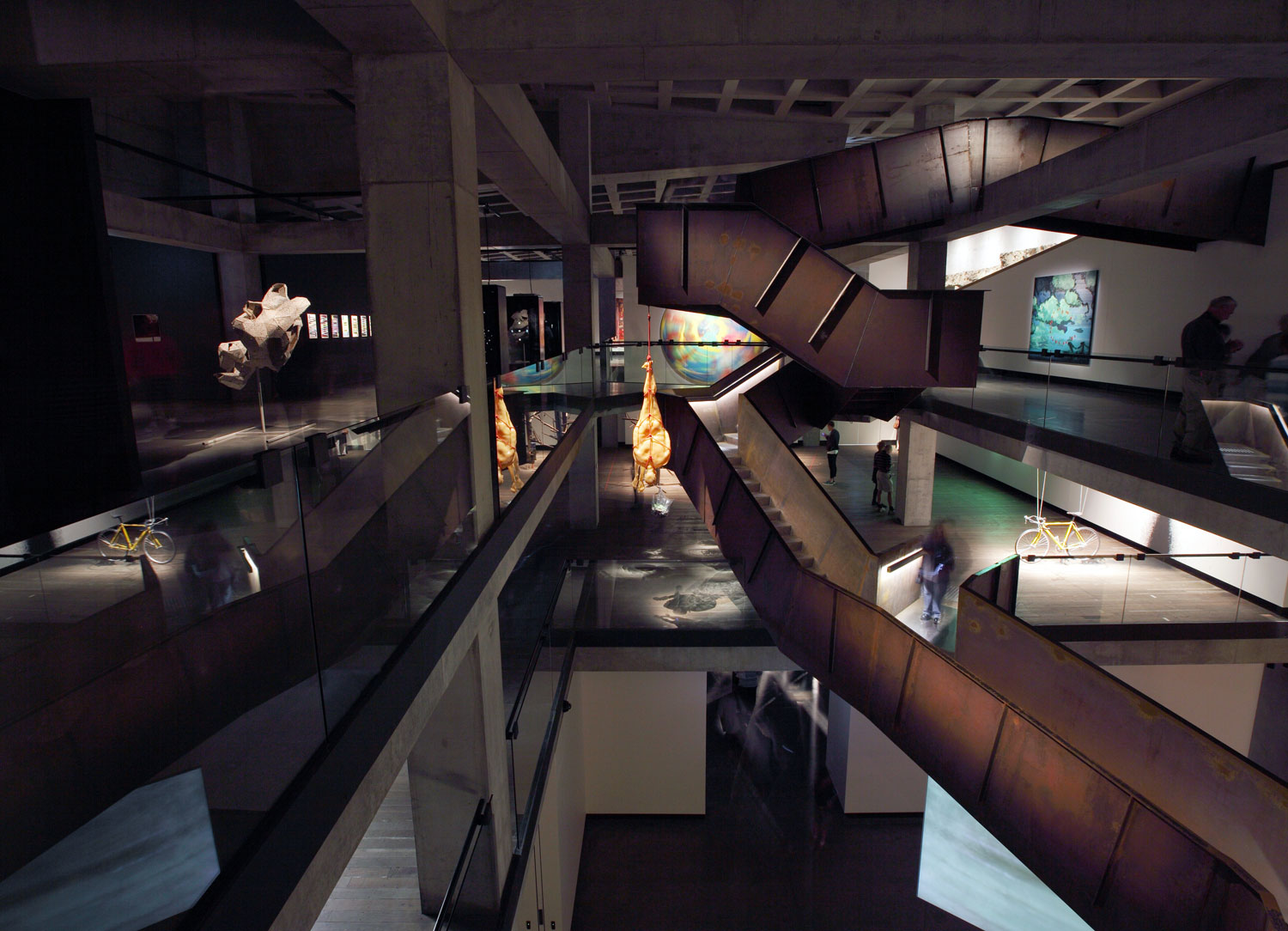
7/ The Museum of Old and New Art (MONA), Hobart, August 2011

My analogy: you are standing in the half-dark, your chest open, squeezing the beating heart with blood coursing between your fingers while the other hand is up your backside playing with your prostrate gland. I think ringmeister David Walsh would approve. My best friends analogy: a cross between a car park, night club, sex sauna and art gallery.

Weeks later I am still thinking about the wonderful immersive, sensory experience that is MONA. Peter Timms in an insightful article in Meanjin calls it a post-Google Wunderkammer, or wonder chest. It can be seen as a mirabilia – a non-historic installation designed primarily to delight, surprise and in this case shock. The body, sex, death and mortality are hot topics in the cultural arena and Walsh’s collection covers all bases. The collection and its display are variously hedonistic, voyeuristic, narcissistic, fetishistic pieces of theatre subsumed within the body of the spectacular museum architecture …

Spectatorship and their attendant erotics has MONA as a form of fetishistic cinema. It is as if what Barthes calls “the eroticism of place” were a modern equivalent of the eighteenth century genius loci, the “genius of the place.” The place is spectacular, the private collection writ large as public institution, the symbolic power of the institution masked through its edifice. The art become autonomous, cut free from its cultural associations, transnational, globalised, experienced through kinaesthetic means; the viewer meandering through the galleries, the anti-museum, as an international flaneur. Go. Experience!


Corten Stairwell & Surrounding Artworks February 2011 Museum of Old and New Art – interior


Corten Stairwell & Surrounding Artworks
February 2011
Museum of Old and New Art – interior
Photo credit: MONA/Leigh Carmichael
Image Courtesy of MONA Museum of Old and New Art


8/ John Bodin: Rite of Passage at Anita Traverso Gallery, Richmond, August – September 2011

John Bodin (Australian) 'I Was Far Away From Home' 2009


John Bodin (Australian)
I Was Far Away From Home
2009
Type C print on metallic paper
80 x 110cm


The photographs become the surface of the body, stitched together with lines, markers pointing the way – they are encounters with the things that we see before us but also the things that we carry inside of us. It is the interchange between these two things, how one modulates and informs the other. It is this engagement that holds our attention: the dappled light, ambiguity, unevenness, the winding path that floats and bobs before our eyes looking back at us, as we observe and are observed by the body of these landscapes.

One of the fundamental qualities of the photographs is that they escape our attempts to rationalise them and make them part of our understanding of the world, to quantify our existence in terms of materiality. I have an intimate feeling with regard to these sites of engagement. They are both once familiar and unfamiliar to us; they possess a sense of nowhereness. A sense of groundlessness and groundedness. A collapsing of near and far, looking down, looking along, a collapsing of the constructed world.

Like the road in these photographs there is no self just an infinite time that has no beginning and no end. The time before my birth, the time after my death. We are just in the world, just being somewhere. Life is just a temporary structure on the road from order to disorder. “The road is life,” writes Jack Kerouac in On the Road.


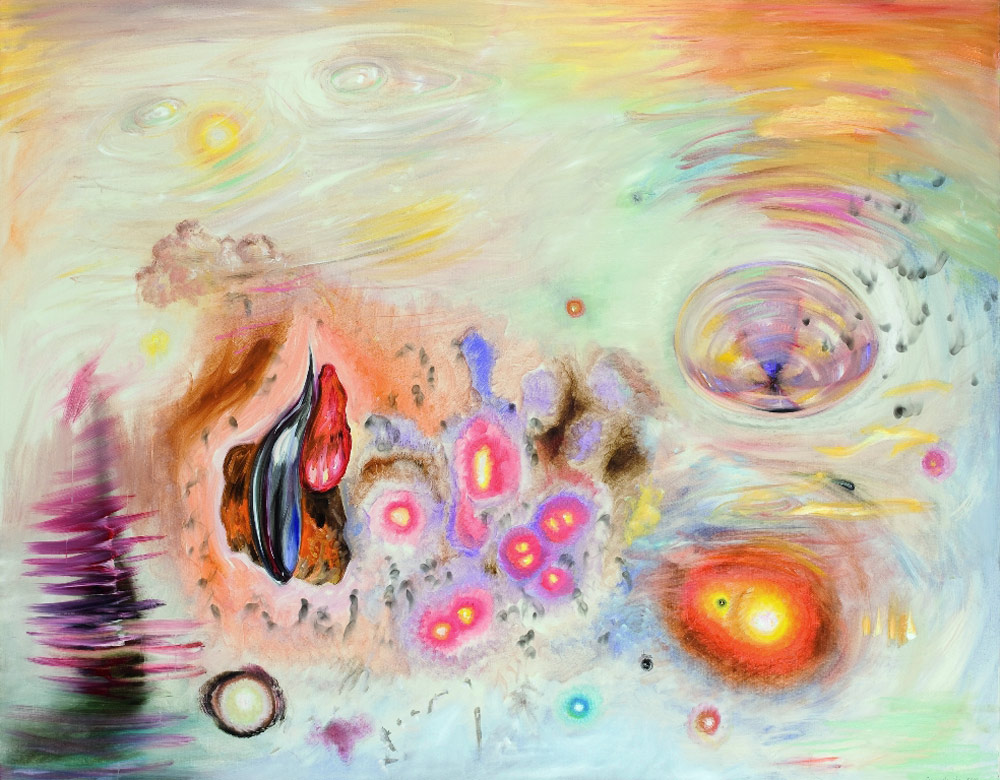
9/ Juan Davila: The Moral Meaning of Wilderness at the Monash University Museum of Art (MUMA), Caulfield, August – October 2011

Simply put, this was one of the best exhibitions I saw in Melbourne this year.

I had a spiritual experience with this work for the paintings promote in the human a state of grace. The non-material, the unconceptualisable, things which are outside all possibility of time and space are made visible. This happens very rarely but when it does you remember, eternally, the time and space of occurrence. I hope you had the same experience.


Juan Davila (Chilean, b. 1946, emigrated Australia 1974) 'Wilderness' 2010


Juan Davila (Chilean, b. 1946, emigrated Australia 1974)
Wilderness
2010
© Juan Davila, Courtesy Kalli Rolfe Contemporary Art


10/ In camera and in public at the Centre for Contemporary Photography, Melbourne, September – October 2011

Kohei Yoshiyuki (Japanese, b. 1946) 'Untitled' 1971


Kohei Yoshiyuki (Japanese, b. 1946)
Untitled
1971
From the series The Park
Gelatin Silver Print
© Kohei Yoshiyuki, Courtesy Yossi Milo Gallery, New York


Curated by Naomi Cass as part of the Melbourne Festival, this was a brilliant exhibition at the Centre for Contemporary Photography, Melbourne. The exhibition explored, “the fraught relationship between the camera and the subject: where the image is stolen, candid or where the unspoken contract between photographer and subject is broken in some way – sometimes to make art, sometimes to do something malevolent.” It examined the promiscuity of gazes in public / private space specifically looking at surveillance, voyeurism, desire, scopophilia, secret photography and self-reflexivity. It investigated the camera and its moral and physical relationship to the unsuspecting subject.


11/ The Mad Square: Modernity in German Art 1910 – 37 at The National Gallery of Victoria, Melbourne, November 2011 – March 2012

This is one of the best exhibitions this year in Melbourne bar none. Edgy and eclectic the work resonates with the viewer in these days of uncertainty: THIS should have been the Winter Masterpieces exhibition!

The title of the exhibition, The mad square (Der tolle Platz) is taken from Felix Nussbaum’s 1931 painting of the same name where “the ‘mad square’ is both a physical place – the city, represented in so many works in the exhibition, and a reference to the state of turbulence and tension that characterises the period.”The exhibition showcases how artists responded to modern life in Germany in the interwar years, years that were full of murder and mayhem, putsch, revolution, rampant inflation, starvation, the Great Depression and the rise of National Socialism. Portrayed is the dystopian, dark side of modernity (where people are the victims of a morally bankrupt society) as opposed to the utopian avant-garde (the prosperous, the wealthy), where new alliances emerge between art and politics, technology and the mass media. Featuring furniture, decorative arts, painting, sculpture, collage and photography in the sections World War 1 and the Revolution, Dada, Bauhaus, Constructivism and the Machine Aesthetic, Metropolis, New Objectivity and Power and Degenerate Art, it is the collages and photographs that are the strongest elements of the exhibition, particularly the photographs. What a joy they are to see.


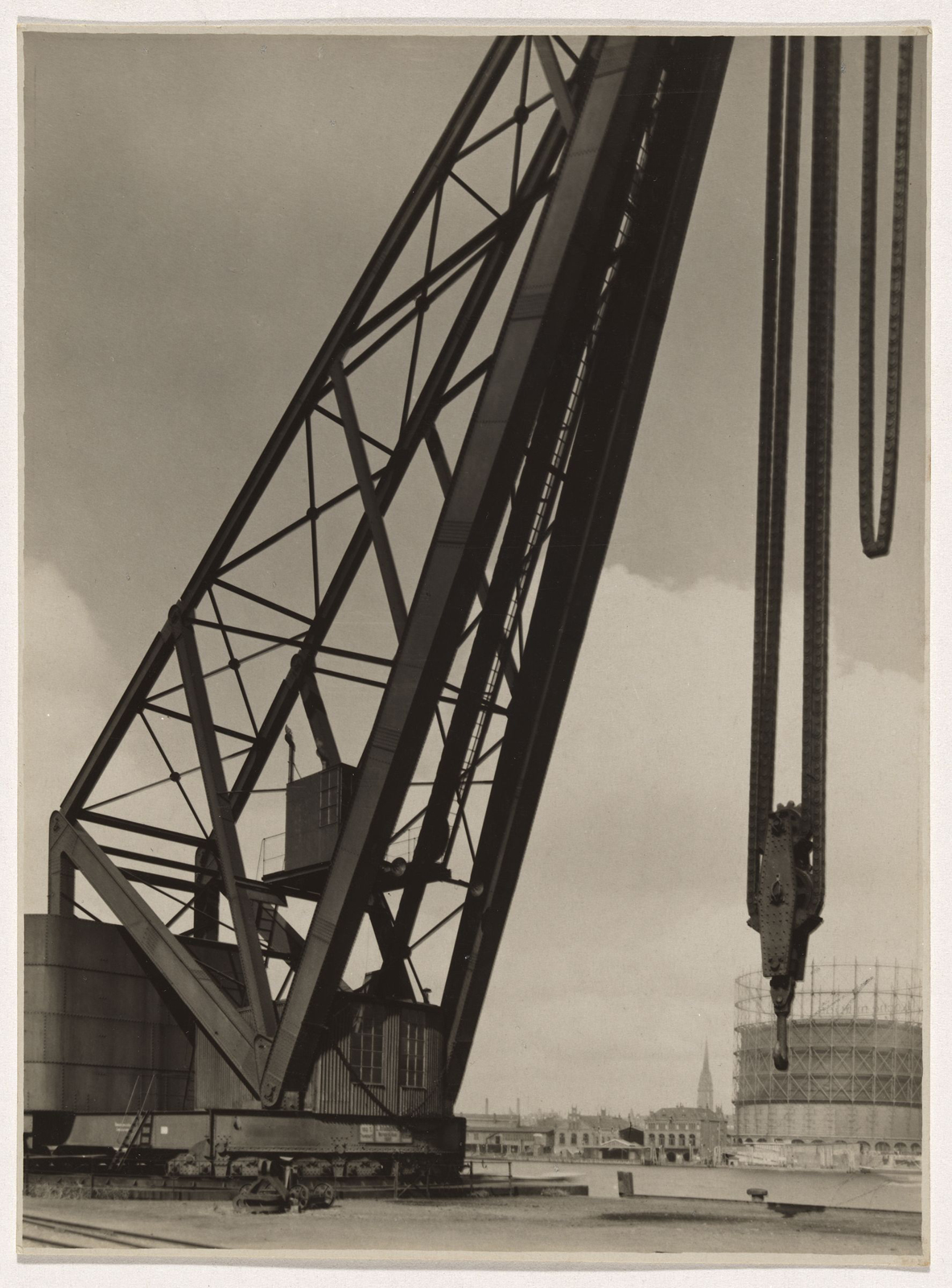
Albert Renger-Patzsch (American born Hungary, 1895-1946) 'Harbour with crane' c. 1927


Albert Renger-Patzsch (American born Hungary, 1895-1946)
Harbour with crane
c. 1927
Gelatin silver photograph
Printed image 22.7 h x 16.8 w cm
Purchased 1983
National Gallery of Australia, Canberra


LIKE ART BLART ON FACEBOOK

Back to top

Review: ‘The mad square: Modernity in German Art 1910-37’ at The National Gallery of Victoria, Melbourne

Exhibition dates: 25th November 2011 – 4th March 2012


Irene Bayer (American, 1898-1991) 'No title (Man on stage)' c. 1927


Irene Bayer (American, 1898-1991)
No title (Man on stage)
c. 1927
Gelatin silver photograph
Printed image 10.6 h x 7.6 w cm
Purchased 1983
National Gallery of Australia, Canberra


This is one of the best exhibitions this year in Melbourne bar none. Edgy and eclectic the work resonates with the viewer in these days of uncertainty: THIS should have been the Winter Masterpieces exhibition!

The title of the exhibition, The mad square (Der tolle Platz) is taken from Felix Nussbaum’s 1931 painting of the same name where “the ‘mad square’ is both a physical place – the city, represented in so many works in the exhibition, and a reference to the state of turbulence and tension that characterises the period.” The exhibition showcases how artists responded to modern life in Germany in the interwar years, years that were full of murder and mayhem, putsch, revolution, rampant inflation, starvation, the Great Depression and the rise of National Socialism. Portrayed is the dystopian, dark side of modernity (where people are the victims of a morally bankrupt society) as opposed to the utopian avant-garde (the prosperous, the wealthy), where new alliances emerge between art and politics, technology and the mass media. Featuring furniture, decorative arts, painting, sculpture, collage and photography in the sections World War 1 and the Revolution, Dada, Bauhaus, Constructivism and the Machine Aesthetic, Metropolis, New Objectivity and Power and Degenerate Art, it is the collages and photographs that are the strongest elements of the exhibition, particularly the photographs. What a joy they are to see.

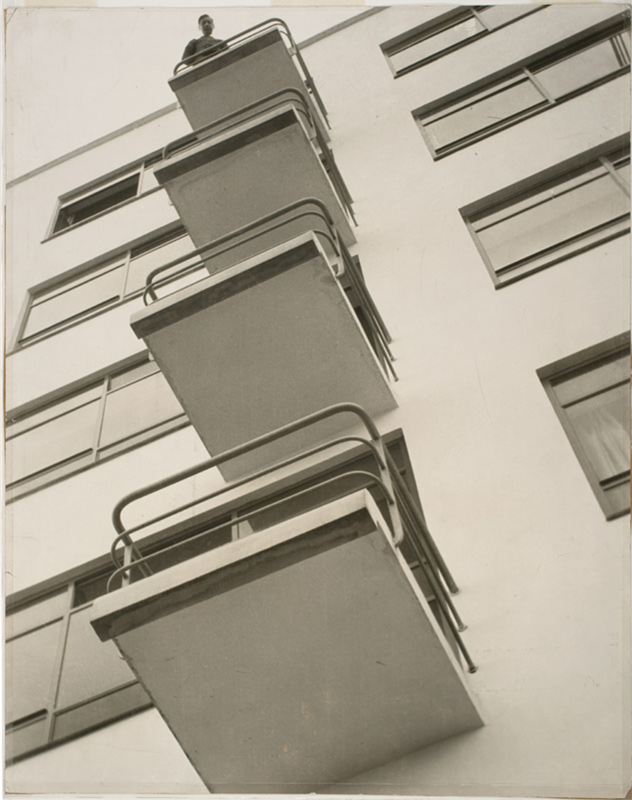
There is a small 2″ x 3″ contact print portrait of Hanna Höch by Richard Kauffmann, Penetrate yourself or: I embrace myself (1922) that is an absolute knockout. Höch is portrayed as the ‘new women’ with short bobbed hair and loose modern dress, her self-image emphasised through a double exposure that fragments her face and multiplies her hands, set against a contextless background. The ‘new women’ fragmented and broken apart (still unsure of herself?). The photograph is so small and intense it takes your breath away. Similarly, there is the small, intimate photograph No title (Man on Stage) (c. 1927) by Irene Bayer (see above) that captures performance as ‘total art’, a combination of visual arts, dance, music, architecture and costume design. In contrast is a large 16 x 20″ photograph of the Bauhaus balconies (1926) by László Moholy-Nagy (see below) where the whites are so creamy, the perspective so magnificent.

No title (Metalltanz) (c. 1928-1929) by T. Lux Feinenger, a photographer that I do not know well, is an exceptional photograph and print. Again small, this time dark and intense, the image features man as dancer performing gymnastics in front of reflective, metal sculptures. The metal becomes an active participant in the Metalltanz or ‘Dance in metal’ because of its reflective qualities. The print, from the J. Paul Getty Museum in Los Angeles is luminous. In fact all the prints from the Getty in this exhibition are of the most outstanding quality, a highlight of the exhibition for me. Another print from the Getty that features metal and performance is Untitled (Spiral Costume, from the Triadic Ballet) by T Grill c. 1926-1927 (see below) where the spiral costume becomes an extension of the body, highlighting its form. Also highlighting form, objectivity and detachment is a wonderful 3 x 5″ photograph of the New Bauhaus Building, Dessau (1926) by Lucia Moholy from the Getty collection, the first I have ever seen in the flesh by this artist. Outstanding.

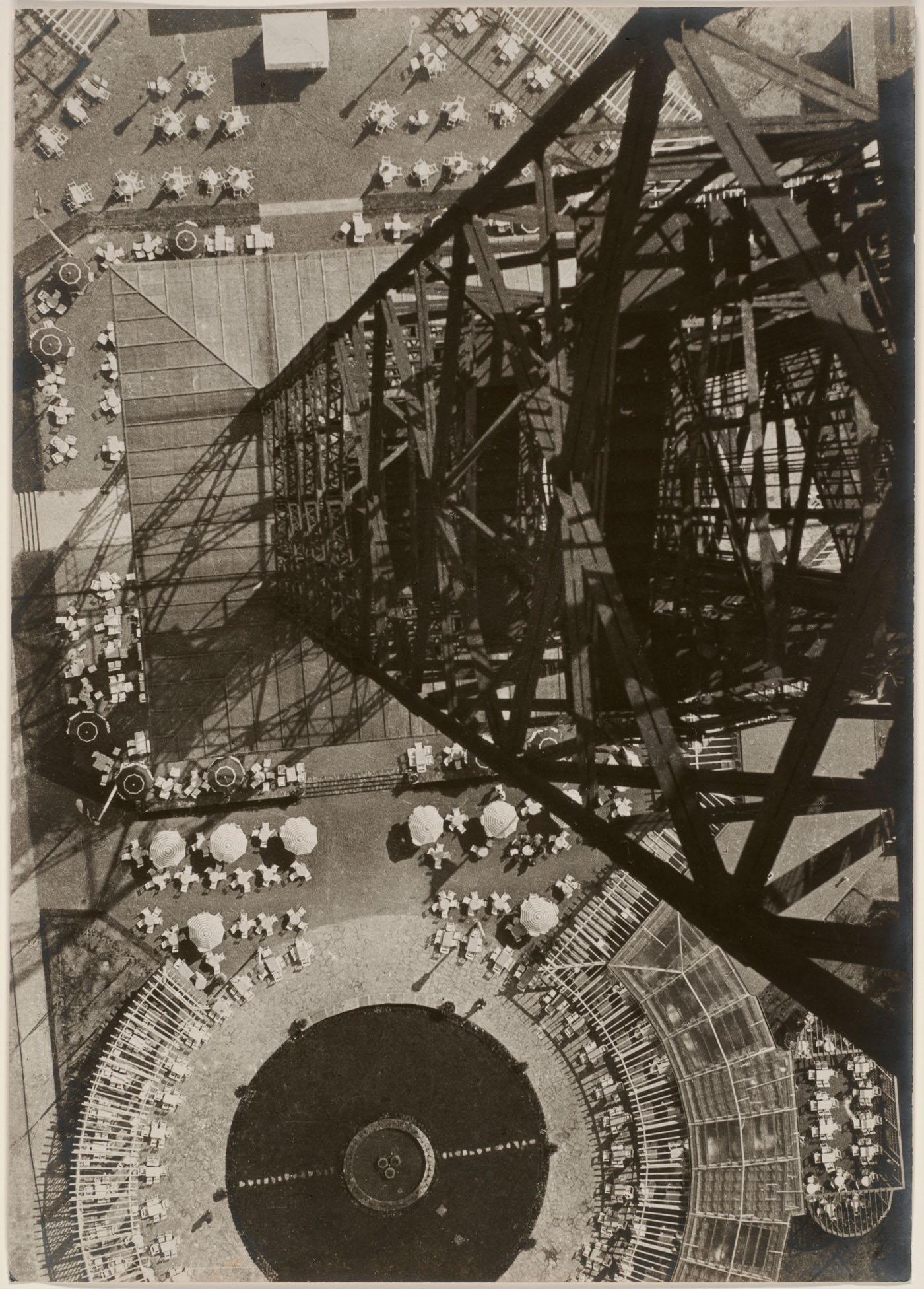
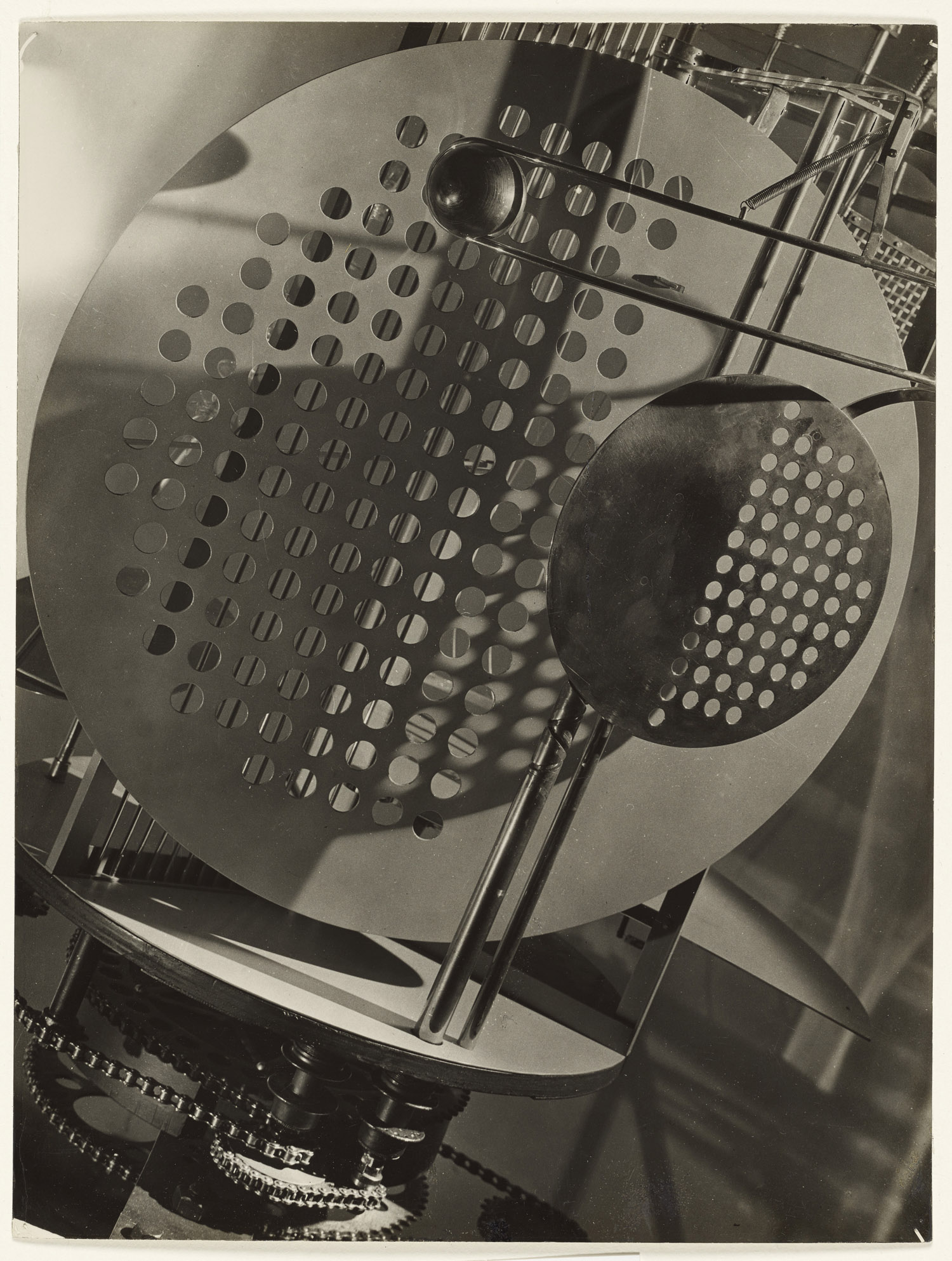
Following, we have 4 photograms by Lucia’s husband, László Moholy-Nagy which display formalist experimentation “inspired by machine aesthetic, exploring a utopian belief that Constructivism and abstract art could play a role in the process of social reform.” Complimenting these photograms is a row of six, yes six! Moholy-Nagy including Dolls (Puppen) 1926-1927 (Getty), The law of the series 1925 (Getty), Lucia at the breakfast table 1926 (Getty), Spring, Berlin 1928 (George Eastman House), Berlin Radio Tower 1928 (Art Institute of Chicago) and Light space modulator 1930 (Getty). All six photographs explore the fascinating relationship between avant-garde art and photography, between they eye and perspective, all the while declaiming what Moholy-Nagy called the “new vision”; angles, shadows and geometric patterns that defy traditional perspective “removing the space from associations with the real world creating a surreal, disjointed image.” This topographic mapping flattens perspective in the case of the Berlin radio tower allowing the viewer to see the world in a new way.

Finally two groups of photographs that are simply magnificent.

First 8 photographs in a row that focus on the order and progressive nature of the modern world, the inherent beauty of technology captured in formalist studies of geometric forms. The prints range from soft pictorialist renditions to sharp clarity. The quality of the prints is amazing. Artists include the wonderful E. O. Hoppé, Albert Renger-Patzsch (an outstandingly beautiful photograph, Harbour with cranes 1927 that is my favourite photograph in the exhibition, see below), Two Towers 1937-1938 by Werner Mantz and some early Wolfgang Sievers before he left Germany for Australia in 1938 (Blast furnace in the Ruhr, Germany 1933, see below). These early Sievers are particularly interesting, especially when we think of his later works produced in Australia. Lucky were many artists who survived in Germany or fled from Nazi persecution at the last moment, including John Heartfield who relocated to Czechoslovakia in 1933 and then fled to London in 1938 and August Sander whose life and work were severely curtailed under the Nazi regime and whose son died in prison in 1944 near the end of his ten year sentence (Wikipedia).

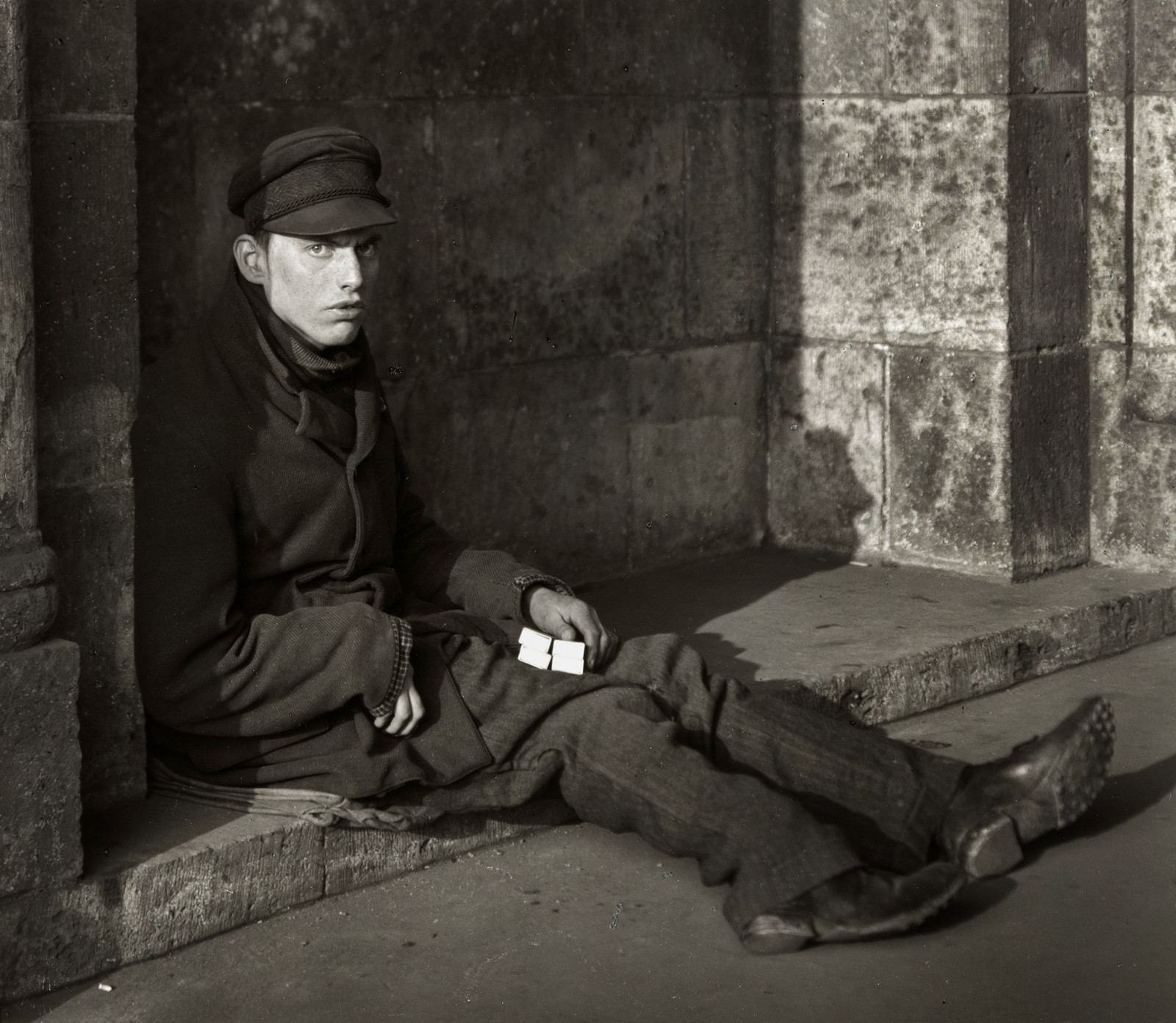
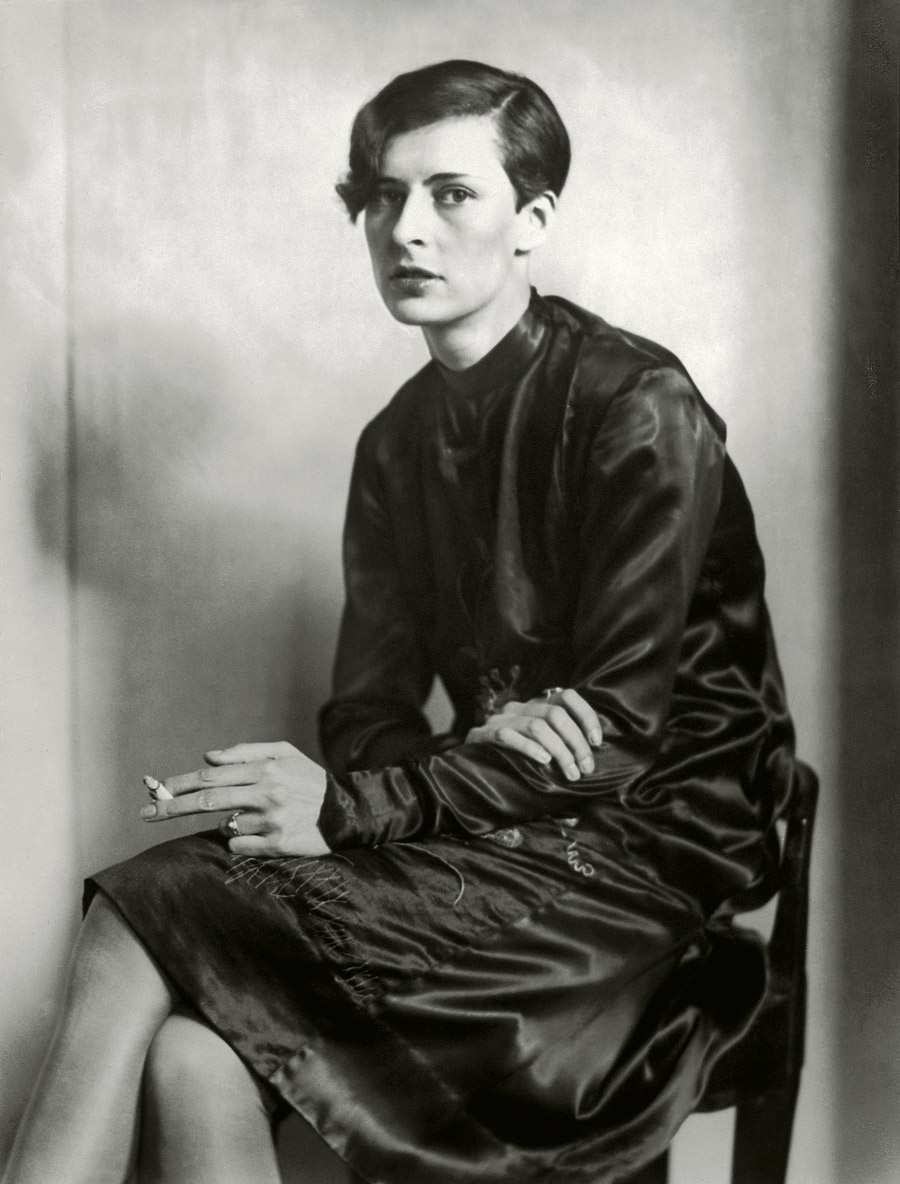
August Sander. Now there is a name to conjure with. The second magnificent group are 7 photographs that are taken from Sander’s seminal work People of the 20th Century. All the photographs have soft, muted tones of greys with no strong highlights and, usually, contextless backgrounds. The emphasis is on archetypes, views of people who exist on the margins of society – circus performers, bohemians, artists, the unemployed and blind people. In all the photographs there is a certain frontality (not necessarily physical) to the portraits, a self consciousness in the sitter, a wariness of the camera and of life. This self consciousness can be seen in the two photographs that are the strongest in the group – Secretary at West German radio in Cologne, 1931 and Match seller 1927 (see below).

There is magic here. Her face wears a somewhat quizzical air – questioning, unsure, vulnerable – despite the trappings of affluence and fashionability (the smoking of the cigarette, the bobbed hair). He is wary of the camera, his face and hands isolated by Sander while the rest of his body falls into shadow. His right hand is curled under, almost deformed, his shadow falling on the stone at right, the only true brightness in this beautiful image the four boxes of matches he clutches in his left hand: as Sander titles him ironically, The Businessman.

Working as I do these days with lots of found images from the 1940s-1960s that I digitally restore to life, I wonder what happened to these people during the dark days of World War 2. Did they survive the cataclysm, the drop into the abyss? I want to know, I want to reach out to these people to send them good energy. I hope that they did but their wariness in front of the camera, so intimately ‘taken’ by Sander, makes me feel the portent of things to come. How differently we see images armed with the hindsight of history!

In conclusion, this is a fantastic exhibition that will undoubtedly be in my top ten of the year for Melbourne in 2011.

Dr Marcus Bunyan


Many thankx to Michael Thorneycroft for his help and The National Gallery of Victoria for allowing me to publish the accredited photographs in the posting. Please click on the photographs for a larger version of the image.


Felix Nussbaum (German, 1904 - after September 1944) 'The mad square' (Der tolle Platz) 1931


Felix Nussbaum (German, 1904 – after September 1944)
The mad square (Der tolle Platz)
1931
Oil on canvas
97 x 195.5cm
Berlinische Galerie
Public domain


László Moholy-Nagy (American born Hungary, 1895-1946) 'Photograph (Berlin Radio Tower)' 1928/1929


László Moholy-Nagy (American born Hungary, 1895-1946)
Berlin Radio Tower
1928
Gelatin silver print
36 × 25.5cm
Julien Levy Collection, Special Photography Acquisition Fund
© 2018 Artists Rights Society (ARS), New York / VG Bild-Kunst, Bonn


Over the winter and spring of 1927-1928, Bauhaus professor László Moholy-Nagy took a series of perhaps nine views looking down from the Berlin Radio Tower, one of the most exciting new constructions in the German capital. Moholy had already photographed the Eiffel Tower in Paris from below, looking up through the tower’s soaring girders. In Berlin, however, Moholy turned his camera around and pointed it straight down at the ground. This plunging perspective showed off the spectacular narrowness of the Radio Tower, finished in 1926, which rose vertiginously to a height of 450 feet from a base seven times smaller than that of its Parisian predecessor (which opened in 1889). Moholy attached exceptional importance to this, his boldest image: he hung it just above his name in a room devoted to his work at the Berlin showing of Film und Foto, a mammoth traveling exhibition that he had helped to prepare. Moholy also chose this view and one other to offer Julien Levy, the pioneering art dealer, when Levy visited him in Berlin in 1930. The following year the pictures went on view at the Levy Gallery in New York, in Moholy’s first solo exhibition of photographs.

Text from the Art Institute of Chicago website


László Moholy-Nagy (American born Hungary, 1895-1946) 'Photograph (Light Prop)' 1930


László Moholy-Nagy (American born Hungary, 1895-1946)
Das Lichtrequisit (The light prop)
1930
Gelatin silver print
24 × 18.1cm (9 7/16 × 7 1/8 in.)
J. Paul Getty Museum, Los Angeles
© 2014 Estate of László Moholy-Nagy / Artists Rights Society (ARS), New York


The Light-Space Modulator is the most spectacular and complete realisation of László Moholy-Nagy’s artistic philosophy. Machine parts and mechanical structures began to appear in his paintings after his emigration from Hungary, and they are also seen in the illustrations he selected for the 1922 Buch neuer Künstler (Book of new artists), which includes pictures of motorcars and bridges as well as painting and sculpture. Many contemporary artists incorporated references to machines and technology in their work, and some, like the Russian Constructivist Vladimir Tatlin, even designed plans for fantastic structures, such as the ambitious Monument to the Third International, a proposed architectural spiral of glass and steel with moving tiers and audiovisual broadcasts. (See Tatlin’s Tower.)

In the Light-Space Modulator, Moholy-Nagy was able to create an actual working mechanism. Although he censured capitalism’s inhumane use of technology, he believed it could be harnessed to benefit mankind and that the artist had an important role in accomplishing this. Moholy had made preliminary sketches for kinetic sculptures as early as 1922 and referred to the idea for a light machine in his writings, but it was not until production was financed by an electric company in Berlin in 1930 that this device was built, with the assistance of an engineer and a metalsmith. It was featured at the Werkbund exhibition in Paris the same year, along with the short film Light Display Black-White-Gray, made by Moholy-Nagy to demonstrate and celebrate his new machine.

The Light-Space Modulator is a Moholy-Nagy painting come to life: mobile perforated disks, a rotating glass spiral, and a sliding ball create the effect of photograms in motion. With its gleaming glass and metal surfaces, this piece (now in the collection of the Busch-Reisinger Museum at Harvard University) is not only a machine for creating light displays but also a sculptural object of beauty, photographed admiringly by its creator.

Katherine Ware, László Moholy-Nagy, In Focus: Photographs from the J. Paul Getty Museum (Los Angeles: J. Paul Getty Museum, 1995), 80 © 1995 The J. Paul Getty Museum


Albert Renger-Patzsch (American born Hungary, 1895-1946) 'Harbour with crane' c. 1927


Albert Renger-Patzsch (American born Hungary, 1895-1946)
Harbour with crane
c. 1927
Gelatin silver photograph
Printed image 22.7 h x 16.8 w cm
Purchased 1983
National Gallery of Australia, Canberra


Wolfgang Sievers (Germany 1913 - Australia 2007) 'Blast furnace in the Ruhr, Germany' 1933


Wolfgang Sievers (Germany 1913 – Australia 2007)
Blast furnace in the Ruhr, Germany
1933
Gelatin silver photograph
27.5 h x 23 w cm
Purchased 1988
National Gallery of Australia, Canberra


The Ruhr region was at the centre of the German acceleration of industry in pre-war Germany, with rapid economic growth creating a heavy demand for coal and steel. In keeping with Modernist trends in photography, Sievers shot this blast furnace – the mechanism that transforms ore into metal – from an unusual, dynamic angle. It dominates the frame, appearing menacing and strange. Despite being imprisoned and beaten by the Gestapo, Sievers studied and taught at a progressive private art school until graduation in 1938. In that year he escaped Germany after being called up for military service, ending up in Australia.

Text © National Gallery of Australia, Canberra


August Sander (German, 1876-1964) 'Match seller' 1927


August Sander (German, 1876-1964)
Match seller
1927
From the portfolio People of the 20th century, IV Classes and Professions, 17 The Businessman


Robert Wiene, Director (German 1873-1938) Still from the 'Cabinet of Dr Caligari' 1919


Robert Wiene, Director (German 1873-1938)
Still from from the Cabinet of Dr Caligari
1919
5 min excerpt, 35mm transferred to DVD, Black and White, silent, German subtitles
Courtesy Transit Film GmbH
Production still courtesy of the British Film Institute and Transit Film GmbH


Felix H Man (German, 1893-1985) 'Luna Park' 1929


Felix H Man (German, 1893-1985)
Luna Park
1929
Gelatin silver photograph
18.1 x 24cm
National Gallery of Australia, Canberra
Purchased, 1987
© Felix H Man Estate


Hannah Höch (German, 1889-1978) 'Love' 1931


Hannah Höch (German, 1889-1978)
Love
1931
From the series Love
Photomontage
21.8 x 21cm
National Gallery of Australia, Canberra
Purchased, 1983


Hannah Höch made some of the most interesting Dada collages and photomontages, including Love, an image of two strange composite female. Höch’s technique of pasting images together from magazine clippings and advertisements was a response to the modern era of mass media, and a way of criticising the bourgeois taste for ‘high art’. In many of her works, Höch explores the identity and changing roles of women in modern society.


The Mad Square takes its name from Felix Nussbaum’s 1931 painting which depicts Berlin’s famous Pariser Platz as a mad and fantastic place. The ‘mad square’ is both a physical place – the city, represented in so many works in the exhibition, and a reference to the state of turbulence and tension that characterises the period. The ‘square’ can also be a modernist construct that saw artists moving away from figurative representations towards increasingly abstract forms.

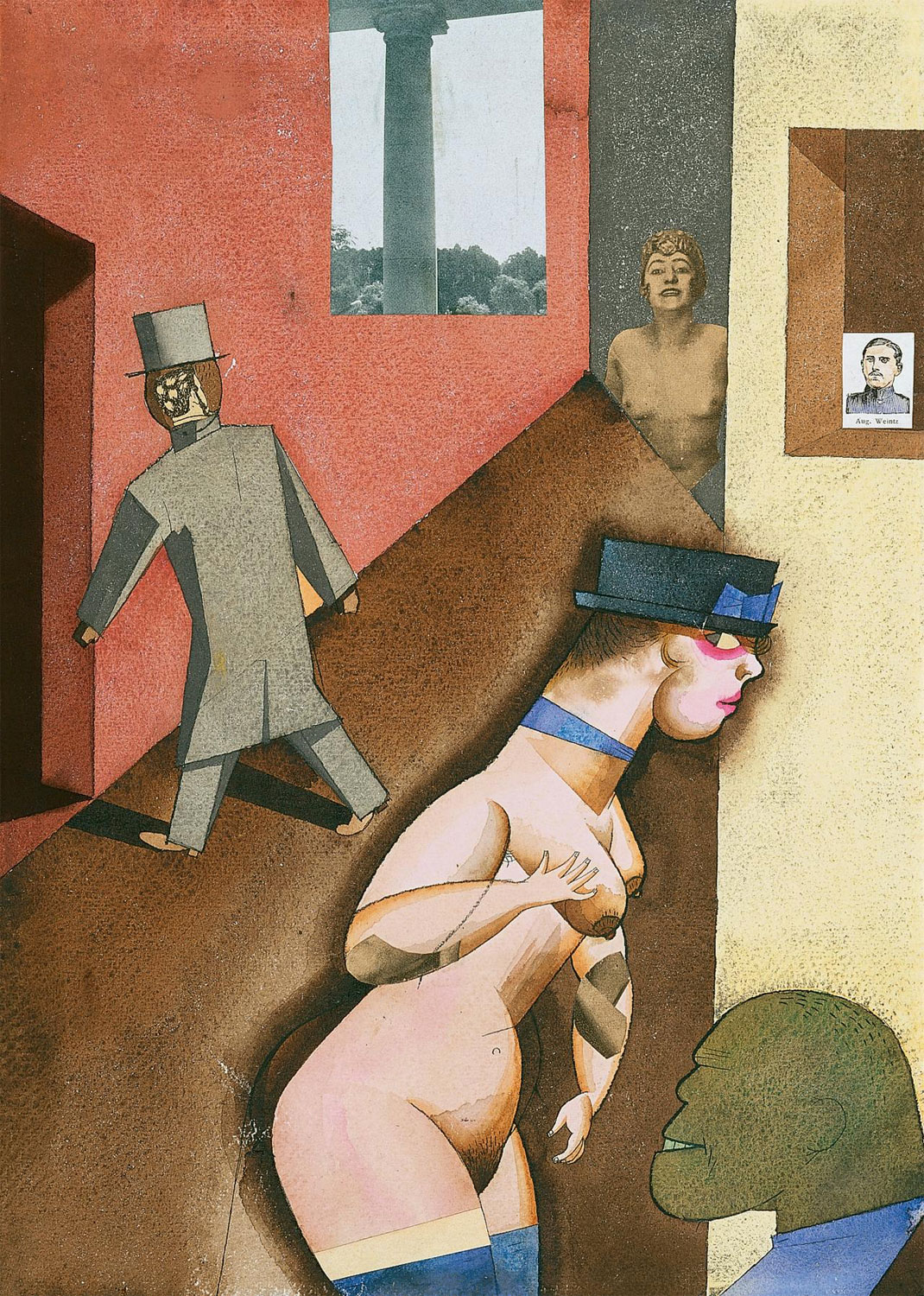
The exhibition features works by Max Beckman, Otto Dix, George Grosz, Christian Schad, Kurt Schwitters and August Sander. This group represents Germany’s leading generation of interwar artists. Major works by lesser known artists including Karl Hubbuch, Rudolf Schlichter and Hannah Höch are also presented in the exhibition in addition to works by international artists who contributed to German modernism.

The Mad Square brings together a diverse and extensive range of art, created during one of the most important and turbulent periods in European history, offering new insights into the understanding of key German avant‐garde movements including – Expressionism, Dada, Bauhaus, Constructivism, and New Objectivity were linked by radical experimentation and innovation, made possible by an unprecedented freedom of expression.

World War 1 and the Revolution

The outbreak of war in 1914 was met with enthusiasm by many German artists and intellectuals who volunteered for service optimistically hoping that it would bring cultural renewal and rapid victory for Germany. The works in this section are by the generation of artists who experienced war first hand. Depictions of fear, anxiety and violence show the devastating effects of war – the disturbing subjects provide insight into tough economic conditions and social dysfunction experienced by many during the tumultuous early years of the Weimar Republic following the abdication of the Kaiser

Dada

The philosophical and political despair experienced by poets and artists during World War 1 fuelled the Dada movement, a protest against the bourgeois conception of art. Violent, infantile and chaotic, Dada took its name from the French word for a child’s hobbyhorse or possibly from the sound of a baby’s babble. Its activities included poetry readings and avant‐garde performances, as well as creating new forms of abstract art that subverted all existing conditions in western art. Though short‐lived, in Germany the Dada movement has profoundly influenced subsequent developments in avant-garde art and culture. The impact of the Dada movement was felt throughout Europe – and most powerfully in Germany from 1917-21.

Bauhaus

The Bauhaus (1919‐1933) is widely considered as the most important school of art and design of the 20th century, very quickly establishing a reputation as the leading and most progressive centre of the international avant‐garde. German architect Walter Gropius founded the school to do away with traditional distinctions between the fine arts and craft, and to forge an entirely new kind of creative designer skilled in both the conceptual aesthetics of art and the technical skills of handicrafts. The Bauhaus was considered to be both politically and artistically radical from its inception and was closed down by the National Socialists in 1933

Constructivism and the Machine Aesthetic

Having emerged in Russia after World War I, Constructivism developed in Germany as a set of ideas and practices that experimented with abstract or non-representational forms and in opposition to Expressionism and Dada. Constructivists developed works and theories that fused art and with technology. They shared a utopian belief in social reform, and saw abstract art as playing a central role in this process.

Metropolis

By the 1920s Berlin has become the cultural and entertainment capital of the world and mass culture played an important role in distracting a society traumatised by World War 1, the sophisticated metropolis provided a rich source of imagery for artists, it also come to represent unprecedented sexual and personal freedom. In photography modernity was emphasised by unusual views of the metropolis or through the representation of city types. The diverse group of works in this section portray the uninhibited sense of freedom and innovation experienced by artists throughout Germany during the 1920s

New Objectivity

By the mid 1920s, a new style emerged that came to be known as Neue Sachlichkeit or New Objectivity. After experiencing the atrocities of World War 1 and the harsh conditions of life in postwar Germany, many artists felt the need to return to the traditional modes of representation with portraiture becoming a major vehicle of this expression, with its emphasis on the realistic representation of the human figure

Power and Degenerate Art

After the seizure of power by the National Socialists in 1933 modern artists were forbidden from working and exhibiting in Germany, with their works confiscated from leading museums and then destroyed or sold on the international art market. Many avant‐garde artists were either forced to leave Germany or retreat into a state of ‘inner immigration’.

The Degenerate art exhibition, held in Munich in 1937, represented the culmination of the National Socialists’ assault on modernism. Hundreds of works were selected for the show which aimed to illustrate the mental deficiency and moral decay that had supposedly infiltrated modern German art. The haphazard and derogatory design of the exhibition sought to ridicule and further discredit modern art. Over two million people visited the exhibition while in contrast far fewer attended the Great German art exhibition which sought to promote what the Nazis considered as ‘healthy’ art.


Karl Grill (German active Donaueschingen, Germany 1920s) 'Untitled [Spiral Costume, from the Triadic Ballet]' c. 1926-1927


Karl Grill (German active Donaueschingen, Germany 1920s)
Untitled (Spiral Costume, from the Triadic Ballet)
c. 1926-1927
Gelatin silver print
22.5 x 16.2cm
J. Paul Getty Museum, Los Angeles


In 1922, Oskar Schlemmer premiered his “Triadic Ballet” in Germany. He named the piece “Triadic” because it was literally composed of multiples of three: three acts, colours, dancers, and shapes. Concentrating on its form and movement, Schlemmer explored the body’s spatial relationship to its architectural surroundings. Although an abstract design, the spiral costume derived from the tutus of classical ballet.

Text from the J. Paul Getty Museum website


August Sander (German, 1876-1964) 'Secretary at West German radio in Cologne' 1931, printed by August Sander in the 1950s


August Sander (German, 1876-1964)
Secretary at West German radio in Cologne
1931, printed by August Sander in the 1950s
From the portfolio People of the 20th century, III The woman, 17 The woman in intellectual and practical occupation
Gelatin silver photograph
29 x 22cm
Die Photographische Sammlung /SK Stiftung Kultur, August Sander Archiv, Cologne (DGPH1016)
© Die Photographische Sammlung /SK  Stiftung Kultur – August Sander Archiv, Cologne. Licensed by Viscopy, Sydney


Timeline

1910

~ Berlin’s population doubles to two million people

1911

~ Expressionists move from Dresden to Berlin

1912

~ Social Democratic Party (SPD) the largest party in the Reichstag

1913

~ Expressionists attain great success with their city scenes

1914

~ World War I begins
~ George Grosz, Oskar Schlemmer, Otto Dix, Ludwig Hirschfeld Mack, Ernst Ludwig Kirchner, Max Beckmann and Franz Marc enlist in the army

1915

~ Grosz declared unfit for service, Beckmann suffers a breakdown and Schlemmer wounded

1916

~ Marc dies in combat
~ Dada begins at Cabaret Voltaire in Zurich

1917

~ Lenin and Trotsky form the Soviet Republic after the Tzar is overthrown

1918

~ Richard Huelsenbeck writes a Dada manifesto in Berlin
~ Kurt Schwitters creates Merz assemblages in Hanover
~ Revolutionary uprisings in Berlin and Munich
~ Kaiser Wilhelm II abdicates and flees to Holland
~ Social Democratic Party proclaims the Weimar Republic
~ World War I ends

1919

~ Freikorps assassinates the Spartacist leaders, Karl Leibknecht and Rosa Luxemburg
~ Bauhaus established in Weimer by Walter Gropius
~ Cologne Dada group formed
~ Treaty of Versailles signed

1920

~ Berlin is the world’s third largest city after New York and London
~ Inflation begins in Germany
~ National Socialist German Workers Party (NSDAP) founded
~ Kapp Putsch fails after right‐wing forces try to gain control over government
~ First International Dada fair opens in Berlin

1921

~ Hitler made chairman of the NSDAP

1922

~ Schlemmer’s Triadic ballet premiers in Stuttgart
~ Hyperinflation continues

1923

~ Hitler sentenced to five years imprisonment for leading the Beer Hall Putsch
~ Inflation decreases and a period of financial stability begins

1924

~ Hitler writes Mein Kampf while in prison
~ Reduction of reparations under the Dawes Plan

1925

~ New Objectivity exhibition opens at the Mannheim Kunsthalle
~ The Bauhaus relocates to Dessau

1926

~ Germany joins the League of Nations

1927

~ Fritz Lang’s film Metropolis released
~ Unemployment crisis worsens
~ Nazis hold their first Nuremburg party rally

1928

~ Bertolt Brecht and Kurt Weill’s The threepenny opera premieres in Berlin
~ Hannes Meyer becomes the second director of the Bauhaus

1929

~ Street confrontations between the Nazis and communists in Berlin
~ Young Plan accepted, drastically reducing reparations
~ Stock market crashes on Wall Street, New York
~ Thomas Mann awarded the Nobel Prize for literature

1930

~ Resignation of Chancellor Hermann Müller’s cabinet ending parliamentary rule
~ Minority government formed by Heinrich Brüning, leader of the Centre Party
~ Nazis win 18% of the vote and gain 95 seats in the National elections
~ Ludwig Miles van der Rohe becomes the third director of the Bauhaus
~ John Heartfield creates photomontages for the Arbeiter‐Illustrierte Zeitung (AIZ)

1931

~ Unemployment reaches five million and a state of emergency is declared in Germany

1932

~ Nazis increase their representation in the Reichstag to 230 seats but are unable to form a majority coalition
~ Miles van der Rohe moves the Bauhaus to Berlin
~ Grosz relocates to New York as an exile

1933

~ Hindenberg names Hitler as Chancellor
~ Hitler creates a dictatorship under the Nazi regime
~ The first Degenerate art exhibition denouncing modern art is held in Dresden
~ Miles van der Rohe announces the closure of the Bauhaus
~ Nazis organise book burnings in Berlin
~ Many artists including Gropius, Kandinski and Klee flee Germany
~ Beckmann, Dix and Schlemmer lose their teaching positions

1934

~ Fifteen concentration camps exist in Germany

1935

~ The swastika becomes the flag of the Reich

1936

~ Spanish civil war begins
~ Germany violates the Treaty of Versailles
~ Olympic Games held in Garmisch‐Partenkirchen and Berlin
~ Thomas Mann deprived of his citizenship and emigrates to the United States

1937

~ German bombing raids over Guernica in Spain in support of Franco
~ The Nazi’s Degenerate art exhibition opens in Munich and attracts two million visitors
~ Beckmann, Kirchner and Schwitters leave Germany
~ Purging of ‘degenerate art’ from German museums continues 1


1/ Timeline credit: Chronology compiled by Jacqueline Strecker and Victoria Tokarowski from the following sources:

~ Catherine Heroy ‘Chronology’ in Sabine Rewald, Glitter and Doom: German portraits from the 1920s, Metropolitan Museum of Art, New York, exh cat, 2006, pp. 39‐46
~ Anton Kaes, Martin Jay and Edward Dimendberg, eds, ‘Political chronology’, The Weimar Republic sourcebook, Berkely 1994, pp. 765‐71
~ Jonathan Petropoulos and Dagmar Lott‐Reschke ‘Chronology’ in Stephanie Barron, ‘Degenerate Art’: the fate of the avant‐garde in Nazi Germany, Los Angeles County Museum of Art, exh cat, 1991, pp. 391‐401


László Moholy-Nagy (American born Hungary, 1895-1946) ‘Bauhaus Balconies’ 1926


László Moholy-Nagy (American born Hungary, 1895-1946)
Bauhaus Balconies
1926
Silver gelatin photograph


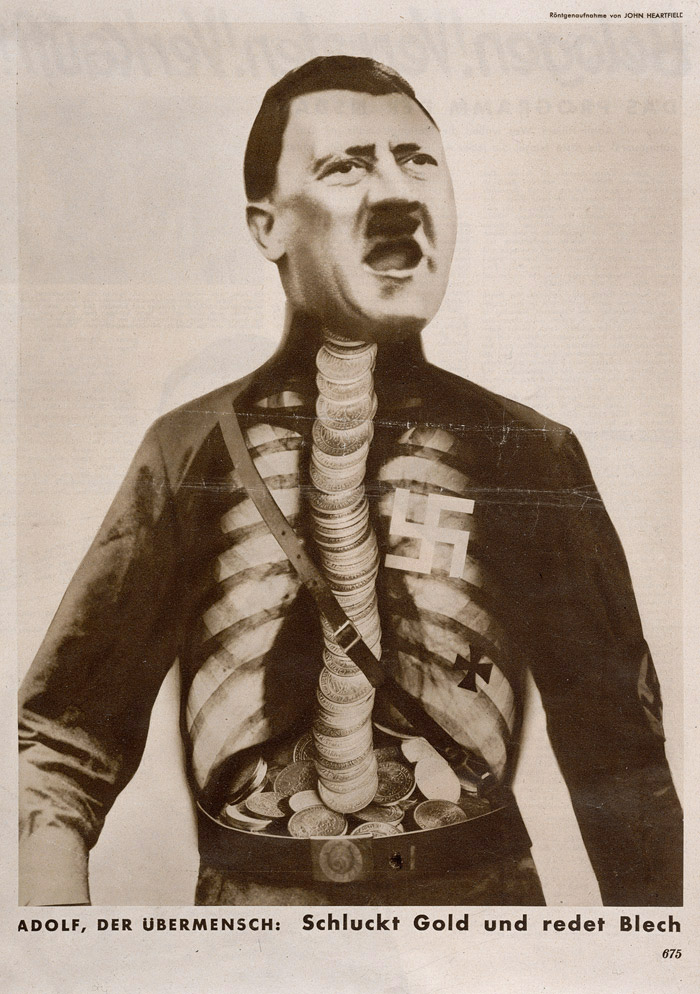
John Heartfield (German, 1891-1968) 'Adolf, the superman: swallows gold and spouts rubbish' from the 'Workers Illustrated Paper', vol 11, no 29, 17 July 1932, p. 675


John Heartfield (German, 1891-1968)
Adolf, the superman: swallows gold and spouts rubbish
1932
From the Workers Illustrated Paper, vol 11, no 29, 17 July 1932, p. 675
Photolithograph
38 x 27cm
John Heartfield Archiv, Akademie der Künste zu Berlin
Photo: Akademie der Künste, Berlin, Kunstsammlung, Heartfield 2261/ Roman März
© The Heartfield Community of Heirs /VG Bild-Kunst, Bonn. Licensed by Viscopy, Sydney


John Heartfield’s photomontages expose hidden agendas in German politics and economics of the 1920s and 30s. This image was published six months before the National Socialist Party came to power, and shows Hitler with a spine made of coins and his stomach filled with gold. The caption says that he ‘swallows gold’, alluding to generous funding by right-wing industrialists, and ‘spouts rubbish’.


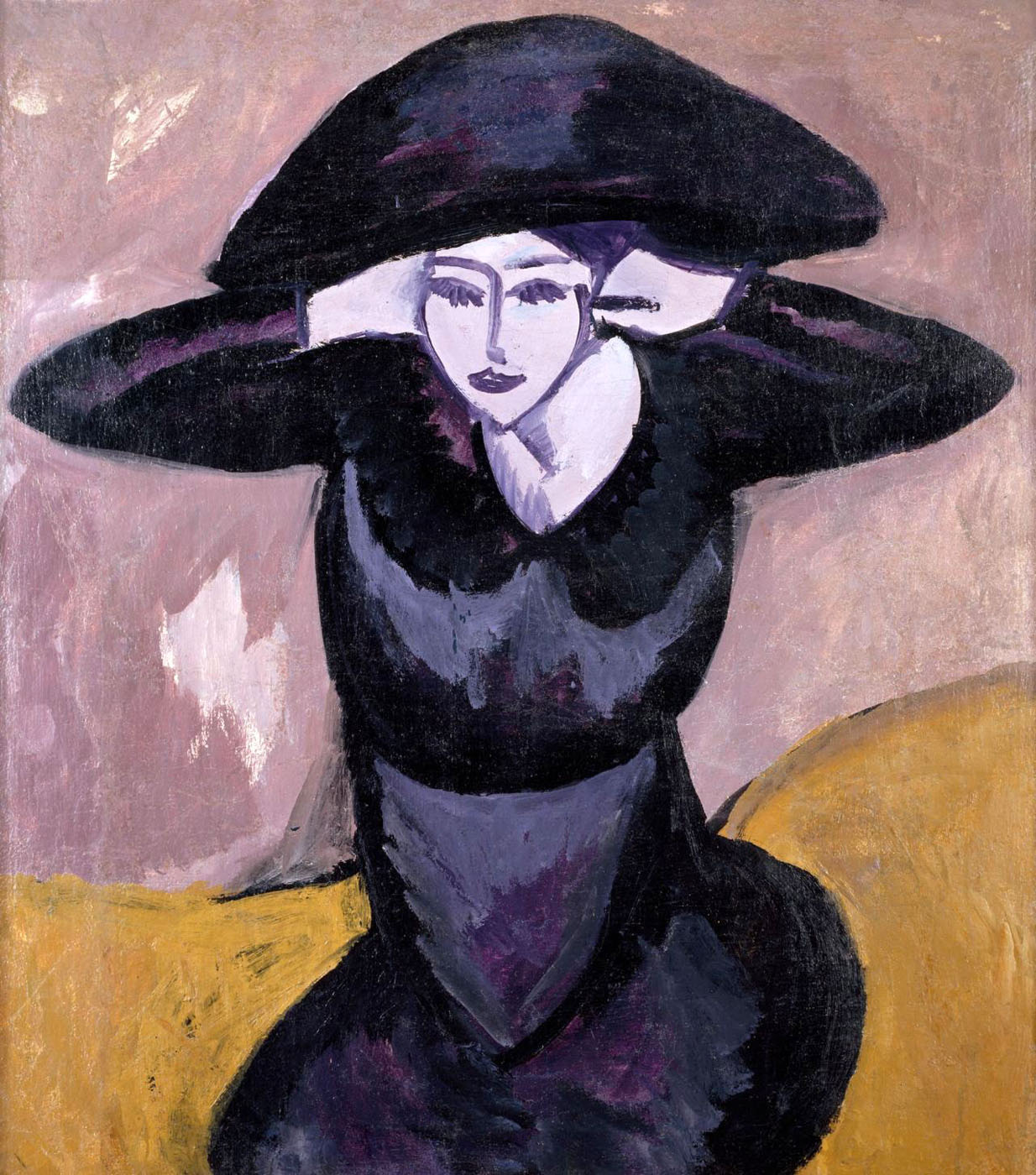
Ernst Ludwig Kirchner (German, 1880-1938) 'Woman in hat' 1911


Ernst Ludwig Kirchner (German, 1880-1938)
Woman in hat
1911
Oil on canvas
Art gallery of Western Australia, Perth


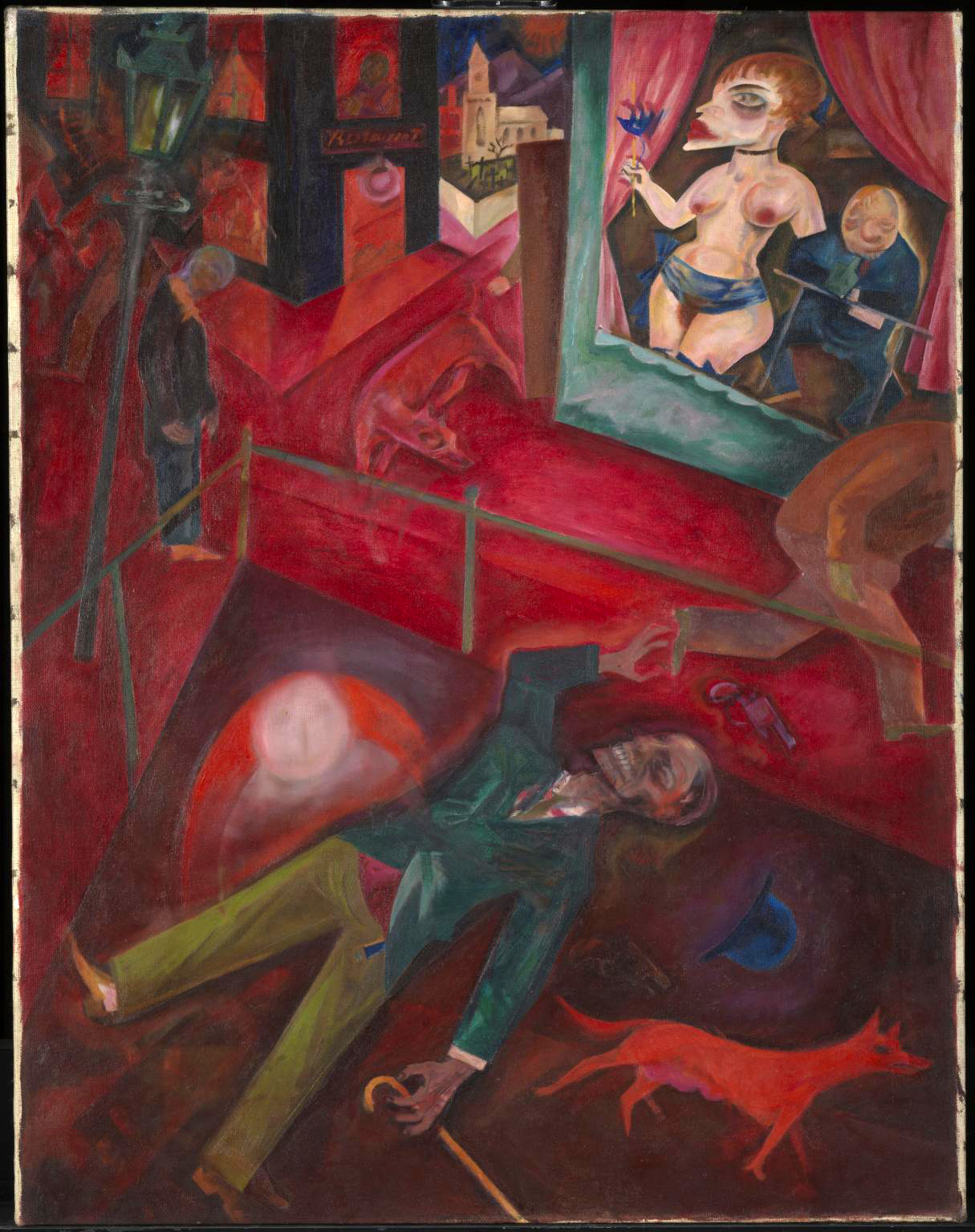
George Grosz (German, 1893-1959) 'Suicide' (Selbstmörder) 1916


George Grosz (German, 1893-1959)
Suicide (Selbstmörder)
1916
Oil on canvas
100 × 77.5cm
Tate Modern
Public domain


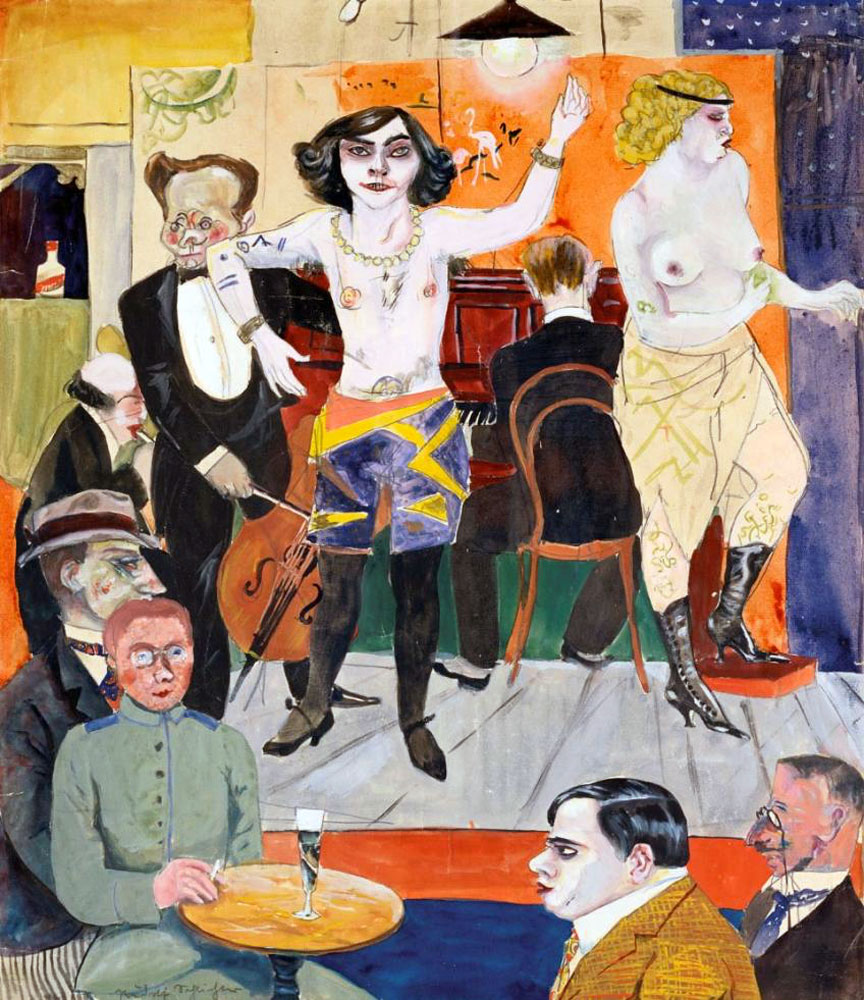
Rudolf Schlichter (German, 1890-1955) 'Tingle tangel' 1919-1920


Rudolf Schlichter (German, 1890-1955)
Tingle tangel
1919-1920
Oil on canvas


George Grosz (German, 1890-1945) 'Tatlinesque Diagram' 1920


George Grosz (German, 1890-1945)
Tatlinesque Diagram
1920
Watercolour, collage and ink on paper
41 x 29.2cm
Museo Nacional Thyssen-Bornemisza, Madrid


Otto Dix (German, 1891-1969) 'Dr Paul Ferdinand Schmidt' 1921


Otto Dix (German, 1891-1969)
Dr Paul Ferdinand Schmidt
1921
Oil on canvas
63 x 82cm
Staatsgalerie, Stuttgart, Germany


El Lissitzky (Russian, 1890-1941) 'New Man (Neuer)' 1923


El Lissitzky (Russian, 1890-1941)
New Man (Neuer)
1923
Color lithograph on wove paper
12 × 12 1/2 in. (30.5 × 31.8cm)


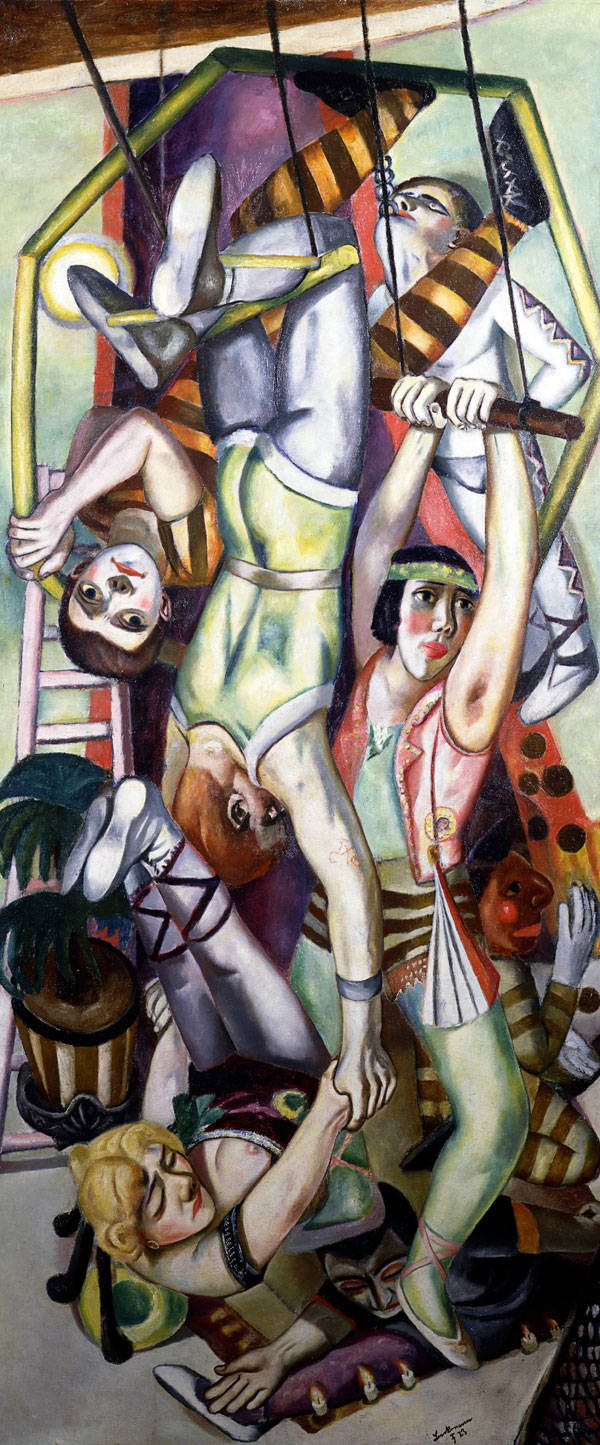
Max Beckmann (German, 1884-1950) 'The trapeze' 1923


Max Beckmann (German, 1884-1950)
The trapeze
1923
Oil on canvas
196.5 x 84cm
Toledo Museum of Art
Purchased with funds from the Libbey Endowment, Gift of Edward Drummond Libbey
Photo: Photography Incorporated, Toledo


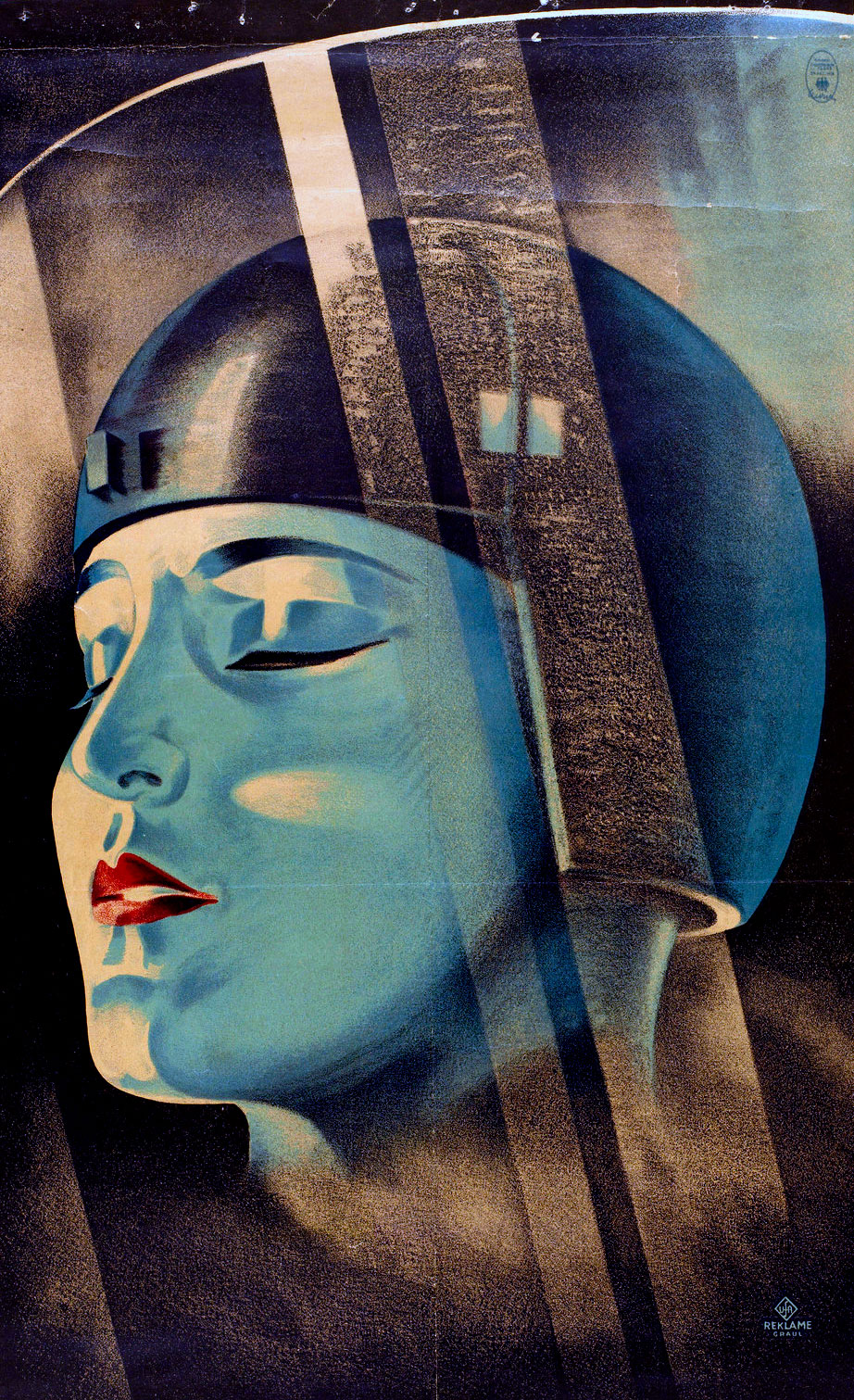
Werner Graul (German, 1905-1984) 'Metropolis'
1926


Werner Graul (German, 1905-1984)
UFA (Universum-Film-Aktiengesellschaft) (publisher)
Metropolis
1926
Lithographic poster


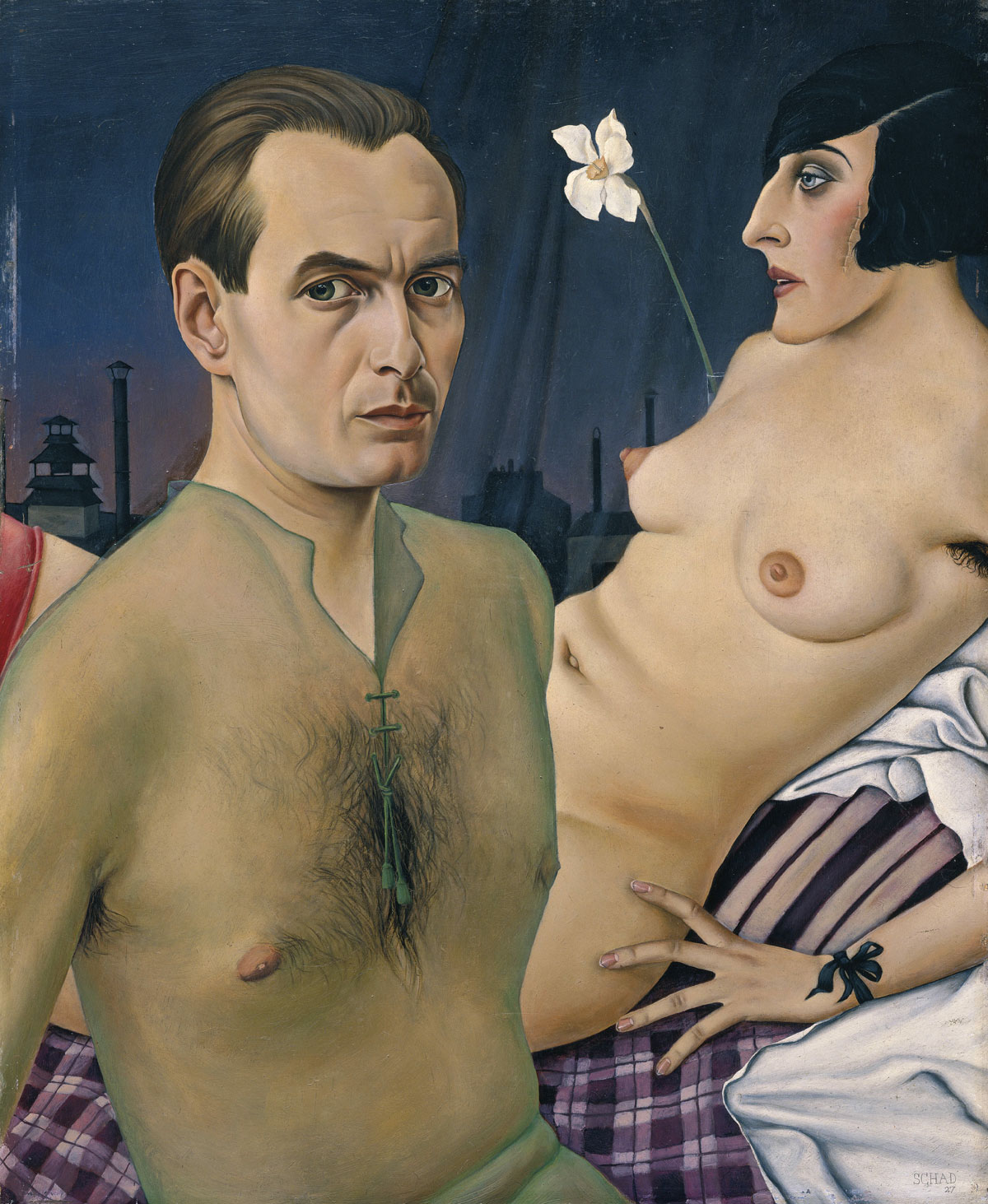
Christian Schad (German, 1894-1982) 'Self-Portrait' (Selbstbildnis mit Modell), 1927


Christian Schad (German, 1894-1982)
Self-Portrait with Model (Selbstbildnis mit Modell)
1927
Oil on wood
29 15/16 x 24 3/16 in. (76 x 61.5cm)
Private collection, courtesy of Tate
© 2015 Christian Schad Stiftung Aschaffenburg/Artists Rights Society (ARS), New York/VG Bild-Kunst, Bonn


Heinrich Hoerle (German, 1895-1936) 'Three invalids' c. 1930


Heinrich Hoerle (German, 1895-1936)
Three invalids
c. 1930
Oil on canvas


NGV International
180 St Kilda Road

Opening hours:
Daily 10am – 5pm

National Gallery of Victoria website

LIKE ART BLART ON FACEBOOK

Back to top

Essay: ‘Now you see it, now you don’t: the history and conservation of The Keith Haring Mural, Johnston Street, Collingwood, Melbourne,’ by Dr Marcus Bunyan

November 2011


Keith Haring (American, 1958-1990) 'Barking Dogs and Spaceships and Angels and Coyotes' both 1982 'Subway drawings'


Keith Haring (American, 1958-1990)
Barking Dogs and Spaceships and Angels and Coyotes
both 1982
Subway drawings
Chalk on subway posters laid on canvas


In response to the polemic article “Brushed aside: artistic landmark must return to 1980s glory” by Hannah Mathews in The Age newspaper on November 17th, 2011 I feel compelled to offer a more balanced appraisal of the problems regarding the conservation and preservation of the Keith Haring Mural painted on a wall of the former Collingwood Technical School in Collingwood, Melbourne.

I was not going to publish this essay but now the time is right!

As I note in the essay Haring’s attitude to repainting seems to be at best ambiguous. As several people advocate, I support building a wall perpendicular to the original and painting a facsimile on the new wall. As the original is one of few remaining outdoor murals in the artists hand, I believe it is important to conserve what we have left of the original and painting a simulacra would satisfy those that want a “fresh” copy.

This essay is based on my own question, namely an investigation into the deterioration of a public work of art; the stabilisation of an ephemeral work; the role of the conservator in preserving the work; and the broader cultural perspectives involved when treating the work: reflections on the community from which it originates and notions of ownership and authorship. It was completed as part of my Master of Art Curatorship being undertaken at The University of Melbourne.

Please remember that this essay was written last year in September 2010, before the report from Arts Victoria and was then recently updated. Many thankx to Dr Ted Gott and to Andrew Thorn for their knowledge and help during the research for this essay.

Dr Marcus Bunyan


PS. Apologies that there are no image credits in the essay. If anyone knows the photographers please let me know and I will post but I hope they do not mind me using the photographs (in the interests of art, research and conservation).


Abstract

This essay will examine the history and conservation of The Keith Haring Mural painted on a wall of the former Collingwood Technical School in Collingwood, Melbourne. The essay will attempt to identify the issues involved with current attempts to conserve the mural, including issues of authorship, custodianship vs ownership, stabilisation of the mural and the debate between repainting and conserving. This essay is based on my own question, namely an investigation into the deterioration of a public work of art; the stabilisation of an ephemeral work; the role of the conservator in preserving the work; and the broader cultural perspectives involved when treating the work: reflections on the community from which it originates and notions of ownership and authorship.

Keywords

Keith Haring, Collingwood Technical School, Collingwood, Melbourne, painting, mural, public art, urban art, graffiti, Ted Gott, Andrew Thorn, THREAD, gay art group, homosexuality, HIV/AIDS, New York, National Gallery of Victoria, Australian Centre for Contemporary Art, Arts Victoria.

Word count: 5,056


Keith Haring Water Wall Mural at The National Gallery of Victoria


Keith Haring Water Wall Mural at The National Gallery of Victoria, later destroyed


Introduction

In the early 1980s, New York artist and social activist Keith Haring (4th May, 1958 – 16th February, 1990) was on the brink of fame. He appeared at the Whitney Biennial and Sao Paulo Biennale in 1983 and made friendships with Andy Warhol and Jean-Michel Basquiat.1 Haring was also gay; he died of HIV/AIDS at a young age. His folk art/graffiti style of bold figures and pagan inspired designs outlined in black and other colours investigated concepts of birth, life, death, power, money, technology and the relationship of human beings to the planet on which they live. Haring never feared confronting his viewer with difficult socio-political problems. Embedded in the street culture of the day, Haring was one of the first artists to be heavily influenced by disco dancing and rap music, his ghetto blaster blaring out as he painted his trademark murals. Today his work can be seen to represent the quintessential essence of the 1980s: through its use of colour; the vibrancy of the gyrating bodies; and the topicality of the issues the work addressed. His imagery “has become a widely recognised visual language of the 20th century”2 and his work represents a culture in which “notions of graffiti, advertising and design became increasingly blurred.”3

Early expressions of his creativity that are precursors to his mature style were the chalk drawings on black paper that Haring undertook in the subway stations of New York, using vacant advertising spaces. These drawings were made using quickness and stealth for fear of being caught and were ephemeral; either being destroyed when the next advert was pasted in place or, when his fame became greater, souvenired by acolytes.

“Riding the subway from his uptown apartment to the clubs, Haring noticed black paper hanging next to advertisements in the cars, awaiting the next ad. He used this opportunity to draw in chalk on the black paper with all sorts of childlike imagery: barking dogs, babies, unisex figures, spaceships, TV sets, etc. The outline style of imagery could be appreciated individually as cartoon cels or together to form a narrative. The subway drawings magnify Haring’s cartoons into a new Pop Art that at once was urban narrative, science fiction and hieroglyphics. These subway drawings initiated his first one man shows.”4


As Ted Gott has commented, “… Haring was seen as revolutionary, around 1981, for the manner in which he mastered the freedom and fluidity of the graffiti artists’ calligraphic defacement of public property, and catapulted it over into a mainstream artistic form. By presenting the visual language of one social class in the medium [paint on canvas] and milieus [commercial art galleries] of another elite class, Haring broke the rules then prescribed by the art world…”5

Into this context of rising fame came John Buckley, inaugural Director of Melbourne’s new Centre for Contemporary Art (CCA, later called the Australian Centre for Contemporary Art, or ACCA).6  Buckley met Haring in 1982 on a research visit to New York and invited him to Australia. After organising various grants to fund the trip, Haring arrived for a three-week visit. He was in Australia from 18th February to 8th March 1984 and completed three major projects (The Water Wall mural at The National Gallery of Victoria, the mural painted in the forecourt of The Art Gallery of New South Wales and the mural painted on the side of the former Collingwood Technical School).7 During this period he also completed other smaller works (such as a piece for the Hardware Club in Melbourne and the Glamorgan preparatory school, part of Geelong Grammar School), as well as thirteen large exhibition-quality ink drawings and four acrylic paintings.8 The latter were eventually used in the exhibition Keith Haring at ACCA’s new premises in Melbourne between 10th October – 17th November, 1985,9 and then returned to the artist by John Buckley. Some confusion exists in this matter as Haring states in his biography that his Australian experience wasn’t that hot and that he felt ripped off because the paintings he left in Australia were never returned to him, that there had never been any exhibition of his work and that the work had never been paid for.10

Since ACCA had not secured a physical home at the time of the arrival of Haring (later to be in the Botanical Gardens), Buckley arranged for Haring to paint a large mural on the inside of the water wall at The National Gallery of Victoria between 21st – 22nd February 1984. Haring then travelled to Sydney and painted the AGNSW mural between 28th February – 1st March 1984 before returning to Melbourne and painting the mural at The Collingwood Technical School in one day on Tuesday 6th March 1984.11 While the first two murals were intentionally impermanent (the Water Wall was supposed to last 3 months but was destroyed by vandalism just 2 weeks after its creation,12 Haring mistakenly believing that it was attacked as a protest against the mistaken belief that he had appropriated Aboriginal motifs in its composition13 and the AGNSW mural was painted over after one month to make way for the Biennale exhibition of 1984),14 the community based project in Collingwood would become Haring’s only large, permanent evidence of his visit to Australia:

“In his interview given at the Collingwood Technical School immediately upon completion of the project on 6 March 1984, Keith Haring said about the Collingwood mural: “I had fun. I mean, it’s the most fun I’ve had since I’ve been here. It’s more fun working here than it is inside a museum. [and] It’s the only permanent thing that I did while I was in Australia.””15

“The base tint of yellow was painted onto the wall with rollers by Collingwood Technical School staff on Monday 5 March 1984,”16 the day before Haring’s ‘performance’ when he painted the mural in just two main colours, red and green, in front of a large audience; the performance was photographed and videotaped giving us unique footage of the artist at work.17 The mural features a multi-layered frieze of dancing figures in the lower half of the mural and his fear of technology in the upper half, a “hybrid man/computer monster, his vision of a future de-humanising evolution, which was ridden by two human figures …”18

In all three murals the work was undertaken freehand with no use of preparatory drawings or grids using ladders and a cherry-picker to raise and lower the artist into position – all to the blare of his ghetto blaster. For Haring there was no turning back: “Whatever marks I make are immediately recorded and immediately on view. There are no “mistakes” because nothing can be erased.”19
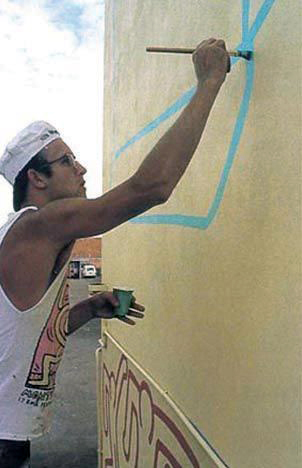
 

Keith Haring painting The Keith Haring Mural, Johnston Street, Collingwood, Melbourne, 1984


Keith Haring painting The Keith Haring Mural, Johnston Street, Collingwood, Melbourne, 1984


The painting of The Keith Haring Mural, Johnston Street, Collingwood, Melbourne, 1984


The painting of The Keith Haring Mural, Johnston Street, Collingwood, Melbourne, 1984


Significance of the Mural

According to the Statement of Significance on the Heritage Council of Victoria database, “The Mural has historical and social significance as the work of a major artist. Keith Haring is considered one of the most significant artists of his generation. As a role model for gay artists and Aids activism his influence was international.

The Keith Haring Mural is of social significance as a landmark piece of public art in Melbourne. Its prominent inner city location is indicative of the changing physical and social landscape of a former working class suburb.

The Mural is also of social significance for its influence on young artists for its inner city setting and use of popular culture themes and imagery.”20

Emily Sharpe states that the mural may also be the last surviving extant [outdoor] mural in the world painted entirely by his hand,21 although this information is contradicted by The Haring Foundation in a quotation later in the essay (see the section ‘To restore or conserve?’ below, Footnote 49).
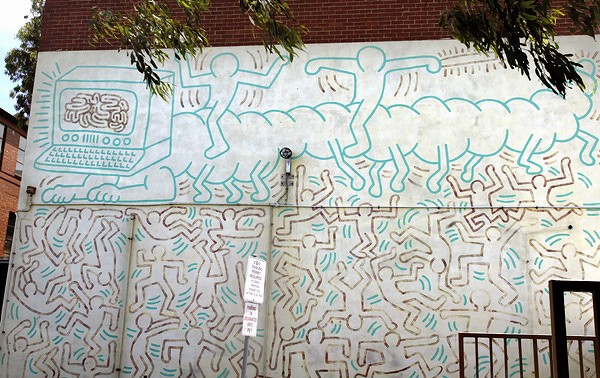
 

Keith Haring mural on the side of the former Collingwood Technical School in 2010 (painted 1984)


Keith Haring mural on the side of the former Collingwood Technical School in 2010 (painted 1984)


Issues in Conservation

During the period 1994-1995 a recently formed gay art group in Melbourne called THREAD (of which I was a part, the acronym of which is now lost to my memory) became concerned about the deterioration of the Keith Haring mural on the side of the Collingwood Technical School in Johnston Street, Collingwood. The group tried to engage the city of Yarra (the inner Melbourne municipality where the mural is located) and other organisations (The National Trust) about the possibility of repainting the mural due to the importance of the mural and its painting by an internationally renowned gay artist. Basically, as conservator Andrew Thorn succinctly puts it, “to repaint the mural on the basis of identity giving ownership.”22

While the intentions of the group were entirely honourable in such a proposal, on reflection and with the passing of the years, being older and wiser, I realise the error of our ways. While acknowledging that the group probably did want to take ownership of the mural on the basis of sexual identity at the time I think the group was just motivated by a desire to get something to happen and we did at least succeed in starting a dialogue between those that had an interest in conserving the mural. One of the problems was that none of us had conservation experience and, as Tom Dixon noted in a phone call to him about the mural,23  the representation of the group was never consistent as it was always a different person that you were talking to.

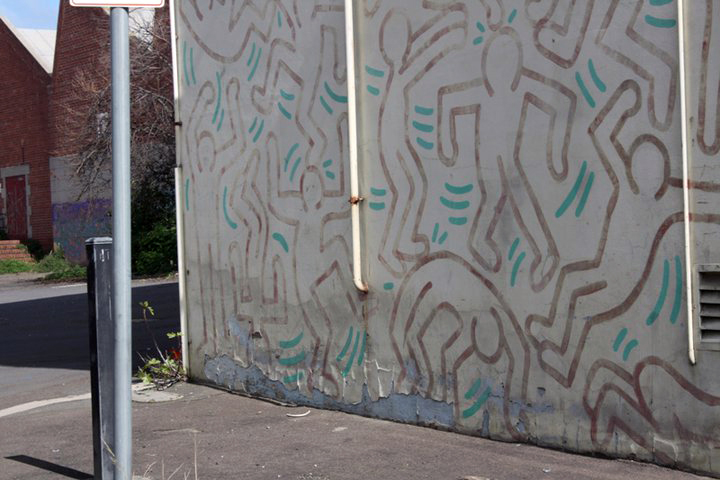
The profile of the mural was also raised through newspaper articles: “A series of newspaper articles drew attention to the vexed issues around its historic significance and increasing deterioration; these articles formed an important research component of the subsequent classification report” (The book in which this article is quoted incorrectly states that students helped Haring paint the mural – see p. 146).24 These concerns eventually led to the stabilisation of the mural by conservator Andrew Thorn in 1996 and its listing by the National Trust of Australia (Victoria) (NTAV) in 1997. During the treatment of the mural in 1996 Thorn undertook various conservation treatments, namely cleaning of the paint surface (including removal of stains), paint consolidation (fine cracking and detachments within the red paint and reattachment of the yellow paint), reattachments of lower render due to rising damp, consolidation and protection of the paint film with a protective coating system and reintegration of small areas of loss. A proposal for future maintenance was envisaged that included regular inspections, maintenance and care,25 but unfortunately it would seem that this maintenance has not been undertaken. In a recent report (2007) on the condition of the mural Thorn notes that, “incipient deterioration can be avoided, but if regular maintenance is not continued, the painting will be lost.”26 Thorn also notes that the resin gloss layer applied in 1996 to prevent AO (anti-oxidant) and UV (ultraviolet) deterioration “shows clear signs of degradation,” and should have been reapplied at 5 yearly intervals to maintain effectiveness.27 The report also notes that the yellow ground has become paler since 1996, the eroded reds need consolidation, the rising moisture is having a greater effect on the surface than previously and the green brushstrokes are beginning to show signs of loss.28
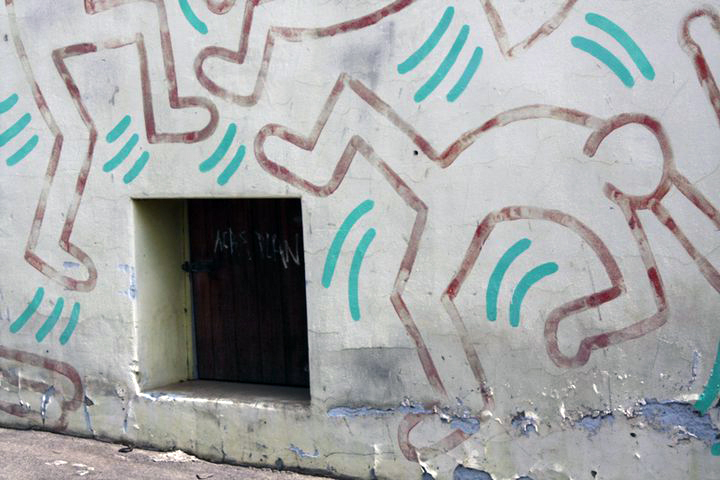
 

The missing door of the Keith Haring mural on the side of the former Collingwood Technical School in 2010 detail (painted 1984)
 

The missing door of the Keith Haring mural on the side of the former Collingwood Technical School in 2010 detail (painted 1984)


Keith Haring mural on the side of the former Collingwood Technical School in 2010 detail (painted 1984)


Keith Haring mural on the side of the former Collingwood Technical School in 2010 detail (painted 1984)


Ownership or custodianship

I support the concept of custodianship (or shared ownership) of a work of art rather than ownership per se. I believe that many people have a stake in the cultural value of a work of art and that custodianship, being a caretaker of the work, engages with the idea that the work belongs to everyone and that everyone should have access to enjoy it. Of course being gay offers a close affinity to the work of Keith Haring but, as Andrew Thorn notes, “that does not impart greater ownership of common property or of visual arts and imagery. It does give some ownership but not the right to snatch ownership from others.”29

In a separate email he continues, “At the same time it is necessary in giving ownership to wrest it from those that have claims and this process requires substantial diplomacy. It moves ownership from exclusive to shared. Ownership and identity are good and necessary things and if a work or an artist provides inspiration and support that is not to be denigrated and must be respected … Claiming of ownership is not an aggressive act but part of belonging and identity … It is necessary to engage in a community spirit to ensure a highly significant work and its maker are treated with the respect they deserve.”30

While the earlier attempts by the THREAD group could be seen as an attempt to obtain cultural ownership I acknowledge that this position is untenable. It must be a difficult task – the diplomacy of negotiating with all vested interests. But as Thorn rightly notes this comes down to the modern democratic process, the freedom to elect decision makers – not make the decisions themselves but delegate the responsibility to elected others. We must possess the ability to respect anybody’s relationship and enjoyment of the mural as much as we should respect Thorn’s professional judgment as an internationally renowned conservator to ensure this work is protected in the best possible way so that future generations can enjoy the work.
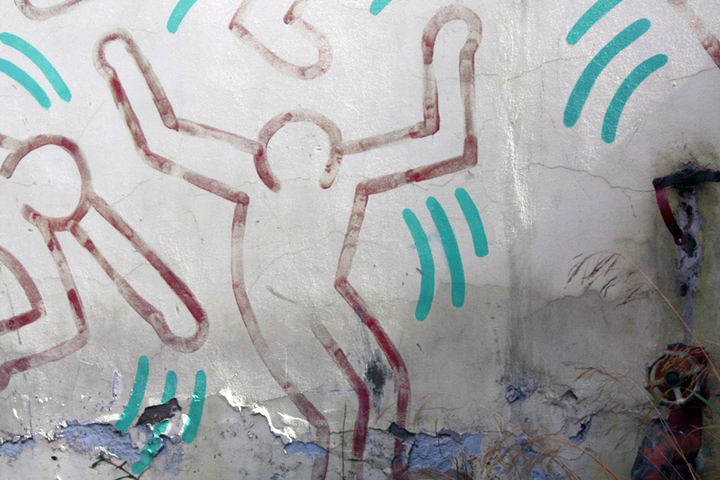
 

Keith Haring mural on the side of the former Collingwood Technical School in 2010 detail (painted 1984)

Keith Haring mural on the side of the former Collingwood Technical School in 2010 detail (painted 1984)


Keith Haring mural on the side of the former Collingwood Technical School in 2010 detail (painted 1984)


The conservator and the cultural landscape

The conservation of artefacts is an integral part of the cultural landscape. The nature of the cultural landscape is a fluid environment: a palimpsest where the authorship of the original work of art is a textual site, where “change (and decay), alteration, editing, revision and restoration represent the true life of objects.”31

“”The document is the textual site where the agents of textuality meet: author, copyist, editor, typesetter and reader.” In art and architecture there would be, besides artist and architect, builders, conservators, curators, preservationists, historians, viewers and users.”32 Embedded within the work are the memory and history of the object, within culture. Conservator Andrew Thorn observes, “It is a societal need to preserve the past and keep it for the future. Far more pragmatic issues dominate the profession [that of conservation] and unlike some contemporary art practice it does not need the props of modernist theory in any form to exist.”33

I beg to differ. Conservation exists only within culture. It is embedded within it and linked to the history and memory of the object. The nature of the cultural landscape and our heritage is a constitutive process: “an approach to heritage which understands it not as an object which is the static locus of some internal value, but as a process.”34 And that process invokes the social, cultural, economic and political contexts that include the act of interpretation and the concept of representation.

Laurajane Smith argues that, “heritage is heritage because it is subjected to the management and preservation/ conservation process, not because it simply ‘is’. The process does not just ‘find’ sites and places to manage and protect. It is itself a constitutive cultural process that identifies those things and places that can be given meaning and value as ‘heritage’, reflecting contemporary and cultural social values, debates and aspirations.”35 Gibson and Pendlebury unpack this statement further:

“In the first and most obvious sense, it follows from this position that there is nothing self-apparent or given about regimes of value and significance, rather these frameworks are specific to our particular social, cultural, economic and political contexts. Drawing on the anthropologist Marcel Mauss’s famous proscription on the cultural and historical specificity of contemporary personhood, objects, building and places are ‘formulated’ as heritage ‘only for us, amongst us’.”36

The value of an object cannot exist without reference to its historicity, its relationship to everything and everyone around us and conservation needs these frameworks of theory to have existence. As Foucault notes, “The space in which we live, which draws us out of ourselves, in which the erosion of our lives, our time and our history occurs, the space that claws and gnaws at us, is also, in itself, a heterogeneous space. In other words, we do not live in a kind of void, inside of which we could place individuals and things. We do not live inside a void that could be colored with diverse shades of light, we live inside a set of relations that delineates sites which are irreducible to one another and absolutely not superimposable on one another.”37

Complementary to Foucault’s notion of a set of relations that delineates sites and heterotopic spaces is how Janet Wolff positions these sites, these texts, within a sociology of cultural production:

“… the meaning which audiences ‘read’ in texts and other cultural products is partly constructed by those audiences. Cultural codes, including language itself, are complex and dense systems of meaning, permeated by innumerable sets of connotations and significations. This means that they can be read in different ways, with different emphases, and also in a more or less critical or detached frame of mind. In short, any reading of any cultural product is an act of interpretation … the way in which we ‘translate’ or interpret particular works is always determined by our own perspective and our own position in ideology. This means that the sociology of art cannot simply discuss ‘the meaning’ of a novel or painting, without reference to the question of who reads or sees it, and how. In this sense, a sociology of cultural production must be supplemented with, and integrated into, a sociology of cultural reception.”38


I understand that the conservator is not an editor (and here I am not abrogating the right of conservators to conserve, far from it). What I am proposing, however, is that an acknowledgment of the many voices that constitute the life and memory of an object, including the post-structuralist theory that analyses these histories and interpretations, be included in the negotiations with all parties and stakeholders. This perspective also acknowledges the changing contexts of interpretation of the Keith Haring Mural as it becomes ever more precious as one of the few outdoor murals left in the world painted in the author’s hand.


Keith Haring mural on the side of the former Collingwood Technical School in 2010 (painted 1984)


Keith Haring mural on the side of the former Collingwood Technical School in 2010 (painted 1984)


To restore or conserve?

“The painting can be preserved and not fade or deteriorate further if the recommendations of my 1996 and 2010 reports are adhered to. If you think this is not true you need to provide the evidence … it is assumed you respect my professional judgement in ensuring this work is protected in the best possible way so that all people can enjoy the masterpiece painted by Keith Haring as far into the future as possible. Over painting the mural ends the work of Keith Haring on that day.”39


The vexatious issue of restoring or conserving the Keith Haring mural has been an ongoing source of debate since the early attempts by the THREAD group to have the work “restored” (i.e. over painted) in the mid-1990s. Haring’s attitude to repainting seems to be at best ambiguous. The statement of significance of the mural when listed by The National Trust of Australia (Victoria) in 1997 notes that,

“Crucial to the fate of the mural and, given its exposure to the elements, is whether the artist himself would have accepted the deterioration of the mural or have condoned some form of restoration. Haring’s own feelings appear to have been ambivalent in the matter. In favour of restoring the mural i.e., repainting – is the fact that the simplistic three colour design devoid of subtle harmonies would not present serious problems in restoring it to its original condition. Opinion appears to be divided regarding the moral considerations in the matter and even the Estate of Keith Haring is unclear in this matter.”40


John Buckley “recalls a conversation with Haring who, with a characteristic lack of preciousness, said that the mural could, when needed, just be repainted by any good signwriter”41 but Andrew Thorn disputes this interpretation noting that “Keith talked about the continuity of his work. What Buckley stated contradicts the attitude presented by Haring throughout his biography. Another point to consider here is that Keith died within 6 years of completing the painting and I am certain beyond doubt that the condition of the painting even after 6 years would have been more or less pristine. There is no indication throughout the last two years of his life that Keith had any concern for his made works and that his declining health and the pain associated with that allowed him little time to consider anything other than his current work and failing health. If Buckley provides evidence of a friendship that Keith denies in his biography I for one would re-assess the intention of the artist.”42

This brings up the thorny issue of the ephemerality of street art. “Art academic Chris McAuliffe expressed his view regarding the impermanence of this work, arguing that ‘… as graffiti, it should be left to fade … If you subject it to conservation procedures then you transpose graffiti into a realm that it was opposed to. You make it art’.43 Personally I believe that all street art, whether officially sanctioned (like the Keith Haring mural) or not, is art. Distinction can only be made between street art / graffiti (not necessarily officially sanctioned: think the early chalk drawings of Haring or the street art of Banksy) and vandalism or tagging. Perhaps ephemerality is inherently built into street art, that documentation is enough to substantiate the life of the work, but that does not mean we have to sit by and let work be defaced or fade away without attempts at conservation.

According to Donna Wheeler there is an “unbreachable divide” between the two camps of Haring devotees. “Those on the conservatorial side see the mural as a cultural artefact, one that contains the artist’s rare and authentic touch evidenced in each singular brushstroke; they advocate a commitment to preservation, or stabilisation, with the caveat that even with their best efforts, the mural will continue to fade and eventually cease to exist. The Haring Foundation, and many others, including several curators and Haring’s original Australian contact, John Buckley, are hoping to restore, or more accurately, repaint the work, claiming that this would most closely follow Haring’s wishes. Yes, the original paint and brushstrokes would be forever lost, but Haring’s intent, creative vision and integral design will live on, in all its jellybean vibrancy.”44

I disagree with the stance taken by those that wish to repaint the mural. The hand of the author would be lost and the mural would simply become a simulacra of the original, a sign value that is an illusion of reality, a repainting purporting to “look like” the original but actually nothing like it.45 Support for this stance are the photographs of the original Crack is Wack (1986) mural painted by Keith Haring and the over painted mural photographs shown by Andrew Thorn at the public forum into the future of the mural in April 2010.46 In this presentation Thorn, “illustrated the losses inherent with repainting and also showed that the most iconic Haring mural ‘Crack is Wack’, is not the painting that Haring is photographed in front of the day he completed it.”47

Thorn states, “I support making a new copy of the painting, I just believe it should not devalue the original. Repainting over the original destroys the original work by Keith Haring. What you have is a copy and an irretrievable original, that is to say you have destroyed the work of Keith Haring. This is against the law administered by Heritage Victoria and devalues the work monetarily. This may seem an odd point to raise but becomes more significant when one considers the copyright act in relation to artists and their rights. The law there clearly states that any action that devalues a work or diminishes the artist’s reputation is a violation of the copyright act. The Haring Foundation need to be aware of this international law and particularly in the context of the Crack is Wack no longer being the work of Keith Haring and thereby diminishing his reputation by deception.”

In reply the Haring Foundation note that, “the ONLY Haring mural that was completely repainted was the Crack is Wack mural in NYC, due to it’s absolutely dreadful condition. It, too, is a landmark and highly valued by its community, and while no longer the original, it most definitely remains a Keith Haring mural. There are several outdoor murals that are untouched: Tuttomondo in Pisa (cleaned only); Necker Hospital in Paris; murals in Amsterdam and Phoenix, AZ. Numerous outdoor murals were only cleaned and lightly repaired and there are over a dozen indoor murals in public institutions that are untouched …

The Haring Foundation does not always recommend a complete repainting, that would be silly. But the awful condition of the Collingwood mural is similar to that of Crack is Wack and therefore the Foundation does highly recommend that it be repainted. Further to Crack is Wack, when Keith originally painted it, he had no permission, and so was required by the city to paint it out, completely covering over his first version. Shortly thereafter, he was granted permission by the city, and the second version he painted was different from the first version. Keith’s first version is often reproduced in books and catalogs and this has led to the utterly incorrect assumption that the Haring Foundation actually destroyed his first version and replaced it with something completely different over it. Not true.”49

While it is correct that Haring returned on the following day and painted a second version, not a copy of the first, conservator Andrew Thorn states that, “Since his death in 1990, the west painting has been repainted with imagery not resembling either of the two original Haring works … and this has in turn been reapplied more or less faithfully in 2007. This last painting, the one currently visible, is the fourth in the series and bears no resemblance to either of the two original works … The current painting appears not to be the work of Keith Haring, but continues to be considered his signature outdoor work … Haring may have painted the third image, but there is no record of this … The third and seemingly anonymous rendition continues the overall message but with new iconography, and appears not to be the work of Keith Haring.”50

Thorn supports the painting of a facsimile, a replica of the original, as does artist and academic Dr Megan Evans: “I think the best option is to preserve it [the original] and then do a replica nearby which is done in honour of the Haring work. I think this would be more interesting conceptually also as to have a repainted work is like covering up the mark of the past and to make a facsimile is to recreate it in a contemporary context.”51 I agree with the concept of making a facsimile positioned close to the original. Perhaps this could be completed on a new wall that is perpendicular to the original wall that the mural is painted on. Of course the pertinent question would be the permissions needed to erect such a wall, the cost of its construction, the cost of painting the new mural and its upkeep.
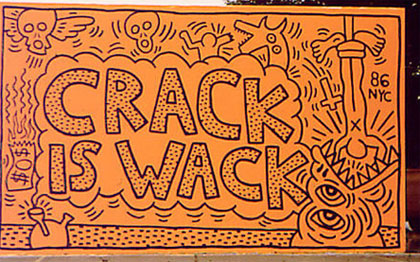
 

Keith Haring (American, 1958-1990) 'Crack is Wack' as completed by Haring in 1986


Keith Haring (American, 1958-1990)
Crack is Wack
as completed by Haring in 1986 (1st version, now overpainted)


Anonymous. 'Crack is Wack' 1986


Current Crack is Wack
painted after 1990


Now you see it, now you don’t

This brings me to my final point: now you see it, now you don’t. While I must take at face value the assertion by Andrew Thorn that the mural can be preserved and not fade or deteriorate further if the recommendations of his 1996 and 2010 reports are adhered to, and while I respect his professional judgment in that statement, unfortunately past experience (i.e. the lack of maintenance of the mural between 1996, the year of the last stabilisation, and now) tells me that the mural will continue to deteriorate and fade unless a specific and regular maintenance plan is financially funded and put in place. Donna Wheeler observes that the mural “is but a shadow of its former self”52 and I agree with this assertion. I was shocked to see the mural when visiting it recently compared to how I remember it in 1996 (ah, memory!). Though still an original Haring, it is pale and wane, almost an imitation of itself (and that is an irony in itself), and it made me sad to see the mural in this condition, as I remember how vibrant it was back in the early 1990s.

“According to ACCA curator Hannah Mathews, when the mural was last stabilised in 1996, it was estimated that a tiny sum of A$200 ($178) was needed annually to maintain the work. A combination of factors including pollution and time has left the mural in its current degraded state. Some estimate that it could cost around A$25,000 ($22,000) to stabilise, with an additional A$1,000 ($900) a year for maintenance. Although the issue of whether to repaint the mural is up for debate, all parties agree that the work needs stabilisation as soon as possible to prevent further surface lifting and cracking of the paint … Yarra mayor Jane Garrett said … “Following the forum [Yarra Talking Art forum: “The Keith Haring Mural: yesterday, today, tomorrow” on 29th April 2010 held in Collingwood], [the] Council [is setting up] a working group, which will seek to include representatives from Skills Victoria, Heritage Victoria, the arts community and other stakeholders, to discuss the mural’s future and come to a consensus on the most appropriate way to preserve it.”53

All parties need to agree and as quickly as possible. While Haring was quite happy to send his work out into the world for the enjoyment of all it would be a disservice to his memory and his status as an internationally renowned artist to have the only Haring mural in Australia deteriorate further. Time is of the essence. As Mark Holsworth on his Melbourne Art & Culture Critic blog insightfully opines, “Street art is not the property of the street artists – it belongs to everyone. Even if the artist intends for the art to be ephemeral there is no reason for their wishes to be carried out; the person giving the gift does not get to determine how the gift is used.”54

In the final analysis everyone needs to come to consensus about the future of the Keith Haring Mural for without proper conservation and maintenance it will truly be a case of now you see it, no you don’t.

Dr Marcus Bunyan

Word count: 5,056


Endnotes

1/ Keith Haring on Wikipedia [Online] Cited 25/09/2010
2/ Ibid.,
3/ Gott, Ted. “Fragile Memories: Keith Haring and the Water Window Mural at the National Gallery of Victoria,” in Art Bulletin of Victoria Vol. 43. Melbourne: National Gallery of Victoria, p. 8
4/ “Keith Haring New York,” on the Woodward Gallery website [Online] Cited 25/09/2010. No longer available online
5/ Gott, Ted. Op cit., pp. 7-8
6/ Gott, Ted. Op cit., p. 8
7/ Gott, Ted. Keith Haring’s Collingwood Mural. Draft of a paper given at a Keith Haring Public Forum, Collingwood, 29th April 2010 by Ted Gott, Senior Curator, International Art, National Gallery of Victoria
8/ Gott, Ted and Sullivan, Lisa. “Keith Haring in Australia.” in Art and Australia, Vol. 39, No.4, June-July-Aug 2002: (560)-567. ISSN: 0004-301X. Cited 09/10/2010
9/ Buckley, John. “Keith Haring” exhibition catalogue. Melbourne: Australian Centre for Contemporary Art (ACCA), 1985
10/ Gott, Ted and Sullivan, Lisa. Op. cit., p. 564. See also Footnote 15 and Gruen, John. Keith Haring: The Authorized Biography. New York: Prentice-Hall, 1991, p. 113
11/ Gott, Ted and Sullivan, Lisa. Op. cit.,
12/ Gott, Ted and Sullivan, Lisa. Op. cit., p. 562. See also Footnote 10 and Footnote 15. “Vandals,” Herald, Saturday 10th March 1984, p. 1; “Vandals smash gallery pane,” The Age, Monday 12th March , 1984, p. 19
13/ Gott, Ted and Sullivan, Lisa. Op. cit., Footnote 15 and Gruen, John. Keith Haring: The Authorized Biography. New York: Prentice-Hall, 1991, p. 113
14/ Gott, Ted and Sullivan, Lisa. Op. cit., p. 564
15/ Gott, Ted. Keith Haring’s Collingwood Mural. Op cit.,
16/ Gott, Ted. Keith Haring’s Collingwood Mural. Op cit.,
17/ Gott, Ted. Keith Haring’s Collingwood Mural. Op cit.,
18/ Gott, Ted and Sullivan, Lisa. Op. cit., p. 566. See also Gott, Ted. Keith Haring’s Collingwood Mural. Op cit.,
“Uniquely, we have a surviving record of Keith Haring’s own interpretation of the Collingwood mural, revealed during an interview conducted with the artist shortly after the painting’s completion on Tuesday 6 March 1984. There Keith Haring noted how: “What’s going on in the bottom is about – I mean, all these people are doing different things, right? Some of them are like dancing, like rap dancing, or acrobatics.  Some of them are almost like they are fighting. But the way they are all together means that they can’t – I mean, if one of them comes out, the whole thing falls down. So they sort of depend on all of them to make it work. So it’s sort of like society or whatever, where the world only works when lots of individuals do their part, right?
The thing at the top is, I guess, the impending doom or impending possibility of technological … the confrontation between technology and the human element, which is still holding up the technology, and based on the technology. But it sort of takes a semi-circle in evolution, where people evolved up to a certain point, and now they’ve evolved so far that they’ve invented a computer or a machine to evolve further. And the computer is maybe evolving more than people were. So it’s about that sort of confrontation, I guess.””
19/ Gott, Ted and Sullivan, Lisa. Op. cit., p. 562. See also Footnote 8 and Haring, Keith. “Keith Haring,” in Flash Art, No. 116, March 1984, p. 22
20/ Anonymous. “Keith Haring Mural: Statement of Significance,” on Heritage Council of Victoria database [Online] Cited 04/10/2010
21/ Sharpe, Emily. “Saving Keith Haring Down Under: Melbourne work is last surviving wall painting by the late artist’s own hand,” on The Art Newspaper website. Published online 08/06/2010. Cited 06/08/2010. No longer available online
22/ Thorn, Andrew. Email to the author. 24/08/2010.
23/ Dixon, Tom. Member of the Public Art Committee of the National Trust of Australia (Victoria) (NTAV). Telephone conversation with the author 26/08/2010. The Public Art Committee considers murals, mosaics, and sculptures; and such works can be found in parks and reserves, public streets, squares and buildings; and publicly accessible parts of privately owned buildings.
24/ Masterson, Andrew. “Off the wall art,” in The Age. Melbourne: Summer Age supplement. December 27th, 1994, p. 4-5 quoted in Gibson, Lisanne and Pendlebury, John R. “Values not Shared: The Street Art of Melbourne’s City Laneways,” chapter in Valuing historic environments. Farnham: Ashgate Publishing Limited, 2009, p. 146
25/ Thorn, Andrew. “Conservation Treatment Report.” The Keith Haring Mural Johnston Street, Collingwood. Final Report prepared for Northern Institute, 1997.
26/ Thorn, Andrew. “Review of Condition and Treatment.” The Keith Haring Mural Johnston Street, Collingwood. Prepared for City of Yarra, 2007, p. 1
27/ Ibid., p. 2
28/ Ibid., p. 3-5
29/ Thorn, Andrew. Email to the author. 23/08/2010.
30/ Thorn, Andrew. Email to the author. 24/08/2010.
31/ McCaughy, Patrick. Review of “Securing the Past: Conservation in Art, Architecture and Literature” by Paul Eggert in The Australian, December 02, 2009. [Online] Cited 12/06/2010. No longer available online
32/ Ibid.,
33/ Thorn, Andrew. Email to the author. 23/08/2010.
34/ Gibson, Lisanne and Pendlebury, John R. Valuing historic environments. Farnham: Ashgate Publishing Limited, 2009, p. 72
35/ Smith, Laurajane. Uses of Heritage. Oxford: Routledge, 2006, p. 3 (italics in original) quoted in Gibson, Lisanne and Pendlebury, John R. Valuing historic environments. Farnham: Ashgate Publishing Limited, 2009, p. 72
36/ Mauss, Marcel. “A category of the human mind: The notion of person; the notion of self,” in Carrithers, M., Collins, S. and Lukes, S. (eds.,). The Category of the Person: Anthropology, Philosophy, History. Cambridge: Cambridge University Press, 1985, p. 22, cited in Gibson, Lisanne and Pendlebury, John R. Valuing historic environments. Farnham: Ashgate Publishing Limited, 2009, p. 72
37/ Foucault, Michel. Of Other Spaces (1967), “Heterotopias.” Diacritics 16 (Spring 1986), pp. 22-27
38/ Wolff, Janet. The Social Production of Art. Basingstoke: Macmillan, 1993, p. 97
39/ Thorn, Andrew. Email to the author. 23/08/2010.
40/ National Trust of Australia (Victoria). Classification Report for ‘Keith Haring Mural’, Johnston Street, Collingwood, File number 6675. Extract from Statement of Significance, 4th August 1997 quoted in Gibson, Lisanne and Pendlebury, John R. “Values not Shared: The Street Art of Melbourne’s City Laneways,” in Valuing historic environments. Farnham: Ashgate Publishing Limited, 2009, p. 146
41/ Wheeler, Donna. “When Keith Came To Town,” on Holiday Goddess, Female-Friendly Travel website. [Online] Cited 06/08/2010. No longer available online
42/ Thorn, Andrew. Email to the author. 23/08/2010.
43/ McAuliffe, Chris quoted in Masterson, Andrew “Off the wall art,” in The Age. Melbourne: Summer Age supplement. December 27th, 1994, p. 4-5 quoted in Gibson, Lisanne and Pendlebury, John R. Valuing historic environments. Farnham: Ashgate Publishing Limited, 2009, p. 72
44/ Op. cit.,
45/ See Tseëlon, E. The Masque of Femininity: The Representation of Women in Everyday Life. London: Sage, 1995, p. 128
46/ Yarra Talking Arts forum. “The Keith Haring mural: yesterday, today, tomorrow.” Thursday 29th April, 2010
47/ Thorn, Andrew. Email to the author. 23/08/2010.
48/ Ibid.,
49/ Gruen, Julia. “Save the Keith Haring Mural” web page on Facebook [Online] Cited 21/11/2011. No longer available online
50/ Thorn, Andrew. “Another Red Haring,” keynote paper presented at the International Council of Museums Conservation Committee  (ICOMCC) triennial Conference, Lisbon, October 2011
51/ Evans, Megan. Email to the author. 08/09/2010.
52/ Wheeler, Donna Op cit.,
53/ Sharpe, Emily Op cit.,
54/ Holsworth, Mark. “Another Banksy Gone,” on Melbourne Art & Culture Critic blog. [Online] Cited 06/10/2010.


LIKE ART BLART ON FACEBOOK

Back to top

Exhibition: ‘NGV 150th Felton Bequest Gift – Living Water: Contemporary Art of the Far Western Desert’ at NGV Australia, Melbourne

Exhibition dates: 24th May 2011 – 28th May 2012


Tommy Mitchell (Australian / Ngaanyatjarra, c. 1943-2013) 'Kurlilypurru' 2009


Tommy Mitchell (Australian / Ngaanyatjarra, c. 1943-2013)
Kurlilypurru
2009
Synthetic polymer paint on canvas
152 x 212cm
Felton Bequest, 2011
© Tommy Mitchell, courtesy Warakurna Artists Aboriginal Corporation


“This is me: this is mine. The whole lot is me. I been walking all around, I know him proper way, he is always with me…”


Weaver Jack


Someone keyed my car the other day and it sent me into a bit of a downward spiral. Who knows why people do these things – stupidity, boredom, sheer bloody mindedness. This exhibition brought me back from that space to a rejoicing in human creativity and connection. It helped me leave my troubles behind. The stories in these paintings ground you, bring you back to earth through the experience and feeling of colour, movement and stillness.

I, we, cannot understand this ancient culture for it is foreign to us. We are not of it. But we can feel the stories in our own way. While we can’t understand every nuance of symbology and traditional narrative that the paintings contain they can speak to us all as human; we all come from this earth and must return to it. I felt the place from which they emanate, an intimacy with earth, self and soul.

I might not know much about anything, about understanding the vagaries of human beings, but I do know what is honest and truthful, has feeling for the piquancy of life. These paintings let my troubles and vicissitudes drop away and uplifted my spirit. Surrounded by love, by colour, by belonging to earth, sky, water, spirit. A wonderful gift to any human being and a wonderful gift from the Felton Bequest to the National Gallery of Victoria and to all the people of Australia. Go and experience their embrace.

Dr Marcus Bunyan


Many thankx to the National Gallery of Victoria for allowing me to publish the photographs in the posting. Please click on the photographs for a larger version of the image.


Various artists. 'Ngayarta Kujarra' 2009


Yikartu Bumba (Australian / Manyjilyjarra, b. 1940s)
Jakayu Biljabu (Australian / Manyjilyjarra, 1937-2022)
Nyanjilpayi Nancy Chapman (Australian / Manyjilyjarra, born c. 1941)
May Chapman (Australian / Manyjilyjarra, b. 1940s)
Doreen Chapman (Australian / Manyjilyjarra, b. 1970s)
Linda James (Australian / Manyjilyjarra, b. 1984)
Mulyatingki Marney (Australian / Manyjilyjarra, b. 1941)
Reena Roger (Australian / Manyjilyjarra, b. 1950s)
Beatrice Simpson (Australian / Manyjilyjarra, born c. 1966)
Ronelle Simpson (Australian / Manyjilyjarra, b. 1988)
Muntararr Rosie Williams (Australian / Manyjilyjarra, born c. 1943)
Ngayarta Kujarra
2009
Synthetic polymer paint on canvas
300 x 500cm
Felton Bequest, 2011


Ngayartu Kujarra

The artists who collaborated on this work (above) live at Punmu community, on the shore of a vast salt lake, (Lake Dora), which is surrounded by a scattered array of water sources.

The artists from this region are profoundly affectionate and respectful towards the salt lake and the fresh waters hat have sustained htem and their families for as long as memory can stretch.

The women have reproduced the feeling of the salt lake viscerally: their work conveys its immense scale, fine texture, extreme whiteness and shimmering light.


Ronnie Tjampitjinpa (Australian / Pintupi, b. 1943) 'Water Dreaming at Malparingya' 2006


Ronnie Tjampitjinpa (Australian / Pintupi, b. 1943)
Water Dreaming at Malparingya
2006
Synthetic polymer paint on canvas
152.2 x 182.5cm
National Gallery of Victoria
Felton bequest


Nyumitja Laidlaw (Ngaanyatjarra born c. 1938) 'Kuriella' 2009


Nyumitja Laidlaw (Australian / Ngaanyatjarra, born c. 1938)
Kuriella
2009
Synthetic polymer paint on canvas
142.3 x 175cm
Felton Bequest, 2011
© Nyumitja Laidlaw/Licensed by VISCOPY, Australia


Johnny Yungut Tjupurrula (Australian / Tjangimanta, 1930-2016) 'Tingarri Dreaming at Wanaritjarra' 2009


Johnny Yungut Tjupurrula (Australian / Tjangimanta, 1930-2016)
Tingarri Dreaming at Wanaritjarra
2009
Synthetic polymer paint on canvas
152.3 × 182.5cm
National Gallery of Victoria, Melbourne
Felton Bequest, 2011
© Johnny Yungut Tjupurrula, courtesy Aboriginal Artists Agency, Sydney


Kalaju Alma Webou (Yulparija c. 1920-2009) 'Pinkalarta' 2006


Kalaju Alma Webou (Australian / Yulparija, c. 1920-2009)
Pinkalarta
2006
Synthetic polymer paint on canvas
152 x 152cm
Felton Bequest, 2011
© Kalaju Alma Webou, courtesy Short Street Gallery/Yulparija Artists from Bidyadanga


Today, 24 May 2011, the National Gallery of Victoria celebrates its 150th birthday.

To honour this tremendous milestone, the NGV today unveiled an exceptional gift of 173 important Indigenous works of art including three by contemporary artists Vernon Ah Kee, Brook Andrew and Jonathan Jones who were commissioned to create works that pay homage to the highly celebrated Wurundjeri artist, William Barak. These pieces have been gifted by the Felton Bequest, established in 1904 by the NGV’s greatest benefactor, Alfred Felton.

The Honourable Alex Chernov, AO, QC, Governor of Victoria and Mrs Elizabeth Chernov were present at the NGV’s unveiling ceremony.

Dr Gerard Vaughan, Director, NGV said: “This is the most significant gift of Indigenous art to the NGV since the Gallery opened its doors for the first time on this date 150 years ago in country of the Kulin nation. It is appropriate on this date both to honour the memory of Alfred Felton and also celebrate the Indigenous art of our country, the world’s oldest continuous visual tradition.”

The gift of 173 works encompasses two exceptional collections: the first comprises 63 nineteenth and early twentieth century shields on display as part of the Australian Art collection, and the second 107 twenty-first century paintings from the Far Western Desert, forming the new exhibition Living Water.

Dr Vaughan said: “This outstanding gift adds tremendous strength to the NGV’s collection of Indigenous Art. Since the NGV first collected Indigenous art, the collection has grown to hold over 3,000 works representing cultures across Australia.

These exciting and dynamic acquisitions will enable the NGV to continue to educate visitors of all ages about the visual art of Indigenous Australians. This gift is a highlight of the NGV’s 150th anniversary year, reminding us of the crucial and continuing role the NGV has played in collecting and displaying the finest art works that can be acquired.

The Barak Commissions pay tribute to one of the most important figures of nineteenth century Australian Indigenous art, acknowledging Barak’s central place in the history of Victoria and the NGV,” said Dr Vaughan.

William Barak was born in country of the Wurundjeri people and became a leading Indigenous artist and figure in Melbourne during the 19th century. He is said to have witnessed John Batman ‘purchase’ Melbourne in 1835.

The multi-media installation by Vernon Ah Kee presents conversations between prominent Indigenous people as they reflect on how Barak has inspired them. Brook Andrew, renowned for his multi-disciplinary works, has created a powerful installation which adorns the entrance atrium at The Ian Potter Centre: NGV Australia. Jonathan Jones, who works with fluid and dancing light as a metaphor of living culture, has created five light boxes that map important cultural designs belonging to Barak as a way of honouring Barak’s life.

The collection of 63 rare and stunningly beautiful 19th and early 20th century shields is largely contemporary with Barak’s life. The shields serve to remind us of the time when the plains of Southeast Australia contained carved trees bearing elegant inscriptions, with people dressed in possum-skin cloaks and carrying elaborate shields living extraordinary living in harmony with country and ancient beliefs.

The Living Water exhibition unveils the Felton Bequest gift paintings: 107 adventurous works by male and female artists from newly established art centres in the Far Western Desert, an area stretching across far flung parts of Western Australia and South Australia.

This exhibition of 21st century art highlights today’s momentous art movement which originated at Papunya in 1971 when senior men decoded their archival narratives and laws, forging a new form shared by many Indigenous peoples across the Western Desert.

Press release from the National Gallery of Victoria website


Roy Underwood (Pitjantjatjara born c. 1937) 'Mulaya' 2008


Roy Underwood (Australian / Pitjantjatjara born c. 1937-2018)
Mulaya
2008
Synthetic polymer paint on canvas
197 x 135cm
Felton Bequest, 2011
© Roy Underwood, courtesy Spinifex Arts Project


Simon Hogan (Pitjantjatjara born c. 1930) 'Ilkurlka' 2004


Simon Hogan (Australian / Pitjantjatjara, born c. 1930)
Ilkurlka
2004
Synthetic polymer paint on canvas
134.5 x 176.6cm
Felton Bequest, 2011
© Simon Hogan, courtesy Spinifex Arts Project


Spinifex People

The country of the Spinifex people, who speak a southern dialect of Pitjantjatjara language, consists of vast plains of deep red sand, salt lakes and Spinifex.

In 1998 the community produced a series of ten large paintings that were bequeathed to the people of Western Australia in a symbolic reciprocal exchange of paintings for land. Most Spinifex works, subsequently produced on infrequent painting trips back to country operate as complex maps as well as religious landscapes that detail sources of spiritual power in country belonging to individual artists.


Milatjari Pumani (Yankunytjatjara, 1928-2014) 'Ngura Walytja, Antara' 2010


Milatjari Pumani (Australian / Yankunytjatjara, 1928-2014)
Ngura Walytja, Antara
2010
Synthetic polymer paint on canvas
168.6 x 137.4cm
Felton Bequest, 2011
© Milatjari Pumani, courtesy Mimili Maku Arts & Crafts


Living Water: Exhibition Background Information

Living Water, an exhibition showcasing 107 contemporary Indigenous paintings by 94 artists from the Felton Bequest Gift, displays works by male and female artists from the Far Western Desert, an area stretching across parts of Western Australia, South Australia and the Northern Territory.

A modern art movement originated at Papunya in 1971, which has since transformed the way we see the land and the history of art in Australia. Almost forty years after the genesis of the Western Desert art movement, its epicentre has dramatically shifted from Papunya in the Northern Territory to the Pintupi homelands of Kintore and Kiwirrkura in the Gibson Desert, and to communities that lie hundreds of kilometres to the south and west in far-flung reaches of South Australia and Western Australia (the Far Western Desert).

During the first decade of the 21st century, Pintupi, Spinifex, Anangu, Yulparija and Martu artists have developed a dynamic and fresh expression of Western Desert Art. The male and female artists not only share close kinship, social, linguistic and ritual interconnections and lived experience of desert country built up during pujiman (nomadic, bush) days but also have parallel experiences of making art with introduced materials for the commercial market. Their paintings – bearers of sanctity – resonate with the shock of the ancient made new and tell tjukurrpa (stories) associated with special places in their ngurra (country).This dramatic new wave of acrylic painting is the focus of Living Water, comprising the NGV’s 150th anniversary gift from the Felton Bequest of 107 paintings.

Aboriginal people from across the Western Desert use the term ‘living water’ to describe water sources, including rock holes and soakage waters that are fed by underground springs. The path of these springs was created by the ancestral beings of the Tjukurrpa (Dreaming) as they themselves journeyed underground, their entry into the earth often marking the site of current day water sources. ‘Living water’ is revered also because it does not seem to be affected by the harsh conditions above the ground that the people themselves have to endure.

This exhibition has been curated by Judith Ryan, Indigenous Art Curator, NGV. The following groups of people are represented in this spectacular exhibition.

Pintupi people

Pintupi is the name of a Western Desert language spoken by Aboriginal people who belong to a large stretch of country in the Gibson Desert of Western Australia and the western edge of the Northern Territory. When the Pintupi arrived in the government settlements east of their traditional lands between the 1930s and the 1950s, they adopted the term ‘Pintupi’ to distinguish themselves amongst the surrounding Aboriginal inhabitants as the ‘people from the west’.

The Pintupi’s complex relationship to the land of their ancestors is expressed through stories, songs and ritual practice that are also depicted in the acrylic paintings of the artists from the Pintupi communities of Walungurru and Kiwirrkura.

Ngaanyatjarra, Pitjantjatjara and Yankunytjara People

The Ngaanyatjarra, Pitjantjatjara and Yankunytjara people of the tri-state region of the Western Desert constantly interact and are related by kinship, language and genealogy.

Here they specialised in making walka (drawings), batik, punu (wood carvings) and tjanpi weavings, avoiding painting on canvas for the art market until the 21st century because of their suspicion of earlier forms of Western Desert art and their reluctance to disclose sacred elements of men’s and women’s law.

Yulparija People

The Yulparija people originally come from the Great Sandy Desert of Western Australia, which runs from Telfer in the south to Walungurru in the east and close to Fitzroy Crossing in the north.

Their work contains deep threads of cultural memory and is daring in its vigour of application and iridescent palette. The Yulparija have forged a painting style that combines their cultural memory of desert birth country with the rich blues and greens of saltwater terrain.

Martu People

Martu means ‘one of us’, or ‘person’ and is the word chosen to represent a number of different language groups from country across the Great Sandy, Little Sandy and Gibson Deserts of the Pilbara region of Western Australia.

Martu are interconnected to other surrounding peoples from the Great Sandy Desert through their shared country of birth and associated Dreaming stories.

Text from the National Gallery of Victoria website


Dadda Samson (Kartujarra, 1933-2020) 'Puntuwarri' 2009


Dadda Samson (Australian / Kartujarra, 1933-2020)
Puntuwarri
2009
Synthetic polymer paint on canvas
124.5 x 293.4cm
Felton Bequest, 2011
© Dadda Samson, courtesy Martumili Artists


Lawrence Pennington (Pitjantjatjara born c. 1940) 'Kurparu (Magpie)' 2005


Lawrence Pennington (Australian / Pitjantjatjara, born c. 1940)
Kurparu (Magpie)
2005
Synthetic polymer paint on canvas
138.6 x 92.7cm
Felton Bequest, 2011
© Lawrence Pennington, courtesy Spinifex Arts Project


Wingu Tingima (Pitjantjatjara c. 1917–2010) 'Kungkarakalpa (Seven Sisters)' 2007-2009


Wingu Tingima (Australian / Pitjantjatjara, c. 1917-2010)
Kungkarakalpa (Seven Sisters)
2007-2009
Synthetic polymer paint on canvas
140 x 210cm
Felton Bequest, 2011
© Wingu Tingima, courtesy Tjungu Palya


The Ian Potter Centre: NGV Australia
Federation Square
Corner of Russell and 
Flinders Streets, Melbourne

Opening hours:
Daily 10am – 5pm

National Gallery of Victoria website

LIKE ART BLART ON FACEBOOK

Back to top

Exhibition: ‘Vienna – Art & Design’ at the National Gallery of Victoria, Melbourne

Exhibition dates: 18th June – 9th October 2011


Media preview for 'Vienna - Art & Design' at the National Gallery of Victoria


Media preview for Vienna – Art & Design at the National Gallery of Victoria
Photo: Marcus Bunyan


A subtle pleasure

The delicate paintings are smaller with a flatness of texture and a sombreness than I had not imagined; magnificent in their subtlety. However, the real stars of this wonderful exhibition are the design pieces.

Whether silver, wood, ceramic, glass or jewellery the designs are balanced by a glorious aesthetic. Never has a tea service looked so ravishing or decadent.

This is not a wham bang show like Dali or that other King of some fame showing elsewhere. This is for a discerning audience – one that can take time (between pots of tea) to study and go ooh and aah!

Dr Marcus Bunyan


Many thankx to the National Gallery of Victoria for inviting me and for allowing me to publish the photographs in the posting. Please click on the photographs for a larger version of the image. All photographs © Marcus Bunyan 2011 except the photographs of the full paintings which come from the NGV press CD ROM.


Installation view of the exhibition 'Vienna - Art & Design' at the National Gallery of Victoria


I just couldn’t help myself!
Photo: Marcus Bunyan


Installation view of first room of the exhibition 'Vienna - Art & Design' at the National Gallery of Victoria


Installation view of first room of the exhibition Vienna – Art & Design at the National Gallery of Victoria
Photo: Marcus Bunyan


Wilhelm Gause (Germany 1853-1916) 'Vienna Municipal Ball' 1904


Installation view of first room of the exhibition Vienna – Art & Design at the National Gallery of Victoria showing at left:

Otto Wagner (architect) (Austrian, 1841-1918)
Alexander Albert (manufacturer) Austria active c. 1904
Chair for Dr Karl Lueger
1904
Rosewood (Dalbergia sp.), mother-of-pearl, leather
98.5 x 63 x 59.5cm
Wien Museum, Vienna
Estate of Karl Lueger, 1910

at right:

Wilhelm Gause (Germany 1853-1916)
Vienna Municipal Ball
1904
Watercolour and oil on cardboard
62 x 88cm
Wien Museum, Vienna
Commissioned by the City of Vienna, 1904
Photo: Marcus Bunyan


Wilhelm Gause (Germany 1853-1916) 'Vienna Municipal Ball' 1904


Wilhelm Gause (Germany 1853-1916)
Vienna Municipal Ball
1904
Watercolour and oil on cardboard
62 x 88cm
Wien Museum, Vienna
Commissioned by the City of Vienna, 1904


Stylish, provocative, rebellious, and unforgettable – the world has seen nothing like Vienna in 1900. A century ago, a group of radical young artists, architects, writers, musicians, designers and thinkers overturned all the rules and created a brave new world. Gustav Klimt, Egon Schiele, Josef Hoffmann and Adolf Loos were central to this artistic revolution which transformed Vienna into a dynamic metropolis at the forefront of ground-breaking modernism.

Vienna at the dawn of the twentieth century was opulent, elegant and daring. Casting aside outmoded social mores and moralities, private life became public spectacle. Cabarets, coffee houses, and nightclubs teemed with radical debate and artistic abandon. Gustav Klimt’s society portraits immortalise the chic women who presided over this creative ferment. Josef Hoffmann and the Vienna Workshops created the bold new interior design and the household objects with which these women furnished their elegant homes, establishing the modern ‘look’. As Sigmund Freud defined sexual fragmentation and erotic obsession for a new millennium, Egon Schiele explored human sexuality in images of unparalleled and startling frankness.

Vienna: Art & Design will explore this extraordinary period of artistic and intellectual genius, bringing together more than 250 works of art, including painting, drawing, graphic and decorative art, furniture, fashion, jewellery and photography, most never before seen in Australia. Visitors will experience the inventiveness and brilliance of a unique generation who laid the foundations for life in the twentieth century – a legacy still vividly alive today.

Text from the National Gallery of Victoria website Nd [Online] Cited 22/07/2022


Otto Wagner (Austrian, 1841-1918)(architect) Alexander Albert (Austria active c. 1904) (manufacturer) 'Chair for Dr Karl Lueger' 1904


Otto Wagner (Austrian, 1841-1918) (architect)
Alexander Albert (Austria active c. 1904) (manufacturer)
Chair for Dr Karl Lueger
1904
Rosewood (Dalbergia sp.), mother-of-pearl, leather
98.5 x 63 x 59.5cm
Wien Museum, Vienna
Estate of Karl Lueger, 1910
Photo: Marcus Bunyan


Josef Hoffmann (Austrian, 1870-1956) (designer) J. & J. Kohn, Vienna (manufacturer) 'Adjustable-back chair' (Sitzmaschine) 1908


Josef Hoffmann (Austrian, 1870-1956) (designer)
J. & J. Kohn, Vienna (manufacturer)
Adjustable-back chair (Sitzmaschine)
1908
Ebonised Beech (Fagus sp.), plywood, steel
(a-b) 110.8 x 68.1 x 83.7cm (overall)
National Gallery of Victoria, Melbourne
Purchased through The Art Foundation of Victoria with the assistance of Jardine Matheson Australia, Fellow, 1983
© Estate of Josef Hoffmann


Josef Hoffmann (Austrian, 1870-1956) (designer) Wiener Werkstätte, Vienna (commissioning workshop) J. Soulek, Vienna (manufacturer) 'Bureau, from the Gallia apartment boudoir' 1913


Josef Hoffmann (Austrian, 1870-1956) (designer)
Wiener Werkstätte, Vienna (commissioning workshop)
J. Soulek, Vienna (manufacturer)
Bureau, from the Gallia apartment boudoir
1913
Painted wood, gilt, glass, silk, brass
(a-m) 179.4 x 110.9 x 64.6cm (overall)
National Gallery of Victoria, Melbourne
Samuel E. Wills Bequest, 1976
© Estate of Josef Hoffmann


Otto Wagner (Austria 1841-1918) (architect) Reconstruction of facade for 'Die Zeit' 1902 designed, 1985 made


Otto Wagner (Austria 1841-1918) (architect)
Reconstruction of facade for Die Zeit (installation view)
1902 designed, 1985 made
Iron, aluminium, nickel-plated iron, glass
450 x 332cm
Wien Museum, Vienna
Commissioned by the Historisches Museum der Stadt Wien, 1985
Photo: Marcus Bunyan


Otto Wagner (Austria 1841-1918) (architect) Reconstruction of facade for 'Die Zeit' 1902 designed, 1985 made (installation detail)


Otto Wagner (Austria 1841-1918) (architect)
Reconstruction of facade for Die Zeit (installation detail)
1902 designed, 1985 made
Iron, aluminium, nickel-plated iron, glass
450 x 332cm
Wien Museum, Vienna
Commissioned by the Historisches Museum der Stadt Wien, 1985
Photo: Marcus Bunyan


Otto Wagner objects including shelving, stool, chair and hot air blower (rear) in the exhibition 'Vienna - Art & Design' at the National Gallery of Victoria


Otto Wagner objects including shelving, stool, chair and hot air blower (rear) in the exhibition Vienna – Art & Design at the National Gallery of Victoria
Photo: Marcus Bunyan


Gustav Klimt (Austria 1862-1918) 'The Park' 1909 (installation detail)


Gustav Klimt (Austria 1862-1918)
The Park (installation detail)
1909
Oil on canvas
Photo: Marcus Bunyan


Gustav Klimt (Austria 1862-1918) The Park' 1909 (installation detail)


Gustav Klimt (Austria 1862-1918)
The Park (installation detail)
1909
Oil on canvas
Photo: Marcus Bunyan


Installation view part of the second room of the exhibition 'Vienna - Art & Design' at the National Gallery of Victoria


Installation view part of the second room of the exhibition Vienna – Art & Design at the National Gallery of Victoria
Photo: Marcus Bunyan


Wilhelm Otto List. 'Young lady in black and white' 1904 (installation detail)


Wilhelm Otto List
Young lady in black and white (installation detail)
1904
Oil on canvas
Photo: Marcus Bunyan


Charles Robert Ashbee (designer) 'Standing cup and cover' 1901 and Josef Hoffmann. 'Sports Trophy' 1902 (installation view)


Charles Robert Ashbee (designer) (British, 1863-1942)
Standing cup and cover (installation view)
1901
Silver, turqoise

Josef Hoffmann (designer) (Austria-Hungary 1870-1956)
Sports Trophy (installation view)
1902
Silver, gilt, malachite
Photo: Marcus Bunyan


Josef Hoffmann (Austria-Hungary 1870-1956) (designer) Wiener Werkstätte, Vienna (manufacturer) (Austria-Hungary 1903-1932) 'Tea service' (c. 1909-1911) (installation view)


Josef Hoffmann (Austria-Hungary 1870-1956) (designer)
Wiener Werkstätte, Vienna (manufacturer) (Austria-Hungary 1903-1932)
Tea service (installation view)
c. 1909-1911
Silver-gilt, wood
(1.A-E) 21.5 x 29.0 x 26.8cm (overall) (kettle, stand and burner)
(2) 10.8 x 15.4 x 20.2cm (teapot)
(3.A-B) 8.7 x 8.8 x 6.8cm (overall) (sugar basin and lid)
(4) 4.8 x 8.5 x 15.6cm (milk jug)
(5) 3.4 x 36.3 x 29.9cm (tray)
National Gallery of Australia, Canberra
Purchased, 1985
Photo: Marcus Bunyan


Installation view of room three of the exhibition 'Vienna - Art & Design' at the National Gallery of Victoria showing part of Gustave Klimt's 'Beethoven Frieze: Central wall' 1901-02 (detail at top)


Installation view of room three of the exhibition Vienna – Art & Design at the National Gallery of Victoria showing part of Gustave Klimt’s Beethoven Frieze: Central wall 1901-1902 (detail at top)
Photo: Marcus Bunyan


Max Klinger (German, 1857-1920) 'Beethoven' c. 1902 (installation view)


Max Klinger (German, 1857-1920)
Beethoven (installation view)
c. 1902
Plaster
Photo: Marcus Bunyan


Installation view of room four of the exhibition 'Vienna - Art & Design' at the National Gallery of Victoria


Installation view of room four of the exhibition Vienna – Art & Design at the National Gallery of Victoria with at right, Gustav Klimt’s painting Emilie Flöge (1902)
Photo: Marcus Bunyan


Gustav Klimt (Austria 1862-1918) 'Emilie Flöge' 1902


Gustav Klimt (Austrian, 1862-1918)
Emilie Flöge
1902
Oil on canvas
178.0 x 80.0cm
Wien Museum, Vienna


Gustav Klimt (Austria 1862-1918) 'Emilie Flöge' 1902 (installation detail)


Gustav Klimt (Austrian, 1862-1918)
Emilie Flöge (installation detail)
1902
Oil on canvas
178.0 x 80.0cm
Wien Museum, Vienna
Photo: Marcus Bunyan


Installation view of room five of the exhibition 'Vienna - Art & Design' at the National Gallery of Victoria


Installation view of room five of the exhibition Vienna – Art & Design at the National Gallery of Victoria
Photo: Marcus Bunyan


Koloman Moser (designer) 'Armchair' 1903 and Josef Hoffmann (designer) 'Collapsible library steps' 1905 (installation view)


Installation view of first room of the exhibition Vienna – Art & Design at the National Gallery of Victoria showing at right:

Koloman Moser (Austrian, 1868-1918) (designer)
Armchair (installation view)
1903
Painted beech

at second right

Josef Hoffmann (Austrian, 1870-1956) (designer)
Collapsible library steps (installation view)
1905
Photo: Marcus Bunyan


Gustav Klimt (Austria 1862-1918) 'Fritza Riedler' 1906 (installation detail)


Gustav Klimt (Austrian, 1862-1918)
Fritza Riedler (installation detail)
1906
Oil on canvas
Photo: Marcus Bunyan


Gustav Klimt (Austria 1862-1918) 'Fritza Riedler' 1906


Gustav Klimt (Austrian, 1862-1918)
Fritza Riedler
1906
Oil on canvas
152.0 x 134.0cm
Belvedere, Vienna


Installation view of room six of the exhibition 'Vienna - Art & Design' at the National Gallery of Victoria

Installation view of room six of the exhibition 'Vienna - Art & Design' at the National Gallery of Victoria


Installation views of room six of the exhibition Vienna – Art & Design at the National Gallery of Victoria
Photos: Marcus Bunyan


Josef Hoffmann (Austrian, 1870-1956) 'Tea and coffee service' 1909 (installation view)


Josef Hoffmann (Austrian, 1870-1956)
Tea and coffee service (installation view)
1909
Silver, ivory
Photo: Marcus Bunyan


Installation view of room seven of the exhibition 'Vienna - Art & Design' at the National Gallery of Victoria showing Adolf Loos (Austrian, 1870-1933) (designer) 'Sideboard, from the Langer apartment' 1903


Installation view of room seven of the exhibition Vienna – Art & Design at the National Gallery of Victoria with, against the wall,

Adolf Loos (Austrian, 1870-1933) (designer)
Sideboard, from the Langer apartment
1903
Mahogany (Swietenia sp.), mirror, brass
Photo: Marcus Bunyan


Adolf Loos (Austrian, 1870-1933) (designer) Johann Heeg (manufacturer) 'Clock' 1906-1907


Adolf Loos (Austrian, 1870-1933) (designer)
Johann Heeg (manufacturer)
Clock
1906-1907
Brass, glass, clock mechanism, enamel paint, steel
(a-b) 42.7 x 43.0 x 32.7cm (overall) (c) 7.4 x 5.5 x 0.8cm (key)
National Gallery of Victoria, Melbourne
Purchased through The Art Foundation of Victoria with the assistance of Waltons Limited, Fellow, 1987


Installation view of room seven of the exhibition 'Vienna - Art & Design' at the National Gallery of Victoria


Installation view of room seven of the exhibition Vienna – Art & Design at the National Gallery of Victoria
Photo: Marcus Bunyan


Ferdinand Andri (Austrian, 1871-1956) 'The Gallia children' 1901 (installation view)


Ferdinand Andri (Austrian, 1871-1956)
The Gallia children (installation view)
1901
Oil on canvas

with Josef Hoffmann furniture in the foreground
Photo: Marcus Bunyan


Ferdinand Andri (Austrian, 1871-1956) 'The Gallia children' 1901


Ferdinand Andri (Austrian, 1871-1956)
The Gallia children
1901
Oil on canvas
100.4 × 130.8cm
National Gallery of Victoria, Melbourne
Presented by the family of Moriz and Hermine Gallia, 1976
© the artist’s estate


Gustave Klimt (Austrian, 1862-1918) 'Portrait of Hermine Gallia' 1904 (installation view detail)


Gustave Klimt (Austrian, 1862-1918)
Portrait of Hermine Gallia (installation view detail)
1904
Oil on canvas
Photo: Marcus Bunyan


Pieces of Josef Hoffmann and Koloman Mosser silver in the exhibition 'Vienna - Art & Design' at the National Gallery of Victoria


Pieces of Josef Hoffmann and Koloman Mosser silver in the exhibition Vienna – Art & Design at the National Gallery of Victoria
Photo: Marcus Bunyan

Love the reflected light!


Installation view of room eight of the exhibition 'Vienna - Art & Design' at the National Gallery of Victoria

Installation view of room eight of the exhibition 'Vienna - Art & Design' at the National Gallery of Victoria


Installation views of room eight of the exhibition Vienna – Art & Design at the National Gallery of Victoria
Photos: Marcus Bunyan


Objects by Dagobert Peche (left, right and second right) and Josef Hoffmann in the exhibition 'Vienna - Art & Design' at the National Gallery of Victoria


Objects by Dagobert Peche (left, right and second right) and Josef Hoffmann in the exhibition Vienna – Art & Design at the National Gallery of Victoria
Photo: Marcus Bunyan


Egon Schiele (Austria 1890-1918) 'Portrait of a boy (Portrait of Herbert Rainer aged approximately six)' 1910 (installation detail)


Egon Schiele (Austrian, 1890-1918)
Portrait of a boy (Portrait of Herbert Rainer aged approximately six (installation detail)
1910
Oil on canvas
Photo: Marcus Bunyan


Egon Schiele (Austria 1890-1918) 'Portrait of a boy (Portrait of Herbert Rainer aged approximately six)' 1910


Egon Schiele (Austrian, 1890-1918)
Portrait of a boy (Portrait of Herbert Rainer aged approximately six)
1910
Oil on canvas
101.0 x 101.5cm
Belvedere, Vienna


NGV International
180 St Kilda Road

Opening hours:
Daily 10am – 5pm

National Gallery of Victoria website

LIKE ART BLART ON FACEBOOK

Back to top

Vale Dr John Cato (1926-2011)

February 2011


It is with much sadness that I note the death of respected Australian photographer and teacher Dr John Cato (1926-2011). Son of Australian photographer Jack Cato, who wrote one of the first histories of Australian photography (The Story of the Camera in Australia (1955)), John was apprentice to his father before setting up a commercial studio with Athol Shmith that ran from 1950-1971. Dr Cato then joined Shmith at the fledgling Prahran College of Advanced Education photography course in 1974, becoming head of the course when Shmith retired in 1979, a position he held until John retired in 1991.

I was fortunate enough to get to know John and his vivacious wife Dawn. I worked with him and co-curatored his retrospective with William Heimerman, ‘…and his forms were without number’ at The Photographers’ Gallery, South Yarra, in 2002. My catalogue essay from this exhibition is reproduced below.

John was always generous with his time and advice. His photographs are sensitive, lyrical renditions of the Australian landscape. He had a wonderful ear for the land and for the word, a musical lyricism that was unusual in Australian photographers of the early 1970s. He understood how a person from European background could have connection to this land, this Australia, without being afraid to express this sense of belonging; he also imaged an Aboriginal philosophy (that all spirits have a physical presence and everything physical has a spiritual presence) tapping into one of the major themes of his personal work: the mirror held up to reveal an’other’ world – the language of ambiguity and ambivalence (the dichotomy of opposites e.g. black / white, masculine / feminine) speaking through the photographic print.

His contribution to the art of photography in Australia is outstanding. What are the precedents for a visual essay in Australian photography before John Cato? I ask the reader to consider this question.

It would be fantastic if the National Gallery of Victoria could organise a large exhibition and publication of his work, gathering photographs from collections across the land, much like the successful retrospective of the work of John Davis held in 2010. Cato’s work needs a greater appreciation throughout Australia because of it’s seminal nature, containing as it does the seeds of later development for Australian photographers. His educational contribution to the development of photography as an art form within Australia should also be acknowledged in separate essays for his influence was immense. His life, his teaching and his work deserves nothing less.

Dr Marcus Bunyan


‘… and his forms were without number’

John Cato: A Retrospective of the Photographic Work 1971-1991

This writing on the photographic work of Dr John Cato from 1971-1991 is the catalogue essay to a retrospective of his work held at The Photographers’ Gallery in Prahran, Melbourne in 2002. Dr Cato forged his voice as a photographic artist in the early 1970s when photography was just starting to be taken seriously as an art form in Australia. He was a pioneer in the field, and became an educator in art photography. He is respected as one of Australia’s preeminent photographers of the last century.


With the arrival of ‘The New Photography’1 from Europe in the early 1930’s, the formalist style of Modernism was increasingly adopted by photographers who sought to express through photography the new spirit of the age. In the formal construction of the images, the abstract geometry, the unusual camera angles and the use of strong lighting, the representation ‘of the thing in itself’2 was of prime importance. Subject matter often emphasised the monumentality of the factory, machine or body/landscape. The connection of the photographer with the object photographed was usually one of sensitivity and awareness to an external relationship that resulted in a formalist beauty.

Following the upheaval and devastation of the Second World War, photography in Australia was influenced by the ‘Documentary’ style. This “came to be understood as involved chiefly with creating aesthetic experiences … associated with investigation of the social and political environment.”3 This new movement of social realism, “… a human record intimately bound with a moment of perception,”4 was not dissimilar to Henri Cartier-Bresson’s ‘decisive moment’ (images a la sauvette) where existence and essence are in balance.5

The culmination of the ‘Documentary’ style of photography was The Family of Man exhibition curated by Edward Steichen that toured Australia in 1959.6 This exhibition, seen many times by John Cato,7 had a theme of optimism in the unity and dignity of man. The structure of the images in ‘Documentary’ photography echoed those of the earlier ‘New Photography’.

Max Dupain “stressed the objective, impersonal and scientific character of the camera; the photographer could reveal truth by his prerogative of selection.”8 This may have been an objective truth, an external vocalising of a vision that concerned itself more with exterior influences rather than an internal meditation upon the subject matter.


John Cato (Australian, 1926-2011) 'Untitled' from the series 'Essay I, Landscapes in a Figure' 1971-1979


John Cato (Australian, 1926-2011)
Untitled from the series Essay I, Landscapes in a Figure
1971-1979
Silver gelatin photograph


In 1971, John Cato’s personal photographic work was exhibited for the first time as part of the group show Frontiers at the National Gallery of Victoria, Melbourne.9 Earth Song emerged into an environment of social upheaval inflamed by Australian involvement in the Vietnam War. It provided a group of enthusiastic people who were beginning to be interested in photography as art, an opportunity to see the world, and photography, through a different lens. The 52 colour photographic prints in Earth Song, were shown in a sequence that used melodic line and symphonic form as its metaphoric basis, standing both as individual photographs and as part of a total concept.10

In the intensity of the holistic vision, in the connection to the subconscious, the images elucidate the photographers’ search for a perception of the world. This involved an attainment of a receptive state that allowed the cracks, creases and angles inherent in the blank slate of creation to become meaningful. The sequence contained images that can be seen as ‘acts of revelation’,11confirmed and expanded by supporting photographs, and they unearthed a new vocabulary for the discussion of spiritual and political issues by the viewer. They may be seen as a metaphor for life.

The use of sequence, internal meditation and ‘revelation’, although not revolutionary in world terms,12 were perhaps unique in the history of Australian photography at that time. During the production of Earth Song, John Cato was still running a commercial studio in partnership with the photographer Athol Shmith and much of his early personal work was undertaken during holidays and spare time away from the studio. Eventually he abandoned being a commercial photographer in favour of a new career as an educator, but found this left him with even less time to pursue his personal work.13

Earth Song (1970-1971) was followed by the black and white sequences:


 Tree – A Journey18 images1971-1973 
 Petroglyphs14 images1971-1973 
 Seawind14 images1971-1975 
 Proteus18 images1974-1977 
 Waterway16 images1974-1979 


Together they form the extensive series Essay I, Landscapes in a Figure, parts of which are held in the permanent photography collection of the National Gallery of Victoria.14


John Cato (Australian, 1926-2011) 'Untitled' from the series 'Essay I, Landscapes in a Figure' 1971-1979


John Cato (Australian, 1926-2011)
Untitled from the series Essay I, Landscapes in a Figure
1971-1979
Silver gelatin photograph


The inspiration for Essay I and later personal work came from many sources. An indebtedness to his father, the photographer Jack Cato, is gratefully acknowledged. Cato also acknowledges the influence of literature: William Shakespeare (especially the Sonnets, and As You Like It), William Blake, Walt Whitman (Leaves of Grass), Lewis Carroll (Through the Looking Glass), the Bible; and of music (symphonic form), the mythology of the Dreamtime and Aboriginal rock paintings.15 Each body of work in Essay I was based on an expression of nature, the elements and the Creation. They can be seen as Equivalents16 of his most profound life experiences, his life philosophy illuminated in physical form.

John Cato was able to develop the vocabulary of his own inner landscape while leaving the interpretation of this landscape open to the imagination of the viewer. Seeing himself as a photographer rather than an artist, he used the camera as a tool to mediate between what he saw in his mind’s eye, the subjects he photographed and the surface of the photographic negative.17 Photographing ‘in attention’, much as recommended by the teacher and philosopher Krishnamurti,18 he hoped for a circular connection between the photographer and the subject photographed. He then looked for verification of this connection in the negative and, eventually, in the final print.

Essay II, Figures in a Landscape, had already been started before the completion of Essay I and it consists of three black and white sequences:


 Alcheringa11 images1978-1981 
 Broken Spears11 images1978-1983 
 Mantracks22 images in pairs1978-1983 


The photographs in Essay II seem to express “the sublimation of Aboriginal culture by Europeans”19 and, as such, are of a more political nature. Although this is not obvious in the photographs of Alcheringa, the images in this sequence celebrating the duality of reality and reflection, substance and shadow, it is more insistent in the symbology of Broken Spears and Mantracks. Using the metaphor of the fence post (white man / black man in Broken Spears) and contrasting Aboriginal and European ‘sacred’ sites (in pairs of images in Mantracks), John Cato comments on the destruction of a culture and spirit that had existed for thousands of years living in harmony with the land.

In his imaging of an Aboriginal philosophy (that all spirits have a physical presence and everything physical has a spiritual presence) he again tapped one of the major themes of his personal work: the mirror held up to reveal an’other’ world. Cato saw that even as they are part of the whole, the duality of positive / negative, black / white, masculine / feminine are always in conflict.20 In the exploration of the conceptual richness buried within the dichotomy of opposites, Cato sought to enunciate the language of ambiguity and ambivalence,21 speaking through the photographic print.

The theme of duality was further expanded in his last main body of work, Double Concerto: An Essay in Fiction:


 Double Concerto (Pat Noone)30 images1984-1990 
 Double Concerto (Chris Noone)19 images1985-1991 


Double Concerto may be seen as a critique of the power of witness and John Cato created two ‘other’ personas, Pat Noone and Chris Noone, to visualise alternative conditions within himself. The Essay explored the idea that if you send two people to the same location they will take photographs that are completely different from each other, that tell a distinct story about the location and their self:

“For the truth of the matter is that people have mixed feelings and confused opinions and are subject to contradictory expectations and outcomes, in every sphere of experience.”22

This slightly schizophrenic confusion between the two witnesses is further highlighted by Pat Noone using single black and white images in sequence. Chris Noone, on the other hand, uses multiple colour images joined together to form panoramic landscapes that feature two opposing horizons. The use of colour imagery in Double Concerto, with its link to the colour work of Earth Song, can be seen to mark the closing of the circle in terms of John Cato’s personal work. In Another Way of Telling, John Berger states that …

“Photography, unlike drawing, does not possess a language. The photographic image is produced instantaneously by the reflection of light; its figuration is not impregnated by experience or consciousness.”23


But in the personal work of John Cato it is a reflection of the psyche, not of light, that allows a consciousness to be present in the figuration of the photographic prints. The personal work is an expression of his self, his experience, his story and t(his) language, is our language, if we allow our imagination to speak.

Dr Marcus Bunyan 2002


Footnotes

1/ Newton, Gael. Shades of Light: Photography and Australia 1839-1988. Sydney: Australian National Gallery, William Collins, 1988, p. 109

2/ Newton, Gael. Max Dupain. Sydney: David Ell Press,1980, p. 34

3/ Ibid., p. 32

4/ Greenough, Sarah (et al). On the Art of Fixing a Shadow: 150 Years of Photography. Boston: National Gallery of Art, Bullfinch Press, 1989, p. 256

5/ Ibid., p. 256

6/ Newton, Gael. Shades of Light: Photography and Australia 1839-1988. Sydney: Australian National Gallery, William Collins, 1988, p. 131

7/ Ibid., p. 131

8/ Newton, Gael. Max Dupain. Sydney: David Ell Press, 1980, p. 32

9/ Only the second exhibition by Australian photographers at the National Gallery of Victoria, Melbourne

10/ Shmith, Athol. Light Vision No.1. Melbourne: Jean-Marc Le Pechoux (editor and publisher), Sept 1977, p. 21

11/ Berger, John and Mohr, Jean. Another Way of Telling. New York: Pantheon Books, 1982, p. 118

12/ Hall, James Baker. Minor White: Rites and Passages. New York: Aperture, 1978

13/ Conversation with the photographer 29/01/1997, Melbourne, Victoria

14/ Newton, Gael. Shades of Light: Photography and Australia 1839-1988. Sydney: Australian National Gallery, William Collins, 1988, p. 135, Footnote 7; p. 149

15/ Conversation with the photographer 22/01/1997, Melbourne, Victoria

16/ Norman, Dorothy. Alfred Stieglitz. New York: Aperture, 1976, p. 5

17/ Ibid.,

18/ Krishnamurti. Beginnings of Learning. London: Penguin, 1975, p. 131

19/ Strong, Geoff. Review. The Age. Melbourne, 28/04/1982

20/ Conversation with the photographer 22/01/1997, Melbourne, Victoria

21/ The principal definition for ambiguity in Websters Third New International Dictionary is: “admitting of two or more meanings … referring to two or more things at the same time.”
That for ambivalence is “contradictory and oscillating subjective states.”
Quoted in Davis, Fred. Fashion, Culture and Identity. Chicago: University of Chicago Press, 1992, p. 21.

22/ Levine, Donald. The Flight From Ambiguity. Chicago: University of Chicago Press, 1985

23/ Berger, John and Mohr, Jean. Another Way of Telling. New York: Pantheon Books, 1982, p. 95


LIKE ART BLART ON FACEBOOK

Back to top
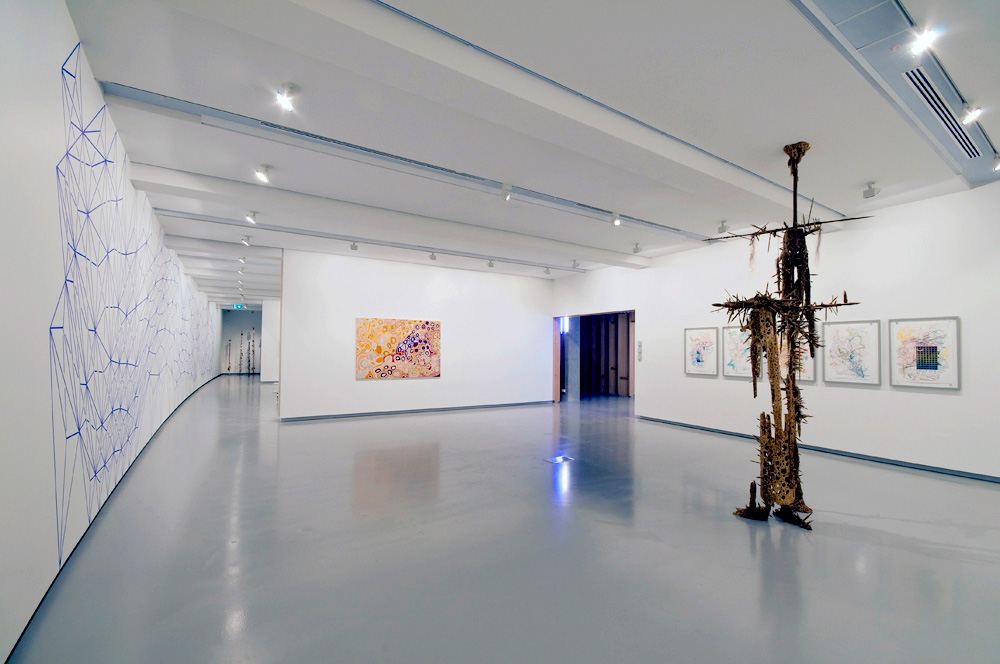
Review: ‘Unnerved: The New Zealand Project’ at NGV International, Melbourne

Exhibition dates: 26th November 2010 – 27th February, 2011

A Queensland Art Gallery Touring Exhibition


Ava Seymour (New Zealand, b. 1967) 'Sate Highway 1' 1997 from the exhibition 'Unnerved: The New Zealand Project' at NGV International


Ava Seymour (New Zealand, b. 1967)
State Highway I
1997
From Health, happiness and housing series
Colour photograph of a photomontage


Ava Seymour (New Zealand b. 1967) 'Day Care Walkabouts' 1997 from the exhibition 'Unnerved: The New Zealand Project' at NGV International


Ava Seymour (New Zealand b. 1967)
Day Care Walkabouts
1997
From Health, happiness and housing series
Photomontage on colour photograph


New Zealand art adrift in a myriad of stories and symbols – not a brave ‘new world’

This is an underwhelming group exhibition of over 100 works drawn from the Queensland Art Gallery collection, a show to wander around on a lazy weekend afternoon and not get too excited about. The large number of works in the exhibition make it impossible to review each work individually (although I critique some works below) but one does get an overall sense of the investigation by New Zealand artists into their history, place, culture and identity. While there are a few good works in the exhibition there are also some very mediocre works as well and, other than a few splashes of self-deprecating humour (such as the wonderful The Horn of Africa (2006) by Michael Parekowhai, below) it all seems importantly earnest: an exhibition for serious people (apologies to Oscar Wilde).

On the evidence of this exhibition the country of New Zealand must be a very unnerving place to live, mainly because their artists can’t seem to keep their hand off it – cultural history that is.

Throughout this exhibition we have psychological unease, physical unease, a little humour, parody, poetry, symbology, allegory, mythology, colonialism, post-colonialism, nationalism, commercialisation, representation, anthropology, travel, landscape, topography, advertising, first contact, sacred spaces, indigenous politics, Māori culture, Pacific Islander culture, pakeha (non-indigenous) culture, tools, guns, rabbits, seals, pianos, traditional tattoos, tourist sites and museums, surfing, suburbia, personal journeys, family albums, androgyny, identity, public housing, ambiguous states, hyperreality, surreality, dislocation, disenfranchisement, alienation, bodies, portraits, subjects, past, present, future (and more!)

Ronnie van Hout exhibits three atmospheric, eerie, dark photographs of constructed model landscapes: of a Nazi doodlebug and the words ABDUCT and HYBRID. The wall text tries, unsuccessfully, to link the images to the obscure and haunted landscapes of New Zealand – a very long bow to draw indeed. Bill Cuthbert’s “nice” photographs offer generalised statements of light and place but really don’t take you anywhere and in fact could have been taken anywhere. The wall text offers that the photographs are a “self-conscious, critical response” to the dismantling of colonial ideas of empire and nation … this is art speak gobbledygook at its worst trying to justify basic photography.

Mark Adams panoramic photograph of one of the sites of first contact – an important historical moment of encounter between Māori and pakeha (non-Māori people of European descent) – are a beautiful photograph of a sound and mountains that has then been dissected, fragmented and individually framed and then mounted unevenly on the gallery wall – just to make sure we get the point about the ‘nature’ of the scenery and its cultural implications. Lonnie Hutchinson’s cut wall work Cinco “offers an interplay between paper and space and explores the ‘va’ or space between – a relation between the Samoan people and the landscape saturated with the dialogue of our ancestors … being adrift in a sea of memories caused by feelings related to cultural loss and uncertainty.” I know how they feel: adrift, underwhelmed by the art and overwhelmed by the text.

Other than the striking photograph of the Dandy (2007, below) Lisa Reihana’s series Digital Marae (2001- ) also fails to inspire. The marae is a highly structure space where Māori families come together – an outdoor, cleared area, a communal or sacred place which serves religious and social purposes in Polynesian societies. Here can be found male sculptures called poupou featuring diverse forms of masculinity, Māori gods and goddesses. The elder Mahuika, while sometimes described as male, is deliberately depicted in her female state in this series. In Reihanna’s digital interpretation of the marae her gods and goddesses become slick, media-inspired glossy magazine type images printed large, mounted on aluminium and lit for maximum theatrical effect. The unstructured spaces behind the figures have no context, no placement and give lie to the inspiration for the series (a highly structured space) and, as such, they land with a commercial thud onto the cleared earth.

The lowest point in the exhibition must be reserved for the 80 photographs of the series ‘The homely’ (1997-2000) by Gavin Hipkins. Usually when reviewing I refrain from saying anything bad about works of art. Robert Nelson in The Age describes the series as “visually and conceptually incoherent.” Taken over 4 years and supposedly “examining notions of nationhood that are unstable and fractured” Hipkins describes it as “a post-colonial gothic novel.” !!

The series features flat, one-dimensional images of symbols: sculptures, closed doors, open doors, flags, people, repeating circles and vertical elements – where the aggregate of all the images is supposed to MEAN SOMETHING. These are the most simple, most basic of year 12 images formed into a sequence that is conceptually irrelevant in terms of its symbolism and iconography vis a vis the purported critical examination it seeks to undertake. This artist needs to look at the sequences of Minor White to see how a master artist puts photographs together – not just in terms of narrative but the meaning in the spaces between the images, their spiritual resonance – or if wanting to be more literal, study that seminal book The Americans by Robert Frank to see how to really make a sequence.

On to better things. For me the absolute gem of this exhibition were the photomontages of Ava Seymour from her ‘Health, happiness and housing’ series (see photographs above). These are just fantastic! Featuring as a backdrop photographs of state houses built in the 1950s and 60s Seymour assembles her cast of characters – composite figures of found limbs, bodies and faces taken from old medical text books – and creates stark, psychological sites of engagement. The can be seen as family portraits, social documents of unseen alienation and dis-enfranchisement with communities and also a comment on the conduct of the welfare system and state housing, but in their ironic, self-deprecating humour they become so much more. Even though they use old photographs the artist recasts them ingenuously to become something new, a new space that the viewer can step into, unlike most of the work in this exhibition.

Most artists in this exhibition seem intent on a form of cultural excavation to make their work, digging and rooting around in cultural history and memory to find “meaning”, to make new forms from old that actually lead nowhere. They excavate symbols and signs and reform them hoping for what, exactly? All that appears is work that is stunted and fragmented, chopped up dislocations that offer nothing new in terms of a way forward for the culture from which these histories and memories emerge. There is no holistic, healing vision here, only a series of mined observations that fragment, distort and polarise, descending into the decorative, illustrative or the commercial. The same can be said of some Australian art (including the exhibition Stormy Weather: Contemporary Landscape Photography at NGV Federation Square that I will review next). As Robert Nelson succinctly observed in his review of this exhibition in The Age (Wednesday, December 29th, 2010), this exhibition “reveals a weakness that also exists in our scene: fertile tricks and noble intentions, but patchy skill or poetic imagination for connecting them.” Well said.

“”When the soul wants to experience something she throws out an image in front of her and then steps into it.” (Meister Eckhart) It is an evocation of the image as a threshold leading to new dimensions of meaning. Symbolic images are more than data; they are vital seeds, living carriers of possibility.”1


New dimensions of meaning, vital seeds, living carriers of possibility. Everyone of us is a living, breathing embodiment of cultural history and memory. We know that intimately in our bones, as human beings. What artists need to do is observe this legacy but offer a way forward, not constantly excavating the past and hoping this is enough when creating work. These are not new spaces to step into! The cohabitation of indigenous and ethnically mixed non-indigenous cultures in both Australia and New Zealand requires this holistic forward looking vision. It is a redemptive vision that is not mired in the symbols and archetypes of the past but, as Australia writer David Malouf envisages it, ‘a dream history, a myth history, a history of experience in the imagination’.2 It is a vision of the future that all post-colonial countries can embrace, where a people can come to know their sense of place more fully.

Rather than an escapist return to the past perhaps a redemptive vision of New Zealand’s cultural future, a history of experience in the imagination, would be less insular and more open to the capacity to wonder.

Dr Marcus Bunyan


1/ Ronnberg, Ami (ed.,). “Preface,” in The Book of Symbols. Cologne: Taschen, 2010, p. 6

2/ Footnote 6. Daniel, Helen. “Interview with David Malouf,” in Australian Book Review (September , 1996), p. 13 quoted in Ennis, Helen. “The Presence of the Past,” in Photography and Australia. London: Reaktion Books, 2007, p. 141


Many thankx to Jemma Altmeier for her help and to the National Gallery of Victoria for allowing me to publish the photographs in the posting. Please click on the photographs for a larger version of the image.


Lisa Reihana (Ngāpuhi: Ngāti Hine, Ngāi Tu New Zealander, b. 1964) 'Hinepukohurangi' 2001 from the exhibition 'Unnerved: The New Zealand Project' at NGV International


Lisa Reihana (Ngāpuhi: Ngāti Hine, Ngāi Tu New Zealander, b. 1964)
Hinepukohurangi
2001
From Digital Marae 2001-
Cibachrome photograph mounted on aluminium
200 x 100cm
Purchased 2002
© Lisa Reihana


Lisa Reihana (Ngāpuhi: Ngāti Hine, Ngāi Tu New Zealander, b. 1964) 'Dandy' 2007 from the exhibition 'Unnerved: The New Zealand Project' at NGV International


Lisa Reihana (Ngāpuhi: Ngāti Hine, Ngāi Tu New Zealander, b. 1964)
Dandy
2007
From Digital Marae 2001-
Colour digital print mounted on aluminium
200 x 120cm
Queensland Art Gallery, Brisbane
Purchased 2008 with funds from the Estate of Vincent Stack through the Queensland Art Gallery Foundation Queensland Art Gallery, Brisbane
© Lisa Reihana


Yvonne Todd (New Zealander, b. 1973) 'January' 2005 from the exhibition 'Unnerved: The New Zealand Project' at NGV International


Yvonne Todd (New Zealander, b. 1973)
January
2005
From the Vagrants’ reception centre series
Light jet photograph
100 x 73.8cm
Queensland Art Gallery, Brisbane
Purchased 2007. Queensland Art Gallery Foundation Grant
©Yvonne Todd


Michael Parekowhai (Ngāti Whakarongo New Zealander, b. 1968) 'Kapa Haka (Whero)' 2003 from the exhibition 'Unnerved: The New Zealand Project' at NGV International


Michael Parekowhai (Ngāti Whakarongo New Zealander, b. 1968)
Kapa Haka (Whero)
2003
Automotive paint on fibreglass
188 x 60 x 50cm
Queensland Art Gallery, Brisbane
Purchased 2009 with funds from Tim Fairfax AM, through the Queensland Art Gallery Foundation
© Michael Parekowhai


The National Gallery of Victoria today opened a major exhibition celebrating the extraordinary work of 26 contemporary New Zealand artists in Unnerved: The New Zealand Project.

Unnerved explores a particularly rich, dark vein found in contemporary New Zealand art. The psychological or physical unease underlying many works in the exhibition is addressed with humour, parody and poetic subtlety by artists across generations and mediums. Bringing together more than 100 works ranging from intimate works on paper to large scale installations by both established and emerging artists, Unnerved engages with New Zealand’s changing social, political and cultural landscape as the country navigates its indigenous settler and migrant histories. These works explore a changing sense of place, the continued importance of contemporary Maori art, biculturalism, a complex colonial past, the creative reworking of memory, and the often interconnected mediums of performance, photography and video. If the vision is unsettling, it is also compelling and Unnerved: The New Zealand Project offers us new ways of seeing one of our closest neighbours.

This fascinating exhibition explores a rich and dark vein found in contemporary art in New Zealand, drawing on the disquieting aspects of New Zealand’s history and culture reflected through more than 100 works of art.

Jane Devery, Coordinating Curator, NGV said: “The works presented in Unnerved reveal a darkness and distinctive edginess that characterises this particular trend in New Zealand contemporary art. The psychological or physical unease underlying many works in the exhibitions is addressed with humour, parody and poetic subtlety.

The exhibition reflects the strength and vitality of contemporary art in New Zealand with works created by both established and emerging artists, across a range of mediums including painting, photography, sculpture, installation, drawing, film and video.

Unnerved engages with New Zealand’s changing social, political and cultural landscape, exploring a shifting sense of place, complex colonial past, the relationships between contemporary Māori, Pacific Islander and pakeha (non-indigenous) culture, and the interplay between performance, video and photography,” said Ms Devery.

A highlight of the exhibition is a group of sculptural works by Michael Parekowhai including his giant inflatable rabbit, Cosmo McMurtry, which will greet visitors to the exhibition, and a spectacular life-size seal balancing a grand piano on its nose titled The Horn of Africa. Also on display are a series of haunting photographs by Yvonne Todd, whose portrait photography often refers to B-grade films and pulp fiction novels.

Gerard Vaughan, Director, NGV said this exhibition demonstrates the NGV’s strong commitment to interesting and challenging contemporary art secured from around the world; he noted that the NGV has made a special commitment to exhibition the contemporary art of our region.

Unnerved will introduce visitors to the rich contemporary arts scene of one of our closest neighbours, fascinating audiences with works ranging from the life size installations by Parekowhai through to the spectacular 30 metre photographic essay by Gavin Hipkins. This truly is a must see show this summer!” said Dr Vaughan.

Unnerved will also offer a strong and engaging collection of contemporary sculpture, installations, drawings, paintings, photography, film and video art by artists including Lisa Reihana, John Pule, Gavin Hipkins, Anne Noble, Ronnie van Hout, Shane Cotton, Julian Hooper and many others.

Press release from the National Gallery of Victoria website


Michael Parekowhai (Ngāti Whakarongo New Zealander, b. 1968) 'The Horn of Africa' 2006


Michael Parekowhai (Ngāti Whakarongo New Zealander, b. 1968)
The Horn of Africa
2006
Automotive paint, wood, fibreglass, steel, brass
395 x 200 x 260cm
Queensland Art Gallery, Brisbane
Purchased 2008 with funds from the Queensland Government’s Gallery of Modern Art Acquisitions Fund in recognition of the contribution to the Gallery by Wayne Goss (Chair of Trustees 1999-2008)
© Michael Parekowhai


Michael Parekowhai (Ngāti Whakarongo New Zealander, b. 1968) 'Cosmo McMurtry' 2006 from the exhibition 'Unnerved: The New Zealand Project' at NGV International


Michael Parekowhai (Ngāti Whakarongo New Zealander, b. 1968)
Cosmo McMurtry
2006
Synthetic polymer paint on polyvinyl chloride, fibreglass, air compressor
734.3 x 506.4 x 739.1cm (variable)
Presented by the Melbourne Art Fair Foundation with the assistance of funds donated by NGV Contemporary, 2006
National Gallery of Victoria
© Michael Parekowhai


Gavin Hipkins (New Zealander, b. 1968) 'Christchurch (Mask)' 1998 from the exhibition 'Unnerved: The New Zealand Project' at NGV International


Gavin Hipkins (New Zealander, b. 1968)
Christchurch (Mask)
1998
From The homely series 1997-2000
Type C photograph
60 x 40cm
Queensland Art Gallery, Brisbane Purchased 2008. The Queensland Government’s Gallery of Modern Art Acquisitions Fund
© Gavin Hipkins


Fiona Pardington (Kai Tahu, Kati Mamoe, Kati Waewae New Zealander, b. 1961) 'Sweet Kiwi, from the collection 'Whanganui Museum'' 2008 from the exhibition 'Unnerved: The New Zealand Project' at NGV International


Fiona Pardington (Kai Tahu, Kati Mamoe, Kati Waewae New Zealander, b. 1961)
Sweet Kiwi, from the collection ‘Whanganui Museum’
2008
Gold-toned gelatin silver photograph
61 x 50.8cm
Queensland Art Gallery, Brisbane
Purchased 2008 with funds from Gina Fairfax through the Queensland Art Gallery Foundation
© Fiona Pardington


Max Gimblett (New Zealander / American, b. 1935) 'Balls' 1990-1997 from the exhibition 'Unnerved: The New Zealand Project' at NGV International


Max Gimblett (New Zealander/American, b. 1935)
Balls
1990-1997
Brush and ink, synthetic polymer paint and pencil on handmade paper
59.8 x 79.3cm
Queensland Art Gallery, Brisbane
The Max Gimblett Gift.
Gift of the artist through the Queensland Art Gallery Foundation 2000
© Max Gimblett


Anne Noble (New Zealander, b. 1954) 'Ruby's room no. 6' 1999 from the exhibition 'Unnerved: The New Zealand Project' at NGV International


Anne Noble (New Zealander, b. 1954)
Ruby’s room no. 6
1999
Colour digital print
67 x 100.2cm
Queensland Art Gallery, Brisbane
Purchased 2006
© Anne Noble


NGV International
180 St Kilda Road

Opening hours
Daily 10am – 5pm

National Gallery of Victoria website

LIKE ART BLART ON FACEBOOK

Back to top
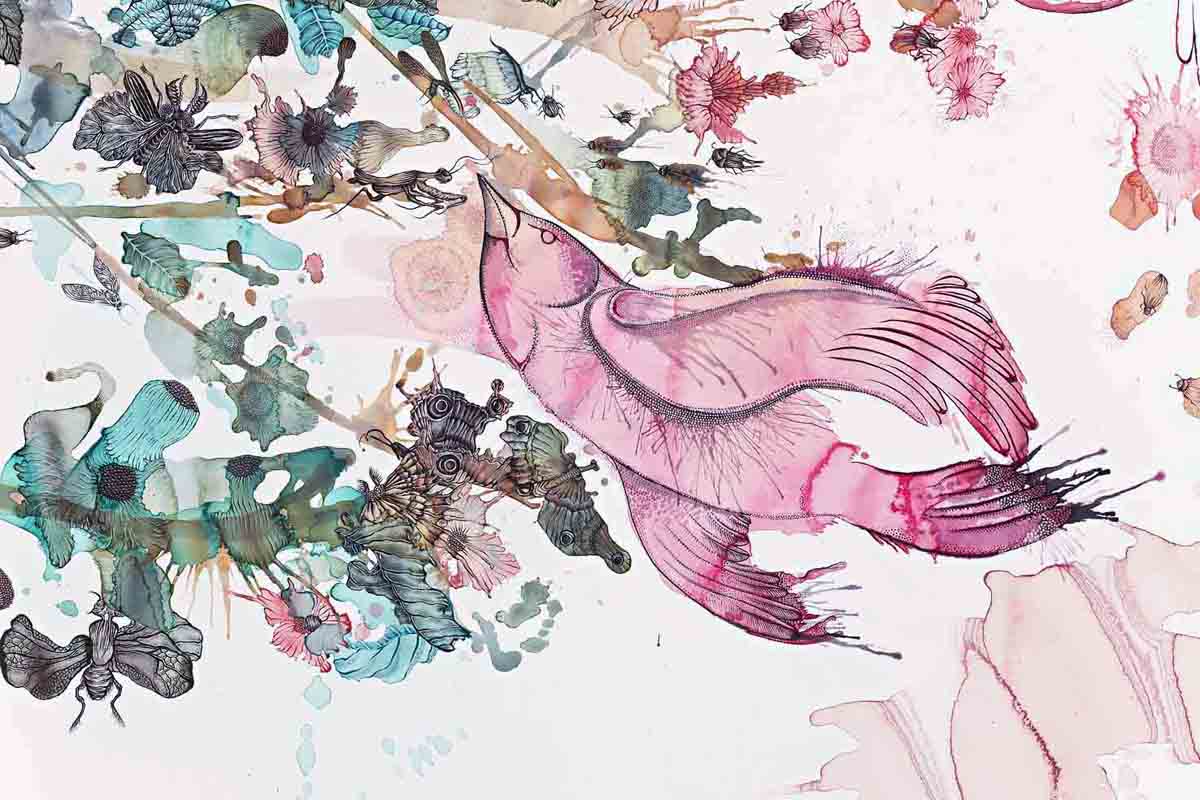
Review: ‘Luminous Cities: Photographs of the Built Environment’ at NGV International, Melbourne

Exhibition dates: 22nd October 2010 – 13th March 2011


Eugène Atget (French, 1857-1927) 'Coin de la rue Valette et Pantheon, 5e arrondissement, matinee de mars' 1925, printed 1978  from the exhibition 'Luminous Cities: Photographs of the Built Environment' at NGV International


Eugène Atget (French, 1857-1927)
Coin de la rue Valette et Pantheon, 5e arrondissement, matinee de mars
1925, printed 1978
Gelatin silver photograph
17.8 x 23.7cm
National Gallery of Victoria, Melbourne
Purchased, 1980


A delightful exhibition of photographs of the built environment at the National Gallery of Victoria, Melbourne. The exhibition contains some interesting photographs from the collection including the outstanding Coin de la rue Valette et Pantheon, 5e arrondissement, matinee de mars by Eugene Atget taken two years before his death (1925, printed 1978, see below) that simply takes your breath away.

Atget was my hero when I started to study photography in the late 1980s and he remains my favourite photographer. His use of light coupled with his understanding of how to organise space within the pictorial frame is exemplary (note the darkness of the right-hand wall as it supports the integrity of the rest of the image, as it leads your eye to that wonderful space between the buildings, the shaft of light falling on the ground, the blank wall topped by an arrow leading the eye upwards to the misty dome!). The ability to place his large format camera and tripod in just the right position, the perfect height and angle, to allow the subject to reveal itself it all it’s glory is magical: “Atget’s interest in the variable play between nature and art through minute changes in the camera’s angle, or as functions of the effects of light and time of day, is underscored in his notations of the exact month and sometimes even the hour when the pictures were taken.”1 Two other immense works in the exhibition are New York at Night by Berenice Abbott (1932, printed c. 1975 below) and the incredible multiple exposure The Maypole, Empire State Building, New York by Edward Steichen (1932, below).

The only disappointment to the exhibition is the lack of vintage prints, a fair portion of the exhibition including the three prints mentioned above being later prints made from the original negatives. I wonder what vintage prints of these images would look like?

The purchasing of non-vintage prints was the paradigm for the collection of international photographs early in the history of the Department of Photography at the National Gallery of Victoria and was seen as quite acceptable at the time. The paradigm was set by Athol Shmith in 1973 on his visit to Paris and London.

“Typically for the times, Shmith did not choose to acquire vintage prints, that is, photographs made shortly after the negative was taken. While vintage prints are most favoured by collectors today, in the 1970s vintage prints supervised by the artists were considered perfectly acceptable and are still regarded as a viable, if less impressive option now.”2

Some museums including the NGV preferred to acquire portfolios of modern reprints as a speedy way of establishing a group of key images. As noted in the catalogue essay to 2nd Sight: Australian Photography at the National Gallery of Victoria by Dr Isobel Crombie, Senior Curator of Photography at the National Gallery of Victoria, the reason for preferring the vintage over the modern print “is evident when confronted with modern and original prints: differences in paper, scale and printing styles make the original preferable.”3 The text also notes that this sensibility, the consciousness of these differences slowly evolved in the photographic world and, for most, the distinctions were not a matter of concern even though the quality of the original photograph was not always maintained.

This is stating the case too strongly. Appreciation of the qualities of vintage prints was already high in the period of the mid-1970s – early 1980s most notably at institutions such as The Museum of Modern Art, a collection visited by photography curators of the NGV. Size and scale of the vintage prints tend to be much smaller than later prints making them closer to the artists original intentions, while the paper the prints are made on, the contrast and colour of the prints also varies remarkably. Other mundane but vitally important questions may include these: who printed the non-vintage photograph, who authorised the printing and how many non-vintage copies of the original negative were made, none of which are answered when the prints are displayed.

I vividly remember seeing a retrospective of Henri Cartier-Bresson’s work in Edinburgh at the Dean Gallery, National Gallery of Scotland in 2005, the largest retrospective of Cartier-Bresson’s work ever staged in Britain with over 200 photographs. Three large rooms were later 1970s reprints of some of his photographs, about 20″ x 24″ in size, on cold, blue photographic paper. One room, however, was full of his original prints from the 1920s and 30s. The contrast could not have been different: the vintage prints were very small, intense, subtle, printed on brown toned paper, everything that you would want those jewel-like images to be, the vision of the artist intensified; the larger prints diluted that vision until the images seemed to almost waste away despite their size.

Although never stated openly I believe that one of the reasons for the purchase of non-vintage prints was the matter of cost, the Department of Photography never being given the budget to buy the prints that it wanted to in the 1970s – early 1980s, the collection of photography not being a priority for the NGV at that time. In other words by buying non-vintage prints in the 1970s you got more “bang for your buck” even when the cost of vintage prints was relatively low. Unfortunately the price of vintage prints then skyrocketed in the 1980s putting them well outside the budget of the Department. While Dr Crombie acknowledges the preponderance of American works in the collection over European and Asian works she also notes that major 20th century photographers that you would expect to be in the collection are not and blames this lack “on the massive increases in prices for international photography that began in the 1980s and which largely excluded the NGV from the market at this critical time.”4

The policy of purchasing non-vintage prints has now ceased at the National Gallery of Victoria.

The purchasing of non-vintage prints and the paucity of purchasing vintage prints by master photographers during the formative decade of the collection of international photographs in the Department of Photography (1970-1980) is understandable in hindsight but today seems like a golden opportunity missed. While the collection contains many fine photographs due to the diligence of early photographic curators (notably Jennie Boddington), the minuscule nature of the budget of the department in those early years when vintage prints were relatively cheap and affordable (a Paul Caponigro print could be purchased for $200-300 for example) did not allow them to purchase the photographs that the collection desperately needed. With one vintage print by a master of photography now fetching many thousands of dollars the ability to fill gaps in the collection in the future is negligible (according to Dr Crombie) – so we must celebrate and enjoy the photographs that are in the collection such as those in Luminous Cities: Photographs of the Built Environment.

Dr Marcus Bunyan


2/ Crombie, Isobel. “Creating a Collection: International Photography at the National Gallery of Victoria,” in Re_View: 170 years of Photography. Melbourne: National Gallery of Victoria, 2009, p. 9

3/ Crombie, Isobel. Second sight: Australian photography in the National Gallery of Victoria. Melbourne: National Gallery of Victoria, 2002, p. 10

4/ Op.cit. p. 10


Many thankx to Jemma Altmeier for her help and to the National Gallery of Victoria for allowing me to publish the photographs in the posting. Please click on the photographs for a larger version of the image.


Stephen Thompson (active throughout Europe, 1850s-1880s) 'Grande Canale, Venice' c. 1868 from the exhibition 'Luminous Cities: Photographs of the Built Environment' at NGV International


Stephen Thompson (active throughout Europe, 1850s-1880s)
Grande Canale, Venice
c. 1868
Albumen silver photograph
21.2 x 29.2cm
National Gallery of Victoria, Melbourne
Purchased from Admission Funds, 1988


England (active in England 1860s) 'Houses of Parliament, London' 1860s from the exhibition 'Luminous Cities: Photographs of the Built Environment' at NGV International


England (active in England 1860s)
Houses of Parliament, London
1860s
Albumen silver photograph
18.5 x 24.1cm
National Gallery of Victoria, Melbourne
Purchased from Admission funds, 1988


On 22 October the National Gallery of Victoria will open Luminous Cities, a fascinating exhibition that examines the various ways photographers have viewed cities as historical sites, bustling modern hubs and architectural utopias since the nineteenth century.

The great cities of the world are vibrant creative centres in which the built environment is often as inspirational as the activities of its citizens, and, since the nineteenth century photographers have creatively explored the idea of the city.

This exhibition, drawn from the collection of the NGV, considers various ways in which photographers in the 19th and 20th centuries have viewed cities as historical sites, bustling modern metropolises and architectural utopias. These lyrical images describe the physical attributes of cities, offer insights into the creative imaginations of architects and photographers and embody the zeitgeist of their times.

Frances Lindsay, Deputy Director, NGV said: “Through the work of a range of photographers Luminous Cities will take viewers on a fascinating journey around the world, into the streets, buildings and former lives of great international cities.

“Drawn from the NGV collection, Luminous Cities includes works by renowned photographers Eugene Atget, Alfred Stieglitz, Edward Steichen, Berenice Abbott, Laszlo Moholy-Nagy, Bill Brandt, Lee Freidlander and Grant Mudford amongst many others.

The exhibition will also extend into our contemporary gallery space where an outstanding selection of works by celebrated contemporary artists such as Bill Henson, Andreas Gursky and Jon Cattapan will be on display,” said Ms Lindsay.

Through examples from the mid 19th century, Luminous Cities explores the relationship between photographer, architect and archaeologist with photos of Athens, Rome and Pompeii. This was also a time when great cities such as London and Paris underwent unprecedented renewal and expansion, photography served to document new constructions and also presented heroic, inspirational visions of new cities emerging from old.

Susan van Wyk, Curator, Photography, NGV said: “The works on display in Luminous Cities describe the physical attributes of cities, offer insights into the creative imaginations of architects and photographers, and embody the zeitgeist of their times.”

New York, one of the great 20th century cities, was a captivating subject for generations of photographers. Through the work of architects and the images photographers made of the city, New York became synonymous with its skyline. The images of renowned photographers including Alfred Stieglitz, Edward Steichen, Paul Strand and Berenice Abbott show the pictorial possibilities of the modern city in photographs that embody the dynamism of the city that never sleeps.

The contemporary art works included in Luminous Cities explore the creative ways in which artists imagine and represent the cityscape. Vast glittering panoramas taken from bustling urban communities, sprawling architectural structures and fictitious landscapes all combine to reveal fascinating insights into both physical and psychological geographies.

Ms van Wyk said: “At the end of the 20th century a much cooler, more abstracted strain of photography emerged. Photographs in the exhibition from this period range from the formalism of the 1970s to more recent cinematic visions of the nocturnal city.”

Press release from the National Gallery of Victoria website


Lee Freidlander (American, b. 1934) 'Stamford, Connecticut' 1973, printed c. 1977 from the exhibition 'Luminous Cities: Photographs of the Built Environment' at NGV International


Lee Freidlander (American, b. 1934)
Stamford, Connecticut
1973, printed c. 1977
Gelatin silver photograph
18.9 x 28.3cm
National Gallery of Victoria, Melbourne
Purchased, 1977
© Lee Friedlander


In the decades following the Second World War the idea of ‘the city’, notably in work of American, European and Australian photographers, came to symbolise the modern condition, the best and worst of contemporary life. This ambiguous stance on the city is exemplified in the work of American photographer Lee Friedlander whose photographs of seemingly ordinary urban scenes are at once amusing and slightly disturbing. In his 1973 photograph Stamford, Connecticut, the banal vernacular architecture of suburban shopping street forms the backdrop to a peculiar scene where shoppers are ‘stalked’ by a statue of first world war sniper. Despite its witty elements, this image has a somewhat despairing tone. The women walking along this rather bleak street are isolated and anonymous, ciphers for the worst aspects of contemporary city life.


Grant Mudford (b. Australia 1944, lived United States 1977- ) 'New York' 1975 from the exhibition 'Luminous Cities: Photographs of the Built Environment' at NGV International


Grant Mudford (b. Australia 1944, lived United States 1977- )
New York
1975
Gelatin silver photograph
33.8 x 49.8cm
National Gallery of Victoria, Melbourne
Purchased, 1977
© Grant Mudford


A more neutral view of the contemporary city can be seen in the work of Australian photographer Grant Mudford. After moving to the US in 1970s, Mudford continued to photograph the built environment. Familiar with the work of Lee Friedlander, and citing Walker Evans as an influence, Mudford’s photographs continue a tradition of photographing the city as an empty backdrop devoid of the bustle of human activity. In his 1975 Untitled photograph of a truck depot in New York, Mudford simplifies what could be a chaotic scene to the verge of abstraction.


Berenice Abbott (american, 1898-1991) 'New York at Night' 1932 from the exhibition 'Luminous Cities: Photographs of the Built Environment' at NGV International Review: 'Luminous Cities: Photographs of the Built Environment' at NGV International, Melbourne


Berenice Abbott (American, 1898-1991)
New York at Night
1932
Gelatin silver print
34.1 × 26.1cm (image and sheet)
National Gallery of Victoria, Melbourne
Gift of an anonymous donor in memory of Rosa Zerfas (1896-1983), 1985
©Artist estate through the Howard Greenberg Gallery, New York


Edward Steichen (American, 1879-1973) 'The maypole' 1932 from the exhibition 'Luminous Cities: Photographs of the Built Environment' at NGV International Review: 'Luminous Cities: Photographs of the Built Environment' at NGV International, Melbourne


Edward Steichen (American, 1879-1973)
The maypole
1932
Gelatin silver photograph
35.1 × 27.1cm
National Gallery of Victoria, Melbourne
Presented by Maxwell Photo-Optics Pty Ltd, 1973
© Edward Steichen. ARS/Copyright Agency, 2023


Wolfgang Sievers (Australian born Germany, 1913-2007) 'Old Frankfurt before its total destruction in World War II, Germany' 1933, printed 1986 from the exhibition 'Luminous Cities: Photographs of the Built Environment' at NGV International, Melbourne


Wolfgang Sievers (Australian born Germany, 1913-2007)
Old Frankfurt before its total destruction in World War II, Germany
1933, printed 1986
gelatin silver photograph
28.9 x 26.2 cm
National Gallery of Victoria, Melbourne
Purchased, 1986


Bill Henson (Australian, b. 1955)
'Untitled' 1987-1988 From the 'Untitled 1987/88' series 1987-1988 from the exhibition 'Luminous Cities: Photographs of the Built Environment' at NGV International, Melbourne


Bill Henson (Australian, b. 1955)
Untitled
1987-1988
From the Untitled 1987/88 series 1987-1988
Type C photograph
183.5 x 125.6cm
National Gallery of Victoria, Melbourne
Purchased through The Art Foundation of Victoria with the assistance of the Moët & Chandon Art Acquisition Fund, Fellow, 1989
© The artist and Robert Miller Gallery, New York


NGV International
180 St Kilda Road

Opening hours
Daily 10am – 5pm

National Gallery of Victoria website

LIKE ART BLART ON FACEBOOK

Back to top
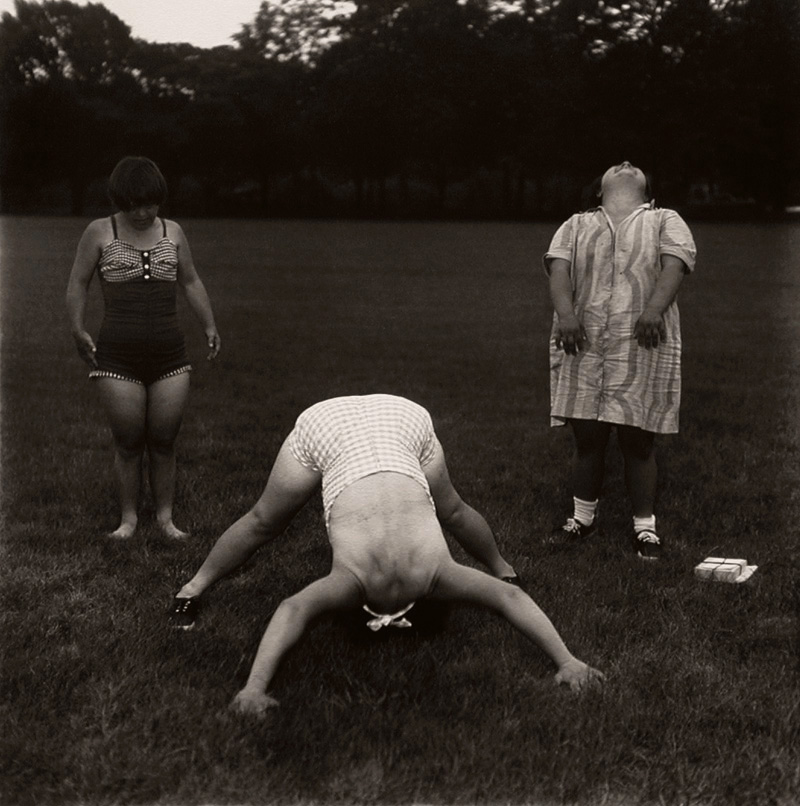
melbourne’s magnificent eleven 2010

December 2010


Here’s my pick of the eleven best exhibitions in Melbourne for 2010 that featured on the Art Blart: art and cultural memory archive (in no particular order). Enjoy!

Marcus


1/ Jenny Holzer at The Australian Centre for Contemporary Art (ACCA)

Jenny Holzer (American, b. 1950) 'Right Hand (Palm Rolled)' 2007 from the exhibition 'Jenny Holzer' at The Australian Centre for Contemporary Art (ACCA)


Jenny Holzer (American, b. 1950)
Right Hand (Palm Rolled)
2007
Oil on linen
80 x 62 in (203.2 x 157.5cm)
Text: U.S. government document


The reason that you must visit this exhibition is the last body of work. Working with declassified documents that relate to the wars in Iraq and Afghanistan Holzer’s Redaction paintings address the elemental force that is man’s (in)humanity to man (in the study of literature, redaction is a form of editing in which multiple source texts are combined (redacted) and subjected to minor alteration to make them into a single work) … I left the exhibition feeling shell-shocked after experiencing intimacy with an evil that leaves few traces. In the consciences of the perpetrators? In the hearts of the living! Oh, how I wish to see the day when the human race will truly evolve beyond. We live in hope and the work of Jenny Holzer reminds us to be vigilant, to speak out, to have courage in the face of the unconscionable.


2/ ‘Pondlurking’ by Tom Moore at Helen Gory Galerie, Prahran

This exhibition produced in me an elation, a sense of exalted happiness, a smile on my dial that was with me the rest of the day. The installation features elegantly naive cardboard cityscape dioramas teeming with wondrous, whimsical mythological animals that traverse pond and undulating road. This bestiary of animals, minerals and vegetables (bestiaries were made popular in the Middle Ages in illustrated volumes that described various animals, birds and even rocks) is totally delightful … What really stands out is the presence of these objects, their joyousness. The technical and conceptual never get in the way of good art. The Surrealist imagining of a new world order (the destruction of traditional taxonomies) takes place while balanced on one foot. The morphogenesis of these creatures, as they build one upon another, turns the world upside down … Through their metamorphosed presence in a carnivalesque world that is both weird and the wonderful, Moore’s creatures invite us to look at ourselves and our landscape more kindly, more openly and with a greater generosity of spirit.


Tom Moore (Australian, b. 1971) 'Birdboat with passenger with a vengeance' (left) and 'Robot Island' (right) 2010 and 2009 from the exhibition 'Pondlurking' by Tom Moore at Helen Gory Galerie, Prahran


Tom Moore (Australian, b. 1971)
Birdboat with passenger with a vengeance (left) and Robot Island (right)
2010 and 2009


3/ ‘Safety Zone’ by John Young at Anna Schwartz Gallery

What can one say about work that is so confronting, poignant and beautiful – except to say that it is almost unbearable to look at this work without being emotionally charged, to wonder at the vicissitudes of human life, of events beyond one’s control.

The exhibition tells the story of the massacre of 300,000 people in the city of Nanjing in Jiangsu, China by Japanese troops in December, 1937 in what was to become known as the Nanjing Massacre. It also tells the story of a group of foreigners led by German businessman John Rabe and American missionary Minnie Vautrin who set up a “safety zone” to protect the lives of at least 250,000 Chinese citizens. The work is conceptually and aesthetically well resolved, the layering within the work creating a holistic narrative that engulfs and enfolds the viewer – holding them in the shock of brutality, the poignancy of poetry and the (non)sublimation of the human spirit to the will of others.

Simply, this is the best exhibition that I have seen in Melbourne so far this year.


John Young (Australian, b. 1956) 'Flower Market (Nanjing 1936) #1' 2010 from the exhibition 'Safety Zone' by John Young at Anna Schwartz Gallery


John Young (Australian, b. 1956)
Flower Market (Nanjing 1936) #1
2010
digital print and oil on Belgian linen
240 x 331cm
image courtesy of the artist and Anna Schwartz Gallery


John Young (Australian, b. 1956) 'Safety Zone' 2010


John Young (Australian, b. 1956)
Safety Zone
2010
60 works, digital prints on photographic paper and chalk on blackboard-painted archival cotton paper
Installation shot, Anna Schwartz Gallery, Melbourne
Image courtesy of the artist and Anna Schwartz Gallery


4/ ‘To Hold and Be Held’ by Kiko Gianocca at Gallery Funaki

Kiko Gianocca (Swiss, b. 1974) 'Man & dog' found image, resin, silver 2009 from the exhibition 'To Hold and Be Held' by Kiko Gianocca at Gallery Funaki


Kiko Gianocca (Swiss, b. 1974)
Man & dog
Found image, resin, silver
2009


A beautiful exhibition of objects by Swiss/Italian artist Kiko Gianocca at Gallery Funaki, Melbourne, one full of delicate resonances and remembrances.

Glass vessels with internal funnels filled with the gold detritus of disassembled objects, found pendants: Horse, Anchor, Four leaf clover, Swan, Hammer & sickle … Brooches of gloss and matt black resin plates. On the reverse images exposed like a photographic plate, found images solidified in resin.

The front: the depths of the universe, navigating the dazzling darkness
The back: memories, forgotten, then remade, worn like a secret against the beating chest. Only the wearer knows!

As Kiki Gianocca asks, “I am not sure if I grasp the memories that sometimes come to mind. I start to think they hold me instead of me holding them.”


5/ ‘Jill Orr: Vision’ at Jenny Port Gallery, Richmond

The photographs invite us to share not only the mapping of the surface of the skin and the mapping of place and identity but the sharing of inner light, the light of the imaginary as well – and in this observation the images become unstable, open to reinterpretation. The distance between viewer and subject is transcended through an innate understanding of inner and outer light. The photographs seduce, meaning, literally, to be led astray … I found myself looking at the photographs again and again for small nuances, the detail of hairs on the head, the imagining of what the person was thinking about with their eyes closed: their future, their fears, their hopes, the ‘active imagination as a means to visualise sustainable futures’ (Orr, 2010) …

In the imagination of the darkness that lies behind these children’s closed eyes is the commonality of all places, a shared humanity of memory, of dreams. These photographs testify to our presence and ask us to decide how we feel about our life, our place and the relation to that (un)placeness where we must all, eventually, return.


Jill Orr (Australian, b. 1952) 'Jacinta' 2009 from the exhibition 'Jill Orr: Vision' at Jenny Port Gallery, Richmond

Jill Orr (Australian, b. 1952) 'Jacinta' 2009 from the exhibition 'Jill Orr: Vision' at Jenny Port Gallery, Richmond


Jill Orr (Australian, b. 1952)
Jacinta
2009


6/ ‘AND THEN…’ by Ian Burns at Anna Schwartz Gallery

These are such fun assemblages, the created mis en scenes so magical and hilarious, guffaw inducing even, that they are entirely delightful.

There is so much to like here – the inventiveness, the freshness of the work, the insight into the use of images in contemporary culture. Still photographs of this work do not do it justice. I came away from the gallery uplifted, smiling, happy – and that is a wonderful thing to happen.


Ian Burns (Australian, b. 1964) '15 hours v.4' 2010 from the exhibition 'AND THEN...' by Ian Burns at Anna Schwartz Gallery


Ian Burns (Australian, b. 1964)
15 hours v.4
2010
Found object kinetic sculpture, live video and audio
Image courtesy the artist and Anna Schwartz Gallery


7/ ‘Night’s Plutonian Shore’ by Julia deVille at Sophie Gannon Gallery, Richmond

Julia deVille (Australian, b. 1982) 'Nevermore' 2010 from the exhibition 'Night's Plutonian Shore' by Julia deVille at Sophie Gannon Gallery, Richmond


Julia deVille (Australian, b. 1982)
Nevermore
2010


This is an excellent exhibition by Julia deVille at Sophie Gannon Gallery in Richmond … This exhibition shows a commendable sense of restraint, a beautiful rise and fall in the work as you walk around the gallery space with the exhibits displayed on different types and heights of stand and a greater thematic development of the conceptual ideas within the work. There are some exquisite pieces.

In these pieces there is a simplification of the noise of the earlier works and in this simplification a conversant intensification of the layering of the conceptual ideas. Playful and witty the layers can be peeled back to reveal the poetry of  de Sade, the stories of Greek mythology and the amplification of life force that is at the heart of these works. Good stuff.


8/ ‘Mari Funaki; Objects’ at The Ian Potter Centre: NGV Australia

Mari Funaki (born Japan 1950, arrived Australia 1979, died 2010) 'Object' 2008 from the exhibition 'Mari Funaki; Objects' at The Ian Potter Centre: NGV Australia


Mari Funaki (born Japan 1950, arrived Australia 1979, died 2010)
Object
2008
Heat-coloured mild steel
36 x 47.5 x 14.5cm
Collection of Johannes Hartfuss & Fabian Jungbeck, Melbourne
© The Estate of Mari Funaki


Quiet, precise works. Forms of insect-like legs and proboscises. They balance, seeming to almost teeter on the edge – but the objects are incredibly grounded at the same time. As you walk into the darkened gallery and observe these creatures you feel this pull – lightness and weight. Fantastic!

And so it came to pass in silence, for these works are still, quiet and have a quality of the presence of the inexpressible. Funaki achieves these incredible silences through being true to her self and her style through an expression of her endearing will. While Mari may no longer be amongst us as expressions of her will the silences of these objects will be forever with us.


9/ ‘Up Close: Carol Jerrems with Larry Clark, Nan Goldin and William Yang’ at Heide Museum of Modern Art

When looking at art, one of the best experiences for me is gaining the sense that something is open before you, that wasn’t open before. I don’t mean accessible, I mean open like making a clearing in the jungle, or being able to see further up a road, or just further on. And also like an open marketplace – where there were always good trades. There is the feeling that if you put in a certain amount of honesty, then you would get something back that made some room for you in front – some room that would allow you to look forward, and maybe even walk into that space. Seeing Jerrems work gives you that feeling.


Carol Jerrems (Australian, 1949-1980) 'Mark and Flappers' 1975 from the exhibition 'Up Close: Carol Jerrems with Larry Clark, Nan Goldin and William Yang' at Heide Museum of Modern Art


Carol Jerrems (Australian, 1949-1980)
Mark and Flappers
1975
National Gallery of Victoria, Melbourne
Gift of James Mollison, 1994
© Ken Jerrems & the Estate of Lance Jerrems


10/ ‘John Davis: Presence’ at The Ian Potter Centre: NGV Australia

John Davis (Australia 1936-1999) '(Spotted fish)' 1989 from the exhibition 'John Davis: Presence' at The Ian Potter Centre: NGV Australia


John Davis (Australia 1936-1999)
(Spotted fish)
1989
Twigs, cotton thread, calico, bituminous paint
55 x 145 x 30cm
Private collection, Melbourne
© Penelope Davis & Martin Davis. Administered by VISCOPY, Australia


This is a superlative survey exhibition of the work of John Davis at NGV Australia, Melbourne.

In the mature work you can comment on the fish as ‘travellers’ or ‘nomads’, “a metaphor for people and the way we move around the world.” You can observe the caging, wrapping and bandaging of these fish as a metaphor for the hurt we humans impose on ourselves and the world around us. You can admire the craftsmanship and delicacy of the constructions, the use of found objects, thread, twigs, driftwood and calico and note the ironic use of bituminous paint in relation to the environment, “a sticky tar-like form of petroleum that is so thick and heavy,” of dark and brooding colour.

This is all well and true. But I have a feeling when looking at this work that here was a wise and old spirit, one who possessed knowledge and learning … a human being who attained a state of grace in his life and in his work.


11/ ‘Mortality’ at The Australian Centre for Contemporary Art (ACCA)

Fiona Tan (Indonesian, b. 1966) 'Tilt' 2002 from the exhibition 'Mortality' at The Australian Centre for Contemporary Art (ACCA)


Fiona Tan (Indonesian, b. 1966)
Tilt
2002
DVD
courtesy of the artist, Frith Street Gallery London


I never usually review group exhibitions but this is an exception to the rule. I have seen this exhibition three times and every time it has grown on me, every time I have found new things to explore, to contemplate, to enjoy. It is a fabulous exhibition, sometimes uplifting, sometimes deeply moving but never less than engaging – challenging our perception of life. The exhibition proceeds chronologically from birth to death. I comment on a few of my favourite works below but the whole is really the sum of the parts: go, see and take your time to inhale these works – the effort is well rewarded. The space becomes like a dark, fetishistic sauna with it’s nooks and crannies of videos and artwork. Make sure you investigate them all!


LIKE ART BLART ON FACEBOOK

Back to top

Exhibition: ‘Gustave Moreau and the Eternal Feminine’ at the National Gallery of Victoria, Melbourne

Exhibition dates: 10th December 2010 – 10th April 2011


Installation photograph of the exhibition 'Gustave Moreau and the Eternal Feminine' at the National Gallery of Victoria showing a woman looking at Gustave Moreau's 'Jupiter and Europa' 1868


Installation photograph of the exhibition Gustave Moreau and the Eternal Feminine at the National Gallery of Victoria showing a woman looking at Gustave Moreau’s Jupiter and Europa 1868
Photo: Marcus Bunyan


A small but perfectly formed exhibition of the works of the French Symbolist painter Gustave Moreau at the National Gallery of Victoria. The delight is in the detail: the dark, intense neo-classical paintings on biblical and mythological themes reward close scrutiny and contemplation. I purposefully chose to photograph the details at the media launch for the joys they reveal: the flashes of purple, red and turquoise paint to the right in Delilah (Nd, see below) and the almost etched quality of the columns and their symbols behind Salomé and John the Baptist’s head in The Apparition (1875, see below). Please ENLARGE the photographs by clicking on them to see the detail.
Other important events to celebrate the 150th anniversary of the National Gallery of Victoria next year include major exhibitions such as ManStyle (March – October / November 2011 at both St Kilda Road and Federation Square venues) that will feature an exploration of the dandy in men’s fashion from the 18th century to the present day. I have lent the NGV a 1940s suit and tie from my collection for the exhibition so I am excited to see how they display. Also feted for next year is the major Melbourne Winter Masterpieces exhibition Vienna: Arts & Design: Klimt, Schiele, Hoffmann, Loos (June – October 2011) as well as a large Eugene von Guérard: Nature Revealed exhibition (April – August 2011) and several photographic exhibitions including the intriguing Deep Water (April – September 2011) that will include photographs of water and its environment divided into fresh and saltwater sections.

The best news is the creation of two new contemporary exhibiting spaces – one in St Kilda Road (the old gallery that housed Grecian pottery on the ground floor) and the former restaurant next to the bookshop in the atrium of Federation Square. Both spaces will have their own entry, one off the atrium and the other off the space near the spire allowing them to be open late at night without the larger gallery being open and they will exhibition small contemporary exhibitions. An excellent proactive idea!

As always many thankx to Sue Coffey, Alison Murray, Jemma Altmeier and the media team at the NGV for their help and to the curator of the exhibition Dr Ted Gott for his friendship and erudite conversation.

Dr Marcus Bunyan


Please click on the photographs for a larger version of the image. All photographs © Dr Marcus Bunyan and the National Gallery of Victoria. All rights reserved. No reproduction without the permission of the author and the National Gallery of Victoria.


Installation photograph of the exhibition Gustave Moreau and the Eternal Feminine at the National Gallery of Victoria showing a woman looking at Gustave Moreau's Jupiter and Europa 1868


Installation photograph of the exhibition Gustave Moreau and the Eternal Feminine at the National Gallery of Victoria showing a woman looking at Gustave Moreau’s Jupiter and Europa 1868
Photo: Marcus Bunyan


Gustave Moreau (French, 1826-1898) 'Jupiter and Europa' 1868 (detail)


Gustave Moreau (French, 1826-1898)
Jupiter and Europa (detail)
1868
Oil on canvas
Musée National Gustave Moreau, Paris, France
Photo: Marcus Bunyan


Gustave Moreau (French, 1826-1898) 'Jupiter and Europa' 1868 (detail)


Gustave Moreau (French, 1826-1898)
Jupiter and Europa (detail)
1868
Oil on canvas
Musée National Gustave Moreau, Paris, France
Photo: Marcus Bunyan


Gustave Moreau (French 1826-1898)
'Jupiter and Europa' 1868


Gustave Moreau (French 1826-1898)
Jupiter and Europa
1868
oil on canvas
175 x 130cm
Musée GustaveMoreau (Cat. 191)
© Photo RMN – René-Gabriel Ojéda


Gustave Moreau (French 1826-1898) 'Hercules and Omphale' 1856-1857


Gustave Moreau (French 1826-1898)
Hercules and Omphale
1856-1857
Oil on canvas
104.5 x 65cm
Musée Gustave Moreau (Inv. 13989)
© Photo RMN – Christian Jean


Installation photograph of the exhibition 'Gustave Moreau and the Eternal Feminine' at the National Gallery of Victoria

Installation photograph of the exhibition 'Gustave Moreau and the Eternal Feminine' at the National Gallery of Victoria


Installation photographs of the exhibition Gustave Moreau and the Eternal Feminine at the National Gallery of Victoria
Photos: Marcus Bunyan


Gustave Moreau (French, 1826-1898)
'The Sirens' 1885


Gustave Moreau (French, 1826-1898)
The Sirens
1885
Oil on canvas
89 x 118cm
Gustave Moreau Museum (Inv. 13957)
© Photo RMN – Christian Jean


Gustave Moreau (French, 1826-1898) 'The Sirens' 1885 (detail)


Gustave Moreau (French, 1826-1898)
The Sirens (detail)
1885
Oil on canvas
Musée National Gustave Moreau, Paris, France
Photo: Marcus Bunyan


Gustave Moreau (French, 1826-1898) 'The Sirens' 1885 (detail)


Gustave Moreau (French, 1826-1898)
The Sirens (detail)
1885
Oil on canvas
Musée National Gustave Moreau, Paris, France
Photo: Marcus Bunyan


Gustave Moreau (French, 1826-1898) 'Helen on the Walls of Troy' c. 1870 (detail)


Gustave Moreau (French, 1826-1898)
Helen on the Walls of Troy (detail)
c. 1870
Oil on canvas
Musée National Gustave Moreau, Paris, France
Photo: Marcus Bunyan


Be seduced by femmes fatales, goddesses and temptresses of history and legend at the NGV this summer in Gustave Moreau and the Eternal Feminine, the first significant exhibition of Gustave Moreau (1826-1898) to be seen in Australia. The superb craftsmanship of Gustave Moreau will be celebrated with over 100 paintings, watercolours and drawings from the unique and acclaimed Musée Gustave Moreau in Paris. Gerard Vaughan, Director, NGV said this is a once-in-a-lifetime opportunity for Australians to see these captivating works by Moreau.

“Visitors will embrace Moreau’s portrayals of familiar historical and mythical characters. From famed femmes fatales including Salomé, Helen of Troy and Lady Macbeth to the rugged depictions of Hercules and the Cyclops, this spectacular exhibition will reveal the many faces of Gustave Moreau.

Moreau’s pictures are amongst the most haunting and mysterious of the entire 19th century, and ironically are incredibly modern. This is a must see exhibition!” said Dr Vaughan.

Gustave Moreau and the Eternal Feminine will explore the artist’s obsession with the female form, taking visitors on a voyage from classical antiquity and the ancient Far East, to Christianity’s more lurid escapades and epic narratives of the Middle Ages.

Ted Gott, Senior Curator, International Art, NGV said: “Throughout his life Moreau was both entranced by female beauty and captivated by the allure of powerful, even dangerous women from the pages of history and legend, making him a cult figure for today’s younger generation who are spellbound by gothic tales and imagery.

Moreau’s fascination with heroines and queens, goddesses and temptresses were screens through which he could filter his explorations of the key themes of the Eternal Feminine: obsession, dream, luxury, magic, the femme fatale, exoticism and the ideal,” said Dr Gott.

A highlight of the exhibition will be a section devoted to Moreau’s most celebrated and intriguing obsession – the story of Salomé and the beheading of John the Baptist. Salomé is often depicted as an icon of dangerous female seductiveness and in this famous tale, her stepfather Herod requests Salomé to dance for him on his birthday in exchange for anything she desires. Salomé dances and then orders the beheading of John the Baptist who was in prison at the time for criticising the marriage of her mother, Herodias and stepfather Herod.

During his youth, Moreau was obsessed with Italian art of the 14th and 15th centuries, and with narratives drawn from the classical past. This exhibition will feature the tales and tribulations of well known characters from history – both real and mythological – including Helen of Troy, Cleopatra, Messalina, Lady Macbeth, Samson and Delilah, Galatea, Sappho and Salomé.

Whilst many of Moreau’s works are filled with mythical female characters, in life he was surrounded by two key female figures: his mother and his girlfriend, Alexandrine Dureux. Moreau lived with his mother until her passing in 1884, while Dureux lived nearby. After Dureux’s death in 1890, Moreau transformed his family home into a museum, creating massive ateliers for the display of more than 5,000 of his own works of art, as well as dedicating rooms to his father, his mother and Alexandrine Dureux. Left to the French nation in Moreau’s will in 1898 and officially opened to the public in 1903, the Musée Gustave Moreau remains one of the world’s most unique and extraordinary single-artist museums.

Press release from the National Gallery of Victoria website [Online] Cited 07/12/2010 no longer available online


Gustave Moreau (French, 1826-1898) 'Delilah' Nd (detail)


Gustave Moreau (French, 1826-1898)
Delilah (detail)
Nd
Oil on canvas
Musée National Gustave Moreau, Paris, France
Photo: Marcus Bunyan


Installation photograph of the exhibition 'Gustave Moreau and the Eternal Feminine' at the National Gallery of Victoria

Installation photograph of the exhibition 'Gustave Moreau and the Eternal Feminine' at the National Gallery of Victoria showing at right, Moreau's 'The Apparition' (1875)


Installation photographs of the exhibition Gustave Moreau and the Eternal Feminine at the National Gallery of Victoria showing at right in the bottom image, Moreau’s The Apparition (1875, below)
Photos: Marcus Bunyan


Gustave Moreau (French, 1826-1898) 'The Apparition' 1875


Gustave Moreau (French, 1826-1898)
The Apparition
1875
Oil on canvas
Musée National Gustave Moreau, Paris, France


Gustave Moreau (French, 1826-1898) 'The Apparition' 1875 (detail)


Gustave Moreau (French, 1826-1898)
The Apparition (detail)
1875
Oil on canvas
Musée National Gustave Moreau, Paris, France
Photo: Marcus Bunyan


Gustave Moreau (French, 1826-1898) 'The Apparition' 1875 (detail)


Gustave Moreau (French, 1826-1898)
The Apparition (detail)
1875
Oil on canvas
Musée National Gustave Moreau, Paris, France
Photo: Marcus Bunyan


Gustave Moreau (French, 1826-1898) 'Beheading of John the Baptist' 1870


Gustave Moreau (French, 1826-1898)
Beheading of John the Baptist
1870
Oil on canvas
Musée National Gustave Moreau, Paris, France


Gustave Moreau (French, 1826-1898) 'Beheading of John the Baptist' 1870 (detail)


Gustave Moreau (French, 1826-1898)
Beheading of John the Baptist (detail)
1870
Oil on canvas
Musée National Gustave Moreau, Paris, France
Photo: Marcus Bunyan


Installation photograph of the exhibition 'Gustave Moreau and the Eternal Feminine' at the National Gallery of Victoria with at left, 'The Unicorns' (c. 1885); at second right, 'Unicorn' (1885); and at right, 'Fairy with Griffons' (1875)


Installation photograph of the exhibition Gustave Moreau and the Eternal Feminine at the National Gallery of Victoria with at left, The Unicorns (c. 1885, below); at second right, Unicorn (1885, below); and at right, Fairy with Griffons (1875, below)
Photo: Marcus Bunyan


Gustave Moreau (French, 1826-1898) 'The Unicorns' 1880s


Gustave Moreau (French, 1826-1898)
The Unicorns
1880s
Oil on canvas
Size
115 x 90cm
Gustave Moreau, Cat.213
© RMN-GP / René-Gabriel Ojéda


Gustave Moreau (French, 1826-1898) 'The Unicorns' c. 1885 (detail)


Gustave Moreau (French, 1826-1898)
The Unicorns (detail)
c. 1885
Oil on canvas
Musée National Gustave Moreau, Paris, France
Photo: Marcus Bunyan


Gustave Moreau (French, 1826-1898) 'The Unicorns' c. 1885 (detail)


Gustave Moreau (French, 1826-1898)
The Unicorns (detail)
c. 1885
Oil on canvas
Musée National Gustave Moreau, Paris, France
Photo: Marcus Bunyan


Gustave Moreau (French, 1826-1898) 'Unicorn' 1885


Gustave Moreau (French, 1826-1898)
Unicorn
1885
Oil on canvas


Gustave Moreau (French, 1826-1898) 'Fairy with Griffons' 1875


Gustave Moreau (French, 1826-1898)
Fairy with Griffons
1875
Oil on canvas
Musée National Gustave Moreau, Paris, France


Gustave Moreau (French, 1826-1898) 'Fairy with Griffons' 1875 (detail)


Gustave Moreau (French, 1826-1898)
Fairy with Griffons (detail)
1875
Oil on canvas
Musée National Gustave Moreau, Paris, France
Photo: Marcus Bunyan


Gustave Moreau (French, 1826-1898) 'Fairy with Griffons' 1875 (detail)


Gustave Moreau (French, 1826-1898)
Fairy with Griffons (detail)
1875
Oil on canvas
Musée National Gustave Moreau, Paris, France
Photo: Marcus Bunyan


Gustave Moreau (French 1826-1898)
'Venice' c. 1885


Gustave Moreau (French 1826-1898)
Venice
c. 1885
Watercolour
25.5 x 23.5cm
Musee Gustave Moreau (Cat. 463)
© Photo RMN – René-Gabriel Ojéda


Gustave Moreau (French 1826-1898) 'Salomé' Nd


Gustave Moreau (French 1826-1898)
Salomé
Nd
Oil on canvas
180 x 90cm
Musée Gustave Moreau (Cat. 79)
© Photo RMN – René-Gabriel Ojéda


NGV International
180 St Kilda Road

Opening hours:
Daily 10am – 5pm

National Gallery of Victoria website

LIKE ART BLART ON FACEBOOK

Back to top