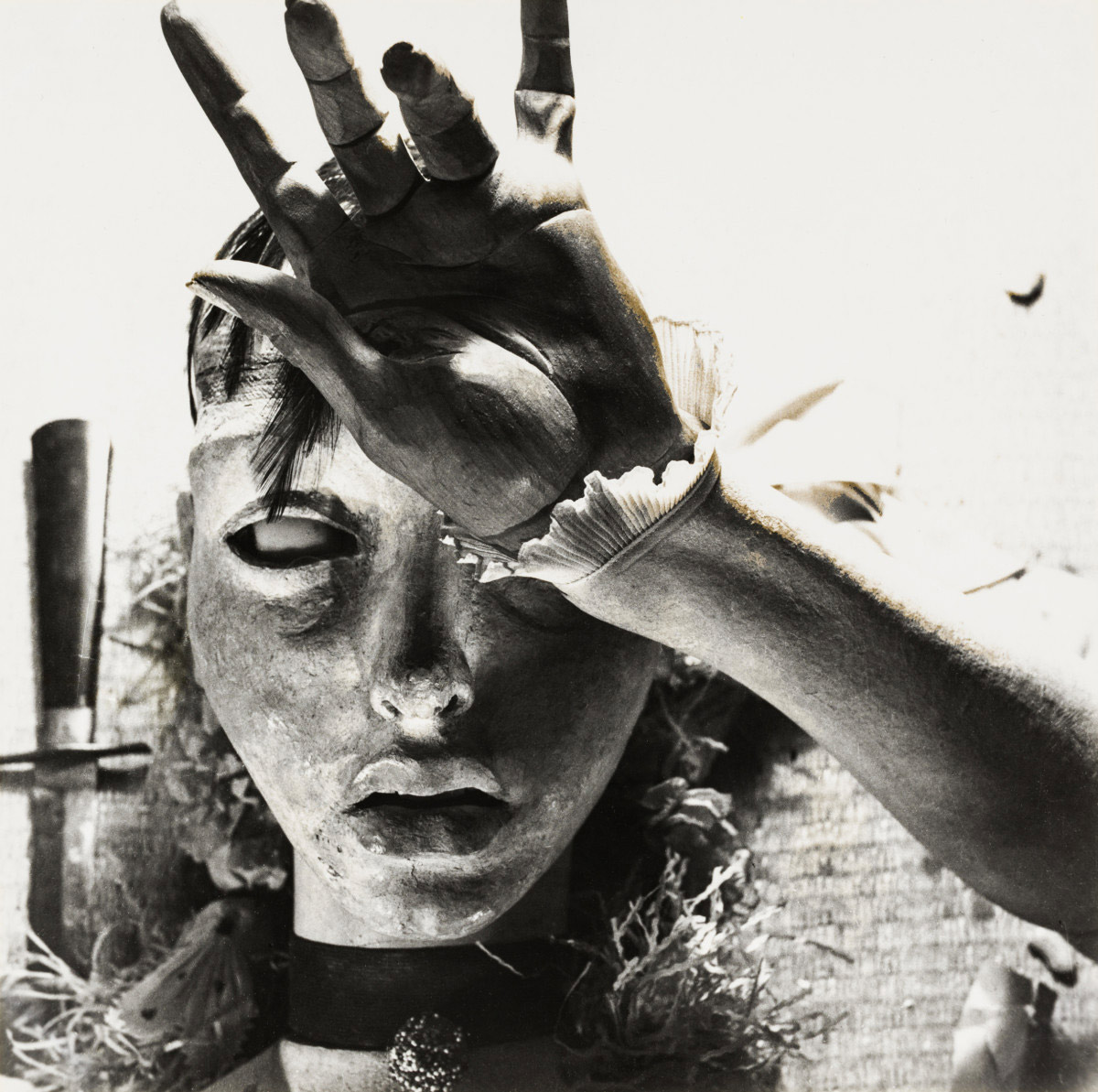
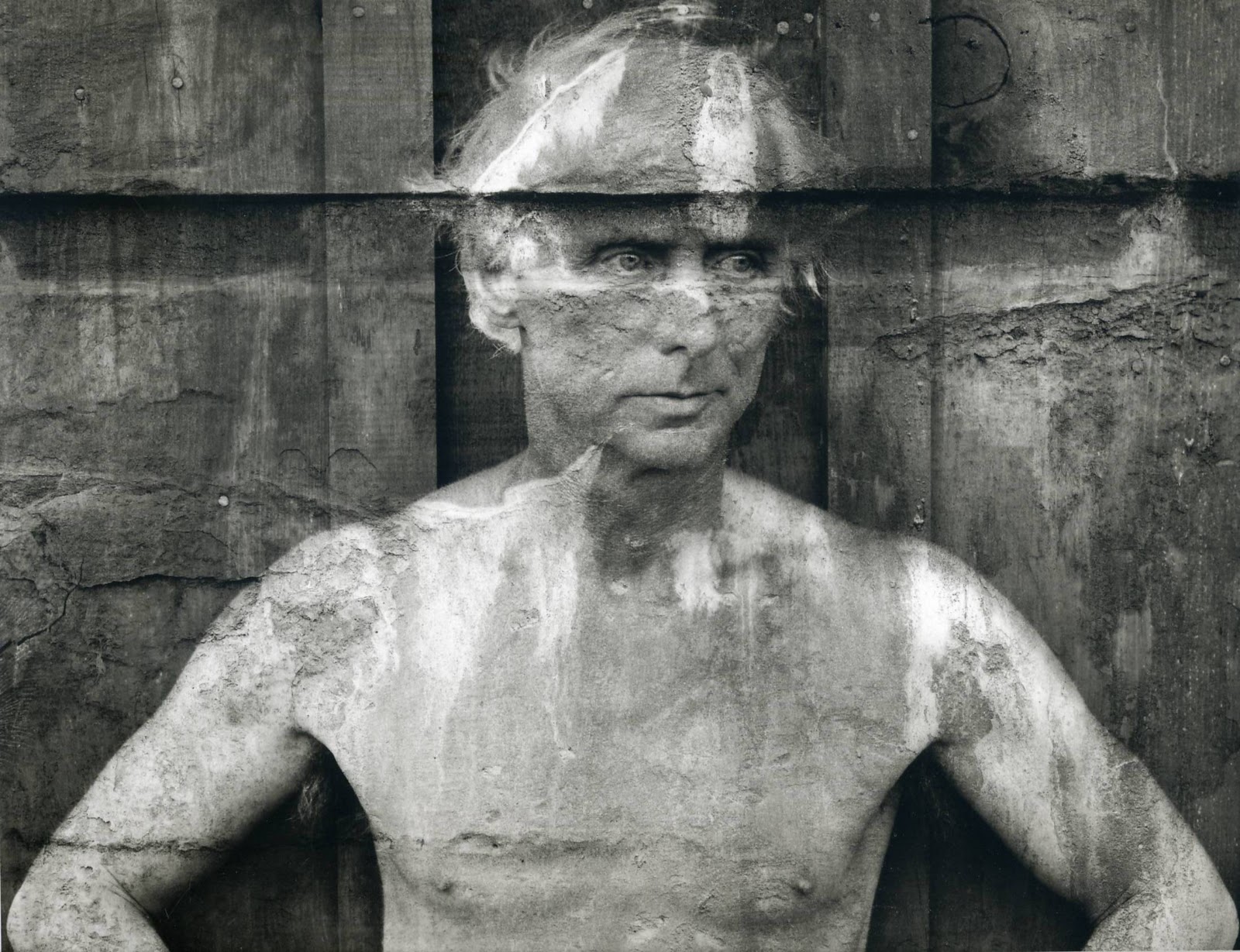
Exhibition: ‘Typologien: Photography in 20th-century Germany’ at Fondazione Prada, Milan

Exhibition dates: 3rd April – 14th July, 2025

Curator: Susanne Pfeffer


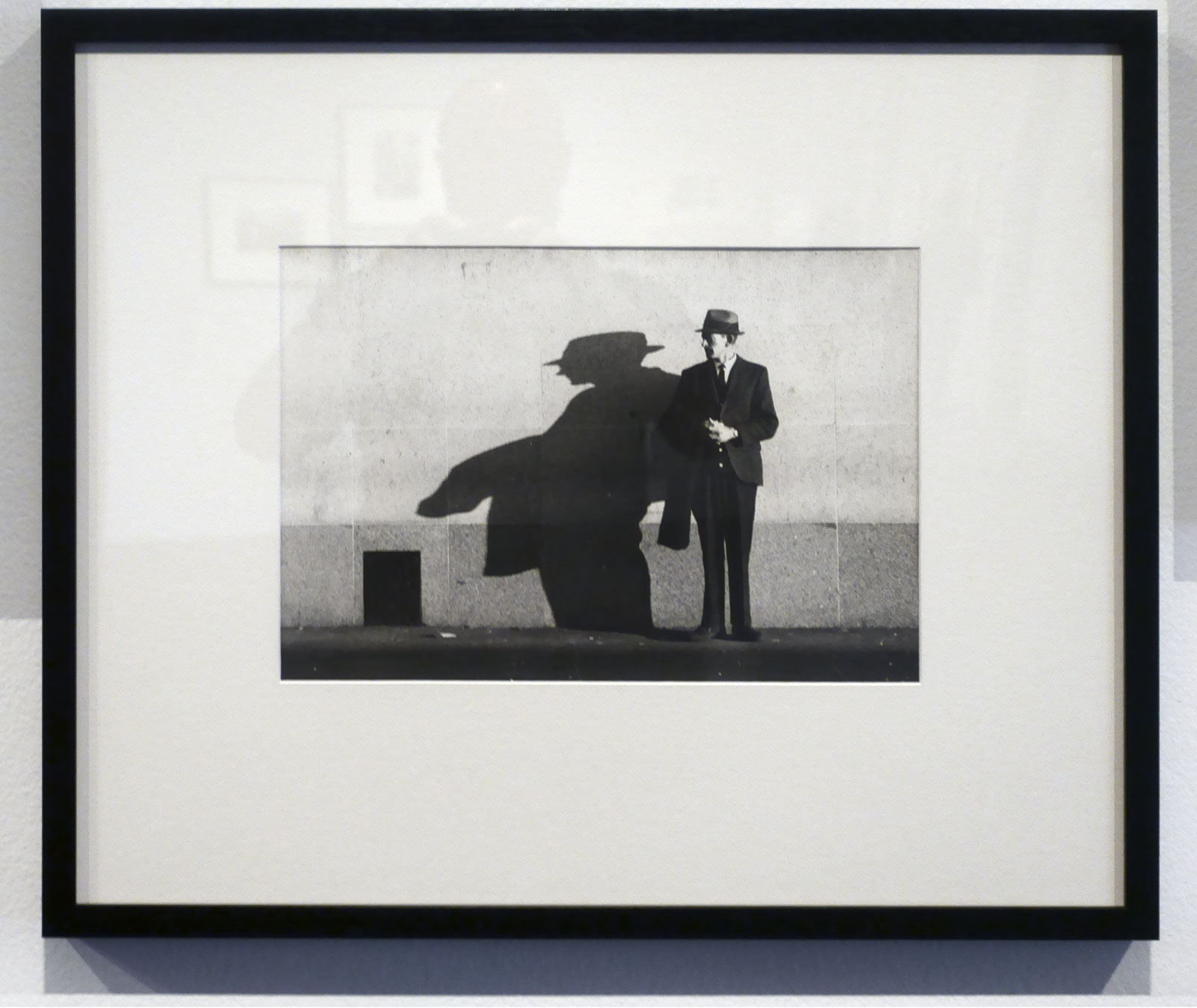
Heinrich Riebesehl (German, 1938-2010) 'Menschen Im Fahrstuhl, 20.11.1969' [People in the Elevator, 20.11.1969] 1969 from the exhibition 'Typologien: Photography in 20th-century Germany' at Fondazione Prada, Milan, April - July, 2025


Heinrich Riebesehl (German, 1938-2010)
Menschen Im Fahrstuhl, 20.11.1969 [People in the Elevator, 20.11.1969]
1969
Gelatin silver print, printed 2007
Kicken Berlin
© Heinrich Riebesehl, by SIAE 2025


Once more, with feeling

“Typology remains a highly challenging and complex notion. It operates in a paradoxical regime: on the one hand, this approach can lead to a systematic recording of people and objects based on extreme objectivity; on the other hand, typology corresponds to an individual and arbitrary choice, revealing itself as a disturbing and potentially subversive act.” (Press release)

Objective / subjective
Pattern / randomness
Isolation / extinction
Morphology / mutation
Specific / anonymous
Repetition / difference
Same / other
Structure / creativity
Orientation / disorientation
Universal / individual
Reality / imagination
Documentation / disruption
Omnipresent / unique
Exact / imprecise
Composed / emotional
Staged / snapshot
Concept / feeling
Formal / intuitive
Ritual / subversion
Collaboration / resistance

Et cetera, et cetera…

Inherent in one is the other.

Every photo within a Becher grid contains its own difference.

Dr Marcus Bunyan


Many thankx to the Fondazione Prada for allowing me to publish the photographs in the posting. Please click on the photographs for a larger version of the image.


Let’s not beat around the bush. Despite protestations to the contrary (appeals to the objectivity of the image, eschewing entirely the aspects of beauty, emotion and opinion; the rigorous frontality of the individual images giving them the simplicity of diagrams, while their density of detail offers encyclopaedic richness) these are subjective images for all their objective desire. The paradox is the more a photographer strives for objectivity, the more ego drops away, the more the work becomes their own: subjective, beautiful, emotive.


Marcus Bunyan commenting on the exhibition Bernd and Hilla Becher: Mines and Mills – Industrial Landscapes at Fotomuseum Winterthur, Zurich, February, 2012


“What happens in the case of mutation? Consider the example of the genetic code. Mutation normally occurs when some random event (for example, a burst of radiation or a coding error) disrupts an existing pattern and something else is put in its place instead. Although mutation disrupts pattern, it also presupposes a morphological standard against which it can be measured and understood as mutation. We have seen that in electronic textuality, the possibility for mutation within the text are enhanced and heightened by long coding chains. We can now understand mutation in more fundamental terms. Mutation is critical because it names the bifurcation point at which the interplay between pattern and randomness causes the system to evolve in a new direction. It reveals the productive potential of randomness that is also recognized within information theory when uncertainty is seen as both antagonistic and intrinsic to information.

We are now in a position to understand mutation as a decisive event in the psycholinguistics of information. Mutation is the catastrophe in the pattern / randomness dialectic analogous to castration in the presence / absence dialectic. It marks a rupture of pattern so extreme that the expectation of continuous replication can in longer be sustained. But as with castration, this only appears to be a disruption located at a specific moment. The randomness to which mutation testifies is implicit in the very idea of pattern, for only against the background of nonpattern can pattern emerge. Randomness is the contrasting term that allows pattern to be understood as such.”


Hayles, Katherine. How We Became Posthuman: Virtual Bodies in Cybernetics, Literature, and Informatics. Chicago: University of Chicago Press, 1999, pp. 30-33


Heinrich Riebesehl (German, 1938-2010) 'Menschen Im Fahrstuhl, 20.11.1969' [People in the Elevator, 20.11.1969] 1969


Heinrich Riebesehl (German, 1938-2010)
Menschen Im Fahrstuhl, 20.11.1969 [People in the Elevator, 20.11.1969]
1969
Gelatin silver print, printed 2007
Kicken Berlin
© Heinrich Riebesehl, by SIAE 2025


In the series Menschen Im Fahrstuhl, 20.11.1969 (People in the elevator, 20.11.1969) shot in 1969, Heinrich Riebesehl conceptualised his interest in the photographic portrait. The portraits of the workers of the Hannoversche Presse (a daily newspaper in Hanover) – taken inside an elevator with a remotely operated small-format camera – are dated and numbered in sequential order: Riebesehl dispensed with a title or a more detailed description of the subjects portrayed. By omitting distinctive elements from the images, such as the profession or age of the subjects, he made the situation the key factor in the shots. In fact, the images are studies of the behaviors of people in that particular space, their body languages and gazes. Riebesehl knew that environment very well, because he had worked for a long time as a photojournalist, before turning to conceptual art photography.

Exhibition text from the Fondazione Prada by Cord Riechelmann
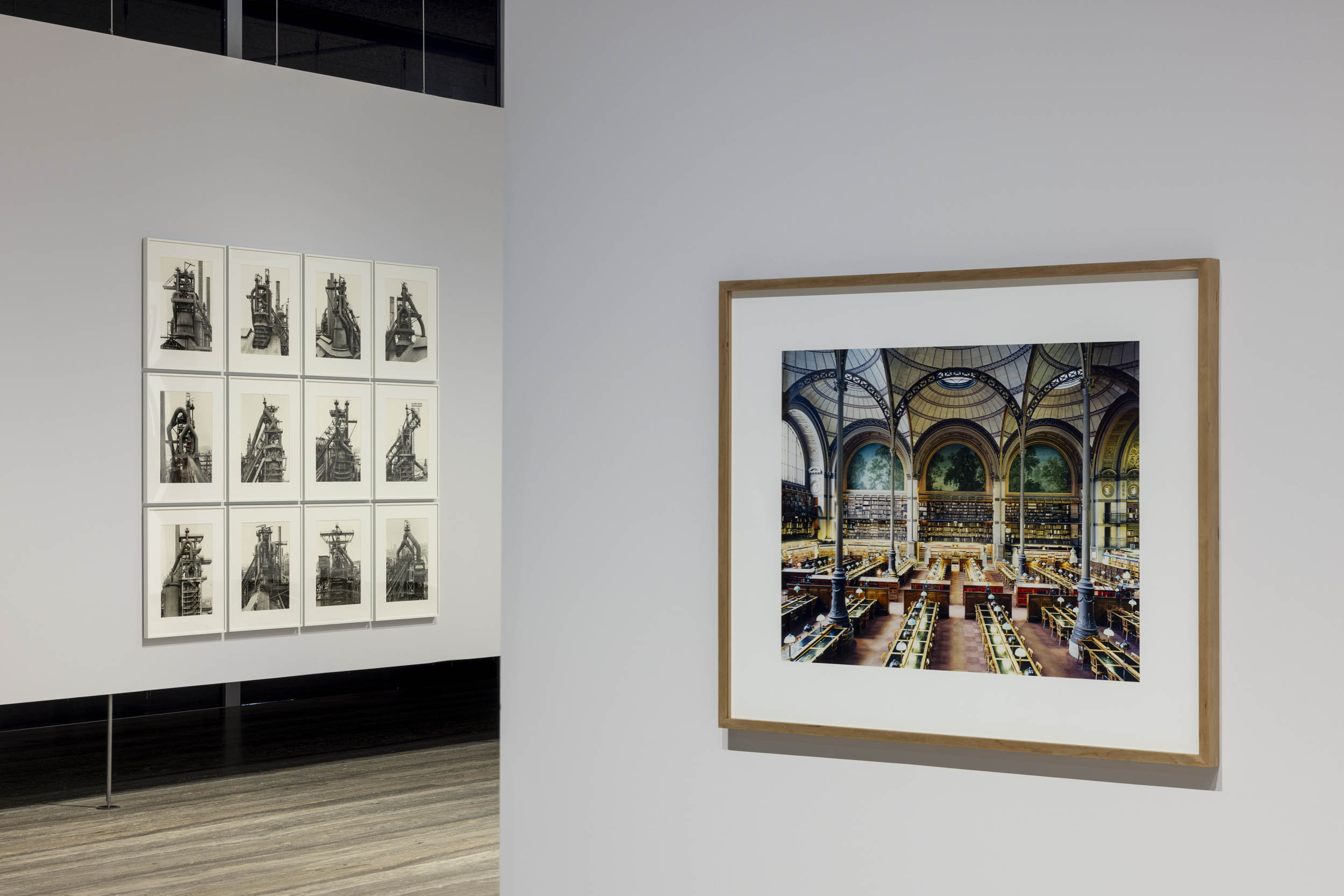
 

Installation view of the exhibition 'Typologien: Photography in 20th-century Germany' at Fondazione Prada, Milan showing at left Bernd and Hiller Becher's 'Hochöfen' (Blast furnaces) 1970-1989; and at right, Candida Höfer's 'Bibliotheque Nationale de France XXIII' 1997


Installation view of the exhibition Typologien: Photography in 20th-century Germany at Fondazione Prada, Milan showing at left Bernd and Hiller Becher’s Hochöfen (Blast furnaces) 1970-1989; and at right, Candida Höfer’s Bibliotheque Nationale de France XXIII 1997
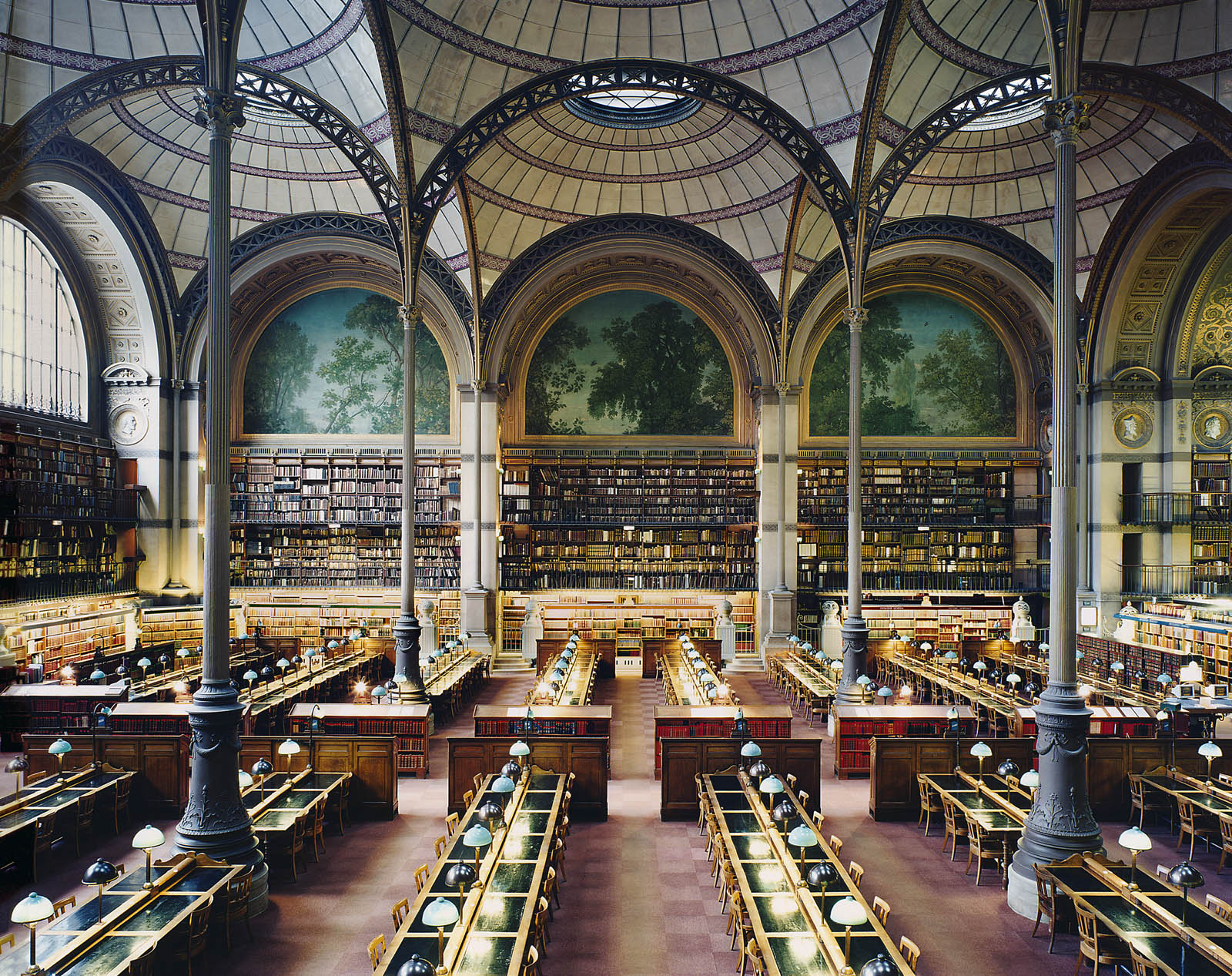
 

Candida Höfer (German, b. 1944) 'Bibliotheque Nationale de France XXIII' 1997 from the exhibition 'Typologien: Photography in 20th-century Germany' at Fondazione Prada, Milan, April - July, 2025


Candida Höfer (German, b. 1944)
Bibliotheque Nationale de France XXIII
1997
Inkjet print
© Candida Höfer, Cologne


In the photographs of libraries in London, Paris, and New York, which at first glance appear to be technically scientific records, Candida Höfer manages to capture something that is not visible: ingenuity. The libraries’ rooms have high ceilings, and the rows of seats are neatly arranged. In their impressiveness, they reflect the architecture of the 19th-century conception of knowledge and science, typical of the dominant nations of the time because of their commercial and colonial power. The objective nature of the deserted spaces, precisely in how they seem to be neutral to the individual needs of the students, suggests something in the image that could hardly be less objective: the possibility for intellectual exchange that these spaces promise and deliver in Höfer’s photographs.

Exhibition text from the Fondazione Prada by Cord Riechelmann


Candida Höfer (German, b. 1944) 'Zoologischer Garten Washington DC IV' 1992


Candida Höfer (German, b. 1944)
Zoologischer Garten Washington DC IV
1992
Inkjet print
© Candida Höfer, by SIAE 2025/VG BildKunst, Bonn 2025


In Candida Höfer’s photographs shot in zoos, the animals document a specific form of loneliness in modern times. In these images, the lines of development of two disciplines collide. Not only in the photographs, but also in reality, they function independently of each other: modern architecture and behavioural research. Modern architecture has become established in zoological gardens but has never considered the animal and its needs. Based on the knowledge gained from behavioural research, by choosing to portray iconic large mammals such as giraffes, lions, and polar bears, Höfer has represented the dilemma of a world in which entire species are threatened with extinction and in which zoos see themselves as a kind of ‘Noah’s Ark.’

Exhibition text from the Fondazione Prada by Cord Riechelmann
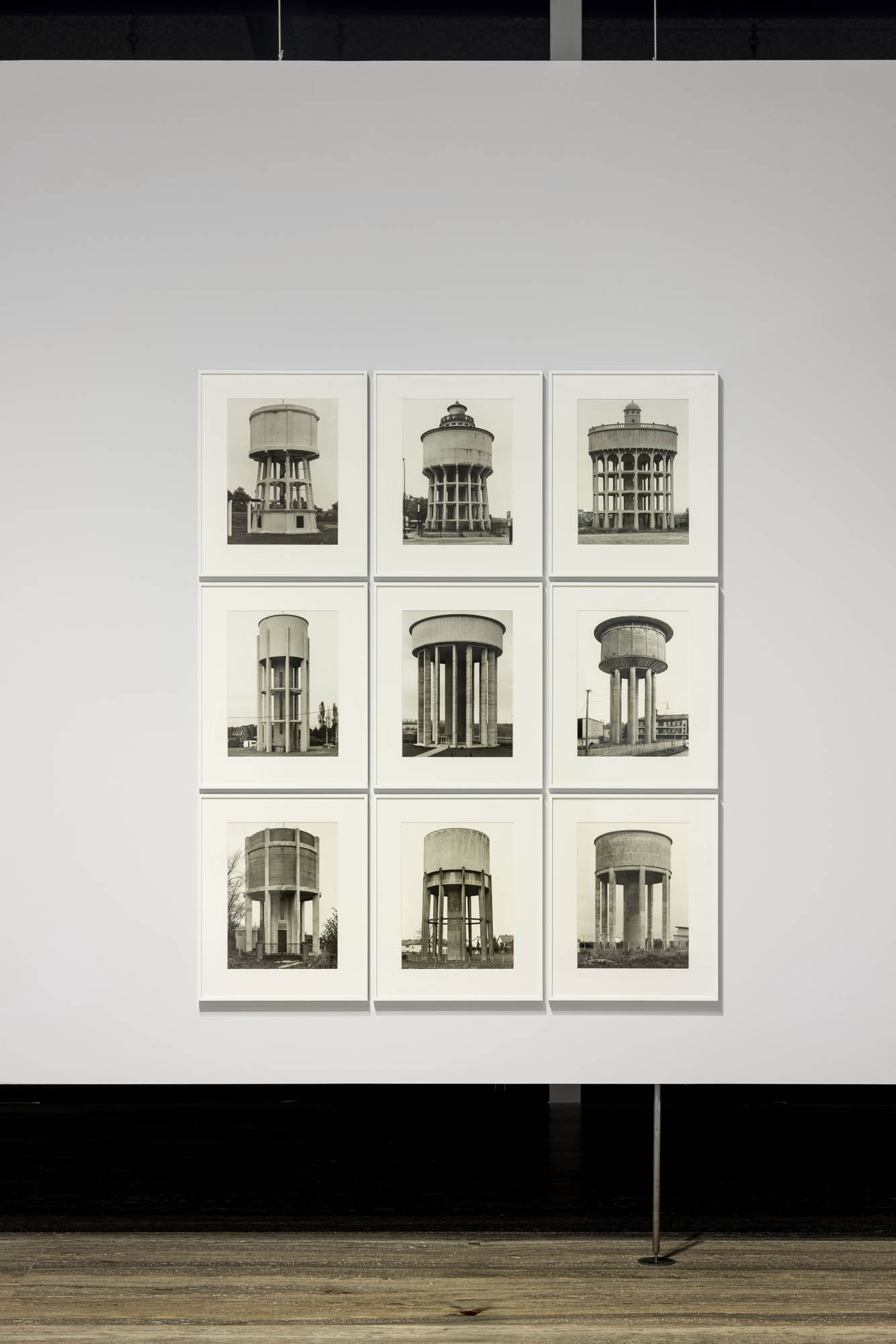
 

Installation view of the exhibition 'Typologien: Photography in 20th-century Germany' at Fondazione Prada, Milan showing Bernd and Hilla Becher's 'Wassertürme (Water towers)' 1966-1986


Installation view of the exhibition Typologien: Photography in 20th-century Germany at Fondazione Prada, Milan showing Bernd and Hilla Becher’s Wassertürme (Water towers) 1966-1986


Bernd and Hilla Becher (German) Bernd Becher (German, 1931-2007) Hilla Becher (German, 1934-2015) 'Wassertürme (Water towers)' 1966-1986 from the exhibition 'Typologien: Photography in 20th-century Germany' at Fondazione Prada, Milan, April - July, 2025


Bernd and Hilla Becher (German)
Bernd Becher (German, 1931-2007)
Hilla Becher (German, 1934-2015)
Wassertürme (Water towers)
1966-1986
Leeds, GB, 1966
Hasselt, B, 1985
Newton le Willows, GB, 1966
Beaufays/Liège, B, 1979
Kwaadmechelen, B, 1971
Padova, I, 1986
Outreau/Boulogne, F, 1973
Primasens, Saarland, D, 1980
Mesnil-Val, F, 1972
9 gelatin silver prints
© Estate Bernd & Hilla Becher, represented by Max Becher, courtesy of Die Photographische Sammlung/SK Stiftung Kultur – Bernd & Hilla Becher Archive, Cologne, 2025


Installation view of the exhibition 'Typologien: Photography in 20th-century Germany' at Fondazione Prada, Milan showing the work of Thomas Struth


Installation view of the exhibition Typologien: Photography in 20th-century Germany at Fondazione Prada, Milan showing the work of Thomas Struth
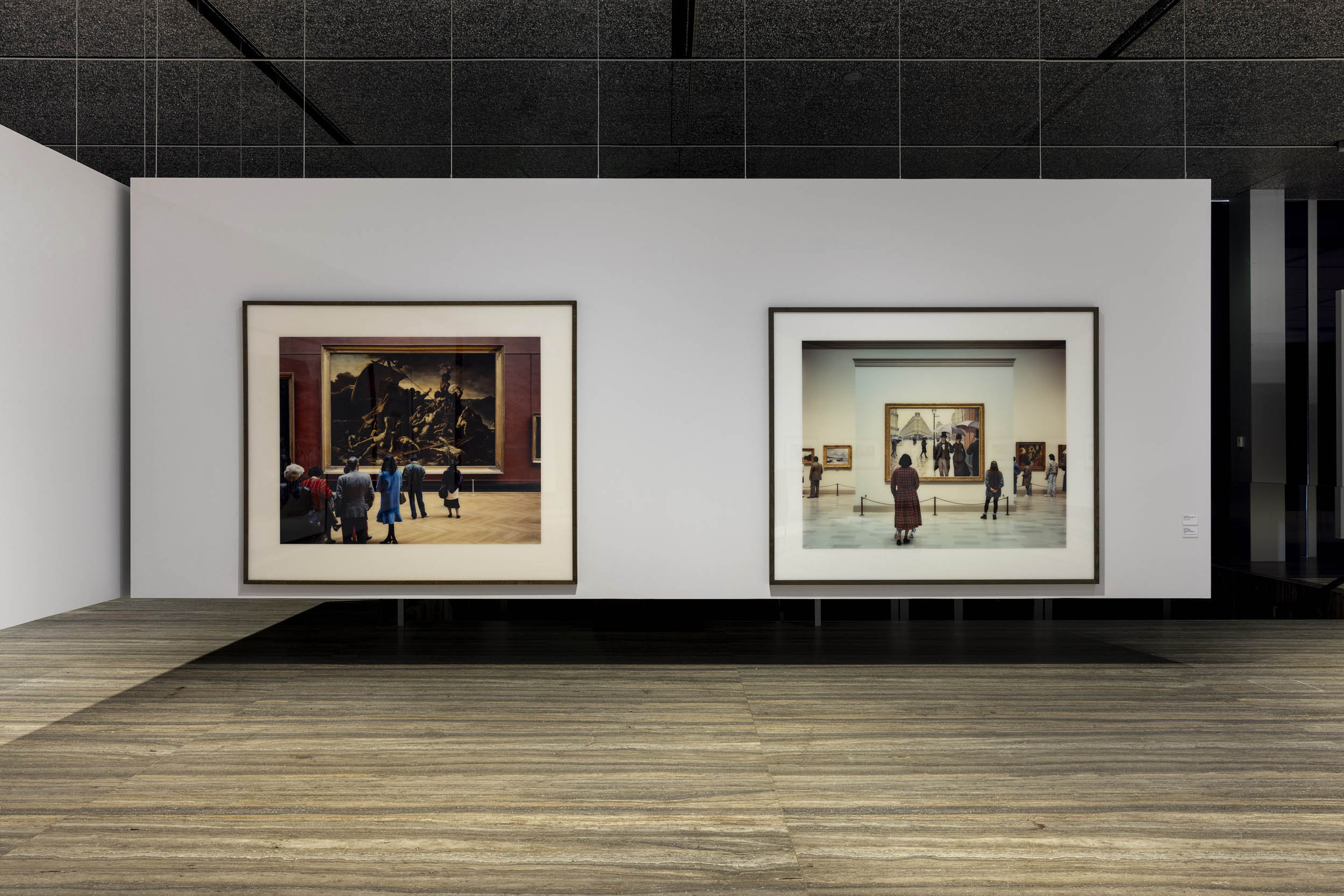
 

Installation view of the exhibition 'Typologien: Photography in 20th-century Germany' at Fondazione Prada, Milan showing the work of Thomas Struth with at left, 'Musée du Louvre IV' Paris, 1989


Installation view of the exhibition Typologien: Photography in 20th-century Germany at Fondazione Prada, Milan showing the work of Thomas Struth with at left, Musée du Louvre IV Paris, 1989
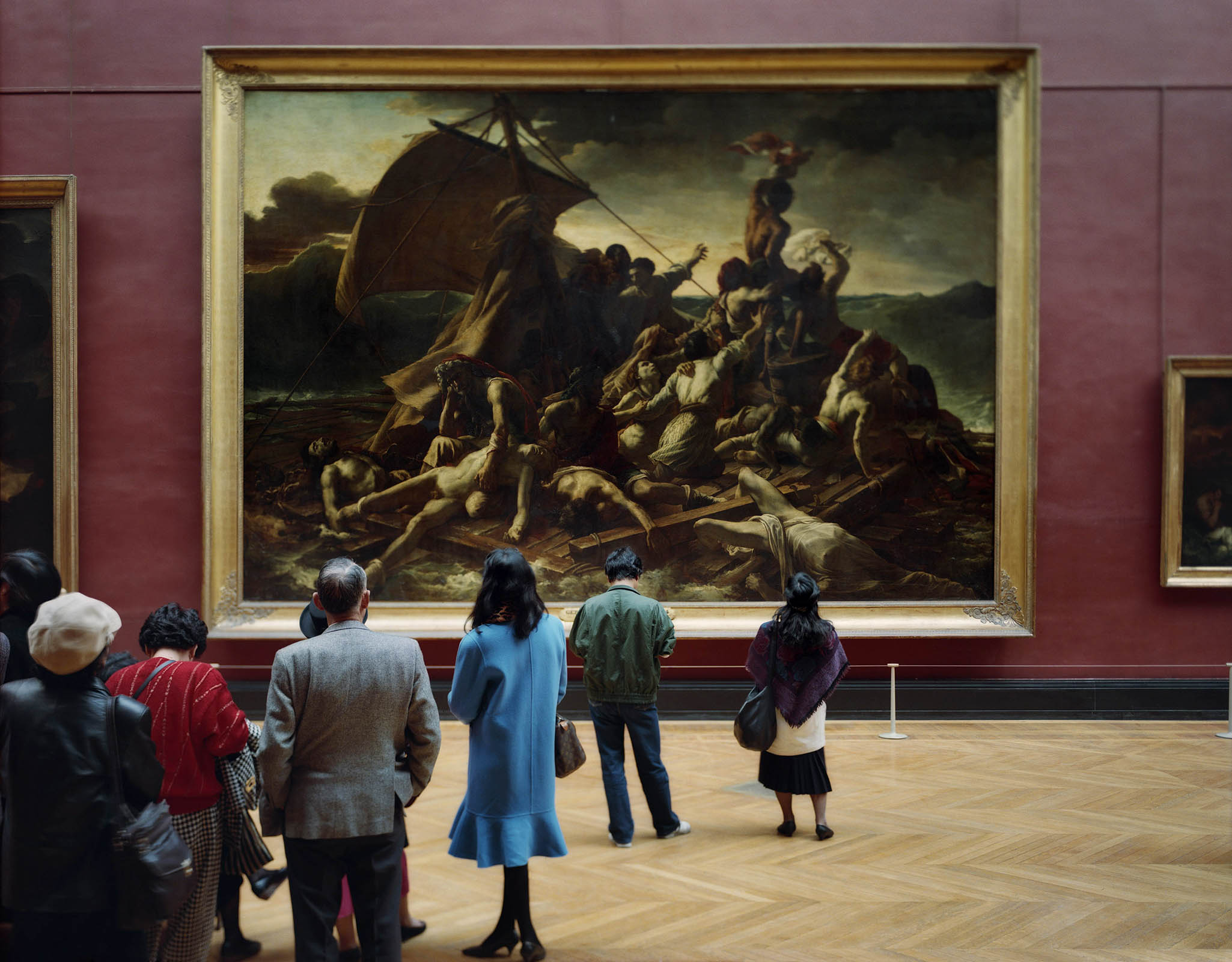
 

Thomas Struth (German, b. 1954) 'Musée du Louvre IV' Paris, 1989


Thomas Struth (German, b. 1954)
Musée du Louvre IV
Paris, 1989
Colour photograph on C-print
© Thomas Struth / Courtesy ZKM | Center for Art and Media Karlsruhe, Karlsruhe


In his practice, Thomas Struth demonstrates meticulous attention to the architectural environment, as well as to people and objects. In his large-format colour series Museum Photographs (1989-1992), Struth captures anonymous individuals and crowds gazing at artworks in museums. A significant example is Louvre 4, Paris 1989, in which the artist photographs from behind a group of viewers standing in front of Théodore Géricault’s The Raft of the Medusa (1819). Often made with a large-format camera, his images reflect what Struth calls “exact vision”: the framing must not conceal anything or suggest secret content, thus resulting in an enigmatic outcome.

Exhibition text from the Fondazione Prada by Cord Riechelmann


Installation view of the exhibition 'Typologien: Photography in 20th-century Germany' at Fondazione Prada, Milan showing Andreas Gursky's 'Paris, Montparnasse' 1993


Installation view of the exhibition Typologien: Photography in 20th-century Germany at Fondazione Prada, Milan showing Andreas Gursky’s Paris, Montparnasse 1993


Andreas Gursky’s large-format work, Paris, Montparnasse (1993) has become an iconic example of his work. It depicts the Maine-Montparnasse II block of flats, located on Rue Commandant-Mouchotte in Paris and built between 1959 and 1964 on a design by French architect Jean Dubuisson. This is one of the first images that Gursky created using digital post-production. In real life, the building does not look the way it appears in the image: using a digital editing process, Gursky transformed the façade into a game of differences and repetitions by processing the windows. In fact, by reiterating forms that are always identical, he produced a seemingly infinite number of them, with colour variations that are activated by a calculated dynamic.

Exhibition text from the Fondazione Prada by Cord Riechelmann
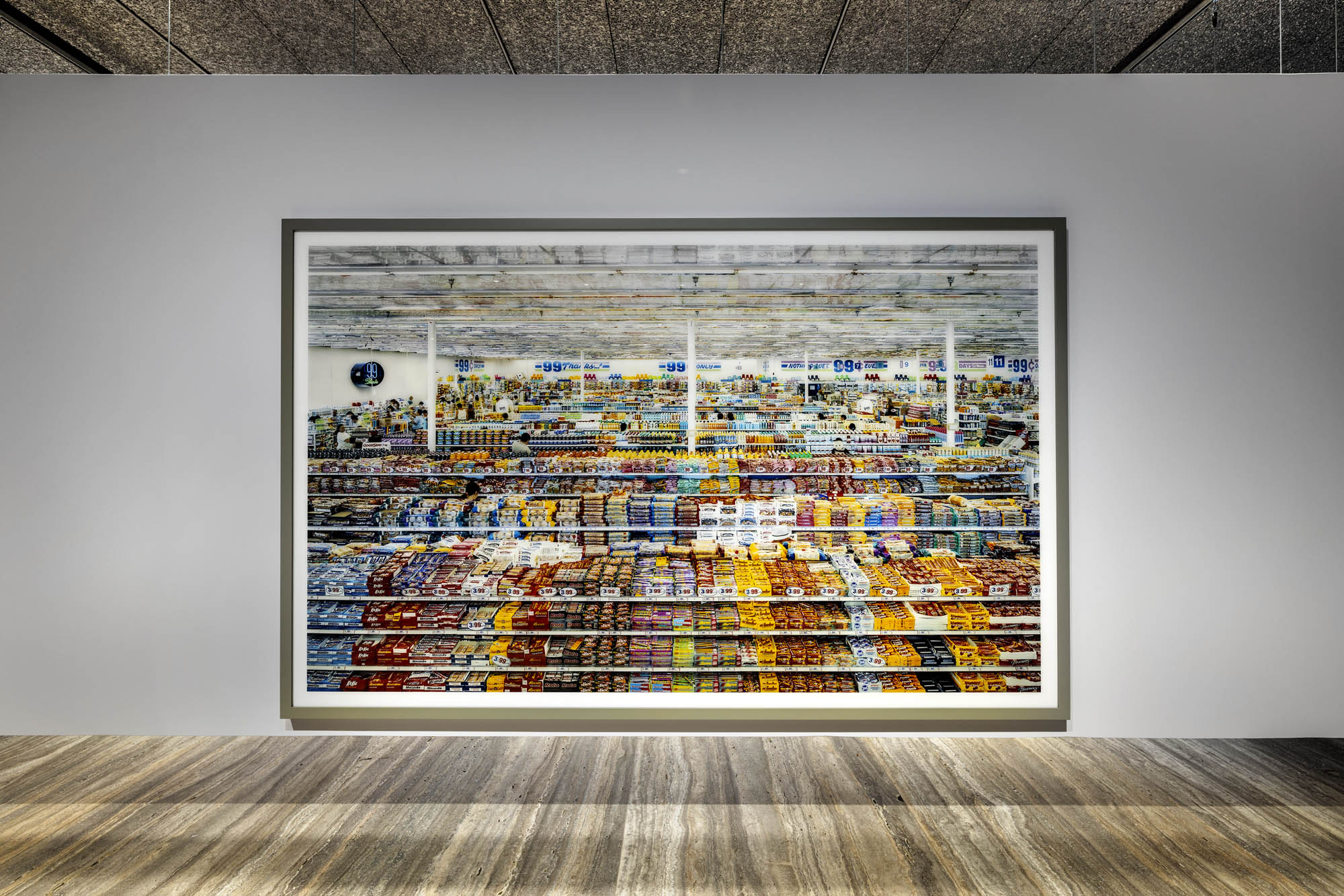
 

Installation view of the exhibition 'Typologien: Photography in 20th-century Germany' at Fondazione Prada, Milan showing Andreas Gursky's '99 Cent' 1999


Installation view of the exhibition Typologien: Photography in 20th-century Germany at Fondazione Prada, Milan showing Andreas Gursky’s 99 Cent 1999


In 99 Cent (1999), Andreas Gursky photographed supermarket shelves using the same formal scheme used in Paris, Montparnasse (1993). The shelves crammed with everyday products such as detergents represent the inexhaustible flow of goods in the global system of production and distribution. Gursky’s work conveys a feeling of disorientation generated by the excessive stimuli and details typical of a shelf in a hypermarket.

Exhibition text from the Fondazione Prada by Cord Riechelmann
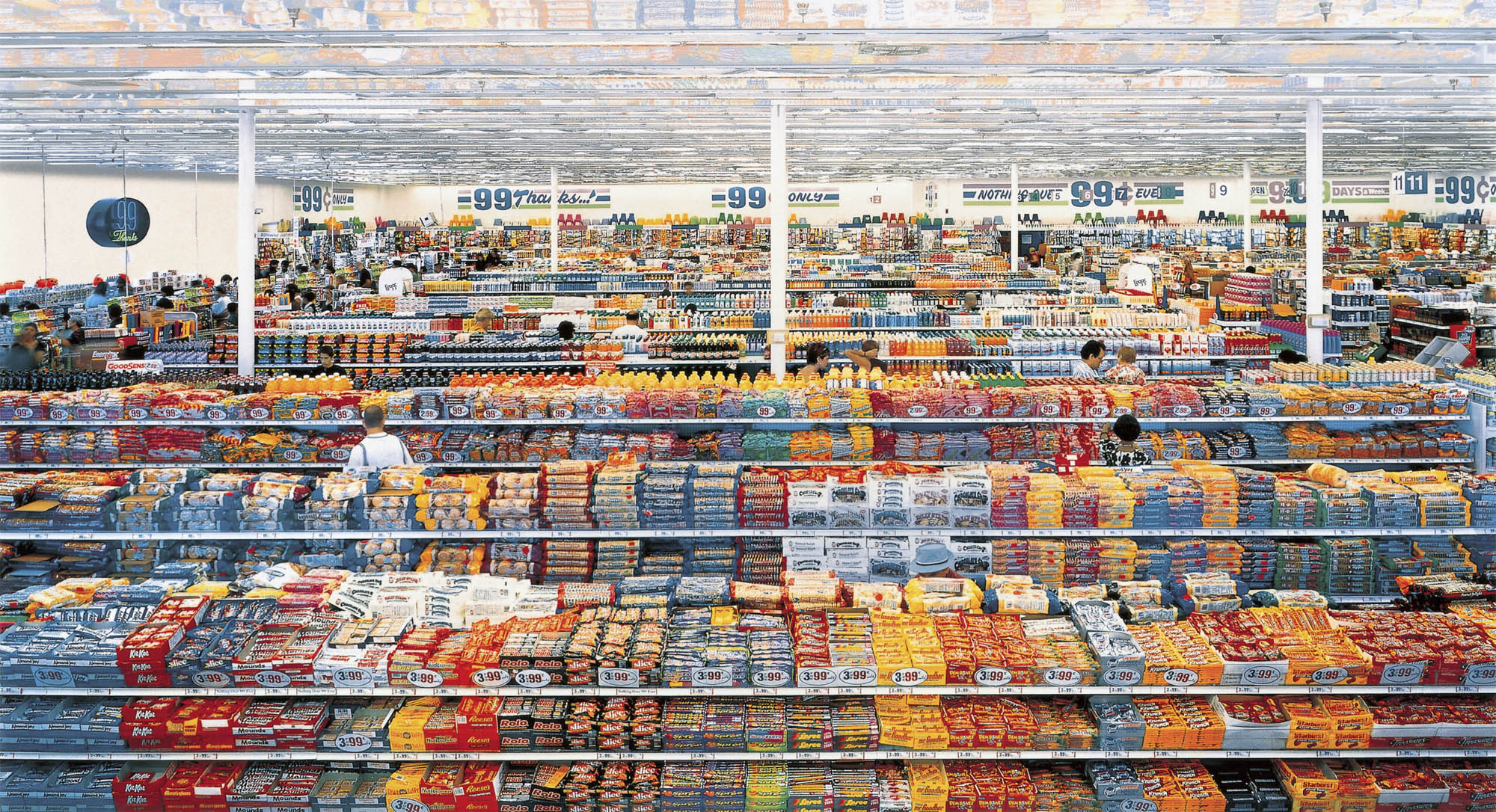
 

Andreas Gursky (German, b. 1955) '99 Cent' 1999


Andreas Gursky (German, b. 1955)
99 Cent
1999 (remastered 2009)
Inkjet print


“Typologien” is an extensive study dedicated to 20th-century German photography. The exhibition, hosted within Podium, the central building of the Milan headquarters, is curated by Susanne Pfeffer, art historian and director of the MUSEUM MMK FÜR MODERNE KUNST, Frankfurt. 

The project attempts to apply the principle of “typology,” which originated in 17th- and 18th-century botany to categorise and study plants, and appeared in photography in the early 1900s, affirming itself in Germany throughout the 20th century. Paradoxically, the given formal principle allows for unexpected convergences of German artists spanning different generations and the manifestation of their individual approaches. 

The exhibition path will follow a typological rather than a chronological order, bringing together more than 600 photographic works by 25 established and lesser-known artists essential for recounting a century of German photography, including Bernd and Hilla Becher, Sibylle Bergemann, Karl Blossfeldt, Ursula Böhmer, Christian Borchert, Margit Emmrich, Hans-Peter Feldmann, Isa Genzken, Andreas Gursky, Candida Höfer, Lotte Jacobi, Jochen Lempert, Simone Nieweg, Sigmar Polke, Gerhard Richter, Heinrich Riebesehl, Thomas Ruff, August Sander, Ursula Schulz-Dornburg, Thomas Struth, Wolfgang Tillmans, Rosemarie Trockel, Umbo (Otto Umbehr), and Marianne Wex. A system of suspended walls will create geometric partitions in the exhibition space, forming unexpected connections between artistic practices that differ from each other, but are united by a common principle or intention of classification.

As stated by Susanne Pfeffer, “Only through juxtaposition and direct comparison is it possible to find out what is individual and what is universal, what is normative or real. Differences are evidence of the abundance of nature and the imagination of humans: the fern, the cow, the human being, the ear; the bus stop, the water tower, the stereo system, the museum. The typological comparison allows differences and similarities to emerge and the specifics to be grasped. Unknown or previously unperceived things about nature, the animal, or the object, about place and time become visible and recognisable.”

In photography, employing typologies means affirming an equivalence between images and the absence of hierarchies in terms of represented subjects, motifs, genres, and sources. Despite this, typology remains a highly challenging and complex notion. It operates in a paradoxical regime: on the one hand, this approach can lead to a systematic recording of people and objects based on extreme objectivity; on the other hand, typology corresponds to an individual and arbitrary choice, revealing itself as a disturbing and potentially subversive act.

The hypothesis that photography plays a key role not only in fixing distinctive phenomena but also in organising and classifying a plurality of visible manifestations remains a vital force in today’s artistic efforts to navigate the complexity of our social and cultural realities. With the spread of digital imagery and practices, the concept of typology continues to be questioned and re-defined by contemporary photographers and artists. 

As underlined by Susanne Pfeffer, “The unique, the individual, seems to have been absorbed into a global mass, the universality of things is omnipresent. The Internet allows typologies to be created in a matter of seconds. And yet this is precisely when it seems important – to artists – to take a closer look.” As further explained by Pfeffer, “When the present seems to have abandoned the future, we need to observe the past more closely. When everything seems to be shouting at you and becoming increasingly brutal, it is important to take a quiet pause and use the silence to see and think clearly. When differences are not seen as something other, but turned into something that divides us, it is crucial to notice what we have in common. Typologies allow us to identify remarkable similarities and subtle differences.”

Text from the Fondazione Prada website


Typologien | Fondazione Prada Milano

An extensive study dedicated to 20th-century German photography. “Typologien” attempts to apply the principle of “typology,” which originated in 17th- and 18th-century botany to categorise and study plants, and appeared in photography in the early 1900s, affirming itself in Germany throughout the 20th century.

The exhibition, hosted within Podium, the central building of the Milan headquarters, is curated by Susanne Pfeffer, art historian and director of the MUSEUM MMK FÜR MODERNE KUNST, Frankfurt.
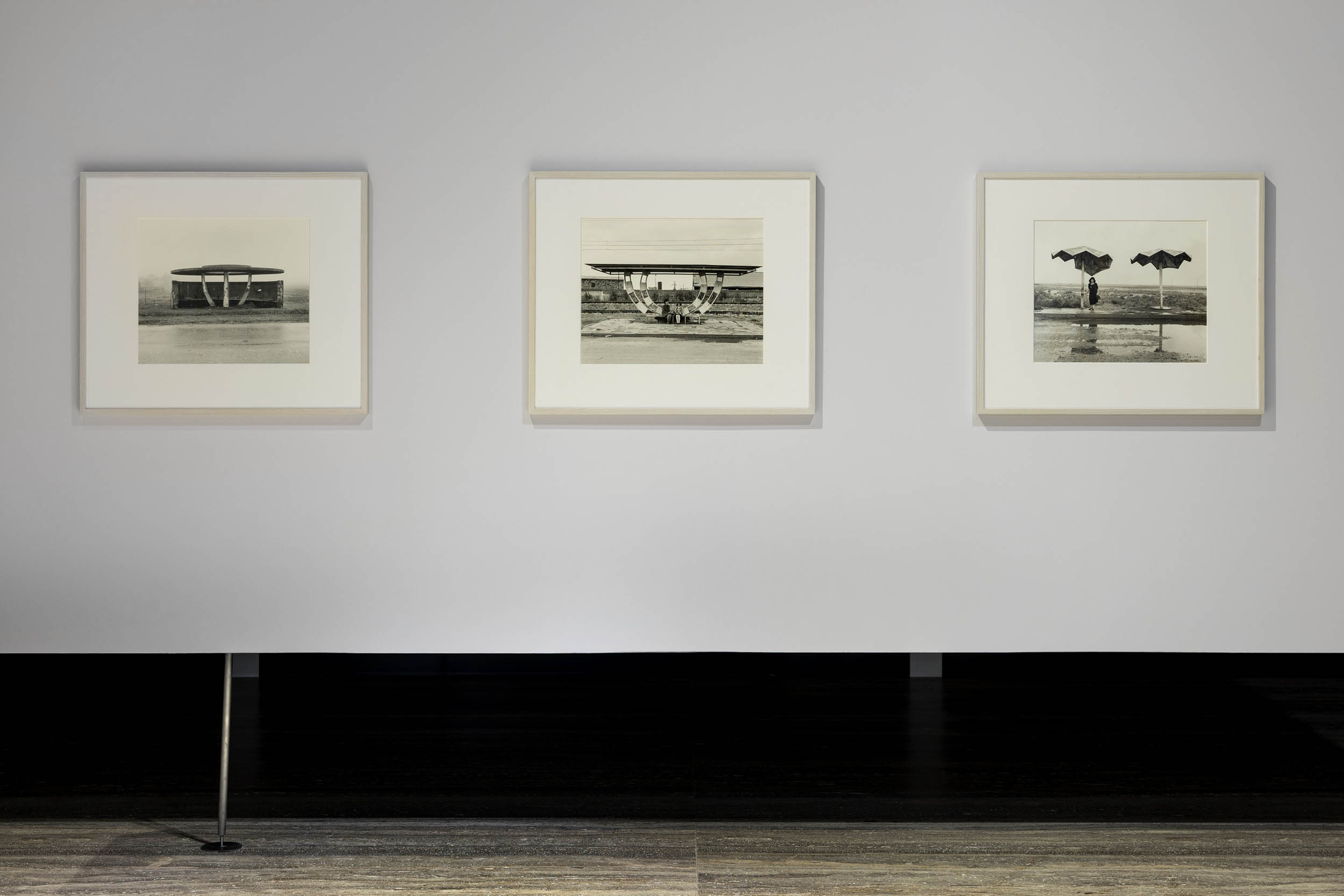
 

Installation view of the exhibition 'Typologien: Photography in 20th-century Germany' at Fondazione Prada, Milan showing the work of Ursula Schulz-Dornburg


Installation view of the exhibition Typologien: Photography in 20th-century Germany at Fondazione Prada, Milan showing the work of Ursula Schulz-Dornburg
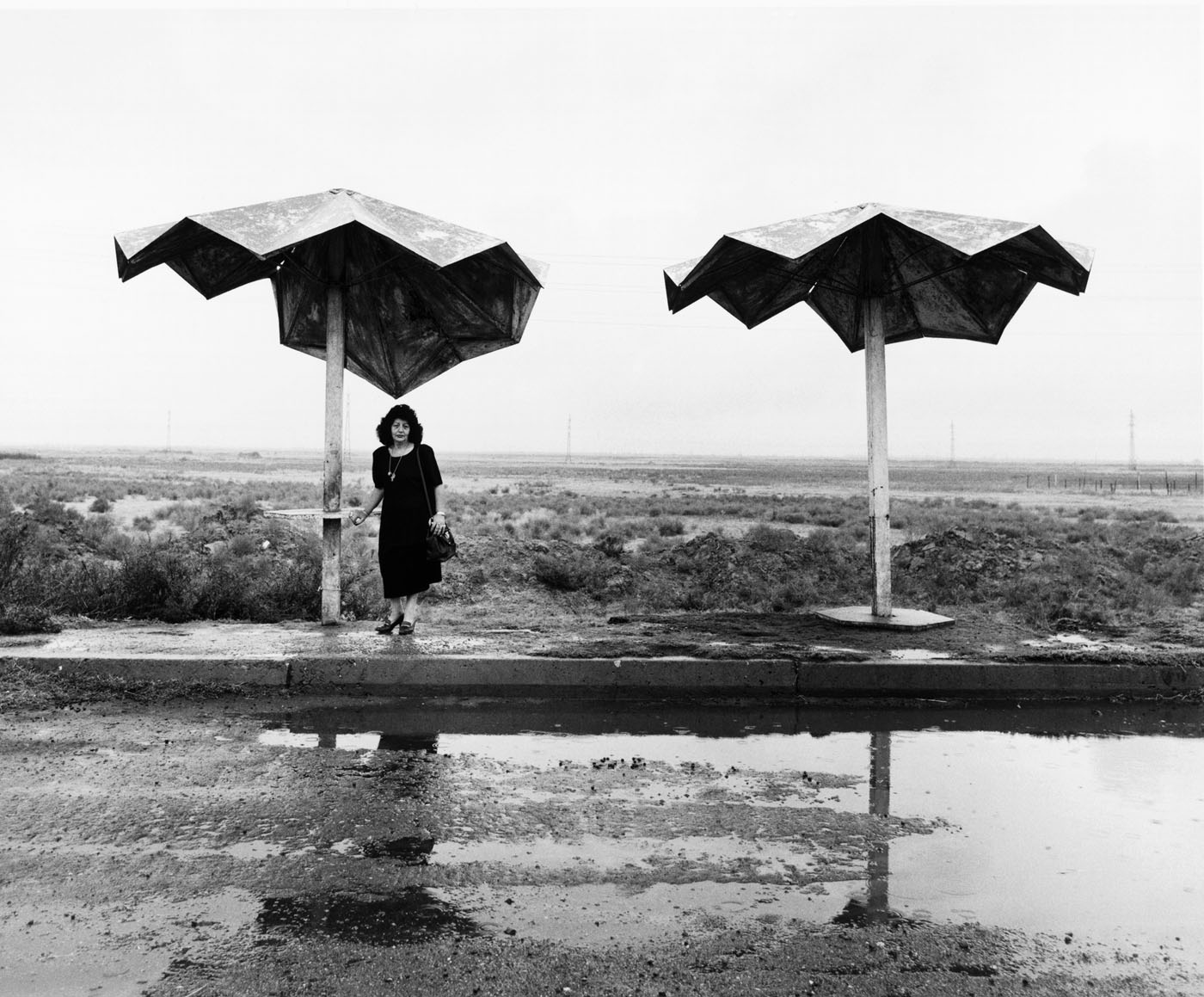
 

Ursula Schulz-Dornburg (German, b. 1938) 'Transit Sites-Armenia-Erevan-Ararat' 2001


Ursula Schulz-Dornburg (German, b. 1938)
Transit Sites-Armenia-Erevan-Ararat
2001
Gelatin silver print on Forte paper
© Ursula Schulz-Dornburg


Ursula Schulz-Dornburg was visiting convents and monasteries in Armenia when she happened to come across one of these unique bus stops, partly futuristic and partly surreal. From 1997 to 2011, she portrayed numerous bus stops, often in very remote locations. In a country that was experiencing a dramatic transition, from being part of the Soviet Union to its new status as an independent republic, these bus stops look like the remnants of a utopian socialism, which in Schulz-Dornburg’s images are kept alive mainly by women and children. The photographer said she was so impressed by the dignity of those women waiting at the bus stop, who even in the most extreme poverty looked as though they were on their way to the Opera, that she asked their permission to photograph them. What emerged was a document of a quiet life that manages with dignity to deal with even the harshest adversity.

Exhibition text from the Fondazione Prada by Cord Riechelmann
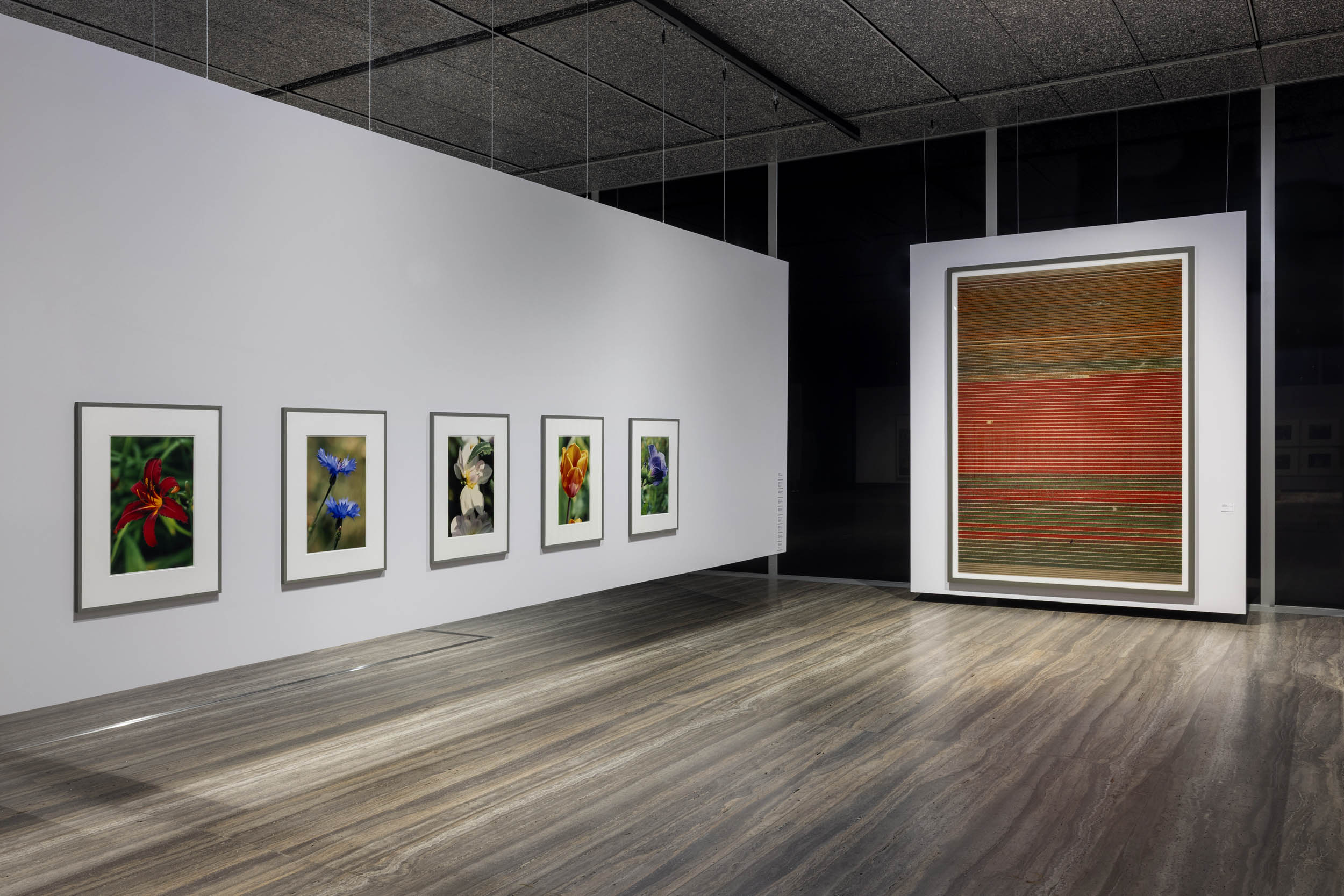
 

Installation view of the exhibition 'Typologien: Photography in 20th-century Germany' at Fondazione Prada, Milan showing at left, flower photographs by Thomas Struth; and at right, Andreas Gursky's 'Untitled XVIII' 2015


Installation view of the exhibition ‘Typologien: Photography in 20th-century Germany’ at Fondazione Prada, Milan showing at left, flower photographs by Thomas Struth; and at right, Andreas Gursky’s Untitled XVIII 2015 (below)
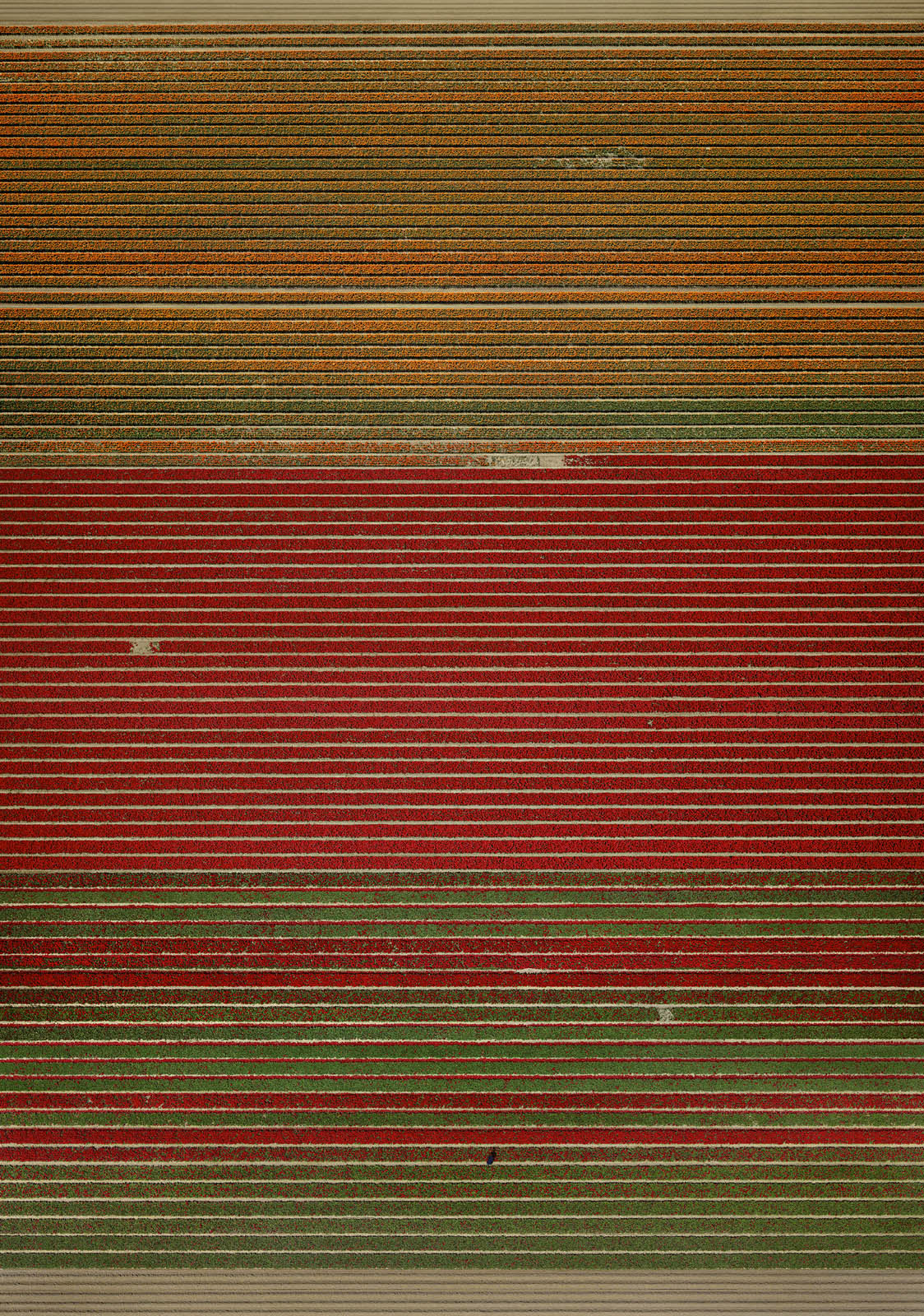
 

Andreas Gursky (German, b. 1955) 'Untitled XVIII' 2015


Andreas Gursky (German, b. 1955)
Untitled XVIII
2015
Inkjet print
Atelier Andreas Gursky


Unlike works such as Paris, Montparnasse (1993), in the Untitled series he produced between 2015 and 2016, Andreas Gursky depicted rows of tulips without providing a title or location for the pictures. Viewed from a distance, the photographs are reminiscent of Abstract Expressionist paintings, but even looking at them at close range, the lushly blooming flowers are undiscernible. Living in Düsseldorf, close to the Dutch border, Gursky is familiar with the intensively cultivated Dutch tulip crops, where no unwanted insect or worm would possibly be allowed to spoil the bulbs. The sterility of industrial flower production, far from being harmless and healthy, is captured by Gursky in images that, in turn, are neither reassuring nor pleasant.

Exhibition text from the Fondazione Prada by Cord Riechelmann


Installation view of the exhibition 'Typologien: Photography in 20th-century Germany' at Fondazione Prada, Milan showing the flower photographs of Thomas Struth with at left, 'Small Closed Sunflower, No. 18, Winterthur'
1992; and at third left, 'Single Red Lily - No. 51, Düsseldorf (Botanischer Garten)' 1993


Installation view of the exhibition Typologien: Photography in 20th-century Germany at Fondazione Prada, Milan showing the flower photographs of Thomas Struth with at left, Small Closed Sunflower, No. 18, Winterthur 1992 (below); and at third left, Single Red Lily – No. 51, Düsseldorf (Botanischer Garten) 1993 (below)
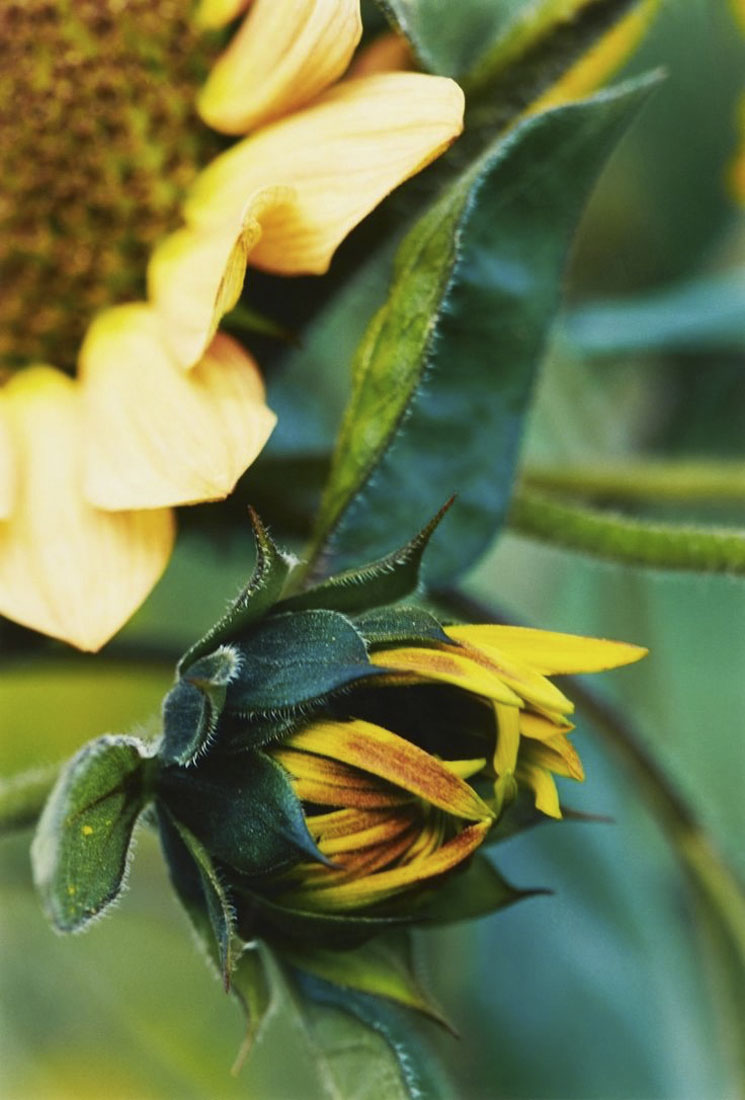
 

Thomas Struth (German, b. 1954) 'Small Closed Sunflower, No. 18, Winterthur' 1992


Thomas Struth (German, b. 1954)
Small Closed Sunflower, No. 18, Winterthur
1992
Colour photograph on C-print
© Thomas Struth / Courtesy ZKM | Center for Art and Media Karlsruhe, Karlsruhe
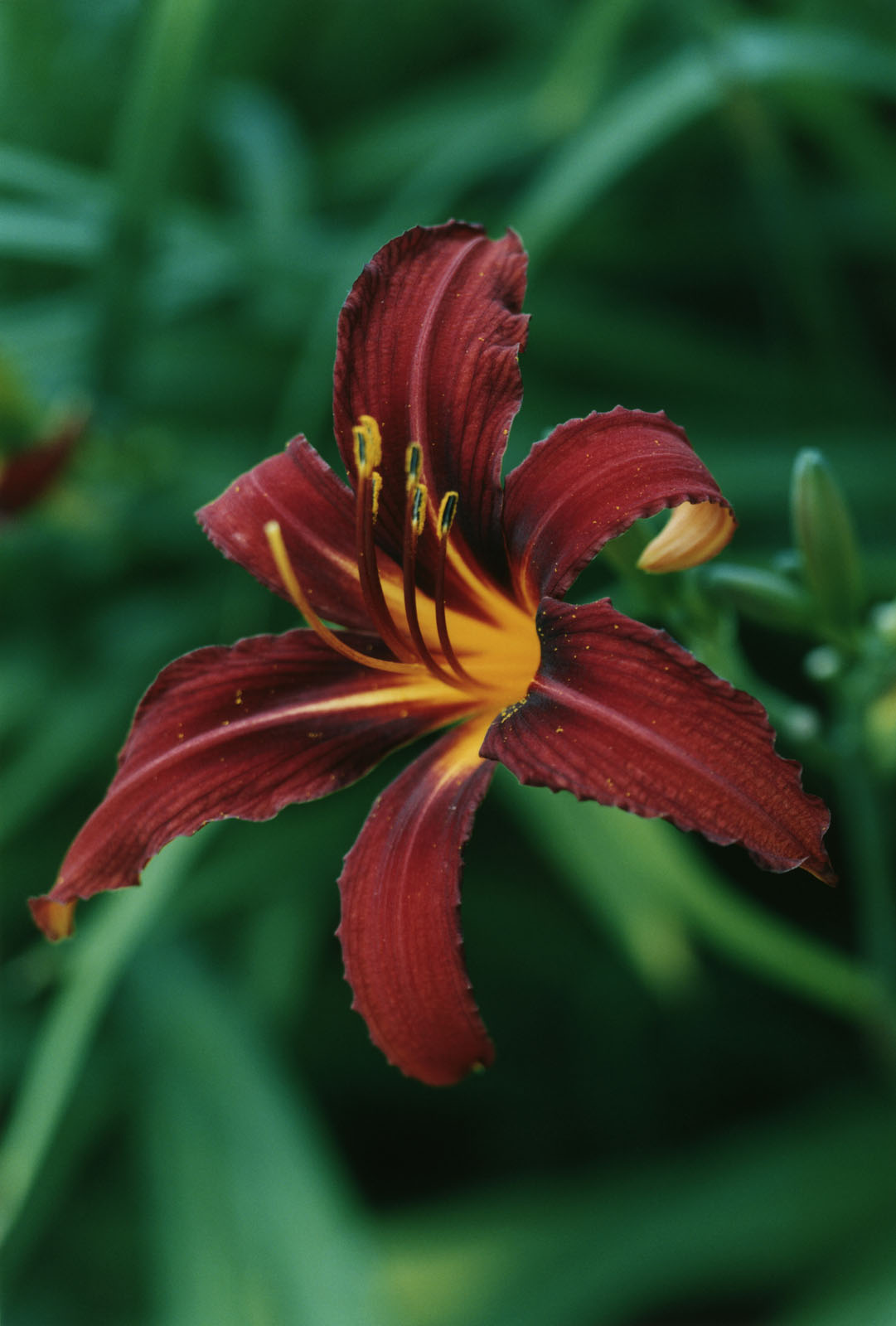
 

Thomas Struth (German, b. 1954) 'Single Red Lily - No. 51, Düsseldorf (Botanischer Garten)' 1993


Thomas Struth (German, b. 1954)
Single Red Lily – No. 51, Düsseldorf (Botanischer Garten)
1993
C-print
Viehof Collection
© Thomas Struth / Courtesy Viehof Collection, Mönchengladbach


A student of the artist Gerhard Richter and later of the photographer Bernd Becher at the Art Düsseldorf Academy from 1973 to 1980, Thomas Struth habitually works in thematic cycles centered around museums, flowers, and portraits of families and passers-by. The “exact vision” – the intention underpinning Struth’s photography – can be seen in both the portraits of two cornflowers shoot in Düsseldorf and the image of a red lily in the city’s Botanical Garden. Struth notes down the name or address of the site where he took the photograph, as in the case of the flower of a hollyhock portrayed in Düsseldorf’s Nordpark. This is to evoke the poetry of the place and provide an exact account of the plants’ origin, preserving the authenticity of the shots without digitally altering them.

Exhibition text from the Fondazione Prada by Cord Riechelmann
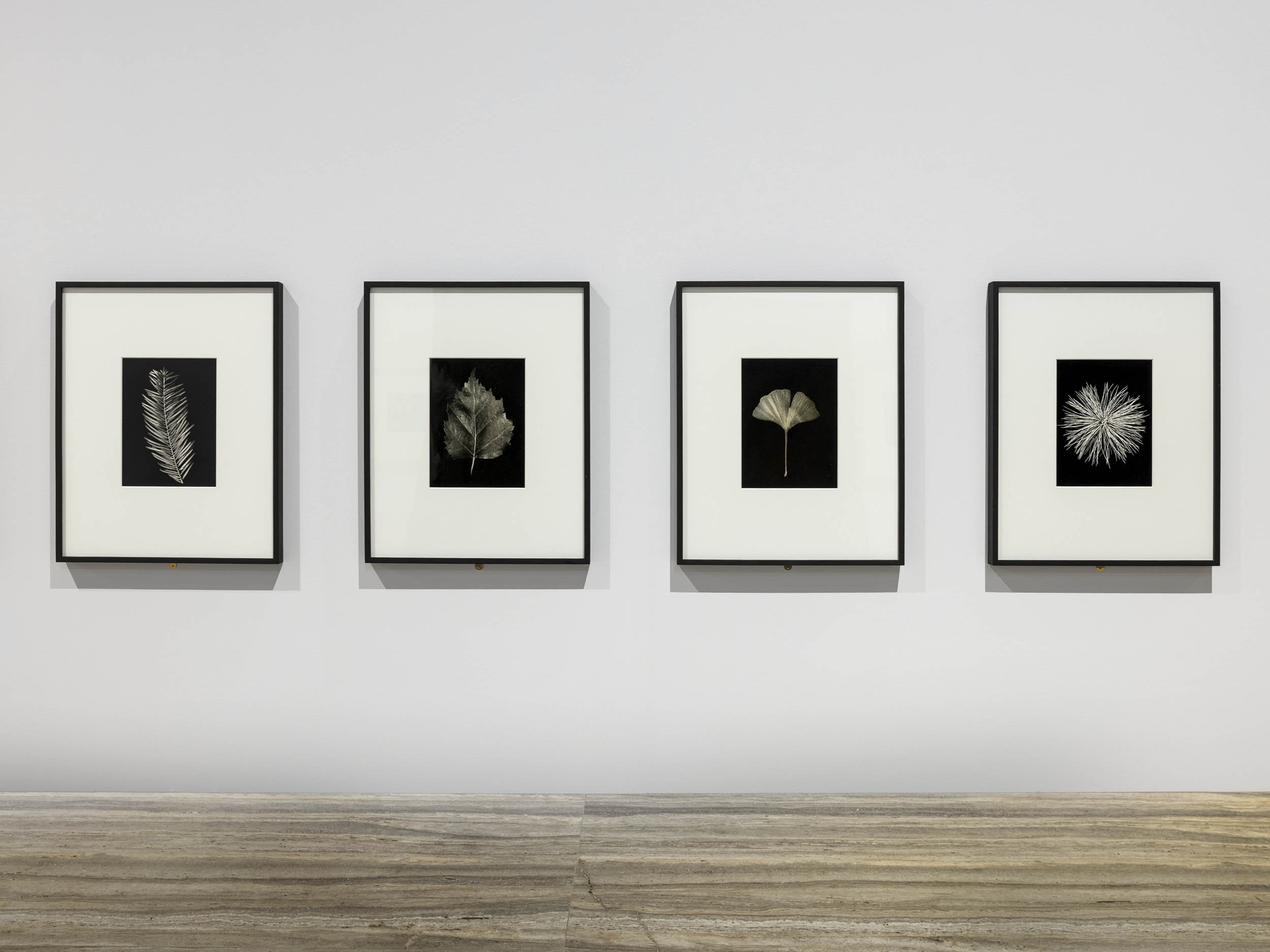
 

Installation view of the exhibition 'Typologien: Photography in 20th-century Germany' at Fondazione Prada, Milan showing the work of Hiller Becher


Installation view of the exhibition Typologien: Photography in 20th-century Germany at Fondazione Prada, Milan showing the work of Hiller Becher


Hilla Becher (German, 1934-2015) 'Eichenblatt [Oak Leaf]' 1965


Hilla Becher (German, 1934-2015)
Eichenblatt [Oak Leaf]
1965
Gelatin silver print
© Estate Bernd & Hilla Becher, represented by Max Becher, courtesy Die Photographische Sammlung/SK Stiftung Kultur – Bernd & Hilla Becher Archive, Cologne, 2025


In terms of the objectivity of the approach, Hilla Becher’s 1965 photographic studies of an oak leaf, a cypress branch, and a ginkgo leaf are in keeping with the series on types of industrial buildings that she made with her husband Bernd Becher. Thematically, however, these studies represent a sort of return to the studies of branches and shoots made years earlier by Karl Blossfeldt. Unlike Blossfeldt’s images, the leaves, particularly the poplar leaves, are not uniformly lit. The shadowy areas cannot be clearly seen with the naked eye even on close and objective observation. One could say that nature has penetrated the technique, disappearing.

Exhibition text from the Fondazione Prada by Cord Riechelmann
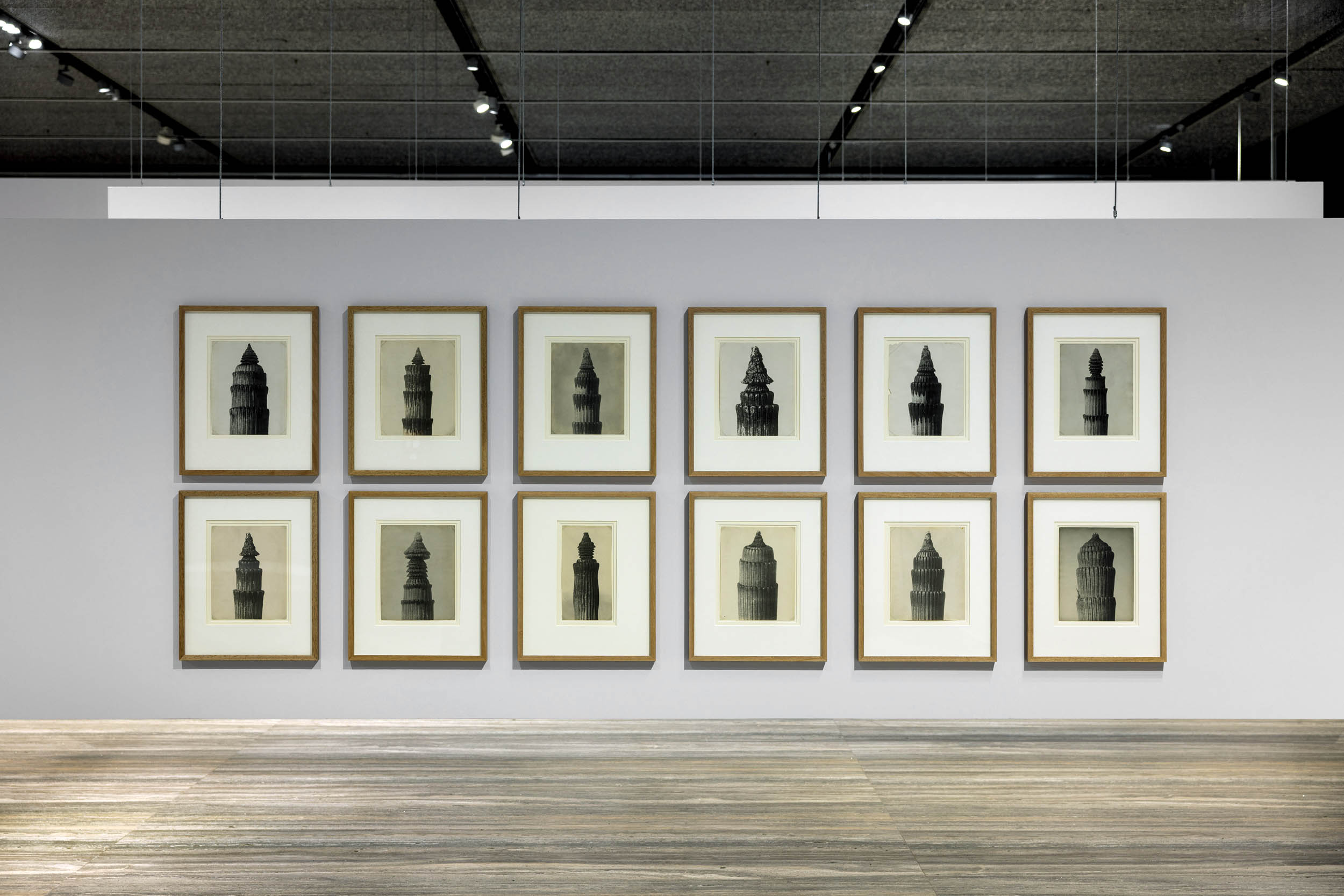
  

Installation view of the exhibition 'Typologien: Photography in 20th-century Germany' at Fondazione Prada, Milan showing the work of Karl Blossfeldt


Installation view of the exhibition Typologien: Photography in 20th-century Germany at Fondazione Prada, Milan showing the work of Karl Blossfeldt


Karl Blossfeldt (German, 1865-1932) 'Adiantum pedatum, haarfarn, junge, noch eingerollte Wedel' [Maidenhair fern, young, still curled fronds] Nd


Karl Blossfeldt (German, 1865-1932)
Adiantum pedatum, haarfarn, junge, noch eingerollte Wedel [Maidenhair fern, young, still curled fronds]
Nd
Gelatin silver print
Courtesy Berlin University of Arts, Archive – Karl Blossfeldt Collection in cooperation with Die Photographische Sammlung/SK Stiftung Kultur, Cologne


The young, still curling fronds of an ‘Unspecified fern’ are a kind of introduction to the themes that Karl Blossfeldt explored, and his working methods. Faced with a seemingly infinite variety of natural forms, the photographer tried to find an order by using tools borrowed from scientific botany. Blossfeldt collected plant samples tirelessly in and around Berlin, dried them, and enlarged those details not visible to the naked eye. However, the photographer was seeking something different from the aims of botanical research. This is already revealed by the title of the first volume, a publication of his photographs of plants – Urformen der Kunst (Art Forms in Plants, 1928). Right from the title, he explicitly refers to the model he used for the book’s conception: Ernst Haeckel’s Kunstformen in der Natur (Art Forms in Nature), published in 1924 and now a classic. Therefore, Blossfeldt sought archetypal formal models in nature, such as the fronds of the fern.

In his search for a primal form of nature that could then be shaped into art according to the natural model – as in the case of the curled fronds of
the fern – Karl Blossfeldt applied the systematic method specific to botany with a kind of exterior mimicry. He moved from the frond of an unidentified fern, in other words, not yet classified according to an order, to a fern that could at least be identified within a botanical classification. The frond of the order Polypodiales certainly has typological similarities to all the fronds photographed by Blossfeldt, but it remains a case apart in that it cannot be classified in any of the orders in which the other ferns are classified. However, this level of identification is a relevant indication: these very diverse plants in fact number about 9000 known species, and probably many more yet to be identified. Moreover, identifying their species is often only possible for a few specialists, and is even more difficult given the variety of forms that ferns take during their development.

The curled fronds of some ferns from the Osmundaceae family, royal ferns, with their botanical classification, confirm one of the fundamental intentions of Karl Blossfeldt’s studies: only by carefully analyzing the structure of a plant can one fully understand its natural form. He developed his approach opposite to that of the Jugendstil, the artistic movement – a variation of French Art Nouveau and Italian Liberty – that stylized plant forms and conceived of them primarily as ornamental elements. Blossfeldt was not interested in criticism or rejection of the ornamental, but in a radical reconfiguration of it. This could only be achieved by thoroughly studying natural forms.

Three still-curled fronds of a specimen of bracken fern – scientific name Hypolepidaceae – on the one hand, appear denaturalised, because Karl Blossfeldt focused his lens on the detail, leaving out the natural context. But on the other hand, they reveal a scrupulous observation of the plant world. By nature, in fact, fronds develop according to a strict formal principle – no natural form is purely random – and yet they eventually differ from one another. The fronds of ferns could appear as decalcomanias, given that in Blossfeldt’s representation they take on an almost mechanical quality for the observer. The emphasis on differences in resemblance, which Blossfeldt achieved more or less consciously by repeating the leaf motif in differently shaped ferns, can be considered one of the main aesthetic innovations of his photography.

Exhibition text from the Fondazione Prada by Cord Riechelmann


Installation view of the exhibition 'Typologien: Photography in 20th-century Germany' at Fondazione Prada, Milan showing the work of Marianne Wex with at left, 'Let's Take Back Our Space: 'Female' and 'Male' Body Language as a Result of Patriarchal Structures' 1977-2018; and at right, 'Arm and Leg Positions, Lying on the Ground' 1977/2018


Installation view of the exhibition Typologien: Photography in 20th-century Germany at Fondazione Prada, Milan showing the work of Marianne Wex with at left, Let’s Take Back Our Space: ‘Female’ and ‘Male’ Body Language as a Result of Patriarchal Structures 1977-2018 (below); and at right, Arm and Leg Positions, Lying on the Ground 1977/2018


With the photographic project Let’s Take Back our Space, which resulted in a book published in 1979 with the subtitle “‘Female’ and ‘Male’ Body Language as a Result of Patriarchal Structures,” Marianne Wex produced one of the seminal works in 1970s feminist art studies. Starting with a scrupulous observation of the body influenced by the method of structuralism, a scientific approach that studies a whole by breaking it down into elements and units, Wex took hundreds of photographs arranged in specific thematic sections devoted, for example, to specific leg and arm positions. Wex succeeded in showing how apparently natural body postures are actually the result of centuries of social and cultural structures, not a ‘natural’ or genetic predisposition. Her photographs capture movements, postures, and gestures, documenting habits of the body that have been taught and passed down for generations, shaping the behaviour of men and women according to patriarchal expectations.

Exhibition text from the Fondazione Prada by Cord Riechelmann


Marianne Wex (German, 1937-2020) 'Let's Take Back Our Space: 'Female' and 'Male' Body Language as a Result of Patriarchal Structures'
1977-2018


Marianne Wex (German, 1937-2020)
Let’s Take Back Our Space: ‘Female’ and ‘Male’ Body Language as a Result of Patriarchal Structures
1977-2018
Inkjet print
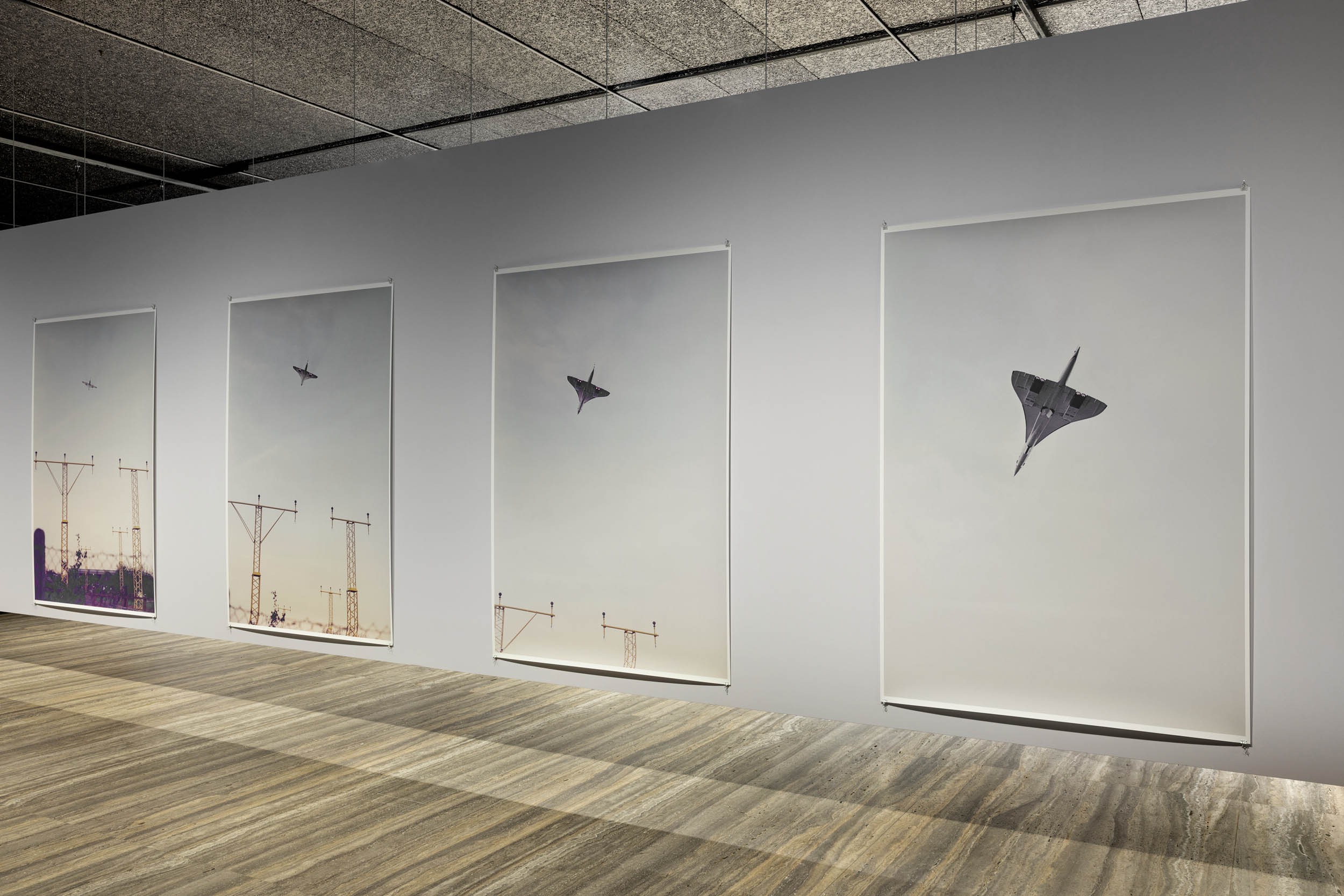
 

Installation view of the exhibition 'Typologien: Photography in 20th-century Germany' at Fondazione Prada, Milan showing photographs from Wolfgang Tillmans' series 'Concorde' 1997


Installation view of the exhibition Typologien: Photography in 20th-century Germany at Fondazione Prada, Milan showing photographs from Wolfgang Tillmans’ series Concorde 1997


In 1997, Wolfgang Tillmans photographed the Concorde, a supersonic passenger plane, in flight during landing and take-off. For him, the plane represented one of the last remaining inventions of the 1960s technological utopia. With its futuristic shape, supersonic speed, and the formidable roar it made during take-off and landing, the plane fascinated generations of technology enthusiasts. Today, the Concorde is a thing of the past and, together with the Titanic, epitomises more of a technological shock than a promise in the history of technology. These photographs reveal one of the aspects that Tillmans wants to highlight: they are symbols of “a super-modern anachronism” that ultimately left nothing behind but air pollution and environmental destruction.

Exhibition text from the Fondazione Prada by Cord Riechelmann
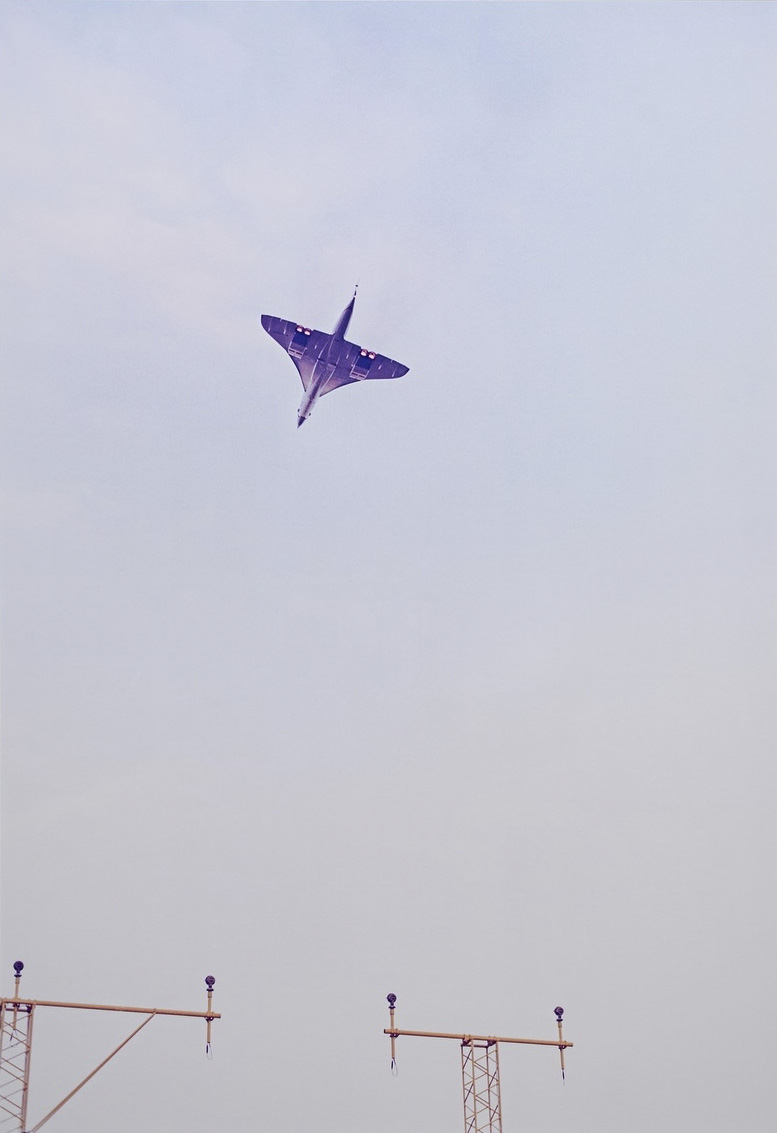
 

Wolfgang Tillmans (German, b. 1968) 'Concorde L449-21' 1997


Wolfgang Tillmans (German, b. 1968)
Concorde L449-21
1997
Inkjet print
Courtesy of Galerie Buchholz


Fondazione Prada presents Typologien: Photography in 20th-century Germany, an extensive study dedicated to 20-century German photography, at its Milan venue from 3 April to 14 July 2025. The exhibition, hosted within Podium, the central building of the Milan headquarters, is curated by Susanne Pfeffer, art historian and director of the MUSEUM MMK FÜR MODERNE KUNST, Frankfurt.

The exhibition attempts to apply the principle of “typology,” which originated in 17th- and 18th-century botany to categorise and study plants, and appeared in photography in the early 1900s, affirming itself in Germany throughout the 20th century. Paradoxically, the given formal principle allows for unexpected convergences of German artists spanning different generations and the manifestation of their individual approaches.

The exhibition path follows a typological rather than a chronological order, bringing together more than 600 photographic works by 25 artists essential for recounting over a century of German photography. The exhibition features photographs by Bernd and Hilla Becher, Sibylle Bergemann, Karl Blossfeldt, Ursula Böhmer, Christian Borchert, Margit Emmrich, Hans-Peter Feldmann, Isa Genzken, Andreas Gursky, Candida Höfer, Lotte Jacobi, Jochen Lempert, Simone Nieweg, Sigmar Polke, Gerhard Richter, Heinrich Riebesehl, Thomas Ruff, August Sander, Ursula Schulz-Dornburg, Thomas Struth, Wolfgang Tillmans, Rosemarie Trockel, Umbo (Otto Umbehr), and Marianne Wex. The project forms unexpected connections between artistic practices that differ from each other but are united by a common principle or intention of classification.

As stated by Susanne Pfeffer, “Only through juxtaposition and direct comparison is it possible to find out what is individual and what is universal, what is normative or real. Differences are evidence of the abundance of nature and the imagination of humans: the fern, the cow, the human being, the ear; the bus stop, the water tower, the stereo system, the museum. The typological comparison allows differences and similarities to emerge and the specifics to be grasped. Unknown or previously unperceived things about nature, the animal, or the object, about place and time become visible and recognizable.”

In photography, employing typologies means affirming an equivalence between images and the absence of hierarchies in terms of represented subjects, motifs, genres, and sources.

Despite this, typology remains a highly challenging and complex notion. It operates in a paradoxical regime: on the one hand, this approach can lead to a systematic recording of people and objects based on extreme objectivity; on the other hand, typology corresponds to an individual and arbitrary choice, revealing itself as a disturbing and potentially subversive act.

The hypothesis that photography plays a key role not only in fixing distinctive phenomena but also in organizing and classifying a plurality of visible manifestations remains a vital force in today’s artistic efforts to navigate the complexity of our social and cultural realities. With the spread of digital imagery and practices, the concept of typology continues to be questioned and re-defined by contemporary photographers and artists.

As underlined by Susanne Pfeffer, “The unique, the individual, seems to have been absorbed into a global mass, the universality of things is omnipresent. The Internet allows typologies to be created in a matter of seconds. In this very precise moment – it seems even more important to follow the artists’ gaze and look closely.” As further explained by Pfeffer, “When the present seems to have abandoned the future, we need to look closer at the past. When everything seems to be shouting at you and becoming increasingly brutal, it is important to take a quiet pause and use the silence to see and think clearly. When differences are no longer perceived seen as something other but are transformed into elements of division, we have to recognize what we have in common. Typologies allow us to identify undeniable similarities and subtle differences.”

In the early 20th century, Karl Blossfeldt (1865-1932) was one of the first artists to transfer the classification system used in botanical studies to photography. His vast and detailed plant atlas represented a foundational moment for German Neue Sachlichkeit (New Objectivity). This artistic and photographic movement emerged in the 1920s during the Weimar Republic and promoted the importance of categories and distinctions and the remarkable ability of photography as a medium to explore the very idea of typology.

Another pioneering figure was August Sander (1876-1964), who published his photo book Antlitz der Zeit (Face of Our Time) in 1929, at the time excerpted from his landmark project Menschen des 20. Jahrhunderts (People of the 20th Century). Described by Walter Benjamin as a “training atlas” of physiognomic perception, Antlitz der Zeit was an ambitious attempt to portray the diversity and the structure of German society using class, gender, age, occupation, and social background as distinct categories of a rigid and neutral classification system.

Both Karl Blossfeldt’s and August Sander’s typologies were fundamental for Bernd Becher (1931-2007) and Hilla Becher (1934-2015) when, at the end of the fifties, they began an enormous and lifelong documentation and preservation project of industrial architecture. In 1971, they described the “industrial constructions” as “objects, not motifs”. They stated that “the information we want to provide is only created through the sequence, through the juxtaposition of similar or different objects with the same function”. Their black-and-white monuments, or “anonymous sculptures”, isolated against a monochromatic sky, centered, framed in the same format and arranged in a block, became an essential reference for American and European Post-Minimalist and Conceptual artists. They also represented a rich heritage for younger generations of German artists and photographers, such as Andreas Gursky (b. 1955), Candida Höfer (b. 1944), Simone Nieweg (b. 1962), Thomas Ruff (b. 1958) and Thomas Struth (b. 1954), who studied at the Academy in Düsseldorf in the class led by Bernd and Hilla Becher from 1976.

Hans-Peter Feldmann (1941-2023), internationally recognised for his fundamental contribution to conceptual art, traced a complementary trajectory in German photography. In his works, he documented everyday objects and historical events and combined deadpan humor with a systematic approach to accumulating, cataloguing, and rearranging elements of contemporary visual culture. In his series, he invented personal yet very political typologies and adopted a deliberate snapshot approach with a commercial aesthetic. For his work Alle Kleider einer Frau (All the Clothes of a Woman, 1975), he took 35mm-format photographs of underwear, hosiery, T-shirts, dresses, trousers, skirts, socks, and shoes, all hanging on hangers on the wall or laid on dark fabric. With his project Die Toten 1967-1993 (The Dead 1967-1993, 1996-1998), he paid homage to individuals murdered in the context of the political and terroristic movements in Post-War Germany. As pointed out by Susanne Pfeffer, “With his typologies, he emphasised the equal value of all photographs, their image sources and motifs, and underscored the de-hierarchisation inherent in every typology.”

In his apparently random collection of found, personal or pornographic images, press clippings, and historical photos of Nazi concentration camps, the Red Army Faction and German reunification, a “private album” named Atlas (1962 – present), Gerhard Richter (b. 1932) seemed to deny or challenge the very idea of typology. Instead, he took the principle of equivalence between images and their trivialization process to the limits, creating a jarring contrast and an acute awareness of a repressed collective memory.

In the seventies and eighties, in a dialectic relationship with the artistic lessons of the Bechers, Gursky, Höfer, Ruff, and Struth progressively abandoned the radicalism and black- and-white purism of their professors. They explored the colorful dominance of banality in their series of individual or family portraits, monumental and detailed city views, and spectacular documentation of cultural or tourist sites, generating a plethora of contemporary and conflicting typologies.

In the late seventies and early eighties, multimedia artist Isa Genzken (b. 1948) engaged in a direct dialogue with the photographic medium. In 1979, she created a series entitled Hi-Fi that featured advertisements of avant-garde Japanese stereo equipment, organising them in an imaginary commercial catalog. The second series entitled Ohr (Ear) (1980) depicted, in large-scale colour close-ups, the ears of random women Genzken photographed on the streets of New York City. She transferred the traditional portrait genre to physiognomic detail and ironically investigating the absolute singularity and infinite individual differentiation the photographic portrait can record.

An illustrated book, published by Fondazione Prada and designed by Zak Group, accompanies the exhibition “Typologien: Photography in 20th-century Germany”. It includes an introduction by Miuccia Prada, President and Director of Fondazione Prada, a text by the exhibition curator Susanne Pfeffer and three essays by renowned international art historians and curators Benjamin Buchloh, Tom Holert, and Renée Mussai.

Press release from Fondazione Prada
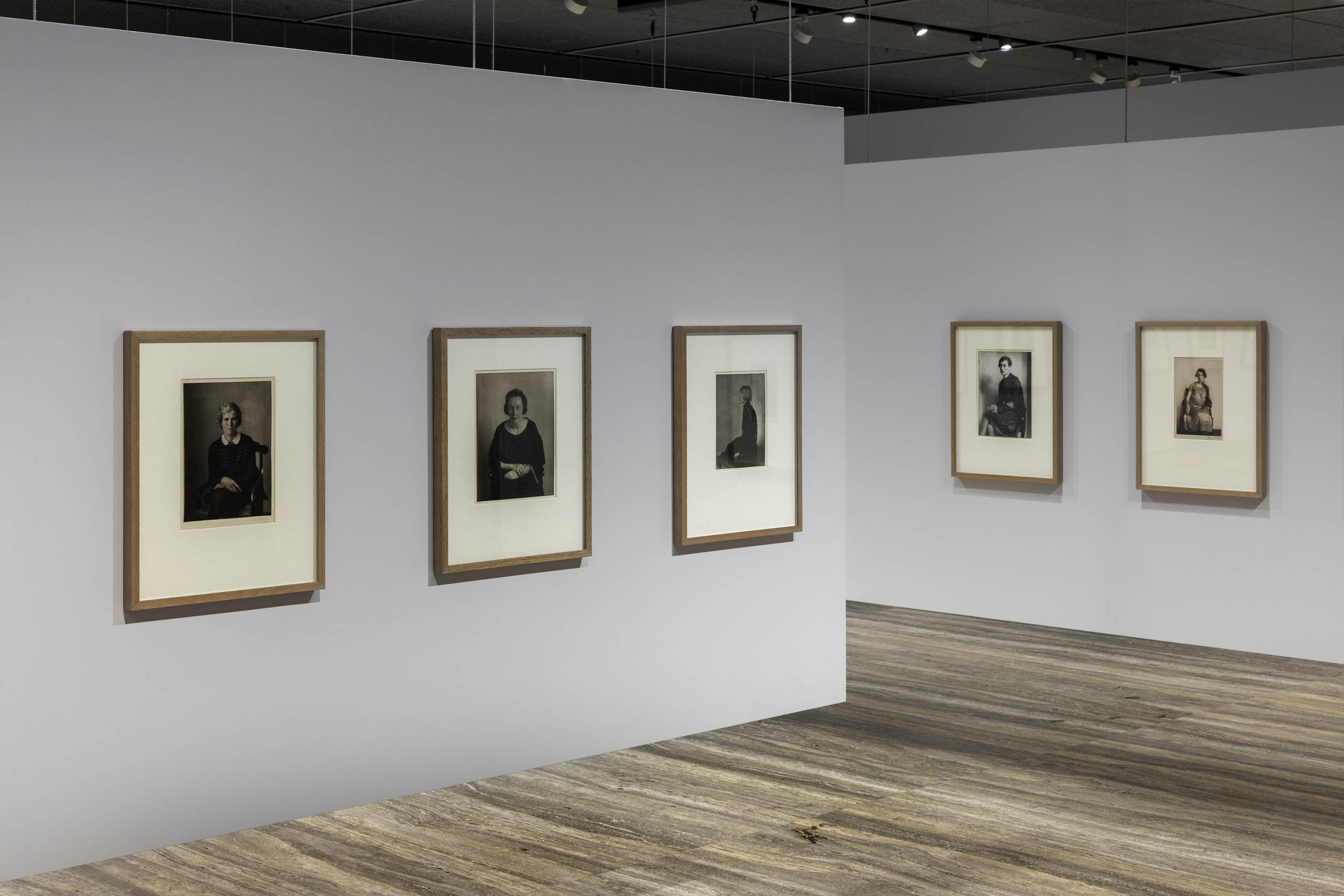
 

Installation view of the exhibition 'Typologien: Photography in 20th-century Germany' at Fondazione Prada, Milan showing the work of August Sander


Installation view of the exhibition Typologien: Photography in 20th-century Germany at Fondazione Prada, Milan showing the work of August Sander


August Sander (German, 1876-1964) 'Sekretärin beim Westdeutschen Rundfunk in Köln' [Secretary at West German Radio in Cologne] 1931-1950s


August Sander (German, 1876-1964)
Sekretärin beim Westdeutschen Rundfunk in Köln [Secretary at West German Radio in Cologne]
1931-1950s
Gelatin silver print
Die Photographische Sammlung/SK Stiftung Kultur, Cologne
© Die Photographische Sammlung/SK Stiftung Kultur – August Sander Archive, Cologne; SIAE, Roma, 2025


The series that August Sander dedicated to women is perhaps where the idea of categorising an archetype or social type shows the cracks most visibly. Whether it is an architect’s companion, an industrialist’s wife, or a high society lady, in Sander’s images the individuality of the female subject, in dress and posture, always prevails over type. And even when the subjects display characteristics that could be traced back to their class, origin, or occupation – such as the secretary who smokes – all the women depicted, from the sculptor to the photographer or the gym teacher, express ‘their own’ individuality. This is most evident when comparing the portraits of women with those of civil servants, whose gazes already show a serial uniformity associated with their positions.

Exhibition text from the Fondazione Prada by Cord Riechelmann


Erich Sander for August Sander's studio. 'Politischer Häftling' [Political Prisoner] 1941-1944 (print date late 1940s)


Erich Sander for August Sander’s studio
Politischer Häftling [Political Prisoner]
1941-1944 (print date late 1940s)
Menschen des 20. Jahrhunderts, 44a Politische Gefangene. [44a Political prisoners]
Gelatin silver print
Die Photographische Sammlung/SK Stiftung Kultur, Cologne
© Die Photographische Sammlung/SK Stiftung Kultur, Cologne – August Sander Archive, Cologne; SIAE, Roma, 2025


In 1935, Erich Sander, August Sander’s son, was sensationally put on trial and sentenced to ten years’ imprisonment for subversive activities. He served most of his sentence in Siegburg Prison, where he worked as the prison’s photographer. Determined to continue his resistance activities even in prison, he did not limit himself to taking ‘official’ photographs. He convinced his fellow prisoners to show him the scars of torture and have their portraits taken. Those photographs seemed to him to be in line with his father’s work. He had learned his trade from his father and worked with him before his imprisonment. He stayed in close contact with his parents during his ten years of imprisonment, and through them, managed to get many of those images out of the prison, leaving a valuable record of Nazi atrocities. Due to a misdiagnosis and lack of medical treatment during his imprisonment, Erich Sander died in 1944, six months before the end of his sentence.

Exhibition text from the Fondazione Prada by Cord Riechelmann
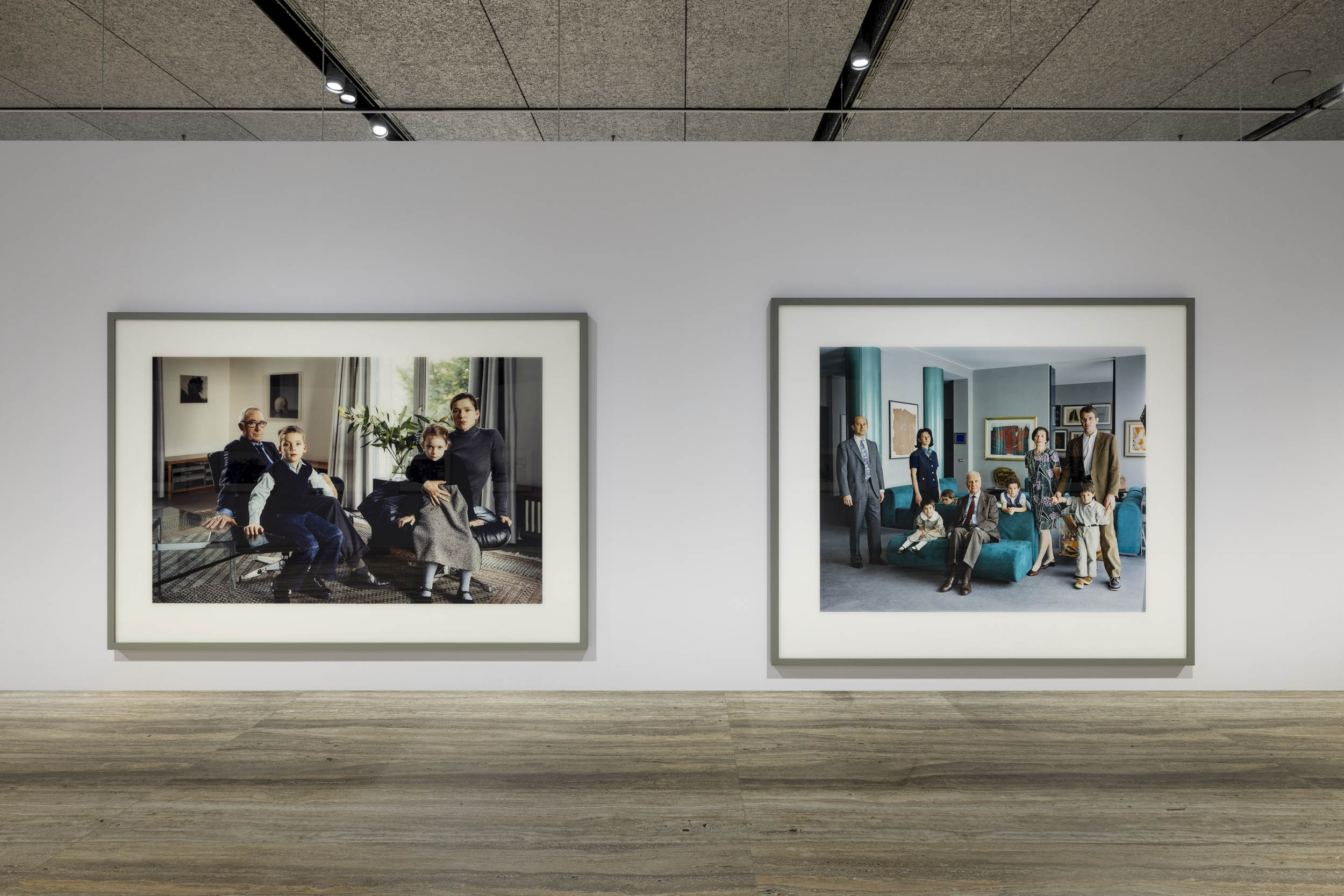
 

Installation view of the exhibition 'Typologien: Photography in 20th-century Germany' at Fondazione Prada, Milan showing photographs by Thomas Struth with at left, 'The Richter Family 1, Cologne' 2002; and at right, 'The Consolandi Family, Milan' 1996


Installation view of the exhibition Typologien: Photography in 20th-century Germany at Fondazione Prada, Milan showing photographs by Thomas Struth with at left, The Richter Family 1, Cologne 2002; and at right, The Consolandi Family, Milan 1996


Thomas Struth (German, b. 1954) 'The Richter Family 1, Cologne' 2002 (installation view)


Thomas Struth (German, b. 1954)
The Richter Family 1, Cologne (installation view)
2002
C-print
Courtesy of the artist
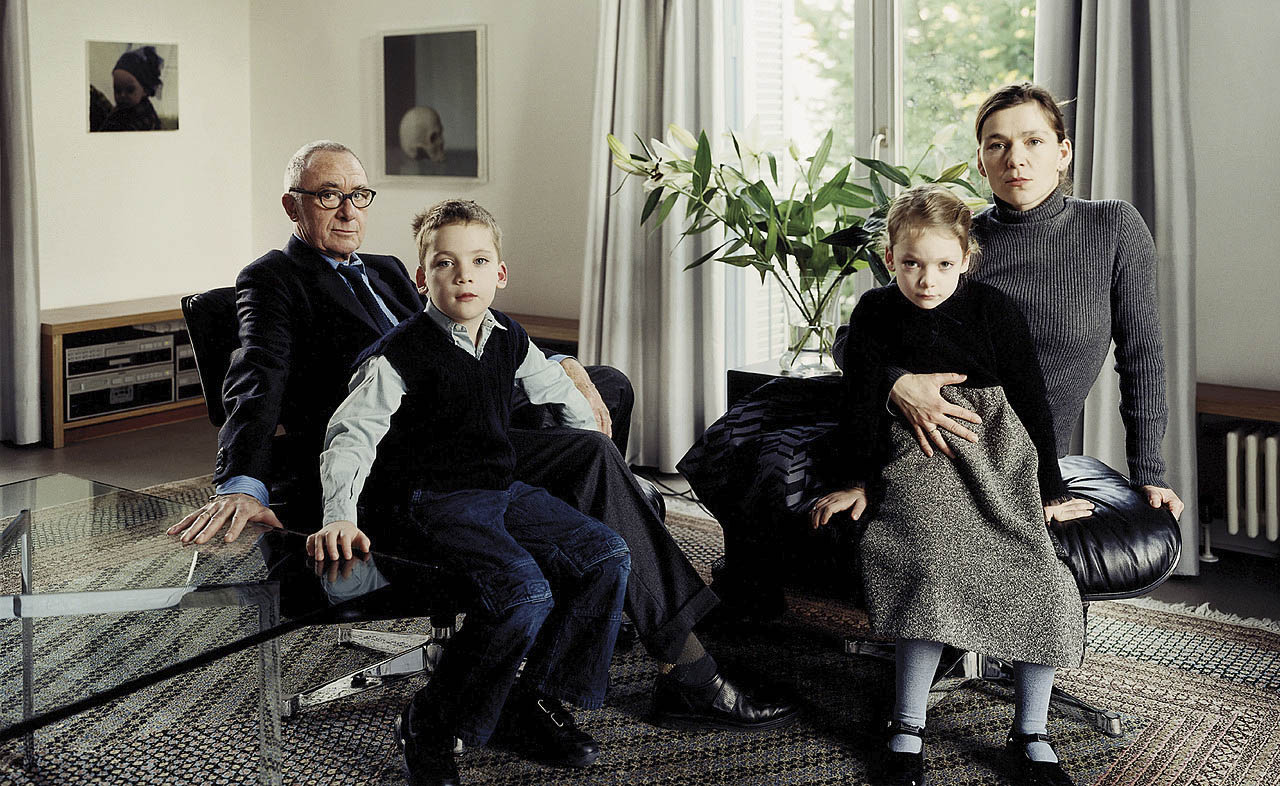
 

Thomas Struth (German, b. 1954) 'The Richter Family 1, Cologne' 2002


Thomas Struth (German, b. 1954)
The Richter Family 1, Cologne
2002
C-print
Courtesy of the artist
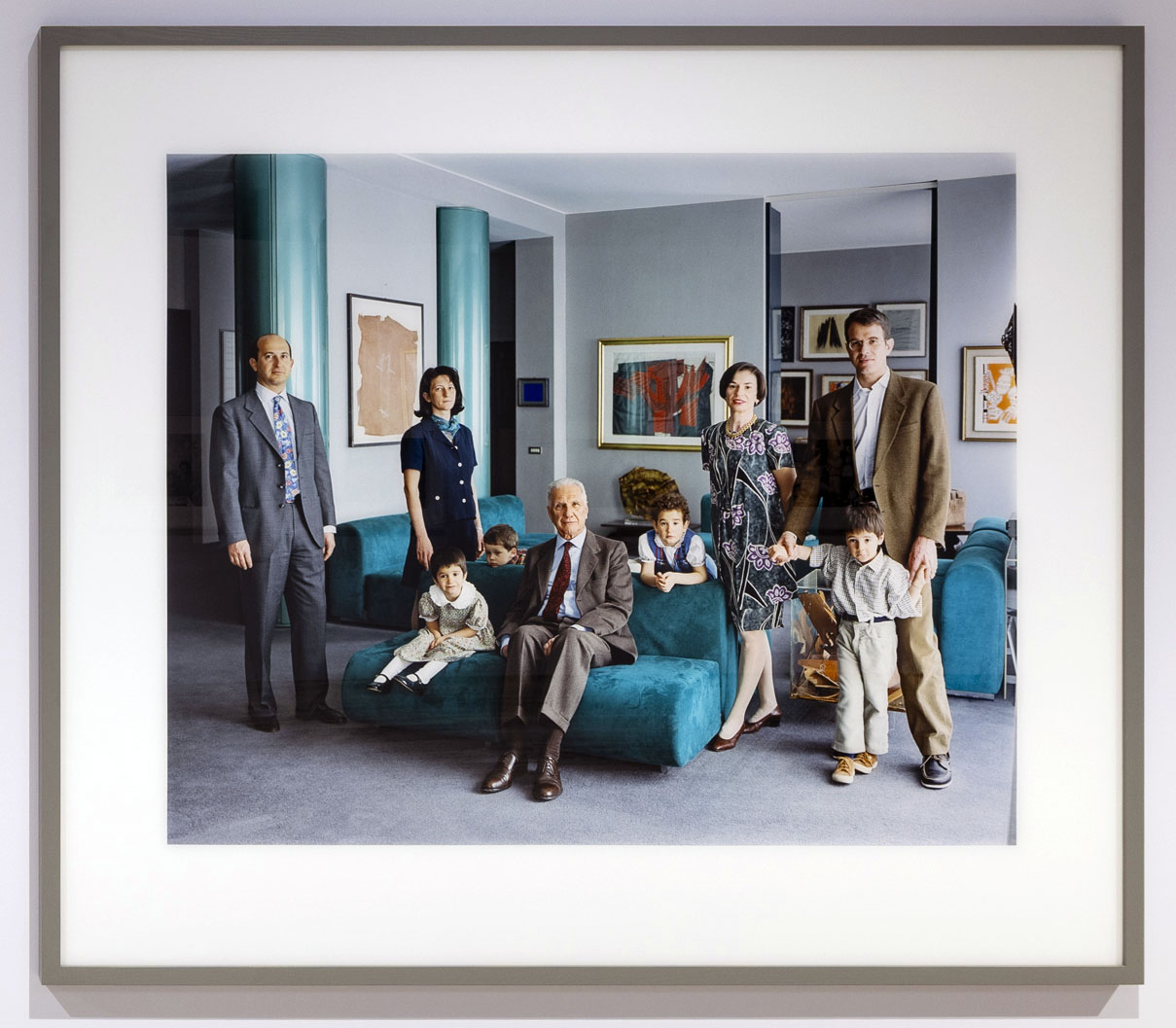
 

Thomas Struth (German, b. 1954) 'The Consolandi Family, Milan'  1996 (installation view)


Thomas Struth (German, b. 1954)
The Consolandi Family, Milan (installation view)
1996
C-print
Courtesy of the artist
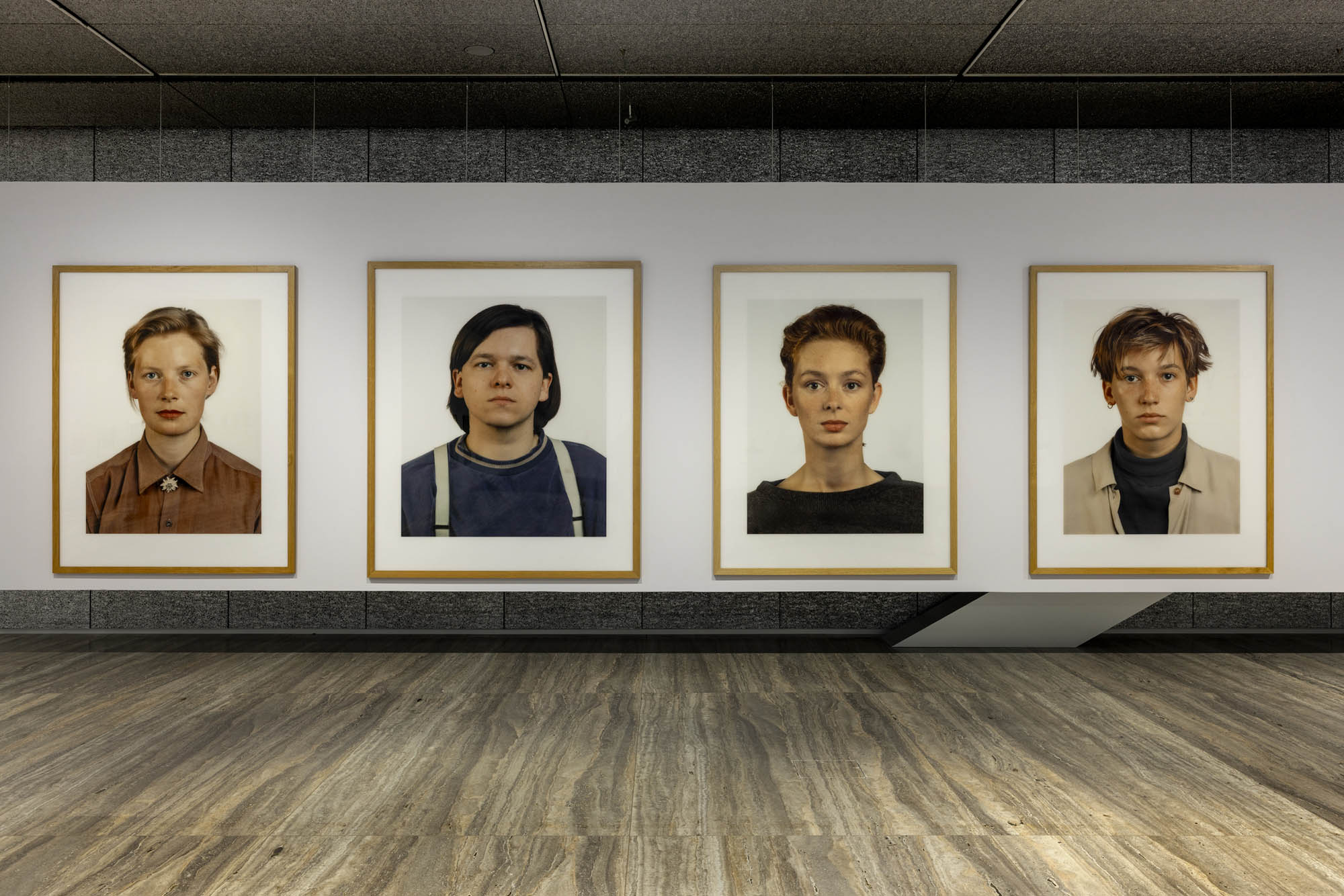
 

Installation view of the exhibition 'Typologien: Photography in 20th-century Germany' at Fondazione Prada, Milan showing Thomas Ruff portraits


Installation view of the exhibition Typologien: Photography in 20th-century Germany at Fondazione Prada, Milan showing Thomas Ruff portraits
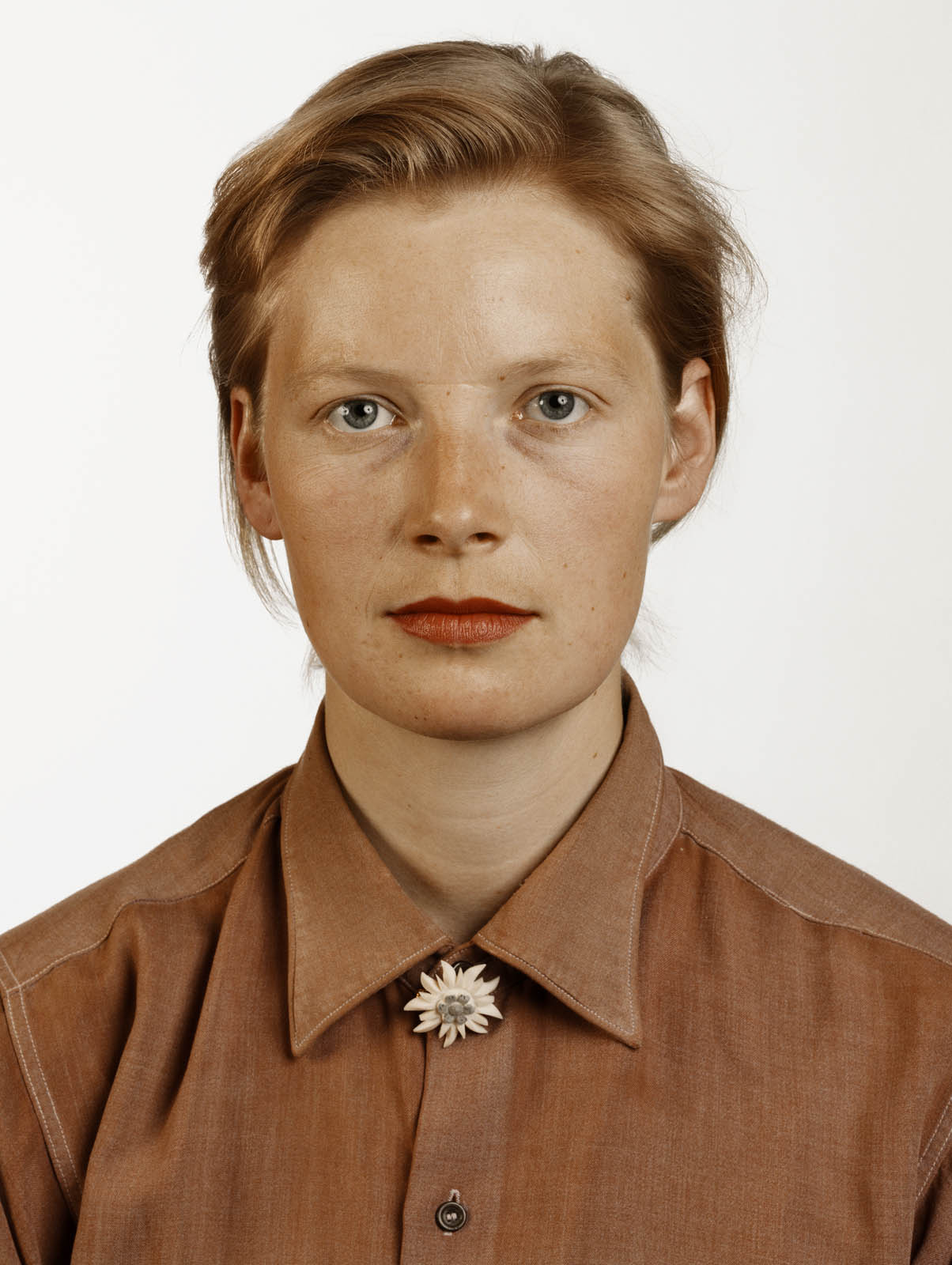
 

Thomas Ruff (German, b. 1958) 'Porträt (Pia Stadtbäumer)' 1988


Thomas Ruff (German, b. 1958)
Porträt (Pia Stadtbäumer)
1988
C-print laminated on acrylic glass
MUSEUM MMK FÜR MODERNE KUNST, Frankfurt
© Thomas Ruff, by SIAE 2025 Photo by Axel Schneider, Frankfurt am Main


Between 1977 and 1985, Thomas Ruff studied with Bernd Becher at the Art Academy in Düsseldorf, where he himself has been teaching photography since 2000. During the 1980s, he photographed people from his circle of acquaintances in a series of identically framed shots. With the subjects portrayed in a half-length pose against a neutral background, the images are striking for their unusually large size. Every detail, every pore, and every imperfection in the skin is visible in the faces of the subjects, whose names Ruff also provides. The strictness of the composition, the uniform lighting, and the impassive gaze of the people portrayed give the images an objective and neutral atmosphere. What formally appears detached and unemotional immediately raises questions about the subject portrayed: who is this person? What does he or she do in life? With this series, Ruff challenges the conventions of the traditional portrait, encouraging the viewer to question not only the identity of the subject, but also the role of the photographer and the meaning of the portrait itself.

Exhibition text from the Fondazione Prada by Cord Riechelmann


Thomas Ruff (German, b. 1958) 'Porträt (Simone Buch)' 1988


Thomas Ruff (German, b. 1958)
Porträt (Simone Buch)
1988
C-print laminated on acrylic glass
MUSEUM MMK FÜR MODERNE KUNST, Frankfurt
© Thomas Ruff, by SIAE 2025 Photo by Axel Schneider, Frankfurt am Main
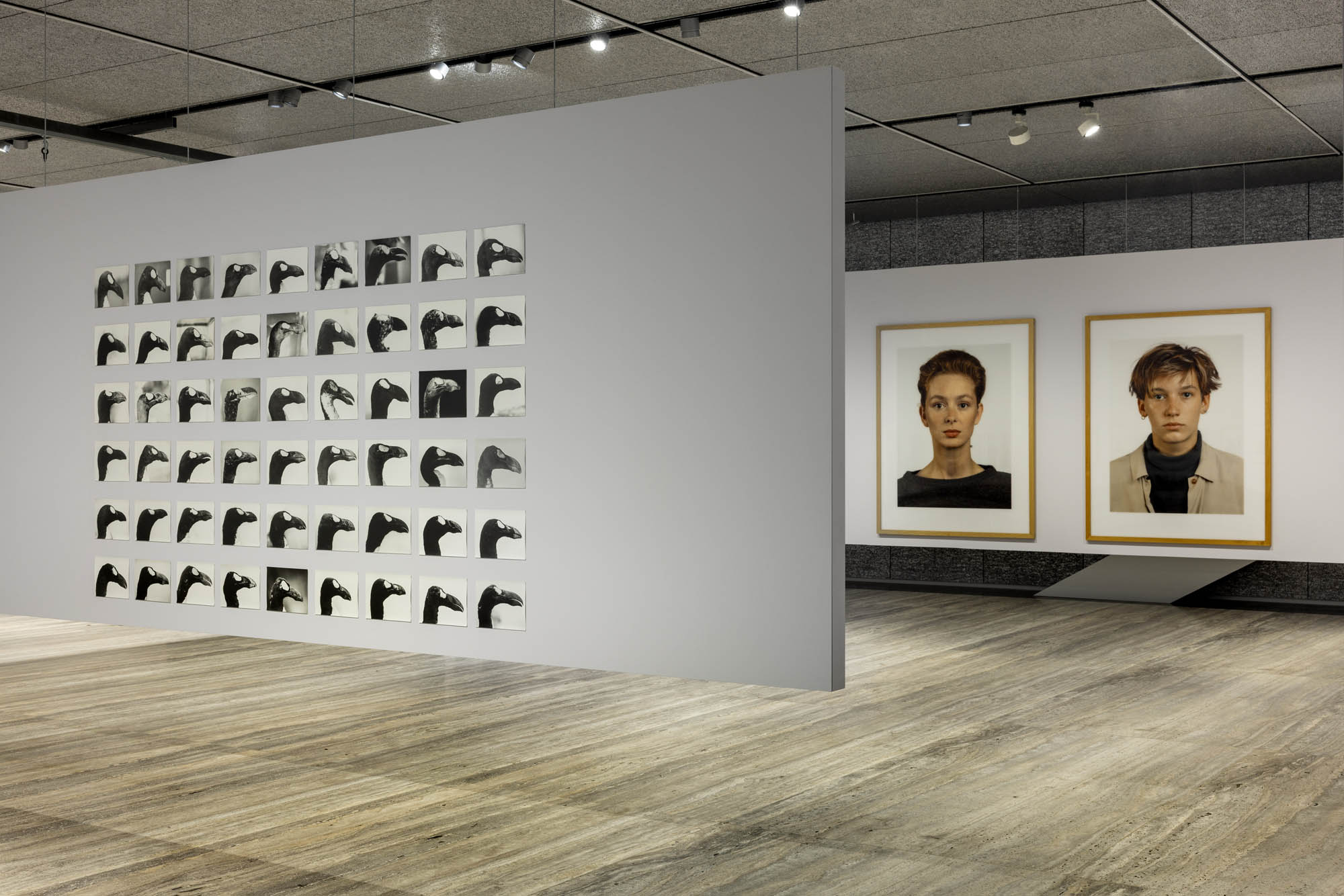
 

Installation view of the exhibition 'Typologien: Photography in 20th-century Germany' at Fondazione Prada, Milan showing at left, Jochen Lempert's 'The Skins of Alca Impennis' 1992-2022; and at right, Thomas Ruff's 'Portrait of Pia Stadtbäumer' and 'Portrait of Simone Buch' both 1988


Installation view of the exhibition Typologien: Photography in 20th-century Germany at Fondazione Prada, Milan showing at left, Jochen Lempert’s The Skins of Alca Impennis 1992-2022; and at right, Thomas Ruff’s Portrait of Pia Stadtbäumer and Portrait of Simone Buch both 1988
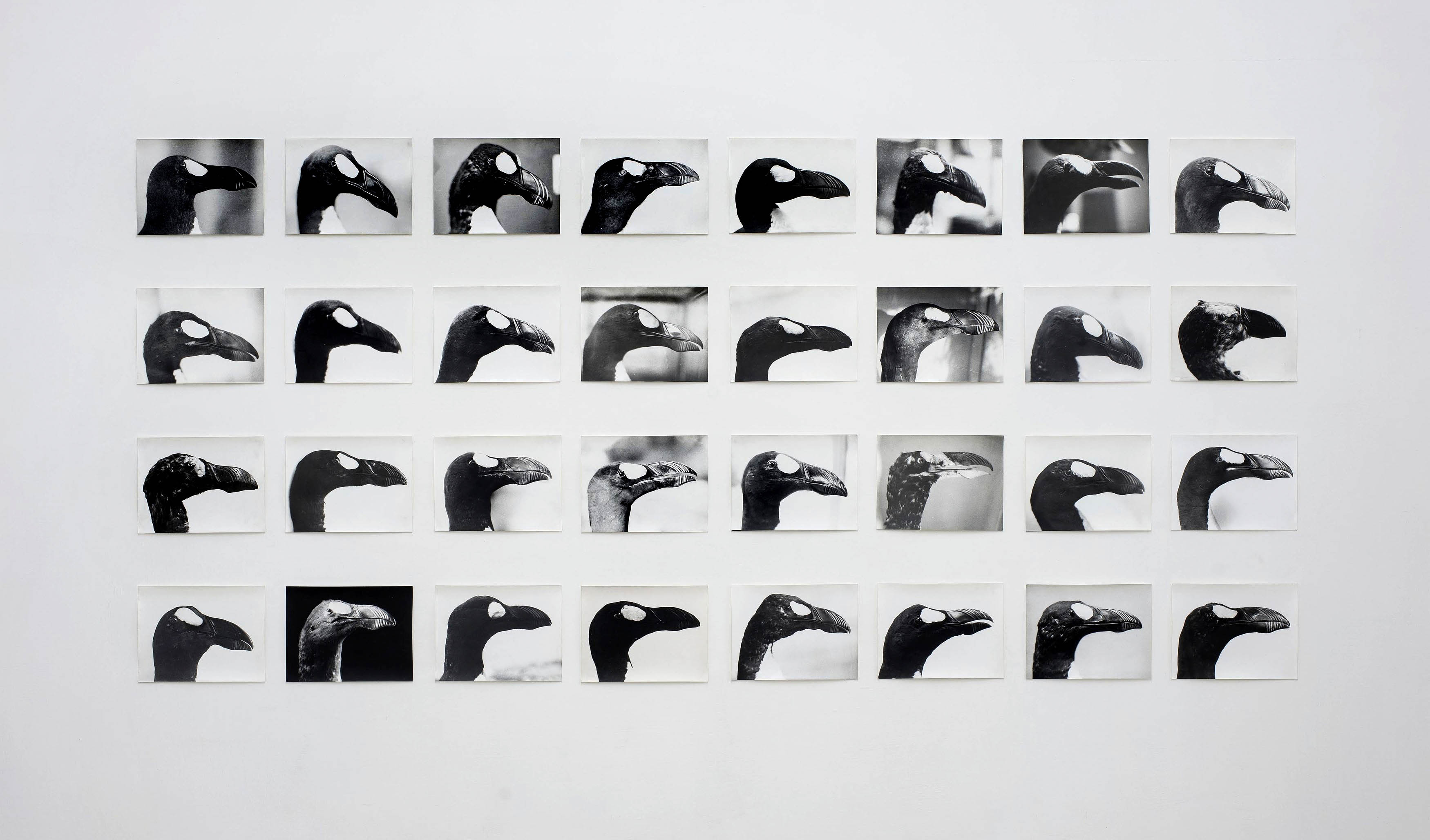
 

Jochen Lempert (German, b. 1958) 'The Skins of Alca Impennis' 1992-2022 (detail)


Jochen Lempert (German, b. 1958)
The Skins of Alca Impennis (detail)
1992-2022
Gelatin silver prints on Bartya paper
54 parts
Courtesy of Jochen Lempert, BQ, Berlin, and ProjecteSD, Barcelona


The fifty-four profiles of the Alca impennis (the great auk), a large flightless bird that became extinct after its last sighting in 1852, are part of a project that took Jochen Lempert more than a decade to complete. Using the same methods, Lempert photographed the profiles of many of the seventy-eight specimens of the Alca impennis preserved in natural history collections. Having become increasingly rare due to hunting, the Alca impennis was increasingly coveted by collectors, so the skins of this species fetched very high prices. The presence of such a large number of stuffed specimens in collections was therefore one of the causes of this species’ extinction.

Lempert’s portraits also hint at a more significant phenomenon. Very marked individual variations can be found in the appearance of individual specimens of a species, testifying to the great degree of differentiation within the species. Therefore, the concept of species, or its depiction in a scientific classification book, provides something akin to an ‘ideal type,’ rather than a true representation of the actual variety found in real life.

Exhibition text from the Fondazione Prada by Cord Riechelmann


Installation view of the exhibition 'Typologien: Photography in 20th-century Germany' at Fondazione Prada, Milan showing the work of Rosemarie Trockel, 'Elena I & II', 1993/2025, 'Maculata I & II', 1993/2025, 'Mela I & II', 1993/2025


Installation view of the exhibition Typologien: Photography in 20th-century Germany at Fondazione Prada, Milan showing the work of Rosemarie Trockel, Elena I & II, 1993/2025, Maculata I & II, 1993/2025, Mela I & II, 1993/2025


The portraits of the dogs Mela, Elena, and Maculata grew out of Rosemarie Trockel’s interest in animals and the relationship between animals and humans, a subject she has been working with for a long time. From the drawings of monkeys, which represent a kind of monument to the profound melancholy of primates kept in captivity by humans, to A House for Pigs and People / Ein Haus føur Schweine und Menschen created with Carsten Höller for documenta X in 1997, Trockel’s exploration of the relationship between humans and animals involves various forms of expression and themes. However, in this case, the double portraits of the three dogs, photographed frontally and in profile, indicate a further correlation. If “every animal is an artist,” as Trockel has stated, these portraits seem to call these roles into question: who directs and who stages who? Does the artist portray the dogs or do the dogs direct the artist?

Exhibition text from the Fondazione Prada by Cord Riechelmann
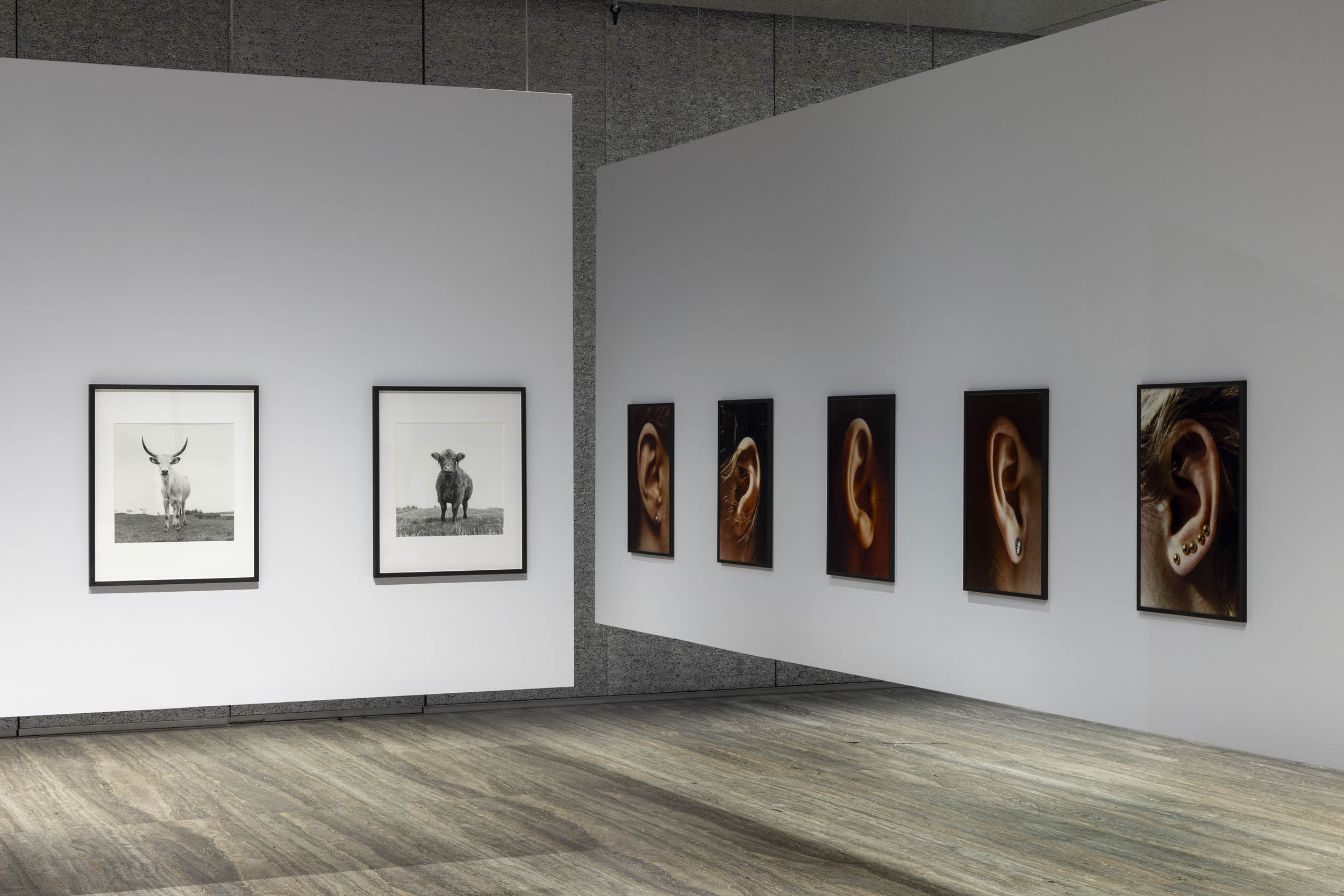
 

Installation view of the exhibition 'Typologien: Photography in 20th-century Germany' at Fondazione Prada, Milan showing at left, the work of Ursula Böhmer and her series 'All Ladies – Cows in Europe', 1998-2011; and at right, the work of Isa Genzken and her series 'Ohr', 1980


Installation view of the exhibition Typologien: Photography in 20th-century Germany at Fondazione Prada, Milan showing at left, the work of Ursula Böhmer and her series All Ladies – Cows in Europe, 1998-2011; and at right, the work of Isa Genzken and her series Ohr, 1980


Ursula Böhmer (German, b. 1965) 'Highland Grampians / Scotland [All Ladies – Cows in Europe]' 2011


Ursula Böhmer (German, b. 1965)
Highland Grampians / Scotland
2011
From the series All Ladies – Cows in Europe, 1998-2011
Gelatin silver print on Baryta paper
© Ursula Böhmer


Getting a cow to stand still in a frontal pose and look towards the camera, as Ursula Böhmer managed to do with a Highlander in the Grampian Mountains, is certainly not an easy task, but one that requires patience and trust, one of the prerequisites for this project. Between 1998 and 2011, Böhmer visited 25 European countries to photograph specimens of cattle breeds in the places where their breeding history began. These breeds, many of them at risk of extinction, had to be portrayed in their own environments in order to illustrate how these environments had influenced their appearance. What emerged was a series of images of docile animals portrayed in often harsh landscapes, which at the same time document the ongoing conditioning by the environment on the forms of life also in breeding conditions.

Exhibition text from the Fondazione Prada by Cord Riechelmann
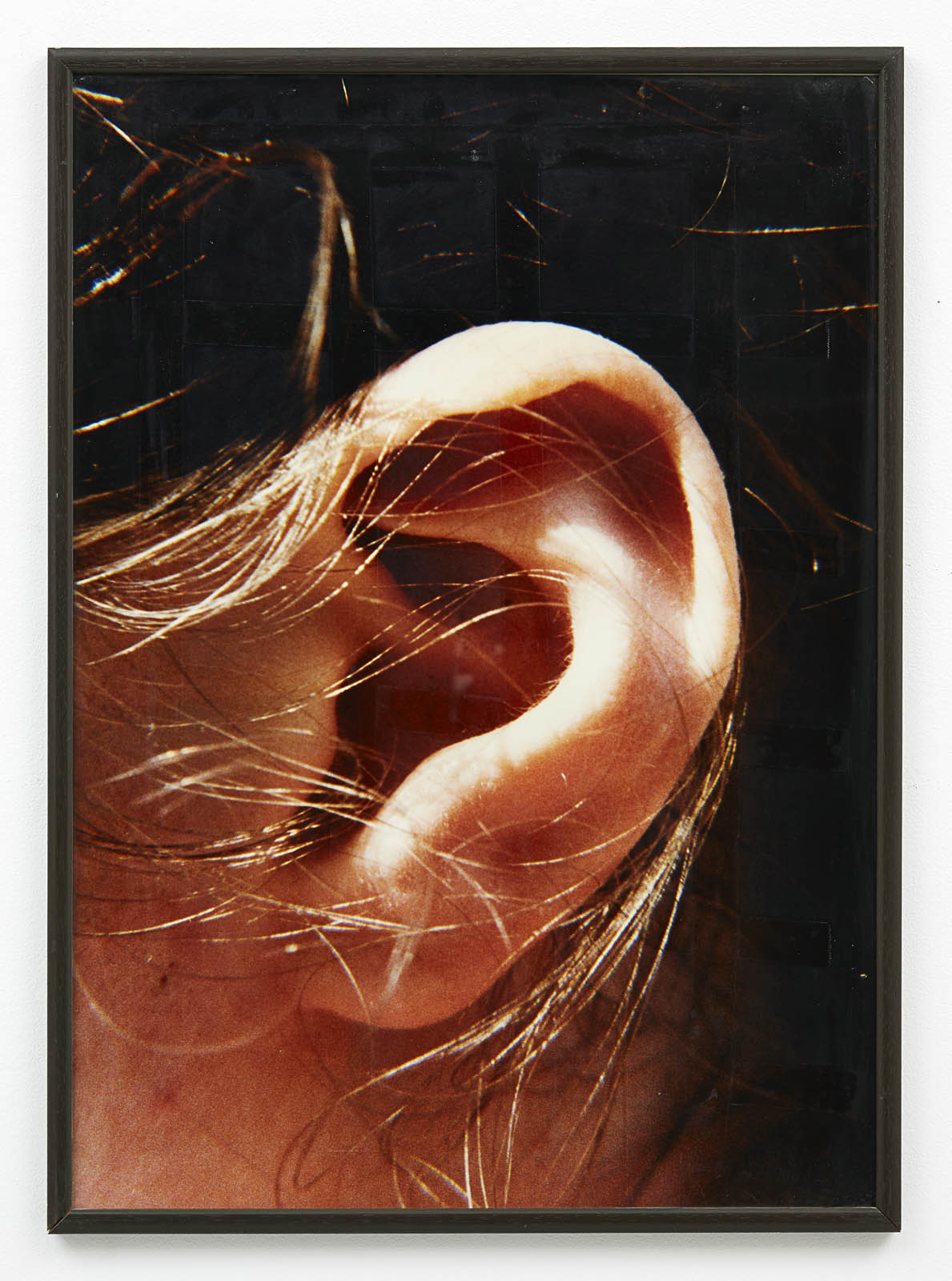
 

Isa Genzken (German, b. 1948) 'Ohr' 1980


Isa Genzken (German, b. 1948)
Ohr
1980
Colour C-print in artist’s frame
Galerie Buchholz Courtesy the artist and Galerie Buchholz
© Isa Genzken, by SIAE 2025


In 1980, Isa Genzken took a series of close-ups of the ears of women she encountered on the streets of New York. The typical portraiture approach used in the photographs exalts and enhances the characteristics of the represented subject, on the one hand, but at the same time, with the anonymity of the immortalized figure, creates a contrast. In the course of the evolution of the human species, the ear has lost its value in terms of expressive power. While in many animal species ears still play an important role in expressing emotions, in the human being they are stiffly positioned at the sides of the head and no longer react to emotional states along with the facial muscles. Georg Simmel, a sociologist of the senses, sees the ear as merely a passive appendage in the human appearance. For Simmel, the ear is the selfish organ par excellence, which simply takes without giving. Genzken contradicts this verdict, because the ears she photographs, with all the ornaments attached, eloquently express individual differences.

Exhibition text from the Fondazione Prada by Cord Riechelmann
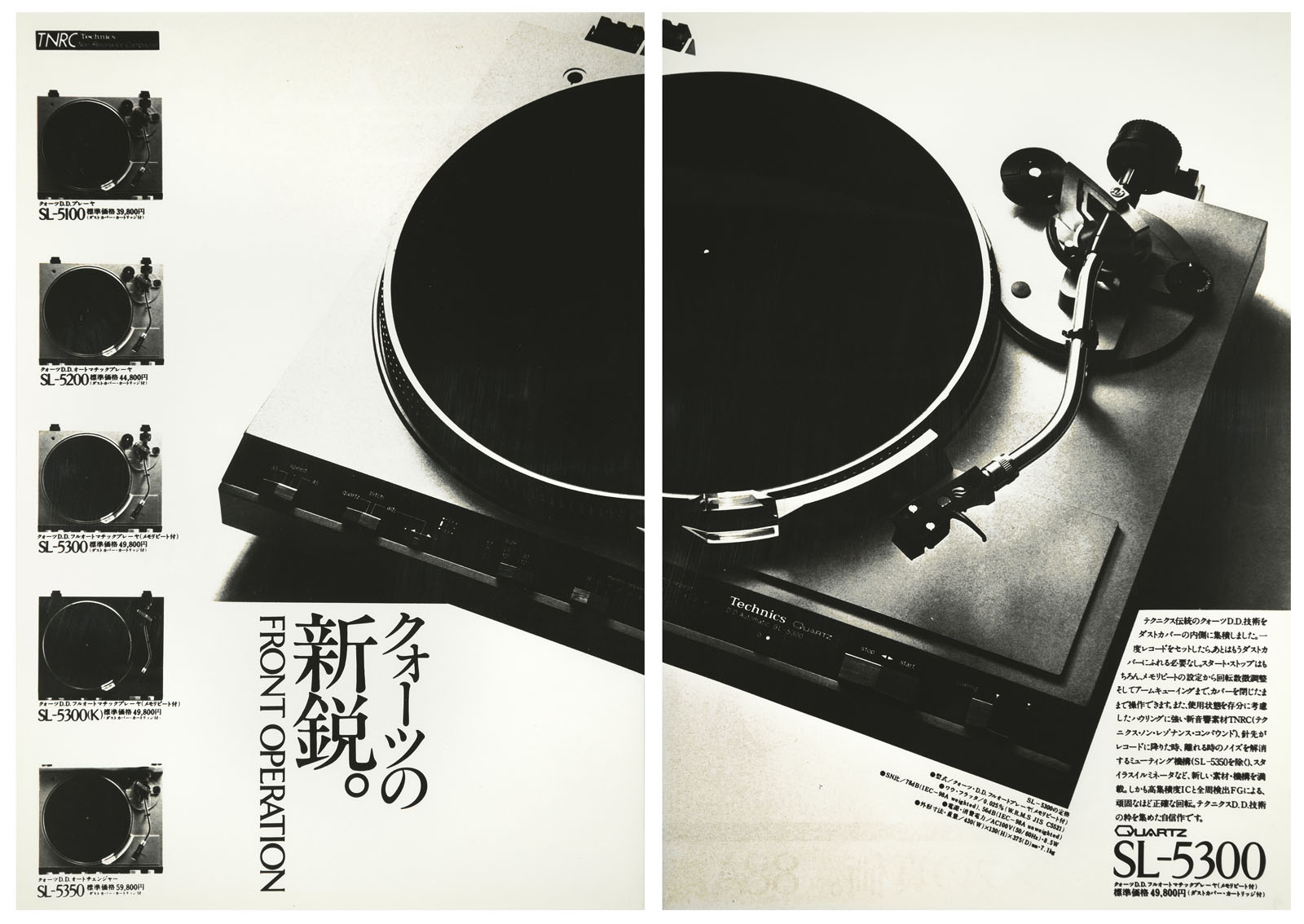
 

Isa Genzken (German, b. 1948) 'Front Operation' 1979


Isa Genzken (German, b. 1948)
Front Operation
1979
B/w photograph
Generali Foundation Collection – Permanent Loan to the Museum der Moderne Salzburg
© Generali Foundation / Isa Genzken, by SIAE 2025


In her first institutional exhibition, presented at the Museum Haus Lange in Krefeld in 1979, alongside sculptures and drawings, Isa Genzken exhibited a photography series dedicated to the latest and most expensive Hi-Fi systems. She created it by cutting out ads for turntables and amplifiers from international magazines and then photographing them. As she told photographer Wolfgang Tillmans in an interview, those advertisements showcased some of the most advanced technology of the time, highlighting cutting-edge design. Genzken also stated that a sculpture should be at least as modern as those devices. Her photography series dedicated to Hi-Fi systems can therefore be interpreted as a conceptual and aesthetic investigation of whether or not her sculptures and works could be compared to the everyday beauty of a stereo system.

Exhibition text from the Fondazione Prada by Cord Riechelmann
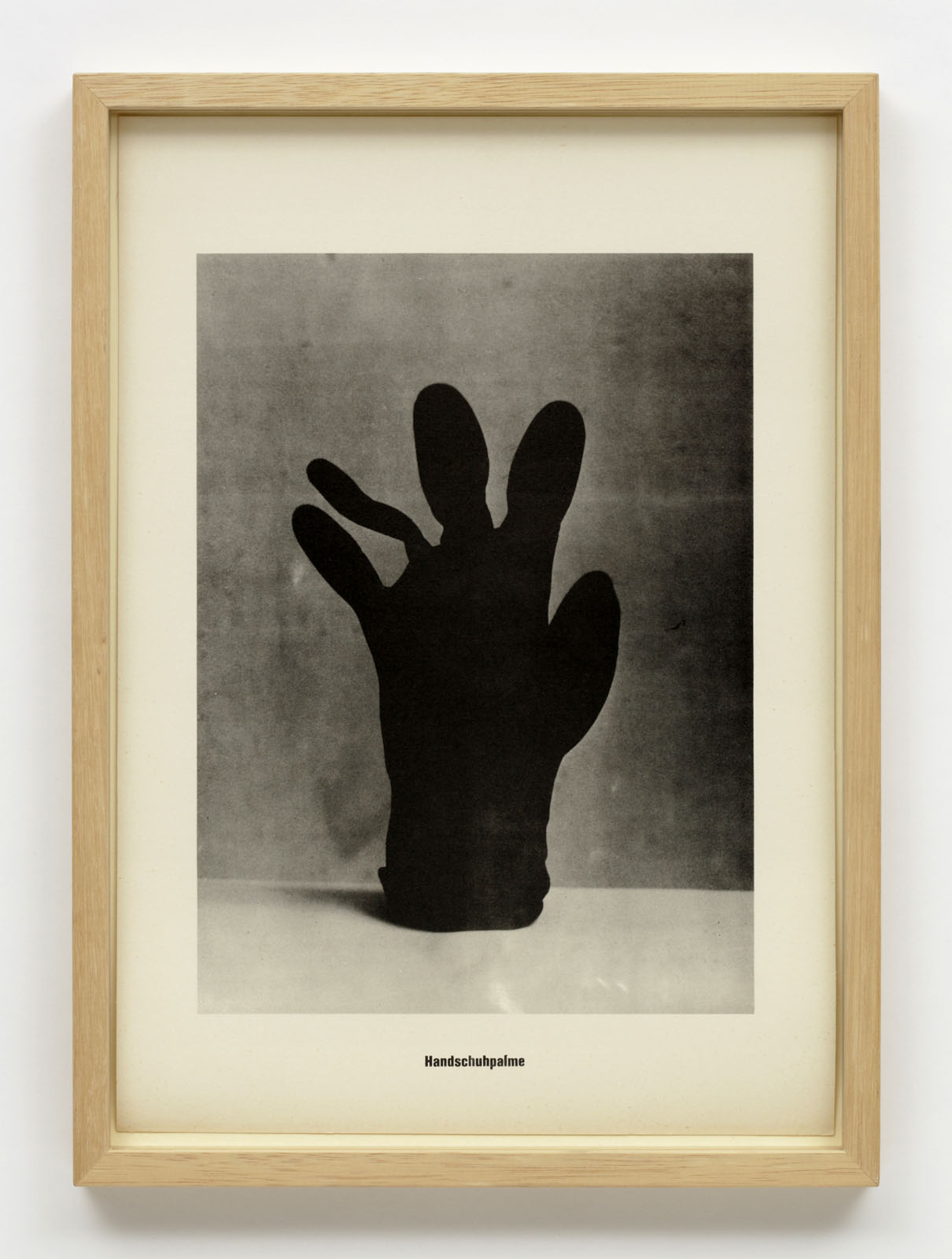
 

Sigmar Polke (German, 1941-2010) 'Handschuhpalme (Glove palm tree)' 1966


Sigmar Polke (German, 1941-2010)
Handschuhpalme (Glove palm tree)
1966
From the series … Höhere Wesen Befehlen, 1968 (… Higher beings Command, 1968)
13 stampe offset su carta artistica / 13 offset prints on art paper
MUSEUM MMK FÜR MODERNE KUNST, Frankfurt am Main


Lotte Jacobi (American born Poland, 1896-1990) 'Folkwang-Auriga-Verlag, Orch 152. Neottia nidus avis. Vogel-Nestwurz, einzelne Blüte' [Bird's-nest orchid, single flower] c. 1930


Lotte Jacobi (American born Poland, 1896-1990)
Folkwang-Auriga-Verlag, Orch 152. Neottia nidus avis. Vogel-Nestwurz, einzelne Blüte [Bird’s-nest orchid, single flower]
c. 1930
Gelatin silver print
Berlinische Galerie – Museum of Modern Art, Photography and Architecture
© Lotte Jacobi


Lotte Jacobi, known for her portraits of intellectuals including Martin Buber and W.E.B du Bois, artists such as Marc Chagall, and poets including Robert Frost and Vladimir Mayakovsky, created a series of plant portraits in 1930. Apart from the individual flowers of the Orchis latifolia, the broad-leaved helleborine or orchid, and Neottia nidus avis, the bird’s nest, she photographed an orchid in its entirety. The names of the plants, which Jacobi, like Karl Blossfeldt, makes explicit in the titles of the photographs, are an integral part of the unique poetics of the subjects. With her plant portraits, Jacobi followed in the tradition of the 1920s workers’ movement’s vision of nature. In fact, Jacobi was a member of the Vereinigung der Arbeiterfotografen Deutschlands (Union of German Labor Photographers), an organisation of photographers who documented the social life and struggles of the German working class.

Exhibition text from the Fondazione Prada by Cord Riechelmann
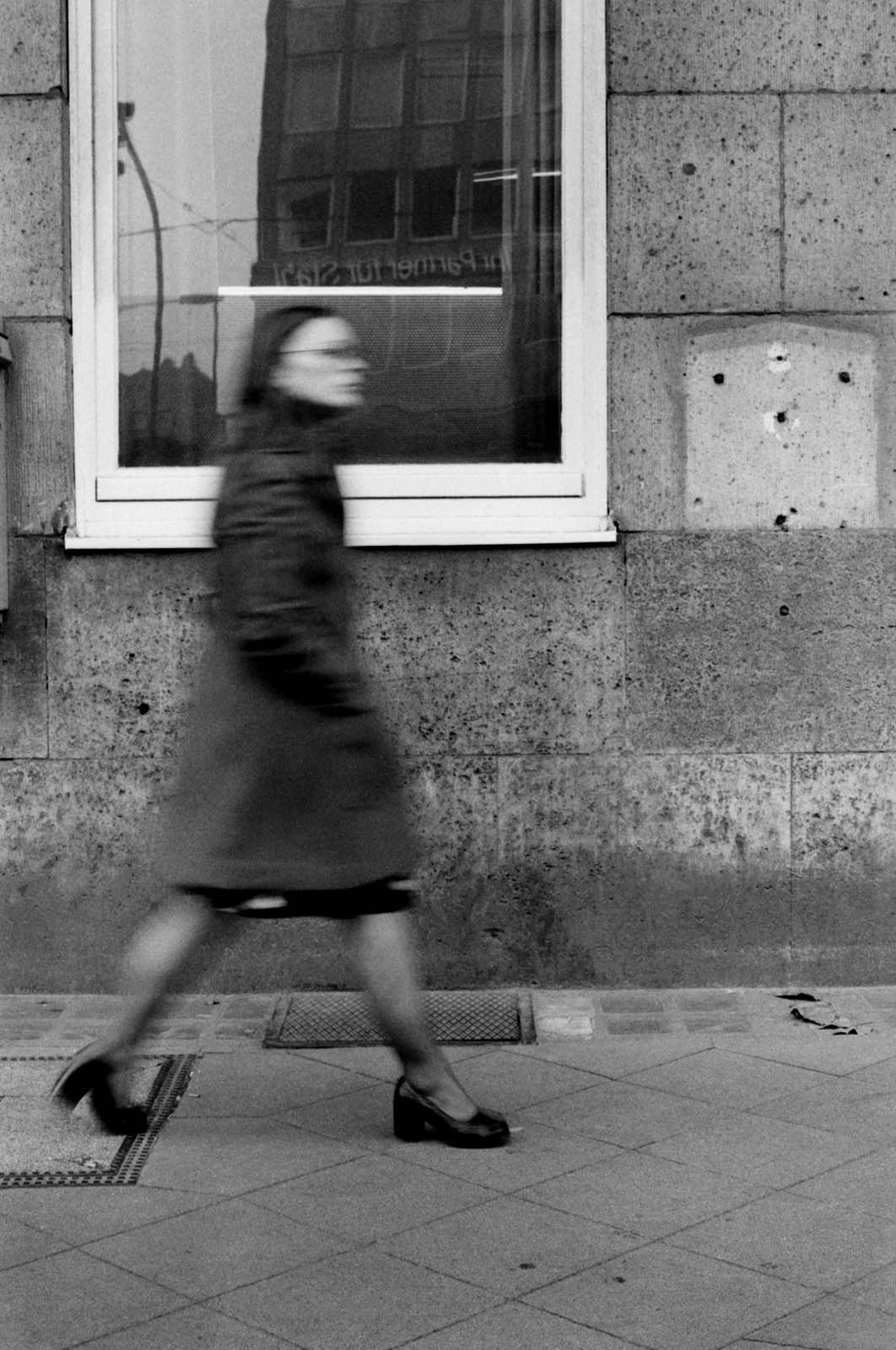
 

Thomas Struth (German, b. 1954) 'People on the Street, Düsseldorf 1974-78' 1974-1978


Thomas Struth (German, b. 1954)
People on the Street, Düsseldorf 1974-78
1974-1978
Gelatin silver print
Atelier Thomas Struth, Berlin
© Thomas Struth


In his photography, Thomas Struth has always been interested in the streets, squares, and houses of cities that consciously or unconsciously shape our experience, as well as that of the passers-by who walk through them. The study People on the Street, Düsseldorf 1974-78 explores the movements and figures of individuals passing in front of the camera lens. The subjects are never shot at close range. While some facial features are blurred in movement, others are clearly visible. Even if they are differentiated by their jackets, coats, or bags, all the subjects have a directional gait in common. No one is simply ‘here’: they all have an intention, which each person pursues in their own way.

Exhibition text from the Fondazione Prada by Cord Riechelmann
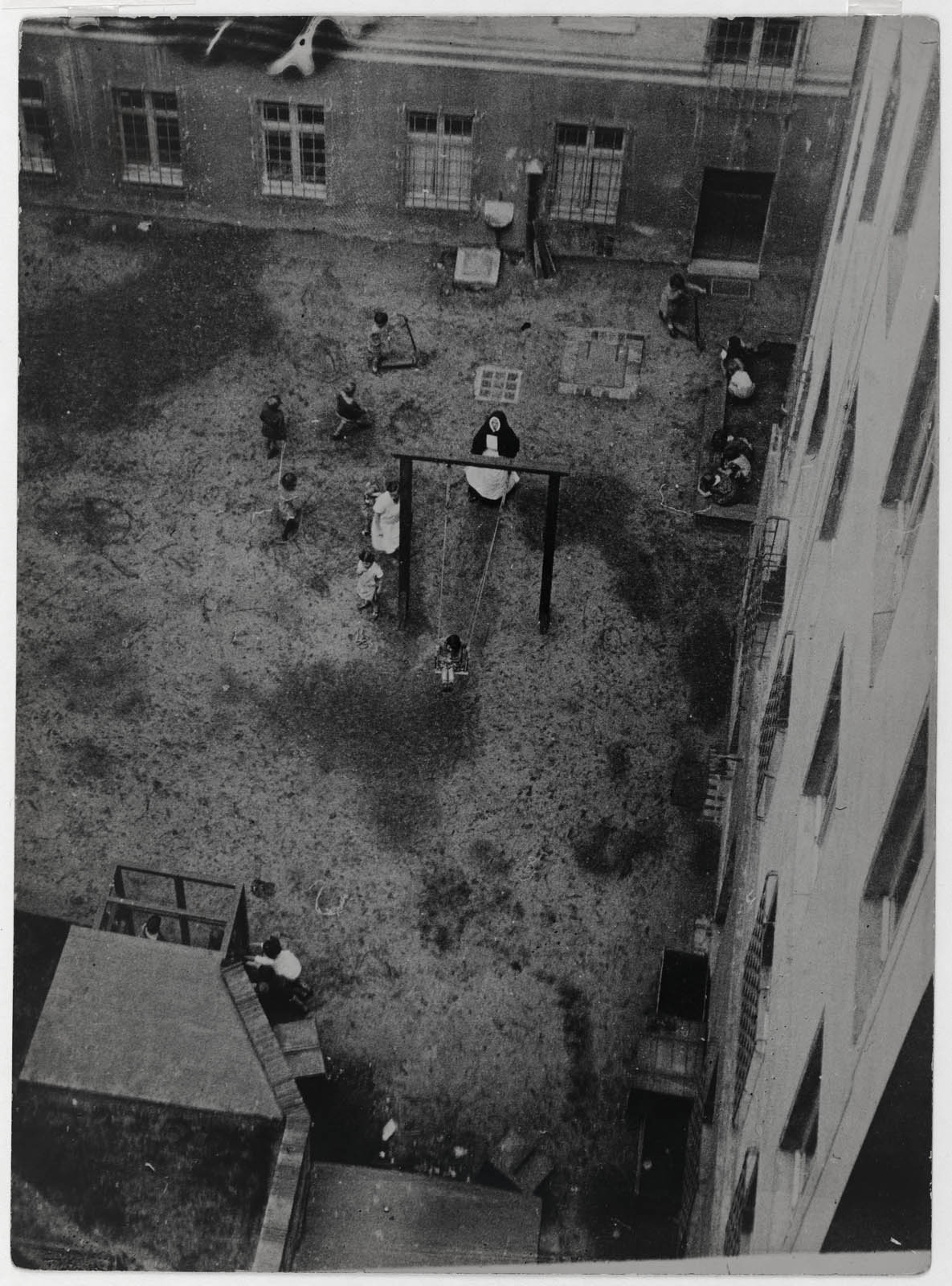
 

Umbo (Otto Umbehr) (German, 1902-1980) 'Untitled (Kindergarten)' 1928


Umbo (Otto Umbehr) (German, 1902-1980)
Untitled (Kindergarten)
1928
Gelatin silver print
Berlinische Galerie – Museum of Modern Art, Photography and Architecture, Berlin
Permanent loan from the Federal Republic of Germany represented by the Government Commissioner for Culture and the Media


Umbo – born Otto Umbehr – found his expressive tool in the camera in 1926. In the early 1920s he studied at the Bauhaus with the intention of becoming a painter, until Walter Gropius, the director of the Institute, expelled him from the school for improper conduct. He then found in photography the medium that allowed him to work with his distinctive play of light and shadow. Photographs such as Unheimliche Straße (Eerie Street, 1928), Am Strand (auch Strandleben) (On the beach [also beach life], 1930) and Ohne Titel (Kindergarten) (Untitled [Kindergarten], 1930) epitomize his artistic innovations. There is nothing random in these images: everything has been composed. Umbo’s photographs are the opposite of snapshots or shots that capture the emotion of a moment; they express a formal intent without overpowering reality. Therefore, with all their poetry, they retain an abstract component. What clearly surfaces in this primacy of composition is his connection to the Bauhaus philosophy, which emphasised design and structure over emotion or spontaneity.

Exhibition text from the Fondazione Prada by Cord Riechelmann


Fondazione Prada Milan
Largo Isarco 2, within the Podium spaces
20139 MILAN
Phone: +39 02 5666 2611

Opening hours:
Mon-Sun, 10am – 7pm
Fondazione Prada Milan website

LIKE ART BLART ON FACEBOOK

Back to top

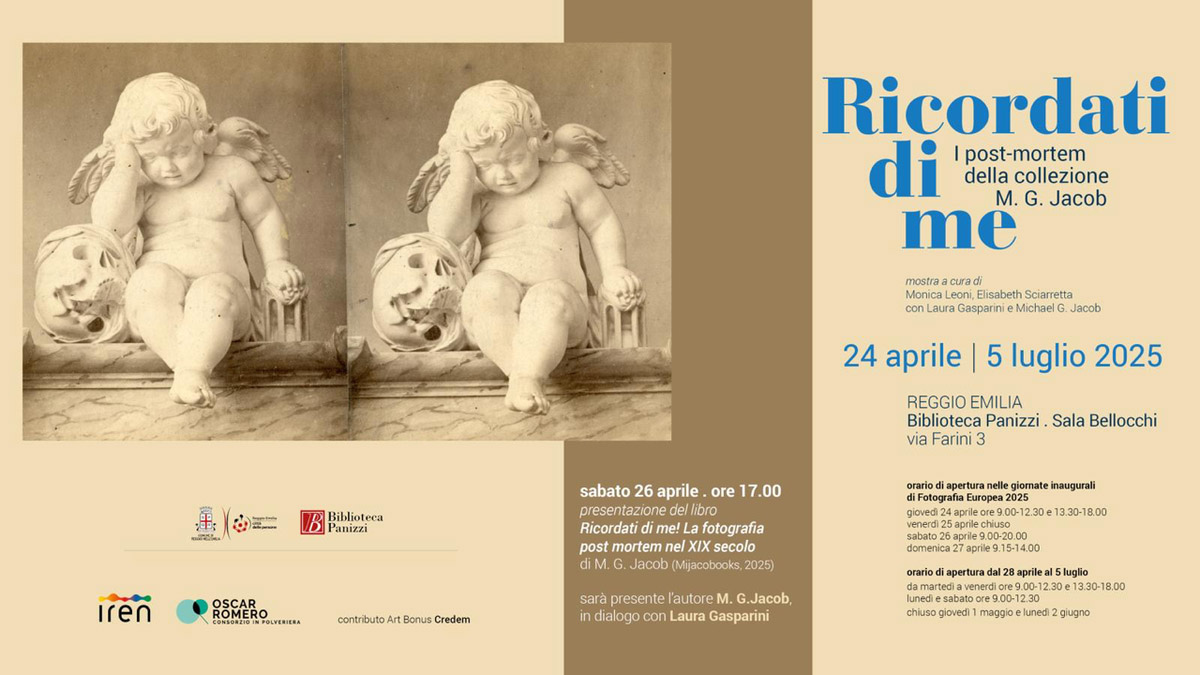
Exhibitions: ‘Ricordati di me. I post mortem della collezione M. G. Jacob’ and ‘Attraverso la luce. I primi 20 anni della fotografia nelle collezioni della Fototeca’ at Biblioteca Panizzi, Reggio Emilia, Italy

Exhibition dates: 24th April – 5th July, 2025

‘Remember Me. Postmortems from the M. G. Jacob Collection’ and ‘Through Light. The First 20 Years of Photography in the Photo Library Collections’

Postmortem curators: Monica Leoni, Elisabeth Sciarretta with Laura Gasparini and Michael G. Jacob

Attraverso la luce curators: Monica Leoni, Elisabeth Sciarretta with Laura Gasparini


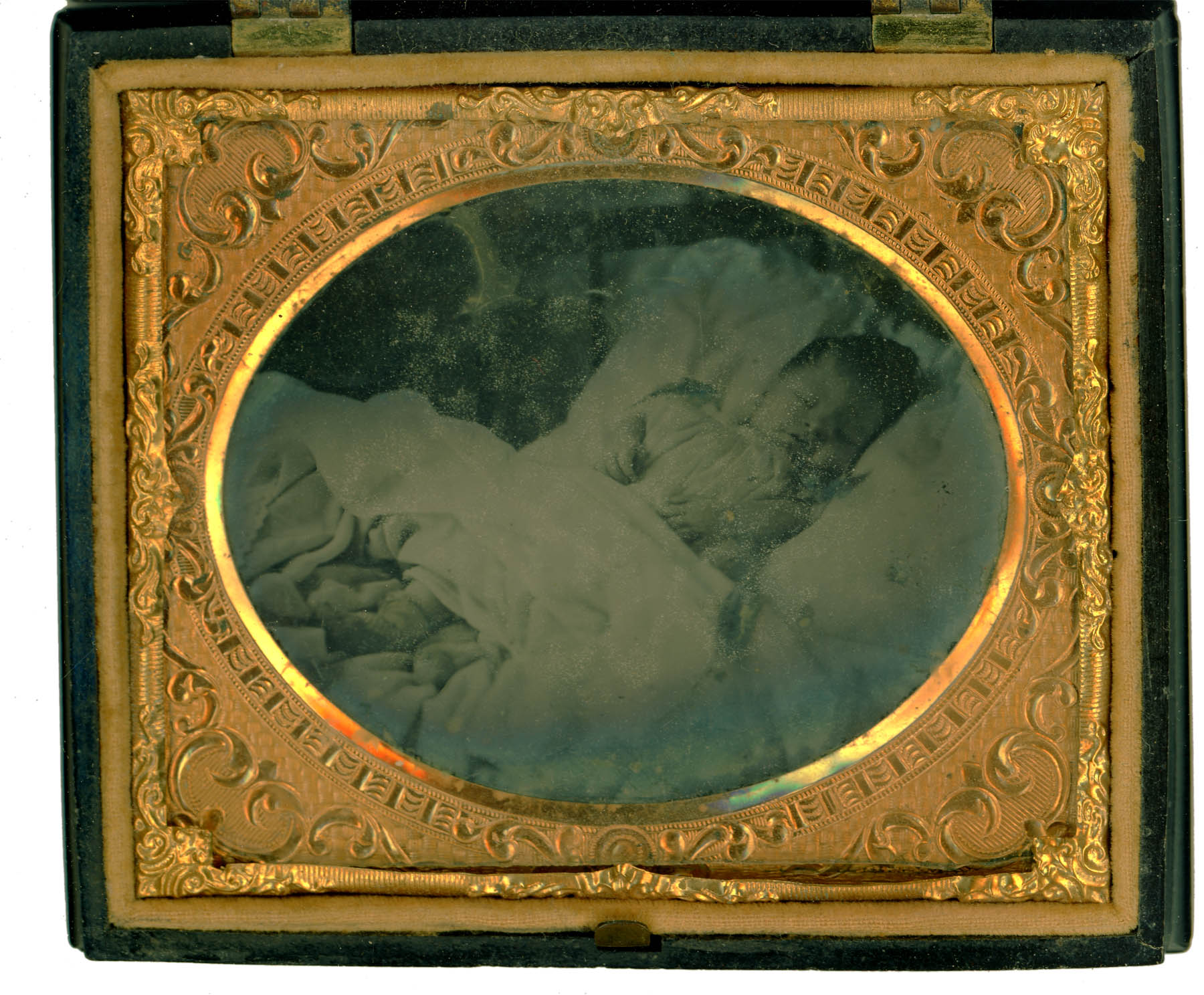
'Ricordati di me. I post mortem della collezione M. G. Jacob'


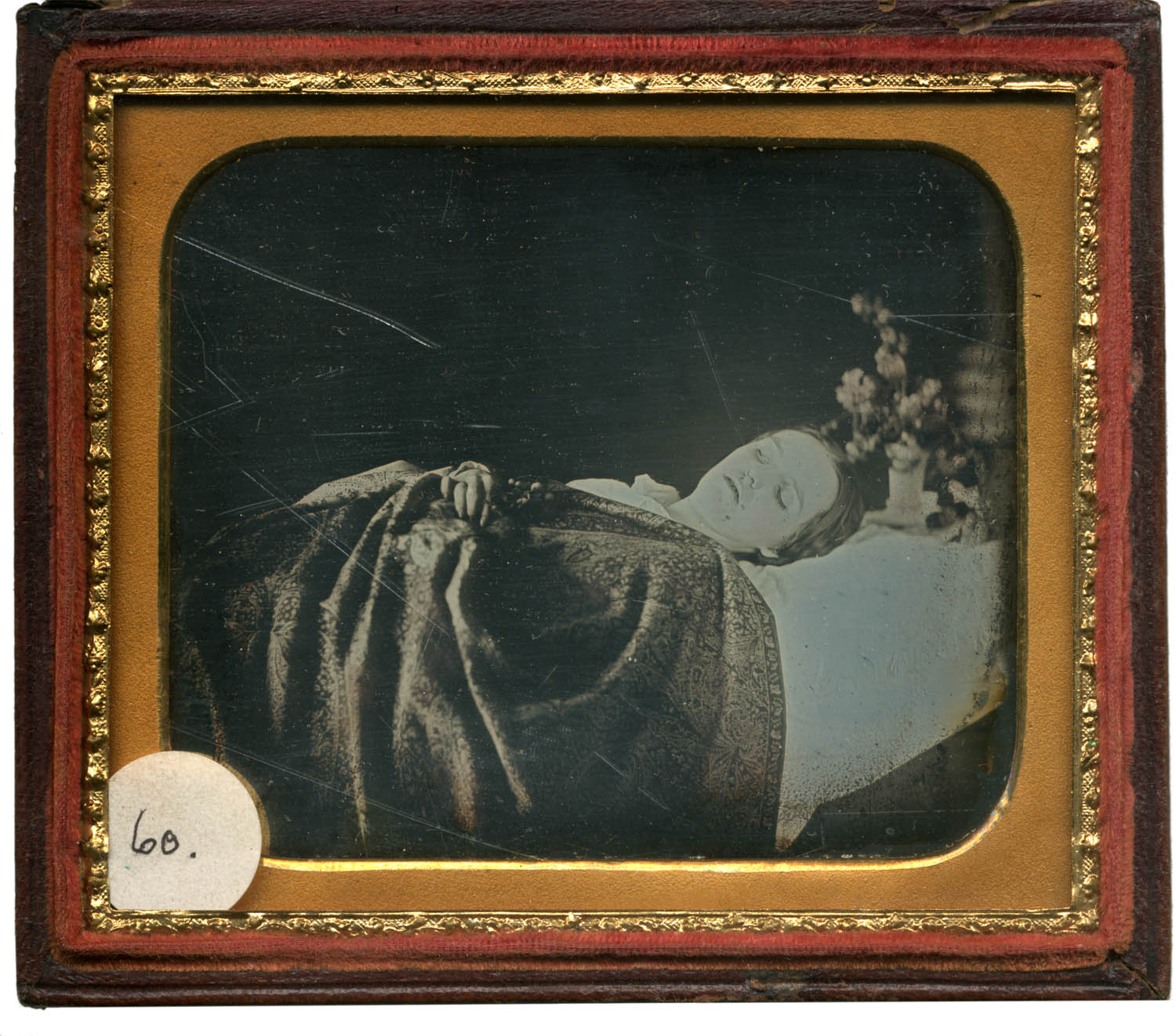
Sleeping beauty


“When I am dead and in my grave

And all my bones are rotten.

When this you see remember me

Lest I should be forgotten.”


This is the first posting on Art Blart on the phenomenon of postmortem photography for exhibitions on this subject are few and far between.

Any photograph is a “little death” which “refers to the concept of “la petite mort” or “the little death,” a French idiom and euphemism for the momentary loss of consciousness or breath, often associated with orgasm, but also used to describe the act of freezing a moment in time through photography. This concept suggests that photography, by capturing a specific moment, essentially stops time and thus, in a way, creates a small, contained death of that moment.” (Google AI Overview)

All photographs (and especially postmortem photography where the deceased are memorialised through images) can be seen as “memento mori”, a Latin phrase meaning “remember you must die,” reminding us that of the impermanence of life – for photographs “capture a moment in time, forever preserving a fleeting instant and highlighting the passage of time and the inevitability of death.” (Google AI Overview)

As Susan Sontag observed, “All photographs are memento mori. To take a photograph is to participate in another person’s (or thing’s) mortality, vulnerability, mutability.” (On Photography)

Victorians were faced with the vicissitudes of fortune, and death at any age was a common occurrence due to illness with no antibiotics available to treat the many lethal diseases. They became stoic in the face of the impermanence of life, stoic in the face of death and through photography, sought to record into permanence the likenesses of the departed (the beloved), so that they could remember and honour them. Photographs thus became symbols of mortality which encouraged reflection on the meaning and fleetingness of life…

But unlike a photographic self-portrait, where a human looks at their image (in which they are dead) which reminds them about their physical death in the future, an anterior future of which death is the stake (and the prick of discovery of this equivalence)1 – in postmortem photography the little death and the actual death are as one for the anterior future can never be viewed by the subject of the photograph (they are dead), a separation only revived in the heart and mind of another.

Through postmortem photography the deceased live in an interstitial space, forever brought back to life in the eyes of the viewer as we reawaken and reactivate their spirit in the world. I was once here and I am again. Remember me.

Thus the euphemism “sleeping” is appropriate (sleeping beauty awakened once more with a kiss), as the viewer transcends time bringing past dead back into living world – where past, present and future coalesce into single point in time – their death and our death connected through the gaze and the knowledge of our discontinuity. Eons contracted into an eternal moment.2

In this expanded-specific moment in time, through an awareness of our own dis/continuity, what we are doing is talking about something that is remarkable. We are moving towards a language that defines the human condition…

Dr Marcus Bunyan


1/ Roland Barthes, Camera Lucida (La Chambre claire), Section 39, 1980

2/ Marcus Bunyan. “This is not my favourite photograph,” part of What makes a great photograph? at the Centre for Contemporary Photography (CCP), Fitzroy, Wednesday 5th December 2012 [Online] Cited 27/06/2025


Many thankx to the Biblioteca Panizzi and Michael G. Jacob for allowing me to publish the photographs in the posting. Please click on the photographs for a larger version of the image.


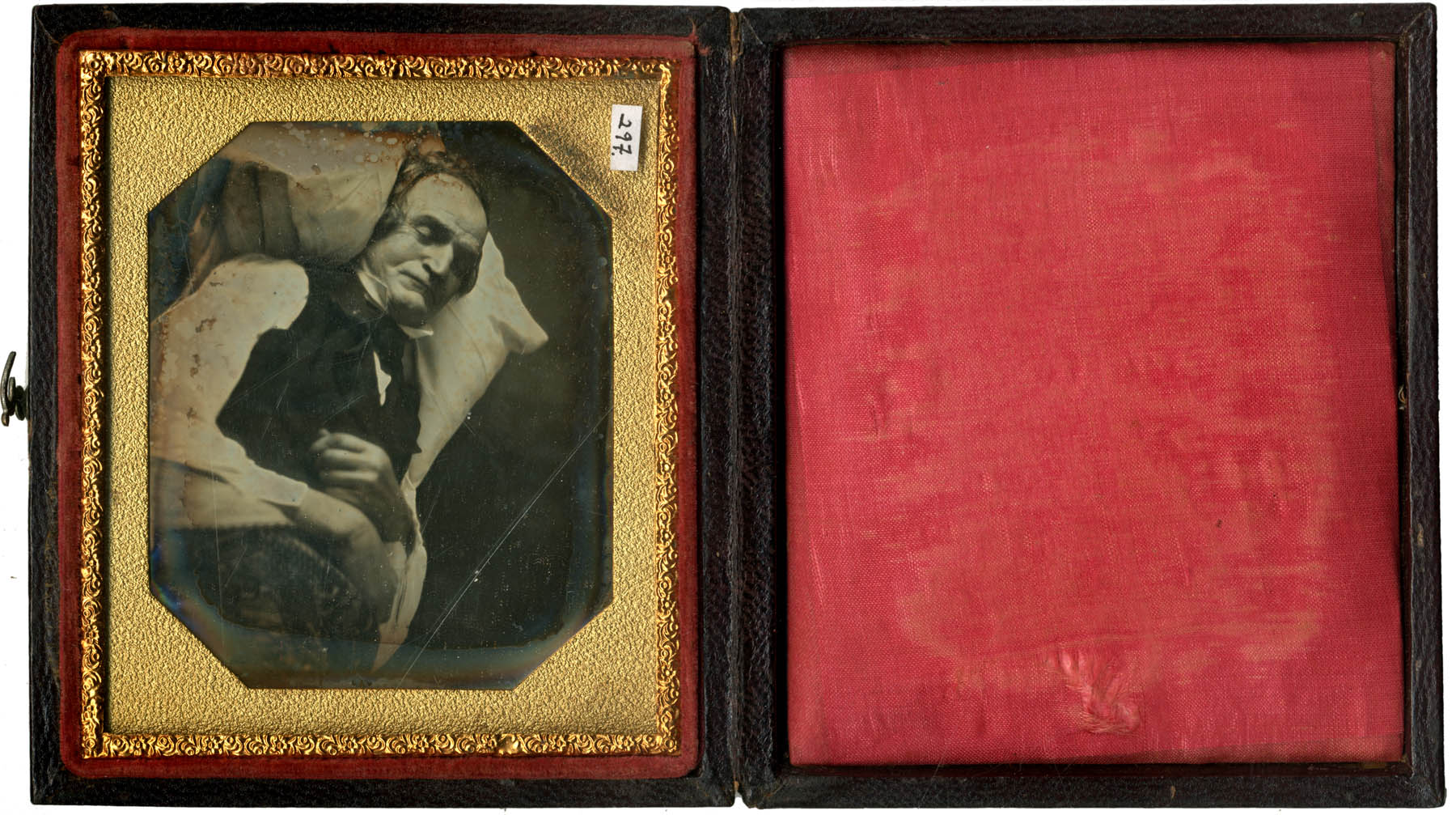
Unknown photographer (American) 'A sleeping man' c. 1846


Unknown photographer (American)
A sleeping man
c. 1846
Daguerreotype
Title given by the collector


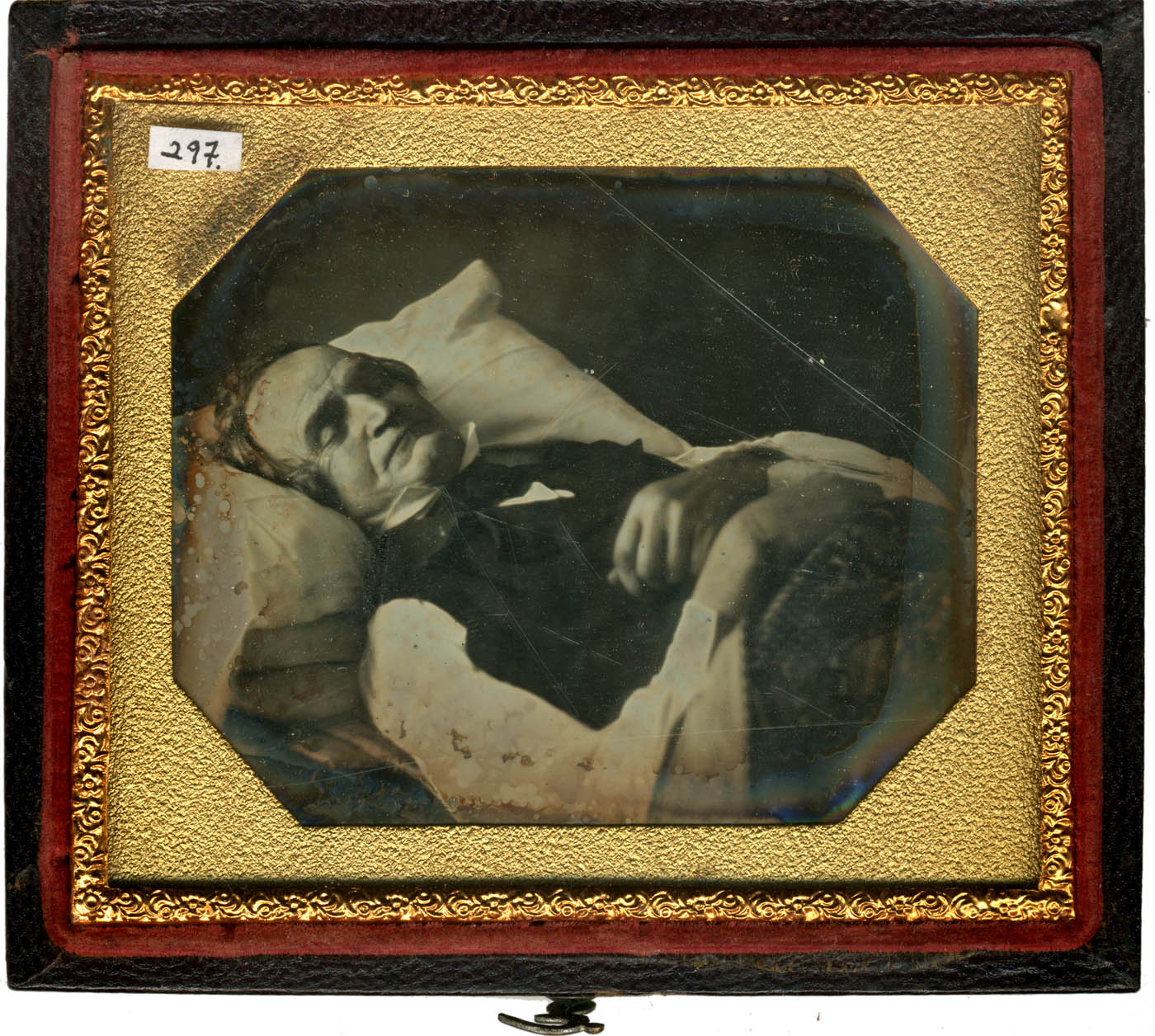
Unknown photographer (American) 'A sleeping man' c. 1846 (detail)


Unknown photographer (American)
A sleeping man (detail)
c. 1846
Daguerreotype
Title given by the collector


Ricordati di me

Una esposizione dedicata alla collezione di Michael G. Jacob, alla riscoperta della fotografia “post mortem”: la realizzazione di immagini commemorative di familiari defunti per genitori, amici e parenti era un aspetto significativo del lavoro quotidiano di molti studi fotografici vittoriani.

An exhibition dedicated to the collection of Michael G. Jacob, to the rediscovery of “post mortem” photography: the creation of commemorative images of deceased family members for parents, friends and relatives was a significant aspect of the daily work of many Victorian photographic studios.

Text translated by Google Translate from the Biblioteca Panizzi website


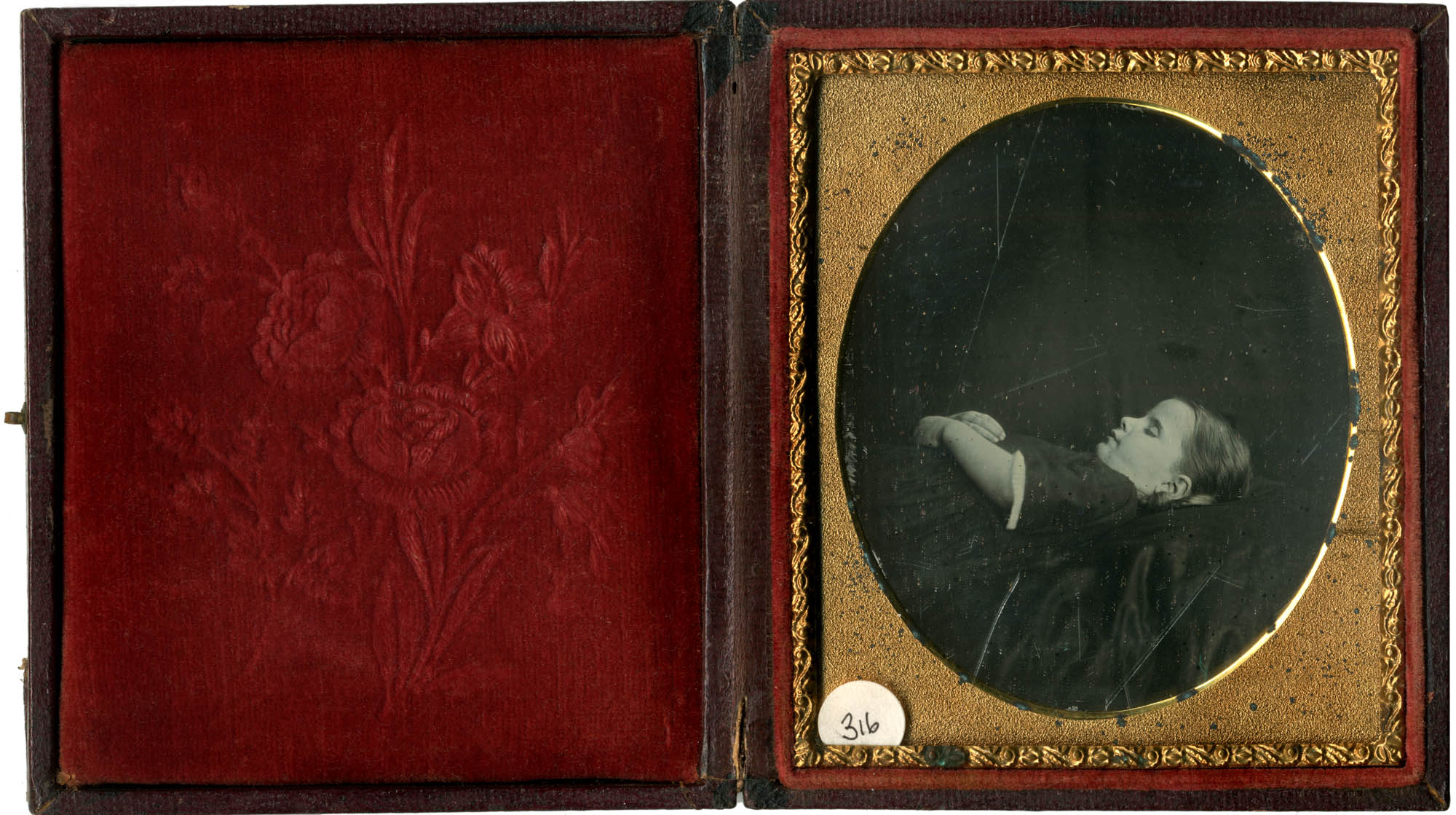
Unknown photographer (American) 'A sleeping girl' c. 1846


Unknown photographer (American)
A sleeping girl
c. 1846
Daguerreotype
Title given by the collector


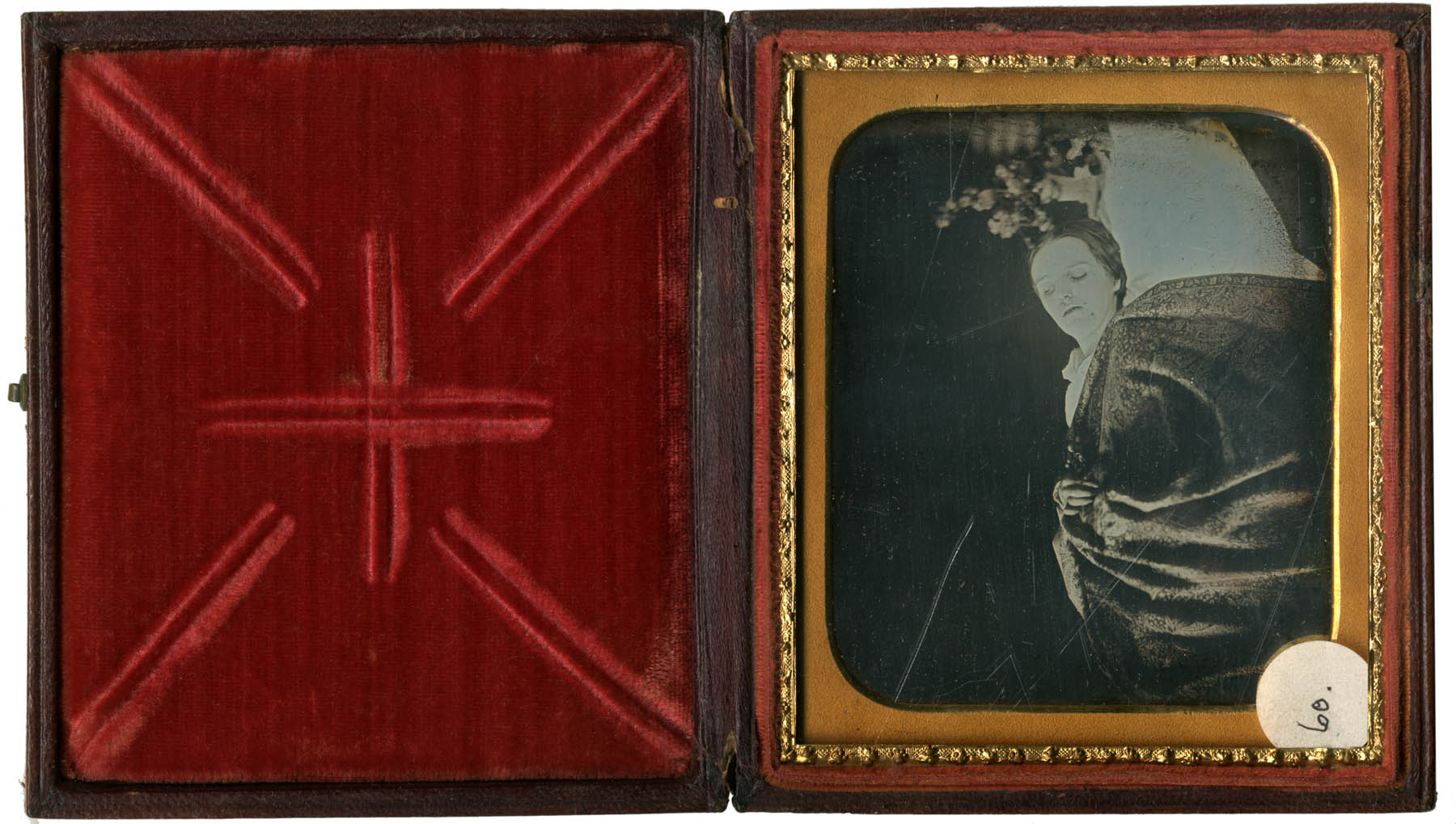
Unknown photographer (American) 'A woman with long fingernails, bured teeth & cut flowers' c. 1846


Unknown photographer (American)
A woman with long fingernails, bured teeth & cut flowers
c. 1846
Daguerreotype
Title given by the collector


Unknown photographer (American) 'A woman with long fingernails, bured teeth & cut flowers' c. 1846 (detail)


Unknown photographer (American)
A woman with long fingernails, bured teeth & cut flowers (detail)
c. 1846
Daguerreotype
Title given by the collector


Unknown photographer (American) 'Young girl holding a daguerrotype' c. 1846


Unknown photographer (American)
Young girl holding a daguerrotype
c. 1846
Daguerreotype
Title given by the collector


L’esposizione dedicata alla collezione di Michael G. Jacob alla riscoperta della fotografia “post mortem” nell’epoca vittoriana, ha l’intento di illustrare il legame di affezione e rispetto di quella cultura che indusse i vivi a ricordare i propri defunti, analizzando come, dopo gli anni Quaranta del XIX secolo, la fotografia sia diventata centrale anche nel modo di sentire e vivere il lutto.

La pratica di raffigurare il volto del defunto è antichissima e la fotografia si innesta in questa tradizione, modificando il modo di vivere e comunicare il lutto. Come tutte le tradizioni più o meno radicate, anche nella colta ed evoluta Europa le esequie e il lutto seguono consuetudini e usanze che si sono perdute o modificate nel tempo. Il galateo del lutto, in epoca vittoriana, è uno degli aspetti per noi meno comprensibili ma più affascinanti, i cui codici, nel tempo, sono andati perduti o si sono radicalmente trasformati.

I rituali funebri, così come venivano concepiti dai vittoriani, si manifestavano in comportamenti, abbigliamento e usanze che spesso appaiono eccessivi per la sensibilità moderna e hanno oggi bisogno di essere decodificati per comprenderne la vasta iconografia. L’antropologia e la sociologia ci hanno spiegato quali reazioni emotive e formali l’essere umano ha avuto nel corso del tempo di fronte alla morte e al corpo dei defunti, indotte dalla cultura a cui apparteniamo, mentre la fotografia contribuisce sostanzialmente a documentare questa cultura del lutto.


The exhibition dedicated to the Michael G. Jacob collection and the rediscovery of “post mortem” photography in the Victorian era, aims to illustrate the bond of affection and respect of that culture that induced the living to remember their dead, analysing how, after the 1840s, photography also became central to the way of feeling and experiencing mourning.

The practice of depicting the face of the deceased is very ancient and photography is grafted onto this tradition, modifying the way of experiencing and communicating mourning. Like all more or less rooted traditions, even in cultured and evolved Europe, funerals and mourning follow customs and habits that have been lost or modified over time. The etiquette of mourning, in the Victorian era, is one of the aspects that is least comprehensible to us but most fascinating, whose codes, over time, have been lost or have radically transformed.

Funeral rituals, as conceived by the Victorians, manifested themselves in behaviors, clothing and customs that often seem excessive for modern sensibilities and today need to be decoded to understand their vast iconography. Anthropology and sociology have explained to us what emotional and formal reactions human beings have had over time in front of death and the body of the deceased, induced by the culture to which we belong, while photography contributes substantially to documenting this culture of mourning.

Text translated by Google Translate from the Biblioteca Panizzi website


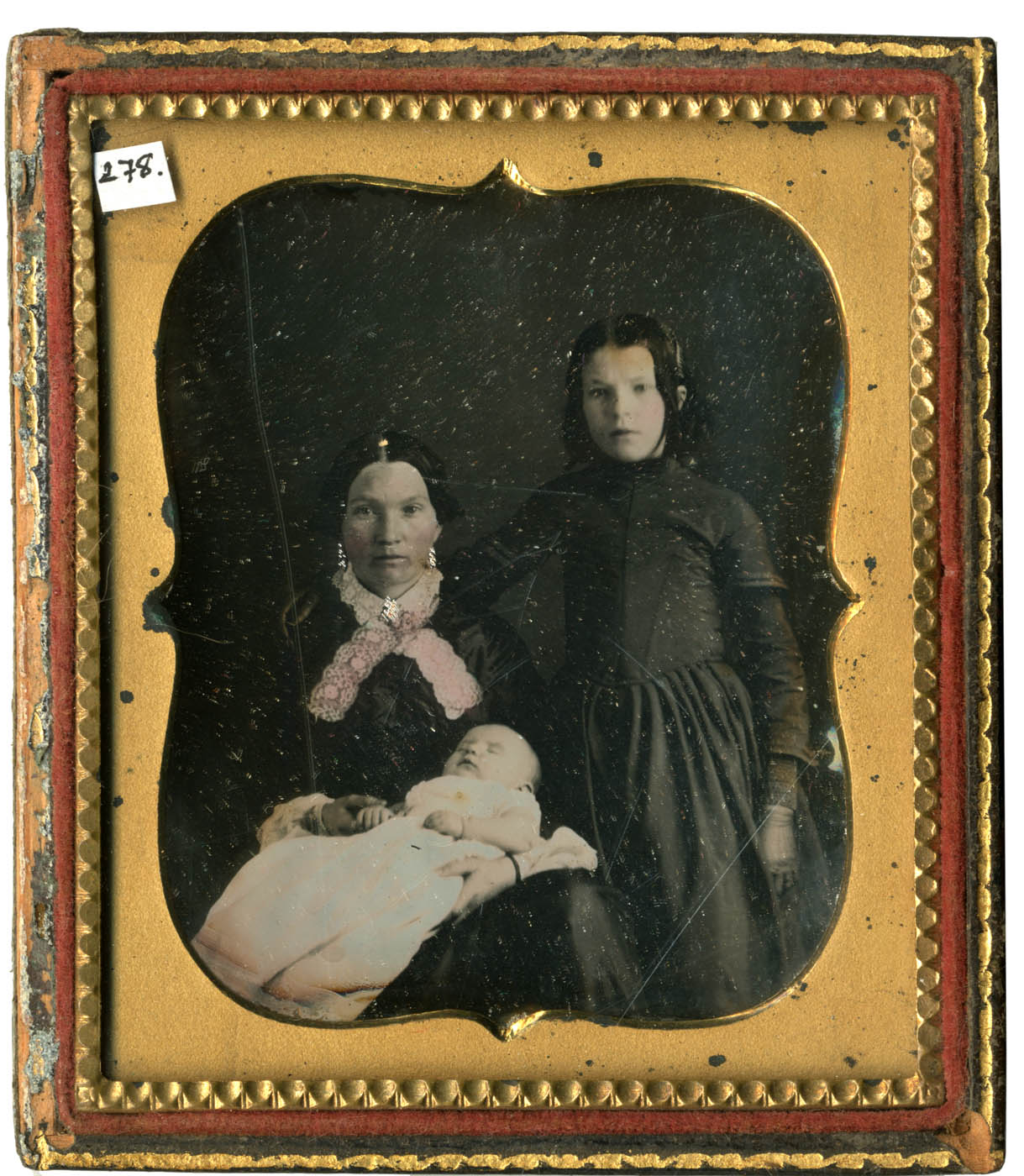
Unknown photographer (American) 'A mother, daughter and dead infant' c. 1848


Unknown photographer (American)
A mother, daughter and dead infant
c. 1848
Daguerreotype retouched in colour
Title given by the collector


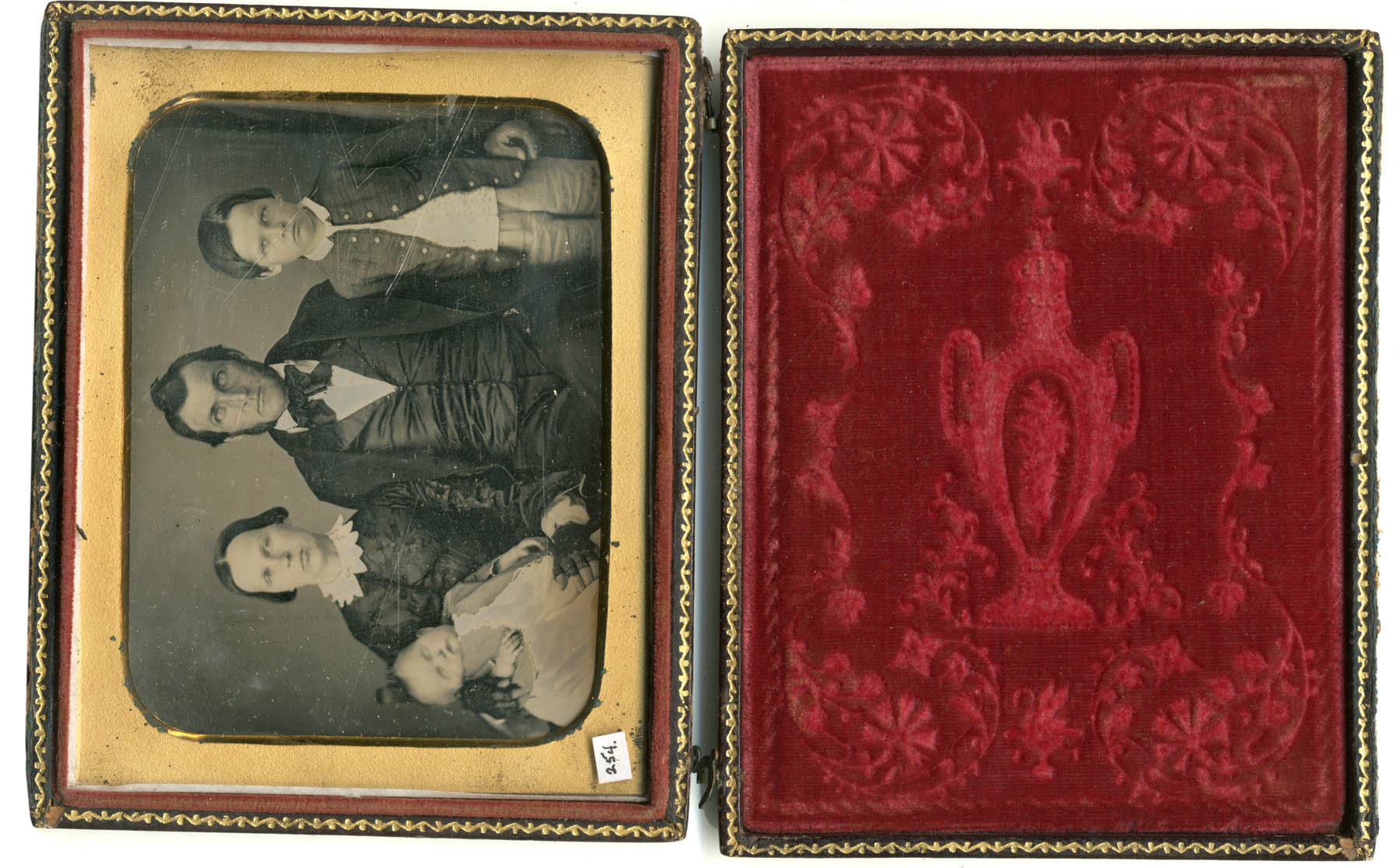
Unknown photographer (American) 'A family group' 1853


Unknown photographer (American)
A family group
1853
Daguerreotype
Date in handwritten characters on the lower edge of the daguerreotype: “July 15 1853”
Title given by the collector


Unknown photographer (American) 'A family group' 1853 (detail)


Unknown photographer (American)
A family group (detail)
1853
Daguerreotype
Date in handwritten characters on the lower edge of the daguerreotype: “July 15 1853”
Title given by the collector


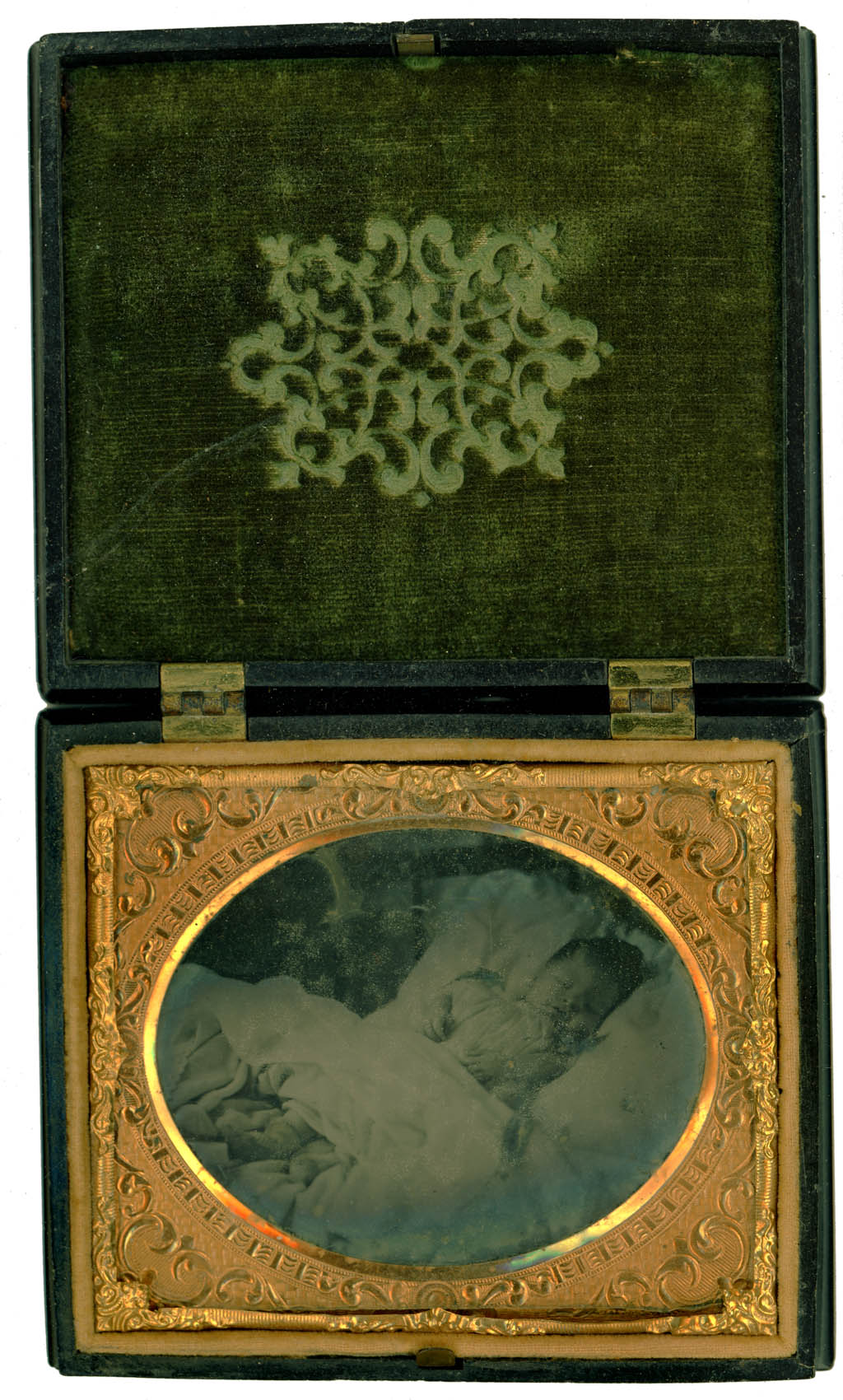
Unknown photographer (American) 'Sleeping baby' c. 1860


Unknown photographer (American)
Sleeping baby
c. 1860
Ambrotype
Title given by the collector


Unknown photographer (American) 'Sleeping baby' c. 1860 (detail)


Unknown photographer (American)
Sleeping baby (detail)
c. 1860
Ambrotype
Title given by the collector


Unknown photographer (American) 'A Sleeping child' c. 1860


Unknown photographer (American)
A Sleeping child
c. 1860
Ferrotype
Title given by the collector


'Attraverso la luce. I primi 20 anni della fotografia nelle collezioni della Fototeca'


Attraverso la luce

In occasione di Fotografia Europea, la Biblioteca Panizzi propone una mostra dedicata ai primi 20 anni della fotografia nelle collezioni della Fototeca attraverso l’esposizione di fotografie su carta salata, albumine, e dagherrotipi, tra cui la prestigiosa collezione di Michael G. Jacob.

On the occasion of Fotografia Europea, the Panizzi Library presents an exhibition dedicated to the first 20 years of photography in the collections of the Photo Library through the display of photographs on salted paper, albumen, and daguerreotypes, including the prestigious collection of Michael G. Jacob.

Text translated by Google Translate from the Biblioteca Panizzi website


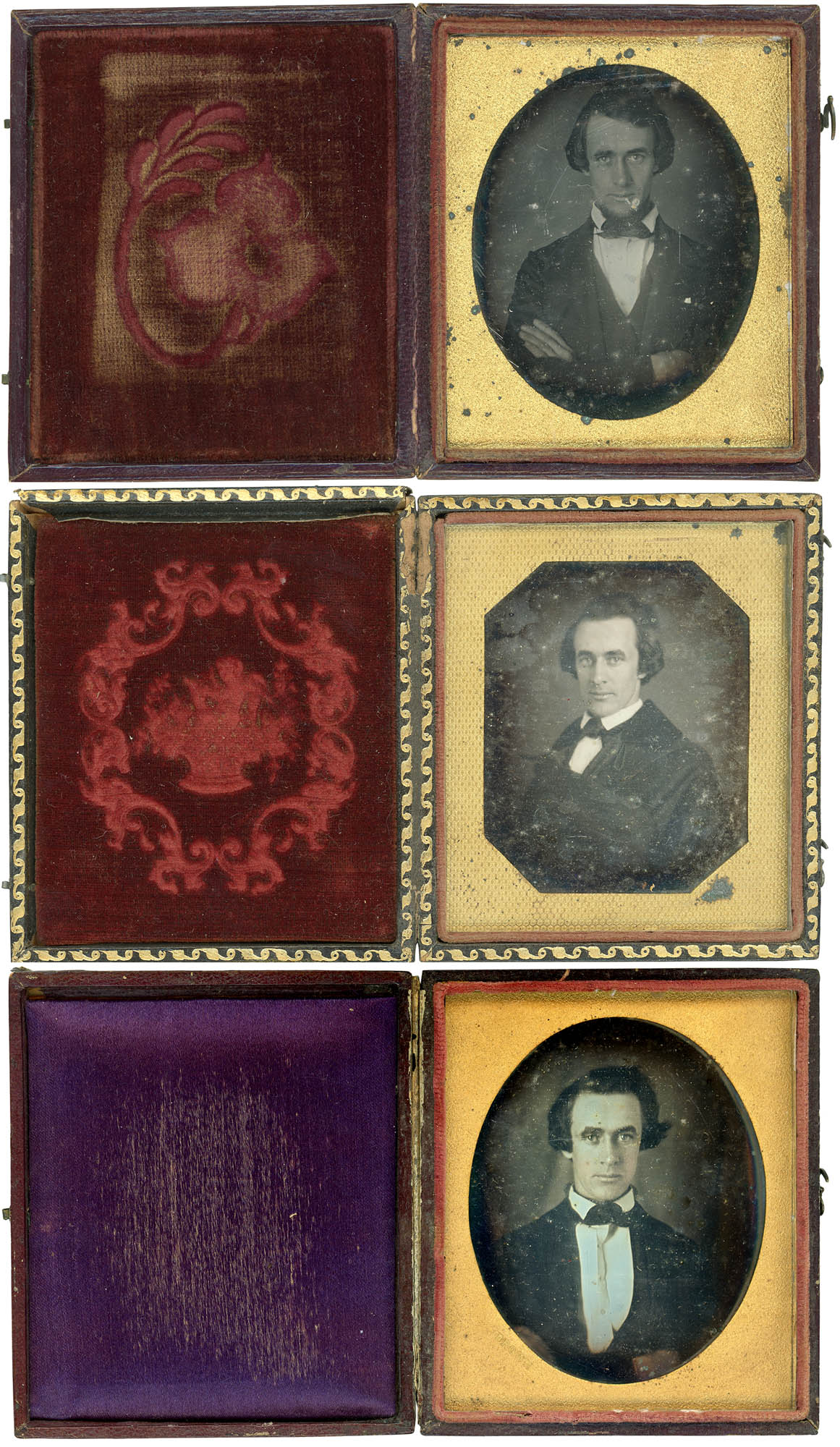
John Brown. 'Portrait of a Young Man' c. 1848 3 Daguerreotypes


John Brown
Portrait of a Young Man
c. 1848
3 Daguerreotypes


John Brown. 'Portrait of a Young Man' c. 1848


John Brown
Portrait of a Young Man
c. 1848
Daguerreotype


John Brown. 'Portrait of a Young Man' c. 1848


John Brown
Portrait of a Young Man
c. 1848
Daguerreotype


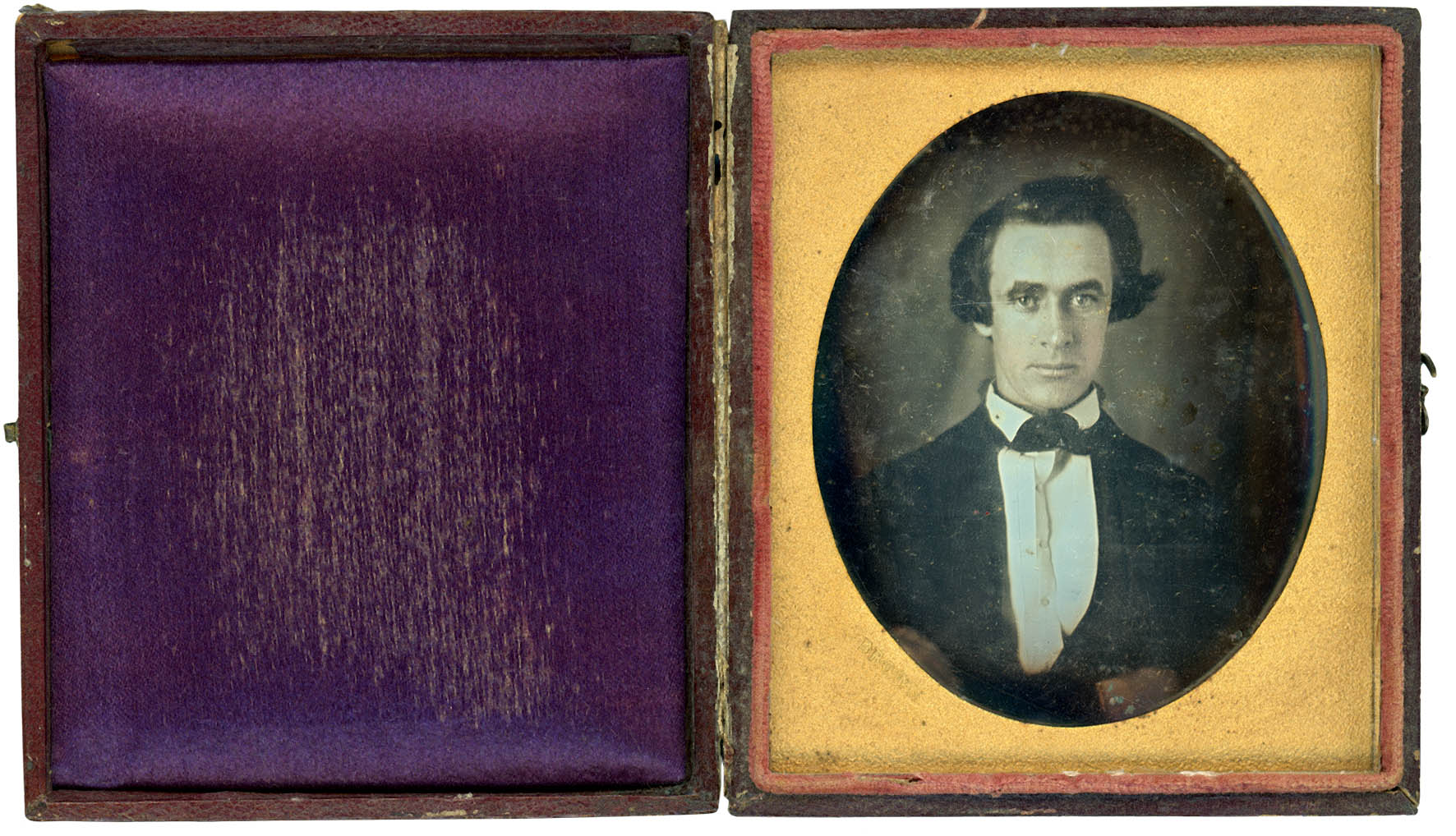
John Brown. 'Portrait of a Young Man' c. 1848


John Brown
Portrait of a Young Man
c. 1848
Daguerreotype


La mostra presenta un percorso attraverso rari esempi di fotografie su carta salata e numerosi dagherrotipi, ambrotipi, ferrotipi e album delle collezioni della Fototeca della Bibliotecca Panizzi. Una narrazione, quindi, che ci portera indietro nel tempo, agli anni pionieristici della sperimentazione sceintifica attraverso la luce, la chimica e la trasformazione di materiali quali l’argento, per arrivare ali’arte del ritratto e del paesaggio e giungere a quel’oggetto di culto che e stata la fotografia delle origini.

The exhibition presents a journey through rare examples of photographs on salted paper and numerous daguerreotypes, ambrotypes, ferrotypes and albums from the collections of the Photo Library of the Panizzi Library. A narrative, therefore, that will take us back in time, to the pioneering years of scientific experimentation through light, chemistry and the transformation of materials such as silver, to arrive at the art of portraiture and landscape and reach that cult object that was the photography of the origins.

Text translated by Google Translate from the Biblioteca Panizzi website


Unknown photographer (American) 'Dead child in his mother's arms' c. 1850


Unknown photographer (American)
Dead child in his mother’s arms
c. 1850
Daguerreotype


Unknown photographer (American) 'Girl holding a flower' c. 1850


Unknown photographer (American)
Girl holding a flower
c. 1850
Daguerreotype


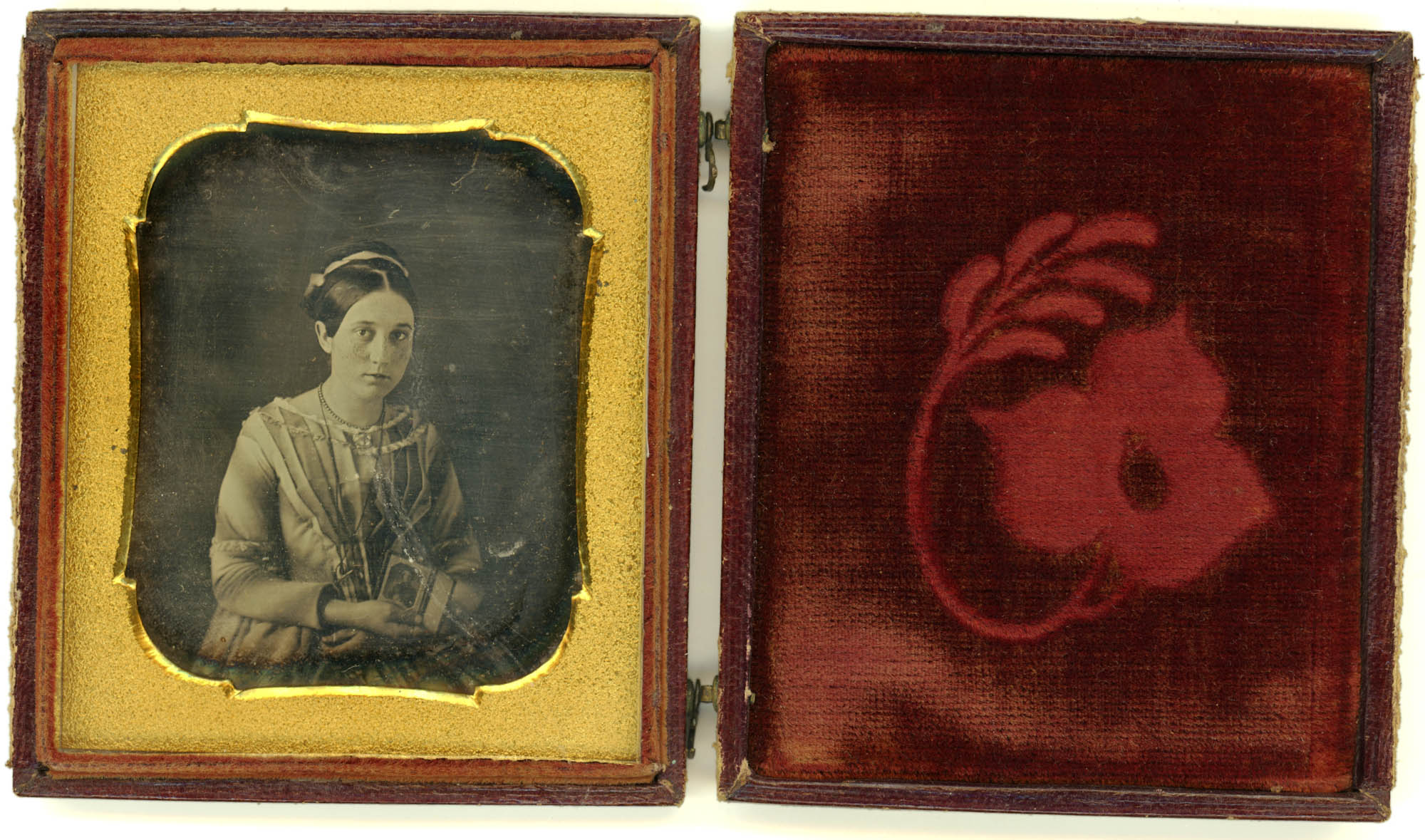
Unknown photographer (American) 'Freckled girl with daguerreotype' c. 1850


Unknown photographer (American)
Freckled girl with daguerreotype
c. 1850
Daguerreotype retouched in colour


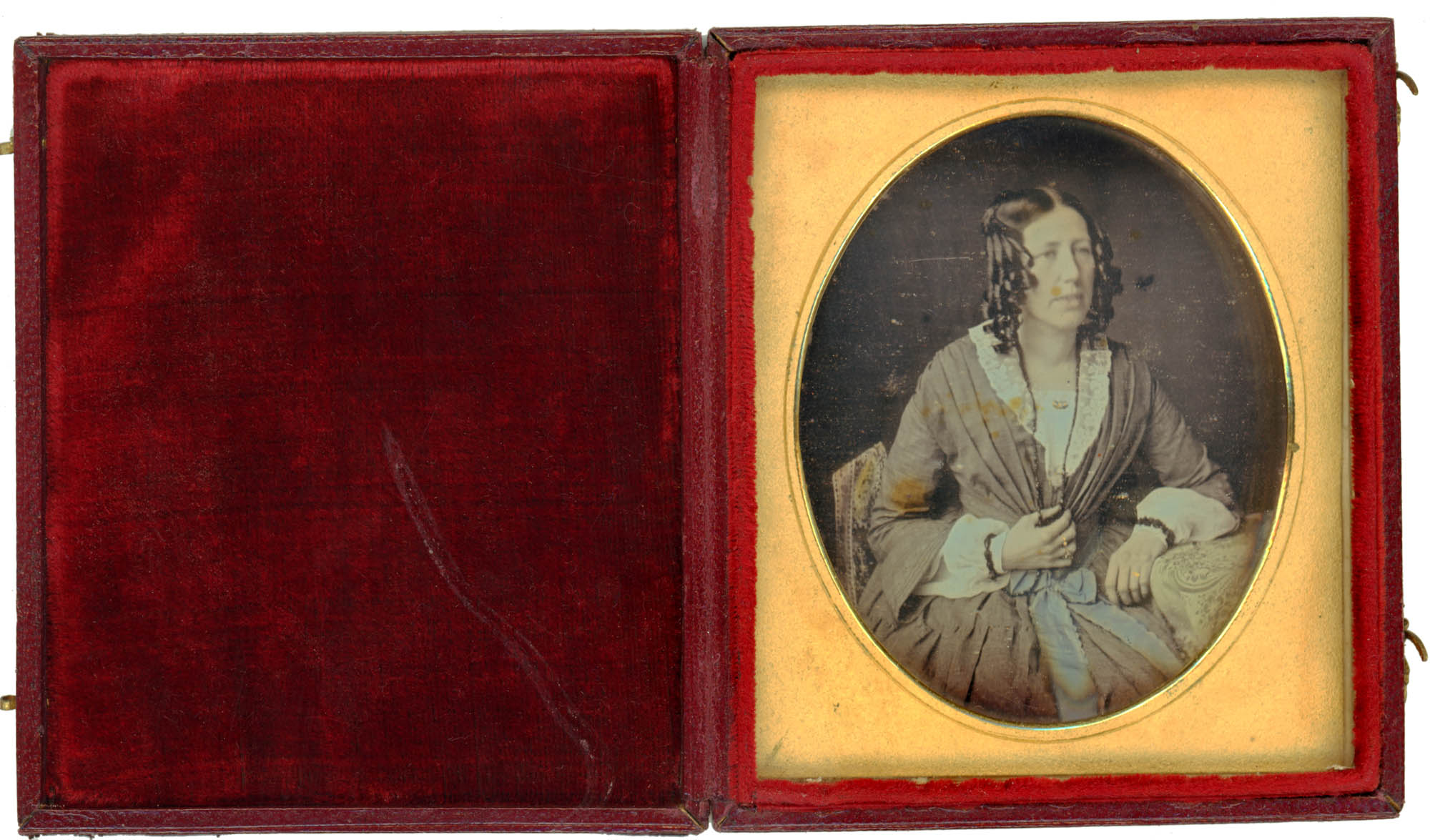
Unknown photographer (American) 'Tinted woman' c. 1850


Unknown photographer (American)
Tinted woman
c. 1850
Daguerreotype retouched in colour


Unknown photographer (American) 'Portrait of mother with child' c. 1850


Unknown photographer (American)
Portrait of mother with child
c. 1850
Daguerreotype


La magia della luce è stata per secoli oggetto di importanti studi scientifici, ma ha affascinato anche e soprattutto il mondo dell’arte, oltre che la cultura popolare. La fotografia, attraverso i vari procedimenti storici, si inserisce in questo capitolo della storia visuale, intrecciandosi con arte, scienza e tecnologia, unite alla passione comune per la nascita di un nuovo e accattivante linguaggio. La mostra presenta un percorso attraverso gli esemplari che appartengono alla collezione di Michael G. Jacob, ultima acquisita grazie alla generosa donazione di questo importante collezionista e studioso, insieme a rari esempi di fotografie su carta salata e numerosi dagherrotipi, ambrotipi, ferrotipi e album delle collezioni della Fototeca della Biblioteca Panizzi. Una narrazione, quindi, che ci porterà indietro nel tempo, agli anni pionieristici della sperimentazione scientifica attraverso la luce, la chimica e la trasformazione di materiali quali l’argento, per arrivare all’arte del ritratto e del paesaggio e giungere a quell’oggetto di culto che è stata la fotografia delle origini.


The magic of light has been the subject of important scientific studies for centuries, but it has also fascinated the world of art, as well as popular culture. Photography, through its various historical processes, fits into this chapter of visual history, intertwining with art, science and technology, combined with a shared passion for the birth of a new and captivating language. The exhibition presents a journey through the specimens that belong to the collection of Michael G. Jacob, the last acquired thanks to the generous donation of this important collector and scholar, together with rare examples of photographs on salted paper and numerous daguerreotypes, ambrotypes, ferrotypes and albums from the collections of the Photo Library of the Panizzi Library. A narrative, therefore, that will take us back in time, to the pioneering years of scientific experimentation through light, chemistry and the transformation of materials such as silver, to arrive at the art of portraiture and landscape and reach that cult object that was early photography.

Text translated by Google Translate from the Biblioteca Panizzi website


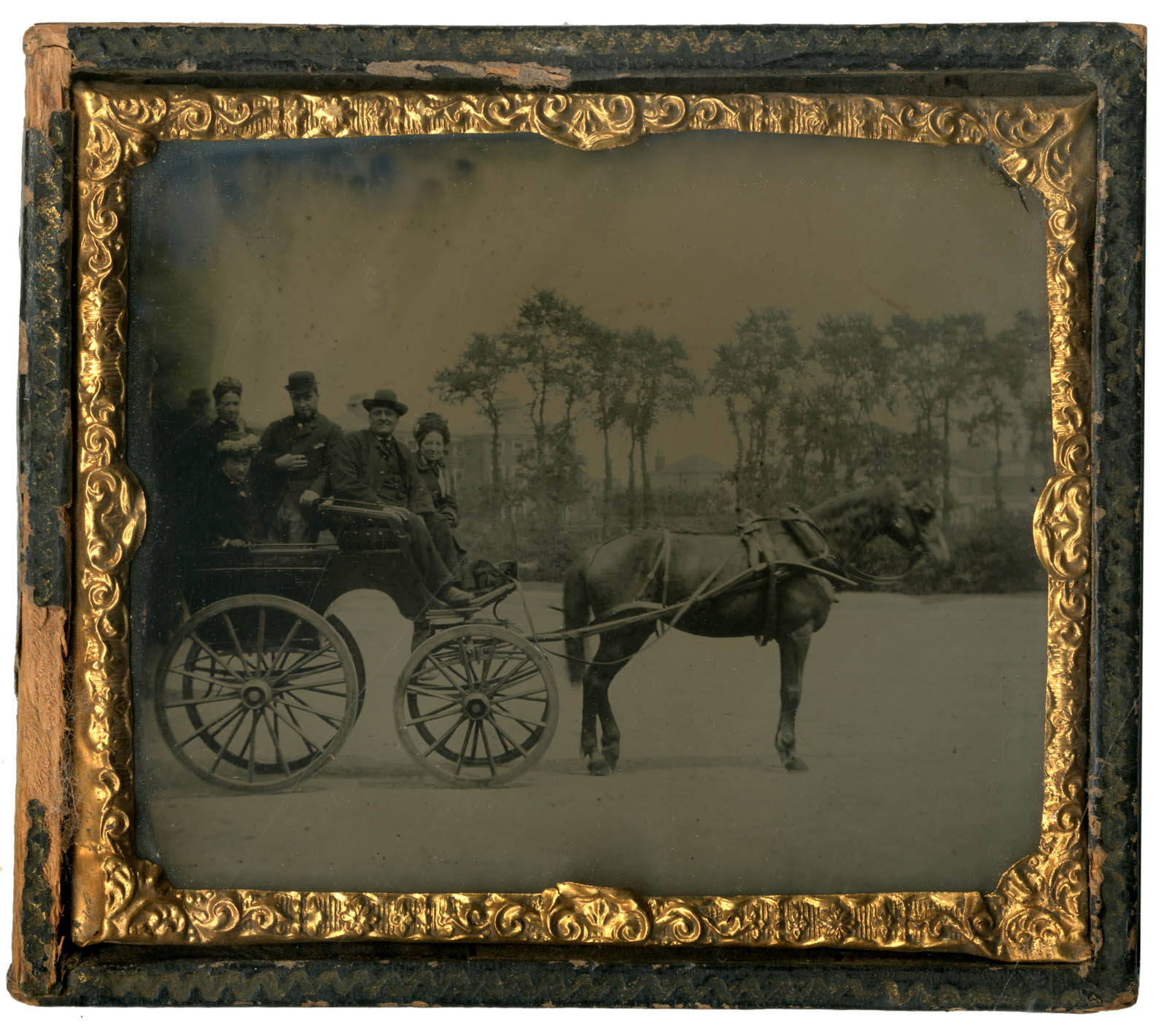
Unknown photographer (American) 'Coach in park' c. 1860


Unknown photographer (American)
Coach in park
c. 1860
Ambrotype


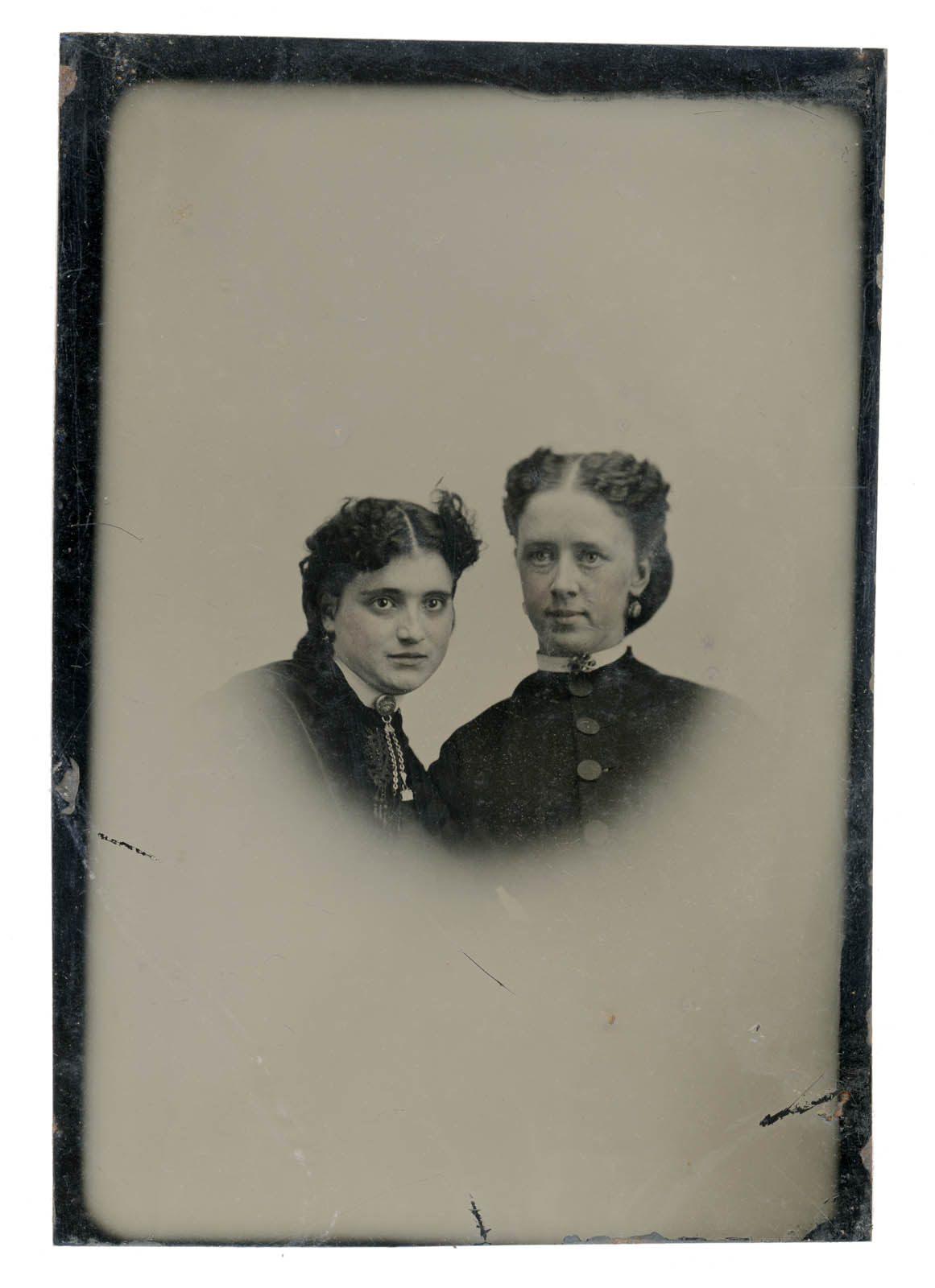
Unknown photographer (American) 'Portrait of women' c. 1860


Unknown photographer (American)
Portrait of women
c. 1860
Ferrotype


Unknown photographer (American) 'Double vignette friends' c. 1860


Unknown photographer (American)
Double vignette friends
c. 1860
Ferrotype


Unknown photographer (American) 'Well dressed lady' c. 1880


Unknown photographer (American)
Well dressed lady
c. 1880
Ambrotype


Biblioteca Panizzi
Via Luigi Carlo Farini, 3,
42121 Reggio Emilia RE, Italy

Opening hours:
Monday – Saturday, 9am – 7pm

Biblioteca Panizzi website

LIKE ART BLART ON FACEBOOK

Back to top

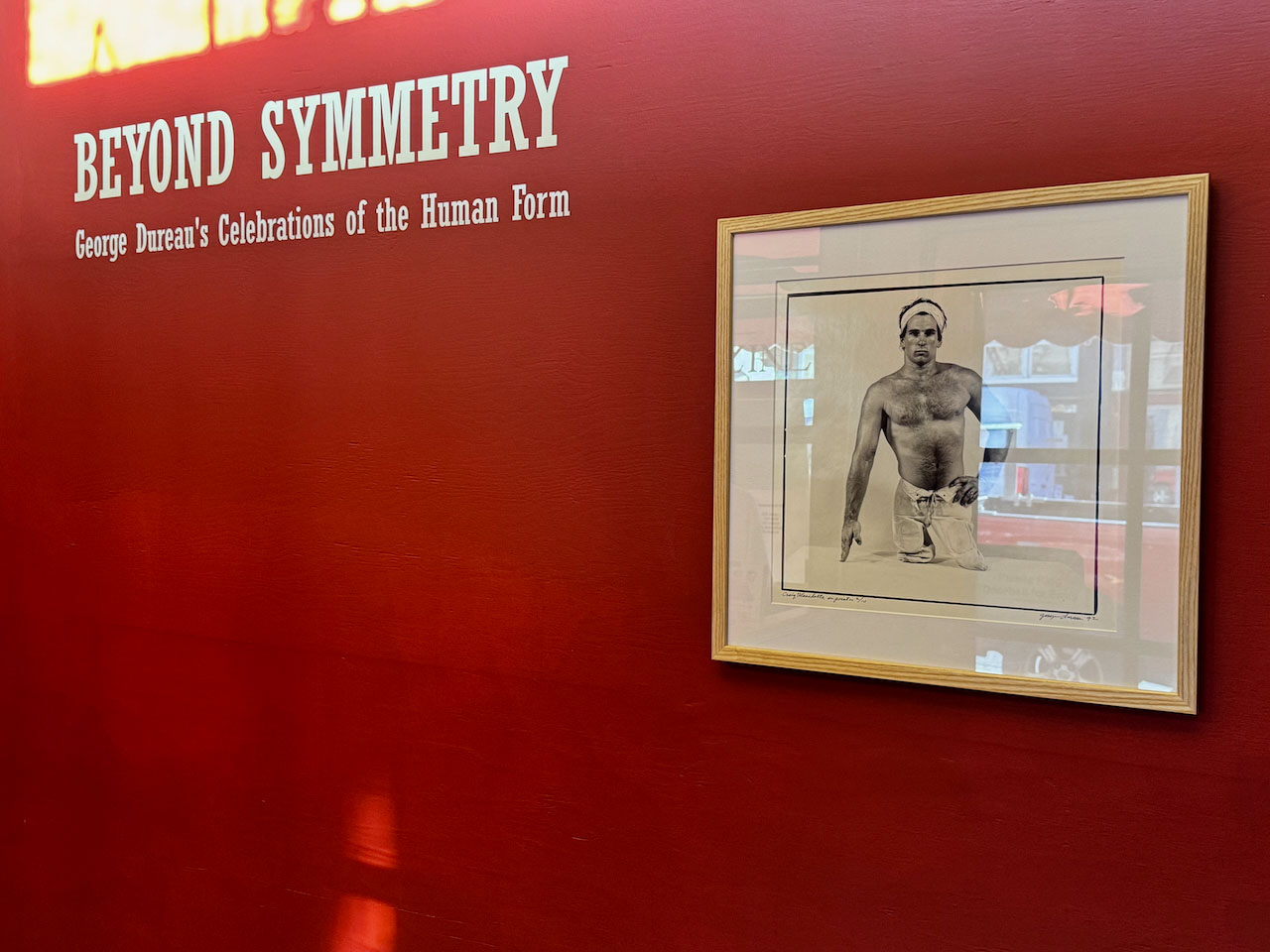
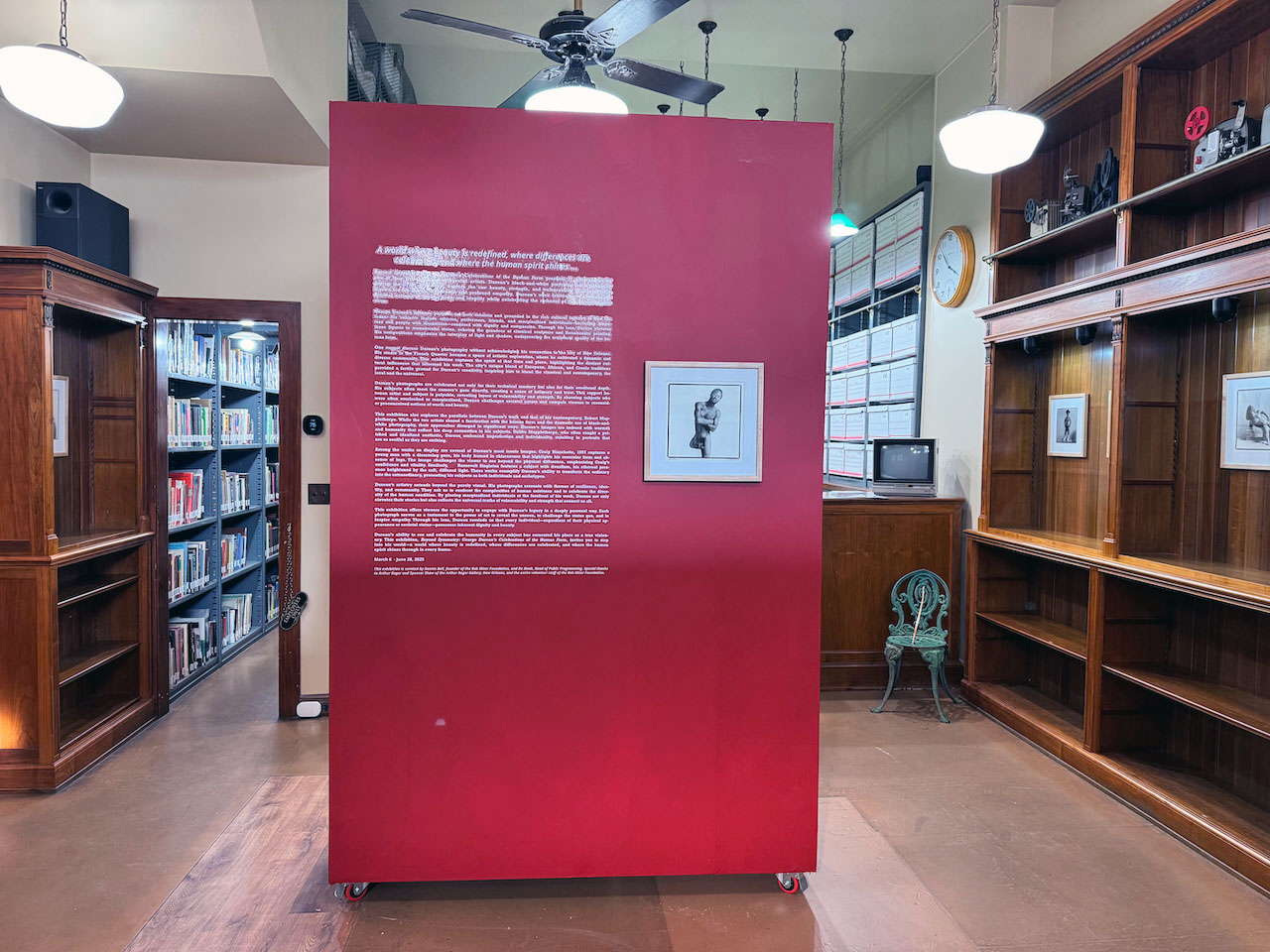
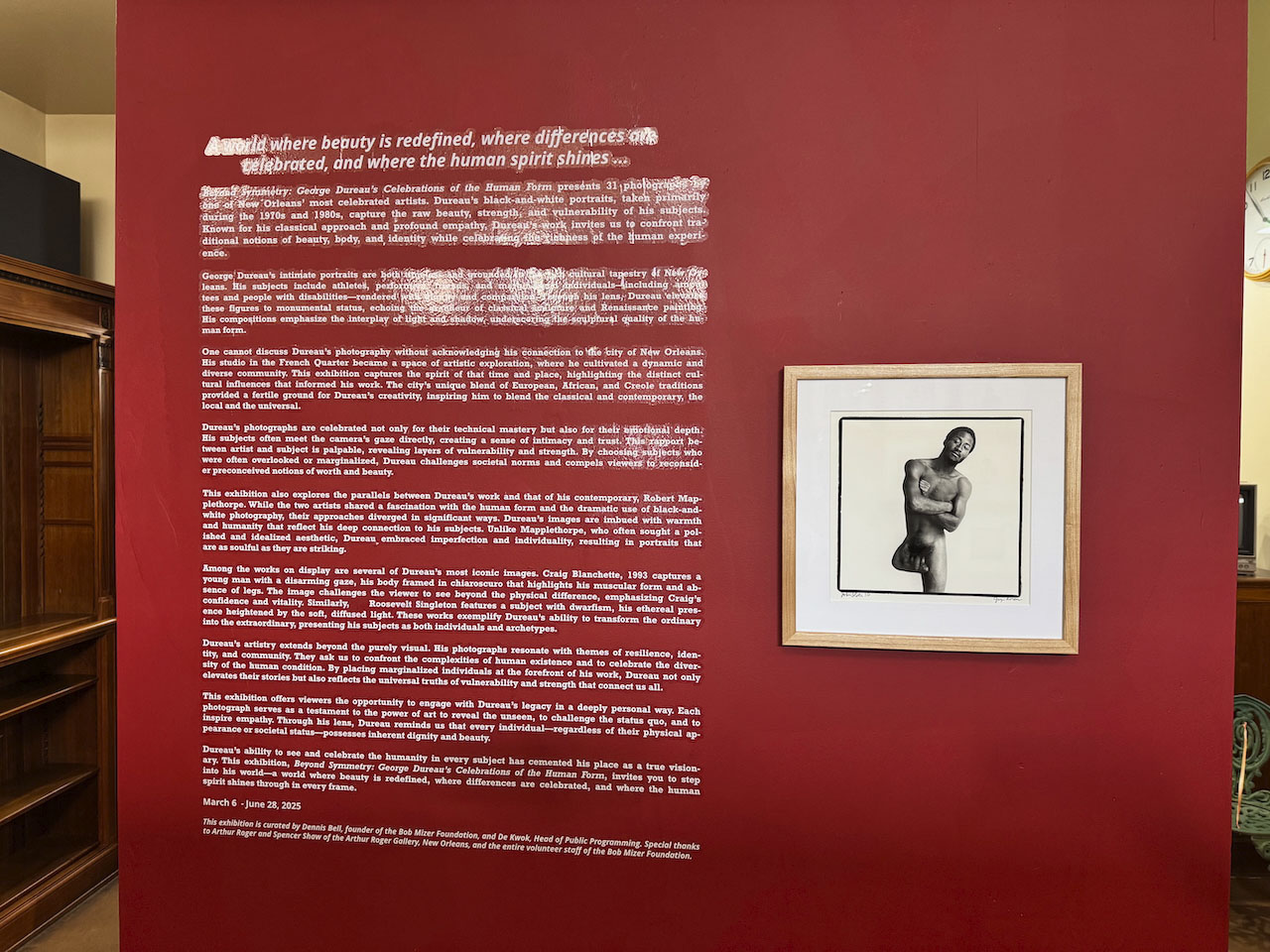
Exhibition: ‘Beyond Symmetry: George Dureau’s Celebrations of the Human Form’ at the Bob Mizer Foundation, San Francisco

Exhibition dates: 6th March – 28th June, 2025

Curators: Dennis Bell, founder of the Bob Mizer Foundation, and De Kwok, Head of Public Programming

*PLEASE NOTE: THIS POSTING CONTAINS ART PHOTOGRAPHS OF MALE NUDITY – IF YOU DO NOT LIKE PLEASE DO NOT LOOK, FAIR WARNING HAS BEEN GIVEN*


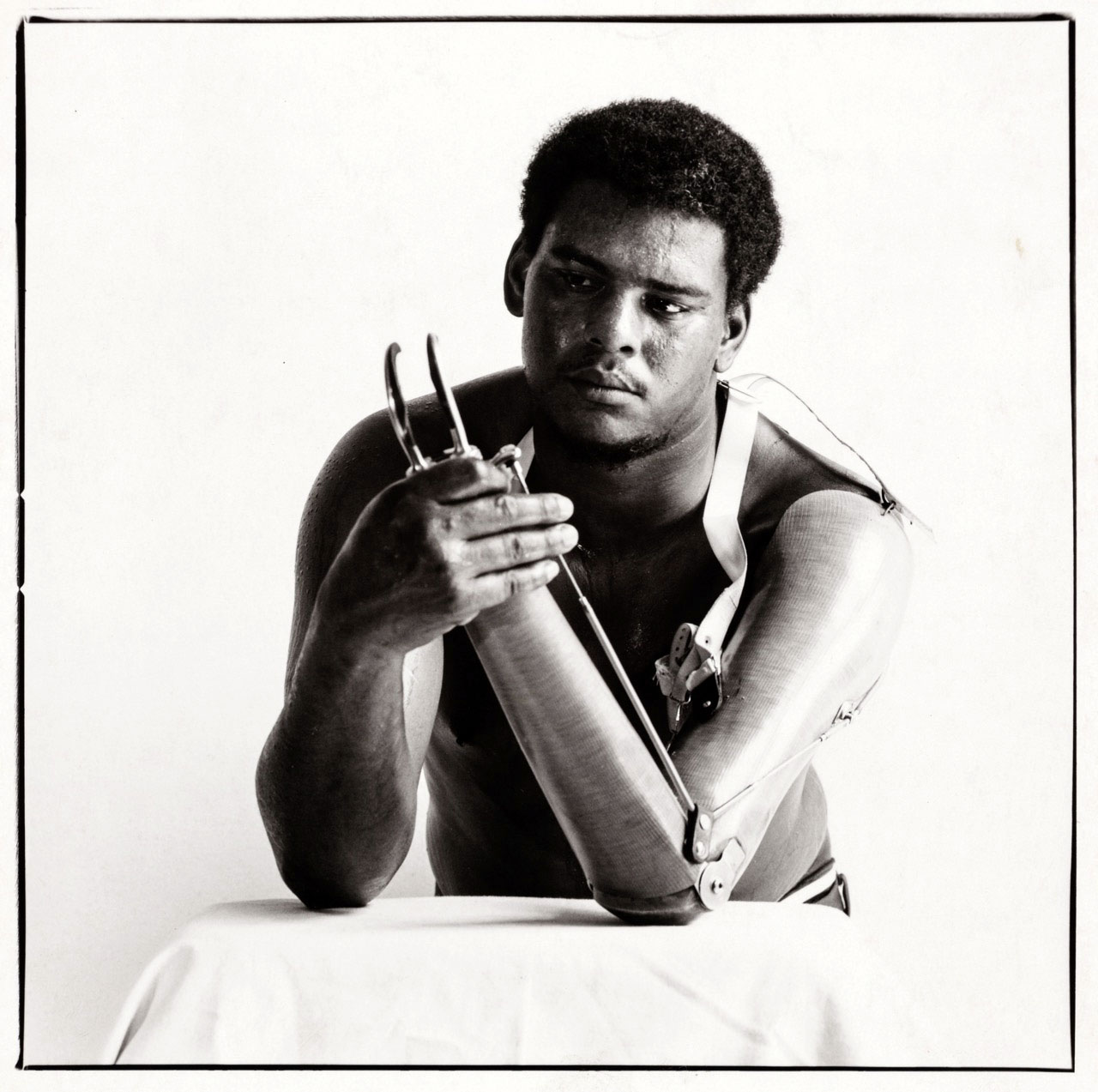
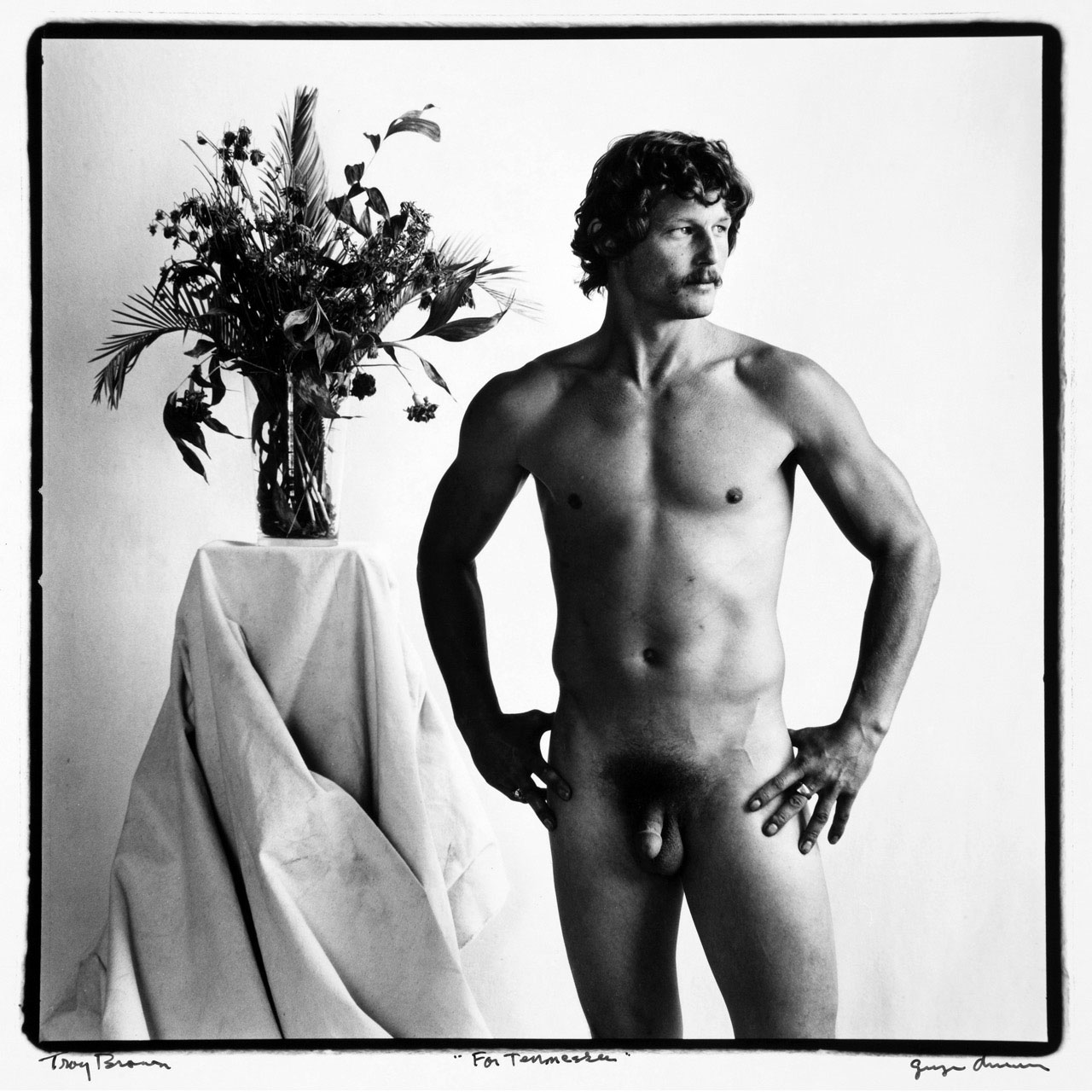
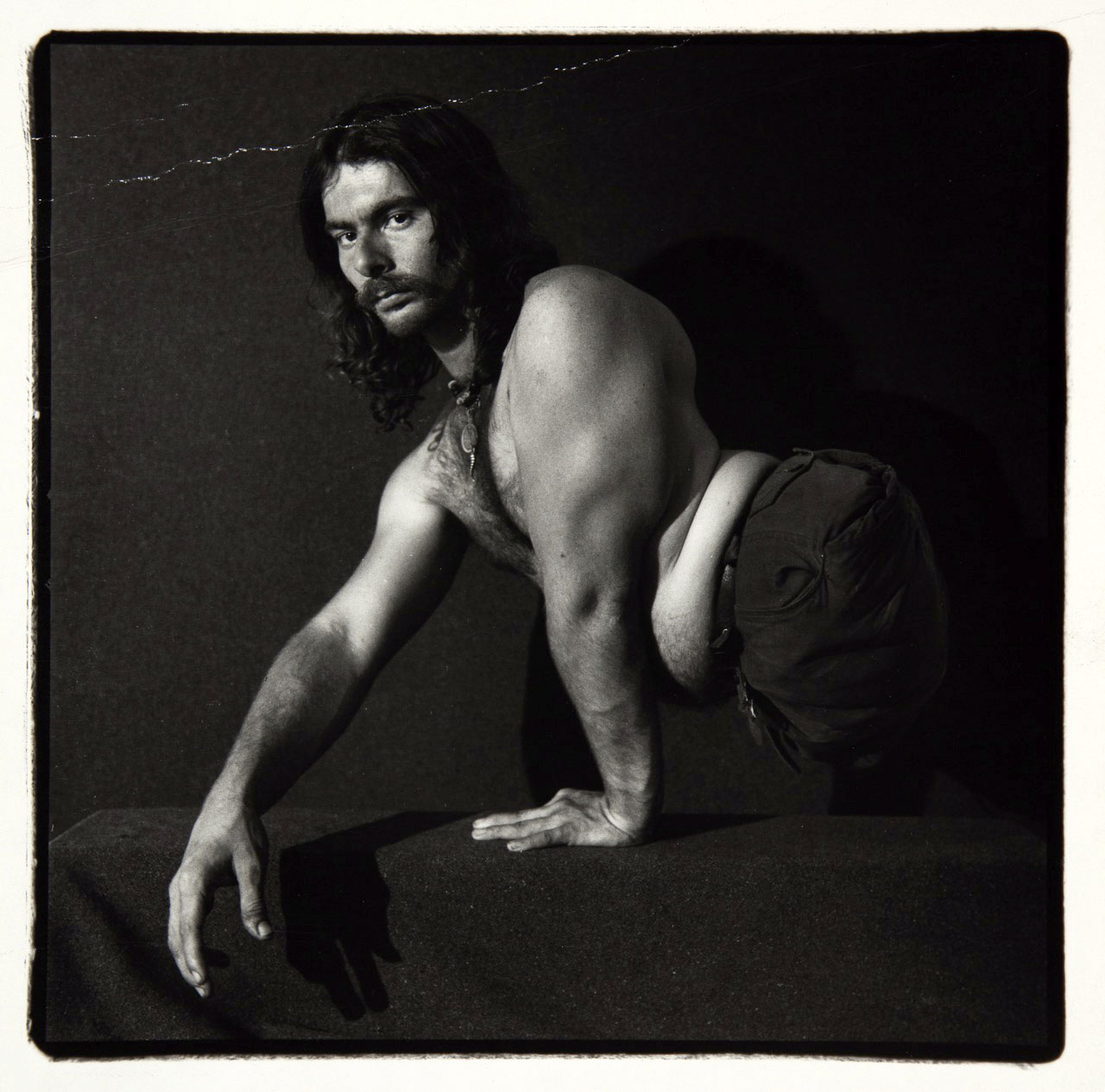
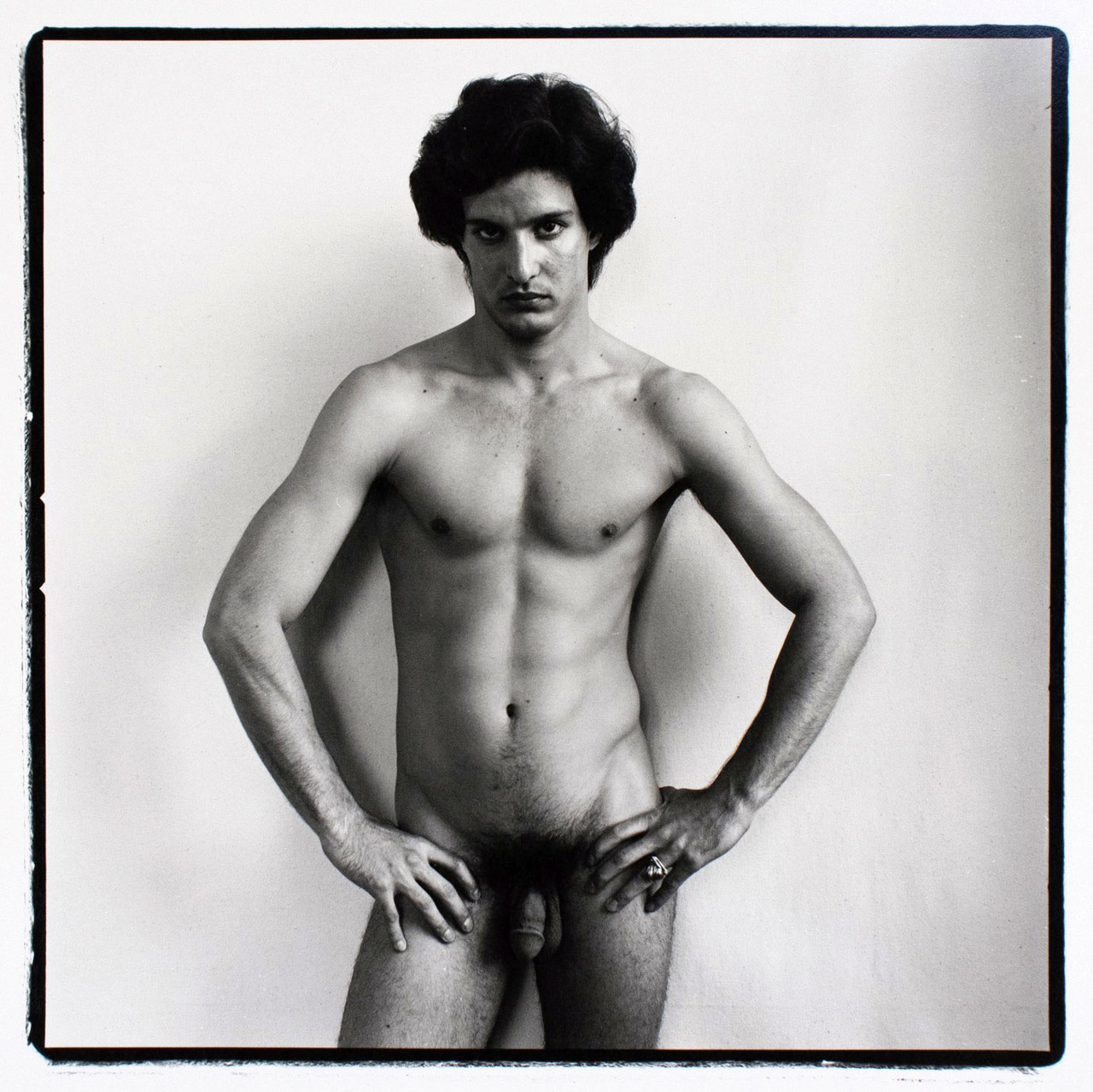
George Dureau (American, 1930-2014)
'Untitled' Nd


George Dureau (American, 1930-2014)
Untitled
Nd
Vintage silver gelatin print


Celebrations of the Human Spirit

~ Honesty

~ ~ Integrity

~ ~ ~ Dignity

~ ~ ~ ~ Vulnerability

~ ~ ~ ~ ~ Respect

~ ~ ~ ~ ~ ~ Love

~ ~ ~ ~ ~ ~ ~ Friendship

~ ~ ~ ~ ~ ~ ~ ~ Sexuality

~ ~ ~ ~ ~ ~ ~ ~ ~ Strength

~ ~ ~ ~ ~ ~ ~ ~ ~ ~ Beauty

~ ~ ~ ~ ~ ~ ~ ~ ~ ~ ~ Form

~ ~ ~ ~ ~ ~ ~ ~ ~ ~ ~ ~ Humanism

~ ~ ~ ~ ~ ~ ~ ~ ~ ~ ~ ~ ~ Identity

~ ~ ~ ~ ~ ~ ~ ~ ~ ~ ~ ~ ~ ~ Personality

~ ~ ~ ~ ~ ~ ~ ~ ~ ~ ~ ~ ~ ~ ~ Presence

~ ~ ~ ~ ~ ~ ~ ~ ~ ~ ~ ~ ~ ~ ~ ~ Intimacy

~ ~ ~ ~ ~ ~ ~ ~ ~ ~ ~ ~ ~ ~ ~ ~ ~ Nude

~ ~ ~ ~ ~ ~ ~ ~ ~ ~ ~ ~ ~ ~ ~ ~ ~ ~ Empathy

~ ~ ~ ~ ~ ~ ~ ~ ~ ~ ~ ~ ~ ~ ~ ~ ~ ~ ~ Revelation

~ ~ ~ ~ ~ ~ ~ ~ ~ ~ ~ ~ ~ ~ ~ ~ ~ ~ ~ ~ Spirit

~ ~ ~ ~ ~ ~ ~ ~ ~ ~ ~ ~ ~ ~ ~ ~ ~ ~ ~ ~ ~ Truth


I’ve been wanting to do a posting on the magnificent New Orleans photographer George Dureau’s work for a long while but because there are so few exhibitions of his photographs I have never had the opportunity – until now.

It’s a great pity that his work is not as recognised as that of his contemporaries, Peter Hujar and Robert Mapplethorpe. Indeed, you can still pick up an original Dureau in the secondhand art market for around $500 whereas Mapplethorpe’s photographs run into the many thousands.

His photographs are not romantic, certainly not sentimental. He was fascinated by the people he photographed, their truth. These are the stories he conceptualised, posed, lit and photographed, stories that emerged from his imagination, that revealed surprising things about his subjects.

Unlike the clinical formalism of Mapplethorpe, Dureau worked with a poetry that was always present. Indeed, there is something so eloquent and sincere about his photographs for in them the artist draws (Dureau was also a painter) the mysteries of the soul of his subjects.

Dureau’s response to the world and the photographs that emanate from that engagement are humanist in the best sense of the word, revealing his subjects in a direct way that emphasises an individual’s dignity, worth and capacity for self-realisation.

Thus, I feel his photographs are a celebration not just of the human form but more importantly, of the human spirit.

Dr Marcus Bunyan


Many thankx to Dennis Bell, Corbin Crable and the Bob Mizer Foundation for allowing me to publish the photographs in the posting. Please click on the photographs for a larger version of the image.


“I live a warm, involved humanist sort of life. There are lots of people passing through it. I have exciting experiences and learn things about people. They always go into my art. I cannot have an experience and it not go into my art.”

 
George Dureau


John H. Lawrence, HNOC emeritus director of museum programs and himself a fine-art photographer, said Dureau’s portraits reveal a tangible intimacy between photographer and subject.

“George respected the people he asked to sit for him,” said Lawrence. “I don’t say that from a knowledge, just from what the photographs show. The direct stare into the camera, it may have been at George’s direction. Even with the gaze directed in that fashion, you don’t get the kind of quality you see in these portraits unless there is a mutual respect between the photographer and the subject. There is a vibe there that is based on these two people having respect for each other as the photograph is made.”


John H. Lawrence quoted in Dave Walker. “The Intimate Eye of George Dureau,” on The Historic New Orleans Collection website, December 31, 2021 [Online] Cited 20/06/2025


This exhibition presents 25 evocative black-and-white portraits by George Dureau, capturing the resilience and vulnerability of his subjects – from athletes to marginalised individuals – against the vibrant cultural backdrop of New Orleans, where beauty and humanity converge in transformative ways.


Installation view of the exhibition 'Beyond Symmetry: George Dureau's Celebrations of the Human Form' at the Bob Mizer Foundation, San Francisco showing Dureau's photograph 'Craig Blanchette' 1992


Installation view of the exhibition Beyond Symmetry: George Dureau’s Celebrations of the Human Form at the Bob Mizer Foundation, San Francisco showing Dureau’s photograph Craig Blanchette, 1992


Installation view of the exhibition 'Beyond Symmetry: George Dureau's Celebrations of the Human Form' at the Bob Mizer Foundation, San Francisco


Installation views of the exhibition Beyond Symmetry: George Dureau’s Celebrations of the Human Form at the Bob Mizer Foundation, San Francisco showing Dureau’s photograph John Slate, Nd


Installation view of the exhibition 'Beyond Symmetry: George Dureau's Celebrations of the Human Form' at the Bob Mizer Foundation, San Francisco


Installation view of the exhibition Beyond Symmetry: George Dureau’s Celebrations of the Human Form at the Bob Mizer Foundation, San Francisco


Installation view of the exhibition 'Beyond Symmetry: George Dureau's Celebrations of the Human Form' at the Bob Mizer Foundation, San Francisco


Installation views of the exhibition Beyond Symmetry: George Dureau’s Celebrations of the Human Form at the Bob Mizer Foundation, San Francisco


The Bob Mizer Foundation proudly presents Beyond Symmetry: George Dureau’s Celebrations of the Human Form, an exhibition showcasing 25 evocative black-and-white portraits by the acclaimed New Orleans artist George Dureau. This compelling collection captures the resilience, vulnerability, and individuality of Dureau’s subjects, spanning athletes, performers, and marginalised individuals.

Dureau’s photography transcends traditional portraiture, blending classical composition with the rich cultural spirit of New Orleans. His intimate works explore themes of identity and dignity, transforming vulnerabilities into powerful symbols of humanity’s resilience. The photographs invite viewers to reimagine beauty as inclusive, diverse, and multifaceted.

“George Dureau’s work is a testament to his unique ability to celebrate the human form while challenging societal norms,” says Den Bell, founder of the Bob Mizer Foundation. “His portraits honour the individuality of his subjects while weaving in the vibrancy of New Orleans, making his work timeless and deeply impactful.”

“Dureau photographed people with kindness and sympathy,” added Mizer Foundation’s Head of Programming, De Kwok, “It has been said that his subject matter became a member of his extended family and you can clearly see that in the way his camera lovingly captured them.”

The exhibition will be on view from March 6 to June 28, 2025, at the Bob Mizer Foundation’s Main Gallery. An opening reception will be held on March 6 from 6.00 pm – 8.30 pm, providing an opportunity to explore the works and celebrate Dureau’s extraordinary legacy.

About George Dureau

A celebrated figure in the art world, George Dureau (1930-2014) was renowned for his black-and-white photography and classical paintings. Rooted in the rich cultural heritage of New Orleans, Dureau’s art challenges conventions and highlights the resilience of the human spirit. His work has been exhibited internationally and continues to inspire audiences with its profound emotional depth and technical mastery.

Text from the Bob Mizer Foundation website


George Dureau (American, 1930-2014) 'Wilbert with Hook' Nd


George Dureau (American, 1930-2014)
Wilbert with Hook
Nd
Vintage silver gelatin print
20 x 16 inches


George Dureau (American, 1930-2014)
'B.J. Robinson' 1995


George Dureau (American, 1930-2014)
B.J. Robinson
1995
Vintage silver gelatin print


George Dureau (American, 1930-2014) 'Troy Brown "For Tennessee"' Nd


George Dureau (American, 1930-2014)
Troy Brown “For Tennessee”
Nd
Vintage silver gelatin print


George Dureau (American, 1930-2014) 'Untitled (Sonny Singleton)' Nd


George Dureau (American, 1930-2014)
Untitled (Sonny Singleton)
Nd
Vintage silver gelatin print


This exhibition highlights the remarkable artistry of George Dureau through 25 compelling black-and-white portraits that showcase his unique vision. Created during the 1970s and 1980s, these photographs transcend traditional boundaries, blending classical composition with an unflinching exploration of the human experience. Dureau’s subjects – athletes, performers, friends, and individuals often marginalised by society – are elevated to iconic status through his lens.

The images reveal a profound empathy and an unshakable belief in the inherent dignity of every individual. With a studio rooted in the vibrant cultural milieu of New Orleans, Dureau captured not only the physical form but also the spirit of his subjects, transforming their vulnerabilities into striking symbols of resilience and humanity. His work redefines beauty as inclusive and multifaceted, challenging societal norms and inviting reflection on identity, strength, and community.

This exhibition Beyond Symmetry: George Dureau’s Celebrations of the Human Form presents 25 photographs by one of New Orleans’ most celebrated artists. Dureau’s black-and-white portraits, taken primarily during the 1970s and 1980s, capture the raw beauty, strength, and vulnerability of his subjects. Known for his classical approach and profound empathy, Dureau’s work invites us to confront traditional notions of beauty, body, and identity while celebrating the richness of the human experience.

George Dureau’s intimate portraits are both timeless and grounded in the rich cultural tapestry of New Orleans. His subjects include athletes, performers, friends, and marginalised individuals – including amputees and people with disabilities – rendered with dignity and compassion. Through his lens, Dureau elevates these figures to monumental status, echoing the grandeur of classical sculpture and Renaissance painting. His compositions emphasize the interplay of light and shadow, underscoring the sculptural quality of the human form.

One cannot discuss Dureau’s photography without acknowledging his connection to the city of New Orleans. His studio in the French Quarter became a space of artistic exploration, where he cultivated a dynamic and diverse community. This exhibition captures the spirit of that time and place, highlighting the distinct cultural influences that informed his work. The city’s unique blend of European, African, and Creole traditions provided a fertile ground for Dureau’s creativity, inspiring him to blend the classical and contemporary, the local and the universal.

Dureau’s photographs are celebrated not only for their technical mastery but also for their emotional depth. His subjects often meet the camera’s gaze directly, creating a sense of intimacy and trust. This rapport between artist and subject is palpable, revealing layers of vulnerability and strength. By choosing subjects who were often overlooked or marginalised, Dureau challenges societal norms and compels viewers to reconsider preconceived notions of worth and beauty.

This exhibition also explores the parallels between Dureau’s work and that of his contemporary, Robert Mapplethorpe. While the two artists shared a fascination with the human form and the dramatic use of black-and-white photography, their approaches diverged in significant ways. Dureau’s images are imbued with warmth and humanity that reflect his deep connection to his subjects. Unlike Mapplethorpe, who often sought a polished and idealised aesthetic, Dureau embraced imperfection and individuality, resulting in portraits that are as soulful as they are striking.

Among the works on display are several of Dureau’s most iconic images. Craig Blanchette, 1992 (above) captures a young man with a disarming gaze, his body framed in chiaroscuro that highlights his muscular form and absence of legs. The image challenges the viewer to see beyond the physical difference, emphasising Craig’s confidence and vitality. Similarly, Roosevelt Singleton features a subject with dwarfism, his ethereal presence heightened by the soft, diffused light. These works exemplify Dureau’s ability to transform the ordinary into the extraordinary, presenting his subjects as both individuals and archetypes.

Dureau’s artistry extends beyond the purely visual. His photographs resonate with themes of resilience, identity, and community. They ask us to confront the complexities of human existence and to celebrate the diversity of the human condition. By placing marginalised individuals at the forefront of his work, Dureau not only elevates their stories but also reflects the universal truths of vulnerability and strength that connect us all.

This exhibition offers viewers the opportunity to engage with Dureau’s legacy in a deeply personal way. Each photograph serves as a testament to the power of art to reveal the unseen, to challenge the status quo, and to inspire empathy. Through his lens, Dureau reminds us that every individual – regardless of their physical appearance or societal status – possesses inherent dignity and beauty.

The 31 photographs selected for this show represent the breadth and depth of Dureau’s oeuvre. From tender portraits of friends to bold explorations of the male nude, the images on display capture the full spectrum of his artistic vision. Each piece is a study in contrasts: light and shadow, strength and vulnerability, individuality and universality. Together, they form a cohesive narrative that celebrates the complexity of the human experience.

George Dureau’s work has left an indelible mark on the world of photography and beyond. His ability to see and celebrate the humanity in every subject has cemented his place as a true visionary. This exhibition, Beyond Symmetry: George Dureau’s Celebrations of the Human Form, invites you to step into his world – a world where beauty is redefined, where differences are celebrated, and where the human spirit shines through in every frame.

As you explore these images, consider the stories they tell and the questions they pose. How do we define beauty? What does it mean to see and be seen? And how can art challenge us to look beyond the surface and connect with the essence of another human being? In celebrating the life and work of George Dureau, we celebrate the power of art to transform, to inspire, and to unite us all.

Press release from the Bob Mizer Foundation


George Dureau (American, 1930-2014) 'B.J. Robinson' Nd


George Dureau (American, 1930-2014)
B.J. Robinson
Nd
Vintage silver gelatin print


George Dureau (American, 1930-2014)
'Untitled' Nd


George Dureau (American, 1930-2014)
Untitled
Nd
Vintage silver gelatin print


George Dureau (American, 1930-2014)
'Untitled (Bob Lang)' Nd


George Dureau (American, 1930-2014)
Untitled (Bob Lang)
Nd
Vintage silver gelatin print


Bob Mizer Foundation
920 Larkin St., San Francisco, CA

Opening hours:
Tues – Sat 12 – 6pm

Bob Mizer Foundation website

LIKE ART BLART ON FACEBOOK

Back to top

Exhibition: ‘Peter Mitchell: Nothing Lasts Forever’ at The Photographers’ Gallery, London

Exhibition dates: 7th March – 15th June, 2025


Peter Mitchell (British, b. 1943) 'Opticians, London, 1975' 1975 from the exhibition 'Peter Mitchell: Nothing Lasts Forever' at the Photographers' Gallery, London, March - June, 2025


Peter Mitchell (British, b. 1943)
Opticians, London, 1975
1975
C-print
© Peter Mitchell


I absolutely adore these Peter Mitchell 1970s colour photographs made from Hasselblad two and a quarter square negatives.

There is something so …. well, British about them.

The wit, the humour (pigeons sitting outside the racing pigeon shop), the stiff upper lip, the carry on regardless, the working class pantomime of life and death – the public commission flats where people formed caring communities that were destroyed through redevelopment – the integrity of an existence that has largely come and gone pictured with warmth and empathy.

The people, growing up during the Second World War the privations of which lasted well into the 1950s, now during a period of change in the 1970s standing behind the fish ‘n chip counter wondering where their lives had gone and how they had got there, but still with that British sense of spirit and grit.

Peter Mitchell, “a chaser of a disappearing world” pictures these “goners” – buildings, people (and a way of life) near the end of existence soon to be demolished – in an almost painterly manner.

His use of colour, perspective and form is very fine. Witness, the flow of the photograph ‘Edna, George & Pat, H.E. Greenwood Butcher, Waterloo Road, Leeds, 1977’ (below) as, in the shot, the camera allows the eye to pan from one vanishing point at left to the other at right, with the patchwork of colours and panels of the building creating an almost Mondrian-like texture – blue to black to beige to white sign to pale blue to yellow to green to pale green, surmounted by the dark blue of the threatening sky highlighting the jagged form of the building. Superb.

My favourite photograph in the posting is The Chair, Priestly House Interior, Quarry Hill Flats, Leeds, 1978 (below). This photograph is from what I believe to be Mitchell’s strongest body of work on the demolition of the Quarry Hill Flats in Leeds. ‘One of those doomed deserts was Quarry Hill flats, irresistible both as a symbol of the fate of all architecture and of the great clock in the heavens signalling everybody’s life span’ (Peter Mitchell quoted on The Guardian website)

A drab, beige, wallpapered room with double aspect window, an art deco chair with mirror reflecting nothing, an electrical socket, a ceiling light sprouting malignant plant and trapped in the window panes, little birds fluttering against their capture, trapped forever inside an abandoned flat, this abandoned life.

Yes, there’s a sense of nostalgia and melancholy in these photographs but their restrained, formal, representation of life does much to ennoble the people and buildings contained within them which, through osmosis, ennobles the mind of the viewer.

As I myself sense the great clock in the heavens signalling my life span, the pleasure and comfort I get from feeling the spirit of Peter Mitchell’s photographs is immeasurable.

Dr Marcus Bunyan


Many thankx to the Photographers’ Gallery for allowing me to publish the photographs in the posting. Please click on the photographs for a larger version of the image.


Peter Mitchell (British, b. 1943) 'Mrs Clayton and Mrs Collins, summer 1974' 1974 from the exhibition 'Peter Mitchell: Nothing Lasts Forever' at the Photographers' Gallery, London, March - June, 2025


Peter Mitchell (British, b. 1943)
Mrs Clayton and Mrs Collins, summer 1974
1974
C-print
© Peter Mitchell


Peter Mitchell (British, b. 1943) 'Mr and Mrs Hudson, Newsagents, Seacroft, Leeds, 1974' 1974 from the exhibition 'Peter Mitchell: Nothing Lasts Forever' at the Photographers' Gallery, London, March - June, 2025


Peter Mitchell (British, b. 1943)
Mr and Mrs Hudson, Newsagents, Seacroft, Leeds, 1974
1974
C-print
© Peter Mitchell


‘Mr and Mrs Hudson in Seacroft Green, Leeds. I took this photograph on the 14 August 1974 at about 11am. I like the way the ladder is propping up the shop. They had just moved into a new shop on the same spot, with the church getting a facelift to match’

Peter Mitchell quoted on The Guardian website


Peter Mitchell (British, b. 1943) 'Mrs. McArthy & her daughter, Sangley Road, Catford, London, 1975' 1975


Peter Mitchell (British, b. 1943)
Mrs. McArthy & her daughter, Sangley Road, Catford, London, 1975
1975
C-print
© Peter Mitchell


Peter Mitchell (British, b. 1943) 'Kingston Racing Motors, Olinda Terrace, Leeds 1975' 1975


Peter Mitchell (British, b. 1943)
Kingston Racing Motors, Olinda Terrace, Leeds 1975
1975
C-print
© Peter Mitchell


Is the man with the wrench a mechanic? Why is the woman with the clapped-out Porsche looking so naughty? Will James C Gallagher, whose business it is, always have his back to the camera? And after painting the wall, why did Barry have to leave Leeds? The council demolished the lot shortly after this snap.

Text from The Guardian website


Peter Mitchell (British, b. 1943) 'Two anonymous ladies, Tivoli Cinema, Acre Road from Sisson’s Lane, Leeds, 1976' 1976


Peter Mitchell (British, b. 1943)
Two anonymous ladies, Tivoli Cinema, Acre Road from Sisson’s Lane, Leeds, 1976
1976
C-print
© Peter Mitchell


Peter Mitchell (British, b. 1943) 'Sir Yank's Records (& Heavy Disco), Gathorne Street, Leeds 1976' 1976


Peter Mitchell (British, b. 1943)
Sir Yank’s Records (& Heavy Disco), Gathorne Street, Leeds 1976
1976
C-print
© Peter Mitchell


Peter Mitchell (British, b. 1943) 'Concorde Wallpaper, Devon Road, 1970s' 1970s


Peter Mitchell (British, b. 1943)
Concorde Wallpaper, Devon Road, 1970s
1970s
C-print
© Peter Mitchell


Peter Mitchell (British, b. 1943) 'Alea Stony Rock, Westlock Grove, 1970s' 1970s


Peter Mitchell (British, b. 1943)
Alea Stony Rock, Westlock Grove, 1970s
1970s
C-print
© Peter Mitchell


Peter Mitchell (British, b. 1943) 'Beetham's, Church Street, Leeds, 1970s' 1970s


Peter Mitchell (British, b. 1943)
Beetham’s, Church Street, Leeds, 1970s
1970s
C-print
© Peter Mitchell


A retrospective of work by one of the leading early colour photographers of the 20th century opens this March at The Photographers’ Gallery.

Peter Mitchell (b. 1943, UK) is widely regarded as one of the most important early colour photographers of the 1970s and 1980s. A powerful storyteller and social historian, Mitchell’s photography unfolds a longstanding and poetic connection with Leeds. He has chronicled the people and fortunes of the city with warmth and familiarity for over 40 years.

Described as ‘a narrator of who we were, a chaser of a disappearing world’ (Val Williams), his work reveals his love, and at times quirky, off-beat vision, of the people and changing face of Leeds.

The retrospective explores the breadth of Mitchell’s photographic practice. It brings together his famous series ‘A New Refutation of the Viking 4 Space Mission’, which imagines England as seen through the eyes of an alien from Mars, demolished flats, shopkeepers and their shops, and boarded-up and disused buildings, as well as his portraits of scarecrows. The exhibition marks a return to The Photographers’ Gallery for Mitchell – he first exhibited at the Gallery in 1984.

A chronicler of a changing city, he said of his work photographing the demise of the iconic Quarry Hills Estate in Leeds, ‘I know there was no point in keeping Quarry Hill flats. But what it stood for might have been worth keeping.’

Calling himself ‘a man of the pavement’, Mitchell continues to regularly walk the streets of Leeds to photograph his beloved hometown today.

Peter Mitchell: Nothing Lasts Forever will include rarely seen works from Mitchell’s own collection, personal ephemera and found objects.

Peter Mitchell: Nothing Lasts Forever is in collaboration with Leeds Art Gallery. Nothing Lasts Forever, published by RRB Photobooks, is available now.

Peter Mitchell

Peter Mitchell was born in Manchester in 1943. He studied at Hornsey College of Art in London, then moved north to look for work and never left. Living and working in Leeds for much of his life, Mitchell treats his surrounding with a unique sense of care. An essential part of the colour documentary scene in the 1970s and 80s, Mitchell’s landmark show A New Refutation of the Space Viking 4 Mission at Impressions Gallery in York in 1979 was the first colour photography show in the UK.

Press release from The Photographers’ Gallery


Peter Mitchell (British, b. 1943) 'Ready mixed Concrete Ltd., Elland Road, Leeds, 1977' 1977


Peter Mitchell (British, b. 1943)
Ready mixed Concrete Ltd., Elland Road, Leeds, 1977
1977
C-print
© Peter Mitchell


Peter Mitchell (British, b. 1943) 'Edna, George & Pat, H.E. Greenwood Butcher, Waterloo Road, Leeds, 1977' 1977


Peter Mitchell (British, b. 1943)
Edna, George & Pat, H.E. Greenwood Butcher, Waterloo Road, Leeds, 1977
1977
C-print
© Peter Mitchell


Peter Mitchell (British, b. 1943) ''How many Aunties?', Back Hares Mount, Leeds, 1978' 1978


Peter Mitchell (British, b. 1943)
‘How many Aunties?’, Back Hares Mount, Leeds, 1978
1978
C-print
© Peter Mitchell


Peter Mitchell (British, b. 1943) 'The Sir Yank’s Heavy Disco, Harehills Avenue, Leeds, 1978' 1978


Peter Mitchell (British, b. 1943)
The Sir Yank’s Heavy Disco, Harehills Avenue, Leeds, 1978
1978
C-print
© Peter Mitchell


Peter Mitchell (British, b. 1943) 'Priestly House, Quarry Hill Flats, 1978' 1978


Peter Mitchell (British, b. 1943)
Priestly House, Quarry Hill Flats, 1978
1978
C-print
© Peter Mitchell


Peter Mitchell (British, b. 1943) 'The Kitson House telephone, Quarry Hill Flats, 1978' 1978


Peter Mitchell (British, b. 1943)
The Kitson House telephone, Quarry Hill Flats, 1978
1978
C-print
© Peter Mitchell


‘It was obvious to me that they were something special. York House was one side of the football pitch, Thoresby House opposite’

Peter Mitchell quoted on The Guardian website


Peter Mitchell (British, b. 1943) 'The Garden of Rest, Quarry Hill Flats, Leeds, 1978' 1978


Peter Mitchell (British, b. 1943)
The Garden of Rest, Quarry Hill Flats, Leeds, 1978
1978
C-print
© Peter Mitchell


Peter Mitchell (British, b. 1943) 'Thoresby House, Quarry Hill Flats, Leeds, 1978' 1978


Peter Mitchell (British, b. 1943)
Thoresby House, Quarry Hill Flats, Leeds, 1978
1978
C-print
© Peter Mitchell


‘I photograph dying buildings and Quarry Hill was terminal by the time I got to it. Times change and I know there was no point in keeping Quarry Hill flats. But what it stood for might have been worth keeping’

Peter Mitchell quoted on The Guardian website


Peter Mitchell (British, b. 1943) 'Nielson House interior, Quarry Hill Flats, Leeds, 1978' 1978


Peter Mitchell (British, b. 1943)
Nielson House interior, Quarry Hill Flats, Leeds, 1978
1978
C-print
© Peter Mitchell


Peter Mitchell (British, b. 1943) 'The Chair, Priestly House Interior, Quarry Hill Flats, Leeds, 1978' 1978


Peter Mitchell (British, b. 1943)
The Chair, Priestly House Interior, Quarry Hill Flats, Leeds, 1978
1978
C-print
© Peter Mitchell


‘One of those doomed deserts was Quarry Hill flats, irresistible both as a symbol of the fate of all architecture and of the great clock in the heavens signalling everybody’s life span’

Peter Mitchell quoted on The Guardian website


Peter Mitchell (British, b. 1943) 'Abandoned car, Wright House, Quarry Hill Flats, Leeds, 1978' 1978


Peter Mitchell (British, b. 1943)
Abandoned car, Wright House, Quarry Hill Flats, Leeds, 1978
1978
C-print
© Peter Mitchell


Peter Mitchell (British, b. 1943) 'Frances Gaven. Leeds, 1979' 1979


Peter Mitchell (British, b. 1943)
Frances Gaven. Leeds, 1979
1979
From A New Refutation of the Viking 4 Space Mission
C-print
© Peter Mitchell


Francis Craven on Woodhouse Moor, Leeds in April 1979. He’d built this apparition himself but was having trouble with its arms – the pulleys had given out

Text from the Guardian website


Peter Mitchell’s A New Refutation of the Viking 4 Space Mission features photos and portraits, taken in Leeds in the 1970s. The pictures show the traditional urban landscape presented on a background of space charts, the concept being that an alien has landed from Mars and is wandering around Leeds with a degree of surprise and puzzlement.

In the Earthly vernacular these photographs are of Nowheresville. Yet, for some people, they are the centre of the universe. Usually they call it Home.

Text from the Martin Parr Foundation website [Online] Cited 25/05/2025


Mitchell’s series documents backstreets, corner shops, factories, churches and cemeteries in Leeds and Sheffield, as well as other locations in Cumbria and London, building a compelling picture of these cities during the late 1970s. Many of the portraits show the city inhabitants standing outside their homes or places of work. Equal attention is paid to the entirety of the setting, the figures often appearing dwarfed in the composition by their surroundings. The majority of the subjects gaze directly at the camera adopting stiff, frontal poses giving the images a formal impression and sense of stillness. Describing the distinctive style and subject matter of the photographs, historian David Mellor has commented, ‘it is as if Alan Bennett had met Diane Arbus in an urban picaresque’ (Mellor 2005, accessed 12 June 2017).

Ruins, crumbling facades, abandoned shops and cemeteries punctuate the series, pointing to themes of life, death, memory and loss. For example, Mitchell’s pictures includes shots of Mrs Lee’s dress shop – which burnt down the day after closure – a decayed synagogue and a defunct station in Sheffield, where the trains pass through but never stop. The 1970s were a time of great change in Britain as it struggled with widespread social unrest as well as the collapse of heavy industries. Commenting on this aspect of the series, Mellor noted, ‘NASA’s 1976 Viking Landers were a triumph of robotics, of remote sensing and imaging – that very culture of digitised information which was to supplant the manual world of industrial era Leeds.’ (Ibid.)

Text is a crucial element in Mitchell’s work, and each image in this series is accompanied by a caption to be displayed alongside. These idiosyncratic snippets of text are excerpted from Mitchell’s diary, and range from deadpan descriptions of place, to short anecdotes and humorous musings. Historian Val Williams has likened the artist’s distinctive combination of photography and text across his different bodies of work to the Situationist writing of the French theorist Guy Debord. …

Mitchell’s work occupies an important position within the history of colour photography specifically. He was photographing in colour at a time when black and white was the predominate medium for documentary photography in Britain, and before colour photography was fully embraced by museum collections. His work thus evidences an alternate history of colour photography distinct from the predominant narrative of the emergence of colour photography in the United States in the work of photographers such as William Eggleston (born 1939) and Stephen Shore (born 1947).

Sarah Allen
June 2016

Collection text on the Tate website [Online] Cited 24/05/2025


Peter Mitchell (British, b. 1943) 'Max Babbin, Vulcan Street, Leeds, 1979' 1979


Peter Mitchell (British, b. 1943)
Max Babbin, Vulcan Street, Leeds, 1979
1979
C-print
© Peter Mitchell


Peter Mitchell (British, b. 1943) 'ABC (Aerated Bread Company offices), Camden Road, London, 1979' 1979


Peter Mitchell (British, b. 1943)
ABC (Aerated Bread Company offices), Camden Road, London, 1979
1979
C-print
© Peter Mitchell


Peter Mitchell (British, b. 1943) 'Old Kent Road, London, 1979' 1979


Peter Mitchell (British, b. 1943)
Old Kent Road, London, 1979
1979
C-print
© Peter Mitchell


His early photographs were made in the 1970s and 80s, when he was working as a truck driver. His vantage point removed him from the immediacy of the street, and he developed his distinctive graphic framing of the buildings and landscapes, which reveal the layers of urban and social history

Text from The Guardian website


Peter Mitchell (British, b. 1943) 'Mr Costas, Stroud Green Road, London, 1979' 1979


Peter Mitchell (British, b. 1943)
Mr Costas, Stroud Green Road, London, 1979
1979
C-print
© Peter Mitchell


Mr Costas on Stroud Green Road, London in May 1979. He was thinking to himself: ‘If only this was Athens instead of Finsbury Park’

Text from The Guardian website


Peter Mitchell (British, b. 1943) 'Nosey 'Twat, Sackville Street, Leeds, 1980s' 1980s


Peter Mitchell (British, b. 1943)
Nosey ‘Twat, Sackville Street, Leeds, 1980s
1980s
C-print
© Peter Mitchell


Peter Mitchell (British, b. 1943) 'Kirkstall Road, Leeds, 1980s' 1980s


Peter Mitchell (British, b. 1943)
Kirkstall Road, Leeds, 1980s
1980s
C-print
© Peter Mitchell


Peter Mitchell (British, b. 1943) 'Francis Gavan, Ghost Train Ride, Woodhouse Moor, Leeds, Spring 1986' 1986


Peter Mitchell (British, b. 1943)
Francis Gavan, Ghost Train Ride, Woodhouse Moor, Leeds, Spring 1986
1986
C-print
© Peter Mitchell


Peter Mitchell (British, b. 1943) 'Racing Pigeon Shop (ii), Blake Grove, Leeds, Summer 2009' 2009


Peter Mitchell (British, b. 1943)
Racing Pigeon Shop (ii), Blake Grove, Leeds, Summer 2009
2009
C-print
© Peter Mitchell


John Murray owned the Racing Pigeon Shop and remembers “great times” on Blake Grove.


The Photographers’ Gallery
16-18 Ramillies Street
London
W1F 7LW

Opening hours:
Mon – Wed: 10.00 – 18.00
Thursday – Friday: 10.00 – 20.00
Saturday: 10.00 – 18.00
Sunday: 11.00 – 18.00

The Photographers’ Gallery website

LIKE ART BLART ON FACEBOOK

Back to top

Exhibition: ‘Hill & Adamson | Fashion & Textiles 1843-1848’ at the National Galleries of Scotland, Edinburgh

Exhibition dates: 15th February – 8th June, 2025


David Octavius Hill & Robert Adamson. 'Mr Finlay, deerstalker in the employ of Campbell of Islay [b]' 1843-1847


David Octavius Hill & Robert Adamson
David Octavius Hill (Scottish, 1802-1870)
Robert Adamson (Scottish, 1821-1848)
Mr Finlay, deerstalker in the employ of Campbell of Islay [b]
1843-1847
Salted paper print
20.1 x 13.6cm
Scottish National Gallery


This photograph shows Mr Finlay in Highland dress, possibly chosen by his employer. Although there is a rich history of tartan appearing in earlier portrait painting, Hill and Adamson were among the first to photograph this iconic Scottish fabric. The calotype process does not show colour, but it offered a means to capture the detail of the different styles of woven fabric. The differences in weave density and pattern between two tartans is clearly visible.


I have supplemented the meagre seven media images with other photographs from the Scottish National Gallery collection (public domain) which I have selected to further illustrate the fashion & textile theme of the exhibition.

Beautiful textiles, intricate fashion, beguiling portraits.

Taken within the first few years of the invention of photography, Hill & Adamson had a profound understanding of how the spirit of a person could be captured by the camera, clothed in working class attire, the robes of respectable society, or fantastical creations of their imagination.

Dr Marcus Bunyan


Many thankx to the National Galleries of Scotland for allowing me to publish the photographs in the posting. Please click on the photographs for a larger version of the image.


David Octavius Hill & Robert Adamson. 'Sir George Harvey' 1806-1876


David Octavius Hill & Robert Adamson
David Octavius Hill (Scottish, 1802-1870)
Robert Adamson (Scottish, 1821-1848)
Sir George Harvey, 1806 – 1876. Artist [a]
1843-1847
Salted paper print
20 x 16cm
Scottish National Gallery
Elliot Collection, bequeathed 1950


George Harvey’s boldly patterned coat was likely selected to make this portrait of an artist appear exotic. In the final print this flamboyant garment draws our eye to the sitter, in contrast with the softly draping fabric background and the hard stone of the statue in the corner.


This small display highlights the remarkable skill of pioneering photographers Hill and Adamson in using this very new technology to showcase the fashions of the 1840s.

David Octavius Hill and Robert Adamson were working in Edinburgh when photography was in its infancy. They used the calotype process, where a paper negative prepared with a salt solution is used to print a positive photograph. It created a much softer image than later photographs made with glass negatives, making it harder to capture detail.

Hill and Adamson depicted many Edinburgh residents during their partnership, from working men to society ladies. They often focused on people’s clothing to demonstrate what was unique about their lives and posed their sitters to highlight particularly interesting details. They embraced the technical challenge of photographing the varied textiles and fashions of the day. Still experimenting with the calotype process, they successfully show us the delicate pattern on a pair of lace gloves, the rough wool of tartans and tweeds and the sheen of silk.

Text from the National Galleries of Scotland website


David Octavius Hill & Robert Adamson. 'Lady Mary Hamilton (Campbell) Ruthven, 1789 - 1885. Wife of James, Lord Ruthven [a]' 1843-1847


David Octavius Hill & Robert Adamson
David Octavius Hill (Scottish, 1802-1870)
Robert Adamson (Scottish, 1821-1848)
Lady Mary Hamilton (Campbell) Ruthven, 1789 – 1885. Wife of James, Lord Ruthven [a]
1843-1847
Salted paper print
19.8 x 15.3cm
Scottish National Gallery
Gift of Mrs. Riddell in memory of Peter Fletcher Riddell, 1985


The subject of this photograph is Lady Ruthven but the focus is on her clothing. The pose, with her body angled diagonally away from the camera, allowed Hill and Adamson to capture how light fell on the different textures in her outfit. In both the negative and the final print, the intricate lace of her shawl is almost translucent draped over the delicate pattern of the dress below. This is one of the most technically accomplished photographs made by Hill and Adamson during their partnership.


David Octavius Hill & Robert Adamson. 'Mr Laing or Laine' 1843


David Octavius Hill & Robert Adamson
David Octavius Hill (Scottish, 1802-1870)
Robert Adamson (Scottish, 1821-1848)
Mr Laing or Laine
1843
Salted paper print
19.6 x 14.3cm
Scottish National Gallery


The identity of the smartly dressed tennis player in this staged scene is uncertain and yet this calotype has become a popular picture postcard. Hill and Adamson are best remembered for the subtlety and perceptiveness of their photographic portraits but at times they showed a keenness for the representation of movement. Here movement is easy to detect in the blur of the racket and the man’s forearm. The player’s intense gaze furthermore suggests that a tennis ball just just gone out of the picture frame.


David Octavius Hill & Robert Adamson. 'Misses Binney' 1843-1847


David Octavius Hill & Robert Adamson
David Octavius Hill (Scottish, 1802-1870)
Robert Adamson (Scottish, 1821-1848)
Misses Binney
1843-1847
Salted paper print
20.4 x 14.6cm
Scottish National Gallery
Given by Miss Janet Notman


These photographs of the aristocratic Misses Binney have been carefully staged to highlight the rich and varied textiles in their outfits. The positioning in this photograph of Miss Binney’s lace-gloved hand on the dark fabric of her sister’s shawl enhances the contrast between the delicate pattern and her pale skin. This image demonstrates Hill and Adamson’s skill in capturing the unique qualities of lace, silk and satin.


David Octavius Hill & Robert Adamson. 'Jimmy Miller. Son of Professor James Miller [c]' 1843-1847


David Octavius Hill & Robert Adamson
David Octavius Hill (Scottish, 1802-1870)
Robert Adamson (Scottish, 1821-1848)
Jimmy Miller. Son of Professor James Miller [c]
1843-1847
Salted paper print
20.5 x 14.3cm
Scottish National Gallery
Given by Miss Janet Notman


Jimmy Miller was the son of James Miller, a professor of surgery at the University of Edinburgh from 1842, and an advocate of the temperance movement. The family were supporters of and had taken part in the disruption of 1843 , where a group of 450 ministers broke away from the Church of Scotland to establish the Free Church of Scotland. Jimmy was one of the few children to appear in Hill’s painting commemorating the event. Hill referred to him as ‘The Young Savage’.


David Octavius Hill & Robert Adamson. 'Mr Lane [called John Lane, Dr Lane and Edward William Lane] [a]' 1843-1847


David Octavius Hill & Robert Adamson
David Octavius Hill (Scottish, 1802-1870)
Robert Adamson (Scottish, 1821-1848)
Mr Lane [called John Lane, Dr Lane and Edward William Lane] [a]
1843-1847
Materials: Salted paper print
19.8 x 14.5cm
Scottish National Gallery
Elliot Collection, bequeathed 1950


Although this sitter is named as Mr Lane, his identity and connection to India are uncertain. During their partnership, Hill and Adamson made a small number of portraits of sitters in South Asian national dress. Mr Lane has been posed to show the layering of different patterns and textures. His position also allows us to see the shape of his headdress, and the way the beads around his neck interact with the ornate fabric of his robe and the pale undershirt below.


More Hill & Adamson photographs showing fashion not in the display


David Octavius Hill & Robert Adamson. 'Mrs Anne (Palgrave) Rigby 1777 - 1872 [f]' 1843-1847


David Octavius Hill & Robert Adamson
David Octavius Hill (Scottish, 1802-1870)
Robert Adamson (Scottish, 1821-1848)
Mrs Anne (Palgrave) Rigby 1777 – 1872 [f]
1843-1847
Salted paper print
19 x 14.4cm
Scottish National Gallery
Elliot Collection, bequeathed 1950


Anne Rigby was the widowed wife of a doctor and had fourteen children. While living in Edinburgh in the 1840s, she and her daughters were photographed on a number of occasions by Hill and Adamson. This photograph bears a striking resemblance to Whistler’s famous portrait of his mother, which is not at all surprising given that the two ladies were friends. Mrs Whistler may have owned a copy of this calotype of Mrs Rigby.


David Octavius Hill & Robert Adamson. 'Mrs Kinloch. Of Park; nee Napier [b]' 1843-1846


David Octavius Hill & Robert Adamson
David Octavius Hill (Scottish, 1802-1870)
Robert Adamson (Scottish, 1821-1848)
Mrs Kinloch. Of Park; nee Napier [b]
1843-1846
Salted paper print
20.9 x 15.4cm
Scottish National Gallery


David Octavius Hill & Robert Adamson. 'Lady Elizabeth (Rigby) Eastlake, 1809-1893. Writer' 1843-1847


David Octavius Hill & Robert Adamson
David Octavius Hill (Scottish, 1802-1870)
Robert Adamson (Scottish, 1821-1848)
Lady Elizabeth (Rigby) Eastlake, 1809 – 1893. Writer [m]
1843-1847
Salted paper print
20.8 x 15.7cm
Scottish National Gallery
Gift of Mrs. Riddell in memory of Peter Fletcher Riddell, 1985


David Octavius Hill & Robert Adamson. 'Mrs Elizabeth (Johnstone) Hall [Newhaven]' 1843-1847


David Octavius Hill & Robert Adamson
David Octavius Hill (Scottish, 1802-1870)
Robert Adamson (Scottish, 1821-1848)
Mrs Elizabeth (Johnstone) Hall [Newhaven]
1843 – 1847
Carbon print
19.80x 14.6cm
Scottish National Gallery
Edinburgh Photographic Society Collection, gifted 1987


David Octavius Hill & Robert Adamson. 'Miss Ellen and Miss Agnes Milne [Group 194]' 1843-1847


David Octavius Hill & Robert Adamson
David Octavius Hill (Scottish, 1802-1870)
Robert Adamson (Scottish, 1821-1848)
Miss Ellen and Miss Agnes Milne [Group 194]
1843-1847
Salted paper print
18.6 x 14cm
Scottish National Gallery
Edinburgh Photographic Society Collection, gifted 1987


David Octavius Hill & Robert Adamson. 'Rev. John Wilson' 1804-1875. Vice-Chancellor of the University of Bombay' 1843-1847; printed later


David Octavius Hill & Robert Adamson
David Octavius Hill (Scottish, 1802-1870)
Robert Adamson (Scottish, 1821-1848)
Rev. John Wilson, 1804 – 1875. Vice-Chancellor of the University of Bombay
1843-1847; printed later
Salted paper print
22.8 x 16.1cm
Scottish National Gallery
The MacKinnon Collection. Acquired jointly with the National Library of Scotland with assistance from The National Lottery Heritage Fund, Scottish Government and Art Fund


David Octavius Hill & Robert Adamson. 'Willie Liston, 'Redding [cleaning or preparing] the line'; Newhaven fisherman [Newhaven 3]' 1843-1847


David Octavius Hill & Robert Adamson
David Octavius Hill (Scottish, 1802-1870)
Robert Adamson (Scottish, 1821-1848)
Willie Liston, ‘Redding [cleaning or preparing] the line’; Newhaven fisherman [Newhaven 3]
1843-1847
Salted paper print
20 x 14.1cm
Scottish National Gallery
Gift of Mrs. Riddell in memory of Peter Fletcher Riddell, 1985


David Octavius Hill & Robert Adamson. 'Dr George Bell. Founder of 'Ragged Schools' [c]' 1843-1847


David Octavius Hill & Robert Adamson
David Octavius Hill (Scottish, 1802-1870)
Robert Adamson (Scottish, 1821-1848)
Dr George Bell. Founder of ‘Ragged Schools’ [c]
1843-1847
Carbon print
21.3 x 16cm
Scottish National Gallery
Elliot Collection, bequeathed 1950


David Octavius Hill & Robert Adamson. 'Rev. Peter Jones or Kahkewaquonaby' 1802-1856. Indian chief and missionary in Canada


David Octavius Hill & Robert Adamson
David Octavius Hill (Scottish, 1802-1870)
Robert Adamson (Scottish, 1821-1848)
Rev. Peter Jones or Kahkewaquonaby, 1802 – 1856. Indian chief and missionary in Canada [c]
1843-1847
Salted paper print
20.2 x 14.6cm
Scottish National Gallery
Purchased from the estate of Sophia Finlay (Charles Finlay’s Trust), 1937


Born in Canada, Peter Jones’ father was a Welsh-born, American immigrant and his mother was of Ojibwa Indian ancestry. He grew up as a Native-American Indian with the name ‘Kahkewāquonāby’, meaning sacred waving feathers. Following his father’s wishes he was baptised by the Methodist church which led to his role as an Indian missionary. To fundraise he toured the United States and the United Kingdom, giving speeches and sermons to captivated audiences. He arrived in Edinburgh in July 1845 and this calotype is one of a series showing Jones in both Indian attire and western clothes. These are some of the oldest surviving photographs of a North American Indian.


David Octavius Hill & Robert Adamson. 'Lady Abercromby (or Hon Mrs Abercromby)' 1843-1847


David Octavius Hill & Robert Adamson
David Octavius Hill (Scottish, 1802-1870)
Robert Adamson (Scottish, 1821-1848)
Lady Abercromby (or Hon Mrs Abercromby)
1843-1847
Carbon print
20.2 x 15.7cm (trimmed)
Scottish National Gallery
Elliot Collection, bequeathed 1950


David Octavius Hill & Robert Adamson. 'Lane and Lewis in oriental dress' 1843-1847


David Octavius Hill & Robert Adamson
David Octavius Hill (Scottish, 1802-1870)
Robert Adamson (Scottish, 1821-1848)
Lane and Lewis in oriental dress
1843-1847
Salted paper print
20 x 14.2cm
Scottish National Gallery


David Octavius Hill & Robert Adamson. 'James Drummond, 1816 - 1877. History painter; curator of the National Gallery of Scotland [b]' 1843-1847


David Octavius Hill & Robert Adamson
David Octavius Hill (Scottish, 1802-1870)
Robert Adamson (Scottish, 1821-1848)
James Drummond, 1816 – 1877. History painter; curator of the National Gallery of Scotland [b]
1843-1847
Salted paper print
19.3 x 14.7cm


James Drummond was an accomplished artist and antiquarian, who specialised in history paintings. He studied at the Trustees’ Academy in Edinburgh and was elected to the Royal Scottish Academy in 1852. Between 1848 and 1859 Drummond produced a series of pencil and wash drawings of closes, streets and buildings in Edinburgh. They were later published as lithographs in a folio volume entitled ‘Old Edinburgh’. In 1868 Drummond became curator of the Scottish National Gallery, a position he held until his death in 1877. An admirer of the new medium of photography, he was a member of the Photographic Society of Scotland and owned two albums of Hill and Adamson’s calotypes.


National Galleries of Scotland
The Mound, Edinburgh, EH2 2EL

Opening hours:
Daily, 10am – 5pm

National Galleries of Scotland website

LIKE ART BLART ON FACEBOOK

Back to top


Exhibition: ‘The basement: photography from Prahran College (1968-1981)’ at the Museum of Australian Photography, Wheelers Hill, Melbourne

Exhibition dates: 1st March – 25th May, 2025

Curators: Angela Connor, MAPh Senior Curator, and Stella Loftus-Hills, MAPh Curator

Exhibiting artists: Colin Abbott, Robert Ashton, Con Aslanis, Polly Borland, Peter Bowes, John Brash, Peter Burgess, Nanette Carter, John Cato, Andrew Chapman, Lyn Cheong, Jon Conte, Kim Corbel, Paul Cox, Mimmo Cozzolino, Christina de Water, Duncan Frost, Rob Gale, Sandra Graham, Bill Henson, Julie Higginbotham, Graham Howe, Carol Jerrems, Moira Joseph, Peter Kelly, Christopher Köller, Johann Krix, Paul Lambeth, Derrick Lee, Peter Leiss, Carolyn Lewens, Steven Lojewski, Ian Macrae, James McArdle, Jim McFarlane, Rod McNicol, Julie Millowick, Peter Milne, Jacqueline Mitelman, Richard Muggleton, Martin Munz, Nicholas Nedelkopoulos, Greg Neville, Glen O’Malley, Viki Petherbridge, Ross Powell, Philip Quirk, Leonie Reisberg, Susan Russell, Stella Sallman, Athol Shmith, Geoff Strong, Ian Tippett, George Volakos, Stephen Wickham, Andrew Wittner, Ken Wright, Lynette Zeeng


Andrew Chapman (Australian, b. 1954) 'Lest we forget' 1980 from the exhibition 'The basement: photography from Prahran College (1968-1981)' at the Museum of Australian Photography, Wheelers Hill, Melbourne, March - May 2025


Andrew Chapman (Australian, b. 1954)
Lest we forget
1980
Gelatin silver print
Museum of Australian Photography, City of Monash Collection donated 2024


Nurture

A world of creativity and transformation

This is a magnificent exhibition at the Museum of Australian Photography which showcases the work of students and teachers at Prahran College between 1958-1981.

People more eminent than myself have commented on the exhibition.

Gael Newton AM – formerly curator of photography at the Art Gallery of New South Wales, and the Senior Curator of Australian and International Photography at the National Gallery of Australia (NGA) in Canberra – “highlights the diverse and passionate nature of the Prahran College community, where an unstructured curriculum and open debates encouraged multiple approaches – from documentary and still life to collage and staged tableau – while the influence of European cinematic sensibilities and the local film and music scenes added depth to the artistic expression.”1

Daniel Palmer – Professor in the School of Art at RMIT University, his research and professional practice focuses on contemporary art and cultural theory, with a particular emphasis on photography and digital media – commenting on the era “frames the 1970s as a transformative era for Australian society and photography, characterised by social activism.”1

Helen Ennis – formerly Curator of Photography at the National Gallery of Australia and outstanding writer on Australian photography and photographers – emphasises “productive intergenerational exchanges between students and their older educators Prahran represented a space of creative possibility and hope” while acknowledging Prahran’s limitations including gender imbalance, “noting examination records from 1974 showing only five of twenty students were female, with the first woman (Julie Millowick) not appointed to teach until 1983.”1

“Ennis’s address brings to light from The Basement a critical reassessment of how we understand and present 1970s Australian photography. She advocated for approaches that preserve the complexity, contradictions, and energy of this formative period rather than imposing retrospective order that might simplify or misrepresent it. Her reflections bridge historical understanding with contemporary curatorial practice, suggesting ways to engage more authentically with photography’s rich past.”2

Bill Henson AO – former student and internationally acclaimed photographer – acknowledges that “that political movements such as feminism were present among Prahran’s students in the 1970s – “there were the feminists; there were little groups doing their social diligence” – he noted that these stances did not overshadow the college’s overarching emphasis on beauty and creative exploration. “There wasn’t this righteousness, this indignation, this kind of territorial thing about issues,” he said. In contrast there was an openness and enthusiasm that defined Prahran during his time there – a place where beauty and creativity were paramount.”3

On reflection

What struck me most about this exhibition was the creative strength of the STUDENT work … and that is something nobody mentions. This was student work.

These were artists finding their personal voice, exploring the world, being creative, learning how to envision the world in their photographs – through social documentary or conceptual, experimental photographs that challenged how Australian viewed itself. As Assoc. Professor James McArdle, a former student and one of the many driving forces behind this exhibition, insightfully observes:

“Prahran, at this time, was a nexus for the ‘New Photography’ movement in Australia, bringing to our country international developments from the 1960s, the candid, loosely structured photographic language that contrasted sharply with the rigid narratives of photojournalism and the increasingly commercial aesthetics of colour photography.

Prahran College itself played a critical role in the legitimisation of photography as an art form within Australia. It spearheaded the integration of art photography into tertiary education curricula, fostering an environment where young artists … could experiment formally and conceptually.”4

Indeed, Melbourne in the late 1960s and early 1970s could be seen as the nurturing centre of photography in Australia.

As my friend Ian Lobb said to me before he died, “In 1970 where did you go to see a fine art photograph on exhibition in a non-institutional gallery in Melbourne? The only place was the doorway to the John Cato / Athol Shmith / Peter Barr studio in Collins Street. You would never know which of the three photographers would have a print placed in that doorway.”5

But then things changed.

Variously, Melbourne had Jenny Boddington appointed curator of photography in 1972 at the National Gallery of Victoria, becoming the first such curator in Australia and perhaps only the third in the world.

Melbourne also had three commercial art photography galleries that supported local and international exhibitions, exposing major international photographers to local artists. These included Brummels Gallery of Photography reopened in the early 1970s by that wonderful photographer Rennie Ellis and deputy director Robert Ashton (Prahran), the first privately run art gallery in the country to be devoted specifically to photography; The Photographers’ Gallery and Workshop founded in 1973 by Paul Cox (Prahran), Ingeborg Tyssen, John F. Williams and Rod McNicol (Prahran), taken over by Ian Lobb in 1974 and joined by co-director Bill Heimerman in 1976 showcasing mostly American and some European original fine prints from major artists which were influential on Australian audiences and practitioners; and Church Street Photographic Centre opened by Joyce Evans OAM in 1976, the third commercial photographic gallery in 1970s Melbourne which exhibited international 19th and 20th Century photography

Prahran College was closely followed by Phillip Institute of Technology (PIT) which was a tertiary college in Bundoora which had an art photography course run by Ian Lobb and Les Walkling, from 6 January 1982 to 30 June 1992 at which time the school integrated as part of RMIT University. I attended PIT in 1991 and then RMIT University where I completed by doctorate, after having undertaken two years at Brighton Technical College completing two years on the basics of photography, a grounding for many budding photographers in those years under the direction of Peter Barker.

I remember at RMIT fine art photography course we would have reviews of student work every 4 weeks, where over 2 days students put up new work and we all sat together with the lecturers and discussed the ideas contained in the work. The atmosphere was electric, the disparate work, the in-depth conversations, the passion. Look at Greg Neville’s photograph Tutorial: lecturers and students [back row L–R Derrick Lee, Bryan Gracey, Athol Shmith, Paul Cox, Elizabeth Tainsh] (c. 1971, below) and you can feel a similar energy…

So Melbourne has been particularly blessed – I dislike that word but there is no other that really conveys what I mean – by this confluence of events, people and places that supported the rigorous investigation of photography and life that Prahran College was a part of. At Prahran there was optimism, social conscience, and an engagement with the street and with life, there was “creative rebellion and intellectual engagement”. I asked James McArdle at an artist’s talk about this: how exciting this would have been, the bouncing of ideas one off another, the sense of community and camaraderie, and yes they were all there … encouraging an “atmosphere” of creativity which has produced a generation of outstanding photographers who will leave a lasting legacy in the history of Australian photography.

As an artist who arrived as a “second generation” photographer after Prahran College I have a great affection for the people and the work produced in the exhibition.

I knew John Cato and his delightful wife Dawn Cato well and went down to their house for afternoon tea to discuss photography and life; together with Bill Heimerman I co-curated his retrospective at The Photographers’ Galley and Workshop in 2002, the text ‘and his forms were without number’ used in the book accompanying the exhibition John Cato Retrospective at the Ballarat International Foto Biennale in 2013 where Paul Cox and I made opening speeches. Both were good friends.

Joyce Evans was my substitute mother in Australia. What a wonderful, bohemian, creative, intelligent woman she was. I wrote “Nothing emerges from nothing,” foreword to her book We Had Such High Hopes: Student Activism and the Peace Movement 1949-1952, A Photographic Memoir by Joyce Evans 2019 published before she died, a book that instils the social conscience ethos emerging in postwar Australia which leads into the work of the Prahran College photographers. I still her miss greatly.

As I do both Ian Lobb and Bill Heimerman (pictured below in Peter Leiss’ Untitled [Bill Heimerman (right) and Ian Lobb (left) at the rear of The Photographers’ Gallery] c. 1975-1980), both good friends. Ian Lobb was my first photography lecturer at PIT and became my mentor and friend for over 30 years; Bill gave me three solo exhibitions at The Photographer’s Gallery and Workshop in my early days as an artist, and much excellent advice, for which I am forever grateful.

James McArdle and Gael Newton remain valued friends, both amazing fonts of knowledge in all aspects of photography and photographic research.


In conclusion, congratulations to all who have been involved in bringing this exhibition to fruition: artists, writers and curators. It is a magnificent achievement and a testament to the creativity and passion of the times, both theatre and document reflecting an era that sadly can no longer be repeated.

Prahran College photographers followed their heart and their eye, they possessed a curiosity which “evokes the care one takes for what exists or could exist; an acute sense of the real which, however, never becomes fixed; a readiness to find our surroundings strange and singular; a certain restlessness in ridding ourselves of our familiarities and looking at things otherwise; a passion for seizing what is happening now and what is passing away; a lack of respect for traditional hierarchies of the important and the essential.”6

However long I live, it has always been a privilege to be part of this community, to be part of the Melbourne photographic community.

Dr Marcus Bunyan


1/ James McArdle. “Launched!,” on the On This Date in Photography website, 6th April 2025 [Online] Cited 06/04/2025

2/ Helen Ennis quoted in James McArdle. “Unfixing,” on the On This Date in Photography website, 29th March 2025 [Online] Cited 06/04/2025

3/ Bill Henson opening speech summarised in James McArdle. “Opening!” on the On This Date in Photography website, 1st March, 2025 [Online] Cited 18/04/2025

4/ James McArdle. “Epoch,” on the On This Date in Photography website, 25th April, 2025 [Online] Cited 28/04/2025

5/ “Steve Lojewski [in the year ahead of me at PCAE] and I job shared at Shmith / Cato / Barr. A fantastic opportunity to work mainly in the darkroom, occasionally assisting in the studio and as they gained confidence in me sent out on [mickey mouse] jobs when they were double booked. A HUGE break and when Peter Barr bought out John and Athol and established Peter Barr & Associates he invited me to freelance out of his new studio. That offer would not have happened without the prior experience of the darkroom & studio work. My first job on the Monday morning of my 2 week trial for Athol, John and Peter was 250 prints [on fibre paper] of Malcom Fraser by 11.00 am [ie the wet deadline was 11.00. Dry and out the door was, from memory, 12.noon].”

Julie Millowick in conversation with Marcus Bunyan via Facebook, 20th May 2025

6/ Michel Foucault, “The Masked Philosopher” in Politics, philosophy, culture: interviews and other writings, 1977-1984. London: Routledge, 1988, p. 328


All installation photographs © Marcus Bunyan. Please click on the photographs for a larger version of the image.

Apologies if a couple of the photographs are slightly out of focus, these were digital RAW files shot on a Sony rx100 handheld at 1000ASA with low depth of field.

For more information please see The Prahran Photography website which upholds the legacy of Prahran College 1970s photography through posts on profiles of the alumni and lecturers (an ongoing project).


“Curiosity is a vice that has been stigmatized in turn by Christianity, by philosophy and even by a certain conception of science. Curiosity, futility. I like the word however. To me it suggests something all together different: it evokes concern; it evokes the care one takes for what exists or could exist; an acute sense of the real which, however, never becomes fixed; a readiness to find our surroundings strange and singular; a certain restlessness in ridding ourselves of our familiarities and looking at things otherwise; a passion for seizing what is happening now and what is passing away; a lack of respect for traditional hierarchies of the important and the essential.”


Michel Foucault, “The Masked Philosopher” in Politics, philosophy, culture: interviews and other writings, 1977-1984. London: Routledge, 1988, p. 328


Gallery One (clockwise)


Installation view of the exhibition 'The basement: photography from Prahran College (1968-1981)' at the Museum of Australian Photography, Wheelers Hill, Melbourne
Wall text from the exhibition 'The basement: photography from Prahran College (1968-1981)' at the Museum of Australian Photography, Wheelers Hill, Melbourne, March - May, 2025
Installation view of the exhibition 'The basement: photography from Prahran College (1968-1981)' at the Museum of Australian Photography, Wheelers Hill, Melbourne, March - May, 2025


Installation views of the exhibition The basement: photography from Prahran College (1968-1981) at the Museum of Australian Photography, Wheelers Hill, Melbourne
Photos: Marcus Bunyan


In May 1968 the newly formed photography department of Prahran Technical School (known as Prahran College of Advanced Education (PCAE) from 1973) moved into the basement of a freshly completed art and design building on the corner of High Street and Thomas Street in Melbourne’s inner southeastern suburb of Prahran. Here, for the first time in Australia, photography was taught as an artform.

Featuring the work of approximately 60 artists, The basement brings to light rare vintage prints from the 1960s through to the early 1980s, key archival ephemera and folio work – from students and teachers of the College’s Diploma of Art & Design (Photography). It was a period where new discussions developed quickly around the possibilities of what photography could be. These students and teachers were part of a progressive, edgy wave of image-makers excited about the medium’s potential.

Under the vanguard of influential photographers such as John Cato, Paul Cox and Athol Shmith, the school became a breeding ground for some of this country’s most important art photographers: Carol Jerrems, Bill Henson, Nanette Carter, Rod McNicol, Polly Borland, Peter Milne, Robert Ashton, Philip Quirk, Peter Leiss, Jacqueline Mitelman, Mimmo Cozzolino, Graham Howe and Julie Millowick, among many others.

The exhibition’s accompanying publication elucidates the experience from several perspectives. As we hear from the curators, students, colleagues and academics, it’s clear that this course, in this time, was of great consequence to our photographic ecosystem and its development.

Curated by Angela Connor, MAPh Senior Curator, and Stella Loftus-Hills, MAPh Curator, The basement gathers works from close to 60 artists, traversing over 13 years of image-making and adjacent subcultures in music, protest, fashion and art criticism. This landmark exhibition will deliver new research into the canon of Australia’s cultural history through its assembled works and attendant publication.

Text from the Museum of Australian Photography website


Installation view of the reverse of the opening wall of the exhibition 'The basement: photography from Prahran College (1968-1981)' at the Museum of Australian Photography, Wheelers Hill, Melbourne


Installation view of the reverse of the opening wall of the exhibition The basement: photography from Prahran College (1968-1981) at the Museum of Australian Photography, Wheelers Hill, Melbourne
Photo: Marcus Bunyan


Moira Joseph (Australian, b. 1955)
'Jack with a cigarette sitting in the church garden, St Kilda'  1974 (installation view) from the exhibition 'The basement: photography from Prahran College (1968-1981)' at the Museum of Australian Photography, March - May, 2025


Moira Joseph (Australian, b. 1955)
Jack with a cigarette sitting in the church garden, St Kilda (installation view)
1974
Gelatin silver print
Museum of Australian Photography, City of Monash Collection
Acquired 2024
Photo: Marcus Bunyan


Moira Joseph (Australian, b. 1955)
'Herald boys, Fitzroy Street, St Kilda' 1975 (installation view)


Moira Joseph (Australian, b. 1955)
Herald boys, Fitzroy Street, St Kilda (installation view)
1975
Gelatin silver print
Museum of Australian Photography, City of Monash Collection
Acquired 2024
Photo: Marcus Bunyan


Moira Joseph is a Melbourne-based professional photographer, filmmaker and teacher. She studied photography at Prahran College from 1974 to 1977. Joseph created the works on display here while she was a student. Armed with her Mamiya 220 medium-format camera, Joesph often walked between the College and her home in St Kilda, affectionately documenting the characters she regularly encountered. Jack with a cigarette sitting in the church garden, St Kilda (1974), for example, shows an elderly gentleman from a nearby men’s refuge sitting alone in Acland Street’s church square. Children regularly feature in Joseph’s student work, and she spent time photographing at luna park, as well as Prahran Primary School.

Wall text from the exhibition

Moira Joseph alumni profile on the Prahran Legacy website


Moira Joseph (Australian, b. 1955)
'Three Herald boys, Acland Street, St Kilda' 1975 (installation view)


Moira Joseph (Australian, b. 1955)
Three Herald boys, Acland Street, St Kilda (installation view)
1975
Gelatin silver print
Museum of Australian Photography, City of Monash Collection
Acquired 2024
Photo: Marcus Bunyan


Installation view of the exhibition 'The basement: photography from Prahran College (1968-1981)' at the Museum of Australian Photography, Wheelers Hill, Melbourne showing Julie Millowick 's photographs


Installation view of the first gallery of the exhibition The basement: photography from Prahran College (1968-1981) at the Museum of Australian Photography, Wheelers Hill, Melbourne showing Julie Millowick ‘s photographs from clockwise: ANZAC woman alone, draped in leopard skin coat, 1975; Carlisle Street shopping, 1975; Luna Park, St Kilda, 1975; Mother and child from 46 Blanche Street, St Kilda, 1977 from the series Portraits of women
Photo: Marcus Bunyan


Julie Millowick studied photography at Prahran College from 1974 to 1976 and gained early experience working in the darkroom of Athol Shmith, John Cato and Peter Bart. She is widely known for her work as a commercial photographer and photojournalist as well as her personal documentary projects.

1975 was Millowick’s second year at Prahran College, and also International Women’s Year, as designated by the United Nations. With the spotlight set firmly on women’s rights, Millowick made an extensive series of photographs entitled Portraits of women, which she continued in subsequent years. This human-centred series with feminist undertones, sympathetically captured women in a variety of locations and depicted moments of motherhood, friendship, loneliness, old-age and youth.

Wall text from the exhibition

Read my review “Down with Earth,” on the exhibition Julie Millowick: Surrounding at the Castlemaine Art Museum, June 2024

Julie Millowick Alumni profile on the Prahran Legacy website


Julie Millowick (Australian, b. 1948)
'Mother and child from 46 Blanche Street, St Kilda' 1977 from the exhibition 'The basement: photography from Prahran College (1968-1981)' at the Museum of Australian Photography, Wheelers Hill, Melbourne, March - May 2025


Julie Millowick (Australian, b. 1948)
Mother and child from 46 Blanche Street, St Kilda
1977
Gelatin silver print
15.9 x 23.7cm
Museum of Australian Photography, City of Monash Collection donated by Julie Millowick 2024


Wall text from the exhibition 'The basement: photography from Prahran College (1968-1981)' at the Museum of Australian Photography, Wheelers Hill, Melbourne


Wall text from the exhibition The basement: photography from Prahran College (1968-1981) at the Museum of Australian Photography, Wheelers Hill, Melbourne
Photo: Marcus Bunyan


Installation view of the exhibition 'The basement: photography from Prahran College (1968-1981)' at the Museum of Australian Photography, Wheelers Hill, Melbourne
Installation view of the first gallery of the exhibition 'The basement: photography from Prahran College (1968-1981)' at the Museum of Australian Photography, Wheelers Hill, Melbourne


Installation views of the first gallery of the exhibition The basement: photography from Prahran College (1968-1981) at the Museum of Australian Photography, Wheelers Hill, Melbourne
Photos: Marcus Bunyan


Installation view of the exhibition 'The basement: photography from Prahran College (1968-1981)' at the Museum of Australian Photography, Wheelers Hill, Melbourne showing photography by George Volakos and Graham Howe


Installation view of the first gallery of the exhibition The basement: photography from Prahran College (1968-1981) at the Museum of Australian Photography, Wheelers Hill, Melbourne showing at left, George Volakos’ photograph Vietnam moratorium 1 1970; at top centre, Graham Howe’s photograph Protester, moratorium to end the war in Vietnam 1970 followed by two photographs Moratorium to end the war in Vietnam 1970 (below)
Photo: Marcus Bunyan


As a student at Prahran College in the early 1970s, Graham Howe embraced photography’s ability to document social change. For Howe, photography was the perfect medium for observing the world around him and expressing a point of view. This is evident in his images of a Vietnam War moratorium in Melbourne in September 1970. Immersed in a sea of people, placards and peace signs, Howe made a series of tightly framed and often close-up views of the protesters, showing the event from his perspective as an impassioned participant rather than an objective observer. Other Prahran College students, such as Johann Kris and George Volvos, also took photographs at these demonstrations, documenting the intensity of the activist movement

Wall text from the exhibition

Graham Howe alumni profile on the Prahran Legacy website


Graham Howe (Australian, b. 1950)
'Moratorium to end the war in Vietnam' 1970, printed 2024  (installation view)


Graham Howe (Australian, b. 1950)
Moratorium to end the war in Vietnam (installation view)
1970, printed 2024
Pigment inkjet print
Collection of the artist
Photo: Marcus Bunyan


Graham Howe (Australian, b. 1950)
'Moratorium to end the war in Vietnam' 1970, printed 2024  (installation view) from the exhibition 'The basement: photography from Prahran College (1968-1981)' at the Museum of Australian Photography, March - May, 2025


Graham Howe (Australian, b. 1950)
Moratorium to end the war in Vietnam (installation view)
1970, printed 2024
Pigment inkjet print
Collection of the artist
Photo: Marcus Bunyan


Installation view of the exhibition 'The basement: photography from Prahran College (1968-1981)' at the Museum of Australian Photography, Wheelers Hill, Melbourne showing from left clockwise, Ken Wright's 'Rally for Gough' 1975; Andrew Chapman's 'Street protest, November 11th' 1975; Richard Muggleton's 'Untitled (F19 protest)' c. 1977; and Andrew Chapman's 'Lest we forget' 1980


Installation view of the first gallery of the exhibition The basement: photography from Prahran College (1968-1981) at the Museum of Australian Photography, Wheelers Hill, Melbourne showing from left clockwise, Ken Wright’s Rally for Gough 1975; Andrew Chapman’s Street protest, November 11th 1975; Richard Muggleton’s Untitled (F19 protest) c. 1977; and Andrew Chapman’s Lest we forget 1980
Photo: Marcus Bunyan


Ken Wright (Australian / New Zealand, 1948-1998)
'Rally for Gough' 1975 (installation view)


Ken Wright (Australian/New Zealand, 1948-1998)
Rally for Gough (installation view)
1975
Gelatin silver print
Private collection
Photo: Marcus Bunyan


Andrew Chapman (Australian, b. 1954) 'Lest we forget' 1980 (installation view)


Andrew Chapman (Australian, b. 1954)
Lest we forget (installation view)
1980
Gelatin silver print
Museum of Australian Photography, City of Monash Collection donated 2024
Photo: Marcus Bunyan


Andrew Chapman studied photography at Prahran College from 1974 to 1976 and then again in 1980. His Street protest, November 11th (1975) documents a politically motivated rally. It was taken on the corner of Albert Street and moray Street in South Melbourne. Chapman was in his second year at Prahran College and had been listening to parliament on the radio in the office of the then photography technician Murray White. When the news broke of the Whitlam Government’s dismissal, Chapman was quick to join the rallies that broke out in the streets. Later, in 1980, the streets were still politically charged when Chapman returned to Prahran to complete his course. His image, Lest we forget (1980) was made in City Square on Swanston Street at an anti-Fraser demonstration in the lead-up to the 1980 federal election. Described by Julie Millowick as the student who never stopped photographing, even during class, Chapman always has his Leica camera ready. Throughout his career Chapman has photographed much of Australia’s social and political landscape, working both personally and for clients, including as a photojournalist for major Australian newspapers and magazines.

Wall text from the exhibition

Andrew Chapman alumni profile on the Prahran Legacy website


Wall text from the exhibition 'The basement: photography from Prahran College (1968-1981)' at the Museum of Australian Photography, Wheelers Hill, Melbourne


Wall text from the exhibition The basement: photography from Prahran College (1968-1981) at the Museum of Australian Photography, Wheelers Hill, Melbourne
Photo: Marcus Bunyan


Installation view of the exhibition 'The basement: photography from Prahran College (1968-1981)' at the Museum of Australian Photography, Wheelers Hill, Melbourne showing from top left clockwise photographs by Julie Higginbotham: 'Greville Street Market', 1975; 'Catching butterflies, Prahran Park', 1974; and 'Greville Street', 1976


Installation view of the first gallery of the exhibition The basement: photography from Prahran College (1968-1981) at the Museum of Australian Photography, Wheelers Hill, Melbourne showing from top left clockwise photographs by Julie Higginbotham: Greville Street Market, 1975; Catching butterflies, Prahran Park, 1974; and Greville Street, 1976
Photo: Marcus Bunyan


Julie Higginbotham practiced a style of unobtrusive street photography in the mid-1970s, making candid expressive images such as ‘Catching butterflies, Prahran Park’ (1974), which records a moment of human interaction with a keen eye for composition and synchronicity. Higginbotham recalls being offered a bohemian, European-inspired style of education at Prahran College while she was there from 1971 to 1974, particularly by Cox whose emphasis on freedom of expression and personal choice resonated. Through her street photography, Higginbotham was interested in recording the cultural changes that were taking place in Melbourne at the time. Living above a shop in the heart of Greville Street in 1975, she was part of a lively hippie community in Prahran. While living conditions were squalid, the cheap rents attracted artists, musicians and alternative thinkers to the area. Greville Street at this time was one of Melbourne’s key counterculture locations, known for live music, organic food and second-hand clothes shops. Higginbotham produced several images that document the vibrancy of this movement, including a series of street photographs she made at the Greville Street Market on Saturday in 1975.

Wall text from the exhibition

Julie Higginbotham alumni profile on the Prahran Legacy website


Julie Higginbotham interview Prahran CAE 1971 – 74 Photography


Installation view of the exhibition 'The basement: photography from Prahran College (1968-1981)' at the Museum of Australian Photography, Wheelers Hill, Melbourne showing from left, Andrew Chapman's photographs 'Anti Fraser demonstrator, Collins Street Melbourne' 1979; 'Tribune newspaper seller, Melbourne' 1980; 'Party supporter, Liberal Party campaign launch, Moorabbin Town Hall' 1980


Installation view of the first gallery of the exhibition The basement: photography from Prahran College (1968-1981) at the Museum of Australian Photography, Wheelers Hill, Melbourne showing from left, Andrew Chapman’s photographs Anti Fraser demonstrator, Collins Street Melbourne 1979; Tribune newspaper seller, Melbourne 1980; Party supporter, Liberal Party campaign launch, Moorabbin Town Hall 1980
Photo: Marcus Bunyan


Andrew Chapman (Australian, b. 1954) 'Tribune newspaper seller, Melbourne' 1980 (installation view)


Andrew Chapman (Australian, b. 1954)
Tribune newspaper seller, Melbourne (installation view)
1980
Gelatin silver print
Museum of Australian Photography, City of Monash Collection donated 2024
Photo: Marcus Bunyan


Andrew Chapman (Australian, b. 1954) 'Tribune newspaper seller, Melbourne' 1980 from the exhibition 'The basement: photography from Prahran College (1968-1981)' at the Museum of Australian Photography, Wheelers Hill, Melbourne, March - May 2025


Andrew Chapman (Australian, b. 1954)
Tribune newspaper seller, Melbourne (installation view)
1980
Gelatin silver print
Museum of Australian Photography, City of Monash Collection donated 2024


Andrew Chapman (Australian, b. 1954) 'Party supporter, Liberal Party campaign launch, Moorabbin Town Hall' 1980 (installation view)


Andrew Chapman (Australian, b. 1954)
Party supporter, Liberal Party campaign launch, Moorabbin Town Hall (installation view)
1980
Gelatin silver print
Museum of Australian Photography, City of Monash Collection donated 2024
Photo: Marcus Bunyan


Installation view of the exhibition 'The basement: photography from Prahran College (1968-1981)' at the Museum of Australian Photography, Wheelers Hill, Melbourne showing at left, George Volakos' 'Flinders Street Station' 1972; and at right, Graham Howe's 'Man on tram, Melbourne' 1970


Installation view of the exhibition The basement: photography from Prahran College (1968-1981) at the Museum of Australian Photography, Wheelers Hill, Melbourne showing at left, George Volakos’ Flinders Street Station 1972; and at right, Graham Howe’s Man on tram, Melbourne 1970
Photo: Marcus Bunyan


Installation view of the exhibition 'The basement: photography from Prahran College (1968-1981)' at the Museum of Australian Photography, Wheelers Hill, Melbourne


Installation view of the exhibition The basement: photography from Prahran College (1968-1981) at the Museum of Australian Photography, Wheelers Hill, Melbourne showing photographs by Rob Gale from his Dogs and their humans (1978) and Swanston Street 5pm (1978) series
Photo: Marcus Bunyan


Rob Gale (Australian, b. 1953) 'Untitled 01' 1978 (installation view)


Rob Gale (Australian, b. 1953)
Untitled 01 (installation view)
1978
From the series Swanston Street 5pm
Pigment ink-jet print, printed 2024
Collection of the artist
Photo: Marcus Bunyan


Rob Gale studied photography at Prahran Collect from 1976 to 1978. For his series, Swanston Street, 5pm (1978), Gale took inspiration from an iconic painting by the Australian artist John Brack, Collins Street, 5pm (1955). Gale’s photographic exploration of Brack’s stylised view of Melbourne’s office workers was made during peak hour at a busy tram stop near Flinders Street Station. Influenced by American street photographers such as Bruce Golden and Weegee, Gale used a hand-held flash to illuminate his subjects. In a nod to Brack’s painting, this technique allowed Gale to create harsh, stylised views of impatient commuters. The flash also seems to have induced grimaces and sideways stares which, along with the harsh lighting, shadows and unusual camera angles, served to accentuate the strange and surreal atmosphere in the photographs.

Wall text from the exhibition

Rob Gale alumni profile on the Prahran Legacy website


Rob Gale (Australian, b. 1953)
'Untitled 12' 1978 from the series 'Swanston Street 5pm' from the exhibition 'The basement: photography from Prahran College (1968-1981)' at the Museum of Australian Photography, Wheelers Hill, Melbourne, March - May 2025


Rob Gale (Australian, b. 1953)
Untitled 12
1978
From the series Swanston Street 5pm
Pigment ink-jet print, printed 2024
Collection of the artist


Installation view of the exhibition 'The basement: photography from Prahran College (1968-1981)' at the Museum of Australian Photography, Wheelers Hill, Melbourne showing photographs from left clockwise, Steven Lojewsi's 'Man with umbrella near curb, Melbourne' 1975; Johann Krix's 'Proud moment, Moomba' c. 1971; and Andrew Wittner's 'Where's my car, Melbourne' 1973


Installation view of the exhibition The basement: photography from Prahran College (1968-1981) at the Museum of Australian Photography, Wheelers Hill, Melbourne showing photographs from left clockwise, Steven Lojewsi’s Man with umbrella near curb, Melbourne 1975; Johann Krix’s Proud moment, Moomba c. 1971; and Andrew Wittner’s Where’s my car, Melbourne 1973
Photo: Marcus Bunyan


Andrew Wittner (Australian, b. 1955) 'Where's My Car?' 1973, printed 2024


Andrew Wittner (Australian, b. 1955)
Where’s My Car?
1973, printed 2024
Gelatin silver print
Collection of the artist

Andrew Wittner alumni profile on the Prahran Legacy website


Steven Lojewsi (Australian born England, b. 1952) 'Man with umbrella near curb, Melbourne' 1975 (installation view)


Steven Lojewsi (Australian born England, b. 1952)
Man with umbrella near curb, Melbourne (installation view)
1975
Gelatin silver print
Museum of Australian Photography, City of Monash Collection donated 2025
Photo: Marcus Bunyan


Steven Lojewski was born in London and grea up in Canada before arriving in Australian in 1969. He studied photography at Prahran College from 1974 to 1976 and later at Sydney College of the Arts. While studying at Prahran, Lojewski made a number of photographs on the streets of Melbourne. Sparsely populated, these early-career vintage prints demonstrate Lojewski’s highly defined, formal approach to documenting the urban landscape and illustrate his ability to produce a subtle range of silvery mid-tones and carefully styled compositions.

Wall text from the exhibition

Steven Lojewski alumni profile on the Prahran Legacy website


Steven Lojewsi (Australian born England, b. 1952) 'Man with umbrella near curb, Melbourne' 1975


Steven Lojewsi (Australian born England, b. 1952)
Man with umbrella near curb, Melbourne
1975
Gelatin silver print
Museum of Australian Photography, City of Monash Collection donated 2025


Installation view of the exhibition 'The basement: photography from Prahran College (1968-1981)' at the Museum of Australian Photography, Wheelers Hill, Melbourne showing at left, John Conte's 'Telephone, Prahran' 1971; at centre top, Philip Quirk's 'Lone ranger (Prahran resident with Royal Show souvenirs)' 1973; at centre bottom, Philip Quirk's 'The headmistress, sports day, Como Park' 1975; and at right, Johann Krix's 'Toorak Road, South Yarra' 1972


Installation view of the exhibition The basement: photography from Prahran College (1968-1981) at the Museum of Australian Photography, Wheelers Hill, Melbourne showing at left, John Conte’s Telephone, Prahran 1971; at centre top, Philip Quirk’s Lone ranger (Prahran resident with Royal Show souvenirs) 1973; at centre bottom, Philip Quirk’s The headmistress, sports day, Como Park 1975; and at right, Johann Krix’s Toorak Road, South Yarra 1972
Photo: Marcus Bunyan


Philip Quirk (Australian, b. 1948)
'Lone ranger (Prahran resident with Royal Show souvenirs)' 1973 (installation view)


Philip Quirk (Australian, b. 1948)
Lone ranger (Prahran resident with Royal Show souvenirs) (installation view)
1973
Gelatin silver print
15.9 x 23.8cm
Museum of Australian Photography, City of Monash Collection acquired 2024
Photo: Marcus Bunyan


Based in Sydney, Philip Quirk has been a practising documentary photographer since the 1970s. He studied photography at Prahran College from 1971 to 1973 and has frequently used his camera to capture endearing images of humanity. Influenced by international photographers such as Henri Cartier-Bresson and Diane Arbus, Quirk’s images feature unusual characters and situations, often incorporating humour and incongruity. His work, Lone ranger (Prahran resident with Royal Show souvenirs) (1973) formed part of his final portfolio assessment at Prahran College. Walking through the streets of Prahran, Quirk stopped to talk to this elderly resident and photographed him in the afternoon sunlight. With its emphasis on light and composition combined with an interest in Australian culture, this photograph is a precursor to the street and social documentary work Quirk produced in the years immediately following his time at Prahran College.

Wall text from the exhibition

Phil Quirk alumni profile on the Prahran Legacy website


Johann Krix (Australian born Austria, b. 1948) 'Toorak Road, South Yarra' 1972 (installation view)


Johann Krix (Australian born Austria, b. 1948)
Toorak Road, South Yarra (installation view)
1972
Gelatin silver print
Collection of the artist
Photo: Marcus Bunyan


Installation view of the exhibition 'The basement: photography from Prahran College (1968-1981)' at the Museum of Australian Photography, Wheelers Hill, Melbourne showing Robert Ashton's photographs, 'Champion Jackpot' 1974; 'Builders Arms Hotel' 1974; 'Family' 1974 from the series 'Fitzroy'


Installation view of the exhibition The basement: photography from Prahran College (1968-1981) at the Museum of Australian Photography, Wheelers Hill, Melbourne showing Robert Ashton’s photographs, Champion Jackpot 1974; Builders Arms Hotel 1974; Family 1974 from the series Fitzroy
Photo: Marcus Bunyan


Robert Ashton (Australian, b. 1950)
'Champion Jackpot' 1974, printed 2008 (installation view)


Robert Ashton (Australian, b. 1950)
Champion Jackpot (installation view)
1974, printed 2008
Pigment inkjet print
Museum of Australian Photography, City of Monash Collection acquired 2010
Photo: Marcus Bunyan


Robert Ashton studied photography at Prahran college from 1968 to 1970 and first exhibited his work at Brummels Gallery of Photography in 1973. As a student at Prahran, Ashton recalls being taught to follow his heart and his eye in a way that was free of constraints, developing a visual language influenced by the style of European black-and-white photography that he was introduced to by Paul Cox. His early documentary work concentrated on inner-city subjects, and he is widely known for his acclaimed series Fitzroy, which warmly documents the people of Fitzroy, focusing on human life and community connection. This series was originally published as a photobook, Into the hollow mountains a portrait of Fitzroy, in 1974.

Wall text from the exhibition

Robert Ashton alumni profile on the Prahran Legacy website


Installation view of the exhibition 'The basement: photography from Prahran College (1968-1981)' at the Museum of Australian Photography, Wheelers Hill, Melbourne  showing from left clockwise, Geoff Strong's 'Bald man enjoying the sun, St Kilda' 1975; Steven Lojewski's 'Man with hat and lighthouse, St Kilda' 1975; Glen O'Malley's 'St Kilda' 1973; and Steven Lojewski's 'Man on bench, Stardust St Kilda' 1975


Installation view of the exhibition The basement: photography from Prahran College (1968-1981) at the Museum of Australian Photography, Wheelers Hill, Melbourne showing from left clockwise, Geoff Strong’s Bald man enjoying the sun, St Kilda 1975; Steven Lojewski’s Man with hat and lighthouse, St Kilda 1975; Glen O’Malley’s St Kilda 1973; and Steven Lojewski’s Man on bench, Stardust St Kilda 1975
Photo: Marcus Bunyan


Geoff Strong (Australian, b. 1950) 'Bald man enjoying the sun, St Kilda'
1975


Geoff Strong (Australian, b. 1950)
Bald man enjoying the sun, St Kilda
1975
Gelatin silver print
19.1 x 26.3cm
Museum of Australian Photography, City of Monash Collection donated 2025


Geoff Strong moved to Melbourne from Brisbane for the photography course at Prahran College, which he began in 1975 after already having established himself as a political journalist. Strong’s image, Bald man enjoying the sun, St Kilda (1975) showcases his acute interest in the qualities of Melbourne’s sunlight. The human element, a man’s bald head, becomes a formal, compositional device, which appears more like a bronze ball than a human form. Strong’s depiction of harsh light in this sparse composition accentuates the photograph’s formal elements and calls to mind the surreal paintings of Georgio de Chirico.

Text from the Museum of Australian Photography website

Geoff Strong alumni profile on the Prahran Legacy website


Steven Lojewsi (Australian born England, b. 1952) 'Man with hat and lighthouse, St Kilda' 1975 (installation view)


Steven Lojewsi (Australian born England, b. 1952)
Man with hat and lighthouse, St Kilda (installation view)
1975
Gelatin silver print
Museum of Australian Photography, City of Monash Collection donated 2025
Photo: Marcus Bunyan


James McArdle (Australian, b. 1950)
'Couple, Luna Park' 1976 (installation view)


James McArdle (Australian, b. 1950)
Couple, Luna Park (installation view)
1976
Gelatin silver print
Museum of Australian Photography, City of Monash Collection donated 2025
Photo: Marcus Bunyan


James McArdle (Australian, b. 1950)
'Conscript, Luna Park' 1976 (installation view)


James McArdle (Australian, b. 1950)
Conscript, Luna Park (installation view)
1976
Gelatin silver print
Museum of Australian Photography, City of Monash Collection donated 2025
Photo: Marcus Bunyan


James McArdle is a photographic artist, curator, writer and educator based in Castlemaine, Victoria. While studying photography at Prahran College from 1974 to 1976, McArdle took his camera out onto the streets of Melbourne. He made several social documentary images as well as more playful, abstract compositions, which highlight his interest in shadow and form. The vintage silver gelatin prints on display here come mostly from McArdle’s first-and second-year street photography folios. They were made during long walks around St Kilda and Elwood. Conscript, Luna Park (1976) formed part of McArdle’s third-year major project on Luna Park, which included portraits taken in the Penny Arcade. Created using a Linhof 4 x 5 inch press camera and flash, this folio was assessed by Wolfgang Sievers.

Wall text from the exhibition

Dr James McArdle profile on the Academia website


Installation view of the exhibition 'The basement: photography from Prahran College (1968-1981)' at the Museum of Australian Photography, Wheelers Hill, Melbourne


Installation view of the exhibition The basement: photography from Prahran College (1968-1981) at the Museum of Australian Photography, Wheelers Hill, Melbourne
Photo: Marcus Bunyan


Installation view of the exhibition 'The basement: photography from Prahran College (1968-1981)' at the Museum of Australian Photography, Wheelers Hill, Melbourne showing from left clockwise, James McArdle's 'Hungry puddle, Elwood' 1975 and 'St Kilda Courthouse' 1974; Martin Munz's 'Man at crossing, Lower Esplanade St Kilda' 1979; and Greg Neville's 'Man and shadow' 1971


Installation view of the exhibition The basement: photography from Prahran College (1968-1981) at the Museum of Australian Photography, Wheelers Hill, Melbourne showing from left clockwise, James McArdle’s Hungry puddle, Elwood 1975 and St Kilda Courthouse 1974; Martin Munz’s Man at crossing, Lower Esplanade St Kilda 1979; and Greg Neville’s Man and shadow 1971
Photo: Marcus Bunyan


James McArdle (Australian, b. 1950)
'Hungry puddle, Elwood' 1975


James McArdle (Australian, b. 1950)
Hungry puddle, Elwood
1975
Gelatin silver print
27.0 x 18.5cm
Museum of Australian Photography, City of Monash Collection donated by James McArdle in honour of John Cato 2025


Greg Neville (Australian, b. 1950) 'Man and shadow' 1971 (installation view)


Greg Neville (Australian, b. 1950)
Man and shadow (installation view)
1971
Gelatin silver print
Collection of the artist
Photo: Marcus Bunyan


Installation view of the exhibition 'The basement: photography from Prahran College (1968-1981)' at the Museum of Australian Photography, Wheelers Hill, Melbourne showing Sandra Graham's photographs 'Walls 3 (Joseph)' and 'Walls 2 (cloak 1)' 1976 from the series 'Walls' (left); and 'Backstage, Chapel street bridge, Prahran' 1976 (right)


Installation view of the exhibition The basement: photography from Prahran College (1968-1981) at the Museum of Australian Photography, Wheelers Hill, Melbourne showing Sandra Graham’s photographs Walls 3 (Joseph) and Walls 2 (cloak 1) 1976 from the series Walls (left); and Backstage, Chapel street bridge, Prahran 1976 (right)
Photo: Marcus Bunyan


Sandra Graham (Australian, b. 1947)
'Walls 3 (Joseph)' 1976 (installation view)


Sandra Graham (Australian, b. 1947)
Walls 3 (Joseph) (installation view)
1976
Gelatin silver print
Collection of the artist
Photo: Marcus Bunyan


Formal concerns permeate the street portraits by Sandra Graham who studied photography at Prahran college fromollege from 1974-1975. In her series Walls, Graham relates the human forms of her subjects to the textured walls behind them. For instance, in Walls 3 (Joseph) (1976), the weathered face and stained clothes of a painter are shown in front of a mottled wall that he is about to paint white. Graham blends figure and ground in this image, playing with tonal relationships in black and white. She creates a painterly style of flatness through this series, which was made on streets around St Kilda and Albert Park.

Wall text from the exhibition

Sandra Graham alumni profile on the Prahran Legacy website


Sandra Graham (Australian, b. 1947)
'Walls 3 (Joseph)' 1976


Sandra Graham (Australian, b. 1947)
Walls 3 (Joseph)
1976
Gelatin silver print
Collection of the artist


Gallery two section one (clockwise)


Installation view of the exhibition 'The basement: photography from Prahran College (1968-1981)' at the Museum of Australian Photography, Wheelers Hill, Melbourne


Installation views of the second gallery part A of the exhibition The basement: photography from Prahran College (1968-1981) at the Museum of Australian Photography, Wheelers Hill, Melbourne
Photos: Marcus Bunyan


Wall text from the exhibition 'The basement: photography from Prahran College (1968-1981)' at the Museum of Australian Photography, Wheelers Hill, Melbourne


Wall text from the exhibition The basement: photography from Prahran College (1968-1981) at the Museum of Australian Photography, Wheelers Hill, Melbourne
Photo: Marcus Bunyan


Lyn Cheong (Australian, b. 1954)
'Self-portrait' 1977; 'Self-portrait' 1977 (installation view)


Lyn Cheong (Australian, b. 1954)
Self-portrait (installation view)
1977
Self-portrait (installation view)
1977
Dye diffusion transfer prints
Collection of the artist
Photo: Marcus Bunyan


Nicholas Nedelkopoulos (Australian, b. 1955)
'Shrunken head' 1978-1991; 'Dark wedding' 1978-1990 (installation view)


Nicholas Nedelkopoulos (Australian, b. 1955)
Shrunken head (installation view)
1978-1991
Dark wedding (installation view)
1978-1990
Chromogenic prints
Museum of Australian Photography, City of Monash Collection acquired 1992
Photo: Marcus Bunyan


Nicholas Nedelkopoulos (Australian, b. 1955) 'Shrunken head' 1978-1991 (installation view)


Nicholas Nedelkopoulos (Australian, b. 1955)
Shrunken head (installation view)
1978-1991
Chromogenic print
Museum of Australian Photography, City of Monash Collection acquired 1992
Photo: Marcus Bunyan


Leonie Reisberg (Australian, b. 1955) 'Portrait of Peggy Silinski, Merimbula, NSW' 1974 (installation view)


Leonie Reisberg (Australian, b. 1955)
Portrait of Peggy Silinski, Merimbula, NSW (installation view)
1974
Gelatin silver print
Museum of Australian Photography, City of Monash Collection donated by Janice Hinderaker through the Australian Government’s Cultural Gifts Program 2023
Photo: Marcus Bunyan


Leonie Reisberg attended Prahran College between 1974 and 1975, where she developed her photographic practice. Her work from this period is often associated with a growing interest in experimental and documentary photography that emerged in Melbourne during the 1970s.

Reisberg’s approach blends real-life moments with a more composed and conceptual style, often exploring themes of intimacy, femininity and social dynamics. She is part of a cohort of photographers that helped shape the trajectory of contemporary Australian photography, particularly within the context feminist and documentary practices.

Wall text from the exhibition

Leonie Reisberg alumni profile on the Prahran Legacy website


Leonie Reisberg (Australian, b. 1955)
'Portrait of Peggy Silinski, Merimbula, NSW' 1974


Leonie Reisberg (Australian, b. 1955)
Portrait of Peggy Silinski, Merimbula, NSW
1974
Gelatin silver print
Museum of Australian Photography, City of Monash Collection donated by Janice Hinderaker through the Australian Government’s Cultural Gifts Program 2023


Installation view of the exhibition 'The basement: photography from Prahran College (1968-1981)' at the Museum of Australian Photography, Wheelers Hill, Melbourne


Installation view of the exhibition The basement: photography from Prahran College (1968-1981) at the Museum of Australian Photography, Wheelers Hill, Melbourne showing at centre, Andrew Chapman’s Self-portrait in bath 1975; and at right, Viki Petherbridge’s Frames 10-18 1975 from the series Frames
Photo: Marcus Bunyan


Viki Petherbridge (Australian, b. 1954) 'Frames 10-18' 1975 (installation view)


Viki Petherbridge (Australian, b. 1954)
Frames 10-18 (installation view)
1975
from the series Frames
Gelatin silver print
Collection of the artist
Photo: Marcus Bunyan


Wall text from the exhibition 'The basement: photography from Prahran College (1968-1981)' at the Museum of Australian Photography, Wheelers Hill, Melbourne


Wall text from the exhibition The basement: photography from Prahran College (1968-1981) at the Museum of Australian Photography, Wheelers Hill, Melbourne
Photo: Marcus Bunyan


Installation view of the exhibition 'The basement: photography from Prahran College (1968-1981)' at the Museum of Australian Photography, Wheelers Hill, Melbourne showing Peter Milne's photographs from top clockwise, 'Rowland S Howard' 1977; 'Polly Borland' 1979; and 'Rowland S Howard, Nick Cave, Ollie Olsen, Megan Bannister, Anita Lane, Bronwyn Adams' 1977


Installation view of the exhibition The basement: photography from Prahran College (1968-1981) at the Museum of Australian Photography, Wheelers Hill, Melbourne showing Peter Milne’s photographs from top clockwise, Rowland S Howard 1977; Polly Borland 1979; and Rowland S Howard, Nick Cave, Ollie Olsen, Megan Bannister, Anita Lane, Bronwyn Adams 1977
Photo: Marcus Bunyan


Peter Milne (Australian, b. 1960)
'Rowland S Howard' 1977 (installation view)


Peter Milne (Australian, b. 1960)
Rowland S Howard (installation view)
1977
Pigment inkjet print
Museum of Australian Photography, City of Monash Collection donated by Helen Frajman 2023
Photo: Marcus Bunyan


Peter Milne began his studies at Prahran College in 1980. Prior to this, he had already begun photographing his friends, family, and the Melbourne punk scene in the mid-to late 1970s. Over the following decades, Milne captured a range of cultural icons, including Nick Cave, Rowland S Howard and Polly Borland. Known for his intimate and warm portraiture, Milne uses dramatic lighting to create strong compositions. His images of Rowland S Howard, in particular, highlight these techniques, with some photographs featuring Howard in striking light or set against brutalist architecture.

Wall text from the exhibition

See the exhibition Juvenilia: Peter Milne at Strange Neighbour, Fitzroy, Melbourne February – March 2015


Peter Milne (Australian, b. 1960)
'Polly Borland' 1979


Peter Milne (Australian, b. 1960)
Polly Borland
1979
Pigment ink-jet print
48 x 32cm
Museum of Australian Photography, City of Monash Collection donated by Helen Frajman 2021


Installation view of the exhibition 'The basement: photography from Prahran College (1968-1981)' at the Museum of Australian Photography, Wheelers Hill, Melbourne showing portraits by Polly Borland from 1983


Installation view of the exhibition The basement: photography from Prahran College (1968-1981) at the Museum of Australian Photography, Wheelers Hill, Melbourne showing portraits by Polly Borland from 1983
Photo: Marcus Bunyan


Polly Borland (Australian, b. 1959)
'Dave' 1983, printed 2025 (installation view)


Polly Borland (Australian, b. 1959)
Dave (installation view)
1983, printed 2025
Silver dye bleach print
Collection of the artist
Photo: Marcus Bunyan


Polly Borland attended Prahran College between 1980 and 1983. Borland shot most of her student work, featured here, on Kodachrome. She shot the works in her Camberwell apartment with direct sunlight pouring through the window. Pieces of carefully placed cellophane on the window created coloured shadows across the subjects’ faces. …

Borland and Cave first began working together in the early 1980s after they met at a party in St Kilda in 1979. The image of Borland at the St Kilda party is documented by fellow friend Peter Milne. Borland’s formative photographs in the early 1980s were part of a new wave of experimental images that departed from renderings of ordinary life.

Wall text from the exhibition


Polly Borland (Australian, b. 1959) 'Nick' 1983, printed 2025 (installation view)


Polly Borland (Australian, b. 1959)
Nick (installation view)
1983, printed 2025
Silver dye bleach print
Museum of Australian Photography, City of Monash Collection acquired 2025
Photo: Marcus Bunyan


Polly Borland (Australian, b. 1959) 'Nick' 1983, printed 2025


Polly Borland (Australian, b. 1959)
Nick
1983, printed 2025
Silver dye bleach print
Museum of Australian Photography, City of Monash Collection acquired 2025


Polly Borland made this work during her student days at Prahran College where she studied between 1980 and 1983. Borland shot most of her student work on Kodachrome. Shot on Kodachrome, this work forms part of a series of portraits Borland made in her Camberwell apartment with direct sunlight pouring through the window. Pieces of carefully placed cellophane on the window created coloured shadows across the subjects’ faces. 

Borland’s images of Nick Cave from the 1980s and 1990s have become legendary. Often described as raw and intense, these images highlight the tension between the public persona of the famous musician and the more vulnerable, human side of the singer and artist. Borland and Cave first began working together in the early 1980s after they met at a party in St Kilda in 1979.

Text from the Museum of Australian Photography website


Installation view of the exhibition 'The basement: photography from Prahran College (1968-1981)' at the Museum of Australian Photography, Wheelers Hill, Melbourne showing from top left clockwise, Christopher Köller's photographs 'Past self portrait' 1980; 'Philip and Maria' 1981; 'Joe as a Russian soldier' 1980; and 'Bauhausler (homage to Oscar Schlemmer and August Sander)' 1980


Installation view of the exhibition The basement: photography from Prahran College (1968-1981) at the Museum of Australian Photography, Wheelers Hill, Melbourne showing from top left clockwise, Christopher Köller’s photographs Past self portrait 1980; Philip and Maria 1981; Joe as a Russian soldier 1980; and Bauhausler (homage to Oscar Schlemmer and August Sander) 1980
Photo: Marcus Bunyan


Christopher Köller (Australian born England, b. 1943) 'Past self-portrait' 1980


Christopher Köller (Australian born England, b. 1943)
Past self-portrait
1980
Gelatin silver print
23.0 x 24.0cm
Museum of Australian Photography, City of Monash Collection acquired 2024


Christopher Köller trained as a silk-screen printer before travelling extensively throughout the late 1960s and 1970s. Upon his return to Australia, Köller studied photography at Prahran college fromollege, graduating in 1980. Köller enrolled in Prahran with the intention of doing an expose on the conditions experienced by the miners of Bolivia as he had learnt about their plight while travelling in South America.

In his second year Köller stopped looking at photography books and started poring over the pages of art book, influenced by his now partner and historian Nanette Carter and lecturer Norbert Loeffler. Inspired by these teachings, Köller started to set up his images. His first self-portrait titled Past self portrait (1980) is an image of a young artist arriving at Station Pier, Melbourne with his passport in hand. It was part of a series of self-portraits that were shown at The Photographers’ Gallery and Workshop. Other works in this period were influenced by Russian Constructivism – particularly Vladimir Mayakovsky – and 1930s German avant-garde art. In another image, Köller’s subject, dressed in a shirt and tie, stand in front of an Oskar Schlemmer drawing, made by the artist.

Wall text from the exhibition

Christopher Köller alumni profile on the Prahran Legacy website


Christopher Köller (Australian born England, b. 1943) 'Joe as a Russian soldier' 1980 (installation view)


Christopher Köller (Australian born England, b. 1943)
Joe as a Russian soldier (installation view)
1980
Gelatin silver print
Museum of Australian Photography, City of Monash Collection acquired 2024
Photo: Marcus Bunyan


Christopher Köller (Australian born England, b. 1943) 'Joe as a Russian soldier' 1980


Christopher Köller (Australian born England, b. 1943)
Joe as a Russian soldier
1980
Gelatin silver print
Museum of Australian Photography, City of Monash Collection acquired 2024


Installation view of the exhibition 'The basement: photography from Prahran College (1968-1981)' at the Museum of Australian Photography, Wheelers Hill, Melbourne showing Nanette Carter's photographs 'Proof' 1979 and 'Newspaper' 1980


Installation view of the exhibition The basement: photography from Prahran College (1968-1981) at the Museum of Australian Photography, Wheelers Hill, Melbourne showing Nanette Carter’s photographs Proof 1979 and Newspaper 1980
Photo: Marcus Bunyan


Nanette Carter (Australian, b. 1954) 'Proof' 1979 (installation view)


Nanette Carter (Australian, b. 1954)
Proof (installation view)
1979
Gelatin silver print
Museum of Australian Photography, City of Monash Collection acquired 1981
Photo: Marcus Bunyan


Nanette Carter studied first-year photography at Prahran College in 1974 and then completed a diploma (1977) and post graduate diploma (1980) in fine art at the Phillip Institute of Technology, majoring in photography. Her practice explored feminist issues with autobiographical overtones, and she exhibited her work widely between 1981 and 1995. She ceased practising as a Photographer in the early 1990s to pursue her career as a lecturer in design history.

Carter’s image Proof (1979) is a striking self-portrait that reflects on the concept of identity and addresses the idea of photographic ‘proof’ in a multifaceted way. The word written across her face explores the proof of identity and the assertion of existence that photography claims. Newspaper (1980) utilities her partner Christopher Köller as subject. From early on in their relationship, Carter and Köller used each other as models.

Wall text from the exhibition

Nanette Carter alumni profile on the Prahran Legacy website


Nanette Carter (Australian, b. 1954)
'Proof' 1979


Nanette Carter (Australian, b. 1954)
Proof
1979
Gelatin silver print
Museum of Australian Photography, City of Monash Collection acquired 1981


Installation view of the exhibition 'The basement: photography from Prahran College (1968-1981)' at the Museum of Australian Photography, Wheelers Hill, Melbourne showing from left clockwise, Rod McNicol's photographs 'Nanette' 1978; 'Stewart' 1978; and 'Kent' 1978 from the series 'Permanent mirrors'


Installation view of the exhibition The basement: photography from Prahran College (1968-1981) at the Museum of Australian Photography, Wheelers Hill, Melbourne showing from left clockwise, Rod McNicol’s photographs Nanette 1978; Stewart 1978; and Kent 1978 from the series Permanent mirrors
Photo: Marcus Bunyan


Rod McNicol (Australian, b. 1946)
'Nanette' 1978 (installation view)


Rod McNicol (Australian, b. 1946)
Nanette (installation view)
1978
From the series Permanent mirrors
Gelatin silver print
Museum of Australian Photography, City of Monash Collection donated 2024
Photo: Marcus Bunyan


Rod McNicol (Australian, b. 1946) 'Nanette' 1978 from the series 'Permanent mirrors'


Rod McNicol (Australian, b. 1946)
Nanette
1978
From the series Permanent mirrors
Gelatin silver print
Museum of Australian Photography, City of Monash Collection donated 2024


Rod McNicol has been drawn to portraiture ever since he attended Prahran College in 1974. His fellow classmates included Nanette Carter and Bill Henson, and he formed a close connection with Athol Shmith, who would become, in McNicol’s words, ‘a lifelong mentor and friend’. McNicol held his first exhibition and Brummels Gallery of Photography with Carol Jerrems, where he exhibited works from his Permanent mirrors series. This exhibition marked a transition to what McNicol would call his structured approach to portraiture. In the image Nanette, McNicol made a makeshift studio on Paul Cox’s front veranda and placed Carter against a neutral backdrop.

In late 1978, McNicol moved into his warehouse apartment on Smith Street, Fitzroy. Since this move, he has incorporated this space into his work and it has become an important component, both as a location and as an aesthetic context.

Wall text from the exhibition

Rod McNicol alumni profile on the Prahran Legacy website


Rod McNicol (Australian, b. 1946)
'Kent' 1978 (installation view)


Rod McNicol (Australian, b. 1946)
Kent (installation view)
1978
From the series Permanent mirrors
Gelatin silver print
Museum of Australian Photography, City of Monash Collection acquired 2013
Photo: Marcus Bunyan


Rod McNicol’s series of portraits Permanent mirrors grew out of his interest in nineteenth-century photographic portraiture, whereby the slow exposure times necessitated what he calls a ‘gauche, self-conscious, fatalist stare’. For McNicol, these portraits carried the ‘spectre of mortality itself’. The environmental portraits that make up his Permanent mirrors series embody many of the formal attributes of nineteenth-century portraiture that appealed to him, insofar as the sitters are seated in highly static poses, staring directly and blankly at the camera. Soon after, McNicol introduced a range of highly significant formal changes to his portraits, whereby sitters were photographed on a kitchen chair against a plain, neutral background in the artist’s Fitzroy studio. McNicol continues to photograph people from his neighbourhood in this way.

Text from the Museum of Australian Photography website


Installation view of the exhibition 'The basement: photography from Prahran College (1968-1981)' at the Museum of Australian Photography, Wheelers Hill, Melbourne showing from left top to bottom, Stella Sallman's photographs 'Sue at the mirror' 1977; 'Sue on the bed' 1977; 'Sue and Carmen' 1978; 'Sue, Simon and Carmen' 1977; 'Beautiful transvestite' 1975


Installation view of the exhibition The basement: photography from Prahran College (1968-1981) at the Museum of Australian Photography, Wheelers Hill, Melbourne showing from left top to bottom, Stella Sallman’s photographs Sue at the mirror 1977; Sue on the bed 1977; Sue and Carmen 1978; Sue, Simon and Carmen 1977; Beautiful transvestite 1975
Photo: Marcus Bunyan


Stella Sallman (Australian, b. 1956)
'Sue and Carmen' 1978 (installation view)


Stella Sallman (Australian, b. 1956)
Sue and Carmen (installation view)
1978
Chromogenic print
Museum of Australian Photography, City of Monash Collection acquired 2025
Photo: Marcus Bunyan


Stella Sallman attended Prahran College from 1976 to 1978. She had originally planned to study fashion design at RMIT, but she was unable pursue the course because she didn’t have a folio. Instead, after completing the preliminary year in Art and Design at Prahran College, she discovered a deep fascination with photography.

Sallman was invited by Rennie Ellis to exhibit her series of glam punks, which she started in her second year, at Brummels Gallery of Photography in 1978, as a support for fellow photographer Jon Rhodes. She said, ‘Rennie came and did some lectures at Prahran. I found him very inspiring because he wasn’t about things looking technically correct.’ He was also brimming with ‘exuberant enthusiastic positive energy.’ The 13 works exhibited at Brummels were portraits of people that Sallman had encountered. Sallman had seen Sue whilst travelling on a train and asked if she could take her portrait. ‘I was very curious about people that didn’t conform.’ In Sallman’s images, she uses colour to emphasise the personality and mood of her subjects, challenging the more traditional, formal portraiture that had prevailed at the time.

Wall text from the exhibition

Stella Sallman alumni profile on the Prahran Legacy website


Gallery two section two (clockwise)


Installation view of the exhibition 'The basement: photography from Prahran College (1968-1981)' at the Museum of Australian Photography, Wheelers Hill, Melbourne
Installation view of the exhibition 'The basement: photography from Prahran College (1968-1981)' at the Museum of Australian Photography, Wheelers Hill, Melbourne showing at left, Carol Jerrems 'Alphabet folio' 1968 dated 1969


Installation view of the exhibition The basement: photography from Prahran College (1968-1981) at the Museum of Australian Photography, Wheelers Hill, Melbourne showing at left, Carol Jerrems Alphabet folio 1968 dated 1969
Photos: Marcus Bunyan


Carol Jerrems (Australian, 1949-1980) Letter from the 'Alphabet folio' 1968 dated 1969 (installation view)


Carol Jerrems (Australian, 1949-1980)
Letters from the Alphabet folio (installation views)
1968 dated 1969
Gelatin silver print
National Gallery of Victoria, Melbourne
Purchased 1971
Photos: Marcus Bunyan


Carol Jerrem’s Alphabet folio is one of her most celebrated and iconic works, and it holds an important place in the history of Australian photography, Created as an assignment during her time as a student at Prahran College, the Alphabet folio consists of 25 letters, with the letter ‘S’ deliberately omitted by Jerrems. The assignment left a lasting impression on Jerrems, as she regularly set this assignment for her own students when she was teaching at the Heidelberg Technical School and the Tasmania School of Art.

Wall text from the exhibition

Carol Jerrems studied at Prahran College between 1967-1969 and graduated in 1970, studying under lecturers McKenzie, Cox, and Lee.

Carol Jerrems alumni profile on the Prahran Legacy website


Installation view of the exhibition 'The basement: photography from Prahran College (1968-1981)' at the Museum of Australian Photography, Wheelers Hill, Melbourne


Installation view of the exhibition The basement: photography from Prahran College (1968-1981) at the Museum of Australian Photography, Wheelers Hill, Melbourne showing Carol Jerrems’ No title photographs 1968/1969
Photos: Marcus Bunyan


These photographs of the model Lynn Allen and her then boyfriend are part of a set of assignment images from the late 1960s, when Jerrems was studying at Prahran College. Jerrems and Allen met at High School (Jerrems was one year ahead) and they lived one street apart from each other when these images were taken. Allen modelled for Jerrems for two years.

Wall text from the exhibition


Carol Jerrems (Australian, 1949-1980) 'No title' 1969; 'No title' 1969 (installation view)


Carol Jerrems (Australian, 1949-1980)
No title (installation view)
1969
No title (installation view)
1969
Gelatin silver print
Museum of Australian Photography, City of Monash Collection donated 2024
Photo: Marcus Bunyan


Carol Jerrems (Australian, 1949-1980) 'No title' 1969 (installation view)


Carol Jerrems (Australian, 1949-1980)
No title (installation view)
1969
Gelatin silver print
Museum of Australian Photography, City of Monash Collection donated 2024
Photo: Marcus Bunyan


Installation view of the exhibition 'The basement: photography from Prahran College (1968-1981)' at the Museum of Australian Photography, Wheelers Hill, Melbourne showing photographs by Carol Jerrems


Installation view of the exhibition The basement: photography from Prahran College (1968-1981) at the Museum of Australian Photography, Wheelers Hill, Melbourne showing photographs by Carol Jerrems
Photo: Marcus Bunyan


Installation view of the exhibition 'The basement: photography from Prahran College (1968-1981)' at the Museum of Australian Photography, Wheelers Hill, Melbourne


Installation view of the exhibition The basement: photography from Prahran College (1968-1981) at the Museum of Australian Photography, Wheelers Hill, Melbourne showing Carol Jerrems’ photographs at left top, Kath Walker 1974; at bottom left, Thancouple (Gloria Fletcher) and Carole Johnson 1974; and at right, Ron Johnson 1974
Photo: Marcus Bunyan


Carol Jerrems (Australian, 1949-1980) 'Thancouple (Gloria Fletcher) and Carole Johnson' 1974 (installation view)


Carol Jerrems (Australian, 1949-1980)
Thancouple (Gloria Fletcher) and Carole Johnson (installation view)
1974
Gelatin silver print
National Gallery of Australia, Canberra
Gift of Mrs Joy Jerrems 1981
Photo: Marcus Bunyan


Carol Jerrems (Australian, 1949-1980) 'Ron Johnson' 1974


Carol Jerrems (Australian, 1949-1980)
Ron Johnson
1974
Gelatin silver print
Museum of Australia Photography, City of Monash Collection donated through the Australian Government’s Cultural Gifts Program 2015
Photo: Marcus Bunyan


Installation view of the exhibition 'The basement: photography from Prahran College (1968-1981)' at the Museum of Australian Photography, Wheelers Hill, Melbourne


Installation view of the exhibition The basement: photography from Prahran College (1968-1981) at the Museum of Australian Photography, Wheelers Hill, Melbourne showing Carol Jerrem’s photographs at left, Esoteric personal (mini) recent exhibition 1976; at top right, Vale Street 1975; at bottom right, Juliet holding ‘Vale Street’ at Murray Road 1976
Photo: Marcus Bunyan


Carol Jerrems (Australian, 1949-1980) 'Esoteric personal (mini) recent exhibition' 1976 (installation view)


Carol Jerrems (Australian, 1949-1980)
Esoteric personal (mini) recent exhibition (installation view)
1976
Gelatin silver prints
Private collection
Photo: Marcus Bunyan


Carol Jerrems (Australian, 1949-1980) 'Vale Street' 1975 (installation view)


Carol Jerrems (Australian, 1949-1980)
Vale Street (installation view)
1975
Gelatin silver print
Museum of Australia Photography, City of Monash Collection donated through the Australian Government’s Cultural Gifts Program by Susan Hesse 2012
Photo: Marcus Bunyan


Carol Jerrems (Australian, 1949-1980) 'Vale Street' 1975


Carol Jerrems (Australian, 1949-1980)
Vale Street
1975
Gelatin silver print
Museum of Australia Photography, City of Monash Collection donated through the Australian Government’s Cultural Gifts Program by Susan Hesse 2012


In 1975, Carol Jerrems made what would become her most famous photograph. Vale Street shows Jerrem’s friend Catriona Brown standing in front of Mark Lean and Jon Bourke, teenage boys from Heidelberg Technical School where Jerrems was teaching at the time. The photograph, taken in the back yard of a house at 52 Vale Street, St Kilda, comes from a series of pictures that show the three subjects socialising, smoking and, under the direction of Jerrems, gradually disrobing. Jerrems carefully set up and managed this no-iconic image, which quickly came to personify the optimism and ambitions of countercultural and feminist politics at the time

Wall text from the exhibition


Installation view of the exhibition 'The basement: photography from Prahran College (1968-1981)' at the Museum of Australian Photography, Wheelers Hill, Melbourne showing photographs by Carol Jerrems (left) and Paul Cox (centre)


Installation view of the exhibition The basement: photography from Prahran College (1968-1981) at the Museum of Australian Photography, Wheelers Hill, Melbourne showing photographs by Carol Jerrems (left) and Paul Cox (centre)
Photo: Marcus Bunyan


Installation view of the exhibition 'The basement: photography from Prahran College (1968-1981)' at the Museum of Australian Photography, Wheelers Hill, Melbourne


Installation view of the exhibition The basement: photography from Prahran College (1968-1981) at the Museum of Australian Photography, Wheelers Hill, Melbourne showing Paul Cox’s photographs with at left, Age of Aquarius (Carol Jerrems, Jan Hurrell) 1970; at centre top, Elizabeth 1 1972; at centre bottom, Fantasy of divine illusion 1972; and at right, Prahran 2 1974
Photo: Marcus Bunyan


Paul Cox (Australian born Netherlands, 1940-2016) 'Age of Aquarius (Carol Jerrems, Jan Hurrell)' 1970 (installation view)


Paul Cox (Australian born Netherlands, 1940-2016)
Age of Aquarius (Carol Jerrems, Jan Hurrell)
1970
Gelatin silver print
Museum of Australia Photography, City of Monash Collection donated by the artist through the Australian Government’s Cultural Gifts Program
Photo: Marcus Bunyan


Paul Cox played a pivotal role in the Photography Department at Prharan College, initially appointed part-time in February 1968, he transitioned to full-time position in 1970 and continued teaching photography and filmmaking until his departure in 1982. Younger than colleagues such as Cato and Shmith, Cox’s age helped him forge strong, personal connections with his students. Many alumni attribute their exposure to international photography luminaries to Cox’s influence. However, it was Cox’s own distinctive approach to photography that left a lasting impact on his students. Cox moved to Australia from the Netherlands in 1965 and although he was not formally trained as a teacher, he brought with him a European sensibility.

In 1973, Cox founded The Photographers’ Gallery and Workshop, alongside Ingeborg Tyssen, John F William and Rod McNicol, a groundbreaking space that played a crucial role in establishing photography as a respected art form in Australia and provided a vital platform for contemporary photographers.

Wall text from the exhibition

Paul Cox on the Prahran Legacy website


Paul Cox (Australian born Netherlands, 1940-2016) 'Age of Aquarius (Carol Jerrems, Jan Hurrell)' 1970


Paul Cox (Australian born Netherlands, 1940-2016)
Age of Aquarius (Carol Jerrems, Jan Hurrell)
1970
Gelatin silver print
Museum of Australia Photography, City of Monash Collection donated by the artist through the Australian Government’s Cultural Gifts Program


Paul Cox (Australian born Netherlands, 1940-2016) 'Fantasy of divine illusion' 1972 (installation view)


Paul Cox (Australian born Netherlands, 1940-2016)
Fantasy of divine illusion (installation view)
1972
Gelatin silver print
Museum of Australia Photography, City of Monash Collection donated by the artist through the Australian Government’s Cultural Gifts Program
Photo: Marcus Bunyan


Paul Cox (Australian born Netherlands, 1940-2016) 'Prahran 2' 1974 (installation view)


Paul Cox (Australian born Netherlands, 1940-2016)
Prahran 2 (installation view)
1974
Gelatin silver print
Museum of Australia Photography, City of Monash Collection donated by the artist through the Australian Government’s Cultural Gifts Program
Photo: Marcus Bunyan


Wall text from the exhibition 'The basement: photography from Prahran College (1968-1981)' at the Museum of Australian Photography, Wheelers Hill, Melbourne


Wall text from the exhibition The basement: photography from Prahran College (1968-1981) at the Museum of Australian Photography, Wheelers Hill, Melbourne
Photo: Marcus Bunyan


Installation view of the exhibition 'The basement: photography from Prahran College (1968-1981)' at the Museum of Australian Photography, Wheelers Hill, Melbourne showing a poster for an exhibition by Tod McNicol and Carol Jerrems at Brummels Gallery of Photography, August - September 1978
Installation view of the exhibition 'The basement: photography from Prahran College (1968-1981)' at the Museum of Australian Photography, Wheelers Hill, Melbourne two letters from Carol Jerrems including at bottom a letter to William (Bill) Heimerman (1950-2017) co-director at the time of The Photographers' Gallery and Workshop
Installation view of the exhibition 'The basement: photography from Prahran College (1968-1981)' at the Museum of Australian Photography, Wheelers Hill, Melbourne


Installation views of the exhibition The basement: photography from Prahran College (1968-1981) at the Museum of Australian Photography, Wheelers Hill, Melbourne with artefacts in a vitrine, showing a poster for an exhibition by Tod McNicol and Carol Jerrems at Brummels Gallery of Photography, August – September 1978; two letters from Carol Jerrems including at bottom a letter to William (Bill) Heimerman (1950-2017) co-director at the time of The Photographers’ Gallery and Workshop; and two gelatin silver prints by Carol Jerrems
Photos: Marcus Bunyan


Installation view of the exhibition 'The basement: photography from Prahran College (1968-1981)' at the Museum of Australian Photography, Wheelers Hill, Melbourne showing at centre, work by John Cato


Installation view of the exhibition The basement: photography from Prahran College (1968-1981) at the Museum of Australian Photography, Wheelers Hill, Melbourne showing at far left a photograph by Paul Cox, at second and third left photographs by Athol Shmith and at centre, photographs by John Cato
Photo: Marcus Bunyan


Installation view of the exhibition 'The basement: photography from Prahran College (1968-1981)' at the Museum of Australian Photography, Wheelers Hill, Melbourne


Installation view of the exhibition The basement: photography from Prahran College (1968-1981) at the Museum of Australian Photography, Wheelers Hill, Melbourne showing at left, Paul Cox’s Portrait of Athol Shmith 2 1983; and at right, Athol Shmith’s Anamorphic image No. 17 and Anamorphic image No. 1 both 1973
Photo: Marcus Bunyan


Athol Shmith is widely known for his commercial portraiture and fashion photography. His style became emblematic of an era that was transitioning from the more formal rigid photographic style of the early 20th century to something more dramatic. His portraits are highly polished, sophisticated and capture the essence of the post-war era’s glamour.

Shmith’s sale was characterised by a strong focus on lighting and composition, often using dramatic lighting setups to create bold, striking images. As Head of the Photography Department from 1972 to 1979 Art Prahran College, Shmith brought a high level of technical expertise.

Shmith created his Anamorphic series while teaching at Prahran College, and exhibited the series at Realities Gallery in 1973. Student Suzanne Budds recalls being a model for one of the images in this series.

Wall text from the exhibition

Athol Shmith Lecturer profile on the Prahran Legacy website


Paul Cox (Australian born Netherlands, 1940-2016) 'Portrait of Athol Shmith 2' 1983 (installation view)


Paul Cox (Australian born Netherlands, 1940-2016)
Portrait of Athol Shmith 2 (installation view)
1983
Gelatin silver print
Museum of Australia Photography, City of Monash Collection donated by the artist through the Australian Government’s Cultural Gifts Program 2000
Photo: Marcus Bunyan


Installation view of the exhibition 'The basement: photography from Prahran College (1968-1981)' at the Museum of Australian Photography, Wheelers Hill, Melbourne showing from left, John Cato's photographs 'Seawind' 1871-1975; 'Tree - a journey' 1971-1973; and 'Tree - a journey #13' 1971-1973 from the series 'Essay I: landscape in a figure' 1971-1979


Installation view of the exhibition The basement: photography from Prahran College (1968-1981) at the Museum of Australian Photography, Wheelers Hill, Melbourne showing from left, John Cato’s photographs Seawind 1871-1975; Tree – a journey 1971-1973; and Tree – a journey #13 1971-1973 from the series Essay I: landscape in a figure 1971-1979
Photo: Marcus Bunyan


John Cato (Australian, 1926-2011) 'Tree - a journey' 1971-1973 (installation view)


John Cato (Australian, 1926-2011)
Tree – a journey (installation views)
1971-1973
Gelatin silver print
Museum of Australian Photography, City of Monash Collection donated by the Cato Estate 2021


John Cato (Australian, 1926-2011) 'Tree - a journey' 1971-1973


John Cato (Australian, 1926-2011)
Tree – a journey
1971-1973
Gelatin silver print
Museum of Australian Photography, City of Monash Collection donated by the Cato Estate 2021


John Cato began his informal studies in photography with his father, the photographer Jack Cato, in 1938. He worked as a commercial photographer from 1947 to 1974, including a notable stint as a press photographer for The Argus from 1947 to 1950. Over the course of his career, Cato collaborated with Athol Shmith for more than two decades, before shifting away from commercial photography in 1974 to focus on his own fine art practice. That same year, Cato also embarked on his career as a photography educator, taking a teaching position at Prahran College, eventually succeeding Shmith as Head of the Photography Department in 1980.

Cato was known for his mystical and spiritual approach to photography, a philosophy that deeply influenced both his teaching style and his own photographic work. His method was unconventional, emphasising not just technical skill, but the creation of images with a deeper, almost transcendent resonance. Many of Cato’s works are minimalist, capturing quiet, still moments in nature, where form and texture take precedence over literal representation. These images often have an abstract quality, inviting the viewer to engage with the landscape on a more introspective, emotional level. Cato’s photography was not just about capturing a scene, it was about evoking a deeper connection to the transformative power of the natural world.

Wall text from the exhibition

Read my Vale to Dr John Cato (1926-2011)

John Cato on the Prahran Legacy website


John Cato (Australian, 1926-2011) 'Tree - a journey #13' 1971-1973 (installation view)


John Cato (Australian, 1926-2011)
Tree – a journey #13 (installation views)
1971-1973
Gelatin silver print
Museum of Australian Photography, City of Monash Collection donated by the artist
Acquired 1981


John Cato (Australian, 1926-2011) 'Tree - a journey #13' 1971-1973


John Cato (Australian, 1926-2011)
Tree – a journey #13
1971-1973
Gelatin silver print
Museum of Australian Photography, City of Monash Collection donated by the artist
Acquired 1981


“Thanks are due to…. Phil Quirk, Peter Leiss, and the now deceased Jon Conte, who started finding alumni (starting with those of 1968-1972) in 2012; Colin Abbott who encouraged Photonet gallery (now MAGNET) in 2014 to put on a show of 1 sample each of student-era and contemporary work of most of the 1974-1976 cohort; Colin has generously part-funded the book that MAPh has produced; designer and archivist Mimmo Cozzolino has contributed beautifully preserved ephemera from his College years, as well as donating his design skills to the ongoing project. Peter Leiss, assisted by Nicholas Nedelkopoulos, produced fine video interviews with alumni… a labour of love!

James McArdle joined the project in 2017. Merle Hathaway, who accepted an invitation to work with the team in 2021, has been an invaluable and key driver of the project in getting this exhibition (and future showings). Merle has secured upcoming shows of contemporary work by 1968-1991 alumni for MAGNET (through May 2025),  the BIFB (August 2025) and elsewhere…

Above all, MAPh curators, Angela Connor and Stella-Loftus-Hills, have been extraordinary in their enthusiasm for the concept, and their realisation of it through their expertise and hard work and is beyond our wildest expectations.  To have contributing writers of the calibre of Gael Newton, Helen Ennis, Daniel Palmer, Adrian Danks et al. is an honour and a further tribute to MAPh organisation and thoroughness.”

Associate Professor James McArdle


For more information please see The Prahran Photography website which upholds the legacy of Prahran College 1970s photography through posts on profiles of the alumni (an ongoing project). The site was initiated by James McArdle, who graduated in 1977 with a Diploma of Art and Design from Prahran College and Merle Hathaway, who coined the title, and who joins James in writing some of the posts.


Making film

Required to collaborate on a class film or create one of their own, photography students often took on multiple roles in each other’s projects. Paul Cox frequently cast his students as actors in his films, forging relationships that continued long after they graduated from college. In Cox’s productions, students also filled essential technical roles such as stills photographer and cinematographer. As well as developing their skills, this collaborative environment fostered a sense of community among aspiring filmmakers.

Paul Cox is known for his distinctive, often introspective films that explore human relationships, emotions, and existential themes. His work, while not always mainstream, is highly regarded in the Australian film industry and internationally for its emotional depth and unique storytelling style.

Mirka is a short film that features French-Australian visual artist Mirka Mora, a key figure in the Melbourne art scene. Mora gained recognition for her distinctive and colourful works, and her blend of surrealism, fantasy and personal experiences. The film explores her journey as an artist and her personal life, showcasing her experiences and her unique approach to art. The film offers a personal perspective into her world and is a rare glimpse into the life of one of Australia’s most beloved and influential artists.

Mirka was a collaborative project, directed by Paul Cox with the assistance of several Prahran students.

Student life

The students at Prahran College were part of a vibrant and dynamic environment that nurtured creativity, experimentation and community. Many drew inspiration from their immediate circles – friends and acquaintances – for their class assignments. They actively participated in exhibitions, showcasing their work to the public and their peers. Students presented their works in critique sessions that played a vital role in the learning process, providing a forum for discussion, debate and critical feedback.

Assignments often revolved around chosen topics such as fashion, portraiture or family, and sometimes involved field trips out into the landscape or excursions to places like hospitals, factories and the beach. Taking advantage of a ‘free assignment’ in 1976 a group of rebellious students got together to produce images of themselves dressed as revolutionaries, wearing clothes sourced from local opportunity shops and carrying real guns.

The images of students from Prahran College in the 1970s serve as visual documents of the bohemian spirit and encapsulate the idealism of the time. The way students were photographed, often in unposed and relaxed settings, captures the free-spirited nature of the College, with the camera becoming a tool for exploring vulnerability and personal expression, rather than just recording events or situations.

The legacy of the bohemian spirit that was cultivated at Prahran College during the 1970s is still evident in the work of contemporary Australian artists today, many of whom continue to embrace self-expression, individuality and alternative narratives.

Text from the Museum of Australian Photography website


Gallery three


Installation view of the exhibition 'The basement: photography from Prahran College (1968-1981)' at the Museum of Australian Photography, Wheelers Hill, Melbourne


Installation view of the exhibition The basement: photography from Prahran College (1968-1981) at the Museum of Australian Photography, Wheelers Hill, Melbourne
Photo: Marcus Bunyan


Installation view of the exhibition 'The basement: photography from Prahran College (1968-1981)' at the Museum of Australian Photography, Wheelers Hill, Melbourne showing Andrew Wittner's photograph 'John Cato leading a group on a photographic expedition, Steve Lojewski using a film camera' 1975; and George Volakos' 'Rye back beach 1' 1972


Installation view of the exhibition The basement: photography from Prahran College (1968-1981) at the Museum of Australian Photography, Wheelers Hill, Melbourne showing at left, Andrew Wittner’s photograph John Cato leading a group on a photographic expedition, Steve Lojewski using a film camera 1975; and at right, George Volakos’ Rye back beach 1 1972
Photo: Marcus Bunyan


Andrew Wittner (Australian, b. 1955) 'John Cato leading a group on a photographic expedition, Steve Lojewski using a film camera' 1975, printed 2024 (installation view)


Andrew Wittner (Australian, b. 1955)
John Cato leading a group on a photographic expedition, Steve Lojewski using a film camera (installation view)
1975, printed 2024
Gelatin silver print
Collection of the artist
Photo: Marcus Bunyan


George Volakos (Australian born Greece, b. 1948) 'Rye back beach 1' 1972, printed 2024 (installation view)


George Volakos (Australian born Greece, b. 1948)
Rye back beach 1 (installation view)
1972, printed 2024
Gelatin silver print
Collection of the artist
Photo: Marcus Bunyan


Installation view of the exhibition 'The basement: photography from Prahran College (1968-1981)' at the Museum of Australian Photography, Wheelers Hill, Melbourne showing photographs by Richard Muggleton, George Volakos, Colin Abbott, Graham Howe, Philip Quirk, Jim McFarlane, Greg Neville, Andrew Wittner, Peter Bowes, and an unknown photographer


Installation view of the exhibition The basement: photography from Prahran College (1968-1981) at the Museum of Australian Photography, Wheelers Hill, Melbourne showing photographs by Richard Muggleton, George Volakos, Colin Abbott, Graham Howe, Philip Quirk, Jim McFarlane, Greg Neville, Andrew Wittner, Peter Bowes, and an unknown photographer
Photo: Marcus Bunyan


Installation view of the exhibition 'The basement: photography from Prahran College (1968-1981)' at the Museum of Australian Photography, Wheelers Hill, Melbourne showing photographs by Philip Quirk, Jim McFarlane, Peter Bowes, and Peter Leiss


Installation view of the exhibition The basement: photography from Prahran College (1968-1981) at the Museum of Australian Photography, Wheelers Hill, Melbourne showing photographs by Philip Quirk, Jim McFarlane, Peter Bowes, and Peter Leiss
Photo: Marcus Bunyan


Installation view of the exhibition 'The basement: photography from Prahran College (1968-1981)' at the Museum of Australian Photography, Wheelers Hill, Melbourne showing photographs by Julie Higginbotham, Andrew Wittner, and Colin Abbott


Installation view of the exhibition The basement: photography from Prahran College (1968-1981) at the Museum of Australian Photography, Wheelers Hill, Melbourne showing photographs by Julie Higginbotham, Andrew Wittner, and Colin Abbott
Photo: Marcus Bunyan


Julie Higginbotham (Australian, b. 1953) 'Mirka film' 1973


Julie Higginbotham (Australian, b. 1953)
Mirka film
1973
Pigment ink-jet print
Courtesy of the artist


Installation view of the exhibition 'The basement: photography from Prahran College (1968-1981)' at the Museum of Australian Photography, Wheelers Hill, Melbourne


Installation view of the exhibition The basement: photography from Prahran College (1968-1981) at the Museum of Australian Photography, Wheelers Hill, Melbourne showing photographs by Philip Quirk, Peter Leiss, and Peter Bowes including at centre left, Peter Leiss’ Untitled [Bill Heimerman (right) and Ian Lobb (left) at the rear of The Photographers’ Gallery] c. 1975-1980 (below); and at centre Peter Leiss’ Jean-Marc Le Pechoux 1976
Photo: Marcus Bunyan


Ian Lobb was co-director of The Photographers’ Gallery and Workshop with Bill Heimerman. Jean-Marc Le Pechoux was editor of the important Light Vision: Australia’s international photography magazine launched in September 1977.

Read my Vale Ian Lobb (1948-2023), photographer
Read my Vale William Heimerman (1950-2017)


Peter Leiss (Australian born England, b. 1951) 'Untitled [Bill Heimerman and Ian Lobb at the rear of the Photographers' Gallery]' c. 1975-1980


Peter Leiss (Australian born England, b. 1951)
Untitled [Bill Heimerman and Ian Lobb at the rear of the Photographers’ Gallery]
c. 1975-1980
Silver gelatin print


Greg Neville (Australian, b. 1950)
'Tutorial: lecturers and students [back row L–R Derrick Lee, Bryan Gracey, Athol Shmith, Paul Cox, Elizabeth Tainsh]' c. 1971 (installation view)


Greg Neville (Australian, b. 1950)
Tutorial: lecturers and students [back row L–R Derrick Lee, Bryan Gracey, Athol Shmith, Paul Cox, Elizabeth Tainsh] (installation view)
c. 1971
Pigment ink-jet print
Collection of the artist
Photo: Marcus Bunyan

Greg Neville alumni profile on the Prahran Legacy website


Greg Neville (Australian, b. 1950)
'Tutorial: lecturers and students [back row L–R Derrick Lee, Bryan Gracey, Athol Shmith, Paul Cox, Elizabeth Tainsh]' c. 1971


Greg Neville (Australian, b. 1950)
Tutorial: lecturers and students [back row L–R Derrick Lee, Bryan Gracey, Athol Shmith, Paul Cox, Elizabeth Tainsh]
c. 1971
Pigment ink-jet print
Collection of the artist

Unidentified students with lecturers editing 35mm transparencies on a light box.


Summary of Bill Henson’s opening speech for The basement exhibition, 1st March, 2025

Internationally acclaimed photographer Bill Henson delivered a characteristically personal, challenging and reflective speech to mark the opening of The Basement.

He began his address by reminiscing about his time at Prahran in the mid-1970s – a period he remembered as unconventional and formative, despite his own intermittent attendance. “The only catch in my experience there is that I never went,” he quipped to rising laughter from the audience. Henson recalled how his interactions with lecturers such as John Cato and Athol Shmith shaped his artistic philosophy more than technical instruction ever could. “They were setting a moral example, an ethical example, an example of empathy,” he said, emphasising the profound impact their mentorship had on him.

Henson fondly and colourfully described Shmith, a glamorous portraitist who photographed Hollywood stars, and Cato, a figure of quiet wisdom, conjuring their style as an “imperious insouciance” – a blend of grandeur and carefree independence. He emphasised that, unlike today’s art educators who have to navigate academic formalities, these lecturers were practicing artists who brought hard-won experience into the classroom.

“They hadn’t gone through a professional teaching career,” Henson explained. “They weren’t like the kind of lecturer that I seem to see in art schools now, who have to go and get a ‘doctorate of painting’ to keep their job,” but were decidedly “outlandish” and unorthodox.

Their focus was not on rigid curricula but on fostering creativity and curiosity. “They were very generous with their comments,” Henson noted, recalling how they encouraged him to pursue his own path. He would disappear for months at a time, working on his own projects before returning with a bundle of photographs to share with his lecturers; “John would turn around and say, ‘Fuck, we thought you’d left!'” Despite his absences, they were formative in shaping his artistic independence, Shmith advised him to “just piss off and do your own work.”

Henson also shared anecdotes that highlighted the camaraderie and spontaneity of those years. One memorable moment was when Shmith surprised Henson by arranging for his work to be shown at the National Gallery of Victoria – a gesture that underscored his pride in his students’ potential. “That was as big a shock for me as anyone else,” Henson admitted.

Henson advised aspiring young artists to “try to be true to yourself, and don’t… stop… working!” Also important was intergenerational dialogue in art; he urged young people to seek wisdom from older artists before their insights are lost. Drawing on his own friendships with figures like Barry Humphries, Leo Schofield and Marc Newson, he highlighted how such exchanges enrich both parties through shared experiences and perspectives.

Beyond personal anecdotes, Henson used his speech to reflect on broader themes in art education and practice. He lamented what he sees as the increasing politicisation of contemporary art, which he believes has shifted focus away from aesthetics toward “box-ticking exercises” driven by ideology. While acknowledging that political movements such as feminism were present among Prahran’s students in the 1970s – “there were the feminists; there were little groups doing their social diligence” – he noted that these stances did not overshadow the college’s overarching emphasis on beauty and creative exploration. “There wasn’t this righteousness, this indignation, this kind of territorial thing about issues,” he said. In contrast was an openness and enthusiasm that defined Prahran during his time there – a place where beauty and creativity were paramount. Quoting Plato, he remarked, “Beauty is the splendour of truth,” positioning this ideal as central to artistic endeavour.

In opening The Basement exhibition Henson’s speech served not only as a tribute to Prahran College’s legacy – the enduring influence of its educators and alumni on Australia’s photographic landscape – but also as a call to preserve the values of curiosity, independence, and beauty in art.

Bill Henson opening speech summarised in James McArdle. “Opening!” on the On This Date in Photography website, 1st March, 2025 [Online] Cited 18/04/2025

Many thankx to James McArdle for allowing me to reproduce this text.


 Julie Millowick (Australian, b. 1948)
'John Cato, PCAE basement, Prahran' 1976 (installation view)


Julie Millowick (Australian, b. 1948)
John Cato, PCAE basement, Prahran (installation view)
1976
Gelatin silver print
Museum of Australian Photography, City of Monash Collection donated by Julie Millowick 2024
Photo: Marcus Bunyan


Julie Millowick (Australian, b. 1948)
'John Cato, PCAE basement, Prahran'
1976


Julie Millowick (Australian, b. 1948)
John Cato, PCAE basement, Prahran
1976
Gelatin silver print
Museum of Australian Photography, City of Monash Collection donated by Julie Millowick 2024
Photo: Marcus Bunyan


Peter Leiss (Australian born United Kingdom, b. 1951) 'Robert Besanko and Nanette Carter at The Photographers' Gallery, Punt Road' 1976 (installation view)


Peter Leiss (Australian born United Kingdom, b. 1951)
Robert Besanko and Nanette Carter at The Photographers’ Gallery, Punt Road (installation view)
1976
Gelatin silver print
Collection of the artist
Photo: Marcus Bunyan

Peter Leiss alumni profile on the Prahran Legacy website


Stella Sallman (Australian, b. 1956)
'Peter Leiss' 1976 (installation view)


Stella Sallman (Australian, b. 1956)
Peter Leiss (installation view)
1976
Gelatin silver print
Private collection
Photo: Marcus Bunyan


Carol Jerrems (Australian, 1949-1980) 'Rennie Ellis and Robert Ashton'
1976 (installation view)


Carol Jerrems (Australian, 1949-1980)
Rennie Ellis and Robert Ashton (installation view)
1976
Gelatin silver print
Private collection
Photo: Marcus Bunyan


In the early 1970s, advertising photographer and photojournalist Rennie Ellis with deputy director Robert Ashton reopened the space as Brummels Gallery of Photography. Assisted with two Arts Council grants, it was non-profit, and the first privately run art gallery in the country to be devoted specifically to photography…

The gallery closed in January 1980, the month before the premature death of its inaugural exhibitor, Carol Jerrems. Having run for eight years, the gallery had advanced the standing of photography as art and the careers of many Australian photographers including Warren Breninger, Godwin BradbeerPonch HawkesDavid Moore, Gerard Groeneveld, Peter Leiss, Steven Lojewski, Rod McNicol, Wesley Stacey, Robert Ashton, Ian Dodd, Sue FordGeorge Gittoes, Ashe Venn, John Williams, Jon Rhodes, Geoff Strong, Jean-Marc Le Pechoux and Henry Talbot.

“Brummels Gallery,” on the Wikipedia website


Carol Jerrems (Australian, 1949-1980) 'Paul Cox' 1977 (installation view)


Carol Jerrems (Australian, 1949-1980)
Paul Cox (installation view)
1977
Gelatin silver print
Private collection
Photo: Marcus Bunyan


Museum of Australian Photography
860 Ferntree Gully Road, Wheelers Hill
Victoria 3150 Australia
Phone: + 61 3 8544 0500

Opening hours:
Tue – Fri: 10am – 5pm
Sat – Sun: 10pm – 5pm
Mon/public holidays: closed

Museum of Australian Photography website

LIKE ART BLART ON FACEBOOK

Back to top

Exhibition: ‘Felipe Romero Beltrán. Bravo’ at Fundación MAPFRE, Barcelona

Exhibition dates: 15th February – 18th May, 2025

Curator: Victoria del Val


Felipe Romero Beltrán (Colombian, b. 1992) 'Breach #1' 2021-2024


Felipe Romero Beltrán (Colombian, b. 1992)
Breach #1
2021-2024
40 x 50cm
Lambda print


At their best there are some wonderfully spare and tensioned photographs of “crossing points” in this posting which examine the space between one state and another, one land and another, one country and another.

Other photographs go the usual performative “dead pan” route, some more successfully than others, and documentary observations of seemingly unremarkable spaces, derivative of the work of the Canadian photographer Jeff Wall who did the same thing more effectively way back in 1993 (see Diagonal Composition below).

Dr Marcus Bunyan


Many thankx to Fundación MAPFRE for allowing me to publish the photographs in the posting. Please click on the photographs for a larger version of the image.


Felipe Romero Beltrán (Colombian, b. 1992) 'Breach #18' 2021-2024


Felipe Romero Beltrán (Colombian, b. 1992)
Breach #18
2021-2024
40 x 50cm
Lambda print


After earning a degree in Visual Arts in Buenos Aires, Felipe Romero Beltrán (Bogotá, Colombia, 1992) traveled to Jerusalem on a scholarship, where he developed photographic projects in the Middle East. In 2016, he moved to Madrid to further his studies in photography.

Throughout his work, Felipe Romero has been drawn to territories that have been or continue to be sites of tension, conflict and visual reflection.

In the Bravo project, he focuses on the more than 1,000 kilometers of the Río Bravo (known as the Rio Grande in the United States) that form the border between the United States and Mexico. His images place the viewer in a specific section of the Mexican side. People from Colombia, Honduras, El Salvador and Guatemala arrive, reaching the final stage of a long and arduous journey. In this setting, the river dictates everything, ultimately shaping the identity and way of life of those who encounter it.

Bravo is conceived as a photographic essay composed of fifty-two images that explore this reality through a series of photographs of architecture, people and landscapes: closures, bodies and breaches. Almost bare interiors, walls and surfaces where textures, colors and portraits of individuals the artist has encountered during his travels to the region stand out. Ultimately: a poignant visual essay, both stark and poetic, on the themes of waiting and border identity.

Text from the Fundación MAPFRE website


Felipe Romero Beltrán (Colombian, b. 1992) 'Breach #33' 2021-2024


Felipe Romero Beltrán (Colombian, b. 1992)
Breach #33
2021-2024
40 x 50cm
Lambda print


Felipe Romero Beltrán (Colombian, b. 1992) 'Breach #57' 2021-2024


Felipe Romero Beltrán (Colombian, b. 1992)
Breach #57
2021-2024
40 x 50cm
Lambda print


Felipe Romero Beltrán (Colombian, b. 1992) 'El Friki's friend and pink wall'
2021-2024


Felipe Romero Beltrán (Colombian, b. 1992)
El Friki’s friend and pink wall
2021-2024
120 x 150cm
Lambda print


Felipe Romero Beltrán (Colombian, b. 1992) 'Sound system' 2021-2024


Felipe Romero Beltrán (Colombian, b. 1992)
Sound system
2021-2024
120 x 150cm
Lambda print


Felipe Romero Beltrán (Colombian, b. 1992) 'San Juan Bautista. Nina's visit'
2021-2024


Felipe Romero Beltrán (Colombian, b. 1992)
San Juan Bautista. Nina’s visit
2021-2024
120 x 150cm
Lambda print


Felipe Romero Beltrán (Colombian, b. 1992)
'Sofa and table. Rebeca's house' 2021-2024


Felipe Romero Beltrán (Colombian, b. 1992)
Sofa and table. Rebeca’s house
2021-2024
120 x 150cm
Lambda print


Introduction

In 2021, Fundación MAPFRE launched its first KBr Photo Award, a prize created with the aim of reaffirming the institution’s commitment to emerging artistic creation, offering the winner of the contest significant visibility in both the national and international art scenes. In keeping with the biennial nature of this award, the second edition took place in 2023, with Colombian artist Felipe Romero Beltrán as the winner.

The artist

Felipe Romero Beltrán was born in 1992 in Bogota , Colombia. After studying visual arts in Buenos Aires, he traveled to Jerusalem on a scholarship to work on photographic projects in the Middle East. In 2016, he moved to Madrid to continue his training in photography and in 2024, he received his PhD from the Faculty of Information Sciences of the Complutense University with a thesis on the documentary image. Romero Beltrán’s photographic practice lies at the edge of documentary photography, using typical elements of this genre – direct recordings of everyday life, documentation of specific historical realities, etc. – and placing them in dialogue with other artistic, pictorial, and performative elements. The result consists of images that transcend the purely photographic realm to encompass the entire field of visual representation.

Throughout his career, Romero Beltrán has always been interested in territories that are or have been marked by tension, conflict and visual reflection.

The first project that brought him recognition was Magdalena, one of Colombia’s most important rivers and a witness to the armed struggle that began in 1960 between the guerrilla organisation Revolutionary Armed Forces of Colombia (FARC) and the country’s government, one of the bloodiest events in history, which ended with a peace agreement in late 2016. For more than fifty years, the river became a graveyard where the bodies of those killed were hidden. Many of these bodies, either intact or dismembered, were later swept away by the Magdalena’s powerful currents.

Later, in Dialecto/Dialect, the author explored the situation of the Strait of Gibraltar – a crossing point for immigrants entering Europe through Spain – through a group of migrant minors who, once at their destination – a center in Seville – find themselves in legal limbo under the guardianship of the Spanish State. This second work, which was accompanied by a series of performative audiovisual pieces, Recital (2020), Instrucción/Instruction (2022) and Esta es tu ley/This is Your Law, a reference to immigration law, marked a turning póint in his career, as he began to gain international recognition as an artist and photographer and his work was exhibited at the Fotografiemuseum in Amsterdam (FOAM) in January 2024.

Bravo

Bravo, the winning project of this second edition of the KBr Photo Award, is once again structured around a border as its leitmotif. The Bravo River has a dual identity: it is both a river and a border between the United States and Mexico. Its geography carries a heavy political burden that has accumulated conflicts and tensions since the nineteenth century, reaching an unsustainable situation in recent years. In this case, Romero Beltrán places the viewer in a specific stretch of this river, more than three thousand kilometers long. It is an area near the Mexican city of Monterrey, where both the river and the flow of people attempting to cross it shape the identity and way of life of the local population. This movement of people affects not only Mexican citizens, but extends to all of Central and South America. Migrants also come from Colombia, Honduras, El Salvador and Guatemala; for them, crossing the river is the last stage of a long and arduous journey. The border acts as a magnet, drawing people in despite the risks involved in crossing it and the fact that it has almost become a militarized zone. The author considers the river as a political actor, as a border, although throughout the photographs it only appears as a supporting character. As Romero Beltrán himself points out: “The Bravo River, rather than being the central axis that structures the project, functions as its limit, that is to say, it is an exercise in exhaustion until one reaches the river, without the possibility of crossing it. In this sense, the river exists as its visual negation, focusing interest on what comes after it: the entrance to the United States.”

Bravo was conceived as a photographic essay of fifty-two photographs that explore this reality through a series of images of architecture, people and landscapes: endings, bodies and breaches. Almost bare interiors, walls and surfaces where textures and colors stand out; fragments and remains of roads and buildings that show the traces of the passage of migrants; and portraits of people that the artist encountered during his visits to the area where he carried out the project.

The audiovisual work El cruce (The Crossing), which accompanies the exhibition, was created by the artist before the photographs. Romero Beltran thus expands the visual reflection on the river, showing us scenes that challenge its condition as a border, revealing other uses and situations linked to its dual geographical and political character: a Protestant baptism in the river itself; a fishing competition between the United States and Mexico at La Amistad dam, built in the 20th century to control the waters of the Bravo River; a series of interviews between the author and some migrants focused on linguistic changes; the testimonies of Guadalupe, a man who grew up on the Mexican side of the river and regularly swims in it with no intention of crossing it, and Luis, who frequently crosses the river to collect the wet clothes that migrants leave behind in the illegal breaches after crossing, so that he can sell them once he brings them back to Mexico.

Catalogue

The catalog accompanying the exhibition contains reproductions of all the works on display, as well as an essay by the curator, Victoria del Val, and an interview with Felipe Romero Beltrán himself. The publication also includes texts by Albert Corbí , who writes an essay on the very nature of the photographic medium in the context of migration; by artist Alejandra Aragon, on what it means to be a border person; and by Dominick Bermudez, a migrant of Salvadoran origin who describes how, after a long journey, he arrived in Monterrey, where he currently lives. Finally, the catalog features illustrations from the diary of Thom Díaz, Romero Beltrán’s “traveling companion”.

The catalog is published in Spanish by Fundación MAPFRE. The English version is co-published with Loose Joint Publishing.

Text from Fundación MAPFRE


Felipe Romero Beltrán (Colombian, b. 1992) 'Grecia Evangelina. Thom's house' 2021-2024


Felipe Romero Beltrán (Colombian, b. 1992)
Grecia Evangelina. Thom’s house
2021-2024
120 x 150cm
Lambda print


Jeff Wall (Canadian, b. 1946) 'Diagonal Composition' 1993


Jeff Wall (Canadian, b. 1946)
Diagonal Composition
1993
Transparency in light box, AP
40 x 46cm
Collection of the artist
© Jeff Wall


Felipe Romero Beltrán (Colombian, b. 1992) 'Piping. Dominick's house'
2021-2024


Felipe Romero Beltrán (Colombian, b. 1992)
Piping. Dominick’s house
2021-2024
40 x 50cm
Lambda print


Felipe Romero Beltrán (Colombian, b. 1992)
'Marco. Rafa's room'
2021-2024


Felipe Romero Beltrán (Colombian, b. 1992)
Marco. Rafa’s room
2021-2024
40 x 50cm
Lambda print


Felipe Romero Beltrán (Colombian, b. 1992) 'Martel'
2021-2024


Felipe Romero Beltrán (Colombian, b. 1992)
Martel
2021-2024
40 x 50cm
Lambda print


Felipe Romero Beltrán (Colombian, b. 1992) 'Mirror. El Sower's house'
2021-2024


Felipe Romero Beltrán (Colombian, b. 1992)
Mirror. El Sower’s house
2021-2024
40 x 50cm
Lambda print


Felipe Romero Beltrán (Colombian, b. 1992)
'Wall and two doors. Rebeca's house'
2021-2024


Felipe Romero Beltrán (Colombian, b. 1992)
Wall and two doors. Rebeca’s house
2021-2024
120 x 150cm
Lambda print


KBr Fundación MAPFRE
Av. del Litoral, 30 08005 Barcelona
Phone: +34 932 723 180

Opening hours:
Tuesdays – Sundays (and public holidays) 11am – 8pm

Fundación MAPFRE website

LIKE ART BLART ON FACEBOOK

Back to top

Exhibition: ‘Sakiko Nomura: Tender is the Night’ at Fundación MAPFRE, Madrid

Exhibition dates: 6th February – 11th May, 2025

Curator: Enrique Juncosa


Sakiko Nomura (Japanese, b. 1967)
'Night flight 017' 2008 from the exhibition 'Sakiko Nomura: Tender is the Night' at Fundación MAPFRE, Madrid, February - May, 2025


Sakiko Nomura (Japanese, b. 1967)
Night flight 017
2008
Chromogenic copy
Courtesy of Akio Nagasawa Gallery
© Sakiko Nomura


This photographer was unknown to me before starting to assemble this posting.

I love Japanese photography. In Nomura’s photographs I particularly like the “shadowy atmospheres” contained and revealed in her work, the fact that a female has turned the camera lens on the nude male body, and how the artist has combined bodies “with other nighttime views of animals, urban and natural landscapes, airplanes, ships, empty roads, streets, trees, flowers, fireworks, cemeteries, the sea, the sky, weather events, and bedrooms. The photographs are dark, grainy, and even blurry; they depict a world of ambiguous and mysterious, albeit celebratory, shadows.”

The press release puts it more eloquently than ever I could:

“The black and white male nudes, barely illuminated or sometimes silhouetted against nocturnal and shadowy atmospheres, are the best-known pieces in her body of work. The subjects are young and attractive, like the protagonists of Tender Is the Night, the novel by F. Scott Fitzgerald that is explicitly referenced in the title, as power and erotic tension in these images are wrapped in an air of tenderness and certain mystery. These portraits (a real challenge to certain taboos and traditional stereotypes in Japanese culture) alternate in the exhibition with images of animals, still lifes, urban landscapes, atmospheric phenomena, lights and shifting reflections, creating a series of fragmented narratives with a cinematic quality, rich with allegorical meanings about the fleetingness of existence.”

Making a lateral connection, the idea of “atmosphere” can be related to the theatrical work (both landscape and portrait) of the German born British photographer Bill Brandt (1904-1983) who in his landscapes “aimed to introduce an atmosphere that connects with the viewer in order to provoke an emotional response from contemplation of the work.”1

“When these landscapes started to include stone constructions such as tombs and crosses Brandt considered that he had achieved his aim: “Thus it was I found atmosphere to be the spell that charged the commonplace with beauty. … I only know it is a combination of elements … which reveals the subject as familiar and yet strange.””1

In his book Literary Britain published in 1951 “an explanation of his somewhat imprecise concept of “atmosphere” can be found: the moment when the different elements that make up the landscape (nature, light, viewpoint, weather conditions) converge in an aesthetic canon rooted in a cultural tradition.”1

Extending this principle we acknowledge in Nomura’s photographs of nudes, animals, still lifes, urban landscapes, atmospheric phenomena, lights and shifting reflections et al an aesthetic canon rooted in the Japanese cultural tradition, photographs so Japanese that they could be no other, so utterly familiar and yet so magnificently strange.

Dr Marcus Bunyan


1/ Text from the exhibition Bill Brandt at the Fundación Mapfre, Madrid, June – August, 2021


Many thankx to Fundación MAPFRE for allowing me to publish the photographs in the posting. Please click on the photographs for a larger version of the image.


Sakiko Nomura (Japanese, b. 1967)
'Moonlit Night 015' 2023 from the exhibition 'Sakiko Nomura: Tender is the Night' at Fundación MAPFRE, Madrid, February - May, 2025


Sakiko Nomura (Japanese, b. 1967)
Moonlit Night 015
2023
Chromogenic copy
© Sakiko Nomura
Courtesy of Akio Nagasawa Gallery


Sakiko Nomura (Japanese, b. 1967)
'Fate in spring 001' 2020 from the exhibition 'Sakiko Nomura: Tender is the Night' at Fundación MAPFRE, Madrid, February - May, 2025


Sakiko Nomura (Japanese, b. 1967)
Fate in spring 001
2020
Gelatin silver print
© Sakiko Nomura
Courtesy of Akio Nagasawa Gallery


Sakiko Nomura (Japanese, b. 1967)
'Hotel Pegasus 030' 2013


Sakiko Nomura (Japanese, b. 1967)
Hotel Pegasus 030
2013
Chromogenic copy
© Sakiko Nomura
Courtesy of Akio Nagasawa Gallery


Sakiko Nomura (Japanese, b. 1967)
'Black Darkness 061' 2008


Sakiko Nomura (Japanese, b. 1967)
Black Darkness 061
2008
Gelatin silver print
© Sakiko Nomura
Courtesy of Akio Nagasawa Gallery


Sakiko Nomura (Japanese, b. 1967)
'Black Darkness 017'
2008


Sakiko Nomura (Japanese, b. 1967)
Black Darkness 017
2008
Gelatin silver print
© Sakiko Nomura
Courtesy of Akio Nagasawa Gallery


Sakiko Nomura (Japanese, b. 1967)
'Naked Time 053' 1997


Sakiko Nomura (Japanese, b. 1967)
Naked Time 053
1997
Gelatin silver print
© Sakiko Nomura
Courtesy of Akio Nagasawa Gallery


Sakiko Nomura (Japanese, b. 1967)
'On Love 229' 2017


Sakiko Nomura (Japanese, b. 1967)
On Love 229
2017
Gelatin silver print
© Sakiko Nomura
Courtesy of Akio Nagasawa Gallery


Sakiko Nomura (Japanese, b. 1967) 'GO WEST 011' 2019


Sakiko Nomura (Japanese, b. 1967)
GO WEST 011
2019
Chromogenic copy
© Sakiko Nomura
Courtesy of Akio Nagasawa Gallery


Sakiko Nomura (1967) is one of the most outstanding Japanese photographers of her generation. She worked for 20 years as an assistant to Nobuyoshi Araki and since 1993 has exhibited regularly in Japan and other Asian countries, as well as in Europe and Mexico. This exhibition is her first major retrospective.

The black and white male nudes, barely illuminated or sometimes silhouetted against nocturnal and shadowy atmospheres, are the best-known pieces in her body of work. The subjects are young and attractive, like the protagonists of Tender Is the Night, the novel by F. Scott Fitzgerald that is explicitly referenced in the title, as power and erotic tension in these images are wrapped in an air of tenderness and certain mystery. These portraits (a real challenge to certain taboos and traditional stereotypes in Japanese culture) alternate in the exhibition with images of animals, still lifes, urban landscapes, atmospheric phenomena, lights and shifting reflections, creating a series of fragmented narratives with a cinematic quality, rich with allegorical meanings about the fleetingness of existence.

The exhibition also devotes special attention to her photobooks, which constitute a significant part of her career.

Text from the Fundación MAPFRE website


Sakiko Nomura (Japanese, b. 1967)
'Naked Time 025' 1997


Sakiko Nomura (Japanese, b. 1967)
Naked Time 025
1997
Gelatin silver print
© Sakiko Nomura
Courtesy of Akio Nagasawa Gallery


Sakiko Nomura (Japanese, b. 1967)
'Flower 055' 2015


Sakiko Nomura (Japanese, b. 1967)
Flower 055
2015
Chromogenic copy
© Sakiko Nomura
Courtesy of Akio Nagasawa Gallery


Sakiko Nomura (Japanese, b. 1967)
'NUDE/ A ROOM/ FLOWERS 001' 2012


Sakiko Nomura (Japanese, b. 1967)
NUDE/ A ROOM/ FLOWERS 001
2012
Gelatin silver print
© Sakiko Nomura
Courtesy of Akio Nagasawa Gallery


Sakiko Nomura (Shimonoseki, Yamaguchi Prefecture, 1967) is one of the most prominent Japanese photographers of her generation, the first to include a significant number of women. In 1990 Nomura graduated in photography from the University of Kyushu Sangyo (Fukuoka), known for its innovative artistic and cultural programs. Upon completing her studies, she became the assistant of Nobuyoshi Araki, the renowned Japanese photographer, with whom she worked for twenty years. Nomura’s career began in 1993, exhibiting and publishing photobooks. Now numbering close to forty, these publications have always been carefully produced by the artist herself and represent a key aspect of her work. This exhibition constitutes her first retrospective in Europe.

Sakiko Nomura is best known for her dark and nocturnal photographs of male nudes in black and white. She alternates these works with other nighttime views of animals, urban and natural landscapes, airplanes, ships, empty roads, streets, trees, flowers, fireworks, cemeteries, the sea, the sky, weather events, and bedrooms. The photographs are dark, grainy, and even blurry; they depict a world of ambiguous and mysterious, albeit celebratory, shadows. Seen together, these images form temporal narratives that are reminiscent of cinema. Although she also makes portraits of women, as a woman who photographs male nudes, Nomura breaks Japanese stereotypes, taking on feminist perspectives. 

The 1990s are known as the “lost years” in Japan: the economic bubble and the financial crisis of 1989 had stifled the growth of Japanese society. Conversely, photography and art experienced a period of internationalization and change. Museums and galleries opened, while infrastructures surrounding photography were strengthened and both public and private institutions began to collect photographs. Nevertheless, Japanese society, at that time, harbored enormous discrimination against women, which was no different in the world of photography. There were outstanding women photographers, but they were few and far between, and it was difficult for them to abandon anonymity. It was precisely in this context, within a traditional society, that women’s consciousness changed radically, and a true blossoming of new women artists emerged. Nomura was part of this wave and began to pave her way as an important Japanese photographer.

This exhibition presents the works of Sakiko Nomura in thematic categories, which may be specific, such as flowers, nudes, animals, and portraits of a renowned kabuki actor. Likewise, the show features the artist’s photobooks, including Night Flight, and photographs grouped together based on technical characteristics, such as the series Another Black Darkness. Lastly, a selection of photographs produced in Granada during the summer of 2024 that were commissioned by Fundación MAPFRE on the occasion of this exhibition will also be on display.

Night Flight

Night Flight is the title of a photobook produced by Sakiko Nomura in 2008; one of her few publications in color. In this instance, the artist alternates photographs of nude men – who look directly at the camera as they pose on beds in dark hotel rooms and are either smoking or with their lovers – with images of airplanes taking off or landing, out-of-focus night lights, fuming industrial chimneys, and fireworks that acquire obvious erotic undertones. These images appear to be the memories of different sexual encounters and are centered on the moments before or after said encounters, as if ultimately each one were a journey.

The photobook includes a text authored by the filmmaker Tatsushi Omori, in which he recalls posing nude for Nomura ten years earlier, in a dark room with orange light. According to Omori, Nomura places her subjects in a melancholic, chaotic, and seemingly fleeting world of light and shadow, with no precise boundaries, in which the beds are a representation of the sky. Everything is shifty and unstable, conjuring a metaphor of memory as something emotional that is simultaneously precise and inaccurate.

Flowers

Many of the motifs photographed by Sakiko Nomura evoke the intrinsic relationship between life and death. Likewise, the staging of her compositions, the darkness of their atmospheres, and the monotony of tonalities also suggest the coldness of death, as if – despite the artist’s restraint – they were expressing hidden notions of tenderness and intimacy. An example of this can be found in her series of flowers, in which orchids, lilies, roses, chrysanthemums, and other decomposing flowers are placed in vases in the middle of a room; together their form an extension of baroque vanitas and represent allegories of the fleetingness of existence, its beauty being purely transitory.

Three Photobooks

Black Darkness (2008), NUDE / A ROOM / FLOWERS (2012), and Fate in spring (2020) are three of Nomura’s most cherished photobooks, perhaps because they all include photographs that bear the artist’s hallmarks: dark photographs that convey an epic of intimacy.

Black Darkness – a Buddhist term that is related to hell – was jokingly proposed to the artist as a title by the master photographer Nobuyoshi Araki. This book includes images of male nudes, skyscrapers that become visible through the fog, empty bedrooms, flowers, and the seafoam created by crashing waves, all depicted in black and white. The photographs are rather dark, conjuring a variety of dreamlike meanings and ancient emotions.

NUDE / A ROOM / FLOWERS includes a number of photographs in colour and broadens Nomura’s vocabulary with images of trips through different cities – such as Venice, Berlin, Beijing, and Krakow – combined with interiors of hospitals, churches, cemeteries, and a few daytime scenes.

Conversely, in Fate in spring the artist presents pairs of images – which are not necessarily related to one another – that evoke unexpected ideas when combined. 

Another Black Darkness

After participating at the Rencontres d’Arles photography festival in 2016, Nomura published her first experimental works utilising the technique of solarisation. These images were printed with glossy black ink on matte black paper under the title Another Black Darkness.

Dark and hermetic at first sight, on this occasion the viewer is forced into contemplating this untitled and undated series. One must make a considerable effort to decipher the content of these images, which is practically hidden. The figures appear as landscapes flickering in distant memories – the silhouette of a naked man laying on a bed, another of a man sitting down and smoking with his back turned to the viewer as a woman exposes her buttocks, a kiss, the outlines of a city, a forest, a car, a flower, and a tree can all be spotted amidst the shadows – akin to images found in the work of Junichiro Tanizaki.

Nudes

Nomura’s male nudes first appear in her 1994 photobook titled Naked Room. She has since produced this type of portrait recurrently in private or semi-private spaces. When she published her book in the 1990s, Japanese society exerted much discrimination towards women, which extended into the world of photography. Then it was common for women to be the protagonists of nudes, exhibiting themselves for the patriarchal gaze. Nomura subverted the norms that had been tacitly accepted for decades by featuring males as her subjects, despite her work being distanced from the cliché of the naked body as a sexual fantasy. Hiroki Kurotaki was the first model to pose nude for her. The artist portrayed him over the course of twenty years, until his death. Through Kurotaki, Nomura conveyed one of her main beliefs regarding the medium: “Photography is taking pictures of nudes, confronting bare existence,” as she pointed out in an interview in 2022.

Miscellaneous

Koshiro Matsumoto X is another individual who Nomura has portrayed for decades. Born into a family of male Kabuki actors – a genre of Japanese theater that originated in Kyoto in the early 17th century – dating back to his great grandfather, Matsumoto began his career as Kintaro Matsumoto at the age of six. Two years later, he changed his name to Somegoro Ichikawa and acquired his current name in 2018 at the age of forty-five, which he inherited from his father and had been previously carried by nine actors in his family. Nomura published My Last Remaining Dream in 2018, documenting the actor’s career through 593 photographs.

In the photobook majestic, published in 2022, Nomura gathers images of tattooed men who are part of the Edo-choyukai association in their yearly pilgrimage to Mount Oyama. Along with these photographs, this room also includes images of animals – which the artist is interested in as symbols of instinct and desire – combined with others that capture the precise moment when sight is about to vanish at dawn and dusk.

Exhibition texts from Fundación MAPFRE


Sakiko Nomura (Japanese, b. 1967)
'Naked Room 006 - Nude / A Room / Flowers #041' 1994


Sakiko Nomura (Japanese, b. 1967)
Naked Room 006 – Nude / A Room / Flowers #041
1994
Gelatin silver print
© Sakiko Nomura
Courtesy of Akio Nagasawa Gallery

There seems to be no consensus online about the title, which is either Naked Room 006 OR Nude / A Room / Flowers #041


Sakiko Nomura (Japanese, b. 1967)
'majestic 012' 2022


Sakiko Nomura (Japanese, b. 1967)
majestic 012
2022
Gelatin silver print
© Sakiko Nomura
Courtesy of Akio Nagasawa Gallery


Sakiko Nomura (Japanese, b. 1967)
My Last Remaining 'Dream 460' 2018


Sakiko Nomura (Japanese, b. 1967)
My Last Remaining Dream 460
2018
Gelatin silver print
© Sakiko Nomura
Courtesy of Akio Nagasawa Gallery


The 1990s are known as “the lost years” in Japan: the financial crisis of 1989 and the bursting of the economic bubble inhibited Japanese society’s growth. Conversely, photography and art experienced a period of change and internationalisation. Museums and galleries opened, while infrastructures surrounding photography were strengthened. Public and private institutions alike began to treasure collections that featured this artform. Nevertheless, Japanese society, at that time, harboured enormous discrimination against women, which was no different in the world of photography. There were outstanding women photographers, but they were few and far between, and it was difficult for them to abandon anonymity. It was precisely in this context that women’s consciousness changed radically, and a true blossoming of new women artists – whose work was often disrespectfully referred to as “girl photographs” – emerged.

Sakiko Nomura (Shimonoseki, Yamaguchi Prefecture, 1967) was part of this current and began to shape her path as a relevant photographer in her country, with interests that would differentiate her from her contemporaries. Nomura worked as Nobuyoshi Araki’s (Tokyo, 1940) assistant for twenty years, one of the most prominent Japanese photographers. In 1993 she began to exhibit her work frequently in Japan and other Asian nations, as well as in Europe and Mexico. Aside from her images, photobooks make up a large portion of her artistic production, publishing close to forty to this day.

Presented by Fundación MAPFRE, this retrospective borrows its title from the renowned F. Scott-Fitzgerald novel Tender Is the Night, published in 1934. Much like the book, the protagonists that make up the artist’s photographs are young and attractive. Likewise, Nomura’s images also convey the power and tension of erotic desire, albeit with much tenderness.

Portrayed almost exclusively in black and white, in mysterious nighttime settings that are full of shadows, and often grainy or out-of-focus, Nomura’s male nudes, which she is best known for, alternate with images of animals, still lives (particularly flowers), views of cities, hotel room interiors, weather events, lights, and moving reflections, to name a few of the motifs developed by the artist.

As a whole, these images have temporal connotations that are reminiscent of cinema. Scenes that the viewer can infer and are loaded with allegorical meanings, such as the transient nature of things and the fleetingness of time; in other words, the passing of life.

Photographs often serve as a registry of events or people. They refer to a date, or to the place where they were taken; they speak of one or several specific individuals. However, Nomura avoids these inquiries. Thus, a chronological order encompassing all of her works does not exist.

For this reason, most rooms have been organised according to the photographs that make up the artist’s photobooks. In others, works are grouped thematically, with occasional overlaps. The show also features a selection of images produced in Granada during the summer of 2024, commissioned by Fundación MAPFRE on the occasion of this exhibition, along with eighteen photobooks and a film created from three shorter films – HIROKI, FLOWER, and, SEA – directed by Nomura herself.

KEYS

Nudes

Titled Naked Room, Nomura’s first book was published in 1994 and includes a cover featuring the silhouette of a young man’s naked chest. The image is grainy, low in contrast, and out of focus. These are some of the traits that would define the artist’s work from that point onward. Alternatively, the history of nudes in photography suggests that this genre has been geared toward a male perspective and is often produced by male photographers, who use the female body as an object to portray. By focusing on male bodies, Nomura has subverted the rules and has challenged the stereotypes of an entire tradition that is greatly influential in both the West and the Far East, particularly in Japan.

Journey Into the Night

Attracted to darkness as the counterpart of light, Nomura’s photographs feature out-of-focus nighttime scenes, shadows, and dim light, as if the artist were seeking a way out, or the light at the end of a journey. The elements and subjects that she captures seem to appear within the magic brought about by darkness, which the artist occasionally discovers only after the film is developed.

Photobooks

Sakiko Nomura has published close to fourty photobooks throughout her career, which is still far from the 450 published by her mentor, the renowned photographer Nobuyoshi Araki, yet play a key role in Nomura’s work. The artist herself supervises their publication with great care and often finds meaning in her work through this process. Viewed from a different perspective, perhaps it is the audience who discovers their meaning, since her photographs – which are undated and do not include specific references – are not always easy to decipher and require some effort. Viewers must be committed to their role as active subjects.

Information and texts from Fundación MAPFRE


Sakiko Nomura (Japanese, b. 1967)
'Naked Time 052 - Nude / A Room / Flowers #166' 1997


Sakiko Nomura (Japanese, b. 1967)
Naked Time 052 – Nude / A Room / Flowers #166
1997
Gelatin silver print
© Sakiko Nomura
Courtesy of Akio Nagasawa Gallery

There seems to be no consensus online about the title, which is either Naked Time 052 OR Nude / A Room / Flowers #166


Sakiko Nomura (Japanese, b. 1967)
'Black darkness 072'
2008


Sakiko Nomura (Japanese, b. 1967)
Black darkness 072
2008
Gelatin silver print
© Sakiko Nomura
Courtesy of Akio Nagasawa Gallery


Sakiko Nomura (Japanese, b. 1967)
'Granada' 2024


Sakiko Nomura (Japanese, b. 1967)
Granada
2024
Gelatin silver print
© Sakiko Nomura
Courtesy of Akio Nagasawa Gallery


Sakiko Nomura (Japanese, b. 1967)
'My Last Remaining Dream 578' 2018


Sakiko Nomura (Japanese, b. 1967)
My Last Remaining Dream 578
2018
Gelatin silver print
© Sakiko Nomura
Courtesy of Akio Nagasawa Gallery


Fundación MAPFRE
Paseo de Recoletos, 23
28004 Madrid

Opening hours:
Mondays (except public holidays): 2pm – 8pm
Tuesdays to Saturdays: 11am – 8pm
Sundays and public holidays: 11am – 7pm
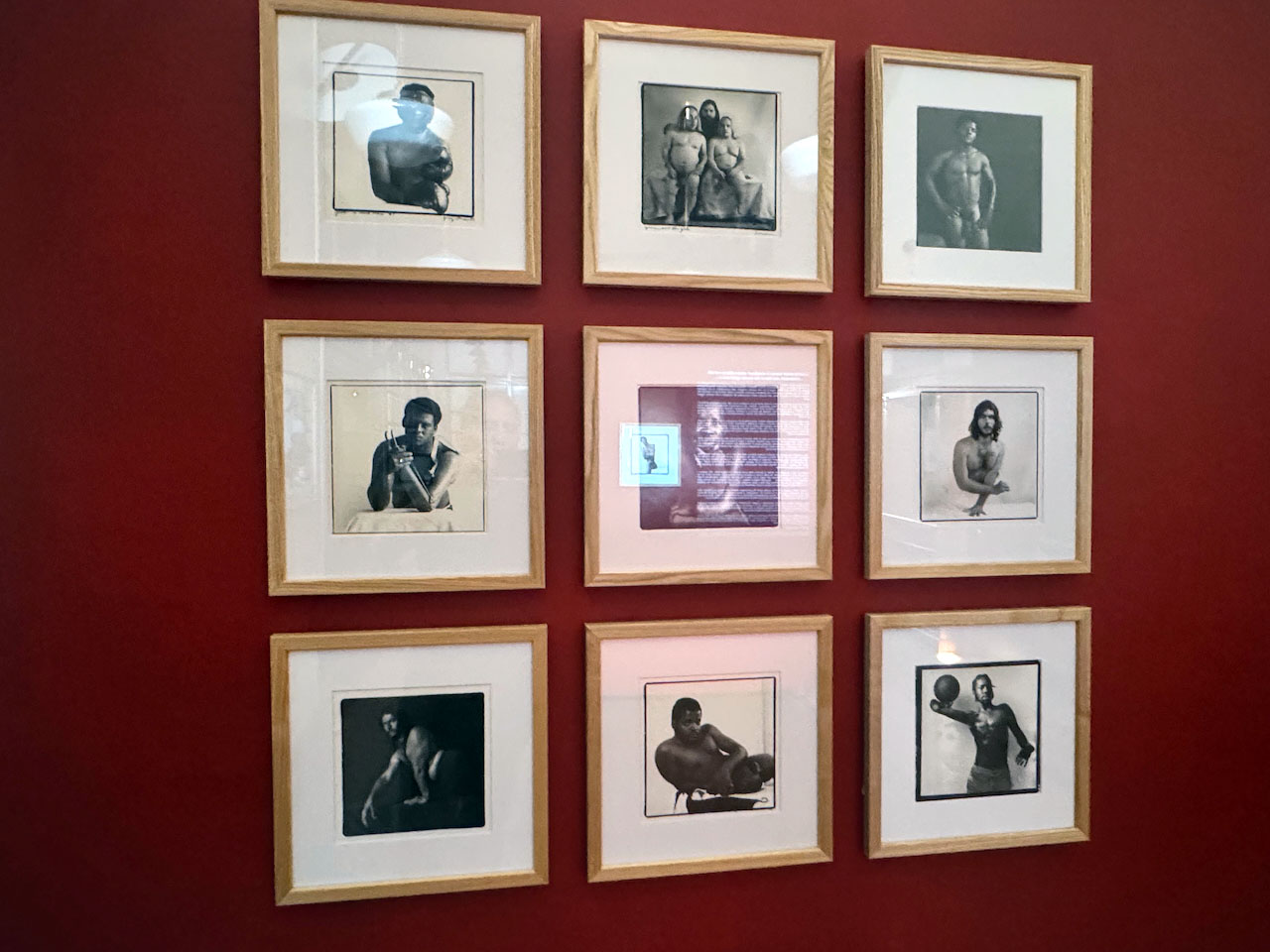
Fundación MAPFRE website

LIKE ART BLART ON FACEBOOK

Back to top

Exhibition: ‘The 80s: Photographing Britain’ at Tate Britain, London

Exhibition dates: 21st November, 2024 – 5th May, 2025

Curators: Yasufumi Nakamori, former Senior Curator of International Art (Photography) Tate Modern, Helen Little, Curator, British Art, Tate Britain and Jasmine Chohan, Assistant Curator, Contemporary British Art, Tate Britain with additional curatorial support from Bilal Akkouche, Assistant Curator, International Art, Tate Modern; Sade Sarumi, Curatorial Assistant, Contemporary British Art, Tate Britain and Bethany Husband, Exhibitions Assistant, Tate Britain

List of artists: Keith Arnatt; Zarina Bhimji; Derek Bishton; Sutapa Biswas; Tessa Boffin; Marc Boothe; Victor Burgin; Vanley Burke; Pogus Caesar; Thomas Joshua Cooper; John Davies; Poulomi Desai; Al-An deSouza; Willie Doherty; Jason Evans; Rotimi Fani-Kayode; Anna Fox; Simon Foxton; Armet Francis; Peter Fraser; Melanie Friend; Paul Graham; Ken Grant; Joy Gregory; Sunil Gupta; John Harris; Lyle Ashton Harris; David Hoffman; Brian Homer; Colin Jones; Mumtaz Karimjee; Roshini Kempadoo; Peter Kennard; Chris Killip; Karen Knorr; Sirkka-Liisa Konttinen; Grace Lau; Dave Lewis; Markéta Luskačová; David Mansell; Jenny Matthews; Don McCullin; Roy Mehta; Peter Mitchell; Dennis Morris; Maggie Murray; Tish Murtha; Joanne O’Brien; Zak Ové; Martin Parr; Ingrid Pollard; Brenda Prince; Samena Rana; John Reardon; Paul Reas; Olivier Richon; Suzanne Roden; Franklyn Rodgers; Paul Seawright; Syd Shelton; Jem Southam; Jo Spence; John Sturrock; Maud Sulter; Homer Sykes; Mitra Tabrizian; Wolfgang Tillmans; Paul Trevor; Maxine Walker; Albert Watson; Tom Wood; Ajamu X.


Jason Evans (Welsh, b. 1968) and Simon Foxton (British, b. 1961) 'Untitled' 1991 From the series 'Strictly' from the exhibition 'The 80s: Photographing Britain' at Tate Britain, London, Nov 2024 - May 2025


Jason Evans (Welsh, b. 1968) and Simon Foxton (British, b. 1961)
Untitled
1991
From the series Strictly
Tate
© Jason Evans


A humungous posting that, much like the exhibition itself, cannot do justice to the photographs and issues of an entire decade – the flow on effects of which are still being felt today.

From distant Australia and having not seen the exhibition myself, I cannot do justice – now there is an apposite word for the decade – to the flow of the exhibition, the many included or neglected artists involved or not, the bodies of work displayed or their commentary on the many disparate, competing and complex political, economic and social cataclysms (def: a sudden violent political or social upheaval) of the decade: including but not limited to, race, gender, identity, representation, activism, neoliberalism, Thatcher, The Miners’ Strike, Clause 28, HIV/AIDS, feminism, racism, class, patriarchy, money, greed, hedonism, humanism, subcultures, unemployment, strikes, poverty, luxury, consumer culture, war (Falklands) and riots, for example the Brixton riots of 1981.

I lived those years in the UK before emigrating to Australia in 1986. What I remember is the terrible weather, the cold and the damp, the vile Thatcher, and the poor quality of living. I lived in Stockwell (or Saint Ockwell as we used to call it) near Brixton in the early 80s before moving to Shepherd’s Bush were all the Mods gathered on their scooters on the roundabout as part of the mod revival.

I worked at a fish and chip restaurant called Geales just off Notting Hill Gate working double shifts, 10.30 – 3pm, 5.30 – 12, five days a week. The restaurant served fish and chips with French champagne and wines. The mostly gay floor staff were paid a pittance but we earnt our money off the tips we received from the celebrities that inhabited the place, people such as Bill Connolly, John Cleese, Divine and Kenny Everett. They loved us gay boys.

We worked hard and partied harder, often going out from Friday night to Sunday night to the clubs with a rest day on Monday. We were young. We ran from place to place living at a hundred miles an hour, not realising the ruts in London are very deep and you were spending as much as you made just to pay the rent, to eat at dive cafe (I lived on Mars bars, fish and chips, braised heart, mashed potatoes and bullet peas to name a few and I was as thin as a rake), and to go out partying, to have fun, visiting the alternative clubs in Kings Cross, Vauxhall, Brixton and the East End.

And then there was the spectre of HIV/AIDS raising its ugly head. I had my first HIV test in 1983. I had my blood taken and I went back 2 weeks later for the result. I sat outside the doctor’s room and if they called you in and said you had it, you were dead. To look death in the face at 25. The was no treatment. I survived but many of my friends, both here and in Australia, didn’t. We partied harder.


There are so many perspectives on the 80s that it is an impossible task for one exhibition to cover all of the issues. Reviews have noted that the exhibition is “a meandering look at pomp, protest” (Guardian); “exhaustive and exhausting… [the exhibition] makes for a dogged viewing experience that confuses as much as it enlightens” (Guardian); “a sense of fatigue and depletion as it went on and on … it could have been more engaging, more pleasurable” (1000 Words); and “the critical reception of the show has been rather lukewarm” (The Brooklyn Rail).

Most writer’s observe that the exhibition illuminates the way photography shifts “from monochrome to colour, from photojournalism to a more detached style of documentary” featuring “constructed, studio-based and appropriationist work.” The exhibition distils “the curatorial thrust of this sprawling exhibition, which, as its subtitle suggests, is more about photography’s often conceptually based responses to the 1980s than the turbulent nature of the decade itself.”1

Further, Bartolomeo Sala observes that the meandering view of the 1980s is consistent with the curatorial approach to the exhibition, “that is, to present eighties Britain not as a ossified relic but rather a container of multitudes, a country animated by competing, clashing energies and defying coherent description in a way that feels very reminiscent of today. A neoliberal hellhole, a nightmare of petit bourgeois conformity and cheapness, and at the same time an increasingly tolerant, multicultural, and open society, which finds its motor and pride in diversity and the endless project of self-fashioning.”2

Forty plus years on we are still paying the price for Thatcher’s neoliberal hellhole, with the loss of community, and the lack of compassion and empathy for others. I often think it was a more vibrant, more alive time in the 1980s despite all of its inherent problems. While we may have become a more tolerant, multicultural society, fascism and the right, disenfranchisement and loss of rights lurk ever closer to the surface. While we have pride we also have arrogance and self-aggrandisement, self-entitlement. While then we seemingly had freedom and love we now have surveillance and control. In some ways then I disagree with today being a more “open” society.

What social documentary and conceptual photography pictured so strongly and conscientiously in 1980s Britain was the vibrant madness of the age. The passions and the prejudices. Half your luck that you go and see this exhibition in London, that you have a chance to breathe in these photographs, for in Australia the chance of seeing such an exhibition of photographs from the 1980s by a state or national gallery would be zero.

I wouldn’t complain too much!

Dr Marcus Bunyan


1/ Sean O’Hagan. “The 80s: Photographing Britain review – in your face and to the barricades,” on The Guardian website, Sun 24 Nov 2024 [Online] Cited 02/05/2025

2/ Bartolomeo Sala. “The 80s: Photographing Britain,” on The Brooklyn Rail website March 2025 [Online] Cited 03/04/2025


Many thankx to Tate Britain for allowing me to publish the photographs in the posting. Please click on the photographs for a larger version of the image.


Installation view of the exhibition 'The 80s: Photographing Britain' at Tate Britain, London showing at left, the work of Jason Evans and Simon Foxton from the series 'Strictly' 1991; and at centre left top, Wolfgang Tillmans' 'Love (Hands in Air)' 1989


Installation view of the exhibition The 80s: Photographing Britain at Tate Britain, London showing at left, the work of Jason Evans and Simon Foxton from the series Strictly 1991 (below); and at centre left top, Wolfgang Tillmans’ Love (Hands in Air) 1989 (below)
Courtesy of Tate Britain


Installation view of the exhibition 'The 80s: Photographing Britain' at Tate Britain, London showing at rear, photographs from Maud Sulter's series 'Zabat' 1989


Installation view of the exhibition The 80s: Photographing Britain at Tate Britain, London showing at rear, photographs from Maud Sulter’s series Zabat 1989
Courtesy of Tate Britain


Maud Sulter produced the Zabat series for Rochdale Art Gallery in 1989, the 150th anniversary of the invention of photography. It was a direct response to the lack of a black presence at other celebratory events and exhibitions. Here we see the conventions of Victorian portrait photography under the command of a black woman photographer. The backdrop, props and pose are all retained but the image is transformed with African clothes, non-European objects and, most importantly, by the resolute black woman at its centre.

The title ‘Zabat’ also signifies Maud Sulter’s call for a repositioning of black women in the history of photography: the word describes an ancient ritual dance performed by women on occasions of power.

Text from the V&A website


Installation view of the exhibition 'The 80s: Photographing Britain' at Tate Britain, London showing at left the work of Paul Graham


Installation view of the exhibition The 80s: Photographing Britain at Tate Britain, London showing at left the work of Paul Graham
Courtesy of Tate Britain


Installation view of the exhibition 'The 80s: Photographing Britain' at Tate Britain, London


Installation view of the exhibition The 80s: Photographing Britain at Tate Britain, London
Courtesy of Tate Britain


Wolfgang Tillmans (German, b. 1968) 'Love (Hands in Air)' 1989


Wolfgang Tillmans (German, b. 1968)
Love (Hands in Air)
1989


“Depending on where you stood in terms of race, gender, or class, the 1980s would seem a time of unprecedented economic expansion, an era defined by the triumph of consumerism and a particularly brass form of hedonism, or else an era of widening disparities, rising unemployment, and generalized economic crisis; a time defined by the booming of the housing market or the return of homelessness; a time of general disaffection and disillusionment toward the prospects of organized politics or an era defined by political activism and struggle, often hyperlocal in nature, as well as successive waves of discontent that at different points rocked the nation. …

In general, the critical reception of the show has been rather lukewarm. Many broadsheet commentators have lamented the meandering nature of the exhibition, while one critic noted the programmatic downplaying of the decade’s heavy-hitters. (Don McCullin and Chris Killip get a handful of photographs each, while virtuoso of political photomontage Peter Kennard is relegated to display cases.) Such assessments feel a little unfair and condescending to the excellent artists who do get a good showing, and in any case this curatorial approach is consistent with the intention of the exhibition – that is, to present eighties Britain not as a ossified relic but rather a container of multitudes, a country animated by competing, clashing energies and defying coherent description in a way that feels very reminiscent of today. A neoliberal hellhole, a nightmare of petit bourgeois conformity and cheapness, and at the same time an increasingly tolerant, multicultural, and open society, which finds its motor and pride in diversity and the endless project of self-fashioning.”


Bartolomeo Sala. “The 80s: Photographing Britain,” on The Brooklyn Rail website March 2025 [Online] Cited 03/04/2025


Derek Bishton, Brian Homer and John Reardon. 'Ting A Ling, Handsworth Self Portraits project' 1979 from the exhibition 'The 80s: Photographing Britain' at Tate Britain, London, Nov 2024 - May 2025


Derek Bishton, Brian Homer and John Reardon
Ting A Ling, Handsworth Self Portraits project
1979
© Derek Bishton, Brian Homer & John Reardon


Syd Shelton (British, b. 1947) 'Skinheads, Petticoat Lane, East London' 1979, printed 2012


Syd Shelton (British, b. 1947)
Skinheads, Petticoat Lane, East London
1979, printed 2012
Gelatin silver print on paper
417 x 281 mm
Tate
Gift Eric and Louise Franck London Collection 2016


Skinheads, known for their shaved heads and heavy boots, emerged as a working-class subculture in the 1960s. Initially non-political, some became associated with extreme nationalism. Others took an anti-racist position aligned with two-tone, a musical movement blending Jamaican ska and British punk. One of Syd Shelton’s photographs shows two members of Skins Against the Nazis proudly displaying a Rock Against Racism badge. The other was taken after an argument about racism. ‘I saw the guy at the front clenching his fists’, notes Shelton, ‘so I took the shot, said thanks and legged it as fast as I could.’

Wall text from the exhibition


Syd Shelton (British, b. 1947) 'Anti-racist Skinheads, Hackney, London' 1979, printed 2012


Syd Shelton (British, b. 1947)
Anti-racist Skinheads, Hackney, London
1979, printed 2012
Gelatin silver print on paper
417 x 282 mm
Tate
Gift Eric and Louise Franck London Collection 2016


In 1977, 500 National Front (NF) members attempted to march through Lewisham, an area in southeast London with a significant Black population. Thousands ignored a police blockade to hold a peaceful counter-demonstration that led to the NF abandoning their march. Protestors clashed with police and were met by riot shields, baton charges and mounted officers. The events became known as the Battle of Lewisham. Shelton’s photographs contrast the chaos of the streets with the resolve of the protestors. ‘Politics was one of the reasons that I became a photographer’, notes Shelton, ‘the idea of the objective photographer is nonsense.’

Wall text from the exhibition


Syd Shelton (British, b. 1947) 'Darcus Howe addressing the anti-racist demonstrators, Lewisham, 13 August 1977' Dated 1977, printed 2020 from the exhibition 'The 80s: Photographing Britain' at Tate Britain, London, Nov 2024 - May 2025


Syd Shelton (British, b. 1947)
Darcus Howe addressing the anti-racist demonstrators, Lewisham, 13 August 1977
Dated 1977, printed 2020
Tate
Presented by the artist 2021
© Syd Shelton


Explore one of the UK’s most critical decades, the 1980s. This exhibition traces the work of a diverse community of photographers, collectives and publications – creating radical responses to the turbulent Thatcher years. Set against the backdrop of race uprisings, the miner strikes, section 28, the AIDS pandemic and gentrification – be inspired by stories of protest and change.

At the time, photography was used as a tool for social change, political activism, and artistic and photographic experiments. See powerful images that gave voice and visibility to underrepresented groups in society. This includes work depicting the Black arts movement, queer experience, South Asian diaspora and the representation of women in photography.

This exhibition examines how photography collectives and publications highlighted these often-unseen stories, featured in innovative photography journals such as Ten.8 and Cameraworks. It will also look at the development of Autograph ABP, Half Moon Photography Workshop, and Hackney Flashers.

Visitors will go behind the lens to trace the remarkable transformation of photography in Britain and its impact on art and the world.

Text from the Tate Britain website


The 80s: Photographing Britain

David Preshaah and Helen Little curator of The 80s: Photographing Britain at Tate Britian discuss the show running 21st November, 2024 – 5th May, 2025. See powerful images that gave voice and visibility to underrepresented groups in society. This includes work depicting the Black arts movement, queer experience, South Asian diaspora and the representation of women in photography


Paul Trevor (British, b. 1947) 'Outside police station, Bethnal Green Road, London E2, 17 July 1978. Sit down protest' 1978


Paul Trevor (British, b. 1947)
Outside police station, Bethnal Green Road, London E2, 17 July 1978. Sit down protest
1978

Paul Trevor © 2023


On 4 May 1978, Altab Ali, a 24-year-old Bangladeshi textile worker, was murdered in a racially motivated attack. During police interviews, the three teenagers responsible casually described the regularity of their racist violence. The Bangladeshi community in east London mobilised in response. 7,000 people marched from Bethnal Green’s Brick Lane to Downing Street, following a vehicle carrying Ali’s coffin. Protestors rallied in Hyde Park chanting, ‘Who killed Altab Ali? Racism, racism!’

Paul Trevor was a member of Half Moon Photography Workshop and helped produce Camerawork magazine. He contributed to an issue on the 1978 Battle of Lewisham in southeast London. While photographing the violent clashes between police and anti-fascist protestors, Trevor recalls, ‘A woman – appealing for help – shouted at me in desperation “What are you taking pictures for?” Good question, impossible to answer in that melee.’ The special issue of Camerawork, ‘What are you taking pictures for?’ was devoted to that question.

Wall text from the exhibition


Don McCullin (British, b. 1935) 'Jean, Whitechapel, London' Late 1970s


Don McCullin (British, b. 1935)
Jean, Whitechapel, London
Late 1970s
Gelatin silver print
Tate
Gift Eric and Louise Franck London Collection 2011


Photojournalist and war photographer Don McCullin spent nearly twenty years photographing people living on the streets of Aldgate and Whitechapel in east London. He documented people living at the edge of the city’s wealthy financial centre. In the late 1970s, unprofitable psychiatric institutions in the area had begun to close, leaving many residents homeless. These photographs of Jean show how closely McCullin worked with the people he photographed. Of his British social documentary work, McCullin notes: ‘Many people send me letters in England saying “I want to be a war photographer”, and I say, go out into the community you live in. There’s wars going on out there, you don’t have to go halfway around the world.’

Wall text from the exhibition


This autumn, Tate Britain will present The 80s: Photographing Britain, a landmark survey which will consider the decade as a pivotal moment for the medium of photography. Bringing together nearly 350 images and archive materials from the period, the exhibition will explore how photographers used the camera to respond to the seismic social, political, and economic shifts around them. Through their lenses, the show will consider how the medium became a tool for social representation, cultural celebration and artistic expression throughout this significant and highly creative period for photography.

This exhibition will be the largest to survey photography’s development in the UK in the 1980s to date. Featuring over 70 lens-based artists and collectives, it will spotlight a generation who engaged with new ideas of photographic practice, from well-known names to those whose work is increasingly being recognised, including Maud Sulter, Mumtaz Karimjee and Mitra Tabrizian. It will feature images taken across the UK, from John Davies’ post-industrial Welsh landscape to Tish Murtha’s portraits of youth unemployment in Newcastle. Important developments will be explored, from technical advancements in colour photography to the impact of cultural theory by scholars like Stuart Hall and Victor Burgin, and influential publications like Ten.8 and Camerawork in which new debates about photography emerged.

The 80s will introduce Thatcher’s Britain through documentary photography illustrating some of the tumultuous political events of the decade. History will be brought to life with powerful images of the miners’ strikes by John Harris and Brenda Prince; anti-racism demonstrations by Syd Shelton and Paul Trevor; images of Greenham Common by Format Photographers and projects responding to the conflict in Northern Ireland by Willie Doherty and Paul Seawright. Photography recording a changing Britain and its widening disparities will also be presented through Anna Fox’s images of corporate excess, Paul Graham’s observations of social security offices, and Martin Parr’s absurdist depictions of Middle England, displayed alongside Markéta Luskačová and Don McCullin’s portraits of London’s disappearing East End and Chris Killip’s transient ‘sea-coalers’ in Northumberland.

A series of thematic displays will explore how photography became a compelling tool for representation. For Roy Mehta and Vanley Burke, who portray their multicultural communities, photography offers a voice to the people around them, whilst John Reardon, Derek Bishton and Brian Homer’s Handsworth Self Portrait Project 1979, gives a community a joyous space to express themselves. Many Black and South Asian photographers use portraiture to overcome marginalisation against a backdrop of discrimination. The exhibition will spotlight lens-based artists including Roshini Kempadoo, Sutapa Biswas and Al-An deSouza who experiment with images to think about diasporic identities, and the likes of Joy Gregory and Maxine Walker who employ self-portraiture to celebrate ideas of Black beauty and femininity.

Against the backdrop of Section 28 and the AIDS epidemic, photographers also employ the camera to assert the presence and visibility of the LGBTQ+ community. Tessa Boffin subversively reimagines literary characters as lesbians, whilst Sunil Gupta’s ‘Pretended’ Family Relationships 1988, juxtaposes portraits of queer couples with the legislative wording of Section 28. For some, their work reclaims sex-positivity during a period of fear. The exhibition will spotlight photographers Ajamu X, Lyle Ashton Harris and Rotimi Fani-Kayode who each centre Black queer experiences and contest stereotypes through powerful nude studies and intimate portraits. It will also reveal how photographers from outside the queer community including Grace Lau were invited to portray them. Known for documenting fetishist sub-cultures, Lau’s series Him and Her at Home 1986 and Series Interiors 1986, tenderly records this underground community defiantly continuing to exist.

The exhibition will close with a series of works that celebrate countercultural movements throughout the 80s, such as Ingrid Pollard and Franklyn Rodgers’s energetic documentation of underground performances and club culture. The show will spotlight the emergence of i-D magazine and its impact on a new generation of photographers like Wolfgang Tillmans and Jason Evans, who with stylist Simon Foxton pioneer a cutting-edge style of fashion photography inspired by this alternative and exciting wave of youth culture, reflective of a new vision of Britain at the dawn of the 1990s.

Press release from Tate Britain


Markéta Luskačová (Czech, b. 1944) 'Man singing on Brick Lane, London' 1982


Markéta Luskačová (Czech, b. 1944)
Man singing on Brick Lane, London
1982
Gelatin silver print
Tate
© Markéta Luskačová


Markéta Luskačová’s London Street Musicians series includes photographs taken between 1975 and 1990. They document the lives of street musicians performing at London markets. Her photographs reveal the humanity and resilience of these often-solitary musicians. ‘The street musicians themselves were often quite lonely men, yet their music lessened the loneliness of the street, the people in it and my own loneliness’, she recalls. For Luskačová, photography is ‘a tool for trying to understand life … to remember the people and things that I photograph. I want them to be remembered.’

Wall text from the exhibition


Chris Killip (Manx, 1946-2020) ''Critch' and Sean' 1982


Chris Killip (Manx, 1946-2020)
‘Critch’ and Sean
1982
Tate
© Chris Killip


Chris Killip first visited the seacoaling community at Lynemouth Beach in Northumberland in 1976. ‘The beach beneath me was full of activity with horses and carts backed into the sea’, Killip recalls. ‘Men were standing in the sea next to the carts, using small wire nets attached to poles to fish out the coal from the water beneath them. The place confounded time.’ In 1982, Killip started photographing the community, living alongside them from 1983 to 1984. ‘I wasn’t getting close enough, so I bought a caravan and moved into the place and that made a very big difference.’

Killip used a large format plate camera to capture his subjects. ‘It’s not a casual thing’, he notes. ‘I think it works to your advantage. They know this is going to live after this moment. It’s not ephemeral.’

Wall text from the exhibition


Jo Spence (British, 1934-1992) and Terry Dennett (British, 1938-2018)
'Remodelling Photo History: Revisualization' 1981-1982


Jo Spence (British, 1934-1992) and Terry Dennett (British, 1938-2018)
Remodelling Photo History: Revisualization
1981-1982
Tate
Presented by Tate Patrons 2014
© The Jo Spence Memorial Archive


These images are from Remodelling Photo History, a collaboration between Jo Spence and Terry Dennett. The work was originally published as a sequence of 13 photographs in which Spence and Dennett both act as photographer and photographic subject. The series was devised as a critique of standard histories of photography and particularly the depiction of women in art. It employs a practice Spence called ‘photo-theatre’. Each photograph emphasises its staging and construction in order to challenge and ‘make strange’ the assumed ‘naturalism’ of photography. Spence commented ‘it is obvious that a vast amount of work still needs to be done on the so-called history of photography, and on the practices, institutions and apparatuses of photography itself, and the function they have had in constructing and encouraging particular ways of viewing and telling about the world.’

Wall text from the exhibition


Joy Gregory (British, b. 1969) 'Magenta Dress with Pink Tulips' 1984


Joy Gregory (British, b. 1969)
Magenta Dress with Pink Tulips
1984
Courtesy of the artist
© Joy Gregory. All rights reserved, DACS


Joy Gregory’s early interest in colour photography began as student at Manchester Polytechnic. The university was known for its emphasis on the technical and chemical aspects of photography. Gregory’s education taught her the craft of commercial photography but she set out to use these skills like a painter. Her early experiments informed an ongoing interest in stillness, space and light. This series of colour transparencies presents models and still lifes in a painted studio interior. By using multiple exposures and layering images, Gregory suggests a spectral presence in the works. Her focus on the painterly qualities of colour and light here are typical of her practice. She employs languages of beauty and seduction in small textured prints that invite close inspection.

Wall text from the exhibition


John Harris (British, b. 1958) 'Mounted Policeman attacking Lesley Boulton at the Battle of Orgreave'
1984, printed 2024


John Harris (British, b. 1958)
Mounted Policeman attacking Lesley Boulton at the Battle of Orgreave
1984, printed 2024


John Harris’s photographs from the 1984 Battle of Orgreave challenged government portrayals of miners as aggressors. In 1984, the National Union of Miners identified Orgreave coking plant in South Yorkshire as a key site for picketing. From May to June, strikers attempting to disrupt deliveries were met by growing police presence. Tensions came to a head on 22 June when an estimated 6,000 officers clashed with pickets. One of Harris’s images captures Lesley Boulton cowering beneath the truncheon of a mounted officer. It became an emblem of the strike, appearing on badges, banners and posters.

Wall text from the exhibition


Paul Graham (British, b. 1956) 'Union Jack Flag in Tree, Country Tyrone' 1985


Paul Graham (British, b. 1956)
Union Jack Flag in Tree, Country Tyrone
1985
C-print on paper
Tate
Presented by Tate Members 2007
© Paul Graham


From 1984 to 1986, Paul Graham documented Northern Irish locations featured in news reports of the Troubles. During his first visit, Graham was stopped by a British military patrol suspicious of his camera. As they left, he took a shot with his camera hanging from his neck. The photograph became a ‘gateway’ for Graham’s Troubled Land series. He felt his other images of rioting, murals and destruction, ‘weakly echoed what I saw in the newspapers. This one image did not’. ‘There were people walking to shops and driving cars – simply going about their day, but then there was a soldier in full camouflage, running across the roundabout.’ For Graham, the image ‘reintegrated the conflict into the landscape … it was a conflict photograph masquerading as a landscape photograph.’

Wall text from the exhibition


Pogus Caesar (British born St. Kitts, b. 1953) 'Handsworth Riots: Birmingham, United Kingdom September' 1985, printed 2020


Pogus Caesar (British born St. Kitts, b. 1953)
Handsworth Riots: Birmingham, United Kingdom
September 1985, printed 2020
Gelatin silver print
Martin Parr Foundation Collection


These photographs capture two days of uprisings in Handsworth, Birmingham, following the arrest of a Black man over a parking violation and a police raid on a pub on the Lozells Road. The photographer, Handsworth resident Pogus Caesar, notes: ‘Where possible it was vital to document.’ He explains: ‘The media has a way of portraying these type of events, I needed to document my truth.’ Caesar’s insider perspective allowed him to capture a range of images, such as artist John Akomfrah reading a sensationalist newspaper account of the two days of violence between the police and local communities.

Wall text from the exhibition


Melanie Friend (British, b. 1957)
'Greenham Common, 14 December 1985' 1985, reprinted 2023


Melanie Friend (British, b. 1957)
Greenham Common, 14 December 1985
1985, reprinted 2023
© Melanie Friend, Format Photographers Archive, Bishopsgate Institute


Exhibition guide

The 80s: Photographing Britain explores a critical decade for photography in the UK. It highlights the work of artists who were radically reconsidering the possibilities of the medium and its role in society.

The exhibition traces developments in photographic art from 1976 to 1993. It follows artists working against a backdrop of high unemployment, industrial action and civil rights activism. Many were part of local photographic communities that developed around key photography schools and collectives. Yet, through innovative publications and independent galleries, they reached national and international audiences.

The artists included in the exhibition expanded photographic practice in Britain. They often collaborated, shared ideas and debated theory. Some were inspired by the activism of the period’s protest movements, using their cameras to provide new ways of looking at society. Others embraced technical developments to push the boundaries of fine art photography. Their work highlights the medium’s range, from landscapes to self-portraiture, and social documentary to conceptual photography.

The 80s: Photographing Britain invites us to reflect on photography’s political and artistic potential. It acknowledges that the diversity of contemporary photographic practice is indebted to the groundbreaking photographers of the 1980s.

Room 1

Documenting the decade

This room documents a period of significant social and political upheaval in the UK. It features protests, uprisings and acts of violence photographed through an activist lens. These photographers challenged dominant narratives and amplified marginalised voices. Some photographed their own communities, giving them access an outsider might not be granted. Others, free from the violence and oppression their subjects faced, turned to photography as an act of solidarity.

The exhibition begins in 1976, the year Jayaben Desai walked out of Grunwick Film Processing Laboratories in London, starting a two-year strike for the right to union representation. The Grunwick dispute typifies the events explored in this room. It was led by an activist whose intersecting identities were the root of her cause. When thousands took to the streets in solidarity it revealed the power of collective action. But it is also an example of failed industrial action, hardline policing and racist media coverage.

In 1979, following months of industrial disputes during the so-called ‘Winter of Discontent’, James Callaghan’s Labour government lost the general election. When Conservative prime minister Margaret Thatcher took office, she promised to reverse the country’s ‘decline’. The answer, she argued, was free markets, traditional values and British nationalism. Her political philosophy became known as Thatcherism. It helped UK financial markets thrive but led to growing class division and inequalities.

Within this context, socially engaged photographers joined the fight for change. They documented protests and the hardline police tactics designed to silence them. Their images reveal a range of documentary practices and photography’s ability to uncover events that might otherwise remain hidden.

Anti-racist movements

The 1948 British Nationality Act allowed everyone born in Britain or its Empire to become a ‘Citizen of the United Kingdom and Colonies’. The act encouraged people from Britain’s current and former colonies to move to the UK to address labour shortages, help facilitate post-war reconstruction and build the welfare state. Yet, on arrival, citizens of colour faced hostility and racial discrimination. It marked the beginning of decades of racist rhetoric, rioting and civil rights activism.

In 1968, Conservative MP Enoch Powell delivered his ‘Rivers of Blood’ speech in Birmingham, criticising immigration and emboldening the far-right. That same year, writer Obi Egbuna founded the British Black Panthers to defend Black communities against racism and discrimination. By the mid-1970s, the far-right, anti-immigration National Front was England’s fourth largest political party. They capitalised on the perception that white workers were losing jobs to immigrants rather than government failures to address unemployment levels. Their far-right ideology was opposed by anti-fascist and anti-racist campaign groups whose members vastly outnumbered the National Front. Throughout the 1980s, high-profile uprisings in Bristol, Leeds, London, Manchester, Liverpool and Birmingham revealed the strength of anti-racist feeling across the country.

The Miners’ Strike

Following the First World War, there were 1 million miners in the UK. By the beginning of the 1980s, there were 200,000. In March 1984, the National Coal Board announced plans to close 20 collieries, putting 20,000 jobs at risk. The National Union of Mineworkers, led by Arthur Scargill, responded with a series of year-long strikes. Observed across England, Scotland and Wales, the strikes were a national issue.

Determined to disable labour movements across the UK, Margaret Thatcher took steps to break the miners’ union and limit their power. The government stockpiled coal, mobilised police forces, brought legal challenges, and made media statements heavily criticising the union and striking workers.

Journalists challenged the government’s portrayal of miners as aggressors and agitators. Photographers helped evidence instances of excessive and often unprovoked violence by law enforcement. But the government’s plans to take down miners, one of the strongest unionised workforces in the country, had worked. On 3 March 1985, after 362 days, the National Union of Mineworkers accepted defeat. Union members voted to end the strike. The strike put industrial issues and workers’ rights on the national agenda and had a profound impact on the politics of the period.

Brenda Prince was a member of Format Photographers Agency. Started by Maggie Murray and Val Wilmer in 1983, Format was set up as an agency for women. Prince joined in 1984. ‘We were all documentary photographers’, Prince notes. ‘We would work on our own stories and my miners’ strike images came out of that.’ ‘The miners’ strike gave me the opportunity to document working class people who were really struggling to keep their jobs and keep their communities alive’, Prince explains. She spent eighteen months in Nottinghamshire’s mining communities. Her works highlight the vital role women played in sustaining the strike.

(For more information on the miners’ strike please see the posting on the exhibition ONE YEAR! Photographs from the Miners Strike 1984-85 at Four Corners, London, Sept – October, 2024)

Greenham Common

On 5 September 1981, a group of women marched from Cardiff to the Royal Air Force base at Greenham Common in Berkshire. The site was common land, loaned to the US Air Force by the British Government during the Second World War and never returned. The group called themselves Women for Life on Earth. They were challenging the decision to house 96 nuclear missiles at the site. On arrival, they delivered a letter to the base commander stating: ‘We fear for the future of all our children and for the future of the living world which is the basis of all life.’ When their request for a debate was ignored, they set up camp. Others joined and the site became a women-only space.

Over the next 19 years, Greenham Common Women’s Peace Camp became a site of protest and home to thousands of women. Some stayed for months, others for years, and many visited multiple times. Greenham women saw their anti-nuclear position as a feminist one. They used their identities as mothers and carers to fight for the protection of future generations and inspired protest movements across the world.

In 1987, Soviet President Mikhail Gorbachev and US President Ronald Reagan signed a treaty which paved the way for the removal of cruise missiles from Greenham. Gorbachev has since paid tribute to the role ‘Greenham women and peace movements’ played in this historic agreement. By 1992, all missiles sited at Greenham had been removed and the US Air Force had left the base. The Peace Camp remained until 2000 as a protest against nuclear weapons.

Format Photographers Agency (1983-2003), featuring Maggie Murray, Melanie Friend, Brenda Prince and Jenny Matthews, played a crucial role in documenting social movements. Their photographs of the Greenham Common Women’s Peace Camp capture this landmark protest against nuclear missiles. They record the activism, daily life and personal stories of the women involved, highlighting their strength and creativity. They also reveal contrast between the women’s camp and their non-violent resistance and the militarised environment they were protesting.

The Gay Rights Movement

In 1967, the Sexual Offences Act partially decriminalised sexual acts between two men. It was the result of decades of campaigning but the act did nothing to address the discrimination LGBTQ+ communities faced. In 1970, the first meeting of the Gay Liberation Front took place. They wrote a manifesto outlining how gay people were oppressed and mapped out a route to liberation through activism and consciousness-raising. In the 1980s, the Gay Rights movement continued to grow. Queer communities came together in opposition to homophobia fuelled by Conservative ‘family values’ campaigns and fear of the HIV/ AIDS epidemic.

The first cases of Gay-Related Immune Deficiency (GRID) in the UK were identified in 1981. In 1982, GRID was renamed Acquired Immune Deficiency Syndrome (AIDS) and Britain saw its first deaths from the disease. By 1987, AIDS was a worldwide epidemic, with around 1,000 recorded cases in the UK. The public focus was largely on gay men, who were being infected in much greater numbers, fuelling anti-gay rhetoric in politics and the press.

In 1988, the government passed Section (formerly Clause) 28 of the Local Government Act. The legislation stated local authorities ‘shall not intentionally promote homosexuality’ or ‘promote the teaching in any maintained school of the acceptability of homosexuality as a pretended family relationship’. Section 28 forced many LGBT groups to disband and saw literature depicting gay life removed from schools and libraries. But it also galvanised the Gay Rights movement. People took to the streets in a series of marches and protests, and set up organisations to lobby for change.

Poll Tax

The community charge, commonly known as the ‘poll tax’, was introduced by Margaret Thatcher’s Conservative government in 1989 in Scotland, and 1990 in England and Wales. This flat-rate tax on every adult replaced previous taxation based on property value. The tax was accused of benefitting the rich and unfairly targeting the poor.

The national anti-poll tax movement began on the streets of Glasgow and led to a series of anti-poll tax actions across the UK. Many demonstrations saw clashes between police and protestors, and resulted in rioting. The fallout from the tax triggered leadership challenges against the prime minister and, in 1990, Thatcher resigned. In 1991, following vehement national opposition, John Major’s Conservative government announced the poll tax would be replaced by council tax.

The Troubles

The Troubles was a 30-year conflict in Northern Ireland between Protestant Ulster loyalists, who believe Northern Ireland should remain part of the United Kingdom, and Catholic Irish republicans, who believe in an independent united Ireland. The roots of the conflict date back to the twelfth century, when English settlers displaced Irish landholders and colonised areas of Ireland. In the seventeenth century, in an attempt strengthen British rule over the Catholic population, Britain moved protestants from Scotland and England to the north of Ireland. This caused sectarian divisions that continue to this day.

During the 1920 Irish War of Independence against British rule, a treaty was signed dividing the island into two self-governing areas. The majority Catholic counties, primarily in the south, formed the Irish Free State. The six majority Protestant counties in the north became a region of the United Kingdom. Catholics living in Northern Ireland faced discrimination and police harassment and, in the late 1960s, they organised civil rights marches challenging their treatment. Activists were met by counter-demonstrators and violent suppression by the almost exclusively Protestant police force. Riots ensued and the Troubles began. In 1969, the British Army was deployed to restore order in the region, but instead violence escalated. Paramilitary organisations on both sides took up arms and employed guerrilla tactics. More than 3,500 people had been killed by the time the Good Friday Agreement was signed in 1998, ending 30 years of violence.

Room 2

The cost of living

These photographs spotlight UK class dynamics in the 1980s. Images of social security waiting rooms and people living on the streets, sit alongside office workers, Conservative Party functions and gallery private views.

Margaret Thatcher believed, ‘whatever your background, you have a chance to climb to the top’. She presented social mobility as the reward for those who worked hard enough. The government encouraged people to become part of the property-owning middle classes. The 1980 Housing Act gave 5 million council house tenants the right to buy at discounted prices. But Thatcherism also advocated for limited government controls, privatisation of industry, low taxes and free markets. Conservative economic philosophy made the wealthiest in society richer. While young urban professional ‘yuppies’ in financial centres thrived, the gap between classes increased.

In the 1970s, a global economic recession and increased mechanisation had led to deindustrialisation. By the 1980s, working-class communities centred around heavy industries were greatly affected. Specialised machines replaced workers and manufacturing moved to countries where wages were lower. The government introduced legislation to limit the influence of trade unions and allow employers to sack striking workers. Thousands were left unemployed. The foundations of working-class identity were being eroded while the prospect of middle-class affluence remained out of reach for many.

The photographers in this room produced work that highlights these class dynamics. Some revealed the human stories behind the policies and statistics, others helped cement stereotypes.

Room 3

Landscape

The photographs in this room highlight different political and social narratives embedded in the landscape of the British Isles. They reveal the impact of human endeavour on the land and the effect of the land and its borders on people.

While these photographs depict a particular part of the world, they also explore how landscapes are constructed in our imaginations. As artist Jem Southam notes, ‘When we look at a photograph of a landscape, we’re looking as much at a projection of the cultural, social, historical, literary connections we have with that place, as we are with an actual physical landscape.’ Southam describes his work as ‘a description of a culture, and of a place, but also an investigation of how we carry imagery in our minds’.

Some of the featured photographers drew on the history of British landscape painting to produce nostalgic images of sublime natural vistas. Others parodied or subverted the romantic notion of a green and pleasant land, revealing British landscapes as sites of decay, conflict, deindustrialisation and racism. Several artists produced photographs that immerse us in their chosen scenes, treating industrial ruins with the same careful attention as natural phenomena. Those working with large format cameras and slow exposure times gave their chosen scenes a painterly quality. Others utilised photography’s ability to record the everyday. They embraced a medium some didn’t consider high art to capture landscapes many didn’t consider worthy of documenting.

Room 4

Image and text

Conceptual art prioritises the idea (or concept) behind an artwork. The photographs in this room focus on photography’s ability to carry ideas. They challenge the notion of the photograph as a window on the world and use text to complicate the medium’s relationship with reality.

Artist and academic, Victor Burgin wrote that our most common encounters with photographs – in advertisements, newspapers and magazines – are all mediated by text. Informed by semiotics, the study of signs and symbols, Burgin highlighted our reliance on existing systems of codes and social meanings to ‘read’ photographs. By making work that combines image and text he was ‘turning away from concerns inherited from “art” and towards everyday life and its languages, which are invariably composed of image/text relations’. Burgin used image and text to ‘dismantle existing communication codes’ and ‘generate new pictures of the world.’

Burgin’s art and ideas influenced the photographers in this room, several of whom he taught. They used text borrowed from literature, film, parliamentary speeches and journalism to expose hidden meanings, heighten emotion and confuse. The resulting artworks expanded contemporary photographic practice while offering new ways of viewing the world.

Room 5

Remodelling history

The personal and intimate photographs of Jo Spence and Maud Sulter remodel the history of representation. Their artworks and writings challenge photography’s sexist and colonial past, and its relationship to class politics. Rather than using the camera to stereotype, categorise, objectify or commodify, they used it to reclaim agency.

For both artists, their collaborative approach to image-making was key to the politics of their practice. Sulter and Spence worked closely with other artists and their subjects. Through collaboration, they discovered new ways of seeing and being seen.

For Spence, this meant ‘putting myself in the picture’. She recognised the power of having control over her representation and, together with artist Rosy Martin, developed photo-therapy. Spence noted: ‘I began to use the camera to explore links that I had never approached before, links between myself, my identity, the body, history and memory’. Known for her unflinching gaze and use of satire, Spence challenged social expectations. She questioned common visual representations of beauty, health and womanhood, as well as women’s place in society.

Sulter’s photography explores absence and presence. She was interested in the ways that ‘Black women’s experience and Black women’s contribution to culture is so often erased and marginalised’. Whether rephotographing personal family photographs or producing portraits, Sulter ‘put Black women back in the centre of the frame – both literally within the photographic image, but also within the cultural institutions where our work operates’. Sulter saw her practice as a contribution to ‘archival permanence’. As she noted: ‘Survival is visibility.’

Room 6

Reflections on the Black experience

This room examines the influence of Reflections of the Black Experience, which opened at Brixton Art Gallery in south London in 1986. The exhibition was organised by the Greater London Council’s Race Equality Unit. It invited artists ‘from a diversity of cultural/political backgrounds’ to collectively ‘challenge the existing and inadequate visual histories of the black experience’. In the 1980s, the term ‘political blackness’ was used as an organising tool to encourage people of colour to come together in the fight against racism. Reviews noted the range of practices on display and that the exhibition set ‘a new agenda where black people can begin to trace a history of representation of ourselves by ourselves’. Yet they also warned: ‘If seen as definitive representations / reflections in photographic imagery the exhibition becomes very limited.’

D-MAX: A Photographic Exhibition was a response to this possible containment of Black photographic practice. Three of the photographers featured had exhibited work in Reflections of the Black Experience. The exhibition opened at Watershed in Bristol in 1987 and toured to the Photographers’ Gallery in London and Chapter Arts Centre in Cardiff. It attempted to free Black photographers from the burden of representation and the restrictions of documentary practice.

Both exhibitions played an important role in the development of the Association of Black Photographers, now Autograph ABP. Established in 1988, its mission was to advocate for the inclusion of historically marginalised photographic practices. Working from a small office in Brixton, the agency delivered an ambitious programme of exhibitions, publications and events. Autograph ABP developed alternative models of producing and sharing photography without defining Black photographic practice or the Black experience.

Although the focus of Reflections of the Black Experience was on young photographers, the exhibition also included a tribute to Armet Francis, who was already well-established. Francis’s photographs focus on the areas of Notting Hill and Brent in west London, documenting the lives of people in the African and Caribbean diasporas. His images capture elements of everyday life, like school and church, as well as shining a light on Black community activism. Francis provided a crucial early articulation of Black identity and political presence in British photography.

Room 7

Self-portraiture

Whether putting themselves in the frame or handing the shutter release to their subjects, the photographers in this room understood the importance of people of colour having control over their image.

In the nineteenth century, photography was a valuable tool for colonial powers. Ethnographic images of Indigenous Peoples and landscapes were distributed through postcards and magazines. They ‘othered’ subjects and created racist stereotypes that legitimised the mission of empire. The photographs on display here challenge this colonial gaze. They present nuanced, multi-dimensional representations of Black and Asian British selfhood.

These artists used different photographic and post-production techniques to complicate the idea of representation and identity. The diversity of their images enhances our understanding of what it means to capture the ‘self’. By adding text, highlighting objects and layering images through projection and photomontage, they remind us that identity isn’t a fixed entity.

Three of the photographers shown here took part in Autoportraits, Autograph ABP’s first exhibition, held at Camerawork in east London in 1990. The exhibition took self-portraiture as its theme. Cultural theorist, Stuart Hall, wrote an essay for the catalogue. In ‘Black Narcissus’, he defended the use of ‘self-images’ by contemporary Black photographers. Far from ‘a narcissistic retreat to the safe zone of an already constituted “self”‘, Hall notes that self-portraiture presents a ‘strategy … of putting the self-image, as it were, for the first time, “in the frame”, on the line, up for grabs. This is a significant move in the politics and strategies of black representation.’

Room 8

Community

The photographs in this room are contributions to a people’s history. They focus on communities whose stories were often absent from the visual arts of the period. To tell these stories with integrity, photographers attempted to document communities from within. Some formed collectives, brought together by shared interests and common goals. They encouraged photographers to move to live alongside their subjects and to build relationships with local people to better represent them. Others documented their own lives and those of their local communities. Their images challenged prevailing narratives and aimed to bring about social change.

Here, photographs of everyday life are presented through a different lens. By the 1970s, most people expected to be photographed in colour, using roll film in point-and-shoot cameras. By producing black-and-white prints, these photographers appear to reference fine art and documentary practice. They invite us to view their subjects as part of the history of photography.

These photographers recorded different social pressures: inadequate housing, disproportionate unemployment, aggressive policing and stereotypical framing in the media. They also highlighted the joy, pride and humour within these communities. By working with their subjects and photographing their own experiences, they produced works that provide insight, build connections and encourage empathy.

Room 9

Colour

These photographers challenged the expectation that ‘art’ photography had to be black and white. At a time when the market for colour photography was still young, they subverted and appropriated colour’s associations with the commercial worlds of fashion and snapshot photography. They used burgeoning colour technologies to create a new visual language that became emblematic of the period. Their images offered new ways of seeing British life and culture.

Britain’s first exhibition of photography taken on colour film was Peter Mitchell’s 1979 show at Impressions Gallery in York. By this time, colour had almost entirely replaced black-and-white film in amateur photography. But many professional photographers were looking for greater nuance than the saturated results of commercially available film stock.

Across the decade, small technical leaps allowed for greater creativity in colour image-making. Kodachrome, the first commercially available colour negative film, was the most commonly used of the period. It provided rich and naturalistic colours, remarkable contrast and extraordinary sharpness. New papers such as Cibachrome II allowed artists to produce high-quality colour prints with greater permanence. Around 1984, Fuji introduced a new colour negative film offering even punchier, brighter saturation. Used with new cameras such as the Plaubel Makina 67 and daytime flash, photographers could produce detailed images in vivid colour.

Photographers exploited these technical advances. They used the camera like a painter, highlighted the garish excesses of consumer society and invented new forms of documentary. By December 1985, Creative Camera journal had announced ‘from today, black and white is dead’.

Room 10

Black Bodyscapes

The photographs of Rotimi Fani-KayodeAjamu X and Lyle Ashton Harris explore masculinity, sexuality and Blackness. Their staged portraits highlight the artists’ technical skills while challenging essentialist ideas of identity.

Fani-Kayode was described by Ajamu X as ‘the most visible, out, Black, queer photographer’ of the 1980s. His photographs interrogate a perceived tension between his heritage, spirituality and gay identity. Fani-Kayode commented: ‘On three counts I am an outsider: in terms of sexuality; in terms of geographical and cultural dislocation; and in the sense of not having become the sort of respectably married professional my parents might have hoped for.’ For Fani-Kayode the position of ‘outsider’ produced ‘a sense of freedom’ that he felt opened up ‘areas of creative enquiry which might otherwise have remained forbidden’.

Ajamu X’s desire to document ‘the whole of Black queer Britain’ has been dubbed ‘Pleasure Activism’. ‘There is a reluctance to talk about sex and pleasure’, he notes. ‘To me, the act of pleasure has to … be part of the conversation around making work.’ For Ajamu X, the materiality of his photography is as important as his subject. ‘I still get excited by the magic alchemy of being in the darkroom’, he reflects. ‘Process is key to my practice – in some cases, much more than the photographic image itself.’

Harris, a US photographer, was included in Autograph ABP’s first exhibition, 1990’s Autoportraits. He describes his photographs as a celebration of ‘Black beauty and sensuality’. Harris notes: ‘I think it’s important to understand that my work is not so much about trying to unpack identity as it is about relationally exploring my positionality to what has gone before and to what is unfolding in our present day lives, as a way to imagine a future to come.’

Room 11

Celebrating subculture

By the end of the decade, previous distinctions between commercial and art photography had begun to break down. Launched in 1980, popular magazines like The Face and i-D brought together fashion, art and advertising. They employed cutting-edge photographers to capture the youth movements that set trends and defined contemporary culture.

Many of the photographs in this final room of the exhibition document subcultures. They feature young people resisting dominant values and beliefs, and challenging the policies and rhetoric that informed them. Section 28 of the Local Government Act was one such policy. Passed in 1988, it prohibited local authorities from ‘promoting homosexuality’. Schools and libraries banned literature, plays and films referencing same-sex relationships and arts organisations faced censorship. Yet, in the face of discrimination, gay and lesbian communities mobilised. The government had put queer culture in the spotlight and, with great courage, many gay and lesbian photographers produced work that changed public discourse.

These artists embraced a range of photographic practices. They combined street photography with saturated colour to challenge stereotypes. They produced highly staged portraits exploring social justice issues, and they captured underground club scenes using the principles of community photography.

The photographs in this room offered a new vision of the UK. One that is both politically engaged and celebratory. They highlight the importance of self-expression, give agency to the photographic subject and make overlooked perspectives visible. Across style, format and subject, these artists asserted photography’s role in society: to document, interrogate and celebrate.

Text from the Tate Britain exhibition guide


Martin Parr (British, 1952-2025) 'New Brighton, England, 1983-85' From the series 'The Last Resort'


Martin Parr (British, 1952-2025)
New Brighton, England, 1983-85
From the series The Last Resort
1983-1985
C-type print
© Martin Parr / Magnum Photos


Martin Parr took his first colour photographs as a student at Manchester Polytechnic in 1971 and has worked exclusively in colour since 1982. These photographs are from his series The Last Resort. They document the Merseyside seaside resort of New Brighton at a time of economic decline. The series features Parr’s characteristic use of daytime flash and saturated colour to produce satirical images exploring leisure and consumption. Parr was ‘interested in showing how British society is decaying; how this once great society is falling apart.’ Of the series’ reception, Parr notes, ‘People thought it was exploitation, you know – middle-class guy photographing a working-class community, that sort of stuff. The thing is, it was shown first in Liverpool and no one batted an eyelid … middle-class people [in London] don’t know what the north of England’s like.’

Wall text from the exhibition


Paul Reas (British, b. 1955) 'Hand of Pork, Caerphilly, South Wales' 1985-1988


Paul Reas (British, b. 1955)
Hand of Pork, Caerphilly, South Wales
1985-1988
C-print on paper
© Paul Reas/Martin Parr Foundation


“Deregulation of the banking system meant credit was easy to come by and consumer spending rose fast. Shopping malls were the new cathedrals of consumption and retail parks with supermarkets and furniture stores the parish churches. Shopping became leisure”

~ Paul Reas


Inspired by the use of colour in advertising, Paul Reas dedicated his first series of colour photographs to the post- industrial consumer boom in the UK in the 1980s. These works, taken with a medium-format camera and a large flashgun, present everyday scenes at US-style retail parks, supermarkets and the new housing estates fast becoming a feature of British towns and villages. Reas’s images consider the impact of these ‘new cathedrals of consumption’. Reas has described how Margaret Thatcher’s belief in a free-market economy and individualism moved British society from a ‘we’ to a ‘me’ mentality. As he explains: ‘Although I was photographing people, I never really think about my photographs as being totally about people. They’re about the systems that we’re all subjected to.’

Wall text from the exhibition


Paul Reas (British, b. 1955) 'Army Wallpaper, B&Q Store, Newport South Wales' c. 1987


Paul Reas (British, b. 1955)
Army Wallpaper, B&Q Store, Newport South Wales
c. 1987
C-print on paper
© Paul Reas/Martin Parr Foundation


Anna Fox (British, b. 1961) 'Independent Video Production Company' 1988 from the series 'Work Stations'


Anna Fox (British, b. 1961)
Independent Video Production Company
1988
From the series Work Stations
The Hyman Collection
Courtesy of the Centre for British Photography
© Anna Fox


“Thatcher was a powermonger and her favourite phrase, ‘there is no such thing as society, just individuals’ saw the end of a culture of community support and a rise in the pursuit of wealth for individuals – primarily white men. Compared to now, things in some ways were more straightforward, and as artists we knew what we were making work about – there was a positive sense that we could change things; we criticised society with hope fueling us…

I made two key bodies of work in this period, including Work Stations – a study of London office life with found texts, creating satirical commentary on a very conservative Britain. I was interested in how consumerism was sweeping the floor with us and how money ruled. There were hardly any documentary images made of office life, it wasn’t considered a valid subject and this interested me. All documentary images change as time passes – design and style become more fascinating as they age – and I am so pleased these images have stayed in people’s imagination. They are a significant record of a particular time and they bring up a lot of memories of what it was like to live and work in it.”

Zoe Whitfield. “The story of 80s Britain, as seen by 7 notable photographers,” on the Dazed website, November 22, 2024 [Online] Cited 03/04/2025


Anna Fox (British, b. 1961) 'Salesperson, Cafe, the City' 1988


Anna Fox (British, b. 1961)
Salesperson, Cafe, the City
1988
From the series Work Stations
Inkjet print on paper
The Hyman Collection
Courtesy of the Centre for British Photography
© Anna Fox


In her Work Stations series, Anna Fox captures London office life in the late 1980s. ‘I was attracted to it because it’s such an ordinary subject and hardly anyone had ever photographed office life’, she says. The photographs combine colour, on-camera flash and snapshot style compositions to create hard shadows and emphasise the immediacy of each scene. The unusual framing and off-kilter camera angles give them a spontaneous and humorous feel. Fox repurposed text from business articles and magazines to loosely pair with each image in the series. They reveal the intense competition, stress and absurdities of corporate culture in Thatcher-era Britain.

Wall text from the exhibition


Anna Fox (British, b. 1961) 'Friendly Fire, target (Margaret Thatcher) / Margaret Thatcher Target' 1989


Anna Fox (British, b. 1961)
Friendly Fire, target (Margaret Thatcher) / Margaret Thatcher Target
1989
Inkjet print on paper
The Hyman Collection
Courtesy of the Centre for British Photography
© Anna Fox


While working on her 1987-1988 series Work Stations exploring office life, Anna Fox came across the phenomenon of paintballing. Learning that corporate sales teams often took part in outdoor paintball games to encourage team spirit and competitiveness, she wanted to capture these ‘weekend wargames’ in action. In her series Friendly Fire, Fox plays the role of war photographer just as the participants play at being soldiers. This image depicts a paint-splattered cardboard cutout of Margaret Thatcher used for target practice. Taken in the aftermath of the Falklands War, Fox’s work explores the connections and contrasts between these sites of simulated conflict and the experiences of military personnel.

Wall text from the exhibition


Grace Lau (British-Chinese, b. 1939)
'Interiors series' 1986


Grace Lau (British-Chinese, b. 1939)
Interiors series
1986
Colour transparency
Lent by the artist
© Grace Lau 1986


Grace Lau employs colour to explore fetish subcultures from a feminist perspective. This series was produced following an invitation to document a London cross-dressing community. Lau’s portraits are often set in private, domestic spaces where fantasies and alternative lifestyles could be acted out more openly. As the artist explains: ‘When I started making portraits of cross-dressers, many projected their alter-identities with such joyous style that I felt black-and-white could not do justice to their vibrant characters. Colour seemed to express their proud desire to project subliminal identities and these images with their saturated, bright colours, reflect my subjects’ multi-layered personalities; their bright red lipstick, glamorous dresses and jewellery blazing into life in colour transparency film.’

Wall text from the exhibition


Brenda Prince (British, b. 1950)
'Anti-Clause 28 demo in Whitehall, London' 9 June 1988


Brenda Prince (British, b. 1950)
Anti-Clause 28 demo in Whitehall, London
9 June 1988
Format Photographers Archive, Bishopsgate Institute
© Brenda Price


Did the 80s really last from 1976-94? This exhibition thinks it did – resulting in a show replete with gems, but in need of a tight edit…

The exhibition starts out along thematic lines. The opening room is dedicated to protest, from the Grunwick strike led by British/South Asian workers in Brent, through clashes between pickets and the police at the Orgreave coking plant, and marches opposing the homophobic Section 28 legislation. In a gallery dedicated to money and the growing divide between haves and have-nots, Paul Graham’s grimly atmospheric pictures of DHSS waiting rooms face off against Martin Parr’s snarky snaps of garden parties and gallery openings. In the next section, the lens is turned on the landscape, and the transformations wrought both by industry and its removal. …

The closing section Celebrating Subcultures bypasses those usually associated with the 1980s (punks, goths, rude boys, new age travellers) but includes an entire wall of 1990s photographs by Wolfgang Tillmans, most of which were shot in Germany and Greece…

The art world of the 1980s speaks strongly to our own, in particular, the shared interest in identity and representation. In short supply here is the punky irreverence of an era in which taking the piss was practically a national hobby.

Hettie Judah. “The 80s: Photographing Britain review – a meandering look at pomp, protest – and pork,” on The Guardian website Wed 20 Nov 2024 [Online] Cited 02/05/2025


For all that, I left this show feeling slightly beleaguered by the overload of images and attendant theory. The foregrounding of emerging visual strategies, from activist reportage to nascent conceptualism to identity-driven self-portraiture, is brave but often bewildering rather than enlightening. The final room, Celebrating Subculture, is a case in point, being a cursory nod to a decade that saw the emergence of the style-conscious youth culture that echoes through fashion, music and indeed everyday life until this day.

If your image of the 80s is predicated on memories of The Face magazine, or the blossoming of extravagant tribal subcultures such as goths and New Romantics in clubs such as the Batcave and Blitz, you may be as baffled as I was not to encounter a single image by the likes of Juergen Teller, Nigel Shafran or Derek Ridgers. Instead, there are four street portraits of stylish young men by Jason Evans and a recreation of Wolfgang Tillmans’s first photo installation, which mainly comprises images first published in i-D magazine. A portrait of the 80s, then, but one that at times seems determinedly out of focus.

Sean O’Hagan. “The 80s: Photographing Britain review – in your face and to the barricades,” on The Guardian website, Sun 24 Nov 2024 [Online] Cited 02/05/2025


Roy Mehta (British, b. 1968) From the series 'Revival, London' 1989-1993


Roy Mehta (British, b. 1968)
From the series Revival, London
1989-1993
C-print on paper
Courtesy of the artist and LA


Roy Mehta’s Revival, London, series focusses on Caribbean and Irish communities in Brent northwest London, where he lived in the 1980s. Much of Mehta’s practice engages with the complexity of identity and belonging.

Mehta invites us ‘to share in the atmosphere of the subject’s internal world by illustrating the gentle essence of our shared humanity through images of empathy, faith and tenderness’. He notes: ‘I wanted the work to depict compassion and solidarity, along with reflections of the everyday. I felt these were absent from some mainstream representations of diasporic identities at that time in the 1980s.’

Wall text from the exhibition


David Hoffman (British) 'Nidge & Laurence Kissing, taken at a poll tax protest in London' 1990


David Hoffman (British)
Nidge & Laurence Kissing, taken at a poll tax protest in London
1990
© David Hoffman


Ajamu X (British, b. 1963) 'Body Builder in Bra' 1990


Ajamu X (British, b. 1963)
Body Builder in Bra
1990
Gelatin silver print on paper
Tate
Presented by Tate Members 2020


When asked about the photoshoot for this image, Ajamu said: ‘we went to the local market here in Brixton, bought a bra and played around with it. This was one of the first shots.’ This spontaneity is contrasted with the carefully framed close-up of the sitter’s back. Bodybuilding has long been an area of interest for Ajamu. Although it represents ‘an archetypal image of the male body’, he describes how his practice is ‘a consistent attempt to subvert, re-think, play with these limited modes of representations around particular bodies in a multi-dimensional way.’

Wall text from the exhibition


Jason Evans (Welsh, b. 1968) and Simon Foxton (British, b. 1961) 'Untitled' 1991 From the series 'Strictly'


Jason Evans (Welsh, b. 1968) and Simon Foxton (British, b. 1961)
Untitled
1991
From the series Strictly
Tate
© Jason Evans


“This work was made in collaboration with Simon Foxton. It takes the head-to-toe ‘straight up’ documentary approach to street style as a point of departure, however they’re entirely constructed. We saw fashion photography as a political space where we could create something that pushed back at the media stereotypes of young Black men. This is a Trojan horse exercise, intended to disrupt the white supremacist media project. For many, it may be hard to imagine how racist the UK felt then, which, especially with hindsight, makes today’s politics all the harder to witness.”

Zoe Whitfield. “The story of 80s Britain, as seen by 7 notable photographers,” on the Dazed website, November 22, 2024 [Online] Cited 03/04/2025


Al-An deSouza (Kenyan, b. 1958) 'Junglee, Indian Aphorisms series'
1992/2024


Al-An deSouza (Kenyan, b. 1958)
Junglee, Indian Aphorisms series
1992/2024
Courtesy Al-An deSouza and Talwar Gallery, New York and New Delhi


In Indian Aphorisms, Al-An deSouza combines self-portraits with introspective reflections. Through the series, the artist attempts to reclaim and redefine their identity. Each work portrays the tension between public perception and private reality, illustrating the ways in which personal identity is continually negotiated and reshaped. DeSouza’s photographs reveal their struggle to separate reality from yearning and imagining. ‘I don’t know which of my memories are my own remembrance, which are tales whispered to me secretly as I lay in my bed, or which are ghostly after images, effigies petrified between the tissue leaves of photo albums’, the artist explains.

Wall text from the exhibition


'The 80s: Photographing Britain' book cover


Related publications

The 80s: Photographing Britain

Edited by Yasufumi Nakamori, Helen Little and Jasmine Chohan

Featuring contributions by Bilal Akkouche, Geoffrey Batchen, Derek Bishton, Jasmine Chohan, Taous Dahmani, Helen Little, Yasufumi Nakamori, Mark Sealy, Noni Stacey

Published November 2024, hardback £40

Available on the Amazon website


Tate Britain
Millbank, London
SW1P 4RG

Open daily 10.00 – 18.00

Tate Britain website

LIKE ART BLART ON FACEBOOK

Back to top

Exhibition: ‘FOTOGAGA: Max Ernst and Photography. A Visit from the Würth Collection’ at Museum für Fotografie, Staatliche Museen zu Berlin

Exhibition dates: 18th October, 2024 – 27th May, 2025

Curators: Katja Böhlau and Ludger Derenthal, Kunstbibliothek – Staatliche Museen zu Berlin


Max Ernst (German, 1891-1976) 'Frontispiece' 1921 From 'Paul Éluard: Répétitions' from the exhibition 'FOTOGAGA: Max Ernst and Photography. A Visit from the Würth Collection' at Museum für Fotografie, Oct 2024 - May 2025


Max Ernst (German, 1891-1976)
Frontispiece
1921
From Paul Éluard: Répétitions
Print from collage
5.5 x 10.3cm
Sammlung Würth
© VG Bild-Kunst, Bonn 2024


“Although these artists were explicitly not dealing with mundane reality but instead with what lies beneath, behind and in-between, the still relatively new medium of photography was of great importance for many. Last but not least, they also used it to make visible what remains hidden to the naked eye without technical means: the distant, the tiny, the moving.” (Press release)

Expressing the unconscious mind through illogical, dreamlike imagery and ideas, exploring the irrational, challenging notions of reality through a technical instrument – the camera – to create “a rich and multifarious cosmos of idiosyncratic realities that radically transcended traditional aesthetics.”

In the dream of the mind and the camera’s eye. Over and above the real.

Dr Marcus Bunyan


Many thankx to the Museum für Fotografie for allowing me to publish the photographs in the posting. Please click on the photographs for a larger version of the image.


“The invention of modern photomontage in the early twentieth century by Max Ernst with his Dada colleagues Hannah Höch, John Heartfield, George Grosz and Raoul Hausmann established new history in a variety of ways. Expanding modern art with multimedia as well as placing found photographs into art cut from printed magazines, rather than chemical made prints from the darkroom. Redefining final works of art without the paint brush or canvas. Ernst freed imagery into the unconscious by self-made combinations of drawing with torn and pasted photographic fragments, evoking memories and other responses by viewers that continue today.”


Steve Yates, Fulbright scholar, photographic artist, author and curator


Max Ernst (German, 1891-1976)
Die chinesische Nachtigall / Le rossignol chinois / The Chinese Nightingale 1920 from the exhibition 'FOTOGAGA: Max Ernst and Photography. A Visit from the Würth Collection' at Museum für Fotografie, Oct 2024 - May 2025


Max Ernst (German, 1891-1976)
Die chinesische Nachtigall / Le rossignol chinois / The Chinese Nightingale
1920
Collage and ink on paper
15.5 x 9cm
Musée de Grenoble
© VG Bild-Kunst, Bonn 2024


Max Ernst (German, 1891-1976) Lichtrad / la roue de la lumière / The wheel of light 1926 from the exhibition 'FOTOGAGA: Max Ernst and Photography. A Visit from the Würth Collection' at Museum für Fotografie, Oct 2024 - May 2025


Max Ernst (German, 1891-1976)
Lichtrad / la roue de la lumière / The wheel of light
1926
From Histoire Naturelle, sheet 29
Photogravure after frottage
32.5 x 50cm
Sammlung Würth
© VG Bild-Kunst, Bonn 2024


Max Ernst (German, 1891-1976) Max Ernst, Marie-Berthe Aurenche und Jean Aurenche / Max Ernst, Marie-Berthe Aurenche and Jean Aurenche, Photomaton c. 1929


Max Ernst (German, 1891-1976)
Max Ernst, Marie-Berthe Aurenche und Jean Aurenche / Max Ernst, Marie-Berthe Aurenche and Jean Aurenche, Photomaton
c. 1929
Silver gelatin paper
20.9 x 3.7cm
Sammlung Würth
© VG Bild-Kunst, Bonn 2024


Max Ernst (German, 1891-1976) "…unter meinem weißen Gewand, in meinem Taubenhaus, werdet ihr nicht mehr arm sein, ihr tonsurierten Tauben. Ich werde euch zwölf Tonnen Zucker bringen. Aber berührt nicht mein Haar“ / "…sous mon blanc vêtement, dans mon colombodrôme, vous ne serez plus pauvres, pigeons tonsurés. Je vous apporterai douze tonnes de sucre. Mais ne touchez pas à mes cheveux!" / "…you won't be poor anymore, head-shaven pigeons, under my white dress, in my columbarium. I'll bring you a dozen tons of sugar. But don't you touch my hair!" 1930


Max Ernst (German, 1891-1976)
“…unter meinem weißen Gewand, in meinem Taubenhaus, werdet ihr nicht mehr arm sein, ihr tonsurierten Tauben. Ich werde euch zwölf Tonnen Zucker bringen. Aber berührt nicht mein Haar“ / “…sous mon blanc vêtement, dans mon colombodrôme, vous ne serez plus pauvres, pigeons tonsurés. Je vous apporterai douze tonnes de sucre. Mais ne touchez pas à mes cheveux!” / “…you won’t be poor anymore, head-shaven pigeons, under my white dress, in my columbarium. I’ll bring you a dozen tons of sugar. But don’t you touch my hair!”
1930
From Das Karmelienmädchen. Ein Traum / Rêve d’une petite fille qui voulut entrer au Carmel / Dream of a little girl who wanted to enter Carmel
Print from collage
7.7 x 11.3cm
Sammlung Würth
© VG Bild-Kunst, Bonn 2024


Max Ernst (German, 1891-1976) Das Innere der Sicht 3 / A l'intérieur de la vue 3 / Inside View 3 1931/1947


Max Ernst (German, 1891-1976)
Das Innere der Sicht 3 / A l’intérieur de la vue 3 / Inside View 3
1931/1947
From Paul Éluard : A l’intérieur de la vue. 8 Poèmes visibles
Collage
22.3 x 15.5cm
Sammlung Würth
© VG Bild-Kunst, Bonn 2024


Max Ernst (German, 1891–1976) …des vollständig auf sie beschränkten, des vom Rest der Welt isolierten / … d'absolument limité à eux, d'isolant du reste du monde / of the one who is completely confined to them, isolated from the rest of the world 1936


Max Ernst (German, 1891–1976)
…des vollständig auf sie beschränkten, des vom Rest der Welt isolierten / … d’absolument limité à eux, d’isolant du reste du monde / of the one who is completely confined to them, isolated from the rest of the world
1936
From André Breton: Le château étoilé
Photogram after frottage
25 x 20cm
Sammlung Würt
© VG Bild-Kunst, Bonn 2024


Max Ernst (German, 1891-1976) Eine weitere Laune der Venus / Un autre caprice de Venus / Another whim of Venus 1961


Max Ernst (German, 1891-1976)
Eine weitere Laune der Venus / Un autre caprice de Venus / Another whim of Venus
1961
Oil on canvas
27 x 22cm
Sammlung Würth
© VG Bild-Kunst, Bonn 2024


Max Ernst holds a prominent position within Dada and Surrealist Art. His name stands for genre-bending works that combine dream and reality. The exhibition FOTOGAGA: Max Ernst and Photography. A Visit from the Würth Collection is the first to search for points of intersection between his work and photography. Commemorating Surrealism’s centenary, the Museum für Fotografie (Museum of Photography) is showing a representative overview of Max Ernst’s artworks from the Würth Collection. These are complemented by works from the Kunstbibliothek, Kupferstichkabinett, Sammlung Scharf-Gerstenberg and the Staatsbibliothek zu Berlin, and other exceptional loans from museums and private collections in France and Germany.

Max Ernst and Photography – A Special Connection

The art of Max Ernst (1891-1976) was created at a time characterised by a new, creative approach to photography. Snapshots, scientific photographs and images of war machinery inspired him and served as working materials, especially for his collages. Technical and artistic developments in the medium of photography significantly influenced his work. He used photographic reproduction techniques to increase the visual impact of his works: enlargements allowed his small-format collages to hold their own alongside paintings in exhibitions; the production of photo postcards of the collages ensured that the works could be distributed quickly and easily; and the inversion of the tonal values in a photogram enhanced the effect of his frottages.

Max Ernst himself never used a camera for his art, but he liked to pose for the camera, whether for images taken by well-known photographers or made in photo booths. At times serious, at times a little “gaga”, the portraits illustrate not just the artist’s love for playfulness but also an occasionally strategic use of photography to promote his artistic agenda. The title of the exhibition – “FOTOGAGA” – is derived from a group of works by Hans Arp and Max Ernst, which they called “FATAGAGA”: the “FAbrication de TAbleaux GAsométriques Garantis (Fabrication of Guaranteed Gasometric Images)”. One of these photocollages, in which the two artists address their relationship as friends, can be seen in the exhibition.

A Century of Surrealism

Some 270 works will be exhibited, primarily works on paper but also paintings by Max Ernst and photographs, photograms, collages, and illustrated books by his Surrealist contemporaries. Although these artists were explicitly not dealing with mundane reality but instead with what lies beneath, behind and in-between, the still relatively new medium of photography was of great importance for many. Last but not least, they also used it to make visible what remains hidden to the naked eye without technical means: the distant, the tiny, the moving.

Max Ernst’s works are framed within the context of both contemporary and historical references. There are numerous and surprising parallels to photographs by other artists. An avid delight in experimentation and a creative game played with chance characterise the works selected for the exhibition. Their originators reflected on forgotten photographic processes from the 19th century and developed new techniques using light-sensitive materials. Semi-automatic methods, working with found objects, unusual combinations, and the blurring of traces have equally shaped the work of Max Ernst and the photographic oeuvres of many of his contemporaries and other artists that followed. Even a century after André Breton published the first Surrealist Manifesto on 15 October 1924, they have not lost any of their fascination.

A cooperation with tradition

The Staatliche Museen zu Berlin look back on a longstanding cooperation with the Würth Collection. FOTOGAGA: Max Ernst and Photography is the fourth exhibition in a series that began in 2019‒2020 with Anthony Caro: The Last Judgement Sculpture from the Würth Collection at the Gemä-ldegalerie. It was followed in 2021‒2022 by Illustrious Guests: Treasures from the Kunstkammer Würth in the Kunstgewerbemuseum and David Hockney – Landscapes in Dialogue. “The Four Seasons” from the Würth Collection in 2022, also shown at the Gemäldegalerie. The exhibition at the Museum für Fotografie draws on the Würth Collection’s extensive holdings, especially of Max Ernst’s graphic works, which are now being shown in Berlin for the first time.

Press release from the Museum für Fotografie


Max Ernst (German, 1891-1976) 'Above the Clouds Midnight Passes' 1920


Max Ernst (German, 1891-1976)
Above the Clouds Midnight Passes
1920
Photographic enlargement of a collage and ink, facsimile, 2024
73 x 55cm
Kunsthaus Zürich
Public domain


László Moholy-Nagy (Hungarian, 1895-1946) 'The broken marriage' 1925


László Moholy-Nagy (Hungarian, 1895-1946)
The broken marriage
1925
Photomontage
16.5 x 12.2cm
Sammlung Siegert, München
Public domain


Max Ernst (German, 1891-1976) 'The Stall of the Sphinx' 1925


Max Ernst (German, 1891-1976)
The Stall of the Sphinx
1925
Pencil on paper
16.4 x 15.2cm
Sammlung Ulla und Heiner Pietzsch, Berlin


Max Ernst (German, 1891-1976) 'Little Tables around the Earth' (Petites tables autour de la terre) 1926


Max Ernst (German, 1891-1976)
Little Tables around the Earth (Petites tables autour de la terre)
1926
From Natural History (Histoire naturelle)
Collotype of a frottage
50 x 32.5 cm (sheet)
Paris: Éditions Jeanne Bucher
Portfolio with 34 collotypes of frottages
51.7 x 35 x 1cm


Jean Painlevé (French, 1902-1989)
Hummerschere / Pince d'homard, Port-Blanc, Bretagne / Lobster claw, Port-Blanc, Brittany 1929


Jean Painlevé (French, 1902-1989)
Hummerschere / Pince d’homard, Port-Blanc, Bretagne / Lobster claw, Port-Blanc, Brittany
1929
Silver gelatin paper
23 x 16.7cm
Sammlung Dietmar Siegert
© Archives Jean Painlevé/Les Documents cinématographiques, Paris
Repro: Christian Schmieder


Aenne Biermann (German, 1898-1933) 'Cactus' 1929


Aenne Biermann (German, 1898-1933)
Cactus
1929
Silver gelatin paper
12.4 x 17.3cm


“The object, which, in its surroundings, is never seen other than in its most mundane aspect, is given new life when isolated in the lens of the viewfinder. […] It seemed to me that the clarity of a constructed form, when removed from its overly distracting surroundings, could be depicted convincingly through the use of photography.”

~ Aenne Biermann


Max Ernst (German, 1891–1976) 'Quiétude' from 'The Hundred-Headless Woman' 1929


Max Ernst (1891–1976)
Quiétude from The Hundred-Headless Woman
1929
Collage novel with 147 reproductions of collages
Paris: Éditions du Carrefour
25 x 19cm


The Hundred Headless Woman is Ernst’s first collage novel. It features a loosely narrative sequence of uncanny Surrealist collages, made by cutting up and reassembling nineteenth-century illustrations, accompanied by Ernst’s equally strange captions. Ernst’s French title, La Femme 100 têtes, is a double entendre; when read aloud it can be understood as either “the hundred-headed woman” or “the headless woman.” Along with this enigmatic title character, the book marks the introduction of Ernst’s favourite alter ego, Loplop, “the Bird Superior.” Ernst was deeply engaged with illustrated books during the 1930s; in addition to collage novels, he created many etchings and lithographs to complement the poems and stories of Surrealist writers with whom he was closely associated.

Gallery label from Max Ernst: Beyond Painting, September 23, 2017-January 1, 2018 on the MoMA website Nd [online] Cited 31/03/2025


Max Ernst (German, 1891-1976) 'Loplop presents the members of the Surrealist group' 1931


Max Ernst (German, 1891-1976)
Loplop presents the members of the Surrealist group
1931
Reproduction of a collage in Le Surréalisme au service de la revolution, No. 4
27.4 x 19.9cm


Claude Cahun (French, 1894-1954) / Marcel Moore (French, 1892-1972)
'Aveux non avenus' / Disavowals (frontispiece) 1930 Paris: Éditions du Carrefour


Claude Cahun (French, 1894-1954) / Marcel Moore (French, 1892-1972)
Aveux non avenus / Disavowals (frontispiece)
1930
Paris: Éditions du Carrefour
Book with 11 heliogravures of collages
22 x 17 x 2.8cm
Sammlung Siegert, München


Man Ray (American, 1890-1976) 'Untitled'
1931 from 'Électricité. Dix rayogrammes de Man Ray et un texte de Pierre'


Man Ray (American, 1890-1976)
Untitled
1931
From Électricité. Dix rayogrammes de Man Ray et un texte de Pierre
Bost, Paris: La Compagnie Parisienne de Distribution d’Électricité
Heliogravure after photogram
Collotype
38.8 x 29.3cm
Kunstbibliothek – Staatliche Museen zu Berlin
© Man Ray Trust / VG Bild-Kunst, Bonn 2024
Repro: Dietmar Katz


Hans Bellmer (German, 1902-1975) 'The Doll' 1935


Hans Bellmer (German, 1902-1975)
The Doll
1935
Silver gelatin paper
17.5 x 16 cm
Sammlung Siegert, München


Brassaï (British born Germany, 1899-1984) 'Night Moth' 1935


Brassaï (British born Germany, 1899-1984)
Night Moth
1935
Reproduction in Minotaure No. 7
31.6 x 24.8cm
Kunstbibliothek


Joseph Breitenbach (German, 1896-1984) 'Max Ernst, Paris' 1936


Joseph Breitenbach (German, 1896-1984)
Max Ernst, Paris
1936
Silver gelatin paper
35.3 x 27.8cm
Sammlung Würth
© The Josef and Yaye Breitenbach Charitable Foundation


Raoul Ubac (Belgian, 1910-1985) 'The Battle of the Penthesilea II' 1937


Raoul Ubac (Belgian, 1910-1985)
The Battle of the Penthesilea II
1937
Photomontage, silver gelatin paper
18 x 24.2cm
Sammlung Siegert, München


Max Ernst (1891-1976) is one of the most important representatives of Dadaism and Surrealism, two artistic movements that turned traditional norms on their head from the 1920s onwards. His boundary-crossing works combine dream and reality. His art also was created at a time characterized by a new, creative approach to photography. Snapshots, scientific photographs and images of war machinery inspired him and served as working materials, especially for his collages. Although he never used a camera for his art himself, technical and artistic developments in the medium of photography significantly influenced his work. Last but not least, Max Ernst liked to pose for the camera, whether for images taken by well-known photographers or made in photo booths. 

Some 270 works will be exhibited, primarily works on paper but also paintings by Max Ernst and photographs, photograms, collages, and illustrated books by his Surrealist contemporaries. Although these artists were explicitly not dealing with mundane reality but instead with what lies beneath, behind and in-between, the still relatively new medium of photography was of great importance for many. Last but not least, they also used it to make visible what remains hidden to the naked eye without technical means: the distant, the tiny, the moving. 

Max Ernst’s works are framed within the context of both contemporary and historical references. There are numerous and surprising parallels to photographs by other artists. Semi-automatic methods, working with found objects, unusual combinations, and the blurring of traces have equally shaped the work of Max Ernst and the photographic oeuvres of many of his contemporaries and other artists that followed. Even a century after André Breton published the first Surrealist Manifesto on 15 October 1924, they have not lost any of their fascination.

Gazes and Visions 

The Motif of the Eye as a Surrealist Symbol

For the Surrealists, free, wild seeing opened up perspectives on an untamed world beyond reality – provided that the eyes were used in the right way or equipped with appropriate devices. Thus the motif of the eye symbolizes the translation of visions into perceptible images. Max Ernst’s frottages show radically enlarged, wide-open eyes hovering over a flat horizon. Visionary seeing can also be assisted by various instruments. In a coloured collage for Les malheurs des immortels, a young man gazes through two pipes, cheeks flushed with excitement: what might he be looking at? 

The focus on inner vision becomes the theme of a 1929 collage, in which the portrait photos of the Surrealists, all shown with eyes closed, are arranged around the reproduction of a nude painting by René Magritte. In so doing, a very masculinely connoted group activity is simulated in which sexual desire makes possible the liberation of thought. A violent variation – a blinding, likewise understood as liberation – appears in the famous eyeball-slicing scene in the prologue of the 1928 film Un chien andalou by Luis Buñuel and Salvador Dalí. 

Flora, fauna, firmament 

Frottage, Nature Printing, and Plant Photography

Plantlike animals, seashell flowers, fishbone forests, crocheted stars – the visual world of Max Ernst is full of fantastic forms. For him, nature served as both inspiration and material. In his frottages, he used wood, leaves and much more for rubbings on paper. This is how the portfolio Histoire naturelle (Natural History) was created in 1926. The frottages were reproduced as collotype prints, photomechanically produced prints using an exposed glass plate as a printing block. 

With Histoire Naturelle, Max Ernst drew on natural history encyclopaedias, but reworked the originals to create his own natural history. In so doing he dissected nature, showed the tiny and the distant, and created planar structures rather than views. This interest in the formal language of nature also resonates in the photography of the New Objectivity from around the same time, which reveal the aesthetic power of natural forms. That also made them interesting to the Surrealist movement. 

In his artist’s book Maximiliana or the Illegal Practice of Astronomy from 1964, Max Ernst devoted himself entirely to celestial phenomena. As in photograms, Ernst used objects here like spirals or gears as stencils to evoke comets and nebulas.

Between Positive and Negative 

Photogram, Cliché Verre, and Other Darkroom Experiments

The play of positive and negative effects is a recurring theme in Max Ernst’s oeuvre. Early works created using fine lines incised on a black ground show motifs that appear fragile and vague. He also used photographic techniques for some of his works and transformed his frottages into negative forms in Man Ray’s studio. In 1931, for example, he created dark photograms as illustrations for René Crevel’s text Mr. Knife, Miss Fork

Max Ernst’s use of manually produced prototypes relates to a technique borrowed from the early days of photography: cliché verre, or glass printing. In this hybrid process, an etching is created on a glass plate coated with paint or ink, which then serves as a negative for the print. The twentieth century witnessed a rediscovery of cliché verre and the further amalgamation of photographic and drawing processes. The growing interest in camera-less photography led to a wide range of experiments using light and unconventional materials in various avant-garde circles.

Invisible Cuts 

(Photo-) Collages, Collage Novels, and Surrealist Photography

For Max Ernst, collage is the fundamental mode of artistic production. It encompasses a colorful variety of methods for combining materials of all kinds, initiating an open-ended artistic process. Max Ernst had already experimented with collages of printed photographs during his Dada years. The combination of the most diverse illustrations and their fusion into a new image by painting and drawing over them all took place within the working process. 

For his wood engraving collages, Max Ernst made use of old-fashioned illustrations from popular scientific magazines of the nineteenth century. Many of these images were also based on photographs; at that time, however, photos could not yet be reproduced and thus had to be rendered as wood engravings. His three collage novels featured visions and hallucinations alongside blasphemy, the critique of bourgeois morals, and the glorification of free love and revolution. 

Photographers of the Surrealist movement from Claude Cahun to Karel Teige, from Georges Hugnet to Emila Medková created with the help of camera and darkroom as well as scissors and glue, a rich and multifarious cosmos of idiosyncratic realities that radically transcended traditional aesthetics. 

Max Ernst in Front of the Camera 

From Studio Portrait to Photo Booth

Max Ernst is one of the most frequently photographed artists of the twentieth century. He posed for the cameras of important photographers such as Berenice Abbott, Arnold Newman, Lee Miller, Irving Penn, and Man Ray. Their portraits demonstrate just how individual the view of a person can be. A whole series of photographs shows the artist at work, with his art, or in the studio. Whether in focused concentration wearing his painter’s smock, in the midst of creative chaos, or in intimate relation to his sculptures – such photographs reinforce or even create the iconic conception of the artist. 

Another group of images shows Max Ernst with female companions such as the artists Leonora Carrington or Dorothea Tanning, which convey the intensity of their relations. As a member of the Surrealists Max Ernst frequently appears in group portraits. These images bear witness to the various stations of the movement – its beginnings in Paris or exile in America – as well as to constellations of fashion and gender. Whether individually or in a group, pensive, playful, joyful or serious, the photographs tell of Max Ernst’s delight in self-representation and in theatrical play.

Text from the Museum für Fotografie


George Platt Lynes (American, 1907-1955) 'Max Ernst, New York' 1941


George Platt Lynes (American, 1907-1955)
Max Ernst, New York
1941
Silver gelatin paper, new print
25.1 x 20.1cm


Josef Breitenbach (German, 1896-1984) 'Max Ernst and the seahorse, New York' 1942


Josef Breitenbach (German, 1896-1984)
Max Ernst and the seahorse, New York
1942
Silver gelatin paper
24 x 19cm


Arnold Newman (American, 1918-2006) 'Max Ernst, New York' 1942


Arnold Newman (American, 1918-2006)
Max Ernst, New York
1942
Silver gelatin paper
24.2 x 18.6cm


Frederick Sommer (American, 1905-1999) 'Max Ernst' 1946


Frederick Sommer (American, 1905-1999)
Max Ernst
1946
Gelatin silver print

A reproduction of this image on postcard for the Max Ernst retrospective: 30 Years of his Work – A Survey, Copley Galleries, Beverly Hills 1949 is included in the exhibition.


John Kasnetzis. 'Dorothea Tanning and Max Ernst with the sculpture Capricorne, Arizona' 1948


John Kasnetzis
Dorothea Tanning and Max Ernst with the sculpture Capricorne, Arizona
1948
Silver gelatin print, later print
23.6 x 18.8cm


In the summer of 1947, Max Ernst, exuberant and inspired by the arrival of water piped to our house (up to then we had hauled it daily from a well 5 miles away), began playing with cement and scrap iron with assists from box tops, eggshells, car springs, milk cartons and other detritus, The result: Capricorn, a monumental sculpture of regal but benign deities that consecrated our “garden” and watched over its inhabitants. Years later, when we had gone, a sculptor friend made molds and sent them to their creator in Huismes, France where he reassembled his Capricorn for casting in bronze. The above photo is a one-shot, spur-of-the-moment caper made after taking a people-less documentary photo.

Dorothea Tanning from Birthday, Santa Monica: The Lapis Press, 1986


Emila Medková (Czech, 1928-1985)
Schwarz / Black 1949


Emila Medková (Czech, 1928-1985)
Schwarz / Black
1949
Silver gelatin paper
17.7 x 23cm
Sammlung Dietmar Siegert
© Eva Kosakova Medkova
Repro: Christian Schmieder


Denise Colomb (French, 1902-2004) 'Max Ernst on the roof terrace on the Quai Saint-Michel in Paris' 1953


Denise Colomb (French, 1902-2004)
Max Ernst on the roof terrace on the Quai Saint-Michel in Paris
1953
Silver gelatin paper, later print
28 x 22cm


Fritz Kempe (German, 1909-1988) 'Max Ernst, Hamburg' 1964


Fritz Kempe (German, 1909-1988)
Max Ernst, Hamburg
1964
Silver gelatin print
12.8 x 17.7cm


Max Ernst (German, 1891-1976) 'Seen at the Neuilly fair' 1971


Max Ernst (German, 1891-1976)
Seen at the Neuilly fair
1971
Colour reproduction of a collage, sheet 3 from the portfolio: Commonplaces. Eleven Poems and Twelve Collages
49 x 34.5cm


Museum für Fotografie
Jebensstraße 2, 10623 Berlin

Opening hours:
Tuesday + Wednesday 11am – 7pm
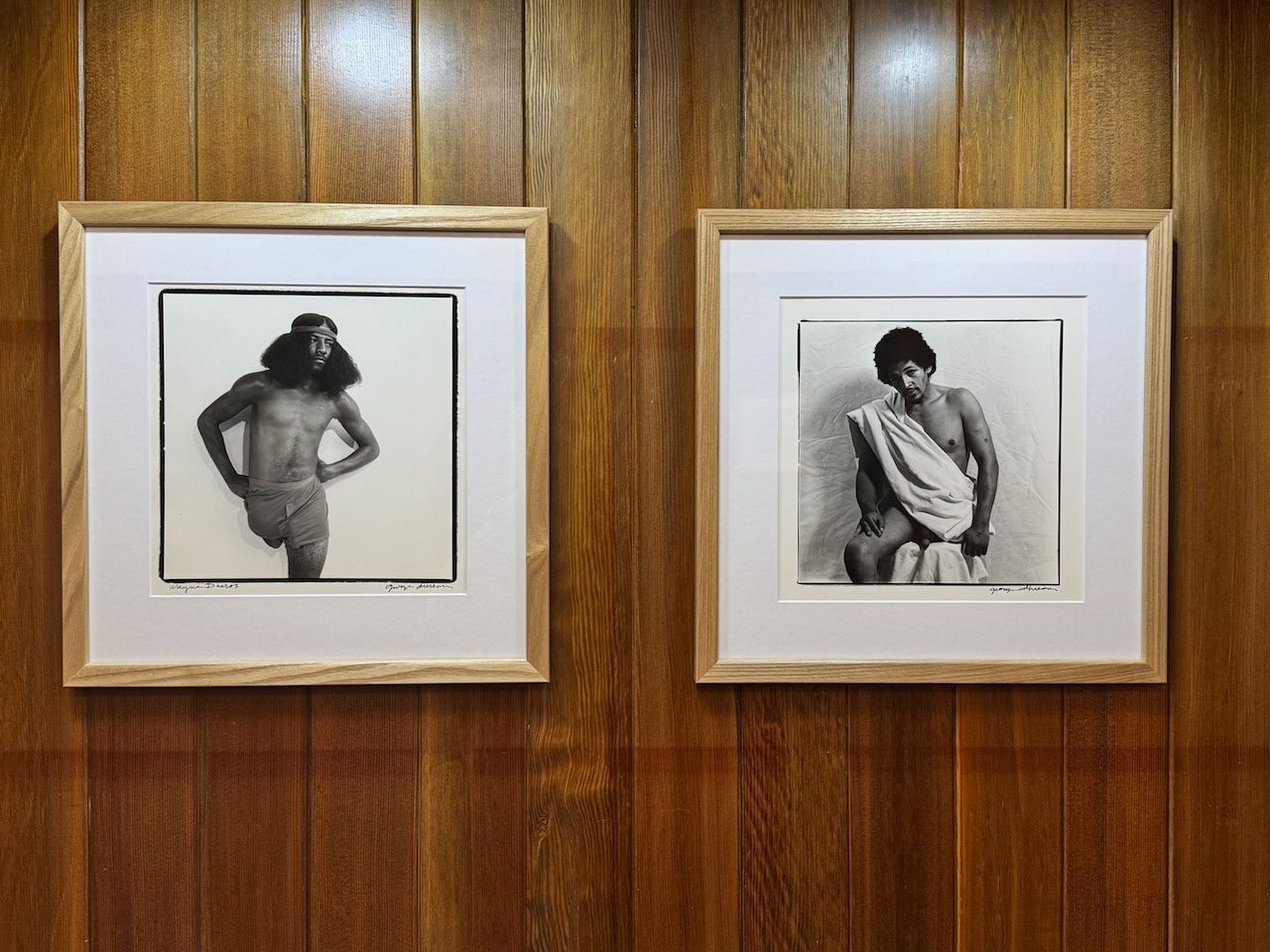
Thursday 11am – 8pm
Friday – Sunday 11am – 7pm
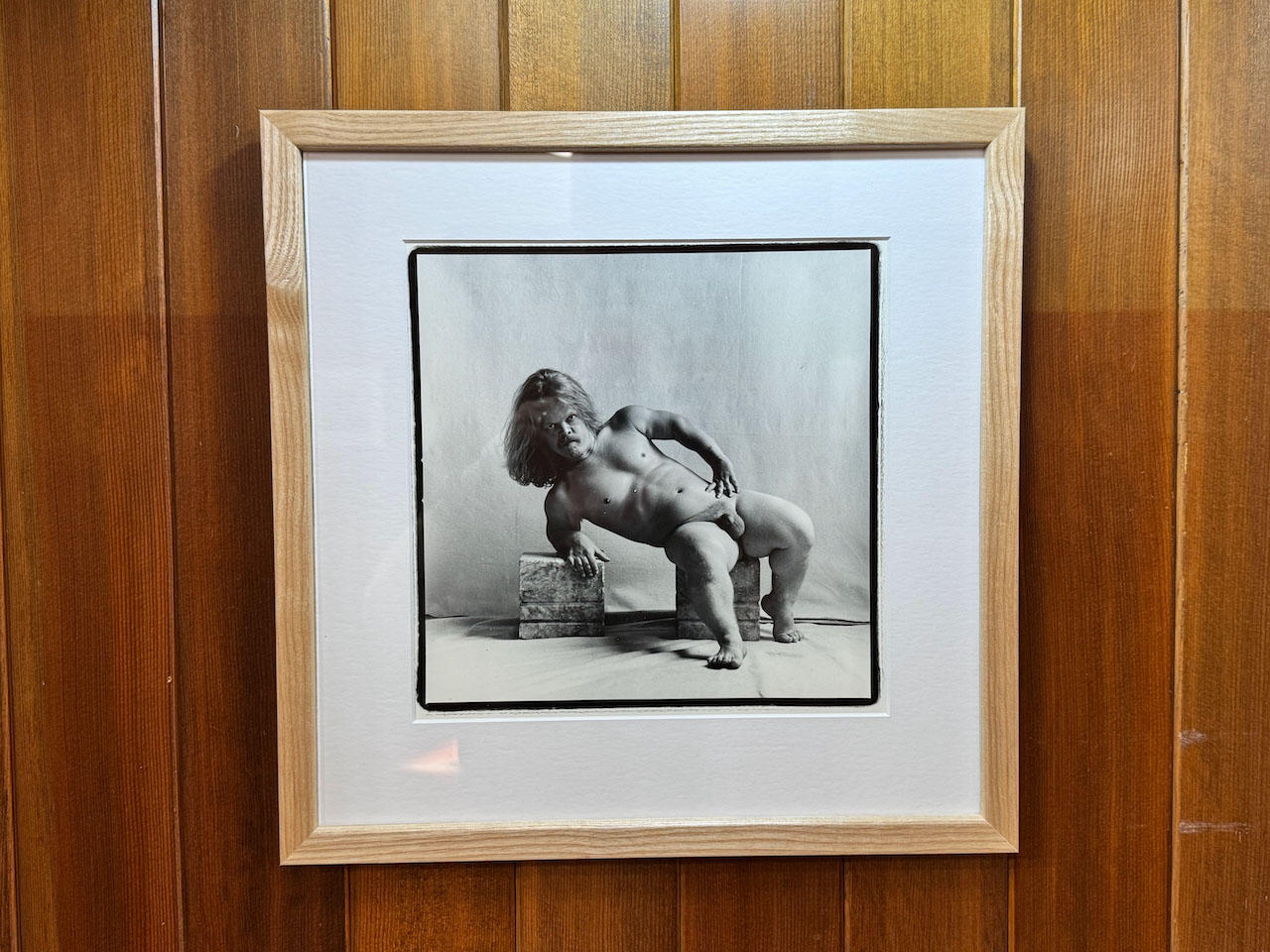
Museum für Fotografie website
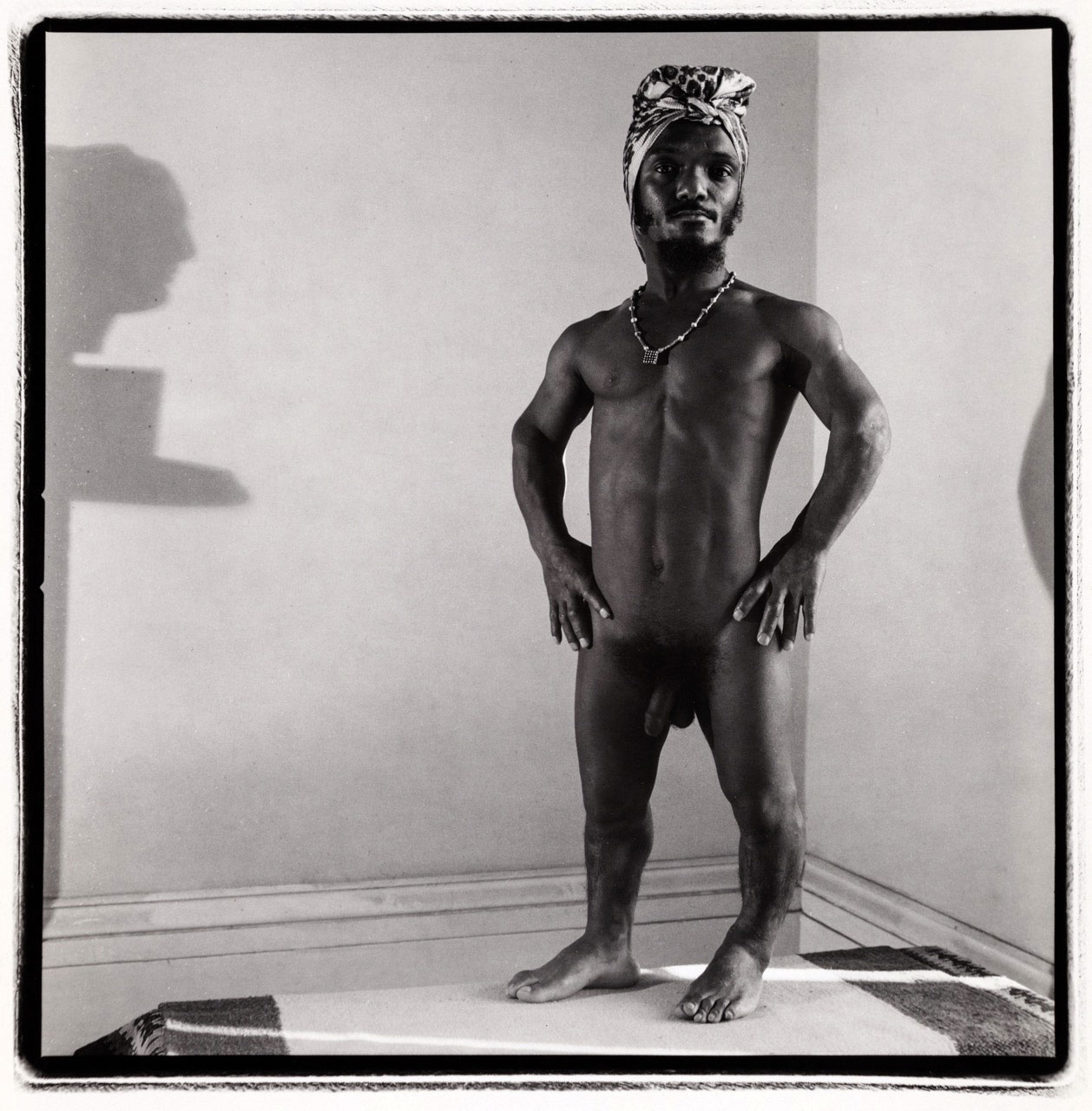
LIKE ART BLART ON FACEBOOK

Back to top