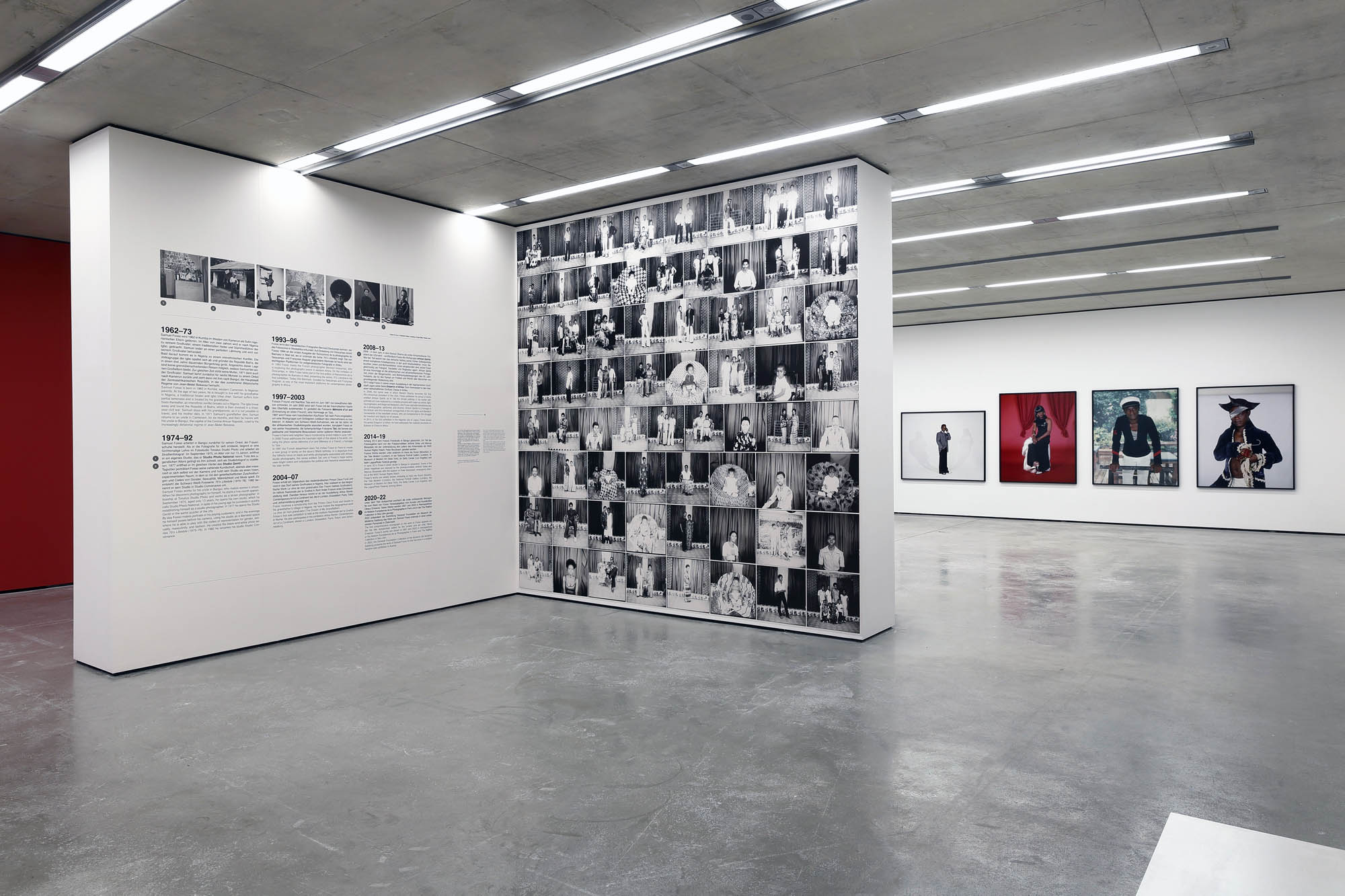
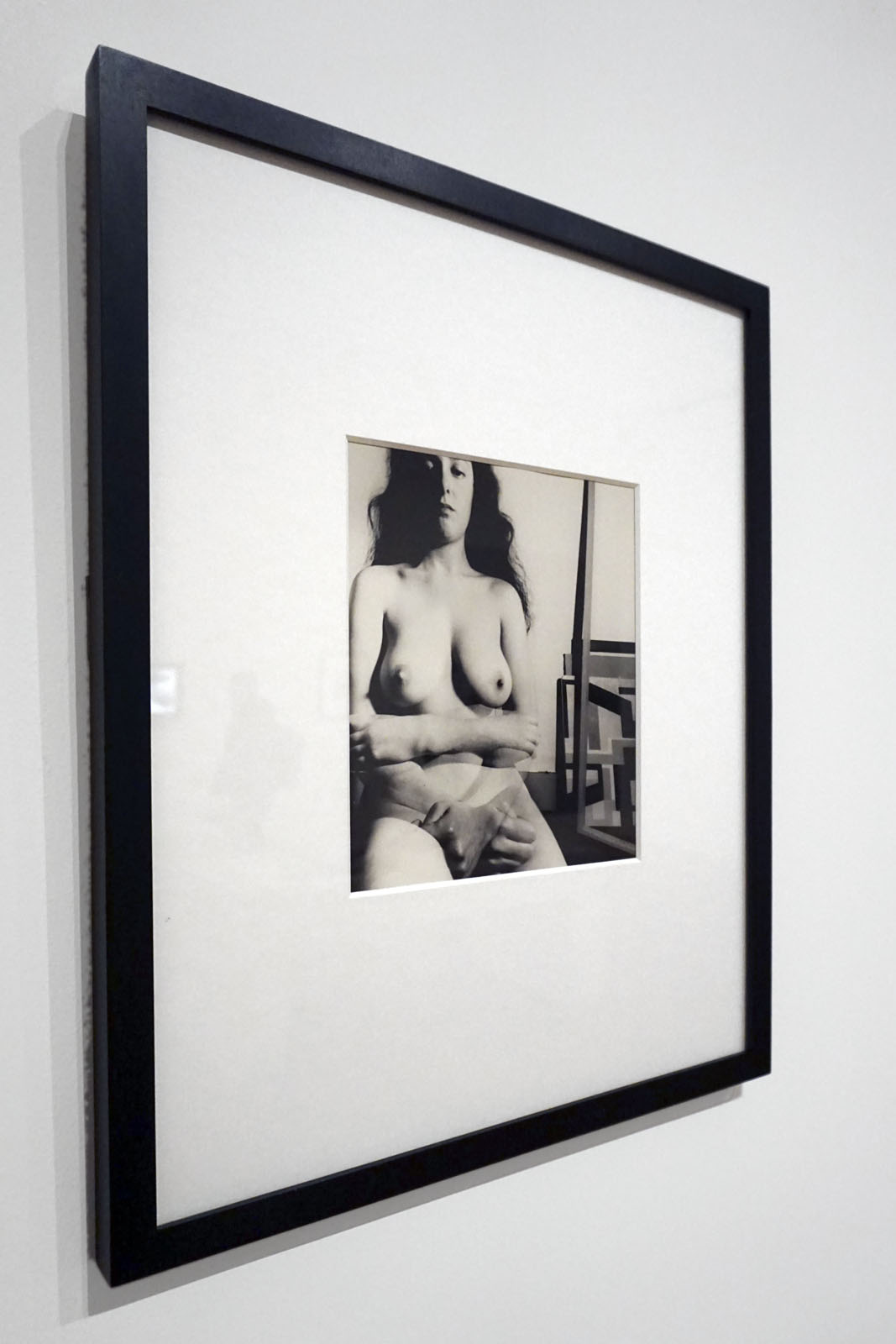
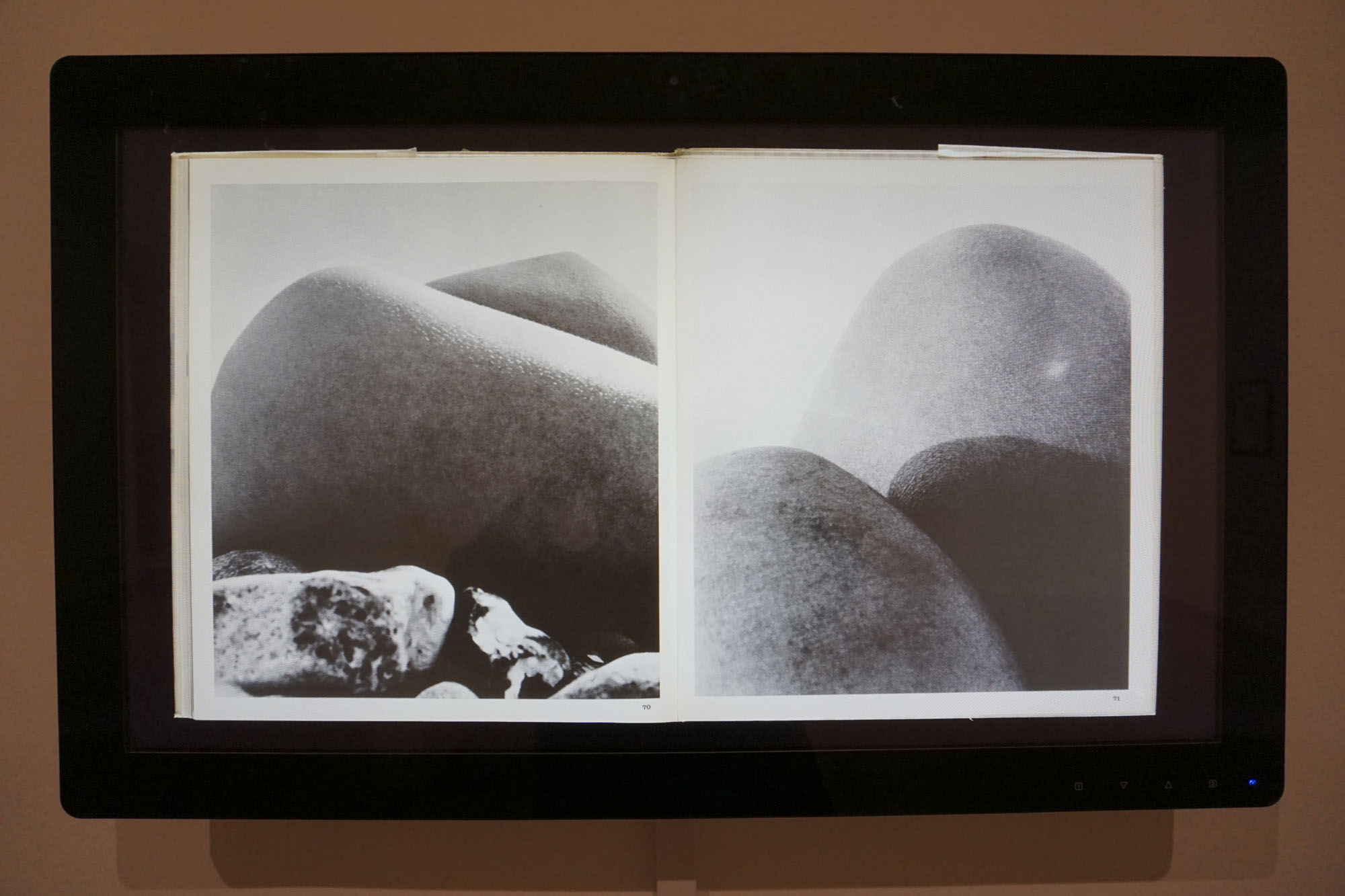
Exhibition: ‘Femme Fatale: Gaze – Power – Gender’ at the Hamburger Kunsthalle, Hamburg

Exhibition dates: 9th Dec 2022 – 10th April 2023

Curator: Dr. Markus Bertsch
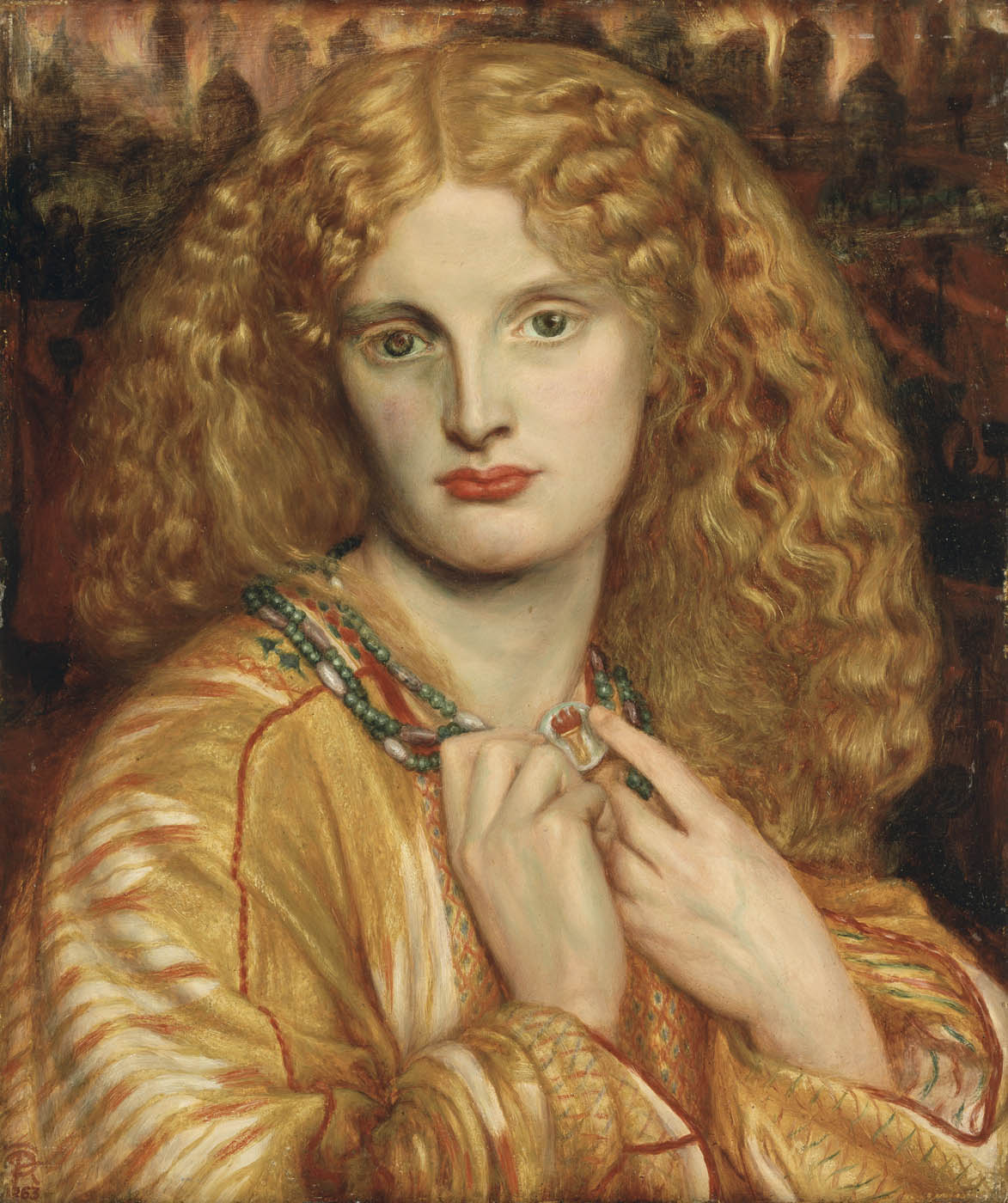
 

Dante Gabriel Rossetti (1828-1882) 'Helen of Troy' 1863


Dante Gabriel Rossetti (1828-1882)
Helen of Troy
1863
Oil on mahogany
32.8 x 27.7cm
© Hamburger Kunsthalle / bpk
Foto: Elke Walford


What a fascinating and inspired concept for an exhibition!

In order to understand the myth and construction of the femme fatale stereotype the exhibition investigates, through art and representation, concepts such as sexuality and its demonisation, the male and female gaze, white ideals of beauty, racism, Orientalism, anti-Semitism, power relations, hate, non-binary gaze, gender roles, myth and religion and black feminism. Such areas of breath are needed to examine the myth of the femme fatale.

I just wish the media images had included some photographs from the interwar avant-garde period by photographers such as Claude Cahun, Dora Maar, Eva Besnyö, Ilse Bing, Lotte Jacobi, Yva, Grete Stern, Ellen Auerbach, Aenne Biermann and Florence Henri for example – all of whom photographed the “New Woman” of the 1920s, an image which embodied an ideal of female empowerment based on real women making revolutionary changes in life and art. I hope the exhibition contains images by some of these photographers.

“The femme fatale is a myth, a projection, a construction. She symbolises a visually coded female stereotype: the sensual, erotic and seductive woman whose allegedly demonic nature reveals itself in her ability to lure and enchant men – often leading to fatal results. It is this likewise dazzling and clichéd image, long dominated by a male and binary gaze, that is in the focus of the exhibition Femme Fatale. Gaze – Power – Gender at the Hamburger Kunsthalle. Beyond exploring a range of artistic approaches to the theme from the early 19th century to the present, the show aims to critically examine the myth of the femme fatale in its genesis and historical transformation.” (Text from the Hamburger Kunsthalle website)

Dr Marcus Bunyan

PS. I have added further images and bibliographic information about the artists to the posting.


Many thankx to the Hamburger Kunsthalle for allowing me to publish the photographs in the posting. Please click on the photographs for a larger version of the image.


The male gaze places women in the context of male desire, essentially portraying the female body as eye candy for the heterosexual man. By valuing the desires of the male audience, the male gaze supports the self-objectification of women.

According to the Theory of Gender and Power (Robert Connell), the sexual division of power reproduces inequities in power between men and women which are maintained by social mechanisms such as the abuse of authority and control in relationships.


Femme Fatale


Pages from 'Doing Feminism – With Art!' booklet to the exhibition 'Femme Fatale. Gaze – Power – Gender' showing in the bottom posting, the room layout with sections to the exhibition


Pages from Doing Feminism – With Art! booklet to the exhibition Femme Fatale. Gaze – Power – Gender showing in the bottom posting, the room layout with sections to the exhibition


The femme fatale is a myth, a projection, a construction. She symbolises a visually coded female stereotype: the sensual, erotic and seductive woman whose allegedly demonic nature reveals itself in her ability to lure and enchant men – often leading to fatal results. It is this likewise dazzling and clichéd image, long dominated by a male and binary gaze, that is in the focus of the exhibition Femme Fatale. Gaze – Power – Gender at the Hamburger Kunsthalle. Beyond exploring a range of artistic approaches to the theme from the early 19th century to the present, the show aims to critically examine the myth of the femme fatale in its genesis and historical transformation.

The “classical” image of the femme fatale feeds above all on biblical and mythological female figures such as Judith, Salome, Medusa or the Sirens, who were widely portrayed as calamitous women in art and literature between 1860 and 1920. Characteristic of the femme fatale figure is the demonisation of female sexuality associated with these narratives. Around 1900, the femme fatale image was frequently projected onto real people, mainly actors, dancers or artists such as Sarah Bernhardt, Alma Mahler or Anita Berber. What is striking here is the simultaneity of important achievements of women’s emancipation and the increased appearance of this male-dominated image of women. In the sense of a counter-image that playfully picks up on aspects of the femme fatale figure, the New Woman, an ideal emerging well into the 1920s, also becomes important for the exhibition. A decisive caesura was set in the 1960s by feminist artists concerned with deconstructing the myth of the femme fatale – along with the corresponding viewing habits and pictorial traditions. Current artistic positions, in turn, deal with traces and appropriations of the archetypic image or establish explicit counter-narratives – often with reference to the #MeToo movement, questions of gender identities, female corporeality and sexuality, and by addressing the topic of the male gaze.

To investigate the constellations of gaze, power and gender that are constitutive for the image of the femme fatale and its transformations over time, the exhibition has assembled around 200 exhibits spanning a broad range of media and periods. On display will be paintings by Pre-Raphaelite artists (including Evelyn de Morgan, Dante Gabriel Rossetti, John William Waterhouse) alongside Symbolist works (such as Fernand Khnopff, Gustave Moreau, Edvard Munch and Franz von Stuck), works of Impressionism (including Lovis Corinth, Max Liebermann, Édouard Manet, Max Slevogt), of Expressionism and New Objectivity (Dodo, Jeanne Mammen, Gerda Wegener, among others). The featured positions of the early feminist avant-garde (including VALIE EXPORT, Birgit Jürgenssen, Ketty La Rocca, Maria Lassnig, Betty Tompkins) along with current works based on queer and intersectional feminist perspectives (Nan Goldin, Mickalene Thomas, Zandile Tshabalala, among others), build a bridge all the way to the present.

Text from the Hamburger Kunsthalle website


Chapters of the exhibition


Carl Joseph Begas (1794-1854) 'Die Lureley' 1835


Carl Joseph Begas (German, 1794-1854)
Die Lureley
1835
Oil on canvas
124.3 × 135.3cm
© Begas Haus – Museum für Kunst und Regionalgeschichte Heinsberg


Dangerous waters – Lorelei and her ‘fatal’ sisters

During the Romantic era, the element of water was often associated with the idea of dangerous femininity. The figure of Lorelei, in particular, was widely and diversely interpreted in numerous works of art, music and literature. Clemens Brentano laid the foundation for the legend of Lorelei with his ballad Zu Bacharach am Rheine…, written in 1801. Here, for the first time, a female figure was linked to the Lorelei – a large slate rock on the bank of the river Rhine that was known for producing an unusual echo. The broad popular appeal of this legend began with the publication of Heinrich Heine’s poem Die Lore-Ley in 1824 and continued to grow throughout the century. Although neither Brentano nor Heine stylised Lorelei as a femme fatale, many 19th-century artistic representations of this myth reduced the female figure to her siren-like, demonic qualities. The legend of Lorelei also has a remarkable resonance in contemporary art: in her video work “das Schöne muss sterben!”, for example, Gloria Zein transfers the narrative into the urban present, giving it an ironic twist and reflecting critically on the power of beauty; Aloys Rump traces the myth that surrounds this famous rock in the Rhine back to its material origins, exposing the Lorelei legend as pure invention and projection.

Aestheticized, demonized, sexualized: the femme fatale in the Victorian age

The 19th-century image of the femme fatale was largely shaped by the Pre-Raphaelite Brotherhood. This group of English artists around Dante Gabriel Rossetti and Edward Burne-Jones was founded in 1848. Drawing on ancient myths and works of English literature, the Pre-Raphaelites (as they were later known) established a very specific ideal of beauty. Their depictions above all featured female figures to whom destructive or even fatal qualities had traditionally been attributed, such as Lilith, Medea, Circe and Helen of Troy. The Pre-Raphaelites deliberately emphasised the contrast between the subjects’ mythological demonisation and their visualisation as sensual beings of ethereal beauty. Later artists who were influenced by the Pre-Raphaelites created increasingly eroticised depictions of women, portraying them as both an ideal and a vision of fear. John William Waterhouse’s painting of Circe, for example, explicitly links her power to her both enchantingly and threateningly seductive nature. John Collier’s highly sexualised interpretation of Lilith, meanwhile, presents the mythic figure primarily as an object of male desire. This white, Victorian ideal of femininity and beauty, along with its (re-)presentation in a museum context, is reflected by Sonia Boyce in her video installation Six Acts. This work emerged from a critical intervention she performed at Manchester Art Gallery in 2018.

Sexuality & Demonisation

The term femme fatale originally describes a sensual, erotically seductive woman who puts men in danger and plunges them into their misfortune – not seldom with deadly consequences. In his painting Lilith, John Collier also illustrated such a prototype of a femme fatale. Here, the woman’s body is excessively sexualised and her sexuality demonised. This narrative also suggests: a woman’s lust is something dangerous. Even today, women are often morally condemned when they live out their sexuality openly. How can that be? Female lust is declared taboo, while male lust is celebrated? That is indeed problematic. However: the figure of the femme fatale is by now often appropriated by women as an instrument for self-empowerment.

Doing Feminism – With Art! booklet to the exhibition


John William Waterhouse (1849-1917) 'Circe offering the cup to Ulysses' 1891


John William Waterhouse (1849-1917)
Circe offering the cup to Ulysses
1891
Oil on canvas
148 cm × 92cm
© Gallery Oldham


John William Waterhouse RA (6 April 1849 – 10 February 1917) was an English painter known for working first in the Academic style and for then embracing the Pre-Raphaelite Brotherhood’s style and subject matter. His artworks were known for their depictions of women from both ancient Greek mythology and Arthurian legend.

Born in Rome to English parents who were both painters, Waterhouse later moved to London, where he enrolled in the Royal Academy of Art. He soon began exhibiting at their annual summer exhibitions, focusing on the creation of large canvas works depicting scenes from the daily life and mythology of ancient Greece. Many of his paintings are based on authors such as Homer, Ovid, Shakespeare, Tennyson, or Keats. Waterhouse’s work is displayed in many major art museums and galleries, and the Royal Academy of Art organised a major retrospective of his work in 2009.

Text from the Wikipedia website


Binarity: male & female gaze

What is the male gaze actually all about?

The male gaze refers to the concept of a predominant masculine perspective; it represents the systematic use of male control in our society and its impact on us. The term was coined by feminist film theorist Laura Mulvey who in the 1970s drew attention to how women in films were mostly portrayed as objects catering to the fantasies of heterosexual males. It was soon applied to other genres such as fashion, literature, music and art – and widely adopted in the everyday world. Whether in film, advertising, in novels, on the street, at school, during training or at university: the male gaze is omnipresent. It condemns, objectifies, defines standards and ideals, oppresses and classifies: male= active, female=passive. We all grew up with the phenomenon and are confronted with it on an everyday basis. As a result, all of us, including women and non-binary people, have more or less internalised it. Whether consciously or unconsciously, especially these groups tend to see themselves through a kind of mirror, anticipating the male gaze. But: understanding the male gaze also means being able to unlearn it.

Doing Feminism – With Art! booklet to the exhibition


John Collier (English, 1850-1934) 'Lilith' 1887


John Collier (English, 1850-1934)
Lilith
1887
Oil on canvas
194 × 104cm (76 × 41 in)
Atkinson Art Gallery and Library, Southport, Merseyside, England
© The Atkinson
Public domain


Lilith is an 1889 painting by English artist John Collier, who worked in the style of the Pre-Raphaelite Brotherhood. The painting of the Jewish mythic figure Lilith is held in the Atkinson Art Gallery in Southport, England. It was transferred from Bootle Art Gallery in the 1970s.

Collier portrayed Lilith as a golden-haired, porcelain-skinned beautiful nude woman who fondles on her shoulder the head of a serpent, coiled around her body in a passionate embrace. Against the background of a dark, brown-green jungle, stands a naked female figure, whose pale skin and long blond hair falling down her back form a stark contrast with the forest. The head position and gaze of Lilith are turned away from the viewer, concentrating on the snake’s head resting on her shoulder. The snake encircles her body in several coils, starting around its closely spaced ankles, past the knee, to her lower abdomen, where it thereby conceals. Lilith supports the snake’s body with her hands in the area of ​​her upper body, so that the snake’s head can lie over her right shoulder up to her throat. Lilith’s head is bent towards the snake, her cheek nestles against the animal. The brown tones of the snake’s body stand out in contrast with the pale woman’s body, but take up the colour scheme of the surrounding jungle. Collier presented his painting inspired by fellow painter and poet Dante Gabriel Rossetti’s 1868 poem Lilith, or Body’s Beauty, which describes Lilith as the witch who loved Adam before Eve. Her magnificent tresses gave the world “its first gold,” but her beauty was a weapon and her charms deadly.

The magazine The British Architect described the work in 1887: “Here is a nude woman, whose voluptuous, round form is most gracefully represented, surrounded by a great serpent, the thickest part of which crosses it horizontally and cuts it in half; her head slides down her chest and she seems to be pulling it in tighter coils. The background is a coarse kind of green, repulsive and abominable.”

Text from the Wikipedia website


Dante Gabriel Rossetti (British, London 1828 - 1882 Birchington-on-Sea) Henry Treffry Dunn (British, Truro 1838 - 1899 London) 'Lady Lilith' 1867


Dante Gabriel Rossetti (British, London 1828 – 1882 Birchington-on-Sea)
Henry Treffry Dunn (British, Truro 1838 – 1899 London)
Lady Lilith
1867
Watercolour and gouache
20 3/16 X 17 5/16 in. (51.3 x 44cm)
The Metropolitan Museum of Art, New York, Rogers Fund, 1908
© The Metropolitan Museum of Art, New York


Fascinated by women’s physical allure, Rossetti here imagines a legendary femme fatale as a self-absorbed nineteenth-century beauty who combs her hair and seductively exposes her shoulders. Nearby flowers symbolise different kinds of love. In Jewish literature, the enchantress Lilith is described as Adam’s first wife, and her character is underscored by lines from Goethe’s Faust attached by Rossetti to the original frame, “Beware … for she excels all women in the magic of her locks, and when she twines them round a young man’s neck, she will not ever set him free again.” The artist’s mistress, Fanny Cornforth, is the sitter in this watercolour, which Rossetti and his assistant Dunn based on an oil of 1866 (Delaware Art Museum).

Text from the Metropolitan Museum of Art website


Lady Lilith is an oil painting by Dante Gabriel Rossetti first painted in 1866-1868 using his mistress Fanny Cornforth as the model, then altered in 1872-1873 to show the face of Alexa Wilding. The subject is Lilith, who was, according to ancient Judaic myth, “the first wife of Adam” and is associated with the seduction of men and the murder of children. She is shown as a “powerful and evil temptress” and as “an iconic, Amazon-like female with long, flowing hair.” …

A large 1867 replica of Lady Lilith, painted by Rossetti in watercolour, which shows the face of Cornforth, is now owned by New York’s Metropolitan Museum of Art. It has a verse from Goethe’s Faust as translated by Shelley on a label attached by Rossetti to its frame:

“Beware of her fair hair, for she excels
All women in the magic of her locks,
And when she twines them round a young man’s neck
she will not ever set him free again.”

Text from the Wikipedia website


White Ideals (of Beauty)

Apparently, the ideal is the white woman. She is thought to be pure, innocent and therefore endearing. This racist idea reaches from colonial times all the way to the present day. In 2022 alone, it can be found in several social media trends. One of them is the clean girl look on TikTok.

But what is behind all this and who is the trend actually for? The clean girl aesthetic gone viral is rather minimalistic: simple clothes, subtle make-up with delicate lip gloss and small gold creole earrings. With this look, young women want to represent themselves as so-called “girl bosses”, meaning women who have everything under control. This, however, is no more than a male fantasy. It has nothing to do with real people. The clean girl image also reinforces perceptions of which kind of women are more socially accepted. Namely, those who, like the clean girl, have “smooth and porcelain-like skin”. This Eurocentric ideal of beauty can already be detected in the nineteenth-century work Lady Lilith by Dante Gabriel Rossetti. Lady Lilith‘s skin is ivory white; she is combing her hair smooth, which is still wavy at the hairline. In the clean girl look hair is also straight, usually tied into a tight braid or chignon. Curly hair is excluded – and along with it especially Black people with Afro hair. Their natural appearance is thus portrayed as dirty in contrast to the allegedly pure clean girl look – a racist narrative that continues to try to position Black women in particular as inferior in society. Whereas, some of those characteristics appearing in the clean girl look originally were appropriated from Black Culture and then minimised: big gold creoles and gel-combed hairdos are just two of many examples. The clean girls with the most TikTok views represent this kind of standard beauty: thin, white and wearing expensive clothes. On the social media schoolyard, they are the ones who are considered as cool. But what they are doing while they are at it is bowing to racist, classist ideals that need to be made visible and discussed.

Doing Feminism – With Art! booklet to the exhibition


Evelyn de Morgan (English, 1855-1919) 'Medea' Nd


Evelyn de Morgan (English, 1855-1919)
Medea
Nd
Oil on canvas
148 × 88cm
© Williamson Art Gallery and Museum, Birkenhead; Wirral Museums Service
Purchased 1927


Evelyn De Morgan (30 August 1855 – 2 May 1919), née Pickering, was an English painter associated early in her career with the later phase of the Pre-Raphaelite Movement, and working in a range of styles including Aestheticism and Symbolism. Her paintings are figural, foregrounding the female body through the use of spiritual, mythological, and allegorical themes. They rely on a range of metaphors (such as light and darkness, transformation, and bondage) to express what several scholars have identified as spiritualist and feminist content.

De Morgan boycotted the Royal Academy and signed the Declaration in Favour of Women’s Suffrage in 1889. Her later works also deal with the themes of war from a pacifist perspective, engaging with conflicts like the Second Boer War and World War I.

Text from the Wikipedia website


Gustave Moreau (1826-1898) 'Oedipus and the Sphinx' 1864


Gustave Moreau (1826-1898)
Oedipus and the Sphinx
1864
Oil on canvas
206 x 104.8cm
© The Metropolitan Museum of Art, New York
Bequest of William H. Herriman, 1920


Racism

Racism means that people are subjected to depreciation exclusion or even to experiencing violence due to their origin, skin colour or religion. Racism comes in many forms. There is, for example, anti-Muslim, anti-Black or anti-Asian racism which is particularly directed against these groups. While such group based hostility was formerly justified above all by the “wrong” religious affiliation, from the 16th century on, allegedly scientific explanations became established. People were divided into different “races” from the time white people started enslaving Black people to then exploit them for economic profit in the new colonies. Today, most people are aware that there is no such thing as different “human races”. Instead, it is the different “social background” or “culture” that now is often used as an argument to racially stigmatise people. The ‘others’ may be described as ‘primitive’ and ‘uncultivated’, sometimes exoticised or sexualised. Men are portrayed as libidinous, women as erotic and, quite often, as their victims. The Indian postcolonialism theorist Gayatri Chakravorty Spivak critically pinpointed this colonial perspective with the sentence: “White men are saving brown women from brown men.” This ironic statement emphasises the sense of civilisational superiority of white colonisers who saw themselves as “saviours”, but often came to the country as rapists and, on top of that, oppressed the female population in their countries of origin.

Doing Feminism – With Art! booklet to the exhibition


Jean Delville (Belgian, 1867-1953) 'The Idol of Perversity' (L'idole de la perversite) 1891


Jean Delville (Belgian, 1867-1953)
The Idol of Perversity (L’idole de la perversite)
1891


Jean Delville, The Idol of Perversity (L’idole de la perversite), 1891. Delville was a Belgian symbolist painter, author, poet and Theosophist, studying mystical and occultist philosophies. Such philosophies concentrate mainly on seeking the true origins of the universe, specifically of the divine and natural kind, believing that knowledge of ancient pasts offers a path to true enlightenment and salvation. Delville was the leading patron of Belgian Idealist movement, specifically in art circa the 1890s, having a belief system that upheld art to higher standards of substance, believing that it should express higher spiritual truth, based on principles of Ideal, or spiritual Beauty. …

The goal of the living body is to spiritualise itself and to refine our material selves, meaning to elevate ourselves to the level of not requiring or wanting things that are just of material value. Without a spiritual path or goal, men and women that walk the earth become slaves to their material possessions, forever destined to succumb to the desires, passions, greed, and egotistic need to always seek power over one another. Under this belief, the physical world we live in becomes the land of Satan, and those without a spiritual goal become merely his slaves. According to Delville, the first step to true enlightenment is to gain power over earthly temptations, such as promiscuity and erotic temptation. Truly enlightened soul is one that can use the power of his mind to rise above the temptations of, what was believed “unquenched bestial desires of a woman”. In late nineteenth century femme fatale embodied the kind of misogynistic idea that women were lower on the evolutionary scale, and female sex was that of animalistic, monstrous and aggressive, hence, the femme fatale characterisation, meaning that women’s grotesque sexual desires led men away from their spiritual goals, and thus driving them to live a life in sin, forever slaves to the Devil. In this painting Delville portrays the femme fatale as an almost demonic entity, with the bellow angel as to show her looming over the viewer, with an almost phallic snake, reminiscent of Franz von Stuck’s Sin, slithering between her pointed breasts. This image is a direct representation of Delville’s esoteric ideologies of material versus spiritual.

Art Universal. “Jean Delville, The Idol of Perversity (L’idole de la perversite), 1891,” on the Art Universal website August 8, 2017 [Online] Cited 03/03/2023


Fernand Khnopff (1858-1921) 'Who Shall Deliver Me? (Christina Georgina Rossetti)' 1891


Fernand Khnopff (1858-1921)
Who Shall Deliver Me? (Christina Georgina Rossetti)
1891
Conté pen and coloured pencil on paper
21.9 x 13cm
© The Hearn Family Trust


Enigmatic images – the femme fatale in Symbolist art

Fantastical scenarios, imaginary dream worlds and psychological depths are the defining characteristics of Symbolism, a cultural movement that flourished throughout Europe from the 1880s onwards. The image of the femme fatale is also omnipresent in Symbolist art, but in these depictions, the female subjects often have an enigmatic, other-worldly appearance and their meaning is ambiguous. As the epitome of the cliché of ‘female mystery’, the sphinx is a prominent motif in Symbolist art. The image of this malevolent creature – a hybrid of woman, lion and bird – was strongly influenced by Gustave Moreau’s Oedipus and the Sphinx, an important early work by the painter. Moreau’s orientalised and eroticised interpretation of Salome as an ornamental figure also shaped the perception of her as a femme fatale. A similar composition featuring a vision of John the Baptist’s floating head is found in Odilon Redon’s Apparition. His figures, however, are even further removed from objective representation and concrete corporeality. These kinds of mystifying depictions were also interpreted and elaborated by other Symbolist artists, above all in Belgium and the Netherlands. In Fernand Khnopff’s subtle drawings, the femme fatale appears as a mysterious, ambiguous projection, addressing the themes of stereotypical femininity and androgyny.

Focussing on the body – interpretations of the femme fatale in Munich

In contrast to the enigmatic dream worlds of French and Belgian Symbolism, the depictions of femmes fatales by artists of the Munich School focus more explicitly on women’s bodies. Carl Strathmann’s large-format interpretations of Gustave Flaubert’s historical novel Salammbô, which was frequently adapted in France, place the titular female figure in an ornamental Art Nouveau setting that is typical of the period. Franz von Stuck and Franz von Lenbach, on the other hand, focus on concrete physical realities; while their paintings are set in mythological and biblical contexts, they are mainly aimed at representing nudity. In Stuck’s interpretation of the Sphinx, for example, the subject is no longer depicted as a hybrid creature, but is a purely human, naked woman. Only the posture of the nude, who is reduced to her physicality and sensuality, recalls a sphinx. This kind of sexualization in images of femmes fatales often involves constructing a supposed ‘otherness’ of the depicted subject. Through the incorporation of orientalising elements and antisemitic attributions such as the stereotype of the ‘beautiful Jewess’, female subjects – above all Judith and Salome – are presented as alluring and desirable, but are at the same denigrated as ‘other’.

Orientalism

Turbans, veils, sabres, teacups, palm trees, colourful carpets and nude women in harems – this cliché-ridden image of the ‘Orient’ was spread in the West and was a major theme especially in nineteenth-century painting. In 1978, the Palestinian-American literature professor Edward Said published a book entitled Orientalism in which he characterised this image as a Western invention. By describing the ‘Orient’, meaning roughly those regions now called North Africa and the Near and Middle East, as ‘alien’ and ‘backward’, the West was able to present itself as culturally superior. This, at the same time, made it easier to justify imperialist ambitions to subjugate and exploit these regions. Orientalism has been typified by rejection and attraction alike: the people and customs of the region are portrayed as irrational, lazy and dishonest just as much as sensual, pleasure-oriented and seductive. A widespread symbol of this in painting was the figure of the “Odalisque”, a white slave girl, preferably drawn naked in the bath. She strikingly exemplifies the kind of fantasies that (mainly) white European men would live out in their depictions of the Orient: at once a ‘chaste’ victim of ‘Oriental’ tyrants and a ‘sinful’ seductress of Western conquerors. Many of these Orientalist clichés have survived to this day and can also be found, in anti-Muslim racisms, for example.

Doing Feminism – With Art! booklet to the exhibition


Bruno Piglhein (German, 1848-1894) 'Egyptian Sword Dancer' 1891


Bruno Piglhein (1848-1894)
Egyptian Sword Dancer
1891
Oil on canvas
138 × 89cm
Private collection
© Courtesy Kunkel Fine Art, München


Franz Von Stuck (German, 1863-1928) 'Judith and Holofernes' 1926


Franz Von Stuck (German, 1863-1928)
Judith and Holofernes
1926
Oil on canvas
157 × 83cm
Staatliche Schlösser, Gärten und Kunstsammlungen Mecklenburg-Vorpommern, Schwerin
© Staatliche Schlösser, Gärten und Kunstsammlungen Mecklenburg-Vorpommern, Staatliches Museum Schwerin
Foto: Elke Walford


Anti-Semitism

The term anti-Semitism describes a hostile attitude towards Jews. It manifests itself in various forms, from prejudice, to insults, to violence. Anti-Semitism, which has existed for thousands of years, is the oldest known form of group-specific hatred of people, regardless of gender. Its worst manifestation was during German National Socialism under Adolf Hitler when over six million Jewish people were murdered between 1933 and 1945 in Europe. What distinguishes anti-Semitism from other forms of discrimination is the idea of a cultural and economic superiority of the group being attacked, unlike, for example, racism or Islamophobia, where the counterpart is usually devalued. Instead of labelling Jews as backward, in stereotypes they often appear as representatives of a modern and sophisticated worldview, which is, however, portrayed as ‘decadent’ and ‘threatening’. Conspiracy theories also often contain anti-Semitic elements, as it is imagined that all Jewish people are wealthy, influential and well-connected and thus able to act as secret ‘string-pullers’ in international affairs. Anti-Semitic prejudices often refer to categories such as wealth and power, sexuality or external characteristics.

Visually, anti-Semitic body stereotypes are sometimes expressed through the depiction of large, crooked noses (‘hooknose’), bulging lips, narrow eyes, hunched posture, bowlegs and flat feet. Somewhat more subtle, but no less problematic, is the stereotype of the “beautiful Jewess”. This cliché image from art and literature around 1900 often showed Jewish women as smart, beautiful and seductive, but at the same time marked them as ‘foreign’ and ‘different’, for example, based on orientalising elements such as jewellery, etc.

Doing Feminism – With Art! booklet to the exhibition


Antonin Idrac (French, 1849-1884) 'Salammbô' 1882


Antonin Idrac (French, 1849-1884)
Salammbô
1882
Plaster
Height: 182cm (71.6 in); width: 53 cm (20.8 in); depth: 71cm (27.9 in)
Musée des Augustins
Public domain


Carl Strathmann (German, 1866-1939) 'Salammbô' 1894


Carl Strathmann (German, 1866-1939)
Salammbô
1894
Mixed media on canvas
187.5 x 287cm


Strathmann’s curious work occupies an intermediate position between the art of painting and the crafts. His paintings are strange concoctions studded with colored glass and artificial gems, foreshadowing similar extravagances by the Viennese Jugendstil painter Gustav Klimt. In Strathmann’s painting Salammbô, inspired by Flaubert’s novel, the Carthaginian temptress reclines on a carpet spread out on a flower-strewn meadow. Swathed in veils whose design is as complex as that of the harp beside her head, she submits to the kiss of the mighty snake that encircles her. Lovis Corinth described how Strathmann, while working on the large picture, gradually covered the originally nude model with “carpets and fantastic garments of his own invention so that in the end only a mystical profile and the fingers of one hand protruded from a jumble of embellished textiles. … coloured stones are sparkling everywhere; the harp especially is aglitter with fake jewels.” According to Corinth, Strathmann knew “how to glue and sew” these on the canvas “with admirable skill.”

Anonymous. “Carl Strathmann, Salammbô,” on the Dark Classics website 12/05/2011 [Online] Cited 01/03/2023


Arnold Böcklin (Swiss, 1827-1901) 'Sirens' 1875


Arnold Böcklin (Swiss, 1827-1901)
Sirens
1875
Tempera on canvas
Height: 46cm (18.1 in); width: 31cm (12.2 in)
Alte Nationalgalerie
Public domain


Arnold Böcklin (16 October 1827 – 16 January 1901) was a Swiss symbolist painter. …

Influenced by Romanticism, Böcklin’s symbolist use of imagery derived from mythology and legend often overlapped with the aesthetic of the Pre-Raphaelites. Many of his paintings are imaginative interpretations of the classical world, or portray mythological subjects in settings involving classical architecture, often allegorically exploring death and mortality in the context of a strange, fantasy world.

Böcklin is best known for his five versions (painted 1880 to 1886) of the Isle of the Dead, which partly evokes the English Cemetery, Florence, which was close to his studio and where his baby daughter Maria had been buried. An early version of the painting was commissioned by a Madame Berna, a widow who wanted a painting with a dreamlike atmosphere.

Clement Greenberg wrote in 1947 that Böcklin’s work “is one of the most consummate expressions of all that is now disliked about the latter half of the nineteenth century.”

Text from the Wikipedia website


Franz Von Stuck (1863-1928) 'Sphinx' 1904


Franz Von Stuck (German, 1863-1928)
Sphinx
1904
Oil on canvas
83 × 156.5cm
© Loan from the Federal Republic of Germany as a permanent loan to the Hessian State Museum in Darmstadt
Foto: Wolfgang Fuhrmannek, HLMD


Franz Ritter von Stuck (February 23, 1863 – August 30, 1928), born Franz Stuck, was a German painter, sculptor, printmaker, and architect. Stuck was best known for his paintings of ancient mythology, receiving substantial critical acclaim with The Sin in 1892. In 1906, Stuck was awarded the Order of Merit of the Bavarian Crown and was henceforth known as Ritter von Stuck. …

Stuck’s subject matter was primarily from mythology, inspired by the work of Arnold Böcklin. Large forms dominate most of his paintings and indicate his proclivities for sculpture. His seductive female nudes are a prime example of popular Symbolist content. Stuck paid much attention to the frames for his paintings and generally designed them himself with such careful use of panels, gilt carving and inscriptions that the frames must be considered as an integral part of the overall piece.

Text from the Wikipedia website


Gustav Adolf Mossa (1883–1971) 'The Satiated Siren' (Die gesättigte Sirene) 1905


Gustav Adolf Mossa (French, 1883-1971)
The Satiated Siren (Die gesättigte Sirene)
1905
Oil on canvas
81 × 54cm
Musée des Beaux-Arts, Nizza
© VG Bild-Kunst, Bonn 2022
Foto: Michel Graniou


Gustav-Adolf Mossa (28 January 1883 – 25 May 1971) was a French illustrator, playwright, essayist, curator and late Symbolist painter. …


Symbolist paintings

Mossa’s decade long Symbolist period (1900-1911) was his most prolific and began as a reaction to the recent boom of socialite leisure activity on the French Rivera, his works comically satirising or condemning what was viewed as an increasingly materialistic society and the perceived danger of the emerging New Woman at the turn of the century, whom Mossa appears to consider perverse by nature.

His most common subjects were femme fatale figures, some from Biblical sources, such as modernised versions of Judith, Delilah and Salome, mythological creatures such as Harpies or more contemporary and urban figures, such as his towering and dominant bourgeoise woman in Woman of Fashion and Jockey. (1906). His 1905 work Elle, the logo for the 2017 Geschlechterkampf exhibition on representations of gender in art, is an explicit example of Mossa’s interpretation of malevolent female sexuality, with a nude giantess sitting atop a pile of bloodied corpses, a fanged cat sitting over her crotch, and wearing an elaborate headress inscribed with the Latin hoc volo, sic jubeo, sit pro ratione voluntas (What I want, I order, my will is reason enough).

Many aspects of Mossa’s paintings of this period were also indictive of the decadent movement, with his references to Diabolism, depictions of lesbianism (such as his two paintings of Sappho), or an emphasis on violent, sadistic or morbid scenes.

Though these paintings are the subject of most present day exhibitions, scholarly articles and books on the artist, they were not released to the public until after Mossa’s death in 1971.

Text from the Wikipedia website


Inverted images – the femme fatale turns grotesque

In the late 19th century, artists began using exaggeration and caricature to highlight the grotesque, bizarre and absurd qualities of the femme fatale motif, suggesting that the traditional image of the wickedly seductive enchantress had become redundant. While these inverted images of the femme fatale illustrate the constructed nature of this concept, they in turn employ clichés of demonic femininity. Arnold Böcklin gives an ironic, grotesque twist to a popular artistic motif in his painting Sirens, where the typically emphasised seductiveness of the hybrid creatures appears to have the opposite effect. In Gustav-Adolf Mossa’s The Satiated Siren, meanwhile, the siren’s outstanding feature is her bloodthirsty instinct. In Carl Strathmann’s almost humorously exaggerated depiction of the Head of Medusa, on the other hand, Medusa’s petrifying gaze is no longer intended to shock the viewer. Although ancient myths still provided the subject matter for these interpretations, they were increasingly losing their exemplary function and could often only be transposed to the present in a grotesque guise. Aubrey Beardsley’s illustrations after Oscar Wilde’s play Salome (1893) were highly influential; while these also contained some vividly macabre motifs, the unmistakable ornamental aesthetic of defined lines and flat spatial planes made them appear less frightening.


Carl Strathmann (German, 1866-1939) 'Head of Medusa' c. 1897


Carl Strathmann (German, 1866-1939)
Head of Medusa
c. 1897
Watercolour and ink
69.8 cm x 69.5cm
Münchner Stadtmuseum, Sammlung
CC BY-SA 4.0


Carl Strathmann (11 September 1866, Düsseldorf – 29 July 1939, Munich) was a German painter in the Art Nouveau and Symbolist styles.

His father, also named Carl Strathmann, was a merchant and manufacturer, who later served as consul in Chile. His mother, Alice, was originally from Huddersfield, England, and was an art enthusiast. From 1882 to 1886, he studied at the Kunstakademie Düsseldorf, with Hugo Crola, Heinrich Lauenstein and Adolf Schill. After being dismissed for a “lack of talent”, he enrolled at the Grand-Ducal Saxon Art School, Weimar where, from 1888 to 1889, he studied in the master class taught by Leopold von Kalckreuth.

When Kalckreuth left, he did as well; moving to Munich, where he lived a Bohemian lifestyle as a free-lance artist, and met the painter Lovis Corinth, who became a lifelong friend and associate. In 1894, he painted one of his best known works: “Salammbô”, inspired by a novel of the same name by Gustave Flaubert. In this monumental painting (6 x 9 feet) Salammbô, a high priestess of the Carthaginians, is shown caressing a snake, as part of a ritual sacrifice. Many were horrified, calling it a “sadistic fantasy”. The scandal made him immediately famous.

Text from the Wikipedia website


Aubrey Beardsley (British, 1872-1898) 'The Toilette of Salome' (second version) 1893


Aubrey Beardsley (British, 1872-1898)
The Toilette of Salome (second version)
1893

Please note: This drawing may not be in the exhibition but Beardsley’s drawings of Salome are mentioned in the exhibition text (below)


Aubrey Beardsley (British, 1872-1898) 'J’ai baisé ta bouche Iokanaan' 1892-1893


Aubrey Beardsley (British, 1872-1898)
J’ai baisé ta bouche Iokanaan
1892-1893

Please note: This drawing may not be in the exhibition but Beardsley’s drawings of Salome are mentioned in the exhibition text (below)


Aubrey Beardsley (British, 1872-1898) 'John and Salome' 1893


Aubrey Beardsley (British, 1872-1898)
John and Salome
1893

Please note: This drawing may not be in the exhibition but Beardsley’s drawings of Salome are mentioned in the exhibition text (below)


Edvard Munch (Norwegian, 1863-1944) 'Madonna' 1895


Edvard Munch (Norwegian, 1863-1944)
Madonna
1895
Oil on canvas
90 × 71cm
Hamburger Kunsthalle, permanent loan of the Stiftung Hamburger Kunstsammlungen, acquired 1957
© SHK / Hamburger Kunsthalle / bpk
Public domain


Edvard Munch (1863-1944) 'Vampire in the forest' 1916-1918


Edvard Munch (Norwegian, 1863-1944)
Vampire in the forest
1916-1918
Oil on canvas
150 × 137cm
Munch Museet, Oslo
© Munchmuseet


Femme fatale, saint and vampire – the elevation and denigration of women in the art of Edvard Munch

Among the many images of the femme fatale that were created around 1900, Edvard Munch’s ambiguous, both positively and negatively connoted female figures occupy a place of their own. Existential questions and universal themes such as life, death, love, loss and grief are central to Munch’s art. Women are omnipresent in his compositions, appearing in a variety of roles and stereotypical depictions; at the same time, they are inseparably linked to the artist’s personal experience of life and love. The transfiguration of this experience often leads to the opposite extreme. Munch’s painting Madonna illustrates the contradictory aspects of his image of women: the depicted subject can be interpreted as a lustful femme fatale or as a saintly figure. The relationship and tension between the sexes is another leitmotif in Munch’s art. This is illustrated by his painting Vampire in the Forest, which leaves the viewer in doubt as to whether the depicted female figure is a loving woman or a bloodthirsty creature. Demonisations of femininity and female sexuality that threaten male existence appear throughout Munch’s oeuvre. They are as much an expression of his fears as of his self-stylisation as a victim – and once again reveal Munch’s image of the femme fatale to be a misogynistic projection.

Impressionist digressions – staged presentations from the theatrical to the nude

The theme of the femme fatale is even addressed in Impressionist art, which aimed to create immediate and realistic depictions rather than idealised representations. Here, however, the image was presented in very different ways. Lovis Corinth’s stage-like scenario shows a dramatically made-up, bare-breasted Salome bending over the head of John the Baptist. The abysmal aspect of her power is visualised above all through the sexualization of her body. The female figures in Max Liebermann’s interpretations of the biblical theme of Samson and Delilah, on the other hand, are far less eroticised. The choice of this subject – an unusual one for the artist – reveals his awareness of the popularity of the femme fatale motif. The lack of historicising details and focus on the strength of the austere-looking female figures, however, situate Liebermann’s stark images more decisively in the present than those of Corinth. The French sculptor Auguste Rodin also portrayed a femme fatale figure – but was evidently using this theme as a justification for an explicit nude. In his drawing, which takes its title from Gustave Flaubert’s novel Salammbô, the female subject is reduced to her sex: the reference to the fictional character is, therefore, merely a pretext.


Power Relations

Smash the Patriarchy! Free the Nipple!

Women and many non-binary people are confronted with various dress codes and rules of conduct in their everyday lives. The skirt should not be too short. Breastfeeding in public is taboo. A woman has to wear a bra in the office, otherwise there may be professional consequences. Above all, bodies perceived as female are being eroticised. The Free the Nipple movement is fighting against this. It’s a matter of choice: whether it’s a long or short skirt, bra or not – everyone decides for themselves. The breast perceived as female is also censored in social media.

The Free the Nipple movement has been criticised for not paying enough attention to the nuances concerning Black people and People of colour, for not pursuing an intersectional approach, but rather for primarily reflecting a white feminism.

Fighting for Female Freedom

In Spain, it was decided in May 2022 that catcalling should be banned. Catcalling? Many women experience obtrusive looks, being whistled at or hearing disrespectful comments about their appearance on the streets every day. Verbal sexual harassment is harmful and leaves its mark. Yet it still is often presented as an alleged compliment, also in films. In the 1968 performance Tapp- und Tastkino (Tap and Touch Cinema), VALIE EXPORT strapped a ‘scaled-down cinema’ in front of her bare chest. Passers-by had ‘public access’ for thirty seconds at a time during which they were allowed to touch her breasts. Interestingly, it was not VALIE EXPORT and her (upper) body that were thus exposed, but rather the passers-by who accepted this offer in public. Who is being embarrassed here and who is a voyeur? How are power and gaze relationships reversed here?

The Bechdel Test was introduced in 1985 by writer and cartoonist Alison Bechdel, namely with her comic dykes to watch out for. The test focuses on the stereotyping of women in film has only three rules:

1/ The movie has to have at least two women in it,
2/ Who talk to each other,
3/ About something other than a man.

Pretty simple criteria that don’t say much about whether a film is sexist!? Yet many films do not fulfil the criteria of the Bechdel Test.

Doing Feminism – With Art! booklet to the exhibition


Valie Export (Austrian, b. 1940) 'Tapp und Tastkino' / 'Tap and Touch Cinema' (detail) 1968


VALIE EXPORT (Austrian, b. 1940)
Tapp- und Tastkino (Tap and Touch Cinema)
1968
Video: Digibeta PAL, B/W, Sound, 1:08 min
© VALIE EXPORT / Courtesy Electric Arts Intermix (EAI), New York / VG Bild-Kunst, Bonn 2022 / SAMMLUNG VERBUND, Wien


Otto Greiner (German, 1869-1916) 'The Devil Showing Woman to the People' 1898


Otto Greiner (German, 1869-1916)
The Devil Showing Woman to the People
1898
From the five-part series Of Woman
Pen lithograph
70 × 55 cm
Museum der bildenden Künste, Leipzig
© bpk / Museum der bildenden Künste, Leipzig
Public domain


Otto Greiner (16 December 1869 – 24 September 1916) was a German painter and graphic artist. He was born in Leipzig and began his career there as a lithographer and engraver. He relocated to Munich around 1888 and studied there under Alexander Liezen-Mayer. Greiner’s mature style – characterised by unexpected spatial juxtapositions and a sharply focused, photographic naturalism – was strongly influenced by the work of Max Klinger, whom he met in 1891 while visiting Rome.


Where Does All the Hate Come From?

Hatecore

Misogyny is an attitude that refers to hatred of women (Ancient Greek: misos = hate, gyne = woman). It has existed for thousands of years all over the world. It can be seen in many historical works of art, in the extermination fantasies of Otto Greiner, for example, but also in our modern times. Since the emergence of the internet, misogyny has also increasingly manifested itself in the digital space, where people perceived as female are many times more likely than people perceived as male to be targeted, sexualised and threatened.

Doing Feminism – With Art! booklet to the exhibition


Otto Greiner (German, 1869-1916) 'The Mortar' 1900


Otto Greiner (German, 1869-1916)
The Mortar
1900
From the five-part series Of Woman
Pen lithograph, crimson print
62 × 46cm
Museum der bildenden Künste, Leipzig
© bpk / Museum der bildenden Künste, Leipzig


Lovis Corinth (German, 1858-1925) 'Salome II' 1899/1900


Lovis Corinth (German, 1858-1925)
Salome II
1899/1900
Oil on canvas
127 × 147cm
Museum der bildenden Künste Leipzig
© bpk / Museum der bildenden Künste, Leipzig / Ursula Gerstenberger


Lovis Corinth (21 July 1858 – 17 July 1925) was a German artist and writer whose mature work as a painter and printmaker realised a synthesis of impressionism and expressionism.

Corinth studied in Paris and Munich, joined the Berlin Secession group, later succeeding Max Liebermann as the group’s president. His early work was naturalistic in approach. Corinth was initially antagonistic towards the expressionist movement, but after a stroke in 1911 his style loosened and took on many expressionistic qualities. His use of colour became more vibrant, and he created portraits and landscapes of extraordinary vitality and power. Corinth’s subject matter also included nudes and biblical scenes.

Text from the Wikipedia website


Max Liebermann (German, 1847-1935) 'Samson and Delila' 1902


Max Liebermann (German, 1847-1935)
Samson and Delila
1902
Oil on canvas
151.2 x 212cm
© Städel Museum, Frankfurt am Main


Max Liebermann (20 July 1847 – 8 February 1935) was a German painter and printmaker, and one of the leading proponents of Impressionism in Germany and continental Europe. In addition to his activity as an artist, he also assembled an important collection of French Impressionist works.

The son of a Jewish banker, Liebermann studied art in Weimar, Paris, and the Netherlands. After living and working for some time in Munich, he returned to Berlin in 1884, where he remained for the rest of his life. He later chose scenes of the bourgeoisie, as well as aspects of his garden near Lake Wannsee, as motifs for his paintings. Noted for his portraits, he did more than 200 commissioned ones over the years, including of Albert Einstein and Paul von Hindenburg.

Text from the Wikipedia website


Becoming femme fatale: between projection and self-presentation

In the period around 1900, the image of the femme fatale was increasingly projected onto real people. A cult of female actors, dancers and artists emerged, above all in cities such as Paris, Vienna and Berlin. Femmes fatales were now also situated in the realm of theatre, cinema and variety entertainment. Male projection and active self-presentation both played their part in this development, and particular modern media served to disseminate corresponding depictions of women: Alfons Mucha’s posters of Sarah Bernhardt contributed significantly to the fact that in public perception, the image of Bernhardt as a person gradually merged with her theatrical roles – although the actress herself also cultivated her reputation as an eccentric figure. In the same way, many people in the public eye used the medium of photography to increase their popularity. Portrait photographs taken by Madame d’Ora, for example, were used to publicise Anita Berber and Sebastian Droste’s scandal-ridden show Dances of Vice, Horror and Ecstasy. The composer Alma Mahler was also among those who had their portraits taken at Atelier d’Ora. Her reputation as a femme fatale was, however, mainly shaped by Oskar Kokoschka. The painter developed an obsessive desire for Mahler during their affair and at the same time stylised her as a disastrous, destructive force – a demonisation that reached its climax in the destruction of a life-size fetish doll he had commissioned in his ex-lover’s likeness.


Madame d'Ora (Atelier d'Ora) 'Anita Berber and Sebastian Droste' 1922


Madame d’Ora (Atelier d’Ora)
Anita Berber and Sebastian Droste
1922
From “The Dances of Vice, Horror and Ecstasy”

Dora Kallmus (Madame d’Ora) (Austrian, 1881-1963), Arthur Benda (German, 1885-1969)
Anita Berber and Sebastian Droste in their dance Märtyrer [Martyrs]
1922
Gelatin silver print
Albertina, Vienna


Dora Philippine Kallmus (20 March 1881 – 28 October 1963), also known as Madame D’Ora or Madame d’Ora, was an Austrian fashion and portrait photographer.

In 1907, she established her own studio with Arthur Benda in Vienna called the Atelier d’Ora or Madame D’Ora-Benda. The name was based on the pseudonym “Madame d’Ora”, which she used professionally. D’ora and Benda operated a summer studio from 1921 to 1926 in Karlsbad, Germany, and opened another gallery in Paris in 1925. She was represented by Schostal Photo Agency (Agentur Schostal) and it was her intervention that saved the agency’s owner after his arrest by the Nazis, enabling him to flee to Paris from Vienna.

Her subjects included Josephine Baker, Coco Chanel, Tamara de Lempicka, Alban Berg, Maurice Chevalier, Colette, and other dancers, actors, painters, and writers.

Text from the Wikipedia website


Arthur Benda (23 March 1885, in Berlin – 7 September 1969, in Vienna) was a German photographer. From 1907 to 1938 he worked in the photo studio d’Ora in Vienna, from 1921 as a partner of Dora Kallmus and from 1927 under the name d’Ora-Benda as the sole owner. …

In 1906, Arthur Benda met photographer Dora Kallmus, who also trained with Perscheid. When she opened the Atelier d’Ora on Wipplingerstrasse in Vienna in 1907, Benda became her assistant. The Atelier d’Ora specialised in portrait and fashion photography. Kallmus and Benda quickly made a name for themselves and soon supplied the most important magazines. The peak of renown was reached when Madame d’Ora photographed the present nobility in 1916 on the occasion of the coronation of Emperor Charles I as King of Hungary.

In 1921, Arthur Benda became a partner in Atelier d’Ora, which also ran a branch in Karlovy Vary during the season. In 1927 Arthur Benda took over the studio of Dora Kallmus, who had run a second studio in Paris since 1925, and continued it under the name d’Ora-Benda together with his wife Hanny Mittler. In addition to portraits, he mainly photographed nudes that made the new company name known in men’s magazines worldwide. A major order from the King of Albania Zogu I, who had himself and his family photographed in 1937 for three weeks by Arthur Benda in Tirana secured Arthur Benda financially. In 1938 he opened a new studio at the Kärntnerring in Vienna, which he continued to operate under his own name after the Second World War.

Text from the Wikipedia website


Anita Berber (10 June 1899 – 10 November 1928) was a German dancer, actress, and writer who was the subject of an Otto Dix painting. She lived during the time of the Weimar Republic. …

Her hair was cut fashionably into a short bob and was frequently bright red, as in 1925 when the German painter Otto Dix painted a portrait of her, titled “The Dancer Anita Berber”. Her dancer friend and sometime lover Sebastian Droste, who performed in the film Algol (1920), was skinny and had black hair with gelled up curls much like sideburns. Neither of them wore much more than low slung loincloths and Anita occasionally a corsage worn well below her small breasts.

Her performances broke boundaries with their androgyny and total nudity, but it was her public appearances that really challenged taboos. Berber’s overt drug addiction and bisexuality were matters of public chatter. In addition to her addiction to cocaine, opium and morphine, one of Berber’s favourites was chloroform and ether mixed in a bowl. This would be stirred with a white rose, the petals of which she would then eat.

Aside from her addiction to narcotic drugs, she was also a heavy alcoholic. In 1928, at the age of 29, she suddenly gave up alcohol completely, but died later the same year. She was said to be surrounded by empty morphine syringes.

Text from the Wikipedia website


Anita Berber (1899-1928), and to a lesser extent her husband / dance partner Sebastian Droste (1892-1927), have come to epitomise the decadence within Weimar era Berlin, their colourful personal lives overshadowing to a large extent their careers in dance, film and literature. Yet the couple’s daring and provocative performances are being re-assessed within the history of the development of expressive dance, and their extraordinary book ‘Tänze des Lasters, des Grauens und der Ekstase’ (‘Dances of Vice, Horror and Ecstasy’-1922), is a ‘gesamkunstwerk’ (total work of art) of Expressionist ideology largely unrecognised outside a devoted cult following.


The book

Berber and Droste chose to express themselves almost exclusively through the Expressionist / Modernist ethos, which was in itself filtered through the angst of Germany during the Weimar period.

Expressionism had been in existence before Weimar and, like many art movements, it had no formal beginnings, as opposed to a ‘school’ of artists who might band together under a common technique. It was fundamentally a reaction against the Impressionists who were seen by the Modernists as merely portrayers of ‘reality’ but who had failed to add anything of the artists own interior processes such as intuition, imagination and dream. This new wave of artists found inspiration in painters such as Van Gogh and Matisse but also drew from writers such as Rimbaud, Baudelaire, and the Symbolists, together with the philosophy of Nietzsche and Freudian psychology.

Expressionists believed the artist should utilise “what he perceives with his innermost senses, it is the expression of his being; all that is transitory for him is only a symbolic image; his own life is his most important consideration. What the outside world imprints on him, he expresses within himself. He conveys his visions, his inner landscape and is conveyed by them”. Herwert Walden: Erster Deutscher Herbstsalaon (1913).

The image is the poem as portrayed in the book by D’Ora. Interestingly, it is doubted whether the dance was performed (at least in Vienna) topless. Once again, this would indicate that the book is to be considered as its own specific entity. The poems cite their inspirations: artists Wassily Kandinsky, Marc Chagall, Pablo Picasso and Matthias Grünewald and authors lsuch as Villiers De L’Isle Adam, Edgar Allan Poe, Paul Verlaine, E.T.A. Hoffman and Hanns Heinz Ewers.

Lapetitemelancolie. “Madame d’ora – photography for Dances of Vice, Horror, & Ecstasy written and danced, by Anita Berber & Sebastian Droste, 1923,” on the La Petite Melancolie website 14/09/2015 [Online] Cited 01/03/2023


Jeanne Mammen (German, 1890-1976) 'Man and Medusa' 1910-1914


Jeanne Mammen (German, 1890-1976)
Man and Medusa
1910-1914
Watercolour, pencil and ink drawing
24.7 x 21cm
Stiftung Stadtmuseum Berlin
© VG Bild-Kunst, Bonn 2022
Reproduction: Dorin Alexandru Ionita, Berlin


The New Woman – a counter-image to the femme fatale?

Strongly influenced by their experiences during the First World War, the artists associated with the New Objectivity (Neue Sachlichkeit) movement focused on present-day themes and realities. Their works reflected a changing society and a new relationship between the sexes: women were no longer only active in the domestic roles of wife and mother, but were now also participating in political and social life outside the home, wearing clothes that would traditionally be read as masculine, and pursuing careers – as artists and office workers, but also as revue dancers, waitresses or sex workers. With their bobbed hair, painted red lips, trouser suits, hats and cigarettes, they represented a new ideal: the New Woman. The image of the New Woman was omnipresent in illustrated women’s magazines and satirical journals of the time. The artist Jeanne Mammen, whose early work was greatly inspired by Symbolism, articulated women’s growing self-awareness and a new understanding of sexuality and gender in her paintings, while Gerda Wegener’s portraits of Lili Elbe drew attention to the existence of gender identities beyond the binarism of male and female. The motif of the femme fatale was now countered by a contemporary, emancipated ideal of womanhood that replaced traditional gender roles and stereotypes.
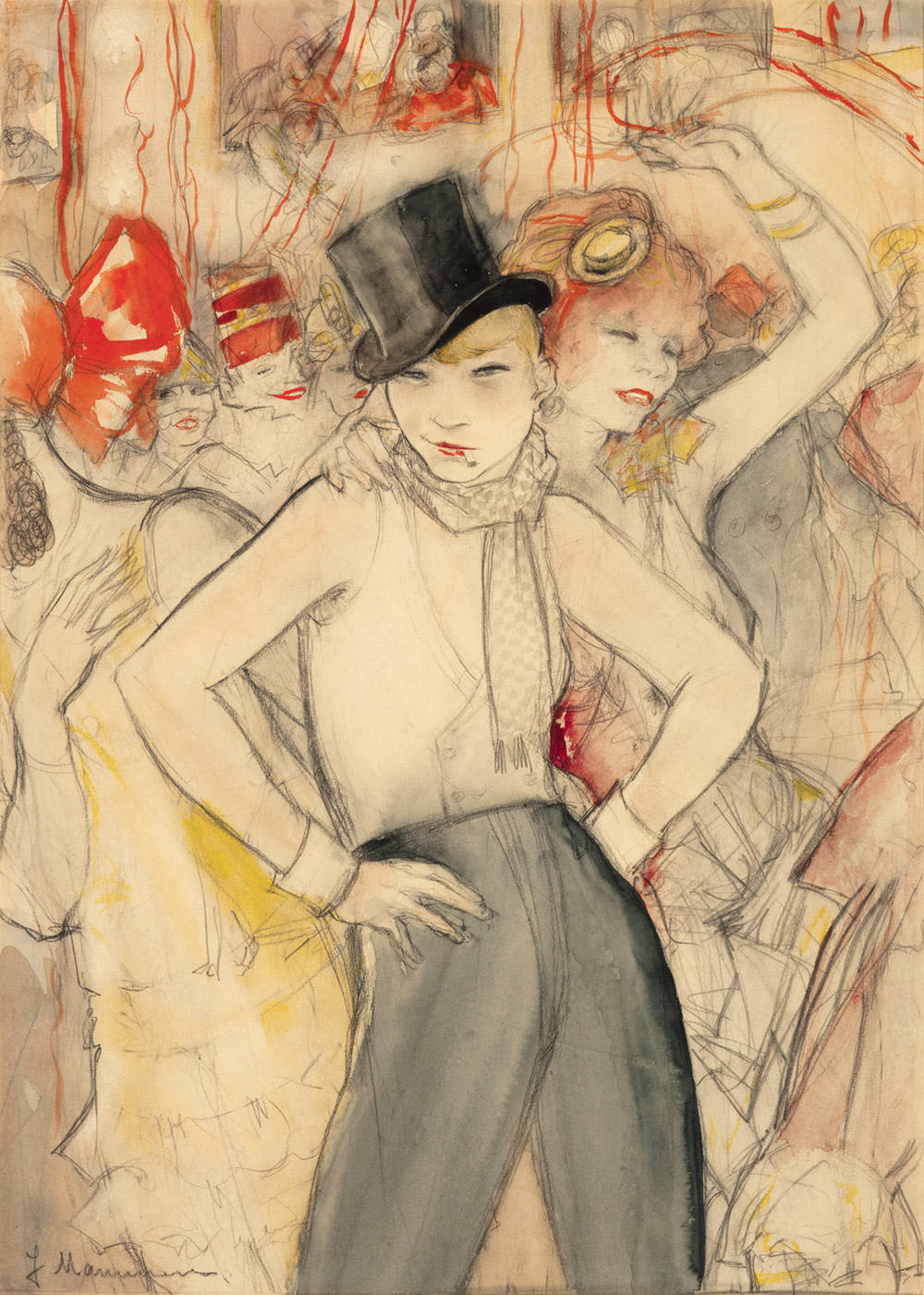
 

Jeanne Mammen (German, 1890-1976) 'She represents!' 1928


Jeanne Mammen (German, 1890-1976)
She represents!
1928
(In: Simplicissimus, 32, Nr. 47)
Three-colour print on paper
38.5 × 28cm
Stiftung Stadtmuseum Berlin, Jeanne Mammen Stiftung
© VG Bild-Kunst, Bonn 2022
Reproduction: Mathias Schormann


Fatale styles

Garçonne style

Black top hat slanting one way, cigarette slanting the other, red lips, short hair, men’s suit, challenging pose: this is how Berlin artist Jeanne Mammen saw the “New Woman” in the wild 1920s, the “garçonne” (feminine form of the French “garçon”, boy). She got rid of the corset, and with it the expectations of how women should dress or behave.

Snakes

Snakes are the perfect accessory to signal danger and seduction at the same time. Pure sex appeal! Remember: in the Bible, it is the nasty snake that persuades Eve to nibble from the tree of knowledge, and afterwards Adam and Eve are suddenly ashamed of being naked but also find it somehow exciting … Women are called snakes when they are considered manipulative and use their sex appeal to seduce men who supposedly don’t really want that. The combination of the naked female figure and snakes is particularly popular in the 19th century, when women had hardly any social power or status, but started rebelling against that. Strange coincidence, isn’t it?

Long flowing hair

Long Flowing Hair is considered a symbol of absolute femininity and seduction par excellence in nineteenth-century paintings. If it is shaggy or even made of snakes (beware: Medusa head!), this is supposed to indicate that its wearer is morally depraved. Conversely, in the twentieth century, short hair usually stands for emancipation from outdated gender images and for a free, sometimes queer sexuality.

Mirrors

“Women see themselves being looked at,” wrote the English art critic John Berger. Women looking at themselves (narcissistically) in the mirror in paintings are meant to prove the vanity of the female sex. Yet these paintings rather prove the dominance of the male gaze that turns women into objects through its constant scrutiny or even surveillance. Some say that the mirror in the paintings has now been replaced by computer or smartphone screens, in which especially women are reflected for the male gaze on social media. Do you see it that way too?

Doing Feminism – With Art! booklet to the exhibition


Franz von Lenbach (German, 1836-1904) 'Serpent Queen' 1894


Franz von Lenbach (German, 1836-1904)
Serpent Queen
1894
Oil on canvas
123 × 106cm
Kunstsammlung Züll, Sankt Augustin
© Kunstsammlung Züll, Sankt Augustin


Gerda Wegener (Danish, 1886-1940) 'Lili Elbe' c. 1928


Gerda Wegener (Danish, 1886-1940)
Lili Elbe
c. 1928
Watercolour

Please note: This watercolour may not be in the exhibition but Wegener’s paintings are mentioned in the exhibition text (above)


Gerda Wegener (Danish, 1886-1940) 'Lili with a Feather Fan' 1920


Gerda Wegener (Danish, 1886-1940)
Lili with a Feather Fan
1920

Please note: This art work may not be in the exhibition but Wegener’s paintings are mentioned in the exhibition text (above)


Gerda Wegener (Danish, 1886-1940) 'Queen of Hearts (Lili)' 1928


Gerda Wegener (Danish, 1885-1940)
Queen of Hearts (Lili)
1928

Please note: This art work may not be in the exhibition but Wegener’s paintings are mentioned in the exhibition text (above)


Sylvia Sleigh (American born Wales, 1916-2010) 'Lilith' 1967


Sylvia Sleigh (American born Wales, 1916-2010)
Lilith
1967
Acrylic on canvas
274.6 × 152.4cm
Rowan University Art Gallery, Glassboro, New Jersey
© Estate of Sylvia Sleigh
Foto: Karen Mauch Photography/Rowan University Art Gallery


Is There such a Thing as a non-binary Gaze?

The non-binary gaze does not exist! As long as we are living in a society dominated by men, there can be no non-binary gaze. Because it is not our own gender identity that decides how we look at others, but the system in which we live. And that, all over the world, is still patriarchy. So as long as we are living in social structures in which humanity is divided binarily into male and female, we cannot escape this gaze. For this, it does not matter where on the gender scale we locate ourselves, whether we characterise ourselves as male, female, non-binary or whatever. To have a female gaze, we would have to live in matriarchy. Therefore, under the global domination of male capitalist structures, there can be no queer, no trans (siehe LGBTQIA), no Black Gaze, because all these identities continue to be marginalised and discriminated against. Gazes, especially in art, are always connected with power, with external determinations, with conditioning. There can be no non-binary gaze for the sole reason that it would not classify living beings into different sexes, would not categorise them. In the required non-binary form of society – which would be interested in the equality of the different – this form of exercising power would not even exist.

But there would still be gazing wouldn’t there? Or does it mean that for that reason alone there can be no non-binary gaze?

The non-binary gaze is the future!

The male gaze divides people into men and women, into those who look and those who are looked at, into the active and the passive, into subjects and objects. The non-binary gaze abolishes “gender” as a distinguishing feature altogether because it has no interest in this type of category. Neither living beings nor anything else like colours, styles or smells are assigned to a single gender, but exist only for and from themselves. Individual features such as lipstick, stubble or breasts are not read as indicators of gender, but are perceived impartially and without this filter in their specific properties, such as shape, colour, structure etc. Therefore, this gaze does not exert any power, because it does not classify and evaluate what is being looked at into any existing categories. It does not look from top to bottom, not from bottom to top, not at individual parts or the overall view, but it does all this simultaneously with everyone, the gazers as well as those gazed at. The non-binary gaze has the power to destabilise our entire world order, because qualities and characteristics can now be perceived in a completely new way, without prejudices and evaluations. For this concerns not only human bodies but all forms of being that we can imagine.

Actually, it is interesting that we not only classify people, but also, for example, shapes – angular vs round – or smells – tart vs sweet – according to gender.

Doing Feminism – With Art! booklet to the exhibition


Maria Lassnig (Austrian, 1919-2014) 'Woman Power' 1979


Maria Lassnig (Austrian, 1919-2014)
Woman Power
1979
Oil on canvas
182 x 126cm
Albertina Wien – The ESSL Collection
© VG Bild-Kunst, Bonn 2022
Foto: Peter Kainz


Deconstructing, appropriating and retelling: abolishing the image of the femme fatale

The fight against the traditional image of the femme fatale began at the latest with the emergence of feminist art in the 1960s: feminist avant-garde artists challenged such outdated notions of women and began creating their own new narratives of femininity, sexuality and physicality. Self-portraiture and self-presentation, especially in the medium of photography, takes on a particular significance in the creation of self-empowering images of one’s own body. Female artists find many different ways to deal with the clichéd image of the femme fatale. Deconstructive approaches by artists such as Ketty La Rocca have contributed a great deal to dismantling this image, as have ironic and subversive appropriations by the likes of Birgit Jürgenssen. Other female artists reimagine the mythological figures who were long depicted as femmes fatales, presenting them, as Francesca Woodman did, in subtly restaged scenarios; depicting them as powerful goddesses – as seen, for example, in the works of Mary Beth Edelson; or, like Sylvia Sleigh, situating them outside the boundary of binary gender. Arresting representations of female corporeality, meanwhile, such as those created by Maria Lassnig and Dorothy Iannone, provide positive images that leave the narrative of demonic, deadly female sexuality far behind them.


Gender & Role Clichés

What does gender mean?

Gender describes the social, lived, perceived sex of a person. Gender is an English term, but is also used in German, precisely when it comes to social characteristics and gender identity. Gender is not limited to what is assigned to us at birth on the basis of physical characteristics (sex) but rather refers to socially constructed attributes, opportunities and relationships.

The teacher who says to you: “Well, your handwriting doesn’t look like that of a girl.” The colour pink is for girls and women, just like dresses and skirts; the colour blue and trousers are for boys and men. The latter should not cry, that would be weak. So, better for them to suppress their feelings? But then there is the saying “Boys will be boys”, meaning that’s just the way they all are. Boys are seen as wild and rebellious, girls as calm and understanding. But these are not biological traits; it’s the way we were brought up in a system of patriarchy. So, boys are allowed to get away with more, while girls are expected to put up with a lot of things. Role stereotypes hurt and reduce us all and press us into categories. Because they say: all people in a group should behave in the same way – which is pretty absurd.

Doing Feminism – With Art! booklet to the exhibition


Francesca Woodman (American, 1958-1981) 'Untitled, 1975-1980' 1975-1980


Francesca Woodman (American, 1958-1981)
Untitled, 1975-1980
1975-1980
Gelatin silver print

Please note: This image may not be in the exhibition but Woodman’s photographs are mentioned in the exhibition text (above)


Francesca Woodman (American, 1958-1981) 'House #4', Providence, Rhode Island, 1976


Francesca Woodman (American, 1958-1981)
House #4
Providence, Rhode Island, 1976
Gelatin silver print

Please note: This image may not be in the exhibition but Woodman’s photographs are mentioned in the exhibition text (above)


Nan Goldin (American, b. 1953) 'C performing as Madonna, Bangkok' 1992


Nan Goldin (American, b. 1953)
C performing as Madonna, Bangkok
1992
Archival pigment print, ed. #2/25
76.2 × 114.3cm
Courtesy of the artist and Marian Goodman Gallery, New York
© Nan Goldin


The varied afterlife of the femme fatale: contemporary (counter-)images

Nowadays there is no single, unambiguous vision of the femme fatale, and the counter-images are equally multifaceted. Artists examine traces of the clichéd concept, explore representations and adaptations of the femme fatale trope, reflect on the male gaze in art history, and consider gender identity, female physicality and sexuality from intersectional and queer feminist perspectives. In Jenevieve Aken’s work, for example, the ‘super femme fatale’ is a positively connoted, liberated (identificatory) figure who defies the constraints of a patriarchal society. Nan Goldin’s photographs show drag queens appropriating iconic figures who have long been stylised as femmes fatales, such as Marilyn Monroe or Madonna. In a similar way, Goldin’s video works place the mythological figures of Salome and the Sirens in new contexts. Betty Tompkins’ series of images highlight the fact that female sexuality is still being demonised today; her complex combinations of words and images reveal the continuities in a violently patriarchal art field, up to and including the #MeToo movement. Important counterpoints are also provided by artists such as Mickalene Thomas and Zandile Tshabalala, who deal with female beauty, physicality and sexuality through critical engagement with a white art canon.

Text from the Hamburger Kunsthalle website


Insectionality / Black Feminisms

Black women who are simply portrayed leading their everyday lives, without being reduced to their suffering or racial trauma experiences – unfortunately, this is a rarely shown image. The woman in the painting Lounging 1: G fabulous [below] is unmistakably depicted as Black. Next to her is a soft bathrobe. She is relaxing in a room with pompous wallpaper, on a fluffy carpet in front of a glamorous couch. Her material possessions, together with the fact that she is resting, are markers of luxury. For in the system of white supremacy, Black women are expected to live in a “hustle and grind culture”, where they continually have to prove themselves and try twice as hard as their white counterparts. Resting as a form of resistance is thus understood as a counter-movement and a radical political practice against social injustice. The slogan “rest is resistance” became famous on social media through the organisation The Nap Ministry. Though the woman in Lounging 1: G fabulous is nude, she is not depicted in a voyeuristic or sexist way – as Black women are in many works of European and American art history. The power of the gaze no longer lies with a voyeur, but in this case emanates from the sitter. Despite her nakedness, the image is in no way about conforming to a male gaze. The woman in the work simply shows herself as she is.

Likewise, Jenevieve Aken’s series The Masked Woman [below] is about self-fulfilment. Her self-portrayals show everyday scenes from the life of a woman in Nigeria who has decided against the role of the subordinate housewife. Instead, she leads a contented solo life as a “super femme fatale” – as she writes herself. A decision for a lifestyle that is not nearly as socially prestigious as living in a bourgeois nuclear family. Both works create new self-designations and show how extensive and multi-layered Black female identities are.

Doing Feminism – With Art! booklet to the exhibition


Zandile Tshabalala (South African, b. 1999) 'Lounging 1: G fabulous' 2021


Zandile Tshabalala (South African, b. 1999)
Lounging 1: G fabulous
2021
Acrylic and mixed media on canvas
120 × 200cm
Courtesy Privatsammlung Saskia Draxler und Christian Nagel
© Zandile Tshabalala / Privatsammlung Köln / Galerie Nagel Draxler Berlin / Köln / München


Jenevieve Aken (Nigeria, b. 1989) 'The Masked Woman' 2014


Jenevieve Aken (Nigeria, b. 1989)
The Masked Woman
2014
Photographs seven-part series
Courtesy of the artist
© Jenevieve Aken


The Masked Woman is a self-portrait series that explores representation of gender in Nigeria society through a performative lens. It attempts to avert the overarching male gaze by facing it head on with the artist’s own actions and choices. The images portray the solitary lifestyle of the “super femme fatale” character, choosing to achieve pleasure and contentment through self-fulfilment that not dictated by the subservient role as a house wife or defined through a man’s affection. While depicting a confident and sexually free woman, the subject’s mask and body language also suggest a nuanced tone of isolation which speaks to her stigmatization in a society that has limiting and strictly defined roles of what the proper woman should be. By diverting the status-quo and exercising freedom of choice, such women are perceived as extreme, eccentric, and outside of polite society in Nigeria. The series personifies a growing number of independent, professional women in Nigeria who at once assert their autonomy while also being ostracized by cultural norms. Rather than waiting for the narrative to be told from the outside, I choose to give birth to my own freedom, in hope that it will inspires other women in Nigeria to express their independence and free-will.

Jenevieve Aken. “The Masked Woman,” on the Jenevieve Aken website Nd [Online] Cited 04/03/2023


Jenevieve Aken (born 1989) is a Nigerian documentary, self-portrait and urban portrait photographer, focusing on cultural and social issues. Her work often revolves around her personal experiences and social issues surrounding gender roles. …


The Masked Woman

This is a black and white, self-portrait series meant to depict women and their social roles in Nigerian culture. The images depict the peace and self-fulfilment of a woman without the stigmatised overarching views of women in a Nigerian culture. The images also explore how women can feel constrained by the stereotypes of what a “proper women” should act like in society. These photos are meant to exemplify women who have broken these stigmas but feel isolated by the norms of the society. In this series Aken hopes to inspire Nigerian women to practice their freedom regardless of external stereotypes.

Text from the Wikipedia website


Myth & Religion

Lilith

Lilith was the first in various respects. Apparently, not only the Adam’s first wife who lived equally with him in the Garden of Eden, but also the first feminist, because she simply flew away when he demanded submission from her. Conveniently, as recorded in older Babylonian accounts, she was a hybrid being and had wings. Others imagined her as a hybrid between a woman and a serpent. Unfortunately, as a woman who was sexually independent, she evidently did not have a good image among the patriarchy, for she was said to bring sickness and death, to seduce and kill men, be infertile and kill newborn babies with the poisonous milk from her breast. In Jewish feminist theology, however, she stands for wisdom and strength because she was the first being to convince God to tell her his name – granting her unlimited power.

Judith

Judith is described in the Old Testament as a beautiful, wealthy and, besides this, pious widow who defended her Jewish homeland against the seizure by the Assyrian general Holofernes. She saved her mountain village of Bethulia by trusting in God completely and impressing Holofernes with her charm and wise speeches, so that she was able to sneak into his confidence. On the 40th day of the occupation, there was a celebration in Judith’s honour at which Holofernes got so drunk that Judith was able to cut off his head with her sword. The Assyrians left in horror and Judith retired to her quiet widowhood. Thanks to her deed, the overall trust in God was so great that no one could shake the Israeli community for a long time. In the Western world, the figure of Judith was often used as a motif in art, from the nineteenth century onwards with an increasingly eroticising, orientalising and anti-Semitic undertone. Judy Chicago, on the other hand, showed her as a feminist icon in her famous installation Dinner Party in the 1970s.

Medusa

Today, Medusa is mainly known for her extravagant hairstyle consisting exclusively of live snakes. How did this come about? There exist several variants of her story in Greek mythology, but the best known says that Pallas Athena happened to witness her husband Poseidon raping the beautiful Medusa. Instead of helping her and imprisoning him, she disfigured the rape victim forever by conjuring up: snakes on her head, pigs’ teeth, scaly skin, arms made of bronze and a tongue hanging out. Anyone who caught sight of her would henceforth turn to stone in horror. The artistic representation of the terrifying snake’s head has fascinated artists since ancient times, and even today it plays a role in films, games or even the logo of the Versace fashion label. It appears to be the perfect antithesis to the Western ideal of women – evil, tough and ugly – and, according to some research, could represent the transition from matriarchy to patriarchy, which went hand in hand with the demonisation of female strength.

Salome

Salome, who features prominently in the New Testament, albeit without being named, became famous for a dance: she danced so impressively and seductively at a feast that her powerful stepfather Herod assured her that he would grant her any wish in return. Her mother Herodias whispered in her ear what she wanted: the head of her adversary John the Baptist, who had publicly criticised the illegitimate marriage between her and Herod and thus humiliated her. The cut-off head was presented on a platter. In the nineteenth century, art was obsessed with this female figure, generally depicted as a lightly to barely clothed vamp who, because of her enthralling sex appeal, could only cost men their lives.

Madonna

When it comes to the idealisation of femininity, nearly everything conceivable in Christian societies comes together in the image of the Madonna figure. Since the first appearance of Madonna portraits from the second century onwards, the Mother of God has been painted as an absolute symbol of a pure, innocent and self-sacrificing femininity, typically one including and suggesting motherliness. Mostly, she is shown in these pictures with the little Child Jesus in her arms or lap. The figure Mater dolorosa, meaning Mother of Sorrows, refers to the pain of childbirth and the lifelong care of a child (particularly a divine one). But there are also other, sometimes surprising expressions and variations of these representations: for example, the Madonna lactans, a nursing Madonna with visible breast, the Black Madonnas or Madonnas with a body-encompassing, almond-shaped corona shaped like a vulva.

However, a Madonna is not always staged in a supernatural, maternal manner. She can also be depicted somewhere between the extremes of ‘saint’ or ‘whore’.

Doing Feminism – With Art! booklet to the exhibition


Franz von Stuck (German, 1863-1928) 'Head of Medusa' c. 1892


Franz von Stuck (German, 1863-1928)
Head of Medusa
c. 1892
Pastel on paper
26.5 × 32.5cm
Private collection
Courtesy Kunkel Fine Art, München
© Privatsammlung


Gustave Moreau (French, 1826-1898) 'The Apparition' After 1875


Gustave Moreau (French, 1826-1898)
The Apparition
After 1875
Oil on canvas
142 × 103cm
Paris, Musée Gustave Moreau
© bpk I RMN – Grand Palais I René-Gabriel Ojéda


Edvard Munch (Norwegian, 1863-1944) 'Madonna' 1895


Edvard Munch (Norwegian, 1863-1944)
Madonna
1895
Oil on canvas
90 × 71cm
Hamburger Kunsthalle, permanent loan of the Stiftung Hamburger Kunstsammlungen, acquired 1957
© SHK / Hamburger Kunsthalle / bpk
Public domain


Birgit Jürgenssen (Austrian, 1949-2003) 'Untitled (Olga)' 1979


Birgit Jürgenssen (Austrian, 1949-2003)
Birgit Jürgenssen Untitled (Olga)
1979
SX 70 Polaroid
10.5 x 8.7cm
© Birgit Jürgenssen, Estate Birgit Jürgenssen / VG Bild-Kunst, Bonn 2022; Courtesy Galerie Hubert Winter
Foto: pixelstorm


Birgit Jürgenssen (1949-2003) was an Austrian photographer, painter, graphic artist, curator and teacher who specialised in feminine body art with self-portraits and photo series, which have revealed a sequence of events related to the daily social life of a woman in its various forms including an atmosphere of shocking fear and common prejudices. She was acclaimed as one of the “outstanding international representatives of the feminist avant-garde”. She lived in Vienna. Apart from holding solo exhibitions of her photographic and other art works, she also taught at the University of Applied Arts Vienna and the Academy of Fine Arts Vienna.

Text from the Wikipedia website


With the epoch-spanning exhibition Femme Fatale: Gaze – Power – Gender, the Hamburger Kunsthalle is dedicating itself for the first time to diverse artistic treat-ments of the dazzling and clichéd image of the femme fatale. The stereotype of the erotic and seductive woman who holds men in her thrall, ultimately leading them to their downfall, has long been shaped by the male gaze and by a binary understanding of gender. The show will focus on various artistic manifestations of this theme dating from the early nineteenth century to the present while critically examining its origins and transformations: What historical changes and subsequent appropriation processes has the image of the femme fatale undergone? What role does it still play today? How do contemporary artists negotiate the gaze, power and gender constellations this image evokes in an effort to shift our perspective? The exhibition explores these questions based on some 200 exhibits across diverse media. On display are paintings by Pre-Raphaelite artists (Evelyn de Morgan, Dante Gabriel Rossetti, John William Waterhouse) as well as works of Symbolism (Fernand Khnopff, Gustave Moreau, Franz von Stuck), Impressionism (Lovis Corinth, Max Liebermann), Expressionism and New Objectivity (Dodo, Oskar Kokoschka, Jeanne Mammen, Edvard Munch, Gerda Wegener). Early feminist avant-garde artists (VALIE EXPORT, Birgit Jürgenssen, Maria Lassnig, Betty Tompkins), alongside recent works taking intersectional and (queer) feminist approaches (Jenevieve Aken – Philipp Otto Runge Foundation Fellow, Nan Goldin, Mickalene Thomas, Zandile Tshabalala) build a bridge to the present day. Among the paintings, drawings, prints, photographs, sculptures, installations and video works on view are a wealth of high-ranking international loans as well as major works from the collection of the Hamburger Kunsthalle. Highlights include Gustave Moreau’s major Symbolist work Oedipus and the Sphinx (1864), Edvard Munch’s painting Vampire in the Forest (1916-1918), Sonia Boyce’s much-discussed video installation Six Acts (2018), and Nan Goldin’s recent video works Sirens (2019-2021) and Salome (2019).

The “classical” image of the femme fatale was inspired mainly by biblical, mythological and literary figures (such as Judith, Salome, Medusa, Salambo and the Sirens) that were associated in art between 1860 and 1920 with the notion of mortal danger. Combining the feminine ideal with ominous portents, these pictures, often featuring stylised protagonists, convey a demonisation of female sexuality. Around 1900, this female image was increasingly projected onto real people, in particular actors, dancers and artists (such as Sarah Bernhardt, Alma Mahler and Anita Berber). Striking in this context is the simultaneous advancement of women’s emancipation and an upsurge in images of the femme fatale. The exhibition therefore also takes a look at the ideal of the New Woman that emerged in the 1920s as a counter-image that subtly takes up aspects of the femme fatale. Equally telling is the caesura that feminist artists brought about starting in the 1960s by radically deconstructing the myth and, with it, entrenched points of view and pictorial traditions. Contemporary artistic positions in turn address questions of gender identity, female corporeality and sexuality as well as the #MeToo movement and the male gaze. They track the traces and transformations of the image of the femme fatale or in other cases establish explicit counter-narratives.

The exhibition is accompanied by a particularly extensive art education programme: In addition to a diverse range of guided tours including livestreams of curator talks, a chatbot module will debut that lets visitors enter into a dialogue with six femme fatale figures from the art-works on view. A text-based dialogue system using artificial intelligence playfully tells background stories about the works and their artists. Developed jointly with the Stadtteilschule am Hafen, this module specifically addresses a younger target group. The Hamburger Kunsthalle is also offering audio descriptions for the first time. For selected exhibits, supplementary tactile copies are provided, which give people with visual impairments a way of accessing the exhibition independently by feeling contours. More audio tours are available in the Hamburger Kunsthalle app: for adults in German and English, for children from 8 years and older, and in simple language (both German). On the 4th Thursday of each month, a Salon fatal will dedicate itself to socially relevant topics that tie into the exhibition such as sexuality and the construction of beauty ideals. The salon will take the form of a reading, performance, panel discussion, concert or workshop, featuring changing guests. In cooperation with the Hamburger Kunsthalle, the Metropolis Kino is showing a film series on the theme of the femme fatale – from silent films to recent productions.

A free companion booklet, produced in collaboration with Missy Magazine, opens up intersectional and (queer) feminist perspectives on the show. The exhibition theme will also be explored in interdisciplinary depth in the accompanying catalogue (Kerber Verlag), scheduled for publication in early 2023. The catalogue will be available for 39 euros in the museum shop or for the bookstore price of 50 euros at http://www.freunde-der-kunsthalle.de.

Press release from Hamburger Kunsthalle


Birgit Jürgenssen (1949-2003) 'Untitled (Self with pelts)' 1974/1977


Birgit Jürgenssen (Austrian, 1949-2003)
Untitled (Self with pelts)
1974/1977


Blickmacht

The exhibition Femme Fatale: Gaze – Power – Gender is dedicated to the myth of seductive, ominous femininity – and its deconstruction. This is an extract from Ina Hildburg-Schneider in conversation with the exhibition organisers Markus Bertsch and Ruth Stamm translated from the German by Google Translate:


Do the artists of the time deal with their fears of the early emancipatory movements in the 19th century by depicting the femme fatale?

Stamm: I believe that the picture has something to do with a growing women’s movement in the 19th century, which became more and more institutionalised from 1865 – right up to women’s suffrage. This is exactly the time when the classic femme fatale images are created. But that’s not all. There are also a number of other aspects, further emancipation movements, but also associated fears and projections. Orientalism and anti-Semitism in particular play a role in the femme fatale image.

Bertsch: And the self-perception of the man has also been very different over time. This is often overlooked. There is the age of decadence in France, in which the male artist sees himself as frail and in this way stylises himself as the victim of the apparently overpowering women. Whether this is a firm conviction or a staging remains to be seen. The structure was immensely complex and allowed very different, sometimes contradictory readings of the femme fatale.

At the beginning of the 20th century, the role models for depicting the femme fatale changed. Now the works of art show “real” women. Who do you think of first?

Bertsch: I’m thinking of Sarah Bernhardt, Alma Mahler, Anita Berber. Suddenly living people were referred to as “femmes fatales”. They sometimes even adopted the characteristics of a femme fatale themselves – or, as in the case of Alma Mahler, they were the product of an obsession. Yes, Oskar Kokoschka went particularly far with his admiration for Alma Mahler. This is documented by a photo series in the exhibition.

Stamm: Kokoschka had a fetish doll made by the doll maker Hermine Moos after Alma Mahler, according to his very specific, sometimes explicitly physical ideas. However, his wish for a doll that was as lifelike as possible was not fulfilled – the result disappointed him greatly. The photos in our exhibition show the doll, which served as his model many times, draped in various poses. After Kokoschka had created a number of paintings and drawings based on the doll, some of which brought life to life, the story ended with its violent destruction. Ultimately, in this way, Kokoschka got rid of the figure of Mahler, which he stylised, obsessively sought out and at the same time demonised.

Is the First World War a turning point in the history of the motif?

Bertsch: I think so. Everything that was previously present as a mythical reference dissolves, and art faces the current political and social realities more strongly. Certain images of femininity are being phased out. The classic type of femme fatale is eroding and disappearing.

The “New Woman” developed in the interwar period – is she the female interpretation of the femme fatale?

Stamm: The New Woman was not a concrete antithesis to the femme fatale, but a new, quite stylised, emancipated image of women that developed with the growing women’s movement. In fact, this ideal was only lived by very few women from rather elitist circles who could afford it. The “type of woman” with bob haircuts and cigarettes that accompanies this has been reflected all the more in art and of course offers a completely different narrative than the femme fatale.

Jeanne Mammen is one of the early 20th century artists on display. She was educated in Paris and Brussels. Some of the sheets shown were created there. Can she create a “Homme fatale” with the heart stabber (Herzensstecher)?

Bertsch: She definitely does. The Herzensstecher is a figure that already fascinated me in the 2016 exhibition in Frankfurt, and that can be read as a counterpart to the overpowering femme fatale motif. Mammen is a very independent artist who brought together many spheres of influence in her work and had important teachers in Brussels in Jean Delville and Fernand Khnopff, both of whom are represented in our exhibition. Both of them addressed the relationship between the sexes in their art and in some cases already created androgynous figures. Mammen dealt productively with this symbolist heritage, but created independent, deviating images of masculinity and, above all, of femininity.

Markus Bertsch heads the 19th Century Collection at the Hamburger Kunsthalle and is curator.

Ruth Stamm is project assistant for the exhibition Femme Fatale: Gaze – Power – Gender.

Ina Hildburg-Schneider is an art historian and has been an editor at the Friends of the Kunsthalle since 2022.

Ina Hildburg-Schneider. “Blickmacht,” on the Freunde Der Kunsthalle website Nd [Online] Cited 03/03/2023


Dorothy Iannone (American, 1933-2022) 'The Statue Of Liberty' 1977


Dorothy Iannone (American, 1933-2022)
The Statue Of Liberty
1977
ColoUr silkscreen on paper
32 9/10 × 23 3/5 in (83.5 × 60cm)


Dorothy Iannone (August 9, 1933 – December 26, 2022) was an American visual artist. Her autobiographical texts, films, and paintings explicitly depict female sexuality and “ecstatic unity.” She lived and worked in Berlin, Germany. …

The majority of Iannone’s paintings, texts, and visual narratives depict themes of erotic love. Her explicit renderings of the human body draw heavily from the artist’s travels and from Japanese woodcuts, Greek vases, and visual motifs from Eastern religions, including Tibetan Buddhism, Indian Tantrism, and Christian ecstatic traditions like those of the seventeenth-century Baroque. Her small wooden statues of celebrities with visible genitals, including Charlie Chaplin and Jacqueline Kennedy, especially display with the artist’s interest in African tribal statues.

Text from the Wikipedia website


Mickalene Thomas (b. 1971) 'Racquel: Come to me' 2016


Mickalene Thomas (b. 1971)
Racquel: Come to me
2016
Rhinestones, acrylic, enamel and oil on wooden panel
274.6 × 213.7 × 5.1cm
Whitney Museum of American Art, New York;
Proposed gift from Rachel and Jimmy Levin © 2022
Digital image Whitney Museum of American Art / Licensed by Scala / VG Bild-Kunst, Bonn 2022


Glossary

Ableism

The term is derived from the English word “able” and denotes discrimination based on physical abilities. People whose bodies are deemed less “able” due to a disability or impairment, are socially and spatially excluded and devalued. An ableist society adopts a ‘healthy’ body as the norm and sees all others as (negative) aberrations. Ableism is, for example, when a person in a wheelchair is dependent on the help of others because buildings aren’t constructed barrier-free. Or when blind students at universities or educational institutions don’t have full access to all teaching materials.

Antisemitism

Hostile attitude toward Jews. It presents in various forms – from prejudice and verbal abuse to violence and murder. The gravest manifestation of antisemitism was German Nazism under Adolf Hitler, when between 1933 and 1945 more than six million Jewish people were murdered.

BIPoC

BIPoC is a political self-designation and short form for Black, Indigenous and People of Color. The short form BIPoC combines the communities referred to but also underlines their different experiences. Because of this, the term is sometimes used as an alternative for the term People of Color, to make Black people and indigenous identities explicitly visible and to emphasise that not all People of Color have the same experiences.

Black

Black is capitalised and is the politically correct and self-chosen term for Black people. The capital B emphasises social-political positioning within a society principally dominated by white people. The term Black is therefore not about biological characteristics but about socio-political affiliations. Black people are diverse and have completely diverse skin tones. As such, the term is more about highlighting the collective experiences that Black people have in this system and to emphasise their ongoing resistance.

Black Culture

The term Black Culture describes Black popular culture which deals mainly with entertainment, pleasure as well as knowledge and which is expressed via aesthetic codes and genres. It represents the identity and politics of Black cultures according to their beliefs, experiences and values. Although Black Culture encompasses all Black people worldwide, US-American Black pop culture is given the most attention.

Cis- and Transgenderism

Cis and trans are Latin words. Trans means “across” or “beyond” and, in relation to gender, refers to a person who does not identify with the sex assigned to them at birth and who experience themselves “beyond” it. Cis is, in a sense, the opposite. It can be translated as “on this side of” and indicates that someone lives within the boundaries of their assigned sex.

Classism

When recipients of state benefits are depicted as unwilling to work and unintelligent, this is an example of classism. Or when a working-class child is laughed at in university for not knowing certain trends or foreign words. Because people are not only discriminated against due to their gender and skin colour, but also because of the social and economic class they were brought up in. The term classism is even older than sexism and racism, the terms often associated with it: it was already in use in the 19th Century. Those who are poor and / or have less education due to a lack of resources are devalued in a classist society and have more difficulty accessing institutions seen as elitist.

Colonialism

Colonialism refers to a process of subjugation: one group of people goes to another group of people and imposes on it its rules, laws, language, customs, or religions in order to exploit it economically and culturally. When we speak of colonialism today, we mostly mean the process which began with the colonisation of the American continent by Europe’s ruling classes from the 15th century onwards and its negative consequences (such as racism, slavery, and exploitation) which can be still felt today.

Discrimination

Discrimination means the use of supposedly unambiguous distinctions to justify and rationalise unequal treatment. As a result of this unequal treatment, the persons discriminated against experience social disadvantages. Discrimination is an extensive system of social relationships, in which the discriminatory distinctions operate. Discrimination can therefore not be understood as a consequence of individual qualities. A by now very well known example for discrimination on a structural level is the Gender Pay Gap. This is the gap between the salaries of men and women as well as non-binary people for equal work. In 2022, women in Germany are still paid 18 percent less in terms of (gross) hourly wage than men.

Drag

The best-known examples are drag queens. A drag queen portrays, in a performative and artistic way, the appearance and behaviour of women, or rather femininity, a drag king the demeanour and outward appearance of men. This play with (exaggerated) femininity or masculinity is hence a show which is independent from the gender of the performer. The most famous drag practice is the embodiment of drag queens. These are often performed by queer men.

Empowerment

Mostly used as self-empowerment, it means to turn a disempowered situation into a more empowered one through certain actions. Often, this is a group process, for example, racially and sexually discriminated people who unite and fight for their cause and thus gain more confidence and, at best, more rights. This process may also take place symbolically, for example when young girls feel “empowered” by the encouraging writings of a feminist.

Eurocentrism

Eurocentrism means a view of the world that renders European history and so-called European principles as the primary measure of value. The term eurocentrism consequently makes evident global power relations and colonial historical thinking.

Feminism

Feminism is a social movement, which has already undergone several waves with different priorities, for example the achievement of women’s suffrage in the first wave or the legal equality of men and women in the second wave. While in the past many feminists assumed essentialist gender conceptions, meaning a clear distinction between only two genders – female and male – contemporary feminism is more inclusive. Often it no longer speaks of women but uses the term FLINTA*, which encompasses Female, Lesbian, Intersex, Trans and Agender and, with the asterisk, all others who identify as feminine. Earlier feminists had often focused on the concerns of middle-class, white, western women. But as part of an intersectional consideration of feminism, queer, PoC, trans and many more feminist voices have gained influence in recent decades. Initially, feminism was understood as the liberation of women from the patriarchy, but today it ideally refers to engagement for a world in which all forms of oppression, discrimination and exploitation will be abolished.

Gender and sex

Gender describes the social, lived, perceived sex of a person. Gender is an English term, but is also used in German, precisely when it comes to social characteristics and gender identity. Gender is not limited to what is assigned to us at birth on the basis of physical characteristics but rather refers to socially constructed attributes, opportunities and relationships.

Heteronormativity

When at day care little girls and boys, who are friends, are asked if they want one day to marry each other, this is an example of heteronormativity: a worldview in which heterosexuality is seen as the norm, as ‘normal’ and so what is desirable for everyone. A heteronormative society divides people into the binary categories of men and women, values men as more important and tends to be hostile towards queerness.

Hustle-Culture/Grind-Culture

Hustle-Culture/Grind-Culture describes a lifestyle, in which an aspiration to success and high-performance take priority. Long working hours and little rest are seen as the benchmarks of success.

Imperialism

Derived from the Latin word “imperium”, it means to pursue extended political and economic power outside one’s own (national) borders. By means of military or economic strategies, but also with the aid of culture and education, it is attempted to gain control over other countries or regions.

Intersectionality

The term intersectionality was coined in 1989 by lawyer, scholar and civil rights activist Kimberlé Williams Crenshaw. It is about the intersection and interaction of social identities and connected systems of oppression. Intersectionality focuses on the fact that people are often disadvantaged or benefit from several characteristics at once. Social, ethnic background, social and economic status as well as gender can be examples of such interconnected categories. A person may be Black and a woman, hence experiences racism and sexism. A white woman, on the other hand, experiences sexism too but benefits from her white privileges. Intersectional feminism therefore aims to recognise and make visible the multi-layered perspectives of people who experience overlapping forms of oppression.

LGBTQIA*

LGBTQIA* is an English-language collective term for ways of living and loving outside the heterosexual norm, which is now being used around the world. It is short form for Lesbian, Gay, Bi, Trans, Queer, Inter and Asexual. The asterisk stands for further identities that are perhaps not or not completely included therein, to leave no one out.

The male gaze

The male gaze is the concept of the male stare and stands for how systematically male control is applied and functions in our society. The term was coined by the feminist film theorist Laura Mulvey, who in the 1970s, brought attention to the fact that women in films were mostly represented as objects of male heterosexual fantasy.

Misogyny

Misogyny literally means “hatred of women” (from the ancient Greek: “misos” = “hate”, “gyne” = “woman”) and has been prevalent around the globe for thousands of years as a derogatory to murderous attitude towards about 50% of the world’s population.

(Non-) Binarity

If something is binary, it functions like a two-part system: there is always only the one and the other, like the two sides of a coin. Both mutually define each other. A binary gender system assumes that there are only men and women, and that everyone must belong to one of these two categories. Non-Binarity (NB) breaks up this rigid structure. Non-binary people, sometimes also called enbies (from NB), identify neither as man nor woman.

Objectification

Objectification describes the dehumanising treatment of certain people as things, hence as objects. The most common example is sexist objectification by men, who reduce women to sex-objects.

Orientalism

The term Orientalism exposes how the world has been divided into two parts: on the one side there is the supposedly modern, enlightened West, the ‘Occident’, which sees itself as the centre and protagonist of world events. The ‘Orient’ finds itself on the other side, depicted by the West as ‘backward’ and ‘unmodern’, yet at the same time as ‘exotic’ and ‘sensual’. According to the Palestinian-American literary scholar Edward Said, who published his influential book titled Orientalism in 1978, the ‘Orient’ was invented by Europeans in order to better dominate and exploit these regions.

Othering

With othering, a usually more powerful group, or individual, dissociates itself from another group characterising it as ‘alien’ and ‘different’, thus devaluing it and connoting it negatively. The group higher up in the power structure thus discriminates against the people described as ‘different’ who cannot defend themselves against these attributions.

Patriarchy

Patriarchy is a social system predominantly controlled and shaped by hetero-cis men. This means men determine the gender roles within society. Everything in the patriarchy is geared towards cis-men and they profit highly from such a system. Patriarchal structures are firmly established everywhere in our society. For example, for many in a heterosexual relationship it is still a given that the woman takes parental leave after a pregnancy to take care of the child while the father continues to work. Another example of patriarchal structures: the man is supposed to propose marriage. And after the wedding, the woman takes his name. A man’s power is thus always paramount, though emotions are denied to men. To cry, to be shy or insecure, or to take parental leave after the birth of a child – according to the patriarchy this is not how ‘real’ men behave. In this way men too are restricted by the patriarchy’s toxic masculinity.

People of Color

The term People of Color, PoC for short, is a self-designation and does not describe, like the terms Black and white, any particular skin tones. It is a matter of a position in society and an umbrella term for communities that experience marginalisation due to racism. The experienced racist discriminations vary and are far-reaching. To be asked every day “where are you from?” or be told “but your English is very good” are examples of this, as well as not being invited for a job interview because of one’s name or being threatened or attacked on the train.

Queer

If something is “queer” in English, it is actually peculiar or odd. Since the end of the 19th Century the word has been used derogatively for people who felt sexually attracted to their own gender. From the 1980s, this negative meaning was consciously and provocatively reversed by activists and the term was used positively. Today, many people who do not love heterosexually and / or live cisgendered, describe themselves as queer.

Racism

If people have to endure marginalisation or even violence because of their origin or their appearance, for example because of their skin colour or their religion, that is racism. Racism can take on many forms – for example anti- Muslim, anti-Black, or anti-Asian racism, that particularly targets these groups.

Sexism

Sexism is the discrimination against people because of their sex. “Blonde jokes”, unequal pay for equal work or unwanted wolf-whistles on the street – these are all examples of sexism. Since we still live in patriarchal societies in which men dominate, sexism affects people perceived as female. But men too can be restricted by patriarchal gender stereotypes such as “boys don’t cry” or “men don’t know about babies.”

Stereotyping

Stereotyping is the generalisation of a group of people. In the process, individuals and the differences between them are not considered. Instead, all people in this group are reduced to the same, often negative, characteristics.

Stigmatisation

Stigmatisation is a distinctly negative demarcation from other individuals or groups within a society. This may happen in interpersonal relationships, such as bullying in school, or on a structural level, when for example People of Color repeatedly experience rejection when searching for apartments, or when people with specific therapy experience are denied civil servant status. In this last case, derogatory characteristics are attributed to a mentally ill person by large sections of society, denying them full social acceptance.

White

White is the socio-politically correct description for white people. It is not a biological term, rather a position in society. The terms Black, PoC and BIPoC are capitalised because they are self-chosen terms. The term white, on the other hand, is written in lower case and often in italics. The call for concrete labelling of white, hence white people and white privileges, became louder through antiracist movements. Because being white, from a white perspective, is generally the norm. In this way, being white is often made invisible, while all non-white people are made visible and portrayed as supposedly ‘different’.

White Supremacy

White Supremacy is the ideology that white people, and all their ideas, actions and opinions are superior to those of BIPoC. White Supremacy is a self-sustaining system in that it marginalises People of Color though colonialism, exploitation and repression and so guarantees white people a continuous position of power.


This accompanying glossary is a cooperation between Missy Magazine and Hamburger Kunsthalle. It is published on the occasion of the exhibition.

Glossary

Concept and Realisation: Sonja Eismann, Melanie Fahden, Selvi Göktepe, Josephine Papke, Ruth Stamm, Andrea Weniger
Authors: Sonja Eismann, Josephine Papke
Editors: Nanda Bröckling, Melanie Fahden, Selvi Göktepe, Ruth Stamm, Andrea Weniger
English translation: Matthew Burbridge


Hamburger Kunsthalle
Glockengießerwall 20095 Hamburg
Phone: +49 (0)40-428 131 204

Opening hours:
Tuesdays to Sundays 10am – 6pm
Thursdays 10am – 9pm
Closed Mondays
Hamburger Kunsthalle website

LIKE ART BLART ON FACEBOOK

Back to top

Exhibition: ‘Samuel Fosso’ at the Museum der Moderne Salzburg

Exhibition dates: 22nd October, 2022 – 10th April, 2023

Curator: Jürgen Tabor


Samuel Fosso (Nigerian born Cameroon, b. 1962) 'Archives from Studio Photo National, Samuel Fosso's studio in Bangui' Nd from the exhibition 'Samuel Fosso' at the Museum der Moderne Salzburg, Oct 2022 - April 2023


Samuel Fosso (Nigerian born Cameroon, b. 1962)
Archives from Studio Photo National, Samuel Fosso’s studio in Bangui
Nd
© Samuel Fosso 
courtesy Jean-Marc Patras / Paris


Another exhibition on this wonderful artist with additional photographs… one of four large exhibitions that have take place recently in Europe and America. The other three being:

Samuel Fosso: The Man with a Thousand Faces at the Walther Collection, Germany, May – November 2022
Samuel Fosso: Affirmative Acts at the Princeton University Art Museum, November 2022 – January 2023
Samuel Fosso: African Spirits at the Menil Collection, Houston, August 2022 – January 2023

A well deserved flavour of the year!

Dr Marcus Bunyan


Many thankx to the Museum der Moderne Salzburg for allowing me to publish the photographs in the posting. Please click on the photographs for a larger version of the image.


Installation view of the exhibition 'Samuel Fosso' at the Museum der Moderne Salzburg showing at left, photographs from the Archives from Studio Photo National


Installation view of the exhibition Samuel Fosso at the Museum der Moderne Salzburg showing at left, photographs from the Archives from Studio Photo National
Photo: Rainer Iglar


Samuel Fosso (Nigerian born Cameroon, b. 1962) 'Archives from Studio Photo National, Samuel Fosso's studio in Bangui' Nd from the exhibition 'Samuel Fosso' at the Museum der Moderne Salzburg, Oct 2022 - April 2023


Samuel Fosso (Nigerian born Cameroon, b. 1962)
Archives from Studio Photo National, Samuel Fosso’s studio in Bangui
Nd
© Samuel Fosso 
courtesy Jean-Marc Patras / Paris


Samuel Fosso (Nigerian born Cameroon, b. 1962) 'Archives from Studio Photo National, Samuel Fosso's studio in Bangui' Nd from the exhibition 'Samuel Fosso' at the Museum der Moderne Salzburg, Oct 2022 - April 2023


Samuel Fosso (Nigerian born Cameroon, b. 1962)
Archives from Studio Photo National, Samuel Fosso’s studio in Bangui
Nd
© Samuel Fosso 
courtesy Jean-Marc Patras / Paris


Samuel Fosso (Nigerian born Cameroon, b. 1962) 'Archives from Studio Photo National, Samuel Fosso's studio in Bangui' Nd


Samuel Fosso (Nigerian born Cameroon, b. 1962)
Archives from Studio Photo National, Samuel Fosso’s studio in Bangui
Nd
© Samuel Fosso 
courtesy Jean-Marc Patras / Paris


Installation view of the exhibition 'Samuel Fosso' at the Museum der Moderne Salzburg showing photographs from the series '70's Lifestyle'


Installation view of the exhibition Samuel Fosso at the Museum der Moderne Salzburg showing photographs from the series 70’s Lifestyle
Photo: Rainer Iglar


Samuel Fosso (Nigerian born Cameroon, b. 1962) '70's Lifestyle' 1974-1978


Samuel Fosso (Nigerian born Cameroon, b. 1962)
70’s Lifestyle
1974-1978
Gelatin silver print
© Samuel Fosso, courtesy of Jean Marc Patras, Paris


Samuel Fosso (Nigerian born Cameroon, b. 1962) '70's Lifestyle' 1974-1978


Samuel Fosso (Nigerian born Cameroon, b. 1962)
70’s Lifestyle
1974-1978
Gelatin silver print
© Samuel Fosso, courtesy of Jean Marc Patras, Paris


Samuel Fosso (Nigerian born Cameroon, b. 1962) '70's Lifestyle' 1974-1978 


Samuel Fosso (Nigerian born Cameroon, b. 1962)
70’s Lifestyle
1974-1978
Gelatin silver print
© Samuel Fosso, courtesy of Jean Marc Patras, Paris


Samuel Fosso (Cameroonian, b. 1962) 'Self-portrait' 1975-1977


Samuel Fosso (Nigerian born Cameroon, b. 1962)
70’s Lifestyle
1974-1978
Gelatin silver print
© Samuel Fosso, courtesy of Jean Marc Patras, Paris


Samuel Fosso (Nigerian born Cameroon, b. 1962) 70's Lifestyle 1974-1978


Samuel Fosso (Nigerian born Cameroon, b. 1962)
70’s Lifestyle
1974-1978
Gelatin silver print
© Samuel Fosso, courtesy of Jean Marc Patras, Paris


Samuel Fosso (Nigerian born Cameroon, b. 1962) 70's Lifestyle 1974-1978


Samuel Fosso (Nigerian born Cameroon, b. 1962)
70’s Lifestyle
1974-1978
Gelatin silver print
© Samuel Fosso, courtesy of Jean Marc Patras, Paris


Introduction

Samuel Fosso (Kumba, CM, 1962 – Bangui, CF; Paris, FR) is one of the most renowned African photographers working today. He has been a key innovator in the great tradition of African studio photography since the mid-1970s, developing and successively refining a distinctive form of explicitly theatrical self-portraiture. Fosso’s self-portraits blend photography with performance and intertwine autobiographical themes and conceptions of the self with political and historical perspectives. The works articulate the complexity and diversity of contemporary identities and explore the relations between Africa and the East and West in the era of post-colonialism and globalisation.

Organised by the Generali Foundation at the Museum der Moderne Salzburg, the retrospective presents a selection from Samuel Fosso’s most important bodies of work. It is the first major exhibition of Fosso’s art in Austria and one of his first solo shows in the German-speaking countries.

Featuring elaborate makeup and lavish costumes, props, and sets, Fosso’s autofictional self-portraits are not so much self-dramatisations as self-transformations. He slips into roles and borrows identities – from pivotal figures in history as well as social archetypes, many of them with deep roots in the globally networked visual memory. Embodying these icons and representations, he interrogates their impact on media, society, and politics, casting himself as a surrogate and catalyst. Fosso’s self-portraits are highly artificial scenic productions on the stage of the photography studio, where he is photographer, performer, and director in one. With analytical acumen and acting skills, he deftly exposes and undercuts social codes around bodies, attire, poses, facial expressions, and gazes and collective assignments of identity based on gender, sexual orientation, and ethnic and social background.

After a brief apprenticeship, Fosso opened his own studio for portrait photography in 1975, when he was thirteen. His business success rested on his flair for fashion and aesthetics and his talent for encouraging his clients to show off their personal style. Having spent his workday taking portraits of paying customers, he switched to the other side of the camera in the evening: taking inspiration from West African and African-American music, youth culture, and political rebellion, he donned tight shirts, extravagant bell-bottoms, platform shoes, and offbeat props to stage himself in unconventional and unconstrained poses. The result was Fosso’s early series of experimental black-and-white self-portraits now known under the title 70’s Lifestyle (1975-1978).

For many years, he shared his self-portraits only with private audiences. At the initiative of the French photographer Bernard Descamps, they made their public debut in 1994 at the inaugural Bamako Encounters – African Biennial of Photography. The self-portraits added an important aspect to the tradition of West African studio photography, which garnered considerable attention in the 1990s. In 70’s Lifestyle, Fosso limns an alternative vision of masculinity by playfully subverting conventions concerning the depiction of bodies, gender, and sexuality. Sustained by a newfound self-confidence, Fosso’s self-portraits reflect a search for fresh conceptions of identity after the early period of postcolonial transformation in the 1960s; they are also a gesture of emancipation from the suffering he experienced as a refugee in Nigeria and under the repressive Bokassa regime in the Central African Republic. Artistic aspects such as theatricality and the appropriation of media imagery that Fosso develops in 70’s Lifestyle become constants in his work.

In 1997, Tati, a French department-store chain, commissioned Fosso to conceive a new body of works. Fosso developed a series of self-portraits in bold colours, some of which became iconic. Hewing to his characteristic style of elaborate and meticulously thought-through masquerade, disguises, and sceneries, now laced with an unmistakable penchant for satire, the Tati series shows him alternating between a number of controversial identities. For instance, he impersonates archetypes of African as well as Western societies like the tribal chieftain, the golfer, and the “liberated” African-American woman. The series’ centrepiece, Le Chef (qui a vendu l’Afrique aux colons) (The Chief [Who Sold Africa to the Colonists]), is both a tribute to African tribal leaders and a critique of the temptations of power in the age of European colonialism.

In later series such as African Spirits (2008) and Emperor of Africa (2003), Fosso’s work takes on a more pronounced political edge. In African Spirits, he embodies historic protagonists of the pan-African independence and civil rights movement including Angela Davis, Patrice Lumumba, Haile Selassie, Martin Luther King Jr., and Muhammad Ali. The large-format self-portraits reenact historic pictures from magazines and newspapers. The satirical-critical element of Tati gives way to a thoroughly serious process of identification: bringing his protagonists to life, Fosso not merely draws a connection between their legacy and his own experience, he seems to positively fuse with them in the strikingly convincing impersonations. The portraits in African Spirits pay homage to the campaigners for civil rights and colonial independence while also suggesting their extraordinary gift for self-dramatisation and media savvy, which helped them frame and disseminate their political ideals.

In the series Emperor of Africa, Fosso grapples with the complexities of the power differential between China and Africa by casting himself in the role of the controversial Chinese revolutionary and Communist Party leader Mao Zedong. In his reenactments, Fosso portrays Mao not only as a liberator, but also as a symbol of a modern imperialism. African leaders initially welcomed China’s growing economic and cultural presence, but the exercise of the power that came with this presence has increasingly prompted concerns. “As a performer, Fosso is both subject and questioner, the man behind the mask, interrogating the imperial and the postcolonial in equal measure.” (Olu Oguibe)

Born in Cameroon, Samuel Fosso spent the first part of his childhood in Nigeria. After the Biafran War, he moved to Bangui, the capital of the Central African Republic. Having completed a brief apprenticeship, the teenaged Fosso opened his own studio for portrait photography in Bangui in 1975, a business he ran until 2014. That year, his home was ransacked during an armed conflict in the Central African Republic, and the photographic archive of his commercial studio was destroyed; some of the material was later reconstructed. The artist lives and works in Bangui, Central African Republic, and Paris, France.

Text from the Museum der Moderne Salzburg


Installation view of the exhibition 'Samuel Fosso' at the Museum der Moderne Salzburg showing photographs from the series 'Tati'


Installation view of the exhibition Samuel Fosso at the Museum der Moderne Salzburg showing photographs from the series Tati
Photo: Rainer Iglar


Samuel Fosso (Nigerian born Cameroon, b. 1962) 'La femme américaine libérée des années 70' (The Liberated American Woman of the 1970s) 1997


Samuel Fosso (Nigerian born Cameroon, b. 1962)
La femme américaine libérée des années 70 (The Liberated American Woman of the 1970s)
1997
From the series Tati
Chromogenic print
© Samuel Fosso, courtesy of Jean Marc Patras, Paris


Samuel Fosso (Nigerian born Cameroon, b. 1962) 'The Chief (who sold Africa to the Colonists)' 1997


Samuel Fosso (Nigerian born Cameroon, b. 1962)
The Chief (who sold Africa to the Colonists)
1997
From the series Tati
Chromogenic print
© Samuel Fosso, Generali Foundation Collection – Permanent Loan to the Museum der Moderne Salzburg


Samuel Fosso (Nigerian born Cameroon, b. 1962) 'The Golfer' 1997


Samuel Fosso (Nigerian born Cameroon, b. 1962)
The Golfer
1997
From the series Tati
Chromogenic print
© Samuel Fosso, courtesy of Jean Marc Patras, Paris


Installation view of the exhibition 'Samuel Fosso' at the Museum der Moderne Salzburg showing photographs from the series 'Tati'


Installation view of the exhibition Samuel Fosso at the Museum der Moderne Salzburg showing photographs from the series Tati
Photo: Rainer Iglar


Samuel Fosso (Nigerian born Cameroon, b. 1962) 'Le Rocker' (The Rocker) 1997


Samuel Fosso (Nigerian born Cameroon, b. 1962)
Le Rocker (The Rocker)
1997
From the series Tati
Chromogenic print
© Samuel Fosso, courtesy of Jean Marc Patras, Paris


Samuel Fosso (Nigerian born Cameroon, b. 1962) 'Le Pirat' (The Pirate) 1997


Samuel Fosso (Nigerian born Cameroon, b. 1962)
Le Pirat (The Pirate)
1997
From the series Tati
Chromogenic print
© Samuel Fosso, courtesy of Jean Marc Patras, Paris


Samuel Fosso (Nigerian born Cameroon, b. 1962) 'Le sauveteur' (The Lifeguard) 1997


Samuel Fosso (Nigerian born Cameroon, b. 1962)
Le sauveteur (The Lifeguard)
1997
From the series Tati
Chromogenic print
© Samuel Fosso, courtesy of Jean Marc Patras, Paris


Installation view of the exhibition 'Samuel Fosso' at the Museum der Moderne Salzburg showing at left, photographs from the series 'Fosso Fashion', 1999; in the centre, photographs from the 'Archives from Studio Photo National'; and at right, photographs from the series 'Tati' 1997


Installation view of the exhibition Samuel Fosso at the Museum der Moderne Salzburg showing at left, photographs from the series Fosso Fashion, 1999; in the centre, photographs from the Archives from Studio Photo National; and at right, photographs from the series Tati 1997


Samuel Fosso (Nigerian born Cameroon, b. 1962) 'Self-portrait' 1999


Samuel Fosso (Nigerian born Cameroon, b. 1962)
Self-portrait
1999
From the series Fosso Fashion, 1999
© Samuel Fosso courtesy Jean-Marc Patras / Paris


Samuel Fosso (Nigerian born Cameroon, b. 1962) 'Self-portrait' 1999


Samuel Fosso (Nigerian born Cameroon, b. 1962)
Self-portrait
1999
From the series Fosso Fashion, 1999
© Samuel Fosso courtesy Jean-Marc Patras / Paris


Samuel Fosso (Nigerian born Cameroon, b. 1962) 'Mémoire d'un ami' 2000


Samuel Fosso (Nigerian born Cameroon, b. 1962)
Mémoire d’un ami (Memory of a friend)
2000
Gelatin silver print
© Samuel Fosso, courtesy of Jean Marc Patras, Paris


Samuel Fosso (Nigerian born Cameroon, b. 1962) 'Mémoire d'un ami' 2000


Samuel Fosso (Nigerian born Cameroon, b. 1962)
Mémoire d’un ami
2000
Gelatin silver print
© Samuel Fosso, courtesy of Jean Marc Patras, Paris


Samuel Fosso (Nigerian born Cameroon, b. 1962) 'Le rêve de mon grand-père' 2003


Samuel Fosso (Nigerian born Cameroon, b. 1962)
Le rêve de mon grand-père (My grandfather’s dream)
2003
Chromogenic print
© Samuel Fosso, courtesy of Jean Marc Patras, Paris


Samuel Fosso (Nigerian born Cameroon, b. 1962) 'Le rêve de mon grand-père' 2003


Samuel Fosso (Nigerian born Cameroon, b. 1962)
Le rêve de mon grand-père (My grandfather’s dream)
2003
Chromogenic print
© Samuel Fosso, courtesy of Jean Marc Patras, Paris


Installation view of the exhibition 'Samuel Fosso' at the Museum der Moderne Salzburg showing photographs from the series 'African Spirits'

Installation view of the exhibition 'Samuel Fosso' at the Museum der Moderne Salzburg showing photographs from the series 'African Spirits'


Installation views of the exhibition Samuel Fosso at the Museum der Moderne Salzburg showing photographs from the series African Spirits
Photo: Rainer Iglar


Samuel Fosso (Nigerian born Cameroon, b. 1962) 'African Spirits (Nelson Mandela)' 2008


Samuel Fosso (Nigerian born Cameroon, b. 1962)
African Spirits (Nelson Mandela)
2008
Gelatin silver print
© Samuel Fosso, courtesy of Jean Marc Patras, Paris


Samuel Fosso (Nigerian born Cameroon, b. 1962) 'African Spirits (Angela Davis)' 2008


Samuel Fosso (Nigerian born Cameroon, b. 1962)
African Spirits (Angela Davis)
2008
Gelatin silver print
© Samuel Fosso, courtesy of Jean Marc Patras, Paris


Samuel Fosso (Nigerian born Cameroon, b. 1962) 'Self-Portrait (Malcolm X)' 2008


Samuel Fosso (Nigerian born Cameroon, b. 1962)
African Spirits (Malcolm X)
2008
Gelatin silver print
© Samuel Fosso, courtesy of Jean Marc Patras, Paris


Samuel Fosso (Nigerian born Cameroon, b. 1962) 'Self-Portrait (Muhammad Ali)' 2008


Samuel Fosso (Nigerian born Cameroon, b. 1962)
African Spirits (Muhammad Ali)
2008
Gelatin silver print
© Samuel Fosso, courtesy of Jean Marc Patras, Paris


Installation view of the exhibition 'Samuel Fosso' at the Museum der Moderne Salzburg showing photographs from the series 'Emperor of Africa'


Installation view of the exhibition Samuel Fosso at the Museum der Moderne Salzburg showing photographs from the series Emperor of Africa
Photo: Rainer Iglar


Samuel Fosso (Nigerian born Cameroon, b. 1962) 'Emperor of Africa' 2013


Samuel Fosso (Nigerian born Cameroon, b. 1962)
Emperor of Africa
2013
From the series Emperor of Africa
Chromogenic print
© Samuel Fosso, courtesy of Jean Marc Patras, Paris


Samuel Fosso (Nigerian born Cameroon, b. 1962) 'Emperor of Africa' 2013


Samuel Fosso (Nigerian born Cameroon, b. 1962)
Emperor of Africa
2013
From the series Emperor of Africa
Chromogenic print
© Samuel Fosso, courtesy of Jean Marc Patras, Paris


Installation view of the exhibition 'Samuel Fosso' at the Museum der Moderne Salzburg showing photographs from the series 'Black Pope'


Installation view of the exhibition Samuel Fosso at the Museum der Moderne Salzburg showing photographs from the series Black Pope
Photo: Rainer Iglar


Samuel Fosso (Nigerian born Cameroon, b. 1962) 'Black Pope' 2017


Samuel Fosso (Nigerian born Cameroon, b. 1962)
Black Pope
2017
Chromogenic print
© Samuel Fosso, courtesy of Jean Marc Patras, Paris


Samuel Fosso (Nigerian born Cameroon, b. 1962) 'Black Pope' 2017


Samuel Fosso (Nigerian born Cameroon, b. 1962)
Black Pope
2017
Chromogenic print
© Samuel Fosso, courtesy of Jean Marc Patras, Paris


Museum der Moderne Salzburg
Mönchsberg 32
5020 Salzburg, Austria
Phone: +43 662 842220

Opening hours:
Tuesday – Sunday: 10am – 6pm
Wednesday: 10am – 8pm
Monday: closed

Museum der Moderne Salzburg website

LIKE ART BLART ON FACEBOOK

Back to top

Text: “In Press” chapter from Marcus Bunyan’s PhD research ‘Pressing the Flesh: Sex, Body Image and the Gay Male’, RMIT University, Melbourne, 2001

March 2023


Diane Arbus (American, 1923-1971) 'Seated man in a bra and stockings, N.Y.C., 1967' 1967


Diane Arbus (American, 1923-1971)
Seated man in a bra and stockings, N.Y.C.
1967
Gelatin silver print


Since the demise of my old website, my PhD research Pressing the Flesh: Sex, Body Image and the Gay Male (RMIT University, Melbourne, 2001) has no longer been available online.

I have now republished the third of twelve chapters, “In Press”, so that it is available to read. More chapters will be added as I get time. I hope the text is of some interest. Other chapters include Historical Pressings which examines the history of photographic images of the male body; Bench Press which investigates the development of gym culture, its ‘masculinity’, ‘lifestyle’, and the images used to represent it; and Re-pressentation which alternative investigates ways of imag(in)ing the male body and the issues surrounding the re-pressentation of different body images for gay men.

Dr Marcus Bunyan March 2023


“In Press” chapter from Marcus Bunyan’s PhD research Pressing the Flesh: Sex, Body Image and the Gay Male RMIT University, Melbourne, 2001

Through plain language English (not academic speak) the text of this chapter investigates the photographic representation of the muscular male body in the (sometimes gay) media and gay male pornography. In the title of the chapter I use the word ‘press’ to infer a link to the media.

Keywords

photography, muscular male body, muscular male body in the media, appearance, lifestyle, narcissism, advertising, media, appearance, consumer capitalism, visible bodies, gay male, gay male pornography

Sections

1/ Consuming the Appearance
2/ Consumer Capitalism and Narcissism
3/ Visible Bodies
4/ Gay Male Pornography
5/ Alternatives to American gay male pornography
6/ Alternative bodies

Word count: 6,884


In Press


“Not only do the media shape our vision of the contemporary world, determining what most people can and cannot see and hear, but the very images of our own body, our own selves, our own personal self worth (or lack of it) is mediated by the omnipresent images of mass culture…”


Douglas Kellner1


From the fervent explosion that saw the birth of the gay liberation movement in the late 1960s and early 1970s there emerged a period of amazing freedom and growth for many gay people. Sexualities that were previously hidden behind a veil of secrecy were now being expressed and fought for out on the streets. Sex, especially the desire of gay men for casual sex, was now out in the open. A new body image emerged from this revolution, one that was neither male nor female, but androgynous. This new androgynous body image can be seen as a reflection of societal changes that were happening during the swinging Sixties, the era of “free love.” You could swing, i.e., move both ways sexually. The joining together of male and female, gay men and lesbians was a very positive force in the formation and acceptance of new identities.

But the honeymoon was soon over.

The idealism of the early gay liberation movement did not last long. Gay men, long persecuted for their camp and feminine ways sought images to combat the long held stereotype of the limp-wristed pansy who had abdicated his male power to others through his effeminacy. Manliness came out of the closet of the physique magazines to express the longed for power of patriarchy that gay men sought. There was an enormous surge in the production of homoerotic imagery and gay men responded by imitating heterosexual masculinity in an ironic way; the ‘clone’ image was born: boots, tight fitting jeans, check shirts, short hair and usually a moustache to top off the image. Anybody could go out and purchase such an outfit. It did not discriminate along class or social boundary lines and the ‘look’ was relatively ageless. This clone image extended to other identities that included the leather man, the sailor, the construction worker & the cowboy. But the image was still ‘butch’; skinny or fat guys really need not apply.

The pop group ‘The Village People’ are a perfect example of the camp irony that infused the gay scene at this time. Their song “Macho Man” echoes the desire for gay men to be seen as butch: “I wanna be a macho, macho man – I wanna be, a macho man,” they sing parading around in their tight fitting and revealing outfits. By making their stereotypical cloned images of the cowboy, construction worker, cop, etc., … incredibly camp they undermined the credibility of traditional masculinity. But soon this camp ironic comment was devoured by the dichotomy of existing sex and gender differences. As Dennis Altman has said,

“In the early days of the movement, both women and men saw the process of gay liberation as intimately related to the blurring of sexual and gender boundaries, a move toward androgyny … Our biggest failure was an inability to foresee the extent to which the opposite would happen and a new gay culture / identity would emerge that would build on existing male / female differences.”2

The body and its visibility became increasingly important as a site of construction that was and is crucial to a persons identity and self-esteem. Appearance is critical to this construction.

I suggest that in contemporary gay culture the muscular body of the gay male has stopped being a ‘camp’ ironic comment on ‘normal’ masculinity and instead the body and photographic images of it have become a marketable asset, a commodity3 in a selling and surveillance exercise. Men advertise for sex by displaying their muscular body for admiration and desire by others and observe themselves and others reactions to it. Identity is now mediated by acceptance of their image and by ‘measuring up’ to a perceived image ideal. Media started to make use of this new availability of the male body as an objectified image of desire as it opened up new markets to companies. It encouraged men to undertake face lifts, tummy tucks, pectoral implants and hair removal, to purchase underwear, toiletries, clothes and all manner of goods so that they too could approach the archetypal ‘ideal’ of the masculine male.


David Lloyd. Cover of Naked Men of San Diego calendar 1998


David Lloyd
Untitled
Nd
Cover of Naked Men of San Diego calendar
Santa Monica: The Phenomenon Factory, 1998


Today images of the smooth, muscular, white male body are everywhere in advertising, encouraging us to purchase more, to help us get closer to the ideal. As David Kellner has said in the quotation at the beginning of the chapter, the images of mass culture have become omnipresent. Naked men now adorn calendars containing full frontal nudity of smooth muscular white bodies all sporting the latest in designer erections! You can have your man any time of the day, any time of the year, when you get poked in the eye with this calendar.

The muscular Billy Doll, complete with huge anatomically correct penis, (read ‘scientifically’ or how big a gay man’s penis should be) is the contemporary idealisation of earlier stereotypical gay fantasy images, a kind of male Barbie doll on steroids for gay men. I believe that in today’s incarnation of the gay male body the camp ironic comment present in the fantasy images of an earlier generation has disappeared.


Behavior Saviour. 'Untitled' 'Billy postcard' 1998


Behavior Saviour
Untitled
‘Billy postcard’
1998


“Born to love you!! Billy is an anatomically correct adult doll standing 32 cm tall, weighing 320g. Choose from – Master Billy, Sailor Billy, Cowboy Billy and San Francisco Billy! Billy, the world’s first out and proud gay doll, comes beautifully packaged in a high quality presentation case with photographic backdrop.”


'Billy Doll' c. 1997


Billy Doll
c. 1997


It has been replaced by a desiring consumerism, in this case the desire for a muscular form complete with jaw dropping penis, the envy of every gay man. And after all, consumerism is a form of self-obsession. Makes you feel a little insecure, eh? Billy doesn’t have an inch of fat or any body hair, is perfectly proportioned (particularly his huge endowment) and is made of plastic. No fear of infection here! Women have been fighting this kind of body stereotyping with the Barbie Doll for years and now the gay male has his own equivalent.

Oh but Billy – he’s born to love you!!


Consuming the Appearance

Sex sells. The appearance and image of hard bodies sells. They are consumed by individuals and societies eager to attain what they offer; individuality, success, popularity and ‘lifestyle’. But these images are not individual, they are ‘the same’, to be consumed by every-body. Below are three examples of the current genre of male body photography; all bodies are of the same homogenised type. Only the photographers are different, but they might as well have been the same.


Various photographers of the male body in Blue Magazine


Michael Childers
Untitled
Nd
Blue Magazine
Sydney: Studio Magazines, February 1999, p. 68

Jason Lee
Untitled
Nd
Blue Magazine
Sydney: Studio Magazines, April 1997, p. 108

Rob Lang
Untitled
Nd
Blue Magazine
Sydney: Studio Magazines, February 1999, p. 93


Apparently, “Jason Lee’s brooding male nudes plumb the shadowy depths of Mystery, Sensuality and Despair … Figures possess an aura of subdued eroticism … Faces and identities are almost inconsequential, the subject reduced to a study of line and texture.”4 He says that he doesn’t want to use clichés that tend to occur when photographing women and to establish an identity and style all of his own. Michael Childers images are supposedly, “Dynamic, sensual and glamorous,”5 while Rob Lang’s desert studies of the male nude, “Document his search for the man within … and [are] essentially about unearthing an emotional bond.”6
These “types” of photographer (ie. ones who take generic photographs of the muscular male body) and many more like them feature heavily in Blue Magazine, a glossy publication aimed at the gay ‘lifestyle’ demographic. Of course most photographers would like to think that their work contains a deep revealing: mystery, sensuality, emotional bonds, etc., … but speaking as a photographer myself, I believe that this type of body photography (with its self-absorption and narcissism), isolates the body from communication with others. The bodies are complete(d) within their own sensual gratification. The construction of these images is formulaic, the body forming a masturbatory landscape endlessly repeated by different photographers in slightly different poses that appeal to a gay erotic consumerism. There is no individual identity present in photographer or subject contrary to what Jason Lee would like to think.

Identities of the models and photographers are inconsequential. These images are used by advertisers, fashion photographers, media and “artists” alike to sell product and fall into clichés that have developed in the photography of the male body over the last 60 years.


Anonymous photographer. 'Untitled' Nd Yves Saint Laurent advertisement 'Blue Magazine'


Anonymous photographer
Untitled
Nd
Yves Saint Laurent advertisement
Blue Magazine
Sydney: Studio Magazines, February 1999, p. 9
1999


I suggest that these images are no longer just a fashion, but that they are here to stay. I believe that the problems associated with the idealisation of these male images (for example steroid abuse, low self-esteem, body dysmorphia), can be compared to the eating disorders that women have succumbed to in their attempts to attain the waif like super-model look of many contemporary women fashion models.

Some social commentators have argued that the multiplicity of images available to the public (in consumer culture) open up new identities and new areas of becoming, deconstructing the hierarchy of what is seen as valuable in body image types. Central to this hierarchy is the ability of dominant groups (such as supermodels or muscular mesomorphs) to prove that their lifestyle7 and body type are desirable, are superior and worthy of emulation. Chris Schilling has observed that,

“The rapid internationalization and circulation of consumer and ‘lifestyle’ goods threatens the readability of those signs used by the dominant to signify their elite physical capital. These issues raise doubts about the continuing management and control by the dominant class of those fields in which physical capital is recognized and valorized. If fields become saturated with increasing body images and social practices which are presented as constituting valuable forms of physical capital, then their structure may change. Unless dominant sections of society are able to classify these styles into existing hierarchies, and have these classifications recognized as valid, then the logic of differences in which taste in cultural and consumer goods and lifestyle activities are held to be oppositionally structured is threatened. In contemporary consumer society, then, we may be witnessing processes which will make it extremely difficult for any one group to impose as hegemonic, as worthy of respect and deference across society, a single classificatory scheme of ‘valuable bodies’.”8


I disagree with this argument.

It is still all too easy for the dominant group within a subculture or society to impose and identify a ‘valuable’ body. This can be seen in any of the above images and the way they are used by all types of artists, media & advertisers to attract ‘value’ status. The body of the muscular mesomorph attracts a projected desire that media and advertisers rely on. It is still very difficult to put forward alternate body images that can be seen as fantasies, both desirable & ‘valuable’. Since most males would like to have a muscular mesomorphic body shape this body type does have social status. Covers of gay magazines such as Outrage (below) sell far more copies when they have an attractive, muscular smooth young man on the front of them.


Anonymous photographer. 'Untitled' Nd in Blue Magazine 1999


Anonymous photographer
Untitled
Nd
2(x)ist underwear advertisement
in Blue Magazine. Sydney: Studio Magazines, February 1999, p.15


Darren Tieste. 'Geoff' Nd in Outrage Magazine 1999


Darren Tieste
Geoff
Nd
Outrage Magazine cover, “Making Porn” play and underwear feature
in Outrage Magazine No. 189. Melbourne: Bluestone Press, February 1999. Front cover / p. 63


Here Outrage kills three birds with one stone. Firstly, they have their attractive semi-naked cover model to help sell the mag. Secondly, there is an article on the play in which the model / actor is acting (different photographs). This promotes both the play and fills the magazine. Thirdly, the image is repeated inside the magazine with other models / actors in designer underwear as part of a photographic feature. Nice one Outrage!

This and other contemporary images of muscular male bodies are unlike the clone image of an earlier generation because the ‘look’ is now ageist, elitist and requires great sacrifices in order to come close to possessing the ‘ideal’. Great value is put on appearance, youth, beauty, and lifestyle to the possible detriment of everything else.


Consumer Capitalism and Narcissism

Consumer capitalism encourages the consumption of items that promote a socially valued model. This encourages narcissism9 in the individual as each seeks to tailor their appearance through the consumption of such items. The individual reflexively watches how they ‘measure up’ to the model of a socially valued self and modulates what they consume so that they can be seen as popular, attractive & possessing a good ‘lifestyle’. Anthony Giddens notes,

“Consumption addresses the alienated qualities of modern social life and claims to be their solution: it promises the very things the narcissist desires – attractiveness, beauty and personal popularity – through the consumption of the ‘right’ kinds of goods and services. Hence all of us, in modern social conditions, live as though surrounded by mirrors; in these we search for the appearance of an unblemished, socially valued self.”10


I suggest that looking at the self in a mirror may not be the same as seeking the truth of the Self in reality; after all, a mirror image is only a reflected surface, seen in reverse. This reflection, this appearance, dominates your social ‘value’ in contemporary society. Appearances are marketable, and the more unblemished a product you have the better. Across the many spectrums of life it is a buyers and sellers market, whether it is the body, the underwear or the aftershave. They have what you want; you might have what they want. What price a sale? Maybe it’s all an illusion with mirrors?

(Please see the Eye-Pressure chapter for more information on the gaze).


Anonymous photographer. 'Fresh, Pure, Cool – It's milk' Nd in Large Magazine 1997


Anonymous photographer
Fresh, Pure, Cool – It’s milk
Nd
Style Council milk advertisement
in Large Magazine Issue No.8. Melbourne: Large Publications Pty Ltd., 21st March 1997, back cover


Anonymous photographer. 'Fresh, Pure, Cool – It's milk' Nd in Large Magazine 1997


Anonymous photographer
Fresh, Pure, Cool – It’s milk
Nd
Style Council milk advertisement
in Large Magazine Issue No.8. Melbourne: Large Publications Pty Ltd., 21st March 1997, pp. 1-2


The surface of such an identity construction hides the cost of its production. Seemingly, no effort is required to possess such a socially valuable body and ‘lifestyle’. Advertising promotes these socially valued bodies and lifestyles; this can be seen in the imagery and advertising message of the two milk advertisements. In the above advert the (phallic) glass of milk is linked to the smooth muscular body of the man holding it, who is the only person dressed in white. The milk and the man who is about to drink it are both, by association, fresh, pure, cool. The surrounding crowd is not staring at the milk, they are staring at, and desiring, him. On the left well-heeled matrons eye him with open desire and behind a group of (gay) men, all of a similar smooth, muscular body-type stare with open mouths and obviously lust after his sculptured torso. This tableaux reinforces the message that such a body is fresh, pure and cool, and is seen as a ‘valuable’ status symbol by society. It’s possible that by drinking milk you too can acquire such a possession!.

In the second advert a women and two men are again surrounded by ‘others’, people that could be regarded as freaks, with most of them having strange hair, over the top make-up and wearing dark clothes. They are not ‘normal’. When the advertising agency was casting for this campaign in Melbourne I went along – they wanted the weirdest looking people they could find. In contrast the male model at right reveals his smooth sculptured torso to the desiring gaze of an admiring viewer, much as in the first advertisement above.

This is the desirable body and the desirable ‘lifestyle’ to which we should all aspire!


Visible Bodies


“Visible bodies are caught in webs of communication irrespective of individual intentions and these systems can exert a considerable influence on the behaviour of those involved.”


Tom Burns11


Media advertising makes use of these webs of communication to reinforce it’s system of consumer control. Sometimes advertisers do not openly deploy these lines of communication. In the example below Sheridan sheets has, perhaps subconsciously perhaps deliberately, targeted the gay ‘lifestyle’ demographic without making it too obvious. In the first photograph a beautiful, smooth, tanned young man lies in bed happily smiling at the camera …


Anonymous photographer. ''Sheer Poetry' by Sheridan' Nd in Sheridan Australia brochure 1998


Anonymous photographer
‘Sheer Poetry’ by Sheridan
Nd
in Sheridan Australia brochure. Mordialloc: DDI Adworks, 1998, pp. 17-20


On turning the page we find that this image is followed by a double page spread of towels in assorted colours. On the next page we find another gorgeous smooth, tanned young man reclining in bed smiling at the camera. Funny isn’t it that the sheets on both beds are identical, that one boy is photographed from one side of the bed and the other boy from the opposite side. They couldn’t be in the same bed could they, heaven forbid!

Instead of showing the boys in bed together which would not appeal to the wider heterosexual male or female purchaser, the designer of the brochure has cleverly suggested the possibility of homosexuality through the use of visible bodies in a disguised web of communication. The symbolic representation of such photographs (with their implicit language of sexual contact) can be recognised by gay men without the overt nature of homosexuality being thrust in the face of the general public. It took me some time to realise what the designers had done. I wonder how many gay men have consciously realised this association? I think most would only perceive and understand this message projection, this web of communication on a subconscious level. Still this subconscious recognition only serves to reinforce societal values of what is seen as worthy of esteem, what is desirable in a lifestyle, through visible bodies, possessions and in this case, sheets. It is the insidious nature of media advertising that it evens out the bumps of difference, that is, it standardises and shapes levels of diversity, style and taste into what is socially acceptable and desirable.
The advertising media that targets consumers are not the only one’s guilty of promoting a limiting desirability of ‘ideals’ through photographic imagery, the representation of valuable male bodies. Equally to blame are some well known health organisations, both gay and straight, that use ‘the same’ stereotypical muscular mesomorphic bodies to illustrate their health campaigns.


Stephen Paul. 'Are Men from Mars?' c. 1998


Stephen Paul
Are Men from Mars?
c. 1998
‘Momentum’ Postcard
Bristow and Prentice Response Advertising
Melbourne: Victorian AIDS Council/Gay Mens Health Centre Inc. c. 1998


Stephen Paul. 'Loves me, Loves me not' c. 1998


Stephen Paul
Loves me, Loves me not
c. 1998
‘Momentum’ Postcard
Bristow and Prentice Response Advertising
Melbourne: Victorian AIDS Council/Gay Mens Health Centre Inc. c. 1998


Anonymous photographer. 'Now I'm immune!' Nd


Anonymous photographer
Now I’m immune!
Nd
‘Get Vaccinated’ Postcard
Australian College of Sexual Health Physicians 1997


To be fair, there is an awareness amongst quite a few people at The Victorian AIDS Council / Gay Mens Health Centre in Melbourne, Australia, of the need for the imaging of a broader cross section of body-types in health promotions. Still, this does not stop the images on postcards such as the two above (designed by an advertising company), appearing with regular monotony. The back of “Are Men from Mars?” asks you to discover for your yourself what makes men tick by joining one of the many VAC courses. From the card image it would seem that what makes men tick is a muscular well defined body, clenched hands (symbol of phallic masculinity)12 and beer!

Once introduced to the VAC young gay men may attend the ‘Young and Gay’, ‘Boyant’ or ’18 and under’ courses. In an interview with Jim Sotiropolous13 I asked him about the courses, media advertising and body image commodification:


MAB: OK, so one example I heard about as that you looked at people’s underwear to see whether they were wearing Calvin Klein.

JS: The only thing I can relate that too is that in the first week we use autograph sheets as an icebreaker. A sheet has 6 questions on it and one of these questions is who owns a pair of CK underwear.

MAB: Why is that there? This is interesting to me because of the commodification of the body and consumer culture – if you can’t have the body you can buy the underwear!

JS: Because people talk about it. It is something that we know will get people saying “Well, yeah I do.” So they will sign it. Its no use asking very vague questions and you won’t get a response, so you have to ask very specific questions because we just know they will respond. They know about it. I think it is stronger than a gay focused strategy. You can’t miss the billboards and the advertising.

MAB: So they have been attracted by those images of men and gone out and bought this underwear pre-knowing about the gay community and what’s expected of a gay image?

JS: Yes – the images are very erotic in the CK ads. I was in New York recently and there is a billboard that stretches 2 blocks with the range of CK underwear, its amazing!

MAB: Is this self-reflective narcissism good for how people feel about their own bodies?

JS: No – I think that there a lot of people who know they will never achieve that ideal but I’m not sure …

MAB: … whether that’s a bad thing

JS: Up to a point, yeah.

MAB: I’m not positing it as a totally bad thing.”


I suggest that the very presence of this kind of question (whether it elicits a response or not), still smacks of a certain elitism and the promotion of a particular ‘lifestyle’ as desirable. Calvin Klein models are, after all, the epitome of the clean cut, well groomed, tanned, successful visible male body promoted by an advertising web of communication. This is how bodies unintentionally get caught up in webs of communication which affects the behaviour of all bodies, in this case through the proposition of such a question. This enmeshment causes problems not only for the gay male but also for the heterosexual male; increased levels of body dissatisfaction, eating disorders and steroid abuse have been noted by researchers.14 This may be due in part to the desirability and valued social status of muscular mesomorphic body images such as those used in the Calvin Klein advertisements.

I believe that the search for self-identity through consumption is, in the end, a self defeating exercise. It is like looking into a thousand mirrors at an image of infinite regress never able to find the original image, that essence of inner Self that is ours only in the most insightful of moments. WE are the ones that create the images in the media, the mirror images of how we would like to be. As Lakoff and Scherr have said,

“Who, in the first place, are these faceless hordes? Who is ‘society’ but you and me? And the ‘media’ are not active, it is well known, but reactive; what they discern that their viewers / hearers / readers want, they provide. If we, the viewing public, are not stimulated to buy by the blandishments dangled before us, the media will be instantly responsive – there will be a whole new set of blandishments dangled faster than the eye can blink. So if the same tired messages, the same recycled pictures, pass across our weary retinas year after year, we cannot in all honesty blame the media.”15


We can only blame ourselves.


Gay Male Pornography


“If one were to write the ultimate cliched Australian coming out story, it would be about a boy born in a hick town who has the lithe body of a ballet dancer. Engaged to be married, he instead becomes a flight steward. The scales of heterosexuality drop from his eyes and he moves to Sydney to reinvent himself via the Yellow Brick Road of pumping at the City Gym, over-tanning at Tamarama, pulling beers at the Albury, and joining that bare-chested Roman garrison who shoulder their way across dance party floors. There is only one thing for him left to do: preserve the dream forever by becoming an American (which means the world) video sex icon.”


Peter Jordaan16


Following on from the previous text we might be able to say that we have only ourselves to blame if the media reinforce images of traditional ‘virile’ masculinity in a consumer society. It is we who have created these erotic male fantasy images, images that express our desires, not the media. But it is also true that capitalism and consumerism rely on the sale of product and constantly enlarge and amplify product appeal by advertising, thrusting these fantasy images into our faces until they become an overpowering omnipotent archetype. The male body in the contemporary gay porn industry is a prime example of such an archetype, the (re)enforcement of masculine power in the desirable image of the muscular mesomorphic body. How did this (re)enforcement of masculine power in the body image of gay porn stars come about?


Anonymous photographers. 'Solo Man' Nd


Anonymous photographers
Solo Man
Nd
Super 8mm pornography films advertisement in Super Star Studs No. 2. New York: No publisher, Nd (early 1970s) Back cover
Courtesy: Marcus Bunyan


During my research at The One Institute in Los Angeles I investigated the type of body images that appeared in the transitional phase from physique magazines of the mid-late 1960s into the early gay pornography magazines of 1969-1970 in America which occurred after the Supreme Court ruling on obscenity. I wanted to find whether there had been a crossover, a continuation of the muscular mesomorphic body image that was a favourite of the physique photographers into the early pornography magazines. From the evidence of the images in the magazines I would have to say that there was a limited crossover of the bigger muscular bodies but most bodies that appeared in the early gay porn mags were of the youthful, smooth, muscular ephebe-type body image.

As can be seen from the images (above) most of the men featured in the early gay pornography magazines and films have bodies that appear to be quite ‘natural’ in their form. Models are mostly young, smooth, quite solid with toned physiques, not as ‘built’ as in the earlier physique magazines but still well put together. Examining the magazines at the One Institute I found that the bodies of older muscular/hairy men were not well represented. Perhaps this was due to the unavailability of the bigger and older bodybuilders to participate in such activity? In the male bodies of the c. early-1970s Super 8 mm pornography films (above) we can observe the desirable image of the smooth youthful ephebe (males between boy and man) being presented for our erotic pleasure.

We can also observe in the bodies of Mark Hammer, Mike Powers and Bob Noll the presence of a bigger more muscular body. These bodies are an early indication of the later development that was to take place in the body images of men in gay pornography – a shift to older more ‘masculine’ bodies, probably as a reaction to the stereotype of the effeminate limp-wristed pansy and also the fear of being seen as a pederast, that is a person who has sex with underage boys.

In the late 1970s another revolution started to take place; towards the end of the decade porn films became more widely available on videocassette. This made porn much more accessible to the gay consumer and allowed the expansion of the gay pornography industry. Instead of having to buy Super 8 movies and use home projectors that took an age to set up gay men could now have their ‘hit’ of pornography in a quick, convenient package.


Anonymous photographer. 'Perfect Room Service' c. 1976


Anonymous photographer
Perfect Room Service
c. 1976
Homo Action
14 Color-Climax Corporation
Copenhagen: Peter Theander, 1976
Courtesy: Marcus Bunyan


Not all male bodies (especially those that appeared in the early European pornography films and magazines), conformed to the ‘ideal’ of the hairless muscular ephebe, as can be seen in this magazine ‘still’ photograph taken from a Danish Super 8 mm gay pornography film. Curiously the magazine is printed in Australia.


Early gay male pornographic films have a distinctly ‘underground’ flavour but some managed to capture the frenzied passion that drives such erotic encounters where the people really want to have sex with each other. In the early 1980s the amateurism of the early films was replaced by the professionalism (and money making power) of such directors as Steve Scott, Matt Sterling, John Travis and William Higgins who still managed to capture this sexual frenzy. Gone are the really youthful body types of the earlier magazines and films – smooth, white, older muscular bodies now dominate.

William Higgins is one of my favourite directors for his unique shooting style. He makes use of oblique angles, incredible distorted close-ups of blood engorged penises (Sailor in the Wild, 1983), slow motion repeats of cum shots from many angles, and jump cuts from one carnal scene to another without a break (Class Reunion, 1982). This surreal celluloid confusion adds to the mystery and excitement of the scenes and the participants really seem to enjoy their sex; they wince as the cock goes up their arse and there is a certain ‘reality’ about the whole sex thing.

Even in these early 1980s films the star has numerous sexual partners and fucks his way through the whole video having multiple ejaculations within the space of a few minutes running time. At the drop of a hat muscular men drop their pants and their loads all over the place and some of the scenes are really horny!

As with any pornography though, you have to trawl through heaps of dross before you find the gems that get you going. Multiple orgasms by the stars of pornographic videos help reinforce compulsive sexual behaviour17 that is learnt by gay men to be a societal performance ‘norm’.18 Withdrawing before cumming enabled the director to capture the ‘money shot’ (ejaculation) for the viewer; gay male sex on video became not a passionate intimate union between two men but a performance, a display of shooting skills (both physical and pictorial) which presents the body to best advantage. Later in his career William Higgins also pioneered the shaved bum which epitomises the pumped up, perfectly groomed young white male available for plumbing lessons.


Anonymous photographer. 'Cover image from The Devil and Danny Webster pornography video' 1997


Anonymous photographer
Untitled
Nd
Cover image from The Devil and Danny Webster pornography video
Champions Video of Australia catalogue Issue 31. Canberra: No publisher, 1997, p. 12


“Unable to compete with the ‘sun-bronzed gym gods’, Danny spends his nights alone watching old movies – hoping for a miracle … “


Anonymous photographer. 'Take it All! They Ate the Whole Thing!' Nd


Anonymous photographer
Untitled
Nd
in Take it All! They Ate the Whole Thing! Vol. 1 No. 1. American: No place or publisher, Nd
Courtesy: Marcus Bunyan

Rare image of thin bodies in gay male pornography.


Gay men wanted to be seen as virile ‘real’ men in reaction to the stereotype of the effeminate pansy. This emphasis on the possession and display of a muscular body became even more prevalent in pornography with the onset of the HIV / AIDS crisis in the mid-1980s.

Driven by the fear of disease and the anxiety, insecurity and dis-ease of being thin and being seen as possibly infected gay men started going to the gym and ‘pumping’ up in ever increasing numbers. A big, healthy, muscular body couldn’t possibly be infected with the virus! Body hair was out as it was a sign of experience and maturity and therefore of disease according to Michelangelo Signorile.19

Healthiness was in. Gay men with thin bodies (such as those above) or bodies like that of Danny Webster (above), hoped for a miracle otherwise they would be left on the shelf, never having any sex! Either that or they went to the gym and capitulated to the emerging stereotype. There was apparently no hope if you didn’t ‘fit’ the ideal. But this is not the real world, this is a fantasy! Many gay men gave in to this fantasy becoming ‘simulations’, carbon copies if you like, of their porn star heroes. Lots take illegal steroids to get close to their ‘ideal’.

Other gay men have carried on as they have always done; living their lives as positively as they can; incorporating their sexuality as part of their identity; coping with feelings of inadequacy that such bodily facades can generate. Perhaps if these bodies were seen as ‘unnatural’ gay men would get over some of their attraction towards them. Perhaps if they accepted them as an artifice, a deception; that the material (steroid abuse20 and possible HIV virus contraction to name two) and psychological (high / low self-esteem leading to depression and anxiety) cost of their production is hidden behind the rose coloured lens of the camera or the surface of the body, then their erotic power would be lessened. I suggest that gay men DO realise that these images are fantasies but still strive to attain the fantasy in themselves and in the bodies of their partners.


Anonymous photographer. Image from 'The Big Thrill' pornography video Nd


Anonymous photographer
Untitled
Nd
Image from The Big Thrill pornography video Nd
Cover of Champions Video of Australia catalogue Issue 46, 1998


“… when a dozen handsome young college guys arrive at the Kingsley Institute, the first thing they do is have a big pillow-fight, get incredibly horny, take their clothes off and have an all-in jerk off. After that, things get increasingly out of hand. All the young men are exceedingly cute and built like young gods, so they can link up in any combination they care to and make a very handsome couple. And they do care to. The viewer soon loses track of who’s doing what with who, or indeed of who is who, but it doesn’t really matter. These boys fit together like parts of a well-lubricated machine. They appear to have been selected for something more than their writing skills, then waxed and polished till they glow.” (My italics)

~ Rod Pounder21


In the above quotation we can see how the bodies in contemporary male pornography have become interchangeable, replaceable one with another. The image above is also a good example of the phenomenon of the homogenised body stamped out of the same mould. I believe that in contemporary gay male erotica it is not so much the sex that matters but the display of the body for admiration. There is a certain stiffness (pardon the pun) of performance now. The frenzied passion of sex has gone replaced by the surface, the positioning of the body for the benefit of the camera. It’s all to a formula. Big pricks have become even more important and stars have their dicks cast in rubber so the viewer at home can purchase and enjoy the satisfaction of taking their heroes prick (or a ‘simulation’ of it) up his own arse whilst watching the video at the same time.

Gay pornography depicts gay sex as ‘manly’ because gay men want to see themselves that way even though one man is fucking another man, supposedly queering ‘normal’ heterosexual masculinity. I believe this is not gay men ironically challenging traditional masculinity but the confirmation it’s power over them. As noted earlier, the body becomes a phallus – hard as granite and as tough as steel – signifying and embodying a mythological power. These bodies are built ‘tough’ despite the fact that you could probably drive a semi-trailer up their rear end and they probably wouldn’t feel a thing! Now, in contemporary male pornography, the range of body types is much narrower. Of course there are still specialist videos catering to the leather subculture, shaving fetishists, young men fantasies (mainly videos from Germany), wrestling, hairy men, toys, black men, etc., … but these form a small specialist minority group of the video market. In the main the videos that fill the Champions catalogue, for example, feature models that are constructed of smooth, prime white beef.


John Travis. Cover image from 'Billy 2000: Billy Goes to Hollywood' pornography video 1999


John Travis
Untitled
Nd
Cover image from Billy 2000: Billy Goes to Hollywood pornography video
Studio 2000, 1999


Recently I watched a video called Billy 2000: Billy Goes to Hollywood, directed by John Travis. The video features 4 couples and one solo performance. The story, as far as it goes, is that gay men go into a shop and sees the Billy doll (discussed earlier) and starts fantasising about meeting a man who looks exactly like the doll, including having his large ‘anatomically correct penis’. Low and behold we fade out into dream sex scenes between different men and different versions of the doll which has now come to life, wearing exactly the same clothes as the doll does. What follows are, I think, four of the most boring gay sex scenes I have ever seen. There is no passion in the sex and all four couples copy exactly (deliberately?) the same positions by rote: man sucks dolls dick, man sits on dolls dick, man gets fucked from behind by dolls dick, doll ejaculates all over mans back. This is formulaic sex. As we can see in the above image the muscular male body is now simulating the ‘ideal’ embodied in a doll! Great marketing ploy to link the sale of the doll and the video together…

As Peter Jordaan has observed,

“There is a desperate need for more gay romance. A video like 1992’s Matt Sterling effort ‘Scorcher’ stands out simply because one of the couples in it actually look with pleasure into each other’s eyes while they are fucking … dick-tugging videos which also tug at the heart remain rare delights indeed.”22


I most certainly agree.


Alternatives to American gay male pornography

As an alternative to American videos three names stand out in the pantheon of porn directors. The first is Kristen Bjorn was has made a reputation for himself and his videos by photographing men from all over the world in apparently natural, spontaneous sexual situations. His videos feature large casts of men from different ethnic backgrounds but all his actors are power- fully built, masculine men. The second is Jean-Paul Cadinot. His videos, usually set in reform schools, school dormitories, scout troops and army barracks feature young ephebes having their way with each other with a lusty abandon not usually present in American videos. Lastly there is George Duroy, pioneer of EuroAmerican videos such as Accidental Lovers (1993) and Sauna Paradiso (1994) that have been shot (using American money) in Eastern Europe after the fall of the Iron Curtain using East European men.

His videos include a combination of athletic, young performers who are all smooth; from the slim and toned ephebe to the more muscular built lad. And well built they are. The images below are a good examples of both body types. The boys, for they are not men in the American sense of the porn video word, really do seem to enjoy having sex and ‘making it’ with each other in a loving and intimate way. Which is great!


George Duroy. 'Untitled' from 'Sauna Paradiso' pornography video 1994


George Duroy
Untitled
Nd
Image from Sauna Paradiso pornography video
Falcon International Collection 1994
in Douglas, Jerry (ed.,). Manshots: The Firsthand Video Guide Vol. 7 No. 2. Teaneck, N.J.: FirstHand Ltd., December, 1994, p. 46.


Milan Demko, Victor Gravek, Pavol Zurek and Thomas Novak compare stiff dicks


Anonymous photographer. ‘Untitled’ image from ‘Lucky Lukas’ pornography video 1999


Anonymous photographer
Untitled
Nd
Image from Lucky Lukas pornography video
Blue Diamond Video Services advertisement in ‘Meetmarket’ section in Outrage Magazine No. 189. Melbourne: Bluestone Press, February 1999, p. 1


Dean Durber, in an article for Blue Magazine called “New Wood” observes,

“Even if the innocence of much cuter and younger faces is forced off the shelves, the recent interest in intimacy and tenderness cannot be ignored. We might yet see older men on screen who actually appear to enjoy what they do. Especially if there’s money to be made and pleasure to be had.”


Why forced off the shelves? Apparently because of concerns over pederasty (love of young boys) and the perceived age of the ephebes involved. But here’s the rub – it’s all in the name of money in the end. It’s all about selling product even if you do have a good time. The fantasy scenarios are just that – idealised fantasies. They are set up to sell product and use body image to do so. These EuroAmerican videos just use the fresh new faces and bodies of muscular young men to appeal to a different market demographic.

Let me comment on just one more thing that happens in a lot of porn videos. I have noticed that it is usually the bigger guy (either dick or body size) that fucks the smaller guy therefore marking him as the man – no matter who is making the video. Commenting, unwittingly, on this disparity in body size Stan Ward in his review of Sauna Paradiso says that when the boys in the above photograph have a fourway, “Soon enough the boys are separated from the men. Novak and Demko continue the oral action while Gravec gives Zurek a royal screw up the arse … For the money shots, the boys and men come together …”23

Does that mean that if you have a smaller body that you are not a man? Does it mean that to be a gay man you have to partake in anal sex? It would seem that a big cock or its substitute, a big body, will always classify you as a man and not a boy and to participate in anal sex will make you a man not a boy. But whether its boys or men, gay pornography is there for one major reason – to make money within a media driven, image conscious consumer society.


Alternative bodies

There are, however, one group of photographs that have appeared in some porn mags that do not represent the ideal of the perfect muscular mesomorph or the smooth, young ephebe. These are photographs that accompany the messages of ordinary gay men wanting to meet other men for sex and companionship. These are the images of themselves they want to show to the general public. How they perceive themselves. How they are posed reveals small contexts of identity, even though their actual identity is hidden because of the masking of the face (No. 3 is ingenious in this regard; it uses the flash of the camera in the mirror to obliterate the facial features). The backgrounds and attire (when present) can tell a lot about a person.


Anonymous photographer. ‘’Untitled Nd in 'Get In Touch section in various issues of ‘Gay’ 1984-185


(left to right)

Anonymous photographer
Untitled
Nd
in ‘Get In Touch’ section in Gay No. 104. Enmore: No publisher, 1984, p. 48.
Courtesy: Marcus Bunyan

Anonymous photographer
Untitled
Nd
in ‘Get In Touch’ section in Gay No.100. Enmore: No publisher, 1984, p. 46.
Courtesy: Marcus Bunyan

Anonymous photographer
Untitled
Nd
in ‘Get In Touch’ section in Gay No.121. Enmore: No publisher, 1985, p. 48.
Courtesy: Marcus Bunyan

Anonymous photographer
Untitled
Nd
in ‘Get In Touch’ section in Gay No. 101. Enmore: No publisher, 1984, p. 47.
Courtesy: Marcus Bunyan

Anonymous photographer
Untitled
Nd
in ‘Get In Touch’ section in Gay No. 118. Enmore: No publisher, 1985, p. 47.
Courtesy: Marcus Bunyan


Numbers 1 and 3 remind me of the photographs of Diane Arbus, shot in that person’s lounge room and bedroom respectively (see the photograph at the beginning of the chapter and below). In the background of No.3 we can see an ironing board, a wooden bed head and the bed itself. In the foreground we can see a full cup of tea or coffee sitting on the dressing table to which the mirror is attached.

No.’s 2, 4, and 5 feature men who are obviously into leather, cock rings, boots and whips; a poster of a man stares over the shoulder of the figure in No. 2 adding to the menacing air – I’m watching you! Note in all the images the bodies are of an everyday, ‘natural’ type. Types that we can see down the beach or at the sauna that are not toned and tanned but older, plumper, taller or skinnier, and for this reason they have an attractiveness which is solely their own.

These bodies have been lived in, they have earnt every wrinkle and crease, have survived their life experiences and are still sexually valuable in their own individuality and difference. These bodies are not fantasy material in the ‘normal’ understanding of what a contemporary male fantasy body should look like. This is because in the buyers and sellers market of contemporary gay society big, buff, and beautiful is the perfect dish of the last two decades and will continue to be so as long as gay men continue to desire this ‘ideal’.

Dr Marcus Bunyan
2001


Bodies are unstable … and how frightening, that can be, and how those two emotions comprise desire.”

Jesse Dorris. “Jimmy DeSana’s Transgressive Vision of Life and Desire,” on the Aperture website December 14, 2022 [Online] Cited 19/12/2022


Diane Arbus (American, 1923-1971) 'A naked man being a woman, N.Y.C.' 1968


Diane Arbus (American, 1923-1971)
A naked man being a woman, N.Y.C.
1968
Gelatin silver print


Footnotes

1/ Kellner, D. “Critical Theory, Commodities and the Consumer Society,” in Theory, Culture and Society 1, 3: 1983, p. 66, quoted in Evans, David. Sexual Citizenship: The Material Construction of Sexualities. London: Routledge, 1993, p. 48.

2/ Altman, Denis. The Homosexualisation of America. Boston: Beacon Press, 1982, p. 211, quoted in Chapkis, Wendy. Beauty Secrets: Women and the Politics of Appearance. Boston: South End Press, 1986, p. 136.

3/ This is not a new concept and the lament that the gay body is used as a commodity and marketable sexual tool and not exclusively joined in affection and love has been around since well before Stonewall within the gay community. Of course sex and love are NOT mutually exclusive but some people seem to think that they are:

“Not too many years ago it was unheard of to dress in a “gay” manner or to act in any way which might lead others to suspect that you were a homosexual. Now, almost overnight, we have “gay” bars “gay” dance clubs, “gay” books, even business firms openly soliciting the business of homosexuals.

While this is good in the sense that it gives the homosexual a right to live like the rest of humanity, it has led to problems which were heard of in the past. Perhaps a slave needs his chains let loose slowly if he worn them for many years. Perhaps the “gay” world was not ready for this freedom or maybe it came to quickly. However, the homosexual now finds himself in a position where his “public image” is not that it should be. The blame for this lies mainly with those who flaunt their homosexuality in the faces of the general public.

A homosexual, as defined by most medical authorities, is one who seeks love and sexual satisfaction from his or her own sex. The majority of today’s homosexuals (or so it seems to the general public) could best be described as persons who look for as much sexual satisfaction from as many of their own sex as they can, without giving their love to any of them. This has come about because of the so-called “emancipation” mentioned previously. A homosexual can gratify his passions so easily now that the finer things in life seem to be cast aside …
Inside the “gay” bars, the tourist or outsider can walk in, and with no effort, behold the spectacle of people openly trying to make a one-night stand with each other. Outside the bar, the same tourist or outsider can hear those who failed in their mission inside the bar bargaining with someone on the street for the use of his body for the night … This is the image today’s homosexual is giving to the general public …

Why not get back to caring for one another? Hurt each other if you have to – you can start over again and learn from your mistake. Stop chalking up your conquests as if sex were a commodity.

Why not see how long you can stay with one person? Put love back into homosexual life.

Stop poking fun at the person who seeks love and friendship instead of one-night stands.

Let the love that is locked away and going to waste inside yourself be let loose and given to someone who will return it with interest. Don’t be afraid of your emotions. Get back to making the “gay” life what it should be – two people living together who need love of their own kind.”

Lady Beesborough. “The Public is Watching,” in The Greyhuff Review. 1st Edition. Minneapolis, Minn: Directory Services Inc., 1965, pp. 24-25. Sourced at The Kinsey Institute, University of Indiana, USA.

Even at this date (1965, which is pre-Stonewall), some people obviously saw gay male sex (and inherently the gay male body) as being a promiscuous commodity, which is quite amazing because nothing much has changed today. It is still a sellers market and gay men still go for it! The advice not to be afraid of your emotions is a good one – but that will naturally open gay men up to experiences, including many sexual interactions and not just love! As I comment elsewhere in the Re-Pressentation chapter, gay men are paradoxically both seeking sexual release and intimate connection whilst at the same time being afraid of that connection and revealing themselves to others.

4/ Swift, Michael. “Darkside,” in Blue Magazine. Sydney: Studio Magazines, April 1997, p. 106.

5/ Parry, Tracey. “Access All Areas,” in Blue Magazine. Sydney: Studio Magazines, February 1999, p. 66.

6/ Massengill, Reed. “Sand Man,” in Blue Magazine. Sydney: Studio Magazines, February 1999, p. 90.

7/ “Lifestyle refers to a relatively integrated set of practices chosen by an individual in order to give material form to a particular narrative of self-identity. The more tradition loses its ability to provide people with a secure and stable sense of self, the more individuals have to negotiate lifestyle choices, and attach importance to these choices.”

Schilling, Chris. The Body and Social Theory. London: Sage Publications, 1993, pp. 181-183. See also Giddens, A. Modernity and Self-Identity. Cambridge: Polity Press, 1991, p. 2, 5, pp. 80-81.

8/ Schilling, Chris. The Body and Social Theory. London: Sage Publications, 1993, p. 143. See also Featherstone, Mike. “Perspectives on Consumer Culture,” in Sociology 24(1). 1990, pp. 5-22.

9/ Below are four quotations about the definition and effects of narcissism.
“Notwithstanding his occasional illusions of omnipotence, the narcissist depends on others to validate his self-esteem. He cannot live without an admiring audience. His apparent freedom from family ties and institutional constraints [especially gay men] does not free him to stand alone or to glory in his individuality. On the contrary, it contributes to his insecurity, which he can overcome only by seeing his “grandiose self” reflected in the attentions of others, or by attaching himself to those who radiate celebrity, power and charisma. For the narcissist the world is a mirror…” (My italics)

Lasch, Christopher. The Culture of Narcissism. New York: W.W. Norton and Company, 1978, p. 10.

“Central to the narcissistic personality is an orientation to the body as youthful, enduring and constitutive of the self. The narcissistic body is open to new experiences, but only as long as they can be easily appropriated and consumed to reinforce its own sense of self as sacred and immortal.” (My italics)

Schilling, Chris. The Body and Social Theory. London: Sage Publications, 1993, p. 194.

“Narcissism presumes a constant search for self-identity, but this is a search that remains frustrated, because the restless pursuit of ‘who I am’ is an expression of narcissistic absorption rather than a realisable quest … Narcissism treats the body as an object of sensual gratification, rather than relating sensuality to communication with others.”

Giddens, Anthony. Modernity and Self-Identity: Self and Society in the Late Modern Age. California: Stanford University Press, 1991, p. 170.

“According to what I said about the nature of love, the main condition for the achievement of love is the overcoming of one’s narcissism. The narcissistic orientation is one which one experiences as real only that which exists within oneself, while the phenomena in the outside world have no reality in themselves, but are experienced only from the viewpoint of their being useful or dangerous to one. The opposite pole to narcissism is objectivity; it is the faculty to see people and things as they are, objectively, and to be able to separate this objective picture from a picture which is formed by one’s desires and fears.”

Fromm, Erich. The Art of Loving. London: Allen and Unwin, 1957, p. 118.

10/ Giddens, Anthony. Modernity and Self-Identity: Self and Society in the Late Modern Age. California: Stanford University Press, 1991, p. 172.

11/ Burns, Tom. Erving Goffman. London: Routledge, 1992, p. 38, quoted in Schilling, Chris. The Body and Social Theory. London: Sage Publications, 1993, p. 85.

12/ “The penis can never live up to the mystique implied by the phallus. Hence the excessive, even hysterical quality of so much male imagery. The clenched fists, the bulging muscles, the hardened jaws, the proliferation of phallic symbols – they are all straining after what can hardly ever be achieved, the embodiment of the phallic physique.” (My italics)

Dyer, R. Only Entertainment. London: Routledge, 1992, p. 116, quoted in Stratton, Jon. The Desirable Body. Manchester: Manchester University Press, 1996, p. 195.

13/ Interview with Jim Sotiropolous, Melbourne. 23/09/1997. Co-ordinator of 3 different programmes at The Victorian AIDS Council / Gay Mens Health Centre, Melbourne, Victoria.

14/ For a discussion of these issues please see Mishkind, Marc, Rodin, Linda, Silberstein, Lisa and Striegel-Moore, Ruth. “The Embodiment of Masculinity: Cultural, Psychological and Behavioural Dimensions,” in Kimmel, M. (ed.,). Changing Men: New Directions in Research on Men and Masculinity. Newbury Park, CA: Sage Publications, 1987, pp. 37-47. An extract from this paper can be found in Appendix A of the Bench Press chapter.

15/ Lakoff, Robin and Scherr, Raquel. Face Value: The Politics of Beauty. Boston: Routledge and Kegan Paul, 1984, pp. 292-293.

16/ Jordaan, Peter. “The Naked VCR,” in Outrage Magazine No. 131. Melbourne: Bluestone Media, 1994, p. 45.

17/ “Some people are so horny and desperate to have a connection that they will do anything to have sex, especially with someone who they find attractive. Sometimes sexually they even step over the line of physical attraction … and this can indicate compulsive sexual behaviour. I’M SO HORNY I JUST HAVE TO HAVE SEX!”

Interview with Greg Adkins. Melbourne. 02/10/1997. Outreach Beats Education Officer at The Victorian AIDS Council / Gay Mens Health Centre, Melbourne, Victoria.

18/ “We find it more important to preserve and foster the myth of sexuality as mechanical process than we do to develop any kind of detailed or sensitive phenomenology of sexual experience (ie., establishing how in fact people experience their sexual needs and feelings). I suspect that a vast proportion of people live in secret unhappiness about their sexuality because they are unable to meet what are in truth entirely mythical ‘norms’ of ‘performance’.”

Smail, David. Illusion and Reality: The Meaning of Anxiety. London: J.M. Dent & Sons, 1984, p. 113.

19/ Signorile, Michelangelo. Life Outside: The Signorile Report on Gay Men: Sex, Drugs, Muscles, and the Passages of Life. New York: HarperCollins Publishers, 1997, p. 68.

20/ “Big Ears has heard of at least two cases of ‘roid rage in Sydney this week as the countdown to Mardi Gras and bodily perfection reaches its climax. One Big Ears associate minding his own business in a well known Oxford St. venue this week was set upon by an incredible hulk wielding a broken bottle after he tried to help up the hulk’s substance affected, brick shit-house of a friend who had toppled over and landed on top of him, all but crushing him to death. Meanwhile, in an inner Sydney gym, another Big Ears associate witnessed a similar savage and unprovoked attack this week. Enraged that someone was using a machine he wanted to use, brick shit-house #3 dragged off the poor girl in question, threw her against the wall and all but choked her until gym staff managed to pull him off. Hello? Mardi Gras is supposed to be a party not a battle to the death. Gone, it seems, are the days when all you needed to get yourself through an all night party were a jazzy pair of shorts and a bubbly personality…”
Big Ears. Melbourne Star Observer. Melbourne: Bluestone Media, 26th February, 1999, p. 15.

21/ Rod Pounder. “Video Review: One Hot Summer,” in Brother Sister Magazine. Melbourne, 9th May, 1997, p. 29.

22/ Jordaan, Peter. “The Naked VCR,” in Outrage Magazine No. 131. Melbourne: Bluestone Media, 1994, p. 50.

23/ Ward, Stan. “‘Sauna Paradiso’ review,” in Douglas, Jerry (ed.,). Manshots: The Firsthand Video Guide Vol. 7 No. 2. Teaneck, N.J.: FirstHand Ltd., December 1994, p. 46.


LIKE ART BLART ON FACEBOOK

Back to top

Exhibition: ‘Peter Booth’ at TarraWarra Museum of Art, Healesville

Exhibition dates: 26th November, 2022 – 13th March, 2023

Curator: Anthony Fitzpatrick


Peter Booth (Australian born England, b. 1940, Australia from 1958) 'Painting' 1978 from the exhibition 'Peter Booth' at TarraWarra Museum of Art, Healesville, Nov 2022 - March 2023


Peter Booth (Australian born England, b. 1940, Australia from 1958)
Painting
1978
Oil on canvas
© Peter Booth


Anima


tongue, long flickering tongue
drenched in blood
scours inside the cup
rapacious for more
blood thirsty luck
sucks souls of men
thorn and star
spirit of insect
bizarre–unique
cannibal


Dr Marcus Bunyan


Many thankx to the TarraWarra Museum of Art for allowing me to publish the media images in the posting. All other installation photographs as noted © Marcus Bunyan, the artist and TarraWarra Museum of Art. Please click on the photographs for a larger version of the image.


“A lot of humans forget we are organic entities, the same as every other creature on the planet, and we’ve only been here for a short time. I am very pessimistic about the plight of beings. We don’t learn much, I mean, we’ve been wreaking havoc as they did in the Middle Ages. We also have bigger weapons. One thing I am not pessimistic about is the ability of nature to heal itself.”


Peter Booth quoted in Ashley Crawford View from the Booth blog 29 November 2003


PETER BOOTH at TarraWarra Museum of Art


Introductory wall text from the exhibition 'Peter Booth' at the TarraWarra Museum of Art


Introductory wall text from the exhibition


Installation view of the exhibition 'Peter Booth' at TarraWarra Museum of Art showing at left 'Painting' 1974, and at centre 'Painting 1975' 1975


Installation view of the exhibition Peter Booth at TarraWarra Museum of Art showing at left Painting 1974, and at centre Painting 1975 1975
Photo: Marcus Bunyan


While the TarraWarra survey features a collection of Booth’s works from the 1970s to the 2000s, it opens with a work in the ‘Doorway’ series: Painting, 1974. It’s a canvas covered with shades of black. As the curator says, “Just near the top, there’s this very thin horizon line of red, and it feels like there’s this massive magma just behind the surface that’s starting to seep through.” I’m told that written on the back of some ‘Doorway’ paintings is an instruction: “Never hang more than six inches from the floor.” As Fitzpatrick explains, “If you hang the work a little lower for the viewer … it becomes more immersive, and this painting is the opening work in the exhibition with the idea of the doorway as a threshold.”

This minimalism is compelling. “The ‘Doorway’ series could be about nothingness, or it could be a void,” says Fitzpatrick, “but voids are also where things are generated from – so they could be about an idea of fullness … you could almost see them as a kind of dark mirror.” In a rare interview with Australian artist, writer and curator Peter Hill, Booth humbly discusses how the ‘Doorway’ series was “influenced by what was going on in the art world at the time, in reduction, minimalism and colour field painting”.
Autumn Royal. “Once seen, Peter Booth is never forgotten,” on the Art Guide website 15 January 2023 [Online] Cited 02/02/2023


Peter Booth (Australian born England, b. 1940, Australia from 1958) 'Painting' 1974 from the exhibition 'Peter Booth' at TarraWarra Museum of Art, Healesville, Nov 2022 - March 2023


Peter Booth (Australian born England, b. 1940, Australia from 1958)
Painting
1974
Synthetic polymer paint on canvas
213 x 167.5cm
Queensland Art Gallery, Gallery of Modern Art, Brisbane
Purchased 2006 with funds from the Estate of Lawrence F. King in memory of the late Mr and Mrs S.W. King through the Queensland Art Gallery Foundation. Photograph: Natasha Harth, QAGOMA
© Peter Booth


Peter Booth (Australian born England, b. 1940, Australia from 1958) 'Painting 1975' 1975 from the exhibition 'Peter Booth' at TarraWarra Museum of Art, Healesville, Nov 2022 - March 2023


Peter Booth (Australian born England, b. 1940, Australia from 1958)
Painting 1975
1975
Synthetic polymer paint and glass on canvas
274.2 x 167.2cm
TarraWarra Museum of Art collection
Gift of Eva Besen and Marc Besen AO, 2001
© Peter Booth


Peter Booth (Australian born England, b. 1940, Australia from 1958) 'Painting' 1977 (installation view)


Peter Booth (Australian born England, b. 1940, Australia from 1958)
Painting (installation view)
1977
Oil on canvas
Museum of Old and New Art (Mona), Hobart
© Peter Booth
Photo: Marcus Bunyan


With its shrouded figure standing before a highly volatile and fiery landscape, Painting 1977 conveys a forceful and undeniably apocalyptic vision. The painting finds a literary counterpart in the work of one of Booth’s favourite writers at the time, the novelist Doris Lessing with whom he found an affinity in their shared dystopian outlook. With its powerful blend of fantasy and reality, her 1971 novel Briefing for a Descent into Hell recounts the tale, vividly narrated in the first person, of a psychiatric patient’s hallucinatory journey through a dangerous and disturbing world of environmental despoliation, societal collapse, violent conflict and cosmic cataclysm.
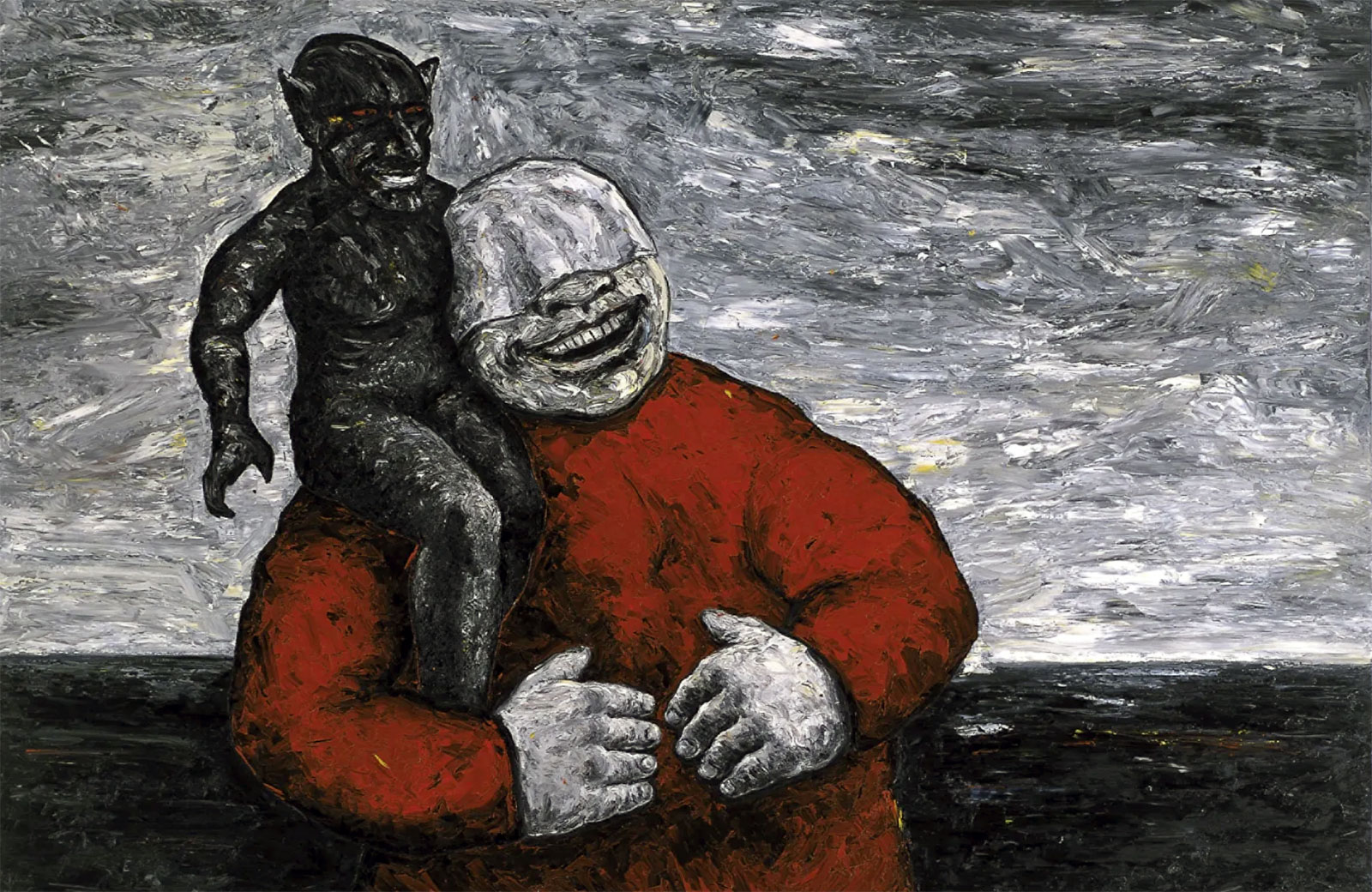
Wall text from the exhibition


Doris Lessing. 'Briefing for a Descent into Hell Briefing for a descent into hell' book cover


Doris Lessing (British-Zimbabwean born Iran, 1919-2013)
Briefing for a Descent into Hell
1971
Vintage book cover published 1981


Peter Booth (Australian born England, b. 1940, Australia from 1958) 'Untitled (Daughters)' c. 1976 from the exhibition 'Peter Booth' at TarraWarra Museum of Art, Healesville, Nov 2022 - March 2023


Peter Booth (Australian born England, b. 1940, Australia from 1958)
Untitled (Daughters)
c. 1976
Ink on paper
11 x 12.5cm
Private collection


Untitled (Daughters), c. 1976, is a composition which originated in Booth’s visits to an inner-city park in Melbourne where he would take his young daughters to play. Here, through the intense rhythms of his lifework and cross hatching in black ink, and the introduction of symbolic forms such as a whirlpool and arrowhead, this everyday scene is imaginatively transformed into a mysterious, nocturnal realm. While his daughters play in the foreground, the artist has turned to face a rising moon on the horizon and there is a sense that he is being magnetically compelled to embark on the path which leads in its direction.

Text from the TarraWarra Museum of Art Facebook page


Installation view of the exhibition 'Peter Booth' at TarraWarra Museum of Art showing at centre, 'Painting' 1978


Installation view of the exhibition Peter Booth at TarraWarra Museum of Art showing at centre, Painting 1978
Photo: Marcus Bunyan


Peter Booth (Australian born England, b. 1940, Australia from 1958) 'Painting' 1978 (installation view)


Installation view of Peter Booth Painting 1978 from the exhibition Peter Booth at TarraWarra Museum of Art
Photo: Marcus Bunyan


Peter Booth became known for his black, minimal ‘doorway’ paintings of 1970-74. Yet by 1977 he had given up this style and begun to record the world of his dreams and nightmares in a series of apocalyptic, visionary landscapes. Booth’s paintings suggest that we are on the edge of another dark age. His paintings are brutal representations of his bleak dreams and fantasies. In an age of nuclear threat Booth’s work has a monumentality which is evocative of the final conflagration mentioned in The Book of Revelations. Painting 1978, challenges and disturbs the viewer by the artist’s choice of colour and method of painting. The dramatic black and red, yellow and white composition suggests both an industrial and a natural wasteland. The heavy impasto paint texture describes, with vigour and intensity, flames, explosions, and unidentified nightmarish images. Contradictory forces pull us into the central inferno below the glacial mountain peaks, and showers of rock explode towards us. Is it the artist himself who stands with his back to us, mesmerised by the scene, while grotesque metamorphosing figures stare out at us?

Text © National Gallery of Australia, Canberra


Booth’s subject matter largely concerns the Australian landscape, both urban and rural, and the relationship between environment and individual, as well as the individual’s capacity to create and destroy. And also what the world will be like in the future, humans as mutants.

Booth’s landscapes are charged with emotion and symbolic meaning. Memories of his childhood in the blackened industrial landscape of Sheffield seem to infuse the work, especially his well-known apocalyptic figurative paintings, which look like images of the end of the world; illustrations for The Book of Revelation. These images contain an intense image of anxiety, evoking the aftermath of some terrible destruction, vividly pictured with menacing forms and agitated, heavily applied brushstrokes.

An example is Painting 1978 which has been described as challenging and disturbing the viewer by the artist’s choice of colour and method of painting. “The dramatic black and red, yellow and white composition suggests both an industrial and a natural wasteland”. The heavy impasto paint texture describes, with vigour and intensity, flames, explosions, and unidentified nightmarish images. Contradictory forces pull us into the central inferno below the glacial mountain peaks, and showers of rock explode towards us.

Is it the artist himself who stands with his back to us, mesmerised by the scene, while grotesque metamorphosing figures stare out at us?” Peter Booth has centred many of his paintings around his childhood in Sheffield England where he grew up during the war years and their aftermath.

Anonymous. “Peter Booth,” on the Art History Essay website Nd [Online] Cited 07/02/2023


Peter Booth (Australian born England, b. 1940, Australia from 1958) 'Drawing (Figure with Insect Tail)' 1982


Peter Booth (Australian born England, b. 1940, Australia from 1958)
Drawing (Figure with Insect Tail)
1982
Pastel and casein on paper
17.3 x 12.5cm
National Gallery of Victoria, Melbourne
Purchase, Victorian Foundation of Living Australian Artists, 2010


More than just figures of fantasy, Booth’s curious amalgams and mutated figures often express his personal insights into the interrelatedness of all living beings. With his closed eyes and restful expression, the metamorphic figure in Drawing (Figure with Insect Tail) appears contented with his hybrid condition, affirming the artist’s belief that humans “share something with these creatures … we are part of the same thing.”

Text from the TarraWarra Museum of Art Facebook page


William Blake (British, 1757-1827) 'The Ghost of a Flea' c. 1819


William Blake (British, 1757-1827)
The Ghost of a Flea
c. 1819
Tempera heightened with gold on mahogany
214 x 162 mm
Tate
Bequeathed by W. Graham Robertson 1949


Another physiognomic “vision” – “the stuff of delirium and nightmare, [which] taps into the unconscious, internalised sublime” – was the painting The Ghost of a Flea (c. 1819) used to illustrate John Varley’s Treatise on Zodiacal Physiognomy (1828). In studying the work of Blake for this posting, I found it instructive to look at Blake’s preparatory sketches for his works which can be found online. They give you a good idea of the spontaneity of the drawing and the ideas that arise, transformed into the finished work. Here in the graphite on paper drawing of The Ghost of a Flea we can see Blake’s initial vision, a more static, pensive figure with serrated wings which morphs into a muscular, blood sucking monster set on a cosmic stage, of life framed by curtains and a shooting star. As the vision appeared to Blake he is said to have cried out: ‘There he comes! his eager tongue whisking out of his mouth, a cup in his hand to hold blood, and covered with a scaly skin of gold and green.’

Marcus Bunyan. “Visions of divine damnation” on the exhibition William Blake at Tate Britain, London Part 2, February 2020 on the Art Blart website [Online] Cited 09/02/2023


William Blake (British, 1757-1827) 'The Ghost of a Flea' c. 1819 (installation view)


William Blake (British, 1757-1827)
The Ghost of a Flea
c. 1819
Graphite on paper
Private collection
Photo: © Marcus Bunyan and Tate


Artist and astrologer John Varley encouraged Blake to sketch the figures, called ‘visionary heads’, who populated his visions. This image is the best known. While sketching the flea, Blake claimed it told him that fleas were inhabited by the souls of bloodthirsty men, confined to the bodies of insects because, if they were the size of horses, they would literally drain the population. Their bloodthirsty nature is shown by the eager tongue flicking at the ‘blood’ cup it carries. This intense disorientating image, the stuff of delirium and nightmare, taps into the unconscious, internalised sublime.

William Blake, “The Ghost of a Flea c. 1819-20,” in Nigel Llewellyn and Christine Riding (eds.), The Art of the Sublime, Tate Research Publication, January 2013


Wall text from the exhibition 'Peter Booth' at TarraWarra Museum of Art


Wall text from the exhibition


Installation view of the exhibition 'Peter Booth' at TarraWarra Museum of Art showing from left to right, 'Painting Two' 1984, 'Painting' 1984 and 'Leadman' 1986


Installation view of the exhibition Peter Booth at TarraWarra Museum of Art showing from left to right, Painting Two 1984, Painting 1984 and Leadman 1986
Photo: Marcus Bunyan


Peter Booth (Australian born England, b. 1940, Australia from 1958) 'Painting Two' 1984


Peter Booth (Australian born England, b. 1940, Australia from 1958)
Painting Two
1984
Oil on canvas
198 x 305cm
National Gallery of Victoria, Melbourne
Purchased 1985
© Peter Booth


In the blasted landscape of Painting Two we are presented with a vision of a volatile world in the process of unnatural mutation. As an artist who has always been keenly attuned to what’s happening environmentally and politically, this painting forcefully conveys the fallout of a colossal act of destruction, reflecting widespread concerns in the 1980s over the dramatic escalation of the nuclear arms race between the United States and the Soviet Union and the threat of atomic warfare.

Wall text from the exhibition


Peter Booth (Australian born England, b. 1940, Australia from 1958) 'Painting' 1984 (installation view)


Peter Booth (Australian born England, b. 1940, Australia from 1958)
Painting (installation view)
1984
Oil on canvas
© Peter Booth
Photo: Marcus Bunyan


Peter Booth (Australian born England, b. 1940, Australia from 1958) 'Leadman' 1986 (installation view)


Peter Booth (Australian born England, b. 1940, Australia from 1958)
Leadman (installation view)
1986
Oil on canvas
TarraWarra Museum of Art collection
Gift of Eva Besen and Marc Besen AO 2001
© Peter Booth
Photo: Marcus Bunyan


In this work a hulking grey figure, with his fierce determination and body braced for battle, appears to be biologically adapted for survival in a desolated terrain. As the title suggests, this unrelentingly bleak and polluted atmosphere has eventuated from the unbridled destructive ambitions of the toxic Leadman who has transformed the world in his own image.

Wall text from the exhibition


Installation view of the exhibition 'Peter Booth' at TarraWarra Museum of Art showing from left to right, 'Leadman' 1986, 'Painting' 1984 and 'Painting' 2012

Installation view of the exhibition 'Peter Booth' at TarraWarra Museum of Art showing from left to right, 'Leadman' 1986, 'Painting' 1984 and 'Painting' 2012


Installation view of the exhibition Peter Booth at TarraWarra Museum of Art showing from left to right, Leadman 1986, Painting 1984 and Painting 2012
Photos: Marcus Bunyan


Peter Booth (Australian, b. 1940) 'Painting' 1984


Peter Booth (Australian, b. 1940)
Painting
1984
Oil on canvas
101 x 183cm
Heide Museum of Modern Art
The Baillieu Myer Collection of the ’80s
© Peter Booth


Peter Booth (Australian, b. 1940) 'Painting' 2012


Peter Booth (Australian, b. 1940)
Painting
2012
Oil on canvas
213.5 x 91cm
National Gallery of Australia, Canberra
© Peter Booth


William Blake (English, 1757-1827) From 'The Pastorals of Virgil' 1821


William Blake (English, 1757-1827)
Thenot Remonstrates with Colinet
Thenot Under a Fruit Tree
Thenot Remonstrates with Colinet, Lightfoot in the Distance
Colinet Departs in Sorrow, a Thunder-Scarred Tree on the Right
Blasted Tree and Blighted Crops
The Good Shepherd Chases Away the Wolf
Sabrina’s Silvery Flood
Colinet’s Fond Desire Strange Lands to Know
1821
From The Pastorals of Virgil adapted by R.J. Thornton, 3rd edition. F.C. & J. Rivington et al., London 1921
Wood engravings on thin, white handmade wove paper
National Gallery of Victoria, Melbourne
Purchased 1960
Photo: Marcus Bunyan


William Blake (English, 1757-1827) 'Blasted tree and blighted crops' 1821


William Blake (English, 1757-1827)
Blasted tree and blighted crops
1821
From The Pastorals of Virgil adapted by R.J. Thornton, 3rd edition. F.C. & J. Rivington et al., London 1921
Wood engraving on thin, white handmade wove paper
National Gallery of Victoria, Melbourne
Purchased 1960


William Blake (English, 1757-1827) 'The Good Shepherd Chases Away the Wolf' 1821


William Blake (English, 1757-1827)
The Good Shepherd Chases Away the Wolf
1821
From The Pastorals of Virgil adapted by R.J. Thornton, 3rd edition. F.C. & J. Rivington et al., London 1921
Wood engraving on thin, white handmade wove paper
National Gallery of Victoria, Melbourne
Purchased 1960


William Blake (English, 1757-1827) 'Colinet's Fond Desire Strange Lands to Know' 1821


William Blake (English, 1757-1827)
Colinet’s Fond Desire Strange Lands to Know
1821
From The Pastorals of Virgil adapted by R.J. Thornton, 3rd edition. F.C. & J. Rivington et al., London 1921
Wood engraving on thin, white handmade wove paper
National Gallery of Victoria, Melbourne
Purchased 1960


Cabinet text from the exhibition 'Peter Booth'


Cabinet text from the exhibition
Photo: Marcus Bunyan


A survey exhibition of the work of the renowned Australian artist Peter Booth 

With a remarkable career spanning several decades, Melbourne-based Booth is a unique voice in Australian art. This new survey of paintings and works on paper is the first major public gallery exhibition of Peter Booth’s work since the NGV retrospective in 2003 and features a number of the artist’s most significant works from the 1970s to 1990s, alongside important recent works from the past two decades.

The exhibition is presented thematically, honing in on and highlighting particular motifs, subjects and moods which have become hallmarks of Booth’s expansive oeuvre: stillness and turbulence, alterity and alienation, mutation and hybridity, the absurd and the grotesque, the road and the ruin, and the despoliation and the resilience of nature.

A small group of abstract paintings from the mid-1970s at the start of the exhibition provide a prelude to an important series of gestural paintings which mark the beginning of the artist’s journey into the highly expressive landscape and figure subjects which have characterised his practice since that time.

The exhibition progresses through Booth’s vivid imaginings of an apocalyptic world characterised by grotesque, unsettling, and at times absurd scenes of human and hybrid figures in varying states of apprehension, aggression and conflict. These works will be accompanied by a small selection of prints by William Blake, James Ensor, Francisco Goya, and Samuel Palmer, visionary artists who have been important touchstones for Booth and with whom he shares a number of affinities.

This survey also brings together important works from the past three decades to convey humanity’s often fraught and ambiguous relationship to the natural world, revealing Booth’s extraordinary capacity to transmute his intensely personal perceptions of the mysteries and forces of nature and the folly and hubris of human endeavours, into exceptional and deeply compelling paintings and drawings.

PETER BOOTH, curated by Anthony Fitzpatrick, is generously supported by The Balnaves Foundation.

Text from the TarraWarra Museum of Art website


Installation view of the exhibition 'Peter Booth' at TarraWarra Museum of Art showing from left to right, 'Untitled' 1997, 'Painting' 1982 and 'Painting' 1981


Installation view of the exhibition Peter Booth at TarraWarra Museum of Art showing from left to right, Untitled 1997, Painting 1982 and Painting 1981
Photo: Marcus Bunyan


Peter Booth (Australian, b. 1940) 'Untitled' 1997


Peter Booth (Australian, b. 1940)
Untitled
1997
Oil on canvas
The University of Melbourne Art Collection, Michael Buxton Collection
Donated through the Australia Government’s Cultural Gifts Program by Michael and Janet Buxton 2018
© Peter Booth


In Doris Lessing’s 1974 novel, The Memoirs of a Survivor, in the aftermath of an unspecified disaster, civilisation gradually disintegrates into anarchy as hordes of people form ad hoc tribes in the city streets to increase their chances of survival. In this dystopian narrative, Lessing describes the irrational and aggressive behaviour that can be unleashed within the safety and obscurity of a large group. This same sense of apprehension is one that Booth shares in many of his depictions of crowds. In Untitled, 1997, a large throng of men forms a single, impenetrable wall, gathered together to cheer on the spectacle of a violent struggle. Disturbing and absurd in equal measure, this work graphically portrays the violent actions that can be incited by a mob.

Wall text from the exhibition


Doris Lessing. 'The Memoirs of a Survivor' book cover


Doris Lessing (British-Zimbabwean born Iran, 1919-2013)
The Memoirs of a Survivor
1974
Penguin Random House book cover published 1988


Peter Booth (Australian, b. 1940) 'Untitled' 1997 (installation view detail)


Peter Booth (Australian, b. 1940)
Untitled (installation view detail)
1997
Oil on canvas
The University of Melbourne Art Collection, Michael Buxton Collection
Donated through the Australia Government’s Cultural Gifts Program by Michael and Janet Buxton 2018
© Peter Booth
Photo: Marcus Bunyan


Peter Booth (Australian, b. 1940) 'Painting 1982' 1982 (installation view)


Peter Booth (Australian, b. 1940)
Painting 1982 (installation view)
1982
Oil on canvas
Art Gallery of South Australia, Adelaide
A.M. Ragless Bequest Fund
© Peter Booth
Photo: Marcus Bunyan


Another scene of demonic possession enacted under the spell of a fiendish presence, Painting 1982, confronts the viewer with a deeply disturbing vision of human cannibalism. With its visceral imagery of mutilation and dismemberment, parallels have been drawn to the atrocities depicted in Goya’s series of etchings The Disasters of War1810-1815, while the highly theatrical quality of the painting suggests a more recent connection to George A. Romero’s cult zombie film Night of the Living Dead, 1968. When the work was first exhibited critics responded to what the painting conveyed about the current state of western mass culture, finding in its brutal imagery a powerful metaphor for greed and material consumption. Whichever way one choses to interpret this work, one thing remains clear, whenever a large group of men get together in Booth’s painting, there is always the potential for danger.

Wall text from the exhibition


Francisco Goya (Spanish, 1746-1828) 'Saturn Devouring His Son' c. 1819-1823


Francisco Goya (Spanish, 1746-1828)
Saturn Devouring His Son
c. 1819-1823
Mixed media mural transferred to canvas
143.5 cm × 81.4cm (56.5 in × 32.0 in)
Museo del Prado, Madrid


Saturn Devouring His Son is a painting by Spanish artist Francisco Goya. It is traditionally interpreted as a depiction of the Greek myth of the Titan Cronus (known as Saturn in Roman mythology) eating one of his offspring. Fearing a prophecy foretold by Gaea that predicted he would be overthrown by one of his children, Saturn ate each one upon their birth. The work is one of the 14 so-called Black Paintings that Goya painted directly on the walls of his house sometime between 1819 and 1823. It was transferred to canvas after Goya’s death and is now in the Museo del Prado in Madrid. …

Various interpretations of the meaning of the picture have been offered: the conflict between youth and old age, time as the devourer of all things, the wrath of God and an allegory of the situation in Spain, where the fatherland consumed its own children in wars and revolution. There have been explanations rooted in Goya’s relationships with his own son, Xavier, the only of his six children to survive to adulthood, or with his live-in housekeeper and possible mistress, Leocadia Weiss; the sex of the body being consumed cannot be determined with certainty. If Goya made any notes on the picture, they have not survived, as he never intended the picture for public exhibition.

Text from the Wikipedia website


Peter Booth (Australian, b. 1940) 'Painting 1982' 1982 (installation view detail)


Peter Booth (Australian, b. 1940)
Painting 1982 (installation view detail)
1982
Oil on canvas
Art Gallery of South Australia, Adelaide
A.M. Ragless Bequest Fund
© Peter Booth
Photo: Marcus Bunyan


Peter Booth (Australian, b. 1940) 'Painting' 1981 (installation view)


Peter Booth (Australian, b. 1940)
Painting (installation view)
1981
Oil on canvas
Private collection
© Peter Booth
Photo: Marcus Bunyan


In Painting 1981 a blindfolded boor is accompanied by a red-eyed, pointy-eared imp who appears to have just whispered a cosmic joke or secret in his ear. Situated in a bleak and desolate terrain, this disquieting scenario recalls the German legend of Faust in which, following the protagonist’s pact to sell his soul to the Devil in exchange for unlimited knowledge, Mephistopheles appears as his demonic guide. In this light, Booth’s painting can be seen as a powerful reimagining of this cautionary tale of how blind ambition and human hubris can lead to inner corruption and the unleashing of dangerous, irrational impulses.

Wall text from the exhibition


Peter Booth (Australian, b. 1940) 'Painting' 1981 (detail)


Peter Booth (Australian, b. 1940)
Painting (detail)
1981
Oil on canvas
Private collection
© Peter Booth


A survey exhibition of the work of major Australian artist Peter Booth will be held at TarraWarra Museum of Art, 26 November 2022 – 13 March 2023.

With a remarkable career spanning several decades, Melbourne-based Booth is a unique voice in Australian painting and is considered by many to be one of the most significant contemporary artists working in Australia today.

This new survey of paintings and works on paper will be the first major public gallery exhibition of Peter Booth’s work since the NGV retrospective in 2003 and will feature a number of the artist’s most significant works from the 1970s to 1990s, alongside important recent works from the past two decades.

Curated by TarraWarra’s Anthony Fitzpatrick, the exhibition will be presented thematically, honing in on and highlighting particular motifs, subjects and moods which have become hallmarks of Booth’s expansive oeuvre: stillness and turbulence; alterity and alienation; mutation and hybridity; the absurd and the grotesque; the road and the ruin; and the despoilation and the resilience of nature.

“This exhibition will reveal Booth’s extraordinary capacity to transmute his intensely personal perceptions of the mysteries and forces of nature, and the folly and hubris of human endeavours, into exceptional and deeply-compelling paintings and drawings,” Mr Fitzpatrick said.

A small group of abstract paintings from the mid-1970s at the start of the exhibition provide a prelude to an important series of gestural paintings which mark the beginning of the artist’s journey into a neo-expressionist figurative style.

The exhibition progresses through Booth’s vivid imaginings of an apocalyptic world characterised by grotesque, unsettling, and at times absurd scenes of human and hybrid figures in varying states of apprehension, aggression and conflict.

These works will be accompanied by a small selection of prints by William Blake, James Ensor, Francisco Goya, and Samuel Palmer, visionary artists who have been important touchstones for Booth and with whom he shares a number of affinities.

This survey will also bring together important works from the past three decades to convey humanity’s often fraught and ambiguous relationship to the natural world.

“Initially Booth’s highly visceral paintings of fiery, turbulent environments were the stage for confronting and, at times, violent human encounters. Since the 1990s, many of the scenes he has painted have become increasingly depopulated, implicating the viewer who is called to contemplate and navigate their own subjective relationship to these vivid landscapes.

“Most recently, the artist has returned to the apocalyptic imagery that characterised his first forays into figuration, with large-scale paintings of desolate and devastated scenes of a world in a cataclysmic state of collapse. This is art for a time of ecological and existential crisis in which anthropogenic impacts have driven the planet, and its intricate web of ecosystems, to the brink of utter catastrophe,” Mr Fitzpatrick said.

Press release from the TarraWarra Museum of Art


Installation view of the exhibition 'Peter Booth' at TarraWarra Museum of Art showing at second right, 'Painting' 2022


Installation view of the exhibition Peter Booth at TarraWarra Museum of Art showing at second right, Painting 2022 (below)
Photo: Marcus Bunyan


Peter Booth (Australian, b. 1940) 'Painting' 2022 (installation view)


Peter Booth (Australian, b. 1940)
Painting (installation view)
2022
Oil on canvas
214.0 x 137.5cm
Courtesy the artist and Milani Gallery
© Peter Booth
Photo: Marcus Bunyan


Peter Booth (Australian, b. 1940) 'Painting' 2022 (installation view)


Peter Booth (Australian, b. 1940)
Painting (installation view)
2022
Oil on canvas
214.0 x 137.5cm
Courtesy the artist and Milani Gallery
© Peter Booth
Photo: Marcus Bunyan


Peter Booth (Australian, b. 1940) 'Painting' 2022


Peter Booth (Australian, b. 1940)
Painting
2022
Oil on canvas
214.0 x 137.5cm
Courtesy the artist and Milani Gallery
© Peter Booth


Peter Booth (Australian born England, b. 1940, Australia from 1958) 'Acheron Way' 1993 (installation view)


Peter Booth (Australian born England, b. 1940, Australia from 1958)
Acheron Way (installation view)
1993
Oil on canvas
208 x 304.8cm
Private collection
© Peter Booth
Photo: Marcus Bunyan


Peter Booth (Australian born England, b. 1940, Australia from 1958) 'Acheron Way' 1993 (installation view detail)


Peter Booth (Australian born England, b. 1940, Australia from 1958)
Acheron Way (installation view detail)
1993
Oil on canvas
208 x 304.8cm
Private collection
© Peter Booth
Photo: Marcus Bunyan


Acheron Way is named after a long snaking road which rises steeply through the rainforest of the Yarra Ranges between Narbethong and Warburton. Pictured beneath a clear blue sky, this scene of animated trees backlit by a soft, yellow light evokes a sense of energy, growth and even hope. The swaying trunks and tentacular forms of the sprawling limbs of the trees painted in thick swathes of impasto, imbue them with a powerful emotional charge. However, there is a more ambiguous aspect to this work alluded to in its title which not only refers to a real location, but also to an infernal realm of the imagination: Acheron (‘river of pain’) one of the rivers of the Underworld in Greek mythology over which the souls of the dead were ferried. From this perspective, the tangled and twisted forms of these sentinel-like trees seem to be denying us access to the light suffused landscape in the distance, forcing us to linger in their shadow, begging the question: are we in the realm of the living or the dead?

Wall text from the exhibition


Installation view of the exhibition 'Peter Booth' at TarraWarra Museum of Art showing at left 'Untitled' 1998, and at right 'Painting' 2017


Installation view of the exhibition Peter Booth at TarraWarra Museum of Art showing at left Untitled 1998 (below), and at right Painting 2017 (below)
Photo: Marcus Bunyan


Peter Booth (Australian born England, b. 1940, Australia from 1958) 'Untitled' 1998


Peter Booth (Australian born England, b. 1940, Australia from 1958)
Untitled
1998
Oil on canvas
Private collection
© Peter Booth
Photo: Marcus Bunyan


Peter Booth (Australian born England, b. 1940, Australia from 1958) 'Painting' 2017


Peter Booth (Australian born England, b. 1940, Australia from 1958)
Painting
2017
Oil on canvas
193.4 x 81.3cm
Courtesy of the artist and Milani Gallery, Brisbane


In Painting 2017, as the sun begins to rise over the horizon, new epicormic growth spouts from the pruned limbs of a tree; a potent symbol of resilience and renewal. Peter Booth’s ‘Garden of Eden’ paintings vividly convey his feeling for the elemental and generative qualities found in nature and his fervent empathy for other nonhuman lifeforms. ‘Everything is connected. All life comes from the same source.’

Text from the TarraWarra Museum of Art Facebook page


Installation view of the exhibition 'Peter Booth' at TarraWarra Museum of Art showing at left 'Acheron Way' 1993, at third right 'Painting' 2022, and at right 'Painting' 2014


Installation view of the exhibition Peter Booth at TarraWarra Museum of Art showing at left Acheron Way 1993, at third right Painting 2022, and at right Painting 2014 (below)
Photo: Marcus Bunyan


Peter Booth (Australian born England, b. 1940, Australia from 1958) 'Painting' 2014


Peter Booth (Australian born England, b. 1940, Australia from 1958)
Painting
2014
Oil on canvas
188 x 219cm
Private collection
© Peter Booth


Installation view of the exhibition 'Peter Booth' at TarraWarra Museum of Art showing at second left 'Winter' 1993, and at right 'Mount Donna Buang' 1991


Installation view of the exhibition Peter Booth at TarraWarra Museum of Art showing at second left Winter 1993 (below), and at right Mount Donna Buang 1991 (below)
Photo: Marcus Bunyan


Installation view of the exhibition 'Peter Booth' at TarraWarra Museum of Art showing at left 'Winter' 1993, and at right 'Mount Donna Buang' 1991


Installation view of the exhibition Peter Booth at TarraWarra Museum of Art showing at left Winter 1993 (below), and at right Mount Donna Buang 1991 (below)
Photo: Marcus Bunyan


Peter Booth (Australian born England, b. 1940, Australia from 1958) 'Winter' 1993


Peter Booth (Australian born England, b. 1940, Australia from 1958)
Winter
1993
oil on canvas
203.4 × 396.5cm
National Gallery of Victoria, Melbourne
Presented by the National Gallery Women’s Association, 2002
© Peter Booth


In discussing Winter when it was first exhibited in 1994, Booth revealed: it’s about my childhood, about taking walks with my brothers in the woods in Yorkshire. Triggered by a recent return to Sheffield, this memory is transformed into a richly textured landscape of open forest which has been stilled and silenced by a thick blanket of snow. As the artist later revealed, his younger twin brothers died in tragic circumstances adding particular poignancy to this painting and suggesting that the two very similar trees which occupy the centre of the work, could be seen as symbolic representations of his siblings. In this light, Winter becomes a powerful and deeply personal expression of remembrance and cathartic release.

Wall text from the exhibition


Peter Booth (Australian born England, b. 1940, Australia from 1958) 'Mount Donna Buang' 1991 (installation view)


Peter Booth (Australian born England, b. 1940, Australia from 1958)
Mount Donna Buang (installation view)
1991
Oil on canvas
Private collection
© Peter Booth
Photo: Marcus Bunyan


Installation view of the exhibition 'Peter Booth' at TarraWarra Museum of Art showing at left 'Painting' 2018, and at right 'Untitled' 1995


Installation view of the exhibition Peter Booth at TarraWarra Museum of Art showing at left Painting 2018 (below), and at right Untitled 1995 (below)
Photo: Marcus Bunyan


Peter Booth (Australian, b. 1940) 'Painting' 2018


Peter Booth (Australian, b. 1940)
Painting
2018
Oil on canvas
152.5 x 243.8cm
Courtesy of the artist and Milani Gallery, Brisbane
© Peter Booth


Peter Booth (Australian, b. 1940) 'Untitled' 1995


Peter Booth (Australian, b. 1940)
Untitled
1995
Oil on canvas
167.5 x 305cm
The University of Melbourne Art Collection, Michael Buxton Collection
© Peter Booth


Peter Booth (Australian, b. 1940) 'Painting' 2020 (installation view)


Peter Booth (Australian born England, b. 1940, Australia from 1958)
Painting (installation view)
2020
Oil on canvas
Courtesy of the artist and Milani Gallery, Brisbane
© Peter Booth
Photo: Marcus Bunyan


Installation view of the exhibition 'Peter Booth' at TarraWarra Museum of Art showing at left 'Painting (Figure with bandaged head)' 2004, and at right 'Painting' 1998


Installation view of the exhibition Peter Booth at TarraWarra Museum of Art showing at left Painting (Figure with bandaged head) 2004 (below), and at right Painting 1998 (below)
Photo: Marcus Bunyan


Peter Booth (Australian born England, b. 1940, Australia from 1958) 'Painting (Figure with bandaged head)' 2004


Peter Booth (Australian born England, b. 1940, Australia from 1958)
Painting (Figure with bandaged head)
2004
Oil on canvas
© Peter Booth


The strength and power of Painting (Man with Bandaged Head), 2004 … is palpable. But like so many of Booth’s images, formulated over years of development, the strength lies not so much in the initial ‘shock’, but with the ensuing waves of other possible readings it evokes…

The tension between our first confrontation with the bandaged figure and the subsequent sensations of pathos for, even some recognition of sensitivity within, the character makes this such a successful work. And as we look upon the painting, venturing into the space behind the bandages, the focus of the work internalises: in reading the mind of the figure we are offered a portal to see within ourselves.

This notion of the mirror to one’s soul, with themes of the nature of power and frailty, desire and control, so deftly captured within Painting (Man with Bandaged Head), 2004 adds a further dimension to the history of this particular painting.

Damian Hackett. “Important Australian + International Fine Art catalogue text,” on the Deutsche and Hackett website 25 November 2009 [Online] Cited 02/02/2023


Peter Booth (Australian, b. 1940) 'Painting' 1998 (installation view)


Peter Booth (Australian, b. 1940)
Painting (installation view)
1998
Oil on canvas
Private collection
Courtesy of Smith & Singer Fine Art
© Peter Booth
Photo: Marcus Bunyan


Peter Booth (Australian, b. 1940) 'Painting' 1998 (installation view detail)


Peter Booth (Australian, b. 1940)
Painting (installation view detail)
1998
Oil on canvas
Private collection
Courtesy of Smith & Singer Fine Art
© Peter Booth
Photo: Marcus Bunyan


Peter Booth (Australian, b. 1940) 'Painting' 2022


Peter Booth (Australian, b. 1940)
Painting
2022
Oil on canvas
Courtesy of the artist and Milani Gallery, Brisbane
© Peter Booth


Peter Booth (Australian, b. 1940) 'Painting' 1989


Peter Booth (Australian, b. 1940)
Painting
1989
Oil on canvas
167.4 x 95.9cm
Collection of Jeff Hall and Sharon Grey
© Peter Booth


Wall text from the exhibition 'Peter Booth' at TarraWarra Museum of Art


Wall text from the exhibition


Peter Booth (Australian, b. 1940) 'Untitled' 2007


Peter Booth (Australian, b. 1940)
Untitled
2007
Oil on canvas
56.5 x 111cm
Private collection
Image courtesy of Bonhams Australia
© Peter Booth


The figure in Untitled, 2007 has averted eyes and stoically sealed lips, suggesting that he has endured great hardship. This feeling is amplified by the rich tonal contrasts and paint texture built with swathes of impasto which transform his wizened face into a blustery landscape. Having taken the troubles and turmoil of the world into himself, this austere figure is imbued with a powerful sense of inner fortitude and resilience.

Text from the TarraWarra Museum of Art Facebook page


Peter Booth (Australian, b. 1940) 'Drawing (Pole Sitter Before a Crowd)' 1981 (installation view)


Peter Booth (Australian, b. 1940)
Drawing (Pole Sitter Before a Crowd) (installation view)
1981
Brush and ink and ink wash on paper
Private Collection
© Peter Booth
Photo: Marcus Bunyan


TarraWarra Museum of Art
Wurundjeri Country
313 Healesville-Yarra Glen Road
Healesville VIC 3777 Australia
Phone: +61 3 5957 3100

Opening hours:
Tues – Sun 11am – 5pm
Open all public holidays except Christmas Day

TarraWarra Museum of Art website

LIKE ART BLART ON FACEBOOK

Back to top

Exhibition: ‘The Stillness of Things: Photographs from the Lane Collection’ at the Museum of Fine Arts, Boston

Exhibition dates: 27th August, 2022 – 27th February, 2023


William Henry Fox Talbot (English, 1800-1877) 'Articles of China' before 1844 from the exhibition 'The Stillness of Things: Photographs from the Lane Collection' at the Museum of Fine Arts, Boston, August 2022 - February 2023


William Henry Fox Talbot (English, 1800-1877)
Articles of China
Before 1844
Salt print from a paper negative
The Lane Collection


The world is a reality,
not because of the way it is,
but because
of the possibilities it presents.


Frederick Sommer


A small but vibrant posting. Beautiful still life photographs my favourite being those by Mather, Sommer, Weston, Cunningham, Sudek and Morrell.

Dr Marcus Bunyan


Many thankx to the Museum of Fine Arts, Boston for allowing me to publish the photographs in the posting. Please click on the photographs for a larger version of the image.


Margrethe Mather (American, 1886-1952) 'Water Lily' 1922 from the exhibition 'The Stillness of Things: Photographs from the Lane Collection' at the Museum of Fine Arts, Boston, August 2022 - February 2023


Margrethe Mather (American, 1886-1952)
Water Lily
1922
Palladium print
The Lane Collection


This exhibition presents nearly 60 innovative photographs – all departures from the traditional still life – drawn from the MFA’s Lane Collection. Grouped thematically, the works on view span the entire history of photography, from its first introduction in England during the 1840s by William Henry Fox Talbot to the work of contemporary artists such as Adam Fuss, David Hilliard, Kenro Izu, Abelardo Morell, and Olivia Parker. Works by American modernists are prominently featured, with unexpected takes on the still life by Ansel Adams, Imogen Cunningham, Charles Sheeler, and Edward Weston – photographers better known for capturing vast landscapes and portraits of people.

One of the largest gifts in the MFA’s history, the Lane Collection was promised to the Museum in 2012. This exhibition is the latest in a series that has celebrated the single most important donation to the Museum’s photography holdings.

Text from the Museum of Fine Arts, Boston website


Charles Sheeler (American, 1883-1965) 'Still Life' Early 1920s from the exhibition 'The Stillness of Things: Photographs from the Lane Collection' at the Museum of Fine Arts, Boston, August 2022 - February 2023


Charles Sheeler (American, 1883-1965)
Still Life
Early 1920s
Gelatin silver print
The Lane Collection


Loosely organised by subject from messy desktops, kitchen utensils, and flora to empty chairs or found objects, the exhibit revels the mid-twentieth century strengths of the collection with works by modernists such as Ansel Adams, Edward Weston and especially Charles Sheeler. Sheeler pays homage to the painter Morandi with two still lifes featuring a simple ewer and ceramic vase and to Cezanne in a composition of apples. Often overlooked among the modernist masters are women such as Margaret Mather and Imogen Cunningham. Mather’s wispy pine needles and delicate water lily classically weave light, form and abstraction while Cunningham brings a geometric edge to the aloe plant she photographed on her window sill.

Suzanne Révy. “The Stillness of Things,” on the What Will You Remember website September 14, 2022 [Online] Cited 31/01/2023


Imogen Cunningham (American, 1883-1976) 'Aloe Variagata' Early 1930's


Imogen Cunningham (American, 1883-1976)
Aloe Variagata
Early 1930’s
Gelatin silver print
The Lane Collection


Charles Sheeler (American, 1883-1965) 'Cactus and Photographer's Lamp' 1931


Charles Sheeler (American, 1883-1965)
Cactus and Photographer’s Lamp
1931
Gelatin silver print
The Lane Collection


Ansel Adams (American, 1902-1984) 'Still Life, San Francisco' about 1932


Ansel Adams (American, 1902-1984)
Still Life, San Francisco
about 1932
Gelatin silver print
The Lane Collection
© The Ansel Adams Publishing Rights Trust


Frederick Sommer (American, 1905-1999) 'Chicken Entrails' 1939


Frederick Sommer (American, 1905-1999)
Chicken Entrails
1939
Gelatin silver print
The Lane Collection


Edward Weston (American, 1886-1958) 'Junk' 1939


Edward Weston (American, 1886-1958)
Junk
1939
Gelatin silver print
The Lane Collection


Imogen Cunningham (American, 1883-1976) 'The Unmade Bed' 1957


Imogen Cunningham (American, 1883-1976)
The Unmade Bed
1957
Gelatin silver print
The Lane Collection
© 2022 Imogen Cunningham Trust


Josef Sudek (Czech, 1896-1976) 'From the Window of my Atelier' 1965


Josef Sudek (Czech, 1896-1976)
From the Window of my Atelier
1965
Gelatin silver print
The Lane Collection
© I & G Fárová Heirs


Robert Heinecken (American, 1931-2006) 'TV Dinner' 1971


Robert Heinecken (American, 1931-2006)
TV Dinner
1971
Gelatin silver print on canvas with pastel, chalk, and resin
The Lane Collection
© The Robert Heinecken Trust


Irving Penn (American, 1917-2009) 'Gingko Leaves' 1990


Irving Penn (American, 1917-2009)
Gingko Leaves
1990
Dye-transfer print
The Lane Collection


Abelardo Morell (Cuban, b. 1948) 'Wavy Book' 2001


Abelardo Morell (Cuban, b. 1948)
Wavy Book
2001
Gelatin silver print
The Lane Collection
© Abelardo Morell/Courtesy Edwynn Houk Gallery, NYC


Adam Fuss (British, b. 1961) 'Butterfly' 2002


Adam Fuss (British, b. 1961)
Butterfly
2002
From the series My Ghost
Daguerrotype
The Lane Collection
© Adam Fuss


David Hilliard (American, b. 1964) 'Perennial' 2006


David Hilliard (American, b. 1964)
Perennial
2006
Archival pigment print
The Lane Collection
Museum purchase with funds donated by Saundra B. Lane
© David Hilliard


Olivia Parker’s green and purple artichoke dangling from a string is a nod to the Spanish painter Juan Sánchez Cotán whose vegetable paintings depict foodstuffs hung high to keep rodents at bay. Her work is installed near two surrealist pictures by Frederick Sommer. His jarring but beautiful compositions of chicken heads and innards brim with the tension between the life sustaining nourishment the chicken may have provided and the stark reminder of our mortality. And in an ironic twist, David Hilliard’s ebullient polyptych, Perennial, features an aisle of plastic Walmart flowers that were his mother’s favorites, in striking contrast to the ephemeral flowers featured in countless still life paintings in the galleries of the museum.

Suzanne Révy. “The Stillness of Things,” on the What Will You Remember website September 14, 2022 [Online] Cited 31/01/2023


Olivia Parker (American, b. 1941) 'Artichoke' 2010


Olivia Parker (American, b. 1941)
Artichoke
2010
Digital inkjet print
The Lane Collection
© Olivia Parker 2010


Museum of Fine Arts, Boston
Avenue of the Arts
465 Huntington Avenue
Boston, Massachusetts

Opening hours:
Saturday – Monday, Wednesday 10am – 5pm
Thursday and Friday 10am – 10pm
Tuesday closed

Museum of Fine Arts, Boston website

LIKE ART BLART ON FACEBOOK

Back to top

Exhibition: ‘Chris Killip, Retrospective’ at The Photographers’ Gallery, London

Exhibition dates: 7th October, 2022 – 19th February, 2023


Chris Killip (British, 1946-2020) 'Family on a Sunday walk, Skinningrove' 1982 from the exhibition 'Chris Killip, Retrospective' at The Photographers' Gallery, London, October 2022 - Feb 2023


Chris Killip (British, 1946-2020)
Family on a Sunday walk, Skinningrove
1982
From Skinningrove 1981-1984
Gelatin silver print
© Chris Killip Photography Trust
All images courtesy Martin Parr Foundation


Forever present

So many words have been written about the gritty photographs of British photographer Chris Killip that sometimes it feels hard to say something new, something that reveals more about the work. Perhaps I am just adding to the noise around the artist? What can I say that is insightful / eloquent?

Please allow me to talk about how the work makes me feel … interspersed with some of the facts that we know.

I feel humble before this work. Somehow less important as human being than the directness of the photographers vision and the stories he tells through his photographs about salt of the earth people. Human beings existing, getting by, in hardship, in winter, gathering coal at the edge of the sea under the ramparts of a power station – a tough place but not an unhappy place.

“Killip says that Lynemouth, where the sea-coalers worked, was a “tough place, but it wasn’t an unhappy place … There was lots of energy and lots of fun,” he adds. “There was rivalry and enthusiasms and passions. People were not despairing. It was a very complex community and with a great sense of purpose, which was: get the coal and make money. And I’ve always been interested in places that had purpose.”1

Killip’s purpose was to capture human dignity amid industrial decline in England’s north-east, “the human element of economic deprivation” and the resilience of communities affected. He embedded himself in his community – “I stayed in Newcastle for fifteen years. I mean, to get the access to photograph the sea-coal workers took eight years. You do get embroiled in a place”2 – in order for people to accept his presence and be relaxed in front of his large format camera. It’s almost as though the photographer and his very big, very visible camera were part of the scenery, as though the photographer and his equipment became invisible, indivisible from the story.

“In Winter 1983, believing his photographs felt too ‘remote’, Killip acquired a caravan of his own, and moved it onto the beach. Despite storm and snow, he could now photograph at will, in accordance with he rhythms of life on the camp itself. Killip tempers the extreme conditions of work with intimacy, kinships, and the quiet dignities of family life – so much so, that ‘photography’ seems hardly involved.”3

So much so, that ‘photography’ seems hardly involved. Just take a second to think about that statement.

And so admiration is another feeling that swells in the breast, through an understanding of how difficult these poetic images would have been to take with a large format camera (slung around the photographer’s neck, fired using a pistol grip in his hand without Killip ever looking through the lens, the artist just going on when it felt right to take a photograph and the intensity of the moment). How much patience, time, knowledge of the history of art and photography, technique and visualisation it would take to imagine these images into existence: these intimate photographs of families, friends, dogs, motorcycles, cars, ships, cranes and idle time that showcase not only Killip’s empathy for subject matter but also for himself, for he is also part of the story.4

“For a photographer whose work was grounded in the urgent value of documenting “ordinary” peoples’ lives, these nuanced images – radiating a vast stillness of light and time, embedded with the granularity of lives lived – reveal Killip’s conviction that no life is ordinary: everyday lives are sublime.”5

Killip’s visualisations always engage with the light of being and the place of existence with honesty and integrity. To see this, just look at the pairing and sequencing of images from Creative Camera in May 1977 at the end of the posting. A graveyard overlooked by a far away power station opposite two old men, the bald man’s hat hanging on the railing, overlooked by an “all out” demonstration poster; a man with platform shoes and flares, slumped on the ground bracing himself with a tattooed arm, surrounded by graffiti, supports a sleeping almost dead child in the crook of his other arm… whilst opposite a desolate scene of public housing, bleak pillars and fleeing mother and child overwhelmed by concrete madness; and a shrouded, dark, bent, woman in silhouette opposite the trappings of power in the civic robes of the mayors of Jarrow and South Shields. Every life is valuable.

Early influences in the Isle of Man images come from photographers such as August Sander, Paul Strand and Frank Sutcliffe. Later photographs have hints of the photo stories of Bill Brandt. Ultimately Killip forged his own authentic voice as an artist through his persistence in documenting “the human element of economic deprivation” and the resilience of communities affected. As he observed, “I wanted to record people’s lives because I valued them. I wanted them to be remembered. If you take a photograph of someone they are immortalised, they’re there forever. For me that was important, that you’re acknowledging people’s lives, and also contextualising people’s lives.”6

Killip’s focused (ie. in the zone, a mental state of focused concentration on the performance of an activity, in which one dissociates oneself from distracting or irrelevant aspects of one’s environment), complex and layered photographs are forever present. In a world where “there is nothing permanent except change” (Heraclitus), and where there are few traces left of the transitional worlds that Killip was documenting – “The sea-coal camp has gone, so have the coal mine and the power station. The area has been landscaped and now looks like an unused golf course. You would never know that the sea-coal camp had existed.”7 – Killip’s palpable realities make these human beings live and breathe again.

We care about them because Killip’s photographs enable within us a clarity of perception that means we are able to grasp what is there, the way it is. “If reality enters you without distortion, that is proper perception. The rest is distortion.” (Sadhguru)

Clear seeing and clear feeling. Where the forever is ever present.

Dr Marcus Bunyan


1/ Carolina A. Miranda. “Seven photos, seven stories: Chris Killip on capturing the declining industrial towns of England in the ’70s and ’80s,” on the Chicago Tribune website Jul 22, 2017 [Online] Cited 27/01/2023. No longer available online

2/ Anonymous. “Chris Killip,the closest way to make our memories seem real,” on the In de stilte website 17 April 2019 [Online] Cited 27/01/2023

3/ Wall text from the exhibition

4/ Here we could adapt what Pierre Boulez said about his work Pli selon pli (Fold by fold): “So, fold by fold, as the five movements develop, a portrait of Killip is revealed.” See Anonymous. “Pli selon pli,” on the Wikipedia website Nd Footnote 3 [Online] Cited 10/02/2023

5/ Anonymous. “Chris Killip: Skinningrove,” on the Amazon website Nd [Online] Cited 10/02/2023

6/ Chris Killip quoted in Diane Smyth. “Now Then: Chris Killip and the Making of In Flagrante,” on the British Journal of Photography website 6 June 2017 [Online] Cited 26/01/2023

7/ Chris Killip quoted in Olivier Laurent and Natalie Matutschovsky. “Chris Killip’s Celebrated Photobook In Flagrante Makes Its Return,” on the Time website January 27, 2016 [Online] Cited 26/01/2023


Many thankx to The Photographers’ Gallery for allowing me to publish the photographers in the posting. Please click on the photographs for a larger version of the image.


“The photography that I practice takes place in a specific time and place, depicting real moments in peoples lives. In many ways I think of myself as a historian, but not of the world. History is most often written from a distance, and rarely from the viewpoint of those who endured it.”

“I don’t want photography to transcend its subject matter, but for many art historians that is the limitation of photography … I don’t see it as a limitation; it puts me more in the camp of photography than art when I say I don’t acknowledge that as a limitation, I acknowledge it as an interesting fact and strength. Why would I want to transcend the subject when I am interested in the subject matter.”


Chris Killip


“The working class get it in the neck basically, they’re the bottom of the pile,” says Chris Killip. “I wanted to record people’s lives because I valued them. I wanted them to be remembered. If you take a photograph of someone they are immortalised, they’re there forever. For me that was important, that you’re acknowledging people’s lives, and also contextualising people’s lives.”


Chris Killip quoted in Diane Smyth. “Now Then: Chris Killip and the Making of In Flagrante,” on the British Journal of Photography website 6 June 2017 [Online] Cited 26/01/2023


‘I didn’t set out to be the photographer of the English de-Industrial Revolution. It happened all around me during the time I was photographing’ Chris Killip, 2019

Grounded in sustained immersion and participation in the communities he photographed, Chris Killip’s keenly observed work chronicled ordinary people’s lives in stark, yet sympathetic, detail. His photographs are recognized as some of the most important visual records of 1980s Britain; as editor of this book Ken Grant reflects, they tell the story of those who ‘had history “done to them”, who felt its malicious disregard and yet, like the photographer with whom they shared so much of their lives, refused to yield or look away’.”


Anonymous. “Chris Killip,” on the Magnum Photos website Nd [Online] Cited 26/01/2023


Chris Killip’s continued efforts to value and document the lives of those affected by the economic shifts in the North of England, throughout the 1970s and 80s, have made him one of the most influential figures of British Photography. This retrospective exhibition of more than 140 works, serves as the most comprehensive survey of the photographer’s work to date and includes previously unseen works.

His sustained immersion into the communities he photographed remains without parallel. Whilst marking a moment of deindustrialisation, Killip’s stark yet tender observation moves beyond the urgency to record such circumstances, to affirm the value of lives he grew close to – lives that, as he once described ‘had history done to them’, who felt history’s malicious disregard and yet, like the photographer himself, refused to yield or look away.

Against a background of shipbuilding and coal mining, he witnessed the togetherness of communities and the industries that sustained them and stayed long enough to see their loss.

Text from The Photographers’ Gallery website


Chris Killip, retrospective trailer – The Photographers’ Gallery (7 October 22 – 19 February 23)

This retrospective exhibition of more than 140 works, serves as the most comprehensive survey of the photographer’s work to date and includes previously unseen works. Chris Killip’s continued efforts to value and document the lives of those affected by the economic shifts in the North of England, throughout the 1970s and 80s, have made him one of the most influential figures of British Photography.


Chris Killip, retrospective – An Interview with Exhibition Curators Tracy Marshall Grant and Ken Grant

An interview with Chris Killip, retrospective exhibition curators Tracy Marshall-Grant and Ken Grant.


CAMERA Exhibitions: Chris Killip, retrospective. The Photographers Gallery

This retrospective exhibition of more than 140 works, serves as the most comprehensive survey of Chris Killip’s work to date and includes previously unseen works.


Chris Killip

In 1963, aged 17, Chris Fillip opened a copy of Paris Match magazine hoping for news of the Tour de France cycle race, and instead found Henri Cartier-Bresson’s photograph of a boy carrying two bottles of wine in Rue Mouffetard, Paris. Sensing the potential for photography to serve as an untethered means of expression, Killip’s life took a new turn. He didn’t own a camera, yet nevertheless told his father he would become a photographer. A summer working as a beach photographer earned him enough to leave for London in 1964, where he finally secured a position assisting the commercial photographer Adrian Flowers.

Killip’s immersion into the London cultural scene of te 1960s, share with painters and musicians, brought an appreciation for its buoyant gallery culture and an education that was both self-directed and formative. Quickly establishing himself as a sought-after freelance assistant, he led the production of major campaigns, until a 1969 trip to New York prompted an epiphany and a return to his native Isle of Man. There, he began the first of the long-term bodies of worksheet would define his career, each of which are characterised by their independence, tenderness and profound humanity.

Chris Killip’s legacy bears witness to an era of deindustrialisation, whilst serving as a portent to its longer consequences. From that first urgent return to the Isle of Man, into the early 1970s, when he first photographed in the North of England, until his death in October 2020, Fillip remained close to those he photographed ‘those’, he once said, ‘who’d had history done to them’.

Wall text from the exhibition


Isle of Man 1970-1973

In Autumn 1969, while in New York for a commercial photo shoot, a visit to Bill Brandt’s exhibition at the Museum of Modern Art would cause Killip’s life to change course again. It was the permanent collection that inspired him most: Paul Strand, August Sander, Walker Evans… each offered license to make photography for its own sake, free of commercial imperatives, and Fillip left the museum reeling. That same evening, he rang his father, telling him he would return to the Isle of Man to photograph.

By the late 1960s, a peasant culture that had long word the land and sea had been joined by many working financial enterprises on the island. Two instinct Isles of Man were emerging, one of which was now threatened. Between 1970 and 1972, Fillip photographed during the day and worked evenings in his father’s pub. Time away from the island had clarified the political shifts and external influences that were coming to bear on his family and their community, and he knew the urgency of his task. Though completed in 1973, Isle of Man: A book about the Manx, was published in 1980.

Wall text from the exhibition


Chris Killip (British, 1946-2020) 'Golden Meadow mill, Castletown' 1972 from the exhibition 'Chris Killip, Retrospective' at The Photographers' Gallery, London, October 2022 - Feb 2023


Chris Killip (British, 1946-2020)
Golden Meadow mill, Castletown
1972
From Isle of Man 1970-1973
Gelatin silver print
© Chris Killip Photography Trust
All images courtesy Martin Parr Foundation


Chris Killip (British, 1946-2020) 'Cashtal ny Ard, Maughold (neolithic burial site)' 1972 from the exhibition 'Chris Killip, Retrospective' at The Photographers' Gallery, London, October 2022 - Feb 2023


Chris Killip (British, 1946-2020)
Cashtal ny Ard, Maughold (neolithic burial site)
1972
From Isle of Man 1970-1973
Gelatin silver print
© Chris Killip Photography Trust
All images courtesy Martin Parr Foundation


Chris Killip (British, 1946-2020) 'Interior of St Luke's church, Baldwin' 1972


Chris Killip (British, 1946-2020)
Interior of St Luke’s church, Baldwin
1972
From Isle of Man 1970-1973
Gelatin silver print
© Chris Killip Photography Trust
All images courtesy Martin Parr Foundation


Chris Killip (British, 1946-2020) 'Mr 'Snooker' Corkhill and his son, Castletown' 1970-1973


Chris Killip (British, 1946-2020)
Mr ‘Snooker’ Corkhill and his son, Castletown
1970-1973
From Isle of Man 1970-1973
Gelatin silver print
© Chris Killip Photography Trust
All images courtesy Martin Parr Foundation


Chris Killip (British, 1946-2020) 'Mrs Pitts, Slieu Whuallian' 1970-1973


Chris Killip (British, 1946-2020)
Mrs Pitts, Slieu Whuallian
1970-1973
From Isle of Man 1970-1973
Gelatin silver print
© Chris Killip Photography Trust
All images courtesy Martin Parr Foundation


Chris Killip (British, 1946-2020) 'John Radcliffe, Black Hill, Ballasalla' 1970-1973


Chris Killip (British, 1946-2020)
John Radcliffe, Black Hill, Ballasalla
1970-1973
From Isle of Man 1970-1973
Gelatin silver print
© Chris Killip Photography Trust
All images courtesy Martin Parr Foundation


Mr Radcliffe remained a bachelor all his life. When he was given a print of this photograph he folded it in four and put it in his pocket, but told the photographer he was glad to have it as he had lost his cat in the meantime to a traffic accident.


Chris Killip (British, 1946-2020) 'Ms Redpath, Regaby' 1970-1973


Chris Killip (British, 1946-2020)
Ms Redpath, Regaby
1970-1973
From Isle of Man 1970-1973
Gelatin silver print
© Chris Killip Photography Trust
All images courtesy Martin Parr Foundation


Chris Killip (British, 1946-2020) 'Mrs Hyslop, Ballachrink Farm, the Braaid' 1970-1973


Chris Killip (British, 1946-2020)
Mrs Hyslop, Ballachrink Farm, the Braaid
1970-1973
From Isle of Man 1970-1973
Gelatin silver print
© Chris Killip Photography Trust
All images courtesy Martin Parr Foundation


Chris Killip (British, 1946-2020) 'Thrashing, Grenaby Farm, Isle of Man' 1970-1973


Chris Killip (British, 1946-2020)
Thrashing, Grenaby Farm, Isle of Man
1970-1973
From Isle of Man 1970-1973
Gelatin silver print
© Chris Killip Photography Trust
All images courtesy Martin Parr Foundation


In Thrashing, Grenaby … I think I failed better, although I suspect that its atmosphere of ‘bucolic idyll’ would be a different sort of problem. This photograph more accurately describes threshing work, and shows something from the past: agricultural labour as communal effort.


Chris Killip (British, 1946-2020) 'TT Races Supporter, Isle of Man' 1971


Chris Killip (British, 1946-2020)
TT Races Supporter, Isle of Man
1971
From TT Races 1970-1972
Gelatin silver print
© Chris Killip Photography Trust
All images courtesy Martin Parr Foundation


“Making a portrait fills me with a certain amount of dread. It’s the impertinence of what you are about to do in reducing a human being into one fixed moment. You think about the subject’s complexity (knowing them makes this worse) and the predetermined limitations that surround any attempt at portraiture. Then you convince yourself that you have to try, and you go ahead. This brief moment between you and the person in front of you is based on their trust in your intent.”

~ Chris Killip


Early work 1974-1977

In 1972, a commission by the Arts Council of Great Britain led Fillip to photograph Bury St Edmunds and Huddersfield. Drawn to the Yorkshire city’s mills, tenement housing and workplaces, he photographed widely in the region, making portraits in the street, and settling on an approach that would continue in subsequent decades.

After a move to Newcastle in 1975 to undertake a British Gas / Northern Arts Fellowship, Fillip used his non-contracted time to photograph independently. From the edges of the shipyards near his new home, to the coalmining towns of Castleford and Workington, he gathered an understanding of the industrial regions of the North and built an accord with the communities bound by them. An early search for a Newcastle darkroom led to Amber Films, an association that would eventually see him taking on the directorship of Amber’s Side Gallery between 1977-1979.

In May 1977, the editors of Creative Camera magazine [see the end of this posting] gave over the entire issue to a portfolio of Killip’s Northeast photographs – a rare move that acknowledged the work’s authority, whilst suggesting something of the potential future sequencing of work drawn from across the region.

Wall text from the exhibition


Chris Killip (British, 1946-2020) 'Youth on wall, Jarrow, Tyneside' 1975


Chris Killip (British, 1946-2020)
Youth on wall, Jarrow, Tyneside
1975
Gelatin silver print
© Chris Killip Photography Trust
All images courtesy Martin Parr Foundation


The boy with his Punk hair and boots seems to be a study in bravado and insecurity, recorded with magnifying glass clarity by a 5 × 4 camera. Chris later told me that he had captured this unlikely picture by putting a false lens on the side of his view camera (à la Paul Strand) and wearing a hazard jacket, like a council surveyor.

Mark Haworth-Booth. “Chris Killip,” on the V&A Blog website October 30, 2020 [Online] Cited 26/01/2023


Chris Killip (British, 1946-2020) 'Whippet Fancier, Huddersfield' 1973


Chris Killip (British, 1946-2020)
Whippet Fancier, Huddersfield, Yorkshire
1973
Gelatin silver print
© Chris Killip Photography Trust
All images courtesy Martin Parr Foundation


Chris Killip (British, 1946-2020) 'Two girls, Grangetown, Middlesbrough, Teesside' 1975


Chris Killip (British, 1946-2020)
Two girls, Grangetown, Middlesbrough, Teesside
1975
Gelatin silver print
© Chris Killip Photography Trust
All images courtesy Martin Parr Foundation


The Last Ships 1975-1977


Chris Killip (British, 1946-2020) 'Tyne Pride at the end of the street, Wallsend' 1976


Chris Killip (British, 1946-2020)
Tyne Pride at the end of the street, Wallsend
1976
From The Last Ships 1975-1977
Gelatin silver print
© Chris Killip Photography Trust
All images courtesy Martin Parr Foundation


Chris Killip (British, 1946-2020) 'Girls Playing in the street, Wallsend, Tyneside' 1976


Chris Killip (British, 1946-2020)
Girls Playing in the street, Wallsend, Tyneside
[Looking East on Camp Road, Wallsend]

1976
From The Last Ships 1975-1977
Gelatin silver print
© Chris Killip Photography Trust
All images courtesy Martin Parr Foundation


“When I was making my shipbuilding photographs I didn’t show them to anyone, as shipbuilding on Tyneside had become a personal obsession. I made them with a sense of urgency as I thought it wasn’t going to last. I didn’t set out to be the photographer of the English de-industrial revolution, it happened all around me during the time I was photographing.”

~ Chris Killip


This photograph belongs to a bigger series by Chris Killip called The Last Ships, which traces the decline of shipbuilding on the Tyne. “I made them with a sense of urgency, as I thought it wasn’t going to last,” Killip said later. “I didn’t set out to be the photographer of the English de-Industrial Revolution. It happened all around me during the time I was photographing.”

Killip was intrigued by the contrast between the epic scale of the ships that loomed over the streets of Wallsend and South Shields and the working-class communities that lived in their shadow. Here, children play on a quiet terraced street beneath the towering outline of the Tyne Pride, the biggest ship ever built on the Tyne and, as it turned out, one of the last. The red-brick houses, the stone wall, the fog lend the scene an almost Victorian feel. Within a few years, though, that way of life came to an end with a brutal finality. Just two years after this photograph was taken, Killip made another in the same place: the street was demolished, the community scattered. …

Many of Killip’s shipbuilding photographs, though, remained unseen until recently. Now, alongside three other series he made in the north-east – The Station (1985), Skinningrove (1981-84) and Portraits (1970-89) – The Last Ships (1975-1977) has been published as a large format zine. The scale suits the subject matter perfectly. The images, which move from the epic to the intimate, evoke another England in which the terms “working class” and “community” were still synonymous. It seems an eternity ago.

Sean O’Hagan. “The big picture: Chris Killip captures the last days of shipbuilding,” on The Guardian website Sun 6 Jan 2019 [Online] Cited 26/01/2023


“The ship was so massive you could see it from miles around dominating the area, not to mention the cranes and the noises from the yard which could be heard clattering through the night. When I think of those yards, which have just been filled in, flattened and abandoned, I think it’s a crying shame. We’re an island nation that cannot build a ship. If I had to pick a symbol to represent what the shipyards meant to me, it was the comradeship in the yards. We were a close-knit community of people living and working together. Everyone relied on each other and are all linked. When I look at the remains of what’s left I feel nothing. The community’s gone. There’s nothing left. It hasn’t changed for the best. You’ve saved money and destroyed this community.”

Frank Duke quoted in Hunter Charlton. Landscape and Change: Shipbuilding and Identity on the Tyne. University of Bristol, 2015, p. 4.


Chris Killip (British, 1946-2020) 'Wallsend in the snow' 1976


Chris Killip (British, 1946-2020)
Wallsend in the snow
1976
From The Last Ships 1975-1977
Gelatin silver print
© Chris Killip Photography Trust
All images courtesy Martin Parr Foundation


Chris Killip (British, 1946-2020) 'Demolished housing, Wallsend' August 1977


Chris Killip (British, 1946-2020)
Demolished housing, Wallsend
August 1977
From The Last Ships 1975-1977
Gelatin silver print
© Chris Killip Photography Trust
All images courtesy Martin Parr Foundation


Chris Killip (British, 1946-2020) 'The Ship Inn' 1975


Chris Killip (British, 1946-2020)
The Ship Inn
1975
From The Last Ships 1975-1977
Gelatin silver print
© Chris Killip Photography Trust
All images courtesy Martin Parr Foundation


Charles Sheeler (American, 1883-1965) 'Ford Plant - Criss-Crossed Conveyors' 1927


Charles Sheeler (American, 1883-1965)
Ford Plant – CrissCrossed Conveyors
1927
Gelatin silver print
© The Lane Collection
Courtesy, Museum of Fine Arts, Boston


Chris Killip (British, 1946-2020) 'Untitled? [Shipbuilding on Tyneside]' 1975-1977


Chris Killip (British, 1946-2020)
Untitled? [Shipbuilding on Tyneside]
1975-1977
From The Last Ships 1975-1977
Gelatin silver print
© Chris Killip Photography Trust
All images courtesy Martin Parr Foundation


Sealcoal 1981-1984

Killip first attempted to photograph the beach at Lynemouth, Northumberland, in 1976, only to be chased away by men on horse-drawn carts wary of any stranger. He’d hoped to photograph as winter tides returned the waste coal expelled into the sea from a nearby mine. After attempts over several years were met with violent rejection, Killip’s eventual acceptance came in 1982, when visiting a pub the seculars frequented to make a final plea. A man recognised him as the Manx photographer he’d give tea and shelter to during a rainstorm at Appleby Horse Fair, and confirmed Killip’s intentions were good.

In Winter 1983, believing his photographs felt too ‘remote’, Killip acquired a caravan of his own, and moved it onto the beach. Despite storm and snow, he could now photograph at will, in accordance with he rhythms of life on the camp itself. Killip tempers the extreme conditions of work with intimacy, kinships, and the quiet dignities of family life – so much so, that ‘photography’ seems hardly involved. Perhaps that’s what Killip liked so much when, years later, he called the words of seacoaler Brian Ladler, ‘…the commandment: love one another. It’s not a bad idea, is it Chris?’

Wall text from the exhibition


Chris Killip (British, 1946-2020) 'Gordon in the water, Seacoal Beach, Lynemouth' 1983


Chris Killip (British, 1946-2020)
Gordon in the water, Seacoal Beach, Lynemouth
1983
From Seacoal 1982-1984
Gelatin silver print
© Chris Killip Photography Trust
All images courtesy Martin Parr Foundation


In 1975 Chris Killip received a fellowship from the Northern Gas Board to photograph the laying of a natural gas pipeline near Newcastle, which for him became the start of a deep engagement with that area of the North East. He first attempted to photograph on Lynemouth Beach in 1976 but was quickly given the boot by those living and working there – again he tried, and in the end it took nearly six years to gain the trust of the community.

Between 1982 to 1984, Killip lived on and off in a caravan at the seacoal camp in Lynemouth – becoming an embedded part of the community, Killip observed the daily struggles to work and survive in this inhospitable environment. As well as the scenes of hard working conditions, images of tenderness in the relationships between the residents show kindness and camaraderie in times of uncertainty as the region underwent rapid de-industrialisation.

Anonymous. “Seacoal 1982-1984,” on the Martin Parr Foundation website Nd


Killip states that his impression of the beach was “the Middle Ages and twentieth century entwined” (Killip, 2022, p. 80).


Chris Killip (British, 1946-2020) 'Unidentified man and Brian Laidler, Seacoal Beach, Lynemouth' January 1984


Chris Killip (British, 1946-2020)
Unidentified man and Brian Laidler, Seacoal Beach, Lynemouth
[Blondie and Brian in the water, Seacoal Beach, Lynemouth, Northumberland]

January 1984
From Seacoal 1982-1984
Gelatin silver print
© Chris Killip Photography Trust
All images courtesy Martin Parr Foundation


Chris Killip (British, 1946-2020) 'Helen and her Hula-hoop, Seacoal Camp, Lynemouth, Northumbria' 1984


Chris Killip (British, 1946-2020)
Helen and her Hula-hoop, Seacoal Camp, Lynemouth, Northumbria
1984
From Seacoal 1982-1984
Gelatin silver print
© Chris Killip Photography Trust
All images courtesy Martin Parr Foundation


Chris Killip (British, 1946-2020) 'Alice and the little dog, Lynemouth, Northumberland' 1983


Chris Killip (British, 1946-2020)
Alice and the little dog, Lynemouth, Northumberland
1983
From Seacoal 1982-1984
Gelatin silver print
© Chris Killip Photography Trust
All images courtesy Martin Parr Foundation


Chris Killip (British, 1946-2020) 'Cookie in the snow, Seacoal Camp, Lynemouth, Northumbria' 1984


Chris Killip (British, 1946-2020)
Cookie in the snow, Seacoal Camp, Lynemouth, Northumbria
1984
From Seacoal 1982-1984
Gelatin silver print
© Chris Killip Photography Trust
All images courtesy Martin Parr Foundation


‘I remember speaking with Josef Koudelka in 1975 about why I should stay in Newcastle. Josef said that you could bring in six Magnum photographers, and they could stay and photograph for six weeks – and he felt that inevitably their photographs would have a sort of similarity. As good as they were, their photographs wouldn’t get beyond a certain point. But if you stayed for two years, your pictures would be different, and if you stayed for three years they would be different again. You could get under the skin of a place and do something different, because you were then photographing from the inside. I understood what he was talking about. I stayed in Newcastle for fifteen years. I mean, to get the access to photograph the sea-coal workers took eight years. You do get embroiled in a place.’

Anonymous. “Chris Killip,the closest way to make our memories seem real,” on the In de stilte website 17 April 2019 [Online] Cited 27/01/2023


Killip’s photos have an austere beauty to them – such as the image of a man nicknamed “Cookie” purposefully walking through a snowstorm. But the stories behind them can be quite humorous.

“Cookie was one of the people I was very friendly with,” Killip says. “It was a Sunday morning and his horse, Creamy, had just won a trotting race against guys from town. He’d won a £1,000. The race takes place very early so the police aren’t around. Then we go to the pub – at half past 7 in the morning – and the drinks are on Cookie because he has all of this money.

“Walking back to camp, I knew Cookie had to come back that way,” he adds. “I put the camera on the tripod and I’m swaying quite a bit because I’m drunk. But I knew exactly when I was going to take the picture of him. He didn’t lift his head. I took that one picture, just one frame.” …

Killip says that Lynemouth, where the sea-coalers worked, was a “tough place, but it wasn’t an unhappy place.”

“There was lots of energy and lots of fun,” he adds. “There was rivalry and enthusiasms and passions. People were not despairing. It was a very complex community and with a great sense of purpose, which was: get the coal and make money. And I’ve always been interested in places that had purpose.”

Carolina A. Miranda. “Seven photos, seven stories: Chris Killip on capturing the declining industrial towns of England in the ’70s and ’80s,” on the Chicago Tribune website Jul 22, 2017 [Online] Cited 27/01/2023. No longer available online


Chris Killip: I’m still in touch with the sea-coalers that I was big friends with and I’m up to date with how they are doing now that they have moved away from the area. The sea-coal camp has gone, so have the coal mine and the power station. The area has been landscaped and now looks like an unused golf course. You would never know that the sea-coal camp had existed.

I went back to Skinningrove three years ago and that was a big shock as it was so quiet as only two boats do any fishing from there. Everyone else has stopped as they couldn’t keep up with European Economic Community and Health and Safety regulations. It was as if all the life had gone out of the place.

Chris Killip quoted in Olivier Laurent and Natalie Matutschovsky. “Chris Killip’s Celebrated Photobook In Flagrante Makes Its Return,” on the Time website January 27, 2016 [Online] Cited 26/01/2023


Chris Killip (British, 1946-2020) ''Boo' on a horse, Seacoal Camp, Lynemouth, Northumbria' 1984


Chris Killip (British, 1946-2020)
‘Boo’ on a horse, Seacoal Camp, Lynemouth, Northumbria
1984
From Seacoal 1982-1984
Gelatin silver print
© Chris Killip Photography Trust
All images courtesy Martin Parr Foundation


The Photographers’ Gallery this autumn presents a full-career retrospective of work by one of the UK’s most important and influential post-war documentary photographers, Chris Killip (1946-2020).

Taking place over two upper floors of the Gallery, the retrospective exhibition of more than 150 works serves as the most comprehensive survey of the photographer’s work to date and includes previously unseen ephemera and colour works.

Grounded in his sustained immersion into the communities he photographed, Chris Killip’s photographs of those affected by economic shifts throughout the 1970s and 80s in the North of England remain without parallel. Whilst marking a moment of deindustrialisation, Killip’s stark yet tender observation moves beyond the urgency to record such circumstances, to affirm the value of lives he grew close to – lives that, as he once described ‘had history done to them’, who felt history’s malicious disregard and yet, like the photographer himself, refused to yield or look away.

From early work made in his native Isle of Man, through overlapping series’ made over two decades in the North of England, Killip’s approach to portraying communities is explored. Against a background of shipbuilding and coal mining, he witnessed the togetherness of communities and the industries that sustained them and stayed long enough to see their loss. At Lynemouth, for his series ‘Seacoal’, he photographed men on horse-driven carts reclaiming coal which had been discarded into the sea by a nearby mine, and at Skinningrove he documented a group of young men, their friendships and labours as they waited for the tide to turn.

The exhibition, curated by Tracy Marshall-Grant and Ken Grant, also draws upon less familiar work by a photographer whose life and career has proved so influential in shaping British photography. Killip’s dedicated recording of the miners’ strike of 1984-1985 and his engagement with shipbuilding a decade earlier, remain lesser known yet pivotal works that betrayed not only a changing economy, but the concerns of a photographer moved to witness them. In dialogue with the prints made by the photographer towards the end of his life, the exhibition also considers Killip’s photo books, drawing on early maquettes to map the development of books acknowledged as landmarks in the genre and offer new perspectives on the photographer’s storytelling.

The exhibition is accompanied by a major monograph co-published with Thames and Hudson, edited by Ken Grant and Tracy Marshall-Grant and designed by Niall Sweeney. The book includes a foreword by Brett Rogers, in depth essays by Ken Grant and texts by Amanda Maddox, Greg Halpern and Lynsey Hanley. The exhibition will tour to the BALTIC Centre of Contemporary Art in 2023. Exhibition supported by the Isle of Man Arts Council.

Chris Killip

Born in Douglas, Isle of Man in 1946, Chris Killip left school at age sixteen and joined the only four star hotel on the Isle of Man as a trainee hotel manager. In June 1964 he decided to pursue photography full time. He worked as a freelance assistant for various photographers in London from 1966-1969. In 1969, after seeing his very first exhibition of photography at the Museum of Modern Art in New York, he decided to return to photograph in the Isle of Man. In 1972 he received a commission from The Arts Council of Great Britain to photograph Huddersfield and Bury St Edmunds for the exhibition Two Views – Two Cities. In 1975, he moved to live in Newcastle-upon-Tyne on a two year fellowship as the Northern Arts Photography Fellow. He was a founding member, exhibition curator and advisor of Side Gallery, Newcastle-upon-Tyne, as well as its director, from 1977-1979. In 1989 he received the Henri Cartier Bresson Award and in 1991 was invited to be a Visiting Lecturer at the Department of Visual and Environmental Studies, Harvard University. In 1994 he was made a tenured professor and was department chair from 1994-1998. He retired from Harvard in December 2017 and died in 2020. His work is featured in the permanent collections of major institutions such as the Museum of Modern Art, New York; George Eastman House; Fine Arts Museum of San Francisco; Museum Folkwang, Essen; the Stedelijk Museum, Amsterdam; National Gallery of Australia, Canberra; and the Victoria and Albert Museum, London.

Press release from The Photographers’ Gallery


The Time of In Flagrante 1976-1987

In 1985, David Godwin, then Editor at Secker & Warburg, had written to Fillip to suggest that if he wished to make another book, he would like to publish it. Although Secker had no track record of working with photography, Fillip liked the prospect of reaching a wider audience and a collaboration began with editor Mark Holborn and designer Peter Dyer that led to the 1988 book In Flagrante.

In Flagrante‘s achievements are manifold. Whilst Fillip threw himself into long term series, like the 1984-85 Miners’ Strike, the uncoupling of photographs from their original contexts freed them from more conventional narratives. Mindful of the Yeats poem He wishes for the cloths of heaven, which head chosen to open the book, Killip reads softly, to achieve work that John Berger recognised as being ‘branded, like a hundred cattle, with the tenderness of those eight lines.’

Wall text from the exhibition


He wishes for the cloths of heaven

W.B. Yeats 1899

Had I the heavens’ embroidered cloths,
Enwrought with golden and silver light,
The blue and the dim and the dark cloths
Of night and light and the half light,
I would spread the cloths under your feet:
But I, being poor, have only my dreams;
I have spread my dreams under your feet;
Tread softly because you tread on my dreams.


Replaced in In Flagrante Two (2016) with:

“The photographs date from 1973 to 1985 when the Prime Ministers were: Edward Heath, Conservative (1970-1974), Harold Wilson, Labour (1974-1976), James Callaghan, Labour (1976-1979), Margaret Thatcher, Conservative (1979-1990).”

In Flagrante means ‘caught in the act,’ and that’s what my pictures are. You can see me in the shadow, but I’m trying to undermine your confidence in what you’re seeing, to remind people that photographs are a construction, a fabrication. They were made by somebody. They are not to be trusted. It’s as simple as that.” ~ Chris Killip


Chris Killip: My camera’s very visible. It’s big. And there’s something good about this, where you have to deal with the fact that I am a photographer and I am here. Look at this great big contraption.

Laura Hubber: When you take a picture of someone, what are you hoping to capture or convey?

CK: I don’t know. You want the picture to be good. You want the picture to represent the complexity that you know that this person has.

My pictures are a mixture of people I know well and intimately and people I don’t know.

It’s more difficult when you have strong feelings about the person. Sometimes you’re more successful when you know less about someone, because I think I see them more clearly. I don’t see them as my friend, or the people that I know, or a person that I maybe even don’t like that much or something. They have no baggage. I see them just as a visual thing with no preconditions.

Laura Hubber. “Caught in the Act: A Conversation with Photographer Chris Killip,” on the Getty website July 7, 2017 [Online] Cited 26/01/2023


“You’re going to get a picture by being there. It’s never easy. Sometimes you’re good and they’re good… I’d never seen them before and I never saw them again.” ~ Chris Killip


Chris Killip (British, 1946-2020) 'Miners' Strike, Easington, Co Durham' 1984


Chris Killip (British, 1946-2020)
Miners’ Strike, Easington, Co Durham
1984
From Miners’ Strike 1984-1985
Gelatin silver print
© Chris Killip Photography Trust
All images courtesy Martin Parr Foundation


Skinningrove 1982-1984

Killip photographed Skinningrove, North Yorkshire, between 1982 and 1984, but first noted it during an early drive up the east coast of England in 1974. He’d been impressed by the steelworks, which had sat above the village since the 1870s to service ironstone excavation, and noticed that, by any measure, Skinningrove was ‘a difficult place to see’.

Villagers dovetailed shifts on the hill with fishing, forcibly discouraging those inclined to trespass in their waters. Killip’s presence in the village was made easier by a young local called Leso, who calmed anyone nervous of the camera. Leso’s life was tragically cut short after the fishing boat in which he and some friends had been at sea overturned. Leso and his friend David drowned, while Bever was washed ashore. After David’s mother asked for photographs of her lost son, Killip made her an album of three dozen photographs showing the boy between the ages of thirteen and seventeen. He would go on to do the same for Leso’s father, later reflecting that if this gesture, between precious life and loss, was the only reason to have even been in the village at all, perhaps that was reason enough.

Wall text from the exhibition


Killip’s working practice is distinctive for the way he immerses himself into the communities he photographs and builds relationships with his subjects over a long period of time. This close level of involvement shows itself through images that are sensitive to the local environment and its inhabitants, as seen in the Skinningrove series.

Text from the Tate website


Chris Killip (British, 1946-2020) 'Boat repair and seven men, Skinningrove' 1982


Chris Killip (British, 1946-2020)
Boat repair and seven men, Skinningrove
1982
From Skinningrove 1981-1984
Gelatin silver print
© Chris Killip Photography Trust
All images courtesy Martin Parr Foundation


Chris Killip (British, 1946-2020) 'Leso, Blackie, Bever, ?, David, on a bench, Whippet standing, Skinningrove (Leso and David were to drown of Skinningrove on July 29, 1986)' 1982-1983


Chris Killip (British, 1946-2020)
Leso, Blackie, Bever, ?, David, on a bench, Whippet standing, Skinningrove (Leso and David were to drown of Skinningrove on July 29, 1986)
1982-1983
From Skinningrove 1981-1984
Gelatin silver print
© Chris Killip Photography Trust
All images courtesy Martin Parr Foundation


Chris Killip (British, 1946-2020) 'Leso at sea, Skinningrove' 1983


Chris Killip (British, 1946-2020)
Leso at sea, Skinningrove
1983
From Skinningrove 1981-1984
Gelatin silver print
© Chris Killip Photography Trust
All images courtesy Martin Parr Foundation


Chris Killip (British, 1946-2020) 'Crabs and People, Skinningrove, North Yorkshire, UK' 1981


Chris Killip (British, 1946-2020)
Crabs and People, Skinningrove, North Yorkshire, UK
1981
From Skinningrove 1981-1984
Gelatin silver print
© Chris Killip Photography Trust
All images courtesy Martin Parr Foundation


There’s nothing showy about these pictures. Framing and composition just seem to occur — which is, of course, the highest compliment one can pay a photographer. A photograph like “Crabs and People” requires a second look, or even a third, to realize how much is going on in it: the people, the dogs, the interplay of car and pram and cart, of ocean and rock.

Mark Feeney. “Where the greeting is ‘now then’ rather than ‘hello’,” on The Boston Globe website May 15, 2019 [Online] Cited 27/01/2023. No longer available online


Chris Killip 'Crabs and People, Skinningrove, North Yorkshire, UK' 1981 analysis


Chris Killip’s Crabs and People, Skinningrove, North Yorkshire, UK 1981 showing the construction of the pictorial plane, including Killip’s use of opposing triangles, the two people looking away to form the vanishing point, the man in the car looking towards the camera and the two dogs facing out of the picture in opposite directions.


Chris Killip (British, 1946-2020) 'Bever, Skinningrove, N. Yorkshire' 1983


Chris Killip (British, 1946-2020)
Bever, Skinningrove, N. Yorkshire
1983
From Skinningrove 1981-1984
Gelatin silver print
© Chris Killip Photography Trust
All images courtesy Martin Parr Foundation


Chris Killip might not be as well known as Martin Parr or have the cult kudos of Tony Ray-Jones, but the work he produced in the 1970s and ’80s arguably stands above either of them. Killip was born on the Isle of Man and returned there after quitting commercial photography in the early 1970s to concentrate on the communities he grew up amongst. It still looks like the 1930s: men till fields with horses, stone walls grid the landscape under glowering skies. Killip’s portraits are full of dignity and empathy for the relentless bleak toil of these people’s lives. It would be a fine body of work in itself, but it’s what comes next that makes this show so vital.

Taking his cues from the changes he saw happening to the traditional Manx way of life, Killip started exploring other disintegrating communities in the north of England: Tyne shipbuilders, steelworkers in Yorkshire and seacoal scavengers on the Northumbrian coast. The prow of gigantic oil tanker Tyne Pride appears suddenly and surreally at the end of a glum terraced street as children play in its shadow. But the ship’s buyer fell through, and when Killip returns two years later, the shipyard is gone and the street is being demolished. …

Killip isn’t brutal for brutality’s sake. If anything, the overriding emotion here is tenderness coupled with a certain discreet awe that people want to continue, to strive, to live. That’s the real power of this show. Whether it’s gangs of glue-sniffers or burly men trying to get a rare ray of seaside sunshine, the people that Killip portrays, and the landscapes they inhabit, are always shockingly, immediately alive, full of interest and possibility. Possibility that they are always denied, except through Killip’s photography.

Chris Waywell. “Chris Killip: Retrospective,” on the TimeOut website Tuesday 8 November 2022 [Online] Cited 26/01/2023


Skinningrove

In the short film, “Skinningrove,” 2013, Chris Killip tells personal stories about the people in his photographs. Director Michael Almereyda made the film from a lecture Killip gave at Harvard University.


Chris Killip (British, 1946-2020) 'Father and son watching a parade, West-end of Newcastle, Tyneside' 1980


Chris Killip (British, 1946-2020)
Father and son watching a parade, West-end of Newcastle, Tyneside
1980
Gelatin silver print
© Chris Killip Photography Trust
All images courtesy Martin Parr Foundation


Killip points out he spent years getting to know the area, living in Newcastle for 26 years (from 1975, when he won a two-year fellowship from Northern Arts to photograph North East England, until 1991, when he started teaching at Harvard).

He says he stayed because he liked it, and that he might never have left had the Harvard job not come along – but he was also inspired by the Magnum photographer Josef Koudelka, who came to visit him early on and “talked about the importance of being in one place, to get under the surface of things”. He was also interested in how differently Paul Strand and Manuel Alvarez Bravo photographed Mexico, he says, despite Strand’s sympathetic, card-carrying Communist credentials.

“Strand beautifies poverty and simplifies the Mexican people into ‘the poor Mexicans, but isn’t this wonderful visually’,” he says. “But Alvarez Bravo was Mexican, his pictures are very complicated because he was able to accept ambiguities and contradictions, which Strand couldn’t… I think because I lived in Newcastle for so long I was able to accept ambiguities and not worry about them, just accept them and show them. I wanted to be there and be more accepting.”

Diane Smyth. “Now Then: Chris Killip and the Making of In Flagrante,” on the British Journal of Photography website 6 June 2017 [Online] Cited 26/01/2023


‘I went to my father and said: Dad, I’m going to become a photographer’ Interview with Chris Killip

Born on the Isle of Man in 1946, Chris Killip was a Professor of Visual and Environmental Studies at Harvard University where he had taught from 1991. Since 2012 he has held solo exhibitions at Museum Folkwang, Essen; Le Bal, Paris; Tate Britain, London; Museo Reina Sofia, Madrid; and the J. Paul Getty Museum, Los Angeles. Killip’s works are held in the permanent collections of institutions including the Museum of Modern Art, New York; George Eastman House, Rochester; and the Victoria and Albert Museum, London. His books with Steidl are ‘Pirelli Work’ (2006), ‘Seacoal’ (2011), ‘Arbeit / Work’ (2012), ‘Isle of Man Revisited’ (2015), ‘In Flagrante Two’ (2016) and most recently ‘The Station’ (2020).


The Station 1985


Chris Killip (British, 1946-2020) 'The Station, Gateshead' 1985


Chris Killip (British, 1946-2020)
The Station, Gateshead
1985
From The Station 1985
Gelatin silver print
© Chris Killip Photography Trust
All images courtesy Martin Parr Foundation


Chris Killip (British, 1946-2020) 'The Station, Gateshead' 1985


Chris Killip (British, 1946-2020)
The Station, Gateshead
1985
From The Station 1985
Gelatin silver print
© Chris Killip Photography Trust
All images courtesy Martin Parr Foundation


“Inside, the place was painted black. The ceiling was black, the floor was black. There were no lights. I was photographing with my big 4×5 plate camera and Norman flash. And in the end, there was a sameness about all the pictures. So after about six months I stopped because I felt I was repeating myself.

I used one photo for my book ‘In Flagrante’ and packed the rest away. I forgot I even had them. Then in 2016 my son was in my studio looking through some boxes and said, ‘Dad you should really do something with these photos.’ That’s how the book, The Station, came about. Looking back, I didn’t realise what I had. If my son hadn’t kicked me up the backside to go and look at them again, they’d still be in that box now. …

“There is a great value in capturing these cultural moments. It’s a part of somebody else’s history, and it’s a history that gets overlooked. Young people doing something – succeeding at doing something, organising this club, running it successfully – it’s all forgotten. My hope is that it can be an inspiration to young people today. As in: get your act together, don’t ask permission, get on with it and do it. Raise some money, you know. That’s what they did.”


Chris Killip. “Chris Killip’s timeless portrait of working class punk culture,” on the Huck website 4th September, 2020 [Online] Cited 26/01/2023. No longer available online


In 1985, Chris Killip was “trying unsuccessfully to photograph nightlife in Newcastle” when a friend told him about the Station, a former police social club in nearby Gateshead that had been turned into a live venue by a collective of local punks.

“I went there and everything else around it had been demolished,” he recalls. “You could hear the music echoing across this vast urban wasteland as you approached the building. Inside, the noise coming off the stage was deafening and the punks were thrashing around, banging into each other, drinks flying. I just stood there. It was so loud and so intense that I was overwhelmed.”

Nevertheless, between March and October, Killip returned to the Station “about 20 times”, placing himself in the centre of the maelstrom in order to capture the visceral energy of the place. …

He describes the Station fondly as “a total anarcho-punk zone: black walls, black ceiling, black floor. There was a big sign saying, ‘No glue, no glass bottles’, but there was a bit of glue-sniffing and gallons of strong cheap cider. Basically they didn’t have money for better drugs.”

The atmosphere, he says, was charged but never threatening despite the pummelling music and the ritual aggression enacted on the dance floor. Throughout his time there, he never witnessed a single fight or experienced any hassle save for one “mad-eyed guy” who would occasionally emerge from the melee “to take a swing” at his head.

In the pitch-black interior of the Station, he cut a curious figure, carrying a big plate camera around his neck as well as a flash and an outsized battery that was strapped to his waist. “No one ever said, ‘Who the fuck are you?’ They were in their own world and I was in mine. I was concentrating so much that I never had time to chat. After three hours in there, I’d be totally exhausted. I used to drive home and go straight to sleep, the noise ringing in my ears.” …

“It [The Station] created its own scene, not dependent on elsewhere. For the people who went there every week, it was part of their identity. It had a meaning for them that outsiders would have found hard to understand. It was a place for them to consolidate their identity. In Thatcher’s Britain, they were the ignored, the overlooked, the dismissed. The Station was their home. It was them.”

Sean O’Hagan. “Moshpit mayhem: the northern club where punks rampaged to Hellbastard,” on The Guardian website Tue 31 Mar 2020 [Online] Cited 26/01/2023


Chris Killip (British, 1946-2020) 'The Station, Gateshead' 1985


Chris Killip (British, 1946-2020)
The Station, Gateshead
1985
From The Station 1985
Gelatin silver print
© Chris Killip Photography Trust
All images courtesy Martin Parr Foundation


Pages from “Chris Killip Photographs 1975-1976” in Creative Camera magazine May 1977

It is interesting to note the pairing and sequencing of the photographs. These photographs are not in the exhibition.


Pages from "Chris Killip Photographs 1975-1976" as seen in 'Creative Camera' magazine May 1977

pp. 150-151
Pages from "Chris Killip Photographs 1975-1976" in 'Creative Camera' May 1977

pp. 154-155
Pages from "Chris Killip Photographs 1975-1976" in 'Creative Camera' May 1977

pp. 156-157
Pages from "Chris Killip Photographs 1975-1976" in 'Creative Camera' May 1977

pp. 160-161
Pages from "Chris Killip Photographs 1975-1976" in 'Creative Camera' May 1977

pp. 162-163
Pages from "Chris Killip Photographs 1975-1976" in 'Creative Camera' May 1977

pp. 164-165
Pages from "Chris Killip Photographs 1975-1976" in 'Creative Camera' May 1977

pp. 166-167
Pages from "Chris Killip Photographs 1975-1976" in 'Creative Camera' May 1977

pp. 168-169
Pages from "Chris Killip Photographs 1975-1976" in 'Creative Camera' May 1977

pp. 170-171


“Chris Killip Photographs 1975-1976” in Colin Osman (ed.,). Creative Camera May 1977 Number 155. London: Coo Press Ltd., 1977, pp. 150-171


The Photographers’ Gallery
16-18 Ramillies Street
London
W1F 7LW

Opening hours:
Mon – Wed: 10.00 – 18.00
Thursday – Friday: 10.00 – 20.00
Saturday: 10.00 – 18.00
Sunday: 11.00 – 18.00

The Photographers’ Gallery website

LIKE ART BLART ON FACEBOOK

Back to top

Exhibition: ‘Luces y Sombras: Images of Mexico | Photographs from the Bank of America Collection’ at the Tacoma Art Museum

Exhibition dates: 15th October 2022 – 5th February 2023


Manuel Álvarez Bravo (Mexican, 1902-2002) 'Mr. Municipal President' (Señor presidente municipal) 1947 from the exhibition 'Luces y Sombras: Images of Mexico | Photographs from the Bank of America Collection' at the Tacoma Art Museum, Oct 2022 - Feb 2023


Manuel Álvarez Bravo (Mexican, 1902-2002)
Mr. Municipal President (Señor presidente municipal)
1947 (negative); printed before 1975
Gelatin silver print
Image Overall: 7 3/8 x 9 1/8 inches (18.7 x 23.1cm)
Bank of America Collection
© Archivo Manuel Álvarez Bravo, S.C


After last week’s long piece of writing something more succinct this week…

Luces y Sombras translates as Lights and Shadows. The exhibition reflects many themes: the landscape, urban life, fantasy and, especially among younger generations, gender and invented situations infused with symbolism. It begins with works by photographers active at the conclusion of the Mexican Revolution (1910-1920), notably Manuel Álvarez Bravo, considered Mexico’s first truly modern photographer. It also includes visiting artists such as the Americans Paul Strand and Edward Weston.

Later works by such figures as Manuel Carrillo, Mariana Yampolsky, and Graciela Iturbide reveal the ongoing emphasis by Mexican photographers on everyday life and Mexico’s Indigenous communities. Recent generations of photographers have found new purpose in documenting how ways of life in Mexico continue to be changed by urbanisation, migration, and the pervasive influence of popular Western culture and mass media.” (Exhibition text from the TAM)

It is interesting to hear British photographer Chris Killip’s thoughts on Mexico through a foreign lens. This quote from an upcoming posting on Killip’s work:

He says he stayed [in Newcastle] because he liked it, and that he might never have left had the Harvard job not come along – but he was also inspired by the Magnum photographer Josef Koudelka, who came to visit him early on and “talked about the importance of being in one place, to get under the surface of things”. He was also interested in how differently Paul Strand and Manuel Alvarez Bravo photographed Mexico, he says, despite Strand’s sympathetic, card-carrying Communist credentials.

“Strand beautifies poverty and simplifies the Mexican people into ‘the poor Mexicans, but isn’t this wonderful visually’,” he says. “But Alvarez Bravo was Mexican, his pictures are very complicated because he was able to accept ambiguities and contradictions, which Strand couldn’t… I think because I lived in Newcastle for so long I was able to accept ambiguities and not worry about them, just accept them and show them. I wanted to be there and be more accepting.”1


As I have said in a previous posting on Mexican photography there is something so essential and grounded, so darkly soulful about Mexican photography. They never pull their punches, not just interested in the beauty of people and place but also the rituals, traditions and politics of Mexican society.

As ever, it is the work of Mexican artist Manuel Álvarez Bravo that steals my heart. His work exudes the spirit of the country through its sensitivity and connection to the earth from which he was born. The light and form in Bravo La Siesta de los Peregrinos; the light and form in Retrato de lo Eterno (1935, below). I have studied his work quite closely. He is the blessed one. Through his music, he captures the light and life of Mexico, the spirit of the eternal, “the sunlight [as] a discreet veil that turns the shadows into velvet.” His work is the art of the People.

Further,

“One of my early heroes in photography was Manuel Alvarez Bravo whom I rate as one of the best photographers that has ever lived, up there with Atget and Sudek. His photograph Parabola optica (Optical Parable, 1931, below) lays the foundation for an inherent language of Mexican photography: that of a parable, a short allegorical story designed to illustrate or teach some truth, religious principle, or moral lesson. Many Mexican photographs tell such stories based on the mythology of the country: there are elements of the absurd, surrealism, macabre, revolution, political and socio-economic issues, also of death, violence, beauty, youth, sexuality and religion to name but a few – a search for national identity that is balanced in the photographs of Bravo by a sense of inner peace and redemption. This potent mix of issues and emotions is what makes Mexican photography so powerful and substantive. In the “presence” (or present, the awareness of the here and now) of Mexican photography there is a definite calligraphy of the body in space in most of the work. This handwriting is idiosyncratic and emotive; it draws the viewer into an intimate narrative embrace.

Unlike most Australian documentary photography where there is an observational distance present in the photographs – a physical space between the camera/photographer and the subject – Mexican documentary photography is imbued with a revolutionary spirit and validated by the investment of the photographer in the subject itself, as though the image is the country is the photographer. There is an essence and energy to the Mexican photographs that seems to turn narrative on its head, unlike the closed loop present in the tradition of Australian story telling. The intimate, swirling narratives of Mexican photography could almost be termed lyrical socio-realist.”2


What is a revelation to me in this posting is work by two Mexican photographers who I have never heard of before and I should have because they are very good: Manuel Carrillo and Flor Garduño. Carillo joined the Club Fotográfico de México at the age of 49. As James McArdle observes the politics of Carrillo’s photographic work is anchored to his own cultural identity as a Mexican by birth and his time spent in America.

“He quickly found his voice by making images of everyday life throughout Mexico, celebrating local culture and the human spirit. His work is an extension of Mexicanidad, a movement begun in the 1920s to forge a Mexican national identity free of foreign influence… His interest in indigenous cultures and his use of bright sunlight to create compositions with dramatic shadows and bold geometric forms has roots in the photographic work of Edward Weston and Paul Strand, American modernist photographers active in Mexico in the 1920s and 1930s. Rather than idealising, aestheticising, or moralising, Carrillo portrays Mexico from the perspective of an affectionate observer, transforming ordinary moments into expressions of quiet eloquence.”3


A certain paradox can be noted here: the wish for a Mexican identity free of foreign influence and photographs forged in the American modernist tradition. Interesting. It doesn’t stop the visceral photographs being very “Mexican” for all that.

“Garduño’s photographs create a bridge between the present and the past by portraying natural elements such as water, trees, earth, animals, and atmosphere. Garduño worked for the Department of Public Education in her native Mexico, traveling to rural areas to work with indigenous communities. From this she developed her style and got to know what she has referred to as the “profound truth” of the countryside in the Americas. Her work was also influenced by artists Kati Horna, who worked in a surrealistic vein, and Manuel Álvarez Bravo, who attended carefully to the tonal qualities of his photographs. Garduño similarly uses compositional and darkroom techniques to achieve moody, evocative images.”4


In the work of Mexican photographers – Manuel Álvarez Bravo, Graciela Iturbide, Manuel Carrillo and Flor Garduño – you can palpably feel the essentialness of the Mexican people and begin to understand their connection to the land from which they come. Much as in the work of Chris Killip in England with his embeddedness5 with the people of North Yorkshire … there is an honesty, integrity and openness to their work which, in the case of Mexican photography, has continuous strands (like a river) running through it: that is, a synthesis of aesthetics, politics, land and spirit. Their work is of the people for the people offering a “profound truth” about the nature of their existence in the countryside in the Americas.

Dr Marcus Bunyan


Footnotes

1/ Diane Smyth. “Now Then: Chris Killip and the Making of In Flagrante, on the British Journal of Photography website 6 June 2017 [Online] Cited 26/01/2023

2/ Marcus Bunyan. “Photography in Mexico: Selected Works from the Collections of SFMOMA and Daniel Greenberg and Susan Steinhauser,” on the Art Blart website 4th July 2012 [Online] Cited 28/01/2023

3/ Anonymous. “Manuel Carrillo: Mexican Modernist,” on the New Mexico Museum of Art website Nd [Online] Cited 28/01/2023. No longer available online

4/ Anonymous. “Get to know the work of Flor Garduño,” on the Getty Twitter website Oct 6, 2021 [Online] Cited 28/01/2023

5/ Embeddedness: an exchange that takes place within and is regulated by society rather than being located in a social vacuum.


Many thankx to the Tacoma Art Museum, Mark I. Chester and Steven Miller for allowing me to publish the photographs in the posting. Please click on the photographs for a larger version of the image.


Manuel Álvarez Bravo (Mexican, 1902-2002) 'In the Temple of Red Tiger' (En el templo del tigre rojo) 1949 from the exhibition 'Luces y Sombras: Images of Mexico | Photographs from the Bank of America Collection' at the Tacoma Art Museum, Oct 2022 - Feb 2023


Manuel Álvarez Bravo (Mexican, 1902-2002)
In the Temple of Red Tiger (En el templo del tigre rojo)
1949 (negative); print before 1975
Gelatin silver print
Image overall: 9 3/4 × 6 3/4 in. (24.8 x 17.1cm)
Bank of America Collection
© Archivo Manuel Álvarez Bravo, S.C


Manuel Álvarez Bravo (Mexican, 1902-2002) 'Portrait of the Eternal' (Retrato de lo eterno) 1935 from the exhibition 'Luces y Sombras: Images of Mexico | Photographs from the Bank of America Collection' at the Tacoma Art Museum, Oct 2022 - Feb 2023


Manuel Álvarez Bravo (Mexican, 1902-2002)
Portrait of the Eternal (Retrato de lo eterno)
1935 (negative); print before 1975
Gelatin silver print
Image Overall: 9 5/8 × 7 3/8in. (24.4 x 18.7cm)
Bank of America Collection
© Archivo Manuel Álvarez Bravo, S.C


Manuel Álvarez Bravo (Mexican, 1902-2002) 'The Daydream' (El ensueño) 1931


Manuel Álvarez Bravo (Mexican, 1902-2002)
The Daydream (El ensueño)
1931 (negative); print before 1975
Gelatin silver print
Image Overall: 9 1/4 × 7 in. (23.5 x 17.8cm)
Bank of America Collection
© Archivo Manuel Álvarez Bravo, S.C


Manuel Álvarez Bravo (Mexican, 1902-2002) 'Optic Parable' (Parábola óptica) 1931


Manuel Álvarez Bravo (Mexican, 1902-2002)
Optic Parable (Parábola óptica)
1931 (negative); print before 1975
Gelatin silver print
Image Overall: 9 1/4 × 7 in. (23.5 x 17.8cm)
Bank of America Collection
© Archivo Manuel Álvarez Bravo, S.C


Manuel Álvarez Bravo (Mexican, 1902-2002) 'The Big Fish Eats the Little Ones' (El pez grande se come a los chicos) 1932


Manuel Álvarez Bravo (Mexican, 1902-2002)
The Big Fish Eats the Little Ones (El pez grande se come a los chicos)
1932 (negative); print before 1975
Gelatin silver print
Image Overall: 9 × 7 in. (22.9 x 17.8cm)
Bank of America Collection
© Archivo Manuel Álvarez Bravo, S.C


Graciela Iturbide on Manuel Álvarez Bravo

Graciela Iturbide, Hasselblad Award Winner in 2008, talks about her friend and teacher Manuel Álvarez Bravo who received the Hasselblad Award in 1984.


Manuel Alvarez Bravo (Mexican, 1902-2002) 'La Buena Fama Durmiendo (The Good Reputation Sleeping)' 1939, printed c. 1970s


Manuel Álvarez Bravo (Mexican, 1902-2002)
The Good Reputation, Sleeping (La buena fama, durmiendo)
1938 (negative); print before 1975
Gelatin silver print
Image Overall: 7 3/8 × 9 5/8 in. (18.7 x 24.4cm)
Bank of America Collection
© Archivo Manuel Álvarez Bravo, S.C


Manuel Álvarez Bravo (Mexican, 1902-2002) 'The Maria' (La María) 1972


Manuel Álvarez Bravo (Mexican, 1902-2002)
The Maria (La María)
1972
Gelatin silver print
Image Overall: 7 × 9 1/4 in. (17.8 x 23.5 cm)
Bank of America Collection
© Archivo Manuel Álvarez Bravo, S.C


Manuel Álvarez Bravo. 'Las lavanderas sobreentendidas / The Washerwomen Implied' 1932


Manuel Álvarez Bravo (Mexican, 1902-2002)
The Washerwomen Implied (Las lavanderas sobreentendidas)
1932 (negative); print before 1975
Gelatin silver print
Image Overall: 9 1/2 × 6 in. (24.1 x 15.2cm)
Bank of America Collection
© Archivo Manuel Álvarez Bravo, S.C


Manuel Álvarez Bravo (Mexican, 1902-2002) 'The Obstacles' (Los obstáculos) 1929


Manuel Álvarez Bravo (Mexican, 1902-2002)
The Obstacles (Los obstáculos)
1929 (negative); print before 1975
Gelatin silver print
Image Overall: 7 1/4 × 9 1/4 in. (18.4 x 23.5cm)
Bank of America Collection
© Archivo Manuel Álvarez Bravo, S.C


Manuel Álvarez Bravo (Mexican, 1902-2002) 'Frida Kahlo with Globe' (Frida Kahlo con globo) c. 1930s


Manuel Álvarez Bravo (Mexican, 1902-2002)
Frida Kahlo with Globe (Frida Kahlo con globo)
c. 1930s (negative); print before 1992
Gelatin silver print
Image Overall: 9 3/8 × 7 1/4 in. (23.8 x 18.4cm)
Bank of America Collection
© Archivo Manuel Álvarez Bravo, S.C


Manuel Álvarez Bravo (Mexican, 1902-2002) 'The Daughter of the Dancers' (La hija de los danzantes) 1933


Manuel Álvarez Bravo (Mexican, 1902-2002)
The Daughter of the Dancers (La hija de los danzantes)
1933
Gelatin silver print
Image Overall: 9 × 6 1/2 in. (22.9 x 16.5cm)
Bank of America Collection
© Archivo Manuel Álvarez Bravo, S.C


More than 100 photographs spanning more than 85 years of Mexican culture and history are coming to Tacoma Art Museum in the exhibition Luces y Sombras: Images of Mexico I Photographs from the Bank of America Collection.

Luces y Sombras reflects a broad span of Mexico’s modern history, beginning with work by photographers active in the 1920s, not long after the conclusion of the Mexican Revolution. A struggle for political power that began with the overthrow in 1911 of Mexico’s authoritarian president, Porfirio Díaz, became the catalyst for a popular uprising of campesinos, agrarian indigenous and mestizo (mixed race) people who fought for agrarian and social reform. Revolutionary leader Emiliano Zapata’s rallying cry, “Tierra y Libertad” (Land and Liberty), not only galvanised the hundreds of thousands of campesinos who joined the revolt but in its wake, came to represent the affirmation of rural people, whose lives were inextricably tied to the land.

Many images in this exhibition manifest the cultural values that came to the fore in the decades following the Revolution, when politicians and intellectuals alike endeavoured to reconstruct and, indeed, re-envision their nation. In the cultural sphere, Mexico’s new leadership sought to purge the nation of the European influence favoured by the Díaz regime. Nationalist ideals and a broad-based exploration of Mexicanidad (the quality of being Mexican) were accompanied by a new reverence for Mexico’s indigenous roots and for everyday men and women. Photographs made throughout the last century of indigenous and mestizo people reflect not only the survival of indigenous communities and traditions, but also the realities of poverty and social marginalisation that persist for a large lower class up to the present day.

Luces y Sombras reflects many other themes embraced by photographers in Mexico, both native and foreign-born – the landscape, urban life and, especially among younger generations, gender and invented situations infused with symbolism. The inclusion of such foreign photographers as Paul Strand, Elliott Erwitt, Aaron Siskind, Danny Lyon, and Nan Goldin speaks to another key component of the history of photography in Mexico – the significance of a nation seen through foreign eyes.

In gathering work by such a diversity of voices, Luces y Sombras provides vivid testimony to the character of life in a nation in the throes of reinvention, modernisation and continued change over the course of the last century.

Text from the TAM website


Ana Casas Broda (Mexican born Spain, b. 1965) 'Milk III (2)' (Leche III (2)) 2010


Ana Casas Broda (Mexican born Spain, b. 1965)
Milk III (2) (Leche III (2))
2010
from the series Kinderwunsch (The Desire to Have Children)(El deseo de tener hijos)
Inkjet print on cotton paper
Image Overall: 23 5/8 × 35 1/2 in. (60 x 90.2cm)
Bank of America Collection


Manuel Carrillo (Mexican, 1906-1989) 'Mendicant girl – close up, Guanajuato, Guanajuato' (Sin título (Pordiocerita – close up, Guanajuato, Guanajuato)) 1930


Manuel Carrillo (Mexican, 1906-1989)
Mendicant girl – close up, Guanajuato, Guanajuato (Sin título (Pordiocerita – close up, Guanajuato, Guanajuato))
1930
Gelatin silver print
Image Overall: 7 1/2 × 9 1/4 in. (19.1 x 23.5cm)
Bank of America Collection


Manuel Carrillo (Mexican, 1906-1989) 'Untitled (Man inside store, contrasted, baskets on the wall, Zacapoaxtla, Pueblo)' (Sin título (Hombre dentro tienda, contrastada, canastas, pared, Zacapoaxtla, Pueblo)) 1975


Manuel Carrillo (Mexican, 1906-1989)
Untitled (Man inside store, contrasted, baskets on the wall, Zacapoaxtla, Pueblo) (Sin título (Hombre dentro tienda, contrastada, canastas, pared, Zacapoaxtla, Pueblo))
1975
Gelatin silver print
Image Overall: 7 3/4 × 10 in. (19.7 x 25.4cm)
Bank of America Collection


Manuel Carrillo worked in Mexico in the middle of the 20th century, a time in Mexico that witnessed great political changes and social transformations and a moment in the country’s history when it was establishing its strong cultural identity.

Carrillo’s work, along with the well-known Manuel Alvarez Bravo, Tina Modotti and the American photographer Edward Weston, among others, was a contributing force as to how Mexico saw itself and how the rest of the world came to perceive that complex country. A bit of the understanding and empathy for the daily life of the Mexican people seen in Carrillo’s work would be of great help in how Mexico is perceived today.


Manuel Carrillo (Mexican, 1906-1989) 'Untitled (Seller of ropes and belts, Oaxaca, Oaxaca)' (Sin título (Vendedor reatas y cinturónes, Oaxaca, Oaxaca)) Nd


Manuel Carrillo (Mexican, 1906-1989)
Untitled (Seller of ropes and belts, Oaxaca, Oaxaca) (Sin título (Vendedor reatas y cinturónes, Oaxaca, Oaxaca))
Nd
Gelatin silver print
Image Overall: 7 3/8 × 9 5/8 in. (18.7 x 24.4cm)
Bank of America Collection


Manuel Carrillo (Mexican, 1906-1989) 'Untitled (Shawl in the air, Oaxaca, Oaxaca)' (Sin título (Rebozo al aire, Oaxaca, Oaxaca)) 1958


Manuel Carrillo (Mexican, 1906-1989)
Untitled (Shawl in the air, Oaxaca, Oaxaca) (Sin título (Rebozo al aire, Oaxaca, Oaxaca))
1958
Gelatin silver print
Image Overall: 9 1/2 × 8 5/8 in. (24.1 x 21.9cm)
Bank of America Collection


Manuel Carrillo (Mexican, 1906-1989) 'Untitled (Dog on grave, cemetery, Dolores, Mexico City)' (Sin título (Perro sobre tumba, panteon, Dolores, México D.F.) 1930


Manuel Carrillo (Mexican, 1906-1989)
Untitled (Dog on grave, cemetery, Dolores, Mexico City) (Sin título (Perro sobre tumba, panteon, Dolores, México D.F.)
1930
Gelatin silver print
Image Overall: 8 × 10 3/4 in. (20.3 x 27.3cm)
Bank of America Collection


Mexican photographer Manuel Carrillo (1906-1989) turned to the camera fairly late in life, joining the Club Fotográfico de México at the age of 49. He quickly found his voice by making images of everyday life throughout Mexico, celebrating local culture and the human spirit. His work is an extension of Mexicanidad, a movement begun in the 1920s to forge a Mexican national identity free of foreign influence. Stylistically, however, Carrillo was inspired by Mexican artists trained abroad and international artists who converged on Mexico during that fertile period. His interest in indigenous cultures and his use of bright sunlight to create compositions with dramatic shadows and bold geometric forms has roots in the photographic work of Edward Weston and Paul Strand, American modernist photographers active in Mexico in the 1920s and 1930s. Rather than idealising, aestheticising, or moralising, Carrillo portrays Mexico from the perspective of an affectionate observer, transforming ordinary moments into expressions of quiet eloquence.

Anonymous. “Manuel Carrillo: Mexican Modernist,” on the New Mexico Museum of Art website Nd [Online] Cited 28/01/2023. No longer available online


Manuel Carrillo (Mexican, 1906-1989) 'Untitled (Sick woman on bench, San Miguel Allende)' (Sin título (Enferma en banca, San Miguel Allende)) 1970


Manuel Carrillo (Mexican, 1906-1989)
Untitled (Sick woman on bench, San Miguel Allende) (Sin título (Enferma en banca, San Miguel Allende))
1970
Gelatin silver print
Image Overall: 8 × 10 3/4 in. (20.3 x 27.3cm)
Bank of America Collection


Manuel Carrillo (Mexican, 1906-1989) 'Untitled (Camila from above, two faces – close up), Mexico City' (Sin título (Camila desde arriba, dos cars – close up), México D.F.)) 1961


Manuel Carrillo (Mexican, 1906-1989)
Untitled (Camila from above, two faces – close up), Mexico City (Sin título (Camila desde arriba, dos cars – close up), México D.F.))
1961
Gelatin silver print
Image Overall: 7 3/4 × 7 in. (19.7 x 17.8cm)
Bank of America Collection


By contrast, one might consider the mobility of framing in the work of Mexican Manuel Carrillo (b. 1906) who died on this date in 1989. The influence of American Modernist photographers and artists of his time, and of his better-known compatriot and contemporary Manuel Álvarez Bravo (1902-2002), is evident in this extreme point of view.

The aerial angle presents the tops of subjects’ heads, but with sufficient offset to allow a reading of the faces; the curiosity of the young boy and the protectiveness of the mother, both enclosed within a continuous ribbon of cloth and embraced by the square camera frame. The top-down view gives privileged entrée into that intense maternal relationship, encompassed by the geometry of the tiled background that contrasts with the cloth, set at an angle that enhances the figures’ complementary emotional impulses.

Aside from aesthetics, the politics of Carrillo’s photographic work is anchored to his own cultural identity as a Mexican by birth and as an American through his crossing into that country at the age of 16, when in 1922 he left Mexico for New York, becoming an Arthur Murray waltz and tango champion. When in 1930 he returned to Mexico City, he remained until his retirement. Taking up photography in 1955, he joined, at age 49, the Club Fotografico de Mexico and the Photographic Society of America, and within 5 years held his first international exhibition titled, Mi Pueblo (“My People”) in 1960 at the Chicago Public Library. Like influential writers, photographers, and artists, such as Frida Kahlo and Diego Rivera, Carrillo identified with Mexicanidad, a nationalist and anti-colonial cultural movement that emerged in the 1920s after Mexico’s Revolution. He was inducted as an honorary citizen of EL Paso, Texas in 1980 by the Photographic Society of America.

James McArdle. “January 20: Angle,” on the On This Date in Photography website 20/01/2018 [Online] Cited 31/12/2022


Manuel Carrillo (Mexican, 1906-1989) 'Untitled (Cross, human shadow, Tepeapulco, Mexico)' (Sin título (Cruz, sombra humana, Tepeapulco, México)) 1973


Manuel Carrillo (Mexican, 1906-1989)
Untitled (Cross, human shadow, Tepeapulco, Mexico) (Sin título (Cruz, sombra humana, Tepeapulco, México))
1973
Gelatin silver print
Image Overall: 9 × 7 in. (22.9 x 17.8cm)
Bank of America Collection


Manuel Carrillo (Mexican, 1906-1989) 'Untitled (Old lady, alley, pyramidal shadows, Guanajuato)' (Sin título (Viejita, callejón, sombras piramidales, Guanajuato)) Nd


Manuel Carrillo (Mexican, 1906-1989)
Untitled (Old lady, alley, pyramidal shadows, Guanajuato) (Sin título (Viejita, callejón, sombras piramidales, Guanajuato))
Nd
Gelatin silver print
Image Overall: 9 × 7 in. (22.9 x 17.8cm)
Bank of America Collection


Manuel Carrillo (Mexican, 1906-1989) 'Untitled (Toluca pulque bar (Drunken Barrels)), Toluca, Mexico)' (Sin título (Pulquería de Toluca Barriles beodos)), Toluca, México)) 1970


Manuel Carrillo (Mexican, 1906-1989)
Untitled (Toluca pulque bar (Drunken Barrels)), Toluca, Mexico) (Sin título (Pulquería de Toluca Barriles beodos)), Toluca, México))
1970
Gelatin silver print
Image Overall: 7 3/4 × 9 3/4 in. (19.7 x 24.8cm)
Bank of America Collection


The photographs in Luces y Sombras span the post-Revolutionary era of the 1920s up until the present day. With work by 28 photographers, both Mexican and other nationalities, this exhibition provides vivid testimony to the character of life in a nation in the throes of reinvention, modernisation and continued change, over the course of the last century. …

Luces y Sombras reflects a wide range of modern Mexican history, beginning with the works of photographers active in the 1920s, shortly after the conclusion of the Mexican Revolution. A struggle for political power that began with the 1911 overthrow of Mexico’s authoritarian President Porfirio Díaz and became a catalyst for a popular uprising of peasants, agrarian Indians, and mestizos (of mixed race) who fought for land and social reform. The rallying cry of peasant leader Emiliano Zapata, “Land and Liberty,” not only galvanised the hundreds of thousands of peasants who joined the revolt, but became the affirmation of the rural people, whose lives were inextricably linked to the earth.

Many images in this exhibition manifest the cultural values ​​that emerged in the decades after the Revolution, as politicians and intellectuals strove to rebuild, and indeed, disimagine their nation. In the cultural sphere, Mexico’s new leadership sought to purge the nation of the European influence favored by the Díaz regime. Nationalist ideals and a broad exploration of mexicanidad (the quality of being Mexican), were accompanied by a new reverence for Mexico’s indigenous roots and for ordinary men and women. The photographs taken throughout the last century of indigenous and mestizo peoples reflect not only the survival of indigenous communities and traditions, but also the reality of poverty and social marginalisation that persist for a large lower class to this day.

Luces y Sombras translates as Lights and Shadows. The exhibition reflects many themes: the landscape, urban life, fantasy and, especially among younger generations, gender and invented situations infused with symbolism. It begins with works by photographers active at the conclusion of the Mexican Revolution (1910-1920), notably Manuel Álvarez Bravo, considered Mexico’s first truly modern photographer. It also includes visiting artists such as the Americans Paul Strand and Edward Weston.

Later works by such figures as Manuel Carrillo, Mariana Yampolsky, and Graciela Iturbide reveal the ongoing emphasis by Mexican photographers on everyday life and Mexico’s Indigenous communities. Recent generations of photographers have found new purpose in documenting how ways of life in Mexico continue to be changed by urbanisation, migration, and the pervasive influence of popular Western culture and mass media. Alongside these images, photographs by artists such as Alejandra Laviada, Karina Juárez, and Humberto Ríos explore contemporary issues or convey the artist’s personal reactions to the world around them.

This exhibition and gallery texts have been provided by the Bank of America Art in our Communities® program.


Luces y Sombras refleja una amplia gama de la historia moderna de México, comenzado con las obras de fotógrafos activos en la década de 1920, poco después de la conclusión de la Revolución Mexicana. Una lucha por el poder político que comenzó con el derrocamiento en 1911 del presidente autoritario de México, Porfirio Díaz, y que se convirtió en catalizador de un levantamiento popular de campesinos, indígenas agrarios y mestizos (de raza mixta) que lucharon por la reforma agraria y social. El grito de guerra del líder campesino Emiliano Zapata, “Tierra y Libertad“, no solo galvanizó a los cientos de miles de campesinos que se unieron a la revuelta, sino que se convirtió en la afirmación de la gente rural, cuyas vidas estaban inextricablemente vinculadas a la tierra.

Muchas imágenes en esta exposición manifiestan los valores culturales que surgieron en las décadas posteriores a la Revolución, cuando políticos e intelectuales se esforzaron por reconstruir, y de hecho, desimaginar su nación. En la esfera cultural, el nuevo liderazgo de México busco purgar la nación de la influencia europea favorecida por el régimen de Díaz. Los ideales nacionalistas y una amplia exploración de la mexicanidad (la cualidad de ser mexicano), fueron acompañados por una nueva reverencia por las raíces indígenas de México y por los hombres y mujeres comunes. Las fotografías realizadas a lo largo del último siglo de los pueblos indígenas y mestizos refleja no solo la supervivencia de las comunidades y tradiciones indígenas, sino también la realidad de la pobreza y marginación social que persisten para una gran clase baja hasta el presente día.

Luces y Sombras refleja muchos otros temas abarcados por los fotógrafos en México, tanto nativos como extranjeros: el paisaje, la vida urbana y, especialmente entre las generaciones mas jóvenes, el género y situaciones inventadas infundidas de simbolismo. La inclusión de fotógrafos extranjeros como Paul Strand, Elliot Erwitt, Aaron Siskind, Danny Lyon y Nan Goldin habla de otro componente clave de la historia de la fotografía en México: el significado de una nación vista a travéz de ojos extranjeros.

Al recopilar las obras de una diversidad de voces, Luces y Sombras brinda un testimonio vívido del carácter de la vida en una nación en pleno proceso de invención, modernización y cambio continuo a lo largo del siglo pasado.

Esta exhibición y los textos de esta galería fueron brindados por el programa Bank of America Art in our Communities®.


Mexico Through a Foreign Lens

Mexico became a magnet for American artists and photographers in the post-Revolutionary era, an idealistic period when artists, musicians, writers and other intellectuals sought to forge a cohesive nationalist identity through the arts. This cultural renaissance, led by such celebrated figures as Diego Rivera and Frida Kahlo, if not for the country’s sheer exoticism to foreigners, endowed Mexico with an allure similar to that of Paris for earlier generations of artists.

Mexico held great appeal for figures such as Edward Weston and his partner, the Italian Tina Modotti, who arrived in Mexico City in 1923 in search of bohemian freedom and new creative possibilities. During his few years in Mexico, Weston transformed his artistic vision, articulating a modernist aesthetic that veered away from the picturesque, soft-focus style of photography prevalent at the turn of the century, in favour of an approach that emphasised sharp resolution and form. the details, or as he once wrote, “the quintessence of the thing itself.” Both photographers had a lasting impact in Mexico – Weston by promoting an aesthetic that decisively influenced the course of modern photography, and Modotti, as a pioneering photographer and model of the socially and politically engaged artist.

Another key early figure in Mexico is Paul Strand, who took a deeply humanistic approach in photographing indigenous people and their environments while traveling around the country in the 1930s. This exhibition also contains work by American photographers active in the 1950s and 1960s. Mexico remained a destination for artists and free spirits in these years, including members of the Beat Generation, counter-culture writers and musicians active at mid-century who found in Mexico ample opportunity for both creative inspiration and debauchery. Such photographers who are now considered leading figures of this era, including Elliott Erwitt, Aaron Siskind, Harry Callahan and Danny Lyon, spent extended time in Mexico and created significant bodies of work.

México a travéz de una lente extranjera

México se convirtió en un imán para los artistas y fotógrafos americanos en la era posrevolucionaria, un período idealista en el que artistas, músicos, escritores y otros intelectuales buscaron forjar una identidad nacionalista cohesiva a través de las artes. Este renacimiento cultural, liderado por figuras tan célebres como Diego Rivera y Frida Kahlo – sino fuera por el exotismo del país para los extranjeros – dotó a México un atractivo similar al de París para los artistas de generaciones anteriores.

México tuvo un gran atractivo para figuras como Edward Weston y su compañera, la italiana Tina Modotti, que llegaron a la Ciudad de México en 1923 en busca de libertad bohemia y nuevas posibilidades creativas. Durante sus pocos años en México, Weston transformó su visión artística, articulando una estética modernista que se apartó del estilo pintoresco de enfoque suave de la fotografía que prevalecía a principios del siglo, en favor de un enfoque que enfatizaba la forma y la resolución nítida de los detalles, o como escribió una vez, “la quintaesencia de la cosa misma.” Ambos fotógrafos tuvieron un impacto duradero en México – Weston al promover una estética que influyó decisivamente en el curso de la fotografía moderna, y Modotti, como una fotógrafa pionera y modelo del artista social y políticamente comprometido.

Otra figura clave en México es Paul Strand, quien adoptó un enfoque profundamente humanista al fotografiar a los indígenas y sus entornos mientras viajaba por el país en la década de 1930. Esta exposición también contiene las obras de fotógrafos americanos activos en las décadas de 1950 y 1960. México siguió siendo un destino para artistas y espíritus libres en estos años, incluidos los miembros de Beat Generation, escritores de contracultura y músicos activos a mediados de siglo que encontraron en México una gran oportunidad tanto de inspiración creativa. Tales fotógrafos que ahora se consideran figuras destacadas de esta era como Elliott Erwitt, Aaron Siskind, Harry Callahan y Danny Lyon, pasaron mucho tiempo en México y crearon importantes obras.

Contemporary Voices

Photography made in Mexico over the last twenty years or so encompasses distinct tendencies. There exists, on the one hand, the continued vitality of an aesthetic that can be traced as far back as the 1920s, favouring sharp-focus black-and-white photography and a preoccupation with recording everyday life. But especially since the 1980s, photographers have approached the medium with a sense of freedom, embracing forms of image that radically depart from long-established modes. This kind of experimentation with the medium, although a lesser recognised aspect of photography in Mexico, is not new. As early as the 1920s, smaller numbers of photographers created images with unconventional approaches, whether through darkroom manipulation, photomontage or constructing scenes for the camera. Younger generations have extended this spirit of experimentation, deploying the medium in conceptual projects and elaborately staging images to craft pointed statements about race, gender and political issues. As a result, the current photography scene in Mexico is remarkably diverse. Its practitioners respect the medium’s remarkable history in their country while illuminating timely subject matter and devising new modes of working with the camera and with digital means.

This exhibition contains the work of younger photographers whose work examines the complex construction of identity in the millennial era, whether with Ana Casas Broda’s idiosyncratic explorations of childhood, or portrayals of gender by Luis Arturo Aguirre, Nelson Morales and Roberto Tondopó. Photographs by Alejandra Laviada and Humberto Ríos reflect another mode in contemporary photography: to stage scenes, whether with individuals or with objects, for the camera – often a means of evoking dreams, the subconscious and psychological states.

Voces contemporáneas

La fotografía realizada en México durante los últimos veinte años abarca distintas tendencias. Por un lado, existe le vitalidad continúa de una estética que se remonta a la década de 1920, favoreciendo la fotografía en blanco y negro con enfoque nítido y la preocupación por la grabación de la vida cotidiana. Pero especialmente desde la década de 1980, los fotógrafos se ha acercado al medio con un sentido de libertad, abrazando formas de imagen que se alejan radicalmente de los modos establecidos desde hace mucho tiempo. Este tipo de experimentación con el medio, aunque es un aspecto menos reconocido de la fotografía en México, no es nuevo. Ya en la década de 1920, un número menor de fotógrafos crearon imágenes con enfoques no convencionales, ya sea a través de la manipulación en el cuarto oscuro, el fotomontaje o la construcción de escenas para la cámara. Las generaciones más jóvenes han ampliado este espíritu de experimentación, desplegando el medio en proyectos conceptuales y elaborando imágenes para hacer declaraciones puntuales sobre cuestiones de raza, género y problemas políticos. Como resultado, la escena fotográfica actual en México es notablemente diversa. Sus profesionales respetan la extraordinaria historia del medio en su país al tiempo que ilustran temas oportunos y diseñan nuevos modos de trabajar con la cámara y con medios digitales.

Esta exposición contiene las obras de fotógrafos mas jóvenes, que examina la compleja construcción de la identidad en la era del milenio, ya sea con las idiosincrásicas exploraciones de la infancia de Ana Casas Broda, o representaciones del género de Luis Arturo Aguirre, Nelson Morales y Roberto Tondopó. Las fotografías de Alejandra Laviada y Humberto Ríos reflejan otro modo en la fotografía contemporánea: crear escenas, ya sea con individuos o con objetos, para la cámara, a menudo un medio de evocar sueños, estados subconscientes y psicológicos.

Before the Conquest, all art was of the people, and popular art has never ceased to exist in Mexico. The art called popular is fugitive in character, with less of the impersonal and intellectual characteristics of the schools. It is the work of talent nourished by personal experience and that of the community – rather than being taken from the experiences of painters in other times and other cultures. ~ Manuel Álvarez Bravo


The perspective of Mexicanidad, the quality of being Mexican, sought to remove colonial influences from Mexican art. After the Mexican Revolution of 1910–1920, artists and intellectuals came together to forge a new Mexican culture, one that placed new value on Mexico’s indigenous, working-class and agrarian roots as a repudiation of dictator Porfirio Díaz’s focus on wealthy, powerful and often white individuals. Known as the Mexican Cultural Renaissance, this movement gave rise to art that defined a new sense of Mexican identity. Manuel Álvarez Bravo, Latin America’s best-known photographer, made visually sophisticated photographs with a formally complex approach often including symbolic elements. He didn’t identify as such, but many viewers have seen surrealist aspects in his work. His work often looks at Mexico’s traditional cultures as they experience significant and rapid change.

Artists active in the decades after the Mexican Revolution, examined what it meant to be Mexican, without the colonial, European focus of the dictatorship. Manuel Carrillo documented street scenes, workers and children with empathy and care, seeking to record a cultural identity with attention to form and composition. Graciela Iturbide makes documentary photographs that are rich with metaphor and grace, finding spirituality and beauty in traditions and everyday life.

Antes de la Conquista, todo el arte era popular. El arte nunca ha dejado de existir en México. El arte llamado popular es de carácter fugitivo, con menos de las características impersonales e intelectuales de las escuelas. Son obras de talento alimentado por la experiencia personal y la de la comunidad – en lugar de ser tomado de las experiencias de los pintores en otros tiempos y otras culturas. ~ Manuel Álvarez Bravo


La perspectiva de la mexicanidad, la cualidad de ser mexicano, buscaba eliminar las influencias coloniales del arte mexicano. Después de la revolución mexicana de 1910-1920, los artistas e intelectuales se unieron creando una nueva cultura mexicana dieron un nuevo valor a las raíces indígenas, de la clase trabajadora y agrarias de México como un repudio al enfoque del dictador Porfirio Díaz en los individuos ricos, poderosos y a menudo blancos. Este movimiento, conocido como el Renacimiento Cultural Mexicano, dio lugar a un arte que le atribuyó un nuevo sentido a la identidad mexicana. Manuel Álvarez Bravo, el fotógrafo mas conocido de América Latina, hizo fotografías visualmente sofisticadas con un enfoque formalmente complejo que a menudo incluye elementos simbólicos. No se identificó como tal, pero muchos espectadores han visto elementos surrealistas en sus obras. Estas a menudo analizan las culturas tradicionales de México a medida que experimentan un cambio significativo y rápido.

Artistas activos en las décadas posteriores a la Revolución Mexicana, examinaron lo que significaba ser mexicano, sin el enfoque colonial y europeo de la dictadura. Manuel Carrillo documentó escenas callejeras, trabajadores y niños con empatía y cuidado, buscando registrar una identidad cultural con atención a la forma y composición. Graciela Iturbide hace fotografías documentales que son ricas en metáfora y gracia, encontrando espiritualidad y belleza en las tradiciones y en la vida cotidiana.

Exhibition text from the TAM


Elliott Erwitt (American, 1928-2023) 'Guanajuato, Mexico' 1957


Elliott Erwitt (American, 1928-2023)
Guanajuato, Mexico
1957
Gelatin silver print
Image Overall: 8 1/2 × 13 1/2 in. (21.6 x 34.3cm)
Bank of America Collection


Flor Garduño (Mexican, b.1957) 'Cloud, Mexico' (Nube, México) 1982


Flor Garduño (Mexican, b.1957)
Cloud, Mexico (Nube, México)
1982
Gelatin silver print
Image Overall: 13 × 17 in. (33 x 43.2cm)
Bank of America Collection


Flor Garduño (Mexican, b. 1957) 'Tree of Life, Mexico' (Arbol de la vida, México) 1982


Flor Garduño (Mexican, b. 1957)
Tree of Life, Mexico (Arbol de la vida, México)
1982
Gelatin silver print
Image Overall: 13 × 17 in. (33 x 43.2cm)
Bank of America Collection


Garduño’s photographs create a bridge between the present and the past by portraying natural elements such as water, trees, earth, animals, and atmosphere. Garduño worked for the Department of Public Education in her native Mexico, traveling to rural areas to work with indigenous communities. From this she developed her style and got to know what she has referred to as the “profound truth” of the countryside in the Americas. Her work was also influenced by artists Kati Horna, who worked in a surrealistic vein, and Manuel Álvarez Bravo, who attended carefully to the tonal qualities of his photographs. Garduño similarly uses compositional and darkroom techniques to achieve moody, evocative images.

Anonymous. “Get to know the work of Flor Garduño,” on the Getty Twitter website Oct 6, 2021 [Online] Cited 28/01/2023


Flor Garduño (Mexican, b. 1957) 'Zinacantec Wedding, Mexico' (Matrimonio Zinacanteco, México) 1987


Flor Garduño (Mexican, b. 1957)
Zinacantec Wedding, Mexico (Matrimonio Zinacanteco, México)
1987
Gelatin silver print
Image Overall: 17 5/8 × 13 1/2 in. (44.8 x 34.3cm)
Bank of America Collection


Graciela Iturbide’s Mexico

The photographs of Graciela Iturbide not only bear witness to Mexican society but express an intense personal and poetic lyricism about her native country. One of the most influential photographers active in Latin America today, Iturbide captures everyday life and its cultures, rituals, and religions, while also raising questions about paradoxes and social injustice in Mexican society. Her photographs tell a visual story of Mexico since the late 1970s – a country in constant transition, defined by the coexistence of the historical and modern as a result of the culture’s rich amalgamation of cultures. For Iturbide, photography is a way of life and a way of seeing and understanding Mexico and its beauty, challenges, and contradictions.

In the summer of 2018, Kristen Gresh, Estrellita and Yousuf Karsh Senior Curator of Photographs, and members of the exhibition team visited Graciela Iturbide at her home and studio in Mexico City. In this documentary, produced by the MFA, the artist discusses the different series and themes explored in this exhibition, as well as her creative process.


Graciela Iturbide (Mexican, b. 1942) 'Cemetery, Juchitán, Oaxaca' (Cementerio, Juchitán, Oaxaca) 1992


Graciela Iturbide (Mexican, b. 1942)
Cemetery, Juchitán, Oaxaca (Cementerio, Juchitán, Oaxaca)
1992
Gelatin silver print
Image Overall: 12 1/4 × 8 3/4 in. (31.1 x 22.2cm)
Bank of America Collection


Graciela Iturbide (Mexican, b. 1942) 'Los Pollos, Juchitán, México' (Chickens, Juchitán, Mexico) 1979


Graciela Iturbide (Mexican, b. 1942)
The Chickens, Juchitán, México (Los pollos, Juchitán, México)
1979 (negative); print c. 1992
Image Overall: 11 3/4 × 7 3/4 in. (29.8 x 19.7cm)
Bank of America Collection


Graciela Iturbide (Mexican, b. 1942) 'Sponge Vendor, Oaxaca' (Vendedora de zacate, Oaxaca) 1974


Graciela Iturbide (Mexican, b. 1942)
Sponge Vendor, Oaxaca (Vendedora de zacate, Oaxaca)
1974 (negative); print 1992
Gelatin silver print
Image Overall: 18 1/8 × 12 1/2 in. (46 x 31.8cm)
Bank of America Collection


Graciela Iturbide (Mexican, b. 1942) 'The Sacrifice, La Mixteca, Oaxaca' (El sacrificio, la Mixteca, Oaxaca) 1992


Graciela Iturbide (Mexican, b. 1942)
The Sacrifice, La Mixteca, Oaxaca (El sacrificio, la Mixteca, Oaxaca)
1992
Gelatin silver print
Image Overall: 16 7/8 × 12 1/4 in. (42.9 x 31.1cm)
Bank of America Collection


Graciela Iturbide (Mexican, b. 1942) 'Angel Woman, Sonora Desert, Mexico' (Mujer ángel, desierto de Sonora, México) 1979


Graciela Iturbide (Mexican, b. 1942)
Angel Woman, Sonora Desert, Mexico (Mujer ángel, desierto de Sonora, México)
1979 (negative); printed later
Gelatin silver print
Image Overall: 9 1/2 × 13 in. (24.1 x 33cm)
Bank of America Collection


Kenro Izu (Japanese, b. 1949) 'Tajín #13' 1987


Kenro Izu (Japanese, b. 1949)
Tajín #13
1987 (negative and print)
From the series Sacred Places
Platinum palladium print
Image Overall: 7 3/4 × 9 3/4 in. (19.7 x 24.8cm)
Bank of America Collection


Alejandra Laviada (Mexican, b. 1980) 'Stacking' (Apilado) 2007


Alejandra Laviada (Mexican, b. 1980)
Stacking (Apilado)
2007
From the series Juarez 56
Pigment print on lustre paper
24 x 20 inches (60.9 x 50.8cm)
Bank of America Collection
© 2022 Alejandra Laviada


Danny Lyon (American, b. 1942) 'Truck in Nueva Casas Grandes, Chihuahua, Mexico' (Camión en nuevas casas grandes, Chihuahua, México) 1975


Danny Lyon (American, b. 1942)
Truck in Nueva Casas Grandes, Chihuahua, Mexico (Camión en nuevas casas grandes, Chihuahua, México)
1975 (negative and print)
Gelatin silver print
Image Overall: 8 × 12 in. (20.3 x 30.5cm)
Bank of America Collection


Paul Strand (American, 1890-1976) 'Church, Cuapiaxtla, Mexico' (Iglesia, Cuapiaxtla, México) 1933


Paul Strand (American, 1890-1976)
Church, Cuapiaxtla, Mexico (Iglesia, Cuapiaxtla, México)
1933 (negative); print 1967
from The Mexican Portfolio
Photogravure
Image Overall: 6 1/4 × 4 7/8 in. (15.9 x 12.4cm)
Bank of America Collection


Paul Strand (American, 1890-1976) 'Woman, Pátzcuaro, Michoacán, Mexico' (Mujer, Pátzcuaro, Michoacán, México) 1933


Paul Strand (American, 1890-1976)
Woman, Pátzcuaro, Michoacán, Mexico (Mujer, Pátzcuaro, Michoacán, México)
1933 (negative); print 1967
from The Mexican Portfolio
Photogravure
Image Overall: 6 3/8 × 5 in. ( 16.2 x 12.7cm)
Bank of America Collection


Paul Strand (American, 1890-1976) 'Women of Santa Ana, Michoacán, Mexico' (Mujeres de Santa Ana, Michoacán, México) 1933


Paul Strand (American, 1890-1976)
Women of Santa Ana, Michoacán, Mexico (Mujeres de Santa Ana, Michoacán, México)
1933 (negative); print 1967
From The Mexican Portfolio
Photogravure
Image Overall: 5 5/8 × 6 1/8 in. (14.3 x 15.6cm)
Bank of America Collection


Paul Strand (American, 1890-1976) 'Woman and Baby, Hidalgo, Mexico' (Mujer y bebe, Hidalgo, México) 1933


Paul Strand (American, 1890-1976)
Woman and Baby, Hidalgo, Mexico (Mujer y bebe, Hidalgo, México)
1933 (negative); print 1967
from The Mexican Portfolio
Photogravure
Image Overall: 5 1/2 × 6 1/2 in. (14 x 16.5cm)
Bank of America Collection


Paul Strand (American, 1890-1976) 'Near Saltillo, Mexico' (Cerca de Saltillo, Mexico) 1933


Paul Strand (American, 1890-1976)
Near Saltillo, Mexico (Cerca de Saltillo, Mexico)
1933 (negative); print 1967
From The Mexican Portfolio
Photogravure
Image Overall: 5 3/8 × 6 3/4 in. (13.7 x 17.1cm)
Bank of America Collection


Paul Strand (American, 1890-1976) 'Young Woman and Boy, Toluca de Lerdo, Mexico' (Mujer joven y niño, Toluca de Lerdo, México) 1933


Paul Strand (American, 1890-1976)
Young Woman and Boy, Toluca de Lerdo, Mexico (Mujer joven y niño, Toluca de Lerdo, México)
1933 (negative); print 1967
from The Mexican Portfolio
Photogravure
Image Overall: 5 1/2 × 6 1/2 in. (14 x 16.5 cm)
Bank of America Collection


Paul Strand (American, 1890-1976) 'Men of Santa Ana, Lake Pátzcuaro, Michoacán' (Hombres de Santa Ana, Lake Pátzcuaro, Michoacá) 1933


Paul Strand (American, 1890-1976)
Men of Santa Ana, Lake Pátzcuaro, Michoacán (Hombres de Santa Ana, Lake Pátzcuaro, Michoacá)
1933 (negative); print 1967
from The Mexican Portfolio
Photogravure
Image Overall: 6 7/8 × 5 1/4 in. (17.5 x 13.3cm)
Bank of America Collection


Paul Strand (American, 1890-1976) 'White Plaza, Puebla, Mexico' (Plaza blanca, Puebla, México) 1933


Paul Strand (American, 1890-1976)
White Plaza, Puebla, Mexico (Plaza blanca, Puebla, México)
1933 (negative); print 1967
from The Mexican Portfolio
Photogravure
Image Overall: 5 1/2 × 6 1/2 in. (14 x 16.5cm)
Bank of America Collection


Paul Strand (American, 1890-1976) 'Boy, Uruapan, Michoacán, Mexico' (Niño, Uruapan, Michoacán, México) 1933


Paul Strand (American, 1890-1976)
Boy, Uruapan, Michoacán, Mexico (Niño, Uruapan, Michoacán, México)
1933 (negative); print 1967
From The Mexican Portfolio
Photogravure
Image Overall: 10 × 7 7/8 in. (25.4 x 20cm)
Bank of America Collection


Paul Strand. 'Man - Tenancingo' 1933 


Paul Strand (American, 1890-1976)
Man, Tenancingo de Degollado, Mexico (Hombre, Tenancingo de Degollado, México)
1933 (negative); print 1967
From The Mexican Portfolio
Photogravure
Image Overall: 6 3/8 × 5 in. (16.2 x 12.7cm)
Bank of America Collection


Paul Strand (American, 1890-1976) 'Boy, Uruapan, Michoacán, Mexico' (Niño, Uruapan, Michoacán, México) 1933 (negative); print 1967


Paul Strand (American, 1890-1976)
Boy, Uruapan, Michoacán, Mexico (Niño, Uruapan, Michoacán, México)
1933 (negative); print 1967
From The Mexican Portfolio
Photogravure
Image Overall: 6 1/2 × 5 1/4 in. (16.5 x 13.3cm)
Bank of America Collection


Paul Strand (American, 1890-1976) 'Virgin San Felipe, Oaxaca, Mexico' (Virgen San Felipe, Oaxaca, Mexico) 1933


Paul Strand (American, 1890-1976)
Virgin San Felipe, Oaxaca, Mexico (Virgen San Felipe, Oaxaca, Mexico)
1933 (negative); print 1967
From The Mexican Portfolio
Photogravure
Image Overall: 10 1/4 × 7 7/8 in. (26 x 20cm)
Bank of America Collection


Paul Strand (American, 1890-1976) 'Cristo, Oaxaca, Mexico' (Cristo, Oaxaca, México) 1933


Paul Strand (American, 1890-1976)
Cristo, Oaxaca, Mexico (Cristo, Oaxaca, México)
1933 (negative); print 1967
From The Mexican Portfolio
Photogravure
Image Overall: 11 × 8 1/2 in. (27.9 x 21.6cm)
Bank of America Collection


Paul Strand (American, 1890-1976) 'Church Gateway, Hidalgo, Mexico' (Puerta de iglesia, Hidalgo, México) 1933


Paul Strand (American, 1890-1976)
Church Gateway, Hidalgo, Mexico (Puerta de iglesia, Hidalgo, México)
1933 (negative); print 1967
From The Mexican Portfolio
Photogravure
Image Overall: 10 1/2 × 8 1/4 in. (26.7 x 21cm)
Bank of America Collection


Paul Strand. 'Cristo with Thorns - Huexotla' 1933


Paul Strand (American, 1890-1976)
Cristo with Thorns, Huexotla, Mexico (Cristo con espinas, Huexotla, México)
1933 (negative); print 1967
From The Mexican Portfolio
Photogravure
Image Overall: 10 1/8 × 7 7/8 in. (25.7 x 20cm)
Bank of America Collection


Andrés Juárez Troncoso (Mexicano, b. 1972) 'The Virgin of the Heights' (La virge n de las alturas) 2016


Andrés Juárez Troncoso (Mexicano, b. 1972)
The Virgin of the Heights (La virge n de las alturas)
2016
From the series The Spotless Others
Digital print
Image Overall: 20 1/8 × 29 1/2 in. (51.1 x 74.9cm)
Bank of America Collection


Edward Weston (American, 1886-1958) 'Pyramid of the Sun, Mexico' (Pirámide del Sol, México) 1923


Edward Weston (American, 1886-1958)
Pyramid of the Sun, Mexico (Pirámide del Sol, México)
1923
Gelatin silver print
Image Overall: 7 1/2 × 9 3/8 in. (19.1 x 23.8cm)
Bank of America Collection


Mariana Yampolsky (Mexican, 1925-2002) 'Stable' (Caballeriza) 1982


Mariana Yampolsky (Mexican, 1925-2002)
Stable (Caballeriza)
1982 (negative); print c. 1992
Gelatin silver print
Image Overall: 13 × 17 3/4 in. (33 x 45.1cm)
Bank of America Collection


Mariana Yampolsky (Mexican, 1925-2002) 'Caress, San Simón de la Laguna' (Caricia, San Simón de la Laguna) 1989


Mariana Yampolsky (Mexican, 1925-2002)
Caress, San Simón de la Laguna (Caricia, San Simón de la Laguna)
1989
Gelatin silver print
Image Overall: 9 × 12 1/4 in. (22.9 x 31.1cm)
Bank of America Collection


Mariana Yampolsky (Mexican, 1925-2002) 'Head Cover, Pinotepa Nacional, Oaxaca' (Huipil de tapar, Pinotepa Nacional, Oaxaca) 1989


Mariana Yampolsky (Mexican, 1925-2002)
Head Cover, Pinotepa Nacional, Oaxaca (Huipil de tapar, Pinotepa Nacional, Oaxaca)
1989
Gelatin silver print
Image Overall: 13 1/2 × 13/12 in. (34.3 x 34.3cm)
Bank of America Collection


Tacoma Art Museum
1701 Pacific Avenue
Tacoma, WA 98402

Opening hours:
Wednesday – Sunday 10am – 5pm

Tacoma Art Museum website

LIKE ART BLART ON FACEBOOK

Back to top

Text: ‘Golden splendour: privilege, ceremony and racism in 1920s-1930s Australia’ on the photo album ‘John “Jack” Riverstone Faviell (1892-1960), 1922-1933’ Part 2

January 2023

Warning: Aboriginal and Torres Strait Islander readers should be aware that this posting contains images and names of people who may have since passed away.


W Lister Lister (27 Dec 1859 - 06 Nov 1943) 'The golden splendour of the bush' c. 1906 from Marcus Bunyan. 'Golden splendour: privilege, ceremony & racism in 1920s-30s Australia' on the photo album 'John "Jack" Riverstone Faviell (1892-1960), 1922-1933' Part 2


W Lister Lister (27 Dec 1859 – 06 Nov 1943)
The golden splendour of the bush
c. 1906
Oil on canvas
Frame: 294 x 245.0 x 13.5cm
Art Gallery of New South Wales

Used under fair use condition for the purpose for research or study


Abstract

Discovered in an op shop (charity shop in America), this is the most historically important and exciting Australian photo album that I have ever found.

Belonging to John “Jack” Riverston Faviell, a senior New South Wales public accountant and featuring his photographs, the album ranges across the spectrum of Australian life and culture from the East to the West of the continent in the years 1922-1933. A list of locations and topics can be seen below. I have added additional research text, posters and photographs to help illuminate some of the issues under consideration.

Given its importance in documenting through photographs regional NSW, Indigenous Australians and the opening of the Sydney Harbour Bridge, the album is now in the State Library of New South Wales collection.

Keywords

Australian culture, Australian identity, Australian colonialism, Indigenous Australians, photography, photo album, Australian photography, Australian vernacular photography, racism, Australian racism, racism in Australia, White Australia, Sydney Harbour Bridge, Trans-Australian Railway, State Library of New South Wales, New South Wales, Australia, rural New South Wales, country races, Kalgoorlie Boulder, pearling, gold mining, Year of Mourning, Invasion Day, National Day of mourning, First Nations of Australia, reconciliation, pastoralism


Golden splendour: privilege, ceremony and racism in 1920s-1930s Australia

This text investigates the photographs found in an important Australian album discovered in an op shop (charity shop in America) belonging to John “Jack” Riverston Faviell (see part one of the posting), a senior New South Wales public accountant who associated with important pastoralists and bankers of the time, invested in business, travelled across the continent, went to many functions, married Sydney socialite Melanie Audrey Pickburn in February 1925 (divorced October 1930) and built a house on prestigious Darling Point overlooking Sydney Harbour.

The album features Faviell’s photographs and was probably compiled by him, the photographs ranging across the spectrum of Australian life and culture from the East to the West of the continent in the years 1922-1933. A list of locations and topics can be seen below. The album has been assembled in near chronological order although some later dates precede earlier ones (for example, “Frensham Pastoral Play” of 8th December 1923 precedes “La Perouse” 7 November 1923; “Trip to Canberra” 5/6 Nov 1927 precedes “Jenolan Caves Trip” 10/12th July, 1927; and some images from 1927 sit side by side with photographs from October and November 1932). There are no dates for Faviell’s trip to Western Australia (presumably in early 1924) and the dating starts again with a polo competition for “The Dudley Cup” in 1924 after this trip.

Taken in Scotland and sent by a man named Robert Reid from that country there is only one overseas photograph in the album. The photograph, which was presumably taken on Faviell’s honeymoon, is titled “Ellen’s Isle, Loch Katrine, Scotland (Audrey & me in boat) 1925”, and is inserted unceremoniously into photographs dating from 1927. There is no other reference to his marriage or photographs of it or his honeymoon in the album. The handwriting and grid-like layout of the photographs are consistent from front to back, and the photographs are mostly of the same size and shape (meaning he used the same camera throughout the period), other than photographs that Faviell did not take (including the “honeymoon” photograph from Scotland and the photographs of Jenolan Caves taken by Lady Dorothy Hope-Morley).

Thinking of the order that the photographs have been inserted into the album means to my mind that it was consciously assembled by Faviell probably after the date of the last photograph in the album which is November 1933 – although it is possible that he assembled it as he went along, inserting the “honeymoon” photograph from 1925 into the 1927 pages, and some earlier 1927 photographs next to the ones from 1932. But it just doesn’t feel like the latter to me… everything is too ordered to be done as he went along.

One important element of the album are John Faviell’s photographs which document his life in rural New South Wales as he attends various country race meetings, schools, historic houses, pastoral farms, regatta, and business ventures in the state during the 1920s. A second important element is the documentation of “Aboriginal Types” along the Trans-Australian Railway, gold mining in Kalgoorlie-Boulder, and pearling and Aboriginals in Shark Bay, the latter two in Western Australia. Finally, important unpublished photographs of the opening of the Sydney Harbour Bridge in 1932 give insight into the pageantry and colonialism of white Australia.

Privilege

A feeling of privilege – defined as a special right, advantage, or immunity granted or available only to a particular person or group – pervades the photographs in the album. Faviell belonged to a particular social category which had an inherently privileged and advantageous position.

This is evidenced by his friendship with wealthy New South Wales graziers such as O.E. Friend (d. 1942) who was President of the Royal Historical Society and Director of the Commercial Banking Co., and who had a keen interest in pastoral pursuits and business investments; by photographs of large houses and pastoral stations such as “Weroona”, Belmont (demolished 1979), “Doona”, Breeza and “Foxlow”, Bungendore near Canberra which consisted of 7,500 hectares of land; by photographs of country horse races, friends who owned race horses and polo matches; by photographs of new cars; by photographs of his own investment projects such as the Doona Cyprus Pine Venture; by photographs of his travel to Western Australia and five-day cruise on the Cutter “Shark”; by photographs of “Old Boys” from Camden Grammar School, a term redolent of the English public school system; by building a house on one of the most exclusive promontories overlooking Sydney Harbour; by getting married in one of the “biggest social events of the month in Sydney”; and so it goes… the (British) class system alive and well in 1920s Australia, still an extension of the Empire.

What we should remember is that, after the end of the First World War the “1920s saw a higher level of material prosperity for non-Indigenous people than ever before.” Despite the rising affluence of the 1920s the Australian unemployment rate floated between 6% and 11% throughout the decade. Then, in October 1929, the world experienced a stock market crash on Wall Street in New York that plunged the world into the Great Depression (1929-1934). By 1932, one third of all Australians were out of work.

“Australia suffered badly during the period of the Great Depression of the 1930s… As in other nations, Australia suffered years of high unemployment, poverty, low profits, deflation, plunging incomes, and lost opportunities for economic growth and personal advancement. Unemployment reached a record high of around 30% in 1932, and gross domestic product declined by 10% between 1929 and 1931… Many hundreds of thousands of Australians suddenly faced the humiliation of poverty and unemployment. This was still the era of traditional social family structure, where the man was expected to be the sole bread winner. Soup kitchens and charity groups made brave attempts to feed the many starving and destitute. The male suicide rate spiked in 1930 and it became clear that Australia had limits to the resources for dealing with the crisis. The depression’s sudden and widespread unemployment hit the soldiers who had just returned from war the hardest as they were in their mid-thirties and still suffering the trauma of their wartime experiences. At night many slept covered in newspapers at Sydney’s Domain or at Salvation Army refugees.”1


Due to his wealth, his privileged family life and position in society, Faviell obviously felt none of the effects of the Great Depression. Although there are no photographs in the album taken between 1928 and 1931, by November 1932 he was buying a new Chrysler 70 motorcar. You can’t do that without money.

Ceremony

Faviell attended the opening of the Sydney Harbour Bridge on the 20th March 1932 sitting in the official stands, taking what are up until now previously unknown photographs of the Federal and State Governors arriving and the pageantry of the official opening (see photographs below). The ceremony featured a passing parade of groups, floats and attractions including Naval Guard, Mounted Police, Cobb & Co. Coach, Old King Street Bus, an early Hupmobile car, the first Auto-Gyro, Wool Float, surf girls, Pioneers Float and Aborigines. Also present in the parade at the Bridge’s opening ceremony was a contingent from the Aboriginal community of La Perouse on Sydney’s Botany Bay. According to the series Australia in Colour, “The first Australians are a token inclusion in the celebrations. They are not classed as citizens in their own country and have no voting or legal rights…”2 State and federal governments still saw Indigenous Australians as, “the native problem.” “For most city people, the only contact with Indigenous groups was watching tent boxing at the travelling shows which used to flourish in the ’30s.”3 But things were beginning to change. Indigenous Australians were slowly being politicised in order to get their message across, with pleas for better rights, conditions and representation.

Five years later, on the occasion of the 150th anniversary of European settlement in Australia in 1938 there was a re-enactment of Governor Phillip’s landing in which Aborigines (specially brought in for the occasion) are shown running up the beach as the boats of the First Fleet marines land at Farm Cove (see photograph below). A group of white dignitaries sits in comfortable safety watching the invasion. Elsewhere on that day in 1938 – Wednesday, 26th January – there took place the first Day of Mourning and Protest at the Australian Hall, Sydney. The protest, calling for full citizen status and equality, was led by William Cooper, Pearl Gibbs, Jack Patten and William Ferguson (see photographs and poster below). Cooper and his fellow Aboriginal men Jack Patten and William Ferguson organised a conference to grieve the collective loss of freedom and self-determination of Aboriginal communities as well as those killed during and after European settlement in 1788. “The first Day of Mourning was a culmination of years of work by the Australian Aborigines League (AAL) and the Aborigines Progressive Association (APA). It would became the inspiration for Aboriginal and Torres Strait Islander activism throughout the remainder of the twentieth century.”4

“In 1938, William Cooper had thrown down a challenge. It was 150 years since the landing of the ragtag British ‘first fleet’ in Sydney Cove on 26 January in 1788. As white Australians were preparing to celebrate, Cooper had branded that landing as the beginning of 150 years of invasion, dispossession and exploitation. Cooper dared white Australia to recognise that their ‘Australia Day’ was no celebration but instead a ‘Day of Mourning’ for invaded Australia. …

A forced reenactment. For the 150th Anniversary, Aboriginal people were forced to participate in a reenactment of the landing of the First Fleet under Captain Arthur Phillip. Aboriginal people living in Sydney had refused to take part so organisers brought in men from Menindee, in western NSW, and kept them locked up at the Redfern Police Barracks stables until the re-enactment took place. On the day itself, they were made to run up the beach away from the British – an inaccurate version of events. It was Cook who was first “threatened and warned off by the Indigenous people on the shore” and he then decided to fire gun shots.”5


Anita Heiss observes of that day in 1938, “The day also saw an appalling contrast. Aboriginal organisations in Sydney refused to participate in the government’s re-enactment of the events of January 1788. In response, the government transported groups of Aboriginal people from western communities in NSW to Sydney to partake in the re-enactments. The visitors were locked up at the Redfern Police Barracks stables and members of the Aborigines Progressive Association were denied access to them. After the re-enactment of the First Fleet landing at Farm Cove (Wuganmagulya), the visiting group of Aboriginal people were featured on a float parading along Macquarie Street.”6

Finally, by 1988, the re-enactments were discontinued. 50 years later to the day, on the occasion of the Australian Bicentenary in 1988 (the same year named a Year of Mourning by and for the Australian Aboriginal people), the protests against British invasion were even more prominent and vigorous, as Aboriginal people and their supporters rallied in Sydney and around the country. “On 26 January that year, up to 40,000 Aboriginal people (including some from as far away as Arnhem Land in the Northern Territory) and their supporters marched from Redfern Park to a public rally at Hyde Park and then on to Sydney Harbour to mark the 200th anniversary of invasion.”7

“On 26 January 1988, more than 40,000 people, including Aborigines from across the country and non-Indigenous supporters, staged what was the largest march in Sydney since the Vietnam moratorium. …

The march was seen as a challenge to the dominant society’s hegemonic construction of Australia day and what it represented. It was a statement of survival, demonstrating that although Australian history had excluded the indigenous voice, Aborigines as the original inhabitants of this place were not going to continue to be beggars in their own country. The march served to draw both national and international attention to Australia’s appalling human rights record. It aimed to educate the public about the poor conditions of Aboriginal health, education and welfare, of the high imprisonment rates and the number of deaths in custody suffered by Indigenous Australians. Activists such as Gary Foley called on Australians to join the Aboriginal protests and to make the point to the rest of Australia that the whole concept of the Bicentennial is based on hypocrisy and lies. …

There had been little emphasis on the need to address indigenous aspirations as a precondition to celebrating the bicentenary. The protest march was both an affirmation of indigenous Australians’ survival and a stark reminder of the falsity on which the celebration was premised. Celebrations focused on the discovery of Australia with a re-enactment of the arrival of the first fleet. However, the Aboriginal protest was a reminder that Australia had been inhabited at least 40,000 years before European arrival.”8


As the editorial in the Sydney Morning Herald newspaper on January 19, 1988 noted, “scarcely a day of the Bicentenary has passed when issues involving Aborigines and their “Year of Mourning” protests have not featured prominently…” which “instigated public debate concerning white and indigenous Australian history, the position of Aborigines in contemporary society and the possibilities of land rights and reconciliation in the future.”9 But despite these protests many Australians, myself included – newly arrived from England and still homesick for the mother country, failing to grasp the enormity of the betrayal – did not understand the protests. “Despite Indigenous people declaring January 26 a National Day of mourning fifty years prior in 1938, many of the non-Indigenous majority still failed to see any disrespect in celebrating an occasion made possible by the murder, massacre, dispossession, slavery and attempted genocide of the Indigenous people of this land.”10

While I could never understand, as an English man, Australia’s treatment of their First Peoples when I first arrived, at the time I had not educated myself or immersed myself in the history of Australia to gain its full import. Now I have. And so have other people.

Importantly, national events happened in the 1990s that led up to the Walk for Reconciliation across Sydney Harbour Bridge on 28 May, 2000 (see photograph below) in which about 250,000 people walked across the Sydney Harbour Bridge to show their support for reconciliation between Australia’s Indigenous and non-Indigenous peoples: in 1991 the Australian Parliament passed an Act which created the Council for Aboriginal Reconciliation; in the 1992 Mabo decision the High Court of Australia ruled that Australia was not terra nullius (land belonging to nobody) when it was claimed by Britain in 1770. This led to the Native Title Act 1993, which made it possible for Aboriginal and Torres Strait Islander people to claim ownership of their traditional lands; and the Bringing Them Home report, published in 1997, showed that thousands of Aboriginal and Torres Strait children had been taken away from their families by governments around Australia. These children have become known as the Stolen Generations. The report said that all Australian governments should apologise to Indigenous people, especially the Stolen Generations.11 So many people participated in the walk that the event took nearly six hours. It was the largest political demonstration ever held in Australia. Finally, eight years after the walk Prime Minister Kevin Rudd made a national apology to Australia’s Indigenous people. “On 13 February 2008, the Parliament of Australia issued a formal apology to Indigenous Australians for forced removals of Australian Indigenous children (often referred to as the Stolen Generations) from their families by Australian federal and state government agencies.”12

Better late than never…

Racism

By the time John Faviell started taking photographs for his album a twentieth-century, Euro- and U.S.-centric middle class had been dazzled by the “Kodakification” of photography. Small portable cameras with roll film and a faster film speed enabled “amateur” photographers,13 people who “simply wanted pictures as mementos of their daily lives but were hardly interested in learning how to do the rest”14 – that is, developing, printing and toning their own photographs – to document their existence and then send the film away to be developed and printed. George Eastman’s slogan for Kodak, “You Press the Button, We Do the Rest,” revolutionised the photography business in the United States and in the world, allowing the great mass of the general public to take photographs and assemble family albums (for example). In these vernacular photographs – “those countless ordinary and utilitarian pictures made for souvenir postcards, government archives, police case files, pin-up posters, networking Web sites, and the pages of magazines, newspapers, or family albums”15 – the focus is on the social contexts in which the photos were originally made and how they document an aspect of social or photo history. These images, including those by John Faviell, ask us to consider “the ways in which photographs function as significant bearers of complex meaning, rather than mere descriptions or reflections of the world, whether they grace the walls of a museum, the pages of a magazine, the files in a cabinet, or a living room mantel.”16 Commenting on photo postcards but equally applicable to vernacular photographs, Leonard A. Lauder observes that, “The new flexibility and mobility of this medium created citizen photographers who captured life on the ground around them… [and] we learn from them both the grand historical narrative and the smaller events that made up the daily lives of those who participated in that history.”17

Even as the freedom to photograph anywhere, anytime led to the ability of humans with access to a camera and the money to develop and pay for film and prints to document their lives – an intimate portrait of a life in the making, constructed by people for themselves – it also, paradoxically, led to the Kodification, codification, of everyday life… into the haves and the have nots, into people who were portrayed existing at the upper echelons of society, to those that existed as policemen, factory workers, or working on construction sites (for example), or those that existed at the margins of society, the disenfranchised, abused and neglected “other”, subject to the gaze of the photographer and the mechanical observation of the camera.

Even as he welcomes his own ambition and sense of self worth there is a sense of conservatism and privilege in the depiction of his social position in Australian society. In his private photographic album, John Faviell places himself at the centre of the story, at the centre of history, as though he is constructing not only his own place in the history of Australia but the history of Australia itself. His photographs portray his life embedded within the “golden splendour” of the Australian landscape even as the photographs reinforce in private the cultural and photographic norms circulating in public in 1920s-1930s Australia,18 its heteropatriarchy, settler coloniality and the racism prevalent in early 20th century Australia. Through the many titled photographs Faviell projects the inherent racism towards Aboriginal people that was present at that time in white society, the notion of white superiority that was implicit in the White Australia Policy.19 In this regard he would not have seen himself as racist (I have no idea whether he was racist or not) for he was merely reflecting the social attitudes of the day, reflecting a collective racism that pervaded all aspects of white Australian society officially sanctioned through the White Australia Policy, an attitude which continues to haunt Australia’s past, present and future.

While now totally offensive Faviell would have thought nothing of captioning his photographs with titles such as Grave in Nigger’s Cemetery, Shark’s Bay, 1923; A Nor’ West Gin and Big Nig, Shark’s Bay, 1923; and Nellie and her litter, 1923, where after colonisation “gin” became a racist, derogatory term for an Aboriginal woman quickly used against female Aborigines to express a mix of lust and racial contempt, becoming a “dehumanising weapon essential to the violence of occupation,” which led to the systematic rape, abduction and murder of Aboriginal girls and women. He would have thought nothing of titling his photograph Nellie and her litter, the text loaded with casual racism which compares Indigenous Australians to dogs. But what is important to note here is how individuals make use of images in shaping their identities, and how Faviell’s images informed the construction of his own identity and the embodying of his own power.

Photographs tend to be indispensable in the construction of identity because of the phenomenal aspect of photography – its status as a spatio-temporal capture – where memory traces and their capture become a visible reality, and where contexts (point of view) and power can be replayed over and over again, made present in absence.20 Faviell’s album of photographs and the use of the art of memory (Latin: ars memoriae: a number of loosely associated mnemonic principles and techniques used to organise memory impressions) would have allowed him to organise his memory impressions and improve the recall of them. Faviell could have used a set of associative values given for images in memory texts (Nigger, gin) as a starting point to initiate a chain of recollection. “Techniques commonly employed in the art [of memory] include the association of emotionally striking memory images within visualized locations, the chaining or association of groups of images, the association of images with schematic graphics or notae (“signs, markings, figures” in Latin), and the association of text with images.”21

Here we must acknowledge that human beings, including Faviell, are not just actors in history, they are enablers. Enablers of racism whose slippery tentacles still enslave this country Australia down to its very roots – at the footy, on social media, in government, on the land – even today. As the artist Octora observes, “A photograph is not merely evidence of the past or a slice of a passing moment, it is performative and still performs to distort actual reality today.”22 But changing how photographs perform realities and memories is not easy, for there are other forces at play to which photographs only reinforce social prejudices: “There is a racism that lurks within the Australian consciousness and is fuelled by an uneasy conscience caused by our treatment of Aborigines in the past and out fear from the future.”23

What we must do is confront this fear and propose a narrative that moves beyond those reflected in our existing histories… for memory is not just a personal remembering (the product and property of individual minds) but a collective remembering, “concerned with remembering and forgetting as socially constituted activities… Individual memories cannot be understood as ‘internal mental processes’ which occur independently of the interpretive and communicative practices which characterise a particular society or culture. Individuals ‘read’, account for and negotiate their memories within the pragmatics of social life.”24 As would John Faviell have done.

We must remember that historical memories help form the social and political identities of groups of people and that in Australia there is a collective amnesia surrounding the White Australia policy, a social amnesia where there is a collective forgetting by a group, or nation, of people about the effects of a certain policy – because they are ignorant of it, because they don’t care, because they agree with the policy, or because they benefit from the policy – and they forget about it. Things remain the same, the status quo is maintained, and mythologies of a white nation remain impervious to change. There is also a collective remembering that this is the policy of the government, that it keeps the country homogenous, and wards of the invasion of non-desirables. People of colour and “others”.

So how can looking at historic photographs, such as those in John Faviell’s photographic album, affect change? According to Mika Elo,

“Photographs are nomadic and relational images. They are scalable and can be inscribed in many kinds of material supports, which means that they carry in themselves references to something beyond their own instantiations. Something similar applies to power. Power can be restrictive or productive, personalized or impersonal, but it is always relational. With regard to visual representation, power is neither entirely inherent to specific images nor entirely reducible to the context. Rather, we might consider it a parergonal [a subordinate activity or work: work undertaken in addition to one’s main employment] phenomenon. As we all know, power relations can effectively be built up and worked against with photographic images. This means that in each individual case the borders between information, propaganda and advertising are necessarily indistinct – even if the face offered by the photograph as an image is distinct. The distinctness of an image is always dissimilarity [its groundlessness of meaning in a ‘network’ of significations]. The way in which a photograph cuts itself off from everything else introduces a mute interval that fosters many kinds of speech, whether banal, creative, humiliating or empowering. In any case, the photographic cut necessarily introduces basic conditions for power relations: it introduces a point of view into relational structures. Its effects can be both imaginary and symbolic. Depending on the point of view, the cut can be transformative or conservative, emancipatory or suppressive, subversive or destructive.”25


In this sense images, rather than being a representation of a palpable materiality at a particular point in time and with a particular interpretation, never cease to present their multiple aspects open to reinterpretation. Collectively and individually photographs can seize us, can hold us in their thrall. But we are not passive observers that approach the present which is absent, a particular floating “reality” that is embedded in a photograph, but an active participant in the encounter with performance and gesture… in the eyes of the observer. As Žarko Paić notes of the observer, “His role has changed significantly. It is no longer a Kantian passive subject to the reflection of a beautiful, nor a Nietzschean active producer who disturbs indifferent senses. The observer does not look at what’s happening in a picture like an idle screen. Violence caused by the rise of the chaotic reality of the twentieth century, wars and revolutions, by the technical acceleration of the cinematic energy of one’s life, becomes the “energy” and “intensity” of the image. The image is always an image of something. It is therefore mimetic in its aspiration to turn life into the objectivity of reality. However, the representation of something does not mean that it is only an empty intentional act of observing objects.”26 As Mika Elo states, “… power is necessarily inscribed in technologies, practices and discourses of photography in many ways. Photographic powers have their past, presence and future. They have their visible and invisible forms.”27

And so this is what we can collectively and individually undertake. We can look at John Faviell’s private photographs and confront the racist societal violence28 against Aboriginal people depicted through image and text, and we can disrupt their historicity, in public, in the here and now. We can acknowledge past determinations of these photographs and delimit that determination and identification in a network of significations… so that we celebrate the life of the disenfranchised because they are not to be seen as such. These are human beings living their life and are as equally as valuable as anybody else, and we can acknowledge this because we approach the photograph to embrace the … the “energy” and “intensity” of the image. And the “presence” and spirit of the people not as subject but as the thing itself.29

The observer actively engages with the photograph to bring these human beings to life in their imagination,30 to inhabit a reality that can in the present be changed. Every look performs this operation because only through this recon/figuration, this transformation, this metamorphosis, can we assess the past with fresh eyes and not be complicit in the racism and socially constituted activities of the past which still affect us today. Only by bringing the visible and invisible forms of racism into the open in the present can we open up new possibilities for the future.

As the photographer Frederick Sommer sagely opines,

The world is a reality,
not because of the way it is,
but because
of the possibilities it presents.


Dr Marcus Bunyan
January 2023

Word count: 4,671

See Part 1 of the posting


Footnotes

1/ “Great Depression in Australia,” on the Wikipedia website [Online] Cited 30/08/2021

2/ Lisa Matthews (director). “Shifting Allegiances,” from Australia in Colour Season One, Episode Two. TV Mini Series. Strange Than Fiction Films, 2019

3/ Ibid.,

4/ Anonymous. “The 1938 Day of Mourning,” on the AIATSIS website Nd [Online] Cited 21/02/2022.

5/ Isabella Higgins and Sarah Collard. “Captain James Cook’s landing and the Indigenous first words contested by Aboriginal leaders,” on the ABC News website Wed 29 Apr 2020 quoted in Jens Korff. “Australia Day – Invasion Day,” on the Creative Spirits website 26 July 2021 [Online] Cited 03/05/2022

6/ Anita Heiss. “Significant Aboriginal Events in Sydney,” on the Barani website Nd [Online] Cited 22/07/2021.

7/ Ibid.,

8/ Pose, Melanie. “Indigenous Protest, Australian Bicentenary, 1988,” on the Museums Victoria Collections website 2009 [Online] Cited 03/05/2022 Creative Commons Attribution 4.0 International

9/ Ibid.,

10/ Natalie Cromb. “Analysis: The ’88 protests,” on the SBS NTIV website 29 January, 2018 [Online] Cited 03/05/2022. No longer available online

11/ Anonymous. “Walk for reconciliation,” on the National Museum of Australia website 12 May 2021 [Online] Cited 03/05/2022

12/ “Apology to Australia’s Indigenous peoples,” on the Wikipedia website [Online] Cited 03/05/2022

13/ “Vernacular photography is also to be distinguished from amateur photography. While vernacular photography is generally situated outside received art categories (though where the lines are drawn may vary), “amateur photography” contrasts with “professional photography”: “[A]mateur [photography] simply means that you make your living doing something else”.”
Langford, Michael and Bilissi, Efthimia. Langford’s Advanced Photography. Oxford, UK and Burlington, MA: Focal Press. 2011, p. 1 quoted in Anonymous. “Vernacular photography,” on the Wikipedia website Nd [Online] Cited 06/05/2022

14/ Anonymous. “You Press the Button, We Do the Rest,” on the Wikipedia website Nd [Online] Cited 06/05/2022

15/ Anonymous. “In the Vernacular,” on the Art Institute of Chicago website, 2010 [Online] Cited 06/05/2022. No longer available online

16/ Ibid.,

17/ Leonard A. Lauder quoted in the press release for Real Photo Postcards: Pictures from a Changing Nation at the Museum of Fine Arts, Boston 17th March – 25th July, 2022 Nd [Online] Cited 06/05/2022

18/ Kris Belden-Adams. “CFP – ‘These Are Our Stories’: Global Expressions of “Other” Histories, Narratives, and Identities in Photographic Albums,” on the Humanities and Social Science Online website January 23, 2020 [Online] Cited 03/05/2022

19/ See Anonymous. “White Australia Policy,” on the Wikipedia website Nd [Online] Cited 25/12/2022; Anonymous. “White Australia Policy,” on the National Museum of Australia website Nd [Online] Cited 25/12/2022; and Anonymous. “The Immigration Restriction Act 1901,” on the National Archives of Australia website Nd [Online] Cited 25/12/2022

20/ Mika Elo. “Introduction: Photography Research Exposed to the Parergonal Phenomenon of “Photographic Powers”,” in Elo, Mika and Karo, Marko (eds.,). Photographic Powers – Helsinki Photomedia 2014. Aalto University publication series, 2015, pp. 7-8.

21/ Anonymous. “Art of Memory,” on the Wikipedia website Nd [Online] Cited 25/12/2022

22/ The artist Octora quoted in James McArdle. “16 July: Writing,” on the On This Date In Photography website 16/07/2021 [Online] Cited 22/07/2021.

23/ The Right Reverend George Hearn quoted in “Birthday hype ‘blurs’ history,” in The Canberra Times Sun 1 May 1988 on the Trove website [Online] Cited 22/07/2021.

24/ David Middleton and Derek Edwards (eds.,). Collective Remembering. Sage Publications, 1990

25/ Mika Elo, Op cit., pp. 7-8

26/ Žarko Paić. “The Dark Core Of Mimesis: Art, Body And Image In The Thought Of Jean-Luc Nancy,” on the TVRDA website August 20, 2022 [Online] Cited 25/12/2022

27/ Mika Elo, Op cit., pp. 7-8

28/ “Racist violence is exemplary. It is the violence that knocks someone in the face, simply because – as the stupid twat might say – it “doesn’t like the look” on his face. The face is denied truth. The truth meanwhile lies in a figure that deduces itself to the blow that it strikes. Here, truth is true because it is violent, and it is true in its violence: it is a destructive truth in the sense in which destruction verifies and makes true.”
Jean-Luc Nancy. The Ground of the Image. Translated by Jeff Fort. Fordham University Press, 2005, p. 17.

29/ Ibid., p. 21.

30/ “The image not only exceeds the form, the aspect, the calm surface of representation, but in order to do so item just draw upon a ground – or a groundlessness – of excessive power. The image must be imagined; that is to say, it must extract from its absence the unity of force that the thing merely at hand does not present. Imagination is not the faculty of representing something in its absence; it is the force that draws the form of presentation out of absence: that is to say, the force of “self-presenting.””
Jean-Luc Nancy. The Ground of the Image. Translated by Jeff Fort. Fordham University Press, 2005, p. 21.


Many thankx to the State Library of New South Wales for allowing me to publish the photographs in the posting. Grateful thankx to Douglas Stewart Fine Books for their research help with this photo album. Please click on the photographs for a larger version of the image.


John "Jack" Riverstone Faviell 1922-1933 photo album from Marcus Bunyan. 'Golden splendour: privilege, ceremony & racism in 1920s-30s Australia' on the photo album 'John "Jack" Riverstone Faviell (1892-1960), 1922-1933' Part 2


“Shark’s Bay,” 1923 in John “Jack” Riverstone Faviell 1922-1933 photo album


Locations

Blue Mountains, NSW (1922)
Leura Falls, NSW (1922)
Weeping Rock, Wentworth Falls, NSW (1922)
Tarana Picnic Races, NSW (1922)
Doona, Breeza, NSW (1922)
Avoca, NSW (1922)
Newcastle Races, NSW (1923)
Belmont / Belmont Regatta, NSW (1923)
Hawkesbury, NSW (1923)
Frenches Forest, NSW (1923)
“Foxlow” Station, Bungedore, NSW (1923)
Sydney, NSW (Customs House, National Art Gallery, Mitchell Library, Darlinghurst Courthouse) (1923)
Muswellbrook Picnic Races, NSW (1923)
Maitland / Maitland Cup Meeting, NSW (1923)
Breeza, NSW (1923)
Wiseman’s Ferry, NSW (1923)
Moss Vale / Sutton Forest Church, NSW (1923)
Frensham, NSW (1923)
La Perouse, NSW (Historical Society Excursion) (1923)
Old Customs Watch Tower, La Perouse (1923)
The Old Illawarra Road, NSW (1923)
Yarcowie, SA (1923)
Trans-Australian Railway (Port Augusta to Kalgoorlie) (1923)
Karonie, WA (1923)
Kalgoorlie, WA (1923)
Boulder City, WA (1923)
Fremantle, WA (1923)
Geraldton, WA (1923)
Shark’s Bay, WA (1923)
Henry Freycinet Estuary, WA (1923)
Tamala Station, WA (1923)
Perth, WA (1923)
Adelaide, SA (Torrens River) (1923)
“Redbank,” Scone, NSW (1924)
Muswellbrook Picnic Races, NSW (1924)
“Craigieburn,” Bowral, NSW (1924)
The Dudley Cup at Kensington, NSW (1924)
Camden Grammar School, NSW (1924)
Liverpool Church, NSW (1924)
Landsdowne Bridge, NSW (1924)
Jenolan Caves, NSW (1924)
Avon Dam, NSW (1924)
Herald Office, Pitt Street, NSW (1924)
Camping, Cronulla, NSW (1925)
Roseville, NSW (1926)
Whale Beach, NSW (1927)
Visit of the Duke and Duchess of York, Macquarie Street, NSW (1927)
20, Yarranabbe Rd., Darling Point, NSW (1926)
Canberra, ACT (1927)
Jenolan Caves, NSW (Lady Dorothy Hope-Morley) (1927)
Ellen’s Isle, Loch Katrine, Scotland (1925)
Sydney Harbour Bridge, NSW (1931-32)
“Springfield,” Byng, Near Orange, NSW (1932)
Lucknow, near Orange, NSW (1933)
Hawkesbury, NSW (1933)
Bathurst, NSW (1933)
“Millambri, ” Canowindra, NSW (1933)
Melbourne, VIC (1933)

Topics

Men
Pastoralism and grazing
Horses / country horse racing
Sheep and shearing
Cows
Mill / logging
Pine plantation
Bush
Bores and dams
Cathedral / churches
Tennis
Golf
Cars (Ford, Pan-American, Essex, Oldsmobile, early Hupmobile, Chrysler 70)
Buses
Bank, post office
Pastoral Play
Monuments
Rock carvings
Houses
Cemetery / tombstones
John Dunn, executed 1866
South Australian Railways / locomotives
S.A. constable and Adelaide cop
Indigenous Australians (Aboriginal types, along the Trans-Australian Railway)
Australian Desert Blacks
Gold mine / gold panning
Mining (Boulder and Perseverance Mines)
Convict gaol
Oldest inhabitant (Henry Desmond)
Hotels
Beach and sea, surf girls
Mother of pearl
Dates
Afghan / camels
Yachting, sailing / boats
Guano
Fred Adams, Boss-Pearler
Stations and station hands
Rowing
Dredging
Polo
Rugby
Caves
Guns
Nobility and royalty
Camping, picnics
Tennis
House building / old houses
Parliament House
Prime Ministers residence
Bridges and bridge building
Federal and state governors
The world’s first auto-gyro plane (1909-1912)
The Southern Cross
Pioneers
Mounted police
First house in Byng
Rabbiting
Glamour
Social status / socialite
Family
Women and children
Sydney Harbour Bridge opening
Carillon (bells)
Myers and Bourke Street, Melbourne


"An Afghan's turnout," 1923 John "Jack" Riverstone Faviell 1922-1933 photo album from Marcus Bunyan. 'Golden splendour: privilege, ceremony & racism in 1920s-30s Australia' on the photo album 'John "Jack" Riverstone Faviell (1892-1960), 1922-1933' Part 2


“An Afghan’s turnout,” 1923 in John “Jack” Riverstone Faviell 1922-1933 photo album


"Shark's Bay, Lloyd's Camels (Bred on Dirk Hartog Island)," 1923 in John "Jack" Riverstone Faviell 1922-1933 photo album from Marcus Bunyan. 'Golden splendour: privilege, ceremony & racism in 1920s-30s Australia' on the photo album 'John "Jack" Riverstone Faviell (1892-1960), 1922-1933' Part 2


“Shark’s Bay, Lloyd’s Camels (Bred on Dirk Hartog Island),” 1923 in John “Jack” Riverstone Faviell 1922-1933 photo album


"A five-days cruise on the Cutter "Shark"," 1923 in John "Jack" Riverstone Faviell 1922-1933 photo album


“A five-days cruise on the Cutter “Shark”,” 1923 in John “Jack” Riverstone Faviell 1922-1933 photo album


"Amongst the Islands of Henri Freycinet Estuary," 1923 in John "Jack" Riverstone Faviell 1922-1933 photo album


“Amongst the Islands of Henri Freycinet Estuary,” 1923 in John “Jack” Riverstone Faviell 1922-1933 photo album


Henri Freycinet Harbour, also known as Freycinet Estuary, is one of the inner gulfs of Shark Bay, Western Australia, a World Heritage Site that lies to the west of the Peron Peninsula. It has a significantly larger number of islands than Hamelin Pool, and has a number of smaller peninsulas known as “prongs” on its northern area. It has also been identified as a critical dugong habitat area. It is situated within the Shark Bay Marine Park.


"Fred Adams, Boss-Pearler, Shark's Bay, W.A.," 1923 in John "Jack" Riverstone Faviell 1922-1933 photo album


“Fred Adams, Boss-Pearler, Shark’s Bay, W.A.,” 1923 in John “Jack” Riverstone Faviell 1922-1933 photo album


Pearling in Western Australia was an important part of the European colonisation of the North West. Although it was never considered a permanent part of the state economy, pearling, with its immediate returns, allowed pastoralists to establish stations and contributed to the foundation of several towns. Some of these towns evolved into centres for agriculture and tourism and some developed their port facilities. Others did not outlive the availability of and market for pearlshell. Uniquely, Shark Bay not only survived the demise of the industry, but developed into the state’s commercial fishing centre. The pearling boats were simply refitted to become fishing boats (OH 2266/8) and the Bay life continued…

Wilyah Miah. An Archaeological Study of the History of the Shark Bay Pearling Industry 1850-1930. University of Western Australia, 1999, p. 7.


""Natty" Black & Adams," in John "Jack" Riverstone Faviell 1922-1933 photo album


“”Natty” Black & Adams,” in John “Jack” Riverstone Faviell 1922-1933 photo album


"Sharks Bay," 1923 in John "Jack" Riverstone Faviell 1922-1933 photo album


“Sharks Bay,” 1923 in John “Jack” Riverstone Faviell 1922-1933 photo album


"J.F." 1923 in John "Jack" Riverstone Faviell 1922-1933 photo album


“J.F.” 1923 in John “Jack” Riverstone Faviell 1922-1933 photo album


"Boss-pearler Henfrey, and his "missus", opening shell," 1923in John "Jack" Riverstone Faviell 1922-1933 photo album


“Boss-pearler Henfrey, and his “missus”, opening shell,” 1923in John “Jack” Riverstone Faviell 1922-1933 photo album


The first labour employed in the industry was that of the local Aboriginal people. Little is known of the pre-European Aboriginal people of the Bay. It is not clear whether it was the territory of the Nanda or the Mulgana people (Bowdler 1992:5) although current consensus among the people of Shark Bay is that they are Mulgana (Bowdler pers. comm. 1999). They were easily accessible and there were no expectations that they should be paid the wages of other labourers. Willingness on the part of the Aboriginal people to participate in the industry was often an issue irrelevant to the interests of the pearlers. Goods such as alcohol may have been an inducement, but, according to Anderson (1978) in her study of the North West industry, coercion was necessary and practices such as blackbirding were employed to acquire labour. The introduction of pastoralism, by its appropriation of land, ensured the destruction of the traditional Aboriginal economy and forced them to provide for the market the only commodity available to them, their labour (Hartwig 1975:32).

Wilyah Miah. An Archaeological Study of the History of the Shark Bay Pearling Industry 1850-1930. University of Western Australia, 1999, p. 18.


"Tamala Station, Shark's Bay, W.A.," 1923 in John "Jack" Riverstone Faviell 1922-1933 photo album


“Tamala Station, Shark’s Bay, W.A.,” 1923 in John “Jack” Riverstone Faviell 1922-1933 photo album


This pastoral station is in the southern part of Shark Bay World Heritage Area on limestone-dominated landscapes. The main attraction of Tamala Station is the low lying coastline and waters of Henri Freycinet Harbour. Many visitors only cross this property on their way to Steep Point but some spend time here camping, fishing and exploring the prongs and peninsulas. Tamala Station allows access to the general public but you must first contact the station managers for bookings.

Text from the Shark Bay World Heritage website


"Tamala Station Hands," 1923 in John "Jack" Riverstone Faviell 1922-1933 photo album


“Tamala Station Hands,” 1923 in John “Jack” Riverstone Faviell 1922-1933 photo album


"Well Ziffed Stockman," in John "Jack" Riverstone Faviell 1922-1933 photo album


“Well Ziffed Stockman,” in John “Jack” Riverstone Faviell 1922-1933 photo album


Ziff, Australian for beard. The Oxford English Dictionary says this slang term originated around 1919, but otherwise the origin is unknown. To be ziffed means to be bearded.


"Untitled," 1923 in John "Jack" Riverstone Faviell 1922-1933 photo album


“Untitled,” 1923 in John “Jack” Riverstone Faviell 1922-1933 photo album


"Nellie and her litter," 1923 in John "Jack" Riverstone Faviell 1922-1933 photo album


“Nellie and her litter,” 1923 in John “Jack” Riverstone Faviell 1922-1933 photo album


"Western Australia," 1923 in John "Jack" Riverstone Faviell 1922-1933 photo album


“Western Australia,” 1923 in John “Jack” Riverstone Faviell 1922-1933 photo album


"Perth," 1923 in John "Jack" Riverstone Faviell 1922-1933 photo album


“Perth,” 1923 in John “Jack” Riverstone Faviell 1922-1933 photo album


"Returning from the West," 1923 in John "Jack" Riverstone Faviell 1922-1933 photo album


“Returning from the West,” 1923 in John “Jack” Riverstone Faviell 1922-1933 photo album


"Redbank", Scone, N.S.W.," 1923 in John "Jack" Riverstone Faviell 1922-1933 photo album


“Redbank”, Scone, N.S.W.,” 1923 in John “Jack” Riverstone Faviell 1922-1933 photo album


W.T. Badgery, horsebreeder, at Scone, Hunter Valley (Information from Douglas Stewart Fine Books)

Scone /ˈskoʊn/ is a town in the Upper Hunter Shire in the Hunter Region of New South Wales, Australia. It is on the New England Highway north of Muswellbrook about 270 kilometres north of Sydney, and is part of the New England (federal) and New England (state) electorates. Scone is in a farming area and is also noted for breeding Thoroughbred racehorses. It is known as the ‘Horse capital of Australia’.

Text from the Wikipedia website


"Muswellbrook Picnic Races," 1923 in John "Jack" Riverstone Faviell 1922-1933 photo album


“Muswellbrook Picnic Races,” 1923 in John “Jack” Riverstone Faviell 1922-1933 photo album


"Polo, Scone v Muswellbrook," 1923 in John "Jack" Riverstone Faviell 1922-1933 photo album


“Polo, Scone v Muswellbrook,” 1923 in John “Jack” Riverstone Faviell 1922-1933 photo album


"Craigieburn", Bowral, N.S.W.," 1923 in John "Jack" Riverstone Faviell 1922-1933 photo album


“Craigieburn”, Bowral, N.S.W.,” 1923 in John “Jack” Riverstone Faviell 1922-1933 photo album


Craigieburn, Bowral is a house of historical significance as it was built in about 1885. It was originally the mountain retreat for a wealthy Sydney merchant and was owned by him for over twenty years. It was then the home of several other prominent people until about 1918 when it was converted into a hotel. Today it still provides hotel accommodation and is a venue for special events particularly weddings and conferences.

Text from the Wikipedia website


"Bryden Brown and Jack Whitehouse," 1923 in John "Jack" Riverstone Faviell 1922-1933 photo album


“Bryden Brown and Jack Whitehouse,” 1923 in John “Jack” Riverstone Faviell 1922-1933 photo album


"The Dudley Cup at Kensington," 1924 in John "Jack" Riverstone Faviell 1922-1933 photo album


“The Dudley Cup at Kensington,” 1924 in John “Jack” Riverstone Faviell 1922-1933 photo album


"C.G.S Football, School v Old Boys," 1924 in John "Jack" Riverstone Faviell 1922-1933 photo album


“C.G.S Football, School v Old Boys,” 1924 in John “Jack” Riverstone Faviell 1922-1933 photo album


Camden Grammar School

“At the close of the last century the school was moved to the present situation at Studley Park, Narellan, formerly the residence of A. Payne Esq., a magnificent residence standing on the brow of a hill over looking the Nepean Valley and surrounded by 200 acres of rich country.” (Trove) The school was at Studley Park House 1902-1933.


"Half-time," 1924 in John "Jack" Riverstone Faviell 1922-1933 photo album


“Half-time,” 1924 in John “Jack” Riverstone Faviell 1922-1933 photo album


"Untitled," 1924 in John "Jack" Riverstone Faviell 1922-1933 photo album


“Untitled,” 1924 in John “Jack” Riverstone Faviell 1922-1933 photo album


"Trip to Jenolan Caves," October, 1924 in John "Jack" Riverstone Faviell 1922-1933 photo album


“Trip to Jenolan Caves,” October, 1924 in John “Jack” Riverstone Faviell 1922-1933 photo album


Audrey Pickburn

Audrey Pickburn was a Sydney socialite. Her mother who was obviously playing chaperone on this trip to Jenolan Caves (Information from Douglas Stewart Fine Books) (Information from Douglas Stewart Fine Books)

Audrey Pickburn and John Faviell were married on Tuesday 24 February 1925.

AT ST. JAMES’
LAST NIGHT’S WEDDING
FAVIELL – PICKBURN

ST. JAMES Church, Kings Street was crowded last night for the wedding or Miss Audrey Pickburn, only child of the late Judge Pickburn, and Mrs. Pickburn of Springfield, Darllnghurst and Mr John Favlell, of “Collinroobie”. The church was decorated by girl friends of the bride and the ceremony was performed by Rev. T. L—-.

A lovely bridal gown of gleaming white was hand embroidered with pearls and diamente, and made with a long train, which was encrusted with pearls and lined with shell pink georgette. Silver thread embroideries also appeared on the train, which was finished with true-lovers knots. A plain tulle veil, held with a coronet of orange blossom, and a bouquet of orchids completed the ensemble.

Miss Gretel Bullmore was chief bridesmaid wearing a gown of golden lame, flared at the hem. Miss Eileen Wiley and Miss Joyce Russell were also In attendance. Their frocks of lame were made —– effect. All three wore golden crin. hats, trimmed with —- and floating blue scarves, with gold thread embroideries, and they carried bouquets of orchids.

Mr. Claude Pain was in attendance as best man. Mr. Guy Little and Mr Keith Hardie acted as groomsmen. The reception was held at the Queen’s Club where the bride & mother received a big number of guests.

The Labor Daily, Tuesday, 24 February 1925, Page 7 on the Trove website [Online] Cited 05/11/2019

(The Queen’s Club, 137 Elizabeth Street, Sydney established in 1912, is a private Club. The Club was founded for social purposes for country and city women.)

PICKBURN – FAVIELL

The biggest social event of the month was the wedding on Tuesday night of Miss Mclanie Audrey Pickburn, only daughter of the late Judge Pickburn and Mrs. Pickburn, of ‘Springfield,’ Darlinghurst, to Mr. Jack “Riverstone” Faviell, of Sydney, son of the late Mr. A. Faviell, Colinroobie, Narandera, and Mrs. Faviell, Kiribilli, which was celebrated at St. James’s Church, King-street, Sydney, by the Rev. E. C. Lucas, of St. John’s, Darlinghurst. The church was beautifully decorated in white and gold.

Narandera Argus and Riverina Advertiser, Friday, 27 February 1925, Page 6 on the Trove website [Online] Cited 05/11/2019

Jenolan Caves

The Jenolan Caves (Tharawal: Binoomea, Bindo, Binda) are limestone caves located within the Jenolan Karst Conservation Reserve in the Central Tablelands region, west of the Blue Mountains, in Jenolan, Oberon Council, New South Wales, in eastern Australia. The caves and 3,083-hectare (7,620-acre) reserve are situated approximately 175 kilometres (109 mi) west of Sydney, 20 kilometres (12 mi) east of Oberon and 30 kilometres (19 mi) west of Katoomba.

The caves are the most visited of several similar groups in the limestone caves of the country, and the most ancient discovered open caves in the world.

Text from the Wikipedia website


"Caves Service Car," 1924 in John "Jack" Riverstone Faviell 1922-1933 photo album


“Caves Service Car,” 1924 in John “Jack” Riverstone Faviell 1922-1933 photo album


"My Pan American," 1924 in John "Jack" Riverstone Faviell 1922-1933 photo album


“My Pan American,” 1924 in John “Jack” Riverstone Faviell 1922-1933 photo album


"Audrey Pickburn," 1924 in John "Jack" Riverstone Faviell 1922-1933 photo album


“Audrey Pickburn,” 1924 in John “Jack” Riverstone Faviell 1922-1933 photo album


"Jenolan Caves," October, 1924 in John "Jack" Riverstone Faviell 1922-1933 photo album


“Jenolan Caves,” October, 1924 in John “Jack” Riverstone Faviell 1922-1933 photo album


"Audrey," 1924 in John "Jack" Riverstone Faviell 1922-1933 photo album


“Audrey,” 1924 in John “Jack” Riverstone Faviell 1922-1933 photo album


"Untitled," in John "Jack" Riverstone Faviell 1922-1933 photo album


“Untitled,” in John “Jack” Riverstone Faviell 1922-1933 photo album


Admiral Sir Dudley Rawson Stratford de Chair, KCB, KCMG, MVO (30 August 1864 – 17 August 1958) was a senior Royal Navy officer and later Governor of New South Wales. …


Governor of New South Wales

De Chair had been interested in serving in a viceregal role as early as 1922, when he put his name forward to the Colonial Office for the position of Governor of South Australia. This position however, went to Sir Tom Bridges instead and the First Lord of the Admiralty, Leo Amery, put de Chair’s name forward for the Governor of New South Wales. This position, which had been vacant since the death of Sir Walter Davidson in September 1923, was the same one his uncle, Sir Harry Rawson, had held twenty years earlier, and to which he was appointed on 8 November 1923.

Arriving in Sydney on 28 February 1924, de Chair became governor in relatively calm political times and was warmly received in the city with great fanfare. On de Chair’s appointment, the President of the Royal Australian Historical Society, Aubrey Halloran, compared Admiral de Chair to the first Governor, Captain Arthur Phillip: “Our new Governor’s reputation as an intrepid sailor and ruler of men evokes from us a hearty welcome and inspires us to place in him the same confidence that [Arthur] Phillip received from his gallant band of fellow-sailors and the English statesmen who sent him.”

The political makeup of the state changed not long after his arrival however, when the conservative Nationalist/Progressive coalition government of Sir George Fuller, whom de Chair had got on well with, was defeated at the May 1925 state election by the Labor Party under Jack Lang. De Chair noted to himself that Lang and his party’s position comprised “radical and far-reaching legislation, which had not been foreshadowed in their election speeches”. He also later wrote that Lang’s “lack of scruple gave me a great and unpleasant surprise”.

With the Labor Government only holding a single seat majority in the Legislative Assembly and only a handful of members in the upper Legislative Council, one of Lang’s main targets was electoral reform. The Legislative Council, comprising members appointed by the Governor for life terms, had long been seen by Lang and the Labor Party as an outdated bastion of conservative privilege holding back their reform agenda. Although previous Labor premiers had managed to work with the status quo, such as requesting appointments from the Governor sufficient to pass certain bills, Lang’s more radical political agenda required more drastic action to ensure its passage. Consequently, Lang and his government sought to abolish the council, along the same lines that their Queensland Labor colleagues had done in 1922 to their Legislative Council, by requesting from de Chair enough appointments to establish a Labor majority in the council that would then vote for abolition.

While Lang’s attempts ultimately failed, de Chair failed to gain the support of an indifferent Dominions Office. With Lang’s departure in 1927, the Nationalist Government of Thomas Bavin invited him in 1929 to stay on as Governor for a further term. De Chair agreed only to a year’s extension and retired on 8 April 1930.

Text from the Wikipedia website


"Old Herald Office - Pitt St.,' 1924 in John "Jack" Riverstone Faviell 1922-1933 photo album


“Old Herald Office – Pitt St.,’ 1924 in John “Jack” Riverstone Faviell 1922-1933 photo album


"Aboard the Orvieto," September, 1925 in John "Jack" Riverstone Faviell 1922-1933 photo album


“Aboard the Orvieto,” September, 1925 in John “Jack” Riverstone Faviell 1922-1933 photo album


"Curtis (Captain Arthur Curtis)," 1925 in John "Jack" Riverstone Faviell 1922-1933 photo album


“Curtis (Captain Arthur Curtis),” 1925 in John “Jack” Riverstone Faviell 1922-1933 photo album


"Roseville," 1926 in John "Jack" Riverstone Faviell 1922-1933 photo album


“Roseville,” 1926 in John “Jack” Riverstone Faviell 1922-1933 photo album


"Picnics - Whale Beach / Visit of the Duke & Duchess of York," 1927 in John "Jack" Riverstone Faviell 1922-1933 photo album


“Picnics – Whale Beach / Visit of the Duke & Duchess of York,” 1927 in John “Jack” Riverstone Faviell 1922-1933 photo album


"Visit of the Duke & Duchess of York," 1927 in John "Jack" Riverstone Faviell 1922-1933 photo album


“Visit of the Duke & Duchess of York,” 1927 in John “Jack” Riverstone Faviell 1922-1933 photo album


"A house is nearly built - 20 Yarranabbe Road, Darling Point," 1926 in John "Jack" Riverstone Faviell 1922-1933 photo album


“A house is nearly built – 20 Yarranabbe Road, Darling Point,” 1926 in John “Jack” Riverstone Faviell 1922-1933 photo album


"Buying the land," 1926 in John "Jack" Riverstone Faviell 1922-1933 photo album


“Buying the land,” 1926 in John “Jack” Riverstone Faviell 1922-1933 photo album


"Three harbour views taken from upstairs," 1926 in John "Jack" Riverstone Faviell 1922-1933 photo album


“Three harbour views taken from upstairs,” 1926 in John “Jack” Riverstone Faviell 1922-1933 photo album


"Harbour view," 1926 in John "Jack" Riverstone Faviell 1922-1933 photo album


“Harbour view,” 1926 in John “Jack” Riverstone Faviell 1922-1933 photo album


Audrey Pickburn and Jack Faviell divorced in October 1930. Audrey re-married in 1934 and so did Jack (Information from Douglas Stewart Fine Books)


IN DIVORCE

(Before Mr. Justice Pike)

FAVIELL v FAVIELL

Jack Riverstone Faviell sued for divorce from Melanie Audrey Faviell (formerly Pickburn) on the ground of non compliance with a decree for restitution of conjugal rights. The parties were married at Sydney in February, 1925, according to the rites of the Church of England. A decree nisi, returnable in six months, was granted. Mr. Toose (instructed by Messrs. Allen, Allen, and Hemsley) appeared for the petitioner.

The Sydney Morning Herald, Saturday, 11 October 1930. Page 8 on the Trove website [Online] Cited 05/11/2019


The party below is for Jack with his second wife whom he married in 1934; Miss Rosenthal from Melbourne (Information from Douglas Stewart Fine Books)

“Party at Darling Point”

MRS. JOHN FAVIELL, looking very cool in a pink and grey floral sheer frock and shady natural straw hat, was hurrying about town in yesterday’s heat to complete arrangements for the Christmas party and dance at her home, 20 Yarranabbe Road, Darling Point, on Friday.

The party will be held from Ave till ten p.m., and the proceeds will be in aid of the Blind Institution. A Christmas tree will be among the attractions.

The Daily Telegraph, Wednesday, 15 December 1937. Page 12 on the Trove website [Online] Cited 05/11/2019


"Trip to Canberra," 5/6 November, 1927 in John "Jack" Riverstone Faviell 1922-1933 photo album


“Trip to Canberra,” 5/6 November, 1927 in John “Jack” Riverstone Faviell 1922-1933 photo album


"Prime Minister's Residence," 1927 in John "Jack" Riverstone Faviell 1922-1933 photo album


“Prime Minister’s Residence,” 1927 in John “Jack” Riverstone Faviell 1922-1933 photo album


"Trip to Canberra," 5/6 November, 1927 in John "Jack" Riverstone Faviell 1922-1933 photo album


“Trip to Canberra,” 5/6 November, 1927 in John “Jack” Riverstone Faviell 1922-1933 photo album


The prophetic tombstone of Sarah, George and Betsy Webb. The inscription is prophetic “For here we have no continuing city but seek one to come” St John’s Churchyard, Constitution Avenue, Reid.


"Taken by Lady Dorothy Hope-Morley, Jenolan Caves Trip,' 10/12th July, 1927 in John "Jack" Riverstone Faviell 1922-1933 photo album


“Taken by Lady Dorothy Hope-Morley, Jenolan Caves Trip,’ 10/12th July, 1927 in John “Jack” Riverstone Faviell 1922-1933 photo album


Dorothy Edith Isabel Hope-Morley (Hobart-Hampden)
Birthdate: April 11, 1891
Death: December 15, 1972
Daughter of Sidney, 7th Earl of Buckinghamshire, OBE and Georgiana Wilhelmina, Countess of Buckinghamshire
Wife of Hon. Claude Hope-Morley
Mother of Gordon Hope Hope-Morley, 3rd Baron Hollenden and Hon Ann Rosemary Hope Newman
Sister of John Hobart-Hampden-Mercer-Henderson, 8th Earl of Buckinghamshire and Lady Sidney Mary Catherine Anne Hobart-Hampden


"Taken by Lady Dorothy Hope-Morley, Jenolan Caves Trip,' 10/12th July, 1927 in John "Jack" Riverstone Faviell 1922-1933 photo album


“Taken by Lady Dorothy Hope-Morley, Jenolan Caves Trip,’ 10/12th July, 1927 in John “Jack” Riverstone Faviell 1922-1933 photo album


"Taken by Lady Dorothy Hope-Morley, Jenolan Caves Trip,' 10/12th July, 1927 in John "Jack" Riverstone Faviell 1922-1933 photo album


“Taken by Lady Dorothy Hope-Morley, Jenolan Caves Trip,’ 10/12th July, 1927 in John “Jack” Riverstone Faviell 1922-1933 photo album


"Ellen's Isle, Loch Katrine, Scotland (Audrey & me in boat)," 1925 in John "Jack" Riverstone Faviell 1922-1933 photo album


“Ellen’s Isle, Loch Katrine, Scotland (Audrey & me in boat),” 1925 in John “Jack” Riverstone Faviell 1922-1933 photo album


This photograph, the only one from overseas (Scotland), must be from Audrey and Jack’s honeymoon (1925). It is interesting that there are no other photographs from either the wedding or the honeymoon in the album. Of course, the marriage photographs could have been housed in a purpose built wedding album, but the haphazard nature of the construction of this album, with the photographs out of date order, and this the only one from the honeymoon, make me think that this album was assembled in the 1930s. Marcus


"Untitled," c. 1927-1930 in John "Jack" Riverstone Faviell 1922-1933 photo album


“Untitled,” c. 1927-30 in John “Jack” Riverstone Faviell 1922-1933 photo album


"Untitled," c. 1927-1930 in John "Jack" Riverstone Faviell 1922-1933 photo album


“Untitled,” c. 1927-30 in John “Jack” Riverstone Faviell 1922-1933 photo album


"Sydney Harbour Bridge As It Grew," 1929-1930 in John "Jack" Riverstone Faviell 1922-1933 photo album


“Sydney Harbour Bridge As It Grew,” 1929-1930 in John “Jack” Riverstone Faviell 1922-1933 photo album


Sydney Harbour Bridge construction

Arch construction itself began on 26 October 1928. The southern end of the bridge was worked on ahead of the northern end, to detect any errors and to help with alignment. The cranes would “creep” along the arches as they were constructed, eventually meeting up in the middle. In less than two years, on Tuesday, 19 August 1930, the two halves of the arch touched for the first time. Workers riveted both top and bottom sections of the arch together, and the arch became self-supporting, allowing the support cables to be removed. On 20 August 1930 the joining of the arches was celebrated by flying the flags of Australia and the United Kingdom from the jibs of the creeper cranes.

Text from the Wikipedia website [Online] Cited 31/10/2019


"Sydney Harbour Bridge As It Grew," 1929-1930 in John "Jack" Riverstone Faviell 1922-1933 photo album


“Sydney Harbour Bridge As It Grew,” 1929-1930 in John “Jack” Riverstone Faviell 1922-1933 photo album


"Sydney Harbour Bridge As It Grew," 1929-1930 in John "Jack" Riverstone Faviell 1922-1933 photo album


“Sydney Harbour Bridge As It Grew,” 1929-1930 in John “Jack” Riverstone Faviell 1922-1933 photo album


"Sydney Harbour Bridge As It Grew," 1929-1930 in John "Jack" Riverstone Faviell 1922-1933 photo album


“Sydney Harbour Bridge As It Grew,” 1929-1930 in John “Jack” Riverstone Faviell 1922-1933 photo album


"Sydney Harbour Bridge As It Grew," 1929-1930 in John "Jack" Riverstone Faviell 1922-1933 photo album


“Sydney Harbour Bridge As It Grew,” 1929-1930 in John “Jack” Riverstone Faviell 1922-1933 photo album


"Bridge Opening, 20th March, 1932," in John "Jack" Riverstone Faviell 1922-1933 photo album


“Bridge Opening, 20th March, 1932,” in John “Jack” Riverstone Faviell 1922-1933 photo album


"Showing anchor cables," March, 1932 in John "Jack" Riverstone Faviell 1922-1933 photo album


“Showing anchor cables,” March, 1932 in John “Jack” Riverstone Faviell 1922-1933 photo album


"Federal and State Govenors arriving," March, 1932 in John "Jack" Riverstone Faviell 1922-1933 photo album


“Federal and State Govenors arriving,” March, 1932 in John “Jack” Riverstone Faviell 1922-1933 photo album


"Pageantry at Official Opening of Harbour Bridge - 20th March, 1932," in John "Jack" Riverstone Faviell 1922-1933 photo album


“Pageantry at Official Opening of Harbour Bridge – 20th March, 1932,” in John “Jack” Riverstone Faviell 1922-1933 photo album


"Pageantry at Official Opening of Harbour Bridge - 20th March, 1932," in John "Jack" Riverstone Faviell 1922-1933 photo album


“Pageantry at Official Opening of Harbour Bridge – 20th March, 1932,” in John “Jack” Riverstone Faviell 1922-1933 photo album


"Mounted Police," March, 1932 in John "Jack" Riverstone Faviell 1922-1933 photo album


“Mounted Police,” March, 1932 in John “Jack” Riverstone Faviell 1922-1933 photo album


"Aborigines," March, 1932 in John "Jack" Riverstone Faviell 1922-1933 photo album


“Aborigines,” March, 1932 in John “Jack” Riverstone Faviell 1922-1933 photo album


"Old King Street Bus," March, 1932 in John "Jack" Riverstone Faviell 1922-1933 photo album


“Old King Street Bus,” March, 1932 in John “Jack” Riverstone Faviell 1922-1933 photo album


"An early Hupmobile car," March, 1932 in John "Jack" Riverstone Faviell 1922-1933 photo album


“An early Hupmobile car,” March, 1932 in John “Jack” Riverstone Faviell 1922-1933 photo album


Hupmobile was an automobile built from 1909 through 1939 by the Hupp Motor Car Company.


"First Auto-Gyro (The World's First Auto-Gyro Plane, 1909-12)," March, 1932 in John "Jack" Riverstone Faviell 1922-1933 photo album


“First Auto-Gyro (The World’s First Auto-Gyro Plane, 1909-12),” March, 1932 in John “Jack” Riverstone Faviell 1922-1933 photo album


"Pageantry at Official Opening of Harbour Bridge - 20th March, 1932," in John "Jack" Riverstone Faviell 1922-1933 photo album


“Pageantry at Official Opening of Harbour Bridge – 20th March, 1932,” in John “Jack” Riverstone Faviell 1922-1933 photo album


“Surf girls drawing Float,” from the opening of the Sydney Harbour Bridge, March, 1932 in John “Jack” Riverstone Faviell 1922-1933 photo album


“Surf girls drawing Float,” in John “Jack” Riverstone Faviell 1922-1933 photo album


"The Southern Cross," March, 1932 in John "Jack" Riverstone Faviell 1922-1933 photo album


“The Southern Cross,” March, 1932 in John “Jack” Riverstone Faviell 1922-1933 photo album


"Pioneers Float," March, 1932 in John "Jack" Riverstone Faviell 1922-1933 photo album


“Pioneers Float,” March, 1932 in John “Jack” Riverstone Faviell 1922-1933 photo album


Australian National Travel Association Smith and Julius Studios (Sydney, N.S.W.) (printer) 'Australia's 150th Anniversary Sydney 1938: Pageantry and carnival January 26th - April 25th' Sydney: The Association, 1938


Australian National Travel Association
Smith and Julius Studios (Sydney, N.S.W.) (printer)
Australia’s 150th Anniversary Sydney 1938: Pageantry and carnival January 26th – April 25th
Sydney: The Association, 1938
Poster
101.2 x 62.4cm
© National Library of Australia

Used under fair use condition for the purpose for research or study


‘The 26th of January, 1938, is not a day of rejoicing for Australia’s Aborigines; it is a day of mourning. This festival of 150 years’ so-called “progress” in Australia commemorates also 150 years of misery and degradation imposed upon the original native inhabitants by the white invaders of this country.

‘We, representing the Aborigines, now ask you, the reader of this appeal, to pause in the midst of your sesqui-centenary rejoicings and ask yourself honestly whether your “conscience” is clear in regard to the treatment of the Australian blacks by the Australian whites during the period of 150 years’ history which you celebrate?’

‘You are the New Australians, but we are the Old Australians. We have in our arteries the blood of the Original Australians, who have lived in this land for many thousands of years.’

‘You came here only recently, and you took our land away from us by force. You have almost exterminated our people, but there are enough of us remaining to expose the humbug of your claim, as white Australians, to be a civilised, progressive, kindly and humane nation.’

‘Aborigines Claim Citizen Rights!: A Statement of the Case for the Aborigines Progressive Association’, the Publicist, 1938, p. 3 quoted in Anonymous. “The 1938 Day of Mourning,” on the AIATSIS website Nd [Online] Cited 21/02/2022


Charles Meere (Australian, 1890-1961) '1788-1938, 150 years of progress: Australia celebrates January 26 - April 25, 1938' 1938


Charles Meere (Australian, 1890-1961)
1788-1938, 150 years of progress: Australia celebrates January 26 – April 25, 1938
1938
Poster
101.5 x 63.5cm
© National Library of Australia

Used under fair use condition for the purpose for research or study


'Poster advertising the Day of Mourning' 1938


Poster advertising the Day of Mourning
1938
AIATSIS Collection

Used under fair use condition for the purpose for research or study


In 1938, a poster invited “Aborigines and persons of Aboriginal blood” to attend the Day of Mourning and Protest at the Australian Hall, Sydney. It was to be held on 26 January, the 150th anniversary of European colonisation. The protest, calling for full citizen status and equality, was led by William Cooper, Pearl Gibbs, Jack Patten and William Ferguson.

Keith Munro, MCA Curator Aboriginal and Torres Strait Islander Programs, says, “The Day of Mourning event is seen as the first Aboriginal civil rights protest in Australian history. The actions that took place on this day later resulted in the establishment of a national day of celebration and achievement, which turned into a longer event now known as NAIDOC Week.”

Anonymous. “Marking 80 years since the Day of Mourning,” on the Museum of Contemporary Art website 17 May 2018 [Online] Cited 21/02/2022


Unknown photographer (Australian) 'The first Day of Mourning' 1938


Unknown photographer (Australian)
The first Day of Mourning. From the left is William Ferguson, Jack Kinchela, Isaac Ingram, Doris Williams, Esther Ingram, Arthur Williams, Phillip Ingram, Louisa Agnes Ingram OAM holding daughter Olive Ingram, and Jack Patten. The name of the person in the background to the right is not known at this stage.
AIATSIS Collection

Used under fair use condition for the purpose for research or study


The first Day of Mourning was a culmination of years of work by the Australian Aborigines League (AAL) and the Aborigines Progressive Association (APA). It would became the inspiration for Aboriginal and Torres Strait Islander activism throughout the remainder of the twentieth century. In the early 1960s, both organisations would reform and reshape and become the driving force calling for a constitutional referendum that would take place in 1967.

The AAL was able to persuade many religious denominations to declare the Sunday before Australia Day as ‘Aboriginal Sunday’. This was to serve as a reminder of the unjust treatment of Indigenous people. The first of these took place in 1940 and continued until 1955, when it moved to the first Sunday in July.

In 1957, with support and cooperation from federal and state governments, the churches and major Indigenous organisations, a National Aborigines Day Observance Committee (NADOC) was formed, which continues to this day as NAIDOC.

Anonymous. “The 1938 Day of Mourning,” on the AIATSIS website Nd [Online] Cited 21/02/2022


Unknown photographer (Australian) 'Jack Patten reads the resolution at the Day of Mourning Conference on 26 January 1938'


Unknown photographer (Australian)
Jack Patten reads the resolution at the Day of Mourning Conference on 26 January 1938
Mar. 1938 (publication date), Sydney, N.S.W.: Man magazine
12 x 17cm
© Collections of the State Library of New South Wales

Used under fair use condition for the purpose for research or study


Unknown photographer (Australian) 'In this 1938 re-enactment of Governor Phillip's landing, Aborigines (specially brought in for the occasion) are shown running up the beach as the boats of the First Fleet marines land at Farm Cove. A group of white dignitaries sits in comfortable safety watching the invasion' 1938


Unknown photographer (Australian)
In this 1938 re-enactment of Governor Phillip’s landing, Aborigines (specially brought in for the occasion) are shown running up the beach as the boats of the First Fleet marines land at Farm Cove. A group of white dignitaries sits in comfortable safety watching the invasion
1938
© Mitchell Library, State Library of NSW – Home and Away

Used under fair use condition for the purpose for research or study


Unknown photographer (Australian) 'Aboriginal protests on Sydney Harbour, Australia Day, 1988' 1988


Unknown photographer (Australian)
Aboriginal protests on Sydney Harbour, Australia Day, 1988
1988

Used under fair use condition for the purpose for research or study


National Film and Sound Archive of Australia (NFSA) Pat Fiske (director) 'Australia Daze' (film still) 1988


National Film and Sound Archive of Australia (NFSA)
Pat Fiske 
(director)
Australia Daze (film still)
1988


National Film and Sound Archive of Australia (NFSA)
Pat Fiske 
(director)
Australia Daze (film clip)
1988


The production of Australia Daze involved dozens of camera crews across the nation, filming from midnight to midnight on 26 January 1988, in order to capture the many facets of the bicentenary of European settlement in Australia. From First Fleet re-enactments to Indigenous protests, backyard barbeques to royal visits, Australia Daze chronicles a broad array of events on that historic day and diverse voices and perspectives from across Australian society.

Australia Daze is a snapshot of one day in the millennia-long history of the country. The film is an opportunity for Australians to remember where they were, or to catch a glimpse of Australia’s past before they were born or arrived here. It is a chance to reflect on how much things have changed in 33 years – and also how little has changed.

Anonymous media release from the NFSA website Nd [Online] Cited 21/02/2022


Loui Seselja (Australian, b. 1948) 'Sydney Harbour Bridge during the Walk for Reconciliation, Corroboree 2000, with the Aboriginal flag flying beside the Australian flag' 2000


Loui Seselja (Australian, b. 1948)
Sydney Harbour Bridge during the Walk for Reconciliation, Corroboree 2000, with the Aboriginal flag flying beside the Australian flag
2000
22.5 x 30.7cm
© National Museum of Australia

Used under fair use condition for the purpose for research or study


"Untitled," c. 1932-33 in John "Jack" Riverstone Faviell 1922-1933 photo album


“Untitled,” c. 1932-33 in John “Jack” Riverstone Faviell 1922-1933 photo album


"Untitled," October/November, 1932 in John "Jack" Riverstone Faviell 1922-1933 photo album


“Untitled,” October/November, 1932 in John “Jack” Riverstone Faviell 1922-1933 photo album


"Chrysler 70, bought Nov., 1932," in John "Jack" Riverstone Faviell 1922-1933 photo album


“Chrysler 70, bought Nov., 1932,” in John “Jack” Riverstone Faviell 1922-1933 photo album


"Springfield", Byng, Near Orange, October 1932" in John "Jack" Riverstone Faviell 1922-1933 photo album


“Springfield”, Byng, Near Orange, October 1932″ in John “Jack” Riverstone Faviell 1922-1933 photo album


Byng

… an area of scattered houses in green valleys (when there is no drought) dates back to before 1856.

It was originally named ‘Cornish Village’ after the original Cornish settlers who brought the first fruit trees from Cornwall and gave birth to the Orange district’s fruit industry on the ‘Pendarvis’ property. Apples were produced in Byng for over 100 years but now there are mainly cattle, sheep and a little cropping.

Driving through the winding lanes with hawthorn hedgerows on either side you will see in the distance an old homestead (Springfield) which has an old Celtic custom – on the porch there are three welcome stones. The host stands on one, the guest on another – then they greet each other on the centre stone.

Text from the Orange website [Online] Cited 01/11/2019. No longer available online


"Springfield", Byng, Near Orange, October 1932" in John "Jack" Riverstone Faviell 1922-1933 photo album


“Springfield”, Byng, Near Orange, October 1932″ in John “Jack” Riverstone Faviell 1922-1933 photo album


"Remains of the first house built in Byng," October, 1932 in John "Jack" Riverstone Faviell 1922-1933 photo album


“Remains of the first house built in Byng,” October, 1932 in John “Jack” Riverstone Faviell 1922-1933 photo album


"At Springfield," 1932 in John "Jack" Riverstone Faviell 1922-1933 photo album


“At Springfield,” 1932 in John “Jack” Riverstone Faviell 1922-1933 photo album


"J.F. and Woodward," 1932 in John "Jack" Riverstone Faviell 1922-1933 photo album


“J.F. and Woodward,” 1932 in John “Jack” Riverstone Faviell 1922-1933 photo album


"At Springfield," 1932 in John "Jack" Riverstone Faviell 1922-1933 photo album


“At Springfield,” 1932 in John “Jack” Riverstone Faviell 1922-1933 photo album


"Untitled (Rabbiting)," 1932 in John "Jack" Riverstone Faviell 1922-1933 photo album


“Untitled (Rabbiting),” 1932 in John “Jack” Riverstone Faviell 1922-1933 photo album


"Hawksbury River,' 1932-33 in John "Jack" Riverstone Faviell 1922-1933 photo album


“Hawksbury River,’ 1932-33 in John “Jack” Riverstone Faviell 1922-1933 photo album


"Betty Broad," 16th October, 1932 in John "Jack" Riverstone Faviell 1922-1933 photo album


“Betty Broad,” 16th October, 1932 in John “Jack” Riverstone Faviell 1922-1933 photo album


"Lucknow, Near Orange," November, 1933 in John "Jack" Riverstone Faviell 1922-1933 photo album


“Lucknow, Near Orange,” November, 1933 in John “Jack” Riverstone Faviell 1922-1933 photo album


Lucknow

1929-1935: Prospecting rarely ever ceases on a once lucrative gold-field and in 1928-9 companies such as St. Algnan’s (New Guinea) Gold Lodes N.L. and Lucknow Gold Options Co. were quite busy. In particular St. Aignan’s found a rich ‘brown vein’ away from ‘that portion already riddled with holes’, at a depth of only 38 feet. …

The village has a large potential to attract tourists. The iron head-frames at Wentworth Main and at Reform, right beside the highway in the village area with their accompanying equipment, are the most strikingly accessible of gold mining memorials. At Wentworth Main moreover, the largest of the iron sheds still contains a great deal of equipment, including the stamper battery and various engines. In the paddock to the west of the highway there is isolated equipment- a boiler, a winding engine. The winding house for Reform still stands.

Anonymous. “Gold mining at Lucknow,” on the Orange website [Online] Cited 01/11/2019


"Washing for gold on Springfield," November, 1933 in John "Jack" Riverstone Faviell 1922-1933 photo album


“Washing for gold on Springfield,” November, 1933 in John “Jack” Riverstone Faviell 1922-1933 photo album


"St. Aignan Gold Mine," November, 1933 in John "Jack" Riverstone Faviell 1922-1933 photo album


“St. Aignan Gold Mine,” November, 1933 in John “Jack” Riverstone Faviell 1922-1933 photo album


"Springfield," November, 1933 in John "Jack" Riverstone Faviell 1922-1933 photo album


“Springfield,” November, 1933 in John “Jack” Riverstone Faviell 1922-1933 photo album


"Old Bill on the binder," November, 1933 in John "Jack" Riverstone Faviell 1922-1933 photo album


“Old Bill on the binder,” November, 1933 in John “Jack” Riverstone Faviell 1922-1933 photo album


"Woodward : McColville ; J.F., filling the ensilage pit," November, 1933 in John "Jack" Riverstone Faviell 1922-1933 photo album


“Woodward : McColville ; J.F., filling the ensilage pit,” November, 1933 in John “Jack” Riverstone Faviell 1922-1933 photo album


Silage is a type of fodder made from green foliage crops which have been preserved by acidification, achieved through fermentation. It can be fed to cattle, sheep and other such ruminants (cud-chewing animals). The fermentation and storage process is called ensilage, ensiling or silaging, and is usually made from grass crops, including maize, sorghum or other cereals, using the entire green plant (not just the grain).


"At "Millambri", Canowindra," 1933 in John "Jack" Riverstone Faviell 1922-1933 photo album


“At “Millambri”, Canowindra,” 1933 in John “Jack” Riverstone Faviell 1922-1933 photo album


"Bathurst," November 1933 in John "Jack" Riverstone Faviell 1922-1933 photo album


“Bathurst,” November 1933 in John “Jack” Riverstone Faviell 1922-1933 photo album


"Untitled (Victoria)," November, 1933 in John "Jack" Riverstone Faviell 1922-1933 photo album


“Untitled (Victoria),” November, 1933 in John “Jack” Riverstone Faviell 1922-1933 photo album


"Myers, Melbourne," November 1933 in John "Jack" Riverstone Faviell 1922-1933 photo album


“Myers, Melbourne,” November 1933 in John “Jack” Riverstone Faviell 1922-1933 photo album


"Bourke St., Melbourne," November 1933 in John "Jack" Riverstone Faviell 1922-1933 photo album


“Bourke St., Melbourne,” November 1933 in John “Jack” Riverstone Faviell 1922-1933 photo album


John "Jack" Riverstone Faviell 1922-1933 photo album back cover


John “Jack” Riverstone Faviell 1922-1933 photo album back cover


State Library of New South Wales website

LIKE ART BLACK ON FACEBOOK

Back to top

Exhibition: ‘Gordon Parks: Stokely Carmichael and Black Power’ at the Museum of Fine Arts, Houston

Exhibition dates: 16th October, 2022 – 16th January, 2023


'Gordon Parks: Stokely Carmichael and Black Power' book cover


Gordon Parks: Stokely Carmichael and Black Power book cover


Visible Man / Invisible photographer

Only five of Black American Gordon Parks’ photographs of controversial young activist Stokely Carmichael were published in Life magazine in May 1967 in a photo essay with text by Parks titled “Whip of Black Power” out of the 700 photographs that he had actually taken for the assignment. This exhibition dives into these unseen photographs.

“”Whip of Black Power” recounts Parks’s travels with Carmichael from fall 1966 to spring 1967. While the Life essay contained only five photographs, this exhibition presents 53 of Parks’s images from those critical months, a time that coincided with larger social shifts within the civil rights movement and a rising resistance to the Vietnam War. Parks challenged the disparaging view of Carmichael in the mass media, presenting him as a multifaceted and honourable character.”1

“…Parks’s text and photo essay for Life conveyed the nuanced range of Carmichael as a person – not only his anger at America’s deeply rooted racism, but his self-effacing humour, his private moments with family, and his own feelings of dismay that the justice he and the movement sought would not be attained in his lifetime – all part of a “truth,” as Parks described, “the kind that comes through looking and listening.”2

As chairman of the Student Nonviolent Coordinating Committee, the charismatic Carmichael had “issued the call for Black Power in a speech in Mississippi in June 1966, eliciting national headlines, and media backlash.” “For once, black people are going to use the word they want to use – not just the words whites want to hear. And they will do this no matter how often the press tries to stop the use of the slogan by equating it with racism or separatism.” (Stokely Carmichael) The call for Black Power was consistently misunderstood and misrepresented in the press. “What Carmichael was advocating in his call for Black Power was not revolution but the goal of self-determination: “The goal of black self-determination and black self-identity – Black Power,” Carmichael and Hamilton wrote, “is full participation in the decision-making processes affecting the lives of black people, and recognition of the virtues in themselves as black people.”3

What Parks’ photographs accomplish is to put a human face to Stokely Carmichael the revolutionary firebrand and the culture of black protest, process and progress in which he is embedded, “presenting the complexities and tensions in the ongoing struggle for civil rights and highlighting photography’s capacity to present a powerful statement against hate and fear.”4 Parks’ photographs confront “the inequalities and brutalities of our society” whilst “thrusting forth its images of hope, human fraternity, and individual self-realization.”5 Here, living, a valuable and fruitful life whilst discovering an authentic personal identity, and fighting for personal and collective freedom was the objective.

Black people have their own history, traditions and rituals that form a cohesive and complex culture which is the source of a full sense of identity. “As a photographer – through his studies of crime and gang violence to his profiles of black nationalism – Parks illuminated the diversity and richness of black life while also exposing the absurd, systemic injustice that defined the United States. Alongside his photographs, Parks’s writing encourages us to see the complexity of black life, which though demeaned by white racist institutions and behaviors is not reducible to some uniform Black experience. Rather, his own political perspective, which is decidedly more liberal than the black political figures he chose as subjects, is a testament to the diverse strivings, political positions, and discrete prerogatives that have defined black political life during and after Jim Crow.”6

The quest for a viable identity is a universal human challenge which is not dependent on colour, race or religion. As the Black American writer Ralph Ellison observes when quoted in an article by Anne Seidlitz, “black and white culture were inextricably linked, with almost every facet of American life influenced and impacted by the African-American presence – including music, language, dance, folk mythology, clothing styles and sports. Moreover, he [Ellision] felt that the task of the writer is to “tell us about the unity of American experience beyond all considerations of class, of race, of religion.”7

This is what I am hammering on about here: whilst the civil rights movement and the call for Black Power promoted a new politics of black autonomy and militancy which embodied a new politics of black self-assertion and meaningful self-determination, everything is linked together… nothing can be seen other than within a nexus of networked links which inform and affect each other. In this sense Parks’ text and images, together, present a multi-dimensional profile of this charismatic leader, this complex character – as a portrait of his perseverance, gentleness, frustration, despair, joy, anger, laughter, enthusiasm, energy, and passion – sketching the musical and rhythmic character of Stokely Carmichael embedded within the history of interconnected moments, in the contexts of the times, seen through multiple openings in the space / time continuum as the camera lens opens and closes. Parks photographs “put the viewer exactly at the moment of capture letting us be there at the scene.” And they make Stokely Carmichael visible, then and now. At the time the photographer was nearly invisible.

“Now, it’s interesting to note that when I [Lisa Volpe] would share the photos with those men and women captured in them [Parks’ photographs], they all had a very similar reaction. Each one of them remembered the scene. They remembered that meeting, or that lecture, they remembered what was being discussed and how they felt. They really had perfect recall for pretty much everything within the frame … but what was interesting was that they were all shocked to see the photographs. Not a single person I talked to remembered Gordon Parks ever being in the room. Now… when he was on assignment he truly became a fly on the wall in order to get the most truthful images possible. And yes, even speaking to these ladies [in the photograph Sanamu Nyeusi (left) and Hasani Soto (right) of the US Organization at the Watts rally, Will Rogers Park, Los Angeles (1966,below)], they did not even notice Gordon Parks probably three feet in front of them taking their photo.”8

As the recognition of Parks as a photographer has risen over the last 10 years (see the many exhibition postings on Art Blart below), with specialist exhibitions like this that analyse and promote previously hidden aspects and bodies of his work, now at last the invisible photographer stands before us, his portrait of Stokely Carmichael finally revealed in all its subtlety and complexity, intuition and com/passion. In this exhibition for example, all Parks’ negatives on the Life contact sheets were in the wrong order, and / or where from different roll of negatives on the same contact sheet (see video below).9 Through research and the reordering of the negatives we can finally see and feel what images Parks thought were important to the story that he wanted to tell about this man and his crusade (A crusader is a person who works hard or campaigns forcefully for a cause). And through this enunciation of his vision, we the viewer may come to better know what an insightful and compassionate photographer Gordon Parks was… as he now stands before us in the evident presence and generosity of his photographs.

Dr Marcus Bunyan


Footnotes

1/ Text from the Museum of Fine Arts, Houston website

2/ Text from the press release from the Museum of Fine Arts, Houston

3/ Cedric Johnson. “Luminous Exposures: Gordon Parks, Stokely Carmichael, and the Birth of Black Politics,” in Lisa Volpe. Gordon Parks: Stokely Carmichael and Black Power. Steidl / The Gordon Parks Foundation / The Museum of Fine Arts, Houston, 2022, p. 28-34

4/ Gordon Parks Introduction wall text

5/ Anne Seidlitz. “Ralph Ellison: An American Journey,” on the PBS American Masters website 19/02/2002 [Online] Cited 30/12/2022

6/ Cedric Johnson, Op cit.,

7/ Anne Seidlitz, Op cit.,

8/ Text from the video of Lisa Volpe, curator of photography, discussing acclaimed photographer Gordon Parks and offering an overview of the exhibition. Lecture | Gordon Parks: Stokely Carmichael and Black Power on the YouTube website 8th January 2023 [Online] Cited 14/01/2022

9/ Ibid.,


Postings about Gordon Parks on Art Blart

1/ Exhibition: ‘Gordon Parks and “The Atmosphere of Crime”‘ at the Museum of Modern Art (MoMA), New York, February 2021 ongoing

2/ Photographs: Gordon Parks “The Atmosphere of Crime”, 1957 February 2020

3/ Exhibition: ‘Gordon Parks: The Flávio Story’ at the J. Paul Getty Museum, Getty Center, Los Angeles, July – November 2019

4/ Exhibition: ‘Gordon Parks: Back to Fort Scott’ at the Museum of Fine Arts, Boston, January – September 2015

5/ Exhibition: ‘Gordon Parks: Segregation Story’ at the High Museum of Art, Atlanta, November 2014 – June 2015

6/ Exhibition: ‘Gordon Parks: The Making of an Argument’ at The New Orleans Museum of Art, September 2013 – January 2014

7/ Exhibition: ‘Gordon Parks: 100 Moments’ at New York State Museum, January – May 2013

8/ Exhibition: ‘Gordon Parks: Centennial’ at Jenkins Johnson Gallery, San Francisco, February – April 2013

9/ Exhibition: ‘Bare Witness: Photographs by Gordon Parks’ at the Phoenix Art Museum, August – November 2011


Many thankx to the Museum of Fine Arts, Houston for allowing me to publish the photographs in the posting. Please click on the photographs for a larger version of the image.


In 1967, Life magazine published photographer Gordon Parks’ groundbreaking images and profile of Stokely Carmichael, the young and controversial civil-rights leader who, as chairman of the Student Nonviolent Coordinating Committee, issued the call for Black Power in a speech in Mississippi in June 1966, eliciting national headlines, and media backlash. On the road with Carmichael and the SNCC that fall and into the spring of 1967, Parks took more than 700 photographs as Carmichael addressed Vietnam War protesters outside the U.N. building in New York, with Martin Luther King, Jr.; spoke with supporters in a Los Angeles living room; went door to door in Alabama registering Black citizens to vote; and officiated at his sister’s wedding in the Bronx. In his finely drawn sketch of a charismatic leader and his movement, Parks, then the first Black staff member at Life, reveals his own advocacy of Black Power and its message of self-determination.


Gordon Parks: Stokely Carmichael and Black Power at the Museum of Fine Arts, Houston exhibition walk through


Lecture | Gordon Parks: Stokely Carmichael and Black Power

Lisa Volpe, curator of photography, discusses acclaimed photographer Gordon Parks and offers an overview of the exhibition, which captures the civil-rights movement and activist Stokely Carmichael in the 1960s.


Gordon Parks: Stokely Carmichael and Black Power book cover


Gordon Parks: Stokely Carmichael and Black Power book cover


Installation view of the exhibition 'Gordon Parks: Stokely Carmichael and Black Power' at the Museum of Fine Arts, Houston

Installation view of the exhibition 'Gordon Parks: Stokely Carmichael and Black Power' at the Museum of Fine Arts, Houston

Installation view of the exhibition 'Gordon Parks: Stokely Carmichael and Black Power' at the Museum of Fine Arts, Houston

Installation view of the exhibition 'Gordon Parks: Stokely Carmichael and Black Power' at the Museum of Fine Arts, Houston

Installation view of the exhibition 'Gordon Parks: Stokely Carmichael and Black Power' at the Museum of Fine Arts, Houston

Installation view of the exhibition 'Gordon Parks: Stokely Carmichael and Black Power' at the Museum of Fine Arts, Houston

Installation view of the exhibition 'Gordon Parks: Stokely Carmichael and Black Power' at the Museum of Fine Arts, Houston

Installation view of the exhibition 'Gordon Parks: Stokely Carmichael and Black Power' at the Museum of Fine Arts, Houston

Installation view of the exhibition 'Gordon Parks: Stokely Carmichael and Black Power' at the Museum of Fine Arts, Houston

Installation view of the exhibition 'Gordon Parks: Stokely Carmichael and Black Power' at the Museum of Fine Arts, Houston

Installation view of the exhibition 'Gordon Parks: Stokely Carmichael and Black Power' at the Museum of Fine Arts, Houston

Installation view of the exhibition 'Gordon Parks: Stokely Carmichael and Black Power' at the Museum of Fine Arts, Houston


Installation views of the exhibition Gordon Parks: Stokely Carmichael and Black Power at the Museum of Fine Arts, Houston


"'What Their Cry Means to Me' – A Negro's Own Evaluation" 'Life', May 31, 1963


“‘What Their Cry Means to Me’ – A Negro’s Own Evaluation”
Life, May 31, 1963
Text and photographs by Gordon Parks


Gordon Parks (American, 1912-2006) 'Untitled, Chicago, Illinois' 1963 from the exhibition 'Gordon Parks: Stokely Carmichael and Black Power' at the Museum of Fine Arts, Houston, Oct 2022 - Jan 2023


Gordon Parks (American, 1912-2006)
Untitled, Chicago, Illinois
1963
Gelatin silver print
Courtesy of and © The Gordon Parks Foundation


"'I Was a Zombie Then – Like All Muslims, I Was Hypnotized'" 'Life', March 5, 1965


“‘I Was a Zombie Then – Like All Muslims, I Was Hypnotized'”
Life, March 5, 1965
Text by Gordon Parks
Photographs by Ted Russell, Bob Gomel, Henri Dauman, and Greg Harris


Gordon Parks 'Born Black' 1971


Gordon Parks, Born Black, J. B. Lippincott Company, 1971.


Gordon Parks. 'Muhammad Ali' 1966 from the exhibition 'Gordon Parks: Stokely Carmichael and Black Power' at the Museum of Fine Arts, Houston, Oct 2022 - Jan 2023


Gordon Parks (American, 1912-2006)
Muhammad Ali
1966
Gelatin silver print
Courtesy of and © The Gordon Parks Foundation


The MFAH exhibition centres on Gordon Parks’s five iconic images of controversial young activist Stokely Carmichael, published in Life magazine in May 1967. Organised with the Gordon Parks Foundation, the show presents dozens more photographs from Parks’s series that have never before been published or exhibited

Fifty-five years ago today, Life magazine published photographer Gordon Parks’s groundbreaking images and profile of Stokely Carmichael, the young and controversial civil-rights leader who, as chairman of the Student Nonviolent Coordinating Committee, issued the call for Black Power in a speech in Mississippi in June 1966, eliciting national headlines, and media backlash. On the road with Carmichael and the SNCC that fall and into the spring of 1967, Parks took more than 700 photographs as Carmichael addressed Vietnam War protesters outside the U.N. building in New York, with Martin Luther King, Jr.; spoke with supporters in a Los Angeles living room; went door to door in Alabama registering Black citizens to vote; and officiated at his sister’s wedding in the Bronx. In Parks’s finely drawn sketch of a charismatic leader and his movement, Parks, the first Black staff member at Life, reveals his own advocacy of Black Power and its message of self-determination.

On view only at the Museum of Fine Arts, Houston (October 16, 2022, to January 16, 2023), the exhibition Gordon Parks: Stokely Carmichael and Black Power will present the five images from Parks’s 1967 Life article, in the context of nearly 50 additional photographs and contact sheets that have never before been published or exhibited, as well as footage of Carmichael’s speeches and interviews.

“Extending the Museum’s commitment to photography from the civil-rights era, and following our presentation of the exhibition Soul of a Nation in 2020, which included Gordon Parks’s famous 1942 American Gothic, I am very pleased that we are able to present Parks’s landmark project for Life magazine, in collaboration with the Gordon Parks Foundation,” commented Gary Tinterow, Director and Margaret Alkek Williams Chair of the MFAH. “Parks is well known as one of America’s most important 20th-century photographers; this exhibition will further illuminate his accomplishments as a writer and journalist, as well.”

Commented Lisa Volpe, exhibition curator and MFAH curator of photography, “Gordon Parks’s portrayal of Stokely Carmichael illustrates Parks’s unmatched talent in producing illuminating and sensitive profiles. Through dynamic photographs and a personal text, he sketches both his subject and the complexities and tensions inherent in the ongoing struggle for civil rights. It is as relevant to our current moment as it was to Life‘s readers in 1967. I am grateful to the Gordon Parks Foundation for the opportunity to present these never-before-seen works and to celebrate Parks’s legacy.”

Exhibition Background

Parks met Stokely Carmichael (later, Kwame Ture) in September 1966, as Carmichael’s rallying cry for “Black Power” was grabbing national attention. Parks was a prominent contributor to Life magazine, photographing and writing essays that chronicled, with his characteristic humanity, Benedictine monks and Black Muslims; a Harlem family and a teenage gang member. Carmichael, then 25 and a recent graduate with a philosophy degree from Howard University, was consistently in the news, whether publishing his own writing in the New York Review of Books or being profiled in Esquire and Look magazines.

As chair of the Student Nonviolent Coordinating Committee (SNCC), Carmichael was the figure most identified with the call for Black Power, and was routinely depicted as a representative of anger and separatism. But Parks’s text and photo essay for Life, “Whip of Black Power,” conveyed the nuanced range of Carmichael as a person – not only his anger at America’s deeply rooted racism, but his self-effacing humour, his private moments with family, and his own feelings of dismay that the justice he and the movement sought would not be attained in his lifetime – all part of a “truth,” as Parks described, “the kind that comes through looking and listening.”

Exhibition Organisation and Catalogue

This exhibition is organised by the Museum of Fine Arts, Houston, in collaboration with the Gordon Parks Foundation.

The accompanying catalogue, Gordon Parks: Stokely Carmichael and Black Power, published by Steidl, explores Parks’s groundbreaking presentation of Carmichael, and provides detailed analysis of Parks’s images and accompanying text. The book is the latest instalment in a series that highlights Parks’s bodies of work throughout his career, published by the Gordon Parks Foundation and Steidl. Essays by Lisa Volpe, MFAH associate curator of photography, and Cedric Johnson, professor of African American studies and political science at the University of Illinois at Chicago, shed critical new light on the subject: Volpe explores Parks’s nuanced understanding of the movement and its image, and Johnson frames Black Power within the heightened social and political moment of the late 1960s. Carmichael’s September 1966 essay in the New York Review of Books, “What We Want,” is reproduced in the book.

Gordon Parks

Parks (1912-2006) was one of the 20th century’s preeminent American photographers. Beginning in the 1940s and through the early 2000s, he created work that focused on social justice, race relations, the civil-rights movement, and the African American experience. Born into poverty and segregation in Fort Scott, Kansas, Parks won a Julius Rosenwald Fund fellowship in 1942, and went on to create groundbreaking work for the Farm Security Administration and magazines such as Ebony, Vogue, and Life, where he was staff photographer for more than two decades. Beyond his work in photography, Parks was a respected film director, composer, memoirist, novelist, and poet.

Stokely Carmichael

Carmichael (1941-1998) was born in Trinidad; he moved to New York City’s Harlem neighbourhood when he was 11 and became a naturalised U.S. citizen two years later. An effortless orator, a brilliant student, and a captivating leader, Carmichael found his calling as an activist. While an undergraduate at Howard University, he joined the Freedom Riders on several trips. After graduation, he was a field organiser for the Student Nonviolent Coordinating Committee (SNCC) and became national chairman in 1966. Carmichael heralded a new chapter in the civil-rights movement when he called for Black Power. In 1969 he moved to Conakry, Guinea, where, having adopted the name Kwame Ture, he dedicated his work to Pan-Africanism and liberation movements worldwide.

The Gordon Parks Foundation

The Foundation permanently preserves the work of Gordon Parks; makes it available to the public through exhibitions, books, and digital media; and supports artistic and educational activities that advance what Parks described as “the common search for a better life and a better world.”

Press release from the Museum of Fine Arts, Houston


Gordon Parks Interprets Ralph Ellison’s “Invisible Man” | UNIQLO ARTSPEAKS

A prelude to the Civil Rights movement. Naeem Douglas, a content producer on the Creative Team (at MoMA), finds contemporary resonance in a selection of photographs – including 1952’s “Emerging Man, Harlem, New York” – that Gordon Parks created to celebrate Ralph Ellison’s “Invisible Man.”


Gordon Parks (American, 1912-2006) 'Stokely Carmichael, Lowndes County, Alabama' 1966, printed 2022 from the exhibition 'Gordon Parks: Stokely Carmichael and Black Power' at the Museum of Fine Arts, Houston, Oct 2022 - Jan 2023


Gordon Parks (American, 1912-2006)
Stokely Carmichael, Lowndes County, Alabama
1966, printed 2022
Gelatin silver print
Courtesy of and © The Gordon Parks Foundation


Carmichael on the road in Lowndes County, Alabama, 1966

In defiance of the governing party’s symbol – a white rooster with the phrase “White supremacy for the right” above it – Lowndes County Freedom Organization (LCFO) chose a black panther as its symbol, an animal that becomes ferocious when cornered.

Carmichael proudly wore his Black Panther sweatshirt when he was working in Lowndes County. Taken from a low angle, Parks’s portrait presents Carmichael as a heroic figure, fighting for the rights emblazoned on his shirt: freedom and justice.

Label text from the exhibition


Gordon Parks (American, 1912-2006) 'Watts Community Alert Patrol flyer at SNCC's Atlanta headquarters' 1966


Gordon Parks (American, 1912-2006)
Watts Community Alert Patrol flyer at SNCC’s Atlanta headquarters
1966
Gelatin silver print
Courtesy of and © The Gordon Parks Foundation


Gordon Parks (American, 1912-2006) 'Student Nonviolent Coordinating Committee pamphlet' 1966


Student Nonviolent Coordinating Committee pamphlet
1966


Gordon Parks (American, 1912-2006) 'Untitled, Atlanta, Georgia' 1966, printed 2022


Gordon Parks (American, 1912-2006)
Untitled, Atlanta, Georgia
1966, printed 2022
Gelatin silver print
Courtesy of and © The Gordon Parks Foundation


Carmichael at his desk at SNCC’s Atlanta headquarters, 1966

In his profile of Carmichael, Parks aimed to combat the mass media’s one-sided depictions of the civil rights leader by capturing his complex character and emotions. At SNCC headquarters in Atlanta, Georgia, Parks documented Carmichael in a moment of weary frustration. A portrait of Malcolm X, photographs of Lowndes County residents, and SNCC pamphlets hang above the modest desk. Carefully composed, Parks’s photo guides viewers to a more holistic understanding of Carmichael. The view of the slumped leader with images above him also recalls scenes of religious pilgrims at an altar, deep in thought and prayer.

Label text from the exhibition


Gordon Parks Introduction wall text

In fall 1966 the American photographer and writer Gordon Parks (1912-2006) was contracted by Life magazine to profile 25-year-old Stokely Carmichael, one of the most maligned and misunderstood men in America.

Carmichael, the newly elected chairman of the Student Nonviolent Coordinating Committee (SNCC, pronounced “snick”), issued the first public call for Black Power on June 16, 1966, in Greenwood, Mississippi. This robust vision for a Black, self-determined future combined Black unity for social and political advancement, the breaking of psychological barriers to self-love, and self-defence when necessary. Yet, media organisations dissected and defined Black Power for white audiences with various levels of prejudice and fear, and Carmichael was cast as a figure of racial violence – a distortion of his character and his message.

“Whip of Black Power,” recounts Parks’s travels with Carmichael from fall 1966 to spring 1967. While the Life essay contained only five photographs, this exhibition presents 53 of Parks’s images from those critical months, a time that coincided with larger social shifts within the civil rights movement and a rising resistance to the Vietnam War. Parks challenged the disparaging view of Carmichael in the mass media, presenting him as a multifaceted and honourable character.

Produced more than 40 years ago, Gordon Parks’s revealing profile on Stokely Carmichael is as relevant to our current moment as it was in 1967, presenting the complexities and tensions in the ongoing struggle for civil rights and highlighting photography’s capacity to present a powerful statement against hate and fear.

Unless otherwise noted, all works are by Gordon Parks (American, 1912-2006) and are courtesy of The Gordon Parks Foundation.

Text from the Museum of Fine Arts, Houston


Gordon Parks (American, 1912-2006) 'Carmichael (bottom) speaking to SNCC members and staff of The Movement, including Terry Cannon (top right, wearing glasses) and Bobbi Ricca (top right), San Francisco' 1966


Gordon Parks (American, 1912-2006)
Carmichael (bottom) speaking to SNCC members and staff of ‘The Movement’, including Terry Cannon (top right, wearing glasses) and Bobbi Ricca (top right), San Francisco
1966, printed 2022
Gelatin silver print
Courtesy of and © The Gordon Parks Foundation


Gordon Parks (American, 1912-2006) 'Carmichael speaking to SNCC members and staff of The Movement, San Francisco' 1966


Gordon Parks (American, 1912-2006)
Carmichael speaking to SNCC members and staff of ‘The Movement’, San Francisco
1966, printed 2022
Gelatin silver print
Courtesy of and © The Gordon Parks Foundation


Student Nonviolent Coordinating Committee poster, 1966


Student Nonviolent Coordinating Committee poster
1966


Gordon Parks (American, 1912-2006) 'Carmichael with Charles V. Hamilton reading a profile of Stokely in the January 1, 1967, issue of Esquire, Oxford, Pennsylvania' 1966


Gordon Parks (American, 1912-2006)
Carmichael with Charles V. Hamilton reading a profile of Stokely in the January 1, 1967, issue of Esquire, Oxford, Pennsylvania
1966, printed 2022
Gelatin silver print
Courtesy of and © The Gordon Parks Foundation


“We were in the home of [Carmichael’s] friend and adviser Charles V. Hamilton, chairman of the political science department, located near Oxford, PA,” Parks noted in his Life essay. Parks captured Carmichael and Hamilton writing and editing portions of the book, Black Power: The Politics of Liberation in America, published in October 1967. The text was one of many attempts to clarify the meaning of Black Power for a larger audience. Parks’s images from one writing session show the authors alternating between moments of intense concentration and overwhelming joy.

Label text from the exhibition


Gordon Parks (American, 1912-2006) 'Watts Community Alert Patrol providing transportation for the Watts rally, Los Angeles' 1966


Gordon Parks (American, 1912-2006)
Watts Community Alert Patrol providing transportation for the Watts rally, Los Angeles
1966, printed 2022
Gelatin silver print
Courtesy of and © The Gordon Parks Foundation


The Community Alert Patrol (CAP) was formed in the aftermath of the 1965 Watts Uprising. Ron Wilkins, whose car is pictured in the background, noted, “CAP volunteers constituted the first community organisation in the U.S. whose members put their lives on the line to police the police in an effort to end law enforcement’s campaign of terror against Black people.” Fearing police interference, CAP members drove Stokely Carmichael and Gordon Parks to the Watts rally in 1966.

Label text from the exhibition


Gordon Parks Section Panels

Lowndes County, Alabama, and Atlanta, Georgia

Although 80 percent of Lowndes County was Black, by 1965, not one Black resident was registered to vote. That year, Carmichael created the Lowndes County Freedom Organization (LCFO), a political party formed of Black residents with candidates and an agenda drawn from the community. Carmichael was certain, “If we can break Lowndes County, the rest of Alabama will fall into line.” The young leader set a dizzying schedule throughout the end of 1966 and start of 1967, travelling between Lowndes and SNCC events across the nation. Gordon Parks documented his efforts along the way, revealing Carmichael’s adaptability and charisma.

Watts, California

The Watts Uprising took place in August 1965 in a Black neighbourhood of South Central Los Angeles. It began with the arrest of a local man, Marquette Frye, by a highway patrol officer and ended with 4,000 arrests, 1,000 injuries, and 34 deaths. Carmichael spoke to thousands of residents one year later at the Watts rally. In a speech that resonates today, Carmichael declared, “We have to have community alert patrols, not to patrol our neighbourhoods, but to patrol the policeman.” Gordon Parks recorded the jubilant reactions of the community in words and pictures and opened his Life photo-essay by describing the energetic scene.

Across the Country

At a press conference following his election as chairman in May 1966, Carmichael found the white press members vehemently opposed to SNCC’s call for Black Power. He recalled, “[It was] as though they were stuck in 1960 with the student sit-ins and we were speaking in unknown tongues… [They] missed that the new direction was simply a necessary response to current political realities.” To clarify the position, Carmichael wrote persuasive articles, oversaw hundreds of press releases, agreed to dozens of interviews, and spoke across the country. Despite these efforts, Black Power was consistently misunderstood and misrepresented in the press. Carmichael noted the only fair assessment was Gordon Parks’s Life photo-essay.

New York, New York

On April 15, 1967, outside the United Nations headquarters, Dr. Martin Luther King, Jr., Harry Belafonte, Dr. Benjamin Spock, Stokely Carmichael, and others addressed a massive crowd at the Spring Mobilization against the War in Vietnam. Carmichael’s rousing speech at the anti–Vietnam War demonstration inspired Parks to write, “[Carmichael] was on fire, spitting his heat into the crowd.” Parks’s photographs from the event similarly depict Carmichael as a fiery figure, leaning toward his audience, his gaze direct and burning, his open coat thrashing the air like licking flames.

Houston, Texas

Just days after Gordon Parks’s photo-essay “Whip of Black Power” was printed in Life magazine, Stokely Carmichael visited Houston. He delivered speeches at the University of Houston (UH) and at Texas Southern University (TSU). “We will define ourselves as we see fit. We will use the term that will gather momentum for our movement,” Carmichael said, addressing public critiques of Black Power. The speeches were part of a SNCC nationwide campus tour. Yet, Carmichael’s appearance in Houston was auspiciously timed. Spring 1967 was a time of heightened social unrest in the city, and local universities were hubs of civil rights activism.

Text from the Museum of Fine Arts, Houston


Black Panther Party pamphlet 1966


Black Panther Party pamphlet
1966


Gordon Parks (American, 1912-2006) 'Untitled, Watts, California' 1967, printed 2022


Gordon Parks (American, 1912-2006)
Untitled, Watts, California
1967, printed 2022
Gelatin silver print
Courtesy of and © The Gordon Parks Foundation


Members of the US Organization, including James Doss-Tayari (left), Tommy Jaquette-Mfikiri (behind Carmichael), and Ken Seaton-Msemaji (right), walking with Carmichael to the Watts rally, Los Angeles, 1966.

Parks had little control over the final pictures and captions chosen by Life‘s editors. However, his role as both a writer and photographer allowed him more influence than most. With knowledge gained through experience, Parks carefully crafted a statement in words and pictures that was less vulnerable to the editing process. The largest of only five images published in Life, this photo was like many others in the press at the time, presenting Carmichael as cocky and determined. Yet, the vast majority of Parks’s other images captured him in tender and humanising moments, bringing out the full character of this public figure.

Label text from the exhibition


Gordon Parks (American, 1912-2006) 'Crowd at the Watts rally, Will Rogers Park, Los Angeles' 1966


Gordon Parks (American, 1912-2006)
Crowd at the Watts rally, Will Rogers Park, Los Angeles
1966, printed 2022
Gelatin silver print
Courtesy of and © The Gordon Parks Foundation


Gordon Parks (American, 1912-2006) 'Untitled, Los Angeles, California' 1966, printed 2022


Gordon Parks (American, 1912-2006)
Untitled, Los Angeles, California
1966, printed 2022
Gelatin silver print
Courtesy of and © The Gordon Parks Foundation


Carmichael addresses the Watts crowd from a truck bed, Los Angeles 1966

In the essay, Parks quotes Carmichael, “Black Power means black people coming together to form a political force either electing representatives or forcing their representatives to speak their needs. It’s an economic and physical bloc that can exercise its strength in the black community instead of letting the job go to the Democratic or Republican parties or a white-controlled black man set up as a puppet to represent black people. Black Power doesn’t mean anti-white, violence, separatism, or any other racist things the press says it means. It’s saying. ‘Look, buddy, we’re not laying a vote on you unless you lay so many schools, hospitals, playground and jobs on us.'”

Label text from the exhibition


Gordon Parks (American, 1912-2006) 'Sanamu Nyeusi (left) and Hasani Soto (right) of the US Organization at the Watts rally, Will Rogers Park, Los Angeles' 1966


Gordon Parks (American, 1912-2006)
Sanamu Nyeusi (left) and Hasani Soto (right) of the US Organization at the Watts rally, Will Rogers Park, Los Angeles
1966, printed 2022
Gelatin silver print
Courtesy of and © The Gordon Parks Foundation


Members of civil rights organisations across Southern California came together to present a panel of speakers at the Watts rally in November 1966, culminating in a keynote speech from Stokely Carmichael. Parks was struck by the intensity of those gathered and chose to focus on the energy of the crowd both in his Life essay and in his numerous photographs from the day. In this photograph, members of the cultural nationalist organisation “Us” react to Carmichael’s fiery speech. Their yellow sweatshirts bearing the image of Malcolm X were a reminder to unite in brotherhood.

Label text from the exhibition


Gordon Parks (American, 1912-2006) 'Carmichael leaving the Watts rally in a Community Alert Patrol car, Los Angeles' 1966, printed 2022


Gordon Parks (American, 1912-2006)
Carmichael leaving the Watts rally in a Community Alert Patrol car, Los Angeles
1966, printed 2022
Gelatin silver print
Courtesy of and © The Gordon Parks Foundation


Parks wrote in his essay, “On the way out [of the Watts rally], groups of boys and girls rushed the car. Stokely waved at them. … ‘People think I’m militant. Wait until those kids grow up! There are young cats around here that make me look like a dove of peace.'”

Label text from the exhibition


Gordon Parks (American, 1912-2006) 'Carmichael continuing the campaign for voter registration in Lowndes County, Alabama' 1966, printed 2022


Gordon Parks (American, 1912-2006)
Carmichael continuing the campaign for voter registration in Lowndes County, Alabama
1966, printed 2022
Gelatin silver print
Courtesy of and © The Gordon Parks Foundation


Parks shadowed Carmichael as he went door to door to register voters in Lowndes County, marveling at the young activist’s ability to “adjust to any environment,” and noting how Carmichael changed his manner of dress and speech to put his audience at ease. While Carmichael’s tireless efforts recommended him for the role of chairman of the Student Nonviolent Coordinating Committee (SNCC), he always felt more suited for community organising. He revealed to Parks that he was “anxious to return” to field work and resigned from leadership in May 1967, just days before Parks’s photo-essay was published in Life.

Label text from the exhibition


Gordon Parks (American, 1912-2006) 'Contact sheet of Carmichael in Lowndes County, Alabama' 1966, printed 2022


Gordon Parks (American, 1912-2006)
Contact sheet of Carmichael in Lowndes County, Alabama
1966, printed 2022
Gelatin silver print
Courtesy of and © The Gordon Parks Foundation


This contact sheet shows nine of Gordon Parks’s photographs of Stokely Carmichael walking at daybreak through Lowndes County. Each image bears a striking resemblance to the opening photograph of the 1948 Life photo-essay “Country Doctor,” by W. Eugene Smith. In that famous image, Dr. Ernest Ceriani walks through a field at dawn to reach a sick patient. Here, Parks harnessed the temperamental skies, rural setting, and lone figure to intentionally echo Smith’s image. By doing so, Parks cast Carmichael, like the Country Doctor, as a selfless local hero, working for the benefit of others.

Label text from the exhibition


Gordon Parks (American, 1912-2006) 'Untitled' 1966, printed 2022


Gordon Parks (American, 1912-2006)
Untitled
1966, printed 2022
Gelatin silver print
Courtesy of and © The Gordon Parks Foundation


Gordon Parks (American, 1912-2006) 'Untitled, Bronx, New York' 1967


Gordon Parks (American, 1912-2006)
Untitled, Bronx, New York
1967
Gelatin silver print
Courtesy of and © The Gordon Parks Foundation


Mary Charles Carmichael serving her children Lynette and Stokely at Lynette’s wedding dinner in the Bronx, 1966

Weddings were a frequent subject in Life‘s photographs. Parks knowingly exposed several rolls of film at Carmichael’s sister’s wedding in December 1966. The variety, amount, and quality of the images would have encouraged the editors to add one of the photos to the final printed essay. Parks knew that showing Carmichael as part of this conservative tradition would contradict the popular impression of him as an anarchist and outsider.

Label text from the exhibition


Gordon Parks (American, 1912-2006) 'Carmichael speaking at a private home, Los Angeles' 1966, printed 2022


Gordon Parks (American, 1912-2006)
Carmichael speaking at a private home, Los Angeles
1966, printed 2022
Gelatin silver print
Courtesy of and © The Gordon Parks Foundation


In “Whip of Black Power,” Parks wrote, “In the four months that I traveled with him I marvelled at his ability to adjust to any environment. Dressed in overalls, he tramped the backlands of Lowndes County, Alabama, urging Negroes, in a Southern-honey drawl, to register and vote. The next week, wearing a tight dark suit and Italian boots, he was in Harlem lining up ‘cats’ for the cause… A fortnight later, jumping from campuses to intellectual salons, where he was equally damned and lionised, he spoke with eloquence and ease about his cause, quoting Sartre, Camus and Thoreau.”

Label text from the exhibition


Gordon Parks (American, 1912-2006) 'Carmichael at a SNCC gathering, Los Angeles' 1966, printed 2022


Gordon Parks (American, 1912-2006)
Carmichael at a SNCC gathering, Los Angeles
1966, printed 2022
Gelatin silver print
Courtesy of and © The Gordon Parks Foundation


Luminous Exposures: Gordon Parks, Stokely Carmichael, and the Birth of Black Politics

Cedric Johnson

Gordon Parks’s 1967 Life magazine article on Stokely Carmichael, “Whip of Black Power,” still radiates more than a half century since its publication. It is an invaluable artifact of black political life during the sixties, but so much more. In images and words, Parks depicted the warmth and generous spirit of Carmichael, the youthful civil rights activist morphing into celebrity. In hindsight, the essay also effectively captures Carmichael in political twilight, at the height of his political relevance. Parks’s essay portends the triumphs and new social contradictions set in motion by Black Power militancy. Within a few years of Parks’s Life article, Carmichael would go into exile, taking up residence in the Guinean capital of Conakry, and rather than stoking revolution on American soil, the Black Power slogan he popularized would produce broad, unprecedented black political and economic integration into American society.

Stokely Standiford Churchill Carmichael was born on June 29, 1941, in Port of Spain, Trinidad. His early years were spent among a large extended family on the island, and at age eleven he joined his parents in New York City. Carmichael’s father, Adolphus, was a master carpenter who also worked as a taxi driver and at various odd jobs. Carmichael often said his father died of hard work, suffering a heart attack in his forties. Carmichael’s mother, Mabel, a native of Montserrat, supported the family through domestic work and as a passenger ship stewardess. She remained a dominant influence for Carmichael. “This little dynamo of a woman,” he wrote, “was the stable moral presence, the fixed center around which the domestic life of this migrant African family revolved. … We children quickly learned to see her as tireless, omnipresent, and all-seeing, the ever vigilant enforcer of order and family standards, whose displeasure was to be avoided at all costs.”1 Carmichael was, for a time, the sole black member of the Morris Park Dukes, a youth gang in the mostly Jewish and Italian Tremont section of the Bronx, and he was also among the most promising students admitted to the prestigious Bronx High School of Science. Acclaimed science fiction writer and fellow Bronx Science alumnus Samuel R. Delany, who met Carmichael in freshman gym class, recalled him as someone who “had always been quick with banter and repartee with the gym teacher, who’d alternated between enjoying it and being frustrated by it.”2 When the two students once spent detention together, Carmichael held court with the teacher assigned to supervise them and managed to soften him up to the point of laughter. Carmichael’s capacity to win people over with humor and charisma would serve him well when he dove deeper into political life in his twenties.

As a boy in Trinidad, Carmichael had expressed a precocious interest in politics, and his friendship with Gene Dennis, Jr., a classmate at Bronx Science and a red-diaper baby [a child of parents who were members of the United States Communist Party (CPUSA) or were close to the party or sympathetic to its aims], further politicized the young Carmichael, introducing him to the world of the New York left and acquaintances such as socialist and civil rights strategist Bayard Rustin [American, 1912-1987, an African American leader in social movements for civil rights, socialism, nonviolence, and gay rights]. Although he was initially skeptical and at times dismissive of desegregation protests, Carmichael was eventually drawn to the gathering southern movement, and after he witnessed the heroism of lunch counter protesters in 1960, as he described it, “something happened to me. Suddenly I was burning.”3 The next year, while a freshman at Howard University, he traveled as a Freedom Rider to Mississippi, where he was arrested and detained at the notorious Parchman Farm prison for forty-nine days [Mississippi State Penitentiary (MSP), also known as Parchman Farm, is a maximum-security prison farm located in unincorporated Sunflower County, Mississippi, in the Mississippi Delta region]. During his time at Howard, Carmichael spent three summers working for the Student Nonviolent Coordinating Committee (SNCC, pronounced “snick”), organizing voter registration drives, and in 1966, after graduating, he became chairman of the organization. Concurrent with his new leadership position, Carmichael’s political development tracked the transition from the southern campaigns against Jim Crow to the increasingly militant protests of late-sixties urban rebellions and anti-Vietnam mobilizations.

In “Whip of Black Power,” Parks summed up Carmichael’s charismatic manner and the new politics of black autonomy and militancy: “Cool, outwardly imperturbable, Stokely gives the impression he would stroll through Dixie in broad daylight using the Confederate flag for a handkerchief.”4 Parks’s images present Carmichael in all his glory. Youthful, confident, hip, and exuberant, Carmichael embodied a new politics of black self-assertion. His words were sharp, witty, and playful, yet deadly serious in their indictment of American racism and imperialism. But Parks also sensed naivete and disingenuous motives in the new black militancy, later writing that many younger activists seemed “obsessed with a hunger for danger.”5

The Origins of Black Power

By the time Parks’s photo essay was published in Life, Carmichael was widely seen as the progenitor of Black Power. The slogan had emerged from the ranks of SNCC activists, propelled in part by longer-standing, simmering tensions over strategy and tactics, interracialism, and the promise of liberal democracy, which sharpened as the movement produced historic victories in the form of national civil rights legislation. Even in the aftermath of historic reform, white vigilante retaliation against the southern movement tested the resolve of SNCC cadre, with some increasingly embracing black political autonomy and armed self-defense, in stark contrast to the interracialist and nonviolent commitments of the organization’s founding.

After the March 1965 murder of Viola Liuzzo, a white NAACP member who had traveled from Michigan to join the Selma-to-Montgomery marches, SNCC activists began organizing in Lowndes County, Alabama. At the time, the county was 86 percent black but had no black registered voters, reflecting the pervasive disfranchisement through the cotton counties of the Black Belt on the eve of the Voting Rights Act. Carmichael and other SNCC activists formed the Lowndes County Freedom Organization to register voters and elect the area’s first black political candidates. Members adopted the image of a pouncing black panther as the organization’s logo.6 One of the more striking pictures in Parks’s 1967 article is of Carmichael staring plaintively on a gravel road in Lowndes, smartly dressed, his hands in his back pockets, his sweatshirt emblazoned with the panther symbol.

Carmichael came to head SNCC through a contentious process. In early 1966, John Lewis, a soft-spoken Alabama native, was reelected as chairman, but at the end of a late-night meeting and after many staff members had gone home, Lewis’s election was overturned by the remaining attendees, and Carmichael was installed. As historian Clayborne Carson and others have noted, Carmichael made a choice in the ensuing months between, on one hand, continuing the grounded political work SNCC had conducted in places like Lowndes, and on the other, “becoming preoccupied with rhetorical appeals for the unification of black people on the basis of separatist ideals.”7 This development would be tragic for SNCC, which, along with the Congress of Racial Equality (CORE), proceeded to expel white members. Carmichael and some SNCC members embraced more militant posturing and drifted further away from the local organizing campaigns that had won real victories for black southerners, and what resulted was the precipitous decline and political irrelevance of the organization.

Some SNCC members used the slogan “Black Power for Black People” during the Alabama voting rights campaigns of 1965. In Harlem, leaders including Congressman Adam Clayton Powell, Jr., and tenant organizer Jesse Gray had also used the phrase “Black Power,” as had Richard Wright, who published a travelogue of his time in newly independent Ghana with that title.8 It was SNCC activist Willie Ricks, however, who began using the phrase in speeches throughout the South, often asking from the podium, “What do you want?” to audiences, who shouted back, “Black Power!”

The slogan reached national consciousness amid the 1966 Meredith March Against Fear. In June 1966, James Meredith, who had integrated the University of Mississippi, set out on a lone march from Memphis, Tennessee, to Jackson, Mississippi, through the staunchly segregationist Delta counties. He was shot in ambush on the second day of his journey and had to be hospitalized. Martin Luther King, Jr., and the Southern Christian Leadership Conference, as well as the younger, more militant CORE and SNCC, decided to continue the march on Meredith’s behalf. During an overnight stop in Greenwood, Mississippi, Carmichael used the chant Ricks had developed, sparking excitement from the crowd, consternation from the civil rights establishment, and hysteria from the white press. In the wake of the Meredith March, Black Power militancy reoriented black political life, igniting public debate, new mobilizations and local campaigns, and heightened scrutiny of the established leadership, strategies, and goals that had defined the postwar civil rights movement.

The demand for Black Power, intended to build real power for the most dispossessed working-class denizens of black southern towns and northern ghettos, had many unintended consequences. Black poverty would be cut in half in the years after major civil rights reforms, and the ranks of the black middle class would expand greatly through antipoverty measures, access to higher education, and public employment, but real, meaningful self-determination for those trapped at the bottom of the nation’s socioeconomic ladder would remain elusive.

Seeing Black Political Life with Gordon Parks

Representation of the growing Black Power movement in the popular press was key to both its successes and its failures. Although Parks was among several photographers whose images of the movement throughout its evolution influenced its perception, his position as a black photographer working for a publication targeted at a predominantly white audience placed him in a unique position. He was among America’s greatest twentieth-century intellectuals, a designation denied to him by the yoke of Jim Crow that dominated that century. As a photographer – through his studies of crime and gang violence to his profiles of black nationalism – Parks illuminated the diversity and richness of black life while also exposing the absurd, systemic injustice that defined the United States. Alongside his photographs, Parks’s writing encourages us to see the complexity of black life, which though demeaned by white racist institutions and behaviors is not reducible to some uniform Black experience. Rather, his own political perspective, which is decidedly more liberal than the black political figures he chose as subjects, is a testament to the diverse strivings, political positions, and discrete prerogatives that have defined black political life during and after Jim Crow. His voice, especially in the context of his work on black nationalism, adds a critical-sympathetic view of this political alternative to the postwar civil rights movement.

In his writings on black nationalism – ranging from his 1963 Life article on the Nation of Islam, “‘What Their Cry Means to Me,'” to his 1967 essay on Carmichael – we find Parks, like many black people at the time, cautious, curious, and not always in full agreement, but certainly inspired by the example of these black nationalist figures and movements. As Parks said of Malcolm X in the wake of his murder, “He was brilliant, ambitious and honest. And he was fearless. He said what most of us black folk were afraid to say publicly.”9 In many ways, Parks’s politics were undoubtedly closer to those of the vast majority of black people living through the end of Jim Crow. His commitment to work for a mainstream magazine was criticized by his black peers, at a time when many were touting black cultural autonomy and the formation of separate institutions. His choice to use the Life magazine platform reflected the liberal democratic spirit of the civil rights movement and prefigured the unprecedented integration of black actors, writers, musicians, and producers into the culture industry in the closing decades of the twentieth century.

Parks’s work remains sympathetic to black nationalism, however, in as much as he provides an antidote to the slander, fear mongering, and “black domination” narratives that defined mainstream press coverage, such as The Hate That Hate Produced, the 1959 CBS documentary co-produced by Mike Wallace and black journalist Louis Lomax. Parks’s photographs and essays during the sixties reflect the optimism and surging sense of political efficacy coursing through black life at the time, as well as lurking social and political contradictions.

In his exchanges with Carmichael, we find Parks reflective and at times skeptical. In an especially poignant, self-effacing conclusion to his 1967 “Whip of Black Power” article, Parks momentarily compares Carmichael’s position on the Vietnam War to that of his own son, David, who was serving as an Army tank gunner. Carmichael had expressed the increasingly popular view in black communities that Vietnam was not their war. “Our stake will come from the struggle against white supremacy here at home,” Carmichael said. “I’d rather die fighting here tomorrow than live 20 years fighting over there. Why should I go help the white man kill other dark people while he’s still killing us here at home?”10 Parks’s son David had been awarded the Purple Heart medal for bravery in combat, but in the face of Carmichael’s sharp criticism, Parks now “wondered which boy was giving himself to a better cause.”11 “There was no immediate answer,” he concluded. “But in the face of death, which was so possible for both of them, I think Stokely would surely be more certain of why he was about to die.”12

The Meaning of Black Power

The same year “Whip of Black Power” was published, Carmichael and political scientist Charles V. Hamilton published Black Power: The Politics of Liberation in America, an attempt to operationalize the political slogan. They rejected reactionary claims that Black Power meant “racism in reverse” and “black supremacy.” Although Carmichael’s public rhetoric constantly evoked a coming revolution, the actual definition of Black Power he and Hamilton provided was something tamer, the pursuit of black empowerment in the mold of urban ethnic politics. “The goal of black self-determination and black self-identity – Black Power,” Carmichael and Hamilton wrote, “is full participation in the decision-making processes affecting the lives of black people, and recognition of the virtues in themselves as black people.” Black Power, they continue, meant that “in Lowndes County, Alabama, a black sheriff can end police brutality. A black tax assessor and tax collector and county board of revenue can lay, collect, and channel tax monies for the building of better roads and schools serving black people.”13

National legislation and demographic changes made the pursuit of this black ethnic politics touted by Carmichael and Hamilton possible in various locales from northern urban centers to the majority-black rural counties of the southern Black Belt. The Black Power slogan emerged from the internal debates over strategy and organizing approaches within SNCC as members sought to empower black southerners who had endured a long winter of disfranchisement and dispossession. The national popularity of Black Power, however, was propelled by the political possibilities created by the victories of the Second Reconstruction, the restoration of black suffrage rights and passage of anti-discrimination and antipoverty legislation under the Johnson administration. In terms of urban investments, the 1964 Economic Opportunity Act and, later, the Model Cities program channeled federal grants to local jurisdictions, and these policy initiatives had the longer-term effect of cultivating and empowering a post-segregation generation of black urban political leadership.14 In addition, the demography of many American cities was changing rapidly due to suburbanization, and as whites vacated old-ethnic enclaves in the urban core, many cities became majority or near-majority black.

Black Power as employed by Carmichael and Hamilton advanced two political myths that remain prevalent and dangerous into our own times – that interracial coalitions are ineffective and doomed to failure, and that black unity is a necessary part of black political life. Both notions are predicated on the false assumption that political interests are synonymous with racial affinity. Surely, practical black solidarity was central to the local boycotts, lunch counter sit-ins, and other demonstrations that would defeat Jim Crow, but the political triumphs of the postwar civil rights movement were always interracial in composition, with Americans of diverse racial and ethnic backgrounds and classes contributing to the movement as donors, volunteers, legal counsel, activists, trainers, participants, lobbyists, legislators, and supporters. And both of those anti-interracialist notions run counter to the basic majoritarian premise of liberal democratic society, where broad coalitions and mass pressure have been fundamental to whatever real social justice has ever been accomplished in the United States.

While Carmichael would leave the United States for West Africa and become the leading spokesperson for the All-African People’s Revolutionary Party after the death of its founder, deposed Ghanaian president Kwame Nkrumah, many of his SNCC comrades would enter institutional politics in the United States. John Lewis would go on to become a long-serving congressman from Georgia, Eleanor Holmes Norton was the District of Columbia’s nonvoting delegate in Congress, and Marion Barry would win multiple terms as a city councilman and as Washington, D.C.’s first elected black mayor. Other SNCC veterans would play important roles as campaign organizers and politicos, with many former SNCC members migrating to the nation’s capital in the seventies. In contrast, Carmichael for the rest of his life would remain a political outsider and an evangelist for anticapitalist revolution and Pan-African unity, even after many of the Third World left regimes that inspired such politics had long collapsed into dictatorship, civil war, and underdevelopment.

Waiting for Revolution

Parks’s 1967 photographs and text convey the impressive stamina of Carmichael and his movement comrades, and equally, the tremendous physical and psychological toll of their work. “In the four months that I traveled with him,” Parks recalled of Carmichael, “I marveled at his ability to adjust to any environment.”15 Carmichael was chameleon-like, shifting in ways to effectively connect and communicate with his audience: “Dressed in bib overalls, he tramped the backlands of Lowndes County, Alabama, urging Negroes, in a Southern-honey drawl, to register and vote. The next week, wearing a tight dark suit and Italian boots, he was in Harlem lining up ‘cats’ for the cause, using the language they dig most – hip and very cool. A fortnight later, jumping from campuses to intellectual salons, where he was equally damned and lionized, he spoke with eloquence and ease about his cause, quoting Sartre, Camus and Thoreau.”16

The Life magazine article depicts Carmichael in a moment when he is moving quickly from grounded political organizing within a powerful social movement to becoming an enduring symbol of black radicalism, though sadly lacking any real constituency. Mass media played a powerful role in amplifying, influencing, and, in part, undoing the black movements of the fifties and sixties. In the wake of Emmett Till’s murder in Money, Mississippi, in 1955, black journalists were crucial in building opposition to Jim Crow after the teen’s mother, Mamie Till, decided to hold an open-casket funeral so everyone could see what racist vigilantes had done to her son. Throughout the southern campaigns, television broadcasts and the images of well-dressed black marchers being bludgeoned by white police and attacked with dogs and firehoses helped shift public sentiment against the perpetuation of Jim Crow. And yet the same media coverage bore negative consequences, contributing to processes of leadership certification that proved divisive, antidemocratic, and careerist, by too often elevating more telegenic personalities, breeding internal tensions, and shifting priorities away from the grounded politics that had been so central to the movement’s successes.17 Parks clearly sought to cast a different light on Carmichael against the popular white anxieties conjured by the Black Power slogan.

The broader machinery of publicity, however, took its toll on Carmichael and the internal lives of movement organizations, heightening rivalries and fueling overinflated rhetoric and posturing that ran counter to building effective political power – the goal of any movement worthy of the name. Parks’s article captures some of these sharpening tensions within the nascent Black Power movement, when he discusses the friction between the US Organization and other black political formations in Los Angeles over providing security for Carmichael during his visit. The FBI and local police would aggravate existing cleavages within and between black groups like US and the Black Panther Party, instigating and inflaming conflicts that would ultimately destroy lives, optimism, and political momentum.

Carmichael spent the decades after the sixties touring the world and lecturing at universities and in community centers, unwavering in his commitment to revolutionary Pan-Africanism [a worldwide movement that aims to encourage and strengthen bonds of solidarity between all Indigenous and diaspora peoples of African ancestry]. I had a chance to meet him briefly during one of those stateside tours, in the fall of 1989, when I was a first-year student at Southern University-Baton Rouge, at the time the largest historically black college in the United States. Carmichael delivered an afternoon talk in Stewart Hall, which then housed the Junior Division, essentially a community college within the university that repaired the damage wrought by poorly funded public schools whence many of our students hailed. His Afro and goatee were graying, but his wide grin, quick wit, and gregarious manner recalled the youthful activist, his slim mod suit now replaced with a brocade dashiki. Since his exile, he had taken the name Kwame Ture, an homage to the anti-colonial revolutionaries Kwame Nkrumah and Sékou Touré. The room was only about half full, but that didn’t dissipate Carmichael’s energy. We matched his enthusiasm, laughing and shouting at various turns. Carmichael was in vogue again for our cohort, the sons and daughters of the civil rights generation now suffering the waning years of the Reagan-Bush administration. We were living through a prolonged period of urban implosion, the social chaos of the crack cocaine crisis, rising gun violence, and the ramped-up policing and imprisonment of black men – what we would later come to know as mass incarceration. We were drawn to the rhetorical style of Carmichael, Malcolm X, and the Panthers and the criticisms they leveled against white supremacy and the goal of racial integration still promoted by the old civil rights vanguard. Carmichael’s criticisms of capitalism resonated with us in a town where the smokestacks of petrochemical refineries dominated the skyline, their stench filling the North Baton Rouge air day and night. After the talk, I stood around with a handful of other students engaging Carmichael. He seemed to take all our questions, however errant they might have been, with seriousness. He didn’t appear bored or impatient, and he tarried with us for some time.

In his memoir Dreams from My Father, Barack Obama characterized Carmichael in disparaging terms after a similar collegiate encounter with him – “his eyes glowed inward as he spoke, the eyes of a madman or a saint.”18 As he ascended to national leadership, Obama often disassociated from black radicalism and socialist politics. Recall how he publicly rejected his one time pastor, the Reverend Jeremiah Wright, the man who officiated at his wedding, once that association became a political liability on the campaign trail. It is not surprising that Carmichael’s damning criticism of American hypocrisy and empire rattled the young Obama. For those of us confined to underfunded and failing urban school districts and equally maligned black colleges, and angered by the bipartisan decimation of the welfare state, Carmichael’s words were like manna, affirming our sense that we were not failures, but that the society itself had failed to live up to its most basic promises.

Carmichael was neither madman nor saint. Since 1969 he was something more tragic – a revolutionary without a revolution. His decades-long exile estranged him from the very political constituencies responsible for his fame, and the world itself had changed dramatically in the same period. The defeat and collapse of socialist and progressive- left postcolonial regimes across Africa, Latin America, the Caribbean, and Asia, the end of the Cold War, and limited but very real cultural and political changes hewn by the Second Reconstruction in the United States rendered his calls for revolutionary Pan-Africanism simultaneously alluring, overly nostalgic, and tragically out of step with the world we lived in. His criticisms still echoed loudly in the lecture hall but did not offer black laboring classes grappling with day-to-day existence under austerity and resurgent capitalist class power any legitimate, workable political alternative. What was needed then and now wasn’t so much the correct ideological line, a favorite diversion of the American left for decades, but rather a politics that returned to the beginning, to places like Lowndes County, where Carmichael once went house to house, patiently conversing with black sharecroppers about their needs and hopes, gaining their trust, and, in careful and protracted collaboration, building effective popular power.

Carmichael’s longtime friend Michael Thelwell, a SNCC veteran and novelist, provides a touching elegy, reminding us how even as his body was ravaged by cancer, Carmichael’s spirit burned ever brighter. In the waning days of his illness, after he had returned to Guinea for the last time, Carmichael was met with a steady stream of visitors, “humble folk and dignitaries alike,” Thelwell recalled.19 One such group included Mozambican amputees who had traveled to Conakry, prompting Thelwell to ask: What motive “could have brought simple farmers and old soldiers so great a distance?” They were, he came to understand, propelled by a deep sense of gratitude. When Carmichael learned of the horrible consequences of war and land mines wrought on these men and their communities, he appealed to the Cuban embassy, which responded with a supply of prosthetics.

Carmichael stands alongside King, Rustin, Liuzzo, Ella Baker, James Forman, Fannie Lou Hamer, Rosa Parks, E. D. Nixon, and a broad pantheon of activists, martyrs, and forgotten figures who defeated Jim Crow and ushered unprecedented black political progress. Parks’s images and impressions of Carmichael should remind us of his historical significance, his limitations, virtues, and sacrifices, and the decisive role that mass political pressure has played in making concrete progressive advances in American society. And what role popular social movements must play again if we want to build on this progress and effectively abolish the myriad injustices in our midst.

Cedric Johnson. “Luminous Exposures: Gordon Parks, Stokely Carmichael, and the Birth of Black Politics,” in Volpe, Lisa. Gordon Parks: Stokely Carmichael and Black Power. Steidl / The Gordon Parks Foundation / The Museum of Fine Arts, Houston, 2022, p. 28-34


Footnotes

1/ Stokely Carmichael with Ekwueme Michael Thelwell, Ready for Revolution: The Life and Struggles of Stokely Carmichael (Kwame Ture) (New York: Scribner, 2005), 49.
2/ Samuel R. Delany, The Motion of Light in Water: Sex and Science Fiction Writing in the East Village (Minneapolis: University of Minnesota Press, 2004), 85.
3/ Gordon Parks, “Whip of Black Power,” Life, May 19, 1967, 80.
4/ Parks, “Whip of Black Power,” 78.
5/ Gordon Parks, Voices in the Mirror: An Autobiography (New York: Nan A. Talese/Doubleday, 1990), 238.
6/ Hasan Kwame Jeffries, Bloody Lowndes: Civil Rights and Black Power in Alabama’s Black Belt (New York: New York University, 2009).
7/ Clayborne Carson, In Struggle: SNCC and the Black Awakening of the 1960s (Cambridge, MA, and London: Harvard University Press, 1981), 206.
8/ Richard Wright, Black Power: A Record of Reactions in a Land of Pathos (New York: Harper & Brothers, 1954).
9/ Gordon Parks, “‘I Was a Zombie Then – Like All Muslims, I Was Hypnotized,'” Life, March 5, 1965, 30.
10/ Parks, “Whip of Black Power,” 82.
11/ Parks, “Whip of Black Power,” 82.
12/ Parks, “Whip of Black Power,” 82.
13/ Stokely Carmichael and Charles V. Hamilton, Black Power: The Politics of Black Liberation in America (New York: Vintage Books, 1992 [1967]), 47.
14/ Kent B. Germany, New Orleans After the Promises: Poverty, Citizenship and the Search for the Great Society (Atlanta: University of Georgia, 2007); Adolph Reed, Jr., Stirrings in the Jug: Black Politics in the Post-segregation Era (Minneapolis: University of Minnesota Press, 1999).
15/ Parks, “Whip of Black Power,” 78.
16/ Parks, “Whip of Black Power,” 78.
17/ Todd Gitlin, The Whole World Is Watching: Mass Media in the Making and Unmaking of the New Left (Berkeley: University of California Press, 1980).
18/ Barack Obama, Dreams from My Father: A Story of Race and Inheritance (New York: Crown, 2004), 140.
19/ Carmichael with Thelwell, Ready for Revolution, 783.


Gordon Parks (American, 1912-2006) 'Carmichael before an appearance on KTTV, Los Angeles' 1966, printed 2022


Gordon Parks (American, 1912-2006)
Carmichael before an appearance on KTTV, Los Angeles
1966, printed 2022
Gelatin silver print
Courtesy of and © The Gordon Parks Foundation


National Mobilization Committee to End the War in Vietnam poster with photograph by Maury Englander 1967


National Mobilization Committee to End the War in Vietnam poster with photograph by Maury Englander
1967


Gordon Parks (American, 1912-2006) 'Martin Luther King, Jr., at Spring Mobilization to End the War in Vietnam, New York City' 1967, printed 2022


Gordon Parks (American, 1912-2006)
Martin Luther King, Jr., at Spring Mobilization to End the War in Vietnam, New York City
1967, printed 2022
Gelatin silver print
Courtesy of and © The Gordon Parks Foundation


Gordon Parks (American, 1912-2006) 'Carmichael speaking at Spring Mobilization to End the War in Vietnam, New York City' 1967, printed 2022


Gordon Parks (American, 1912-2006)
Carmichael speaking at Spring Mobilization to End the War in Vietnam, New York City
1967, printed 2022
Gelatin silver print
Courtesy of and © The Gordon Parks Foundation


"Whip of Black Power," Life Magazine Photographs and Text by Gordon Parks

"Whip of Black Power," Life Magazine Photographs and Text by Gordon Parks


“Whip of Black Power,” Life Magazine
Photographs and Text by Gordon Parks
Introduction by Life Editors, May 19, 1967


Museum of Fine Arts, Houston
1001 Bissonnet Street
Houston, TX 77005

Opening hours:
Wednesday 11am – 5pm
Thursday 11am – 9pm
Friday 11am – 6pm
Saturday 11am – 6pm
Sunday 12.30pm – 6pm
Closed Monday and Tuesday, except Monday holidays
Closed Thanksgiving Day and Christmas Day

Museum of Fine Arts, Boston website

LIKE ART BLART ON FACEBOOK

Back to top

Exhibition: ‘Bill Brandt: Inside the Mirror’ at Tate Britain, London

Exhibition dates: 17th October, 2022 – 15th January, 2023

Curators: Bill Brandt: Inside the Mirror is curated by Carol Jacobi, Curator of British Art 1850-1915 and James Finch, Assistant Curator of 19th Century British Art at Tate Britain, supported by Yasufumi Nakamori, Senior Curator of International Art (Photography), Tate Modern.


Bill Brandt (British born Germany, 1904-1983) 'Woman Swimming' Nd from the exhibition 'Bill Brandt: Inside the Mirror' at Tate Britain, London, Oct, 2022 - Jan, 2023


Bill Brandt (British born Germany, 1904-1983)
Woman Swimming
Nd
Tate
Accepted by HM Government in lieu of inheritance tax from the Estate of Barbara Lloyd and allocated to Tate 2009
© The Estate of Bill Brandt


The swimmer is Moran Scott, who knew Brandt in Varengeville-sur-mer.


I have written about the German-British photographer Bill Brandt in other postings on Art Blart: Bill Brandt at the Fundación Mapfre, Madrid in 2021; and Bill Brandt: Shadow and Light at the Museum of Modern Art, New York in 2013. After viewing installation photographs of this exhibition at Tate Britain it seems a particularly sparse and limited representation of the great artists work.

Of interest are cabinets where we can see Brandt’s many photobooks and magazine spreads and observe the pairing of the images and their compositional rhymes, but some of these are facsimiles. We also notice the different cropping of the image Toppers (below) from the same image with a different title seen earlier, Hatter’s window, Bond Street (c. 1931-1935, below).

For me, the most exciting experience is seeing the double page magazine spread ‘The Perfect Parlourmaid’ from Picture Post magazine 29 July 1939 featuring photographs from Brandt’s book The English at Home (1936). I have never seen this before, nor many of the images the spread contains. It shows how the editors and photographer constructed the story they wanted to tell.

Dr Marcus Bunyan


Many thankx to Tate Britain for the four press images. Installation images are courtesy of my friend and artist Drager Meurtant who took them at my request. Many thankx to him for his effort.


British photographer Bill Brandt (1904-1983) was a leading photographer in the mid-20th century. This period of experimentation and rapid growth saw photography displayed in art galleries and seen by millions in illustrated magazines.

Brandt’s images of daily life merged documentary with art. He was inspired by many sources, from books such as Alice in Wonderland to the sculpture of Henry Moore and the film Citizen Kane.

This exhibition of works in Tate’s collection reveals how Brandt changed his practice throughout his career and crafted each photograph to capture the surreal beauty he saw in the everyday.


Installation view of the exhibition 'Bill Brandt: Inside the Mirror' at Tate Britain, London, October 2022 - January 2023


Installation view of the exhibition Bill Brandt: Inside the Mirror at Tate Britain, London, October 2022 – January 2023 showing at centre, Brandt’s Woman Swimming (modern mural enlargement, above)
Photo: Drager Meurtant


‘The photographer has to wait until something between dreaming and action occurs in the expression of the face.’


Bill Brandt


Installation view of the exhibition 'Bill Brandt: Inside the Mirror' at Tate Britain, London, October 2022 - January 2023 showing from left to right, Brandt's photographs 'Louise Nevelson's Eye' (1963); 'Pablo Picasso at "La Californie"' (1955); 'Georges Braque on the beach at Varengeville, Normandy' (1955); and 'Glenda Jackson' (1971)


Installation view of the exhibition Bill Brandt: Inside the Mirror at Tate Britain, London, October 2022 – January 2023 showing from left to right, Brandt’s photographs Louise Nevelson’s Eye (1963, below); Pablo Picasso at “La Californie” (1955, below); Georges Braque on the beach at Varengeville, Normandy (1955, below); and Glenda Jackson (1971, below)
Photo: Drager Meurtant


Installation view of the exhibition 'Bill Brandt: Inside the Mirror' at Tate Britain, London, October 2022 - January 2023 showing Brandt's photograph 'Louise Nevelson's Eye' (1963)


Installation view of the exhibition Bill Brandt: Inside the Mirror at Tate Britain, London, October 2022 – January 2023 showing Brandt’s photograph Louise Nevelson’s Eye (1963, below)
Photo: Drager Meurtant


Bill Brandt (British born Germany, 1904-1983) 'Louise Nevelson's Eye' 1963 from the exhibition 'Bill Brandt: Inside the Mirror' at Tate Britain, London, Oct, 2022 - Jan, 2023


Bill Brandt (British born Germany, 1904-1983)
Louise Nevelson’s Eye
1963
Gelatin silver print on paper, later print
© The Estate of Bill Brandt


Brandt’s first job as a photographer was in the studio of Grete Kolliner, in Vienna. Greta taught Brandt to compose and light the scene and modify the image in the darkroom to create the desired effect. in the studio of Man Ray in Paris, he learned the surreal potential of manipulating and distorting these techniques.

In the 1950s and 60s Brandt represented artists by their eyes, including the sculptor Louise Nevelson. Her gaze avoids us, suggesting inner thought. The extreme close-up makes her features unfamiliar and strange; their textures and reflections take on the vastness of a landscape.

Wall text


Bill Brandt (British born Germany, 1904-1983) 'Pablo Picasso at "La Californie"' 1955 from the exhibition 'Bill Brandt: Inside the Mirror' at Tate Britain, London, Oct, 2022 - Jan, 2023


Bill Brandt (British born Germany, 1904-1983)
Pablo Picasso at “La Californie”
1955
Gelatin silver print on paper, later print
© The Estate of Bill Brandt


Installation view of the exhibition 'Bill Brandt: Inside the Mirror' at Tate Britain, London, October 2022 - January 2023 showing Brandt's photograph 'Georges Braque on the beach at Varengeville, Normandy' (1955)


Installation view of the exhibition Bill Brandt: Inside the Mirror at Tate Britain, London, October 2022 – January 2023 showing Brandt’s photograph Georges Braque on the beach at Varengeville, Normandy (1955, below)
Photo: Drager Meurtant


Bill Brandt (British born Germany, 1904-1983) 'Georges Braque on the beach at Varengeville, Normandy' 1955


Bill Brandt (British born Germany, 1904-1983)
Georges Braque on the beach at Varengeville, Normandy
1955
Gelatin silver print on paper, later print
© The Estate of Bill Brandt


After the Second World War, Brandt could travel again and he spent time on the north and south French coast. He photographed artists Pablo Picasso and Georges Braque.

Picasso was 74 when Brandt photographed him in his villa on the Cote d’Azur, for the American magazine Harper’s Bazaar. Brandt wrote a self-deprecating account of Picasso avoiding the sitting. The portrait turned out relatively conventionally, the close-up head and preoccupied gaze sharp against the soft-focus complexities of the cluttered room.

Accepted by HM Government in Lieu of inheritance Tax and allocated to Tate 2019

Wall text


Bill Brandt (British born Germany, 1904-1983) 'Glenda Jackson' 1971


Bill Brandt (British born Germany, 1904-1983)
Glenda Jackson
1971
Tate
Gift Eric and Louise Franck London Collection 2013
© The Estate of Bill Brandt


Installation view of the exhibition 'Bill Brandt: Inside the Mirror' at Tate Britain, London, October 2022 - January 2023 showing from left to right, Brandt's photograph 'Louise Nevelson's Eye' (1963); 'Pablo Picasso at "La Californie"' (1955); 'Georges Braque on the beach at Varengeville, Normandy' (1955)


Installation view of the exhibition Bill Brandt: Inside the Mirror at Tate Britain, London, October 2022 – January 2023 showing from left to right, Brandt’s photograph Louise Nevelson’s Eye (1963, above); Pablo Picasso at “La Californie” (1955, above); Georges Braque on the beach at Varengeville, Normandy (1955, above)
Photo: Drager Meurtant


Installation view of the exhibition 'Bill Brandt: Inside the Mirror' at Tate Britain, London, October 2022 - January 2023

Installation view of the exhibition 'Bill Brandt: Inside the Mirror' at Tate Britain, London, October 2022 - January 2023 showing at left in the bottom image, Brandt's photograph 'Glenda Jackson' (1971) next to a modern mural enlargement


Installation views of the exhibition Bill Brandt: Inside the Mirror at Tate Britain, London, October 2022 – January 2023 showing at left in the bottom image, Brandt’s photograph Glenda Jackson (1971, above) next to a modern mural enlargement
Photos: Drager Meurtant


Installation view of the exhibition 'Bill Brandt: Inside the Mirror' at Tate Britain, London, October 2022 - January 2023 showing at right, Brandt's photograph 'Portrait of a Young Girl, Eaton Place' (1955) next to a modern mural enlargement

Installation view of the exhibition 'Bill Brandt: Inside the Mirror' at Tate Britain, London, October 2022 - January 2023 showing at right, Brandt's photograph 'Portrait of a Young Girl, Eaton Place' (1955) next to a modern mural enlargement


Installation views of the exhibition Bill Brandt: Inside the Mirror at Tate Britain, London, October 2022 – January 2023 showing at right, Brandt’s photograph Portrait of a Young Girl, Eaton Place (1955, below) next to a modern mural enlargement
Photos: Drager Meurtant


Citizen Kane

Brandt saw Orson Welles revolutionary film Citizen Kane many times after its release in 1941. Its style was openly artificial. Theatrical lighting, deep focus and wide angles distorted figures, making familiar settings appear strange and surreal.

‘I’d never seen a film in which real rooms were used and you could see everything, the ceiling, the terrific perspective. I was very much inspired by it and I thought I must make photographs like that.’

In 1944, Brandt bought a simpler camera, the Kodak Wide Angle. This type of camera was used by auctioneers or the police for recording merchandise and evidence, because it could capture a whole room. He began a series of experimental interiors that changed his photographic style.

Wall text


Bill Brandt (British born Germany, 1904-1983) 'Portrait of a Young Girl, Eaton Place' 1955


Bill Brandt (British born Germany, 1904-1983)
Portrait of a Young Girl, Eaton Place
1955
Tate
Gift Eric and Louise Franck London Collection 2013
© The Estate of Bill Brandt


Brandt photographed people in rooms with a Kodak Wide Angle camera. The lens was fixed and kept everything beyond four feet away in focus. Her profile is enlarged in contrast to the small, distant windows that appear sharp in the background.

Judith looms like Alice in Wonderland. Her pose creates a dreamlike effect and her eyes are in shadow. The formal interior recalls the beginning of Alice’s adventure. The empty chair adds to the uncanny atmosphere. A similar button-backed, seat featured in Alice Through the Looking Glass. It was a prop in many of Brandt’s photographs.

Gift of Eric and Louise Franck London Collection 2013

Wall text


Kodak wide angle view camera / Bill Brandt. The camera is equipped with a Carl Zeiss Protar 1:18 8.5cm lens. This very rare Kodak wide angle view camera is very slim, and does not have bellows. The front accepts interchangeable panels should the user wish to fit other suitable lenses. There is a spring-back with a ground glass, two plate holders and a transport case. Bill Brandt used one of these cameras for photographs in his book “Wide Angle Nudes”. Format 6.5 x 8.5 inches (16.5 x 21.5cm) The wide angle lens has a very large depth of field, and the aperture of f45 eliminates the need to focus. The field of view is 110° or the equivalent to a rectilinear lens of 14 or 15 mm on a 35 mm camera.

Anonymous text. “Wide angle KODAK View Camera / Bill Brandt,” on the Antiq Photo website [Online] Cited 05/11/2022


What Brandt had bought was a rare Kodak Wide Angle Camera with Zeiss Protar Lens, used by police for recording crime scenes. The wide angle lens captured the whole scene while the small f45 aperture gave full depth-of-field. Essentially it was a fixed focus box camera allowing untrained coppers to get the shot on the generous full plate film. The lens was a Carl Zeiss Jena f18 Protar of 85mm focal length, giving a very wide 110 degree angle of view, equivalent to 15mm lens on 35mm format.

These cameras are extremely rare, perhaps only made for the police force, but John Rushton’s website has one and you can see all the details. It is an original design, as the pictures show, with curious features such as the small “feet” on the back which allows you to lay it on the ground to shoot vertically up.

Greg Neville. “Bill Brandt’s camera,” on the Greg Neville photography blog October 26, 2015 [Online] Cited 05/11/2022. No longer available online


Wide-angle Kodak View camera


Wide-angle Kodak View camera


Today Tate Britain opens a free exhibition dedicated to celebrated British photographer Bill Brandt (1904-1983). 44 original photographs from across his career are displayed alongside the magazines and photobooks in which these images were most often seen. Entitled Bill Brandt: Inside the Mirror, this is Tate’s first Brandt exhibition. It reveals the secrets of his artistry and the fascinating ways he staged and refined his photographs. Drawn from Tate’s collection, the show includes many recent acquisitions which reflect Tate’s ongoing commitment to strengthening its holdings of photography.

Bill Brandt was first known as a photojournalist, renowned in the 1930s for his observations of British life and later for his landscapes, portraits and nudes. But his images were always carefully crafted to ‘enter the mirror’, as he put it, employing formal experimentation and artistic interventions to evoke the surreal beauty he saw in everyday life. This exhibition celebrates his theatrical direction of people and setting, his mastery of composition and abstraction, and his dialogues with the work of other artists.

Although Brandt’s images can appear candid and spontaneous, he did not capture people unaware. He worked closely with those he photographed, directing and lighting them to cast ‘the spell that charges the commonplace with beauty’. He sometimes waited for hours to capture effects at specific times of day – as in Woman Swimming – and some of his most mysterious scenes were taken at night. Brandt developed his own film and printed his own photographs, giving him further opportunities to rebalance light and dark, and change the composition through cropping and enlarging. He even used ink and pencil to alter prints, for example introducing plumes of smoke onto Hail, Hell & Halifax. The series of Brandt’s nudes shown in the exhibition include some of his best-known and most evocative works, which further explore his interest in altered perspectives, surreal effects and abstract compositions.

As well as being an artist in his own right, Brandt took inspiration from many other artists and art forms. The exhibition explores some of these conversations between his photographs and other imagery, from Gustave Doré’s engravings of London to Henry Moore’s air raid shelter drawings to Orson Welles’ 1941 movie Citizen Kane. Brandt’s handmade photobook ‘A Dream’ – which is being exhibited for the first time – reveals further influences, such as John Tenniel’s surreal illustrations to Alice in Wonderland and the dramatic shadows of Expressionist cinema. Brandt also became famous for his portraits of artists, such as the actor Glenda Jackson at home in the early 1970s, and an arresting close-up of sculptor Louise Nevelson’s eye.

The exhibition at Tate Britain coincides with a group of newly opened photography displays at Tate Modern. These include a room of recently acquired photographs by Martha Rosler, two photographic series by Laura Aguilar and Lyle Ashton Harris, and a selection of photobooks documenting the war in Bosnia. There is also a display of images from Liz Johnson Artur’s series Time don’t run here, depicting the Black Lives Matter protests in London over the summer of 2020, which is accompanied by a new book about Artur from Tate Publishing.

Press release from the Tate Museum


Installation view of the exhibition 'Bill Brandt: Inside the Mirror' at Tate Britain, London, October 2022 - January 2023 showing Brandt's photograph 'Race Goers, Auteuil Races, Paris' (1931)


Installation view of the exhibition : Inside the Mirror at Tate Britain, London, October 2022 – January 2023 showing Brandt’s photograph Race Goers, Auteuil Races, Paris (1931, below)
Photo: Drager Meurtant


Bill Brandt (British born Germany, 1904-1983) 'Race Goers, Auteuil Races, Paris' 1931


Bill Brandt (British born Germany, 1904-1983)
Race Goers, Auteuil Races, Paris
1931
Gelatin silver print on paper, later print
© The Estate of Bill Brandt


Brandt often photographed the spectacle of horse races. These racegoers are dressed in fashionable clothing of the time – Brandt mischievously mischievously twins their ties, collars and bowler hats. The sophisticated air is further subverted by their anxious matching gestures as they watch the race.

The softly focused natural setting contrasts with the sharply suited figures. Brandt enhanced this by brightening details such as the pocket handkerchief, scratched away to expose white paper. This print has been rephotographed from an earlier print.

Accepted by HM Government in Lieu of inheritance Tax and allocated to Tate 2019

Wall text


Installation view of the exhibition 'Bill Brandt: Inside the Mirror' at Tate Britain, London, October 2022 - January 2023

Installation view of the exhibition 'Bill Brandt: Inside the Mirror' at Tate Britain, London, October 2022 - January 2023 showing at left, Brandt's photograph 'Butcher in Notting Hill Gate' (1930); and at right, 'Regency Houses, Park Lane, Mayfair' (c. 1930-1939)


Installation view of the exhibition Bill Brandt: Inside the Mirror at Tate Britain, London, October 2022 – January 2023 showing at left, Brandt’s photograph Butcher in Notting Hill Gate (1930); and at right, Regency Houses, Park Lane, Mayfair (c. 1930-1939, below)
Photos: Drager Meurtant


Bill Brandt (British born Germany, 1904-1983) 'Regency Houses, Park Lane, Mayfair' c. 1930-1939


Bill Brandt (British born Germany, 1904-1983)
Regency Houses, Park Lane, Mayfair
c. 1930-1939
Gelatin silver print on paper, later print
© The Estate of Bill Brandt


A lorry, bus and carriage pass prosperous old houses whose blank windows give nothing away. This later exhibition print is larger then the version in The English At Home, with greater contrast to stress shape and pattern. The traffic is cropped to divert less attention from the rhythm of the railings. Shadows have been added to the curved facades so they stand out adjacent the flat ones.

Wall text


Installation view of the exhibition 'Bill Brandt: Inside the Mirror' at Tate Britain, London, October 2022 - January 2023 showing at centre, Brandt's photograph 'Hatter's window, Bond Street' (c. 1931-1935)


Installation view of the exhibition Bill Brandt: Inside the Mirror at Tate Britain, London, October 2022 – January 2023 showing at centre, Brandt’s photograph Hatter’s window, Bond Street (c. 1931-1935, below)
Photo: Drager Meurtant


Bill Brandt (British born Germany, 1904-1983) 'Hatter's window, Bond Street' c. 1931-1935


Bill Brandt (British born Germany, 1904-1983)
Hatter’s window, Bond Street
c. 1931-1935
Gelatin silver print on paper, later print
© The Estate of Bill Brandt


Staging

Like many photographers in Britain in the 1930s, Brandt made his name documenting contemporary society for illustrated magazines. Inspired by the success of the book Paris by Night (1933) by Hungarian-French photographer Brassaï, who was an early influence, Brandt published groundbreaking photobooks The English At Home (1936) and A Night in London (1937).

Brandt did not seek to capture people unaware or catch a decisive moment, as Henri Cartier-Bresson called it. He felt he could attempt a more meaningful kind of realism by engaging and gaining cooperation with those he photographed. The people in this room posed for him or were played by friends and family like a drawing he planned and sketched, staged and directed…

Wall text


Installation view of the exhibition 'Bill Brandt: Inside the Mirror' at Tate Britain, London, October 2022 - January 2023 showing at rear right, Brandt's photograph 'A Billingsgate Porter' (c. 1934)


Installation view of the exhibition Bill Brandt: Inside the Mirror at Tate Britain, London, October 2022 – January 2023 showing at rear right, Brandt’s photograph A Billingsgate Porter (c. 1934)
Photo: Drager Meurtant


Installation view of the exhibition 'Bill Brandt: Inside the Mirror' at Tate Britain, London, October 2022 - January 2023 showing Brandt's photograph 'Flowerseller in Hampstead, All a blowin' and a growin'' (1936)


Installation view of the exhibition Bill Brandt: Inside the Mirror at Tate Britain, London, October 2022 – January 2023 showing Brandt’s photograph Flowerseller in Hampstead, All a blowin’ and a growin’ (1936, below)
Photo: Drager Meurtant


Bill Brandt (British born Germany, 1904-1983) 'Flowerseller in Hampstead, All a blowin' and a growin'' 1936


Bill Brandt (British born Germany, 1904-1983)
Flowerseller in Hampstead, All a blowin’ and a growin’
1936
Gelatin silver print on paper, later print
© The Estate of Bill Brandt


Flower sellers were well-known figures from London life and literature during the Victorian and Edwardian eras (1837-1910), most famously Eliza Doolittle in George Bernard Shaw’s play, Pygmalion (1913). The bright noon day sun casts strong shadows on the flower seller’s face and feet. The black dress and had, perhaps strengthened in the printing, give her a solid silhouette. Her feathered hat stands out against the white sign.


Installation view of the exhibition 'Bill Brandt: Inside the Mirror' at Tate Britain, London, October 2022 - January 2023 showing Brandt's photograph 'Housewife, Bethnal Green' (1937)


Installation view of the exhibition Bill Brandt: Inside the Mirror at Tate Britain, London, October 2022 – January 2023 showing Brandt’s photograph Housewife, Bethnal Green (1937, below)
Photo: Drager Meurtant


Bill Brandt (British born Germany, 1904-1983) 'Housewife, Bethnal Green' 1937


Bill Brandt (British born Germany, 1904-1983)
Housewife, Bethnal Green
1937
Gelatin silver print on paper, later print
Gift of Eric and Louise Franck London Collection 2013
© The Estate of Bill Brandt


This young woman posed from Brandt at her work, but like many people he photographed, her name was not recorded. Brandt retouched the print to enhance stains on the apron and the pavement, playing into some stereotypes about the hardship of working-class life in Bethnal Green, a lower income area. The title and location tell us that she is cleaning her own step and is not a domestic worker. Brandt has enhanced the gleam of her wedding ring, suggesting this is her married home.

Wall text


Installation views of the exhibition 'Bill Brandt: Inside the Mirror' at Tate Britain, London, October 2022 - January 2023 showing the cover and pages from Brandt's photobook 'The English At Home' (1936)

Installation views of the exhibition 'Bill Brandt: Inside the Mirror' at Tate Britain, London, October 2022 - January 2023 showing the cover and pages from Brandt's photobook 'The English At Home' (1936)


Installation views of the exhibition Bill Brandt: Inside the Mirror at Tate Britain, London, October 2022 – January 2023 showing the cover and pages from Brandt’s photobook The English At Home (1936)
Photos: Drager Meurtant


The pictures of Brandt’s photobooks were carefully paired. He wrote that although he found the social contrast of the thirties ‘visually exciting… I never intended them for political propaganda.’ The 63 photographs in The English At Home were arranged to prompt visual and human comparisons, rather than political ones.

Cabinet text


Installation view of the exhibition 'Bill Brandt: Inside the Mirror' at Tate Britain, London, October 2022 - January 2023 showing 'All Dressed up for the Show' and 'All a blowin' and a growin'' from 'The English At Home' (1936)


All Dressed up for the Show
All a blowin’ and a growin’
From The English At Home (1936)
Photo: Drager Meurtant


Brandt’s titles often draw attention to conservations between the images; the men are ‘dressed up’ in buttonholes like those the flower seller trades. There are also compositional rhymes; the street sign in All a blowing’ and a growin’ mirrors he sign in All Dressed up for the Show.

Cabinet text


Bill Brandt. 'All Dressed up for the Show' From 'The English At Home' (1936)


All Dressed up for the Show
From The English At Home (1936)


Installation view of the exhibition 'Bill Brandt: Inside the Mirror' at Tate Britain, London, October 2022 - January 2023 showing Brandt's 'A Whitechapel Blind Beggar' and 'A Billingsgate Porter' from 'The English At Home' (1936)


A Whitechapel Blind Beggar
A Billingsgate Porter
From The English At Home (1936)
Photo: Drager Meurtant


As an immigrant to Britain, Brandt was interested in other incomers to the city. In this pair, the Italian porter, Ernie Delmonte faces a street vendor whose name is not recorded. Many sailors and dockworkers from countries that Britain had colonised lived in Whitechapel. This man may have been a veteran of the First World War.

The vendor is selling lottery tickets. Brandt’s title refers to the name of a Whitechapel pub, commemorating Henry de Montfort, a medieval aristocrat who lost his sight in battle and lived as a poor man in the area. It chimes with the vendor’s imperious presence, despite the shabby suit.

Cabinet text


Bill Brandt. 'A Whitechapel Blind Beggar' From 'The English At Home' (1936)


A Whitechapel Blind Beggar
From The English At Home (1936)


Bill Brandt. 'A Billingsgate Porter' From 'The English At Home' (1936)


A Billingsgate Porter
From The English At Home (1936)


Installation view of the exhibition 'Bill Brandt: Inside the Mirror' at Tate Britain, London, October 2022 - January 2023 showing 'Middle-class Tailors' and 'Toppers' from 'The English At Home' (1936)


Middle-class Tailors
Toppers
From The English At Home (1936)
Photo: Drager Meurtant


This pairing explores Brandt’s fascination with the language of clothes. Both photographs set high status garments in the working world of the trade. The untidy backgrounds of shop and workshop make visual and thematic connections. The ripple of silk in the jacket rhymes with the reflection in the vitrine. The dark and light heads of the tailors provide a surreally humorous echo of the dark and light top hats.

Cabinet text

NB. Notice the different cropping of the image Toppers from the same image with a different title seen earlier, Hatter’s window, Bond Street (c. 1931-1935, above) ~ Marcus


Bill Brandt. 'Toppers' From 'The English At Home' (1936)


Toppers
From The English At Home (1936)


Installation view of the exhibition 'Bill Brandt: Inside the Mirror' at Tate Britain, London, October 2022 - January 2023 showing 'Brighton Beach' and 'Brighton Belle' from 'The English At Home' (1936)


Brighton Beach
Brighton Belle
From The English At Home (1936)
Photo: Drager Meurtant


Bill Brandt. 'Brighton Beach' From 'The English At Home' (1936)


Brighton Beach
From The English At Home (1936)


Bill Brandt. 'Brighton Belle' From 'The English At Home' (1936)


Brighton Belle
From The English At Home (1936)


Installation view of the exhibition 'Bill Brandt: Inside the Mirror' at Tate Britain, London, October 2022 - January 2023 showing 'The Perfect Parlourmaid' from 'Picture Post' magazine 29 July 1939


‘The Perfect Parlourmaid’
Picture Post magazine 29 July 1939
Photo: Drager Meurtant


Installation view of the exhibition 'Bill Brandt: Inside the Mirror' at Tate Britain, London, October 2022 - January 2023 showing a double page magazine spread 'The Perfect Parlourmaid' from 'Picture Post' magazine 29 July 1939 featuring photographs from 'The English at Home' (1936)


Double page magazine spread ‘The Perfect Parlourmaid’ from Picture Post magazine 29 July 1939 featuring photographs from The English at Home (1936)
Photo: Drager Meurtant


In Brandt’s first book, The English at Home (1936), he juxtaposed the privileged and working classes, frequently using his friends and family as subjects. Pratt, the stern parlourmaid in the country house of one of the photographer’s wealthy uncles, was a particular favourite of Brandt’s, perhaps because she so thoroughly inhabited her role.

Text from the Metropolitan Museum of Art website


Installation view of the cover of Bill Brandt's photobook 'A Night in London' (1937) from the exhibition 'Bill Brandt: Inside the Mirror' at Tate Britain, London, October 2022 - January 2023


Installation view of the cover of Bill Brandt’s photobook A Night in London (1937)
Photo: Drager Meurtant


Installation view of the exhibition 'Bill Brandt: Inside the Mirror' at Tate Britain, London, October 2022 - January 2023 showing 'Homeless Girl' and 'Footsteps Coming Closer' from 'A Night in London' (1937)


Homeless Girl
Footsteps Coming Closer
From A Night in London (1937)
Photo: Drager Meurtant


Installation view of the exhibition 'Bill Brandt: Inside the Mirror' at Tate Britain, London, October 2022 - January 2023 showing 'Ride In A Handsom Cab' and 'Admiralty Arch Almost Empty Of Traffic' from 'A Night in London' (1937)


Ride In A Handsom Cab
Admiralty Arch Almost Empty Of Traffic
From A Night in London (1937)
Photo: Drager Meurtant


Installation view of the exhibition 'Bill Brandt: Inside the Mirror' at Tate Britain, London, October 2022 - January 2023 showing 'Unchanging London' which is Brandt's 'Tooting Broadway Tube Station' (1938)


(at right)

Unchanging London

which is

Bill Brandt (British born Germany, 1904-1983)
Tooting Broadway Tube Station
1938
Photo: Drager Meurtant


Installation view of the exhibition 'Bill Brandt: Inside the Mirror' at Tate Britain, London, October 2022 - January 2023 showing Brandt nudes from the 1950s


Installation view of the exhibition Bill Brandt: Inside the Mirror at Tate Britain, London, October 2022 – January 2023 showing Brandt nudes from the 1950s
Photo: Drager Meurtant


Installation view of the exhibition 'Bill Brandt: Inside the Mirror' at Tate Britain, London, October 2022 - January 2023 showing Brandt nudes from the 1950s


Installation view of the exhibition Bill Brandt: Inside the Mirror at Tate Britain, London, October 2022 – January 2023 showing Brandt’s nudes from the 1950s
Photo: Drager Meurtant


Installation view of the exhibition 'Bill Brandt: Inside the Mirror' at Tate Britain, London, October 2022 - January 2023 showing a 1950s Brandt nude


Installation view of the exhibition Bill Brandt: Inside the Mirror at Tate Britain, London, October 2022 – January 2023 showing a 1950s Brandt nude
Photo: Drager Meurtant


Bill Brandt (British born Germany, 1904-1983) 'Nude' 1954


Bill Brandt (British born Germany, 1904-1983)
Nude, London
1954
Gelatin silver print on paper, later print
© The Estate of Bill Brandt


Bill Brandt (British born Germany, 1904-1983) 'Nude, Camden Hill, London' 1956


Bill Brandt (British born Germany, 1904-1983)
Nude, Camden Hill, London
1956
Gelatin silver print on paper, later print
© The Estate of Bill Brandt


Interactive film of section 6 of Perspective of Nudes

Brandt’s book, Perspective of Nudes, published in 1961 (in the display case nearby) was divided into six sections. Throughout the book, images were paired so their compositions complemented each other. The last section can be viewed on this screen.


Installation view of the exhibition 'Bill Brandt: Inside the Mirror' at Tate Britain, London, October 2022 - January 2023

Installation view of the exhibition 'Bill Brandt: Inside the Mirror' at Tate Britain, London, October 2022 - January 2023


Bill Brandt (British born Germany, 1904-1983) 'Nude, Taxo d'Aval, France' 1957, later print


Bill Brandt (British born Germany, 1904-1983)
Nude, Taxo d’Aval, France
1957, later print
Tate
Accepted by HM Government in Lieu of Inheritance Tax and allocated to Tate 2019
© The Estate of Bill Brandt


Bill Brandt (British born Germany, 1904-1983) 'Nude, St. John's Wood, London' 1955 (installation view)


Bill Brandt (British born Germany, 1904-1983)
Nude, St. John’s Wood, London (installation view)
1955
Gelatin silver print on paper, later print
Accepted by HM Government in Lieu of inheritance Tax and allocated to Tate 2019
Photo: Drager Meurtant


In the 1950s, Brandt photographed in a more modern studio. The geometry of the paintings of his brother [in the background], Rolf, compliments the abstraction of the nudes. He experimented with distorting effects that were not dependent on the camera.

Wall text


Bill Brandt (British born Germany, 1904-1983) 'Nude, London' 1952 (installation view)


Bill Brandt (British born Germany, 1904-1983)
Nude, London (installation view)
1952
Gelatin silver print on paper, later print
Photo: Drager Meurtant


One of Brandt’s best-known nudes is unusual in its intimacy and focus on the sitter’s face. This later variation removes grey and the figure is flattened into black and white shapes. These contrast with touches of texture around the nipple and eyebrow, and three dimensionality at the curves of the eyes, lips and breast.

Wall text


Bill Brandt (British, born Germany 1904-1983) 'Nude, London' 1952


Bill Brandt (British born Germany, 1904-1983)
Nude, London
1952
Gelatin silver print on paper, later print
© The Estate of Bill Brandt


Tate Britain
Millbank, London SW1P 4RG
United Kingdom
Phone: +44 20 7887 8888

Opening hours:
10.00am – 18.00pm daily

Tate Britain website

LIKE ART BLART ON FACEBOOK

Back to top