Exhibition: ‘Colony: Australia 1770-1861’ at NGV Australia at Federation Square, Melbourne Part 1

Exhibition dates: 15th March – 15th July, 2018

Presented in conjunction with the exhibition Colony: Frontier Wars (15 March – 2 September, 2018) which presents a powerful response to colonisation through a range of historical and contemporary works by Indigenous and non-Indigenous artists dating from pre-contact times to present day.

Warning: Aboriginal and Torres Strait Islander readers should be aware that this posting contains images and names of people who may have since passed away.


Installation view of the entrance to the exhibition 'Colony: Australia 1770 - 1861' at NGV Australia at Federation Square, Melbourne featuring 19th century Aboriginal shields from the NGV Collection

Installation view of the entrance to the exhibition 'Colony: Australia 1770 - 1861' at NGV Australia at Federation Square, Melbourne featuring 19th century Aboriginal shields from the NGV Collection

Installation view of the entrance to the exhibition 'Colony: Australia 1770 - 1861' at NGV Australia at Federation Square, Melbourne featuring 19th century Aboriginal shields from the NGV Collection


Installation views of the entrance to the exhibition Colony: Australia 1770-1861 at NGV Australia at Federation Square, Melbourne featuring 19th century Aboriginal shields from the NGV Collection
Photos: © Dr Marcus Bunyan and the National Gallery of Victoria


This is an ambitious double exhibition from the National Gallery of Victoria: historical with a contemporary response. I didn’t have time to take installation photographs of the contemporary exhibition on Level 3 during the media call, concentrating instead on Colony: Australia 1770-1861, the historical exhibition on the ground floor of NGV Australia at Federation Square, Melbourne.

A review, along with the installation photographs of the many early photographs present in the exhibition, will be presented in Part 2 of the posting.

Suffice to say that his exhibition should not be missed by any Australian.

Dr Marcus Bunyan


Many thankx to the National Gallery of Victoria for allowing me to publish the photographs in the posting. Please click on the photographs for a larger version of the image. All installation photographs © Dr Marcus Bunyan and the National Gallery of Victoria.


Colonial Frontier Massacres in Eastern Australia 1788-1872
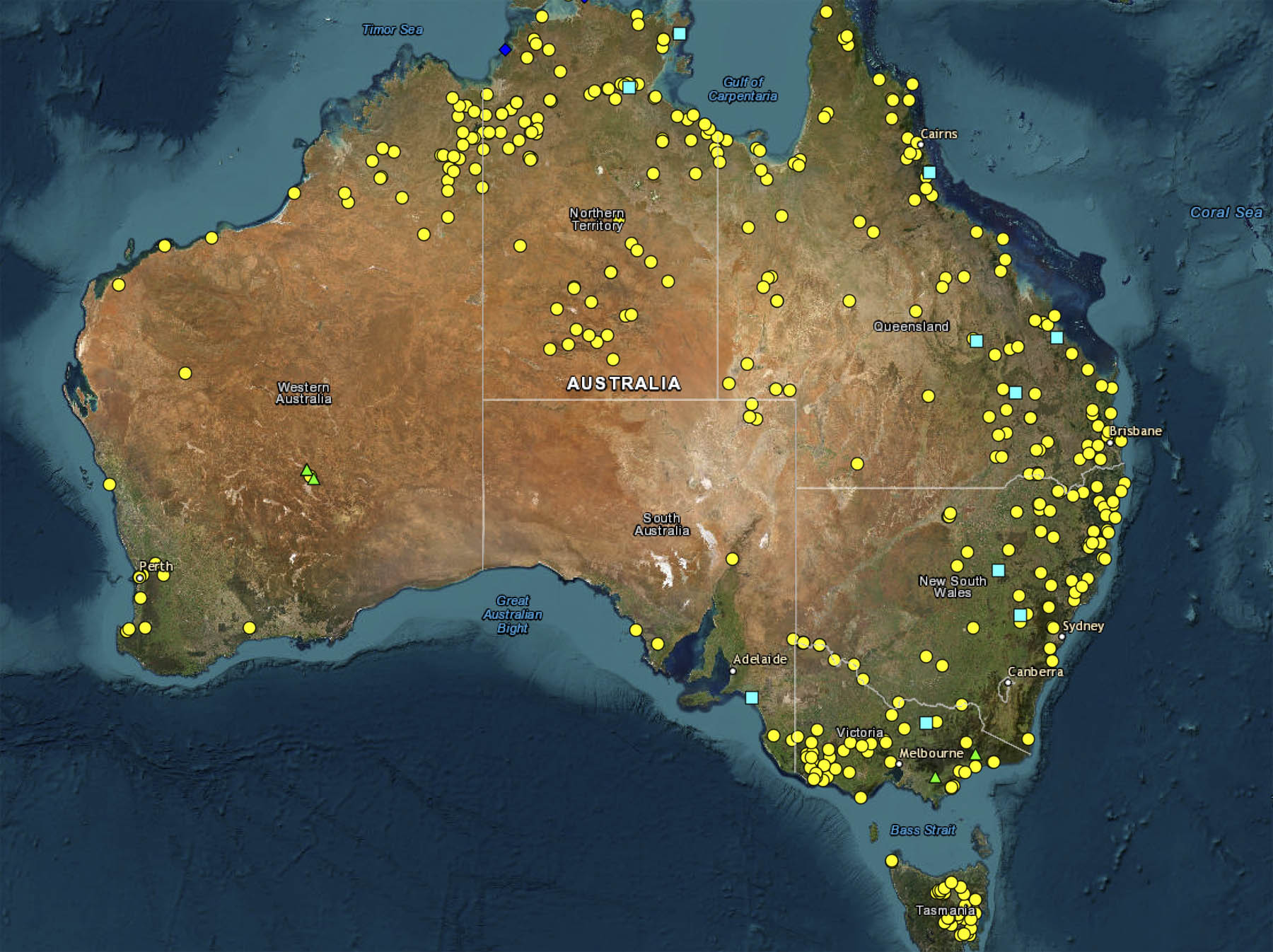
'Colonial Frontier Massacres in Eastern Australia 1788-1872' from The Centre for 21st Century Humanities, The University of Newcastle


Colonial Frontier Massacres in Eastern Australia 1788-1872 from The Centre for 21st Century Humanities, The University of Newcastle


Unknown. 'Broad shield' (early 19th century-mid 19th century) (installation view)


Unknown
Broad shield (early 19th century-mid 19th century) (installation view)
earth pigments on wood, cane, pipeclay
91.3 x 19.5 x 9.5cm irreg.
National Gallery of Victoria, Melbourne
Felton Bequest, 2011
Photo: © Dr Marcus Bunyan and the National Gallery of Victoria


Shields

Aboriginal people have occupied the Australian continent for more than 65,000 years. The arrival and settlement of Europeans, from 1788, affected them profoundly. This proud massing of nineteenth-century shields at the entrance to this exhibition serves as both a reminder of the resilience of Aboriginal people in the face of colonisation, and a representation of the first chapter in Australian art.

The painted and incised designs on the shields are signifiers of the identities and places of these artists whose names, language groups and precise locations were not recorded by European collectors.

There are two kinds of shields traditional to south-east Australia. The first type is narrow and fashioned from a single piece of hardwood, designed to block the forceful blows of clubs, usually in individual combat, and is called a parrying shield. The second is broad and thin with a convex outer face and concave under-surface, and is fashioned from the outer bark or cambium. It is known as a broad or spear shield. This type of shield deflects sharply barbed spears thrown in general fights and also has a ceremonial purpose. These precious cultural objects are of inestimable value to Aboriginal people today.

Text from the NGV website


Melchisédec Thévenot (cartographer, French c. 1620-1692) New Holland, revealed 1644: Terra Australis, discovered 1644 (Hollandia Nova detecta 1644: Terre Australe decouverte l'an 1644) from the exhibition 'Colony: Australia 1770-1861' at NGV Australia at Federation Square, Melbourne, March - July, 2018


Melchisédec Thévenot (cartographer, French c. 1620-1692)
New Holland, revealed 1644: Terra Australis, discovered 1644 (Hollandia Nova detecta 1644: Terre Australe decouverte l’an 1644)
1644
Ink on paper
50 x 37cm
Published in De l’imprimerie de Iaqves Langlois, 1663
National Library of Australia, Canberra
Photo: National Library of Australia


Included in Melchisédec Thévenot’s travel account of 1663, this is the first published large-scale map of Australia. It shows how much of the continent’s coastline was known to Europeans 100 years before James Cook’s Pacific voyages, which would substantially complete European cartographic knowledge about both Australia and New Zealand. Thévenot’s map was published when French colonial aspirations were expanding and it divides the continent along the 135-degree meridian, which marked the western limit of Spain’s imperial claim in the South Pacific. Designating the eastern, undescribed expanse in French (‘Terre Australe’), the map signals French interest in the land east of New Holland.

Exhibition text


European exploration before 1770

The notion that James Cook ‘discovered’ Australia denies the presence of Aboriginal people for 65,000 years and overlooks other European and regional visitors to the Australian coast. The existence of a great southern land, Terra Australis, had long exercised Europeans’ imaginings about the world and began to take a more realistic shape on maps in the early seventeenth century because of maritime exploration. The earliest documented European contact was that of Willem Janszoon and his crew aboard the Dutch ship Duyken, which landed on the west coast of Cape York Peninsula in 1606.

Subsequently, a number of navigators on Dutch and English ships charted the west coast of the continent. Dutch explorer and trader Abel Tasman mapped the west and southern coasts of Van Diemen’s Land in 1642. Two years later, on his second voyage, he reached the north and west coast of Australia, which he named New Holland. The British privateer William Dampier reached the west coast in 1688, and trade between Aboriginal people and the Makassans (from modern-day Indonesia) is documented from around 1720. The Dutch charts of the western coast of Australia were known to the British for more than a century before Cook set sail on his first Pacific voyage.

Text from the NGV website


Unknown 'Beardman jug, from the wreck site of Vergulde Draeck' before 1656 (installation view) from the exhibition 'Colony: Australia 1770-1861' at NGV Australia at Federation Square, Melbourne, March - July, 2018


Unknown
Beardman jug, from the wreck site of Vergulde Draeck (installation view)
before 1656
Earthenware Australian National Maritime Museum, Sydney
Transferred from Australian Netherlands Committee on Old Dutch Shipwrecks, 1991
Photo: © Dr Marcus Bunyan and the National Gallery of Victoria


Thirty years after the Batavia was wrecked off the Australian west coast, the VOC ship Vergulde Draeck was destroyed on a reef 100 kilometres north of current-day Perth. More than 300 years later, in 1963, the submerged wreck was discovered by fisherman, and a large quantity of gold and silver bullion and German beardman or bellarmine jugs retrieved from within. The latter name is popularly associated with late sixteenth- to early seventeenth-century cardinal Robert Bellarmine, an opponent of Protestantism who was known for his fierce anti-alcohol stance. These potbellied, anthropomorphic jugs were certainly intended to ridicule him; they were regularly used to store wine.

Exhibition text


Unknown 'Beardman jug, from the wreck site of Vergulde Draeck' before 1656 (installation view)


Unknown
Beardman jug, from the wreck site of Vergulde Draeck (installation view)
before 1656
Earthenware Australian National Maritime Museum, Sydney
Transferred from Australian Netherlands Committee on Old Dutch Shipwrecks, 1991
Photo: © Dr Marcus Bunyan and the National Gallery of Victoria
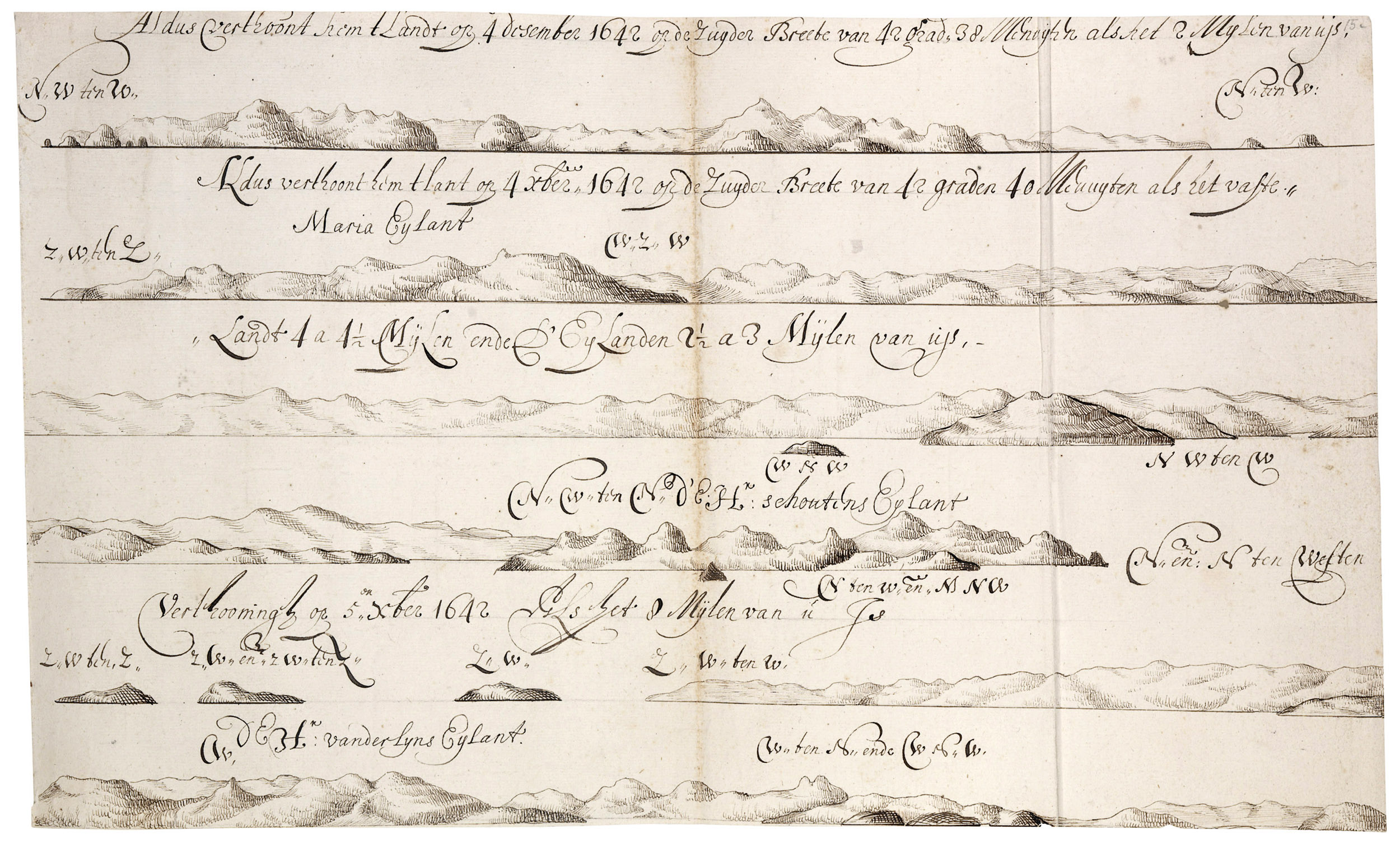
 

Isaac Gilsemans (cartographer) 'Coastal profiles of Van Diemen's Land, 4-5 December 1642' from the exhibition 'Colony: Australia 1770-1861' at NGV Australia at Federation Square, Melbourne, March - July, 2018


Isaac Gilsemans (cartographer) (Dutch, 1606-1646)
Coastal profiles of Van Diemen’s Land, 4-5 December 1642
1642
Bound into Extract from the Journal of the Skipper Commander Abel Janssen Tasman kept by himself in discovering the unknown Southland 1642-43, compiled c. 1643-1647
Pen and ink
23.5 x 37.6cm
State Library of New South Wales, Sydney
Acquired from Martinus Nijhoff, 1926


Victor Victorszoon (draughtsman) Johannes van Keulen II. 'Amsterdam Island, St Paul Island, Black swans near Rottnest Island' c. 1724-1726


Victor Victorszoon (draughtsman) (Dutch, b. 1653)
Johannes van Keulen II
Amsterdam Island, St Paul Island, Black swans near Rottnest Island
c. 1724-1726
Plate from Oud en Nieuw Oost-Indien (The Old and New East Indies) by François Valentijn, vol. 3, part 2, published by Johannes von Braam and Gerard Onder de Linden, Dordrect and Amsterdam, 1724-1726
Engraving
30.4 x 18.5cm (plate)
34.7 x 22.1cm (sheet)
Art Gallery of South Australia, Adelaide
J.C. Earl Bequest Fund 2011


William Ellis (England 1751 - Belgium 1785, Australia 1777) 'View of Adventure Bay, Van Diemen's Land, New Holland' 1777


William Ellis (England 1751 – Belgium 1785, Australia 1777)
View of Adventure Bay, Van Diemen’s Land, New Holland
1777
Watercolour and brush and ink
20.0 x 47.3cm
National Library of Australia, Canberra


William Ellis served as surgeon’s mate on Cook’s Third Voyage and doubled his duties as unofficial natural history draughtsman, producing numerous sketches and watercolours. In these two watercolours he documents the Discovery and the Resolution harboured in the calm waters of Adventure Bay on Bruny Island, and the distinctive geological features of Fluted Cape at the southern end of the bay.

Exhibition text


William Bradley (England c. 1757 - France 1833, Australia 1788-1791) 'Botany Bay. Sirius & Convoy going in: Supply & Agents Division in the Bay. 21 Janry 1788'


William Bradley (England c. 1757 – France 1833, Australia 1788-1791)
Botany Bay. Sirius & Convoy going in: Supply & Agents Division in the Bay. 21 Janry 1788
opposite p. 56 in his A Voyage to New South Wales 1786-92, compiled 1802
Watercolour and pen and ink
19.0 x 24.3cm (sheet)
Mitchell Library, State Library of New South Wales, Sydney


William Bradley sailed with the First Fleet as first lieutenant on board HMS Sirius and remained in the colony until 1792. Like many officers he kept a journal, illustrating key events. This work shows the First Fleet’s second contingent of ships sailing in to Botany Bay to join the advance party already anchored there. Signed and dated 21 January 1788, this and other Bradley images are significant eyewitness accounts of history in the making. Bradley compiled this journal after 1802, and may have made copies of earlier drawings.

Exhibition text


Landing and settlement at Sydney Cove 1788

Although Botany Bay had been chosen as the site for the establishment of the new penal colony, within days of arriving in January 1788, Governor Arthur Phillip relocated the First Fleet north to Sydney Cove in Port Jackson. Here the ships could be safely anchored and a freshwater stream provided a crucial water supply around which the first rudimentary settlement of tents, huts and the governor’s residence was established. The early years were extremely difficult and the colony faced starvation as the crops failed due to the lack of skilled farmers, unfamiliar climate and poor soil. But as farming pushed into more arable lands during the 1790s, settlement expanded and new townships were laid out, competing for resources with the Aboriginal inhabitants and dispossessing them of their lands.

No official artists accompanied the First Fleet and the colony’s earliest works of art were drawings made by officers trained in draughtsmanship and convicts with artistic skills. These drawings largely comprised ethnographic records of local people, natural history images of flora and fauna, charts and coastal views of the harbour’s topography. By the early years of the nineteenth century views of Sydney emphasised its growth, as urban development symbolised for the colonists the progress of Empire.

Text from the NGV website


Installation view of the exhibition 'Colony: Australia 1770 - 1861' at NGV Australia at Federation Square, Melbourne

Installation view of the exhibition 'Colony: Australia 1770 - 1861' at NGV Australia at Federation Square, Melbourne showing at right, 'Sketch and description of the settlement at Sydney Cove, Port Jackson in the County of Cumberland' 1788; and second right top, 'View of the entrance into Port Jackson taken from a boat lying under the North Head' c. 1790


Installation views of the exhibition Colony: Australia 1770-1861 at NGV Australia at Federation Square, Melbourne with in the bottom image at right, Sketch and description of the settlement at Sydney Cove, Port Jackson in the County of Cumberland 1788; and second right top, View of the entrance into Port Jackson taken from a boat lying under the North Head c. 1790
Photos: © Dr Marcus Bunyan and the National Gallery of Victoria


Francis Fowkes (draughtsman) (active c. 1788 - c. 1800) Samuel John Neele (etcher) 'Sketch and description of the settlement at Sydney Cove Port Jackson in the County of Cumberland' 1788


Francis Fowkes (draughtsman) (active c. 1788 – c. 1800)
Samuel John Neele (etcher)
Sketch and description of the settlement at Sydney Cove Port Jackson in the County of Cumberland
1788
Hand-coloured etching and engraving published by R. Cribb, London, 24 July 1789
19.6 x 31.7cm (image)
26.8 x 38.7cm (sheet)
National Library of Australia, Canberra


Dated 16 April 1788, this extremely rare map (there are only three known copies) was drawn by former navy midshipman and convict, Francis Fowkes, some three months after the First Fleet arrived in New South Wales. Published in London in July 1789, it presents a schematised view of the infant settlement with buildings, tents, sawpits, workshops, storehouses, quarries and gardens identified in the key. The eleven ships of the First Fleet are shown at anchor and the Governor’s ‘mansion’ is clearly identified on the eastern side of the cove.

Exhibition text


Port Jackson Painter. 'View of the entrance into Port Jackson taken from a boat lying under the North Head' c. 1790


Port Jackson Painter
View of the entrance into Port Jackson taken from a boat lying under the North Head
c. 1790
Watercolour
11.7 x 24.2cm
Rex Nan Kivell Collection: National Library of Australia and National Gallery of Australia, Canberra


Installation view of the exhibition 'Colony: Australia 1770 - 1861' at NGV Australia at Federation Square, Melbourne with at left lower, George Tobin's 'Native Hut (or Wigwam) of Adventure Bay, Van Diemans (Diemen's) Land' 1792 folio 16 in his 'Sketches on H.M.S. Providence; including some sketches from later voyages on Thetis and Princess Charlotte' album 1791-1831


Installation view of the exhibition Colony: Australia 1770-1861 at NGV Australia at Federation Square, Melbourne with at left lower, George Tobin’s Native Hut (or Wigwam) of Adventure Bay, Van Diemans (Diemen’s) Land 1792 folio 16 in his Sketches on H.M.S. Providence; including some sketches from later voyages on Thetis and Princess Charlotte album 1791-1831 watercolour. State Library of New South Wales, Sydney Acquired from Truslove and Hanson, in 1915 – in the image below at bottom left.
Photo: © Dr Marcus Bunyan and the National Gallery of Victoria


Installation view of the exhibition 'Colony: Australia 1770 - 1861' at NGV Australia at Federation Square, Melbourne with at bottom centre, Sarah Stone's 'Shells' 1781


Installation view of the exhibition Colony: Australia 1770-1861 at NGV Australia at Federation Square, Melbourne with at bottom centre, Sarah Stone’s Shells 1781
Photo: © Dr Marcus Bunyan and the National Gallery of Victoria
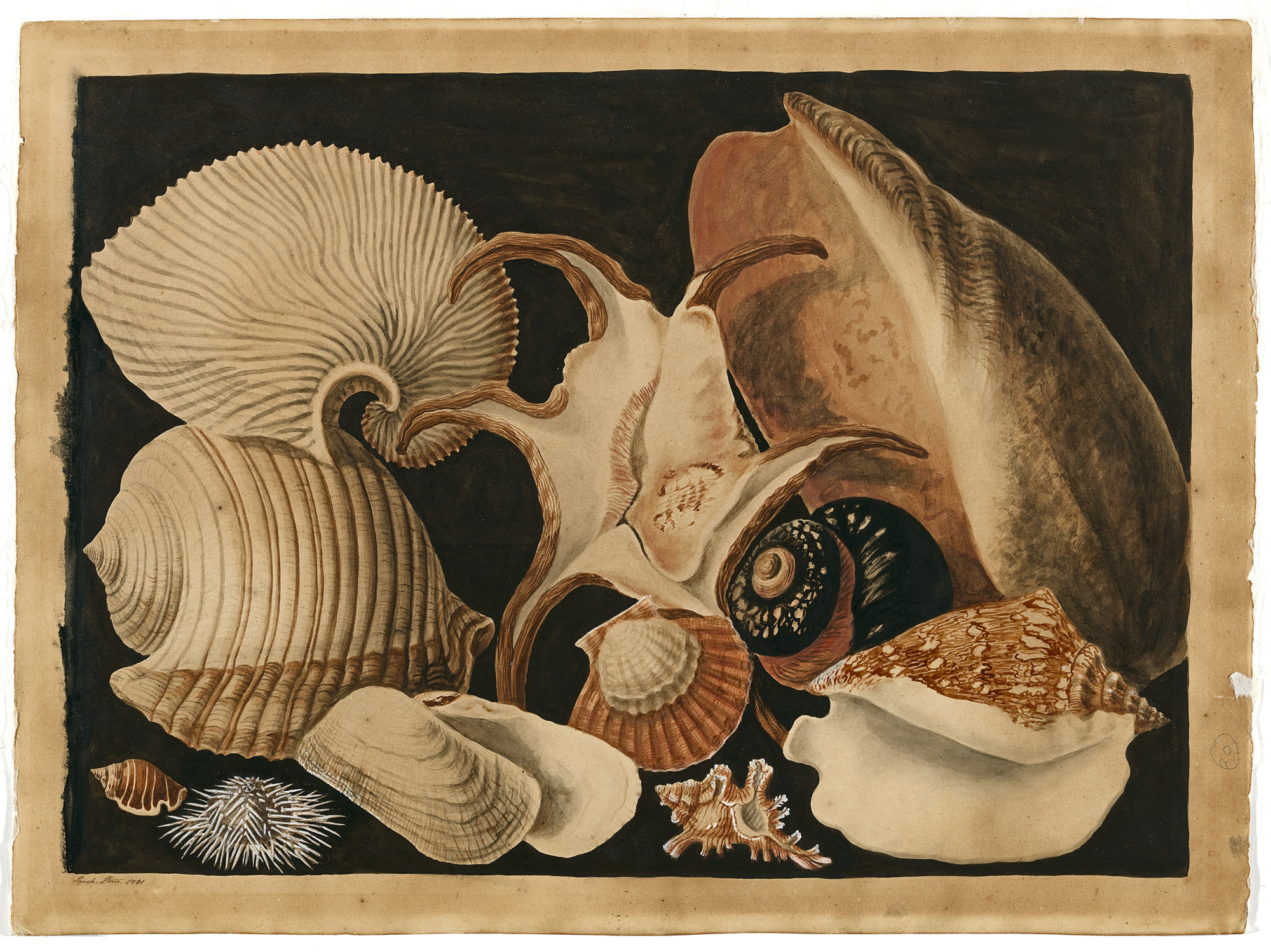
 

Sarah Stone (British, c. 1760 - 1844) 'Shells' 1781 from the exhibition 'Colony: Australia 1770-1861' at NGV Australia at Federation Square, Melbourne, March - July, 2018


Sarah Stone (British, c. 1760 – 1844)
Shells
1781
Watercolour over black pencil
43 x 58cm
National Gallery of Australia, Canberra
Purchased 2016


Sarah Stone (British, c. 1760 – 1844)

Sarah Stone (c. 1760 – 1844), later known as Sarah Smith, was a British natural history illustrator and painter. Her works included many studies of specimens brought back to England from expeditions in Australia and the Pacific. Her illustrations are amongst the first studies of many species and are as scientifically significant.

Stone was the daughter of a fan painter. She worked as a draftsman, natural history and scientific illustrator, and painter between 1777 and 1820. She was commissioned by Sir Ashton Lever in the 1770s to sketch and paint images of objects in his Leverian Museum, which included specimens brought back by British expeditions to Australia, the Americas, Africa and the Far East in the 1780s and 1790s. She exhibited as an “Honorary Exhibitor” at the Royal Academy of Arts in 1781, 1785 and 1786. Stone created numerous watercolour paintings of specimens sent by John White, the First Surgeon General of the Australian colony, between 1789 and 1790. These paintings were used to produce engravings for White’s A Journal of a Voyage to New South Wales (1790). Although beautiful and skilfully drawn the drawings were sometimes compromised by the fact that she was working from skins collected in Australia and reconstructed by a taxidermist in London to reproduce an animal or bird that had never been seen. Her collection of more than a thousand water colours based on specimens from the Leverian Museum were dispersed along with the museum items auctioned in 1806. Some of her paintings were acquired by the Natural History Museum, London while others went into private collections. They may be valuable in resolving some species described by J.F. Gmelin, the specimens of which are now untraceable.

Text from the Wikipedia website


Installation view of the exhibition 'Colony: Australia 1770 - 1861' at NGV Australia at Federation Square, Melbourne with at left, 'View of the town of Sydney in the colony of New South Wales' c. 1799; and second left of the row of four, Juan Ravenet's 'Convicts in New Holland' (Convictos en la Nueva Olanda) and 'English in New Holland' (Ingleses en la Nueva Olanda) 1789-1794


Installation view of the exhibition Colony: Australia 1770-1861 at NGV Australia at Federation Square, Melbourne with at left, View of the town of Sydney in the colony of New South Wales c. 1799; and second left of the row of four, Juan Ravenet’s Convicts in New Holland (Convictos en la Nueva Olanda) and English in New Holland (Ingleses en la Nueva Olanda) 1789-1794 (see below)
Photo: © Dr Marcus Bunyan and the National Gallery of Victoria


Unknown artist (England) Thomas Watling (after) (British, 1762-1814?) 'View of the town of Sydney in the colony of New South Wales' c. 1799


Unknown artist (England)
Thomas Watling (after) (British, 1762-1814?)
View of the town of Sydney in the colony of New South Wales
c. 1799
Oil on canvas
65 x 133cm
Art Gallery of South Australia, Adelaide
Gift of M.J.M. Carter AO through the Art Gallery of South Australia Foundation in recognition of the abilities of James Bennett to promote public awareness and appreciation of Asian art and culture 2015
Donated through the Australian Government’s Cultural Gifts Program


Transportation to New South Wales

The favourable accounts of New South Wales by James Cook and Joseph Banks were influential in the government’s selection of Botany Bay as the site for a new penal colony. Britain’s loss of the American colonies in 1783 ended convict transportation across the Atlantic and increased the pressure for new solutions to the rising rates of crime and incarceration experienced in late eighteenth-century Britain. The founding of a penal settlement in New South Wales was perceived not only as providing a solution to domestic, social and political problems but also as holding the key to territorial expansion in the South Pacific and the promotion of imperial trade.

The lengthy preparation for the First Fleet raised huge public interest. For most people at that time it was a journey of unimaginable length to a place as remote and unknown as the moon. The eleven ships comprising the First Fleet left Portsmouth in May 1787 with more than 1300 men, women and children on board. Although most were British, there were also African, American and French convicts. After a voyage of eight months the First Fleet arrived in Botany Bay in January 1788.

Text from the NGV website
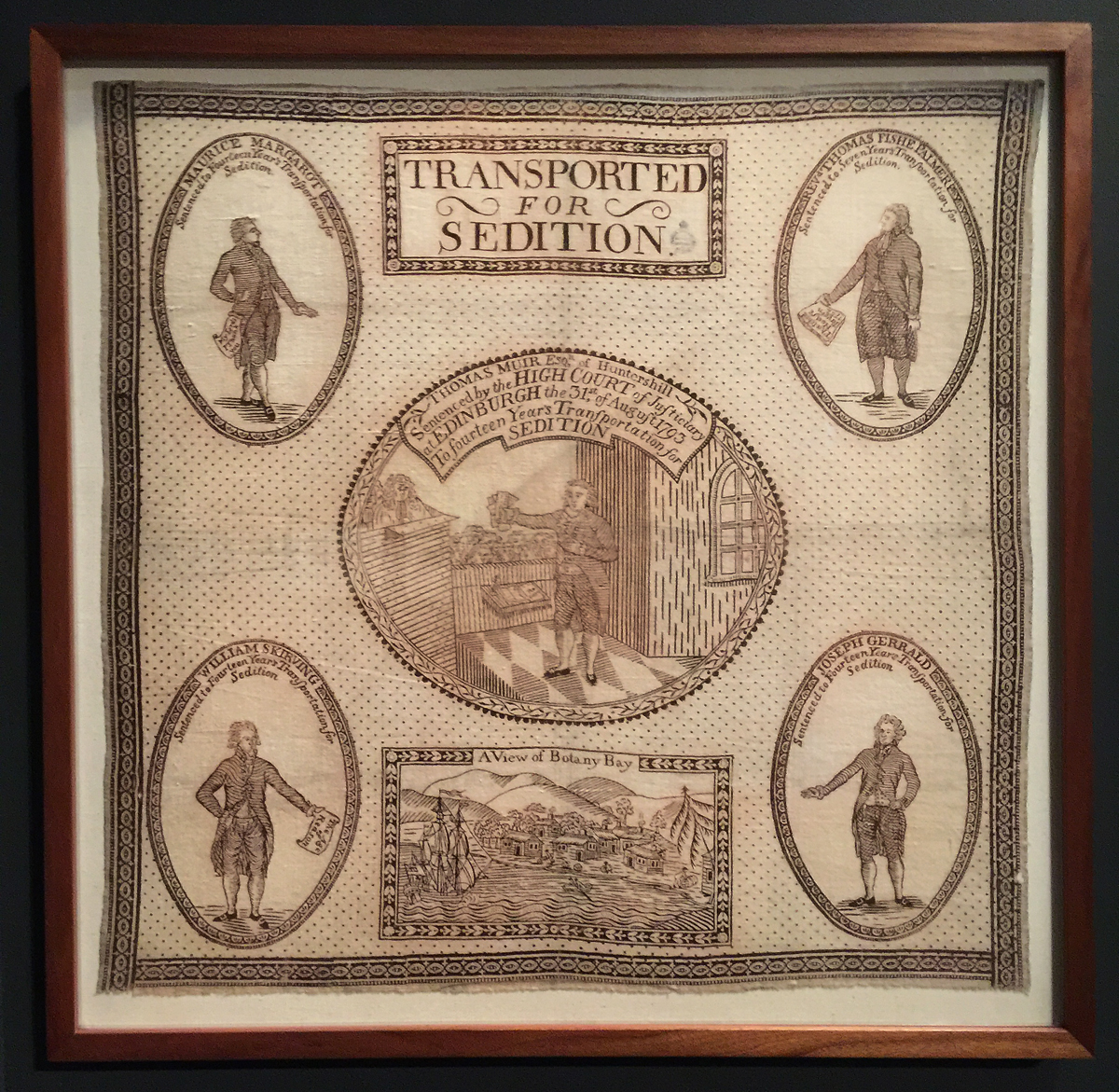
 

Unknown artist. 'Transported for sedition' 1793 (installation view)


Unknown artist
Transported for sedition (installation view)
1793
Woodcut on linen
Mitchell Library, State Library of New South Wales, Sydney
Photo: © Dr Marcus Bunyan and the National Gallery of Victoria


This printed linen handkerchief shows five men popularly known as the ‘Scottish martyrs’. In 1794 they were sentenced to transportation to New South Wales for terms of up to fourteen years for the crime of sedition – inciting rebellion against the government of Britain. When published, or printed on paper, images such as this were also considered seditious and censored. Printed handkerchiefs, however, were not subjected to the same sanctions. They had the added advantage of being easily concealed and, when safe to do so, were displayed to show the owner’s political affiliation.

Exhibition text
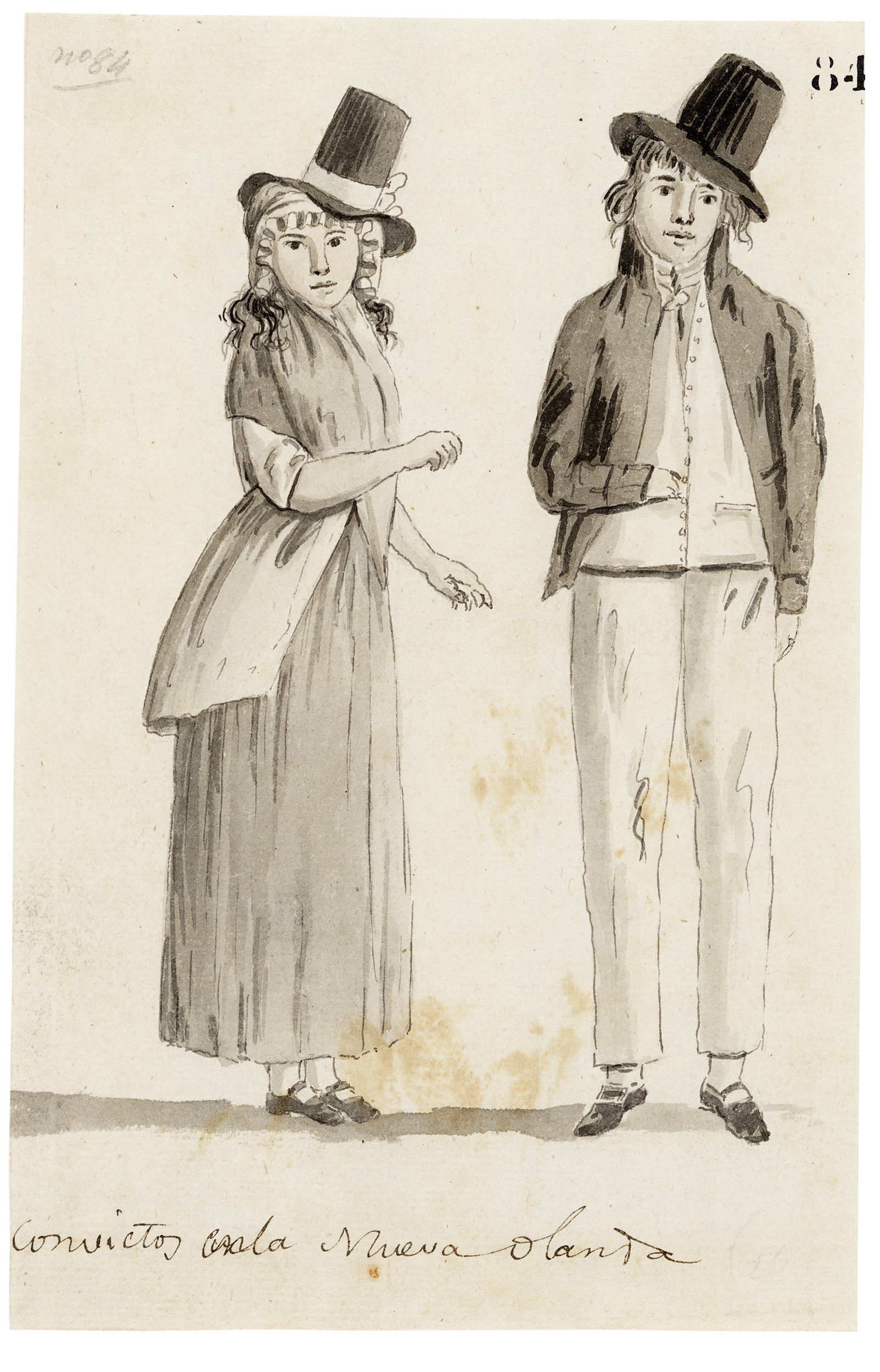
 

Juan Ravenet (Italy 1766 - Spain c. 1821) 'Convicts in New Holland (Convictos en la Nueva Olanda)' 1789-1794


Juan Ravenet (Italy 1766 – Spain c. 1821)
Convicts in New Holland (Convictos en la Nueva Olanda)
1789-1794
From an album of drawings made on the Spanish Scientific Expedition to Australia and the Pacific in the ships Descubierta and Atrevida under the command of Alessandro Malaspina, 1789-1794
Brush and ink and wash
19.5 x 12.5cm
Mitchell Library, State Library of New South Wales, Sydney


Juan Ravenet (Italy 1766 - Spain c. 1821) 'English in New Holland (Ingleses en la Nueva Olanda)' 1789-1794


Juan Ravenet (Italy 1766 – Spain c. 1821)
English in New Holland (Ingleses en la Nueva Olanda)
1789-1794
From an album of drawings made on the Spanish Scientific Expedition to Australia and the Pacific in the ships Descubierta and Atrevida under the command of Alessandro Malaspina, 1789-1794
Brush and ink and wash
19.5 x 12.5cm
Mitchell Library, State Library of New South Wales, Sydney


Extremely few realistic depictions of convicts in Australia are known. These rare portraits, showing garments worn by male and female convicts and by officials, were painted by one of two artists on board the Spanish expedition (1789-1794), led by Alessandro Malaspina, that visited Sydney in 1793. A major scientific expedition, like Cook’s and La Pérouse’s, the visit also had political implications, as Sydney formed a strategic British base in the Pacific that could threaten Spanish interests in the Americas and Philippines.

Exhibition text


Installation view of the exhibition 'Colony: Australia 1770 - 1861' at NGV Australia at Federation Square, Melbourne with at left, 'Half-length portrait of Gna-na-gna-na' c. 1790


Installation view of the exhibition Colony: Australia 1770-1861 at NGV Australia at Federation Square, Melbourne with at left, Half-length portrait of Gna-na-gna-na c. 1790
Photo: © Dr Marcus Bunyan and the National Gallery of Victoria


Port Jackson Painter. 'Half-length portrait of Gna-na-gna-na' c. 1790


Port Jackson Painter
Half-length portrait of Gna-na-gna-na
c. 1790
Gouache
29.4 x 24.0cm
National Library of Australia, Canberra
Rex Nan Kivell Collection


Indigenous representation

In the early years of settlement there was little contact with the Eora, the Traditional Owners of the area around Sydney Cove, who actively avoided the new arrivals, but as the colony grew, communication, and occasionally friendships, developed. The English had little understanding of the deep relationship between the Eora and their lands, and their careful management of resources, which were soon overstretched by the colonists. Famine and introduced diseases also devastated numerous communities. As the nineteenth century progressed, traditional life along the east coast of Australia was irrevocably changed.

Early images of Aboriginal people reflect the curiosity of the early colonists. Studies of the material culture of Indigenous people, and attempts to record everyday activities ranging from ceremonial gatherings to fishing and hunting, reveal the Europeans’ desire to understand Aboriginal people and culture through ethnographic documentation. Importantly, a number of these portraits include the names of the people depicted – they are not generic representations. The European artists who made these images were fascinated by the appearance of the individuals they encountered, sometimes producing finely detailed drawings and watercolours showing the particulars of hairstyles, ornamentation and scarification.

Text from the NGV website


Jean Piron (draughtsman, Belgium 1767/1771 - south-east Asia after 1795) Jacques Louis Copia (engraver, Germany 1764-1799) 'Natives of Cape Diemen fishing (Pêche des sauvages du Cap de Diemen)' 1800


Jean Piron (draughtsman, Belgium 1767/1771 – south-east Asia after 1795)
Jacques Louis Copia (engraver, Germany 1764-1799)
Natives of Cape Diemen fishing (Pêche des sauvages du Cap de Diemen)
1800
Plate 4 from the Atlas pour servir à relation du Voyage à la Recherche de La Pérouse (Atlas of the voyage in search of La Pérouse), by J-J. H. de Labillardière, published by Chez Dabo, Paris 1817
Etching and engraving
National Gallery of Victoria, Melbourne
Purchased NGV Foundation, 2017


Jean Piron was an artist trained in the Neoclassical tradition who accompanied the expedition led by Admiral Joseph-Antoine Raymond Bruni D’Entrecasteaux during 1791-1794. His drawings from this expedition are the earliest surviving visual observations of the Aboriginal people of Tasmania by French explorers. Prints, engraved after his death, show Piron’s idealised vision of Tasmanian Aboriginal people living in tranquil harmony with their surroundings. However, apart from the spear-throwing man and the accurately depicted fibre and kelp baskets, there is little to indicate Tasmania in the classicised representation of the landscape and its people.

Exhibition text


Unknown artist (draughtsman, active in England early 19th century) Samuel John Neele (etcher, England 1758-1825) 'Pimbloy [Pemuluwuy], native of New Holland in a canoe of that country' 1804


Unknown artist (draughtsman, active in England early 19th century)
Samuel John Neele (etcher, England 1758-1825)
Pimbloy [Pemuluwuy], native of New Holland in a canoe of that country
1804
Following p. 170 in The Narrative of a Voyage of Discovery in his Majesty’s vessel the Lady Nelson by James Grant, published by Thomas Egerton, London, 1803
Etching
Special Collections, Deakin University, Melbourne


Pemuluwuy was an important man and warrior of the Eora nation. In December 1790 he gained notoriety after spearing, and killing, Governor Phillip’s gamekeeper. He then went on to lead raids on many of the settlements in the Sydney area, including Parramatta. David Collins, the lieutenant-governor, acknowledged that he was ‘a most active enemy’; however, he also noted that Pemuluwuy’s attacks were precipitated by the vicious ‘misconduct’ of the colonisers. In 1801 Governor King issued a proclamation that Indigenous people could be shot on sight, and placed a bounty on Pemuluwuy. He was murdered by a settler in 1802 and his body was subsequently desecrated.

Exhibition text
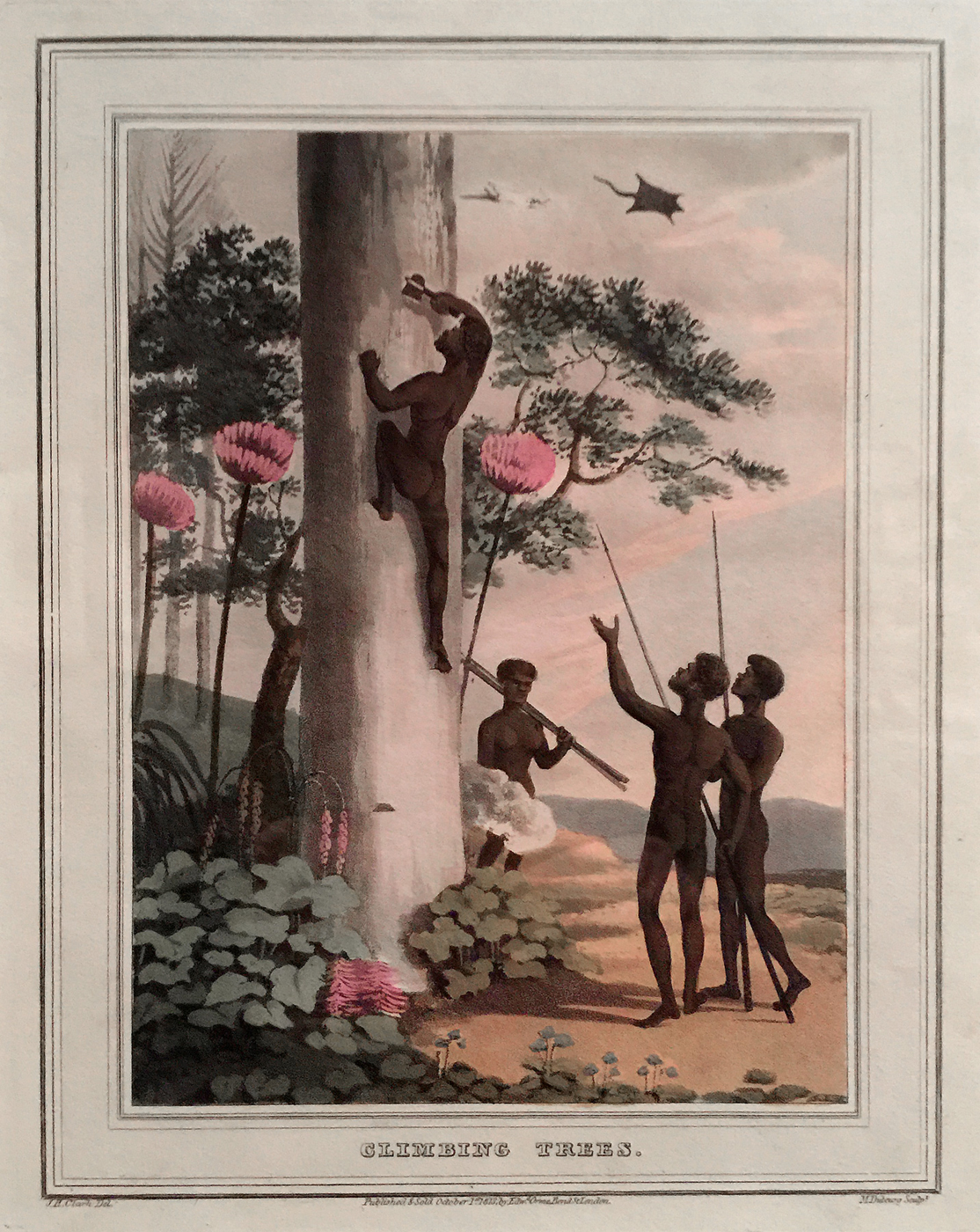
 

John Heaviside Clark (draughtsman Scotland 1770-1863, England 1801-32) Matthew Dubourg (engraver active in England 1786-1838) 'Climbing trees' 1813 (installation view)


John Heaviside Clark (draughtsman Scotland 1770-1863, England 1801-1832)
Matthew Dubourg (engraver active in England 1786-1838)
Climbing trees (installation view)
Plate 4 from Field Sports &c. &c. of the Native Inhabitants of New South Wales, published by Edward Orme, London
1813
Hand-coloured aquatint
National Gallery of Victoria, Melbourne
Gurnett-Smith Bequest, 1999
Photo: © Dr Marcus Bunyan and the National Gallery of Victoria


Field Sports &c. &c. of the Native Inhabitants of New South Wales was the first publication to focus on the representation of Indigenous Australian life. The set of ten colour aquatints was part of a much larger series called Foreign Field Sports, which depicted sporting and hunting pursuits from around the world. These prints contain accurate details, such as the spear thrower, however, the plants and animals are inaccurate and were clearly unfamiliar to the London artists who made them, neither of whom came to Australia.

Exhibition text
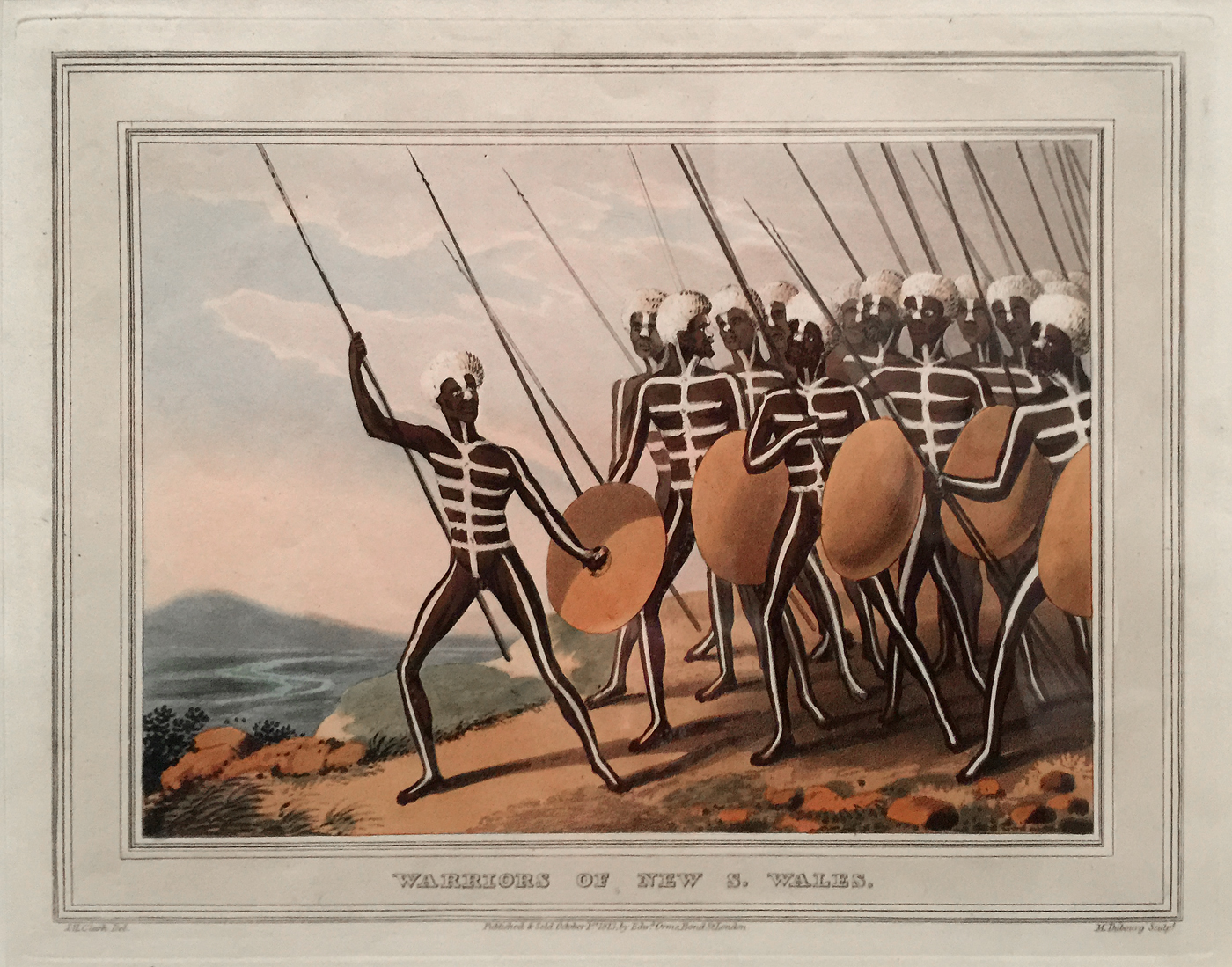
 

John Heaviside Clark (draughtsman Scotland 1770-1863, England 1801-32) Matthew Dubourg (engraver active in England 1786-1838) 'Warriors of New S. Wales' 1813 (installation view)


John Heaviside Clark (draughtsman Scotland 1770-1863, England 1801-1832)
Matthew Dubourg (engraver active in England 1786-1838)
Warriors of New S. Wales (installation view)
Plate 6 from Field Sports &c. &c. of the Native Inhabitants of New South Wales, published by Edward Orme, London
1813
Hand-coloured aquatint
National Gallery of Victoria, Melbourne
Gurnett-Smith Bequest, 1999
Photo: © Dr Marcus Bunyan and the National Gallery of Victoria


The Flinders and Baudin expeditions

Between 1801 and 1804, skilled British navigator Matthew Flinders and his crew aboard the Investigator circumnavigated Australia, funded by the Royal Society and its president Sir Joseph Banks. Their directive was to chart the final stretch of southern coastline that remained unknown on European maps, and learn more about the continent’s extraordinary natural history. A similar French expedition led by Nicolas Baudin on the Géographe and the Naturaliste had already commenced (1800-1804). Sent by the Marine Ministry and Napoleon Bonaparte, the expedition sought to map and explore the unfamiliar land and its inhabitants; however, the British feared that it was a reconnaissance mission with a view to founding a French base in New Holland or Van Diemen’s Land.

The most dazzling record of both voyages’ scientific achievement was produced by the artists on board. Travelling with Baudin on the Géographe was Charles-Alexandre Lesueur, who delineated thousands of animal specimens, and Nicolas-Martin Petit, who represented the Aboriginal people encountered on the voyage. Their drawings were the basis for the engravings published in the official account of the expedition, Voyage of Discovery to the Southern Lands (1807-1811). Aboard the Investigator was the mature natural history artist Ferdinand Bauer and the talented young landscape painter William Westall.

Text from the NGV website
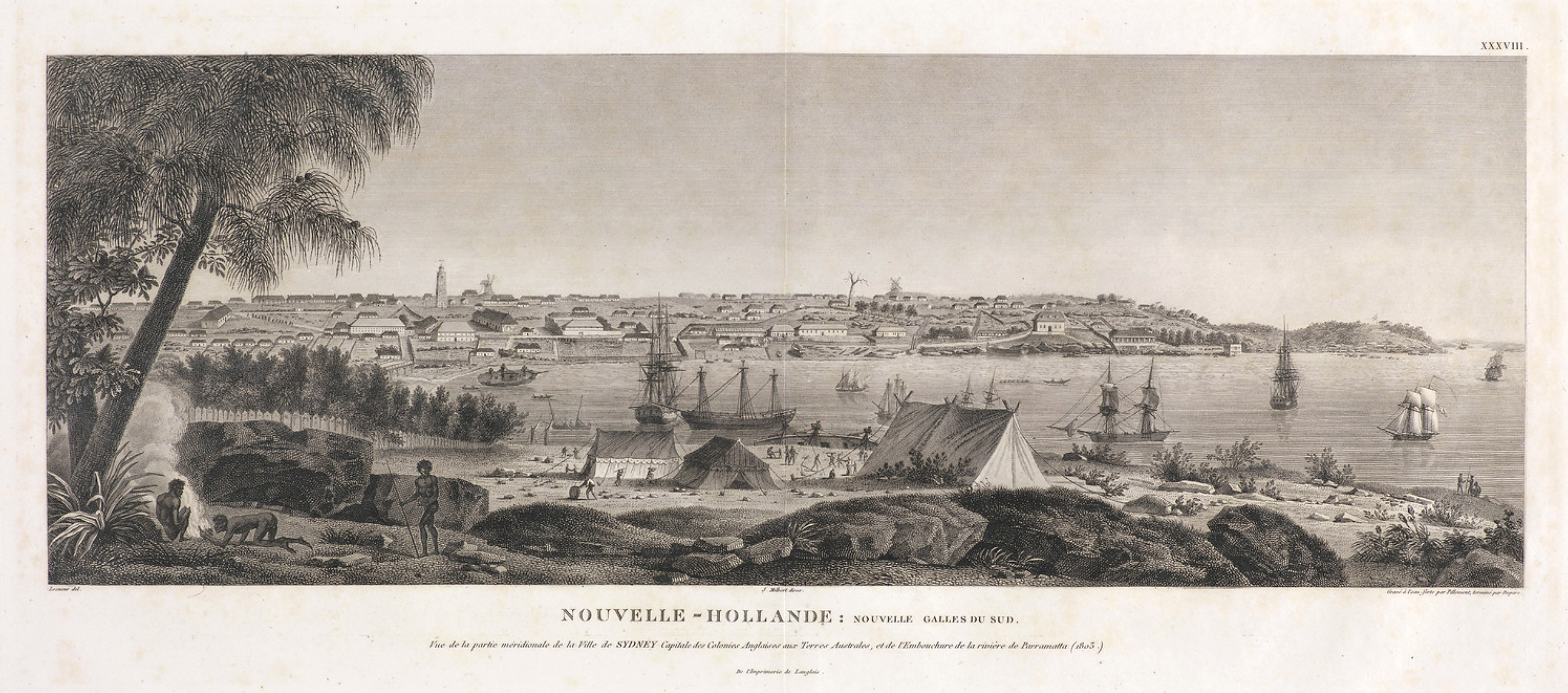
 

Charles-Alexandre Lesueur (draughtsman, France 1778-1846) Victor Pillement (engraver, France 1767-1814) Marie-Alexandre Duparc (engraver, active in France 18th century - 19th century) 'New Holland: New South Wales. View of the southern part of the town of Sydney' Plate 38 from 'Voyage de Découvertes aux Terres Australes' (Voyage of Discovery to the Southern Lands) atlas, by François Peron and Louis de Freycinet, published by L'Imprimerie Impèriale, Paris, 1807-1816


Charles-Alexandre Lesueur (draughtsman, France 1778-1846)
Victor Pillement (engraver, France 1767-1814)
Marie-Alexandre Duparc (engraver, active in France 18th century – 19th century)
New Holland: New South Wales. View of the southern part of the town of Sydney (Nouvelle-Hollande: Nouvelle Galles du Sud. Vue de la partie meridionale de la Ville de Sydney)
Plate 38 from Voyage de Découvertes aux Terres Australes (Voyage of Discovery to the Southern Lands) atlas, by François Peron and Louis de Freycinet, published by L’Imprimerie Impèriale, Paris, 1807-1816
Etching and engraving
National Gallery of Victoria, Melbourne
Presented through the NGV Foundation by John Baird, Member, 2005


Following their lengthy voyage and exploration of the south-east coastline of Australia, the Géographe and Naturaliste struggled into Port Jackson in June 1802. The French crew remained there for five months to recover and repair their ships. The surveying and scientific parties continued with their work, to some British suspicion, and Charles-Alexandre Lesueur drew scenes of Sydney and its surrounds, as well as exquisite natural history records. Taken from their camp on Bennelong Point (where the Sydney Opera House now stands) this view looks across Sydney Cove to where The Rocks and the southern end of the Harbour Bridge are now.

Exhibition text


Ferdinand Bauer (Austria 1760-1826, England 1787-1801, 1805-1814, Australia 1801-1805) 'Gymea Lily' 1806-1813, published 1813 (installation view)


Ferdinand Bauer (Austria 1760-1826, England 1787-1801, 1805-1814, Australia 1801-1805)
Gymea Lily (installation view)
1806-1813, published 1813
Plate 13 from Illustrationes florae Novae Hollandiae, sive icones generum quae in Prodromo Novae Hollandiae et insulae van Diemen decripsit Robertus Brown, published London 1813
Colour engraving with hand-colouring
36.2 x 24.3cm irreg. (image)
39 x 25.2cm (plate)
51 x 34cm (sheet)
National Gallery of Australia, Canberra Purchased 2004
Photo: © Dr Marcus Bunyan and the National Gallery of Victoria
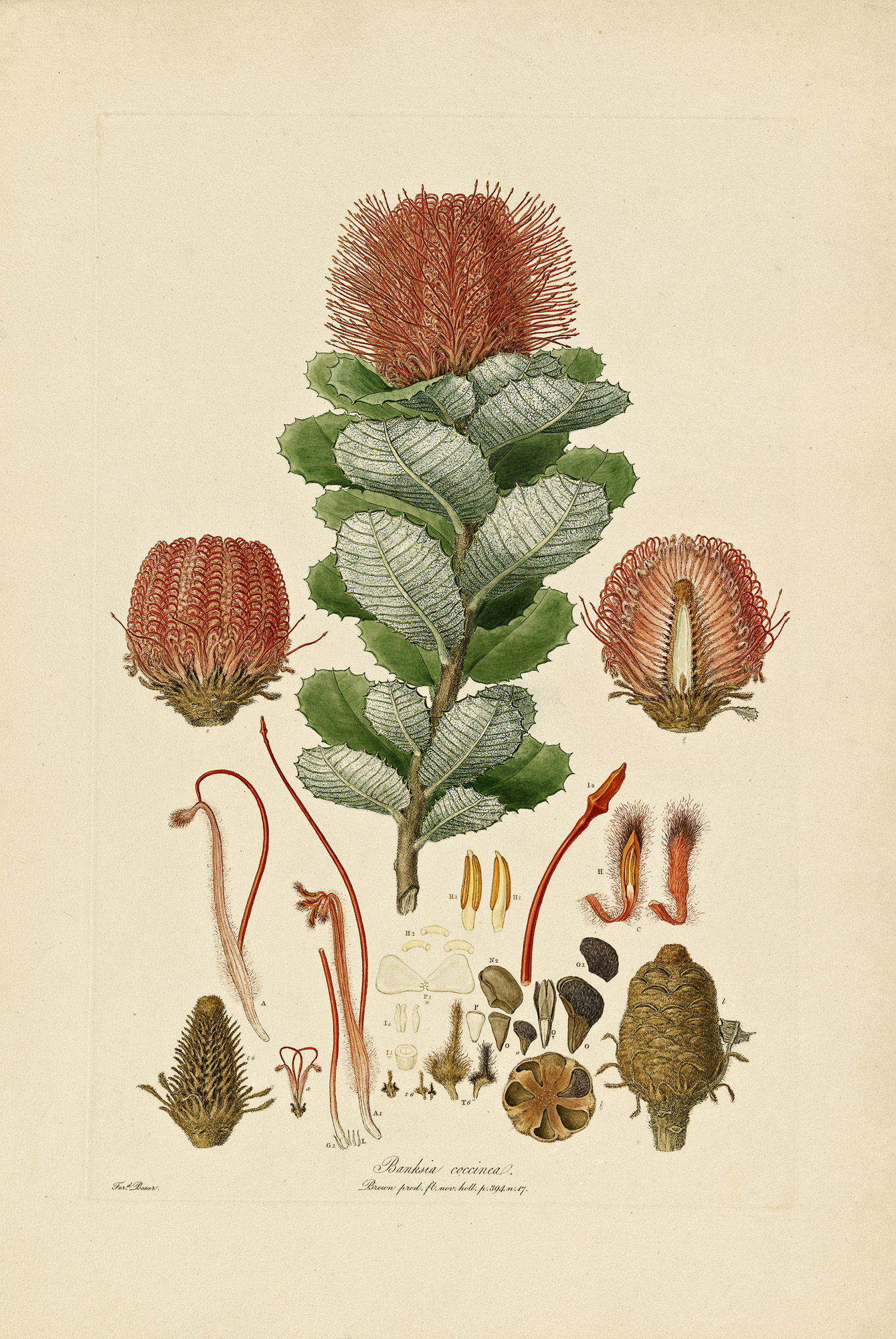
 

Ferdinand Bauer (Austria 1760-1826, England 1787-1801, 1805-1814, Australia 1801-1805) 'Banksia coccinea' 1806-1813


Ferdinand Bauer (Austria 1760-1826, England 1787-1801, 1805-1814, Australia 1801-1805)
Banksia coccinea
1806-1813, published 1813
Plate 3 from Illustrationes florae Novae Hollandiae, sive icones generum quae in Prodromo Novae Hollandiae et insulae van Diemen decripsit Robertus Brown, published London 1813
Colour engraving with hand-colouring
36.2 x 24.3cm irreg. (image)
39 x 25.2cm (plate)
51 x 34cm (sheet)
National Gallery of Australia, Canberra Purchased 2004


Austrian-born Ferdinand Bauer is recognised as one of the most accomplished natural history artists who did much of his art while travelling, both in the Mediterranean and then as an official artist on Matthew Flinders’ circumnavigation of Australia (1801-1803). Working closely with botanist Robert Brown, Bauer produced over 2000 drawings and watercolours, and continued with his meticulous work upon his return to London. This engraving exemplifies his skill: it is engraved, printed in colour and then carefully hand-painted, all by Bauer himself. Regrettably his intended botanical publication ran to only fifteen plates.

Exhibition text
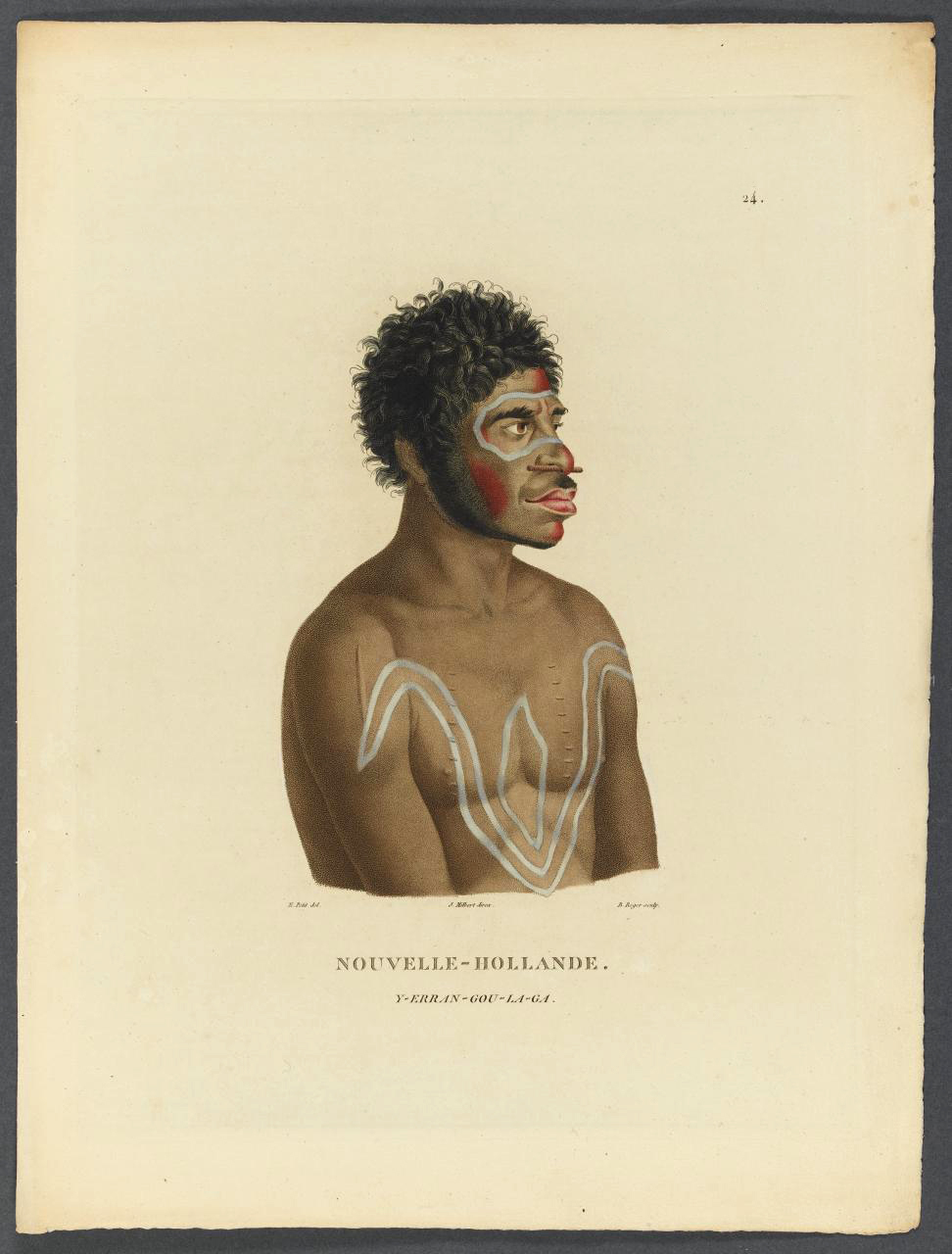
 

Barthélemy Roger (engraver, France 1767-1841) Nicolas-Martin Petit (after) (draughtsman, France 1777-1804) 'Y-erran-gou-la-ga' 1824 Plate 24 in the 'Voyage de Découvertes aux Terres Australes' (Voyage of Discovery to the Southern Lands) atlas Arthus Bertrand, Paris, 1824, 2nd edition


Barthélemy Roger (engraver, France 1767-1841)
Nicolas-Martin Petit (after) (draughtsman, France 1777-1804)
Y-erran-gou-la-ga, a native of the environs of Port Jackson (Y-erran-gou-la-ga, suavage des environs du port Jackson)
1824
Plate 24 in the Voyage de Découvertes aux Terres Australes (Voyage of Discovery to the Southern Lands) atlas
Arthus Bertrand, Paris, 1824, 2nd edition
Hand-coloured engraving, etching and stipple engraving printed in black and brown ink
31.5 x 24.1cm (plate)
36.5 x 27.6cm (sheet)
National Gallery of Victoria, Melbourne
Joe White Bequest, 2010


William Westall (England 1781-1850, Australia 1801-1803) 'Chasm Island, native cave painting' 1803


William Westall (England 1781-1850, Australia 1801-1803)
Chasm Island, native cave painting
1803
Watercolour
26.7 x 36.6cm
National Library of Australia, Canberra


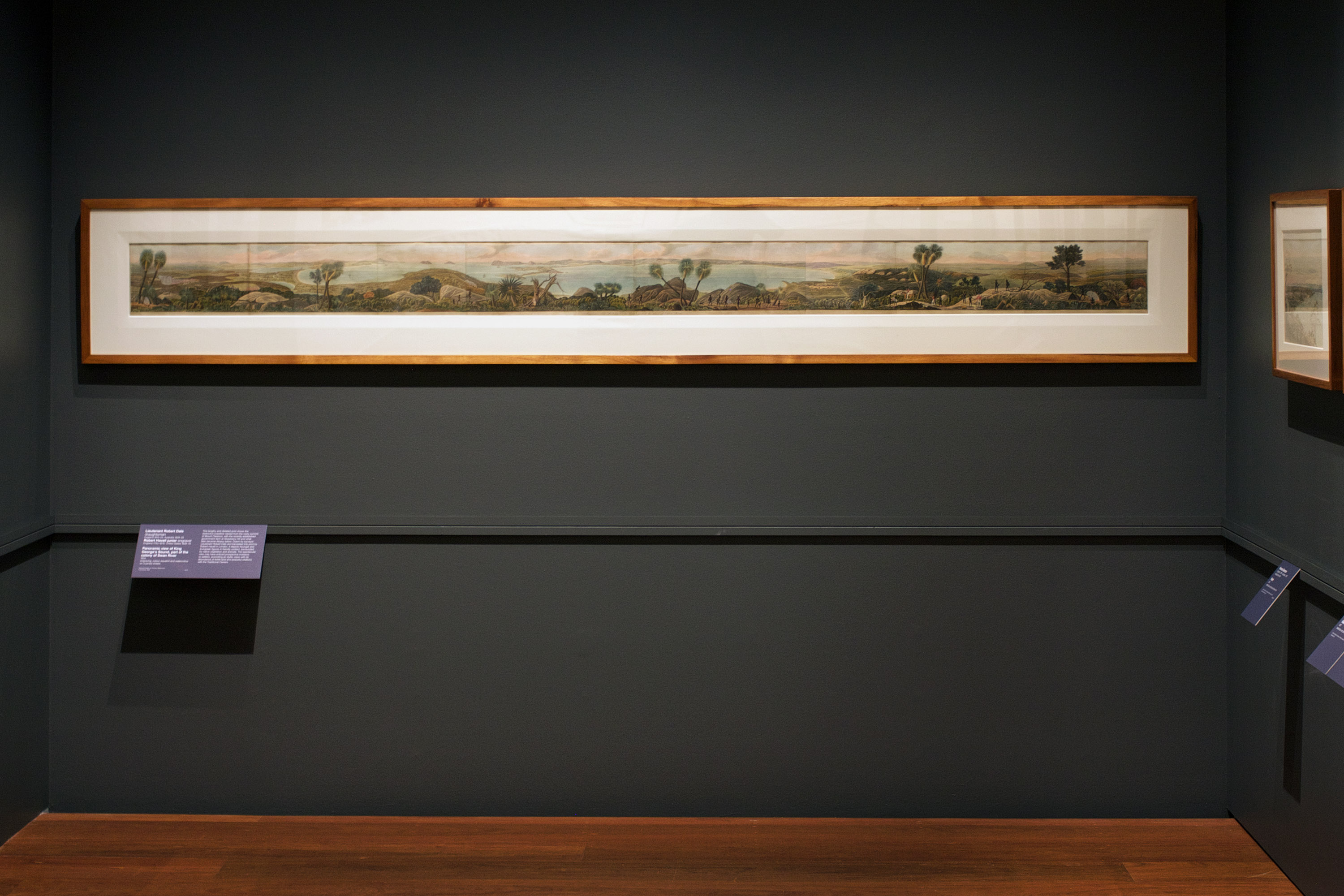
William Westall (England 1781-1850, Australia 1801-1803) 'A view of King George's Sound' 1802


William Westall (England 1781-1850, Australia 1801-1803)
A view of King George’s Sound
1802
Watercolour and pen and brown ink
27.9 x 42.9cm
National Gallery of Victoria, Melbourne
Purchased, 1978


William Westall was one of two artists who accompanied Matthew Flinders on the Investigator as it circumnavigated Australia between 1801 and 1803. This highly finished watercolour of King George’s Sound in south-western Australia is not a topographical study, but a romantic vision of a vast, silent and forbidding land. Two generic Aboriginal people figures are included in the foreground in the guise of the noble savage. Their classicised robes and the lack of a European presence, particularly the explorers encountering them, shows Westall casting the scene in an Arcadian period prior to British encounter.

Exhibition text
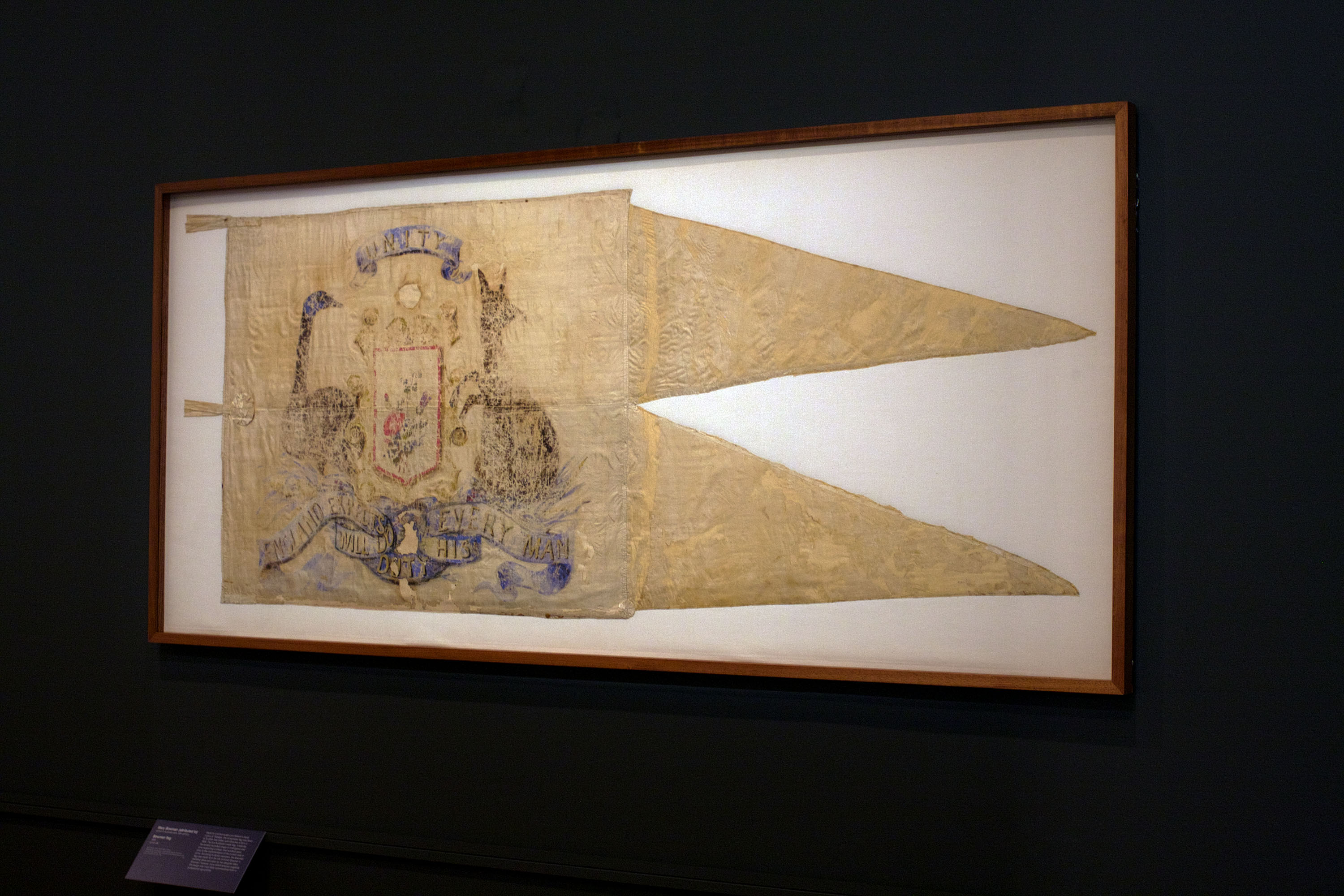
 

Installation view of the exhibition 'Colony: Australia 1770 - 1861' at NGV Australia at Federation Square, Melbourne showing the 'Bowman flag' 1806

Installation view of the exhibition 'Colony: Australia 1770 - 1861' at NGV Australia at Federation Square, Melbourne showing the 'Bowman flag' 1806


Installation view of the exhibition Colony: Australia 1770-1861 at NGV Australia at Federation Square, Melbourne showing the Bowman flag 1806
Photos: © Dr Marcus Bunyan and the National Gallery of Victoria


Mary Bowman (attributed to) (active in Australia early 19th century)
Bowman flag
1806
Oil on silk
State Library of New South Wales, Sydney
Presented by John Bowman’s great grandchildren to Richmond Superior Public School, 1905; transferred to the Mitchell Library by the Dept. of Public Instruction, 1916


Made to commemorate Lord Nelson’s naval victory at Trafalgar, this remarkable flag was flown at Scottish free settler John Bowman’s farm in 1806. The first Australian-made flag, it features the earliest recorded image of a kangaroo and emu supporting a shield, one hundred years prior to the implementation of the current coat of arms. According to family members, the Bowman flag was made from the silk of Honor Bowman’s wedding dress and sewn by her daughter Mary Bowman; however, more recent analysis suggests the design was most likely commissioned from a professional sign painter.

Exhibition text


John Lewin (England 1770 - Australia 1819, Australia from 1800) 'Koala and young' 1803


John Lewin (England 1770 – Australia 1819, Australia from 1800)
Koala and young (installation view)
1803
Watercolour and gouache
Mitchell Library, State Library of New South Wales, Sydney
Purchased from a descendant of Governor King, 1983
Photo: © Dr Marcus Bunyan and the National Gallery of Victoria


Surprisingly, koalas were not captured by colonists until 1803, although their existence had been known of for several years, and they were described as cullawine or colo, the names used by Aboriginal hunters. In August 1803 a female and two joeys were taken to Sydney, where they were reported in the recently founded Sydney Gazette. After one joey died, the mother and surviving joey were painted, proficiently by the Sydney-based artist John Lewin, and exquisitely by expedition artist Ferdinand Bauer. Bauer was unable to complete his watercolour in time to be sent on a departing ship, and thus Lewin’s was the first visual record of this animal to reach England.

Exhibition text


John Lewin (England 1770 - Australia 1819, Australia from 1800) 'The gigantic lyllie of New South Wales' 1810


John Lewin (England 1770 – Australia 1819, Australia from 1800)
The gigantic lyllie of New South Wales
1810
Watercolour
54.1x 43.6cm
Art Gallery of New South Wales, Sydney Purchased 1968


Natural history

In the late eighteenth and nineteenth centuries, the world was being studied and described by Europeans on a scale never seen before. Exploration in the Pacific revealed unanticipated communities and environments and the vast quantities of material brought back – objects, artefacts, specimens, maps, records, descriptions – were regarded with awe and astonishment. Enlightenment ambitions to understand the world through empirical observation led to intense scientific scrutiny, as people sought to comprehend and to classify this exciting, bemusing abundance. In this period, visual imagery became increasingly important, far exceeding a written description and surpassing dried or dead specimens in its ability to depict form, texture, colour, oddity and beauty.

From the time of the British landing in 1770, the people of Britain and Europe were astounded by what they saw in the colony. Captain (later Governor) John Hunter wrote ‘it would require the pencil of an able limner [artist] to give a stranger an idea of [the colourful birds], for it is impossible by words to describe them’. John Lewin was the first professional artist to arrive in New South Wales. Trained in natural history illustration and printmaking, Lewin promptly began drawing and making etchings of local moths and birds perched on Australian plants.

Text from the NGV website


George Stubbs after (England 1724-1806) Unknown (etcher active in England 1770s) 'The kanguroo, an animal found on the coast of New Holland' 1773 Plate in 'An Account of the Voyages undertaken ... for making Discoveries in the Southern Hemisphere by John Hawkesworth', printed for W. Strahan and T. Cadell, London, 1773


George Stubbs after (England 1724-1806)
Unknown (etcher active in England 1770s)
The kanguroo, an animal found on the coast of New Holland
1773
Plate in An Account of the Voyages undertaken … for making Discoveries in the Southern Hemisphere by John Hawkesworth, printed for W. Strahan and T. Cadell, London, 1773
Etching
Rare Books Collection, State Library Victoria, Melbourne


Of all the ‘discoveries’ made in Australia by the crew of the Endeavour, one completely unexpected creature captured European imaginations; an animal, Cook wrote, like a greyhound except that ‘it jump’d like a Hare or Deer’. Several of these were caught in northern Queensland where they were called gangurru by the local Guugu Yimithirr. In London, Banks commissioned leading animal painter George Stubbs to paint the kangaroo, although he had only skins, skulls and sketches by Parkinson as his guide. This painting was reproduced in the official account of the voyage, published in 1773, two years after the Endeavour returned home.

Exhibition text


Installation view of the exhibition 'Colony: Australia 1770 - 1861' at NGV Australia at Federation Square, Melbourne with at third right top, James Sowerby's 'Embothrium speciosissimum' (now Telopea speciosissima) 1793

Installation view of the exhibition 'Colony: Australia 1770-1861' at NGV Australia at Federation Square, Melbourne with at second right top, James Sowerby's 'Embothrium speciosissimum' (now Telopea speciosissima) 1793


Installation views of the exhibition Colony: Australia 1770-1861 at NGV Australia at Federation Square, Melbourne with at second right top in the bottom image, James Sowerby’s Embothrium speciosissimum (now Telopea speciosissima) 1793
Photos: © Dr Marcus Bunyan and the National Gallery of Victoria


James Sowerby (England 1757 - France 1822) 'Embothrium speciosissimum (now Telopea speciosissima)' 1793


James Sowerby (England 1757 – France 1822)
Embothrium speciosissimum (now Telopea speciosissima)
1793
Plate 7 from A Specimen of the Botany of New Holland, part 2, by James Edward Smith, published by James Sowerby, London 1793
Hand-coloured etching and gum arabic
23.6 x 16cm (image and plate)
30 x 23.2cm (sheet)
National Gallery of Victoria, Melbourne
Joe White Bequest, 2015


A Specimen of the Botany of New Holland by the preeminent English botanist James Edward Smith was the first book dedicated to the study of Australia’s flora. The publication was illustrated by one of England’s leading botanical artists, James Sowerby, who was working from drawings made by John White, surgeon-general of New South Wales, as well as from dried specimens. The detailed illustrations and use of proper Latin names in Smith and Sowerby’s publication follows the authors’ intention to publish a scientific book that also reached a lay audience.

Exhibition text
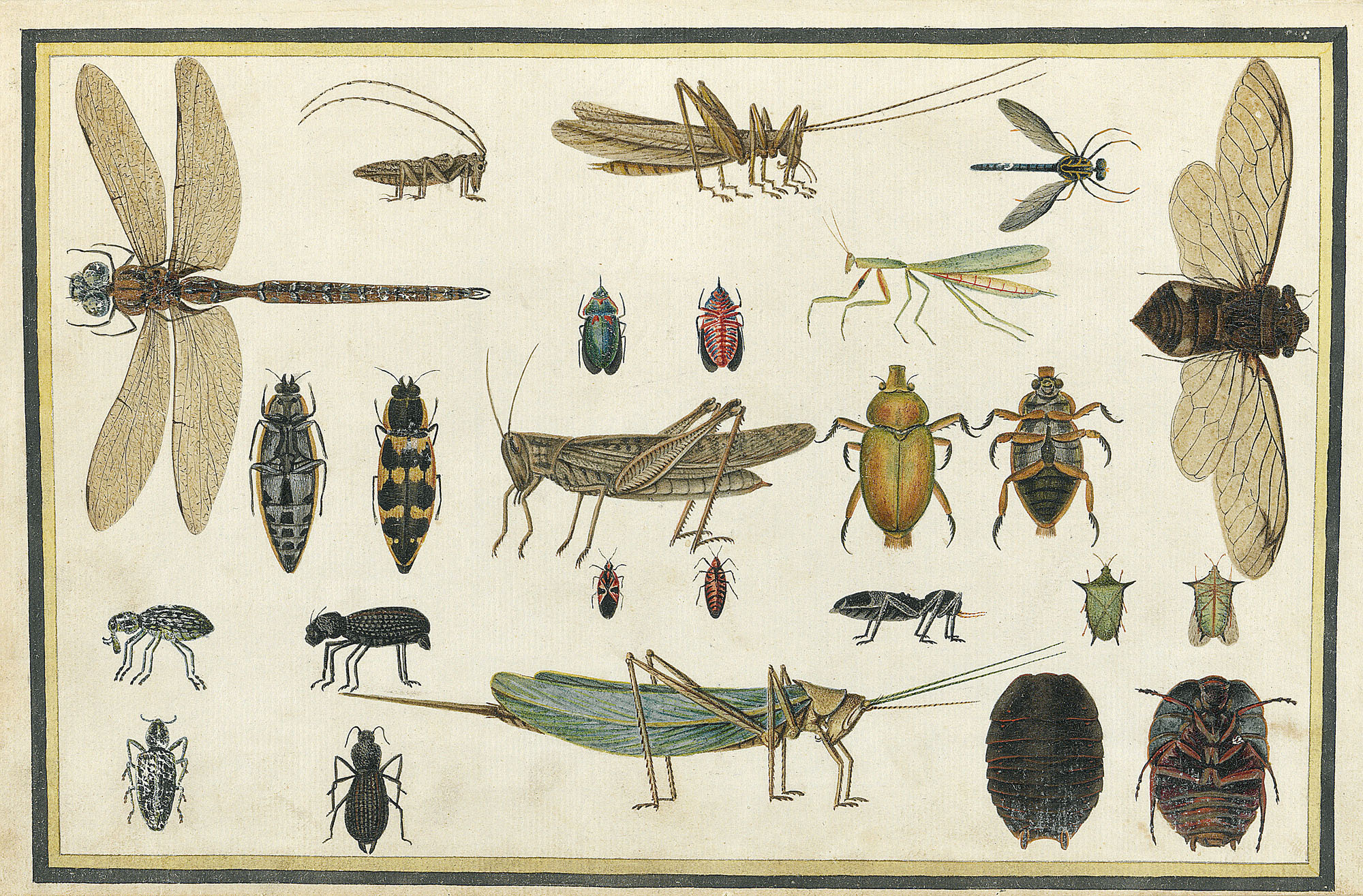
 

Richard Browne (illustrator, Ireland 1776 - Australia 1824, Australia from 1811) 'Insects' 1813


Richard Browne (illustrator, Ireland 1776 – Australia 1824, Australia from 1811)
Insects
1813
Page 52 in Select Specimens from Nature of the Birds Animals &c &c of New South Wales collected and arranged by Thomas Skottowe 1813
Watercolour
18.7 x 30.0cm (page)
Mitchell Library, State Library of New South Wales, Sydney
Bequeathed by D.S. Mitchell, 1907


Convicts with artistic talent were often put to work by their overseers. This was the case for convict Richard Browne who was assigned to Newcastle commandant Thomas Skottowe. Browne hand-painted the illustrations in Skottowe’s 1813 book, Select Specimens from Nature. Upon his release, Browne returned to Sydney, where he continued to paint stylised images of emus, lyrebirds and other animals. He also made portraits of Awabakal and Eora individuals, with the intention of selling these drawings to the developing local market, or as souvenirs to people aboard visiting ships.

Exhibition text


Installation view of the exhibition 'Colony: Australia 1770 - 1861' at NGV Australia at Federation Square, Melbourne

Installation view of the exhibition 'Colony: Australia 1770 - 1861' at NGV Australia at Federation Square, Melbourne showing at right, John Lewin's 'Fish catch and Dawes Point, Sydney Harbour' c. 1813; and second right, John Lewin's 'Platypus' 1810


Installation views of the exhibition Colony: Australia 1770-1861 at NGV Australia at Federation Square, Melbourne with in the bottom image at right, John Lewin’s Fish catch and Dawes Point, Sydney Harbour c. 1813; and second right, John Lewin’s Platypus 1810
Photos: © Dr Marcus Bunyan and the National Gallery of Victoria


Installation view of the exhibition 'Colony: Australia 1770-1861' at NGV Australia at Federation Square, Melbourne showing John Lewin (English-Australian, 1770-1819) 'Fish catch and Dawes Point, Sydney Harbour' c. 1813 (installation detail)


John Lewin (English-Australian, 1770-1819)
Fish catch and Dawes Point, Sydney Harbour (installation detail)
c. 1813
Oil on canvas
86.5 x 113cm
Art Gallery of South Australia, Adelaide
Gift of the Art Gallery of South Australia Foundation and South Australian Brewing Holdings Limited 1989
Given to mark the occasion of the Company’s 1988 Centenary
Photo: © Dr Marcus Bunyan and the National Gallery of Victoria


John Lewin (England 1770 - Australia 1819, Australia from 1800) 'Fish catch and Dawes Point, Sydney Harbour' c. 1813 


John Lewin (England 1770 – Australia 1819, Australia from 1800)
Fish catch and Dawes Point, Sydney Harbour
c. 1813
Oil on canvas
86.5 x 113cm
Art Gallery of South Australia, Adelaide
Gift of the Art Gallery of South Australia Foundation and South Australian Brewing Holdings Limited 1989
Given to mark the occasion of the Company’s 1988 Centenary


In 1812, John Lewin wrote to a friend that he had two oil paintings underway, one of which is believed to be this unusual composition of a haul of fish caught in Sydney Harbour set against the background of Dawes Point (now The Rocks, Sydney). It is thus the earliest oil painting known to have been produced in Australia. Pictured in the composition are various identifiable fish varieties, including a crimson squirrelfish, estuary perch, rainbow wrasse, sea mullet and hammerhead shark, later named the Zygaena lewini (now Sphyrna lewini) after the artist.

Exhibition text
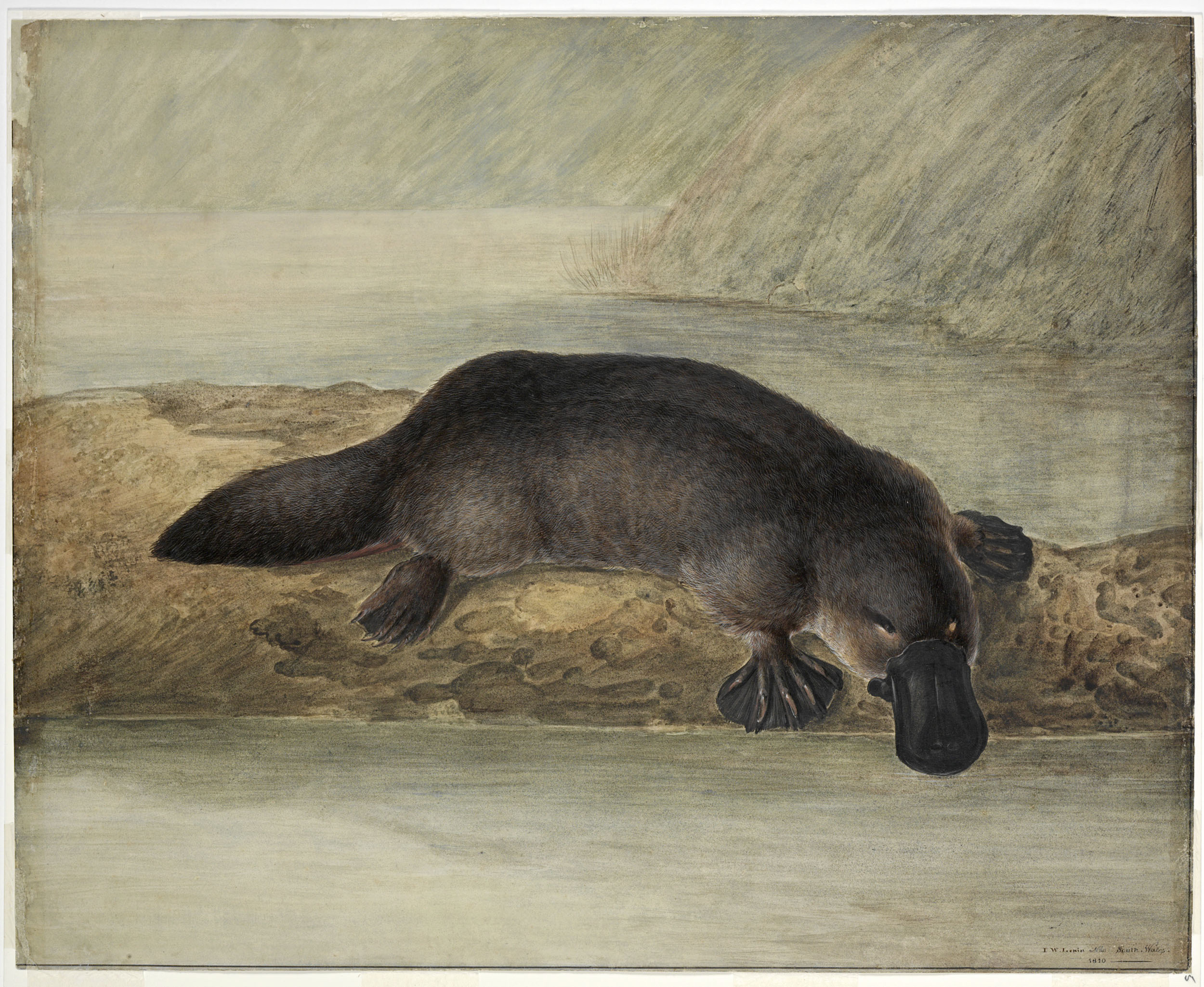
 

John Lewin (England 1770 - Australia 1819, Australia from 1800) 'Platypus' 1810 (installation view)


John Lewin (England 1770 – Australia 1819, Australia from 1800)
Platypus (installation view)
1810
Watercolour and gouache
Mitchell Library, State Library of New South Wales, Sydney
Bequeathed to the Trustees of the National Art Gallery of N.S.W. by Helen Banning; transferred to the Mitchell Library 1913
Photo: © Dr Marcus Bunyan and the National Gallery of Victoria


Sydney Bird Painter. 'Black Swan' c. 1790


Sydney Bird Painter
Black Swan
c. 1790
Watercolour and ink
48.1 x 29.2cm
Kerry Stokes Collection, Perth


Images of the black swan, as well as living birds and skins, were sent back to a fascinated Europe. One depiction became the pose de rigueur – a swan afloat, shown in profile like a heraldic symbol, with wings raised to show the white flight feathers. Like the Stubbs kangaroo, this black swan appeared in numerous forms. This beautiful watercolour was painted by an unidentified artist, possibly a member of the First Fleet, whose hand has also been identified in a volume of watercolours depicting birds held in the Mitchell Library, Sydney. Two or three artists made these drawings, and they are now collectively referred to as the Sydney Bird Painter.

Exhibition text


Peter Brown (active in England 1758-1799) 'Blue-bellied parrot' 1776


Peter Brown (active in England 1758-1799)
Blue-bellied parrot
1776
Plate VII in New Illustrations of Zoology: Containing Fifty Coloured Plates of New, Curious, and Non-Descript Birds, with a Few Quadrupeds, Reptiles and Insects, published by B. White, London 1776
Hand coloured etching
19 x 24.6cm (image and plate)
24 x 30.5cm (sheet)
Special Collections, Deakin University, Melbourne


It is unusual to know about an individual bird but this rainbow lorikeet (as it is now known) was captured at Botany Bay by Tupaia, the skilled Polynesian navigator and arioi (priest) who joined the Endeavour in Tahiti. The bird was taken back alive to London, and presented by Joseph Banks to the wealthy collector Marmaduke Tunstall. A watercolour of it was painted in 1772, and this print was published in 1776, carefully hand-coloured to show the bird’s distinctive plumage.

Exhibition text
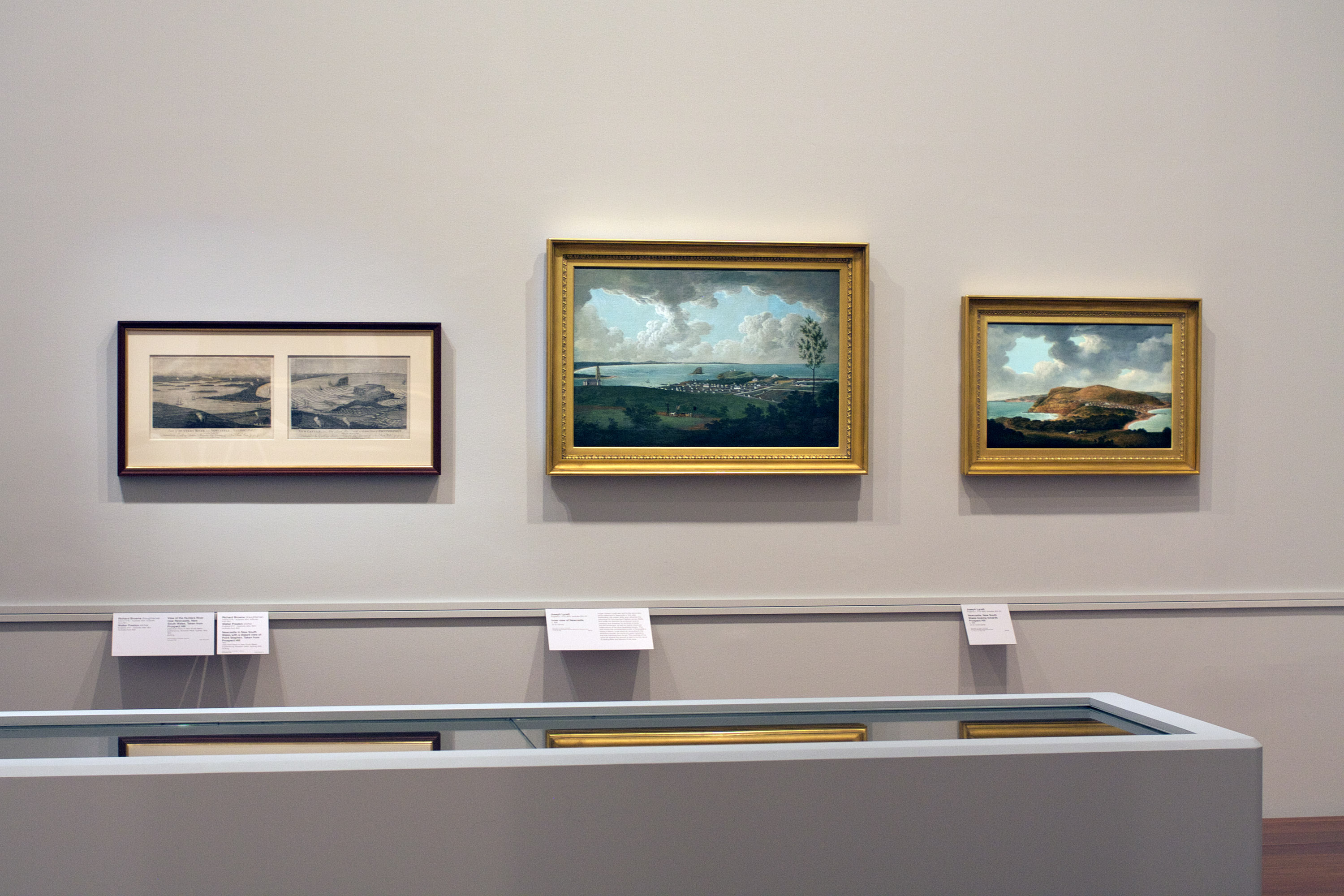
 

Installation view of the exhibition 'Colony: Australia 1770 - 1861' at NGV Australia at Federation Square, Melbourne with at centre, Joseph Lycett's 'Inner view of Newcastle' c. 1818


Installation view of the exhibition Colony: Australia 1770-1861 at NGV Australia at Federation Square, Melbourne with at centre, Joseph Lycett’s Inner view of Newcastle c. 1818
Photo: © Dr Marcus Bunyan and the National Gallery of Victoria
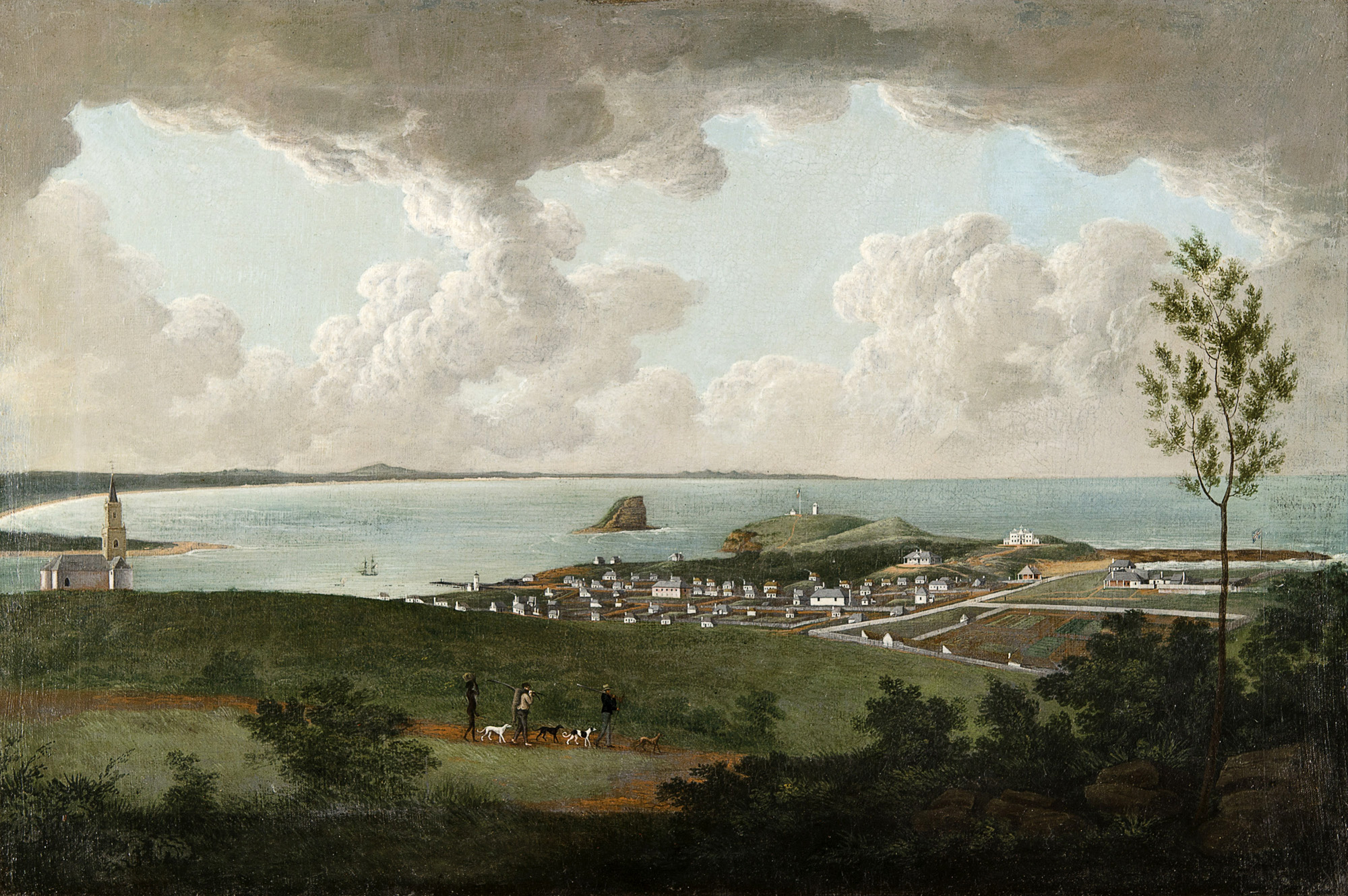
 

Joseph Lycett (England c. 1775-1828, Australia 1814-1822) 'Inner view of Newcastle' c. 1818


Joseph Lycett (England c. 1775-1828, Australia 1814-1822)
Inner view of Newcastle
c. 1818
Oil on canvas
59.6 x 90cm
Newcastle Art Gallery, Newcastle
Purchased with assistance from the National Art Collections Fund, London UK 1961


Forger Joseph Lycett was sent to the secondary penal settlement in Newcastle in 1815 after reoffending. His artistic skills soon attracted the patronage of Commandant Captain James Wallis, and under his direction he produced several paintings and drawings for etchings of birds and the landscape, as well as keenly observed watercolours of the local Awabakal people. This view shows the unmistakable profile of Newcastle’s Nobby’s Island, a site which is, according to the Awabakal people, the home of a giant kangaroo that was banished from its kin. The crashing of his great tail against the ground is said to be the cause of earthquakes and tremors in the area.

Exhibition text


Newcastle 1804

A penal settlement was established in Newcastle in 1804 as a place of secondary punishment for convicts. The area was rich in natural resources, including timber in the hinterland, large deposits of coal in the cliffs at the entrance to the harbour and shell middens for lime burning. Reoffenders sent to Newcastle experienced gruelling physical labour extracting these materials and desertion occurred frequently.

Yet, from this brutal setting, a rich body of work was born which represents the first local art movement by settlers within the Australian colonies. Over a decade, two commandants overseeing the settlement, Lieutenant Thomas Skottowe (1811-1818) and Captain James Wallis (1816-1822), both of whom were appointed by Governor Lachlan Macquarie, used convicts with artistic skills on a range of projects and capital works programs. They set artists to work documenting the Newcastle region and the local flora and fauna in drawings, paintings and prints. Others interacted with the local Awabakal people and produced important visual documents recording specific individuals and their way of life. Convicted forger Joseph Lycett was sent to Newcastle in 1815, and was the most significant artist involved in these projects, executing a group of major oil paintings, numerous watercolours, and drawings for subsequent etchings.

Text from the NGV website
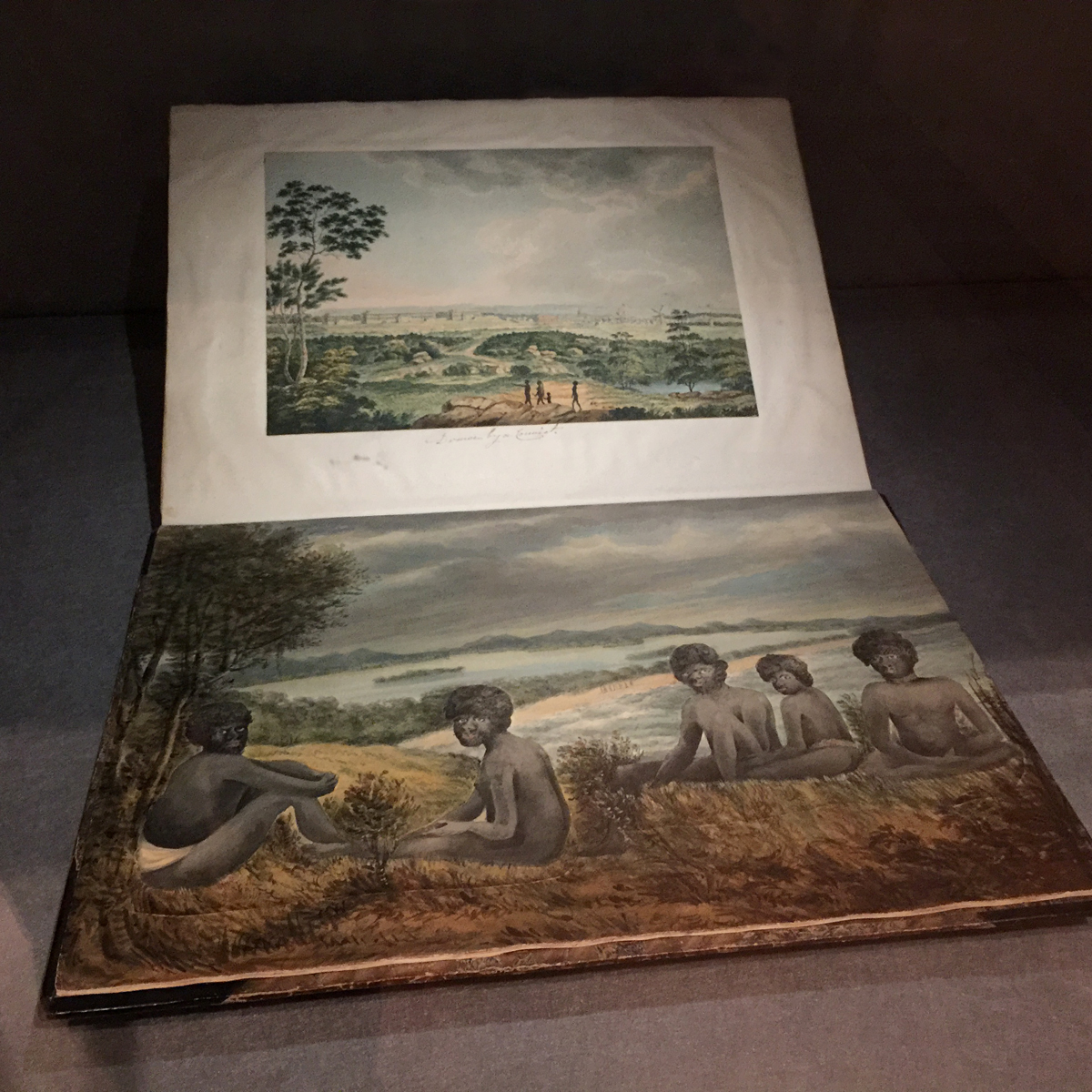
 

James Wallis (Ireland c. 1785 - England 1858, Australia 1814-19) 'View of Awabakal Aboriginal people, with beach and river inlet, and distant Aboriginal group in background' c. 1818 (installation view)


James Wallis (Ireland c. 1785 – England 1858, Australia 1814-1819)
View of Awabakal Aboriginal people, with beach and river inlet, and distant Aboriginal group in background (installation view)
c. 1818
in his Album of original drawings by Captain James Wallis and Joseph Lycett, bound with An Historical Account of the Colony of New South Wales by James Wallis, published by R. Ackerman, London, 1821 (c. 1817-1821)
Watercolour and collaged watercolour
Mitchell Library, State Library of New South Wales, Sydney
Purchased 2011
Photo: © Dr Marcus Bunyan and the National Gallery of Victoria


This image is one of a number of watercolours painted by Captain James Wallis that were bound into his personal copy of this publication. This naive image shows Awabakal people from the Newcastle region, whose figures have been cut out and collaged over the coastal scene behind. This presents a harmonious relationship between the Awabakal, colonisers and the military. Such a suggestion is at odds with earlier events of April 1816 when Wallis, under the direction of Governor Macquarie, led an armed regiment against Dharawal and Gandangara people south of Sydney, in what is now acknowledged as the first officially sanctioned massacre of Indigenous people in Australia.

Exhibition text


Installation view of the exhibition 'Colony: Australia 1770 - 1861' at NGV Australia at Federation Square, Melbourne showing the 'Dixson collector's chest' c. 1818-1820


Installation view of the exhibition Colony: Australia 1770-1861 at NGV Australia at Federation Square, Melbourne showing the Dixson collector’s chest c. 1818-1820
Photo: © Dr Marcus Bunyan and the National Gallery of Victoria


William Temple (cabinetmaker) (Australian born England, 1779-1839) Patrick Riley (cabinetmaker) (Australian born Ireland, 1786-1841) John Webster (cabinetmaker) Joseph Lycett (attributed to) (decorator) (British active Australia, c. 1774 - 1828) James Wallis (after) William Westall (after) 'Dixson collector's chest' c. 1818-1820


William Temple (cabinetmaker) (Australian born England, 1779-1839)
Patrick Riley (cabinetmaker) (Australian born Ireland, 1786-1841)
John Webster (cabinetmaker)
Joseph Lycett (attributed to) (decorator) (British active Australia, c. 1774 – 1828)
James Wallis (after)
William Westall (after)
Dixson collector’s chest
c. 1818-1820
Australian Rose Mahogany (Dysoxylum fraserianum), Red Cedar (Toona ciliata), brass, oil, natural history specimens
56 x 71.3 x 46.5cm (closed)
Dixson Galleries, State Library of New South Wales, Sydney
Presented by Sir William Dixson, 1937


The Dixson collector’s chest

The Dixson collector’s chest, c. 1818-1820, and its close relation, the Macquarie collector’s chest, c. 1818, are rare examples of colonial ‘cabinets of curiosity’ and among the most fascinating and complex objects of the colonial period. The Macquarie collector’s chest was commissioned and likely designed by Captain James Wallis, commandant of Newcastle, to present to Governor Lachlan Macquarie. It is debated whether the Dixson collector’s chest, on display here, was produced as its prototype or subsequently as a second version.

Crafted by expert convict cabinet-makers from local Australian timbers, the cabinet opens to reveal painted panels by convict artist Joseph Lycett. Several show the Newcastle region, while others are painted after views by exploration artist William Westall. The drawers contain shells and originally would have also held other natural history specimens including birds, insects, coral and seaweed, tagged and arranged fastidiously by shape, colour and/or type. It is believed these specimens were collected with the assistance of the local Awabakal people, as Wallis had an amicable relationship with their kinsman Burigon.

Both of these chests were only discovered in the twentieth century; the example owned by Macquarie was found in a Scottish castle in the late 1970s, while the Dixson collector’s chest was acquired by Sir William Dixson, benefactor of the State Library of New South Wales, from a London dealer in 1937.

Text from the NGV website


Installation view of the exhibition 'Colony: Australia 1770 - 1861' at NGV Australia at Federation Square, Melbourne with in foreground, showing 'Dress uniform worn by Sir Edward Deas Thomson, Colonial Secretary of New South Wales' 1832-1842; and in the background, Augustus Earle's 'Captain John Piper' c. 1826 and 'Mary Ann Piper and her children' c. 1826

Installation view of the exhibition 'Colony: Australia 1770 - 1861' at NGV Australia at Federation Square, Melbourne with in foreground, showing 'Dress uniform worn by Sir Edward Deas Thomson, Colonial Secretary of New South Wales' 1832-1842; and in the background, Augustus Earle's 'Mary Ann Piper and her children' c. 1826


Installation views of the exhibition Colony: Australia 1770-1861 at NGV Australia at Federation Square, Melbourne with in foreground, showing Dress uniform worn by Sir Edward Deas Thomson, Colonial Secretary of New South Wales 1832-1842; and in the background, Augustus Earle’s Captain John Piper c. 1826 and Mary Ann Piper and her children c. 1826
Photos: © Dr Marcus Bunyan and the National Gallery of Victoria


In the three years he spent in the colonies, Augustus Earle established himself as one of its leading artists, specialising in portraiture. He was commissioned to produce several portraits of prominent officials including surveyor George Evans, also on display; the departing governor, Sir Thomas Brisbane; and this pair of canvases depicting Captain John Piper and his family. Dressed in a uniform of his own design, Piper is portrayed as a man at the height of his power. The accompanying portrait of Mary Ann with four of their thirteen children depicts the family at home. Her gentility is emphasised by her fashionable dress, banishing all trace of her origins as the daughter of First Fleet convicts.

Exhibition text


Installation view of the exhibition 'Colony: Australia 1770 - 1861' at NGV Australia at Federation Square, Melbourne showing 'Dress uniform worn by Sir Edward Deas Thomson, Colonial Secretary of New South Wales' 1832-1842 (detail)


Installation view of the exhibition Colony: Australia 1770-1861 at NGV Australia at Federation Square, Melbourne showing Dress uniform worn by Sir Edward Deas Thomson, Colonial Secretary of New South Wales (detail) 1832-1842
Photo: © Dr Marcus Bunyan and the National Gallery of Victoria


Unknown, England / Australia (maker)
Firmin & Sons, London (button maker England est. 1677)
Dress uniform worn by Sir Edward Deas Thomson, Colonial Secretary of New South Wales
1832-1842
Wool, silver brocade (appliqué), metal (buttons)
Museum of Applied Arts and Sciences, Sydney Purchased 1966


Worn by Sir Edward Deas Thomson, Colonial Secretary of New South Wales between 1837 and 1856, this dress coat and trousers formed part of Thomson’s official livery. Loosely based on the Windsor uniform, introduced by King George III, the outfit’s striking red collar and cuffs with oak leaf and acorn hand embroidery impart splendour. In the nascent colony, uniforms were a way to differentiate status, easing anxieties about social mobility and instilling discipline and obedience.

Exhibition text
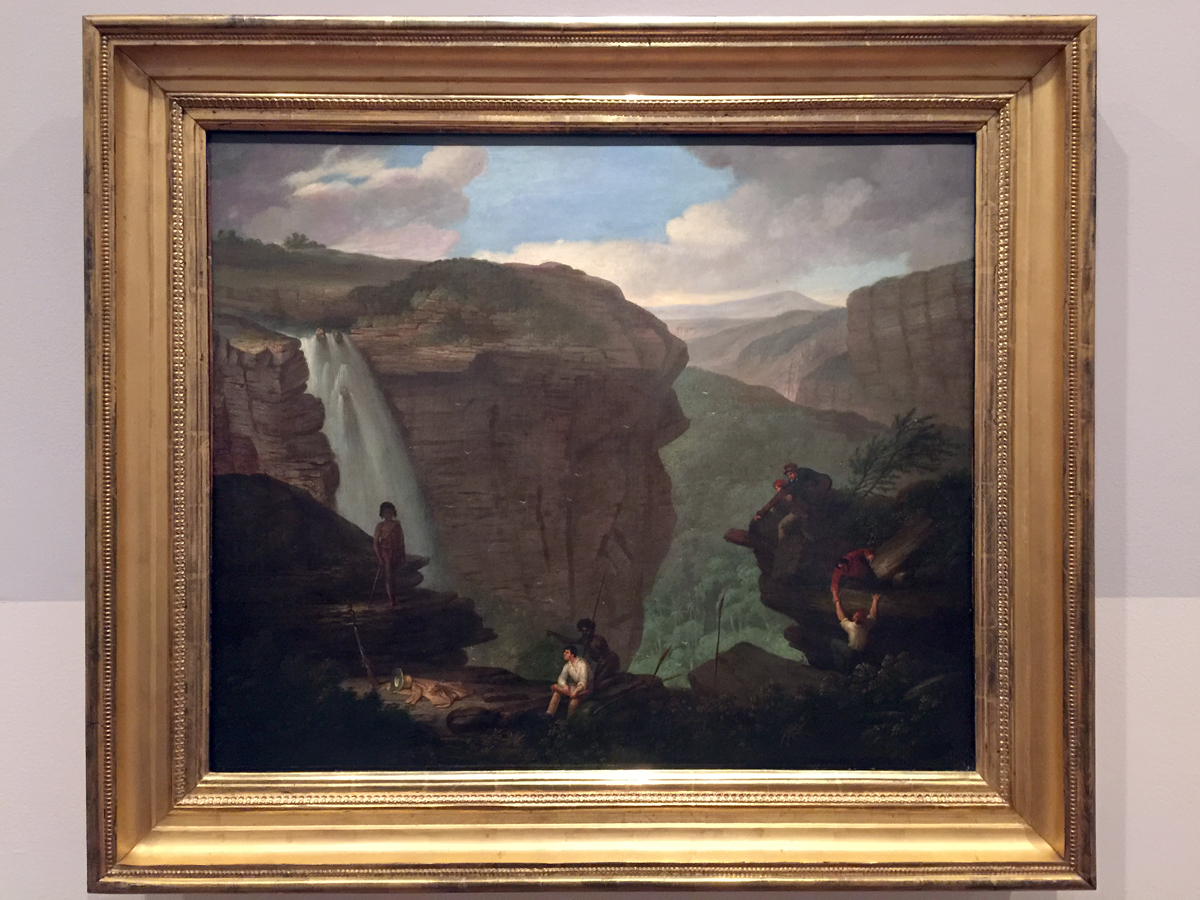
 

Augustus Earle (England 1793-1838, Brazil 1820-24, Australia 1825-28) 'Wentworth Falls' c. 1830 (installation view)


Augustus Earle (England 1793-1838, Brazil 1820-1824, Australia 1825-1828)
Wentworth Falls
c. 1830
Oil on canvas
Rex Nan Kivell Collection: National Library of Australia and National Gallery of Australia, Canberra
Photo: © Dr Marcus Bunyan and the National Gallery of Victoria


The intrepid artist and adventurer Augustus Earle arrived in Australia in January 1825 at a time when the economic and social hierarchies of the new colony were still in flux. An accidental émigré, rescued from the tiny island of Tristan da Cunha, where he had been marooned, Earle’s enterprising nature and versatile talents saw him build up a rich visual record of the colonial encounter for local and international audiences. These large oils were produced in England, several years after his return from the colony, and are among the first to evoke the scale and grandeur of the Australian wilderness.

Exhibition text


Augustus Earle (England 1793-1838, Brazil 1820-24, Australia 1825-28) 'A bivouac of travellers in Australia in a cabbage-tree forest, day break' c. 1838


Augustus Earle (England 1793-1838, Brazil 1820-1824, Australia 1825-1828)
A bivouac of travellers in Australia in a cabbage-tree forest, day break (see installation photograph below at left)
c. 1838
Oil on canvas
118 x 82cm
Rex Nan Kivell Collection: National Library of Australia and National Gallery of Australia, Canberra
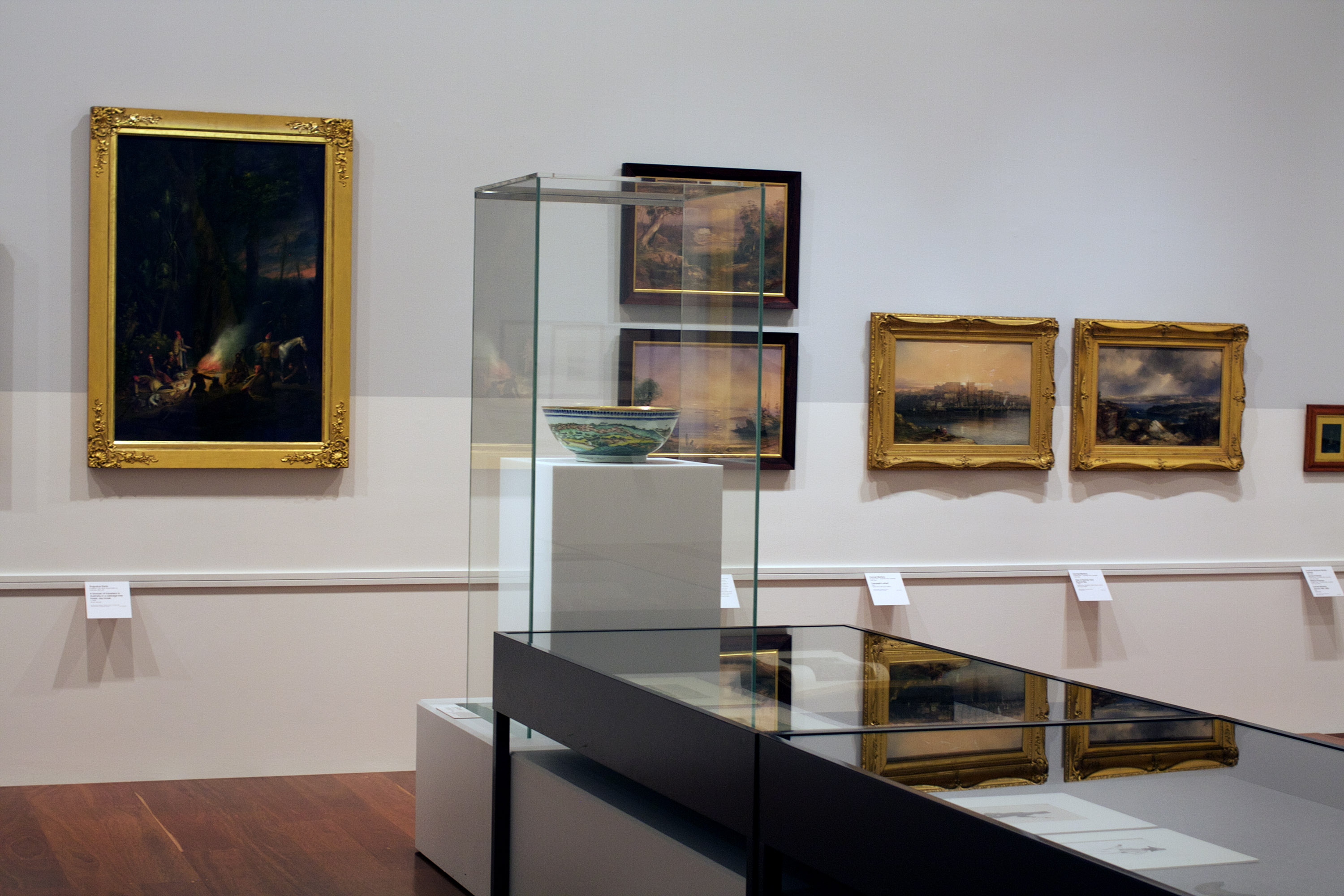
 

Installation view of the exhibition 'Colony: Australia 1770 - 1861' at NGV Australia at Federation Square, Melbourne

Installation view of the exhibition 'Colony: Australia 1770 - 1861' at NGV Australia at Federation Square, Melbourne

Installation view of the exhibition 'Colony: Australia 1770 - 1861' at NGV Australia at Federation Square, Melbourne showing at centre, Augustus Earle's 'Portrait of Bungaree, a native of New South Wales' c. 1826


Installation views of the exhibition Colony: Australia 1770-1861 at NGV Australia at Federation Square, Melbourne showing in the bottom image at centre, Augustus Earle’s Portrait of Bungaree, a native of New South Wales c. 1826
Photos: © Dr Marcus Bunyan and the National Gallery of Victoria


Bungaree (Australian / Kuringgai, 1775-1830)

Bungaree, or Boongaree, (1775 – 24 November 1830) was an Aboriginal Australian from the Kuringgai people of the Broken Bay area, who was known as an explorer, entertainer, and Aboriginal community leader. He is significant in that he was the first person to be recorded in print as an Australian.

By the end of his life, he had become a familiar sight in colonial Sydney, dressed in a succession of military and naval uniforms that had been given to him. His distinctive outfits and notoriety within colonial society, as well as his gift for humour and mimicry, especially his impressions of past and present governors, made him a popular subject for portrait painters.

Bungaree first came to prominence in 1798, when he accompanied Matthew Flinders on a coastal survey as an interpreter, guide and negotiator with local indigenous groups. He later accompanied Flinders on his circumnavigation of Australia between 1801 and 1803 in the Investigator. Flinders was the cartographer of the first complete map of Australia, filling in the gaps from previous cartographic expeditions, and was the most prominent advocate for naming the continent “Australia”. Flinders noted that Bungaree was “a worthy and brave fellow” who, on multiple occasions, saved the expedition. Bungaree continued his association with exploratory voyages when he accompanied Phillip Parker King to north-western Australia in 1817 in the Mermaid.

In 1815, Governor Lachlan Macquarie dubbed Bungaree “Chief of the Broken Bay Tribe” and presented him with 15 acres (61,000 m2) of land on George’s Head. He also received a breastplate inscribed “BOONGAREE – Chief of the Broken Bay Tribe – 1815”. Bungaree was also known by the titles “King of Port Jackson” and “King of the Blacks”. Bungaree spent the rest of his life ceremonially welcoming visitors to Australia, educating people about Aboriginal culture (especially boomerang throwing), and soliciting tribute, especially from ships visiting Sydney. In 1828, he and his clan moved to the Governor’s Domain, and were given rations, with Bungaree described as ‘in the last stages of human infirmity’. He died at Garden Island on 24 November 1830 and was buried in Rose Bay. Obituaries of him were carried in the Sydney Gazette and The Australian.

Text from the Wikipedia website


Augustus Earle (England 1793-1838, Brazil 1820-1824, Australia 1825-1828) 'Portrait of Bungaree, a native of New South Wales' c. 1826


Augustus Earle (England 1793-1838, Brazil 1820-1824, Australia 1825-1828)
Portrait of Bungaree, a native of New South Wales
c. 1826
Oil on canvas
68.5 x 50.5cm
Rex Nan Kivell Collection: National Library of Australia and National Gallery of Australia, Canberra


Sydney 1810s-1850s

The 1810s through to the 1850s was an era of expansion for the colonists who had settled in New South Wales and a time of continuing dispossession for Aboriginal people. Transportation ended in 1840, but convict labour continued to be assigned to assist with building roads and clearing land for pastoralists. The settler population grew and continued to occupy land further inland, north and south of Sydney. Emigration commissioners in London, and advocates within the colony, worked to encourage the arrival of free settlers, particularly women.

Throughout this period Sydney was the local centre of political power, and social and cultural sophistication. Artistic patronage was fostered. This is reflected in the proliferation of images in which nature and civilisation are pleasantly unified; the newly tamed wilderness placed against views of newly constructed Georgian buildings, demonstrating the colony’s ability to create order and flourish. Portraits were also in demand, and not only reflected the material success of prominent families but were commissioned by the expanding middle class. A print industry was established and expanded as the demand for locally produced prints increased. Images of colonial subjects, including portraits of Aboriginal people, account for a significant proportion of the art market at this time.

Text from the NGV website
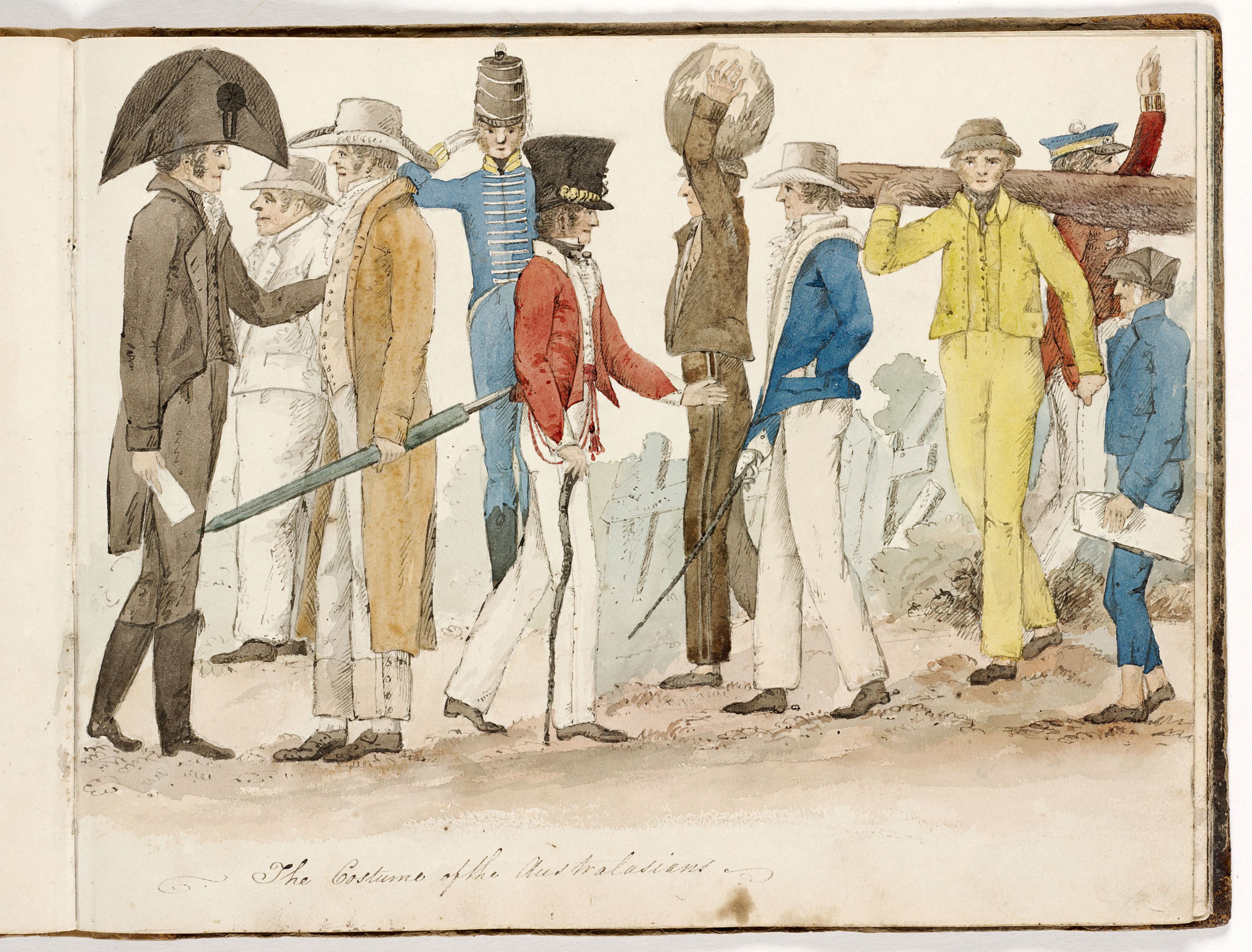
 

Edward Charles Close (Bengal (Bangladesh) 1790 - Australia 1866, Australia from 1817) 'The costume of the Australasians' c. 1817


Edward Charles Close (Bengal (Bangladesh) 1790 – Australia 1866, Australia from 1817)
The costume of the Australasians
c. 1817
In his New South Wales Sketchbook: Sea Voyage, Sydney, Illawarra, Newcastle, Morpeth c. 1817-1840
Watercolour
Mitchell Library, State Library of New South Wales, Sydney
Purchased 2009


Installation view of the exhibition 'Colony: Australia 1770 - 1861' at NGV Australia at Federation Square, Melbourne showing 'Elizabeth Macquarie', 'Governor Lachlan Macquarie' and 'Lachlan Macquarie junior' c. 1817-1819


Installation view of the exhibition Colony: Australia 1770-1861 at NGV Australia at Federation Square, Melbourne showing Elizabeth Macquarie, Governor Lachlan Macquarie and Lachlan Macquarie junior
Photo: © Dr Marcus Bunyan and the National Gallery of Victoria


Unknown artist
Elizabeth Macquarie
c. 1819
Watercolour on ivory
State Library of New South Wales, Sydney
Presented by F. W. Lawson, 1928

Unknown artist
Governor Lachlan Macquarie
c. 1819
Watercolour on ivory
State Library of New South Wales, Sydney
Presented by Miss M. Bather Moore and Mr T. C. Bather Moore, 1965

Unknown artist
Lachlan Macquarie junior
c. 1817-1818
Watercolour on ivory State Library of New South Wales, Sydney
Presented by Miss M. Bather Moore and Mr T. C. Bather Moore, 1965


Portrait miniatures were produced in England from the sixteenth century, with the first example on ivory painted in 1707. They remained a popular form of portraiture, as they were both intimate and easy to carry, until photography gradually took over all but the high end of the market. In Australia miniatures were similarly popular with the more affluent colonists. Lachlan Macquarie was the governor of New South Wales from 1810 to 1821. This suite of miniatures, painted in Australia by a skilled but now unknown artist, show Macquarie, his wife Elizabeth and their young son. They were presented to Captain John Cliffe Watts, Macquarie’s aide-de-camp, as a gift and memento of friendship, prior to Cliffe’s return to England in April 1819.

Exhibition text


Installation view of the exhibition 'Colony: Australia 1770 - 1861' at NGV Australia at Federation Square, Melbourne showing Henry Gritten's oil on canvas 'Hobart, Tasmania' 1856


Installation view of the exhibition Colony: Australia 1770-1861 at NGV Australia at Federation Square, Melbourne showing Henry Gritten’s oil on canvas Hobart, Tasmania 1856 National Gallery of Victoria, Melbourne Felton Bequest, 1975
Photo: © Dr Marcus Bunyan and the National Gallery of Victoria


Hobart’s Mount Wellington was a landmark of such majestic beauty that for many it rivalled the magnificent natural harbour of Sydney. The site naturally attracted the pen and brush of many colonial artists including John Glover, Knud Bull and Eugene von Guérard. Henry Gritten, who lived in Hobart from 1856 until at least 1858, painted it many times, and it is almost as common in his oeuvre as his views of Melbourne from the Botanic Gardens of the 1860s. Most artists painted the view from the same vantage point adopted by Gritten, looking across the Derwent River towards the settlement nestled at the foot of the rising mountain.

Exhibition text


Van Diemen’s Land 1803

In 1803, 160 years after the Dutch explorer Abel Tasman named and charted Van Diemen’s Land, the British laid claim to the island by relocating convicts and officers from New South Wales to forestall any incursion by the French. Convict transports continued to arrive intermittently in Van Diemen’s Land, mostly bringing prisoners from Britain and Ireland, until 1856, by which time more than 72,000 convicts had been sent there. There were several penal settlements established in Van Diemen’s Land, the most notorious of which were at Macquarie Harbour and Port Arthur.

In 1804, a year after the arrival of the first transports of convicts, Hobart Town was founded on the banks of the Derwent River and it quickly became an important southern trading port.

Over the next twenty years the settlement developed into a cultured, albeit provincial, Georgian township. Local sandstone was widely used to build fine buildings, including places of worship and civic and commercial buildings, and in turn the cultural life of the colony developed. In 1822 fifty-eight per cent of the population of Van Diemen’s Land were convicts, and consequently the majority of artists and artisans came from their ranks.

Text from the NGV website


Installation view of the exhibition 'Colony: Australia 1770 - 1861' at NGV Australia at Federation Square, Melbourne showing Unknown, Tasmania. 'Waistcoat' mid 19th century (installation view)


Unknown, Tasmania
Waistcoat (installation view)
Mid 19th century
Wool, cotton, bone
Collection of Port Arthur Historic Site Management Authority, Hobart
Photo: © Dr Marcus Bunyan and the National Gallery of Victoria


Installation view of the exhibition 'Colony: Australia 1770 - 1861' at NGV Australia at Federation Square, Melbourne showing Unknown, Tasmania 'Jacket' mid 19th century


Unknown, Tasmania
Jacket (installation view)
Mid 19th century
Wool, linen, cotton, bone
Collection of Port Arthur Historic Site Management Authority, Hobart
Photo: © Dr Marcus Bunyan and the National Gallery of Victoria
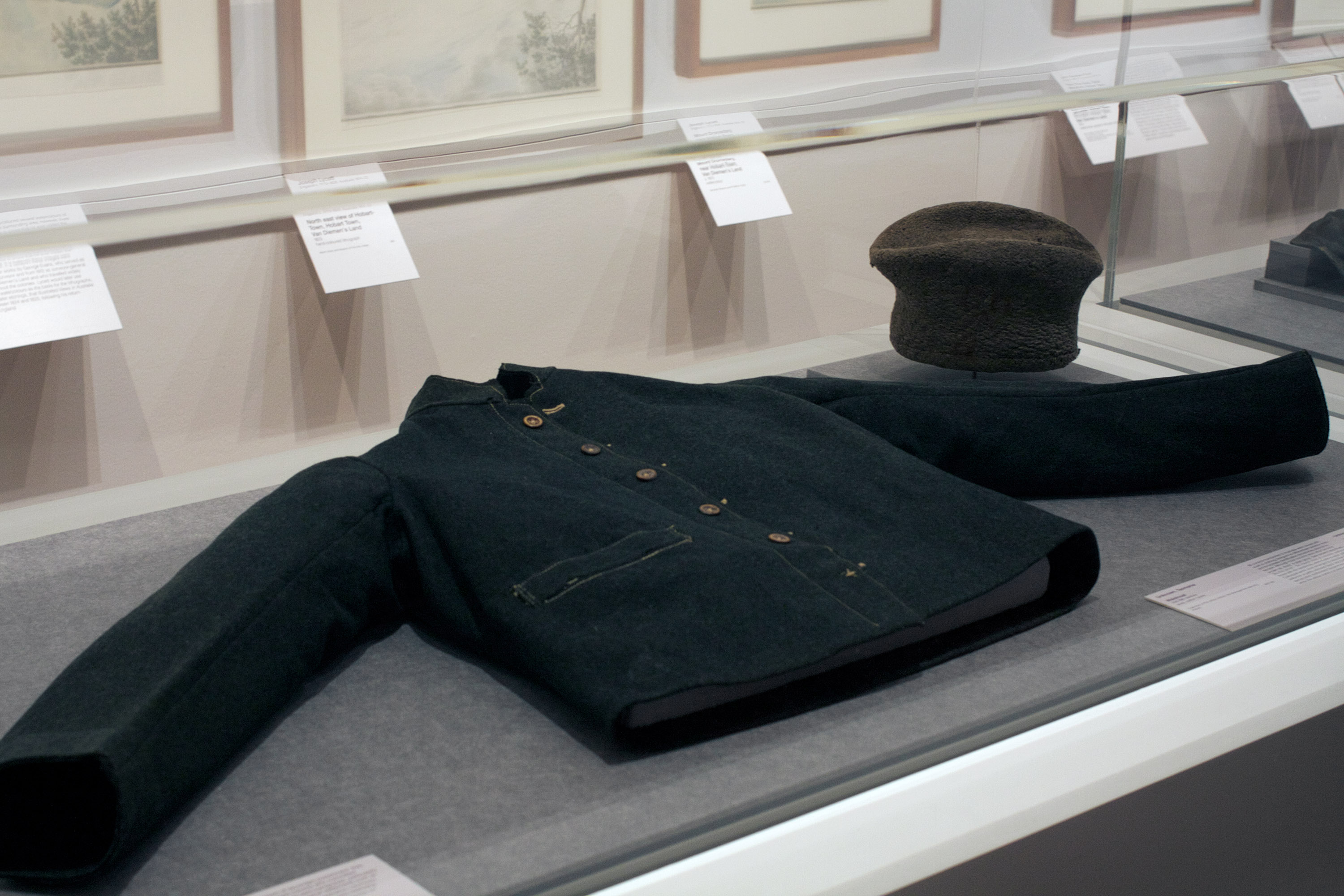
 

Installation view of the exhibition 'Colony: Australia 1770 - 1861' at NGV Australia at Federation Square, Melbourne showing Unknown, Tasmania 'Jacket and Indoor cap' mid 19th century


Installation view of the exhibition Colony: Australia 1770-1861 at NGV Australia at Federation Square, Melbourne showing Unknown, Tasmania Jacket and Indoor cap mid 19th century, wool, linen, cotton, bone
Photo: © Dr Marcus Bunyan and the National Gallery of Victoria


Unknown
Tasmania Jacket
Mid 19th century
Wool, linen, cotton, bone
Collection of Port Arthur Historic Site Management Authority, Hobart

Unknown, Tasmania
Indoor cap
Mid 19th century
Wool
Collection of Port Arthur Historic Site Management Authority, Hobart


All convicts transported to Australia were issued with a set of clothing designed to differentiate between them and to facilitate identification should they attempt to escape. Although most convicts wore what became known as ‘slops’ in plain greys, dark browns and blues – like this jacket – the lowest class of convicts, particularly those with life sentences, were made to wear yellow. Colloquial terms soon emerged to describe these uniforms: a partly coloured black and buff uniform that demarcated reoffenders became known as a ‘magpie’, while the yellow-suited convicts were called ‘canaries’.

Exhibition text


Installation view of the exhibition 'Colony: Australia 1770 - 1861' at NGV Australia at Federation Square, Melbourne showing Lion's head, Book-shaped puzzle box, Bell and Fork mid 19th century


Installation view of the exhibition Colony: Australia 1770-1861 at NGV Australia at Federation Square, Melbourne showing Lion’s head, Book-shaped puzzle box, Bell and Fork mid 19th century
Photo: © Dr Marcus Bunyan and the National Gallery of Victoria


Unknown, Tasmania
Lion’s head
Mid 19th century
Iron
Collection of Port Arthur Historic Site Management Authority, Port Arthur

Unknown, Tasmania
Book-shaped puzzle box
Mid 19th century wood
Queen Victoria Museum and Art Gallery, Launceston Beattie Collection

Unknown, Tasmania
Bell
Mid 19th century
Wood, brass, iron, bronze
Collection of Port Arthur Historic Site Management Authority, Hobart

Unknown, Tasmania
Fork
Mid 19th century
Wood
Collection of Port Arthur Historic Site Management Authority, Port Arthur


NGV Australia will host two complementary exhibitions that explore Australia’s complex colonial history and the art that emerged during and in response to this period. Presented concurrently, these two ambitious and large-scale exhibitions, Colony: Australia 1770-1861 and Colony: Frontier Wars, offer differing perspectives on the colonisation of Australia.

Featuring an unprecedented assemblage of loans from major public institutions around Australia, Colony: Australia 1770-1861 is the most comprehensive survey of Australian colonial art to date. The exhibition explores the rich diversity of art, craft and design produced between 1770, the arrival of Lieutenant James Cook and the Endeavour, and 1861, the year the NGV was established.

The counterpoint to Colony: Australia 1770-1861, Colony: Frontier Wars presents a powerful response to colonisation through a range of historical and contemporary works by Indigenous and non-Indigenous artists dating from pre-contact times to present day. From nineteenth-century drawings by esteemed Wurundjeri artist and leader, William Barak, to the iridescent LED light boxes of Jonathan Jones, this exhibition reveals how Aboriginal people have responded to the arrival of Europeans with art that is diverse, powerful and compelling.

Tony Ellwood, Director, NGV said: ‘Cook’s landing marks the beginning of a history that still has repercussions today. This two-part exhibition presents different perspectives of a shared history with unprecedented depth and scope, featuring a breadth of works never-before-seen in Victoria. In order to realise this ambitious project, we have drawn upon the expertise and scholarship of many individuals from both within and outside the NGV. We are extremely grateful to the Aboriginal Elders and advisory groups who have offered their guidance, expertise and support,’ said Ellwood.

Joy Murphy-Wandin, Senior Wurundjeri Elder, said: ‘I am overwhelmed at the magnitude and integrity of this display: such work and vision is a credit to the curatorial team. The NGV is to be congratulated for providing a visual truth that will enable the public to see, and hopefully understand, First Peoples’ heartache, pain and anger. Colony: Australia 1770-1861 / Frontier Wars is a must see for all if we are to realise and action true reconciliation.’

Charting key moments of history, life and culture in the colonies, Colony: Australia 1770-1861 includes over 600 diverse and significant works, including examples of historical Aboriginal cultural objects, early watercolours, illustrated books, drawings, prints, paintings, sculpture and photographs, to a selection of furniture, fashion, textiles, decorative arts, and even taxidermy specimens.

Highlights from the exhibition include a wondrous ‘cabinet of curiosities’ showcasing the earliest European images of Australian flowers and animals, including the first Western image of a kangaroo and illustrations by the talented young water colourist Sarah Stone. Examples of early colonial cabinetmaking also feature, including the convict made and decorated Dixson chest containing shells and natural history specimens, as well as a rarely seen panorama of Melbourne in 1841 will also be on display.

Following the development of Western art and culture, the exhibition includes early drawings and paintings by convict artists such as convicted forgers Thomas Watling and Joseph Lycett; the first oil painting produced in the colonies by professional artist John Lewin; work by the earliest professional female artists, Mary Morton Allport, Martha Berkeley and Theresa Walker; landscapes by John Glover and Eugene von Guérard; photographs by the first professional photographer in Australia, George Goodman, and a set of Douglas Kilburn’s silver-plated daguerreotypes, which are the earliest extant photographs of Indigenous peoples.

Colony: Frontier Wars attests to the resilience of culture and Community, and addresses difficult aspects of Australia’s shared history, including dispossession and the stolen generation, through the works of Julie Gough, Brook Andrew, Maree Clarke, Ricky Maynard, Marlene Gilson, Julie Dowling, S. T. Gill, J. W. Lindt, Gordon Bennett, Arthur Boyd, Tommy McRae, Christian Thompson, and many more.

Giving presence to the countless makers whose identities have been lost as a consequence of colonialism, Colony: Frontier Wars also includes a collection of anonymous photographic portraits and historical cultural objects, including shields, clubs, spear throwers and spears, by makers whose names, language groups and Countries were not recorded at the time of collection. Challenging global museum conventions, the exhibition will credit the subjects and makers of these cultural objects as ‘once known’ rather than ‘unknown’.

Press release from the National Gallery of Victoria


Installation view of the exhibition 'Colony: Australia 1770 - 1861' at NGV Australia at Federation Square, Melbourne showing William Francis Emery's 'View of Ipswich from Limestone Hill' c. 1861


Installation view of the exhibition Colony: Australia 1770-1861 at NGV Australia at Federation Square, Melbourne showing William Francis Emery’s (active in Australia c. 1850-1865) oil on canvas View of Ipswich from Limestone Hill c. 1861 Ipswich Art Gallery Collection, Ipswich
Photo: © Dr Marcus Bunyan and the National Gallery of Victoria


Installation view of the exhibition 'Colony: Australia 1770 - 1861' at NGV Australia at Federation Square, Melbourne featuring Australian 19th century earthenware and stoneware


Installation view of the exhibition Colony: Australia 1770-1861 at NGV Australia at Federation Square, Melbourne featuring 19th century earthenware and stoneware
Photo: © Dr Marcus Bunyan and the National Gallery of Victoria


Left

Andreas Fritsch (Germany 1808 – Australia 1896, Australia from 1849)
Teapot
c. 1850
Earthenware
National Gallery of Victoria, Melbourne
Gift of W. G. Tuck, 1972

Middle

Andreas Fritsch (Germany 1808 – Australia 1896, Australia from 1849)
Coffee pot
c. 1850
Earthenware
National Gallery of Victoria, Melbourne
Gift of W. G. Tuck, 1972

Right

Trewenack, Magill, South Australia (pottery 1853-1928)
John Henry Trewenack (potter England 1853 – Australia 1883, Australia from 1849)
Lidded storage jar
c. 1855
Stoneware
National Museum of Australian Pottery, Holbrook, New South Wales


This sharply waisted coffee pot, with its flat lid and nipped-in knob, is of a traditional German type. Fritsch arrived in Melbourne from Schwarzenbek in northern Germany in 1849, accompanied by his wife and four children. He showed eight earthenware objects (which may have included this coffee pot and teapot) at the Victoria Industrial Society exhibition in Melbourne in 1851. The Argus commented on 30 January that Fritsch’s exhibits, which earned him a large silver medal, ‘shewed [sic] how little necessity there is for Victoria being dependent in this article on any other portion of the globe’.

Exhibition text


Edward Robert Mickleburgh (England 1814 - late 19th century, Australia from c. 1841-1870s) 'The barque Terror commencing after Sperm Whales' 1840s (installation view)


Edward Robert Mickleburgh (England 1814 – late 19th century, Australia from c. 1841-1870s)
The barque Terror commencing after Sperm Whales (installation view)
1840s
Panbone and pigment
Australian National Maritime Museum, Sydney
Purchased, 2004
Photo: © Dr Marcus Bunyan and the National Gallery of Victoria


Edward Robert Mickleburgh was navigator on the whaling vessel Terror, and like many sailors practised the art of scrimshaw. Scrimshaw entails engraving or incising into bone, teeth or ivory and rubbing ink, or other pigments, into the lines to reveal the image. This particularly fine example illustrates both the art of the whaler and the industry of whaling. Mickleburgh has use the pantone, or lower jawbone of the sperm whale, to incise an image of the ship under full sail during the chase, lookouts atop its masts, boiling-down furnace fired up.

Exhibition label text


Installation view of the exhibition 'Colony: Australia 1770 - 1861' at NGV Australia at Federation Square, Melbourne

Installation view of the exhibition 'Colony: Australia 1770 - 1861' at NGV Australia at Federation Square, Melbourne showing Lieutenant Robert Dale (draughtsman England 1810-1853, Australia 1829-1833) Robert Havell junior (engraver England 1793-1878, United States 1839-1878) 'Panoramic view of King George's Sound, part of the colony of Swan River' 1834


Installation view of the exhibition Colony: Australia 1770-1861 at NGV Australia at Federation Square, Melbourne showing Panoramic view of King George’s Sound, part of the colony of Swan River 1834
Photos: © Dr Marcus Bunyan and the National Gallery of Victoria


Lieutenant Robert Dale (draughtsman England 1810-1853, Australia 1829-1833)
Robert Havell junior (engraver England 1793-1878, United States 1839-1878)
Panoramic view of King George’s Sound, part of the colony of Swan River
1834
Engraving, colour aquatint and watercolour on 3 joined sheets
National Gallery of Victoria, Melbourne
Purchased, 1958


This lengthy and detailed print shows the distinctive coastline viewed from the rocky summit of Mount Clarence, with the recently established government farm at Strawberry Hill and what later became Albany below. Drawn by surveyor Lieutenant Robert Dale and translated into print by Robert Havell in London, it depicts Nyungar and European figures in friendly contact, surrounded by native vegetation and animals. The spectacular view may have enticed prospective investors or settlers, promoting an idyllic vision with its abundance of fertile land and peaceful relations with the Traditional Owners.

Exhibition text


Installation view of the exhibition 'Colony: Australia 1770 - 1861' at NGV Australia at Federation Square, Melbourne showing John Glover's 'The Island of Madeira' 1831-1839

Installation view of the exhibition 'Colony: Australia 1770 - 1861' at NGV Australia at Federation Square, Melbourne showing John Glover's 'The Island of Madeira' 1831-1839


Installation view of the exhibition Colony: Australia 1770-1861 at NGV Australia at Federation Square, Melbourne showing at bottom, John Glover’s oil on canvas The Island of Madeira 1831-1839 National Gallery of Australia, Canberra
Photos: © Dr Marcus Bunyan and the National Gallery of Victoria
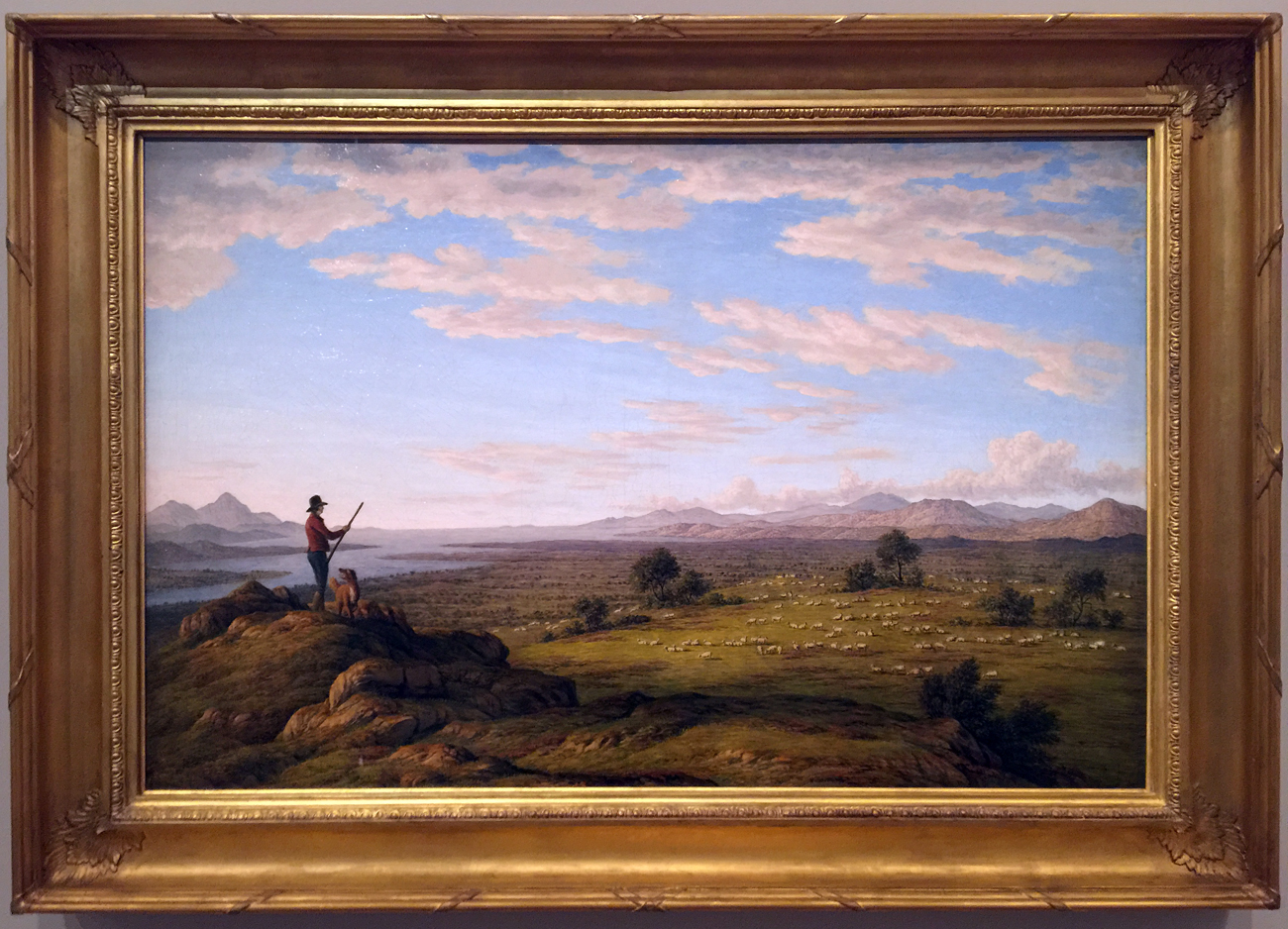
 

John Glover (England 1767 - Australia 1849, Australia from 1831) 'Moulting Lagoon and Great Oyster Bay, from Pine Hill' c. 1838 (installation view)


John Glover (England 1767 – Australia 1849, Australia from 1831)
Moulting Lagoon and Great Oyster Bay, from Pine Hill (installation view)
c. 1838
Oil on canvas
National Gallery of Victoria, Melbourne
Purchased with assistance of an anonymous donor and the M. G. Chapman Bequest, 2011
Photo: © Dr Marcus Bunyan and the National Gallery of Victoria


John Glover (England 1767 - Australia 1849, Australia from 1831) 'View of Mills Plains, Van Diemen's Land' 1833


John Glover (England 1767 – Australia 1849, Australia from 1831)
View of Mills Plains, Van Diemen’s Land
1833
Oil on canvas
76.2 x 114.6cm
Art Gallery of South Australia, Adelaide
Morgan Thomas Bequest Fund 1951


John Glover was a mature and well-established artist by the time he immigrated to Van Diemen’s Land in 1831. He had enjoyed a long and mostly successful career as a painter in England and had exhibited at London’s Royal Academy on several occasions. He took to the bright light and colour of Van Diemen’s Land easily, depicting the distinctive terrain and vegetation with unerring naturalism and the selective, idealising eye of the picturesque painter. He established a farm named Patterdale in Deddington, outside of Launceston, with his sons. The property and surrounding Mills Plains countryside often feature as a subject in his paintings.

Exhibition text


Van Diemen’s Land 1820s-1850s

The increased arrival of free settlers from the 1820s onwards saw the colony of Van Diemen’s Land evolve from a brutal penal settlement into an economically sound and vibrant cultural centre. With its pleasant climate, few droughts and floods, and open grassland, which seemed pre-prepared for aspiring pastoralists, Van Diemen’s Land became the preferred destination for immigrants. By 1830, almost a third of the arrivals to Australia settled in the south, and the small island experienced economic prosperity.

Colonial society was increasingly able to support a vibrant artistic community, composed of amateurs and professionals, free settlers, highly skilled convicts and emancipists who found patronage despite their unsavoury backgrounds. In August 1837 the colony asserted its cultural superiority when Hobart hosted the first exhibition of art to be held in Australia, under the patronage of Lieutenant-Governor John Franklin and his wife, Jane. The Franklins had arrived in Hobart earlier that year, and during their tenure (1837-43) enthusiastically fostered the development of intellectual life, regarding the visual arts as an outward signifier of culture in the colony. The Vandemonian art, decorative arts and design produced from the 1830s to the early 1850s are among the most sophisticated and diverse of the colonial era.

Text from the NGV website


Installation view of the exhibition 'Colony: Australia 1770 - 1861' at NGV Australia at Federation Square, Melbourne with at left, John Glover's 'The River Nile, Van Diemen's Land, from Mr Glover's farm' 1837; at centre, 'Hamilton Inn Sofa' c. 1825; and in cabinet 'Necklace' late 19th century


Installation view of the exhibition Colony: Australia 1770-1861 at NGV Australia at Federation Square, Melbourne with at left, John Glover’s The River Nile, Van Diemen’s Land, from Mr Glover’s farm 1837; at centre, Hamilton Inn Sofa c. 1825; and in cabinet Necklace late 19th century
Photo: © Dr Marcus Bunyan and the National Gallery of Victoria
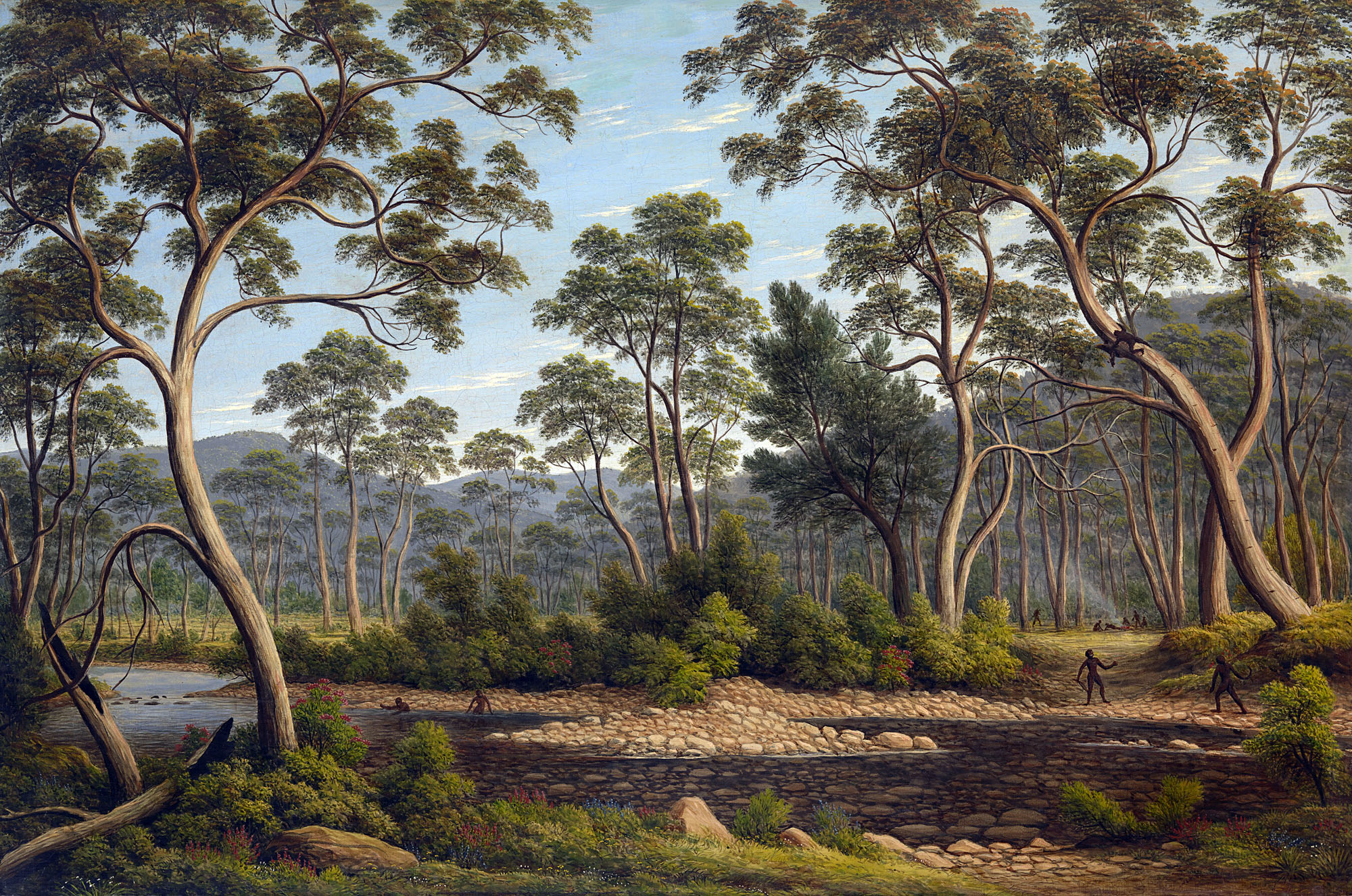
 

John Glover (England 1767 - Australia 1849, Australia from 1831) 'The River Nile, Van Diemen's Land, from Mr Glover's farm' 1837


John Glover (England 1767 – Australia 1849, Australia from 1831)
The River Nile, Van Diemen’s Land, from Mr Glover’s farm
1837
Oil on canvas
76.4 x 114.6cm
National Gallery of Victoria, Melbourne
Felton Bequest, 1956


John Glover’s colonial landscapes can be divided into two groups: pastoral scenes of the land surrounding his own property, and pre-contact Aboriginal Arcadias. Although the Aboriginal figures are at times generic, they are shown as active participants in the landscape. Such scenes were, however, entirely imagined, as Glover encountered very few Tasmanian Aboriginal people while in the colony. Glover had not experienced the conflict or witnessed the violence between Tasmanian Aboriginal resistance fighters and white settlers during the 1820s. By the time of his arrival in 1831, the Tasmanian Aboriginal survivors had been forced to leave Country and relocate to Flinders Island.

Exhibition text


Installation view of the exhibition 'Colony: Australia 1770 - 1861' at NGV Australia at Federation Square, Melbourne with at front left, 'Necklace' late 19th century


Installation view of the exhibition Colony: Australia 1770-1861 at NGV Australia at Federation Square, Melbourne with at front left, Necklace late 19th century
Photo: © Dr Marcus Bunyan and the National Gallery of Victoria


Unknown (Tasmanian Aboriginal active late 19th century)
Necklace
Late 19th century
Maireener shells (Phasianotrochus sp.)
Tasmanian Museum and Art Gallery, Hobart


Shell necklace-making represents the most significant cultural tradition of Tasmanian Aboriginal women, one of few customary practices that has continued without interruption from long before British colonisation of Van Diemen’s Land in 1803. This necklace is strung from the rarest and most highly prized of shells, the maireneer (Phasianotrochus sp.). Seasonally gathered directly from the sea, maireneer shells are painstakingly processed to remove the outer brown casing and reveal their pearlescent lustre before being pierced and strung. Eighteenth-century French explorers remarked on the iridescent beauty of maireneer shell necklaces, and the esteem in which they were held by their skilled makers.

Exhibition text
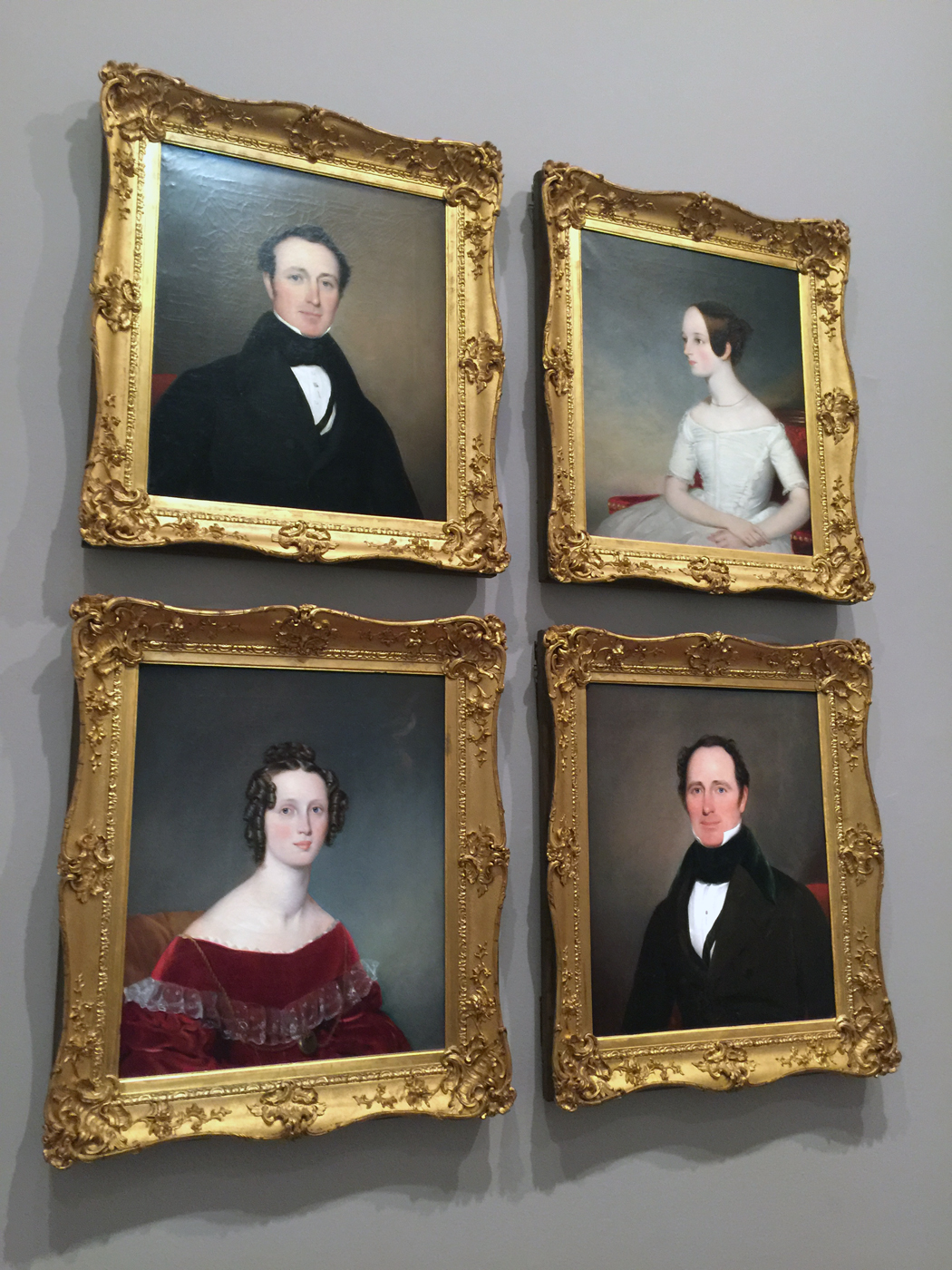
 

Installation view of the exhibition 'Colony: Australia 1770 - 1861' at NGV Australia at Federation Square, Melbourne showing Thomas Bock's paintings 'John Robertson' 1850 (top left); 'Mrs William Robertson' mid 1830s (bottom left); 'Jessie Robertson' 1850 (top right); and 'Captain William Robertson' 1830s (bottom right)

Installation view of the exhibition 'Colony: Australia 1770 - 1861' at NGV Australia at Federation Square, Melbourne showing Thomas Bock's paintings 'John Robertson' 1850 (top left); 'Mrs William Robertson' mid 1830s (bottom left); 'Jessie Robertson' 1850 (top right); and 'Captain William Robertson' 1830s (bottom right)


Installation views of the exhibition Colony: Australia 1770-1861 at NGV Australia at Federation Square, Melbourne showing Thomas Bock’s paintings John Robertson 1850 (top left); Mrs William Robertson mid 1830s (bottom left); Jessie Robertson 1850 (top right); and Captain William Robertson 1830s (bottom right) all oil on canvas, Art Gallery of South Australia, Adelaide Mrs Mary Overton Gift Fund 1996
Photos: © Dr Marcus Bunyan and the National Gallery of Victoria


Sentenced to transportation for fourteen years, Thomas Bock arrived in Hobart in 1824. He was already successful as an engraver in Birmingham so was put to work by government officials, engraving bank notes for the Bank of Van Diemen’s Land, stationery and illustrations for locally printed publications. Following his pardon, he was kept busy with painting commissions. His elegant and flattering portraits, executed in the grand Georgian manner fashionable in England, were greatly prized by colonists. In addition to painting these likenesses, Bock is believed to have photographed Captain Robertson, his wife and their son William junior in the early 1850s.

Exhibition text


Installation view of the exhibition 'Colony: Australia 1770 - 1861' at NGV Australia at Federation Square, Melbourne with at centre, 'Hamilton Inn Sofa' c. 1825


Installation view of the exhibition Colony: Australia 1770-1861 at NGV Australia at Federation Square, Melbourne with at centre, Hamilton Inn Sofa c. 1825
Photo: © Dr Marcus Bunyan and the National Gallery of Victoria


Unknown, (Tasmania)
Hamilton Inn Sofa
c. 1825
Red Cedar (Toona ciliata), Eucalyptus (Eucalyptus sp.), pearwood, Mahogany, metal (steel and brass fittings), horsehair, wool, cotton
Tasmanian Museum and Art Gallery, Hobart
Purchased for the Tasmanian Museum and Art Gallery by Federal Group with the assistance of the Art Foundation of Tasmania, 2005


This sofa is believed to be one of the earliest pieces of Tasmanian-made furniture. It is characteristically austere and reflects the Greek Revival taste popular in Britain during the Regency period, relying on the discipline of its refined line and silhouette for effect with ornamentation restricted to geometric motifs. Significantly, it has only been subject to repairs to stabilise the upholstery and framework, meaning it is in near original condition, rare for colonial furniture of this type. Usually, upholstery of this age has been replaced multiple times due to daily wear and tear and changing tastes in home furnishings.

Exhibition text


Little is known of the sofa’s provenance before the late 19th century, when it entered the Sonners family of Hamilton – residents of the original Hamilton Inn from 1912 until the 1990s. Its earliest confirmed owner was Albert Sonners (1860-1935). The sofa’s maker, their client and the circumstances of production – including the date of manufacture – remain the subject of ongoing research.

However, it appears likely that the sofa was made during the 1820s, when wealthy colonists started to build large houses of the kind implied by the scale of the Hamilton Inn sofa. The sofa’s ambitious design would have been the height of fashion in the first decade of the 19th century, and is typical of the then fashionable, Greek-revival style. Pattern books became increasingly important as sources of ideas and promulgators of fashions from the late eighteenth century.

Thomas Hope’s (1769-1831) Household Furniture and Interior Decoration, published in 1807, was the first to promote the Greek-revival style and may have indirectly influenced the design of the Hamilton Inn sofa. The double-ended sofa – with scrolled arms and ‘sabre’ legs – displays an aesthetic that is restrained and geometric, consisting of shaped and relieved panels, reeding and tablets of decorative veneers.

The apparent simplicity emphasises the sofa’s elegant, curved and sweeping profile. Structural components made in Tasmanian hardwoods are disguised by either the upholstery or by cedar panels that also serve to disguise the attaching points for the upholstery. Ultimately, the design and scale of the sofa records the rapid transmission of British fashions to the new island colony, as well as the early presence of highly skilled furniture makers in Tasmania.

Tasmanian Museum and Art Gallery. “Hamilton Inn sofa: c. 1825,” on the ABC website 15 February, 2013 [Online] Cited 16/02/2022


In November 2005, an unrestored red cedar couch discovered in a Tasmanian shed came up for auction in Hobart. The owner of the couch only wanted to make enough money to mend a fence. Instead, the couch sold at a drama-fuelled auction for more than $310,000.

At the auction, the couch was initially knocked down for $48,000 but a bidder protested and the auctioneer was forced to reopen the bidding. When the new round of bidding finally ceased, the sale was one of the highest prices ever paid for a piece of Australian furniture.

The couch was purchased by the Federal Group, a local Tasmanian hospitality and tourism group, with the assistance of the Art Foundation of Tasmania. It donated it to Hobart’s Tasmanian Museum and Art Gallery. …

When the gallery received the couch it faced a dilemma. The timber finish and upholstery were in poor condition and there was discussion over whether it should be restored or left untouched. After much consultation with experts, it was decided to improve the appearance without compromising the historical significance.

“It has the original upholstery, which is very unusual for this age,” says Hughes. “The finish and the wood are also pretty much original. So this makes it an extremely rare historical document, as well as a fantastic object.

“It has survived with more information than almost any other piece of colonial furniture. It has much to tell us about craftsmanship, materials and design in the early years of the Australian colonies.”

Bronwyn Watson. “Public works: Hamilton Inn couch,” on The Australian website 15/7/2011 [Online] Cited 16/02/2022


Mary Morton Allport (England 1806 - Australia 1895, Australia from 1830) 'John Glover' c. 1832


Mary Morton Allport (England 1806 – Australia 1895, Australia from 1830)
John Glover
c. 1832
Watercolour on ivory, Huon Pine veneer, gilt
11.8 x 9.3cm
Allport Library and Museum of Fine Arts, Hobart


Installation view of the exhibition 'Colony: Australia 1770 - 1861' at NGV Australia at Federation Square, Melbourne showing Frederick Woodhouse Senior's 'Owner, trainer, horse and jockey' 1858 (installation view)


Frederick Woodhouse Senior (England 1820 – Australia 1909, Australia from 1858)
Owner, trainer, horse and jockey (installation view)
1858
Oil on canvas
Art Gallery of South Australia, Adelaide
Elder Bequest Fund 1980
Photo: © Dr Marcus Bunyan and the National Gallery of Victoria


Installation views= of the exhibition 'Colony: Australia 1770 - 1861' at NGV Australia at Federation Square, Melbourne

Installation view of the exhibition 'Colony: Australia 1770 - 1861' at NGV Australia at Federation Square, Melbourne

Installation view of the exhibition 'Colony: Australia 1770 - 1861' at NGV Australia at Federation Square, Melbourne

Installation view of the exhibition 'Colony: Australia 1770 - 1861' at NGV Australia at Federation Square, Melbourne with at right, Benjamin Duterrau's 'Tasmanian Aboriginal' 1837; and at bottom third from left, Thomas Bock's 'Woureddy (Wurati): Native of Bruné Island, Van Diemen's Land' c. 1837


Installation views of the exhibition Colony: Australia 1770-1861 at NGV Australia at Federation Square, Melbourne with in the bottom image at right, Benjamin Duterrau’s (England 1761 – Australia 1851, Australia from 1832) oil on canvas Tasmanian Aboriginal 1837; and at bottom third from left, Thomas Bock’s Woureddy (Wurati): Native of Bruné Island, Van Diemen’s Land c. 1837
Photos: © Dr Marcus Bunyan and the National Gallery of Victoria


Tasmanian Aboriginal People

Between the establishment of the settlement of Hobart in 1804 and the early 1820s the British government granted to settlers just over 100,000 acres of land already occupied by Tasmanian Aboriginal people. By the beginning of the 1830s more than fourteen times this acreage had been taken over by Europeans. During these decades, Tasmanian Aboriginal communities were ravaged by introduced diseases and famine as their hunting grounds disappeared, and were involved in violent clashes with the settler population. These conflicts escalated during the 1820s and came to be known as the Black War.

In 1830, George Augustus Robinson was engaged in the so-called Friendly Mission, which sought to make peaceful contact with the Tasmanian Aboriginal people remaining on Country. With the assistance of groups of Aboriginal individuals, he persuaded those still living freely on the land to relocate to the Wybalenna settlement on Flinders Island. By 1835, many of the Tasmanian Aboriginal population lived permanently on Flinders Island, waiting to return to Country as they had been promised. Their numbers dwindled rapidly and in 1847 the remaining forty-seven individuals were forced to move to a former penal settlement at Oyster Cove, until the site was closed in 1874. Their traditions have lived on through Tasmanian Aboriginal people living outside of the official Wybalenna settlement in other coloniser and fishing communities.

Text from the NGV website


Benjamin Duterrau (England 1761 - Australia 1851, Australia from 1832) 'Tasmanian Aboriginal' 1837


Benjamin Duterrau (England 1761 – Australia 1851, Australia from 1832)
Tasmanian Aboriginal
1837
Oil on canvas on composition board
National Library of Australia, Canberra
Presented by Mrs A. M. Barker 1936
Photo: © Dr Marcus Bunyan and the National Gallery of Victoria
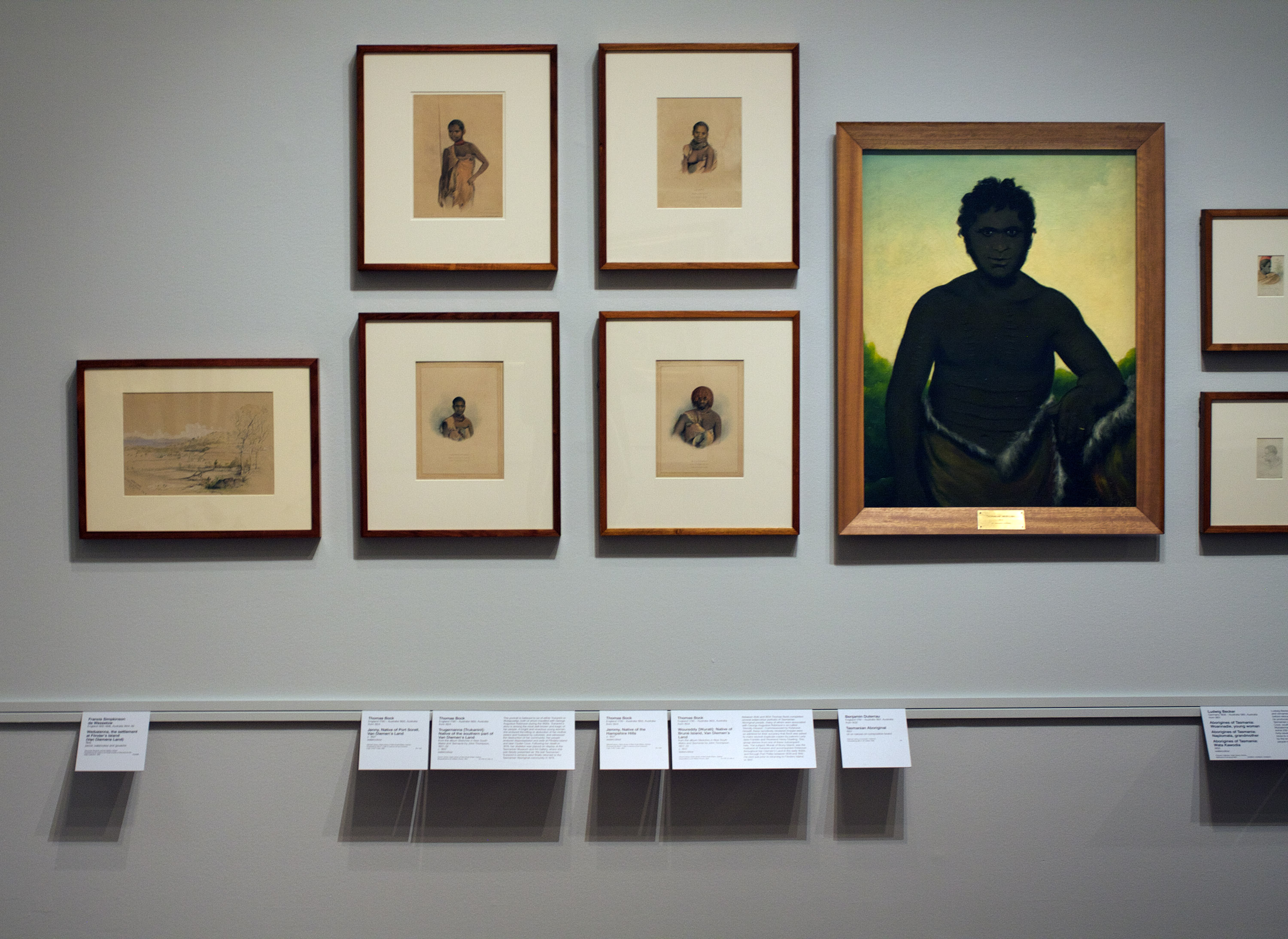
 

Benjamin Duterrau arrived in Van Diemen’s Land at the age of sixty-five as a free settler. He had planned to take up the position of drawing and music master at Ellinthrop Hall in Hobart, a fashionable school for ladies; however, this post was instead taken up by Henry Mundy. He lectured often on the importance of the fine arts in the developing colony after his arrival. Working predominantly in portraiture and occasionally in landscape, he is best known for producing the first Australian history paintings, which recorded the so-called ‘conciliation’ between Chief Protector of the Aborigines George Augustus Robinson and the Tasmanian Aboriginal people.

Exhibition text


Thomas Bock (England 1790 - Australia 1855, Australia from 1824) 'Woureddy [Wurati]: Native of Bruné Island, Van Diemen's Land' c. 1837


Thomas Bock (England 1790 – Australia 1855, Australia from 1824)
Woureddy (Wurati): Native of Bruné Island, Van Diemen’s Land
c. 1837
From the album Sketches in New South Wales and Tasmania by John Thompson, 1827-1832
watercolour
28.3 x 21cm
Dixson Library, State Library of New South Wales, Sydney
Bequeathed by Sir William Dixson, 1952


Between 1830 and 1834 Thomas Bock completed several watercolour portraits of Tasmanian Aboriginal people, many of whom were associated with George Augustus Robinson’s so-called ‘friendly mission’. Commissioned by Robinson himself, these sensitively rendered images were so admired for their accuracy that Bock was asked to make several duplicate copies by patrons Lady Jane Franklin and Reverend Henry Dowling. This group derives from one of these subsequent sets. The subject, Wurati of Bruny Island, was the husband of Trukanini and accompanied Robinson throughout Van Diemen’s Land in the early 1830s, and through Port Phillip between 1839 and 1842. He died just prior to returning to Flinders Island in 1842.

Exhibition text
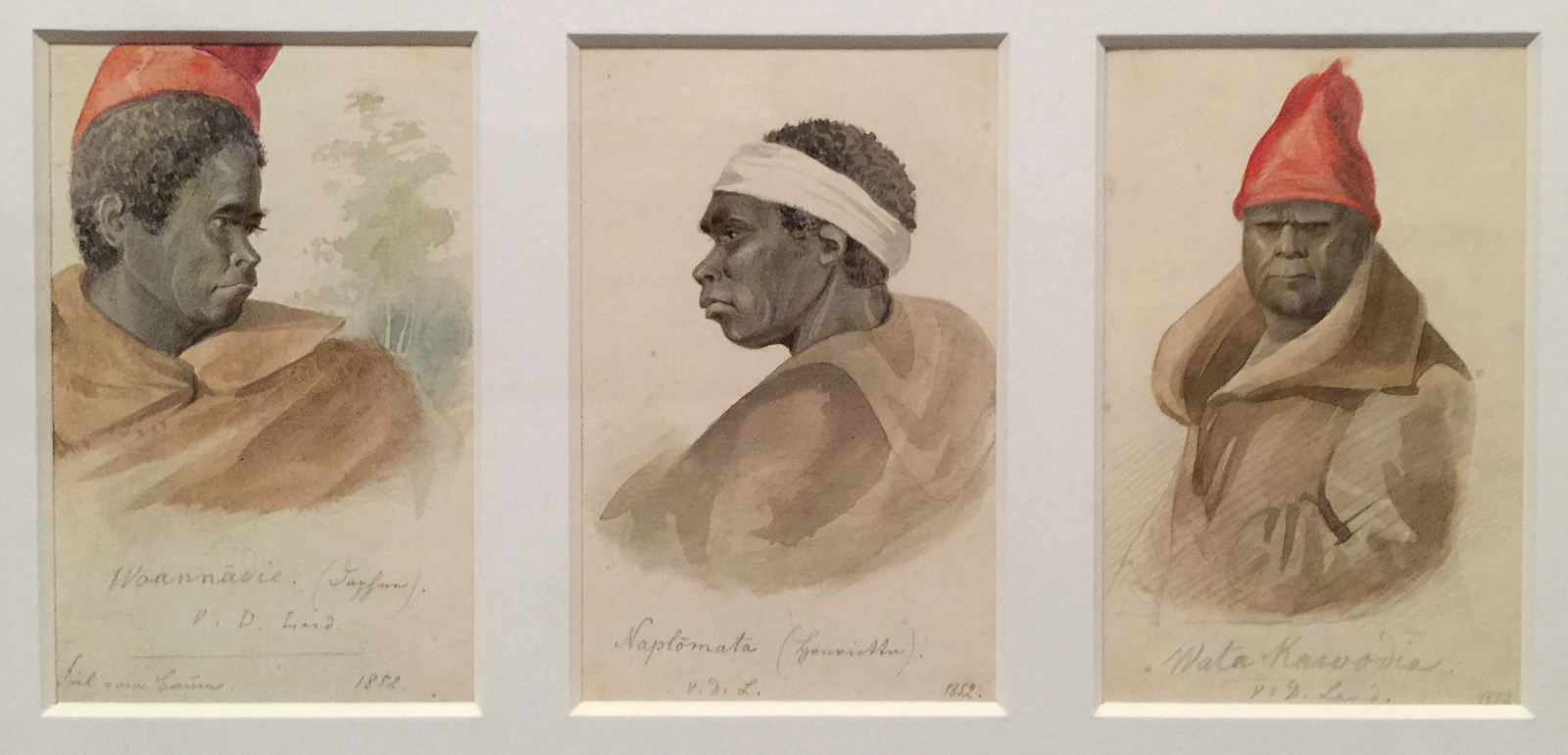
 

Installation view of the exhibition 'Colony: Australia 1770 - 1861' at NGV Australia at Federation Square, Melbourne showing Ludwig Becker's 'Aborigines of Tasmania' 1852


Installation view of the exhibition Colony: Australia 1770-1861 at NGV Australia at Federation Square, Melbourne showing Ludwig Becker’s Aborigines of Tasmania 1852
Photo: © Dr Marcus Bunyan and the National Gallery of Victoria


Ludwig Becker (Germany 1808 - Australia 1861, Australia from 1851) 'Aborigines of Tasmania: Woannadie, young woman' 1852


Ludwig Becker (Germany 1808 – Australia 1861, Australia from 1851)
Aborigines of Tasmania: Woannadie, young woman
1852
Watercolour
Pictures Collection, State Library Victoria, Melbourne
Purchased 1960


Ludwig Becker (Germany 1808 - Australia 1861, Australia from 1851) 'Aborigines of Tasmania: Naplomata, grandmother' 1852


Ludwig Becker (Germany 1808 – Australia 1861, Australia from 1851)
Aborigines of Tasmania: Naplomata, grandmother
1852
Watercolour
Pictures Collection, State Library Victoria, Melbourne
Purchased 1960


Ludwig Becker arrived in Launceston in 1851 and remained in Van Diemen’s Land for a year before relocating to Melbourne. During this time he produced small but poignant portraits of Tasmanian Aboriginal women living at Oyster Cove, south of Hobart. In 1847, the survivors of Wybalenna had returned to the mainland. Of the some 200 who were removed to Bass Strait, only forty-seven returned. By the time of Becker’s visit, close to a third of their population had died, and by the end of the decade approximately twelve people remained.

Exhibition text


Douglas T. Kilburn (English-Australian, 1811-1871) 'No title (Group of Koori men)' c. 1847


Douglas T. Kilburn (English-Australian, 1811-1871)
No title (Group of Koori men)
c. 1847
Daguerreotype; leather, wood, velvet, brass
7.5 x 6.5cm (image)
9.2 x 7.9 x 1.7cm (case)(closed)
National Gallery of Victoria, Melbourne
Purchased from Admission Funds, 1983
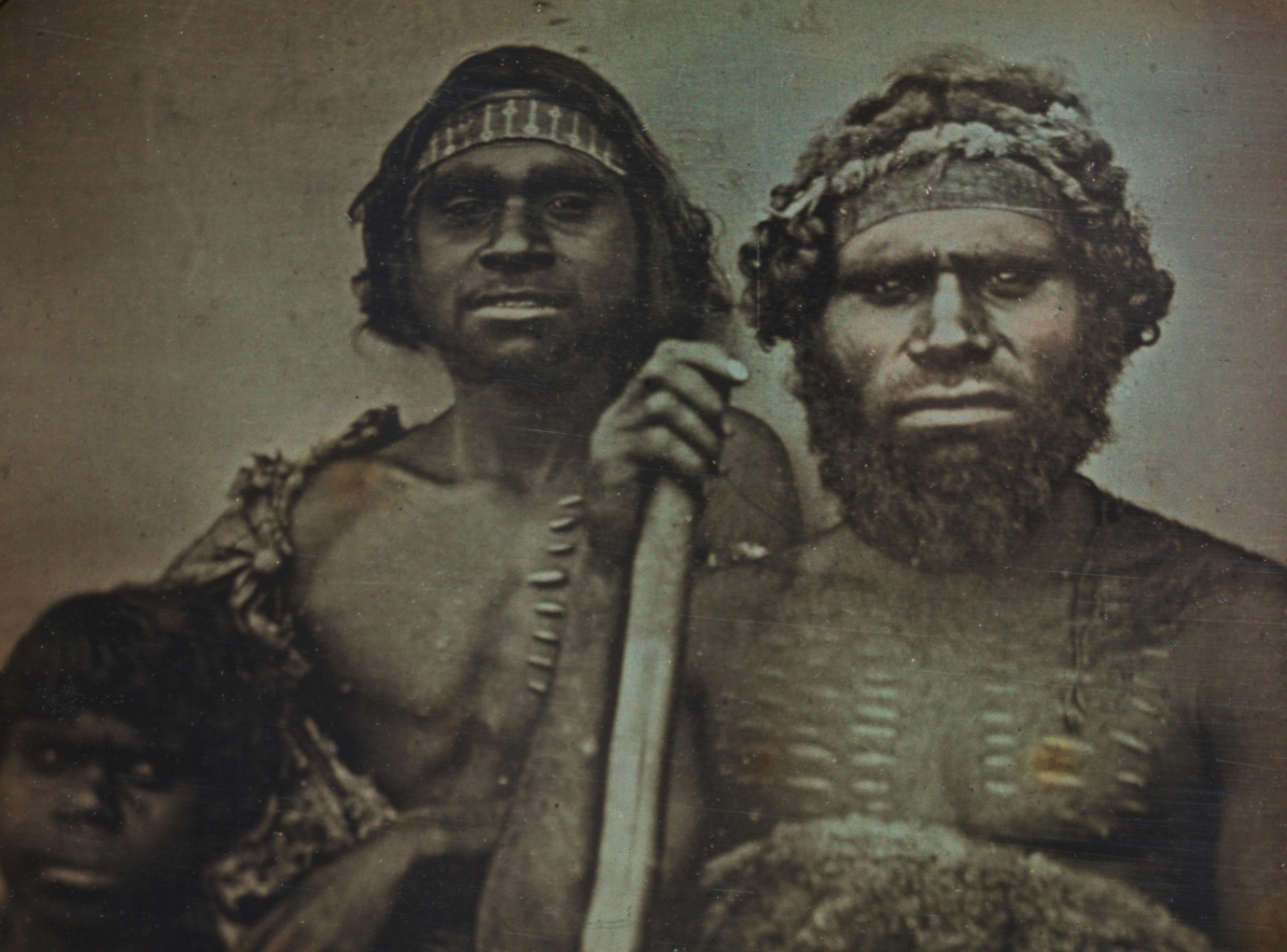
 

Douglas T. Kilburn (English-Australian, 1811-1871) 'No title (Group of Koori men)' c. 1847 (detail)


Douglas T. Kilburn (English-Australian, 1811-1871)
No title (Group of Koori men) (detail)
c. 1847
Daguerreotype; leather, wood, velvet, brass
7.5 x 6.5 cm (image)
9.2 x 7.9 x 1.7 cm (case)(closed)
National Gallery of Victoria, Melbourne
Purchased from Admission Funds, 1983


As a way of attracting attention to his newly opened business Douglas Kilburn took at least eight daguerreotypes of Aboriginal people in the lands of the Kulin nation. As a result of the nineteenth-century belief that the Aboriginal people were doomed to annihilation, Kilburn intended the images as ethnographic studies rather than individual portraits; nevertheless, his unnamed sitters project a proud and dignified presence. His photographs were popular with local artists such as Eugene von Guérard and John Skinner Prout, who copied them, and they also reached an international audience when they were used as the basis for wood engravings in William Westgarth’s Australia Felix in 1848, Nordisk Penning-Magazin in 1849 and the Illustrated London News in 1850.

Exhibition text


The Port Phillip District

In 1835, Melbourne was established on the Country of the Kulin nation on the northern bank of Birrarung, the ‘river of mists and shadows’. Contact between Indigenous peoples and European explorers and raiding groups of sealers had begun prior to the arrival of hopeful colonists from Van Diemen’s Land. They were soon followed by John Pascoe Fawkner and John Batman, each leading separate parties of settlers keen to secure acreage on the fertile lands found in what was soon to be known as the Port Phillip District.

In the early years Melbourne went through a period of rapid development, quickly becoming a progressive provincial town. In 1839 a visitor noted: ‘When I was here three years ago there were but two houses of any note whatever … Now I find a town occupying an area of nearly a mile square, on which are some hundreds of houses, and many of them spacious and well-built edifices’. In tandem with the settlement of Melbourne, pastoral expansion devastated Aboriginal communities already severely affected by disease. Dispossessed of their traditional lands and forced from Country and the food sources that had long sustained them, the remaining populations faced starvation.

Text from the NGV website


Unknown (New South Wales / Victorian Aboriginal active 19th century) 'Club' 19th century (installation view)


Unknown (New South Wales / Victorian Aboriginal active 19th century)
Club
19th century
Wood
Koorie Heritage Trust, Melbourne
Photo: © Dr Marcus Bunyan and the National Gallery of Victoria


Douglas T. Kilburn (English-Australian, 1811-1871) 'No title (Group of Koori women)' 1847


Douglas T. Kilburn (English-Australian, 1811-1871)
No title (Group of Koori women)
1847
Daguerreotype; glass, brass, gold
6.6 x 5.4cm (image)
National Gallery of Victoria, Melbourne
Purchased, 1999


Douglas T. Kilburn (English-Australian, 1811-1871) 'No title (Group of Koori women)' 1847 (detail)


Douglas T. Kilburn (English-Australian, 1811-1871)
No title (Group of Koori women) (detail)
1847
Daguerreotype; glass, brass, gold
6.6 x 5.4 cm (image)
National Gallery of Victoria, Melbourne
Purchased, 1999
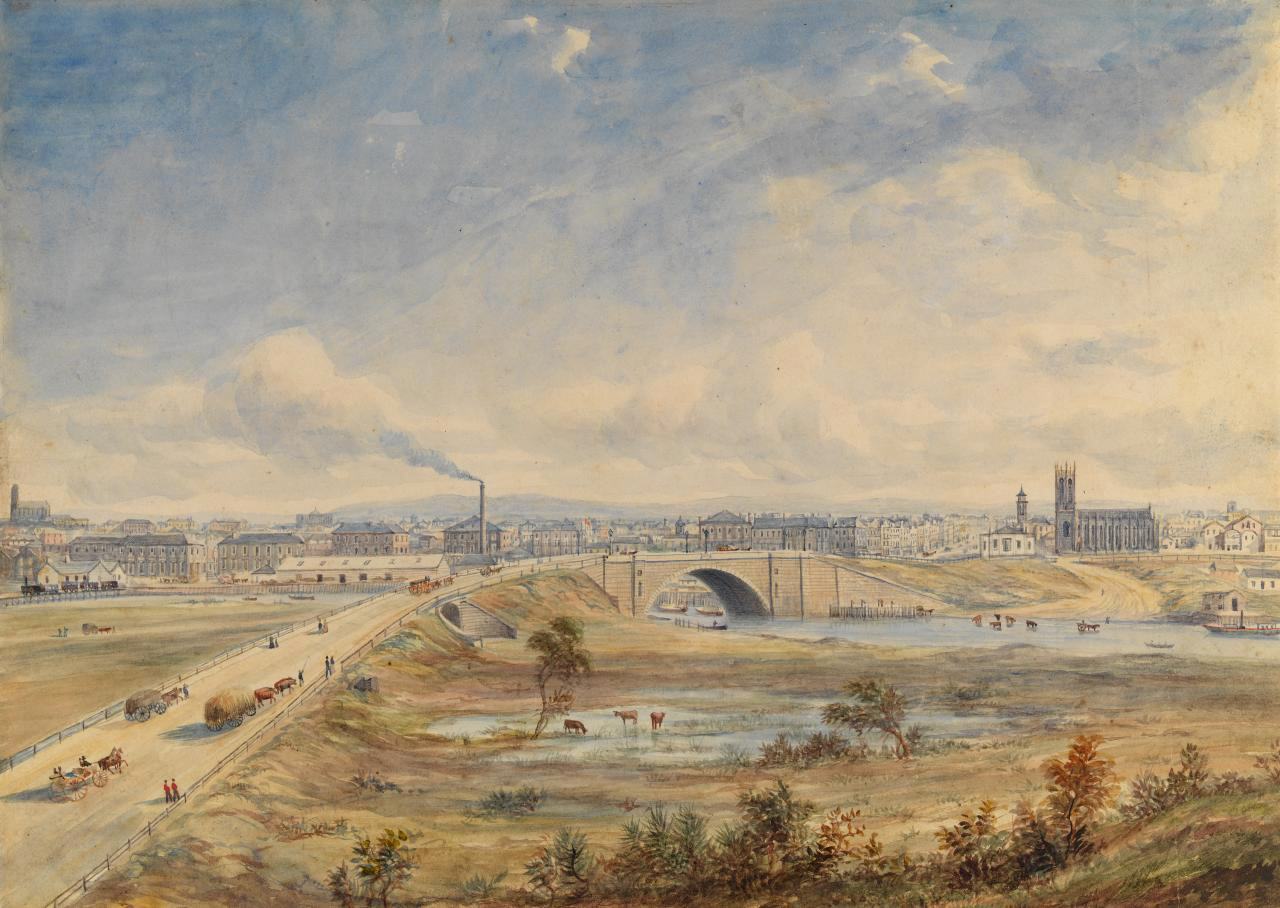
 

Henry Gritten (England 1818 - Australia 1873, Australia from 1853) 'Melbourne from the south bank of the Yarra' 1856


Henry Gritten (England 1818 – Australia 1873, Australia from 1853)
Melbourne from the south bank of the Yarra
1856
Watercolour over traces of pencil
(25.6 x 35.8cm) (image)
National Gallery of Victoria, Melbourne
Gift of John H. Connell, 1914
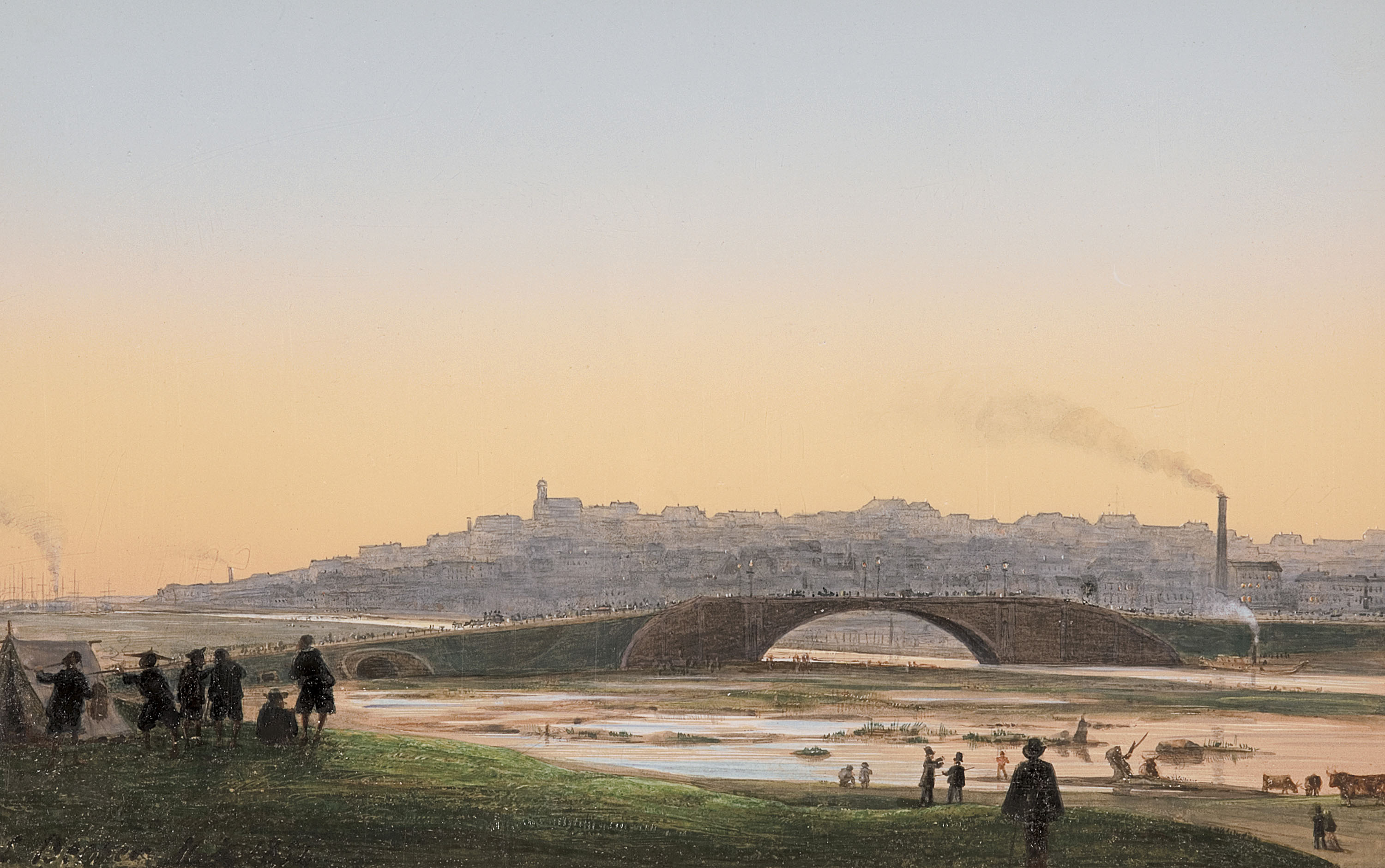
 

Ludwig Becker (Germany 1808 - Australia 1861, Australia from 1851) 'Melbourne from across the Yarra' 1854


Ludwig Becker (Germany 1808 – Australia 1861, Australia from 1851)
Melbourne from across the Yarra
1854
Tempera and watercolour on gesso on cardboard
Art Gallery of South Australia, Adelaide
V. K. Burmeister Bequest Fund and South Australian Government Grant 1990


Robert Dowling (England 1827-1886, Australia 1834-1857, 1884-1886) 'Jane Sceales with daughters, Mary Jane and Hilda' c. 1856 (installation view)


Robert Dowling (England 1827-1886, Australia 1834-1857, 1884-1886)
Jane Sceales with daughters, Mary Jane and Hilda (installation view)
c. 1856
Oil on canvas
National Gallery of Australia, Canberra
Purchased 2016. Acquired through family of Ella Lewis (nee Hood), granddaughter of Jane Hood (nee Sceales)
Photo: © Dr Marcus Bunyan and the National Gallery of Victoria


Jane Sceales and her daughters lived at Merrang, the pastoral run next to Minjah, owned by Joseph Ware. This is one of two known mourning portraits commissioned by Jane after the death of her husband Adolphus Sceales in 1855, produced while Robert Dowling was staying and working at Minjah. Scottish-born Jane is depicted in mourning dress, a teal and black tartan bow knotted elegantly at her collar. The skirt of her elder daughter, Mary Jane, is trimmed in the same fabric. By the close of 1856, Jane had remarried Robin Hood, becoming the matriarch of one of the most prominent families of the Western District.

Exhibition text
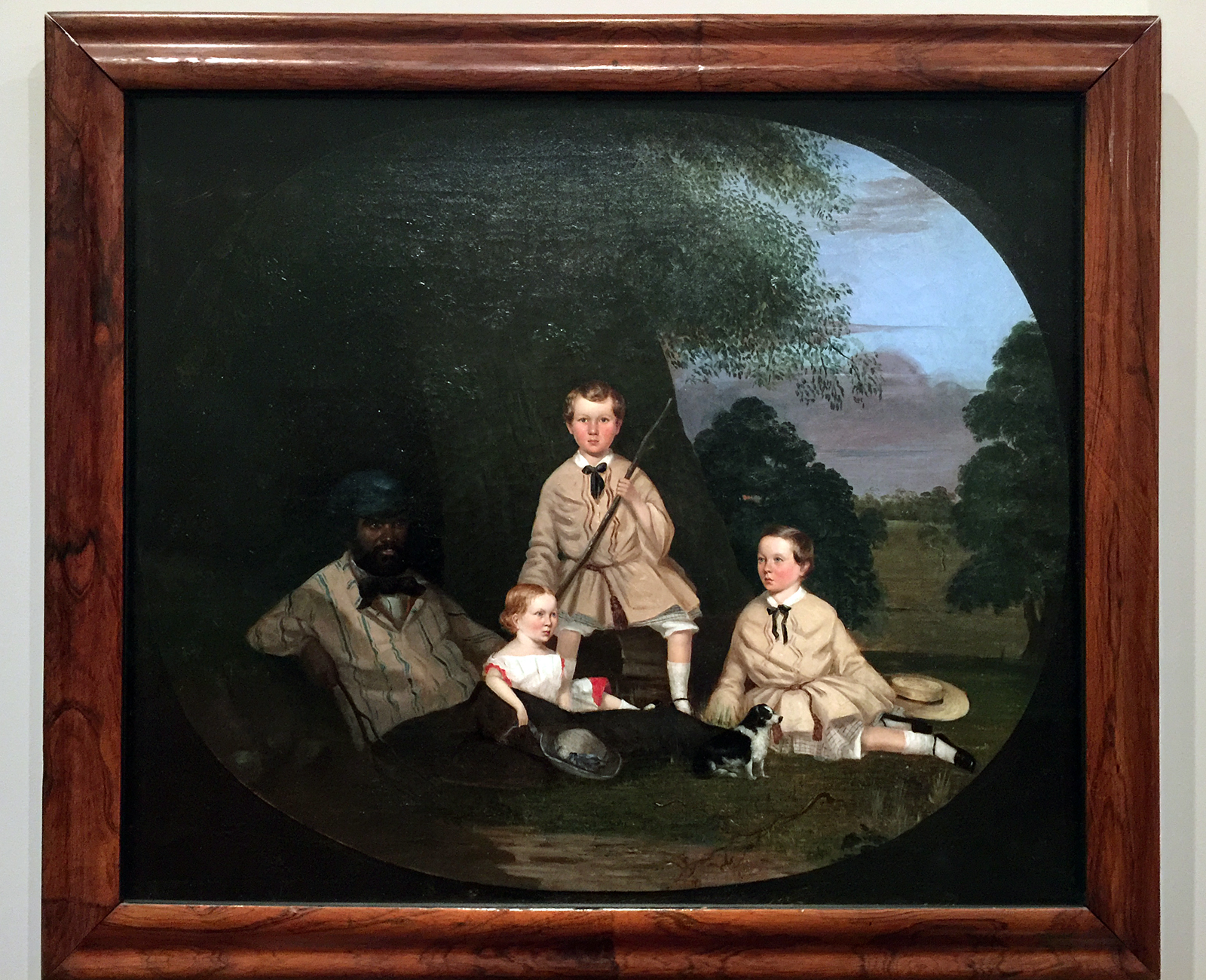
 

Robert Dowling (England 1827-1886, Australia 1834-1857, 1884-1886) 'Masters George, William and Miss Harriet Ware with the Aborigine Jamie Ware' 1856 (installation view)


Robert Dowling (England 1827-1886, Australia 1834-1857, 1884-1886)
Masters George, William and Miss Harriet Ware with the Aborigine Jamie Ware (installation view)
1856
Oil on canvas
National Gallery of Australia, Canberra
Eleanor M. Borrow Bequest, 2007
Photo: © Dr Marcus Bunyan and the National Gallery of Victoria


Robert Dowling (England 1827-1886, Australia 1834-1857, 1884-1886) 'Masters George, William and Miss Harriet Ware with the Aborigine Jamie Ware' 1856


Robert Dowling (England 1827-1886, Australia 1834-1857, 1884-1886)
Masters George, William and Miss Harriet Ware with the Aborigine Jamie Ware
1856
Oil on canvas
National Gallery of Australia, Canberra
Eleanor M. Borrow Bequest, 2007


In the late 1830s the young brothers Jeremiah, Joseph and John Ware, the eldest just twenty years of age, had played a major role in the settlement of the Western District in Victoria. By 1856 they were established and notable figures in the colony and had become significant patrons of the fine arts.

Robert Dowling’s family portrait Masters George, William, and Miss Harriet Ware and the Aborigine Jamie Ware is set in the grounds of pastoralist Joseph Ware’s property, Minjah. The group is headed by the eldest son, George, who bears a staff, the Biblical symbol of leadership often associated with Moses. To the right sits his younger brother, William, on the left is their sister Harriet and the Mopor youth from Spring Creek who took the family name, Jamie Ware. The portrait has remained with the descendants of the Ware family since its commission and is a poignant depiction of interracial accord.

There is an obvious affection between Jamie and Harriet: he reclines comfortably while the young girl drapes her arm casually over his leg. The absence of Jamie’s employers – the children’s parents, John and Barbara Ware, gives added resonance to the work, revealing the trust and intimate position Jamie held in the family. The depiction of the youth in European dress rather than as an anthropological study expresses the family’s concern for harmonious relations with Indigenous people.

Jamie’s inclusion is also symbolic of the Ware family’s awareness of the traumatic post-contact history experienced by Indigenous Australians, an understanding that was not generally shared in mid-nineteenth-century Victoria. By the 1850s it was reported that Tasmania’s Indigenous population had been decimated, which would have been a significant issue for Dowling and the Wares who had all migrated from the southern-most colony. Dowling painted a number of works that were intended as memorials, such as the NGV’s Tasmanian Aborigines, 1856, and Warrnambool Art Gallery’s Minjah in the old time, 1856. While these works look to the past and convey a sense of mourning, the Ware family portrait looks positively towards a more harmonious future and therefore is a transformative work to enter the NGV’s nineteenth-century Australian collection.

Masters George, William, and Miss Harriet Ware and the Aborigine Jamie Ware joins a number of works in the NGV collection that share a Ware family provenance. Joseph Ware commissioned six works from Dowling between 1855 and 1856, and the NGV collection contains works acquired by his younger brother, John Ware, that were donated in 2004 as part of the Joseph Brown Collection. These include Eugène von Guérard’s Spring in the valley of the Mitta Mitta with the Bogong Ranges in the distance, 1863, and the homestead portrait of John Ware’s Yalla-y-Poora, 1864.

Dowling continued to receive Ware family patronage after he left Australia in 1857; his portrait Miss Annie Ware, 1882, the daughter of John Ware, being commissioned during the sitter’s European travels.

Humphrey Clegg, Assistant Curator, Australian Art, NGV (in 2007)


Installation view of the exhibition 'Colony: Australia 1770 - 1861' at NGV Australia at Federation Square, Melbourne with at centre middle, Martha Berkeley's 'Georgina, Emily and Augusta Rose' c. 1848


Installation view of the exhibition Colony: Australia 1770-1861 at NGV Australia at Federation Square, Melbourne with at centre middle, Martha Berkeley’s oil on metal Georgina, Emily and Augusta Rose c. 1848
Photo: © Dr Marcus Bunyan and the National Gallery of Victoria


The Province of South Australia 1836

As early as 1829 the development of a convict‑free colony, home to settlers and migrants from Britain, was mooted. Seven years later, with regal approval, the Province of South Australia was officially proclaimed. Nine ships carrying free settlers to the colony set sail from England in 1836. They landed at Kangaroo Island and Holdfast Bay and finally settled on the banks of the Torrens River, where the township of Adelaide was established. With a number of trained artists among the early colonists, South Australia rapidly secured a position comparable to that of Hobart as a sophisticated centre for the visual arts.

These artists documented the earliest years of the colony and the first settlers. In 1845, Australia’s first solo exhibition was held by George French Angas, and two years later Adelaide artists held a group exhibition in the new colony. The discovery of gold in Victoria led to an exodus to the eastern colonies, slowing but not halting activity in South Australia.

The Province of South Australia was established on the land of the Kaurna people; the South Australia Act of 1834 included a guarantee of the rights of ‘any Aboriginal Natives’ and their descendants to lands they ‘now actually enjoy’. Despite these worthy ambitions, colonial expansion did ultimately dispossess and marginalise Aboriginal people.

Text from the NGV website


Alexander Schramm (Germany 1813 - Australia 1864, Australia from 1849) 'A scene in South Australia' c. 1850 (installation view)


Alexander Schramm (Germany 1813 – Australia 1864, Australia from 1849)
A scene in South Australia (installation view)
c. 1850
Oil on canvas
Art Gallery of South Australia, Adelaide
South Australian Government Grant 1982
Photo: © Dr Marcus Bunyan and the National Gallery of Victoria
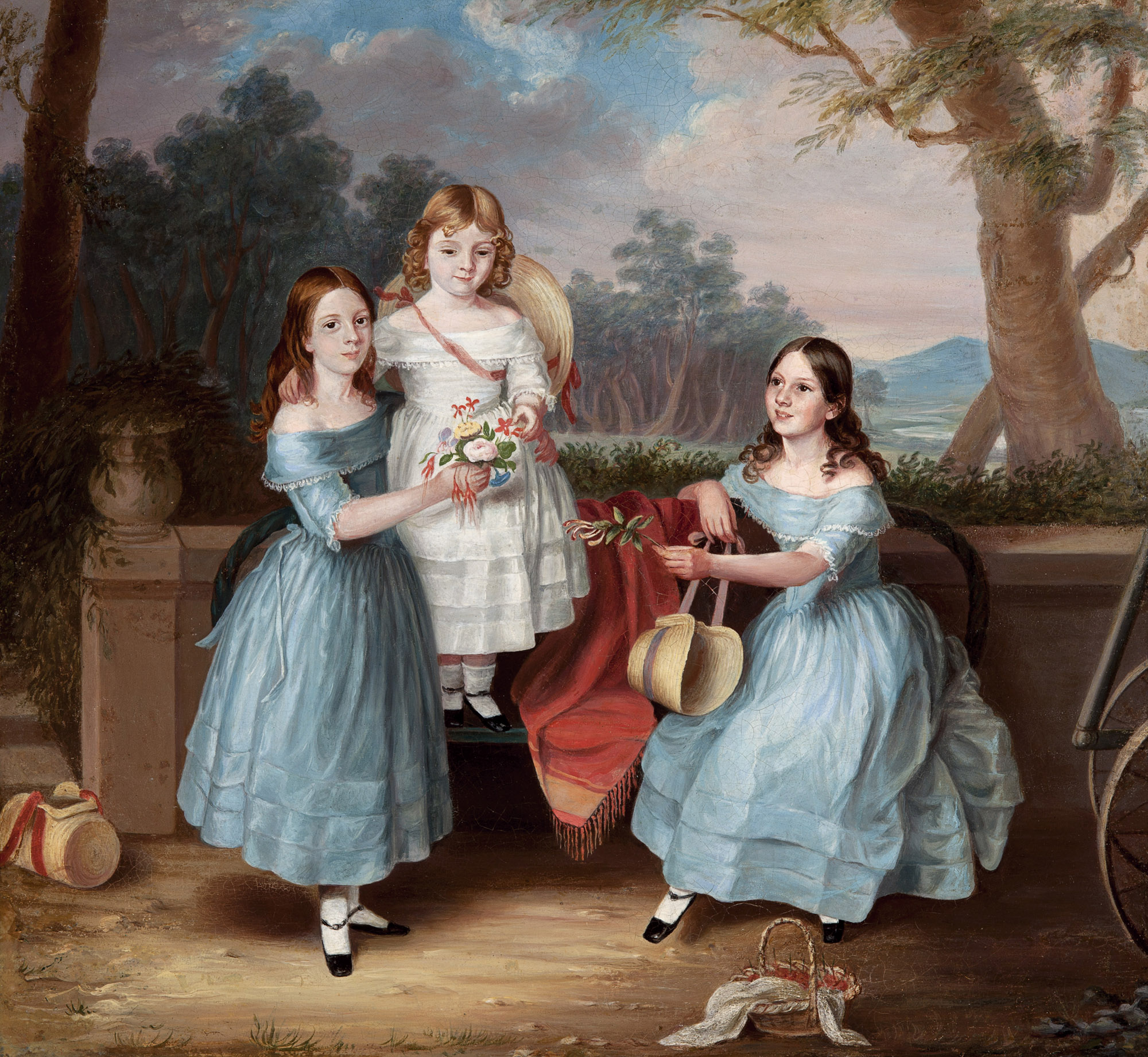
 

Martha Berkeley (England 1813 - Australia 1899, Australia from 1837) 'Georgina, Emily and Augusta Rose' c. 1848


Martha Berkeley (England 1813 – Australia 1899, Australia from 1837)
Georgina, Emily and Augusta Rose
c. 1848
Oil on metal
36.4 x 39.5cm
Art Gallery of South Australia, Adelaide
M.J.M. Carter AO Collection 2007
Given in memory of Di Townsend, Betty McIlwham and fellow Gallery Guides’ education programs for children


Martha Berkeley’s painting practice encompassed landscapes and views of the infant settlement, flower studies and portraiture. She depicted her family on several occasions and her portraits of her husband Charles, sister Theresa, brother-in-law and children are among her finest paintings. This charming group portrait presents her three daughters against the backdrop of their home in Adelaide. Berkeley adopts a format typical of Regency depictions of children; the youthful trio are happily engaged in the wholesome activity of posy-making, with the eldest, Augusta Rose, looking towards the viewer, as though appealing to them to join in.

Exhibition text


S.T. Gill (England 1819 - Australia 1880, Australia from 1839) 'Port Adelaide looking north along Commercial Road' 1847


S.T. Gill (England 1819 – Australia 1880, Australia from 1839)
Port Adelaide looking north along Commercial Road
1847
Watercolour
20.3 x 32cm
Art Gallery of South Australia, Adelaide
Morgan Thomas Bequest Fund 1923


S.T. Gill (England 1819 - Australia 1880, Australia from 1839) 'Country NW of tableland, Aug. 22 1846' 1846


S.T. Gill (England 1819 – Australia 1880, Australia from 1839)
Country NW of tableland, Aug. 22 1846
1846
Watercolour
19 x 30.7cm
National Library of Australia, Canberra
Gift of her Majesty Queen Elizabeth II to the Australian Government, 1956


Along with government-supported expeditions, individuals also sought to discover new stock routes and pastures. In 1846 John Ainsworth Horrocks organised one such venture to explore beyond Lake Torrens, and S. T. Gill volunteered to accompany the party, with goats for food and a pack camel, named Harry. The trip ended abruptly when Horrocks accidentally shot himself at a desolate salt lake – he died later at his property in the Clare Valley. Gill subsequently painted a series of ‘faithful scenic representations’ documenting their tragic journey and exhibited them in Adelaide in 1847, providing the public with an accurate indication of South Australia’s dry interior.

Exhibition text


George French Angas (England 1822-1886, Australia 1844-1845, 1850-1863) 'Encounter Bay looking south' 1844


George French Angas (England 1822-1886, Australia 1844-1845, 1850-1863)
Encounter Bay looking south
1844
Watercolour
26.2 x 35.9cm
Art Gallery of South Australia, Adelaide
Bequest of J. Angas Johnson 1902


George French Angas was the eldest son of one of the founding members of the South Australian Land Company, formed to develop a settlement in South Australia, and came to Australia as an experienced naturalist, artist and author. He travelled widely throughout South Australia, to the Murray River and down to Lake Coorong, sketching the countryside, and the customs and dwellings of the Aboriginal people he met, as well as spending time in New Zealand. Angas exhibited his watercolours in Adelaide and Sydney and upon his return to London, where his book South Australia Illustrated, with impressive full-page coloured lithographs, was published.

Exhibition text


Melbourne 1851-1861

The township of Melbourne grew steadily as migrants from Britain and other European countries sought economic opportunities and political and religious freedom. In 1851, the Port Phillip District became an independent colony and was named Victoria in honour of the Queen. The town’s fortunes were further transformed that year when gold was discovered. Victoria was the richest source of gold in Australia, and consequently experienced the greatest levels of growth and change. The population exploded as enthusiastic and optimistic prospectors poured in from around the world with the hope of making their fortunes. Despite enormous social turmoil and environmental destruction, gold propelled Melbourne into an unprecedented phase of expansion and prosperity.

This had a profound impact on the arts and cultural life in colonial Australia. The desire to replicate the cultural institutions of European capitals reached new heights and wealth from gold enabled these aspirations to be realised, with the establishment of a university, library and museum. In 1861, in a moment of great significance and pride, the Museum of Art – Australia’s first art museum, later known as the National Gallery of Victoria – opened at the Melbourne Public Library on Swanston Street.

Text from the NGV website


Installation view of the exhibition 'Colony: Australia 1770 - 1861' at NGV Australia at Federation Square, Melbourne

Installation view of the exhibition 'Colony: Australia 1770 - 1861' at NGV Australia at Federation Square, Melbourne

Installation view of the exhibition 'Colony: Australia 1770 - 1861' at NGV Australia at Federation Square, Melbourne with to the left, George Cavenagh's 'Glorious News! Separation at last!' 1850; and at centre top in the same image, Henry Burn's 'Swanston Street from the Bridge' 1861


Installation views of the exhibition Colony: Australia 1770-1861 at NGV Australia at Federation Square, Melbourne with to the left in the bottom image, George Cavenagh’s Glorious News! Separation at last! 1850; and at centre top in the same image, Henry Burn’s oil on canvas Swanston Street from the Bridge 1861
Photos: © Dr Marcus Bunyan and the National Gallery of Victoria


George Cavenagh (editor and publisher) (India 1808 - Australia 1869, Australia from 1825) 'Glorious News! Separation at last!' Issued with the Melbourne Morning Herald 11 November 1850 (installation view)


George Cavenagh (editor and publisher) (India 1808 – Australia 1869, Australia from 1825)
Glorious News! Separation at last! (installation view)
Issued with the Melbourne Morning Herald
11 November 1850
Letterpress on buff paper
Pictures Collection, State Library Victoria, Melbourne
Photo: © Dr Marcus Bunyan and the National Gallery of Victoria


From the establishment of Melbourne in 1835, its colonial inhabitants campaigned for it to be a separate colony, rather than a distant district within New South Wales, controlled by the Sydney-based governor and legislative council. A public campaign began in 1839 and petitions were repeatedly sent to London. After many delays, on 11 November 1850 news was received that independence was to be granted. A jubilant population celebrated with fireworks, parades, balls and a three-day public holiday. Further festivities were held when the colony was formally proclaimed on 1 July 1851, and the first parliament sat in November of that year.

Exhibition text


Henry Burn (England c. 1807 - Australia 1884, Australia from 1853, died 1884) 'Swanston Street from the Bridge' 1861


Henry Burn (England c. 1807 – Australia 1884, Australia from 1853, died 1884)
Swanston Street from the Bridge
1861
Oil on canvas
71.8 x 92.2cm
National Gallery of Victoria, Melbourne
Gift of John H. Connell, 1914


Painted just twenty-six years after foundation, Henry Burn’s view of young Melbourne looks north from the Yarra towards the centre of the city. It reveals a number of identifiable landmarks including the original St Paul’s Church; the coroner’s office and Registry of Births, Deaths and Marriages, at what is now Federation Square; and Johnson’s Bridge Hotel, now the Young & Jackson Hotel.

Exhibition text


Unknown, Australia. 'Dress' c. 1855


Unknown, Australia
Dress (see installation photo below right)
c. 1855
Cotton, silk, metal, mother-of-pearl, baleen
152.0cm (centre back)
34.5cm (waist, flat)
National Gallery of Victoria, Melbourne
Gift of Mrs Michael Parker, 1983

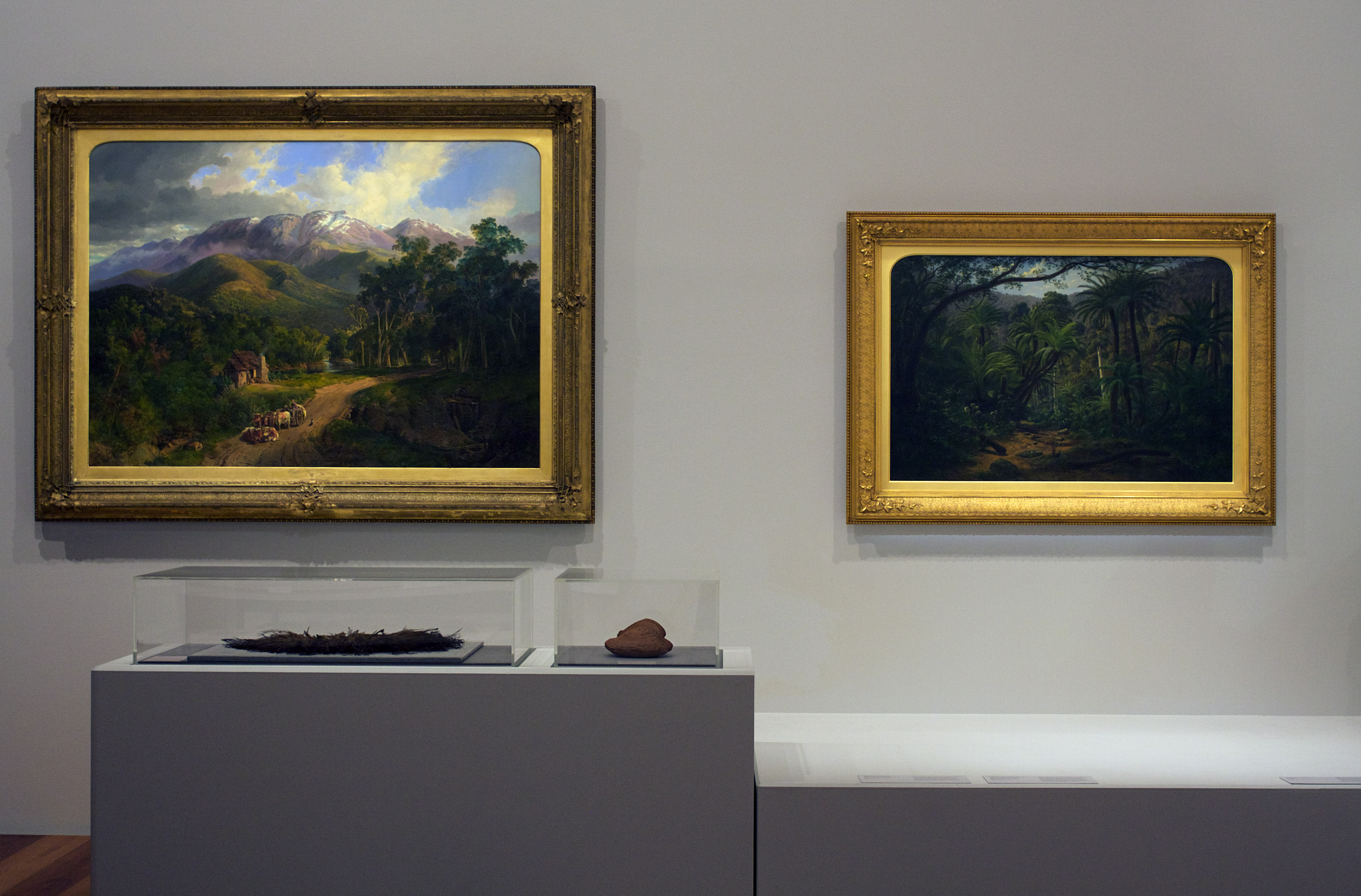
 

Installation view of the exhibition 'Colony: Australia 1770 - 1861' at NGV Australia at Federation Square, Melbourne with at centre right, Eugene von Guérard's 'Ferntree Gully in the Dandenong Ranges' 1857

Installation view of the exhibition 'Colony: Australia 1770 - 1861' at NGV Australia at Federation Square, Melbourne with at right, Eugene von Guérard's 'Ferntree Gully in the Dandenong Ranges' 1857


Installation views of the exhibition Colony: Australia 1770-1861 at NGV Australia at Federation Square, Melbourne with at centre right, Eugene von Guérard’s oil on canvas Ferntree Gully in the Dandenong Ranges 1857
Photos: © Dr Marcus Bunyan and the National Gallery of Victoria


Eugene von Guérard (Austria 1811 - England 1901, Italy 1830-1838, Australia 1852-1882, Germany 1838-1852, 1882-1891, England from 1891) 'Ferntree Gully in the Dandenong Ranges' 1857


Eugene von Guérard (Austria 1811 – England 1901, Italy 1830-1838, Australia 1852-1882, Germany 1838-1852, 1882-1891, England from 1891)
Ferntree Gully in the Dandenong Ranges
1857
Oil on canvas
92 x 138cm
National Gallery of Australia, Canberra
Gift of Dr Joseph Brown AO OBE 1975


Within five years of arriving in Victoria to try his luck on the Ballarat goldfields, Eugene von Guérard had undertaken several trips to sketch remote wilderness regions of Victoria, Tasmania and South Australia. These meticulous studies were translated into sublime panoramic vistas of volcanic plains and mountain ranges, and primordial bushland views, which melded his romantic European sensibility with scientific intensity. In early 1857 he returned a second time to the Dandenong Ranges east of Melbourne and later completed this scene in his studio. This celebration of nature was an immediate local success and became an important image that was reproduced in subsequent drawings and engravings.

Exhibition text


Daniel Thomas discusses Eugene Von Guérard’s Ferntree Gully in the Dandenong Ranges
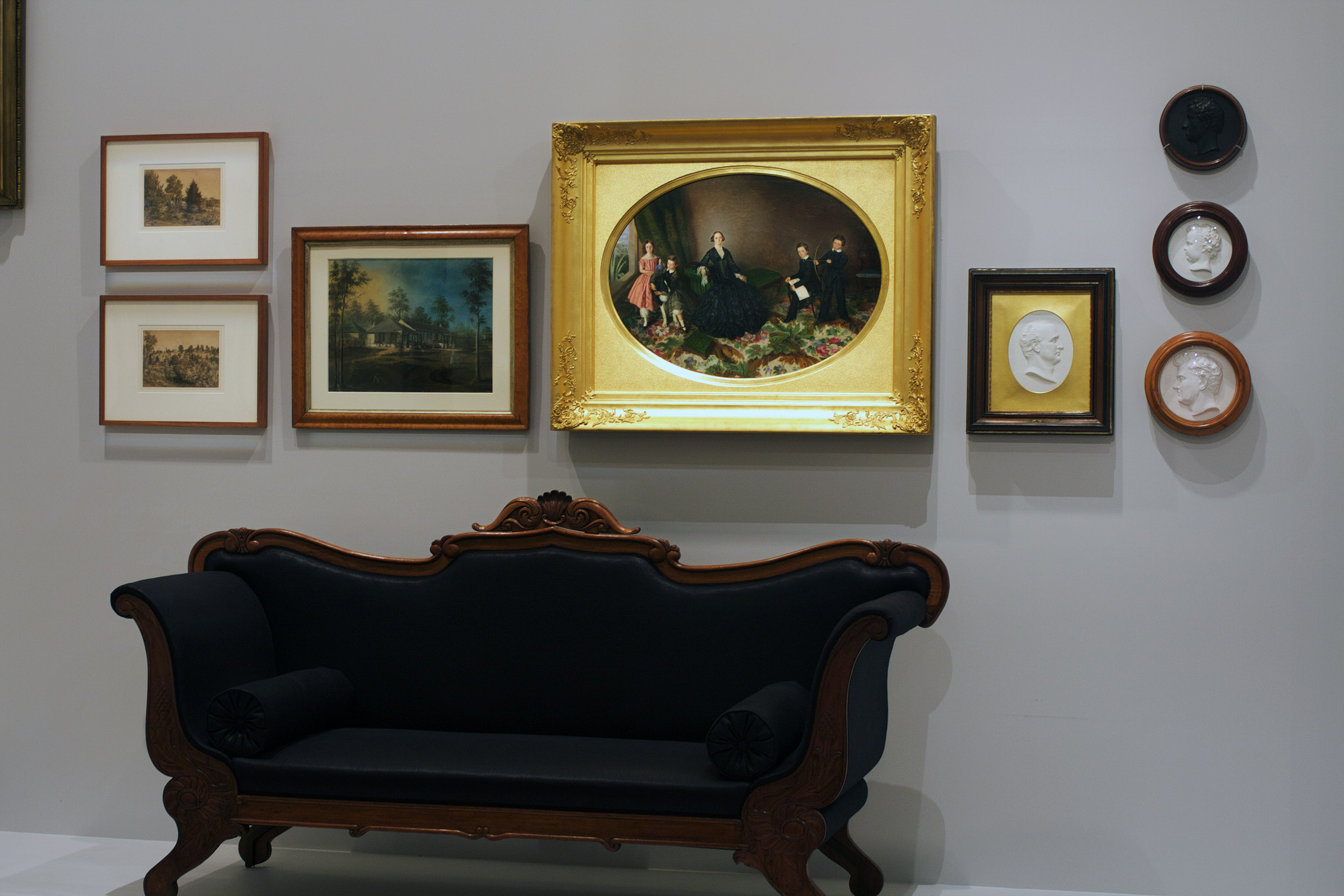
 

Installation view of the exhibition 'Colony: Australia 1770 - 1861' at NGV Australia at Federation Square, Melbourne with at centre 'Sofa' 1840s


Installation view of the exhibition Colony: Australia 1770-1861 at NGV Australia at Federation Square, Melbourne with at centre Sofa 1840s
Photo: © Dr Marcus Bunyan and the National Gallery of Victoria


Unknown (Victoria / South Australia) 'Sofa' 1840s


Unknown (Victoria / South Australia)
Sofa
1840s
Red Cedar (Toona ciliata), upholstery, (other materials)
National Gallery of Victoria, Melbourne
Gift of Michael and Traudl Moon, 1996


The success of German immigrants in South Australia saw the establishment of the German Immigration Committee in Melbourne in 1849 to encourage their settlement in Victoria. By the close of the decade, German immigrants had settled near Geelong, establishing Germantown, now the suburb of Grovedale, and by the 1850s were expanding into the Western District. It is likely this sofa was produced by German makers in either of these South Australian or Victorian communities. Its sweeping curves recall the architectural forms of the German Biedermeier style, but its lines and elaborate carved ornamentation reveal more Classical influences.

Exhibition text


Further images

Tommy McRae (Kwat Kwat/Wiradjuri) (c. 1836-1901) 'Ceremony; hunting and fishing' 1860


Tommy McRae (Kwat Kwat/Wiradjuri) (c. 1836-1901)
Ceremony; hunting and fishing
1860
Pen and ink on blue paper
Pictures Collection, State Library Victoria, Melbourne
Accessioned c. 1931


As a consequence of colonisation Tommy McRae created cross-cultural pen and ink drawings on paper as a dialogue with the colonisers and a means of recording a culture often subjected to change and silencing. On a single sheet, McRae creates a holistic picture of his rich culture, which includes two distinct corroborees, a eucalypt with bird perched atop its foliage and a hunting story of four emus being stalked by men in camouflage while another spears a large fish. Two lines of male dancers are freely sketched in silhouette upon Country, indicated by a light tangle of lines.

Exhibition text
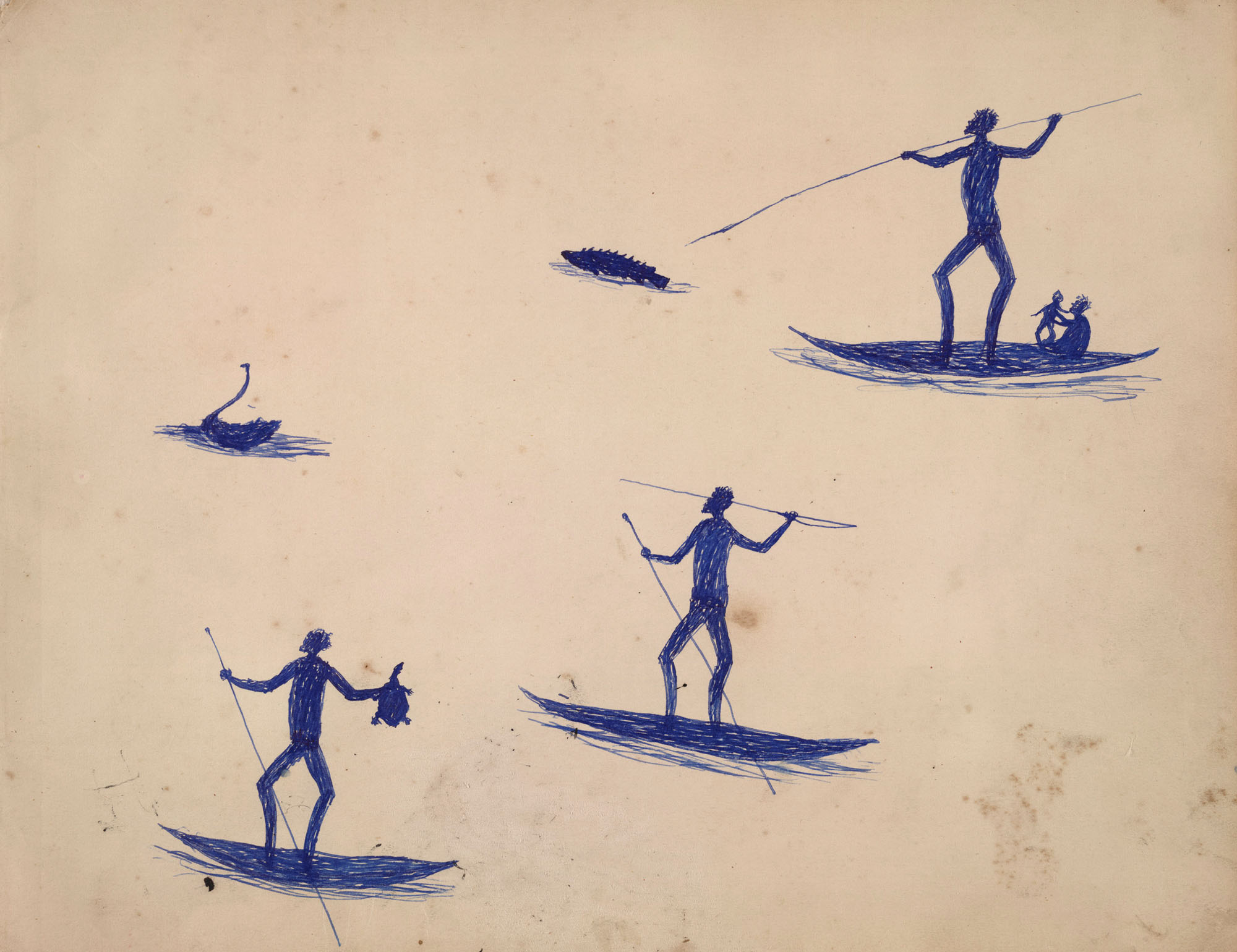
 

Tommy McRae (Kwat Kwat/Wiradjuri) (c. 1836-1901) Page from 'Sketchbook' c. 1891 Sketchbook

Tommy McRae (Kwat Kwat/Wiradjuri) (c. 1836-1901) Page from 'Sketchbook' c. 1891 Sketchbook

Tommy McRae (Kwat Kwat/Wiradjuri) (c. 1836-1901) Page from 'Sketchbook' c. 1891 Sketchbook


Tommy McRae (Kwat Kwat/Wiradjuri) (c. 1836-1901)
Pages from Sketchbook
c. 1891
Sketchbook: pen and blue ink, 26 pages, paper and cardboard cover, stitched binding
24.4 x 31.2cm (image and sheet)
24.4 x 31.2cm (page)
24.4 x 31.2 x 1cm (closed)
24.4 x 62.4 x 0.5cm (open)
National Gallery of Victoria, Melbourne
Purchased, 2001
Purchased with the assistance of Ian Hicks AM, John Higgins and two anonymous donors, 2008


The Ian Potter Centre: NGV Australia

Federation Square
Corner of Russell and 
Flinders Streets, Melbourne

Opening hours:
Daily 10am – 5pm
National Gallery of Victoria website

LIKE ART BLART ON FACEBOOK

Back to top

Exhibition: ‘Victorian Giants: The Birth of Art Photography’ at the National Portrait Gallery, London Part 2

Exhibition dates: 1st March – 20th May, 2018

Victorian Giants: The Birth of Art Photography is curated by Phillip Prodger PhD, Head of Photographs at the National Portrait Gallery, London


Poster for the exhibition 'Victorian Giants: The Birth of Art Photography' at the National Portrait Gallery, London


Poster for the catalogue for the exhibition Victorian Giants: The Birth of Art Photography at the National Portrait Gallery, London


Oh Clementina! the light, the stars!

There is enough text in the posting for me not to really have to say anything. It’s all there…

Art, influence, technology;
Classical, formal, diaristic;
Intimacy, mystery, atmospheric;
Motherhood, sexuality, feminist identity, nascent womanhood;
‘Profil perdu’ (French, ‘lost profile’, which refers to a portrait in which the profile cannot be seen), mirror, loss, duplication and replication, illusion, and fetish

… all woven into a performative, psychological, expressive and creative (self) portraiture.

The real stars of the show are most definitely the women… the avant-garde artists of their era.

Dr Marcus Bunyan

View part 1 of the posting


Many thankx to the National Portrait Gallery, London for allowing me to publish the photographs in the posting. Please click on the photographs for a larger version of the image.


“The women are the real stars of this exhibition. Their pictures are bolder and bigger, more imaginative and more daring. They portray people with a raw reality that is not just the result of the collodion method but a powerful, visionary insight.

Hawarden’s pictures of Victorian women have an intimacy that transcends time and a mystery that asserts the autonomy of her subjects. They are feminist, and gothic too, in their eerie atmosphere. In an 1863-4 picture called ‘Photographic Study’, she poses a young woman by a mirror so that we see her twice. The “real” woman is in brooding profile while her reflection is a shadowy full-face image. The effect is spookily absorbing as we become witnesses to her melancholic introspection.

Hawarden’s ultra-sharp yet shadow-rich prints create unresolved stories featuring women free to show who they really are. None of them look happy. All are curiously defiant – these pictures anticipate those of the 1970s US artist Francesca Woodman. As portraits of women created by women, these Victorian photographers’ subversive creations have almost no precedents.

Not that Cameron looked to the handful of earlier women artists as models. She was trying to be a new Rembrandt: her portraits consciously compete with the masterpieces of the baroque age. While the painted portraits of male Victorian artists such as John Everett Millais and George Frederic Watts are period pieces at best, her great 1866 photograph Mountain Nymph, Sweet Liberty (Mrs Keene) with its subtle mix of resolution and suggestiveness brings us face to face with someone whose eyes hold ours and whose mind is as real to us as her tangled hair. There is a sensitivity to the magic of being human in Cameron’s portraits that makes her the greatest British artist of her time. This exhibition puts her in a brilliantly delineated context of experiment and imagination, the first avant-garde artist of the camera.”


Extract from Jonathan Jones. “Victorian Giants: the Birth of Art Photography review – the triumph of the female gaze,” on The Guardian website Friday 2 March 2018 [Online] Cited 14/02/2022


This major exhibition is the first to examine the relationship between four ground-breaking Victorian artists: Julia Margaret Cameron (1815-1879), Lewis Carroll (1832-1898), Lady Clementina Hawarden (1822-1865) and Oscar Rejlander (1813-1875). Drawn from public and private collections internationally, the exhibition features some of the most breath-taking images in photographic history. Influenced by historical painting and frequently associated with the Pre-Raphaelite Brotherhood, the four artists formed a bridge between the art of the past and the art of the future, standing as true giants in Victorian photography.


Clementina Hawarden (British, 1822-1865)

Her life cruelly cut short by pneumonia at the age of forty-two, Clementina Maude, Viscountess Hawarden produced some 800 photographs in her lifetime, nearly all are of her eight children posed in poignant tableaux. She began to photograph on her family’s estate, outside Tipperary, around 1857, later moving to Princes Gardens, London, near Hyde Park. Frequently compared to Cameron, she was much admired by Carroll, and on her death, Rejlander wrote her obituary.

Wall text from the exhibition


“In that vein, the greatest discovery in the exhibition is a thrillingly strange image by Hawarden, to my mind always the most intriguing photographer of the four. Hawarden was a Scottish countess who had ten children. She photographed all of her daughters repeatedly, and there were so many of them it’s hard to keep track. Her photographs, which are often classical in their formal qualities, nevertheless anticipate the diaristic work of the 20th century photographers Sally Mann and Nan Goldin. They often contain more than one girl, and often feature mirrors, so that everything is about multiplication or reflection – an effect that might also be seen as a form of self-portraiture in the mother of so many.”

Gaby Wood. “A jewel-like show of photographs Victorian Giants, National Portrait Gallery, review,” on The Telegraph website 27th February 2018 [Online] Cited 14/02/2022


Her photographic years were brief but prolific. Hawarden produced over eight hundred photographs between 1857 and her sudden death in 1864. During this time she gave birth to three of her eight children. Lady Hawarden’s photographic focus remained on her children. There is only one photograph believed to feature the Viscountess Hawarden, yet it could also be a portrait of her sister Anne Bontine.

A collection of 775 portraits were donated to the Victoria and Albert Museum, London in 1939 by Hawarden’s granddaughter, Clementina Tottenham. The photographs were torn, or cut, from family albums for reasons that are still unclear. This accounts for the torn or trimmed corners which are now considered a hallmark of Hawarden’s work.

Carol Mavor writes extensively about the place of Hawarden’s work in the history of Victorian photography as well as contemporary interpretations of the work. She states, “Hawarden’s pictures raise significant issues of gender, motherhood, and sexuality as they relate to photography’s inherent attachments to loss, duplication and replication, illusion, fetish.” (Mavor, Carol (1999). Becoming: the photographs of Clementina, Viscountess Hawarden (1st ed.). Durham, NC: Duke University Press.)

Text from the Wikipedia website


Clementina Hawarden (British, 1822-1865) 'Photographic Study, 5 Princes Gardens (Clementina Maude)' 1863-1864 from the exhibition 'Victorian Giants: The Birth of Art Photography' at the National Portrait Gallery, London , March - May, 2018


Clementina Hawarden (British, 1822-1865)
Photographic Study, 5 Princes Gardens (Clementina Maude)
1863-1864
from The Photographic Study Series by Clementina, Lady Hawarden
Albumen silver print from glass negative
Given by Lady Clementina Tottenham
© Victoria and Albert Museum, London


“Although her work has often been linked to that of Julia Margaret Cameron, the best known woman photographer of the Victorian epoch, Clementina Hawarden struck out into areas and depicted moods unknown to the art photographers of her age.”

~ Graham Ovenden 1974


This remarkable photograph shows a woman gazing into a mirror, but not at her own reflection. Instead, the picture was carefully arranged so that the woman’s face is seen in profile, while only her reflection looks back out of the mirror. Hawarden excelled at producing ambiguous narrative photographs such as this one, suggesting the rich inner life of the subject, without telling a clear story. The heroes of her pictures are nearly always women, who seem all but trapped in domestic interiors.

Wall text from the exhibition


Clementina Hawarden (British, 1822-1865) 'Photographic Study (Clementina Maude)' early 1860s from the exhibition 'Victorian Giants: The Birth of Art Photography' at the National Portrait Gallery, London , March - May, 2018


Clementina Hawarden (British, 1822-1865)
Photographic Study (Clementina Maude)
early 1860s
Albumen print from wet collodion negative
20.1 x 14.4cm (7 15/16 x 5 11/16 in.)
Gilman Collection, Purchase, Harriette and Noel Levine Gift, 2005
© Metropolitan Museum of Art


Clementina, Lady Hawarden, is a poetic, if elusive, presence among nineteenth-century photographers. As a devoted mother, her life revolved around her eight children. She took up photography in 1857; using her daughters as models, she created a body of work remarkable for its technical brilliance and its original depiction of nascent womanhood. Lady Hawarden showed her work in the 1863 and 1864 exhibitions of the Photographic Society. With the exception of a few rare examples, her photographs remained in the possession of her family until 1939, when the more than eight hundred images were donated to the Victoria and Albert Museum. Only recently have they been the objects of research, publication, and exhibition.

Clementina Maude, her mother’s preferred model, is seen here in a reflective pose against a star-studded wall. The casual placement of the shawl on the table and the girl’s loose hair contribute to the feeling of intimacy. In the airy room time seems to be suspended. The sensuous curves of the table legs, the soft weight of the crushed velvet, and the crispness of the starry wallpaper are enhanced by the skilful handling of the collodion technique. The composition, devoid of Victorian clutter, brings together light, shadow, and compositional elements in a spare and appealing interplay. In contrast to the prevailing fashion of giving literary or sentimental titles to portraits of young women, Lady Hawarden titled her works simply “Photographic Study.”

Text from the Metropolitan Museum of Art website


Clementina Hawarden (British, 1822-1865) 'Photographic Study (Clementina and Isabella Grace Maude)' 1863-1864


Clementina Hawarden (British, 1822-1865)
Photographic Study (Clementina and Isabella Grace Maude)
1863-1864
Albumen print from wet collodion negative
© Victoria and Albert Museum, London


Hawarden frequently dressed up her sitters and arranged them in enigmatic narratives like this one. Although not derived from any known painting, the manner of dress, including the cloak and tricorn hat of the male figure (actually one of Hawarden’s daughters dressed up), suggest an eighteenth century reference.

Wall text from the exhibition


Clementina Hawarden (British, 1822-1865) 'Photographic Study (Florence Elizabeth and Clementina Maude)' 1863-1864


Clementina Hawarden (British, 1822-1865)
Photographic Study (Florence Elizabeth and Clementina Maude)
1863-1864
Albumen print from wet collodion negative
© Victoria and Albert Museum, London


Working from upstairs rooms at 5 Princes Gardens, near to the South Kensington Museum (where both she and Julia Margaret Cameron were frequent visitors), Hawarden used light streaming from large floor to ceiling windows to illuminate her pictures. Her subjects were usually her children, especially her daughters Clementina, Florence, and Isabella Grace, whom she posed in domestic tableaux.

Both Carroll and Rejlander knew and admired Hawarden. On at least one occasion, Rejlander photographed her daughter Isabella Grace; after Hawarden’s death, he also photographed her youngest daughter, Antonia.

Wall text from the exhibition


Clementina Hawarden (British, 1822-1865) Hawarden. 'Isabella Grace and Clementina Maude, 5 Princes Gardens' c. 1863-1864


Clementina Hawarden (British, 1822-1865)
Hawarden Isabella Grace and Clementina Maude, 5 Princes Gardens
c. 1863-1864
Albumen print from wet collodion negative
Given by Lady Clementina Tottenham
© Victoria and Albert Museum, London


Virginia Dodier thinks that this photograph belongs to an ‘Orientalist’ series. Here, Lady Hawarden gives her drawing room a tent-like atmosphere. Such scenes were popularised by the painter J. F. Lewis, and Roger Fenton exhibited his photographic ‘Nubian Series’ in 1859. Dodier writes that the idea of Orientalism allowed European artists to ‘evoke sensuality on the premise of presenting quasi-ethnographical information about the customs of the East’. The idea of the fancy dress or allegorical portrait stems from an earlier tradition in English art. They are found, for example, in the work of the painter Sir Joshua Reynolds (1723-1792).

Text from the Victoria and Albert Museum website


Lady Clementina Hawarden: Themes & Style (extract)

With careful choice of props, clothing, mirrors, balcony, and posture, Hawarden produced exquisite studies of her adolescent daughters. The figures and dress are the main subject, carefully framed in the room, and often in front of the balcony. The city beyond often provides a blurred background.

The writer Carol Mavor in Becoming: The Photographs of Clementina, Viscountess Hawarden suggests that the often provocative poses of Hawarden’s daughters are significant. The Victorians were bothered by the idea of sexuality and adolescence, and in 1861 the Offences Against the Person Act raised the age of consent from 10 to 12. This was also the year in which Hawarden began to make this kind of photograph, though there is no evidence that she was deliberately exploring this controversial topic.

Hawarden liked to use natural light in her studio at her South Kensington home, in a way that was seen at the time as ‘daring’. She placed mirrors to reflect light and used them to explore the idea of ‘the double’, just as other photographers (and occasionally Hawarden herself) used a stereoscopic camera to produce twin prints.

From around 1862 Hawarden concentrated on photographing her daughters in costume tableaux, a popular subject at the time. Costumes from the dressing up box are combined with dresses at the height of fashion to produce beautiful and detailed studies that confound the contemporary with the make-believe.

Text from the Victoria and Albert Museum website [Online] Cited 16/05/2018. No longer available online


Clementina Hawarden (British, 1822-1865) 'Photographic Study (Clementina and Florence Elizabeth Maude)' 1859-1861


Clementina Hawarden (British, 1822-1865)
Photographic Study (Clementina and Florence Elizabeth Maude)
1859-1861
Uncut stereo albumen print


Figure 60 and 61 of the catalogue for the exhibition 'Victorian Giants: The Birth of Art Photography' at the National Portrait Gallery, London


Figure 60 and 61 of the catalogue for the exhibition Victorian Giants: The Birth of Art Photography at the National Portrait Gallery, London


Figure 112 and 113 of the catalogue for the exhibition 'Victorian Giants: The Birth of Art Photography' at the National Portrait Gallery, London


Figure 112 and 113 of the catalogue for the exhibition Victorian Giants: The Birth of Art Photography at the National Portrait Gallery, London


Oscar Rejlander (British born Sweden, 1813-1875)

According to his naturalisation papers, Rejlander was born in Stockholm on October 19, 1813. He was the son of Carl Gustaf Rejlander, a stonemason and Swedish Army Officer. During his youth, his family moved to the Swedish-speaking community in Rauma, Finland (then Russia). In the 1830s, he relocated to England, initially settling in Lincoln, England. In the 1850s he abandoned his original profession as a painter and portrait miniaturist, apparently after seeing how well a photograph captured the fold of a sleeve.

He set up as a portraitist in the industrial Midlands town of Wolverhampton, probably around 1846. In the early 1850s he learned the wet-collodion and waxed-paper processes at great speed with Nicholas Henneman in London, and then changed his business to that of a photography studio. He undertook genre work and portraiture. Rejlander also produced nude studies, mainly for use as studies by painters. There are no known erotic photographs of children by Rejlander. His so-called ‘Charlotte Baker’ photograph is a well-known forgery, produced by convicted child sex offender Graham Ovenden by Ovenden’s friend Howard Grey in the 1970s, rephotographed and printed to look antique by Ovenden. No person by the name Charlotte Baker ever seems to have posed for Rejlander.

Rejlander undertook many experiments to perfect his photography, including combination printing, which he did not invent; however, he created more elaborate and convincing composite photographs than any prior photographer. He had articles feature in the Wolverhampton Chronicle, on 15 November 1854 an article called “Improvement in Calotypes, by Mr. O.G. Rejlander, of Wolverhampton” it suggests that by 1854 he was experimenting with combination printing from several negatives. He was a friend of photographer Charles Lutwidge Dodgson (better known by the nom de plume Lewis Carroll), who collected Rejlander’s work and corresponded with him on technical matters. Rejlander later created one of the best known and most revealing portraits of Dodgson.

Rejlander participated in the Paris Exhibition of 1855. In 1856 he made his best-known allegorical work, The Two Ways of Life. This was a seamlessly montaged combination print made of thirty-two images (akin to the use of Photoshop today, but then far more difficult to achieve) in about six weeks. First exhibited at the Manchester Art Treasures Exhibition of 1857, the work shows a man being lured to paths of vice or virtue by good and bad angels. The image’s partial nudity, which showed real women as they actually appeared and not the idealised forms then common in Victorian art, was deemed ‘indecent’ by some. Rejlander was also accused of using prostitutes as models, although Rejlander categorically denied this and no proof was ever offered. Reservations about the work subsided when Queen Victoria ordered a 10-guinea copy to give to Prince Albert. Victoria and Albert would go on to purchase three copies of the work, all of which are now lost. …

Rejlander moved his studio to Malden Road, London around 1862 and largely abandoned her early experiments with double exposure, photomontage, photographic manipulation and retouching. Instead, he became one of Britain’s leading portraitists, creating pictures with psychological charge. He became a leading expert in photographic techniques, lecturing and publishing widely, and sold work through bookshops and art dealers. He also found subject-matter in London, photographing homeless London street children to produce popular ‘social-protest’ pictures such as “Poor Joe,” also known as “Homeless”. …

Rejlander’s ideas and techniques were taken up by other photographers and this, to some extent, justifies labelling him as the father of art photography.

Text from the Wikipedia website


Oscar Rejlander (British born Sweden, 1813-1875) 'Charles Darwin' 1871


Oscar Rejlander (British born Sweden, 1813-1875)
Charles Darwin
1871
Albumen print
© Moderna Museet, Stockholm


Starting in the late 1860s, Charles Darwin began collecting photographs for use in the research that would eventually become his book The Expression of the Emotions in Man and Animals (1872). Hoping to find authentic photographs, that captured emotional expressions as they actually occurred, he visited print shops and studios in London, and contacted several photographers hoping to commission new pictures. Few, if any, of the photographs he acquired met his ambitious expectations.

In April, 1871, Darwin wrote, ‘I am now rich in photographs, for I have found in London Rejlander, who for years has had a passion for photographing all sorts of chance expressions, exhibited on various occasions … instantaneously.’ Rejlander would go on to become the main contributor of photographs to Darwin’s book.

Wall text from the exhibition


Oscar Rejlander (British born Sweden, 1813-1875) 'The Two Ways of Life' 1856-1857


Oscar Rejlander (British born Sweden, 1813-1875)
The Two Ways of Life
1856-1957
Albumen print, made from approximately 32 separate negatives
Moderna Museet, Stockholm


One of the most famous pictures in photographic history, Rejlander’s Two Ways of Life caused a sensation when it was exhibited at the Manchester Art Treasures exhibition in 1857. To make it, Rejlander combined some thirty-two separate negatives (there were variations between printings, and it is not always clear where negatives begin and end). Some viewers were offended by the nudes, whose bodies appear frank and realistic compared to the ideal fantasies painters were expected to produce. Others objected to its ambition, since Rejlander seemed to be saying that photography could be used to produce pictures just as meaningful, and as artistically composed, as any painting.

To make Two Ways of Life, Rejlander had to arrange the various subjects within it at the right size to maintain visual perspective. This was a challenge, since enlargement and reduction of negatives was not yet possible in the darkroom. The only way he could change the size of something in the negative was to rephotograph it.

This is the finest known print of the photograph, which is also known in a reduced form. The photograph is a parable featuring Rejlander himself, who stands in the middle, listening to ‘good’ and ‘bad’ angels luring him to paths of vice and virtue. Queen Victoria and Prince Albert loved the picture and bought three copies, none of which survive.

Wall text from the exhibition


Oscar Rejlander (British born Sweden, 1813-1875) 'The Evening Sun (Iphigenia)' c. 1860


Oscar Rejlander (British born Sweden, 1813-1875)
The Evening Sun (Iphigenia)
c. 1860
© Gernsheim Collection, Harry Ransom Centre, The University of Texas at Austin


Oscar Rejlander (British born Sweden, 1813-1875) 'The Evening Sun (Iphigenia)' c. 1860


Oscar Rejlander (British born Sweden, 1813-1875)
The Evening Sun (Iphigenia)
c. 1860
© Gernsheim Collection, Harry Ransom Centre, The University of Texas at Austin


Oscar Rejlander (British born Sweden, 1813-1875) 'The Evening Sun (Iphigenia)' c. 1860 (detail)


Oscar Rejlander (British born Sweden, 1813-1875)
The Evening Sun (Iphigenia) (detail)
c. 1860
© Gernsheim Collection, Harry Ransom Centre, The University of Texas at Austin


Iphigenia was a daughter of King Agamemnon who appears in legends about the Trojan War. When her father accidentally offended the goddess Artemis, he was forced to sacrifice Iphigenia to appease the goddess so that she would allow his ships to sail to Troy. She was tricked into going to the town of Aulis under the pretence that she would marry the heroic warrior Achilles. In some versions she was killed, while in others she was rescued by Artemis.

Wall text from the exhibition


Oscar Rejlander (British born Sweden, 1813-1875) 'Ariadne' 1857


Oscar Rejlander (British born Sweden, 1813-1875)
Ariadne
1857
Albumen print from a wet collodion negative


Oscar Rejlander (British born Sweden, 1813-1875) 'Nude female study' c. 1867


Oscar Rejlander (British born Sweden, 1813-1875)
Nude female study
c. 1867
Albumen print
7 3/4 x 5 3/8 in. (196 x 138mm) overall
Given by Stephan Loewentheil, 2017
© National Portrait Gallery, London


Rejlander produced a number of nude studies which he sold to painters for use as studies. He considered these pictures significant because they pointed up errors historically made by painters when depicting human anatomy. Although he was happy for painters to use photographs to improve their paintings, he also saw accuracy of depiction as one of the things that made photography special when compared to other art forms.

Wall text from the exhibition


Oscar Rejlander (British born Sweden, 1813-1875) 'The Virgin in prayer' c. 1857


Oscar Rejlander (British born Sweden, 1813-1875)
The Virgin in prayer (after Sassoferrato)
c. 1857
albumen print
6 7/8 x 5 7/8 in. (174 x 150mm) overall
Purchased with help from the Art Fund, Jane and Michael Wilson and Stephen Barry, 2015
© National Portrait Gallery, London


This photograph is a based on the famous painting The Virgin in Prayer painted by the Italian Baroque painter Sassoferrato 1640-1650, now in the collection of the National Gallery, London. The rise of public art spaces in Britain in the nineteenth century, including the National Gallery (1824), and the National Portrait Gallery (1856), provided inspiration for countless photographers. Rejlander was particularly enthusiastic about restaging famous paintings, often in order to demonstrate mistakes that painters had made in scale and perspective. The process was fun, and the results fuelled the debate about photography’s role among the arts.

Wall text from the exhibition


Oscar Rejlander (British born Sweden, 1813-1875) 'The Virgin in prayer (after Sassoferrato)' c. 1857


Oscar Rejlander (British born Sweden, 1813-1875)
The Virgin in prayer (after Sassoferrato)
c. 1857
Albumen print
7 3/4 x 5 3/4 in. (196 x 146mm) overall
Given by Stephan Loewentheil, 2017
© National Portrait Gallery, London


Oscar Rejlander (British born Sweden, 1813-1875) 'Unknown young woman' 1860-1866


Oscar Rejlander (British born Sweden, 1813-1875)
Unknown young woman
1860-1866
Albumen print
7 3/8 x 5 1/4 in. (188 x 134mm) overall
Purchased with help from the Art Fund, Jane and Michael Wilson and Stephen Barry, 2015
© National Portrait Gallery, London


Oscar Rejlander (British born Sweden, 1813-1875) 'Untitled (unknown sitter, possibly Rejlander's wife, Mary)' c. 1863


Oscar Rejlander (British born Sweden, 1813-1875)
Untitled (unknown sitter, possibly Rejlander’s wife, Mary)
c. 1863
Printed by Julia Margaret Cameron
Albumen print from wet collodion glass negative
Given by Mrs Margaret Southam, 1941
© Victoria and Albert Museum, London


Cameron invited Rejlander to the Isle of Wight in 1863. Before the visit, Rejlander provided her with some of his own negatives, so that she could practise printing. She experimented with some, decorating them with ferns. This picture, which descended through Cameron’s family, was once believed to have been made by her. However, it is now recognised as one of the pictures Cameron printed from a Rejlander negative. The subject is one who frequently appears in Rejlander’s work, and may even have been his wife, Mary.

Wall text from the exhibition


Oscar Rejlander (British born Sweden, 1813-1875) 'Unknown young woman' 1863-1866


Oscar Rejlander (British born Sweden, 1813-1875)
Unknown young woman
1863-1866
Albumen print
8 1/8 x 5 7/8 in. (205 x 149mm) overall
Purchased with help from the Art Fund, Jane and Michael Wilson and Stephen Barry, 2015
© National Portrait Gallery, London


Oscar Rejlander (British born Sweden, 1813-1875) ''Sleep' (Mary Rejlander (née Bull))' c. 1855


Oscar Rejlander (British born Sweden, 1813-1875)
‘Sleep’ (Mary Rejlander (née Bull))
c. 1855
Albumen print
6 1/8 x 6 5/8 in. (156 x 167mm) overall
Purchased with help from the Art Fund, Jane and Michael Wilson and Stephen Barry, 2015
© National Portrait Gallery, London


Oscar Rejlander (British born Sweden, 1813-1875) 'Minnie Constable' 1860-1866


Oscar Rejlander (British born Sweden, 1813-1875)
Minnie Constable
1860-1866
Albumen print
7 1/2 x 5 3/4 in. (192 x 146mm) overall
Purchased with help from the Art Fund, Jane and Michael Wilson and Stephen Barry, 2015
© National Portrait Gallery, London


Oscar Rejlander (British born Sweden, 1813-1875) ''Art must assist Photography' (Putto as Allegory of Painting)' 1856


Oscar Rejlander (British born Sweden, 1813-1875)
‘Art must assist Photography’ (Putto as Allegory of Painting)
1856
Albumen print
4 3/4 x 3 5/8 in. (120 x 93mm) overall
Purchased with help from the Art Fund, Jane and Michael Wilson and Stephen Barry, 2015
© National Portrait Gallery, London


Oscar Rejlander (British born Sweden, 1813-1875) 'Oscar Gustav Rejlander; Mary Rejlander (née Bull)' 1860-1866


Oscar Rejlander (British born Sweden, 1813-1875)
Oscar Gustav Rejlander; Mary Rejlander (née Bull)
1860-1866
Albumen print
8 5/8 x 6 1/4 in. (219 x 158mm) overall
Purchased with help from the Art Fund, Jane and Michael Wilson and Stephen Barry, 2015
© National Portrait Gallery, London


Oscar Rejlander (British born Sweden, 1813-1875) 'Unknown woman' 1860-1866


Oscar Rejlander (British born Sweden, 1813-1875)
Unknown woman
1860-1866
Albumen print
8 x 5 3/4 in. (202 x 147mm) overall
Purchased with help from the Art Fund, Jane and Michael Wilson and Stephen Barry, 2015
© National Portrait Gallery, London


Oscar Rejlander (British born Sweden, 1813-1875) ''A devotee' (Unknown woman)' 1860-1866


Oscar Rejlander (British born Sweden, 1813-1875)
‘A devotee’ (Unknown woman)
1860-1866
Albumen print
8 5/8 x 6 1/4 in. (219 x 158mm) overall
Purchased with help from the Art Fund, Jane and Michael Wilson and Stephen Barry, 2015
© National Portrait Gallery, London


Oscar Rejlander (British born Sweden, 1813-1875) 'Purify my heart' also known as 'The Little Sisters' c. 1862


Oscar Rejlander (British born Sweden, 1813-1875)
Purify my heart also known as The Little Sisters
c. 1862
Albumen print
5 x 4 1/8 in. (127 x 105mm) overall
Given by Stephan Loewentheil, 2017
© National Portrait Gallery, London


This photograph shows two sisters side by side in profile, their hands clasped in prayer. One girl seems almost to be a mirror reflection of the other. Rejlander exhibited versions of this photograph with two different titles. Purify My Heart is a reference to the biblical passage James 4:8: ‘Draw nigh to God, and he will draw nigh to you. Cleanse your hands, ye sinners; and purify your hearts, ye double minded.’ Lewis Carroll admired this photograph and purchased a copy for his personal collection.

Wall text from the exhibition


Oscar Rejlander (British born Sweden, 1813-1875) 'Unknown young woman' 1863-1866


Oscar Rejlander (British born Sweden, 1813-1875)
Unknown young woman
1863-1866
Albumen print
8 1/8 x 5 7/8 in. (205 x 149 mm) overall
Purchased with help from the Art Fund, Jane and Michael Wilson and Stephen Barry, 2015
© National Portrait Gallery, London


National Portrait Gallery
St Martin’s Place
London, WC2H 0HE

Opening hours:
Open daily: 10.30 – 18.00
Friday and Saturday: 10.30 – 21.00

National Portrait Gallery website

LIKE ART BLART ON FACEBOOK

Back to top

Exhibition: ‘Victorian Giants: The Birth of Art Photography’ at the National Portrait Gallery, London Part 1

Exhibition dates: 1st March – 20th May, 2018

Victorian Giants: The Birth of Art Photography is curated by Phillip Prodger PhD, Head of Photographs at the National Portrait Gallery, London


Cover of the catalogue for the exhibition 'Victorian Giants: The Birth of Art Photography' at the National Portrait Gallery, London


Cover of the catalogue for the exhibition Victorian Giants: The Birth of Art Photography at the National Portrait Gallery, London


A two-part bumper posting on this exhibition, Part 1 featuring the work of Lewis Carroll and our Julia… JMC, Julia Margaret Cameron, the most inventive, audacious and talented photographer of the era. In a photographic career spanning eleven years of her life (1864-1875) what Julia achieved in such a short time is incredible.

“Her style was not widely appreciated in her own day: her choice to use a soft focus and to treat photography as an art as well as a science, by manipulating the wet collodion process, caused her works to be viewed as “slovenly”, marred by “mistakes” and bad photography. She found more acceptance among pre-Raphaelite artists than among photographers.” (Wikipedia)

As with any genius (a person who possesses exceptional intellectual or creative power) who goes against the grain, full recognition did not come until later. But when it does arrive, it is undeniable. As soon as you see a JMC photograph… you know it is by her, it could be by no one else. Her “signature” – closely framed portraits and illustrative allegories based on religious and literary works; far-away looks, soft focus and lighting, low depth of field; strong men (“great thro’ genius”) and beautiful, sensual, heroic women (“great thro’ love”) – is her genius.

There is something so magical about how JMC can frame a face, emerging from darkness, side profile, filling the frame, top lit. Soft out of focus hair with one point of focus in the image. Beautiful light. Just the most sensitive capturing of a human being, I don’t know what it is… a glimpse into another world, a ghostly world of the spirit, the soul of the living seen before they are dead.

Love and emotion. Beauty, beautiful, beatified.

Dr Marcus Bunyan

View part 2 of the posting


Many thankx to the National Portrait Gallery, London for allowing me to publish the photographs in the posting. Please click on the photographs for a larger version of the image.


“My aspirations are to ennoble Photography and to secure for it the character and uses of High Art by combining the real & Ideal & sacrificing nothing of Truth by all possible devotion to poetry and beauty.”


Julia Margaret Cameron to Sir John Herschel, 31 December 1864


This major exhibition is the first to examine the relationship between four ground-breaking Victorian artists: Julia Margaret Cameron (1815-1879), Lewis Carroll (1832-1898), Lady Clementina Hawarden (1822-1865) and Oscar Rejlander (1813-1875). Drawn from public and private collections internationally, the exhibition features some of the most breath-taking images in photographic history. Influenced by historical painting and frequently associated with the Pre-Raphaelite Brotherhood, the four artists formed a bridge between the art of the past and the art of the future, standing as true giants in Victorian photography.


Figure 94 and 95 of the catalogue for the exhibition 'Victorian Giants: The Birth of Art Photography' at the National Portrait Gallery, London


Figure 94 and 95 from the catalogue for the exhibition Victorian Giants: The Birth of Art Photography at the National Portrait Gallery, London


Lewis Carroll (English, 1832-1898)

In 1856, Charles Lutwidge Dodgson (Lewis Carroll) took up the new art form of photography under the influence first of his uncle Skeffington Lutwidge, and later of his Oxford friend Reginald Southey. He soon excelled at the art and became a well-known gentleman-photographer, and he seems even to have toyed with the idea of making a living out of it in his very early years.

A study by Roger Taylor and Edward Wakeling exhaustively lists every surviving print, and Taylor calculates that just over half of his surviving work depicts young girls, though about 60% of his original photographic portfolio is now missing. Dodgson also made many studies of men, women, boys, and landscapes; his subjects also include skeletons, dolls, dogs, statues, paintings, and trees. His pictures of children were taken with a parent in attendance and many of the pictures were taken in the Liddell garden because natural sunlight was required for good exposures.

He also found photography to be a useful entrée into higher social circles. During the most productive part of his career, he made portraits of notable sitters such as John Everett MillaisEllen TerryDante Gabriel RossettiJulia Margaret CameronMichael FaradayLord Salisbury, and Alfred, Lord Tennyson.

By the time that Dodgson abruptly ceased photography (1880, over 24 years), he had established his own studio on the roof of Tom Quad, created around 3,000 images, and was an amateur master of the medium, though fewer than 1,000 images have survived time and deliberate destruction. He stopped taking photographs because keeping his studio working was too time-consuming. He used the wet collodion process; commercial photographers who started using the dry-plate process in the 1870s took pictures more quickly.

Text from the Wikipedia website


Lewis Carroll (English, 1832-1898) 'Alice Liddell as 'The Beggar Maid'' Summer 1858 from the exhibition 'Victorian Giants: The Birth of Art Photography' at the National Portrait Gallery, London , March - May, 2018


Lewis Carroll (English, 1832-1898)
Alice Liddell as ‘The Beggar Maid’
also known as King Cophetua’s Bride
Summer 1858
Albumen silver print from glass negative
16.3 x 10.9cm (6 7/16 x 4 5/16in.)
Gilman Collection, Gift of The Howard Gilman Foundation, 2005
© Metropolitan Museum of Art


Known primarily as the author of children’s books, Lewis Carroll was also a lecturer in mathematics at Oxford University and an ordained deacon. He took his first photograph in 1856 and pursued photography obsessively for the next twenty-five years, exhibiting and selling his prints. He stopped taking pictures abruptly in 1880, leaving over three thousand negatives, for the most part portraits of friends, family, clergy, artists, and celebrities. Ill at ease among adults, Carroll preferred the company of children, especially young girls. He had the uncanny ability to inhabit the universe of children as a friendly accomplice, allowing for an extraordinarily trusting rapport with his young sitters and enabling him to charm them into immobility for as long as forty seconds, the minimum time he deemed necessary for a successful exposure. The intensity of the sitters’ gazes brings to Carroll’s photographs a sense of the inner life of children and the seriousness with which they view the world.

Carroll’s famous literary works, “Alice’s Adventures in Wonderland” (1865) and “Through the Looking Glass and What Alice Found There” (1872), were both written for Alice Liddell, the daughter of the dean of Christ Church, Oxford. For Carroll, Alice was more than a favourite model; she was his “ideal child-friend,” and a photograph of her, aged seven, adorned the last page of the manuscript he gave her of “Alice’s Adventures Underground.” The present image of Alice was most likely inspired by “The Beggar Maid,” a poem written by Carroll’s favourite living poet, Alfred, Lord Tennyson, in 1842. If Carroll’s images define childhood as a fragile state of innocent grace threatened by the experience of growing up and the demands of adults, they also reveal to the contemporary viewer the photographer’s erotic imagination. In this provocative portrait of Alice at age seven or eight, posed as a beggar against a neglected garden wall, Carroll arranged the tattered dress to the limits of the permissible, showing as much as possible of her bare chest and limbs, and elicited from her a self-confident, even challenging stance. This outcast beggar will arouse in the passer-by as much lust as pity. Indeed, Alice looks at us with faint suspicion, as if aware that she is being used as an actor in an incomprehensible play. A few years later, a grown-up Alice would pose, with womanly assurance, for Julia Margaret Cameron.

Text from the Metropolitan Museum of Art website


Lewis Carroll (English, 1832-1898) 'Alice Liddell' Summer 1858 from the exhibition 'Victorian Giants: The Birth of Art Photography' at the National Portrait Gallery, London , March - May, 2018


Lewis Carroll (English, 1832-1898)
Alice Liddell
Summer 1858
Wet collodion glass-plate negative
6 x 5 in. (152 x 127mm)
Purchased jointly with the National Science and Media Museum, Bradford, with help from the Art Fund and the National Heritage Memorial Fund, 2002
© National Portrait Gallery, London and the National Media Museum (part of the Science Museum Group, London)


The fourth of ten children and later the inspiration for Alice’s Adventures in Wonderland and its sequel, Through the Looking Glass, Alice Liddell is the most famous of Carroll’s child sitters. Contrary to popular belief, Carroll did not photograph her particularly often, and never photographed her in the nude. Of the 2,600 photographs recorded by Carroll, only twelve solo portraits of Alice are known. By comparison, he made six individual portraits of Alice’s sister, Ina, and forty-five of another favoured sitter, Xie Kitchin (see preceding room).

Wall text from the exhibition


Lewis Carroll (English, 1832-1898) 'Ina Liddell' Summer 1858


Lewis Carroll (English, 1832-1898)
Ina Liddell
Summer 1858
Albumen print
5 7/8 x 5 in. (150 x 126mm) uneven
Purchased jointly with the National Science and Media Museum, Bradford, with help from the Art Fund and the National Heritage Memorial Fund, 2002
© National Portrait Gallery, London and the National Media Museum (part of the Science Museum Group, London)


Lewis Carroll (English, 1832-1898) 'Edith Mary Liddell; Ina Liddell; Alice Liddell Summer' 1858


Lewis Carroll (English, 1832-1898)
Edith Mary Liddell; Ina Liddell; Alice Liddell
Summer 1858
Wet collodion glass plate negative
6 x 7 1/8 in. (154 x 181mm)
Purchased jointly with the National Science and Media Museum, Bradford, with help from the Art Fund and the National Heritage Memorial Fund, 2002
© National Portrait Gallery, London


Lewis Carroll (English, 1832-1898) 'Edith Mary Liddell; Ina Liddell; Alice Liddell Summer' 1858


Lewis Carroll (English, 1832-1898)
Edith Mary Liddell; Ina Liddell; Alice Liddell
Summer 1858
Albumen print
6 1/8 x 6 7/8 in. (156 x 176mm)
Purchased jointly with the National Science and Media Museum, Bradford, with help from the Art Fund and the National Heritage Memorial Fund, 2002
© National Portrait Gallery, London


Lewis Carroll (English, 1832-1898) 'Edith Mary Liddell' Summer 1858


Lewis Carroll (English, 1832-1898)
Edith Mary Liddell
Summer 1858
Albumen print
5 7/8 x 7 in. (148 x 177mm) uneven
Purchased jointly with the National Science and Media Museum, Bradford, with help from the Art Fund and the National Heritage Memorial Fund, 2002
© National Portrait Gallery, London


Lewis Carroll (English, 1832-1898) 'Hallam Tennyson, 2nd Baron Tennyson' 28 September 1857


Lewis Carroll (English, 1832-1898)
Hallam Tennyson, 2nd Baron Tennyson
28 September 1857
Albumen print
5 1/8 x 3 7/8 in. (130 x 99 mm)
Purchased, 1977
© National Portrait Gallery, London


Hallam Tennyson (British, 1852-1928), Alfred Tennyson’s eldest son, was five years old when Carroll photographed him at Monk Coniston Park in the Lake District. Taken while the poet and his family were visiting friends, the portrait shows Hallam standing on a chair, holding what may be a hoop rolling stick. Carroll posed him with his legs crossed – a tricky stance for such a young child to maintain. As an adult, Hallam would marry May Prinsep, Julia Margaret Cameron’s niece. Carroll did make one portrait of Alfred Tennyson during his Lake District trip, but he was determined to make more. In 1864, he visited the Isle of Wight to try to photograph him again, armed with a ‘carpet bag full’ of his photographs to show Cameron and others. He was unable to photograph Tennyson, but Cameron and Carroll staged a ‘mutual exhibition’ in Cameron’s living room. (Wall text)

Hallam Tennyson, 2nd Baron Tennyson, GCMG, PC (11 August 1852 – 2 December 1928) was a British aristocrat who served as the second Governor-General of Australia, in office from 1903 to 1904. He was previously Governor of South Australia from 1899 to 1902.

Tennyson was born in Twickenham, Surrey, and educated at Marlborough College and Trinity College, Cambridge. He was the oldest son of the poet Alfred, Lord Tennyson, and served as his personal secretary and biographer; he succeeded to his father’s title in 1892. Tennyson was made Governor of South Australia in 1899. When Lord Hopetoun resigned the governor-generalship in mid-1902, he was the longest-serving state governor and thus became Administrator of the Government. Tennyson was eventually chosen to be Hopetoun’s permanent replacement, but accepted only a one-year term. He was more popular than his predecessor among the general public, but had a tense relationship with Prime Minister Alfred Deakin and was not offered an extension to his term. Tennyson retired to the Isle of Wight, and spent the rest of his life upholding his father’s legacy.


Lewis Carroll (English, 1832-1898) ''Open your mouth, and shut your eyes' (Edith Mary Liddell; Ina Liddell; Alice Liddell)' July 1860


Lewis Carroll (English, 1832-1898)
‘Open your mouth, and shut your eyes’ (Edith Mary Liddell; Ina Liddell; Alice Liddell)
July 1860
Wet collodion glass plate negative
10 x 8 in. (254 x 203mm)
Purchased jointly with the National Science and Media Museum, Bradford, with help from the Art Fund and the National Heritage Memorial Fund, 2002
© National Portrait Gallery, London


The Liddell family arrived at Christ Church, Oxford in 1856, just as Carroll was beginning to take up photography. He and the family became close friends. Henry Liddell served as Dean of the College throughout Carroll’s career, and initially supported his photographic efforts. In 1863, Carroll and the family broke off relations for unknown reasons. Speculation has included disappointment that Carroll went against the family’s wishes by refusing to court their governess or one of the older Liddell children – Ina has been mentioned as a candidate. Carroll was enormously charmed by the Liddell children, all of whom he photographed, and nearly all of whom made their way into Alice’s Adventures in Wonderland and other, related writings.

Wall text from the exhibition


Lewis Carroll (English, 1832-1898) 'The Rossetti Family' 7 October 1863


Lewis Carroll (English, 1832-1898)
The Rossetti Family
7 October 1863
Albumen print
6 7/8 x 8 3/4 in. (175 x 222mm)
Given by Helen Macgregor, 1978
© National Portrait Gallery, London


Carroll spent months trying to arrange an introduction to Rossetti (1828-1882) so that he could photograph the famous Pre-Raphaelite painter and poet, and his family. This is one of several photographs he made in the garden of Tudor House, 16 Cheyne Walk, Chelsea, during a four-day session in which he photographed the family and some of Rossetti’s artwork, including drawings of his late wife, Elizabeth Siddal.

The relationship between Carroll, Cameron, Hawarden, Rejlander and the Pre-Raphaelites was complex. They had many common friends and associates, and it is believed that several Pre-Raphaelite painters used photographs as studies for their paintings and sculpture. However, all four photographers were attracted to later styles of painting, especially the Spanish and Italian National Portrait Gallery, London Baroque, and the Dutch Golden Age. Led by the cantankerous critic John Ruskin, an associate of Henry Liddell’s at Oxford (Alice Liddell’s father), the Pre-Raphaelites were opposed to such painting, which they considered too literal and mundane.

Wall text from the exhibition


Lewis Carroll (English, 1832-1898) 'Dante Gabriel Rossetti' 7 October 1863


Lewis Carroll (English, 1832-1898)
Dante Gabriel Rossetti
7 October 1863
Albumen print
5 3/4 x 4 3/4 in. (146 x 121mm)
Purchased, 1977
© National Portrait Gallery, London


Gabriel Charles Dante Rossetti (12 May 1828 – 9 April 1882), generally known as Dante Gabriel Rossetti was a British poet, illustrator, painter and translator. He founded the Pre-Raphaelite Brotherhood in 1848 with William Holman Hunt and John Everett Millais. Rossetti was later to be the main inspiration for a second generation of artists and writers influenced by the movement, most notably William Morris and Edward Burne-Jones. His work also influenced the European Symbolists and was a major precursor of the Aesthetic movement.

Rossetti’s art was characterised by its sensuality and its medieval revivalism. His early poetry was influenced by John Keats. His later poetry was characterised by the complex interlinking of thought and feeling, especially in his sonnet sequence, The House of Life. Poetry and image are closely entwined in Rossetti’s work. He frequently wrote sonnets to accompany his pictures, spanning from The Girlhood of Mary Virgin (1849) and Astarte Syriaca (1877), while also creating art to illustrate poems such as Goblin Market by the celebrated poet Christina Rossetti, his sister. Rossetti’s personal life was closely linked to his work, especially his relationships with his models and muses Elizabeth Siddal, Fanny Cornforth and Jane Morris.

Text from the Wikipedia website


Lewis Carroll (English, 1832-1898) 'Benjamin Woodward' Late 1850s


Lewis Carroll (English, 1832-1898)
Benjamin Woodward
Late 1850s
Albumen print
8 x 6 in. (203 x 152mm)
Purchased, 1986
© National Portrait Gallery, London


Irish-born architect Benjamin Woodward (1815-1861) is best known for having designed a number of buildings in Cork, Dublin and Oxford in partnership with Sir Thomas Deane and his son Sir Thomas Newenham Deane. Inspired by the writings of critic John Ruskin, his most important buildings include the museum at Trinity College, Dublin (1853-1857). Through Ruskin, Woodward met Dante Gabriel Rossetti and other Pre-Raphaelite artists, whom Woodward employed in 1857 to decorate his recently completed Oxford Union building.

Wall text from the exhibition


Lewis Carroll (English, 1832-1898) 'John Ruskin' 6 March 1875


Lewis Carroll (English, 1832-1898)
John Ruskin
6 March 1875
Albumen print
3 1/2 x 2 1/4 in. (90 x 58mm) overall
Given by an anonymous donor, 1973
© National Portrait Gallery, London


John Ruskin (8 February 1819 – 20 January 1900) was the leading English art critic of the Victorian era, as well as an art patron, draughtsman, water colourist, a prominent social thinker and philanthropist. He wrote on subjects as varied as geology, architecture, myth, ornithology, literature, education, botany and political economy.

His writing styles and literary forms were equally varied. He penned essays and treatises, poetry and lectures, travel guides and manuals, letters and even a fairy tale. He also made detailed sketches and paintings of rocks, plants, birds, landscapes, and architectural structures and ornamentation. The elaborate style that characterised his earliest writing on art gave way in time to plainer language designed to communicate his ideas more effectively. In all of his writing, he emphasised the connections between nature, art and society.

He was hugely influential in the latter half of the 19th century and up to the First World War. After a period of relative decline, his reputation has steadily improved since the 1960s with the publication of numerous academic studies of his work. Today, his ideas and concerns are widely recognised as having anticipated interest in environmentalism, sustainability and craft.

Text from the Wikipedia website


Lewis Carroll (English, 1832-1898) 'Lewis Carroll' c. 1857


Lewis Carroll (English, 1832-1898)
Lewis Carroll
c. 1857
Albumen print
5 1/2 x 4 5/8 in. (140 x 117mm)
Purchased with help from Kodak Ltd, 1973
© National Portrait Gallery, London


Lewis Carroll took this photograph of himself with the assistance of Ina Liddell, Alice’s older sister. His diary records: ‘Bought some Collodion at Telfer’s […] and spent the morning at the Deanery … Harry was away, but the two dear little girls, Ina and Alice, were with me all the morning. To try the lens, I took a picture of myself, for which Ina took off the cap, and of course considered it all her doing!’

Wall text from the exhibition


Lewis Carroll (English, 1832-1898) 'Alice Liddell' 25 June 1870


Lewis Carroll (English, 1832-1898)
Alice Liddell
25 June 1870
Albumen carte-de-visite
3 1/2 x 2 1/4 in. (91 x 58mm)
Purchased jointly with the National Science and Media Museum, Bradford, with help from the Art Fund and the National Heritage Memorial Fund, 2002
© National Portrait Gallery, London


This is the only portrait of Alice that Carroll is known to have made after the publication of Alice in Wonderland, some seven years earlier. Showing Alice at age eighteen, the innocence of her earlier portraits has now completely drained away, replaced by a severe, inscrutable expression. The moment captured is unusually intimate, with Alice’s head lowered slightly and cocked to one side, looking up at the viewer, and her body slumped in a padded armchair. It is unclear whether Carroll orchestrated this pose, or whether Alice assumed it naturally.

Wall text from the exhibition


The National Portrait Gallery is to stage an exhibition of photographs by four of the most celebrated figures in art photography, including previously unseen works and a notorious photomontage, it was announced today, Tuesday 22 August 2017.

Victorian Giants: The Birth of Art Photography (1 March – 20 May 2018), will combine for the first time ever portraits by Lewis Carroll (1832-1898), Julia Margaret Cameron (1815-1879), Oscar Rejlander (1813-1875) and Lady Clementina Hawarden (1822-1865). The exhibition will be the first to examine the relationship between the four ground-breaking artists. Drawn from public and private collections internationally, it will feature some of the most breath-taking images in photographic history, including many which have not been seen in Britain since they were made.

Victorian Giants: The Birth of Art Photography will be the first exhibition in London to feature the work of Swedish born ‘Father of Photoshop’ Oscar Rejlander since the artist’s death. it will include the finest surviving print of his famous picture Two Ways of Life of 1856-1857, which used his pioneering technique combining several different negatives to create a single final image. Constructed from over 30 separate negatives, Two Ways of Life was so large it had to be printed on two sheets of paper joined together. Seldom-seen original negatives by Lewis Carroll and Rejlander will both be shown, allowing visitors to see ‘behind the scenes’ as they made their pictures.

An album of photographs by Rejlander purchased by the National Portrait Gallery following an export bar in 2015 will also go on display together with other treasures from the Gallery’s world-famous holdings of Rejlander, Cameron and Carroll, which for conservation reasons are rarely on view. The exhibition will also include works by cult hero Clementina Hawarden, a closely associated photographer. This will be the first major showing of her work since the exhibition Lady Hawarden at the V&A in London and the J. Paul Getty Museum in Los Angeles in 1990.

Lewis Carroll’s photographs of Alice Liddell, his muse for Alice in Wonderland, are among the most beloved photographs of the National Portrait Gallery’s Collection. Less well known are the photographs made of Alice years later, showing her a fully grown woman. The exhibition will bring together these works for the first time, as well as Alice Liddell as Beggar Maid on loan from The Metropolitan Museum of Art, New York.

Visitors will be able to see how each photographer approached the same subject, as when Cameron and Rejlander both photographed the poet Alfred, Lord Tennyson and the scientist Charles Darwin, or when Carroll and Cameron both photographed the actress, Ellen Terry. The exhibition will also include the legendary studies of human emotion Rejlander made for Darwin, on loan from the Darwin Archive at Cambridge University.

Victorian Giants: The Birth of Art Photography celebrates four key nineteenth-century figures, exploring their experimental approach to picture-making. Their radical attitudes towards photography have informed artistic practice ever since.

The four created an unlikely alliance. Rejlander was a Swedish émigré with a mysterious past; Cameron was a middle-aged expatriate from colonial Ceylon (now Sri Lanka); Carroll was an Oxford academic and writer of fantasy literature; and Hawarden was landed gentry, the child of a Scottish naval hero and a Spanish beauty, 26 years younger. Yet, Carroll, Cameron and Hawarden all studied under Rejlander briefly, and maintained lasting associations, exchanging ideas about portraiture and narrative. Influenced by historical painting and frequently associated with the Pre-Raphaelite brotherhood, they formed a bridge between the art of the past and the art of the future, standing as true giants in Victorian photography.

Lenders to the exhibition include The Royal Collection, Metropolitan Museum of Art, New York; Ashmolean Museum, Oxford; Moderna Museet, Stockholm; Harry Ransom Center, University of Texas at Austin; Munich Stadtsmuseum; Tate and V & A. Victorian Giants: The Birth of Art Photography will include portraits of sitters such as Charles Darwin, Alice Liddell, Dante Gabriel Rossetti, Thomas Carlyle, George Frederick Watts, Ellen Terry and Alfred, Lord Tennyson.

Dr Nicholas Cullinan, Director, National Portrait Gallery, London, says: ‘The National Portrait Gallery has one of the finest holdings of Victorian photographs in the world. As well as some of the Gallery’s rarely seen treasures, such as the original negative of Lewis Carroll’s portrait of Alice Liddell and images of Alice and her siblings being displayed for the first time, this exhibition will be a rare opportunity to see the works of all four of these highly innovative and influential artists.’

Phillip Prodger, Head of Photographs, National Portrait Gallery, London, and Curator of Victorian Giants: The Birth of Art Photography, says: ‘When people think of Victorian photography, they sometimes think of stiff, fusty portraits of women in crinoline dresses, and men in bowler hats. Victorian Giants is anything but. Here visitors can see the birth of an idea – raw, edgy, experimental – the Victorian avant-garde, not just in photography, but in art writ large. The works of Cameron, Carroll, Hawarden and Rejlander forever changed thinking about photography and its expressive power. These are pictures that inspire and delight. And this is a show that lays bare the unrivalled creative energy, and optimism, that came with the birth of new ways of seeing.’

Press release from the National Portrait Gallery


Figure 25 and 26 of the catalogue for the exhibition 'Victorian Giants: The Birth of Art Photography' at the National Portrait Gallery, London


Figure 25 and 26 from the catalogue for the exhibition Victorian Giants: The Birth of Art Photography at the National Portrait Gallery, London


Julia Margaret Cameron (British, 1815-1879)

In 1863, when Cameron was 48 years old, her daughter gave her a camera as a present, thereby starting her career as a photographer. Within a year, Cameron became a member of the Photographic Societies of London (1864) and Scotland. She remained a member of the Photographic Society, London, until her death. In her photography, Cameron strove to capture beauty. She wrote, “I longed to arrest all the beauty that came before me and at length the longing has been satisfied.” In 1869 she collated and gave what is now known as The Norman Album to her daughter and son-in-law in gratitude for having introduced her to photography. The album was later deemed by the Reviewing Committee on the Export of Works of Art to be of “outstanding aesthetic importance and significance to the study of the history of photography and, in particular, the work of Julia Margaret Cameron – one of the most significant photographers of the 19th century.”

The basic techniques of soft-focus “fancy portraits”, which she later developed, were taught to her by David Wilkie Wynfield. She later wrote that “to my feeling about his beautiful photography I owed all my attempts and indeed consequently all my success”.

Lord Tennyson, her neighbour on the Isle of Wight, often brought friends to see the photographer and her works. At the time, photography was a labour-intensive art that also was highly dependent upon crucial timing. Sometimes Cameron was obsessive about her new occupation, with subjects sitting for countless exposures as she laboriously coated, exposed, and processed each wet plate. The results were unconventional in their intimacy and their use of created blur both through long exposures and leaving the lens intentionally out of focus. This led some of her contemporaries to complain and even ridicule the work, but her friends and family were supportive, and she was one of the most prolific and advanced amateurs of her time. Her enthusiasm for her craft meant that her children and others sometimes tired of her endless photographing, but it also left us with some of the best of records of her children and of the many notable figures of the time who visited her.

During her career, Cameron registered each of her photographs with the copyright office and kept detailed records. Her shrewd business sense is one reason that so many of her works survive today. Another reason that many of Cameron’s portraits are significant is because they are often the only existing photograph of historical figures, becoming an invaluable resource. Many paintings and drawings exist, but, at the time, photography was still a new and challenging medium for someone outside a typical portrait studio.

Text from the Wikipedia website


Julia Margaret Cameron (British, 1815-1879) 'Mary Fisher (Mrs Herbert Fisher)' 1866-1867


Julia Margaret Cameron (British, 1815-1879)
Mary Fisher (Mrs Herbert Fisher)
1866-1867
Albumen print


Julia Margaret Cameron (British, 1815-1879) 'Julia Jackson' 1864


Julia Margaret Cameron (British, 1815-1879)
Julia Jackson
1864
Albumen print


Born in Calcutta, Julia Prinsep Jackson (1846-1895) was the youngest of three daughters of Maria Pattle and the physician John Jackson. Greatly admired by the leading artists of the day, both Edward Burne-Jones and G.F. Watts painted her and she was extensively photographed by her aunt and godmother Julia Margaret Cameron. Julia Jackson’s first husband, Herbert Duckworth, died in 1870 after only three years of marriage. She later married Leslie Stephen, editor of The Dictionary of National Biography. Together they had four children, including the painter Vanessa Bell and the writer Virginia Woolf.

Wall text from the exhibition


Julia Margaret Cameron (British, 1815-1879) 'Mountain Nymph, Sweet Liberty' 1866


Julia Margaret Cameron (British, 1815-1879)
Mountain Nymph, Sweet Liberty
1866
Albumen print
©  Wilson Centre for Photography


Positioned high in the frame against a dark neutral backdrop, with piercing eyes and determined expression, the Mountain Nymph reveals the psychological charge of Cameron’s best portraits. The title derives from John Milton’s poem L’Allegro (published 1645): ‘Come, and trip it as ye go / On the light fantastick toe, / And in thy right hand lead with thee, / The Mountain Nymph, sweet Liberty’. Little is known about the sitter, Mrs Keene. She may have been a professional model as she also sat for the Pre-Raphaelite painter Edward Burne-Jones.

Wall text from the exhibition


Julia Margaret Cameron (British, 1815-1879) 'Virginia Dalrymple' 1868-1870


Julia Margaret Cameron (British, 1815-1879)
Virginia Dalrymple
1868-1870
Gernsheim Collection, Harry Ransom Center, The University of Texas at Austin


Julia Margaret Cameron (British, 1815-1879) 'Marie Stillman (née Spartali)' 1868


Julia Margaret Cameron (British, 1815-1879)
Marie Stillman (née Spartali)
1868
Albumen cabinet card
5 1/4 x 3 7/8 in. (133 x 99mm)
Given by Cordelia Curle (née Fisher), 1959
© National Portrait Gallery, London


Marie Euphrosyne Spartali (Greek: Μαρία Ευφροσύνη Σπαρτάλη), later Stillman (10 March 1844 – 6 March 1927), was a British Pre-Raphaelite painter of Greek descent, arguably the greatest female artist of that movement. During a sixty-year career, she produced over one hundred and fifty works, contributing regularly to exhibitions in Great Britain and the United States.


Julia Margaret Cameron (British, 1815-1879) ''La Madonna Aspettante' (William Frederick Gould; Mary Ann Hillier)' 1865


Julia Margaret Cameron (British, 1815-1879)
‘La Madonna Aspettante’ (William Frederick Gould; Mary Ann Hillier)
1865
Albumen carte-de-visite on gold-edged mount
2 3/4 x 2 1/4 in. (70 x 56mm)
Given by Cordelia Curle (née Fisher), 1959
© National Portrait Gallery, London


Julia Margaret Cameron (British, 1815-1879) ''The Kiss of Peace' (Elizabeth ('Topsy') Keown; Mary Ann Hillier)' 1869


Julia Margaret Cameron (British, 1815-1879)
‘The Kiss of Peace’ (Elizabeth (‘Topsy’) Keown; Mary Ann Hillier)
1869
Albumen print on gold-edged cabinet
5 1/8 x 3 7/8 in. (131 x 99mm) image size
Given by Cordelia Curle (née Fisher), 1959
© National Portrait Gallery, London


Julia Margaret Cameron (British, 1815-1879) 'Daisy Taylor' 1872


Julia Margaret Cameron (British, 1815-1879)
Daisy Taylor
1872
Albumen print
14 3/8 x 9 3/4 in. (364 x 247 mm) image size
Given by Cordelia Curle (née Fisher), 1959
© National Portrait Gallery, London


Julia Margaret Cameron (British, 1815-1879) ''Alethea' (Alice Liddell)' 1872


Julia Margaret Cameron (British, 1815-1879)
‘Alethea’ (Alice Liddell)
1872
Albumen print
12 3/4 x 9 3/8 in. (324 x 237mm) oval
Given by Cordelia Curle (née Fisher), 1959
© National Portrait Gallery, London


Lewis Carroll’s photographs of Alice Liddell are well-known; less familiar are the portraits Julia Margaret Cameron made of her years later, several of which respond directly to Carroll’s pictures. In this photograph, the twenty-year-old Alice is posed in full profile, much as Carroll depicted her in his famous seated portrait of 1858, shown nearby. However, Cameron shows Alice’s long wavy hair cascading in front of and behind her, merging with a background of blooming hydrangeas, the flowering of the plant echoing her coming of age. Cameron named the portrait after the Greek Aletheia, meaning ‘true’ or ‘faithful’.

Wall text from the exhibition


Julia Margaret Cameron (British, 1815-1879) 'Ellen Terry at Age Sixteen' 1864


Julia Margaret Cameron (British, 1815-1879)
Ellen Terry at Age Sixteen
1864
Albumen print


With a stage career that began at the age of nine and spanned sixty-nine years, Ellen Alice Terry (1847-1928) is regarded as one of the greatest actresses of her time. She was particularly celebrated for her naturalistic portrayals. Already an established professional, she married the artist G.F. Watts, thirty years her senior, a week before her seventeenth birthday, the year this photograph was made. Although they separated after less than a year, Watts painted Ellen on several occasions. One such portrait is currently on view in Room 26, on the Gallery’s first floor. Cameron’s idea to use a photograph of a particular subject at a specific time to embody a broad, abstract concept was particularly bold. Many believed that photography was better suited to recording minute detail than communicating universal themes.

Wall text from the exhibition


Dame Alice Ellen Terry, GBE (27 February 1847 – 21 July 1928), known professionally as Ellen Terry, was an English actress who became the leading Shakespearean actress in Britain. Born into a family of actors, Terry began performing as a child, acting in Shakespeare plays in London, and toured throughout the British provinces in her teens. At 16 she married the 46-year-old artist George Frederic Watts, but they separated within a year. She soon returned to the stage but began a relationship with the architect Edward William Godwin and retired from the stage for six years. She resumed acting in 1874 and was immediately acclaimed for her portrayal of roles in Shakespeare and other classics.

In 1878 she joined Henry Irving’s company as his leading lady, and for more than the next two decades she was considered the leading Shakespearean and comic actress in Britain. Two of her most famous roles were Portia in The Merchant of Venice and Beatrice in Much Ado About Nothing. She and Irving also toured with great success in America and Britain.

In 1903 Terry took over management of London’s Imperial Theatre, focusing on the plays of George Bernard Shaw and Henrik Ibsen. The venture was a financial failure, and Terry turned to touring and lecturing. She continued to find success on stage until 1920, while also appearing in films from 1916 to 1922. Her career lasted nearly seven decades.

Text from the Wikipedia website


Julia Margaret Cameron (British, 1815-1879) 'Julia Prinsep Stephen (née Jackson, formerly Mrs Duckworth)' 1867


Julia Margaret Cameron (British, 1815-1879)
Julia Prinsep Stephen (née Jackson, formerly Mrs Duckworth)
1867
Albumen print, oval
13 1/2 x 10 3/8 in. (344 x 263mm)
Given by Cordelia Curle (née Fisher), 1959
© National Portrait Gallery, London


Julia Prinsep Stephen, née Jackson (7 February 1846 – 5 May 1895) was a celebrated English beauty, philanthropist and Pre-Raphaelite model. She was the wife of the agnostic biographer Leslie Stephen and mother of Virginia Woolf and Vanessa Bell, members of the Bloomsbury Group.

Born in India, the family returned to England when Julia Stephen was two years old. She became the favourite model of her aunt, the celebrated photographer, Julia Margaret Cameron, who made over 50 portraits of her. Through another maternal aunt, she became a frequent visitor at Little Holland House, then home to an important literary and artistic circle, and came to the attention of a number of Pre-Raphaelite painters who portrayed her in their work. Married to Herbert Duckworth, a barrister, in 1867 she was soon widowed with three infant children. Devastated, she turned to nursing, philanthropy and agnosticism, and found herself attracted to the writing and life of Leslie Stephen, with whom she shared a mutual friend in Anny Thackeray, his sister-in-law.

After Leslie Stephen’s wife died in 1875 he became close friends with Julia and they married in 1878. Julia and Leslie Stephen had four further children, living at 22 Hyde Park Gate, South Kensington, together with his seven year old handicapped daughter. Many of her seven children and their descendants became notable. In addition to her family duties and modelling, she wrote a book based on her nursing experiences, Notes from Sick Rooms, in 1883. She also wrote children’s stories for her family, eventually published posthumously as Stories for Children and became involved in social justice advocacy. Julia Stephens had firm views on the role of women, namely that their work was of equal value to that of men, but in different spheres, and she opposed the suffrage movement for votes for women. The Stephens entertained many visitors at their London home and their summer residence at St Ives, Cornwall. Eventually the demands on her both at home and outside the home started to take their toll. Julia Stephen died at her home following an episode of influenza in 1895, at the age of 49, when her youngest child was only 11. The writer, Virginia Woolf, provides a number of insights into the domestic life of the Stephens in both her autobiographical and fictional work.

Text from the Wikipedia website


Julia Margaret Cameron (British, 1815-1879) 'Julia Prinsep Stephen (née Jackson, formerly Mrs Duckworth); Gerald Duckworth' August 1872


Julia Margaret Cameron (British, 1815-1879)
Julia Prinsep Stephen (née Jackson, formerly Mrs Duckworth); Gerald Duckworth
August 1872
Albumen print
8 1/2 in. x 12 1/8 in. (216 x 309mm)
Given by Cordelia Curle (née Fisher), 1959
© National Portrait Gallery, London


Julia Margaret Cameron (British, 1815-1879) 'Robert Browning' 1865


Julia Margaret Cameron (British, 1815-1879)
Robert Browning
1865
Albumen print
© Wellcome Collection, London


Cameron had a genius for recognising the expressive potential of chance events in her work. In this incomparable portrait, she allowed the many speck marks that cover this picture, caused by dust or debris settling on the plate after sensitising, to remain as part of the image. As a result, the poet Browning (1812-1889) becomes a transcendent figure, seemingly emerging from a field of stars. Browning developed an early interest in literature and the arts, encouraged by his father who was a clerk for the Bank of England. He refused to pursue a formal career and from 1833, he dedicated himself to writing poems and plays. In 1846 he married the poet Elizabeth Barrett. The couple lived in Italy until Elizabeth’s death in 1861, five years before this picture was taken.

Wall text from the exhibition


Robert Browning (7 May 1812 – 12 December 1889) was an English poet and playwright whose mastery of the dramatic monologue made him one of the foremost Victorian poets. His poems are known for their irony, characterisation, dark humour, social commentary, historical settings, and challenging vocabulary and syntax.

Browning’s early career began promisingly, but was not a success. The long poem Pauline brought him to the attention of Dante Gabriel Rossetti, and was followed by Paracelsus, which was praised by William Wordsworth and Charles Dickens, but in 1840 the difficult Sordello, which was seen as wilfully obscure, brought his poetry into disrepute. His reputation took more than a decade to recover, during which time he moved away from the Shelleyan forms of his early period and developed a more personal style.

In 1846 Browning married the older poet Elizabeth Barrett, who at the time was considerably better known than himself, thus starting one of the most famous literary marriages. They went to live in Italy, a country he called “my university”, and which features frequently in his work. By the time of her death in 1861, he had published the crucial collection Men and Women. The collection Dramatis Personae and the book-length epic poem The Ring and the Book followed, and made him a leading British poet. He continued to write prolifically, but his reputation today rests largely on the poetry he wrote in this middle period.

When Browning died in 1889, he was regarded as a sage and philosopher-poet who through his writing had made contributions to Victorian social and political discourse – as in the poem Caliban upon Setebos, which some critics have seen as a comment on the theory of evolution, which had recently been put forward by Darwin and others. Unusually for a poet, societies for the study of his work were founded while he was still alive. Such Browning Societies remained common in Britain and the United States until the early 20th century.

Text from the Wikipedia website


Julia Margaret Cameron (British, 1815-1879) 'Thomas Carlyle' 1865


Julia Margaret Cameron (British, 1815-1879)
Thomas Carlyle
1865
Albumen print
Lent by Her Majesty The Queen


Cameron portrayed the eminent historian and essayist Thomas Carlyle (1795-1881) completely out of focus – a disembodied, ethereal being, with light playing across his head, face, and beard.

Born in Scotland, Carlyle is considered one of the most important social commentators of his time. His ideas about the role of ‘great men’ in shaping history informed his lecture series and book On Heroes, Hero-Worship and The Heroic in History (1841). Instrumental in the founding of the National Portrait Gallery, he became one of its first Trustees. Carlyle was lifelong friends with Henry Taylor (shown in the next room), to whom Cameron was also close.

Wall text from the exhibition


Julia Margaret Cameron (British, 1815-1879) 'Sir John Frederick William Herschel, 1st Bt' 1867


Julia Margaret Cameron (British, 1815-1879)
Sir John Frederick William Herschel, 1st Bt
1867
Albumen print
13 3/8 x 10 3/8 in. (340 x 264mm)
Purchased, 1982
© Wilson Centre for Photography


Cameron portrayed astronomer and physicist John Frederick William Herschel (1792-1871) as a romantic hero, his wild white hair and shining eyes emerging from darkness. Cameron and Herschel were lifelong friends. They had met in South Africa in 1836, where he was mapping the sky of the southern hemisphere, and where she was recovering from illness. A pioneer in the invention of photography, Herschel was responsible for numerous advancements and is credited with coining the terms ‘negative’, ‘positive’, and ‘photograph’. He introduced Cameron to photography in 1839 and shared the results of his early experiments with her. Rejlander also photographed Herschel, several years previously.

Wall text from the exhibition


Sir John Frederick William Herschel, 1st Baronet KH FRS (7 March 1792 – 11 May 1871) was an English polymath, mathematician, astronomer, chemist, inventor, and experimental photographer, who also did valuable botanical work. He was the son of Mary Baldwin and astronomer William Herschel, nephew of astronomer Caroline Herschel and the father of twelve children.

Herschel originated the use of the Julian day system in astronomy. He named seven moons of Saturn and four moons of Uranus. He made many contributions to the science of photography, and investigated colour blindness and the chemical power of ultraviolet rays; his Preliminary Discourse (1831), which advocated an inductive approach to scientific experiment and theory building, was an important contribution to the philosophy of science.

Text from the Wikipedia website


Julia Margaret Cameron (British, 1815-1879) 'Alfred, Lord Tennyson' 3 June 1869


Julia Margaret Cameron (British, 1815-1879)
Alfred, Lord Tennyson
3 June 1869
Albumen print
11 3/8 x 9 3/4 in. (289 x 248mm)
Purchased, 1974
© National Portrait Gallery, London


Here, Cameron shows the poet emerging out of inky darkness, crowned by wild locks of hair on either side of his head, sporting an abundant beard, and framed by two points of his lapel. She positioned him on high, god-like and looking down, the viewer’s eye fixed at the height of his top button.

Wall text from the exhibition


Julia Margaret Cameron (British, 1815-1879) 'Charles Darwin' 1868-1869


Julia Margaret Cameron (British, 1815-1879)
Charles Darwin
1868-1869
Albumen print
13 x 10 1/8 in. (330 x 256mm)
Purchased, 1974
© National Portrait Gallery, London


In the summer of 1868, Darwin and his family rented a holiday cottage on the Isle of Wight from Cameron’s family. The visit gave Cameron the opportunity to make this famous photograph. Publically, Darwin wrote of this portrait: ‘I like this photograph very much better than any other which has been taken of me.’ Privately, he was less positive, describing it as ‘heavy and unclear’. This particular print once belonged to Virginia Woolf, who was Julia Margaret Cameron’s great niece.

Wall text from the exhibition


National Portrait Gallery
St Martin’s Place
London, WC2H 0HE

Opening hours:
Open daily: 10.30 – 18.00
Friday and Saturday: 10.30 – 21.00

National Portrait Gallery website

LIKE ART BLART ON FACEBOOK

Back to top

Review: ‘Shadows of War: Roger Fenton’s Photographs of the Crimea, 1855’ at The Queen’s Gallery, Buckingham Palace, London

Exhibition dates: 9th November, 2018 – 28th April, 2019

Curator: Sophie Gordon


Roger Fenton (British, 1819-1869) 'Lord Balgonie' 1855 from the exhibition Review: 'Shadows of War: Roger Fenton's Photographs of the Crimea, 1855' at The Queen's Gallery, Buckingham Palace, London, Nov 2018 - April 2019


Roger Fenton (British, 1819-1869)
Lord Balgonie
1855
Albumen print
17.7 x 11.7cm (image)
Royal Collection Trust
© Her Majesty Queen Elizabeth II 2017 RCIN 2500273


This portrait (above) shows Captain Alexander Leslie-Melville (1831-1857), known as Lord Balgonie. He was the eldest son of the 8th Earl of Leven, a Scottish peer. Lord Balgonie served in the Grenadier Guards during the war, and died only a couple of years after returning to Britain. At the time, his death was attributed to the hardships of the war. Fenton has photographed him standing in front of a sheet, which serves as a make-shift studio and he looks unkempt and shaken, as if he has recently stepped off the battlefield. In recent years, this photograph has been described as the first photographic portrait of shell-shock. From the collection of the Prince of Wales, later King Edward VII.


The Crimean photographs of Roger Fenton represent the beginning of war photography. These staged photographs, documented for the edification of a viewing public back home in England and for the purpose of making money for the photographer, set the trend for the genre for the next 80 years. Staging photographs of war, and altering reality to suit the commercial, political or moral aspirations of photographer or institution, continues to this day.

For most of the images, “research for the exhibition has revealed that Fenton’s portraits and topographical views were principally intended as source material for the artist Thomas J Barker, who had been commissioned by Agnews to produce an oil painting of the senior officers of the allied forces. Barker used over 50 of Fenton’s images to create the monumental work The Allied Generals with the officers of their respective staffs before Sebastopol (private collection).” Fenton was fulfilling his commission and earning a living by taking photographs for a painter. But Fenton’s photographs are most successful when he has a personal connection to the subject matter, whether it be portrait or landscape. In other words, when he is not constructing or documenting as representation, but attempting to capture the spirit of person/place.

In portraiture, this personal connection can be seen in the photographs, Lord Balgonie (1855, above), Fitzroy James Henry Somerset, Baron Raglan (1788-1855) (4 Jun 1855, below), Omar Pacha (1806-1871) (1855, below) and General James Bucknall Estcourt (1802-1855) (1855, below), a man deep in thought or, perhaps, melancholy. These are psychological portraits that attempt to get under the skin of the sitter, not mere representations for use as a template for painting.

The portraits of Baron Raglan and Omar Pacha are taken in the same location, probably at the same sitting. In the portrait of Baron Raglan, this man (soon to die) is relatively small in proportion to the overall framing of the photograph, his dark shadow falling on the wall behind, his hat and white plume pulled forward and out of focus in the image, incredibly large in comparison with the size of the body. In three-quarter profile he gazes out of the image, while the right and top of the image falls into soft, velvet darkness. By comparison, the portrait of Omar Pacha presents to us a much more self possessed and confident man. Fenton has moved the camera closer to his subject. No shadow falls on the wall behind and the light frames the head of the sitter perfectly. His bearing is upright but relaxed; his hands gently rest in his lap; and his gaze stares directly out of the image but not directly into the camera lens as though her is in deep thought somewhere beyond the photographer’s left shoulder. Both are magnificent portraits.

With regard to his landscapes of the Crimea the same feelings can be observed. One is the representational urge, the other the artistic. The first problem is the barrenness of the landscape and what to do with the inevitable horizon line. When photographing people in the landscape Fenton makes use of low depth of field either pulling the figures towards the front of the image (Sir John Miller Adye (1819-1900) 1855, and General Scarlett and Colonel Low Apr 1855, below) or the mid-distance (such as Captain and Mrs Duberly Apr 1855 and Colonel Doherty and the Officers of the 13th Light Dragoons 1855, below) whilst allowing the horizon line to float in the distance, either placed through the figures or floating above them. This low depth of field allows the horizon line to soften and the solid space around the figures to become ambiguous and fluid. It also allows the light in this vast expanse of country to do its duty, to illuminate the isolation of these figures “in the field.” A similar technique was used by Edward S. Curtis when photographing the Native American Indians against the vastness of country – low depth of field, letting the light and composition do the work as subject is located – or vanishes – into the landscape.

For the shear complexity of their visualisation, Fenton’s photographs of Balaklava are among my favourites. The placement of camera, the line of composition (ship masts, hills, horizon line, stacking of cannonball), the flattening of perspective (The Ordnance Wharf at Balaklava Mar 1855, below) and the tonality of the images are exemplary.

Taken a mere 15 years after the birth year of practical photography, Fenton’s “subtle and poetic interpretations” still resonate today. That he captured such acclaimed images using a heavy land camera, the photographs taken sometimes under fire, the glass plates prepared and developed in a ‘travelling darkroom’ – his horse drawn photographic van – make Fenton’s achievement all the more remarkable. The shadow of war that he captured, the presence of the men, women and landscapes of that time and place, are made alive to us today.

Note this

There is the date a photograph is made, and the date it is viewed. There is something about the different way a photograph exists in time, different from the date a poem is written and the date it is read, different from the date a painting is finished and the date it is viewed.

And then

Photographs remind us
of people, passing
They distill an essence
which
in turn
Instills in us
memory of time, place, spirit


Dr Marcus Bunyan


Many thankx to The Queen’s Gallery for allowing me to publish the photographs in the posting. Please click on the photographs for a larger version of the image.


Half a league,
half a league,
Half a league onward,
All in the valley of Death
Rode the six hundred.


Lord Tennyson. The Charge of the Light Brigade


John Gilbert (British, 1817-1897) 'The Queen Inspecting wounded Coldstream Guards in the Hall of Buckingham Palace, 22 February 1855' 1856


John Gilbert (British, 1817-1897)
The Queen Inspecting wounded Coldstream Guards in the Hall of Buckingham Palace, 22 February 1855
1856
Watercolour
138 x 214.5 x 13cm
Royal Collection Trust
© Her Majesty Queen Elizabeth II 2017 RCIN 451958


This painting depicts the second meeting with Guardsmen which took place at Buckingham Palace. The first meeting had been with the Grenadier Guards on 20 February 1855. The artist John Gilbert prepared a sketch of the event for the newspaper the Illustrated London News, published on 10 March 1855. He went on to create this painting using photographs of the soldiers for accuracy. Prince Albert supplied photographs of himself and the royal children. Gilbert was also given permission by the Queen to visit the Marble Hall in Buckingham Palace to recreate the scene. The scale of the watercolour caused a sensation when it was exhibited in 1856. Probably acquired by the Prince of Wales, later King Edward VII.


Roger Fenton (British, 1819-1869) 'Queen Victoria and Prince Albert' 1854 from the exhibition Review: 'Shadows of War: Roger Fenton's Photographs of the Crimea, 1855' at The Queen's Gallery, Buckingham Palace, London, Nov 2018 - April 2019


Roger Fenton (British, 1819-1869)
Queen Victoria and Prince Albert
1854
Royal Collection Trust
© Her Majesty Queen Elizabeth II 2017


This is the first exhibition to focus exclusively on Roger Fenton’s pioneering photographs of the Crimean War, taken in 1855. Fenton was already an accomplished and respected photographer when he was sent by the publishers Agnew’s to photograph a war that pitched Britain, France and Turkey as allies against Russia. Arriving several months after the major battles were fought in 1854, Fenton focused on creating moving portraits of the troops, as well as capturing the stark, empty battlefields on which so many lost their lives.

Published in contemporary newspaper reports, Fenton’s photographs showed the impact of war to the general public for the first time. Through his often subtle and poetic interpretations Fenton created the genre of war photography, showing his extraordinary genius in capturing the futility of war.


Roger Fenton (British, 1819-1869) 'A Zouave' 1855


Roger Fenton (British, 1819-1869)
A Zouave (Self-portrait as a Zouave)
1855
Salted paper print
18.2 x 14.1cm (image)
Royal Collection Trust
© Her Majesty Queen Elizabeth II 2017 RCIN 2500562


The title of this work gives no indication that this is a self-portrait. Fenton has dressed himself in the uniform of a Zouave, a type of Algerian soldier who fought with the French army during the Crimean War. The Zouaves were admired both for their bravery and for their colourful dress. In 1855, when this photograph was exhibited for the first time, Fenton was Britain’s leading photographer but only a handful of fellow artists would have known that this was Fenton and not a Zouave soldier from the war. From the collection of the Prince of Wales, later King Edward VII.


Roger Fenton (British, 1819-1869) 'Sir John Miller Adye (1819-1900)' 1855


Roger Fenton (British, 1819-1869)
Sir John Miller Adye (1819-1900)
1855
Royal Collection Trust
© Her Majesty Queen Elizabeth II 2017


The exhibition

Roger Fenton (1819-69) was the first photographer to document a war for public consumption. From March 1855, Fenton spent four months photographing the people and the terrain affected by the Crimean War, fought between the allied nations of Britain, France and the Ottoman Empire against Russia.

Fenton’s time in the Crimea was relatively short given the war lasted over two years (October 1853 – March 1856) but his photographs captured, for the first time, the chaos and disorder of a war zone, and showed the Victorian public portraits of soldiers in the field, directly affected by battle. Although Fenton was fulfilling a commercial commission, he allowed himself to respond emotionally in his work and this is perhaps why his photographs continue to represent the Crimean War more effectively than any other visual record of the conflict.

This exhibition presents Fenton’s work within the wider context of the war, alongside other contemporary artists, photographers and writers also in the Crimea at that time. We begin with two sections which, through Fenton’s portraits, introduce some of the key individuals and events that occurred prior to Fenton’s arrival in the Crimea.

Subsequently we examine Fenton’s work in more detail, before considering the significant role played by the royal family in focusing the attention of the British public on the impact of war and the returning wounded veterans.

The Crimean War, 1853-1856

The Crimean War, also known as the Russian War, pitched the allied nations of Britain, France, the Ottoman Empire and the Kingdom of Sardinia against the Russian Empire. At its simplest, the war was fought to prevent Russia gaining territorial control of various regions in eastern Europe, then under Ottoman control, and of routes into British India. These regions included the Black Sea, the Mediterranean, the Caucasus region and the Danubian provinces of modern-day Romania. Other more complex reasons included disputes over the control of religious sites and the protection of Christians in the Middle East, as well as concern over the declining influence of the Ottoman Empire and the growth of nationalism in various regions.

War with Russia had been publicly discussed for several years before Russian incursions into Romania, then under Ottoman control, led to a declaration of war from Constantinople in October 1853. Britain and France, fearing the collapse of the Ottoman Empire and the growth of Russian power, followed with their support for the Ottomans by declaring war on Russia at the end of March 1854.

The conflict began in Europe and could have ended there in July 1854 when Russia began to withdraw but the European allies decided to confront Russia directly by besieging the Russian port of Sevastopol, an important naval base on the Crimean peninsula. The allies landed in the Crimea on 14 September 1854 and made their way towards Sevastopol, encountering the Russians in several major battles en route including Alma (20 September), Balaklava (25 October) and Inkerman (5 November). On 9 September 1855, after numerous other battles and skirmishes, Sevastopol fell to the allies.


Roger Fenton (British, 1819-1869) 'Fitzroy James Henry Somerset, Baron Raglan (1788-1855)' 4 Jun 1855


Roger Fenton (British, 1819-1869)
Fitzroy James Henry Somerset, Baron Raglan (1788-1855)
4 Jun 1855
Albumen print
18.3 x 14.5cm (image)
Royal Collection Trust
© Her Majesty Queen Elizabeth II 2017 RCIN 2500229


Lord Raglan (1788-1855) was a veteran of the Napoleonic Wars. He lost his right arm during the Battle of Waterloo in 1815, whilst he was an aide to the Duke of Wellington. Despite having never commanded in the field, he was named as the expedition Commander-in-Chief in early 1854 when war seemed inevitable. He was to become the focus of heavy public criticism over the apparent poor organisation and logistics during the campaign. This criticism contributed to his declining health, and he died in the Crimea on 28 June 1855. He was succeeded as Commander-in-Chief by General James Simpson. From the collection of the Prince of Wales, later King Edward VII.


Roger Fenton (British, 1819-1869) 'Lieutenant-General Burgoyne and his aide-de-camp Lieutenant Stopford' 1855


Roger Fenton (British, 1819-1869)
Lieutenant-General Burgoyne and his aide-de-camp Lieutenant Stopford
1855
Salted paper print
21.9 x 17.6cm (image)
Royal Collection Trust
© Her Majesty Queen Elizabeth II 2017 RCIN 2500553


John Burgoyne (1782-1871) was a key member of the senior command during the war. After the Battle of Alma on 20 September 1854, Burgoyne proposed that the army march south of Sevastopol and besiege the city, rather than attacking the city from the north. This decision ultimately committed the allies to a siege of almost a year. Burgoyne returned to Britain in the winter of 1854-1855 before Fenton arrived in the Crimea. As Fenton sought to photograph all the senior commanders from the war, he arranged this session in his London studio sometime after he returned to Britain in mid-July 1855. From the collection of the Prince of Wales, later King Edward VII.


Roger Fenton (British, 1819-1869) 'General Scarlett and Colonel Low' Apr 1855


Roger Fenton (British, 1819-1869)
General Scarlett and Colonel Low
April 1855
Albumen print
19.5 x 16.0cm (image)
Royal Collection Trust
© Her Majesty Queen Elizabeth II 2017 RCIN 2500250


Sir James York Scarlett (1799-1871), here seated on a horse, played a key role in the Battle of Balaklava on 25 October 1854. The Charge of the Heavy Brigade, under Scarlett’s command, was a highly successful attack on the Russian army which has become overshadowed by the infamous Charge of the Light Brigade which occurred later during the same battle. Alexander Low (1817-1904) held the rank of Captain in the 4th Light Dragoons at the time of this photograph. He was a highly skilled cavalryman and served with distinction during the Charge of the Light Brigade. From the collection of the Prince of Wales, later King Edward VII.


Roger Fenton (British, 1819-1869) 'Officers of the 8th Hussars' Apr 1855


Roger Fenton (British, 1819-1869)
Officers of the 8th Hussars
Apr 1855
Albumen print
16.7 x 16.3cm (image)
Royal Collection Trust
© Her Majesty Queen Elizabeth II 2017 RCIN 2500355


Fenton made a number of group portraits of men from the five Light Cavalry regiments that charged on 25 October. News of the action had caught the public imagination, and the names of the regiments became well-known. Fenton would probably have seen photographs of men who may have fought in the battle as having greater commercial potential. From the collection of the Prince of Wales, later King Edward VII.


The Battle of Inkerman 5 November 1854

After Balaklava, the allied armies continued to besiege Sevastopol. The Russian army occupied a strong position between the city and the allies, and on 5 November 1854 they attempted to end the siege. The Battle of Inkerman saw fierce fighting hampered by thick fog, resulting in poor communication between the troops. Casualties were disproportionately high. The battle was a victory for the allies but it also committed the troops to a long winter in the Crimea.

Most of the injured soldiers were shipped to Scutari hospitals, near Constantinople. As the Inkerman wounded arrived, so too did Florence Nightingale and her nurses. During October, reports in The Times sent by William Howard Russell had described the poor care for the wounded and the lack of nurses. This led Sidney Herbert, Secretary of State for War, to ask Nightingale to lead a nursing party to Scutari. They arrived on 4 November 1854.

From Scutari, Nightingale made three visits to the Crimea, the first in May 1855 when she caught a serious illness that was to affect her for the rest of her life. By this time, Nightingale was already well-known to the British public and had been depicted in the press as the ‘Lady with the Lamp’. She returned to Britain in July 1856 and devoted much of the rest of her life to hospital and healthcare reform.

Inkerman

Roger Fenton produced this panoramic view of the Inkerman Valley, the scene of a fierce battle on 5 November 1854 that pitched the British and French allies against the Russian army. The battle took place in thick fog, resulting in troops becoming cut off from their commanders and a high number of casualties. Although the battle was an allied success, its impact was such that it extended the war by months, condemning the troops to the harsh winter of 1854-1855 in the Crimea. From the collection of the Prince of Wales, later King Edward VII.


Roger Fenton (British, 1819-1869) 'The Ruins of Inkerman' May 1855


Roger Fenton (British, 1819-1869)
The Ruins of Inkerman
May 1855
20.2 x 25.8cm (image)
Albumen print
Royal Collection Trust
© Her Majesty Queen Elizabeth II 2017


Roger Fenton (British, 1819-1869) 'The Quarries and Aqueduct in the Valley of Inkerman' May 1855


Roger Fenton (British, 1819-1869)
The Quarries and Aqueduct in the Valley of Inkerman
May 1855
18.5 x 25.4cm (image)
Albumen print
Royal Collection Trust
© Her Majesty Queen Elizabeth II 2017


Roger Fenton (British, 1819-1869) 'Hardships in the Crimea' 1855


Roger Fenton (British, 1819-1869)
Hardships in the Crimea
1855
Albumen print
17.6 x 16.2cm (image)
Royal Collection Trust
© Her Majesty Queen Elizabeth II 2017 RCIN 2500388


Fenton took a number of staged photographs of camp life, including this group of the 4th Dragoon Guards. Generally, the titles of his portraits are the name of the sitter or regiment photographed, but this is one of a small number which have been given a more emotive title. From the collection of the Prince of Wales, later King Edward VII.


Haunting images that brought the stark reality of war into public consciousness for the first time have gone on display in a new exhibition Shadows of War: Roger Fenton’s Photographs of the Crimea, 1855 at The Queen’s Gallery, Buckingham Palace, London. Roger Fenton (1819-1869) was the first photographer to document conflict in such a substantial way at a time when the medium of photography was still in its infancy and there was no expectation of what ‘war photography’ should be.

Drawn entirely from the Royal Collection, the exhibition explores the impact and legacy of Fenton’s Crimean work, which is shown in Scotland for the first time since 1856. It also tells the story of the historically close relationship between the Royal Family and those who have served their country in battle, with contributions to the exhibition’s multimedia guide by Prince Harry, photojournalist Sir Don McCullin and exhibition curator Sophie Gordon.

One of the leading photographers of the 19th century, Roger Fenton was commissioned by the art dealer and publisher Thomas Agnew & Sons to photograph the officers and other people of interest during the Crimean conflict. On 20 February 1855 Fenton set sail for the Crimea on board HMS Hecla, accompanied by 36 chests of cameras, glass plates, chemicals, a stove and other pieces of equipment, and a wine merchant’s van converted into a travelling darkroom and accommodation for the photographer and his two assistants.

Research for the exhibition has revealed that Fenton’s portraits and topographical views were principally intended as source material for the artist Thomas J Barker, who had been commissioned by Agnews to produce an oil painting of the senior officers of the allied forces. Barker used over 50 of Fenton’s images to create the monumental work The Allied Generals with the officers of their respective staffs before Sebastopol (private collection). The painting reproduces some of Fenton’s portraits directly, including those of the Scottish General Sir Colin Campbell and The Times reporter William Howard Russell, as well as his photographs of camp life, such as 8th Hussars Cooking Hut.

Other figures within the painting, such as Barker’s depiction of Florence Nightingale, are clearly inspired by Fenton’s photographs. Although Nightingale was in the Crimea in 1855, she was a reluctant sitter for the camera and appears not to have been photographed by Fenton. Instead Barker’s portrait of her on horseback seems to be inspired by Fenton’s photograph Mr and Mrs Duberly.

In the 19th century there was a thriving market for prints of popular paintings. An engraving of Barker’s work was published in 1859 with a key to help the public identify the figures. The reproduction of the painting in newspapers and exhibitions of Fenton’s photographs raised awareness of the conditions endured by soldiers at a time when the wounded began to arrive home.

The concern and admiration for the veterans displayed by Queen Victoria and members of the royal family helped to highlight the plight of those returning from war. The Queen met groups of soldiers, visited military hospitals and inspected troops of veterans at Buckingham Palace. One such occasion was recorded by John Gilbert in The Queen inspecting wounded Coldstream Guardsmen in the Hall of Buckingham Palace, 22 February 1855. This large watercolour, which has hung at Sandringham House since it was acquired by Queen Victoria’s eldest son, the future King Edward VII, is exhibited for the first time.

Queen Victoria was the first British monarch to meet and support wounded soldiers in public. Today Prince Harry’s work with veterans promotes a wider understanding and respect for those who serve their country. On the exhibition’s multimedia guide His Royal Highness speaks about a number of Fenton’s images and how they helped change attitudes towards those affected by their experiences on the battlefield.

Speaking about Fenton’s image Lord Balgonie, the first visual record of someone suffering from ‘shell shock’ Prince Harry says in the multimedia guide: ‘There has always been a fascination about people returning from war, what they’ve been through and what they’ve seen. The psychological impact of being on the battlefield is something that servicemen and women have had to deal with, but have often found it hard to talk about. As a result of photographers like Roger Fenton and those who have followed him, the public have gained a better appreciation of these experiences and consequently, over the years this fascination has turned to appreciation and respect.’

Press release from The Queen’s Gallery


Roger Fenton (British, 1819-1869) 'Photographic Van' 1855


Roger Fenton (British, 1819-1869)
Photographic Van
1855
Albumen print
17.4 x 15.9cm
Royal Collection Trust
© Her Majesty Queen Elizabeth II 2017 RCIN 2500439


Fenton’s ‘travelling darkroom’ was the only space he had in which to prepare his glass plates before they were exposed in the camera, and afterwards, to develop the negative image. Beyond a few test prints, however, Fenton would not have done any significant printing of photographs in the Crimea. All the negatives were transported back to Britain and printed there. This photograph was probably taken shortly before Fenton went into the ‘Valley of the Shadow of Death’. He later wrote in a letter, perhaps half-jokingly, that he feared the van being destroyed by enemy fire in the valley so he felt he should preserve its memory in a photograph. From the collection of the Prince of Wales, later King Edward VII.


Fenton’s Crimean Commission: 8 March – June 1855

Fenton was commissioned to go to the Crimean War by the Manchester-based publishers Thomas Agnew & Sons. Agnew’s was one of the leading publishers, print sellers and dealers at the time, and the firm saw the war as an opportunity to sell new images to a public hungry for information. The war coincided with an increased number of public art exhibitions as the middle classes in particular had more time and money to spend on leisure activities.

At the same time, Agnew’s also commissioned the British historical painter Thomas Barker (1815-1882) to produce a large oil painting depicting the expected allied victory at Sevastopol. Fenton’s photographs were to be used as source material by Barker. This enabled the artist to claim absolute truthfulness and accuracy in his portraits.

Barker incorporated versions of at least 50 of Fenton’s photographs into his painting. Some photographs have been copied almost exactly; others have been reversed or combined with other images, with elements from some photographs appearing alongside people from other works. The painting was completed in 1856 and the associated engraving was published by Agnew’s in 1859. A key was also produced, identifying each individual in the work, in which Fenton’s role was explicitly acknowledged.


Roger Fenton (British, 1819-1869) 'Valley of the Shadow of Death' 23 Apr 1855


Roger Fenton (British, 1819-1869)
Valley of the Shadow of Death
23 Apr 1855
Albumen print
25.7 x 35.0cm (image)
Royal Collection Trust
© Her Majesty Queen Elizabeth II 2017 RCIN 2500514


Perhaps Fenton’s most well-known photograph, ‘The Valley of the Shadow of Death’, is not in fact the location of the charge of the Light Brigade. When Fenton reached the ravine seen in this photograph, he found himself the target of enemy fire. Even so, Fenton managed to make at least two distinct views: the version seen here, and another in which far fewer cannon balls lie on the ground, indicating that he re-arranged one of the scenes. This photograph, which has become one of Fenton’s most famous compositions, demonstrates the power of the camera at war. The scene is still and almost barren, but the power of the imagination draws the viewer into the landscape and the title, with its reference to Psalm 23, suggests that we walk between the realms of life and sudden death. From the collection of the Prince of Wales, later King Edward VII.


James Robertson (English, 1813-1888) 'Valley of the Shadow of Death' 1855-1856


James Robertson (English, 1813-1888)
Valley of the Shadow of Death
1855-1856
Salted paper print
22.3 x 29.2cm (image)
Royal Collection Trust
© Her Majesty Queen Elizabeth II 2017 RCIN 2500723


Neither Robertson’s photograph nor Simpson’s lithograph show the same location as Fenton’s image, despite all three works having the same title. The full phrase from Psalm 23 from which the title comes is ‘Yea, though I walk through the valley of the shadow of death, I will fear no evil’. It is reported that the British soldiers gave the ravine its name. The emotive pull of Fenton’s composition is all the more apparent when compared with Robertson’s photograph and Simpson’s lithograph, although the round shot in Simpson’s work links it visually to Fenton’s photograph.


Roger Fenton (British, 1819-1869) 'Omar Pacha (1806-1871)' 1855


Roger Fenton (British, 1819-1869)
Omar Pacha (1806-1871)
1855
Salted paper print
17.6 x 14.2cm (image)
Royal Collection Trust
© Her Majesty Queen Elizabeth II 2017 RCIN 2500341


Omar Pacha (1806-1871) was the commander of the Ottoman army at the beginning of the war, when the Russian incursions into the Balkan regions began. He was later to win a significant victory against the Russians at the Battle of Evpatoria on 17 February 1855 in the Crimea. Omar Pasha was photographed several times by Fenton, both seated and on horseback. A number of commanding officers were photographed in this way. It was probably to give the artist Thomas Barker a variety of poses which could be incorporated into his painting. Omar Pasha does appear on a horse in the final painting, but his head is a copy of this seated portrait. From the collection of the Prince of Wales, later King Edward VII.


Roger Fenton (British, 1819-1869) 'Colonel Brownrigg and the two Russian boys Alma and Inkerman' 1855


Roger Fenton (British, 1819-1869)
Colonel Brownrigg and the two Russian boys Alma and Inkerman
1855
Salted paper print
16.8 x 15.5cm (image)
Royal Collection Trust
© Her Majesty Queen Elizabeth II 2017 RCIN 2500375


This portrait shows Colonel Brownrigg of the Grenadier Guards, with two Russian boys who were apparently taken prisoner by the British. In a letter from 29 April 1855 to his wife, Fenton described what happened, ‘Tell Annie [Fenton’s daughter] there are two Russian boys here who both would like to come to England which will she have Alma or Inkermann, such are their new names. One is an orphen [sic] the other has or had his parents in the town. They went out nutting last autumn & were taken, cried sadly but now would cry to go back’. From the collection of the Prince of Wales, later King Edward VII.


Roger Fenton (British, 1819-1869) 'Cooking house, 8th Hussars' 1855


Roger Fenton (British, 1819-1869)
Cooking house, 8th Hussars
1855
Albumen print
15.3 x 19.6cm (image)
Royal Collection Trust
© Her Majesty Queen Elizabeth II 2017 RCIN 2500384


This beautifully composed group was incorporated almost entirely into Barker’s painting, although the woman standing at the back of the group was omitted. It is easily identifiable on the left-hand side of the painting. Fenton made a handful of photographs which try to capture the camp life of the ordinary soldier. The 8th Hussars were one of the regiments involved in the Charge of the Light Brigade and this association would give the photograph greater interest to the Victorian public. From the collection of the Prince of Wales, later King Edward VII.


Roger Fenton (British, 1819-1869) 'Maréchal Pélissier, Duke of Malakoff (1794-1864)' Jun 1855


Roger Fenton (British, 1819-1869)
Maréchal Pélissier, Duke of Malakoff (1794-1864)
Jun 1855
Albumen print
17.9 x 15.5cm (image)
Royal Collection Trust
© Her Majesty Queen Elizabeth II 2017 RCIN 2500327


Fenton made several portraits of General Pélissier (1794-1864), on horseback and seated. Barker probably used this particular photograph to paint the general, who as the French Commander-in-Chief at the time of the final assault on Sevastopol in Summer 1855, features prominently in his painting. Pélissier had taken command of the French army on 16 May 1855, replacing General François Canrobert. He brought with him the energy and determination required to bring the siege of Sevastopol to a conclusion. From the collection of the Prince of Wales, later King Edward VII.


Roger Fenton (British, 1819-1869) 'Captain and Mrs Duberly' Apr 1855


Roger Fenton (British, 1819-1869)
Captain and Mrs Duberly
Apr 1855
Albumen print
15.2 x 16.0 cm (image)
Royal Collection Trust / © Her Majesty Queen Elizabeth II 2017 RCIN 2500314


Frances Isabella Duberly (1829-1902), known as Fanny, accompanied her husband Captain Henry Duberly (1822-1891), Paymaster of the 8th Hussars, to the war against the orders of Lord Raglan. She kept a journal of her experience, which included witnessing the Battle of Balaklava. She was also one of the first civilians to enter Sevastopol after it fell to the allies. Mrs Duberly attempted to dedicate the published version of her journal to Queen Victoria, titled Journal Kept During the Russian War, but this was refused. From the collection of the Prince of Wales, later King Edward VII.


Roger Fenton (British, 1819-1869) 'Wounded Zouave and Vivandiere' 5 May 1855


Roger Fenton (British, 1819-1869)
Wounded Zouave and Vivandiere
5 May 1855
Salted paper print
17.4 x 15.8cm (image)
Royal Collection Trust
© Her Majesty Queen Elizabeth II 2017 RCIN 2500401


The vivandières, also known as cantinières, were attached to French regiments to supply the troops with food and drink beyond the standard rations. In a letter to his wife, Fenton described how he photographed this group on 5 May, ‘In the afternoon a Cantiniere was brought up I made first a picture of her by herself & then a group in which she is giving assistance to a wounded soldier. It was great fun the soldiers enjoyed it so much & entered so completely into the spirit of the thing’. This group was incorporated into Barker’s painting, although the composition was reversed. From the collection of the Prince of Wales, later King Edward VII.


Roger Fenton (British, 1819-1869) 'Vivandière' 5 May 1855


Roger Fenton (British, 1819-1869)
Vivandière
5 May 1855
Albumen print
17.4 x 13.1cm (image)
Royal Collection Trust
© Her Majesty Queen Elizabeth II 2017 RCIN 2500338


This striking portrait was taken at the same time as the earlier group photograph with the ‘wounded soldier’. The vivandières usually dressed in a feminised version of the uniform of the regiment to which they were attached. There were women attached to the British regiments, known as sutlers, who helped with food, drink and domestic duties. From the collection of the Prince of Wales, later King Edward VII.


Roger Fenton (British, 1819-1869) 'Colonel Doherty and the Officers of the 13th Light Dragoons' 1855


Roger Fenton (British, 1819-1869)
Colonel Doherty and the Officers of the 13th Light Dragoons
1855
Salted paper print
14.6 x 19.0cm
Royal Collection Trust
© Her Majesty Queen Elizabeth II 2017 RCIN 2500354


Lieutenant Colonel Charles Doherty (d. 1866) was the commanding officer of the 13th Light Dragoons on the day of the Battle of Balaklava. His regiment was part of the Light Brigade, and his men participated in the famous charge. However, due to illness, Doherty did not join the battle. Doherty’s replacement that day, Captain John Oldham, was killed in the battle. Fenton probably photographed this group in anticipation of the interest in regiments who formed the Charge of the Light Brigade. Some of the men included in the group were amongst the chargers. From the collection of the Prince of Wales, later King Edward VII.


Roger Fenton (British, 1819-1869) 'Ismael Pacha receiving his chibouque' 27 Apr 1855


Roger Fenton (British, 1819-1869)
Ismael Pacha receiving his chibouque
27 Apr 1855
Albumen print
17.2 x 16.1cm (image)
Royal Collection Trust
© Her Majesty Queen Elizabeth II 2017 RCIN 2500427


Ismael Pacha (1813-1865), also known as György Kmety, fought against the Russians in the 1848 Hungarian Revolution. After its failure and the harsh Russian reprisals, he joined the Ottoman army. Fenton took a series of photographs of Ismael Pacha receiving a pipe from his servants. Both Ismael Pacha and his Nubian servant, seen to the right of this photograph, appear in Barker’s painting The Allied Generals. Presumably acquired by Queen Victoria.


Roger Fenton (British, 1819-1869) 'Ismael Pacha receiving his chibouque' 27 Apr 1855 (detail)


Roger Fenton (British, 1819-1869)
Ismael Pacha receiving his chibouque (detail)
27 Apr 1855
Albumen print
17.2 x 16.1cm (image)
Royal Collection Trust
© Her Majesty Queen Elizabeth II 2017 RCIN 2500427


Roger Fenton (British, 1819-1869) 'View from Cathcart's Hill' 1855


Roger Fenton (British, 1819-1869)
View from Cathcart’s Hill
1855
Albumen print
24.1 x 33.7cm (image)
Royal Collection Trust
© Her Majesty Queen Elizabeth II 2017 RCIN 2500534


This photograph shows the British camps as seen from Cathcart’s Hill, the main British cemetery in the Crimea. The cemetery took its name from the grave of Sir George Cathcart, a senior military officer who was killed during the Battle of Inkerman. The hill was also used as an observation point as from it commanders could view the progress of the Siege of Sevastopol. From the collection of the Prince of Wales, later King Edward VII.


Roger Fenton (British, 1819-1869) 'General James Bucknall Estcourt (1802-1855)' 1855


Roger Fenton (British, 1819-1869)
General James Bucknall Estcourt (1802-1855)
1855
Albumen print
20.5 x 15.2cm
Royal Collection Trust
© Her Majesty Queen Elizabeth II 2017 RCIN 2500239


General Estcourt was a chief staff officer during the difficult first winter in the Crimea. He was among those most strongly criticised by the public and the press for the suffering of the army, although he was defended by his close friend Lord Raglan. He died of cholera in the Crimea in June 1855. The photograph is hard to interpret. It can be seen as someone taking a break from military concerns but it could also be a portrait of illness and exhaustion. From the collection of the Prince of Wales, later King Edward VII.


Roger Fenton (British, 1819-1869) 'Sir William Howard Russell (1820-1907)' Jun 1855


Roger Fenton (British, 1819-1869)
Sir William Howard Russell (1820-1907)
Jun 1855
Albumen print
18.1 x 15.3cm (image)
Royal Collection Trust
© Her Majesty Queen Elizabeth II 2017 RCIN 2500306


William Howard Russell was a reporter for The Times who rose to fame during the Crimean War for his vivid descriptions of major battles and the conditions faced by British troops. The Crimean War was the first conflict where advances in technology allowed newspapers to quickly print reports from their correspondents in the field. These reports attracted great public interest and influenced both official and public attitudes to the war. Russell’s emotive account of the Charge of the Light Brigade, published in The Times on 13 November 1854, inspired the poem of the same name by Alfred, Lord Tennyson. From the collection of the Prince of Wales, later King Edward VII.


Roger Fenton (British, 1819-1869) 'Sir Colin Campbell' 1855


Roger Fenton (British, 1819-1869)
Sir Colin Campbell
1855
Albumen print
Royal Collection Trust
© Her Majesty Queen Elizabeth II 2017


Balaklava – the British base

When the British and French armies moved south to besiege Sevastopol, they had to choose a location in which to base themselves. The armies needed to be able to receive both men and supplies without hindrance for what might be many months. The French based themselves at Kamiesch, whilst the British chose Balaklava. The army took over the town, setting up its own infrastructure including a Post Office and constructing a military railway to transport the supplies as close as possible to the front lines.

When Fenton arrived in the Crimea on 8 March 1855, he disembarked at Balaklava. He took his first photographs on 15 March and spent the next two weeks exploring the port. He described the place in a letter as ‘one great pigsty’, noting the chaos and confusion which he managed to convey in his photographs.


Roger Fenton (British, 1819-1869) 'Railway sheds and workshops at Balaklava' 15 Mar 1855


Roger Fenton (British, 1819-1869)
Railway sheds and workshops at Balaklava
15 Mar 1855
Albumen print
20.9 x 26.1cm (image)
Royal Collection Trust
© Her Majesty Queen Elizabeth II 2017 RCIN 2500463


This photograph clearly shows the scale of activity in Balaklava. There are ships in the harbour, and supplies (probably flour bags) are piled high on the water’s edge. In the foreground in ‘Railway Yard’ the new military railway is being constructed. It was paid for by Samuel Morton Peto (1809-1889) who had also provided Fenton’s passage to the Crimea. Construction of the railway began in February 1855 and part of the line was in use within weeks, probably around the same time that Fenton arrived at Balaklava. The railway was dismantled in 1856 after the end of the war. From the collection of the Prince of Wales, later King Edward VII.


Roger Fenton (British, 1819-1869) 'Guards Hill Church Parade Balaklava in the distance' 1855


Roger Fenton (British, 1819-1869)
Guards Hill Church Parade Balaklava in the distance
1855
Salted paper print
26.1 x 35.3cm (image)
Royal Collection Trust
© Her Majesty Queen Elizabeth II 2017 RCIN 2500530


Towards the end of March, Fenton made a number of views from ‘Guards Hill’ looking down towards the harbour of Balaklava. The ‘church parade’ referred to in the title is the parade of Scots Fusilier Guards seen to the right of the image. Although the group is indistinct, the bearskin hats of the Guards can be clearly distinguished. From the collection of the Prince of Wales, later King Edward VII.


Roger Fenton (British, 1819-1869) 'Cossack Bay Balaklava' Mar 1855


Roger Fenton (British, 1819-1869)
Cossack Bay Balaklava
Mar 1855
Albumen print
26.8 x 35.6cm (image)
Royal Collection Trust
© Her Majesty Queen Elizabeth II 2017 RCIN 2500498


Despite the title, Cossack Bay is only slightly visible in the middle distance of this photograph. The main view with the ships, including one bearing the number ’69’, centres around Cattle Pier. The ship with the transport number 69 is the Albatross, which at the time of this photograph had recently arrived from Constantinople after a four-day journey bringing Mary Seacole (1805-1881). Mrs Seacole set up a store and ‘hotel’ for British servicemen, supplying food, drink and medical supplies. In 1857 Mrs Seacole published an autobiographical account of her life and experiences in the Crimea, titled Wonderful Adventures of Mrs Seacole in Many Lands. From the collection of the Prince of Wales, later King Edward VII.


Roger Fenton (British, 1819-1869) 'The Ordnance Wharf at Balaklava' Mar 1855


Roger Fenton (British, 1819-1869)
The Ordnance Wharf at Balaklava
Mar 1855
Albumen print
20.5 x 25.2cm (image)
Royal Collection Trust
© Her Majesty Queen Elizabeth II 2017 RCIN 2500461


The Ordnance Wharf was the place where military supplies arrived – the British army’s Board of Ordnance was responsible for supplying weapons and ammunition, which can be clearly seen in the foreground of this photograph. The round shot is stacked awaiting transportation on the railway to reach the army camps besieging Sevastopol. The performance of the Board of Ordnance came under heavy criticism during the Crimean War, particularly during the 1854-1855 winter. As a result, after a 400 year existence, the Board was abolished and its responsibilities were transferred to the War Office. From the collection of the Prince of Wales, later King Edward VII.


Roger Fenton (British, 1819-1869) 'Balaklava from the Russian Church, Upper Harbour, and Church of Kadikoi in the distance' 1855


Roger Fenton (British, 1819-1869)
Balaklava from the Russian Church, Upper Harbour, and Church of Kadikoi in the distance
1855
Albumen print
Royal Collection Trust
© Her Majesty Queen Elizabeth II 2017


After the war

Fenton left the Crimea on 22 June 1855, so missed the fall of Sevastopol. He arrived back in Britain on 11 July. Queen Victoria saw a selection of his work in August, whilst she was at Osborne House, and Fenton visited France in early September to show his photographs to the Emperor.

Fenton also began preparations for the display of his work at numerous venues across Britain. Hundreds of prints would have been required for the 26 venues identified so far, including Edinburgh, Glasgow, Exeter, Cardiff, Belfast and Dublin. Fenton also managed to photograph some of the significant individuals he had been unable to capture in the Crimea, in order to complete his commission for Agnew’s.

The photographs were extraordinarily popular with the public. One publication stated that two million visitors had seen the photographs by the end of March 1856. It is unlikely that this translated into financial success for Fenton, however. At the end of 1856 Agnew’s sold the negatives and remaining prints to a rival print seller, who continued to sell the work at a much lower price. Fenton continued his association with the royal family, travelling to Balmoral in September 1856 where he photographed the royal children.


Felice Beato (Italian-British, 1832-1909) 'The Docks after the Explosion' 1856


Felice Beato (Italian-British, 1832-1909)
The Docks after the Explosion
1856
Salted paper print
23.7 x 28.7cm (image)
RCIN 2500683


James Robertson’s business partner and brother-in-law, Felice Beato, returned to Sevastopol in March or April 1856 to make a further set of photographs. By then the docks had been destroyed. Viewed together, these photographs provide a record of the changing landscape of the city in the aftermath of the war. From the collection of the Prince of Wales, later King Edward VII.


Fenton’s photographic process

Fenton made his photographs by printing from glass negatives, using a process called the wet collodion process. The negatives were then shipped back to Britain where they were used to make prints in two different ways – the salted paper print and the albumen print.

The wet collodion process used a prepared piece of glass which, in the darkroom, would be coated with collodion and then made light-sensitive with further chemicals. Before the plate could dry, it would be placed in the camera and exposed. Then the plate would be returned to the darkroom and developed, rinsed, fixed, washed, dried and varnished. It was then ready for printing.

The salted paper print used paper which had been prepared by coating it in a salted solution. After drying, it would be made light-sensitive in the darkroom and then placed in a frame in contact with the glass negative to be exposed to sunlight. Once the image had appeared satisfactorily on the paper, the print would be processed, washed, fixed and toned.


The Queen’s Gallery
Buckingham Palace,
London, SW1A 1AA

Opening hours:
Open daily 09.30 – 16.15

Royal Collection Trust website

LIKE ART BLART ON FACEBOOK

Back to top

Exhibition: ‘Into the Woods: Trees in Photography’ at the Victoria and Albert Museum, London

Exhibition dates: 18th November, 2017 – 22nd April, 2018


Gustave Le Gray (French, 1820-1884) 'In the Forest of Fontainbleau (Bas-Bréau)' 1852 from the exhibition 'Into the Woods: Trees in Photography' at the Victoria and Albert Museum, London, Nov 2017 - April 2018


Gustave Le Gray (French, 1820-1884)
In the Forest of Fontainbleau (Bas-Bréau)
1852
Gold-toned albumen print from waxed paper negative
Chauncey Hare Townshend Bequest 1868


Gustave Le Gray trained as a painter in the 1840s but took up photography soon after. He followed the Barbizon School painters to the French forest of Fontainebleau, where he made enchanting photographic studies. Combining technical knowledge with artistic flair, Le Gray rapidly became one of the most renowned photographers of his day.


I grew up on a farm for the first thirteen years of my life. I played in the fields and forests of England, and wandered the cart paths with my brother. I saw him for the first time in thirty years last August, after the passing of my father. We went back and walked those very same paths where we grew up and looked at the magnificent trees planted along the edge of the fields. After all that had happened, it was an emotional and healing journey for both of us…

The innocence of being a child growing up on the land returned, the innocence of something that is never really forgotten. I still am a country boy at heart; I still love the land and the trees. I always will.

It’s a pity then, that this seems to be just a “filler” exhibition from the V&A. No press release, two sentences on the website (see below) and no information about the images such as details of process etc… I had to dig into the collection to find the information you read here, including the text descriptions beneath the images. For such a magical and mythical subject that has fascinated human beings since the beginning of time, you might have expected a more in depth investigation.

As an addendum I have included my favourite tree images. You will have your own. The last image in particular has that element of threat and wonder that makes the forest such a rich, fluid and evocative space.

Dr Marcus Bunyan


Many thankx to the V&A for allowing me to publish the photographs in the posting. Please click on the photographs for a larger version of the image.


Trees have long been a source of inspiration for artists. This display explores the diverse representation of trees in photography – as botanical subjects and poetic symbols, in the context of the natural and human worlds.


Royal Engineers. 'Cutting on the 49th Parallel, on the Right Bank of the Mooyie River Looking West' about 1860 from the exhibition 'Into the Woods: Trees in Photography' at the Victoria and Albert Museum, London, Nov 2017 - April 2018


Royal Engineers
Cutting on the 49th Parallel, on the Right Bank of the Mooyie River Looking West
about 1860
Albumen print from wet collodion-on-glass negative
Photographed by a Royal Engineers photographer on a U.S.-Canada Border Survey
Received from the Foreign Office 1863


In 1856 the War Department appointed the South Kensington Museum photographer Charles Thurston Thompson to teach photography to the Royal Engineers. On one expedition these soldier-photographers documented the border between the USA and Canada. From the crest of the Rockies westwards along the 49th Parallel to the coast, they painstakingly recorded everything that crossed their path, producing ‘one of the earliest significant bodies of photographs made in the Pacific Northwest’.


Samuel Bourne (British, 1834-1912) 'Poplar Avenue, Srinuggur, Kashmir, from the end' 1864 from the exhibition 'Into the Woods: Trees in Photography' at the Victoria and Albert Museum, London, Nov 2017 - April 2018


Samuel Bourne (British, 1834-1912)
Poplar Avenue, Srinuggur, Kashmir, from the end
1864
Albumen print from wet collodion negative


In 1863 Samuel Bourne (1834-1912) arrived in India. He had left his job as a Nottingham bank clerk in order to develop his new career as a photographer. Bourne undertook three treks to Kashmir and the western Himalayas in 1863, 1864 and 1866, during which he photographed his surroundings extensively.

He began his second trip to India, during which this photograph was taken, in March 1864. It was to be a nine-month expedition through the Kashmir region. Throughout his travels Bourne wrote about his first impressions of the places he visited and these writings were published in the British Journal of Photography. Of his first impressions of the poplar avenues at Srinagar he noted: “The next day was devoted to an ascent of the Takht Hill and a stroll among the poplar avenues, of which, as I before stated, there are several about Srinugger. One of them is known as the “poplar avenue,” and is a mile long and quite straight. This is a fine walk and is almost perfect-hardly a tree is wanting, and the effect on looking down it is very striking. It is carpeted with grassy turf and a level grassy plain stretches on each side of it; at right angles to this are the three or four smaller avenues extending to the river, a walk down which when the grapes are ripe is by no means an enjoyable exercise, if one be a good climber. Running up, and entwining themselves among the poplars to a height of ninety or a hundred feet, are numbers of vines, whose tempting clusters hanging at this elevation only mock the wistful, watery eyes cast up to them.” Bourne, S. “Narrative of a Photographic Trip to Kashmir (Cashmere) and the Adjacent Districts,” in The British Journal of Photography, 23 January 1867, p. 38.

Towards the end of the 1860s, Bourne established a partnership with fellow photographer and Englishman Charles Shepherd (fl. 1858-1878) and in the space of a few years Bourne & Shepherd became the pre-eminent photographic firm in India. By the end of 1870 they had three branches, in Simla, Calcutta and Bombay.

Samuel Bourne’s ability to combine technical skill and artistic vision has led to him being recognised today as one of the most outstanding photographers working in India in the nineteenth century.


Alfred Stieglitz (American, 1864-1946) 'Poplars, Lake George' 1932


Alfred Stieglitz (American, 1864-1946)
Poplars, Lake George
1932
Gelatin silver print
© Alfred Stieglitz, Gift of the Georgia O’Keeffe Foundation


Lake George was the family estate where Stieglitz spent his summers, often with his wife, the painter Georgia O’Keefe. However, he took this photograph when O’Keefe was away in New Mexico. The loneliness of separation led Stieglitz to contemplate his own mortality, a theme reflected in this representation of poplars. Perhaps he identified with the trees’ dwindling vitality, as he photographed them repeatedly that summer, almost as one might check one’s pulse.


Ansel Adams (American, 1902-1984) 'Aspens, Northern New Mexico' 1958


Ansel Adams (American, 1902-1984)
Aspens, Northern New Mexico
1958
Gelatin silver print
Given by Virginia and Ansel Adams


Ansel Adams is well-known for his portrayal of the mountain ranges, deserts, rivers and skies of the western United States. Adams was a passionate lover of the vast American wilderness and an active conservationist. He commented, “my approach to photography is based on my belief in the vigour and values of the world of nature – in the aspects of grandeur and of the minutiae all about us.” Having trained as a pianist before turning to photography in 1927, Adams often discussed his process of composition in musical terms.


Gerhard Stromberg (Germany, England b. 1952) 'Coppice (King's Wood)' 1994


Gerhard Stromberg (Germany, England b. 1952)
Coppice (King’s Wood)
1994
C-type print
© Gerhard Stromberg


Gerhard Stromberg is one of the foremost contemporary photographers working with the subject of the British landscape. His images demonstrate how constructed this landscape can be. The subtle, large format prints (5 x 6 ft approx.) allow the viewer to contemplate details that reveal the photographers’ intimacy and familiarity with the subject. This piece is one of the most representative of his works.

A C-type print, such as Ektachrome, is a colour print in which the print material has at least three emulsion layers of light sensitive silver salts. Each layer is sensitised to a different primary colour – either red, blue or green – and so records different information about the colour make-up of the image. During printing, chemicals are added which form dyes of the appropriate colour in the emulsion layers. It is the most common type of colour photograph.


Mark Edwards (British, b. 1951) 'Rotting Apples' 2004


Mark Edwards (British, b. 1951)
Rotting Apples
2004
From the series What Has Been Gathered Will Disperse
C-type print
Purchased through the Cecil Beaton Royalties Fund
© Mark Edwards


This image of apples lying rotten on a peacock blue carpet was taken in a family garden on a Norfolk nature reserve. The owners use pieces of old carpet, often donated by a neighbouring Buddhist retreat, as weed control. The decorative juxtaposition of the natural with the man-made moved Mark Edwards to record the carpet as it became integrated into the fabric of the garden. The photograph hints at ideas of contemplation and the passage of time.


Tokihiro Sato (Japanese, b. 1957) 'Hakkoda #2' 2009


Tokihiro Sato (Japanese, b. 1957)
Hakkoda #2
2009
Gelatin silver print
Purchased with the support of the Photographs Acquisition Group
© Tokihiro Sato, Courtesy Leslie Tonkonow Artworks + Projects


This photograph embodies Sato’s ephemeral imagination. It was made in the primeval Hakkoda forest, in northern Honshu on the main island of Japan. The image reveals a long fascination with the sculptural form of the Japanese Beech tree. Sato has said that to him ‘these trees suggest the ancient continental origins of the Japanese people while representing masculine strength and feminine sensitivity’. To make the picture, he exposed large-format film, during which he moved in front of the camera with a mirror reflecting the sun’s rays. The power of the sun momentarily ‘blinds’ the camera, creating an area that registers on film as an intense flare of light. Although we know that Sato is standing somewhere in the scene, we struggle to locate precisely where. While his traces are like pinpoint coordinates on a map, all we can do is estimate his continually moving location and follow the possible connecting trails. In this way, his photographs can be seen as enigmatic sculptural or physical performances. Knowing how Sato makes his images, we recognise there is not a multiplicity of presences indicated by the lights, but instead a multiplicity of one presence: the artist’s. His omnipresence might be a hint of some kind of divinity: the ever-present force of an invisible creator. Or it may simply be a record of the movement of one human force. However it is interpreted, human or divine, the light is a kind of mark that asserts both transcendence and specificity: “I was here,” even if, as in life, it is only momentarily.


Tal Shochat (Israeli, b. 1974) 'Rimon (Pomegranate)' 2011


Tal Shochat (Israeli, b. 1974)
Rimon (Pomegranate)
2011
C-type print
© Tal Shochat


Shochat applies the conventions of studio portraiture to photographing trees. The first stage in her meticulous process is to identify the perfect specimen of a particular type of tree. When the fruit is at the height of maturity, she cleans the dust off the branches, leaves and fruit. Finally, Shochat photographs the tree, artificially lit and isolated against a black cloth background. The photographs present a view of nature that would never actually exist in a natural environment. The work highlights the tensions in photography between reality and artifice.


Awoiska van der Molen (Dutch, b. 1972) '#274-5' 2011


Awoiska van der Molen (Dutch, b. 1972)
#274-5
2011
From the series Sequester
Oil based pigment ink on Japanese Gampi paper, presented in a handmade linen box
Purchased with the support of the Photographs Acquisition Group
© Awoiska van der Molen


Awoiska van der Molen (b. 1972, Groningen, Netherlands) is a Dutch photographer based in Amsterdam. She studied architecture and photography at the Academy of Fine Arts Minerva in Groningen. In 2003 she graduated from the St. Joost Academy of Art and Design in the Netherlands with an MFA in Photographic Studies. Her work is borne out of an immersion in nature and is concerned with the untamed landscape and the sense of solitude that can be experienced in isolated locations. She works with analogue technology and explains that her pictures should be ‘understood as a metaphysical quest, a journey to the essence of being.’

For the project Sequester, van der Molen walked alone in the Canary Islands, seeking to ‘gain access to the stoic nature of the landscape’, as she describes it. She made long exposure black-and-white pictures of the dramatic volcanic terrain and dense forests at dawn and dusk. The exposures could be as long as thirty minutes and result in photographs of great intensity and ambiguity.

Van der Molen’s photographs go beyond the long tradition of black and white landscape photography, exemplified by photographers in the V&A collection such as Gustave Le Gray, Samuel Bourne, Ansel Adams, and Edward Weston. Rather than emulating the visual approaches of past masters, she seeks to portray the inner condition that uninhabited natural spaces engender.

Her interest in psychological states in relation to landscape can be aligned with that of numerous contemporary practitioners, including Chrystel Lebas and Nicholas Hughes, whose landscape photographs are also created using long exposures and convey a similar atmosphere of primeval power and solitude.

The collotype process is a screenless photomechanical process that allows high-quality prints from continuous-tone photographic negatives. Collotypes are comprised of many layers of ink and have a velvety matte appearance; the process has the power to produce the depth and detail of these works faithfully. Other examples of collotypes in the collection largely date from the 19th century and include works by Eadweard Muybridge and Julia Margaret Cameron. Once a widespread process, today, there are only two professional collotype studios remaining, both of which are in Kyoto.

In 2014, van der Molen received the Japanese Hariban Award, which gave her the opportunity to collaborate with the master printmakers of the Benrido Collotype Atelier in Kyoto to produce this set of 8 collotypes from the Sequester project.


Addendum

Carleton Watkins (American, 1829-1916) 'Yosemite Valley from the "Best General View"' 1866


Carleton Watkins (American, 1829-1916)
Yosemite Valley from the “Best General View”
1866
From the album Photographs of the Yosemite Valley
Albumen print
Lent by Department of Special Collections, Stanford University Libraries


Carleton Watkins had the ability to photograph a subject from the viewpoint that allowed the most information to be revealed about its contents. In this image, he captured what he considered the best features of Yosemite Valley: Bridalveil Falls, Cathedral Rock, Half Dome, and El Capitan. By positioning the camera so that the base of the slender tree appears to grow from the bottom edge of the picture, Watkins composed the photograph so that the canyon rim and the open space beyond it seem to intersect. Although he sacrificed the top of the tree, he was able to place the miniaturised Yosemite Falls at the visual centre of the picture. To alleviate the monotony of an empty sky, he added the clouds from a second negative. This image was taken while Watkins was working for the California Geological Survey. His two thousand pounds of equipment for the expedition, which included enough glass for over a hundred negatives, required a train of six mules.

Text from the J. Paul Getty Museum website


Albert Renger-Patzsch (German, 1897-1966) 'Das Bäumchen [Sapling]' 1928


Albert Renger-Patzsch (German, 1897-1966)
Das Bäumchen (The little tree)
1928
Galerie Berinson, Berlin
© Albert Renger-Patzsch / Archiv Ann und Jürgen Wilde, Zülpich / ADAGP, Paris 2017


Alfred Stieglitz (American, 1864-1946) 'Dancing Trees' 1922


Alfred Stieglitz (American, 1864-1946)
Dancing Trees
1922
Photograph, palladium print
Gift of Alfred Stieglitz
Photograph: © Museum of Fine Arts, Boston


Ansel Adams (American, 1902-1984) 'Edward Weston, Carmel Highlands, California' 1945


Ansel Adams (American, 1902-1984)
Edward Weston, Carmel Highlands, California
1945
Gelatin silver print


Wynn Bullock (American, 1902-1975) 'Child on Forest Road' 1958, printed 1973


Wynn Bullock (American, 1902-1975)
Child on Forest Road
1958
Gelatin silver print
© Bullock Family Photography LLC. All rights reserved


Victoria and Albert Museum
Cromwell Road
London
SW7 2RL
Phone: +44 (0)20 7942 2000

Opening hours:
Daily 10.00 – 17.30
Friday 10.00 – 21.30

V&A website

LIKE ART BLART ON FACEBOOK

Back to top

Book: Photographs from ‘Der Kunstlerische Tanz Unserer Zeit’ (The Artistic Dance of Our Time) 1928 Part 1

December 2017

Authors: Hermann and Marianne Aubel

Publisher: Karl Robert Langewiesche Vlg. Königstein, 1928. 112 pages, numerous illustrations. Pictures of Isadora Duncan, Nijinski, Anna Pavlova, Alexander Sacharoff, Clotilde von Derp-Sacharoff, Die Schwestern Wiesenthal, Tamara Karsavina, La Argentina, Ellen Petz, Niddy Impekoven, Rudolf von Laban, Mary Wigman, Palucca, Harald Kreutzberg, Javanische Tanzgruppe.
Language: German


A performance by the Natural Dance Movement in silk robes c. 2000


A performance by the Natural Dance Movement in silk robes, England
c. 2000
Photograph taken by my mother


I have always loved dancing… it comes from the soul. I have danced since 1975 – pre-disco, through disco, high energy, new romantics, soul, trance, techno and more. I still go out dancing today. While this is a different kind of dance, notably free dance, all forms of dance are a connection to music, earth, cosmos. A connection to the earliest of human beings dancing round an open fire.

This is a book I bought on the Internet for $12. I have scanned the photographs and given them a digital clean. The costumes are fabulous, the poses exquisite, exotic, and joyous. The silhouettes and shapes created are just glorious. The photographs usually have low depth of field, the figures “caught” in front of contextless backgrounds. But as Grete Wiesenthal’s assistant Maria Josefa Schaffgotsch observes, the time freeze of the photograph is the antithesis of free dance:

“Grete Wiesnethal’s primary concern was to overcome as far as possible the unavoidable static element of classical dance and to dissolve everything that smacked of a pose in a never-ending stream of movement. The flowing, swinging, wavelike three-four rhythm, transforming Strauss’s waltzes into movement – that was her particular art, that was what made her world famous.”1


Many of the photographs work against the nature of the medium, and the idea of posing for the camera, to capture the fleeting expressiveness of dance. Just look at the ecstatic shape created in Hugo Erfurth’s Schwestern Wiesenthal (Wiesenthal sisters) (c. 1928, below). Indeed, the language of spiritual revelation!

My favourites are the photographs of Sent M’Ahesa and Nijinski. But honestly, they are all glorious. The photographs in this book, “The Artistic Dance of Our Time,” represent the cutting edge of dance, art, and photography in 1928. It is so nice to seem them now.

Dr Marcus Bunyan


1/ Andrea Amort. “Free Dance in Interwar Vienna,” in Deborah Holmes and Lisa Silverman (eds.,). Interwar Vienna: Culture Between Tradition and Modernity. Rochester, New York: Camden House, 2009, p. 123.


Please click on the photographs for a larger version of the image.


Hermann and Marianne Aubel (authors) Karl Robert Langewiesche (publisher) 'Der Kunstlerische Tanz Unserer Zeit [The Artistic Dance of Our Time]' 1928


Hermann and Marianne Aubel (authors)
Karl Robert Langewiesche (publisher)
Der Kunstlerische Tanz Unserer Zeit [The Artistic Dance of Our Time]
1928
Book front cover


Free dance

Free dance is a 20th-century dance form that preceded modern dance. Rebelling against the rigid constraints of classical ballet, Loie Fuller, Isadora Duncan and Ruth St. Denis (with her work in theatre) developed their own styles of free dance and laid the foundations of American modern dance with their choreography and teaching. In Europe Rudolf Laban, Emile Jaques-Dalcroze and François Delsarte developed their own theories of human movement and methods of instruction that led to the development of European modern and Expressionist dance.

Free dance was prolific in Central and Eastern Europe, where national schools were created, such as the School of Musical Movement (Heptachor), in Russia, and the Orkesztika School, in Hungary.

Text from the Wikipedia website


Elvira (Munich) 'Isadora Duncan' from Der Kunstlerische Tanz Unserer Zeit [The Artistic Dance of Our Time] p. 1 Published 1928


Elvira (Munich)
Isadora Duncan
From Der Kunstlerische Tanz Unserer Zeit [The Artistic Dance of Our Time] p. 1
Published 1928


“Wir sehen das Ziel der Tanzkunst und jeder Kunst darin, eine Sprache geistiger Offenbarung zu sein, aus der Natur heraus sich äubernd und mit ihr verbunden.”

“We see the goal of dance and every art as being a language of spiritual revelation, external to and connected with it.”


Hermann and Marianne Aubel


Vielleicht auf keinem Gebiet kunstlerischer Entfaltung haben die letzten Jahrsehute ein solches Strebennach Weiterentwicklung gebracht, wie auf dem Gebiete der Tanzkunst. Sie ist, als letztes Zile der Arbeit an der menschilchen Bewegung, mehr und mehr mit in den Mittelpunkt des allgeneinen Interesses gerückt und übt so eine gröbere Wirkung auf breitere Kreis aus, als sie es noch vor 20, ja vor 10 Jahen vermochte. Eine neue Form des bewegten Ausdrucks will sich bilden.

Perhaps in no field of artistic development, the last years have brought about such a development as in the field of dance art. It is, as the last part of the work on the human movement, more and more pushed into the centre of general interest, and thus exerts a greater effect on a wider circle than it did 20 or even 10 years ago. A new form of moving expression wants to form itself. (Introduction, V)


Rudolf Jobst (Austrian, 1872-1952) 'Schwestern Wiesenthal [Wiesenthal sisters]' c. 1928 from Der Kunstlerische Tanz Unserer Zeit [The Artistic Dance of Our Time] p. 4 Published 1928


Rudolf Jobst (Austrian, 1872-1952)
Schwestern Wiesenthal [Wiesenthal sisters]
From Der Kunstlerische Tanz Unserer Zeit [The Artistic Dance of Our Time] p. 4
Published 1928


Hugo Erfurth (German, 1874-1948) 'Schwestern Wiesenthal [Wiesenthal sisters]' c. 1928 from Der Kunstlerische Tanz Unserer Zeit [The Artistic Dance of Our Time] p. 5 Published 1928


Hugo Erfurth (German, 1874-1948)
Schwestern Wiesenthal (Wiesenthal sisters)
From Der Kunstlerische Tanz Unserer Zeit (The Artistic Dance of Our Time) p. 5
Published 1928


Hugo Erfurth (German, 1874-1948) 'Grete Wiesenthal' c. 1928 from Der Kunstlerische Tanz Unserer Zeit [The Artistic Dance of Our Time] p. 6 Published 1928


Hugo Erfurth (German, 1874-1948)
Grete Wiesenthal
From Der Kunstlerische Tanz Unserer Zeit (The Artistic Dance of Our Time) p. 6
Published 1928


Grete Wiesenthal (Austrian, 1885-1970)

Austrian dancer and choreographer. She and her sister Elsa (1887-1967) were both dancers with the Vienna Court Opera Ballet but she left in 1904 to choreograph and perform her own work, which was accompanied primarily by waltz music (Chopin and J. Strauss). She proved so popular that her sisters Elsa and Berta joined her in works that communicated a (then) revolutionarily ecstatic response to waltz rhythms. The sisters moved to Berlin where they performed together until 1910, after which Grete worked independently, choreographing and performing in vaudeville, film, and opera around Europe and the US. The Grete Wiesenthal Dance group (1945-1956) toured the world and two of its members subsequently staged her dances for the Vienna State Opera Ballet. …

The “ambassador of waltz,” began life as a dancer within the traditions of ballet; entered the corps (1901) and advanced to coryphée (1902); with sister Elsa, began choreographing new ways of movement and expression through dance and allied with Secession circle of innovators; with Elsa and sister Berta, came to prominence as the Wiesenthal sisters at Vienna’s Cabaret Fledermaus (1908); in Berlin, danced with sisters at Max Reinhardt’s Deutsches Theater; danced role of 1st elf in Reinhardt’s production of A Midsummer Night’s Dream at Munich’s Artist’s Theater (1909); with sisters, performed at London’s Hippodrome and at Théâtre du Vaudeville in Paris (1909).

Made solo debut in Berlin in pantomime Sumurùn, produced by Reinhardt (1910); made US debut at Winter Garden in NY (1912); created role of Kitchen Boy in Reinhardt’s Stuttgart production of Der Bürger als Edelmann, with music by Richard Strauss; appeared in “Grete Wiesenthal Series” of films (1913-1914): Kadra Sâfa, Erlkönigs Tochter and Die goldne Fliege; following WWI, opened dancing school (1919); returned to Vienna stage at Staatsoper (State Opera House), in lead role of her ballet Der Taugenichts in Wien (The Ne’er-Do-Well in Vienna, 1927); remained active professionally, appearing in solo dance concerts and tours, including a return to NY (1933); appointed professor of dance at Vienna’s Academy for Music and the Performing Arts (1934), then served as director of artistic dance section (1945-1952).

After WWII, her work enjoyed a renaissance in Austria, especially the dances she created for various Salzburg Festival productions; wrote autobiography, Der Aufstieg (The Way Upwards, 1919), which appeared as Die ersten Schritte (The First Steps, 1947); also published a novel, Iffi: Roman einer Tänzerin (Iffi: Novel of a Dancer, 1951); best remembered for having transformed the Viennese waltz from a monotonous one-two-three movement, performed by smiling dancers laced into corsets, into an ecstatic experience, performed by dancers with unbound hair and swinging dresses.

Text from the Gustav Mahler website Nd [Online] Cited 13/12/2017. No longer available online


Rudolf Jobst (Vienna) 'Else Wiesenthal' c. 1928 from Der Kunstlerische Tanz Unserer Zeit [The Artistic Dance of Our Time] p. 7 Published 1928


Rudolf Jobst (Austrian, 1872-1952)
Else Wiesenthal
From Der Kunstlerische Tanz Unserer Zeit (The Artistic Dance of Our Time) p. 7
Published 1928


Hanns Holdt (German, 1887-1944) 'Sent M'Ahesa' c. 1928 from Der Kunstlerische Tanz Unserer Zeit [The Artistic Dance of Our Time] p. 10 Published 1928


Hanns Holdt (German, 1887-1944)
Sent M’Ahesa
From Der Kunstlerische Tanz Unserer Zeit (The Artistic Dance of Our Time) p. 10
Published 1928


Franz Löwy (Austrian, 1883-1949) 'Sent M'Ahesa' c. 1928 from Der Kunstlerische Tanz Unserer Zeit [The Artistic Dance of Our Time] p. 11 Published 1928


Franz Löwy (Austrian, 1883-1949)
Sent M’Ahesa
From Der Kunstlerische Tanz Unserer Zeit (The Artistic Dance of Our Time) p. 11
Published 1928


Sent M’Ahesa (born August 17, 1883 in Riga as Else von Carlberg – November 19, 1970 in Stockholm ) was a expressive dancer, who worked in Germany until the 1920s. She also wrote articles for newspapers and magazines.

She was portrayed by Max Beckmann, Bernhard Hoetger, Dietz Edzard and Adolf Münzer. The Greek writer Nikos Kazantzakis saw her dance in Berlin in 1923 (“She danced only once and then returned to her Munich villa”) and wrote to his wife: “Since I saw Sent M’Ahesa dancing I do not want any other kind of dance, I saw its highest form.”

Text from the Wikipedia website


Hugo Erfurth (German, 1874-1948) 'Sent M'Ahesa' c. 1928 from Der Kunstlerische Tanz Unserer Zeit [The Artistic Dance of Our Time] p. 12 Published 1928


Hugo Erfurth (German, 1874-1948)
Sent M’Ahesa
From Der Kunstlerische Tanz Unserer Zeit (The Artistic Dance of Our Time) p. 12
Published 1928


d'Ora (Arthur Benda) (Vienna) 'Sent M'Ahesa' c. 1928 from Der Kunstlerische Tanz Unserer Zeit [The Artistic Dance of Our Time] p. 13 Published 1928


d’Ora (Arthur Benda) (Vienna)
Sent M’Ahesa
From Der Kunstlerische Tanz Unserer Zeit (The Artistic Dance of Our Time) p. 13
Published 1928


Hugo Erfurth (German, 1874-1948) 'Sent M'Ahesa' c. 1928 from Der Kunstlerische Tanz Unserer Zeit [The Artistic Dance of Our Time] p. 14 Published 1928


Hugo Erfurth (German, 1874-1948)
Sent M’Ahesa
From Der Kunstlerische Tanz Unserer Zeit (The Artistic Dance of Our Time) p. 14
Published 1928


Hanns Holdt (Munich) 'Sent M'Ahesa' c. 1928 from Der Kunstlerische Tanz Unserer Zeit [The Artistic Dance of Our Time] p. 15 Published 1928


Hanns Holdt (Munich)
Sent M’Ahesa
From Der Kunstlerische Tanz Unserer Zeit (The Artistic Dance of Our Time) p. 15
Published 1928


Hanns Holdt (German, 1887-1944) 'Sent M'Ahesa' c. 1928 from Der Kunstlerische Tanz Unserer Zeit [The Artistic Dance of Our Time] p. 16 Published 1928


Hanns Holdt (German, 1887-1944)
Sent M’Ahesa
From Der Kunstlerische Tanz Unserer Zeit (The Artistic Dance of Our Time) p. 16
Published 1928


Franz Löwy (Austrian, 1883-1949) 'Sent M'Ahesa' c. 1928 from Der Kunstlerische Tanz Unserer Zeit [The Artistic Dance of Our Time] p. 17 Published 1928


Franz Löwy (Austrian, 1883-1949)
Sent M’Ahesa
From Der Kunstlerische Tanz Unserer Zeit (The Artistic Dance of Our Time) p. 17
Published 1928


Sent M’Ahesa (Elsa von Carlberg, German 1883-1970)

“Such confusion of identity did not apply in the case of Sent M’Ahesa (Elsa von Carlberg 1883-1970), whom audiences persisted in identifying with Egyptian dances (though her dance aesthetic  included images from other ancient o exotic cultures). She performed all her dances solo. Born in Latvia, she went to Berlin in 1907 with her sister to study Egyptology but became so enchanted with ancient Egyptian art and artifacts that she decided to pursue her interest through dance rather than scholarship… Under he name of Sent M’Ahesa, she presented a program of Egyptian dances in Munich in December 1909 (Ettlinger). From then until the mid-1920s, she achieved fame for her exceptionally dramatic dances dominated by motifs from ancient Egyptian iconography. …

Her dances always functioned in relation to intricate, highly decorative costumes of her own design, so that it appeared as if she chose movements for their effect upon her costume.  In her moon goddess (or Isis) dance, she attached large, diaphanous cloth wings to her black-sleeved arms… Sent M’Ahesa often exposed her flesh below the navel, but I have yet to find a picture of her in which she exposed her hair, so keen was she on the use of wigs, helmets, caps, scarves, kerchiefs, tiaras, masks, and crowns. In her peacock dance, she attached a large fan of white feather plumes to her spine. In other dances, she draped herself with tassels, decorative aprons, double sashes, layers of jeweled necklaces, and arm, wrist, and ankle bracelets. Only in her Indian dances did she wear anything resembling pants. …

… her body was wonderfully svelte, and her face displayed a cool, chiseled beauty, I think, rather, that she sought to decontextualise female beauty and erotic feeling from archetypal images of them originating in cultures other than her own or her audience’s; she sought to dramatse a tension between a modern female body and old images of female desire and desirability. Ettlinger, in 1910, was perhaps more accurate when he remarked that

“Sent M’Ahesa’s dance has nothing to do with what one commonly understands as dance. She does not produce “beautiful,” “sensually titillating” effects. She does not represent feelings, “fear,” “horror,” “lust,” “despair,” as “lovely.” Her are requires its own style. Her movements are angular, geometrically uncircular, just as we find them in old Egyptian paintings and reliefs. Neither softness of line nor playful grace are the weapons with which she puts us under her spell. On the contrary: her body constructs hard, quite unnaturally broken lines. Arms and legs take on nearly doll-like attitudes. But precisely this deliberate limiting of gestures gives her the possibility of until now unknown, utterly minute intensities, the most exquisite of refinements of bodily expression. With a sinking of the arm of only a few millimeters, she calls forth effects which all the tricks of the ballet school cannot teach.”

Sent M’Ahesa was similar to Schrenck in one respect, even though Schrenck never performed exotic dances: both project and intensely erotic aura while moving within a very confined space. They showed persuasively that convincing signification of erotic desire or pleasure did not depend on a feeling of  freedom in space, as exemplified in the convention of ballet and modern dance, with their cliched use of runs, leaps, pirouettes, and aerial acrobatics. These dancers revealed that erotic aura intensifies in relation to an acute sense of bodily confinement, of the body imploding, turning in on itself, riddled with tensions and contradictory pressures. They adopted movements to portray the body being squeezed and twisted, drifting in to a repertoire of squirms, spasms, angular thrusts, muscular suspensions. Contortionist dancing is perhaps the most extreme expression of this aesthetic. But Sent M’Ahesa complicated the matter by doing exotic dances – that is, she confined her body within a remote cultural-historical context, as if to suggest that the ecstatic body imploded metaphorical as well as physical space.”

Karl Eric Toepfer, “Solo Dancing,” in Karl Eric Toepfer. Empire of Ecstasy: Nudity and Movement in German Body Culture, 1910-1935. University of California Press, 1997, pp. 175-179.


Hanns Holdt (German, 1887-1944) 'Sent M'Ahesa' c. 1928 from Der Kunstlerische Tanz Unserer Zeit [The Artistic Dance of Our Time] p. 18 Published 1928


Hanns Holdt (German, 1887-1944)
Sent M’Ahesa
From Der Kunstlerische Tanz Unserer Zeit (The Artistic Dance of Our Time) p. 18
Published 1928


Minya Diez-Dührkoop (German, 1873-1929) 'Clotilde von Derp-Sacharoff' c. 1928 from Der Kunstlerische Tanz Unserer Zeit [The Artistic Dance of Our Time] p. 19 Published 1928


Minya Diez-Dührkoop (German, 1873-1929)
Clotilde von Derp-Sacharoff
From Der Kunstlerische Tanz Unserer Zeit (The Artistic Dance of Our Time) p. 19
Published 1928


Hugo Erfurth (German, 1874-1948) 'Clotilde von Derp-Sacharoff' c. 1928 from Der Kunstlerische Tanz Unserer Zeit [The Artistic Dance of Our Time] p. 20 Published 1928


Hugo Erfurth (German, 1874-1948)
Clotilde von Derp-Sacharoff
From Der Kunstlerische Tanz Unserer Zeit (The Artistic Dance of Our Time) p. 20
Published 1928


Hugo Erfurth (German, 1874-1948) Clotilde von Derp-Sacharoff c. 1928 from Der Kunstlerische Tanz Unserer Zeit [The Artistic Dance of Our Time] p. 21 Published 1928


Hugo Erfurth (German, 1874-1948)
Clotilde von Derp-Sacharoff
From Der Kunstlerische Tanz Unserer Zeit (The Artistic Dance of Our Time) p. 21
Published 1928


Hugo Erfurth (German, 1874-1948) 'Clotilde von Derp-Sacharoff' c. 1928 from Der Kunstlerische Tanz Unserer Zeit [The Artistic Dance of Our Time] p. 23 Published 1928


Hugo Erfurth (German, 1874-1948)
Clotilde von Derp-Sacharoff
From Der Kunstlerische Tanz Unserer Zeit (The Artistic Dance of Our Time) p. 23
Published 1928


Clotilde von Derp-Sacharoff (German, 1892-1974)

Clotilde von Derp, stage name of Clotilde Margarete Anna Edle von der Planitz (5 November 1892 – 11 January 1974), was a German expressionist dancer, an early exponent of modern dance. Her career was spent essentially dancing together with her husband Alexander Sakharoff with whom she enjoyed a long-lasting relationship. …

As a child in Munich, Clotilde dreamt of becoming a violinist but from an early age she revealed how talented she was as a dancer. After receiving ballet lessons from Julie Bergmann and Anna Ornelli from the Munich Opera, she gave her first performance on 25 April 1910 at the Hotel Union, using the stage name Clotilde von Derp. The audience were enthralled by her striking beauty and youthful grace. Max Reinhardt presented her in the title role in his pantomime Sumurûn which proved a great success while on tour in London. A photo by Rudolf Dührkoop of her was exhibited in 1913 at the Royal Photographic Society. Clotilde was a member of the radical Blaue Reiter Circle which had been started by Wassily Kandinsky in 1911.

Among her admirers were artists such as Rainer Maria Rilke and Yvan Goll. For his Swiss dance presentations, Alexej von Jawlensky gave her make-up resembling his abstract portraits. From 1913, Clotilde appeared with the Russian dancer Alexander Sacharoff with whom she moved to Switzerland during the First World War. Both Sacharoff and Clotilde were known for their transvestite costumes. Clotilde’s femininity was said to be accentuated by the male attire. Her costumes took on an ancient Greek look which she used in Danseuse de Delphes in 1916. Her style was said to be elegant and more modern than that achieved by Isadora Duncan. Their outrageous costumes included wigs made from silver and gold coloured metal, with hats and outfits decorated with flowers and wax fruit.

They married in 1919 and, with the financial support of Edith Rockefeller, appeared at the Metropolitan Opera in New York but without any great success. They lived in Paris until the Second World War. Using the name “Les Sakharoff.” Their 1921 poster by George Barbier to advertise their work was seen as showing a “mutually complementary androgynous couple” “united in dance” joined together in an act of “artistic creation.”

They toured widely visiting China and Japan which was so successful that they returned again in 1934. They and their extravagant costumes visited both North and South America. They found themselves in Spain when France was invaded by Germany. They returned to South America making a new base in Buenos Aires until 1949. They toured Italy the following year and they took up an invitation to teach in Rome by Guido Chigi Saracini. They taught at the Accademia Musicale Chigiana in Siena for Saracini and they also opened their own dance school in Rome. She and Sakharoff stopped dancing together in 1956. They both continued to live in Rome until their deaths. Clotilde gave and sold many of their writings and costumes, that still remained, to museums and auctions. She eventually sold the iconic 1909 painting of her husband by Alexander Jawlensky. In 1997 the German Dance Archive Cologne purchased many remaining items and they have 65 costumes, hundreds of set and costume designs and 500 photographs.

Unlike her husband, Clotilde had a taste for modern music, frequently choosing melancholic music by contemporaries such as Max Reger, Florent Schmitt and Stravinsky. Her haunting eyes and delicate smiles gave the impression she took pleasure in displaying her finely-costumed voluptuous body, even when she reached her forties. She was particularly effective in interpreting Debussy’s Prélude à l’après-midi d’un faune. Hans Brandenbourg maintained her ballet technique was superior to that of Alexander although he did not consider her a virtuoso. Clotilde also moved more independently of the music, dancing to the impression it created in her mind rather than to the rhythm.

Text from the Wikipedia website


Hugo Erfurth (German, 1874-1948) 'Clotilde von Derp-Sacharoff' c. 1928 from Der Kunstlerische Tanz Unserer Zeit [The Artistic Dance of Our Time] p. 26 Published 1928


Hugo Erfurth (German, 1874-1948)
Clotilde von Derp-Sacharoff
From Der Kunstlerische Tanz Unserer Zeit (The Artistic Dance of Our Time) p. 26
Published 1928


Atelier Veritas (Munich) (Stephanie Held-Ludwig) (German born Schaulen, Russia now Lithuania, 1871-1943) 'Clotilde von Derp-Sacharoff' c. 1928 from Der Kunstlerische Tanz Unserer Zeit [The Artistic Dance of Our Time] p. 27 Published 1928


Atelier Veritas (Munich) (Stephanie Held-Ludwig) (German born Schaulen, Russia now Lithuania, 1871-1943)
Clotilde von Derp-Sacharoff
From Der Kunstlerische Tanz Unserer Zeit (The Artistic Dance of Our Time) p. 27
Published 1928


The studio name “Veritas,” Latin for “truth,” was programmatic. Stephanie Held-Ludwig’s portraits were not about impressive poses, but about capturing the true, lifelike essence of a person. Art critics praised the quality of her photographs. In 1908, Fritz von Ostini commented on Stephanie Ludwig’s photos: “The pictures are beautifully toned and possess an artistic spontaneity and fidelity to life that fully justifies the proud name of the studio – ‘Veritas’.” In 1911, the Munich Neueste Nachrichten reported: “The most striking feature of these portrait photographs is their wonderful rendering of the psychological and characteristic aspects; a number of the pictures are absolutely striking.” In the same year, Stephanie Ludwig also photographed a series for Westermann’s monthly magazine featuring dolls by Käthe Kruse, which, based on designs by the artist Max Kruse, had only been released the previous year. In 1912, the Allgemeine Zeitung reported that Held-Ludwig’s photographs were “simple portraits, but so subtle in their understanding of character and so lovingly executed that they appear as works of art in and of themselves.”

Unlike Atelier Elvira, Atelier Veritas and its owner were almost forgotten for a long time. Ulrich Pohlmann, head of the photography collection at the Munich City Museum, wrote of Stephanie Held-Ludwig that she was one of those few “emancipated women whose creativity could rival that of their established male colleagues.” …

Much biographical information about Stephanie Held-Ludwig is still missing. It is known that the Atelier Veritas moved to Leopoldstraße 44 in 1914. The photographer herself lived there from 1923 onwards. She also rented out rooms; Edgar Weil was her subtenant from 1928 to 1929. From 1932 to 1936, Held-Ludwig lived in Starnberg, followed by further moves to Josefstraße 40 in Aubing, Giselastraße 12/III, Ohmstraße 7, and Dachauer Straße 46/III. This frequent change of residence was likely related to the professional restrictions imposed on her as a Jew under the Nazi dictatorship, until she was finally forced to withdraw completely from public life.

On July 22, 1942, she was deported to the Theresienstadt concentration camp. She died there on January 16, 1943, from a “Theresienstadt disease”, which could refer to bacterial dysentery, typhus or pneumonia.

“Stephanie Held-Ludwig” from the German Wikipedia translated by Google Translate


'Nijinski' From the works "The Russian Theater", Amalthea-Verlag, Vienna c. 1928 from Der Kunstlerische Tanz Unserer Zeit [The Artistic Dance of Our Time] p. 28 Published 1928


Nijinski
Aus dem werke “Das Russische Theater”, Amalthea-Verlag, Wien (From the works “The Russian Theater”, Amalthea-Verlag, Vienna)
From Der Kunstlerische Tanz Unserer Zeit (The Artistic Dance of Our Time) p. 28
Published 1928


'Nijinski' Portrait cards Verlag Leiser, Berlin - Wilmersdorf c. 1928 from Der Kunstlerische Tanz Unserer Zeit [The Artistic Dance of Our Time] p. 29 Published 1928


Nijinski
Porträt karten verlag Leiser, Berlin – Wilmersdorf
Portrait cards Verlag Leiser, Berlin – Wilmersdorf
From Der Kunstlerische Tanz Unserer Zeit (The Artistic Dance of Our Time) p. 29
Published 1928


E. O. Hoppé (British, 1878-1972) 'Nijinski' c. 1928 from Der Kunstlerische Tanz Unserer Zeit [The Artistic Dance of Our Time] p. 30 Published 1928


E. O. Hoppé (British, 1878-1972)
Nijinski
From Der Kunstlerische Tanz Unserer Zeit (The Artistic Dance of Our Time) p. 30
Published 1928


'Nijinski' From the works "The Russian Theater", Amalthea-Verlag, Vienna c. 1928 from Der Kunstlerische Tanz Unserer Zeit [The Artistic Dance of Our Time] p. 31 Published 1928


Nijinski
Aus dem werke “Das Russische Theater”, Amalthea-Verlag, Wien (From the works “The Russian Theater”, Amalthea-Verlag, Vienna)
From Der Kunstlerische Tanz Unserer Zeit (The Artistic Dance of Our Time) p. 31
Published 1928


'Nijinski' Portrait cards Verlag Leiser, Berlin - Wilmersdorf c. 1928 from Der Kunstlerische Tanz Unserer Zeit [The Artistic Dance of Our Time] p. 32 Published 1928


Nijinski
Porträt karten verlag Leiser, Berlin – Wilmersdorf
Portrait cards Verlag Leiser, Berlin – Wilmersdorf
From Der Kunstlerische Tanz Unserer Zeit (The Artistic Dance of Our Time) p. 32
Published 1928


'Nijinski' From the works "The Russian Theater", Amalthea-Verlag, Vienna c. 1928 from Der Kunstlerische Tanz Unserer Zeit [The Artistic Dance of Our Time] p. 33 Published 1928


Nijinski
Aus dem werke “Das Russische Theater”, Amalthea-Verlag, Wien (From the works “The Russian Theater”, Amalthea-Verlag, Vienna)
From Der Kunstlerische Tanz Unserer Zeit (The Artistic Dance of Our Time) p. 33
Published 1928


'Nijinski' From the works "The Russian Theater", Amalthea-Verlag, Vienna c. 1928 from Der Kunstlerische Tanz Unserer Zeit [The Artistic Dance of Our Time] p. 35 Published 1928


Nijinski
Aus dem werke “Das Russische Theater”, Amalthea-Verlag, Wien (From the works “The Russian Theater”, Amalthea-Verlag, Vienna)
From Der Kunstlerische Tanz Unserer Zeit (The Artistic Dance of Our Time) p. 35
Published 1928


d'Ora (Arthur Benda) (Vienna) 'Anna Pavlova' c. 1928 from Der Kunstlerische Tanz Unserer Zeit [The Artistic Dance of Our Time] p. 36 Published 1928


d’Ora (Arthur Benda) (Vienna)
Anna Pavlova
From Der Kunstlerische Tanz Unserer Zeit (The Artistic Dance of Our Time) p. 36
Published 1928


Hänse Herrmann (German, 1864-1932) 'Anna Pavlova' c. 1928 from Der Kunstlerische Tanz Unserer Zeit [The Artistic Dance of Our Time] p. 37 Published 1928


Hänse Herrmann (German, 1864-1932)
Anna Pavlova
From Der Kunstlerische Tanz Unserer Zeit (The Artistic Dance of Our Time) p. 37
Published 1928


Hänse Herrmann (German, 1864-1932) 'Anna Pavlova' c. 1928 from Der Kunstlerische Tanz Unserer Zeit [The Artistic Dance of Our Time] p. 38 Published 1928


Hänse Herrmann (German, 1864-1932)
Anna Pavlova
From Der Kunstlerische Tanz Unserer Zeit (The Artistic Dance of Our Time) p. 38
Published 1928


Hänse Herrmann (German, 1864-1932) 'Anna Pavlova' c. 1928 from Der Kunstlerische Tanz Unserer Zeit [The Artistic Dance of Our Time] p. 39 Published 1928


Hänse Herrmann (German, 1864-1932)
Anna Pavlova
From Der Kunstlerische Tanz Unserer Zeit (The Artistic Dance of Our Time) p. 39
Published 1928


Hänse Herrmann (German, 1864-1932) 'Anna Pavlova' c. 1928 from Der Kunstlerische Tanz Unserer Zeit [The Artistic Dance of Our Time] p. 40 Published 1928


Hänse Herrmann (German, 1864-1932)
Anna Pavlova
From Der Kunstlerische Tanz Unserer Zeit (The Artistic Dance of Our Time) p. 40
Published 1928


Hänse Herrmann (German, 1864-1932) 'Anna Pavlova' c. 1928 from Der Kunstlerische Tanz Unserer Zeit [The Artistic Dance of Our Time] p. 41 Published 1928


Hänse Herrmann (German, 1864-1932)
Anna Pavlova
From Der Kunstlerische Tanz Unserer Zeit (The Artistic Dance of Our Time) p. 41
Published 1928


Hänse Herrmann (German, 1864-1932) 'Anna Pavlova' c. 1928 from Der Kunstlerische Tanz Unserer Zeit [The Artistic Dance of Our Time] p. 42 Published 1928


Hänse Herrmann (German, 1864-1932)
Anna Pavolva
From Der Kunstlerische Tanz Unserer Zeit (The Artistic Dance of Our Time) p. 42
Published 1928


Hänse Herrmann (German, 1864-1932) 'Anna Pavlova' c. 1928 from Der Kunstlerische Tanz Unserer Zeit [The Artistic Dance of Our Time] p. 43 Published 1928


Hänse Herrmann (German, 1864-1932)
Anna Pavlova
From Der Kunstlerische Tanz Unserer Zeit (The Artistic Dance of Our Time) p. 43
Published 1928


Ernst Schneider (German, 1881-1959) 'Anna Pavlova' c. 1928 from Der Kunstlerische Tanz Unserer Zeit [The Artistic Dance of Our Time] p. 44 Published 1928


Ernst Schneider (German, 1881-1959)
Anna Pavlova
From Der Kunstlerische Tanz Unserer Zeit (The Artistic Dance of Our Time) p. 44
Published 1928


E. O. Hoppé (British, 1878-1972) 'Anna Pavlova' c. 1928 from Der Kunstlerische Tanz Unserer Zeit [The Artistic Dance of Our Time] p. 45 Published 1928


E. O. Hoppé (British, 1878-1972)
Anna Pavlova
From Der Kunstlerische Tanz Unserer Zeit (The Artistic Dance of Our Time) p. 45
Published 1928


LIKE ART BLART ON FACEBOOK

Back to top

Exhibition: ‘An unorthodox flow of images’ at the Centre for Contemporary Photography (CCP), Melbourne Part 1

Exhibition dates: 30th September – 12th November, 2017

Curators: Naomi Cass and Pippa Milne

Living artists include: Laurence Aberhart, Brook Andrew, Rushdi Anwar, Warwick Baker, Paul Batt, Robert Billington, Christian Boltanski, Pat Brassington, Jane Brown, Daniel Bushaway, Sophie Calle, Murray Cammick, Christian Capurro, Steve Carr, Mohini Chandra, Miriam Charlie, Maree Clarke, Michael Cook, Bill Culbert, Christopher Day, Luc Delahaye, Ian Dodd, William Eggleston, Cherine Fahd, Fiona Foley, Juno Gemes, Simryn Gill, John Gollings, Helen Grace, Janina Green, Andy Guérif, Siri Hayes, Andrew Hazewinkel, Lisa Hilli, Eliza Hutchison, Therese Keogh, Leah King-Smith, Katrin Koenning, O Philip Korczynski, Mac Lawrence, Kirsten Lyttle, Jack Mannix, Jesse Marlow, Georgie Mattingley, Tracey Moffatt, Daido Moriyama, Harry Nankin, Jan Nelson, Phuong Ngo.

Historic photographers: Hippolyte Bayard (French, 1801-1887), Charles Bayliss (Australian born England, 1850-1897), Bernd and Hilla Becher (German; Bernd Becher 1931-2007, Hilla Becher 1934-2015), Lisa Bellear (Australian / Goernpil, 1962-2006), James E. Bray (Australian, 1832-1891), Jeff Carter (Australian, 1928-2010), Harold Cazneaux (Australian, 1878-1953), Olive Cotton (Australian, 1911-2003), Peter Dombrovskis (Australian, 1995-1996), Max Dupain (Australian, 1911-1992), Joyce Evans (Australian, 1929-2019), Walker Evans (American, 1903-1975), Sue Ford (Australian, 1943-2009), Marti Friedlander (New Zealand born Britain, 1928-2016), Kate Gollings (Australian, 1943-2017), André Kertész (Hungarian, 1894-1985), J. W. Lindt (Australian born Germany, 1845-1926), W. H. Moffitt (Australian, 1888-1948), David Moore (Australian, 1927-2003), Michael Riley (Australian / Wiradjuri/Kamilaroi, 1960-2004), Robert Rooney (Australian, 1937-2017), Joe Rosenthal (American, 1911-2006), Mark Strizic (Australian, 1928 -2012), Ingeborg Tyssen (Australian, 1945-2002), Aby Warburg (German, 1866-1929), Charles Woolley (Australian, 1834-1922).


Installation photographs of the exhibition

The installation photographs (some of the 148 images in the exhibition) proceed in spatial order, in the flow that they appear in the gallery spaces. The numbers in brackets refer to the number of the image in the field guide. The text is taken from the field guide to the exhibition (Online cited 01/11/2017. No longer available online).

Dr Marcus Bunyan


Many thankx to the CCP for allowing me to publish the photographs in the posting. Please click on the photographs for a larger version of the image. All installation photographs © Dr Marcus Bunyan, the artists and the CCP.


An unorthodox flow of images commences with what is known as the first press photograph in Australia and unfurls through historic, press, portraiture, popular and art photography, some in their intended material form and others as reproductions. An unbroken thread connects this line of still and moving images, each tied to those on either side through visual, conceptual, temporal, material or circumstantial links.

This is a proposition about photography now. Relationships between images are sometimes real, and sometimes promiscuous. Unorthodox brings new contexts to existing artworks whilst celebrating the materiality of real photographs, in real time and critically, honouring the shared democratic experience of the public gallery space.

Text from the CCP website


Installation view of the exhibition 'An Unorthodox Flow of Images' at the Centre for Contemporary Photography (CCP), Melbourne, September - November 2017 with at right, wallpaper of J. W. Lindt's 'Body of Joe Byrne, member of the Kelly Gang, hung up for photography, Benalla' 1880, to open the exhibition


Installation view of the exhibition An Unorthodox Flow of Images at the CCP, Melbourne with at right, wallpaper of J. W. Lindt’s Body of Joe Byrne, member of the Kelly Gang, hung up for photography, Benalla 1880, to open the exhibition
Photo: Marcus Bunyan


J W Lindt (Australian, 1845-1926) 'Body of Joe Byrne, member of the Kelly Gang, hung up for photography Benalla' 1880 from the exhibition 'An unorthodox flow of images' at the Centre for Contemporary Photography (CCP), Melbourne, Sept - Dec, 2017


(1) J W Lindt (Australian, 1845-1926)
Body of Joe Byrne, member of the Kelly Gang, hung up for photography, Benalla
1880
Courtesy State Library Victoria, Pictures Collection


J W Lindt: Thought to be the first press photograph in Australia, this shows Joe Byrne, a member of the Kelly Gang, strung up for documentation days after his death, which followed the siege at Glenrowan. Byrne is displayed for an unknown photographer and the painter Julian Ashton who is standing to the left with possibly a sketchbook under his arm. Lindt’s photograph captures not only the spectacle of Byrne’s body but the contingent of documentarians who arrived from Melbourne to record and widely disseminate the event for public edification.


Installation view of the exhibition 'An Unorthodox Flow of Images' at the Centre for Contemporary Photography (CCP), Melbourne, September - November 2017 showing (3) J. E. Bray's 'Kelly Gang Armour' 1880 cabinet card


Installation view of the exhibition An Unorthodox Flow of Images at the CCP, Melbourne showing (3) J. E. Bray’s Kelly Gang Armour 1880 cabinet card © Collection of Joyce Evans
Photo: Marcus Bunyan


J. E. Bray: “As objects of contemplation, images of the atrocious can answer to several different needs. To steel oneself against weakness. To make oneself more numb. To acknowledge the existence of the incorrigible.”

~ Susan Sontag, Regarding the Pain of Others (2003)


Installation view of the exhibition 'An Unorthodox Flow of Images' at the Centre for Contemporary Photography (CCP), Melbourne, September - November 2017 showing (7) J. E. Bray's 'Untitled ["McDonnell's Tavern opposite Railway Station, remains of Dan Kelly and Hart in coffins"]' 1880 cabinet card (right) and (8) a photograph by an unknown photographer Hunters of Ned Kelly 1880 (left)


Installation view of the exhibition An Unorthodox Flow of Images at the CCP, Melbourne showing (7) J. E. Bray’s Untitled [“McDonnell’s Tavern opposite Railway Station, remains of Dan Kelly and Hart in coffins”] 1880 cabinet card (right) and (8) a photograph by an unknown photographer Hunters of Ned Kelly 1880 (left)
Photo: Marcus Bunyan


Installation view of the exhibition 'An Unorthodox Flow of Images' at the Centre for Contemporary Photography (CCP), Melbourne, September - November 2017 showing at right (13) Tracey Moffatt's 'I Made a Camera' 2003

Installation view of the exhibition 'An Unorthodox Flow of Images' at the Centre for Contemporary Photography (CCP), Melbourne, September - November 2017 showing (13) Tracey Moffatt's 'I Made a Camera' 2003


Installation views of the exhibition An Unorthodox Flow of Images at the CCP, Melbourne showing (13) Tracey Moffatt’s I Made a Camera 2003
Photos: Marcus Bunyan


Moffatt: Returning to J.W. Lindt’s photograph – in particular the hooded central figure photographing Joe Byrne – Tracey Moffatt’s picturing of children role-playing calls to mind the colonial photographer’s anthropological gesture.


Installation view of the exhibition 'An Unorthodox Flow of Images' at the Centre for Contemporary Photography (CCP), Melbourne, September - November 2017 showing (14) Siri Hayes' 'In the far reaches of the familiar' 2011 (right) and (15) Janina Green's 'Self Portrait' 1996 (left)


Installation view of the exhibition An Unorthodox Flow of Images at the CCP, Melbourne showing (14) Siri Hayes’ In the far reaches of the familiar 2011 (right) and (15) Janina Green’s Self Portrait 1996 (left)
Photo: Marcus Bunyan


Installation view of the exhibition 'An Unorthodox Flow of Images' at the Centre for Contemporary Photography (CCP), Melbourne, September - November 2017 showing (15) Janina Green's 'Self Portrait' 1996


Installation view of the exhibition An Unorthodox Flow of Images at the CCP, Melbourne showing (15) Janina Green’s Self Portrait 1996
Photo: Marcus Bunyan


Green: Although celebrated for her hand coloured prints, this is in fact made with the second version of Photoshop.


Installation view of the exhibition 'An Unorthodox Flow of Images' at the Centre for Contemporary Photography (CCP), Melbourne, September - November 2017 showing (16) Georgie Mattingley's 'Portrait IV (After Arthroplasty)' 2016 (right) and (17) Lisa Hilli's 'In a Bind' 2015 (middle)


Installation view of the exhibition An Unorthodox Flow of Images at the CCP, Melbourne showing (16) Georgie Mattingley’s Portrait IV (After Arthroplasty) 2016 (right) and (17) Lisa Hilli’s In a Bind 2015 (middle)
Photo: Marcus Bunyan


Mattingley: The photographer’s hood has become a meat-worker’s protective gear, tenderly hand-coloured.

Hilli: ‘The woven material that hoods the artist’s identity is a reference to collected Pacific artefacts, which are usually of a practical nature. Magimagi is a plaited coconut fibre used for reinforcing architectural structures and body adornment within the Pacific. Here it emphasises the artist’s feeling of being bound by derogatory Western and anthropological labels used by museums and the erasure of Pacific bodies and narratives within public displays of Pacific materiality.’  ~ Lisa Hilli 2017, in an email to the curator


Installation view of the exhibition 'An Unorthodox Flow of Images' at the Centre for Contemporary Photography (CCP), Melbourne, September - November 2017 showing (18) Fiona Pardington's 'Saul' 1986 (right), (19) Fiona MacDonald's '12 Artists' 1987 (postcard, middle), and (20) Jack Mannix's 'Still Life, Footscray' 2013 (left)


Installation view of the exhibition An Unorthodox Flow of Images at the CCP, Melbourne showing (18) Fiona Pardington’s Saul 1986 (right), (19) Fiona MacDonald’s 12 Artists 1987 (postcard, middle), and (20) Jack Mannix’s Still Life, Footscray 2013 (left)
Photo: Marcus Bunyan


Pardington: A portrait of Joe Makea in his beekeeper’s helmet.

MacDonald: A vintage Victorian Centre for Photography (VCP) postcard, prior to its change of name to CCP.

Mannix: A vanitas is a still life artwork which includes various symbolic objects designed to remind the viewer of their mortality and of the worthlessness of worldly goods and pleasures.


Installation view of the exhibition 'An Unorthodox Flow of Images' at the Centre for Contemporary Photography (CCP), Melbourne, September - November 2017 showing (27) Wolfgang Sievers' 'The writer Jean Campbell, in her flat in East Melbourne' 1950 (right); (26) André Kertész's 'Chez Mondrian, Paris' 1926 (middle top); (28) Gisèle Freund's 'Vita Sackville-West' 1938 (middle bottom); and (29) Anne Zahalka's 'Home #3 (mirror)' 1998 (left)


Installation view of the exhibition An Unorthodox Flow of Images at the CCP, Melbourne showing (27) Wolfgang Sievers’ The writer Jean Campbell, in her flat in East Melbourne 1950 (right); (26) André Kertész’s Chez Mondrian, Paris 1926 (middle top); (28) Gisèle Freund’s Vita Sackville-West 1938 (middle bottom); and (29) Anne Zahalka’s Home #3 (mirror) 1998 (left)
Photo: Marcus Bunyan


Sievers: Wolfgang’s inscription on the back of this particular print reads: The writer Jean Campbell in her near-eastern flat with her portrait by Lina Bryans.

Kertész: A studio is site for the artist’s gathering of images.

Freund: Vita Sackville-West’s writing studio was in an Elizabethan tower at Sissinghurst in Kent, overlooking her famous white garden. It remains, exactly as she left it.

Zahalka: The boundary between home and studio is often blurred when an artist has a small child.


Installation view of the exhibition 'An Unorthodox Flow of Images' at the Centre for Contemporary Photography (CCP), Melbourne, September - November 2017

Installation view of the exhibition 'An Unorthodox Flow of Images' at the Centre for Contemporary Photography (CCP), Melbourne, September - November 2017

Installation view of the exhibition 'An Unorthodox Flow of Images' at the Centre for Contemporary Photography (CCP), Melbourne, September - November 2017 showing (30) Siri Hayes' 'Plein air explorers' 2008


Installation views of the exhibition An Unorthodox Flow of Images at the CCP, Melbourne showing in the bottom image (30) Siri Hayes’ Plein air explorers 2008
Photos: Marcus Bunyan


Hayes: An artist’s studio in the landscape.


Installation view of the exhibition 'An Unorthodox Flow of Images' at the Centre for Contemporary Photography (CCP), Melbourne, September - November 2017 showing (31) Robyn Stacey's 'Wendy and Brett Whiteley's Library from the series Dark Wonder' 2016


Installation view of the exhibition An Unorthodox Flow of Images at the CCP, Melbourne showing (31) Robyn Stacey’s Wendy and Brett Whiteley’s Library from the series Dark Wonder 2016
Photo: Marcus Bunyan


Stacey: The landscape brought into the studio by a camera obscura. Robyn Stacey captures the perfect moment of light and clarity, in this instance, also turning the egg-object into an orb of light.


Installation view of the exhibition 'An Unorthodox Flow of Images' at the Centre for Contemporary Photography (CCP), Melbourne, September - November 2017 showing (33) NASA Images' 'A lunar disc as seen from the Apollo 15 spacecraft' 1971 (top); (34) Steve Carr's 'Smoke Bubble No. 30' 2010 (right); and (35) National Geographic Vol. 174, No. 6, December 1988 (left)


Installation view of the exhibition An Unorthodox Flow of Images at the CCP, Melbourne showing (33) NASA Images’ A lunar disc as seen from the Apollo 15 spacecraft 1971 (top); (34) Steve Carr’s Smoke Bubble No. 30 2010 (right); and (35) National Geographic Vol. 174, No. 6, December 1988 (left)
Photo: Marcus Bunyan


Carr: Smoke filled soap orb, reminiscent of a planet.

National Geographic: The subtitle to this special 1988 issue of National Geographic, which has a holographic front and back cover is: “As We Begin Our Second Century, the Geographic Asks: Can Man Save this Fragile Earth?”


Installation view of the exhibition 'An Unorthodox Flow of Images' at the Centre for Contemporary Photography (CCP), Melbourne, September - November 2017 showing (39) Jesse Marlow's 'Santa' 2002


Installation view of the exhibition An Unorthodox Flow of Images at the CCP, Melbourne showing (39) Jesse Marlow’s Santa 2002
Photo: Marcus Bunyan


Installation view of the exhibition 'An Unorthodox Flow of Images' at the Centre for Contemporary Photography (CCP), Melbourne, September - November 2017 showing (44) Susan Fereday's 'Köln' 2016


Installation view of the exhibition An Unorthodox Flow of Images at the CCP, Melbourne showing (44) Susan Fereday’s Köln 2016
Photo: Marcus Bunyan


Installation view of the exhibition 'An Unorthodox Flow of Images' at the Centre for Contemporary Photography (CCP), Melbourne, September - November 2017 showing (49) W. H. Moffitt's 'Beach Scene, Collard #3' c. 1944


Installation view of the exhibition An Unorthodox Flow of Images at the CCP, Melbourne showing (49) W. H. Moffitt’s Beach Scene, Collard #3 c. 1944
Photo: Marcus Bunyan


W. H. Moffitt: The bromoil process was invented in 1907 by Englishman C. Wellbourne Piper. A bromoil print is simply a black and white photograph printed on a suitable photographic paper from which the silver image is removed and lithography inks applied.


Installation view of the exhibition 'An Unorthodox Flow of Images' at the Centre for Contemporary Photography (CCP), Melbourne, September - November 2017 showing (51) Sarah Brown's 'Quietly' 2017 (right); (52) Robert Billington's 'Narrabeen Baths' 1994 (middle bottom); and (53) Trent Parke's 'Untitled #92' 1999-2000 (middle top)


Installation view of the exhibition An Unorthodox Flow of Images at the CCP, Melbourne showing (51) Sarah Brown’s Quietly 2017 (right); (52) Robert Billington’s Narrabeen Baths 1994 (middle bottom); and (53) Trent Parke’s Untitled #92 1999-2000 (middle top)
Photo: Marcus Bunyan


Brown: The salted paper technique was created in the mid-1830s by Henry Fox Talbot. He made what he called “sensitive paper for “photogenic drawing” by wetting a sheet of writing paper with a weak solution of ordinary table salt, blotting and drying it, then brushing one side with a strong solution of silver nitrate.


Installation view of the exhibition 'An Unorthodox Flow of Images' at the Centre for Contemporary Photography (CCP), Melbourne, September - November 2017 showing (55) Charles Bayliss' 'Ngarrindjeri people, Chowilla Station, Lower Murray River, South Australia' 1886 (right) and (56) Anne Noble's 'Antarctic diorama, Polaria Centre, Tromso, Norway' 2005 (left)

Installation view of the exhibition 'An Unorthodox Flow of Images' at the Centre for Contemporary Photography (CCP), Melbourne, September - November 2017 showing (55) Charles Bayliss' 'Ngarrindjeri people, Chowilla Station, Lower Murray River, South Australia' 1886 (right) and (56) Anne Noble's 'Antarctic diorama, Polaria Centre, Tromso, Norway' 2005 (left)


Installation view of the exhibition An Unorthodox Flow of Images at the CCP, Melbourne showing (55) Charles Bayliss’ Ngarrindjeri people, Chowilla Station, Lower Murray River, South Australia 1886 (right) and (56) Anne Noble’s Antarctic diorama, Polaria Centre, Tromso, Norway 2005 (left)
Photos: Marcus Bunyan


Bayliss: Water looks like glass in this colonial photograph where the subjects perform for Bayliss. “Bayliss here re-creates a ‘native fishing scene’ tableau, reminiscent of a museum diorama.”

Noble: Water is glass in this diorama; photographed as if it were from nature.


Installation view of the exhibition 'An Unorthodox Flow of Images' at the Centre for Contemporary Photography (CCP), Melbourne, September - November 2017 showing (55) Charles Bayliss' 'Ngarrindjeri people, Chowilla Station, Lower Murray River, South Australia' 1886


Installation view of the exhibition An Unorthodox Flow of Images at the CCP, Melbourne showing (55) Charles Bayliss’ Ngarrindjeri people, Chowilla Station, Lower Murray River, South Australia 1886
Photo: Marcus Bunyan


Installation view of the exhibition 'An Unorthodox Flow of Images' at the Centre for Contemporary Photography (CCP), Melbourne, September - November 2017 showing (58) Andrew Hazewinkel's 'Staring together at the stars, #1' 2013 (right); (59) Ian Dodd's 'Wet Hair' 1974 (second right); (60) Juno Gemes' 'One with the Land' 1978 (middle); (61) David Rosetzky's 'Milo' 2017 (upper left); and (62) Brook Andrew's 'I Split Your Gaze' 1997 (left)


Installation view of the exhibition An Unorthodox Flow of Images at the CCP, Melbourne showing (58) Andrew Hazewinkel’s Staring together at the stars, #1 2013 (right); (59) Ian Dodd’s Wet Hair 1974 (second right); (60) Juno Gemes’ One with the Land 1978 (middle); (61) David Rosetzky’s Milo 2017 (upper left); and (62) Brook Andrew’s I Split Your Gaze 1997 (left)
Photo: Marcus Bunyan


Gemes: The subtitle to this photograph in some collections reads: ‘waiting for the sacred fish the Dunya and Wanra to come in, Mornington Island, Queensland’.


Installation view of the exhibition 'An Unorthodox Flow of Images' at the Centre for Contemporary Photography (CCP), Melbourne, September - November 2017

Installation view of the exhibition 'An Unorthodox Flow of Images' at the Centre for Contemporary Photography (CCP), Melbourne, September - November 2017

Installation view of the exhibition 'An Unorthodox Flow of Images' at the Centre for Contemporary Photography (CCP), Melbourne, September - November 2017

Installation view of the exhibition 'An Unorthodox Flow of Images' at the Centre for Contemporary Photography (CCP), Melbourne, September - November 2017 showing at centre right in the bottom image (64) William Yang's 'Alter Ego' 2000


Installation views of the exhibition An Unorthodox Flow of Images at the CCP, Melbourne showing at centre right in the bottom image (64) William Yang’s Alter Ego 2000 and at right, Brook Andrew’s I Split Your Gaze 1997
Photos: Marcus Bunyan


Brook Andrew (Australian, b. 1970) 'I Split Your Gaze' 1997


Brook Andrew (Australian, b. 1970)
I Split Your Gaze
1997
Gelatin silver print


Installation view of the exhibition 'An Unorthodox Flow of Images' at the Centre for Contemporary Photography (CCP), Melbourne, September - November 2017 showing (65) Sue Ford's 'Lyn and Carol' 1961 (right)


Installation view of the exhibition An Unorthodox Flow of Images at the CCP, Melbourne showing (65) Sue Ford’s Lyn and Carol 1961 (right)
Photo: Marcus Bunyan


Sue Ford (Australian, 1943-2009) 'Lyn and Carol' 1961


Sue Ford (Australian, 1943-2009)
Lyn and Carol
1961
Gelatin silver print


Installation view of the exhibition 'An Unorthodox Flow of Images' at the Centre for Contemporary Photography (CCP), Melbourne, September - November 2017 showing (67) a stereoscope by an unknown photographer titled 'Affection' c. 1882


Installation view of the exhibition An Unorthodox Flow of Images at the CCP, Melbourne showing (67) a stereoscope by an unknown photographer titled Affection c. 1882
Photo: Marcus Bunyan


Kilburn Brothers, Littleton, N. H. (publisher): In the stereoscope, the double image combines to create the illusion of three-dimensional space. Compelled to make meaning from disrupted information, the brain merges two slightly different images into a seemingly single three-dimensional image.


Installation view of the exhibition 'An Unorthodox Flow of Images' at the Centre for Contemporary Photography (CCP), Melbourne, September - November 2017 showing (68) a photograph by an unknown photographer (Courret Hermanos Fotografía - Eugenio Courret 1841 - c. 1900) titled 'Lima Tapadas' c. 1887


Installation view of the exhibition An Unorthodox Flow of Images at the CCP, Melbourne showing (68) a photograph by an unknown photographer (Courret Hermanos Fotografía – Eugenio Courret 1841 – c. 1900) titled Lima Tapadas c. 1887
Photo: Marcus Bunyan


Installation view of the exhibition 'An Unorthodox Flow of Images' at the Centre for Contemporary Photography (CCP), Melbourne, September - November 2017 showing (76) Harold Cazneaux's 'Spirit of Endurance' 1937


Installation view of the exhibition An Unorthodox Flow of Images at the CCP, Melbourne showing (76) Harold Cazneaux’s Spirit of Endurance 1937
Photo: Marcus Bunyan


Cazneaux: In the following two works, a critical change of title by the artist reveals what, alone, the eye cannot see. This photograph had already achieved iconic status as a symbol of the noble Australian landscape when, following the loss of his son who died aged 21 at Tobruk in 1941, Cazneaux flipped the negative and presented the image under the new title Spirit of Endurance. The tree is now classified on the National Trust of South Australia’s Register of Significant Trees.


Harold Cazneaux (Australian born New Zealand, 1878-1953)
'Spirit of endurance' 1937


Harold Cazneaux (Australian born New Zealand, 1878-1953)
Spirit of endurance
1937
Gelatin silver print


Installation view of the exhibition 'An Unorthodox Flow of Images' at the Centre for Contemporary Photography (CCP), Melbourne, September - November 2017 showing (77) Jeff Carter's 'The Eunuch, Marree, South Australia' 1964 (NB. note reflections in the image from the gallery)


Installation view of the exhibition An Unorthodox Flow of Images at the CCP, Melbourne showing (77) Jeff Carter’s The Eunuch, Marree, South Australia 1964 (NB. note reflections in the image from the gallery)
Photo: Marcus Bunyan


Carter: Changing a title can dramatically alter the meaning of an image. This work has had several titles:

Morning Break 1964;
Dreaming in the sun at Marree, outside the towns single store 1966;
At times there is not too much to do except just sit in the sun… 1968;
‘Pompey’ a well known resident of Marree;
and finally The Eunuch, Marree, South Australia 2000

Under early titles, the photograph appeared to be a simple portrait of “Pompey”, a local Aboriginal man in Marree who worked at the town’s bakery. The final title draws viewers’ attention away from what might have seemed to be the man’s relaxed approach to life, and towards the violence enacted on Aboriginal communities in castrating young boys.


Jeff Carter (Australian 1928-2010) 'Morning Break, Marnee SA' 1964


Jeff Carter (Australian 1928-2010)
Morning Break, Marnee SA
1964
Silver gelatin print


Installation view of the exhibition 'An Unorthodox Flow of Images' at the Centre for Contemporary Photography (CCP), Melbourne, September - November 2017 showing (78) Lisa Bellear's 'The Black GST Protest at Camp Sovereignty' 2006


Installation view of the exhibition An Unorthodox Flow of Images at the CCP, Melbourne showing (78) Lisa Bellear’s The Black GST Protest at Camp Sovereignty 2006
Photo: Marcus Bunyan


Bellear (Minjungbul/Goernpil/Noonuccal/Kanak): Is the demonstrator leading the policeman? Is the policeman arresting this demonstrator? Or is this tenderness between two men? This is a photograph of a photograph. As was her practice, Lisa Bellear always gave the original to her subject.


Installation view of the exhibition 'An Unorthodox Flow of Images' at the Centre for Contemporary Photography (CCP), Melbourne, September - November 2017 showing (82) photographer undisclosed ASIO surveillance images 1949-1980

Installation view of the exhibition 'An Unorthodox Flow of Images' at the Centre for Contemporary Photography (CCP), Melbourne, September - November 2017 showing (82) photographer undisclosed ASIO surveillance images 1949-1980


Installation views of the exhibition An Unorthodox Flow of Images at the CCP, Melbourne showing (82) photographer undisclosed ASIO surveillance images 1949-1980
Photos: Marcus Bunyan


ASIO: The Australian Security and Intelligence Organisation (ASIO) employed photographers to spy on Australian citizens. The photographs which were annotated to indicate persons of interest, were retained by ASIO along with other forms of material gathered through espionage.


Installation view of the exhibition 'An Unorthodox Flow of Images' at the Centre for Contemporary Photography (CCP), Melbourne, September - November 2017 showing (83) O. Philip Korczynski's 'Unwanted Witness and Run' 1980s


Installation view of the exhibition An Unorthodox Flow of Images at the CCP, Melbourne showing (83) O. Philip Korczynski’s Unwanted Witness and Run 1980s
Photo: Marcus Bunyan


Installation view of the exhibition 'An Unorthodox Flow of Images' at the Centre for Contemporary Photography (CCP), Melbourne, September - November 2017 showing (85) pages from Luc Delahaye's book 'L'Autre' 1999

Installation view of the exhibition 'An Unorthodox Flow of Images' at the Centre for Contemporary Photography (CCP), Melbourne, September - November 2017 showing (85) pages from Luc Delahaye's book 'L'Autre' 1999

Installation view of the exhibition 'An Unorthodox Flow of Images' at the Centre for Contemporary Photography (CCP), Melbourne, September - November 2017 showing (85) pages from Luc Delahaye's book 'L'Autre' 1999

Installation view of the exhibition 'An Unorthodox Flow of Images' at the Centre for Contemporary Photography (CCP), Melbourne, September - November 2017 showing (85) pages from Luc Delahaye's book 'L'Autre' 1999


Installation views of the exhibition An Unorthodox Flow of Images at the CCP, Melbourne showing (85) pages from Luc Delahaye’s book L’Autre 1999
Photos: Marcus Bunyan


Delahaye: In the footsteps of Walker Evans’ classic candid series, Rapid Transit 1956.


Installation view of the exhibition 'An Unorthodox Flow of Images' at the Centre for Contemporary Photography (CCP), Melbourne, September - November 2017 showing (88) Tracey Lamb's 'Surveillance Image #3' 2015


Installation view of the exhibition An Unorthodox Flow of Images at the CCP, Melbourne showing (88) Tracey Lamb’s Surveillance Image #3 2015
Photo: Marcus Bunyan


Installation view of the exhibition 'An Unorthodox Flow of Images' at the Centre for Contemporary Photography (CCP), Melbourne, September - November 2017 showing (89) Walker Evans' 'Family Snapshots on Farmhouse Wall' 1936 (right) with (91) Photographer unknown 'Lee family portrait before the funeral' c. 1920 (top left); and (92) Photographer unknown 'Lee family portrait with portrait of dead father added' c. 1920 (bottom left)


Installation view of the exhibition An Unorthodox Flow of Images at the CCP, Melbourne showing (89) Walker Evans’ Family Snapshots on Farmhouse Wall 1936 (right) with (91) Photographer unknown Lee family portrait before the funeral c. 1920 (top left); and (92) Photographer unknown Lee family portrait with portrait of dead father added c. 1920 (bottom left)
Photo: Marcus Bunyan


Evans: During his celebrated work for the Farm Security Administration documenting the effects of the Great Depression, Walker Evans secretly removed these photographs from the home of his subject, and seemingly hurriedly pinned them to the exterior wall of the house, and photographed them without permission.


Installation view of the exhibition 'An Unorthodox Flow of Images' at the Centre for Contemporary Photography (CCP), Melbourne, September - November 2017 showing (90) photographer unknown 'In memoriam' album 1991


Installation view of the exhibition An Unorthodox Flow of Images at the CCP, Melbourne showing (90) photographer unknown In memoriam album 1991
Photo: Marcus Bunyan


Memoriam: Double exposure enables the impossible in this personal memorial album.


Installation view of the exhibition 'An Unorthodox Flow of Images' at the Centre for Contemporary Photography (CCP), Melbourne, September - November 2017 showing (91) Photographer unknown. 'Lee family portrait before the funeral' c. 1920 (top) and (92) photographer unknown. 'Lee family portrait with portrait of dead father added' c. 1920 (bottom)


Installation view of the exhibition An Unorthodox Flow of Images at the CCP, Melbourne showing (91) Photographer unknown Lee family portrait before the funeral c. 1920 (top) and (92) photographer unknown Lee family portrait with portrait of dead father added c. 1920 (bottom)
Photo: Marcus Bunyan


Funeral: When the family photographer arrived at the Lee home – the day of grandfather’s funeral – he asked them to pose with smiles so that, in the absence of a family portrait, he could create a composite portrait, which was given to the family some days later.


Installation view of the exhibition 'An Unorthodox Flow of Images' at the Centre for Contemporary Photography (CCP), Melbourne, September - November 2017 showing (93) Kate Gollings' 'Lee family portrait' 1986 (right) and (94) David Moore's 'Migrants arriving in Sydney' 1966 (left)


Installation view of the exhibition An Unorthodox Flow of Images at the CCP, Melbourne showing (93) Kate Gollings’ Lee family portrait 1986 (right) and (94) David Moore’s Migrants arriving in Sydney 1966 (left)
Photo: Marcus Bunyan


Gollings: A studio portrait of the Lee family, some 60 years following the previous two photographs. The young man is now grandfather. Still the photographer continues to craft the family, in this case through positioning the subjects, in ways which may or may not reflect actual family relationships.

Moore: In 2015, Judy Annear said of this famous photograph: “It’s great to consider that it’s not actually what it seems.” Years after the photo was published, it emerged that four of the passengers in it were not migrants but Sydneysiders returning home from holiday.


Installation view of the exhibition 'An Unorthodox Flow of Images' at the Centre for Contemporary Photography (CCP), Melbourne, September - November 2017 showing (98) Hippolyte Bayard's 'Self-portrait as a Drowned Man' 1840 (right); (99) J. W. Lindt's 'Untitled (Seated Aboriginal man holding Boomerangs)' c. 1874 (top middle); (100) J. W. Lindt's 'Untitled (Aboriginal man with Snake)' c. 1875 (bottom middle); and (101) Charles Woolley's 'Truccanini, last female Aborigine of Tasmania with shell necklace' 1886 (left)


Installation view of the exhibition An Unorthodox Flow of Images at the CCP, Melbourne showing (98) Hippolyte Bayard’s Self-portrait as a Drowned Man 1840 (right); (99) J. W. Lindt’s Untitled (Seated Aboriginal man holding Boomerangs) c. 1874 (top middle); (100) J. W. Lindt’s Untitled (Aboriginal man with Snake) c. 1875 (bottom middle); and (101) Charles Woolley’s Truccanini, last female Aborigine of Tasmania with shell necklace 1886 (left)
Photo: Marcus Bunyan


Bayard: With its telling title, this staged image is the first instance of intentional photographic fakery, made in protest by Bayard because he felt aggrieved that his role in the invention of photography was unrecognised.

Lindt: For white colonialists, photography became “a vehicle for recording new and exotic lands and informing the ‘unexotic’ Europe of the strange landscape, flora, fauna, and people. In the case of the postcard print fashion from around 1900; to entice tourists to cruise to [exotic] places … Ultimately and blatantly however, photography became another tool of colonialism, to label, control, dehumanise and disempower their subjects who could only reply in defiant gaze at the lens controlled by someone else.” ~ Djon Mundine from Fiona Foley: River of Corn, exh. cat. University of South Florida Contemporary Art Museum, Tampa, USA, 2001


Installation view of the exhibition 'An Unorthodox Flow of Images' at the Centre for Contemporary Photography (CCP), Melbourne, September - November 2017 showing (101) Charles Woolley's 'Truccanini, last female Aborigine of Tasmania with shell necklace' 1886 (right); (102) Christian Thompson's '(Bidjara) Untitled (self portrait) Image No 1' from 'Emotional Striptease' 2003 (middle); (103) Charles Kerry's 'Aboriginal Chief' c. 1901-1907 (top left); and (104) Brook Andrew's 'Sexy and Dangerous' 1996 (bottom left)


Installation view of the exhibition An Unorthodox Flow of Images at the CCP, Melbourne showing (101) Charles Woolley’s Truccanini, last female Aborigine of Tasmania with shell necklace 1886 (right); (102) Christian Thompson’s (Bidjara) Untitled (self portrait) Image No 1 from Emotional Striptease 2003 (middle); (103) Charles Kerry’s Aboriginal Chief c. 1901-1907 (top left); and (104) Brook Andrew’s Sexy and Dangerous 1996 (bottom left)
Photo: Marcus Bunyan


Thompson: Contemporary Indigenous artists return the colonial photographer’s gaze. “For Indigenous people the camera’s central role has been in transforming but really stereotyping our cultures.” In more recent times, “Indigenous people have moved behind the camera, firstly replacing the documenter, then creatively reinterpreting their photographic history.” ~ Djon Mundine from Fiona Foley: River of Corn, exh. cat. University of South Florida Contemporary Art Museum, Tampa, USA, 2001

Kerry: No name or details are recorded of this sitter from Barron River, QLD. He was a member of the touring Wild West Aboriginal troupe, which staged corroborees, weapon skills and tableaux of notorious encounters between armed Native Police and unarmed local communities.


Installation view of the exhibition 'An Unorthodox Flow of Images' at the Centre for Contemporary Photography (CCP), Melbourne, September - November 2017 showing (105) Fiona Foley's '(Badtjala) Wild Times Call 2' 2001 (right); (106) Murray Cammick's 'Bob Marley p owhiri, White Heron Hotel, April 1979' 1979 (second right); and (107) Kirsten Lyttle's '(Waikato, Tainui A Whiro, Ngāti Tahinga) Twilled Work' 2013 (middle left)


Installation view of the exhibition An Unorthodox Flow of Images at the CCP, Melbourne showing (105) Fiona Foley’s (Badtjala) Wild Times Call 2 2001 (right); (106) Murray Cammick’s Bob Marley p owhiri, White Heron Hotel, April 1979 1979 (second right); and (107) Kirsten Lyttle’s (Waikato, Tainui A Whiro, Ngāti Tahinga) Twilled Work 2013 (middle left)
Photo: Marcus Bunyan


Foley: Referencing Hollywood’s representation of the Wild West, Fiona Foley stands with Seminole Indians.

Lyttle: This is woven using the Maori raranga (plaiting) technique for making kete whakario (decorated baskets). According to Mick Pendergrast, the pattern is not named, but attributed to Te Hikapuhi, (Ngati Pikiao), late 19th Century. ~ Pendergrast, M (1984), Raranga Whakairo, Coromandel Press, NZ, pattern 19.


Installation view of the exhibition 'An Unorthodox Flow of Images' at the Centre for Contemporary Photography (CCP), Melbourne, September - November 2017 showing (107) Kirsten Lyttle's '(Waikato, Tainui A Whiro, Ngāti Tahinga) Twilled Work' 2013 (right) and (108) Michael Riley's '(Wiradjuri/Kamilaroi) Maria' 1985 (left)


Installation view of the exhibition An Unorthodox Flow of Images at the CCP, Melbourne showing (107) Kirsten Lyttle’s (Waikato, Tainui A Whiro, Ngāti Tahinga) Twilled Work 2013 (right) and (108) Michael Riley’s (Wiradjuri/Kamilaroi) Maria 1985 (left)
Photo: Marcus Bunyan


Installation view of the exhibition 'An Unorthodox Flow of Images' at the Centre for Contemporary Photography (CCP), Melbourne, September - November 2017 showing (109) Maree Clarke's '(Mutti Mutti, Yorta Yorta, BoonWurrung) Nan's House' (detail of installation) 2017 (right); (110) photographer unknown. 'Writer, Andre Malraux poses in his house of the Boulogne near Paris working at his book Le Musee Imaginaire or Imaginary Museum 2nd volume' 1953 (middle top); and (111) Clare Rae's 'Law Library' 2016 (bottom left)


Installation view of the exhibition An Unorthodox Flow of Images at the CCP, Melbourne showing (109) Maree Clarke’s (Mutti Mutti, Yorta Yorta, BoonWurrung) Nan’s House (detail of installation) 2017 (right); (110) photographer unknown Writer, Andre Malraux poses in his house of the Boulogne near Paris working at his book Le Musee Imaginaire or Imaginary Museum 2nd volume 1953 (middle top); and (111) Clare Rae’s Law Library 2016 (bottom left)
Photo: Marcus Bunyan


Clarke: This work is currently on display at the National Gallery of Australia, Canberra, as a hologram of the artist’s grandmother’s house, as remembered by the artist.

Unknown: ‘The imaginary museum’ or ‘the museum without walls’ (as it is often translated) is a collection reflecting Andre Malraux’s eurocentric conception of art history.


Installation view of the exhibition 'An Unorthodox Flow of Images' at the Centre for Contemporary Photography (CCP), Melbourne, September - November 2017 showing (117) Bill Culbert's 'Small glass pouring Light, France' 1997 (right) and (119) David Moore's 'Sisters of Charity' 1956 (left)


Installation view of the exhibition An Unorthodox Flow of Images at the CCP, Melbourne showing (117) Bill Culbert’s Small glass pouring Light, France 1997 (right) and (119) David Moore’s Sisters of Charity 1956 (left)
Photo: Marcus Bunyan


David Moore (Australian, 1927-2003) 'Sisters of Charity' 1956


David Moore (Australian, 1927-2003)
Sisters of Charity
1956
Gelatin silver print


Installation view of the exhibition 'An Unorthodox Flow of Images' at the Centre for Contemporary Photography (CCP), Melbourne, September - November 2017 showing (119) David Moore's 'Sisters of Charity' 1956 (bottom right); (118) Olive Cotton's 'Teacup Ballet' c. 1935 (top right); and (120) Bernd and Hilla Becher's 'Kies-und Schotterwerke' (Gravel Plants) 2006 (left)

Installation view of the exhibition 'An Unorthodox Flow of Images' at the Centre for Contemporary Photography (CCP), Melbourne, September - November 2017 showing (119) David Moore's 'Sisters of Charity' 1956 (bottom right); (118) Olive Cotton's 'Teacup Ballet' c. 1935 (top right); and (120) Bernd and Hilla Becher's 'Kies-und Schotterwerke' (Gravel Plants) 2006 (left)


Installation view of the exhibition An Unorthodox Flow of Images at the CCP, Melbourne showing (119) David Moore’s Sisters of Charity 1956 (bottom right); (118) Olive Cotton’s Teacup Ballet c. 1935 (top right); and (120) Bernd and Hilla Becher’s Kies-und Schotterwerke (Gravel Plants) 2006 (left)
Photo: Marcus Bunyan


Olive Cotton (Australian, 1911-2003) 'Teacup Ballet' 1935


Olive Cotton (Australian, 1911-2003)
Teacup Ballet
c. 1935
Gelatin silver print


Installation view of the exhibition 'An Unorthodox Flow of Images' at the Centre for Contemporary Photography (CCP), Melbourne, September - November 2017 showing (120) Bernd and Hilla Becher's 'Kies-und Schotterwerke' (Gravel Plants) 2006


Installation view of the exhibition An Unorthodox Flow of Images at the CCP, Melbourne showing (120) Bernd and Hilla Becher’s Kies-und Schotterwerke (Gravel Plants) 2006
Photo: Marcus Bunyan


Installation view of the exhibition 'An Unorthodox Flow of Images' at the Centre for Contemporary Photography (CCP), Melbourne, September - November 2017 showing (120) Bernd and Hilla Becher's 'Kies-und Schotterwerke' (Gravel Plants) 2006 (right) and (121) Robert Rooney's 'Garments: 3 December - 19 March 1973' 1973 (left)


Installation view of the exhibition An Unorthodox Flow of Images at the CCP, Melbourne showing (120) Bernd and Hilla Becher’s Kies-und Schotterwerke (Gravel Plants) 2006 (right) and (121) Robert Rooney’s Garments: 3 December – 19 March 1973 1973 (left)
Photo: Marcus Bunyan


Installation view of the exhibition 'An Unorthodox Flow of Images' at the Centre for Contemporary Photography (CCP), Melbourne, September - November 2017 showing (122) Helen Grace's 'Time and motion study #1 'Women seem to adapt to repetitive-type tasks...'' 1980, printed 2011 (detail)


Installation view of the exhibition An Unorthodox Flow of Images at the CCP, Melbourne showing (122) Helen Grace’s Time and motion study #1 ‘Women seem to adapt to repetitive-type tasks…’ 1980, printed 2011 (detail)
Photo: Marcus Bunyan


Installation view of the exhibition 'An Unorthodox Flow of Images' at the Centre for Contemporary Photography (CCP), Melbourne, September - November 2017 showing (122) Helen Grace's 'Time and motion study #1 'Women seem to adapt to repetitive-type tasks...'' 1980, printed 2011 (detail, right) and (123) Max Dupain's 'Backyard Forster' 1940 (left)


Installation view of the exhibition An Unorthodox Flow of Images at the CCP, Melbourne showing (122) Helen Grace’s Time and motion study #1 ‘Women seem to adapt to repetitive-type tasks…’ 1980, printed 2011 (detail, right) and (123) Max Dupain’s Backyard, Forster 1940 (left)
Photo: Marcus Bunyan


Max Dupain (Australian, 1911 - 1992) 'Backyard, Forster, New South Wales' 1940


Max Dupain (Australian, 1911-1992)
Backyard, Forster, New South Wales
1940
Gelatin silver print


Installation view of the exhibition 'An Unorthodox Flow of Images' at the Centre for Contemporary Photography (CCP), Melbourne, September - November 2017 showing (123) Max Dupain's 'Backyard Forster' 1940 (right) and (124) Marie Shannon's 'Pussy' 2016 (left)


Installation view of the exhibition An Unorthodox Flow of Images at the CCP, Melbourne showing (123) Max Dupain’s Backyard Forster 1940 (right) and (124) Marie Shannon’s Pussy 2016 (left)
Photo: Marcus Bunyan


Shannon: Also a trace of the cat.


Installation view of the exhibition 'An Unorthodox Flow of Images' at the Centre for Contemporary Photography (CCP), Melbourne, September - November 2017 showing (127) Mac Lawrence's 'Five raised fingers' 2016


Installation view of the exhibition An Unorthodox Flow of Images at the CCP, Melbourne showing (127) Mac Lawrence’s Five raised fingers 2016
Photo: Marcus Bunyan


Lawrence: Watery trace.


Installation view of the exhibition 'An Unorthodox Flow of Images' at the Centre for Contemporary Photography (CCP), Melbourne, September - November 2017 showing (136) Simon Terrill's 'Arsenal vs Fenerbahce' 2009


Installation view of the exhibition An Unorthodox Flow of Images at the CCP, Melbourne showing (136) Simon Terrill’s Arsenal vs Fenerbahce 2009


Terrill: The long exposure leaves only a trace of the football crowd, that has disappeared for the day.


Installation view of the exhibition 'An Unorthodox Flow of Images' at the Centre for Contemporary Photography (CCP), Melbourne, September - November 2017 showing (137) Christian Boltanski's 'L'ecole de la Große Hamburger Straße, Berlin 1938' 1993


Installation view of the exhibition An Unorthodox Flow of Images at the CCP, Melbourne showing (137) Christian Boltanski’s L’ecole de la Große Hamburger Straße, Berlin 1938 1993
Photo: Marcus Bunyan


Boltanski: Photography records the passing or death of a particular moment. This is a photograph of a Jewish School in Berlin in 1938.


Installation view of the exhibition 'An Unorthodox Flow of Images' at the Centre for Contemporary Photography (CCP), Melbourne, September - November 2017 showing (138) Joyce Evans' 'Budapest Festival' 1949 (top) and (139) photographer unknown. 'Nina Dumbadze, Honoured Master of Sports of the USSR, world champion in discus throwing from the series Women of the Soviet Georgia' c. 1953 (bottom)


Installation view of the exhibition An Unorthodox Flow of Images at the CCP, Melbourne showing (138) Joyce Evans’ Budapest Festival 1949 (top) and (139) photographer unknown Nina Dumbadze, Honoured Master of Sports of the USSR, world champion in discus throwing from the series Women of the Soviet Georgia c. 1953 (bottom)
Photo: Marcus Bunyan


Installation view of the exhibition 'An Unorthodox Flow of Images' at the Centre for Contemporary Photography (CCP), Melbourne, September - November 2017 showing (139) photographer unknown. 'Nina Dumbadze, Honoured Master of Sports of the USSR, world champion in discus throwing from the series Women of the Soviet Georgia' c. 1953


Installation view of the exhibition An Unorthodox Flow of Images at the CCP, Melbourne showing (139) photographer unknown Nina Dumbadze, Honoured Master of Sports of the USSR, world champion in discus throwing from the series Women of the Soviet Georgia c. 1953
Photo: Marcus Bunyan


Installation view of the exhibition 'An Unorthodox Flow of Images' at the Centre for Contemporary Photography (CCP), Melbourne, September - November 2017 showing (141) Harry Burrell's 'Thylacine or Tasmanian Tiger', cover image for 'The Australian Magazine' 1958, September, Vol 12, No 11 1958


Installation view of the exhibition An Unorthodox Flow of Images at the CCP, Melbourne showing (141) Harry Burrell’s Thylacine or Tasmanian Tiger, cover image for The Australian Magazine 1958, September, Vol 12, No 11 1958
Photo: Marcus Bunyan


Burrell: Published in this museum journal, there is now some contention as to whether Burrell’s series of photographs of the extinct thylacine were made from life, or staged using a taxidermied animal.


Installation view of the exhibition 'An Unorthodox Flow of Images' at the Centre for Contemporary Photography (CCP), Melbourne, September - November 2017 showing (148) Francis Alÿs' 'Fitzroy Square' 2004 (video still)

Installation view of the exhibition 'An Unorthodox Flow of Images' at the Centre for Contemporary Photography (CCP), Melbourne, September - November 2017 showing (148) Francis Alÿs' 'Fitzroy Square' 2004 (video still)


Installation view of the exhibition An Unorthodox Flow of Images at the CCP, Melbourne showing (148) Francis Alÿs’ Fitzroy Square 2004 (video stills)
Photos: Marcus Bunyan


(148) Francis Alÿs
Railings (Fitzroy square)
London, 2004
4.03 min.
Francis Alÿs website


We posit Fitzroy Square at this point; in honour of your journey through this unorthodox flow of images.


Centre for Contemporary Photography

No permanent exhibition space at the moment

Centre for Contemporary Photography website

LIKE ART BLART ON FACEBOOK

Back to top

Review: ‘Queer British Art 1861-1967’ at Tate Britain, London

Exhibition dates: 5th April – 1st October, 2017

Curators: Clare Barlow, Assistant Curator, Tate Britain with Amy Concannon, Assistant Curator, Tate Britain


Queer British Art book cover


Queer British Art 1861-1967 book cover


Very Pauline

Queer British Art 1861-1967 at Tate Britain examines the “historical reality of same-sex relationships and non-normative sexual identities” from 1861, the year for the end of the death penalty for sodomy in Great Britain, through to 1967 which is when sex between consenting adults in private, obviously male homosexuality is partially decriminalised in England and Wales. The timescale of the exhibition encompasses the beginning of a more considered understanding of gender and sexual identity through to the beginnings of a limited freedom: from repression to liberation.

For a man who came out in London in 1975, only 8 short years after the decriminalisation of homosexuality, this exhibition should have been more engaging than it was. While there were some outstanding art works and artefacts presented in the eight rooms of the exhibition, chronologically laid out in the posting below – such as the prison door from Oscar Wilde’s cell at Reading Gaol, Joe Orton and Kenneth Halliwell’s book covers, the paintings of Henry Scott Tuke and the photography of Angus McBean – there was little of the passion of being gay in evidence in much of the objects, or how they were presented. It all seemed so very academic, and not in a good way. Other than some stunning erotic drawings by Aubrey Beardsley, Duncan Grant and Keith Vaughan (see below) there was little to suggest that being gay had anything to do with sex, the exhibition living up to that very British of axiom’s, “No sex please, we’re British!” The curators may have thought that sex would be a distraction, for it was all ‘very Pauline’.

The exhibition is full of innuendo, supposition, obfuscation, abstinence, hints, traces, clouded desires and supposed longings – in both the art work and the wall texts which accompanied the work. Of course, this is how artists had to hide their sexuality, same-sex desires and relationships during much of this period for fear of ostracisation from society and possible prosecution, but the presentation came across as little more than “au fait”, so much matter of fact. The exhibition was not helped by illuminating texts such as this: “The exact nature of Thomas and Philpot’s relationship is unknown. Many of Philpot’s depictions of Thomas carry a homoerotic charge and some are exoticising. What Thomas felt about his years with Philpot from 1929 to the artist’s death in 1937 is unknown.” Ugh!

You might as well have said nothing, and let the art work speak for itself.

Other commentaries could have done with a more insightful enunciation of the circumstances of the particular artist, in addition to text on the specific art work. A perceptive anointing of their life would have added invaluably to the frisson of the exhibition. For example, I wanted to know why the painter Christopher Wood died at the young age of 29 as well as the specifics of his painting Nude Boy in a Bedroom (1930, below). According to Wikipedia, Wood – bisexual, addicted to opium and painting frenetically in preparation for his Wertheim exhibition in London – became psychotic and jumped under a train at Salisbury railway station. These are the things that you need to know if you are to fully appreciate the gravitas of a life and a person’s relationship to their art, don’t you think?

Further, no pictures were allowed in the gallery spaces. Whereas I could take photographs of the Rachel Whiteread exhibition at the same venue to my heart’s content (even after being confronted by a guard who said I couldn’t, who was then corrected by a colleague with no apology for his attitude to me), I had to play a Machiavellian game of cunning hide and seek with guards and attendants to get the installation photographs of this exhibition. Why was this so? It almost seemed to be a case of the gallery being ashamed of the art they were exhibiting, as though the attitudes of the past towards art that explores same-sex relationships was being replicated by the duplicity of the gallery itself: the art could be seen but not heard, hidden away in the bowls of an academic institution. I also noted that one of 19 collages that Kenneth Halliwell exhibited at the Anno Domino gallery in 1967 (see below) was purchased by the Tate in 2016. Considering “the exhibition was a failure and Halliwell’s professional frustration contributed to the breakdown of his relationship with Orton,” eventuating the murder of the playwright and his own suicide… for some of those very same works to now reside at the Tate is the ultimate irony. I doubt Halliwell would have been laughing in his grave.

The stand out works in this exhibition were by Duncan Grant and Keith Vaughan. Their work explores the strength and beauty of the male form with a vitality of purpose and harmony of composition that was succinct and illuminating for this viewer. Grant’s Bathing (1911, below) ascribes anthropomorphic qualities to distorted figures whose elongated arms, distended chests and exposed buttocks would have been shocking to the people of Belle Epoque Britain. His erotic drawings (below) were the most beautiful, sensitive and sensual art works in the whole exhibition. Vaughan’s simplification of the figuration of the male form into abstract shapes, whilst still retaining the enigma of sensuality, narrative and context, are the triumph of this inverts painting. Their patterning and displacement of time and space onto an intimate other – a copious, coital realm of existence full of feeling, information and matter – were a revelation to me.

While the exhibition enunciates a remarkable range of identities and stories, from the playful to the political and from the erotic to the domestic, it was a deflating experience. I came away thankful that I had seen the work, that the artist’s had been able to express themselves however surreptitiously, but angry that so much of the world still sees LGBTQI people as second class citizens whose art work has to be examined through the prism of sexuality, rather than on the quality of the work itself.

Dr Marcus Bunyan

PS. How you can classify Claude Cahun as a British artist I will never know: she lived on the Channel Islands for a few years, but she was the very epitome of a French artist!


Many thankx to Tate Britain for allowing me to publish the art work in the posting. All installation images are © Dr Marcus Bunyan. Please click on the photographs for a larger version of the image.


“Much more fucking and they’ll be screaming hysterics in next to no time.”


Joe Orton


“For me, to use the word ‘queer’ is a liberation; it was a word that frightened me, but no longer.”


Derek Jarman


“It’s really interesting as to whether or not we should be concerned with the sexuality of an artist when we consider the merits of his artwork, because really what he does behind closed doors – or she does – has nothing to do, or shouldn’t have anything to do with the impact of the artwork as we see it. But what is important is the artist can use that material of their personal life and create a work that is almost a personal diary but visually.”


Estelle Lovatt


Featuring works from 1861-1967 relating to lesbian, gay, bisexual, trans and queer (LGBTQ) identities, the show marks the 50th anniversary of the partial decriminalisation of male homosexuality in England. Queer British Art explores how artists expressed themselves in a time when established assumptions about gender and sexuality were being questioned and transformed.

Deeply personal and intimate works are presented alongside pieces aimed at a wider public, which helped to forge a sense of community when modern terminology of ‘lesbian’, ‘gay’, ‘bisexual’ and ‘trans’ were unrecognised. Together, they reveal a remarkable range of identities and stories, from the playful to the political and from the erotic to the domestic. With paintings, drawings, personal photographs and film from artists such as John Singer Sargent, Dora Carrington, Duncan Grant and David Hockney the diversity of queer British art is celebrated as never before.

Text from the Tate Britain website


100 years of gay art history, from repression to liberation

On the 50th anniversary of the partial decriminalisation of homosexuality in England and Wales, the Tate Britain gallery is launching a major exhibition exploring Queer British Art. The new exhibition showcases 100 years of art and artists from the repression of the Victorian era through to the love and lust of 1960s Soho.


Room 1: Coded Desires

In spite of the Victorian era’s prudish reputation, there are many possible traces of transgressive desire in its art – in Frederic Leighton’s sensuous male nudes, for instance, or Evelyn De Morgan’s depictions of Jane Hales. Simeon Solomon attracted sustained criticisms of ‘unwholesomeness’ or ‘effeminacy’ – terms which suggest disapproval of alternative forms of masculinity as much as same sex desire. Yet other works which might look queer to us passed without comment.

The death penalty for sodomy was abolished in 1861 but it was still punishable with imprisonment. Sex between women was not illegal and society sometimes tolerated such relationships. Yet for most people, there seems to have been little sense that certain sexual practices or forms of gender expression reflected a core aspect of the self. Instead, this was a world of fluid possibilities.

These ambiguities offered scope for artists to produce work that was open to homoerotic interpretation. Queer subcultures developed: new scholarship on same-sex desire in Renaissance Italy and ancient Greece allowed artists to use these civilisations as reference points, while the beautiful youths in Wilhelm von Gloeden’s photographs attracted communities of collectors. As long as there was no public suggestion that artists had acted on their desires, there was much that could be explored and expressed.


Installation view of Room 1 of the exhibition 'Queer British Art' at Tate Britain with Frederic Leighton's 'The Sluggard' (1885, bronze) in the middle of the room

Installation view of Room 1 of the exhibition 'Queer British Art' at Tate Britain with Frederic Leighton's 'The Sluggard' (1885, bronze) in the middle of the room


Installation views of Room 1 of the exhibition Queer British Art at Tate Britain with Frederic Leighton’s The Sluggard (1885, bronze) in the middle of the room
Photos: © Dr Marcus Bunyan


Simeon Solomon (British, 1840-1905) 'Sappho and Erinna in a Garden at Mytilene' 1864 from the exhibition 'Queer British Art 1861-1967' at Tate Britain, London, April - October, 2017


Simeon Solomon (British, 1840-1905)
Sappho and Erinna in a Garden at Mytilene
1864
Watercolour on paper
330 x 381mm
Tate. Purchased 1980


Sappho and Erinna in a Garden at Mytilene is a touching image of female love. The piece is inspired by fragmented poems written by a woman named Sappho in the 4th century BC, in which she pleads that Aphrodite help her in her same-sex relationship. The term ‘lesbian’ derives directly from this poet, as her homeland was the Greek Island of Lesbos. Sappho’s story points to a longer history of same-sex desire. It’s perhaps for this reason that Simeon Solomon, a man who was attracted to men in defiance of the law, painted her. While a depiction of two men kissing would have been completely taboo, this is a passionate depiction of same-sex desire.

Solomon’s own sexual preferences eventually lead to his incarceration. When he was released from prison he was rejected by many of his acquaintances, struggled to find work and soon became homeless; a painful reminder of our repressive past.

Text from the Tate website

This strikingly frank image shows the ancient Greek poet Sappho in a passionate embrace with her fellow poet Erinna. Sappho is associated with the Island of Lesbos and her story gives us the word ‘lesbian’. There was a surge of interest in Sappho’s achievements and desires from the 1840s onwards. Solomon may be responding to his friend Algernon Charles Swinburne’s poem Anactoria which includes Erinna amongst Sappho’s lovers. While female same-sex desire was considered more acceptable than its male equivalent, Solomon’s depiction of Sappho’s fervent kiss and Erinna’s swooning response is unusually explicit and the image was not publicly exhibited.

Wall text from the exhibition


Simeon Solomon (British, 1840-1905) 'The Bride, Bridegroom and Sad Love' 1865 from the exhibition 'Queer British Art 1861-1967' at Tate Britain, London, April - October, 2017


Simeon Solomon (British, 1840-1905)
The Bride, Bridegroom and Sad Love
1865
Ink on paper
Victoria and Albert Museum


This work was inspired by a passage from the Gospel of St John which tells how ‘the friend of the bridegroom… rejoices greatly at the bridegroom’s voice’. In Solomon’s drawing, the friend of the bridegroom has the wings of love but his downcast expression identifies him as ‘sad love’, forever excluded. The positioning of his and the bridegroom’s hands hints at the reason for his grief, implying that that they are former sexual partners. He is forced to look on as his lover enters a heterosexual marriage: a fate shared by many men in same-sex relationships in this period.

Wall text from the exhibition


Simeon Solomon (British, 1840-1905) 'Bacchus' 1867


Simeon Solomon (British, 1840-1905)
Bacchus
1867
Oil paint on paper on canvas
Lent by Birmingham Museums Trust on behalf of Birmingham City Council


The classical god of wine, Bacchus also embodies sexual ambiguity and gender fluidity. While grapes and vine leaves identify the god in Solomon’s painting, Bacchus’s full lips, luxuriant hair and enigmatic gaze hint at his elusive sexuality. When it was exhibited at the Royal Academy in 1867, the critic of The Art Journal thought the figure looked effeminate, commenting ‘Bacchus is a sentimentalist of rather weak constitution; he drinks mead, possibly sugar and water, certainly not wine’. Solomon’s friend, critic Walter Pater wrote a favourable essay about the painting and poet Algernon Charles Swinburne said he found in Solomon and Bacchus alike, ‘the stamp of sorrow; of perplexities unsolved and desires unsatisfied’.

Wall text from the exhibition


Simeon Solomon (British, 1840-1905) 'The Moon and Sleep' 1894


Simeon Solomon (British, 1840-1905)
The Moon and Sleep
1894
Oil paint on canvas
Tate. Presented by Miss Margery Abrahams in memory of Dr Bertram L. Abrahams and Jane Abrahams 1973


Made a few years after Solomon’s arrest and social ostracisation, this painting depicts the love of the moon goddess Selene for Endymion, who, in one version of the myth, is given eternal youth and eternal sleep by Zeus. While it ostensibly depicts a heterosexual pairing, the striking similarity of the profiles of the figures in Solomon’s painting gives them both an air of androgyny. This painting was given to Tate by a descendent of Rachel Simmons, Solomon’s first cousin, who helped to support him after his fall from public favour by regularly buying his works for small sums of money.

Wall text from the exhibition


Photographer unknown. 'John Addington Symonds' (installation view) c. 1850s


Photographer unknown
John Addington Symonds (installation view)
c. 1850s
Photograph, tinted collodion on paper
Photo: © Dr Marcus Bunyan


John Addington Symonds was a writer, critic and an early campaigner for greater tolerance of same-sex desire. This photograph probably dates from Symonds’s time at Oxford University (1858-1863). His studies informed his later essay, A Problem in Greek Ethics 1873, one of the earliest attempts at a history of male same-sex desire. Symonds frankly discussed his desires in his diaries and unpublished writings, which he believed would be ‘useful to society’. However, when his friend Edmund Gosse inherited Symonds’s papers in 1926, he burned them all apart from Symonds’s autobiography. This destruction nauseated Symonds’s granddaughter Janet Vaughan. It was not until 1984 that Symonds’s autobiography was finally published.

Wall text from the exhibition


Sidney Harold Meteyard (English, 1868-1947) 'Hope Comforting Love in Bondage' Exhibited 1901


Sidney Harold Meteyard (English, 1868-1947)
Hope Comforting Love in Bondage
Exhibited 1901
Oil paint on canvas
Lent by Birmingham Museums Trust on behalf of Birmingham City Council


Hope is depicted as a respectably fully-clothed matron, whereas Love’s only costume is his elaborate cloth bindings and the rose briars that are delicately threaded through the feathers of his wings. The flowers and thorns of the roses hint at pleasures and pains combined. Love’s pensive expression and androgynous beauty is reminiscent of the work of Simeon Solomon and, while Hope stretches out her hand to comfort him, his gaze is fixed elsewhere, leaving the object of his affections undefined.

Wall text from the exhibition


Installation view of Frederic Leighton's 'Daedalus and Icarus' 1896 from the exhibition 'Queer British Art' at Tate Britain


Installation view of Frederic Leighton’s Daedalus and Icarus 1896 from the exhibition Queer British Art at Tate Britain
Photo: © Dr Marcus Bunyan


Frederic Leighton (British, 1830-1896) 'Daedalus and Icarus' Exhibited 1869


Frederic Leighton (British, 1830-1896)
Daedalus and Icarus
Exhibited 1869
Oil paint on canvas
Private collection


In a story from the Roman poet Ovid’s Metamorphoses, Daedalus made wings for his son Icarus to escape from Rhodes. Icarus’s golden beauty is here contrasted with his weather-beaten father. When the work was exhibited at the Royal Academy Summer Exhibition in 1869, The Times anxiously remarked that Icarus had the air of ‘a maiden rather than a youth’ and exhibited ‘the soft rounded contour of a feminine breast’. This response may reflect increasing concern amongst educated circles about the pairings of older men and adolescent youths in books such as Plato’s Symposium, as new scholarship explored the eroticism of the original texts.

Wall text from the exhibition


Installation view of Henry Scott Tuke's 'A Bathing Group' 1914 from the exhibition 'Queer British Art' at Tate Britain


Installation view of Henry Scott Tuke’s A Bathing Group 1914 from the exhibition Queer British Art at Tate Britain
Photo: © Dr Marcus Bunyan


Henry Scott Tuke (English, 1858-1929) 'A Bathing Group' 1914


Henry Scott Tuke (English, 1858-1929)
A Bathing Group
1914
Oil paint on canvas
Lent by the Royal Academy of Arts, London


While Henry Scott Tuke used the professional model Nicola Lucciani for this painting, it is similar to his images of Cornish youths in its frank appreciation of the male nude. Lucciani’s torso is illuminated by a shaft of sunlight and he looks towards the second figure, who crouches as if in awe of his godlike beauty. Tuke presented the painting to the Royal Academy on his election as a member. Tuke used professional models when he first moved to Cornwall, but he soon befriended some of the local fishermen and swimmers in Falmouth who modelled for him in many paintings.

Wall text from the exhibition


Henry Scott Tuke (English, 1858-1929) 'The Critics' 1927


Henry Scott Tuke (English, 1858-1929)
The Critics
1927
Oil paint on board
Courtesy of Leamington Spa Art Gallery & Museum (Warwick District Council)


Made just two years before Tuke’s death, The Critics is one of a number of works by Henry Scott Tuke depicting young men bathing off the Cornish coast. There has been much speculation about his relationships with his Cornish models although nothing has been substantiated. It is, however, not difficult to find a homoerotic undercurrent in this painting, as the two men on the shore appraise the swimming technique – and possibly the physique – of the youth in the water. Writer John Addington Symonds was a frequent visitor and he encouraged Tuke in his painting of male nudes in a natural outdoor setting.

Wall text from the exhibition


Room 2: Public Indecency

This room looks at ways in which sexuality and gender identity did – and did not – go public, from the 1880s to the 1920s. Public debate over sexuality and gender identity was stirred up by scandals, campaigns and scientific studies. The trials of Oscar Wilde in 1895 for gross indecency and Radclyffe Hall’s novel The Well of Loneliness in 1928 for supposed obscenity put a spotlight on same-sex desire. In the field of science, the project of classifying sexual practices and forms of gender presentation into distinct identities, which had been begun by German psychiatrists such as Richard von Krafft-Ebing, reached Britain through the work of Havelock Ellis who co-authored his book Sexual Inversion 1896 with John Addington Symonds. However, change was slow, and many people remained unaware of new terminologies and approaches to the self that this new science offered.


Installation view of Henry Bishop's 'Henry Havelock Ellis' from the exhibition 'Queer British Art' at Tate Britain


Installation view of Henry Bishop’s Henry Havelock Ellis from the exhibition Queer British Art at Tate Britain
Photo: © Dr Marcus Bunyan


Henry Bishop (British, 1868-1939) 'Henry Havelock Ellis' 1890s


Henry Bishop (British, 1868-1939)
Henry Havelock Ellis
1890s
Oil paint on canvas
National Portrait Gallery, London. Bequeathed by François Lafitte, 2003


The sexologist Henry Havelock Ellis’s great work Sexual Inversion, co-authored with John Addington Symonds, defined queer sexualities in Britain for a generation. Published in English in 1897, it drew on the experiences of people such as Edward Carpenter (whose portrait hangs nearby). It was effectively banned in Britain after the prosecution of a bookseller, George Bedborough. This informal portrait was probably made around the time of Bedborough’s trial. It depicts Ellis sitting in a deckchair in Henry Bishop’s studio in St Ives. There is some evidence Bishop was attracted to men and Ellis’s non-judgemental attitudes may have encouraged Bishop to make his acquaintance. He became a lifelong friend.

Wall text from the exhibition


Edmund Dulac (British born France, 1882-1953) 'Charles Ricketts and Charles Shannon as Medieval Saints' 1920


Edmund Dulac (British born France, 1882-1953)
Charles Ricketts and Charles Shannon as Medieval Saints
1920
Tempera on linen over board
The Syndics of the Fitzwilliam Museum, University of Cambridge


Oscar Wilde described the home of the artist and designer Charles Ricketts and his lifelong partner the painter Charles Shannon as ‘the one house in London where you will never be bored’. Here, the couple are playfully depicted by their friend Edmund Dulac in the robes of Dominican friars. These robes possibly hint at the permanence of their bond: monastic vows were, after all, intended to mark entry for life into an all-male community. The peacock feather in Rickett’s hand signals their devotion to aestheticism, an art movement dedicated to beauty and ‘art for art’s sake’. By the 1920s, this was an emblem of a previous era.

Wall text from the exhibition


Charles Buchel (British, 1872-1950) 'Radclyffe Hall' 1918 (installation view)


Charles Buchel (British, 1872-1950)
Radclyffe Hall (installation view)
1918
Oil paint on canvas
National Portrait Gallery, London. Bequeathed by Una Elena Vincenzo (née Taylor), Lady Troubridge, 1963
Photo: © Dr Marcus Bunyan


Born ‘Marguerite’ Radclyffe Hall and known as ‘John’ to close friends, Radclyffe Hall was a key figure in provoking debate on female same-sex desire. This portrait was made ten years before Hall found fame as the author of The Well of Loneliness 1928. Despite the pleas of literary figures, including Virginia Woolf, this novel was effectively banned on the grounds of obscenity for its frank depiction of female same-sex desire. It was semi-autobiographical and was influenced by Havelock Ellis’s Sexual Inversion. Hall’s sober jacket, skirt, cravat and monocle in this image reflected contemporary female fashions for a more masculine style of dress. After the trial, Hall’s clothes and cropped hair became associated with lesbianism and this portrait has become a queer icon. It was given to the National Portrait Gallery by Hall’s lover, Una Troubridge.

Wall text from the exhibition


Installation view of Room 2 of the exhibition 'Queer British Art' at Tate Britain with Oscar Wilde's Prison Door c. 1883

Installation view of Room 2 of the exhibition 'Queer British Art' at Tate Britain with Oscar Wilde's Prison Door c. 1883


Installation views of Room 2 of the exhibition Queer British Art at Tate Britain with Oscar Wilde’s Prison Door c. 1883
Photos: © Dr Marcus Bunyan


This is the door of Oscar Wilde’s prison cell at Reading Gaol. Wilde spent three months of his incarceration writing a tortured letter to his lover Lord Alfred Douglas. This was later published as De Profundis (‘from the depths’). Wilde was not allowed to send the letter, although the manuscript was given back to him when he left prison. He told his friend Robert Ross, ‘I know that on the day of my release I will merely be moving from one prison into another, and there are times when the whole world seems to be no larger than my cell, and as full of terror for me’.

Wall text from the exhibition


Robert Goodloe Harper Pennington (American, 1854-1920) 'Oscar Wilde' c. 1881 (installation view)


Robert Goodloe Harper Pennington (American, 1854-1920)
Oscar Wilde (installation view)
c. 1881
William Andrews Clark Memorial Library, Los Angeles, California
Photo: © Dr Marcus Bunyan


The American artist Harper Pennington gave this portrait to Wilde and his wife Constance as a wedding present in 1884. It captures Wilde as a young man aged 27, on the cusp of success and it hung in Wilde’s home in Tite Street, Chelsea, London. While awaiting trial, Wilde was declared bankrupt and all his possessions, including this portrait, were sold at public auction to pay his debts. Few objects from his extensive collection have been traced. This painting was bought by Wilde’s friend Ada Leverson and it was kept in storage. Wilde told a friend that Ada’s husband ‘could not have it in his drawing-room as it was obviously, on account of its subject, demoralising to young men, and possibly to young women of advanced views’.

Wall text from the exhibition


Aubrey Beardsley (English, 1872-1898) 'Enter Herodias' 1893


Aubrey Beardsley (English, 1872-1898)
Enter Herodias from ‘Salome’ by Oscar Wilde
1890s
Photo-process print on paper
Victoria and Albert Museum


Here Herodias, Salome’s mother makes a dramatic entrance, bare-breasted and positioned at the centre of the composition. The grotesque figure on the left plucks at her cloak, his robe barely concealing his giant phallus, while the slender page appears notably unmoved. They seem to epitomise two forms of masculinity: the grotesquely heterosexual and the elegantly ambiguous. Oscar Wilde is satirised as the showman-like jester in the foreground.

Wall text from the exhibition


Cecil Beaton (British, 1904-1980) 'Cecil Beaton and his Friends' 1927


Cecil Beaton (British, 1904-1980)
Cecil Beaton and his Friends
1927
Photograph, bromide print on paper
National Portrait Gallery, London. Accepted in lieu of tax by H.M. Government and allocated to the Gallery, 1991


This photograph was taken at Wilsford Manor in Wiltshire, Stephen Tennant’s childhood home. The party depicted here includes Tennant, artist Rex Whistler, society hostess Zita Jungman and Beaton himself, although their elaborate fancy dress and make-up makes it hard to tell them apart. The poet Siegfried Sassoon, Tennant’s lover at this time, wrote in his diary, ‘It was very amusing, and they were painted up to the eyes, but I didn’t quite like it’.

Wall text from the exhibition


Room 3: Theatrical Types

The use of ‘theatrical’ as a euphemism for queer hints at the rich culture on the late nineteenth and early twentieth century stage. The extent to which audiences were aware of this varied. Music hall male and female ‘impersonation acts’ were wildly popular but were mostly seen as innocent ‘family fun’. In the formal theatre, plays for public production had to be passed by the Lord Chamberlain’s office. While some directors found ways to avoid censorship, there were few positive and explicit depictions of queer lives and experience. Many celebrities who were in same-sex relationships understandably tried to keep their lives from public view, although their desires were often open secrets. Nevertheless, whether as the subject of a moralistic ‘problem’ play or an innuendo in a saucy song, queer perspectives could find public expression on the stage.


Installation view of Room 3 of the exhibition 'Queer British Art' at Tate Britain


Installation view of Room 3 of the exhibition Queer British Art at Tate Britain
Photo: © Dr Marcus Bunyan


Unknown photographer, published by The Philco Publishing Company. 'Hetty King (Winifred Ems)' 1910s


Unknown photographer, published by The Philco Publishing Company
Hetty King (Winifred Ems)
1910s
National Portrait Gallery


Angus McBean (Welsh, 1904-1990)

Angus McBean’s career was forged in the theatre. Success came in 1936 with his photographs of Max Beerbohm’s The Happy Hypocrite 1896, starring Ivor Novello. In a break with convention, McBean’s close-up images were well lit with studio lights and staged as intimate tableaux. Inspired by the International Surrealist exhibitions of 1936 and 1937, he began to make playful ‘surrealised portraits’, which were initially published in The Sketch. These used complex props and staging to create fantastical scenes and to give the illusion of distorted scale.

The images here all depict sitters who were in same-sex relationships. McBean’s own relationships with men led to a police raid on his house and his arrest in 1942 for criminal acts of homosexuality. He was convicted and sentenced to four years in jail but was released in 1944 and quickly reestablished his reputation as a photographer.


Angus McBean (Welsh, 1904-1990) 'Sir Robert Murray Helpmann' 1950


Angus McBean (Welsh, 1904-1990)
Sir Robert Murray Helpmann
1950
Photograph, bromide print on paper
© Estate of Angus McBean / National Portrait Gallery, London


McBean’s portrait of Robert Helpmann, published in The Tatler and Bystander on 28 April 1948, shows him in the role of Hamlet, which he was then playing at Stratford-upon-Avon. The production was designed to be Victorian gothic: an Elsinore of guttering candles and chiaroscuro lighting effects. There is perhaps some suggestion of this in the heavy shadows of McBean’s photograph, while Helpmann’s dramatic make-up emphasises his melancholic expression. The backdrop was created from a blown-up photograph of text from the First Folio of the play. In defiance of the law, Helpmann lived comparatively openly with his partner, the theatre director Michael Benthall. Their relationship lasted from 1938 until Benthall’s death, in 1974.

Wall text from the exhibition


Angus McBean (Welsh, 1904-1990) 'Danny La Rue' 1968


Angus McBean (Welsh, 1904-1990)
Danny La Rue
1968
Photograph, bromide print on paper
National Portrait Gallery, London


Born Danny Carroll, Danny La Rue was one of the greatest stars in female impersonation. La Rue first performed while in the navy during the Second World War and later toured with all male revues such as Forces in Petticoats before becoming a cabaret star. La Rue’s glamorous appearance on stage, captured here, was undercut by the gruff ‘wotcher mates’, with which he opened his set. La Rue preferred the term ‘comic in a frock’ to ‘female impersonator’ and described his act as ‘playing a woman knowing that everyone knows it’s a fella’.

Wall text from the exhibition


Glyn Warren Philpot (British, 1884-1937) 'Glen Byam Shaw as 'Laertes'' 1934-1935


Glyn Warren Philpot (British, 1884-1937)
Glen Byam Shaw as ‘Laertes’
1934-1935
Oil paint on canvas
Kindly lent by the sitter’s grandson, Charles Hart


The actor Glen Byam Shaw is depicted here as Laertes in John Gielgud’s 1934 critically acclaimed production of Hamlet in a costume designed by Motley: Elizabeth Montgomery, Margaret Percy and Sophie Harris. Glyn Philpot cut down the original three-quarter length portrait after it was exhibited at the Royal Academy in 1935. This reduction puts even greater focus on Byam Shaw’s face and heavy stage make-up. While the image is typical of productions of the period, the medium of the portrait removes it from its original theatrical context. Coupled with Byam Shaw’s arch expression, the overriding impression is one of high camp. Byam Shaw had almost certainly been the lover of the poet Siegfried Sassoon (1886-1967) and may have met Philpot through Sassoon.

Wall text from the exhibition


Francis Goodman (English, 1913-1989) 'Oliver Messel' 1945


Francis Goodman (English, 1913-1989)
Oliver Messel
1945
Photograph, silver gelatin print on paper
National Portrait Gallery, London
Bequeathed by the estate of Francis Goodman, 1989


Francis Goodman’s carefully posed photograph depicts Oliver Messel, the foremost British stage designer from the 1920s to the 1950s, surrounded by eclectic props. The producer Charles Cochran recalled how Messel ‘would pull something new out of his pocket – usually something used for domestic work – which he proposed to employ to give the illusion of some other fabric’. Messel was attracted to men and his fascination with dandyish excess, pastiche and artifice has been interpreted as a queer aesthetic.

Wall text from the exhibition


Paul Tanqueray (English, 1905-1991) 'Douglas Byng' 1934


Paul Tanqueray (English, 1905-1991)
Douglas Byng
1934
Photograph, bromide print on paper
National Portrait Gallery. Given by Paul Tanqueray, 1974


Gay performer Douglas Byng gained the title ‘The Highest Priest of Camp’ with songs such as ‘Doris the Goddess of Wind’, ‘I’m a Mummy (An Old Egyptian Queen)’ and ‘Cabaret Boys’, which he performed with Lance Lester. Coward described him as ‘The most refined vulgarity in London, mais quel artiste!’ Byng’s costume in Paul Tanqueray’s photograph was probably the one he wore for his song ‘Wintertime’.

Wall text from the exhibition


Room 4: Bloomsbury and Beyond

The Bloomsbury Group of artists and writers famously ‘lived in squares and loved in triangles’. Dora Carrington had relationships with men and women but loved and was loved by Lytton Strachey, who was attracted to men. Duncan Grant and Vanessa Bell lived together in Charleston Farmhouse in East Sussex. A chosen few of Duncan Grant’s male lovers made visits but Paul Roche was forced to camp on the South Downs as he did not meet with Bell’s approval. Bell’s husband Clive lived apart from her but they remained happily married. While sexual intimacy was valued by the Group, it was not the most important bond tying the members together. Their network was a profoundly queer experiment in modern living founded on radical honesty and mutual support.

Bloomsbury’s matter-of-fact acceptance of same-sex desire was unusual but not unique. The objects in this room show a variety of different perspectives, from the quiet homeliness of Ethel Sands’s Tea with Sickert, to Gluck’s defiant self-portrait. Together, they reveal a generation of artists and sitters exploring, confronting and coming to terms with themselves and their desires.


Installation view of Room 4 of the exhibition 'Queer British Art' at Tate Britain featuring Ethel Walker's 'Decoration: The Excursion of Nausicaa' 1920


Installation view of Room 4 of the exhibition Queer British Art at Tate Britain featuring Ethel Walker’s Decoration: The Excursion of Nausicaa 1920
Photo: © Dr Marcus Bunyan


Ethel Walker (Scottish, 1861-1951) 'Decoration: The Excursion of Nausicaa' 1920


Ethel Walker (Scottish, 1861-1951)
Decoration: The Excursion of Nausicaa
1920
Oil paint on canvas


The composition of this painting reveals Ethel Walker’s fascination with Greco-Roman friezes, as well as the artistic possibilities of the female nude. The painting is inspired by Book IV of Homer’s Odyssey, in which the princess Nausicaa bathes with her maidens. In 1900, Walker became the first woman member of the New English Arts Club, whose select committee reacted to this painting with ‘spontaneous and enthusiastic applause’. There has been some speculation about the nature of Walker’s relationship with painter Clara Christian, with whom she lived and worked in the 1880s, although little evidence survives. This image offers a utopian vision of an all-female community.

Wall text from the exhibition


Installation view of Room 4 of the exhibition 'Queer British Art' at Tate Britain featuring Duncan Grant's 'Bathing' 1911

Installation view of Room 4 of the exhibition 'Queer British Art' at Tate Britain featuring at left, Duncan Grant's 'Bathing' 1911


Installation views of Room 4 of the exhibition Queer British Art at Tate Britain featuring Duncan Grant’s Bathing 1911 (at left in the bottom image)
Photos: © Dr Marcus Bunyan


Duncan Grant (British, 1885-1978) 'Bathing' 1911


Duncan Grant (British, 1885-1978)
Bathing
1911
Oil paint on canvas
2286 x 3061mm
© Tate. Purchased 1931


Bathing was conceived as part of a decorative scheme for the dining room at Borough Polytechnic, and it was Duncan Grant’s first painting to receive widespread public attention. Grant’s design takes inspiration from summers spent around the Serpentine in Hyde Park, which was one of a number of sites associated with London’s queer culture. The painting celebrates the strength and beauty of the male form, and its homoerotic implications were not lost on Grant’s contemporaries: the National Review described the dining room as a ‘nightmare’ which would have a ‘degenerative’ effect on the polytechnic’s working-class students.

Wall text from the exhibition


Duncan Grant (British, 1885-1978) 'Bathers by the Pond' 1920-1921 (installation view)


Duncan Grant (British, 1885-1978)
Bathers by the Pond (installation view)
1920-1921
Oil paint on canvas
Pallant House Gallery, Chichester (Hussey Bequest, Chichester District Council 1985)
Photo: © Dr Marcus Bunyan


This painting shows a scene filled with homoerotic possibilities. The setting is possibly Charleston Farmhouse in East Sussex, where Duncan Grant lived with Vanessa Bell, her children and his lover David (Bunny) Garnett. Grant’s use of dots of colour shows the influences of the pointillist technique pioneered by Georges Seurat. The nude figure in the foreground basks in the sun while the seated figures behind him exchange appreciative glances. Swimming ponds often served as cruising grounds and it is perhaps unsurprising that this work was not exhibited in Grant’s lifetime.

Wall text from the exhibition


Duncan Grant (British, 1885-1978) 'Paul Roche Reclining' c. 1946 (installation view)


Duncan Grant (British, 1885-1978)
Paul Roche Reclining (installation view)
c. 1946
Oil paint on canvas
The Charleston Trust
Photo: © Dr Marcus Bunyan


This painting depicts Duncan Grant’s close friend and possible lover Paul Roche, lying as if asleep. He is depicted against a patterned background reminiscent of colours and fabrics produced by the Omega Workshop, the design collective founded in 1913 by Roger Fry. These soft textures contrast with Roche’s bare torso, which is further emphasised by his briefs, socks and open shirt. Grant and Roche met by chance in July 1946: after making eye contact crossing the road at Piccadilly Circus, the two struck up a conversation. Their friendship lasted until Grant’s death in 1978.

Wall text from the exhibition


Duncan Grant (British, 1885-1978)

Duncan Grant produced erotic works on paper prolifically throughout his life. These objects were created in private and for personal consumption only. Racially diverse figures are presented in various states of sexual play, and Grant’s range of representation moves from explicit passion to tender post-coital repose. Overlapping bodies are depicted in impossible contortions, and the works reveal Grant’s fascination with the artistic possibilities of the male form as well as the importance of harmonious composition. The objects also demonstrate a characteristically witty approach to sexuality, with some copulating figures playfully masquerading as ballet dancers and wrestlers. As his daughter Angelica Garnett recalled, one of Grant’s favourite maxims was to ‘never be ashamed’, and his private erotica offers an unapologetic celebration of gay male sex and love.


Installation view of erotic drawing by Duncan Grant

Installation view of erotic drawing by Duncan Grant


Installation views of erotic drawings by Duncan Grant
Photos: © Dr Marcus Bunyan


Installation view of Ethel Sands' 'Tea with Sickert' c. 1911-1912 from Room 4 of the exhibition Queer 'British Art' at Tate Britain


Installation view of Ethel Sands’ Tea with Sickert c. 1911-1912 from Room 4 of the exhibition Queer British Art at Tate Britain
Photo: © Dr Marcus Bunyan


Ethel Sands (English born America, 1873-1962) 'Tea with Sickert' c. 1911-1912


Ethel Sands (English born America, 1873-1962)
Tea with Sickert
c. 1911-1912
Oil paint on canvas
Tate. Bequeathed by Colonel Christopher Sands 2000, accessioned 2001


The scene of this painting is the sitting room Nan Hudson and Sands’s home. Although it features two figures – the artist Walter Sickert and Hudson – the table is set for afternoon tea for three. The composition of the painting is arranged as if the artist was standing behind Nan, and this perspective highlights their position as a couple. In 1912, the work was exhibited as part of Sands and Hudson’s joint exhibition at the Carfax Gallery and it drew mixed reactions: Westminster Gazette called it ‘a daring picture’ but ‘a somewhat overwhelming indulgence in pure orange vermilion’.

Wall text from the exhibition


Clare Atwood (British, 1866-1962) 'John Gielgud's Room' 1933


Clare Atwood (British, 1866-1962)
John Gielgud’s Room
1933
Oil paint on canvas
Tate. Presented by Mrs E.L. Shute 1937


This picture was painted in Sir John Gielgud’s flat at the time he was playing Richard II in Gordon Daviot’s Richard of Bordeaux at the New Theatre. Rather than emphasising his life in the public eye, this work draws attention to Gieglud’s domestic life. In this way, Clare ‘Tony’ Atwood gently subverts traditional associations of the feminine with private space. Atwood lived in a menage a trois with Gielgud’s second-cousin, Edith (Edy) Craig and the feminist playwright Christopher St John, who had previously lived together as an openly lesbian couple. St John later stated that ‘the bond between Edy and me was strengthened not weakened by Tony’s association with us’.

Wall text from the exhibition


Installation view of Gluck's 'Self-Portrait' 1942 from Room 4 of the exhibition 'Queer British Art' at Tate Britain


Installation view of Gluck’s Self-Portrait 1942 from Room 4 of the exhibition Queer British Art at Tate Britain
Photo: © Dr Marcus Bunyan


Gluck (Hannah Gluckstein) (British, 1895-1978) 'Self-Portrait' 1942


Gluck (Hannah Gluckstein) (British, 1895-1978)
Self-Portrait
1942
Oil paint on canvas
National Portrait Gallery, London
Given by the sitter and artist, ‘Gluck’ (Hannah Gluckstein), 1973


Gluck locks gazes with the viewer in this unflinching self-portrait. Born Hannah Gluckstein, Gluck requested that the name Gluck be reproduced with ‘no prefix, suffix or quotes’. Gluck exhibited to great acclaim at the ‘The Gluck Room’ of The Fine Art Society, where visitors included Queen Mary. This painting was painted in 1942, in a difficult period in Gluck’s relationship with Nesta Obermer, Gluck’s ‘darling wife’. Obermer was frequently away, sometimes with her husband Seymour Obermer. In 1944, their relationship broke down and Gluck went to live with Edith Shackleton Herald. Their relationship lasted until Gluck’s death.

Wall text from the exhibition


Gluck (Hannah Gluckstein) (British, 1895-1978) 'Lilac and Guelder Rose' 1932-1937


Gluck (Hannah Gluckstein) (British, 1895-1978)
Lilac and Guelder Rose
1932-1937
Oil paint on canvas
Manchester Art Gallery


This was one of a number of flower paintings that Gluck made during and immediately after her relationship with society florist and author Constance Spry, who she met in 1932. Spry was a leading figure in cultivating a fashion for white flowers, and often used Gluck’s paintings to illustrate her articles. Many of Spry’s customers also commissioned flower paintings from Gluck. When Lilac and Guelder Rose was exhibited at Gluck’s 1937 exhibition at the Fine Art Society, it was much admired by Lord Villiers, who remarked ‘It’s gorgeous, I feel I could bury my face in it’.

Wall text from the exhibition


Glyn Warren Philpot (British, 1884-1937) 'Henry Thomas' 1934-1935 (installation view)


Glyn Warren Philpot (British, 1884-1937)
Henry Thomas (installation view)
1934-1935
Oil paint on canvas
Pallant House Gallery, Chichester (Bequeathed by Mrs Rosemary Newgas, the neice of the artist 2004)
Photo: © Dr Marcus Bunyan


Henry Thomas was Glyn Philpot’s servant and one of his favourite models. The high-cheekboned angularity of Thomas’s face is echoed in the diagonal lines of the abstracted background, perhaps an allusion to the batik fabric behind. The exact nature of Thomas and Philpot’s relationship is unknown. Many of Philpot’s depictions of Thomas carry a homoerotic charge and some are exoticising. What Thomas felt about his years with Philpot from 1929 to the artist’s death in 1937 is unknown. The words he wrote on Philpot’s funeral wreath, ‘For memory to my dear master as well as my father and brother to me’, hints at the imbalance between them, while also suggesting many complex layers of relationship.

Wall text from the exhibition


Edward Wolfe (British, 1897-1982) 'Portrait of Pat Nelson' 1930s (installation view)


Edward Wolfe (British, 1897-1982)
Portrait of Pat Nelson (installation view)
1930s
Oil paint on canvas
James O’Connor
Photo: © Dr Marcus Bunyan


Patrick Nelson emigrated from Jamaica to North Wales in 1937, before settling in London to study law the following year. While living in Bloomsbury, Nelson worked as an artists’ model and soon became acquainted with Edward Wolfe. Nelson would also meet other prominent gay artists at this time, including his sometime boyfriend and lifelong friend Duncan Grant. Wolfe’s depiction of Nelson against the rich green background is exoticising and his pose invites the viewer to admire his body. Such objectification was typical of many depictions of black men from this time and reflects an uneven power dynamic, although Nelson’s friendship with members of the Bloomsbury group adds a level of complexity to the relationship between artist and sitter.

Wall text from the exhibition


Glyn Warren Philpot (British, 1884-1937) 'Man with a Gun' 1933 (installation view)


Glyn Warren Philpot (British, 1884-1937)
Man with a Gun (installation view)
1933
Oil paint on canvas
The Ashmolean Museum, Oxford. Bequeathed by Jeffrey Daniels, 1986
Photo: © Dr Marcus Bunyan


Glyn Philpot developed a strong reputation as a society portraitist until the 1930s, at which point he began to explore modernist forms, as well as express his sexuality more openly. This work depicts Philpot’s friend Jan Erland, who was the subject of a series of paintings by Philpot on the theme of sports and leisure. Erland is depicted cradling a gun which, he recalled, had been specifically borrowed for the occasion. Erland’s firm grip on the gun’s phallic barrel seems suggestive. Writing to his sister Daisy, Philpot described ‘every moment with this dear Jan’ as filled with ‘inspiration and beauty’.

Wall text from the exhibition


Glyn Warren Philpot (British, 1884-1937) 'Man with a Gun' 1933


Glyn Warren Philpot (British, 1884-1937)
Man with a Gun
1933
Oil paint on canvas
The Ashmolean Museum, Oxford. Bequeathed by Jeffrey Daniels, 1986


Tate Britain today opens the first exhibition dedicated to queer British art. Unveiling material that relates to lesbian, gay, bisexual, trans and queer (LGBTQ+) identities, the show marks the 50th anniversary of the partial decriminalisation of male homosexuality in England and Wales. It presents work from the abolition of the death penalty for sodomy in 1861 to the passing of the Sexual Offences Act in 1967 – a time of seismic shifts in gender and sexuality that found expression in the arts as artists and viewers explored their desires, experiences and sense of self.

Spanning the playful to the political, the explicit to the domestic, Queer British Art 1861-1967 showcases the rich diversity of queer visual art and its role in society. Themes explored in the exhibition include coded desires amongst the Pre-Raphaelites, representations of and by women who defied convention (including Virginia Woolf), and love and lust in sixties Soho. It features works by major artists such as Francis Bacon, Keith Vaughan, Evelyn de Morgan, Gluck, Glyn Philpot, Claude Cahun and Cecil Beaton alongside queer ephemera, personal photographs, film and magazines.

Work from 1861 to 1967 by artists with diverse sexualities and gender identities is showcased, ranging from covert images of same-sex desire such as Simeon Solomon’s Sappho and Erinna in a Garden at Mytilene 1864 through to the open appreciation of queer culture in David Hockney’s Going to be a Queen for Tonight 1960. A highlight of the exhibition is a section focusing on the Bloomsbury set and their contemporaries – an artistic group famous for their bohemian attitude towards sexuality. The room includes intimate paintings of lovers, scenes of the homes artists shared with their partners and large commissions by artists such as Duncan Grant and Ethel Walker.

Many of the works on display were produced in a time when the terms ‘lesbian’, ‘gay’, ‘bisexual’ and ‘trans’ had little public recognition. The exhibition illustrates the ways in which sexuality became publicly defined through the work of sexologists such as Henry Havelock Ellis and campaigners such as Edward Carpenter. It also looks at the high profile trials of Oscar Wilde and Radclyffe Hall. Objects on display include the door from Wilde’s prison cell, Charles Buchel’s portrait of Radclyffe Hall and erotic drawings by Aubrey Beardsley.

In contrast to the bleak outlook from the courtroom prior to 1967, queer culture was embraced by the British public in the form of theatre. From music hall acts to costume design, the theatre provided a forum in which sexuality and gender expression could be openly explored. Striking examples on display include photographs of performers such as Beatrix Lehmann, Berto Pasuka and Robert Helpmann by Angus McBean, who was jailed for his sexuality in 1942, alongside stage designs by Oliver Messel and Edward Burra. Theatrical cards of music hall performers such as Vesta Tilley (whose act as ‘Burlington Bertie’ had a large lesbian following) are featured, as well as a pink wig worn in Jimmy Slater’s act ‘A Perfect Lady’ from the 1920s.

Queer British Art 1861-1967 shows how artists and audiences challenged the established views of sexuality and gender identity between two legal landmarks. Some of the works in the show were intensely personal while others spoke to a wider public, helping to forge a sense of community. Alongside the exhibition is a room showing six films co-commissioned by Tate and Channel 4 Random Acts. Created in response to Queer British Art 1861-1967 and featuring figures in the LGBTQ+ community, including Sir Ian McKellen and Shon Faye, they present personal stories prompted by the themes in the show, and invite visitors to relate their own experiences.

Queer British Art 1861-1967 is curated by Clare Barlow, Assistant Curator, Tate Britain with Amy Concannon, Assistant Curator, Tate Britain. The exhibition is accompanied by a fully illustrated catalogue from Tate Publishing and a programme of talks and events in the gallery.

Press release from Tate Britain


Why is the word ‘queer’ used in the exhibition title?

Queer has a mixed history – from the 19th century onwards it has been used both as a term of abuse and as a term by LGBT people to refer to themselves. Our inspiration for using it came from Derek Jarman who said that it used to frighten him but now ‘for me to use the word queer is a liberation’. More recently, of course, it has become reclaimed as a fluid term for people of different sexualities and gender identities. Historians of sexuality have also argued that it is preferable to other terms for sexualities in the past as these often don’t map onto modern sexual identities. In addition to carrying out audience research, we took advice from Stonewall and other LGBT charities and held focus groups with LGBT people. The advice from all of these sources was overwhelmingly that we should use it. While we tried other titles, no other option captured the full diversity of sexualities and gender identities that are represented in the show.

Text provided by Clare Barlow, curator of Queer British Art.


Installation view of Alvaro Guevara's 'Dame Edith Sitwell' 1916 from Room 5 of the exhibition 'Queer British Art' at Tate Britain


Installation view of Alvaro Guevara’s Dame Edith Sitwell 1916 from Room 5 of the exhibition Queer British Art at Tate Britain
Photo: © Dr Marcus Bunyan


Alvaro Guevara (Chilean, 1894-1951) 'Dame Edith Sitwell' 1916


Alvaro Guevara (Chilean, 1894-1951)
Dame Edith Sitwell
1916
Oil paint on canvas
Tate. Presented by Lord Duveen, Walter Taylor and George Eumorfopoulos through the Art Fund 1920


The poet Edith Sitwell does not seem to have had sexual relationships but was viciously satirised by the artist and writer Wyndham Lewis as a lesbian. Sitwell described the life of the artist as ‘very Pauline’, referring to the letters of St Paul, which may suggest she thought sex would be a distraction. She was close friends with Alvaro Guevara, the artist of this portrait, who had relationships with men and women. Diana Holman Hunt in her 1974 biography of Guevara suggested that Sitwell and Guevara shared a love that was ‘not physical but certainly romantic and spiritual.’ The bright colours reflect the designs of Roger Fry and Vanessa Bell’s Omega Workshops and Sitwell is sitting on a dining chair designed by Fry.

Wall text from the exhibition


Room 5: Defying Conventions

This room shows how artists and writers in the late nineteenth and early twentieth century challenged gender norms. Some, such as Laura Knight, laid claim to traditionally masculine sources of artistic authority by depicting themselves in the act of painting nude female models. Others, such as Vita Sackville-West, had open marriages and same-sex relationships, or, like Claude Cahun, questioned the very concept of gender binaries. This was a period of radical social change. Women took on new roles during the First and Second World Wars, and gained the vote in 1918. Sackville-West worked with the Land Girls. Cahun resisted the Nazis on Jersey and was sentenced to death, imprisoned for a year and only freed by the end of the war. New fashions developed. For women, wearing trousers in public became stylishly avant-garde. Expectations were changing. Public discussion about female same-sex desire offered ways of viewing the self, but it also brought problems. Lives that had previously passed without comment might now be labelled transgressive. But for some, this was a time of liberating possibilities.


Installation view of Room 5 of the exhibition 'Queer British Art' at Tate Britain featuring at left, Laura Knight's 'Self-portrait' 1913; second right, William Strang's 'Lady with a Red Hat' 1918, and at right Alvaro Guevara's 'Dame Edith Sitwell' 1916


Installation view of Room 5 of the exhibition Queer British Art at Tate Britain featuring with at left, Laura Knight’s Self-portrait 1913; second right, William Strang’s Lady with a Red Hat 1918, and at right Alvaro Guevara’s Dame Edith Sitwell 1916
Photo: © Dr Marcus Bunyan


Installation view of William Strang's 'Lady with a Red Hat' 1918 from Room 5 of the exhibition 'Queer British Art' at Tate Britain


Installation view of William Strang’s Lady with a Red Hat 1918 from Room 5 of the exhibition Queer British Art at Tate Britain
Photo: © Dr Marcus Bunyan


William Strang (Scottish, 1859-1921) 'Lady with a Red Hat' 1918


William Strang (Scottish, 1859-1921)
Lady with a Red Hat
1918
Oil paint on canvas
Lent by Glasgow Life (Glasgow Museums) on behalf of Glasgow City Council
Purchased 1919


This portrait is of writer Vita Sackville-West. According to her son, Nigel Nicolson, she attended sittings with her lover Violet Trefusis. Sackville-West adopted a male persona, ‘Julian’, at some points in this relationship, allowing her and Trefusis to pose as a married couple so they could stay together at a boarding-house. Her fashionable dress in this image, however, gives no sign of such androgynous role-playing. The book in Sackville-West’s hand may refer to her book Poems of East and West 1917. At the time this was painted she was writing Challenge, a novel about her relationship with Trefusis, but this was not published until 1974.

Wall text from the exhibition


Laura Knight (English, 1877-1970) 'Self-portrait' 1913


Laura Knight (English, 1877-1970)
Self-portrait
1913
Oil paint on canvas
National Portrait Gallery, London


When this painting was exhibited at the Grosvenor Gallery in 1913, the reviewer Claude Phillips wrote ‘it repels, not by any special inconvenience – for it is harmless enough and with an element of sensuous attraction – but by dullness and something dangerously close to vulgarity’. His strong reaction hints at anxieties over women painting the female nude, which subverted the hierarchy of male artist and female model. When Laura Knight was at art school women were not been allowed to attend life classes. Her sensuous depiction of herself painting Ella Naper, a friend, lays claim to a professional artistic identity. In 1936, Knight was the first woman to become an Academician since its foundation.

Wall text from the exhibition


Dorothy Johnstone (Scottish, 1892-1980) 'Rest Time in the Life Class' 1923


Dorothy Johnstone (Scottish, 1892-1980)
Rest Time in the Life Class
1923
Oil paint on canvas
City Art Centre, City of Edinburgh Museums and Galleries


This image depicts the life-class Johnstone taught for women at Edinburgh College of Art, which Johnstone presents as a space of friendship and collaboration. In the foreground, one woman comments on another’s drawing while in the background, Johnstone depicts herself gesturing towards the canvas. Johnstone had an intense relationship with Cecile Walton and Walton’s husband Eric Robertson, who were also part of the Edinburgh Group of artists. She later married fellow artist David Macbeth Sutherland.

Wall text from the exhibition


Claude Cahun (French, 1894-1954) 'Untitled' 1936

Claude Cahun (French, 1894-1954) 'Untitled' 1936


Claude Cahun (French, 1894-1954)
Untitled
1936
2 photographs, gelatin silver print on paper


These images (to the left and right of I Extend My Arms), from a larger group of photographs, hint at different narrative possibilities for the sexless manikin. In one, the doll seems to take on a feminine air, posed as if delighting in the long hair that trails round its body. The other is less overtly gendered, wearing a hat made from an upright feather and holding aloft a tiny plant. The porcelain dolls’ heads outside the jar in one image are reminiscent of the masks that repeated occur in Cahun’s work and these images seem to hint at the themes of role-playing that Cahun explored in earlier self-portraits.

Wall text from the exhibition


Room 6: Arcadia and Soho

London was a magnet for queer artists. In the 1950s and 1960s, Soho was the epicentre of queer culture, described by Francis Bacon as ‘the sexual gymnasium of the city’. Many of the artists shown in this room were friends, often living in London, sometimes sharing studios. Several were encouraged by the patron and collector Peter Watson, founder of the influential literary magazine Horizon and co-founder of the Institute of Contemporary Arts. Their work was often inspired by travel: to the Mediterranean, to costal Brittany, or to the seedy American bars that inspired works such as Edward Burra’s Izzy Orts.

John Craxton, John Minton and Keith Vaughan have been described as ‘neo-romantics’. Craxton, however, preferred the term ‘Arcadian’, referencing a classical utopian vision of a harmonious wilderness, populated by innocent shepherds. Yet, while it is idealised, depictions of Arcadia still sometimes include references to death and its peace can be disrupted by undercurrents of desire.


Installation view of Christopher Wood's 'Nude Boy in a Bedroom' 1930 from Room 6 of the exhibition 'Queer British Art' at Tate Britain


Installation view of Christopher Wood’s Nude Boy in a Bedroom 1930 from Room 6 of the exhibition Queer British Art at Tate Britain
Photo: © Dr Marcus Bunyan


Christopher Wood (English, 1901-1930) 'Nude Boy in a Bedroom' 1930


Christopher Wood (English, 1901-1930)
Nude Boy in a Bedroom
1930
Oil paint on hardboard laid on plywood
Scottish National Gallery of Modern Art, Edinburgh


Christopher Wood’s Nude Boy in a Bedroom depicts the artist’s friend and sometime lover Francis Rose, in a hotel room in Brittany where they stayed with a group of friends in 1930. The group was later joined by Wood’s mistress, Frosca Munster. According to Rose, the work ‘is a nude painting of me washing at a basin’ in which Wood ‘scattered playing cards on the bed’. The cards are tarot cards and the top card shows the Page of Cups reversed, symbolising anxiety about a deception that will be soon discovered, or referring to someone incapable of making commitments. Wood may have included these cards as an oblique reference to his ongoing relationships with his male lover and female mistress.

Wall text from the exhibition


Edward Burra (English, 1905-1976) 'Soldiers at Rye' 1941


Edward Burra (English, 1905-1976)
Soldiers at Rye
1941
Tate
© Tate. Presented by Studio 1942


Edward Burra based Soldiers at Rye on sketches of troops around his home town of Rye between September and October 1940. His macabre sensibility was informed by his experiences in the Spanish Civil War. In the final stages of painting, he added red and yellow Venetian carnival masks, giving the figures the air of predatory birds – a regular symbol in Burra’s work from the 1930s. Seen from behind, the soldiers’ close-fitting uniforms and bulbous physiques led one critic to comment that they had the ‘bulging husky leathery shape’ of ‘military ruffians’. There is an ominous atmosphere to the painting, conveying a dangerous homoeroticism.

Wall text from the exhibition


John Craxton (English, 1922-2009) 'Head of a Cretan Sailor' 1946


John Craxton (English, 1922-2009)
Head of a Cretan Sailor
1946
Oil paint on board
On loan from the London Borough of Camden Art Collection
© Estate of John Craxton. All rights reserved, DACS 2016
Photo credit: London Borough of Camden


The sitter in this portrait was on national service in the Greek Navy when he first met John Craxton in a taverna in Poros. He caught Craxton’s eye with his performance of the Greek dance the zeibékiko, with ‘splendidly controlled steps, clicking his thumbs and forefingers and circling round and round in his white uniform like a seagull’. Craxton followed him to Crete in 1947, where the sailor was now working as a butcher in Herákleion. The island was a revelation and Craxton returned often, eventually partly settling there in 1960.

Wall text from the exhibition


Installation views of Room 6 of the exhibition 'Queer British Art' at Tate Britain

Installation views of Room 6 of the exhibition 'Queer British Art' at Tate Britain

Installation view of Room 6 of the exhibition 'Queer British Art' at Tate Britain with Robert Medley's 'Summer Eclogue No. 1: Cyclists' 1950 at left, Keith Vaughan's 'Kouros' 1960 second left, Keith Vaughan's 'Three Figures' 1960-1961 second right, and his 'Bather: August 4th 1961' 1961 at right


Installation views of Room 6 of the exhibition Queer British Art at Tate Britain with Robert Medley’s Summer Eclogue No. 1: Cyclists 1950 at left in the bottom image, Keith Vaughan’s Kouros 1960 second left, Keith Vaughan’s Three Figures 1960-1961 second right, and his Bather: August 4th 1961 1961 at right
Photos: © Dr Marcus Bunyan


Robert Medley (English, 1905-1994) 'Summer Eclogue No. 1: Cyclists' 1950


Robert Medley (English, 1905-1994)
Summer Eclogue No. 1: Cyclists
1950
Oil paint on canvas
Tate. Purchased 1992


Exhibited at the Hanover Gallery in February 1950, Robert Medley’s painting of racing cyclists on a summer’s evening in a Gravesend public park underscores his attraction to cross-class sociability. The river esplanade offers a permissible space for observing the muscular bodies and taut limbs of the youths and their admirers. The title refers to Virgil’s Eclogues, in which pastoral tranquillity is disrupted by erotic forces and revolutionary change. Medley wrote in his autobiography that the eclogue theme provided for ‘a more contemporary subject matter’. One of the cyclists was modelled on fellow artist Keith Vaughan’s lover, Ramsay McClure.

Wall text from the exhibition


Installation view of Keith Vaughan's 'Kouros' 1960 from Room 6 of the exhibition 'Queer British Art' at Tate Britain


Installation view of Keith Vaughan’s Kouros 1960 from Room 6 of the exhibition Queer British Art at Tate Britain
Photo: © Dr Marcus Bunyan


Keith Vaughan (British, 1912-1977) 'Kouros' 1960


Keith Vaughan (British, 1912-1977)
Kouros
1960
Oil paint on canvas
Private collection


In a diary entry for 1956, Keith Vaughan wrote of ‘A silver bromide image of Johnny standing naked in my studio, aloof, slightly tense, withdrawn like a Greek Kouros, gazing apprehensively at himself in the mirror, lithe, beautiful… it lies tormenting me on my table’. This was a photograph of Vaughan’s lover Johnny Walsh who is also represented in this painting. A ‘Kouros’ was a free-standing ancient Greek sculpture of a male youth and the image may also have been inspired by a visit Vaughan made to Greece in 1960.

Wall text from the exhibition


Keith Vaughan (British, 1912-1977) 'Three Figures' 1960-1961 (installation view)


Keith Vaughan (British, 1912-1977)
Three Figures (installation view)
1960-1961
Oil paint on board
Photo: © Dr Marcus Bunyan


Three Figures is typical of Keith Vaughan’s approach to group figure painting. The subjects are depicted in indeterminate locations and the lack of details a makes it to impossible to identify them or guess at their social class or profession. The close proximity of the figures in this image and the contrast between the nudity of the man with his back towards us and the other two men might suggest that this is an erotic encounter. Yet the composition remains intentionally enigmatic.

Wall text from the exhibition


Keith Vaughan (British, 1912-1977) 'Bather: August 4th 1961' 1961


Keith Vaughan (British, 1912-1977)
Bather: August 4th 1961
1961
Oil paint on canvas
Tate. Purchased 1962


Keith Vaughan wrote in his journal, ‘The continual use of the male figure…retains always the stain of a homosexual conception… “K.V. paints nude young men”. Perfectly true, but I feel I must hide my head in shame. Inescapable, I suppose – social guilt of the invert’. He wrestled with the competing impulses of figuration and abstraction in his work, describing how: ‘I wanted to go beyond the specific, identifiable image – yet I did not want to do an “abstract” painting. Bather: August 4th 1961 was the first break through. Every attempt up to then had finally resolved itself into another figure painting or an “abstract”.’

Wall text from the exhibition


Keith Vaughan (British, 1912-1977)

In contrast over his concerns whether his desires would be shown in his paintings, Keith Vaughan’s private drawings are explicitly erotic. Across them he depicts a range of different encounters, from sadomasochistic fantasies through to moments of tender intimacy. This is perhaps a hint of these fluctuating desires in his descriptions of relationship with his lover Jonny Walsh, of which Vaughan said, ‘I can move from tenderness to sadism in the same harmonic key’.


Keith Vaughan (British, 1912-1977) 'Drawing of two men kissing' 1958-1973


Keith Vaughan (British, 1912-1977)
Drawing of two men kissing
1958-1973
Tate Archive © DACS, The Estate of Keith Vaughan


Room 7: Public / Private Lives

This room explores the contradictions of queer life in the 1950s and 1960s. Before the partial decriminalisation of sex between men in 1967, the boundaries between public and private were acutely important to couples in same-sex relationships. Joe Orton and Kenneth Halliwell had separate beds in their tiny flat to maintain the pretence that they weren’t a couple. Such caution was justified. Peter Wildeblood, Lord Montagu of Beaulieu and Michael Pitt-Rivers were sent to jail in a case that became a rallying point for calls to change the law, which was increasingly attacked as a ‘blackmailer’s charter’. Lesbianism was not illegal, but women faced prejudice. Avant-garde photographer Barbara Ker-Seymer was thrown out of her room after she left a copy of Radclyffe Hall’s banned book The Well of Loneliness out in plain sight.

Yet despite the threat of exposure, couples lived happily together, community flourished, and a few even became queer celebrities.


Stephen Tennant (British, 1906-1986) 'Lascar, a story of the Maritime Boulevard' Nd


Stephen Tennant (British, 1906-1986)
Lascar, a story of the Maritime Boulevard
Nd
Ink, watercolour and collage on paper
The Viktor Wynd Museum of Curiosities, Fine Art & Natural History, London


In this illustration for Stephen Tennant’s novel Lascar a riotous collage of burly sailors, bright flowers, letters and visiting cards seem to burst forth from the page. Some of Tennant’s initial sketches of sailors were made on visits to the Old Port of Marseilles in the 1930s, but he constantly reworked the illustrations and text, never completing it. In the last two decades of his life, visitors to Wilsford Manor in Wiltshire where Tennant lived in virtual seclusion, found pages of the novel strewn across the decaying interiors.

Wall text from the exhibition


Because We’re Queers

Between 1959 and 1962, couple Joe Orton and Kenneth Halliwell borrowed and stole books from libraries around Islington. They cut out some of the illustrations, which they used to paper the walls of their flat and to create new collaged covers for the books. They then returned the volumes to the shelves of the libraries and waited to watch reactions.

The covers they created are full of jokes and references to queer culture. The addition of wrestling men turns Queen’s Favourite into an innuendo. Acting family the Lunts become kitsch glass figurines, while The Secret of Chimneys is depicted as a pair of giant cats. Others were more explicit: The World of Paul Slickey gains not only a phallic budgerigar but also a cut out shape of an erect penis. The plays of Emlyn Williams are retitled Knickers must fall and Fucked by Monty.

Orton and Halliwell were eventually caught and jailed for six months for ‘malicious damage’, which Orton claimed was ‘because we’re queers’. Prison destroyed Halliwell. While Orton became a successful playwright, Halliwell became an alcoholic. In 1967, he killed Orton and took his own life. Yet while their lives ended in tragedy, the book covers give insight into a playful and subversive relationship.


Joe Orton (British, 1933-1967) and Kenneth Halliwell (British, 1951-1967)‎ 'The Secret Chimneys by Agatha Christie'


Joe Orton (British, 1933-1967) and Kenneth Halliwell (British, 1951-1967)‎
The Secret Chimneys by Agatha Christie
Islington Local History Centre


Joe Orton (British, 1933-1967) and Kenneth Halliwell (British, 1951-1967)‎ 'Queen's Favourite'


Joe Orton (British, 1933-1967) and Kenneth Halliwell (British, 1951-1967)‎
Queen’s Favourite
Islington Local History Centre


Interior of the flat at 25 Noel Rd showing the extent of the collages


Interior of the flat at 25 Noel Rd showing the extent of the collages
Image courtesy of Islington Council


Kenneth Halliwell (British, 1951-1967)‎ 'Untitled' 1967 (installation view)


Kenneth Halliwell (British, 1951-1967)‎
Untitled (installation view)
1967
Printed papers on hardboard
Tate. Purchased 2016
Photo: © Dr Marcus Bunyan


This is one of 19 collages that Halliwell exhibited at the Anno Domino gallery in 1967. Unlike the earlier book-covers, these were made by Halliwell alone, yet they are similarly kaleidoscopic in their use of images. An archeological artefact here sits alongside fashion photography, sea-shells, insects and words from newspapers and magazines. Some of these juxtapositions are playful: ‘Eye’ appears where an eye would be. Others are more obscure and the phrases ‘Blackmail’ and ‘dirty word’ perhaps hint at oppression. The exhibition was a failure and Halliwell’s professional frustration contributed to the breakdown of his relationship with Orton, who was now established as a playwright.

Wall text from the exhibition


George Elam. 'Joe Orton in Islington, London' 1967


George Elam
Joe Orton in Islington, London
1967
George Elam/Daily Mail/REX


Angus McBean (Welsh, 1904-1990) 'Quentin Crisp' 1941


Angus McBean (Welsh, 1904-1990)
Quentin Crisp
1941
Photograph, bromide print on paper
National Portrait Gallery, London


Angus McBean met the writer and raconteur Quentin Crisp while walking in the blackout in 1941 and the two became lovers. McBean later said of Crisp, ‘He was really one of the most beautiful people I have ever photographed. It was a completely androgynous beauty and under different circumstances it would have been difficult to know what sex he was’. This ambiguity is captured in McBean’s photograph, which is posed to emphasise Crisp’s long lashes, glossy lips and elaborate ring, the position of which is suggestive of an earring. Crisp’s refusal to conform to traditional masculine appearance was courageous and unswerving.

Wall text from the exhibition


John Deakin (English, 1912-1972) 'Colin' c. 1950s (installation view)


John Deakin (English, 1912-1972)
Colin (installation view)
c. 1950s
Photograph, gelatin silver print on paper
John Deakin Archive / James Moores Collection
Photo: © Dr Marcus Bunyan


We don’t know anything about the sitter in this portrait. Deakin’s friend Bruce Bernard, who catalogued John Deakin’s negatives, likely gave it the label ‘Colin’, perhaps from memory, perhaps from an original sleeve note by Deakin. It is therefore not clear whether it depicts a drag performance or whether the glamorous outfit reflects the sitter’s true identity. It is, however, shot in a domestic setting rather than on the stage, leaving open the possibility that it depicts the sitter’s lived experience.

Wall text from the exhibition


John Deakin (English, 1912-1972)

John Deakin seems almost to embody queer Soho of the 1950s. A close friend and drinking companion of Francis Bacon, his portrait photographs include many artists, actors, poets and celebrities. His style was often startlingly unflattering, capturing his sitters as they truly were. He said of his work, ‘Being fatally drawn to the human race, what I want to do when I take a photograph is make a revelation about it. So my sitters turn into my victims’. Deakin admitted to a drink problem which led to a chequered career and was twice sacked from Vogue. After his death, many of his photographic negatives were found in a box under his bed and were saved by his friend, writer and picture editor Bruce Bernard.


John Deakin (Englsih, 1912-1972) 'The Two Roberts Asleep - Colquhoun and MacBryde' c. 1953


John Deakin (Englsih, 1912-1972)
The Two Roberts Asleep – Colquhoun and MacBryde
c. 1953
Photograph, gelatin silver print on paper
John Deakin Archive / James Moores Collection


Robert Colquhoun and Robert MacBryde are here shown asleep on each other shoulders in a moment of tender intimacy. They had met on their first day at Glasgow School of Art and became lovers and lifelong partners. This photograph was probably taken at Tilty Mill, the home of the writer Elizabeth Smart, who invited Colquhoun and MacBryde to live with her and her partner the poet George Barker, when they’d been evicted from their studio in London. They spent the next four years there, combining painting with helping to raise Smart and Barker’s four children. The edges of the image show evidence of fire damage from some forgotten occasion.

Wall text from the exhibition


Barbara Ker-Seymer (British, 1905-1993)

Barbara Ker-Seymer was a photographer active in the interwar years. After studying at the Chelsea School of Art, she worked for the society portrait photographer Olivia Wyndham. When Wyndham moved to New York to be with her lover, the African-American actress Edna Lloyd-Thomas, Ker-Seymer was left in charge of her studio. She established her own studio on New Bond Street in 1931, and began a successful career as a fashion photographer for Harper’s Bazaar. She pursued relationships with both men and women, and was associated with the queer subculture known as the Bright Young Things. After the Second World War, she ceased to work as a photographer, opening a laundrette in 1951. Her papers, in Tate Archive, are full of playful images of her friends.


Barbara Ker-Seymer (British, 1905-1993) 'Photograph album' Nd (installation view)


Barbara Ker-Seymer (British, 1905-1993)
Photograph album (installation view)
Nd
Tate Archive
Photo: © Dr Marcus Bunyan


This creatively arranged spread in one of Ker-Seymer’s photograph albums shows images of a number of her friends, including Marty Mann, an American who was for a time Ker-Seymer’s business partner and lover. Mann’s drinking was increasingly a problem and their relationship floundered. She later became an important advocate for the newly formed ‘Alcoholics Anonymous’.

Wall text from the exhibition


Room 8: Francis Bacon and David Hockney

The most fearless depictions of male same-sex desire in the years before 1967 are in the work of Francis Bacon and David Hockney. Bacon told how as a teenager his parents threw him out of their home for trying on his mother’s underwear. He gravitated to London, where he began his visceral exploration of the human figure. Hockney arrived in London in 1959 to study at the Royal College of Art. He was deeply impressed by Bacon’s 1960 exhibition at the Marlborough Gallery, commenting ‘you can smell the balls’, but his own style was more playful, experimenting with abstraction and graffiti.

Hockney and Bacon both drew heavily on the visual culture that surrounded them, from well-established artistic sources such as Eadweard Muybridge’s innovative photographs of wrestlers to cheap bodybuilding magazines. They were not alone in spotting the homoerotic potential of this material – artists such as Christopher Wood had already used the trope of wrestlers to hint at queer intimacy. Yet Hockney and Bacon went further, fearlessly stripping away ambiguities.

Their work was controversial. Bacon’s 1955 exhibition at the Institute of Contemporary Arts was investigated by the police for obscenity while Hockney once described his early paintings as ‘homosexual propaganda’. They both continued to push the boundaries of what could be depicted in art, breaking new ground.


Francis Bacon (British, 1909-1992) 'Two Figures in a Landscape' 1956 (installation view)


Francis Bacon (British, 1909-1992)
Two Figures in a Landscape (installation view)
1956
Oil paint on canvas
Lent by Birmingham Museums Trust on behalf of Birmingham City Council
Photo: © Dr Marcus Bunyan


Two Figures in a Landscape combines the homoerotic themes of the ‘crouching nude’ and ‘figures in the grass’ that Francis Bacon explored in multiple paintings throughout the 1950s. He was inspired by Eadweard Muybridge’s photographs of wrestlers and athletes, along with Michelangelo’s drawings and sculpture. Bacon adapted these to explore his homosexuality with varying degrees of ambiguity. He later explained ‘Michelangelo and Muybridge are mixed up in my mind together’ and ‘I manipulate the Muybridge bodies into the form of the bodies I have known’.

Wall text from the exhibition


Francis Bacon (British, 1909-1992) 'Seated Figure' 1961


Francis Bacon (British, 1909-1992)
Seated Figure
1961
Tate. Presented by J. Sainsbury Ltd 1961
© Estate of Francis Bacon


This image probably depicts Francis Bacon’s former lover Peter Lacy. Bacon was a masochist and Lacy once told him ‘you could live in a corner of my cottage on straw. You could sleep and shit there’. Lacy’s suit and the inclusion of domestic details such as the exotic rug and chair contrast with the tempestuous abstract backdrop, giving the image an air of suppressed violence. Bacon spoke of his treatment of sitters in his portraits as an ‘injury’ and once said ‘I hate a homely atmosphere… I want to isolate the image and take it away from the interior and the home’.

Wall text from the exhibition


Installation view of David Hockney's 'Life Painting for a Diploma' 1962 from Room 8 of the exhibition 'Queer British Art' at Tate Britain


Installation view of David Hockney’s Life Painting for a Diploma 1962 from Room 8 of the exhibition Queer British Art at Tate Britain
Photo: © Dr Marcus Bunyan


David Hockney (British, b. 1937) 'Life Painting for a Diploma' 1962


David Hockney (British, b. 1937)
Life Painting for a Diploma
1962
Oil paint, charcoal and collage on canvas
Yageo Foundation Collection, Taiwan


Life Painting for a Diploma formed part of David Hockney’s final submission at the Royal College of Art. The hanging skeleton displays Hockney’s skills as a draftsman but it is the well-toned bodybuilder who catches the viewer’s attention. Hockney’s gay American friend Mark Berger introduced him to ‘beefcake’ magazines such as Physique Pictorial. Here, the stereotypical model and inscription PHYSIQUE references this material. Hockney claimed he painted this image to satisfy the RCA’s requirement that students produce a number of life-drawings. The work’s title and its contrast between the arid skeleton and lively model (clearly not painted from life) subtly mocks his instructors.

Wall text from the exhibition


David Hockney (British, b. 1937) 'Going to be a Queen for Tonight' 1960


David Hockney (British, b. 1937)
Going to be a Queen for Tonight
1960
Oil paint on canvas
Royal College of Art


The words ‘queer’ and ‘queen’, both terms for gay men at this time, are scrawled across the surface of this image. Hockney was fascinated with the graffiti in the public toilets at Earls Court Underground station. Here, messages about opportunities for casual sex were mixed with other slogans. The title playfully hints at these possibilities – ‘queen’ but only for the night. It was one of a number of paintings made by Hockney at the Royal College Of Art which reference queer urban life. Hockney described his early works as ‘a kind of mixture of Alan Davie cum Jackson Pollock cum Roger Hilton’.

Wall text from the exhibition


Keith Vaughan (British, 1912-1977) 'Wrestlers' 1965 (installation view)


Keith Vaughan (British, 1912-1977)
Wrestlers (installation view)
1965
Watercolour and ink on paper
York Museums Trust (York Art Gallery)
Gifted through the Contemporary Art Society, as a bequest from Dr Ronald Lande, in memory of his life partner Walter Urech, 2012
Photo: © Dr Marcus Bunyan


Physique Photography In Britain

British Physique photography flourished after the Second World War. Body-building magazines such as Health and Strength or Man’s World could be purchased quite innocently in newsagents. For many gay men, however, these publications were an important first step towards finding a community.

Bodybuilding shots, wrestlers and ‘art studies’ offered a pretext for gay photographers such as Vince, Basil Clavery (alias ‘Royale’ and ‘Hussar’), Lon of London and John Barrington to produce homoerotic imagery. Their work often included references to classical civilisation, an established shorthand for queer culture. Some dropped the pretence of bodybuilding altogether and sold more explicit material directly to a burgeoning private market.

This was a risky business: selling or sending such images through the post could land both photographer and purchaser in jail. Yet for many gay men, the easy availability of physique imagery gave reassurance that they were not alone. Somebody out there understood and shared their desires.


Installation view of physique album pages from Room 8 of the exhibition 'Queer British Art' at Tate Britain

Installation view of physique album pages from Room 8 of the exhibition 'Queer British Art' at Tate Britain


Installation views of physique album pages from Room 8 of the exhibition Queer British Art at Tate Britain
Photo: © Dr Marcus Bunyan


Tate Britain
Millbank, London SW1P 4RG
United Kingdom
Phone: +44 20 7887 8888

Opening hours:
10.00am – 18.00pm daily

Tate Britain website

LIKE ART BLART ON FACEBOOK

Back to top

Exhibition: ‘Patrick Pound: The Great Exhibition’ as part of the NGV Festival of Photography at NGV Australia, Melbourne Part 1

Exhibition dates: 31st March – 30th July, 2017

Individual art works from the NGV collection (in artist alphabetical order) appearing in Patrick Pound: The Great Exhibition at NGV Australia


” … from an air guitar to Being and nothingness … “


Antoine-Louis Barye (France, 1796-1875) 'Walking lion' c. 1840 from the exhibition 'Patrick Pound: The Great Exhibition' as part of the NGV Festival of Photography at NGV Australia, Melbourne, March - July, 2017


Antoine-Louis Barye (French, 1796-1875)
Walking lion
Lion qui marche
c. 1840, cast 1900
Bronze
National Gallery of Victoria
Felton Bequest, 1927


Part 1 of this bumper posting. See Part 2 of the posting with my review of the exhibition.

My hand is progressing slowly. A return to part-time work in the next couple of weeks, for which I will be grateful. It has been tough road dealing with this injury.

Dr Marcus Bunyan


Many thankx to the National Gallery of Victoria for allowing me to publish the photographs in the posting. Please click on the photographs for a larger version of the image.


Antoine-Louis Barye (French, 1796-1875) 'Walking tiger' c. 1841 from the exhibition 'Patrick Pound: The Great Exhibition' as part of the NGV Festival of Photography at NGV Australia, Melbourne, March - July, 2017


Antoine-Louis Barye (French, 1796-1875)
Walking tiger
Tigre qui marche
c. 1841, cast 1900
Bronze
National Gallery of Victoria
Felton Bequest, 1927


John Armstrong (English, 1893-1973) 'Invocation' 1938 from the exhibition 'Patrick Pound: The Great Exhibition' as part of the NGV Festival of Photography at NGV Australia, Melbourne, March - July, 2017


John Armstrong (English, 1893-1973)
Invocation
1938
Tempera on plywood
National Gallery of Victoria
Purchased with funds donated by Ian Hicks AM and Dorothy Hicks, 2006


Invocation is one of a series of paintings, which John Armstrong begun in the 1930’s as a direct statement against the rise of Fascism in Europe. John Armstrong observed Fascism in Italy at first hand and became an active left wing campaigner against the proliferation of nuclear weapons. He was commissioned as an official war artist, designing a cover for a leaflet in the 1945 election campaign and contributed occasional articles and poetry to left wing journals. In his painting Victory, he imagined the result of a nuclear holocaust, which attracted the attention at the Royal Academy Summer Exhibition in 1958.

Text from the Leicester Galleries website [Online] Cited 17/07/2017. No longer available online


Eugène Atget (French, 1857-1927) 'Eclipse' 1911, printed 1956- early 1970s


Eugène Atget (French, 1857-1927)
Eclipse
1911, printed 1956- early 1970s
Gelatin silver photograph
National Gallery of Victoria
Purchased, 1978


Surrogates and the Surreal

Atget’s photograph Pendant l’éclipse (During the eclipse) was featured on the cover of the seventh issue of the Parisian Surrealists’ publication La Révolution surréaliste, with the caption Les Dernières Conversions (The last converts), in June 1926. The picture was uncredited, as were the two additional photographs reproduced inside. Although Atget firmly resisted the association, his work – in particular his photographs of shop windows, mannequins, and the street fairs around Paris – had captured the attention of artists with decidedly avant-garde inclinations, such as Man Ray and Tristan Tzara. Man Ray lived on the same street as Atget, and the young American photographer Berenice Abbott (working as Man Ray’s studio assistant) learned of the French photographer and made his acquaintance in the mid-1920s – a relationship that ultimately brought the contents of Atget’s studio at the time of his death (in 1927) to The Museum of Modern Art almost forty years later.

Text from Art Blart posting Eugène Atget: “Documents pour artistes” at the Museum of Modern Art (MoMA), New York


Pierre Bonnard (France, 1867-1947) 'Siesta' 1900


Pierre Bonnard (France, 1867-1947)
Siesta
La Sieste
1900
Oil on canvas
National Gallery of Victoria
Felton Bequest, 1949


Eugène Boudin (French, 1824-1998) 'Low tide at Trouville' 1894


Eugène Boudin (French, 1824-1998)
Low tide at Trouville
Trouville, Mareé basse
1894
Oil on canvas
National Gallery of Victoria
Felton Bequest, 1939


John Brack (Australian, 1920-1999) 'Self-portrait' 1955


John Brack (Australian, 1920-1999)
Self-portrait
1955
Melbourne, Victoria
Oil on canvas
National Gallery of Victoria
Purchased with the assistance of the National Gallery Women’s Association, 2000


Striking in its candour, with its subject stripped of vanity and dressed in early-morning attire, Self portrait is a piercing study of a man engaged in the intimacy of shaving. Although images of women at their toilette have been frequently depicted by both male and female Australian artists, it is unusual for men to be shown or to show themselves in this context. Modest in scale, Brack’s image is conceived in a complex yet subtle colour scheme, applied with clarity and precision.

Geoffrey Smith. “John Brack’s Self Portrait,” on the National Gallery of Victoria website 4th June 2014 [Online] Cited 21/12/2021


Britains Ltd, London manufacturer (English, 1860-1997) 'Milk float and horse' c. 1950


Britains Ltd, London manufacturer (English, 1860-1997)
Milk float and horse
no. 45F from the Model home farm series 1921-1961
c. 1950
Painted lead alloy
National Gallery of Victoria
Presented by Miss Lucy Kerley and her nephew John Kerley, 1982


Jacques Callot (French, 1592-1635) 'The firing squad' 1633


Jacques Callot (French, 1592-1635)
The firing squad
L’Arquebusade
Plate 12 from Les Misères et les malheurs de la guerre
The miseries and misfortunes of war series
1633
Etching, 2nd of 3 states
National Gallery of Victoria
Purchased, 1950


Paul Caponigro (American, 1932-2024) 'Nahant, Massachusetts' 1965


Paul Caponigro (American, 1932-2024)
Nahant, Massachusetts
1965
Gelatin silver photograph
National Gallery of Victoria
Purchased with the assistance of the National Gallery Society of Victoria, 1977


Jean Charles Cazin (French, 1841-1901, lived in England 1871-1875) 'The rainbow' late 1880s


Jean Charles Cazin (French, 1841-1901, lived in England 1871-1875)
The rainbow
L’Arc-en-ciel
late 1880s
Oil on canvas
National Gallery of Victoria
Felton Bequest, 1913


Marshall Claxton (English, 1813-1881, lived in Australia 1850-1854) 'An emigrant's thoughts of home' 1859


Marshall Claxton (English, 1813-1881, lived in Australia 1850-1854)
An emigrant’s thoughts of home
1859
Oil on cardboard
National Gallery of Victoria
Presented by the National Gallery Women’s Association, 1974


Marshall Claxton’s painting An emigrant’s thoughts of home (1859) belongs to a clutch of works, both fine and popular, both pictorial and literary, that for an Australasian audience are perhaps the most resonant of the many products of Victorian culture. Emigration, a social and political phenomenon for mid-nineteenth-century Britain, and the essential lubricant of British imperialism, inspired a profusion of paintings, prints, novels, plays, poems, essays and letters that speak eloquently about the realities and myths of Victorian Britain and its role in the world, engaging concepts of the family, womanhood, the artist’s role and function and, indeed, the meaning of life.

Pamela Gerrish Nunn. “Look homeward Angel: Marshall Claxton’s emigrant,” on the National Gallery of Victoria website 18th June 2014 [Online] Cited 21/12/2021


Olive Cotton (Australian, 1911-2003) 'Teacup ballet' 1935, printed 1992


Olive Cotton (Australian, 1911-2003)
Teacup ballet
1935, printed 1992
Gelatin silver photograph
National Gallery of Victoria
Purchased from Admission Funds, 1992


Among Cotton’s most famous photographs, Teacup ballet has very humble origins. It was taken after hours in the Dupain studio and used a set of cheap cups and saucers Cotton had earlier bought from a Woolworths store for use around the studio. As she later recounted: ‘Their angular handles suggested to me the position of “arms akimbo” and that led to the idea of a dance pattern’. The picture uses a range of formal devices that became common to Cotton’s work, especially the strong backlighting used to create dramatic tonal contrasts and shadows. The picture achieved instant success, and was selected for exhibition in the London Salon of Photography for 1935.

Text © National Gallery of Australia, Canberra


Olive Cotton (Australian, 1911-2003) 'The sleeper' 1939, printed 1992


Olive Cotton (Australian, 1911-2003)
The sleeper
1939, printed 1992
Gelatin silver photograph, ed. 4/25
National Gallery of Victoria
Purchased from Admission Funds, 1992


The sleeper 1939, Olive Cotton’s graceful study of her friend Olga Sharp resting while on a bush picnic, made around the same time as Max Dupain’s Sunbaker, presents a different take upon the enjoyment of life in Australia. The woman is relaxed, nestled within the environment. The mood is one of secluded reverie.

Text © National Gallery of Australia, Canberra


Edward Curtis (American, 1868-1952) 'Kalóqutsuis - Qágyuhl' 1914, printed 1915


Edward Curtis (American, 1868-1952)
Kalóqutsuis – Qágyuhl
1914, printed 1915
Photogravure
National Gallery of Victoria
Gift of Ms Christine Godden, 1991


Not only was he one of the greatest ethnographic photographers of all time (as well as being an ethnographer recording more than 10,000 songs on a primitive wax cylinder, and writing down vocabularies and pronunciation guides for 75 languages) … he was also an aesthetic photographer. Looking at his photographs you can feel that he adhered to the principles of the nature and appreciation of beauty situated within the environment of the Native American cultures and peoples. He had a connection to the people and to the places he was photographing…

Curtis created a body of work unparrallleled in the annals of photography – an ethnographic study of an extant civilisation before it vanished (or so they thought at the time). Such a project stretched over thirty years, producing 45-50 thousand negatives “many of them on glass and some as large as fourteen by seventeen inches” of which 2,200 original photographs appeared in his magnum opus, The North American Indian…

While all great photographers have both technical skill and creative ability it is the dedication of this artist to his task over so many years that sets him apart. That dedication is critically coupled with his innate ability to capture the “spirit” of the Native American cultures and peoples, their humanity.

Dr Marcus Bunyan from a posting on the Palm Springs Art Museum exhibition Edward S. Curtis: One Hundred Masterworks 2016


Frances Derham (Australian, 1894-1987) 'Building the bridge' 1929


Frances Derham (Australian, 1894-1987)
Building the bridge
1929
Colour linocut on Japanese paper
National Gallery of Victoria
Gift of Mr Richard Hodgson Derham, 1988


Kerry Dundas (Australian, b. 1931, lived in Europe 1958-1967) 'A girl is carried away under arrest' 1961-1963


Kerry Dundas (Australian, b. 1931, lived in Europe 1958-1967)
A girl is carried away under arrest
From the Youth against the Bomb series
1961-1963
Gelatin silver photograph
National Gallery of Victoria
Purchased 1971


Max Dupain (Australian, 1911-1992) 'Bondi' 1939


Max Dupain (Australian, 1911-1992)
Bondi
1939
Gelatin silver photograph
30.3 × 29.5cm
National Gallery of Victoria
Purchased with the assistance of the Visual Arts Board, 1976


Walker Evans (American, 1903-1975) 'Hitchhikers, near Vicksburg, Mississippi' 1936, printed c. 1975


Walker Evans (American, 1903-1975)
Hitchhikers, near Vicksburg, Mississippi
1936, printed c. 1975
Gelatin silver photograph
National Gallery of Victoria
Purchased 1975


Walker Evans (American, 1903-1975) 'Auto dump, near Easton, Pennsylvania' 1935, printed c. 1975


Walker Evans (American, 1903-1975)
Auto dump, near Easton, Pennsylvania
1935, printed c. 1975
Gelatin silver photograph
National Gallery of Victoria
Purchased 1975


William Frater (born Scotland 1890, arrived Australia 1913, died 1974) 'The blue nude' c. 1934


William Frater (born Scotland 1890, arrived Australia 1913, died 1974)
The blue nude
c. 1934
Oil on canvas on cardboard
National Gallery of Victoria
Gift of Mrs Lina Bryans 1969


His contribution to art in Australia was, however, as a painter who introduced Post-Impressionist principles and challenged the notion that art was an imitation of nature.

Frater’s oeuvre developed between 1915 and 1920 towards a simplification of design, an interplay of massed lights and shadows, and sonorous low-keyed colour that reflected his interest in the classical seventeenth century painters in interaction with the analytical tonal theory of Max Meldrum. Notable examples of his predominantly figure and portrait paintings are ‘The artist’s wife reading’ (1915) and ‘Portrait of artist’s wife’ (1919). An experimental Colourist phase followed in the next decade. His first solo exhibition was held in May 1923 at the Athenaeum, Melbourne, and he exhibited with the Twenty Melbourne Painters from the late 1920s, and the Contemporary Group of Melbourne in the 1930s.

His approach in the 1930s was markedly indebted to Cézanne, especially in the portraits which predominated until his retirement… Frater gave aggressive leadership to the small group of modernists in the 1920s. His example, teaching, lecturing and crusty style of polemic did much to disrupt the academic style as the arbiter of pictorial values and to pioneer a change of taste in the community.

L. J. Course. “Frater, William (1890-1974),” on the Australian Dictionary of Biography website, published first in hardcopy 1981 [Online] Cited 23 December 2021


Emmanuel Frémiet (French, 1824-1910) 'Gorilla carrying off a woman' 1887


Emmanuel Frémiet (French, 1824-1910)
Gorilla carrying off a woman
Gorille enlevant une femme
1887
Bronze
National Gallery of Victoria
Gift of the artist 1907


Lee Friedlander (American, b. 1934) 'Hillcrest, New York' 1970, printed c. 1977


Lee Friedlander (American, b. 1934)
Hillcrest, New York
1970, printed c. 1977
Gelatin silver photograph
National Gallery of Victoria
Purchased 1977


Lee Friedlander (American, b. 1934) 'Mount Rushmore' 1969, printed c. 1977


Lee Friedlander (American, b. 1934)
Mount Rushmore
1969, printed c. 1977
Gelatin silver photograph
National Gallery of Victoria
Purchased 1977


The ‘tourist gaze’

As Grundberg notes, Friedlander’s terse depiction shows both the sight and the tourists themselves, being brought into existence through the effects of looking, reflecting, framing and imaging. These, he adds, are all linked to the general project of culturally appropriating the natural world. ‘Natural site has become acculturated sight’ (Grundberg 1990: 15).

As the image makes clear, the ‘sight’ or the ‘site’ is a ‘seeing’ without a subject, for it pre-exists the arrival and activity of any individual tourist-photographer, who, once located there, is framed as much as framing. The sight is not so much an object to be viewers an already structured condition of seeing, a situation which places the sightseer even as he or she freely choose to look or shoot.

The effects of photography’s presence in the tourist system merely completed a process under way before photography’s birth. As tourists, even at the moment of photographing, even if touring cameraless, we are not so much looking as looking at images, or looking for images. Tourism provides us less with experience than with events to be seen, Or rather, events to look at. The privileging of the visual grants us separation from our own experience… We look on or look in through the distancing arrangements of the camera or through eyes educated to see with the same ontological remoteness. The world of the tourist is ‘over there’, in the past-present, in the exotic-ordinary. It is framed off, the object of imaging or description, in some spectacular distance, or set back as performance (Greenwood in Smith 1989).

Peter Osborne. Traveling Light: Photography, Travel and Visual Culture. Manchester University Press, 2000, pp. 81-82.


Barbara Hepworth (English, 1903-1975) 'Eidos' 1947


Barbara Hepworth (English, 1903-1975)
Eidos
1947
Stone, synthetic polymer paint
National Gallery of Victoria
Purchased with the assistance of the Samuel E. Wills Bequest to commemorate the retirement of Dr E. Westbrook, Director of Arts for Victoria, 1981


Eidos a Greek term meaning “form” “essence”, “type” or “species”. The early Greek concept of form precedes attested philosophical usage and is represented by a number of words mainly having to do with vision, sight, and appearance. The words, εἶδος (eidos) and ἰδέα (idea) come from the Indo-European root *weid-, “see”. Eidos (though not idea) is already attested in texts of the Homeric era, the earliest Greek literature. This transliteration and the translation tradition of German and Latin lead to the expression “theory of Ideas.” The word is however not the English “idea,” which is a mental concept only.

The meaning of the term εἶδος (eidos), “visible form”, and related terms μορφή (morphē), “shape”, and φαινόμενα (phainomena), “appearances”, from φαίνω (phainō), “shine”, Indo-European *bhā-, remained stable over the centuries until the beginning of philosophy, when they became equivocal, acquiring additional specialised philosophic meanings.

“Theory of forms” on the Wikipedia website


Lewis Hine (American, 1874-1940) 'Sam Pine, 8 year old truant newsboy who lives at 717 West California Street' 1917


Lewis Hine (American, 1874-1940)
Sam Pine, 8 year old truant newsboy who lives at 717 West California Street
1917
Gelatin silver photograph
National Gallery of Victoria
Purchased 1980


David Hockney (born England 1937, worked in United States 1964-1968, 1975- ) 'Reclining figure' 1975


David Hockney (born England 1937, worked in United States 1964-1968, 1975- )
Reclining figure
1975
Etching and liftground etching, ed. 38/75
National Gallery of Victoria
Gift of Margaret Toll 2006


Edmond-François Aman-Jean (French, 1860-1936) 'Woman resting' c. 1904


Edmond-François Aman-Jean (French, 1860-1936)
Woman resting
La Femme couchée
c. 1904
Oil on canvas
National Gallery of Victoria
Felton Bequest 1905


Max Klinger (German, 1857-1920) 'Cast of artist's hands' 1920


Max Klinger (German, 1857-1920)
Cast of artist’s hands
1920
plaster
National Gallery of Victoria
Gift of Mrs Marcelle Osins, 1994


Fred Kruger (Australian born Germany, 1831-1888) 'Coast scene, Mordialloc Creek, near Cheltenham' c. 1871


Fred Kruger (Australian born Germany, 1831-1888)
Coast scene, Mordialloc Creek, near Cheltenham
c. 1871
Albumen silver photograph
National Gallery of Victoria
Gift of Mrs Beryl M. Curl, 1979


The best of the landscape photographs have nothing to do with Arcadian, pastoral life at all. For me, Kruger’s photographs only start to come alive when he is photographing gum trees against the sky. Anyone who has tried to photograph the Australian bush knows how difficult it is to evince a “feeling” for the bush and Kruger achieves this magnificently in a series of photographs of gum trees in semi-cleared land, such as Bush scene near Highton (c. 1879). These open ‘park-like’ landscapes are not sublime nor do they picture the spread of colonisation but isolate the gum trees against the sky. They rely on the thing itself to speak to the viewer, not a constructed posturing or placement of figures to achieve a sterile mise-en-scène.

Dr Marcus Bunyan from a posting on the NGV exhibition Fred Kruger: Intimate Landscapes 2012


Kusakabe Kimbei (Japanese, 1841-1934) 'No title (Couple with a cabinet photograph and ghost in background)' 1880s


Kusakabe Kimbei (Japanese, 1841-1934)
No title (Couple with a cabinet photograph and ghost in background)
1880s
Albumen silver photograph, colour dyes
National Gallery of Victoria
Purchased 2004


Kimbei Kusakabe arrived in Yokohama in 1856 and became Felice Beato’s pupil, hand-colouring his photographs until 1863. In 1881, he opened his own studio and promptly became one of the most prosperous and influential photographers of his generation, rivalling the Western artists that had until then dominated the market. With his coloured portraits, everyday scenes and landscapes, he is the purveyor of souvenir images for Westerners visiting Japan. Kimbei Kusakabe depicted men in serene social and economic contexts while women – his favourite subjects – were represented in romantic portraits as well as domestic and cultural scenes. The young mysterious and submissive geisha was particularly appealing to Western audiences and the Japanese photographer helped establish their visual identity as icons of feminine beauty and social etiquette. Kimbei Kusakabe’s rare images are a rich resource for the comprehension of a Japan that has now disappeared.

Text from The Red List website [Online] Cited 17/07/2017. No longer available online


Kusakabe Kimbei worked with Felice Beato and Baron Raimund von Stillfried as a photographic colourist and assistant before opening his own workshop in Yokohama in 1881, in the Benten-dōri quarter, and from 1889 operating in the Honmachi quarter. He also opened a branch in the Ginza quarter of Tokyo. Around 1885, he acquired the negatives of Felice Beato and of Stillfried, as well as those of Uchida Kuichi. Kusakabe also acquired some of Ueno Hikoma’s negatives of Nagasaki. He stopped working as a photographer in 1912-1913.

Text from the Wikipedia website


Dorothea Lange (American, 1895-1965) 'Towards Los Angeles, California' 1936, printed c. 1975


Dorothea Lange (American, 1895-1965)
Towards Los Angeles, California
1936, printed c. 1975
Gelatin silver photograph
National Gallery of Victoria
Purchased 1975


Dorothea Lange (American, 1895-1965) 'Ditched, stalled and stranded, San Joaquin Valley, California' 1935, printed c. 1975


Dorothea Lange (American, 1895-1965)
Ditched, stalled and stranded, San Joaquin Valley, California
1935, printed c. 1975
Gelatin silver photograph
National Gallery of Victoria
Purchased 1975


Russell Lee (American, 1903-1986) 'Interlude, after watching the Fourth of July Parade, Vale, Oregon' 1941, printed c. 1975


Russell Lee (American, 1903-1986)
Interlude, after watching the Fourth of July Parade, Vale, Oregon
1941, printed c. 1975
Gelatin silver photograph
National Gallery of Victoria
Purchased 1975


José López (born Cuba 1941, lived in United States c. 1961-1992, died United States 1992) Luis Medina (born Cuba 1942, lived in United States 1961-1985, died United States 1985) 'Boy asleep by the beach' 1976


José López (born Cuba 1941, lived in United States c. 1961-1992, died United States 1992)
Luis Medina (born Cuba 1942, lived in United States 1961-1985, died United States 1985)
Boy asleep by the beach
1976
Gelatin silver photograph
National Gallery of Victoria
Purchased 1978


Ruth Maddison (Australian, b. 1945) 'No title (Woman collecting a Christmas present from the car)' 1977-1978


Ruth Maddison (Australian, b. 1945)
No title (Woman collecting a Christmas present from the car)
from the Christmas Holidays with Bob’s Family, Mermaid Beach, Queensland series
1977-1978, printed 1979
Gelatin silver photograph, coloured pencils and fibre tipped pen, ed. 1/5
National Gallery of Victoria
Purchased 1980


This was a very hands on process, an observation confirmed by artist Ruth Maddison. “The process was like hand watering your garden, an intense exchange and engagement with the object. When I started I was completely untrained, but I loved the process. I just experimented in order to understand what medium does what on what paper surface. There was the beauty of its object and its physicality. I just loved the object.” Her series Christmas holiday with Bob’s family, Mermaid Beach, Queensland (1977-1978), photographed over Christmas Day and several days afterwards, evidences this magical transformation. Vernacular photographs of a typical Australia Christmas holiday become something else, transformed into beautiful, atypical representations of family, friendship, celebration and life.

Dr Marcus Bunyan commenting on the National Gallery of Australia exhibition Colour My World: Handcoloured Australia Photography 2015


Henri Matisse (France, 1869-1954) 'Reclining nude on a pink couch' 1919


Henri Matisse (France, 1869-1954)
Reclining nude on a pink couch
Nu couché sur canapé rose
1919
Oil on canvas
National Gallery of Victoria
Felton Bequest 1952


Amedeo Modigliani (born Italy 1884, lived in France 1906-1920, died France 1920) 'Nude resting' c. 1916-1919


Amedeo Modigliani (born Italy 1884, lived in France 1906-1920, died France 1920)
Nude resting
c. 1916-1919
Pencil on buff paper; laid down
National Gallery of Victoria
Felton Bequest 1948


László Moholy-Nagy (born Hungary 1895, lived in Germany 1920-1934, lived in United States 1935-1937, United States 1937-1946, died United States 1946) 'Helsinki' 1927, printed 1973


László Moholy-Nagy (born Hungary 1895, lived in Germany 1920-1934, lived in United States 1935-1937, United States 1937-1946, died United States 1946)
Helsinki
1927, printed 1973
Gelatin silver photograph
National Gallery of Victoria
Purchased 1975


David Moore (Australian, 1927-2003) 'Migrants arriving in Sydney' 1966


David Moore (Australian, 1927-2003)
Migrants arriving in Sydney
1966
Gelatin silver photograph
National Gallery of Victoria
Purchased 1991


In this evocative image Moore condenses the anticipation and apprehension of immigrants into a tight frame as they arrive in Australia to begin a new life. The generational mix suggests family reconnections or individual courage as each face displays a different emotion.

Moore’s first colour image Faces mirroring their expectations of life in the land down under, passengers crowd the rail of the liner Galileo Galilei in Sydney Harbour was published in National Geographic in 1967.1 In that photograph the figures are positioned less formally and look cheerful. But it is this second image, probably taken seconds later, which Moore printed in black-and-white, that has become symbolic of national identity as it represents a time when Australia’s rapidly developing industrialised economy addressed its labour shortage through immigration. The strength of the horizontal composition of cropped figures underpinned by the ship’s rail is dramatised by the central figure raising her hand – an ambiguous gesture either reaching for a future or reconnecting with family. The complexity of the subject and the narrative the image implies ensured its public success, which resulted in a deconstruction of the original title, ‘European migrants’, by the passengers, four of whom it later emerged were Sydneysiders returning from holiday, alongside two migrants from Egypt and Lebanon.2 Unintentionally Moore’s iconic image has become an ‘historical fiction’, yet the passengers continue to represent an evolving Australian identity in relation to immigration.

1/ Max Dupain and associates: Accessed 17/06/2006. No longer available online
2/ Thomas D & Sayers A 2000, From face to face: portraits by David Moore, Chapter & Verse, Sydney

© Art Gallery of New South Wales Photography Collection Handbook, 2007

From a posting on the exhibition The Photograph and Australia at the Art Gallery of New South Wales.


Henry Moore (English, 1898-1986) 'Reclining figure distorted - Sectional line' 1979


Henry Moore (English, 1898-1986)
Reclining figure distorted – Sectional line
1979
Chalk, charcoal, wax crayon, ballpoint pen and watercolour over pencil
National Gallery of Victoria
Gift of Ginny Green, Sandra Bardas OAM family, Vicki Vidor OAM and Bindy Koadlow in memory of their parents Loti Smorgon AO and Victor Smorgon AC through the Australian Government’s Cultural Gifts Program, 2014


William De Morgan (designer, England 1839-1917) 'Startled tigers, dish' c. 1880


William De Morgan & Co., London (manufacturer, England 1872-1911)
William De Morgan (designer, England 1839-1917)
Startled tigers, dish
c. 1880
Earthenware
National Gallery of Victoria
Felton Bequest 1980


Helen Ogilvie (Australian, 1902-1993) '(Four figures seated at a table listening to a phonograph through earpieces)' c. 1947


Helen Ogilvie (Australian, 1902-1993)
(Four figures seated at a table listening to a phonograph through earpieces)
Illustration to Flinders Lane: recollections of Alfred Felton by Russell Grimwade. Melbourne University Press, Carlton, 1947
c. 1947
Wood-engraving on Japanese paper, proof
National Gallery of Victoria


“What interested me I think were the English wood engravers. I would have seen them in reproductions in books … I think it appealed to me as an artistic expression because it was done so directly with the hand. I know that when a painter is painting the hand is connected with the brain. But with wood engraving it seemed to me it was almost more so. And I got very worked up about it, but I had no way of learning … I know how I got started. Eric Thake was the man who said to me, “I’ll show you how to use your tool.”‘

from Anne Ryan, ‘Australian etchings and engravings 1880s-1930s from the Gallery’s collection’, AGNSW, Sydney 2007


John Perceval (Australian, 1923-2000) 'Lover's walk in the corn, summer, England' 1964


John Perceval (Australian, 1923-2000)
Lover’s walk in the corn, summer, England
1964
Oil and toy mouse on canvas
National Gallery of Victoria
Presented through The Art Foundation of Victoria by Fingal Pastoral Property Limited, Fellow, 1997


Peter Peryer (New Zealand, 1941-2018) 'Seeing' 1989


Peter Peryer (New Zealand, 1941-2018)
Seeing
1989
Gelatin silver photograph
National Gallery of Victoria
Purchased 1996


G. B. Poletto (Italian, 1915-1988) 'No title (Ava Gardner in wardrobe still for On the beach: Street)' 1957


G. B. Poletto (Italian, 1915-1988)
No title (Ava Gardner in wardrobe still for On the beach: Street)
1957
Gelatin silver photograph
National Gallery of Victoria
Purchased 2003


David Potts (Australian, 1926-2012, lived in England 1950-1955) 'Cat show, London' 1953


David Potts (Australian, 1926-2012, lived in England 1950-1955)
Cat show, London
1953
Gelatin silver photograph
National Gallery of Victoria
Purchased through the KODAK (Australasia) Pty Ltd Fund 1975


August Sander (German, 1876-1964) 'Itinerant basket makers' 1929


August Sander (German, 1876-1964)
Itinerant basket makers
from the People of the Twentieth Century project
1929, printed 1973
Gelatin silver photograph
National Gallery of Victoria
Purchased 1974


Nomadism

In the literature on nomadism, there is considerable disagreement over the range of societies that should be designated as “nomadic,” but there is some consensus that at least three categories of mobile peoples should be recognised. The first category, to which many wish to restrict the term “nomadic,” is that of pastoral nomads… The second broad category of nomads is that of hunter-gatherers, whose mode of subsistence sets them apart from both pastoralists and sedentary farmers…

The third basic category is that of Gypsies, itinerant basket-makers, tinkers, weavers, mimes, magicians, musicians, horse dealers, nostrum traders, carnival people, circus performers, and so on. Characterised the variously as “service nomads,” “economic nomads,” “commercial nomads,” “craftsman nomads,” “non-food producing nomads,” “floating industrial populations,” “peripatetic tribes,” “peripatetic peoples” or plain “peripatetics,” these are spatially mobile peoples who primarily exploit resources in the social environment. They exploit what Berland and Salo call a distinct peripatetic niche: “the regular demand for specialised goods and/or services that more sedentary or pastoral communities cannot, or will not, support on a permanent basis.”

Ronald Bogue. Deleuze’s Way: Essays in Transverse Ethics and Aesthetics. London and New York: Routledge, 2007, pp. 114-115.


Ben Shahn (born Lithuania 1898, lived in United States c. 1925-1969, died United States 1969) 'A deputy with a gun on his hip during the September 1935 strike in Morgantown, West Virginia' 1935, printed c. 1975


Ben Shahn (born Lithuania 1898, lived in United States c. 1925-1969, died United States 1969)
A deputy with a gun on his hip during the September 1935 strike in Morgantown, West Virginia
1935, printed c. 1975
Gelatin silver photograph
National Gallery of Victoria
Purchased, 1975


Athol Shmith (Australian, 1914-1990) 'Misses Mary and Rae Plotkin, bridesmaids at the wedding of Mrs Edith Sheezel' 1940


Athol Shmith (Australian, 1914-1990)
Misses Mary and Rae Plotkin, bridesmaids at the wedding of Mrs Edith Sheezel
1940
Hand-coloured gelatin silver photograph
National Gallery of Victoria
Gift of Mary Lipshut through the Australian Government’s Cultural Gift’s Program, 2012


Baron Raimund von Stillfried (Austrian, 1839-1911, lived throughout Europe and Asia 1871-1910) 'No title (Tattooed bettōs, porters)' c. 1875, printed c. 1877-1880


Baron Raimund von Stillfried (Austrian, 1839-1911, lived throughout Europe and Asia 1871-1910)
No title (Tattooed bettōs, porters)
c. 1875, printed c. 1877-1880
Albumen silver photograph, colour dyes
National Gallery of Victoria
Purchased through the NGV Foundation with the assistance of The Herald & Weekly Times Limited, Fellow, 2001


“There are two employments which I have mentioned among those of domestic servants because they would be so classed by us, but which in Japan rank among the trades. The jinrikisha man and the groom belong, as a rule, to a certain class at the bottom of the social ladder, and no samurai would think of entering either of these occupations, except under stress of severest poverty. The bettōs, or grooms, are a hereditary class and a regular guild, and have a reputation, among both Japanese and foreigners, as a betting, gambling, cheating, good-for-nothing lot. An honest bettō is a rare phenomenon.”

Alice Mabel Bacon. Japanese Girls and Women. Boston and New York: Houghton Mifflin Company The Riverside Press, 1891, p. 319.


Hiroshi Sugimoto (born Japan 1948, lived in United States and Japan 1976- ) 'Winnetka Drive-In, Paramount' 1993


Hiroshi Sugimoto (born Japan 1948, lived in United States and Japan 1976- )
Winnetka Drive-In, Pb  aramount
1993
Gelatin silver photograph, ed. 8/25
National Gallery of Victoria
Bowness Family Fund for Contemporary Photography, 2009


Hiroshi Sugimoto’s famous series Theaters is represented in the exhibition by the work Winnetka Drive-In, Paramount (1993) where  Sugimoto “photographs auditoriums of American movie theaters, and drive-in movies, during showings. The exposure time used for the photograph corresponds with the projection time of the film. This allows him to save the duration of the entire film in a single shot. What remains visible of the film’s time-compressed, individual images is the bright screen of the movie theater, which illuminates the architecture of the space. That its content retreats into the background makes the actual film a piece of information, manifesting itself in the (movie theater) space. As a result, instead of a content-related event, film presents itself here as the relationship between time and spatial perception.”3

If we think of the camera lens as being fully open, like an eye without blinking, for the duration of the length of the film then the shutter of the lens has to be set on “B” for Bulb which allows for long exposure times under the direct control of the photographer. “The term bulb is a reference to old-style pneumatically actuated shutters; squeezing an air bulb would open the shutter and releasing the bulb would close it… It appears that when instantaneous shutters were introduced, they included a B setting so that the familiar bulb behaviour could be duplicated with a cable release.”4 In other words light waves, reflecting from the surface of objects, are controlled by the photographer over an indefinite period (not the short “snap” of the freeze frame / the decisive moment), accumulating light from thousands of years in the past through the lens of the camera onto the focal plane, coalescing into a single image, controlled and constructed by the photographer.

Dr Marcus Bunyan from a review of the NGV exhibition Light Works 2012

3/ Kellein, Thomas and Sugimoto, Hiroshi. Time Exposed. Thames & Hudson, First edition, 1995, p. 91, quoted in Heike Helfert. “Hiroshi Sugimoto “Theaters”,” on the Media Art Net website Nd [Online] Cited 08/09/2012.
4/ Anonymous. “Bulb (photography),” on the Wikipedia website Nd [Online] Cited 08/09/2012.


James Thomas (English, 1854-1921, lived in Italy 1889-1906) 'Thyrsis' 1914


James Thomas (English, 1854-1921, lived in Italy 1889-1906)
Thyrsis
1914
Bronze, patina
National Gallery of Victoria
Felton Bequest, 1915


Joseph Turner (active in Australia 1856-1880s) 'No title (Laying the foundation stone of the Geelong clock tower)' 1856


Joseph Turner (active in Australia 1856-1880s)
No title (Laying the foundation stone of the Geelong clock tower)
1856
Daguerreotype leather, wood, silk, gilt metal and glass (case)
National Gallery of Victoria
Purchased, 1974


Market Square was a town square located in the centre of Geelong, Victoria, Australia. Consisting of eight acres (2.9 hectares) of land, the area was reserved by Governor Sir George Gipps as a town square during the initial surveying of Geelong. The area later became a produce market, before being progressively built upon. Today the Market Square Shopping Centre occupies the site, having been opened in 1985 by the City of Geelong…

A clock tower was built in the centre of the square in 1856. It was the idea of the second mayor of Geelong James Austin, who offered to pay for a clock tower in Geelong to mark his term as mayor. The clock was featured in The Illustrated London News in March 1855. Components for the clock arrived in Geelong on November 13, 1855 from England, but the location for the clock had yet to be decided. Suggestions of high ground at top of Moorabool, Yarra or Gheringhap Streets were put forward at the time, the indecision lasting into early 1856. In July 1857 a decision was made, and the foundation stone was finally laid in the Market Square…

The clock tower remained until October 1923 when it was demolished to make way for the CML Building. There was a public outcry, and no one was willing to demolish it. However, it was deemed too impractical to move intact, and was brought down by steel cables attached to traction engine. The site of the clock tower is marked by a plaque in the Market Square Shopping Centre.

Text from the Wikipedia website


William Wegman (American, b. 1943) 'Horned hound' 1991


William Wegman (American, b. 1943)
Horned hound
1991
Polaroid photograph
National Gallery of Victoria
Purchased, 1992


The Ian Potter Centre: NGV Australia
Federation Square
Corner of Russell and 
Flinders Streets, Melbourne

Opening hours:
Daily 10am – 5pm

National Gallery of Victoria website

LIKE ART BLART ON FACEBOOK

Back to top

Exhibition: ‘Gillian Wearing and Claude Cahun: Behind the mask, another mask’ at the National Portrait Gallery, London

Exhibition dates: 9th March – 29th May, 2017

Curator: Sarah Howgate, Senior Curator of Contemporary Portraits at the National Portrait Gallery, London


Claude Cahun (French, 1894-1954) 'Autoportrait' 1929 from the exhibition 'Gillian Wearing and Claude Cahun: Behind the mask, another mask' at the National Portrait Gallery, London, March - May, 2017


Claude Cahun (French, 1894-1954)
Self-portrait (reflected image in mirror with chequered jacket)
1927
Silver gelatin print


“… the life of spirit is not the life that shrinks from death and keeps itself untouched by devastation, but rather the life that endures it and maintains itself in it. It wins its truth only when, in utter dismemberment, it finds itself. It is this power, not as something positive, which closes its eyes to the negative as when we say of something that it is nothing or is false, and then having done with it, turn away and pass on to something else; on the contrary, spirit is this power only by looking the negative in the face, and tarrying with it. This tarrying with the negative is the magical power that converts it into being.”

George Wilhelm Frederich Hegel, 1807. Phenomenology of Spirit, Preface (trans. A. V. Miller 1977), Oxford: Oxford University Press, p. 10


This is an interesting pairing for an exhibition but the connection between the artists is unconvincing. This is because Wearing and Cahun are talking to different aspects of the self.

Wearing’s self-portraits, her mask-querades, her shielded multiple personalities, talk to a “postmodern meditation on the slipperiness of the self” in which there is little evidence of the existence of any “real” person. Wearing wears her identities in a series of dress-ups, performances where only the eyes of the original protagonist are visible. These identities evidence Jung’s shadow aspect, “an unconscious aspect of the personality which the conscious ego does not identify in itself.” Rather than an assimilation of the shadow aspect into the self followed by an ascent (enantiodromia), Wearing’s images seem to be mired in a state of melancholia, a “confrontation with the shadow which produces at first a dead balance, a stand-still that hampers moral decisions and makes convictions ineffective… tenebrositas, chaos, melancholia.” This is not a confrontation that leads anywhere interesting, by looking the negative in the face and tarrying with it. These split personalities rise little above caricature, an imitation of a person in which certain striking characteristics are over emphasised, such as in Wearing’s portraits of her as Andy Warhol or Robert Mapplethorpe. To me, the photograph of Wearing as Mapplethorpe is a travesty of the pain that artist was feeling as he neared the end of his life, dying from HIV/AIDS.

Cahun’s self-portraits contain all the depth of feeling and emotion that Wearing’s can never contain. Here, identity and gender is played out through performance and masquerade in a constructive way, a deep, probing interrogation of the self in front of the camera. While Cahun engages with Surrealist ideas – wearing masks and costumes and changing her appearance, often challenging traditional notions of gender representation – she does so in a direct and powerful way. As Laura Cumming observes, “She is not trying to become someone else, not trying to escape [as Wearing is]. Cahun is always and emphatically herself. Dressed as a man, she never appears masculine, nor like a woman in drag. Dressed as a woman, she never looks feminine. She is what we refer to as non-binary* these days, though Cahun called it something else: “Neuter is the only gender that always suits me.””

*Those with nonbinary genders can feel that they: Have an androgynous (both masculine and feminine) gender identity, such as androgyne. Have an identity between male and female, such as intergender. Have a neutral or unrecognised gender identity, such as agender, neutrois, or most xenogenders.*
Cahun had a gift for the indelible image but more than that, she possesses the propensity for humility and openness in these portraits, as though she is opening her soul for interrogation, even as she explores what it is to be Cahun, what it is to be human. This is a human being in full control of the balance between the ego and the self, of dream-state and reality. The photographs, little shown in Cahun’s lifetime, are her process of coming to terms with the external world, on the one hand, and with one’s own unique psychological characteristics on the other. They are her adaption** to the world.

**“The constant flow of life again and again demands fresh adaptation. Adaptation is never achieved once and for all.” (Carl Jung. “The Transcendent Function,” CW 8, par. 143.)**


Claude Cahun is person I would have really liked to have met. Affiliated with the French Surrealist movement, living with her partner the artist and stage designer Marcel Moore, the two women left Paris for the Isles of Scilly and were then imprisoned in Nazi-occupied Jersey during the Second World War as a result of their roles in the French Resistance.

“Fervently against war, the two worked extensively in producing anti-German fliers. Many were snippets from English-to-German translations of BBC reports on the Nazis’ crimes and insolence, which were pasted together to create rhythmic poems and harsh criticism. The couple then dressed up and attended many German military events in Jersey, strategically placing them in soldier’s pockets, on their chairs, etc. Also, they inconspicuously crumpled up and threw their fliers into cars and windows. In many ways, Cahun and Malherbe’s [Marcel Moore] resistance efforts were not only political but artistic actions, using their creative talents to manipulate and undermine the authority which they despised. In many ways, Cahun’s life’s work was focused on undermining a certain authority, however her specific resistance fighting targeted a physically dangerous threat. In 1944 she was arrested and sentenced to death, but the sentence was never carried out. However, Cahun’s health never recovered from her treatment in jail, and she died in 1954.” (Wikipedia)

Undermining a certain authority … while ennobling her own identity and being. Love and respect.

Dr Marcus Bunyan


Many thankx to the National Portrait Gallery, London for allowing me to publish the photographs in the posting. Please click on the photographs for a larger version of the image. For more information please see the blog entry by  Louise Downie. “Claude Cahun: Freedom Fighter” on the National Portrait Gallery Blog 09 May 2017.


“Under this mask, another mask. I will never finish removing all these faces.”


Claude Cahun, 1930


This exhibition brings together for the first time the work of French artist Claude Cahun and British contemporary artist Gillian Wearing. Although they were born almost seventy years apart and came from different backgrounds, remarkable parallels can be drawn between the two artists. Both of them share a fascination with the self-portrait and use the self-image, through the medium of photography, to explore themes around identity and gender, which is often played out through masquerade and performance.


Claude Cahun (French, 1894-1954) 'Autoportrait' 1928 from the exhibition 'Gillian Wearing and Claude Cahun: Behind the mask, another mask' at the National Portrait Gallery, London, March - May, 2017


Claude Cahun (French, 1894-1954)
Autoportrait
1928
Gelatin silver print
13.9 x 9cm
Jersey Heritage Collection
© Jersey Heritage


“Once seen, never forgotten: Cahun had a gift for the indelible image. Even when the signals are jammed, and the meaning deliberately baffled, her vision always holds strong. This is partly convenienced by the artist’s exceptional looks. Her long, thin face, with its shaved eyebrows, large eyes and linear nose, takes paint like a canvas. She converts herself into a harpy, a lunatic or a doll with equal ease. In one self-portrait, she even holds her own bare face like a mask…

Peering into these monochrome images, so delicate and small, the viewer might inevitably wonder which is the real Cahun: the woman in the aviator goggles, the pensive Buddhist, the young man in a white silk scarf? But this is not the right question. She is not trying to become someone else, not trying to escape. Cahun is always and emphatically herself.

Dressed as a man, she never appears masculine, nor like a woman in drag. Dressed as a woman, she never looks feminine. She is what we refer to as non-binary these days, though Cahun called it something else: “Neuter is the only gender that always suits me.” …

There is little evidence that she ever displayed these photographs, which were forgotten for decades after her death. It seems that her partner was generally behind the lens, but we know almost nothing about how they were made. Of her lifelong project, Cahun wrote: “Under this mask, another mask. I will never finish removing all these faces.”

Commentators have taken this to mean that she thought of herself as a series of multiple personalities, and the double exposures, shadows and reflections in her work all seem to undermine the idea of a singular self. Yet Cahun is formidably and unmistakably Cahun, her force of personality registering every time in that utterly penetrating look. Far from some postmodern meditation on the slipperiness of the self, her images are completely direct. They acknowledge the sufferings of a double life and are deepened by them every time; and yet they rejoice in that life too.”

Laura Cumming. “Gillian Wearing and Claude Cahun: Behind the Mask, Another Mask – review,” on The Observer website Sunday 12 March 2017 [Online] Cited 17/12/2021


Gillian Wearing and Claude Cahun: Behind the mask, another mask

This exhibition brings together for the first time the work of French artist Claude Cahun and British contemporary artist Gillian Wearing. Although they were born almost seventy years apart and came from different backgrounds, remarkable parallels can be drawn between the two artists. Both of them share a fascination with the self-portrait and use the self-image, through the medium of photography, to explore themes around identity and gender, which is often played out through masquerade and performance.


Claude Cahun (French, 1894-1954) in collaboration with Marcel Moore (French, 1892-1972) 'Aveux non avenus frontispiece' 1929-1930


Claude Cahun (French, 1894-1954) in collaboration with Marcel Moore (French, 1892-1972)
Aveux non avenus frontispiece
1929-1930
Photomontage
Silver gelatin print
Jersey Heritage Collections
© Jersey Heritage


“Cahun appears in enigmatic guises, playing out different personas using masks and mirrors, and featuring androgynous shaven or close-cropped hair – as can be seen in the multiple views of her in the lower left-hand side of this collage. The image also includes symbols made up by the women to represent themselves – the eye for Moore, the artist, and the mouth for Cahun, the writer and actor. Whereas the majority of Surrealists were men, in whose images women appear as eroticised objects, Cahun’s androgynous self-portraits explore female identity as constructed, multifaceted, and ultimately as having a nihilistic absence at the core.”

Ron Radford (ed), Collection highlights: National Gallery of Australia, National Gallery of Australia, Canberra, 2008


Claude Cahun (French, 1894-1954) 'Self-portrait (as a dandy, head and shoulders)' 1921-1922


Claude Cahun (French, 1894-1954)
Self-portrait (as a dandy, head and shoulders)
1921-1922
Silver gelatin print
The Museum of Modern Art, New York
Thomas Walther Collection
Digital image, The Museum of Modern Art, New York / Scala, Florence


Claude Cahun (French, 1894-1954) 'Studies for a keepsake' c. 1925


Claude Cahun (French, 1894-1954)
Studies for a keepsake
c. 1925
Silver gelatin prints
Musée d’Art moderne de la Ville de Paris
© Musée d’Art moderne / Roger-Viollet


Claude Cahun (French, 1894-1954) 'Study for a keepsake' c. 1925


Claude Cahun (French, 1894-1954)
Study for a keepsake
c. 1925
Silver gelatin print
Musée d’Art moderne de la Ville de Paris
© Musée d’Art moderne / Roger-Viollet


Claude Cahun (French, 1894-1954) 'I am in training don't kiss me' c. 1927


Claude Cahun (French, 1894-1954)
I am in training don’t kiss me
c. 1927
Silver gelatin print
117mm x 89mm (whole)
Jersey Heritage Collections
© Jersey Heritage


Totor (progenitor of Tintin) and Popol are two comic characters by the Belgian cartoonist Hergé. Castor and Pollux are the twin stars; Pollux and Helen were the children of Zeus and Leda, while Castor and Clytemnestra were the children of Leda and Tyndareus.


Claude Cahun (French, 1894-1954) 'Self-portrait (kneeling, naked, with mask)' c. 1928


Claude Cahun (French, 1894-1954)
Self-portrait (kneeling, naked, with mask)
c. 1928
Silver gelatin print
116mm x  83mm
Jersey Heritage Collections
© Jersey Heritage


Claude Cahun (French, 1894-1954) 'Self-portrait (full length masked figure in cloak with masks)' 1928


Claude Cahun (French, 1894-1954)
Self-portrait (full length masked figure in cloak with masks)
1928
Silver gelatin print
109 x 82mm
Jersey Heritage Collections
© Jersey Heritage


Claude Cahun (French, 1894-1954) 'Self-portrait' 1929


Claude Cahun (French, 1894-1954)
Self-portrait
1929
Silver gelatin print


Claude Cahun (French, 1894-1954) 'Je tends les bras (I extend my arms)' c. 1932


Claude Cahun (French, 1894-1954)
Je tends les bras (I extend my arms)
c. 1932
Silver gelatin print
Jersey Heritage Collections
© Jersey Heritage


Claude Cahun (French, 1894-1954) 'Self-portrait (in cupboard)' c. 1932


Claude Cahun (French, 1894-1954)
Self-portrait (in cupboard)
c. 1932
Silver gelatin print
Jersey Heritage Collections
© Jersey Heritage


Gillian Wearing and Claude Cahun: Behind the mask, another mask (9 March – 29 May 2017) draws together over 100 works by French artist Claude Cahun (1894-1954) and British contemporary artist Gillian Wearing (b.1963). While they were born 70 years apart, they share similar themes of gender, identity, masquerade and performance.

Cahun, along with her contemporaries André Breton and Man Ray, was affiliated with the French Surrealist movement although her work was rarely exhibited during her lifetime. Together with her partner, the artist and stage designer Marcel Moore, the two women left Paris and were then imprisoned in Nazi-occupied Jersey during the Second World War as a result of their roles in the French Resistance. In her photographs she is depicted wearing masks and costumes and engaging with Surrealist ideas. She also changes her appearance by shaving her hair and wearing wigs, often challenging traditional notions of gender representation.

Gillian Wearing studied at Goldsmiths University, winning the Turner Prize in 1997. She has exhibited extensively in the United Kingdom and internationally, including solo exhibitions at the Whitechapel Gallery and Serpentine Gallery, whilst overseas, recent retrospectives include IVAM Valencia and K20 Dusseldorf. Wearing’s photographic self-portraits incorporate painstaking recreations of her as others in an intriguing and sometimes unsettling range of guises such as where she becomes her immediate family members using prosthetic masks.

Despite their different backgrounds, obvious and remarkable parallels can be drawn between the artists whose fascination with identity and gender is played out through performance and masquerade. Wearing has referenced Cahun overtly in the past: Me as Cahun holding a mask of my face is a reconstruction of Cahun’s self-portrait Don’t kiss me I’m in training of 1927, and forms the starting point of this exhibition, the title of which (Behind the mask, another mask) adapts a quotation from Claude Cahun’s Surrealist writings.

Dr Nicholas Cullinan, Director, National Portrait Gallery, London, says: ‘This inspired, timely and poignant exhibition pairs the works of Gillian Wearing and Claude Cahun. These pioneering artists, although separated by several decades, address similarly compelling themes around gender, identity, masquerade, performance and the idea of the self, issues that are ever more relevant to the present day.’

Sarah Howgate, Curator, Gillian Wearing and Claude Cahun: Behind the mask, another mask, says: ‘It seems particularly fitting that at the National Portrait Gallery on International Women’s Day we are bringing together for the first time Claude Cahun’s intriguing and complex explorations of identity with the equally challenging and provocative self-images of Gillian Wearing.’

Gillian Wearing and Claude Cahun: Behind the mask, another mask is curated by Sarah Howgate, Senior Curator of Contemporary Portraits at the National Portrait Gallery, London.


Claude Cahun (French, 1894-1954) 'Self-portrait as a young girl' 1914


Claude Cahun (French, 1894-1954)
Self-portrait as a young girl
1914
Silver gelatin print
Jersey Heritage Collections
© Jersey Heritage


Claude Cahun (French, 1894-1954) 'Self-portrait as a young girl' 1914


Claude Cahun (French, 1894-1954)
Self-portrait as a young girl
1914
Silver gelatin print
Jersey Heritage Collections
© Jersey Heritage


Claude Cahun (French, 1894-1954) 'Self-portrait (shaved head, material draped across body)' 1920


Claude Cahun (French, 1894-1954)
Self-portrait (shaved head, material draped across body)
1920
Silver gelatin print
115 x 89mm


Claude Cahun (French, 1894-1954) 'Autoportrait' 1927


Claude Cahun (French, 1894-1954)
Autoportrait
1927
Silver gelatin print


Claude Cahun (French, 1894-1954) 'Self-Portrait' 1927


Claude Cahun (French, 1894-1954)
Self-Portrait
1927
Silver gelatin print


Claude Cahun (French, 1894-1954) 'Que me veux tu?' 1929


Claude Cahun (French, 1894-1954)
Que me veux tu? (What do you want from me?)
1929
Gelatin silver print
18 x 23cm (7 1/16 x 9 1/16 ins)
Musée d’Art Moderne de la Ville de Paris


Claude Cahun (French, 1894-1954) 'Self-portrait' 1929


Claude Cahun (French, 1894-1954)
Self-portrait
1929
Gelatin silver print


Claude Cahun (French, 1894-1954) 'Autoportrait' 1939


Claude Cahun (French, 1894-1954)
Autoportrait
1939
Gelatin silver print
10 x 8cm
Jersey Heritage Collection
© Jersey Heritage


Claude Cahun (French, 1894-1954) 'Self-portrait (with Nazi badge between her teeth)' 1945


Claude Cahun (French, 1894-1954)
Self-portrait (with Nazi badge between her teeth)
1945
Photograph – Courtesy of the artist


Ten things you need to know about this extraordinary artist

1. Her real name was Lucy Schwob.
She was born 25 October 1894 in Nantes, daughter of newspaper owner Maurice Schwob and Victorine Marie Courbebaisse; her uncle was the Symbolist writer Marcel Schwob. Subjected to anti-Semitic acts following the Dreyfus Affair, she was removed to a boarding school in Surrey, where she studied for two years.

2. Cahun’s lover was also her stepsister.
In 1909, she met her lifelong partner and collaborator Suzanne Malherbe while studying in Nantes, in what she described as a ‘thunderbolt encounter’. Eight years later, Cahun’s father married Suzanne’s widowed mother.

3. The couple adopted gender-neutral names.
Schwob first used the name Claude Cahun in the semi-biographical text ‘Les Jeux uraniens’, Cahun being a surname from her father’s side. Malherbe changed her name to Marcel Moore and the pair moved to Paris in 1914, where they began their artistic collaborations and Cahun studied literature and philosophy at the Sorbonne.

4. Cahun was one of the few female Surrealists.
In 1932 she was introduced to André Breton, who called her ‘one of the most curious spirits of our time’. Four years later, Cahun participated in the Surrealist exhibition at the Galerie Charles Ratton, Paris, and visited the International Surrealist Exhibition at the New Burlington Galleries, London. Whereas in the works of male Surrealists women often appear as eroticised objects, Cahun’s self-portraits explore female identity as constructed and multifaceted.

5. She was first and foremost a writer.
Now best known for her striking self-portraits, Cahun saw herself primarily as a writer. In 1930 she published Aveux non avenus (translated into English as Disavowals or Cancelled Confessions), an ‘anti-memoir’ including ten photomontages created in collaboration with Moore.

6. In 1937 the couple swapped Paris for Jersey.
Cahun and Moore moved to La Rocquaise, a house in St Brelade’s Bay, Jersey, where they led a secluded life. The couple reverted to their given names, Lucy Schwob and Suzanne Malherbe, and were known by the islanders as ‘les mesdames’.

7. They were actively involved in the resistance against Nazi Occupation.
When the Germans invaded Jersey in 1940 they decided to stay and produced counter-propaganda tracts. In July 1944 they were found out, arrested, stood trial, and were, briefly, sentenced to death (though these sentences were commuted). The couple were imprisoned in separate cells for almost a year before Liberation in May 1945.

8. In 1951 Cahun received the Medal of French Gratitude for her acts of resistance during the Second World War. Suffering increasingly from ill health, she died in 1954 at the age of sixty. Moore died eighteen years later, in 1972.

9. She remained forgotten for half a century
Following her move to Jersey, Cahun slipped from critical attention. After the death of Marcel Moore, much of Cahun’s work was put up for auction and acquired by collector John Wakeham, who then sold it to the Jersey Heritage Trust in 1995. The publication in 1992 of the definitive biography by Francois Leperlier, Claude Cahun: l’ecart et la metamorphose, and subsequent exhibition, Claude Cahun: Photographe, at the Musee d’Art Moderne de la Ville de Paris in 1995 encouraged a growing interest in the artist’s work. It was during this time that Gillian Wearing discovered Claude Cahun.

10. She was an artist ahead of her time
Wearing speaks of a ‘camaraderie’ between her and Cahun but she is not the only contemporary artist to have been influenced by her work. Cahun has a dedicated following among artists and art historians working from postmodern, feminist and queer theoretical perspectives; the American art critic Hal Foster described Cahun as ‘a Cindy Sherman avant la lettre’.


Gillian Wearing (English, b. 1963) 'Self-portrait as my brother Richard Wearing' 2003 from the exhibition 'Gillian Wearing and Claude Cahun: Behind the mask, another mask' at the National Portrait Gallery, London, March - May, 2017


Gillian Wearing (English, b. 1963)
Self-portrait as my brother Richard Wearing
2003
Heather Podesta Collection
Courtesy Maureen Paley, London; Regen Projects, Los Angeles; Tanya Bonakdar Gallery, New York
© Gillian Wearing


Gillian Wearing (English, b. 1963) 'Me as Mapplethorpe' 2009


Gillian Wearing (English, b. 1963)
Me as Mapplethorpe
2009
Courtesy Maureen Paley, London, Regen Projects, Los Angeles and Tanya Bonakdar Gallery, New York
© Gillian Wearing


Gillian Wearing (English, b. 1963) 'Me as Warhol in Drag with Scar' 2010


Gillian Wearing (English, b. 1963)
Me as Warhol in Drag with Scar
2010
Courtesy Maureen Paley, London, Regen Projects, Los Angeles and Tanya Bonakdar Gallery, New York
© Gillian Wearing


Gillian Wearing (English, b. 1963) 'Me as Diane Arbus' 2008-2010


Gillian Wearing (English, b. 1963)
Me as Diane Arbus
2008-2010
Courtesy Maureen Paley, London, Regen Projects, Los Angeles and Tanya Bonakdar Gallery, New York
© Gillian Wearing


Gillian Wearing (English, b. 1963) 'Me as Cahun holding a mask of my face' 2012


Gillian Wearing (English, b. 1963)
Me as Cahun holding a mask of my face
2012
Courtesy Maureen Paley, London; Regen Projects, Los Angeles; Tanya Bonakdar Gallery, New York
© Gillian Wearing


Gillian Wearing (English, b. 1963) 'Self-portrait of me now in a mask' 2011


Gillian Wearing (English, b. 1963)
Self-portrait of me now in a mask
2011
Collection of Mario Testino
Courtesy Maureen Paley, London; Regen Projects, Los Angeles; Tanya Bonakdar Gallery, New York
© Gillian Wearing


Gillian Wearing (English, b. 1963) 'Me as mask' 2013


Gillian Wearing (English, b. 1963)
Me as mask
2013
Private collection, courtesy Cecilia Dan Fine Art
Courtesy Maureen Paley, London; Regen Projects, Los Angeles; Tanya Bonakdar Gallery, New York
© Gillian Wearing


Gillian Wearing (English, b. 1963) 'At Claude Cahun's grave' 2015


Gillian Wearing (English, b. 1963)
At Claude Cahun’s grave
2015
Courtesy Maureen Paley, London
© Gillian Wearing


National Portrait Gallery
St Martin’s Place
London, WC2H 0HE

Opening hours:
Open daily: 10.30 – 18.00​
Friday and Saturday: 10.30 – 21.00

National Portrait Gallery website

LIKE ART BLART ON FACEBOOK

Back to top