Exhibition: ‘Photographs. An Early Album of the World (1842-1911)’ at the musée du quai Branly – Jacques Chirac, Paris

Exhibition dates: 4th April – 2nd July, 2023

Curators: Christine Barthe: Head of the Photography Heritage Department at the Musée du quai Branly – Jacques Chirac; Annabelle Lacour: Head of the Photography Collection at the Musée du quai Branly – Jacques Chirac

Warning: Aboriginal and Torres Strait Islander readers should be aware that this posting contains images and names of people who may have since passed away.


Unknown photographer. 'Portrait of a Persian Dignitary' Tehran, 1848 from the exhibition 'Photographs. An Early Album of the World (1842-1911)' at the musée du quai Branly – Jacques Chirac, Paris, April - July, 2023


Unknown photographer
Portrait of a Persian Dignitary
Tehran, 1848
Daguerreotype
Photo: RMN – Grand Palais (Musée d’Orsay)  Hervé Lewandowski


I wish we had tele-transportation so that I could go and see this incredible exhibition about the beginnings of photography practiced outside Europe.

It took me many hours to construct this posting. Placing the information into a logical order was an important consideration, matching the installation photographs with the exhibition texts and individual images so that the story makes sense. Finding country of origin and dates for the photographers was another issue. Further bibliographic information has been added from sources around the internet to fill out life stories and sometimes this information was difficult to find.

Congratulations to the curators for assembling a photographic tour de force in which “the production of these images is diverse and responds to different wishes, desires, and fits into various different contexts.” In other words what was the force majeure, the greater force, that directed the what, where, when, how, who and for whom of their production. Here, force is the operative word… for many of the foremost contexts are both anthropological and geographic (to record what people and places looked like) under the guise of European colonial conquest: to “capture” the spirit of the people and conquered lands under force of occupation.

More interesting are the photographs taken by photographers of their own people, for example different Indian “casts” taken by a Indian born photographer. How did they picture themselves using a European machine? In this context we must remember that the images were usually taken to fulfil a commercial brief, either taken for a rich patron or to be sold through the photographers studio to local and foreign clients.

Predominantly using a Western pictorial language, sometimes these local photographers step outside the mould of making a portrait or casting a ‘type’ or recording a monument within the landscape by embodying within their art the aesthetics of their own cultural history. For example, “Lai Afong’s photographic compositions show the technical and aesthetic influence of traditional Chinese painting, known as guóhuà.” (Wikipedia) “In many regions, from Colombia to West Africa to Madagascar, and from Iran to Japan to India, photography was adopted and sometimes adapted to social uses and local cultures and in many places seems to satisfy the desire for self-representation and the construction of modern identities.” (Exhibition text)

Undoubtedly this was the exception rather than the rule – for the rule of the lawful image was usually Western in power and aesthetic. As the exhibition text notes, “The 19th century in Europe was characterised by a need to accumulate objects, knowledge and also territory. Through photography, landscapes became lands to be mapped and conquered, and their inhabitants subjects to be studied. In the scientific field, the natural history model influenced the use of photography. It contributed to the myth of virgin territories and was a tool in the growing geographical discipline, making claims of exhaustivity: see everything, photograph everything.” And one might add, own everything, both physically and visually (through the photographers and viewers gaze).

Thus the European photographer of the 19th century taxonomically ordered the world around him through a classification of the visual culture of the exotic. Anthropologically, “within the framework of a science then racial, and in a project typology inherited from natural history classification methods, photography is a tool that establishes visual categories that shape racial stereotypes.” This racial science was to have a lasting impact well into the 20th century through the now debunked theory of eugenics (which has no association with anthropology) – “the study of all agencies under human control which can improve or impair the racial quality of future generations” (Galton) – influencing cultures around the world with devastating impact especially through the genocide of untermensch, or what were seen as racial subhumans, by the Nazi party in Germany in the 1930s-1940s.

What is undeniable is the inalienable presence of the sitter in these powerful portraits.

This is William Lane in the here and now, with his strong face and sorrowful eyes.

This is Botcudo “brought to France by a certain Mr. Porte and are going to stay in Paris for a few months.” This is his representation but also his spirit from the past, this impression all that is left of his life force today. But it is enough. We pay reverence to his life.

This is a half-length portrait of a 77-year-old Japanese man… what did he do in his life, what journey led him to be present in front of the camera in February 1890, the learnt lines on his open face evidence of a hard life well lived.

And these are Majeerteen Woman trapped in silver like ghosts in a machine, a movement of mutable energy through time and space that still has me engaging with their life even today.

Bless them all.

Dr Marcus Bunyan


Many thankx to the musée du quai Branly – Jacques Chirac for allowing me to publish the photographs in the posting. Please click on the photographs for a larger version of the image.


“Among the 101 photographers on show, 52 are Westerners and 49 are indigenous. This near-parity was made possible by the rise, over the last decade, of acquisitions of works by artists from the four continents.”


Quotation by curator Christine Barthe, head of the heritage unit at the Quai Branly’s photographic collection and co-curator of the exhibition with Anabelle Lacour, head of the photographic collection


Installation view of the exhibition 'Photographs. An Early Album of the World (1842-1911)' at the musée du quai Branly – Jacques Chirac, Paris

Installation view of the exhibition 'Photographs. An Early Album of the World (1842-1911)' at the musée du quai Branly – Jacques Chirac, Paris showing the section 'Daguerreotypes for anthropology'

Installation view of the exhibition 'Photographs. An Early Album of the World (1842-1911)' at the musée du quai Branly – Jacques Chirac, Paris showing the section 'Daguerreotypes for anthropology' and the daguerreotypes of Henri Jacquart (French, 1809 - died after 1873) from September 1851


Installation views of the exhibition Photographs. An Early Album of the World (1842-1911) at the musée du quai Branly – Jacques Chirac, Paris showing in the two bottom images the section ‘Daguerreotypes for anthropology’ and in the bottom image the daguerreotypes of Henri Jacquart (French, 1809 – died after 1873) from September 1851 (below)


Many places in the world became accessible through photography as soon as it was invented in 1839. From the 1840s, darkrooms were taken on official expedition ships and crossed the borders of Europe. From Mexico to Gabon, the camera served the taste of the time for archaeological and geographical description and curiosity about the models encountered. In the second half of the 19th century, photography was used to examine all areas of the globe. This thirst for images was notably fuelled by the European colonial conquest.

Starting from the Musée du quai Branly – Jacques Chirac’s photograph collection, completed by exceptional loans from public and private collections, the exhibition considers the routes and the dissemination of photography outside Europe in the 19th century. Through a selection of photographs produced between 1842 and 1911 in Asia, Africa, Oceania and the Americas, it aims to understand better the development and the different appropriations of the medium locally by bringing to light less well-known photographs, patrons, phenomena and forms of photography in different parts of the world. An attempt to rebalance the history of photography, too often centred on Europe and the United States.

This exhibition is an adaptation of the exhibition Photographs. 1842-1896: An Early Album of the World designed by the Musée du quai Branly – Jacques Chirac and presented at the Louvre Abu Dhabi from 25 April to 13 July 2019.

Text from the musée du quai Branly – Jacques Chirac website


There was a time without photography, and there were places without cameras. Even if it is hard to imagine nowadays, it was not so long ago. Since its invention in 1839, photography has extended its reach at varying paces into all the visible spaces and every corner of the globe: starting in familiar places, spreading to nearby regions and neighbouring countries, and finally making it way into more far-flung lands as well. From the most extraordinary scenes to the most trivial, from breathtaking scenery to the food on our plates, nothing is too intimate or too grandiose to escape our desire to take a picture of it.

But how did it all start? How did photography spread, contributing to our view of the world? Who are the players who make this “photo album of the world”?

Since the 1840s, photography has accompanied countless scientific and military expeditions and trips. It was part of the usual conquest of the world, in the context of colonial expansion by the European powers, which intensified in the second half of the 19th century. As a tool to describe landscape and map territories, it contributed to the knowledge and control of Indigenous populations. Europe did not have a monopoly over this modern technology, however. Photography travelled and was transformed. In many regions, from Mexico and Colombia to Sierra Leone and Madagascar, Iran, Japan and India, it was adopted and sometimes adapted to social practices and local cultures, to create, control and conserve an image of the self and one’s environment.

The exhibition revisits some of this early histories of photography outside of Europe.

Text from the exhibition
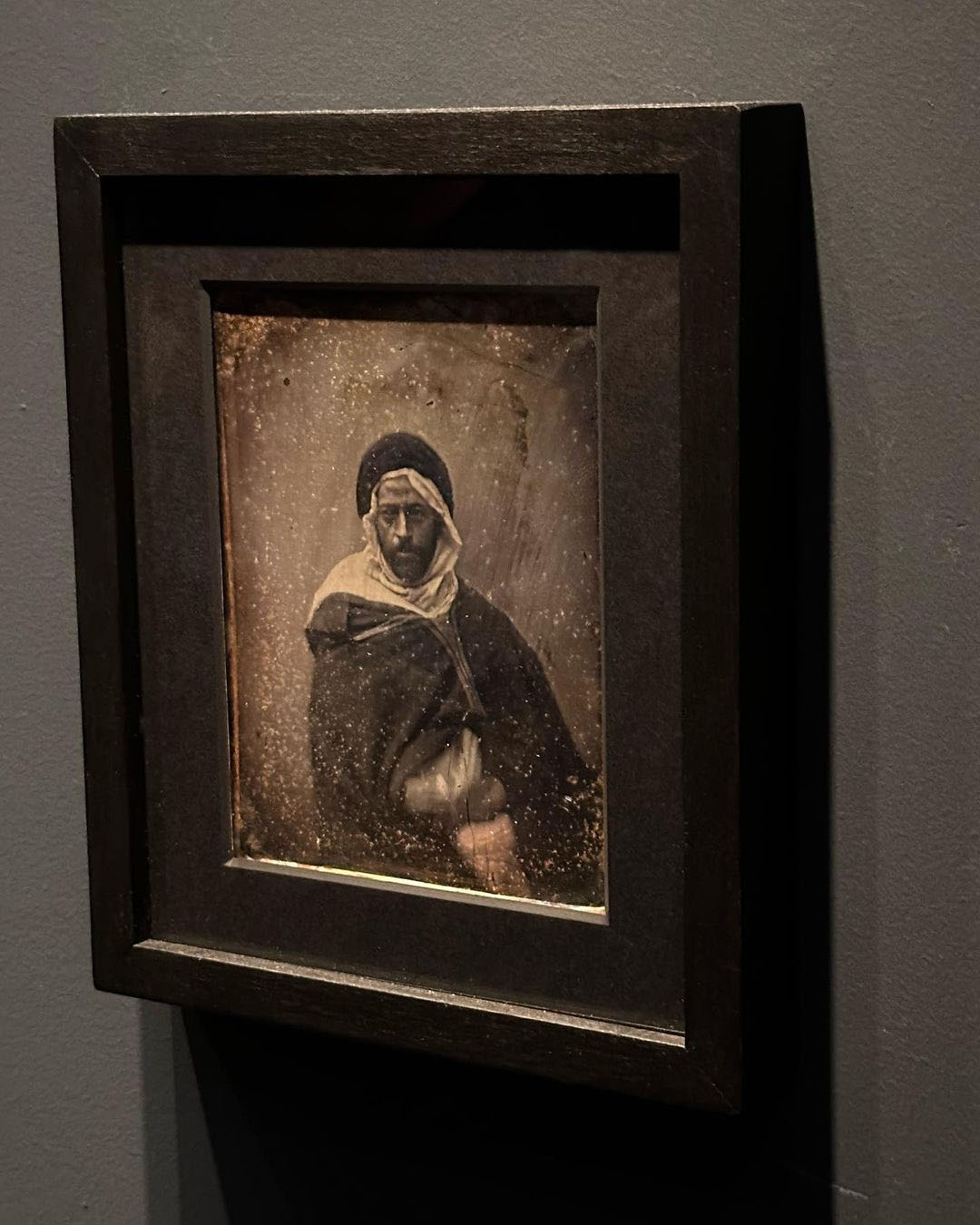
 

Henri Jacquart (French, 1809 died after 1873) 'Mohamed ben Said' Paris, France, 1851 (installation view)


Henri Jacquart (French, 1809 – died after 1873)
Mohamed ben Said (installation view)
Paris, France, 1851
Daguerreotype
© musée du quai Branly – Jacques Chirac
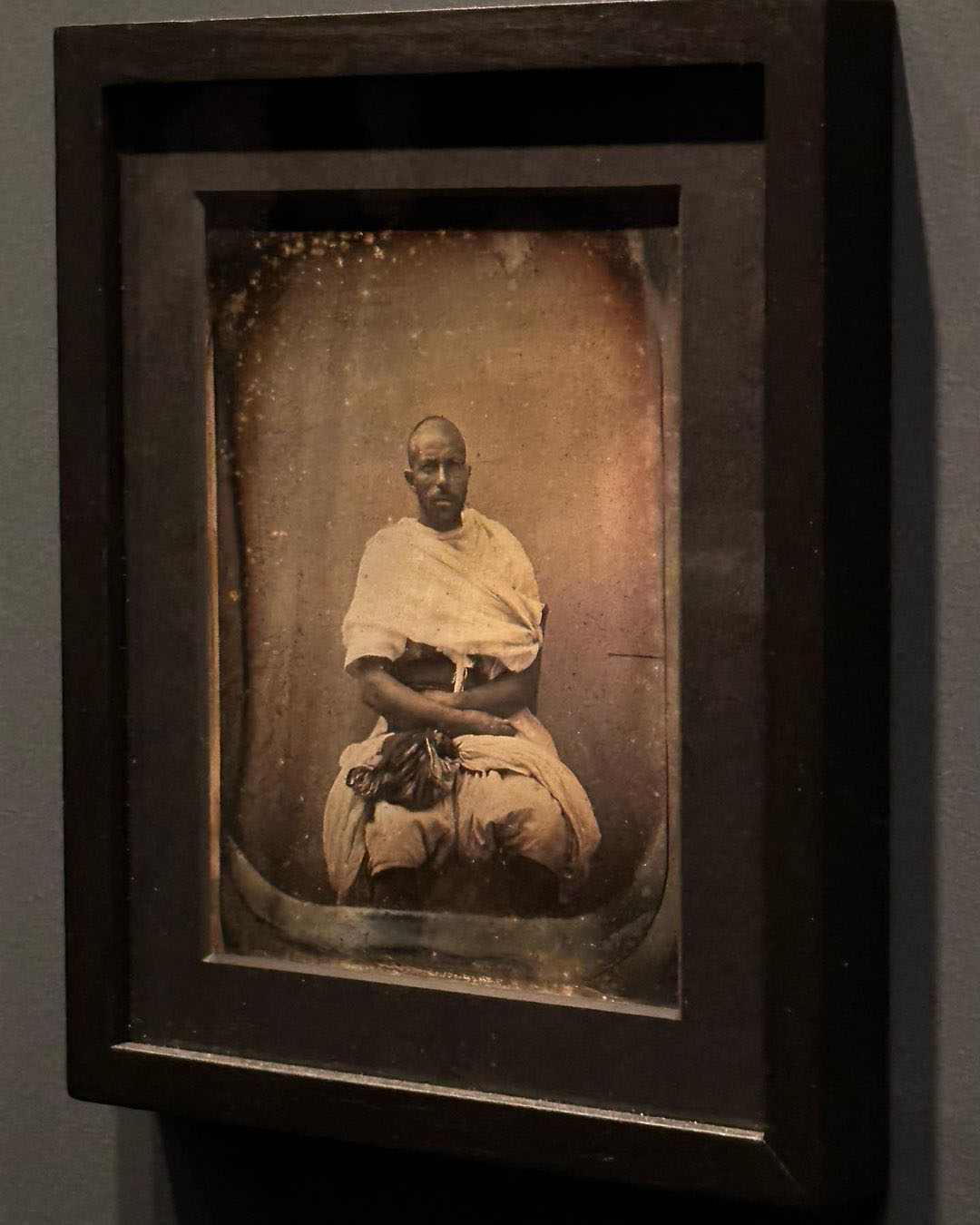
 

Henri Jacquart (French, 1809 died after 1873) 'Ibrahim Nascer, mozabite' Paris, France, September 1851 (installation view)


Henri Jacquart (French, 1809 – died after 1873)
Ibrahim Nascer, mozabite (installation view)
Paris, France, September 1851
Daguerreotype
© musée du quai Branly – Jacques Chirac


Exhibition introduction

There was a time without photography and places without a camera. Even if it is difficult to imagine it today, this period is not so far away.

Since the announcement of its invention in 1839, photography has more or less quickly invaded all visible spaces, penetrated all places on the scale of the globe: familiar places, nearby regions, then neighbouring countries, also the most distant. From the most extraordinary to the most trivial, from the sublime landscape to the content of our plates, nothing was too intimate or too grandiose to escape the desire to create its image.

How did it all start? How did photography come about? propagated, participating in the global geographical imagination? Who are the actors who make up this “world album”?

Since the 1840s, photography has accompanied the countless voyages and scientific and military expeditions. It participates in the visual conquest planetary, in the context of the colonial expansion of the European powers which accelerated in the second half of the 19th century. Description tool landscapes, territorial mapping, it supported the knowledge and population control. But Europe did not have a monopoly on this modern technology. Photography travels, transforms, takes root. In many regions, Mexico, Colombia, West Africa in Madagascar, from Iran to Japan via India, it has been adopted and sometimes adapted to social uses and local cultures to build, control and maintain an image of oneself and one’s environment.

This exhibition proposes to return to some of these stories from the beginnings of photography practiced outside Europe.

First appearances

The first technique that was widely used in the early days photography, between the 1840s and 1850s, takes its name “daguerreotype” of its inventor Louis Jacques Mandé Daguerre. It’s about of a copper plate coated with silver and made sensitive to light. Relatively expensive to manufacture and requiring learning, this technique was widely used to produce portraits. The long exposure time made it difficult to apply it to the landscape. These images are unique because formed directly on the silver plate, they cannot therefore give rise to several tests. The difficulty of their realisation as well as their cost explain their rarity today. European and American practice in its very beginnings, the daguerreotype quickly exported around the world. new technique modifying the relationship to its own image, the daguerreotype is also used as a tool of scientific description. Practiced by travellers and traveling photographers, it was also adopted very early in many photographic studios of major world cities, such as Mexico City, Bogotá and Lima. In Tehran, the daguerreotype is practiced at the court of the Shah of Persia from 1845.

Daguerreotypes for anthropology

If photography is quickly adopted by travellers and offers a new vision of the real world, it also serves a new discipline: anthropology. In France, the first scientific applications of photography to this burgeoning field are experienced in the years 1840-1850. Within the framework of a science then racial, and in a project typology inherited from natural history classification methods, photography is a tool that establishes visual categories, that shape racial stereotypes. Daguerreotypes made on demand from the anthropology laboratory of the National Museum of Natural History show the importance attached by scientists to skulls, casts and human skeletons, central in a discipline marked by the medicine and comparatism. Produced by professionals like Louis-Auguste Bisson, or by employees of the Museum like Henri Jacquart, these examples testify of an objectification of bodies that photography reinforces. These daguerreotypes are produced or collected by the institution in the same way as the portraits of living people.

Text from the exhibition
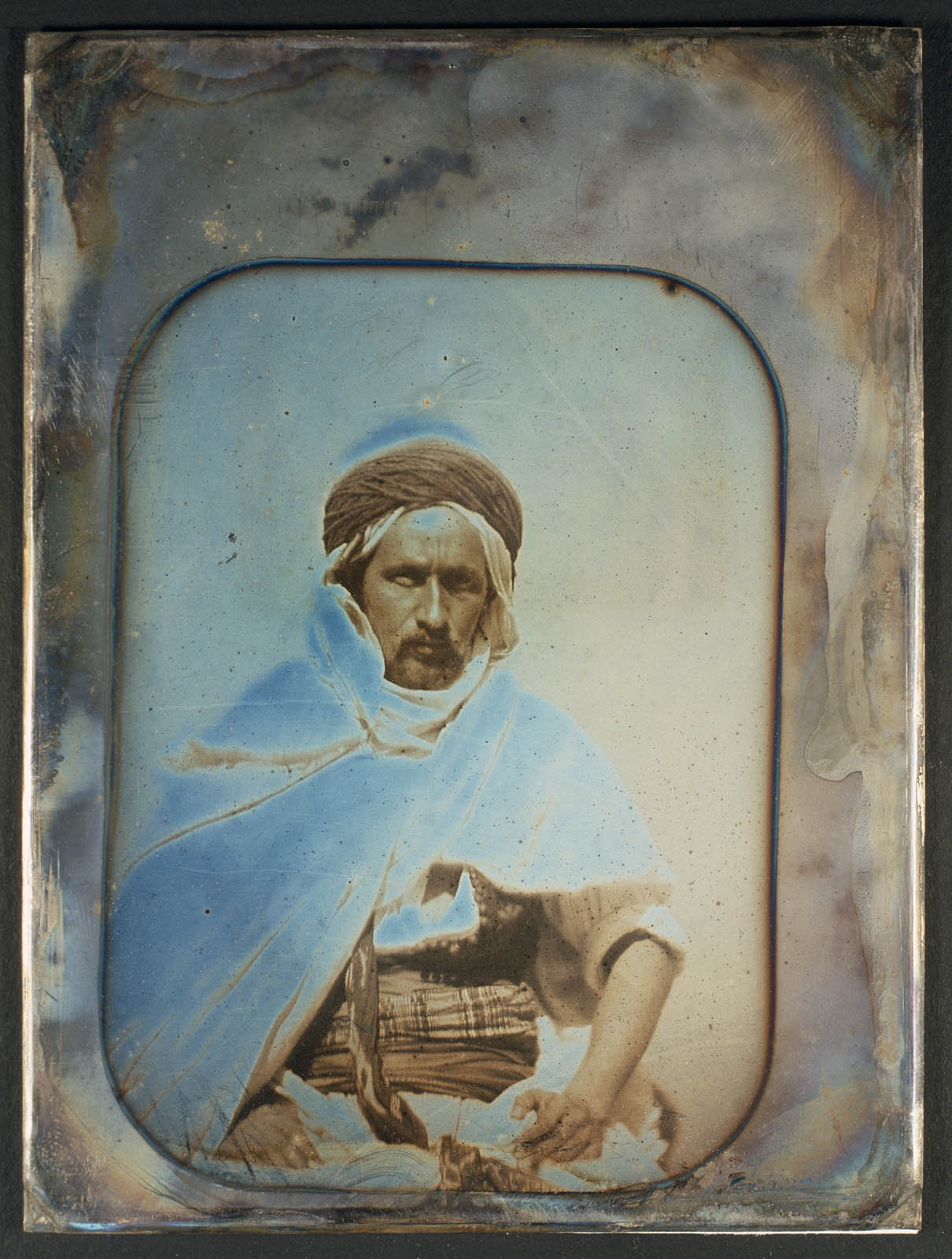
 

Henri Jacquart (French, 1809 died after 1873) 'Ali ben Mohamed, 29 ans, Arab from the plain' September 1851 from the exhibition 'Photographs. An Early Album of the World (1842-1911)' at the musée du quai Branly – Jacques Chirac, Paris, April - July, 2023


Henri Jacquart (French, 1809 – died after 1873)
Ali ben Mohamed, 29 ans, Arab from the plain
September 1851
Daguerreotype
© musée du quai Branly – Jacques Chirac


Henri Jacquart (French, 1809 died after 1873) 'Ali ben Mohamed, 29 ans, Arab from the plain' September 1851 (detail)


Henri Jacquart (French, 1809 – died after 1873)
Ali ben Mohamed, 29 ans, Arab from the plain (detail)
September 1851
Daguerreotype
© musée du quai Branly – Jacques Chirac


Twenty years after the conquest of Algeria, the Arab horsemen have stopped fighting, and are but the shadows of those who for years thwarted the French army. They came to Paris for a show set up by the Museum, Children of the Desert, a fantasia on the Champ de Mars in June, 1851. They too are photographed, and casts of their bodies taken for science – but as popular artists, these horsemen leave their names under their portraits and are paid to pose.

Catherine Darley. “Ghosts (1) – Shadows,” on the Poemas del río Wang blog 10/08/2012 [Online] Cited 07/05/2023
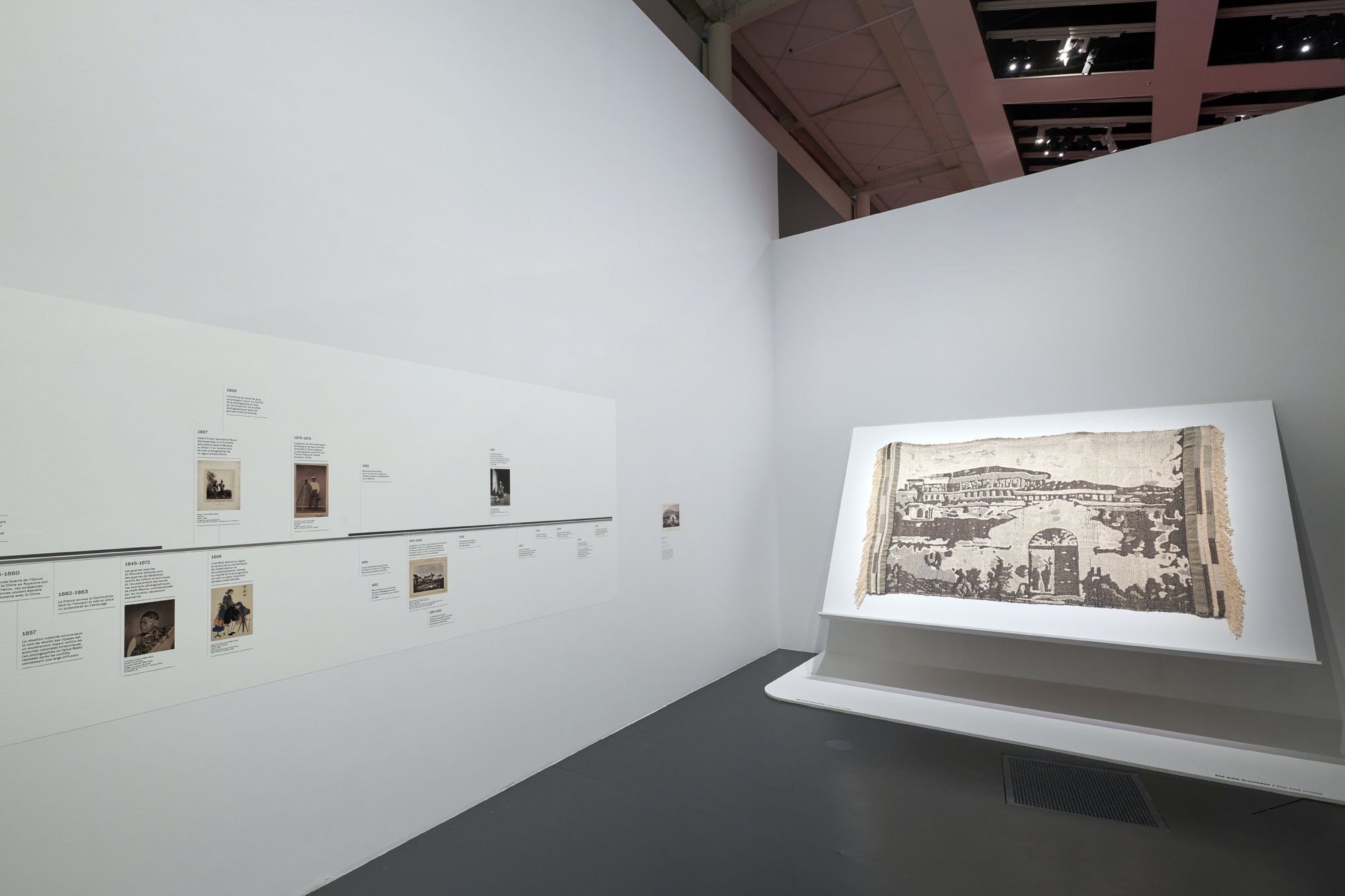
 

Installation view of the exhibition 'Photographs. An Early Album of the World (1842-1911)' at the musée du quai Branly – Jacques Chirac, Paris

Installation view of the exhibition 'Photographs. An Early Album of the World (1842-1911)' at the musée du quai Branly – Jacques Chirac, Paris

Installation view of the exhibition 'Photographs. An Early Album of the World (1842-1911)' at the musée du quai Branly – Jacques Chirac, Paris

Installation view of the exhibition 'Photographs. An Early Album of the World (1842-1911)' at the musée du quai Branly – Jacques Chirac, Paris

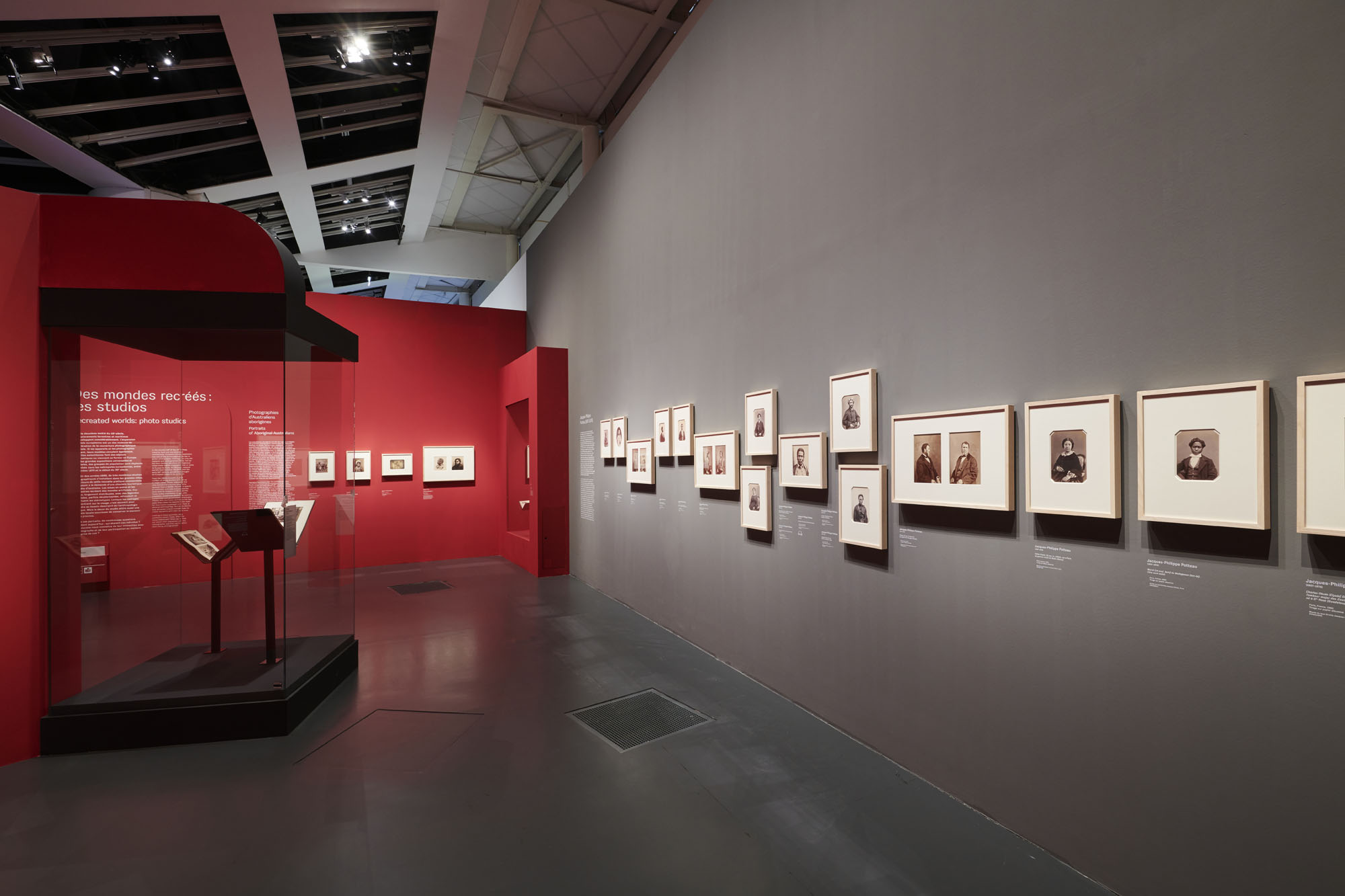
Installation views of the exhibition 'Photographs. An Early Album of the World (1842-1911)' at the musée du quai Branly – Jacques Chirac, Paris showing in the bottom image the section 'Recreated worlds: photo studios'


Installation views of the exhibition Photographs. An Early Album of the World (1842-1911) at the musée du quai Branly – Jacques Chirac, Paris showing in the bottom image the section ‘Recreated worlds: photo studios’ (below)


Recreated worlds: photo studios

In the second half of the 19th century, travel by land and sea developed considerably. European colonial expansion was one of the drivers behind the rise in global photographic coverage, not only did cameras and photographers travel, but so did their models. Members of the Indigenous elites made regular diplomatic trips or came to Europe to study. At the major colonial world’s fairs between 1870 and the early 20th century, groups were brought to European cities to be exhibited.

From the 1860s onwards, a great number of photo studios were set up in major cities. Those involved in this new commercial practice adapted to demand from a tourist clientele in search of exoticism, and sets and accessories were used to recreate artificial worlds. These widely distributed images with simplistic, sometimes demeaning captions, transmitted and perpetuated stereotypes. Photos with the frame centred on the face were often taken to respond to the need for description expressed in the field of physical anthropology. But studio decors also attracted a local clientele keen to create souvenirs with their loved ones.

Looking at these portraits, many questions remain today: Who are these individuals? What can we find out about their interactions with the photographer and their participation when being photographed?

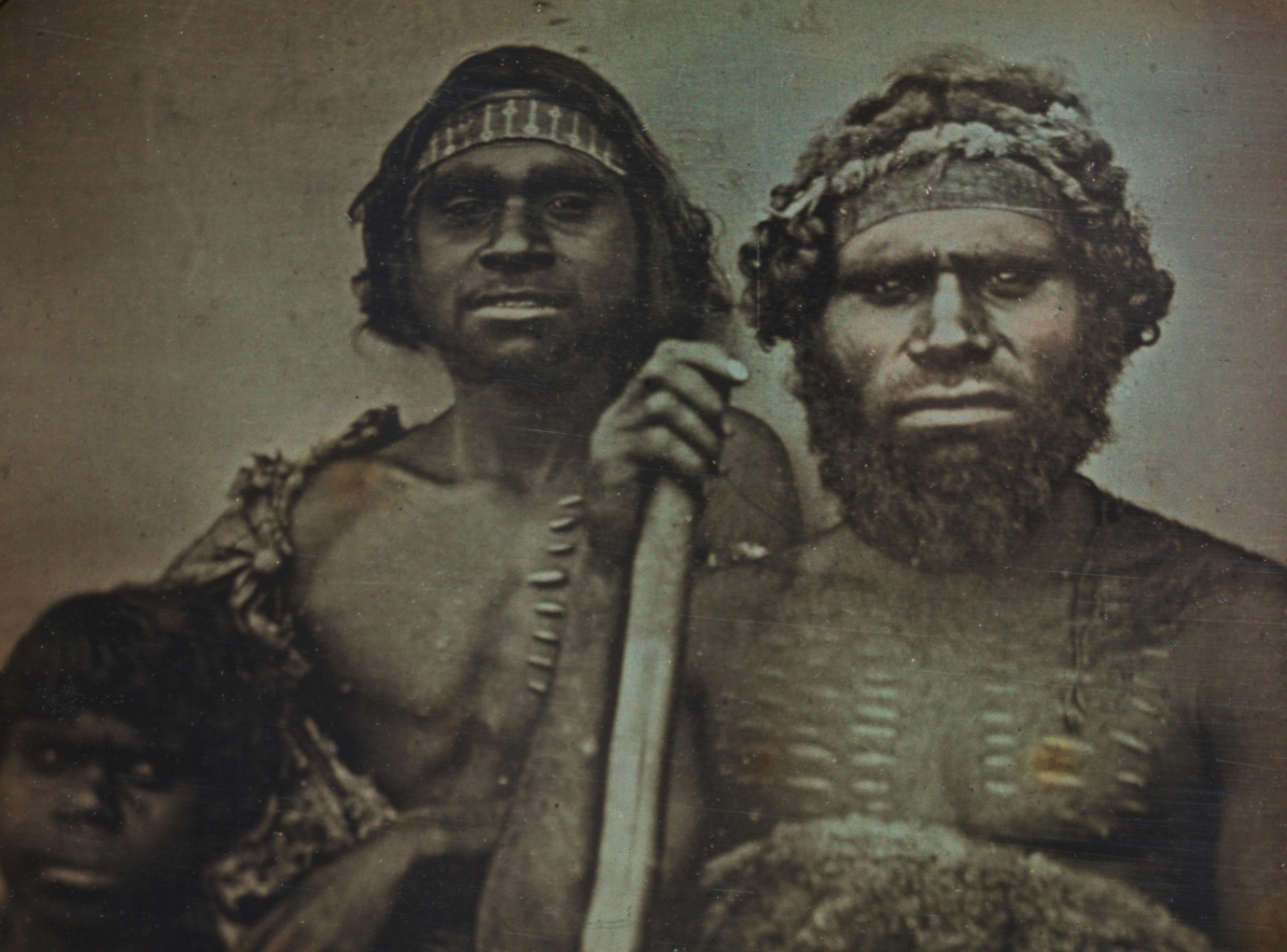
Portraits of Aboriginal Australians

The aboriginal populations were privileged subjects of the first commercial photographers in Australia. Produced in the studio, these portraits obey 19th century racialist scientific interests; they are designed to document what was then considered to be an endangered population. German photographer John William Lindt, based in Grafton, New Wales of the South, produces a series of portraits of the aboriginal populations of Clarence Valley, marketed in the form of portfolios from the 1870s.

Combining exoticism and pictorial tradition, his pictures met with great success. Despite this problematic production context and the sometimes artificial nature stagings, this visual heritage is now a resource important for the descendants of the communities. In Australia, research have been undertaken since the 1990s to obtain information on the models, their identity and their territory of origin. The photography model known as “Mary Ann of Ulmarra” was identified in 2013 as Mary Ann Williams, née Cowan, through research conducted by one of his descendants.

Text from the exhibition
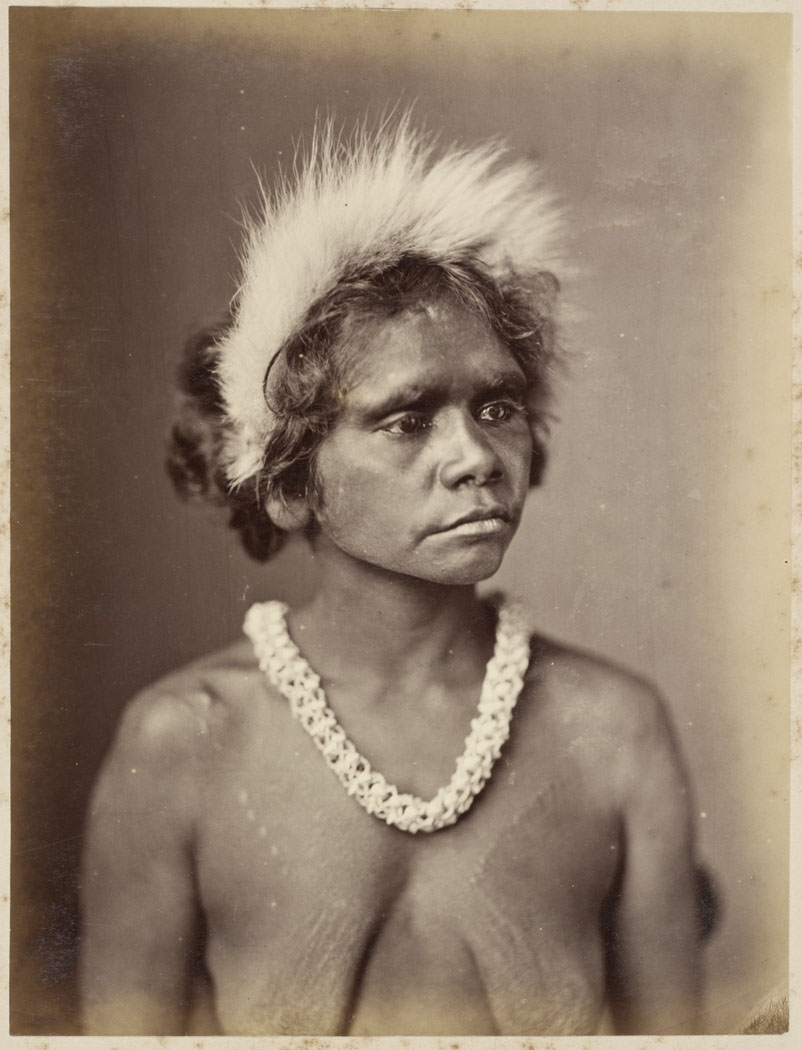
 

John William Lindt (Australian born Germany, 1845-1926) 'Mary Ann of Ulmarra' (Mary Ann Williams, née Cowan) 1873 from the exhibition 'Photographs. An Early Album of the World (1842-1911)' at the musée du quai Branly – Jacques Chirac, Paris, April - July, 2023


John William Lindt (Australian born Germany, 1845-1926)
Mary Ann of Ulmarra (Mary Ann Williams, née Cowan)
1873
Albumen print


Lindt took at least sixty photographs in this series of studio portraits of Clarence River Aborigines, although extant albums usually contain fewer than a dozen each. When first published, these studio tableaux were regarded as accurate. Reference: An Eye for Photography: the camera in Australia / Alan Davies. Carlton, Vic: Melbourne University Press, 2004, p. 60.
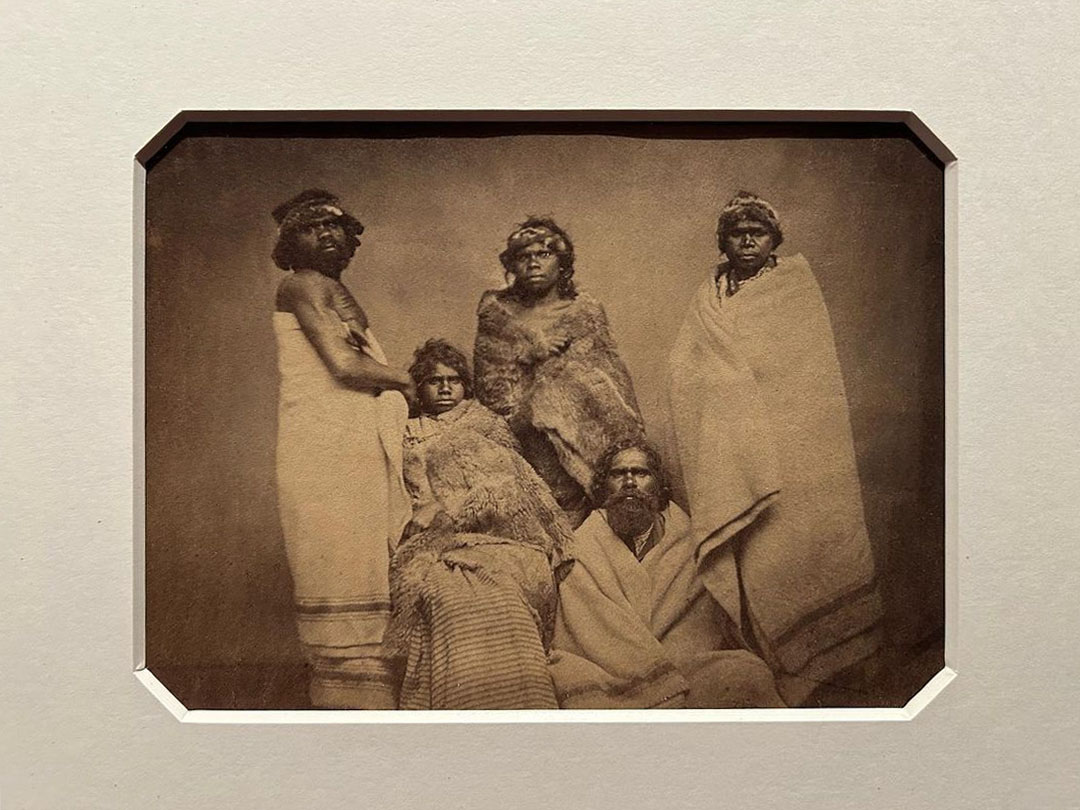
 

Antoine Julien Nicolas Fauchery (French, 1823-1861) and Richard Daintree (Australian born United Kingdom, 1832-1878) 'Untitled (Two Aborginal Australian men and three women posing in front of a studio backdrop)' Victoria possibly Mt Franklin, 1858


Antoine Julien Nicolas Fauchery (French, 1823-1861) and Richard Daintree (Australian born United Kingdom, 1832-1878)
Untitled (Two Aborginal Australian men and three women posing in front of a studio backdrop)
Victoria possibly Mt Franklin, 1858
9.20 x 21.20cm
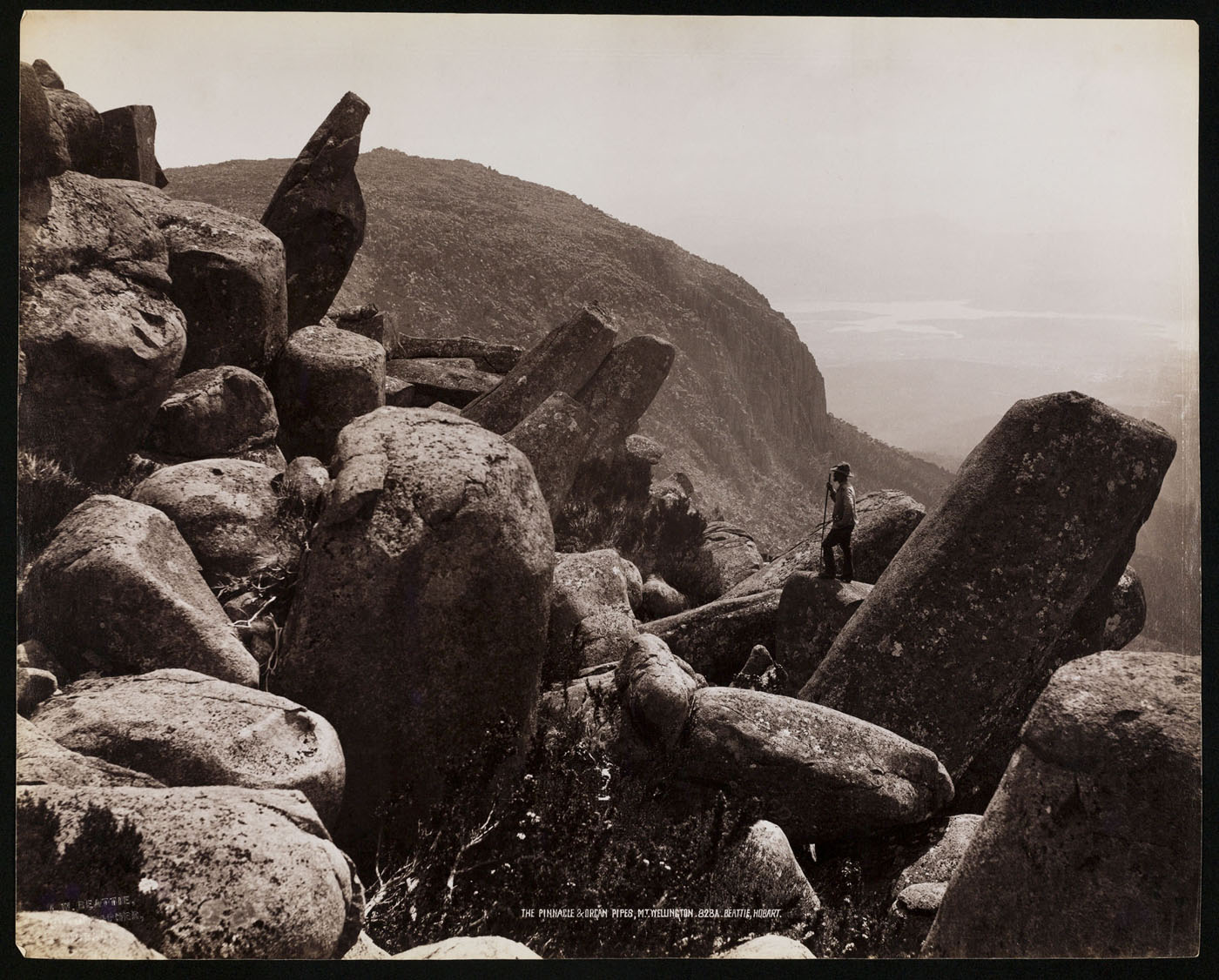
 

John Watt Beattie (Australian born Scotland, 1859-1930) 'The Pinnacle & Dream Pipes, Mt Wellington, Hobart, Tasmania' Australia, 1880-1890


John Watt Beattie (Australian born Scotland, 1859-1930)
The Pinnacle & Dream Pipes, Mt Wellington, Hobart, Tasmania
Australia, 1880-1890
Albumen paper print
© Quai Branly Museum – Jacques Chirac


John Beattie (Australian born Scotland, 1859-1930)

John Beattie (1859-1930) came to Tasmania from Scotland at the age of nineteen, in 1878. Within a year, he was using the brand-new dry-plate photographic technique to take a series of views of Lake St Clair. He joined the Anson Brothers studio, and worked with the three siblings until he bought them out in 1891. In the 1890s he established a museum of curiosities he had collected. The first of the island’s wilderness photographers – with a keen interest in preservation of the environment – Beattie became the ‘official’ photographer for the Tasmanian Government. In addition to his well-known series of photographs of convicts, he made a number of portraits of Aboriginal people, of whom he said ‘for about thirty years this ancient people held their ground bravely against the invaders of their beautiful domain.’

Text from the National Portrait Gallery


Of Scottish origin, John Watt Beattie landed in Australia in 1878. The following year, he moved to Tasmania to a farm in New Norfolk, northwest of Hobart. Feeling more interest in going out in the bush than for the work of the farm, he then devotes himself to the photography of countryside. He was appointed official government photographer of Tasmania in 1896. Able to promote his work, he also enthusiastically supported the development of the tourism industry. In 1906, he traveled to Melanesia, Polynesia and the Norfolk Islands and derives hundreds of widely distributed photographs.

Text from the exhibition


Charles Woolley (Australian, 1834-1922) 'William Lanne' 1866


Charles Woolley (Australian, 1834-1922)
William Lanne
1866
Albumen silver photograph


William Lanne (Oyster Cove clan/Australian, 1834-1869)

William Lanne (1834-1869), also known as King Billy or William Laney, is said to have been Truganini’s third partner. Lanne was captured along with his family in 1842 and taken to the Aboriginal camp at Wybelenna on Flinders Island. He moved for a time to Oyster Cove in 1847, before spending the years until 1851 in a Hobart orphanage. Four years later he joined a whaling ship. Regarded as the last surviving male of the Oyster Cove clan, Lanne died in March 1869 from a combination of cholera and dysentery. Following his death an argument broke out between England’s Royal College of Surgeons and Tasmania’s Royal Society over who should have his remains for scientific purposes. A member of the College of Surgeons, William Crowther, managed to break into the morgue where Lanne’s body was kept, decapitating the corpse, removing the skin and inserting a skull from a white body into the remnants. The Royal Society, discovering Crowther’s work, moved to thwart any further violations by amputating the hands and feet and discarding them separately. In this state, Lanne’s body was buried.

Text from the National Portrait Gallery website


Charles Woolley (Australian, 1834-1922)

Charles Alfred Woolley (17 December 1834-1922) was born in Hobart Town, Tasmania, Australia. He was an Australian photographer but also created drawings, portraits and visual art. He is best known for his photographic portraits of the five surviving Oyster Cove Aboriginal people taken in August 1866 and exhibited at the Intercolonial Exhibition of Australasia colonial exhibition in Melbourne the same year. …

In August 1866, Woolley took photographic portraits in his studio of the five surviving Oyster Cove Aboriginal people which became his best known work. These were exhibited at the Intercolonial Exhibition of Australasia colonial exhibition in Melbourne later that year. Two of the portraits were of Truganini, a female, and William Lanne, also known as King Billy.

These works are now exhibited in the National Library, and the State Libraries of New South Wales, Tasmania and Victoria. James Bonwick’s publication The Last of the Tasmanians (1870) included several of the photographs and shortly after engravings started to appear. Woolley exhibited the prints again in 1875 at the Victorian Intercolonial Exhibition. A few of the original sets survive, mainly in English collections, as well as copies that J. W. Beattie made.

After Lanne’s death in 1869, his grave was desecrated and his body mutilated and a full sized bust was produced by an artist named Francisco Santé. The Evening Mail advertised that it could be seen for a “small fee”. Though Woolley was not known as a sculptor, the Hobart Town Examiner reported that “numerous” busts he had produced were at Walch and Sons and Birchall’s bookshops.

Text from the Wikipedia website


Installation view of the exhibition 'Photographs. An Early Album of the World (1842-1911)' at the musée du quai Branly – Jacques Chirac, Paris showing the section 'Conquering souls and spreading the word' with, at left, three photographs by Augustine Dyer (Australian, 1858-1931) of Papua New Guinea (1884)


Installation view of the exhibition Photographs. An Early Album of the World (1842-1911) at the musée du quai Branly – Jacques Chirac, Paris showing the section ‘Conquering souls and spreading the word’ with, at left, three photographs by Augustine Dyer (Australian, 1858-1931) of Papua New Guinea (1884, see below)


Conquering souls and spreading the word

The movement of colonial conquest also proceeded through missionary work where competition between congregations and between nations played out, much like at the political level. The Pacific was a place of rivalry between the United Kingdom and France. Protestant societies established from 1875 onwards in south-eastern New Guinea found themselves in competition with the Catholic missionaries. National alliances were formed between explorers and missionaries, promoting each other’s work. At the turn of the 19th and 20th centuries, the development of illustrated travel press allowed these heroic stories to be shared with a wide audience. Conferences with photo projections organised by the Geographical and Anthropological Societies were part of this process, combining different sources of images and narratives and establishing a lasting visual culture of the exotic.

Text from the exhibition


Augustine Dyer (Australian, 1858-1931) 'View from Dinner Island, China Strait, H.M. Ships "Nelson" and "Espiègle" at anchor, Papua New Guinea' 1884


Augustine Dyer (Australian, 1858-1931)
View from Dinner Island, China Strait, H.M. Ships “Nelson” and “Espiègle” at anchor, Papua New Guinea
1884
© Musée du Quai Branly – Jacques Chirac


Dyer was the Australian Government Printing Office photographer who went to British New Guinea with John Paine (a studio photographer), for the purpose of recording the British annexation of the territory. He travelled more extensively with Paine in 1884 through PNG visiting Port Moresby, Motu-Motu, Kerepunu, etc.
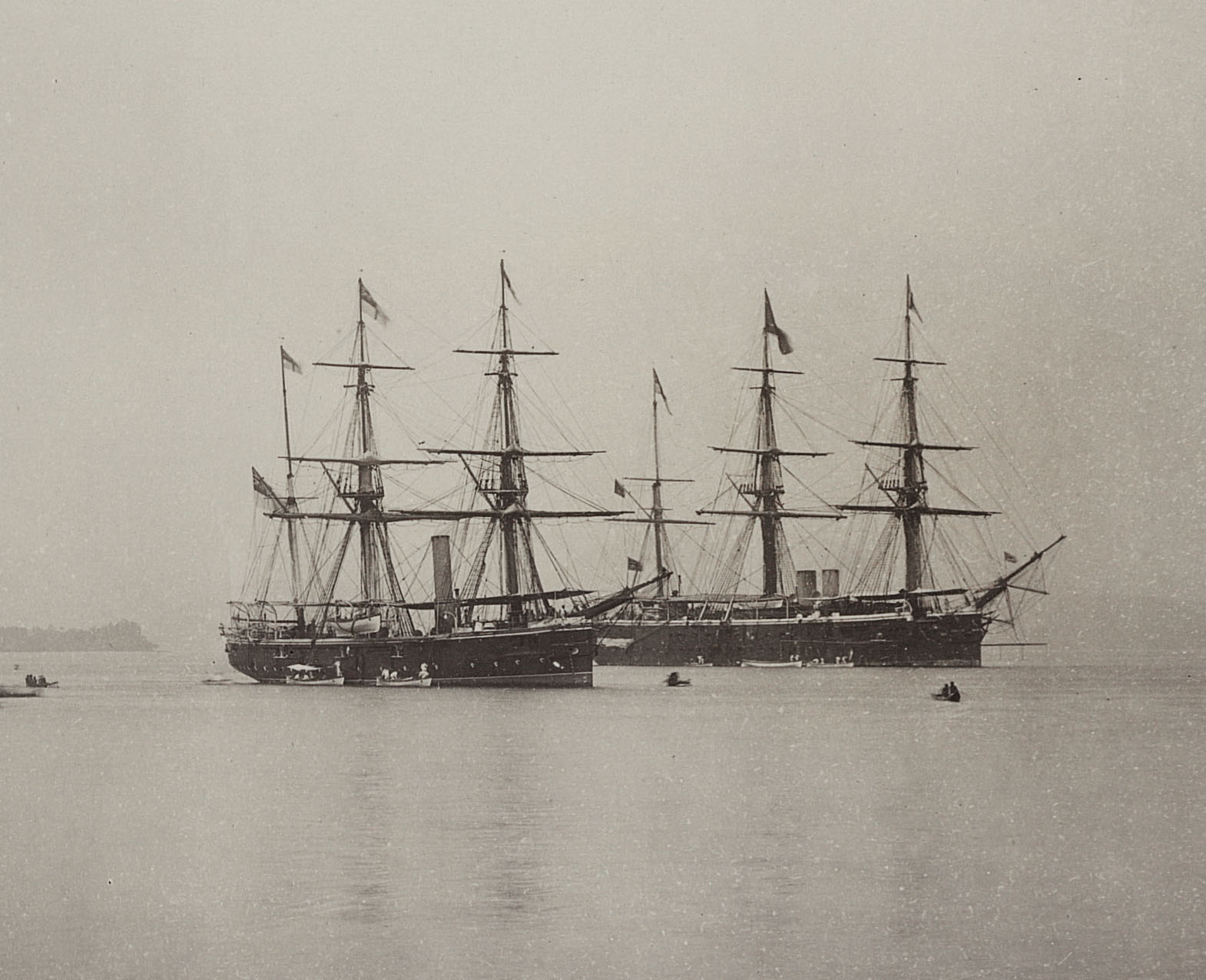
 

Augustine Dyer (Australian, 1858-1931) 'View from Dinner Island, China Strait, H.M. Ships "Nelson" and "Espiègle" at anchor, Papua New Guinea' 1884 (detail)


Augustine Dyer (Australian, 1858-1931)
View from Dinner Island, China Strait, H.M. Ships “Nelson” and “Espiègle” at anchor, Papua New Guinea (detail)
1884
© Musée du Quai Branly – Jacques Chirac


Taking as its starting point the photography collection of the musée du quai Branly – Jacques Chirac, a reference collection for the representation of the extra-European world in the early years of photography, the exhibition focuses on the trajectories and geographies of the medium outside Europe in the 19th century, from its invention. Through a selection of nearly 300 photographs taken between 1842 and 1911 in Asia, Africa, Oceania, and the Americas, it seeks to better understand the phenomenon of the global dissemination of photography and the regional histories of non-European photography.

A visual collection of the world

Many places in the world became accessible through photography after the official announcement of its invention. The technical details of the daguerreotype were revealed in Paris in August 1839 and, in September, the darkrooms were loaded onto ships and crossed the borders of Europe. A tool associated with Western technological modernity, taken on countless voyages and scientific and military expeditions around the world, the medium of photography was used in the second half of the 19th century to investigate everywhere on the globe. From Mexico to Gabon, photography was in turn an instrument of description and the visual appropriation of landscapes and monuments, a tool for knowledge and the control of populations, and an object of diplomacy with the local elite. European colonial expansion was one of the driving forces that greatly accelerated global photography.

Dissemination and local appropriation

The new medium spread throughout the world from the 19th century, with very varied adoption rates in different regions. Europeans were no longer the only ones experimenting with, commissioning and marketing photography. Its local roots can be linked to the relations of countries with the West and to the relationship of societies to images. The exhibition, which presents the work of European and local photographers on four continents, seeks to better understand the development and appropriation of the medium around the world on a local scale by bringing to light lesser-known photographers, sponsors, phenomena and photographic forms, in an attempt to rebalance a history of photography that too often focuses on Europe and the United States. In many regions, from Colombia to West Africa to Madagascar, and from Iran to Japan to India, photography was adopted and sometimes adapted to social uses and local cultures and in many places seems to satisfy the desire for self-representation and the construction of modern identities. If cameras and photographers travelled, their models also travelled. The indigenous elites made regular diplomatic visits or came to Europe for training. From the 1860s, many photography studios were set up in large cities to meet the demands of tourists looking for exoticism. But the studios’ decor also attracted a local clientele wanting to preserve the memory of their loved ones.

How far should photography be taken?

The 19th century in Europe was characterised by a need to accumulate objects, knowledge and also territory. Through photography, landscapes became lands to be mapped and conquered, and their inhabitants subjects to be studied. In the scientific field, the natural history model influenced the use of photography. It contributed to the myth of virgin territories and was a tool in the growing geographical discipline, making claims of exhaustivity: see everything, photograph everything. But this thirst for images, which began in 1840 in Europe and then spread rapidly throughout the world, met with contrasting situations. From the beginning, the question of limits arose: how far to go, under what conditions and for what purposes should a photograph be taken? This was sometimes a technical challenge, but above all an ethical question when it involved showing the horrors of wars or producing the image of scenes or objects that were supposed to remain hidden. Some photographers may have tricked, coerced or negotiated to get an image.

The selection of works, mostly taken from the quai Branly photography collection, highlights the diversity of photographic practices outside Europe at their origins and reveals early testimonies of indigenous photographers. By revealing the scientific, military and commercial uses, as well as the memorial and social functions of photography, and by presenting a wide range of objects and techniques, the exhibition invites us to re-examine today the meaning of the photographic gesture in these different non-European contexts.

Publication

Mondes photographiques, histoires des débuts

The book that accompanies the exhibition broadens its scope of study to offer the first decentralised history of early world photography. Taking as its base the photography collection of the musée du quai Branly – Jacques Chirac, a reference collection for the representation of the extra-European world in the early years of photography, it deepens this study to focus on the trajectories and geographies of the medium outside Europe from the 19th century. Co-publication musée du quai Branly – Jacques Chirac / Actes Sud 400 pages. €69

Text from the musée du quai Branly – Jacques Chirac


Eugene Thiesson (French, 1822-1877) 'Botocudo' 1844


Eugene Thiesson (French, 1822-1877)
Botocudo
1844
Daguerreotype
10.5 x 8cm
© Quai Branly Museum – Jacques Chirac


Eugene Thiesson (French, 1822-1877)

In 1844, two Brazilian Indians were brought to France by a certain Mr. Porte and are going to stay in Paris for a few months. This man baptised Manuel (and the young woman baptised Marie) in the press, will arouse interest certain among the anthropologists of the Natural History Museum. Werner, painter from the Museum, paints their portrait in watercolour, while Thiesson photographs them using the daguerreotype. They also lend themselves at a moulding session in the anthropology laboratory. The five daguerreotypes that remain today from the photography session show us two people with the top of the body undressed, and the bottom dressed of what appears to be European clothing.

Text from the exhibition


This man from the Canaries counts among the very first non-Europeans to have been photographed, probably in Paris. His portrait illustrates the first scientific publication offering daguerreotypes to visually appreciate the anatomic characteristics of human skulls. The Botocudo Indian from Brazil was photographed in Lisbonne, in 1844, but he visited Paris; his name was Manuel, and his wife was Maris. They lodged with some man called Porte, who brought them to the Museum. There, people wanted to make casts of their faces, their torsos, their arms and legs. Manuel and Marie walked across Marville’s Paris – across that city that was to disappear; they walked on the Boulevard du Temple and might have even visited the theaters. Actors, spectators? Dressed, costumed, naked? Under applause, mockery, examination, or measurement?

Catherine Darley. “Ghosts (1) – Shadows,” on the Poemas del río Wang blog 10/08/2012 [Online] Cited 07/05/2023. Used under fair use conditions for the purposes of education and research


Luis Garcia Hevia (Colombian, 1816-1887) 'Untitled (portrait of a man)' c. 1843-1850


Luis Garcia Hevia (Colombian, 1816-1887)
Untitled (portrait of a man)
c. 1843-1850
Colourized daguerreotype, mounted under passe-partout and under glass, encased in a gutta-percha box
Dimensions of the plate: 7.5 x 10cm
Dimensions of the assembly: 10 x 12.4cm
Dimensions with box open: 20.2 x 12.4cm
© Quai Branly Museum – Jacques Chirac


Luis Garcia Hevia (Colombian, 1816-1887)

Luis Garcia Hevia is the first Colombian photographer and daguerreotypist. He exhibited his first “two essays of daguerreotypes” at the exhibition of industry in Bogota in November 1841. He was also a painter and miniaturist.

Recreated Worlds: The Studios

In the second half of the 19th century, land and sea travel grow considerably. European colonial expansion is one of the driving forces behind the acceleration of global photographic coverage. If cameras and photographers travel, their models also travel. The indigenous elites make regular diplomatic visits or come to
train in Europe. During major universal and colonial exhibitions, population groups are moved and exhibited in European metropolises, between the 1870s and the beginning of the 20th century.

From the 1860s, many photographic studios set up in the big cities. The actors of this new commercial practice adapt to the demand of a tourist clientele in search of exoticism. Staging and props recreate artificial worlds. When the framing refocuses on the face, it is often to respond to the descriptive need of physical anthropology. But the decor of the studio attracts also a local clientele anxious to preserve the memory of their loved ones.

Faced with these portraits, many questions persist today: who were these individuals? What can we know of their interaction with the photographer and their participation at the time of the shot?
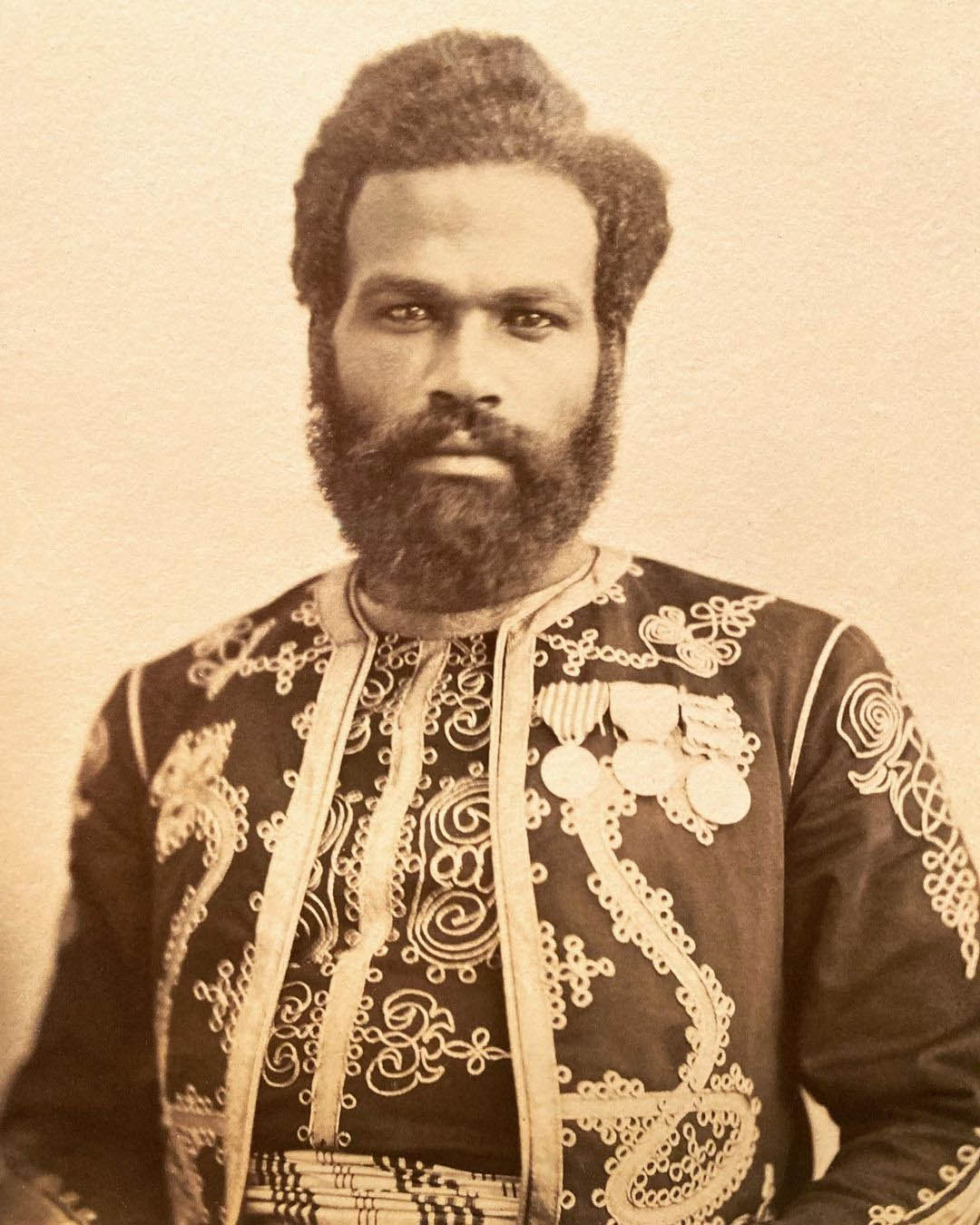
 

Jacques-Philippe Potteau (French, 1807-1876) 'Charles Ozbee' Nd


Jacques-Philippe Potteau (French, 1807-1876)
Charles Ozbee
Nd
© Quai Branly Museum – Jacques Chirac


Jacques-Philippe Potteau (1807-1876)

In photography, the portrait genre has from the outset brought together goals and very different situations. Like today, it may have been used at recreational or law enforcement purposes, as a personal memento or as a means of recording. The very ambiguity of the medium lies in this possible permeability of domains: a family album image can leave the private sphere, a photograph made for an anthropological description can sometimes also be a true portrait, shedding light on the personality of its subject.

The images of Jacques-Philippe Potteau, produced for scientific purposes between 1860 and 1869 at the National Museum of Natural History in Paris, confer a undeniable dignity to their models, sometimes photographed as part of diplomatic functions (embassies of India, Siam, Japan). Jean Lagrêne, Philippe Colarossi are closely associated with the artistic world, as models. If Jacques-Philippe Potteau, a technician employed by the Museum, took care to note the names of the people he photographs, the reason for their presence in the photographic workshop, or in the Parisian capital is not always known to us. This is currently under research.

Text from the exhibition
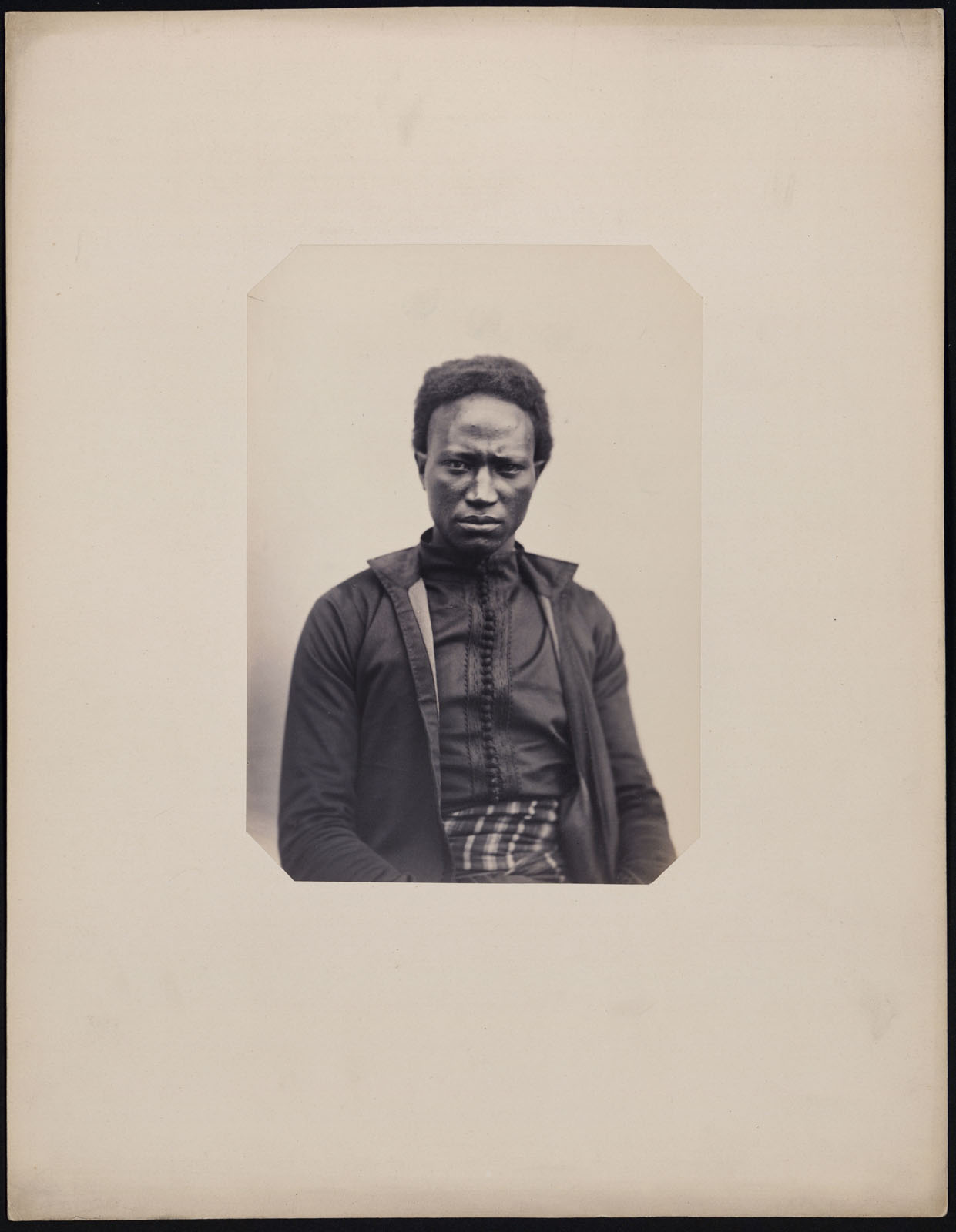
 

Jacques Philippe Potteau (French, 1807-1876) 'Mostapha Ahmed (21), Nubian born in Mudrici d'Ungle' Paris, France, 1862


Jacques Philippe Potteau (French, 1807-1876)
Mostapha Ahmed (21), Nubian born in Mudrici d’Ungle
Paris, France, 1862
Print on albumen paper
18 x 12.7cm
© Quai Branly Museum – Jacques Chirac


Jacques-Philippe Potteau was a member of the anthropology department of the Muséum d’histoire naturelle, Paris. Between 1860 and 1869 he made a series of ethnographic portraits for the museum under the collective title Collection anthropologique du Muséum de Paris. In 1862 Potteau succeeded Louis Rousseau as the departmental photographer. Potteau showed his work at the London Photography Exhibit in 1862 and 1863, and the 1863 Paris International Photography Exhibit.


Jacques Philippe Potteau (French, 1807-1876) 'Mostapha Ahmed (21), Nubian born in Mudrici d'Ungle' Paris, France, 1862 (detail)


Jacques Philippe Potteau (French, 1807-1876)
Mostapha Ahmed (21), Nubian born in Mudrici d’Ungle (detail)
Paris, France, 1862
Print on albumen paper
18 x 12.7cm
© Quai Branly Museum – Jacques Chirac
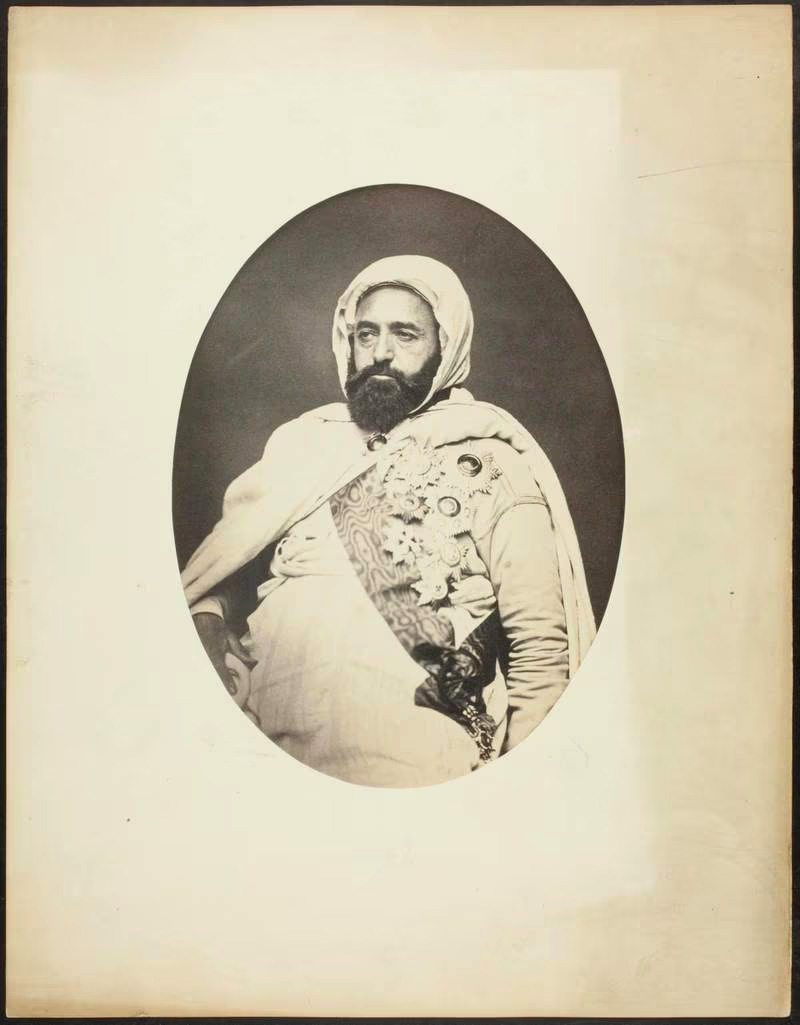
 

Jacques Philippe Potteau (French, 1807-1876) 'Emir Abd el-Kader (57), born in Maskara (Province of Oran, Algeria)' Paris, 1865


Jacques Philippe Potteau (French, 1807-1876)
Emir Abd el-Kader (57), born in Maskara (Province of Oran, Algeria)
Paris, 1865
Albumen paper print
Paris, musée du quai Branly – Jacques Chirac
Crédit photo: © musée du quai Branly – Jacques Chirac, Dist. RMN – Grand Palais / image musée du quai Branly – Jacques Chirac


Capture the distance

As early as the 1840s, cameras were on board on expedition ships departing from Europe. sailors, explorers, archaeologists, missionaries, artists are among the first experimenters of this new technology in remote regions, which are gradually passing under the yoke of the colonial powers. From Mexico to Gabon, photography is in turn an instrument of description and visual appropriation landscapes and monuments, a knowledge and control tool populations, or even an object of diplomacy vis-à-vis the local elite.

If the camera records with the same acuity the architectural detail, the landscape grandiose and the faces crossed, the authors gathered here turn out to be excellent technicians with a personal eye. Their travelogues relate the difficulties overcome: technical challenges, climatic constraints or even reluctance of local populations to pose. But these spectacular images, carried out in more or less accessible places, are also the result of a collaboration with many less visible local intermediaries: guides, interpreters, informants or porters – necessary to transport photographic equipment – ​​played a decisive role.

Text from the exhibition


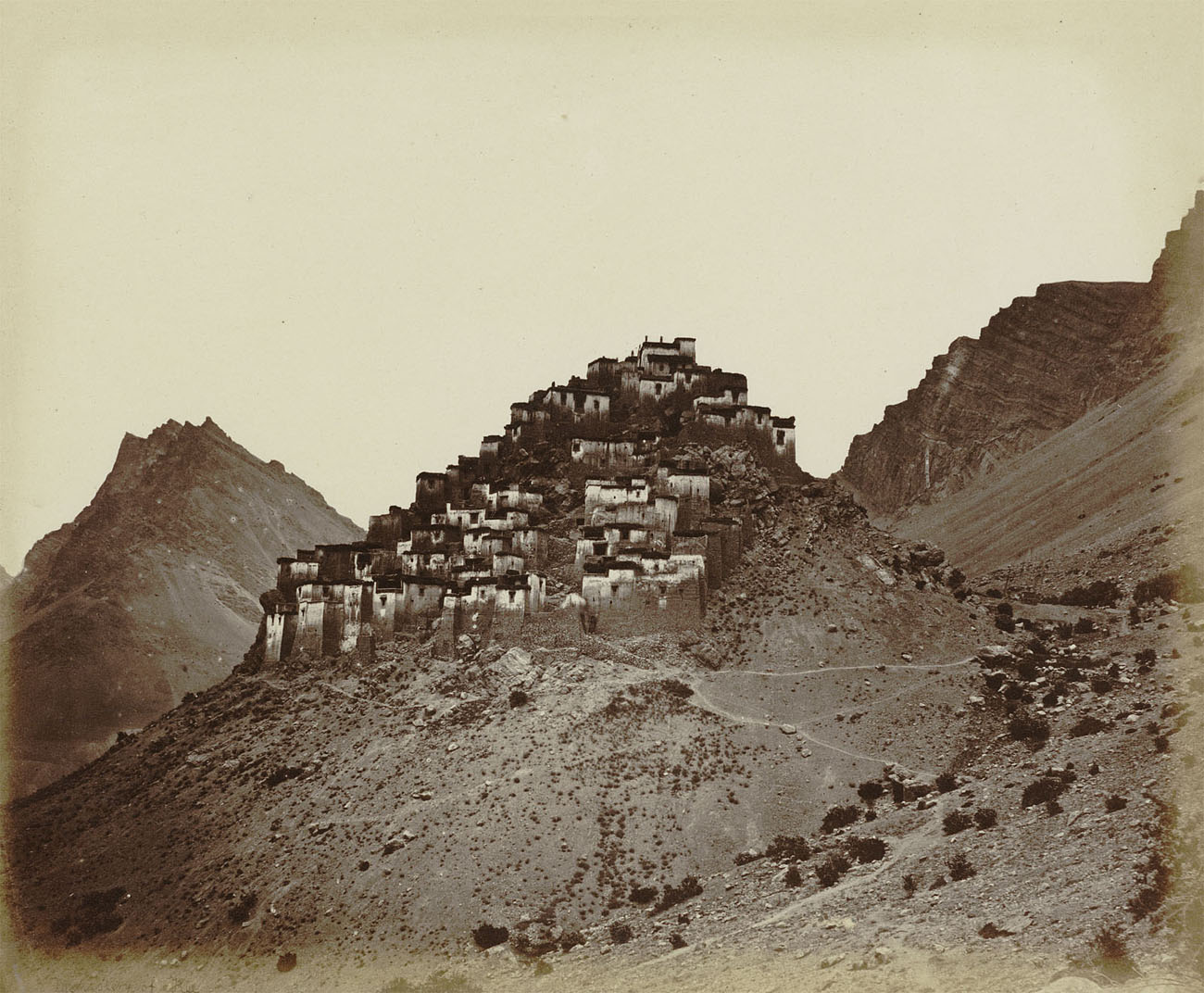
Philip Henry Egerton (Welsh, 1824-1893) '"Kee Monastery", Pl. 22, Journal of a tour through Spiti, to the frontier of Chinese Tibet' Tibet, 1863


Philip Henry Egerton (Welsh, 1824-1893)
“Kee Monastery”, Pl. 22, Journal of a tour through Spiti, to the frontier of Chinese Tibet
Tibet, 1863
Album comprising 37 albumen prints
Dimensions of the album: 29 x 38.4cm
Dimensions of the prints: 21.6 x 26.7cm
© Quai Branly Museum – Jacques Chirac
 

Philip Henry Egerton (Welsh, 1824-1893) '"Kee Monastery", Pl. 22, Journal of a tour through Spiti, to the frontier of Chinese Tibet' Tibet, 1863 (detail)


Philip Henry Egerton (Welsh, 1824-1893)
“Kee Monastery”, Pl. 22, Journal of a tour through Spiti, to the frontier of Chinese Tibet (detail)
Tibet, 1863
Album comprising 37 albumen prints
Dimensions of the album: 29 x 38.4cm
Dimensions of the prints: 21.6 x 26.7cm
© Quai Branly Museum – Jacques Chirac


Philip Henry Egerton (Welsh, 1824-1893)

The Briton Philip Henry Egerton worked for most of his life as senior civil servant for the colonial regime in northern India. He realises these photographs during a semi-official mission in the Himalayas, trying identify alternative routes for the wool trade across the border

India and Chinese Tibet. The Kangra and Kullu valleys, as well as the sites of Spiti and the Bara Shigri glacier are thus photographed for the first time. The images are published, accompanied by the story of their author, in 1864, with the support of the government of Punja.

Text from the exhibition


Philip Henry Egerton (Welsh, 1824-1893) 'Shigri Glacier – From the River (Main View)' Negative June - August 1863; print 1863-1864


Philip Henry Egerton (Welsh, 1824-1893)
Shigri Glacier – From the River (Main View)
Negative June – August 1863; print 1863-1864
From Journal of a Tour Through Spiti, To The Frontier of Chinese Thibet, With Photographic Illustrations
Albumen silver print
21.6 × 26.5cm (8 1/2 × 10 7/16 in.)
Credit Line: The J. Paul Getty Museum, Los Angeles
Public domain


Philip Henry Egerton (Welsh, 1824-1893) 'Shigri Glacier – Lower View' Negative June - August 1863; print 1863-1864


Philip Henry Egerton (Welsh, 1824-1893)
Shigri Glacier – Lower View
Negative June – August 1863; print 1863-1864
From Journal of a Tour Through Spiti, To The Frontier of Chinese Thibet, With Photographic Illustrations
Albumen silver print
21.6 × 26.5cm (8 1/2 × 10 7/16 in.)
Credit Line: The J. Paul Getty Museum, Los Angeles
Public domain


Désiré Charnay (French, 1828-1915) 'Palace of governor in Uxmal Yucatán' Mexico, June 1860


Désiré Charnay (French, 1828-1915)
Palace of governor in Uxmal Yucatán
Mexico, June 1860
Assembly of two prints on paper albumen
32.8 x 84.8cm
© Quai Branly Museum – Jacques Chirac


Desire Charnay (French, 1828-1915)

Improvised archaeologist and photographer with a taste for travel, Désiré Charnay is known to be the first to have brought back from several archaeological sites Mexicans a harvest of spectacular images. He uses the process of the negative on wet collodion glass, which requires him to carry heavy equipment. His fame was ensured by the publication, in 1861-1862, of the album photographic American cities and ruins.

Local stories and self-images

Europeans are not the only ones to experiment, order and market photography from the 19th century. The new medium is spreading to scale across the globe and has very variable rates of adoption depending on the region. Its local roots can be linked to the countries’ relations with the West or the relationship of societies to images. In Qajar Iran, in Siam (Thailand present day), in the princely courts of India and Java, royalty has been a patron enthusiast of photography and accelerated its growth by designating official photographers and importing equipment. The leaders take awareness of the potential of photography for the representation of power and the assertion of their authority. In India, Japan, China, West Africa and in Madagascar, indigenous photographers are getting professional training to practice, open their commercial studio in the major port cities, and very often work for a wider clientele, among the local and colonial elite. Photography is appropriate and adapted to social uses, it sometimes mixes to local visual traditions – such as painting or calligraphy – and seems in many places respond to the desire for self-representation and construction modern identities.

Royal appropriations of photography in Iran and Thailand

The monarchs Naser al-Din Shah (r. 1848-1896), in Iran, and Mongkut in Siam (Rama IV, r. 1851-1868), seduced by the technology and the possibilities of dissemination of the royal image, were important patrons. Naser al-Din Shah, defender of the arts and open to Europe, initiated himself into the practice, becoming an amateur keen. It promotes the development of photography through the diversity of actions which he led: in 1858, he established the Royal Photography Workshop within the of the Golestan Palace in Tehran, promotes the teaching of technique at school polytechnic of Dar ol-Fonoun, imports equipment, translates manuals, and appoints official court photographers who are given the title of Akkasbashi. Siam’s science-savvy King Mongkut also ramps up production photography at court. The Thai Francis Chit, who receives the title of “photographer of His Majesty the King of Siam”, produced several portraits of the royal family and views of official court events.

Text from the exhibition


Anonymous photographer. 'Half-length portrait of a 77-year-old man' Kyoto area, Japan, February 1890

Anonymous photographer. 'Half-length portrait of a 77-year-old man' Kyoto area, Japan, February 1890


Anonymous photographer
Half-length portrait of a 77-year-old man
Kyoto area, Japan, February 1890
Ambrotype
11 x 8.5cm
© Quai Branly Museum – Jacques Chirac


In Japan, a considerable boom during the Meiji era (1868-1912)

In Japan, photography developed as soon as the country opened up to trade international in 1859, and experienced considerable growth during the Meiji era (1868-1912), period of great modernisation. Uchida Kuichi and Ueno Hikoma, trained in Nagasaki, are among the most famous Japanese photographers of their time. They have developed a unique style with a pronounced taste for theatricality and sometimes humour. The production of ambrotypes, known as garasu shashin – “photography on glass” – is experiencing a particular boom in the field portraiture from the 1860s. Unique objects, they are mounted in boxes in raw paulownia wood, with traditional geometric shapes simple, used to preserve calligraphy or personal property.

The ambrotypes were intended for the private sphere of Japanese families, wishing to pass on the portraits of their loved ones as an inheritance. The tekagami-style accordion albums, richly decorated with gilding and sophisticated paintings, originally planned to accommodate calligraphy, have been diverted from their traditional use to receive prints large format photographs of Ichida Sota and Suzuki Shin’ichi II.


Anonymous photographer. 'Half-length portrait of a 77-year-old man' Kyoto area, Japan, February 1890 (detail)


Anonymous photographer
Half-length portrait of a 77-year-old man (detail)
Kyoto area, Japan, February 1890
Ambrotype
11 x 8.5cm
© Quai Branly Museum – Jacques Chirac
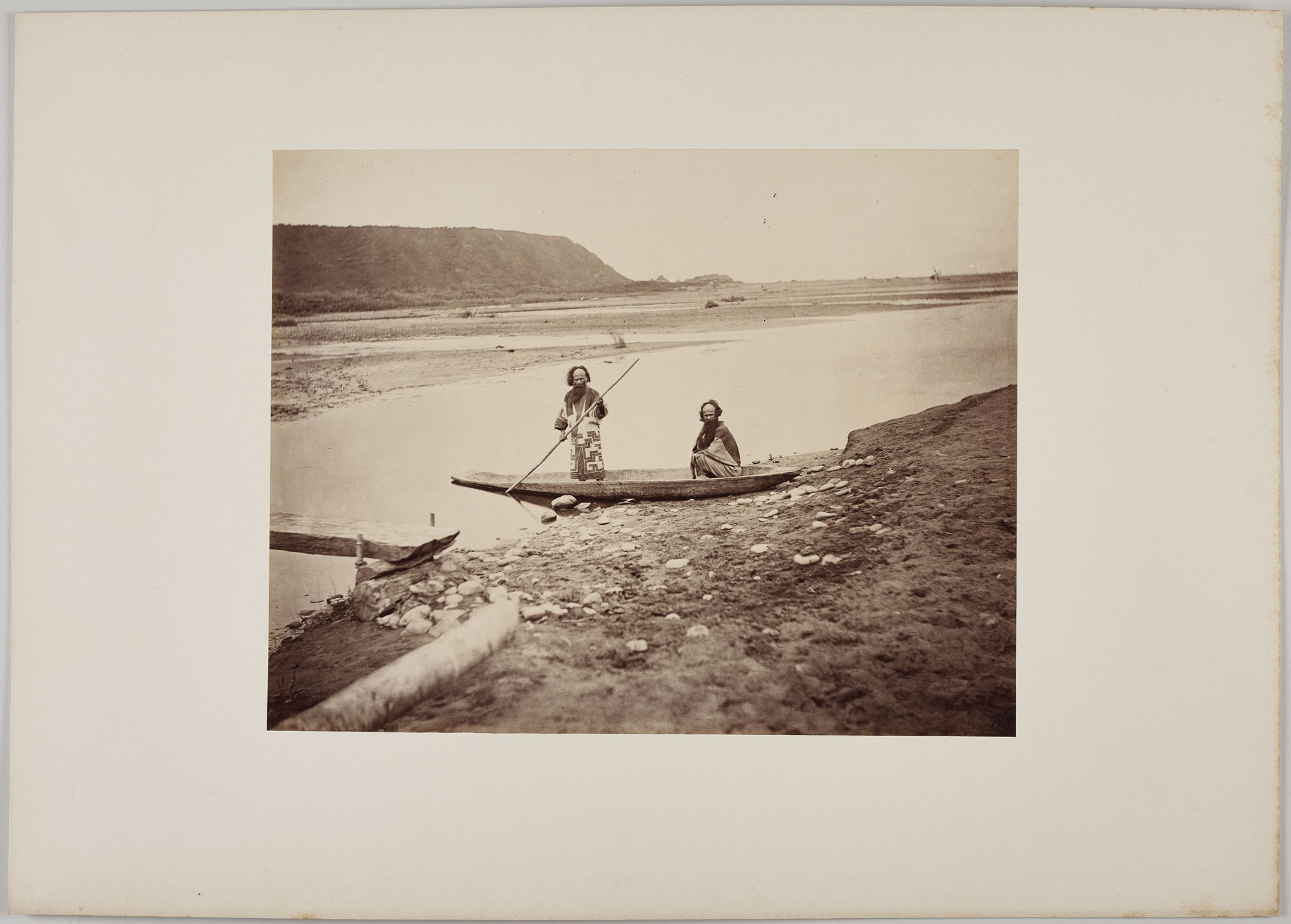
 

Tamoto Kenzō (Japanese, 1832-1912) 'Ainu with boat' Hokaido, Japan, c. 1874


Tamoto Kenzō (Japanese, 1832-1912)
Ainu with boat
Hokaido, Japan, c. 1874
© Kenzo Tamoto
© Quai Branly Museum – Jacques Chirac


Tamoto Kenzō (Japanese, 1832-1912)

Tamoto Kenzō (田本 研造, 1832-1912) was a Japanese photographer. He was born in Kumano, in the Mie Prefecture of Honshu. When he was twenty-three, he moved to Nagasaki to study western culture. In 1859, he relocated to Hakodate, where he lost a foot due to frostbite. The surgeon who amputated his foot had an interest in photography, specifically ambrotypes, and Tamoto became his apprentice. It was not until 1866 that he began working as a photographer. In 1867, he photographed the construction of the last castle to be built in Japan, Fukuyama Castle. Tamoto took photographs of military leaders Enomoto Takeaki and Hijikata Toshizō during the Battle of Hakodate between 1868-1869. Tamoto opened his own portrait studio in Hakodate in 1869. Starting in 1871, he documented the improvements to infrastructure in the Hokkaido region, eventually presenting 158 photographs of the process to the Settlement Office.

Text from the Wikipedia website


Tamoto Kenzō (Japanese, 1832-1912) 'Ainu with boat' Hokaido, Japan, c. 1874 (detail)


Tamoto Kenzō (Japanese, 1832-1912)
Ainu with boat (detail)
Hokaido, Japan, c. 1874
© Kenzo Tamoto © Quai Branly Museum – Jacques Chirac


In India, a technology adopted by the elites

Introduced in India in 1840, photography was used by the authorities British and quickly adopted by the Indian elite. Studios set up in major port cities like Bombay, Madras and Calcutta. Active members of the Photographic Society of Bombay, Narayan Dajee and Hurrychund Chintamon are among the first native photographers to practice from the 1850s with the local elite, Brahmans, members of the government, and at the same time participate in colonial projects ethnographic documentation. The technology aroused enthusiasm very early on many maharajas. Famous Indian photographer Lala Deen Dayal received the title of official photographer of the ruler of Hyderabad in 1884. In some princely states like Indore, Udaipur and Mewar, photography of painted court is a great success and is part of the tradition of royal portraiture of pageantry. Enlarged prints are coated with a vivid layer of paint and opaque, which emphasises the abundance of jewels and the sumptuous character clothes.

Text from the exhibition


Hurrychund Chintamon. 'Untitled (Portrait of a man)' 1860s-1880s


Hurrychund Chintamon (Indian)
Untitled (Portrait of a man)
1860s-1880s
Albumen print
© Quai Branly Museum – Jacques Chirac


Hurrychund Chintamon (Indian)

One of India’s earliest commercial photographers who specialised in portraiture, Hurrychund Chintamon was based in Bombay (now Mumbai). He received his training at Elphinstone College in 1855 under WHS Crawford, a secretary of the Photographic Society of Bombay, where Chintamon also exhibited his work the following year. He subsequently set up his photography studio in the city, initially photographing members of local mercantile families and later expanding his clientele to aristocracy and important political, administrative and literary figures, including Jamsetjee Jejeebhoy and Manickjee Antarya.

When Elphinstone introduced a course in photography in 1855, under instruction from the British East India Company, Chintamon was among the first batch of forty students to enroll. He graduated in 1856 with distinction, having twice earned the best photographs prize. The same year, he exhibited his photographs at the Bombay Photographic Society, along with others such as Narayan Daji, gaining the visibility he needed to operate as an independent professional. He also went on to produce a number of ethnographic images, some of which were displayed at the Exposition Universelle, or the Paris International Exposition, of 1867 for industrial, art and craft manufactures. His studio, Hurrychund & Co., which he set up at Rampart Row in 1858 flourished until 1881, when it ceased operations. …

Accompanying the proliferation of independent photography studios in the mid-nineteenth century, was the development of a hybrid aesthetic, seen also in Chintamon’s work. He evolved a visual style that combined the Victorian iconographies of class and refinement with the Indian symbols of ethnicity, caste and status. In staging his sitters, he used the popular European conventions of painted backdrops as well as props such as printed carpets and flower vases. The sitters were often posed or arranged to suggest an air of casualness or informality, in conspicuous contrast to their own self-conscious formality – likely a result of having to hold still during extended individual exposure times. This unintended tension between setting and sitter is another notable characteristic of Chintamon’s portraits.

Anonymous. “Hurrychund Chintamon,” on the Mapacademy website April 21, 2022 [Online] Cited 27/05/2023. Used under fair use conditions for the purposes of education and research


Anonymous photographer. 'Portrait of a Maharaja of the Royal Family. Holkar, princely state of Indore' 1910-1920


Anonymous photographer
Portrait of a Maharaja of the Royal Family. Holkar, princely state of Indore
1910-1920
Silver print enhanced with gouache
© Quai Branly Museum – Jacques Chirac


Johnston & Hoffmann (active 1880-1950) 'The Maharani of Nepal and her Ladies in Waiting' Nepal, 1885-1894


Johnston & Hoffmann (active 1880-1950).
The Maharani of Nepal and her Ladies in Waiting
Nepal, 1885-1894
Albumen print
musée du quai Branly – Jacques Chirac
© Musée du Quai Branly – Jacques Chirac, Dist. RMN-Grand Palais
Image: Musée du Quai Branly – Jacques Chirac


Johnston & Hoffmann (active 1880-1950) 'The Maharani of Nepal and her Ladies in Waiting' Nepal, 1885-1894 (detail)


Johnston & Hoffmann (active 1880-1950)
The Maharani of Nepal and her Ladies in Waiting (detail)
Nepal, 1885-1894
Albumen print
musée du quai Branly – Jacques Chirac
© Musée du Quai Branly – Jacques Chirac, Dist. RMN-Grand Palais
Image: Musée du Quai Branly – Jacques Chirac


P.A. Johnston and Theodore Julius Hoffmann (active 1880-1950)

Of British origin, P. A. Johnston and Theodore Julius Hoffmann founded the Johnston & Hoffmann studio, at its time the second largest European studio important in India. Established in Calcutta in 1882, they opened eight years later a annex to Darjeeling. Their studio is best known for its portraits of locals and royalty from Nepal, Sikkim and Tibet.

Text from the exhibition
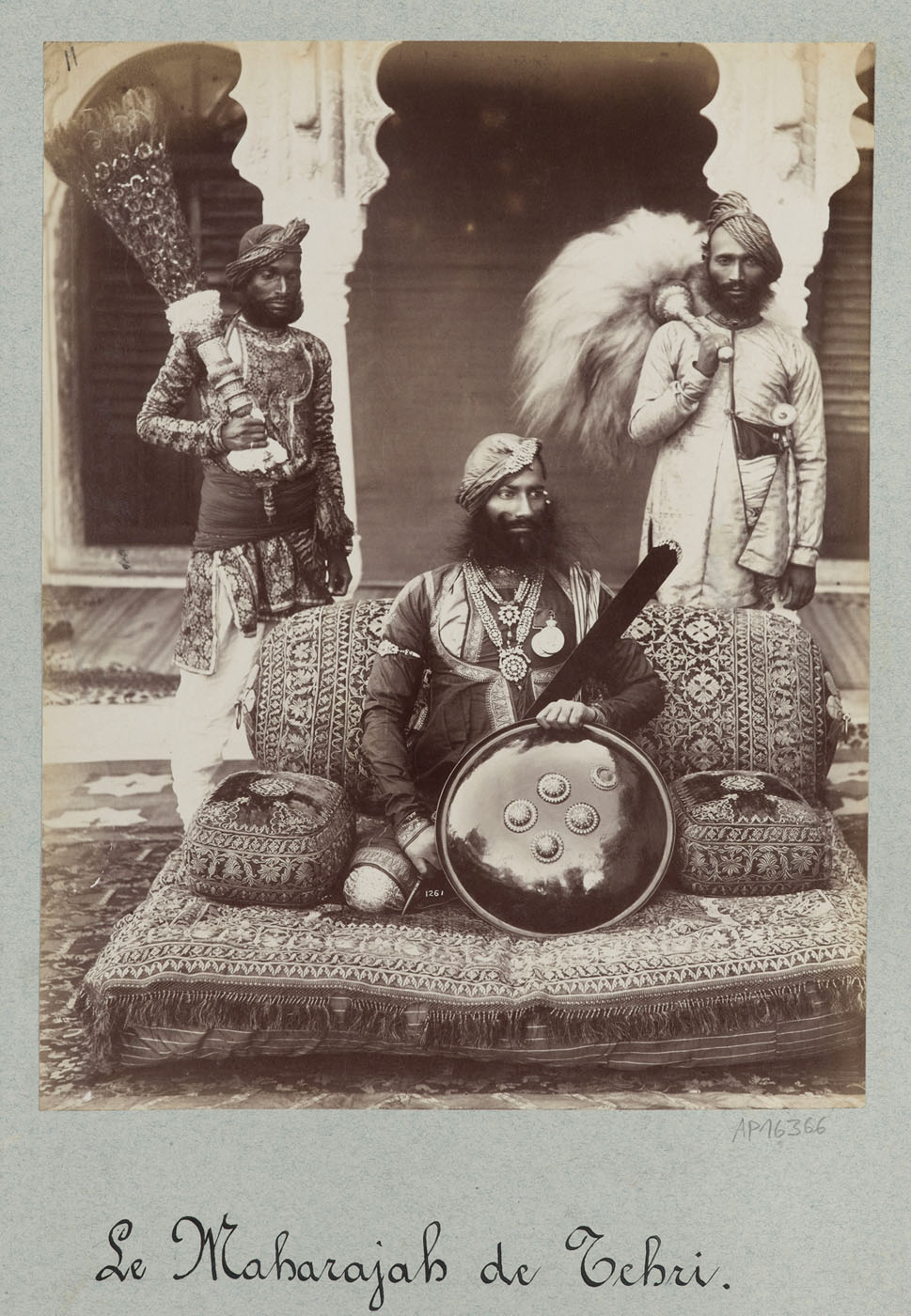
 

Lala Deen Dayal (Indian, 1844-1905) 'Portrait of Sir Pratab Singh, Maharajah of Orchla, with his entourage India' 1882


Lala Deen Dayal (Indian, 1844-1905)
Portrait of Sir Pratab Singh, Maharajah of Orchla, with his entourage
India, 1882
Albumen print
musée national des arts asiatiques – Guimet
© Bibliothèque nationale de France, Paris


Lala Deen Dayal (Indian, 1844-1905)

Raja Lala Deen Dayal (Hindi: लाला दीन दयाल; 1844-1905; also written as ‘Din Dyal’ and ‘Diyal’ in his early years), famously known as Raja Deen Dayal) was an Indian photographer. His career began in the mid-1870s as a commissioned photographer; eventually he set up studios in Indore, Mumbai and Hyderabad. He became the court photographer to the sixth Nizam of Hyderabad, Mahbub Ali Khan, Asif Jah VI, who awarded him the title Raja Bahadur Musavvir Jung Bahadur, and he was appointed as the photographer to the Viceroy of India in 1885. He received the Royal Warrant from Queen Victoria in 1897.


Lala Deen Dayal (Indian, 1844-1905) 'Portrait of Sir Pratab Singh, Maharajah of Orchla, with his entourage India' 1882 (detail)


Lala Deen Dayal (Indian, 1844-1905)
Portrait of Sir Pratab Singh, Maharajah of Orchla, with his entourage (detail)
India, 1882
Albumen print
musée national des arts asiatiques – Guimet
© Bibliothèque nationale de France, Paris
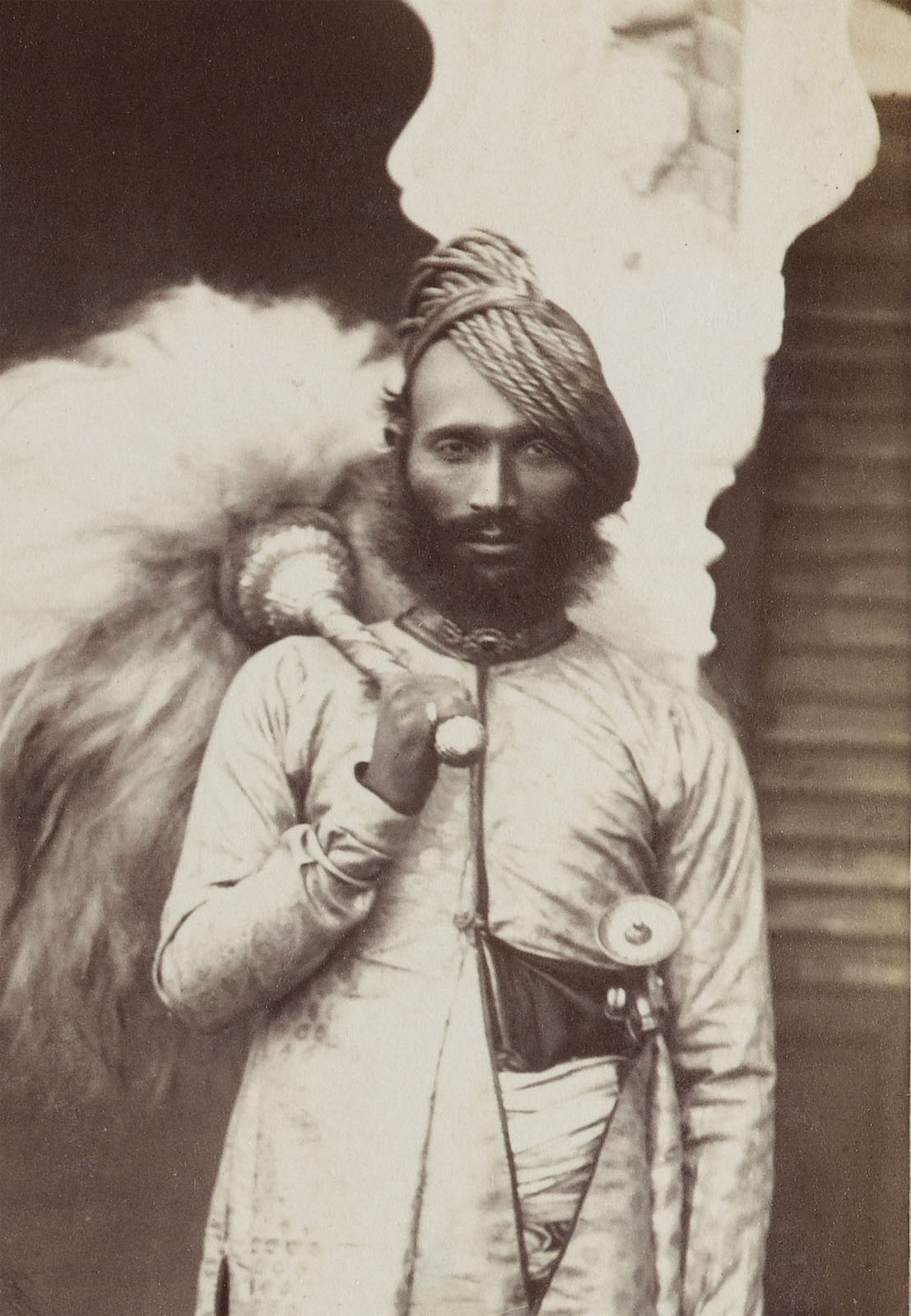
 

Lala Deen Dayal (Indian, 1844-1905) 'Portrait of Sir Pratab Singh, Maharajah of Orchla, with his entourage India' 1882 (detail)


Lala Deen Dayal (Indian, 1844-1905)
Portrait of Sir Pratab Singh, Maharajah of Orchla, with his entourage (detail)
India, 1882
Albumen print
musée national des arts asiatiques – Guimet
© Bibliothèque nationale de France, Paris


Installation view of the exhibition 'Photographs. An Early Album of the World (1842-1911)' at the musée du quai Branly – Jacques Chirac, Paris showing the section 'Composite photographs in Mexico'


Installation view of the exhibition Photographs. An Early Album of the World (1842-1911) at the musée du quai Branly – Jacques Chirac, Paris showing the section ‘Composite photographs in Mexico’


Composite photographs in Mexico

In the history of painted photography practices, colourisation often aims to embellish the print considered monochromatic and dull. A set of photographs painted by landscape artist Conrad Wise Chapman show a association of these two techniques around picturesque and popular subjects. Other forms of formal hybridisation are attested in Mexico. Three shots set with a medallion were partially covered with feathers in the colours shimmering, to highlight clothes and certain elements of the decor. These composite objects are rare testimonies that combine the art of featherwork, widespread in Mexico during the pre-Hispanic and colonial periods, with the new technique of photography. The figure of the peddler is attributed to the photographer Augustin Péraire [below] and the image of the three women is a reproduction of a print of the popular figure showing the “China poblana”.

Wall text from the exhibition


Augustin Péraire (active c. 1860) 'Portrait of a Man' c. 1867


Augustin Péraire (active c. 1860)
Portrait of a Man
c. 1867
Print on albumen paper enhanced with gouache and partially feather coloured, laminated on card size cardboard. Oval frame format, frame and gilt window, black and tan passe-partout swirl effect
13 x 9.2cm
© Quai Branly Museum – Jacques Chirac


Installation view of the exhibition 'Photographs. An Early Album of the World (1842-1911)' at the musée du quai Branly – Jacques Chirac, Paris showing at second left, W.J. Sawyer's 'Mr Sawyer, photo man' (Nigeria, 1880-1890)


Installation view of the exhibition Photographs. An Early Album of the World (1842-1911) at the musée du quai Branly – Jacques Chirac, Paris showing at second left, W.J. Sawyer’s Mr Sawyer, photo man (Nigeria, 1880-1890, below)


W.J. Sawyer (Nigerian) 'Mr Sawyer, photo man' Nigeria, 1880-1890


W.J. Sawyer (Nigerian)
Mr Sawyer, photo man
Nigeria, 1880-1890
Albumen paper print
Print on aristotype paper
© Quai Branly Museum – Jacques Chirac


Photo of W. J. Sawyer and his sons taken in Calabar (possibly at his studio). W. J. Sawyer was a photographer based in Calabar, mostly active during the late 19th century and early 20th century, having photographed the Oba of Benin during the period of his craft.


W.J. Sawyer

The biography of W. J. Sawyer is still quite incomplete. He takes, on demand of the Spanish Commander Francisco Romero, several photographs in Bioko (current Equatorial Guinea), in 1883. The images are shown the same year at the International Colonial and Export Exhibition in Amsterdam. The picture showing a man accompanied by two boys could be a self-portrait of the photographer, as the title on the back suggests.

Rapid growth in West Africa

Photography was quickly adopted in many regions in the world from the 1840s to the 1860s. West Africa combines several factors which have fostered its rapid growth. Many ports connect the cities with each other and with the European continent, facilitating transatlantic and regional trade. In Freetown (current Sierra Leone), Lagos (current Nigeria), Libreville (current Gabon) established communities made up of elders freed and returning slaves from North and South America and the Caribbean. A cosmopolitan culture reigns in these cities where trade can develop.

As early as 1853, the African-American Augustus Washington left the United States and set up a daguerreotype studio in Monrovia. In the 1860s, Francis W. Joaque or J.P. Decker practice photography on an itinerant basis on the coast. These photographers respond to a local demand for photography loved ones or events to remember. They also include a clientele European, Joaque realising for example many portraits of the explorer Italian Pierre Savorgnan de Brazza. The Lutterodt dynasty establishes several studios photographers who operate in Accra (current Ghana) and Freetown between the years 1870 and 1940.

Text from the exhibition


Jonathan Adagogo Green (Nigerian, 1873-1905) 'Last photo of Chief Henry Long John. Behind him stands his successor' Nigeria, 1895


Jonathan Adagogo Green (Nigerian, 1873-1905)
Last photo of Chief Henry Long John. Behind him stands his successor
Nigeria, 1895
Albumen print
© Quai Branly Museum – Jacques Chirac


J.A. Green (Nigerian, 1873-1905)

J. A. Green is one of West Africa’s most prolific photographers. Born in Nigeria, he is the son of a palm oil merchant. He practices photography from 1891 and provides images to a clientele African and European. He also trains other photographers. In this image, Green photographs a stage at the leader’s funeral slaver Amonibienye Ofori Long John. The tanda burial custom involves, for the elites, the public presentation of the body of the deceased dressed in his clothes of pageantry. Son Henry Obulu supports his father’s jaw to affirm his position as legitimate heir.

Text from the exhibition


Jonathan Adagogo Green (J. A. Green), born in the village of Ayama (Peterside), Bonny (Rivers State, Nigeria) in 1873. The son of Chief Sunju Okoronkwoye Dublin Green and Madame Idameinye Green, he was looked after by his uncle Uruasi Dublin Green after his father’s death in 1875. He attended school in Lagos and possibly Sierra Leone. It is unknown where he trained as a photographer but by 1891 he had set up his photographic practice in Bonny. His work covered a range of themes including portraiture of British colonial officers, European merchants, prominent chiefs and their families, scenes of daily and ritual life, commerce and building – a body of work that appealed to both local elites and expatriate clients. Green died in 1905 at the age of 32, after practicing in the Niger Delta for 14 years. His work is in held in a number of collections in the UK, USA and Nigeria.

Text from the exhibition


Jonathan Adagogo Green (1873-1905) was according to some sources the first professional photographer in what is now Nigeria to have ethnic origins in that area. He is significant in being a pioneering photographer in what is now Nigeria, noted for his documentation of the colonial power and local culture, particularly his Ibani Ijo community.

Green was born in Bonny, present day Rivers State. “He studied photography in Sierra Leone and then established a studio in Bonny.” The area where he lived became part of the British Oil Rivers protectorate in 1884, which was renamed to the Niger Coast Protectorate in 1893. It was part of the Southern Nigeria Protectorate for the last few years of Green’s life, starting in 1900.

Green was active as a photographer for only a short lifetime, dying at the age of 32. “But during this period he was both energetically productive and remarkably adroit in serving both indigenous and colonial clienteles.” “When he set up shop his work was appreciated and rewarded by two very different communities.” His “strategic use of initials on his business cards and stamps… disguised his African origins”, part of his working with the colonial era officials.

Text from the Wikipedia website


Jonathan Adagogo Green (Nigerian, 1873-1905) 'Last photo of Chief Henry Long John. Behind him stands his successor' Nigeria, 1895 (detail)


Jonathan Adagogo Green (Nigerian, 1873-1905)
Last photo of Chief Henry Long John. Behind him stands his successor (detail)
Nigeria, 1895
Albumen print
© Quai Branly Museum – Jacques Chirac


William Ellis (British, 1794-1872) 'Untitled (portrait of a woman)' 1853-1865


William Ellis (British, 1794-1872)
Untitled (portrait of a woman)
1853-1865
Salted paper print
20.5 x 24cm
© musée du quai Branly – Jacques Chirac
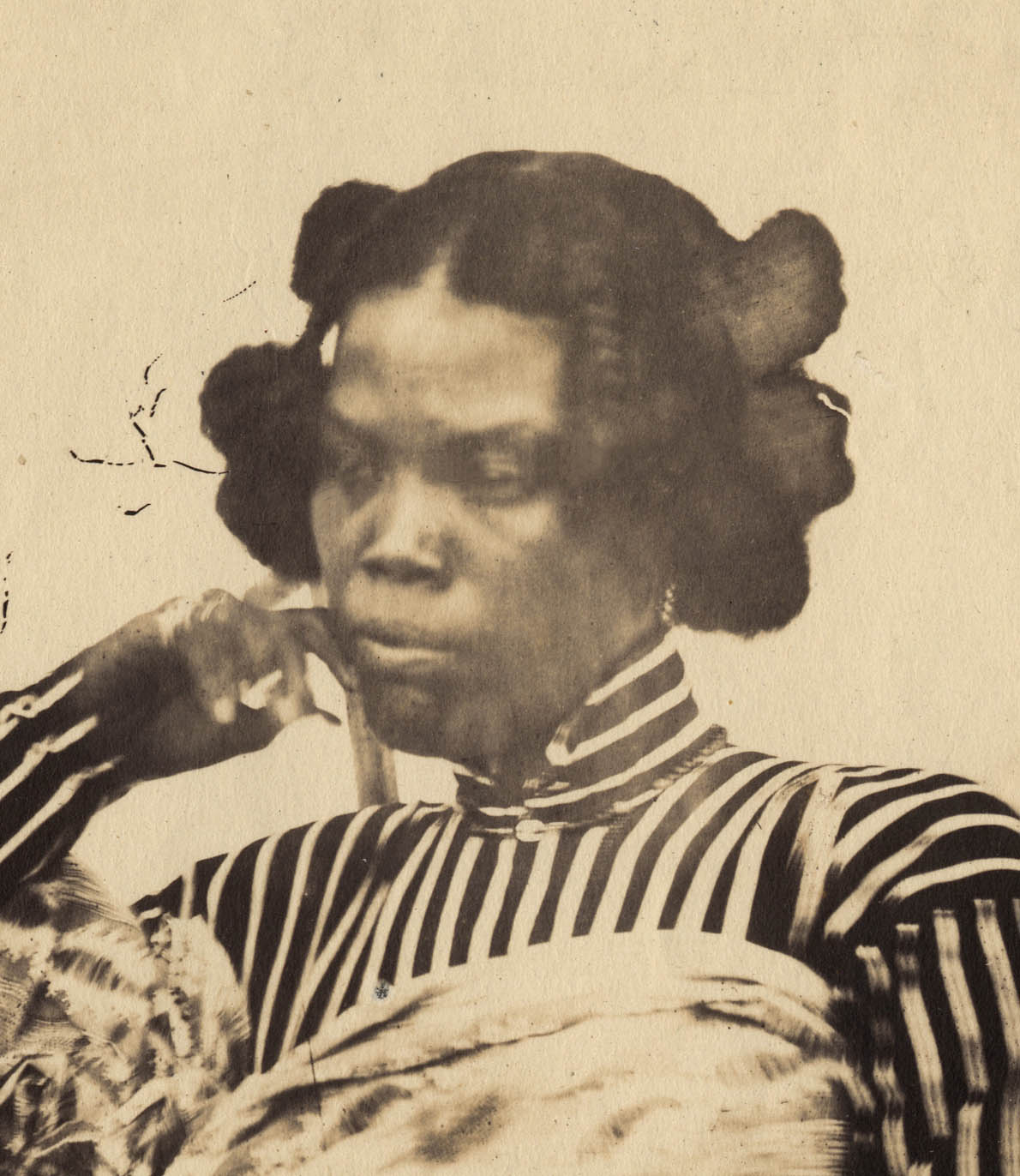
 

William Ellis (British, 1794-1872) 'Untitled (portrait of a woman)' 1853-1865 (detail)


William Ellis (British, 1794-1872)
Untitled (portrait of a woman) (detail)
1853-1865
Salted paper print
20.5 x 24cm
© musée du quai Branly – Jacques Chirac


William Ellis (29 August 1794 – 9 June 1872) was a British missionary and author. He travelled through the Society Islands, Hawaiian Islands, and Madagascar, and wrote several books describing his experiences.
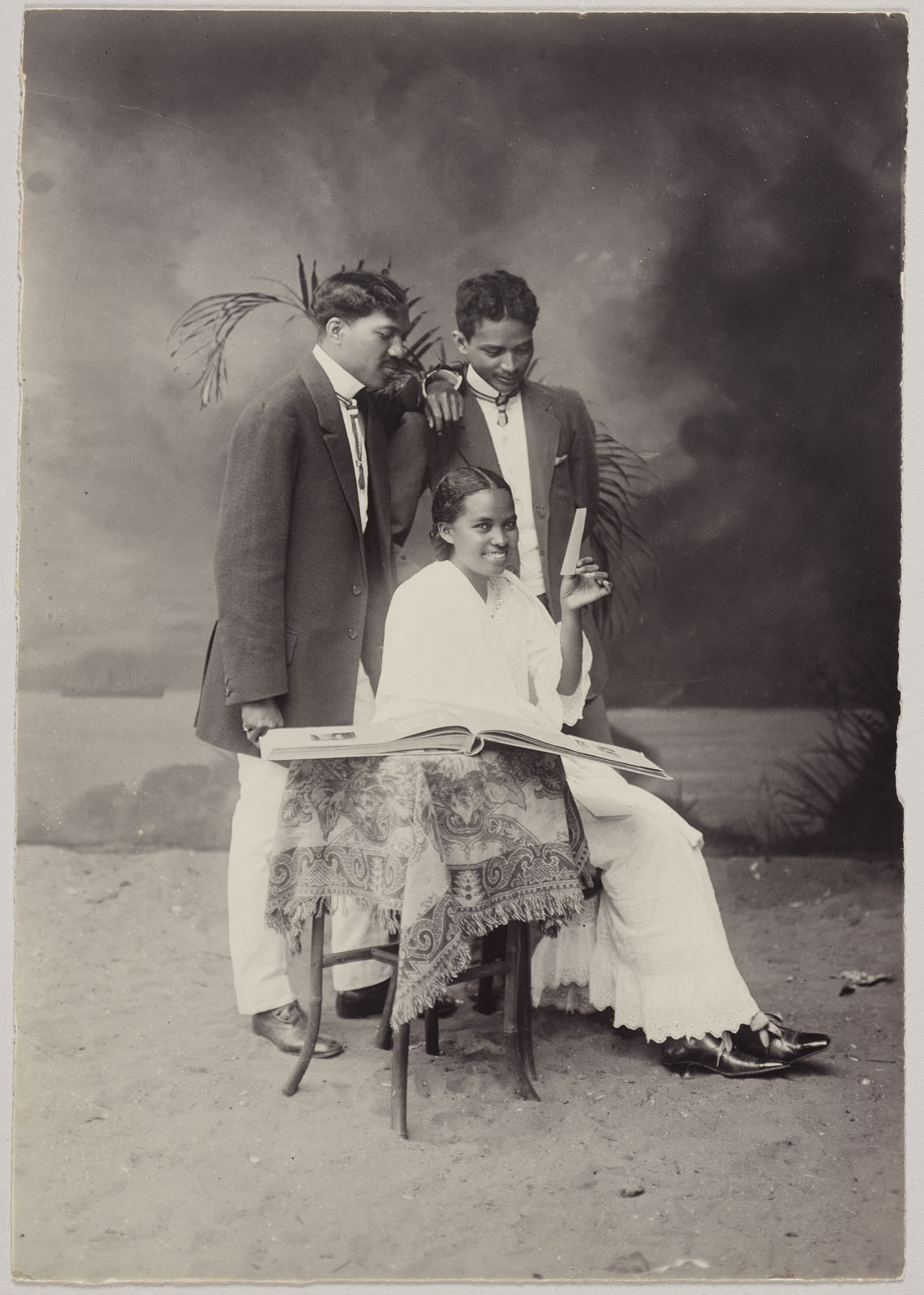
 

Joseph Razafy (Madagascar, 1881-1949) 'Untitled (portrait of two men and a woman)' Nd


Joseph Razafy (Madagascar, 1881-1949)
Untitled (portrait of two men and a woman)
Nd
© musée du quai Branly – Jacques Chirac


In Madagascar, photography as a tool of social distinction

Photography is introduced to Madagascar by the British missionary William Ellis [above]. First rejected by Queen Ranavalona I (r. 1828-1861), the technology was enthusiastically adopted during the reign of Radama II (r. 1861-1863) by the king himself, the court and the Malagasy elite, responding to the desire for individualisation and social distinction from high society. Several European photographers mentioned the ease and familiarity of the models with the device. From the 1890s, the first Malagasy studios won great success with a population wishing to design and maintain a self-image. The photos presented here are the work of this first generation Malagasy photographers, including Joseph Razaka based in Antananarivo and Joseph Razafy in Toamasina.

Text from the exhibition
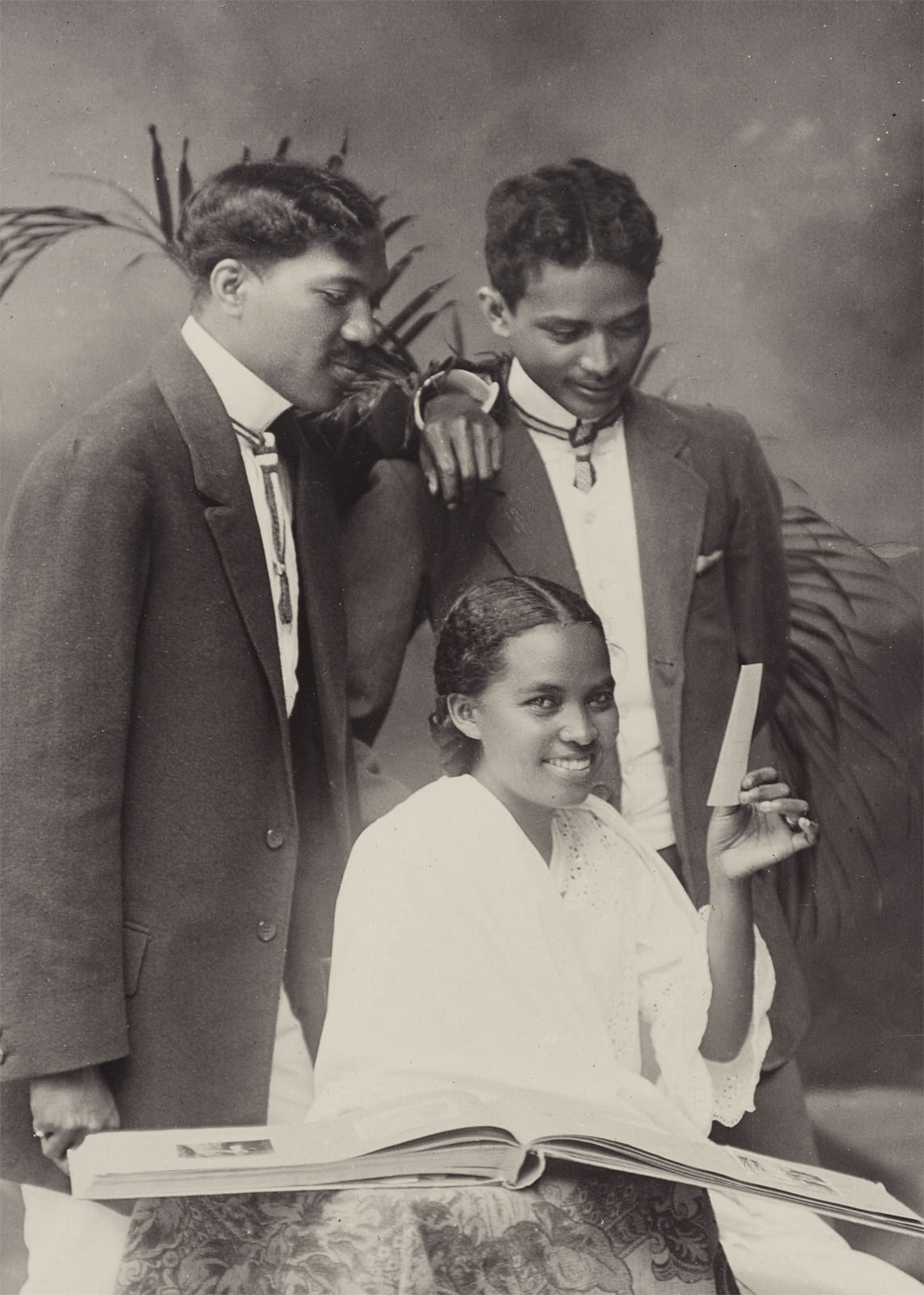
 

Joseph Razafy (Madagascar, 1881-1949) 'Untitled (portrait of two men and a woman)' Nd (detail)


Joseph Razafy (Madagascar, 1881-1949)
Untitled (portrait of two men and a woman) (detail)
Nd
© musée du quai Branly – Jacques Chirac


Joseph Razafy (Madagascar, 1881-1949) 'Untitled (portrait of a woman)' Nd


Joseph Razafy (Madagascar, 1881-1949)
Untitled (portrait of a woman)
Nd
© musée du quai Branly – Jacques Chirac
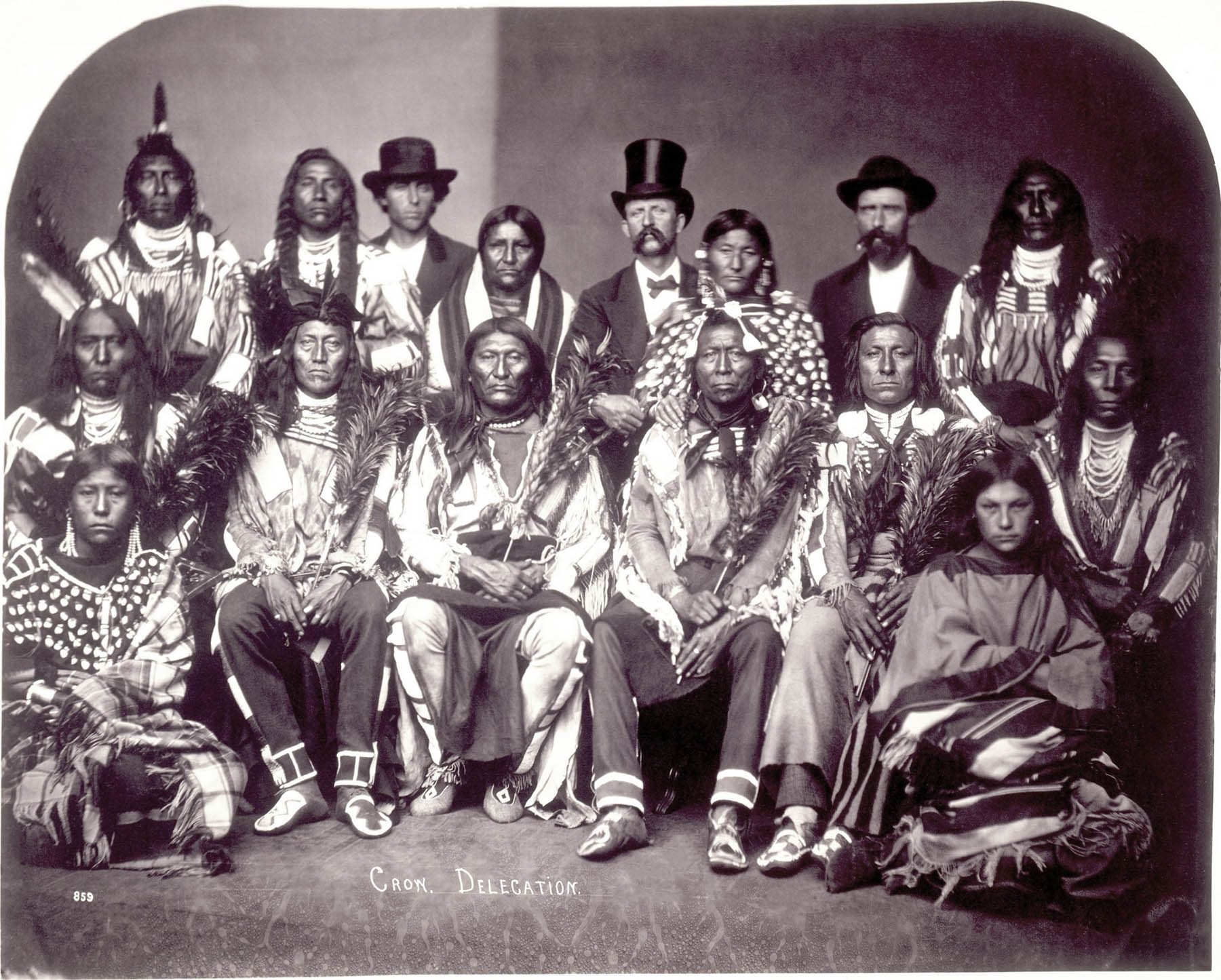
 

Ulke Brothers Studio (Julius Ulke and Henry Ulke) 'Apsáalooke (Crow) delegation' 1872


Ulke Brothers Studio (Julius Ulke and Henry Ulke)
Apsáalooke (Crow) delegation
1872
Albumen silver print from glass negative
8 x 10 in.
National Anthropological Archives, Smithsonian Institution

Back row (standing) from left to right: Long Horse; Thin Belly; Bernard Prero (interpreter); unknown name, wife of Awé Kúalawaachish (Sits In The Middle Of The Land); Major F.D. Pease (agent); unknown name, wife of Uuwatchiilapish (Iron Bull); Frank Shane (interpreter); and Bear In The Water. Front row (seated in chairs) from left to right: Bear Wolf; White Calf; Awé Kúalawaachish (Sits In The Middle Of The Land); Uuwatchiilapish (Iron Bull); One Who Leads The Old Dog; and Peelatchixaaliash (Old Crow [Raven]). Front row (seated on the floor) from left to right: Stays With The Horses, wife of Bear Wolf; and Pretty Medicine Pipe, wife of Peelatchixaaliash (Old Crow [Raven])
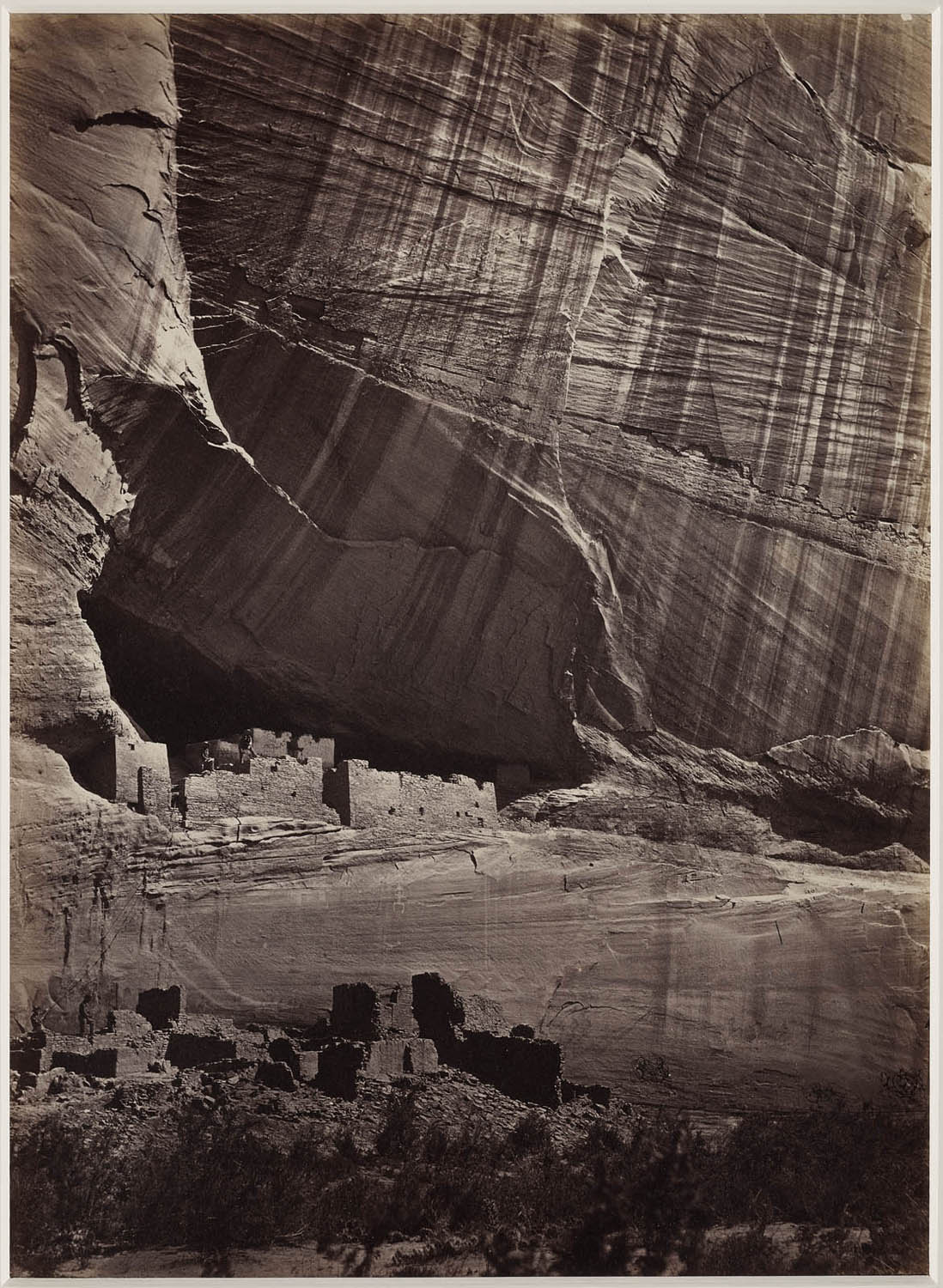
 

Timothy H. O'Sullivan (American born Ireland, 1840-1882) 'Photographs from Geographical explorations and surveys west of the 100th meridian Wheeler' 1873


Timothy H. O’Sullivan (American born Ireland, 1840-1882)
Photographs from Geographical explorations and surveys west of the 100th meridian Wheeler 1871-2-3
1871-1873
© musée du quai Branly – Jacques Chirac


Timothy H. O’Sullivan

This series by Timothy H. O’Sullivan comes from the album Photographs from Geographical explorations and surveys west of the 100th meridian Wheeler 1871-2-3, consisting of fifty photographs of explorations in the Western United States (New Mexico, Nevada, Arizona, Utah, etc.). The set shows mainly landscapes and natural sites, some portraits of Zunis, Apaches and Navajos, and views of architecture and monuments.

The limits of visibility

The thirst for images which manifested itself as early as 1840 in Europe and then rapidly in the whole world has encountered contrasting situations. From the beginning arose the question of limits: how far to go? Under what conditions do a photography ? For what purposes? Technical challenge sometimes but above all question ethics when it comes to bearing witness to the horrors of war, or when it comes to to produce the image of scenes or objects that are supposed to remain hidden. Some photographers could trick, coerce or negotiate. The images produced are remained secret or, conversely, circulated widely. The life of photographs after the shot is a fundamental element of this medium, they are led to undergo multiple changes of meaning depending on the way we perceives them, from which they are presented. In this section are photographs that evoke certain situations limits: images of conflicts shown or hidden, sacred places of which a part remains invisible, images obtained by trickery. These photographs are not shown as trophies but as traces of practices that we can re-examine today.

Uncover the Sacred

For many photographers, the attraction of the forbidden or the opportunity to attend a singular event played into the desire to create an image. We consider
today with a certain reserve these images of masks or places Holy. While they may still constitute factual documents, our attention now turns to the conditions of their realisation. In what contexts could they have been made, and what do they show us, apart from the very fact that they were produced in an exceptional way?

James album

The history of photography in Pueblo territory, in the United States, offers a rare example of strong reaction to the invasion of photography. The first reactions of mistrust from the Indian communities, from the 1890s, are linked to the dissemination of images and the tourist promotion of rituals supposed remain secret. The Hopi Snake Dance ceremony had become a major attraction. Often disrupted by ever-increasing numbers of visitors, it will be definitively prohibited to photographers in 1913, following the mobilisations of Hopi communities. The exhibition does not present here the photographs of this ritual that George Wharton James manages to capture, in order respect the Hopi restrictions. The exposed double page combines two times of shooting, the first image showing the perplexed waiting of the Indians in front the church of Acoma, and the second their reaction of just surprise and mistrust after shooting.

Text from the exhibition


F. Bonfils et Cie (French, 1831-1885) 'Egyptian mummy, Medinet-Abou, Egypt' Cairo, 1870


F. Bonfils et Cie (French, 1831-1885)
Egyptian mummy, Medinet-Abou, Egypt
Cairo, 1870
© Quai Branly Museum – Jacques Chirac


Félix Adrien Bonfils was a French photographer and writer who was active in the Middle East. He was one of the first commercial photographers to produce images of the Middle East on a large scale and amongst the first to employ a new method of colour photography, developed in 1880. …

Maison Bonfils produced thousands of photographs of the Middle East. Bonfils worked with both his wife and his son. Their studio became “F. Bonfils et Cie” in 1878. They photographed landscapes, portraits, posed scenes with subjects dressed up in Middle Eastern regalia, and also stories from the Bible. Bonfils took photographs in Lebanon, Egypt, Palestine, Syria, Greece and Constantinople (now Istanbul). While Bonfils produced the vast majority of his work, his wife, Lydie, and son Adrien were also involved in photography produced by the studio. As few are signed, it is difficult to identify who is responsible for individual photographs. Lydie is thought to have taken some of the studio portraits, especially those of Middle Eastern women, who were more inclined to pose for a female photographer. Adrien became more involved in the landscape photography at age 17, when Félix returned to Alès to have compiled collections of their photographs published and then to open a collotype printing factory. Félix died in Alès on the 9th of April 1855.

Text from the Wikipedia website


Charles Guillain (French, 1808-1875) 'Majeerteen Woman' East Coast of Africa, 1847-1848


Charles Guillain (French, 1808-1875)
Majeerteen Woman
East Coast of Africa, 1847-1848
Daguerreotype
Musée du Quai Branly – Jacques Chirac
© Musée du Quai Branly – Jacques Chirac, Dist. RMN-Grand Palais
Image: Musée du Quai Branly – Jacques Chirac


As Christine Barthe observes, “In the first ten years of photography, from 1841 to 1851, many travelers would try their hands at daguerreotypes outside Europe. Guillain’s photographs, taken in very difficult conditions, are not always perfect from a technical point of view, but they nevertheless represent the pioneering works in the history of photography.” They offer extraordinary insight into the people, the policies, and the places along the east coast of Africa during the mid nineteenth-century.

Erin Rushing. “Swahili Coast: Exploration by French Captain Charles Guillain, 1846-1848. Part 3, Encounters and Partnerships,” on the Smithsonian Unbound blog May 13, 2015 [Online] Cited 22/05/2023. Used under fair use conditions for the purposes of education and research


Ernest Benecke (German born England, 1817-1894) 'Dead crocodile on a boat on the Nile' Egypt, 1852


Ernest Benecke (German born England, 1817-1894)
Dead crocodile on a boat on the Nile
Egypt, 1852
Salt paper print
Bibliothèque nationale de France, Manuscripts Department
Émile Prisse d’Avennes Egyptian Collection
© Bibliothèque nationale de France, Paris


Ernest Philipp Benecke may have been part of a well-known German banking family of the same name from the Hamburg and Hanover area. Benecke made his only known photographs in Egypt and Nubia in 1852, which consisted of portraits and studies of the daily life of the cultures he visited. His works are among the earliest surviving photographs of non-Western civilizations.


Muhammad Sadiq Bey (Egyptian, 1822-1902) 'View of the Holy Shrine and the City of Mecca' Saudi Arabia, 1881


Muhammad Sadiq Bey (Egyptian, 1822-1902)
View of the Holy Shrine and the City of Mecca
Saudi Arabia, 1881
Photographic print
Bibliothèque nationale de France, Rare Books Reserve
© Bibliothèque nationale de France, Paris


Muhammad Sadiq Bey (Egyptian, 1822-1902)

Muhammad Sadiq Bey (1832-1902) was an Ottoman Egyptian army engineer and surveyor who served as treasurer of the Hajj pilgrim caravan. As a photographer and author, he documented the holy sites of Islam at Mecca and Medina, taking the first ever photographs in what is now Saudi Arabia. …

Born in Cairo, Sadiq was educated in Cairo’s military college and at the Paris École Polytechnique. He qualified as an colonel in the Egyptian army and returned to the military college to teach cartographic drawing.

In 1861, he was assigned to visit the region of Arabia from Medina to the port of Al Wajh and conduct a detailed survey. He took a small team and some surveying equipment as well as his own camera; photography was not part of the official mission. His records of the expedition are the earliest known detailed accounts of the region’s climate and settlements. His photographs of Medina were the first ever taken there. In 1880 he was assigned to accompany the Hajj pilgrim caravan from Egypt to Mecca as its treasurer. He was responsible for the safe passage of the mahmal, a ceremonial passenger-less litter, to Mecca. Again he brought a camera, becoming the first person to photograph Mecca, the Great Mosque, the Kaaba, and pilgrim camps at Mina and Arafat. …

Sadiq used a wet-plate collodion camera, which had been invented in the 1850s. This produced negatives on wet glass plates, requiring a portable darkroom. From these negatives he made albumen prints which he signed or, later, stamped.

The sanctuaries of Mecca and Medina are the holiest sites of Islam. As part of the Hajj which is one of the five pillars of Islam, pilgrims perform rituals at Mecca and other nearby sites. On his expeditions from 1861 to 1881, Sadiq photographed the interiors and exteriors of sites on the Hajj pilgrimage route as well as at Medina. Photographing the Al-Masjid an-Nabawi (Prophet’s Mosque) and its surroundings in Medina on 11 February 1861, he noted in his diary that no-one had taken such photographs before.

He used walls and mosque roofs as vantage points to capture panoramas of the cities. He also photographed people connected to the holy sites. As well as the Hajj pilgrims walking around the Kaaba, he photographed Shaykh ‘Umar al-Shaibi, the keeper of the key of the Kaaba, and Sharif Shawkat Pasha, guardian of the Prophet’s Mosque.

Text from the Wikipedia website


Jules Borelli (French, 1853-1941) 'Portrait of a young woman' Ethiopia 1885-1888


Jules Borelli (French, 1853-1941)
Portrait of a young woman, Ethiopia
1885-1888
Photo: © Dist. RMN – Grand Palais/musée du quai Branly – Jacques Chirac


Jules Borelli (French, 1853-1941)

Jules Borelli (b. 1853, d. 1941) was a French traveller and explorer who travelled to Ethiopia from Egypt on 16 September 1885 to explore the Omo river. In this effort he was supported by his brother, a financier in Cairo and the owner of a fine collection of Egyptian antiquities. He was delayed from moving into western and southwestern Ethiopia by ase Ménilék II, who, out of political concerns, detained him at the capital of Éntotto for part of the period from July 1886 to November 1887. Finally, in November 1887. Borelli started out for the headwaters of the Omo river, and reached a point some 300 miles north of Lake Rudolf (Turkana) on 17 June 1888, three months after Count Samuel Teleki von Szek and Lieutenant Ludwig Ritter von Hohnel had arrived on the lake’s southern shore. Had Ménilék not detained him and had he not fallen ill with malaria, Borelli could have reached the lake well before Teleki and von Hohnel. During his travels, Borelli was given a good description of the lake by people in Ethiopia, who called it Lake Šambara.

Borelli arrived in Cairo on 15 November 1888, where he later met Teleki and von Hohnel who were returning to Europe from their trip. The latter assisted B. in drawing his maps of the country surrounding the Omo river. Borelli doubted von Hohnel’s unsubstantiated claim that two rivers flowed into Lake Rudolf, and, as was later proven, correctly deduced that only the Omo flowed into the lake. In 1889, Borelli invited von Hohnel to Paris to attend an international geographical congress, where both men lectured. Borelli described his Ethiopian travels in his beautifully illustrated and well documented book published in 1890.

Text from Encyclopaedia Aethiopica
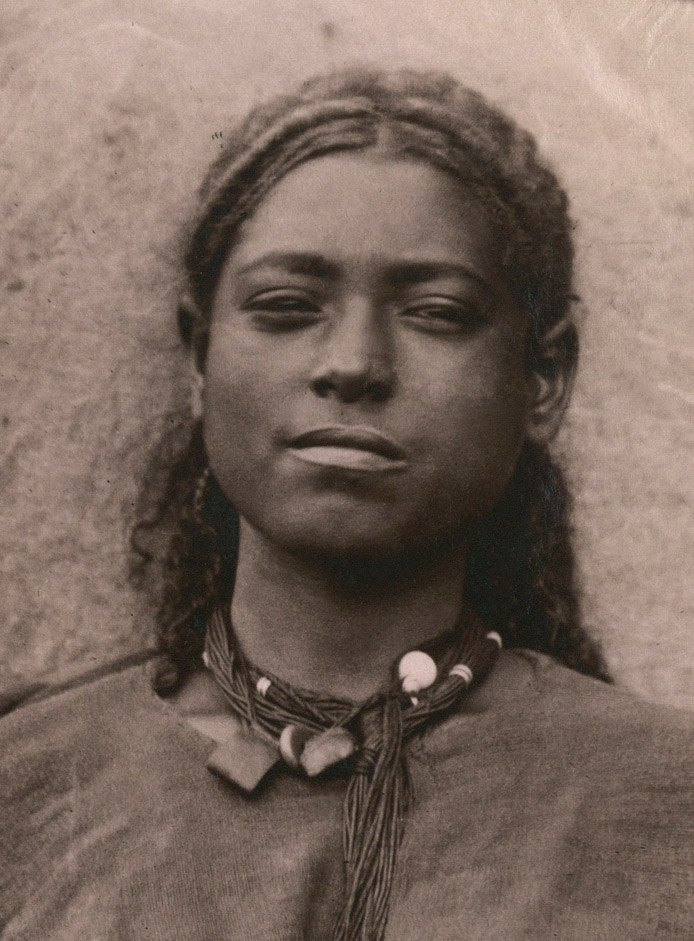
 

Jules Borelli (French, 1853-1941) 'Portrait of a young woman' Ethiopia 1885-1888 (detail)


Jules Borelli (French, 1853-1941)
Portrait of a young woman, Ethiopia (detail)
1885-1888
Photo: © Dist. RMN – Grand Palais/musée du quai Branly – Jacques Chirac


Unknown photographer. 'Malay Interior' Nd


Unknown photographer
Malay Interior
Nd
Photo: musée du quai Branly – Jacques Chirac, Dist. RMN – Grand Palais image musée du quai Branly – Jacques Chirac


Isidore Van Kinsbergen (Dutch-Belgian, 1821-1905) 'Baris, Warrior dancers Bali' Indonesia, 1865-1866


Isidore Van Kinsbergen (Dutch-Belgian, 1821-1905)
Baris, Warrior dancers Bali
Indonesia, 1865-1866
Albumen print
Musée du Quai Branly – Jacques Chirac
© Musée du Quai Branly – Jacques Chirac, Dist. RMN-Grand Palais
Image: Musée du Quai Branly – Jacques Chirac


Isidore van Kinsbergen (Bruges 1821-Batavia 1905) was a Dutch-Belgian engraver, who after an educational period in Bruges and Gent discovered the artistic wealth of the theatre. In Batavia (Jakarta) he proved to be a real all-rounder, combining decoration painting with singing, acting and management. In 1855, Van Kinsbergen also took up photography. He was invited to photograph ‘all peculiarities’ on the Dutch mission to Bangkok in 1862 and took part in two inspection tours covering Java, Madura and Bali (1862 and 1865). Between 1863 and 1867 and again in 1873 he was contracted by the Government of the Netherlands-Indies to photograph Java’s antiquities. Two series, together holding over 375 photos, constitute his art and archaeology legacy.

There is a less or even ‘unknown’ Van Kinsbergen as well, who commercially operated from a professional studio in Batavia. Thanks to research, more than 200 anonymous or wrongly attributed photos can now be assigned to him. How to recognize Van Kinsbergen in portraits, landscapes, views and ‘types’? After all, making a portrait or casting a ‘type’ is quite different from photographing monuments. Are characteristics found within his art and archaeology series evident in his so-called commercial work? Yes, but not in one stereotypical way. Besides a general artistic rendering of items and the careful use of light, his style is direct, full of contrast, academic and theatrical at the same time.

Gerda Theuns de Boer. “Isidore van Kinsbergen: photographs of Java and Bali, 1855-1880,” on the International Institute for Asian Studies website Newsletter #35 June 2005 [Online] Cited 21/05/2023. Used under fair use conditions for the purposes of education and research


Isidore van Kingsbergen (1821-1905) is sometimes described as the “sleeping beauty” of nineteenth-century photography, because his remarkable body of work has never been presented in its entirety. Yet he was a flamboyant artist who appeals to the imagination. For the first time, this publication gives a broad overview of the exceptional qualities of this photo pioneer. Van Kinsbergen became famous for the almost four hundred photographs he took of Java’s antiquities at the behest of the Dutch colonial government and the Batavian Society. Detailed research has also brought to light a hitherto unknown part of his oeuvre, including the portraits he made at the courts of Yogyakarta, Surakarta, Bandung, Madura and Buleleng (Bali). In his studio, he used his experience as a theatre director to photograph people from various social backgrounds in an expressive manner. Due to his tireless efforts for new cultural projects, he has also been called as the “soul of colonial artistic life in Batavia.”

Text from the Brill website


Unknown photographer. 'Album of photographs of the Philippines' Nd


Unknown photographer
Album of photographs of the Philippines
Nd
Photo: musée du quai Branly – Jacques Chirac, Dist. RMN – Grand Palais image musée du quai Branly – Jacques Chirac
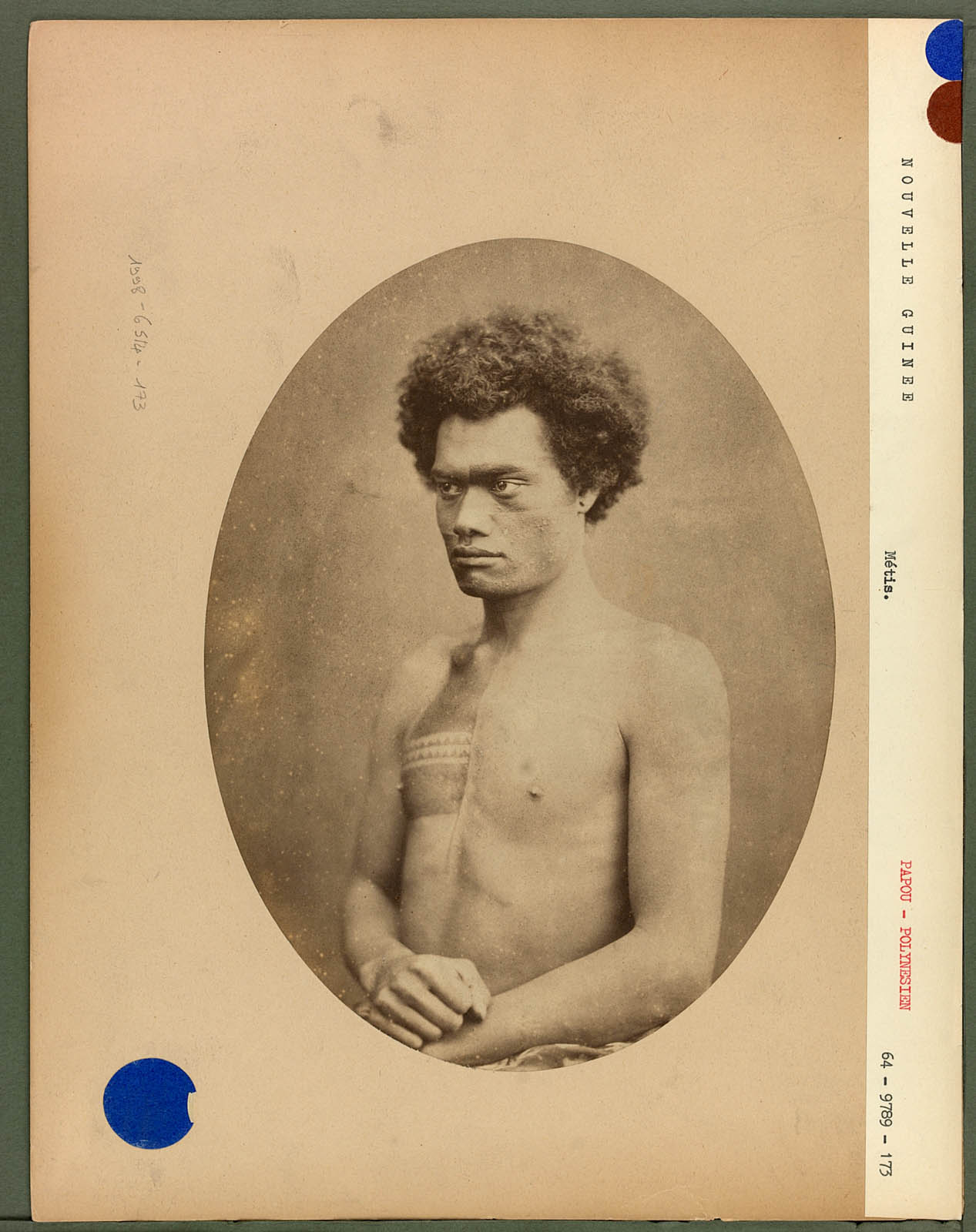
 

Eugene Maunoury (French, 1830-1896) 'Hitoro, King of the island Ua Pou in the Marquesas Archipelago' Peru, 1863


Eugene Maunoury (French, 1830-1896)
Hitoro, King of the island Ua Pou in the Marquesas Archipelago
Peru, 1863
Albumen paper print
© Quai Branly Museum – Jacques Chirac


The text on the photo stating that this man is from Papua New Guinea is incorrect. He is from the Marquesas archipelago. Please see another photograph of Hitoro, King of the island Ua Pou by Eugene Maunoury on the Ua Pou Wikipedia entry.


Eugene Maunoury (French, 1830-1896)

Eugène Maunoury settled in Chile between 1858 and 1865, in Santiago and Valparaiso. Then, from 1861, he was at the head of a luxurious studio in Lima (Peru) which saw parade the elite of society. From 1862 he was a correspondent for the Nadar studio. However, these portraits of Marquesans taken in Peru are neither intended images exotic, or photographs intended for scientific use. They were made by Maunoury to protest against the kidnapping of these people intended for be employed in forced labor in the exploitation of guano, in Peru. Maunoury publishes in L’Illustration of August 29, 1863 an article denouncing the situation of the raid, using some of his portraits. We recognise the king of the island Ua Pou, in the Marquesas Archipelago.


Émile Colpaërt (French born 1830 died after 1874, active 1858-1870) 'Native of Urcos' Scientific Expedition Peru, 1864


Émile Colpaërt (French born 1830 – died after 1874, active 1858-1870)
Native of Urcos
Scientific Expedition, Peru, 1864
© Musée du Quai Branly – Jacques Chirac, Dist. RMN-Grand Palais
Image: Musée du Quai Branly – Jacques Chirac
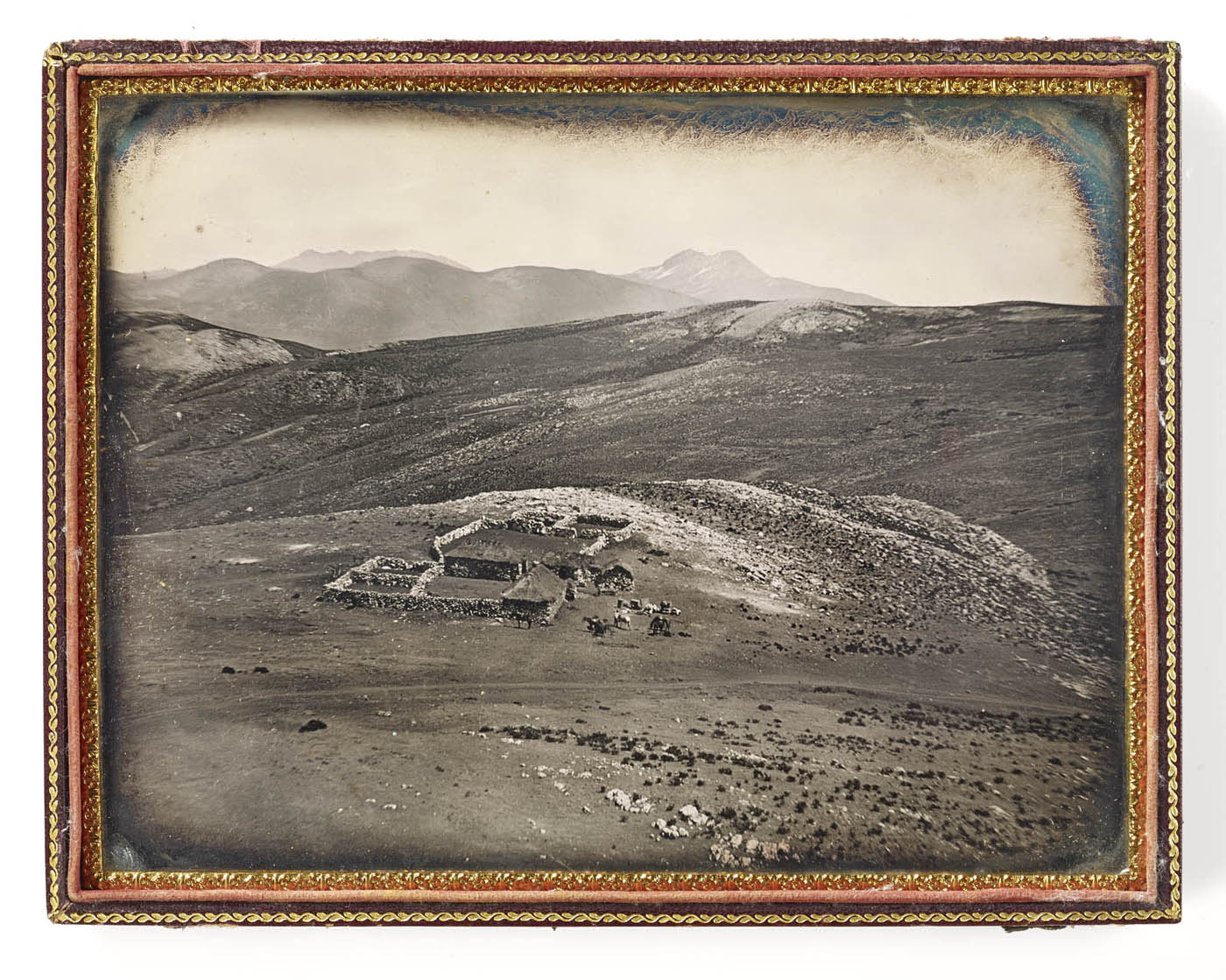
 

Attributed to Robert H. Vance (American, 1825-1876) 'A Tambo in the Mountains at a Height of 16,000 Feet, Andes Mountains' 1849


Attributed to Robert H. Vance (American, 1825-1876)
A Tambo in the Mountains at a Height of 16,000 Feet, Andes Mountains
1849
Daguerreotype
RMN – Grand Palais image musée du quai Branly – Jacques Chirac
Photo: © musée du quai Branly – Jacques Chirac, Dist


Attributed to Robert H. Vance (American, 1825-1876) 'A Tambo in the Mountains at a Height of 16,000 Feet, Andes Mountains' 1849 (detail)


Attributed to Robert H. Vance (American, 1825-1876)
A Tambo in the Mountains at a Height of 16,000 Feet, Andes Mountains (detail)
1849
Daguerreotype
RMN – Grand Palais image musée du quai Branly – Jacques Chirac
Photo: © musée du quai Branly – Jacques Chirac, Dist


Paul-Émile Miot (French, 1827-1900) 'Portrait of three Mi'kmaq Women, Newfoundland' 1857


Paul-Émile Miot (French, 1827-1900)
Portrait of three Mi’kmaq Women, Newfoundland
1857
Image: Bibliothèque nationale de France, Paris


Paul-Émile Miot (French, 1827-1900) 'Matelots virant au Cabestan, Gaillard d'avant de l'Ardent, Terre Neuve' (Sailors tacking to Capstan, forecastle of the Ardent, Newfoundland) 1857


Paul-Émile Miot (French, 1827-1900)
Matelots virant au Cabestan, Gaillard d’avant de l’Ardent, Terre Neuve (Sailors tacking to Capstan, forecastle of the Ardent, Newfoundland)
1857
Albumen print
6 1/2 x 10 in.
© musée du quai Branly – Jacques Chirac, Dist


Many places in the world have become accessible through photography since it was invented. In August 1839, the technical details of the daguerreotype were revealed in Paris, and from September onwards, cameras were taken on board the ships of countless scientific and military expeditions and voyages all around the world. Associated with technological modernity, photography was used in the second half of the 19th century to record the whole planet. From Mexico to Gabon, photography was in turn an instrument of description and the visual appropriation of landscapes and monuments, a tool for knowledge and the control of populations, and an object of diplomacy with the local elite.

European colonial expansion was one of the driving forces that greatly accelerated global photography. Taking as its starting point the collection of photographs at the musée du quai Branly – Jacques Chirac, enriched by several exceptional loans from public and private collections, the exhibition focuses on the trajectories and geographies of photography outside Europe in the 19th century.


4 key questions for Christine Barthe and Annabelle Lacour, the curators of the exhibition

1- What is the origin of this exhibition project?

Christine Barthe: The origins of this exhibition can be found in a project set up for the Louvre Abu Dhabi, where a first version of the exhibition was shown in 2019. Originally, it was based on the museum’s own collection, focusing on early photographs taken in regions far removed from Europe. The museum’s collection mainly reflects the European and American point of view, and we wanted, right from the beginning, and even more so for this adaptation for the musée du quai Branly – Jacques Chirac, to show a little more interest in local productions, which are not so well known and visible as those of Westerners. So this project quickly expanded in terms of research to try and decentralise the history of photography.

2- More precisely, what discoveries did you make during this new research?

C.B.: The project was built up over a period of several years, and so we benefited from the layering of experiences, in-depth research, new acquisitions, contacts… It’s a long-term project. Right from the beginning, we have been researching images from the museum’s collection. This work has allowed us to re-identify major artists in the history of photography, whose images were previously anonymous in the museum’s collections. Lesser-known photographers have been found in French collections such as the National Library and the Asian arts museum Guimet. We were thus able to include a lot of local photographers in the exhibition, especially from West Africa, in present-day Ghana, Sierra Leone, Iran, India, Japan…

3- How did photography spread outside Europe?

Annabelle Lacour: What is striking about the beginning is how fast things happened. As soon as the French government announced the invention of the process in 1839, there were articles in newspapers all over the world. In the weeks that followed, boats left for foreign countries carrying cameras to make daguerreotypes. Lots of people all over the world were curious to see how it worked. As early as 1842, the Shah of Iran asked Russia and the United Kingdom to send him some cameras. Photographers trained people at the Persian court. There were different examples in India, in Thailand, where we see this infatuation of sovereigns for photography. However, the speed it was taken up with also varied greatly depending on the region. In Japan, for example, photography developed a little later, in the late 1850s, when the country opened up to trade. In Europe, photography was related to the idea of a visual conquest that accompanied the colonial conquest. And of course, we should never forget the significant use of photography to design and build up one’s own image.

4- Today, the way we perceive these photographs has evolved. How does this translate into the way they are displayed?

A.L.: The idea of this exhibition, through these fascinating images, is to give visitors the opportunity to see how, right from the beginning, the production of these images is diverse and responds to different wishes, desires, and fits into various different contexts. Obviously, the intention with which they were made for was not fixed in time. Some images may have seen their meaning change completely in the course of history. So we have this whole issue of a new reading of the images, which is important. The questions they posed when they were taken, and pose again today, are very much contemporary. The end of the exhibition raises certain ethical questions: what does it mean to want to photograph everything? What do we do with the images of scenes or people that we were not allowed to see or photograph? I don’t think the choice lies in the alternative of showing or concealing everything. The interest in showing these images today is the possibility to reflect, to ask the question of meaning, to show certain contexts and historical narratives, to realise just how contemporary these issues are.

Text from the musée du quai Branly – Jacques Chirac


Lai Afong (Chinese, c. 1838 or 1839 - 1890) 'China. A Street, Canton' c. 1860


Lai Afong (Chinese, c. 1838 or 1839 – 1890)
China. A Street, Canton
c. 1860
Albumen print
© musée du quai Branly – Jacques Chirac, Dist


Lai Afong (Chinese, c. 1838 or 1839 – 1890)

Lai Afong (Chinese: 黎芳; c. 1838 or 1839 – 1890) was a Chinese photographer who established Afong Studio, considered to be the most successful photographic studio in the late Qing Dynasty. He is widely acknowledged as the most significant Chinese photographer of the nineteenth century. …

Lai Afong was the most successful of his generation of Chinese photographers in appealing to both a Chinese and foreign cosmopolitan clientele. Lai Afong advertised in English-language newspapers – offering a “Larger, and more complete collection of Views than any other Establishment in the Empire of China” – and the artist captioned much of his work in both Chinese and English. Afong Studio photographs were sold to both Chinese patrons – both those local to Hong Kong and those visiting from other parts of China – and foreign visitors to China.

The Afong Studio became a destination and training ground for foreign photographers in the region, and photographers such as Emil Rusfeldt and D.K. Griffith began their careers under the tutelage of Lai Afong. In 1875, Griffith claimed that his mentor had “entered the arena of European art, associating his name with photography in its best form, and justly stands first of his countrymen in Hong Kong.” John Thomson, a Scottish photographer working in China at the time, praised Lai Afong’s images as “extremely well-executed, [and] remarkable for their artistic choice of position,” in his book The Straits of Malacca, Indo-China, and China.

Lai Afong seems to have been the only Chinese photographer of his generation to be embraced by his foreign contemporaries. However, his work is distinct among them, as many of Lai Afong’s photographic compositions show the technical and aesthetic influence of traditional Chinese painting, known as guóhuà. Additionally, Lai Afong favoured the panorama more than any other photographer working in China in the 19th century, earning his work a place among the giants of 19th century landscape photography such as Carleton Watkins in America and Gustave Le Gray in France. No other nineteenth-century Chinese photographer offered as extensive and diverse a view of late Qing Dynasty China.

Text from the Wikipedia website
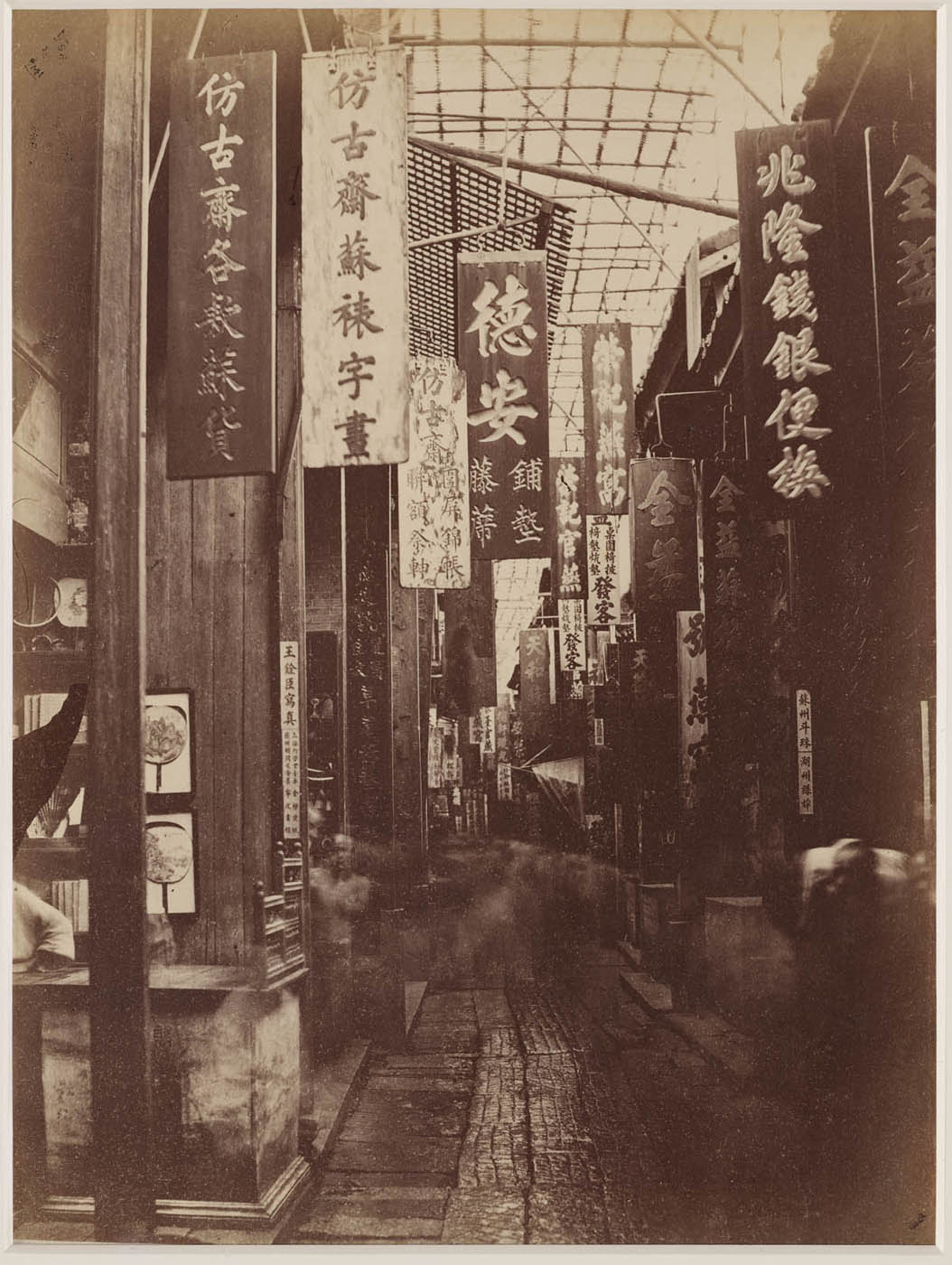
 

Lai Afong (Chinese, c. 1838 or 1839 - 1890) 'China. A Street, Canton' c. 1860 (detail)


Lai Afong (Chinese, c. 1838 or 1839 – 1890)
China. A Street, Canton (detail)
c. 1860
Albumen print
© musée du quai Branly – Jacques Chirac, Dist


Poster for the exhibition 'Photographs. An Early Album of the World (1842-1911)' at the musée du quai Branly – Jacques Chirac, Paris


Poster for the exhibition Photographs. An Early Album of the World (1842-1911) at the musée du quai Branly – Jacques Chirac, Paris


Musée du Quai Branly – Jacques Chirac
37 Quai Jacques Chirac
75007 Paris, France

Opening hours:
Closed on Monday
Monday, Tuesday, Wednesday, Friday, Saturday, Sunday: 10.30am – 7.00pm
Thursday: 10.30 am – 10.00pm

Musée du Quai Branly – Jacques Chirac website

LIKE ART BLART ON FACEBOOK

Back to top

Exhibition: ‘Colony: Australia 1770-1861’ at NGV Australia at Federation Square, Melbourne Part 1

Exhibition dates: 15th March – 15th July, 2018

Presented in conjunction with the exhibition Colony: Frontier Wars (15 March – 2 September, 2018) which presents a powerful response to colonisation through a range of historical and contemporary works by Indigenous and non-Indigenous artists dating from pre-contact times to present day.
Warning: Aboriginal and Torres Strait Islander readers should be aware that this posting contains images and names of people who may have since passed away.


Installation view of the entrance to the exhibition 'Colony: Australia 1770 - 1861' at NGV Australia at Federation Square, Melbourne featuring 19th century Aboriginal shields from the NGV Collection

Installation view of the entrance to the exhibition 'Colony: Australia 1770 - 1861' at NGV Australia at Federation Square, Melbourne featuring 19th century Aboriginal shields from the NGV Collection

Installation view of the entrance to the exhibition 'Colony: Australia 1770 - 1861' at NGV Australia at Federation Square, Melbourne featuring 19th century Aboriginal shields from the NGV Collection


Installation views of the entrance to the exhibition Colony: Australia 1770-1861 at NGV Australia at Federation Square, Melbourne featuring 19th century Aboriginal shields from the NGV Collection
Photos: © Dr Marcus Bunyan and the National Gallery of Victoria


This is an ambitious double exhibition from the National Gallery of Victoria: historical with a contemporary response. I didn’t have time to take installation photographs of the contemporary exhibition on Level 3 during the media call, concentrating instead on Colony: Australia 1770-1861, the historical exhibition on the ground floor of NGV Australia at Federation Square, Melbourne.

A review, along with the installation photographs of the many early photographs present in the exhibition, will be presented in Part 2 of the posting.

Suffice to say that his exhibition should not be missed by any Australian.

Dr Marcus Bunyan


Many thankx to the National Gallery of Victoria for allowing me to publish the photographs in the posting. Please click on the photographs for a larger version of the image. All installation photographs © Dr Marcus Bunyan and the National Gallery of Victoria.


Colonial Frontier Massacres in Eastern Australia 1788-1872

'Colonial Frontier Massacres in Eastern Australia 1788-1872' from The Centre for 21st Century Humanities, The University of Newcastle


Colonial Frontier Massacres in Eastern Australia 1788-1872 from The Centre for 21st Century Humanities, The University of Newcastle


Unknown. 'Broad shield' (early 19th century-mid 19th century) (installation view)


Unknown
Broad shield (early 19th century-mid 19th century) (installation view)
earth pigments on wood, cane, pipeclay
91.3 x 19.5 x 9.5cm irreg.
National Gallery of Victoria, Melbourne
Felton Bequest, 2011
Photo: © Dr Marcus Bunyan and the National Gallery of Victoria


Shields

Aboriginal people have occupied the Australian continent for more than 65,000 years. The arrival and settlement of Europeans, from 1788, affected them profoundly. This proud massing of nineteenth-century shields at the entrance to this exhibition serves as both a reminder of the resilience of Aboriginal people in the face of colonisation, and a representation of the first chapter in Australian art.

The painted and incised designs on the shields are signifiers of the identities and places of these artists whose names, language groups and precise locations were not recorded by European collectors.

There are two kinds of shields traditional to south-east Australia. The first type is narrow and fashioned from a single piece of hardwood, designed to block the forceful blows of clubs, usually in individual combat, and is called a parrying shield. The second is broad and thin with a convex outer face and concave under-surface, and is fashioned from the outer bark or cambium. It is known as a broad or spear shield. This type of shield deflects sharply barbed spears thrown in general fights and also has a ceremonial purpose. These precious cultural objects are of inestimable value to Aboriginal people today.

Text from the NGV website


Melchisédec Thévenot (cartographer, French c. 1620-1692) New Holland, revealed 1644: Terra Australis, discovered 1644 (Hollandia Nova detecta 1644: Terre Australe decouverte l'an 1644) from the exhibition 'Colony: Australia 1770-1861' at NGV Australia at Federation Square, Melbourne, March - July, 2018


Melchisédec Thévenot (cartographer, French c. 1620-1692)
New Holland, revealed 1644: Terra Australis, discovered 1644 (Hollandia Nova detecta 1644: Terre Australe decouverte l’an 1644)
1644
Ink on paper
50 x 37cm
Published in De l’imprimerie de Iaqves Langlois, 1663
National Library of Australia, Canberra
Photo: National Library of Australia


Included in Melchisédec Thévenot’s travel account of 1663, this is the first published large-scale map of Australia. It shows how much of the continent’s coastline was known to Europeans 100 years before James Cook’s Pacific voyages, which would substantially complete European cartographic knowledge about both Australia and New Zealand. Thévenot’s map was published when French colonial aspirations were expanding and it divides the continent along the 135-degree meridian, which marked the western limit of Spain’s imperial claim in the South Pacific. Designating the eastern, undescribed expanse in French (‘Terre Australe’), the map signals French interest in the land east of New Holland.

Exhibition text


European exploration before 1770

The notion that James Cook ‘discovered’ Australia denies the presence of Aboriginal people for 65,000 years and overlooks other European and regional visitors to the Australian coast. The existence of a great southern land, Terra Australis, had long exercised Europeans’ imaginings about the world and began to take a more realistic shape on maps in the early seventeenth century because of maritime exploration. The earliest documented European contact was that of Willem Janszoon and his crew aboard the Dutch ship Duyken, which landed on the west coast of Cape York Peninsula in 1606.

Subsequently, a number of navigators on Dutch and English ships charted the west coast of the continent. Dutch explorer and trader Abel Tasman mapped the west and southern coasts of Van Diemen’s Land in 1642. Two years later, on his second voyage, he reached the north and west coast of Australia, which he named New Holland. The British privateer William Dampier reached the west coast in 1688, and trade between Aboriginal people and the Makassans (from modern-day Indonesia) is documented from around 1720. The Dutch charts of the western coast of Australia were known to the British for more than a century before Cook set sail on his first Pacific voyage.

Text from the NGV website


Unknown 'Beardman jug, from the wreck site of Vergulde Draeck' before 1656 (installation view) from the exhibition 'Colony: Australia 1770-1861' at NGV Australia at Federation Square, Melbourne, March - July, 2018


Unknown
Beardman jug, from the wreck site of Vergulde Draeck (installation view)
before 1656
Earthenware Australian National Maritime Museum, Sydney
Transferred from Australian Netherlands Committee on Old Dutch Shipwrecks, 1991
Photo: © Dr Marcus Bunyan and the National Gallery of Victoria


Thirty years after the Batavia was wrecked off the Australian west coast, the VOC ship Vergulde Draeck was destroyed on a reef 100 kilometres north of current-day Perth. More than 300 years later, in 1963, the submerged wreck was discovered by fisherman, and a large quantity of gold and silver bullion and German beardman or bellarmine jugs retrieved from within. The latter name is popularly associated with late sixteenth- to early seventeenth-century cardinal Robert Bellarmine, an opponent of Protestantism who was known for his fierce anti-alcohol stance. These potbellied, anthropomorphic jugs were certainly intended to ridicule him; they were regularly used to store wine.

Exhibition text


Unknown 'Beardman jug, from the wreck site of Vergulde Draeck' before 1656 (installation view)


Unknown
Beardman jug, from the wreck site of Vergulde Draeck (installation view)
before 1656
Earthenware Australian National Maritime Museum, Sydney
Transferred from Australian Netherlands Committee on Old Dutch Shipwrecks, 1991
Photo: © Dr Marcus Bunyan and the National Gallery of Victoria


Isaac Gilsemans (cartographer) 'Coastal profiles of Van Diemen's Land, 4-5 December 1642' from the exhibition 'Colony: Australia 1770-1861' at NGV Australia at Federation Square, Melbourne, March - July, 2018


Isaac Gilsemans (cartographer) (Dutch, 1606-1646)
Coastal profiles of Van Diemen’s Land, 4-5 December 1642
1642
Bound into Extract from the Journal of the Skipper Commander Abel Janssen Tasman kept by himself in discovering the unknown Southland 1642-43, compiled c. 1643-1647
Pen and ink
23.5 x 37.6cm
State Library of New South Wales, Sydney
Acquired from Martinus Nijhoff, 1926


Victor Victorszoon (draughtsman) Johannes van Keulen II. 'Amsterdam Island, St Paul Island, Black swans near Rottnest Island' c. 1724-1726


Victor Victorszoon (draughtsman) (Dutch, b. 1653)
Johannes van Keulen II
Amsterdam Island, St Paul Island, Black swans near Rottnest Island
c. 1724-1726
Plate from Oud en Nieuw Oost-Indien (The Old and New East Indies) by François Valentijn, vol. 3, part 2, published by Johannes von Braam and Gerard Onder de Linden, Dordrect and Amsterdam, 1724-1726
Engraving
30.4 x 18.5cm (plate)
34.7 x 22.1cm (sheet)
Art Gallery of South Australia, Adelaide
J.C. Earl Bequest Fund 2011


William Ellis (England 1751 - Belgium 1785, Australia 1777) 'View of Adventure Bay, Van Diemen's Land, New Holland' 1777


William Ellis (England 1751 – Belgium 1785, Australia 1777)
View of Adventure Bay, Van Diemen’s Land, New Holland
1777
Watercolour and brush and ink
20.0 x 47.3cm
National Library of Australia, Canberra


William Ellis served as surgeon’s mate on Cook’s Third Voyage and doubled his duties as unofficial natural history draughtsman, producing numerous sketches and watercolours. In these two watercolours he documents the Discovery and the Resolution harboured in the calm waters of Adventure Bay on Bruny Island, and the distinctive geological features of Fluted Cape at the southern end of the bay.

Exhibition text


William Bradley (England c. 1757 - France 1833, Australia 1788-1791) 'Botany Bay. Sirius & Convoy going in: Supply & Agents Division in the Bay. 21 Janry 1788'


William Bradley (England c. 1757 – France 1833, Australia 1788-1791)
Botany Bay. Sirius & Convoy going in: Supply & Agents Division in the Bay. 21 Janry 1788
opposite p. 56 in his A Voyage to New South Wales 1786-92, compiled 1802
Watercolour and pen and ink
19.0 x 24.3cm (sheet)
Mitchell Library, State Library of New South Wales, Sydney


William Bradley sailed with the First Fleet as first lieutenant on board HMS Sirius and remained in the colony until 1792. Like many officers he kept a journal, illustrating key events. This work shows the First Fleet’s second contingent of ships sailing in to Botany Bay to join the advance party already anchored there. Signed and dated 21 January 1788, this and other Bradley images are significant eyewitness accounts of history in the making. Bradley compiled this journal after 1802, and may have made copies of earlier drawings.

Exhibition text


Landing and settlement at Sydney Cove 1788

Although Botany Bay had been chosen as the site for the establishment of the new penal colony, within days of arriving in January 1788, Governor Arthur Phillip relocated the First Fleet north to Sydney Cove in Port Jackson. Here the ships could be safely anchored and a freshwater stream provided a crucial water supply around which the first rudimentary settlement of tents, huts and the governor’s residence was established. The early years were extremely difficult and the colony faced starvation as the crops failed due to the lack of skilled farmers, unfamiliar climate and poor soil. But as farming pushed into more arable lands during the 1790s, settlement expanded and new townships were laid out, competing for resources with the Aboriginal inhabitants and dispossessing them of their lands.

No official artists accompanied the First Fleet and the colony’s earliest works of art were drawings made by officers trained in draughtsmanship and convicts with artistic skills. These drawings largely comprised ethnographic records of local people, natural history images of flora and fauna, charts and coastal views of the harbour’s topography. By the early years of the nineteenth century views of Sydney emphasised its growth, as urban development symbolised for the colonists the progress of Empire.

Text from the NGV website


Installation view of the exhibition 'Colony: Australia 1770 - 1861' at NGV Australia at Federation Square, Melbourne

Installation view of the exhibition 'Colony: Australia 1770 - 1861' at NGV Australia at Federation Square, Melbourne showing at right, 'Sketch and description of the settlement at Sydney Cove, Port Jackson in the County of Cumberland' 1788; and second right top, 'View of the entrance into Port Jackson taken from a boat lying under the North Head' c. 1790


Installation views of the exhibition Colony: Australia 1770-1861 at NGV Australia at Federation Square, Melbourne with in the bottom image at right, Sketch and description of the settlement at Sydney Cove, Port Jackson in the County of Cumberland 1788; and second right top, View of the entrance into Port Jackson taken from a boat lying under the North Head c. 1790
Photos: © Dr Marcus Bunyan and the National Gallery of Victoria


Francis Fowkes (draughtsman) (active c. 1788 - c. 1800) Samuel John Neele (etcher) 'Sketch and description of the settlement at Sydney Cove Port Jackson in the County of Cumberland' 1788


Francis Fowkes (draughtsman) (active c. 1788 – c. 1800)
Samuel John Neele (etcher)
Sketch and description of the settlement at Sydney Cove Port Jackson in the County of Cumberland
1788
Hand-coloured etching and engraving published by R. Cribb, London, 24 July 1789
19.6 x 31.7cm (image)
26.8 x 38.7cm (sheet)
National Library of Australia, Canberra


Dated 16 April 1788, this extremely rare map (there are only three known copies) was drawn by former navy midshipman and convict, Francis Fowkes, some three months after the First Fleet arrived in New South Wales. Published in London in July 1789, it presents a schematised view of the infant settlement with buildings, tents, sawpits, workshops, storehouses, quarries and gardens identified in the key. The eleven ships of the First Fleet are shown at anchor and the Governor’s ‘mansion’ is clearly identified on the eastern side of the cove.

Exhibition text


Port Jackson Painter. 'View of the entrance into Port Jackson taken from a boat lying under the North Head' c. 1790


Port Jackson Painter
View of the entrance into Port Jackson taken from a boat lying under the North Head
c. 1790
Watercolour
11.7 x 24.2cm
Rex Nan Kivell Collection: National Library of Australia and National Gallery of Australia, Canberra


Installation view of the exhibition 'Colony: Australia 1770 - 1861' at NGV Australia at Federation Square, Melbourne with at left lower, George Tobin's 'Native Hut (or Wigwam) of Adventure Bay, Van Diemans (Diemen's) Land' 1792 folio 16 in his 'Sketches on H.M.S. Providence; including some sketches from later voyages on Thetis and Princess Charlotte' album 1791-1831


Installation view of the exhibition Colony: Australia 1770-1861 at NGV Australia at Federation Square, Melbourne with at left lower, George Tobin’s Native Hut (or Wigwam) of Adventure Bay, Van Diemans (Diemen’s) Land 1792 folio 16 in his Sketches on H.M.S. Providence; including some sketches from later voyages on Thetis and Princess Charlotte album 1791-1831 watercolour. State Library of New South Wales, Sydney Acquired from Truslove and Hanson, in 1915 – in the image below at bottom left.
Photo: © Dr Marcus Bunyan and the National Gallery of Victoria


Installation view of the exhibition 'Colony: Australia 1770 - 1861' at NGV Australia at Federation Square, Melbourne with at bottom centre, Sarah Stone's 'Shells' 1781


Installation view of the exhibition Colony: Australia 1770-1861 at NGV Australia at Federation Square, Melbourne with at bottom centre, Sarah Stone’s Shells 1781
Photo: © Dr Marcus Bunyan and the National Gallery of Victoria


Sarah Stone (British, c. 1760 - 1844) 'Shells' 1781 from the exhibition 'Colony: Australia 1770-1861' at NGV Australia at Federation Square, Melbourne, March - July, 2018


Sarah Stone (British, c. 1760 – 1844)
Shells
1781
Watercolour over black pencil
43 x 58cm
National Gallery of Australia, Canberra
Purchased 2016


Sarah Stone (British, c. 1760 – 1844)

Sarah Stone (c. 1760 – 1844), later known as Sarah Smith, was a British natural history illustrator and painter. Her works included many studies of specimens brought back to England from expeditions in Australia and the Pacific. Her illustrations are amongst the first studies of many species and are as scientifically significant.

Stone was the daughter of a fan painter. She worked as a draftsman, natural history and scientific illustrator, and painter between 1777 and 1820. She was commissioned by Sir Ashton Lever in the 1770s to sketch and paint images of objects in his Leverian Museum, which included specimens brought back by British expeditions to Australia, the Americas, Africa and the Far East in the 1780s and 1790s. She exhibited as an “Honorary Exhibitor” at the Royal Academy of Arts in 1781, 1785 and 1786. Stone created numerous watercolour paintings of specimens sent by John White, the First Surgeon General of the Australian colony, between 1789 and 1790. These paintings were used to produce engravings for White’s A Journal of a Voyage to New South Wales (1790). Although beautiful and skilfully drawn the drawings were sometimes compromised by the fact that she was working from skins collected in Australia and reconstructed by a taxidermist in London to reproduce an animal or bird that had never been seen. Her collection of more than a thousand water colours based on specimens from the Leverian Museum were dispersed along with the museum items auctioned in 1806. Some of her paintings were acquired by the Natural History Museum, London while others went into private collections. They may be valuable in resolving some species described by J.F. Gmelin, the specimens of which are now untraceable.

Text from the Wikipedia website


Installation view of the exhibition 'Colony: Australia 1770 - 1861' at NGV Australia at Federation Square, Melbourne with at left, 'View of the town of Sydney in the colony of New South Wales' c. 1799; and second left of the row of four, Juan Ravenet's 'Convicts in New Holland' (Convictos en la Nueva Olanda) and 'English in New Holland' (Ingleses en la Nueva Olanda) 1789-1794


Installation view of the exhibition Colony: Australia 1770-1861 at NGV Australia at Federation Square, Melbourne with at left, View of the town of Sydney in the colony of New South Wales c. 1799; and second left of the row of four, Juan Ravenet’s Convicts in New Holland (Convictos en la Nueva Olanda) and English in New Holland (Ingleses en la Nueva Olanda) 1789-1794 (see below)
Photo: © Dr Marcus Bunyan and the National Gallery of Victoria


Unknown artist (England) Thomas Watling (after) (British, 1762-1814?) 'View of the town of Sydney in the colony of New South Wales' c. 1799


Unknown artist (England)
Thomas Watling (after) (British, 1762-1814?)
View of the town of Sydney in the colony of New South Wales
c. 1799
Oil on canvas
65 x 133cm
Art Gallery of South Australia, Adelaide
Gift of M.J.M. Carter AO through the Art Gallery of South Australia Foundation in recognition of the abilities of James Bennett to promote public awareness and appreciation of Asian art and culture 2015
Donated through the Australian Government’s Cultural Gifts Program


Transportation to New South Wales

The favourable accounts of New South Wales by James Cook and Joseph Banks were influential in the government’s selection of Botany Bay as the site for a new penal colony. Britain’s loss of the American colonies in 1783 ended convict transportation across the Atlantic and increased the pressure for new solutions to the rising rates of crime and incarceration experienced in late eighteenth-century Britain. The founding of a penal settlement in New South Wales was perceived not only as providing a solution to domestic, social and political problems but also as holding the key to territorial expansion in the South Pacific and the promotion of imperial trade.

The lengthy preparation for the First Fleet raised huge public interest. For most people at that time it was a journey of unimaginable length to a place as remote and unknown as the moon. The eleven ships comprising the First Fleet left Portsmouth in May 1787 with more than 1300 men, women and children on board. Although most were British, there were also African, American and French convicts. After a voyage of eight months the First Fleet arrived in Botany Bay in January 1788.

Text from the NGV website


Unknown artist. 'Transported for sedition' 1793 (installation view)


Unknown artist
Transported for sedition (installation view)
1793
Woodcut on linen
Mitchell Library, State Library of New South Wales, Sydney
Photo: © Dr Marcus Bunyan and the National Gallery of Victoria


This printed linen handkerchief shows five men popularly known as the ‘Scottish martyrs’. In 1794 they were sentenced to transportation to New South Wales for terms of up to fourteen years for the crime of sedition – inciting rebellion against the government of Britain. When published, or printed on paper, images such as this were also considered seditious and censored. Printed handkerchiefs, however, were not subjected to the same sanctions. They had the added advantage of being easily concealed and, when safe to do so, were displayed to show the owner’s political affiliation.

Exhibition text


Juan Ravenet (Italy 1766 - Spain c. 1821) 'Convicts in New Holland (Convictos en la Nueva Olanda)' 1789-1794


Juan Ravenet (Italy 1766 – Spain c. 1821)
Convicts in New Holland (Convictos en la Nueva Olanda)
1789-1794
From an album of drawings made on the Spanish Scientific Expedition to Australia and the Pacific in the ships Descubierta and Atrevida under the command of Alessandro Malaspina, 1789-1794
Brush and ink and wash
19.5 x 12.5cm
Mitchell Library, State Library of New South Wales, Sydney


Juan Ravenet (Italy 1766 - Spain c. 1821) 'English in New Holland (Ingleses en la Nueva Olanda)' 1789-1794


Juan Ravenet (Italy 1766 – Spain c. 1821)
English in New Holland (Ingleses en la Nueva Olanda)
1789-1794
From an album of drawings made on the Spanish Scientific Expedition to Australia and the Pacific in the ships Descubierta and Atrevida under the command of Alessandro Malaspina, 1789-1794
Brush and ink and wash
19.5 x 12.5cm
Mitchell Library, State Library of New South Wales, Sydney


Extremely few realistic depictions of convicts in Australia are known. These rare portraits, showing garments worn by male and female convicts and by officials, were painted by one of two artists on board the Spanish expedition (1789-1794), led by Alessandro Malaspina, that visited Sydney in 1793. A major scientific expedition, like Cook’s and La Pérouse’s, the visit also had political implications, as Sydney formed a strategic British base in the Pacific that could threaten Spanish interests in the Americas and Philippines.

Exhibition text


Installation view of the exhibition 'Colony: Australia 1770 - 1861' at NGV Australia at Federation Square, Melbourne with at left, 'Half-length portrait of Gna-na-gna-na' c. 1790


Installation view of the exhibition Colony: Australia 1770-1861 at NGV Australia at Federation Square, Melbourne with at left, Half-length portrait of Gna-na-gna-na c. 1790
Photo: © Dr Marcus Bunyan and the National Gallery of Victoria


Port Jackson Painter. 'Half-length portrait of Gna-na-gna-na' c. 1790


Port Jackson Painter
Half-length portrait of Gna-na-gna-na
c. 1790
Gouache
29.4 x 24.0cm
National Library of Australia, Canberra
Rex Nan Kivell Collection


Indigenous representation

In the early years of settlement there was little contact with the Eora, the Traditional Owners of the area around Sydney Cove, who actively avoided the new arrivals, but as the colony grew, communication, and occasionally friendships, developed. The English had little understanding of the deep relationship between the Eora and their lands, and their careful management of resources, which were soon overstretched by the colonists. Famine and introduced diseases also devastated numerous communities. As the nineteenth century progressed, traditional life along the east coast of Australia was irrevocably changed.

Early images of Aboriginal people reflect the curiosity of the early colonists. Studies of the material culture of Indigenous people, and attempts to record everyday activities ranging from ceremonial gatherings to fishing and hunting, reveal the Europeans’ desire to understand Aboriginal people and culture through ethnographic documentation. Importantly, a number of these portraits include the names of the people depicted – they are not generic representations. The European artists who made these images were fascinated by the appearance of the individuals they encountered, sometimes producing finely detailed drawings and watercolours showing the particulars of hairstyles, ornamentation and scarification.

Text from the NGV website


Jean Piron (draughtsman, Belgium 1767/1771 - south-east Asia after 1795) Jacques Louis Copia (engraver, Germany 1764-1799) 'Natives of Cape Diemen fishing (Pêche des sauvages du Cap de Diemen)' 1800


Jean Piron (draughtsman, Belgium 1767/1771 – south-east Asia after 1795)
Jacques Louis Copia (engraver, Germany 1764-1799)
Natives of Cape Diemen fishing (Pêche des sauvages du Cap de Diemen)
1800
Plate 4 from the Atlas pour servir à relation du Voyage à la Recherche de La Pérouse (Atlas of the voyage in search of La Pérouse), by J-J. H. de Labillardière, published by Chez Dabo, Paris 1817
Etching and engraving
National Gallery of Victoria, Melbourne
Purchased NGV Foundation, 2017


Jean Piron was an artist trained in the Neoclassical tradition who accompanied the expedition led by Admiral Joseph-Antoine Raymond Bruni D’Entrecasteaux during 1791-1794. His drawings from this expedition are the earliest surviving visual observations of the Aboriginal people of Tasmania by French explorers. Prints, engraved after his death, show Piron’s idealised vision of Tasmanian Aboriginal people living in tranquil harmony with their surroundings. However, apart from the spear-throwing man and the accurately depicted fibre and kelp baskets, there is little to indicate Tasmania in the classicised representation of the landscape and its people.

Exhibition text


Unknown artist (draughtsman, active in England early 19th century) Samuel John Neele (etcher, England 1758-1825) 'Pimbloy [Pemuluwuy], native of New Holland in a canoe of that country' 1804


Unknown artist (draughtsman, active in England early 19th century)
Samuel John Neele (etcher, England 1758-1825)
Pimbloy [Pemuluwuy], native of New Holland in a canoe of that country
1804
Following p. 170 in The Narrative of a Voyage of Discovery in his Majesty’s vessel the Lady Nelson by James Grant, published by Thomas Egerton, London, 1803
Etching
Special Collections, Deakin University, Melbourne


Pemuluwuy was an important man and warrior of the Eora nation. In December 1790 he gained notoriety after spearing, and killing, Governor Phillip’s gamekeeper. He then went on to lead raids on many of the settlements in the Sydney area, including Parramatta. David Collins, the lieutenant-governor, acknowledged that he was ‘a most active enemy’; however, he also noted that Pemuluwuy’s attacks were precipitated by the vicious ‘misconduct’ of the colonisers. In 1801 Governor King issued a proclamation that Indigenous people could be shot on sight, and placed a bounty on Pemuluwuy. He was murdered by a settler in 1802 and his body was subsequently desecrated.

Exhibition text


John Heaviside Clark (draughtsman Scotland 1770-1863, England 1801-32) Matthew Dubourg (engraver active in England 1786-1838) 'Climbing trees' 1813 (installation view)


John Heaviside Clark (draughtsman Scotland 1770-1863, England 1801-1832)
Matthew Dubourg (engraver active in England 1786-1838)
Climbing trees (installation view)
Plate 4 from Field Sports &c. &c. of the Native Inhabitants of New South Wales, published by Edward Orme, London
1813
Hand-coloured aquatint
National Gallery of Victoria, Melbourne
Gurnett-Smith Bequest, 1999
Photo: © Dr Marcus Bunyan and the National Gallery of Victoria


Field Sports &c. &c. of the Native Inhabitants of New South Wales was the first publication to focus on the representation of Indigenous Australian life. The set of ten colour aquatints was part of a much larger series called Foreign Field Sports, which depicted sporting and hunting pursuits from around the world. These prints contain accurate details, such as the spear thrower, however, the plants and animals are inaccurate and were clearly unfamiliar to the London artists who made them, neither of whom came to Australia.

Exhibition text


John Heaviside Clark (draughtsman Scotland 1770-1863, England 1801-32) Matthew Dubourg (engraver active in England 1786-1838) 'Warriors of New S. Wales' 1813 (installation view)


John Heaviside Clark (draughtsman Scotland 1770-1863, England 1801-1832)
Matthew Dubourg (engraver active in England 1786-1838)
Warriors of New S. Wales (installation view)
Plate 6 from Field Sports &c. &c. of the Native Inhabitants of New South Wales, published by Edward Orme, London
1813
Hand-coloured aquatint
National Gallery of Victoria, Melbourne
Gurnett-Smith Bequest, 1999
Photo: © Dr Marcus Bunyan and the National Gallery of Victoria


The Flinders and Baudin expeditions

Between 1801 and 1804, skilled British navigator Matthew Flinders and his crew aboard the Investigator circumnavigated Australia, funded by the Royal Society and its president Sir Joseph Banks. Their directive was to chart the final stretch of southern coastline that remained unknown on European maps, and learn more about the continent’s extraordinary natural history. A similar French expedition led by Nicolas Baudin on the Géographe and the Naturaliste had already commenced (1800-1804). Sent by the Marine Ministry and Napoleon Bonaparte, the expedition sought to map and explore the unfamiliar land and its inhabitants; however, the British feared that it was a reconnaissance mission with a view to founding a French base in New Holland or Van Diemen’s Land.

The most dazzling record of both voyages’ scientific achievement was produced by the artists on board. Travelling with Baudin on the Géographe was Charles-Alexandre Lesueur, who delineated thousands of animal specimens, and Nicolas-Martin Petit, who represented the Aboriginal people encountered on the voyage. Their drawings were the basis for the engravings published in the official account of the expedition, Voyage of Discovery to the Southern Lands (1807-1811). Aboard the Investigator was the mature natural history artist Ferdinand Bauer and the talented young landscape painter William Westall.

Text from the NGV website


Charles-Alexandre Lesueur (draughtsman, France 1778-1846) Victor Pillement (engraver, France 1767-1814) Marie-Alexandre Duparc (engraver, active in France 18th century - 19th century) 'New Holland: New South Wales. View of the southern part of the town of Sydney' Plate 38 from 'Voyage de Découvertes aux Terres Australes' (Voyage of Discovery to the Southern Lands) atlas, by François Peron and Louis de Freycinet, published by L'Imprimerie Impèriale, Paris, 1807-1816


Charles-Alexandre Lesueur (draughtsman, France 1778-1846)
Victor Pillement (engraver, France 1767-1814)
Marie-Alexandre Duparc (engraver, active in France 18th century – 19th century)
New Holland: New South Wales. View of the southern part of the town of Sydney (Nouvelle-Hollande: Nouvelle Galles du Sud. Vue de la partie meridionale de la Ville de Sydney)
Plate 38 from Voyage de Découvertes aux Terres Australes (Voyage of Discovery to the Southern Lands) atlas, by François Peron and Louis de Freycinet, published by L’Imprimerie Impèriale, Paris, 1807-1816
Etching and engraving
National Gallery of Victoria, Melbourne
Presented through the NGV Foundation by John Baird, Member, 2005


Following their lengthy voyage and exploration of the south-east coastline of Australia, the Géographe and Naturaliste struggled into Port Jackson in June 1802. The French crew remained there for five months to recover and repair their ships. The surveying and scientific parties continued with their work, to some British suspicion, and Charles-Alexandre Lesueur drew scenes of Sydney and its surrounds, as well as exquisite natural history records. Taken from their camp on Bennelong Point (where the Sydney Opera House now stands) this view looks across Sydney Cove to where The Rocks and the southern end of the Harbour Bridge are now.

Exhibition text


Ferdinand Bauer (Austria 1760-1826, England 1787-1801, 1805-1814, Australia 1801-1805) 'Gymea Lily' 1806-1813, published 1813 (installation view)


Ferdinand Bauer (Austria 1760-1826, England 1787-1801, 1805-1814, Australia 1801-1805)
Gymea Lily (installation view)
1806-1813, published 1813
Plate 13 from Illustrationes florae Novae Hollandiae, sive icones generum quae in Prodromo Novae Hollandiae et insulae van Diemen decripsit Robertus Brown, published London 1813
Colour engraving with hand-colouring
36.2 x 24.3cm irreg. (image)
39 x 25.2cm (plate)
51 x 34cm (sheet)
National Gallery of Australia, Canberra Purchased 2004
Photo: © Dr Marcus Bunyan and the National Gallery of Victoria


Ferdinand Bauer (Austria 1760-1826, England 1787-1801, 1805-1814, Australia 1801-1805) 'Banksia coccinea' 1806-1813


Ferdinand Bauer (Austria 1760-1826, England 1787-1801, 1805-1814, Australia 1801-1805)
Banksia coccinea
1806-1813, published 1813
Plate 3 from Illustrationes florae Novae Hollandiae, sive icones generum quae in Prodromo Novae Hollandiae et insulae van Diemen decripsit Robertus Brown, published London 1813
Colour engraving with hand-colouring
36.2 x 24.3cm irreg. (image)
39 x 25.2cm (plate)
51 x 34cm (sheet)
National Gallery of Australia, Canberra Purchased 2004


Austrian-born Ferdinand Bauer is recognised as one of the most accomplished natural history artists who did much of his art while travelling, both in the Mediterranean and then as an official artist on Matthew Flinders’ circumnavigation of Australia (1801-1803). Working closely with botanist Robert Brown, Bauer produced over 2000 drawings and watercolours, and continued with his meticulous work upon his return to London. This engraving exemplifies his skill: it is engraved, printed in colour and then carefully hand-painted, all by Bauer himself. Regrettably his intended botanical publication ran to only fifteen plates.

Exhibition text


Barthélemy Roger (engraver, France 1767-1841) Nicolas-Martin Petit (after) (draughtsman, France 1777-1804) 'Y-erran-gou-la-ga' 1824 Plate 24 in the 'Voyage de Découvertes aux Terres Australes' (Voyage of Discovery to the Southern Lands) atlas Arthus Bertrand, Paris, 1824, 2nd edition


Barthélemy Roger (engraver, France 1767-1841)
Nicolas-Martin Petit (after) (draughtsman, France 1777-1804)
Y-erran-gou-la-ga, a native of the environs of Port Jackson (Y-erran-gou-la-ga, suavage des environs du port Jackson)
1824
Plate 24 in the Voyage de Découvertes aux Terres Australes (Voyage of Discovery to the Southern Lands) atlas
Arthus Bertrand, Paris, 1824, 2nd edition
Hand-coloured engraving, etching and stipple engraving printed in black and brown ink
31.5 x 24.1cm (plate)
36.5 x 27.6cm (sheet)
National Gallery of Victoria, Melbourne
Joe White Bequest, 2010


William Westall (England 1781-1850, Australia 1801-1803) 'Chasm Island, native cave painting' 1803


William Westall (England 1781-1850, Australia 1801-1803)
Chasm Island, native cave painting
1803
Watercolour
26.7 x 36.6cm
National Library of Australia, Canberra


William Westall (England 1781-1850, Australia 1801-1803) 'A view of King George's Sound' 1802


William Westall (England 1781-1850, Australia 1801-1803)
A view of King George’s Sound
1802
Watercolour and pen and brown ink
27.9 x 42.9cm
National Gallery of Victoria, Melbourne
Purchased, 1978


William Westall was one of two artists who accompanied Matthew Flinders on the Investigator as it circumnavigated Australia between 1801 and 1803. This highly finished watercolour of King George’s Sound in south-western Australia is not a topographical study, but a romantic vision of a vast, silent and forbidding land. Two generic Aboriginal people figures are included in the foreground in the guise of the noble savage. Their classicised robes and the lack of a European presence, particularly the explorers encountering them, shows Westall casting the scene in an Arcadian period prior to British encounter.

Exhibition text


Installation view of the exhibition 'Colony: Australia 1770 - 1861' at NGV Australia at Federation Square, Melbourne showing the 'Bowman flag' 1806

Installation view of the exhibition 'Colony: Australia 1770 - 1861' at NGV Australia at Federation Square, Melbourne showing the 'Bowman flag' 1806


Installation view of the exhibition Colony: Australia 1770-1861 at NGV Australia at Federation Square, Melbourne showing the Bowman flag 1806
Photos: © Dr Marcus Bunyan and the National Gallery of Victoria


Mary Bowman (attributed to) (active in Australia early 19th century)
Bowman flag
1806
Oil on silk
State Library of New South Wales, Sydney
Presented by John Bowman’s great grandchildren to Richmond Superior Public School, 1905; transferred to the Mitchell Library by the Dept. of Public Instruction, 1916


Made to commemorate Lord Nelson’s naval victory at Trafalgar, this remarkable flag was flown at Scottish free settler John Bowman’s farm in 1806. The first Australian-made flag, it features the earliest recorded image of a kangaroo and emu supporting a shield, one hundred years prior to the implementation of the current coat of arms. According to family members, the Bowman flag was made from the silk of Honor Bowman’s wedding dress and sewn by her daughter Mary Bowman; however, more recent analysis suggests the design was most likely commissioned from a professional sign painter.

Exhibition text


John Lewin (England 1770 - Australia 1819, Australia from 1800) 'Koala and young' 1803


John Lewin (England 1770 – Australia 1819, Australia from 1800)
Koala and young (installation view)
1803
Watercolour and gouache
Mitchell Library, State Library of New South Wales, Sydney
Purchased from a descendant of Governor King, 1983
Photo: © Dr Marcus Bunyan and the National Gallery of Victoria


Surprisingly, koalas were not captured by colonists until 1803, although their existence had been known of for several years, and they were described as cullawine or colo, the names used by Aboriginal hunters. In August 1803 a female and two joeys were taken to Sydney, where they were reported in the recently founded Sydney Gazette. After one joey died, the mother and surviving joey were painted, proficiently by the Sydney-based artist John Lewin, and exquisitely by expedition artist Ferdinand Bauer. Bauer was unable to complete his watercolour in time to be sent on a departing ship, and thus Lewin’s was the first visual record of this animal to reach England.

Exhibition text


John Lewin (England 1770 - Australia 1819, Australia from 1800) 'The gigantic lyllie of New South Wales' 1810


John Lewin (England 1770 – Australia 1819, Australia from 1800)
The gigantic lyllie of New South Wales
1810
Watercolour
54.1x 43.6cm
Art Gallery of New South Wales, Sydney Purchased 1968


Natural history

In the late eighteenth and nineteenth centuries, the world was being studied and described by Europeans on a scale never seen before. Exploration in the Pacific revealed unanticipated communities and environments and the vast quantities of material brought back – objects, artefacts, specimens, maps, records, descriptions – were regarded with awe and astonishment. Enlightenment ambitions to understand the world through empirical observation led to intense scientific scrutiny, as people sought to comprehend and to classify this exciting, bemusing abundance. In this period, visual imagery became increasingly important, far exceeding a written description and surpassing dried or dead specimens in its ability to depict form, texture, colour, oddity and beauty.

From the time of the British landing in 1770, the people of Britain and Europe were astounded by what they saw in the colony. Captain (later Governor) John Hunter wrote ‘it would require the pencil of an able limner [artist] to give a stranger an idea of [the colourful birds], for it is impossible by words to describe them’. John Lewin was the first professional artist to arrive in New South Wales. Trained in natural history illustration and printmaking, Lewin promptly began drawing and making etchings of local moths and birds perched on Australian plants.

Text from the NGV website


George Stubbs after (England 1724-1806) Unknown (etcher active in England 1770s) 'The kanguroo, an animal found on the coast of New Holland' 1773 Plate in 'An Account of the Voyages undertaken ... for making Discoveries in the Southern Hemisphere by John Hawkesworth', printed for W. Strahan and T. Cadell, London, 1773


George Stubbs after (England 1724-1806)
Unknown (etcher active in England 1770s)
The kanguroo, an animal found on the coast of New Holland
1773
Plate in An Account of the Voyages undertaken … for making Discoveries in the Southern Hemisphere by John Hawkesworth, printed for W. Strahan and T. Cadell, London, 1773
Etching
Rare Books Collection, State Library Victoria, Melbourne


Of all the ‘discoveries’ made in Australia by the crew of the Endeavour, one completely unexpected creature captured European imaginations; an animal, Cook wrote, like a greyhound except that ‘it jump’d like a Hare or Deer’. Several of these were caught in northern Queensland where they were called gangurru by the local Guugu Yimithirr. In London, Banks commissioned leading animal painter George Stubbs to paint the kangaroo, although he had only skins, skulls and sketches by Parkinson as his guide. This painting was reproduced in the official account of the voyage, published in 1773, two years after the Endeavour returned home.

Exhibition text


Installation view of the exhibition 'Colony: Australia 1770 - 1861' at NGV Australia at Federation Square, Melbourne with at third right top, James Sowerby's 'Embothrium speciosissimum' (now Telopea speciosissima) 1793

Installation view of the exhibition 'Colony: Australia 1770-1861' at NGV Australia at Federation Square, Melbourne with at second right top, James Sowerby's 'Embothrium speciosissimum' (now Telopea speciosissima) 1793


Installation views of the exhibition Colony: Australia 1770-1861 at NGV Australia at Federation Square, Melbourne with at second right top in the bottom image, James Sowerby’s Embothrium speciosissimum (now Telopea speciosissima) 1793
Photos: © Dr Marcus Bunyan and the National Gallery of Victoria


James Sowerby (England 1757 - France 1822) 'Embothrium speciosissimum (now Telopea speciosissima)' 1793


James Sowerby (England 1757 – France 1822)
Embothrium speciosissimum (now Telopea speciosissima)
1793
Plate 7 from A Specimen of the Botany of New Holland, part 2, by James Edward Smith, published by James Sowerby, London 1793
Hand-coloured etching and gum arabic
23.6 x 16cm (image and plate)
30 x 23.2cm (sheet)
National Gallery of Victoria, Melbourne
Joe White Bequest, 2015


A Specimen of the Botany of New Holland by the preeminent English botanist James Edward Smith was the first book dedicated to the study of Australia’s flora. The publication was illustrated by one of England’s leading botanical artists, James Sowerby, who was working from drawings made by John White, surgeon-general of New South Wales, as well as from dried specimens. The detailed illustrations and use of proper Latin names in Smith and Sowerby’s publication follows the authors’ intention to publish a scientific book that also reached a lay audience.

Exhibition text


Richard Browne (illustrator, Ireland 1776 - Australia 1824, Australia from 1811) 'Insects' 1813


Richard Browne (illustrator, Ireland 1776 – Australia 1824, Australia from 1811)
Insects
1813
Page 52 in Select Specimens from Nature of the Birds Animals &c &c of New South Wales collected and arranged by Thomas Skottowe 1813
Watercolour
18.7 x 30.0cm (page)
Mitchell Library, State Library of New South Wales, Sydney
Bequeathed by D.S. Mitchell, 1907


Convicts with artistic talent were often put to work by their overseers. This was the case for convict Richard Browne who was assigned to Newcastle commandant Thomas Skottowe. Browne hand-painted the illustrations in Skottowe’s 1813 book, Select Specimens from Nature. Upon his release, Browne returned to Sydney, where he continued to paint stylised images of emus, lyrebirds and other animals. He also made portraits of Awabakal and Eora individuals, with the intention of selling these drawings to the developing local market, or as souvenirs to people aboard visiting ships.

Exhibition text


Installation view of the exhibition 'Colony: Australia 1770 - 1861' at NGV Australia at Federation Square, Melbourne

Installation view of the exhibition 'Colony: Australia 1770 - 1861' at NGV Australia at Federation Square, Melbourne showing at right, John Lewin's 'Fish catch and Dawes Point, Sydney Harbour' c. 1813; and second right, John Lewin's 'Platypus' 1810


Installation views of the exhibition Colony: Australia 1770-1861 at NGV Australia at Federation Square, Melbourne with in the bottom image at right, John Lewin’s Fish catch and Dawes Point, Sydney Harbour c. 1813; and second right, John Lewin’s Platypus 1810
Photos: © Dr Marcus Bunyan and the National Gallery of Victoria


Installation view of the exhibition 'Colony: Australia 1770-1861' at NGV Australia at Federation Square, Melbourne showing John Lewin (English-Australian, 1770-1819) 'Fish catch and Dawes Point, Sydney Harbour' c. 1813 (installation detail)


John Lewin (English-Australian, 1770-1819)
Fish catch and Dawes Point, Sydney Harbour (installation detail)
c. 1813
Oil on canvas
86.5 x 113cm
Art Gallery of South Australia, Adelaide
Gift of the Art Gallery of South Australia Foundation and South Australian Brewing Holdings Limited 1989
Given to mark the occasion of the Company’s 1988 Centenary
Photo: © Dr Marcus Bunyan and the National Gallery of Victoria


John Lewin (England 1770 - Australia 1819, Australia from 1800) 'Fish catch and Dawes Point, Sydney Harbour' c. 1813 


John Lewin (England 1770 – Australia 1819, Australia from 1800)
Fish catch and Dawes Point, Sydney Harbour
c. 1813
Oil on canvas
86.5 x 113cm
Art Gallery of South Australia, Adelaide
Gift of the Art Gallery of South Australia Foundation and South Australian Brewing Holdings Limited 1989
Given to mark the occasion of the Company’s 1988 Centenary


In 1812, John Lewin wrote to a friend that he had two oil paintings underway, one of which is believed to be this unusual composition of a haul of fish caught in Sydney Harbour set against the background of Dawes Point (now The Rocks, Sydney). It is thus the earliest oil painting known to have been produced in Australia. Pictured in the composition are various identifiable fish varieties, including a crimson squirrelfish, estuary perch, rainbow wrasse, sea mullet and hammerhead shark, later named the Zygaena lewini (now Sphyrna lewini) after the artist.

Exhibition text


John Lewin (England 1770 - Australia 1819, Australia from 1800) 'Platypus' 1810 (installation view)


John Lewin (England 1770 – Australia 1819, Australia from 1800)
Platypus (installation view)
1810
Watercolour and gouache
Mitchell Library, State Library of New South Wales, Sydney
Bequeathed to the Trustees of the National Art Gallery of N.S.W. by Helen Banning; transferred to the Mitchell Library 1913
Photo: © Dr Marcus Bunyan and the National Gallery of Victoria


Sydney Bird Painter. 'Black Swan' c. 1790


Sydney Bird Painter
Black Swan
c. 1790
Watercolour and ink
48.1 x 29.2cm
Kerry Stokes Collection, Perth


Images of the black swan, as well as living birds and skins, were sent back to a fascinated Europe. One depiction became the pose de rigueur – a swan afloat, shown in profile like a heraldic symbol, with wings raised to show the white flight feathers. Like the Stubbs kangaroo, this black swan appeared in numerous forms. This beautiful watercolour was painted by an unidentified artist, possibly a member of the First Fleet, whose hand has also been identified in a volume of watercolours depicting birds held in the Mitchell Library, Sydney. Two or three artists made these drawings, and they are now collectively referred to as the Sydney Bird Painter.

Exhibition text


Peter Brown (active in England 1758-1799) 'Blue-bellied parrot' 1776


Peter Brown (active in England 1758-1799)
Blue-bellied parrot
1776
Plate VII in New Illustrations of Zoology: Containing Fifty Coloured Plates of New, Curious, and Non-Descript Birds, with a Few Quadrupeds, Reptiles and Insects, published by B. White, London 1776
Hand coloured etching
19 x 24.6cm (image and plate)
24 x 30.5cm (sheet)
Special Collections, Deakin University, Melbourne


It is unusual to know about an individual bird but this rainbow lorikeet (as it is now known) was captured at Botany Bay by Tupaia, the skilled Polynesian navigator and arioi (priest) who joined the Endeavour in Tahiti. The bird was taken back alive to London, and presented by Joseph Banks to the wealthy collector Marmaduke Tunstall. A watercolour of it was painted in 1772, and this print was published in 1776, carefully hand-coloured to show the bird’s distinctive plumage.

Exhibition text


Installation view of the exhibition 'Colony: Australia 1770 - 1861' at NGV Australia at Federation Square, Melbourne with at centre, Joseph Lycett's 'Inner view of Newcastle' c. 1818


Installation view of the exhibition Colony: Australia 1770-1861 at NGV Australia at Federation Square, Melbourne with at centre, Joseph Lycett’s Inner view of Newcastle c. 1818
Photo: © Dr Marcus Bunyan and the National Gallery of Victoria


Joseph Lycett (England c. 1775-1828, Australia 1814-1822) 'Inner view of Newcastle' c. 1818


Joseph Lycett (England c. 1775-1828, Australia 1814-1822)
Inner view of Newcastle
c. 1818
Oil on canvas
59.6 x 90cm
Newcastle Art Gallery, Newcastle
Purchased with assistance from the National Art Collections Fund, London UK 1961


Forger Joseph Lycett was sent to the secondary penal settlement in Newcastle in 1815 after reoffending. His artistic skills soon attracted the patronage of Commandant Captain James Wallis, and under his direction he produced several paintings and drawings for etchings of birds and the landscape, as well as keenly observed watercolours of the local Awabakal people. This view shows the unmistakable profile of Newcastle’s Nobby’s Island, a site which is, according to the Awabakal people, the home of a giant kangaroo that was banished from its kin. The crashing of his great tail against the ground is said to be the cause of earthquakes and tremors in the area.

Exhibition text


Newcastle 1804

A penal settlement was established in Newcastle in 1804 as a place of secondary punishment for convicts. The area was rich in natural resources, including timber in the hinterland, large deposits of coal in the cliffs at the entrance to the harbour and shell middens for lime burning. Reoffenders sent to Newcastle experienced gruelling physical labour extracting these materials and desertion occurred frequently.

Yet, from this brutal setting, a rich body of work was born which represents the first local art movement by settlers within the Australian colonies. Over a decade, two commandants overseeing the settlement, Lieutenant Thomas Skottowe (1811-1818) and Captain James Wallis (1816-1822), both of whom were appointed by Governor Lachlan Macquarie, used convicts with artistic skills on a range of projects and capital works programs. They set artists to work documenting the Newcastle region and the local flora and fauna in drawings, paintings and prints. Others interacted with the local Awabakal people and produced important visual documents recording specific individuals and their way of life. Convicted forger Joseph Lycett was sent to Newcastle in 1815, and was the most significant artist involved in these projects, executing a group of major oil paintings, numerous watercolours, and drawings for subsequent etchings.

Text from the NGV website


James Wallis (Ireland c. 1785 - England 1858, Australia 1814-19) 'View of Awabakal Aboriginal people, with beach and river inlet, and distant Aboriginal group in background' c. 1818 (installation view)


James Wallis (Ireland c. 1785 – England 1858, Australia 1814-1819)
View of Awabakal Aboriginal people, with beach and river inlet, and distant Aboriginal group in background (installation view)
c. 1818
in his Album of original drawings by Captain James Wallis and Joseph Lycett, bound with An Historical Account of the Colony of New South Wales by James Wallis, published by R. Ackerman, London, 1821 (c. 1817-1821)
Watercolour and collaged watercolour
Mitchell Library, State Library of New South Wales, Sydney
Purchased 2011
Photo: © Dr Marcus Bunyan and the National Gallery of Victoria


This image is one of a number of watercolours painted by Captain James Wallis that were bound into his personal copy of this publication. This naive image shows Awabakal people from the Newcastle region, whose figures have been cut out and collaged over the coastal scene behind. This presents a harmonious relationship between the Awabakal, colonisers and the military. Such a suggestion is at odds with earlier events of April 1816 when Wallis, under the direction of Governor Macquarie, led an armed regiment against Dharawal and Gandangara people south of Sydney, in what is now acknowledged as the first officially sanctioned massacre of Indigenous people in Australia.

Exhibition text


Installation view of the exhibition 'Colony: Australia 1770 - 1861' at NGV Australia at Federation Square, Melbourne showing the 'Dixson collector's chest' c. 1818-1820


Installation view of the exhibition Colony: Australia 1770-1861 at NGV Australia at Federation Square, Melbourne showing the Dixson collector’s chest c. 1818-1820
Photo: © Dr Marcus Bunyan and the National Gallery of Victoria


William Temple (cabinetmaker) (Australian born England, 1779-1839) Patrick Riley (cabinetmaker) (Australian born Ireland, 1786-1841) John Webster (cabinetmaker) Joseph Lycett (attributed to) (decorator) (British active Australia, c. 1774 - 1828) James Wallis (after) William Westall (after) 'Dixson collector's chest' c. 1818-1820


William Temple (cabinetmaker) (Australian born England, 1779-1839)
Patrick Riley (cabinetmaker) (Australian born Ireland, 1786-1841)
John Webster (cabinetmaker)
Joseph Lycett (attributed to) (decorator) (British active Australia, c. 1774 – 1828)
James Wallis (after)
William Westall (after)
Dixson collector’s chest
c. 1818-1820
Australian Rose Mahogany (Dysoxylum fraserianum), Red Cedar (Toona ciliata), brass, oil, natural history specimens
56 x 71.3 x 46.5cm (closed)
Dixson Galleries, State Library of New South Wales, Sydney
Presented by Sir William Dixson, 1937


The Dixson collector’s chest

The Dixson collector’s chest, c. 1818-1820, and its close relation, the Macquarie collector’s chest, c. 1818, are rare examples of colonial ‘cabinets of curiosity’ and among the most fascinating and complex objects of the colonial period. The Macquarie collector’s chest was commissioned and likely designed by Captain James Wallis, commandant of Newcastle, to present to Governor Lachlan Macquarie. It is debated whether the Dixson collector’s chest, on display here, was produced as its prototype or subsequently as a second version.

Crafted by expert convict cabinet-makers from local Australian timbers, the cabinet opens to reveal painted panels by convict artist Joseph Lycett. Several show the Newcastle region, while others are painted after views by exploration artist William Westall. The drawers contain shells and originally would have also held other natural history specimens including birds, insects, coral and seaweed, tagged and arranged fastidiously by shape, colour and/or type. It is believed these specimens were collected with the assistance of the local Awabakal people, as Wallis had an amicable relationship with their kinsman Burigon.

Both of these chests were only discovered in the twentieth century; the example owned by Macquarie was found in a Scottish castle in the late 1970s, while the Dixson collector’s chest was acquired by Sir William Dixson, benefactor of the State Library of New South Wales, from a London dealer in 1937.

Text from the NGV website


Installation view of the exhibition 'Colony: Australia 1770 - 1861' at NGV Australia at Federation Square, Melbourne with in foreground, showing 'Dress uniform worn by Sir Edward Deas Thomson, Colonial Secretary of New South Wales' 1832-1842; and in the background, Augustus Earle's 'Captain John Piper' c. 1826 and 'Mary Ann Piper and her children' c. 1826

Installation view of the exhibition 'Colony: Australia 1770 - 1861' at NGV Australia at Federation Square, Melbourne with in foreground, showing 'Dress uniform worn by Sir Edward Deas Thomson, Colonial Secretary of New South Wales' 1832-1842; and in the background, Augustus Earle's 'Mary Ann Piper and her children' c. 1826


Installation views of the exhibition Colony: Australia 1770-1861 at NGV Australia at Federation Square, Melbourne with in foreground, showing Dress uniform worn by Sir Edward Deas Thomson, Colonial Secretary of New South Wales 1832-1842; and in the background, Augustus Earle’s Captain John Piper c. 1826 and Mary Ann Piper and her children c. 1826
Photos: © Dr Marcus Bunyan and the National Gallery of Victoria


In the three years he spent in the colonies, Augustus Earle established himself as one of its leading artists, specialising in portraiture. He was commissioned to produce several portraits of prominent officials including surveyor George Evans, also on display; the departing governor, Sir Thomas Brisbane; and this pair of canvases depicting Captain John Piper and his family. Dressed in a uniform of his own design, Piper is portrayed as a man at the height of his power. The accompanying portrait of Mary Ann with four of their thirteen children depicts the family at home. Her gentility is emphasised by her fashionable dress, banishing all trace of her origins as the daughter of First Fleet convicts.

Exhibition text


Installation view of the exhibition 'Colony: Australia 1770 - 1861' at NGV Australia at Federation Square, Melbourne showing 'Dress uniform worn by Sir Edward Deas Thomson, Colonial Secretary of New South Wales' 1832-1842 (detail)


Installation view of the exhibition Colony: Australia 1770-1861 at NGV Australia at Federation Square, Melbourne showing Dress uniform worn by Sir Edward Deas Thomson, Colonial Secretary of New South Wales (detail) 1832-1842
Photo: © Dr Marcus Bunyan and the National Gallery of Victoria


Unknown, England / Australia (maker)
Firmin & Sons, London (button maker England est. 1677)
Dress uniform worn by Sir Edward Deas Thomson, Colonial Secretary of New South Wales
1832-1842
Wool, silver brocade (appliqué), metal (buttons)
Museum of Applied Arts and Sciences, Sydney Purchased 1966


Worn by Sir Edward Deas Thomson, Colonial Secretary of New South Wales between 1837 and 1856, this dress coat and trousers formed part of Thomson’s official livery. Loosely based on the Windsor uniform, introduced by King George III, the outfit’s striking red collar and cuffs with oak leaf and acorn hand embroidery impart splendour. In the nascent colony, uniforms were a way to differentiate status, easing anxieties about social mobility and instilling discipline and obedience.

Exhibition text


Augustus Earle (England 1793-1838, Brazil 1820-24, Australia 1825-28) 'Wentworth Falls' c. 1830 (installation view)


Augustus Earle (England 1793-1838, Brazil 1820-1824, Australia 1825-1828)
Wentworth Falls
c. 1830
Oil on canvas
Rex Nan Kivell Collection: National Library of Australia and National Gallery of Australia, Canberra
Photo: © Dr Marcus Bunyan and the National Gallery of Victoria


The intrepid artist and adventurer Augustus Earle arrived in Australia in January 1825 at a time when the economic and social hierarchies of the new colony were still in flux. An accidental émigré, rescued from the tiny island of Tristan da Cunha, where he had been marooned, Earle’s enterprising nature and versatile talents saw him build up a rich visual record of the colonial encounter for local and international audiences. These large oils were produced in England, several years after his return from the colony, and are among the first to evoke the scale and grandeur of the Australian wilderness.

Exhibition text


Augustus Earle (England 1793-1838, Brazil 1820-24, Australia 1825-28) 'A bivouac of travellers in Australia in a cabbage-tree forest, day break' c. 1838


Augustus Earle (England 1793-1838, Brazil 1820-1824, Australia 1825-1828)
A bivouac of travellers in Australia in a cabbage-tree forest, day break (see installation photograph below at left)
c. 1838
Oil on canvas
118 x 82cm
Rex Nan Kivell Collection: National Library of Australia and National Gallery of Australia, Canberra


Installation view of the exhibition 'Colony: Australia 1770 - 1861' at NGV Australia at Federation Square, Melbourne

Installation view of the exhibition 'Colony: Australia 1770 - 1861' at NGV Australia at Federation Square, Melbourne

Installation view of the exhibition 'Colony: Australia 1770 - 1861' at NGV Australia at Federation Square, Melbourne showing at centre, Augustus Earle's 'Portrait of Bungaree, a native of New South Wales' c. 1826


Installation views of the exhibition Colony: Australia 1770-1861 at NGV Australia at Federation Square, Melbourne showing in the bottom image at centre, Augustus Earle’s Portrait of Bungaree, a native of New South Wales c. 1826
Photos: © Dr Marcus Bunyan and the National Gallery of Victoria


Bungaree (Australian / Kuringgai, 1775-1830)

Bungaree, or Boongaree, (1775 – 24 November 1830) was an Aboriginal Australian from the Kuringgai people of the Broken Bay area, who was known as an explorer, entertainer, and Aboriginal community leader. He is significant in that he was the first person to be recorded in print as an Australian.

By the end of his life, he had become a familiar sight in colonial Sydney, dressed in a succession of military and naval uniforms that had been given to him. His distinctive outfits and notoriety within colonial society, as well as his gift for humour and mimicry, especially his impressions of past and present governors, made him a popular subject for portrait painters.

Bungaree first came to prominence in 1798, when he accompanied Matthew Flinders on a coastal survey as an interpreter, guide and negotiator with local indigenous groups. He later accompanied Flinders on his circumnavigation of Australia between 1801 and 1803 in the Investigator. Flinders was the cartographer of the first complete map of Australia, filling in the gaps from previous cartographic expeditions, and was the most prominent advocate for naming the continent “Australia”. Flinders noted that Bungaree was “a worthy and brave fellow” who, on multiple occasions, saved the expedition. Bungaree continued his association with exploratory voyages when he accompanied Phillip Parker King to north-western Australia in 1817 in the Mermaid.

In 1815, Governor Lachlan Macquarie dubbed Bungaree “Chief of the Broken Bay Tribe” and presented him with 15 acres (61,000 m2) of land on George’s Head. He also received a breastplate inscribed “BOONGAREE – Chief of the Broken Bay Tribe – 1815”. Bungaree was also known by the titles “King of Port Jackson” and “King of the Blacks”. Bungaree spent the rest of his life ceremonially welcoming visitors to Australia, educating people about Aboriginal culture (especially boomerang throwing), and soliciting tribute, especially from ships visiting Sydney. In 1828, he and his clan moved to the Governor’s Domain, and were given rations, with Bungaree described as ‘in the last stages of human infirmity’. He died at Garden Island on 24 November 1830 and was buried in Rose Bay. Obituaries of him were carried in the Sydney Gazette and The Australian.

Text from the Wikipedia website


Augustus Earle (England 1793-1838, Brazil 1820-1824, Australia 1825-1828) 'Portrait of Bungaree, a native of New South Wales' c. 1826


Augustus Earle (England 1793-1838, Brazil 1820-1824, Australia 1825-1828)
Portrait of Bungaree, a native of New South Wales
c. 1826
Oil on canvas
68.5 x 50.5cm
Rex Nan Kivell Collection: National Library of Australia and National Gallery of Australia, Canberra


Sydney 1810s-1850s

The 1810s through to the 1850s was an era of expansion for the colonists who had settled in New South Wales and a time of continuing dispossession for Aboriginal people. Transportation ended in 1840, but convict labour continued to be assigned to assist with building roads and clearing land for pastoralists. The settler population grew and continued to occupy land further inland, north and south of Sydney. Emigration commissioners in London, and advocates within the colony, worked to encourage the arrival of free settlers, particularly women.

Throughout this period Sydney was the local centre of political power, and social and cultural sophistication. Artistic patronage was fostered. This is reflected in the proliferation of images in which nature and civilisation are pleasantly unified; the newly tamed wilderness placed against views of newly constructed Georgian buildings, demonstrating the colony’s ability to create order and flourish. Portraits were also in demand, and not only reflected the material success of prominent families but were commissioned by the expanding middle class. A print industry was established and expanded as the demand for locally produced prints increased. Images of colonial subjects, including portraits of Aboriginal people, account for a significant proportion of the art market at this time.

Text from the NGV website


Edward Charles Close (Bengal (Bangladesh) 1790 - Australia 1866, Australia from 1817) 'The costume of the Australasians' c. 1817


Edward Charles Close (Bengal (Bangladesh) 1790 – Australia 1866, Australia from 1817)
The costume of the Australasians
c. 1817
In his New South Wales Sketchbook: Sea Voyage, Sydney, Illawarra, Newcastle, Morpeth c. 1817-1840
Watercolour
Mitchell Library, State Library of New South Wales, Sydney
Purchased 2009


Installation view of the exhibition 'Colony: Australia 1770 - 1861' at NGV Australia at Federation Square, Melbourne showing 'Elizabeth Macquarie', 'Governor Lachlan Macquarie' and 'Lachlan Macquarie junior' c. 1817-1819


Installation view of the exhibition Colony: Australia 1770-1861 at NGV Australia at Federation Square, Melbourne showing Elizabeth Macquarie, Governor Lachlan Macquarie and Lachlan Macquarie junior
Photo: © Dr Marcus Bunyan and the National Gallery of Victoria


Unknown artist
Elizabeth Macquarie
c. 1819
Watercolour on ivory
State Library of New South Wales, Sydney
Presented by F. W. Lawson, 1928

Unknown artist
Governor Lachlan Macquarie
c. 1819
Watercolour on ivory
State Library of New South Wales, Sydney
Presented by Miss M. Bather Moore and Mr T. C. Bather Moore, 1965

Unknown artist
Lachlan Macquarie junior
c. 1817-1818
Watercolour on ivory State Library of New South Wales, Sydney
Presented by Miss M. Bather Moore and Mr T. C. Bather Moore, 1965


Portrait miniatures were produced in England from the sixteenth century, with the first example on ivory painted in 1707. They remained a popular form of portraiture, as they were both intimate and easy to carry, until photography gradually took over all but the high end of the market. In Australia miniatures were similarly popular with the more affluent colonists. Lachlan Macquarie was the governor of New South Wales from 1810 to 1821. This suite of miniatures, painted in Australia by a skilled but now unknown artist, show Macquarie, his wife Elizabeth and their young son. They were presented to Captain John Cliffe Watts, Macquarie’s aide-de-camp, as a gift and memento of friendship, prior to Cliffe’s return to England in April 1819.

Exhibition text


Installation view of the exhibition 'Colony: Australia 1770 - 1861' at NGV Australia at Federation Square, Melbourne showing Henry Gritten's oil on canvas 'Hobart, Tasmania' 1856


Installation view of the exhibition Colony: Australia 1770-1861 at NGV Australia at Federation Square, Melbourne showing Henry Gritten’s oil on canvas Hobart, Tasmania 1856 National Gallery of Victoria, Melbourne Felton Bequest, 1975
Photo: © Dr Marcus Bunyan and the National Gallery of Victoria


Hobart’s Mount Wellington was a landmark of such majestic beauty that for many it rivalled the magnificent natural harbour of Sydney. The site naturally attracted the pen and brush of many colonial artists including John Glover, Knud Bull and Eugene von Guérard. Henry Gritten, who lived in Hobart from 1856 until at least 1858, painted it many times, and it is almost as common in his oeuvre as his views of Melbourne from the Botanic Gardens of the 1860s. Most artists painted the view from the same vantage point adopted by Gritten, looking across the Derwent River towards the settlement nestled at the foot of the rising mountain.

Exhibition text


Van Diemen’s Land 1803

In 1803, 160 years after the Dutch explorer Abel Tasman named and charted Van Diemen’s Land, the British laid claim to the island by relocating convicts and officers from New South Wales to forestall any incursion by the French. Convict transports continued to arrive intermittently in Van Diemen’s Land, mostly bringing prisoners from Britain and Ireland, until 1856, by which time more than 72,000 convicts had been sent there. There were several penal settlements established in Van Diemen’s Land, the most notorious of which were at Macquarie Harbour and Port Arthur.

In 1804, a year after the arrival of the first transports of convicts, Hobart Town was founded on the banks of the Derwent River and it quickly became an important southern trading port.

Over the next twenty years the settlement developed into a cultured, albeit provincial, Georgian township. Local sandstone was widely used to build fine buildings, including places of worship and civic and commercial buildings, and in turn the cultural life of the colony developed. In 1822 fifty-eight per cent of the population of Van Diemen’s Land were convicts, and consequently the majority of artists and artisans came from their ranks.

Text from the NGV website


Installation view of the exhibition 'Colony: Australia 1770 - 1861' at NGV Australia at Federation Square, Melbourne showing Unknown, Tasmania. 'Waistcoat' mid 19th century (installation view)


Unknown, Tasmania
Waistcoat (installation view)
Mid 19th century
Wool, cotton, bone
Collection of Port Arthur Historic Site Management Authority, Hobart
Photo: © Dr Marcus Bunyan and the National Gallery of Victoria


Installation view of the exhibition 'Colony: Australia 1770 - 1861' at NGV Australia at Federation Square, Melbourne showing Unknown, Tasmania 'Jacket' mid 19th century


Unknown, Tasmania
Jacket (installation view)
Mid 19th century
Wool, linen, cotton, bone
Collection of Port Arthur Historic Site Management Authority, Hobart
Photo: © Dr Marcus Bunyan and the National Gallery of Victoria


Installation view of the exhibition 'Colony: Australia 1770 - 1861' at NGV Australia at Federation Square, Melbourne showing Unknown, Tasmania 'Jacket and Indoor cap' mid 19th century


Installation view of the exhibition Colony: Australia 1770-1861 at NGV Australia at Federation Square, Melbourne showing Unknown, Tasmania Jacket and Indoor cap mid 19th century, wool, linen, cotton, bone
Photo: © Dr Marcus Bunyan and the National Gallery of Victoria


Unknown
Tasmania Jacket
Mid 19th century
Wool, linen, cotton, bone
Collection of Port Arthur Historic Site Management Authority, Hobart

Unknown, Tasmania
Indoor cap
Mid 19th century
Wool
Collection of Port Arthur Historic Site Management Authority, Hobart


All convicts transported to Australia were issued with a set of clothing designed to differentiate between them and to facilitate identification should they attempt to escape. Although most convicts wore what became known as ‘slops’ in plain greys, dark browns and blues – like this jacket – the lowest class of convicts, particularly those with life sentences, were made to wear yellow. Colloquial terms soon emerged to describe these uniforms: a partly coloured black and buff uniform that demarcated reoffenders became known as a ‘magpie’, while the yellow-suited convicts were called ‘canaries’.

Exhibition text


Installation view of the exhibition 'Colony: Australia 1770 - 1861' at NGV Australia at Federation Square, Melbourne showing Lion's head, Book-shaped puzzle box, Bell and Fork mid 19th century


Installation view of the exhibition Colony: Australia 1770-1861 at NGV Australia at Federation Square, Melbourne showing Lion’s head, Book-shaped puzzle box, Bell and Fork mid 19th century
Photo: © Dr Marcus Bunyan and the National Gallery of Victoria


Unknown, Tasmania
Lion’s head
Mid 19th century
Iron
Collection of Port Arthur Historic Site Management Authority, Port Arthur

Unknown, Tasmania
Book-shaped puzzle box
Mid 19th century wood
Queen Victoria Museum and Art Gallery, Launceston Beattie Collection

Unknown, Tasmania
Bell
Mid 19th century
Wood, brass, iron, bronze
Collection of Port Arthur Historic Site Management Authority, Hobart

Unknown, Tasmania
Fork
Mid 19th century
Wood
Collection of Port Arthur Historic Site Management Authority, Port Arthur


NGV Australia will host two complementary exhibitions that explore Australia’s complex colonial history and the art that emerged during and in response to this period. Presented concurrently, these two ambitious and large-scale exhibitions, Colony: Australia 1770-1861 and Colony: Frontier Wars, offer differing perspectives on the colonisation of Australia.

Featuring an unprecedented assemblage of loans from major public institutions around Australia, Colony: Australia 1770-1861 is the most comprehensive survey of Australian colonial art to date. The exhibition explores the rich diversity of art, craft and design produced between 1770, the arrival of Lieutenant James Cook and the Endeavour, and 1861, the year the NGV was established.

The counterpoint to Colony: Australia 1770-1861, Colony: Frontier Wars presents a powerful response to colonisation through a range of historical and contemporary works by Indigenous and non-Indigenous artists dating from pre-contact times to present day. From nineteenth-century drawings by esteemed Wurundjeri artist and leader, William Barak, to the iridescent LED light boxes of Jonathan Jones, this exhibition reveals how Aboriginal people have responded to the arrival of Europeans with art that is diverse, powerful and compelling.

Tony Ellwood, Director, NGV said: ‘Cook’s landing marks the beginning of a history that still has repercussions today. This two-part exhibition presents different perspectives of a shared history with unprecedented depth and scope, featuring a breadth of works never-before-seen in Victoria. In order to realise this ambitious project, we have drawn upon the expertise and scholarship of many individuals from both within and outside the NGV. We are extremely grateful to the Aboriginal Elders and advisory groups who have offered their guidance, expertise and support,’ said Ellwood.

Joy Murphy-Wandin, Senior Wurundjeri Elder, said: ‘I am overwhelmed at the magnitude and integrity of this display: such work and vision is a credit to the curatorial team. The NGV is to be congratulated for providing a visual truth that will enable the public to see, and hopefully understand, First Peoples’ heartache, pain and anger. Colony: Australia 1770-1861 / Frontier Wars is a must see for all if we are to realise and action true reconciliation.’

Charting key moments of history, life and culture in the colonies, Colony: Australia 1770-1861 includes over 600 diverse and significant works, including examples of historical Aboriginal cultural objects, early watercolours, illustrated books, drawings, prints, paintings, sculpture and photographs, to a selection of furniture, fashion, textiles, decorative arts, and even taxidermy specimens.

Highlights from the exhibition include a wondrous ‘cabinet of curiosities’ showcasing the earliest European images of Australian flowers and animals, including the first Western image of a kangaroo and illustrations by the talented young water colourist Sarah Stone. Examples of early colonial cabinetmaking also feature, including the convict made and decorated Dixson chest containing shells and natural history specimens, as well as a rarely seen panorama of Melbourne in 1841 will also be on display.

Following the development of Western art and culture, the exhibition includes early drawings and paintings by convict artists such as convicted forgers Thomas Watling and Joseph Lycett; the first oil painting produced in the colonies by professional artist John Lewin; work by the earliest professional female artists, Mary Morton Allport, Martha Berkeley and Theresa Walker; landscapes by John Glover and Eugene von Guérard; photographs by the first professional photographer in Australia, George Goodman, and a set of Douglas Kilburn’s silver-plated daguerreotypes, which are the earliest extant photographs of Indigenous peoples.

Colony: Frontier Wars attests to the resilience of culture and Community, and addresses difficult aspects of Australia’s shared history, including dispossession and the stolen generation, through the works of Julie Gough, Brook Andrew, Maree Clarke, Ricky Maynard, Marlene Gilson, Julie Dowling, S. T. Gill, J. W. Lindt, Gordon Bennett, Arthur Boyd, Tommy McRae, Christian Thompson, and many more.

Giving presence to the countless makers whose identities have been lost as a consequence of colonialism, Colony: Frontier Wars also includes a collection of anonymous photographic portraits and historical cultural objects, including shields, clubs, spear throwers and spears, by makers whose names, language groups and Countries were not recorded at the time of collection. Challenging global museum conventions, the exhibition will credit the subjects and makers of these cultural objects as ‘once known’ rather than ‘unknown’.

Press release from the National Gallery of Victoria


Installation view of the exhibition 'Colony: Australia 1770 - 1861' at NGV Australia at Federation Square, Melbourne showing William Francis Emery's 'View of Ipswich from Limestone Hill' c. 1861


Installation view of the exhibition Colony: Australia 1770-1861 at NGV Australia at Federation Square, Melbourne showing William Francis Emery’s (active in Australia c. 1850-1865) oil on canvas View of Ipswich from Limestone Hill c. 1861 Ipswich Art Gallery Collection, Ipswich
Photo: © Dr Marcus Bunyan and the National Gallery of Victoria


Installation view of the exhibition 'Colony: Australia 1770 - 1861' at NGV Australia at Federation Square, Melbourne featuring Australian 19th century earthenware and stoneware


Installation view of the exhibition Colony: Australia 1770-1861 at NGV Australia at Federation Square, Melbourne featuring 19th century earthenware and stoneware
Photo: © Dr Marcus Bunyan and the National Gallery of Victoria


Left

Andreas Fritsch (Germany 1808 – Australia 1896, Australia from 1849)
Teapot
c. 1850
Earthenware
National Gallery of Victoria, Melbourne
Gift of W. G. Tuck, 1972

Middle

Andreas Fritsch (Germany 1808 – Australia 1896, Australia from 1849)
Coffee pot
c. 1850
Earthenware
National Gallery of Victoria, Melbourne
Gift of W. G. Tuck, 1972

Right

Trewenack, Magill, South Australia (pottery 1853-1928)
John Henry Trewenack (potter England 1853 – Australia 1883, Australia from 1849)
Lidded storage jar
c. 1855
Stoneware
National Museum of Australian Pottery, Holbrook, New South Wales


This sharply waisted coffee pot, with its flat lid and nipped-in knob, is of a traditional German type. Fritsch arrived in Melbourne from Schwarzenbek in northern Germany in 1849, accompanied by his wife and four children. He showed eight earthenware objects (which may have included this coffee pot and teapot) at the Victoria Industrial Society exhibition in Melbourne in 1851. The Argus commented on 30 January that Fritsch’s exhibits, which earned him a large silver medal, ‘shewed [sic] how little necessity there is for Victoria being dependent in this article on any other portion of the globe’.

Exhibition text


Edward Robert Mickleburgh (England 1814 - late 19th century, Australia from c. 1841-1870s) 'The barque Terror commencing after Sperm Whales' 1840s (installation view)


Edward Robert Mickleburgh (England 1814 – late 19th century, Australia from c. 1841-1870s)
The barque Terror commencing after Sperm Whales (installation view)
1840s
Panbone and pigment
Australian National Maritime Museum, Sydney
Purchased, 2004
Photo: © Dr Marcus Bunyan and the National Gallery of Victoria


Edward Robert Mickleburgh was navigator on the whaling vessel Terror, and like many sailors practised the art of scrimshaw. Scrimshaw entails engraving or incising into bone, teeth or ivory and rubbing ink, or other pigments, into the lines to reveal the image. This particularly fine example illustrates both the art of the whaler and the industry of whaling. Mickleburgh has use the pantone, or lower jawbone of the sperm whale, to incise an image of the ship under full sail during the chase, lookouts atop its masts, boiling-down furnace fired up.

Exhibition label text


Installation view of the exhibition 'Colony: Australia 1770 - 1861' at NGV Australia at Federation Square, Melbourne

Installation view of the exhibition 'Colony: Australia 1770 - 1861' at NGV Australia at Federation Square, Melbourne showing Lieutenant Robert Dale (draughtsman England 1810-1853, Australia 1829-1833) Robert Havell junior (engraver England 1793-1878, United States 1839-1878) 'Panoramic view of King George's Sound, part of the colony of Swan River' 1834


Installation view of the exhibition Colony: Australia 1770-1861 at NGV Australia at Federation Square, Melbourne showing Panoramic view of King George’s Sound, part of the colony of Swan River 1834
Photos: © Dr Marcus Bunyan and the National Gallery of Victoria


Lieutenant Robert Dale (draughtsman England 1810-1853, Australia 1829-1833)
Robert Havell junior (engraver England 1793-1878, United States 1839-1878)
Panoramic view of King George’s Sound, part of the colony of Swan River
1834
Engraving, colour aquatint and watercolour on 3 joined sheets
National Gallery of Victoria, Melbourne
Purchased, 1958


This lengthy and detailed print shows the distinctive coastline viewed from the rocky summit of Mount Clarence, with the recently established government farm at Strawberry Hill and what later became Albany below. Drawn by surveyor Lieutenant Robert Dale and translated into print by Robert Havell in London, it depicts Nyungar and European figures in friendly contact, surrounded by native vegetation and animals. The spectacular view may have enticed prospective investors or settlers, promoting an idyllic vision with its abundance of fertile land and peaceful relations with the Traditional Owners.

Exhibition text


Installation view of the exhibition 'Colony: Australia 1770 - 1861' at NGV Australia at Federation Square, Melbourne showing John Glover's 'The Island of Madeira' 1831-1839

Installation view of the exhibition 'Colony: Australia 1770 - 1861' at NGV Australia at Federation Square, Melbourne showing John Glover's 'The Island of Madeira' 1831-1839


Installation view of the exhibition Colony: Australia 1770-1861 at NGV Australia at Federation Square, Melbourne showing at bottom, John Glover’s oil on canvas The Island of Madeira 1831-1839 National Gallery of Australia, Canberra
Photos: © Dr Marcus Bunyan and the National Gallery of Victoria


John Glover (England 1767 - Australia 1849, Australia from 1831) 'Moulting Lagoon and Great Oyster Bay, from Pine Hill' c. 1838 (installation view)


John Glover (England 1767 – Australia 1849, Australia from 1831)
Moulting Lagoon and Great Oyster Bay, from Pine Hill (installation view)
c. 1838
Oil on canvas
National Gallery of Victoria, Melbourne
Purchased with assistance of an anonymous donor and the M. G. Chapman Bequest, 2011
Photo: © Dr Marcus Bunyan and the National Gallery of Victoria


John Glover (England 1767 - Australia 1849, Australia from 1831) 'View of Mills Plains, Van Diemen's Land' 1833


John Glover (England 1767 – Australia 1849, Australia from 1831)
View of Mills Plains, Van Diemen’s Land
1833
Oil on canvas
76.2 x 114.6cm
Art Gallery of South Australia, Adelaide
Morgan Thomas Bequest Fund 1951


John Glover was a mature and well-established artist by the time he immigrated to Van Diemen’s Land in 1831. He had enjoyed a long and mostly successful career as a painter in England and had exhibited at London’s Royal Academy on several occasions. He took to the bright light and colour of Van Diemen’s Land easily, depicting the distinctive terrain and vegetation with unerring naturalism and the selective, idealising eye of the picturesque painter. He established a farm named Patterdale in Deddington, outside of Launceston, with his sons. The property and surrounding Mills Plains countryside often feature as a subject in his paintings.

Exhibition text


Van Diemen’s Land 1820s-1850s

The increased arrival of free settlers from the 1820s onwards saw the colony of Van Diemen’s Land evolve from a brutal penal settlement into an economically sound and vibrant cultural centre. With its pleasant climate, few droughts and floods, and open grassland, which seemed pre-prepared for aspiring pastoralists, Van Diemen’s Land became the preferred destination for immigrants. By 1830, almost a third of the arrivals to Australia settled in the south, and the small island experienced economic prosperity.

Colonial society was increasingly able to support a vibrant artistic community, composed of amateurs and professionals, free settlers, highly skilled convicts and emancipists who found patronage despite their unsavoury backgrounds. In August 1837 the colony asserted its cultural superiority when Hobart hosted the first exhibition of art to be held in Australia, under the patronage of Lieutenant-Governor John Franklin and his wife, Jane. The Franklins had arrived in Hobart earlier that year, and during their tenure (1837-43) enthusiastically fostered the development of intellectual life, regarding the visual arts as an outward signifier of culture in the colony. The Vandemonian art, decorative arts and design produced from the 1830s to the early 1850s are among the most sophisticated and diverse of the colonial era.

Text from the NGV website


Installation view of the exhibition 'Colony: Australia 1770 - 1861' at NGV Australia at Federation Square, Melbourne with at left, John Glover's 'The River Nile, Van Diemen's Land, from Mr Glover's farm' 1837; at centre, 'Hamilton Inn Sofa' c. 1825; and in cabinet 'Necklace' late 19th century


Installation view of the exhibition Colony: Australia 1770-1861 at NGV Australia at Federation Square, Melbourne with at left, John Glover’s The River Nile, Van Diemen’s Land, from Mr Glover’s farm 1837; at centre, Hamilton Inn Sofa c. 1825; and in cabinet Necklace late 19th century
Photo: © Dr Marcus Bunyan and the National Gallery of Victoria


John Glover (England 1767 - Australia 1849, Australia from 1831) 'The River Nile, Van Diemen's Land, from Mr Glover's farm' 1837


John Glover (England 1767 – Australia 1849, Australia from 1831)
The River Nile, Van Diemen’s Land, from Mr Glover’s farm
1837
Oil on canvas
76.4 x 114.6cm
National Gallery of Victoria, Melbourne
Felton Bequest, 1956


John Glover’s colonial landscapes can be divided into two groups: pastoral scenes of the land surrounding his own property, and pre-contact Aboriginal Arcadias. Although the Aboriginal figures are at times generic, they are shown as active participants in the landscape. Such scenes were, however, entirely imagined, as Glover encountered very few Tasmanian Aboriginal people while in the colony. Glover had not experienced the conflict or witnessed the violence between Tasmanian Aboriginal resistance fighters and white settlers during the 1820s. By the time of his arrival in 1831, the Tasmanian Aboriginal survivors had been forced to leave Country and relocate to Flinders Island.

Exhibition text


Installation view of the exhibition 'Colony: Australia 1770 - 1861' at NGV Australia at Federation Square, Melbourne with at front left, 'Necklace' late 19th century


Installation view of the exhibition Colony: Australia 1770-1861 at NGV Australia at Federation Square, Melbourne with at front left, Necklace late 19th century
Photo: © Dr Marcus Bunyan and the National Gallery of Victoria


Unknown (Tasmanian Aboriginal active late 19th century)
Necklace
Late 19th century
Maireener shells (Phasianotrochus sp.)
Tasmanian Museum and Art Gallery, Hobart


Shell necklace-making represents the most significant cultural tradition of Tasmanian Aboriginal women, one of few customary practices that has continued without interruption from long before British colonisation of Van Diemen’s Land in 1803. This necklace is strung from the rarest and most highly prized of shells, the maireneer (Phasianotrochus sp.). Seasonally gathered directly from the sea, maireneer shells are painstakingly processed to remove the outer brown casing and reveal their pearlescent lustre before being pierced and strung. Eighteenth-century French explorers remarked on the iridescent beauty of maireneer shell necklaces, and the esteem in which they were held by their skilled makers.

Exhibition text


Installation view of the exhibition 'Colony: Australia 1770 - 1861' at NGV Australia at Federation Square, Melbourne showing Thomas Bock's paintings 'John Robertson' 1850 (top left); 'Mrs William Robertson' mid 1830s (bottom left); 'Jessie Robertson' 1850 (top right); and 'Captain William Robertson' 1830s (bottom right)

Installation view of the exhibition 'Colony: Australia 1770 - 1861' at NGV Australia at Federation Square, Melbourne showing Thomas Bock's paintings 'John Robertson' 1850 (top left); 'Mrs William Robertson' mid 1830s (bottom left); 'Jessie Robertson' 1850 (top right); and 'Captain William Robertson' 1830s (bottom right)


Installation views of the exhibition Colony: Australia 1770-1861 at NGV Australia at Federation Square, Melbourne showing Thomas Bock’s paintings John Robertson 1850 (top left); Mrs William Robertson mid 1830s (bottom left); Jessie Robertson 1850 (top right); and Captain William Robertson 1830s (bottom right) all oil on canvas, Art Gallery of South Australia, Adelaide Mrs Mary Overton Gift Fund 1996
Photos: © Dr Marcus Bunyan and the National Gallery of Victoria


Sentenced to transportation for fourteen years, Thomas Bock arrived in Hobart in 1824. He was already successful as an engraver in Birmingham so was put to work by government officials, engraving bank notes for the Bank of Van Diemen’s Land, stationery and illustrations for locally printed publications. Following his pardon, he was kept busy with painting commissions. His elegant and flattering portraits, executed in the grand Georgian manner fashionable in England, were greatly prized by colonists. In addition to painting these likenesses, Bock is believed to have photographed Captain Robertson, his wife and their son William junior in the early 1850s.

Exhibition text


Installation view of the exhibition 'Colony: Australia 1770 - 1861' at NGV Australia at Federation Square, Melbourne with at centre, 'Hamilton Inn Sofa' c. 1825


Installation view of the exhibition Colony: Australia 1770-1861 at NGV Australia at Federation Square, Melbourne with at centre, Hamilton Inn Sofa c. 1825
Photo: © Dr Marcus Bunyan and the National Gallery of Victoria


Unknown, (Tasmania)
Hamilton Inn Sofa
c. 1825
Red Cedar (Toona ciliata), Eucalyptus (Eucalyptus sp.), pearwood, Mahogany, metal (steel and brass fittings), horsehair, wool, cotton
Tasmanian Museum and Art Gallery, Hobart
Purchased for the Tasmanian Museum and Art Gallery by Federal Group with the assistance of the Art Foundation of Tasmania, 2005


This sofa is believed to be one of the earliest pieces of Tasmanian-made furniture. It is characteristically austere and reflects the Greek Revival taste popular in Britain during the Regency period, relying on the discipline of its refined line and silhouette for effect with ornamentation restricted to geometric motifs. Significantly, it has only been subject to repairs to stabilise the upholstery and framework, meaning it is in near original condition, rare for colonial furniture of this type. Usually, upholstery of this age has been replaced multiple times due to daily wear and tear and changing tastes in home furnishings.

Exhibition text


Little is known of the sofa’s provenance before the late 19th century, when it entered the Sonners family of Hamilton – residents of the original Hamilton Inn from 1912 until the 1990s. Its earliest confirmed owner was Albert Sonners (1860-1935). The sofa’s maker, their client and the circumstances of production – including the date of manufacture – remain the subject of ongoing research.

However, it appears likely that the sofa was made during the 1820s, when wealthy colonists started to build large houses of the kind implied by the scale of the Hamilton Inn sofa. The sofa’s ambitious design would have been the height of fashion in the first decade of the 19th century, and is typical of the then fashionable, Greek-revival style. Pattern books became increasingly important as sources of ideas and promulgators of fashions from the late eighteenth century.

Thomas Hope’s (1769-1831) Household Furniture and Interior Decoration, published in 1807, was the first to promote the Greek-revival style and may have indirectly influenced the design of the Hamilton Inn sofa. The double-ended sofa – with scrolled arms and ‘sabre’ legs – displays an aesthetic that is restrained and geometric, consisting of shaped and relieved panels, reeding and tablets of decorative veneers.

The apparent simplicity emphasises the sofa’s elegant, curved and sweeping profile. Structural components made in Tasmanian hardwoods are disguised by either the upholstery or by cedar panels that also serve to disguise the attaching points for the upholstery. Ultimately, the design and scale of the sofa records the rapid transmission of British fashions to the new island colony, as well as the early presence of highly skilled furniture makers in Tasmania.

Tasmanian Museum and Art Gallery. “Hamilton Inn sofa: c. 1825,” on the ABC website 15 February, 2013 [Online] Cited 16/02/2022


In November 2005, an unrestored red cedar couch discovered in a Tasmanian shed came up for auction in Hobart. The owner of the couch only wanted to make enough money to mend a fence. Instead, the couch sold at a drama-fuelled auction for more than $310,000.

At the auction, the couch was initially knocked down for $48,000 but a bidder protested and the auctioneer was forced to reopen the bidding. When the new round of bidding finally ceased, the sale was one of the highest prices ever paid for a piece of Australian furniture.

The couch was purchased by the Federal Group, a local Tasmanian hospitality and tourism group, with the assistance of the Art Foundation of Tasmania. It donated it to Hobart’s Tasmanian Museum and Art Gallery. …

When the gallery received the couch it faced a dilemma. The timber finish and upholstery were in poor condition and there was discussion over whether it should be restored or left untouched. After much consultation with experts, it was decided to improve the appearance without compromising the historical significance.

“It has the original upholstery, which is very unusual for this age,” says Hughes. “The finish and the wood are also pretty much original. So this makes it an extremely rare historical document, as well as a fantastic object.

“It has survived with more information than almost any other piece of colonial furniture. It has much to tell us about craftsmanship, materials and design in the early years of the Australian colonies.”

Bronwyn Watson. “Public works: Hamilton Inn couch,” on The Australian website 15/7/2011 [Online] Cited 16/02/2022


Mary Morton Allport (England 1806 - Australia 1895, Australia from 1830) 'John Glover' c. 1832


Mary Morton Allport (England 1806 – Australia 1895, Australia from 1830)
John Glover
c. 1832
Watercolour on ivory, Huon Pine veneer, gilt
11.8 x 9.3cm
Allport Library and Museum of Fine Arts, Hobart


Installation view of the exhibition 'Colony: Australia 1770 - 1861' at NGV Australia at Federation Square, Melbourne showing Frederick Woodhouse Senior's 'Owner, trainer, horse and jockey' 1858 (installation view)


Frederick Woodhouse Senior (England 1820 – Australia 1909, Australia from 1858)
Owner, trainer, horse and jockey (installation view)
1858
Oil on canvas
Art Gallery of South Australia, Adelaide
Elder Bequest Fund 1980
Photo: © Dr Marcus Bunyan and the National Gallery of Victoria


Installation views= of the exhibition 'Colony: Australia 1770 - 1861' at NGV Australia at Federation Square, Melbourne

Installation view of the exhibition 'Colony: Australia 1770 - 1861' at NGV Australia at Federation Square, Melbourne

Installation view of the exhibition 'Colony: Australia 1770 - 1861' at NGV Australia at Federation Square, Melbourne

Installation view of the exhibition 'Colony: Australia 1770 - 1861' at NGV Australia at Federation Square, Melbourne with at right, Benjamin Duterrau's 'Tasmanian Aboriginal' 1837; and at bottom third from left, Thomas Bock's 'Woureddy (Wurati): Native of Bruné Island, Van Diemen's Land' c. 1837


Installation views of the exhibition Colony: Australia 1770-1861 at NGV Australia at Federation Square, Melbourne with in the bottom image at right, Benjamin Duterrau’s (England 1761 – Australia 1851, Australia from 1832) oil on canvas Tasmanian Aboriginal 1837; and at bottom third from left, Thomas Bock’s Woureddy (Wurati): Native of Bruné Island, Van Diemen’s Land c. 1837
Photos: © Dr Marcus Bunyan and the National Gallery of Victoria


Tasmanian Aboriginal People

Between the establishment of the settlement of Hobart in 1804 and the early 1820s the British government granted to settlers just over 100,000 acres of land already occupied by Tasmanian Aboriginal people. By the beginning of the 1830s more than fourteen times this acreage had been taken over by Europeans. During these decades, Tasmanian Aboriginal communities were ravaged by introduced diseases and famine as their hunting grounds disappeared, and were involved in violent clashes with the settler population. These conflicts escalated during the 1820s and came to be known as the Black War.

In 1830, George Augustus Robinson was engaged in the so-called Friendly Mission, which sought to make peaceful contact with the Tasmanian Aboriginal people remaining on Country. With the assistance of groups of Aboriginal individuals, he persuaded those still living freely on the land to relocate to the Wybalenna settlement on Flinders Island. By 1835, many of the Tasmanian Aboriginal population lived permanently on Flinders Island, waiting to return to Country as they had been promised. Their numbers dwindled rapidly and in 1847 the remaining forty-seven individuals were forced to move to a former penal settlement at Oyster Cove, until the site was closed in 1874. Their traditions have lived on through Tasmanian Aboriginal people living outside of the official Wybalenna settlement in other coloniser and fishing communities.

Text from the NGV website


Benjamin Duterrau (England 1761 - Australia 1851, Australia from 1832) 'Tasmanian Aboriginal' 1837


Benjamin Duterrau (England 1761 – Australia 1851, Australia from 1832)
Tasmanian Aboriginal
1837
Oil on canvas on composition board
National Library of Australia, Canberra
Presented by Mrs A. M. Barker 1936
Photo: © Dr Marcus Bunyan and the National Gallery of Victoria


Benjamin Duterrau arrived in Van Diemen’s Land at the age of sixty-five as a free settler. He had planned to take up the position of drawing and music master at Ellinthrop Hall in Hobart, a fashionable school for ladies; however, this post was instead taken up by Henry Mundy. He lectured often on the importance of the fine arts in the developing colony after his arrival. Working predominantly in portraiture and occasionally in landscape, he is best known for producing the first Australian history paintings, which recorded the so-called ‘conciliation’ between Chief Protector of the Aborigines George Augustus Robinson and the Tasmanian Aboriginal people.

Exhibition text


Thomas Bock (England 1790 - Australia 1855, Australia from 1824) 'Woureddy [Wurati]: Native of Bruné Island, Van Diemen's Land' c. 1837


Thomas Bock (England 1790 – Australia 1855, Australia from 1824)
Woureddy (Wurati): Native of Bruné Island, Van Diemen’s Land
c. 1837
From the album Sketches in New South Wales and Tasmania by John Thompson, 1827-1832
watercolour
28.3 x 21cm
Dixson Library, State Library of New South Wales, Sydney
Bequeathed by Sir William Dixson, 1952


Between 1830 and 1834 Thomas Bock completed several watercolour portraits of Tasmanian Aboriginal people, many of whom were associated with George Augustus Robinson’s so-called ‘friendly mission’. Commissioned by Robinson himself, these sensitively rendered images were so admired for their accuracy that Bock was asked to make several duplicate copies by patrons Lady Jane Franklin and Reverend Henry Dowling. This group derives from one of these subsequent sets. The subject, Wurati of Bruny Island, was the husband of Trukanini and accompanied Robinson throughout Van Diemen’s Land in the early 1830s, and through Port Phillip between 1839 and 1842. He died just prior to returning to Flinders Island in 1842.

Exhibition text


Installation view of the exhibition 'Colony: Australia 1770 - 1861' at NGV Australia at Federation Square, Melbourne showing Ludwig Becker's 'Aborigines of Tasmania' 1852


Installation view of the exhibition Colony: Australia 1770-1861 at NGV Australia at Federation Square, Melbourne showing Ludwig Becker’s Aborigines of Tasmania 1852
Photo: © Dr Marcus Bunyan and the National Gallery of Victoria


Ludwig Becker (Germany 1808 - Australia 1861, Australia from 1851) 'Aborigines of Tasmania: Woannadie, young woman' 1852


Ludwig Becker (Germany 1808 – Australia 1861, Australia from 1851)
Aborigines of Tasmania: Woannadie, young woman
1852
Watercolour
Pictures Collection, State Library Victoria, Melbourne
Purchased 1960


Ludwig Becker (Germany 1808 - Australia 1861, Australia from 1851) 'Aborigines of Tasmania: Naplomata, grandmother' 1852


Ludwig Becker (Germany 1808 – Australia 1861, Australia from 1851)
Aborigines of Tasmania: Naplomata, grandmother
1852
Watercolour
Pictures Collection, State Library Victoria, Melbourne
Purchased 1960


Ludwig Becker arrived in Launceston in 1851 and remained in Van Diemen’s Land for a year before relocating to Melbourne. During this time he produced small but poignant portraits of Tasmanian Aboriginal women living at Oyster Cove, south of Hobart. In 1847, the survivors of Wybalenna had returned to the mainland. Of the some 200 who were removed to Bass Strait, only forty-seven returned. By the time of Becker’s visit, close to a third of their population had died, and by the end of the decade approximately twelve people remained.

Exhibition text


Douglas T. Kilburn (English-Australian, 1811-1871) 'No title (Group of Koori men)' c. 1847


Douglas T. Kilburn (English-Australian, 1811-1871)
No title (Group of Koori men)
c. 1847
Daguerreotype; leather, wood, velvet, brass
7.5 x 6.5cm (image)
9.2 x 7.9 x 1.7cm (case)(closed)
National Gallery of Victoria, Melbourne
Purchased from Admission Funds, 1983


Douglas T. Kilburn (English-Australian, 1811-1871) 'No title (Group of Koori men)' c. 1847 (detail)


Douglas T. Kilburn (English-Australian, 1811-1871)
No title (Group of Koori men) (detail)
c. 1847
Daguerreotype; leather, wood, velvet, brass
7.5 x 6.5 cm (image)
9.2 x 7.9 x 1.7 cm (case)(closed)
National Gallery of Victoria, Melbourne
Purchased from Admission Funds, 1983


As a way of attracting attention to his newly opened business Douglas Kilburn took at least eight daguerreotypes of Aboriginal people in the lands of the Kulin nation. As a result of the nineteenth-century belief that the Aboriginal people were doomed to annihilation, Kilburn intended the images as ethnographic studies rather than individual portraits; nevertheless, his unnamed sitters project a proud and dignified presence. His photographs were popular with local artists such as Eugene von Guérard and John Skinner Prout, who copied them, and they also reached an international audience when they were used as the basis for wood engravings in William Westgarth’s Australia Felix in 1848, Nordisk Penning-Magazin in 1849 and the Illustrated London News in 1850.

Exhibition text


The Port Phillip District

In 1835, Melbourne was established on the Country of the Kulin nation on the northern bank of Birrarung, the ‘river of mists and shadows’. Contact between Indigenous peoples and European explorers and raiding groups of sealers had begun prior to the arrival of hopeful colonists from Van Diemen’s Land. They were soon followed by John Pascoe Fawkner and John Batman, each leading separate parties of settlers keen to secure acreage on the fertile lands found in what was soon to be known as the Port Phillip District.

In the early years Melbourne went through a period of rapid development, quickly becoming a progressive provincial town. In 1839 a visitor noted: ‘When I was here three years ago there were but two houses of any note whatever … Now I find a town occupying an area of nearly a mile square, on which are some hundreds of houses, and many of them spacious and well-built edifices’. In tandem with the settlement of Melbourne, pastoral expansion devastated Aboriginal communities already severely affected by disease. Dispossessed of their traditional lands and forced from Country and the food sources that had long sustained them, the remaining populations faced starvation.

Text from the NGV website


Unknown (New South Wales / Victorian Aboriginal active 19th century) 'Club' 19th century (installation view)


Unknown (New South Wales / Victorian Aboriginal active 19th century)
Club
19th century
Wood
Koorie Heritage Trust, Melbourne
Photo: © Dr Marcus Bunyan and the National Gallery of Victoria


Douglas T. Kilburn (English-Australian, 1811-1871) 'No title (Group of Koori women)' 1847


Douglas T. Kilburn (English-Australian, 1811-1871)
No title (Group of Koori women)
1847
Daguerreotype; glass, brass, gold
6.6 x 5.4cm (image)
National Gallery of Victoria, Melbourne
Purchased, 1999


Douglas T. Kilburn (English-Australian, 1811-1871) 'No title (Group of Koori women)' 1847 (detail)


Douglas T. Kilburn (English-Australian, 1811-1871)
No title (Group of Koori women) (detail)
1847
Daguerreotype; glass, brass, gold
6.6 x 5.4 cm (image)
National Gallery of Victoria, Melbourne
Purchased, 1999


Henry Gritten (England 1818 - Australia 1873, Australia from 1853) 'Melbourne from the south bank of the Yarra' 1856


Henry Gritten (England 1818 – Australia 1873, Australia from 1853)
Melbourne from the south bank of the Yarra
1856
Watercolour over traces of pencil
(25.6 x 35.8cm) (image)
National Gallery of Victoria, Melbourne
Gift of John H. Connell, 1914


Ludwig Becker (Germany 1808 - Australia 1861, Australia from 1851) 'Melbourne from across the Yarra' 1854


Ludwig Becker (Germany 1808 – Australia 1861, Australia from 1851)
Melbourne from across the Yarra
1854
Tempera and watercolour on gesso on cardboard
Art Gallery of South Australia, Adelaide
V. K. Burmeister Bequest Fund and South Australian Government Grant 1990


Robert Dowling (England 1827-1886, Australia 1834-1857, 1884-1886) 'Jane Sceales with daughters, Mary Jane and Hilda' c. 1856 (installation view)


Robert Dowling (England 1827-1886, Australia 1834-1857, 1884-1886)
Jane Sceales with daughters, Mary Jane and Hilda (installation view)
c. 1856
Oil on canvas
National Gallery of Australia, Canberra
Purchased 2016. Acquired through family of Ella Lewis (nee Hood), granddaughter of Jane Hood (nee Sceales)
Photo: © Dr Marcus Bunyan and the National Gallery of Victoria


Jane Sceales and her daughters lived at Merrang, the pastoral run next to Minjah, owned by Joseph Ware. This is one of two known mourning portraits commissioned by Jane after the death of her husband Adolphus Sceales in 1855, produced while Robert Dowling was staying and working at Minjah. Scottish-born Jane is depicted in mourning dress, a teal and black tartan bow knotted elegantly at her collar. The skirt of her elder daughter, Mary Jane, is trimmed in the same fabric. By the close of 1856, Jane had remarried Robin Hood, becoming the matriarch of one of the most prominent families of the Western District.

Exhibition text


Robert Dowling (England 1827-1886, Australia 1834-1857, 1884-1886) 'Masters George, William and Miss Harriet Ware with the Aborigine Jamie Ware' 1856 (installation view)


Robert Dowling (England 1827-1886, Australia 1834-1857, 1884-1886)
Masters George, William and Miss Harriet Ware with the Aborigine Jamie Ware (installation view)
1856
Oil on canvas
National Gallery of Australia, Canberra
Eleanor M. Borrow Bequest, 2007
Photo: © Dr Marcus Bunyan and the National Gallery of Victoria


Robert Dowling (England 1827-1886, Australia 1834-1857, 1884-1886) 'Masters George, William and Miss Harriet Ware with the Aborigine Jamie Ware' 1856


Robert Dowling (England 1827-1886, Australia 1834-1857, 1884-1886)
Masters George, William and Miss Harriet Ware with the Aborigine Jamie Ware
1856
Oil on canvas
National Gallery of Australia, Canberra
Eleanor M. Borrow Bequest, 2007


In the late 1830s the young brothers Jeremiah, Joseph and John Ware, the eldest just twenty years of age, had played a major role in the settlement of the Western District in Victoria. By 1856 they were established and notable figures in the colony and had become significant patrons of the fine arts.

Robert Dowling’s family portrait Masters George, William, and Miss Harriet Ware and the Aborigine Jamie Ware is set in the grounds of pastoralist Joseph Ware’s property, Minjah. The group is headed by the eldest son, George, who bears a staff, the Biblical symbol of leadership often associated with Moses. To the right sits his younger brother, William, on the left is their sister Harriet and the Mopor youth from Spring Creek who took the family name, Jamie Ware. The portrait has remained with the descendants of the Ware family since its commission and is a poignant depiction of interracial accord.

There is an obvious affection between Jamie and Harriet: he reclines comfortably while the young girl drapes her arm casually over his leg. The absence of Jamie’s employers – the children’s parents, John and Barbara Ware, gives added resonance to the work, revealing the trust and intimate position Jamie held in the family. The depiction of the youth in European dress rather than as an anthropological study expresses the family’s concern for harmonious relations with Indigenous people.

Jamie’s inclusion is also symbolic of the Ware family’s awareness of the traumatic post-contact history experienced by Indigenous Australians, an understanding that was not generally shared in mid-nineteenth-century Victoria. By the 1850s it was reported that Tasmania’s Indigenous population had been decimated, which would have been a significant issue for Dowling and the Wares who had all migrated from the southern-most colony. Dowling painted a number of works that were intended as memorials, such as the NGV’s Tasmanian Aborigines, 1856, and Warrnambool Art Gallery’s Minjah in the old time, 1856. While these works look to the past and convey a sense of mourning, the Ware family portrait looks positively towards a more harmonious future and therefore is a transformative work to enter the NGV’s nineteenth-century Australian collection.

Masters George, William, and Miss Harriet Ware and the Aborigine Jamie Ware joins a number of works in the NGV collection that share a Ware family provenance. Joseph Ware commissioned six works from Dowling between 1855 and 1856, and the NGV collection contains works acquired by his younger brother, John Ware, that were donated in 2004 as part of the Joseph Brown Collection. These include Eugène von Guérard’s Spring in the valley of the Mitta Mitta with the Bogong Ranges in the distance, 1863, and the homestead portrait of John Ware’s Yalla-y-Poora, 1864.

Dowling continued to receive Ware family patronage after he left Australia in 1857; his portrait Miss Annie Ware, 1882, the daughter of John Ware, being commissioned during the sitter’s European travels.

Humphrey Clegg, Assistant Curator, Australian Art, NGV (in 2007)


Installation view of the exhibition 'Colony: Australia 1770 - 1861' at NGV Australia at Federation Square, Melbourne with at centre middle, Martha Berkeley's 'Georgina, Emily and Augusta Rose' c. 1848


Installation view of the exhibition Colony: Australia 1770-1861 at NGV Australia at Federation Square, Melbourne with at centre middle, Martha Berkeley’s oil on metal Georgina, Emily and Augusta Rose c. 1848
Photo: © Dr Marcus Bunyan and the National Gallery of Victoria


The Province of South Australia 1836

As early as 1829 the development of a convict‑free colony, home to settlers and migrants from Britain, was mooted. Seven years later, with regal approval, the Province of South Australia was officially proclaimed. Nine ships carrying free settlers to the colony set sail from England in 1836. They landed at Kangaroo Island and Holdfast Bay and finally settled on the banks of the Torrens River, where the township of Adelaide was established. With a number of trained artists among the early colonists, South Australia rapidly secured a position comparable to that of Hobart as a sophisticated centre for the visual arts.

These artists documented the earliest years of the colony and the first settlers. In 1845, Australia’s first solo exhibition was held by George French Angas, and two years later Adelaide artists held a group exhibition in the new colony. The discovery of gold in Victoria led to an exodus to the eastern colonies, slowing but not halting activity in South Australia.

The Province of South Australia was established on the land of the Kaurna people; the South Australia Act of 1834 included a guarantee of the rights of ‘any Aboriginal Natives’ and their descendants to lands they ‘now actually enjoy’. Despite these worthy ambitions, colonial expansion did ultimately dispossess and marginalise Aboriginal people.

Text from the NGV website


Alexander Schramm (Germany 1813 - Australia 1864, Australia from 1849) 'A scene in South Australia' c. 1850 (installation view)


Alexander Schramm (Germany 1813 – Australia 1864, Australia from 1849)
A scene in South Australia (installation view)
c. 1850
Oil on canvas
Art Gallery of South Australia, Adelaide
South Australian Government Grant 1982
Photo: © Dr Marcus Bunyan and the National Gallery of Victoria


Martha Berkeley (England 1813 - Australia 1899, Australia from 1837) 'Georgina, Emily and Augusta Rose' c. 1848


Martha Berkeley (England 1813 – Australia 1899, Australia from 1837)
Georgina, Emily and Augusta Rose
c. 1848
Oil on metal
36.4 x 39.5cm
Art Gallery of South Australia, Adelaide
M.J.M. Carter AO Collection 2007
Given in memory of Di Townsend, Betty McIlwham and fellow Gallery Guides’ education programs for children


Martha Berkeley’s painting practice encompassed landscapes and views of the infant settlement, flower studies and portraiture. She depicted her family on several occasions and her portraits of her husband Charles, sister Theresa, brother-in-law and children are among her finest paintings. This charming group portrait presents her three daughters against the backdrop of their home in Adelaide. Berkeley adopts a format typical of Regency depictions of children; the youthful trio are happily engaged in the wholesome activity of posy-making, with the eldest, Augusta Rose, looking towards the viewer, as though appealing to them to join in.

Exhibition text


S.T. Gill (England 1819 - Australia 1880, Australia from 1839) 'Port Adelaide looking north along Commercial Road' 1847


S.T. Gill (England 1819 – Australia 1880, Australia from 1839)
Port Adelaide looking north along Commercial Road
1847
Watercolour
20.3 x 32cm
Art Gallery of South Australia, Adelaide
Morgan Thomas Bequest Fund 1923


S.T. Gill (England 1819 - Australia 1880, Australia from 1839) 'Country NW of tableland, Aug. 22 1846' 1846


S.T. Gill (England 1819 – Australia 1880, Australia from 1839)
Country NW of tableland, Aug. 22 1846
1846
Watercolour
19 x 30.7cm
National Library of Australia, Canberra
Gift of her Majesty Queen Elizabeth II to the Australian Government, 1956


Along with government-supported expeditions, individuals also sought to discover new stock routes and pastures. In 1846 John Ainsworth Horrocks organised one such venture to explore beyond Lake Torrens, and S. T. Gill volunteered to accompany the party, with goats for food and a pack camel, named Harry. The trip ended abruptly when Horrocks accidentally shot himself at a desolate salt lake – he died later at his property in the Clare Valley. Gill subsequently painted a series of ‘faithful scenic representations’ documenting their tragic journey and exhibited them in Adelaide in 1847, providing the public with an accurate indication of South Australia’s dry interior.

Exhibition text


George French Angas (England 1822-1886, Australia 1844-1845, 1850-1863) 'Encounter Bay looking south' 1844


George French Angas (England 1822-1886, Australia 1844-1845, 1850-1863)
Encounter Bay looking south
1844
Watercolour
26.2 x 35.9cm
Art Gallery of South Australia, Adelaide
Bequest of J. Angas Johnson 1902


George French Angas was the eldest son of one of the founding members of the South Australian Land Company, formed to develop a settlement in South Australia, and came to Australia as an experienced naturalist, artist and author. He travelled widely throughout South Australia, to the Murray River and down to Lake Coorong, sketching the countryside, and the customs and dwellings of the Aboriginal people he met, as well as spending time in New Zealand. Angas exhibited his watercolours in Adelaide and Sydney and upon his return to London, where his book South Australia Illustrated, with impressive full-page coloured lithographs, was published.

Exhibition text


Melbourne 1851-1861

The township of Melbourne grew steadily as migrants from Britain and other European countries sought economic opportunities and political and religious freedom. In 1851, the Port Phillip District became an independent colony and was named Victoria in honour of the Queen. The town’s fortunes were further transformed that year when gold was discovered. Victoria was the richest source of gold in Australia, and consequently experienced the greatest levels of growth and change. The population exploded as enthusiastic and optimistic prospectors poured in from around the world with the hope of making their fortunes. Despite enormous social turmoil and environmental destruction, gold propelled Melbourne into an unprecedented phase of expansion and prosperity.

This had a profound impact on the arts and cultural life in colonial Australia. The desire to replicate the cultural institutions of European capitals reached new heights and wealth from gold enabled these aspirations to be realised, with the establishment of a university, library and museum. In 1861, in a moment of great significance and pride, the Museum of Art – Australia’s first art museum, later known as the National Gallery of Victoria – opened at the Melbourne Public Library on Swanston Street.

Text from the NGV website


Installation view of the exhibition 'Colony: Australia 1770 - 1861' at NGV Australia at Federation Square, Melbourne

Installation view of the exhibition 'Colony: Australia 1770 - 1861' at NGV Australia at Federation Square, Melbourne

Installation view of the exhibition 'Colony: Australia 1770 - 1861' at NGV Australia at Federation Square, Melbourne with to the left, George Cavenagh's 'Glorious News! Separation at last!' 1850; and at centre top in the same image, Henry Burn's 'Swanston Street from the Bridge' 1861


Installation views of the exhibition Colony: Australia 1770-1861 at NGV Australia at Federation Square, Melbourne with to the left in the bottom image, George Cavenagh’s Glorious News! Separation at last! 1850; and at centre top in the same image, Henry Burn’s oil on canvas Swanston Street from the Bridge 1861
Photos: © Dr Marcus Bunyan and the National Gallery of Victoria


George Cavenagh (editor and publisher) (India 1808 - Australia 1869, Australia from 1825) 'Glorious News! Separation at last!' Issued with the Melbourne Morning Herald 11 November 1850 (installation view)


George Cavenagh (editor and publisher) (India 1808 – Australia 1869, Australia from 1825)
Glorious News! Separation at last! (installation view)
Issued with the Melbourne Morning Herald
11 November 1850
Letterpress on buff paper
Pictures Collection, State Library Victoria, Melbourne
Photo: © Dr Marcus Bunyan and the National Gallery of Victoria


From the establishment of Melbourne in 1835, its colonial inhabitants campaigned for it to be a separate colony, rather than a distant district within New South Wales, controlled by the Sydney-based governor and legislative council. A public campaign began in 1839 and petitions were repeatedly sent to London. After many delays, on 11 November 1850 news was received that independence was to be granted. A jubilant population celebrated with fireworks, parades, balls and a three-day public holiday. Further festivities were held when the colony was formally proclaimed on 1 July 1851, and the first parliament sat in November of that year.

Exhibition text


Henry Burn (England c. 1807 - Australia 1884, Australia from 1853, died 1884) 'Swanston Street from the Bridge' 1861


Henry Burn (England c. 1807 – Australia 1884, Australia from 1853, died 1884)
Swanston Street from the Bridge
1861
Oil on canvas
71.8 x 92.2cm
National Gallery of Victoria, Melbourne
Gift of John H. Connell, 1914


Painted just twenty-six years after foundation, Henry Burn’s view of young Melbourne looks north from the Yarra towards the centre of the city. It reveals a number of identifiable landmarks including the original St Paul’s Church; the coroner’s office and Registry of Births, Deaths and Marriages, at what is now Federation Square; and Johnson’s Bridge Hotel, now the Young & Jackson Hotel.

Exhibition text


Unknown, Australia. 'Dress' c. 1855


Unknown, Australia
Dress (see installation photo below right)
c. 1855
Cotton, silk, metal, mother-of-pearl, baleen
152.0cm (centre back)
34.5cm (waist, flat)
National Gallery of Victoria, Melbourne
Gift of Mrs Michael Parker, 1983


Installation view of the exhibition 'Colony: Australia 1770 - 1861' at NGV Australia at Federation Square, Melbourne with at centre right, Eugene von Guérard's 'Ferntree Gully in the Dandenong Ranges' 1857

Installation view of the exhibition 'Colony: Australia 1770 - 1861' at NGV Australia at Federation Square, Melbourne with at right, Eugene von Guérard's 'Ferntree Gully in the Dandenong Ranges' 1857


Installation views of the exhibition Colony: Australia 1770-1861 at NGV Australia at Federation Square, Melbourne with at centre right, Eugene von Guérard’s oil on canvas Ferntree Gully in the Dandenong Ranges 1857
Photos: © Dr Marcus Bunyan and the National Gallery of Victoria


Eugene von Guérard (Austria 1811 - England 1901, Italy 1830-1838, Australia 1852-1882, Germany 1838-1852, 1882-1891, England from 1891) 'Ferntree Gully in the Dandenong Ranges' 1857


Eugene von Guérard (Austria 1811 – England 1901, Italy 1830-1838, Australia 1852-1882, Germany 1838-1852, 1882-1891, England from 1891)
Ferntree Gully in the Dandenong Ranges
1857
Oil on canvas
92 x 138cm
National Gallery of Australia, Canberra
Gift of Dr Joseph Brown AO OBE 1975


Within five years of arriving in Victoria to try his luck on the Ballarat goldfields, Eugene von Guérard had undertaken several trips to sketch remote wilderness regions of Victoria, Tasmania and South Australia. These meticulous studies were translated into sublime panoramic vistas of volcanic plains and mountain ranges, and primordial bushland views, which melded his romantic European sensibility with scientific intensity. In early 1857 he returned a second time to the Dandenong Ranges east of Melbourne and later completed this scene in his studio. This celebration of nature was an immediate local success and became an important image that was reproduced in subsequent drawings and engravings.

Exhibition text


Daniel Thomas discusses Eugene Von Guérard’s Ferntree Gully in the Dandenong Ranges


Installation view of the exhibition 'Colony: Australia 1770 - 1861' at NGV Australia at Federation Square, Melbourne with at centre 'Sofa' 1840s


Installation view of the exhibition Colony: Australia 1770-1861 at NGV Australia at Federation Square, Melbourne with at centre Sofa 1840s
Photo: © Dr Marcus Bunyan and the National Gallery of Victoria


Unknown (Victoria / South Australia) 'Sofa' 1840s


Unknown (Victoria / South Australia)
Sofa
1840s
Red Cedar (Toona ciliata), upholstery, (other materials)
National Gallery of Victoria, Melbourne
Gift of Michael and Traudl Moon, 1996


The success of German immigrants in South Australia saw the establishment of the German Immigration Committee in Melbourne in 1849 to encourage their settlement in Victoria. By the close of the decade, German immigrants had settled near Geelong, establishing Germantown, now the suburb of Grovedale, and by the 1850s were expanding into the Western District. It is likely this sofa was produced by German makers in either of these South Australian or Victorian communities. Its sweeping curves recall the architectural forms of the German Biedermeier style, but its lines and elaborate carved ornamentation reveal more Classical influences.

Exhibition text


Further images

Tommy McRae (Kwat Kwat/Wiradjuri) (c. 1836-1901) 'Ceremony; hunting and fishing' 1860


Tommy McRae (Kwat Kwat/Wiradjuri) (c. 1836-1901)
Ceremony; hunting and fishing
1860
Pen and ink on blue paper
Pictures Collection, State Library Victoria, Melbourne
Accessioned c. 1931


As a consequence of colonisation Tommy McRae created cross-cultural pen and ink drawings on paper as a dialogue with the colonisers and a means of recording a culture often subjected to change and silencing. On a single sheet, McRae creates a holistic picture of his rich culture, which includes two distinct corroborees, a eucalypt with bird perched atop its foliage and a hunting story of four emus being stalked by men in camouflage while another spears a large fish. Two lines of male dancers are freely sketched in silhouette upon Country, indicated by a light tangle of lines.

Exhibition text


Tommy McRae (Kwat Kwat/Wiradjuri) (c. 1836-1901) Page from 'Sketchbook' c. 1891 Sketchbook

Tommy McRae (Kwat Kwat/Wiradjuri) (c. 1836-1901) Page from 'Sketchbook' c. 1891 Sketchbook

Tommy McRae (Kwat Kwat/Wiradjuri) (c. 1836-1901) Page from 'Sketchbook' c. 1891 Sketchbook


Tommy McRae (Kwat Kwat/Wiradjuri) (c. 1836-1901)
Pages from Sketchbook
c. 1891
Sketchbook: pen and blue ink, 26 pages, paper and cardboard cover, stitched binding
24.4 x 31.2cm (image and sheet)
24.4 x 31.2cm (page)
24.4 x 31.2 x 1cm (closed)
24.4 x 62.4 x 0.5cm (open)
National Gallery of Victoria, Melbourne
Purchased, 2001
Purchased with the assistance of Ian Hicks AM, John Higgins and two anonymous donors, 2008


The Ian Potter Centre: NGV Australia

Federation Square
Corner of Russell and 
Flinders Streets, Melbourne

Opening hours:
Daily 10am – 5pm

National Gallery of Victoria website

LIKE ART BLART ON FACEBOOK

Back to top