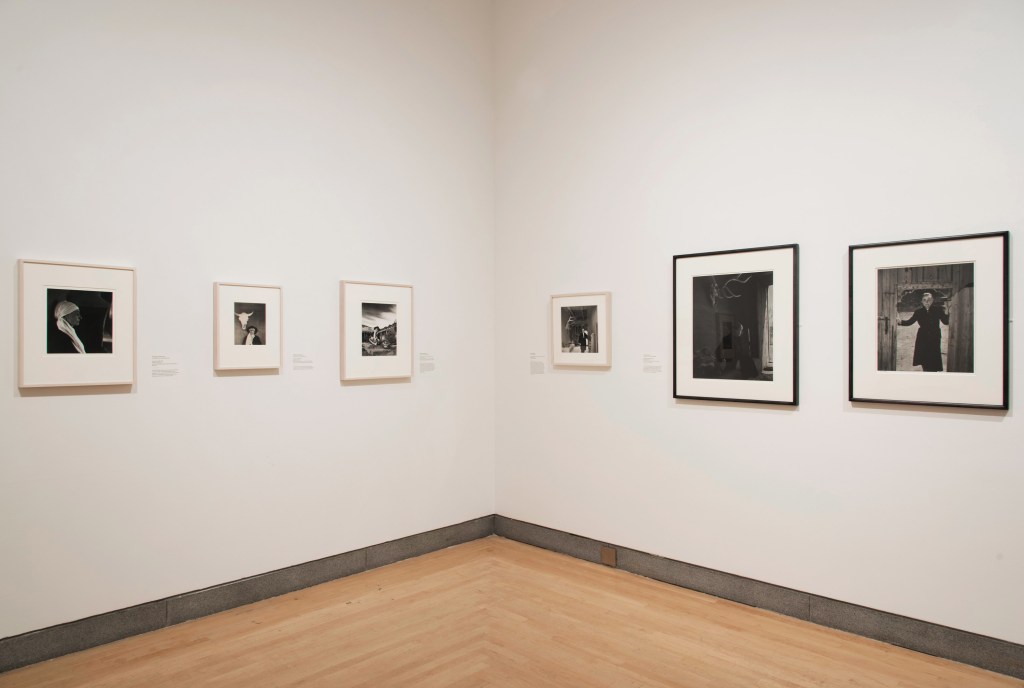
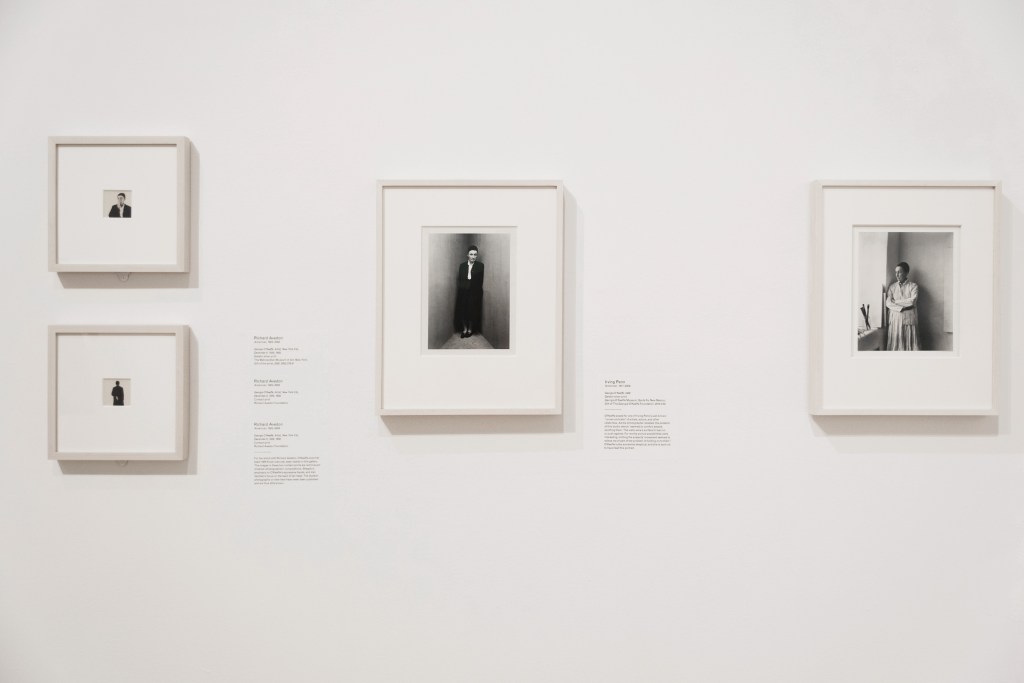
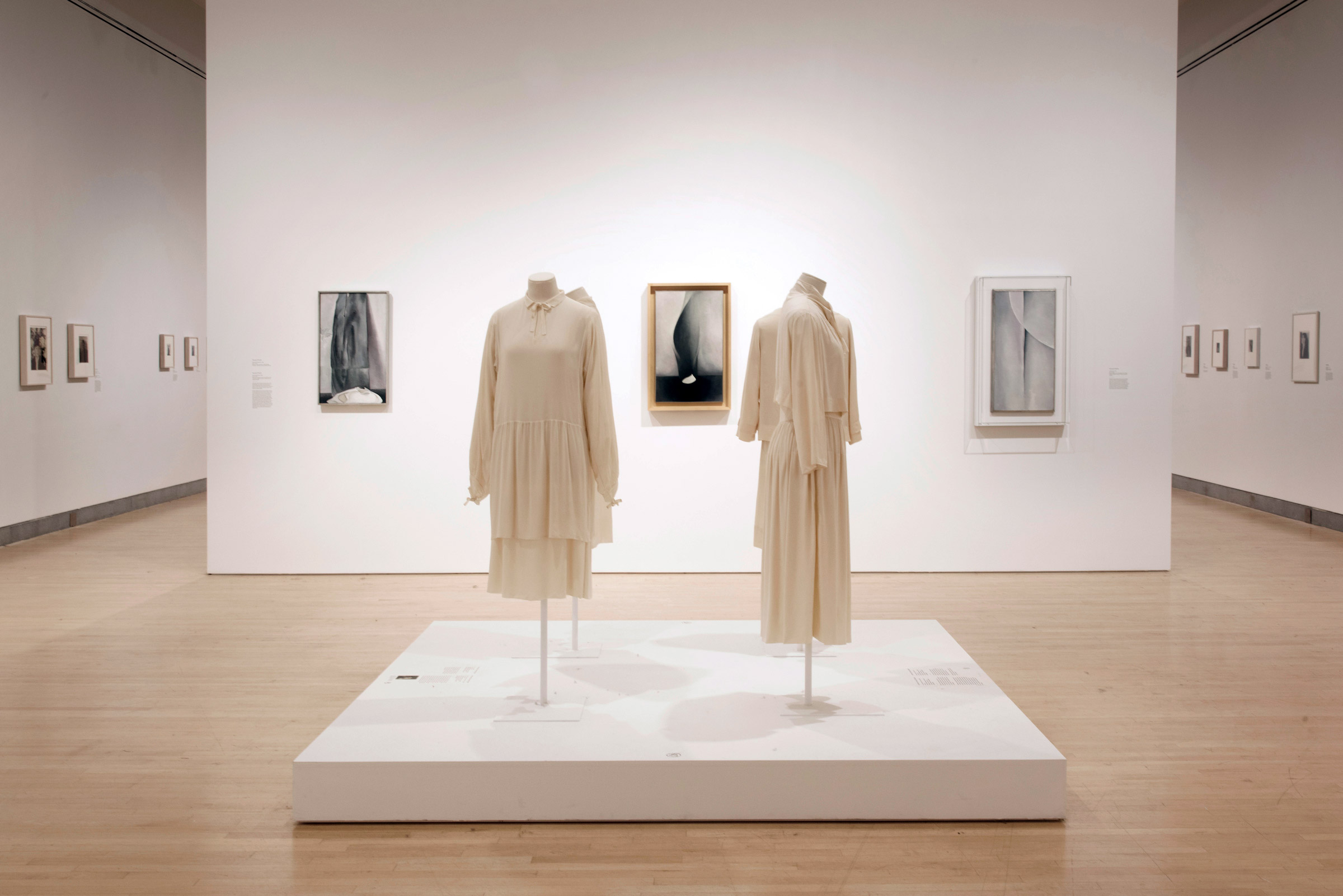
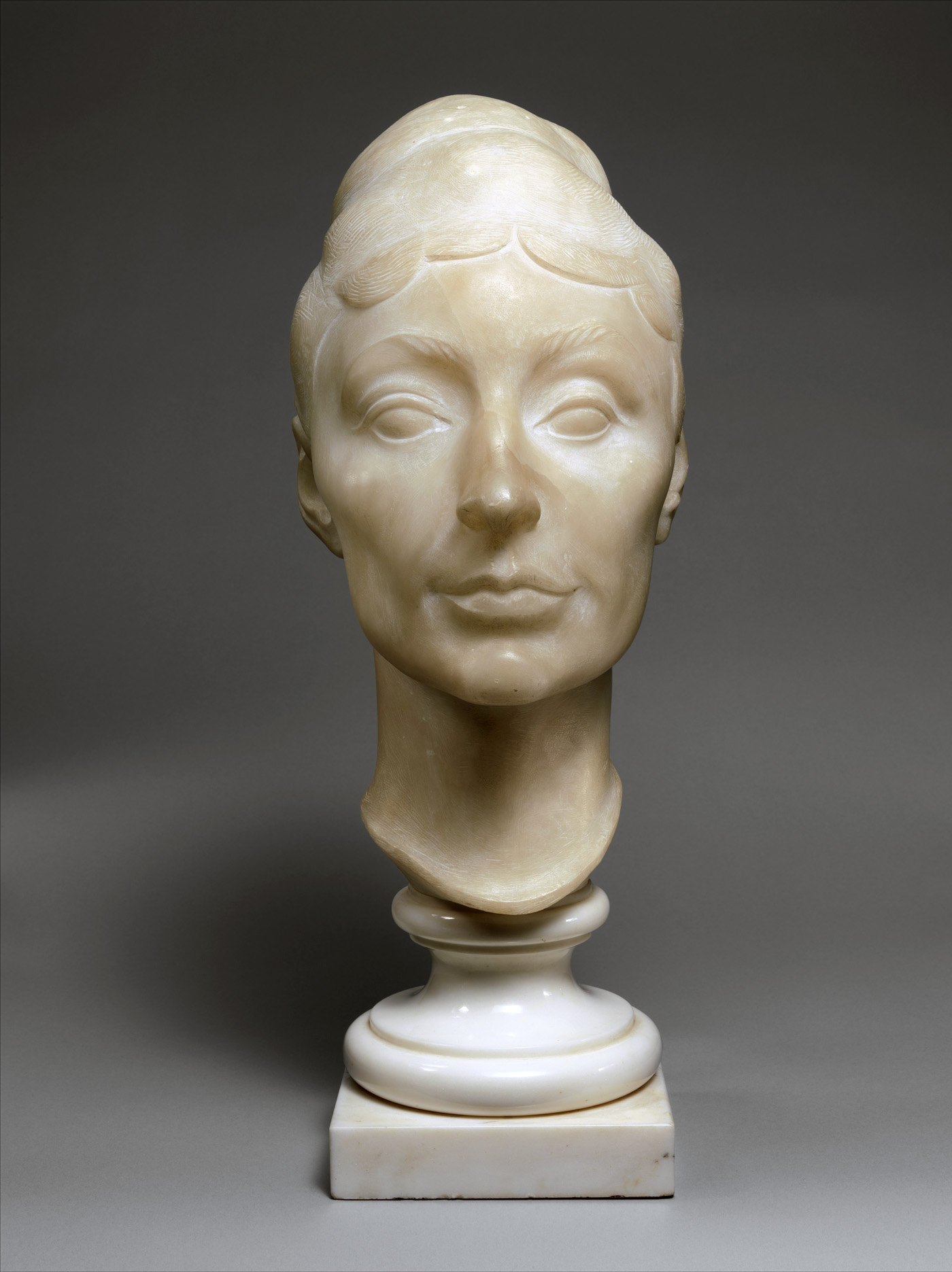
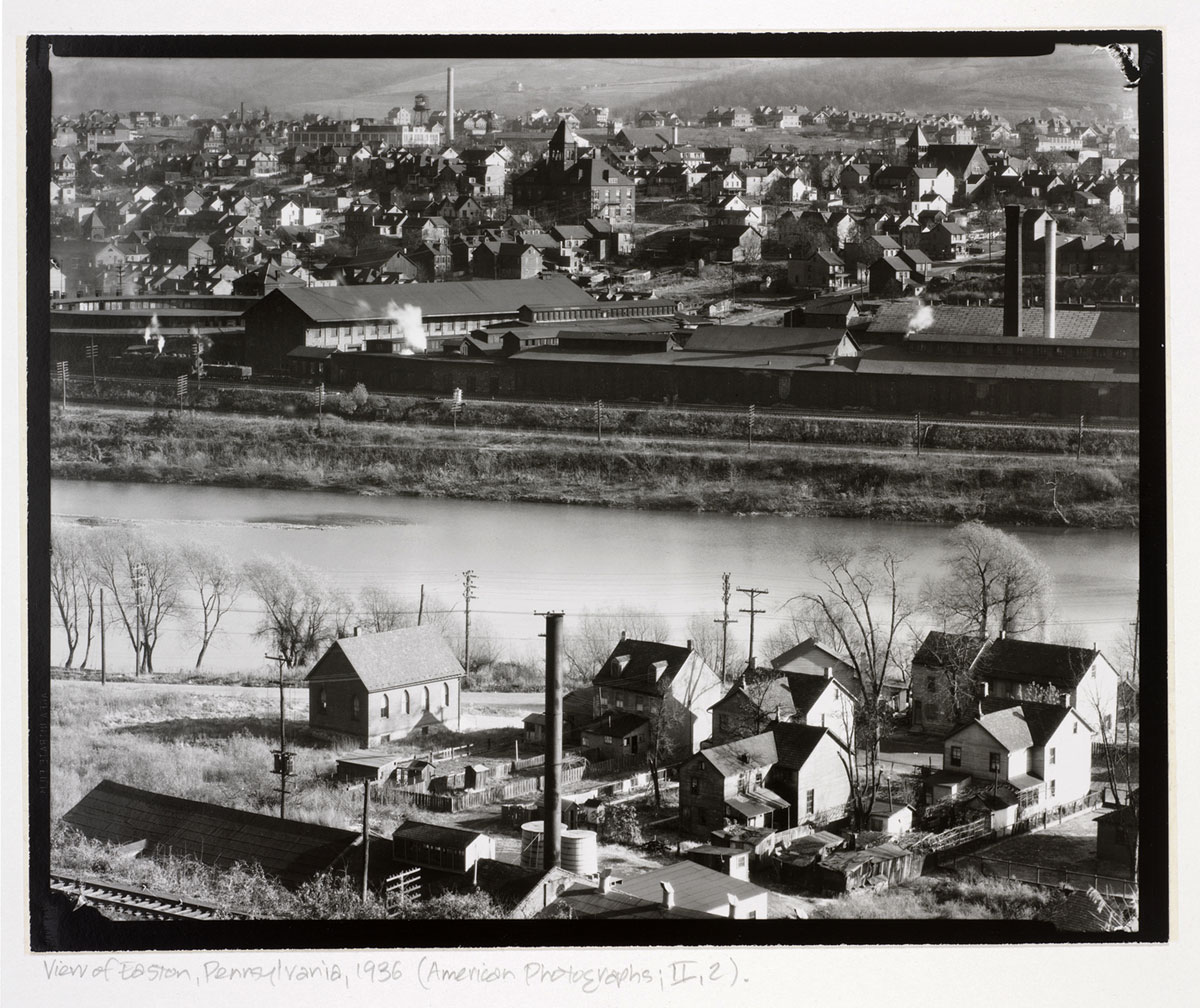
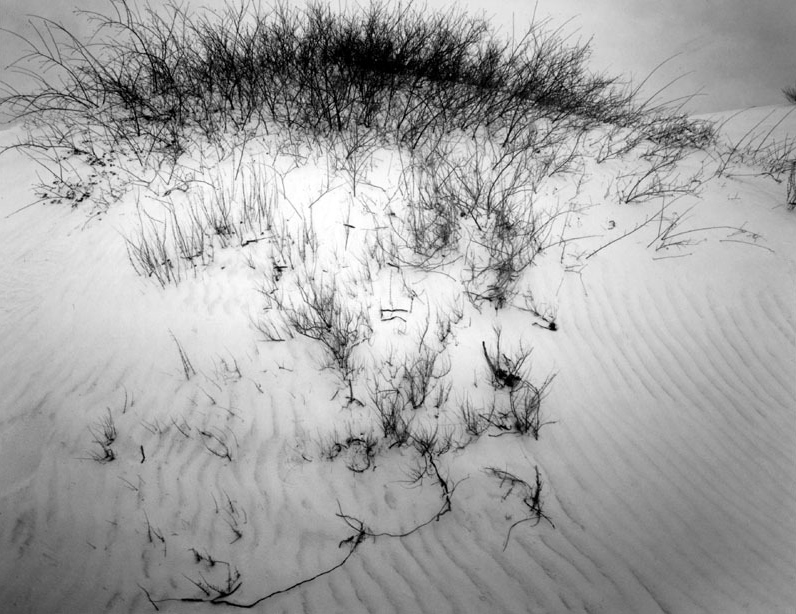
Exhibition: ‘Ansel Adams in Our Time’ at the de Young Museum, San Francisco

Exhibition dates: 8th April – 23rd July, 2023

Curator: Karen Haas, Lane Senior Curator of Photographs at the Museum of Fine Arts, Boston

Participating artists: Ansel Adams, 1902-1984;  Matthew Brandt, b. 1982; Lois Conner, b. 1951; Binh Danh, b. 1977; Mitch Epstein, b. 1952; Lucas Foglia, b. 1983; Sharon Harper, b. 1966; Frank Jay Haynes, 1853-1921; CJ Heyliger, b. 1984; John K. Hillers, 1843-1925;  Mark Klett, b. 1952; Chris McCaw, b. 1971;  Laura McPhee, b. 1958; Arno Rafael Minkkinen, b. 1945; Richard Misrach, b. 1949; Abelardo Morell, b. 1948; Eadweard Muybridge, 1830-1904; Catherine Opie, b. 1961; Trevor Paglen, b. 1974; Meghann Riepenhoff, b. 1979; Mark Ruwedel, b. 1954; Victoria Sambunaris, b. 1964; Bryan Schutmaat, b. 1983; David Benjamin Sherry, b. 1981; John Payson Soule, 1827-1904; Stephen Tourlentes, b. 1959; Adam Clark Vroman, 1856-1916; Carleton E. Watkins, 1829-1916; Will Wilson, b. 1969; Byron Wolfe, b. 1967.

Please note: This posting may contain the names or images of people who are now deceased.  Some Indigenous communities may be distressed by seeing the name or image of a community member who has passed away.
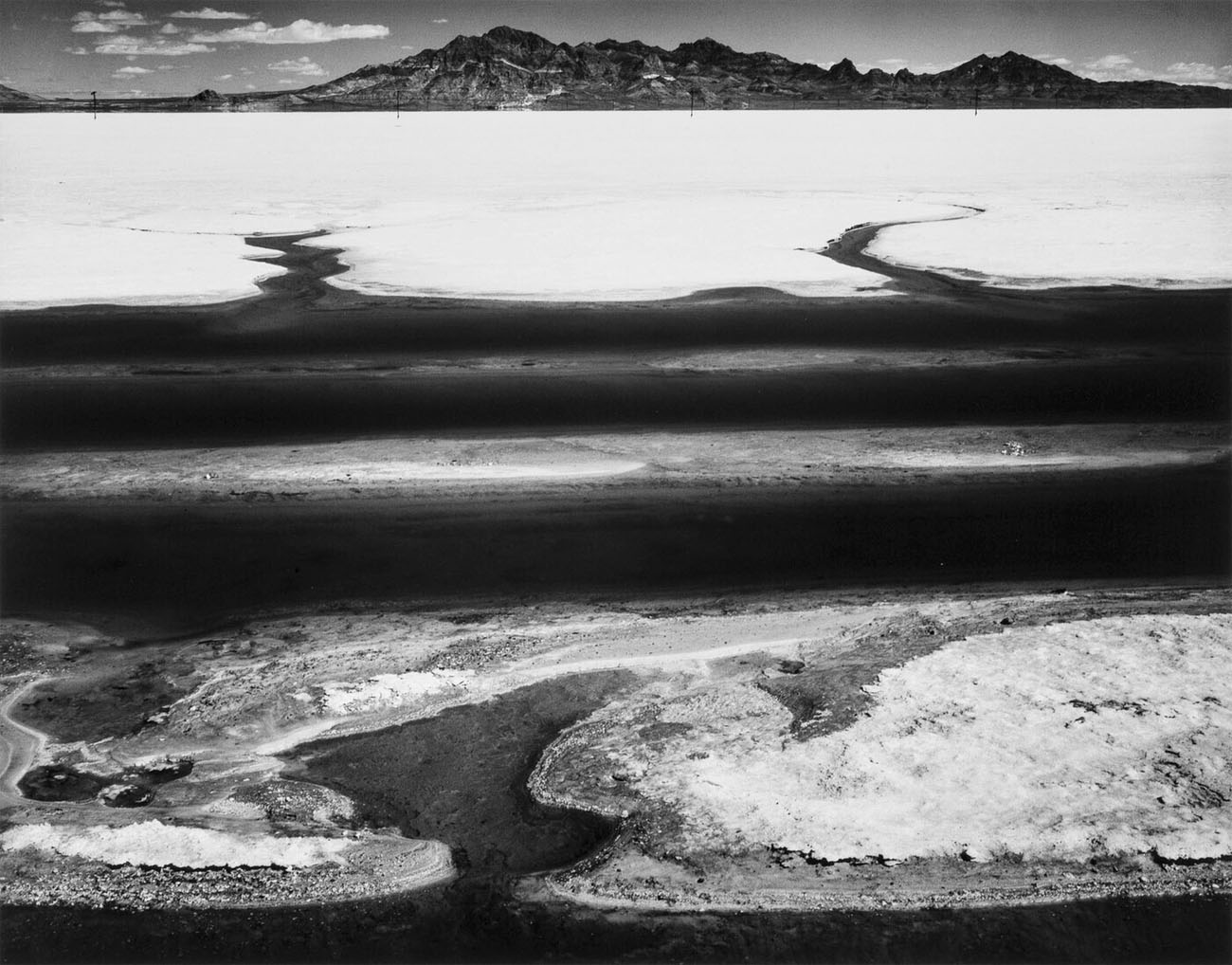
 

Ansel Adams (American, 1902-1984) 'Salt Flats Near Wendover, Utah' 1953 from the exhibition 'Ansel Adams in Our Time' at the de Young Museum, San Francisco, April - July, 2023


Ansel Adams (American, 1902-1984)
Salt Flats Near Wendover, Utah
1953
Gelatin silver print
The Lane Collection
Courtesy Museum of Fine Arts, Boston
© The Ansel Adams Publishing Rights Trust


Ansel Adams made this remarkably abstract image of ancient salt beds during the first year of his national parks project. Barely visible in the distance is a delicate string of telephone poles and wires, a slightly jarring intervention into an otherwise empty space. Adams’ inclusion of the poles might be explained in part by the fact that Wendover was the meeting point for the first telephone line between New York and San Francisco. This achievement was celebrated at the 1915 Panama-Pacific International Exposition – a fair that the young Adams attended nearly every day, after his father gave him a season pass with instructions to visit daily, in place of formal schooling.

Exhibition label text


Man and imagination

Most could not fail to know the superb landscape work of Ansel Adams, that master of the large format camera used to produce stunning black and white silver gelatin photographs of great formal beauty and technical prowess, the rich detail and tonal range of his landscape photographs used “in service of what he called the “spiritual-emotional” aspects of parks and wilderness, conveying their restorative power to as wide an audience as possible.” His photographs are so well known that they became icons and he a legend in his own lifetime. But all is not as effortless in his beautiful modernist photographs as they seem.

Early landscape photographs from his 1927 portfolio Parmelian Prints of the High Sierras (below) show Adams’ indebtedness to pictorialist and modernist photography. Indeed these elemental and muscular photographs show a dramatic use of dark and light hues in the near / far construction of the picture frame, the warm toned prints adding to their chthonic, almost underground and dystopian nature. Dark and brooding, dystopian and abstract. Those dark tones have a warmth that is contradictory – a lack of light: yet warmth! So there is a fiction at their heart… and that is why their dark brooding never seems a threat for they were based on a dream-world that couldn’t exist. What a difference to the later straight-ahead aesthetic of the artist and Group f64 (“a group founded by Adams of seven 20th-century San Francisco Bay Area photographers who shared a common photographic style characterised by sharply focused and carefully framed images seen through a particularly Western viewpoint.” ~ Wikipedia).

Other mutations and obfuscations are hidden from view “in order” that the artist achieve his desired transcendence of the American landscape. Adams cropped out attendant carparks and people viewing the scene even as other artists such as Seema Weatherwax incorporated them into their work (in the 1940s) as “indelible reminders of a Yosemite modernised for tourism – reminders that Adams typically left out of his artistic work.” Adams even manipulated the negative where necessary, for example removing a road that inconveniently ran through the centre of a canyon that destroyed his imaginative (and Western) vision of the pristine Sierra Nevada. So much for his “absolute realism” and honest simplicity in service of a maximum emotional statement.

Adam’s photographs of Indigenous Americans are also pictures seen from a particularly Western viewpoint, that of the fetishistic valorisation of Indigenous culture. “In the 1920s, writers and artists including D. H. Lawrence, Mabel Dodge Luhan, John Sloan, and Marsden Hartley projected an “authenticity” onto Pueblo visual culture, which justified their appropriation of its subject matter and form to create a native modernist aesthetic. Many photographers did the same, including Ansel Adams and Wright Morris…”1

When Adams first visited the American Southwest in 1927 to publish a book about Taos Pueblo “that aimed to communicate the threat tourism in the region posed to the artistic and religious traditions of Indigenous people [he] made images for the book only after receiving permission from the Taos Pueblo council, to whom he paid a fee and gifted a copy of the finished publication. He also photographed some Indian cultural observances that had become popular attractions among tourists. Adams’s own images of Native dancers have a complex legacy: although he was one of the non-Native onlookers, he carefully framed his views to leave out evidence of the gathered crowds.” (Exhibition wall text) As Joseph Aguilar (San Ildefonso Pueblo) notes in a further exhibition label text, “At the time, Pueblo people and other Native Americans in the Southwest were trying to navigate the outsiders who were interested in their culture. Some of them did not quite understand the circumstances surrounding the curiosity, while others did understand the extractive nature, and they had to weigh that in terms of their other needs. I get questions from members of my community about why they did not chase the archaeologists and photographers out, and I often respond it is because of the uneven power relations between Indigenous and non-Native people at the time.” This influx of artists and photographers did lead to the racist exoticisation and flattening of Indigenous identity performed by the photograph. What is heartening to see in this exhibition is that the curators have placed Adams’ Indigenous American portraits and landscapes in both a historical and contemporary setting, proffering alternative points of view from within the communities being photographed.

An extractive, imaginative and emotional Western “nature” then, is at the heart of Adam’s work and his “marketing the view” – whether that be national parks, empty bays before the construction of the Golden Gate Bridge, or Native Americans. While he was a tireless champion of photography as a legitimate form of fine art and an unremitting activist for conservation and wilderness preservation, Adams’ photographs are a creation of a myth of his own of a pristine wilderness which had never co-existed with man. To our benefit, Adams had his ideals and he let them manifest themselves in his imagination.

Dr Marcus Bunyan


1/ Yechen Zhao. “Photographic Fluency (Its Pleasures and Pains): Kyo Koike and Chao-Chen Yang,” in Josie R. Johnson. Reality Makes Them Dream: American Photography, 1929-1941. Iris & B. Gerald Cantor Center for Visual Arts at Stanford University, 2023, p. 55.


Many thankx to the de Young museum for allowing me to publish the photographs in the posting. Please click on the photographs for a larger version of the image.


“Only pictures that look as if they had been made easily can convincingly suggest that beauty is commonplace.”


Robert Adams. Beauty in Photography. New York: Aperture, 1996, p. 28.


A self-described “California photographer,” Ansel Adams had his first museum exhibition at the de Young in 1932. In a San Francisco homecoming, more than 100 of his most iconic works are on view in Ansel Adams in Our Time alongside those of 23 contemporary artists who share his deep concern for the environment, Catherine Opie, Richard Misrach, Trevor Paglen, and Binh Danh among them. An unremitting activist for conservation and wilderness preservation in the spirit of his 19th-century predecessors, Adams is today beloved for his lush gelatin silver prints of the national parks. Organised by the Museum of Fine Arts, Boston, in partnership with the Fine Arts Museums of San Francisco, Ansel Adams in Our Time is enhanced at the de Young by the addition of works from the Museums’ permanent collection and new interpretive framing that explores Adams’ close connection to the Bay Area and the state of California more broadly.
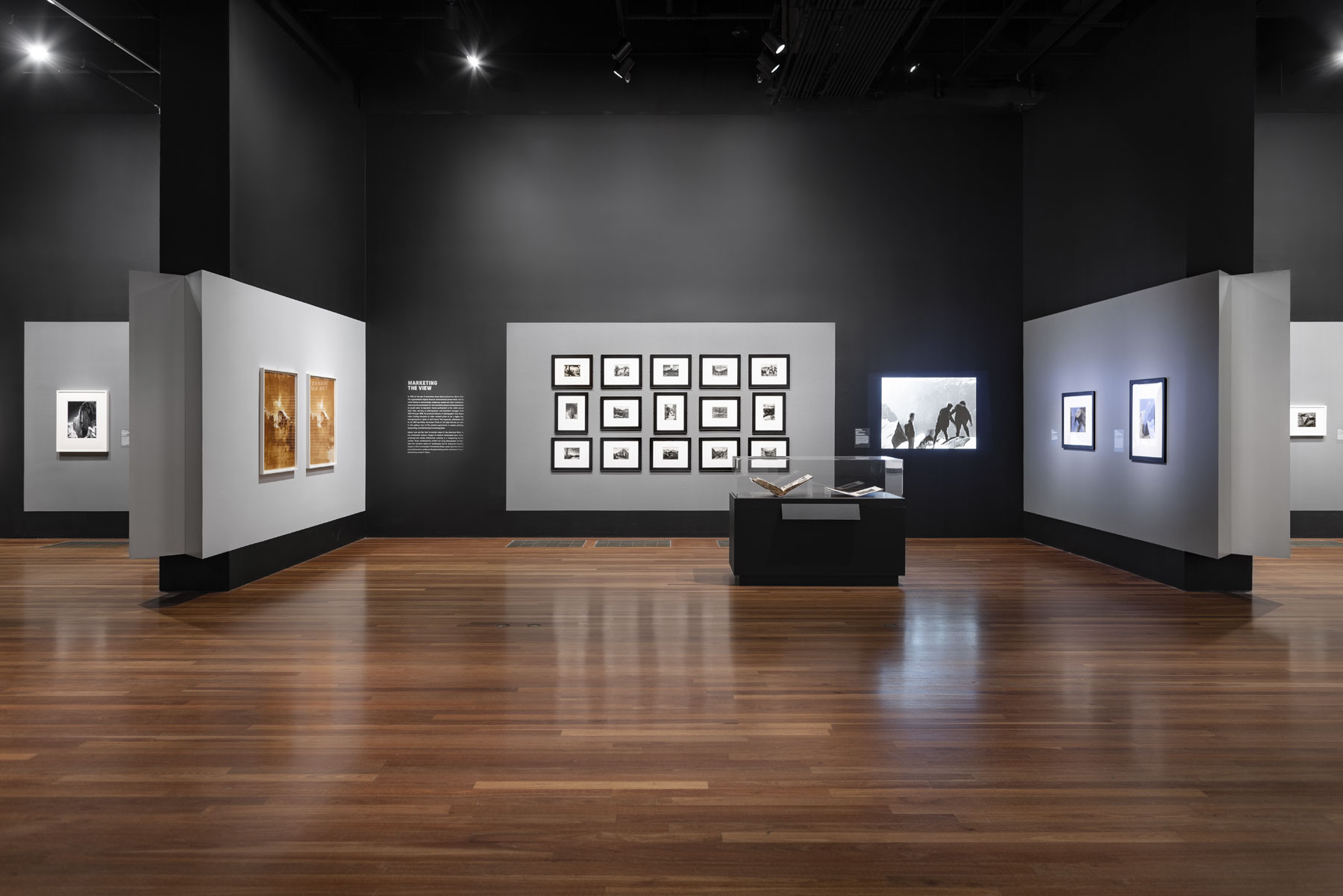
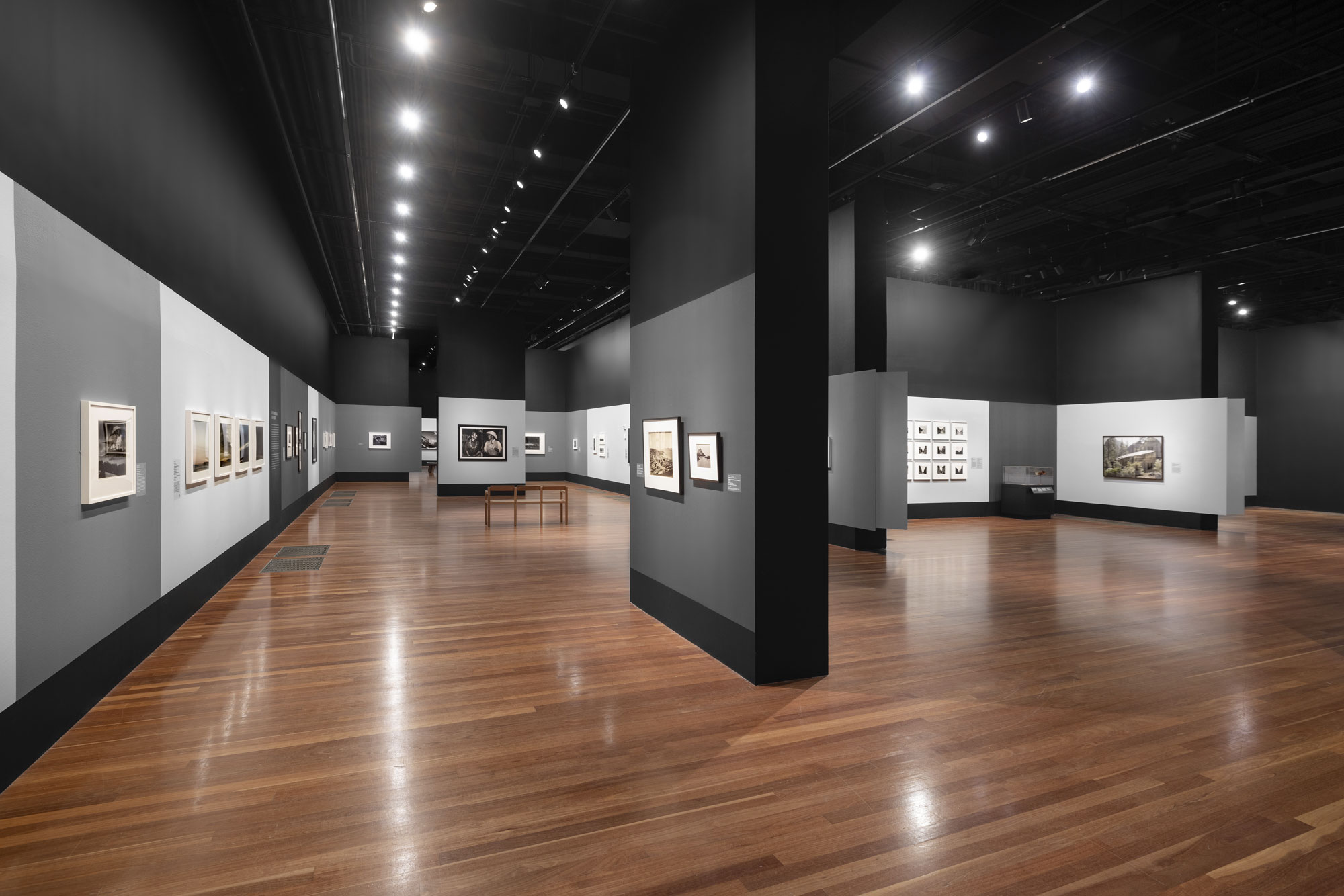
 

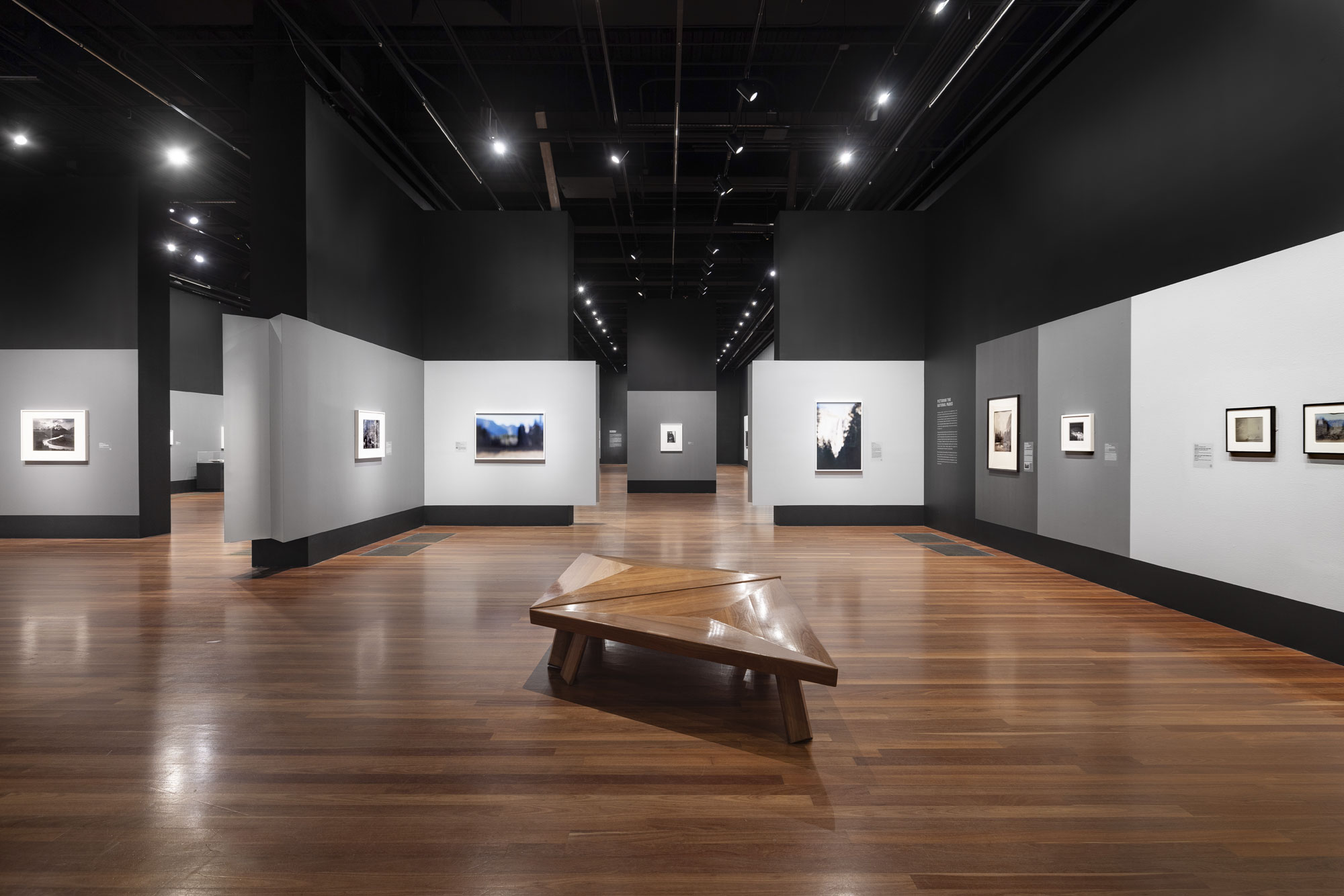
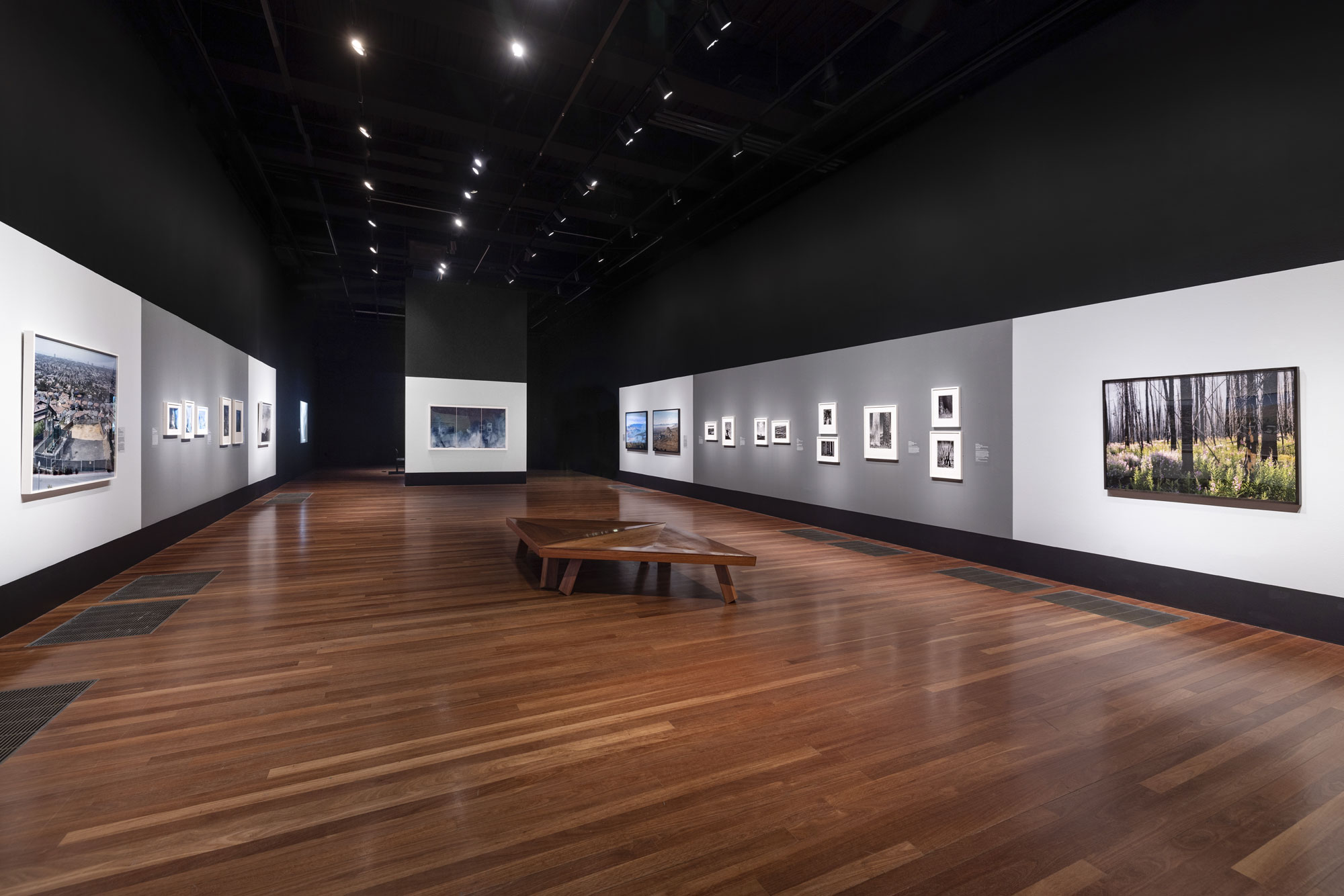
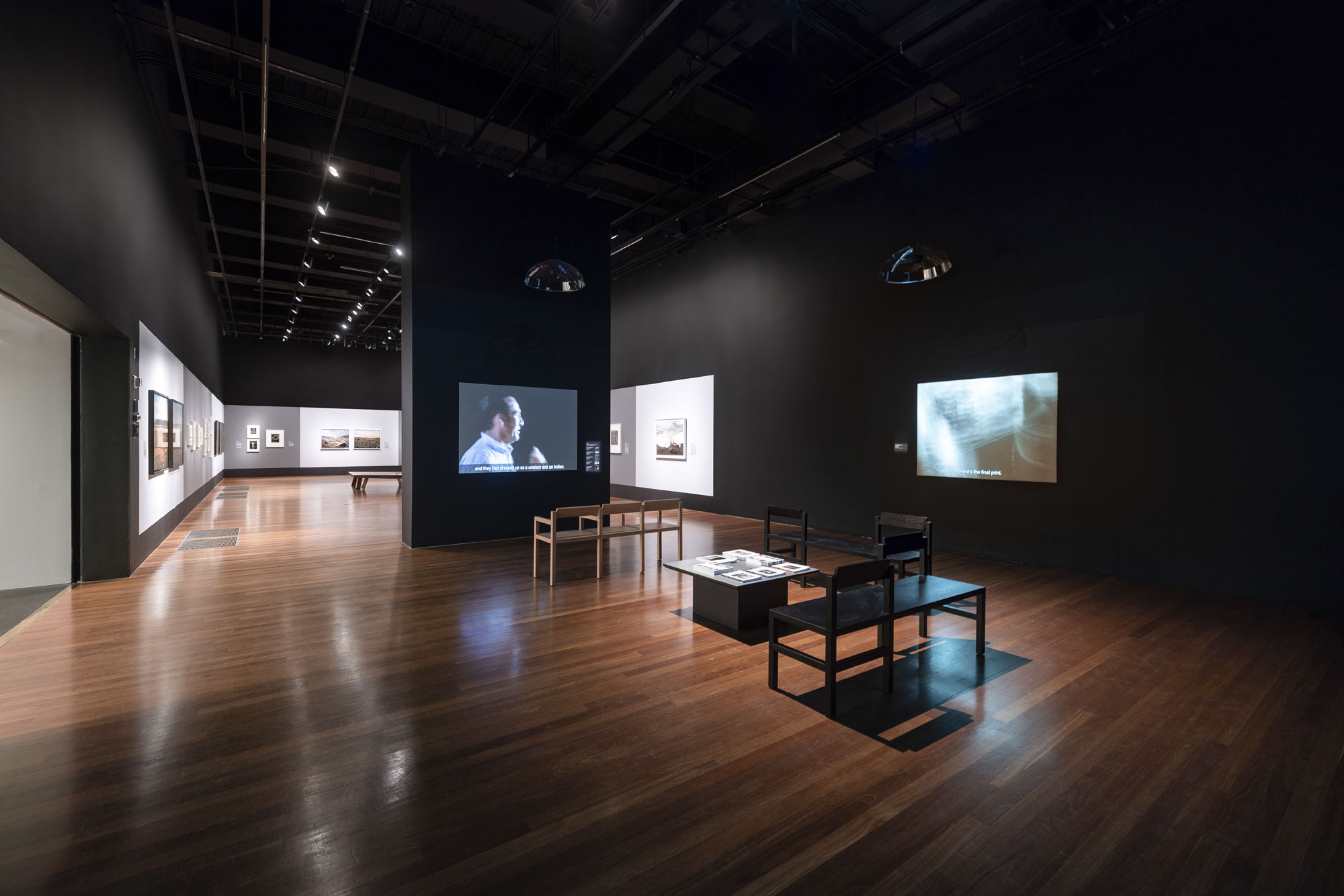
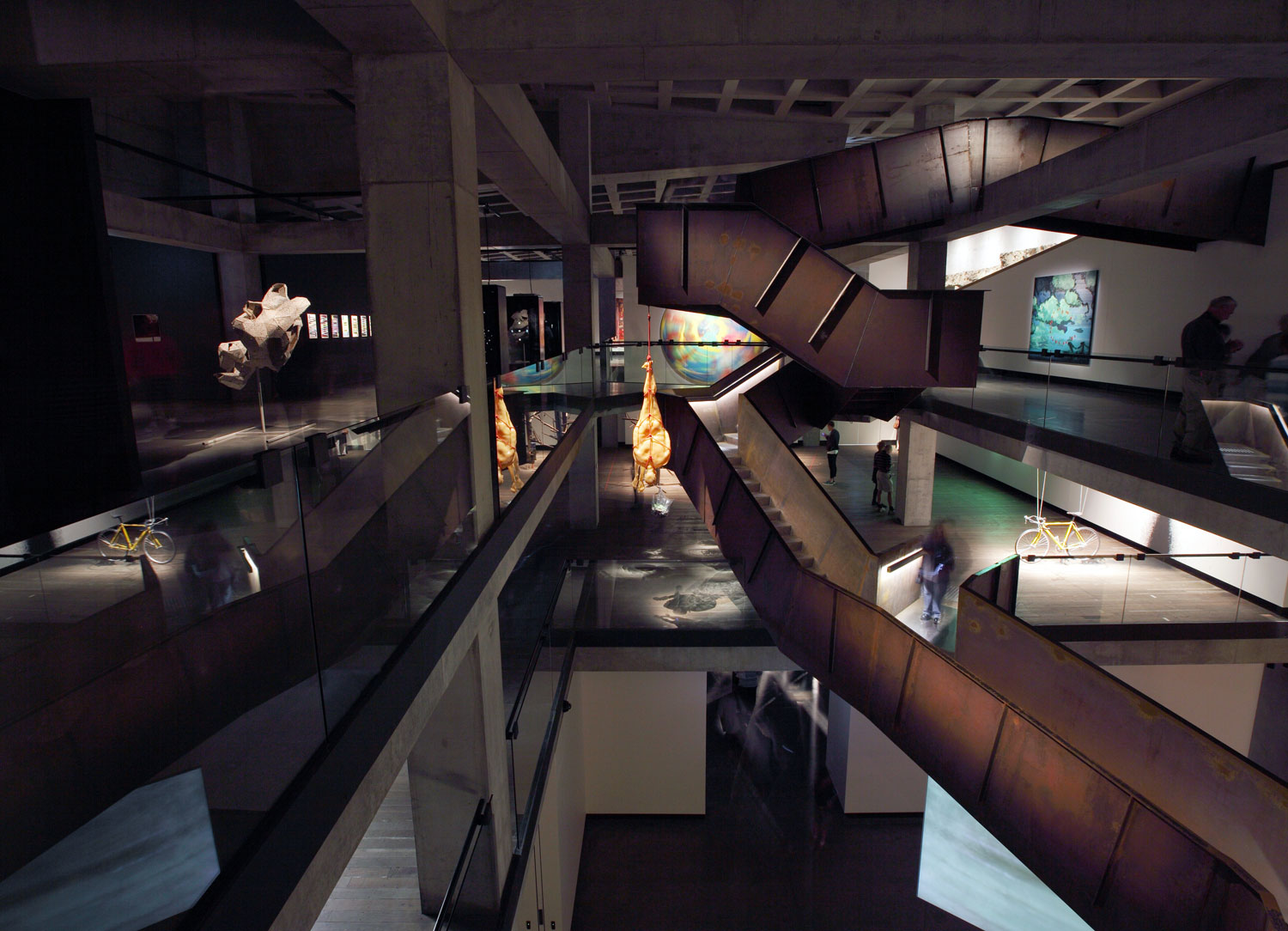
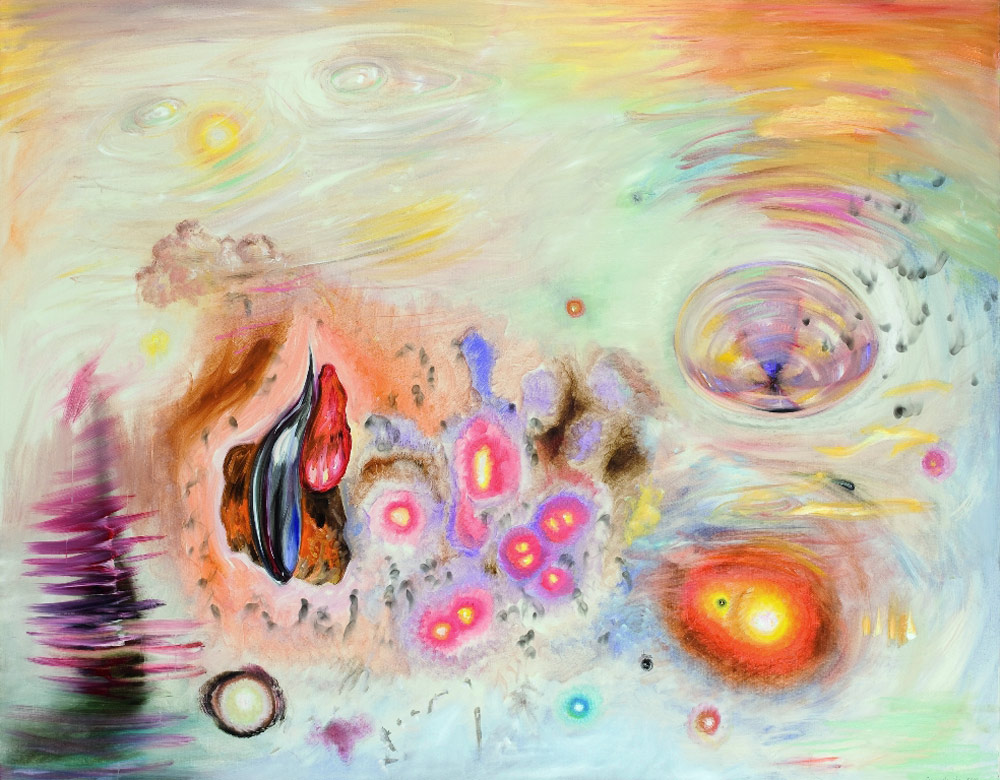
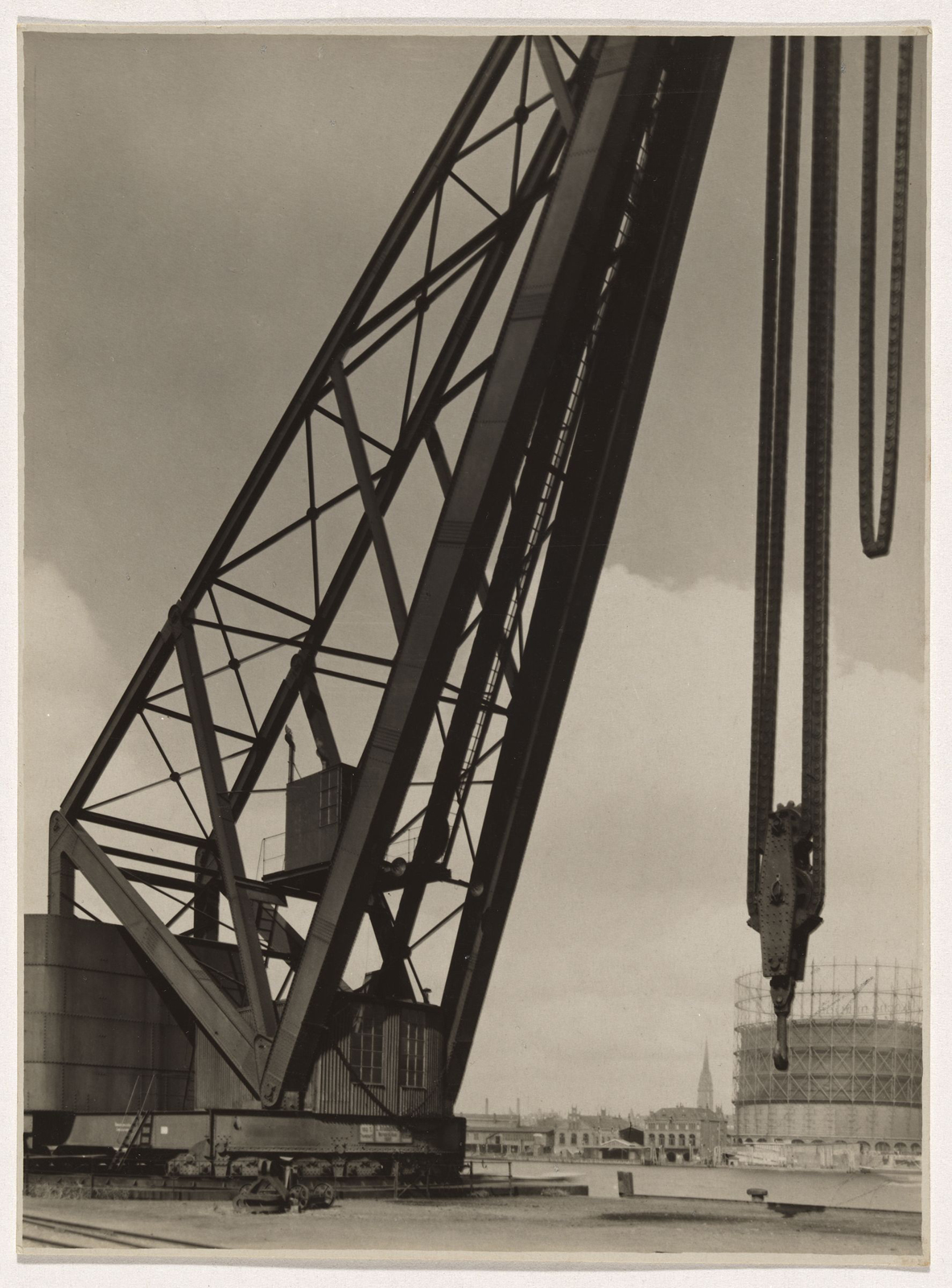
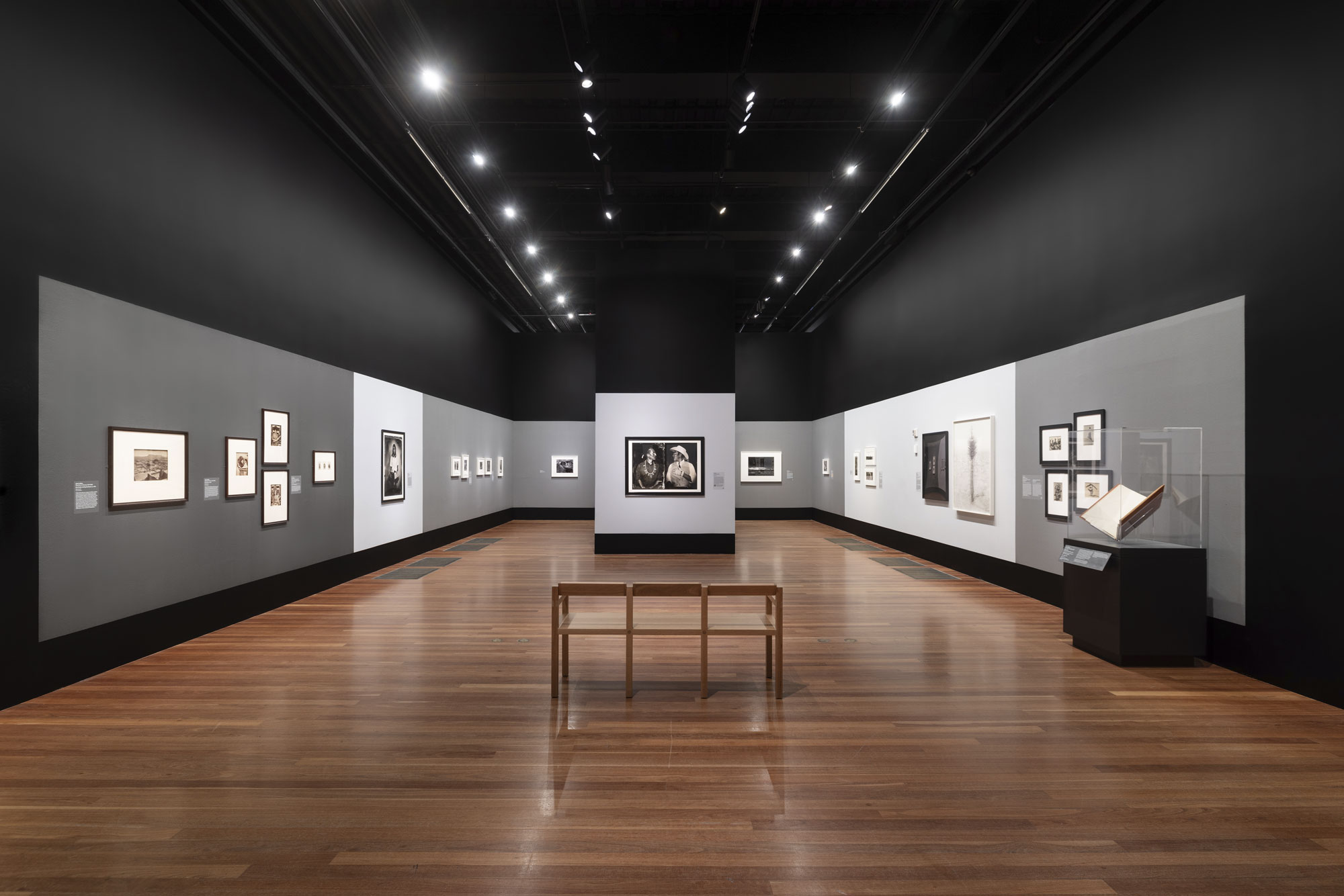
Installation view of the exhibition 'Ansel Adams in Our Time' at the de Young museum, San Francisco 

Installation view of the exhibition 'Ansel Adams in Our Time' at the de Young museum, San Francisco 

Installation view of the exhibition 'Ansel Adams in Our Time' at the de Young museum, San Francisco 

Installation view of the exhibition 'Ansel Adams in Our Time' at the de Young museum, San Francisco 

Installation view of the exhibition 'Ansel Adams in Our Time' at the de Young museum, San Francisco 


Installation views of the exhibition Ansel Adams in Our Time at the de Young museum, San Francisco
Images courtesy of the Fine Arts Museums of San Francisco
Photos: Gary Sexton


Ansel Adams in Our Time brings iconic artist home to San Francisco

Beloved for his lush gelatin silver photographs of the national parks, Ansel Adams is a giant of 20th-century photography whose images have become icons of the American wilderness. Opening April 8 at the de Young, Ansel Adams in Our Time brings more than 100 works from this self-described “California photographer” to the site of his very first museum exhibition in 1932, placing him in dialogue with 23 contemporary artists who are engaging anew with the landscapes and environmental issues that inspired Adams. The exhibition is organised by the Museum of Fine Arts, Boston, in partnership with the Fine Arts Museums of San Francisco, and enhanced at the de Young by the addition of works from the permanent collection and new interpretive framing exploring Adams’ close connection to his hometown of San Francisco.

“Ansel Adams’ photography is renowned for its formal beauty and technical prowess, but his work is equally one of advocacy,” remarked Thomas P. Campbell, Director and CEO of the Fine Arts Museums of San Francisco. “Adams was a tireless conservationist and wilderness preservationist who fully understood the power of images to sway public opinion. Ansel Adams in Our Time is exceptional in underscoring his brilliant legacy and the critical role that his works and others’ before him have played in safeguarding our national parks and other public lands.”

Instrumental to Adams’ development as a photographer was Yosemite, one of the oldest national parks in the country, which he visited regularly from the age of 14 with his Eastman Kodak Brownie camera in tow. Ansel Adams in Our Time examines the critical role that photography has played in the history of the national parks, with Adams following in the footsteps of predecessors such as Carleton Watkins, whose efforts first secured Yosemite as protected land. A longtime member of the Sierra Club, Adams would go on to perfect the rich detail and tonal range of his landscapes in service of what he called the “spiritual-emotional” aspects of parks and wilderness, conveying their restorative power to as wide an audience as possible. Presenting President Gerald Ford with a print of Yosemite: Clearing Winter Storm (c. 1937) in 1975, Adams urged, “Now, Mr. President, every time you look at this picture, I want you to remember your obligation to the national parks.”

At the de Young, the exhibition delves further into the artist’s Bay Area connections with new interpretive framing and works from the Fine Arts Museums’ permanent collection. Adams became a truly modernist photographer in San Francisco in the 1920s and 1930s, experimenting with the large-format camera that would yield the maximum depth of field and razor-sharp detail that are today considered his signature. He was a tireless champion of photography as a legitimate form of fine art. From his pristine Parmelian Prints of the High Sierras (1927), a landmark work in 20th-century photography, to images of oil derricks, ghost towns, drought conditions, and the sand dunes of Death Valley, Ansel Adams in Our Time spans the scope of the artist’s nearly seven-decade career and efforts to establish both environmental stewardship as a pillar of civic life and the photographic medium as a widely accepted art form.

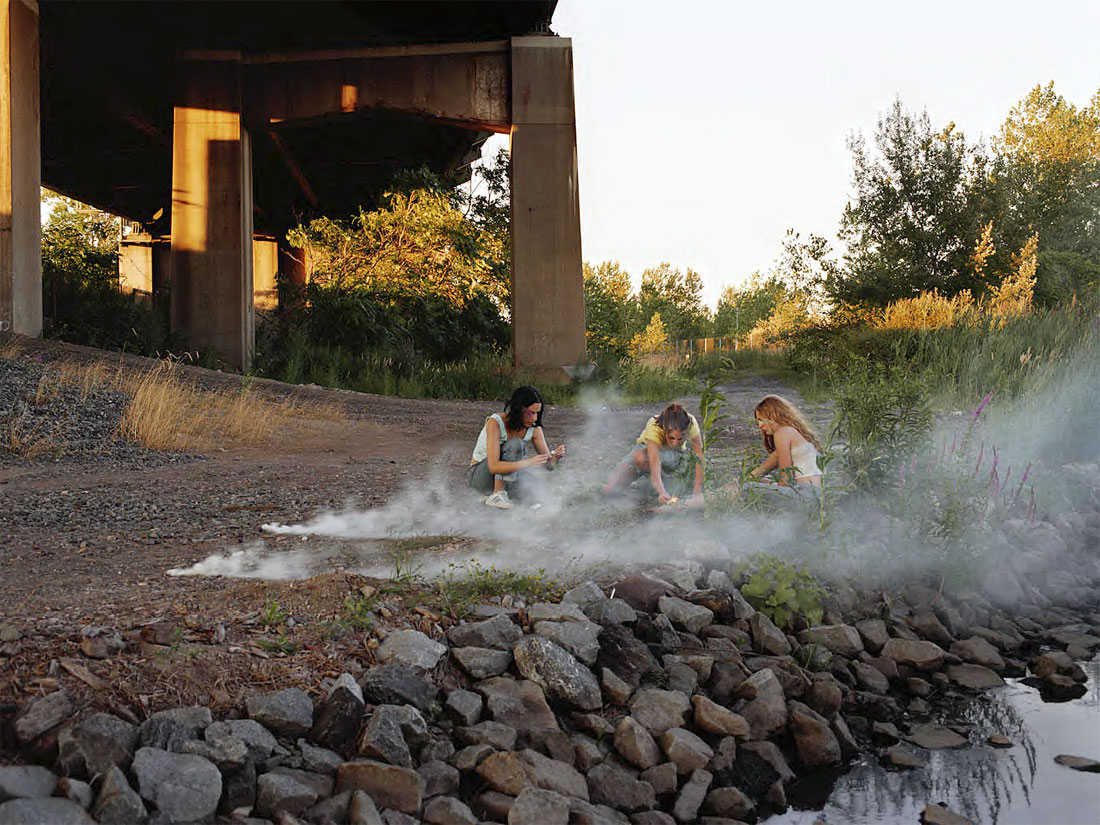
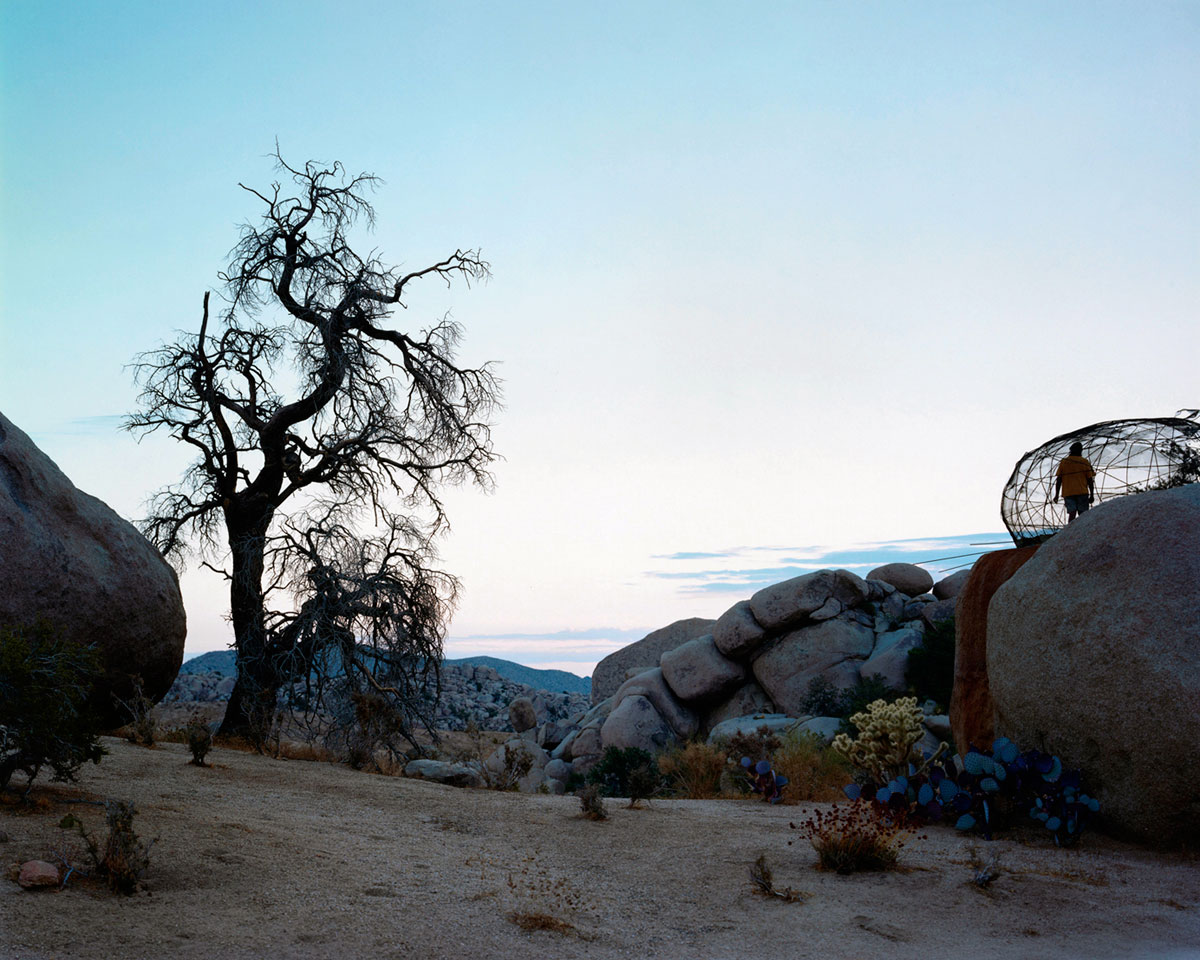
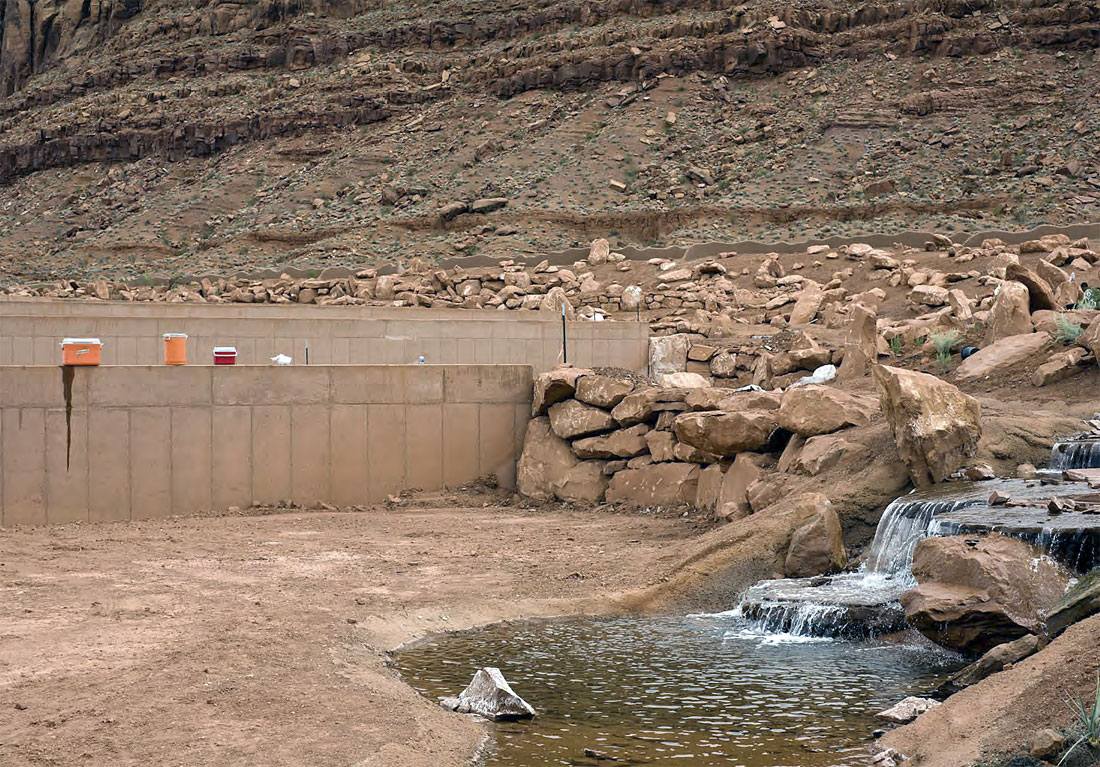
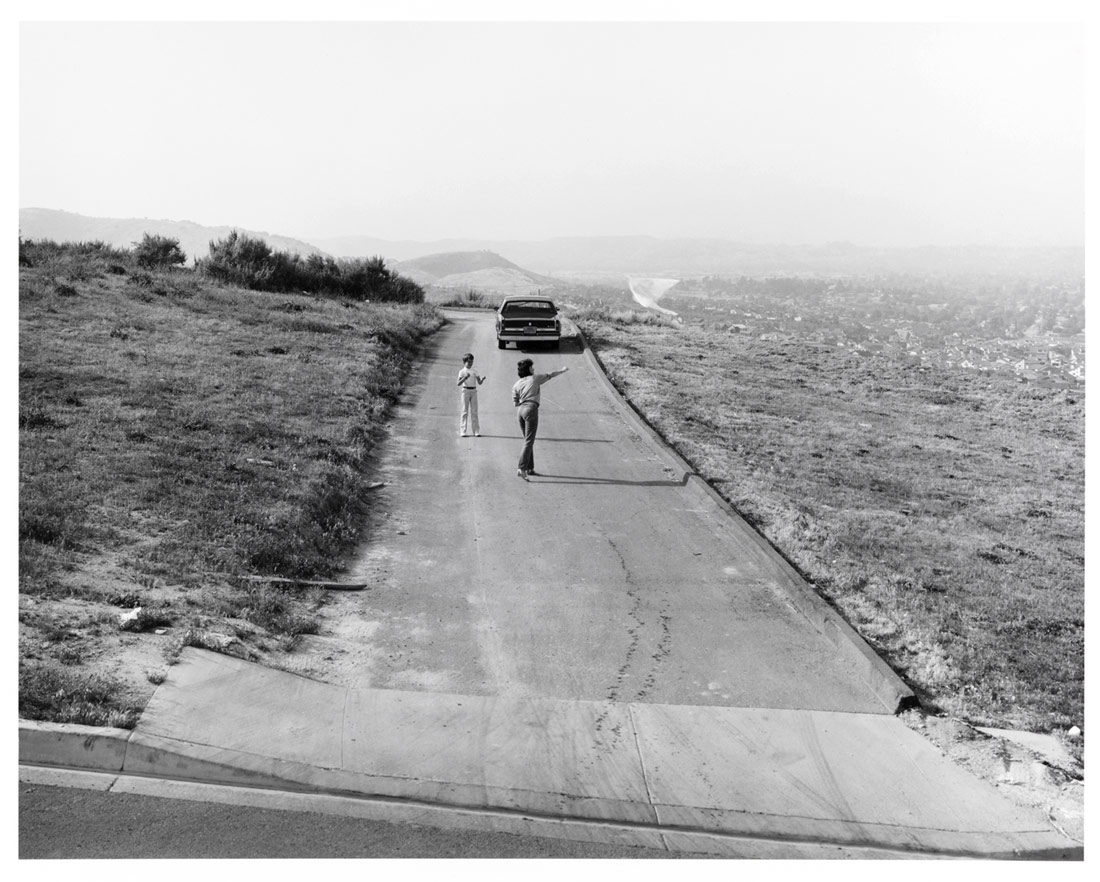
The works of 23 contemporary artists, including Catherine Opie, Abelardo Morell, Binh Danh, Trevor Paglen, Mitch Epstein, and Victoria Sambunaris, among others, provide a new lens for Adams, drawing on his legacy of art as environmental activism to confront issues such as drought and fire, mining and energy, economic booms and busts, protected places and urban sprawl. The exhibition’s five thematic sections – Capturing the View, Marketing the View, San Francisco: Becoming a Modernist, Adams in the American Southwest, and Picturing the National Parks – open up new conversations around Adams’s work, looking both forward and backward in time to present a richer picture of the relationship between photography, art, environmentalism, and conceptions of landscape.

“Ansel Adams had close ties to San Francisco, and the California landscape, and the de Young museum was among the first institutions to celebrate his work when he was a rising artist,” noted Lauren Palmor, Associate Curator of American Art, who organised Ansel Adams in Our Time at the Fine Arts Museums. “His reverence for our region’s natural beauty drew him to photograph the natural diversity that can be found throughout the Bay Area over the course of his lifetime. Adams was also a tireless advocate for the environment, and the Bay Area shares that spirit as a global center of innovation in conservation and wilderness preservation today.”

Exhibition organisation

Ansel Adams in Our Time was organised by the Museum of Fine Arts, Boston, in partnership with the Fine Arts Museums of San Francisco. The exhibition was curated by Karen Haas, Lane Senior Curator of Photographs at the Museum of Fine Arts, Boston. The Presenting Sponsor is the Clare C. and Jay D. McEvoy Endowment Fund. Lead Sponsors are The Lisa and Douglas Goldman Fund and the San Francisco Auxiliary of the Fine Arts Museums. Major Support is provided by the Byers Family and The Herbst Foundation, Inc. Significant Support is provided by The Ansel Adams Gallery. Generous Support is provided by David A. Wollenberg and Merrill Private Wealth Management.

About Ansel Adams

Ansel Easton Adams (1902-1984) made indelible images of the American landscape and successfully advocated for the environment and the preservation of natural resources. Adams was born in San Francisco in 1902, and he made his first trip to Yosemite when he was just 14 years old. Transfixed by the valley’s beauty, he took his first photographs of Yosemite’s waterfalls and rock formations. Adams went on to develop his photographic practice in parallel with his environmentalist outlook.

The de Young museum hosted several important early Adams exhibitions in the 1930s, celebrating the achievements of this local photographer whose star was rapidly rising nationally: Photographs by Ansel Easton Adams (1932); the landmark Group f.64 exhibition (1932-1933), which also featured the work of Imogen Cunningham, John Paul Edwards, Preston Holder, Consuelo Kanaga, Alma Lavenson, Sonya Noskowiak, Henry Swift, Willard Ames Van Dyke, Brett Weston, and Edward Weston; and Yosemite in Four Seasons: Photographs by Ansel Adams (1935).

Adams shaped the field for other practicing photographers on both coasts, and his impact is immeasurable. In addition to teaching, he authored a celebrated series of books on photographic techniques that distilled his expertise for generations of budding photographers. Parallel to his achievements in photography, Adams dedicated himself to environmental advocacy for over seven decades. In 1980, he was awarded the Presidential Medal of Freedom, the nation’s highest civilian honor, for his artistic and environmental efforts.

Press release from the de Young website
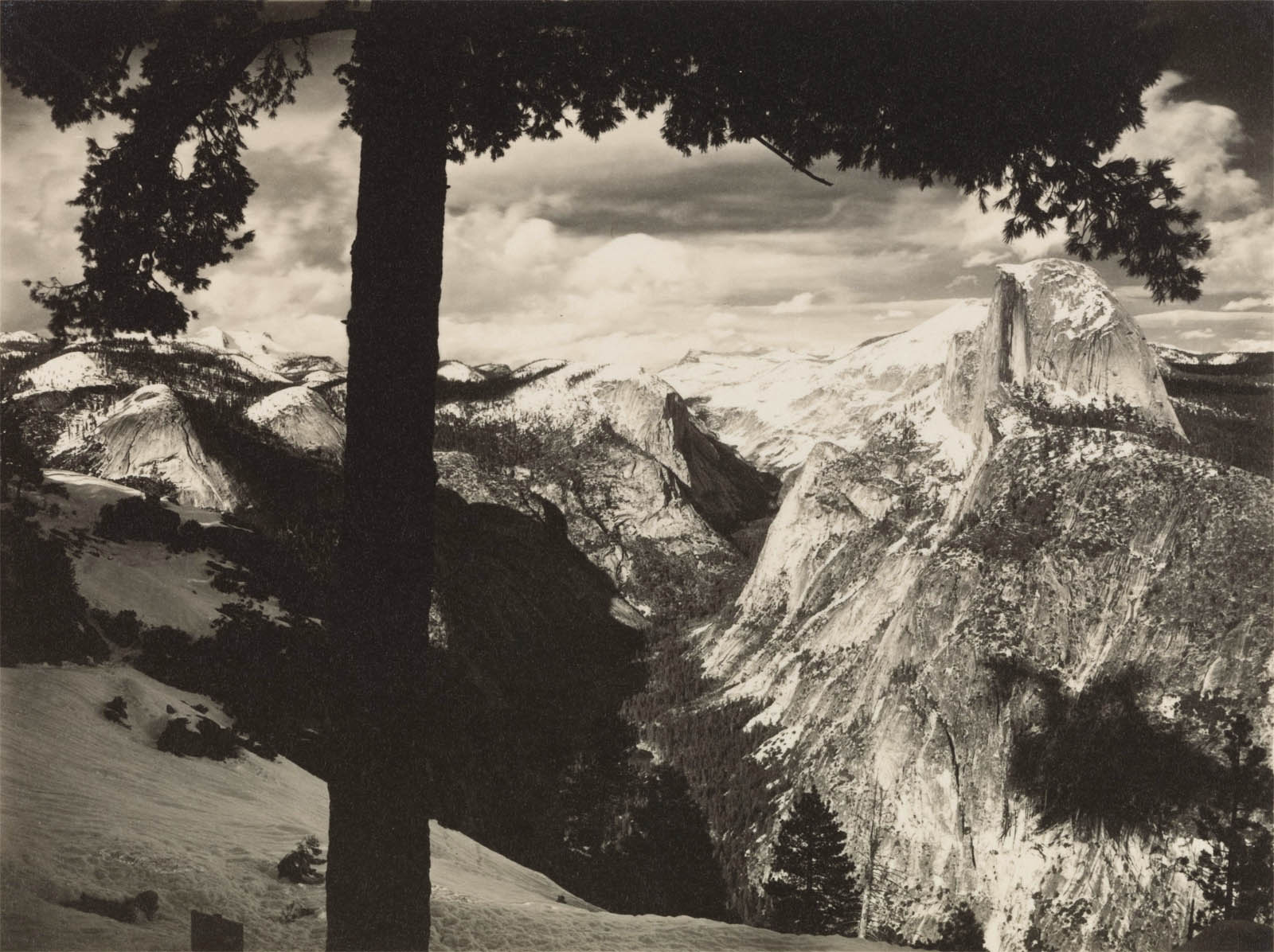
 

Ansel Adams (American, 1902-1984) 'Glacier Point, Yosemite National Park' c. 1923, printed 1927 from the exhibition 'Ansel Adams in Our Time' at the de Young Museum, San Francisco, April - July, 2023


Ansel Adams (American, 1902-1984)
Glacier Point, Yosemite National Park
c. 1923, printed 1927
From the portfolio Parmelian Prints of the High Sierras, 1927
Gelatin silver print
The Lane Collection
Courtesy Museum of Fine Arts, Boston
© The Ansel Adams Publishing Rights Trust


These photographs were issued together as a portfolio by San Francisco’s Grabhorn Press in 1927. Although photographic print portfolios would become common later in the century, Parmelian Prints of the High Sierras represents one of the first attempts to market photographs in this way. Looking back on this moment in his career, a time when he was struggling to make a living and gain recognition as an artist, Ansel Adams was embarrassed by the made-up term “Parmelian” in the title. His publisher thought it was necessary because photographs were not yet considered worthy of investment by fine art collectors. Later, Adams would use the same negative of Half Dome from this series to produce the larger version of Monolith – The Face of Half Dome [below] that appears at the start of this exhibition.

Exhibition label text
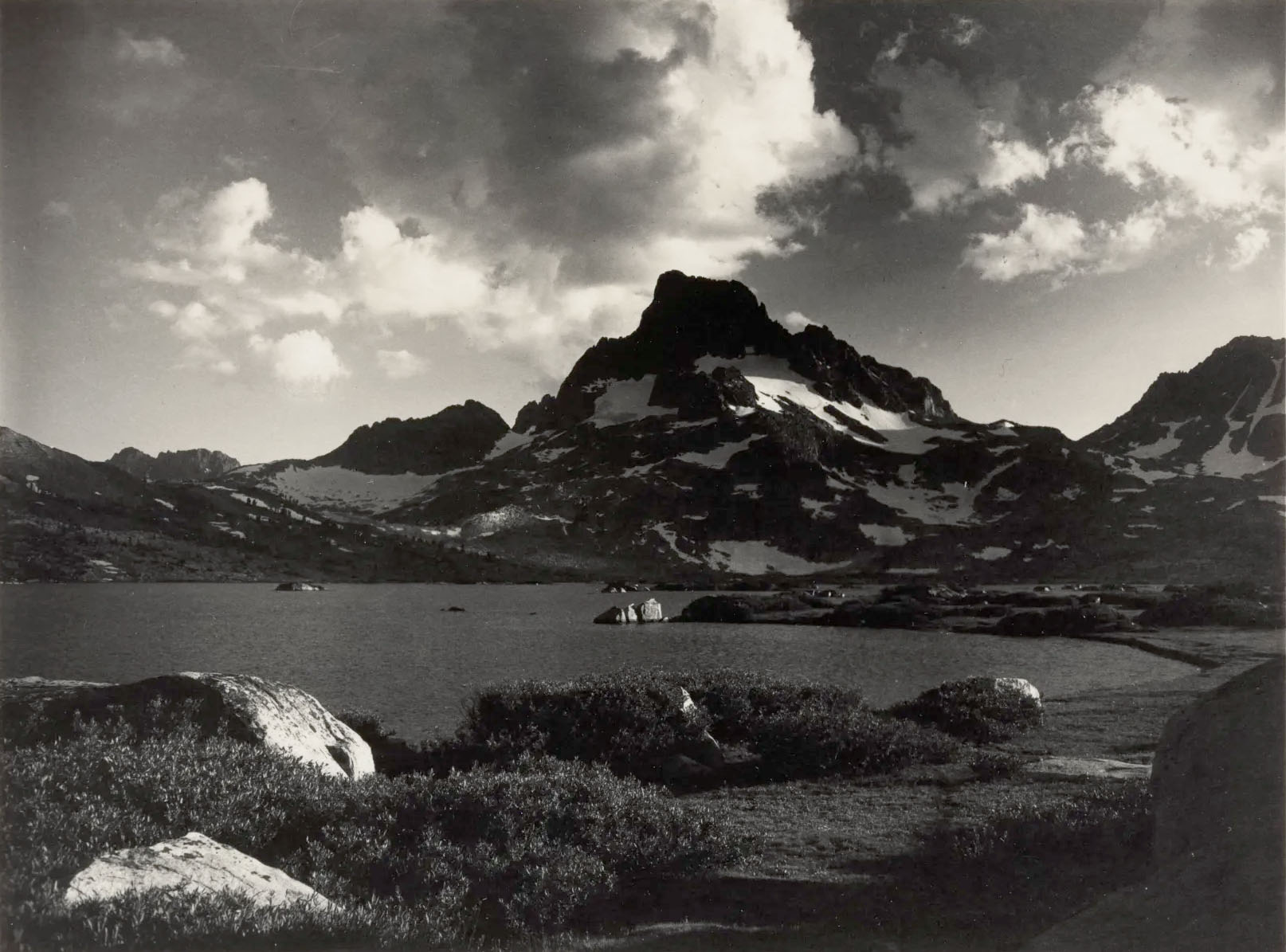
 

Ansel Adams (American, 1902-1984) 'Banner Peak – Thousand Island Lake, Sierra Nevada, California' c. 1923, printed 1927 from the exhibition 'Ansel Adams in Our Time' at the de Young Museum, San Francisco, April - July, 2023


Ansel Adams (American, 1902-1984)
Banner Peak – Thousand Island Lake, Sierra Nevada, California
c. 1923, printed 1927
From the portfolio Parmelian Prints of the High Sierras, 1927
Gelatin silver print
The Lane Collection
Courtesy Museum of Fine Arts, Boston
© The Ansel Adams Publishing Rights Trust
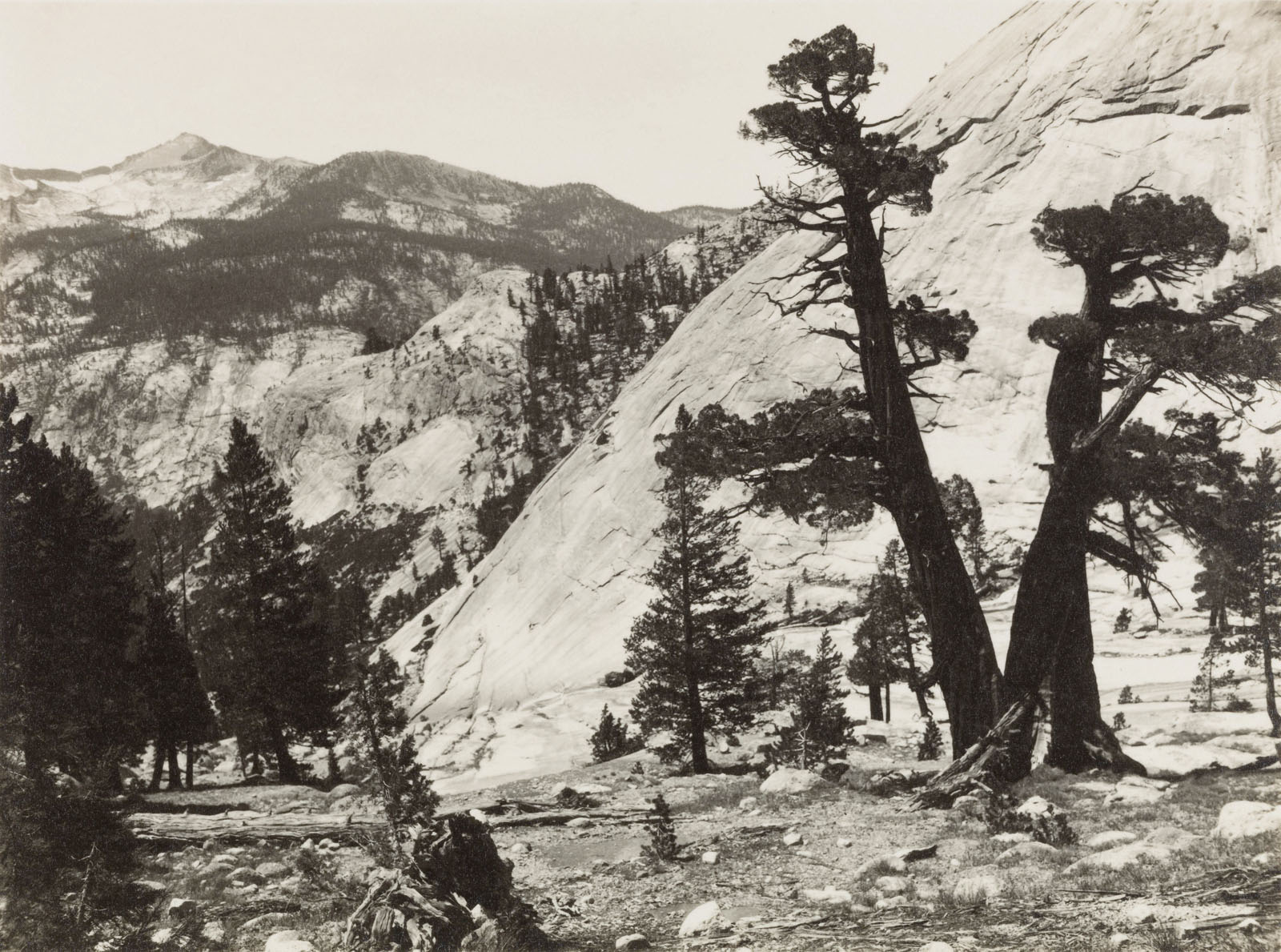
 

Ansel Adams (American, 1902-1984) 'Sierra Junipers' 1927 


Ansel Adams (American, 1902-1984)
Sierra Junipers
1927
From the portfolio Parmelian Prints of the High Sierras, 1927
Gelatin silver print
The Lane Collection
Courtesy Museum of Fine Arts, Boston
© The Ansel Adams Publishing Rights Trust
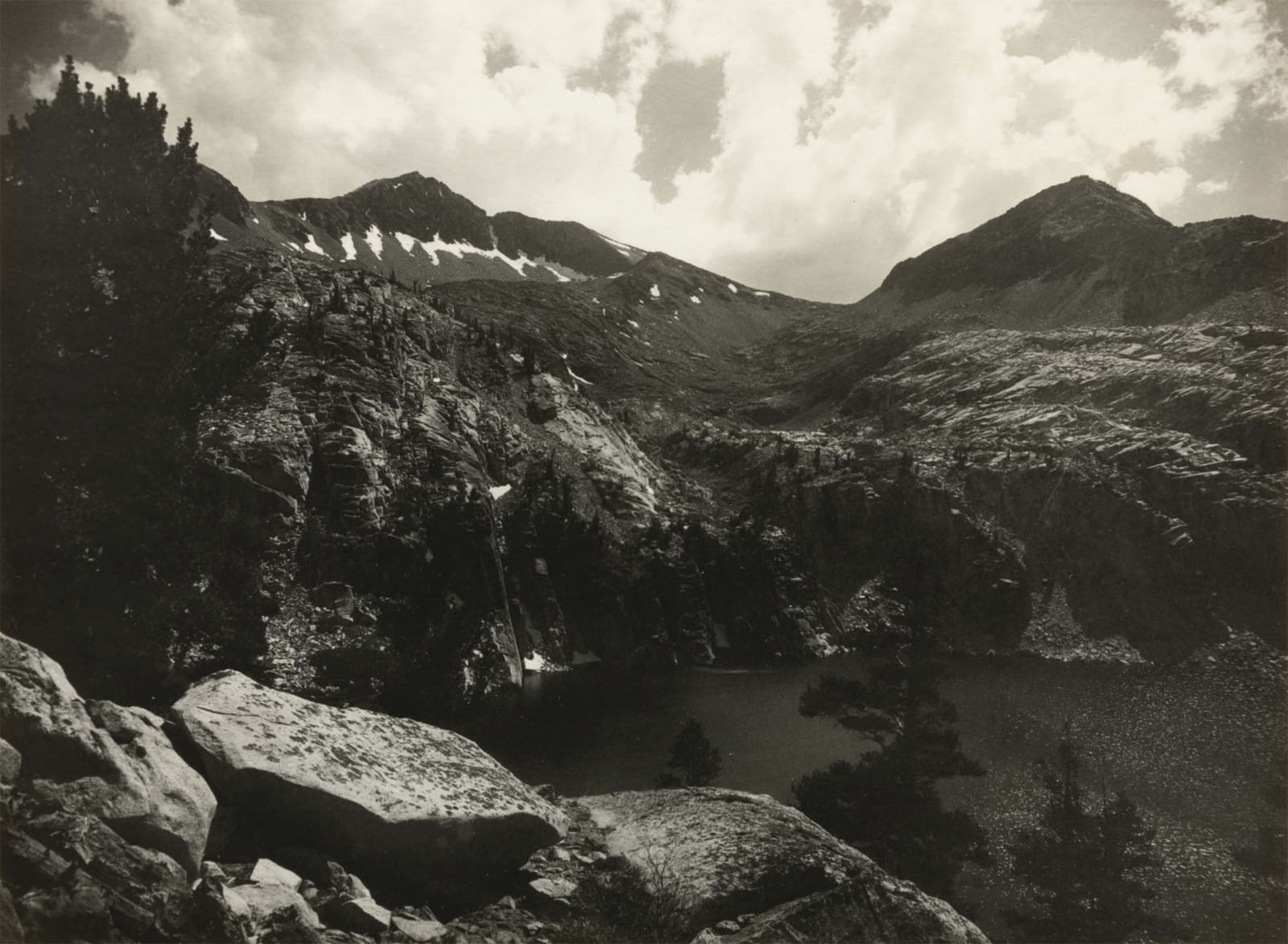
 

Ansel Adams (American, 1902-1984) 'Cloud and Mountain, Kings Canyon National Park, California' c. 1925, printed 1927 


Ansel Adams (American, 1902-1984)
Cloud and Mountain, Kings Canyon National Park, California
c. 1925, printed 1927
From the portfolio Parmelian Prints of the High Sierras, 1927
Gelatin silver print
The Lane Collection
Courtesy Museum of Fine Arts, Boston
© The Ansel Adams Publishing Rights Trust


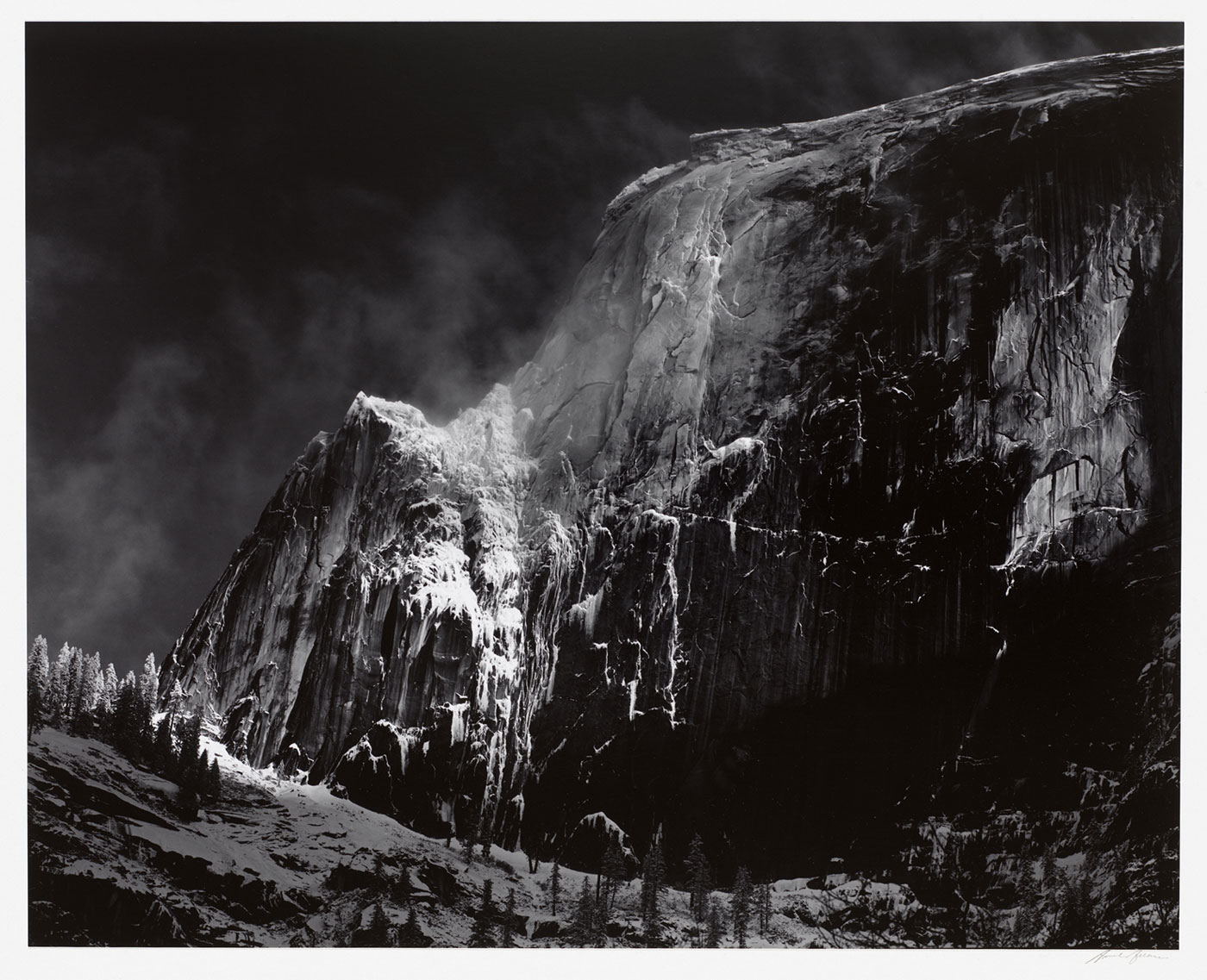
Ansel Adams (American, 1902-1984) 'Monolith - The Face of Half Dome, Yosemite National Park' 1927


Ansel Adams (American, 1902-1984)
Monolith – The Face of Half Dome, Yosemite National Park
1927, printed 1950-1960
Gelatin silver print
The Lane Collection
Courtesy Museum of Fine Arts, Boston
© The Ansel Adams Publishing Rights Trust


This majestic view of Half Dome is one of Ansel Adams’ most important and groundbreaking early photographs. Shot on a hike in the spring of 1927, it represents his first conscious “visualisation” – an image fully anticipated before he tripped the shutter, and one that for Adams captured the emotional impact of the scene. He made this enlarged print years later, but the dramatic sky and the sharp contrast between the brilliant white snow and dark ridges in the granite were recorded in 1927 when Adams took the photograph, using a deep red filter and a long exposure (made possible by the windless conditions that day).

Exhibition label text
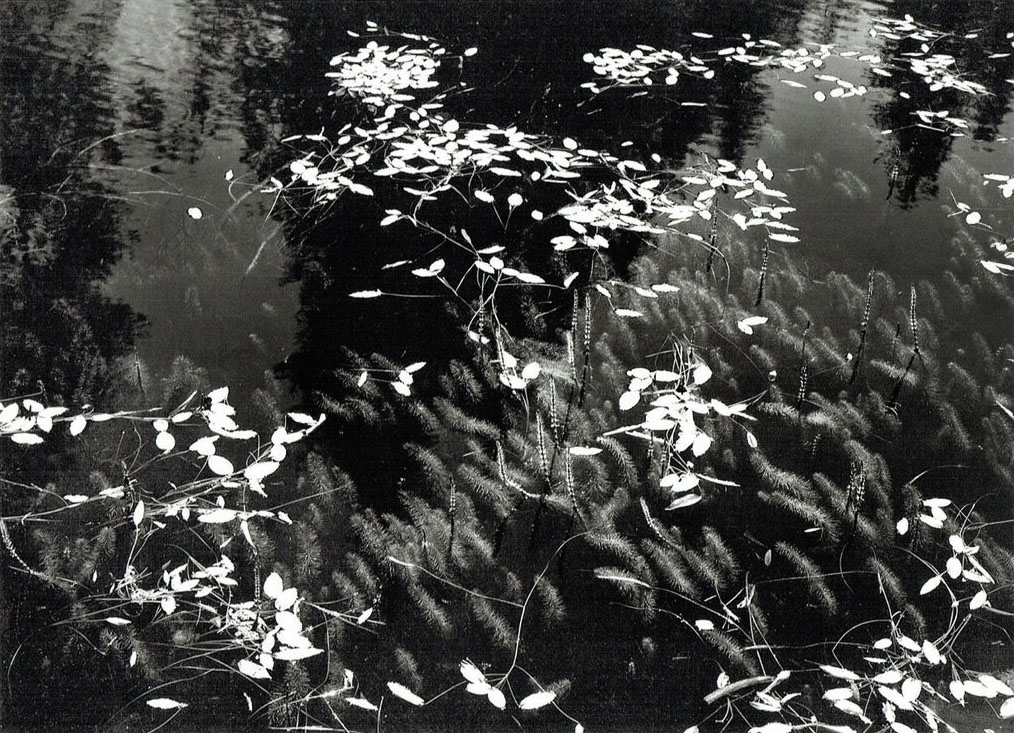
 

Ansel Adams (American, 1902-1984) 'Leaves on Pool, Sierra Nevada, California' c. 1935


Ansel Adams (American, 1902-1984)
Leaves on Pool, Sierra Nevada, California
c. 1935
Gelatin silver print
The Lane Collection
Courtesy Museum of Fine Arts, Boston
© The Ansel Adams Publishing Rights Trust


Spending time in the wilderness was a spiritual experience that Ansel Adams marvelled at his entire life. Describing one such transcendent moment, he wrote: “It was one of those mornings when the sunlight is burnished with a keen wind and long feathers of clouds move in a lofty sky. … I was suddenly arrested … by an exceedingly pointed awareness of the light. The moment I paused, the full impact of the mood was upon me; I saw more clearly than I have ever seen before or since the minute detail of the grasses, the clusters of sand shifting in the wind, the small flotsam of the forest, the motion of the high clouds streaming above the peaks.”

Exhibition label text
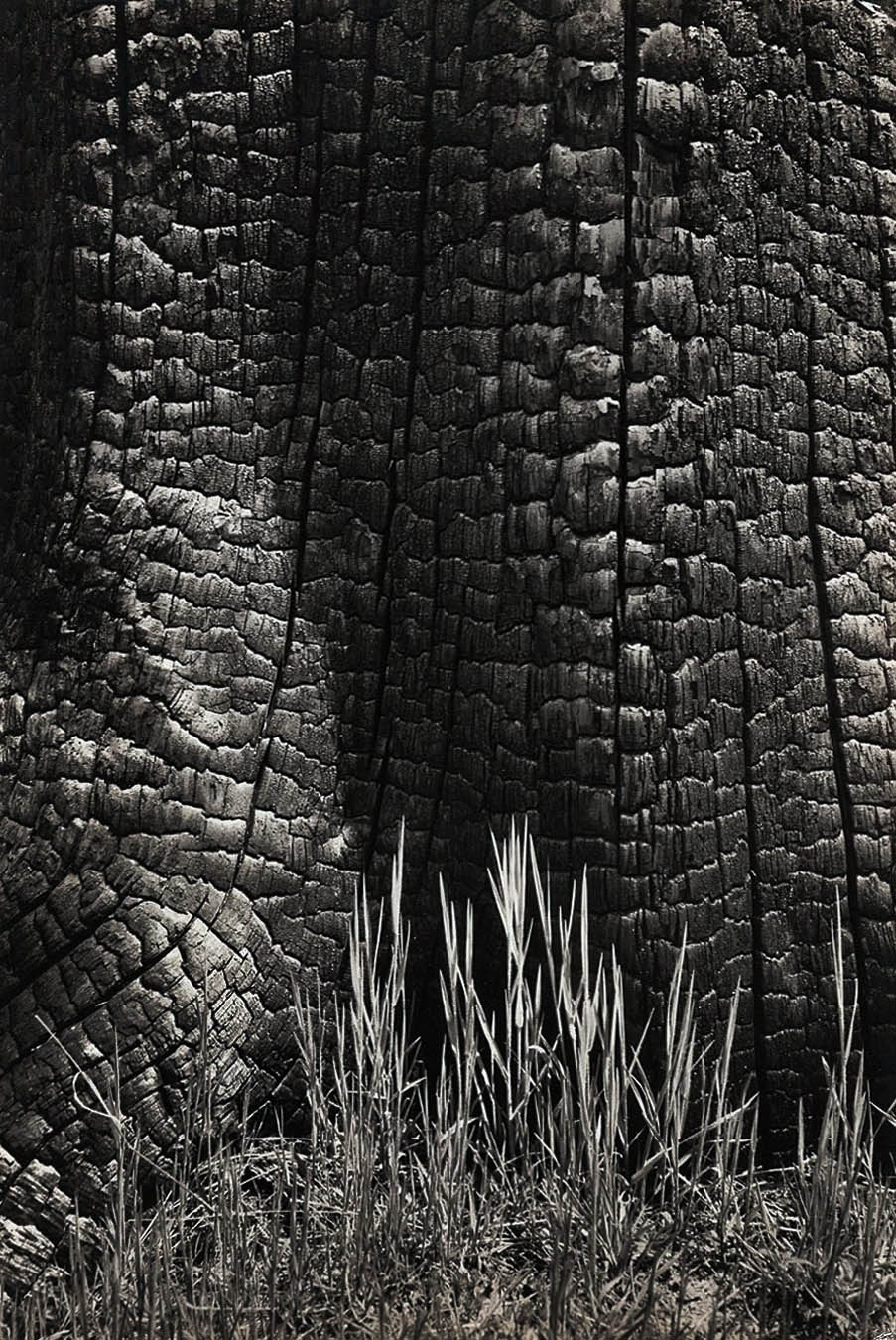
 

Ansel Adams (American, 1902-1984) 'Grass and Burned Stump, Sierra Nevada, California' c. 1935


Ansel Adams (American, 1902-1984)
Grass and Burned Stump, Sierra Nevada, California
c. 1935
Gelatin silver print
The Lane Collection
Courtesy Museum of Fine Arts, Boston
© The Ansel Adams Publishing Rights Trust


Ansel Adams made this photograph near Fish Camp, south of Yosemite National Park, in an area where forest fires raged some years earlier. In his close-up view, he juxtaposes the tender shoots of new grass and the charred surface of a burned stump. This is an example of what Adams liked to call the “microscopic revelation of the lens,” which he saw as the ideal of his “straight,” sharp-focus approach to photography.

Exhibition label text
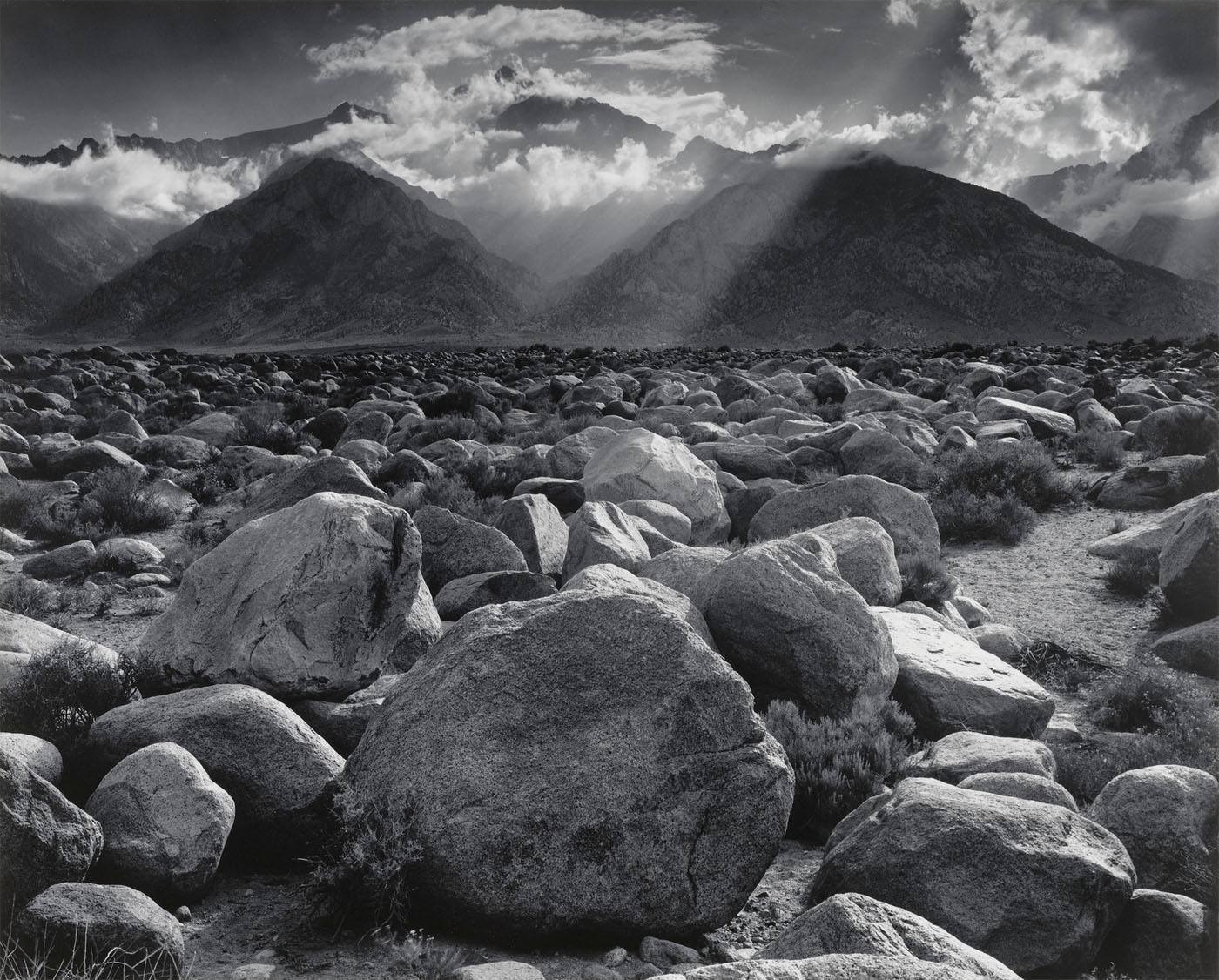
 

Ansel Adams (American, 1902-1984) 'Mount Williamson from Manzanar, Sierra Nevada, California' 1944


Ansel Adams (American, 1902-1984)
Mount Williamson from Manzanar, Sierra Nevada, California
1944
Gelatin silver print
The Lane Collection
Courtesy Museum of Fine Arts, Boston
© The Ansel Adams Publishing Rights Trust


On a visit to Manzanar, a Japanese internment camp, in 1944, Ansel Adams drove to the field of boulders that extends to the base of Mount Williamson. “There was a glorious storm going on in the mountains,” he wrote. “I set up my camera on the rooftop platform of my car, [which] enabled me to get a good view over the boulders to the base of the range.” The resulting photograph captures a storm passing over the distant mountain range – an awe-inspiring image that confounds all sense of scale and perspective.

Exhibition label text


Ansel Adams (American, 1902-1984) 'Birds on Wire, Evening' 1943, printed 1984


Ansel Adams (American, 1902-1984)
Birds on Wire, Evening
1943, printed 1984
Gelatin silver print
This print from the Library of Congress


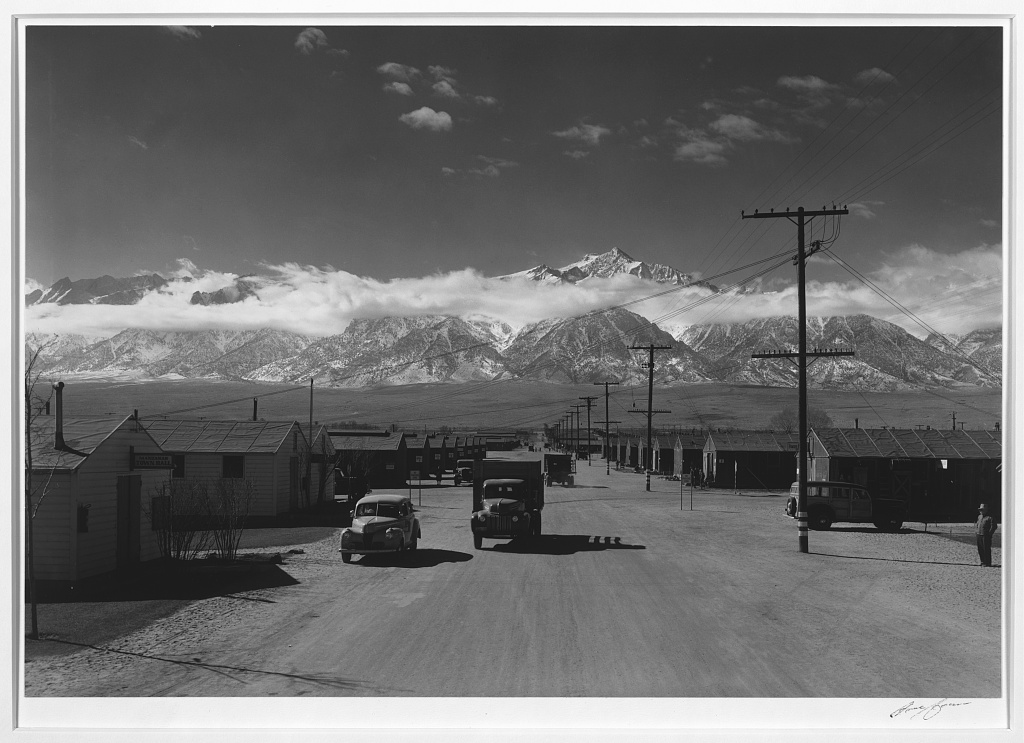
A few months after Japan attacked Pearl Harbor in December 1941, people of Japanese ancestry living on the West Coast (two-thirds of whom were American citizens) were quickly rounded up, separated from homes, possessions, and businesses, and quietly relocated to remote incarceration camps.

A total of 11,070 Japanese Americans were processed through Manzanar War Relocation Center in Inyo County, California. Ansel Adams was invited to photograph Manzanar by Ralph Merritt, a Sierra Club friend who had recently been appointed director of the isolated detention center. Although he was not allowed to photograph the center’s barbed wire or guns, Adams did see himself as a kind of conscientious objector for his work documenting the site and the people forced to live there.

Adams was personally moved by the treatment of Japanese Americans in World War II when an older Japanese man who worked for his family for many years was transferred to a detention center. When Adams first went to Manzanar in 1943, he was “profoundly affected” by photographing the camp and meeting its incarcerated inhabitants. He later presented his Manzanar images in an exhibition and book entitled Born Free and Equal. Manzanar means “apple orchard” in Spanish, but agriculture in the area had suffered since the diversion of water to Los Angeles began in 1913. Nonetheless, the internees were responsible for raising much of their own food in the fields near the camp.

Exhibition label text
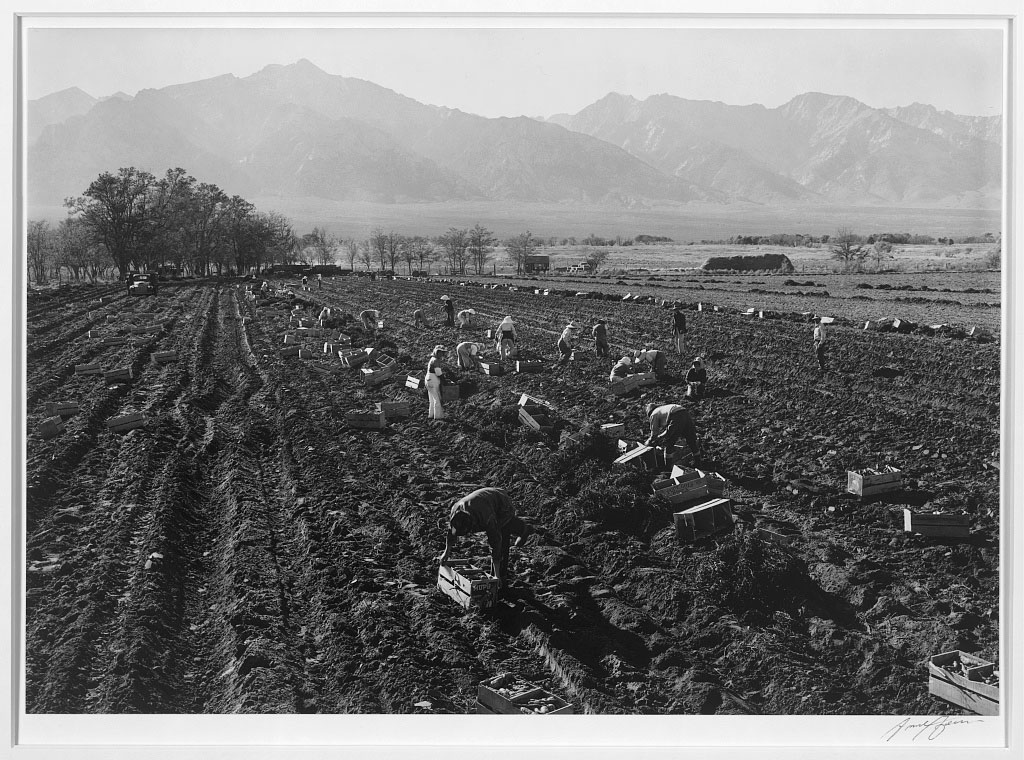
 

Ansel Adams (American, 1902-1984) 'Potato Field, North Farm, Manzanar' 1943, printed 1984


Ansel Adams (American, 1902-1984)
Potato Field, North Farm, Manzanar
1943, printed 1984
Gelatin silver print
This print from the Library of Congress
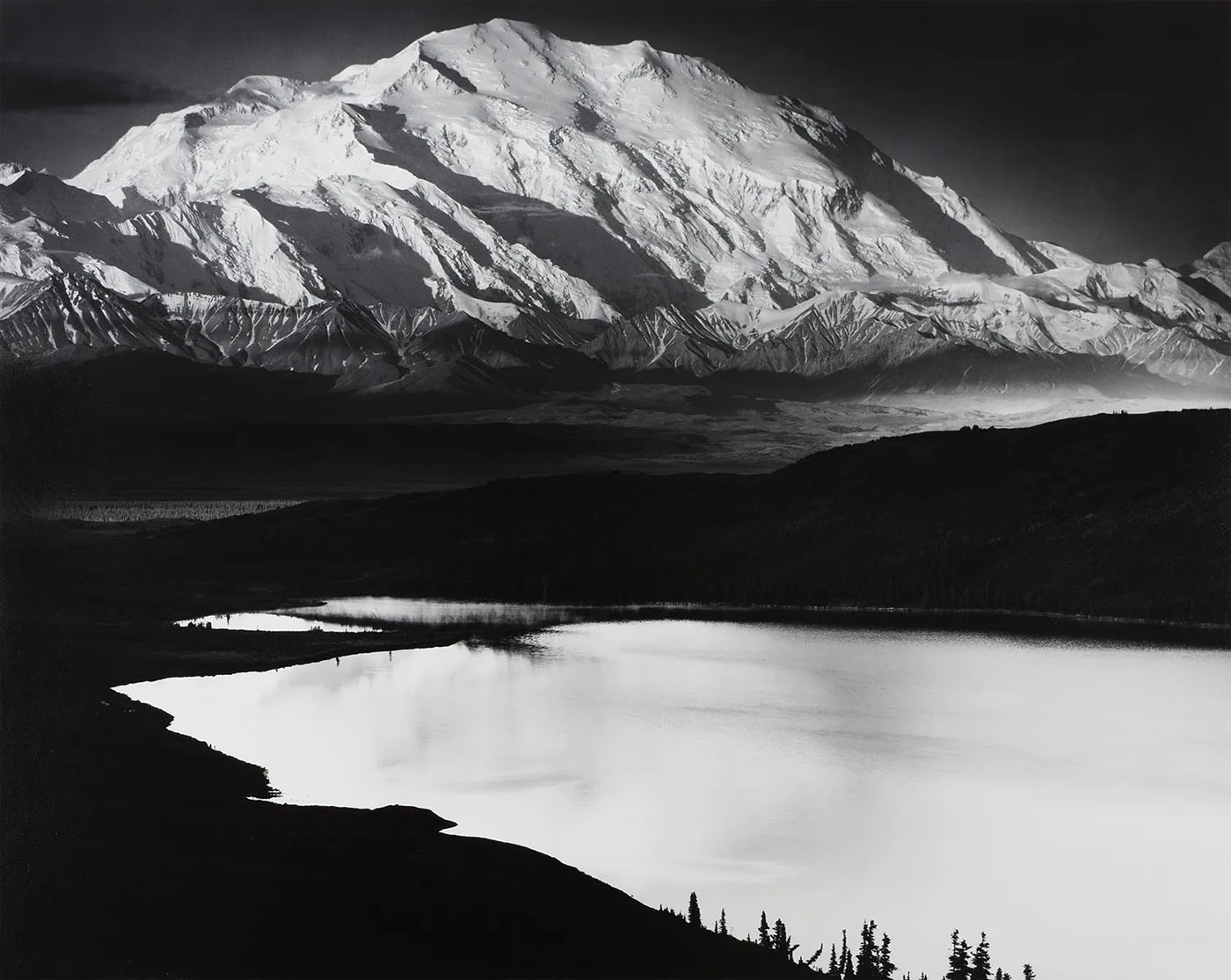
 

Ansel Adams (American, 1902-1984) 'Mount McKinley and Wonder Lake, Alaska' 1948


Ansel Adams (American, 1902-1984)
Mount McKinley and Wonder Lake, Alaska
1948
Gelatin silver print
The Lane Collection
Courtesy Museum of Fine Arts, Boston
© The Ansel Adams Publishing Rights Trust


Ansel Adams shot this image of Mount McKinley in Denali National Park at 1:30 in the morning, just two hours after the setting of the midsummer sun. He described, “As the sun rose, the clouds lifted, and the mountain glowed an incredible shade of pink. Laid out in front of Mount McKinley, Wonder Lake was pearlescent against the dark embracing arms of the shoreline. I made what I visualised as an inevitable image. The scale of this great mountain is hard to believe – the camera and I were thirty miles from McKinley’s base.”

Exhibition label text
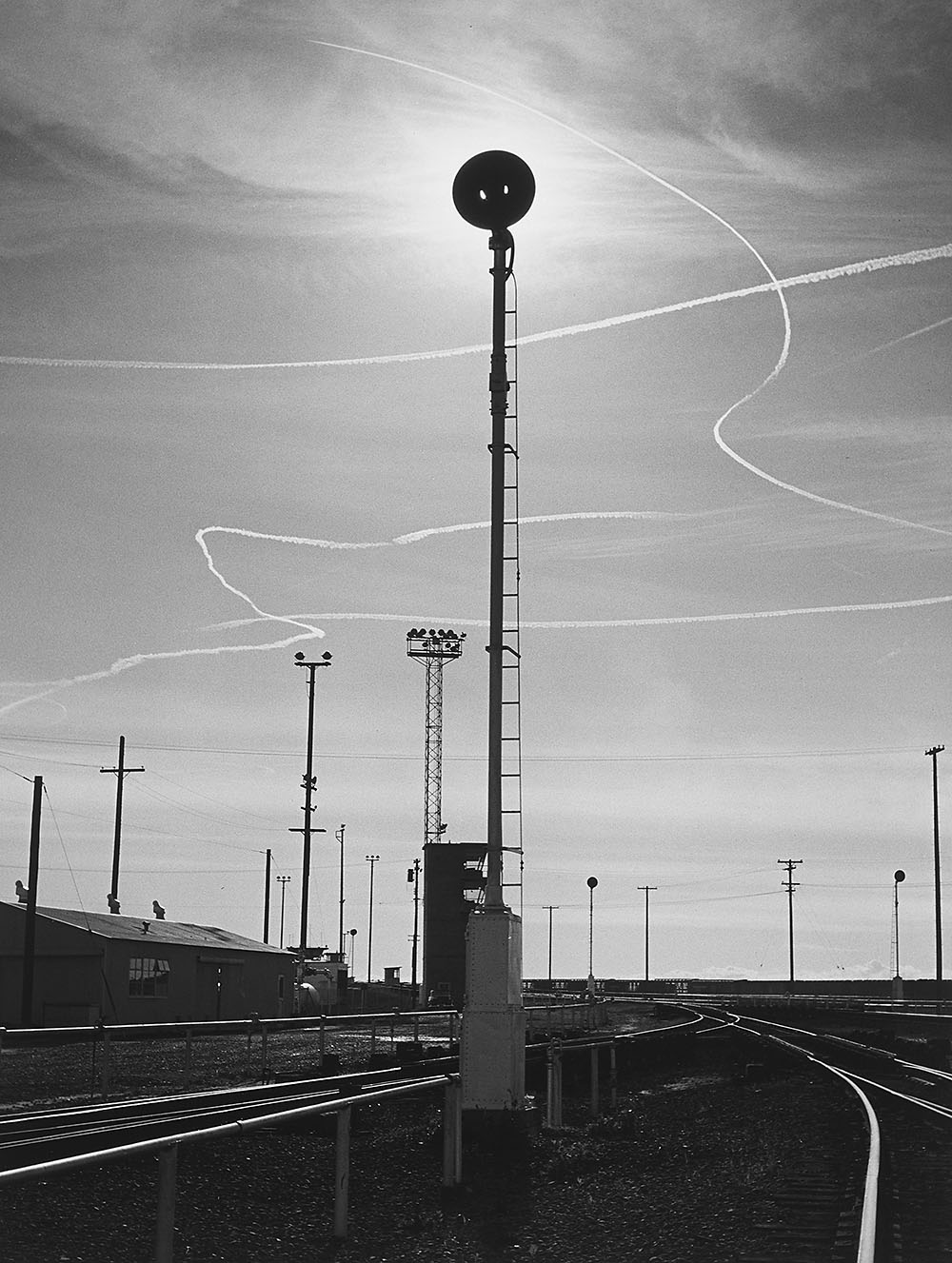
 

Ansel Adams (American, 1902-1984) 'Rails and Jet Trails, Roseville, California' c. 1953


Ansel Adams (American, 1902-1984)
Rails and Jet Trails, Roseville, California
c. 1953
Gelatin silver print
The Lane Collection
Courtesy Museum of Fine Arts, Boston
© The Ansel Adams Publishing Rights Trust


Marketing the view

In 1919, at the age of seventeen, Ansel Adams joined the Sierra Club. The organisation’s original focus on environmental preservation, and its initial failure to acknowledge Indigenous people and their homelands, helped lay the groundwork for the twentieth-century environmentalism he would come to represent. Adams participated in the club’s annual High Trips, serving as photographer and assistant manager from 1930 through 1936. He produced albums of photographs from these treks, inviting members to order contact prints or, for a higher fee, enlargements in “plain or soft-focus.” His ingenuity ultimately lad to his 1927 portfolio, Parmesan Prints of the High Sierras, on view in this gallery – one of the earliest experiments in custom printing, sequencing, and distributing fine photographs.

Adams was not the first to market view of the American West. In the nineteenth century, images of western landscapes were mass-produced and widely distributed, catering to a burgeoning tourist market. Today, contemporary artists are using photography to highlight the dynamic nature of landscapes and to document humans’ impact on the environment. Sometimes these works take the form of extended series or grids, as though invoking earlier methods of mass-distributing western views.

Exhibition wall text
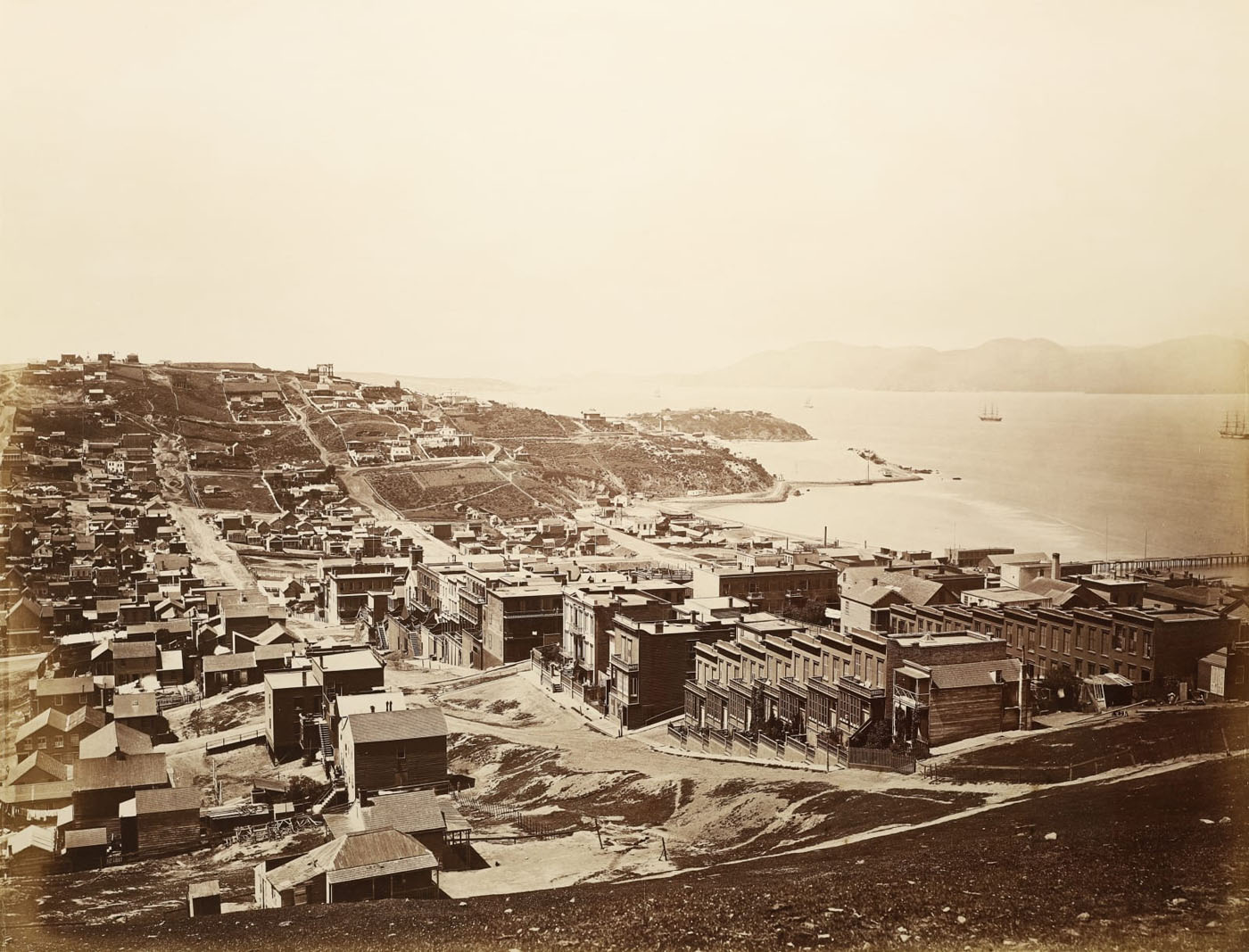
 

Carleton E. Watkins (American, 1829-1916) 'The Golden Gate from Telegraph Hill, San Francisco' 1868


Carleton E. Watkins (American, 1829-1916)
The Golden Gate from Telegraph Hill, San Francisco
1868
Albumen silver print from wet-collodion-on-glass negative
Fine Arts Museums of San Francisco
Museum purchase Prints and Drawings Art Trust Fund
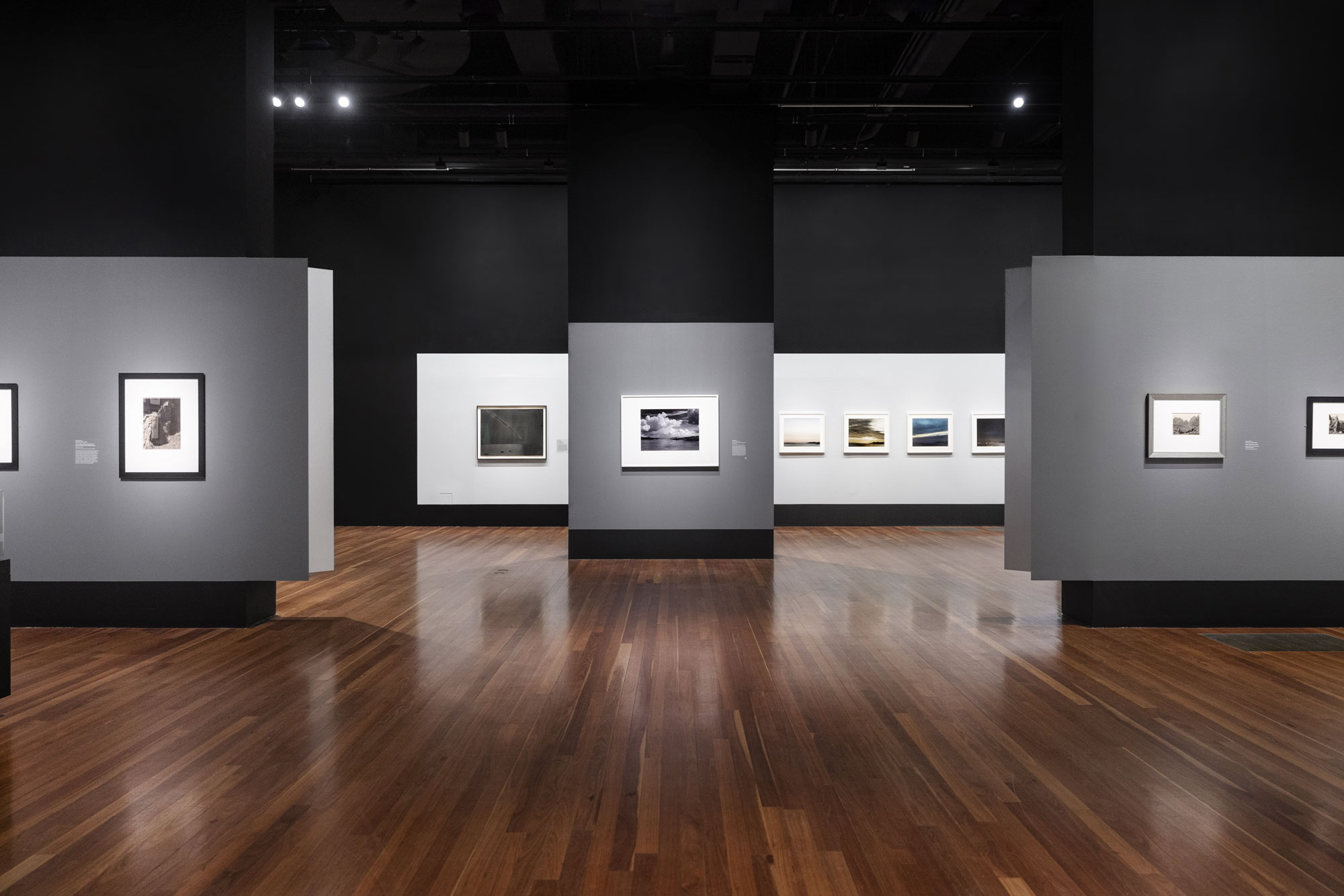
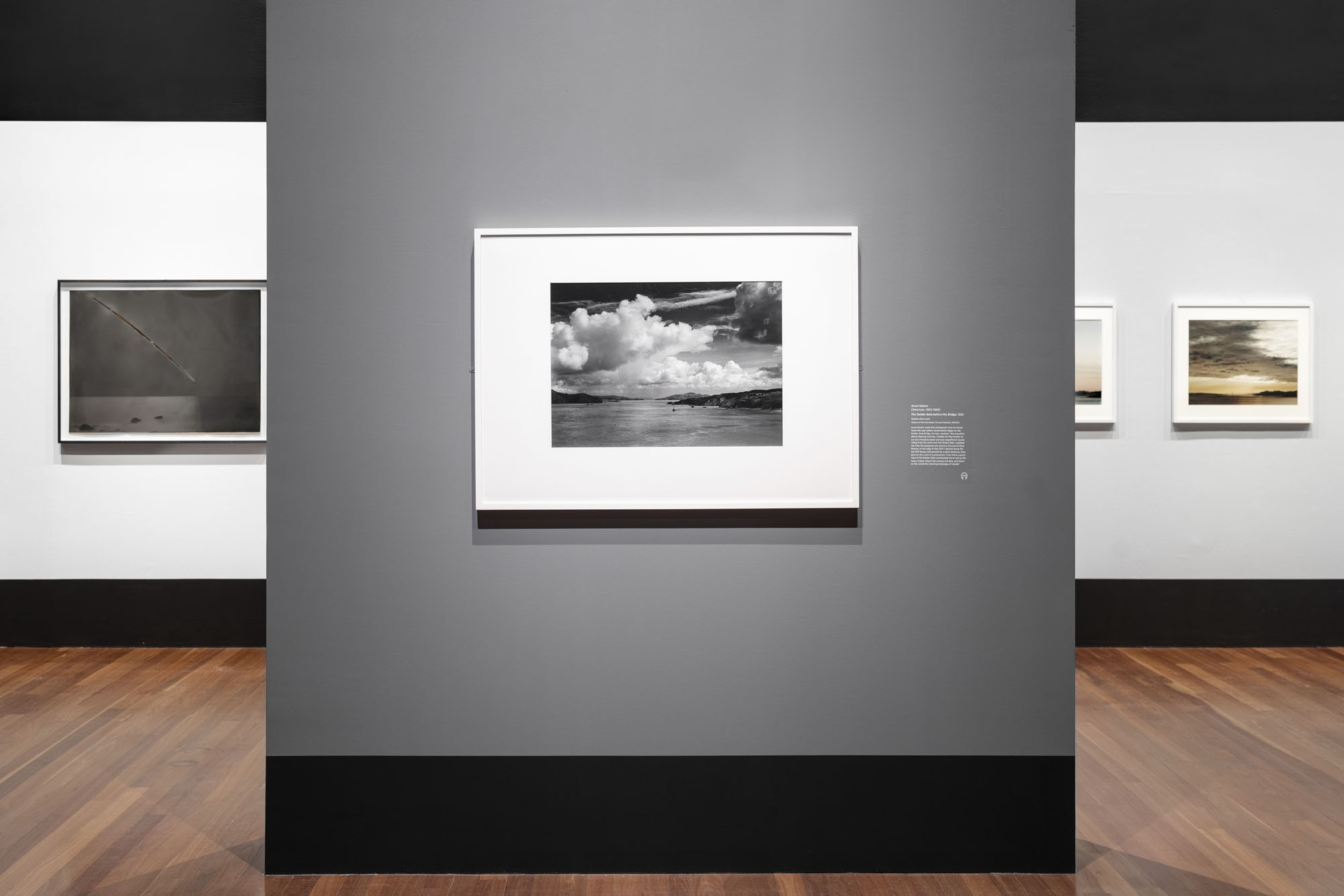
 

Installation view of the exhibition 'Ansel Adams in Our Time' at the de Young museum, San Francisco 

Installation view of the exhibition 'Ansel Adams in Our Time' at the de Young museum, San Francisco 


Installation views of the exhibition Ansel Adams in Our Time at the de Young museum, San Francisco showing at centre Adams’ The Golden Gate Before the Bridge (1932, below)
Images courtesy of the Fine Arts Museums of San Francisco
Photos: Gary Sexton


San Francisco: Becoming a Modernist

San Francisco is where Ansel Adams became a modernist photographer. He grew up in present-day Sea Cliff, where his family home overlooked the Presidio to the Marin Headlands beyond. These views made a lasting impact on his photographs – he later described constantly returning to the elements of nature that surrounded him in his childhood. Adams’ first exhibition, featuring photographs he took on Sierra Club hikes, was held at the club’s headquarters on Montgomery Street in 1928. Convinced that he could make a living as a photographer, he acquired a large-format camera and became an advocate of “straight” (unmanipulated) photography, leaving behind the soft-focus aesthetic of his earlier work. He experimented with abstraction and extreme close-ups, capturing texture and clarity of detail. He recorded cloud-filled skies and depicted landscapes as seemingly infinite spaces devoid of people. During the Great Depression, Adams began photographing a wider range of subjects, including the challenging reality of urban life in San Francisco and the region’s changing landscape. The latter included the construction of the Golden Gate Bridge (1937), which radically transformed the views of San Francisco Bay that had captivated Adams in his youth.

Golden Gate Bridge

Ansel Adams made this photograph [below] near his family home the year before construction began on the Golden Gate Bridge. He later recalled, “One beautiful storm-clearing morning, I looked out the window of our San Francisco home and saw magnificent clouds rolling from the north over the Golden Gate. I grabbed the 8-by-10 equipment and drove to the end of 32nd Avenue, at the edge of Sea Cliff. I dashed along the old Cliff house railroad bed for a short distance, then down to the crest of a promontory. From there grand view of the Golden Gate commanded me to set up the heavy tripod, attach the camera and lens, and focus on the wonderful evolving landscape of clouds.”

Exhibition wall text
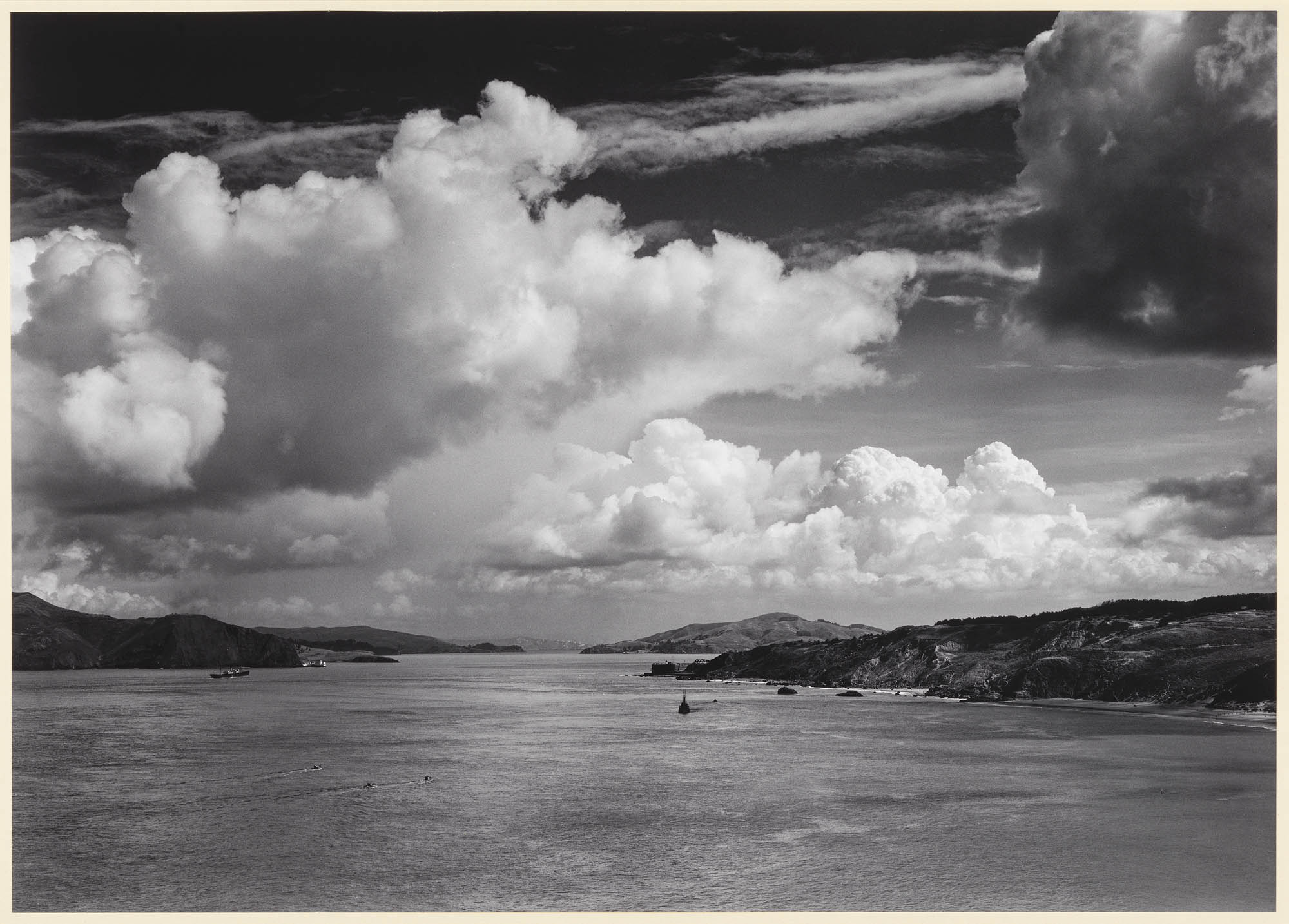
 

Ansel Adams (American, 1902-1984) 'The Golden Gate Before the Bridge' 1932


Ansel Adams (American, 1902-1984)
The Golden Gate Before the Bridge
1932
Gelatin silver print
The Lane Collection
Courtesy Museum of Fine Arts, Boston
© The Ansel Adams Publishing Rights Trust
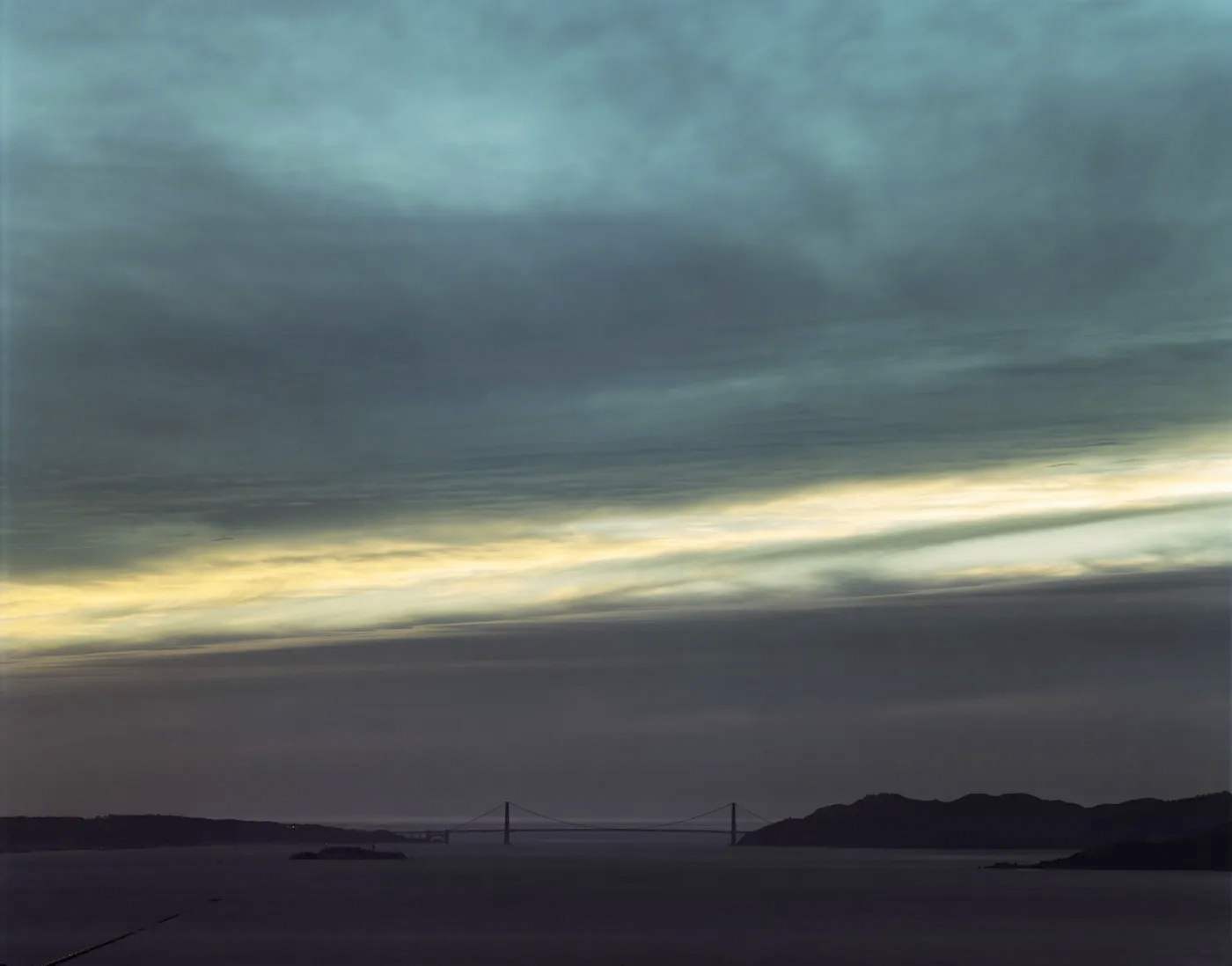
 

Richard Misrach (American, b. 1949) 'Golden Gate Bridge, 10.31.98, 5:18 pm' 1998, printed 2016


Richard Misrach (American, b. 1949)
Golden Gate Bridge, 10.31.98, 5:18 pm
1998, printed 2016
Pigment prints
Courtesy of Fraenkel Gallery, San Francisco


In 1997, Richard Misrach began what would become a three-year project photographing the Golden Gate Bridge from his porch in the Berkeley Hills. Placing his large-format 8-by-10-inch camera in the same position on each occasion, Misrach recorded hundreds of views of the distant span, at various times of day and in every season, set off against the constantly changing sky. The series was reissued in 2012 to mark the occasion of the seventy-fifth anniversary of the bridge’s landmark opening.

Exhibition label text
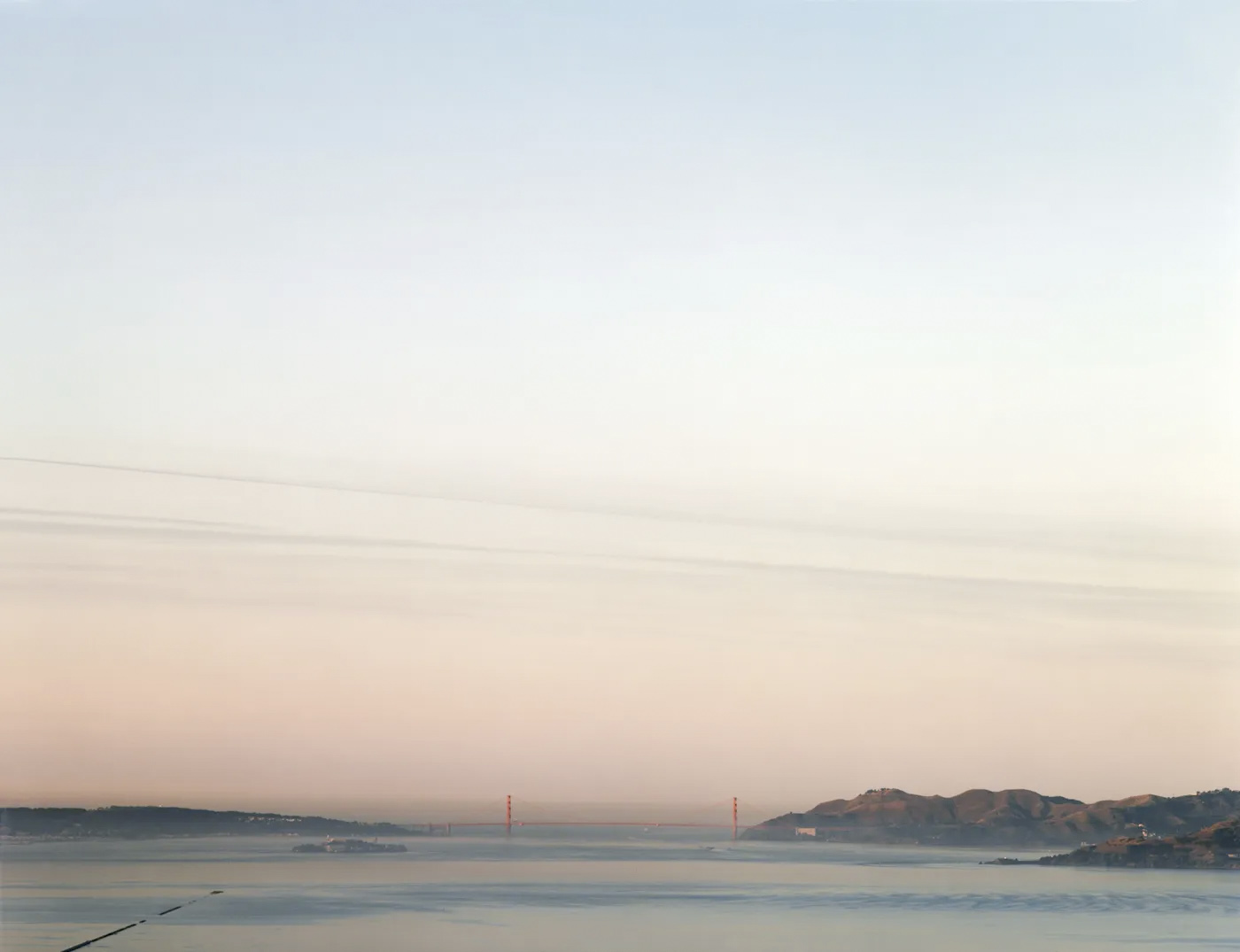
 

Richard Misrach (American, b. 1949) 'Golden Gate Bridge, 12.19.99, 7:31 am' 1999, printed 2020


Richard Misrach (American, b. 1949)
Golden Gate Bridge, 12.19.99, 7:31 am
1999, printed 2020
Pigment prints
Courtesy of Fraenkel Gallery, San Francisco


Picturing National Parks

Photography played a critical role in the establishment of the national parks. The dramatic views made by Carleton Watkins and other nineteenth-century photographers ultimately helped convince government officials to protect Yosemite and Yellowstone from private development. However, the formation of the national parks further dispossessed Indigenous people of their ancestral lands, overlooking their ongoing stewardship of the land and restricting their access to it.

Although Ansel Adams claimed he never intentionally made a creative photograph that related directly to an environmental issue, he was aware of an image’s power to sway opinions on conservation. Adams’ photographs of King’s River Canyon [below] helped the Sierra Club successfully campaign to establish the site as a national park. Over the following years, Adams photographed national parks from Alaska to Texas, Hawaii to Maine, creating images that conveyed the transformative power of the parks to a wide audience.

Many contemporary artists working in the national parks acknowledge, as Adams did, the efforts of the photographers who came before them. But the complicated legacies – and uncertain futures – of these protected lands have led some photographers to take more personal and political approaches to the work they are making in these places.

Exhibition wall text
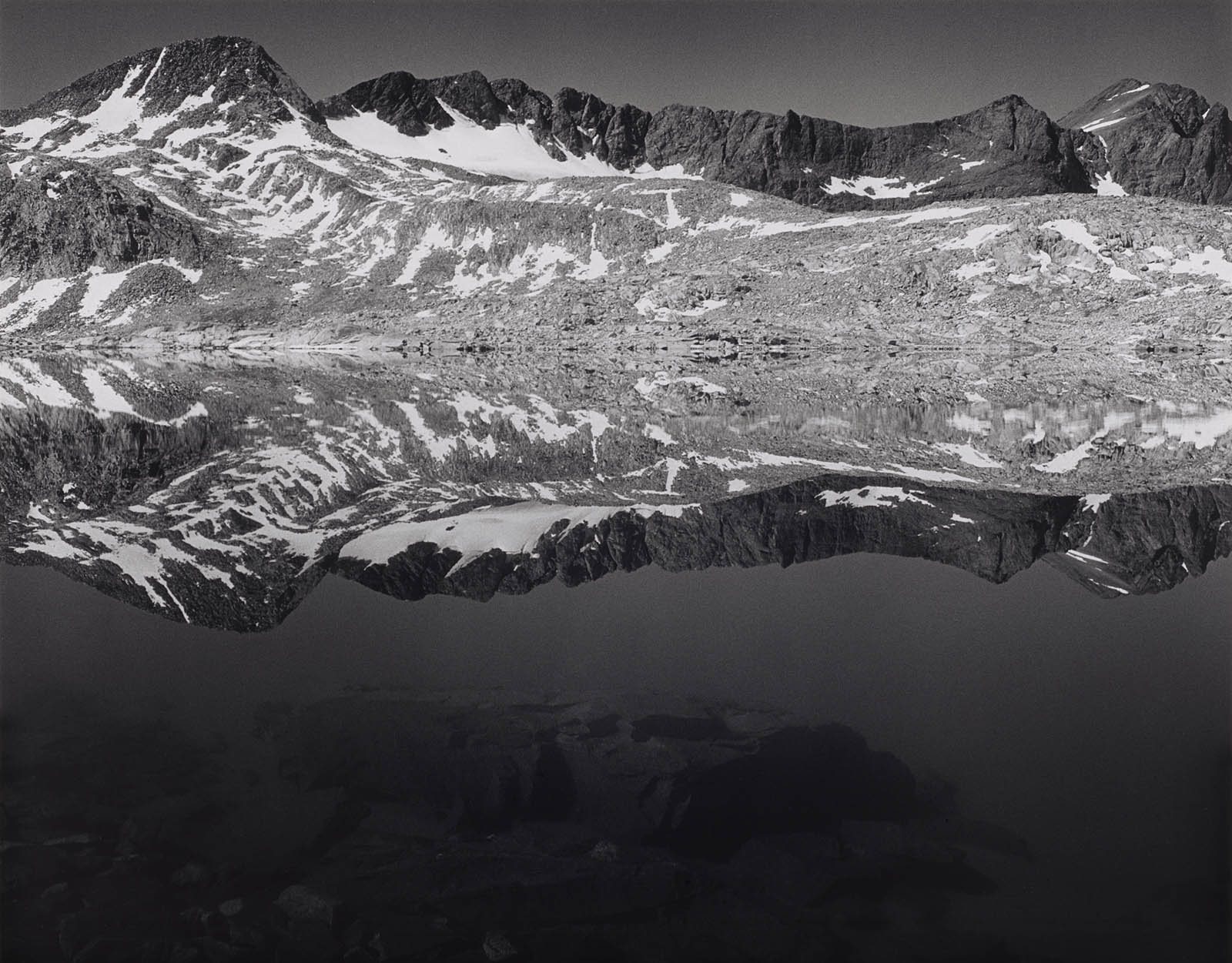
 

Ansel Adams (American, 1902-1984) 'Lake near Muir Pass, Kings Canyon National Park, California' 1933


Ansel Adams (American, 1902-1984)
Lake near Muir Pass, Kings Canyon National Park, California
1933
Gelatin silver print
The Lane Collection
Courtesy Museum of Fine Arts, Boston
© The Ansel Adams Publishing Rights Trust


Ansel Adams made this photograph while on a Sierra Club outing in Kings River Canyon. Three years later, he represented the club at a congressional hearing in Washington, DC. Armed with photographs like this one, he argued successfully for the transfer of Kings River Canyon from the Forest Service to the National Park Service. When it became a national park in 1940, the director of the Park Service wrote to Adams, saying, “I realise that a silent but most effective voice in the campaign was your book Sierra Nevada – John Muir Trail. As long as that book is in existence, it will go on justifying the park.”

Exhibition label text
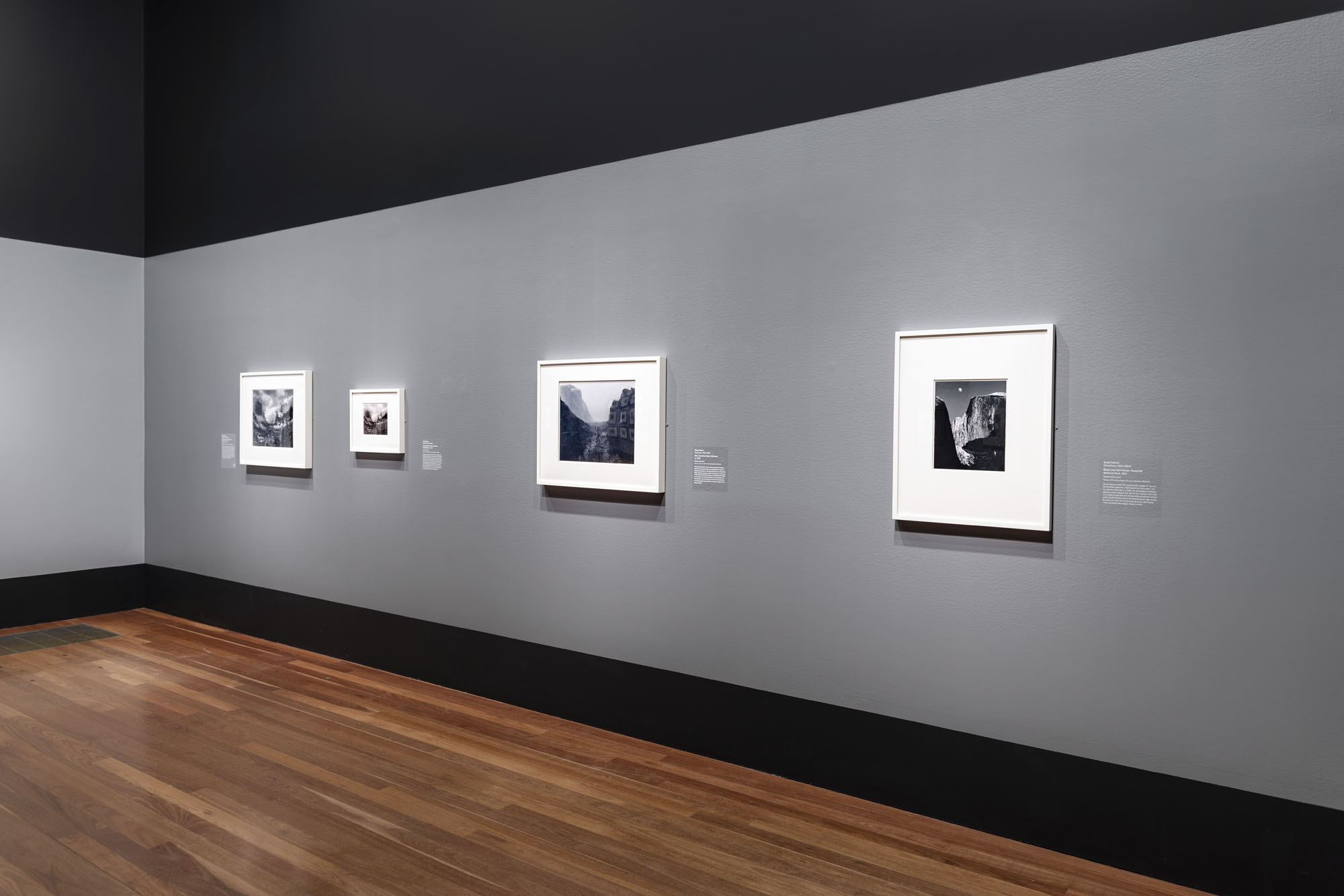
 

Installation view of the exhibition 'Ansel Adams in Our Time' at the de Young museum, San Francisco showing at left, 'Clearing Winter Storm, Yosemite National Park' (about 1937); at centre, 'Rain, Yosemite Valley, California' (c. 1940); and at right, 'Moon and Half Dome, Yosemite National Park' (1960)


Installation view of the exhibition Ansel Adams in Our Time at the de Young museum, San Francisco showing at left, Clearing Winter Storm, Yosemite National Park (about 1937, below); at centre, Rain, Yosemite Valley, California (c. 1940, below); and at right, Moon and Half Dome, Yosemite National Park (1960, below)
Images courtesy of the Fine Arts Museums of San Francisco
Photos: Gary Sexton
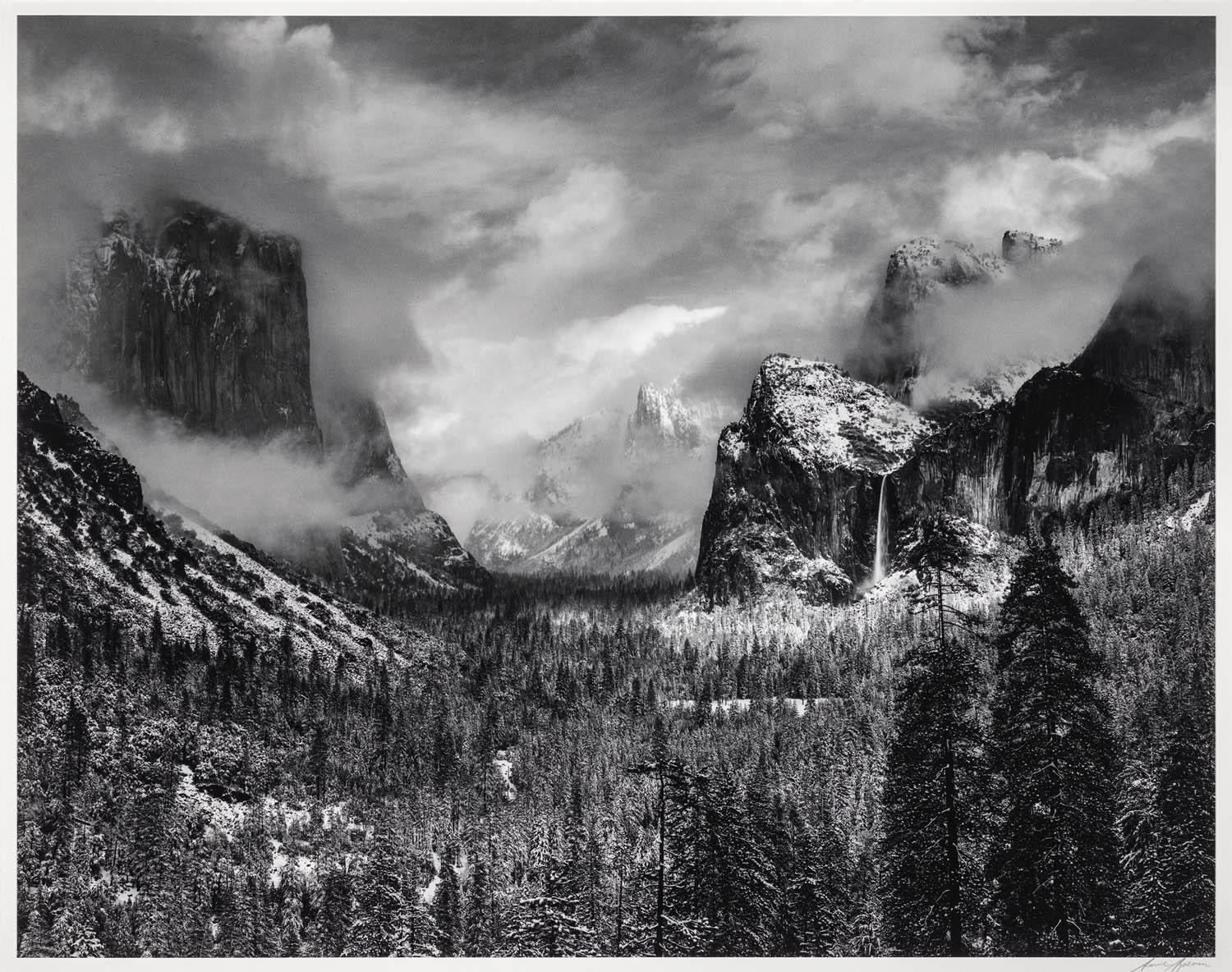
 

Ansel Adams (American, 1902-1984) 'Clearing Winter Storm, Yosemite National Park' About 1937


Ansel Adams (American, 1902-1984)
Clearing Winter Storm, Yosemite National Park
About 1937
Gelatin silver print
The Lane Collection
Courtesy Museum of Fine Arts, Boston
© The Ansel Adams Publishing Rights Trust


Ansel Adams described photographs like Monolith and Clearing Winter Storm as his “Mona Lisas”: images so popular with the public that they were printed countless times over the course of his long career. He took this remarkable photograph from Yosemite’s Inspiration Point soon after a sudden rainstorm turned to snow and then, just as swiftly, began to clear. It records an expansive valley view that Adams had attempted on several previous occasions but never been successful in rendering in such shimmering detail. Trained as a pianist, Ansel Adams often compared the photographic negative to a musical score and described each print from a particular negative as an individual performance of that score.

Exhibition label text
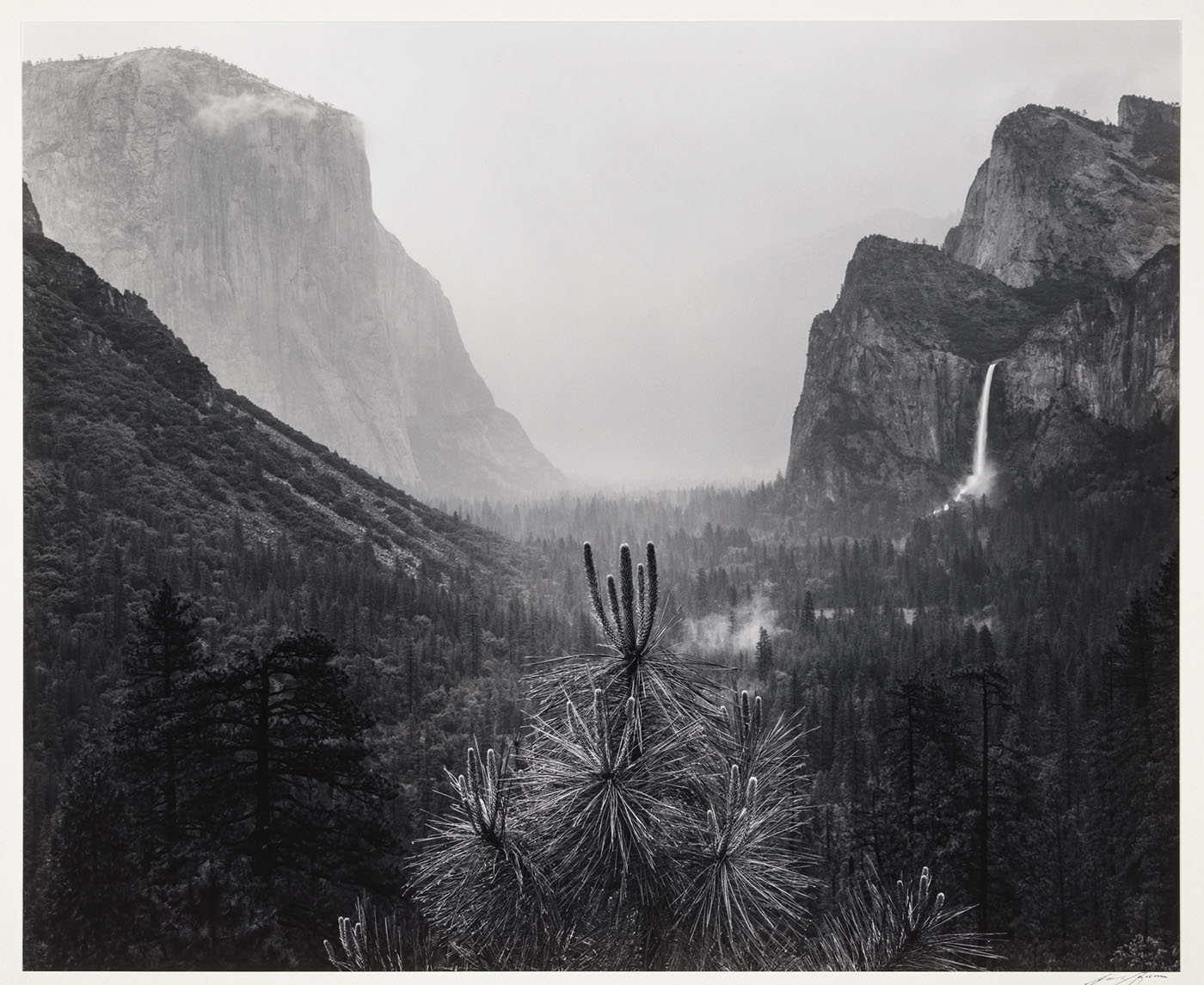
 

Ansel Adams (American, 1902-1984) 'Rain, Yosemite Valley, California' c. 1940


Ansel Adams (American, 1902-1984)
Rain, Yosemite Valley, California
c. 1940
Gelatin silver print
The Lane Collection
Courtesy Museum of Fine Arts, Boston
© The Ansel Adams Publishing Rights Trust


Like Clearing Winter Storm [above], this photograph features what the nineteenth-century photographer Carleton E. Watkins described as “the best general view” of Yosemite Valley, with the massive granite outcropping of El Capitan on the left and the silvery stream of Bridalveil Fall visible on the right. Yet here Yosemite’s famous features are shrouded in mist, and the pine tree in the foreground, its needles glistening with rain, stands in place of the distant peaks.

Exhibition label text
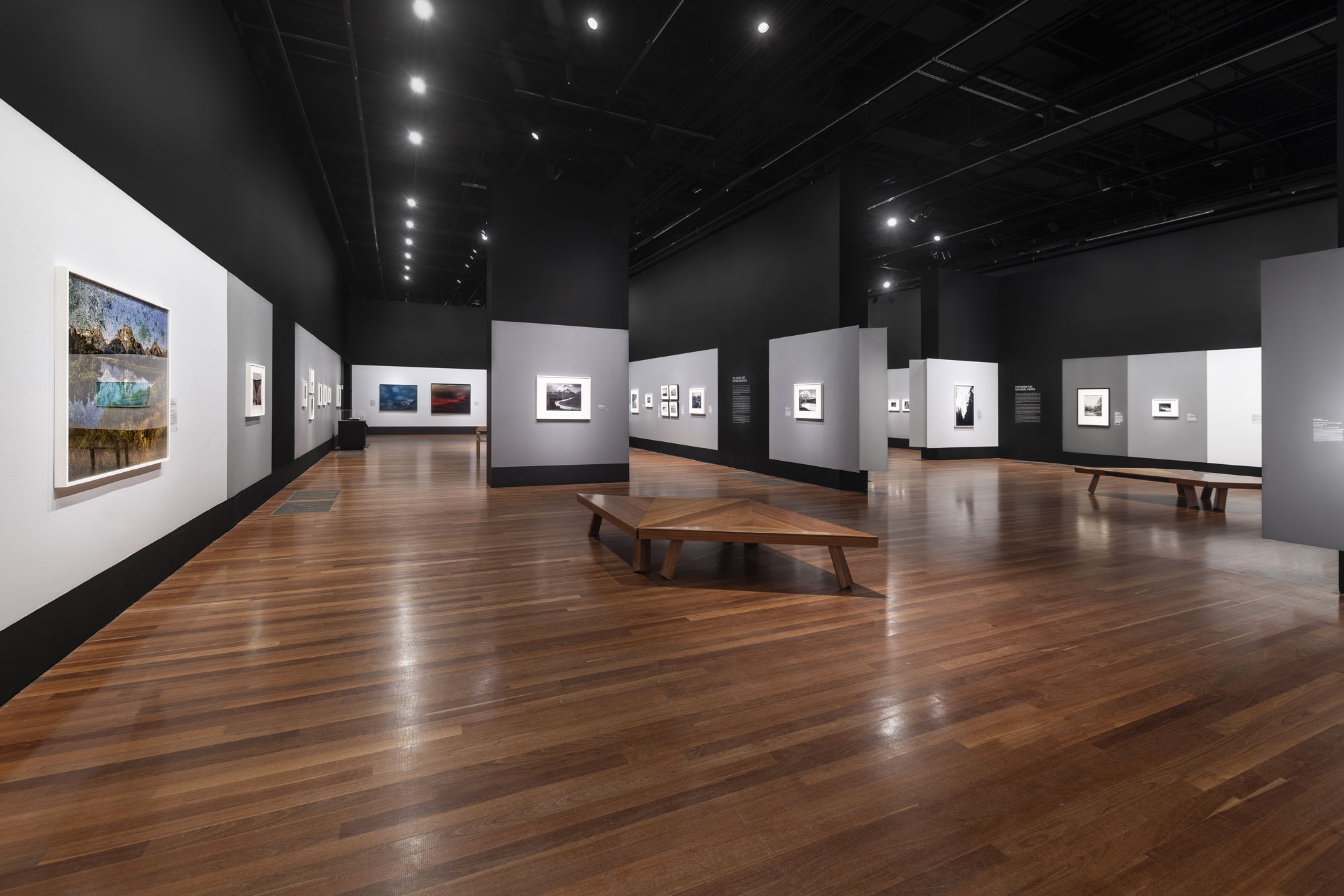
 

Installation view of the exhibition 'Ansel Adams in Our Time' at the de Young museum, San Francisco showing at left, Abelardo Morell's 'Tent-Camera Image on Ground: View of Mount Moran and the Snake River from Oxbow Bend, Grand Teton National Park, Wyoming' (2011); and at centre Adams' 'The Tetons and Snake River, Grand Teton National Park, Wyoming' (1942)


Installation view of the exhibition Ansel Adams in Our Time at the de Young museum, San Francisco showing at left, Abelardo Morell’s Tent-Camera Image on Ground: View of Mount Moran and the Snake River from Oxbow Bend, Grand Teton National Park, Wyoming (2011, below); and at centre Adams’ The Tetons and Snake River, Grand Teton National Park, Wyoming (1942, below)
Images courtesy of the Fine Arts Museums of San Francisco
Photos: Gary Sexton
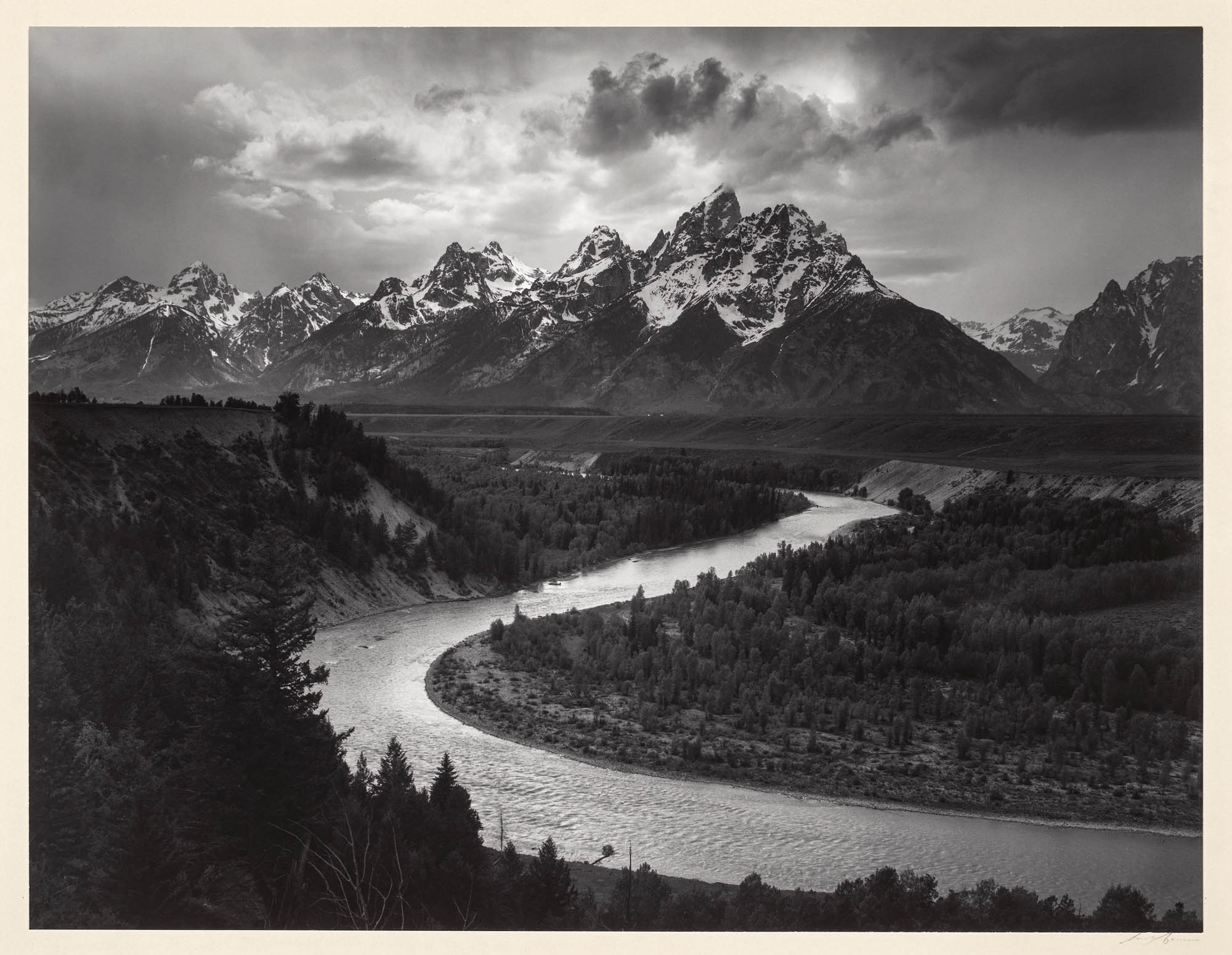
 

Ansel Adams (American, 1902-1984) 'The Tetons and Snake River, Grand Teton National Park, Wyoming' 1942


Ansel Adams (American, 1902-1984)
The Tetons and Snake River, Grand Teton National Park, Wyoming
1942
Gelatin silver print
The Lane Collection
Courtesy Museum of Fine Arts, Boston
© The Ansel Adams Publishing Rights Trust
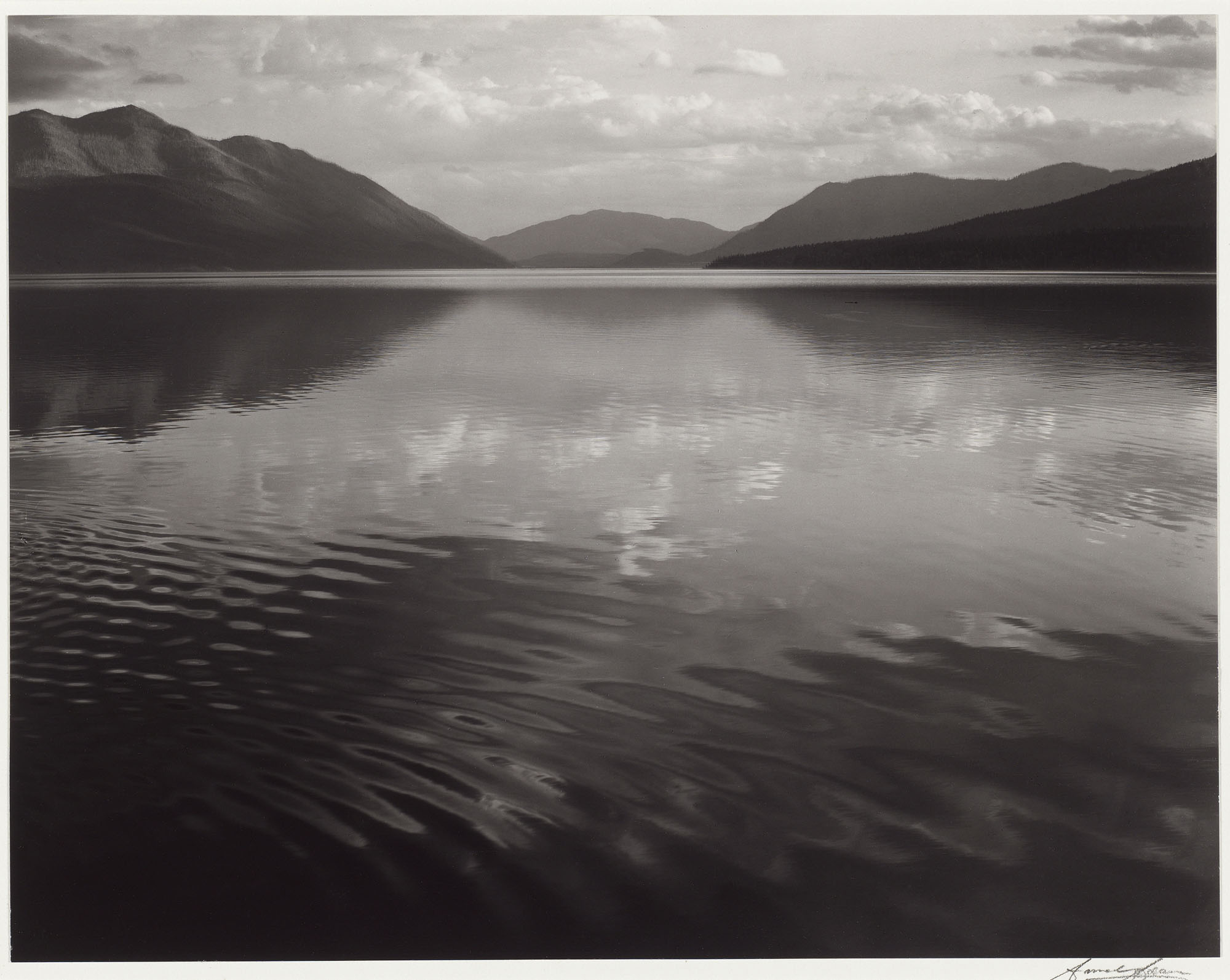
 

Ansel Adams (American, 1902-1984) 'Lake McDonald, Evening, Glacier National Park, Montana' 1942


Ansel Adams (American, 1902-1984)
Lake McDonald, Evening, Glacier National Park, Montana
1942
Gelatin silver print
The Lane Collection
Courtesy Museum of Fine Arts, Boston
© The Ansel Adams Publishing Rights Trust
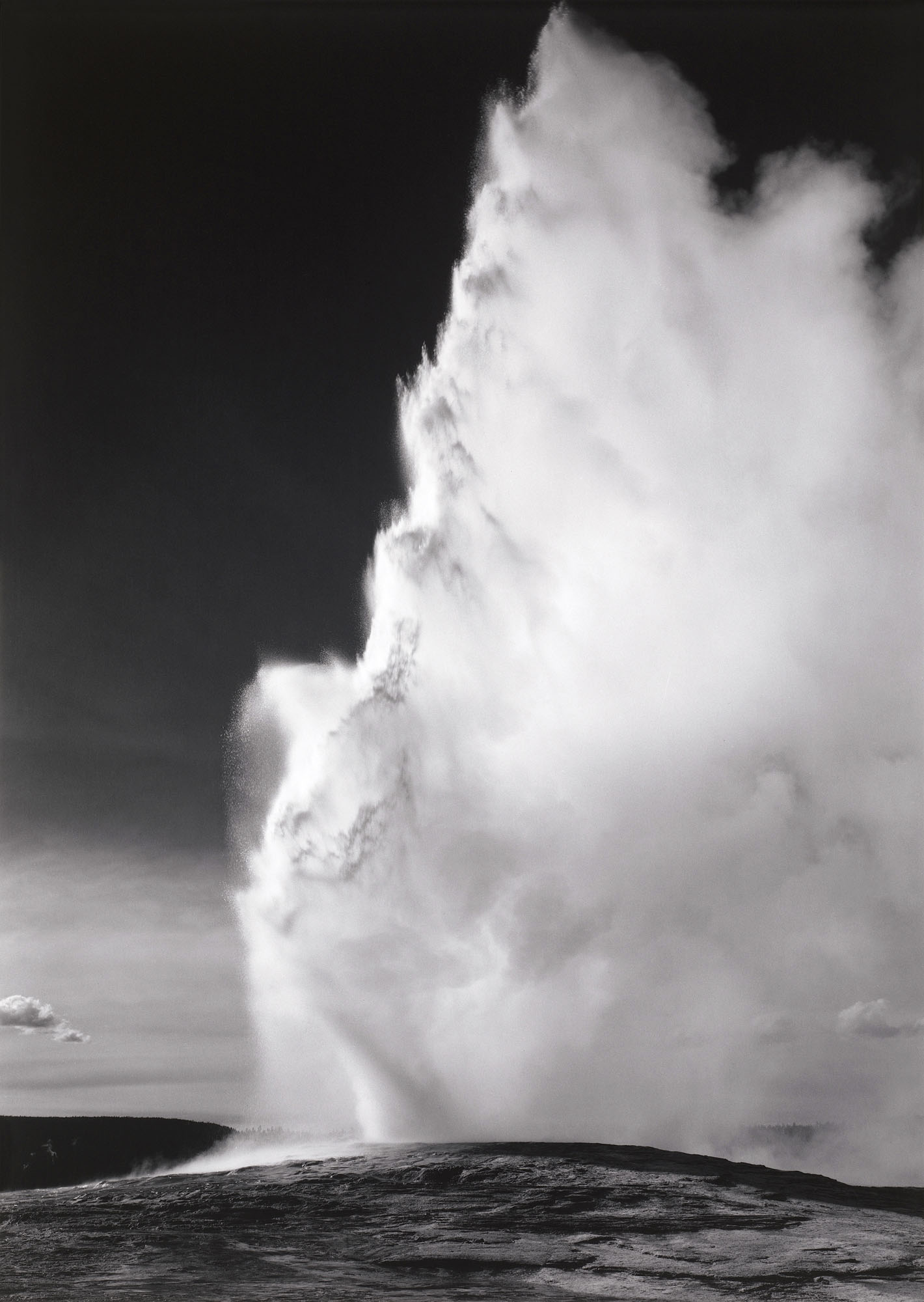
 

Ansel Adams (American, 1902-1984) 'Old Faithful Geyser, Yellowstone National Park, Wyoming' 1942


Ansel Adams (American, 1902-1984)
Old Faithful Geyser, Yellowstone National Park, Wyoming
1942
Gelatin silver print
The Lane Collection
Courtesy Museum of Fine Arts, Boston
© The Ansel Adams Publishing Rights Trust


Ansel Adams began writing how-to books on photography in the mid-1930s, but he is best known for his series of technical books, including Camera and Lens, The Negative, The Print, and Natural Light Photography. In one of his later books, he uses an image of a Yellowstone geyser as an example of a particularly challenging subject that defies light-meter readings and tests a photographer’s ability to “visualise” in advance something so inherently fleeting and unpredictable. “It is difficult to conceive of a substance more impressively brilliant than the spurting plumes of white waters in sunlight against a deep blue sky,” he wrote.

Exhibition label text
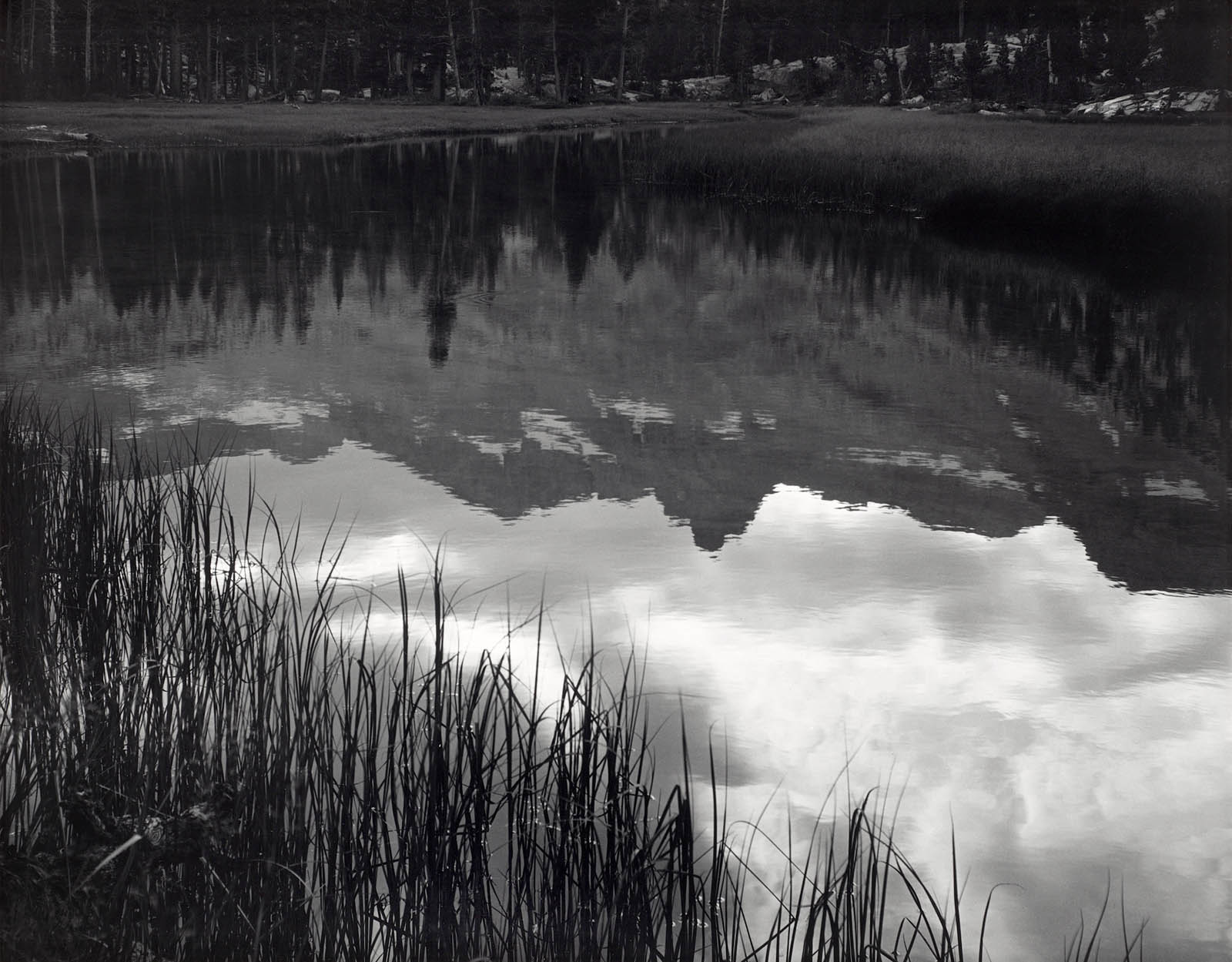
 

Ansel Adams (American, 1902-1984) 'Grass and Reflections, Lyell Fork of the Merced River, Yosemite National Park' About 1943


Ansel Adams (American, 1902-1984)
Grass and Reflections, Lyell Fork of the Merced River, Yosemite National Park
About 1943
Gelatin silver print
The Lane Collection
Courtesy Museum of Fine Arts, Boston
© The Ansel Adams Publishing Rights Trust


Lyell Fork was one of Ansel Adams’ favourite locations from his earliest years as a photographer in Yosemite. It was a place he also loved introducing to others—he took Georgia O’Keeffe and photography collector David McAlpin there when they hiked into the backcountry in 1938. Reflected in the placid water are several distant peaks, the most prominent of which was named Mount Ansel Adams after the photographer’s death in 1984.

Exhibition label text


The Other Side of the Mountain

Ansel Adams made his reputation mainly through images of beautiful, seemingly unspoiled nature. Less well known are the images he produced in California’s Death Valley and Owens Valley [below], southeast of Yosemite. Yet he was drawn to these more forbidding landscapes multiple times – occasionally lured by a book or magazine project but often of his own volition.

Here, on the dry side of the Sierra Nevada, Adams and his work took a dramatic detour. The photographer Edward Weston introduced Adams to Death Valley, where he photographed sand dunes, salt flats, and sandstone canyons. Owens Valley was once farmland, but its residents struggled after their water supply was diverted to the growing city of Los Angeles. In 1943, Adams first traveled to nearby Manzanar, where he photographed Japanese Americans forcibly relocated to internment camps shortly after the US entered World War II. The resulting series explores the tension between the area’s open spaces and the physical restrictions imposed upon internees.

Contemporary photographers continue to find compelling subjects in these remote places. Their images explore the raw beauty of the terrain and the sometimes unsettling ways it is used today – including as the site of maximum-security prisons and clandestine military projects carried out under wide skies.

Exhibition wall text
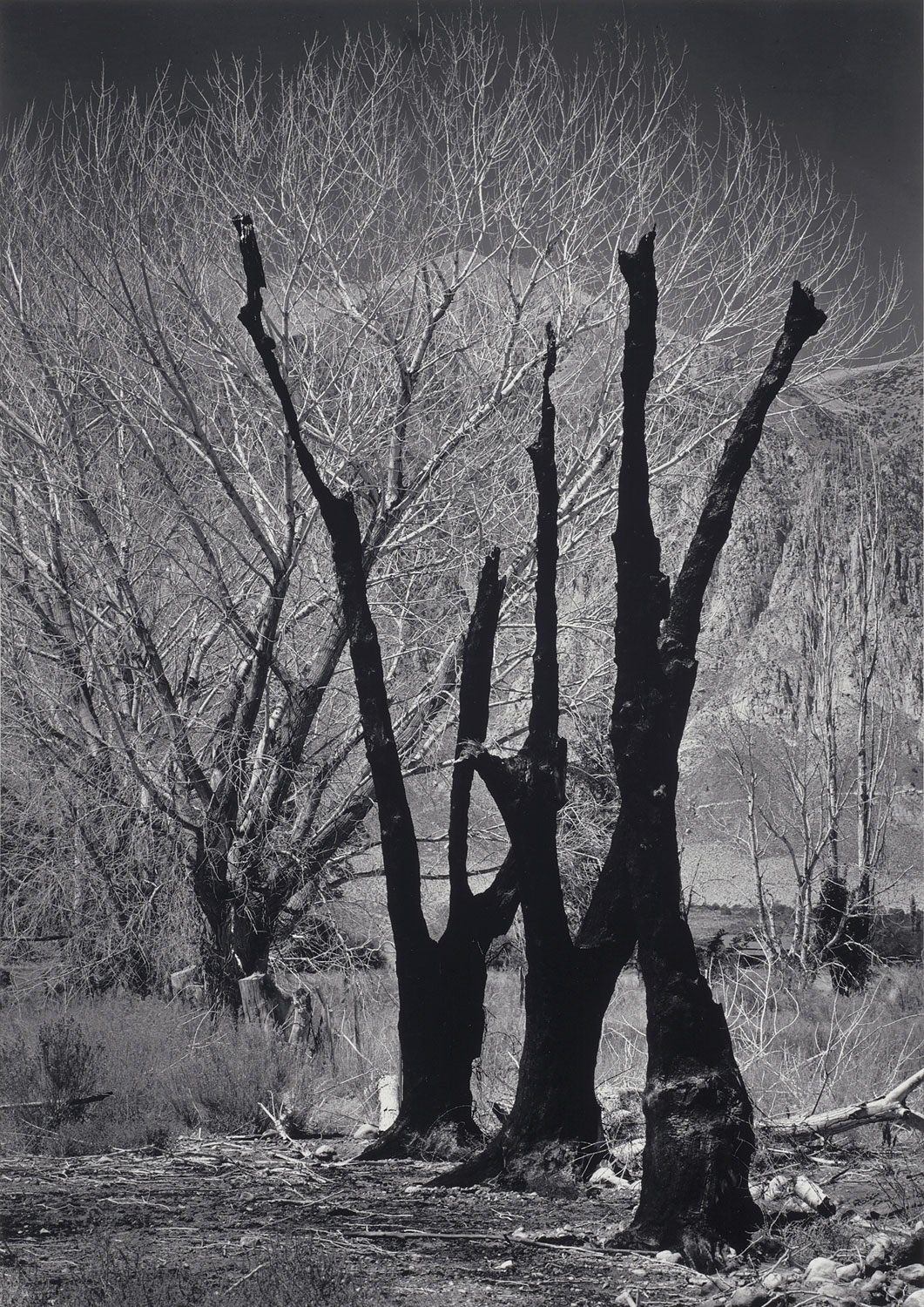
 

Ansel Adams (American, 1902-1984) 'Burned Trees, Owens Valley, California' Negative date: about 1936


Ansel Adams (American, 1902-1984)
Burned Trees, Owens Valley, California
Negative date: about 1936
Gelatin silver print
The Lane Collection
Courtesy Museum of Fine Arts, Boston
© The Ansel Adams Publishing Rights Trust
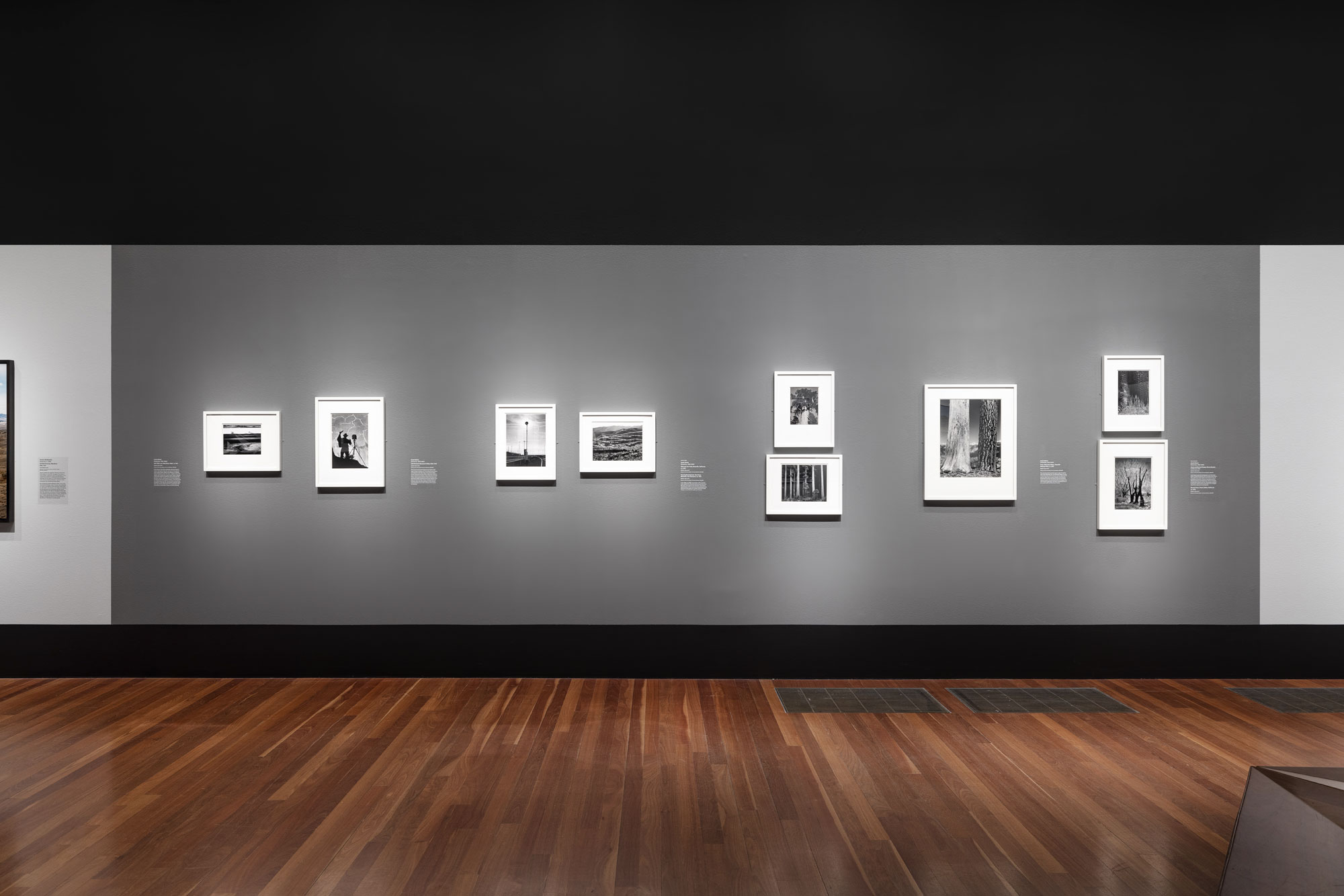
 

Installation view of the exhibition 'Ansel Adams in Our Time' at the de Young museum, San Francisco showing at left, 'Salt Flats Near Wendover, Utah' (1953); at second left, 'Self‑Portrait, Monument Valley, Utah' (1958); at second left 'Trees Near Washburn Point, Illiloutte Ridge, Yosemite Valley' (c. 1945); and at bottom right, 'Burned Trees, Owens Valley, California' (1936)


Installation view of the exhibition Ansel Adams in Our Time at the de Young museum, San Francisco showing at left, Salt Flats Near Wendover, Utah (1953, above); at second left, Self‑Portrait, Monument Valley, Utah (1958, below); at second left Trees Near Washburn Point, Illiloutte Ridge, Yosemite Valley (c. 1945, below); and at bottom right, Burned Trees, Owens Valley, California (1936, above)
Image courtesy of the Fine Arts Museums of San Francisco
Photo: Gary Sexton
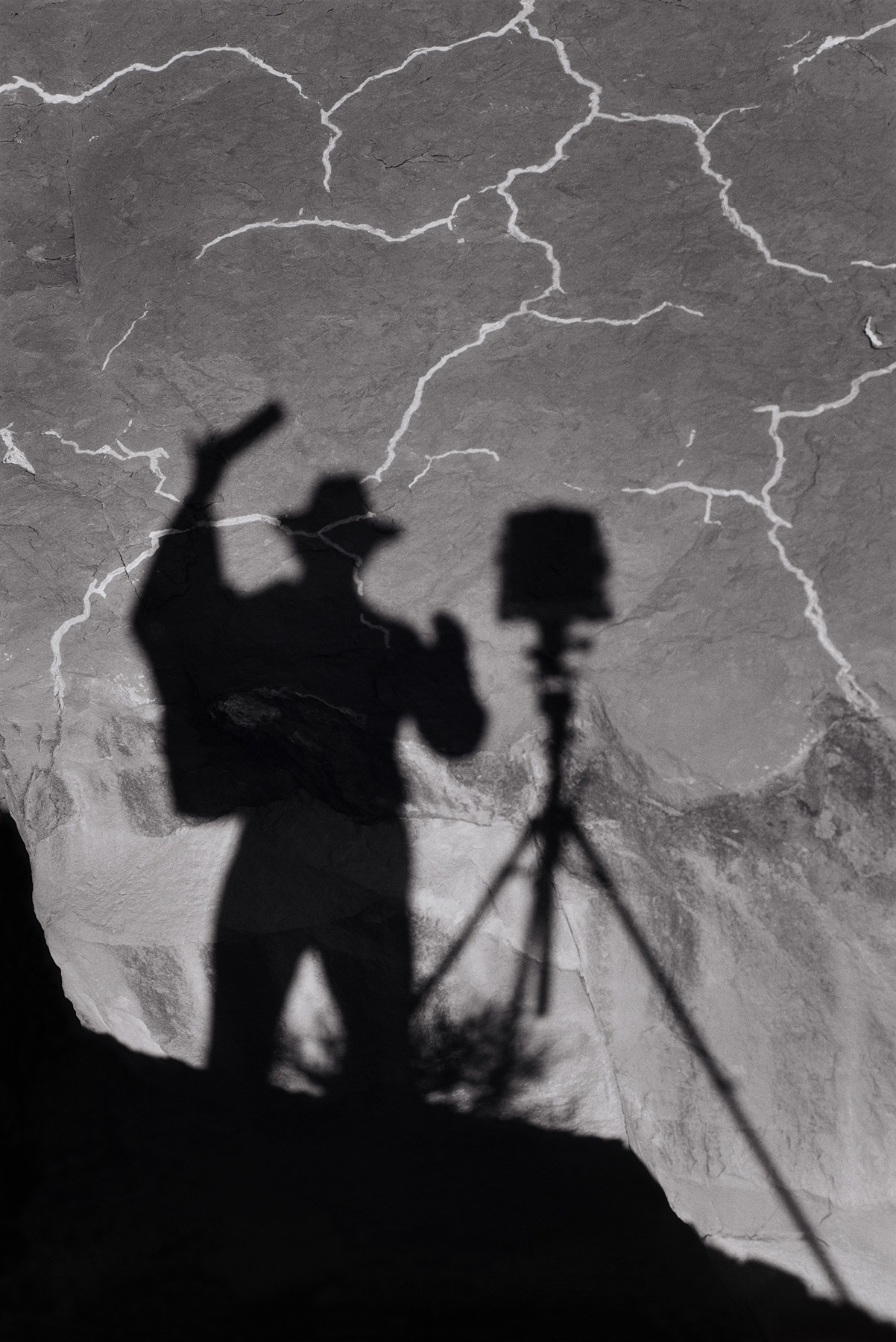
 

Ansel Adams (American, 1902-1984) 'Self‑Portrait, Monument Valley, Utah' 1958


Ansel Adams (American, 1902-1984)
Self‑Portrait, Monument Valley, Utah
1958
Gelatin silver print
The Lane Collection
Courtesy Museum of Fine Arts, Boston
© The Ansel Adams Publishing Rights Trust


This unusual self-portrait depicts Ansel Adams, light meter in hand, standing next to his large-format camera and tripod. He made this image of his shadow falling across a fissured rock face while in Monument Valley to shoot a Colorama for display in New York’s Grand Central Station. Sponsored by Eastman Kodak, Coloramas were panoramic, backlit transparencies, almost eighteen feet high and sixty feet long, whose sweeping scale and luminous colour were the antithesis of this intimate image that Adams shot while waiting for the weather to cooperate.

Exhibition label text
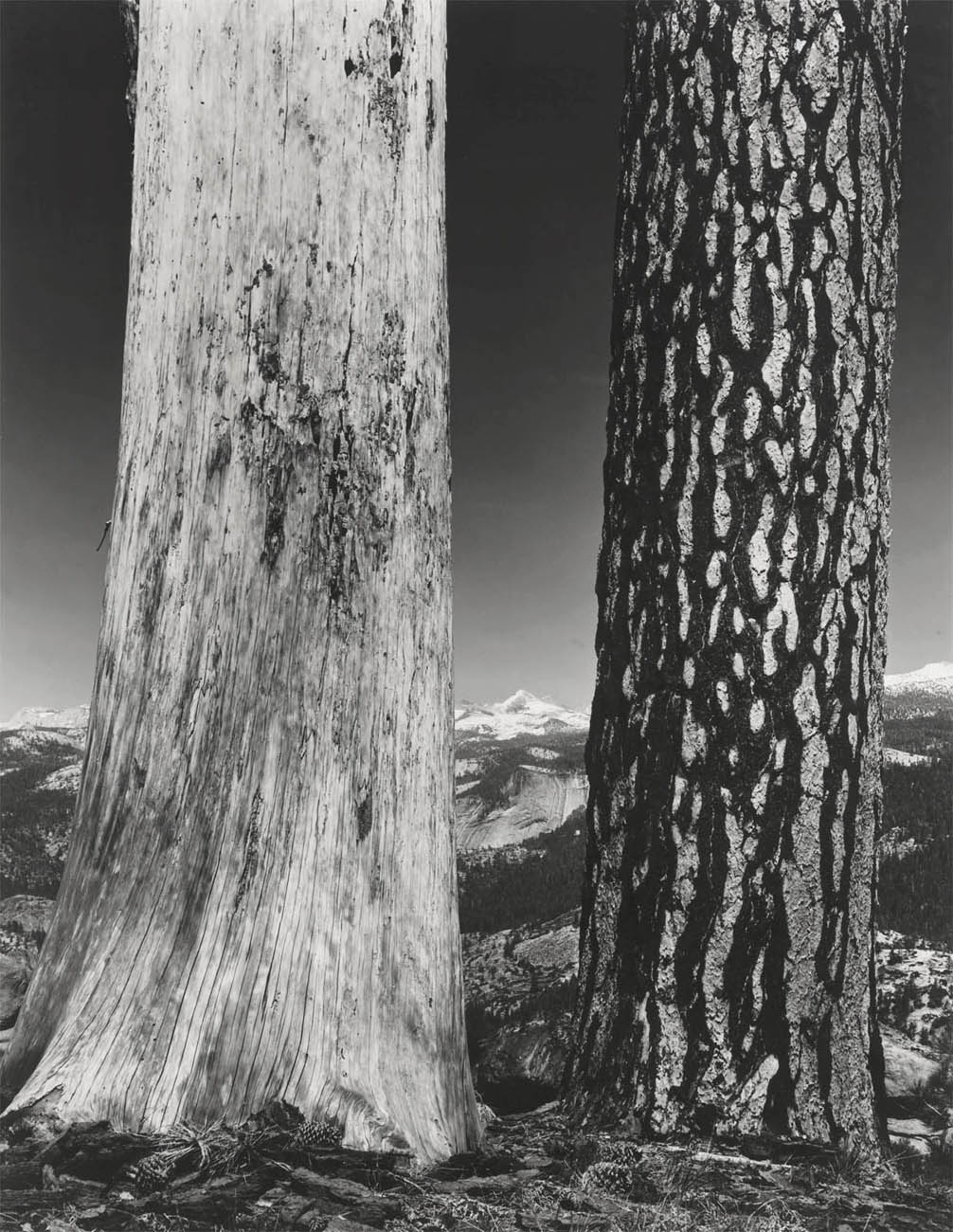
 

Ansel Adams (American, 1902-1984) 'Trees, Illilouette Ridge, Yosemite National Park' c. 1945


Ansel Adams (American, 1902-1984)
Trees, Illilouette Ridge, Yosemite National Park
c. 1945
Gelatin silver print
The Lane Collection
Courtesy Museum of Fine Arts, Boston
© The Ansel Adams Publishing Rights Trust


This stunning double portrait records a pair of massive tree trunks following a fire. The Illilouette Ridge is an area of Yosemite National Park that lies between Glacier Point and the valley floor. In recent decades, the Illilouette Creek basin has been the focus of an environmental study to measure the potential benefit of managing fires with minimal suppression and fewer controlled burns on the overall health and diversity of forests.

Exhibition label text
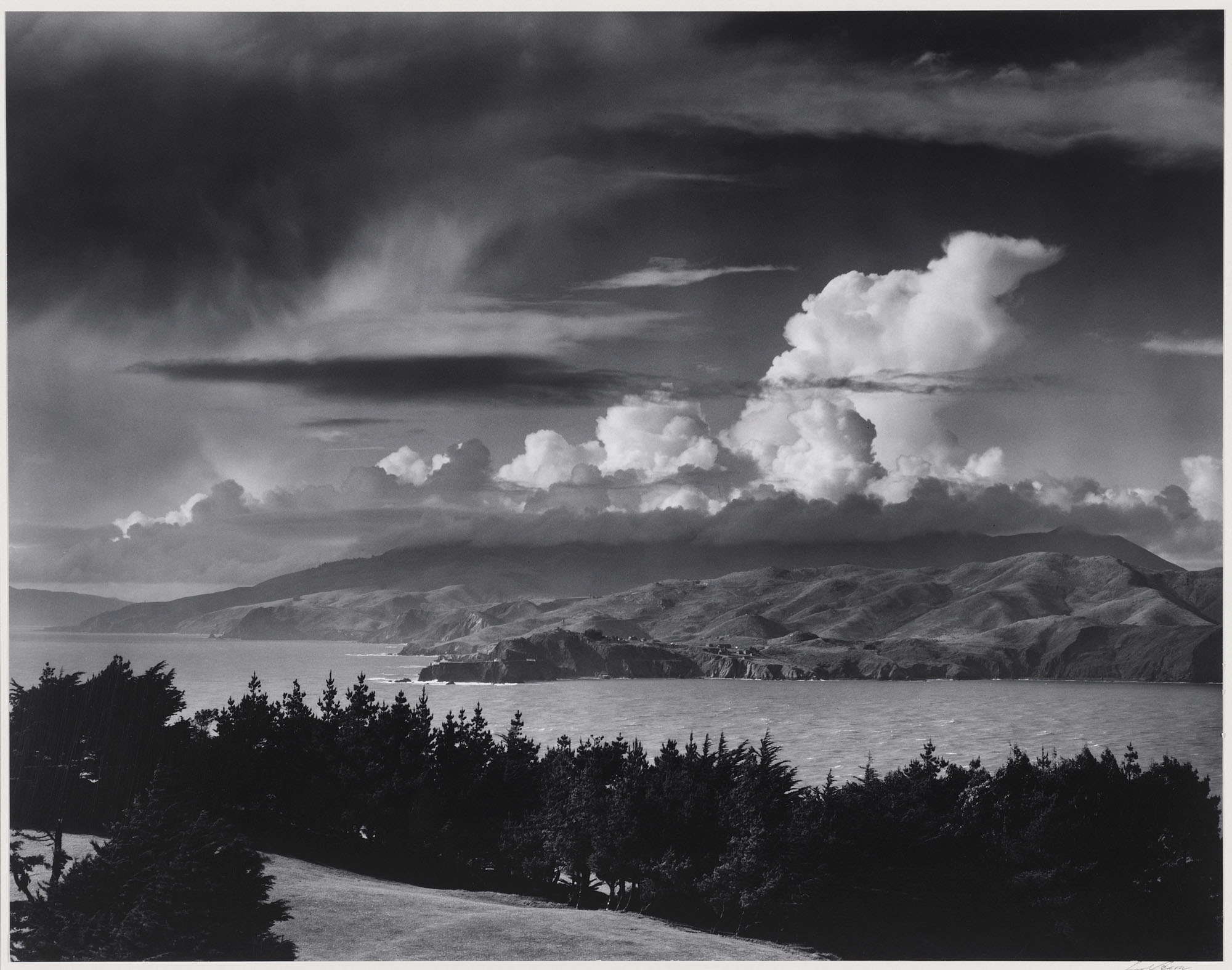
 

Ansel Adams (American, 1902-1984) 'Marin Hills from Lincoln Park, San Francisco' Negative date: 1952


Ansel Adams (American, 1902-1984)
Marin Hills from Lincoln Park, San Francisco
Negative date: 1952
Gelatin silver print
The Lane Collection
Courtesy Museum of Fine Arts, Boston
© The Ansel Adams Publishing Rights Trust
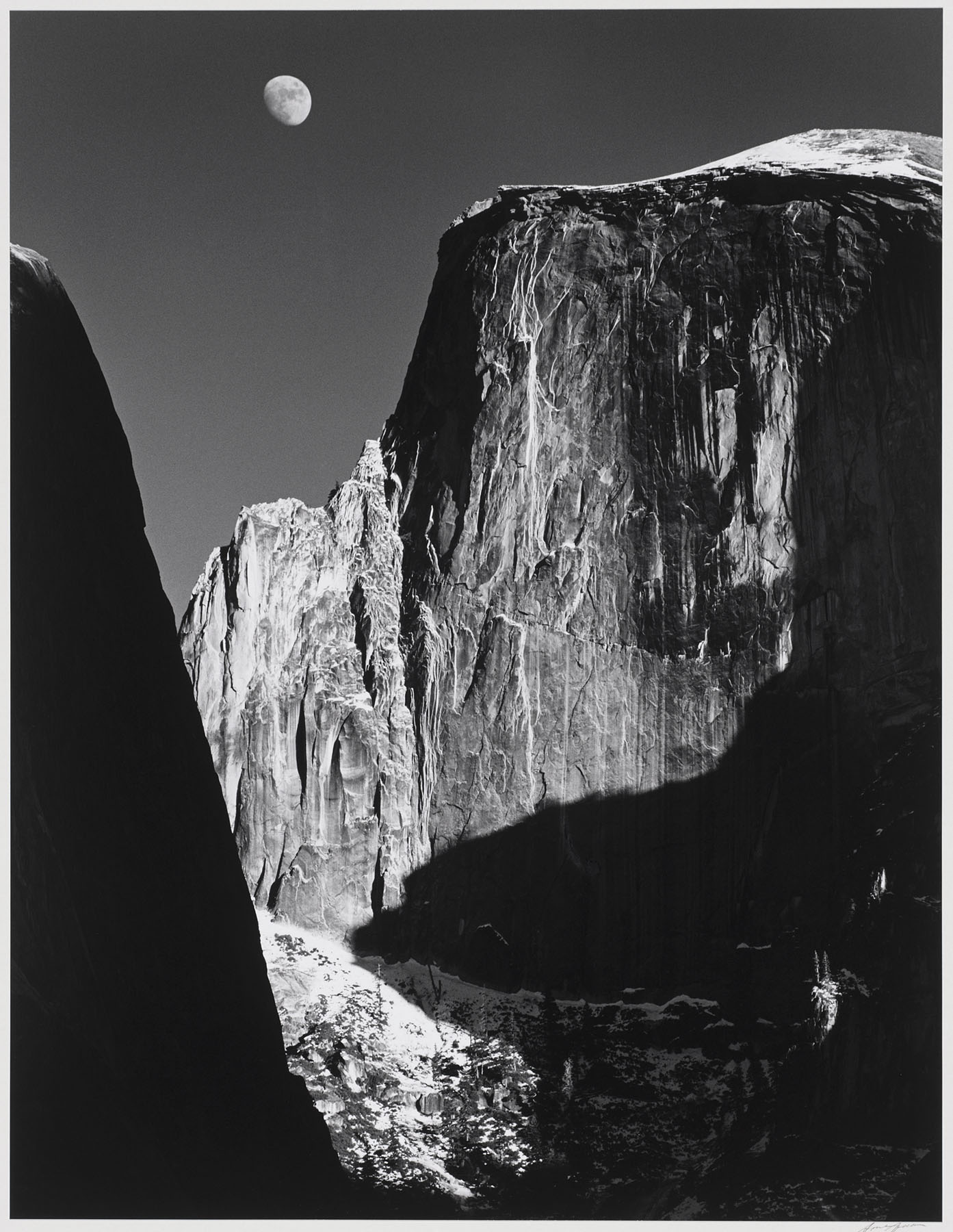
 

Ansel Adams (American, 1902-1984) 'Moon and Half Dome, Yosemite National Park' 1960


Ansel Adams (American, 1902-1984)
Moon and Half Dome, Yosemite National Park
1960
Gelatin silver print
The Lane Collection
Courtesy Museum of Fine Arts, Boston
© The Ansel Adams Publishing Rights Trust


Ansel Adams made this spectacular image of two of his favourite subjects – Half Dome and the moon – on an autumn afternoon in 1960. He witnessed a brilliant gibbous moon rising to the left fo the vertical rock face and, using a long lens and orange filter, carefully framed what would become one of his most popular late works. “As soon as I saw the moon coming up by Half Dome, I had visualised the image,” Adams wrote.

Exhibition label text
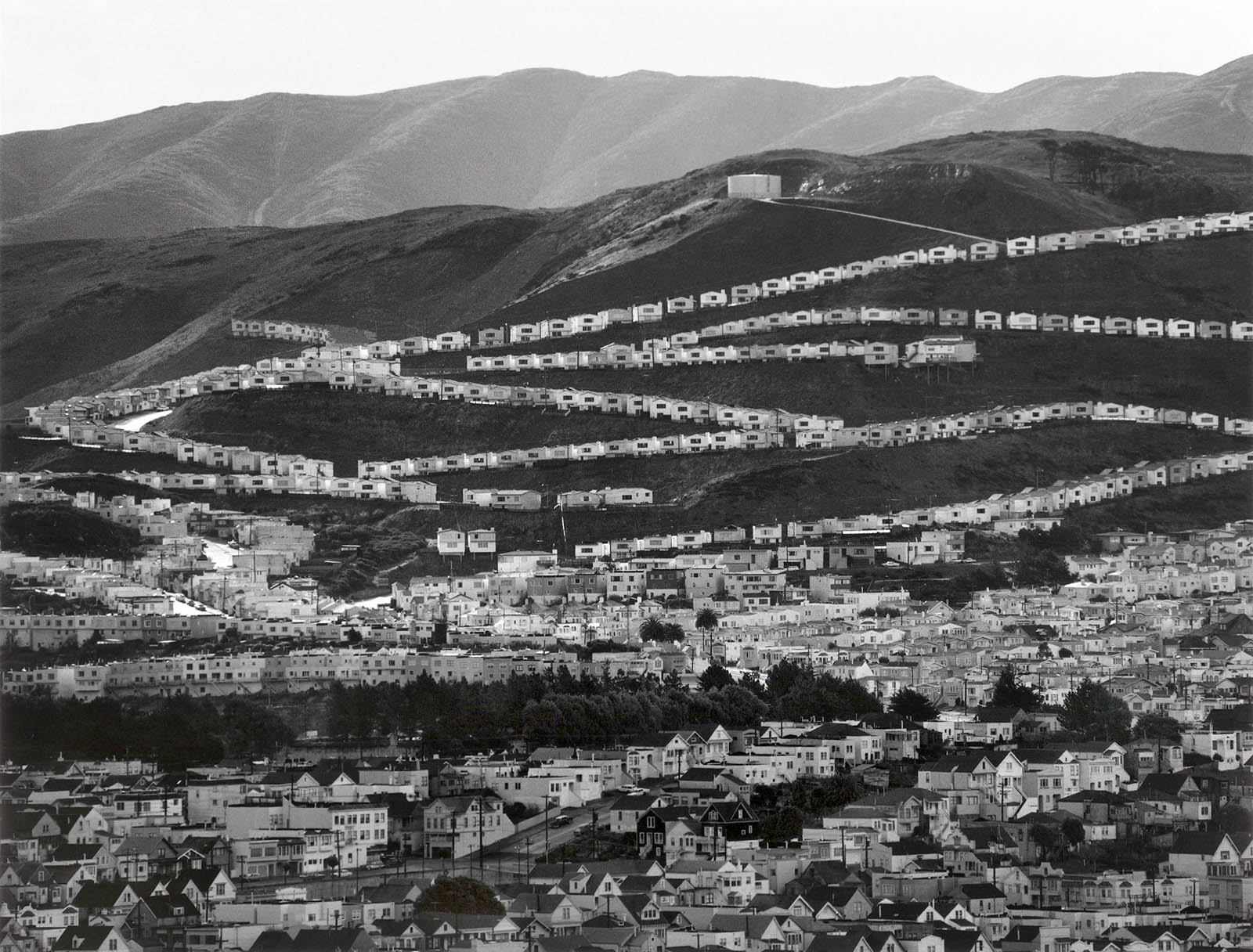
 

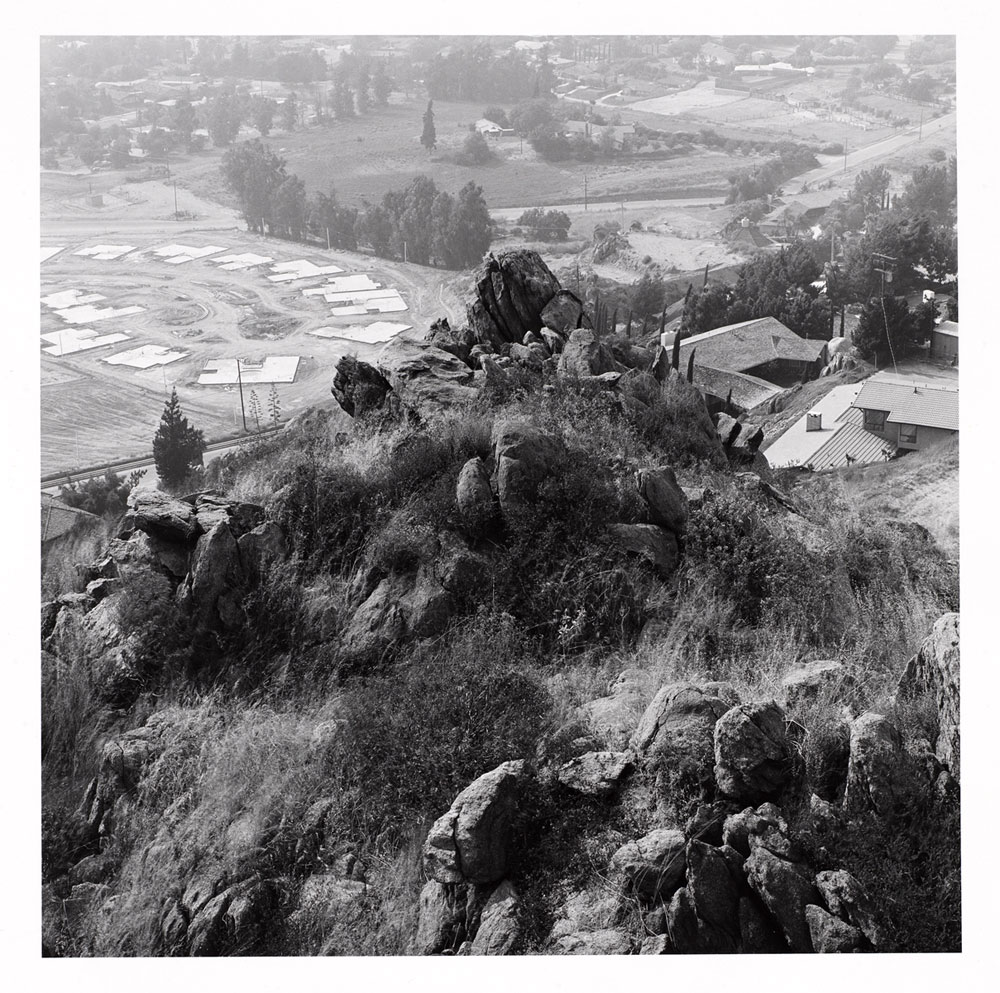
Ansel Adams (American, 1902-1984) 'Housing Development, San Bruno Mountains, San Francisco' About 1966


Ansel Adams (American, 1902-1984)
Housing Development, San Bruno Mountains, San Francisco
About 1966
Gelatin silver print
The Lane Collection
Courtesy Museum of Fine Arts, Boston
© The Ansel Adams Publishing Rights Trust


In the 1950s and 1960s, Ansel Adams often recorded urban subjects like this view looking toward San Bruno Mountain, just south of San Francisco. Here Adams documents one of the many tract housing developments built during this period, as it snakes across the steep hillsides surrounding the rapidly growing city.

Exhibition label text
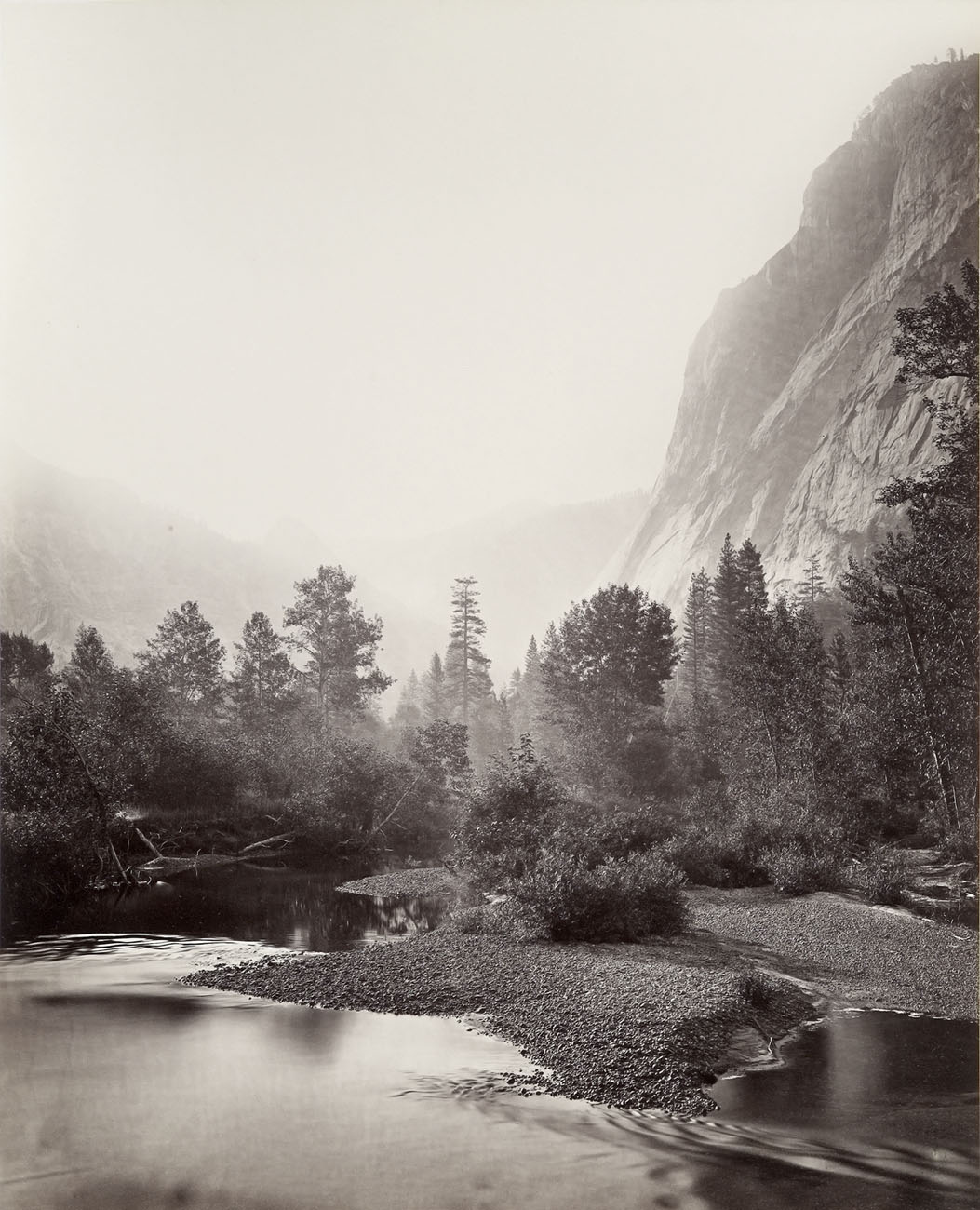
 

Carleton E. Watkins (American, 1829-1916) 'Mount Starr King and Glacier Point, Yosemite, No. 69' 1865-1866


Carleton E. Watkins (American, 1829-1916)
Mount Starr King and Glacier Point, Yosemite, No. 69
1865-1866
Mammoth albumen print from wet collodion negative
Ernest Wadsworth Longfellow Fund
Courtesy Museum of Fine Arts, Boston


Carleton E. Watkins took this photograph from the floor of Yosemite Valley while working for the California State Geological Survey in the mid-1860s. It is a more intimate and less sweeping view than the photograph Watkins self-described as the “best general view of Yosemite” (below), which presents the most recognisable features of the landscape.

Mount Starr King, the distant peak at centre, was named for Thomas Starr King, the Unitarian minister from Boston whose life and ministry were powerfully influenced by his experiences in the Yosemite wilderness. Ansel Adams later shared his “disregard for the naming of things and [his skepticism] of those non-professionals who go through the wilderness classifying and labelling everything in sight.”

Exhibition label text
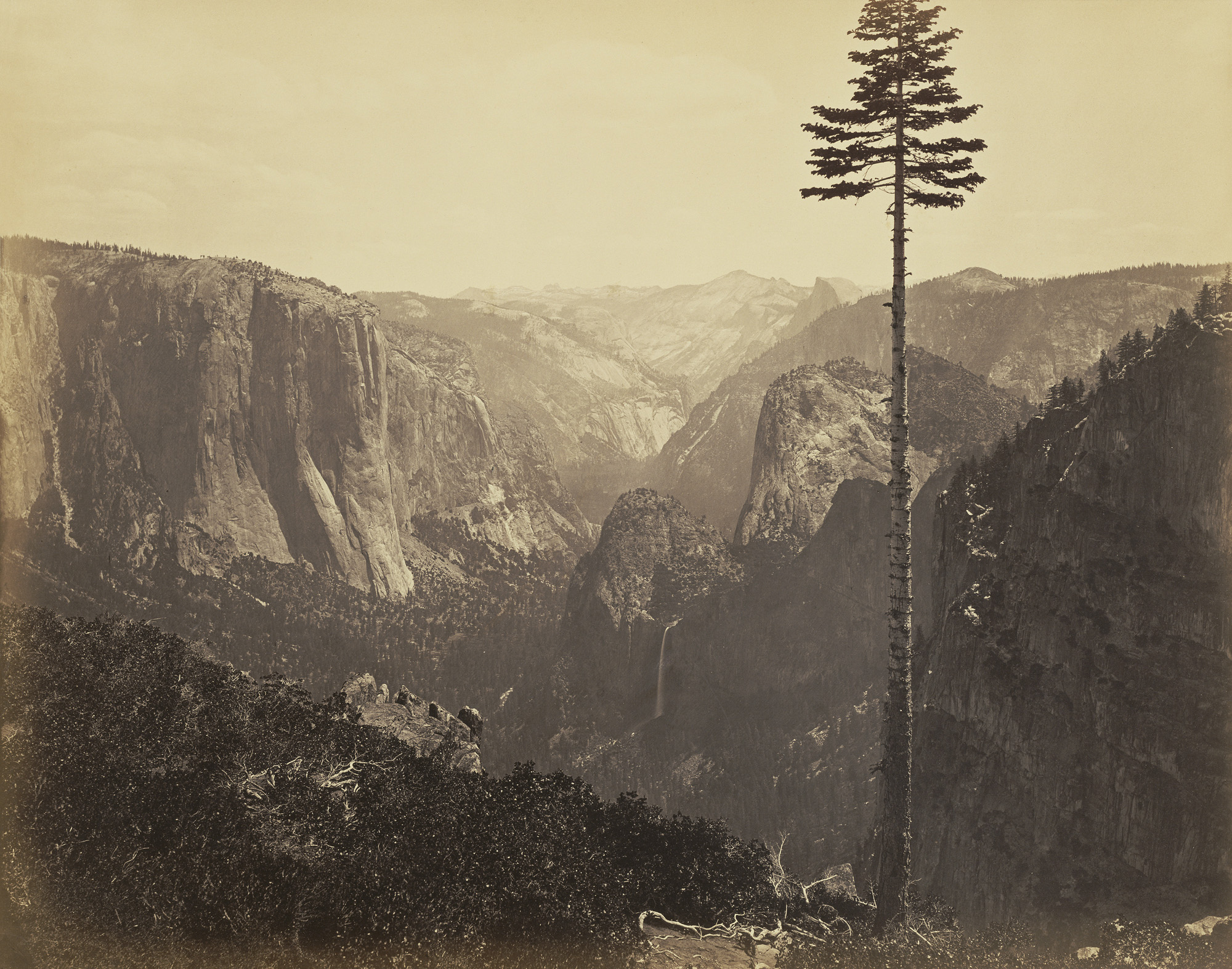
 

Carleton Watkins. 'Yosemite Valley from the Best General View No.2.' 1866


Carleton E. Watkins (American, 1829-1916)
Yosemite from the Best General View No. 2
1866
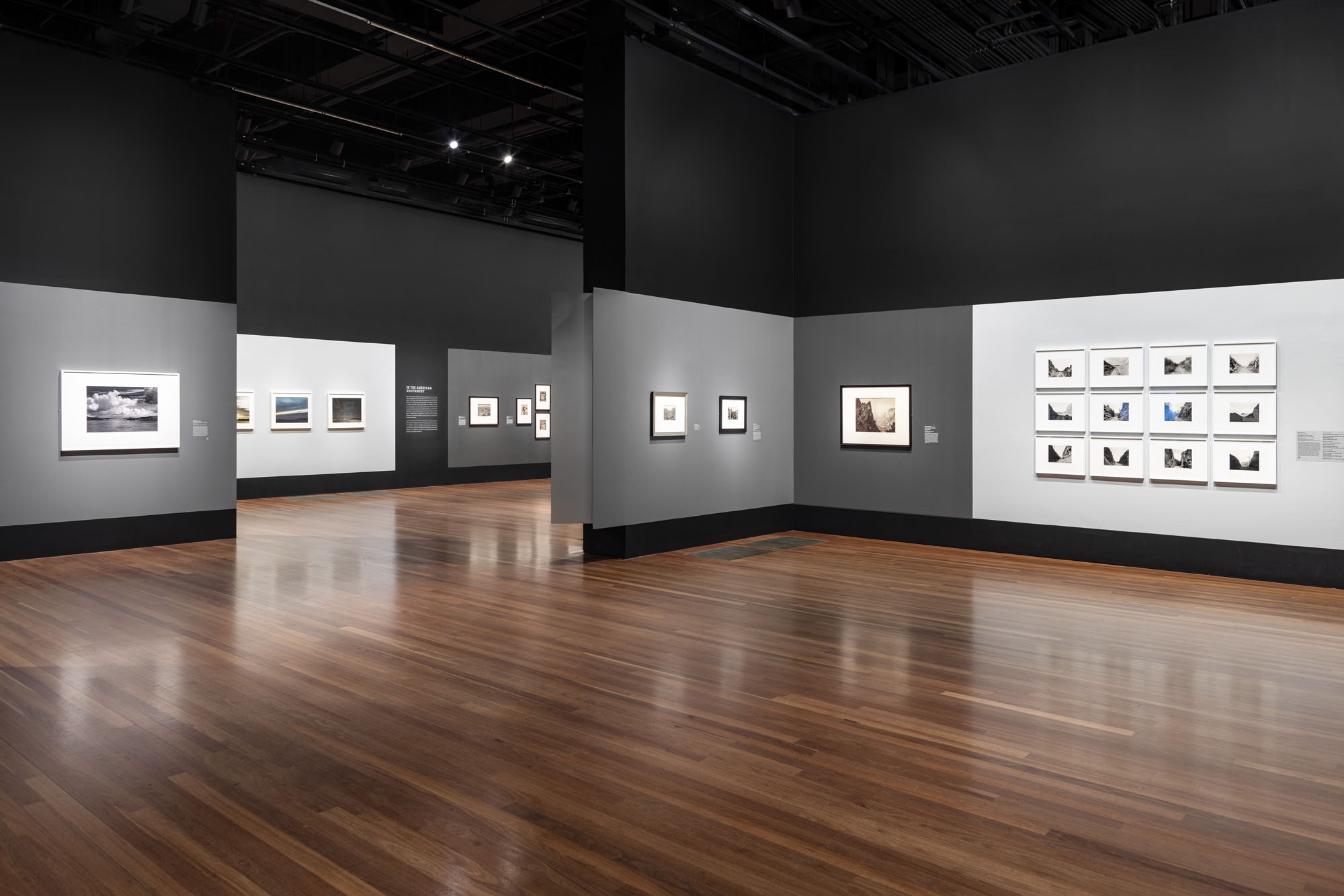
 

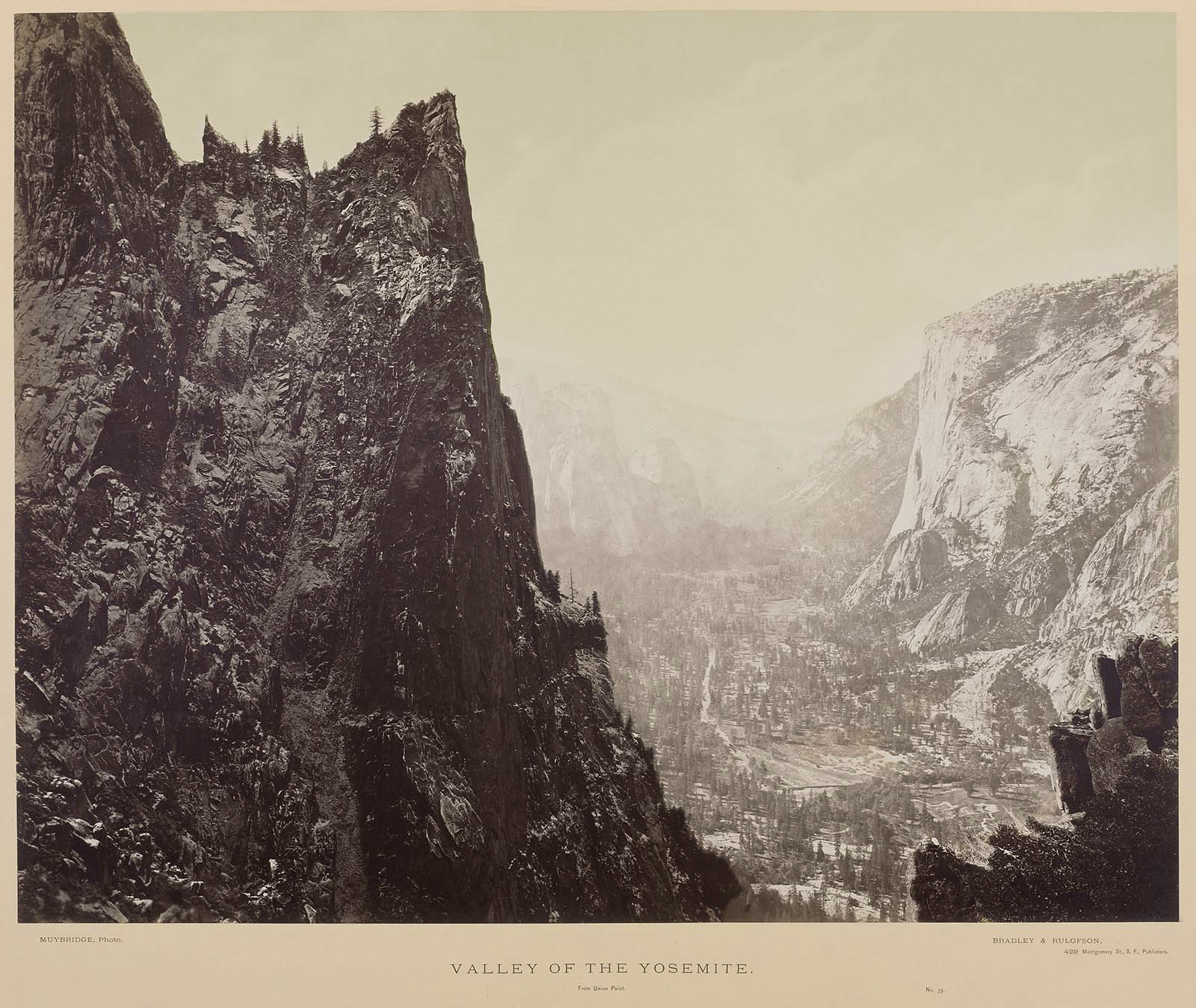
Installation view of the exhibition 'Ansel Adams in Our Time' at the de Young museum, San Francisco showing at left, Adams' 'The Golden Gate Before the Bridge' (1932); and at second right, Eadweard J. Muybridge's 'Valley of the Yosemite from Union Point, No. 33' (1872)


Installation view of the exhibition Ansel Adams in Our Time at the de Young museum, San Francisco showing at left, Adams’ The Golden Gate Before the Bridge (1932, above); and at second right, Eadweard J. Muybridge’s Valley of the Yosemite from Union Point, No. 33 (1872, below)
Image courtesy of the Fine Arts Museums of San Francisco
Photo: Gary Sexton
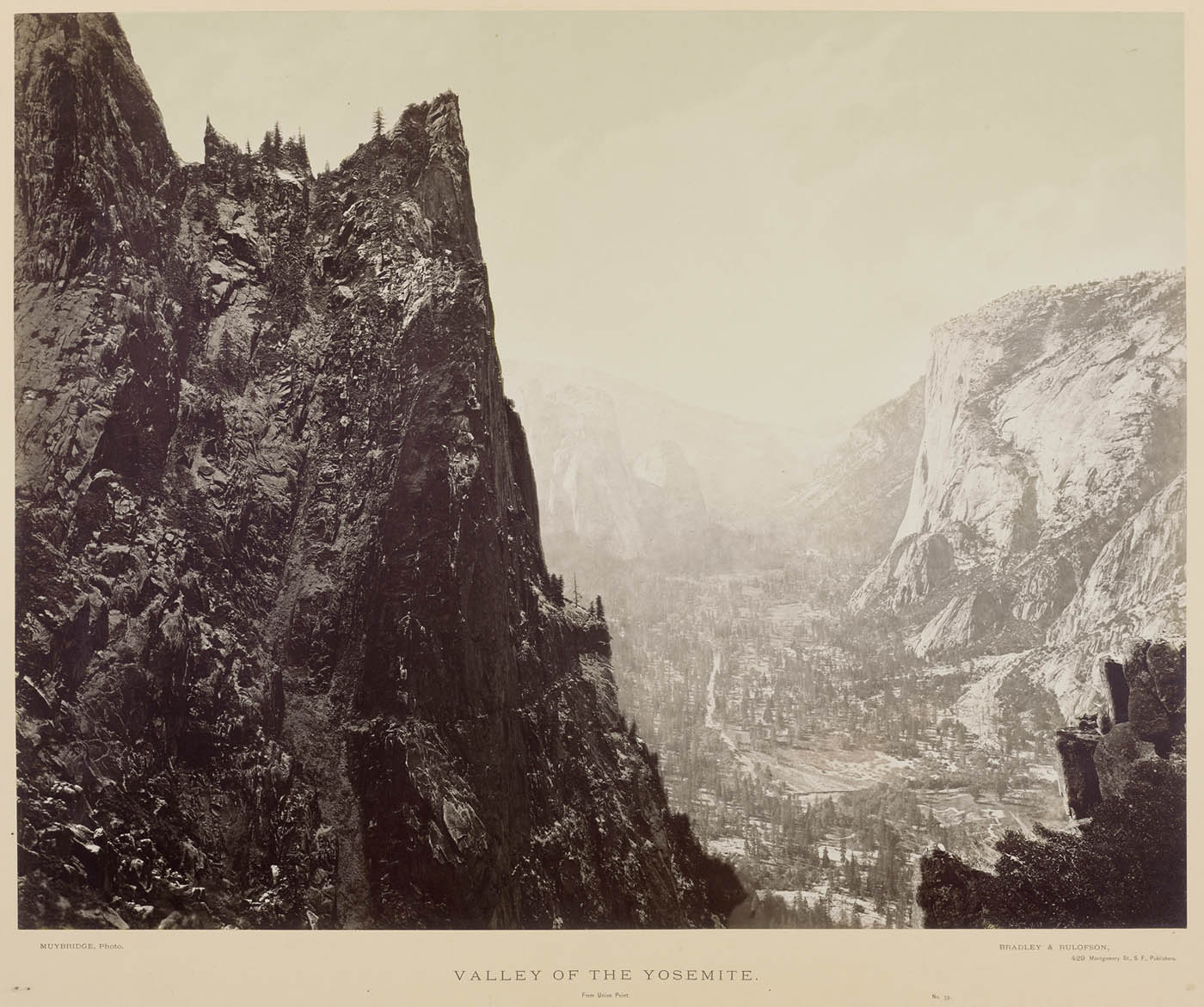
 

Eadweard J. Muybridge (American, 1830-1904) 'Valley of the Yosemite from Union Point, No. 33' 1872


Eadweard J. Muybridge (American, 1830-1904)
Valley of the Yosemite from Union Point, No. 33
1872
Albumen print
Gift of Charles T. and Alma A. Isaacs
Courtesy Museum of Fine Arts, Boston


Eadweard Muybridge first came to Yosemite in the 1860s. Capitalising on the growing popularity of wilderness landscape subjects, he stayed for six months, making large-format albumen prints and stereo views. Hoping to compete with Carleton E. Watkins’s earlier grand vistas, he returned in 1872 with a mammoth-plate camera. Often, Muybridge shot his atmospheric images from unusual perspectives, with sharp contrasts between foreground and background, light and shadow. This is evident in this photograph taken from Union Point, which provided a closer view of the valley and a greater sense of three-dimensional space than the better-known Glacier Point above.

Exhibition label text
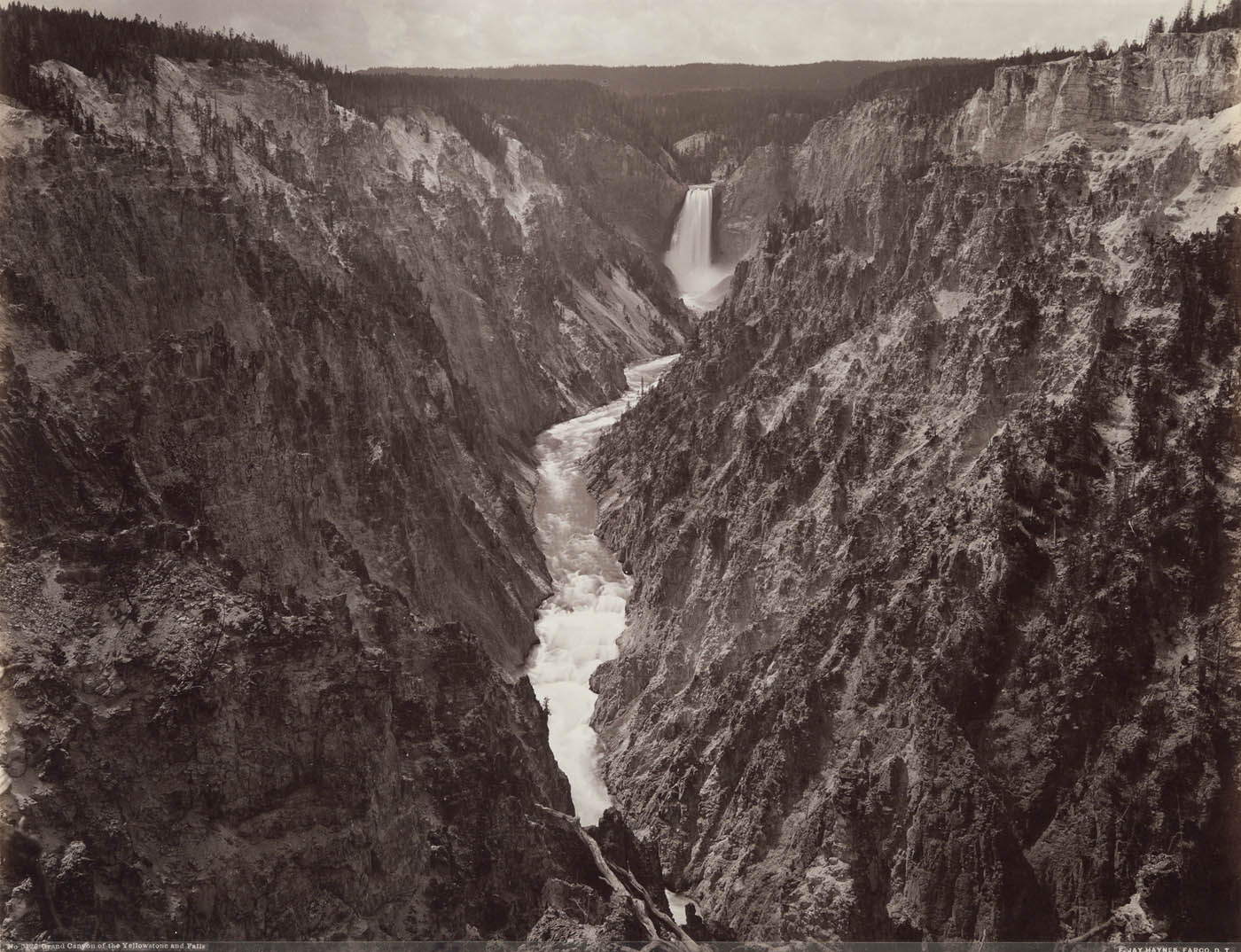
 

Frank Jay Haynes (American, 1853-1921) 'Grand Canyon of Yellowstone and Falls' About 1887


Frank Jay Haynes (American, 1853–1921)
Grand Canyon of Yellowstone and Falls
About 1887
Albumen print
Sophie M. Friedman Fund
Courtesy Museum of Fine Arts, Boston


Frank Jay Haynes was one of the second generation of photographers to be employed by the railroads and government surveys in the American West in the late nineteenth century. In 1884, he was named official photographer and concessionaire of Yellowstone to serve the growing numbers of tourists coming to visit the first national park. Yellowstone is situated on top of a massive subterranean volcano, which produces its active hot springs and towering geysers, such as Old Faithful. For his photograph of the Grand Canyon of the Yellowstone River, Haynes used a mammoth-plate camera to produce a large glass negative, from which he made this highly detailed contact print.

Exhibition label text
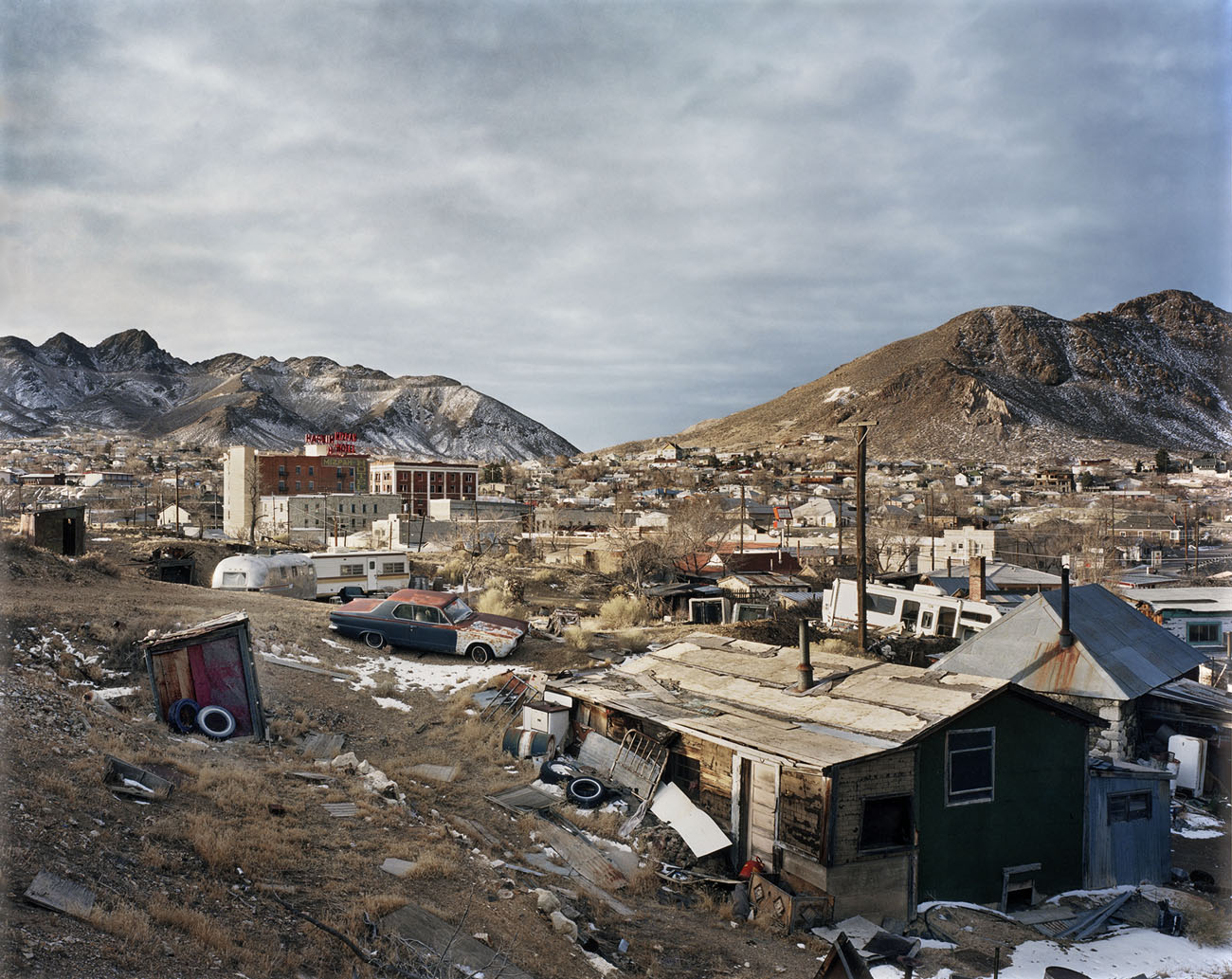
 

Bryan Schutmaat (American, b. 1983) 'Tonopah, NV' Nd


Bryan Schutmaat (American, b. 1983)
Tonopah, NV
Nd
Inkjet print
Gift of Jessie H. Wilkinson – Jessie H. Wilkinson Fund
Courtesy Museum of Fine Arts, Boston
© Bryan Schutmaat


These Nevada landscapes are from Grays the Mountain Sends, a series that depicts the landscapes, structures, and residents of former mining towns. Bryan Schutmaat seeks out these far-flung mountain communities, now mostly abandoned due to the loss of their mineral wealth.

Not unlike Ansel Adams’ fleeting view of Hernandez, New Mexico, first seen in his rearview mirror, Schutmaat’s vision is that of an extended road trip. And like Adams, he is drawn to the methodical way that his large-format camera forces him to work. He waits patiently for the changing light to activate a scene. For Schutmaat, each town’s deserted structures and lonely inhabitants stand as last “relics of hope” and proof of the tragic demise of the American dream. The fragile, hardscrabble beauty of these modern-day ghost towns is also a powerful reminder of the region’s uncertain future and its long history of economic booms and busts.

Exhibition label text
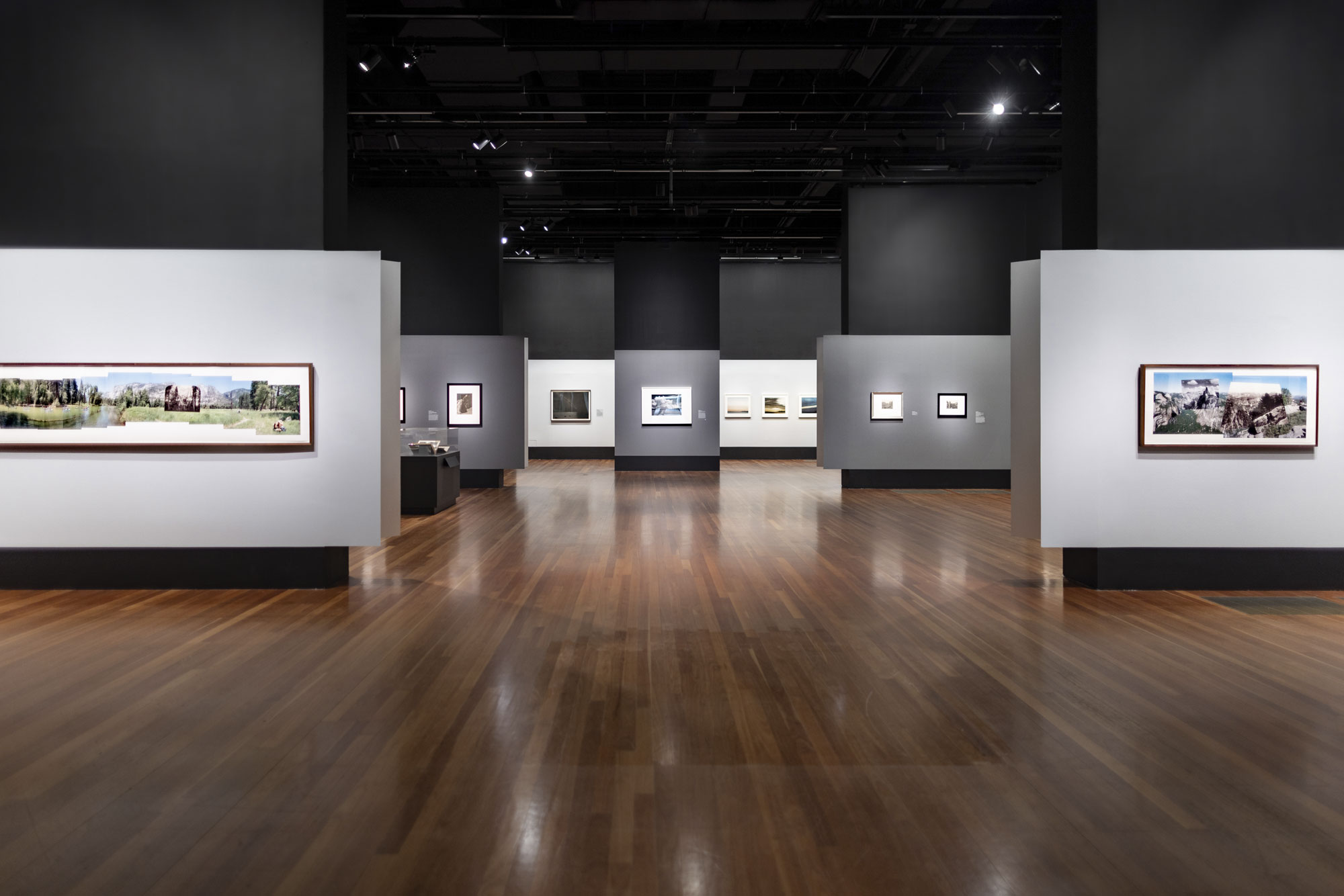
 

Installation view of the exhibition 'Ansel Adams in Our Time' at the de Young museum, San Francisco showing at foreground left and right, works by Mark C. Klett


Installation view of the exhibition Ansel Adams in Our Time at the de Young museum, San Francisco showing at foreground left and right, works by Mark C. Klett (below)
Image courtesy of the Fine Arts Museums of San Francisco
Photo: Gary Sexton
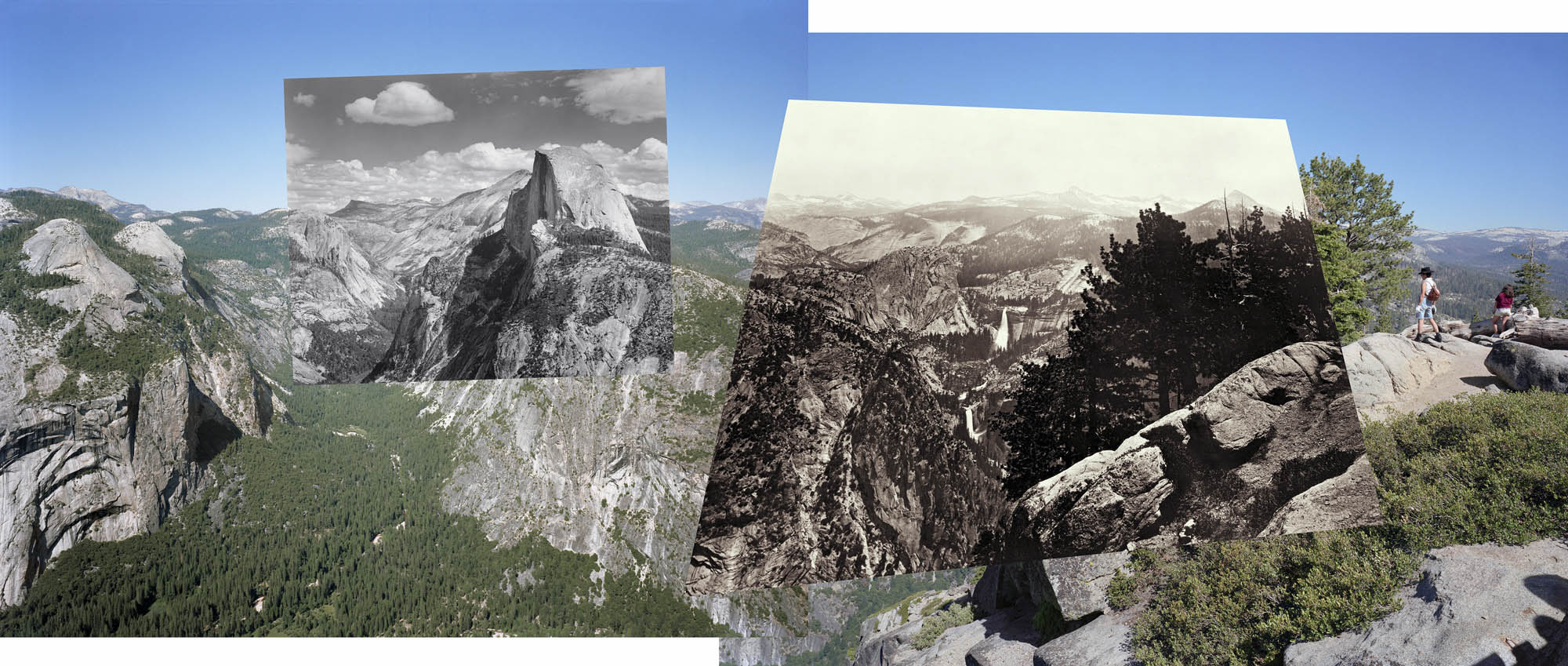
 

Mark C. Klett (American, b. 1952) and Byron Wolfe (American, b. 1967) 'View from the handrail at Glacier Point overlook, connecting views from Ansel Adams to Carleton Watkins' 2003


Mark C. Klett (American, b. 1952) and Byron Wolfe (American, b. 1967)
View from the handrail at Glacier Point overlook, connecting views from Ansel Adams to Carleton Watkins
2003
Archival pigment print
© Mark Klett & Byron Wolfe
Courtesy Etherton Gallery
Courtesy Museum of Fine Arts, Boston


“[Ansel Adams’] depopulated scenes suggest that the landscape does best without our presence, and that wilderness is an entity defined by our absence. However, anyone who has visited the site of one of Adams’ photographs knows that the romance of his landscapes is often best experienced in the photographs themselves. The reality of place is quite different. … The natural beauty of the land is still there to be seen, but you will not see it alone.” ~ Mark Klett

Mark Klett has photographed and rephotographed the western American landscape for more than thirty years. With his longtime collaborator, Byron Wolfe, Klett carefully studies prints by Carleton E. Watkins and other nineteenth-century wilderness photographers, as well as twentieth-century modernists like Ansel Adams. By studying the shadows, they determine the time of year and time of day that an image was made. Once on-site, Klett photographs the view with Polaroid film, and Wolfe measures that image against the original photograph, repeating the process until they locate exactly where the earlier photographer stood. By visually collapsing time and space in this composite panorama of Yosemite Valley, Klett and Wolfe document changes to the landscape over more than a century.

Exhibition label text


The Changing Landscape

In his own time, Ansel Adams was aware of the environmental concerns facing California and the nation. Although Adams continued to make symphonic and pristine wilderness landscapes, as his career progressed, he began to create images that showed a more nuanced vision – images that decidedly break with widely held ideas about his work. He photographed urban sprawl, freeways, graffiti, oil drilling, ghost towns, rural cemeteries, mining towns, and the sometimes-dispossessed inhabitants of those places, as well as less romantic views of nature, such as the aftermath of forest fires.

Appreciated for their imagery and formal qualities, Adams’ photo-graphs also carry a message of advocacy. Photographers working in the American West today confront a changed, and changing, landscape. Human activity – urbanisation, logging, mining, ranching, irrigated farming – and global warming continue to alter the terrain. Works by contemporary artists bear witness to these changes and their impacts, countering notions that our natural resources are limitless. Placed in conversation with Adams’ photographs, these images aid our understanding of his singular contribution to the ways we envision the landscape and the urgency with which we must protect it.

Exhibition wall text
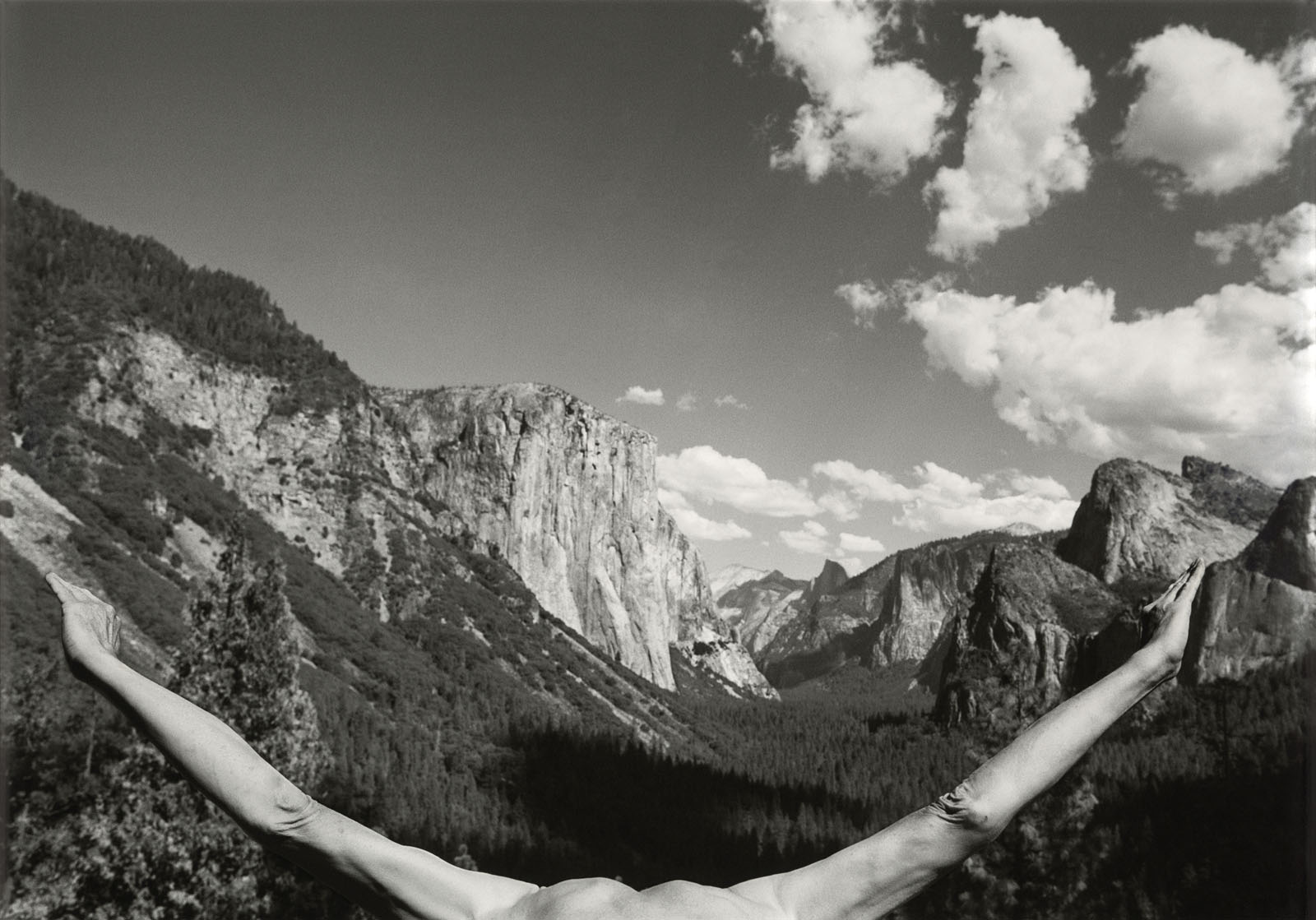
 

Arno Rafael Minkkinen (American born Finland, b. 1945) 'Homage to Watkins, Yosemite' 2007


Arno Rafael Minkkinen (American born Finland, b. 1945)
Homage to Watkins, Yosemite
2007
Inkjet print
Sophie M. Friedman Fund
Courtesy Museum of Fine Arts, Boston
© Arno Rafael Minkkinen


Several of the contemporary photographers in this exhibition call into question the archetypal images of empty wilderness spaces that have long held a central place in the popular imagination. Arno Rafael Minkkinen activates pristine, unpopulated landscapes by introducing his own naked body into them, without relying on digital manipulation. Here, the artist’s seemingly headless torso and the gentle curve of his outstretched arms perfectly echo the bowl-shaped Yosemite Valley as seen from Inspiration Point.

Exhibition label text
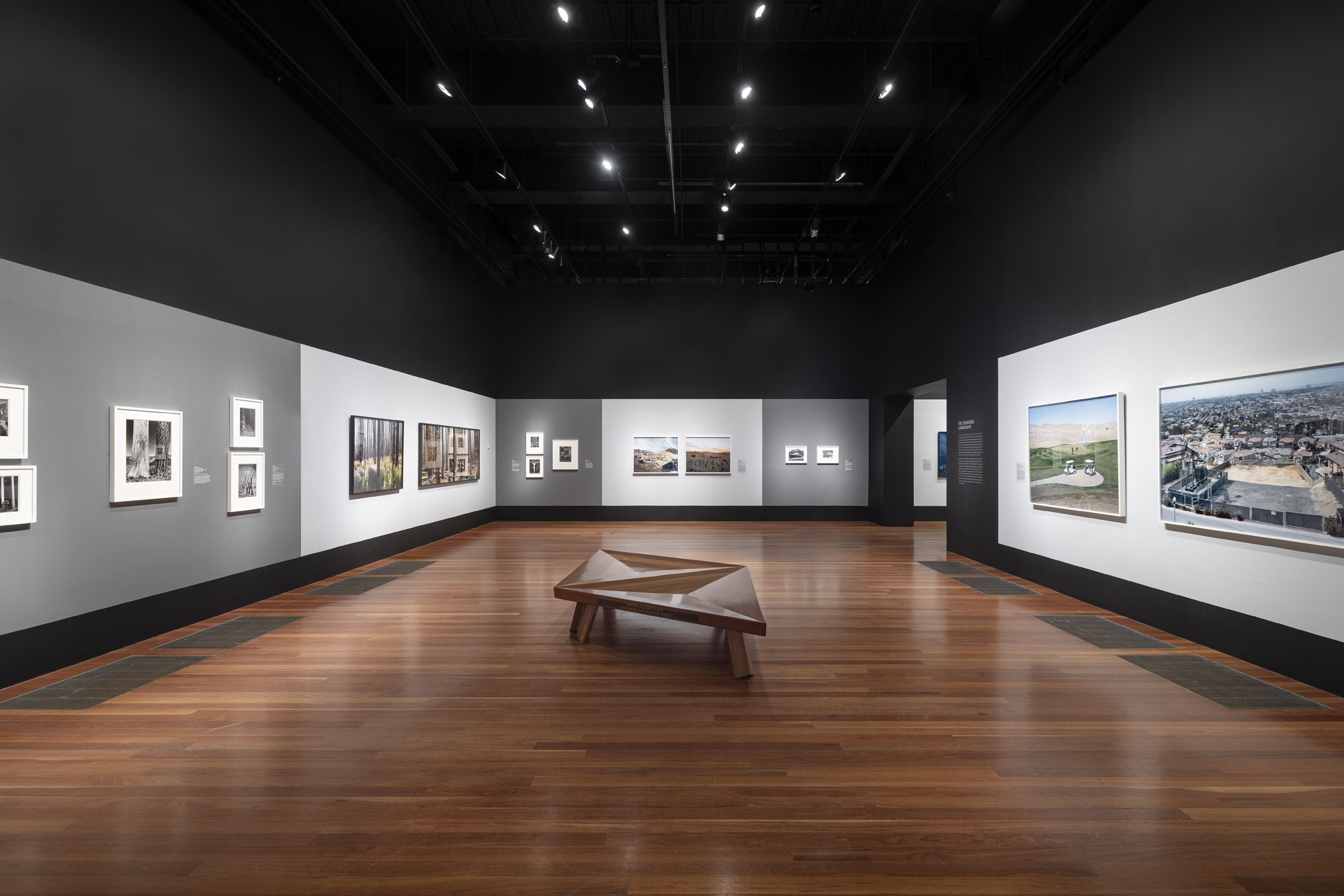
 

Installation view of the exhibition 'Ansel Adams in Our Time' at the de Young museum, San Francisco showing at left in the light panel, Laura McPhee's 'Early Spring (Peeling Bark in Rain)' (2008); and at second right, Mitch Epstein's 'Altamont Pass Wind Farm, California' (2007)


Installation view of the exhibition Ansel Adams in Our Time at the de Young museum, San Francisco showing at left in the light panel, Laura McPhee’s Early Spring (Peeling Bark in Rain) (2008, below); and at second right, Mitch Epstein’s Altamont Pass Wind Farm, California (2007, below)
Image courtesy of the Fine Arts Museums of San Francisco
Photo: Gary Sexton
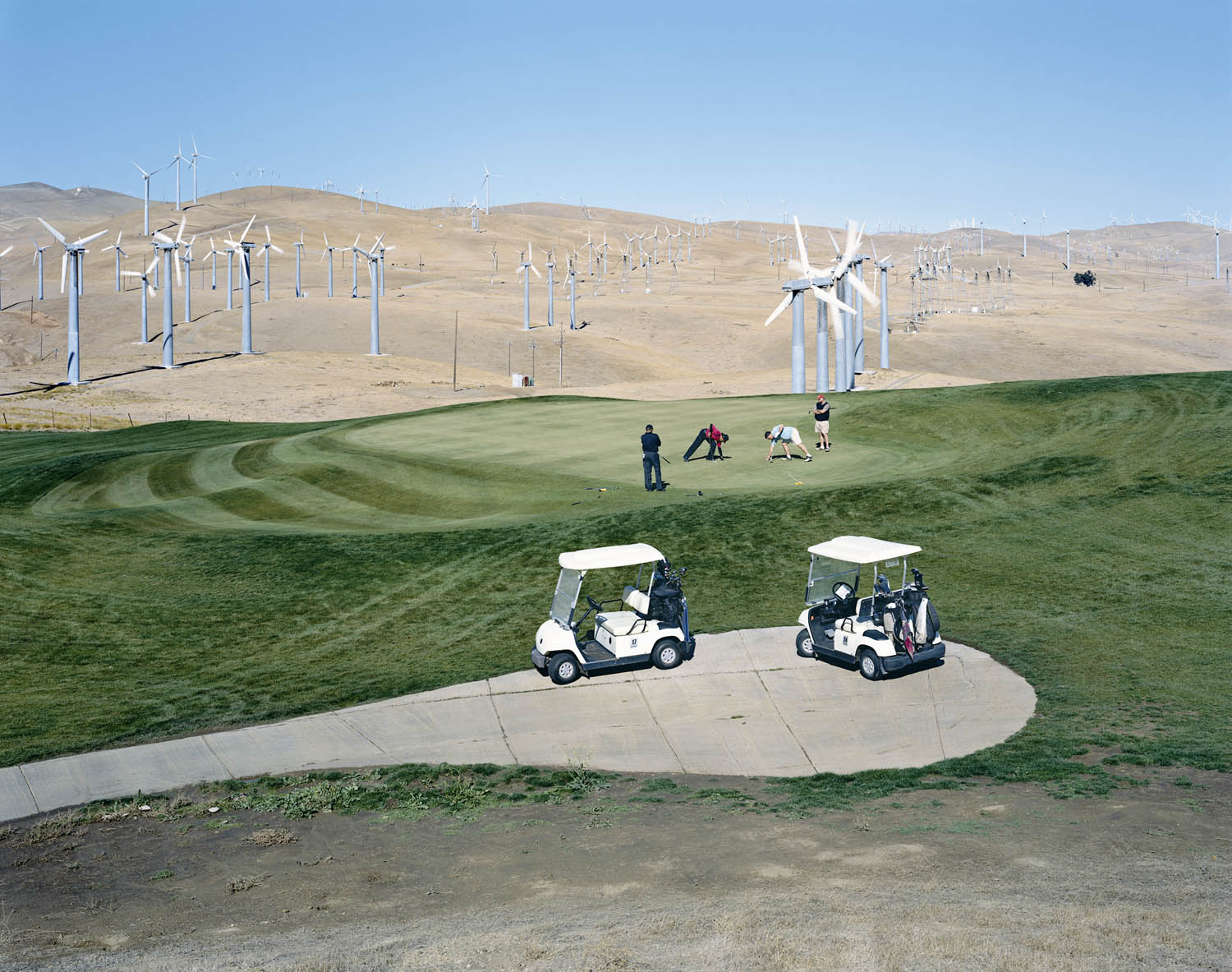
 

Mitch Epstein (American, b. 1952) 'Altamont Pass Wind Farm, California' 2007


Mitch Epstein (American, b. 1952)
Altamont Pass Wind Farm, California
2007
Chromogenic print
Courtesy of the artist and Yancey Richardson Gallery
Courtesy Museum of Fine Arts, Boston
Reproduced with permission


Mitch Epstein’s American Power series investigates energy in its many forms by exploring how we create and consume it, as well as its impact on our daily lives. Often employing a bird’s-eye view and printed on a very large scale, Epstein’s photographs – like these showing oil drilling, wind turbines, desert irrigation, and suburban sprawl – call into question the very definition of power and point to our shared accountability for the abuse of our natural resources. In a world in which we are constantly inundated with photographs, these densely detailed views are also meant to slow down our “reading” of the images and remind us that each may be interpreted in a variety of ways.

“[The] American Power [series] is an active response to the American dream gone haywire. My project focuses on the United States not only because I am American, but because the US has exported its model of unrestricted growth around the world in the form of mass consumerism, corporatism, and sprawl.

“We need to now export a revised model of growth, a revised American dream. I included pictures in American Power of renewable energy – wind, biotech, solar – to show that a healthier, more economical, and compassionate way of life is possible. American Power bears witness to the cost of growth; it asks viewers to consider the landscape they have created – and take responsibility for it.” ~ Mitch Epstein

Exhibition label text
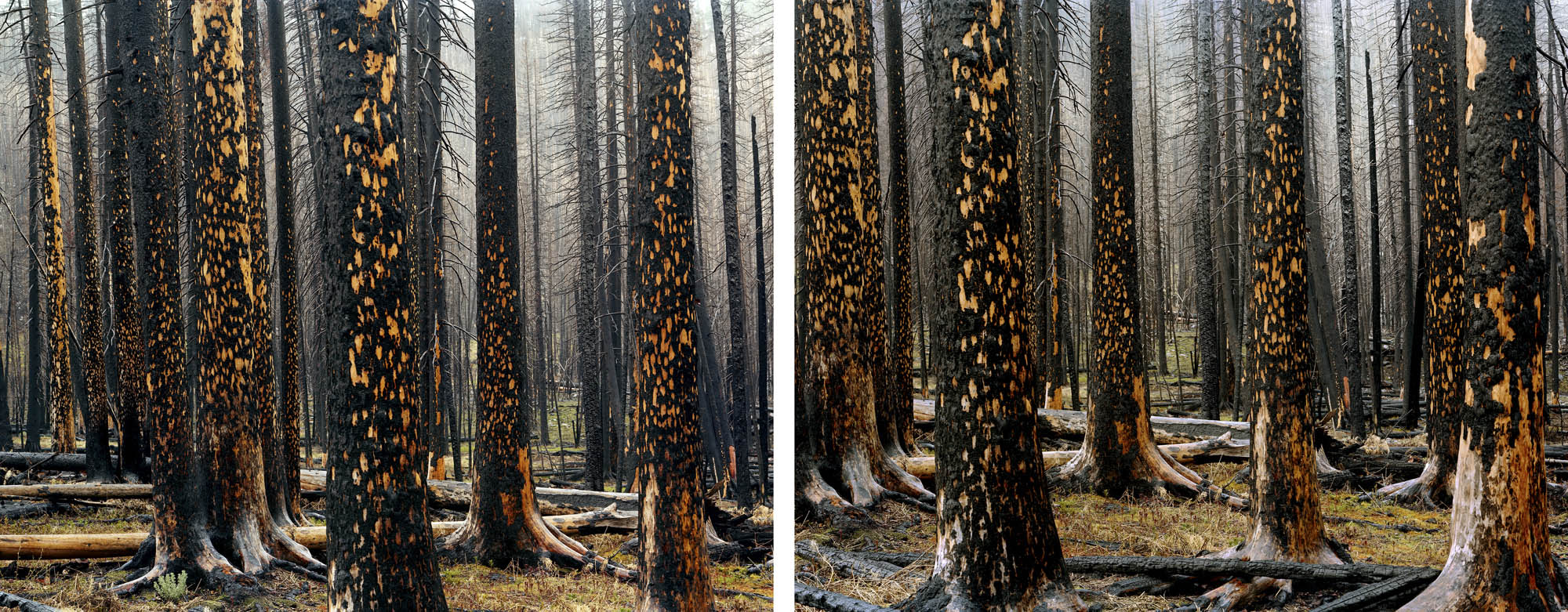
 

Laura McPhee (American, b. 1958) 'Early Spring (Peeling Bark in Rain)' 2008


Laura McPhee (American, b. 1958)
Early Spring (Peeling Bark in Rain)
2008
Inkjet print (diptych)
Courtesy Museum of Fine Arts, Boston
Courtesy of the artist
© Laura McPhee


Working with a large-format camera, Laura McPhee records the impact of human activity on the land, especially in Idaho, a state she loves and visits regularly. These photographs from her Guardians of Solitude series were made in the aftermath of a massive forest fire. Caused by human error, it devastated thousands of acres of woodland before it was finally extinguished. McPhee returned to the area three years later to find that it had burst into bloom. In the renewal of the charred landscape, she found a powerful metaphor for human resilience in the face of terrible personal loss.

Exhibition label text
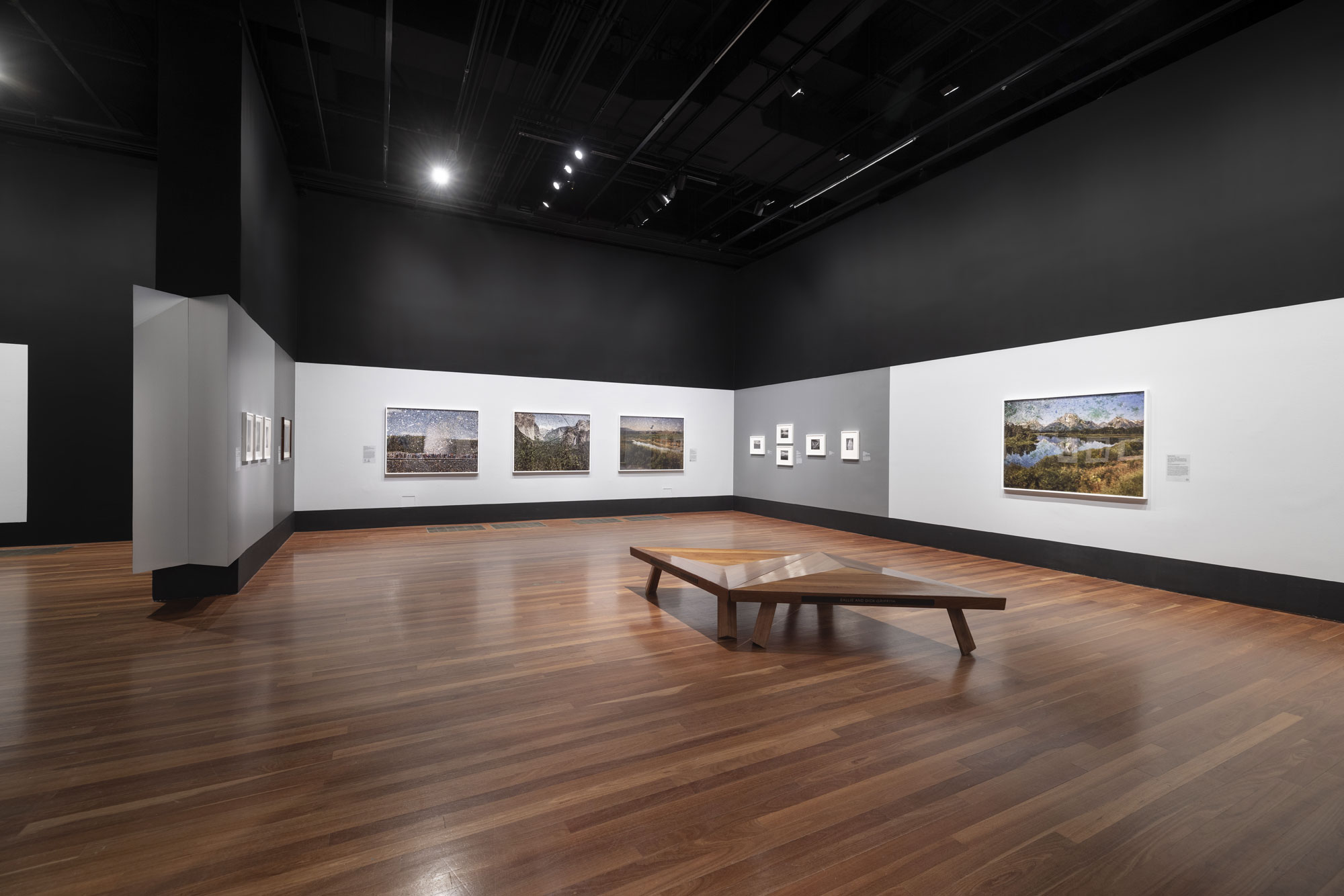
 

Installation view of the exhibition 'Ansel Adams in Our Time' at the de Young museum, San Francisco showing the work of Abelardo Morell including at left centre, 'Tent-Camera Image on Ground: View of the Yosemite Valley from Tunnel View' (2012); at centre, 'Tent-Camera Image on Ground: View of Old Faithful Geyser, Yellowstone National Park, Wyoming' (2011); and at right his 'Tent-Camera Image on Ground: View of Mount Moran and the Snake River from Oxbow Bend, Grand Teton National Park, Wyoming' (2011)


Installation view of the exhibition Ansel Adams in Our Time at the de Young museum, San Francisco showing the work of Abelardo Morell including at left centre, Tent-Camera Image on Ground: View of the Yosemite Valley from Tunnel View (2012, below); at centre, Tent-Camera Image on Ground: View of Old Faithful Geyser, Yellowstone National Park, Wyoming (2011, below); and at right his Tent-Camera Image on Ground: View of Mount Moran and the Snake River from Oxbow Bend, Grand Teton National Park, Wyoming (2011, below)
Image courtesy of the Fine Arts Museums of San Francisco
Photo: Gary Sexton
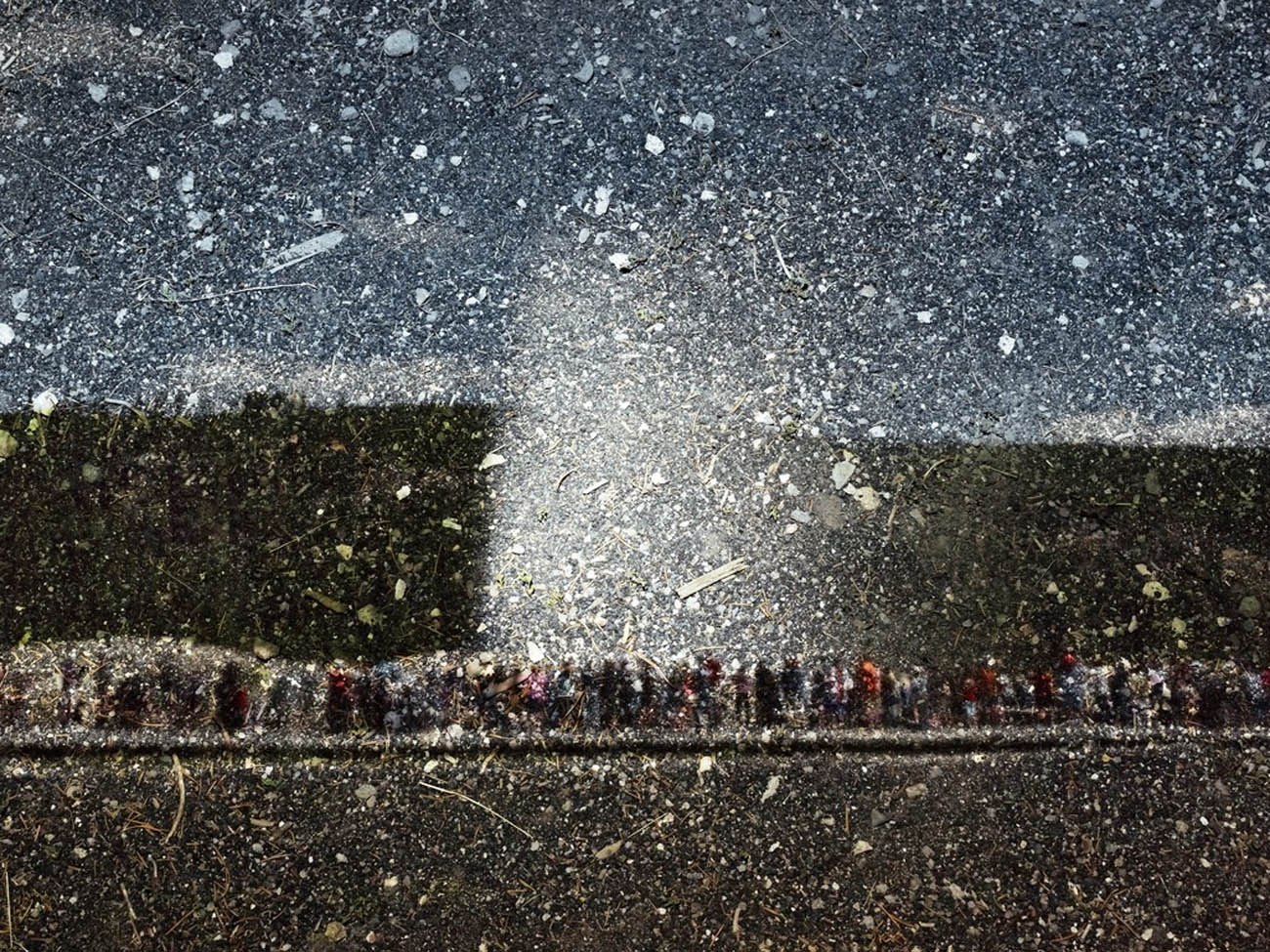
 

Abelardo Morell (American born Cuba, b. 1948) 'Tent-Camera Image on Ground: View of Old Faithful Geyser, Yellowstone National Park, Wyoming' 2011


Abelardo Morell (American born Cuba, b. 1948)
Tent-Camera Image on Ground: View of Old Faithful Geyser, Yellowstone National Park, Wyoming
2011
Inkjet print
Gift of the artist in memory of Robert Andrew McElaney
© Abelardo Morell/Courtesy Bonni Benrubi Gallery, NYC
Courtesy Museum of Fine Arts, Boston


Early in his career, Abelardo Morell began experimenting with the camera obscura (from the Latin for “dark room”), a setup that allowed him to photograph the view outside, projected through a small hole (or lens) and inverted on the opposite wall of an interior. More recently, Morell has adapted this technology, using a tent fitted with a periscope and angled mirror, with a digital camera pointed downward to capture the sweeping landscapes reflected on the ground. This process of combining the distant view with the grass, pebbles, pine needles, sand – even pavement – underfoot, allows Morell to turn the terrain into his “canvas” and transform familiar scenes into otherworldly, impressionistic images.

Exhibition label text
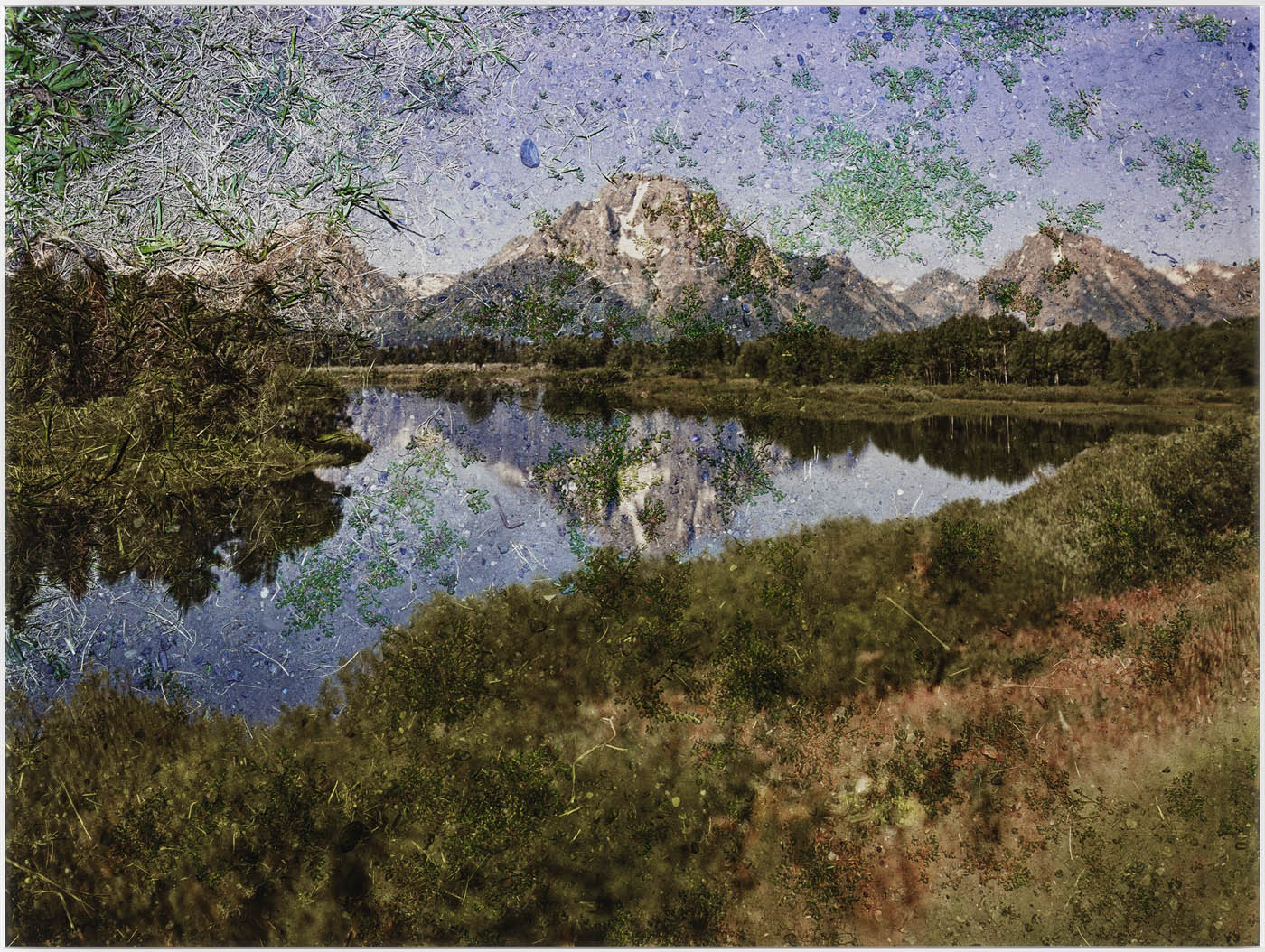
 

Abelardo Morell (American born Cuba, b. 1948) 'Tent-Camera Image on Ground: View of Mount Moran and the Snake River from Oxbow Bend, Grand Teton National Park, Wyoming' 2011


Abelardo Morell (American born Cuba, b. 1948)
Tent-Camera Image on Ground: View of Mount Moran and the Snake River from Oxbow Bend, Grand Teton National Park, Wyoming
2011
Inkjet print
Gift of the artist in memory of Robert Andrew McElaney
© Abelardo Morell/Courtesy Bonni Benrubi Gallery, NYC
Courtesy Museum of Fine Arts, Boston


Like several of the contemporary artists in this gallery, Abelardo Morell is a foreign-born photographer for whom US national parks hold special meaning. While growing up in Cuba, he fell in love with the popular Hollywood Westerns playing at the local cinema. Once he immigrated to the United States, he was eager to discover the region for himself. Here he takes in the sweeping grandeur of snowcapped Mount Moran and the Snake River from a vantage point similar to the one employed by Ansel Adams seventy years earlier for his photograph of Grand Tetons National Park (on view nearby).

Exhibition label text


Abelardo Morell (American born Cuba, b. 1948) 'Tent-Camera Image on Ground: View of the Yosemite Valley from Tunnel View' 2012


Abelardo Morell (American born Cuba, b. 1948)
Tent-Camera Image on Ground: View of the Yosemite Valley from Tunnel View
2012
Inkjet print
Gift of the artist in memory of Robert Andrew McElaney
© Abelardo Morell/Courtesy Bonni Benrubi Gallery, NYC
Courtesy Museum of Fine Arts, Boston


Abelardo Morell made this photograph along the Rio Grande River, which runs for more than one hundred miles through Big Bend National Park in southwest Texas, forming the border between the United States and Mexico. The tranquility of the scene belies the fact that this is contested space, sometimes violently so. Morell’s tent camera optically inverts the river’s northern and southern banks, and the mysteriously floating compass further compounds the sense of dislocation or disorientation.

Exhibition label text
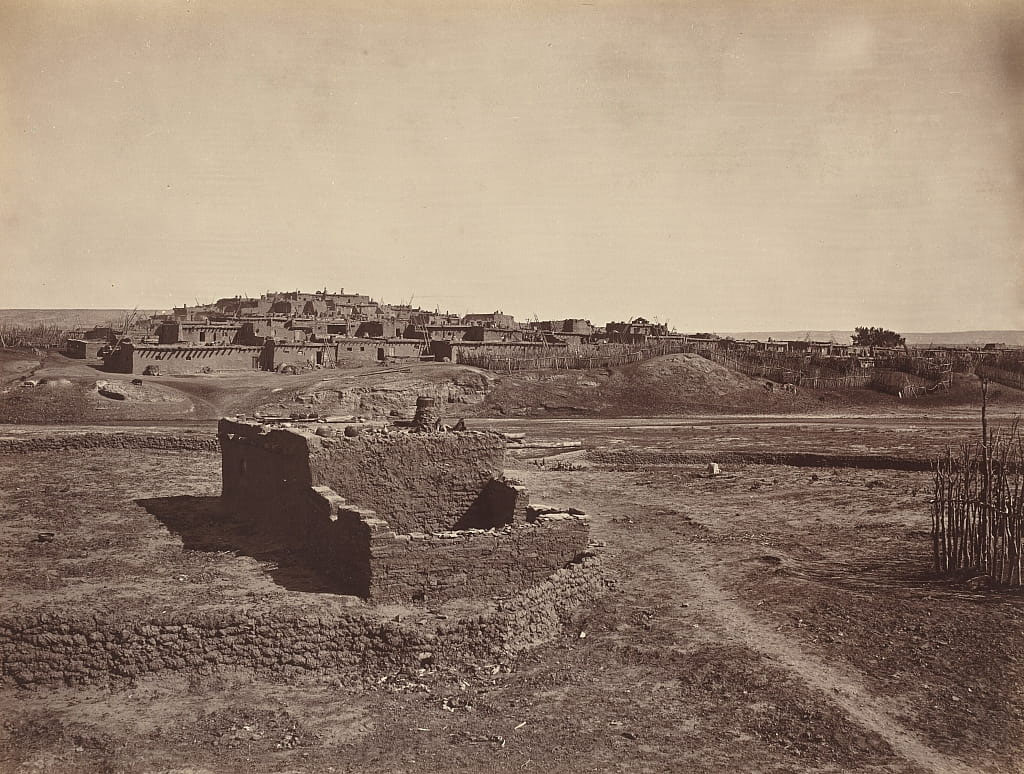
 

John K. Hillers (American born Germany, 1843-1925) 'Zuni Pueblo, Looking Southeast' c. 1879


John K. Hillers (American born Germany, 1843-1925)
Zuni Pueblo, Looking Southeast
c. 1879
Albumen print
The Lane Collection
Courtesy Museum of Fine Arts, Boston


Images such as this one, created in the 1870s and 1880s as ethnographic data for the US government, often ended up in popular magazines, perpetuating problematic stereotypes of Indigenous people. Beginning in 1871, John K. “Jack” Hillers worked on John Wesley Powell’s survey expeditions for such data. He continued to work under Powell’s leadership at the US Bureau of Ethnology for nearly thirty years. Hired by Powell to photograph Indigenous people living in agrarian communities in New Mexico, Arizona, and Utah, Hillers made his most extensive photographic record at Zuni Pueblo in the high plateau region of New Mexico. The photograph is taken at the middle place, or Halona I:diwanna in Zuni/A:shiwi.

Exhibition label text
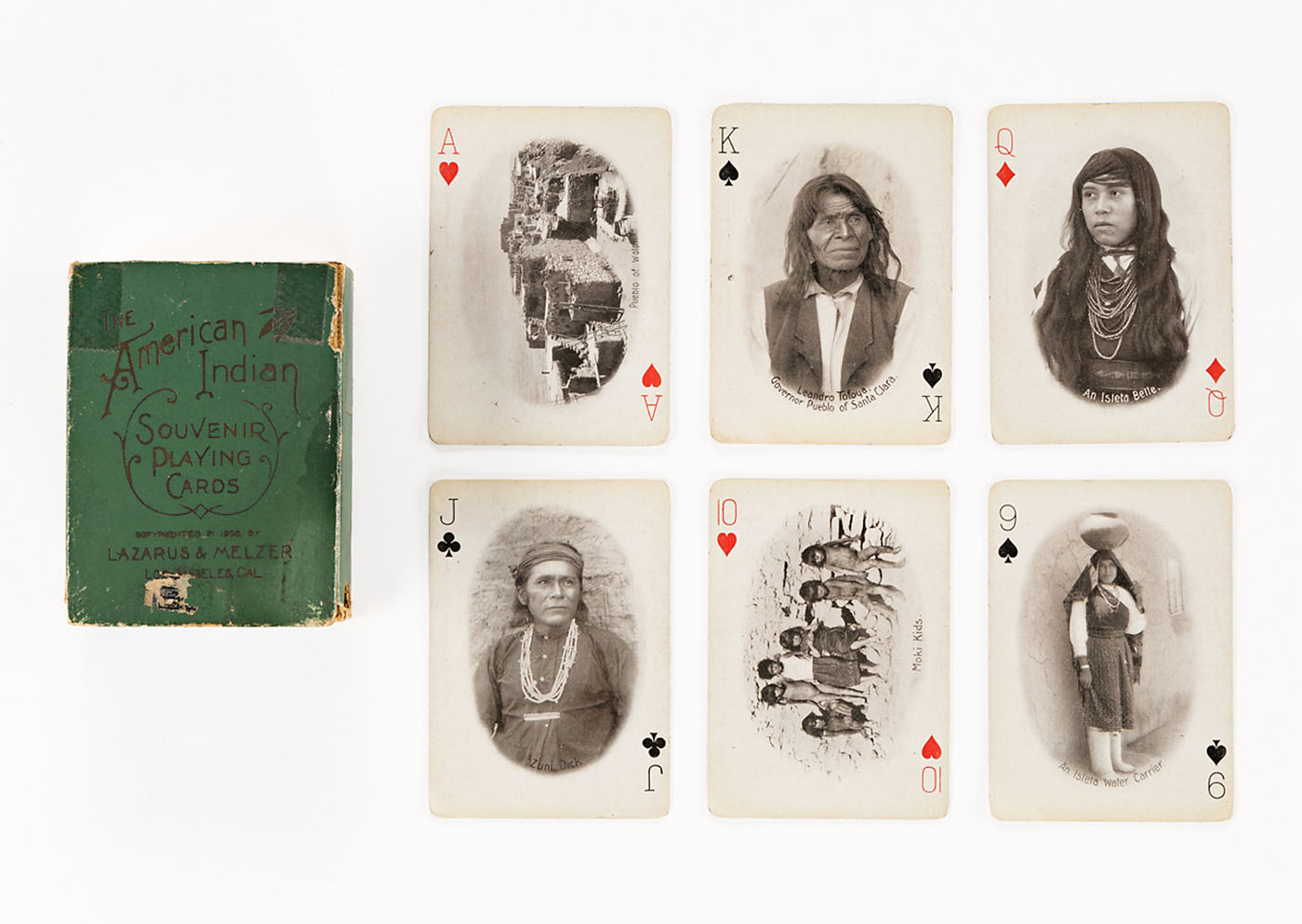
 

Adam Clark Vroman (American, 1856-1916) Playing Cards c. 1894


Adam Clark Vroman (American, 1856-1916)
An Isleta Water Carrier (Nine of Spades)
c. 1894
Chara, Cacique at Pueblo (Jack of Clubs)
c. 1894
Playing cards with halftone prints
Lazarus and Melzer (Los Angeles), publishers
Museum of Fine Arts, Boston, Gift of Lewis A. Shepard, 2006


An amateur archaeologist and committed preservationist, Adam Clark Vroman owned a bookstore in Pasadena, California, that also sold photography supplies. In the mid-1890s, he made the first of many photographic trips to Navajo, Pueblo, and Hopi communities in Arizona and New Mexico. Like Edward S. Curtis and other Anglo-American photographers, he approached Indigenous subjects with concern for what he saw as their threatened lifeways. Nevertheless, when he produced this set of playing cards in 1900, his sitters, each representing a different Southwestern tribe, were reduced to elaborately costumed “types” and often were not identified by name, relegating Indigenous people to a novelty. For instance, in one example shown here, a group of young Walpi women is simply captioned “Bashful,” illustrating the limits of Vroman’s ability to respectfully record the identities of his sitters.

Exhibition label text
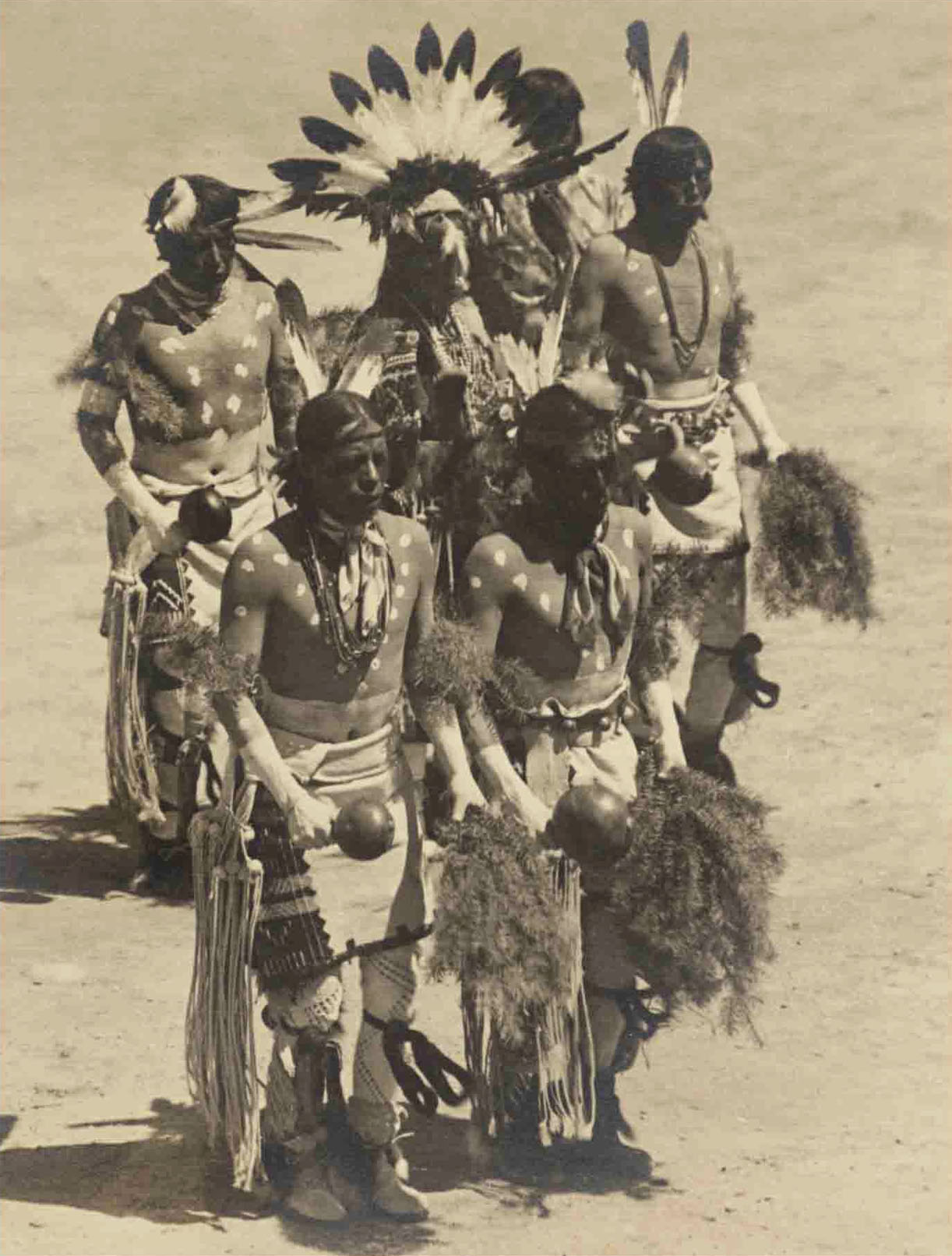
 

Ansel Adams (American, 1902-1984) 'Dance Group, San Ildefonso Pueblo, New Mexico' 1929


Ansel Adams (American, 1902-1984)
Dance Group, San Ildefonso Pueblo, New Mexico
1929
Gelatin silver print
The Lane Collection
Courtesy Museum of Fine Arts, Boston
© The Ansel Adams Publishing Rights Trust


“This photo of Cloud Dance (Po-Who-Geh-Owingeh) was taken at a time when there was an influx of tourists, archaeologists, anthropologists, artists, and photographers who were intrigued by Pueblo people. At the time, Pueblo people and other Native Americans in the Southwest were trying to navigate the outsiders who were interested in their culture. Some of them did not quite understand the circumstances surrounding the curiosity, while others did understand the extractive nature, and they had to weigh that in terms of their other needs. I get questions from members of my community about why they did not chase the archaeologists and photographers out, and I often respond it is because of the uneven power relations between Indigenous and non-Native people at the time.”  ~ Joseph Aguilar (San Ildefonso Pueblo)

Exhibition label text
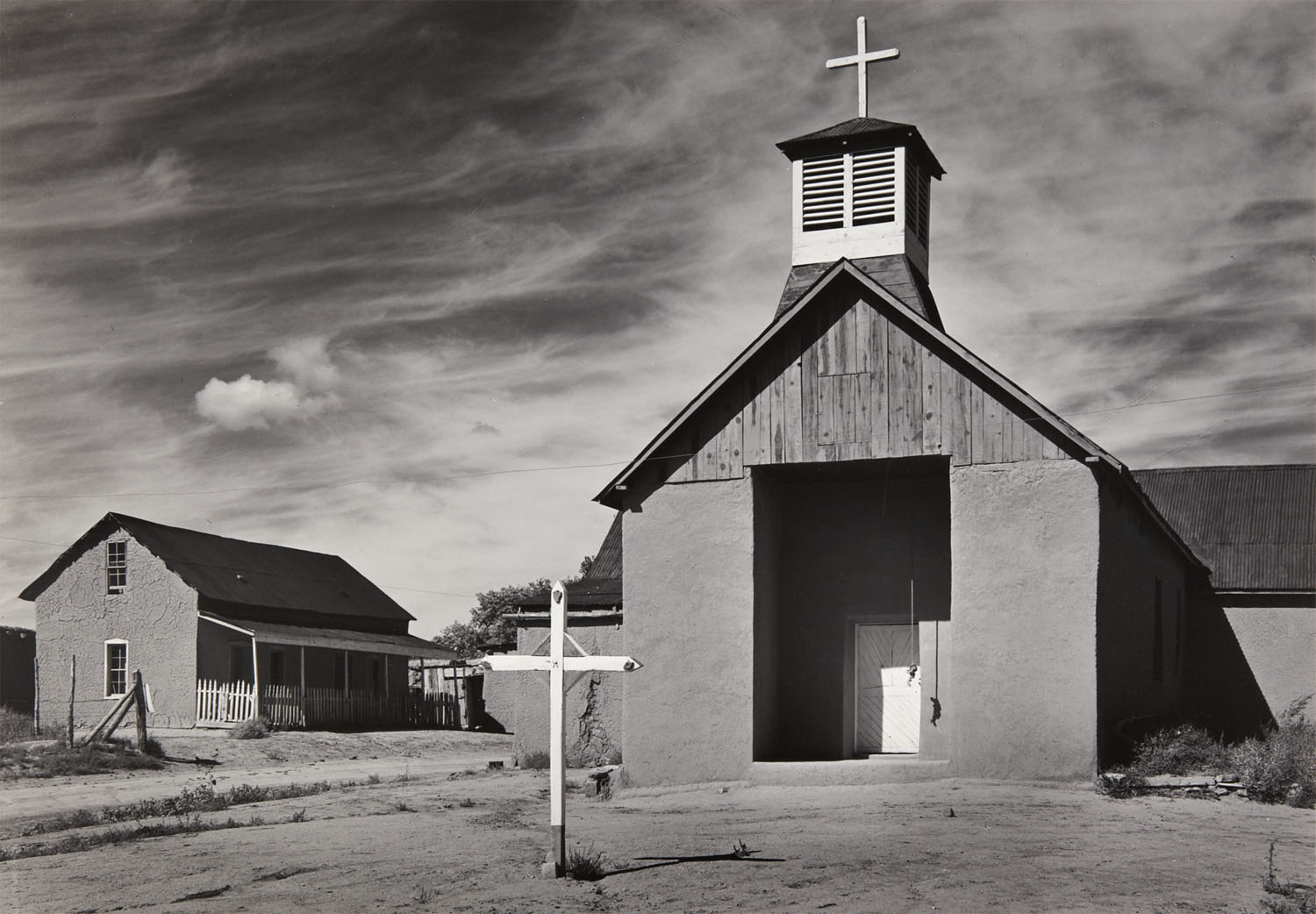
 

Ansel Adams (American, 1902-1984) 'White Cross and Church, Coyote, New Mexico' 1937


Ansel Adams (American, 1902-1984)
White Cross and Church, Coyote, New Mexico
1937
Gelatin silver print
The Lane Collection
Courtesy Museum of Fine Arts, Boston
© The Ansel Adams Publishing Rights Trust


In 1937 Ansel Adams spent several weeks traveling in the Southwestern states with painter Georgia O’Keeffe and friends. Adams and O’Keeffe shared an interest in the region’s expansive skies and distinctive mesas, as well as the mix of Indigenous and Spanish cultures. The group first spent two weeks at Ghost Ranch, O’Keeffe’s home in the Chama River Valley of New Mexico. Adams made this picture in a nearby town, perhaps drawn by the way the foreground cross echoes a smaller one on the church steeple. Their road trip took them through Pueblo and Navajo lands in New Mexico and Hopi lands in Arizona; Monument Valley, Canyon de Chelly, and the Grand Canyon in Arizona; and Mesa Verde in Colorado.

Exhibition label text
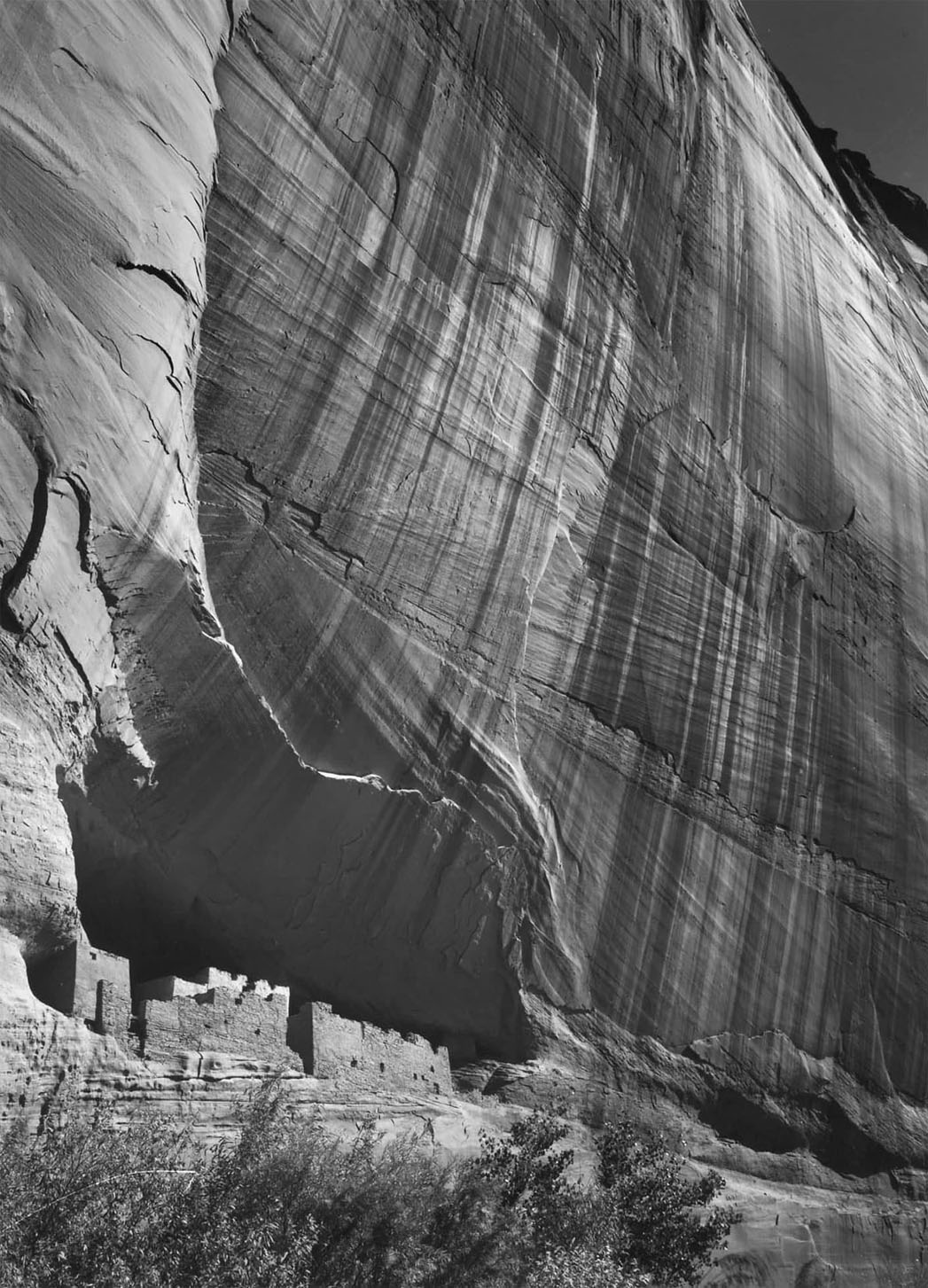
 

Ansel Adams (American, 1902-1984) 'White House Ruin, Canyon de Chelly National Monument, Arizona' 1941


Ansel Adams (American, 1902-1984)
White House Ruin, Canyon de Chelly National Monument, Arizona
1941
Gelatin silver print
The Lane Collection
Courtesy Museum of Fine Arts, Boston
© The Ansel Adams Publishing Rights Trust


When a Sierra Club friend gave him a copy of the Wheeler geographical survey album (1871-1874), Ansel Adams had the opportunity to study Timothy H. O’Sullivan’s photographic technique, as well as his subject matter. In 1941, as Adams set out to work in Canyon de Chelly as part of his national parks project, he decided to try to rephotograph O’Sullivan’s view of an Ancestral Pueblo site. Adams used a green filter to replicate the dramatic striations in the canyon walls that are so pronounced in the early print, as otherwise they would not appear in a “straight” print from his modern negative. Of the power of works like this one, Adams said, “O’Sullivan had that extra dimension of feeling. You sense it, you see it.”

Exhibition label text
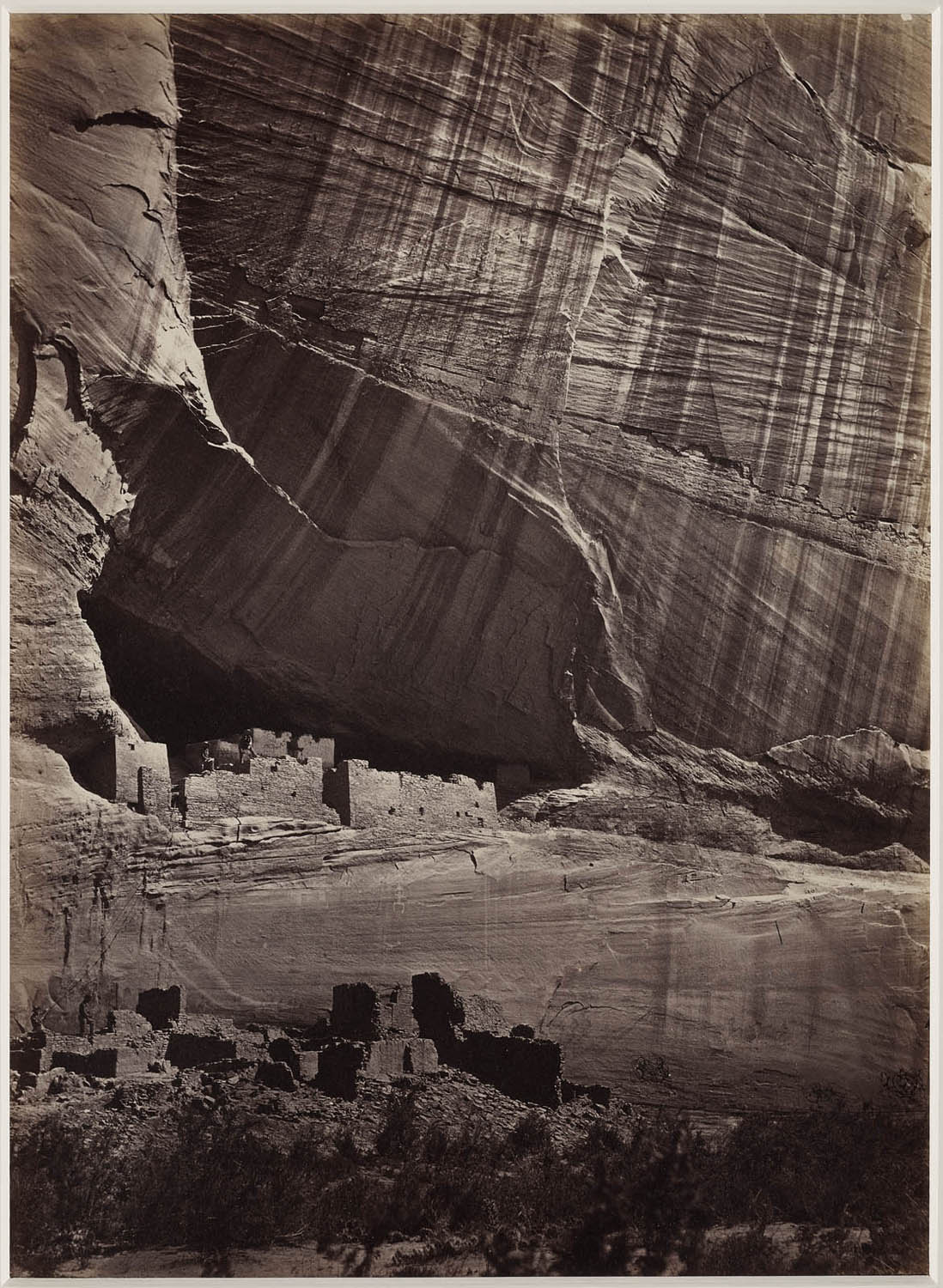
 

Timothy H. O'Sullivan (American born Ireland, 1840-1882) 'Photographs from Geographical explorations and surveys west of the 100th meridian Wheeler' 1873


Timothy H. O’Sullivan (American born Ireland, 1840-1882)
Ancient Ruins in the Cañon de Chelle
1873
Albumen silver print
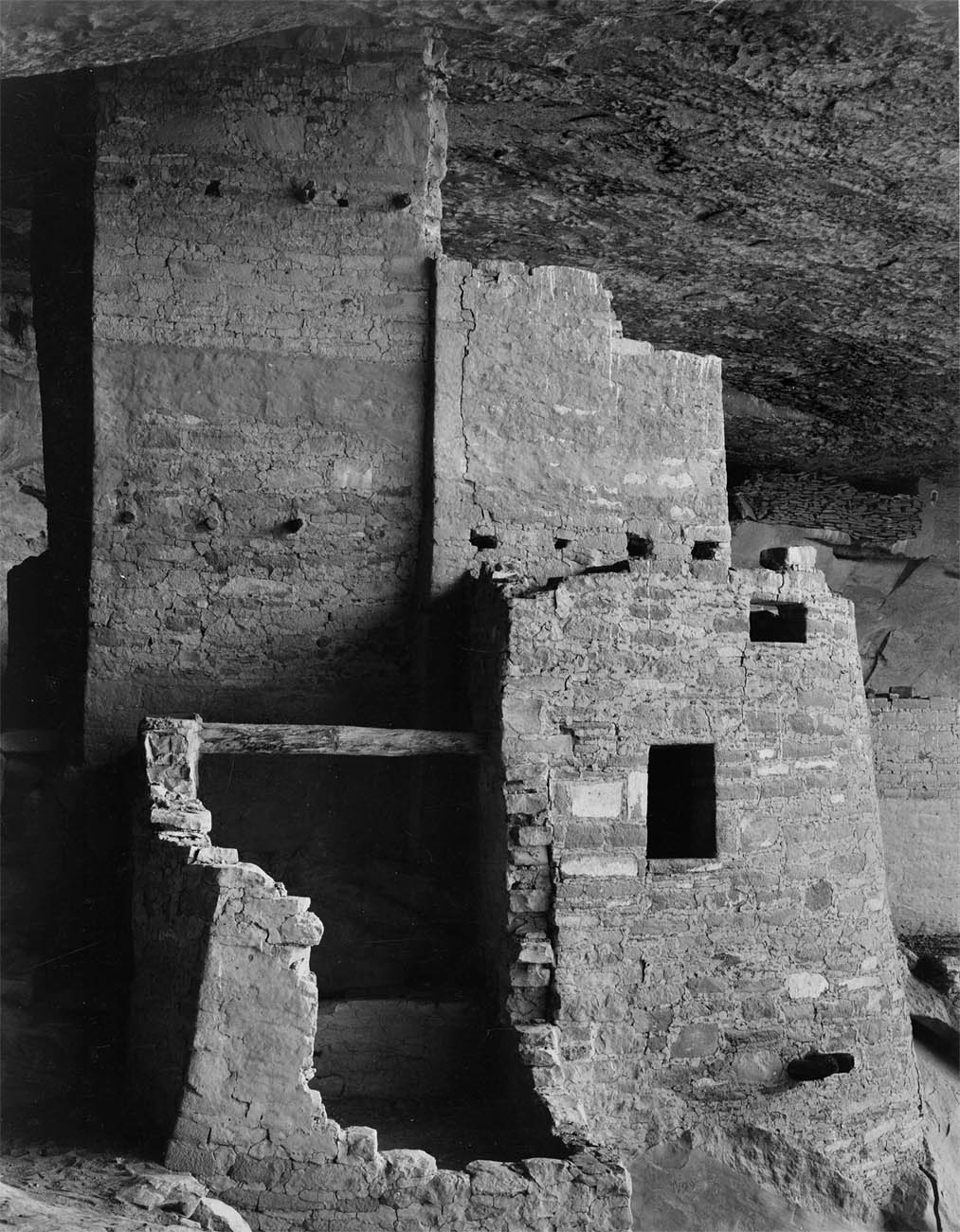
 

Ansel Adams (American, 1902-1984) 'Cliff Palace, Mesa Verde National Park, Colorado' 1941


Ansel Adams (American, 1902-1984)
Cliff Palace, Mesa Verde National Park, Colorado
1941
Gelatin silver print
The Lane Collection
Courtesy Museum of Fine Arts, Boston
© The Ansel Adams Publishing Rights Trust
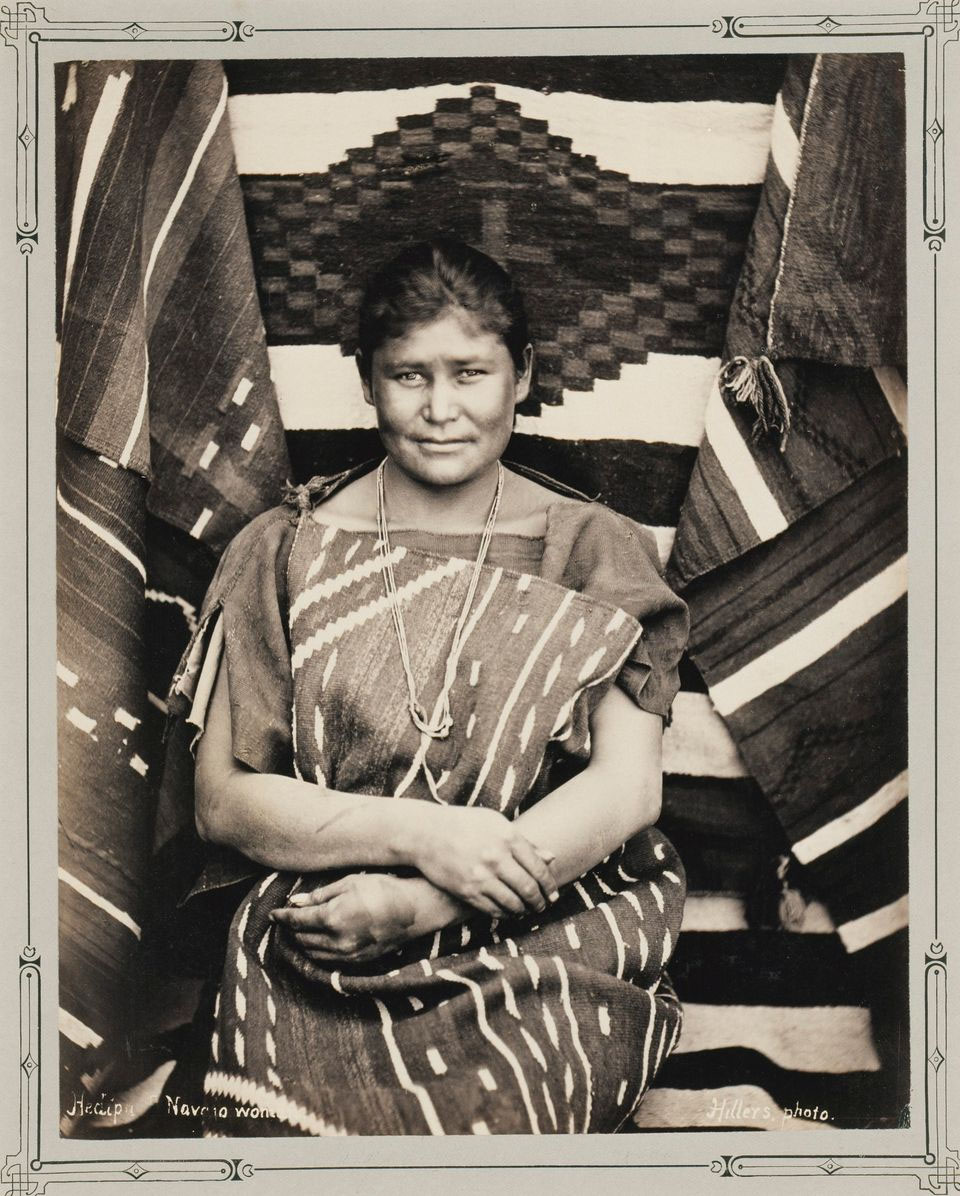
 

John K. Hillers (American b. Germany, 1843-1925) 'Hedipa, Diné (Navajo) Woman' c. 1879


John K. Hillers (American b. Germany, 1843-1925)
Hedipa, Diné (Navajo) Woman
c. 1879
Albumen print
Museum of Fine Arts, Boston
Gift of Jessie H. Wilkinson – Jessie H. Wilkinson Fund


Between 1879 and 1881, Hillers extensively documented the pueblo at Zuni, photographing not only its people and distinctive multi-storied adobe architecture, but also its relationship to the surrounding land. He made panoramic views of the pueblo and recorded cultural observances including ceremonial dance and individual artisans at work.

The Paiutes of Utah gave John K. Hillers a name that meant “Myself in the Water,” a reference to his ability to record their likenesses using the wet-plate collodion process to produce glass negatives. Here, Hillers has photographed a Diné (Navajo) man and woman in front of boldly patterned blankets, which he used to create a backdrop for his outdoor portrait “studio.”

Exhibition label text
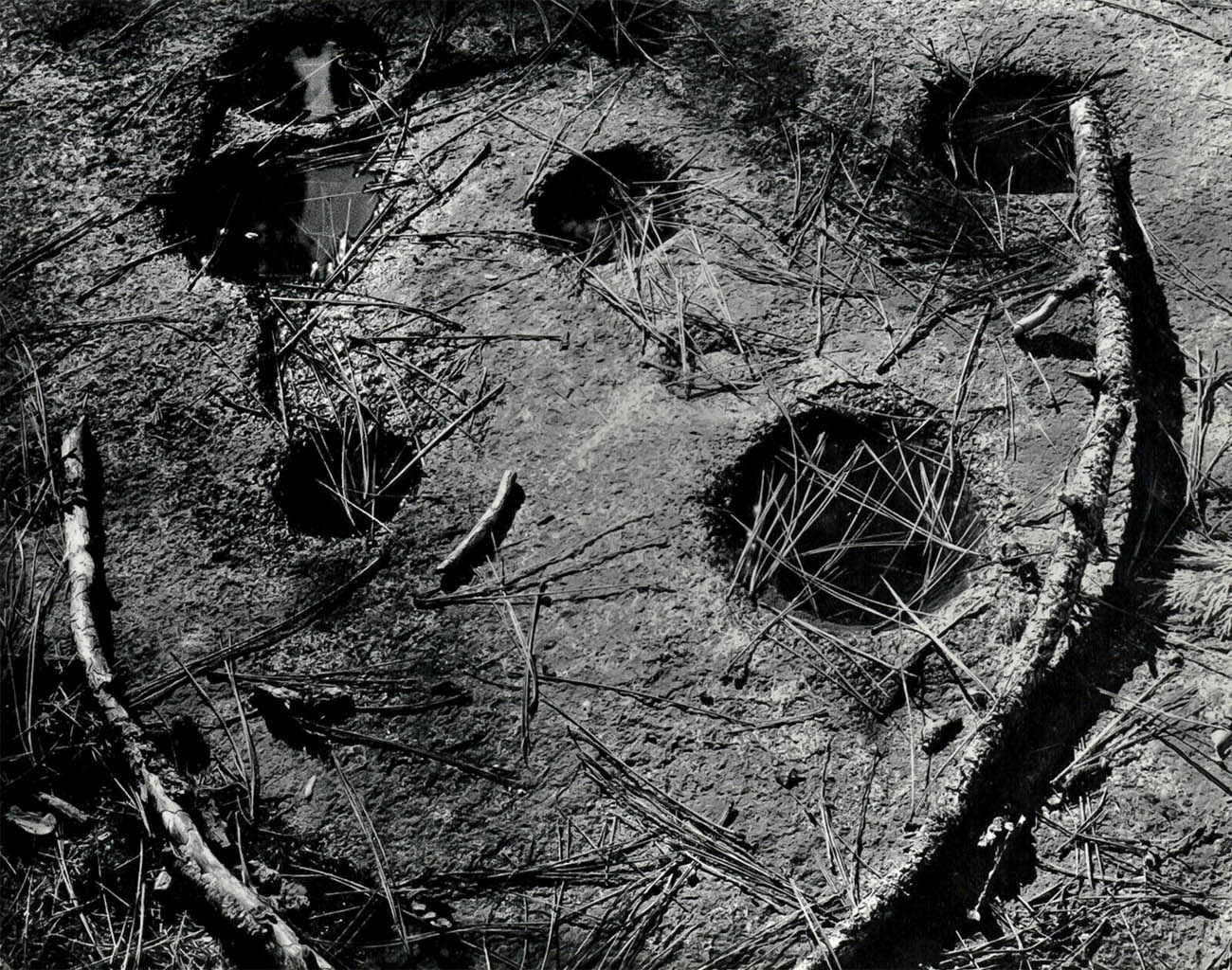
 

Ansel Adams (American, 1902-1984) 'Indian Mortar Holes, Big Meadow, Yosemite National Park' c. 1940


Ansel Adams (American, 1902-1984)
Indian Mortar Holes, Big Meadow, Yosemite National Park
c. 1940
Gelatin silver print
The Lane Collection
Courtesy Museum of Fine Arts, Boston
© The Ansel Adams Publishing Rights Trust


The Ahwahnechee (Miwok) of Yosemite prepared food and sharpened tools using semi-spherical holes ground into bedrock as mortars and smooth stones as grinding tools (or pestles). Acorns of the black oak trees were a diet staple once abundant in the region. Settler colonialism, logging in the nineteenth century, and modern-day fire suppression have led to the growth of mainly conifers in their place.

Exhibition label text


Ansel Adams (American, 1902-1984) 'Freeway Interchange, Los Angeles' 1967


Ansel Adams (American, 1902-1984)
Freeway Interchange, Los Angeles
1967
Gelatin silver print
The Lane Collection
Courtesy Museum of Fine Arts, Boston
© The Ansel Adams Publishing Rights Trust


Ansel Adams made this aerial view of the famously tangled freeways of Los Angeles while photographing for Fiat Lux (1967), a publication commissioned by the University of California to celebrate its centennial. Intended to serve as a visual document of the entire University of California system, the project saw Adams travel to the nine UC campuses, along with the system’s various research stations, observatories, natural reserves, and agricultural extensions. The most extensive of all his commercial projects, Fiat Lux took Adams three years to complete and resulted in several thousand negatives.

Exhibition label text
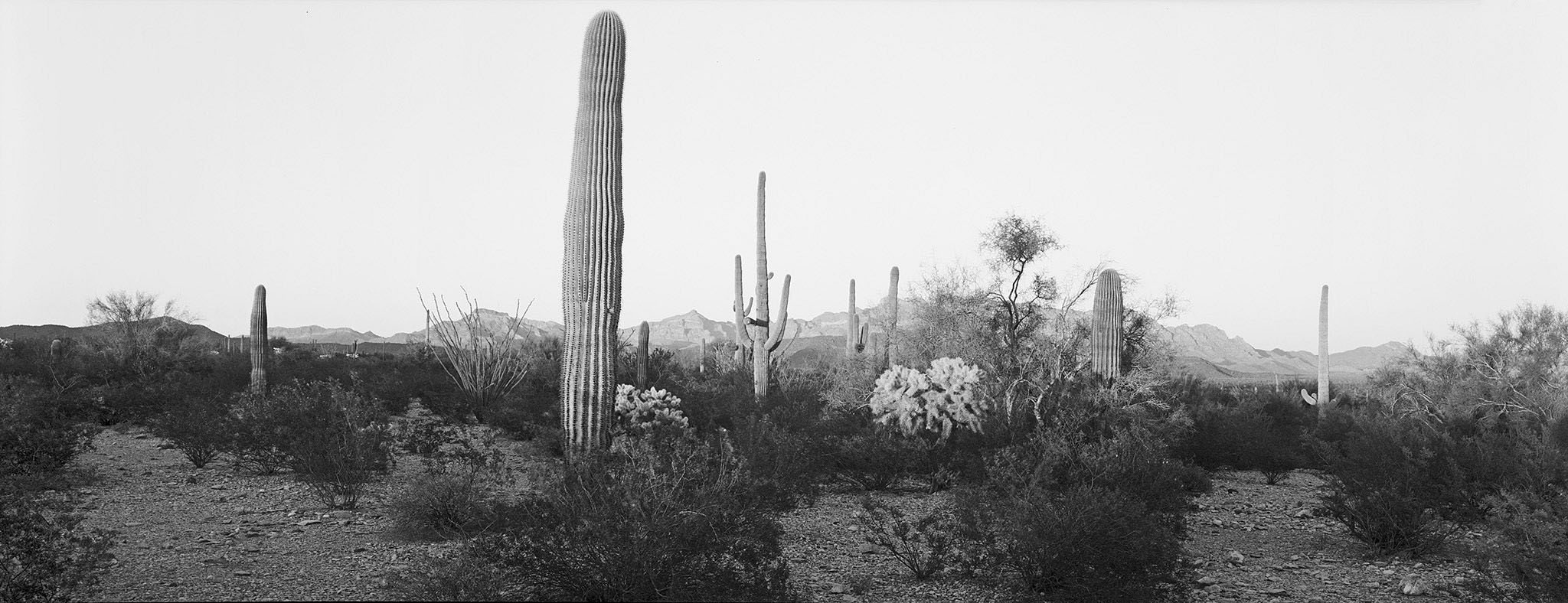
 

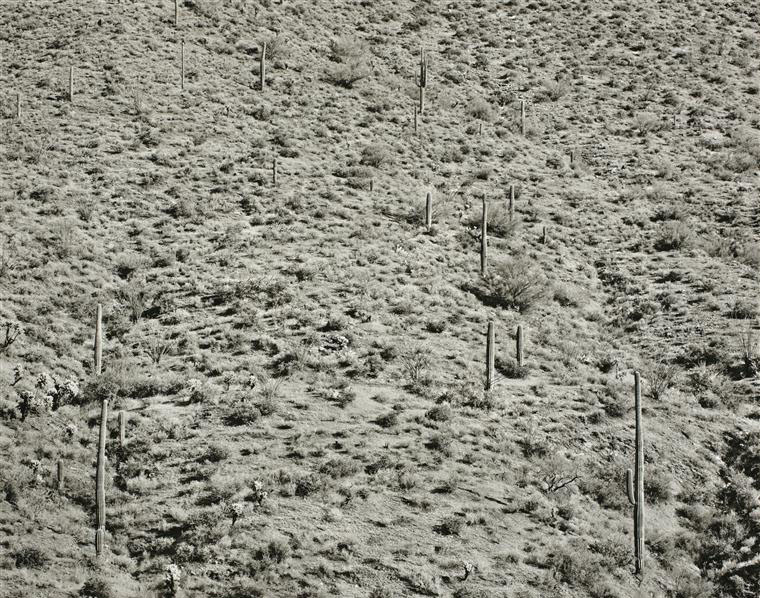
Lois Conner (American, b. 1951) 'Organ Pipe Cactus National Monument, Arizona' 1988


Lois Conner (American, b. 1951)
Organ Pipe Cactus National Monument, Arizona
1988
Platinum print
Museum of Fine Arts, Boston, Otis Norcross Fund


Inspired by the stories told to her by her Cree maternal grandmother, Lois Conner regularly traveled throughout the Navajo Nation and Four Corners region with an old-fashioned banquet camera to document Indigenous people and their land. The elongated format and subtle tonal range of the platinum prints that resulted from these trips seem ideally suited to capturing subjects like the expansive desert landscape of Organ Pipe Cactus National Monument and the vertiginous rock face of Canyon de Chelly.

“The extended sweep of the panorama allows me to draw on multiple levels, much as cinema does, and to take something of the immediate present, and layer that with something from a few centuries before. The large-format camera can draw the particular in minute detail. Like adjectives in a sentence, they allow the viewer to look closer, engaging them in the little world contained by the frame.” ~ Lois Conner

Exhibition label text
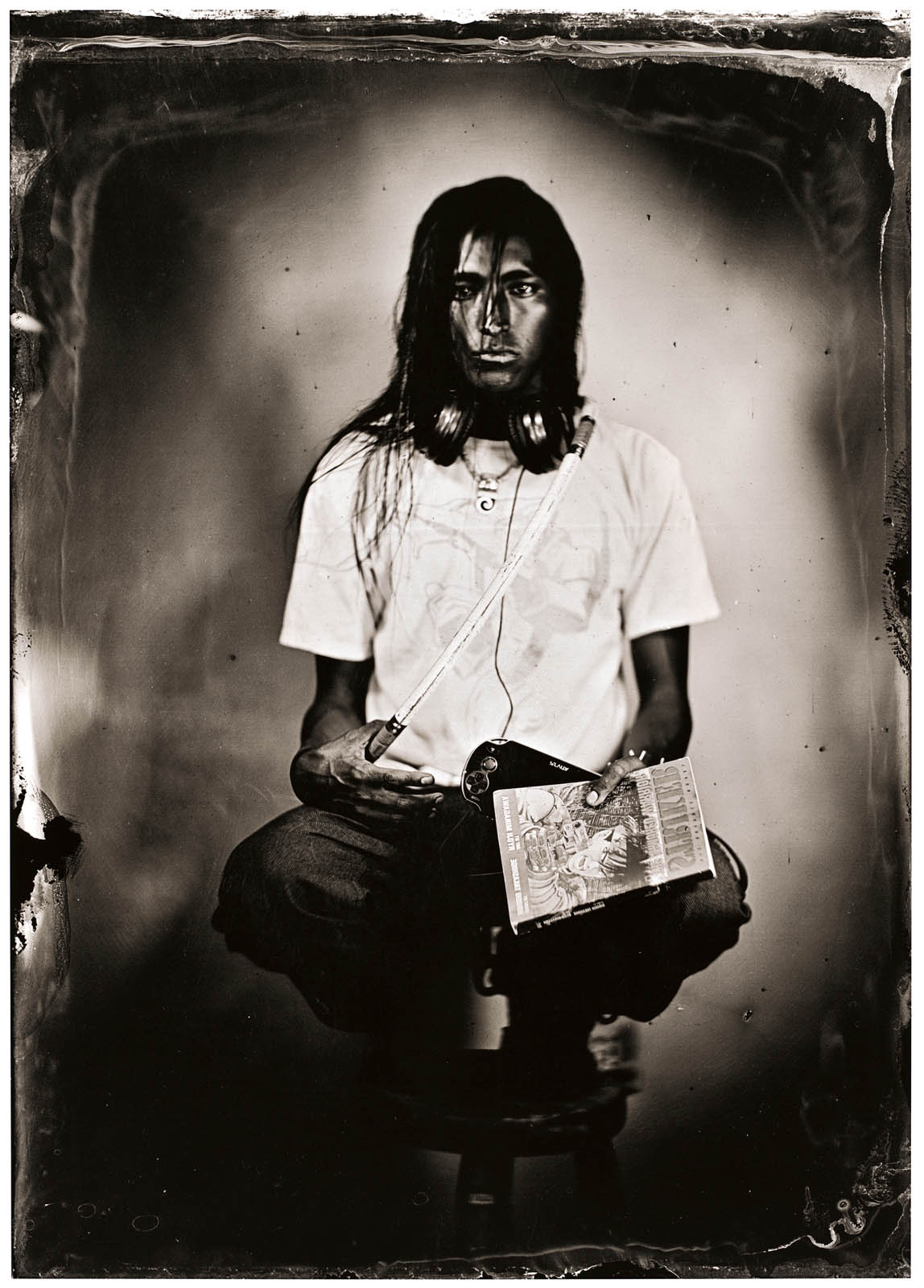
 

Will Wilson (Native American, Navajo (Diné), b. 1969) 'Nakotah LaRance' 2012


Will Wilson (Native American, Navajo (Diné), b. 1969)
Nakotah LaRance
2012
Inkjet print
The Heritage Fund for a Diverse Collection
Courtesy Museum of Fine Arts, Boston
© Will Wilson


This portrait of six-time world-champion hoop dancer Nakotah LaRance (1989-2020) is from an ongoing series that Will Wilson calls the Critical Indigenous Photographic Exchange (CIPX). Using a large-format camera and the wet-plate collodion process – the first photographic process used to image Native Americans – Wilson produces a portrait; he then gives his sitter the original tintype, while he retains a digital copy. Wilson is aware of the long history of inaccurate and romanticised representations of Indigenous people in the United States. His goal is to negotiate a more collaborative relationship between photographer and sitter in order to return personal agency to his subjects, like this young Hopi man with his traditional dance hoop and contemporary headphones, game console, and Japanese manga.

Exhibition label text


Nakotah Lomasohu Raymond LaRance (August 23, 1989 – July 12, 2020) was a Native American hoop dancer and actor. He was a citizen of the Hopi Tribe of Arizona. …

At four years old, LaRance began dancing as a fancy dancer and competed in the youth division of the World Championship Hoop Dance Contest in Phoenix, Arizona. He performed on the Tonight Show with Jay Leno in 2004. LaRance won three championships in the youth division and three in the teenage division of the World Championship Hoop Dance competition.

In 2009, LaRance joined the Cirque du Soleil troupe as a principal dancer. He worked as a traveling performer with the troupe for over three years. In 2015, he danced at the opening of the Pan American Games in Toronto with Cirque du Soleil. He won the title of World Champion at the Hoop Dance Contest three times, as part of the adult division in 2015, 2016 and 2018. LaRance taught hoop dancing to students at the Lightning Boy Foundation in New Mexico.

LaRance died at age 30 on July 12, 2020, after a fall from climbing a bridge in Rio Arriba County, New Mexico.

Text from the Wikipedia website
 

Installation view of the exhibition 'Ansel Adams in Our Time' at the de Young museum, San Francisco showing at left in the light panel, Will Wilson's 'Nakotah LaRance' (2012); and at centre Will Wilson's 'How the West is One' (2014)


Installation view of the exhibition Ansel Adams in Our Time at the de Young museum, San Francisco showing at left in the light panel, Will Wilson’s Nakotah LaRance (2012, above); and at centre Will Wilson’s How the West is One (2014, below)


Adams in the American Southwest

Ansel Adams first visited the American Southwest in 1927. While there he collaborated with author Mary Austin on an illustrated book about Taos Pueblo that aimed to communicate the threat tourism in the region posed to the artistic and religious traditions of Indigenous people. Adams made images for the book only after receiving permission from the Taos Pueblo council, to whom he paid a fee and gifted a copy of the finished publication. He also photographed some Indian cultural observances that had become popular attractions among tourists. Adams’s own images of Native dancers have a complex legacy: although he was one of the non-Native onlookers, he carefully framed his views to leave out evidence of the gathered crowds.

In Diné photographer Will Wilson’s ongoing series Critical Indigenous Photographic Exchange, the artist responds to and confronts historical depictions of Native Americans by white artists. He focuses in particular on those who traveled west in the late nineteenth and early twentieth centuries to document the Indigenous people they viewed as a “vanishing race” due to US government-sanctioned genocide and settler colonialism.

Exhibition wall text


Will Wilson (Diné (Navajo), born in 1969) 'How the West is One' 2014


Will Wilson (Native American, Navajo (Diné), b. 1969)
How the West is One
2014
Inkjet print
The Heritage Fund for a Diverse Collection
Courtesy Museum of Fine Arts, Boston
© Will Wilson


Born in San Francisco, Diné photographer Will Wilson spent his childhood in the Navajo Nation. Today he lives and works in Santa Fe. Made from his original tintypes, Wilson’s double self-portrait shows him in profile, facing off against himself: on one side wearing an elaborate silver and turquoise necklace, and on the other dressed in a cowboy hat and work gloves. The title riffs on the 1962 John Ford movie How the West Was Won, an epic Western of the type that helped turn stereotypical cowboys and Indians into potent symbols for the American public. Wilson’s dual portrait illustrates the disparate ways that he – as a Native American artist – might be portrayed and perceived by others, whereas in his case, the reality lies somewhere between the two.

Exhibition label text
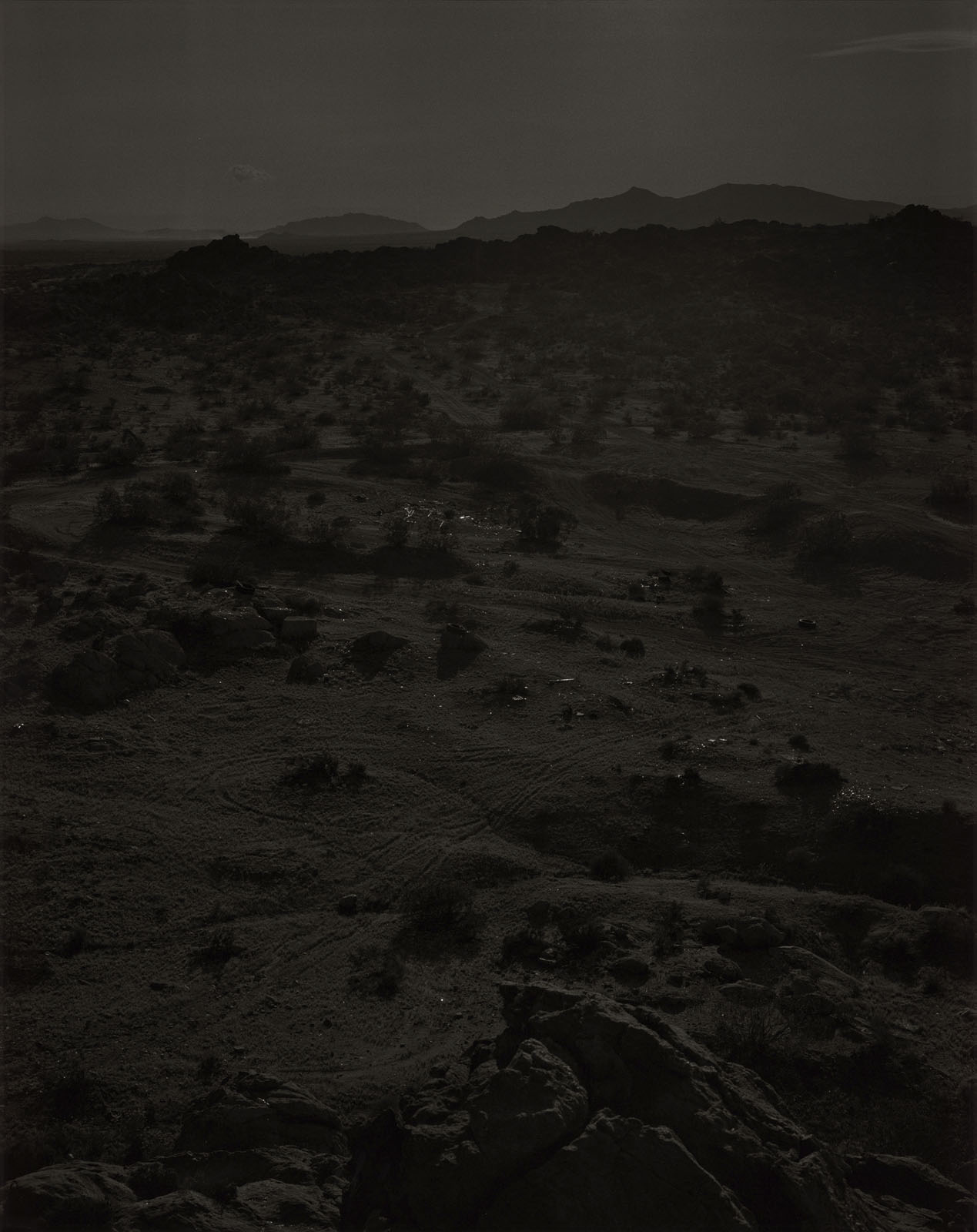
 

CJ Heyliger (American, b. 1984) 'Broken Glass' 2015


CJ Heyliger (American, b. 1984)
Broken Glass
2015
Inkjet print
William E. Nickerson Fund
Courtesy Museum of Fine Arts, Boston
Reproduced with permission


CJ Heyliger makes his desert landscapes in many different places, resulting in images that reveal the sites’ alien beauty and hallucinatory detail. His approach to mapping the terrain on film reduces it to the medium’s most basic elements – simply light and time. Here, he magically transforms a trail of broken glass into a constellation of stars in a night sky, and in North, East, South, West, his multiple exposures of a spiky yucca create a wildly spinning whirligig.

“My current work brings me to places that, for one reason or another, have become geographical outcasts,” says Heyliger. “These scraps of land are often hidden in plain view and are rife with artefacts and submerged histories of their own. Photography allows me to gather these shards of cultural debris and weave them into a new narrative constructed of diverse environments with varying relationships to reality.”

Exhibition label text
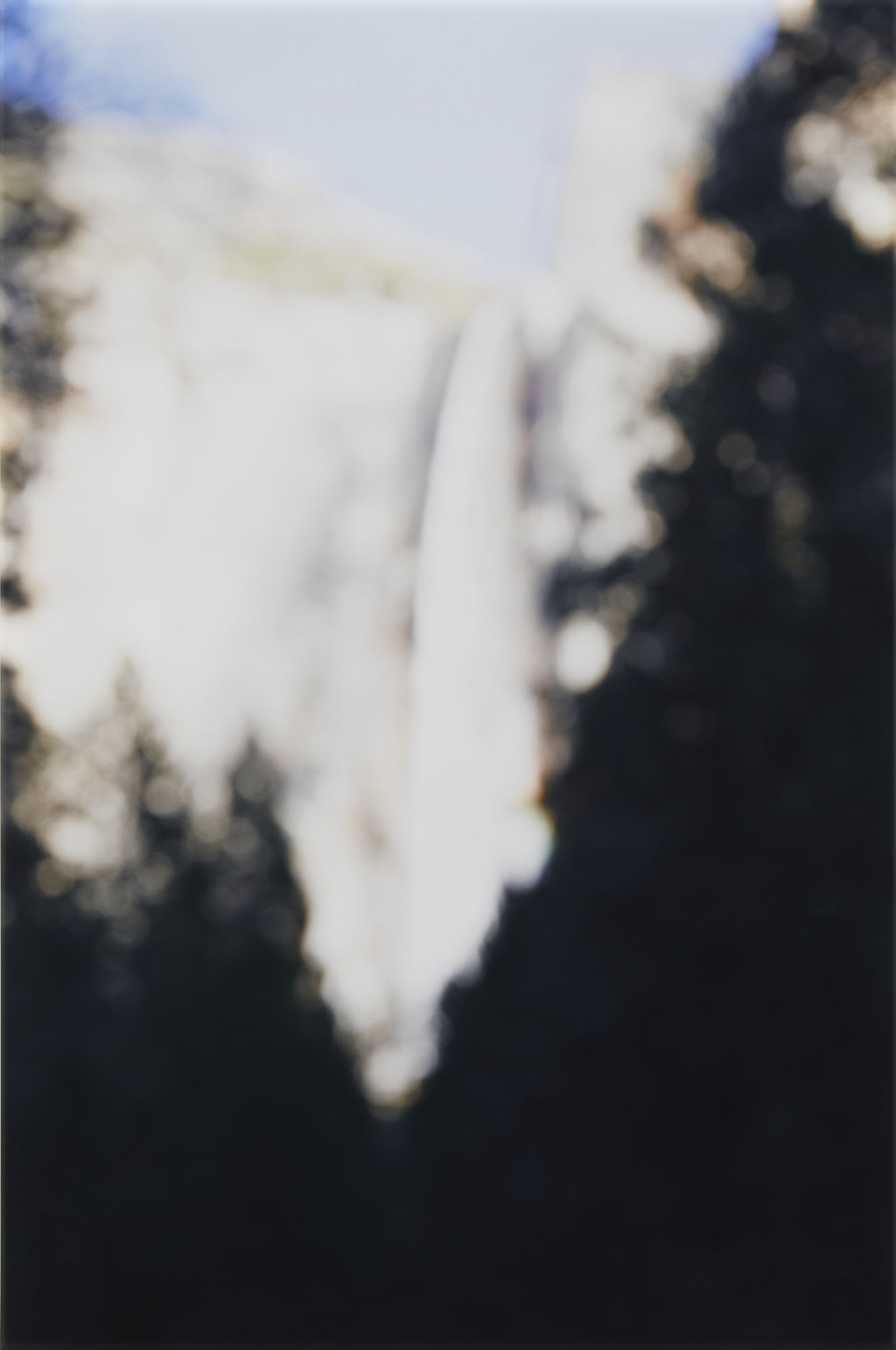
 

Catherine Opie (American, b. 1961) 'Untitled #1 (Yosemite Valley)' 2015


Catherine Opie (American, b. 1961)
Untitled #1 (Yosemite Valley)
2015
Pigment print
Stephen D. and Susan W. Paine Acquisition Fund for 20th century and Contemporary Art
Courtesy Museum of Fine Arts, Boston
© Catherine Opie. Courtesy of Regen Projects, Los Angeles and Lehmann Maupin, New York and Hong Kong


Based in Southern California, Catherine Opie is best known for her unflinching portraits – of herself and of members of the lesbian leather community to which she belongs. In 2015, she was commissioned to create a large-scale piece spanning the multi-story atrium of a new federal courthouse in Los Angeles, which inspired her to tackle a very different California subject: Yosemite National Park.

The opportunity to produce such a major work motivated Opie to take on the iconic views of the park’s natural wonders, examine her relationship with these Western landscapes, and try to “de-cliché” them. Her luminous colour images of Yosemite are often soft-focused yet still recognisable, thanks to the popularisation of such views by earlier photographers like Carleton E. Watkins and Ansel Adams. Depicting Yosemite through a feminist lens, Opie seeks to assert her equal rights to such wilderness subjects, previously considered the domain of photographers who are white men.

Exhibition label text
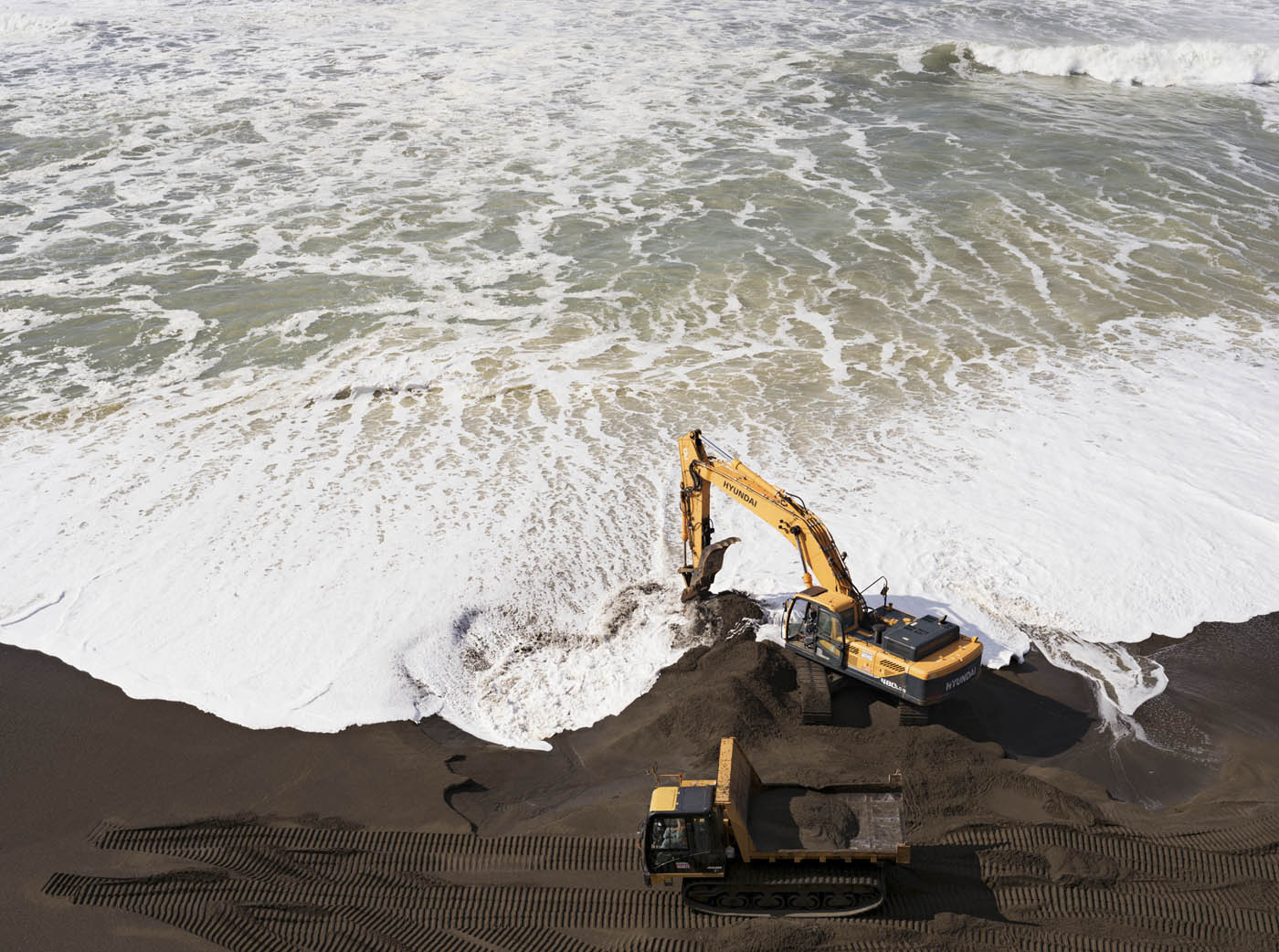
 

Lucas Foglia (American, b. 1983) 'Beach Restoration after El Niño Waves' 2016


Lucas Foglia (American, b. 1983)
Beach Restoration after El Niño Waves
2016
Inkjet print
Courtesy of the Artist and Fredericks & Freiser, NY
Courtesy Museum of Fine Arts, Boston
© Lucas Foglia


Hurricane Sandy was a turning point for Lucas Foglia, who witnessed its disastrous impact on his family’s Long Island farm in 2012. Convinced that human behaviour and the changing weather patterns that produce such destructive storms are connected, he decided to document the many ways in which human beings use science and technology to respond to climate change. Now living in California, Foglia photographed workers and machines performing the extremely demanding and futile task of shoring up the Pacific coastline in the face of El Niño wind and waves. His sharply angled viewpoint from the highway above consciously echoes the abstract composition of Ansel Adams’ Surf Sequence of 1940.

Exhibition label text
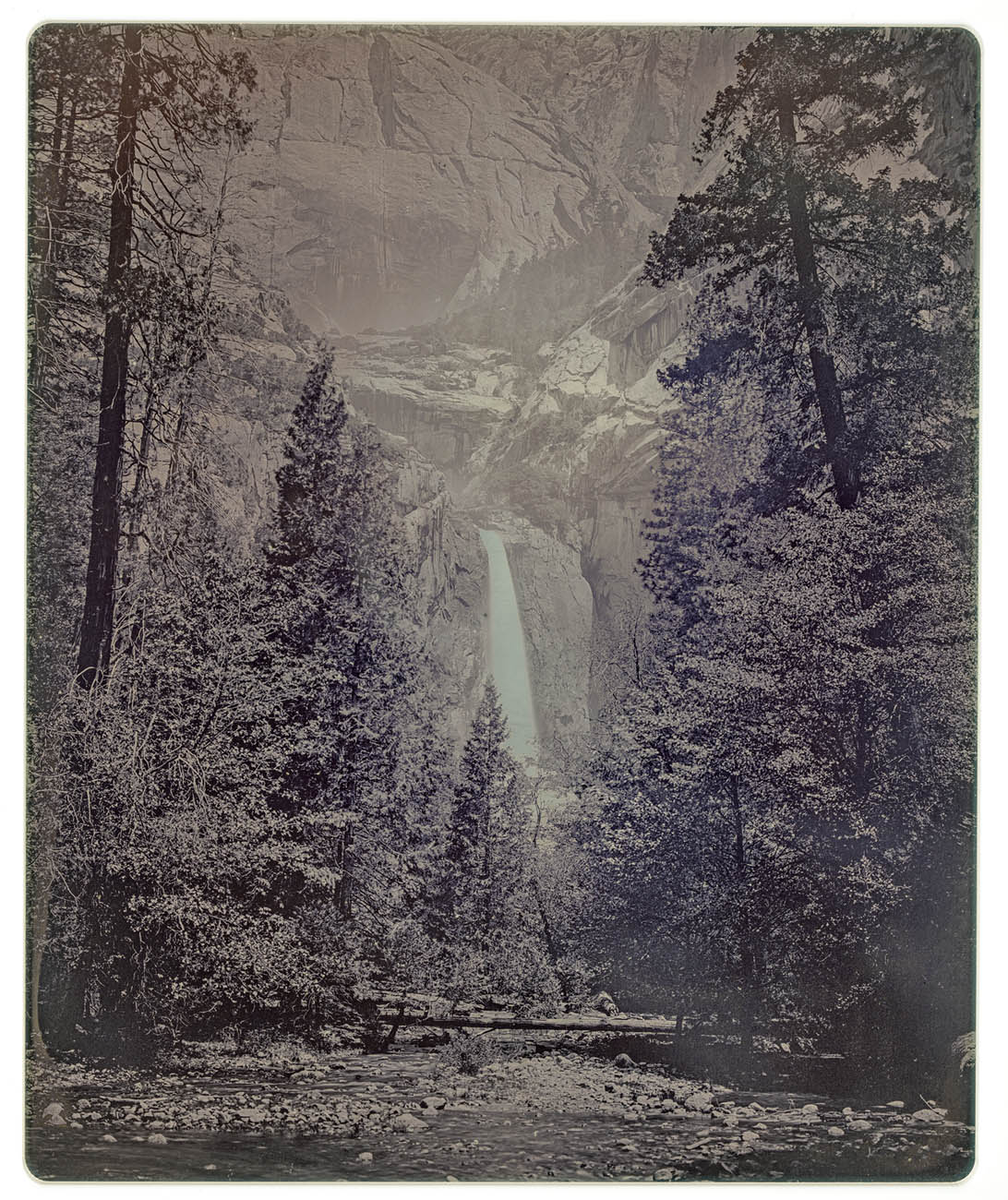
 

Binh Danh (Vietnamese-American, b. 1977) 'Lower Yosemite Fall, August 16, 2016' 2016


Binh Danh (Vietnamese-American, b. 1977)
Lower Yosemite Fall, August 16, 2016
2016
Daguerreotype
Mary S. and Edward J. Holmes Fund
Copyright by Binh Danh
Courtesy Museum of Fine Arts, Boston


Binh Danh and his family immigrated to California after the Vietnam War. For much of his early life, he felt little personal connection to this country’s national parks, several of which were located near his home. That sentiment changed once Danh reached adulthood, took up photography, and discovered a new found pride while documenting these wilderness areas using a mobile darkroom and the daguerreotype process developed in France by Louis-Jacques-Mandé Daguerre in 1839.

Made with a highly polished metal plate, the daguerreotype has a mirror-like surface that allows Danh to capture in stunning detail the same views that he admires in the photographs of Carleton E. Watkins and Ansel Adams. But it also makes it possible for him to create landscapes that reflect his own likeness back to him, literally situating him within those very American spaces.

Exhibition label text


de Young
Golden Gate Park
50 Hagiwara Tea Garden Drive
San Francisco, CA 94118

Opening hours:
Tuesday – Sunday 9.30am – 5.15pm

de Young website

LIKE ART BLART ON FACEBOOK

Back to top

Exhibition: ‘Ansel Adams in Our Time’ at the Museum of Fine Arts, Boston

Exhibition dates: 13th December, 2018 – 24th February, 2019

Curator: Karen Haas, Lane Curator of Photographs


Ansel Adams (American, 1902-1984) 'The Golden Gate Before the Bridge, San Francisco' 1932 from the exhibition 'Ansel Adams in Our Time' at the Museum of Fine Arts, Boston, Dec 2018 - Feb 2019


Ansel Adams (American, 1902-1984)
The Golden Gate Before the Bridge, San Francisco
1932
Gelatin silver print
49.5 x 69.9cm (19 1/2 x 27 1/2 in.)
Gift of Saundra B. Lane
The Lane Collection
Museum of Fine Arts, Boston


Ansel Adams is a wonderful classical, (clinical?), formal photographer… but a photographer of people, Native Indians, Indian dances and the urban landscape, he ain’t. Simply put, he’s not much good at these subjects. In this posting, best stick with what he’s really good at – beautifully balanced art and environmental activist photographs. Oh, the light and form! Images that teeter towards the sublime held in check by F64, perspective and objectivity.

Interesting to have the historical work to riff off, and “contemporary artists whose modern-day concerns centred on the environment, land rights, and the use and misuse of natural resources point directly to Adams’ legacy” … but as with so many exhibitions that try to place an artist within a historical and contemporary context, their work is not necessary. In fact, it probably diminishes the utopian vision of one of the world’s best known photographers.

Dr Marcus Bunyan


Many thankx to the Museum of Fine Arts Boston for allowing me to publish the photographs in the posting. Please click on the photographs for a larger version of the image.


Ansel Adams (American, 1902-1984) 'Lone Pine Peak, Sierra Nevada, California' 1948 from the exhibition 'Ansel Adams in Our Time' at the Museum of Fine Arts, Boston, Dec 2018 - Feb 2019


Ansel Adams (American, 1902-1984)
Lone Pine Peak, Sierra Nevada, California
1948
Gelatin silver print
38.8 x 49.1cm (15 1/4 x 19 5/16 in.)
Gift of Saundra B. Lane
The Lane Collection
Museum of Fine Arts, Boston


Ansel Adams in Our Time traces the iconic visual legacy of Ansel Adams (1902-1984), presenting some of his most celebrated prints, from a symphonic view of snow-dusted peaks in The Tetons and Snake River, Grand Teton National Park, Wyoming (1942) to an aerial shot of a knotted roadway in Freeway Interchange, Los Angeles (1967). The exhibition looks both backward and forward in time: his black-and-white photographs are displayed alongside prints by several of the 19th-century government survey photographers who greatly influenced Adams, as well as work by contemporary artists whose modern-day concerns centred on the environment, land rights, and the use and misuse of natural resources point directly to Adams’ legacy.

While crafting his own modernist vision, Adams was inspired by precursors in government survey and expedition photography such as Carleton Watkins (1829-1916), Eadweard Muybridge (1830-1904), Timothy O’Sullivan (1840-1882) and Frank Jay Haynes (1853-1921), who worked with large bulky cameras and glass-plate negatives and set off into the wilderness carrying their equipment on mules. In some cases, Adams replicated their exact views of the Yosemite Valley, Canyon de Chelly, and Yellowstone, producing images that would become emblematic of the country’s national parks. In Clearing Winter Storm, Yosemite National Park (about 1937), the granite crags of the Yosemite Valley are wreathed in clouds after a sudden storm. Executed with unrivalled sensitivity and rigorous exactitude, the artist’s photographs popularised the notion that the American West was a pristine, and largely uninhabited, wilderness.

Ansel Adams in Our Time also brings Adams forward in time, juxtaposing his work with that of contemporary artists such as Mark Klett (born 1962), Trevor Paglen (born 1974), Catherine Opie (born 1961), Abelardo Morell (born 1948), Victoria Sambunaris (born 1964), and Binh Danh (born 1977). The more than 20 present-day photographers in the exhibition have not only been drawn to some of the same locations, but also engaged with many of the themes central to Adams’ legacy: desert and wilderness spaces, Native Americans and the Southwest, and broader issues affecting the environment: logging, mining, drought and fire, booms and busts, development, and urban sprawl.

Adams’ stunning images were last on view at the MFA in a major exhibition in 2005; this new, even larger presentation places his work in the context of the 21st century, with all that implies about the role photography has played – and continues to play – in our changing perceptions of the land. The Adams photographs in the exhibition are drawn from the Lane Collection, one of the largest and most significant gifts in MFA history.

Text from the MFA website


Ansel Adams (American, 1902-1984) 'Marion Lake, Kings River Canyon, California' c. 1925


Ansel Adams (American, 1902-1984)
Marion Lake, Kings River Canyon, California (from Parmelian Prints of the High Sierras)
c. 1925; print date: 1927
Gelatin silver print
14.6 x 19.8cm (5 3/4 x 7 13/16 in.)
Gift of Saundra B. Lane
The Lane Collection
Museum of Fine Arts, Boston


Ansel Adams (American, 1902-1984) 'Early Morning, Merced River Canyon, Yosemite National Park' c. 1950


Ansel Adams (American, 1902-1984)
Early Morning, Merced River Canyon, Yosemite National Park
c. 1950
Gelatin silver print
Image/Sheet: 39.4 x 49.7cm (15 1/2 x 19 9/16 in.)
Gift of Saundra B. Lane
The Lane Collection
Museum of Fine Arts, Boston


Ansel Adams (American, 1902-1984) 'Cliff Palace, Mesa Verde National Park, Colorado' 1941


Ansel Adams (American, 1902-1984)
Cliff Palace, Mesa Verde National Park, Colorado
1941
Gelatin silver print
Image/Sheet: 19.1 x 23.8cm (7 1/2 x 9 3/8 in.)
Gift of Saundra B. Lane
The Lane Collection
Museum of Fine Arts, Boston


Ansel Adams (American, 1902-1984) 'Thunderstorm, Ghost Ranch, Chama River Valley, Northern New Mexico' 1937


Ansel Adams (American, 1902-1984)
Thunderstorm, Ghost Ranch, Chama River Valley, Northern New Mexico
1937; print date: about 1948
Gelatin silver print
16.6 x 22.9cm (6 9/16 x 9 in.)
Gift of Saundra B. Lane
The Lane Collection
Museum of Fine Arts, Boston


Ansel Adams (American, 1902-1984) 'Clearing Winter Storm, Yosemite National Park' c. 1937


Ansel Adams (American, 1902-1984)
Clearing Winter Storm, Yosemite National Park
c. 1937
Gelatin silver print
Gift of Saundra B. Lane
The Lane Collection
Museum of Fine Arts, Boston
© The Ansel Adams Publishing Rights Trust


Ansel Adams (American, 1902-1984) 'Freeway Interchange, Los Angeles' 1967


Ansel Adams (American, 1902-1984)
Freeway Interchange, Los Angeles
1967
Gelatin silver print
37.2 x 34.8cm (14 5/8 x 13 11/16 in.)
Gift of Saundra B. Lane
The Lane Collection
Museum of Fine Arts, Boston


Ansel Adams (American, 1902-1984) 'Self‑Portrait, Monument Valley, Utah' 1958


Ansel Adams (American, 1902-1984)
SelfPortrait, Monument Valley, Utah
1958
Gelatin silver print
Gift of Saundra B. Lane
The Lane Collection
Museum of Fine Arts, Boston
© The Ansel Adams Publishing Rights Trust


Ansel Adams (1902-1984) is the rare artist whose works have helped to define a genre. Over the last half-century, his black-and-white photographs have become, for many viewers, visual embodiments of the sites he captured: Yosemite and Yellowstone National Parks, the Sierra Nevada, the American Southwest and more. These images constitute an iconic visual legacy – one that continues to inspire and provoke. Organised by the Museum of Fine Arts, Boston (MFA), Ansel Adams in Our Time offers a new perspective on one of the best-known and most beloved American photographers by placing him into a dual conversation with his predecessors and contemporary artists. While crafting his own modernist vision, Adams followed in the footsteps of 19th-century forerunners in government survey and expedition photography such as Carleton Watkins, Eadweard Muybridge, Timothy O’Sullivan and Frank Jay Haynes. Today, photographers including Mark Klett, Trevor Paglen, Catherine Opie, Abelardo Morell, Victoria Sambunaris and Binh Danh are engaging anew with the sites and subjects that occupied Adams, as well as broader environmental issues such as drought and fire, mining and energy, economic booms and busts, protected places and urban sprawl. Approximately half of the nearly 200 works in the exhibition are photographs by Adams, drawn from the Lane Collection – one of the largest and most significant gifts in the MFA’s history, which made the Museum one of the major holders of the artist’s work. The photographs by 19th-century and contemporary artists are on loan from public institutions, galleries and private collectors. Ansel Adams in Our Time is on view in the Ann and Graham Gund Gallery from December 13, 2018 through February 24, 2019. Visitors are encouraged to use #AnselAdamsInOurTime to share their exhibition experiences on social media, as well as submit Adams-inspired landscape photos on Instagram for a chance to win an MFA membership, Ansel Adams publication and a private curatorial tour. Ansel Adams in Our Time is presented with proud recognition of The Wilderness Society and the League of Conservation Voters, made possible by Scott Nathan and Laura DeBonis. Sponsored by Northern Trust. Additional support from the Robert and Jane Burke Fund for Exhibitions, and Peter and Catherine Creighton. With gratitude to the Phillip Leonian and Edith Rosenbaum Leonian Charitable Trust for its generous support of Photography at the MFA.

“Ansel Adams is a larger-than-life figure in the field of photography, and the generous gift of more than 450 of his prints from the Lane Collection has inspired me to revisit his work. With this exhibition, I hope to open up new conversations around this seminal artist, by looking both backward and forward in time,” said Karen Haas, Lane Curator of Photographs. “I invite our visitors to explore the role that photography has historically played in our changing perceptions of the American West, as well as to consider Adams’ legacy of environmental activism – one that still speaks to us today.”

Exhibition overview

Capturing the View

Organised both thematically and chronologically into eight sections, the exhibition begins where Adams’ own photographic life began. Perhaps no place had a more lasting influence on him than Yosemite National Park, in his native California. Adams first visited Yosemite at age 14, bringing along a Kodak Box Brownie camera given to him by his father, and returned almost every year for the rest of his life. It was not only where he honed his skills, but also where he came to recognise the power of photographs to express emotion and meaning. Showcasing its spectacular granite peaks, lakes, rivers and waterfalls, Adams’ photographs of Yosemite have become virtually synonymous with the park itself. Adams, however, was not the first to take a camera into the mountains of California. He acknowledged his debt to the earliest photographers to arrive in the Yosemite Valley, including Carleton Watkins, who in the 1860s began to record scenic views with a cumbersome large-format camera and fragile glass plate negatives processed in the field. Watkins’ 19th-century photographs helped to introduce Americans “back east” to the nation’s dramatic western landscapes, while Adams’ 20th-century images made famous the notion of their “untouched wilderness.” Today, photographers such as Mark Klett are grappling with these legacies. Klett and his longtime collaborator Byron Wolfe have studied canonical views of Yosemite Valley by Adams and Watkins, using the latest technology to produce composite panoramas that document changes made to the landscape over more than a century, as well as the ever-growing presence of human activity.

Marketing the View

As a member of the Sierra Club, which he joined in 1919 at age 17, Adams regularly embarked on the environmental organisation’s annual, month-long “High Trips” to the Sierra Nevada mountains. He produced albums of photographs from these treks, inviting club members to select and order prints. This precocious ingenuity ultimately led to the Parmelian Prints of the High Sierras (1927) – one of the earliest experiments in custom printing, sequencing and distributing fine photographs. Sixteen of the 18 prints from the portfolio, including the iconic Monolith – The Face of Half Dome, are on view in the second gallery of the exhibition, which connects Adams’ innovations in marketing his views of the western U.S. to those of his predecessors. In the 19th century, an entire industry of mass-marketing and distributing images of “the frontier” emerged, catering to a burgeoning tourist trade. In addition to engravings and halftones published in books, magazines and newspapers, photographs such as Valley of the Yosemite from Union Point, No. 33 (1872) by Eadweard Muybridge were circulated through stereo cards, which allowed armchair travellers to experience remote places in three dimensions when viewed through a stereoscope. Today, photography remains closely linked with scenic vistas of the American West. Creating works in extended series or grids, artists including Matthew Brandt, Sharon Harper and Mark Rudewel seem to be responding to the earlier tradition of mass-marketing western views, using photography as a medium to call attention to the passage of time and the changing nature of landscapes.

San Francisco – Becoming a Modernist

The third section of the exhibition focuses on Adams’ hometown of San Francisco, which has long captured photographers’ imaginations with its rolling hills and dramatic orientation toward the water. The city’s transformation over more than a century – including changes made to the urban landscape following the devastating earthquake and fire in 1906 and the rise of skyscrapers in the later 20th century – can be observed in the juxtaposition of panoramas by Eadweard Muybridge and Mark Klett, taken from the same spot 113 years apart. Adams’ images of San Francisco from the 1920s and 1930s trace his development into a modernist photographer, as he experimented with a large-format camera to produce maximum depth of field and extremely sharp-focused images. During the Great Depression, Adams also took on a wider range of subjects, including the challenging reality of urban life in his hometown. He photographed the demolition of abandoned buildings, toppled cemetery headstones, political signs and the patina of a city struggling during difficult times. One sign of hope for the future at the time was the construction of the Golden Gate Bridge, which began in 1933. Adams’ The Golden Gate before the Bridge (1932), taken near his family home five years before the bridge’s opening in 1937, is displayed alongside four contemporary prints from the Golden Gate Bridge project (Private Collection, Cambridge) by Richard Misrach, taken from his own porch in Berkeley Hills. Placing his large-format camera in exactly the same position on each occasion, Misrach recorded hundreds of views of the distant span, at different times of the day and in every season. The series, photographed over three years from 1997 to 2000, was reissued in 2012 to mark the 75th anniversary of the Golden Gate’s landmark opening. The vast expanses of sky in Misrach’s works echo the focus on the massive cumulus cloud in the earlier photograph by Adams, who was fascinated with changing weather and landscapes with seemingly infinite space.

Adams in the American Southwest

Adams produced some of his most memorable images – among them, Moonrise, Hernandez, New Mexico (1941; print date: 1965-1975) – during his frequent travels to the American Southwest. He was intrigued by the region’s distinctive landscape, brilliant sunlight and sudden dramatic storms, as well as its rich mix of cultures. Shortly after his first trip to New Mexico in 1927, Adams collaborated with author Mary Hunter Austin on the illustrated book Taos Pueblo (1930, Harvard Art Museums), for which he contributed 12 photographs that reflect his interest in Taos Pueblo’s architecture and activities. Adams shared Austin’s concern that the artistic and religious traditions of the Pueblo peoples were under threat from the increasing numbers of people traveling through or settling in the region. In contrast to the indigenous peoples of Yosemite, who had been forced out of their native lands many years earlier, Pueblo peoples were still living in their ancestral villages. On his return visits to the American Southwest, Adams often photographed the native communities, their dwellings and their ancient ruins. He also photographed Indian dances, which had become popular among tourists who came by train and automobile to be entertained and to buy pottery, jewellery and other souvenirs. Adams’ images of dancers, which emphasise their costumes, postures and expressions, therefore have a complex legacy, as he was one of the onlookers – though he carefully cropped out any evidence of the gathered crowds. Today, indigenous artists including Diné photographer Will Wilson, are creating work that responds to and confronts past depictions of Native Americans by white artists who travelled west to “document” the people who were viewed as a “vanishing race” in the late 19th and early 20th centuries.

Picturing the National Parks

The largest section of the exhibition examines the critical role that photography has played in the history of the national parks. In the 19th century, dramatic views captured by Carleton Watkins and other photographers ultimately helped convince government officials to take action to protect Yosemite and Yellowstone from private development. Adams, too, was aware of the power of the image to sway opinions on land preservation. In 1941 Harold Ickes, Secretary of the Interior, hired Adams to make a series of mural-sized photographs of the national parks for the capital’s new Interior Building. Although his government funding was cut short by America’s entry into World War II and the murals were never realised, Adams felt so strongly about the value of the project that he sought financial assistance on his own. He secured Guggenheim Foundation grants in 1946 and 1948, which allowed him to travel to national parks from Alaska to Texas, Hawaii to Maine. Marked by a potent combination of art and environmental activism, the photographs he made spread his belief in the transformative power of the parks to a wide audience. Many contemporary artists working in the national parks acknowledge, as Adams did, the work of the photographers who came before them. But the complicated legacies of these protected lands have led some – including Catherine Opie, Arno Rafael Minkkinen, Binh Danh and Abelardo Morell – to take more personal and political approaches to the work they are making in these spaces.

The Other Side of the Mountains

Adams made his reputation mainly through spectacular images of “unspoiled” nature. Less well known are the photographs he produced of the more forbidding, arid landscapes in California’s Death Valley and Owens Valley, just southeast of Yosemite. Here, on the other side of the Sierra Nevada, Adams’ work took a dramatic detour. Fellow photographer Edward Weston introduced Adams to Death Valley, where he captured images of sand dunes, salt flats and sandstones canyons. Owens Valley, located to the west, was once verdant farmland, but was suffering by the 1940s, its water siphoned off to supply the growing city of Los Angeles. In 1943, Adams also traveled to nearby Manzanar, where he photographed Japanese Americans forcibly relocated to internment camps shortly after the U.S. entered World War II. Trevor Paglen, Stephen Tourlentes and David Benjamin Sherry are among the contemporary photographers who continue to find compelling subjects in these remote landscapes. Some are drawn to them as “blank slates” upon which to leave their mark, while others explore the raw beauty of the desolate terrain and the many, sometimes unsettling ways it used today – including as a site for maximum-security prisons and clandestine military projects.

The Changing Landscape

Adams’ photographs are appreciated for their imagery and formal qualities, but they also carry a message of advocacy. The last two sections of the exhibition examine the continually changing landscapes of the sites once captured by Adams. In his own time, the photographer was well aware of the environmental concerns facing California and the nation – thanks, in part, to his involvement with the Sierra Club and Wilderness Society. As his career progressed, Adams began to move away from symphonic and pristine wilderness landscapes in favour of images that showed a more nuanced vision. He photographed urban sprawl, freeways, graffiti, oil drilling, ghost towns, rural cemeteries and mining towns, as well as quieter, less romantic views of nature, such as the aftermath of forest fires – subjects that resonate in new ways today. For contemporary photographers working in the American West, the spirit of advocacy takes on an ever-increasing urgency, as they confront a terrain continually altered by human activity and global warming. Works by artists including Laura McPhee, Victoria Sambunaris, Mitch Epstein, Meghann Riepenhoff, Bryan Schutmaat and Lucas Foglia bear witness to these changes, countering notions that natural resources are somehow limitless and not in need of attention and protection.

Press release from the MFA


Carleton E. Watkins (American, 1829-1916) 'The Yosemite Falls' 1861


Carleton E. Watkins (American, 1829-1916)
Printed by Taber & Co. (American, active in 1850-1860)
The Yosemite Falls
1861, printed 1880-1890
Albumen print
Image/Sheet: 39.8 x 51.2cm (15 11/16 x 20 3/16 in.)
A. Shuman Collection – Abraham Shuman Fund


Catherine Opie (American, b. 1961) 'Untitled #1 (Yosemite Valley)' 2015


Catherine Opie (American, b. 1961)
Untitled #1 (Yosemite Valley)
2015
Pigment print
Museum of Fine Arts, Boston
Courtesy Regen Projects, Los Angeles and Lehmann Maupin, New York, Hong Kong, and Seoul
© Catherine Opie


Carleton E. Watkins (American, 1829-1916) 'Mount Starr King and Glacier Point, Yosemite, No. 69' 1865-1866


Carleton E. Watkins (American, 1829-1916)
Mount Starr King and Glacier Point, Yosemite, No. 69
1865-1866
Mammoth albumen print from wet collodion negative
Museum of Fine Arts, Boston. Ernest Wadsworth Longfellow Fund
Photograph © Museum of Fine Arts, Boston


Eadweard J. Muybridge (American, 1830-1904) 'Valley of the Yosemite from Union Point, No. 33' 1872


Eadweard J. Muybridge (American, 1830-1904)
Valley of the Yosemite from Union Point, No. 33
1872
Albumen print
Image/Sheet: 42.5 x 54.2cm (16 3/4 x 21 5/16 in.)
Gift of Charles T. and Alma A. Isaacs
Museum of Fine Arts, Boston


Frank Jay Haynes (American, 1853-1921) 'Grand Canyon of Yellowstone and Falls' c. 1887


Frank Jay Haynes (American, 1853-1921)
Grand Canyon of Yellowstone and Falls
c. 1887
Albumen print
Museum of Fine Arts, Boston. Sophie M. Friedman Fund
Photograph © Museum of Fine Arts, Boston


Ansel Adams (American, 1902-1984) 'The Tetons and Snake River, Grand Teton National Park, Wyoming' 1942


Ansel Adams (American, 1902-1984)
The Tetons and Snake River, Grand Teton National Park, Wyoming
1942
Gelatin silver print
47.1 x 61.2cm (18 9/16 x 24 1/8 in.)
Gift of Saundra B. Lane
The Lane Collection
Museum of Fine Arts, Boston
© The Ansel Adams Publishing Rights Trust


Abelardo Morell (American born Cuba, b. 1948) 'Tent‑Camera Image on Ground: View of Mount Moran and the Snake River from Oxbow Bend, Grand Teton National Park, Wyoming' 2011


Abelardo Morell (American born Cuba, b. 1948)
TentCamera Image on Ground: View of Mount Moran and the Snake River from Oxbow Bend, Grand Teton National Park, Wyoming
2011
Inkjet print
Museum of Fine Arts, Boston


Adam Clark Vroman (American, 1856-1916) 'Four of Hearts (Bashful)' c. 1894


Adam Clark Vroman (American, 1856-1916)
Publisher Lazarus and Melzer (American)
Four of Hearts (Bashful)
c. 1894
Playing card with halftone print
8.9 x 6.4cm (3 1/2 x 2 1/2 in.)
Gift of Lewis A. Shepard
Museum of Fine Arts, Boston


John K. Hillers (American born Germany, 1843-1925) 'Big Navajo' c. 1879-1880


John K. Hillers (American born Germany, 1843-1925)
Big Navajo
c. 1879-1880
Albumen print
22.9 x 19.1cm (9 x 7 1/2 in.)
Gift of Jessie H. Wilkinson – Jessie H. Wilkinson Fund
Museum of Fine Arts, Boston
Photograph © Museum of Fine Arts, Boston


John K. Hillers (American born Germany, 1843-1925) 'Heaipu, Navaho Woman' c. 1879


John K. Hillers (American born Germany, 1843-1925)
Heaipu, Navaho Woman
c. 1879
Albumen print
Gift of Jessie H. Wilkinson – Jessie H. Wilkinson Fund
Museum of Fine Arts, Boston
Photograph © Museum of Fine Arts, Boston


Will Wilson ((Diné (Navajo), b. 1969) 'How the West is One' 2014


Will Wilson ((Diné (Navajo), b. 1969)
How the West is One
2014
Inkjet print
Museum of Fine Arts, Boston
© Will Wilson


Trevor Paglen (American, b. 1974) 'Untitled (Reaper Drone)' 2015


Trevor Paglen (American, b. 1974)
Untitled (Reaper Drone)
2015
Pigment print
Museum of Fine Arts, Boston
Courtesy of the artist and Metro Pictures, New York


Ansel Adams (American, 1902-1984) 'Monolith - The Face of Half Dome, Yosemite National Park' 1927


Ansel Adams (American, 1902-1984)
Monolith – The Face of Half Dome, Yosemite National Park
1927; print date: 1950-1960
Gelatin silver print
Gift of Saundra B. Lane
The Lane Collection
Museum of Fine Arts, Boston
© The Ansel Adams Publishing Rights Trust


Bryan Schutmaat (American, b. 1983) 'Cemetery, Tonopah, NV' 2012


Bryan Schutmaat (American, b. 1983)
Cemetery, Tonopah, NV
2012
Archival inkjet print
Museum of Fine Arts, Boston


Ansel Adams (American, 1902-1984) 'Moonrise, Hernandez, New Mexico' 1941


Ansel Adams (American, 1902-1984)
Moonrise, Hernandez, New Mexico
1941; print date: 1965-1975
Gelatin silver print
Gift of Saundra B. Lane
The Lane Collection
Museum of Fine Arts, Boston
© The Ansel Adams Publishing Rights Trust


Ansel Adams (American, 1902-1984) 'Moonrise, Hernandez, New Mexico' 1941 (detail)


Ansel Adams (American, 1902-1984)
Moonrise, Hernandez, New Mexico (detail)
1941; print date: 1965-1975
Gelatin silver print
Gift of Saundra B. Lane
The Lane Collection
Museum of Fine Arts, Boston
© The Ansel Adams Publishing Rights Trust


Ansel Adams (American, 1902-1984) 'Pine Forest in Snow, Yosemite National Park' c. 1932


Ansel Adams (American, 1902-1984)
Pine Forest in Snow, Yosemite National Park
c. 1932
Gelatin silver print
Gift of Saundra B. Lane
The Lane Collection
Museum of Fine Arts, Boston
© The Ansel Adams Publishing Rights Trust


Laura McPhee (American, b. 1958) 'Midsummer (Lupine and Fireweed)' 2008


Laura McPhee (American, b. 1958)
Midsummer (Lupine and Fireweed)
2008
Archival pigment print
Museum of Fine Arts, Boston
© Laura McPhee


Ansel Adams (American, 1902-1984) 'Grass and Burned Stump, Sierra Nevada, California' 1935


Ansel Adams (American, 1902-1984)
Grass and Burned Stump, Sierra Nevada, California
1935
Gelatin silver print
The Lane Collection
Museum of Fine Arts, Boston
© The Ansel Adams Publishing Rights Trust


Ansel Adams (American, 1902-1984) 'Cemetery Statue and Oil Derricks, Long Beach, California' 1939


Ansel Adams (American, 1902-1984)
Cemetery Statue and Oil Derricks, Long Beach, California
1939
Gelatin silver print
The Lane Collection
Museum of Fine Arts, Boston
© The Ansel Adams Publishing Rights Trust


Mitch Epstein (American, b. 1952) 'Altamont Pass Wind Farm, California' 2007


Mitch Epstein (American, b. 1952)
Altamont Pass Wind Farm, California
2007
Chromogenic print
Reproduced with permission
Museum of Fine Arts, Boston


Museum of Fine Arts, Boston
Avenue of the Arts
465 Huntington Avenue
Boston, Massachusetts

Opening hours:
Saturday – Monday, Wednesday 10am – 5pm
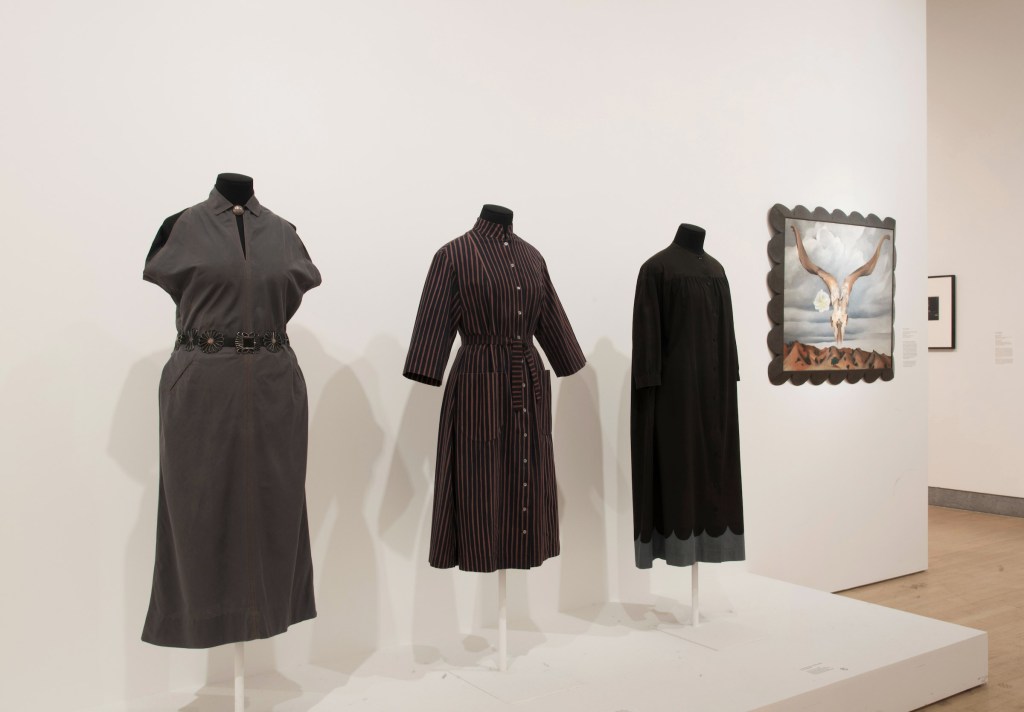
Thursday – Friday 10am – 10pm
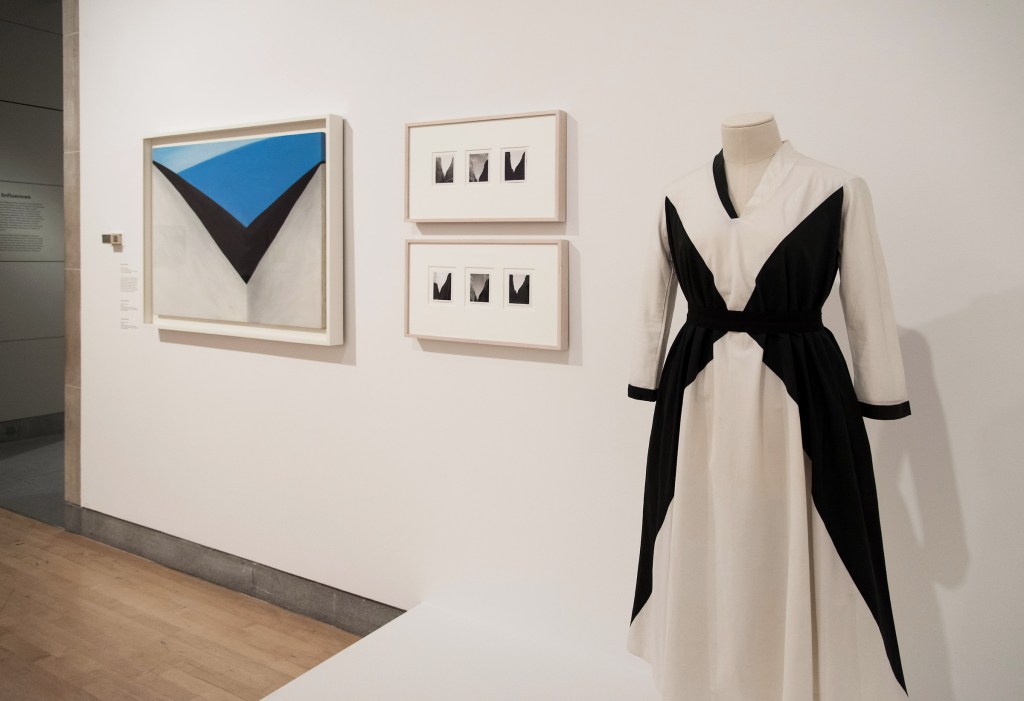
Tuesday Closed

Museum of Fine Arts, Boston website
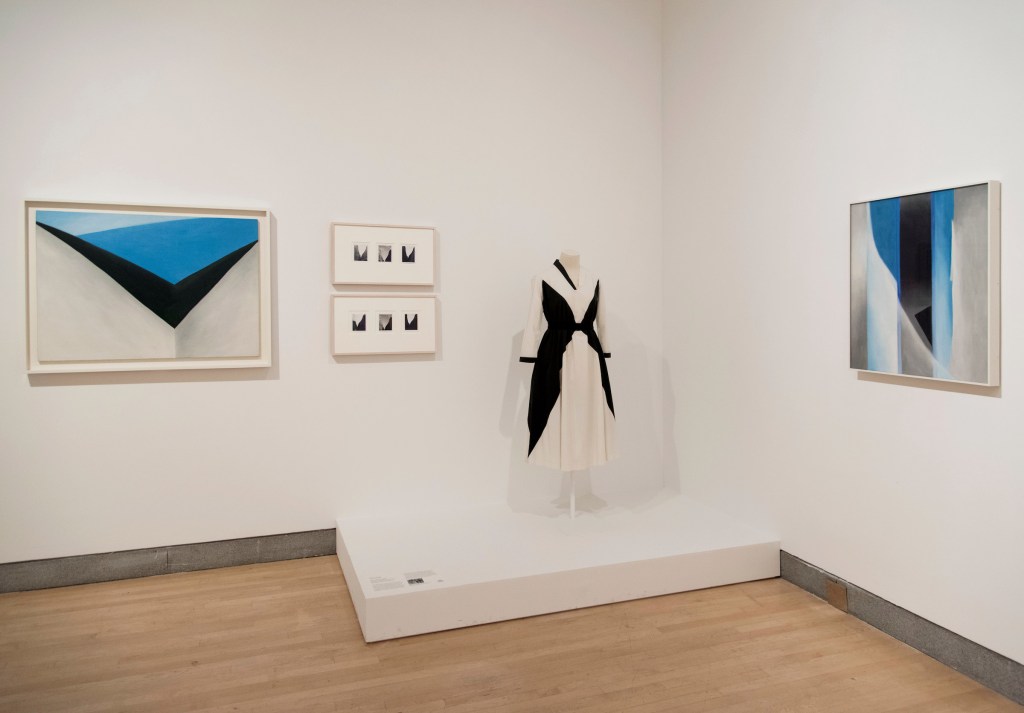
LIKE ART BLART ON FACEBOOK

Back to top

Exhibition: ‘Georgia O’Keeffe: Living Modern’ at the Brooklyn Museum, New York

Exhibition dates: 3rd March – 23rd July, 2017

Curators: guest curator Wanda M. Corn, Robert and Ruth Halperin Professor Emerita in Art History, Stanford University, and coordinated by Lisa Small, Curator of European Painting and Sculpture, Brooklyn Museum


Hilda Belcher (American 1881-1963) 'The Checkered Dress (Young Georgia O'Keeffe)' 1907 from the exhibition 'Georgia O'Keeffe: Living Modern' at the Brooklyn Museum, New York, March - July, 2017
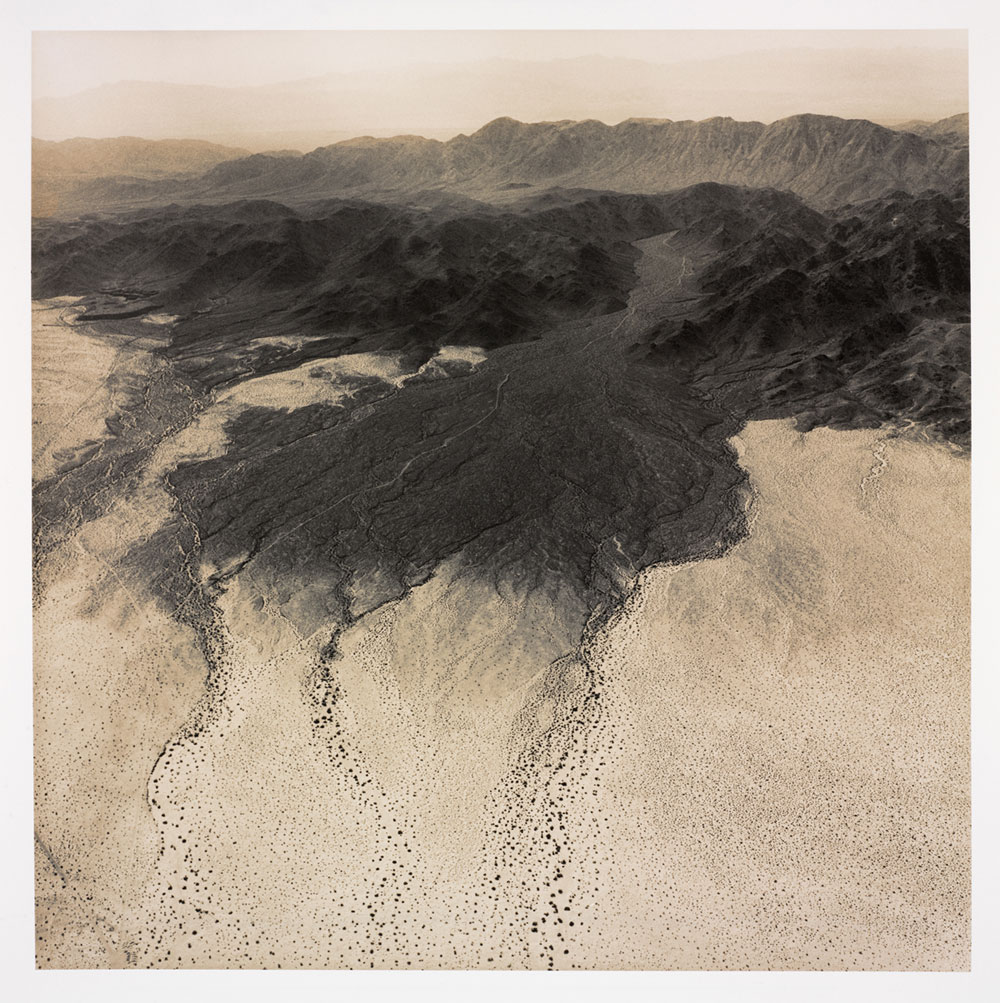
 

Hilda Belcher (American, 1881-1963)
The Checkered Dress (Young Georgia O’Keeffe)
1907
Oil on canvas


I love this woman. Such style, class and talent.

Fabulous art, clothes and photographs. An icon in every sense of the word.

Dr Marcus Bunyan


Many thankx to the Brooklyn Museum for allowing me to publish the photographs in the posting. Please click on the photographs for a larger version of the image.


Alfred Stieglitz (American, 1864-1946) 'Georgia O'Keeffe at 291' 1917 from the exhibition 'Georgia O'Keeffe: Living Modern' at the Brooklyn Museum, New York, March - July, 2017


Alfred Stieglitz (American, 1864-1946)
Georgia O’Keeffe at 291
1917
Platinum print
9 5/8 x 7 5/8 in. (24.3 x 19.4cm)
Georgia O’Keeffe Museum, Santa Fe, N.M.; Gift of The Georgia O’Keeffe Foundation
© Georgia O’Keeffe Museum


Georgia O'Keeffe (American, 1887-1986) 'Blue #2' 1916


Georgia O’Keeffe (American, 1887-1986)
Blue #2
1916
Watercolour on paper
15 7/8 x 11 in. (40.3 x 27.8cm)
Brooklyn Museum; Bequest of Mary T. Cockcroft, by exchange
Photo: Sarah DeSantis, Brooklyn Museum


“Even in photographs in which O’Keeffe gazes directly at the camera, she telegraphs an elegant aloofness – not a coldness, exactly, but a demand to be seen from a distance, like the vast Southwestern landscapes that she made her own. Looking into her face repeated on gallery walls, I was reminded of the way a horizon invites one’s eye to the farthest possible point. Our gaze shifts; the horizon stays the same.”

Haley Mlotek. “Georgia O’Keeffe’s Powerful Personal Style,” on the The NewYorker website April 6, 2017 [Online] Cited 21/12/2021


Alfred Stieglitz (American, 1864-1946) 'Georgia O'Keeffe' 1918


Alfred Stieglitz (American, 1864-1946)
Georgia O’Keeffe
1918, printed 1920s
National Gallery of Art, Washington, Alfred Stieglitz Collection
© Board of Trustees, National Gallery of Art, Washington


Alfred Stieglitz (American, 1864-1946) 'Georgia O'Keeffe' c. 1920-1922


Alfred Stieglitz (American, 1864-1946)
Georgia O’Keeffe
c. 1920-22
Gelatin silver print
4 1/2 x 3 1/2 in. (11.4 x 9cm)
Georgia O’Keeffe Museum, Santa Fe, N.M.; Gift of The Georgia O’Keeffe Foundation
© Georgia O’Keeffe Museum


Georgia O’Keeffe: Living Modern takes a new look at how the renowned modernist artist proclaimed her progressive, independent lifestyle through a self-crafted public persona – including her clothing and the way she posed for the camera. The exhibition expands our understanding of O’Keeffe by focusing on her wardrobe, shown for the first time alongside key paintings and photographs. It confirms and explores her determination to be in charge of how the world understood her identity and artistic values.

In addition to selected paintings and items of clothing, the exhibition presents photographs of O’Keeffe and her homes by Alfred Stieglitz, Ansel Adams, Annie Leibovitz, Philippe Halsman, Yousuf Karsh, Cecil Beaton, Andy Warhol, Bruce Weber, and others. It also includes works that entered the Brooklyn collection following O’Keeffe’s first-ever museum exhibition – held at the Brooklyn Museum in 1927.

The exhibition is organised in sections that run from her early years, when O’Keeffe crafted a signature style of dress that dispensed with ornamentation; to her years in New York, in the 1920s and 1930s, when a black-and-white palette dominated much of her art and dress; and to her later years in New Mexico, where her art and clothing changed in response to the surrounding colours of the Southwestern landscape. The final section explores the enormous role photography played in the artist’s reinvention of herself in the Southwest, when a younger generation of photographers visited her, solidifying her status as a pioneer of modernism and as a contemporary style icon.

Georgia O’Keeffe: Living Modern is organised by guest curator Wanda M. Corn, Robert and Ruth Halperin Professor Emerita in Art History, Stanford University, and coordinated by Lisa Small, Curator of European Painting and Sculpture, Brooklyn Museum.

Text from the Brooklyn Museum website


Installation view of the exhibition 'Georgia O'Keeffe: Living Modern' at the Brooklyn Museum, New York

Installation view of the exhibition 'Georgia O'Keeffe: Living Modern' at the Brooklyn Museum, New York with Alfred Stieglitz's 'Georgia O'Keeffe at 291' (1917) at left, and Gaston Lachaise's sculpture 'Georgia O'Keeffe' (1925-1927) at centre


Installation views of the exhibition Georgia O’Keeffe: Living Modern at the Brooklyn Museum, New York with Alfred Stieglitz’s Georgia O’Keeffe at 291 (1917) at left, and Gaston Lachaise’s sculpture Georgia O’Keeffe (1925-1927, below) at centre


Gaston Lachaise (American born France, 1882-1935) 'Georgia O’Keeffe' 1925-1927


Gaston Lachaise (American born France, 1882-1935)
Georgia O’Keeffe
1925-27
Alabaster
H. 22 3/4 x W. 7 3/4 x D. 12 1/4 in. (57.8 x 19.7 x 31.1cm); including 5 3/4 in. high base
Weight 70lb (31.8kg)
Alfred Stieglitz Collection, 1949
The Metropolitan Museum of Art


'Georgia O'Keeffe: Living Modern' installation view with her painting 'Clam and Mussel' (1926) second left


Georgia O’Keeffe: Living Modern installation view with her painting Clam and Mussel (1926, below) at second left


Georgia O'Keeffe (American, 1887-1986) 'Clam and Mussel' 1926


Georgia O’Keeffe (American, 1887-1986)
Clam and Mussel
1926
Oil on canvas
48 1/8 × 29 7/9 in. (122.2 × 75.6cm)
Georgia O’Keeffe Museum, Santa Fe / Art Resource, NY
© ARS, NY The Georgia O’Keeffe Museum, Santa Fe


Installation view of the exhibition 'Georgia O'Keeffe: Living Modern' at the Brooklyn Museum, New York with O'Keeffe's painting 'Manhattan' (1932) right

Installation view of the exhibition 'Georgia O'Keeffe: Living Modern' at the Brooklyn Museum, New York with in the bottom image, O'Keeffe's painting 'Manhattan' (1932) left, and 'Brooklyn' Bridge (1949) right


Installation views of the exhibition Georgia O’Keeffe: Living Modern at the Brooklyn Museum, New York with in the bottom image, O’Keeffe’s painting Manhattan (1932, below) at left, and Brooklyn Bridge (1949, below) at right


Georgia O'Keeffe (American, 1887-1986) 'Manhattan' 1932


Georgia O’Keeffe (American, 1887-1986)
Manhattan
1932
Oil on canvas
84 3/8 x 48 1/4 in. (214.3 x 122.6cm)
Smithsonian American Art Museum, Washington, D.C.; Gift of The Georgia O’Keeffe Foundation
Photo: Smithsonian American Art Museum, Washington, D.C./Art Resource, NY


Georgia O'Keeffe (American, 1887-1986) 'Brooklyn Bridge' 1949


Georgia O’Keeffe (American, 1887-1986)
Brooklyn Bridge
1949
Oil on Masonite
48 x 35 7/8 in. (121.8 x 91.1cm)
Brooklyn Museum; Bequest of Mary Childs Draper
Photo: Brooklyn Museum


Installation view of the exhibition 'Georgia O'Keeffe: Living Modern' at the Brooklyn Museum, New York with her painting 'Rams Head, White Hollyhock – Hills (Rams Head and White Hollyhock, New Mexico)' (1935) at right


Installation view of the exhibition Georgia O’Keeffe: Living Modern at the Brooklyn Museum, New York with her painting Rams Head, White Hollyhock – Hills (Rams Head and White Hollyhock, New Mexico) (1935) at right


Installation view of the exhibition 'Georgia O'Keeffe: Living Modern' at the Brooklyn Museum, New York

Installation view of the exhibition 'Georgia O'Keeffe: Living Modern' at the Brooklyn Museum, New York with her painting 'In the Patio IX' (1950, below) at left; and an Emilio Pucci dress second right


Installation view of the exhibition Georgia O’Keeffe: Living Modern at the Brooklyn Museum, New York with her painting In the Patio IX (1950, below) at left; and an Emilio Pucci dress second right


Georgia O'Keeffe (1887-1986) 'In the Patio IX' 1950


Georgia O’Keeffe (1887-1986)
In the Patio IX
1950
Oil on canvas mounted on panel
H- 30 x W- 40 in. (76.2 x 101.6cm)
The Jan T. and Marica Vilcek Collection
© The Vilcek Foundation


Installation view of the exhibition 'Georgia O'Keeffe: Living Modern' at the Brooklyn Museum, New York with her painting 'The Mountain, New Mexico' (1931) at left


Installation view of the exhibition Georgia O’Keeffe: Living Modern at the Brooklyn Museum, New York with her painting The Mountain, New Mexico (1931) at left


Installation view of the exhibition 'Georgia O'Keeffe: Living Modern' at the Brooklyn Museum, New York

Installation view of the exhibition 'Georgia O'Keeffe: Living Modern' at the Brooklyn Museum, New York

Installation view of the exhibition 'Georgia O'Keeffe: Living Modern' at the Brooklyn Museum, New York with 'Georgia O'Keeffe' by Irving Penn (1948) second left, and 'Georgia O'Keeffe' by Laura Gilpin (1953) at right


Installation view of the exhibition Georgia O’Keeffe: Living Modern at the Brooklyn Museum, New York with in the bottom image, Georgia O’Keeffe by Irving Penn (1948) second left, and Georgia O’Keeffe by Laura Gilpin (1953, below) at right

Georgia O’Keeffe: Living Modern installation views
© Jonathan Dorado


Laura Gilpin (American, 1891-1979) 'Georgia O'Keeffe' 1953


Laura Gilpin (American, 1891-1979)
Georgia O’Keeffe
1953
Gelatin silver print
24.1 x 19.4cm
Georgia O’Keeffe Museum, Santa Fe, N.M.
© 1979 Amon Carter Museum of American Art, Fort Worth, TX


Georgia O’Keeffe: Living Modern


Alfred Stieglitz (American, 1864-1946) 'Georgia O'Keeffe' 1922


Alfred Stieglitz (American, 1864-1946)
Georgia O’Keeffe
1922
Gelatin silver print
24.1 x 19.4cm
Art Institute of Chicago, Alfred Stieglitz Collection


Georgia O'Keeffe (American, 1887-1986) 'Pool in the Woods, Lake George' 1922


Georgia O’Keeffe (American, 1887-1986)
Pool in the Woods, Lake George
1922
Pastel on paper
17 x 27 1/2 in. (43.3 x 69.9cm)
Reynolda House Museum of American Art, Winston-Salem, N.C.; Gift of Barbara B. Millhouse in memory of E. Carter, Nancy Susan Reynolds, and Winifred Babcock
Courtesy of Reynolda House Museum of American Art, affiliated with Wake Forest University
© Georgia O’Keeffe Museum/Artists Rights Society (ARS), New York


Georgia O'Keeffe (American, 1887-1986) 'Black Pansy & Forget-Me-Nots (Pansy)' 1926


Georgia O’Keeffe (American, 1887-1986)
Black Pansy & Forget-Me-Nots (Pansy)
1926
Oil on canvas
27 1/8 x 12 1/4 in. (68.9 x 31.1cm)
Brooklyn Museum; Gift of Mrs. Alfred S. Rossin
Photo: Christine Gant, Brooklyn Museum


Alfred Stieglitz (American, 1864-1946) 'Georgia O'Keeffe, Prospect Mountain, Lake George' 1927


Alfred Stieglitz (American, 1864-1946)
Georgia O’Keeffe, Prospect Mountain, Lake George
1927
Gelatin silver print
4 5/8 x 3 5/8 in. (11.8 x 9.3cm)
National Gallery of Art, Washington, D.C.; Alfred Stieglitz Collection
© Board of Trustees, National Gallery of Art, Washington


Attributed to Georgia O'Keeffe. 'Dress (Tunic and Underdress)' c. 1926


Attributed to Georgia O’Keeffe
Dress (Tunic and Underdress)
c. 1926
Ivory silk crepe
Georgia O’Keeffe Museum, Santa Fe, N.M.; Gift of Juan and Anna Marie Hamilton
Photo: © Gavin Ashworth


Georgia O'Keeffe (American, 1887-1986) 'Line and Curve' 1927


Georgia O’Keeffe (American, 1887-1986)
Line and Curve
1927
Oil on canvas
32 x 16 1/4 in. (81.2 x 41.2cm)
National Gallery of Art, Washington, D.C.; Alfred Stieglitz Collection, Bequest of Georgia O’Keeffe
© Board of Trustees, National Gallery of Art, Washington


Georgia O’Keeffe: Living Modern offers a new look at the iconic American artist’s powerful ownership of her identity as an artist and a woman. This major exhibition examines the modernist persona that Georgia O’Keeffe crafted for herself through her art, her dress, and her progressive, independent lifestyle. It will mark the first time O’Keeffe’s understated yet remarkable wardrobe will be presented in dialogue with key paintings, photographs, jewellery, accessories, and ephemera. Opening on March 3, Georgia O’Keeffe: Living Modern represents a homecoming of sorts, as the artist had her first solo museum exhibition at the Brooklyn Museum, in 1927.

On view through July 23, 2017, Georgia O’Keeffe: Living Modern is part of A Year of Yes: Reimagining Feminism at the Brooklyn Museum, a yearlong project celebrating a decade of feminist thinking at the Brooklyn Museum.

In addition to a number of O’Keeffe’s key paintings and never-before-exhibited selections from her wardrobe, the exhibition will also feature portraits of her by such luminary photographers as Alfred Stieglitz, Ansel Adams, Philippe Halsman, Yousuf Karsh, Todd Webb, Cecil Beaton, Bruce Weber, Annie Leibovitz, and others. These images, along with the garments and artworks on view, testify to the ways that O’Keeffe learned to use photographic sittings as a way to construct her persona, framing her status as a pioneer of modernism and as a style icon.

“Fifteen years ago I learned that when Georgia O’Keeffe died and left her two homes to her estate, her closets were filled with her belongings. The O’Keeffe Museum in Santa Fe now owns the homes and their contents, but no one had yet studied the sixty years of dresses, coats, suits, casual wear, and accessories she left behind. I took on that task. The Georgia O’Keeffe who emerged from my research and is presented in this exhibition was an artist not only in her studio but also in her homemaking and self-fashioning,” says guest curator, Wanda M. Corn, Robert and Ruth Halperin Professor Emerita in Art History, Stanford University.

“This exhibition reveals O’Keeffe’s commitment to core principles associated with modernism – minimalism, seriality, simplification – not only in her art, but also in her distinctive style of dress,” says Lisa Small, Curator of European Painting and Sculpture, Brooklyn Museum, who serves as the exhibition’s in-house coordinator.

Georgia O’Keeffe: Living Modern opens with an introduction that demonstrates how O’Keeffe began to craft her signature clothing style as a high school student, dispensing with the bows and frills worn by young women at the time. The exhibition continues in four parts. The first is devoted to New York in the 1920s and ’30s, when she lived with Alfred Stieglitz and made many of her own clothes. It also examines Stieglitz’s multiyear, serial portrait project, which ultimately helped her to become one of the most photographed American artists in history and contributed to her understanding of photography’s power to shape her public image.

Her years in New Mexico comprise the second section, in which the desert landscape – surrounded by colour in the yellows, pinks, and reds of rocks and cliffs, and the blue sky – influenced her painting and dress palette. A small third section explores the influence and importance of Asian aesthetics in her personal style. The final section displays images made after Stieglitz’s era by photographers who came to visit her in the Southwest.

Press release from the Brooklyn Museum


Alfred Stieglitz (American, 1864-1946) 'Georgia O'Keeffe' 1929


Alfred Stieglitz (American, 1864-1946)
Georgia O’Keeffe
1929
National Gallery of Art, Washington, Alfred Stieglitz Collection
© Board of Trustees, National Gallery of Art, Washington


Ansel Adams (American, 1902-1984) 'Georgia O'Keeffe and Orville Cox' 1937


Ansel Adams (American, 1902-1984)
Georgia O’Keeffe and Orville Cox
1937
Gelatin silver print
7 3/4 x 11 in. (19.7 x 27.9cm)
Georgia O’Keeffe Museum, Santa Fe, N.M.; Gift of The Georgia O’Keeffe Foundation
© 2016 The Ansel Adams Publishing Rights Trust


Attributed to Georgia O'Keeffe. 'Blouse' c. early to mid-1930s


Attributed to Georgia O’Keeffe
Blouse
c. early to mid-1930s
White linen
Georgia O’Keeffe Museum, Santa Fe, N.M.; Gift of Juan and Anna Marie Hamilton
Photo: © Gavin Ashworth


Attributed to Georgia O'Keeffe. 'Dress with Matching Belt' c. 1930s


Attributed to Georgia O’Keeffe
Dress with Matching Belt
c. 1930s
Black wool, crepe and white silk
Georgia O’Keeffe Museum, Santa Fe, N.M.; Gift of Juan and Anna Marie Hamilton
Photo: © Gavin Ashworth


Georgia O'Keeffe (American, 1887-1986) 'The Mountain, New Mexico' 1931


Georgia O’Keeffe (American, 1887-1986)
The Mountain, New Mexico
1931
Oil on canvas
30 1/16 × 36 1/8 in. (76.4 × 91.8cm)
Whitney Museum of American Art, New York


Georgia O'Keeffe (American, 1887-1986) 'Rams Head, White Hollyhock - Hills' (Rams Head and White Hollyhock, New Mexico) 1935


Georgia O’Keeffe (American, 1887-1986)
Rams Head, White Hollyhock – Hills (Rams Head and White Hollyhock, New Mexico)
1935
Oil on canvas
30 x 36 in. (76.2 x 91.4cm)
Brooklyn Museum; Bequest of Edith and Milton Lowenthal
Photo: Brooklyn Museum


Ansel Adams (American, 1902-1984) 'Georgia O'Keeffe at Yosemite' 1938


Ansel Adams (American, 1902-1984)
Georgia O’Keeffe at Yosemite
1938
Gelatin silver print
5 3/4 x 3 3/8 in. (14.5 x 8.7cm)
Georgia O’Keeffe Museum, Santa Fe, N.M.; Gift of The Georgia O’Keeffe Foundation
© 2016 The Ansel Adams Publishing Rights Trust


Georgia O'Keeffe (American, 1887-1986) 'Patio with Cloud' 1956


Georgia O’Keeffe (American, 1887-1986)
Patio with Cloud
1956
Oil on canvas
36 x 30 in. (91.4 x 76.2cm)
Milwaukee Art Museum; Gift of Mrs. Edward R. Wehr
© Georgia O’Keeffe Museum/Artists Rights Society (ARS), New York
Photo: P. Richard Eells


Todd Webb (American, 1905-2000) 'Georgia O'Keeffe on Ghost Ranch Portal, New Mexico' c. 1960s


Todd Webb (American, 1905-2000)
Georgia O’Keeffe on Ghost Ranch Portal, New Mexico
c. 1960s
Gelatin silver print
10 x 8 in. (25.4 x 20.3cm)
Georgia O’Keeffe Museum, Santa Fe, N.M.; Gift of The Georgia O’Keeffe Foundation
© Estate of Todd Webb, Portland, ME


'Padded Kimono (Tanzen)' c. 1960s-1970s


Padded Kimono (Tanzen)
c. 1960s-1970s
Silk with woven black and gray stripe
Inner garment: Kimono. White linen (?)
Georgia O’Keeffe Museum, Santa Fe, N.M.; Gift of Juan and Anna Marie Hamilton
Photo: © Gavin Ashworth


Bruce Weber (American, b. 1946) 'Georgia O'Keeffe, Abiquiu, N.M.' 1984


Bruce Weber (American, b. 1946)
Georgia O’Keeffe, Abiquiu, N.M.
1984
Gelatin silver print
14 x 11 in. (35.6 x 27.9cm)
Bruce Weber and Nan Bush Collection, New York
© Bruce Weber


'Emsley. Suit (Jacket, Pants, and Vest)' 1983


Emsley. Suit (Jacket, Pants, and Vest)
1983
Black wool
Inner garment: Lord & Taylor. Shirt
c. 1960s. White cotton
Georgia O’Keeffe Museum, Santa Fe, N.M.; Gift of Juan and Anna Marie Hamilton
Photo: © Gavin Ashworth


Ansel Adams (American, 1902-1984) 'Georgia O'Keeffe, Carmel Highlands, California' 1981


Ansel Adams (American, 1902-1984)
Georgia O’Keeffe, Carmel Highlands, California
1981
Gelatin silver print
10 1/8 x 13 1/8 in. (25.7 x 33.3cm)
Georgia O’Keeffe Museum, Santa Fe, N.M.; Gift of Juan and Anna Marie Hamilton
© 2016 The Ansel Adams Publishing Rights Trust


'Georgia O'Keeffe: Living Modern' by Wanda Corn book cover 2017


Georgia O’Keeffe: Living Modern by Wanda Corn book cover 2017
Courtesy of Delmonico Books Prestel


Brooklyn Museum
200 Eastern Parkway
Brooklyn, NY 11238-6052
Phone: (718) 638-5000

Opening hours:
Wednesday – Sunday 11am – 6pm
Closed Mondays and Tuesdays
Closed Thanksgiving, Christmas, and New Year’s Day

Brooklyn Museum website

LIKE ART BLART ON FACEBOOK

Back to top

Exhibition: ‘The world is beautiful: photographs from the collection’ at the National Gallery of Australia, Canberra

Exhibition dates: 4th December, 2015 – 10th April, 2016

Curators: Dr. Shaune Lakin, Senior Curator of Photography at NGA with collaborator Anne O’Hehir, Curator of Photography at NGA


Man Ray (United States of America 1890 - France 1976) 'No title (Woman with closed eyes)' c. 1928 from the exhibition 'The world is beautiful: photographs from the collection' at the National Gallery of Australia, Canberra, Dec 2015 - April 2016


Man Ray (United States of America 1890 – France 1976)
No title (Woman with closed eyes)
c. 1928
Gelatin silver photograph
Not signed, not dated. Stamp, verso, l.r., “Man Ray / 81 bis. Rue / Campagne Premiere / Paris / XIV”.
Image: 8.9 x 12.8cm
National Gallery of Australia, Canberra, purchased 1984


Despite a focus on the camera’s relationship to the beauty and pure form of the modern world – “the attraction and charm of the surface” – these photographs are more than just being skin deep. In their very straightforwardness the photographs propose a “rigorous sensitivity to form revealed patterns of beauty and order in the natural and man-made alike.” But more than the portrayal of something we would not see if it were not for the eye of the photographer, the lens of the camera, the speed of the film, the sensitivity of the paper, the design of the architect, the genetics of nature … is the mystery of life itself.

Modernist structures and mass-produced objects can never beat a good mystery. Just look at Man Ray’s Woman with closed eyes (c. 1928, above) or the look in the eyes of Robert Frank’s son, Pablo. You can never pin that down.

While form may be beauty, mystery will always be beautiful.

Dr Marcus Bunyan


Please click on the photographs to view a larger version of the image.


Walker Evans (United States of America, 1903-1975) 'Graveyard and steel mill, Bethlehem, Pennsylvania' 1935 from the exhibition 'The world is beautiful: photographs from the collection' at the National Gallery of Australia, Canberra, Dec 2015 - April 2016


Walker Evans (United States of America, 1903-1975)
Graveyard and steel mill, Bethlehem, Pennsylvania
1935
Gelatin silver photograph
Image: 19.1 h x 24.0cm
Sheet: 20.2 x 25.2cm
National Gallery of Australia, Canberra, purchased 1980


The world is beautiful is an exhibition of photographs taken over the last 100 years from the National Gallery of Australia’s magnificent photography collection, including work by Diane Arbus, Henri Cartier-Bresson, Max Dupain, Bill Henson, Robert Mapplethorpe, Man Ray, Cindy Sherman and many more.

It draws its title from one of the twentieth-century’s great photographic moments, the publication of Albert Renger-Patzsch’s book The world is beautiful in 1928. Renger-Patzsch’s approach embodied his belief that ‘one should surely proceed from the essence of the object and attempt to represent it with photographic means alone’.

Inspired by this confidence in the medium, the exhibition looks at the way the camera interacts with things in the world. One of photography’s fundamental attributes is its capacity to adopt a range of relationships with its subject, based on the camera’s physical proximity to it. Indeed, one of the most basic decisions that a photographer makes is simply where he or she places the camera. The pictures in this exhibition literally take you on a photographic trip, from interior worlds and microscopic detail to the cosmic: from near to far away.

Together, these photographs capture some of the delight photographers take in turning their cameras on the world and re-imaging it, making it beautiful through the power of their vision and their capacity to help us see the world in new ways.”

Text from the National Gallery of Australia website


Near

Close up, the world can be surprising. There is an undeniable intensity and focus that comes with getting up close to people and objects. It is rude to stare, but photography has no such scruples.

Pioneers of the medium attempted to photograph organic forms through a microscope, making once-hidden worlds accessible. The pleasure photographers take in getting up close to their subject has followed the medium’s progress. This was especially the case during the twentieth century, when advances in photographic technology and profound shifts in our relationship to space brought about by events such as war often turned our attention away from the outside world.

For many photographers, the camera’s capacity to subject people and objects to close scrutiny has provided a way of paring back vision to its essence, to view the world unencumbered by emotion and sentiment. For others, getting up close is not just about physical proximity; it is also about psychological and emotional states that are otherwise difficult to represent. Experiences such as intimacy, love and emotional connection, as well as disquiet, anxiety and hostility, can all be suggested through the use of the close-up. Photographers have also used it literally to turn inwards, escaping into the imagination to create dreamworlds. The camera-eye really can see what the human eye cannot.

Text from the National Gallery of Australia website


Albert Renger-Patzsch (German, 1897-1966) 'Mantelpavian [Hamadryas Baboon]' c. 1925 from the exhibition 'The world is beautiful: photographs from the collection' at the National Gallery of Australia, Canberra, Dec 2015 - April 2016


Albert Renger-Patzsch (German, 1897-1966)
Mantelpavian [Hamadryas Baboon]
c. 1925
Gelatin silver photograph
23.8 x 16.8cm
National Gallery of Australia, Canberra


“In photography one should surely proceed from the essence of the object and attempt to represent it with photographic terms alone.”

~ Albert Renger-Patzsch


Renger-Patzsch’s primary interest was in the object as a document, removed from its usual context and unencumbered with sentiment. Die Welt ist schön [The world is beautiful], published in Munich in 1928, is one of the great photographic books in the history of photography and its influence across the world was profound. It is an astounding study of the world, celebrating beauty wherever the photographer found it – in modernist structures and mass-produced objects or in plants and animals. The connection and continuity of industry to the natural world is conveyed by emphasising underlying structural and formal similarities. The Gallery has a major holding of works by Renger-Patzsch, including a copy of Die Welt ist schön and 121 vintage prints, most of which were reproduced in the book.

Renger-Patzsch was always firmly committed to the principle of the photograph as a document or record of an object. While the title for his most famous contribution to photography came from his publisher, he wanted his now-iconic 1928 book Die Welt ist schön (The world is beautiful) to be titled simply Die Dinge (Things). In 1937 he wrote that the images in his book, ‘consciously portray the attraction and charm of the surface’. Indeed, the power of these pictures resides in their straightforwardness.

Text © National Gallery of Australia, Canberra


“German photographer Albert Renger-Patzsch was a pioneering figure in the New Objectivity movement, which sought to engage with the world as clearly and precisely as possible.

Rejecting the sentimentality and idealism of a previous generation, Neue Sachlichkeit (New Objectivity) emerged as a tendency in German art, architecture and literature in the 1920s. Applying this attitude to the field of photography, Renger-Patzsch espoused the camera’s ability to produce a faithful recording of the world. ‘There must be an increase in the joy one takes in an object, and the photographer should be fully conscious of the splendid fidelity of reproduction made possible by his technique’, he wrote.

This selection reflects the range of subjects that Renger-Patzsch returned to throughout his career. It includes his early wildlife and botanical studies, images of traditional craftsmen, formal studies of mechanical equipment, commercial still lifes, and landscape and architectural studies. His images of the Ruhr region, where he moved in 1928, document the industrialisation of the area in almost encyclopaedic detail. All of his work demonstrates his sustained interest in the camera’s relationship to the beauty and complexity of the modern world.

In 1928 Renger-Patzsch published The World is Beautiful, a collection of one hundred photographs whose rigorous sensitivity to form revealed patterns of beauty and order in the natural and man-made alike. Embodying a new, distinctly modern way of looking at the world, the book established Renger-Patzsch as one of the most influential photographers of the twentieth century.”

Text by Emma Lewis on the Tate website [Online] Cited 01/04/2016. No longer available online


Edward Weston (American, 1886-1958) 'Guadalupe de Rivera, Mexico' 1924


Edward Weston (American, 1886-1958)
No title (Guadalupe, Mexico, 1924): from “Edward Weston fiftieth anniversary portfolio 1902-1952”
1924
Gelatin silver photograph
20.7 x 17.8cm
National Gallery of Australia, Canberra, purchased 1981


In 1923 Weston travelled from San Francisco to Mexico City with his son, Chandler and his model and lover, Tina Modotti. The photographs he made there represented a startling, revolutionary breakthrough. Everything got stripped down to its essence, with objects isolated against neutral backgrounds. For these heroic head shots, he moved out of the studio, photographing in direct sunlight, from below and with a hand-held camera. They are monumental but still full of life: Weston was excited by the idea of capturing momentary expressions, in people he found ‘intense and dramatic’.

Text © National Gallery of Australia, Canberra


Robert Frank (Swiss-American, 1924-2019) 'Pablo' 1959


Robert Frank (Swiss-American, 1924-2019)
Pablo
1959
Gelatin silver photograph
Image: 20.8 x 31.0cm
Sheet: 27.0 x 35.4cm
National Gallery of Australia, Canberra, purchased 1980


Frank set out on a two-year road trip across the States in 1955. The images he made of race and class divisions, poverty, alienated youth and loneliness expose America’s dark soul. Others, such as this haunting image of his son, Pablo, were more personal. A selection appeared in The Americans, published in Paris in 1958 and in the States the following year. Many saw it as a bitter indictment of the American Dream, others saw an evocative, melancholic vision of humanity that is deeply moving. As Jack Kerouac commented in his introduction to the American edition, Frank ‘sucked a sad, sweet, poem out of America’

Text © National Gallery of Australia, Canberra


Carol Jerrems (Australian, 1949-1980) 'Vale Street' 1975


Carol Jerrems (Australian, 1949-1980)
Vale Street
1975
St Kilda, Melbourne, Victoria, Australia
Gelatin silver photograph
Image: 20.2 x 30.3cm
Sheet: 40.5 x 50.4cm
Gift of the Philip Morris Arts Grant 1982
© Ken Jerrems and the Estate of Lance Jerrems
National Gallery of Australia, Canberra


“I try to reveal something about people, because they are so separate, so isolated, maybe it’s a way of bringing people together I don’t want to exploit people. I care about them.”

~ Carol Jerrems, 1977


Carol Jerrems became prominent in the 1970s as part of a new wave of young photographers. Influenced by the counter-culture values of the 1960s, they used art to comment on social issues and engender social change. Jerrems photographed associates, actors and musicians, always collaborating with her subjects, thereby declaring her presence as the photographer. Vale Street raises interesting questions about what is artifice and what is real in photography. She deliberately set up this image, employing her aspiring actress friend and two young men from her art classes at Heidelberg Technical School. Vale Street has achieved an iconic status in Australian photography; the depiction of a confident young woman taking on the world is an unforgettable one. It is an intimate group portrait that is at once bold and vulnerable. In 1975 it was thought to be an affirmation of free love and sexual licence. The image also appears to be about liberation from society’s norms and taboos – ‘we are all three bare-chested, we have tattoos and so what?’

The implication that this scene is perfectly natural is reinforced by locating the figures in a landscape. The young woman is strong and unafraid of the judgement of the viewer. The necklace around her neck is an ankh – a symbol of the new spiritualty of the Age of Aquarius and a re-affirmation of the ancient powers of women.

Text © National Gallery of Australia, Canberra 2010
From: Anne Gray (ed.,). Australian art in the National Gallery of Australia. National Gallery of Australia, Canberra, 2002


Paul Outerbridge (United States of America, 1896-1958; Paris 1925-1928, Berlin and London 1928) 'Nude lying on a love seat' c. 1936


Paul Outerbridge (United States of America, 1896-1958; Paris 1925-1928, Berlin and London 1928)
Nude lying on a love seat
c. 1936
Carbro colour photograph
30.2 x 41cm
National Gallery of Australia, Canberra, purchased 1980


Like the Australian-born Anton Bruehl, Paul Outerbridge studied at the Clarence White School of Photography in New York. White was keen to see photography establish itself as a practical art that could be used in the service of the rapidly expanding picture magazine industry. Within a year of enrolling in the school, Outerbridge’s work was appearing in Vogue and Vanity Fair. During his lifetime, Outerbridge was known for his commercial work, particularly his elegant, stylish still-life compositions which show the influence of earlier studies in painting. He was also admired for the excellence of his pioneering colour work, which was achieved by means of a complicated tri-colour carbro process.

Much of Outerbridge’s fame now rests on work that he made following more private obsessions. His fetishistic nude photographs of women are influenced primarily by eighteenth-century French painters such as Ingres. Although the depiction of nudes was a genre pursued from the inception of photography, Outerbridge’s interest in breaking down taboos resulted in this material, if known at all, being passed over or vilified in his lifetime. Outerbridge sought to express what he described as an ‘inner craving for perfection and beauty’ through these often mysterious, languid and richly toned images.

Text © National Gallery of Australia, Canberra 2014


Cindy Sherman (American, b. 1954) 'Untitled #92' 1981


Cindy Sherman (American, b. 1954)
Untitled #92
1981
Type C colour photograph
61.5 x 123.4cm
National Gallery of Australia, Canberra, purchased 1983


This is one of 12 Centerfolds made by Sherman in 1981. The Centerfolds present Sherman posing in a range of situations, each suggesting heightened emotional states and violent narratives; these associations are augmented by the uncomfortably tight framing and the panoramic format used by Sherman across the series. Initially commissioned for the art magazine Artforum, the Centerfolds were never published because they were deemed, with their apparently voyeuristic points of view, to reaffirm misogynist views of women.

Text © National Gallery of Australia, Canberra


William Eggleston (American, b. 1939) 'Untitled (Greenwood, Mississippi)' 1980


William Eggleston (American, b. 1939)
Greenwood, Mississippi
1973, printed 1979
Dye transfer colour photograph
Image: 29.5 x 45.4cm
Sheet: 40.2 x 50.8cm
National Gallery of Australia, Canberra, purchased 1980


With its intense red, Eggleston’s picture of the spare room in a friend’s home is one of the most iconic of all colour photographs. Often called The red room, this photograph was intended to be shocking: Eggleston described the effect of the colour as like ‘red blood that is wet on the wall’. But the radicalness of the picture is not just in its juicy (and impossible to reproduce) redness; it is also found in the strange view it provides of a domestic interior, one that Eggleston has described as a ‘fly’s eye view’.

Text © National Gallery of Australia, Canberra


Imogen Cunningham (American, 1883-1976) 'Magnolia Blossom' 1925


Imogen Cunningham (American, 1883-1976)
Magnolia Blossom
1925
Gelatin silver photograph
Image: 17.1 x 34.6cm
Mount: 38.2 x 50.7cm
National Gallery of Australia, Canberra, purchased 1978


During the 1920s, raising three young sons, Cunningham began to focus on her immediate surroundings. This restricted environment encouraged Cunningham to develop a new way of working, as she began to place her camera closer to the subject: to zebras on a trip to the zoo, to snakes brought to her by her sons, and perhaps most famously to the magnolia blossoms and calla lilies she grew in her garden. Observing what she termed the ‘paradox of expansion via reduction’, the intensity and focus attendant to this way of seeing flooded her work with sensuality and reductive power.

Text © National Gallery of Australia, Canberra


Olive Cotton (Australian, 1911-2003) 'Skeleton Leaf' 1964


Olive Cotton (Australian, 1911-2003)
Skeleton leaf
1964
Gelatin silver photograph
Image: 50.4 x 40.8cm
Sheet: 57.8 x 47.6cm
National Gallery of Australia, Canberra, purchased 1987


This leaf skeleton – a leaf that has had its pulp removed with heat and soda – was probably photographed in front of a window in Cotton’s home near Cowra, NSW. Since the 1930s Cotton had been drawn to the close study of nature, and many of her best photographs feature close-ups of flowers, tufts of grass and foliage. This photograph is notable because it was taken in the studio, and reflects the austerity and simplicity that pervaded Cotton’s work in the decades after the Second World War.

Text © National Gallery of Australia, Canberra


Lee Friedlander (American, b. 1934) 'Nashville, 1963' 1963


Lee Friedlander (American, b. 1934)
Nashville, 1963
1963
Gelatin silver photograph
Image: 28.2 x 18.7cm
Sheet: 35.3 x 27.8cm
National Gallery of Australia, Canberra, purchased 1981


Middle distance

The further away we move from a subject, the more it and its story open up to us. While the close-up or compressed view tends to be very frontal (the camera presses up against the subject), the defining characteristic of much mid-century photography was its highly mobile relationship to space: its extraordinary capacity to survey and to organise the world.

The space between the camera and its subject can suggest impartiality and detachment. Documentary photographers and photojournalists, for example, open their cameras up to their subjects, as if to ‘let them speak’. But the depiction of the space between the camera and its subject, and the way that it is rendered through the camera’s depth of field, can also reflect decision making on the part of the photographer. By adjusting the camera’s settings, and thus choosing to render part of the subject in focus, the photographer can direct our focus and attention to certain parts of an image. In this way, photographers put forward an argument based on their world view. Photography can change the way we think about the world.

Text from the National Gallery of Australia website


Ilse Bing (Germany 1899 - United States of America 1998; France 1930-1941 United States from 1941) 'Eiffel Tower, Paris, 1931' 1931


Ilse Bing (Germany 1899 – United States of America 1998; France 1930-1941 United States from 1941)
Eiffel Tower, Paris
1931
Gelatin silver photograph
Signed and dated recto, l.r., pen and ink “Ilse Bing/ 1931”
Image: 22.3 x 28.2cm
National Gallery of Australia, Canberra, purchased 1989


Bing took up photography in 1928 and quickly developed a reputation as a photojournalist and photographer of modernist architecture. Inspired by an exhibition of modern photography and the work of Paris-based photographer Florence Henri, Bing moved to Paris 1930 and quickly became associated with the city’s photographic avant-garde. Bing worked exclusively with the fledgling Leica 35mm-format camera; her interest in the pictorial possibilities of the hand-held Leica can clearly be seen in this striking view of the Eiffel Tower.

Text © National Gallery of Australia, Canberra


Garry Winogrand (American, 1928-1984) 'World´s Fair', New York, 1964


Garry Winogrand (American, 1928-1984)
World’s Fair, New York
1964
Gelatin silver photograph
Image: 21.8 x 32.7cm
Mount: 37.4 x 50.1cm
Image rights: © The Estate of Garry Winogrand, courtesy Fraenkel Gallery, San Francisco
National Gallery of Australia, Canberra, purchased 1978


Winogrand had a tremendous capacity to photograph people in public spaces completely unawares. This image records a group of visitors to the 1964 World’s Fair; it focuses on three young women – Ann Amy Shea, whispering into the ear of Janet Stanley, while their friend Karen Marcato Kiaer naps on Stanley’s bosom. The figures fill the space between the picture’s fore- and middle-grounds, to the extent of allowing the viewer to examine people’s expressions and interactions in close detail. This in turn allows us to encroach on the personal space of people we don’t know.

Text © National Gallery of Australia, Canberra


Diane Arbus (American, 1923-1971) 'Child with a toy hand grenade in Central Park, N.Y.C. 1962'


Diane Arbus (American, 1923-1971)
Child with toy hand grenade, in Central Park, New York City
1962
Gelatin silver photograph
Image: 20 x 17.2cm
Sheet: 32.8 x 27.6cm
National Gallery of Australia, Canberra, purchased 1980


During workshops with Lisette Model, Arbus was encouraged to develop a direct, uncompromising approach to her subjects. She did this using the square configuration of a medium-format camera which Arbus most usually printed full frame with no cropping. Model also convinced Arbus, who had been interested in myth and ritual, that the more specific her approach to her subjects, the more universal the message. In many ways this image of a boy caught hamming it up in Central Park, with his contorted body and grimacing face, captures and prefigures many of the anxieties of America during the sixties, a country caught in an unwinnable war in Vietnam and undergoing seismic social change.

Text © National Gallery of Australia, Canberra


Henri Cartier-Bresson (French, 1908-2004) 'Rue Mouffetard, Paris' 1954 prtd c. 1980


Henri Cartier-Bresson (French, 1908-2004)
Rue Mouffetard, Paris
1954, printed c. 1980
Gelatin silver photograph
Image: 35.9 x 24.2cm
Sheet: 39.4 x 29.6cm
National Gallery of Australia, Canberra, purchased 1982


Helen Levitt (United States of America, 1913 - 2009) 'New York' 1972


Helen Levitt (United States of America, 1913 – 2009)
New York
1972
Dye transfer colour photograph
Image: 23.9 x 36.2cm
Sheet: 35.6 x 42.9cm
National Gallery of Australia, Canberra, purchased 1984


“The streets of the poor quarters of the great cities are, above all, a theatre and a battleground.”

~ Helen Levitt


Inspired by seeing work by Walker Evans and Henri Cartier-Bresson in 1935, Levitt took to the streets. Children became her most enduring subject. Like Evans, Levitt was famously shy and self-effacing, seeking to shoot unobserved by fitting a prism finder on her Leica. Her approach eschews the sensational; instead she is interested in capturing small, idiosyncratic actions in the everyday. Her images were often shot through with a gentle, lyrical humour though a dark strangeness also surfaces at times.

Text © National Gallery of Australia, Canberra


Helen Levitt (American, 1913-2009) 'New York' c. 1972


Helen Levitt (American, 1913-2009)
New York
1972
Dye transfer colour photograph
Image: 23.4 x 35.6cm
Sheet: 35.4 x 42.9cm
National Gallery of Australia, Canberra, purchased 1984


Ernst Haas (Austria 1921 - United States of America 1986; United States from 1951) 'Route 66, Albuquerque, New Mexico, USA' 1969


Ernst Haas (Austria 1921 – United States of America 1986; United States from 1951)
Albuquerque, New Mexico
1969
Dye transfer colour photograph
Image: 44.9 x 67.8cm
Sheet: 52.3 x 75.7cm
National Gallery of Australia, Canberra, purchased 2000


For Haas, colour photography represented the end of the grey and bitter war years and he started seriously working in the medium after moving to America in 1951. Work on his photoessay, Land of Enchantment and film stills assignments for The Misfits, The Bible and Little Big Man took Haas to the Southwest. The desert landscape of Albuquerque, located on Route 66, had been totally transformed by progress since the 1920s. Photographing the street after rain, Haas has signified that evolution by way of his distinctive ability to translate the world into shimmering energy.

Text © National Gallery of Australia, Canberra


Faraway

Photography has a long-standing interest in faraway places. In 1840, right in photography’s infancy, astronomical photography was launched when the first photograph of the moon was made. As photographic imaging technology has improved, so has the medium’s capacity to make faraway places accessible to us.

Photography can bring foreign places and people closer to home, or collect together images of places and structures that are located in different places. It can also attempt to give a picture to experiences that are otherwise difficult to grasp or represent, such as complex weather events or transcendental phenomena.

Against the odds, there are photographers who make images that are about what cannot be seen. Faraway is often used as a metaphor for thinking about the ineffable and the inexplicable. Science and spirit go hand-in-hand. ‘The most beautiful thing we can experience is the mysterious’, Albert Einstein believed. Photographers can take us to new worlds.

Text from the National Gallery of Australia website


Ansel Adams (American, 1902-1984) 'Moonrise, Hernandez, New Mexico' 1941


Ansel Adams (San Francisco, California, United States of America 1902 – Carmel, California, United States of America 1984)
Moonrise, Hernandez, New Mexico
1941
Ansel Adams Museum Set
Gelatin silver photograph
Image: 38.6 x 49cm
Mount: 55.6 x 71cm
National Gallery of Australia, Canberra, purchased 1980


Adams became the most famous landscape photographer in the world on the back of his images of America’s West. While mass tourism was invading these wilderness areas, Adams’s photographs show only untouched natural splendour. His landscapes are remarkable for their deep, clear space, distinguishable by an uncanny stillness and clarity. The story of Moonrise is legendary: driving through the Chama River Valley toward Española, Adams just managed by a few seconds to catch this fleeting moment before the dying sunlight stopped illuminating the crosses in the graveyard. Through hours of darkroom manipulation and wizardry, Adams created an image of almost mystical unworldliness.

Text © National Gallery of Australia, Canberra


Tracey Moffatt (Australian, b. 1960) 'Up in the sky' 1997


Tracey Moffatt (Australian, b. 1960)
Up in the sky [Up in the sky – a set of 25 photolithographs]
1997
No. 8 in a series of 25
Photolithograph
Image: 61.0 x 76.0cm
Sheet: 72.0 x 102.0cm
KODAK (Australasia) PTY LTD Fund 1997
National Gallery of Australia, Canberra


Up in the sky is unusual in Moffatt’s oeuvre for being shot out of doors on location. Her photomedia practice is informed by an upbringing watching television, fascinated by film and pop culture. This series takes many of its visual cues from Pier Paolo Pasolini’s Accattone of 1961 as well as the Mad Max series – the references, twisted and re-imagined, are like half-forgotten memories. She addresses race and violence, presenting a loose narrative set against the backdrop of an outback town. The sense of unease is palpable: Moffatt here is a masterful manipulator of mood.

Text © National Gallery of Australia, Canberra


Laurence Aberhart (Aotearoa New Zealand, b. 1949) 'Taranaki, from Oeo Road, under moonlight, 27-28 September 1999' 1999


Laurence Aberhart (Aotearoa New Zealand, b. 1949)
Taranaki, from Oeo Road, under moonlight, 27-28 September 1999
1999
Gelatin silver photograph
19.4 x 24.3cm
Gift of Peter Fay 2005
National Gallery of Australia, Canberra


For four decades, Aberhart has photographed the Taranaki region of New Zealand’s North Island, including its settled landscape and its most distinctive feature, the sacred TeMounga (Mount) Taranaki. Using an 8 x 10-inch view camera, Aberhart has over time built up an important archive documenting the social geography and landscape of the Taranaki. Aberhart describes the conical mountain as a ‘great physical and spiritual entity’ and sees his photographs of it as a counterbalance to the countless images of the mountain that circulate on tea towels and postcards.

Text © National Gallery of Australia, Canberra


National Gallery of Australia
Parkes Place, Canberra
Australian Capital Territory 2600
Phone: (02) 6240 6411

Opening hours:
Open daily 10.00am – 5.00pm
(closed Christmas day)

National Gallery of Australia website

LIKE ART BLART ON FACEBOOK

Back to top

Exhibition: ‘Manzanar: The Wartime Photographs Of Ansel Adams’ at the Jundt Art Gallery, Gonzaga University, Spokane, WA

Exhibition dates: 4th January – 29th March 2014


Ansel Adams (American, 1902-1984) 'Birds on wire, evening, Manzanar Relocation Center' 1943


Ansel Adams (American, 1902-1984)
Birds on wire, evening, Manzanar Relocation Center
1943
Silver gelatin print


Just a small celebration = this is the 900th posting on Art Blart since it started…

I sifted through all the photographs of the “war relocation center” (euphemism for concentration camp) named Manzanar that Ansel Adams took – over 220 photographs on the Library of Congress website – to bring you these, the best of the bunch. Adams wasn’t a particularly good documentary photographer and it was a struggle to come up with these images, but sprinkled in with the prosaic are some absolutely stunning landscape and still life images.

What is noteworthy however, is Adams moral stance towards the unlawful incarceration of Japanese Americans, something that went against everything American citizenship is supposed to stand for. In 1944 he published a book called Born Free and Equal which protests the treatment of these American citizens. Through photography and text he showed how they suffered under a great injustice – by portraying “Japanese American internees as loyal Americans going about their lives like regular citizens, not as dangerous aliens.”

As curator Robert Flynn Johnson notes, “Adams saved his harshest attack on their unjust imprisonment for the language of his book… In the text Adams struggled with the argument that the incarceration of these citizens was not just but justified by military necessity. However, he rejected that argument, clearly and forcefully articulating his opposition to the internment. The book was not well received. Adams was called a “Jap lover” and copies of the book were burned. To fully understand the “profiles in Courage” stand Ansel Adams took by publishing Born Free and Equal while the war was still raging, one must understand the emotionally volatile nature of those times in which it was published. Adams’s strong convictions are fully apparent when one reads his forceful words while viewing his beautiful photographic imagery…”

Can you imagine what courage it must have taken to publish a book in the middle of the Second World War – with all that was going on with America and the war in the Pacific against Japan – titled Born Free and Equal, a book that lays bare the hypocrisy of democracy as only contingent on those in power. This man and his supporters have my utmost admiration. In Australia it’s a pity – no, it’s shameful – that those elected people on both sides of major politics do not possess similar fortitude. The guts to stand up for justice and freedom against the evils of incarceration and oppression when they see it staring them in the face.

Dr Marcus Bunyan

PS. What is also interesting is how Adams laid out this work for exhibition in the camp itself. The size of the prints, how they are displayed both vertically and horizontally, and how they move up and down and are not hung ‘on the line’ – plus the artefacts they are also displayed with. Fascinating stuff.


These photographs were sourced from the Prints & Photographs Online Catalog of the Library of Congress. The online archive contains all of Ansel Adams photographs of Manzanar War Relocation Center to download in high resolution, with no known restrictions on publication. Please note: publication of these images in the posting does NOT mean that these images are in the exhibition.


Ansel Adams (American, 1902-1984) 'C.T. Hibino, artist, Manzanar Relocation Center' 1943


Ansel Adams (American, 1902-1984)
C.T. Hibino, artist, Manzanar Relocation Center
1943
Silver gelatin print


Ansel Adams (American, 1902-1984) 'Frank Hirosama [i.e., Hirosawa] in laboratory, Manzanar Relocation Center' 1943


Ansel Adams (American, 1902-1984)
Frank Hirosama [i.e., Hirosawa] in laboratory, Manzanar Relocation Center
1943
Silver gelatin print


Foreword to Born Free and Equal

“Moved by the human story unfolding in the encirclement of desert and mountains, and by the wish to identify my photography in some creative way with the tragic momentum of the times, I came to Manzanar with my cameras in the fall of 1943. For many years, I have photographed the Sierra Nevada, striving to reveal by the clear statement of the lens those qualities of the natural scene which claim the emotional and spiritual response of the people. In these years of strain and sorrow, the grandeur, beauty, and quietness of the mountains are more important to us than ever before. I have tried to record the influence of the tremendous landscape of Inyo on the life and spirit of thousands of people living by force of circumstance in the Relocation Center of Manzanar. …

I believe that the acrid splendour of the desert, ringed with towering mountains, has strengthened the spirit of the people of Manzanar. I do not say all are conscious of this influence, but I am sure most have responded, in one way or another, to the resonances of their environment. From the harsh soil they have extracted fine crops; they have made gardens glow in the firebreaks and between the barracks. Out of the jostling, dusty confusion of the first bleak days in raw barracks they have modulated to a democratic internal society and a praiseworthy personal adjustment to conditions beyond their control. The huge vistas and the stern realities of sun and wind and space symbolise the immensity and opportunity of America – perhaps a vital reassurance following the experience of enforced exodus. …

I trust the content and message of this book will suggest that the broad concepts of American citizenship, and of liberal, democratic life the world over, must be protected in the prosecution of the war, and sustained in the building of the peace to come.”

Ansel Adams, Foreword to Born Free and Equal, 1944


Library of Congress text

Well-known fine art and landscape photographer, Ansel Adams, took on several war-related assignments. When offering the Manzanar photos to the Library in 1965, Adams wrote in an accompanying letter, “The purpose of my work was to show how these people, suffering under a great injustice … had overcome the sense of defeat and dispair [sic] by building for themselves a vital community in an arid (but magnificent) environment.”

Summary: Photographs document the lives of Japanese Americans interned during World War II at the Manzanar Relocation Center, in Inyo County, California. There are numerous close-up and occupational portraits of individuals, including Roy Takeno, editor of the Manzanar Free Press, and photographer Tōyō Miyatake. Group portraits include families, women and children. Other photographs show people posed in their living quarters and engaged in indoor daily life such as shopping, religious services, health care, and education; more informal views portray outdoor agricultural scenes and sports and leisure activities. Landscape views feature the background mountains and desert as well as camp facilities and buildings.

Text from the Library of Congress website


Ansel Adams (American, 1902-1984) 'Manzanar street scene, spring, Manzanar Relocation Center' 1943


Ansel Adams (American, 1902-1984)
Manzanar street scene, spring, Manzanar Relocation Center
1943
Silver gelatin print


Ansel Adams (American, 1902-1984) 'Benji Iguchi driving tractor in field, Manzanar Relocation Center' 1943


Ansel Adams (American, 1902-1984)
Benji Iguchi driving tractor in field, Manzanar Relocation Center
1943
Silver gelatin print


“… that all Japanese, whether citizens or not, be placed in inland concentration camps. As justification for this, I submit that if an American born Japanese, who is a citizen, is really patriotic and wishes to make his contribution to the safety and welfare of this country, right here is his opportunity to do so, namely, by permitting himself to be placed in a concentration camp, he would be making his sacrifice. … Millions of other native-born citizens are willing to lay down their lives, which is a far greater sacrifice, of course, than being placed in a concentration camp.”


Secretary of War Henry Stinson, January 16, 1942


The Jundt Art Museum will display Manzanar: The Wartime Photographs of Ansel Adams in the Jundt Galleries Jan. 4 through March 29. The exhibition features 50 of the renowned photographer’s images of the Japanese-American relocation camp in Manzanar, Calif. during World War II. The photographs are included in the controversial book Born Free and Equal, which protests the treatment of these American citizens. The book was published in 1944 while the war was in progress. Also included in the exhibition are various photographs, documents and other works of art that further contextualise the images. Robert Flynn Johnson, curator emeritus for the Achenbach Foundation for Graphic Arts at the Fine Arts Museums of San Francisco, curated the exhibition.

Born in San Francisco, Adams was a visionary in nature photography and wilderness preservation. He has become an environmental folk hero for his work in conservation as well as a symbol of the American West, particularly for his photographs of Yosemite National Park. Adams’ Manzanar work is a departure from his signature style of landscape photography. Most of the Manzanar photographs are portraits, views of daily life, agricultural scenes, and sports and leisure activities. The Ansel Adams photographs taken between 1943-1944 are prints made from the original negatives in the Library of Congress. They were previously exhibited in the exhibition, Born Free and Equal: An Exhibition of Ansel Adams Photographs, organised by the Fresno Metropolitan Museum of Art, History and Science in 1984.

Robert Flynn Johnson, Curator Emeritus, Achenbach Foundation for Graphic Arts, Fine Arts Museums of San Francisco, in his essay for the exhibition writes, “This exhibition recounts one of the darkest moments in the history of the United States, one that the distinguished author John hersey referred to as ‘a mistake of terrifyingly horrible proportions.’ It is a story of ignorance and prejudice, but also a story of perseverance and nobility. What happened should never be forgotten so that it should never happen again.” Johnson continues, “This is not only an art exhibition, a history lesson, or a study in race relations; it is all three. My hope is that it educates us about an unfortunate moment in our country’s history that must be better understood. It also should serve as a warning as to what can occur when emotion and fear overwhelm clarity and courage.”

Also included in the exhibition is a first edition copy of Adams’s 1944 book, Born Free and Equal; a vintage gelatin silver print by Adams titled A Photograph of Yosemite, c. 1938; three reproductions of Dorothea Lange photographing Japanese-Americans being evacuated; a watercolour painting of a camp by an internee; an original 1942 poster of the Civilian Exclusion Order that announced that Japanese-Americans were to be rounded up for imprisonment; seven original magazine covers and a poster that documents the virulent anti-Japanese attitudes present at the time; a watercolour by Henry Minakata of one of the Relocation Camps; and three original drawings by the famous artist Chiura Obata, who was imprisoned in the Topaz Camp. The exhibition, which will tour museums in the United States over the next few years, was organised by Photographic Traveling Exhibitions of Los Angeles.”

Press release from the Jundt Art Gallery website


Ansel Adams (American, 1902-1984) 'Manzanar from guard tower, summer heat, view SW, Manzanar Relocation Center' 1943


Ansel Adams (American, 1902-1984)
Manzanar from guard tower, summer heat, view SW, Manzanar Relocation Center
1943
Silver gelatin print


Ansel Adams (American, 1902-1984) 'Manzanar from Guard Tower, view west (Sierra Nevada in background), Manzanar Relocation Center' 1943


Ansel Adams (American, 1902-1984)
Manzanar from Guard Tower, view west (Sierra Nevada in background), Manzanar Relocation Center
1943
Silver gelatin print


The first morning in Manzanar when I woke up and saw what Manzanar looked like, I just cried. And then I saw the high Sierra mountain, just like my native country’s mountain, and I just cried, that’s all.” Haruko Niwa, interned at Manzanar from 1942 until 1945.

Ten war relocation centres were built in remote deserts, plains, and swamps of seven states; Arkansas, Arizona, California, Colorado, Idaho, Utah, and Wyoming. Manzanar, located in the Owens Valley of California between the Sierra Nevada on the west and the Inyo mountains on the east, was typical in many ways of the 10 camps. About two-thirds of all Japanese Americans interned at Manzanar were American citizens by birth. The remainder were aliens, many of whom had lived in the United States for decades, but who, by law, were denied citizenship.

The first Japanese Americans to arrive at Manzanar, in March 1942, were men and women who volunteered to help build the camp. On June 1 the War Relocation Authority (WRA) took over operation of Manzanar from the U.S. Army. The 500-acre housing section was surrounded by barbed wire and eight guard towers with searchlights and patrolled by military police. Outside the fence, military police housing, a reservoir, a sewage treatment plant, and agricultural fields occupied the remaining 5,500 acres. By September 1942 more than 10,000 Japanese Americans were crowded into 504 barracks organised into 36 blocks. There was little or no privacy in the barracks – and not much outside. The 200 to 400 people living in each block, consisting of 14 barracks each divided into four rooms, shared men’s and women’s toilets and showers, a laundry room, and a mess hall. Any combination of eight individuals was allotted a 20-by-25-foot room. An oil stove, a single hanging light bulb, cots, blankets, and mattresses filled with straw were the only furnishings provided.

Coming from Los Angeles and other communities in California and Washington, Manzanar’s internees were unaccustomed to the harsh desert environment. Summer temperatures soared as high as 110ºF. In winter, temperatures frequently plunged below freezing. Throughout the year strong winds swept through the valley, often blanketing the camp with dust and sand. Internees covered knotholes in the floors with tin can lids, but dust continued to blow in between the floorboards until linoleum was installed in late 1942…

Two thirds of the Japanese Americans interned at Manzanar were under the age of 18. 541 babies were born at Manzanar. A total of 11,070 Japanese Americans were processed through Manzanar. From a peak of 10,046 in September 1942, the population dwindled to 6,000 by 1944. The last few hundred internees left in November 1945, three months after the war ended. Many of them had spent three-and-a-half years at Manzanar.

Anon. “Japanese Americans at Manzanar,” on the Manzanar National Historic Site (U. S. National Park Service) website [Online] Cited 08/03/2014


Ansel Adams (American, 1902-1984) 'Manzanar street scene, clouds, Manzanar Relocation Center' 1943


Ansel Adams (American, 1902-1984)
Manzanar street scene, clouds, Manzanar Relocation Center
1943
Silver gelatin print


Ansel Adams (American, 1902-1984) 'Manzanar street scene, winter, Manzanar Relocation Center' 1943


Ansel Adams (American, 1902-1984)
Manzanar street scene, winter, Manzanar Relocation Center
1943
Silver gelatin print


Ansel Adams (American, 1902-1984) 'View south from Manzanar to Alabama Hills, Manzanar Relocation Center' 1943


Ansel Adams (American, 1902-1984)
View south from Manzanar to Alabama Hills, Manzanar Relocation Center
1943
Silver gelatin print


Ansel Adams (American, 1902-1984) 'View SW over Manzanar, dust storm, Manzanar Relocation Center' 1943


Ansel Adams (American, 1902-1984)
View SW over Manzanar, dust storm, Manzanar Relocation Center
1943
Silver gelatin print


This exhibition recounts one of the darkest moments in the history of the United States, one that the distinguished author John Hersey referred to as “a mistake of terrifyingly horrible proportions.”1 It is a story of ignorance and prejudice, but it is also a story of perseverance and nobility. What happened should never be forgotten so that it should never happen again.

Background

In the aftermath of the Japanese surprise attack on Pearl Harbor and the subsequent declaration of war by the United States, a wave of fear and paranoia swept the western United States and the Hawaiian Islands. Anxiety over possible invasion by Japanese forces or sabotage by fifth columnist Japanese and Japanese Americans living amongst the general American population overrode common sense in Government circles. Despite the protestations of Attorney General Francis Biddle, Interior Secretary Harold Ickes, and even F.B.I. Director J. Edgar Hoover.

President Franklin Delano Roosevelt, in the most unfortunate act of an otherwise admirable presidency, allowed public opinion and biased, racist attitudes of elements within the U.S. Army to induce him into issuing on February 19, 1942, Executive Order 9066: the forced evacuation of persons of Japanese ancestry from the West Coast. This evacuation was done despite the fact that the F.B.I. had, within three days of Pearl Harbor, rounded up and arrested 857 Germans, 147 Italians, and 1,291 Japanese (367 in Hawaii and 924 on the mainland) for subversive activities. The government did not inter Germans, Italians, nor, with few exceptions, Japanese residing in Hawaii. Instead they rounded up Japanese and Japanese Americans residing in the western United States. In the end, these individuals were interred in ten camps spread over underpopulated areas of the West and in Arkansas in the Midwest…

The act of rounding up civilians and imprisoning them in camps had occurred in earlier centuries. The term “concentration camp” was first used to describe the actions of the British against the Boers during the Second Boer War (1899-1902), but today it is indistinguishable from the horrors of the extermination camps perpetrated by the Nazis against Jews, Russians, and other victims of the Reich in World War II. American authorities euphemistically labeled the Japanese internments as “war relocation centers,” but given the harsh conditions Japanese Americans suffered, a more appropriate term might be war relocation “camps.”

Mine Okubo describes the conditions: “The camps represented a prison: no freedom, no privacy, no America. Internment camps were also guarded by U.S. military personnel and had a barbed wire perimeter.”2

Manzanar

The brilliant social activist photographer Dorothea Lange (1895-1965) was hired by the U.S. government in the spring of 1942 to document this forced relocation. Her assignment included the camp at Manzanar, located in the remote Owens Valley in the northern reaches of Death Valley, California. However, when her photographs were submitted, they were viewed with alarm for showing the government in a bad light; the decision was made to impound (censor) her images until the end of the war.

It was only in 1943 that Ralph Merritt, the enlightened second director at Manzanar, invited his old friend Ansel Adams to come and photograph there. By that time, the internees had settled into their lives there coping as best they could. In 1942 a confrontation with camp guards had led to shots being fired, resulting in the deaths of two internees and the wounding of nine. There were no further incidents. Some historians have criticised Adams’s photographs, comparing them to the more politicised imagery of Lange. Linda Gordon wrote,

“Ansel Adams photographed at Manzanar a year after Lange did, producing work that, by contrast, reveals much about Lange’s perspective. He tried to walk a cramped line, opposing anti-Asian racism, but avoiding identification with the opposition to the internment. Adams’s pictures, primarily portraits – surprisingly for a landscape photographer – emphasised the internees’ stoic, polite, even cheerful making the best of it. His subjects were almost exclusively happy, smiling. His goal was to establish the internees as unthreatening, Americanised, open – scrutable rather than inscrutable. By making mainly individual portraits, he masked collective racial discrimination. The resultant hiding of the internment’s violation of human rights was not an unintended consequence of this goal, but an expression of Adams’s patriotism.”3

There is no question that Lange was the stronger documentary photographer. However, Adams was working out of his comfort zone as a landscape photographer and his point was not to use his images to indict the authorities. Instead, he wished to portray the Japanese American internees as loyal Americans going about their lives like regular citizens, not as dangerous aliens. Adams saved his harshest attack on their unjust imprisonment for the language of his book, Born Free and Equal, published the following year, 1944.

In the text Adams struggled with the argument that the incarceration of these citizens was not just but justified by military necessity. However, he rejected that argument, clearly and forcefully articulating his opposition to the internment. The book was not well received. Adams was called a “Jap lover” and copies of the book were burned. To fully understand the “profiles in Courage” stand Ansel Adams took by publishing Born Free and Equal while the war was still raging, one must understand the emotionally volatile nature of those times in which it was published. Adams’s strong convictions are fully apparent when one reads his forceful words while viewing his beautiful photographic imagery…

Conclusion

This is not only an art exhibition, a history lesson, or a study in race relations; it is all three. My hope is that it educates us about an unfortunate moment in our country’s history that must be better understood and should serve as a warning against allowing emotion, prejudice and fear to overwhelm clarity and courage. Harold L. Ickes, the Secretary of the Interior, in his 1944 foreword to Born Free and Equal sums up the essence of this human drama,

“It has long been my belief that the greatness of America has arisen in large part out of the diversity of her peoples. Before the war, peoples of Japanese ancestry were a small but valuable element in our population. Their record of law-abiding, industrious citizenship was surpassed by no other group. Their contributions to the arts, agriculture, and science were indisputable evidence that the majority of them believed in America and were growing with America.

Then war came with the nation of their parental origin. The ensuing two and a half years have brought heartaches to many in our population. Among the causalities of war has been America’s Japanese minority. It is my hope that the wounds which it has received in the great uprooting will heal. It is my prayer that other Americans will fully realise that to condone the whittling away of the rights of any one minority group is to pave the way for us all to lose the guarantees of the Constitution.”4

Robert Flynn Johnson
Curator Emeritus
Achenbach Foundation for Graphic Arts, Fine Arts Museums of San Francisco


1/ John Hersey, “A Mistake of Terrifically Horrible proportions,” in Manzanar, by John Armor and Peter Wright (New York Times Books, 1988)
2/ Sara Ann McGill, “Internment of Japanese Americans,” accessed May 3, 2010. No longer available online
3/ Linda Gordon and Gary Y. Okihiro, ed., Impounded: Dorothea Lange and the Censored Images of Japanese American Internment (New York: W. W. Norton and Co., 2006), 34
4/ Ansel Adams, Born Free and Equal: The Story of Loyal Japanese-Americans (New York: U.S. Camera, 1944), 7


Ansel Adams (American, 1902-1984) 'Pictures and mementoes on phonograph top - Yonemitsu home, Manzanar Relocation Center' 1943


Ansel Adams (American, 1902-1984)
Pictures and mementoes on phonograph top – Yonemitsu home, Manzanar Relocation Center
1943
Silver gelatin print


Ansel Adams (American, 1902-1984) 'Roy Takeno's desk, Manzanar Relocation Center' 1943


Ansel Adams (American, 1902-1984)
Roy Takeno’s desk, Manzanar Relocation Center
1943
Silver gelatin print


Ansel Adams (American, 1902-1984) 'Manzanar museum (Ansel Adams exhibit), Manzanar Relocation Center' 1943


Ansel Adams (American, 1902-1984)
Manzanar museum (Ansel Adams exhibit), Manzanar Relocation Center
1943
Silver gelatin print


Ansel Adams (American, 1902-1984) 'Line crew at work in Manzanar, Manzanar Relocation Center' 1943


Ansel Adams (American, 1902-1984)
Line crew at work in Manzanar, Manzanar Relocation Center
1943
Silver gelatin print


Jundt Art Gallery
502 East Boone Avenue
Spokane, WA 99258-0001
This is the main address for Gonzaga University

Opening hours:
Monday – Saturday 10am – 4pm

Jundt Art Gallery website

LIKE ART BLART ON FACEBOOK

Back to top

Exhibition: ‘America in View: Landscape Photography 1865 to Now’ at the Museum of Art Rhode Island School of Design, Providence

Exhibition dates: 21st September 2012 – 13th January 2013


Unknown artist (American). 'Providence Panorama from Grosvenor or Bannigan Building' c. 1900


Unknown artist (American)
Providence Panorama from Grosvenor or Bannigan Building
c. 1900
Six cyanotype prints
RISD Museum: Mary B. Jackson Fund


I hope you enjoy this HUGE posting. There are some rare photographs and little known artists. I have kept the photographs in the sections of the exhibition as explained by the accompanying wall text. Three essays from the catalogue investigating history, landscape and photography can be found as pdfs below, essential reading for anyone interested in the subject (especially the first two essays):

Douglas Nickel. Photography, Perception, and the Landscape 2012 (645kb pdf)
Deborah Bright. Photographing Nature, Seeing Ourselves 2012 (2Mb pdf)
Jan Howard. Landscape as Stage 2012 (775kb pdf)

Dr Marcus Bunyan


Many thankx to  the Museum of Art Rhode Island School of Design for allowing me to publish the text and most of the photographs in the posting (the others I researched myself). Please click on the photographs for a larger version of the image.


“An understanding of landscape theory therefore suggests that not every photograph of land is a landscape, and not every landscape necessarily features the land. The standard definition points to places – places in the world, or places seen in pictures – which take on the quality of a thing. But “landscape” is probably better understood as that set of expectations and beliefs – about both the environment and the conventions of its representation – that we project upon the world. These conventions and expectations are subject to historical change and are culturally specific…”


Douglas Nickel. ‘Photography, Perception, and the Landscape’ 2012 in ‘America in View: Landscape Photography 1865 to Now’ catalogue, p. 26


“Once continental expansion had reached its limits, however, and no existential threats to white settlement remained, American landscape images began to reflect a new criticality – at turns romantic and realistic – that persists to this day. Indeed, for the last century, landscape photography has consistently mirrored Americans’ anxieties about nature, or rather its imminent loss, whether due to industrialisation, pollution, population growth, real estate profiteering, or bioengineering. Alternately portraying nature as a balm for the alienated modern soul or a dystopian fait accompli, modern and postmodern photographic landscapes mark a progressively disquieting understanding of humanity’s relationship to the natural universe.”


Deborah Bright. Photographing Nature, Seeing Ourselves 2012 in America in View: Landscape Photography 1865 to Now catalogue, p. 32


William Henry Jackson (American, 1843-1942) 'Gardiners River Hot Springs, Diana's Baths' 1871


William Henry Jackson (American, 1843-1942)
Gardiners River Hot Springs, Diana’s Baths
1871
From U.S. Geological Survey of the Territories
Albumen print
RISD Museum: Jesse Metcalf Fund


In this photograph William Henry Jackson captures the painter Thomas Moran, who was also part of the 1871 survey team. Shot from slightly below and at a distance, the photograph emphasises the textures of the mineral deposits in the foreground, while Moran’s figure seems dwarfed by the rock formations around him. Jackson often included figures in his photographs to impart a sense of scale. This inclusion of a single figure also heightens the impression that the photograph has captured a moment of discovery, the first contact between intrepid explorers and an uncharted land.


Carleton E. Watkins (American, 1829-1916) 'Cape Horn, Columbia River' 1867


Carleton E. Watkins (American, 1829-1916)
Cape Horn, Columbia River
1867
Helen M. Danforth Acquisition Fund.
Museum of Art Rhode Island School of Design, Providence


Cape Horn, Columbia River exemplifies not only the fine detail characteristic of Carleton Watkins’s images, but also his close attention to pictorial structure. Unlike many of the photographers represented in this gallery, Watkins worked independently of industrial concerns or government sponsorship. To make images that would appeal to an audience more familiar with traditional art forms, Watkins borrowed long-established conventions of landscape paintings, in particular carefully modulated lighting effects and harmonious compositions. Like the painters he emulated, Watkins depicts the West as a romantic wilderness and place of spiritual refuge.


William H. Bell (American, 1830-1910) 'Perched Rock, Rocker Creek, Arizona' 1872


William H. Bell (American, 1830-1910)
Perched Rock, Rocker Creek, Arizona
1872
From the album Explorations and Surveys West of the 100th Meridian
Albumen print
Jesse Metcalf Fund. Museum of Art Rhode Island School of Design, Providence


Surveying the Field

At the end of the American Civil War photographers turned their lenses toward both the wild territories of the West and scenic tourist destinations in the newly established national parks. Although these images are now commonly exhibited in art museums, they were not originally considered art objects, nor were the photographers who made them considered artists. Instead, many of the photographers represented here were hired to document the projects of governmental agencies and the progress of federal survey expeditions to the western territories. Others produced images for the growing tourist market or recorded the construction of tracks through the country’s interior for railroad companies. The majority of these images were published in governmental reports and presentation albums.

The albumen prints produced in America through the 1880s were made from glass-plate negatives created by the laborious process of coating glass plates the size of the prints with a thick photosensitive solution called collodion. These plates had to be prepared on-site, exposed, and developed before the collodion dried, so photographers traveled with portable darkrooms. The prints were made later in a studio by placing paper coated with albumen (solution suspended in egg whites) under a glass-plate negative and exposing the paper to sunlight. By contact printing on this glossy surface, the image was recorded in minute detail.


Timothy O'Sullivan (American born Ireland, 1840-1882) 'Water Rhyolites, Near Logan Springs, Nevada' 1871


Timothy O’Sullivan (American born Ireland, 1840-1882)
Water Rhyolites, Near Logan Springs, Nevada
1871
From the album Explorations and Surveys West of the 100th Meridian
Albumen print
RISD Museum: Jesse Metcalf Fund


Timothy O’Sullivan and William H. Bell, official photographers on survey expeditions through Nevada and Arizona from 1871 to 1873, disavowed the traditional conventions of landscape painting in favour of unadorned observation. Spare and anti-picturesque, O’Sullivan’s radical views – depicting the western territories as foreign-looking, even hostile – accorded perfectly with the interests of those invested in seeing these empty territories studied, secured, and settled. One scholar has postulated that O’Sullivan’s photographs were intentionally crafted to look like products of technology – optically precise, printed on glossy albumen papers – a look that stood for industrial progress within a milieu that valued the machine-made over the handmade. In Perched Rock, Rocker Creek, Arizona and Rock Carved by Drifting Sand, Below Fortification Rock, Arizona, the two photographers treat unusual rock formations like specimens, isolating them from the surrounding landscape to be examined and measured.


Luminous Realms

Kodak’s introduction of the handheld camera in 1888 made photography an affordable and popular leisure-time amusement, creating a generation of amateur photographers seemingly overnight. At the same time, photographers with artistic ambitions feared that the mechanical, point-and-shoot approach of the new “button pressers” would jeopardise the medium’s elevation to the status of high art. In response, this group of artists – who called themselves Pictorialists – emphasised the photographer’s expertise and embraced labor-intensive processes to create expressive and impressionistic images. Many favoured platinum prints because of their wide range of tones, soft contrast, and matte surface – qualities of more traditional artistic media such as drawings and etchings. The Pictorialists’ landscape photographs are especially evocative. Rather than capturing a particular place and time, they transformed the landscape into a backdrop for human emotions and actions through visual effects and the inclusion of figures.


Clarence H. White (American, 1871-1925) 'Morning' 1905


Clarence H. White (American, 1871-1925)
Morning
1905
From Camera Work, No. 23, July 1908
Photogravure
RISD Museum: Walter H. Kimball Fund


Laura Gilpin (American, 1891-1979) 'Footprints in the Sand' 1931


Laura Gilpin (American, 1891-1979)
Footprints in the Sand
1931
Platinum print
RISD Museum: Museum purchase with funds from the National Endowment for the Arts


Laura Gilpin portrays the Colorado sand dunes in the soft-focus style of the Pictorialists, but the reductive forms of her composition are strikingly modern. The sinuous lines of the wind-sculpted dunes are echoed in the subtle patterning of the figure’s footprints. His presence not only provides a sense of scale, but suggests that the human impact on the landscape can be small, fleeting, and beautiful.


Abstracting Nature

In the 1920s, photographers began to question whether Pictorialism was the style best suited to win acceptance for photography as a fine art. On the east coast, Alfred Stieglitz, who had formerly championed Pictorialism, became its most vocal critic. In northern California, a group of photographers who would come to call themselves Group f/64 developed a new style. Opposing the soft focus, painterly approach, the f/64 photographers embraced a hard-edged, sharp-focus machine aesthetic. Optical reality was transformed into surface pattern, rhythm, tone, and line in prints precisely detailed on glossy, gelatin silver papers. Indeed, f/64 refers to the smallest aperture on their large-format cameras, which resulted in sharp focus from foreground to background.

This period revitalised landscape photography, with many photographers looking to views of nature as a place to escape from the problems of urban life. These photographers captured instants of intensified vision that only the camera offered, creating the photograph mentally before it was realised physically. Whether majestic views of dramatic natural features or abstracted details of quiet settings, these images expressed metaphysical, ethical, or personal reflections on humankind’s relationship to nature.


Ansel Adams (American, 1902-1984) 'Half Dome, Blowing Snow, Yosemite National Park, California' c. 1955


Ansel Adams (American, 1902-1984)
Half Dome, Blowing Snow, Yosemite National Park, California
ca. 1955 (printed 1970s)
Museum purchase with funds from the National Endowment for the Arts
© 2012 The Ansel Adams Publishing Rights Trust. Museum of Art Rhode Island School of Design, Providence


This photograph depicts the iconic tourist destination of Yosemite as sublime and untouched. By removing any evidence of human impact, Ansel Adams allows us to escape (at least temporarily) from the intrusions of culture. High contrast adds visual drama to an already majestic view, capturing the textures of the rock wall and the light filtering through the blowing snow. Throughout his life, Adams embraced the notion that nature could provide the harried, urbanised citizen of the modern age with a place of spiritual refuge. A long-time member of the Sierra Club, he was a devoted and vocal advocate for wilderness conservation and his photographs were crucial to the conservation effort.


Arthur Rothstein (American, 1915-1985) 'Father and Sons Walking in the Face of a Dust Storm, Cimarron County, Oklahoma' 1936


Arthur Rothstein (American, 1915-1985)
Father and Sons Walking in the Face of a Dust Storm, Cimarron County, Oklahoma
1936
Gelatin silver print
RISD Museum: Gift of Mr. and Mrs. Gilman Angier


In 1936 Arthur Rothstein traveled to the Oklahoma panhandle, the area of the country most affected by drought, wind, and erosion. In his image (above) he captured one of the few families in the area that had not yet abandoned their farm. His portrayal of the farmer and his sons fighting to make their way home through the elements can be read as a larger statement about the struggle between man and nature. Rothstein’s dark, low contrast print further conveys the oppressive atmosphere of the dust storm.


Harry Callahan (American, 1912-1999) 'Eleanor, Chicago' c. 1952


Harry Callahan (American, 1912-1999)
Eleanor, Chicago
c. 1952
Gift from Harry Callahan ca. 1953 Wayne Miller
© The Estate of Harry Callahan, courtesy Pace/MacGill Gallery, New York. Museum of Art Rhode Island School of Design, Providence


Aaron Siskind (American, 1903-1991) 'Martha’s Vineyard, 114B' 1954


Aaron Siskind (American, 1903-1991)
Martha’s Vineyard, 114B
1954
Gift of Mr. Robert B. Menschel. Courtesy Aaron Siskind Foundation
Museum of Art Rhode Island School of Design, Providence


In Martha’s Vineyard 114B, Aaron Siskind focuses on two small rocks nestled in a stone wall. As Siskind explained, he “began to feel the importance of how these rocks hovered over each other, touched each other, pushed against each other.” He likened this contiguity to family relationships, especially that between mother and child. He believed that the pair of rocks pictured in the photograph would – consciously or not – evoke emotions in the viewer, and that these emotions were both deep-seated and universal. In his depiction of the landscape, he found metaphors for what he called “human drama.”


Frederick Sommer (American, 1905-1999) 'Arizona Landscape' 1943


Frederick Sommer (American, 1905-1999)
Arizona Landscape
1943
Gelatin silver print
Promised gift from the collection of Marc Harrison


Frederick Sommer’s photographs of the Arizona desert, made between about 1939 and 1945, omit the horizon line to create an overall field of pattern where scale and orientation are confounded. The vast space of the desert is pulled to the surface of the image, making the work less a landscape and more an independent construction. Sommer intently considered much of his work before executing it. He might study an area of the desert for days before deciding how to take the picture and then spend weeks in the darkroom perfecting the print.


Walker Evans (American, 1903-1975) 'View of Easton, Pennsylvania' 1936


Walker Evans (American, 1903-1975)
View of Easton, Pennsylvania
1936
From the portfolio American Photographs II
Gelatin silver print
RISD Museum: Gift of James Dow


By compressing distance and flattening perspective, Walker Evans collapses the two cityscapes of Easton, Pennsylvania, and Phillipsburg, New Jersey, into one plane. Evans’s aesthetically neutral style seems to depict the world without the intervention of the photographer’s point of view. At the same time, he forces the details of every building and smokestack to the surface of the image, making the plight of the cities and their inhabitants – the Depression had crippled the shipping and manufacturing industries that were the lifeblood of both towns – impossible to ignore.


Jack Warren Welpott (American, 1923-2007) 'White Sands' 1977


Jack Warren Welpott (American, 1923-2007)
White Sands
1977
Gelatin silver print
RISD Museum: Gift of Aaron Siskind


Joe Deal (American, 1947-2010) 'Colton, California' 1978


Joe Deal (American, 1947-2010) (RISD Provost 1999-2005, Faculty 2005-2009)
Colton, California
1978
From the portfolio The Fault Zone 1981
Portfolio of 19 gold-toned gelatin silver prints
Museum Purchase: Georgianna Sayles Aldrich Fund and Gift of James D. and Diane D. Burke
© The Estate of Joe Deal, courtesy Robert Mann Gallery. Museum of Art Rhode Island School of Design, Providence


Joe Deal (American, 1947-2010) 'Chatsworth, California' 1980


Joe Deal (American, 1947-2010) (RISD Provost 1999-2005, Faculty 2005-2009)
Chatsworth, California
1980
From the portfolio The Fault Zone 1981
Portfolio of 19 gold-toned gelatin silver prints
Museum Purchase: Georgianna Sayles Aldrich Fund and Gift of James D. and Diane D. Burke
© The Estate of Joe Deal, courtesy Robert Mann Gallery. Museum of Art Rhode Island School of Design, Providence


Joe Deal (American, 1947-2010) 'Indio, California' 1978


Joe Deal (American, 1947-2010) (RISD Provost 1999–2005, Faculty 2005-2009)
Indio, California
1978
From The Fault Zone 1981
Portfolio of 19 gold-toned gelatin silver prints
RISD Museum: Museum Purchase: Georgianna Sayles Aldrich Fund and Gift of James D. and Diane D. Burke


Joe Deal (American, 1947-2010) 'Santa Barbara, California' 1978


Joe Deal (American, 1947-2010) (RISD Provost 1999–2005, Faculty 2005-2009)
Santa Barbara, California
1978
From The Fault Zone 1981
Portfolio of 19 gold-toned gelatin silver prints
RISD Museum: Museum Purchase: Georgianna Sayles Aldrich Fund and Gift of James D. and Diane D. Burke


Inspired by conceptual art, Joe Deal generally developed his work in series, choosing a particular location and adhering to a strict visual formula. As in The Fault Zone, his landscapes were typically square in format, viewed from above, lacking a horizon, and empty of people. Edges and divisions in nature and the landscape fascinated him, and the fault lines in California, though invisible on the surface, in many ways define that landscape. Using maps from the Los Angeles County engineering office that indicated where the fault lines were apt to be, Deal looked for sites that would metaphorically suggest volatility. The first image in the series is the only one that was actually taken on the San Andreas Fault; all others symbolically represent the fault lines with torn or disrupted terrain.


Topographic Developments

By the time the landmark exhibition New Topographics: Photographs of a Man-Altered Landscape opened in 1975, the accelerating degradation of the environment had become an inescapable reality. Inverting the Ansel Adams principle of exclusion, the exhibit voiced the belief that the landscape could no longer be portrayed as a refuge from the ills of industrial life: any consideration of the modern environment had to include both wilderness areas and the vacant lot next door.

The New Topographics photographers captured recently constructed tract homes, industrial parks, and highway culture with medium and large format cameras. As aesthetically neutral as real estate snapshots, the photographs showed the facts without offering their opinions about the rapid development they recorded. Seemingly stripped of expressivity, their photographs have the appearance of objective or “topographic” renderings rather than subjective impressions. In emphasising the landscape of the American West and experimenting with anti-Romantic landscape imagery, these photographers looked back to the works of 19th-century survey photographers and to Walker Evans’s documentary style.


Lewis Baltz (American, 1945-2014) 'Model Home, Shadow Mountain' 1977


Lewis Baltz (American, 1945-2014)
Model Home, Shadow Mountain
1977
From the portfolio Nevada
Gift from the Collection of Joe Deal and Betsy Ruppa
© Lewis Baltz. Museum of Art Rhode Island School of Design, Providence


In Nevada, Lewis Baltz alternates unbuilt views with home construction, trailer parks, and roads in a documentation of a rapidly changing landscape in the desert valleys surrounding Reno, an area he once described as “landscape-as-real-estate.” Baltz, like Joe Deal and Harold Jones, whose works are on view in this gallery, developed projects as portfolios, believing that a single photograph cannot capture a complete portrait of a place. In Baltz’s series, a multifaceted, occasionally contradictory image of Nevada emerges through the accumulation of photographs.


Thomas Barrow (American, b. 1938) 'f/t/s Cancellations (Brown) - Field Star' 1975


Thomas Barrow (American, b. 1938)
f/t/s Cancellations (Brown) – Field Star
1975
Gelatin silver print
Gift from the Collection of Joel Deal and Betsy Ruppa
© Thomas Barrow. Museum of Art Rhode Island School of Design, Providence


Barrow scratched through his landscape negatives, calling attention to the materiality of the medium itself and the fact that regardless of how much information is given, reality remains an accumulation of belief, knowledge, and one’s own experience.


Harold Henry Jones (American, b. 1940) 'With Emmet' 1978


Harold Henry Jones (American, b. 1940)
With Emmet
1978
From the portfolio Tucson
Gelatin silver print
Gift of the artist in honour of Joe Deal
© 1986 Harold Jones. Museum of Art Rhode Island School of Design, Providence


Harold Jones moved to Tucson sight unseen in 1974. The Tucson Portfolio documents his first years living in, exploring, and adapting to this unfamiliar landscape. In an accompanying text he relates his initial impressions of the Southwest, a landscape he had only seen in Westerns and “in the background of Roadrunner cartoons.” It was, he writes, “white bright and oven hot. Driving through the spiney leafless plants of the desert gave me the impression of being on an ocean floor – except someone had removed the water. A primordial landscape in a sea of light. Shocking and enchanting, at the same time.”


Frank Gohlke (American, b. 1942) 'Near Crowley, Texas' 1978


Frank Gohlke (American, b. 1942)
Near Crowley, Texas
1978
Gelatin silver print
RISD Museum: Gift from the Collection of Joe Deal and Betsy Ruppa


Lee Friedlander (American, b. 1934) 'Atlantic City, New Jersey' 1971


Lee Friedlander (American, b. 1934)
Atlantic City, New Jersey
1971
Gelatin silver print
RISD Museum: Museum purchase with funds from the National Endowment for the Arts


Garry Winogrand (American, 1928-1984) 'Utah' 1964


Garry Winogrand (American, 1928-1984)
Utah
1964
From the portfolio Garry Winogrand, 1978
Gelatin silver print
Gelatin silver prints RISD Museum: Gift of Frederick J. Myerson


In the 1960s nature was apt to be viewed from a car window or in a rear-view mirror rather than from a hilltop. The large-format magisterial views of Ansel Adams and Edward Weston were replaced by a 35mm “grab-shot” style that captured the flux and contradictions of modern life with a fresh immediacy. Photographers were among the restless peripatetics crisscrossing the continent on new interstates and side roads, retrieving evidence of the “Americas” they found. The grainy, gritty aesthetic matched the sensations and energy of this environment.


America in View: Landscape Photography 1865 to Now accompanies a major exhibition of that title tracing a history of photographs of the American landscape primarily through the collection of the RISD Museum. The show takes a broad look at the ever-evolving definition of American landscape photography – from seemingly pristine views of nature captured with 19th-century view cameras to images of the decaying contemporary urban streets composed from Google Street View. The RISD Museum’s collection of American landscape photography begins at the end of the Civil War in 1865, when photographers traveled west with government survey teams and railroad companies to record the country’s extraordinary natural features and resources. Ever since, the landscape has remained a compelling subject for photographers who have revealed through their images our nation’s ambition and failings, beauty and degradation, politics and personal stories.

The Museum of Art Rhode Island School of Design announces its major fall exhibition, America in View: Landscape Photography 1865 to Now, a broad panorama of our country’s topographies and correlating narratives that reveals a nation’s ambitions and failings, beauty and loss, politics and personal stories through about 150 photographs spanning nearly 150 years. “The landscape has inspired and challenged artists since the earliest days of our nation,” says Museum Director John W. Smith. “The remarkable works in this exhibition not only capture photography’s evolving relationship with the landscape but also trace the larger narrative of America itself.”

From the earliest images in the show, it is clear how purpose guided style. Carlton Watkins’ 1860s painterly and atmospheric views of the sublime landscape portray the wilderness as a place of spiritual renewal and a refuge from urban problems. In contrast, Timothy O’Sullivan, employed for the government’s geological surveys in the 1870s, made purposefully spare and anti-picturesque images that seemingly provide proof of empty territories needing to be studied, secured, and settled.

In her essay for America in View’s accompanying catalogue, photographer Deborah Bright, chair of the Fine Art Department at Pratt Institute, suggests that some of the historical shifts in environmental consciousness seen in the photographs “illuminate how the works also reflect changing conceptions of landscapes as bearers of cultural meaning.” Ansel Adams, whose mid-20th-century views of nature’s majesty and vastness represent many people’s ideals of American landscape photography, omitted human impact on the land. Widely used by the Sierra Club, his stunning images of untouched wilderness encouraged conservation in the face of an increasingly industrial society.

By the 1970s, artists including the late RISD provost and photography professor Joe Deal saw that the environment entailed both wilderness and the vacant lot next door. Their “New Topographics” imagery depicts recently constructed tract homes, industrial parks, and highway culture – inverting Adams’ exclusion. “‘Landscape’ is probably better understood as that set of expectations and beliefs… we project upon the world,” explains Brown University art historian Douglas Nickel, in the catalogue. “Not every photograph of land is a landscape, and not every landscape necessarily features the land.”

The past 20 years reveal a return to romantic views of the landscape, even in its degraded state, often including figures to create narratives. Justine Kurland’s landscape under an overpass shows a stunning place of fantasy and escape. RISD alumnus Justin Kimball explores fantasies of finding wilderness in public parks – where instead we find others seeking the same.

Press release from the RISD website


Barbara Bosworth (American, b. 1953) 'Niagara Falls' 1986


Barbara Bosworth (American, b. 1953)
Niagara Falls
1986
Gelatin silver print
Private collection


Emmet Gowin (American, b. 1941) (RISD MFA 1967) 'Old Hanford City Sites and the Columbia River, Hanford Nuclear Reservation near Richland, Washington' 1986


Emmet Gowin (American, b. 1941) (RISD MFA 1967)
Old Hanford City Sites and the Columbia River, Hanford Nuclear Reservation near Richland, Washington
1986
Toned gelatin silver prints
Promised gift of Dr. and Mrs. William G. Tsiaras


Emmet Gowin (American, b. 1941) 'Alluvial Fan, Natural Drainage near Yuma Proving Ground and the California Arizona Border' 1988


Emmet Gowin (American, b. 1941) (RISD MFA 1967)
Alluvial Fan, Natural Drainage near Yuma Proving Ground and the California Arizona Border
1988
Toned gelatin silver prints
Promised gift of Dr. and Mrs. William G. Tsiaras


Emmet Gowin (American, b. 1941) 'Aeration Pond, Toxic Water Treatment Facility, Pine Bluff, Arkansas' 1989


Emmet Gowin (American, b. 1941) (RISD MFA 1967)
Aeration Pond, Toxic Water Treatment Facility, Pine Bluff, Arkansas
1989
Toned gelatin silver print
RISD Museum: Mary B. Jackson Fund


Emmet Gowin’s carefully constructed prints of strip mining sites, nuclear testing fields, large-scale agriculture, and other scars in the natural landscape seductively draw us in to examine what these lushly patterned and toned images represent. Predating Google Earth, these photographs are shot from the air and provide information about the environment that questions our role as stewards of the planet. A master darkroom printer, Gowin makes images come alive through hand-toning. Each print is transformed from grayscale into hues ranging from warm highlights to cool shadows, emphasising the illusion of three-dimensionality.


David T. Hanson (American, b. 1948) 'Coal Strip Mine, Power Plant and Waste Ponds' 1984


David T. Hanson (American, b. 1948)
Coal Strip Mine, Power Plant and Waste Ponds
1984
Museum Purchase: Gift of the Artist’s Development Fund of the Rhode Island Foundation
© 1984 David T. Hanson, from the book Colstrip, Montana by David T. Hanson (Taverner Press, 2010). Museum of Art Rhode Island School of Design, Providence


Terry Evans (American, b. 1944) 'Terraced Plowing with a Grass Waterway' 1991


Terry Evans (American, b. 1944)
Terraced Plowing with a Grass Waterway
1991
From the series Inhabited Prairie
Gelatin silver print
RISD Museum: Gift of Jan Howard and Dennis Teepe in honour of Joe Deal


Neither the striking abstract design of the terraced field nor the effectiveness of this type of farming are what interests Terry Evans. She is drawn to the specific place and how the marks on the land, as she has said, “contain contradictions and mysteries that raise questions about how we live on the prairie. All of these places are beautiful to me, perhaps because all land, like the human body, is beautiful.”


Justine Kurland (American, b. 1969) 'Smoke Bombs' 2000


Justine Kurland (American, b. 1969)
Smoke Bombs
2000
From the series Runaway Girls
Colour chromogenic print
RISD Museum: Mary B. Jackson Fund


The neglected space under a New Jersey highway overpass was an ideal spot for three girls to act out Justine Kurland’s fictive story about fugitive teenagers. The figurative grouping recalls pastoral scenes in historical paintings so that the danger of the girls’ pursuit in this dicey no-man’s land is temporarily suspended in the hazy romantic fantasy of escape. The strong light streaming across the scene and the overall beauty of the composition suggests a desire to pursue the sublime even in the most degraded landscapes.


Justin Kimball (American, b. 1961) 'Deep Hole, New Hampshire' 2002


Justin Kimball (American, b. 1961)
Deep Hole, New Hampshire
2002
From the series Where We Find Ourselves
Gift of the artist in honour of Joe Deal
Museum of Art Rhode Island School of Design, Providence


Deep Hole, New Hampshire captures light filtering through the trees as a dozen young men and women distribute themselves among rocky outcroppings, poised for adventure in the water below. The composition recalls the quiet drama of Thomas Eakins’s 19th-century painting of nude swimmers. This reference drew Kimball to the picture as it played out in front of him, along with the palpable sense of elation in the youths’ encounter with the landscape, no matter the deteriorating state of the site due to its heavy use. Kimball’s series Where We Find Ourselves explores the fantasy of finding wilderness in state and national parks, where we only find other people looking for it, too.


Alec Soth (American, b. 1969) '2008_08zl0031' 2008


Alec Soth (American, b. 1969)
2008_08zl0031
2008
Mary Ann Lippitt Acquisition Fund
© Alec Soth
Museum of Art Rhode Island School of Design, Providence


Where We Find Ourselves

Current representations of the American landscape reveal a continually fraught relationship with the environment. Recent landscape photography reflects its history while constructing new notions of what such an image can be. Some artists continue to see the landscape as a place of refuge or spirituality. Others focus on its more disturbing psychological impact, even haunted with battle scars. Some pick up from the 1970s New Topographics approach with a more pointed investigation of environmentalism, documenting and questioning the impact of industry and development on the natural world. Still others have found that with the introduction of the figure the landscape can act as a stage, albeit one charged with political and social resonance.

Notable shifts have also been driven by new processes and techniques. The photographs of the last several decades are predominantly in colour and are much larger than their precedents. While many artists working today use digital technology, their motive is rarely to alter or fabricate imagery but instead to have easier and better control over how these larger images are presented. Surprisingly, many of today’s photographers are using large format cameras very similar to those of the 19th century to create negatives or digital files capable of being enlarged to the scale of contemporary work.


Steven B. Smith (American, b. 1963) 'Coolers, Ivins, Utah' 2007


Steven B. Smith (American, b. 1963) (RISD Faculty 1996-present)
Coolers, Ivins, Utah
2007
From the series Irrational Exuberance
Colour inkjet print
RISD Museum: Gift of Heather Smith in honour of Joe Deal


Steven Smith’s subject matter follows in the tradition of the 1970s New Topographic artists. What differentiates Smith’s view of a recently suburbanised desert from his predecessors is the humour with which he captures the extravagant building in this arid place. In this image, from the aptly titled series Irrational Exuberance, fluorescent-coloured coolers, like the red rocks, become part of the landscape, even creating their own waterfall.


Joe Deal (American, 1947-2010) 'Kite, Chino Hills, California' 1984


Joe Deal (American, 1947-2010) (RISD Provost 1999-2005, Faculty 2005-2009)
Kite, Chino Hills, California
1984
From the portfolio Subdividing the Inland Basin
Gift of the artist
© The Estate of Joe Deal, courtesy Robert Mann Gallery. Museum of Art Rhode Island School of Design, Providence


Joe Deal often found his picture at the border between the built and unbuilt landscape. The driveway makes for a convenient spot to fly a kite, surrounded as it is here with a bit of open space remaining in a new development. In the distance to the right the residential growth that will soon cover this piece of land is visible through the atmospheric smog. In the distance to the left are still untouched hills. The inclusion of people – evidence of a rapidly exploding community near the intersection of the Pomona and Orange freeways – marks a shift in Deal’s photography to embracing the landscape as a site for narrative.


Uta Barth (German, b. 1958) 'Field #14' 1996


Uta Barth (German, b. 1958)
Field #14
1996
Colour chromogenic print
RISD Museum: Gift of the Buddy Taub Foundation, Jill and Dennis Roach, Directors


Uta Barth radically softens the camera’s focus to remove all signs of historical specificity and to saturate a flat industrial-looking non-place with a dream-like atmosphere. As such she creates a generic landscape as viewed through a heavily fogged window, with an uncanny sense that is deeply familiar.


Henry Wessel (American, b. 1942) 'Night Walk, Los Angeles, No. 28' 1995


Henry Wessel (American, b. 1942)
Night Walk, Los Angeles, No. 28
1995
From the series Night Walk: LA
Gelatin silver print
RISD Museum: Gift of Mark Pollack


Millee Tibbs (American, b. 1976) 'Self-Portrait in the Fog' 2009


Millee Tibbs (American, b. 1976) (RISD MFA 2007)
Self-Portrait in the Fog
2009
From the portfolio Self Portraits
Colour inkjet print
RISD Museum: Gift of the artist in honour of Joe Deal


Robert Frank (Swiss, 1924-2019) 'U.S. 285, New Mexico' 1955


Robert Frank (Swiss, 1924-2019)
U.S. 285, New Mexico
1955
Silver gelatin photograph


This slideshow requires JavaScript.


Installation views of America in View: Landscape Photography 1865 to Now at the Museum of Art Rhode Island School of Design, Providence


Museum of Art Rhode Island School of Design (RISD)
224 Benefit Street, Providence, RI 02903
Phone: 401 454-6500

Opening hours:
Tuesdays Wednesdays, Saturdays, Sundays 10am – 5pm
Thursdays – Fridays 12 – 7pm
Closed Mondays

Museum of Art Rhode Island School of Design (RISD) website

LIKE ART BLART ON FACEBOOK

Back to top

Exhibition: ‘Ansel Adams: At the Water’s Edge’ at the Peabody Essex Museum, Salem MA

Exhibition dates: 9th June – 8th October 2012


Many thankx to the Peabody Essex Museum for allowing me to publish the photographs in the posting. Please click on the photographs for a larger version of the image.


Ansel Adams (American, 1902-1984) 'The Tetons and the Snake River, Grand Teton National Park, Wyoming' 1942


Ansel Adams (American, 1902-1984)
The Tetons and the Snake River, Grand Teton National Park, Wyoming
1942
Gelatin silver print
Collection Center for Creative Photography, The University of Arizona
© 2011 The Ansel Adams Publishing Rights Trust


Ansel Adams (American, 1902-1984) 'Reflections at Mono Lake, California' 1948


Ansel Adams (American, 1902-1984)
Reflections at Mono Lake, California
1948
Gelatin silver print
David H. Arrington Collection
© 2011 The Ansel Adams Publishing Rights Trust


Ansel Adams (American, 1902-1984) 'Leaf, Glacier Bay National Monument, Alaska' c. 1948


Ansel Adams (American, 1902-1984)
Leaf, Glacier Bay National Monument, Alaska
c. 1948
From What Majestic Word, In Memory of Russell Varian, Portfolio IV (1963)
Gelatin silver print
© 2010 The Ansel Adams Publishing Rights Trust


Ansel Adams (American, 1902-1984) 'Santa Elena Canyon, Big Bend National Park, Texas' 1947


Ansel Adams (American, 1902-1984)
Santa Elena Canyon, Big Bend National Park, Texas
1947
Gelatin silver print
© 2010 The Ansel Adams Publishing Rights Trust Amon Carter Museum, Fort Worth, Texas


Ansel Adams (American, 1902-1984) 'Barnacles, Cape Cod' 1938


Ansel Adams (American, 1902-1984)
Barnacles, Cape Cod
1938
Gelatin silver print
Collection Center for Creative Photography, The University of Arizona
© 2011 The Ansel Adams Publishing Rights Trust


Ansel Adams (American, 1902-1984) 'The Golden Gate Before the Bridge, San Francisco' 1932


Ansel Adams (American, 1902-1984)
The Golden Gate Before the Bridge, San Francisco
1932
Gelatin silver print
Collection Center for Creative Photography, The University of Arizona
© 2011 The Ansel Adams Publishing Rights Trust


This summer, the Peabody Essex Museum (PEM) will unveil an exhibition shedding new light on one of history’s most iconic and beloved photographers. Ansel Adams: At the Water’s Edge features more than 100 photographs combining famous images with extraordinary lesser-known works that focus on the artist’s treatment and exploration of water in all its forms. Full of energy and dynamism, Adams’ photographs of seascapes, beaches, bays, tide pools, clouds and waterfalls provide a fresh perspective on the artist’s celebrated career. Ansel Adams: At the Water’s Edge was organised by the Peabody Essex Museum where it will be on view for its exclusive U.S. engagement from June 9 through October 8, 2012, and will then travel to the National Maritime Museum in Greenwich, UK.

“Throughout his life, Adams was drawn to the water for its visual potential, exploring where elemental forces meet,” says Phillip Prodger, exhibition curator and PEM’s curator of photography. “As an innovative Modernist, he explored seriality, motion and time, using a range of techniques to capture a definitively fluid and elusive substance.”

In this exhibition, drawn from the Ansel Adams Archive at the Center for Creative Photography at the University of Arizona and other prominent private and institutional collections, viewers will have the opportunity to see the pictures that Adams made for himself. Both grand and intimate at turns, these personal, and sometimes experimental images express his thoughts about the natural world, and often push the boundaries between realism and abstraction. Ranging in size from 3 x 5-inch prints to 10 x 12-foot murals, many will be appearing publicly for the first time at the Peabody Essex Museum. Adams was one of the first photographers to work in the large-scale mural format which has now become standard among contemporary artists.

At the Water’s Edge provides a fresh look at Ansel Adams, as well-known and beloved pictures of rugged mountains, desert landscapes, and rocky cliffs blend with sparkling, spraying, whirling waters in all of their flowing power and reflective nuance. The undeniable attraction of water as a photographic subject captured Adams at an early age. The very first photograph Adams ever made, shown at PEM for the first time, features a watery pool at the Panama Pacific Exhibition of the 1915 World’s Fair, made when Adams was just 14 years old. Over time, his lens claimed the territory between Yosemite National Park and the Pacific, as well as Hawaii and Alaska, where he shot images shown in this exhibition.

Notably, he made a powerful group of photographs of New England, the only coastal location outside of California that Adams photographed steadily. Over a course of decades, he explored the coast from Connecticut to Maine, especially in Massachusetts, making repeated trips to Cape Cod and Boston’s North Shore.

Highlights

Visitors will have the opportunity to see rarely-viewed objects, including the print of Golden Gate before the Bridge that used to hang over Ansel Adams’ desk, and which he considered among his very best photographs. At the same time, stunning, oversized exhibition prints of iconic photographs including Clearing Winter Storm, Yosemite, Tetons and the Snake River, Grand Teton National Park and Stream, Sea, Clouds, Rodeo Lagoo, Marin County, California will be on display, among others.

One of the surprises revealed in At the Water’s Edge is Adams’ interest in using sequential imagery to freeze motion in time. An especially powerful example is the majestic surf sequence, San Mateo County Coast, California, 1940. Adams was possibly the first well-known photographer since Eadweard Muybridge to attempt to use photography in this way, employing seriality and sequence to create a cohesive narrative. Another series of photographs of Old Faithful Geyser, Yellowstone National Park, shows a different approach to sequentiality. A poignant exploration of form, movement and time, they can be viewed as Adams’ version of Monet’s haystacks. As with Monet, Adams visited Old Faithful at different times of day, photographing in varying light and changing atmospheric conditions.

Another unexpected addition is the exceedingly rare Japanese-style screen, Grass and Pool, 1948, dating from a period of tremendous creativity in Adams’ work. Standing on round metal feet, it was designed to be shown directly on the floor in a domestic environment. In subject and treatment, it was inspired by Asian painted screens in which picture planes are flattened and perspectives tilted. The three articulated panels can be angled to catch the light differently, the rhythm of the fold cleverly mirroring the angular pattern of the exposed grass.

For Adams, part of the appeal of creating such a work was thwarting conventional expectations about what a photograph might look like and where and how it could be shown. Like many modernists, Adams considered photographs not just as images but as objects – the craft and sheer physical presence of the work reinforced its significance as a work of art and the focus of contemplation.”

Press release from the Peabody Essex Museum website


Ansel Adams (American, 1902-1984) 'Frozen Lake and Cliffs, Kaweah Gap, Sierra Nevada, California' 1932


Ansel Adams (American, 1902-1984)
Frozen Lake and Cliffs, Kaweah Gap, Sierra Nevada, California
1932
Gelatin silver print
Collection Center for Creative Photography, The University of Arizona
© 2011 The Ansel Adams Publishing Rights Trust


Ansel Adams (American, 1902-1984) 'Clearing Winter Storm, Yosemite National Park' c. 1937


Ansel Adams (American, 1902-1984)
Clearing Winter Storm, Yosemite, Tetons
c. 1937
Gelatin silver print
Collection Center for Creative Photography, The University of Arizona
© 2011 The Ansel Adams Publishing Rights Trust


Ansel Adams (American, 1902-1984) 'The Tetons and Snake River, Grand Teton National Park, Wyoming' 1942


Ansel Adams (American, 1902-1984)
The Tetons and Snake River, Grand Teton National Park, Wyoming
1942
Gelatin silver print
Collection Center for Creative Photography, The University of Arizona
© 2011 The Ansel Adams Publishing Rights Trust


Ansel Adams (American, 1902-1984) 'Cathedral Peak, Tuolumne River' 1944


Ansel Adams (American, 1902-1984)
Cathedral Peak, Tuolumne River
1944
Gelatin silver print
Collection Center for Creative Photography, The University of Arizona
© 2011 The Ansel Adams Publishing Rights Trust


Ansel Adams (American, 1902-1984) 'Surf Sequence #1, San Mateo County Coast, California' 1940


Ansel Adams (American, 1902-1984)
Surf Sequence #1, San Mateo County Coast, California
1940
Gelatin silver print
Collection Center for Creative Photography, The University of Arizona
© 2011 The Ansel Adams Publishing Rights Trust


Ansel Adams (American, 1902-1984) 'Surf Sequence #3, San Mateo County Coast, California' 1940


Ansel Adams (American, 1902-1984)
Surf Sequence #3, San Mateo County Coast, California
1940
Gelatin silver print
Collection Center for Creative Photography, The University of Arizona
© 2011 The Ansel Adams Publishing Rights Trust


Ansel Adams (American, 1902-1984) 'Surf Sequence #4' 1940


Ansel Adams (American, 1902-1984)
Surf Sequence #4, San Mateo County Coast, California
1940
Gelatin silver print
Collection Center for Creative Photography, The University of Arizona
© 2011 The Ansel Adams Publishing Rights Trust


Ansel Adams (American, 1902-1984) 'Photograph of Old Faithful Geyser Erupting in Yellowstone National Park' 1941


Ansel Adams (American, 1902-1984)
Photograph of Old Faithful Geyser Erupting in Yellowstone National Park
1941
Gelatin silver print
Collection Center for Creative Photography, The University of Arizona
© 2011 The Ansel Adams Publishing Rights Trust


Ansel Adams (American, 1902-1984) 'Upper Yosemite Fall' 1946


Ansel Adams (American, 1902-1984)
Upper Yosemite Fall
1946
Gelatin silver print
Collection Center for Creative Photography, The University of Arizona
© 2011 The Ansel Adams Publishing Rights Trust


Ansel Adams (American, 1902-1984) 'Nevada Fall Profile' 1946


Ansel Adams (American, 1902-1984)
Nevada Fall Profile
1946
Gelatin silver print
Collection Center for Creative Photography, The University of Arizona
© 2011 The Ansel Adams Publishing Rights Trust


Ansel Adams (American, 1902-1984) 'Upper Yosemite Fall' 1960


Ansel Adams (American, 1902-1984)
Upper Yosemite Fall
1960
Gelatin silver print
Collection Center for Creative Photography, The University of Arizona
© 2011 The Ansel Adams Publishing Rights Trust


Ansel Adams (American, 1902-1984) 'Fern Spring, Dusk, Yosemite Valley' c. 1961


Ansel Adams (American, 1902-1984)
Fern Spring, Dusk, Yosemite Valley
c. 1961
Gelatin silver print
Collection Center for Creative Photography, The University of Arizona
© 2011 The Ansel Adams Publishing Rights Trust


Ansel Adams (American, 1902-1984) 'Stream, Sea, Clouds, Rodeo Lagoon, Marin County, California' 1962


Ansel Adams (American, 1902-1984)
Stream, Sea, Clouds, Rodeo Lagoon, Marin County, California
1962
Gelatin silver print
Collection Center for Creative Photography, The University of Arizona
© 2011 The Ansel Adams Publishing Rights Trust


Ansel Adams (American, 1902-1984) 'Waterfall, Northern Cascades, Washington' 1960


Ansel Adams (American, 1902-1984)
Waterfall, Northern Cascades, Washington
1960
Gelatin silver print
Collection Center for Creative Photography, The University of Arizona
© 2011 The Ansel Adams Publishing Rights Trust


Peabody Essex Museum
East India Square
161 Essex Street
Salem, MA 01970-3783 USA
Phone: 978-745-9500, 866-745-1876

Opening hours:
Open Tuesday – Sunday 10am – 5pm
Closed Mondays

Peabody Essex Museum website

LIKE ART BLART ON FACEBOOK

Back to top

Exhibition: ‘In Focus: Picturing the Landscape’ at the J. Paul Getty Museum, Los Angeles

Exhibition dates: 22nd May – 7th October 2012

Curator: Brett Abbott


Francis Frith (English, 1822-1898) 'The Pyramids of Dahshoor, From the East' 1857


Francis Frith (English, 1822-1898)
The Pyramids of Dahshoor, From the East
1857
Albumen silver print
11.6 x 16.2cm
The J. Paul Getty Museum, Los Angeles


“Hence the photographer’s most important and likewise most difficult task is not learning to manage his camera, or to develop, or to print. It is learning to see photographically.”


Edward Weston. The Complete Photographer. January 20, 1943


Many thankx to the J. Paul Getty Museum, Los Angeles for allowing me to publish the photographs in the posting. Please click on the photographs for a larger version of the image.


Sir John Frederick William Herschel (British, 1792-1871) 'Valley of the Saltina near Brieg at Entrance of the Simplon' 1821


Sir John Frederick William Herschel (British, 1792-1871)
Valley of the Saltina near Brieg at Entrance of the Simplon
1821
Graphite drawing made with the aid of a camera lucida
19.7 × 29.7cm (7 3/4 × 11 11/16 in.)
Gift of the Graham and Susan Nash Collection
The J. Paul Getty Museum, Los Angeles


Dr Samuel A. Bemis (American, 1793-1881) 'View within Crawford Notch, New Hampshire' c. 1840


Dr Samuel A. Bemis (American, 1793-1881)
View within Crawford Notch, New Hampshire
c. 1840
Daguerreotype
The J. Paul Getty Museum, Los Angeles


Boston dentist Samuel Bemis, one of the first Americans to use a daguerreotype outfit successfully, practiced photography during his summer months in the White Mountains of New Hampshire. His landscape views of the area are the earliest surviving American photographs to depict untamed nature. Here he depicts a scene of rugged beauty.

An innovative amateur, Bemis was not a masterful technician of the complicated daguerreotype process. The dark tone of the sky and the light areas along the slope of the mountain indicate inadequate processing of the daguerreotype plate.


John Beasly Greene
 (American, 1832-1856) 'Thebes, Village of Ghezireh' 1853-1854


John Beasly Greene
 (American, 1832-1856)
Thebes, Village of Ghezireh
1853-1854
Salted paper print from a waxed paper negative
9 1/8 x 12 inches
The J. Paul Getty Museum, Los Angeles


John Greene was an archaeologist, the well-to-do son of a banker from Boston who lived in Paris, and a photographer. By 1853 the twenty-one-year-old Greene had learned to use Le Gray’s waxed-paper process, the technique of choice for traveling Frenchmen. That same year he made the first of two expeditions to Egypt and Nubia, bringing back more than two hundred negatives of monuments and landscapes, some ninety-four of which, printed by Blanquart-Evrard in 1854, comprise the album “Le Nil, monuments, paysages, explorations photographiques par J. B. Greene.” So rare are these albums that we assume that Greene published them at his own expense. On his second trip, in 1854-1855, he not only photographed but also excavated, especially at Medinet-Habou. During an archaeological and photographic expedition to Algeria the following winter, this exceptionally talented young man died of an undisclosed illness.

Greene’s Egyptian landscapes are startlingly barren. Coalescing from large, softly nuanced tonal planes, the views seem to shimmer above the page almost to the point of evaporating, like distant desert mirages. Generally, Greene placed the geological or archeological structure of these pictures at a distance, surrounded by sand and sky. This, the most minimal of his visions, sums up the Egyptian landscape. Stretching between the great river and the endless expanse of sky, and between the great river and the desert, is a thin band of fertile earth – the ligament of life that gave rise to a great civilisation. That the picture functions like a diagram may owe to Greene’s knowledge of hieroglyphics; the Egyptian pictograph for “country” is a flat, floating disk, hardly more than a horizontal line.

Text from the Metropolitan Museum of Art website


Charles Marville (French, 1813-1879) 'Fontainebleau' 1854


Charles Marville (French, 1813-1879)
Fontainebleau
1854
Salted paper print
15.9 × 21.3cm (6 1/4 × 8 3/8 in.)
The J. Paul Getty Museum, Los Angeles


Francis Frith (English, 1822-1898) 'The Pyramids of Dashour' 1856-1857


Francis Frith (English, 1822-1898)
The Pyramids of Dashour
1856-1857
Albumen silver print
6.8 × 6.5cm (2 11/16 × 2 9/16 in.)
The J. Paul Getty Museum, Los Angeles
Gift of Weston J. and Mary M. Naef


Ansel Adams (American, 1902 - 1984) 'Sugar Pine Cones' Negative 1925-1930; print 1931-1932


Ansel Adams (American, 1902-1984)
Sugar Pine Cones
Negative 1925-1930; print 1931-1932
Gelatin silver print
11.6 x 16.2cm
The J. Paul Getty Museum, Los Angeles
© The Ansel Adams Publishing Rights Trust


Edward Weston (American, 1886-1958) 'Kelp on Tide Pool, Point Lobos' 1939


Edward Weston (American, 1886-1958)
Kelp on Tide Pool, Point Lobos
1939
The J. Paul Getty Museum, Los Angeles


Rather than depicting a traditionally picturesque vista or capturing accurate perspective, photographers of the 20th century began to explore the various but particularly photographic ways that the natural world could be seen through the camera lens. Often this led to spatial experimentation. Taken at Point Lobos in California, this image by Edward Weston plays with the perception, and misperception, of space. The photographer cropped his photograph of a tide pool to show kelp puncturing the water’s surface in the foreground, while in the upper register an underwater landscape appears simultaneously near and far.


Harry Callahan (American, 1912-1999) '[Detroit]' 1941


Harry Callahan (American, 1912-1999)
[Detroit]
1941
Gelatin silver print
8.1 × 11.4cm (3 3/16 × 4 1/2 in.)
The J. Paul Getty Museum, Los Angeles
© Estate of Harry Callahan


Callahan referred to this photograph, made shortly after an inspiring encounter with Ansel Adams, as “my first good picture.” Unlike Adams’s dramatic landscapes, Callahan’s composition focuses on an overlooked pedestrian setting in his native Detroit. Raising the horizon line, the artist achieved a delicate, calligraphic interplay among the reeds and telephone poles and their reflections across the surface of a bog.


Wynn Bullock (American, 1902–1975) 'Point Lobos Tide Pool' 1957


Wyn Bullock (American, 1902-1975)
Point Lobos Tide Pool
1957
Gelatin silver print
19.1 × 24.1cm (7 1/2 × 9 1/2 in.)
The J. Paul Getty Museum, Los Angeles
© Bullock Family Photography LLC. All rights reserved


In Focus: Picturing Landscape, at the J. Paul Getty Museum, the Getty Center, May 22 – October 7, 2012, offers a rich trove of landscape photography from some of the most innovative photographers in the genre. Drawn exclusively from the Getty Museum’s permanent collection, the exhibition brings together the work of twenty photographers, spanning the medium from the mid-1800s to the current decade, including Ansel Adams, Robert Adams, Manuel Alvarez Bravo, Imogen Cunningham, William Garnett, John Beasly Greene, Eliot Porter, Clifford Ross, Toshio Shibata and Edward Weston.

“The range of photographs chosen for this exhibition were selected from hundreds of extraordinary landscape works in the Getty Museum’s photography collection with an eye towards the various ways that photographers have responded to the daunting challenge of depicting the natural landscape photographically,” says Karen Hellman, assistant curator, Department of Photographs, the J. Paul Getty Museum, and curator of the exhibition.

Since the invention of the medium, photographers have turned to the landscape as a source of inspiration. Changing artistic movements and continual technical advancements have provided opportunities for camera artists to approach the subject in diverse and imaginative ways. The Getty originally presented In Focus: The Landscape in June 2008, curated by Brett Abbott. Expanding on the first presentation of photographs, this second exhibition on landscape in the Getty Museum’s In Focus series examines how photographers have sought to capture the breadth and perspective of the landscape through a camera lens. The exhibition is organised around three main themes: nineteenth-century technical developments by photographers such as Francis Frith who captured intriguing views of the Egyptian Pyramids in the 1850s; works that show purely photographic approaches such as those by Edward Weston and Harry Callahan; and more recent ways in which photographers have framed the landscape to make environmental and conceptual statements.

One of the earliest works in the exhibition is actually not a photograph but a drawing made by Sir John Frederick Herschel in 1821 with the aid of a camera lucida, an optical device sometimes used as a drawing aid by artists of the period. The exhibition also includes a very early full-plate daguerreotype of a landscape made by Boston dentist Samuel Bemis in 1840. During the first decades of the 20th century, artistic experimentation flourished and tested the boundaries of the genre. Photographers such as Edward Weston and Harry Callahan sought to explore the landscape as abstraction and pure form. In the second half of the 20th century, photographers began to explore the landscape in more socially conscious ways. Eliot Porter devoted himself to publishing work in concert with conservation efforts. Virginia Beahan has delved into the landscape as a site of human history, rather than simply a subject of aesthetic contemplation.

Contemporary artists continue to be inspired by the rich tradition of landscape photography. Also included in the exhibition is a large-scale photograph by Clifford Ross from his 2006 Mountain series, produced from extremely high-resolution digital files in order to make prints that came as close as possible to replicating reality. Several works will be on view for the first time, including a photograph taken in the forest of Fontainebleau, outside of Paris, by Charles Marville in the 1850s, and a photograph from Point Lobos, California, by Wynn Bullock, as well as a work by the Japanese photographer Toshio Shibata acquired with funds from the Getty Museum Photographs Council.

In Focus: Picturing Landscape is the eleventh installation of the ongoing In Focus series of thematic presentations of photographs from the Getty’s permanent collection, and includes twenty-two works by twenty photographers.

Press release from the J. Paul Getty Museum website


William A. Garnett (American, 1916-2006) 'Sandbars, Cape Cod, Massachusetts' 1966


William A. Garnett (American, 1916-2006)
Sandbars, Cape Cod, Massachusetts
1966
Cibachrome print
34.4 x 51cm
The J. Paul Getty Museum, Los Angeles
© Estate of William A. Garnett


Nature and photography have been linked since the inception of the medium. Whether driven by the challenge of capturing the expanse and perspective of a vista or by the myriad possibilities of creating a unique artistic experience, the act of depicting the natural landscape has inspired photographers from the 1800s to the present.

To create this image, photographer William Garnett piloted his plane over sand bars in Cape Cod. In addition to the natural beauty of the ocean, the photographer invites us to explore space and perception in a unique way. The undulating forms of the sandbars play with the boundaries between foreground and background. Changing tones of blue challenge us to know if we look at water, sky, or even a view from outer space.


Eliot Porter (American, 1901-1990) 'Aspens and Grass, Elk Mountain Road, New Mexico, October 3, 1972' 1972


Eliot Porter (American, 1901-1990)
Aspens and Grass, Elk Mountain Road, New Mexico, October 3, 1972
1972
Dye transfer print
26.2 x 20.6cm
The J. Paul Getty Museum, Los Angeles
Gift of Daniel Greenberg and Susan Steinhauser
Bequest of the artist
© 1990 Amon Carter Museum of American Art, Fort Worth, Texas


Toshio Shibata (Japanese, b. 1949) 'Tsuru City, Yamanashi Prefecture' 1989


Toshio Shibata (Japanese, b. 1949)
Tsuru City, Yamanashi Prefecture
1989
Gelatin silver print
44.5 × 55.5cm (17 1/2 × 21 7/8 in.)
The J. Paul Getty Museum, Los Angeles
Purchased with funds provided by the Photographs Council
© Toshio Shibata


Virginia Beahan (American, b. 1946) and Laura McPhee (American, b. 1958) 'Apple Orchard, Manzanar Japanese-American Relocation Camp, Owens Valley, California' 1995


Virginia Beahan (American, b. 1946) and Laura McPhee (American, b. 1958)
Apple Orchard, Manzanar Japanese-American Relocation Camp, Owens Valley, California
1995
Chromogenic print
75.3 × 95.3cm (29 5/8 × 37 1/2 in.)
The J. Paul Getty Museum, Los Angeles
Gift of Nancy and Bruce Berman
© Virginia Beahan and Laura McPhee


Here Beahan and McPhee delve into the landscape as a site of human history and conflict. With the High Sierra as a backdrop, rusty remnants of the Manzanar relocation camp, used to detain Japanese Americans during World War II, occupy the foreground. In the middle ground stand the desiccated trunks of an orchard, part of an 1860s settlement that was abandoned after the land’s water was diverted in the 1920s to irrigate Los Angeles. The orchard, in turn, had uprooted a community of Paiute Indians, who had lived there for generations.


Virginia Beahan (American, born 1946) and Laura McPhee (American, born 1958) 'Mount Rainier, Washington' 2000


Virginia Beahan (American, b. 1946) and Laura McPhee (American, b. 1958)
Mount Rainier, Washington
2000
Chromogenic dye coupler print
75.5 x 96.5cm
The J. Paul Getty Museum, Los Angeles
Gift of Nancy Goliger and Bruce Berman
© Virginia Beahan and Laura McPhee


Clifford Ross (American, b. 1952) 'Mountain IV' 2004


Clifford Ross (American, b. 1952)
Mountain IV
2004
Chromogenic colour print
63 x 118 in
The J. Paul Getty Museum, Los Angeles
© Clifford Ross Studio


A persistent aspect of picturing a landscape has been the concept of the ideal. Recent photographers have framed nature not only to emphasise its beauty but also to highlight its unattainability in a modern context.

Photographer Clifford Ross was inspired to create this image of Mount Sopris while on a family holiday. In order to, as the photographer put it, “grab as much of the mountain as [he] possibly could in one shot,” Ross invented a camera, the R1, which exposes 9 x 18 inch aerial film. When processed by hand and scanned, the negatives produce files with a hundred times higher resolution than those made with the average professional digital camera. Yet even though he pursues a near replica of reality, Ross also manipulates the digital file to re-create the landscape as he remembers experiencing it. Viewers have the ability to examine the scene in greater detail than they might even in person.


The J. Paul Getty Museum
1200 Getty Center Drive
Los Angeles, California 90049

Opening hours:
Daily 10am – 5pm

The J. Paul Getty Museum website

LIKE ART BLART ON FACEBOOK

Back to top

Exhibition: ‘Before Color: William Eggleston’ at Nederlands Fotomuseum, Rotterdam

Exhibition dates: 16th June – 26th August 2012


William Eggleston (American, b. 1939) 'Untitled' 1960


William Eggleston (American, b. 1939)
Untitled
1960
Courtesy Cheim & Read, New York and Peder Lund, Oslo
Eggleston Artistic Trust
Photo Courtesy Vegard Kleven, Oslo


“As these rediscovered prints reveal, the man who made colour photography into an artform worked brilliantly in monochrome – and his eye for unsettling detail is every bit as sharp”


Sean O’Hagan


These are magnificent, intelligent photographs. They are works from the master that show that Eggleston found his own style early on. His understanding of the “quietness” of space and form within the picture plane is already fully developed and his aesthetic decision to use grainy, black and white high speed film just adds to the stillness and eeriness of the photographs. His signature style, his unique messianic voice, really shines through in these recently discovered images which could be seen to be BC – before the beginning of colour (photography) as eulogised by the museum establishment.

Highlights in these photographs include:

~ The pose of the women caught mid-stride, about to put the telephone back in its cradle

~ The man and the woman frozen mid-conversation in a minimal hotel lobby(?) with the shroud of a dark man on the plaque behind

~ The barren hotel room with old air conditioner, vinyl chair, floral bedspread and newspapers strewn over the floor (remeniscent of the spaces of so many of his later colour photographs)

~ And my favourite, Untitled (1960, below), the bulk of the heavy car looming out of the murk at the bottom of the picture frame, the intransigent windscreen wipers, the rain and the blurred traffic moving behind. You can almost touch and taste the atmosphere of this moment, in this day, of that year…

.
The wondrous thing is that Eggleston’s voice transfers beautifully through into the saturation of his later colour dye-transfer prints. His pared down vision of “Southern” life and world become unmistakably his own in the colour photographs. Unlike the Japanese photographer Daido Moriyama, whose panache in his black and white photographs is matched only by the shallowness of his colour work, here Eggleston lays the ground work for the rest of his monumental career.

Great to see these early photographs. I’m so glad they found them!

Dr Marcus Bunyan


Many thankx to the Nederlands Fotomuseum for allowing me to publish the photographs in the posting. Please click on the photographs to view a larger version of the image.


William Eggleston (American, b. 1939) 'Untitled' 1960


William Eggleston (American, b. 1939)
Untitled
1960
Courtesy Cheim & Read, New York and Peder Lund, Oslo
Eggleston Artistic Trust
Photo Courtesy Cheim & Read, New York


William Eggleston (American, b. 1939) 'Untitled' 1966


William Eggleston (American, b. 1939)
Untitled
1966
Private collection, Oslo. Courtesy Peder Lund
Eggleston Artistic Trust
Photo Courtesy Cheim & Read, New York


The American photographer William Eggleston (1939) is known as one of the first major pioneers of artistic colour photography. His book William Eggleston’s Guide was one of the most influential photography books of the 20th century and still inspires many today. Eggleston’s black-and-white photographs are less well-known. In Before Color, the Nederlands Fotomuseum highlights this famous photographer’s earliest work, which was only recently discovered. The photographs show that Eggleston found his own style early on. Inspired by Henri Cartier-Bresson, Eggleston used a 35mm camera and fast black-and-white film to photograph the American way of life in the early 1960s. We see his own surroundings: suburban Memphis, with its diners, car parks and supermarkets, as well as the houses and domestic interiors of the people who lived there. Before Color by William Eggleston will be on display from 16 June until 26 August.

Black-and-white snapshots

When Eggleston started taking photographs in the early 1960s, he was particularly inspired by the French photographer Henri Cartier-Bresson and his book The Decisive Moment from 1952. Contrary to the big names in American photography at the time – who were preoccupied with the stunning landscape, like Ansel Adams – Cartier-Bresson took snapshots of everyday life. Eggleston found this approach very appealing. Using a 35mm camera and fast black-and-white film he began photographing his own surroundings. These were predominantly shaped by suburban Memphis, with its diners, car parks and supermarkets, but he also focused on the houses and domestic interiors of the people who lived there.

Breaking a tradition

At the same time Eggleston experimented with colour photography. Together with Joel Meyerowitz, Joel Sternfeld and others, he broke the long tradition of black-and-white photography by working in colour and focusing on subjects from daily life. In 1972 he completed an extensive series of 2,200 photographs entitled Los Alamos, which provided a unique picture of life in America in the ’60s and early ’70s. He discovered the deep and saturated colours of the so-called dye-transfer printing technique, originally a commercial application that he perfected and that would become his international trademark. His first solo exhibition in 1976 was also the first exhibition in the Museum of Modern Art devoted to colour photography. The exhibition was accompanied by what would become the acclaimed and influential book William Eggleston’s Guide.

Before color

Eggleston would later abandon black-and-white film altogether and his earliest work was forgotten. So it was a surprise when a box of his black-and-white photographs was recently found in the archives of the William Eggleston Artistic Trust in Memphis. The photographs were exhibited for the first time in 2010 at the Cheim & Read Gallery in New York and published in the book Before Color (Steidl, 2010).

Before Color exhibition

This is the first time that Before Color has been exhibited in the Netherlands and includes nearly 40 photographs from William Eggleston’s early career. The images show that Eggleston found his personal style and photographic motifs early on and provide a wonderful picture of the American way.

Press release from the Nederlands Fotomuseum website


William Eggleston (American, b. 1939) 'Untitled' 1960


William Eggleston (American, b. 1939)
Untitled
1960
Courtesy Cheim & Read, New York and Peder Lund, Oslo
Eggleston Artistic Trust
Photo Courtesy Cheim & Read, New York


William Eggleston (American, b. 1939) 'Untitled' Nd


William Eggleston (American, b. 1939)
Untitled
Nd
Courtesy Cheim & Read, New York and Peder Lund, Oslo
Eggleston Artistic Trust
Photo Courtesy Cheim & Read, New York


William Eggleston (American, b. 1939) 'Untitled' 1960


William Eggleston (American, b. 1939)
Untitled
Nd
Courtesy Cheim & Read, New York and Peder Lund, Oslo
Eggleston Artistic Trust
Photo Courtesy Cheim & Read, New York


William Eggleston (American, b. 1939) 'Untitled' Nd


William Eggleston (American, b. 1939)
Untitled
Nd
Courtesy Cheim & Read, New York and Peder Lund, Oslo
Eggleston Artistic Trust
Photo Courtesy Cheim & Read, New York


William Eggleston (American, b. 1939) 'Untitled' Nd


William Eggleston (American, b. 1939)
Untitled
Nd
Courtesy Cheim & Read, New York and Peder Lund, Oslo
Eggleston Artistic Trust
Photo Courtesy Cheim & Read, New York


William Eggleston (American, b. 1939) 'Untitled' Nd


William Eggleston (American, b. 1939)
Untitled
Nd
Courtesy Cheim & Read, New York and Peder Lund, Oslo
Eggleston Artistic Trust
Photo Courtesy Cheim & Read, New York


William Eggleston (American, b. 1939) 'Untitled' Nd


William Eggleston (American, b. 1939)
Untitled
Nd
Courtesy Cheim & Read, New York and Peder Lund, Oslo
Eggleston Artistic Trust
Photo Courtesy Cheim & Read, New York


William Eggleston (American, b. 1939) 'Untitled' Nd


William Eggleston (American, b. 1939)
Untitled
Nd
Courtesy Cheim & Read, New York and Peder Lund, Oslo
Eggleston Artistic Trust
Photo Courtesy Cheim & Read, New York


The history of the “South” and what it is to be “Southern” cannot easily be separated from its horrific legacy of abject cruelty and malevolence against African Americans… of slavery, lynching, segregation, Jim Crow laws and lasting prejudice…

William Eggleston: Before Color is then surely a tour into this menace and heinous history and into the “Southern” legacy. In fact with the absence of color in this work, it is a significantly stronger embodiment of this history and of this malice. Although 90% of the book is absent of African American subjects, one can’t help but “feel” them in almost all of the pictures. The photographs, mainly consisting of white Memphis residents in the 1950-60’s, and their homes, cars and places, are also then filled by a default and implication with blacks. There is also a palpable undertone and a foreshadowing of the socio-economic decay that will fall on to this city and much of the South. As you look at the pictures, you “see” what “they” have done and the legacy that has been created, what has and what will occur. The atmosphere is dreary and ugly, there is no “Southern charm”. In photographs of newly constructed houses for example, through Eggleston’s gaze, the places are already giving hints to coming decay. It is as if the legacy has become an omen and what has been reaped, for generations now, everyone will sow.

Doug Rickard. “William Eggleston – “Before Color” (2010),” on the ASX website January 12, 2013 [Online] Cited 22/01/2013


William Eggleston (American, b. 1939) 'Untitled' 1960


William Eggleston (American, b. 1939)
Untitled
1960
Private collection, Oslo. Courtesy Peder Lund
Eggleston Artistic Trust
Photo Courtesy Cheim & Read, New York


William Eggleston (American, b. 1939) 'Untitled' 1960


William Eggleston (American, b. 1939)
Untitled
1960
Private collection, Oslo. Courtesy Peder Lund
Eggleston Artistic Trust
Photo Courtesy Cheim & Read, New York


William Eggleston (American, b. 1939) 'Untitled' c. 1968


William Eggleston (American, b. 1939)
Untitled
c. 1968
William Eggleston/2010 Eggleston Artistic Trust
Courtesy Cheim & Read, New York


William Eggleston (American, b. 1939) 'Untitled' c. 1970


William Eggleston (American, b. 1939)
Untitled
c. 1970
William Eggleston/2010 Eggleston Artistic Trust. Courtesy Cheim & Read, New York


William Eggleston (American, b. 1939) 'Untitled' c. 1970


William Eggleston (American, b. 1939)
Untitled
c. 1970
William Eggleston/2010 Eggleston Artistic Trust. Courtesy Cheim & Read, New York


Nederlands Fotomuseum
Wilhelminakade 332
3072 AR Rotterdam
The Netherlands

Opening hours
Tuesday – Sunday 11am – 5pm

Nederlands Fotomuseum website

LIKE ART BLART ON FACEBOOK

Back to top

melbourne’s magnificent nine 2011

December 2011


Here’s my pick of the nine best exhibitions in Melbourne (with excursions to Bendigo and Hobart thrown in) that appeared on the Art Blart art and cultural archive in 2011. Enjoy!

Dr Marcus Bunyan


1/ Sidney Nolan: Drought Photographs at Australian Galleries, Melbourne, March 2011

Sidney Nolan (Australian, 1917-1992) 'Untitled (calf carcass in tree)' 1952


Sidney Nolan (Australian, 1917-1992)
Untitled (calf carcass in tree)
1952
archival inkjet print
23.0 cm x 23.0cm


This was a superb exhibition of 61 black and white photographs by Sidney Nolan. The photographs were shot using a medium format camera and are printed in square format from the original 1952 negatives.

The work itself was a joy to behold. The photographs hung together like a symphony, rising and falling, with shape emphasising aspects of form. The images flowed from one to another. The formal composition of the mummified carcasses was exemplary, the resurrected animals (a horse, for example, propped up on a fifth leg) and emaciated corpses like contemporary sculpture. The handling of the tenuous aspects of human existence in this uniquely Australian landscape was also a joy to behold. Through an intimate understanding of how to tension the space between objects within the frame Nolan’s seemingly simple but complex photographs of the landscape are previsualised by the artist in the mind’s eye before he even puts the camera to his face.


2/ Bill Henson at Tolarno Galleries, Melbourne, March – April 2011

This was an exquisite exhibition by one of Australia’s preeminent artists. Like Glenn Gould playing a Bach fugue, Bill Henson is grand master in the performance of narrative, structure, composition, light and atmosphere. The exhibition featured thirteen large colour photographs printed on lustre paper (twelve horizontal and one vertical) – nine figurative of adolescent females, two of crowd scenes in front of Rembrandt paintings in The Hermitage, St. Petersburg (including the stunning photograph that features The return of the prodigal son c. 1662 in the background, see below) and two landscapes taken off the coast of Italy. What a journey this exhibition took you on!

Henson’s photographs have been said by many to be haunting but his images are more haunted than haunting. There is an indescribable element to them (be it the pain of personal suffering, the longing for release, the yearning for lost youth or an understanding of the deprecations of age), a mesmeric quality that is not easily forgotten. The photographs form a kind of afterimage that burns into your consciousness long after the exposure to the original image has ceased. Haunted or haunting they are unforgettable.


Bill Henson (Australian, b. 1955) 'Untitled' 2009/10


Bill Henson (Australian, b. 1955)
Untitled
2009/10
CL SH767 N17B
Archival inkjet pigment print
127 x 180cm
Edition of 5


3/ Networks (cells & silos) at Monash University Museum of Art (MUMA), Caulfield, February – April 2011

This was a vibrant and eclectic exhibition at MUMA, one of the best this year in Melbourne. The curator Geraldine Barlow gathered together some impressive, engaging works that were set off to good effect in the new gallery spaces. I spent a long and happy time wandering around the exhibition and came away visually satiated and intellectually stimulated. The exhibition explored “the connections between artistic representation of networks; patterns and structures found in nature; and the rapidly evolving field of network science, communications and human relations.”


Installation photograph of one of the galleries in the exhibition 'NETWORKS (cells & silos)' at the newly opened Monash University Museum of Art (MUMA)


Installation photograph of one of the galleries in the exhibition NETWORKS (cells & silos) at the newly opened Monash University Museum of Art (MUMA) with Nick Mangan’s Colony (2005) in the foreground


4/ Monika Tichacek, To all my relations at Karen Woodbury Gallery, Richmond, May 2011

This was a stupendous exhibition by Monika Tichacek, at Karen Woodbury Gallery. One of the highlights of the year, this was a definite must see!

The work was glorious in it’s detail, a sensual and visual delight (make sure you click on the photographs to see the close up of the work!). The riotous, bacchanalian density of the work was balanced by a lyrical intimacy, the work exploring the life cycle and our relationship to the world in gouache, pencil & watercolour. Tichacek’s vibrant pink birds, small bugs, flowers and leaves have absolutely delicious colours. The layered and overlaid compositions show complete control by the artist: mottled, blotted, bark-like wings of butterflies meld into trees in a delicate metamorphosis; insects are blurred becoming one with the structure of flowers in a controlled effusion of life.


Monika Tichacek (Australian born Switzerland, b. 1975) 'To all my relations' 2011 (detail)


Monika Tichacek (Australian born Switzerland, b. 1975)
To all my relations (detail)
2011


5/ American Dreams: 20th century photography from George Eastman House at Bendigo Art Gallery, Victoria, April – July 2011

Diane Arbus (American, 1923-1971) 'Untitled (6)' 1971


Diane Arbus (American, 1923-1971)
Untitled (6)
1971
Gelatin silver print


This was a fabulous survey exhibition of the great artists of 20th century American photography, a rare chance in Australia to see such a large selection of vintage prints from some of the masters of photography. If you had a real interest in the history of photography then you hopefully saw this exhibition, showing as it is just a short hour and a half drive (or train ride) from Melbourne at Bendigo Art Gallery.


6/ Time Machine: Sue Ford at Monash Gallery of Art, Wheelers Hill, Victoria, April – June 2011

Sue Ford (Australian, 1943-2009) 'Self-portrait' 1976


Sue Ford (Australian, 1943-2009)
Self-portrait 1976
1976
From the series Self-portrait with camera (1960-2006)
Selenium toned gelatin silver print, printed 2011
24 x 18cm
courtesy Sue Ford Archive


This beautifully hung exhibition flowed like music, interweaving up and down, the photographs framed in thin, black wood frames. It featured examples of Ford’s black and white fashion and street photography; a selection of work from the famous black and white Time series (being bought for their collection by the Art Gallery of New South Wales); a selection of Photographs of Women – modern prints from the Sue Ford archive that are wonderfully composed photographs with deep blacks that portray strong, independent, vulnerable, joyous women (see last four photographs below); and the most interesting work in the exhibition, the posthumous new series Self-portrait with camera (1960-2006) that evidence, through a 47 part investigation using colour prints from Polaroids, silver gelatin prints printed by the artist, prints made from original negatives and prints from scanned images where there was no negative available, a self-portrait of the artist in the process of ageing.

Whether looking down, looking toward or looking inward these fantastic photographs show a strong, independent women with a vital mind, an élan vital, a critical self-organisation and an understanding of the morphogenesis of things that will engage us for years to come. Essential looking.


7/ The Museum of Old and New Art (MONA), Hobart, August 2011

My analogy: you are standing in the half-dark, your chest open, squeezing the beating heart with blood coursing between your fingers while the other hand is up your backside playing with your prostrate gland. I think ringmeister David Walsh would approve. My best friends analogy: a cross between a car park, night club, sex sauna and art gallery.

Weeks later I am still thinking about the wonderful immersive, sensory experience that is MONA. Peter Timms in an insightful article in Meanjin calls it a post-Google Wunderkammer, or wonder chest. It can be seen as a mirabilia – a non-historic installation designed primarily to delight, surprise and in this case shock. The body, sex, death and mortality are hot topics in the cultural arena and Walsh’s collection covers all bases. The collection and its display are variously hedonistic, voyeuristic, narcissistic, fetishistic pieces of theatre subsumed within the body of the spectacular museum architecture …

Spectatorship and their attendant erotics has MONA as a form of fetishistic cinema. It is as if what Barthes calls “the eroticism of place” were a modern equivalent of the eighteenth century genius loci, the “genius of the place.” The place is spectacular, the private collection writ large as public institution, the symbolic power of the institution masked through its edifice. The art become autonomous, cut free from its cultural associations, transnational, globalised, experienced through kinaesthetic means; the viewer meandering through the galleries, the anti-museum, as an international flaneur. Go. Experience!


Corten Stairwell & Surrounding Artworks February 2011 Museum of Old and New Art – interior


Corten Stairwell & Surrounding Artworks
February 2011
Museum of Old and New Art – interior
Photo credit: MONA/Leigh Carmichael
Image Courtesy of MONA Museum of Old and New Art


8/ John Bodin: Rite of Passage at Anita Traverso Gallery, Richmond, August – September 2011

John Bodin (Australian) 'I Was Far Away From Home' 2009


John Bodin (Australian)
I Was Far Away From Home
2009
Type C print on metallic paper
80 x 110cm


The photographs become the surface of the body, stitched together with lines, markers pointing the way – they are encounters with the things that we see before us but also the things that we carry inside of us. It is the interchange between these two things, how one modulates and informs the other. It is this engagement that holds our attention: the dappled light, ambiguity, unevenness, the winding path that floats and bobs before our eyes looking back at us, as we observe and are observed by the body of these landscapes.

One of the fundamental qualities of the photographs is that they escape our attempts to rationalise them and make them part of our understanding of the world, to quantify our existence in terms of materiality. I have an intimate feeling with regard to these sites of engagement. They are both once familiar and unfamiliar to us; they possess a sense of nowhereness. A sense of groundlessness and groundedness. A collapsing of near and far, looking down, looking along, a collapsing of the constructed world.

Like the road in these photographs there is no self just an infinite time that has no beginning and no end. The time before my birth, the time after my death. We are just in the world, just being somewhere. Life is just a temporary structure on the road from order to disorder. “The road is life,” writes Jack Kerouac in On the Road.


9/ Juan Davila: The Moral Meaning of Wilderness at the Monash University Museum of Art (MUMA), Caulfield, August – October 2011

Simply put, this was one of the best exhibitions I saw in Melbourne this year.

I had a spiritual experience with this work for the paintings promote in the human a state of grace. The non-material, the unconceptualisable, things which are outside all possibility of time and space are made visible. This happens very rarely but when it does you remember, eternally, the time and space of occurrence. I hope you had the same experience.


Juan Davila (Chilean, b. 1946, emigrated Australia 1974) 'Wilderness' 2010


Juan Davila (Chilean, b. 1946, emigrated Australia 1974)
Wilderness
2010
© Juan Davila, Courtesy Kalli Rolfe Contemporary Art


10/ In camera and in public at the Centre for Contemporary Photography, Melbourne, September – October 2011

Kohei Yoshiyuki (Japanese, b. 1946) 'Untitled' 1971


Kohei Yoshiyuki (Japanese, b. 1946)
Untitled
1971
From the series The Park
Gelatin Silver Print
© Kohei Yoshiyuki, Courtesy Yossi Milo Gallery, New York


Curated by Naomi Cass as part of the Melbourne Festival, this was a brilliant exhibition at the Centre for Contemporary Photography, Melbourne. The exhibition explored, “the fraught relationship between the camera and the subject: where the image is stolen, candid or where the unspoken contract between photographer and subject is broken in some way – sometimes to make art, sometimes to do something malevolent.” It examined the promiscuity of gazes in public / private space specifically looking at surveillance, voyeurism, desire, scopophilia, secret photography and self-reflexivity. It investigated the camera and its moral and physical relationship to the unsuspecting subject.


11/ The Mad Square: Modernity in German Art 1910 – 37 at The National Gallery of Victoria, Melbourne, November 2011 – March 2012

This is one of the best exhibitions this year in Melbourne bar none. Edgy and eclectic the work resonates with the viewer in these days of uncertainty: THIS should have been the Winter Masterpieces exhibition!

The title of the exhibition, The mad square (Der tolle Platz) is taken from Felix Nussbaum’s 1931 painting of the same name where “the ‘mad square’ is both a physical place – the city, represented in so many works in the exhibition, and a reference to the state of turbulence and tension that characterises the period.”The exhibition showcases how artists responded to modern life in Germany in the interwar years, years that were full of murder and mayhem, putsch, revolution, rampant inflation, starvation, the Great Depression and the rise of National Socialism. Portrayed is the dystopian, dark side of modernity (where people are the victims of a morally bankrupt society) as opposed to the utopian avant-garde (the prosperous, the wealthy), where new alliances emerge between art and politics, technology and the mass media. Featuring furniture, decorative arts, painting, sculpture, collage and photography in the sections World War 1 and the Revolution, Dada, Bauhaus, Constructivism and the Machine Aesthetic, Metropolis, New Objectivity and Power and Degenerate Art, it is the collages and photographs that are the strongest elements of the exhibition, particularly the photographs. What a joy they are to see.


Albert Renger-Patzsch (American born Hungary, 1895-1946) 'Harbour with crane' c. 1927


Albert Renger-Patzsch (American born Hungary, 1895-1946)
Harbour with crane
c. 1927
Gelatin silver photograph
Printed image 22.7 h x 16.8 w cm
Purchased 1983
National Gallery of Australia, Canberra


LIKE ART BLART ON FACEBOOK

Back to top