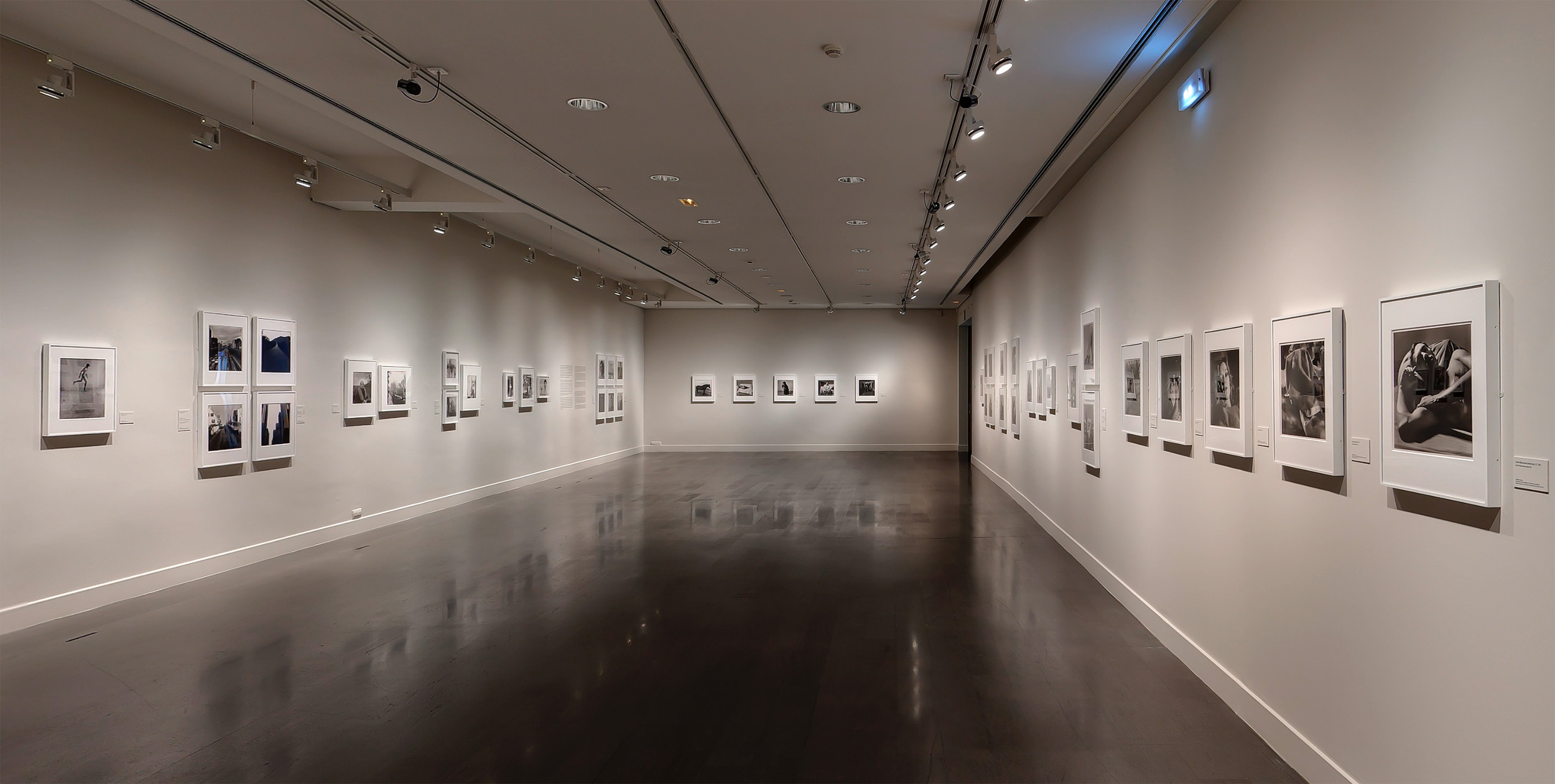
Exhibition: ‘The ’70s Lens: Reimagining Documentary Photography’ at the National Gallery of Art, Washington

Exhibition dates: 6th October, 2024 – 6th April, 2025

 Curator: Andrea Nelson, associate curator in the department of photographs, National Gallery of Art
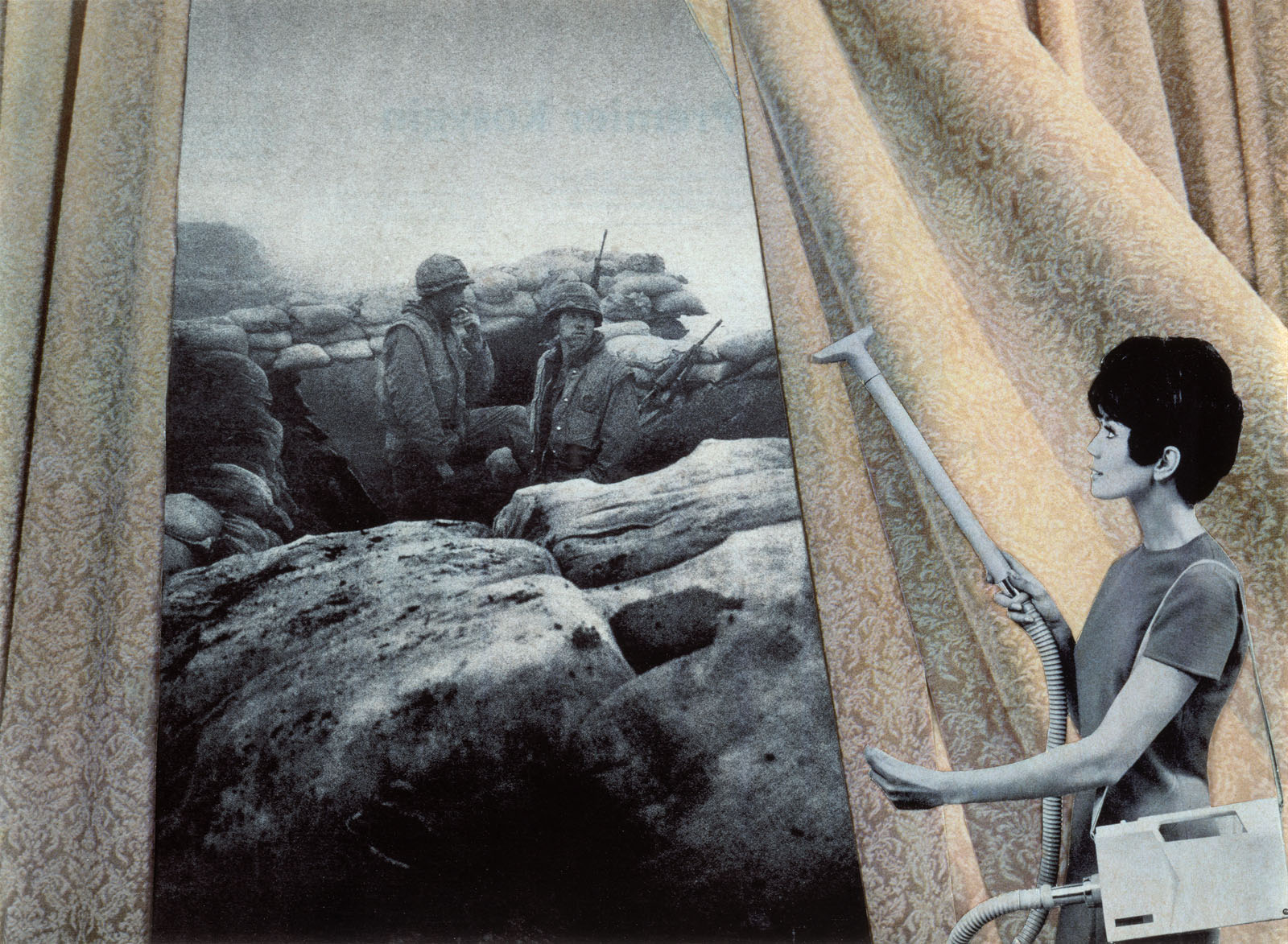
 

Martha Rosler (American, b. 1943) 'Cleaning the Drapes', from the series, 'House Beautiful: Bringing the War Home' 1967-1972 from the exhibition 'The '70s Lens: Reimagining Documentary Photography' at the National Gallery of Art, Washington


Martha Rosler (American, b. 1943)
Cleaning the Drapes
1967-1972, printed 2007
From the series House Beautiful: Bringing the War Home
Inkjet print
Image: 44.2 x 60.4cm (17 3/8 x 23 3/4 in.)
National Gallery of Art
Gift of the Collectors Committee and Pepita Milmore Memorial Fund


Martha Rosler originally distributed photocopies from this series, House Beautiful: Bringing the War Home, as flyers at anti – Vietnam War demonstrations. She made the original photomontages by combining gritty news photographs of fighting in Vietnam with homerelated advertisements culled from glossy women’s magazines. Here Rosler paired a woman cleaning patterned drapes with two tired soldiers smoking amid rocks and sandbags. The woman’s vacuum wand points to and echoes the soldiers’ rifles. The jolting collision of war imagery and affluent domestic space gives visual form to the description of the conflict as “the living room war” – so called because it appeared on television news nightly.

Wall text from the exhibition


“Ce n’est pas une pipe mais de la photographie, sous toutes ses formes variables et multivalentes”


René Magritte’s 1929 painting Ceci n’est pas une pipe is also known as La Trahison des images … The Treachery of Images.

Treachery – the betrayal of trust – is an apposite word in relation to photography of the 1970s. Finally, once and for all, documentary photography in America broke free of the West Coast fine art photography tradition of mainly white male artists and the “aura” of the fine art print (Walter Benjamin). Photography betrayed the trust placed in the authenticity of the image and its link to the “truth” of reality represented in the photograph to become a medium of variability, in concept, execution and outcome. Photography became whatever you wanted it to be.

Documentary photography and its link to the reality of the referent – its assumed representation of a truth that existed in reality – began to be subsumed into the whole of photography, just part of a conceptual, art, performative, staged, street, cameraless, documentary, fashion, photojournalist, activist, amoebic (from the Greek ἀμοιβή amoibe, meaning “change”), and viral (Paul Virilio) medium.

Photography had always been a medium of communication but now became multi-perspectival – whether that be imaginings of the mind relayed through photographs, conceptual ideas about the world and how we interact with it created and staged through photographs, or new colour photography that challenged the orthodoxy of fine art black and white West Coast American photography.

As Anne-Marie Willis observes on the On This Date In Photography website, “any curator who would challenge the orthodox Beaumont Newhall-style photo history limited to images that are distinctively photographic, aesthetic, and “Straight” … would open a Pandora’s box full of photographs pervasive across so many fields, of such limitless subject matters, and crossing so many disciplines that their histories in photography would be obscured.”1

This is the alleged treachery of multi-perspectival photography, the betraying of photographic histories that stretched back to the beginnings of the medium… but it had to be done for photography to fully open itself up to the imaginings of the human and the media flows of the world. “It was a time when photography challenged the art photography norm: photography should not, could not be restricted to what was considered ‘art’.”2

Thus, it is a great joy to see photographs from this stimulating exhibition, photographs that challenge the established “norm” of what photography should be. But what is surprising to me when looking at the complete list of photographs in this exhibition is the important artists who changed the face of photography in the 1970s who are not represented at all or only have one or two images on show:

Gordon Parks 0
Garry Winogrand 1
Lee Friedlander 2
Diane Arbus 1
Robert Mapplethorpe 0
Robert Heinecken 0
Richard Avedon 0
Andy Warhol 1 Polaroid
Cindy Sherman 0
Barbara Kruger 0
Nan Goldin 1
Stephen Shore 1

Diane Arbus, who was instrumental in changing portrait photography at the time, only has one photograph in the exhibition; Barbara Kruger and Robert Heinecken, both “para-photographers” whose work stood “beside” or “beyond” traditional ideas associated with photography have none; Stephen Shore who, along with William Eggleston, was responsible for making colour photography acceptable in art photography has only one photograph.

But most surprisingly of all, Cindy Sherman whose Untitled Film Stills were made predominantly between 1977-1980 and who casts herself as clichés or feminine types, becoming both the artist and subject in the work … is not there at all. Her loss, her evisceration, and the absence of “arguably one of the most significant bodies of work made in the twentieth century and thoroughly canonized by art historians, curators, and critics,”3 is unfathomable.

Dr Marcus Bunyan


1/ Anne-Marie Willis quoted in Dr James McArdle. “DECEMBER 14: CONTEXT,” on the On This Date In Photography website 15/12/2019 [Online] Cited 26/02/2025

2/ Ibid.,

3/ Exhibition Catalogue, New York, Museum of Modern Art, Cindy Sherman, 2012, p. 18 quoted in the “Untitled Film Stills” page on the Wikipedia website


Many thankx to the National Gallery of Art for allowing me to publish the photographs in the posting. Please click on the photographs for a larger version of the image.


Martha Rosler (American, b. 1943)
'Roadside Ambush' 1967-1972 from the exhibition 'The '70s Lens: Reimagining Documentary Photography' at the National Gallery of Art, Washington


Martha Rosler (American, b. 1943)
Roadside Ambush
1967-1972, printed 2007
Inkjet print
Image/sheet: 50.8 x 61cm (20 x 24 in.)
National Gallery of Art
Gift of the Artist and Mitchell-Innes and Nash


Rosler originally distributed photocopies of House Beautiful: Bringing the War Home at anti–Vietnam War demonstrations. “I saw House Beautiful not as art,” she later reflected. “I wanted it to be agitational.” The artist created the original photomontages, from which these collages are derived, by combining news photographs of scorched battlefields in Vietnam with glossy advertisements for US homes, layering images of soldiers within cut-out silhouettes of men from polo-shirt advertisements; and splicing pictures of soldiers’ burials with those of military marches. By tying the destruction abroad to untroubled affluence at home, Rosler gave visual form to the description of the conflict as “the living-room war” – so called because it was the first war to be televised.

MoMA gallery label from 2024


The exhibition The ’70s Lens: Reimagining Documentary Photography examines how new approaches to documentary photography that emerged during the 1970s reflected a radical shift in American life – and in the medium itself.

The 1970s was a decade of uncertainty in the US – soaring inflation, energy crises, the Watergate scandal, and protests about pressing social issues – and the profound upheaval that rocked the country formed the backdrop for a revolution in documentary photography. Now on view at @ngadc, The ’70s Lens: Reimagining Documentary Photography explores this compelling and contested moment of reinvention when the genre’s association with objectivity and truthfulness came into question. Featuring works from over eighty artists, the exhibition delves into how the camera was used to examine life in the US from a diverse range of perspectives, and in doing so, transformed the practice of documentary photography.


The ’70s Lens: A Conversation with Anthony Hernandez

Artist Anthony Hernandez discusses 50 years of work with curator Andrea Nelson on October 24, 2024. The conversation celebrates the exhibition The ’70s Lens: Reimagining Documentary Photography (October 2024 – April 2025).

Anthony Hernandez (b. 1947, Los Angeles, California) has crafted a richly varied oeuvre, ranging from a distinctive style of black-and-white street photography to colour photographs of abstracted details of his surroundings. Much of Hernandez’s work focuses on his native Los Angeles, revealing a unique insight into the people and landscape of the much-pictured city. Hernandez is a recipient of a Guggenheim Fellowship (2018), the Rome Prize (1999) and has been named a United States Artists Fellow (2009).


William Eggleston (American, b. 1939) 'Memphis' 1969-1970 from the exhibition 'The '70s Lens: Reimagining Documentary Photography' at the National Gallery of Art, Washington


William Eggleston (American, b. 1939)
Memphis
1969-1970, printed 1980
Dye imbibition print
Image: 30.2 x 44.2cm (11 7/8 x 17 3/8 in.)
National Gallery of Art, Corcoran Collection
Gift of Mr. Morris R. Garfinkle
© Eggleston Artistic Trust


Eggleston is celebrated for his use of colour photography, which he began experimenting with in the late 1960s. Eggleston’s 1976 exhibition Colour Photographs, held at the Museum of Modern Art, New York, is considered a pivotal moment in the development of colour photography as a contemporary art form and widely credited with increasing recognition of the medium.

Since first picking up a camera in 1957, Eggleston has photographed his family, friends and the people that he encountered in his everyday life, particularly in his native Memphis. Eggleston is said to find the beauty in the everyday and his work has inspired many present day photographers, artists and filmmakers, including Martin Parr, Sofia Coppola, David Lynch and Juergen Teller.

Text from the National Gallery of Victoria website


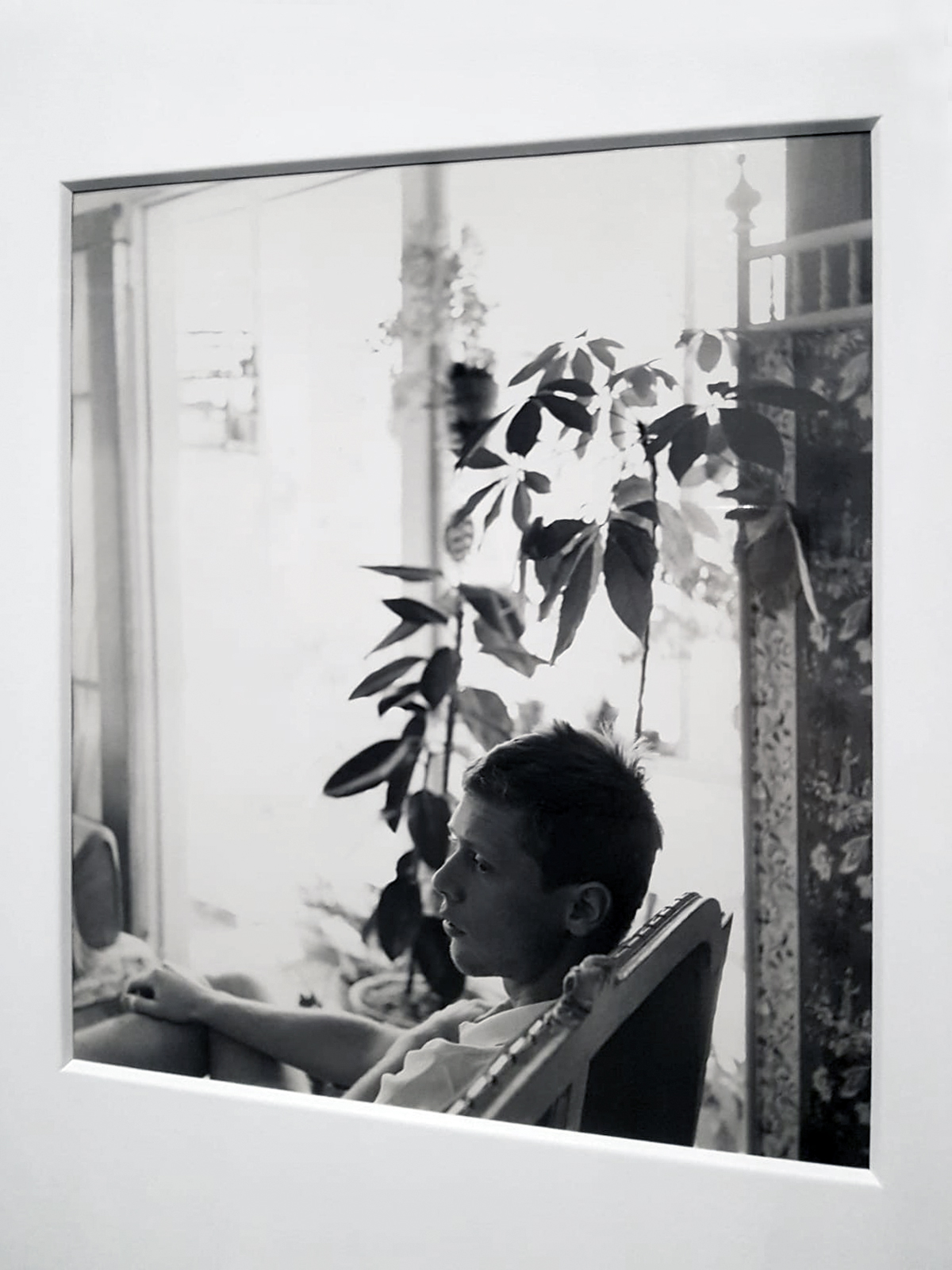
Anthony Friedkin (American, b. 1949) 'Young Man, Troupers Hall, Hollywood' 1969 From the series 'The Gay Essay'


Anthony Friedkin (American, b. 1949)
Young Man, Troupers Hall, Hollywood
1969
From the series The Gay Essay
Gelatin silver print
National Portrait Gallery
Gift of Mary and Dan Solomon


In 1969, Anthony Friedkin was only 19 years old when he set out to document the queer communities of San Francisco and Los Angeles. The resulting project, The Gay Essay, is an expressive and nuanced portrait. Friedkin charts various facets of the culture, from street life and protests to parades and drag performances.

Friedkin’s photographs record the beginnings of the gay liberation movement in California. With a respectful intimacy he pictures individuals living true to themselves while defying prevailing social norms.

Wall text from the exhibition
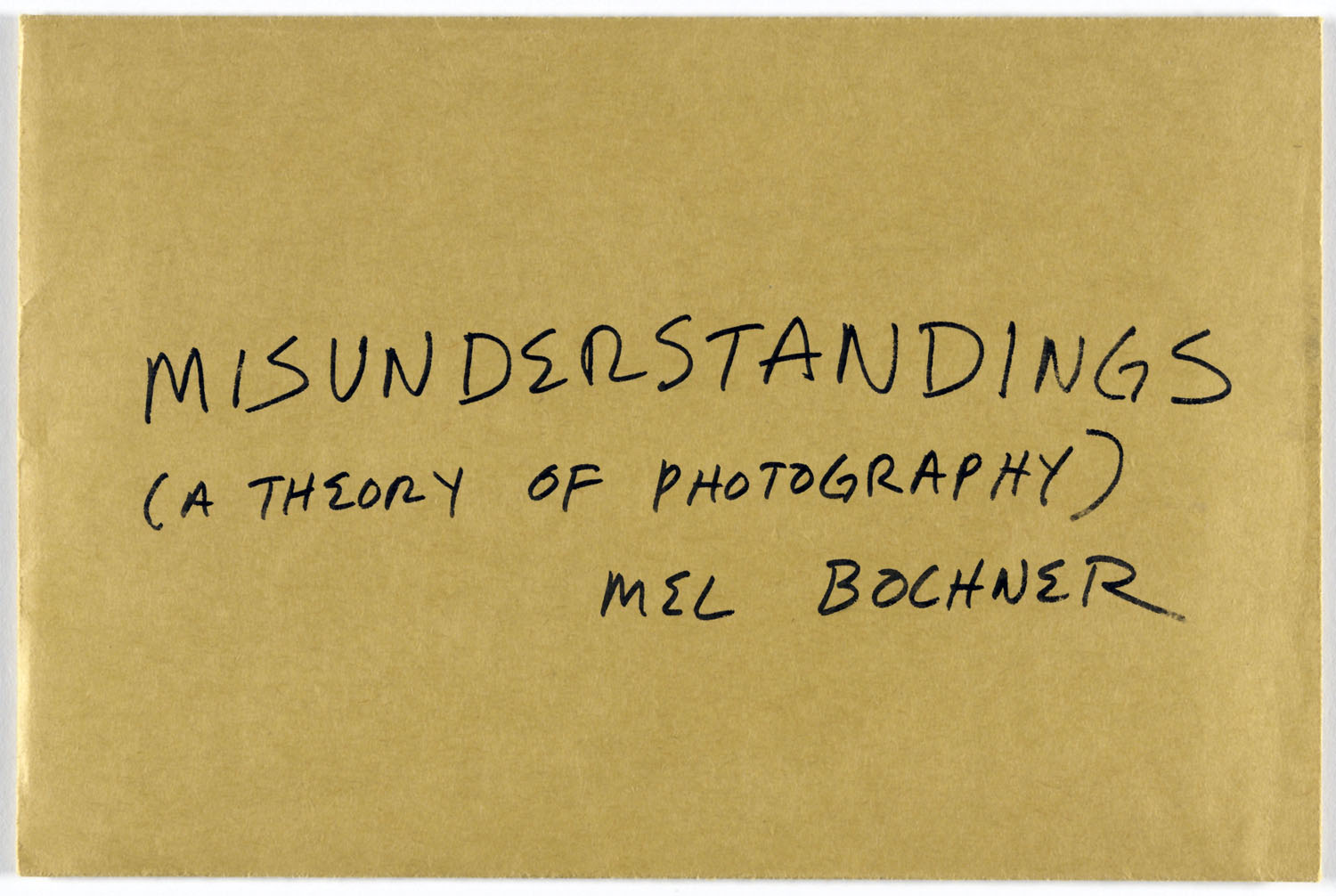
 

Mel Bochner (American, 1940-2025) 'Misunderstandings (A Theory of Photography)' 1970 (detail)


Mel Bochner (American, 1940-2025)
Misunderstandings (A Theory of Photography) (details)
1970
10 offset lithographs on notecards and envelope
Sheet (each): 12.7 x 20.32cm (5 x 8 in.)
National Gallery of Art, Gift of Mary and Dan Solomon


When Mel Bochner started documenting his works of sculpture with a camera, he realised that his practice had “become about photography without [my] wanting it to.” He studied the history of the medium and found conflicting ideas about what photography is or should be. By illustrating these “misunderstandings” with quotes from notable figures and sources, Bochner underscored the gap between a photograph itself and what it purports to represent. He even fabricated three of the quotations, further playing on photography’s tenuous relationship to truth. The photograph of the artist’s hand and forearm is also a misunderstanding: it is much smaller than the actual body part it depicts. It also appears to be a negative of a Polaroid photograph, but Polaroids exist only as positive prints.

Wall text from the exhibition


Mel Bochner was a key figure in the Conceptual Art movement of the 1960s and 70s. Bochner was part of a group of artists who challenged the traditional notion of art as a physical object to be admired for its aesthetic qualities and instead sought to explore the ideas and concepts behind the object, often using language and text as their medium.

Bochner’s early works were influenced by his interest in mathematics and logic, which he applied to create intricate geometric patterns. As his practice evolved, he incorporated language and words into his artwork, exploring the relationship between language, thought, and perception.

Text from the My Art Broker website


Anthony Barboza (American, b. 1944) 'New York City' 1970s from the exhibition 'The '70s Lens: Reimagining Documentary Photography' at the National Gallery of Art, Washington


Anthony Barboza (American, b. 1944)
New York City
1970s
Gelatin silver print
Image/sheet: 23.7 × 16.1cm (9 5/16 × 6 1/4 in.)
National Gallery of Art
Pepita Milmore Memorial Fund


Anthony Barboza’s photography has been integral in shaping the image of Black America. A founding member of the Kamoinge Workshop, a group of Black photographers formed in New York in 1963, Barboza went on to establish a thriving commercial and personal practice focused largely on Black subjects. His affirmative representations of African Americans in daily life – like this photograph of two ultra-stylish men standing in front of a hotel coffee shop in midtown Manhattan – contributed to an empowering narrative for the Black community in the face of inequality and adversity. Describing his approach to making pictures on the street, Barboza commented, “”The photograph finds you, you don’t find the photograph.”

Wall text from the exhibition


Anthony Barboza (American, b. 1944) 'New York City' 1970s from the exhibition 'The '70s Lens: Reimagining Documentary Photography' at the National Gallery of Art, Washington


Anthony Barboza (American, b. 1944)
New York City
1970s
Gelatin silver print
Image: 23.7 × 15.9cm (9 5/16 × 6 1/4 in.)
National Gallery of Art
Pepita Milmore Memorial Fund


Lee Friedlander (United States, b. 1934) 'Hillcrest, New York' 1970 from the exhibition 'The '70s Lens: Reimagining Documentary Photography' at the National Gallery of Art, Washington


Lee Friedlander (American, b. 1934)
Hillcrest, New York
1970
Gelatin silver print
Image: 20.3 x 30.5cm (8 x 12 in.)
National Gallery of Art
Patrons’ Permanent Fund


The fracturing of the image plane, where multiple, diverse realities are represented within one photograph, deconstructing the reality of fine art photography. ~ Marcus


Lee Friedlander’s layered compositions wittily observe connections between American life and commerce. In this dizzying photograph, Friedlander captures himself, at center, in a sideview mirror while at a filling station. In the reflection behind him we see a strip mall with the stores’ signs reversed. Near and far vie for attention and parts of the composition are blocked from our view.

The photograph with a World War I memorial similarly features vertical elements that break up the composition into separate frames. At left, the memorial’s soldier with rifle – who appears to be on guard – goes completely unnoticed as pedestrians make their way along a street full of storefronts.

Wall text from the exhibition


Kenneth Josephson (American, b. 1932) 'Wyoming' 1971 from the exhibition 'The '70s Lens: Reimagining Documentary Photography' at the National Gallery of Art, Washington


Kenneth Josephson (American, b. 1932)
Wyoming
1971
From the History of Photography series
Gelatin silver print
Image: 22.8 x 14.1cm (9 x 5 9/16 in.)
National Gallery of Art
Patrons’ Permanent Fund


Kenneth Josephson’s conceptual photography experiments with playful illusion to explore and question his medium. Josephson was a graduate among the first generation of photography candidates from the Illinois Institute of Design. A student of such masters as Aaron Siskind, Harry Callahan, and Minor White, Josephson went on to teach for 35 years at the Art Institute of Chicago, where he routinely taught the “Introduction to Photography” course as it inspired him to continue experimentation.

“This photograph of a photograph held in space causes the viewer to question assumptions about truthful representation according to size and scale; it also draws attention to the principle that photographic reality is constructed through an artist’s ideas and choices. The subject of the photograph is photography itself, and the ways that life is documented, manipulated, trivialised, and celebrated with photographs.”

Text from the Madison Museum of Contemporary Art website
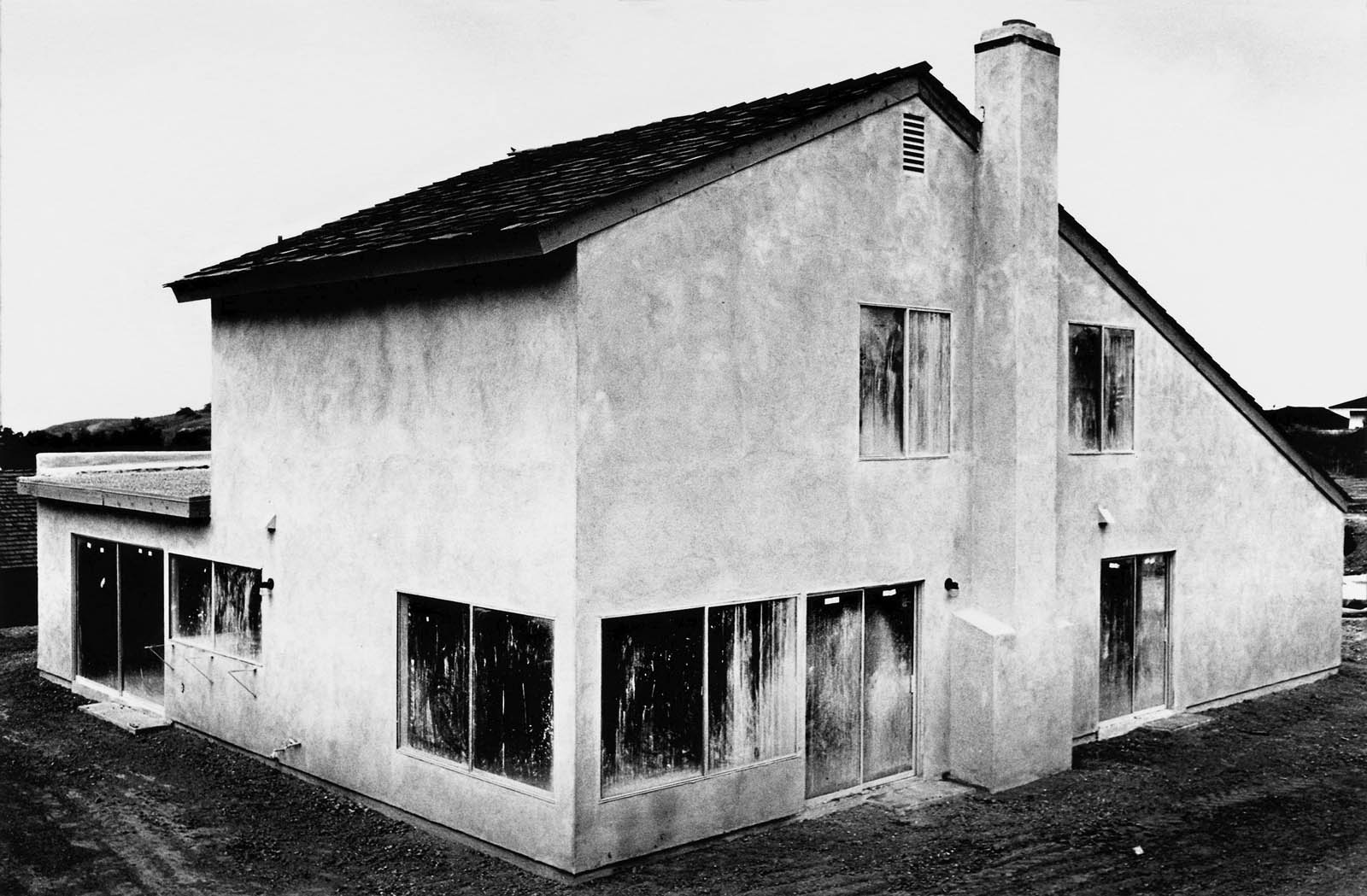
 

Lewis Baltz (American, 1945-2014) 'Tract House #4' 1971 from the exhibition 'The '70s Lens: Reimagining Documentary Photography' at the National Gallery of Art, Washington


Lewis Baltz (American, 1945-2014)
Tract House #4
1971
From the portfolio The Tract Houses
Gelatin silver print
Image/sheet: 14.5 × 22.5cm (5 11/16 × 8 7/8 in.)
National Gallery of Art
Corcoran Collection (Gift of the artist)


Lewis Baltz’s The Tract Houses captures the austere geometry of the shoddily built homes that sprang up in California’s suburban landscape beginning in the mid-1940s. Straight-edge architectural details, positioned strictly parallel to the picture plane, recall the reductive forms of minimalist art. Entire, recently constructed houses appear forlorn. None of the pictures include shadows, clouds, or people. Baltz’s series is a powerful critique of the transformation of the American landscape into an unending terrain of anonymous architecture. At the same time, the exquisitely rendered tones and textured surfaces emphasise the subtle beauty to be found in this bleak environment.

Wall text from the exhibition


With his iconic, minimalist photographs of suburban landscape, Lewis Baltz was at the forefront of a revolutionary shift in the medium of photography. Baltzs work exemplifies the ways in which photography started to loose the bonds of its isolation within its own segregated history and aesthetics and began to take its place among other media. In the late 1960s and early 1970s Baltz became fascinated by the stark, man-made landscape rolling over Californias then still-agrarian terrain. His earliest portfolio, The Tract Houses (1971), and his preliminary forays into a minimal aesthetic, The Prototype Works (1967-1976), illuminate his drive to capture the reality of a sprawling Western ecology gone wild.

Text from the Google Books website


Diane Arbus (American, 1923-1971) 'A young man and his girlfriend with hot dogs in the park' 1971


Diane Arbus (American, 1923-1971)
A young man and his girlfriend with hot dogs in the park
1971
Gelatin silver print
Image: 37.7 x 36.5cm (14 13/16 x 14 3/8 in.)
National Gallery of Art, Corcoran Collection
Gift of Stephen G. Stein


Diane Arbus prowled New York’s public spaces looking for humor and strangeness in the everyday. Here a young couple walks in Central Park, wearing similar clothes, hairstyles, and dejected expressions. Arbus’s carefully composed but disorienting photograph – the subjects are in crisp focus while the background is blurred – compels us to look anew at the familiar. Is this couple unhappy in love or expressing the uncertainty of the times? Arbus made this photograph the year she died. Her influence on documentary photography would continue through the decade.

Wall text from the exhibition


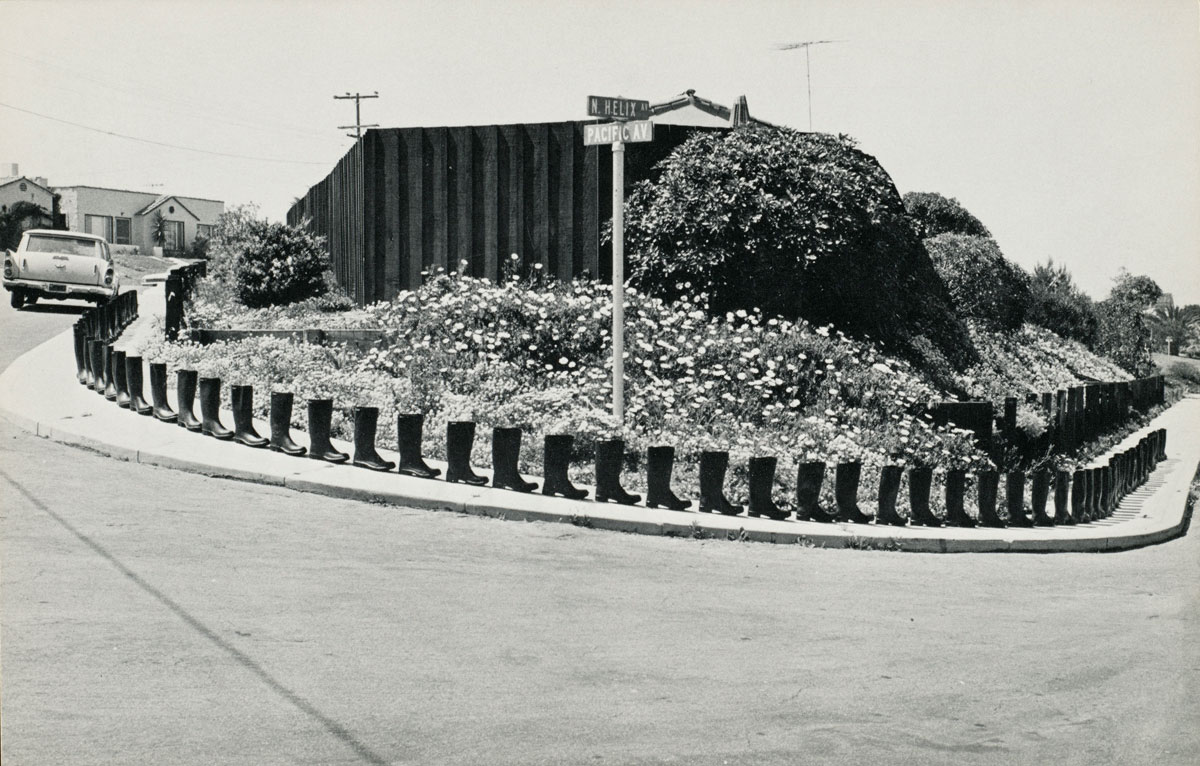
Eleanor Antin (American, b. 1935), Philip Steinmetz (American, 1944-2013) (photographer). '100 Boots' 1971-1973 (detail)


Eleanor Antin (American, b. 1935)
Philip Steinmetz (American, 1944-2013) (photographer)
100 Boots (details)
1971-1973
51 halftone prints (postcards)
image/sheet (each): 11.5 x 17.75cm (4 1/2 x 7 in.)
National Gallery of Art
Pepita Milmore Memorial Fund


In this epic visual narrative, black rubber boots stand in for a fictional hero traveling from California to New York City. Eleanor Antin created temporary installations with the boots, had them photographed (by Philip Steinmetz), and made 51 postcards, copies of which she mailed to approximately 1,000 people and institutions involved in the arts. The journey starts at a Bank of America and ends at Central Park – after a visit to the Museum of Modern Art, where the boots and a set of postcards and photographs were later exhibited. Using the postal service, Antin bypassed the traditional gallery system, which had long overlooked women artists. While many of these scenes are humorous, the empty army boots also recall the Vietnam War and the soldiers who did not come home.

Wall text from the exhibition


100 Boots, 1971-1973

For her 51-piece instalment 100 Boots Eleonor Antin positioned one hundred ordinary black rubber boots on various locations all over Southern California and consequently in New York City. She took photos, printed them on postcards and assembled a mailing list of about a thousand names – mainly artists, writers, critics, galleries, universities and museums – who received the various postcards over a period of two and a half years between 1971 and 1973. The first card, 100 Boots Facing the Sea, was mailed on the Ides of March, 1971, unannounced and without further comment. A few weeks later it was followed by 100 Boots on the Way to Church and three weeks thereafter by the next one.

In a total of 51 photographs, Eleanor Antin documented the travels of the 100 Boots, her so called “hero” – from a beach close to San Diego to a church, to a bank, to the supermarket, trespassing, under the bridge, to a saloon and on their travels eastward. Finally, on May 15th, 1973 100 Boots arrived at the Museum of Modern Art in New York. By this time, 100 Boots had long become an epic visual narrative and a picaresque work of conceptual art.

Text from the exhibition open spaces | secret places: composite works from the collection at Museum Der Moderne Salzburg, October 2012 – March 2013
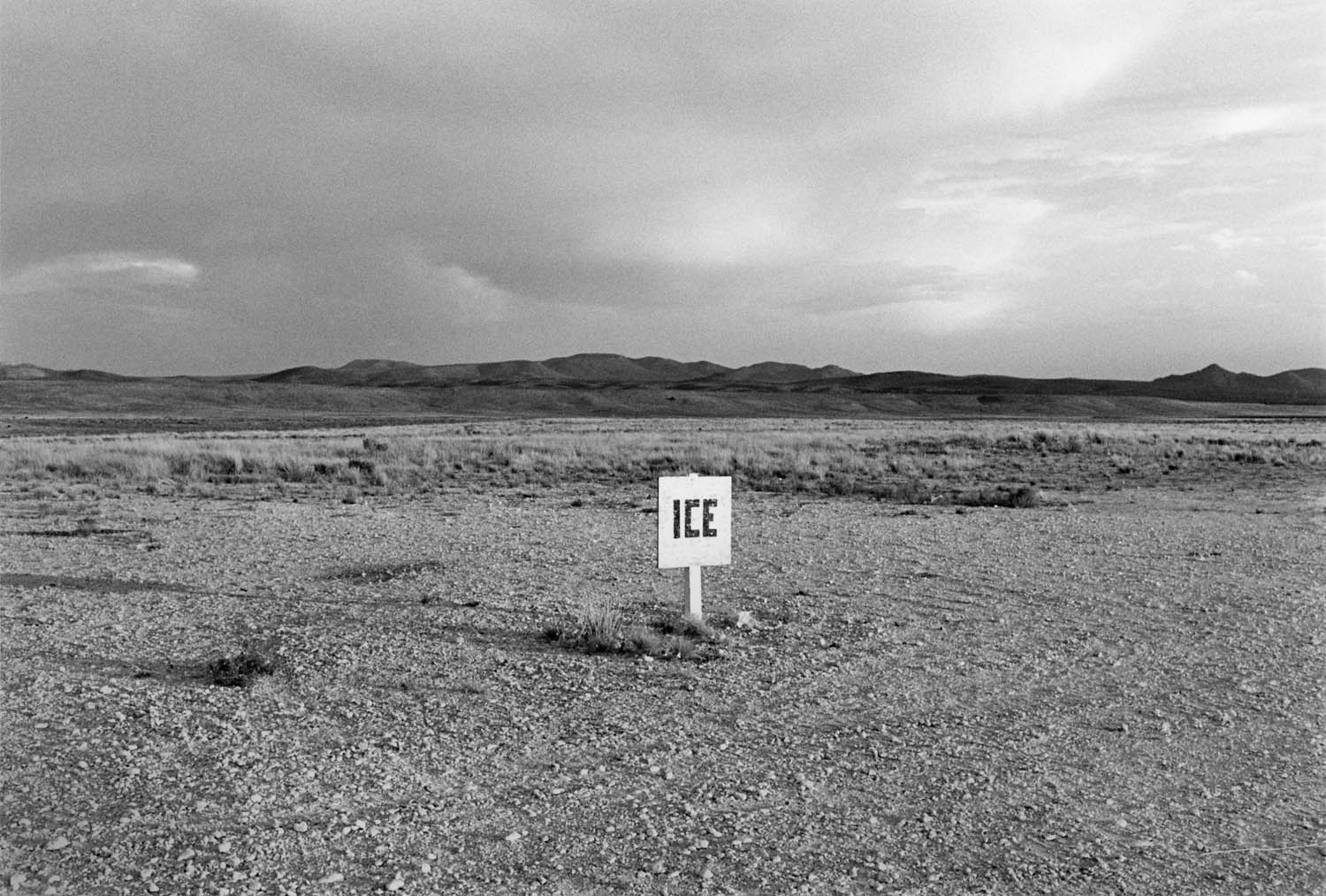
 

Henry Wessel (American, 1942-2018) 'Walapai, Arizona' 1971


Henry Wessel (American, 1942-2018)
Walapai, Arizona
1971
Gelatin silver print
Image: 26.51 x 39.85cm (10 7/16 x 15 11/16 in.)
National Gallery of Art
Gift of Mary and Dan Solomon and Patrons’ Permanent Fund


In 1975 New Topographics: Photographs of a Man-Altered Landscape opens at the International Museum of Photography in Rochester, N.Y. It includes photographs by Robert Adams, Lewis Baltz, Bernd and Hilla Becher, Joe Deal, Frank Gohlke, Nicholas Nixon, John Schott, Stephen Shore, and Henry Wessel Jr.

“Henry Wessel began taking photographs while majoring in psychology at Pennsylvania State University in the mid-1960s. Travel throughout the United States in subsequent years led him to direct his gaze increasingly to details of human interaction with the natural and man-made environment. Wessel’s move to the West Coast in the early 1970s inspired him to incorporate light and climate into his work. His inclusion in the seminal exhibition New Topographics: Photographs of a Man-Altered Landscape, organised in 1975 by the George Eastman House in Rochester, New York, solidified his reputation as a keen observer of the American topography.”

Text from Pacific Standard Time at the Getty


John Simmons (American, b. 1950)
'Will on Chevy, Nashville, Tennessee'
1971, printed 2024


John Simmons (American, b. 1950)
Will on Chevy, Nashville, Tennessee
1971, printed 2024
Gelatin silver print
Image: 30.48 x 20.32cm (12 x 8 in.)
National Gallery of Art
Alfred H. Moses and Fern M. Schad Fund


A fashionably dressed older man crosses the street with his umbrella. A young woman turns to look at the camera while holding hands with a man in uniform. These were people John Simmons encountered while studying art at Fisk University in Nashville. Raised on Chicago’s South Side, Simmons had first published photographs as a teenager in the African American newspaper Chicago Defender. Refuting white-centered media’s failure to show positive imagery of the Black experience, Simmons has focused on people enjoying everyday life.

“I always feel like my subject and I were meant to share that moment together,” he has said. “So many of the pictures I take, it was like our paths were meant to cross.”

Wall text from the exhibition


Simmons began his career at 15 as a photographer for the oldest African American-owned newspaper, The Chicago Daily Defender in 1965. Over his decades long career, he’s photographed icons of the Civil Rights Movement, turbulent protests and demonstrations, famed musicians and poignant intimate moments of everyday life. “I’m glad to see photographs I took back in my teens are still relevant today,” he says.

John Simmons quoted in Steve Simmons. “Photographer John Simmons, ‘Chronicler Of The Civil Rights Movement,’​ Featured In Three Exhibits,” on the Linkedin website August 4, 2021 [Online] Cited 11/09/2021.
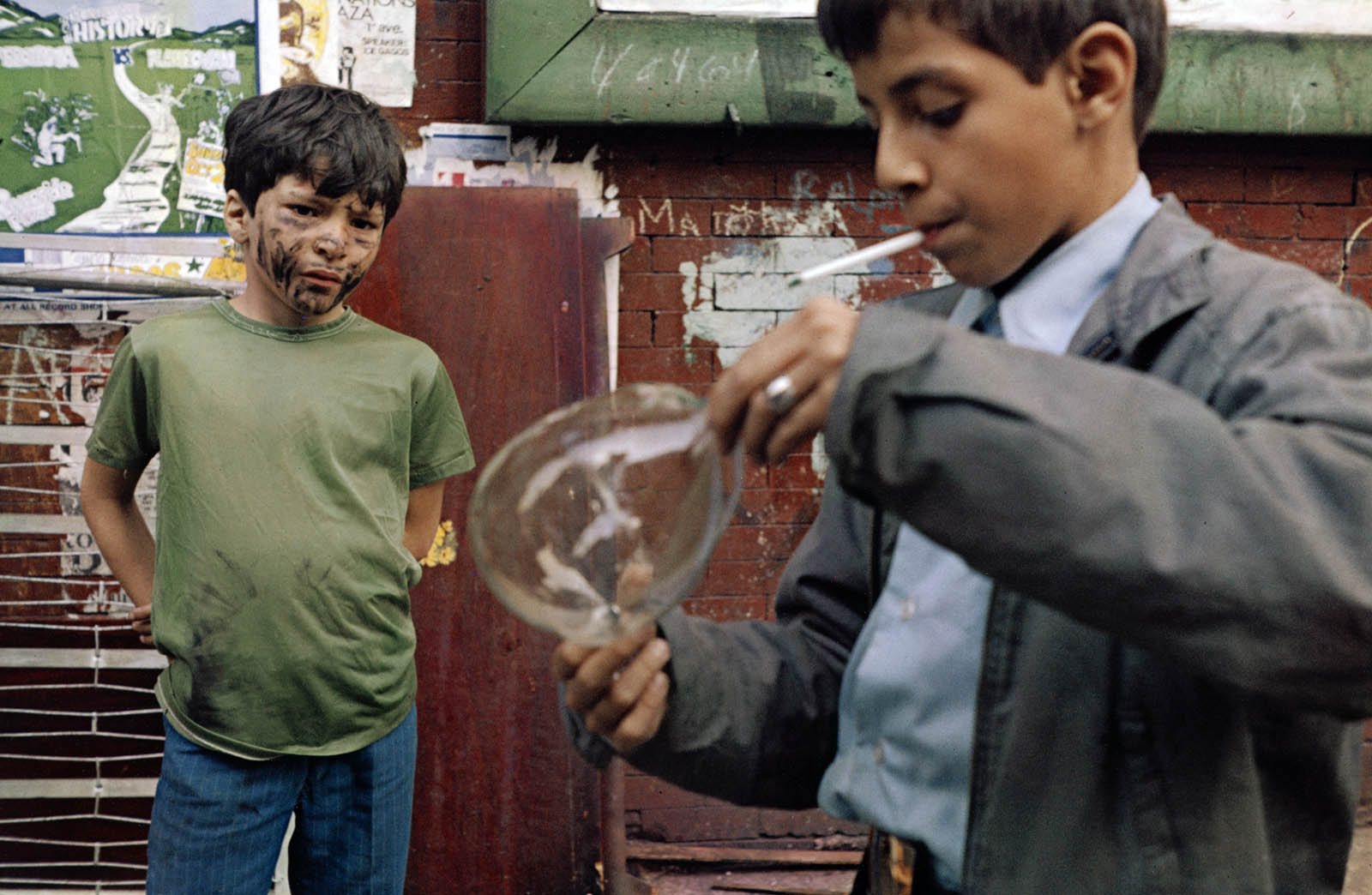
 

Helen Levitt (American, 1913-2009) 'New York' 1972 from the exhibition 'The '70s Lens: Reimagining Documentary Photography' at the National Gallery of Art, Washington


Helen Levitt (American, 1913-2009)
New York
1972
Dye imbibition print
Image: 23.5 x 36cm (9 1/4 x 14 3/16 in.)
National Gallery of Art, Patrons’ Permanent Fund
© Film Documents LLC, courtesy Zander Galerie, Cologne


Helen Levitt frequently made photographs of children on the streets of New York City, exploring their relationships to the urban setting as they played, imagined, and discovered together. After decades of working in black and white, Levitt became an early advocate of color documentary photography. Color allowed her to tell a fuller story of everyday life. Here, the green of the boy’s T-shirt is echoed in the poster and frame behind him. “I thought my photographs would be closer to reality if I got the color of the streets,” she said. “Black and white is an abstraction.”

Wall text from the exhibition


Bill Owens (American, b. 1938)
'Ronald Reagan' 1972 from the exhibition 'The '70s Lens: Reimagining Documentary Photography' at the National Gallery of Art, Washington


Bill Owens (American, b. 1938)
Ronald Reagan
1972
From the series Suburbia
Gelatin silver print
Image: 16.4 x 21.6cm (6 7/16 x 8 1/2 in.)
National Gallery of Art
Patrons’ Permanent Fund


Over the course of a year, Bill Owens made photographs of the housing developments that had recently sprung up outside of Oakland and San Francisco. With an eye to humor, he captured the apparent conformity and materialism of the new suburbs. Here, a home is decorated for Christmas. At center, Nativity figures sit atop a television console showing an old film featuring Ronald Reagan, who had been a movie actor before becoming a politician. Owens also respected the liberation that many suburbanites felt, as well as their determination to build better lives. In his book Suburbia (1972), he included quotations from his subjects describing the opportunities and challenges they faced in their new environments.

Wall text from the exhibition


Owens began his photographic career in the late 1960s as a staff photographer for a local newspaper in Livermore, California. During this period, he began his most noteworthy project, “Suburbia,” which would become a major body of work in American documentary photography.

“Suburbia” was published as a book in 1973, featuring Owens’ images and conversations with suburban dwellers. The project’s goal was to investigate the goals, aspirations, and inconsistencies of suburbia life, offering a critical yet sympathetic study of the American Dream.

Owens’ images depicted scenes of backyard barbecues, family gatherings, children at play, and the myriad rituals and social interactions that constituted suburban areas. He highlighted both the humor and the underlying intricacies of suburban life through his good observation and direct attitude.

What distinguished Owens’ work was his ability to see past the surface and capture the soul of his subjects. His images conveyed a sense of realism by portraying suburbanites in their natural settings and enabling their tales to flow through genuine moments captured in time.

Owens’ art struck a chord with a large audience because it highlighted a huge societal transition in America during the 1970s. Owens’ images challenged the idealized image of suburban life by exposing the hardships, wants, and inconsistencies inherent in the pursuit of the American Dream.

Anonymous. “Bill Owens,” on the Photo.com website Nd [Online] Cited 06/20/2025


William Eggleston (American, b. 1939) 'Sumner, Mississippi, Cassidy Bayou in the Background' c. 1972


William Eggleston (American, b. 1939)
Sumner, Mississippi, Cassidy Bayou in the Background
c. 1972, printed 1986
Dye imbibition print
Image: 27.94 x 43.18cm (11 x 17 in.)
National Gallery of Art
Gift of Stephen G. Stein
© Eggleston Artistic Trust


See how documentary photography transformed during the 1970s.

The 1970s was a decade of uncertainty in the United States. Americans witnessed soaring inflation, energy crises, and the Watergate scandal, as well as protests about pressing issues such as the Vietnam War, women’s rights, gay liberation, and the environment. The country’s profound upheaval formed the backdrop for a revolution in documentary photography. Activism and a growing awareness and acceptance of diversity opened the field to underrepresented voices. At the same time, artistic experimentation fueled the reimagining of what documentary photographs could look like.

Featuring some 100 works by more than 80 artists, The ’70s Lens examines how photographers reinvented documentary practice during this radical shift in American life. Mikki Ferrill and Frank Espada used the camera to create complex portraits of their communities. Tseng Kwong Chi and Susan Hiller demonstrated photography’s role in the development of performance and conceptual art. With pictures of suburban sprawl, artists like Lewis Baltz and Joe Deal challenged popular ideas of nature as pristine. And Michael Jang and Joanne Leonard made interior views that examine the social landscape of domestic spaces.

The questions these artists explored – about photography’s ethics, truth, and power – continue to be considered today.

Text from the National Gallery of Art


Lee Friedlander (American, b. 1934)
'Doughboy. Stamford, Connecticut' 1973


Lee Friedlander (American, b. 1934)
Doughboy. Stamford, Connecticut
1973
Gelatin silver print
Image: 17.8 x 27cm (7 x 10 5/8 in.)
National Gallery of Art
Robert B. Menschel Fund
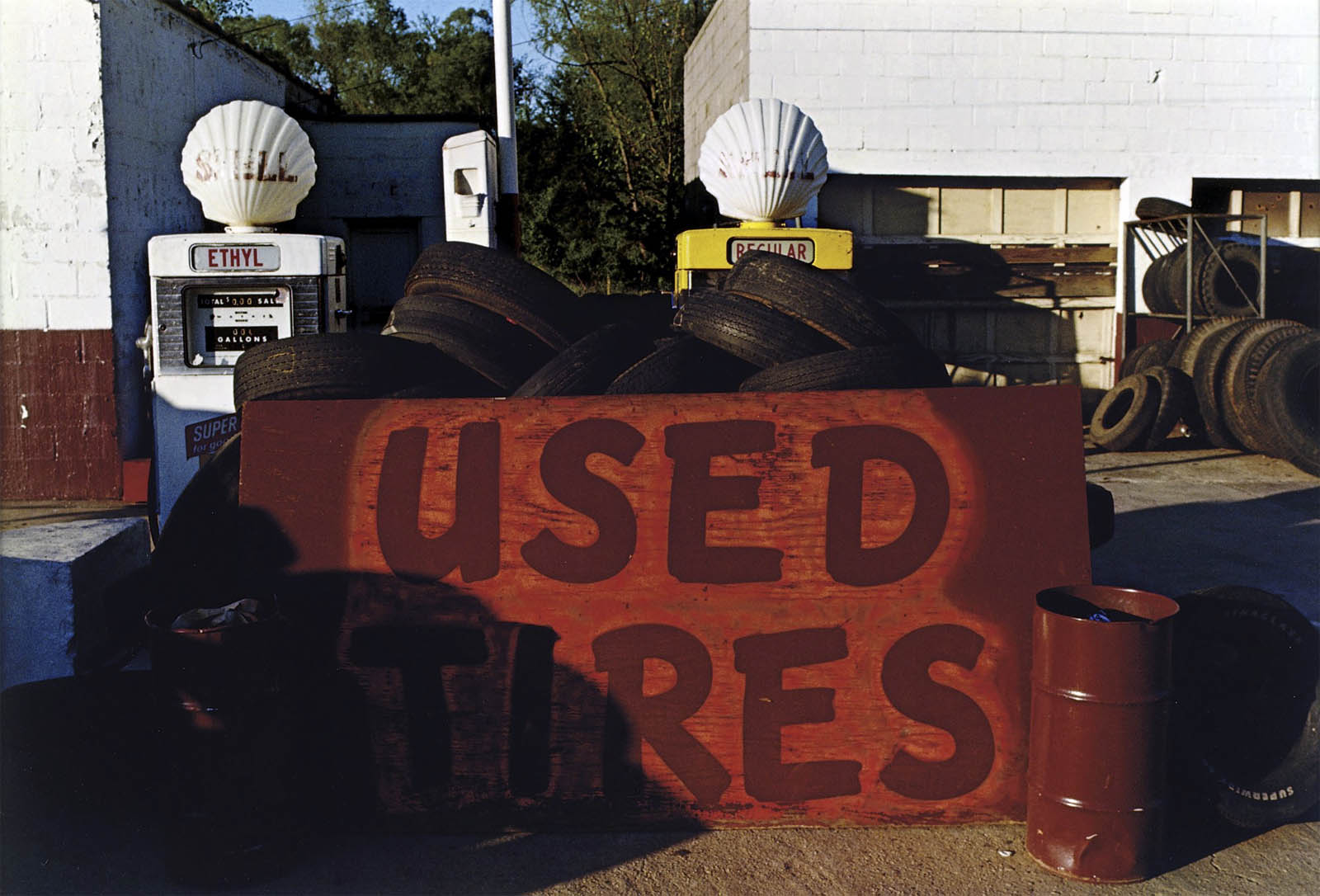
 

William Eggleston (American, b. 1939) 'Used Tires' 1973


William Eggleston (American, b. 1939)
Used Tires
1973
Dye imbibition print
Image: 33 x 48.5cm (13 x 19 1/8 in.)
National Gallery of Art
Patrons’ Permanent Fund
© Eggleston Artistic Trust
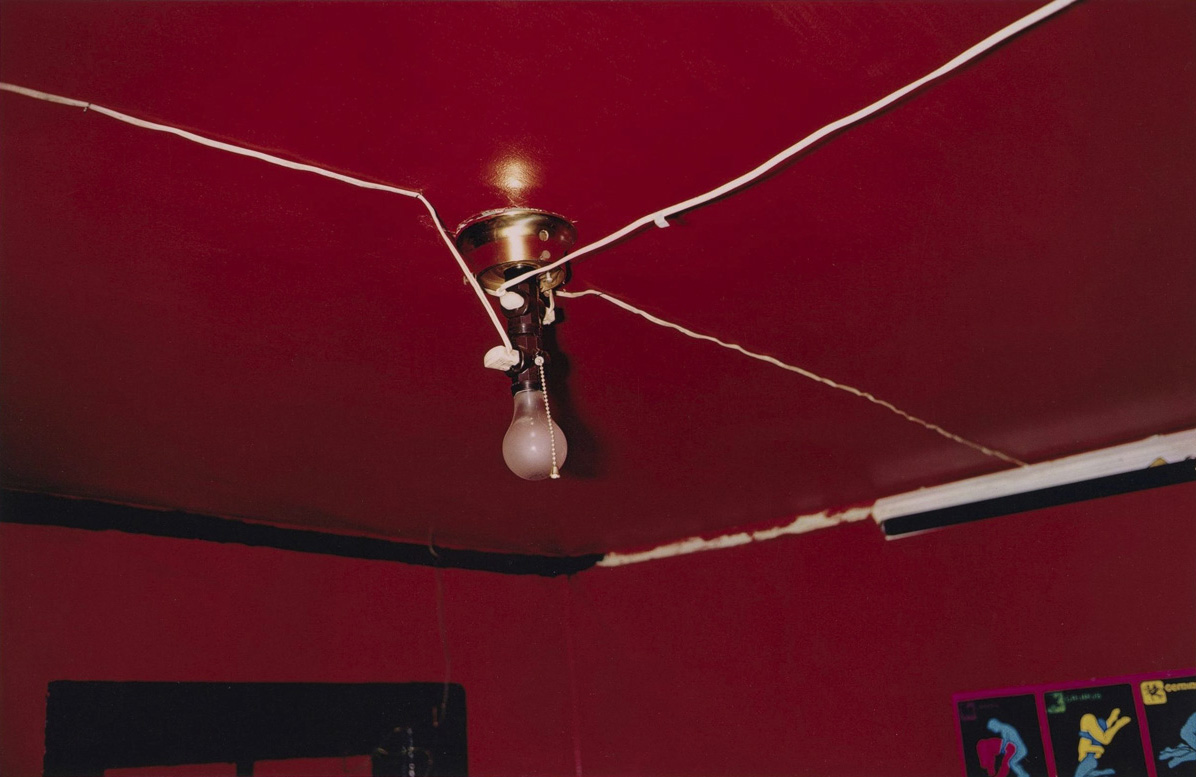
 

William Eggleston (American, b. 1939) 'Greenwood, Mississippi' 1973


William Eggleston (American, b. 1939)
Greenwood, Mississippi
1973
Dye imbibition print
Image: 32.2 x 48.2cm (12 11/16 x 19 in.)
National Gallery of Art, Corcoran Collection
Gift of the Women’s Committee of the Corcoran Gallery of
Art
© Eggleston Artistic Trust


William Eggleston has said that he has “a democratic way of looking around,” where nothing is more important or less important. For him, everyday subjects are not boring but instead offer visual richness. Here, that richness has a pronounced edge. Eggleston directed his lens up to a red ceiling with a single bare lightbulb at center. We glimpse only the top of a doorframe and a fragment of an explicit poster. The saturated, bloodlike color that dominates the composition is shocking, even menacing. It also challenged Eggleston technically as he developed his skills with dye imbibition printing. Commonly known as dye transfer, the process was labor intensive but allowed for customisation and a wide range of colours and tones.

Wall text from the exhibition


Mitchell Epstein (American, b. 1952)
'Massachusetts Turnpike' 1973, printed 2005 from the exhibition 'The '70s Lens: Reimagining Documentary Photography' at the National Gallery of Art, Washington


Mitchell Epstein (American, b. 1952)
Massachusetts Turnpike
1973, printed 2005
From the series Recreation
Chromogenic print
Image: 32.1 x 48.2cm (12 5/8 x 19 in.)
National Gallery of Art
Gift of Timothy and Suzanne Hyde in Honor of the 25th Anniversary of
Photography at the National Gallery of Art
© Black River Productions, Ltd.


Viewers of a certain age will recognize this setting as the parking lot of a Howard Johnson’s restaurant. HoJos, as they were nicknamed, were once ubiquitous along America’s highways. The cheery saturated colors belie the scene’s subject: a couple having a bad travel day. A man in suit and tie works under the hood of a beat-up Chevy Impala. His partner, wearing a pale pink skirt and top, arms crossed, appears frustrated. The cars zooming by seem to mock their immobility. Part of Mitch Epstein’s Recreation series, which documented Americans engaging in leisure activities, the photograph today evokes melancholy and nostalgia. Explaining his early turn to colour film, the artist said, “The world is in color, so why not photograph in color?”

Wall text from the exhibition


I started to work in colour, which was a radical, and some thought foolish, move in 1973. Colour photography was not yet a medium for serious photography – it was used almost exclusively for slick advertising and illustration. Within a month of shooting in colour, though, I wanted to do nothing else…

As I developed, I learned that a photograph is other than the thing itself photographed, and this freed me to think about how I could use photography to fictional effect, even while my pictures were drawn from the real world…

Photography remains a tool with which I form and sharpen my response to the world around me. Anything and everything is photographable in an infinite number of ways. That excites me.

Mitch Epstein in Lewis Blackwell. PhotoWisdom: Master Photographers on Their Art quoted quoted in “Mitch Epstein – Meet The Master Photographer,” on the Milkbooks website Nd [Online] Cited 06/02/2025
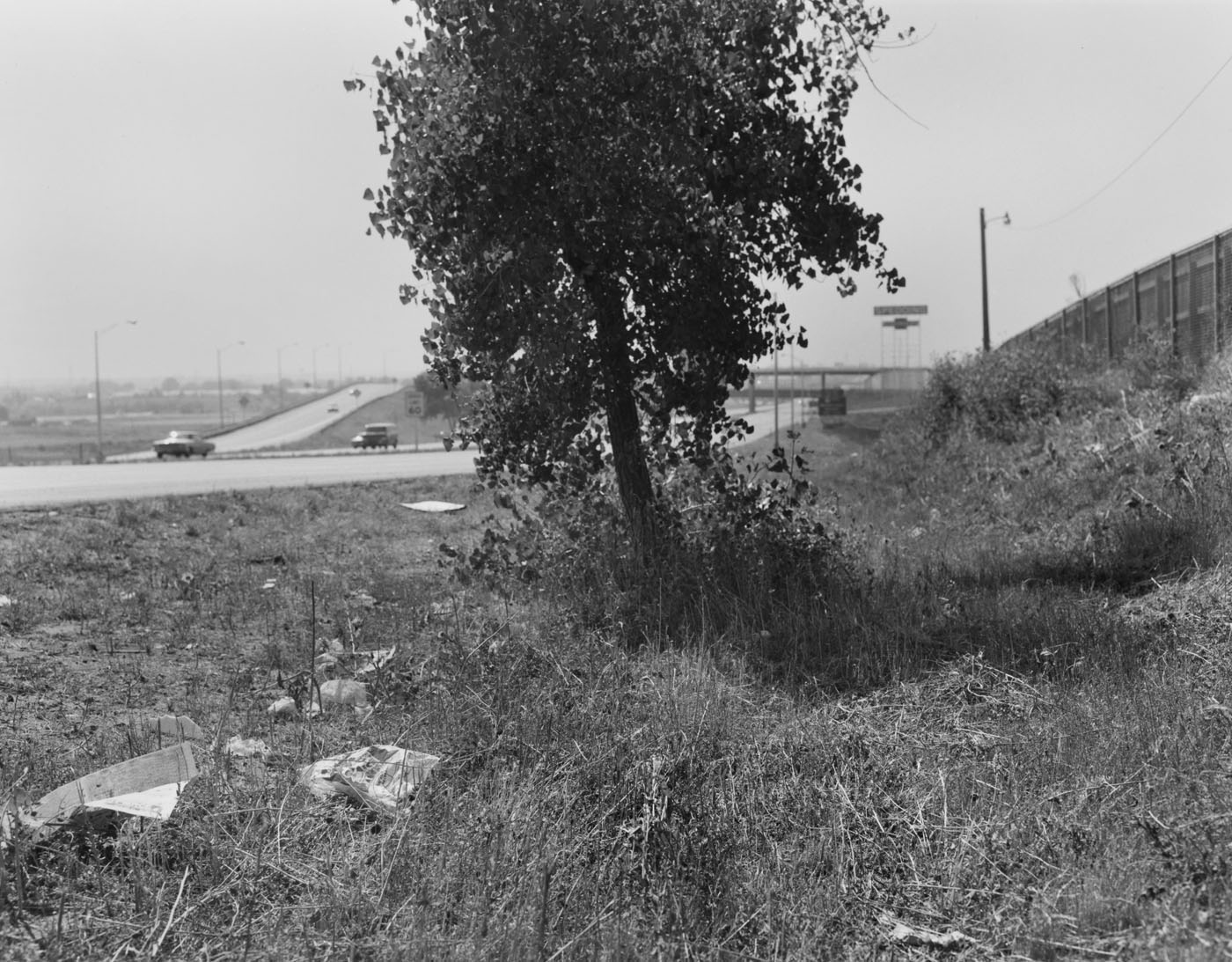
 

Robert Adams (American, b. 1937)
'Interstate 25, Denver, Colorado' 1973


Robert Adams (American, b. 1937)
Interstate 25, Denver, Colorado
1973
Gelatin silver print
Image: 15.2 x 19.3cm (6 x 7 5/8 in.)
National Gallery of Art
The Ahmanson Foundation and Gift of Robert and Kerstin Adams
© Robert Adams, Courtesy Fraenkel Gallery, San Francisco


Adams’ photographic vision is extra ordinary and I cannot fault his individual photographs. I become engrossed in them. I breathe their atmosphere. He has a resolution, both in terms of large format aesthetic, the aesthetic of beauty and of using materials, light and composition… that seems exactly right. He possesses that superlative skill of few great photographers, and by that I mean: sometimes he has true compassion** / parallel to a religious compassion, but not based on something higher / just perfect human. In some of his photographs (such as East from Flagstaff Mountain, Boulder County, Colorado 1975) he possesses real forgiveness, in others there is the perfection of cruel, the perfection of de/composition.

** achieved by Arbus, Atget and sometimes by Clift, Gowin.

And then, each image holds small clues vital to the overall conversation that is the accumulation of his work and it is in their collective accumulation of meaning that Adams’ photographs grow and build to shatter not just the American silence on environmental issues, but the deafening silence of the whole industrialised world. In their holistic nature, Adams’ body of work becomes punctum and because of this his work produces other “things”, things as great as anything the French literary theorist, essayist, philosopher, critic, and semiotician Roland Barthes wrote about. As in Barthes’ seminal work Camera Lucida, Adams’ work reminds us that the “photograph is evidence of ‘what has ceased to be’. Instead of making reality solid, it reminds us of the world’s ever changing nature.”1

Marcus Bunyan. “The quiet of the great beyond,” on the exhibition American Silence: The Photographs of Robert Adams at the National Gallery of Art, Washington, May – October 2022 on Art Blart: art and cultural memory archive website, September 25, 2022 [Online] Cited 06/02/2025

1/ Anonymous. “Roland Barthes,” on the Wikipedia website Nd [Online] Cited 23/09/2022


Michael Jang (American, b. 1951)
'Study Hall' 1973 from the exhibition 'The '70s Lens: Reimagining Documentary Photography' at the National Gallery of Art, Washington


Michael Jang (American, b. 1951)
Study Hall
1973
Gelatin silver print
15.5 × 23.5cm (6 1/8 × 9 1/4 in.)
National Gallery of Art
Charina Endowment Fund


In Study Hall, Michael Jang’s extended family sits together on a couch reading comics and a television guide, a messy tray of Kraft Teez Dip and potato chips on the table in front of them. The covers of the decidedly not studious publications block their faces, becoming stand-ins for their portraits. In Aunts and Uncles (nearby), relatives are caught joking around while posing for an official family portrait in silly sunglasses.

Jang’s humorous photographs of his Chinese American family and the trappings of their suburban lives offer a refreshing take on the often staid genre of family portraiture. They also debunk the 1970s stereotype – think The Brady Bunch – that the “all-American” family could only be white.

Wall text from the exhibition


In his series The Jangs, Michael Jang photographed family at home. His humorous photographs of their suburban lives expanded the concept of the “all-American” family – the Chinese American Jangs didn’t look like The Brady Bunch.

In Study Hall, Jang’s cousins and aunt sit together on a couch reading comics and a television guide, a messy tray of potato chips and dip on the table in front of them. The covers of decidedly not studious publications block their faces, becoming stand-ins for their portraits.

Jang’s delightful series was almost entirely forgotten. The photographs, which he had first made while a student, sat in a box in the artist’s house for decades while he established a career as a commercial photographer.

In the 2000s, Jang reconsidered this series and shared it with museums, which began adding the photographs to their collections. His photographs took on a new light in the wake of a rise of anti-Asian hate during the COVID-19 pandemic. In 2021, Jang wheat pasted images from The Jangs on buildings in San Francisco’s Chinatown.

Text from the National Gallery of Art website
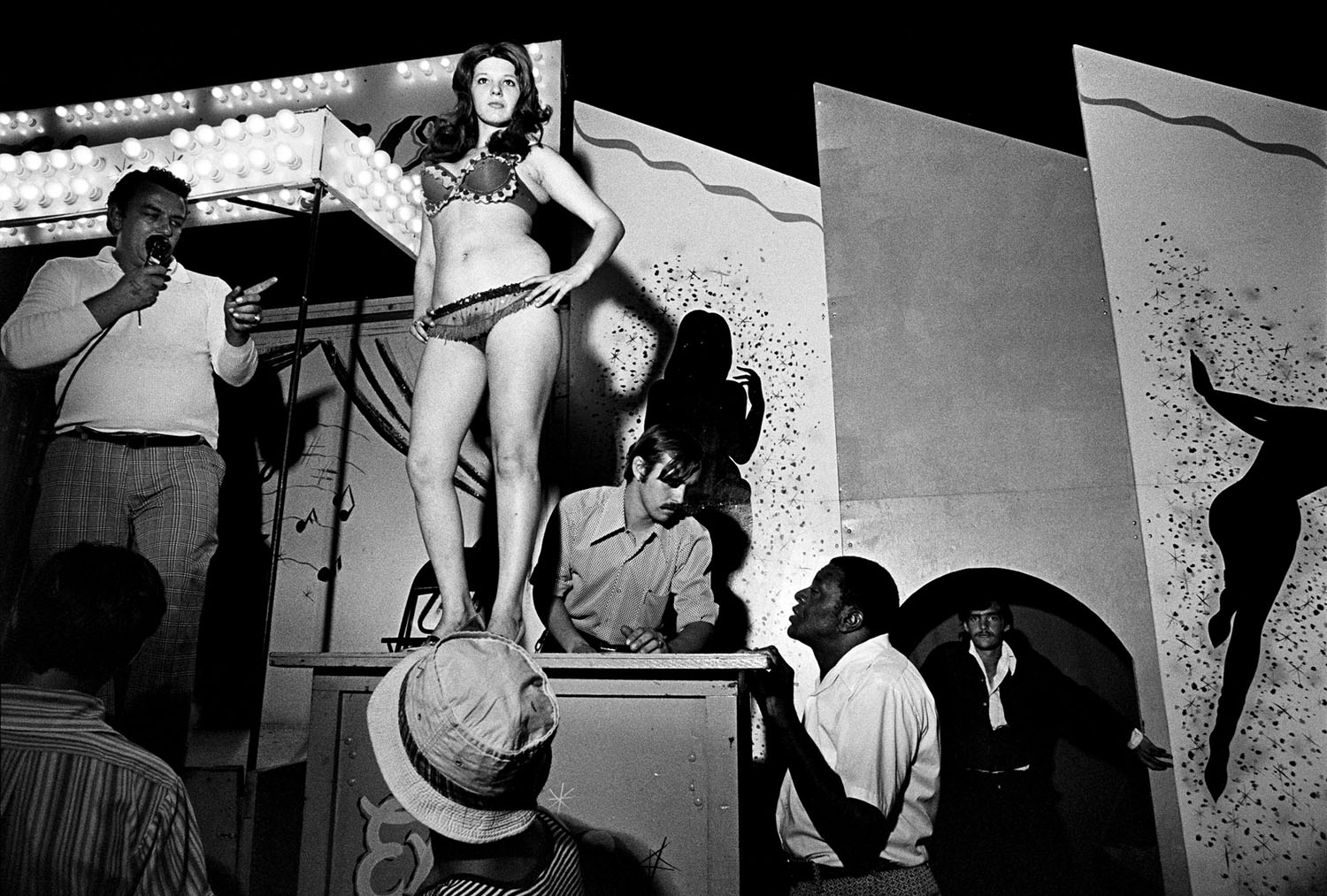
 

Susan Meiselas (American, b. 1948)
'Lena on the Bally Box, Essex Junction, Vermont' 1973


Susan Meiselas (American, b. 1948)
Lena on the Bally Box, Essex Junction, Vermont
1973
Gelatin silver print
Image: 22 x 32.5cm (8 11/16 x 12 13/16 in.)
National Gallery of Art
Anonymous Gift in honor of Sarah Greenough and Andrea Nelson


The final and most essential selection in this posting – Susan Meiselas’ 1972-1975 Carnival Strippers series – goes behind the “front” to document the lives of women who performed striptease for small-town carnivals in New England, Pennsylvania and South Carolina. “Meiselas’ frank description of these women brought a hidden world to public attention, and explored the complex role the carnival played in their lives: mobility, money and liberation, but also undeniable objectification and exploitation. Produced during the early years of the women’s movement, Carnival Strippers reflects the struggle for identity and self-esteem that characterised a complex era of change.” (Booktopia)

Intense, intimate and revealing, the series proves that we can think we know something (the phenomenal) and yet photography reveals how strange and different each world is – whether that be in trying to understand the mind of the artist and what they intended in a constructed photograph or, in this case, having an impression of someone else’s life, a life we can perceive (through the “presence” of the photograph) but never truly know (the noumenal).

Marcus Bunyan on the exhibition Known and Strange: Photographs from the Collection at the V&A Photography Centre on the Art Blart: art and cultural memory archive website, May 7, 2022 [Online] Cited 06/20/2025


Susan Meiselas (American, b. 1948)
'Tentful of Marks, Tunbridge, Vermont'
1974


Susan Meiselas (American, b. 1948)
Tentful of Marks, Tunbridge, Vermont
1974
Gelatin silver print
Image: 19.7 x 29.4cm (7 3/4 x 11 9/16 in.)
National Gallery of Art, Corcoran Collection
Museum Purchase, Photography Acquisition Fund

In Tentful of Marks, Susan Meiselas trains her camera from backstage on the legs and high heels of a carnival dancer. The all-male audience – the “marks” of the title – are in sharp focus, and they crowd around the small stage, lustfully gawking up at her. Meiselas spent three summers documenting women who performed striptease at small-town carnivals in New England, Pennsylvania, and South Carolina. In addition to making photographs, she recorded audiotapesof conversations with the dancers, giving them agency to describe their experience. Meiselas saw her project as a collaboration. Merging listening and looking, it expanded perspectives on a largely invisible and – from the dancers’ perspective – misunderstood world.

Wall text from the exhibition


Installation view of the exhibition 'The '70s Lens: Reimagining Documentary Photography' at the National Gallery of Art, Washington showing at left, Milton Rogovin's photograph 'Jimmy Webster with His Father, Verne' (1973); and at right, 'Jimmy Webster' (1985)


Installation view of the exhibition The ’70s Lens: Reimagining Documentary Photography at the National Gallery of Art, Washington showing at left, Milton Rogovin’s photograph Jimmy Webster with His Father, Verne (1973, below); and at right, Jimmy Webster (1985)

With thankx to the official Milton Rogovin Facebook page for allowing me to publish this image.


Milton Rogovin (American, 1909-2011) 'Jimmy Webster with His Father, Verne' 1973


Milton Rogovin (American, 1909-2011)
Jimmy Webster with His Father, Verne
1973
Gelatin silver print
Image: 17.4 x 15.5cm (6 7/8 x 6 1/8 in.)
National Gallery of Art
Gift of Pierre Cremieux and Denise Jarvinen

With thankx to the official Milton Rogovin Facebook page for allowing me to publish this image.


Verne Webster, sitting on his front stoop, looks guardedly at the camera while sheltering his toddler son Jimmy in a protective embrace. This is an early work from Milton Rogovin’s 30-year series documenting Buffalo’s Lower West Side. The project focused on a six-block neighbourhood that was among Buffalo’s most diverse and most impoverished. Rogovin asked permission to photograph his subjects, let them choose their poses and settings, and gave them free prints. He returned every decade or so to photograph the same individuals. A nearby picture shows Jimmy 12 years later. Looking back at Rogovin’s photographs in 2003, Jimmy Webster said, “Whenever you look at his photographs, you just see people for who they are.”

Wall text from the exhibition


John Baldessari (American, 1931-2020) 'Throwing three balls in the air to get a straight line: (best of thirty-six attempts)' 1973


John Baldessari (American, 1931-2020)
Throwing three balls in the air to get a straight line: (best of thirty-six attempts)
1973
Colour offset photolithographs
National Gallery of Art Library
David K. E. Bruce Fund


West Coast conceptual art has a whimsical air. Artists such as John Baldessari and Ed Ruscha created scenarios that lampoon both the pretense of “high art” and the self-seriousness of conceptual art, particularly as the latter was developing in New York. Beneath the humor, however, their works spoke to more substantive issues like artistic failure and social mores. In 1973 Baldessari photographed his 36 attempts to throw three balls in the air to form a straight line. He never succeeded but included his 12 best attempts in a portfolio.

Wall text from the exhibition
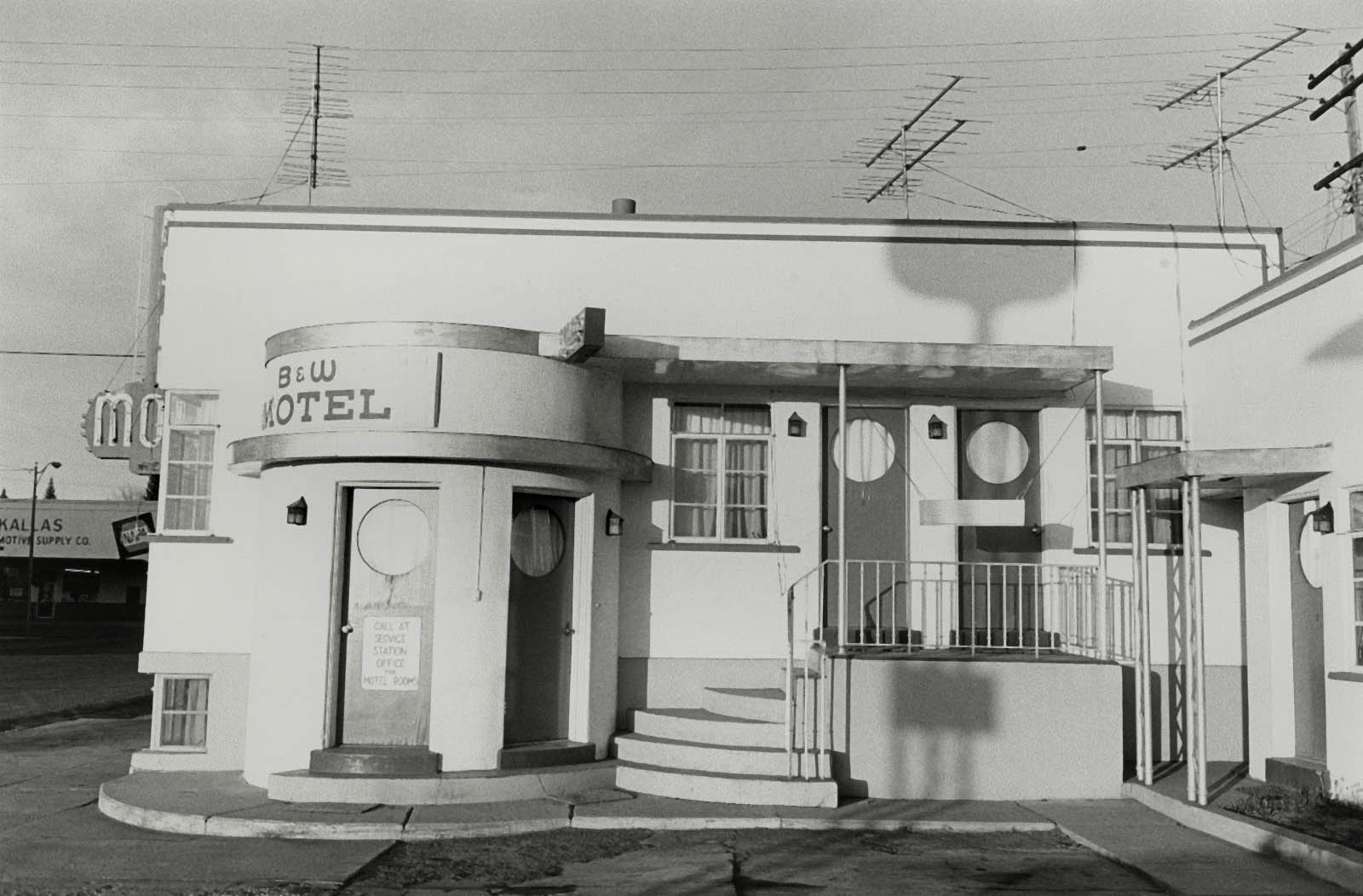
 

Henry Wessel (American, 1942-2018) 'Utah' 1974


Henry Wessel (American, 1942-2018)
Utah
1974
gelatin silver print
Image: 26.5 x 39.7cm (10 7/16 x 15 5/8 in.)
National Gallery of Art
Patrons’ Permanent Fund


Stephen Shore (American, b. 1947)
'Holden Street' July 13, 1974


Stephen Shore (American, b. 1947)
Holden Street
July 13, 1974
Chromogenic print
Image: 20.5 x 25.4cm (8 1/16 x 10 in.)
National Gallery of Art
Diana and Mallory Walker Fund


Stephen Shore’s photograph may appear casual, but it is carefully constructed. The vertical of the lamppost draws our attention to the shadowed foreground. Buildings and sidewalks on each side act as perspective lines that meet in the brighter background. Shore was exploring how three-dimensional space is rendered in two dimensions, particularly in a colour photograph. He was also examining where a once-powerful New England industrial town abruptly ended and the verdant countryside began. The lack of people, saturated colours, and clarity of detail – made possible by using a large-format 8 × 10 camera – give the picture an air of timelessness but also hyperreality.

Wall text from the exhibition
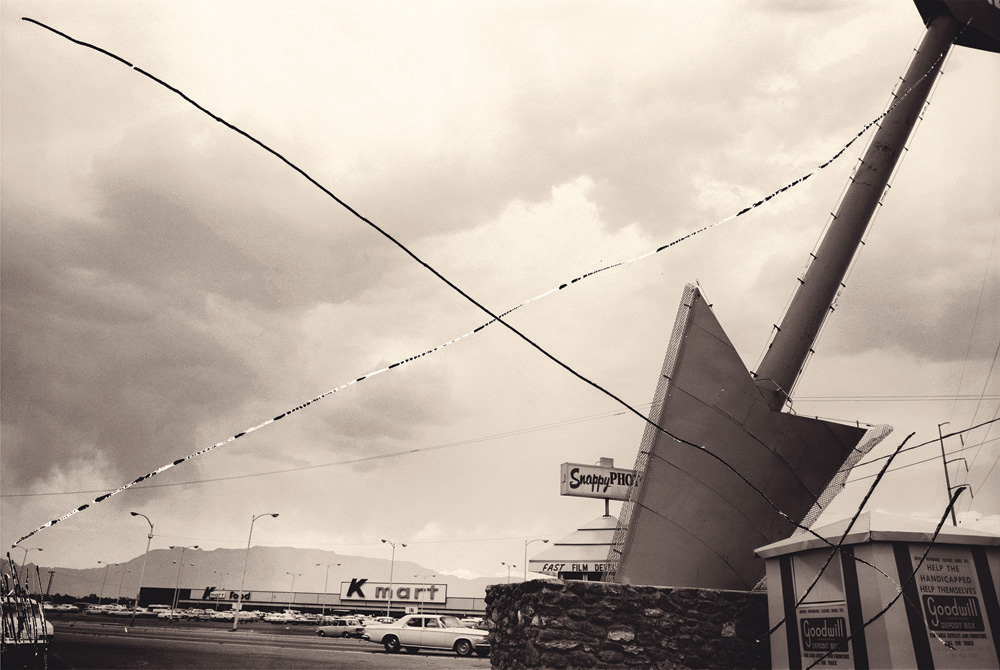
 

Thomas Barrow (American, 1938-2024) 'Dart, Albuquerque' 1974 from the exhibition 'The '70s Lens: Reimagining Documentary Photography' at the National Gallery of Art, Washington


Thomas Barrow (American, 1938-2024)
Dart
1974, printed 1994
From the series Cancellations
Gelatin silver print
23.9 × 34.6cm (9 7/16 × 13 5/8 in.)
National Gallery of Art
Randi and Bob Fisher Fund


In Dart, Thomas Barrow photographed a huge arrow that appears to have plunged from the threatening clouds above into a parking lot shared by Snappy Photos, a Goodwill drop-off bin, and a K-Mart. The work is part of his series Cancellations, documenting the suburban sprawl overtaking much of the United States. Barrow “cancelled” his images before printing by slashing the negatives with an icepick. (“Cancelling” refers to the practice of defacing a printing plate or negative to ensure no more official prints can he made from it.) This action calls attention to the photograph’s surface and its materiality, which in turn emphasise the choices Barrow made in its production.

Wall text from the exhibition


Thomas F. Barrow is an artist working with photography more than he is a photographer… For Barrow, the ideas are what matter, not the material they are realized with.

Barrow’s Cancellations series is an early expression of this artistic philosophy. Created between 1973-1981, it began when Barrow moved from Rochester, New York to Albuquerque, New Mexico to teach at UNM. Like many photographers of this era (Lewis Baltz, Frank Gohlke, Robert Adams) Barrow was struck by the transformation underway with the (sub)urbanization of the Western landscape. However, he was inspired to do more than document with his camera; he wanted to challenge his viewers while subverting some fundamental truths of photography. Inspired by a cancelled Marcel Duchamp etching (a process where the etching plate is defaced to indicate that no more official prints may be made), he began defacing his negatives with an ice pick and hole punch, “cancelling” them before making the images.

Almost 40 years later, it’s still unclear whether Barrow is canceling the photograph or the scene in the picture. He is certainly calling attention to the matrix that produced the photograph, an unheard of practice at the time and still rare today. By defacing his negatives, he has created photographs that are as much about the physical image as they are about the subject in the photograph.

David Ondrik. “Cancellations by Thomas Barrow,” in Fraction Magazine Issue 49 on the Fraction Magazine website Nd [Online] Cited 07/02/2025
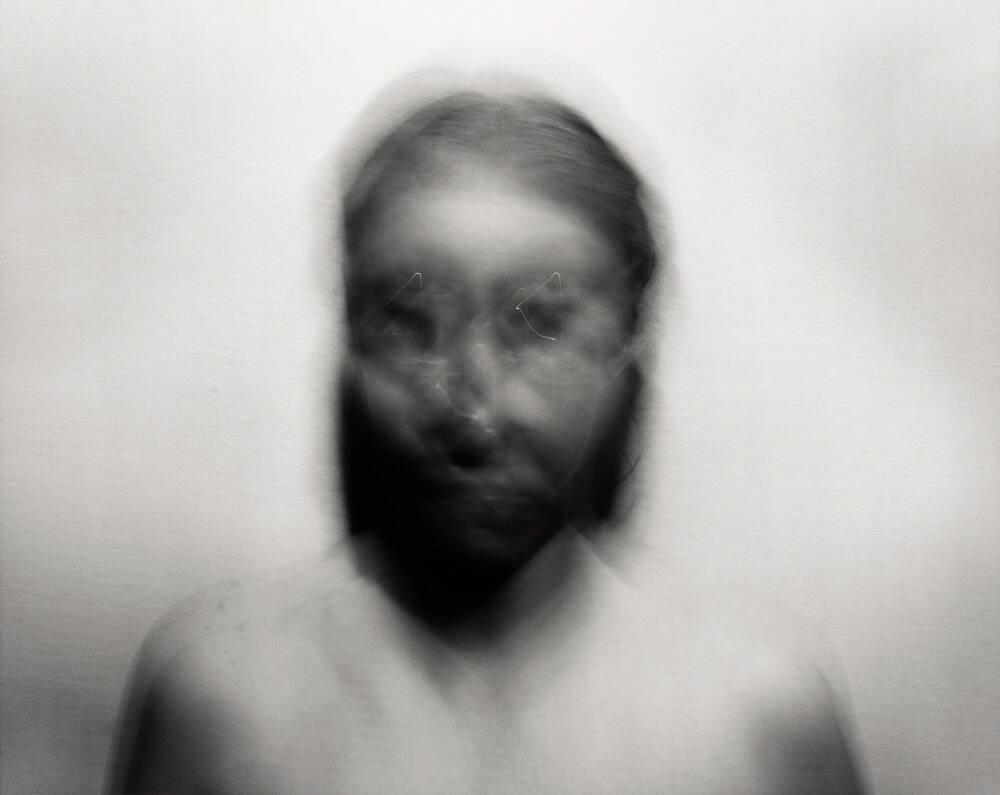
 

Blythe Bohnen (American, 1940-2022) 'Self-Portrait: Triangular Motion, Small' 1974 from the series 'Self-Portraits: Studies in Motion'


Blythe Bohnen (American, 1940-2022)
Self-Portrait: Triangular Motion, Small
1974
From the series Self-Portraits: Studies in Motion
Gelatin silver prints
National Gallery of Art
Gift of Herbert and Paula Molner


Most self-portraits offer some idea of the artist’s physical appearance and perhaps psychological state. The focus of Blythe Bohnen’s intentionally distorted self-portraits, however, is altogether different. Bohnen was interested in the physical element of artmaking – specifically, the role of her body’s movements or gestures in the creative process. Photographs usually capture an instant, but Bohnen instead used exposures of several seconds and the precise, predetermined gestures identified in her titles to distill the essence of motion. The portraits, blurry and disorienting, become more of a performance in time, condensed into a single image.

Wall text from the exhibition
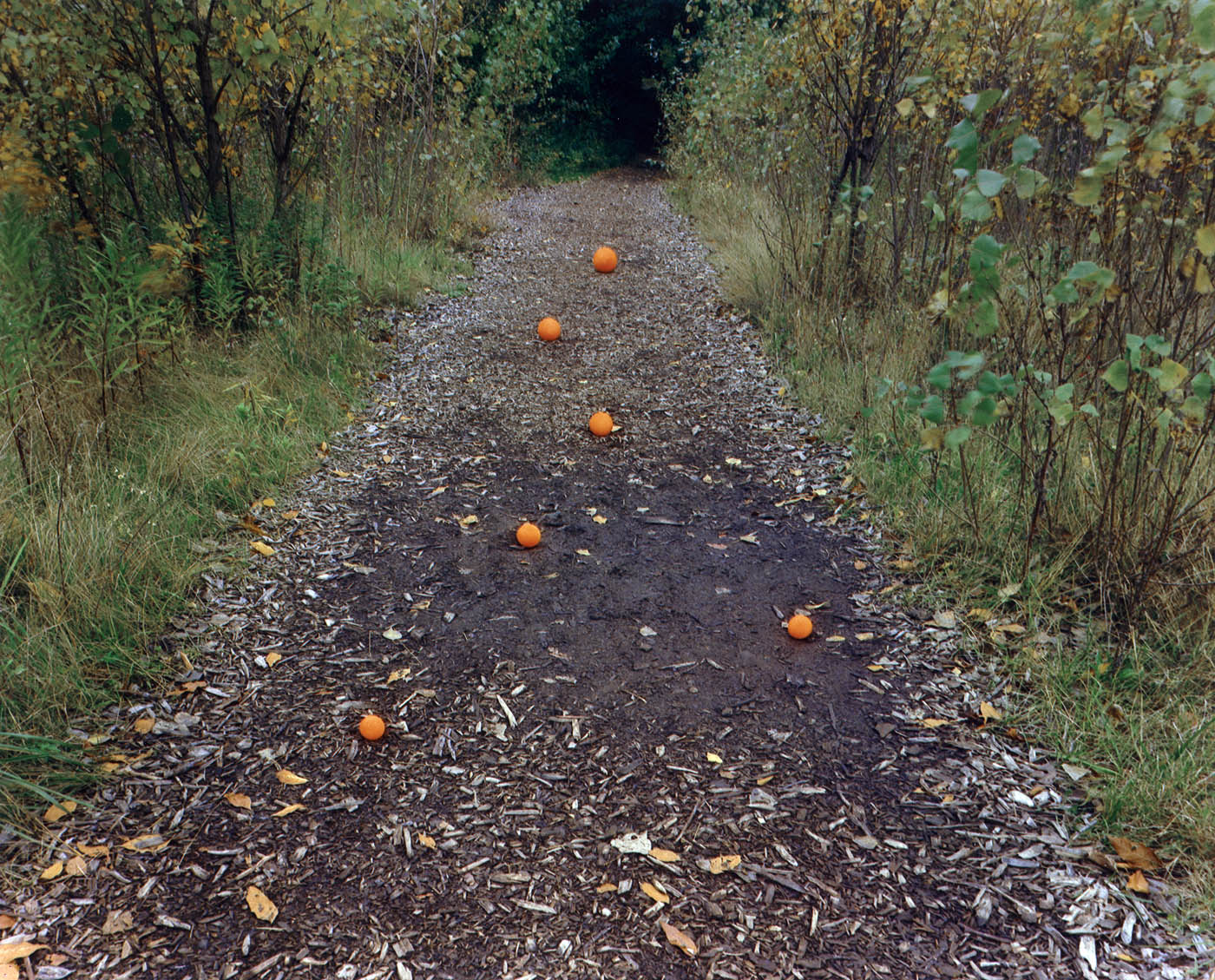
 

John Pfahl (American, 1939-2020) 'Six Oranges, Buffalo, New York' 1975 from the exhibition 'The '70s Lens: Reimagining Documentary Photography' at the National Gallery of Art, Washington


John Pfahl (American, 1939-2020)
Six Oranges, Buffalo, New York
1975
Dye imbibition print
Image: 20.6 x 25.5cm (8 1/8 x 10 1/16 in.)
National Gallery of Art
Patrons’ Permanent Fund
© The John Pfahl Trust


For the works in his series Altered Landscape, John Pfahl playfully juxtaposed the organic and natural with the manipulated and constructed. In this picture, he placed six oranges on a path in the woods. Typically, if the fruits were all the same size they would appear to grow smaller the farther from the camera they were located. Here, however, the artist has reversed that expectation, with the smallest orange sitting nearest the camera and the largest in place at the top of the picture. Through his staging, Pfahl makes the viewer aware of how a camera, by recording three-dimensional space onto a two-dimensional surface, actually produces a distorted view.

Wall text from the exhibition


In 1981, Peter C. Bunnell observes in his Introduction to James Alinder’s book Altered Landscapes: The Photographs of John Pfahl, “Our momentary, fragmented and captured vision of disorder and emotion has been replaced by a cool rendering of purposefulness as if to accord another dimension of positivism to the moving force of contemporary human awareness. Pfahl’s work is an attack on the problems of space and, ultimately, existence from a rational point of view.”

Forty years later, these photographs seem not so much rational, or picturesque, as spiritual. The human construction touches the earth lightly, almost reverentially. As Pfahl notes, utmost care is taken not to alter the actual subject in a way he would consider harmful to his positivist respect for nature. In this delicate footprint, these photographs are very prescient of the dangers of our own Anthropocene – of climate change, of raging bushfires, drought, flood and bio-exinction. We are literally destroying this planet and its creatures. Bunnell states, “Pfahl’s imagery is a sure manifestation of the belief that society can produce an art suitable to its nature and, in this case, a specific kind of photographic presence that expresses current societal values.”

Unfortunately, it’s all too late. The lesson has not been learned.

Marcus Bunyan on the exhibition John Pfahl Altered Landscapes at Joseph Bellows Gallery, La Jolla, California, November – December 2019
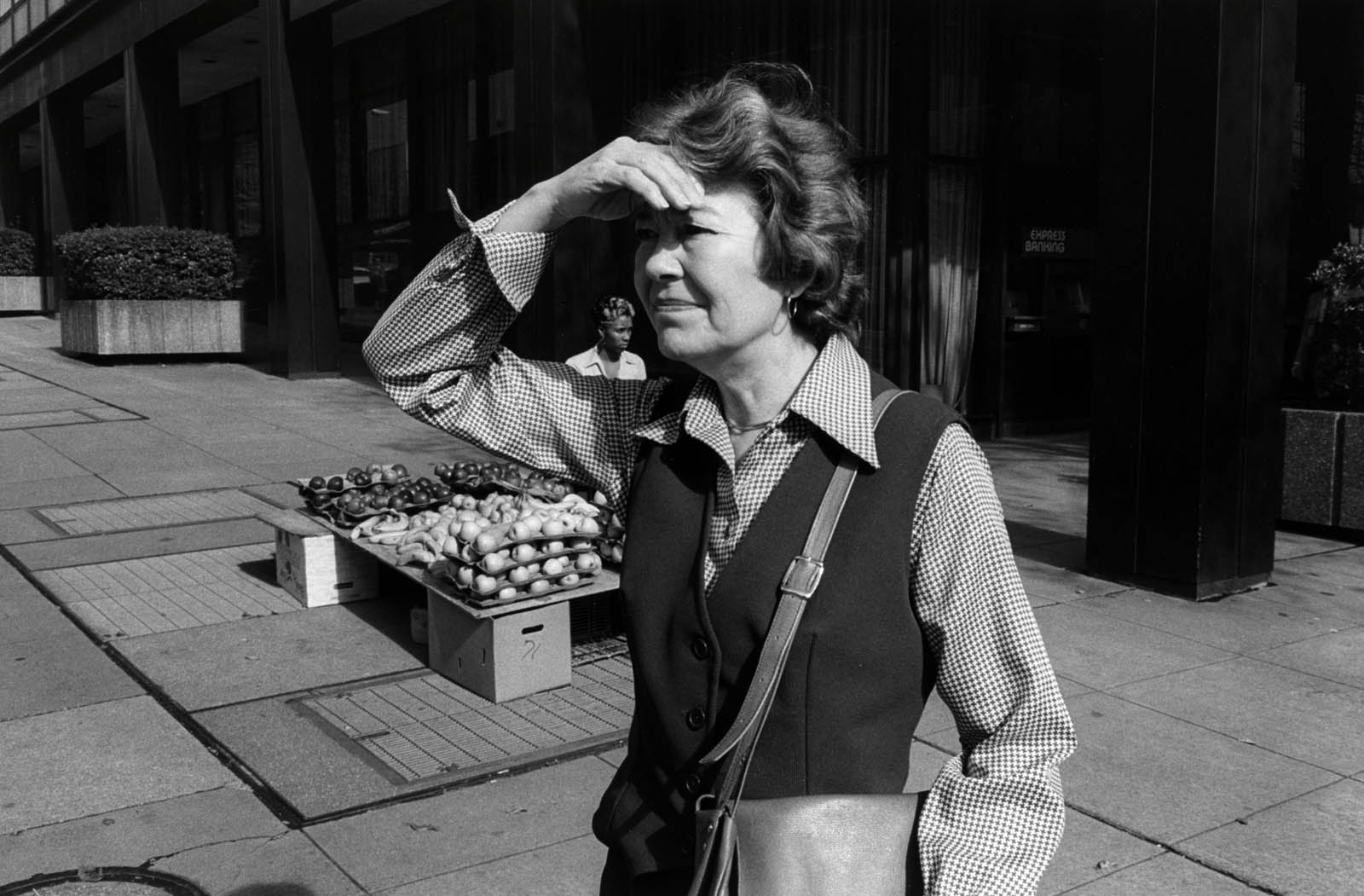
 

Anthony Hernandez (American, b. 1947) 'Washington, DC #11' 1975 from the exhibition 'The '70s Lens: Reimagining Documentary Photography' at the National Gallery of Art, Washington


Anthony Hernandez (American, b. 1947)
Washington, DC #11
1975
Gelatin silver print
Image: 18.1 × 27.31cm (7 1/8 × 10 3/4 in.)
National Gallery of Art
Corcoran Collection (Museum Purchase)


Anthony Hernandez cleverly uses the crook of a woman’s raised arm to frame a fruit seller on the street behind her. A Los Angeles – based photographer, Hernandez was invited to Washington, DC, in 1975 to participate in The Nation’s Capital in Photographs, a bicentennial documentary project organized by the Corcoran Gallery of Art. Ignoring the city’s monuments, Hernandez captured life in commercial downtown areas where the architecture and people on the street defined the landscape. This sparsely populated composition evokes urban alienation. Neither figure seems aware of the other, and both look small against the austere modern building and grate-covered sidewalk that fill the background.

Wall text from the exhibition


Anthony Hernandez’s 1970s photographs of urban inhabitants are often focused on odd-looking people staring right at the camera. His subjects often appear surprised and slightly perturbed, as if caught unaware in private moments of thought or conversation.

Following two years of study at East Los Angeles College and two years of service in the United States Army as a medic in the Vietnam War, Hernandez took up photography in earnest around 1970. He walked the streets of his native Los Angeles, observing its inhabitants. In order to work quickly and intuitively, he would pre-focus the camera and then wait for subjects to come into the zone of focus – only briefly bringing the camera to his eye as he walked past them. He repeated this strategy in other cities, including London, Madrid, Saigon, and Washington, D.C.

Text from the J. Paul Getty Museum website


Joanne Leonard (American, b. 1940)
'Memo Center with Wall Plaque' c. 1975


Joanne Leonard (American, b. 1940)
Memo Center with Wall Plaque
c. 1975
Gelatin silver print
Image: 33.3 × 43.1cm (13 1/8 × 16 15/16 in.)
National Gallery of Art
Gift of the Artist in honor of her daughter, Julia Marjorie Leonard


Dotted curtains, a flowered light switch plate, and a humorous wall plaque add a personal touch to this carefully framed picture of a so-called memo center – an area near a wall phone where notes could be jotted down that was popular in 1970s homes. A practitioner of what she called “intimate documentary,” feminist artist Joanne Leonard recorded familiar but often overlooked domestic spaces traditionally associated with women. She explained, “Through my work as an artist I’ve discovered that the realms of the personal and the public are rarely as separate as I once imagined.”

Wall text from the exhibition


In the 1970s Leonard began examining how domestic spaces are transformed through the presence of technology by photographing the interiors of her neighbours’ homes in West Oakland, California, later moving on to other locations. She captured personal objects in bedrooms and found repetition in the common appliances present in kitchen after kitchen. She also documented the proliferation of “memo centers” – areas where notes could be jotted down near the location of a telephone, which at this time was still tethered in place by a cord.

Museum of Modern Art (MoMA) Gallery label from 2022


Joanne Leonard (American, b. 1940)
'Lupe's Kitchen Window, San Leandro, California' c. 1975


Joanne Leonard (American, b. 1940)
Lupe’s Kitchen Window, San Leandro, California
c. 1975
Gelatin silver print
Image: 41.8 x 43.1cm (16 7/16 x 16 15/16 in.)
National Gallery of Art
Gift of the Artist in honor of her daughter, Julia Marjorie Leonard


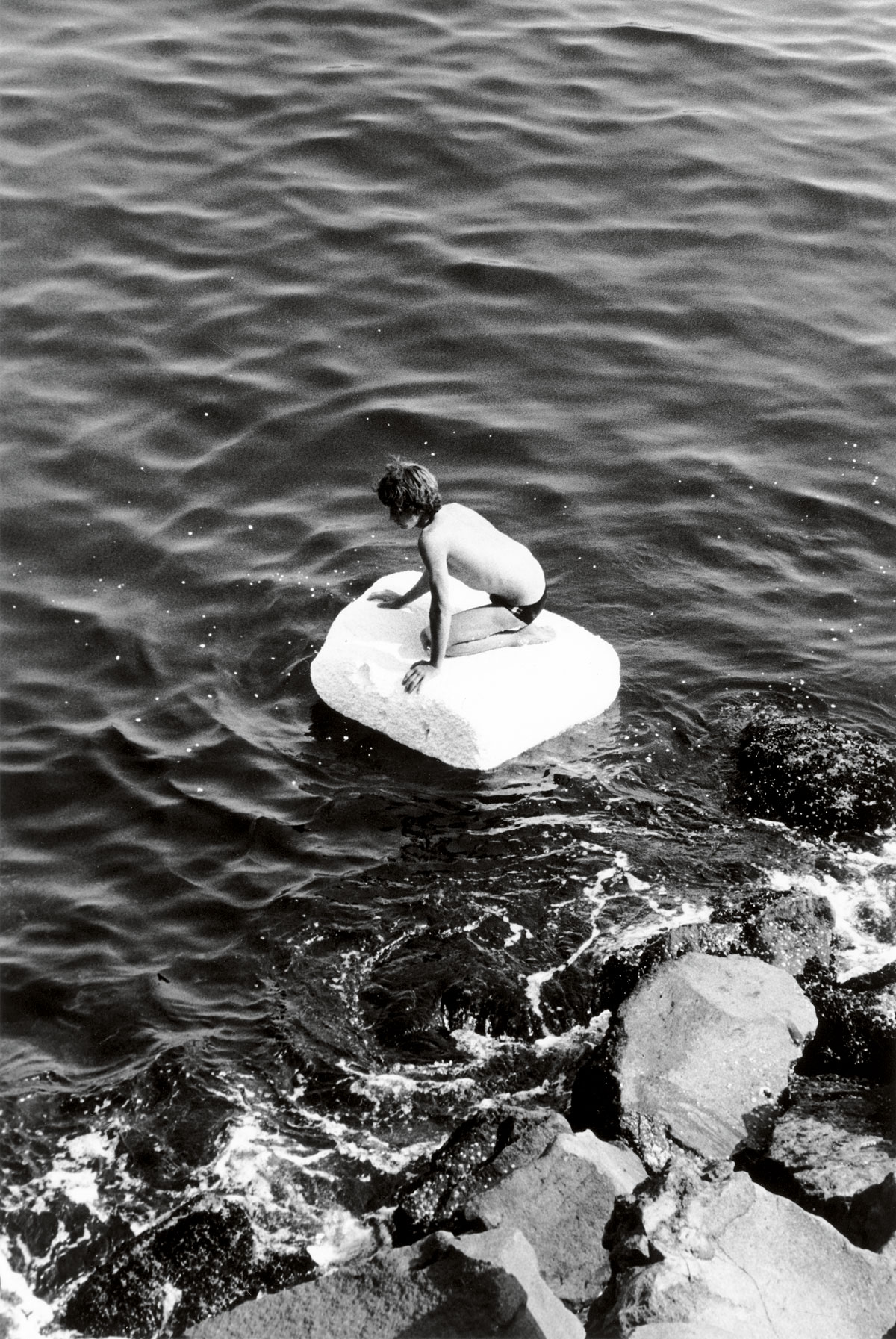
Peter Hujar (American, 1934-1987) 'Susan Sontag'
1975


Peter Hujar (American, 1934-1987)
Susan Sontag
1975
Gelatin silver print
Image: 37.15 x 37.15cm (14 5/8 x 14 5/8 in.)
National Gallery of Art
Stephen G. Stein Employee Benefit Trust


Robert Cumming (American, 1943-2021) '67-Degree Body Arc Off Circle Center' 1975, printed 2022


Robert Cumming (American, 1943-2021)
67-Degree Body Arc Off Circle Center
1975, printed 2022
Inkjet print
Image: 148.59 x 185.42cm (58 1/2 x 73 in.)
National Gallery of Art
Gift of David Knaus


Sometimes Cumming used his own body as an eccentric subject, as in “67-degree body arc off circle center” from 1975. Shown in profile with his hips thrust forward, his torso arched back and his neck and head awkwardly aligned with the angle of his legs, he’s a mathematical or scientific demonstration whose geometry turns the graceful rationality of Leonardo da Vinci’s “Vitruvian Man” on its ear. The title’s geometric forms drawn around his body on the surface of the photograph might have been made with an oversized pen-nib, into which the hand on Cumming’s hip is discreetly hidden.

The artist’s photograph, like a drawing, is an artifice.

His work as a painter, sculptor and performance artist informed his distinctive, often witty approach to images made with a camera, which Cumming began to explore in 1969 and continued for more than a decade. Artists as diverse as Eve Sonneman, Jan Groover, Lew Thomas, Judy Fiskin and Lewis Baltz were blurring traditional boundaries in different but Conceptually cogent ways. Photography would never be the same.

Christopher Knight. “Robert Cumming, whose photographs transformed camera work, dies at 78,” on the Los Angeles Times website Dec. 21, 2021 [Online] Cited 07/02/2025


Francesca Woodman (American, 1958-1981) 'House #3' c. 1975-1976, printed 1997-2004


Francesca Woodman (American, 1958-1981)
House #3
c. 1975-1976, printed 1997-2004
Gelatin silver print
Image: 16.1 x 16.3cm (6 5/16 x 6 7/16 in.)
National Gallery of Art
Gift of the Heather and Tony Podesta Collection


At the far end of a decrepit room, the phantom-like figure of the photographer appears to be merging with, or emerging from, the wall. In contrast to the sharply rendered interior, she is an ethereal blur whose face can barely be made out. Both the creator and subject of most of her work, Francesca Woodman staged dreamlike performances that explore self-portraiture, the female body, and architectural space. Although sometimes carefully planned, they more often represented her spontaneous, imaginative responses to an environment. Woodman made this photograph in an abandoned house in Providence when she was in her late teens.

 Wall text from the exhibition


The 1970s was a decade of uncertainty in the United States. Americans witnessed soaring inflation, energy crises, and the Watergate scandal, as well as protests about the Vietnam War, women’s rights, gay liberation, and the environment. The profound upheaval that rocked the country formed the backdrop for a revolution in documentary photography. Activism and growing support of multiculturalism opened the field to underrepresented voices, while artistic experimentation fuelled the reimagining of what documentary photographs could look like.

The ’70s Lens: Reimagining Documentary Photography examines this compelling and contested moment of reinvention when documentary photography’s automatic association with objectivity and truthfulness came into question. The photographs on view record subjects, communities, and landscapes previously overlooked and expand the boundaries of the genre. During this turbulent decade, documentary practice became more deeply entwined with fine art, while conceptual and performance artists used the medium to preserve their ideas and record their actions. An openness to individual expression and a turn from black and white to color film further transformed a field previously celebrated for accurately representing the world and its social ills.

Drawn primarily from the National Gallery’s collection and featuring some 100 photographs by more than 80 artists, The ’70s Lens is on view from October 6, 2024, through April 6, 2025, in the West Building.

“The profound upheaval in American life during the 1970s inspired artists to question the objective nature of documentary photography,” said Kaywin Feldman, director of the National Gallery. “The extraordinary photographs on view in this exhibition explore their diverse and compelling responses, revealing relevant connections to today’s thinking about community and who gets to represent it, as well as broader concepts including photographic truth, equity, and environmental responsibility.”

The Exhibition

Organised thematically, The ’70s Lens: Reimagining Documentary Photography examines how the many documentary approaches that emerged during the 1970s reflected a radical shift in American life – and in photography itself.

Seeing Community

Spurred by the civil rights movement and a growing recognition of the rich ethnic and cultural diversity within the United States, photographers – especially from the Black, Latinx, and LGBTQ+ communities – reclaimed documentary practice to represent the fullness of their lives. Responding to a history of misrepresentation by outsiders, Anthony Barboza, Frank Espada, Mikki Ferrill, Nan Goldin, Jeanne Moutoussamy-Ashe, John Simmons, among others, focused their cameras on close-knit neighborhoods, often their own, building trusting relationships with the people they photographed. These artists worked collaboratively with their subjects to challenge preconceived notions of their communities.

Experimental Forms

Influenced by the groundbreaking photographs made by Roy DeCarava and Robert Frank beginning in the 1950s, a new generation of documentary photographers used the camera to visualise the world and their place in it. By combining clear-eyed observation with individual expression, artists such as Jim Goldberg, Sophie Rivera, and Shawn Walker revealed the complexity of the human condition from a more personal perspective. Others, such as Diane Arbus, Lee Friedlander, Anthony Hernandez, and Garry Winogrand, focused their attention on the irony and ambivalence rooted in American culture of the time, depicting everyday life with a psychological frankness. Together their revitalization of portraiture and street photography merged documentary practice with fine-art photography.

Conceptual Documents

Documentary photography became central to the practice of many conceptual artists in the 1970s. For them, the idea behind a work was more important than the finished object. John Baldessari, Thomas Barrow, and Robert Cumming interrogated the conventions of photography’s widely assumed objectivity and truthfulness by highlighting the difference between photographic appearance and reality. Others, like Susan Hiller and Dennis Oppenheim, used the camera to record their creative process, often integrating photographs with texts to address larger social issues about gender and the environment.

Performance and the Camera

Documentary photography was also integral to performance-based art during the 1970s. Many artists used the medium to record their otherwise ephemeral actions – including those who made performances specifically for the camera. This photographic documentation became a new form of art inseparable from the overall conception of the performance. Senga Nengudi in collaboration with Maren Hassinger explored the elasticity of the body through choreographed actions. Ana Mendieta and Francesca Woodman examined their identities through interventions in the environment, while Tseng Kwong Chi, Marcia Resnick, and David Wojnarowicz staged journeys and constructed histories that pushed the boundaries between truth and fiction.

Life in Color

The art world’s embrace of color film in the 1970s transformed documentary photography. Commercial color processes had existed for more than 50 years, but serious documentary photography was strictly associated with black-and-white prints. Color photography’s status changed gradually over the decade, and especially in the wake of an exhibition of William Eggleston’s mundane but incisive photographs at the Museum of Modern Art in 1976. Pictures of everyday life made in color by William Christenberry, Mitch Epstein, Richard Misrach, and John Valadez held an immediacy that fascinated viewers and offered a new framework for reflecting on contemporary life.

Alternative Landscapes

The 1970s witnessed a radical shift in how landscapes were understood and photographed. Robert Adams, Lewis Baltz, and Joe Deal challenged popular ideas of nature as pristine and timeless with pictures of environmental destruction and suburban sprawl. From grain elevators to roadside motels, Frank Gohlke and John Schott focused on structures that form the built environment, revealing how humans have shaped their surroundings. The artists in this section documented with an austere eye, and at times subversive wit, a rampant consumer culture and the damage done in the name of progress.

Intimate Documentary

Many photographers in the 1970s turned their cameras on themselves and close family members to analyze the social landscape of domestic spaces. Often informed by second-wave feminism, they prioritized interiors and life at home as topics for artistic examination. Joanne Leonard has described her narrative-rich scenes of everyday life as “intimate documentary,” while Bill Owens observed the rise of suburbia as both a place and a mentality. Concerned that documentary photography was losing its activist force, Martha Rosler and Eleanor Antin engaged with politics – especially the home front during the Vietnam War – more directly.

Press release from the National Gallery of Art


Sunil Gupta (Canadian born India, b. 1953) 'Untitled #22' 1976, printed 2023 from the exhibition 'The '70s Lens: Reimagining Documentary Photography' at the National Gallery of Art, Washington


Sunil Gupta (Canadian born India, b. 1953)
Untitled #22
1976, printed 2023
From the series Christopher Street
Gelatin silver print
Image: 61 x 91.5cm (24 x 36 in.)
National Gallery of Art
Alfred H. Moses and Fern M. Schad Fund
© Sunil Gupta


Sunil Gupta documented the emergence of a gay public space in New York’s Greenwich Village during the 1970s. The India-born Gupta had arrived from his adopted home in Montreal in 1976 to study business, but quickly decided instead to fine-tune his photographic skills. Energized by the overtly gay environment – a result, in part, of LGBTQ+ demonstrations in 1969 known as the Stonewall uprising – he started photographing people on the streets. Not impartial, Gupta was enthralled by those he encountered, including two stylishly dressed men who seem to acknowledge Gupta’s camera. In the Christopher Street series, Gupta recorded the then extraordinary act of being openly gay – a practice both political and deeply personal.

Still moved by this project, the artist has recently started making large-scale prints from his original negatives.

Wall text from the exhibition


This series was shot in New York in 1976 when I spent a year  studying photography with Lisette Model in the New School… I spent my weekends cruising with my camera, it was the heady days after Stonewall and before AIDS when we were young and busy creating a gay public space such as hadn’t really been seen before.

Text from the Sunil Gupta website
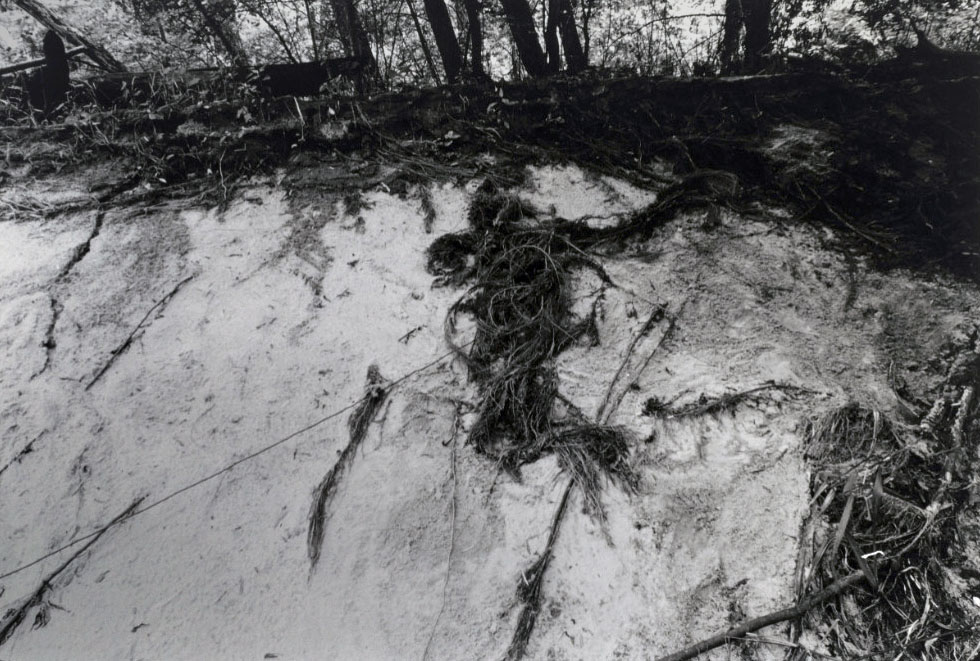
 

Ana Mendieta (Cuban-American, 1948-1985) 'Untitled' 1977-1978


Ana Mendieta (Cuban-American, 1948-1985)
Untitled
1977-1978
From the Silueta Series
Gelatin silver print
Image: 33.8 x 49.5cm (13 5/16 x 19 1/2 in.)
National Gallery of Art
Gift of the Collectors Committee


In her Silueta Series, Cuban American artist Ana Mendieta used the outline of her body to carve and shape silhouettes into the land. Informed by her interest in Afro-Cuban ritual, her fusion of performance and earthworks explored spiritual connections between nature and the female body. Mendieta’s exile with her family from Communist Cuba to the United States in the 1960s left her with a deep sense of loss. She remarked, “I have no motherland; I feel a need to join with the earth.” Photography was crucial in documenting these ephemeral pieces, preserving them before they were lost to the elements. Hauntingly beautiful, the pictures enable Mendieta’s practice to be both transitory and enduring.

Wall text from the exhibition


Larry Fink (American, 1941-2023) 'Studio 54' 1977


Larry Fink (American, 1941-2023)
Studio 54, New York City
May 1977
From the series Social Graces
Gelatin silver print
37.2 × 38cm (14 5/8 × 14 15/16 in.)
National Gallery of Art
Gift of Tony Podesta Collection, Washington, DC
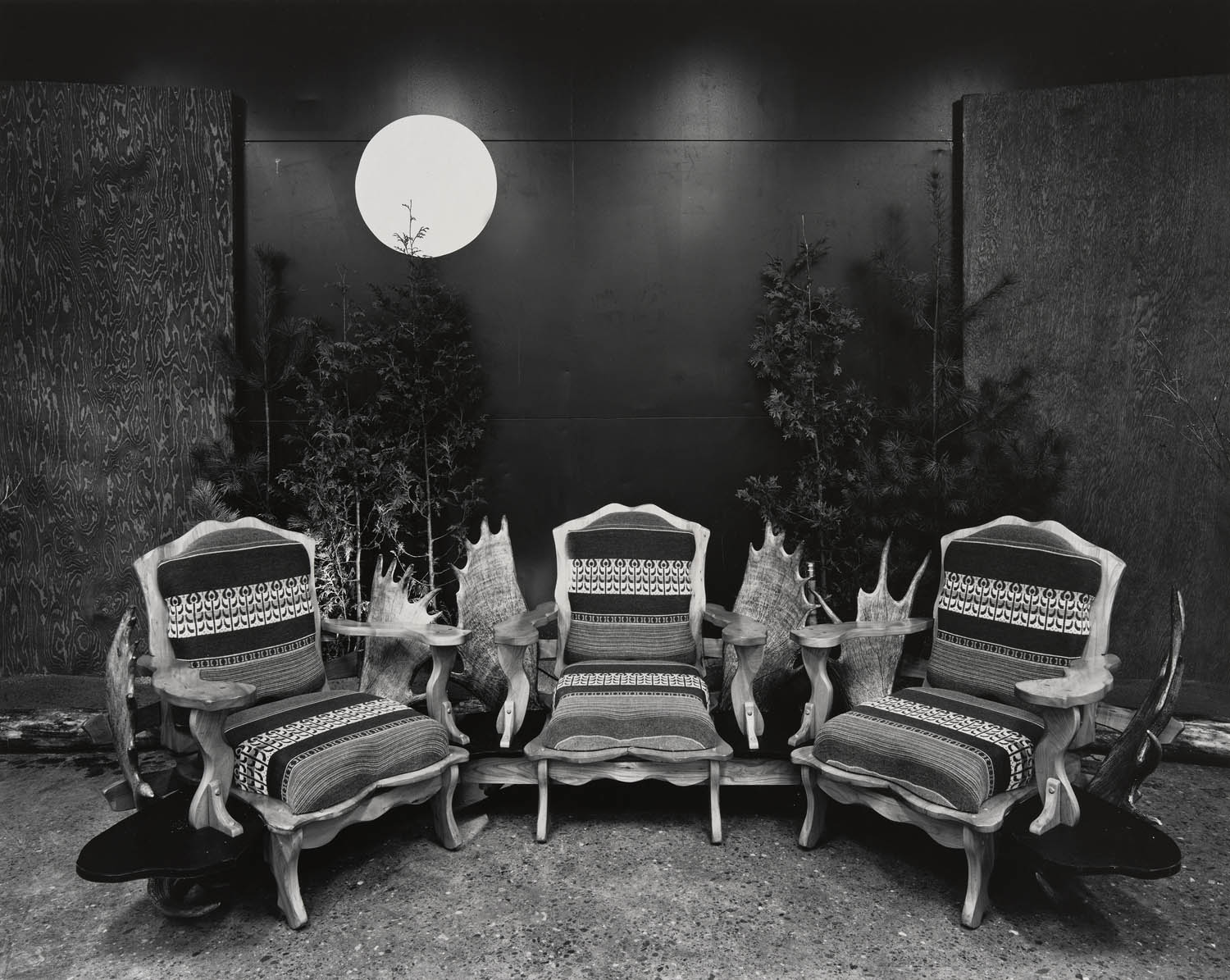
 

Lynne Cohen (American-Canadian, 1944-2014) 'Exhibition Hall' 1977


Lynne Cohen (American-Canadian, 1944-2014)
Exhibition Hall
1977
Gelatin silver print
Image (visible): 19 x 23.7cm (7 1/2 x 9 5/16 in.)
National Gallery of Art
Pepita Milmore Memorial Fund
© Estate of Lynne Cohen


In the photography of Lynne Cohen, you won’t see a single person. But you’ll find their traces everywhere. Her images feel haunted by people, as if the action has just ended or has yet to begin. Despite their absence, however, people are the true subject of the artist’s gaze. Former Gallery curator Ann Thomas explained in her essay for the 2001 National Gallery of Canada exhibition No Man’s Land: The Photography of Lynne Cohen: “While her photographs do not include human beings, they are on occasion more revealing about human behaviour than any group portrait.”

From her earliest photographs in 1971 to her final works before her death in 2014, Cohen made deadpan images of interior spaces, training her lens on the everyday peculiarities of living rooms, offices, banquet halls, social clubs, learning centres, salons, laboratories and shooting ranges. Her signature style used flat lighting, deep focus and symmetrical compositions to lend her works what she termed “a cool, dispassionate edge.” The works can be funny, sinister, maddening, familiar, bizarre and often surreal.

Although in later years Cohen would make prints large enough to envelope the viewer – introducing colour and shifting her choice of subject from domestic interiors and clubhouses to more restricted environments, such as military installations – her conceptual mission never wavered from the start. Her photography investigates how setting makes a simulation of experience, how reality is more engineered than we may care to recognize and how the spaces we design also design us in turn.

Chris Hampton. “Lynne Cohen: Art Surrounds Us,” on the National Gallery of Canada website November 22, 2024 [Online] Cite 07/02/2025


Joanne Leonard (American, b. 1940)
'Dining Area and Patterned Wallpaper, Blake Street, Berkeley, California' c. 1977


Joanne Leonard (American, b. 1940)
Dining Area and Patterned Wallpaper, Blake Street, Berkeley, California
c. 1977
Gelatin silver print
Image: 18 x 17.7cm (7 1/16 x 6 15/16 in.)
National Gallery of Art
Gift of the Artist in honor of her daughter, Julia Marjorie Leonard
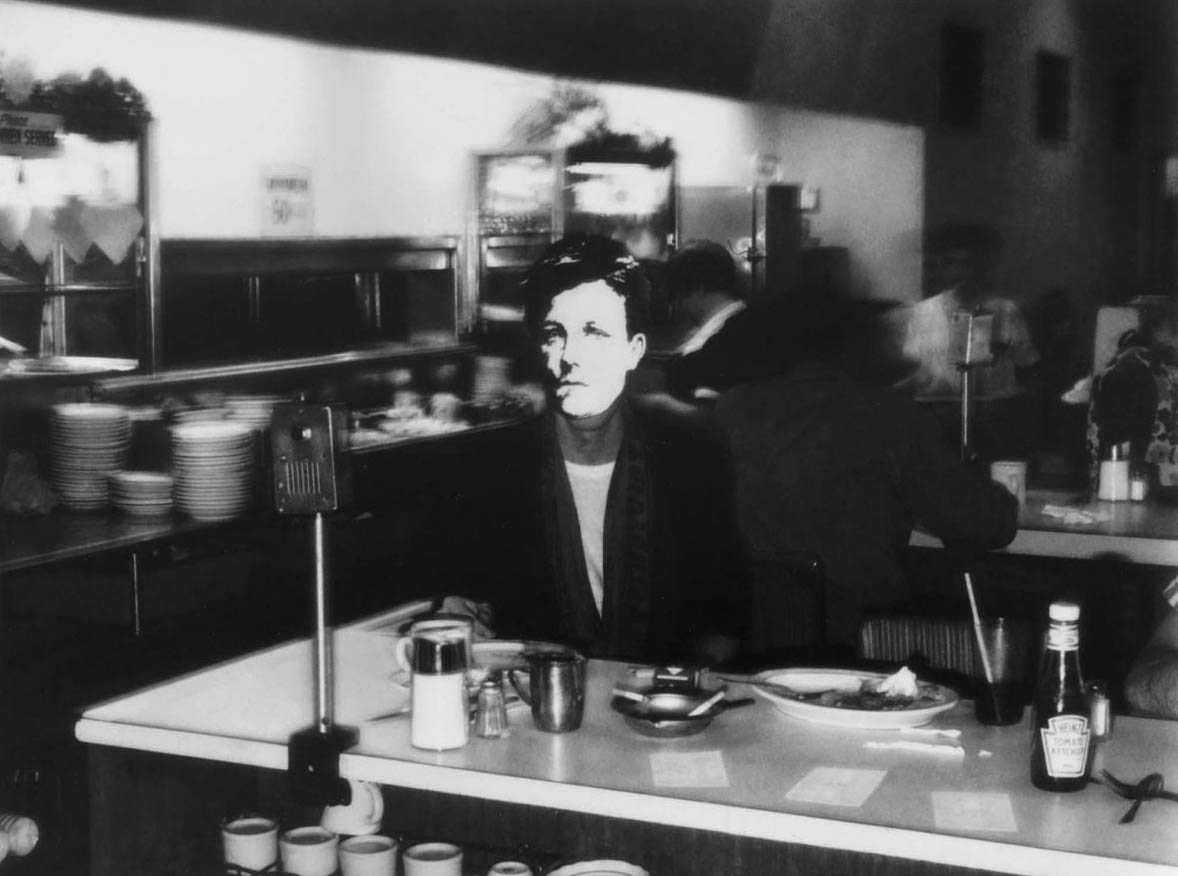
 

David Wojnarowicz (American, 1954-1992) 'Arthur Rimbaud in New York (Diner)' 1978-1979


David Wojnarowicz (American, 1954-1992)
Arthur Rimbaud in New York (Diner)
1978-1979
Gelatin silver print
Image: 17.15 x 24.13cm (6 3/4 x 9 1/2 in.)
National Gallery of Art
Gift of Funds from Heather Muir Johnson


“Transition is always a relief. Destination means death to me. If I could figure out a way to remain forever in transition, in the disconnected and unfamiliar, I could remain in a state of perpetual freedom.”

~ David Wojnarowicz , Close to the Knives: A Memoir of Disintegration


David Wojnarowicz made a series of pictures featuring friends donning a homemade mask of the 19th-century French poet Arthur Rimbaud. Staged at sites around New York that were significant to the photographer, the surrogate self-portraits explore parallels between Wojnarowicz and Rimbaud – both gay artists who rebelled against the social mores of their times. The historical figure with its unchanging expression appears alone or apart from others, a man eerily out of time. The series also documents many of the then vibrant spaces of gay life shortly before the AIDS epidemic ravaged the city’s gay community. Wojnarowicz died from AIDS-related complications at the age of 37.

Wall text from the exhibition


Sophie Rivera (American, 1938-2021) 'Untitled' 1978


Sophie Rivera (American, 1938-2021)
Untitled
1978
Gelatin silver print
Image/sheet: 25.4 x 25.4cm (10 x 10 in.)
National Gallery of Art
Estate of Martin Hurwitz


Bathed in light against a dark background, each sitter in Sophie Rivera’s portrait series of fellow New Yorkers of Puerto Rican descent, known as Nuyoricans, addresses the viewer directly. To find her subjects, Rivera asked passersby in her Harlem neighborhood if theywere Puerto Rican. If so, she invited them to her home to have their pictures taken. The mutual trust between artist and subject is reflected in the sitters’ grace and dignity.

Rivera, who defined herself as “an artist, Latino, and feminist,” sought to make Nuyoricans part of the distinguished history of American portrait photography. As she noted, “I have attempted to integrate my cultural heritage into an artistic continuum.”

Wall text from the exhibition


Rivera’s monumental portraits of Puerto Ricans in New York (or Nuyoricans) counteract the stereotypes that have circulated in the mass media. The artist found her subjects by asking passersby outside her building if they were Puerto Ricans. If they said yes, she invited them to her studio and photographed them against a dark background. Rivera’s subjects remain anonymous but never powerless. Her direct photographs allow the unassuming individuality of everyday people to speak for itself.

Our America: The Latino Presence in American Art, 2013


John M. Valadez (American, b. 1951) 'Two Guys' c. 1978, printed 2016


John M. Valadez (American, b. 1951)
Two Guys
c. 1978, printed 2016
From the East Los Angeles Urban Portrait Portfolio
Inkjet print
Sheet and image: 16 × 24 in. (40.6 × 61cm)
Smithsonian American Art Museum, Museum purchase through the Smithsonian Latino Initiatives Pool, administered by the Smithsonian Latino Center
© 1978, John M. Valadez


Multidisciplinary artist John Valadez has long been committed to depicting the lived experiences of Chicanx Angelenos like himself. Using the camera to record the world around him, Valadez first made photographs principally as source material for his drawings and paintings. In 1978 he exchanged black and white for colour film and made a series of powerful full-length portraits. His subjects included people he knew, such as the stylish young couple dressed for a birthday party, as well as people he encountered on the street, like the two men sporting identical clothes. Valadez’s aim, he said, was to capture people who weren’t being seen – by doing so, he has become a key chronicler of Chicanx identity.

Wall text from the exhibition


John M. Valadez (American, b. 1951)
'Couple Balam' c. 1978, printed 2016


John M. Valadez (American, b. 1951)
Couple Balam
c. 1978, printed 2016
From the East Los Angeles Urban Portrait Portfolio
Inkjet print
Sheet and image: 16 × 24 in. (40.6 × 61cm)
Smithsonian American Art Museum, Museum purchase through the Smithsonian Latino Initiatives Pool, administered by the Smithsonian Latino Center
© 1978, John M. Valadez


Tseng Kwong Chi (American born Hong Kong, 1950-1990) 'New York, New York' 1979, printed 2008 from the exhibition 'The '70s Lens: Reimagining Documentary Photography' at the National Gallery of Art, Washington


Tseng Kwong Chi (American born Hong Kong, 1950-1990)
New York, New York
1979, printed 2008
From the series East Meets West
Gelatin silver print
Image: 91.44 x 91.44cm (36 x 36 in.)
National Gallery of Art
Alfred H. Moses and Fern M. Schad Fund and Gift of Funds from Renee Harbers
Liddell
© Muna Tseng Dance Projects Inc.. Courtesy Yancey Richardson, New York


Tseng Kwong Chi leaps into the air in front of the Brooklyn Bridge, mimicking the joy of a first time visitor to New York. This work is from Tseng’s series East Meets West, which was inspired in part by the thaw in Chinese – United States relations following President Nixon’s visit to Beijing in 1972. A performance artist and photographer, Tseng made self-portraits as his adopted persona, Ambiguous Ambassador, at popular spots across the country. Assuming the guise of a Chinese official, Tseng – wearing what is now called a Mao suit – mischievously exposed cultural biases and notions of “the other” in American society. He made his selfies with a shutter release cable, which is visible in his right hand.

Wall text from the exhibition


Tseng Kwong Chi, known as Joseph Tseng prior to his professional career (Chinese: 曾廣智; c. 1950 – March 10, 1990), was a Hong Kong-born American photographer who was active in the East Village art scene in the 1980s.

Tseng was part of a circle of artists in the 1980s New York art scene including Keith Haring, Kenny Scharf, and Cindy Sherman. Tseng’s most famous body of work is his self-portrait series, East Meets West, also called the “Expeditionary Series”. In the series, Tseng dressed in what he called his “Mao suit” and sunglasses (dubbed a “wickedly surrealistic persona” by the New York Times), and photographed himself situated, often emotionlessly, in front of iconic tourist sites. These included the Statue of Liberty, Cape Canaveral, Disney Land, Notre Dame de Paris, and the World Trade Center. Tseng also took tens of thousands of photographs of New York graffiti artist Keith Haring throughout the 1980s working on murals, installations and the subway. In 1984, his photographs were shown with Haring’s work at the opening of the Semaphore Gallery’s East Village location in a show titled “Art in Transit”. Tseng photographed the first Concorde landing at Kennedy International Airport, from the tarmac. According to his sister, Tseng drew artistic influence from Brassai and Cartier-Bresson.

Text from the Wikipedia website


In these images Tseng inhabits a persona he referred to as the “Ambiguous Ambassador.” Wearing a Mao suit (the grey uniform associated with the Chinese Communist Party) and mirrored sunglasses, he poses next to landmarks and monuments, many of them emblems of American national identity. Like the Untitled Film Stills of Cindy Sherman – also produced in the late 1970s – East Meets West is a groundbreaking photographic work that illuminates the changeable and socially constructed nature of identity. It is also a rare piece of conceptual art to specifically reflect on the racialised experiences of Asian people in the United States. …

A gay man, Tseng was well-aware of the signifying power of dress, gesture, and posture. His donning of the Mao suit can be understood as racial camp – a playful, self-protective manoeuvre that did not prevent Tseng from being misinterpreted but did allow him to take control of the manner of the misreading. To those who perceived the levity with which Tseng wore the suit, something was revealed about his ironic sensibility. The dissonance of his appearance – the fact that the suit looked both “natural” and “unnatural” on him was not effaced but highlighted, at least to the knowing beholder. But when people were unable to see past type, the misconception did not come at the cost of Tseng’s psychic humiliation.

Tseng went on to create roughly 150 images comprising East Meets West. His performance of “Chineseness” in these photographs reveals his acute awareness of the stereotypes of Euro-American Orientalism. His blank, robotic demeanour in images such as Disneyland, California invite stock associations of the Chinese as “Yellow Peril,” and the repetition of this pose in numerous photographs would seem to tap into White America’s century-long dread of being overrun by Asian immigrants. In other images, Tseng’s stylishness and humor come through – some of the earliest photographs picture him coolly strolling the boardwalk and beaches of the popular gay vacation spot of Provincetown, Massachusetts, appearing more like a character from a French New Wave film than a visitor from the People’s Republic of China. The shutter release Tseng plainly grasps in many pictures reminds us that he is the author of these varied depicted realities; that, even as he presents himself to the Orientalist gaze, he is in command of the means of representation. Given that racial identities circulate and perpetuate via staged images – and that European American assumptions have traditionally driven those images – this is a significant gesture.

Extract from Melissa Ho. “Performing Ambiguity: The Art of Tseng Kwong Chi,” on the Smithsonian American Art Museum website June 23, 2022 [Online] Cited 06/02/2025


Jeanne Moutoussamy-Ashe (American, b. 1951)
'An Afternoon with Aunt Tootie, Daufuskie Island, South Carolina'
1979, printed 2007


Jeanne Moutoussamy-Ashe (American, b. 1951)
An Afternoon with Aunt Tootie, Daufuskie Island, South Carolina
1979, printed 2007
Gelatin silver print
Image: 21.3 x 32.4cm (8 3/8 x 12 3/4 in.)
National Gallery of Art
Gift of Funds from Diana and Mallory Walker
© Jeanne Moutoussamy-Ashe


The Gullah Geechee – enslaved people who labored on the Sea Island plantations, and their descendants – built communities all along the eastern coast of the US, from North Carolina to Florida…

From 1977 to 1982, Moutoussamy-Ashe visited Daufuskie, building relationships with the Gullah Geechee people and snapshotting rare pictures of their quotidian life. Born in Chicago, Illinois, the photographer had just returned from a six-month independent study in west Africa before she traveled to the island. At the time of her initial visit, there were only 80 permanent residents left on Daufuskie, a drastic drop from the thousands of Gullah people who had once resided there. Today, just 3% of the island’s population is Black.

Moutoussamy-Ashe’s series of monochrome images include candids of weddings, stills of a church gathering and everyday portraits of the island, showing a way of life that is treasured and fast fading.

Like many historic Black alcoves, Daufuskie has been altered by decades of gentrification. After the American civil war, many Gullah people who were already on Daufuskie made the island their permanent home once the plantation owners had left. They cultivated the land and preserved their rich culture and language, an English-based creole. But development, unfair zoning practices and other challenges have caused a sharp decrease in the Black population on the island.

Moutoussamy-Ashe’s photos offer a more private understanding of Black folks in Daufuskie, one not defined by white developers who have turned Daufuskie into a destination for tourists. The area is a placid haven in Moutoussamy-Ashe’s images. Jake and his Boat Arriving on Daufuskie’s Shore, Daufuskie Island, SC, for instance, features a man paddling a boat across a rippling river. Swooping trees frame either side of the man, who peacefully rows the vessel. The landscape looks expansive, with the scenery appearing to go on for miles. Such scenes of stillness would become rare as residents were largely driven out by the encroachment of others.

Extract from Gloria Oladipo. “How an outsider captured the intimacy of Gullah Geechee life in 13 portraits,” on The Guardian website Sat 8 Feb 2025 [Online] Cited 06/02/2025


Jeanne Moutoussamy-Ashe (American, b. 1951)
'Maid of Honor with Bride in Slippers, Daufuskie Island, South Carolina'
1980, printed 2022


Jeanne Moutoussamy-Ashe (American, b. 1951)
Maid of Honor with Bride in Slippers, Daufuskie Island, South Carolina
1980, printed 2022
Gelatin silver print
Image: 56.9 x 37.4cm (22 3/8 x 14 3/4 in.)
National Gallery of Art
Gift of Funds from Diana and Mallory Walker
© Jeanne Moutoussamy-Ashe


Between 1977 and 1981, Jeanne Moutoussamy-Ashe made extended visits to Daufuskie Island in South Carolina. The island’s relative isolation from the mainland allowed its inhabitants, who descended directly from enslaved people, to keep their distinct Gullah language and culture. Moutoussamy Ashe’s landscapes, still lifes, and portraits convey a holistic impression of the community. She captured residents’ dignity and joy – as in this photograph of a bride in fuzzy slippers, sharing a laugh with her maid of honor – but she also recorded their uncertainty in the face of development. Daufuskie’s permanent Gullah population had dwindled to 85 residents by the time Moutoussamy-Ashe published her photographs as a book in 1982.

Wall text from the exhibition


Shawn Walker (American, b. 1940)
'Untitled (New York City)' c. 1980


Shawn Walker (American, b. 1940)
Untitled (New York City)
c. 1980
Gelatin silver print
Image: 52.5 x 35cm (20 11/16 x 13 3/4 in.)
National Gallery of Art
Charina Endowment Fund
© Shawn Walker


“I see myself as a fine-arts photographer with a documentary foundation,” Shawn Walker has explained. “I look for the truth within the image, the multi-layers of existence and the ironies in our everyday lives.” Walker grounded his photographic practice in the Harlem community where he was born and raised. He joined the Kamoinge Workshop and learned from a collective of Black photographers. Inspired by Ralph Ellison’s novel Invisible Man (1952), Walker created a series of self-portraits that reveal only his silhouette. Here, the photographer pictures his reflection in a window while looking directly at us: “I look into the intersections of dark and light, into the shadows that grow the seeds of existence.”

Wall text from the exhibition


Jim Goldberg (American, b. 1953)
'Vickie Figueroa' 1981


Jim Goldberg (American, b. 1953)
Vickie Figueroa
1981
Gelatin silver print
Image/sheet: 35.4 x 27.6cm (13 15/16 x 10 7/8 in.)
National Gallery of Art
Corcoran Collection, Gift of the Artist


“My dream was to become a schoolteacher.
Mrs. Stone is rich.
I have talents but not opportunity.
I am used to standing behind
Mrs. Stone.
I have been a servant for 40 years.
Vickie Figueroa.”


Jim Goldberg (American, b. 1953) 'Clyde Norbert' 1978 from the series 'Rich and Poor'


Jim Goldberg (American, b. 1953)
Clyde Norbert
1978
From the series Rich and Poor
Gelatin silver print
Corcoran Collection
Gift of the Artist, 1994


Framed against a tall window, Clyde Norbert appears slight, flanked by his modest but carefully ordered possessions. The caption in Norbert’s own words speaks to his contrasting bold ambition: “I am going to build an empire.” In his series Rich and Poor, Jim Goldberg made portraits of both wealthy and marginalised San Franciscans where they lived. He radically shifted the relationship between photographer and subject by asking the people he photographed to respond to his pictures by writing directly on them. He believed this collaboration, which he referred to as “total documentation,” “would bring an added dimension, a deeper truth” than a photograph alone.

Wall text from the exhibition


The '70s Lens


The ’70s Lens: Reimagining Documentary Photography poster


National Gallery of Art
National Mall between 3rd and 7th Streets
Constitution Avenue NW, Washington

Opening hours:
Daily 10am – 5pm

National Gallery of Art website

LIKE ART BLART ON FACEBOOK

Back to top

Exhibition: ‘Peter Hujar: Speed of Life’ at Jeu de Paume, Paris

Exhibition dates: 15th October, 2019 – 19th January, 2020

Curators: Joel Smith and Quentin Bajac


Installation view of the exhibition 'Peter Hujar: Speed of Life' at Jeu de Paume, Paris


Installation view of the exhibition Peter Hujar: Speed of Life at Jeu de Paume, Paris


“I photograph those who push themselves to any extreme, and people who cling to the freedom to be themselves.”


Peter Hujar


Free your mind

A huge posting to finish what has been a bumper year on Art Blart: two book chapters published, a photographic research trip to Europe in which I saw some incredible exhibitions and took over 7000 photographs for my art work, lots of postings and writing and, sadly, the loss of two friends – my mother in Australia, the bohemian photographer and poet Joyce Evans and vision impaired photographer Andrew Follows.

I couldn’t think of a better posting to finish the year than with a photographer who put it all on the line: Peter Hujar. Not for him the world of Apollonian perfection, wishing for fortune and fame, relying on some big time backer to promote him. Hujar stuck to his craft, carving images, performances if you like, from dystopian contexts and Dionysian revellers. “Hujar was the instigator of the performances captured in his portraits, as much as a director as a photographer.”

Paraphrasing Mark Durant, we might say that Hujar was a poet of the urban nocturne, a photographer of subjective desire known for his gritty, erotic, sentimental yet (im)personal images. Philip Gefter observes that, “A hallmark of Hujar’s portraiture is the invisibility of technique – a kind of visual innocence – as if the camera were not present and the subject had been happened upon.” Richard Woodward says that Hujar, “observed his companions in this outlaw life with what might be called warm objectivity.” Photographer Duane Michals says that, “Hujar was a pioneer, years ahead of Mapplethorpe in his sexual candor, as well as an artist whose photographs are less swank and less affected.”

Ah! what a time it was to be an artist and to be gay in New York, with the likes of Hujar, Warhol, Mapplethorpe, Wojnarowicz, Haring, Arthur Tress, and Duane Michals, to name but a few. A time of sexual liberation, followed by a period of disease and death. Hujar pictures this “scene” – the flowering of gay life and then the AIDS crisis of the 1980s. He pictures the constellations as they swirl around him. He allows the viewer to enter his world without judgement, just showing it how it was – a world of avant-garde dance, music, art, and drag performance; “glowing skyscrapers, assorted rubble, discarded rugs, boys in drag, and girls passed out in his doorway.” This is it he is saying, this is how I live, this is who surrounds me, suck it up and breathe it in. He allows the viewer to enter his world of ideas and possible metaphors. No judgement is offered nor accepted.

As my appreciation of his photographs grows, I reflect on the skill that it takes to make these photographs look effortless. Hujar, “a student of Lisette Model, admirer of August Sander, and friend of Diane Arbus, made his photographs distinctly his own: a perfect and unmistakable mirror of his own body and milieu.” A mirror of strength and determination / of friendship / of love – his pictures gather, together, a feeling for – the freedom of people, and places, to be themselves. Do places have feelings? yes they do! (I remember visiting the Coliseum in Rome and having to leave after 20 minutes the energy of the place was so bad; and then visiting the Loretta Sanctuary in Prague and feeling, such calm and peace in that place, that I have rarely felt before).

Hujar’s photographs are memorable. Nan Goldin and Vince Aletti said that his work, “like that of so few photographers, can’t be forgotten and becomes even deeper and more compelling over time.” His work is so compelling it’s like you can’t take tear your eyes away from the photographs. They demand repeat viewing. They seem possessed of an awareness of their own making. That is Hujar’s music, his signature.

Like any great artist, his images reveal themselves over time, expounding his love of life and his intimate and free engagement with the world. Hujar was, is, and always will be… a watcher, a dreamer, a cosmic spirit.

Dr Marcus Bunyan


Many thankx to Jeu de Paume for allowing me to publish the photographs in the posting. Many thankx to David for the iPhone installation images. Please click on the photographs for a larger version of the image.


Peter Hujar (American, 1934-1987) 'Public Garden, Taormina, Sicily' 1959 from the exhibition 'Peter Hujar: Speed of Life' at Jeu de Paume, Paris, October 2019 - January 2020


Peter Hujar (American, 1934-1987)
Public Garden, Taormina, Sicily
1959
Gelatin silver print
The Morgan Library & Museum, achat en 2013 grâce au Charina Endowment Fund
© Peter Hujar Archive, LLC, courtesy Pace/MacGill Gallery, New York and Fraenkel Gallery, San Francisco


Peter Hujar (American, 1934-1987) 'Sheep, Pennsylvania' 1969 from the exhibition 'Peter Hujar: Speed of Life' at Jeu de Paume, Paris, October 2019 - January 2020


Peter Hujar (American, 1934-1987)
Sheep, Pennsylvania
1969
Gelatin silver print
The Morgan Library & Museum, achat en 2013 grâce au Charina Endowment Fund
© Peter Hujar Archive, LLC, courtesy Pace/MacGill Gallery, New York and Fraenkel Gallery, San Francisco


The life and art of Peter Hujar (1934-1987) were rooted in downtown New York. Private by nature, combative in manner, well-read, and widely connected, Hujar inhabited a world of avant-garde dance, music, art, and drag performance. His mature career paralleled the public unfolding of gay life between the Stonewall uprising in 1969 and the AIDS crisis of the 1980s.

In his loft studio in the East Village, Hujar focused on those who followed their creative instincts and shunned mainstream success. He made, in his words, “uncomplicated, direct photographs of complicated and difficult subjects,” immortalising moments, individuals, and subcultures passing at the speed of life.

What was Hujar’s truth, his photographic truth? Hujar understood and utilized photography’s tension between document and theatricality. In the act of photographing there is a performance, not only on the part of the subject, but for the photographer as well. For Hujar, to photograph was a balancing act between fierce observation and manifesting his devotion. As Jennifer Quick observes in her essay for the catalogue, This Will Have Been: Art, Love & Politics in the 1980s, “While Arbus and Mapplethorpe are known for their detached postures, Hujar’s silent, tacit presence pervades his work. Like Avedon, Hujar was the instigator of the performances captured in his portraits, as much as a director as a photographer.” That Hujar is considered in the same company of Avedon, Arbus, and Mapplethorpe, reminds us that the retrospective Speed of Life is long overdue.

Hujar’s restlessness led him to wander beyond the confines of the studio. Like Brassai, Hujar was a poet of the urban nocturne, prowling the streets with his camera as the day unraveled. Brassai’s Paris is gritty, erotic, sentimental, yet impersonal. Hujar’s photographs of New York’s streets at night embrace emptiness and furtive gestures, glowing skyscrapers, assorted rubble, discarded rugs, boys in drag, and girls passed out in his doorway. His nighttime images of the Hudson river are disquieting, suggesting powerful currents not fully understood by the dappled surfaces. The thrill and danger of an anonymous sexual encounter is manifested in the 1981 image, Man Leaning Against Tree. It is the moment for Hujar to surveille and assess, when the object of desire is seen but has not yet turned his head to return the gaze. There is a little bit of softness in the image, due, perhaps, to the dim light or the camera moving while the shutter remained open. This image is as much a document of Hujar’s habits of looking as it is about the man leaning against the tree. Despite claims of photography’s objectivity or passive observation, the photographer, consciously or not, visually manifests subjective desire, and Hujar was masterful in this regard. …

While all photographs are tethered to mortality, there is something exemplary in Hujar’s cool acceptance of our temporality. He was fully engaged with his moment yet unsentimental in his attachment. Whether he was photographing a lover or an abandoned dog as elegant as it is scruffy, we can sense that Hujar’s interest was intellectual and physical in equal measure. He may not have been comfortable with the world as it was, but he embraced and even loved what was in front of his camera. “My work comes out of my life, the people I photograph are not freaks or curiosities to me,” he said. “I like people who dare.”

Mark Alice Durant. “Peter Hujar’s Photographic Truth,” on the Saint Lucy website [Online] Cited 01/11/2019


Peter Hujar (American, 1934-1987) 'Gay Liberation Front Poster Image' 1970


Peter Hujar (American, 1934-1987)
Gay Liberation Front Poster Image
1970
Gelatin silver print
The Morgan Library & Museum, achat en 2013 grâce au Charina Endowment Fund
© Peter Hujar Archive, LLC, courtesy Pace/MacGill Gallery, New York and Fraenkel Gallery, San Francisco


Gay Liberation Front poster image

Hujar put his art to political use in 1969. In late June, a police raid inspired fierce resistance from the patrons of the Stonewall Inn, in the West Village. Hujar’s boyfriend at the time, Jim Fouratt, arrived on the scene to organise for the Gay Liberation Front (GLF), the first political group to cite homosexuality in its name. Hujar agreed to make a photograph for a GLF poster. Early one Sunday morning that fall, members of the group assembled and ran back and forth past the photographer on Nineteenth Street, west of Broadway. The poster, bearing the slogan COME OUT!!, appeared in late spring 1970 in advance of the gay liberation march that marked the first anniversary of Stonewall.


Installation view of the exhibition 'Peter Hujar: Speed of Life' at Jeu de Paume, Paris showing 'Gay Liberation Front Poster Image' 1970 (installation view)


Peter Hujar (American, 1934-1987)
Gay Liberation Front Poster Image (installation view)
1970
Gelatin silver print
The Morgan Library & Museum, achat en 2013 grâce au Charina Endowment Fund
© Peter Hujar Archive, LLC, courtesy Pace/MacGill Gallery, New York and Fraenkel Gallery, San Francisco


Peter Hujar (American, 1934-1987) 'Candy Darling on her Deathbed' 1973


Peter Hujar (American, 1934-1987)
Candy Darling on her Deathbed
1973
Gelatin silver print
The Morgan Library & Museum, achat en 2013 grâce au Charina Endowment Fund
© Peter Hujar Archive, LLC, courtesy Pace/MacGill Gallery, New York and Fraenkel Gallery, San Francisco


Candy Darling

In September 1973, transgender Warhol Superstar Candy Darling (born James Lawrence Slattery) was hospitalised for lymphoma. She asked Hujar to make a portrait of her “as a farewell to my fans.” Out of several dozen exposures, Hujar chose to print this languorous pose. As rendered in the print, Candy’s banal, fluorescent-lit hospital room looks as elegant as the studio props in a Hollywood starlet’s portrait. Hujar later wrote that his style cues came from Candy, who was “playing every death scene from every movie.” The image, first seen in print in the New York Post after Candy’s death six months later, became the most widely reproduced of Hujar’s works during his lifetime.


Installation view of the exhibition 'Peter Hujar: Speed of Life' at Jeu de Paume, Paris showing 'Candy Darling on her Deathbed' 1973  (installation view)


Peter Hujar (American, 1934-1987)
Candy Darling on her Deathbed (installation view)
1973
Gelatin silver print
The Morgan Library & Museum, achat en 2013 grâce au Charina Endowment Fund
© Peter Hujar Archive, LLC, courtesy Pace/MacGill Gallery, New York and Fraenkel Gallery, San Francisco


Peter Hujar (American, 1934-1987) 'Fran Lebowitz at Home in Morristown, New Jersey' 1974


Peter Hujar (American, 1934-1987)
Fran Lebowitz at Home in Morristown, New Jersey
1974
Gelatin silver print
The Morgan Library & Museum, achat en 2013 grâce au Charina Endowment Fund
© Peter Hujar Archive, LLC, courtesy Pace/MacGill Gallery, New York and Fraenkel Gallery, San Francisco


Peter Hujar (American, 1934-1987) 'Self-Portrait Jumping (1)' 1974


Peter Hujar (American, 1934-1987)
Self-Portrait Jumping (1)
1974
Gelatin silver print
The Morgan Library & Museum, achat en 2013 grâce au Charina Endowment Fund
© Peter Hujar Archive, LLC, courtesy Pace/MacGill Gallery, New York and Fraenkel Gallery, San Francisco


Installation view of the exhibition 'Peter Hujar: Speed of Life' at Jeu de Paume, Paris showing 'Self-Portrait Jumping (1)' 1974 (installation view)


Peter Hujar (American, 1934-1987)
Self-Portrait Jumping (1) (installation view)
1974
Gelatin silver print
The Morgan Library & Museum, achat en 2013 grâce au Charina Endowment Fund
© Peter Hujar Archive, LLC, courtesy Pace/MacGill Gallery, New York and Fraenkel Gallery, San Francisco


Peter Hujar (American, 1934-1987) 'Susan Sontag' 1975


Peter Hujar (American, 1934-1987)
Susan Sontag
1975
Gelatin silver print
The Morgan Library & Museum, achat en 2013 grâce au Charina Endowment Fund
© Peter Hujar Archive, LLC, courtesy Pace/MacGill Gallery, New York and Fraenkel Gallery, San Francisco


Installation view of the exhibition 'Peter Hujar: Speed of Life' at Jeu de Paume, Paris


Peter Hujar (American, 1934-1987)
Susan Sontag (installation view)
1975
Gelatin silver print
The Morgan Library & Museum, achat en 2013 grâce au Charina Endowment Fund
© Peter Hujar Archive, LLC, courtesy Pace/MacGill Gallery, New York and Fraenkel Gallery, San Francisco


Peter Hujar (American, 1934-1987) 'Christopher Street Pier (2)' 1976  (installation view)


Peter Hujar (American, 1934-1987)
Christopher Street Pier (2) (installation view)
1976
Gelatin silver print
The Morgan Library & Museum, achat en 2013 grâce au Charina Endowment Fund
© Peter Hujar Archive, LLC, courtesy Pace/MacGill Gallery, New York and Fraenkel Gallery, San Francisco


Peter Hujar (American, 1934-1987) 'Christopher Street Pier (2)' 1976


Peter Hujar (American, 1934-1987)
Christopher Street Pier (2)
1976
Gelatin silver print
The Morgan Library & Museum, achat en 2013 grâce au Charina Endowment Fund
© Peter Hujar Archive, LLC, courtesy Pace/MacGill Gallery, New York and Fraenkel Gallery, San Francisco


Jeu de Paume presents a selection of 150 photographs of this singular artist from October 15th, 2019 to January 19th, 2020. The exhibition follows Hujar’s work from the beginnings mid 1950 until the 1980s, shaping a portrait of the underground New York City.

The life and art of Peter Hujar (1934-1987) were rooted in downtown New York. Private by nature, combative in manner, well-read, and widely connected, Hujar inhabited a world of avant-garde dance, music, art, and drag performance. His mature career paralleled the public unfolding of gay life between the Stonewall uprising* in 1969 and the AIDS crisis of the 1980s.

After graduating from high school in 1953, Hujar worked as an assistant to commercial photographers until 1968. Five years of contributing features to mass-market magazines convinced him that a fashion career “wasn’t right for me” and in 1973 he opted for an autonomous, near-penniless life as an artist. In his loft studio above a theater in the East Village, Hujar focused on those who obeyed their creative instincts and shunned mainstream success.

At age forty-two, he published his only monograph, Portraits in Life and Death, and opened his first solo gallery show. The searching intimacy he achieved as a portraitist carried over into unsentimental photographs of animals and plants, landscapes, buildings, and the unique features of nude bodies.

Hujar’s brief affair in 1981 with the young artist David Wojnarowicz evolved into a mentoring bond that changed both their lives. On their excursions to blighted areas around New York, Hujar crafted the portrait of a city in free fall, complementing Wojnarowicz’s dark vision of Reagan-era America.

Peter Hujar died of AIDS-related pneumonia in November 1987.

Press release from Jeu de Paume


Early years

In 1953, Peter Hujar finished high school in Manhattan, where he had studied photography. He then worked for some fifteen years as an assistant to commercial photographers. Punctuating those years were two long periods in Italy, buoyed by scholarships – a first one that was obtained by a boyfriend (1958-1959) and then his own (1962-1963). From 1968 to 1972, he tried to make it as a freelancer in the mass-market world of fashion, music, and advertising photography. The hustle “wasn’t right for me,” and he turned his back on the commercial mainstream. From this time on he lived on almost nothing, squeaking by on small jobs, taking paying jobs only when necessary and focusing on the subjects he found compelling. In 1973, he moved to the crumbling East Village, into a loft that would become the setting for his mature studio work, most notably the vast majority of his portraits.

Portraits

Portraiture was central to Hujar’s practice. The subjects of his art, Hujar wrote, were “those who push themselves to any extreme” and those who “cling to the freedom to be themselves.” “In a sense, I am still a fashion photographer. These people are chic but in a dark kind of way. Most of them are unknown or maybe known to just a few, but they have all been creative adventurers and possess a certain spirit.”

Most of his portraits were posed, but Hujar often expected his models to perform in front of the camera, which made many of the shoots truly collaborative ventures. Disguises and props were often incorporated, and his subjects were sometimes veiled, simultaneously revealing and masking themselves.

The reclining portrait is a photographic genre Hujar made his own. The pose features extensively in his 1976 monograph Portraits in Life and Death, and he continued to rely on it as a means of capturing something unique in his sitter: to face a camera lens from a reclining position is an unfamiliar and provoking experience.

New York

“The happiest times with Peter, when he wasn’t photographing, were walking around Manhattan, looking at the crowns of buildings, and the fantasies about ‘living there,'” remembers Gary Schneider, one of his close friends.

Born in New Jersey, Hujar spent all his life in New York, and more specifically in Manhattan, whose buildings, streets, and piers he started photographing more extensively in the second half of the 1970s. Divided between Downtown’s derelict areas and Midtown’s skyscrapers, Hujar’s New York is often a nocturnal city: a place of abandoned structures, night-time cruising, and early-dawn vistas. A few journeys outside New York, during the summer months, to the beaches of Fire Island in the Hamptons, and, in the early 1980s, to the countryside around Germantown, forty miles north of New York, along the Hudson River, offer other glimpses of Peter Hujar’s personal geography, testifying to the variety of subjects that he found worth photographing.

Bodies

Portraiture of bodies was another focal point of Hujar’s last decade of work. In 1978, some of his works were included in The Male Nude: A photographic Survey at the Marcuse Pfeifer Gallery in New York.

Bodies, he suggested, could be read as freely as faces for character, emotion, or life story.

He photographed bodies in the extremes of youth and old age, bodies displaying unique features, and bodies in transient states, notably pregnancy and arousal.

Whether photographing faces or bodies, Hujar was attentive to the characteristics conferred by time and experience, such as Manny Vasquez’s spinal tap scar and the imprint left by socks on Randy Gilberti’s ankles. “I want people to feel the picture and smell it,” he said of his nudes, which he contrasted to the idealised bodies in Robert Mapplethorpe’s work.

Gracie Mansion Gallery, 1986

When exhibiting his work, Hujar employed two distinct methods. He displayed prints either in isolation (notably in his loft, where just one photograph at a time was on view) or in large groupings, two images high, as on this wall. For the last exhibition during his lifetime, in January 1986 in New York, Hujar covered the walls of the Gracie Mansion Gallery with a frieze of seventy photographs in no apparent order. He fine-tuned the layout for days until no one type of image (portrait, nude, animal, still life, landscape, cityscape) appeared twice consecutively. Each of his subjects thus preserved its own identity and singularity rather than serving as a variation on an imposed theme.

The arrangement highlighted his inventive range, created echoes among seemingly unrelated images, and drew attention to preoccupations that had recurred throughout his career. The display in this room centres on images taken in the 1980s and is freely inspired by that 1986 exhibition.

Andy Warhol

In 1964 Peter Hujar was a regular visitor to The Factory, Andy Warhol’s studio at 231 East 47th Street in New York. He posed four times for Screen Tests, brief portraits filmed by Warhol and screened in slow motion. Together with his friend Paul Thek, Hujar was chosen as one of the “Thirteen Most Beautiful Boys”, whose film portraits were regularly shown at the Factory and at parties and events elsewhere. Among the other personalities figuring in the Screen Tests in 1964-1965 were the actor-directors Dennis Hopper and Jack Smith, together with writer-critic Susan Sontag and poet John Ashbery – both of whom would later pose for Hujar.


Peter Hujar (American, 1934-1987) 'From Rockefeller Center: The Equitable Building' 1976


Peter Hujar (American, 1934-1987)
From Rockefeller Center: The Equitable Building
1976
Gelatin silver print
The Morgan Library & Museum, achat en 2013 grâce au Charina Endowment Fund
© Peter Hujar Archive, LLC, courtesy Pace/MacGill Gallery, New York and Fraenkel Gallery, San Francisco


Peter Hujar (American, 1934-1987) 'Reclining Nude on Couch' 1978


Peter Hujar (American, 1934-1987)
Reclining Nude on Couch
1978
Gelatin silver print
The Morgan Library & Museum, achat en 2013 grâce au Charina Endowment Fund
© Peter Hujar Archive, LLC, courtesy Pace/MacGill Gallery, New York and Fraenkel Gallery, San Francisco


Peter Hujar (American, 1934-1987) 'Boy on Raft' 1978


Peter Hujar (American, 1934-1987)
Boy on Raft
1978
Gelatin silver print
The Morgan Library & Museum, achat en 2013 grâce au Charina Endowment Fund
© Peter Hujar Archive, LLC, courtesy Pace/MacGill Gallery, New York and Fraenkel Gallery, San Francisco


Peter Hujar (American, 1934-1987) 'Surf (2)' Nd


Peter Hujar (American, 1934-1987)
Surf (2)
Nd
Gelatin silver print
The Morgan Library & Museum, achat en 2013 grâce au Charina Endowment Fund
© Peter Hujar Archive, LLC, courtesy Pace/MacGill Gallery, New York and Fraenkel Gallery, San Francisco


Peter Hujar (American, 1934-1987) 'Boys in Car, Halloween' 1978


Peter Hujar (American, 1934-1987)
Boys in Car, Halloween
1978
Gelatin silver print
The Morgan Library & Museum, achat en 2013 grâce au Charina Endowment Fund
© Peter Hujar Archive, LLC, courtesy Pace/MacGill Gallery, New York and Fraenkel Gallery, San Francisco


Peter Hujar (American, 1934-1987) 'Dana Reitz's Legs, Walking' 1979


Peter Hujar (American, 1934-1987)
Dana Reitz’s Legs, Walking
1979
Gelatin silver print
The Morgan Library & Museum, achat en 2013 grâce au Charina Endowment Fund
© Peter Hujar Archive, LLC, courtesy Pace/MacGill Gallery, New York and Fraenkel Gallery, San Francisco


Peter Hujar (American, 1934-1987) 'Dana Reitz's Legs, Walking' 1979 (installation view)


Peter Hujar (American, 1934-1987)
Dana Reitz’s Legs, Walking (installation view)
1979
Gelatin silver print
The Morgan Library & Museum, achat en 2013 grâce au Charina Endowment Fund
© Peter Hujar Archive, LLC, courtesy Pace/MacGill Gallery, New York and Fraenkel Gallery, San Francisco


Peter Hujar (American, 1934-1987) 'Gary in Contortion (2)' 1979


Peter Hujar (American, 1934-1987)
Gary in Contortion (2)
1979
Gelatin silver print
The Morgan Library & Museum, achat en 2013 grâce au Charina Endowment Fund
© Peter Hujar Archive, LLC, courtesy Pace/MacGill Gallery, New York and Fraenkel Gallery, San Francisco


Peter Hujar (American, 1934-1987) 'David Wojnarowicz Reclining (2)' 1981


Peter Hujar (American, 1934-1987)
David Wojnarowicz Reclining (2)
1981
Gelatin silver print
The Morgan Library & Museum, achat en 2013 grâce au Charina Endowment Fund
© Peter Hujar Archive, LLC, courtesy Pace/MacGill Gallery, New York and Fraenkel Gallery, San Francisco


Peter Hujar (American, 1934-1987) 'David Wojnarowicz Reclining (2)' 1981 (installation view)


Peter Hujar (American, 1934-1987)
David Wojnarowicz Reclining (2) (installation view)
1981
Gelatin silver print
The Morgan Library & Museum, achat en 2013 grâce au Charina Endowment Fund
© Peter Hujar Archive, LLC, courtesy Pace/MacGill Gallery, New York and Fraenkel Gallery, San Francisco


A hallmark of Hujar’s portraiture is the invisibility of technique – a kind of visual innocence – as if the camera were not present and the subject had been happened upon, discovered there, as Ludlam appears to be, in medias res.

Philip Gefter. “Peter Hujar’s Downtown,” on the NYR Daily website [Online] Cited 01/11/2019


Peter Hujar (American, 1934-1987) 'David Wojnarowicz' 1981


Peter Hujar (American, 1934-1987)
David Wojnarowicz
1981
Gelatin silver print
The Morgan Library & Museum, achat en 2013 grâce au Charina Endowment Fund
© Peter Hujar Archive, LLC, courtesy Pace/MacGill Gallery, New York and Fraenkel Gallery, San Francisco


Peter Hujar (American, 1934-1987) 'David Wojnarowicz' 1981 (installation view)


Peter Hujar (American, 1934-1987)
David Wojnarowicz (installation view)
1981
Gelatin silver print
The Morgan Library & Museum, achat en 2013 grâce au Charina Endowment Fund
© Peter Hujar Archive, LLC, courtesy Pace/MacGill Gallery, New York and Fraenkel Gallery, San Francisco


“Hermetic appeal and an identification with psychic damage came together in Hujar’s last important relationship, with the meteoric younger artist David Wojnarowicz, who was a ravaged hustler when they met at a bar in late 1980 and who died from AIDS in 1992. They were lovers briefly, then buddies and soul mates. Wojnarowicz said that Hujar “was like the parent I never had, like the brother I never had.” In return, he inspired fresh energies in Hujar’s life and late work. In a breathtakingly intimate portrait of Wojnarowicz with a cigarette and tired eyes, from 1981, the young man’s gaze meets that of the camera, with slightly wary – but willing and plainly reciprocated – devotion: love, in a way. Their story could make for a good novel or movie – as it well may, in sketched outline in your mind, while you navigate this aesthetically fierce, historically informative, strangely tender show.”

Peter Schjeldahl. “The Bohemian Rhapsody of Peer Hujar: Photographs at the crossroads of high art and low life,” on The New Yorker website January 29, 2018 [Online] Cited 01/11/2019


Peter Hujar (American, 1934-1987) 'Ethyl Eichelberger as Minnie the Maid' 1981


Peter Hujar (American, 1934-1987)
Ethyl Eichelberger as Minnie the Maid
1981
Gelatin silver print
The Morgan Library & Museum, achat en 2013 grâce au Charina Endowment Fund
© Peter Hujar Archive, LLC, courtesy Pace/MacGill Gallery, New York and Fraenkel Gallery, San Francisco


Peter Hujar (American, 1934-1987) 'Greer Lankton' 1983


Peter Hujar (American, 1934-1987)
Greer Lankton
1983
Gelatin silver print
The Morgan Library & Museum, achat en 2013 grâce au Charina Endowment Fund
© Peter Hujar Archive, LLC, courtesy Pace/MacGill Gallery, New York and Fraenkel Gallery, San Francisco


Hujar observed his companions in this outlaw life with what might be called warm objectivity. Whatever the portrait subject – doll maker and transgender pioneer Greer Lankton, model Bruce St. Croix sitting naked on a chair and handling his huge erection, Warhol superstar Candy Darling on her death bed, or a pair of cows in a muddy field – he photographed them directly with his 2 1/4, often at close range, without props or gauzy lighting.

Richard B. Woodward. “Peter Hujar: Speed of Life @Morgan Library,” on the Collector Daily website February 21, 2018 [Online] Cited 01/11/2019


Peter Hujar (American, 1934-1987) 'Gary Indiana Veiled' 1981


Peter Hujar (American, 1934-1987)
Gary Indiana Veiled
1981
Gelatin silver print
The Morgan Library & Museum, achat en 2013 grâce au Charina Endowment Fund
© Peter Hujar Archive, LLC, courtesy Pace/MacGill Gallery, New York and Fraenkel Gallery, San Francisco


Some iPhone installation photographs and others


Peter Hujar (American, 1934-1987) 'Woman and Girl in Window Italy' c. 1963 (installation view)


Peter Hujar (American, 1934-1987)
Woman and Girl in Window Italy
c. 1963
Gelatin silver print
The Morgan Library & Museum, achat en 2013 grâce au Charina Endowment Fund
© Peter Hujar Archive, LLC, courtesy Pace/MacGill Gallery, New York and Fraenkel Gallery, San Francisco


Peter Hujar (American, 1934-1987) 'Woman and Girl in Window Italy' c. 1963 


Peter Hujar (American, 1934-1987)
Woman and Girl in Window Italy
c. 1963
Gelatin silver print
The Morgan Library & Museum, achat en 2013 grâce au Charina Endowment Fund
© Peter Hujar Archive, LLC, courtesy Pace/MacGill Gallery, New York and Fraenkel Gallery, San Francisco


Peter Hujar (American, 1934-1987) 'Young Man and Boy, Italy' 1958 (installation view)


Peter Hujar (American, 1934-1987)
Young Man and Boy, Italy (installation view)
1958
Gelatin silver print
The Morgan Library & Museum, achat en 2013 grâce au Charina Endowment Fund
© Peter Hujar Archive, LLC, courtesy Pace/MacGill Gallery, New York and Fraenkel Gallery, San Francisco


He began as a street photographer, on the prowl for unrehearsed gestures, as can be seen in a 1958 picture in Italy of a well-dressed young man touching his thick coif of dark hair and standing next to a pudgy boy in a cap who has his hands in his pockets.

Richard B. Woodward. “Peter Hujar: Speed of Life @Morgan Library,” on the Collector Daily website February 21, 2018 [Online] Cited 01/11/2019


Peter Hujar (American, 1934-1987) 'Young Man and Boy, Italy' 1958


Peter Hujar (American, 1934-1987)
Young Man and Boy, Italy
1958
Gelatin silver print
The Morgan Library & Museum, achat en 2013 grâce au Charina Endowment Fund
© Peter Hujar Archive, LLC, courtesy Pace/MacGill Gallery, New York and Fraenkel Gallery, San Francisco


Installation view of the exhibition 'Peter Hujar: Speed of Life' at Jeu de Paume, Paris


Peter Hujar (American, 1934-1987) 'Palermo Catacombs #11, Rows of Bodies' 1963 (installation view)

Peter Hujar. 'Palermo Catacombs (11)' 1963


Peter Hujar (American, 1934-1987)
Palermo Catacombs #11, Rows of Bodies
1963
Gelatin silver print
The Morgan Library & Museum, achat en 2013 grâce au Charina Endowment Fund
© Peter Hujar Archive, LLC, courtesy Pace/MacGill Gallery, New York and Fraenkel Gallery, San Francisco


Peter Hujar (American, 1934-1987) 'Man in Costume on Toilet, Backstage at Palm Casino Review' 1974 (installation view)


Peter Hujar (American, 1934-1987)
Man in Costume on Toilet, Backstage at Palm Casino Review (installation view)
1974
Gelatin silver print
The Morgan Library & Museum, achat en 2013 grâce au Charina Endowment Fund
© Peter Hujar Archive, LLC, courtesy Pace/MacGill Gallery, New York and Fraenkel Gallery, San Francisco


Installation view of the exhibition 'Peter Hujar: Speed of Life' at Jeu de Paume, Paris


Peter Hujar (American, 1934-1987) 'Nude Self-Portrait, Running / Nude Self-Portrait Series (Avedon Master Class)' 1966 (installation view)


Peter Hujar (American, 1934-1987)
Nude Self-Portrait, Running / Nude Self-Portrait Series (Avedon Master Class) (installation view)
1966
Gelatin silver print
The Morgan Library & Museum, achat en 2013 grâce au Charina Endowment Fund
© Peter Hujar Archive, LLC, courtesy Pace/MacGill Gallery, New York and Fraenkel Gallery, San Francisco


Peter Hujar (American, 1934-1987) 'Group Picture' 1966 (installation view)


Peter Hujar (American, 1934-1987)
Group Picture (installation view)
1966
Gelatin silver print
The Morgan Library & Museum, achat en 2013 grâce au Charina Endowment Fund
© Peter Hujar Archive, LLC, courtesy Pace/MacGill Gallery, New York and Fraenkel Gallery, San Francisco


Peter Hujar (American, 1934-1987) Stephen Varble, Soho, Franklin Street (III)' 1976 (installation view)


Peter Hujar (American, 1934-1987)
Stephen Varble, Soho, Franklin Street (III) (installation view)
1976
Gelatin silver print
The Morgan Library & Museum, achat en 2013 grâce au Charina Endowment Fund
© Peter Hujar Archive, LLC, courtesy Pace/MacGill Gallery, New York and Fraenkel Gallery, San Francisco


Peter Hujar (American, 1934-1987) 'Stephen Varble, Soho, Franklin Street (III)' 1976


Peter Hujar (American, 1934-1987)
Stephen Varble, Soho, Franklin Street (III)
1976
Gelatin silver print
The Morgan Library & Museum, achat en 2013 grâce au Charina Endowment Fund
© Peter Hujar Archive, LLC, courtesy Pace/MacGill Gallery, New York and Fraenkel Gallery, San Francisco


Peter Hujar (American, 1934-1987) 'Beauregard Under Plastic (1)' 1966 (installation view)


Peter Hujar (American, 1934-1987)
Beauregard Under Plastic (1) (installation view)
1966
Gelatin silver print
The Morgan Library & Museum, achat en 2013 grâce au Charina Endowment Fund
© Peter Hujar Archive, LLC, courtesy Pace/MacGill Gallery, New York and Fraenkel Gallery, San Francisco


Peter Hujar (American, 1934-1987) 'Beauregard Under Plastic (1)' 1966


Peter Hujar (American, 1934-1987)
Beauregard Under Plastic (1)
1966
Gelatin silver print
The Morgan Library & Museum, achat en 2013 grâce au Charina Endowment Fund
© Peter Hujar Archive, LLC, courtesy Pace/MacGill Gallery, New York and Fraenkel Gallery, San Francisco


Peter Hujar (American, 1934-1987) 'Bill Elliott' 1974 (installation view)


Peter Hujar (American, 1934-1987)
Bill Elliott (installation view)
1974
Gelatin silver print
The Morgan Library & Museum, achat en 2013 grâce au Charina Endowment Fund
© Peter Hujar Archive, LLC, courtesy Pace/MacGill Gallery, New York and Fraenkel Gallery, San Francisco


Peter Hujar (American, 1934-1987) 'Bill Elliott' 1974


Peter Hujar (American, 1934-1987)
Bill Elliott
1974
Gelatin silver print
The Morgan Library & Museum, achat en 2013 grâce au Charina Endowment Fund
© Peter Hujar Archive, LLC, courtesy Pace/MacGill Gallery, New York and Fraenkel Gallery, San Francisco


Peter Hujar (American, 1934-1987) 'Dean Savard Reclining' 1984 (installation view)


Peter Hujar (American, 1934-1987)
Dean Savard Reclining (installation view)
1984
Gelatin silver print
The Morgan Library & Museum, achat en 2013 grâce au Charina Endowment Fund
© Peter Hujar Archive, LLC, courtesy Pace/MacGill Gallery, New York and Fraenkel Gallery, San Francisco


Peter Hujar (American, 1934-1987) 'Dean Savard Reclining' 1984


Peter Hujar (American, 1934-1987)
Dean Savard Reclining
1984
Gelatin silver print
The Morgan Library & Museum, achat en 2013 grâce au Charina Endowment Fund
© Peter Hujar Archive, LLC, courtesy Pace/MacGill Gallery, New York and Fraenkel Gallery, San Francisco


Peter Hujar (American, 1934-1987) 'Chloe Finch' 1981 (installation view)


Peter Hujar (American, 1934-1987)
Chloe Finch (installation view)
1981
Gelatin silver print
The Morgan Library & Museum, achat en 2013 grâce au Charina Endowment Fund
© Peter Hujar Archive, LLC, courtesy Pace/MacGill Gallery, New York and Fraenkel Gallery, San Francisco


Peter Hujar. 'Chloe Finch' 1981


Peter Hujar (American, 1934-1987)
Chloe Finch
1981
Gelatin silver print
The Morgan Library & Museum, achat en 2013 grâce au Charina Endowment Fund
© Peter Hujar Archive, LLC, courtesy Pace/MacGill Gallery, New York and Fraenkel Gallery, San Francisco


Peter Hujar (American, 1934-1987) 'Skippy on a Chair' 1985 (installation view)


Peter Hujar (American, 1934-1987)
Skippy on a Chair (installation view)
1985
Gelatin silver print
The Morgan Library & Museum, achat en 2013 grâce au Charina Endowment Fund
© Peter Hujar Archive, LLC, courtesy Pace/MacGill Gallery, New York and Fraenkel Gallery, San Francisco


Peter Hujar (American, 1934-1987) 'Jackie Curtis and Lance Loud' 1975 (installation view)


Peter Hujar (American, 1934-1987)
Jackie Curtis and Lance Loud (installation view)
1975
Gelatin silver print
The Morgan Library & Museum, achat en 2013 grâce au Charina Endowment Fund
© Peter Hujar Archive, LLC, courtesy Pace/MacGill Gallery, New York and Fraenkel Gallery, San Francisco


Peter Hujar (American, 1934-1987) 'Zachy and Gamal Sherif (Twins)' 1985 (installation view)


Peter Hujar (American, 1934-1987)
Zachy and Gamal Sherif (Twins) (installation view)
1985
Gelatin silver print
The Morgan Library & Museum, achat en 2013 grâce au Charina Endowment Fund
© Peter Hujar Archive, LLC, courtesy Pace/MacGill Gallery, New York and Fraenkel Gallery, San Francisco


Peter Hujar (American, 1934-1987) 'Zachy and Gamal Sherif (Twins)' 1985


Peter Hujar (American, 1934-1987)
Zachy and Gamal Sherif (Twins)
1985
Gelatin silver print
The Morgan Library & Museum, achat en 2013 grâce au Charina Endowment Fund
© Peter Hujar Archive, LLC, courtesy Pace/MacGill Gallery, New York and Fraenkel Gallery, San Francisco


Peter Hujar (American, 1934-1987) 'Ethyl Eichelberger, Dressed as a Man' 1983 (installation view)


Peter Hujar (American, 1934-1987)
Ethyl Eichelberger, Dressed as a Man (installation view)
1983
Gelatin silver print
The Morgan Library & Museum, achat en 2013 grâce au Charina Endowment Fund
© Peter Hujar Archive, LLC, courtesy Pace/MacGill Gallery, New York and Fraenkel Gallery, San Francisco


Peter Hujar (American, 1934-1987) 'Girl in My Hallway' 1976 (installation view)


Peter Hujar (American, 1934-1987)
Girl in My Hallway (installation view)
1976
Gelatin silver print
The Morgan Library & Museum, achat en 2013 grâce au Charina Endowment Fund
© Peter Hujar Archive, LLC, courtesy Pace/MacGill Gallery, New York and Fraenkel Gallery, San Francisco


Peter Hujar (American, 1934-1987) 'Girl in My Hallway' 1976


Peter Hujar (American, 1934-1987)
Girl in My Hallway
1976
Gelatin silver print
The Morgan Library & Museum, achat en 2013 grâce au Charina Endowment Fund
© Peter Hujar Archive, LLC, courtesy Pace/MacGill Gallery, New York and Fraenkel Gallery, San Francisco


Hujar’s indelible portraits of famous avant-garde artists and drag queens, and his curiously gothic landscapes and animal pictures, are so fastidiously exquisite, so fussily exact, so representative of a period past (“Speed of Life” is a very odd title) that they immediately summon the ratty hauteur, the necessary obsessions, and the cold-eyed dignity that helped most gay men survive, and not survive, in the early gay lib and AIDS years. …

… His portraits often combine the freakish curiosity of Arbus and the monumental candidness of his mentor Richard Avedon into something resembling momento mori portraits suitable for displaying atop a casket. They are unmistakably contemporary but they feel historic, as if burned to silver plates. (Not for nothing did Hujar make his own display prints.) That doesn’t mean there’s no life in those portraits; far from it, these are the essences of his subjects so well-distilled that there’s really no need to go on. We see nostalgia washing over the present.

Mark B. “Peter Hujar’s brilliant, too brilliant icons,” on the 48hills website October 22, 2018 [Online] Cited 01/11/2019


Peter Hujar (American, 1934-1987) 'St. Patrick's, Easter Sunday' 1976 (installation view)


Peter Hujar (American, 1934-1987)
St. Patrick’s, Easter Sunday (installation view)
1976
Gelatin silver print
The Morgan Library & Museum, achat en 2013 grâce au Charina Endowment Fund
© Peter Hujar Archive, LLC, courtesy Pace/MacGill Gallery, New York and Fraenkel Gallery, San Francisco


Peter Hujar. 'St. Patrick's, Easter Sunday' 1976


Peter Hujar (American, 1934-1987)
St. Patrick’s, Easter Sunday
1976
Gelatin silver print
The Morgan Library & Museum, achat en 2013 grâce au Charina Endowment Fund
© Peter Hujar Archive, LLC, courtesy Pace/MacGill Gallery, New York and Fraenkel Gallery, San Francisco


Installation view of the exhibition 'Peter Hujar: Speed of Life' at Jeu de Paume, Paris

Peter Hujar (American, 1934-1987) 'Boy on a Park Bench' 1981 (installation view)


Peter Hujar (American, 1934-1987)
Boy on a Park Bench (installation view)
1981
Gelatin silver print
The Morgan Library & Museum, achat en 2013 grâce au Charina Endowment Fund
© Peter Hujar Archive, LLC, courtesy Pace/MacGill Gallery, New York and Fraenkel Gallery, San Francisco


Peter Hujar (American, 1934-1987) 'Boy on a Park Bench' 1981


Peter Hujar (American, 1934-1987)
Boy on a Park Bench
1981
Gelatin silver print
The Morgan Library & Museum, achat en 2013 grâce au Charina Endowment Fund
© Peter Hujar Archive, LLC, courtesy Pace/MacGill Gallery, New York and Fraenkel Gallery, San Francisco


Peter Hujar (American, 1934-1987) 'Mural at Piers' 1983 (installation view)


Peter Hujar (American, 1934-1987)
Mural at Piers (installation view)
1983
Gelatin silver print
The Morgan Library & Museum, achat en 2013 grâce au Charina Endowment Fund
© Peter Hujar Archive, LLC, courtesy Pace/MacGill Gallery, New York and Fraenkel Gallery, San Francisco


Peter Hujar. 'Mural at Piers' 1983


Peter Hujar (American, 1934-1987)
Mural at Piers
1983
Gelatin silver print
The Morgan Library & Museum, achat en 2013 grâce au Charina Endowment Fund
© Peter Hujar Archive, LLC, courtesy Pace/MacGill Gallery, New York and Fraenkel Gallery, San Francisco


Peter Hujar (American, 1934-1987) 'Self Portrait' 1975 (installation view)


Peter Hujar (American, 1934-1987)
Self Portrait (installation view)
1975
Gelatin silver print
The Morgan Library & Museum, achat en 2013 grâce au Charina Endowment Fund
© Peter Hujar Archive, LLC, courtesy Pace/MacGill Gallery, New York and Fraenkel Gallery, San Francisco


Peter Hujar (American, 1934-1987) 'Self Portrait in White Tank Top' 1975


Peter Hujar (American, 1934-1987)
Self Portrait in White Tank Top
1975
Gelatin silver print
The Morgan Library & Museum, achat en 2013 grâce au Charina Endowment Fund
© Peter Hujar Archive, LLC, courtesy Pace/MacGill Gallery, New York and Fraenkel Gallery, San Francisco


Peter Hujar (American, 1934-1987) 'Gary in Contortion (1)' 1979 (installation view)


Peter Hujar (American, 1934-1987)
Gary in Contortion (1) (installation view)
1979
Gelatin silver print
The Morgan Library & Museum, achat en 2013 grâce au Charina Endowment Fund
© Peter Hujar Archive, LLC, courtesy Pace/MacGill Gallery, New York and Fraenkel Gallery, San Francisco


Peter Hujar. 'Gary in Contortion (1)' 1979


Peter Hujar (American, 1934-1987)
Gary in Contortion (1)
1979
Gelatin silver print
The Morgan Library & Museum, achat en 2013 grâce au Charina Endowment Fund
© Peter Hujar Archive, LLC, courtesy Pace/MacGill Gallery, New York and Fraenkel Gallery, San Francisco


Peter Hujar (American, 1934-1987) 'Daniel Schook Sucking Toe (Close-up)' 1981 (installation view)


Peter Hujar (American, 1934-1987)
Daniel Schook Sucking Toe (Close-up) (installation view)
1981
Gelatin silver print
The Morgan Library & Museum, achat en 2013 grâce au Charina Endowment Fund
© Peter Hujar Archive, LLC, courtesy Pace/MacGill Gallery, New York and Fraenkel Gallery, San Francisco


Peter Hujar (American, 1934-1987) 'Daniel Schook Sucking Toe (Close-up)' 1981


Peter Hujar (American, 1934-1987)
Daniel Schook Sucking Toe (Close-up)
1981
Gelatin silver print
The Morgan Library & Museum, achat en 2013 grâce au Charina Endowment Fund
© Peter Hujar Archive, LLC, courtesy Pace/MacGill Gallery, New York and Fraenkel Gallery, San Francisco


Peter Hujar (American, 1934-1987) 'Pascal Imbert Scarred Abdomen' 1985 (installation view)


Peter Hujar (American, 1934-1987)
Pascal Imbert Scarred Abdomen (installation view)
1985
Gelatin silver print
The Morgan Library & Museum, achat en 2013 grâce au Charina Endowment Fund
© Peter Hujar Archive, LLC, courtesy Pace/MacGill Gallery, New York and Fraenkel Gallery, San Francisco


Peter Hujar. 'Pascal Imbert Scarred Abdomen' 1980


Peter Hujar (American, 1934-1987)
Pascal Imbert Scarred Abdomen
1985
Gelatin silver print
The Morgan Library & Museum, achat en 2013 grâce au Charina Endowment Fund
© Peter Hujar Archive, LLC, courtesy Pace/MacGill Gallery, New York and Fraenkel Gallery, San Francisco


Peter Hujar (American, 1934-1987) 'Manny Vasquez (Back with Bullet Wound)' 1979 (installation view)


Peter Hujar (American, 1934-1987)
Manny Vasquez (Back with Bullet Wound) (installation view)
1979
Gelatin silver print
The Morgan Library & Museum, achat en 2013 grâce au Charina Endowment Fund
© Peter Hujar Archive, LLC, courtesy Pace/MacGill Gallery, New York and Fraenkel Gallery, San Francisco


Peter Hujar (American, 1934-1987) 'Robert Levithan on Bed' 1977 (installation view)


Peter Hujar (American, 1934-1987)
Robert Levithan on Bed (installation view)
1977
Gelatin silver print
The Morgan Library & Museum, achat en 2013 grâce au Charina Endowment Fund
© Peter Hujar Archive, LLC, courtesy Pace/MacGill Gallery, New York and Fraenkel Gallery, San Francisco


Peter Hujar (American, 1934-1987) 'Robert Levithan on Bed' 1977


Peter Hujar (American, 1934-1987)
Robert Levithan on Bed
1977
Gelatin silver print
The Morgan Library & Museum, achat en 2013 grâce au Charina Endowment Fund
© Peter Hujar Archive, LLC, courtesy Pace/MacGill Gallery, New York and Fraenkel Gallery, San Francisco


Peter Hujar (American, 1934-1987) 'Randy Gilberti, High Heels, Halloween' 1980 (installation view)


Peter Hujar (American, 1934-1987)
Randy Gilberti, High Heels, Halloween (installation view)
1980
Gelatin silver print
The Morgan Library & Museum, achat en 2013 grâce au Charina Endowment Fund
© Peter Hujar Archive, LLC, courtesy Pace/MacGill Gallery, New York and Fraenkel Gallery, San Francisco


Peter Hujar (American, 1934-1987) 'Randy Gilberti, High Heels, Halloween' 1980


Peter Hujar (American, 1934-1987)
Randy Gilberti, High Heels, Halloween
1980
Gelatin silver print
The Morgan Library & Museum, achat en 2013 grâce au Charina Endowment Fund
© Peter Hujar Archive, LLC, courtesy Pace/MacGill Gallery, New York and Fraenkel Gallery, San Francisco


Installation view of the exhibition 'Peter Hujar: Speed of Life' at Jeu de Paume, Paris


Peter Hujar (American, 1934-1987) 'Nina Christgau (2)' 1985 (installation view)


Peter Hujar (American, 1934-1987)
Nina Christgau (2) (installation view)
1985
Gelatin silver print
The Morgan Library & Museum, achat en 2013 grâce au Charina Endowment Fund
© Peter Hujar Archive, LLC, courtesy Pace/MacGill Gallery, New York and Fraenkel Gallery, San Francisco


Peter Hujar (American, 1934-1987) 'Nina Christgau (2)' 1985


Peter Hujar (American, 1934-1987)
Nina Christgau (2)
1985
Gelatin silver print
The Morgan Library & Museum, achat en 2013 grâce au Charina Endowment Fund
© Peter Hujar Archive, LLC, courtesy Pace/MacGill Gallery, New York and Fraenkel Gallery, San Francisco


Installation view of the exhibition 'Peter Hujar: Speed of Life' at Jeu de Paume, Paris


Peter Hujar (American, 1934-1987) 'Paul Hudson (Leg)' 1979 (installation view)


Peter Hujar (American, 1934-1987)
Paul Hudson (Leg) (installation view)
1979
Gelatin silver print
The Morgan Library & Museum, achat en 2013 grâce au Charina Endowment Fund
© Peter Hujar Archive, LLC, courtesy Pace/MacGill Gallery, New York and Fraenkel Gallery, San Francisco


Peter Hujar. 'Paul Hudson (Leg)' 1979


Peter Hujar (American, 1934-1987)
Paul Hudson (Leg)
1979
Gelatin silver print
The Morgan Library & Museum, achat en 2013 grâce au Charina Endowment Fund
© Peter Hujar Archive, LLC, courtesy Pace/MacGill Gallery, New York and Fraenkel Gallery, San Francisco


Peter Hujar (American, 1934-1987) 'Isaac Hayes' 1971 (installation view)


Peter Hujar (American, 1934-1987)
Isaac Hayes (installation view)
1971
Gelatin silver print
The Morgan Library & Museum, achat en 2013 grâce au Charina Endowment Fund
© Peter Hujar Archive, LLC, courtesy Pace/MacGill Gallery, New York and Fraenkel Gallery, San Francisco


Peter Hujar (American, 1934-1987) 'Isaac Hayes' 1971


Peter Hujar (American, 1934-1987)
Isaac Hayes
1971
Gelatin silver print
The Morgan Library & Museum, achat en 2013 grâce au Charina Endowment Fund
© Peter Hujar Archive, LLC, courtesy Pace/MacGill Gallery, New York and Fraenkel Gallery, San Francisco


Peter Hujar (American, 1934-1987) 'William S. Burroughs (1)' 1975 (installation view)


Peter Hujar (American, 1934-1987)
William S. Burroughs (1) (installation view)
1975
Gelatin silver print
The Morgan Library & Museum, achat en 2013 grâce au Charina Endowment Fund
© Peter Hujar Archive, LLC, courtesy Pace/MacGill Gallery, New York and Fraenkel Gallery, San Francisco


Peter Hujar (American, 1934-1987) 'William S. Burroughs (1)' 1975


Peter Hujar (American, 1934-1987)
William S. Burroughs (1)
1975
Gelatin silver print
The Morgan Library & Museum, achat en 2013 grâce au Charina Endowment Fund
© Peter Hujar Archive, LLC, courtesy Pace/MacGill Gallery, New York and Fraenkel Gallery, San Francisco


Peter Hujar (American, 1934-1987) 'David Warrilow (1)' 1985 (installation view)


Peter Hujar (American, 1934-1987)
David Warrilow (1) (installation view)
1985
Gelatin silver print
The Morgan Library & Museum, achat en 2013 grâce au Charina Endowment Fund
© Peter Hujar Archive, LLC, courtesy Pace/MacGill Gallery, New York and Fraenkel Gallery, San Francisco


Peter Hujar. 'David Warrilow (1)' 1985


Peter Hujar (American, 1934-1987)
David Warrilow (1)
1985
Gelatin silver print
The Morgan Library & Museum, achat en 2013 grâce au Charina Endowment Fund
© Peter Hujar Archive, LLC, courtesy Pace/MacGill Gallery, New York and Fraenkel Gallery, San Francisco


Peter Hujar (American, 1934-1987) 'Jerome Robbins at Bridgehampton (3)' 1977 (installation view)


Peter Hujar (American, 1934-1987)
Jerome Robbins at Bridgehampton (3) (installation view)
1977
Gelatin silver print
The Morgan Library & Museum, achat en 2013 grâce au Charina Endowment Fund
© Peter Hujar Archive, LLC, courtesy Pace/MacGill Gallery, New York and Fraenkel Gallery, San Francisco


Peter Hujar (American, 1934-1987) 'Jerome Robbins at Bridgehampton (3)' 1977


Peter Hujar (American, 1934-1987)
Jerome Robbins at Bridgehampton (3)
1977
Gelatin silver print
The Morgan Library & Museum, achat en 2013 grâce au Charina Endowment Fund
© Peter Hujar Archive, LLC, courtesy Pace/MacGill Gallery, New York and Fraenkel Gallery, San Francisco


Peter Hujar (American, 1934-1987) 'Hudson River' 1975 (installation view)


Peter Hujar (American, 1934-1987)
Hudson River (installation view)
1975
Gelatin silver print
The Morgan Library & Museum, achat en 2013 grâce au Charina Endowment Fund
© Peter Hujar Archive, LLC, courtesy Pace/MacGill Gallery, New York and Fraenkel Gallery, San Francisco


Peter Hujar. 'Hudson River' 1975


Peter Hujar (American, 1934-1987)
Hudson River
1975
Gelatin silver print
The Morgan Library & Museum, achat en 2013 grâce au Charina Endowment Fund
© Peter Hujar Archive, LLC, courtesy Pace/MacGill Gallery, New York and Fraenkel Gallery, San Francisco


Peter Hujar (American, 1934-1987) 'Paul Hudson' 1979 (installation view)


Peter Hujar (American, 1934-1987)
Paul Hudson (installation view)
1979
Gelatin silver print
The Morgan Library & Museum, achat en 2013 grâce au Charina Endowment Fund
© Peter Hujar Archive, LLC, courtesy Pace/MacGill Gallery, New York and Fraenkel Gallery, San Francisco


Peter Hujar (American, 1934-1987) 'Paul Hudson' 1979


Peter Hujar (American, 1934-1987)
Paul Hudson
1979
Gelatin silver print
The Morgan Library & Museum, achat en 2013 grâce au Charina Endowment Fund
© Peter Hujar Archive, LLC, courtesy Pace/MacGill Gallery, New York and Fraenkel Gallery, San Francisco


Peter Hujar (American, 1934-1987) 'Rockefeller Center (2)' 1976 (installation view)


Peter Hujar (American, 1934-1987)
Rockefeller Center (2) (installation view)
1976
Gelatin silver print
The Morgan Library & Museum, achat en 2013 grâce au Charina Endowment Fund
© Peter Hujar Archive, LLC, courtesy Pace/MacGill Gallery, New York and Fraenkel Gallery, San Francisco


Peter Hujar (American, 1934-1987) 'Rockefeller Center (2)' 1976


Peter Hujar (American, 1934-1987)
Rockefeller Center (2)
1976
Gelatin silver print
The Morgan Library & Museum, achat en 2013 grâce au Charina Endowment Fund
© Peter Hujar Archive, LLC, courtesy Pace/MacGill Gallery, New York and Fraenkel Gallery, San Francisco


Peter Hujar (American, 1934-1987) 'Cat atop a cash register in a liquor store' 1957 (installation view)


Peter Hujar (American, 1934-1987)
Cat atop a cash register in a liquor store (installation view)
1957
Gelatin silver print
The Morgan Library & Museum, achat en 2013 grâce au Charina Endowment Fund
© Peter Hujar Archive, LLC, courtesy Pace/MacGill Gallery, New York and Fraenkel Gallery, San Francisco


Peter Hujar (American, 1934-1987) 'Louise Nevelson (2)' 1969 (installation view)


Peter Hujar (American, 1934-1987)
Louise Nevelson (2) (installation view)
1969
Gelatin silver print
The Morgan Library & Museum, achat en 2013 grâce au Charina Endowment Fund
© Peter Hujar Archive, LLC, courtesy Pace/MacGill Gallery, New York and Fraenkel Gallery, San Francisco


Peter Hujar (American, 1934-1987) 'Louise Nevelson (2)' 1969


Peter Hujar (American, 1934-1987)
Louise Nevelson (2)
1969
Gelatin silver print
The Morgan Library & Museum, achat en 2013 grâce au Charina Endowment Fund
© Peter Hujar Archive, LLC, courtesy Pace/MacGill Gallery, New York and Fraenkel Gallery, San Francisco


Peter Hujar (American, 1934-1987) 'Bill Rafford and Vince Aletti in Dresses Fire Island' 1971 (installation view)


Peter Hujar (American, 1934-1987)
Bill Rafford and Vince Aletti in Dresses Fire Island (installation view)
1971
Gelatin silver print
The Morgan Library & Museum, achat en 2013 grâce au Charina Endowment Fund
© Peter Hujar Archive, LLC, courtesy Pace/MacGill Gallery, New York and Fraenkel Gallery, San Francisco


Peter Hujar (American, 1934-1987) 'Bill Rafford and Vince Aletti in Dresses Fire Island' 1971


Peter Hujar (American, 1934-1987)
Bill Rafford and Vince Aletti in Dresses Fire Island
1971
Gelatin silver print
The Morgan Library & Museum, achat en 2013 grâce au Charina Endowment Fund
© Peter Hujar Archive, LLC, courtesy Pace/MacGill Gallery, New York and Fraenkel Gallery, San Francisco


Peter Hujar (American, 1934-1987) 'Robyn Brentano (1)' 1975 (installation view)


Peter Hujar (American, 1934-1987)
Robyn Brentano (1) (installation view)
1975
Gelatin silver print
The Morgan Library & Museum, achat en 2013 grâce au Charina Endowment Fund
© Peter Hujar Archive, LLC, courtesy Pace/MacGill Gallery, New York and Fraenkel Gallery, San Francisco


Peter Hujar. 'Robyn Brentano (1)' 1975


Peter Hujar (American, 1934-1987)
Robyn Brentano (1)
1975
Gelatin silver print
The Morgan Library & Museum, achat en 2013 grâce au Charina Endowment Fund
© Peter Hujar Archive, LLC, courtesy Pace/MacGill Gallery, New York and Fraenkel Gallery, San Francisco


Peter Hujar (American, 1934-1987) 'Dog in the Street, Provincetown' 1976 (installation view)


Peter Hujar (American, 1934-1987)
Dog in the Street, Provincetown (installation view)
1976
Gelatin silver print
The Morgan Library & Museum, achat en 2013 grâce au Charina Endowment Fund
© Peter Hujar Archive, LLC, courtesy Pace/MacGill Gallery, New York and Fraenkel Gallery, San Francisco


Peter Hujar (American, 1934-1987) 'Dog in the Street, Provincetown' 1976


Peter Hujar (American, 1934-1987)
Dog in the Street, Provincetown
1976
Gelatin silver print
The Morgan Library & Museum, achat en 2013 grâce au Charina Endowment Fund
© Peter Hujar Archive, LLC, courtesy Pace/MacGill Gallery, New York and Fraenkel Gallery, San Francisco


Peter Hujar (American, 1934-1987) 'Greer Lankton's Legs' 1983 (installation view)


Peter Hujar (American, 1934-1987)
Greer Lankton’s Legs (installation view)
1983
Gelatin silver print
The Morgan Library & Museum, achat en 2013 grâce au Charina Endowment Fund
© Peter Hujar Archive, LLC, courtesy Pace/MacGill Gallery, New York and Fraenkel Gallery, San Francisco


Peter Hujar (American, 1934-1987) 'Greer Lankton's Legs' 1983


Peter Hujar (American, 1934-1987)
Greer Lankton’s Legs
1983
Gelatin silver print
The Morgan Library & Museum, achat en 2013 grâce au Charina Endowment Fund
© Peter Hujar Archive, LLC, courtesy Pace/MacGill Gallery, New York and Fraenkel Gallery, San Francisco


Peter Hujar (American, 1934-1987) 'Paul Thek' 1973 (installation view)


Peter Hujar (American, 1934-1987)
Paul Thek (installation view)
1973
Gelatin silver print
The Morgan Library & Museum, achat en 2013 grâce au Charina Endowment Fund
© Peter Hujar Archive, LLC, courtesy Pace/MacGill Gallery, New York and Fraenkel Gallery, San Francisco


Peter Hujar (American, 1934-1987) 'Paul Thek' 1973


Peter Hujar (American, 1934-1987)
Paul Thek
1973
Gelatin silver print
The Morgan Library & Museum, achat en 2013 grâce au Charina Endowment Fund
© Peter Hujar Archive, LLC, courtesy Pace/MacGill Gallery, New York and Fraenkel Gallery, San Francisco


Peter Hujar (American, 1934-1987) 'Christopher Street Pier #4' 1976 (installation view)


Peter Hujar (American, 1934-1987)
Christopher Street Pier #4 (installation view)
1976
Gelatin silver print
The Morgan Library & Museum, achat en 2013 grâce au Charina Endowment Fund
© Peter Hujar Archive, LLC, courtesy Pace/MacGill Gallery, New York and Fraenkel Gallery, San Francisco


Peter Hujar (American, 1934-1987) 'Bruce de Ste. Croix' 1976 (installation view)


Peter Hujar (American, 1934-1987)
Bruce de Ste. Croix (installation view)
1976
Gelatin silver print
The Morgan Library & Museum, achat en 2013 grâce au Charina Endowment Fund
© Peter Hujar Archive, LLC, courtesy Pace/MacGill Gallery, New York and Fraenkel Gallery, San Francisco


Peter Hujar (American, 1934-1987) 'Bruce de Ste. Croix' 1976


Peter Hujar (American, 1934-1987)
Bruce de Ste. Croix
1976
Gelatin silver print
The Morgan Library & Museum, achat en 2013 grâce au Charina Endowment Fund
© Peter Hujar Archive, LLC, courtesy Pace/MacGill Gallery, New York and Fraenkel Gallery, San Francisco


Jeu de Paume
1, Place de la Concorde
75008 Paris
métro Concorde
Phone: 01 47 03 12 50

Opening hours:
Tuesday: 11.00 – 21.00
Wednesday – Sunday: 11.00 – 19.00
Closed Monday

Jeu de Paume website

LIKE ART BLART ON FACEBOOK

Back to top

Exhibition: ‘Peter Hujar: Speed of Life’ at Fundación MAPFRE, Barcelona

Exhibition dates: 27th January – 30th April, 2017

Curator: Joel Smith, “Richard L. Menschel Curator” and Director of the Department of Photography at the Morgan Library & Museum

Peter Hujar: Speed of Life has been organised by Fundación MAPFRE, Barcelona, and The Morgan Library & Museum, New York. The exhibition and its travelling schedule have been made possible by the Terra Foundation for American Art.


Peter Hujar (American, 1934-1987) 'Horse in West Virginia Mountains' 1969 from the exhibition 'Peter Hujar: Speed of Life' at Fundación MAPFRE, Barcelona, Jan - April, 2017


Peter Hujar (American, 1934-1987)
Horse in West Virginia Mountains
1969
Gelatina de plata
Colección de Richard y Ronay Menschel
© The Peter Hujar Archive, LLC. Cortesía Pace/MacGill Gallery, Nueva York, and Fraenkel Gallery, San Francisco


A love letter to Peter Hujar


You jumped so high

the boy on a raft

saluting the sky

absorbed in his craft


Of rhythm and eros

you offer no excess

just intimacy, connection

a timeless … transience


The line of skyscrapers, the lines of a thinker

the gaze of a baby, the eyes of a dreamer

two cows look direct, as direct as can be

and chrysanthemums and roses lay death near thee


Contortions and compression

of time and space

the twist of a wrist, the surge of a river

a certain, poignant – tenderness


In love with photography

and the stories it tells

A troubled man

brought out of his shell


You left us too soon

you beautiful spirit

your portraits of life

loved, immortal – never finished


Dr Marcus Bunyan


Many thankx to Fundación MAPFRE for allowing me to publish the photographs in the posting. Please click on the photographs for a larger version of the image.

See more Peter Hujar images on The Guardian website.


I want you to talk about me in a low voice. When people talk about me, I want them to do it by whispering.


Peter Hujar


He was charismatic and complicated and, it turned out, deeply insecure, with a damaging family history he kept mostly to himself… Peter was, in a way, at his most moving when taking photographs. He was so absorbed by it. Peter was in many ways a very tortured man, and I felt like when he was taking photographs, he wasn’t. I had other friends who were photographers, but not like Peter. Peter was so profoundly absorbed and engaged by it. He was never not a photographer.


Vince Aletti


Installation view of 'Peter Hujar: Speed of Life' at Fundación MAPFRE, Barcelona

Installation view of 'Peter Hujar: Speed of Life' at Fundación MAPFRE, Barcelona

Installation view of 'Peter Hujar: Speed of Life' at Fundación MAPFRE, Barcelona

Installation view of 'Peter Hujar: Speed of Life' at Fundación MAPFRE, Barcelona

Installation view of 'Peter Hujar: Speed of Life' at Fundación MAPFRE, Barcelona

Installation view of 'Peter Hujar: Speed of Life' at Fundación MAPFRE, Barcelona

Installation view of 'Peter Hujar: Speed of Life' at Fundación MAPFRE, Barcelona

Installation view of 'Peter Hujar: Speed of Life' at Fundación MAPFRE, Barcelona

Installation view of 'Peter Hujar: Speed of Life' at Fundación MAPFRE, Barcelona

Installation view of 'Peter Hujar: Speed of Life' at Fundación MAPFRE, Barcelona

Installation view of 'Peter Hujar: Speed of Life' at Fundación MAPFRE, Barcelona


Installation views of Peter Hujar: Speed of Life at Fundación MAPFRE, Barcelona


Fundación MAPFRE is delighted to be presenting Peter Hujar: Speed of Life, a retrospective exhibition on the American photographer Peter Hujar. Offering the most detailed account of the artist’s work to date, from the 1950s to his death in New York in 1987, it will be on display between January 27 and April 30, 2017 at the Fundación MAPFRE’s Casa Garriga i Nogués exhibition space (Calle Diputació, 250) in Barcelona.

Hujar was a portraitist in everything he did. Regardless of the subject of the work – a lover, an underground theatre actor, a goose, the surface of the Hudson River, or the placid features of his own face – what moved and motivated him was the spark of encounter and exchange between artist and other. Hujar’s serene, meditative, square-format photographs confer gravity on the object of his attention, granting it an eternal moment’s pause within the rush of passing time.

Little recognised during his own lifetime, Hujar published only one book of photographs, Portraits in Life and Death, but his output is today recognised as distinctive. His portraits combine disclosure and secrecy, ferocity and peace. Hujar’s career involved both a quest for recognition in the world of fashion photography – the photographers he admired most were Irving Penn and Richard Avedon – and a more solitary, almost completely uncompensated body of work in which he depicted the creative and intellectual New York that he knew and admired.

The present exhibition follows Peter Hujar’s method of presenting his work. Rather than show his photographs in isolation or in an linear or chronological arrangements, he preferred to present them in dynamic, surprising and sometimes disconcerting juxtapositions.

Press release from Fundación MAPFRE


Four keys

Peter Hujar’s work falls within the photographic tradition of portraiture: he was a portraitist in everything he did. Whatever the subject – a lover, an actor, a horse, the surface of the Hudson River, or the gentle features of his own face – what moved and motivated Hujar was the spark in the encounter and the exchange between the artist and his subject, establishing a direct relationship with whatever he portrayed thereby revealing its true nature.

One of the themes reflected in Hujar’s work is homosexuality. These were the years of the first Gay Liberation movements and the famous Stonewall riots. Hujar lived close to the Stonewall Inn, and his partner at the time, Jim Fouratt, came onto the scene the night of the police raid and founded the Gay Liberation Front. Hujar was not an activist, though he attended the group’s first meeting and contributed his well-known photograph which would become the image for the Gay Liberation Front Poster, 1970.

The route followed by the exhibition reflects the preferences of the artist, who systematically chose to present his photographs in vibrant, surprising and sometimes disturbing Most of the photographs are grouped into sets, some of which reflect the artist’s recurrent concerns, while others exemplify his interest in emphasising diversity and the internal contradictions in his work.

A distinguishing feature of his art is the invisibility of technique in his photographs and yet simultaneously his preoccupation with and care over it. Hujar produced his own copies and was also considered a good printer.

Text from the Fundación MAPFRE website


Peter Hujar (American, 1934-1987) 'La Marchesa Fioravanti' 1958 from the exhibition 'Peter Hujar: Speed of Life' at Fundación MAPFRE, Barcelona, Jan - April, 2017


Peter Hujar (American, 1934-1987)
La Marchesa Fioravanti
1958
Gelatina de plata
The Peter Hujar Archive
© The Peter Hujar Archive, LLC. Cortesía Pace/MacGill Gallery, Nueva York, and Fraenkel Gallery, San Francisco


Peter Hujar (American, 1934-1987) 'Stromboli' 1963


Peter Hujar (American, 1934-1987)
Stromboli
1963
Gelatina de plata
The Morgan Library & Museum, The Peter Hujar Collection
Adquirida gracias a The Charina Endowment Fund
© The Peter Hujar Archive, LLC. Cortesía Pace/MacGill Gallery, Nueva York, and Fraenkel Gallery, San Francisco


Peter Hujar (American, 1934-1987) 'Palermo Catacombs (11)' 1963


Peter Hujar (American, 1934-1987)
Palermo Catacombs (11)
1963
Gelatina de plata
Colección de Allen Adler and Frances Beatty Adler
© The Peter Hujar Archive, LLC. Cortesía Pace/MacGill Gallery, Nueva York, and Fraenkel Gallery, San Francisco


Peter Hujar (American, 1934-1987) 'St. Patrick's, Easter Sunday' 1976


Peter Hujar (American, 1934-1987)
St. Patrick’s, Easter Sunday
1976
Gelatina de plata
The Morgan Library & Museum, The Peter Hujar Collection
Adquirida gracias a The Charina Endowment Fund
© The Peter Hujar Archive, LLC. Cortesía Pace/MacGill Gallery, Nueva York, and Fraenkel Gallery, San Francisco


Artist biography

Peter Hujar was born in Trenton, New Jersey, in 1934 and grew up in the countryside with his Polish immigrant grandparents. When he was eleven his mother, a waitress, brought him to live with her in Manhattan.

Interested in photography from childhood, after graduating from high school in 1953 Hujar worked as an assistant in the studios of magazine professionals and aspired to work in fashion like his idols Lisette Model, Irving Penn, and Richard Avedon.

Between 1958 and 1963 Hujar lived mainly in Italy with two successive partners, artists Joseph Raffael and Paul Thek. After studying for a year at a filmmaking school in Rome he returned to Manhattan, where he moved in the circles of writer Susan Sontag and Andy Warhol’s Factory. From 1968 to 1972 he pursued a freelance career in fashion photography, publishing over a dozen features in Harper’s Bazaar and GQ before concluding that the hustle of magazine work “wasn’t right for me.”

In 1973 Hujar definitively renounced his professional aspirations for a life of creative poverty in New York’s East Village. Living in a loft above a theatre at Twelfth Street and Second Avenue, he took paying jobs only when necessary in order to focus on the work that truly motivated him. He photographed the artists he knew and respected, animals, the nude body, and New York as he knew it, a city then in serious economic decline. In his book Portraits in Life and Death (1976) he combined intimate studies of his rarefied downtown coterie (painters, performers, choreographers, and writers such as Sontag and William S. Burroughs) with portraits  of mummies in the Palermo Catacombs that he had made during a visit with Thek thirteen years earlier. His focus on mortality would intensify and find its purpose in the 1980s, when the AIDS epidemic ravaged gay populations in New York and worldwide.

Briefly a lover and subsequently a mentor to the young artist David Wojnarowicz, in his last seven years Hujar continued chronicling a creative downtown subculture that was fast becoming unsustainable in the context of the increasing power of money. His most frequent subject in these years was his neighbour and friend Ethyl Eichelberger, a drag performer whom he called “the greatest actor in America.” With Wojnarowicz, Hujar made expeditions to the depressed areas around New York, photographing industrial ruins in Queens, neighbourhoods of Newark, New Jersey, that had been destroyed in the riots of the late 1960s, and the abandoned Hudson River piers of lower Manhattan, sites of sexual exploits by night and guerilla art installations by day. Hujar died in New York on Thanksgiving Day, 1987, around eleven months after being diagnosed with AIDS.

Throughout his life Hujar stubbornly aligned himself with what he called the “All-In people”: artists committed to a creative course all their own, unconcerned with mass-market acclaim. At the same time he both disdained and bitterly wished for public recognition such as that achieved by his famous contemporaries Diane Arbus – eleven years his senior and respected by him – and Robert Mapplethorpe, who was twelve years younger and whom he considered a facile operator. During the thirty years since Hujar’s death the highly localised downtown public that knew his work has all but completely passed into history, while a vastly expanded photography audience around the world has become familiar with specific facets of his work, such as his indelible 1973 image Candy Darling on her Deathbed, and his soulful portraits of animals. In Peter Hujar: Speed of Life what comes to light is a broader assessment of his unique oeuvre, which was diverse and enduring. Many of the subjects populating this retrospective are familiar, even iconic faces of their era, but what can be seen more clearly today is the vision of the artist who unites them, himself a great and singular talent of the post-war decades in American art.


Peter Hujar (American, 1934-1987) 'Cindy Luba as Queen Victoria' 1973


Peter Hujar (American, 1934-1987)
Cindy Luba as Queen Victoria
1973
Gelatina de plata
The Morgan Library & Museum, The Peter Hujar Collection
© The Peter Hujar Archive, LLC. Cortesía Pace/MacGill Gallery, Nueva York, and Fraenkel Gallery, San Francisco


Peter Hujar (American, 1934-1987) 'David Warrilow (1)' 1985


Peter Hujar (American, 1934-1987)
David Warrilow (1)
1985
Gelatina de plata
The Morgan Library & Museum, The Peter Hujar Collection
© The Peter Hujar Archive, LLC. Cortesía Pace/MacGill Gallery, Nueva York, and Fraenkel Gallery, San Francisco


Peter Hujar (American, 1934-1987) 'Flowers for the Dead, Mazatlán, Mexico (2)' 1977


Peter Hujar (American, 1934-1987)
Flowers for the Dead, Mazatlán, Mexico (2)
1977
Gelatina de plata
The Morgan Library & Museum, The Peter Hujar Collection
© The Peter Hujar Archive, LLC. Cortesía Pace/MacGill Gallery, Nueva York, and Fraenkel Gallery, San Francisco


Peter Hujar (American, 1934-1987) 'Pascal Imbert Scarred Abdomen' 1980


Peter Hujar (American, 1934-1987)
Pascal Imbert Scarred Abdomen
1980
Gelatina de plata
The Morgan Library & Museum, The Peter Hujar Collection
© The Peter Hujar Archive, LLC. Cortesía Pace/MacGill Gallery, Nueva York, and Fraenkel Gallery, San Francisco


Peter Hujar (American, 1934-1987) 'Grass, Port Jefferson, New York' 1984


Peter Hujar (American, 1934-1987)
Grass, Port Jefferson, New York
1984
Gelatina de plata
The Morgan Library & Museum, The Peter Hujar Collection
© The Peter Hujar Archive, LLC. Cortesía Pace/MacGill Gallery, Nueva York, and Fraenkel Gallery, San Francisco


Peter Hujar (American, 1934-1987) 'Paul Hudson (Leg)' 1979


Peter Hujar (American, 1934-1987)
Paul Hudson (Leg)
1979
Gelatina de plata
The Morgan Library & Museum, The Peter Hujar Collection
© The Peter Hujar Archive, LLC. Cortesía Pace/MacGill Gallery, Nueva York, and Fraenkel Gallery, San Francisco


Peter Hujar (American, 1934-1987) 'Robyn Brentano (1)' 1975


Peter Hujar (American, 1934-1987)
Robyn Brentano (1)
1975
Gelatina de plata
The Morgan Library & Museum, The Peter Hujar Collection
© The Peter Hujar Archive, LLC. Cortesía Pace/MacGill Gallery, Nueva York, and Fraenkel Gallery, San Francisco


Structure of the exhibition

The exhibition includes 160 photographs that offer an exploration of the career of this American photographer, with works loaned from the collection of the Morgan Library & Museum and nine other collections. The result is the most detailed account of Peter Hujar’s work presented to date.

In its structure the exhibition takes account of Hujar’s preference for presenting his photographs in vivid, startling, and even puzzling juxtapositions. Although following a broadly chronological order, with formative work from the 1950s and 1960s concentrated in the first half and later photographs at the end, the visual and creative continuities that spanned the duration of Hujar’s artistic life are emphasised as the visitor follows the sequence of works.

Most of the photographs are presented in groups of three to eight images, some of which showcase enduring preoccupations of the artist while others exemplify his desire to stress the diversity and internal contradictions of his work.

Thus, for the final exhibition of his life, held at the Gracie Mansion Gallery in the East Village in January 1986, Hujar spent several days arranging seventy photographs into thirty-five tightly spaced vertical pairs, taking care not to let any single genre of image appear twice in a row. At the start of the present exhibition, a six-photograph grid pays homage to this method by presenting a checkerboard-format conversation between three images made in controlled indoor conditions and three exterior views. The subjects, in order, are: a man’s bare leg with the foot planted firmly on the studio floor; waves rolling in on an ocean beach; a portrait of an unidentified young man; the World Trade Center at sunset; Ethyl Eichelberger applying makeup before a performance; and a dark burned-out hallway in the ruins of the Canal Street pier.

The catalogue

The catalogue that accompanies the exhibition includes texts by its curator Joel Smith and by Philip Gefter and Steve Turtell, making it a reference work for a detailed knowledge of Peter Hujar’s work from the 1950s until his death in 1987.


Peter Hujar (American, 1934-1987) 'Peggy Lee' 1974


Peter Hujar (American, 1934-1987)
Peggy Lee
1974
Gelatina de plata
The Peter Hujar Archive
© The Peter Hujar Archive, LLC. Cortesía Pace/MacGill Gallery, Nueva York, and Fraenkel Gallery, San Francisco


Peter Hujar (American, 1934-1987) 'Hudson River' 1975


Peter Hujar (American, 1934-1987)
Hudson River
1975
Gelatina de plata
The Morgan Library & Museum, The Peter Hujar Collection
Adquirida gracias a The Charina Endowment Fund
© The Peter Hujar Archive, LLC. Cortesía Pace/MacGill Gallery, Nueva York, and Fraenkel Gallery, San Francisco


Peter Hujar (American, 1934-1987) 'Mural at Piers' 1983


Peter Hujar (American, 1934-1987)
Mural at Piers
1983
Gelatina de plata
The Peter Hujar Archive
© The Peter Hujar Archive, LLC. Cortesía Pace/MacGill Gallery, Nueva York, and Fraenkel Gallery, San Francisco


Peter Hujar (American, 1934-1987) 'Ethyl Eichelberger as Minnie the Maid' 1981


Peter Hujar (American, 1934-1987)
Ethyl Eichelberger as Minnie the Maid
1981
Gelatina de plata
The Morgan Library & Museum, The Peter Hujar Collection
Adquirida gracias a The Charina Endowment Fund
© The Peter Hujar Archive, LLC. Cortesía Pace/MacGill Gallery, Nueva York, and Fraenkel Gallery, San Francisco


Peter Hujar (American, 1934-1987) 'Steel Ruins 13' 1976


Peter Hujar (American, 1934-1987)
Steel Ruins 13
1976
Gelatina de plata
The Morgan Library & Museum, The Peter Hujar Collection
Adquirida gracias a The Charina Endowment Fund
© The Peter Hujar Archive, LLC. Cortesía Pace/MacGill Gallery, Nueva York, and Fraenkel Gallery, San Francisco


Peter Hujar (American, 1934-1987) 'Gary in Contortion (1)' 1979


Peter Hujar (American, 1934-1987)
Gary in Contortion (1)
1979
Gelatina de plata
The Morgan Library & Museum, The Peter Hujar Collection
Adquirida gracias a The Charina Endowment Fund
© The Peter Hujar Archive, LLC. Cortesía Pace/MacGill Gallery, Nueva York, and Fraenkel Gallery, San Francisco


Peter Hujar (American, 1934-1987) 'Self-Portrait Jumping (1)' 1974


Peter Hujar (American, 1934-1987)
Self-Portrait Jumping (1)
1974
Gelatina de plata
The Morgan Library & Museum, The Peter Hujar Collection
Adquirida gracias a The Charina Endowment Fund
© The Peter Hujar Archive, LLC. Cortesía Pace/MacGill Gallery, Nueva York, and Fraenkel Gallery, San Francisco


Peter Hujar (American, 1934-1987) 'Candy Darling on Her Deathbed' 1973


Peter Hujar (American, 1934-1987)
Candy Darling on Her Deathbed
1973
Gelatina de plata
Colección de Richard and Ronay Menschel
© The Peter Hujar Archive, LLC. Cortesía Pace/MacGill Gallery, Nueva York, and Fraenkel Gallery, San Francisco


Peter Hujar (American, 1934-1987) 'Chloe Finch' 1981


Peter Hujar (American, 1934-1987)
Chloe Finch
1981
Gelatina de plata
The Morgan Library & Museum, The Peter Hujar Collection
Adquirida gracias a The Charina Endowment Fund
© The Peter Hujar Archive, LLC. Cortesía Pace/MacGill Gallery, Nueva York, and Fraenkel Gallery, San Francisco


Peter Hujar (American, 1934-1987) 'Butch and Buster' 1978


Peter Hujar (American, 1934-1987)
Butch and Buster
1978
Gelatina de Plata
Colección de John Erdman and Gary Schneider
© The Peter Hujar Archive, LLC. Cortesía Pace/MacGill Gallery, Nueva York, and Fraenkel Gallery, San Francisco


Peter Hujar (American, 1934-1987) 'David Wojnarowcz Reclining (2)' 1981


Peter Hujar (American, 1934-1987)
David Wojnarowcz Reclining (2)
1981
Gelatina de plata
The Morgan Library & Museum, The Peter Hujar Collection
Adquirida gracias a The Charina Endowment Fund
© The Peter Hujar Archive, LLC. Cortesía Pace/MacGill Gallery, Nueva York, and Fraenkel Gallery, San Francisco


Peter Hujar (American, 1934-1987) 'John McClellan' 1981


Peter Hujar (American, 1934-1987)
John McClellan
1981
Gelatina de plata
The Morgan Library & Museum, The Peter Hujar Collection
Adquirida gracias a The Charina Endowment Fund
© The Peter Hujar Archive, LLC. Cortesía Pace/MacGill Gallery, Nueva York, and Fraenkel Gallery, San Francisco


Peter Hujar (American, 1934-1987) 'Susan Sontag' 1975


Peter Hujar (American, 1934-1987)
Susan Sontag
1975
Gelatina de plata
The Morgan Library & Museum, The Peter Hujar Collection
Adquirida gracias a The Charina Endowment Fund
© The Peter Hujar Archive, LLC. Cortesía Pace/MacGill Gallery, Nueva York, and Fraenkel Gallery, San Francisco


Peter Hujar (American, 1934-1987) 'New York: Sixth Avenue (1)' 1976


Peter Hujar (American, 1934-1987)
New York: Sixth Avenue (1)
1976
Gelatina de plata
The Morgan Library & Museum, The Peter Hujar Collection
Adquirida gracias a The Charina Endowment Fund
© The Peter Hujar Archive, LLC. Cortesía Pace/MacGill Gallery, Nueva York, and Fraenkel Gallery, San Francisco


Peter Hujar (American, 1934-1987) 'Boy on Raft' 1978


Peter Hujar (American, 1934-1987)
Boy on Raft
1978
Gelatina de plata
The Morgan Library & Museum, The Peter Hujar Collection
© The Peter Hujar Archive, LLC. Cortesía Pace/MacGill Gallery, Nueva York, and Fraenkel Gallery, San Francisco


Cover of the catalogue for the exhibition 'Peter Hujar: Speed of Life' at Fundación MAPFRE, Barcelona featuring the Peter Hujar image 'Boy on Raft' (1978)


Cover of the catalogue for the exhibition Peter Hujar: Speed of Life at Fundación MAPFRE, Barcelona featuring the Peter Hujar image Boy on Raft (1978)


Fundación MAPFRE – Instituto de Cultura
Casa Garriga i Nogués exhibition space
Calle Diputació, 250
Barcelona

Opening hours:
Tuesday to Sundays (and holidays): 11am – 7pm
Closed Mondays

Fundación MAPFRE website

The Peter Hujar Archive

LIKE ART BLART ON FACEBOOK

Back to top

Exhibition: ‘Gay Gotham: Art and Underground Culture in New York’ at the Museum of the City of New York, New York City, Part 2
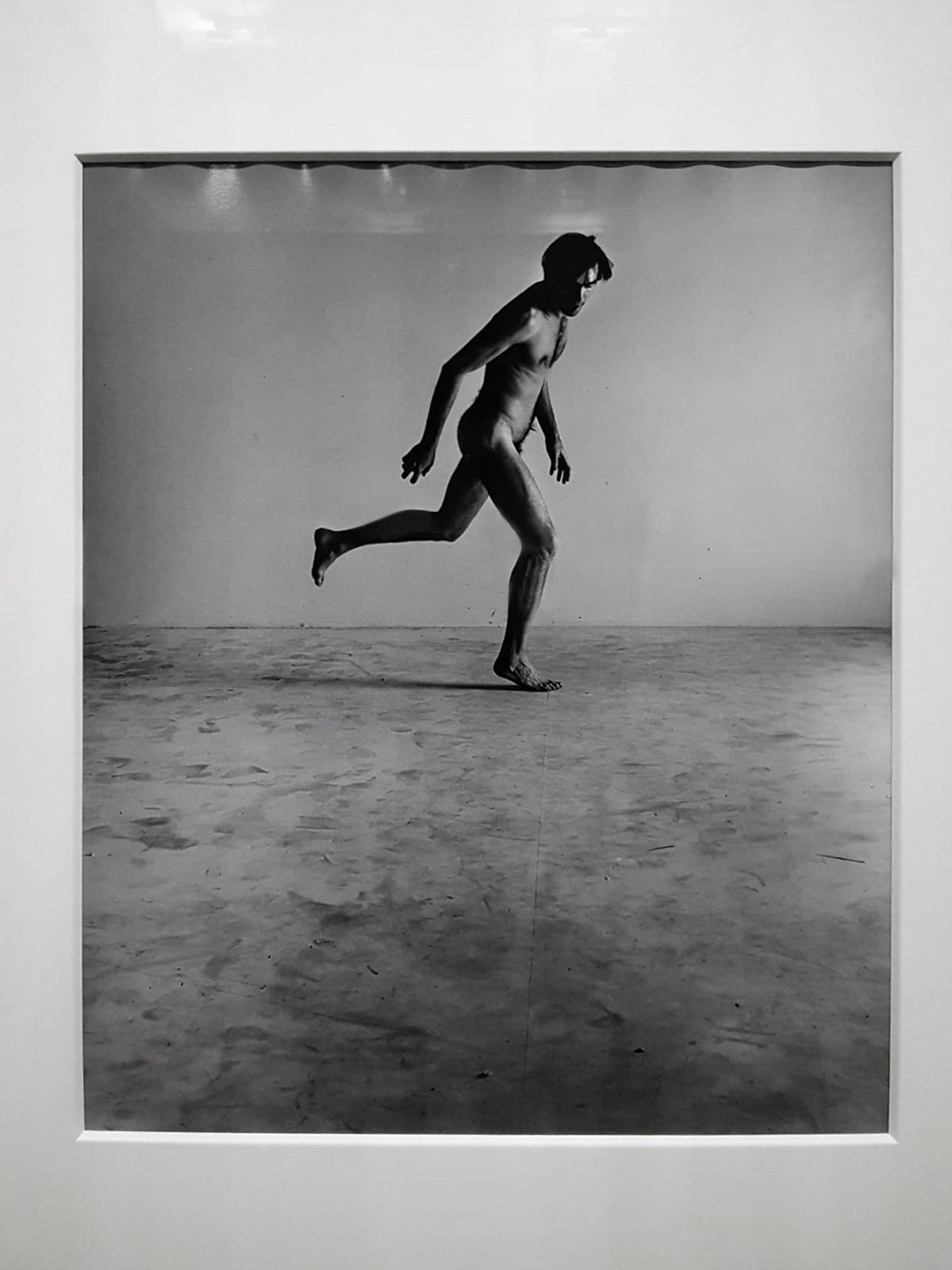
Exhibition dates: 7th October, 2016 – 26th February, 2017

An exhibition showcasing Lesbian, Gay, Bisexual, Transgender, and Queer artistic life in New York City through the social networks of Leonard Bernstein, Mercedes de Acosta, Harmony Hammond,  Bill T. Jones, Lincoln Kirstein, Greer Lankton, George Platt Lynes,  Robert Mapplethorpe, Richard Bruce Nugent, and Andy Warhol.

Curators: Donald Albrecht, MCNY curator of architecture and design, and Stephen Vider, MCNY Mellon Postdoctoral Fellow.


'The Young Physique' October/November 1964 from the exhibition 'Gay Gotham: Art and Underground Culture in New York' at the Museum of the City of New York, New York City, Oct 2016 - Feb 2017


The Young Physique
October/November 1964
Collection of Kelly McKaig


Part two of this monster posting on the exhibition Gay Gotham: Art and Underground Culture in New York at the Museum of the City of New York.

Highlights include photographs by Carl Van Vechten; art work by and of Andy Warhol; a video of the “Panzy Craze” of the the 1920s and 1930s; a photograph of a very young and skinny Robert Mapplethorpe and some of his early art work; some wonderful subversiveness from Greer Lankton; two glorious photographs from one of my favourite artists, Peter Hujar; and a great selection of book covers and posters, including the ever so sensual, German Expressionist inspired Nocturnes for the King of Naples cover art by Mel Odom.

See Part 1 of the posting

Dr Marcus Bunyan


Many thank to the Museum of the City of New York for allowing me to publish the art work in the posting. Please click on the photographs for a larger version of the image.


Themes ~

Printing


Foujita (Japanese-French, 1886-1968) "Helen Morgan Jr. And Jean Malin at the Smart Club Abbey," 'Vanity Fair' February 1931 from the exhibition 'Gay Gotham: Art and Underground Culture in New York' at the Museum of the City of New York, New York City, Oct 2016 - Feb 2017


Foujita (Japanese-French, 1886-1968)
“Helen Morgan Jr. And Jean Malin at the Smart Club Abbey”
Vanity Fair
February 1931
Private collection


Léonard Tsuguharu Foujita (藤田 嗣治 Fujita Tsuguharu, November 27, 1886 – January 29, 1968) was a Japanese-French painter and printmaker born in Tokyo, Japan, who applied Japanese ink techniques to Western style paintings. He has been called “the most important Japanese artist working in the West during the 20th century”. His Book of Cats, published in New York by Covici Friede, 1930, with 20 etched plate drawings by Foujita, is one of the top 500 (in price) rare books ever sold, and is ranked by rare book dealers as “the most popular and desirable book on cats ever published”.


André Tellier (French, b. 1902) 'Twilight Men' (Greenberg, New York) 1931


André Tellier (French, b. 1902)
Twilight Men (Greenberg, New York)
1931
Fales Library and Special Collections, New York University


First published in 1931, this is an extremely uncommon early novel set in New York City of homosexuality and a young man whose gay tendencies infuriates his father, who attempts to set him upon the “path of normality” by hiring a mistress to seduce him.

“Like many early gay novels, the book does not have a happy ending: the main character becomes addicted to drugs, murders his father, and kills himself. This theme (the gay monster or the gay degenerate) occurs very frequently before the 1960’s. Originally, this was the only way that a book with any kind of gay themes could even be published; that is, it was only palatable – or even legal – to feature a gay protagonist if that person “gets what’s coming to him” in the end.

The February 1934 issue of Chanticleer, a gay literary “magazine,” includes reviews by Henry Gerber of several novels, including Twilight Men. He wrote: “TWILIGHT MEN, by Andre Tellier, deals with a young Frenchman, who comes to America, is introduced into homosexual society in New York, becomes a drug addict for no obvious reason, finally kills his father and commits suicide. It is again excellent anti-homosexual propaganda, although the plot is too silly to convince anyone who has known homosexual people at all.”

Little has been written about the author, Andre Tellier, himself. He wrote other books, including A Woman of Paris, The Magnificent Sin, Vagabond April, and Witchfire; but nothing else is really known about him.”

Anonymous text. “First Pages: Twilight Men by Andre Tellier,” on the Somewhere Books website December 28, 2012 [Online] Cited 22/11/2012.


Blair Niles (American, 1880-1959) 'Strange Brother' (Horace Liveright, New York) 1931


Blair Niles (American, 1880-1959)
Strange Brother (Horace Liveright, New York)
1931
Fales Library and Special Collections, New York University


Strange Brother is a gay novel written by Blair Niles published in 1931. The story is about a platonic relationship between a heterosexual woman and a gay man and takes place in New York City in the late 1920s and early 1930s. Strange Brother provides an early and objective documentation of homosexual issues during the Harlem Renaissance.

Mark Thornton, the story’s protagonist, moves to New York City in hopes of feeling like less of an outsider. At a nightclub in Harlem he meets and befriends June Westbrook. One night they witness a man named Nelly being arrested. June encourages Mark to investigate. This leads Mark to attend Nelly’s trial, where he is found guilty and sentenced to six months’ imprisonment on Welfare Island for his feminine affections and gestures. Next Mark researches the crimes against nature sections of the penal code. Shaken up by his findings and the events, Mark confesses his own homosexuality to June.

Mark and June’s friendship continues to grow, and June introduces Mark to a number of friends in her social circle. Various social interactions ensue including a dinner party for a departing professor, a trip to a nightspot featuring a singer called Glory who sings Creole Love Call and attending a drag ball. Despite reading Walt Whitman’s poetry collection Leaves of Grass, Edward Carpenter’s series of papers Love’s Coming of Age, and Countee Cullen’s poetry, Mark is afraid to come out. Subsequently, Mark is threatened with being outed at work. In response to this threat, Mark commits suicide by shooting himself.

Text from the Wikipedia website


Ann Bannon (American, b. 1932) 'I Am a Woman' (Gold Medal Books, New York) 1959


Ann Bannon (American, b. 1932)
I Am a Woman (Gold Medal Books, New York)
1959
Private collection


The classic 1950s novel from the Queen of Lesbian Pulp. “For contemporary readers the books offer a valuable record of gay and lesbian life in the 1950s. Most are set in Greenwich Village, and Ms. Bannon’s descriptions of bars, clubs and apartment parties vividly evoke a vanished community. Her characters also have historical value. Whereas most lesbians in pulp are stereotypes who get punished for their desires, Beebo and her friends are accessibly human. Their struggles with love and relationships are engrossing today, and half a century ago they were revolutionary.” ~ New York Times “Sex. Sleaze. Depravity. Oh, the twisted passions of the twilight world of lesbian pulp fiction.” ~ Chicago Free Press “Little did Bannon know that her stories would become legends, inspiring countless fledgling dykes to flock to the Village, dog-eared copies of her books in hand, to find their own Beebos and Lauras and others who shared the love they dared not name.” ~ San Francisco Bay Guardian “Ann Bannon is a pioneer of dyke drama.” ~ On Our Backs “When I was young, Bannon’s books let me imagine myself into her New York City neighbourhoods of short-haired, dark-eyed butch women and stubborn, tight-lipped secretaries with hearts ready to be broken. I would have dated Beebo, no question.” ~ Dorothy Allison “Bannon’s books grab you and don’t let go.” ~ Village Voice


'Muscleboy' March/April 1965


Muscleboy
March/April 1965
Collection of Kelly McKaig


Design by Gran Fury for Art Against AIDS/On The Road and Creative Time, Inc. 'Kissing Doesn't Kill: Greed and Indifference Do' 1989


Design by Gran Fury for Art Against AIDS/On The Road and Creative Time, Inc.
Kissing Doesn’t Kill: Greed and Indifference Do
1989
Bus poster
Gran Fury, Courtesy The New York Public Library Manuscripts and Archives Division


Placemaking: Cruising


Anonymous photographer. 'New York City street photograph' 1960s


Anonymous photographer
New York City street photograph
1960s
Collection of Philip Aarons and Shelley Fox Aarons, New York


Leonard Fink (American, 1930-1993) 'Charley Inside Ramrod' c. 1976


Leonard Fink (American, 1930-1993)
Charley Inside Ramrod
c. 1976
Courtesy LGBT Community Center National History Archive


THE RAMROD, 394 West Street, (between Charles and West 10th Streets). Constructed in the 1850’s this building (actually two, that were attached) housed S. J. Seely & Co., a lime dealer, and C. August, (on the corner) a porter house, and private residence. In the late 70’s it was one of the most popular leather bars in New York. Attracting a large motorcycle clientele, West Street always had a plethora of bikes parked out front. The doorman, Rico, had a long black bushy beard, and an ever present black cowboy hat, also he wore on his hand a glove with sharp stainless steel blades attached to it, (sort of a precursor to Freddie Kruger). The bar, and Rico could be very intimidating, if you were new, or “Brown” as the uninitiated were called… referring to the brown leather they wore.

Anonymous text. “Greenwich Village: A Gay History,” on the Huzzbears website [Online] Cited 15/02/2021. No longer available online


In June 1993, the Estate of Leonard Fink donated a photographic collection to The Center in New York City through its executor, Steven E. Bing. The materials in the Fink Estate was willed to four AIDS related organisations who gave all of the rights to the photos to the Center Archive. Some of these were signed “Len Elliot,” which might have ben a pseudonym of Fink’s. The collection consists of over 25,000 negatives and images capturing Greenwich Village and much of the spirit of the late 60s and 70s. Some of the most well known images in the collection are Fink’s work at “The Piers” along the Hudson River. Fink documented over 25 years of gay life in New York City but his photography was never exhibited or published in his lifetime. He was self taught and used an old 35mm camera while working out of a homemade darkroom in his West 92nd Street apartment.

Jeffrey James Keyes. “PHOTOS: An Exclusive Peek Inside The Estate of Leonard Fink,” on the Gay Cities website May 27, 2014 [Online] Cited 22/11/2021


Leonard Fink (American, 1930-1993)

Leonard Fink was an amateur photographer who documented over 25 years of gay life in New York including parades, bars, and especially the west side piers. He worked in complete obscurity and was apparently very reclusive. His photographs were seen by only a few close friends and were never exhibited or published in his lifetime. He seems to have taught himself photography using an old 35mm camera and a homemade darkroom in his small apartment on West 92nd street. He lived frugally, spending much of his income on photographic supplies which he bought in bulk and stored in his darkroom and his bedroom. He stored the prints and negatives in a file cabinet. By the time of his death, the photos in the file cabinet covered a period from 1954 to 1992. His photographs of gay life begin with groups of gay men photographed in Greenwich Village in 1967. His photographs of Gay Pride parades begin with the first parade in 1970. His earlier photographs are of friends, trips to Europe, and scenes in New York. Leonard Fink was a colourful and ubiquitous character in the Village and at Pride parades, usually appearing on roller skates in short cut-offs, and a tight t-shirt with cameras always around his neck. He sometimes arrived on a bicycle or a motorcycle. He was born in 1930. His father and older brother were both physicians. He worked for many years as an attorney for the New York Transit Authority. He died of AIDS in 1993.

Anonymous text. “Leonard Fink Photographs,” on The Center website [Online] Cited 22/11/2021


Posing


James VanDerZee (African-American, 1886-1983) 'Beau of the Ball' 1926


James VanDerZee (American, 1886-1983)
Beau of the Ball
1926
Gelatin silver print
Donna Mussenden VanDerZee


James VanDerZee (American, 1886-1983)

James Van Der Zee (June 29, 1886 – May 15, 1983) was an African-American photographer best known for his portraits of black New Yorkers. He was a leading figure in the Harlem Renaissance. Aside from the artistic merits of his work, Van Der Zee produced the most comprehensive documentation of the period. Among his most famous subjects during this time were Marcus Garvey, Bill “Bojangles” Robinson and Countee Cullen…

Van Der Zee worked predominantly in the studio and used a variety of props, including architectural elements, backdrops, and costumes, to achieve stylised tableaux vivant in keeping with late Victorian and Edwardian visual traditions. Sitters often copied celebrities of the 1920s and 1930s in their poses and expressions, and he retouched negatives and prints heavily to achieve an aura of glamour…

Works by Van Der Zee are artistic as well as technically proficient. His work was in high demand, in part due to his experimentation and skill in double exposures and in retouching negatives of children. One theme that recurs in his photographs was the emergent black middle class, which he captured using traditional techniques in often idealistic images. Negatives were retouched to show glamor and an aura of perfection. This affected the likeness of the person photographed, but he felt each photo should transcend the subject. His carefully posed family portraits reveal that the family unit was an important aspect of Van Der Zee’s life. “I tried to see that every picture was better-looking than the person.” “I had one woman come to me and say ‘Mr.Van Der Zee my friends tell thats a nice picture, But it doesn’t look like you.’ That was my style.” Said Van Der Zee.

Text from the Wikipedia website


Carl Van Vechten (American, 1880-1964) 'Anna May Wong' 1932


Carl Van Vechten (American, 1880-1964)
Anna May Wong
1932
Gelatin silver print
Museum of the City of New York, Gift of Carl Van Vechten


Carl Van Vechten (American, 1880-1964)

Little known today, Carl Van Vechten was a prolific novelist, critic, photographer, and promoter of all things modern, most actively engaged in the city’s cultural life during the 1920s and ’30s. The City Museum is rich in Van Vechten materials; its collections include about 2,200 photographs taken by him and 3,000 Christmas cards sent to him and his wife, film and theatre actress Fania Marinoff. Taken together, they chronicle Van Vechten’s influential circles of friends and colleagues – a hybrid mash-up that defines the modern America at the heart of White’s new book. Images and correspondence in the City Museum’s collection range from Harlem Renaissance poet Langston Hughes to writer Zelda Fitzgerald (wife of F. Scott), and playwright Eugene O’Neill.

Around 1920 Van Vechten gave up journalism for fiction and over the next decade wrote hotly debated novels about Jazz Age Manhattan. His 1923 book The Blind Bow-Boy, for example, is a classic of gay camp and a public expression of Van Vechten’s sexual orientation; while he and Marinoff were married from 1914 until Van Vechten’s death in 1964, he had numerous homosexual relationships… Van Vechten’s role in the Harlem Renaissance remains a controversial topic. To some he’s a valuable bridge between white and black New Yorkers, to others he’s an outsider who patronised and exploited his African-American subjects…

Carl Van Vechten abandoned writing altogether in the early 1930s and embraced photography, a field he would pursue until his death. All told, it is estimated that Van Vechten took some 15,000 photographs. Because his inherited wealth offered him financial independence, Van Vechten took pictures for his own pleasure, usually inviting local and visiting celebrities to a studio he set up in his own apartment. While Van Vechten was aware of the stylistic artifice of such contemporary commercial photographers as Edward Steichen and Cecil Beaton, he stood apart from them. He used a small-format camera, and his aesthetic, which included deep and dramatic shadows that sometimes obscured his subjects’ faces, resulted in picture-making that was far more immediate and spontaneous than that of his contemporaries. Using this technique, Van Vechten photographed musicians Billie Holiday and George Gershwin, Hollywood actors Laurence Olivier and Anna May Wong, and writers Sinclair Lewis and Clifford Odets, to name only a few. The sum of Van Vechten’s work, according to photography historian Keith F. Davis, “constitutes the single most integrated vision of American arts and letters produced in his era.”

Donald Albrecht. “Carl Van Vechten and Modern New York,” on the Museum of the City of New York website August 26, 2014 [Online] Cited 22/11/2021


Anna May Wong (American, 1905-1961)

Anna May Wong (January 3, 1905 – February 3, 1961) was an American actress. She is considered to be the first Chinese American movie star, and also the first Asian American actress to gain international recognition. Her long and varied career spanned silent film, sound film, television, stage and radio…

Wong’s image and career have left a legacy. Through her films, public appearances and prominent magazine features, she helped to humanise Asian Americans to white audiences during a period of overt racism and discrimination. Asian Americans, especially the Chinese, had been viewed as perpetually foreign in U.S. society but Wong’s films and public image established her as an Asian-American citizen at a time when laws discriminated against Asian immigration and citizenship. Wong’s hybrid image dispelled contemporary notions that the East and West were inherently different.

See an excellent short biography on the Wikipedia website


Carl Van Vechten (American, 1880-1964) 'Hugh Laing' 1941


Carl Van Vechten (American, 1880-1964)
Hugh Laing
1941
Gelatin silver print
Museum of the City of New York, Gift of Carl Van Vechten


Hugh Laing (American, 1911-1988)

Hugh Laing (6 June 1911 – 10 May 1988) was one of the most significant dramatic ballet dancers of the 20th-century. He was the partner of choreographer Antony Tudor. Known for his good looks and the intensity of his stage presence, Laing was never considered a great technician, yet his powers of characterisation and his sense of theatrical timing were considered remarkable. His profile as a significant dancer of his era was almost certainly enhanced by Tudor’s choreographing to his undoubted strengths and Laing is generally regarded as one of the finest dramatic dancers of 20th-century ballet. He remained Tudor’s artistic collaborator and companion until the choreographer’s death in 1987.


Carl Van Vechten (American, 1880-1964) 'Alvin Ailey' 1955


Carl Van Vechten (American, 1880-1964)
Alvin Ailey
1955
Gelatin silver print
Museum of the City of New York, Gift of Carl Van Vechten


Alvin Ailey (American, 1931-1989)

Alvin Ailey (January 5, 1931 – December 1, 1989) was an African-American choreographer and activist who founded the Alvin Ailey American Dance Theater in New York City. He is credited with popularising modern dance and revolutionising African-American participation in 20th-century concert dance. His company gained the nickname “Cultural Ambassador to the World” because of its extensive international touring. Ailey’s choreographic masterpiece Revelations is believed to be the best known and most often seen modern dance performance…

Ailey made use of any combination of dance techniques that best suited the theatrical moment. Valuing eclecticism, he created more a dance style than a technique. He said that what he wanted from a dancer was a long, unbroken leg line and deftly articulated legs and feet (“a ballet bottom”) combined with a dramatically expressive upper torso (“a modern top”). “What I like is the line and technical range that classical ballet gives to the body. But I still want to project to the audience the expressiveness that only modern dance offers, especially for the inner kinds of things.”

Ailey’s dancers came to his company with training from a variety of other schools, from ballet to modern and jazz and later hip-hop. He was unique in that he did not train his dancers in a specific technique before they performed his choreography. He approached his dancers more in the manner of a jazz conductor, requiring them to infuse his choreography with a personal style that best suited their individual talents. This openness to input from dancers heralded a paradigm shift that brought concert dance into harmony with other forms of African-American expression, including big band jazz.

Text from the Wikipedia website


Larry Rivers (American, 1923-2002) 'O'Hara Nude With Boots' 1954


Larry Rivers (American, 1923-2002)
O’Hara Nude With Boots
1954
Oil on canvas
Collection of the Larry Rivers Foundation


“Among Rivers’ portraits of the mid-1950s, the most notable and controversial work for a discussion of the relationship among autobiography, sexuality, and art is O’Hara, which he painted during January 1954 as he re-entered an emotional relationship with the sitter. According to [poet Frank] O’Hara’s biographer, Brad Gooch, Rivers and O’Hara had a relatively short, turbulent romance that began in 1952m but during 1953 the two men became involved in other romantic relationships… Beginning in 1954, however, Rivers and O’Hara resumed their intimate relationship, which then lasted less than a year…

A nude of a contemporary figure on such a huge scale as O’Hara appeared unusual and even controversial in the 1950s New York art world. Rivers recalled that when the painting was first shown at the Whitney Annual in 1955, a guard often stood in front of it to ensure that the painting would not be defaced or damaged: “There was something about the male nude that seemed to be more of a problem than the female nude.” Some contemporary viewers where shocked by O’Hara, given its depiction of a naked male body with meticulous attention to the genitals.”

Dong-Yeon Koh. Larry Rivers and Frank O’Hara: Reframing Male Sexualities. Phd dissertation 2006, pp. 196-198.


Beauford Delaney (American, 1901-1979) 'James Baldwin' c. 1957


Beauford Delaney (American, 1901-1979)
James Baldwin
c. 1957
Oil on canvas board
Halley K. Harrisburg and Michael Rosenfeld, New York


Beauford Delaney (American, 1901-1979)

Beauford Delaney (December 30, 1901 – March 26, 1979) was an American modernist painter. He is remembered for his work with the Harlem Renaissance in the 1930s and 1940s, as well as his later works in abstract expressionism following his move to Paris in the 1950s.

In his Introduction to the Exhibition of Beauford Delaney opening December 4, 1964 at the Gallery Lambert, James Baldwin wrote, “the darkness of Beauford’s beginnings, in Tennessee, many years ago, was a black-blue midnight indeed, opaque and full of sorrow. And I do not know, nor will any of us ever really know, what kind of strength it was that enabled him to make so dogged and splendid a journey.”

James Arthur Baldwin (American, 1924-1987)

James Arthur Baldwin (August 2, 1924 – December 1, 1987) was an American novelist, essayist, playwright, poet, and social critic. His essays, as collected in Notes of a Native Son (1955), explore palpable yet unspoken intricacies of racial, sexual, and class distinctions in Western societies, most notably in mid-20th-century America, and their inevitable if unnameable tensions. Some Baldwin essays are book-length, for instance The Fire Next Time (1963), No Name in the Street (1972), and The Devil Finds Work (1976).

Baldwin’s novels and plays fictionalise fundamental personal questions and dilemmas amid complex social and psychological pressures thwarting the equitable integration not only of black people, but also of gay and bisexual men, while depicting some internalised obstacles to such individuals’ quests for acceptance. Such dynamics are prominent in Baldwin’s second novel, Giovanni’s Room, written in 1956, well before the gay liberation movement.

Text from the Wikipedia website


Performing


The Pansy Craze on Stage and Screen

New York’s queer cultures gained remarkable visibility on the city’s stages in the 1920 and 1930s. Broadway producers and nightclub owners put on plays and acts exploring gay and lesbian themes. They launched a popular “Panzy Craze,” where minorities where accepted. This period lasted until the mid-1930s when morals and ethics changed because of right-wing pressure. The film code was then in full force to protect society’s “morals” and there was, once more, open hostility towards minorities that latest into the 1970s.

With permission of the Museum of the City of New York for Art Blart

The Museum of the City of New York
Film compiliation
Produced by Cramersound


Max Ewing (American, 1903-1934) 'Gallery of Extraordinary Portraits' 1928


Max Ewing (American, 1903-1934)
Gallery of Extraordinary Portraits
1928
Courtesy Yale University, Beinecke Rare Books and Manuscripts Library


Max Ewing’s Gallery of Extraordinary Portraits encapsulates the exhibition’s wider exploration of queer communities in 20th-century New York. Ewing was a novelist, composer, pianist, and sculptor who created this gallery in the walk-in closet of his Manhattan studio apartment on West 31st Street. His semi-public closet exhibition paid homage to interracial, gay, and artistic communities with images of friends and celebrities plastered floor to ceiling, corner to corner.


Sterling Paige. 'Gladys Bentley at the Ubangi Club in Harlem' early 1930s


Sterling Paige
Gladys Bentley at the Ubangi Club in Harlem
early 1930s
Gelatin silver print
Courtesy of the Visual Studies Workshop, Rochester, NY


1960-1995

Portraits
Andy Warhol


Andy Warhol (American, 1928-1987) 'Studies for a Boy Book' exhibition announcement for Bodley Gallery c. 1956


Andy Warhol (American, 1928-1987)
Studies for a Boy Book exhibition announcement for Bodley Gallery
c. 1956
Offset lithograph Susan Sheehan Gallery, New York


Andy Warhol (American, 1928-1987) 'Gee, Merrie Shoes' 1956


Andy Warhol (American, 1928-1987)
Gee, Merrie Shoes
1956
Hand coloured offset lithograph
Susan Sheehan Gallery, New York


Andy Warhol (American, 1928-1987) 'Cecil Beaton's Feet' 1961


Andy Warhol (American, 1928-1987)
Cecil Beaton’s Feet
1961
Black ink on buff wove paper
Philadephia Museum of Art
The Henry P. Mcllhenny Collection in memory of Frances P. Mcllhenny, 1986


Cecil Beaton (British, 1904-1980) 'Andy Warhol and Candy Darling, New York' 1969


Cecil Beaton (British, 1904-1980)
Andy Warhol and Candy Darling, New York
1969
Gelatin silver print
© The Cecil Beaton Studio Archive at Sotheby’s


Candy Darling (November 24, 1944 – March 21, 1974) was an American transgender actress, best known as a Warhol Superstar. She starred in Andy Warhol’s films Flesh (1968) and Women in Revolt (1971), and was a muse of the protopunk band The Velvet Underground.


Edie Sedgwick Screen Test

Andy Warhol’s silent screen test for his future “super star.”


Harmony Hammond


'Liberation News Service #624' July 3, 1974


Liberation News Service #624, featuring Harmony Hammond, right, with daughter, Tanya, at the Christopher Street Liberation Day Gay Pride March, photograph by Cidne Hart for Liberation News Service, July 3, 1974
Private collection


Harmony Hammond (American, b. 1944) 'An Oval Braid' 1972


Harmony Hammond (American, b. 1944)
An Oval Braid
1972
Charcoal on paper
Courtesy the artist and Alexander Gray Associates, New York


Harmony Hammond (American, b. 1944) 'Fan Lady meets Cactus Lady' 1981


Harmony Hammond (American, b. 1944)
Fan Lady meets Cactus Lady
1981
Lithograph
Courtesy the artist and Alexander Gray Associates, New York


Robert Mapplethorpe


Judy Linn (American, b. 1947) 'Robert Gets Dressed at the Chelsea, #3' 1970


Judy Linn (American, b. 1947)
Robert Gets Dressed at the Chelsea, #3
1970
Modern digital print
Courtesy the Artist and Susanne Hilberry Gallery


'Gay Power', Volume 1, No 16, April 15, 1970


Gay Power, Volume 1, No 16, April 15, 1970
Alternative Press Collection, Archives & Special Collections at the Thomas J. Dodd Research Center, University of Connecticut Libraries


Robert Mapplethorpe (American, 1946-1989) 'Light Gallery invitation' 1973


Robert Mapplethorpe (American, 1946-1989)
Light Gallery invitation
1973
Getty Research Institute, Los Angeles California


Ultra Violet modeling Mapplethorpe-designed jewelry, c. 1975


Ultra Violet modeling Mapplethorpe-designed jewelry
c. 1975
Gift of the Robert Mapplethorpe Foundation to The J. Paul Getty Trust and the Los Angeles County Museum of Art


Isabelle Collin Dufresne (French-American, 1935-2014)

Isabelle Collin Dufresne (stage name Ultra Violet; 6 September 1935 – 14 June 2014) was a French-American artist, author, and both a colleague of Andy Warhol and one of the pop artist’s so-called superstars. Earlier in her career, she worked for and studied with surrealist artist Salvador Dalí. Dufresne lived and worked in New York City, and also had a studio in Nice, France…

In 1954, after a meeting with Salvador Dalí, she became his “muse”, pupil, studio assistant, and lover in both Port Lligat, Spain, and in New York City. Later, she would recall, “I realised that I was ‘surreal’, which I never knew until I met Dalí”. In the 1960s, Dufresne began to follow the progressive American Pop Art scene including Jasper Johns, Robert Rauschenberg and James Rosenquist.

In 1963, Dalí introduced Dufresne to Andy Warhol, and soon she moved into the orbit of his unorthodox studio, “The Factory”. In 1964 she selected the stage name “Ultra Violet” at Warhol’s suggestion, because it was her preferred fashion – her hair colour at the time was often violet or lilac. She became one of many “superstars” in Warhol’s Factory, and played multiple roles in over a dozen films between 1965 and 1974…

In the 1980s, she gradually drifted away from the Factory scene, taking a lower profile and working independently on her own art. In her autobiography, published the year after Warhol’s unexpected demise in 1987, she chronicled the activities of many Warhol superstars, including several untimely deaths during and after the Factory years…

In 1990 she opened a studio in Nice and wrote another book detailing her own ideas about art, L’Ultratique. She lived and worked as an artist in New York City, and also maintained a studio in Nice for the rest of her life.

Text from the Wikipedia website


Valerie Santagto (American, b. 1947) 'Robert Mapplethorpe, front, and Jay Johnson in Mapplethorpe designed jewelry' c. 1970-1975


Valerie Santagto (American, b. 1947)
Robert Mapplethorpe, front, and Jay Johnson in Mapplethorpe designed jewellery
c. 1970-75
Gift of the Robert Mapplethorpe Foundation to The J. Paul Getty Trust and the Los Angeles County Museum of Art


Robert Mapplethorpe (American, 1946-1989) 'Jim, Sausalito' 1977


Robert Mapplethorpe (American, 1946-1989)
X Portfolio with Jim, Sausalito
1978
Black silk clamshell case with gelatin silver print photographs mounted on pure rag board
Designed by John Cheim
Courtesy Yoshi Gallery, New York and Cheim & Read, New York


Greer Lankton


'Einsteins' installation designed by Paul Monroe for 'Gay Gotham', 2016 featuring works by Greer Lankton and Andy Warhol


Einsteins installation designed by Paul Monroe for Gay Gotham, 2016
Courtesy of Greer Lankton Archives Museum

Greer Lankton (American, 1958-1996)
Mini-Einsteins
1987
Cardboard, glass, paint, styrofoam board

Andy Warhol
1990
Fabric, wire, glass, human hair

Teri Toye
1988
Fabric, wire, glass, human hair

Siamese Twins
1988
Paper, wire, fabric


Greer Lankton (American, 1958-1996) (dolls and photo) 'Einsteins "Circus" window display by Greer Lankton and Paul Monroe' 1986


Greer Lankton (American, 1958-1996) (dolls and photo)
Einsteins “Circus” window display by Greer Lankton and Paul Monroe
1986
Courtesy Paul Monroe for Greer Lankton Archives Museum


Greer Lankton (American, 1958-1996)

Greer Lankton (1958 – November 18, 1996) was an American artist known for creating lifelike, sewn dolls that were often modelled on friends and celebrities and posed in elaborate theatrical settings. She was a key figure in the East Village art scene of the 1980s in New York.

Gender and sexuality are recurring themes in Lankton’s art. Her dolls are created in the likeness of those society calls “freaks”, and have often been compared to the surrealist works of Hans Bellmer, who made surreal dolls with interchangeable limbs. She created figures that were simultaneously distressing and glamorous, as if they were both victim and perpetrator of their existence.

In 1981 Lankton was featured in the seminal “New York/New Wave” exhibition at P.S.1 in Long Island City, and began to show her work in the East Village at Civilian Warfare. She gained an almost cult following among East Village residents from her highly theatrical window displays she designed for Einstein’s, the boutique that was run by her husband, Paul Monroe, at 96 East Seventh Street. Besides her more emotionally charged dolls, Lankton also created commissioned portrait dolls. These include a 1989 doll of Diana Vreeland that was commissioned for a window display at Barney’s as well as shrines to her icons, such as Candy Darling.

Critic Roberta Smith described her works in the New York Times as: “Beautifully sewn, with extravagant clothes, make-up and hairstyles, they were at once glamorous and grotesque and exuded intense, Expressionistic personalities that reminded some observers of Egon Schiele. They presaged many of the concerns of 90’s art, including the emphasis on the body, sexuality, fashion and, in their resemblance to puppets, performance.” 

Photographer Nan Goldin said of her work, “Greer was one of the pioneers who blurred the line between folk art and fine art.” She had spots in the prestigious Whitney Biennial and the Venice Biennale, both in 1995, where her busts of Candy Darling, circus fat ladies, and dismembered heads gained her notoriety…

Greer was friends with photographer Nan Goldin, and lived in her apartment in the early 80’s, often posing for her. She also played muse to photographers like David Wojnarowicz and Peter Hujar.

Text from the Wikipedia website


“Writing about the wax dolls of German artist Lotte Pritzel (to whom Lankton’s own work bears a strong family resemblance), Rainer Maria Rilke noted: “With the doll we had to assert ourselves, because if we surrendered to it there was nobody there. It made no response, so we got into the habit of doing things for it, splitting our own slowly expanding nature into opposing parts and to some extent using the doll to establish distance between ourselves and the amorphous world pouring into us” [“Dolls: On the Wax Dolls of Lotte Pritzel,” tr. Idris Parry]. This relationship imbues the doll with its “soul,” Rilke writes, arguing that it is the extremity of this attachment that leads us to both desire and reject the doll. Unalterable strangeness: Lankton’s own work is plotted along the rejection-desire axis, granting the work a peculiar levity that hovers between fearsome and friendly…

Lankton’s art is both realistic and unrealistic, a difficult balance that is not unlike Candy Darling’s work as an actor, which often operated at the juncture between self-conscious play and unanticipated reality to evoke, again, unalterable strangeness. Following Douglas Crimp’s description of the superstar as someone whose “self … recognises otherness already there in itself [and] performs its own self-alienation” [Our Kind of Movie: The Films of Andy Warhol, Cambridge: MIT Press, 2012], Lankton likewise performs the double work of representing bodies (hers and others) while asserting their alienation. Darling rehearsed and played herself in order to be someone else. It might be said that Lankton rehearsed and played others in order to be herself.”

Extract from “Unalterable Strangeness: Andrew Durbin and Paul Monroe on Greer Lankton,” on the Flash Art website, March – April 2015. No longer available online


Paul Monroe. 'Chanel No. 5 earrings' 1985


Paul Monroe
Chanel No. 5 earrings
1985
Glass (actual miniature Chanel products filled with No. 5), 14k gold wire and glass pearls

Candelabra ring
1986
Metal, chain, glass jewels and wax

Paul Monroe and Greer Lankton (American, 1958-1996)
Teri Toye necklace
1985
Clay, acrylic paint, gold metal chain and rhinestones

Einsteins promotional cards 1986-1992
Einsteins business card, 1985


Nan Goldin (American, b. 1953) 'Greer Lankton and Paul Monroe wedding' 1987


Nan Goldin (American, b. 1953)
Greer Lankton and Paul Monroe wedding
1987
Greer Lankton Archives Museum


Bill T. Jones


Lois Greenfield (American, b. 1949) 'Bill T. Jones and Arnie Zane' 1982


Lois Greenfield (American, b. 1949)
Bill T. Jones and Arnie Zane
1982
Modern print Courtesy Lois Greenfield Studio


Robert Mapplethorpe (American, 1946-1989) 'Studio Portrait (Bill T. Jones and Arnie Zane)' 1986


Robert Mapplethorpe (American, 1946-1989)
Studio Portrait (Bill T. Jones and Arnie Zane)
1986
Private Collection of Bill T. Jones


Tseng Kwong Chi (American born Hong Kong, 1950-1990) 'Bill T. Jones Body Painting with Keith Haring' 1983


Tseng Kwong Chi (American born Hong Kong, 1950-1990)
Bill T. Jones Body Painting with Keith Haring
1983
Silver gelatin selenium-toned print
© Muna Tseng Dance Projects, Inc., New York. Body Drawing on Bill T. Jones by Keith Haring
© 1983 Keith Haring Foundation


Huck Snyder (American, b. 1993) Small mask from 'Last Supper at Uncle Tom's Cabin' 1990


Huck Snyder (American, b. 1993)
Small mask from Last Supper at Uncle Tom’s Cabin
1990
Painted cardboard and fabric
New York Live Arts


Huck Snyder (American, b. 1993)

Huck Snyder was a visual artist and a designer of vivid stage settings for dancers and performance artists. He created sets and stage furniture that were surrealistic yet extremely simple and almost childlike at times. Imaginative and free in their execution and unmistakably his work, his sets often seemed inseparable from the vision of the performers with whom he worked. Huck had designed stage sets for the performance artist John Kelly beginning with sets for Diary of a Somnambulist in 1985…

Mr. Snyder also created sets for dances by Bill T. Jones and Bart Cook, and for theater pieces by Ishmael Houston-Jones. He conceived, directed and designed his own work “Circus,” a performance-art piece presented in 1987 at La Mama E.T.C. Mr. Snyder’s work has been displayed at the Lincoln Center for the Performing Arts, the Brooklyn Academy of Music and the Dance Theater Workshop in New York. His paintings and installations have been exhibited at galleries throughout the United States and in solo and group shows in Europe and Japan.

Anonymous text. “Huck Snyder,” on the Visual AIDS website Nd [Online] Cited 22/11/2021


Themes ~

Downtown


'Shazork! invitation, Danceteria' late 1980s


Downtown invitations
Shazork! invitation, Danceteria
Late 1980s
Museum of the City of New York, Gift of Carrie Goteiner and Miriam Montaug Ashkenazy in memory of Haoui Montaug


Peter Hujar (American, 1934-1987) 'Quentin Crisp' 1982


Peter Hujar (American, 1934-1987)
Quentin Crisp
1982
Vintage gelatin silver print
© The Peter Hujar Archive; Courtesy Pace/MacGill Gallery, New York and Fraenkel Gallery, San Francisco


Quentin Crisp (English, 1908-1999)

Quentin Crisp was born Denis Charles Pratt in Surrey, England, on December 25, 1908. A self-described flamboyant homosexual, Crisp changed his name in his early 20s as part of his process of reinvention. Teased mercilessly at school as a boy, Crisp left school in 1926. He studied journalism at King’s College London, but failed to graduate. He then moved on to take art classes at Regent Street Polytechnic. Crisp began visiting the cafés of Soho, London, and even worked as a prostitute for six months. Crisp was always true to himself and expressed himself by dying his long hair lavender, polishing his fingernails and toenails, and dressing in an often androgynous style. Despite the ridicule and violence often directed toward him, Crisp carried on. He tried to join the army with the outbreak of World War II, but was rejected by the medical board, who determined that he was suffering from sexual perversion. Instead, Crisp remained in London during the Blitz, entertaining American GIs, whose friendliness inculcated a love for Americans.

Crisp held a number of jobs, including engineer’s tracer, life model, and author. His most famous work, The Naked Civil Servant, detailed his life in a homophobic British society. When the book was adapted for television, Crisp began a new career as a performer and lecturer. He moved to Manhattan in 1981, when he was 72 years old; settling in a studio apartment in the Bowery. Upon meeting and spending time with Crisp, Sting was inspired to pen his hit song, “An Englishman in New York.”

Crisp continued to tour, write, and lecture; including instructions on how to live life with style and the importance of manners. Crisp landed a few roles on American television and the 1990s became his busiest decade as an actor. In 1992, Crisp took on the role of Elizabeth I in the film Orlando.

Quentin Crisp died in November 1999, just shy of his 91st birthday, while touring his one-man show.

Anonymous text. “Quentin Crisp,” on the Biography website Nd [Online] Cited 15/02/2017. No longer available online


Peter Hujar (American, 1934-1987) 'Susan Sontag' 1975, printed 2014


Peter Hujar (American, 1934-1987)
Susan Sontag
1975, printed 2014
Pigmented ink print
© The Peter Hujar Archive; Courtesy Pace/MacGill Gallery, New York and Fraenkel Gallery, San Francisco


Peter Hujar (American, 1934-1987)

Peter Hujar (born 1934) died of AIDS in 1987, leaving behind a complex and profound body of photographs. Hujar was a leading figure in the group of artists, musicians, writers, and performers at the forefront of the cultural scene in downtown New York in the 1970s and early 80s, and he was enormously admired for his completely uncompromising attitude towards work and life. He was a consummate technician, and his portraits of people, animals, and landscapes, with their exquisite black-and-white tonalities, were extremely influential. Highly emotional yet stripped of excess, Hujar’s photographs are always beautiful, although rarely in a conventional way. His extraordinary first book, Portraits in Life and Death, with an introduction by Susan Sontag, was published in 1976, but his “difficult” personality and refusal to pander to the marketplace insured that it was his last publication during his lifetime.

Anonymous text. “About Peter Hujar” on the Peter Hujar Archive website [Online] Cited 22/11/2021

Susan Sontag (American, 1933-2004)

Susan Sontag (January 16, 1933 – December 28, 2004) was an American writer, filmmaker, teacher, and political activist. She published her first major work, the essay “Notes on ‘Camp'”, in 1964. Her best-known works include On Photography, Against Interpretation, Styles of Radical Will, The Way We Live Now, Illness as Metaphor, Regarding the Pain of Others, The Volcano Lover, and In America.

Sontag was active in writing and speaking about, or travelling to, areas of conflict, including during the Vietnam War and the Siege of Sarajevo. She wrote extensively about photography, culture and media, AIDS and illness, human rights, and communism and leftist ideology. Although her essays and speeches sometimes drew controversy, she has been described as “one of the most influential critics of her generation.” …

It was through her essays that Sontag gained early fame and notoriety. Sontag wrote frequently about the intersection of high and low art and expanded the dichotomy concept of form and art in every medium. She elevated camp to the status of recognition with her widely read 1964 essay “Notes on ‘Camp’,” which accepted art as including common, absurd and burlesque themes.

In 1977, Sontag published the series of essays On Photography. These essays are an exploration of photographs as a collection of the world, mainly by travellers or tourists, and the way we experience it… She became a role-model for many feminists and aspiring female writers during the 1960s and 1970s.

Text from the Wikipedia website


Printing


Liza Cowan (American) (designer) 'DYKE, A Quarterly' c. 1974


Liza Cowan (American) (designer)
DYKE, A Quarterly
c. 1974
Flyer
Courtesy Liza Cowan and Penny House


'DYKE, A Quarterly Call for poster design flyer' 1976


DYKE, A Quarterly Call for poster design flyer
1976
Illustration by Liza Cowan Penny House


'Christopher Street' September 1977


Christopher Street
September 1977
Private collection


'Christopher Street' June 1978


Christopher Street
June 1978
Private collection


Edmund White (American, b. 1940) 'Nocturnes for the King of Naples' Paperback edition with cover art by Mel Odom, 1980


Edmund White (American, 1940-2025)
Nocturnes for the King of Naples
Paperback edition with cover art by Mel Odom, 1980 (originally published 1978)
Private collection


Edmund White (American, 1940-2025)

Edmund Valentine White III (1940-2025) is an American novelist, memoirist, playwright, biographer and an essayist on literary and social topics. Since 1999 he has been a professor at Princeton University. France made him Chevalier (and later Officier) de l’Ordre des Arts et des Lettres in 1993.

White’s books include The Joy of Gay Sex, written with Charles Silverstein (1977); his trilogy of semi-autobiographic novels, A Boy’s Own Story (1982), The Beautiful Room Is Empty (1988) and The Farewell Symphony (1997); and his biography of Jean Genet. Much of his writing is on the theme of same-sex love.

White has also written biographies of three French writers: Jean Genet, Marcel Proust and Arthur Rimbaud. He is the namesake of the Edmund White Award for Debut Fiction, awarded annually by Publishing Triangle.

Text from the Wikipedia website


'New York Magazine' June 20, 1994


New York Magazine
June 20, 1994
1994
Courtesy New York Magazine


Posing


Eva Weiss (American born Hong Kong, b. 1950) 'From left, Lois Weaver, Peggy Shaw, and Deb Margolin performing as Split Britches in 'Upwardly Mobile Home'' 1984


Eva Weiss (American born Hong Kong, b. 1950)
From left, Lois Weaver, Peggy Shaw, and Deb Margolin performing as Split Britches in ‘Upwardly Mobile Home’
1984
Contemporary archival print
Courtesy Eva Weiss Photography


Alice O'Malley (American, b. 1962) 'Melanie Hope, Clit Club' c. 1992


Alice O’Malley (American, b. 1962)
Melanie Hope, Clit Club
c. 1992
Vintage gelatin silver print
Alice O’Malley Photography


Tseng Kwong Chi (American born Hong Kong, 1950-1990) 'New York, NY (Statue of Liberty)' 1979


Tseng Kwong Chi (American born Hong Kong, 1950-1990)
New York, NY (Statue of Liberty)
1979
Gelatin silver print
Muna Tseng Dance Projects Inc.


Tseng Kwong Chi (American born Hong Kong, 1950-1990)

Tseng Kwong Chi, known as Joseph Tseng prior to his professional career (Chinese: 曾廣智; c. 1950 – March 10, 1990), was a Hong Kong-born American photographer who was active in the East Village art scene in the 1980s.

Tseng was part of an circle of artists in the 1980s New York art scene including Keith Haring, Kenny Scharf, and Cindy Sherman. Tseng’s most famous body of work is his self-portrait series, East Meets West, also called the “Expeditionary Series”. In the series, Tseng dressed in what he called his “Mao suit” and sunglasses (dubbed a “wickedly surrealistic persona” by the New York Times), and photographed himself situated, often emotionlessly, in front of iconic tourist sites. These included the Statue of Liberty, Cape Canaveral, Disney Land, Notre Dame de Paris, and the World Trade Center. Tseng also took tens of thousands of photographs of New York graffiti artist Keith Haring throughout the 1980s working on murals, installations and the subway. In 1984, his photographs were shown with Haring’s work at the opening of the Semaphore Gallery’s East Village location in a show titled “Art in Transit”. Tseng photographed the first Concorde landing at Kennedy International Airport, from the tarmac. According to his sister, Tseng drew artistic influence from Brassai and Cartier-Bresson.

Text from the Wikipedia website


Chantal Regnault (French-Haitian) 'From left, Whitney Elite, Ira Ebony, Stewart and Chris LaBeija, Ian and Jamal Adonis, Ronald Revlon, House of Jourdan Ball, New Jersey' 1989


Chantal Regnault (French-Haitian)
From left, Whitney Elite, Ira Ebony, Stewart and Chris LaBeija, Ian and Jamal Adonis, Ronald Revlon, House of Jourdan Ball, New Jersey
1989
Gelatin silver print
© Chantal Regnault


Museum of the City of New York
1220 Fifth Ave at 103rd St.,

Opening hours:
Open Daily 10am – 6pm

Museum of the City of New York website

LIKE ART BLART ON FACEBOOK

Back to top

Exhibition: ‘American Cool’ at the Smithsonian National Portrait Gallery, Washington, DC

Exhibition dates: 7th February – 7th September 2014


Bruce Davidson (American, b. 1933) 'Untitled' 1959


Bruce Davidson (American, b. 1933)
Untitled from the Brooklyn Gang series
1959
Gelatin silver print


Danny Lyon (American, b. 1942) 'Crossing the Ohio River, Louisville, 1966' 1966


Danny Lyon (American, b. 1942)
Crossing the Ohio River, Louisville, 1966
1966
Silver gelatin print


This exhibition does not reflect our opinion of who’s cool. Each cool figure was considered with the following historical rubric in mind and possesses at least three elements of this singular American self-concept:

  1. an original artistic vision carried off with a signature style
  2. cultural rebellion or transgression for a given generation
  3. iconic power, or instant visual recognition
  4. a recognised cultural legacy


Every individual here created an original persona without precedent in American culture. These photographs capture the complex relationship between the real-life person, the image embraced by fans and the media, and the person’s artistic work.

What does it mean when a generation claims a certain figure as cool? What qualities does this person embody at that historical moment? American Cool explores these questions through photography, history, and popular culture. In this exhibition, cool is rendered visible, as shot by some of the finest art photographers of the past century.


Anonymous text from the ‘American Cool’ National Portrait Gallery website [Online] Cited 13/06/2021


When less – less famous, less obvious – is more

I don’t know about you, but the photographs chosen to represent American “cool” in this exhibition – 39 of which are shown in the posting out of a total of 108, but the rest are mainly of the same ilk – seem to me to be a singularly strange bunch of images to choose for such a concept. Personally, I find very few of them are “cool”, that is a mixture of a social charge of rebellious self-expression, charisma, edge and mystery with a certain self-made sense of style.

The only images that I find definitely “cool” among this bunch are, firstly Bob Dylan, closely followed by Jackson Pollock (notice the skull lurking behind him) and Susan Sontag. There is no proposition of cool in these three photographs, the people in them just are. The rest of the photographs, and there really are some atrociously plain and boring portraits among this lot (including a poor portrait of James Dean), really don’t speak to me of cool, don’t speak to me of anything much at all. How you could ever think that the portrait of Willie Nelson, 1989 (printed 2009, below) is cool is beyond me… and what is it with the reprints of the photographs, not originals but modern prints made years later? Perhaps the National Portrait Gallery needed to look beyond their own collection for a more rounded representation of American cool.

The two photographs I have included above are my top picks of American cool, and neither are in the exhibition. These iconic American images don’t feature famous people, they are not “posed” for the camera, and yet there is that ineffable something that makes the people in them absolutely, totally cool. THIS IS AMERICAN COOL: their own style, their own rebelliousness and mystery without possibly realising it = a naturalness that comes from doing their own thing, making their own way. Perhaps that is the point that this exhibition misses: you don’t have to be famous to be “cool”. A portrait is not just a mug shot. And an original persona does not have to come with fame attached.

This exhibition just doesn’t cut the mustard. The whole shebang needed a bloody good rethink, from the concept (does a generation have to “claim” someone is cool? is it necessary or desirable to portray American Cool through media images? do they have to be famous or instantly recognisable people to be “cool”) to the choice of images which could better illustrate the theme. Surely the qualities that person embodies changes from moment to moment, from photographer to photographer, from context to context (just look at the portraits of a haggard James Dean). To attempt to illustrate three elements in a single photograph – good luck with that one!

Dr Marcus Bunyan

PS I have added the videos to add a bit of spice to the proceedings… in them you can, occasionally, feel the charisma of the person.


Many thankx to the Smithsonian National Portrait Gallery for allowing me to publish the photographs in the posting. Please click on the photographs for a larger version of the image.


Bob Willoughby (American, 1927-2009) 'Billie Holiday' 1951 (printed 1991)


Bob Willoughby (American, 1927-2009)
Billie Holiday
1951 (printed 1991)
Gelatin silver print
25.2 x 35.3cm (19 15/16 x 13 15/16″)
National Portrait Gallery, Smithsonian Institution


Rare live footage of one of the first anti-racism songs.


Roger Marshutz (American, 1929-2007) 'Elvis Presley' 1956


Roger Marshutz (American, 1929-2007)
Elvis Presley
1956
Gelatin silver print
Sheet: 40.6 x 50.8cm (16 x20″)
© Estee Stanley


Elvis Presley Jailhouse Rock 1957 colour
Colourised version of the song from the film


Herman Leonard (American, 1923-2010) 'Frank Sinatra' c. 1956


Herman Leonard (American, 1923-2010)
Frank Sinatra
c. 1956
Gelatin silver print
16.5 x 24.1cm (6 1/2 x 9 1/2″)
Institute of Jazz Studies at Rutgers University


Marcia Resnick (American, b. 1950) 'David Byrne' 1981


Marcia Resnick (American, b. 1950)
David Byrne
1981
Gelatin silver print
21.8 x 32.5cm (8 9/16 x 12 13/16″)
National Portrait Gallery, Smithsonian Institution


Julian Wasser (American, b. 1938) 'Joan Didion' 1970


Julian Wasser (American, b. 1938)
Joan Didion
1970
Gelatin silver print
24.3 x 34cm (9 9/16 x 13 3/8″)
National Portrait Gallery, Smithsonian Institution


Joan Didion (born December 5, 1934) is an American author best known for her novels and her literary journalism. Her novels and essays explore the disintegration of American morals and cultural chaos, where the overriding theme is individual and social fragmentation.


Roy Schatt (American, 1909-2002) 'James Dean' 1954


Roy Schatt (American, 1909-2002)
James Dean
1954
Gelatin silver print
34.7 x 42.2cm (13 11/16 x 16 5/8″)
National Portrait Gallery, Smithsonian Institution


William Claxton (American, 1927-2008) 'Steve McQueen' 1962


William Claxton (American, 1927-2008)
Steve McQueen
1962
Gelatin silver print
40 x 58.7cm (15 3/4 x 23 1/8″)
Fahey Klein Gallery


Martin Schoeller (American, b. 1968) 'Tony Hawk' 1999 (printed 2010)


Martin Schoeller (American, b. 1968)
Tony Hawk
1999 (printed 2010)
Archival pigment print
58.5 x 58.6cm (23 1/16 x 23 1/16″)
National Portrait Gallery, Smithsonian Institution


What do we mean when we say someone is cool? Cool carries a social charge of rebellious self-expression, charisma, edge and mystery.

Cool is an original American sensibility and remains a global obsession. In the early 1940s, legendary jazz saxophonist Lester Young brought this central African American concept into the modern vernacular. Cool became a password in bohemian life connoting a balanced state of mind, a dynamic mode of performance, and a certain stylish stoicism. A cool person has a situation under control, and with a signature style. Cool has been embodied in jazz musicians such as Miles Davis and Billie Holiday, in actors such as Robert Mitchum, Faye Dunaway, and Johnny Depp, and in singers such as Elvis Presley, Patti Smith, and Jay-Z. American Cool is a photography and cultural studies exhibition featuring portraits of such iconic figures, each of whom has contributed an original artistic vision to American culture symbolic of a particular historical moment. They emerged from a variety of fields: art, music, film, sports, comedy, literature, and political activism. American Cool is the zeitgeist taking embodied form.

American Cool is captured by a roll call of fine-art photographers from Henri Cartier-Bresson to Annie Leibovitz, from Richard Avedon to Herman Leonard to Diane Arbus. This exhibition is accompanied by an illustrated catalogue with essays by Joel Dinerstein, the James H. Clark Endowed Chair in American Civilization and Director of the New Orleans Center for the Gulf South at Tulane University, and Frank H. Goodyear III, co-director of the Bowdoin College Museum of Art and former curator of photographs at the National Portrait Gallery.


Unidentified Artist. 'Jack Nicholson in "One Flew Over the Cuckoo's Nest"' 1975


Unidentified Artist
Jack Nicholson in “One Flew Over the Cuckoo’s Nest”
1975
Gelatin silver print
17.3 x 25.1cm (6 13/16 x 9 7/8″)
The Kobal Collection


John Cohen (American, 1932-2019) 'Jack Kerouac' 1959


John Cohen (American, 1932-2019)
Jack Kerouac
1959
Gelatin silver print
Image: 15.9 x 24.1cm (6 1/4 x 9 1/2″)
Sheet: 20.2 x 25.4cm (7 15/16 x 10″)
National Portrait Gallery, Smithsonian Institution


Leo Fuchs (American, 1911-1994) 'Paul Newman' 1959 (printed 2013)


Leo Fuchs (American, 1911-1994)
Paul Newman
1959 (printed 2013)
Modern archival print
Sheet: 27.9 x 35.6cm (11 x 14″)
© Alexandre Fuchs


William Paul Gottlieb (American, 1917-2006) 'Thelonious Monk at Minton's Playhouse, New York City' 1947


William Paul Gottlieb (American, 1917-2006)
Thelonious Monk at Minton’s Playhouse, New York City
1947
Gelatin silver print
Sheet: 25.4 x 20.3cm (10 x 8″)
Estate of William Gottlieb


Thelonious Monk Quartet – Round Midnight
Thelonious Monk(p) Charlie Rouse(ts) Larry Gales(b) Ben Riley(ds)
Recorded in Norway 1966 dvd “LIVE in ’66”


Peter Hujar (American, 1934-1987) 'Susan Sontag' 1975


Peter Hujar (American, 1934-1987)
Susan Sontag
1975
Gelatin silver print
37.1 x 37.6cm (14 5/8 x 14 13/16″)
National Portrait Gallery, Smithsonian Institution


Michael O'Brien (American, b. 1950) 'Willie Nelson' 1989 (printed 2009)


Michael O’Brien (American, b. 1950)
Willie Nelson
1989 (printed 2009)
Chromogenic print
38.1 x 38.1cm (15 x 15″)
National Portrait Gallery, Smithsonian Institution


Introduction

What do we mean when we say someone is cool? To be cool means to exude the aura of something new and uncontainable. Cool is the opposite of innocence or virtue. Someone cool has a charismatic edge and a dark side. Cool is an earned form of individuality. Each generation has certain individuals who bring innovation and style to a field of endeavour while projecting a certain charismatic self-possession. They are the figures selected for this exhibition: the successful rebels of American culture.

The legendary jazz saxophonist Lester Young created the modern usage of “cool” in the 1940s. At first it meant being relaxed in one’s environment against oppressive social forces, but within a generation it became a password for stylish self-control. This exhibition does not reflect our opinion of who’s cool. Each cool figure was considered with the following historical rubric in mind and possesses at least three elements of this singular American self-concept:

1/ an original artistic vision carried off with a signature style
2/ cultural rebellion or transgression for a given generation
3/ iconic power, or instant visual recognition
4/ a recognised cultural legacy

Every individual here created an original persona without precedent in American culture. These photographs capture the complex relationship between the real-life person, the image embraced by fans and the media, and the person’s artistic work.

What does it mean when a generation claims a certain figure as cool? What qualities does this person embody at that historical moment? American Cool explores these questions through photography, history, and popular culture. In this exhibition, cool is rendered visible, as shot by some of the finest art photographers of the past century.

The Roots of Cool: Before 1940

The stage was set for the emergence of cool as a cultural phenomenon in the early 1940s by a series of sweeping transformations in the first decades of the twentieth century. The figures in this first section were not called cool in their day but were leading exemplars of new energies that were changing the social contours of American life. A fresh rebelliousness was revealed in the new film capital of Hollywood, in modernist literature and art, in emerging youth entertainments, and in a new music called jazz. The advent of technologies such as radio, film, and the automobile and the increasing diversity in America’s booming cities accelerated the pace of change. Though Prohibition in the 1920s sought to regulate American morality by ending the consumption of alcohol, this period saw the expression of a new independence among young people and others historically on the margins of public life. In particular, both African Americans and women sought and began to attain freedoms long denied. Cool has long denoted a person’s sense of calm and composure. Charismatic individuals such as those featured here contributed greatly to the changing mores in American society before World War II. Cool would ultimately serve as the term that would describe this new rebel.

The Birth of Cool: 1940-1959

Being cool was a response to the rapid changes of modernity: it was about maintaining a state of equipoise within swirling, dynamic social forces. The legendary jazz saxophonist Lester Young disseminated the word and concept of cool into jazz culture in the early 1940s, and it quickly crossed over as a rebel masculine sensibility. When Young said, “I’m cool,” he meant, first, that he was relaxed in the environment and, second, that he was keeping it together under social and economic pressure as well as the absurdity of life in a racist society. This mask of cool emerged as a form of American stoicism and was manifested in jazz, film noir, Beat literature, and abstract expressionism. In jazz, a generation of younger musicians rejected big-band swing entertainment to create bebop, a fast, angular, virtuosic style that moved jazz out of dance halls and into nightclubs. In Hollywood, film noir represented postwar anxiety through crime dramas shot through with working-class existentialism and the fear of women’s sexual and economic power. Among Beat writers and abstract painters, cool referred to a combination of wildness and intensity in men unconcerned with social conformity. Starting from jazz, cool was a rebel sensibility suggesting that an individual’s importance could be registered only through self-expression and the creation of a signature style. By 1960 cool was the protean password of a surging underground aesthetic.

Cool and the Counterculture: 1960-1979

In the 1960s and 1970s, to be cool was to be antiauthoritarian and open to new ideas from young cultural leaders in rock and roll, journalism, film, and African American culture. Cool was a badge of opposition to “the System,” by turns a reference to the police, the government, the military-industrial complex, or traditional morality. Using drugs such as marijuana or even LSD was an indicator of risk taking and expanding one’s consciousness; not experimenting with drugs suggested a fear of opening one’s mind or perspective, of being “uptight” or “square.” The same was true of sexual exploration, social protest, and ethnic politics. The aesthetic of stylised understatement still held power, yet cool itself morphed under the era’s social upheavals. The counterculture valued being authentic and emotionally naked: being cool meant a person was “out-front” with others and comfortable in his or her own skin. For African Americans, what had once been suppressed under the mask of cool transformed into defiant civic engagement in music, sports, and politics. “Cool” meant to communicate a set of emotions without losing control, and rock and roll was the art form (and forum) best suited for this shift, especially for women. Patti Smith, Bonnie Raitt, Deborah Harry, and Chrissie Hynde all carved out new iconic stances, styles, and voices for independent women who were sexy on their own terms. Cool became the supreme compliment for creative public figures who broke new cultural ground and maintained their personal integrity over time.

The Legacies of Cool: 1980-Present

In 1980s America, the selling of rebellion as style became ingrained in cool. From highbrow fashion to mass-culture video games, product designers, advertisers, and consumers embraced the cool aesthetic. For many during this era, selling out was no longer a curse, as youth culture increasingly embraced the pursuit of wealth. And though some might proclaim that cool was dead, the concept stayed alive and grew in many quarters. From hip-hop to Seattle grunge, from skateboarding to the Internet, from street graffiti to MTV, cool became central to many of these new cultural forms. While its popularisation tended to whiten this phenomenon, African American culture remained central to its growth. By the 1980s cool also had an easily recognisable history, and many figures from its past – like heroes from a bygone era – continued to resonate widely. Indeed, new icons of cool often built careers that owed much to these earlier exemplars. Throughout the twentieth century, cool was America’s chief cultural export. With the rapid growth of global communication and markets, it plays an even larger role both in the world’s understanding of America and in Americans’ own sense of national identity. The figures in this final section are representative of the legacies of cool as a distinct form of American expression.

Press release from the Smithsonian National Portrait Gallery website


Martin Munkacsi (Hungarian, 1896-1963) 'Fred Astaire' 1936


Martin Munkacsi (Hungarian, 1896-1963)
Fred Astaire
1936
Gelatin silver print
24.1 x 19cm (9 1/2 x 7 1/2″)
National Portrait Gallery, Smithsonian Institution


Swing Time – Rogers and Astaire

In this Swing Time clip, Lucky, Astaire, saves Penny’s, Rogers, job by showing how much she has taught him.


Philippe Halsman (American, 1906-1979) 'Audrey Hepburn' 1955


Philippe Halsman (American, 1906-1979)
Audrey Hepburn
1955
Gelatin silver print
Image/Sheet: 34.9 x 27cm (13 3/4 x 10 5/8″)
National Portrait Gallery, Smithsonian Institution


Dmitri Kasterine (British, b. 1932) 'Jean-Michel Basquait' 1986


Dmitri Kasterine (British, b. 1932)
Jean-Michel Basquait
1986
Gelatin silver print
38.3 x 37.7cm (15 1/16 x 14 13/16″)
National Portrait Gallery, Smithsonian Institution


Cass Bird (American, b. 1974) 'Benicio Del Toro' 2008 (printed 2012)


Cass Bird (American, b. 1974)
Benicio Del Toro
2008 (printed 2012)
Inkjet print
45.3 x 35.3cm (17 13/16 x 13 7/8″)
National Portrait Gallery, Smithsonian Institution


Carl Van Vechten (American, 1880-1964) 'Bessie Smith' 1936


Carl Van Vechten (American, 1880-1964)
Bessie Smith
1936
Gelatin silver print
Image/Sheet: 25.2 x 18.6cm (9 15/16 x 7 5/16″)
National Portrait Gallery, Smithsonian Institution


Bessie Smith (April 15, 1894 – September 26, 1937) was an African-American blues singer widely renowned during the Jazz Age. Nicknamed the “Empress of the Blues”, she was the most popular female blues singer of the 1930s. Inducted into the Rock and Roll Hall of Fame in 1989, she is often regarded as one of the greatest singers of her era and was a major influence on fellow blues singers, as well as jazz vocalists.

Born in Chattanooga, Tennessee, Smith was young when her parents died, and she and her six siblings survived by performing on street corners. She began touring and performed in a group that included Ma Rainey, and then went out on her own. Her successful recording career with Columbia Records began in 1923, but her performing career was cut short by a car crash that killed her at the age of 43.

Text from the Wikipedia website


ST. LOUIS BLUES. Blues Legend Bessie Smith’s only film appearance. Uncut 1929 

This is not only a landmark because it contains Bessie Smith’s only known film appearance but also for being one of the very first talkies ever made. This is the complete film co-starring Jimmy Mordecai as her gigolo boyfriend.


Robert Mapplethorpe (American, 1946-1989) 'Deborah Harry' 1978


Robert Mapplethorpe (American, 1946-1989)
Deborah Harry
1978
Gelatin silver print
Image: 34.9 x 34.9cm (13 3/4 x 13 3/4″)
Robert Mapplethorpe Foundation


Philippe Halsman (American born Latvia, 1906-1979) 'Humphrey Bogart' 1944


Philippe Halsman (American born Latvia, 1906-1979)
Humphrey Bogart
1944
Gelatin silver print
Image: 11.3 x 8.6cm (4 7/16 x 3 3/8″)
Mat: 45.7 x 35.6cm (18 x 14″)
National Portrait Gallery, Smithsonian Institution


Samuel Hollyer (British, 1826-1919) 'Leaves of Grass, 1st Edition' Copy after: Gabriel Harrison 1855


Samuel Hollyer (British, 1826-1919)
Leaves of Grass, 1st Edition
Copy after: Gabriel Harrison
1855
Book (closed): 28.9 x 20.6 x 1cm (11 3/8 x 8 1/8 x 3/8″)
Private Collection


Unidentified Artist. 'Frederick Douglas' 1856


Unidentified Artist
Frederick Douglas
1856
Quarter-plate ambrotype
Image: 10.6 x 8.6cm (4 3/16 x 3 3/8″)
Case (open): 11.9 x 19.1 x 1.3cm (4 11/16 x 7 1/2 x 1/2″)
National Portrait Gallery, Smithsonian Institution


Linda McCartney (American, 1941-1998) 'Jimi Hendrix' 1967 (printed later)


Linda McCartney (American, 1941-1998)
Jimi Hendrix
1967 (printed later)
Platinum print
51.3 x 35.3 cm (20 3/16 x 13 7/8″)
National Portrait Gallery, Smithsonian Institution


The Jimi Hendrix Experience – Voodoo Child (Slight Return) (Live In Maui, 1970)

An incredible live performance of Voodoo Child (Slight Return) by Jimmy and his band in Maui, 1970.


William Paul Gottlieb (American, 1917-2006) 'Duke Ellington' c. 1946 (printed 1991)


William Paul Gottlieb (American, 1917-2006)
Duke Ellington
c. 1946 (printed 1991)
Gelatin silver print
34.1 x 26.7 cm (13 7/16 x 10 1/2″)
National Portrait Gallery, Smithsonian Institution


Duke Ellington & His Orchestra live in Tivoli Garden 1969

Fantastic performance footage of one of Jazz’s greatest stars – Duke Ellington.

Duke Ellington may have turned 70 in 1969, but he was never short of energy, creativity and innovations. At the time of this Nov. 2, 1969 concert in Copenhagen, Ellington had been leading his orchestra for 44 years, but he still never really looked back in time or sought to recreate the past. Even when he performed older favorites, they were rearranged and full of surprises, and Duke’s own piano playing was modern, percussive and unpredictable. Twelve soloists are heard from during this 83-minute set including such veterans as trumpeters Cootie Williams and Cat Anderson, trombonist Lawrence Brown, altoist Harry Carney and Paul Gonsalves on tenor. Along with exciting versions of “C Jam Blues,” “Rockin’ In Rhythm” and “Take The ‘A’ Train,” the highlights include a three-song Johnny Hodges medley, a haunting “La Plus Belle Africaine,” and a tenor battle among Gonsalves, Harold Ashby and Norris Turney on “Diminuendo And Crescendo In Blue.” Filmed in colour and with close-ups that give listeners the experience of being onstage with the Duke Ellington Orchestra.


Mark Seliger (American, b. 1959) 'Kurt Cobain' 1993 (printed 2013)


Mark Seliger (American, b. 1959)
Kurt Cobain
1993 (printed 2013)
Platinum Palladium print
46.7 × 35.5cm (18 3/8 × 14″)
National Portrait Gallery, Smithsonian Institution


Nirvana – Smells Like Teen Spirit (Official Music Video)


Philippe Halsman (American, 1906-1979) 'Marlon Brando' 1950 (printed later)


Philippe Halsman (American, 1906-1979)
Marlon Brando
1950 (printed later)
Gelatin silver print
34.4 x 26.8cm (13 9/16 x 10 9/16″)
National Portrait Gallery, Smithsonian Institution


Charles H. "Chuck" Stewart (American, 1927-2017) 'Muddy Waters' c. 1960


Charles H. “Chuck” Stewart (American, 1927-2017)
Muddy Waters
c. 1960
Gelatin silver print
25.4 x 18.4cm (10 x 7 1/4″)
Institute of Jazz Studies at Rutgers University


Muddy Waters – Got My Mojo Workin’


Alfred Eisenstaedt (American, 1898-1995) 'Lauren Bacall' 1949 (printed 2013)


Alfred Eisenstaedt (American, 1898-1995)
Lauren Bacall
1949 (printed 2013)
Pigmented ink jet print
40.3 x 27.9cm (15 7/8 x 11″)


Kate Simon (American, b. 1953) 'Madonna' 1983 (printed 2013)


Kate Simon (American, b. 1953)
Madonna
1983 (printed 2013)
Gelatin silver print
33.7 × 22.9cm (13 1/4 × 9″)
© Kate Simon


Madonna – Papa Don’t Preach (Official Video)


Aram Avakian (American, 1926-1987) 'Miles Davis' 1955 (printed 2012)


Aram Avakian (American, 1926-1987)
Miles Davis
1955 (printed 2012)
Modern print made from original negative
34.6 × 24.1cm (13 5/8 × 9 1/2″)


Miles Davis – So What (Official Video)


Unidentified Artist. 'Bix Beiderbecke' c. 1920


Unidentified Artist
Bix Beiderbecke
c. 1920
Gelatin silver print
19.1 x 11.4cm (7 1/2 x 4 1/2″)
Institute of Jazz Studies at Rutgers University


At the Jazz Band Ball – Bix Beiderbecke and His Gang, 1927


Royal Garden Blues – Bix Beiderbecke 1927

Leon Bismark “Bix” Beiderbecke (March 10, 1903 – August 6, 1931) was an American jazz cornetist, jazz pianist, and composer.

With Louis Armstrong and Muggsy Spanier, Beiderbecke was one of the most influential jazz soloists of the 1920s. His turns on “Singin’ the Blues” and “I’m Coming, Virginia” (both 1927), in particular, demonstrated an unusual purity of tone and a gift for improvisation. With these two recordings, especially, he helped to invent the jazz ballad style and hinted at what, in the 1950s, would become cool jazz. “In a Mist” (1927), one of a handful of his piano compositions and one of only two he recorded, mixed classical (Impressionist) influences with jazz syncopation.


Leon Bismark “Bix” Beiderbecke (March 10, 1903 – August 6, 1931) was an American jazz cornetist, jazz pianist, and composer. A native of Davenport, Iowa.

Bix Beiderbecke was one of the great jazz musicians of the 1920’s; he was also a child of the Jazz Age who drank himself to an early grave with illegal Prohibition liquor. His hard drinking and beautiful tone on the cornet made him a legend among musicians during his life. The legend of Bix grew even larger after he died. Bix never learned to read music very well, but he had an amazing ear even as a child. His parents disapproved of his playing music and sent him to a military school outside of Chicago in 1921. He was soon expelled for skipping class and became a full-time musician. In 1923 Beiderbecke joined the Wolverine Orchestra and recorded with them the following year. Bix was influenced a great deal by the Original Dixieland Jass Band, but soon surpassed their playing. In late 1924 Bix left the Wolverines to join Jean Goldkette’s Orchestra, but his inability to read music eventually resulted in him losing the job. In 1926 he spent some time with Frankie Trumbauer’s Orchestra where he recorded his solo piano masterpiece “In a Mist”. He also recorded some of his best work with Trumbauer and guitarist, Eddie Lang, under the name of Tram, Bix, and Eddie.

Bix was able to bone up on his sight-reading enough to re-join Jean Goldkette’s Orchestra briefly, before signing up as a soloist with Paul Whiteman’s Orchestra. Whiteman’s Orchestra was the most popular band of the 1920’s and Bix enjoyed the prestige and money of playing with such a successful outfit, but it didn’t stop his drinking. In 1929 Bix’s drinking began to catch up with him. He suffered from delirium tremens and he had a nervous breakdown while playing with the Paul Whiteman Orchestra, and was eventually sent back to his parents in Davenport, Iowa to recover. It should be noted that Paul Whiteman was very good to Bix during his struggles. He kept Bix on full pay long after his breakdown, and promised him that his chair was always open in the Whiteman Orchestra, but, Bix was never the same again, and never rejoined the band.

He returned to New York in 1930 and made a few more records with his friend Hoagy Carmichael and under the name of Bix Beiderbecke and his Orchestra. But mainly, he holed himself up in a rooming house in Queens, New York where he drank a lot and worked on his beautiful solo piano pieces “Candlelight”, “Flashes”, and “In The Dark” (played here by Ralph Sutton; Bix never recorded them). He died at age 28 in 1931 during an alcoholic seizure. The official cause of death was lobar pneumonia and edema of the brain.


Gerard Malanga (American, b. 1943) 'Lou Reed' 1966


Gerard Malanga (American, b. 1943)
Lou Reed
1966
Gelatin silver print
48.3 x 36.2cm (19 x 14 1/4″)
© Martin Irvine


Lou Reed – Sweet Jane – live in Paris, 1974


Arnold A. Newman (American, 1918-2006) 'Jackson Pollock' 1949


Arnold A. Newman (American, 1918-2006)
Jackson Pollock
1949
Gelatin silver print
46 x 36.7cm (18 1/8 x 14 7/16″)
National Portrait Gallery, Smithsonian Institution


Lynn Goldsmith (American, b. 1948) 'Patti Smith' 1976 (printed 2012)


Lynn Goldsmith (American, b. 1948)
Patti Smith
1976 (printed 2012)
Digital inkjet print
Image: 46.9 x 30cm (18 7/16 x 11 13/16″)
National Portrait Gallery, Smithsonian Institution


Philippe Halsman (American, 1906-1979) 'Clint Eastwood' 1971


Philippe Halsman (American, 1906-1979)
Clint Eastwood
1971
Gelatin silver print
34.3 x 27.3cm (13 1/2 x 10 3/4″)
National Portrait Gallery, Smithsonian Institution


Richard Avedon (American, 1923-2004) 'Bob Dylan, Singer, New York City, February 10, 1965' 1965


Richard Avedon (American, 1923-2004)
Bob Dylan, Singer, New York City, February 10, 1965
1965
Gelatin silver print
25.4 × 20.3cm (10 × 8″)
© Richard Avedon Foundation


Bob Dylan – Knockin’ on Heaven’s Door (Live)

From the Hard to Handle concert film. Bob Dylan, backed by Tom Petty and the Heartbreakers during their Australian tour in 1986.


Eli Reed (American, b. 1946) 'Tupac Shakur' 1992 (printed 2013)


Eli Reed (American, b. 1946)
Tupac Shakur
1992 (printed 2013)
Digitally exposed chromogenic print
34.6 x 27.3cm (13 5/8 x 10 3/4″)
National Portrait Gallery, Smithsonian Institution


William Paul Gottlieb (American, 1917-2006) 'Gene Krupa at 400 Restaurant, New York City' June 1946


William Paul Gottlieb (American, 1917-2006)
Gene Krupa at 400 Restaurant, New York City
June 1946
Gelatin silver print
Sheet: 35.6 x 27.9cm (14 x 11″)
Estate of William Gottlieb


Eugene Bertram “Gene” Krupa (January 15, 1909 – October 16, 1973) was an American jazz and big band drummer, actor and composer, known for his highly energetic and flamboyant style. In the 1930s, Krupa became the first endorser of Slingerland drums. At Krupa’s urging, Slingerland developed tom-toms with tuneable top and bottom heads, which immediately became important elements of virtually every drummer’s setup. Krupa developed and popularized many of the cymbal techniques that became standards. His collaboration with Armand Zildjian of the Avedis Zildjian Company developed the modern hi-hat cymbals and standardised the names and uses of the ride cymbal, the crash cymbal, the splash cymbal, the pang cymbal and the swish cymbal. One of his bass drums, a Slingerland inscribed with Benny Goodman’s and Krupa’s initials, is preserved at the Smithsonian museum in Washington, D.C. In 1978, Krupa became the first drummer inducted into the Modern Drummer Hall of Fame.


Gene Krupa having A good time


Gene Krupa – Big Noise From Winnetka


Smithsonian National Portrait Gallery
8th and F Sts NW
Washington, DC 20001

Opening hours:
11.30am – 7.00pm daily

Smithsonian National Portrait Gallery website

LIKE ART BLART ON FACEBOOK

Back to top

Text/Exhibition: “George Platt Lynes, Minor White and ‘The Temptation of Saint Anthony Is Mirrors’ ” on the exhibition ‘HIDE/SEEK: Difference and Desire in American Portraiture’ at the Brooklyn Museum, New York

Exhibition dates: 18th November 2011 – 12th February 2012


Minor White (American, 1908-1976) 'Tom Murphy (San Francisco)' 1948


Minor White (American, 1908-1976)
Tom Murphy (San Francisco)
1948
from The Temptation of St Anthony is Mirrors 1948
Gelatin silver print
4 5/8 x 3 5/8 in. (11.7 x 9.2cm)
The Minor White Archive, Princeton University Art Museum Bequest of Minor White, MWA 48-136
© Trustees of Princeton University


“The possibility of using our bodies as a possible source of very numerous pleasures is something that is very important. For instance, if you look at the traditional construction of pleasure, you see that bodily pleasure, or pleasures of the flesh, are always drinking, eating and fucking. And that seems to be the limit of the understanding of our bodies, our pleasures ….

It is very interesting to note, for instance, that for centuries people generally, as well as doctors, psychiatrists, and even liberation movements, have always spoken about desire, and never about pleasure. “We have to liberate our desire,” they say. No! We have to create new pleasure. And then maybe desire will follow.” (My bold)


Michel Foucault 1


George Platt Lynes, Minor White and The Temptation of Saint Anthony Is Mirrors

I had the great privilege of visiting The Minor White Archive at Princeton University while I was researching for my PhD. While there I studied the work cards and classic prints of the great photographer, paying particular attention to his photography of the male. What was a great surprise and delight to me were the presence of photographs of explicit sexual acts, men photographed with erections – images that have, to my knowledge, never been published. I don’t think that many people would even know that Minor White took such photographs. Although these images would have never been for public consumption it is still very unusual to find a classical photographer with such a public profile taking photographs of erect penises, especially in the 1940s!

Disturbed by having been in battle in the Second World War and seeing some of his best male friends killed, White’s early photographs of men (in their uniforms) depict the suffering and anguish that the mental and physical stress of war can cause. He was even more upset than most because he was battling his own inner sexual demons at the same time, his shame and disgust at being a homosexual and attracted to men, a difficulty compounded by his religious upbringing. In his photographs White both denied his attraction to men and expressed it. His photographs of the male body are suffused with both sexual mystery and a celebration of his sexuality despite his bouts of guilt. After the war he started to use the normal everyday bodies of his friends to form sequences of photographs, sometimes using the body as a metaphor for the landscape and vice versa. In the above photograph (Tom Murphy, left), based on a religious theme, we see a dismembered hairy body front on, the hands clutching and caressing the body, the lower hand hovering near the exposed genitalia, the upper hand cupping the breast. We see the agony and ecstasy of a homoerotic desire cloaked in a religious theme.

The image comes from the The Temptation of St Anthony is Mirrors (1948), four pages of which can be seen below. While at The Minor White Archive I looked at the only complete, undamaged book in existence. What an experience!

The book has a powerful and intense presence. It was beautifully sequenced as you would expect from Minor White and features photographs of Tom Murphy. There is a series of his hands over the back of a chair in different positions: hanging, curled, splayed, held slightly upwards, and these are paired with photographs of bare feet and turned up jeans, bare feet and rocks, and three other photographs of Tom Murphy. In an excellent paper Cruising and Transcendence in the Photographs of Minor White (Nd. Later published as an online-only feature accompanying Aperture magazine’s Spring 2015 issue, “Queer”), author Kevin Moore observes that the hand-bound volume with images paired on facing pages – “mirrors” to both one another and the artist – is a personal account as well as a meditation on the sins of the flesh.

“Temptation (which was never published or exhibited) begins with a sort of prologue, comprising a single full-length nude of Tom Murphy, White’s student and the model most commonly associated with his work. The pose is similar to those found in the beefcake pictures White was producing at this time: Murphy adopts a classical contrapposto stance and is entirely nude, his pale, wiry body positioned against a dark backdrop. A piece of driftwood at the model’s feet proposes a theme of innocence – man in his natural state. The sequence then moves to pairings of images describing man in his civilised state, featuring several loving close-ups of Murphy’s gesturing hands, a shot of his bare feet, and a single shoulder-length portrait, in which he wears a buttoned shirt and looks intently off to the side. Next, there is an interlude suggesting growing dissolution: an image of Murphy’s feet and a petrified stone is paired with a shot of Murphy in full dress slouched on a mass of rocks and staring vacantly off into the distance. The next pairing (images 9 and 10 below) accelerates the descent into temptation. Here, the pose in a second picture of Murphy’s feet suggests agitation, while a three-quarter length portrait of Murphy, crouched in the bushes and looking back over his shoulder, is as emblematic an image of cruising as White ever produced. The photographs that follow descend further into lust and self-recrimination, conveyed through photographs in which Murphy’s naked body alternates between expressions of pain and pleasure. The sequence ends with a series of beatific nudes (images 27 and 28 below), which express redemption through nonsexual treatments of the body and in the body’s juxtaposition with natural forms – a return to nature.

White may have thought at first that the sequence format would help him transcend the limits of personal biography, that he could use the breadth and fluidity of the sequence to emphasize a universal narrative while exercising control over the potentially explosive and revealing content of individual images. This proved to be overly optimistic, at least in his earliest uses of the form. White’s colleagues, for example, immediately understood Temptation for what it really was: an agonized portrayal of White’s love for his male student.”


Moore goes on to conclude that White obsfucated his sexuality, displacing gay ‘cruising’ “by a universalised mystical searching – sexual longing setting in motion a heroic search” using photography as his medium, and that his photographs became a dreamscape, perhaps even a dream(e)scape: “in which meanings are obscured, not clarified; signs are effaced, not illuminated; beauty is closeted, not set out for all to see. White was attracted to the ambiguity of the dream because it offered cover and protection but also freedom to maneuver. The dream supported the irrational, maintained a sense of mystery, and beautified frustration.”

I have to disagree with Kevin Moore. Anyone who has seen The Temptation of Saint Anthony Is Mirrors in the flesh (so to speak) can feel the absolute presence of these images, their reality, the connection between image and viewer. Maybe White was a Romantic but he was realistically romantic; his images are not dreamscapes, they offer multiple readings and contexts, insights into the human condition. Even though there was anguish and guilt present about his sexuality, channelled through his photography, anyone bold enough to take photographs of erections in 1940 has some ticker. It takes a clear eye and a courageous heart to do this, knowing what was at stake in this era of sexual repression. Beauty is not closeted here, unless I am looking at different images from Kevin Moore. In fact the magic of the photography of Minor White is his ability to modulate space, to modulate bodies so that they are beautiful, ambiguous and mystical whatever their context. Not everything in this world has to be in your face. Like a Glen Gould playing the Goldberg Variations revelation of beauty takes time, concentration and meditation.

Also, an overriding feeling when viewing the images was one of loneliness, sadness and anguish, for the bodies seemed to be observed and not partaken of, to be unavailable both physically and in a strange way, photographically. For a photographer who prided himself on revealing the spirit within, through photography, these are paradoxical photographs, visually accessible and mysteriously (un)revealing, photographs of a strange and wonderful ambivalence. Two great words: obsfucation, ambivalence. Clouded with mixed feelings and emotions, not necessarily anything to do with sexuality. Not everything has to be about sexuality. It is the difference between imbibing Freud or Jung – personally I prefer the more holistic, more inclusive, more spiritual Jung.


And so to the image of George Platt Lynes that I have paired with the nude of Tom Murphy (below).

Platt Lynes was another artist who struggled with is sexuality, but seemingly not to such an extent as Minor White did. GPL worked as a fashion photographer and had his own studio in New York where he photographed dancers, artists and celebrities among others. He undertook a series of mythological photographs on classical themes (which are amazing in composition and feature Surrealist motifs). Privately he photographed male nudes but was reluctant to show them in public for fear of the harm that they could do to his reputation and business with the fashion magazines. Generally his earlier male nude photographs concentrate on the idealised youthful body or ephebe.

As Lynes became more despondent with his career as a fashion photographer his private photographs of male nudes tended to take on a darker and sharper edge. After a period of residence in Hollywood he returned to New York nearly penniless. His style of photographing the male nude underwent a revision. While the photographs of his European colleagues still relied on the sun drenched bodies of young adolescent males evoking memories of classical beauty and the mythology of Ancient Greece the later nudes of Platt Lynes feature a mixture of youthful ephebes and heavier set bodies which appear to be more sexually knowing. The compositional style of dramatically lit photographs of muscular torsos of older men shot in close up (see photograph below for example) were possibly influenced by a number of things – his time in Hollywood with its images of handsome, swash-buckling movie stars with broad chests and magnificent physiques; the images of bodybuilders by physique photographers that George Platt Lynes visited; the fact that his lover George Tichenor had been killed during WWII; and the knowledge that he was penniless and had cancer. There is, I believe, a certain sadness but much inner strength in his later photographs of the male nude that harnesses the inherent sexual power embedded within their subject matter.

When undertaking research into GPL’s photographs at The Kinsey Institute as part of my PhD I noted that most of the photographs had annotations in code on the back of them giving details of age, sexual proclivities of models and what they are prepared to do and where they were found. This information gives a vital social context to GPL’s nude photographs of men and positions them within the moral and ethical framework of the era in which they were made. The strong image (below) is always quoted as an example of GPL’s more direct way of photographing the male nude in the last years of his life. The male is solid, imposing, lit from above, heavy set, powerful, massive. The eyes are almost totally in shadow. Later photos have more chiaroscuro than earlier work, more use of contrasting light (especially down lit or uplit figures) but are they more direct? Yes. The men look straight into camera.

This monumentality of body and form was matched by a new openness in the representation of sexuality. There are intimate photographs of men in what seem to be post-coital revere, in unmade beds, genitalia showing or face down showing their butts off. Some of the faces in these later photographs remain hidden, as though disclosure of identity would be detrimental for fear of persecution. The photograph above is very ‘in your face’ for the conservative time from which it emerges, remembering it was the era of witch hunts against communists and subversives (including homosexuals). Conversely, this photograph is quite restrained compared to the most striking series of GPL’s photographs that I saw at The Kinsey Institute which involves an exploration the male anal area (a photograph from the 1951 series can be found in the book titled George Platt Lynes: Photographs from The Kinsey Institute). This explicit series features other photographs of the same model – in particular one that depicts the male with his buttocks in the air pulling his arse cheeks apart. After Lynes found out he had cancer he started to send his photographs to the German homoerotic magazine Der Kries under the pseudonym Roberto Rolf, and in the last years of his life he experimented with paper negatives, which made his images of the male body even more grainy and mysterious.

I believe that Lynes understood, intimately, the different physical body types that gay men find desirable and used them in his photographs. He visited Lon of New York (a photographer of beefcake men) in his studio and purchased photographs of bodybuilders for himself, as did the German photographer George Hoyningen-Huene. It is likely that these images of bodybuilders did influence his later compositional style of images of men; it is also possible that he detected the emergence of this iconic male body type as a potent sexual symbol, one that that was becoming more visible and sexually available to gay men.


The differences between the White and GPL nudes is instructive. White: introspective, haunted, religious with an unrequited sense of longing – hands clutching self, inward pointing; GPL: more closely cropped, more open, one hand firmly grasping but the other hand open, receptive, presented to the viewer above the available phallic organ. It reminds me for some unknown reason, some quirk of my brain association, of the shell of Botticelli’s Birth of Venus (1486) inverted. There is difference between the two artists – one struggling with his sexuality, being realistically romantic, the other physically doing something about it – posting his photographs to one of the first gay magazines in the world. But both were taking photographs of intimate sexual acts that could never have been published in their lifetimes – that are still are hidden from view today. When, oh when, will someone have the courage to publish this work?

Dr Marcus Bunyan


My notes on Minor White’s photographs and notes on George Platt Lynes photographs from my Phd thesis Pressing the Flesh: Sex, Body Image and the Gay Male (2001) can be found below.


Many thankx to the Brooklyn Museum for allowing me to publish the photographs in the posting. Please click on the photographs for a larger version of the image.

1/ Gallagher, Bob and Wilson, Alexander. “Sex and the Politics of Identity: An Interview with Michel Foucault,” in Thompson, Mark. Gay Spirit: Myth and Meaning. New York: St. Martin’s Press, 1987, p.31.


Research notes on photographs from the Minor White Archive, Princeton University, New Jersey 06/08/1999

Download the Minor White research notes (85kb pdf)

Research at The Kinsey Institute , Bloomington, Indiana 16/08/1999 – 19/08/1999. George Platt Lynes photographs from the Collection at The Kinsey Institute

Download the George Platt Lynes research notes (55kb pdf)


Minor White (American, 1908-1976) 'The Temptation of Saint Anthony Is Mirrors' 1948


(top)
Minor White (American, 1908-1976)
Images 9 and 10 in the bound sequence The Temptation of Saint Anthony Is Mirrors
1948
9.3 x 11.8cm; 11.2 x 9.1cm

(bottom)
Minor White (American, 1908-1976)
Images 27 and 28 in the bound sequence The Temptation of Saint Anthony Is Mirrors
1948. 5.3 x 11.6cm; 10.6 x 8.9cm


 Minor White (American, 1908-1976) 'Tom Murphy (San Francisco)' 1948  George Platt Lynes (American, 1907-1955) 'Untitled' Nd


(left)
Minor White (American, 1908-1976)
Tom Murphy (San Francisco)
1948
from The Temptation of St Anthony is Mirrors 1948
Gelatin silver print
4 5/8 x 3 5/8 in. (11.7 x 9.2 cm)

(right)
George Platt Lynes 
(American, 1907-1955)
Untitled
Nd
Gelatin silver print


George Platt Lynes (American, 1907-1955) 'Untitled (Frontal Male Nude)' Nd (early 1950s)


George Platt Lynes (American, 1907-1955)
Untitled (Frontal Male Nude)
Nd (early 1950s)
Gelatin silver print


Thomas Eakins (American, 1844-1916) 'Walt Whitman' (American, 1818-1892) 1891


Thomas Eakins (American, 1844-1916)
Walt Whitman (American, 1818-1892)
1891
10.3 x 12.2cm
National Portrait Gallery, Smithsonian Institute


Charles Demuth (American, 1883-1935) 'Dancing Sailors' 1917


Charles Demuth (American, 1883-1935)
Dancing Sailors
1917
Watercolour and pencil on paper
20.3 x 25.4cm
Cleveland Museum of Art, Ohio; Mr and Mrs William H Marlatt Fund


George Wesley Bellows (American, 1882-1925) 'Riverfront No.1' 1915


George Wesley Bellows (American, 1882-1925)
Riverfront No.1
1915
Oil on canvas
115.3 x 160.3cm
Columbus Museum of Art, Ohio: Howald Fund Purchase


Marsden Hartley (American, 1877-1943) 'Eight Bells Folly: Memorial to Hart Crane' 1933


Marsden Hartley (American, 1877-1943)
Eight Bells Folly: Memorial to Hart Crane
1933
Oil on canvas
Gift of Ione and Hudson D. Walker
Frederick R. Weisman Art Museum, University of Minnesota


Harold Hart Crane (July 21, 1899 – April 27, 1932) was an American poet. Finding both inspiration and provocation in the poetry of T. S. Eliot, Crane wrote modernist poetry that is difficult, highly stylised, and very ambitious in its scope. In his most ambitious work, The Bridge, Crane sought to write an epic poem in the vein of The Waste Land that expressed something more sincere and optimistic than the ironic despair that Crane found in Eliot’s poetry. In the years following his suicide at the age of 32, Crane has come to be seen as one of the most influential poets of his generation…

Crane visited Mexico in 1931-32 on a Guggenheim Fellowship and his drinking continued as he suffered from bouts of alternating depression and elation … While on board the steamship SS Orizaba enroute to New York, he was beaten after making sexual advances to a male crew member, seeming to confirm his own idea that one could not be happy as a homosexual. Just before noon on April 27, 1932, Hart Crane jumped overboard into the Gulf of Mexico. Although he had been drinking heavily and left no suicide note, witnesses believed his intentions to be suicidal, as several reported that he exclaimed “Goodbye, everybody!” before throwing himself overboard. (The legend among poets is: He walked to the fantail, took off his coat quietly, and jumped.) His body was never recovered.

Text from the Wikipedia website


Peter Hujar (1937-1987) 'Susan Sontag' (1933-2004) 1975


Peter Hujar (American, 1937-1987)
Susan Sontag (American, 1933-2004)
1975
Gelatin silver print
National Portrait Gallery, Smithsonian Institute
© Estate of Peter Hujar


Keith Haring (American, 1958-1990). 'Unfinished Painting' 1989


Keith Haring (American, 1958-1990)
Unfinished Painting
1989
Acrylic on canvas
100 x 100cm
Courtesy of Katia Perlstein, Brussels, Belgium
© Keith Haring Foundation


David Wojnarowicz (American, 1954-1992) 'A Fire In My Belly' (Film In Progress) (film still), 1986-87


David Wojnarowicz (American, 1954-1992)
A Fire In My Belly (Film In Progress) (film still)
1986-1987
Super 8mm film
black and white & color (transferred to video)
Courtesy of The Estate of David Wojnarowicz and P.P.O.W Gallery, New York and The Fales Library and Special Collection


One day before World AIDS Day, the renown painter, photographer, writer, filmmaker, performance artist and activist David Wojnarowicz, who died in 1992 at the age of 37 from AIDS-related complications, has had one of his most important works, A Fire In My Belly, pulled from The Smithsonian Institution’s National Portrait Gallery’s HIDE / SEEK exhibit because of pressure from conservative politicians and the Catholic League.”


HIDE/SEEK: Difference and Desire in American Portraiture, the first major museum exhibition to explore how gender and sexual identity have shaped the creation of American portraiture, organised by and presented at the National Portrait Gallery last fall, will be on view at the Brooklyn Museum from November 18, 2011, through February 12, 2012. With the cooperation of the National Portrait Gallery, the Brooklyn Museum has reconstituted the exhibition in concert with the Tacoma Art Museum, where it will be on view from March 17 through June 10, 2012.

HIDE/SEEK includes approximately a hundred works in a wide range of media created over the course of one hundred years that reflect a variety of sexual identities and the stories of several generations. Highlighting the influence of gay and lesbian artists, many of whom developed new visual strategies to code and disguise their subjects’ sexual identities as well as their own, HIDE/ SEEK considers such themes as the role of sexual difference in depicting modern Americans, how artists have explored the definition of sexuality and gender, how major themes in modern art – especially abstraction – have been influenced by marginalisation, and how art has reflected society’s changing attitudes.

Announcing the Brooklyn presentation, Museum Director Arnold L. Lehman states, “From the moment I first learned about this extraordinary exhibition in its planning stages, presenting it in Brooklyn has been a priority. It is an important chronicle of a neglected dimension of American art and a brilliant complement and counterpoint to ‘Youth and Beauty: Art of the American Twenties’, a touring exhibition organised by the Brooklyn Museum, also on view this fall.”

In addition to its commentary on a marginalised cultural history, HIDE/ SEEK offers an unprecedented survey of more than a century of American art. Beginning with late nineteenth-century portraits by Thomas Eakins and John Singer Sargent, it includes works from the first half of the 1900s by such masters as Romaine Brooks, George Bellows, Marsden Hartley, and Georgia O’Keeffe; the exhibition continues through the postwar period with works by Jasper Johns, Robert Rauschenberg, Agnes Martin, and Andy Warhol, and concludes with major works by late twentieth-century artists such as Keith Haring, Glenn Ligon, Nan Goldin, Felix Gonzalez-Torres, and Catherine Opie.

The Brooklyn presentation will feature nearly all of the works included in the National Portrait Gallery exhibition. Among them are rarely seen paintings by Charles Demuth, whose better-known industrialised landscapes are on view in the Brooklyn Museum exhibition Youth and Beauty; a poignant portrait of New Yorker writer Janet Flanner wearing two masks, taken by photographer Bernice Abbott; Andrew Wyeth’s painting of a young neighbour standing nude in a wheat field, much like Botticelli’s Venus emerging from her shell; Robert Mapplethorpe’s photograph riffing on the classic family portrait, in which a leather-clad Brian Ridley is seated on a wingback chair shackled to his whip-wielding partner, Lyle Heeter; and Cass Bird’s photographic portrait of a friend staring out from under a cap emblazoned with the words “I look Just Like My Daddy.” The exhibition will also include David Wojnarowicz’s A Fire in My Belly, an unfinished film the artist created between 1986 and 1987.

Press release from the Brooklyn Museum website


Berenice Abbott (American, 1898-1991) 'Janet Flanner' (1892-1978) 1927


Berenice Abbott (American, 1898-1991)
Janet Flanner (American, 1892-1978)
1927
Photographic print
23 x 17.3cm
Prints and Photographs Division, Library of Congress, Washington, D.C
C Berenice Abbott / Commerce Graphics Ltd., Inc.


Thomas Eakins (American, 1844 -1916) 'Salutat' 1898


Thomas Eakins (American, 1844-1916)
Salutat
1898
Oil on canvas
127.0 x 101.6cm
Addison Gallery of American Art, Phillips Academy, Andover, Massachusetts
Gift of anonymous donor


Walker Evans (American, 1903-1975) 'Lincoln Kirstein' 1930


Walker Evans (American, 1903-1975)
Lincoln Kirstein (American, 1907-1996)
1930
Gelatin silver print
16.1cm x 11.4cm
The Metropolitan Msuem of Art, Ford Motor Company Collection
© Walker Evans Archive, The Metropolitan Museum of Art


Lincoln Edward Kirstein (May 4, 1907 – January 5, 1996) was an American writer, impresario, art connoisseur, philanthropist, and cultural figure in New York City, noted especially as co-founder of the New York City Ballet. He developed and sustained the company with his organising ability and fundraising for more than four decades, serving as the company’s general director from 1946 to 1989. According to the New York Times, he was “an expert in many fields,” organising art exhibits and lecture tours in the same years.


Marsden Hartley (American, 1877-1943) 'Painting No. 47, Berlin' 1915


Marsden Hartley (American, 1877-1943)
Painting No. 47, Berlin
1915
Oil on canvas
39 7/16 x 32 in (100.1 x 81.3cm)
Hirshhorn Museum and Sculpture Garden, Smithsonian Institution, Washington, D.C.
Gift of Joseph H. Hirshhorn, 1972


George Platt Lynes (American, 1907-1955) 'Marsden Hartley' 1942


George Platt Lynes (American, 1907-1955)
Marsden Hartley
1942
Gelatin silver print
23.5 x 19.1cm
Bates College Museum of Art, Lewiston, ME, Marsden Hartley Memorial Collection
© Estate of George Platt Lynes


Beauford Delaney (American, 1901-1979) 'James Baldwin' 1963


Beauford Delaney (American, 1901-1979)
James Baldwin
1963
Pastel on paper
64.8 x 49.8cm
National Portrait Gallery, Smithsonian Institution


Cass Bird (American, b. 1974) 'I Look Just Like My Daddy' 2003


Cass Bird (American, b. 1974)
I Look Just Like My Daddy
2003
C-type print
72.6 x 101.6cm
Collection of the artist, New York
© Cass Bird


Brooklyn Museum
200 Eastern Parkway
Brooklyn, NY 11238-6052
Phone: (718) 638-5000

Opening hours:
Wednesday – Sunday 11am – 6pm
Monday and Tuesday closed

Brooklyn Museum website

LIKE ART BLART ON FACEBOOK

Back to top