Exhibition: ‘Dream States: Contemporary Photographs and Video’ at the Metropolitan Museum of Art, New York

Exhibition dates: 16th May – 30th October, 2016

Curators: Mia Fineman, Associate Curator; and Beth Saunders, Curatorial Assistant in the Department of Photographs at The Metropolitan Museum of Art
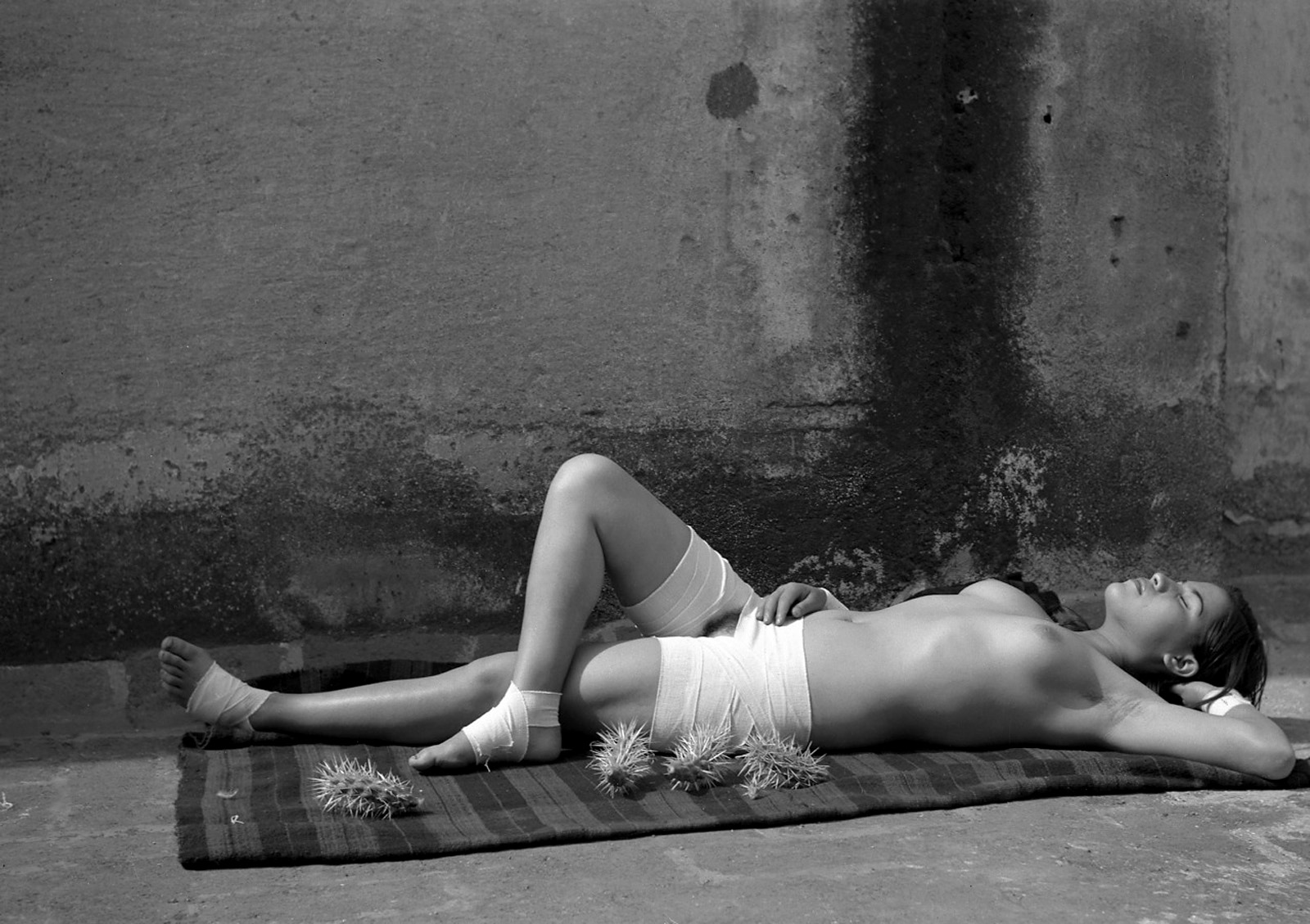
 

Manuel Alvarez Bravo (Mexican, 1902-2002) 'La Buena Fama Durmiendo (The Good Reputation Sleeping)' 1939, printed c. 1970s from the exhibition 'Dream States: Contemporary Photographs and Video' at the Metropolitan Museum of Art, New York, May - Oct, 2016


Manuel Alvarez Bravo (Mexican, 1902-2002)
La Buena Fama Durmiendo (The Good Reputation Sleeping)
1939, printed c. 1970s
Gelatin silver print
Mat: 16 × 20 in. (40.6 × 50.8cm)
The Elisha Whittelsey Collection, The Elisha Whittelsey Fund, 1973


The best fun I had with this posting was putting together the first twelve images. They seem to act as ‘strange attractors’, a feeling recognised by the curators of the exhibition if you view the first installation photograph by Anders Jones, below.

Dr Marcus Bunyan


Many thankx to photographer Anders Jones and the Duggal website for allowing me to publish the installation photographs in the posting.


Artists have always turned to dreams as a source of inspiration, a retreat from reason, and a space for exploring imagination and desire. In the history of photography, dreams have been most closely associated with the Surrealists, who pushed the technical limits of the medium to transform the camera’s realist documents into fantastical compositions. Whereas their modernist explorations were often bound to psychoanalytic theories, more recently contemporary photographers have pursued the world of sleep and dreams through increasingly open-ended works that succeed through evocation rather than description.

This exhibition takes a cue from the artists it features by displaying a constellation of photographs that collectively evoke the experience of a waking dream. Here, a night sky composed of pills, a fragmented rainbow, a sleeping fairy-tale princess, and an alien underwater landscape illuminate hidden impulses and longings underlying contemporary life. Drawn entirely from The Met collection, Dream States features approximately 30 photographs and video works primarily from the 1970s to the present.

Text from the Metropolitan Museum of Art


Anselm Kiefer (German born Donaueschingen, b. 1945) 'Brünnhilde Sleeps' 1980 from the exhibition 'Dream States: Contemporary Photographs and Video' at the Metropolitan Museum of Art, New York, May - Oct, 2016


Anselm Kiefer (German born Donaueschingen, b. 1945)
Brünnhilde Sleeps
1980
Acrylic and gouache on photograph
23 x 32 7/8in. (58.4 x 83.5cm)
Denise and Andrew Saul Fund, 1995
© Anselm Kiefer


Near the end of Wagner’s second opera of the Ring Cycle, Die Walküre (The Valkyrie), the Valkyrie Brünnhilde, having attempted to help the sibling lovers Siegmund and Sieglinde against their father’s wishes, is punished for her betrayal. Wotan puts her to sleep and surrounds her with a ring of fire (she will be awakened in turn by her nephew Siegfried, the incestuous son of Siegmund and Sieglinde, in the third opera of the cycle).

Kiefer portrays the dormant Brünnhilde as French actress Catherine Deneuve in François Truffaut’s film Mississippi Mermaid, using a photograph he snapped in a movie house in 1969. In the film, Deneuve plays a deceitful mail-order bride who comes to the island of Réunion to marry a plantation owner, played by Jean-Paul Belmondo. Aside from the parallels of love and betrayal in both the Ring Cycle and Truffaut’s film, Kiefer thought the choice of Deneuve for Brünnhilde both ironic and amusing: she was for him “the contrary of Brünnhilde. Very slim, very French, very cool, very sexy,” hinting that no man would go through fire to obtain Wagner’s corpulent, armoured Valkyrie.
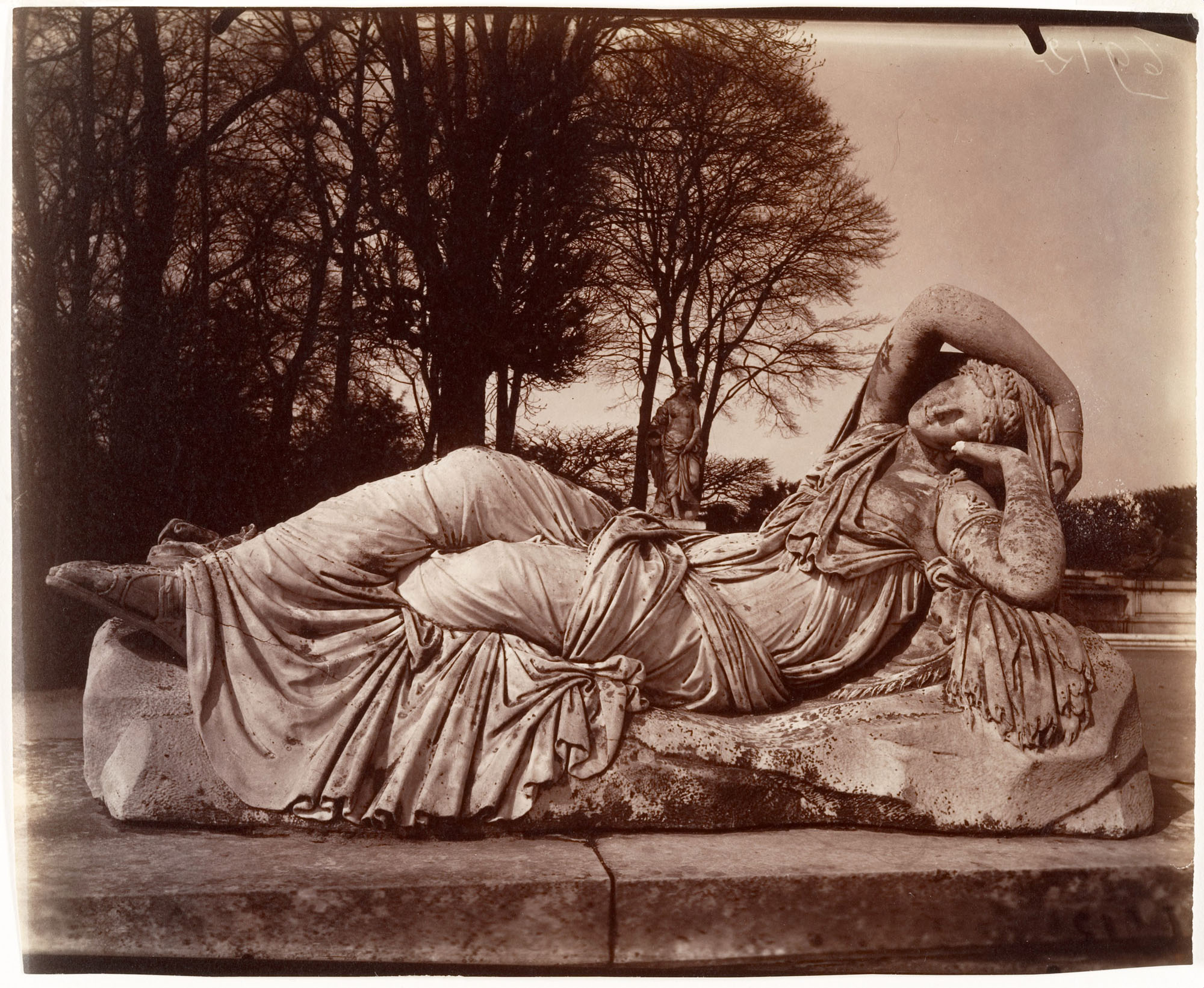
 

Eugène Atget (French, Libourne 1857-1927 Paris) 'Versailles' 1924-1925


Eugène Atget (French, Libourne 1857-1927 Paris)
Versailles
1924-25
Salted paper print from glass negative
Image: 17.5 x 21.9cm (6 7/8 x 8 5/8 in.)
Sheet: 18 × 21.9cm (7 1/16 × 8 5/8 in.)
Mat: 40.6 × 50.8cm (16 × 20 in.)
Gilman Collection, Purchase, Ann Tenenbaum and Thomas H. Lee Gift, 2005


From 1898 until his death in 1927, Atget exhaustively documented the remains of Old Paris: the city’s streets, monuments, interiors, and environs. Among the last entries in this self-directed preservationist effort was a series of images of landscapes and sculpture in the parks of Saint-Cloud and Versailles. Here, the photographer records a statue of a sleeping Ariadne, the mythical Cretan princess abandoned by her lover Theseus on the island of Naxos. Atget’s simultaneously realistic and otherworldly photographs inspired the Surrealist artist Man Ray, who reproduced four of them in a 1926 issue of the journal La Révolution Surréaliste, thus presenting the elder photographer as a modernist forerunner.
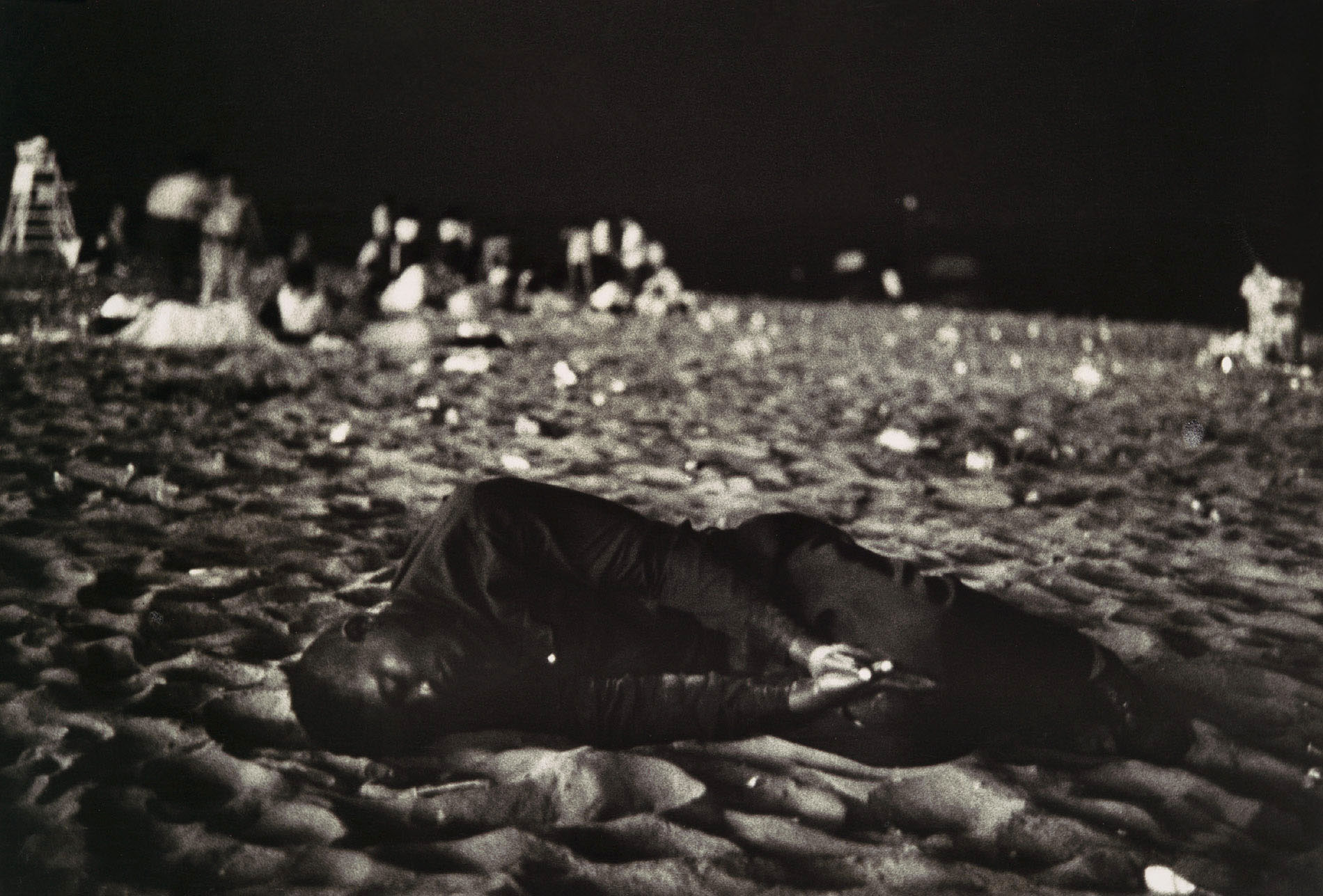
 

Robert Frank (American, 1924-2019) 'Fourth of July, Coney Island' 1958


Robert Frank (American, 1924-2019)
Fourth of July, Coney Island
1958
Gelatin silver print
Image: 26 x 35.6 cm (10 1/4 x 14 in.)
Mat: 47 × 57.2cm (18 1/2 × 22 1/2 in.)
Purchase, Alfred Stieglitz Society Gifts, 2002
© 2005 Robert Frank


As he traveled around the country in 1955-1956 making the photographs that would constitute his landmark book, The Americans, Frank’s impression of America changed radically. He found less of the freedom and tolerance imagined by postwar Europeans, and more alienation and racial prejudice simmering beneath the happy surface. His disillusionment is poignantly embodied in this image of a disheveled African-American man disengaged from the crowd and asleep in a foetal position amid the debris of an Independence Day celebration on Coney Island.

This was one of the last still photographs Frank made before he devoted his creative energy to filmmaking in the early 1960s. As such, it may be interpreted as an elegy to still photography; the lone figure functions as a surrogate for Frank himself, as he turned his back on Life – like photojournalism to concentrate on the more personal, dreamlike imagery of his films.


Shannon Bool (Canadian, b. 1972) 'Vertigo' 2015


Shannon Bool (Canadian, b. 1972)
Vertigo
2015
Gelatin silver print
Image: 7 13/16 × 11 13/16 in. (19.8 × 30cm)
Gift of Shannon Bool and Daniel Faria Gallery, 2015
© Shannon Bool


This photogram – made without a camera by placing a collage of transparencies on a photosensitive sheet of paper and exposing it to light – is part of a series portraying psychoanalysts and their patients. Here, a patient on a Freudian couch is seen from above; the figure, sheathed in patterns of Maori origin, appears to come apart at the seams under the analyst’s scrutiny.


Nan Goldin (American, born Washington, D.C., 1953) 'French Chris on the Convertible, NYC' 1979


Nan Goldin (American, born Washington, D.C., 1953)
French Chris on the Convertible, NYC
1979
Silver dye bleach print
Image: 50.8 x 61cm (20 x 24in.)
Mat: 63.5 × 81.3cm (25 × 32 in.)
Purchase, The Horace W. Goldsmith Foundation Gift, through Joyce and Robert Menschel, 2001
© Nan Goldin Courtesy Matthew Marks Gallery


Following in the tradition of Robert Frank and Helen Levitt, Goldin is her generation’s greatest practitioner of the “snapshot aesthetic” in photography – the intimate, diaristic mode that yields images that, in the right hands, are both spontaneous and carefully seen, tossed off and irreducibly right. In this early work, the artist has captured her friend as a Chatterton of the Lower East Side, lying across the back of a blue convertible with shirt open, eyes closed, and an empty can of Schaeffer beer by his side instead of arsenic – a contemporary vision of glamorous surrender for our own time.


Arthur Tress (American, b. 1940) 'Boy in Flood Dream, Ocean City, New Jersey' 1972


Arthur Tress (American, b. 1940)
Boy in Flood Dream, Ocean City, New Jersey
1972
Gelatin silver print
Mat: 18 × 18 in. (45.7 × 45.7cm)
Gift of the artist, 1973


In the late 1960s, Tress began audio-recording children recounting their dreams and nightmares. He then collaborated with the young people, who acted out their tales for the camera, and published the resulting surreal images in the 1972 book The Dream Collector. Many of the children shared common nightmare scenarios such as falling, drowning, and being trapped, chased by monsters, or humiliated in the classroom. Here, a young boy clings to the roof of a home that has washed ashore as if after a flood. The desolate landscape evokes the sort of non-place characteristic of dreams and conveys feelings of loneliness and abandonment.


Installation view of the exhibition 'Dream States: Contemporary Photography and Video' at the Metropolitan Museum of Art Photo by Anders Jones


Installation view of the exhibition Dream States: Contemporary Photography and Video at the Metropolitan Museum of Art featuring at lower right, Nan Goldin’s French Chris on the Convertible, NYC (1979)
Photo: Anders Jones
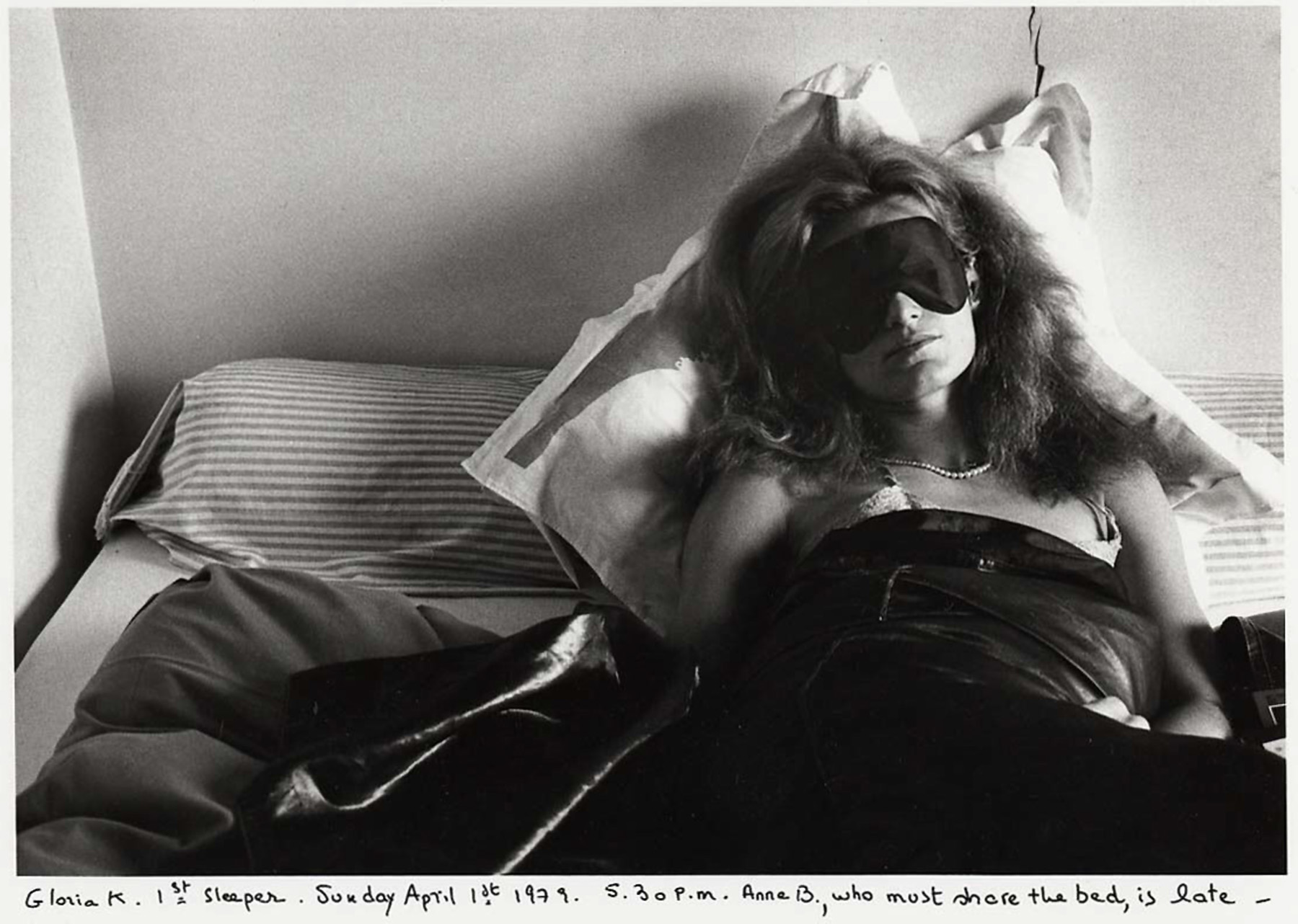
 

Sophie Calle (French, born Paris, 1953) 'Gloria K., first sleeper. Anne B., second sleeper' 1979


Sophie Calle (French, born Paris, 1953)
Gloria K., first sleeper. Anne B., second sleeper
1979
Gelatin silver prints
Image: 12.6 x 18.4cm (4 15/16 x 7 1/4in.)
Mat: 35.6 × 43.2cm (14 × 17 in.)
Gift of the artist and Olivier Renaud-Clement, in memory of Gilles Dusein, 2000
© Sophie Calle
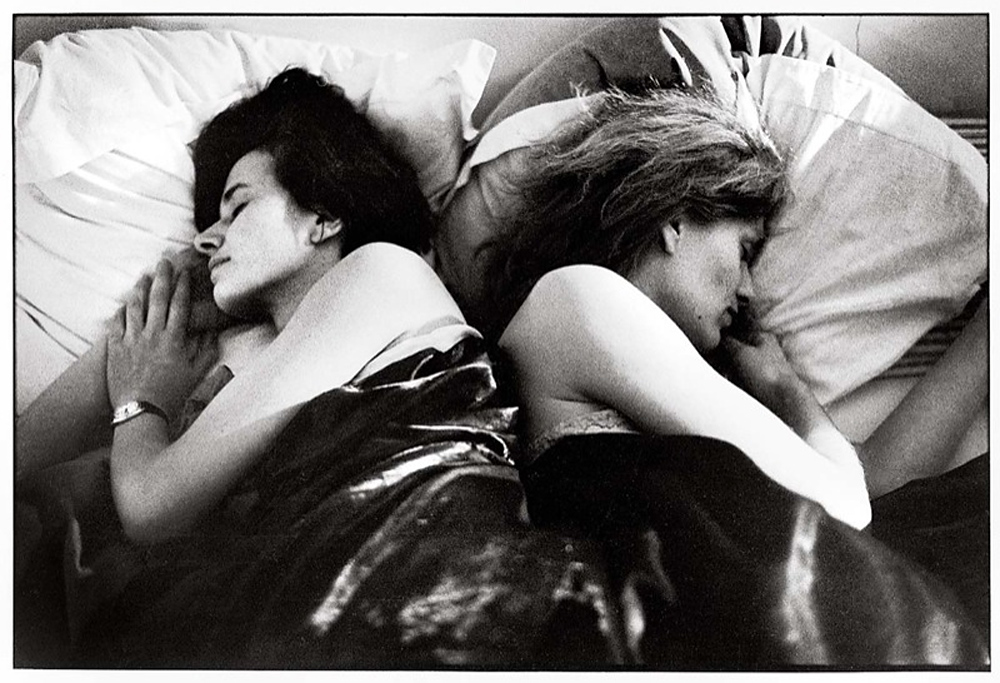
 

Sophie Calle (French, born Paris, 1953) 'Gloria K., first sleeper. Anne B., second sleeper' 1979


Sophie Calle (French, born Paris, 1953)
Gloria K., first sleeper. Anne B., second sleeper
1979
Gelatin silver prints
Image: 12.6 x 18.4cm (4 15/16 x 7 1/4in.)
Mat: 35.6 × 43.2cm (14 × 17 in.)
Gift of the artist and Olivier Renaud-Clement, in memory of Gilles Dusein, 2000
© Sophie Calle


While obviously indebted to the deadpan photo-text combinations of Conceptualism, Calle’s art is as purely French at its core as the novels of Marguerite Duras and the films of Alain Resnais – an intimate exploration of memory, desire, and obsessive longing. The artist’s primary method involves a perfectly calibrated interplay between narrative and image, both of which steadily approach their object of desire only to find another blind spot-that which can never be captured through language or representation.

This work is the first segment of Calle’s first work, The Sleepers (1979), in which the artist invited twenty-nine friends and acquaintances to sleep in her bed consecutively between April 1 and April 9, during which time she photographed them once an hour and kept notes recording each encounter. All the elements of Calle’s art-from the voyeuristic inversion of the private sphere (rituals of the bedroom) and the public (the book or gallery wall) to the use of serial, repetitive structures-are present here in embryonic form.


Paul Graham (British, b. 1956) 'Senami, Christchurch, New Zealand' 2011


Paul Graham (British, b. 1956)
Senami, Christchurch, New Zealand
2011
Chromogenic print
Image: 44 1/4 in. × 59 in. (112.4 × 149.9cm)
Purchase, Vital Projects Fund Inc. Gift, through Joyce and Robert Menschel and Hideyuki Osawa Gift, 2015


Graham’s series, Does Yellow Run Forever?, juxtaposes three groups of photographs: rainbows arcing over the Irish countryside, the facades of pawn-and-jewellery shops in New York, and tender studies of his partner asleep. The thematic links between the images (the rainbow’s mythical pot of gold, the sparkling objects in the Harlem window display, and a sleeping dreamer) may seem obvious, even pat, but Graham’s photographs transmute those clichés into a constellation of deep feeling. These luminous vignettes evoke a sense of longing and pathos, the quest for something permanent amid the illusory and devalued.


Peter Hujar (American, Trenton, New Jersey 1934-1987 New York) 'Girl in My Hallway' 1976


Peter Hujar (American, Trenton, New Jersey 1934-1987 New York)
Girl in My Hallway
1976
Gelatin silver print
Image: 37 x 37.1cm (14 9/16 x 14 5/8 in.)
Mat: 63.5 × 63.5cm (25 × 25 in.)
Purchase, Alfred Stieglitz Society Gifts, 2006
© The Peter Hujar Archive, L.L.C.


Brassaï (French born Romania, Brașov 1899-1984 Côte d'Azur) 'A Vagrant Sleeping in Marseille' 1935, printed 1940s


Brassaï (French born Romania, Brașov 1899-1984 Côte d’Azur)
A Vagrant Sleeping in Marseille
1935, printed 1940s
Gelatin silver print
Image: 17.2 x 23.3cm (6 3/4 x 9 3/16in.)
Mat: 43.2 × 35.6cm (17 × 14 in.)
Gift of the artist, 1980
Copyright © Gilberte Brassaï


The inevitable suggestion that the homeless, hungry man sprawled on the sidewalk might be dreaming of a finely dressed and improbably large salad links Brassaï’s photograph to the work of the Surrealists. Although he frequently depicted thugs, vagrants, and prostitutes, he did so without judgment or political motive; his were pictures meant to delight or perplex the eye and mind-not to prompt a social crusade.


Installation view of the exhibition 'Dream States: Contemporary Photography and Video' at the Metropolitan Museum of Art showing at left, Paul Graham's 'Gold Town Jewellery, East Harlem, New York' (2012); and at right, Paul Graham's 'Senami, Christchurch, New Zealand' (2011), both from the series 'Does Yellow Run Forever'?


Installation view of the exhibition Dream States: Contemporary Photography and Video at the Metropolitan Museum of Art showing at left, Paul Graham’s Gold Town Jewellery, East Harlem, New York (2012); and at right, Paul Graham’s Senami, Christchurch, New Zealand (2011), both from the series Does Yellow Run Forever?
Photo: Anders Jones


The psychological fluidity of the medium has been noted before by the Met. In 1993, to celebrate its purchase of the Gilman Collection, the curator Maria Morris Hambourg chose to call her exhibition The Waking Dream. The title came from Keats’s “Ode to a Nightingale” and suggested, in Hambourg’s words, “the haunting power of photographs to commingle past and present, to suspend the world and the artist’s experience of it in unique distillations.”

Conceptual latitude can benefit curators, giving them plenty of room to manoeuvre in making their selections, or it can be a detriment if a loose framework has so many sides that it won’t support an argument.

Dream States suffers from the latter, even though the leeway of the title allows splendid pictures in disparate styles to be displayed together. Organised by associate curator Mia Fineman and assistant curator Beth Saunders around a theme that isn’t notably pertinent or provocative, the show has no discernible reason for being. It isn’t stocked with recent purchases – fewer than ten of the works entered the collection in this decade – and it isn’t tightly edited. To quality for inclusion here a photograph need only depict someone lying down or with eyes closed. A “dream state” seems to be loosely defined. It can be as a starry or cloudless sky; a tree-less landscape; inverted or abstract imagery; or something blurry.

Richard B. Woodward. “Dream States: Contemporary Photography and Video @Met,” on the Collector Daily website July 11, 2016 [Online] Cited 06/10/2016
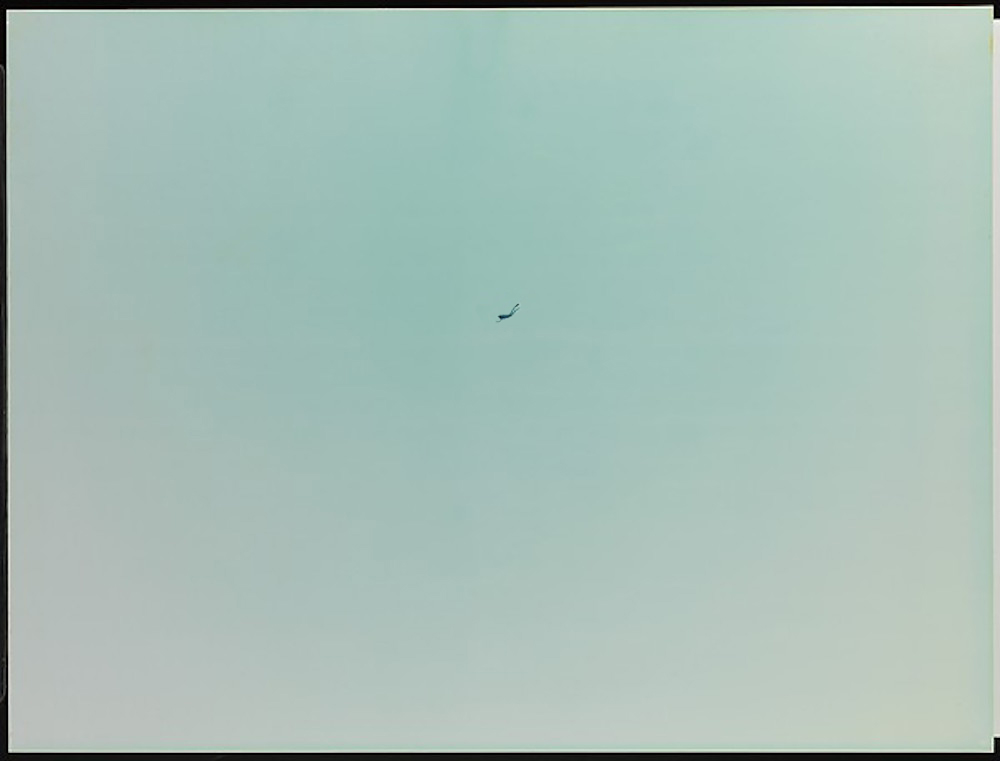
 

Jack Goldstein (American born Canada, 1945-2003) 'The Pull' 1976


Jack Goldstein (American born Canada, 1945-2003)
The Pull
1976
Chromogenic prints
Frame: 76.2 x 101.6cm (30 x 40 in.) each
Purchase, The Buddy Taub Foundation Gift and Vital Projects Fund Inc. Gift, through Joyce and Robert Menschel, 2009
© The Estate of Jack Goldstein


Born in the postwar baby boom, Goldstein grew up surrounded by the products of the rapidly expanding media culture-movies, television, newspapers, magazines, and advertisements of all kinds. Young artists such as Goldstein went on to be educated in the rigorous and reductive principles of Minimal and Conceptual art during the 1970s but knew from personal experience that images shape our sense of the world and who we are, rather than vice versa; they made their art reflect that secondhand relationship to reality.

In this early work, Goldstein has lifted, or “appropriated,” images of a deep sea diver, a falling figure, and a spaceman from unknown printed sources – isolating them from their original contexts and setting them at a very small scale against monochromatic backgrounds (green for sea, blue for sky, and white for space), as if the viewer were seeing them from a great distance. Because the viewer is unlikely to have seen such figures firsthand, that distance is not merely spatial but also epistemological in nature-the images trigger memories based not on original encounters but on reproductions of experience. The Pull – Goldstein’s only photographic work in a career that spanned painting, performance, film, and sound recordings – was included in “Pictures,” a seminal 1977 exhibition at Artist’s Space in New York, which also introduced the public to other young artists making use of appropriation, such as Sherrie Levine, Robert Longo, and Troy Brauntuch.
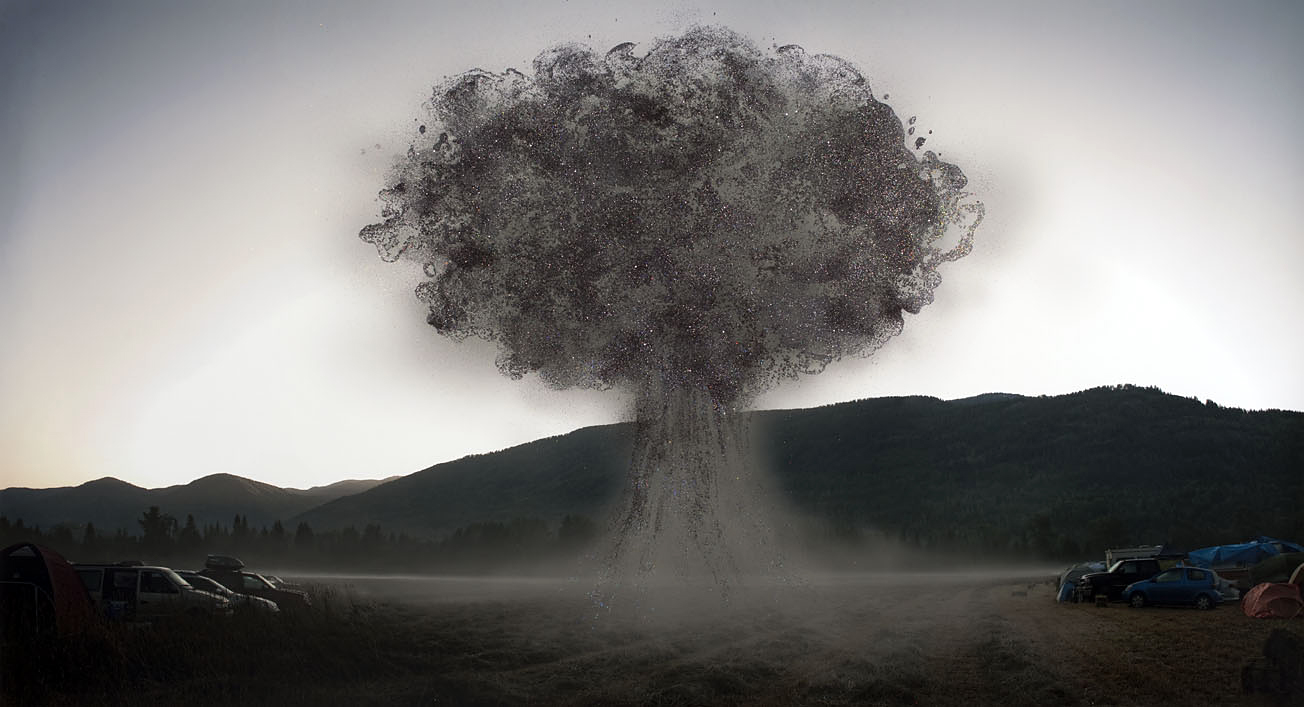
 

Sarah Anne Johnson (Canadian, b. 1976) 'Glitter Bomb' 2012


Sarah Anne Johnson (Canadian, b. 1976)
Glitter Bomb
2012
Chromogenic print with glitter and acrylic paint
Sheet: 29 7/8 in. × 53 in. (75.9 × 134.6cm)
Purchase, Funds from Various Donors in memory of Randie Malinsky, 2016
© Sarah Anne Johnson


Johnson works primarily with photography but also employs a variety of other media – sculpted figurines, dioramas, paint, ink, and bursts of glitter – to amplify the emotional power of her images. Glitter Bomb belongs to a series exploring the bacchanalian culture of summer music festivals. At once ominous and ecstatic, the image evokes the blissed-out mind-set of young revellers taking part in a modern-day rite of passage.


Oliver Wasow (American, b. 1960) 'Float' 1984-2008, printed 2009


Oliver Wasow (American, b. 1960)
Float
1984-2008, printed 2009
Inkjet prints
Frame: 17.3 x 22.3cm (6 13/16 x 8 3/4 in.)
Overall: 116.8 x 152.4cm (46 x 60 in.)
Purchase, Vital Projects Fund Inc. Gift, through Joyce and Robert Menschel, 2010
© Oliver Wasow


Wasow has a long-standing fascination with science fiction, apocalyptic fantasies, and documentation of unidentified flying objects. In his many pictures of mysterious floating disks and orbs, the artist courts doubt by running found images through a battery of processes, including drawing, photocopying, and superimposition, to create distortions. The resulting photographs play with the human propensity to invest form with meaning, offering just enough detail to spur the imagination.


Fred Tomaselli (American born Santa Monica, California, 1956) 'Portrait of Laura' 2015


Fred Tomaselli (American born Santa Monica, California, 1956)
Portrait of Laura
2015
Gelatin silver print with graphite
Image: 16 in. × 19 15/16 in. (40.6 × 50.6cm)
Mat: 24 3/4 × 25 3/4 in. (62.9 × 65.4cm)
Purchase, Vital Projects Fund Inc. Gift, through Joyce and Robert Menschel, 2016
© Fred Tomaselli


This “portrait” of the artist’s wife, Laura, belongs to an ongoing series he calls “chemical celestial portraits of inner and outer space.” Tomaselli creates likenesses based on each sitter’s astrological sign and the star map for his or her date of birth. Placing sugar and pills on photographic paper and exposing it to light, he produces a photogram of the corresponding constellation and names the stars after the various drugs the subject remembers consuming, from cold medicine to cocaine. The result is an unconventional map of identity that cleverly weds the mystical and the pharmacological.


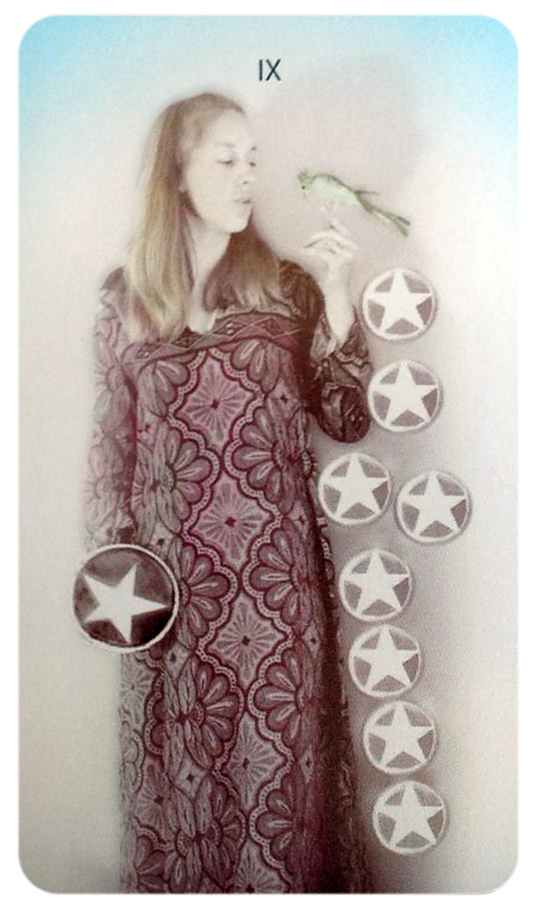
Bea Nettles (American, born Gainesville, Florida, 1946) 'Mountain Dream Tarot: A Deck of 78 Photographic Cards' 1975

Bea Nettles (American, born Gainesville, Florida, 1946) 'Mountain Dream Tarot: A Deck of 78 Photographic Cards' 1975

Bea Nettles (American, born Gainesville, Florida, 1946) 'Mountain Dream Tarot: A Deck of 78 Photographic Cards' 1975

Bea Nettles (American, born Gainesville, Florida, 1946) 'Mountain Dream Tarot: A Deck of 78 Photographic Cards' 1975


Bea Nettles (American, born Gainesville, Florida, 1946)
Mountain Dream Tarot: A Deck of 78 Photographic Cards
1975
Photographically illustrated tarot cards
Purchase, Dorothy Levitt Beskind Gift, 1977


The idea to create a set of photographic tarot cards came to Nettles in a dream during the summer of 1970, while she was on an artist’s residency in the mountains of North Carolina. She subsequently reinterpreted the ancient symbolism of the traditional tarot deck, enlisting friends and family members as models for photographs that she augmented with hand-painted additions. In 2007 the image Nettles created for the Three of Swords card was used as the disc graphic for Bruce Springsteen’s album Magic.
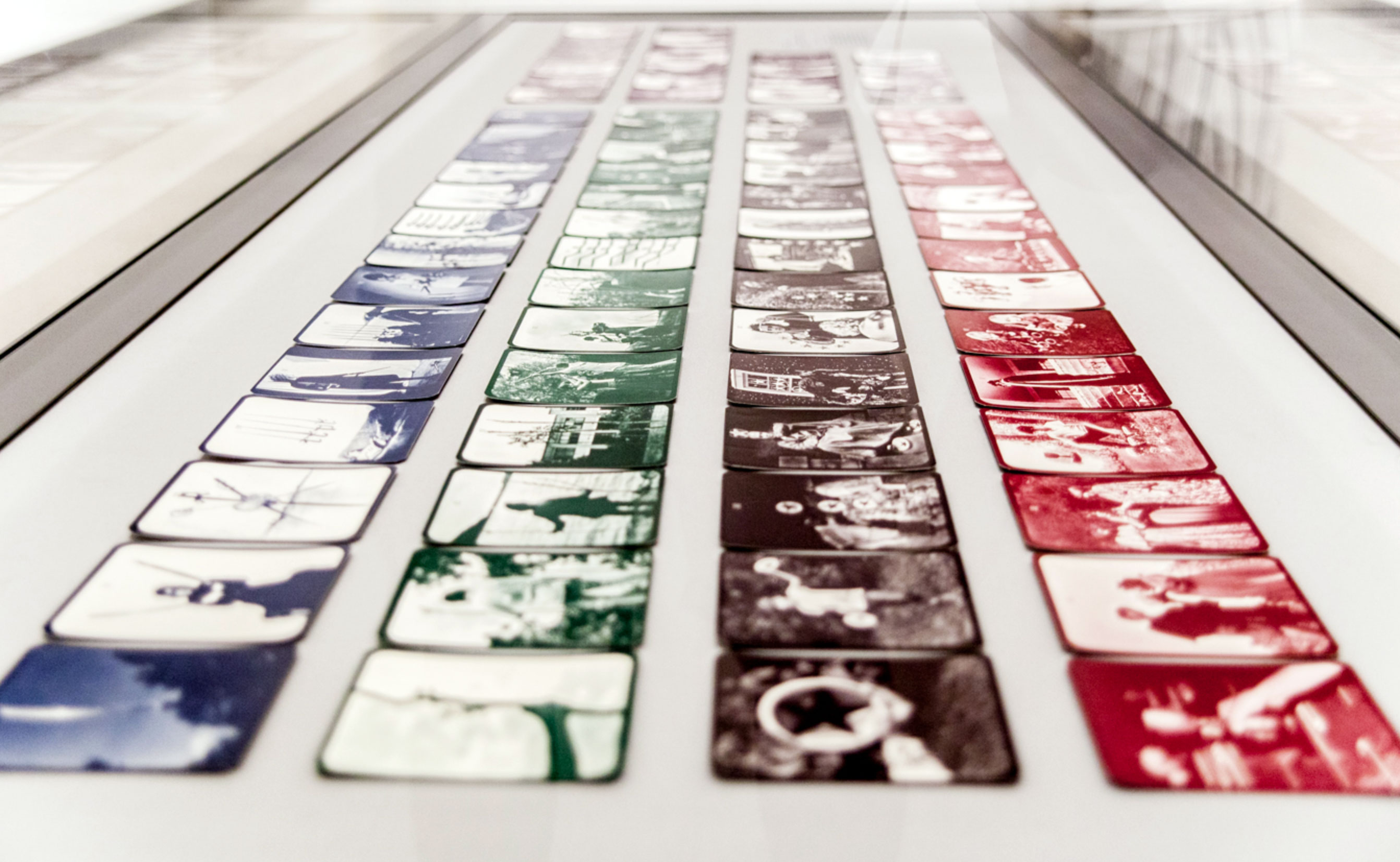
 

Installation view of the exhibition 'Dream States: Contemporary Photography and Video' at the Metropolitan Museum of Art Photo by Anders Jones showing Bea Nettles' 'Mountain Dream Tarot: A Deck of 78 Photographic Cards' (1975)


Installation view of the exhibition Dream States: Contemporary Photography and Video at the Metropolitan Museum of Art showing Bea Nettles’ Mountain Dream Tarot: A Deck of 78 Photographic Cards (1975)
Photo: Anders Jones


Artists often turn to dreams as a source of inspiration, a retreat from reason, and a space for exploring imagination and desire. In the history of photography, dream imagery has been most closely associated with the Surrealists, who used experimental techniques to bridge the gap between the camera’s objectivity and the internal gaze of the mind’s eye. While those modernist explorations were often bound to psychoanalytic theories, other photographers have pursued the world of sleep and dreams through deliberately open-ended works that succeed through evocation rather than description. The exhibition Dream States: Contemporary Photographs and Video presents 30 photographs and one video drawn from The Met collection, all loosely tied to the subjective yet universal experience of dreaming. The exhibition is on view at the Museum from May 16 through October 30, 2016.

Many of the works take the surrender of sleep as their subject matter. In photographs by Robert Frank, Danny Lyon, and Nan Goldin, recumbent figures appear vulnerable to the wandering gaze of onlookers, yet their inner worlds remain out of reach. Images of bodies floating and falling conjure the tumultuous world of dreams, and landscapes are made strange through the camera’s selective vision. Highlights include photographs by Paul Graham from his recent series Does Yellow Run Forever (2014); images from Sophie Calle’s earliest body of work, The Sleepers (1979), in which she invited friends and acquaintances to sleep in her own bed while she watched; and Anselm Kiefer’s Brünnhilde Sleeps (1980), a hand-painted photograph featuring French actress Catherine Deneuve recast as a Wagnerian Valkyrie. Also featured are recently acquired works by Shannon Bool, Sarah Anne Johnson, Jim Shaw, and Fred Tomaselli.

Dream States: Contemporary Photographs and Video is organised by Mia Fineman, Associate Curator; and Beth Saunders, Curatorial Assistant in the Department of Photographs at The Metropolitan Museum of Art.

Text from the Metropolitan Museum of Art
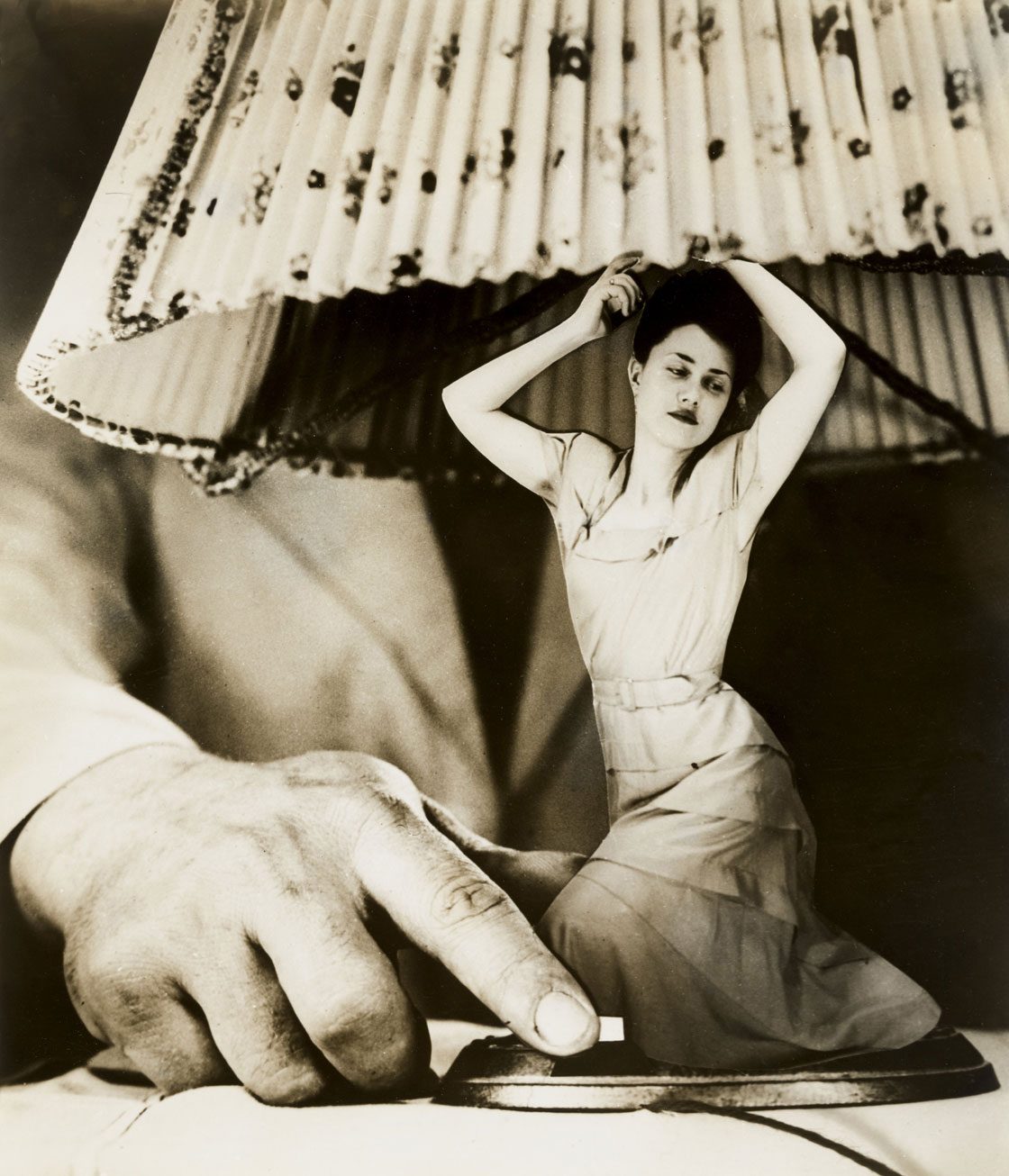
 

Grete Stern (Argentinian born Germany, 1904-1999) 'Sueño No. 1: "Articulos eléctricos para el hogar" (Dream No. 1: "Electrical Household items")' c. 1950


Grete Stern (Argentinian born Germany, 1904-1999)
Sueño No. 1: “Articulos eléctricos para el hogar” (Dream No. 1: “Electrical Household items”)
c. 1950
Gelatin silver print
Image: 26.6 x 22.9cm (10 1/2 x 9 in.)
Frame: 63.5 x 76.2cm (25 x 30 in.)
Twentieth-Century Photography Fund, 2012


In 1948 the Argentine women’s magazine Idilio introduced a weekly column called “Psychoanalysis Will Help You,” which invited readers to submit their dreams for analysis. Each week, one dream was illustrated with a photomontage by Stern, a Bauhaus-trained photographer and graphic designer who fled Berlin for Buenos Aires when the Nazis came to power. Over three years, Stern created 140 photomontages for the magazine, translating the unconscious fears and desires of its predominantly female readership into clever, compelling images. Here, a masculine hand swoops in to “turn on” a lamp whose base is a tiny, elegantly dressed woman. Rarely has female objectification been so erotically and electrically charged.


Adam Fuss (British, b. 1961) 'From the series "My Ghost"' 1999


Adam Fuss (British, b. 1961)
From the series “My Ghost”
1999
Gelatin silver print
184.9 x 123.3cm (72 13/16 x 48 9/16 in.)
Purchase, The Horace W. Goldsmith Foundation Gift, through Joyce and Robert Menschel, 2000
© Adam Fuss


With his large-scale photograms, Fuss has breathed new life into the cameraless technique that became the hallmark of modernist photographers such as Man Ray and László Moholy-Nagy in the 1920s. He created this image by blowing thick clouds of smoke over a sheet of photographic paper and exposing it to a quick flash of light. Evoking the wizardry of a medieval alchemist, Fuss fixes a permanent image of evanescence.


The Metropolitan Museum of Art
1000 Fifth Avenue at 82nd Street
New York, New York 10028-0198
Phone: 212-535-7710

Opening hours:
Sunday – Tuesday and Thursday: 10am – 5pm
Friday and Saturday: 10am – 9pm
Closed Wednesday
The Metropolitan Museum of Art website

LIKE ART BLART ON FACEBOOK

Back to top

Exhibition: ‘The Aftermath of Conflict: Jo Ractliffe’s Photographs of Angola and South Africa’ at The Metropolitan Museum of Art, New York

Exhibition dates: 24th August 2015 – 3rd January 2016


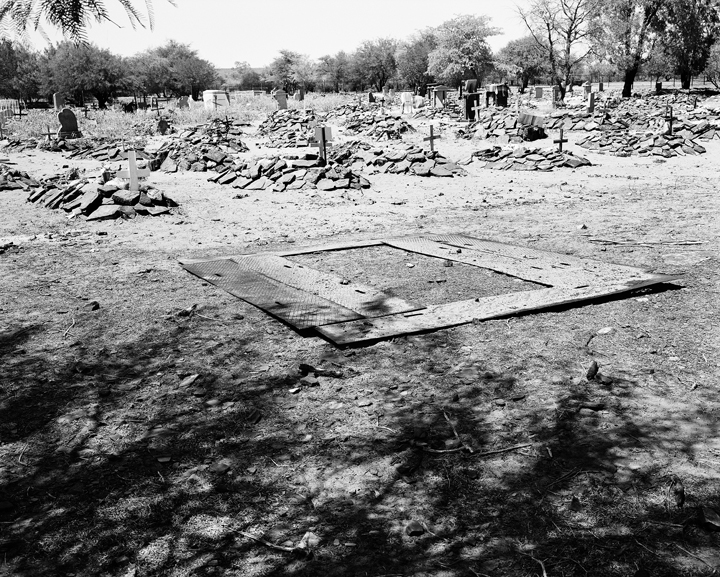
Jo Ractliffe (South African, b. 1961) 'Template for digging graves, Pomfret' 2013


Jo Ractliffe (South African, b. 1961)
Template for digging graves, Pomfret
2013
Inkjet print, 2015
Height: 14 3/16 in. (36 cm)
Width: 17 11/16 in. (45 cm)
On loan from the artist, courtesy Stevenson, Cape Town and Johannesburg
© Jo Ractliffe. Courtesy of Stevenson, Cape Town and Johannesburg


The photograph as unoccupied land

To be frank, I am not enamoured of these photographs. They seem to be conceptual ideas masquerading as documentary photographs that evidence a lazy way of seeing the world, one in which the untold narrative has become an empty spectacle. The story, such as it is, is only narrativised by the accompanying text. If an image cannot stand on its own two feet in and of itself without lines of text to support its supposition, then it is not doing its job properly.

The framing is sloppy and the focus of the images is poor. For example, the focus of Template for digging graves, Pomfret (above) is the shadow at the front of the photograph, where the real focus should have been the template and the graves beyond with their horizontals and verticals. This would have made for a much stronger photograph because the foreground and the background are extraneous to the image.

Ractliffe really needs to look at the documentary photographers of the 19th century to see how it is done. The aftermath of conflict photographs of the American Civil War by photographers such as Matthew Brady, Alexander Gardner and Timothy O’Sullivan (and here I am not talking about the battlefield photographs) have a robust narrative quality that this artist could only ever hope to achieve. Their photographs possess a clear and consistent vision, a deep aesthetic that is emergent, based on transparence, a ruddy darkness and textural ambience – rather than an aesthetic that is superficially descriptive of surfaces.

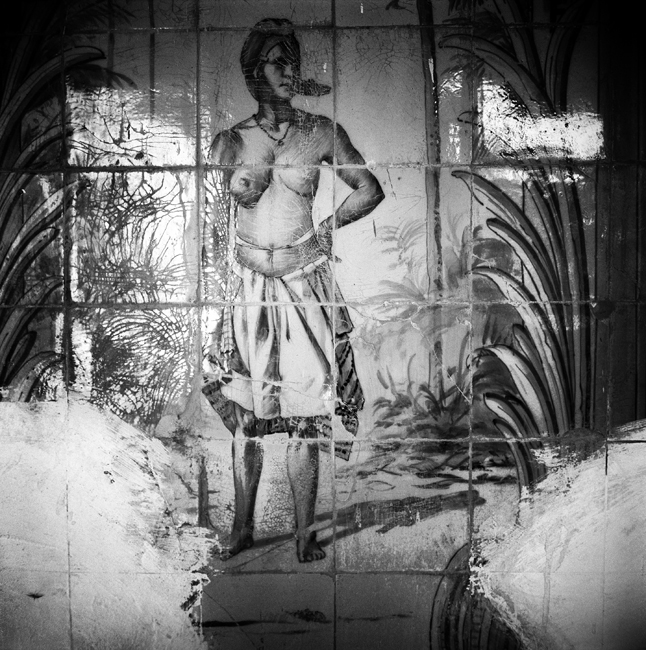
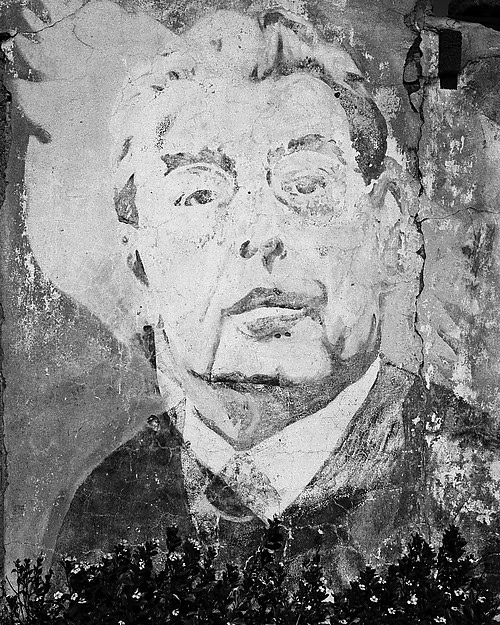
This lack of understanding of the depth of contested place / disputed histories can be no better illustrated than in the diptych The battlefield at Cuito Cuanavale (2009, below) whose photographs really say nothing about what went on here. The photographs are prescriptive (relating to the imposition or enforcement of a rule or method) statements constructed by the artist, with no emotion and little ambience or feeling for subject matter. They are not even very good descriptive photographs of the landscape. Photographs such as Mural depicting Fidel Castro, Agostinho Neto and Leonid Brezhnev, circa 1975, Viriambundo (2009, below) and Details of tiled murals at the Fortaleza De São Miguel, depicting Portuguese explorations in Africa (2007, below) are worse, recording inarticulate artefacts at a level best reserved for student work.

By far the most interesting and powerful photograph is Roadside stall on the way to Viana (2007, below). This photograph is memorable as so many of the other are not, because it possesses a sense of disposition, of alienation, ambience and the weight of history all bound up in those hanging bodies.

Dr Marcus Bunyan


Many thankx to The Metropolitan Museum of Art for allowing me to publish the photographs in the posting. Please click on the photographs for a larger version of the image.


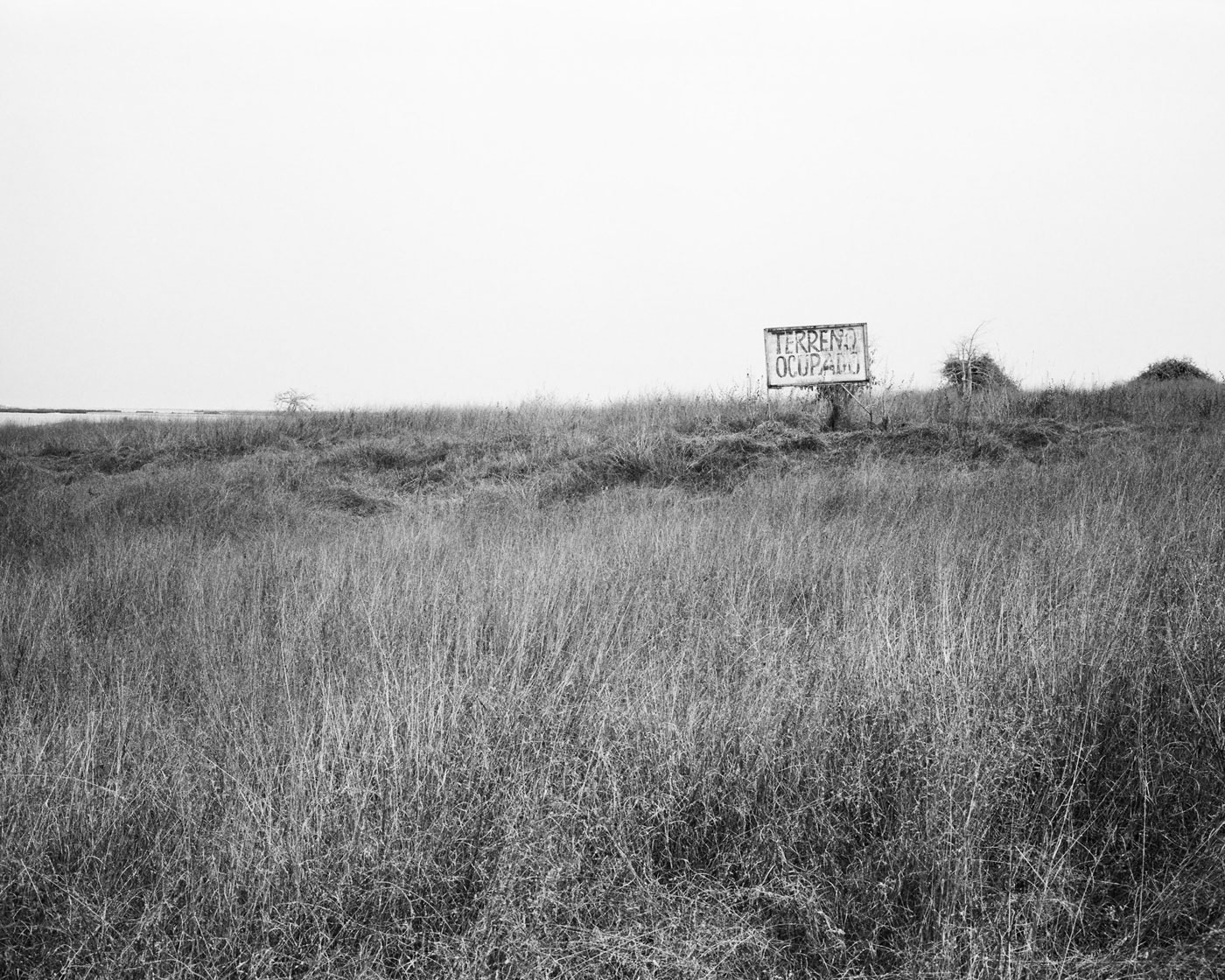
Jo Ractliffe (South African, b. 1961) 'Vacant plot near Atlantico Sul' 2007


Jo Ractliffe (South African, b. 1961)
Vacant plot near Atlantico Sul
2007
From the series Terreno Ocupado
Inkjet print, 2015
On loan from the artist, courtesy Stevenson, Cape Town and Johannesburg
© Jo Ractliffe. Courtesy of Stevenson, Cape Town and Johannesburg


This coarse, grassy landscape appears at first glance to be empty, yet the billboard declaring “Terreno Ocupado” – Portuguese for “occupied land” – reveals this site in Luanda as both active and politically charged. It points to Angola’s long history of occupation and territorial turmoil, from the arrival of Portuguese explorers in 1483 through to the tangled twentieth-century conflicts that spilled over into neighbouring countries. It also points to the contested terrain that is today’s Luanda. With this image, the opening photograph of the first series, Ractliffe sets the scene for her exploration of land, borders, and displacement, themes which thread through all the works featured here.


Jo Ractliffe (South African, b. 1961) 'Woman and her baby, Roque Santeiro market' 2007


Jo Ractliffe (South African, b. 1961)
Woman and her baby, Roque Santeiro market
2007
From the series Terreno Ocupado
Inkjet print, 2015
On loan from the artist, courtesy Stevenson, Cape Town and Johannesburg
© Jo Ractliffe. Courtesy of Stevenson, Cape Town and Johannesburg


Conflict between Luanda’s population and its governing elites forms an undercurrent to this photograph of a young woman carrying a baby across litter-strewn ground, observed by a man wearing a military beret. In September 2010, three years after Ractliffe took these photographs and following a protracted dispute between the government and the local community, the Luandan authorities closed down Roque Santeiro and relocated it to a new Chinese-built facility at Panguila, some twelve miles to the north. Although the government cited concerns over insanitary conditions and organised crime, critics argued that the relocation had more to do with repossessing prime real estate for new luxury apartments.


Jo Ractliffe (South African, b. 1961) 'Woman on the footpath from Boa Vista to Roque Santeiro market' 2007


Jo Ractliffe (South African, b. 1961)
Woman on the footpath from Boa Vista to Roque Santeiro market
2007
From the series Terreno Ocupado
Inkjet print, 2015
On loan from the artist, courtesy Stevenson, Cape Town and Johannesburg
© Jo Ractliffe. Courtesy of Stevenson, Cape Town and Johannesburg


Apparently out of breath and clutching a plastic bag, the woman in the foreground of this photograph is making her way up a faintly visible footpath and out of Ractliffe’s field of vision. A digger perches on the cliff top above her, and in the middle distance, a cluster of dwellings clings precariously to the litter-strewn side of the ravine. Boa Vista – “good view” – is one of Luanda’s largest shanty towns, and at the time of this photograph was home to over 50,000 people. Following landslides in 2001 which killed several residents, parts of the neighbourhood were bulldozed and over 4,000 families were evicted from their homes and relocated to tents in other parts of the city while awaiting the construction of their new accommodation.


Jo Ractliffe (South African, b. 1961) 'Video club, Roque Santeiro market' 2007


Jo Ractliffe (South African, b. 1961)
Video club, Roque Santeiro market
2007
Inkjet print, 2015
Height: 14 3/16 in. (36cm) Width: 17 11/16 in. (45cm)
On loan from the artist, courtesy Stevenson, Cape Town and Johannesburg
© Jo Ractliffe. Courtesy of Stevenson, Cape Town and Johannesburg


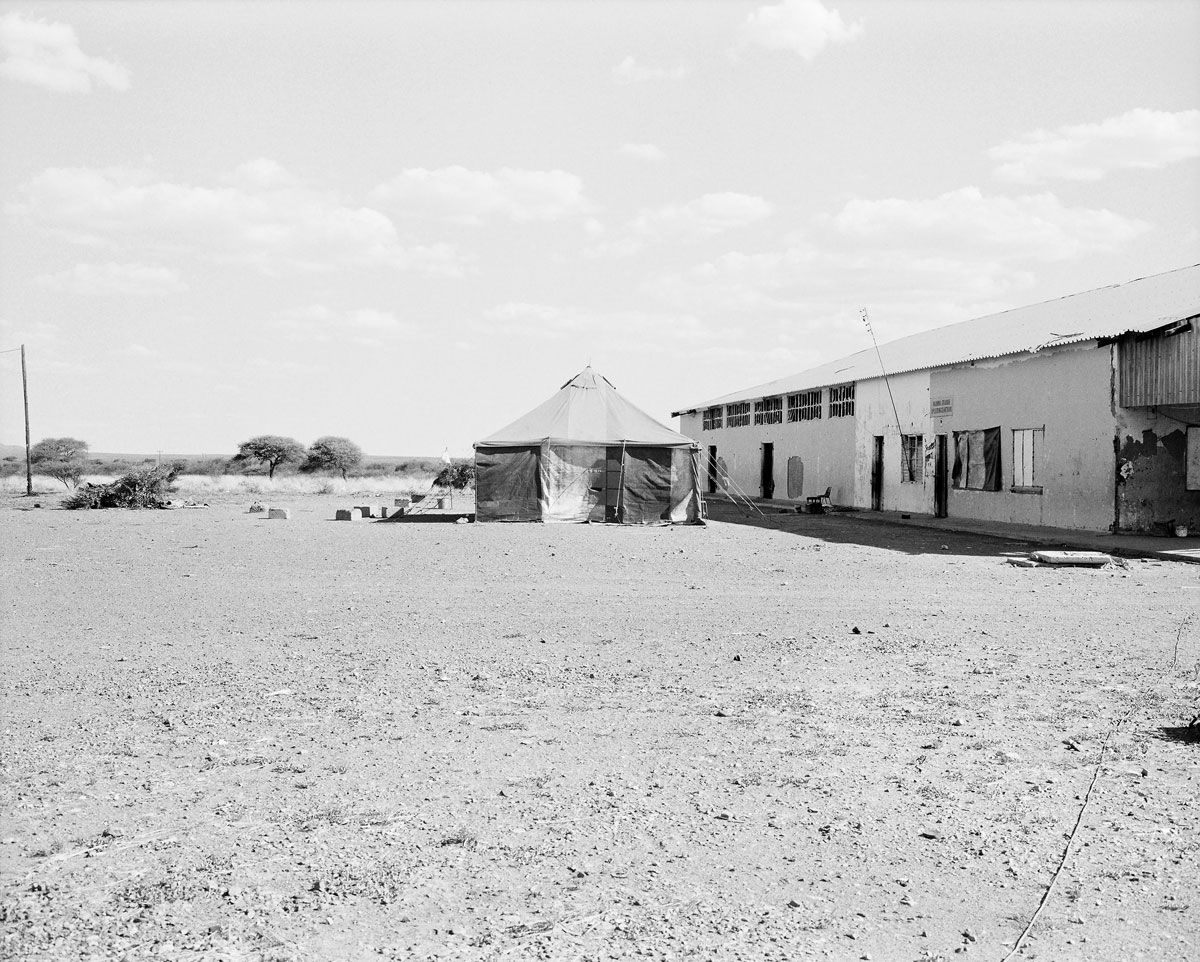
Before its closure in 2010, Roque Santeiro was renowned as the biggest open-air market in sub-Saharan Africa, and the centre of Angola’s informal economy. Established in the 1980s and named after a popular Brazilian soap opera, it flourished during the Angolan Civil War as streams of refugees fled the countryside and came to Luanda, searching for new livelihoods. Everything was for sale in its makeshift stalls, from household items, food, and clothes, to contraband alcohol, cars, and livestock. In this photograph Ractliffe focuses on one of the market’s many video clubs, which were housed in military-style tents and screened action movies on televisions powered by generators.


Jo Ractliffe (South African, b. 1961) ''God with us', Pomfret' 2011


Jo Ractliffe (South African, b. 1961)
‘God with us’, Pomfret
2011
Inkjet print, 2015
Height: 17 11/16 in. (45cm) Width: 22 1/16 in. (56cm)
On loan from the artist, courtesy Stevenson, Cape Town and Johannesburg
© Jo Ractliffe. Courtesy of Stevenson, Cape Town and Johannesburg


The abandoned mining town of Pomfret is located in the far north of South Africa, near the border with Botswana. After the closure of its asbestos mine, the town was converted into a military base and used to accommodate 32 Battalion, an elite Special Forces unit made up of Angolan soldiers. When the unit was disbanded in 1993, most of the veterans and their families stayed in Pomfret, living in abject conditions without basic services and under constant threat of eviction. Ractliffe has spoken of finding graves there marked only with “Born Angola”; for the veterans whose paths ended here, death in Pomfret was “the final displacement”.


Jo Ractliffe (South African, b. 1961) 'Unidentified memorial in the desert, south of Namibe I' 2009


Jo Ractliffe (South African, b. 1961)
Unidentified memorial in the desert, south of Namibe I
2009
From the series As Terras do Fim do Mundo
Inkjet print, 2015
On loan from the artist, courtesy Stevenson, Cape Town and Johannesburg
© Jo Ractliffe. Courtesy of Stevenson, Cape Town and Johannesburg


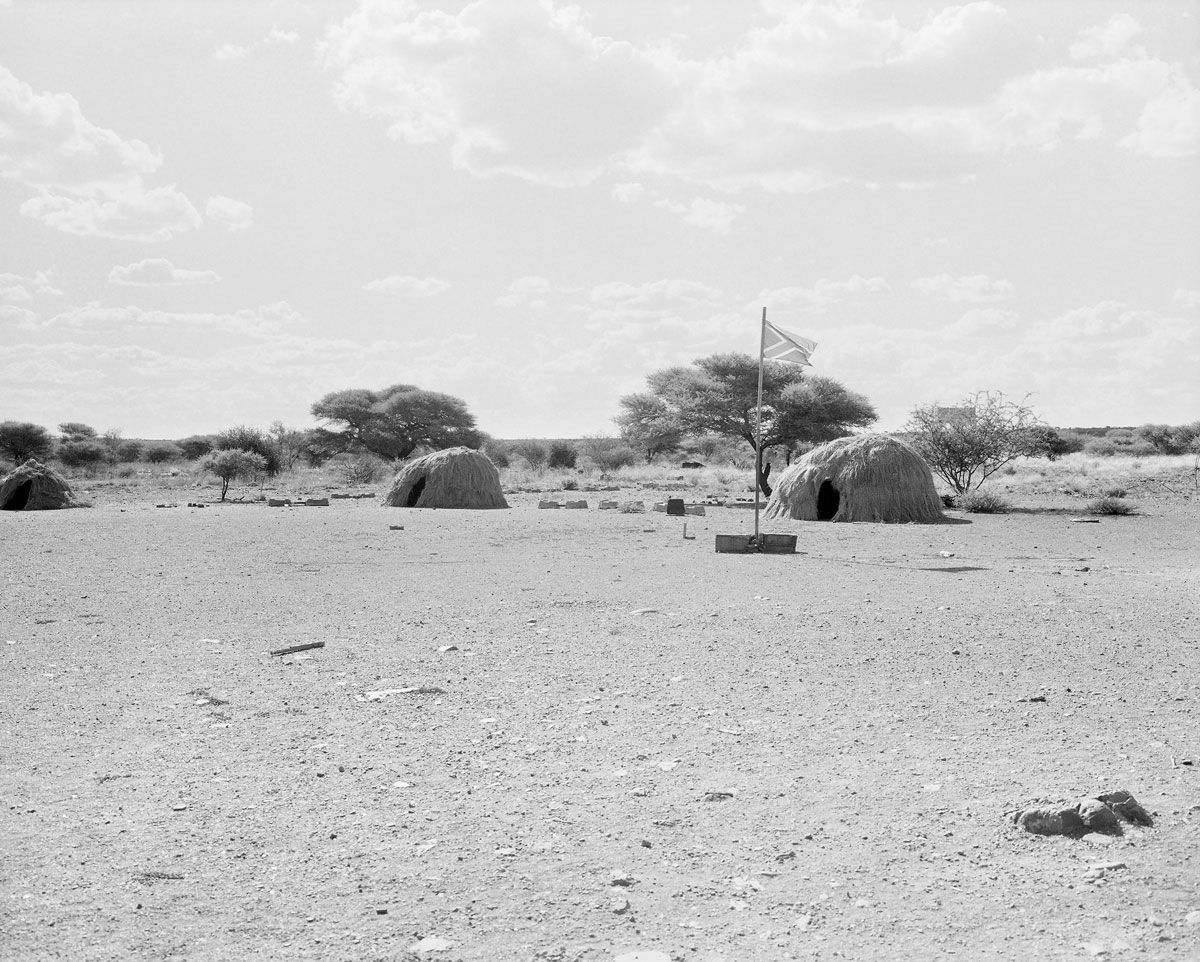
In this photograph, an assemblage of objects perches on a stony outcrop, surrounded by a barren expanse of desert. The long pole protruding from the pile is topped with a ragged banner, announcing the presence of this unusual memorial, but giving little away about its exact significance. Ractliffe took this photograph close to the Cuban base at Namibe on Angola’s southwestern coast, where an extensive network of trenches, bunkers, and anti-aircraft defences is located. As Ractliffe has remarked: “there are some very poignant things in the landscape, like these markers, that seem to say ‘I have been here, people have been here.'”


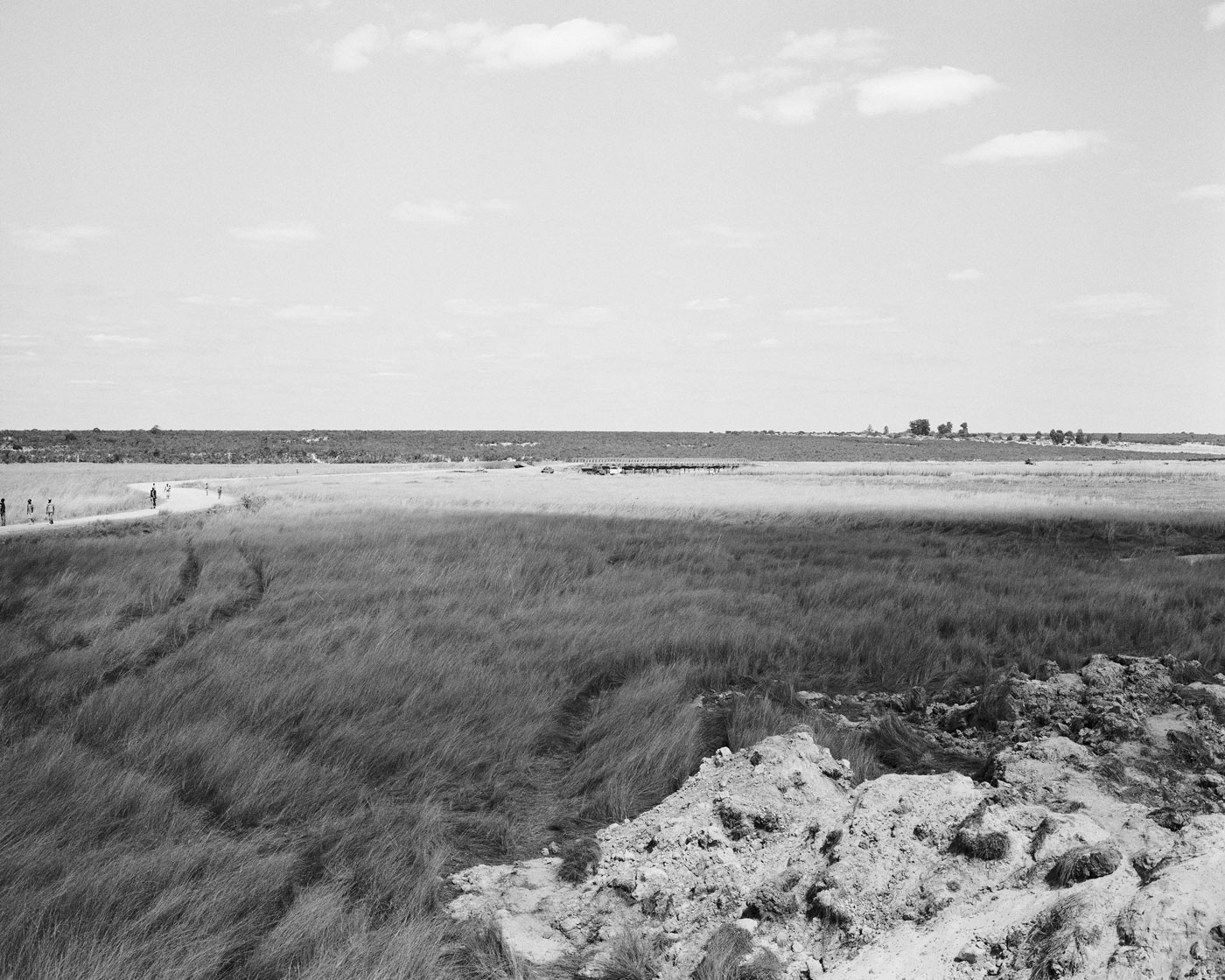
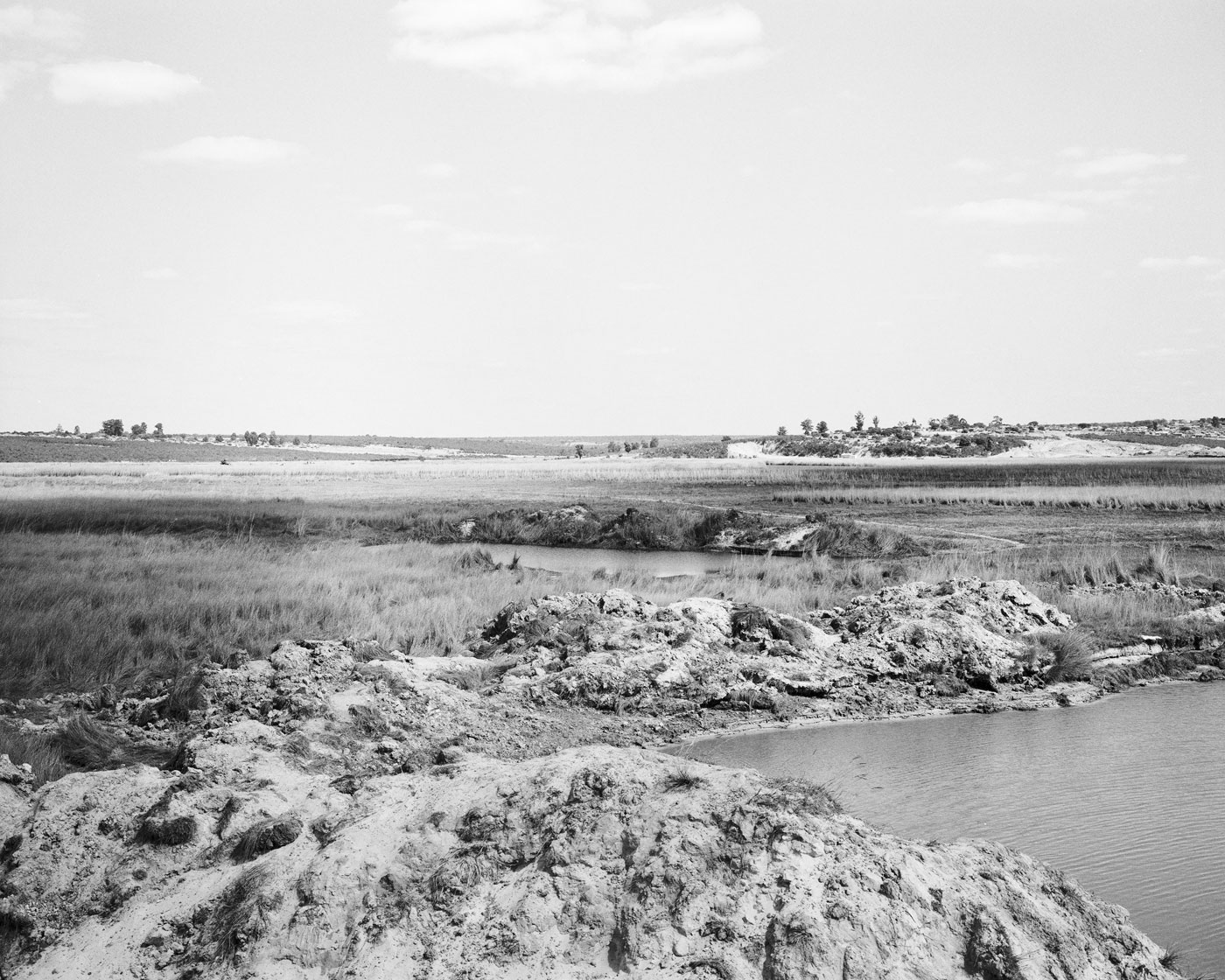
Jo Ractliffe (South African, b. 1961) 'The battlefield at Cuito Cuanavale' 2009 (diptych left)

Jo Ractliffe (South African, b. 1961) 'The battlefield at Cuito Cuanavale' 2009 (diptych right)


Jo Ractliffe (South African, b. 1961)
The battlefield at Cuito Cuanavale (diptych left and right)
2009
From the series As Terras do Fim do Mundo
Inkjet prints, 2015
On loan from the artist, courtesy Stevenson, Cape Town and Johannesburg
© Jo Ractliffe. Courtesy of Stevenson, Cape Town and Johannesburg


Reflecting on this diptych, Ractliffe has observed that “Quite often, sites of significance don’t evidence their historical weight.” It is true that the calm landscape – muddy riverbanks weaving through a marsh – together with the small size of these prints belies the huge historical importance of their subject. In 1987-1988, during the Angolan Civil War, Cuito Cuanavale was the site of the biggest battle in Africa since World War II. On one side was the armed wing of Agostinho Neto’s government, supported by their Cuban allies; on the other side was the rebel group UNITA, supported by the South African Defence Force. The outcome of the battle is still widely disputed, with both sides claiming victory.


Jo Ractliffe (South African, b. 1961) 'Thorn tree, Platfontein' 2012


Jo Ractliffe (South African, b. 1961)
Thorn tree, Platfontein
2012
Inkjet print, 2015
Height: 14 3/16 in. (36cm) Width: 17 11/16 in. (45cm)
On loan from the artist, courtesy Stevenson, Cape Town and Johannesburg
© Jo Ractliffe. Courtesy of Stevenson, Cape Town and Johannesburg


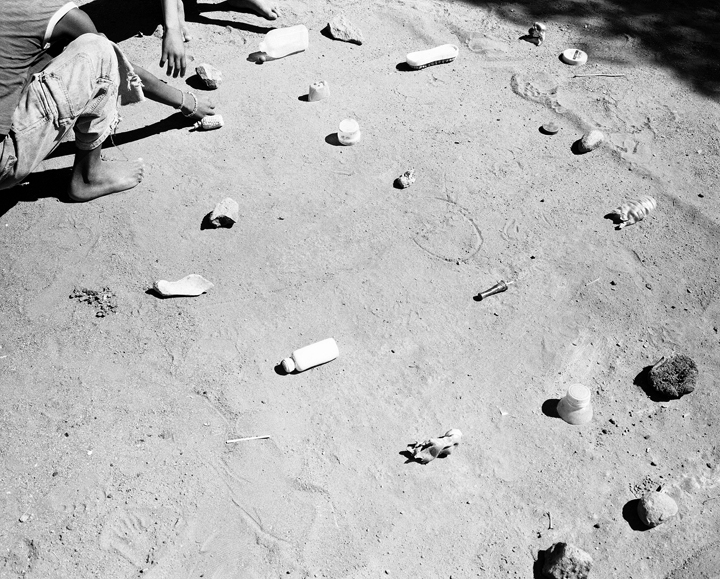
In this photograph and the next one, “Playing soccer with marbles, Platfontein”, the placement of personal objects in a seemingly unforgiving setting hints at the tension between resilience and vulnerability negotiated by the resident community. The settlement of Platfontein is now home to veterans of 31/201 Battalion, a South African Special Forces unit made up of Angolan and Namibian San trackers who became tied up in the independence conflicts in Angola and Namibia. After the conflicts ended, many of the San veterans were relocated to Schmidtsdrift, but had to live in tents for 14 years because of a competing claim on the land from local communities. The veterans ultimately accepted financial compensation, which enabled them to buy land at Platfontein, pictured here.


Jo Ractliffe (South African, b. 1961) 'Playing soccer with marbles, Platfontein' 2012


Jo Ractliffe (South African, b. 1961)
Playing soccer with marbles, Platfontein
2012
Inkjet print, 2015
Height: 10 1/4 in. (26cm) Width: 12 13/16 in. (32.5cm)
On loan from the artist, courtesy Stevenson, Cape Town and Johannesburg
© Jo Ractliffe. Courtesy of Stevenson, Cape Town and Johannesburg


In this photograph and the previous one, “Thorn tree, Platfontein”, the placement of personal objects in a seemingly unforgiving setting hints at the tension between resilience and vulnerability negotiated by the resident community. The settlement of Platfontein is now home to veterans of 31/201 Battalion, a South African Special Forces unit made up of Angolan and Namibian San trackers who became tied up in the independence conflicts in Angola and Namibia. After the conflicts ended, many of the San veterans were relocated to Schmidtsdrift, but had to live in tents for 14 years because of a competing claim on the land from local communities. The veterans ultimately accepted financial compensation, which enabled them to buy land at Platfontein, pictured here.


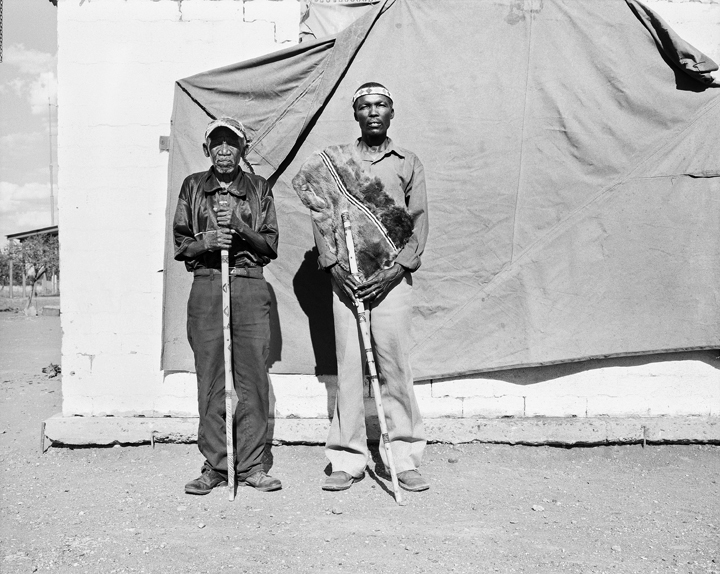
Jo Ractliffe (South African, b. 1961) 'Veteran soldiers of 'Omega' 31/201 Battalion, Paulo Cassanga and Automover Kakenge, Schmidtsdrift (portrait under instruction)' 2012


Jo Ractliffe (South African, b. 1961)
Veteran soldiers of ‘Omega’ 31/201 Battalion, Paulo Cassanga and Automover Kakenge, Schmidtsdrift (portrait under instruction)
2012
Inkjet print, 2015
Height: 14 3/16 in. (36cm)
Width: 17 11/16 in. (45cm)
On loan from the artist, courtesy Stevenson, Cape Town and Johannesburg
© Jo Ractliffe. Courtesy of Stevenson, Cape Town and Johannesburg


The veterans’ experiences are given added poignancy in this portrait, in which they stand in front of a tarpaulin hanging untidily from a derelict building. Automover Kakenge, standing on the right, is the leader of a group of San veterans who refused to move to Platfontein after their land claim at Schmidtsdrift was unsuccessful. Kakenge has stated that “Schmidtsdrift was the ending for us […]. When we were relocated from Namibia, we had to swear, “South Africa is our land, and our house is here in Schmidtsdrift.” This attachment to the land and buildings at Schmidtsdrift is the endpoint of what Ractliffe refers to as an “epic narrative of displacement”.


Jo Ractliffe (South African, b. 1961) 'On the Road to Cuito Cuanavale I' 2009


Jo Ractliffe (South African, b. 1961)
On the Road to Cuito Cuanavale I
2009
On loan from the artist, courtesy Stevenson, Cape Town and Johannesburg
© Jo Ractliffe. Courtesy of Stevenson, Cape Town and Johannesburg


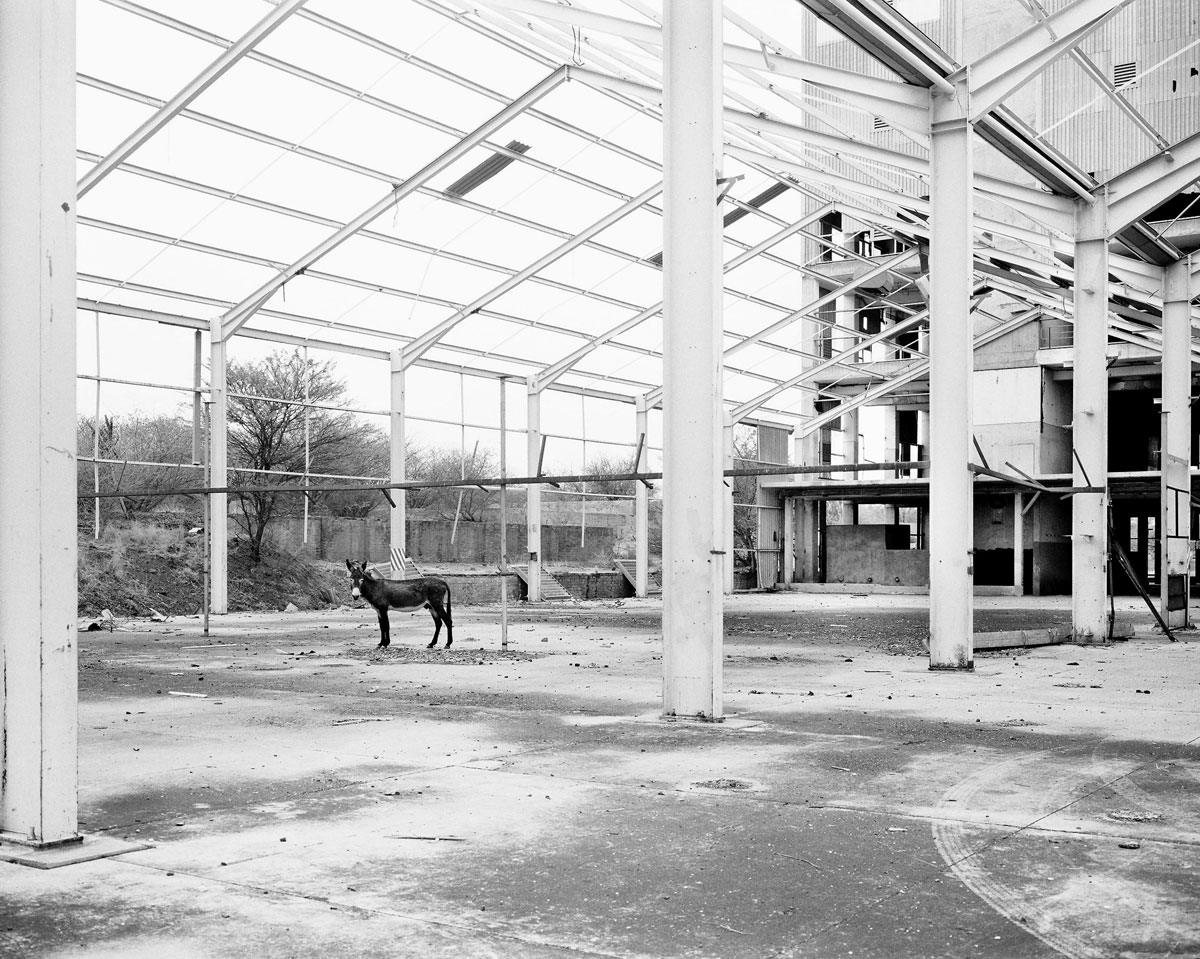
Jo Ractliffe (South African, b. 1961) 'Donkey, Pomfret Asbestos Mine' 2011


Jo Ractliffe (South African, b. 1961)
Donkey, Pomfret Asbestos Mine
2011
From the series The Borderlands
Inkjet print, 2015
On loan from the artist, courtesy Stevenson, Cape Town and Johannesburg
© Jo Ractliffe. Courtesy of Stevenson, Cape Town and Johannesburg


The Aftermath of Conflict: Jo Ractliffe’s Photographs of Angola and South Africa at The Metropolitan Museum of Art beginning August 24 features 23 works produced over the past 10 years by South African artist Jo Ractliffe (born 1961). The photographs examine the landscapes of Angola and South Africa as sites of conflict and contention. Focusing on the aftermath of the Angolan Civil War and the intertwined conflict known in South Africa as the “Border War,” her photographs address themes of dispossession, history, memory, and erasure. The exhibition highlights Ractliffe’s engagement with the land and structures of Angola’s capital, Luanda, as well as with places in the Angolan and South African countryside where unmarked mass graves, minefields, and former military testing sites reveal the complex traces of the past in the present.

The 23 works on loan from the artist include single images, diptychs, and triptychs selected from three photographic series: Terreno Ocupado (2007), As Terras do Fim do Mundo (2010), and The Borderlands (2013). In Terreno Ocupado, Ractliffe establishes the city of Luanda as a multilayered place of both historical dispute and present-day struggle. Photographs highlighting the Portuguese colonial occupation of Angola and its imprint on the built environment appear alongside works depicting the often harsh economic conditions of Luanda today. By focusing on the structural instability of the city’s shanty towns, as well as the longer history of political instability threading through their foundations, these photographs question what it means for land to be occupied, abandoned, and struggled over.

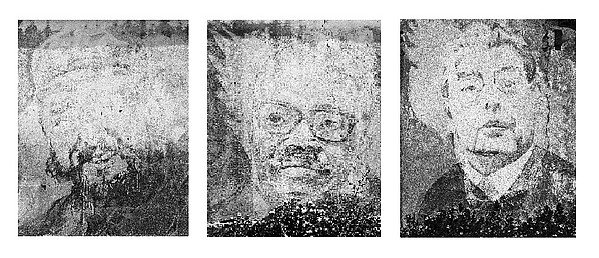
The works selected from 2010’s As Terras do Fim do Mundo highlight traces of the Border War, a conflict fought in rural Angola and present-day Namibia between South Africa and its allies on one side and, on the other, the exiled Namibian liberation movement, the Angolan government, and their allies. For this series, Ractliffe traveled alongside ex-soldiers returning to the desolate places where they had fought. The images produced on these trips include photographs of unmarked mass graves, minefields, and other often-inconspicuous signs of past conflict, showing how landscape can function as a repository of histories and memories and yet not be apparent at first glance. Most of the photographs in this series appear devoid of human presence, but in a triptych featuring mural representations of the conflict’s three key political leaders – Fidel Castro, Agostinho Neto, and Leonid Brezhnev – Ractliffe points more directly to notions of individual agency, culpability, and experience.

For her most recent series, The Borderlands, Ractliffe sought out sites in South Africa that were intricately connected to the history of the Border War and photographed their inhabitants amid their surroundings. The people she photographed, often the subjects of forced relocation and living in precarious conditions, exist at the intersection of the region’s troubled history and challenging present. Works from this series show how histories of violence and dispossession under apartheid intersect with these militarised landscapes.

The Aftermath of Conflict has been organised to coincide with the special exhibition Kongo: Power and Majesty, which focuses on works created by artists in present-day Angola between the 16th and 19th centuries (on view at the Metropolitan Museum September 17, 2015 – January 3, 2016). The landscapes captured by Ractliffe consider a more recent chapter of Angola’s history. The Aftermath of Conflict: Jo Ractliffe’s Photographs of Angola and South Africa is curated by Yaëlle Biro, Associate Curator in the Department of Africa, Oceania, and the Americas at the Metropolitan Museum, together with Dr Evelyn Owen, the 2013-2015 Mellon Curatorial Fellow at The Africa Center, New York, in collaboration with the Museum’s Department of Modern and Contemporary Art and Department of Photographs.

Text from The Metropolitan Museum of Art


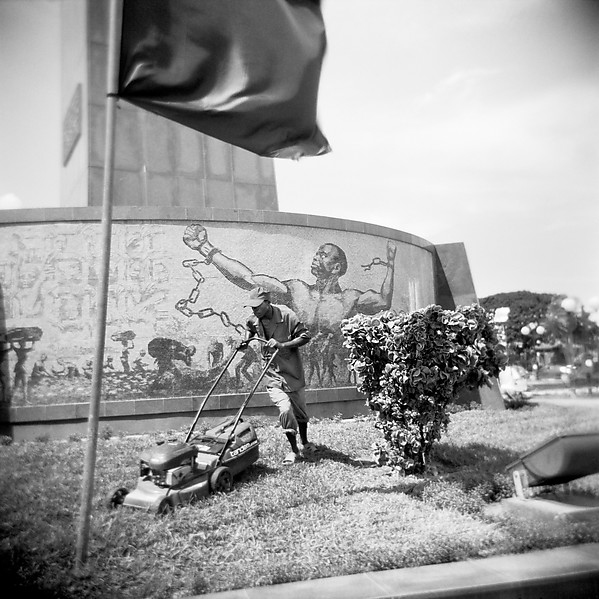
Jo Ractliffe (South African, b. 1961) 'Man maintaining the lawn of the Monumento de Agostinho Neto' 2007


Jo Ractliffe (South African, b. 1961)
Man maintaining the lawn of the Monumento de Agostinho Neto
2007
Inkjet print, 2015
Height: 13 3/4 in. (35cm) Width: 13 3/4 in. (35cm)
On loan from the artist, courtesy Stevenson, Cape Town and Johannesburg
© Jo Ractliffe. Courtesy of Stevenson, Cape Town and Johannesburg


This monument to Angola’s first president Agostinho Neto (1922-1979) was erected in 2001-2002 as a gift from North Korea. Neto, a doctor and poet, was a founder of the MPLA (People’s Movement for the Liberation of Angola) and led the party during Angola’s struggle for independence from Portugal. When the Portuguese withdrew from Angola on November 11, 1975, with help from Cuba and in the face of competing anti-colonial factions, the MPLA seized control of Luanda and Neto became president. He went on to cultivate closer ties with the Soviet Union and other communist states. In this photograph, Ractliffe contrasts the heroic figure symbolising freedom from colonialism shown on the monument’s pedestal with the everyday heroism of a man pushing a heavy lawnmower.


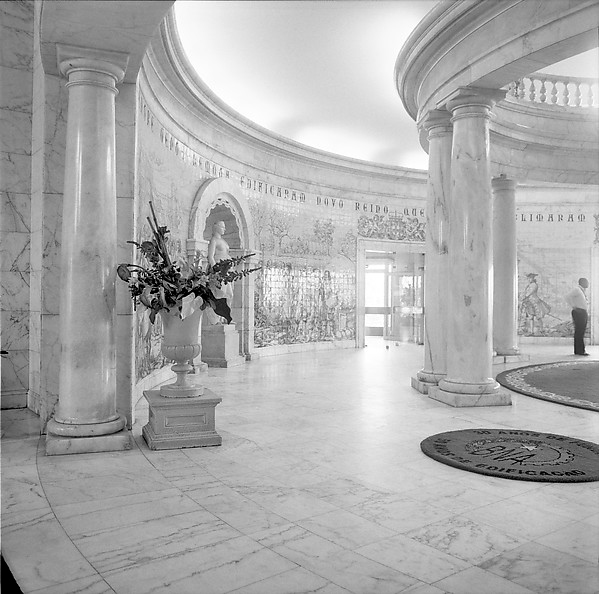
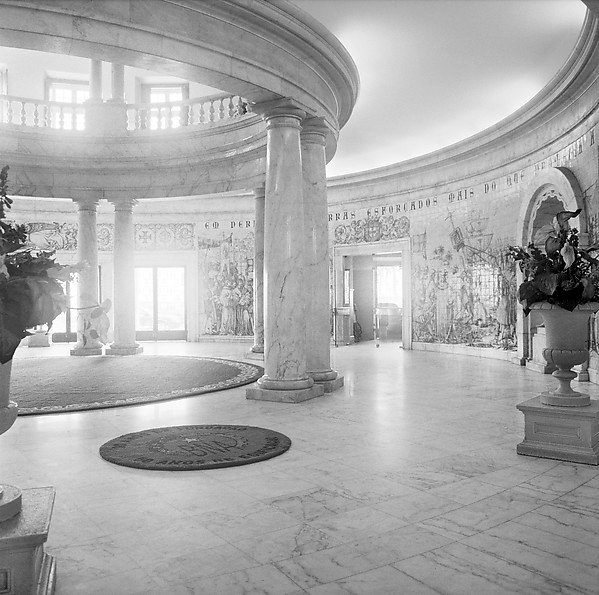
Jo Ractliffe (South African, b. 1961) Banco Nacional de Angola 2007 (diptych left)

Jo Ractliffe (South African, b. 1961) Banco Nacional de Angola 2007 (diptych right)


Jo Ractliffe (South African, b. 1961)
Banco Nacional de Angola (diptych left and right)
2007
Inkjet prints, 2015
Height: 17 11/16 in. (45cm) Width: 17 11/16 in. (45cm)
On loan from the artist, courtesy Stevenson, Cape Town and Johannesburg
© Jo Ractliffe. Courtesy of Stevenson, Cape Town and Johannesburg


The National Bank of Angola building was designed by Portuguese architect Vasco Regaleira and inaugurated in 1956 by Portuguese president Francisco Lopes. The building’s pink exterior, with its imposing dome and colonnade, was intended to fit in with other colonial-style buildings in Luanda. The bank’s lavish décor provides a dramatic contrast to many of Ractliffe’s other photographs of the city, especially the marble atrium, which features tiled murals portraying the arrival of the Portuguese in Angola. In the image to the right (bottom above), Portuguese explorers are depicted disembarking from their ship and erecting a padrão; these large limestone markers were inscribed with the Portuguese coat of arms and positioned at key locations along the coast by Portuguese navigator Diogo Cão in 1483. An original padrão is currently on view in the exhibition Kongo: Power and Majesty.


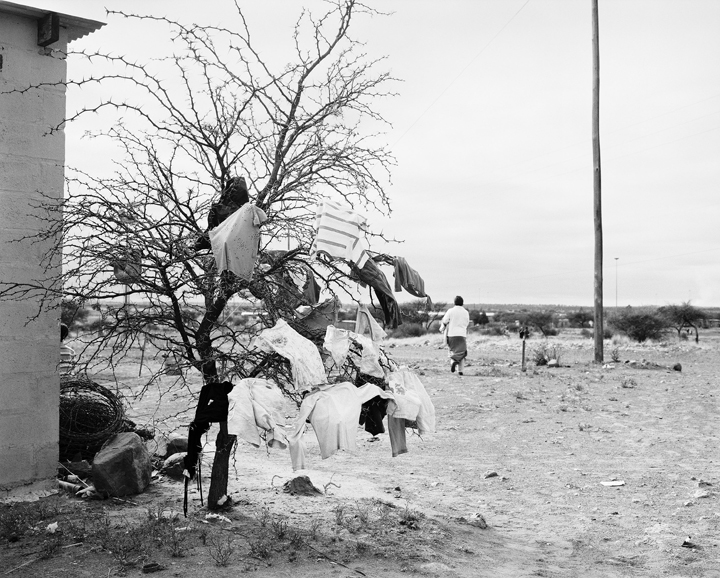
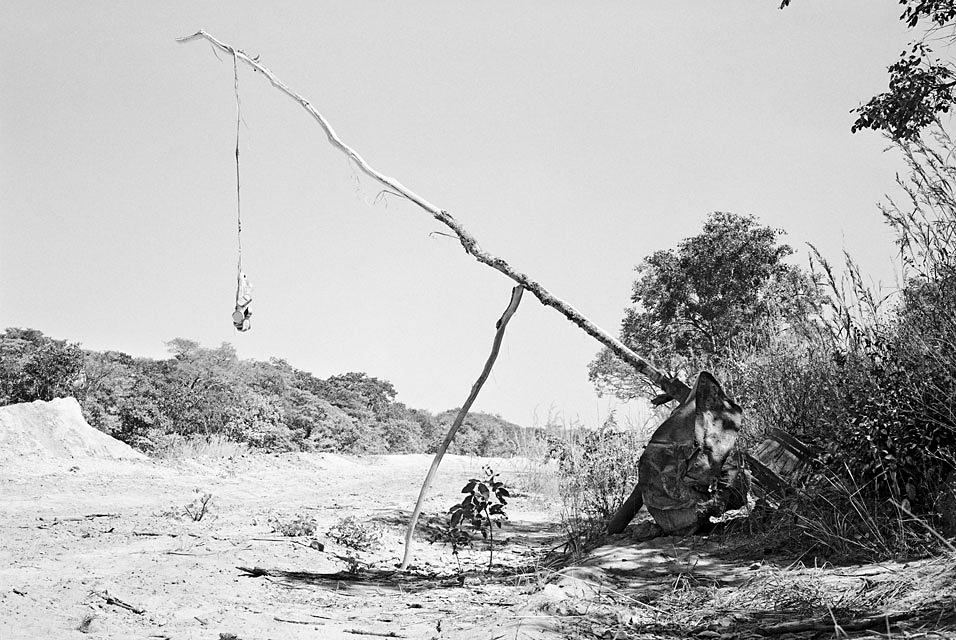
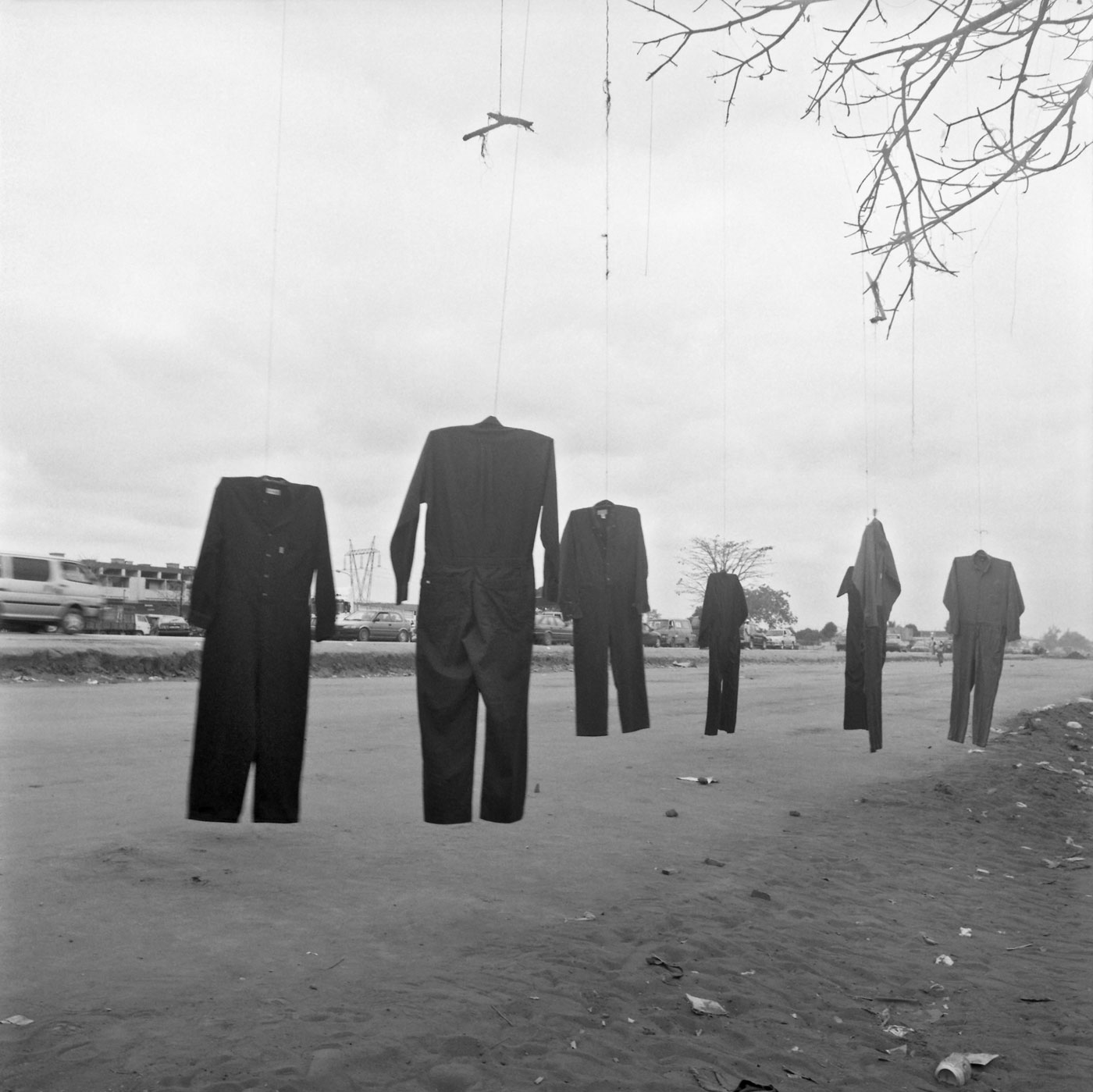
Jo Ractliffe (South African, b. 1961) 'Roadside stall on the way to Viana' 2007


Jo Ractliffe (South African, b. 1961)
Roadside stall on the way to Viana
2007
From the series Terreno Ocupado
Inkjet print, 2015
On loan from the artist, courtesy Stevenson, Cape Town and Johannesburg
© Jo Ractliffe. Courtesy of Stevenson, Cape Town and Johannesburg


In this photograph and the next one, “Wreck of a Chinese ship at Ilha”, stretches of bare ground in and around Luanda form the backdrop to ghostly signs of economic activity. Workmen’s overalls dangle from a tree at a roadside stall next to a taxi rank, and a grounded ship basks on a deserted beach while other vessels float offshore. Before it capsized in the mid-2000s, this ship transported and housed Chinese workers drawn to Angola by the many Chinese-run infrastructure projects in the country. These images reflect Angola’s diverse economy where a globalised workforce and the informal sector both play important roles, yet the absence of the workers themselves is striking.


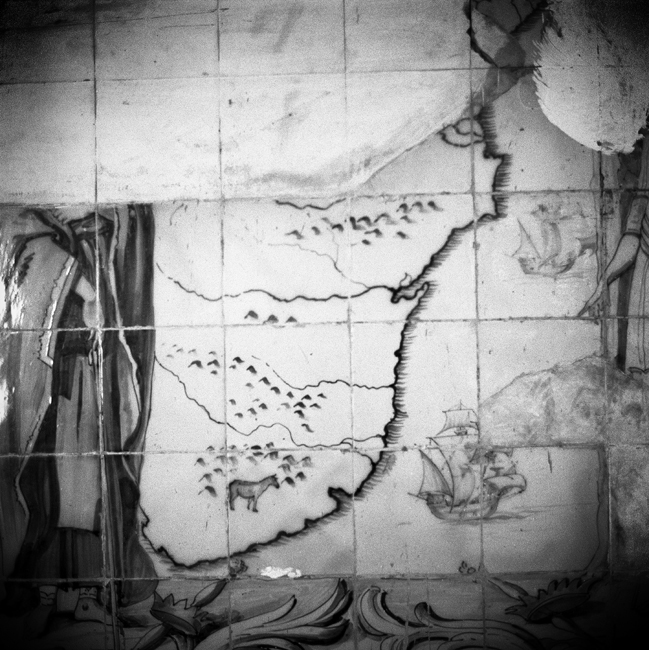
Jo Ractliffe (South African, b. 1961) 'Details of tiled murals at the Fortaleza De São Miguel, depicting Portuguese explorations in Africa 2' 2007


Jo Ractliffe (South African, b. 1961)
Details of tiled murals at the Fortaleza De São Miguel, depicting Portuguese explorations in Africa 2
2007
Inkjet print, 2015
Height: 13 3/4 in. (35cm)
Width: 13 3/4 in. (35cm)
On loan from the artist, courtesy Stevenson, Cape Town and Johannesburg
© Jo Ractliffe. Courtesy of Stevenson, Cape Town and Johannesburg


Jo Ractliffe (South African, b. 1961) 'Details of tiled murals at the Fortaleza De São Miguel, depicting Portuguese explorations in Africa 4' 2007


Jo Ractliffe (South African, b. 1961)
Details of tiled murals at the Fortaleza De São Miguel, depicting Portuguese explorations in Africa 4
2007
Inkjet print, 2015
Height: 13 3/4 in. (35cm) Width: 13 3/4 in. (35cm)
On loan from the artist, courtesy Stevenson, Cape Town and Johannesburg
© Jo Ractliffe. Courtesy of Stevenson, Cape Town and Johannesburg


This photograph and the previous one were taken inside the Fortaleza de São Miguel, a fort originally built in 1576 by Paulo Dias de Novais, the explorer who “founded” Luanda. It later became the administrative heart of the Portuguese colony of Angola in its important role as a trading centre and slaving hub. In 1938 the fort was transformed into the home of the Museum of Angola, and the tiled murals shown here were commissioned at this time. Depicting the flora, fauna and history of Angola, these cobalt-blue 18th-century style tiles were inspired by early modern European prints depicting the Kongo and Angola kingdoms, and represented an attempt to legitimise the ongoing Portuguese presence in the country. Sources included Olfert Dapper’s 1668 “Description of Africa” from which the map fragment shown here is drawn.


Jo Ractliffe (South African, b. 1961) Decommissioned military outpost, Schmidtsdrift 2012 (triptych left)

Jo Ractliffe (South African, b. 1961) Decommissioned military outpost, Schmidtsdrift 2012 (triptych middle)

Jo Ractliffe (South African, b. 1961) Decommissioned military outpost, Schmidtsdrift 2012 (triptych right)


Jo Ractliffe (South African, b. 1961)
Decommissioned military outpost, Schmidtsdrift (triptych left, middle and right)
2012
From the series The Borderlands
Inkjet prints, 2015
On loan from the artist, courtesy Stevenson, Cape Town and Johannesburg
© Jo Ractliffe. Courtesy of Stevenson, Cape Town and Johannesburg


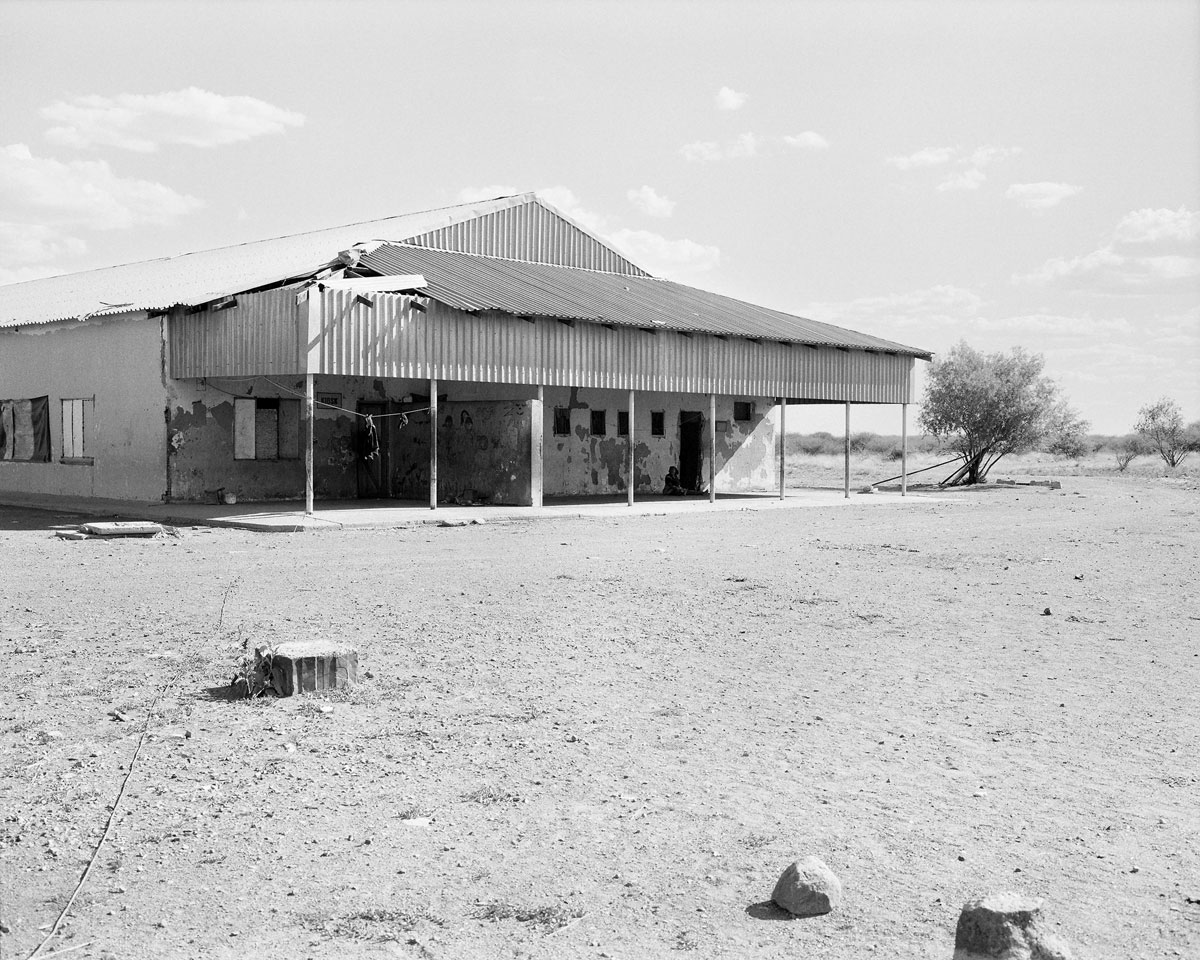
In this triptych, Ractliffe’s focal point is a ghostly ensemble of deserted military buildings. Schmidtsdrift’s original inhabitants were forcibly relocated in the 1950s-1970s under the apartheid regime’s policy of racial segregation. From 1974 the emptied settlement was used as a military training base by the South African Defence Force, which was fighting against the exiled Namibian liberation movement and the Angolan army in a conflict later referred to in South Africa as the “Border War”. Now that the war is over, the decommissioned buildings remain, testifying to the region’s past conflicts and histories of forced relocation.


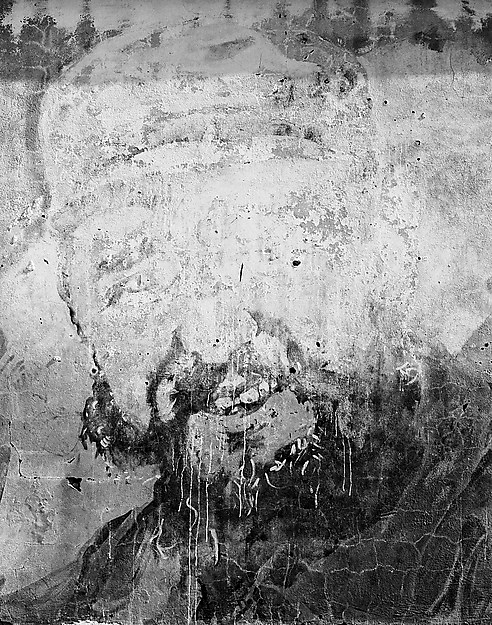
Jo Ractliffe (South African, b. 1961) 'Mural depicting Fidel Castro, Agostinho Neto and Leonid Brezhnev, circa 1975, Viriambundo' 2009

Jo Ractliffe (South African, b. 1961) Mural depicting Fidel Castro, Agostinho Neto and Leonid Brezhnev, circa 1975, Viriambundo 2009 (detail)

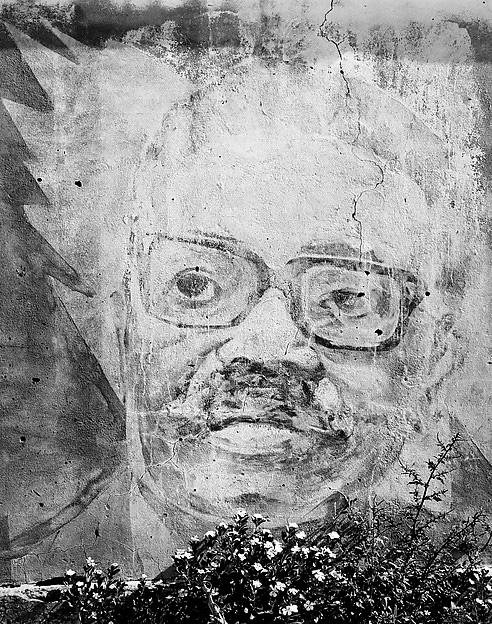
Jo Ractliffe (South African, b. 1961) Mural depicting Fidel Castro, Agostinho Neto and Leonid Brezhnev, circa 1975, Viriambundo 2009 (detail)

Jo Ractliffe (South African, b. 1961) Mural depicting Fidel Castro, Agostinho Neto and Leonid Brezhnev, circa 1975, Viriambundo 2009 (detail)


Jo Ractliffe (South African, b. 1961)
Mural depicting Fidel Castro, Agostinho Neto and Leonid Brezhnev, circa 1975, Viriambundo (details)
2009
Inkjet prints, 2015
Height: 15 3/4 in. (40cm) Width: 19 11/16 in. (50cm)
On loan from the artist, courtesy Stevenson, Cape Town and Johannesburg
© Jo Ractliffe. Courtesy of Stevenson, Cape Town and Johannesburg


The central figure of Agostinho Neto, Angola’s anti-colonial leader and president from 1975-79, is flanked by Cuban revolutionary Fidel Castro on the left, and Soviet leader Leonid Brezhnev on the right. This mural personifies the threats of African Nationalism and Communism that propelled South Africa to become involved in the Border War. It highlights the fact that the Angolan Civil War was also a Cold War battleground, with Cuba and the Soviet Union on the side of Neto’s party, the MPLA (People’s Movement for the Liberation of Angola), and South Africa and the United States supporting UNITA (National Union for the Total Independence of Angola). Here, all three men still command a presence despite their faded, cartoon-like rendering.


The Metropolitan Museum of Art
1000 Fifth Avenue at 82nd Street
New York, New York 10028-0198
Phone: 212-535-7710

Opening hours:
Sunday – Tuesday, and Thursday: 10am – 5pm
Friday and Saturday: 10am – 9pm
Closed Wednesday

The Metropolitan Museum of Art website

LIKE ART BLART ON FACEBOOK

Back to top

Exhibition: ‘Naked Before the Camera’ at the Metropolitan Museum of Art, New York

Exhibition dates: 27th March – 9th September 2012

WARNING: this posting contains photographs of nudity. If you do not like please do not look.


Many thankx to the Metropolitan Museum of Art for allowing me to publish the photographs in the posting. Please click on the photographs for a larger version of the image.


Franck-François-Genès Chauvassaignes (French, 1831 - after 1900) 'Untitled [Female Nude in Studio]' 1856-1859


Franck-François-Genès Chauvassaignes (French, 1831 – after 1900)
Untitled [Female Nude in Studio]
1856-1859
Salted paper print from glass negative
19.1 x 15.2cm (7.5 x 6 in.)
Metropolitan Museum of Art
Purchase, The Horace W. Goldsmith Foundation Gift, through Joyce and Robert Menschel, 1998
Public domain


This corner of a painter’s atelier somewhere in France in the middle of the nineteenth century is scarcely tethered to time or place; it could as easily be a loft in New York today or, had photography existed four centuries earlier, a studio in the Italian Renaissance. What is surprising here is the absence of even the thinnest disguise – no swags of drapery, elaborate coiffure, or skeins of beads as are commonly found in the work of other purveyors of “studies for artists.” Here, the model is utterly naked. With her intelligent head and dirty feet, this young woman helped found the matter-of-fact modelling sorority joined a decade later by Édouard Manet’s Olympia.

Text from the Metropolitan Museum of Art website


Félix-Jacques-Antoine Moulin (French, 1800 - after 1875) 'Untitled [Two Standing Female Nudes]' c. 1850


Félix-Jacques-Antoine Moulin (French, 1800 – after 1875)
Untitled [Two Standing Female Nudes]
c. 1850
Daguerreotype
Visible: 14.5 x 11.1cm (5 11/16 x 4 3/8 in.)
Metropolitan Museum of Art
The Rubel Collection, Purchase, Anonymous Gift and Lila Acheson Wallace Gift, 1997
Public domain


Although Moulin was sentenced in 1851 to a month in jail for producing images that, according to court papers, were “so obscene that even to pronounce the titles… would be to commit an indecency,” this daguerreotype seems more allied to art than to erotica. Instead of the boudoir props and provocative poses typical of hand-coloured pornographic daguerreotypes, Moulin depicted these two young women utterly at ease, as unselfconscious in their nudity as Botticelli’s Venus.

Text from the Metropolitan Museum of Art website


Unknown photographer (French) '[Seated Female Nude]' c. 1850


Unknown photographer (French)
[Seated Female Nude]
c. 1850
Daguerreotype
9.1 x 6.9cm (3 9/16 x 2 11/16 in.)
Metropolitan Museum of Art
Credit Line: Gilman Collection, Gift of The Howard Gilman Foundation, 2005
Public domain


This daguerreotype was surely intended to serve artistic purposes, but the odd twist of the body and the strange relationship of the three visible limbs seem to render it inappropriate for artistic emulation. Such tension between an artistic ideal and realistic means – between the classicism of an academic pose and the awkwardness of the camera’s rendering of human movement – seems emblematic of the dilemma faced by the nascent medium striving to be an art.

Text from the Metropolitan Museum of Art website


Julien Vallou de Villeneuve (French, 1795-1866) '[Standing Female Nude]' c. 1853


Julien Vallou de Villeneuve (French, 1795-1866)
[Standing Female Nude]
c. 1853
Salted paper print from paper negative
12 x 16cm (4 3/4 x 6 5/16 in.)
Metropolitan Museum of Art
Purchase, Lila Acheson Wallace Gift, 1993
Public domain


A student of the painter Jean François Millet (1814-1875) and a lithographer of scenes of daily life, costume, and erotica in the 1820s and 1830s, Vallou reportedly took up photography in the early 1840s. Because his early photographs have not been identified, it has been assumed that they depicted naked women, a subject for which it was to improper to acknowledge authorship.

Between 1851 and 1855, Vallou made a series of small-scale paper photographs of female nudes that he marketed (and legally registered) as models for artists. Vallou’s nudes have long been associated with those of Gustave Courbet (1819-1877), who is known to have used photographs in his painting process. Though no absolute one-to-one correspondence can be pointed to, there are some striking similarities in pose, and the heavy, soporific quality of Vallou’s models is very close to Courbet’s concept of the nude.

Text from the Metropolitan Muesum of Art website


Eugène Durieu (French, 1800-1874) 'Untitled [Seated Female Nude]' 1853-1854


Eugène Durieu (French, 1800-1874)
Untitled [Seated Female Nude]
1853-1854
Albumen silver print from glass negative
6 13/16 × 4 11/16 in. (17.3 × 11.9cm)
Metropolitan Museum of Art
Gilman Collection, Purchase, Mr. and Mrs. Henry R. Kravis Gift, 2005
Public domain


Durieu was a lawyer and early advocate and practitioner of photography in France who, in 1853-1854, made a series of photographic studies of nude and costumed figures as models for artists. The French Romantic painter Eugène Delacroix helped him pose the figures and later praised the prints, from which he sketched, as “palpable demonstrations of the free design of nature.” While the painter saw the accurate transcription of reality as a virtue of photography, Durieu knew that a good photograph was not simply the result of the correct use of the medium but, more significantly, an expression of the photographer’s temperament and vision. In an important article he emphasised the interpretative nature of the complex manipulations in photography and explained that the photographer must previsualise his results so as to make a “picture,” not just a “copy.”

This photograph proves Durieu’s point: through the elegant contours of the drapery, the smooth modelling of the flesh, and the grace and restraint of the pose, the picture attains an artistic poise that combines Delacroix’s sensuality with Ingres’s classicism, and rivals both.

Text from the Metropolitan Museum of Art website


Charles Alphonse Marlé (French, 1821 - after 1867) 'Untitled [Standing Male Nude]' c. 1855


Charles Alphonse Marlé (French, 1821 – after 1867)
Untitled [Standing Male Nude]
c. 1855
Salted paper print from paper negative
25.7 x 17.6cm (10 1/8 x 6 15/16 in.)
Metropolitan Museum of Art
Purchase, Ezra Mack Gift and The Horace W. Goldsmith Foundation Gift through Joyce and Robert Menschel, 1991


Marlé’s photograph was probably intended as an aid for painters and sculptors. The jury-rigged arrangement of podium, books, and potted tree, as well as the painting held in the background by a studio assistant, may strike the modern viewer as an incongruous contrast to the heroic gesture of the model. Marlé and those who bought his photograph, however, would have been absorbed by the grand academic pose and likely would have thought the awkward accoutrements of little consequence.

Text from the Metropolitan Museum of Art website


Nadar (French, Paris 1820 - 1910 Paris) '[Standing Female Nude]' 1860-1861


Nadar (French, Paris 1820 – 1910 Paris)
[Standing Female Nude]
1860-1861
20.2 x 13.3cm (7 15/16 x 5 1/4 in.)
Metropolitan Museum of Art
Purchase, The Horace W. Goldsmith Foundation Gift, through Joyce and Robert Menschel, 1991
Public Domain


Famed for his portraits of writers, artists, and left-wing politicians, Nadar is known to have photographed only three female nudes. This one was made at the behest of the painter Jean-Léon Gérôme to assist in the process of painting Phryné before the Areopagus, displayed at the Salon of 1861. Gérôme’s painting depicts the moment when the famous courtesan Phryné, on trial for impiety, is suddenly unveiled by her lawyer; persuaded by Phryné’s divine beauty, the jurors acquit her.

Like Phryné, who is said to have modelled for the ancient Greek painter Apelles and other artists of antiquity, Nadar’s model, Marie-Christine Leroux (1820-1863), was widely sought by artists of her time and was the basis for the character Musette in Henri Murger’s Scènes de la vie de bohème.

Text from the Metropolitan Museum of Art website


Depicting the human body has been among the greatest challenges, preoccupations, and supreme achievements of artists for centuries. The nude – even in generalised or idealised renderings – has triggered impassioned discussions about sin, sexuality, cultural identity, and canons of beauty, especially when the chosen medium is photography, with its inherent accuracy and specificity. Through September 9, 2012, Naked before the Camera, an exhibition of more than 60 photographs selected from the renowned holdings of The Metropolitan Museum of Art, surveys the history of this subject and explores some of the motivations and meanings that underlie photographers’ fascination with the nude.

“In every culture and across time, artists have been captivated by the human figure,” commented Thomas P. Campbell, Director of the Metropolitan. “In Naked before the Camera, we see how photographers have used their medium to explore this age-old subject and create compelling new images.”

The exhibition begins in the 19th century, when photographs often served artists as substitutes for live models. Such “studies for artists” were known to have been used by the French painter Gustave Courbet, whose Woman with a Parrot (1866), for instance, is strikingly similar to photographer Julien Vallou de Villeneuve’s Female Nude of 1853. Even when their stated purpose was to aid artists, however, the best of these 19th-century photographs of the nude were also intended as works of art in their own right. Two recently acquired photographs, made in the mid-1850s by an unknown French artist, are striking examples. Not only are they larger than all other photographic nudes from the time, they stand out due to an extraordinary surface pattern that interrupts the images and suggests a view through gossamer or a photograph printed on finely pleated silk rather than paper. The elegant Female Nude harkens back to an Eve or Venus and is vignetted by the camera lens as if seen through a peephole, while her male counterpart is shown in strict profile in a pose that recalls precedents from antiquity. Each figure draws from the past while being presented in a strikingly modern way, without any equivalent among other 19th-century studies for artists.

Not all photographers of the nude were motivated by artistic desire. The second section of Naked before the Camera includes photographs made for medical and forensic purposes, as ethnographic studies, as tools to analyse anatomy and movement, and – not surprisingly – as erotica. The lines between such categories were not always clearly drawn; some photographers called their images “studies for artists” merely to evade the censors, while viewers of the G. W. Wilson Studio’s Zulu Girls (1892-93) or Paul Wirz’s ethnographic photographs of scantily clad Indonesians from the 1910s and 1920s were undoubtedly titillated by the blending of exoticism and eroticism.

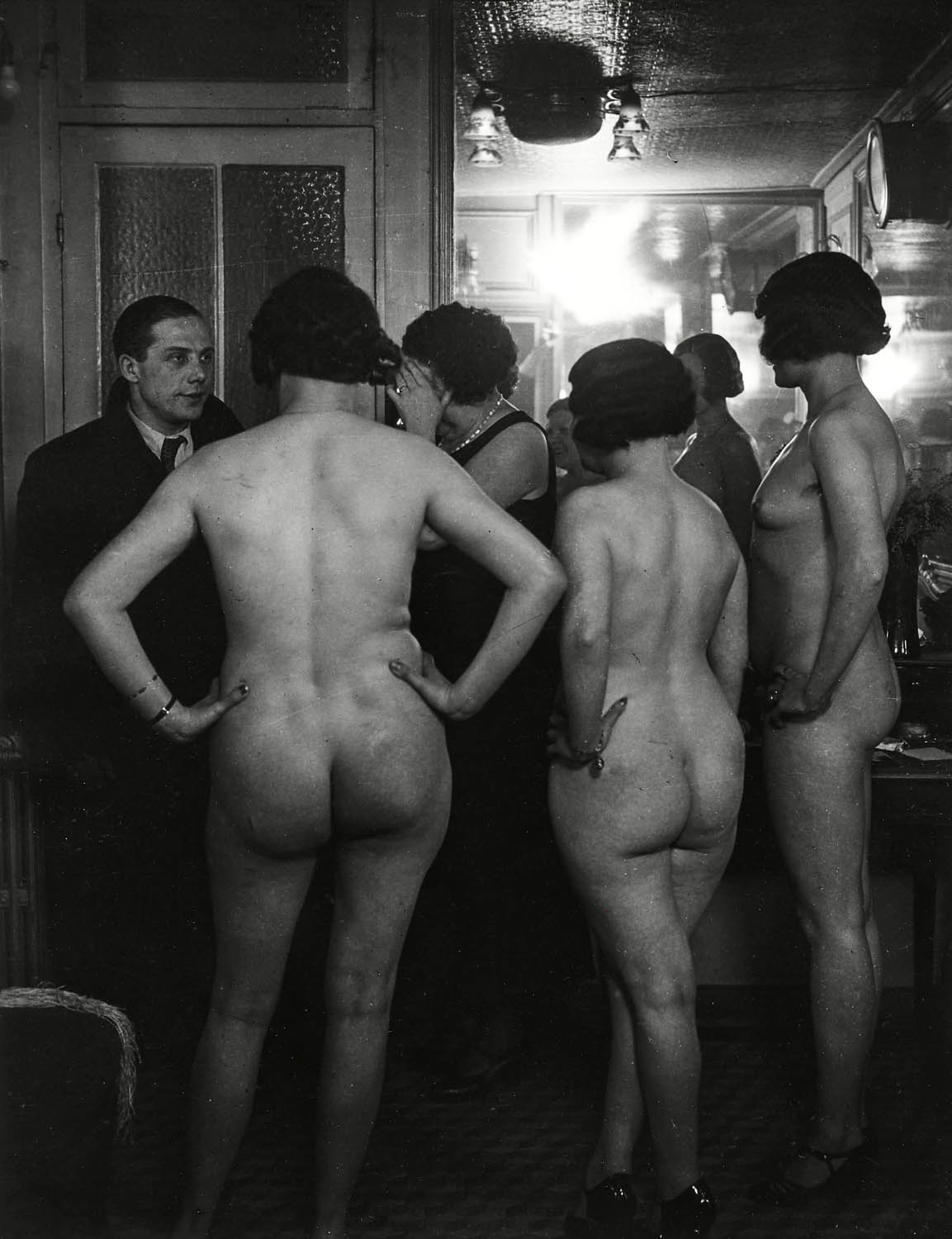
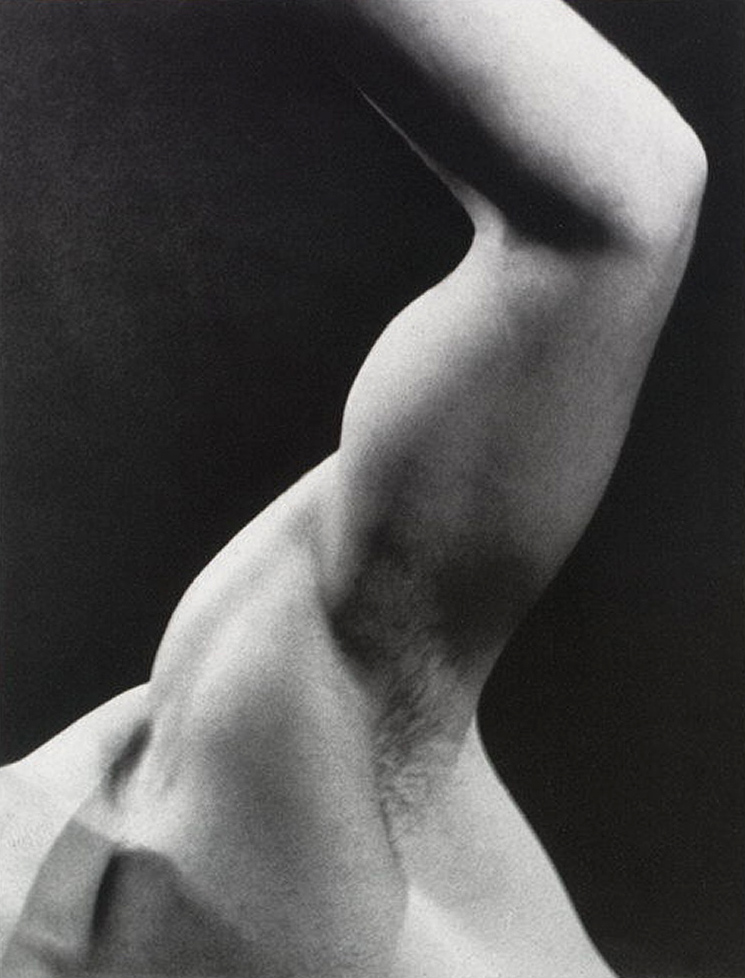
Beginning in the fertile period of modernist experimentation that followed on the heels of World War I, photographers such as Brassaï, Man Ray, Hans Bellmer, André Kertész, and Bill Brandt found in the human body a perfect vehicle for both visual play and psycho-sexual exploration. In Distortion #6 (1932) by André Kertész, a woman’s body is stretched and pulled in the reflections of a fun-house mirror – a figure from a Surrealist dream that stands in stark contrast to the images of perfect feminine beauty by earlier photographers.

In mid-20th-century America, photographers more often communicated an intimate connection with their subjects. Following the example of Alfred Stieglitz’s famed portraits of Georgia O’Keeffe, photographers such as Edward Weston, Harry Callahan, and Emmet Gowin made many nude studies of their wives. Callahan’s photograph of his wife and daughter, Eleanor and Barbara, Chicago (1954), for instance, gives the viewer access to a private, tender moment of intimacy.

In the wake of the sexual revolution of the 1960s and the AIDS crisis that began in the 1980s, artists began to think of the body as a politicised terrain and explored issues of identity, sexuality, and gender. Diane Arbus’s Retired man and his wife at home in a nudist camp one morning, N.J. (1963) and A naked man being a woman, N.Y.C. (1968), Larry Clark’s untitled image (1972-1973) from the series Teenage Lust, and Hannah Wilke’s Snatch Shot with Ray Gun (1978) are among the works featured in the concluding section of the exhibition.

Press release from the Metropolitan Museum of Art website


Unknown photographer (French) '[Nude with Mirror]' c. 1850


Unknown photographer (French)
[Nude with Mirror]
c. 1850
Daguerreotype
Dimensions: visible: 7 x 5.7cm (2 3/4 x 2 1/4 in.)
Metropolitan Museum of Art
The Rubel Collection, Purchase, Lila Acheson Wallace Gift, 1997
Public domain


Julien Vallou de Villeneuve (French, 1795-1866) '[Reclining Female Nude]' c. 1853


Julien Vallou de Villeneuve (French, 1795-1866)
[Reclining Female Nude]
c. 1853
Salted paper print from paper negative
11.8 x 16.0cm (4 5/8 x 6 5/16 in.)
Metropolitan Museum of Art
Purchase, Lila Acheson Wallace Gift, 1993
Public domain


A student of the painter Jean François Millet and a lithographer of scenes of daily life, costume, and erotica in the 1820s and 1830s, Vallou reportedly took up photography in the early 1840s, but his early photographs have not been identified. Perhaps they depicted naked women, a subject for which it was improper to acknowledge authorship.

Between 1851 and 1855, however, Vallou made a series of photographs of female nudes that he marketed (and legally registered) as models for artists. Vallou’s nudes have long been associated with those of Gustave Courbet, who is known to have used photographs in his painting process. Although no absolute one-to-one correspondence can be pointed to, the heavy soporific quality of Vallou’s models is very close to Courbet’s concept of the nude, and the reclining figure displayed here is strikingly similar in pose to the painter’s Woman with a Parrot (1866), on view in the galleries for nineteenth-century painting.

Text from the Metropolitan Museum of Art website


Gustave Le Gray (French, 1820-1884) 'Nu féminin allongé sur un canapé Récamier' (Female nude lying on a Recamier sofa) c. 1856


Gustave Le Gray (French, 1820-1884)
Nu féminin allongé sur un canapé Récamier (Female nude lying on a Recamier sofa)
c. 1856
Albumen silver print from glass negative
21.7 x 32.9cm (8 9/16 x 12 15/16 in.)
Metropolitan Museum of Art
Gilman Collection, Purchase, The Horace W. Goldsmith Foundation Gift, through Joyce and Robert Menschel, 2005
Public domain


The central figure in French photography of the 1850s, Le Gray was a master of many genres including landscape and seascape, architectural photography, and portraiture. Only four nude studies by Le Gray are known, however, each in a single example. In this striking image, the photographer departed from the usual academic treatment of the nude, such as he might have learned from his years in the painting studio of Paul Delaroche, in favor of a more psychologically charged spirit. The daybed’s velvet upholstery, the tassels on the pillow, and the heavy curtain fabric have a reassuring and familiar presence, but the serpentine locks of hair evoke Medusa and hint at strangulation, while the legs and feet cross and tense in the manner of a crucifixion. Withdrawn in sleep – or is it death? – the beautiful young woman reminds one of a drowning victim, an Ophelia freshly recovered from the Seine, a theme favoured by the painters and poets of Paris.

Text from the Metropolitan Museum of Art website


Unknown photographer (French) '[Standing Female Nude]' c. 1856


Unknown photographer (French)
[Standing Female Nude]
c. 1856
Salted paper print from collodion glass negative
43.4 x 28.3cm (17 1/16 x 11 1/8 in.)
Metropolitan Museum of Art
Purchase, Louis V. Bell, Harris Brisbane Dick, Fletcher, and Rogers Funds and Joseph Pulitzer Bequest; Edwynn Houk and Hans P. Kraus Jr., Alfred Stieglitz Society, Robert Mapplethorpe Foundation, Anonymous, Adam R. Rose and Peter R. McQuillan, Joseph M. Cohen, Susan and Thomas Dunn, Kurtz Family Foundation, W. Bruce and Delaney H. Lundberg, Christian Keesee Charitable Trust, and Robert A. Taub Gifts; and Funds from various donors, 2012
Public domain


The original impulse behind these boldly ambitious figure studies may have been to aid a painter or sculptor, but they are nonetheless without parallel in the early history of photography. Enlarged to the size of drawn académies – drawings of the live model that were a standard part of art instruction in France – their scale alone sets them apart from the more modest productions of Vallou de Villeneuve, Durieu, and other artists of the 1850s. More unusually, the images are interrupted by a surface pattern that gives the impression that the photographs are printed on finely pleated silk rather than paper – likely the result of a technical error. Instead of wiping clean his glass-plate negatives and starting over as virtually all other photographers would have done, this artist recognised that the pattern created a veil that, like time or memory, removed the images from their merely utilitarian purpose and elevated them from the mundane to the realm of art.

Just as the eye and mind may be pleasantly torn between bravura brushwork and the ostensible subject of a painting, there is a tension here between the beauty of the subject – the elegant female draped in gossamer; the strict profile and geometric setting of the male – and the visible traces of their creation, such as the flowing surface pattern and the strong vignetting of the female, which suggests a view spied through a peephole.

Text from the Metropolitan Museum of Art website


Unknown photographer (French) '[Standing Male Nude]' c. 1856


Unknown photographer (French)
[Standing Male Nude]
c. 1856
Salted paper print from collodion glass negative
43.4 x 28.4cm (17 1/16 x 11 3/16 in.)
Metropolitan Museum of Art
Purchase, Louis V. Bell, Harris Brisbane Dick, Fletcher, and Rogers Funds and Joseph Pulitzer Bequest; Edwynn Houk and Hans P. Kraus Jr., Alfred Stieglitz Society, Robert Mapplethorpe Foundation, Anonymous, Adam R. Rose and Peter R. McQuillan, Joseph M. Cohen, Susan and Thomas Dunn, Kurtz Family Foundation, W. Bruce and Delaney H. Lundberg, Christian Keesee Charitable Trust, and Robert A. Taub Gifts; and funds from various donors, 2012
Public domain


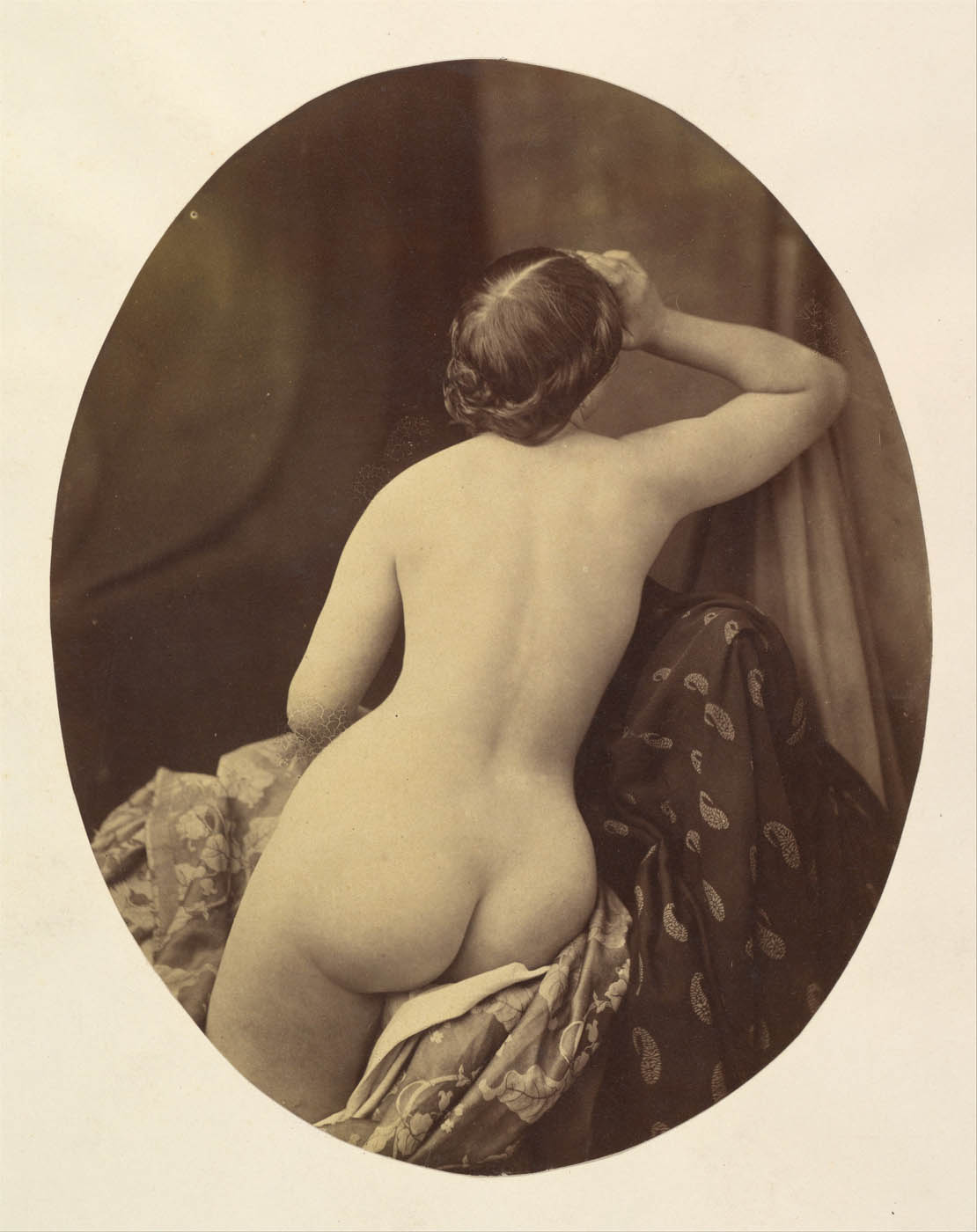
Oscar Gustav Rejlander (British born Sweden, 1813-1875) 'Ariadne' 1857


Oscar Gustav Rejlander (British born Sweden, 1813-1875)
Ariadne
1857
Albumen silver print from glass negative
Mount: 16 1/16 in. × 13 1/16 in. (40.8 × 33.2cm)
Image: 8 1/4 × 6 1/2 in. (21 × 16.5cm); oval
Metropolitan Museum of Art
Gilman Collection, Purchase, The Horace W. Goldsmith Foundation Gift, through Joyce and Robert Menschel, 2005
Public domain


Working in a place – Victorian England – where any photographic nude was considered offensive because the process implied not only the “nastiness” of the artist and vendor, but also “the degradation of the person who serves as model on the occasion,” Rejlander sought to ally his work with that of noted painters. This nude study is one of a series based on figures in the work of Raphael, Titian, Correggio, Rubens, Murillo, and Gainsborough; the precedent here is Titian’s Venus and Adonis, and Rejlander’s intention was to show how the painter adhered to or strayed from the ways a real body can twist and turn. Critic A. H. Wall defended the propriety of Rejlander’s Studies from the Nude, saying, “Refined and ennobled by art, real beauty, palpable flesh and blood, speaks of nothing but its own inherent loveliness.”

Such references to painting did not always afford adequate protection, however. Writing of Rejlander’s famous Two Ways of Life, photographer and critic Thomas Sutton wrote, “There is no impropriety in exhibiting such works of art as Etty’s Bathers Surprised by a Swan or the Judgment of Paris but there is impropriety in allowing the public to see photographs of nude prostitutes, in flesh-and-blood truthfulness and minuteness of detail.”

Text from the Metropolitan Museum of Art website


Unknown photographer (French) '[Female Nude with Mask]' c. 1870


Unknown photographer (French)
[Female Nude with Mask]
c. 1870
Albumen silver print from glass negative
26 x 19.1cm (10 1/4 x 7 1/2 in.)
Metropolitan Museum of Art
Gilman Collection, Gift of The Howard Gilman Foundation, 2005
Public domain


Even as she seems to part her tresses to expose her naked body, the model here masks her face in an effort to conceal her identity. While drawing, painting, and sculpture of the human figure commonly involve elements of transformation, idealisation, or the combination of features from various models, photography usually presents a recognisable image of its subject. It was not uncommon, therefore, for models who routinely posed nude for artists in other media to hide their faces when standing naked before the camera. For the viewer – not always an artist looking for help in figure drawing – the mask added an element of erotic frisson.

Text from the Metropolitan Museum of Art website


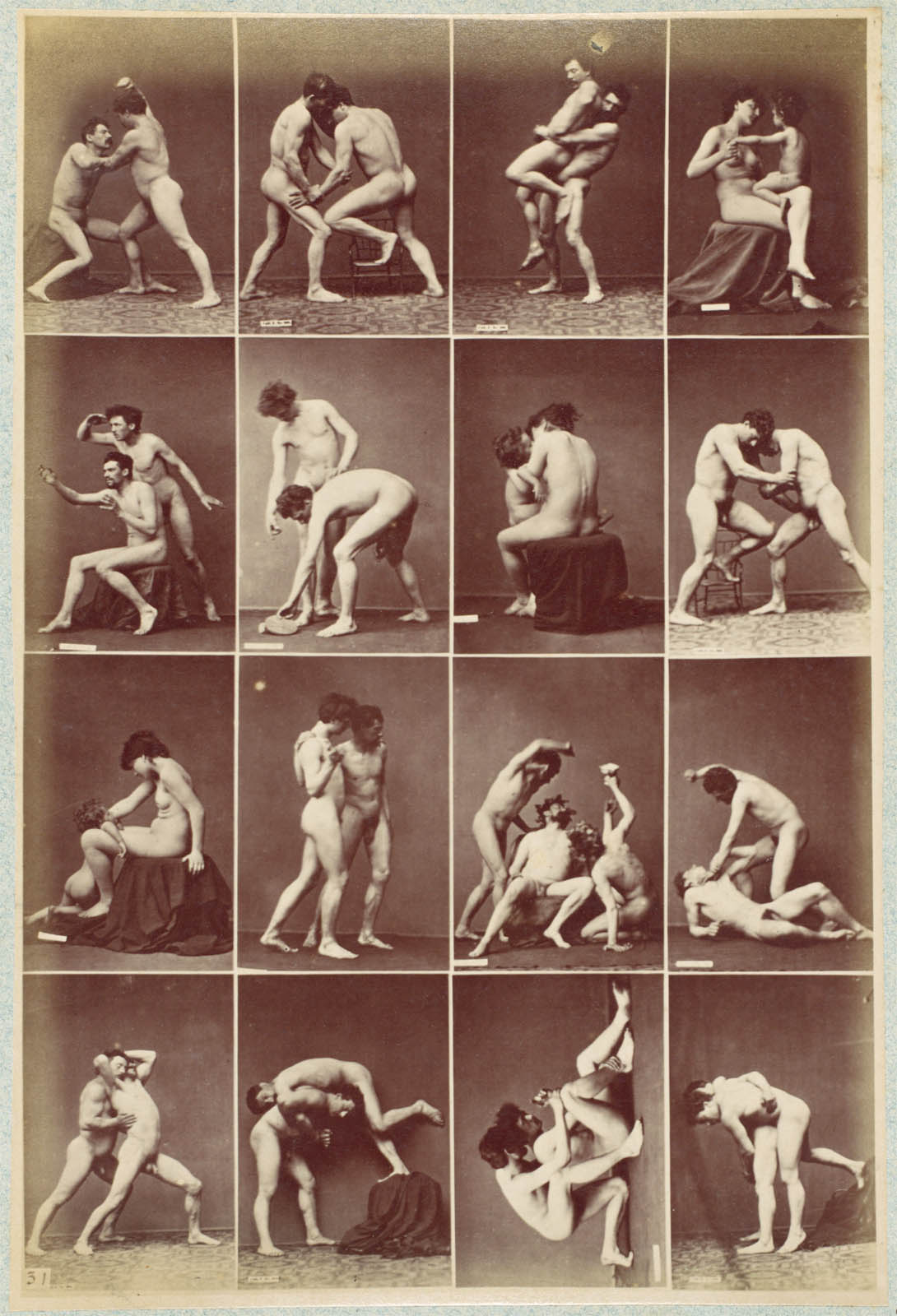
Louis Igout (French, 1837-1881)(Photographer) A. Calavas (French)(Editor) 'Plate from Album d'Études – Poses' c. 1880


Louis Igout (French, 1837-1881)(Photographer)
A. Calavas (French)(Editor)
Plate from Album d’Études – Poses
c. 1880
Albumen silver prints from glass negatives
Metropolitan Museum of Art
Purchase, The Horace W. Goldsmith Foundation Gift, through Joyce and Robert Menschel, 1993
Public domain


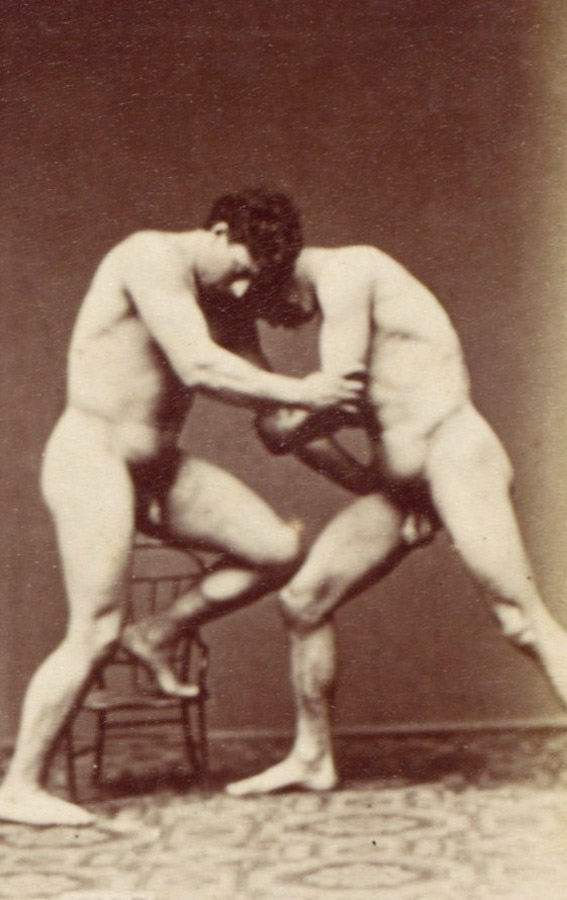
This album is an excellent example of the type of photography produced in the nineteenth century as an aid to artists in the study of contour, modelling, and proportion, and as a vocabulary of expression, gesture, and pose sanctioned by the art of antiquity and the Old Masters. Groupings representing Cain and Abel, the Drunken Silenus, Hercules and Antaeus, the Dying Gaul, the Cnidian Aphrodite, and others are recognisable among the photographs. Single prints showing sixteen small images, such as the page shown here, served as a type of stock catalogue, allowing clients to survey a broad range of possible poses and order larger prints of those which best served their needs.

Text from the Metropolitan Museum of Art website


Louis Igout (French, 1837-1881)(Photographer) A. Calavas (French)(Editor) 'Plate from Album d'Études – Poses' c. 1880 (detail)

Louis Igout (French, 1837-1881)(Photographer) A. Calavas (French)(Editor) 'Plate from Album d'Études – Poses' c. 1880 (detail)

Louis Igout (French, 1837-1881)(Photographer) A. Calavas (French)(Editor) 'Plate from Album d'Études – Poses' c. 1880 (detail)


Louis Igout (French, 1837-1881)(Photographer)
A. Calavas (French)(Editor)
Plate from Album d’Études – Poses (details)
c. 1880
Albumen silver prints from glass negatives
Metropolitan Museum of Art
Purchase, The Horace W. Goldsmith Foundation Gift, through Joyce and Robert Menschel, 1993
Public domain


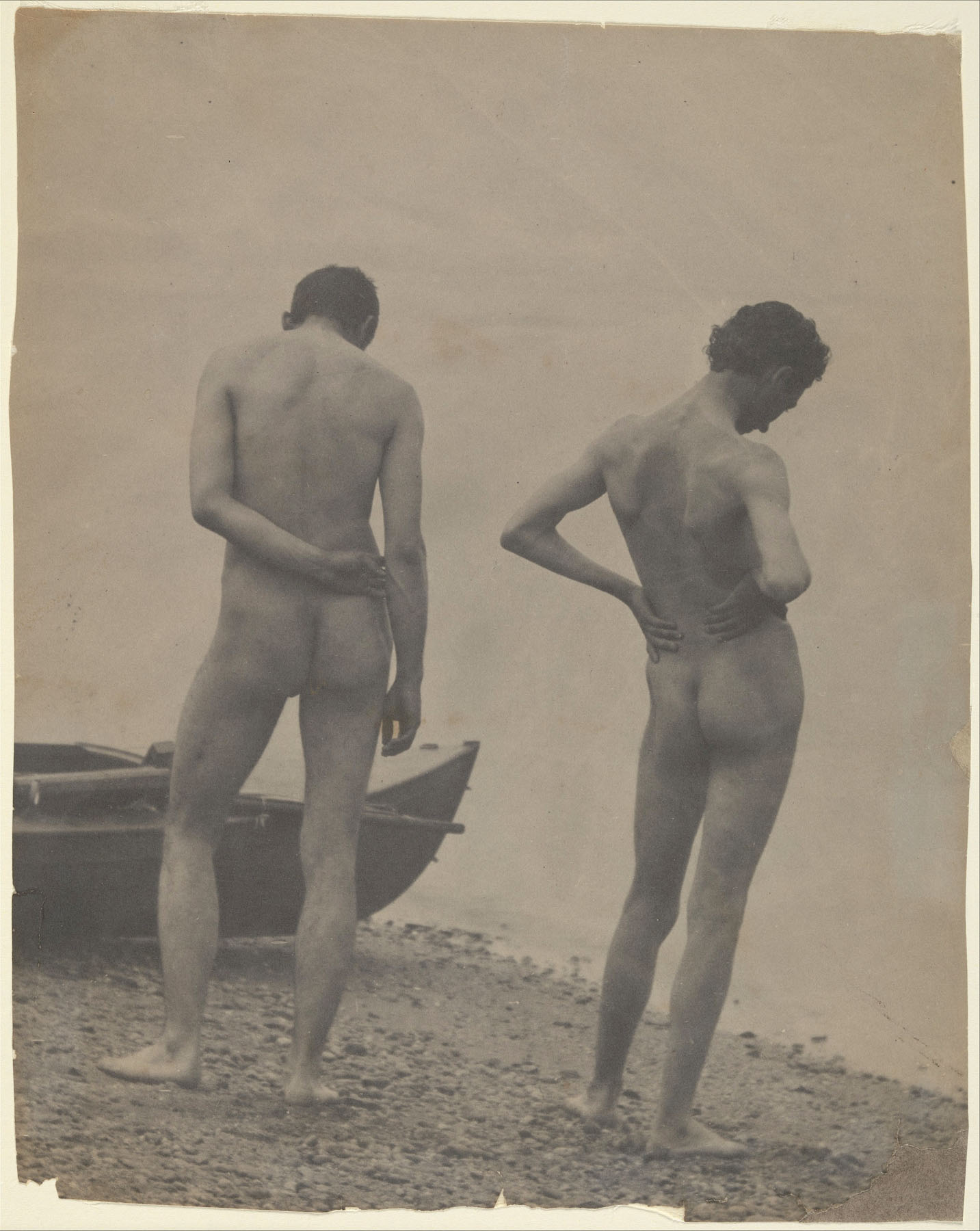
Thomas Eakins (American, 1844-1916) '(Thomas Eakins and John Laurie Wallace on a Beach)' c. 1883


Thomas Eakins (American, Philadelphia, Pennsylvania 1844–1916 Philadelphia, Pennsylvania)
[Thomas Eakins and John Laurie Wallace on a Beach]
c. 1883
Platinum print
25.5 x 20.4cm (10 1/16 x 8 1/16 in.), irregular
Metropolitan Museum of Art
David Hunter McAlpin Fund, 1943
Public domain


The great American painter and photographer Thomas Eakins was devoted to the scientific study of the human form and committed to its truthful representation. While he and his students at the Pennsylvania Academy of the Fine Arts were surrounded by casts of classical sculpture, Eakins declared that he did not like “a long study of casts. … At best they are only imitations, and an imitation of imitations cannot have so much life as an imitation of life itself.” Photography provided an obvious solution.

This photograph, in which Eakins and a student affected the elegant contrapposto stances of classical sculpture, was probably taken during an excursion with students to Manasquan Inlet at Point Pleasant, New Jersey, during the summer of 1883. Valuing his photographs not only as studies for paintings but also for their own sake, Eakins carefully printed the best images on platinum paper. In this case, he went to the additional trouble of enlarging the original, horizontally formatted image and cropping it vertically to better contain the perfectly balanced figures.

Text from the Metropolitan Museum of Art website


Albert Londe (French, 1858-1917) Paul Marie Louis Pierre Richer (French, 1849-1933) '[Male Musculature Study]' c. 1890


Albert Londe (French, 1858-1917)
Paul Marie Louis Pierre Richer (French, 1849-1933)
[Male Musculature Study]
c. 1890
Albumen silver print
Image: 14.9 x 9.6 cm (5 7/8 x 3 3/4 in.)
Mount: 14.9 x 9.9 cm (5 7/8 x 3 7/8 in.)
Metropolitan Museum of Art
Gift of Charles Isaacs and Carol Nigro, 2012


Author of a treatise on the importance of the camera in medical practice, Albert Londe declared, “the photographic plate is the scientist’s true retina.” In collaboration with a laboratory director and professor of anatomy at the École des Beaux-Arts, Londe found that photographs intended for physiological analysis could also serve artistic applications. Their careful portraits of athletes – whether taken with stop-action cameras specially designed by Londe or in static poses such as the example here – were used in scientific texts on musculature and became templates for illustrations to aid artists in rendering ideally proportioned figures.

Text from the Metropolitan Museum of Art website


Guglielmo Plüshow (Italian born Germany, 1852–1930) '[Young Male Nude Seated on Leopard Skin]' 1890s-1900s


Guglielmo Plüshow (Italian born Germany, 1852–1930)
[Young Male Nude Seated on Leopard Skin]
1890s-1900s
Albumen silver print from glass negative
22.2 x 16.2cm (8 3/4 x 6 3/8 in.)
Metropolitan Museum of Art
Museum Accession
Creative Commons CC0 1.0 Universal Public Domain Dedication


Censors have long struggled to keep pace with evolving technology and expanding distribution networks of photographic erotica. In nineteenth-century France, government officials regularly seized thousands of photographs similar to the daguerreotype displayed here, which were deemed lewd.

Male nudity has frequently been subject to stricter control than pornography featuring women. The Arcadian photographs of Plüshow and his cousin and student Wilhelm von Gloeden were avidly collected in the late nineteenth century, but in the 1930s many of their prints and negatives, considered deviant by the Italian Fascist government, were destroyed. For much of the twentieth century, it was illegal in the United States to mail photographs that might be judged prurient, forcing photographers to mask genitalia and pubic hair with strategic props or with overpainting that could be easily removed by purchasers. Sale of erotic male physique magazines and bodybuilder pin-ups, ostensibly circulated to promote fitness, was legalised in a 1962 Supreme Court ruling, which concluded that “portrayals of the male nude cannot fairly be regarded as more objectionable than many portrayals of the female nude that society tolerates.”

Text from the Metropolitan Museum of Art website


Attributed to Alphonse Bertillon (French, 1853–1914) 'Assasination of C. Lecomte 711 Rue des Martyrs' 1901-1908 From 'Album of Paris Crime Scenes'


Attributed to Alphonse Bertillon (French, 1853–1914)
Assasination of C. Lecomte 711 Rue des Martyrs
1901-1908
From Album of Paris Crime Scenes
Gelatin silver print
Overall: 24.3 x 31cm (9 9/16 x 12 3/16in.)
Page: 23 x 29cm (9 1/16 x 11 7/16 in.)
Metropolitan Museum of Art
Gilman Collection, Purchase, The Howard Gilman Foundation Gift, 2001
Public domain


Alphonse Bertillon, the chief of criminal identification for the Paris police department, developed the mug shot format and other photographic procedures used by police to register criminals. Although the images in this extraordinary album of forensic photographs were made by or under the direction of Bertillon, it was probably assembled by a private investigator or secretary who worked at the Paris prefecture. Photographs of the pale bodies of murder victims are assembled with views of the rooms where the murders took place, close-ups of objects that served as clues, and mug shots of criminals and suspects. Made as part of an archive rather than as art, these postmortem portraits, recorded in the deadpan style of a police report, nonetheless retain an unsettling potency.

Text from the Metropolitan Museum of Art website


Attributed to Alphonse Bertillon (French, 1853–1914) 'Untitled' 1901-1908 From 'Album of Paris Crime Scenes'


Attributed to Alphonse Bertillon (French, 1853–1914)
Untitled
1901-1908
From Album of Paris Crime Scenes
Gelatin silver print
Overall: 24.3 x 31cm (9 9/16 x 12 3/16in.)
Page: 23 x 29cm (9 1/16 x 11 7/16 in.)
Metropolitan Museum of Art
Gilman Collection, Purchase, The Howard Gilman Foundation Gift, 2001
Public domain


Attributed to Alphonse Bertillon (French, 1853–1914) 'Untitled' 1901-1908 From 'Album of Paris Crime Scenes'


Attributed to Alphonse Bertillon (French, 1853–1914)
Untitled
1901-1908
From Album of Paris Crime Scenes
Gelatin silver print
Overall: 24.3 x 31cm (9 9/16 x 12 3/16in.)
Page: 23 x 29cm (9 1/16 x 11 7/16 in.)
Metropolitan Museum of Art
Gilman Collection, Purchase, The Howard Gilman Foundation Gift, 2001
Public domain


Lady Ottoline Violet Anne Cavendish-Bentinck Morrell (British, 1873-1938) '[Cavorting by the Pool at Garsington]' c. 1916


Lady Ottoline Violet Anne Cavendish-Bentinck Morrell (British, 1873-1938)
[Cavorting by the Pool at Garsington]
c. 1916
Gelatin silver print
8.8 x 6.3cm (3 7/16 x 2 7/16 in.)
Metropolitan Museum of Art
Gilman Collection, Purchase, The Horace W. Goldsmith Foundation Gift, through Joyce and Robert Menschel, 2005
Creative Commons CC0 1.0 Universal Public Domain Dedication


Rebelling against the narrow values of upper-class Edwardian society, Lady Ottoline Morrell, an eccentric hostess to Bloomsbury, surrounded herself in London and on her estate at Garsington with a large circle of friends including Bertrand Russell, W. B. Yeats, D. H. Lawrence, T. S. Eliot, Virginia Woolf, Aldous Huxley, and E. M. Forster. These images of an improvised dance show Lady Ottoline’s ten-year-old daughter, Julian, and her slightly older companions embroiled in a naked whirl, pagan in its exuberance, that reflects the emancipated attitudes of the photographer’s circle.

Text from the Metropolitan Museum of Art website


Lady Ottoline Violet Anne Cavendish-Bentinck Morrell (British, 1873-1938) '[Cavorting by the Pool at Garsington]' c. 1916


Lady Ottoline Violet Anne Cavendish-Bentinck Morrell (British, 1873-1938)
[Cavorting by the Pool at Garsington]
c. 1916
Gelatin silver print
8.8 x 6.2cm (3 7/16 x 2 7/16 in.)
Metropolitan Museum of Art
Gilman Collection, Purchase, The Horace W. Goldsmith Foundation Gift, through Joyce and Robert Menschel, 2005
Creative Commons CC0 1.0 Universal Public Domain Dedication


Edward Weston (American, Highland Park, Illinois 1886 - 1958 Carmel, California) '[Nude]' 1925


Edward Weston (American, Highland Park, Illinois 1886 – 1958 Carmel, California)
[Nude]
1925
Gelatin silver print
Image: 14.8 x 23.4 cm (5 13/16 x 9 3/16 in.)
Mount: 35.2 x 43.9 cm (13 7/8 x 17 5/16 in.)
Metropolitan Museum of Art
Gilman Collection, Purchase, Ann Tenenbaum and Thomas H. Lee Gift, 2005
© Center for Creative Photography, Arizona Board of Regents
Public domain


In his early attempts to merge the realism of photography with the expressive effect of abstract art, Weston honed in on close-up details of his subjects. That the faces of his models were often cropped or averted served practical as well as aesthetic purposes, enabling the photographs to be read as figure studies rather than as individual portraits while also protecting the privacy of the friends and lovers who served as models.

Text from the Metropolitan Museum of Art website


George Platt Lynes (American, East Orange, New Jersey 1907–1955 New York) '[Male Nude]' 1930s


George Platt Lynes (American, East Orange, New Jersey 1907–1955 New York)
[Male Nude]
1930s
Gelatin silver print
24.5 x 18.9cm (9 5/8 x 7 7/16 in.)
Metropolitan Museum of Art
Ford Motor Company Collection, Gift of Ford Motor Company and John C. Waddell, 1987
© Estate of George Platt Lynes


Brassaï (French born Romania, Brasov 1899 - 1984 Côte d'Azur) 'Nude' 1931-1934


Brassaï (French born Romania, Brasov 1899 – 1984 Côte d’Azur)
Nude
1931-1934
Gelatin silver print
14.1 x 23.5cm (5 9/16 x 9 1/4 in.)
Metropolitan Museum of Art
Twentieth-Century Photography Fund, 2007
© The Estate of Brassai


One of the most radically abstract of Brassaï’s nudes, this image was published in 1933 in the inaugural issue of the avant-garde magazine Minotaure. With the figure’s head and legs cut off by the picture’s edges, the twisting, truncated torso seems to float in space like an apparition – an ambiguous, organic form with an uncanny resemblance to a phallus. This transformation of the female figure into a fetish object is a hallmark of Surrealism that reflects the important influence of Freud’s psychoanalytic theory on European art of the early twentieth century.

Text from the Metropolitan Museum of Art website


Brassaï (French born Romania, Brasov 1899 - 1984 Côte d'Azur) 'L'Académie Julian' 1931, printed 1950s


Brassaï (French born Romania, Brasov 1899 – 1984 Côte d’Azur)
L’Académie Julian
1931, printed 1950s
Gelatin silver print
29.7 x 23.7cm (11 11/16 x 9 5/16 in.)
Metropolitan Museum of Art
Gilman Collection, Purchase, The Horace W. Goldsmith Foundation Gift, through Joyce and Robert Menschel, 2005
© Estate Brassaï Succession – Paris


Brassaï (French born Romania, Brasov 1899 - 1984 Côte d'Azur) 'Introductions at Suzy's' 1932-1933


Brassaï (French born Romania, Brasov 1899 – 1984 Côte d’Azur)
Introductions at Suzy’s
1932-1933, printed later
Gelatin silver print
23.1 x 16.8cm (9 1/16 x 6 5/8 in.)
Metropolitan Museum of Art
Ford Motor Company Collection, Gift of Ford Motor Company and John C. Waddell, 1987
© Estate Brassaï Succession – Paris


Brassaï made his name as a chronicler of the night, with images that ranged from reflections on wet cobblestones to the denizens of bars and brothels. Like so many of his photographs, Introductions at Suzy’s was not an impromptu scene caught by an undetected observer but rather a carefully constructed tableau meant to highlight the dynamic between buttoned-up bourgeois clients and Suzy’s bevy of prostitutes, naked but for their bracelets and high heels. The “client” was actually Brassaï’s friend and bodyguard; the “girls,” however, were not stand-ins.

Text from the Metropolitan Museum of Art website


Brassaï (French, 1899-1984) 'Chez Suzy / Armoire à glace dans un hôtel de passe, rue Quincampoix' (Mirrored cabinet in a brothel, rue Quincampoix) 1932, printed 1950s


Brassaï (French, 1899-1984)
Chez Suzy / Armoire à glace dans un hôtel de passe, rue Quincampoix (Mirrored cabinet in a brothel, rue Quincampoix)
1932, printed 1950s
Gelatin silver print
23.3 x 16.8cm (9 3/16 x 6 5/8 in.)
Metropolitan Museum of Art
Warner Communications Inc. Purchase Fund, 1980
© Estate Brassaï Succession – Paris


A keen observer of Parisian nightlife in the 1930s, Brassaï was drawn to the visual conundrums and optical innuendos of everyday life. The play of reflections and absences in this image, made in a Paris brothel, suggests the materialization of subconscious impulses. Evoking Freud’s definition of desire as the sensation arising from a perceived absence of remembered pleasure, this blatantly sexual scene suggests but withholds a specific narrative.

Text from the Metropolitan Museum of Art website


André Kertész (American born Hungary, Budapest 1894 - 1985 New York City) 'Distortion #6' 1932


André Kertész (American born Hungary, Budapest 1894 – 1985 New York City)
Distortion #6
1932
Gelatin silver print
23.4 x 17.3cm (9 3/16 x 6 13/16 in.)
Metropolitan Museum of Art
Ford Motor Company Collection, Gift of Ford Motor Company and John C. Waddell, 1987
© The Estate of André Kertész / Higher Pictures


Although Kertesz had long been interested in mirrors, reflections, and the idea of distorting the human figure, he did not seriously investigate their photographic possibilities until 1933, when the risqué French magazine Le Sourire commissioned him to make a series of figure studies. Using a funhouse mirror from a Parisian amusement park, Kertesz, who had never photographed nudes before, spent four weeks making about two hundred negatives.

Kertész accentuated the narrow ribcage and long waist of the ideal contemporary woman by photographing his model in a carnival mirror. If the top half of this beautiful nude resembles those Modigliani painted, the swell of the haunch recalls Mannerist nudes and their nineteenth-century revivals, especially Ingres’ grande odalisque.

Text from the Metropolitan Museum of Art website


Man Ray (American, Philadelphia, Pennsylvania 1890 - 1976 Paris) 'Arm' c. 1935


Man Ray (American, Philadelphia, Pennsylvania 1890 – 1976 Paris)
Arm
c. 1935
Gelatin silver print
29.7 x 23.0cm (11 11/16 x 9 1/16 in.)
Metropolitan Museum of Art
Ford Motor Company Collection, Gift of Ford Motor Company and John C. Waddell, 1987
© 2012 Man Ray Trust / Artists Rights Society (ARS), NY / ADAGP, Paris


Man Ray’s photograph of an arm is cropped so abstractly that it seems to metamorphose into other body parts – a knee, a calf, a thigh – or into some utterly unidentifiable yet heroic form. This image appeared on the cover of Formes Nues (1935), which also included the work of Brassaï, László Moholy-Nagy, Franz Roh, and George Platt Lynes, among others.

In the magazine’s introduction, Man Ray wrote, “were it not for the fact that photography permits me to seize and to possess the human body and face in more than a temporary manner, I should quickly have tired of this medium.”

Text from the Metropolitan Museum of Art website


Paul Outerbridge Jr. (American, New York 1896 - 1959 Laguna Beach, California) 'Nude with Mask and Hat' c. 1936


Paul Outerbridge Jr. (American, New York 1896 – 1959 Laguna Beach, California)
Nude with Mask and Hat
c. 1936
Carbro print
43.3 x 30.0cm (17 1/16 x 11 13/16 in.)
Metropolitan Museum of Art
Warner Communications Inc. Purchase Fund, 1977


Outerbridge was a successful commercial photographer, but although he found such work stimulating, he also made photographs as a means of personal expression throughout his career. Photographing nude models in colour in the 1930s was challenging – not only in the difficulty of correctly capturing skin tones using complicated new processes, but also because finding a venue to publish or exhibit the work was unlikely. Although he began by posing his models in the manner of painted masterpieces, Outerbridge’s compositions became increasingly provocative in the late 1930s. The sexualised charge and commercial palette of works such as this were not in keeping with attitudes of the period and were not shown during the artist’s lifetime.

Text from the Metropolitan Museum of Art website


Hans Bellmer (German born Poland, Katowice 1902–1975 Paris) 'La Poupée' 1936


Hans Bellmer (German born Poland, Katowice 1902–1975 Paris)
La Poupée
1936
Gelatin silver print with applied colour
Mount: 9 5/8 in. × 7 1/2 in. (24.5 × 19cm)
Image: 5 5/16 × 5 9/16 in. (13.5 × 14.1cm)
Metropolitan Museum of Art
Ford Motor Company Collection, Gift of Ford Motor Company and John C. Waddell, 1987
© 2024 Artists Rights Society (ARS), New York


In his nightmarish tableaux of mutilated and reassembled dolls posed in domestic interiors, Bellmer grappled with the base condition of the human body and with the bodily fragment as fetish object. Mannequins and dolls – simultaneously familiar and strange – supplied the material for his primal expressions of terror and awe, which often evoked the innocent violence and latent sexuality of childhood games. Whether they are read as Freudian emblems of the uncanny or as ominous harbingers of Nazi atrocities, Bellmer’s images exemplify the Surrealist view of the female body as the source of simultaneous fascination and revulsion.

Text from the Metropolitan Museum of Art website


Edward Weston (American 1886-1958) 'Nude' 1936, printed c. 1954


Edward Weston (American, Highland Park, Illinois 1886 – 1958 Carmel, California)
Printer: Brett Weston (American, Los Angeles, California 1911-1993 Kona, Hawaii) or Cole Weston (American, 1919-2003)
Nude on Sand, Oceano
1936, printed c. 1954
Gelatin silver print
19.1 x 24.2cm (7 1/2 x 9 1/2 in.)
David Hunter McAlpin Fund, 1957
© Center for Creative Photography, Arizona Board of Regents


Charis Wilson, the model for this series, admitted to being shocked upon seeing Weston’s nudes for the first time, as she had previously known only the romantically retouched photographs of depilated bodies then popular. In studying Weston’s work she found, “I couldn’t get past the simple amazement at how real they were. Then I began to see the rhythmic patterns, the intensely perceived sculptural forms, the subtle modulations of tone, of which these small, perfect images were composed. And I began to appreciate the originality of the viewpoint that had selected just these transitory moments and made them fast against the current of time.”

Text from the Metropolitan Museum of Art website


Irving Penn (American, Plainfield, New Jersey 1917 - 2009 New York City) 'Nude No. 57' 1949-1950


Irving Penn (American, Plainfield, New Jersey 1917 – 2009 New York City)
Nude No. 57
1949-1950
Gelatin silver print
39.4 x 37.5cm (15 1/2 x 14 3/4 in.)
Metropolitan Museum of Art
Gift of the artist, 2002
© 1950-2002 Irving Penn


By 1950, Penn was a well-known Vogue portrait and fashion photographer but had already made, privately, a major series of nudes – a personal but lesser-known body of work. During the week, he photographed models wearing fashionable clothes for the magazine, but weekends and evenings he made studies of female nudes. The women were full-bodied and the photographs unorthodox, recalling the form and spirit of archaic fertility idols.

Text from the Metropolitan Museum of Art website


Harry Callahan (American, 1912-1999) 'Eleanor and Barbara' 1954, printed 1970s


Harry Callahan (American, 1912-1999)
Eleanor and Barbara
1954
Gelatin silver print
22.8 x 22.1cm (9 x 8 11/16 in.)
Metropolitan Museum of Art
Gift of Joyce and Robert Menschel, 1993
© The Estate of Harry Callahan; Courtesy Pace/MacGill Gallery, New York


Muses throughout his career, Callahan’s wife and daughter played, posed, and aged before his lens. With their attention to the physicality of light, however, Callahan’s photographs transcend mere family portraiture by calling attention to the simple beauty of life’s fleeting moments. “He just liked to take the pictures of me,” Eleanor recalled in her nineties. “In every pose. Rain or shine. And whatever I was doing. If I was doing the dishes or if I was half asleep. And he knew that I never, never said no. I was always there for him. Because I knew that Harry would only do the right thing.”

Eleanor Callahan died in February 2012 at the age of ninety-five.

Text from the Metropolitan Museum of Art website


Diane Arbus (American, 1923-1971) 'Retired man and his wife at home in a nudist camp one morning, N.J.' 1963


Diane Arbus (American, 1923-1971)
Retired man and his wife at home in a nudist camp one morning, N.J.
1963
Gelatin silver print
39.9 × 37.9cm (15 11/16 × 14 15/16 in.)
Metropolitan Museum of Art
Purchase, Joyce Frank Menschel, and Ann Tenenbaum and Thomas H. Lee Gifts; Louis V. Bell, Harris Brisbane Dick, Fletcher, and Rogers Funds and Joseph Pulitzer Bequest; and Marlene Nathan Meyerson Family Foundation, Twentieth-Century Photography Fund, Diana Barrett and Robert Vila, Elizabeth S. and Robert J. Fisher, Charlotte and Bill Ford, Lita Annenberg Hazen Charitable Trust and Hazen Polsky Foundation Inc., Jennifer and Joseph Duke, Jennifer and Philip Maritz, Saundra B. Lane, The Jerry and Emily Spiegel Family Foundation and Pamela and Arthur Sanders, Anonymous, and The Judith Rothschild Foundation Gifts, 2007
© The Estate of Diane Arbus


Arbus’s interest in the tension between revelation and concealment comes into starkest focus in the portraits she made at Sunshine Park, a family nudist camp in New Jersey. While nudism might be considered the ultimate form of exposure, it often required a different kind of cover-up. As the artist remarked in an unpublished article written for Esquire magazine in 1966: “For many of these people, their presence here is the darkest secret of their lives, unsuspected by relatives, friends, and employers in the outside world, the disclosure of which might bring disgrace.”

Text from the Metropolitan Museum of Art website


Diane Arbus (American, 1923-1971) 'A naked man being a woman, N.Y.C.' 1968


Diane Arbus (American, 1923-1971)
A naked man being a woman, N.Y.C.
1968
Gelatin silver print
38.2 x 36.2cm
Metropolitan Museum of Art
Purchase, Joyce Frank Menschel, and Ann Tenenbaum and Thomas H. Lee Gifts; Louis V. Bell, Harris Brisbane Dick, Fletcher, and Rogers Funds and Joseph Pulitzer Bequest; and Marlene Nathan Meyerson Family Foundation, Twentieth-Century Photography Fund, Diana Barrett and Robert Vila, Elizabeth S. and Robert J. Fisher, Charlotte and Bill Ford, Lita Annenberg Hazen Charitable Trust and Hazen Polsky Foundation Inc., Jennifer and Joseph Duke, Jennifer and Philip Maritz, Saundra B. Lane, The Jerry and Emily Spiegel Family Foundation and Pamela and Arthur Sanders, Anonymous, and The Judith Rothschild Foundation Gifts, 2007
© The Estate of Diane Arbus


Mark Morrisroe (American, 1959-1989) 'Untitled [Two Men in Silhouette]' c. 1987


Mark Morrisroe (American, 1959-1989)
Untitled [Two Men in Silhouette]
c. 1987
Gelatin silver print
28.4 x 20.8cm (11 3/16 x 8 3/16 in.)
Metropolitan Museum of Art
Twentieth-Century Photography Fund, 2009
© The Estate of Mark Morrisroe (Ringier Collection) at Fotomuseum Winterthur


Sexuality and mortality – which many would say are central preoccupations of humankind – are key to Morrisroe’s biography and art. The son of a drug-addicted mother, a teenage hustler, and a precocious punk queer, Morrisroe carried a bullet (shot by a disgruntled john) in his chest from the age of eighteen and consequently walked with a limp that added one more element to his outsider self-image. Sex and death were persistent themes in his work, with pronounced poignancy after his 1986 AIDS diagnosis. In this work, Morrisroe has taken a page from a gay S&M magazine, cut out the shapes of two naked men, and used the sheet as a negative to print a unique image in which the figures – literally absent – appear as dark silhouettes against a netherworld of sexual activity.

Text from the Metropolitan Museum of Art website


The Metropolitan Museum of Art
1000 Fifth Avenue at 82nd Street
New York, New York 10028-0198
Phone: 212-535-7710

Opening hours:
Thursday – Tuesday 10am – 5pm
Closed Wednesday

The Metropolitan Museum of Art website

LIKE ART BLART ON FACEBOOK

Back to top

Exhibition: ‘After the Gold Rush: Contemporary Photographs from the Collection’ at The Metropolitan Museum of Art, New York

Exhibition dates: 22nd March, 2011 – 2nd January, 2012


Many thankx to The Metropolitan Museum of Art, New York for allowing me to publish the photographs in the posting. Please click on the photographs for a larger version of the image.


Hans Haacke (German, born 1936). 'Thank You, Paine Webber' 1979


Hans Haacke (German, b. 1936)
Thank You, Paine Webber
1979
Gelatin silver print and chromogenic print
The Metropolitan Museum of Art
Purchase, Vital Projects Fund Inc. Gift, through Joyce and Robert Menschel, 2010
© Hans Haacke


Since the early 1970s Haacke has taken on the intertwined political and corporate forces that use cultural patronage as a smokescreen to advance interests that are often antithetical to the vitality of free speech and expression in democracies. Haacke made this work just as the strategy of appropriation – lifting an image out of its original context and re-presenting it in critical fashion – began to make waves in the New York art world of the late 1970s. Like all effective appropriation, it exposes a prior instance of borrowing – in this case, how the investment firm Paine Webber used a documentary photograph to give its annual report the veneer of social concern. The artist then pointedly contrasted it with an image from the same annual report of a beaming trio of executives in a painting-lined gallery. As a counterpoint to the protestor’s signboard, Haacke dropped in text from a different Paine Webber ad campaign to show on whose backs the “risk management” is taking place – a biting indictment, the relevance of which has only increased since the recent economic downturn.

Wall text


Jeff Wall (Canadian, born 1946). 'The Storyteller' 1986


Jeff Wall (Canadian, b. 1946)
The Storyteller
1986
Silver dye bleach transparency in light box
The Metropolitan Museum of Art
Purchase, Charlene and David Howe, Henry Nias Foundation Inc., Jennifer and Robert Yaffa, Harriet Ames Charitable Trust, and Gary and Sarah Wolkowitz Gifts, 2006
Image courtesy of the artist
© Jeff Wall


Wall’s staged tableaux straddle the worlds of the museum and the street. His subjects are scenes of urban and suburban disarray that he witnessed firsthand – the kinds of things anyone might see while wandering around a city and its outskirts. Working like a movie director, he restages the scene using nonprofessionals as actors and presents his photographs as colour transparencies in light boxes such as those of large-scale public advertisements found at airports and bus stops. The scale and ambition of his pictures – scenes of everyday life shot through with larger intimations of political struggle – equally evoke the Salon paintings of nineteenth century French painters such as Gustave Courbet and Édouard Manet, which were themselves brazen combinations of canonical and contemporary subjects.

The Storyteller is set in a barren, leftover slice of land next to a highway overpass in Vancouver, where the artist lives. Various groupings of modern urban castaways – perhaps descendants of the Native Americans who occupied the land before the arrival of Europeans – are dispersed around the hillside, a mini-catalogue of art-historical reference. Like the upside-down, half-submerged figure of Icarus in the background of Brueghel’s Landscape with the Fall of Icarus, the woman speaking and gesticulating to the two men listening at the lower left becomes the key to unifying the fractured and alienating environment from which Wall’s picture is constructed.

Wall text


Laurie Simmons (American, b. 1949). 'Walking Gun' 1991


Laurie Simmons (American, b. 1949)
Walking Gun
1991
Gelatin silver print
The Metropolitan Museum of Art
Purchase, Anonymous Gift, 1998
© Laurie Simmons


The early 1990s marked the last moment when a wide swath of women artists responded to the sexism they saw as pervasive in the culture – from the rape trial of William Kennedy Smith to the Supreme Court nomination hearings for Clarence Thomas. A pioneer of set-up photography, Simmons dramatically expanded the scale of her constructed tableaux for a series of spotlighted puppet-like objects perched atop doll legs: revolvers, houses, cameras, and cakes. This armed and dangerous example refers to the old-movie cliché where a man carrying a gun is shown in shadow profile. Here, Simmons offers instead the death-dealing seductress – also familiar from film noir – in monumental miniature, a doll capable of turning on its master at a moment’s notice.

Wall text


Philip-Lorca diCorcia (American, b. 1953). 'Todd M. Brooks, 22 Years Old, from Denver, Colorado, $40' 1991


Philip-Lorca diCorcia (American, b. 1953)
Todd M. Brooks, 22 Years Old, from Denver, Colorado, $40
1991
Chromogenic print
The Metropolitan Museum of Art
Purchase, The Horace W. Goldsmith Foundation Gift, through Joyce and Robert Menschel, 1991
Image courtesy the artist and David Zwirner, New York
© Philip-Lorca diCorcia


In the middle of the 1990’s, diCorcia gained international recognition for his large color photographs of street scenes and passersby. For an earlier series, he traveled to Los Angeles on a fellowship from the National Endowment for the Arts, and worked on a part of Santa Monica Boulevard frequented by male prostitutes and drug addicts. For each picture he made there, he carefully composed his setting, then asked young men to pose for him, giving them a small fee (from twenty to fifty dollars) that was negotiated each time.

At that time, NEA support of artists such as Robert Mapplethorpe was highly controversial, and diCorcia had to sign a document stating that he would not produce any “obscene” work while on his fellowship. He set up the whole negotiating procedure as a symbolic way of sharing his grant with people whose behavior would surely have been condemned by the censors. The titles always mention the name, the age and the origin of the model, as well as the amount paid. The staged situation interacts with the raw reality of the exchange of money, blurring the boundaries between documentary and fiction, yet preserving an authentic emotional charge.

Text from The Metropolitan Museum of Art website


Philip-Lorca diCorcia (American, b. 1953) 'Eddie Anderson, 21 Years Old, from Houston, Texas, $20' 1991


Philip-Lorca diCorcia (American, b. 1953)
Eddie Anderson, 21 Years Old, from Houston, Texas, $20
1991
Chromogenic print
Image: 39.2 x 57.8 cm (15 7/16 x 22 3/4 in.)
The Metropolitan Museum of Art
Purchase, The Horace W. Goldsmith Foundation Gift, through Joyce and Robert Menschel, 1991
Image courtesy the artist and David Zwirner, New York
© Philip-Lorca diCorcia


The Metropolitan Museum of Art will present After the Gold Rush: Contemporary Photographs from the Collection from March 22, 2011, through January 2, 2012, in the Joyce and Robert Menschel Hall for Modern Photography. Drawn entirely from the Museum’s permanent collection, the exhibition features 25 photographs dating from 1979 to the present by 15 contemporary artists.

The exhibition’s title, After the Gold Rush, is taken from a classic 1970 song by Neil Young, whose verses contrast a romanticised past with a present of squandered plenty and an uncertain future. Inspired by the recent political and economic upheavals in America and abroad, this selection juxtaposes new photographs that take the long view of the world’s current condition with prescient works from the 1980s and 1990s that remain startlingly relevant today.

This is the first occasion for the Museum to present recently acquired works by: Gretchen Bender, James Casebere, Moyra Davey, Katy Grannan, Hans Haacke, An-My Lê, Curtis Mann, Trevor Paglen, and Wolfgang Tillmans. Also featured are photographs by: Philip-Lorca diCorcia, Robert Gober, Adrian Piper, Laurie Simmons, Jeff Wall, and Christopher Williams.

After the Gold Rush begins with Hans Haacke’s Thank You, Paine Webber (1979) – the first work by this legendary provocateur of Conceptual art to enter the Metropolitan’s collection. Haacke’s biting photo-diptych is so pertinent to the recent economic downturn that it seems as if it could have been made yesterday. In this work, the artist appropriated images from the investment firm’s annual report to convey his viewpoint that big business provides a veneer of social concern to mask the brutal effects of the “risk management” they offer their clients.

Other works in After the Gold Rush use varying degrees of artifice and photographic realism to reflect on marginalised and repressed voices. Measuring over 14 feet long and presented as a backlit transparency in a light box, The Storyteller (1986) is Jeff Wall’s signature image and is typical of his method. Working from memory, the artist uses nonprofessional actors and real locations to meticulously restage a scene of urban blight that he witnessed in his native Vancouver. Wall plays this photographic verisimilitude against compositions and figural poses indebted to French painters such as Gustave Courbet, Edouard Manet, and Georges Seurat. A comparison of Wall’s Storyteller with Courbet’s Young Ladies of the Village (1852), on view in the Museum’s galleries for Nineteenth and Early Twentieth-Century European Paintings and Sculpture, reveals parallels: in both, a keenly observed moment of telling social interaction taking place on a sloping landscape. Each artist has combined a daringly modern subject with references to earlier art.

Philip-Lorca diCorcia is another key figure in the development of staged photography. In the early 1990s, the artist created a series of works in response to the political attacks on gays and federal funding of the arts in the U.S. DiCorcia hired male hustlers to pose for their portraits out on the streets – and paid them with grant money he received from the National Endowment for the Arts. At the same moment, a wide swath of women artists addressed issues of sexism and racism: examples of this politically pointed art are represented by Laurie Simmons’ Walking Gun (1991) – a spotlighted puppet of doll legs and a revolver that seems capable of turning on its master at a moment’s notice – and Adrian Piper’s 1992 work Decide Who You Are #24 (A Moving Target), which includes a childhood image of Anita Hill as part of a blistering meditation in word and image on racial politics. Such works are missives from a time not so long ago when artists regularly commented on present-day politics and culture through their art. (Because of light sensitivity, this work by Adrian Piper will be on view through Sunday, September 26.)

Although the recently made photographs in After the Gold Rush seem at first glance to be less overtly political than their predecessors, they nevertheless address vital issues about contemporary society. James Casebere’s epic vision of America, Landscape with Houses (Dutchess County, NY) #1, (2009), is based on a tabletop model that the artist spent 18 months building. The photograph shows a suburban subdivision of the kind recently ravaged by the foreclosure crisis, and its sunny sense of “Morning in America” comments ironically on the country’s future prospects. An-My Lê’s similarly sweeping five-part photographic piece Suez Canal Transit, USS Dwight Eisenhower, Egypt (2009) will also be featured. Lê is interested in the way in which U.S. armed forces come into contact with the rest of the world. This major new work – which seems at first to be a straightforward panorama of military might overseas – subtly undercuts the viewer’s expectations to question the current position of the U.S. on the global stage.

Trevor Paglen is a young artist whose works plot the “black world” of covert military operations, from telephoto images of predator drones taken from miles away, to software that follows planes used for the extraordinary rendition of suspected terrorists. Paglen’s 2008 photograph KEYHOLE IMPROVED CRYSTAL from Glacier Point (Optical Reconnaissance Satellite; USA 186) shows the ghostly white streak of an American reconnaissance satellite bisecting star trails above Yosemite’s Half Dome, a rock formation photographed in the 1860s by artists including Carleton Watkins. To make these and other photographs, Paglen collaborated with amateur astronomers who were originally trained by the U.S. government to look out for Soviet satellites during the Cold War, but turned their attention to American surveillance in recent years.

The final piece in After the Gold Rush is a suite of five recently acquired photographs from 2007-2009 by the celebrated photographer Wolfgang Tillmans. The grouping shifts focus from macro to micro: from expansive aerial views of Shanghai and Dubai to close ups that suggest the smallest increments of sustenance and regeneration. Taken together, they evoke the interconnectedness of all things and a grounding of the political in the personal as a way for an engaged yet expressive art.

Press release from The Metropolitan Museum of Art website


Moyra Davey (American born Canada, b. 1958) 'Copperhead Grid' 1990 (detail)


Moyra Davey (American born Canada, b. 1958)
Copperhead Grid (detail)
1990
Chromogenic prints
Image: 8 3/4 in. × 6 in. (22.3 × 15.3cm) each
Sheet: 10 × 8 in. (25.4 × 20.3cm) each
The Metropolitan Museum of Art
Purchase, Vital Projects Fund Inc. Gift, through Joyce and Robert Menschel, 2011
© Moyra Davey


It was in 1990 – at the height of a worldwide economic recession that also marked the end of the 1980s art bubble – that Davey began photographing the scratched, worn-away surfaces of pennies, the most devalued and lowest form of currency. Her accumulation of one hundred micro-photographic specimens is constructed around the readymade patterns of decay that countless anonymous owners have unconsciously wrought upon their surfaces; their base materiality is incisively contrasted with the most elevated of national symbols. As with all of Davey’s work, there is a melancholic sense of loss that connects subject and form: like pennies, photographs are objects of exchange imprinted by contact with the world around them.

Text from The Metropolitan Museum of Art website


Adrian Piper (American, born 1948). 'Decide Who You Are #24: A Moving Target' 1992


Adrian Piper (American, b. 1948)
Decide Who You Are #24: A Moving Target
1992
Photo-mechanical processes on three panels
The Metropolitan Museum of Art
Gift of Peter Norton Family Foundation, 1994
© Adrian Piper


Piper is an artist and a philosophy professor who works in a variety of media, including performance, video, sound pieces, photography, drawing, and writing. She often explores issues of autobiography, racism, and stereotyping. For her 1992 series Decide Who You Are, the artist used a triptych format in which a different appropriated photograph is flanked by an image of the “three wise monkeys” maxim advocating “See No Evil, Speak No Evil, Hear No Evil” at left, and at right a photograph of a young girl who, though not identified, is Anita Hill – who had recently been thrust into the spotlight for accusing then-nominee for Supreme Court Justice Clarence Thomas of sexual harassment. The verse in the left panel changes in each individual work in the series, while that on the right is unchanging – what the artist once described as “a comprehensive, textbook compendium of commonly invoked litanies of denial and intimidation, from the bland to the vaguely menacing” and “a must for novices and aspiring leaders in business, politics, and culture.”

Wall text


Christopher Williams (American, b. 1956). '3 White (DG's Mr. Postman) Fourth Race, Phoenix Greyhound Park, Phoenix, Arizona, August 22, 1994' 1994


Christopher Williams (American, b. 1956)
3 White (DG’s Mr. Postman) Fourth Race, Phoenix Greyhound Park, Phoenix, Arizona, August 22, 1994
1994
Gelatin silver print
The Metropolitan Museum of Art
Purchase, Charina Foundation Inc. and Jennifer and Joseph Duke Gifts, 2003
© Christopher Williams


Robert Gober (American, b. 1954) 'Page 12 / Untitled (Detail from 1978-2000)' 1978-2000


Robert Gober (American, b. 1954)
Page 12 / Untitled (Detail from 1978-2000)
1978-2000
Gelatin silver print
40.6 x 50.8cm (16 x 20 in.)
The Metropolitan Museum of Art
Purchase, Charina Foundation Inc. Gift, 2002
© Robert Gober


Robert Gober works primarily in sculpture, installations, and photography. He is perhaps best known for his delicate, ghostly hand crafted versions of domestic fixtures, such as drains, beds, doors, and sinks. Through these uncanny replicas, Gober invests mass produced objects with personal meaning – the private, unruly desires and memories of the individual. This image appeared in the book (his first in the genre) that Gober created to accompany his installation representing the United States at the 2000 Venice Biennale. In it, the artist interweaves his own journey to New York in 1978 as a young gay man with the toxic fallout of homophobic recrimination that accompanied the murder of the Wyoming college student Matthew Shepard twenty years later.

Text from The Metropolitan Museum of Art website


Robert Gober superimposes a man’s hand between two newspaper articles, clipped neatly and placed on a shell-strewn beach. Below his hand, the article refers to Matthew Shepard’s death. Above it, a letter to the editor argues that “Orthodox Jews, conservative Christians and others have a right to speak out against homosexuality without being placed in the category of thuggery.” While the piece obviously precedes Jonathan Rauch’s provocative and important piece in the December issue of the Advocate arguing that gay people should tolerate a certain amount of anti-gay sentiment as a sign that they’re legally and socially secure enough to practice tolerance, it’s a useful encapsulation of the dilemma behind that argument. It’s hard to cast off past threats if you’re not entirely sure they’re past.

Alyssa Rosenberg. “Gay Americans, Censorship, And ‘After The Gold Rush’ At The Metropolitan Museum Of Art,” on the Think Progress website November 28, 2011 [Online] Cited 11/12/2024


Robert Gober (American, b. 1954). 'Untitled (Detail from "1978-2000")' 2000


Robert Gober (American, b. 1954)
Untitled (Detail from “1978-2000”)
2000
Gelatin silver print
The Metropolitan Museum of Art
Purchase, Jennifer and Joseph Duke Gift, 2002
© Robert Gober


James Casebere (American, b. 1953). 'Landscape with Houses (Dutchess County, NY) #1' 2009


James Casebere (American, b. 1953)
Landscape with Houses (Dutchess County, NY) #1
2009
Chromogenic print
The Metropolitan Museum of Art
Purchase, Alfred Stieglitz Society Gifts, 2011
© James Casebere


Trevor Paglen (American, b. 1974) 'KEYHOLE IMPROVED CRYSTAL from Glacier Point (Optical Reconnaissance Satelltte; USA 186)' 2008


Trevor Paglen (American, b. 1974)
KEYHOLE IMPROVED CRYSTAL from Glacier Point (Optical Reconnaissance Satelltte; USA 186)
2008
Chromogenic print
Image: 95.3 x 76.2cm (37 1/2 x 30 in.)
Frame: 96.5 × 77.5cm (38 × 30 1/2 in.)
The Metropolitan Museum of Art
Purchase, Vital Projects Fund Inc. Gift, through Joyce and Robert Menschel, 2011
© Trevor Paglen


Trained as a geographer, Paglen is an artist who plots the topography of a new global and celestial space – the “black world” of covert military operations. Examples of his subjects include the supposed sites used for the extraordinary rendition of prisoners, which he shoots with specially designed cameras from up to forty miles away, and the network of private planes used to transport them under the radar. This image shows the ghostly white streak of an American reconnaissance satellite bisecting star trails above Yosemite’s Half Dome, a rock formation photographed in the 1860s by the photographer Carleton Watkins when the West was still being explored. In order to track such spacecraft, Paglen uses a database created by amateur astronomers who were trained by the U.S. government to search the skies for Soviet sputniks but continued their hobby after the end of the Cold War by tracking our own satellites. In this work, the artist brings into one composition two historically disparate moments in geographic and celestial colonisation.

Text from The Metropolitan Museum of Art website


Wolfgang Tillmans (German, b. 1968).' Oriental Pearl' 2009


Wolfgang Tillmans (German, b. 1968)
Oriental Pearl
2009
Inkjet print
The Metropolitan Museum of Art
Purchase, Vital Projects Fund Inc. Gift, through Joyce and Robert Menschel, 2010
Image courtesy the artist and Andrea Rosen Gallery, New York
© Wolfgang Tillmans


The Metropolitan Museum of Art
1000 Fifth Avenue at 82nd Street
New York, New York 10028-0198
Phone: 212-535-7710

Opening hours:
Sunday – Tuesday and Thursday: 10am – 5pm
Friday and Saturday: 10am – 9pm
Closed Wednesday
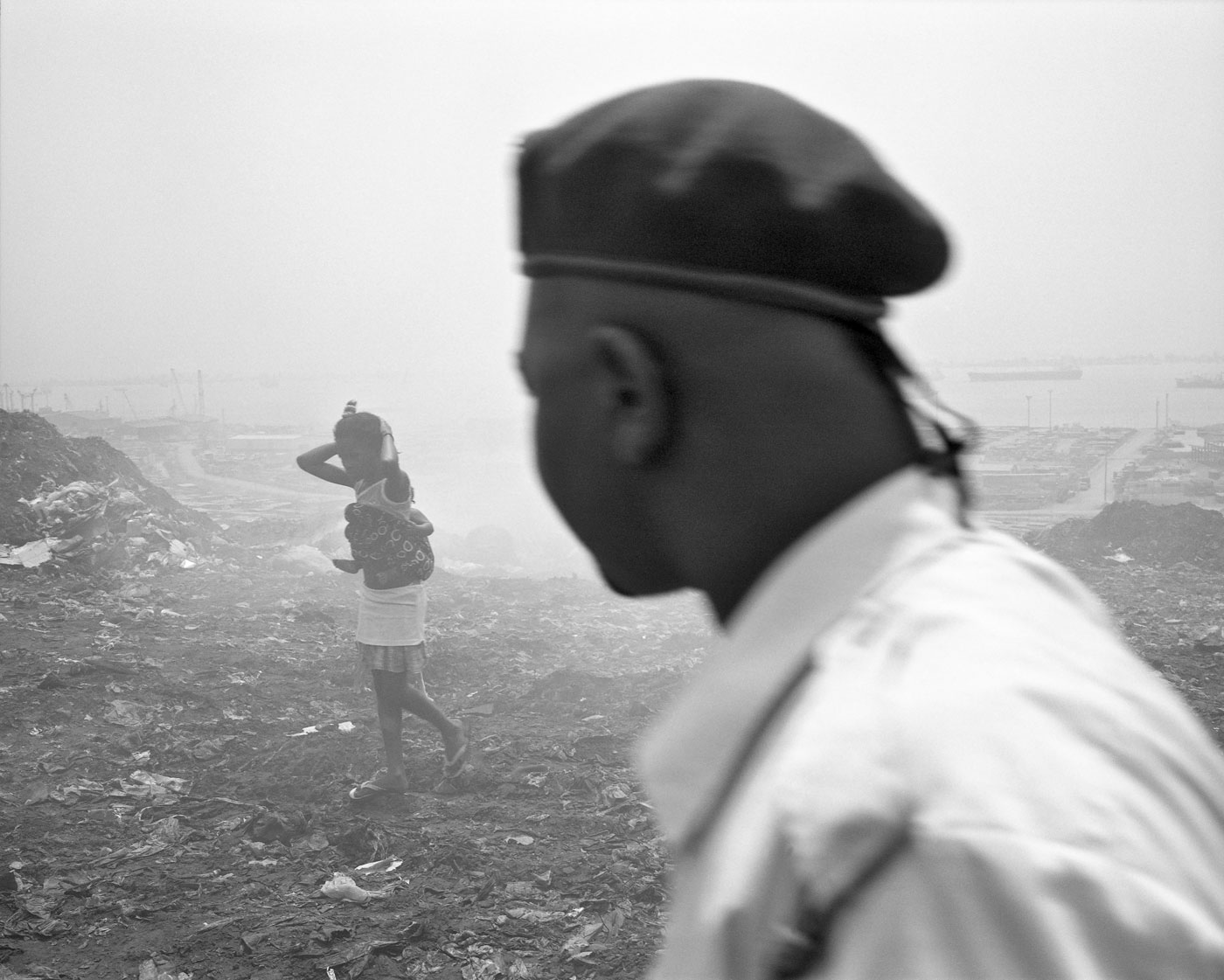
The Metropolitan Museum of Art website

LIKE ART BLART ON FACEBOOK

Back to top

Exhibition: ‘Renaissance Faces. Masterpieces of Italian Portraiture’
 at the 
Bode Museum, Berlin

Exhibition dates: 25th August – 20th November 2011


Filippo Lippi (Italian, 1406-1469) 'Portrait of a Man and a Woman at a Casement' c. 1440


Filippo Lippi (Italian, 1406-1469)
Portrait of a Man and a Woman at a Casement
c. 1440
New York, Metropolitan Museum of Art
© Metropolitan Museum of Art, New York


The Legend of the Surface, the Facies


Facies simultaneously signifies the singular air of a face, the particularity of its aspect, as well as the genre or species under which this aspect should be subsumed. The facies would thus be a face fixed to a synthetic combination of the universal and the singular: the visage fixed to the regime of representation, in a Helgian sense.

Why the face? – Because in the face the corporeal surface makes visible something of the movements of the soul, ideally.”


Didi-Huberman, Georges. Invention of Hysteria: Charcot and the Photographic Iconography of the Salpetriere (trans. Alisa Hartz). Cambridge, Mass.: MIT Press, 2003, p. 49


Dr Marcus Bunyan


Many thankx to the Bode Museum for allowing me to publish the artwork in the posting. Please click on the images for a larger version.


Jacopo Bellini (Italian, 1400-1470) 'Saint Bernardino of Siena' Between c. 1450 and c. 1455


Jacopo Bellini (Italian, 1400-1470)
Saint Bernardino of Siena
Between c. 1450 and c. 1455
Tempera and gold leaf on panel
Weber Collection, New York


Pisanello (Antonio Pisano) (Italian, 1395-1455) 'Portrait of Leonello d'Este' c. 1444


Pisanello (Antonio Pisano) (Italian, 1395-1455)
Portrait of Leonello d’Este
c. 1444
Bergamo, Accademia Carrara
© Accademia Carrara, Bergamo


Pisanello (c. 1395 – c. 1455), known professionally as Antonio di Puccio Pisano or Antonio di Puccio da Cereto, also erroneously called Vittore Pisano by Giorgio Vasari, was one of the most distinguished painters of the early Italian Renaissance and Quattrocento. He was acclaimed by poets such as Guarino da Verona and praised by humanists of his time, who compared him to such illustrious names as Cimabue, Phidias and Praxiteles.


Filippo Lippi (Italian, 1406-1469) 'Portrait of a Lady' c. 1445


Filippo Lippi (Italian, 1406-1469)
Portrait of a Lady
c. 1445
Paint on poplar panel
Height: 49.5 cm (19.4 in)
Width: 32.9 cm (12.9 in)
Gemäldegalerie


Andrea del Castagno (Italian, 1420-1457) 'Portrait of a Man' c. 1450


Andrea del Castagno (Italian, 1420-1457)
Portrait of a Man
c. 1450
Tempera on panel
Height: 54cm (21.2 in)
Width: 40.5cm (15.9 in)
Andrew W. Mellon collection
National Gallery of Art


Andrea Mantegna (Italian, 1431-1506) 'Portrait of Cardinal Ludovico Trevisano' c. 1459


Andrea Mantegna (Italian, 1431-1506)
Portrait of Cardinal Ludovico Trevisano
c. 1459
Berlin, National Museums in Berlin, Gemäldegalerie
© National Museums in Berlin, Jörg P. Anders


Andrea Mantegna (c.  1431 – September 13, 1506) was an Italian painter, a student of Roman archeology, and son-in-law of Jacopo Bellini. Like other artists of the time, Mantegna experimented with perspective, e.g. by lowering the horizon in order to create a sense of greater monumentality. His flinty, metallic landscapes and somewhat stony figures give evidence of a fundamentally sculptural approach to painting. He also led a workshop that was the leading producer of prints in Venice before 1500.


Antonio del Pollaiuolo (Italian, 1429-1498) 'Portrait of a Young Lady' c. 1465


Antonio del Pollaiuolo (Italian, 1429-1498)
Portrait of a Young Lady
c. 1465
Berlin, National Museums in Berlin, Gemäldegalerie
© National Museums in Berlin, Jörg P. Anders


Antonio del Pollaiuolo (Italian, 1429-1498) 'Portrait of a Young Woman' c. 1465-1470


Antonio del Pollaiuolo (Italian, 1429-1498)
Portrait of a Young Woman
c. 1465-1470
© Museo Poldi Pezzoli, Milan


Piero del Pollaiuolo (Italian, 1443–1496) 'Portrait of Galeazzo Maria Sforza' c. 1471


Piero del Pollaiuolo (Italian, 1443–1496)
Portrait of Galeazzo Maria Sforza
c. 1471
Tempera on panel
Height: 65cm (25.5 in)
Width: 42cm (16.5 in)
Uffizi Gallery


Piero Pollaiuolo painted this portrait during one of Galeazzo Maria Sforza’s visits to Florence. The work is based on a similar portrait by his brother, Antonio. That the portrait is of Sforza is beyond doubt, as copies exist bearing Sforza’s name. Restored in 1994.


Sandro Botticelli (Italian, 1445-1520) 'Profile Portrait of a Young Lady (Simonetta Vespucci?)' c. 1476


Sandro Botticelli (Italian, 1445-1520)
Profile Portrait of a Young Lady (Simonetta Vespucci?)
c. 1476
Berlin, National Museums in Berlin, Gemäldegalerie
© National Museums in Berlin, Jörg P. Anders


Alessandro di Mariano di Vanni Filipepi (c.  1445 – May 17, 1510), known as Sandro Botticelli, was an Italian painter of the Early Renaissance. He belonged to the Florentine School under the patronage of Lorenzo de’ Medici, a movement that Giorgio Vasari would characterise less than a hundred years later in his Vita of Botticelli as a “golden age”. Botticelli’s posthumous reputation suffered until the late 19th century; since then, his work has been seen to represent the linear grace of Early Renaissance painting.


The Gemäldegalerie – National Museums in Berlin and the Metropolitan Museum of Art, New York, have joined forces in organising a major exhibition on the genesis of the Italian portrait. For Berlin, the Bode Museum presents itself as the ideal location to hold such an exhibition: on its opening in 1904, it was conceived by its founder, Wilhelm von Bode, as a ‘Renaissance Museum’ on the Museum Island. The Bode Museum will host the first stage of the exhibition, running from 25 August to 20 November 2011, before it subsequently goes on show at the Metropolitan Museum of Art in New York, from 19 December 2011 to 18 March 2012.

More than 150 key works, including paintings, drawings, medals and busts, are about to go on display for the first time together. The more than 50 lenders include the Uffizi in Florence, the Louvre in Paris and the National Gallery in London. Among the exhibition’s many highlights is Leonardo da Vinci’s Lady with an Ermine from the Czartoryski Collection, Cracow.

The exhibition highlights depictions of the appearance and personality of real people. Portraits of feminine beauty vie with portraits of generals, princes and humanists, offering us a fascinating insight into the age of the early Renaissance.

At the heart of the exhibition stands the Italian Renaissance portrait. The Italian art of portraiture evolved under the influence of antique models. However, it was equally shaped by the innovations of the great Netherlandish painters. The history of the art of portraiture, from Pisanello up to Verrocchio, Botticelli, Bellini and Leonardo, is retold in a selection of magnificent and sensational key works, including paintings, sculptures, medals and drawings. The exhibition focuses both on the art produced at the Italian courts, as well as the development of the portrait in Florence and Venice.

A unique architectural and lighting concept, especially designed for the exhibition, takes into account the individual qualities of each exhibit in its presentation. Of crucial importance here is the aesthetic experience, both of the quality of the artworks and of the materials used in creating them.

The artistic diversity evident in these early portraits, the various roles the images served and their historical contexts all resonate with suspense. The Gemäldegalerie – National Museums in Berlin and the Metropolitan Museum of Art in New York embarked on an intense collaboration to present this to the general public. Masterpieces from New York and the rich collections of the National Museums in Berlin, not just from the Gemäldegalerie itself but also from the Sculpture Collection, Kupferstichkabinett and Numismatic Collection, offer visitors an unprecedented insight into this epoch. Furthermore, for the first time the show in the Bode Museum also encompasses all media of Italian Renaissance portraiture – medals, drawings, sculptures and panel paintings.

Portraits – either in the form of a painting, photograph and less often a medal – have become commonplace today, but between the 5th and 15th century independent portraits of individual people were rare and the exclusive reserve of rulers and historic figures. Only in the 15th century did it again become customary for artists on both sides of the Alps to produce independent portraits of men and women. Today’s exhibition Renaissance Faces pays homage to Italy’s contribution to this first great age of European portraiture and conveys a sense of the innovative ways in which artists responded to the challenge of creating individual portraits and how they explored questions of identity that arose as a result.

When selecting the exhibits, the organisers’ chief aim was to highlight the prevailing conventions and decisive innovations in a period spanning more than eight decades. Set against the backdrop of Italy’s geographical, political and cultural complexities in the 15th century, the exhibition is divided into three clearly outlined thematic sections. The first of these is Florence, as it was here that the independent portrait first appeared on a significant scale. The visitor’s gaze is then directed to the courts of Ferrara, Mantua, Bologna, Milan, Urbino, Naples and finally papal Rome. The circle is then completed in Venice, where a portrait tradition only established itself remarkably late in the century. In each section, works in all media are juxtaposed with each other to give visitors the chance to see for themselves how the various art forms mutually influenced each other with their own unique qualities.

In a society dominated by family descent and social hierarchies, conventions were binding. And it is precisely these conventions that are depicted in profile portraits from 15th-century Italy. Profile portraits were equally popular as reliefs or paintings. Compared with the far more naturalistic art produced north of the Alps, which people in 15th-century Italy were definitely familiar with, this form of portrait seems at first a little surprising, as the Italian artists present the sitters in a soft light and at a slight angle to the picture plane. The sitters are seen standing either at a window or behind a parapet and gaze at the viewer. Sometimes a hand is seen resting on the edge of the painted frame. When looking at these images, it is clear that Italian portraits are not primarily concerned with achieving an accurate likeness, at least not in the conventional sense. Italian portraits do not so much reveal personality, rather convey social conventions and cultural identity.

The profile portrait was frequently given such exceptional importance in Italy, because it largely drew from Roman coins and reliefs for inspiration. But the profile portrait has always been the most elementary form of capturing someone’s likeness. Informal, direct and frontal views have become so familiar to us in portraits today thanks to photography that we first have to be resensitised to the unique possibilities inherent in the profile portrait. For one, it makes it possible to objectify a person’s outer appearance and allows physiognomies to convey cultural meaning. The pleasing aspect of a high forehead, the refinement or contemptuousness expressed in a raised brow, the aristocratic curve of a nose and the severity or gentleness of a chin and jawline – all these are physiognomical characteristics that come to stand as emblems for beauty, rank and power.

Press release from the Bode Museum website quoting the exhibition catalogue


Sandro Botticelli (Italian, 1445-1520) 'Portrait of Giuliano de' Medici' c. 1478


Sandro Botticelli (Italian, 1445-1520)
Portrait of Giuliano de’ Medici
c. 1478
Washington, National Gallery of Art
© Art Resource, New York


Antonello da Messina (Italian, 1430-1479) 'Portrait of a Young Man' 1478


Antonello da Messina (Italian, 1430-1479)
Portrait of a Young Man
1478
Berlin, National Museums in Berlin, Gemäldegalerie
© National Museums in Berlin, Jörg P. Anders


Antonello da Messina, properly Antonello di Giovanni di Antonio, but also called Antonello degli Antoni and Anglicised as Anthony of Messina (c. 1430 – February 1479), was an Italian painter from Messina, Sicily, active during the Early Italian Renaissance. His work shows strong influences from Early Netherlandish painting although there is no documentary evidence that he ever travelled beyond Italy. Giorgio Vasari credited him with the introduction of oil painting into Italy. Unusually for a south Italian artist of the Renaissance, his work proved influential on painters in northern Italy, especially in Venice.


Hans Memling (Italian, c. 1433-1494) 'Portrait of a Man at a Loggia' c. 1480


Hans Memling (Italian, c. 1433-1494)
Portrait of a Man at a Loggia
c. 1480
Oil on panel
Height: 40cm (15.7 in)
Width: 28cm (11 in)
Metropolitan Museum of Art


Davide Ghirlandaio (Italian, 1452-1525) 'Selvaggia Sassetti (born 1470)' Between 1487 and 1488


Davide Ghirlandaio (Italian, 1452-1525)
Selvaggia Sassetti (born 1470)
Between 1487 and 1488
Tempera on panel
Height: 57.2cm (22.5 in)
Width: 44.1cm (17.3 in)
Metropolitan Museum of Art


Leonardo da Vinci (Italian, 1452-1519) 'Lady with an Ermine (portrait of Cecilia Gallerani)' 1489-1490


Leonardo da Vinci (Italian, 1452-1519)
Lady with an Ermine (portrait of Cecilia Gallerani)
1489-1490
Kraków, owned by Princes Czartoryski Foundation, at the National Museum
© bpk / Scala


Leonardo di ser Piero da Vinci,known as Leonardo da Vinci , was an Italian polymath of the Renaissance whose areas of interest included invention, drawing, painting, sculpture, architecture, science, music, mathematics, engineering, literature, anatomy, geology, astronomy, botany, paleontology, and cartography. He has been variously called the father of palaeontology, ichnology, and architecture, and is widely considered one of the greatest painters of all time (despite perhaps only 15 of his paintings having survived).


Lorenzo di Credi (Italian, 1459-1537) 'Portrait of a Young Woman' c. 1490s


Lorenzo di Credi (Italian, 1459-1537)
Portrait of a Young Woman
c. 1490s
Oil on panel
Height: 58.7cm (23.1 in)
Width: 40cm (15.7 in)
Metropolitan Museum of Art


Gentile Bellini (Italian, 1429-1507) 'Self-portrait' c. 1496


Gentile Bellini (Italian, 1429-1507)
Self-portrait
c. 1496
Black chalk and charcoal on paper
Height: 23 cm (9 in)
Width: 19.4 cm (7.6 in)
Kupferstichkabinett Berlin


Sandro Botticelli (Italian, 1445-1510) 'Portrait of Michael Tarchaniota Marullus' 1497


Sandro Botticelli (Italian, 1445-1510)
Portrait of Michael Tarchaniota Marullus
1497
Tempera from wood transferred to canvas
Height: 49cm (19.2 in)
Width: 35cm (13.7 in)
Institut Cambó


Bode Museum
Museum Island Berlin,
Am Kupfergraben 1, 10117 Berlin

Opening hours:
Monday closed
Tuesday – Sunday 10.00am – 6.00pm

Bode Museum website

LIKE ART BLART ON FACEBOOK

Back to top

Exhibition: ‘ “Our Future Is In The Air”: Photographs from the 1910s’ at the Metropolitan Museum of Art, New York

Exhibition dates: 10th November 2010 – 10th April 2011


Aleksey Ivanovich Saveliev (Russian, 1883-1923) 'At the Prepared Grave' 1910


Aleksey Ivanovich Saveliev (Russian, 1883-1923)
At the Prepared Grave
1910
Gelatin silver print
8.9 x 13.3cm (3 1/2 x 5 1/4 in.)
The Metropolitan Museum of Art
Gift of Pierre Apraxine, 2010


These six photo-postcards show various places and moments surrounding the death and burial of Leo Tolstoy. In November 1910 the eighty-two-year-old novelist walked away from his great wealth to devote himself to Christian charity and died in a stationmaster’s house after falling ill on a train. Tolstoy’s death was of tremendous national importance, and how he was to be mourned – whether to kneel or stand at the grave, for instance – signified a contrast between old and new that would be decided during the Russian Revolution seven years later.

Text from the Metropolitan Museum of Art website


What an eclectic group of photographs in this posting as well as a great title for an exhibition!

Marcus


Many thankx to the The Metropolitan Museum of Art for allowing me to publish the photographs in the posting. Please click on the photograph for a larger version of the image.


Aleksey Ivanovich Saveliev (Russian, 1883-1923) 'Peasant Carts with Funeral Wreaths' 1910


Aleksey Ivanovich Saveliev (Russian, 1883-1923)
Peasant Carts with Funeral Wreaths
1910
Gelatin silver print
8.9 x 13.3cm (3 1/2 x 5 1/4 in.)
The Metropolitan Museum of Art
Gift of Pierre Apraxine, 2010


Aleksey Ivanovich Saveliev (Russian, 1883-1923) 'Deputation of the Yasno-Polyanskyi Peasants' 1910


Aleksey Ivanovich Saveliev (Russian, 1883-1923)
Deputation of the Yasno-Polyanskyi Peasants
1910
Gelatin silver print
8.9 x 13.3cm (3 1/2 x 5 1/4 in.)
The Metropolitan Museum of Art
Gift of Pierre Apraxine, 2010


Felix Thiollier (French, 1842-1914)
'A Village Street in the Auvergne' c. 1910


Felix Thiollier (French, 1842-1914)
A Village Street in the Auvergne
c. 1910
Gelatin silver print
The Metropolitan Museum of Art
Twentieth-Century Photography Fund, 2008


An industrialist and serious amateur photographer in Saint-Étienne, Thiollier left to posterity a vast archive of photographs and negatives. Most are landscapes done in the Pictorialist style, but his more unusual images depict factories and daily life outside major cities in early twentieth century France.


Paul Haviland (American, 1880-1950)
'Passing Steamer' 1910


Paul Haviland (American, 1880-1950)
Passing Steamer
1910
Platinum print
The Metropolitan Museum of Art
Gilman Collection
Purchase, Harriette and Noel Levine Gift, 2005


The son of a well-off china manufacturer in Limoges, Haviland encountered Alfred Stieglitz’s Little Galleries of the Photo-Secession in 1908. He soon contributed articles to and published photographs in Stieglitz’s journal Camera Work (and acted as the gallery’s secretary at one point), even bankrolling the gallery’s three-year lease for Stieglitz when the rent was raised. In 1915 he started – with the Mexican-born caricaturist and gallerist Marius de Zayas and the journalist Agnes Ernest Meyer – a new magazine called 291, named for Stieglitz’s gallery at 291 Fifth Avenue.

This image appeared as a photogravure in a 1912 issue of Camera Work. While the soft focus and platinum printing are traces of the waning Pictorialist style, the unexpected vantage point and stark design made Passing Steamer a harbinger of things to come.

Text from The Metropolitan Museum of Art


Anton Giulio Bragaglia (Italian, 1890–1960) 'Change of Position' 1911


Anton Giulio Bragaglia (Italian, 1890-1960)
Change of Position
1911
Gelatin silver print
12.8 x 17.9cm (5 1/16 x 7 1/16 in)
The Metropolitan Museum of Art
Gilman Collection
Purchase, The Horace W. Goldsmith Foundation Gift, through Joyce and Robert Menschel, 2005


At age nineteen, Bragaglia became enamored of the Italian Futurist movement, which espoused the beauty of speed and war, the interdependence of time and space, and the total dissolution of time-consecrated institutions. Not following the stop-motion photography of Eadweard Muybridge and Étienne-Jules Marey from the previous century, Bragaglia left the camera’s shutter open to register the absolute fluidity of motion itself – in this case, the trajectory created by the sweeping, continuous arc of a simple change of body position. The result is a dissolution or dematerialisation of the man’s body in a seamless picture of active life. Although later banished from the Futurists’ ranks, the photographer created perhaps the first truly avant-garde images with the camera – the kind that would become prevalent across the continent only a decade later.

Text from The Metropolitan Museum of Art


Adolph de Meyer (American born France, 1868-1949) '[Dance Study]' c. 1912


Adolph de Meyer (American born France, 1868-1949)
[Dance Study]
c. 1912
Platinum print
The Metropolitan Museum of Art
Alfred Stieglitz Collection, 1949


De Meyer – who would become Vogue magazine’s first official fashion photographer, in 1913 – photographed the dancer Nijinsky and other members of Sergei Diaghilev’s troupe when L’Après midi d’un Faun was presented in Paris in 1912. It has been suggested that this photograph, the only nude by de Meyer, has some connection to the Russian ballet, but if so, it remains mysterious. In 1913 Mabel Dodge, a patroness of the avant-garde, wrote: “Nearly every thinking person nowadays is in revolt against something, because the craving of the individual is for further consciousness, and because consciousness is expanding and bursting through the moulds that have held it up to now.”

Text from The Metropolitan Museum of Art


Stanislaw Ignacy Witkiewicz (Polish, 1885-1939) 'Tadeus Langier, Zakopane' 1912-1913


Stanislaw Ignacy Witkiewicz (Polish, 1885-1939)
Tadeus Langier, Zakopane
1912-1913
Gelatin silver print
12.6 x 17.6cm (4 15/16 x 6 15/16 in)
The Metropolitan Museum of Art
Gilman Collection
Purchase, Denise and Andrew Saul Gift, 2005


Jacques Henri Lartigue (French, 1894-1986) 'Le Grand Prix A.C.F.' 1913


Jacques Henri Lartigue (French, 1894-1986)
Le Grand Prix A.C.F.
1913
Gelatin silver print
11.5 x 17.1cm (4 1/2 x 6 3/4 in)
The Metropolitan Museum of Art
Gilman Collection
Purchase, Ann Tenenbaum and Thomas H. Lee Gift, 2005
© Ministère de la Culture-France/AAJHL


A painter who considered photography a hobby, Lartigue was seven when his father, an accomplished amateur photographer, presented him with his first camera. reserving his images from childhood onward in album after album, Lartigue created a rich chronicle of the sporting life and entertainments of his upper-class milieu but one that, like his diaries, remained essentially private. Until 1963, when a show at the Museum of Modern Art, New York, revealed Lartigue as a major photographer, his work was known only to a group of friends.

[This print has] been made by Lartigue prior to his public recognition, in his customary intimate scale. He made the Grand Prix picture by swinging the camera from left to right as the racing car sped by. It captures the same awestruck, slate-erasing feeling that inspired the Futurist Marinetti to rhapsodise four years earlier, “A roaring motor car which seems to run on machine-gun fire, is more beautiful than the Victory of Samothrace.”

Text from The Metropolitan Museum of Art


Unknown Artist, British School. 'The Great British Advance in the West: A Raiding Party Waiting for the Word to Go' 1914-1918


Unknown Artist, British School
The Great British Advance in the West: A Raiding Party Waiting for the Word to Go
1914-1918
Gelatin silver print
The Metropolitan Museum of Art
Twentieth-Century Photography Fund, 2010
Wikipedia Commons public domain


Unknown Artist, French School. 'The Great Nave: Wounded Soldiers Performing Arms Drill at the End of Their Medical Treatment, Grand Palais, Paris' 1916


Unknown Artist, French School
The Great Nave: Wounded Soldiers Performing Arms Drill at the End of Their Medical Treatment, Grand Palais, Paris
1916
Gelatin silver print
The Metropolitan Museum of Art
Gilman Collection
Purchase, Ann Tenenbaum and Thomas H. Lee Gift, 2005
Wikipedia Commons public domain


During World War I, wounded soldiers who had been sent to Paris to recover were drilled in the cavernous Grand Palais to prepare them for a return to the front.


Unknown Artist, American School. '(Charlie Chaplin and Douglas Fairbanks Selling Liberty Loans during the Third Loan Campaign at the Sub Treasury Building on Wall Street, New York City)' 1918


Unknown artist (American School)
(Charlie Chaplin and Douglas Fairbanks Selling Liberty Loans during the Third Loan Campaign at the Sub Treasury Building on Wall Street, New York City)
1918
Gelatin silver print
19.4 x 24.1cm (7 5/8 x 9 1/2 in)
The Metropolitan Museum of Art
Purchase
The Horace W. Goldsmith Foundation Gift, through Joyce and Robert Menschel, 1996


The twentieth century was truly born during the 1910s. This exhibition, which accompanies Stieglitz, Steichen, Strand, surveys the range of uses to which photography was put as its most advanced practitioners and theorists were redefining the medium as an art. The title “Our Future Is in the Air is taken from a military aviation pamphlet that figures prominently (in French) in a 1912 Cubist tabletop still life by Picasso; it suggests the twinned senses of exhilarating optimism and lingering dread that accompanied the dissolution of the old order.

Photography was handmaiden and witness to the upheavals that revolutionised perception and consciousness during this tumultuous era. Space and time were overcome by motorcars and airplanes, radio and wireless, and man seemed liberated from the bounds of gravity and geography. This seemingly limitless expanse was mirrored by a new understanding of the unconscious as infinitely deep, complex, and varied – a continent ripe for discovery. The camera was seen as the conduit between these two states of self and world, and “straight photography” – stripped of the gauzy blur of Pictorialist reverie – was espoused by Alfred Stieglitz and Paul Strand among others.

This turn was not accidental: since handheld cameras became available in the late 1880s, anyone could be a photographer; similarly, photography had snaked its way into every corner of the culture. Elevated perception would distinguish the new artists from the amateur and the tradesman. The exhibition casts the widest possible net in order to show the foundations upon which the medium staked its claim as an independent art.

The 1910s – a period remembered for “The Great War,” Einstein’s theory of relativity, the Russian Revolution, and the birth of Hollywood – was a dynamic and tumultuous decade that ushered in the modern era. This new age – as it was captured by the quintessentially modern art of photography – will be the subject of the exhibition “Our Future Is In The Air”: Photographs from the 1910s, on view at The Metropolitan Museum of Art from November 10, 2010, through April 10, 2011.

An eclectic centennial exhibition devoted to photography of the 1910s, “Our Future Is In The Air” provides a fascinating look at the birth of modern life through 58 photographs by some 30 artists, including Eugène Atget, Alvin Langdon Coburn, Eugène Druet, Lewis Hine, Jacques-Henri Lartigue, Adolph de Meyer, Christian Schad, Morton Schamberg, Charles Sheeler, and Stanislaw Witkiewicz, among others. Drawn exclusively from the Museum’s collection, the exhibition also features anonymous snapshots, séance photographs, and a family album made by Russian nobility on the eve of revolution. “Our Future Is In The Air” complements the Museum’s concurrent presentation of groundbreaking photographs by Alfred Stieglitz, Edward Steichen, and Paul Strand in the exhibition Stieglitz, Steichen, Strand. The exhibition’s title is taken from a pamphlet for military aviation that figures prominently (in French) in a 1912 Cubist tabletop still-life by Picasso, but is used here because of its double meaning: the feelings of excitement and anxiety that accompanied such radical change.

“Our Future Is In The Air” opens in dramatic fashion with a series of photographs showing moments in the funeral procession and burial of Leo Tolstoy on November 9, 1910. The great Russian novelist passed away just after walking away from his great wealth and literary fame to lead a life of Christian charity. Certain details that can be seen in the photo-postcards – such as whether or not to kneel by the grave – represented a long simmering struggle between old and new, spiritual and secular, that would lead to revolution seven years later.

As cameras became smaller, faster, and easier to operate, amateur photographers such as the child prodigy Jacques-Henri Lartigue pushed the medium in directions that trained photographers shied away from. Since Lartigue was only recognised much later as a key figure in photography, prints such as the ones included here – showing speeding motorcars – are exceedingly rare. Lartigue made one of his most memorable photographs, Le Grand Prix A.C.F. (1913), by swinging his camera in the same direction as the car, as it sped by.

The camera also afforded access to the previously invisible, whether capturing a broken leg bone, revealed in an X-ray from 1916 or the trajectory created by a simple change in body position, in a 1911 motion study by the Futurist artist Anton Giulio Bragaglia.

At the same time, photography became an agent of democratic communication, and documentary photographers used its growing influence to expose degrading conditions of workers, the injustice of child labor, and the devastation of war. Beginning in 1908, Lewis Hine made 5,000 photographs of children working in mills, sweatshops, factories, and street trades; six of his photographs will be featured in this exhibition, including Newsboy asleep on stairs with papers, Jersey City, New Jersey, February 1912. Hine’s reports and slide lectures were meant to trigger a profound, empathetic response in the viewer.

During World War I, photography was utilised to document the mass casualties of mechanised warfare; in the exhibition, an affecting image from 1916, by an unknown artist, shows wounded French soldiers performing drills in the nave of the Grand Palais in Paris as part of their rehabilitation.

Also in the exhibition is an evocative 1918 photograph, again by an unknown artist, of Charlie Chaplin and Douglas Fairbanks entertaining a huge crowd at a war bonds rally on Wall Street.

“Our Future Is In The Air” accompanies the exhibition Stieglitz, Steichen, Strand, which focuses on contemporaneous works by three modernist masters of American photography: Alfred Stieglitz, Edward Steichen, and Paul Strand. It includes photographs by several friends and compatriots of Alfred Stieglitz, from Adolph de Meyer, Alvin Langdon Coburn, Paul Haviland, and Karl Struss to Morton Schamberg and Charles Sheeler, in whose works one can trace the transition from soft focus Pictorialism to a harder-edged, more detached “straight photography.”

Press release from the Metropolitan Museum of Art website


Alvin Langdon Coburn (British born America, 1882-1966) 'The Octopus' 1909


Alvin Langdon Coburn (British born America, 1882-1966)
The Octopus
1909
Platinum print
The Metropolitan Museum of Art
Ford Motor Company Collection, Gift of Ford Motor Company and John C. Waddell, 1987


During the early 1910s, photographers such as Paul Strand, Karl Struss, and Coburn were using Pictorialist techniques from the previous century to depict startling perspectives on contemporary urban subjects, such as this dizzying, bird’s-eye view of New York’s Madison Square from a new skyscraper.


Unknown Artist, American School. '(Man Holding Baseball in Catcher’s Mitt)' 1910


Unknown artist (American School)
(Man Holding Baseball in Catcher’s Mitt)
1910
Gelatin silver print
13.8 x 8.7cm (5 7/16 x 3 7/16 in.)
The Metropolitan Museum of Art
Funds from various donors, 1998


Lewis Hine (American, 1874-1940)
'11:00 A.M. Monday, May 9th, 1910. Newsies at Skeeter’s Branch, Jefferson near Franklin. They were all smoking. Location: St. Louis, Missouri' 1910


Lewis Hine (American, 1874-1940)
11:00 A.M. Monday, May 9th, 1910. Newsies at Skeeter’s Branch, Jefferson near Franklin. They were all smoking. Location: St. Louis, Missouri
1910
Gelatin silver print
The Metropolitan Museum of Art, Gilman Collection
Gift of Phyllis D. Massar, 1970


Trained as a sociologist at Columbia University, Hine gave up his teaching job in 1908 to become a full-time photographer for the National Child Labor Committee. The success of the reform agency, created four years earlier, was largely dependent on its ability to sway public opinion.

Influenced by Jacob Riis’s pictures of slum conditions on New York’s Lower East Side, Hine obsessively documented the working conditions of children in mills, factories, and fields across the country, often going undercover to gain access to his subjects. The results – more than five thousand photographs – were used in field reports, exhibitions, pamphlets, and slide lectures. Hine’s decidedly unromantic, understated pictures served as a potent weapon of persuasion.

Text from The Metropolitan Museum of Art


Lewis Hine (American, 1874-1940) 'Addie Card, 12 years' 1910


Lewis Hine (American, 1874-1940)
Addie Card, 12 years. Spinner in North Pownal Cotton Mill. Girls in mill say she is ten years. She admitted to me she was twelve; that she started during school vacation and now would “stay”. Location: Vermont, August 1910
1910
Gelatin silver print
24.4 x 19.3cm (9 5/8 x 7 5/8 in)
The Metropolitan Museum of Art
Gilman Collection
Purchase, Anonymous Gifts, by exchange, 2005


Lewis Hine (American, 1874-1940) 'Newsboy asleep on stairs with papers, Jersey City, New Jersey' February 1912


Lewis Hine (American, 1874-1940)
Newsboy asleep on stairs with papers, Jersey City, New Jersey
February 1912
Gelatin silver print
Image: 11.5 x 16.8cm (4 1/2 x 6 5/8 in)
Metropolitan Museum of Art
Gilman Collection, Purchase, Ann Tenenbaum and Thomas H. Lee Gift, 2005


Exhibition Overview

The twentieth century was truly born during the 1910s. This exhibition, which accompanies Stieglitz, Steichen, Strand, surveys the range of uses to which photography was put as its most advanced practitioners and theorists were redefining the medium as an art. The title “Our Future Is in the Air” is taken from a military aviation pamphlet that figures prominently (in French) in a 1912 Cubist tabletop still life by Picasso; it suggests the twinned senses of exhilarating optimism and lingering dread that accompanied the dissolution of the old order.

Photography was handmaiden and witness to the upheavals that revolutionised perception and consciousness during this tumultuous era. Space and time were overcome by motorcars and airplanes, radio and wireless, and man seemed liberated from the bounds of gravity and geography. This seemingly limitless expanse was mirrored by a new understanding of the unconscious as infinitely deep, complex, and varied – a continent ripe for discovery. The camera was seen as the conduit between these two states of self and world, and “straight photography” – stripped of the gauzy blur of Pictorialist reverie – was espoused by Alfred Stieglitz and Paul Strand among others.

This turn was not accidental: since handheld cameras became available in the late 1880s, anyone could be a photographer; similarly, photography had snaked its way into every corner of the culture. Elevated perception would distinguish the new artists from the amateur and the tradesman. The exhibition casts the widest possible net in order to show the foundations upon which the medium staked its claim as an independent art.

Text from the Metropolitan Museum of Art website


Eugène Atget (French, 1857-1927) 'Boulevard de Strasbourg' 1912


Eugène Atget (French, 1857-1927)
Boulevard de Strasbourg
1912
Albumen silver print from glass negative
22.4 x 17.5cm (8 13/16 x 6 7/8 in.)
The Metropolitan Museum of Art
Gilman Collection
Purchase, Ann Tenenbaum and Thomas H. Lee Gift, 2005


Atget found his vocation in photography in 1897, at the age of forty, after having been a merchant seaman, a minor actor, and a painter. He became obsessed with making what he termed “documents for artists” of Paris and its environs and compiling a visual compendium of the architecture, landscape, and artefacts that distinguish French culture and history. By the end of his life, Atget had amassed an archive of more than eight thousand negatives, which he organized into such categories as Parisian Interiors, Vehicles in Paris, and Petits Métiers (trades and professions). In Atget’s inventory of Paris, shop windows figure prominently and the most arresting feature mannequin displays. In the 1920s the Surrealists recognised in Atget a kindred spirit and reproduced a number of his photographs in their journals and reviews. Antiquated mannequins such as the ones depicted here struck them as haunting, dreamlike analogues to the human form.

Text from The Metropolitan Museum of Art


Stanislaw Ignacy Witkiewicz (Polish, 1885-1939) 'Jadwiga Janczewska, Zakopane' c. 1913


Stanislaw Ignacy Witkiewicz (Polish, 1885-1939)
Jadwiga Janczewska, Zakopane
c. 1913
Gelatin silver print
The Metropolitan Museum of Art
Gilman Collection
Museum Purchase, 2005


Witkiewicz was prolific in many mediums, writing plays, novels, and philosophical treatises as well as painting and making darkly brooding photographic portraits and self-portraits. In all his work, he describes a proto-existential sense of the self struggling in vain against the undifferentiated mass of men and the indifference of death; he often turned to drugs to recover this missing plenitude of existence.

Between 1912 and 1913, when he thought he was going mad, Witkiewicz made a series of extraordinary self-portraits and portraits of friends, his dying father, and his fiancée, Jadwiga Janczewska. After this time, his engagement with photography was brief, as he devoted himself instead to literature and painting. He took his life on the day Russian troops entered Poland in 1939 – in part a gesture of national solidarity.

Text from The Metropolitan Museum of Art


Karl Struss (American, 1886-1981)
'Claremont Inn, Riverside Drive' 1915


Karl Struss (American, 1886–1981)
Claremont Inn, Riverside Drive
1915
Platinum print
The Metropolitan Museum of Art
Warner Communications Inc. Purchase Fund, 1977


A member of the Photo-Secession, Struss was a student of Clarence White and a friend of Alfred Stieglitz. He made dozens of photographs of New York City at dusk, delighting in the way things merged and were illuminated by strings of fine lights. This photograph, with its gleaming automobiles and electric lights, shows a popular summer restaurant housed in a colonial-era home on the Upper West Side. Four years later, Struss moved to Los Angeles to work as a still photographer in the burgeoning movie business. He wound up being hired as a cameraman by Cecil B. DeMille and in 1927 won the first Oscar for cinematography for his work on F. W. Murnau’s Sunrise.

Text from The Metropolitan Museum of Art


Morton Schamberg (American, 1881–1918) '[View of Rooftops]' 1917


Morton Schamberg (American, 1881–1918)
[View of Rooftops]
1917
Gelatin silver print
The Metropolitan Museum of Art
Ford Motor Company Collection, Gift of Ford Motor Company and John C. Waddell, 1987
Public domain


Had he not died of influenza in 1918, Schamberg likely would have remained one of the best avant-garde painters and photographers of his generation in America. He absorbed the lessons of Cubism through his contacts with the Stieglitz and Arensberg circles, and in photographs such as this one he demonstrated his deft application of the new artistic idioms.

After reaching a point of almost pure abstraction in his painting in the wake of the Armory show of 1913, Schamberg turned in 1915 toward more objective machine forms in his pastels and paintings, and toward urban images in his photographs.

Like Stieglitz’s photographs of the city made from the windows of his galleries, Schamberg’s New York is seen from an elevated perspective, but unlike the elder photographer’s images, Schamberg’s photograph is cool, altogether lacking in human or natural references, and celebrates an almost wholly geometric order underscored by his calculated framing and point of view. For many years this print, the only one Schamberg made from this negative, belonged to his closest friend, Charles Sheeler.

Text from The Metropolitan Museum of Art website


Morton Schamberg (American,  1881-1918) Elsa von Freytag-Loringhoven (German, 1874–1927) (sculptor) '"God" by Baroness Elsa von Freytag-Loringhoven and Morton Schamberg' 1917


Morton Schamberg (American, 1881-1918)
Elsa von Freytag-Loringhoven (German, 1874-1927)
“God” by Baroness Elsa von Freytag-Loringhoven and Morton Schamberg
1917
Gelatin silver print
24.1 x 19.2cm (9 1/2 x 7 9/16 in.)
The Metropolitan Museum of Art
The Elisha Whittelsey Collection, The Elisha Whittelsey Fund, 1973
Wikipedia Commons public domain


This photograph of a drain pipe attached to a miter box documents one of the most famous examples of American Dada. The sculpture God, a Readymade in the spirit of Marcel Duchamp’s upended urinal Fountain, has traditionally been attributed to Schamberg. Recent scholarship suggests, however, that it was primarily the creation of Baroness Elsa von Freytag Loringhoven, a poet, shoplifter, junk collector, and Duchamp worshiper famous for strolling the streets of Greenwich Village with cancelled postage stuck to her face and a birdcage with a live canary dangling from her neck. The sculpture’s irreverent title recalls the sculptor Beatrice Wood’s unattributed comment, included in a published defence of Duchamp’s Fountain, “The only works of art America has given are her plumbing and her bridges.”

Text from The Metropolitan Museum of Art


Charles Sheeler (American, 1883–1965) 'Dan Mask' c. 1918


Charles Sheeler (American, 1883–1965)
Dan Mask
c. 1918
Gelatin silver print
24.2 x 18.2cm (9 1/2 x 7 3/16 in.)
The Metropolitan Museum of Art
Gilman Collection, Purchase, Denise and Andrew Saul Gift, 2005


When Charles Sheeler took up the camera sometime in 1910-11, he was already a modestly accomplished painter. He began to photograph domestic architecture in the Philadelphia area, and within three years he had a successful sideline documenting fine private and public American collections of Chinese bronzes, Meso-American pots, and modern painting and sculpture by Cézanne, Picasso, and Duchamp. Through this work Sheeler met Walter Arensberg, Alfred Stieglitz, and other important collectors and dealers; to a few of them he sold his paintings.

The rigorous demands of detailed record photography soon influenced his painting as the direct, generally frontal assessment of both an object’s form and structure retrained and refined his eye. By 1916, Sheeler had begun to paint from photographs and also to pursue photography as an end in itself. With his first exhibition of photographs, a three-person show with Paul Strand and Morton Schamberg at Marius de Zayas’s Modern Gallery in 1917, Sheeler emerged as one of America’s few prominent artists equally skilled with brush and camera.

This photograph of a Dan mask from Ivory Coast may have been commissioned by John Quinn, a New York lawyer, collector of African art, and patron of the avant-garde. The ceremonial mask emerges from virtual obscurity, filled with mystery, its highly polished wood surface animated by a raking, angular light. The photograph functions as a fetish, speaking with its own voice, commanding our attention, and even, it would seem, judging our response.

This photograph was published in the March 1923 issue of “The Arts,” in an article by de Zayas entitled “Negro Art.”

Text from The Metropolitan Museum of Art website


Charles Sheeler (American, 1883-1965) 'Doylestown House - Stairs from Below' 1917


Charles Sheeler (American, 1883-1965)
Doylestown House – Stairs from Below
1917
Gelatin silver print
21 x 15cm (8 1/4 x 5 15/16 in.)
The Metropolitan Museum of Art
Alfred Stieglitz Collection, 1933


The Metropolitan Museum of Art
1000 Fifth Avenue at 82nd Street
New York, New York 10028-0198
Information: 212-535-7710

Opening hours:
Sunday – Tuesday and Thursday: 10am – 5pm
Friday and Saturday: 10am – 9pm
Closed Wednesday
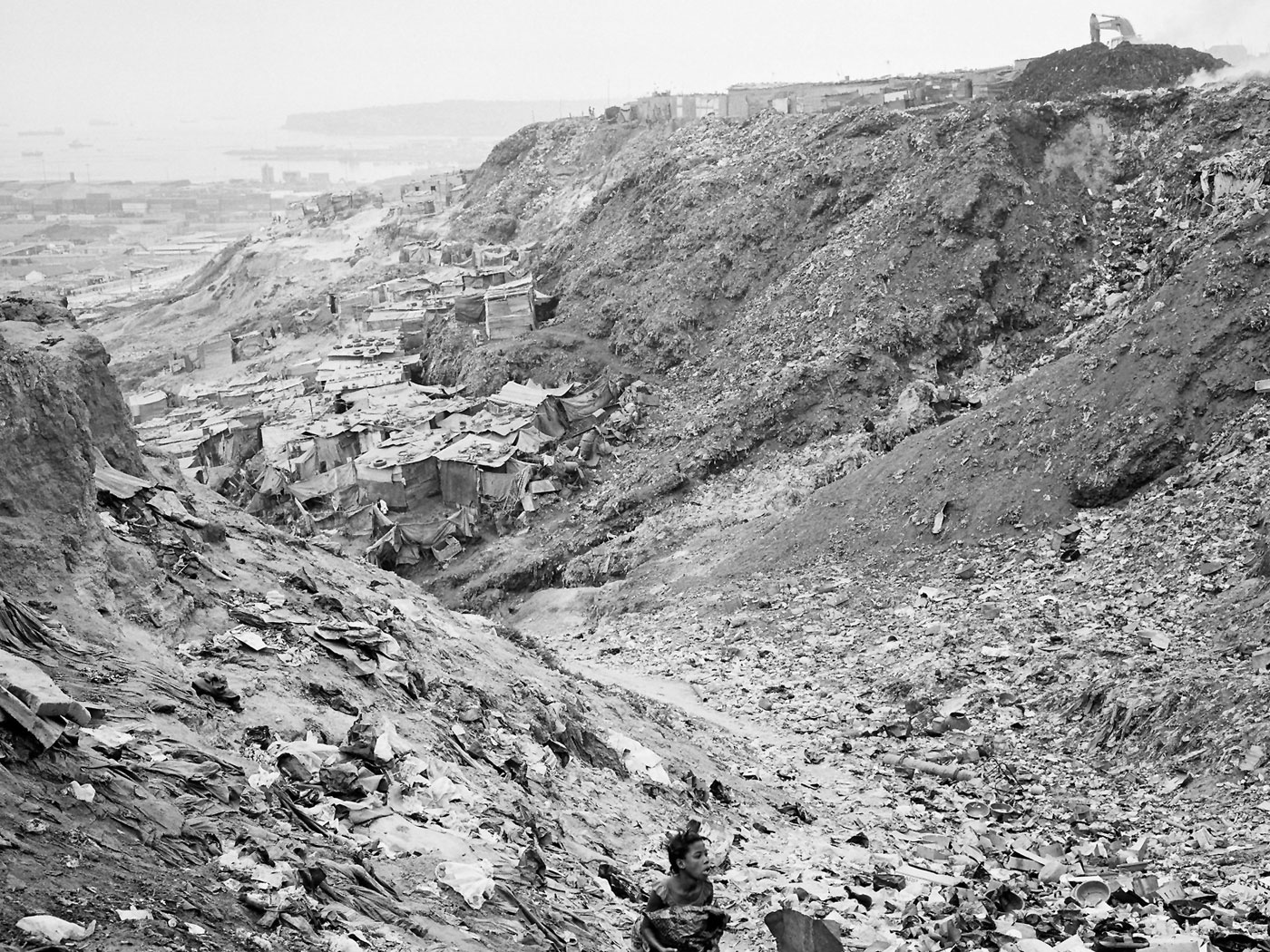
The Metropolitan Museum of Art website

LIKE ART BLART ON FACEBOOK

Back to top

Exhibition: ‘Hipsters, Hustlers, and Handball Players: Leon Levinstein’s New York Photographs, 1950-1980’ at The Metropolitan Museum of Art, New York

Exhibition dates: 8th June – 17th October, 2010


Leon Levinstein (American, 1910-1988) 'Handball Players, Lower East Side, NY' 1950s-1960s from the exhibition 'Hipsters, Hustlers, and Handball Players: Leon Levinstein's New York Photographs, 1950-1980' at The Metropolitan Museum of Art, New York, June - October, 2010


Leon Levinstein (American, 1910-1988)
Handball Players, Lower East Side, NY
c. 1950s-1960s
Gelatin silver print
Purchase, The Horace W. Goldsmith Foundation Gift, through Joyce and Robert Menschel, 1987
© Howard Greenberg Gallery


Although taken in the same city at around the same period as the work of Helen Levitt, these photographs by Leon Levinstein have less formality in their composition and definitely possess a more eclectic style evidenced by the dissection and placement of bodies within the image frame. This is not to denigrate either artist but merely to observe how two great photographers can see the same city in totally different ways. In both previsualisation was strong, the camera freezing what is placed before the lens in a balletic display that captured “just what you see.”

Dr Marcus Bunyan


Many thankx to The Metropolitan Museum of Art, New York for allowing me to publish the photographs in the posting.


Leon Levinstein (American, 1910-1988) 'Nuclear Protest, Wall Street' 1970s from the exhibition 'Hipsters, Hustlers, and Handball Players: Leon Levinstein's New York Photographs, 1950-1980' at The Metropolitan Museum of Art, New York, June - October, 2010


Leon Levinstein (American, 1910-1988)
Nuclear Protest, Wall Street
1970s
Gelatin silver print
Gift of Gary Davis, 2009
© Howard Greenberg Gallery


Leon Levinstein (American, 1910-1988) 'Street Scene - Elderly Man Walking with Cane, New York City' 1970s from the exhibition 'Hipsters, Hustlers, and Handball Players: Leon Levinstein's New York Photographs, 1950-1980' at The Metropolitan Museum of Art, New York, June - October, 2010


Leon Levinstein (American, 1910-1988)
Street Scene: Elderly Man Walking with Cane, New York City
1970s
Gelatin silver print
Gift of Gary Davis, 2009
© Howard Greenberg Gallery


Leon Levinstein (American, 1910-1988) 'Street Scene - Woman in Blonde Wig and Tight Dress, New York City' 1960s


Leon Levinstein (American, 1910-1988)
Street Scene: Woman in Blonde Wig and Tight Dress, New York City
1960s
Gelatin silver print
Gift of Gary Davis, 2009
© Howard Greenberg Gallery


Leon Levinstein (American, 1910-1988) 'Untitled [Head of Man with Hat and Cigar]' c. 1960 from the exhibition 'Hipsters, Hustlers, and Handball Players: Leon Levinstein's New York Photographs, 1950-1980' at The Metropolitan Museum of Art, New York, June - October, 2010


Leon Levinstein (American, 1910-1988)
Untitled [Head of Man with Hat and Cigar]
c. 1960
Gelatin silver print
27.8 x 33.3cm (10 15/16 x 13 1/8 in.)
Stewart S. MacDermott Fund, 1986


A master of classic American street photography, Leon Levinstein (American, 1910-1988) is best known for his candid and unsentimental black-and-white figure studies made in New York City neighborhoods from Times Square and the Lower East Side to Coney Island. From June 8 through October 17, 2010, The Metropolitan Museum of Art presents Hipsters, Hustlers, and Handball Players: Leon Levinstein’s New York Photographs, 1950-1980. This exhibition, drawn exclusively from the Metropolitan’s collection, features 44 photographs that reflect Levinstein’s fearless approach to the medium. Levinstein’s graphic virtuosity – seen in raw, expressive gestures and seemingly monumental bodies – is balanced by an unusual compassion for his off-beat subjects from the demimonde.

Born in West Virginia in 1910, Levinstein moved to New York in 1946 and spent the next 35 years obsessively photographing strangers on the streets of his adopted home. Early in his career, Levinstein was quoted in Photography Annual 1955: “In my photographs I want to look at life – at the commonplace things as if I just turned a corner and ran into them for the first time.” With daring and dedication to his subject, Levinstein captured the denizens of New York City at extremely close range. He used his superb sense of composition to frame the faces, flesh, poses, and movements of his fellow city dwellers in their myriad guises: sunbathers, young couples, children, businessmen, beggars, prostitutes, proselytisers, society ladies, and characters of all stripes.

Although he was a life-long loner, Levinstein was mentored and supported by Alexey Brodovitch, artistic director of Harper’s Bazaar, and Edward Steichen, the eminent photographer and curator at The Museum of Modern Art in New York, both of whom recognised his unique talent in the medium of photography. He was also greatly influenced by workshops led by the distinguished photographer and teacher Sid Grossman.

In the 1950s and 1960s, Levinstein’s work appeared frequently in photography magazines and books alongside that of his peers, such as Robert Frank, Richard Avedon, and Diane Arbus. Nonetheless, he rarely worked on assignment, as they often did; nor did he ever produce his own book of photographs. Instead, he worked as a graphic designer and devoted his evenings and weekends to photography. In 1975, Levinstein received a grant from the Guggenheim Foundation to “photograph as wide a spectrum of the American scene as my experience and vision will allow… I want my photographs to be spontaneous rather than contrived.” Despite this recognition of his achievement, he never seemed able to fit into the commercial photography market that emerged in the 1970s and 1980s, and consequently, his powerful body of work continues to be known mainly by other photographers and by specialists in the field.

Press release from The Metropolitan Museum of Art website [Online] Cited 28/09/2010 no longer available online


Leon Levinstein (American, 1910-1988) 'Street Scene - Man in Boots Walking and Adjusting His Collar, New York City' 1960s-1970s


Leon Levinstein (American, 1910-1988)
Street Scene: Man in Boots Walking and Adjusting His Collar, New York City
c. 1960s-1970s
Gelatin silver print
Gift of Gary Davis, 2007
© Howard Greenberg Gallery


Leon Levinstein (American, 1910-1988) 'Street Scene - Man Resting Foot on Lip of Trashcan, New York City' 1970s


Leon Levinstein (American, 1910-1988)
Street Scene: Man Resting Foot on Lip of Trashcan, New York City
1970s
Gelatin silver print
Gift of Gary Davis, 2009
© Howard Greenberg Gallery


That idea of authenticity, ineffably captured as a decisive instance on a strip of light-sensitive celluloid, was ridden out of town a long time ago by postmodern theorists and certainly seems quaint today, but its power, as fixed in black and white by Levinstein, is undeniable. His mtier was a kind of reductivist monumentality, in which he captured his subjects – ordinary New Yorkers going about their business – in close-up, a technique commonly associated with cinema, to create images that were at once abstract and pregnant with narrative.

Like Weegee and Diane Arbus, Levinstein had a taste for the offbeat and grotesque (he often zeroed in on corpulent pedestrians; midsections and backsides, absent any trace of individuality, were a frequent motif). Also like them, he could be accused of engaging in a form of slumming. But he was less interested in abjection than he was in grandeur, and in this respect, the people in his photos are imbued with a sculptural nobility that simply doesn’t exist in the work of either Weegee or Arbus. More often than not, the “hipsters, hustlers and handball players” of the show’s title loom into the lens, crowding out background details. We get only fragments of the metropolis around them: a bit of stoop or curbstone, or a patch of sand out at Coney Island. Yet the pictures themselves express a sense of velocity, of lives hurtling toward some destiny that’s as heroic as it is bleak. What’s remarkable about Levinstein is that his framing – both epic and destabilising – stands in for the pitiless dynamic of New York itself.

Howard Halle. “Hipsters, Hustlers, and Handball Players: Leon Levinstein’s New York Photographs, 1950-1980,” on the Time Out New York website, Monday June 14, 2010 [Online] Cited 26/12/2019 no longer available online


Leon Levinstein (American, 1910-1988) 'Street Scene - Woman in Striped Dress on Stoop, New York City' 1970s


Leon Levinstein (American, 1910-1988)
Street Scene: Woman in Striped Dress on Stoop, New York City
1970s
Gelatin silver print
Gift of Gary Davis, 2007
© Howard Greenberg Gallery


Leon Levinstein (American, 1910-1988) 'Street Scene - Young Man Leaning against Shopfront Window, New York City?' 1972


Leon Levinstein (American, 1910-1988)
Street Scene: Young Man Leaning against Shopfront Window, New York City?
1972
Gelatin silver print
Gift of Gary Davis, 2008
© Howard Greenberg Gallery


Leon Levinstein (American, 1910-1988) 'Untitled' New York City, 1960s-1970s


Leon Levinstein (American, 1910-1988)
Untitled
New York City, 1960s-1970s
Gelatin silver print
34.5 x 25.8cm (13 9/16 x 10 3/16)
© Howard Greenberg Gallery


Leon Levinstein (American, 1910-1988) 'Untitled' New York City, 1960s-1970s


Leon Levinstein (American, 1910-1988)
Untitled
New York City, 1960s-1970s
Gelatin silver print
35.5 x 26.3cm (14 x 10 3/8 in.)
© Howard Greenberg Gallery


Leon Levinstein (American, 1910-1988) 'Untitled' New York City, 1960s-1970s


Leon Levinstein (American, 1910-1988)
Untitled
New York City, 1960s-1970s
Gelatin silver print
34.5 x 25.8cm (13 9/16 x 10 3/16 in.)
© Howard Greenberg Gallery


I think Levinstein’s gift lay in his ability to capture the essence of New York’s rough, funky cool (particularly in the 1960s and 1970s), without getting overly sentimental or kitchy. Nearly all of his images were taken at close range, often cropping out unneeded heads and body parts, focusing on overlooked subjects and elemental gestures found on the city’s streets and sidewalks. His compositions are often angled and dark, and he was particularly adept at capturing the nuances of clothing and fashion as worn by New York’s imperfect and eclectic masses, finding the hidden joy in a bold pattern, a wide collar or a tight fitting pair of shorts. The pictures are tough, edgy, sometimes harsh, and always refreshingly real.

As you look more closely at these candid pictures, Levinstein’s talent for making the common look uncommon shines through. He finds earthy wonder in a foot perched on a wire trash can, a sweat stained tank top, 70s-era moustaches, a grey pinstripe suit, bulging stomachs and belts, a man fluffing his afro in a window, eating corn on the cob on the beach, tattoos, an overcoat with shiny buttons, kissing on a stoop, and a groovy floral blouse paired with tight leggings. He seems to have been fond of backs and sides, abstracting his subjects into fragments of movement or pose, paring them down into types and moments that were representative of something larger in society.

Loring Knoblauch. “Hipsters, Hustlers, and Handball Players: Leon Levinstein’s New York Photographs, 1950-1980 @Met,” on the Collector Daily website, July 23, 2010 [Online] Cited 21/03/2025


Leon Levinstein (American, 1910-1988) '54th Street, New York' 1950s


Leon Levinstein (American, 1910-1988)
54th Street, New York
1950s
Gelatin silver print
34.9 x 27.9 cm (13 3/4 x 11 in.)
Gift of Gary Davis, 2009


Leon Levinstein (American, 1910-1988) 'Untitled [Beach Scene: Woman Wearing Paper Bag Hat, Coney Island, New York]' 1950s


Leon Levinstein (American, 1910-1988)
Untitled [Beach Scene: Woman Wearing Paper Bag Hat, Coney Island, New York]
1950s
Gelatin silver print
35.4 x 28.1cm (13 15/16 x 11 1/16 in.)
Gift of Gary Davis, 2009
© Howard Greenberg Gallery


Leon Levinstein (American, 1910-1988) 'Coney Island' 1955


Leon Levinstein (American, 1910-1988)
Coney Island
1955
Gelatin silver print
© Howard Greenberg Gallery


Leon Levinstein (American, 1910-1988) 'Untitled' Coney Island, 1960s


Leon Levinstein (American, 1910-1988)
Untitled
Coney Island, 1960s
Gelatin silver print
35.5 x 28.1cm (14 x 11 1/16 in.)
© Howard Greenberg Gallery


The Metropolitan Museum of Art
1000 Fifth Avenue at 82nd Street
New York, New York 10028-0198
Information: 212-535-7710

Opening hours:
Sunday – Tuesday and Thursday: 10am – 5pm
Friday and Saturday: 10am – 9pm
Closed Wednesday
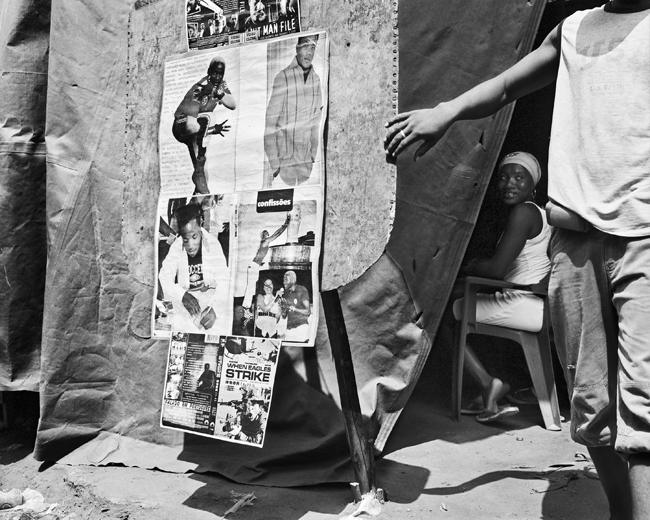
The Metropolitan Museum of Art website

LIKE ART BLART ON FACEBOOK

Back to top

Exhibition: ‘Playing with Pictures: The Art of Victorian Photocollage’ at The Metropolitan Museum of Art, New York

Exhibition dates: 2nd February – 9th May, 2010


Many thankx to the Metropolitan Museum of Art for allowing me to publish the images in this posting. Please click on the photographs for more information about the images from the Metropolitan Museum of Art.

Dr Marcus Bunyan


Kate Edith Gough (English, 1856-1948) 'Untitled page from the Gough Album' late 1870s from the exhibition 'Playing with Pictures: The Art of Victorian Photocollage' at The Metropolitan Museum of Art, New York, February - May, 2010


Kate Edith Gough (English, 1856-1948)
Untitled page from the Gough Album
Late 1870s
Collage of watercolour and albumen silver prints
14 5/8 x 11 5/8 in. (37 x 29.5cm)
V&A Images / Victoria and Albert Museum, London


Kate Gough was one of fourteen children born to the wealthy businessman Thomas Rolls Hoare and his wife, Emma. Although the Hoares possessed neither title nor land, their vast accumulated fortune allowed them to emulate the aristocratic lifestyle, renting a Sussex estate and dividing their time between the country and the city, where they enjoyed a variety of cultural amusements. Kate read widely, from Charles Dickens to Punch magazine, while also learning such feminine accomplishments as sketching and china painting. In 1878 she met Hugh Gough, a lieutenant in the Royal Navy. The couple married in January 1879 and lived the peripatetic life that Lieutenant Gough’s service and their lack of children enabled. Gough probably assembled her album during her courtship and early years of marriage.

A remarkable number of images found in photocollage albums combine humans and animals in fantastical ways; the temptation to cut out a photographed head and place it atop a painted animal seems to have been irresistible. This composition of ducks bearing ladies’ faces – one of them Kate herself, or her identical twin sister, Grace – may have been inspired by Charles Darwin’s new theories of evolution or by political cartoons from magazines such as Punch. On other pages of the Gough Album as well, an irreverent humor, disorienting scale shifts, mischievous visual puns, and whimsical fantasies reveal a sophisticated mind and very accomplished hand.

Text from The Metropolitan Museum of Art website


Frances Elizabeth, Viscountess Jocelyn (English, 1820-1880) 'Diamond Shape with Nine Studio Portraits of the Palmerston Family and a Painted Cherry Blossom Surround from the 'Jocelyn Album'' 1860s from the exhibition 'Playing with Pictures: The Art of Victorian Photocollage' at The Metropolitan Museum of Art, New York, February - May, 2010


Frances Elizabeth, Viscountess Jocelyn (English, 1820-1880)
Diamond Shape with Nine Studio Portraits of the Palmerston Family and a Painted Cherry Blossom Surround from the Jocelyn Album
1860s
Collage of watercolour and albumen silver prints
11 x 9 1/8 in. (28 x 23.2cm)
National Gallery of Australia, Canberra


The daughter of the exceedingly wealthy Peter Clovering-Cowper, Earl Cowper, and the legendary society hostess Emily Lamb, Countess Cowper, Viscountess Jocelyn was born into a life of privilege and social connections. When her mother remarried after her father died, Frances (known as Fanny) became the stepdaughter of Henry Temple, Viscount Palmerston, who would become the prime minister in 1855. Fanny also garnered the favor of Queen Victoria, serving as a bridesmaid at her wedding to Prince Albert and later as a Lady of the Bedchamber. In 1841 she wed Robert, Viscount Jocelyn, and bore six children over the next decade. Her husband died in 1854, and she lost each of her children to illness before her own death in 1880.

Unlike the other album makers in this exhibition, Jocelyn practiced amateur photography, using the wet-collodion process, a cumbersome technique that required time, money, education, and skill. A separate section of this album, entitled The Bygone Hours of the Viscountess Jocelyn, features nine photographs that she made of herself and her children in the garden of their estate. Most of the pages in the album, however, are photocollages employing amateur photographs and commercial cartes de visite in highly skilled watercolour designs that honour her aristocratic lifestyle, depicting family and friends, the estates they owned or visited, the jewellery and finery they wore, and the various pastimes they enjoyed.

Text from The Metropolitan Museum of Art website

The Johnstone Album represents the appropriation by the commercial printing press of an activity that was originally aristocratic and handmade. Here the grids are commercially printed and the collage maker need only paste within the shapes, offering the opportunity for those with less leisure time to create similar family albums.


Maria Harriet Elizabeth Cator (English, d. 1881) 'Untitled page from the 'Cator' Album' late 1860s/70s from the exhibition 'Playing with Pictures: The Art of Victorian Photocollage' at The Metropolitan Museum of Art, New York, February - May, 2010


Maria Harriet Elizabeth Cator (English, d. 1881)
Untitled page from the Cator Album
Late 1860s/1870s
Collage of watercolour and albumen silver prints
10 7/8 x 8 1/2 in. (27.7 x 21.7cm)
Hans P. Kraus, Jr., New York


Maria Harriet Elizabeth Cator, the likely maker of this album, filled its pages in the 1860s and 1870s with scenes of her childhood home, portraits of family members, and commemorative collages memorializing her father, who died in 1864, and a young niece who died as a child in 1866. Family mottoes and photographs of country seats belonging to relatives appear throughout the album, suggesting that it was intended more for family than for society. Set among all this seriousness, this image of a playful jester carelessly strewing photographs on the ground is surprising. Instead of serving as mementos of a loved one or records of an ancestral home, the jester’s photographs are stripped of symbolic meaning and used in the service of a lighthearted composition.

Text from The Metropolitan Museum of Art website


Viscount Jocelyn (Great Britain, 1820-1880) attributed to. 'Circular design containing five male studio portraits and two ships' c. 1860 from the exhibition 'Playing with Pictures: The Art of Victorian Photocollage' at The Metropolitan Museum of Art, New York, February - May, 2010


Viscount Jocelyn (Great Britain, 1820-1880) attributed to
Circular design containing five male studio portraits and two ships
c. 1860
Leaf 3 from an Untitled Album
Collage (albumen silver photographs, water colour, pencil)
Printed image
28.0 h x 23.2 w cm
Purchased 1985
National Gallery of Canberra


Eva Macdonald (English, 1846/50-?) "What Are Trumps?," from the 'Westmorland Album' 1869 Collage of watercolour and albumen prints The J. Paul Getty Museum, Los Angeles


Eva Macdonald (English, 1846/1850-?)
“What Are Trumps?,” from the Westmorland Album
1869
Collage of watercolour and albumen prints
The J. Paul Getty Museum, Los Angeles


A common leisure pastime in Victorian high society, card playing provided opportunities for socializing and flirting. Compositions involving cards are commonly found in photocollage albums, as if to emphasise the playfulness of the process of making such images. In many of these collages, photographic portraits replace the heads of kings and queens, elevating the subjects in rank and giving new meaning to the term “face cards.”

Text from The Metropolitan Museum of Art website


Elizabeth Pleydell-Bouverie (English, died 1889) and Jane Pleydell-Bouverie (English, died 1903) or Ellen Pleydell-Bouverie (English, 1849-?) and Janet Pleydell-Bouverie (English, 1850-1906) Untitled page from the 'Bouverie Album' 1872/77


Elizabeth Pleydell-Bouverie (English, d. 1889) and Jane Pleydell-Bouverie (English, d. 1903) or Ellen Pleydell-Bouverie (English, 1849-?) and Janet Pleydell-Bouverie (English, 1850-1906)
Untitled page from the Bouverie Album
1872/1877
Collage of watercolour and albumen prints
Courtesy of George Eastman House, International Museum of Photography and Film


Popular children’s tales by the Brothers Grimm, Hans Christian Anderson, and Lewis Carroll became fertile material for photocollages, including this one, which appears to relate the story of Thumbelina. Although the identity of the maker of this collection remains a mystery, the initials E.P.B. and J.P.B and the name Bouverie on various pieces suggest that it belonged to the Pleydell-Bouverie family.

Text from The Metropolitan Museum of Art website


In the 1860s and 1870s, long before the embrace of collage techniques by avant-garde artists of the early 20th century, aristocratic Victorian women were experimenting with photocollage. Playing with Pictures: The Art of Victorian Photocollage, on view at The Metropolitan Museum of Art February 2 – May 9, 2010, is the first exhibition to comprehensively examine this little-known phenomenon. Whimsical and fantastical Victorian photocollages, created using a combination of watercolour drawings and cut-and-pasted photographs, reveal the educated minds as well as accomplished hands of their makers. With subjects as varied as new theories of evolution, the changing role of photography, and the strict conventions of aristocratic society, the photocollages frequently debunked stuffy Victorian clichés with surreal, subversive, and funny images. Featuring 48 works from public and private collections – including many that have rarely or never been exhibited before – Playing with Pictures will provide a fascinating window into the creative possibilities of photography in the 19th century.

“In other recent exhibitions at the Metropolitan, we’ve shown masterpieces of 19th-century British photography by the period’s most prominent professionals and serious amateurs (almost always men), whose works were often displayed at the annual salons of the photographic societies and sold by printsellers throughout England and Europe,” commented Malcolm Daniel, Curator in Charge of the Department of Photographs. “What is so exciting about this exhibition is that we see a different type of artist – almost exclusively aristocratic women – using photography in highly imaginative ways, and creating pictures meant for private pleasure rather than public consumption. It is an aspect of photography’s history that has rarely been seen or written about.”

In England in the 1850s and 1860s, photography became remarkably popular and accessible as people posed for studio portraits and exchanged these pictures on a vast scale. The craze for cartes de visite – photographic portraits the size of a visiting card – led to the widespread hobby of collecting small photographs of family, friends, acquaintances, and celebrities in scrapbooks. Rather than simply gathering such portraits in the standard albums manufactured to hold cartes de visite, the amateur women artists who made the photocollages displayed in Playing with Pictures cut up these photographic portraits and placed them in elaborate watercolour designs in their personal albums.

With sharp wit and dramatic shifts of scale akin to those Alice experienced in Wonderland, Victorian photocollages stand the rather serious conventions of early photography on their heads. Often, the combination of photographs with painted settings inspired dreamlike and even bizarre results: placing human heads on animal bodies; situating people in imaginary landscapes; and morphing faces into common household objects and fashionable accessories. Such albums advertised the artistic accomplishments of the aristocratic women who made them, while also serving as a form of parlour entertainment and an opportunity for conversation and flirtation with the opposite sex.

Playing with Pictures showcases the best Victorian photocollage albums and loose pages of the 1860s and 1870s, on loan from collections across the United States, Europe, and Australia, including the Princess Alexandra Album lent by Her Majesty Queen Elizabeth II. Thirty-four photocollage album pages will be shown in frames on the wall and 11 separate albums will be displayed in cases, open to a single page. These works will be accompanied by “virtual albums” on computer monitors that allow visitors to see the full contents of the albums displayed nearby. As an introduction, the exhibition also includes two carte-de-visite albums of the period and a rare uncut sheet of carte-de-visite portraits from 1859.

Playing with Pictures: The Art of Victorian Photocollage is curated by Elizabeth Siegel, Associate Curator of Photography at The Art Institute of Chicago. The exhibition is organised at the Metropolitan Museum by Malcolm Daniel.

Press release from the Metropolitan Museum of Art website [Online] Cited 05/06/2010


Women’s Work: Albums and Their Makers

Ann Bermingham, professor, Department of the History of Art and Architecture, University of California, Santa Barbara

Sixty years before the embrace of collage techniques by avant-garde artists of the early twentieth century, aristocratic Victorian women were already experimenting with photocollage. The compositions they made with photographs and watercolours are whimsical and fantastical, combining human heads and animal bodies, placing people into imaginary landscapes, and morphing faces into common household objects. Such images, often made for albums, reveal the educated minds as well as the accomplished hands of their makers. With sharp wit and dramatic shifts of scale akin to those Alice experienced in Wonderland, these images stand the rather serious conventions of early photography on their heads. The exhibition features forty-eight works from the 1860s and 1870s, from public and private collections.

Text from the YouTube website


Society Cut-ups: Victorians and the Art of Photocollage

Elizabeth Siegel, Associate Curator of Photography, The Art Institute of Chicago

Sixty years before the embrace of collage techniques by avant-garde artists of the early twentieth century, aristocratic Victorian women were already experimenting with photocollage. The compositions they made with photographs and watercolors are whimsical and fantastical, combining human heads and animal bodies, placing people into imaginary landscapes, and morphing faces into common household objects. Such images, often made for albums, reveal the educated minds as well as the accomplished hands of their makers. With sharp wit and dramatic shifts of scale akin to those Alice experienced in Wonderland, these images stand the rather serious conventions of early photography on their heads. The exhibition features forty-eight works from the 1860s and 1870s, from public and private collections.

Text from the YouTube website


Marie-Blanche-Hennelle Fournier (French, 1831-1906) Untitled page from the 'Madame B Album' 1870s


Marie-Blanche-Hennelle Fournier (French, 1831-1906)
Untitled page from the Madame B Album
1870s
Collage of watercolour, ink, and albumen silver prints
11 1/2 x 16 1/2 in. (29.2 x 41.9cm)
The Art Institute of Chicago, Mary and Leigh Block Endowment


Marie-Blanche-Hennelle Fournier probably made the album from which this page was taken. Known as Blanche, she was the second wife of the career diplomat Hugues-Marie-Henri Fournier, who was posted in Stockholm and then in Rome during the years the album was made. Among the clues to the maker’s identity are the large painted B that graces the opening page, the many diplomats and Swedish figures and sites that fill the album, and the frequent depictions of the Fourniers and their daughter, Pauline (born 1855).

Because photocollage albums were almost exclusively made by upper-class English women, this album, with its French maker, is a rare exception. Fournier, however, likely was exposed to English diplomats in the international circles in which she traveled, and she may have been inspired to create her own album after seeing other examples or learning of the practice from her English acquaintances. As the second wife of a diplomat, Fournier may have used her album to help establish herself and her family within a specific social set or to demonstrate her role as a new wife. The album may also have functioned as a sort of travelogue, depicting places she visited or was stationed with her husband. The painted elements reveal that the maker of the album was knowledgeable about the artistic styles of various cultures and skilled in botanical and zoological drawing. Together, the photographs and watercolors often combine to create daring and fantastic compositions, transcending the simple recording of friends, family, and sites.

In the accomplished depiction of a peacock butterfly seen here, the “eye” spots on the wings have been replaced with portraits. Such a composition allowed Fournier to exhibit her artistic talents and her knowledge of natural history.

Text from The Metropolitan Museum of Art website


Georgina Berkeley (English, 1831-1919) Untitled page from the 'Berkeley Album' 1867/71


Georgina Berkeley (English, 1831-1919)
Untitled page from the Berkeley Album
1867/71
Collage of watercolour and albumen silver prints
10 x 12 5/8 in. (25.5 x 32cm)
Musée d’Orsay, Paris
Photo credit: Réunion des Musées Nationaux / Art Resource, NY


Despite her lack of title or inheritance, Georgina Berkeley maintained the sophisticated lifestyle that her ancestry provided. Her collages reveal her fascination with London’s urban pastimes as well as her cutting social commentary.

Text from The Metropolitan Museum of Art website


Georgina Berkeley (English, 1831-1919) Untitled page from the 'Berkeley Album' 1867/71


Georgina Berkeley (English, 1831-1919)
Untitled page from the Berkeley Album
1867/71
Collage of watercolour and albumen silver prints
10 x 12 5/8 in. (25.5 x 32cm)
Musée d’Orsay, Paris
Photo credit: Réunion des Musées Nationaux / Art Resource, NY


As the great-granddaughter of the 4th Earl of Berkeley, Georgina Louisa Berkeley occupied the lower echelon of aristocratic society. Despite her lack of title or inheritance, she maintained the sophisticated lifestyle that her ancestry provided. Georgina and her older sister, Alice, participated in the country-house party circuit, enjoying the hospitality of their many landed and titled relatives. Their home in London’s prestigious Belgravia district also offered them access to the city’s cultural amenities. At age forty-six, Berkeley married a man seven years her junior, Sydney Kerr Buller Atherley, the grandson of the 5th Marquess of Lothian. Sadly, Atherley died just ten months after the wedding. Rather than move back to the home of her father and sister, Georgina upheld her independence, keeping her own household and traveling with or visiting her relatives until her death in 1919.

Berkeley began to assemble the album from which this page is drawn about a decade before her marriage, when she was in her mid-thirties. In her designs, Berkeley constructed a vision of modern life far removed from the secluded domesticity of women that was idealised by middle-class Victorian culture. Many of the pages convey a fascination with London’s cosmopolitan pastimes, depicting bustling streets, theatrical entertainments, and various modes of travel. Berkeley’s photocollages reveal how this particularly modern medium enabled upper-class album makers to represent themselves as independent, urban women.

Text from The Metropolitan Museum of Art website


Mary Georgiana Caroline, Lady Filmer (English, 1838-1903) Untitled loose page from the 'Filmer Album' mid-1860s


Mary Georgiana Caroline, Lady Filmer (English, 1838-1903)
Untitled loose page from the Filmer Album
mid-1860s
Collage of watercolour and albumen silver prints
8 3/4 x 11 1/4 in. (22.2 x 28.6cm)
Paul F. Walter


Constance Sackville-West (English, 1846-1929) or Amy Augusta Frederica Annabella Cochrane Baillie (English, 1853-1913) Untitled page from the 'Sackville-West Album' 1867/73


Constance Sackville-West (English, 1846-1929) or Amy Augusta Frederica Annabella Cochrane Baillie (English, 1853-1913)
Untitled page from the Sackville-West Album
1867/73
Collage of watercolour and albumen silver prints
9 5/8 x 11 13/16 in. (24.5 x 30cm)
Courtesy of George Eastman House, International Museum of Photography and Film


This album’s scenes of country-house life and London cosmopolitanism provide tongue-in-cheek commentary regarding the aristocratic society in which the Cochrane-Baille sisters grew up. The album contains a variety of styles suggesting more than one artist. Constance Sackville-West or Amy Augusta Frederica Annabella Cochrane-Baillie.

Text from The Metropolitan Museum of Art website


Metropolitan Museum of Art
1000 Fifth Avenue at 82nd Street
New York, New York 10028-0198
Information: 212-535-7710

Opening hours:
Sunday – Tuesday and Thursday: 10am – 5pm
Friday and Saturday: 10am – 9pm
Closed Wednesday
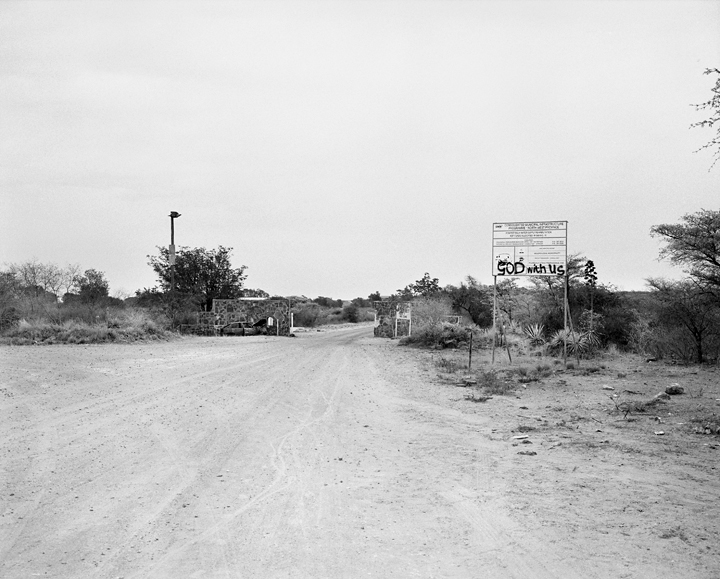
Metropolitan Museum of Art website

LIKE ART BLART ON FACEBOOK

Back to top

Exhibition: ‘Walker Evans and the Picture Postcard’ at The Metropolitan Museum of Art, New York

Exhibition dates: 3rd February – 25th May 2009


Unknown Artist. 'Front Street, Looking North, Morgan City, LA' 1929 from the exhibition 'Walker Evans and the Picture Postcard' at The Metropolitan Museum of Art, New York, Feb - March, 2009


Unknown artist (American)
Front Street, Looking North, Morgan City, LA
1929
Postcard, Photomechanical reproduction
3 1/2 x 5 1/2 in. (8.9 x 14 cm)
The Metropolitan Museum of Art, New York, Walker Evans Archive, 1994


This looks a very interesting exhibition – I wish I could see the actual thing!


Many thankx to The Metropolitan Museum of Art for allowing me to publish the photographs and art work in the posting. Please click on the photographs for a larger version of the image.


This exhibition will focus on a collection of 9,000 picture postcards amassed and classified by the American photographer Walker Evans (1903-1975), now part of the Metropolitan’s Walker Evans Archive. The picture postcard represented a powerful strain of indigenous American realism that directly influenced Evans’s artistic development. The dynamic installation of hundreds of American postcards drawn from Evans’s collection will reveal the symbiotic relationship between Evans’s own art and his interest in the style of the postcard. This will also be demonstrated with a selection of about a dozen of his own photographs printed in 1936 on postcard format photographic paper.

Text from The Metropolitan Museum of Art website


Walker Evans (American, 1903-1975) 'Street Scene, Morgan City, Louisiana' 1935 from the exhibition 'Walker Evans and the Picture Postcard' at The Metropolitan Museum of Art, New York, Feb - March, 2009


Walker Evans (American, 1903-1975)
Street Scene, Morgan City, Louisiana
1935
Film negative
8 x 10 in. (20.3 x 25.4cm)
The Metropolitan Museum of Art, New York, Walker Evans Archive, 1994


“Sold in five-and-dime stores in every small town in America, postcards satisfied the country’s need for human connection in the age of the railroad and Model T when, for the first time, many Americans regularly found themselves traveling far from home. At age twelve, Walker Evans began to collect and classify his cards. What appealed to the nascent photographer were the cards’ vernacular subjects, the simple, unvarnished, “artless” quality of the pictures, and the generic, uninflected, mostly frontal style that he later would borrow for his own work with the camera. Both the picture postcard and Evans’s photographs seem equally authorless – quiet documents that record the scene with an economy of means and with simple respect. Walker Evans and the Picture Postcard proposes that the picture postcard represented a powerful strain of indigenous American realism that directly influenced Evans’s artistic development.”

Text from the Steidl website


The American postcard came of age around 1907, when postal deregulations allowed correspondence to be written on the address side of the card. By 1914, the craze for picture postcards had proved an enormous boon for local photographers, as their black-and-white pictures of small-town main streets, local hotels and new public buildings were transformed into handsomely coloured photolithographic postcards that were reproduced in great bulk and sold in five-and-dime stores in every small town in America. Postcards met the nation’s need for communication in the age of the railroad and Model T, when, for the first time, many Americans often found themselves traveling far from home. In the Walker Evans Archive at New York’s Metropolitan Museum of Art, there is a collection of 9,000 such postcards amassed by the great American photographer, who began his remarkable collection at the age of 10. What appealed to Evans, even as a boy, were the vernacular subjects, the unvarnished, “artless” quality of the pictures and the generic, uninflected, mostly frontal style that he later would borrow for his own work. The picture postcard and Evans’ photographs seem equally authorless, appearing as quiet documents that record a scene with both economy of means and simple respect. This volume demonstrates that the picture postcard articulated a powerful strain of indigenous American realism that directly influenced Evans’ artistic development.

Text from the Amazon website


Unknown artist (American) 'Main Street, Showing Confederate Monument, Lenoir, N. C.,' 1930s


Unknown artist (American)
Main Street, Showing Confederate Monument, Lenoir, N. C.
1930s
Postcard, Photomechanical reproduction
3 1/2 x 5 1/2 in. (8.9 x 14cm)
The Metropolitan Museum of Art, New York, Walker Evans Archive, 1994


Walker Evans was the progenitor of the documentary style in American photography, and he argued that picture postcard captured a part of America that was not recorded in any other medium. In the early 20th century, picture postcards, sold in five-and-dime stores across America, depicted small towns and cities with realism and hometown pride – whether the subject was a local monument, a depot, or a coal mine.

Evans wrote of his collection: “The very essence of American daily city and town life got itself recorded quite inadvertently on the penny picture postcards of the early 20th century .… Those honest direct little pictures have a quality today that is more than mere social history .… The picture postcard is folk document.”

Walker Evans and the Picture Postcard is the first exhibition to focus primarily on works drawn from The Walker Evans Archive. The installation is designed to convey the incredible range of his collection and to reflect the eclectic and obsessional ways in which the artist organised his picture postcards. For example, Evans methodically classified his collection into dozens of subject categories, such as “American Architecture,” “Factories,” “Automobiles,” “Street Scenes,” “Summer Hotels,” “Lighthouses,” “Outdoor Pleasures,” “Madness,” and “Curiosities”.

Marty Weil. “Walker Evans’ Picture Postcard Collection on the ephemera: exploring the world of old paper website Feb 24, 2009 [Online] Cited 12/06/2022. No longer available online


Unknown artist (American) 'Tennessee Coal, Iron, & R. R. Co.'s Steel Mills, Ensley, Ala.,' 1920s


Unknown artist (American)
Tennessee Coal, Iron, & R. R. Co.’s Steel Mills, Ensley, Ala.
1920s
Postcard, Photomechanical reproduction
3 1/2 x 5 1/2 in. (8.9 x 14cm)
The Metropolitan Museum of Art, New York, Walker Evans Archive, 1994


Walker Evans (American, 1903-1975) 'View of Easton, Pennsylvania' 1935


Walker Evans (American, 1903-1975)
View of Easton, Pennsylvania
1935
Postcard format gelatin silver print


Walker Evans (American, 1903-1975) 'View of Ossining, New York' 1930-1931


Walker Evans (American, 1903-1975)
View of Ossining, New York
1930-1931
Gelatin silver print
4 1/8 x 7 13/16 in. (10.5 x 19.8cm)
The Metropolitan Museum of Art, New York, Purchase, The Horace W. Goldsmith Foundation Gift through Joyce and Robert Menschel, 1999


Unknown artist (American) 'Holland Vehicular Tunnel, New York City' 1920s


Unknown artist (American)
Holland Vehicular Tunnel, New York City
1920s
Postcard, Photomechanical reproduction
3 9/16 x 5 1/2 in. (9 x 14cm)
The Metropolitan Museum of Art, New York, Walker Evans Archive, 1994


Unknown artist (American) 'Santa Fe station and yards, San Bernardino, California' c. 1910


Unknown artist (American)
Santa Fe station and yards, San Bernardino, California
c. 1910
Postcard, Photomechanical reproduction
3 9/16 x 5 1/2 in. (9 x 14cm)
The Metropolitan Museum of Art, New York, Walker Evans Archive, 1994


Unknown artist (American) 'Men's Bathing Department, Bath House, Hot Springs National Park, Ark.' 1920s


Unknown artist (American)
Men’s Bathing Department, Bath House, Hot Springs National Park, Ark.
1920s
Postcard, Photomechanical reproduction
3 9/16 x 5 1/2 in. (9 x 14cm)
The Metropolitan Museum of Art, New York, Walker Evans Archive, 1994


Walker Evans and the Picture Postcard


Walker Evans and the Picture Postcard


In 1903, the year Walker Evans was born, the US Postal service handled 700 million picture postcards. Evans would later recall his fondness for those “honest, direct, little pictures that once flooded the mail.” By the age of twelve he was a collector and through his lifetime, an obsessive. “Yes, I was a postcard collector at an early age. Every time my family would take me around for what they thought was my education, to show me the country in a touring car, to go to Illinois, to Massachusetts, I would rush into Woolworth’s and buy all the postcards.” For Evans, the addition of hand-colouring added a great deal of aesthetic value. …

Walker Evans and the Picture Postcard reproduces hundreds of cards from his collection including the three magazine features mentioned above. Also the fine addition of an “illustrated transcript” of his now famous Lyric Documentary lecture at Yale in 1964 makes this a bit more interesting than the title may suggest. …

Later in life Evans had friends around the country while on photo trips keeping an eye for postcards that might interest. He had a particular love for ones produced by the Detroit Publishing Company which were considered the “Cadillac” of postcards. Lee Friedlander related the following from a recent interview: “The Detroit Publishing Company had a formula. If a town had 2,000 people or so, it got a main street postcard; if it had 3,500, it got the main street and also a courthouse square. Walker liked the formula. He had everyone looking for this or that. He told me once in Old Lyme, “If you run across any ‘Detroits,’ get them for me.” I found sixty or seventy cards for him. He loved them.”

“Walker Evans and the Picture Postcard by Jeff L. Rosenheim,” on the 5B4: Photography and Books blog, March 1, 2009 [Online] Cited 12/06/2022


Walker Evans (American, 1903-1975) 'Stable, Natchez, Mississippi' March 1935


Walker Evans (American, 1903-1975)
Stable, Natchez, Mississippi
March 1935
Gelatin silver print
10 x 8 in. (25.4 x 20.3cm)
The Metropolitan Museum of Art, New York, Gilman Collection, Purchase, The Horace W. Goldsmith Foundation Gift through Joyce and Robert Menschel, 2005


Unknown artist (American) 'Future New York, The City of Skyscrapers' 1910s


Unknown artist (American)
Future New York, The City of Skyscrapers
1910s
Postcard, Photomechanical reproduction
3 9/16 x 5 1/2 in. (9 x 14cm)
The Metropolitan Museum of Art, New York, Walker Evans Archive, 1994


Unknown artist (American) 'Woolworth and Municipal Buildings from Brooklyn Bridge, New York' 1910s


Unknown artist (American)
Woolworth and Municipal Buildings from Brooklyn Bridge, New York
1910s
Postcard, Photomechanical reproduction
3 9/16 x 5 1/2 in. (9 x 14cm)
The Metropolitan Museum of Art, New York, Walker Evans Archive, 1994


Unknown artist (American) 'Curve at Brooklyn Terminal, Brooklyn Bridge, New York' 1907


Unknown artist (American)
Curve at Brooklyn Terminal, Brooklyn Bridge, New York
1907
Postcard, Photomechanical reproduction
3 9/16 x 5 1/2 in. (9 x 14cm)
The Metropolitan Museum of Art, New York, Walker Evans Archive, 1994


Unknown artist (American) 'Empire State Building, New York' 1930s


Unknown artist (American)
Empire State Building, New York
1930s
Postcard, Photomechanical reproduction
3 9/16 x 5 1/2 in. (9 x 14cm)
The Metropolitan Museum of Art, New York, Walker Evans Archive, 1994


The Metropolitan Museum of Art
1000 Fifth Avenue at 82nd Street
New York, New York 10028-0198
Phone: 212-535-7710

Opening hours:
Sunday – Tuesday and Thursday: 10am – 5pm
Friday and Saturday: 10am – 9pm
Closed Wednesday
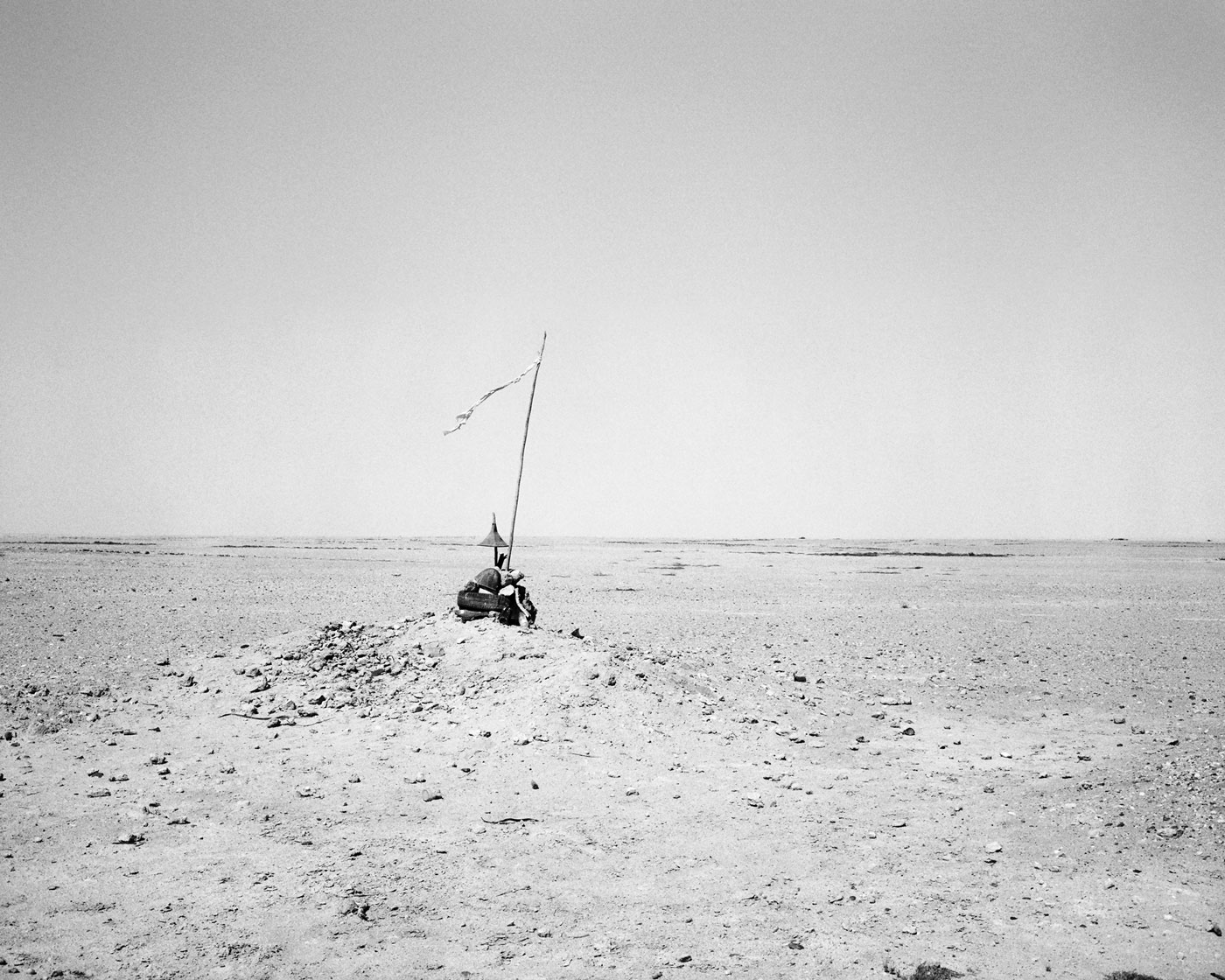
Walker Evans and the Picture Postcard (Hardcover)
by Jeff Rossenheim and Walker Evans

The Metropolitan Museum of Art website

LIKE ART BLART ON FACEBOOK

Back to top