Text: “Re-Pressentation” chapter from Marcus Bunyan’s PhD research ‘Pressing the Flesh: Sex, Body Image and the Gay Male’, RMIT University, Melbourne, 2001

November 2023


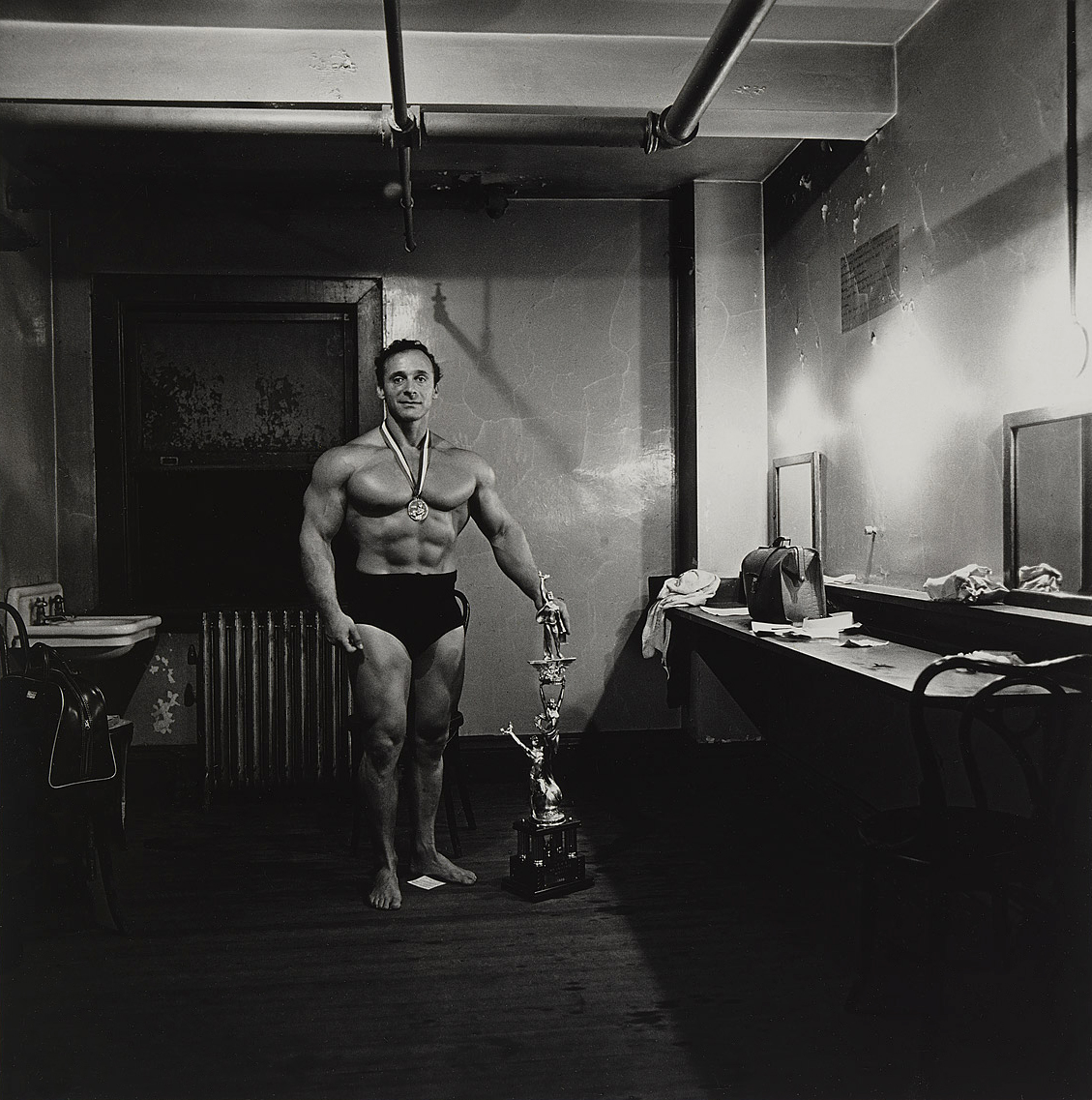
Marcus Bunyan (Australian born England, b. 1958) '"My Body (But I Do Not Own It) – Not the Governments Nor the Churches." Self portrait as gay skinhead' 1992


Marcus Bunyan (Australian born England, b. 1958)
“My Body (But I Do Not Own It) – Not the Governments Nor the Churches.” Self portrait as gay skinhead
1992
Silver gelatin photograph

The title of this photograph is taken from graffiti seen in Newtown, Sydney, Australia, where my scarification was done. In the image you can see that I have just had tribal scarification (cutting causing scarring) to my arm the previous night. I suggest body modifications such as tattooing, branding or scarring confronts the keeper of the body with a journey of exploration into the Self, a continuing ‘rite of passage’ through life. It is my body but I am just the keeper of it for a short period of time and I experience my body through touch, intimacy and an understanding of its interactions with my-Self and others. The title also reveals an ironic challenge to the dominant notions of traditional heterosexual skinhead identity: gay men have appropriated the skinhead image subverting it’s social identity construction because of their sexuality whilst still desiring the fantasy because of its masculinity. While this fantasy may reinforce the lust for the power of patriarchy through the use of a hyper-masculine image, the image of two gay skins walking down the street arm in arm challenges and subverts the ‘normal’ ideology and social identity of the skinhead image as racist, fascist and heterosexual.


Since the demise of my old website, my PhD research Pressing the Flesh: Sex, Body Image and the Gay Male (RMIT University, Melbourne, 2001) has no longer been available online.

I have now republished the fourth of twelve chapters, “Re-Pressentation”, so that it is available to read. More chapters will be added as I get time. I hope the text is of some interest. Other chapters include Historical Pressings (examines the history of photographic images of the male body) and Bench Press (investigates the development of gym culture, its ‘masculinity’, ‘lifestyle’, and the images used to represent it); and In Press (investigates the photographic representation of the muscular male body in the (sometimes gay) media and gay male pornography. In the title of the chapter I use the word ‘press’ to infer a link to the media.

Dr Marcus Bunyan November 2023


“Re-Pressentation” chapter from Marcus Bunyan’s PhD research ‘Pressing the Flesh: Sex, Body Image and the Gay Male’, RMIT University, Melbourne, 2001

Through plain language English (not academic speak) the text of this chapter investigates alternative ways of imag(in)ing the male body and the issues surrounding the re-pressentation of different body images for gay men. The title is a play on the word representation, an alternative way of re-pressing and re-pressenting the body in different non-stereotypical forms.


Keywords

male body, representation of the male body, male body image, gay men, alternative male body image, body image and self-esteem, masculinity, body images facades and fantasies, imaging the gay male body, gay male body


Sections

1/ The power of masculinity
2/ Body image and self-esteem
3/ High and low self-esteem
4/ Sex and self-esteem
5/ Love and respect
6/ Increasing self-esteem and happiness
7/ Body images, facades and fantasies
8/ Getting older
9/ Imaging the gay male body
10/ Re-Pressing, responsibility and respect
11/ Re-imag(in)ing the male body
12/ Conclusion

Word count: 12,048


The power of masculinity


“Awareness of the Cult of Masculinity‘s power and pull helps to loosen its grip on us. Awareness allows us to look at masculinity as something in large part that is constructed within our culture … But we must stop allowing masculinity to define who we are: We must reject the use of terms like “straight-acting” in describing ourselves and others, prevailing those among us whom we deem as more “masculine,” and thus more “straight.” We must understand that what was considered our preferred “sexual type” was in all likelihood actually formed soon after we entered the gay ghettos and saw what the Cult of Masculinity deemed as “hot.” We can each remember a time when we liked older men or thinner men or heavier men or men whose bodies didn’t fit so rigidly to the standard, men whose bodies weren’t the first or only thing we noticed.”


Michelangelo Signorile.1


To be made aware of the power of masculinity allows us the possibility of challenging that power. If we have the will and determination to do so! As we have seen in the In Press chapter it is still all too easy for the dominant hegemonic group within a subculture or society to impose and identify what a ‘valuable’ body should look like. This is achieved mainly through physical and pictorial appearance. As Michelangelo Signorile says in the above quotation, what gay men find desirable today is probably a behaviour that was formed soon after they entered the gay ghetto and saw what was termed a “hot” body. My research suggests that body-type desirability in gay men may be learned from an exposure to the images and bodies of men at a relatively early age.

These images may be found in at the beach, playing sports, reading magazines and looking at TV and pornography to name but a few. In some cases I found that the desirability for a particular type of body was altered after the gay man came out and was exposed to the imagery and body idealism present within the gay community, causing a narrowing in the range of body-types that person found desirable. This narrowing of desirability may cause anxiety and insecurity amongst gay men as they seek a partner who ‘fits’ their ideal body-type and try to match this ‘ideal’ themselves. They may feel inferior about their own body, causing a dis-ease within themselves and in their relations with others. Body image may then affect levels of self-esteem.

I suggest that the ‘Cult of Masculinity’ doesn’t necessarily attract young gay men after they first come out. Personally I believe that it is only after a period of experimentation (perhaps with androgyny, ‘campness’ or being a twink for for example, that may last some years) that gay men then start looking more closely at the development of their bodies. After the first flush of being ‘out’ and going to the clubs is over they start to want to attract a different type of man, a more masculine man, and feel they have to have the body to do so. I think gay men can then become complicit in their addiction to and desire of, the ‘ideal’ gay male hyper-masculine body. This addiction is not so much learnt in childhood but observed and stored in adolescence and the early days of being on the scene until it later finds full expression as gay men grow up.

With the emergence of the gay man onto the ‘scene’ he is exposed to the intense rituals of male body worship which are focused on one particular type of body. The images and rituals of body beautification are presented to gay men who, as free agents, are responsible for their developing addiction. As I noted in the In Press chapter, we cannot blame our addictions solely on the media or consumerism for, in reality, these images are an expression of our identity and our desires. In an interview with counsellor Barry Taylor2 I asked how he thought gay identity was formed:

BT: Perceptions are important – your perception of what you think it is to be gay is based on stereotypes – drag, dirty men in park, Commercial Road, Mardi Gras, TV, paedophilia, etc., … There is a wide range of stereotypes to draw from/engage with.

MAB: Before you ‘come out’ you don’t have ‘the look’. Gay people take on board the images of the gay community very quickly after ‘coming out’. Are there social pressures to conform to this style?

BT: Your desire to belong to the group is strong. What you have given up to come and belong to the group (eg. family, security, love) is great.
Is there something about natural beauty that leads people to it. What is it that appeals to us? The nature of the appeal of beauty.

MAB: Does it just have to be the facade though. I am interested in the inner self. How do people relate to this image. How do you get across to gay people a positive, alternative self image that says self is enough?

BT: That’s a maturity thing. When you are young and come out onto the scene you take on the image of the gay body. It happens in a short space of time. And so about 22, I start asking more questions – What’s my inner self. I see an uptake of people that come to counselling between 22-26 because there must be more to life than parties. Vulnerability – lots of depression at this time. In the gay community we can put off this 22-26 period indefinitely and continue partying (exterior image) which leads to alcohol and substance abuse and no inner development under the facade.


Gay men are attracted to identity images and styles that are seen as perpetually powerful, successful identity images within the gay community. One such style is known as the ‘Party Boy’, which is based on social affluence, looks and body image appearance, a style which is, as Damien Ridge notes below, highly restrictive. Not all gay men have the physical attributes, money, time and social contacts to attain this style, and the relentless pursuit of it can leave undeveloped the inner Self because of substance abuse, partying and the need to focus constant attention on the facade. I examine the issue of building identity & self-esteem based on appearance & body image on the following page.

“Styles such as the ‘Party Boy’, promoted on the scene and in the gay media, are highly restrictive. As with women exposed to ‘supermodels’ promoted by the fashion industry, few men have the social resources, appearances and body type to fully emulate the ‘Party Boy’. In an environment that prioritises style, this inadequacy readily taps into informants’ insecurities. The inability to fit in with dominant gay middle-class styles works to isolate and alienate young men regardless of class or ethnicity. Informants report they need to constantly work on their styles, such as their weight and physiques, to gain and maintain access to valued social networks, sex, and relationships.”3


Marcus Bunyan (Australian born England, b. 1958) 'I Do Dick, Glenn, Darlinghurst, Sydney' 1992


Marcus Bunyan (Australian born England, b. 1958)
I Do Dick, Glenn, Darlinghurst, Sydney
1992
Silver gelatin photograph

The title is taken from the graffiti seen at the right of Glenn


Body image and self-esteem


“Appearance is not a very stable or permanent basis for self-esteem. Not everyone agrees about who is attractive, so even the best-looking are bound to receive mixed reviews. Furthermore, no matter how attractive people are, there will always be times when they do not feel attractive – when suffering from a cold or when they get old. We can always find flaws in ourselves. Objective observers may tell us we are cute and adorable, but we are likely to mutter, “Sure, except for my nose.” Finally, no matter how good-looking a person is, there will always be others who seem better looking. Many of the best looking people compare themselves with someone better-looking, someone younger, and conclude they are not good enough.”


Elaine Hatfield and Susan Sprecher4


May I suggest that self-esteem is an evaluation, either positively or negatively, of self worth. It is based on global (or overall) self-esteem and local self- esteem (such as body image) – conditions that positively or negatively affect each other. Self-esteem is formed by reflected appraisal (what you think other people think of you) and social comparison (comparing yourself with others) and is improved by achieving things within different spheres of your life. Positive self-esteem can lead to a condition of happiness with all aspects of the self. It is the ability to value and love yourself not in an ego way (look at me I’m beautiful, I’m gorgeous) but in a way that accepts all faults and grievances and values them as part of an overall identity.

Lou Benson thinks that self-esteem, “Is a quiet confidence in one’s own worth regardless of any shortcomings or deficiencies. Fromm describes it as the ability to love oneself, not by falsifying a version of the self, but by acceptance of what one really is.”5

Erich Fromm says that self-esteem is essential if we are to love ourselves as well as others. He continues, “The affirmation of one’s own life, happiness, growth, freedom, is rooted in one’s capacity to love, ie., in care, respect, responsibility, and knowledge. If an individual is able to love productively he loves himself too; if he can only love others he cannot love at all.”6

Here Fromm is arguing for a love of the self that is not narcissistic, but based on a true ‘care’ for the self. I think that many gay men suffer from an inability to truly love themselves in this sense. They seek completion of their self in an image of themselves (narcissism) and in the image of others (voyeurism). This is where body image impacts on levels of self-esteem. Researchers such as Leonard Wankel7 have found that body image is related to self-esteem. Crockett and Peterson8 have also found that in adolescence physical attractiveness is one of the key domains that affect a person’s judgement of their self-esteem. My research also suggests that how a gay man feels about his own and his partner’s body image can be a factor in the decision to have sex without a condom. Gay men place greater emphasis on physical attractiveness than heterosexual men and it continues to be a priority throughout their lives.

Appearance is vital in the association between self-esteem and body image (because it is present in every visible social interaction, including sexual relations, that takes place between human beings), but as Elaine Hatfield and Susan Sprecher have noted in the quotation above, appearance is not a very permanent or stable basis for self-esteem. Still, it would seem that many gay men seek higher self-esteem by altering their appearance, believing it (higher SE) can be attained by changing their bodies. This is like building a house on sand – eventually the house is washed away as the foundations are built on unstable ground; we all get older and loose our looks and there is always someone that is better looking than ourselves.

Through behaviours formed in the crucible of the gay beauty ritual some gay men come to believe that the only way to raise their self-esteem is to pump their bodies at the gym in order to be able to compete against other gay men. But having a good body image does not necessarily mean that you will also have good self-esteem.
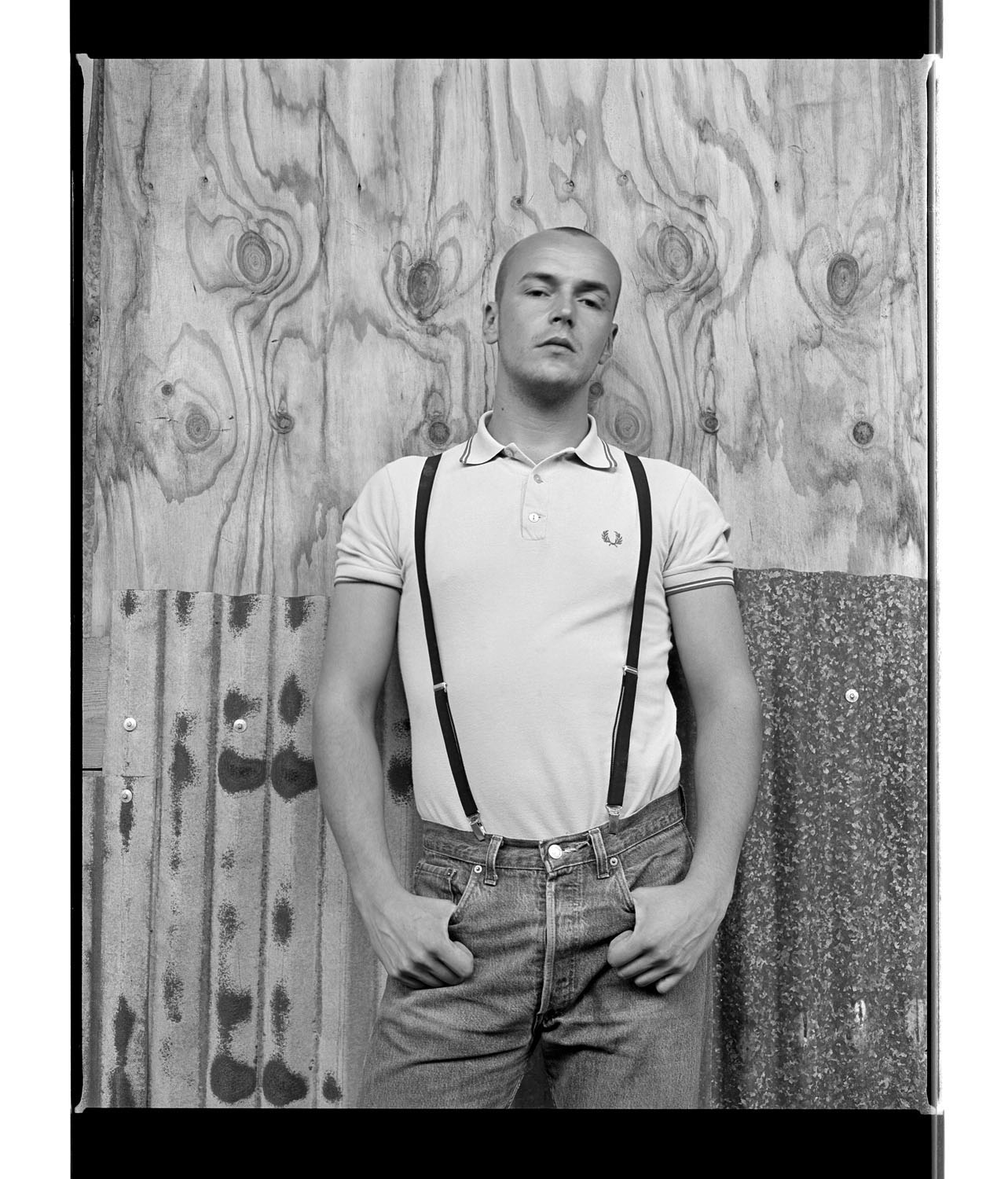
 

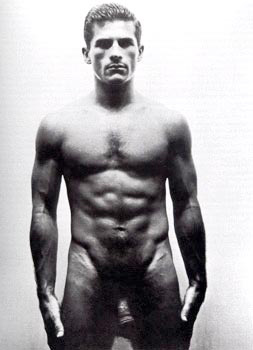
Marcus Bunyan (Australian, b. 1958) 'Glenn, Darlinghurst, Sydney' 1992


Marcus Bunyan (Australian, b. 1958)
Glenn, Darlinghurst, Sydney
1992
Silver gelatin photograph


High and low self-esteem

According to Hatfield and Sprecher, “People with low self-esteem are often afraid they will be rejected. They fear stepping out of line and being different. They seek social approval. Shy teenagers, unsure of themselves, find it very difficult to date a person who friends find unappealing. High self-esteem individuals, on the other hand, are not so desperate for social approval. They can afford to date someone much less attractive than they are.”9

Fundamentally I believe that these observations are flawed.

I agree that people with low self esteem are often afraid of rejection. But do they seek social approval? Perhaps not. For example, if an unattractive person was given the chance of having sex with his body image ideal only by having sex without a condom he would not be seeking social approval for his actions. His actions would be contrary to societies moral and ethical taboo against unsafe sex. On the other hand high self-esteem individuals are equally if not more desperate for social approval so that they can keep their self-esteem high. They usually date someone who is as beautiful and as built, tanned, and toned as they are! Its like looking in a mirror – they see a reflection of their own perfection in their partner and they have to show this possession off to other people to reinforce their high self-esteem; if they fear loosing him they could have sex without a condom to try to keep him.

From the evidence of my research data I suggest that people with different levels of self-esteem are equally likely to have sex without a condom.

People with low self-esteem might have unsafe sex because they think that they won’t get the man they desire otherwise. People with high self-esteem could have unsafe sex because they feel invincible and that their stunning partner couldn’t possibly be infected with the HIV / AIDS virus. People with a built body image but low self-esteem might seek validation of themselves and their body through the adoration of another and then fuck this other person unsafely. There are so many different contexts and no hard and fast rules.

Having a great body does not necessarily mean we feel good about ourselves as appearance is not everything; overall self-esteem is based on a whole heap of other factors, as well as body image, that affect our lives. Conversely, if we feel good about our overall self this can help us feel good about our body and I think that an acceptance of Self does not come through appearance alone, but is possible only through the integration of all parts of the Self into a balanced holistic whole. Of course, self-esteem, body image and sex without a condom are very complex issues and I realise that body image is not the only criteria in assessing the likelihood of unsafe sexual practices taking place.


Sex and self-esteem


“The myth of the ‘Cult of Masculinity’ … is that validation and self- worth are achieved through physical adoration. The cult encourages single gay men to believe they can achieve self-worth through sex, and it encourages men in relationships to believe that they can boost self-esteem by having sex outside the relationship.”


Michelangelo Signorile10


Much like money, photographs of muscular male bodies have ‘value’ without the owner of the body ever being present. This is because society knows the semiotic language in which they (the bodies and the photographs) speak and what their social value and power is. The same thing could be said for muscular bodies in real life; even though you can see and desire the bodies in question and you know their social value and the power of their image you can’t touch unless given permission. And usually permission is given only to those that match up to the same ‘ideals’ so that sex then becomes a validation of Self, of the person’s own existence. As Michelangelo Signorile has said (in the quotation above), this encourages gay men to believe they can increase their self worth through sex (trophy collecting), especially by having sex with someone who comes close to the ‘ideal’ either inside or outside of a relationship.

Having sex with someone is exciting and fun but it is not an understanding of the whole person. Personally I have used sex with gay men as a form of handshake, getting to know what they were like, an introduction as to whether we were compatible sexually yes, but also whether we got along on a social and intellectual level. That I could get along with him, that I wanted him around, that we liked doing things together and that we wanted to help each other along the way. Sex for me has always been used as a tool in this manner – to make friendships and relationships with other gay men. To have great sex, to have some fun but also to find out what makes them tick.

I believe that there are many gay men that use sex to increase their self worth but I also suggest that quite a few gay men use sex in the way I do, as a way of getting to know other men.11 They are looking for something or someone. Not just an addiction to pleasure, an increasing of self worth through sex but a search for a deeper connection. But paradoxically gay men seem scared of this connection, fearful of the exposure and revealing of Self to others that this intimacy brings. For gay men who are supposed to be more sensitive to the feminine side of their masculinity, I find that many gay men are afraid of touching, holding and intimacy.

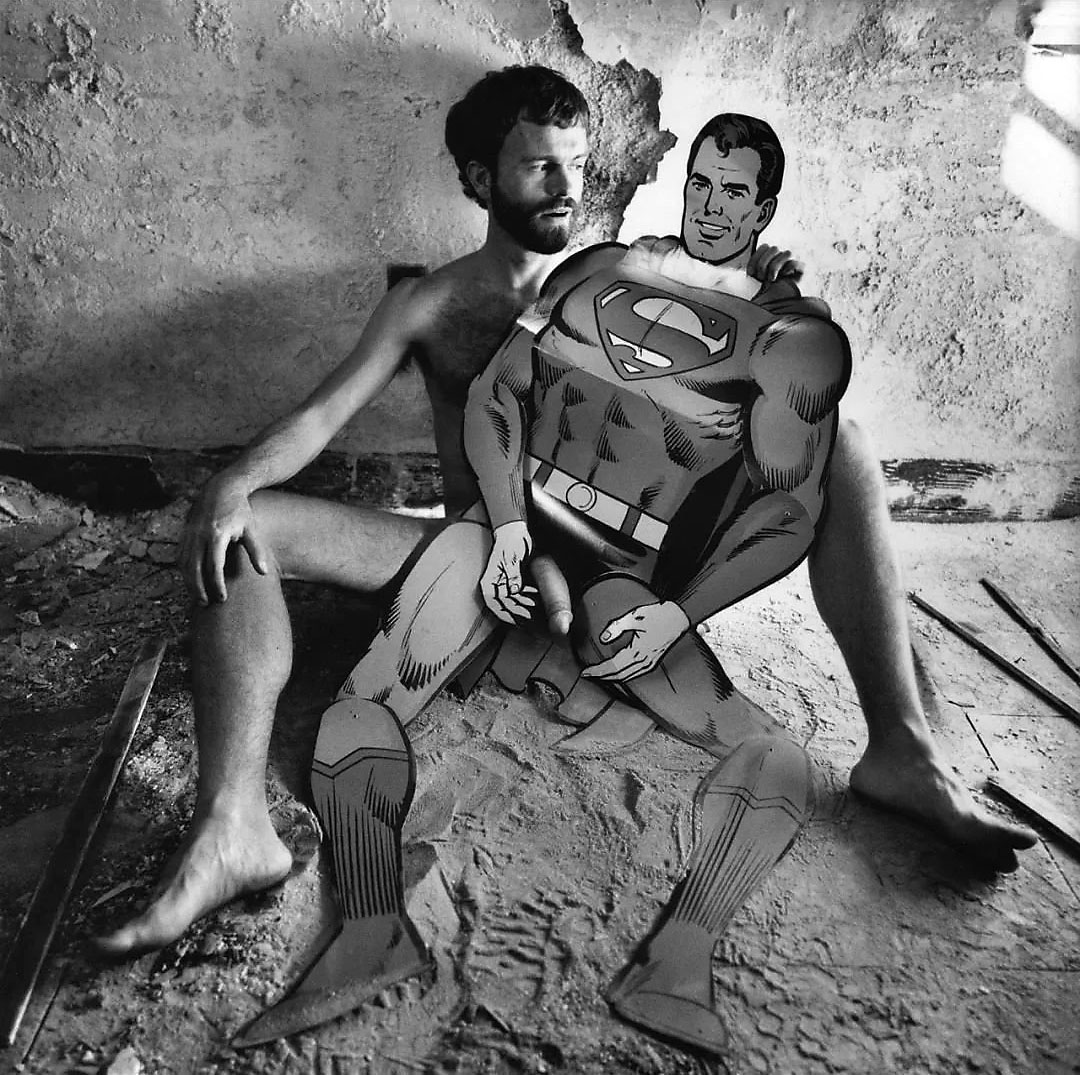
(The hero in our society is usually ‘masculine’, with a well defined and muscular body such as Tarzan or Superman, the Man of Steel. Heterosexual iconography portrays him as powerful, masterly, and virile. Gay men have adopted this stereotype in opposition to the effeminate ‘camp’ pansy stereotype still present today. I suggest that gay men adopt this ‘masculine’ stereotype in order to be seen as ‘real’ men. In adopting this symbolic facade, the mask like iconography may create a paradox between the desire for, and fear of, intimacy and closeness. This fear may form a taboo against intimacy and closeness and the troubling revelations that these conditions can bring.)


Marcus Bunyan. 'Fred and Andrew smoking in Paris' 1992


Marcus Bunyan (Australian born England, b. 1958)
Fred and Andrew Smoking a Joint in Paris
1992
Silver gelatin photograph


Love and respect


“One of the most essential factors in the respect for others concerns their uniqueness and individuality. Love in this sense becomes the recognition and affirmation of the uniqueness of the other. It is not the loss of the self or the subservience of one’s self to another, but the recognition of the many individual qualities that make up the particular individual and the acceptance of their existence. The lover even respects those qualities of the other with which he is not always in accord.”


Lou Benson13


According to Lou Benson love is a respect for the uniqueness and individuality of your partner even if you don’t agree with him on some issues. I believe he is right. It is not the loss of the Self in an-other nor the completion of the Self in an-other (your partner is one’s ‘other half’ as though you are completing your- self in another), it is love through an understanding of the true representation of Self and other and the development of a happiness within and through that journey. But one doesn’t have to be in love to put this understanding into practice. In everyday life the relationships and interactions that we form can be informed by our respect for others, whatever they look like, whoever they are. We are ‘aware‘ of our situation, of our own and other’s ego projections, and this awareness can help us in the acceptance of ourselves and others. Through exploration and respect for the Self we can make our lives happier.


Increasing self-esteem and happiness

Good self-esteem involves the acceptance of all facets of our identity. It is the integration of all strands of our personality into a unified whole. If we visualise, are aware of what we do at any given time; if we are aware of the process of, say, the creativity of cooking a meal, we enjoy the experience as much as the outcome. It is not just the final product but the journey itself that gives us satisfaction. This process is called ‘self-actualization’,14 and I think it can help us to attain higher self-esteem. We fulfil our potential both in the journey and in the outcome and this can make us happier. Instead of pinning after something we cannot have, we accept what we have to work with and get on with it! We enjoy the experience instead of whingeing about it all the time.

“Another important area in which self-actualizing people differ from others is in their non-judgemental acceptance of themselves. Maslow says that they seem to have a lack of overriding guilt and crippling shame and also to be free of the anxieties that usually accompany these feelings. They can accept their own human nature in the stoic style, with all its shortcomings, with all its discrepancies from the ideal image without feeling real concern (Maslow 1970). Such feeling of comfort and acceptance with the self are extremely important in terms of laying down a tone that underlies a person’s whole existence.” (My bold).

~ Lou Benson15


I feel that the above quotation is very important for gay men who have been persecuted, may feel guilt and shame at being homosexual, hate their bodies, and who may have given up the security and love of family and friends to ‘come out’ as a gay man. They hopefully learn to accept their own human nature with all its discrepancies from the ‘ideal’ image. This acceptance of Self helps to improve overall self-esteem and provides the basis for a state of happiness within the Self. Interest in change should be encouraged. Instead of sitting in the middle of a comfort zone we can put some faith in ourselves and our ability to challenge cultural and personal stereotypes.


Marcus Bunyan (Australian born England, b. 1958) 'Jeff standing on his Chrysler, Studley Park, Melbourne, Victoria, 1992' 1992


Marcus Bunyan (Australian born England, b. 1958)
Jeff standing on his Chrysler, Studley Park, Melbourne, Victoria, 1992
1992
Silver gelatin photograph


Body images, facades and fantasies


“There are these guys, hot guys with, I mean, the really chiselled bodies, who I used to look at in awe, who wouldn’t give me the time of day,” recalls David … “I didn’t exist to them. I wasn’t a person. I’d try to strike up a conversation at the bar, and they’d just turn away, in a mean way – treated me like shit. Now, here it is four years later, and I’m all built up, got my forty-two-inch chest and my big biceps, and now these guys are all over me – they can’t get enough of me. And, well, I have to say it does make me feel powerful. I’ve conquered them. That is a feeling of power.”


Michelangelo Signorile16


Has David really conquered them or has he been defeated by the very ‘disciplinary system’ (the power of the muscular body) that was excluding him in the first place? If you can’t beat ’em, join ’em so to speak. That feeling of power that he now feels he has; does he now ignore other people who used to look like he did; does he treat them the same way he was treated; does he treat them like shit as well?

I don’t think that David has conquered them at all.

I suggest he has just capitulated and joined the dominant body image ideology within gay society. Is this power giving him a false sense of self-esteem? Possibly. For in the end he is relying on his body, one part of himself which with wither and age anyway, to uphold his self-esteem. Without the body he was always wanting to belong. Now he has the body he belongs to what?

Perhaps he belongs to a powerful hierarchical ‘disciplinary system’ that controls the desires of other gay men through the symbolic image of the muscular mesomorphic body image. I asked Barry Taylor17 about body image, the fantasy of the ‘ideal’, self-esteem and learning to accept the self:

BT: Because of metabolism, some people will never have the body beautiful and this ALMOST BECOMES A GRIEF to them. THE CRUCIAL POINT THEN BECOMES HOW CAN I BE SATISFIED IN MY-SELF? Then it becomes who am I, and about my self-acceptance.

MAB: How do you change images of the male body to broaden their appeal?

BT: Its difficult. You are dealing with fantasy and the erotic, transcending the mundane of everyday life…

MAB: And so this body beautiful image becomes the fantasy?

BT: Yes, it is the fantasy.

MAB: How can you change that image to become different fantasies not just one?

BT: This would be a long term process of cultural change. One way would be to present images that are normative but are also sexy … Another way would be a broader cultural change in which we are encouraging a greater sense of self-awareness and depth, [NOT self-reflexivity] so that people can be more accepting of those kind of differences – that we feel good about those kind of different relationships. I can construct and feel sexy in bigness, hairy legs, being thin … The last thing would be to build resilience in our lives and this happens by experiencing success and achievement in our lives (and this builds self-esteem).

How do I measure success and achievement?

If I measure success and achievement by getting the body beautiful …

MAB: And belonging to the ‘A team’ …

BT: … then I am going to be constantly disappointed. But if I say this is Barry Taylor and I am happy with who I am, I am happy in my work or whatever, I’m not only successful, but I also have MEANING and am CONTENTED with that.

MAB: I think it is very good to challenge the self, challenge the path you are taking in life, but also for that path to have meaning and for you to be contented in what you are doing.

BT: To be comfortable in going through that process. The other thing is that people around you affirm that path, and affirm and celebrate what we do. Once you find a group of like-minded people that are affirming and nurturing of me, then growth often occurs.

MAB: For the older gay man who hasn’t developed that inner sense of self, and the body sags and its all gone, how do they cope?

BT: Vulnerable thing. The new priest, as it were, is the therapist. Not only because people have problems to deal with, but because they are on a spiritual journey.

The construction, social reproduction and representation of meaning in image identity is critical.


Indeed, Barry Taylor sees the last part of ‘coming out’ as an integration of sexuality into the identity of the whole self. This process may not take place until the gay men is well into his thirties, when they are on a spiritual journey. Unfortunately, as Barry Taylor comments later in the interview (see below), many gay men put off this journey by constantly immersing themselves in the ‘Party Boy’ image and living behind a facade.

In an age when I believe there is a shifting down of the time frame of the development of not just homosexual men but all human beings, I suggest it is important that we do not hide behind facades and have the courage to face adversity and encourage our diversity. We can help maintain high self-esteem by promoting the positive side of our identities and abilities without hiding behind masks.

We must not be afraid to fantasise about bodies that are different from the stereotype. I like scars, broken noses, bow legs and slim boys! I find these things very, very sexy but some people are amazed that I do. They think it strange, but attractiveness rather than ‘beauty’ depends upon a deeper understanding in the eye of the beholder; someone may be considered a great beauty in a ‘collective’ sense but I believe attractiveness is of a more personal, individual consideration.

For example, I don’t think that work alone would make many gay men fancy a ‘weary’, world worn face and many would find such a face unattractive. But many gay men still have fantasies about ‘straight-acting’ men such as plumbers and labourers! To be told through social stereotyping that something is beautiful is not the same as making up our own mind that we find a person attractive.

Lakoff and Scherr have pointed out,

We must learn to separate our judgements about beauty from our learned expectations, that is, our social stereotypes. We must close the gap between what we really find beautiful, and what we think we find beautiful because we have been told to think that way … We must learn, somehow, to accept a wider range of physical attributes as potentially ‘beautiful’.”18 (My bold).


We form our self-esteem partially through the appraisal of those around us. If we can encourage gay men to appreciate a wider range of body-types as fantasies, then perhaps more gay men would not feel the need to conform to the dominant ideal of the muscular mesomorphic body and this could lead to higher levels of self-esteem in gay men who do not ‘fit’ this ideal.


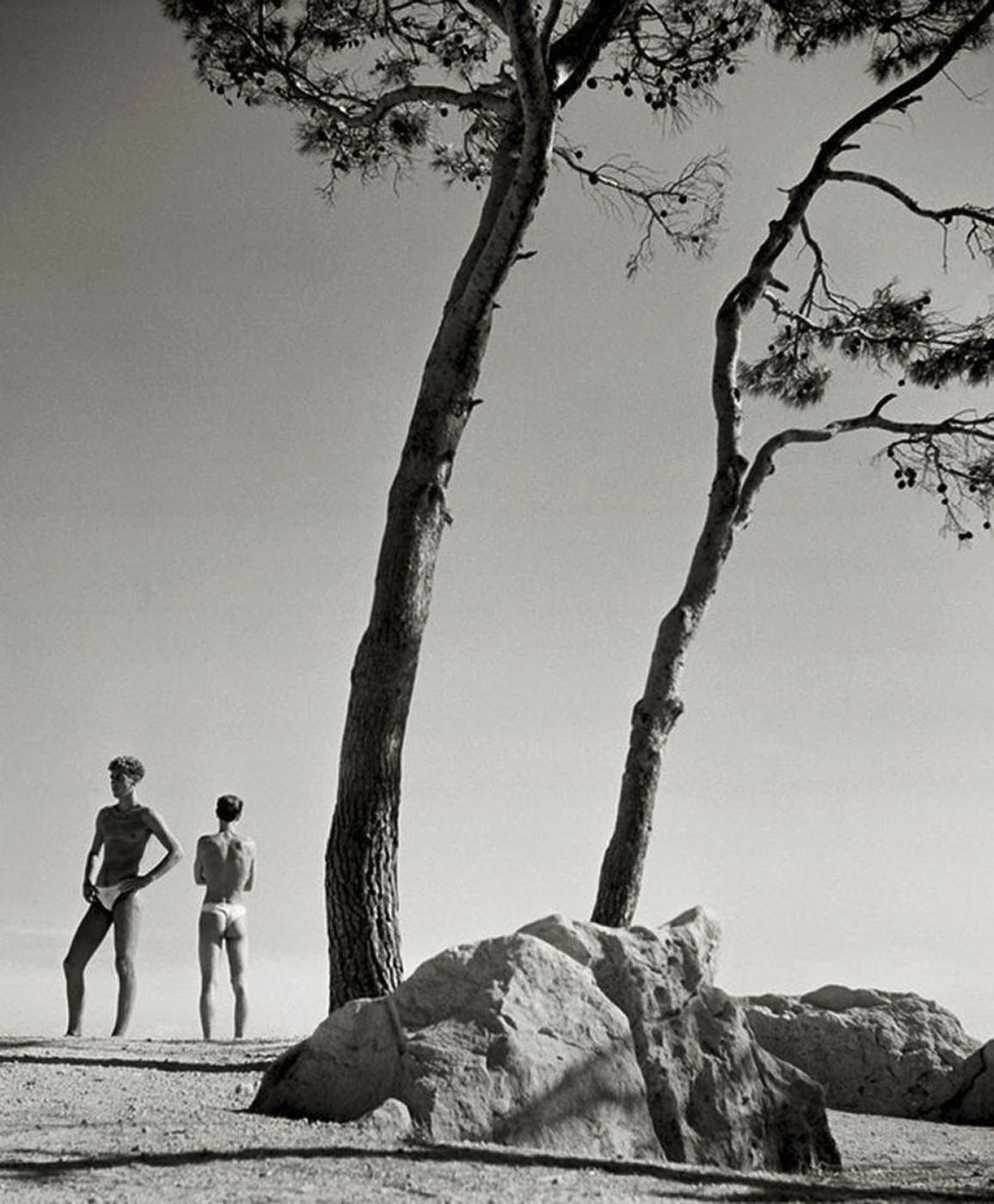
Marcus Bunyan (Australian, b. 1958) 'Fred and Andrew, Sherbrooke Forest, Victoria' 1992


Marcus Bunyan (Australian, b. 1958)
Fred and Andrew, Sherbrooke Forest
1992
Gelatin silver print


Getting older

As gay men get older (from their mid-twenties onwards) they may perhaps begin to contemplate the rituals of life in a more understanding and accepting way (although the ageism evidenced in online gay cruising sites is particularly evident). Their seems to be a general expansion of the body-types that gay men find desirable at this time. Perhaps this expansion is due to several factors:

1. Sexual attractions may change and become more diverse the older we get.

2. As we get older (into our thirties), we may become less fussy in our choice of sexual partners due to the availability of sex with prospective partners that ‘fit’ our ideal body-types.

3. We may become more aware of every-body having something to offer and that what is presented is just an image – that we must get past the image / facade to look inside.


Extracts from research project interviews

Can you tell me what was your ideal body type:

a) When you were first attracted to men 14-17: About the same body shape as himself – tall, slender, petite.

b) When you had your first sexual experiences with men. 17-20: It changed into a bit more muscular. Anthony had moved to the city by this time and he had just started going to gay clubs, around the age of 17-18. Saw his first gay porn around the age of 20. Anthony was looking at older guys with bigger, more developed bodies. Anthony wanted a body like that himself because he was very thin.

c) Now 32: Like stocky guys now, depends on what sexual experience he is after. So the body influences the sexual experience. He has a greater appreciation of different body-types now. Range of desire is broader. Still smooth: 0-10% hairy chest only.

Interview with Anthony, Australian, 32, 5’10”, 69kg. Melbourne. 23/09/1998.

Can you tell me what was your ideal body type:

a) When you were first attracted to men: A proper man or what he defined then as a proper man. Straight acting, slightly butch type. This was before coming out. About 16 saw Tv experience on Channel 4 – homosexual virtual sex , voyeurism, rubbing of naked bodies and simulated fucking. They were gym fit, stereotypical gay bodies. First idea of a gay body was this kind of body. His idea of the ideal body type was formed quite early on before coming out.

b) When you had your first sexual experiences with men: Basically the same.

c) Now 23: It has changed now. He doesn’t look at stereotypes as much now and looks at the individual person instead. He tends to notice them more if they have shaved heads. Is this just another stereotype though? Its personal taste and depends on who the individual is – what chemistry is happening. More confident about his body now after starting going to the gym. Promised himself to get a “better” body – brings other rewards – more attention, more looks from people, gives him more self-esteem. Works on different areas – is quite aware of mental, spiritual areas and feels body is just part of an overall package.

Phil feels that if he wanted sex any time he could go out and get it (the sauna or sex venue) and this would not be based so much on body image. Does not use his body to go out and get sex. He has lower self-esteem in regards to positioning his body in an order of desirability – he feels that there are more people higher up the body chain with better bodies than him. How does that make him feel? He shuts himself off to this when cruising. On the street it does not matter as he has higher self-esteem there.

Interview with Phil, English, 23, about 5’10”, 73kg, robotics technician, middle class. Melbourne. 13/09/1997.

MB: Interesting that in situations of cruising and the street that levels of body image self-esteem change – possibly because in one situation Phil reveals his body image, has less control and is more vulnerable to the judging gaze of others. In the other he is clothed and the revealing of his body can be escaped from. The element of an ‘order of desirability’ is much more pronounced in an unclothed cruising environment.

Can you tell me what was your ideal body type:

a) When you were first attracted to men 13-19: Large and ripply. Because he is small he was attracted to the security of larger men. Particularly muscles, smooth people. Pre-anything in gay mags – going down beach seeing other men.

b) When you had your first sexual experiences with men 19-20: Difficult to attract men – sheltered because he liked that muscular stereotype and could not have it. So he was on his own, so when he was approached he tried to make friends instead of solely looking at the body. That worked OK.

c) Now 23: It has changed a lot – he now likes all manner of shapes and sizes. Growing up and accepting other people for who and what they are. Now he is much happier in his self and this helps!

Interview with Marcus, Australian, 23, 5’4″, 65kg, worker – storeman/packer, waiter, middle-class. Lives country Victoria area. 28/09/1997.

Can you tell me what was your ideal body type:

a) When you were first attracted to men: Definitely muscular Adonis look – bulging everything, smooth. Formed that through a natural liking for this kind of body – influenced by seeing these images in news media and TV programmes such as OUT (gay and lesbian programme on SBS) and gay magazines. Bombarded by this image.

b) When you had your first sexual experiences with men (came out at 18): Very much the same.

c) Now 22: Hairy men are quite attractive now – explains this through experiencing them. Attraction with hairier men because they were more masculine. Still muscular – an appreciation of the image. He has become more perceptive towards peoples individuality in body-image composition. Very rarely do people fit into the media image ideal that they sell us. It is not important that they do – is it important for them?

Interview with Michael, Australian, 22, 5’10”, 83kg, clerk, working-middle class. Melbourne. 05/10/1997.

Can you tell me what was your ideal body type:

a) When you were first attracted to men 12-26: Usually the blond hair, blue eyes and slim muscular thing – good legs, good arse. Not attracted to body hair. Never attracted to really tall men – went for the balanced, proportionate look in respect to height.

b) When you had your first sexual experiences with men 26-30: Gavin’s first sexual experience was 2 men in a car in a car park in St. Kilda. The blue-eyed blond was supplemented when he started to look at gay porn videos – hairy chests, the Mediterranean look, interested in the construction worker, working men (‘straight-acting’ fantasy). The images in the porn videos and mags influenced the bodies he liked. Even started to look at family albums and noticed how handsome relatives were in their earlier years.

c) Now 34: Gavin’s idea of “gorgeous” is really wide – but whether he goes further depends upon their personality, intelligence, sensitivity, honesty, punctuality, inner soul stuff. Guys who exercise their inner spirituality in some way. He finds it difficult to relate to people who spend lots of time at the gym and on the facades. His appreciation of different body-types has increased a lot – in combination with inner work.

Interview with Gavin, Australian, 34, 6′, 70kg, middle-class. Melbourne. 03/11/1997.


For some gay men this expansion is a very positive growth experience. Other gay men do not undertake it at all, forever mired in the never ending circuit of drugs, body, lifestyle and party scene until well into their mid-thirties to early forties.

Barry Taylor had important things to say about this age group:

BT: The next big group is 35 onwards – who by now may have developed a major alcohol and drug problem.

In their 40’s, they desire the body beautiful and try to buy young boys, go to the sauna and can’t pick up. They suicide because of loneliness – because the gay community doesn’t provide any other model for them (other than the body beautiful). No place for them to meet and be part of.

MAB: I always wanted a big body. I have struggled with that for years. Now, at 39, how does the gay community support men in mid-life? In the last 6 months acceptance is starting to come that I am no longer young in body, but still young at heart!

BT: This happens because you start to synthesise yourself. This is the last stage of coming out, I believe. This is Barry Taylor who works in the area of suicide, who likes classical music, has a sense of the spiritual self and is also gay. So the area of sexuality is only one part of who I am. I am not reliant on going to gay places all the time. If I’m still in the PRIDE stage, so long as your young and fit into the image, on and on it goes. BUT – if a relationship fails, you loose your job, or have some insight of who you really are, that’s when suicide can happen. They crack or they do something about it.

MAB: Is this mid-life crisis happening younger these days?

BT: Yes, I’m seeing some suicidal people at 14-15 who have had enough of life, are wearied out. At 22-26 people are looking for more choices. The first group used to be in their 20’s but are now in their teens.

MAB: Ages have not compacted but have shifted down.

BT: Yes, people are finding a void and are looking for a spiritual self earlier.In the past it has been mainstream religion but now they are searching for something different in the void of boredom – because mainstream religion has not been a factor in their lives.

MAB: The adverts that appear in Blue, XY, Large magazines – they perpetuate the myth of the beautiful body.

BT: Yes, that’s right. Gay life is like school or adolescence. If you are invited to a group party, they have the power, they are popular, the select ‘in’ crowd.”


Jez Smith. 'Antigay' 1997


Jez Smith (Australian)
Antigay
Nd
in Blue Magazine. Sydney: Studio Magazines, April 1997, p. 23.

“There’s a new gay sentiment sweeping the globe and it’s perpetrators are homos themselves. They don’t object to what we are – just what we’ve become.”


Imaging the gay male body


“The gay scene is a market and both sellers and buyers have become used to the coinage of appeal and neither can change it without losing out. The way the compulsive cruisers present themselves is geared to the way the buyers choose: looking no further than skin deep, ignoring what might or what might not be underneath … The majority of gays are placing their cosmetic selves, not their real selves, on the line.”


R. Houston19


An article in April 1997 Blue Magazine titled “McQueer” examined the impact of the commercialisation of ‘gay’. In a short but interesting article David Taylor looked at a book called ‘Anti-Gay’ edited by Mark Simpson, first published in 1996. This book, through essays by social commentators from different parts of the world, examines the development of a backlash against the attitudes and ideologies of the commercial gay scene.

In the article The Divine David observes that, “Anti-gay is a reaction by the people to their dissatisfaction with a lot of the imagery used in the gay media that centres around total body obsession, and the idea that being gay is some sort of lifestyle that has to be pandered to (and is quite expensive). Being gay has become a commercial thing which doesn’t seem to have anything to do with civil rights or people feeling comfortable with their sexuality. ‘Gay’ has resulted in something which is quite soulless.”

Paul Burston also explains that, “When I say I’m anti-gay, it doesn’t mean that I hate all of the things that the gay scene is. What I’m saying is that I hate a lot of the mindset that comes attached to that – it’s the herding instinct I hate. And there is no reason why people should feel they can’t still take part in the scene, so long as they think for themselves.”

Here is the crux of the argument. To think for oneself. To be aware.

Because it is not enough to blame the media or the ‘scene’, it is important to think for oneself and be aware of the pressures, addictions and imagery that interacting with the commercial gay scene may involve. As an alternative to the commercial gay scene quite a few alternative clubs like Kooky and Home in Sydney and Queer & Alternative in Melbourne have sprung up over the last 5 years to cater for gay people disillusioned with the usual scene pubs and clubs.

‘Blue’ choose to illustrate the “McQueer” article with the image above by Jez Smith. While interesting the image is difficult to read. The body, in it’s deconstruction, becomes dehumanised and has virtually no identity at all. The image seems to be saying that by being anti-gay your body is not worthy of being a fantasy for other gay men. Compare this with other images appearing in the same and later issues of ‘Blue’ with the interchangeability and replaceability of the muscular, smooth, white Adonis that usually grace the pages of the magazine.

As informative social comment the article pays lip service to alternative points of view, to alternative discursive structures and images within society that do not have space to express themselves, but is just a token gesture on the part of the publisher whose magazine constantly reinforces underlying social values and stereotypes in regards to male body image representations.

A different approach has been taken by the Body Shop. The first issue of it’s magazine Full Voice20 looks at the body and self-esteem. Of course, the Body Shop promotes it’s own philosophy and ‘natural’ product within this magazine – it’s a commercial money making enterprise otherwise they wouldn’t be in business – but the magazine does not pull any punches. Below is an image from the magazine; it shows how a ‘natural’ looking Barbie model would appear and comments on how many women really do look like supermodels.
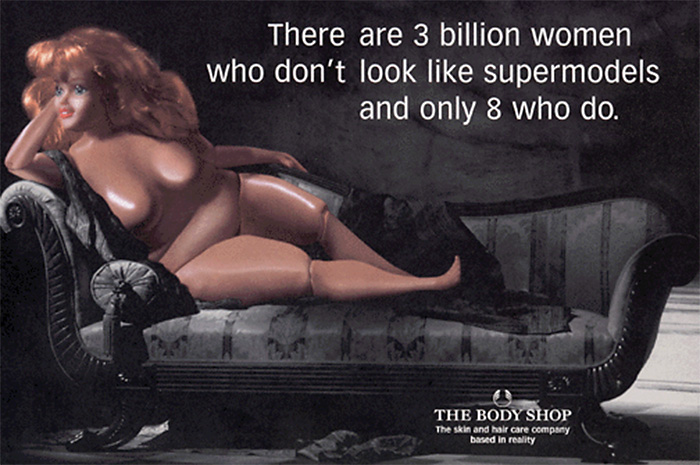
 

Anonymous photographer. 'Untitled' 1997


Anonymous photographer
Untitled
1997
Body Shop advertisement in Roddick, Anita (ed.,). Full Voice Issue One. Australia: Adidem Pty. Ltd., 1997


The magazine asks what self-esteem is? It replies:

“SELF RESPECT
SELF AUTHORITY
DIGNITY
PRIDE
AWARENESS
CALMNESS
THE PURSUIT OF DREAMS
A SENSE OF ACHIEVEMENT
A TWINKLE IN THE EYE
THE LIVING OF LIFE”

The magazine contains articles for women on such issues as ‘ideal’ body image versus ‘real’ body image, 10 social symptoms of high and low self-esteem, fat versus thin, how to create a beauty advert called “Want to Know a Secret?” (which is a real laugh), and what is beauty? It concludes with these lines:

“Somewhere in time, society lost the plot. We decided how a person looked was more important that who that person was. When that time was, no-one knows. But we can remember the time we started to put it right.”


The Body Shop should be applauded for their effort. We must acknowledge, though, that people will be attracted to other people through an appearance that engages with their sexual fantasies. This only becomes a problem when sexual attraction through physical appearance turns to discrimination against other people who don’t match their ‘ideal’ look. In an important observation, Greg Blanchford has noted of the sexual objectification of gay men occurring in casual encounters that,

“People in these situations will not be attracted to someone unless they are attracted by some external feature that fulfils some sexual fantasy. It follows that there must be an emphasis on surface or cosmetic characteristics. And because the criteria of selection can be highly specific, one is, in turn, concerned to present an image of oneself that will attract others. Therefore appearance, dress, manner and body build are very important.”21


Of course these elements are important but unfortunately, in our society, not everyone can have a fabulous body build, appearance or dress and the way we treat attractive as opposed to unattractive people is not always equal and fair. Our reaction to the individual shapes the way that their self-esteem may develop and may affect their relationship with the world. If you keep telling an unattractive person that they are unattractive they will eventually begin to believe this themselves. This is called a ‘self-fulfilling prophecy‘. The individual becomes a victim of our discrimination and eventually perpetuates this damaging discrimination upon themselves.

XY Magazine, a publication aimed principally at gay youth, ran a Body Issue in April 1997. Under the title “Perfect Bound,” William Mann talked to social commentators Michelangelo Signorile, Michael Bronski and Victor D’Lugin amongst others. In a thought provoking article Mann asks,

“How many gay kids are … struggling through identity issues like being skinny, or socially awkward or whatever? What does the image of the pumped-up pretty white boy – plastered all over our magazines, our advertising, our literature, and our erotica – say to the non-white or skinny gay kid, looking to find a place in a community that seems to have no place for people who look like him?”22


Pages from 'XY Magazine' 1997


Anonymous photographers
Untitled
Nd
Pages from back issues featured in XY Magazine No. 7. California: XY Publishing. April/May 1997


What indeed – what does it say to them? Does the image make them feel inadequate? Does it alienate them not just from themselves but also from the gay community, a community to which they aspire to belong?

Here, I am not saying you can’t find muscular bodies desirable as long as you understand the possible consequences for other gay men who do not possess such a body. As Michael Bronski notes in the same article, “The minute someone points out something where we should be more culturally sensitive, there’s this cry of political correctness. People see it as an attack on them, a loss for them. But nobody’s saying you can’t find Marky Mark and his kind attractive.”

Indeed nobody is, including myself. I am the first to admire a good, muscular body and always wanted one myself. But I am aware of the problems and alienation from self that such a desire can cause. Under the heading NO PECS, NO SEX Mann goes on to say that this kind of body is not always available for sex and the more that we find this kind of body attractive the less sex we will have. “And when we do [have sex], its always the same, and we miss many kinds of pleasure.” Mann asks Michael Bronski about this point and, talking about the body of the buffed, white, muscular male he replies, “The image is so clean and ultimately non-threatening that it doesn’t allow for us to explore our sexuality, to see what the limits of our fantasies might be.”

Michelangelo Signorile observes that,

“Looking out at the hordes of shirtless, pumped-up men, each virtually indistinguishable from the next, it dawned on me just how much pressure is put on young gay men as they enter the gay community – more than ever before. It’s true that there have always been paradigms in the gay world, but it seemed in the past there were more choices, more leeway about what was considered a gay stud. Today only one very precise body type is acceptable – one that very few gay men have or can achieve. …

We need to empower people who don’t feel attractive. I’m not saying that for vast numbers of people the club and party scene is not fun, is not great. But those who don’t fit in need to see other images. Lots of people don’t see themselves in what they see of gay culture. The range of what’s attractive needs to be expanded, not because it’s a good thing we should do, but because the range really is broader.””23
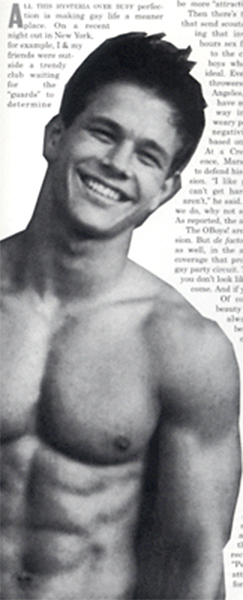
 

Anonymous photographer. 'Marky Mark' Nd


Anonymous photographer
Marky Mark
Nd
in XY Magazine No.7. April/May 1997, p. 27

“Marky Mark on 60 foot high Calvin Klein advertising board: icon of beauty, or body fascism?


Finally, the conclusions reached by the article are that:

1. We should try and empower people who don’t feel attractive.
2. We should offer different images to people who feel they don’t fit in.
3. We should broaden the range of what can be seen as attractive.
4. We have limited our own sexual freedom by this hierarchy of beauty.

Then we look at the images that run in the same issue of XY Magazine, a magazine which is marketed and primarily sells to young gay men.

Advertisements for back issues include images that illustrate articles such as ‘Confessions of a Jock-Lover’, or ‘Palm Springs DOA: I Survived the White Party’, (see above images) which feature stunning, rippled torsos. The White Party is a Circuit party in America held to raise money for HIV / AIDS research where there are lots of gorgeous built men all running around having sex and taking drugs – the contrast between the built body and the AIDS body full of sad irony. Then there is the fashion shoot titled ‘Straight acting’. Yes, the models are from different ethnic backgrounds (no racial discrimination here!), but they are all smooth and built (see image below).

These photographs and many more like them feature in the monthly issues of XY magazine, a mag aimed at gay youth. I believe it is constructive that such issues are being debated but, as with the ‘Blue’ article, it is just a token offering that does very little to change omnipresent omnipotent social ideals.


Bradford Noble. 'Untitled' Nd


Bradford Noble
Untitled
Nd
Images from ‘Straight Acting’ Clothes feature, XY Magazine No. 7. California: XY Publishing. April/May 1997, pp. 45-49.


Spiros Politis. 'Untitled' Nd


Spiros Politis
Untitled
Nd
in Todd, Matthew. “In the Eye of the Beholder,” in Mattera, Adam (ed.,). Attitude Vol. 1 No. 66. London: Northern and Shell PLC, October 1999, pp. 56-57.

Left to right: Phil 49, engineer; Andy 21, student; Jon 21, student; Josh 25, escort; Jody 21, aerobics instructor.


Another article that attempts to address issues of beauty, body image and self-esteem in gay men appeared in the October 1999 issue of the London based Attitude magazine. Titled “In the Eye of the Beholder,” journalist Matthew Todd asks rather inane questions about the representation of bodies and the ‘scene’ of four ‘ordinary’ and one ‘perfect’ gay men (see image above). It is interesting to observe that these ‘ordinary’ gay men, while noting that gay magazines “ram it down your throat that ‘You should look like this!'” (Andy) offer no possible alternatives that they think would work to break the dominance of the visual stereotype of the muscular mesomorphic body image.

Although articles such as this do raise awareness of some of the issues concerned with self-esteem and body image, they also confirm the authority of visual ‘fantasy’ images that allows magazines (such as Attitude) to justify the continued publication of white, smooth, muscular ‘Party Boys’ as the epitome of what a gay man should look like by confirming that this image is what the consumer wants to see. This observation is confirmed by presenting a selection of the male body images that appear in articles, not advertisements, in the same issue of Attitude magazine.

Escapism and fantasy (linked to anti-authority and the feminine) are thus grounded in the authority and fixity of the sign of the muscular mesomorphic body image through desire for and “attraction to good looks,” through the watching of the objective eye, and through a nostalgia for the paradise of the perfect body. The authority and meaning of this sign is upheld “through the interpretative acts of members of a sign community,” particularly when the meaning and power of the sign is reinforced and dominant within the gay community. This can be contrasted with a partially seeing objective eye which offers an appreciation of ‘truth’ (subjective, objective, fluid and non-final) through imperfection, diversity, and an acknowledgement of difference. I correlate this non-finality with the quotation by Wendy Chapkis that I use as a summation at the end of the Re-Pressentation chapter.
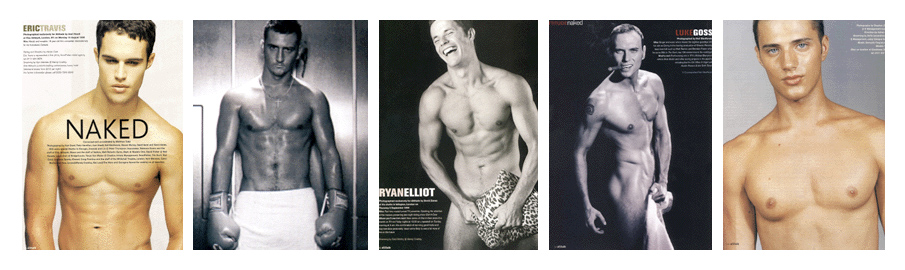
 

'Attitude Magazine' 1999


Axel Hoedt
Eric Travis
Nd
in Todd, Matthew. “”Naked,” in Mattera, Adam (ed.,). Attitude Vol. 1 No. 66. London: Northern and Shell PLC, October 1999, p. 38.

Axel Hoedt
Will Mellor
Nd
in Todd, Matthew. “”Naked,” in Mattera, Adam (ed.,). Attitude Vol. 1 No. 66. London: Northern and Shell PLC, October 1999, p. 48.

David Zanes
Ryan Elliot
Nd
in Todd, Matthew. “”Naked,” in Mattera, Adam (ed.,). Attitude Vol. 1 No. 66. London: Northern and Shell PLC, October 1999, p. 50.

Neil MacKenzie
Luke Goss
Nd
in Todd, Matthew. “”Naked,” in Mattera, Adam (ed.,). Attitude Vol. 1 No. 66. London: Northern and Shell PLC, October 1999, p. 54.

Stephan Ziehan
Sam Fragiacomo
Nd
in Clark, Adrian and Day, Luke. “Essentials: Grooming,” in Mattera, Adam (ed.,). Attitude Vol. 1 No. 66. London: Northern and Shell PLC, October 1999, p. 104.


I love how all the penises are covered up with towels or cushions and I note that traditional symbols of masculinity are also well represented – the cigar and the boxing gloves for example. Eric Tavis also happens to be a wrestler as well as a model. Also, notice how all bodies are smooth, white, muscular and look like they could have been pressed from the same mould.

For gay men in contemporary society the maintenance of a healthy social body has become a moral concern, for supposedly anybody can make their frame-work a ‘work of art’ and attain that longed for paradise of the ‘perfect’ body, the body as a sign of virility and traditional masculinity. You only have to exercise and build that lean, hard look, have your tummy tucked or face reconstructed, take those steroids to make your body into a sculpture …

Your body could be a work of art if only you would let it …


Anonymous photographer. Make your body a work of art' 1998


Anonymous photographer
Make your body a work of art
‘Body Sculpture’ brochure
1998


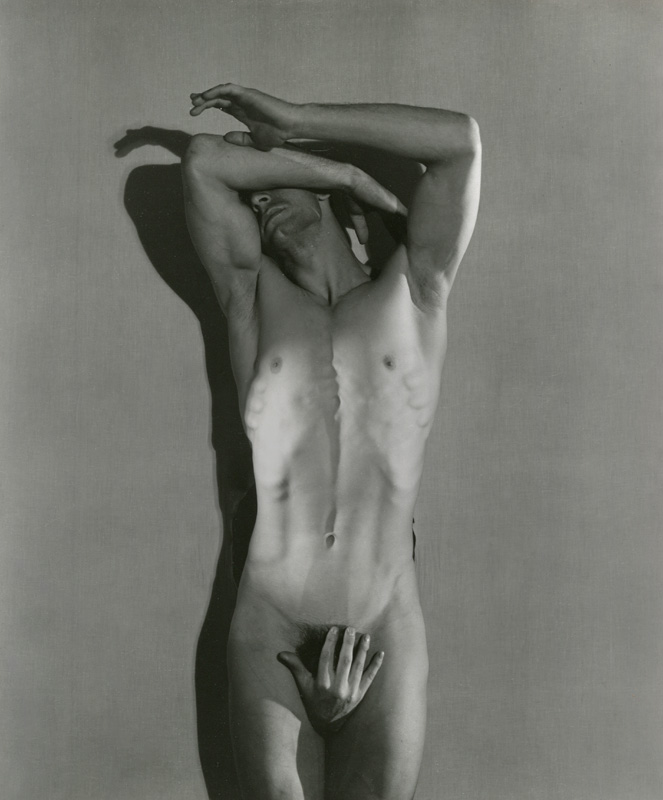
Marcus Bunyan (Australian, b. 1958) 'Andy in the flat, Punt Road, South Yarra' 1991-1992


Marcus Bunyan (Australian, b. 1958)
Andy in the flat, Punt Road, South Yarra
1991-1992
Gelatin silver print


Re-Pressing, responsibility and respect

Bodies and images of the body signify their meaning through representation. How can we re-press the representation of the male body so that we can offer alternative images to gay men that will act as fantasies for them? According to John Tagg25 we must demonstrate that the meaning of already dominant images within a society can be negated and rendered incoherent. Tagg says there are 2 ways of doing this:

1. “We must search for other signifying conventions, other orders of meaning already present in the culture (through conflict of classes, ideologies and forms of control) that are denied a semiotic space to express themselves.” (Semiotics is the study of signs)

2. “We must abandon the above search for other forms of meaning in bodies and body images and adopt images that refuse any meaning at all – bodies and images of them cannot be read or possessed and therefore may come to mean nothing. In other words the image does not signify anything, much like the early non-sexual androgynous ‘figure’ of the gay liberation movement. The figure had no ascertainable gender, even though the body was still actively sexual.”


Personally I think that the second option would be very difficult to achieve on a broad social level.

Body images are understood through ‘conditions of understanding’, in other words how their meaning is understood is through a collective knowledge of the history of context, place and the language that those images speak in. Images are the main source of sensual stimulation in contemporary society and their language is learnt from an early age.

To culturally deny this language would be a very difficult thing to achieve. The first option has a greater possibility of success: that we can open up spaces for images that have previously been denied the room to speak for themselves. This is especially true in regard to the dominance of images of the muscular mesomorph within gay society. We must try and propose different body image types as fantasies for gay men and give them the space within the community to express themselves!

The image below is a good example of allowing other orders of meaning already present within images in our culture to speak for themselves. The photograph below is another form of re-pressentation of the male body image that usually finds no representative space within the context of gay media. These kind of images do offer themselves as alternative fantasy images for gay men but are often denied the space to express themselves and therefore reach a larger audience of gay men. Here I am, accept me for who I am.


Anonymous photographer. 'Untitled' 1998


Anonymous photographer
Untitled
1998
Image from a personal gay web page


An understanding of re-pressentation is the responsibility of every gay man. It is an ability to be able to respond (which is what responsibility means) to his own needs and the needs of others in a voluntary, altruistic and non-discriminatory way. It implies a care and concern for others as well as for the self. This is a hope, a dream if you like, but a good dream all the same. I suggest that, above all, responsibility for the acceptance of difference in others requires an understanding and respect towards yourself.

As Erich Fromm has said more eloquently than I can ever say,

“Respect is not fear and awe, it denotes, in accordance with the root of the word (respicere = to look at), the ability to see a person as he is, to be aware of his unique individuality. Respect means the concern that the other person should grow and unfold as he is. Respect, thus, implies the absence of exploitation … It is clear respect is possible only if I have achieved independence; if I can stand and walk without needing crutches, without having to dominate and exploit anyone else. Respect exists only on the basis of freedom … To respect a person is not possible without knowing him; care and responsibility would be blind if they were not guided by knowledge. Knowledge would be empty if it were not motivated by concern. There are many layers of knowledge; the knowledge which is an aspect of love is one which does not stay at the periphery, but penetrates to the core. It is possible only when I can transcend the concern for myself and see the other person in his own terms.”26 (My bold)


I think this is a fantastic way to view our relationship with the world.

Respect, responsibility, care, and concern are key words in this positive relationship with ourselves and with others, which I believe will increase self-esteem by surrounding both with good energy. I realise that this may be very difficult to put into practice all of the time but if we could try then I believe the world can become a healthier, more balanced place.


Marcus Bunyan. 'Self-portrait in Punk Jacket' 1991-1992 from the series 'Self-portraits and nudes' 1991-1992 Marcus Bunyan. ‘Self-portrait in Punk Jacket’ 1991-1992 from the series ‘Self-portraits and nudes’ 1991-1992


Marcus Bunyan (Australian born England, b. 1958)
Self-portrait in Punk Jacket
1991-1992
From the series Self-portraits and nudes 1991-1992
Gelatin silver print


Re-imag(in)ing the male body


“Modern man is alienated from himself, from his fellow men, and from nature. He has been transformed into a commodity, experiences his life forces as an investment which must bring him the maximum profit obtainable under existing market conditions. Human relations are essentially those of alienated automatons, each basing his security on staying close to the herd, and not being different in thought, feeling or action. While everybody tries to be as close as possible to the rest, everybody remains utterly alone, pervaded by the deep sense of insecurity, anxiety and guilt which always results when human separateness cannot be overcome …” (My bold)


Erich Fromm27


Marcus Bunyan (Australian, born England 1958) 'Untitled' 1995-96 From the series 'Sleep/Wound'


Marcus Bunyan (Australian born England, b. 1958)
Untitled
1995
From the series Sleep/Wound
Gelatin silver print

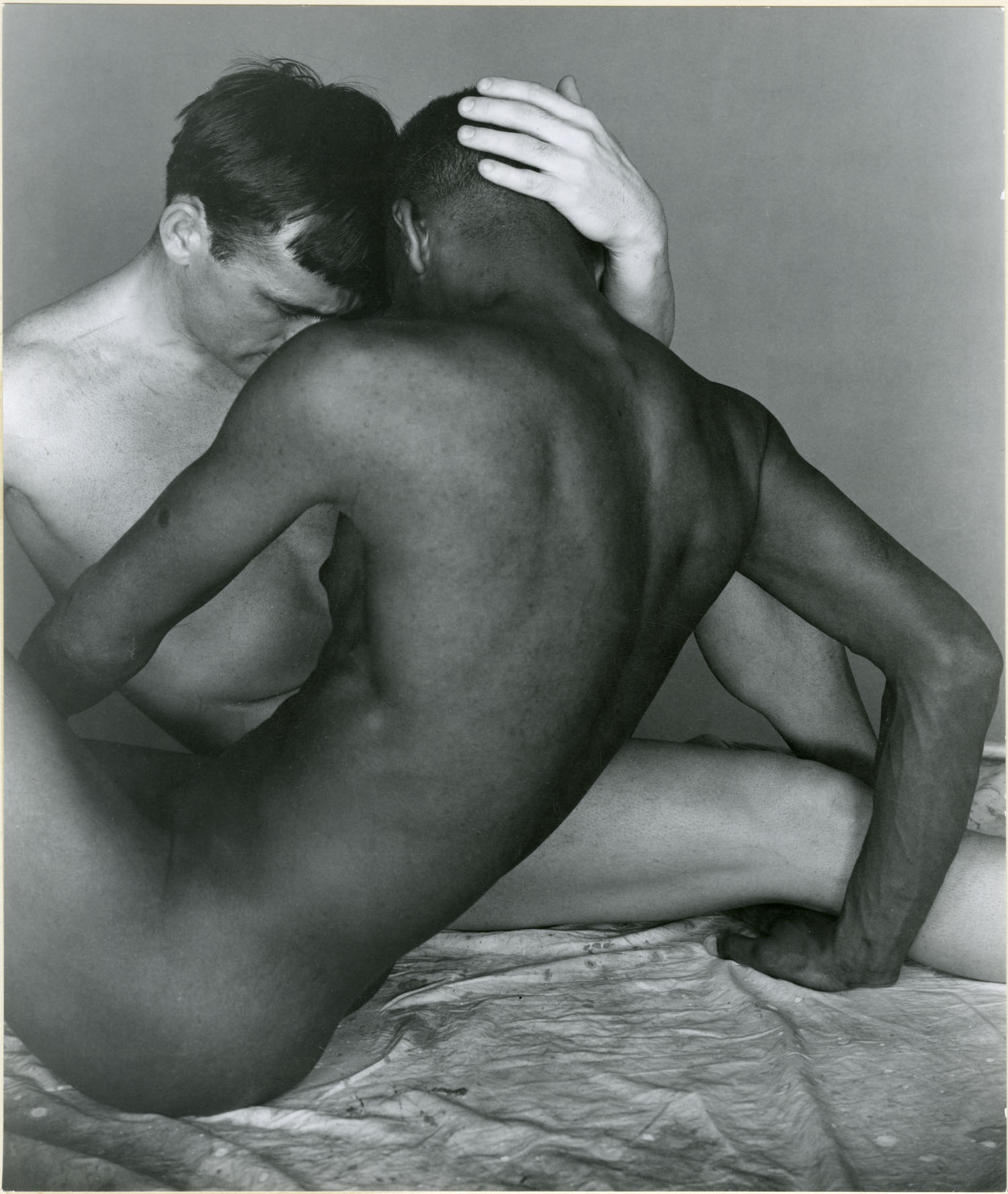
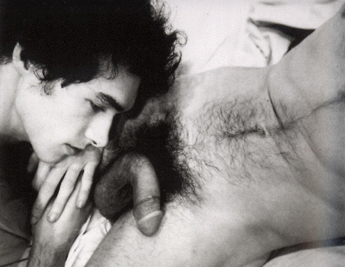
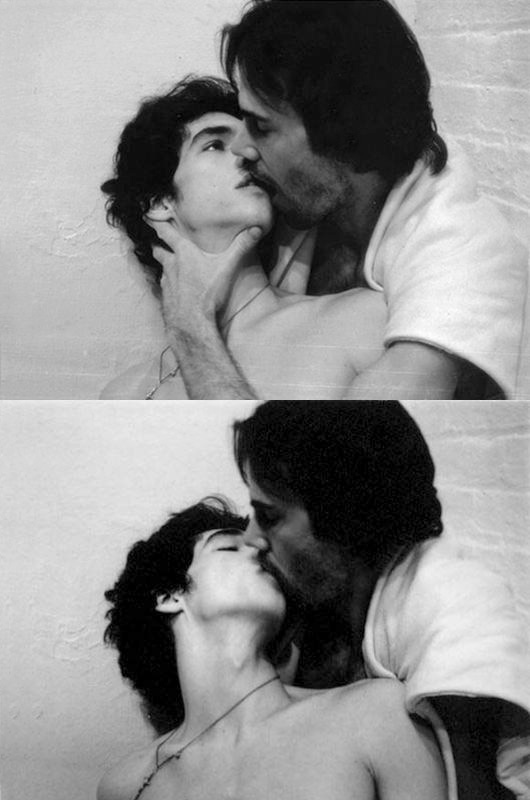
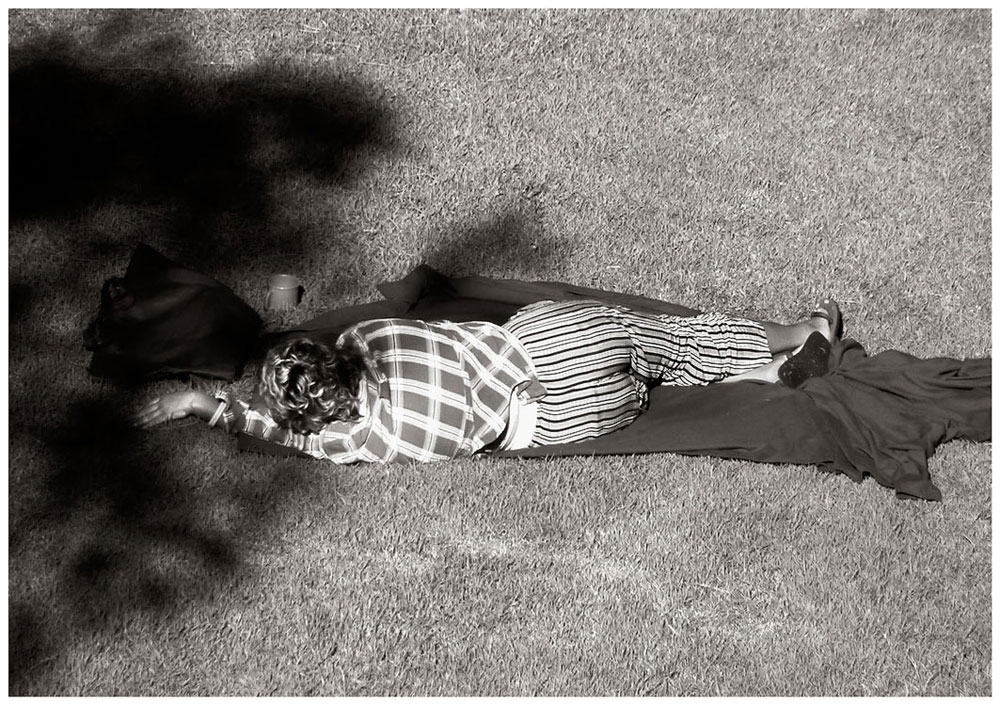
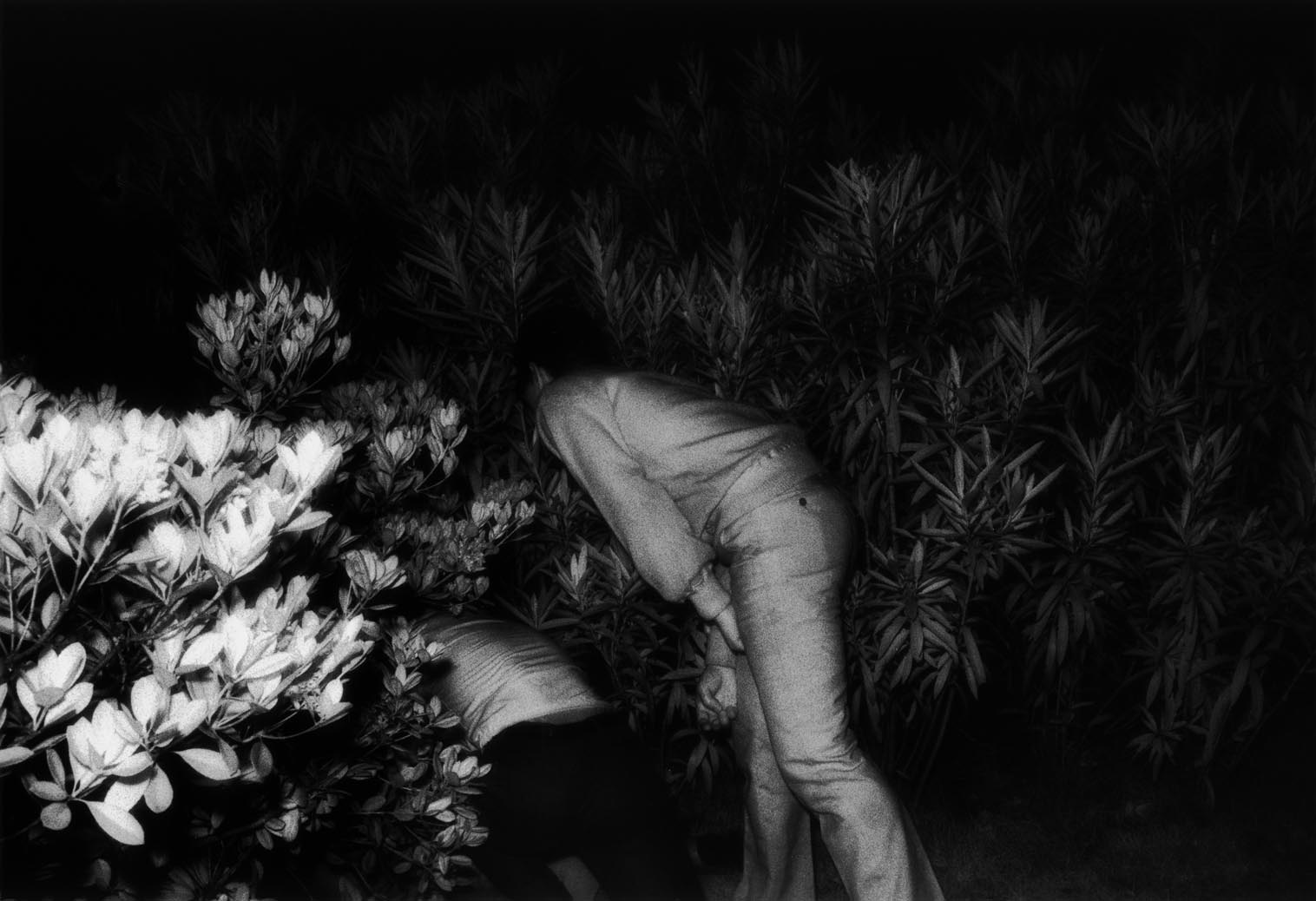
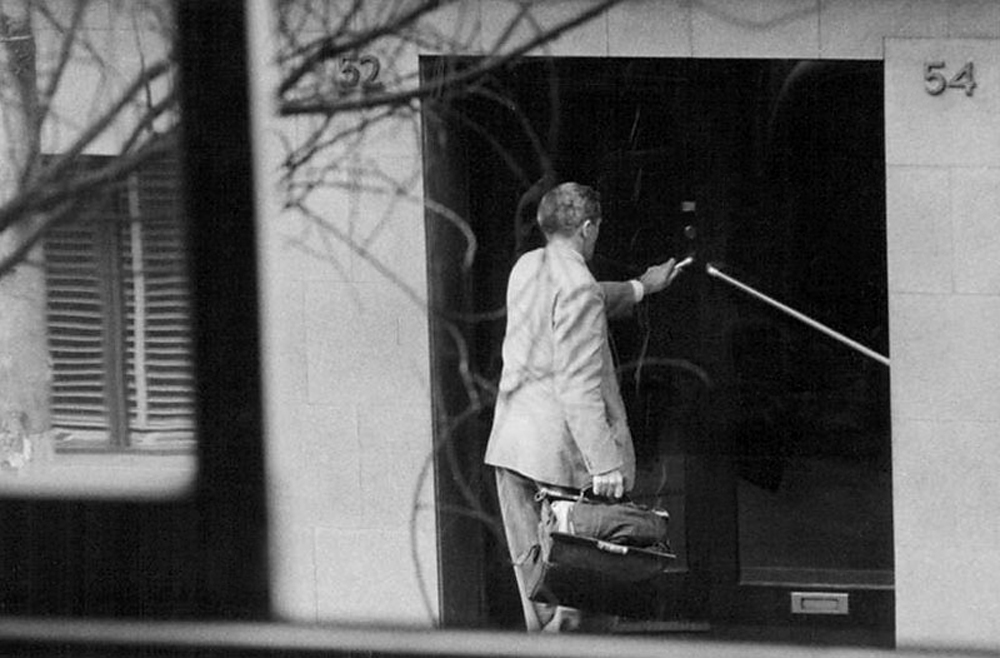
In the series of photographs I try to explore the gay male body not from the usual viewpoint of desire but from the viewpoint of intimacy, touch, affection and love. The infrared images are the positions of sleep of myself and my partner. If people find them erotic then that is their reading of the photographs. They are not meant to be. They explore an area of imagery of the male body which I think has been totally overlooked – male2male intimacy. An early example of this intimacy is a photograph by Minor White (below). Few have really developed this theme further. This is an imagery not as reliant on the posing, hard bodied, clench fisted, body as phallus orientated iconography so prevalent in contemporary male society. It is an example of imagery that has yet to find a semiotic space to express itself.


We seek to belong to a society that values coherence and conformity whilst promoting ‘individuality’. Staying close to the herd; not being different in thought, feeling or action; assuming masks; the replaceability and interchangeability of bodies. These are all conditions of this supposed ‘individuality’ in contemporary society, a society that is really afraid of any expression of difference and diversity. The gay community, long priding itself on valuing diversity, is equally guilty of this charge. Gay becomes a ‘performativity’,28 a repetition of rituals which does result in a loss of individuality, the subsuming of the individual into the ‘team’.

“The idea of being one’s self is often expressed as “doing one’s own thing.” We can say that one is being himself when he is doing (or thinking) what he really wants to do (or think). When, however, one is acting in a way that is intended to appeal to others or to a code of behaviour that does not come naturally to him, he is not “doing his own thing” at all. He is, in fact, “doing someone else’s thing.”29


A gay man may not really be ‘doing his own thing’ as he would like to think, but ‘doing someone else’s thing’, doing what every-body else is doing. This conformity is enforced by gay men themselves. Not society but individual will, the will to be part of the ‘team’; to seamlessly belong. Erich Fromm has said this is union by conformity. “In contemporary capitalistic society the meaning of equality has been transformed. By equality one refers to the equality of automatons; of men who have lost their individuality. Equality today means ‘sameness’, rather than ‘oneness’.”30

Of course, we are all convinced that we follow our own desires but in the gay community we see how these desires can be shaped to fit in with a standardised ‘ideal’ in regards to male body image, in order to become ‘the same’. I believe that gay men must try to negate and transcend the power inherently embodied in stereotypical representations of male body images. Says Chris Schilling,

“If our embodied experiences negate dominant conceptions of gender roles, for example, there is the basis for the creation or support of alternative views about men and women … It is important to note that not all bodies are changed in accordance with dominant images of masculinity and femininity, and there is much individuals can do to develop their bodies in different directions.”30 (My italics)


Minor White (American, 1908-1976) 'Ernest Stones and Robert Bright (San Francisco)' 1949


Minor White (American, 1908-1976)
Ernest Stones and Robert Bright (San Francisco)
1949
Gelatin silver print
in Bunnell, Peter. Minor White: The Eye That Shapes. Bulfinch Press, 1989, Figure 32


Negative No. 2342I. ‘Ernest Stones and Robert Bright’. 1949. 6″ x 6″ contact print (?)

One of my favourite Minor White photographs. Same men as above but lighter skin tones. Richness – tonality in shirts is amazing. Much more contrast than the reproduction, Plate 32 in Bunnell, Peter. Minor White: The Eye That Shapes. Boston: Bulfinch Press/Princeton University, 1989. Much more clarity than the reproduction, Plate 62 in Ellenzweig, Allen. The Homoerotic Photograph. New York: Columbia University Press, 1992, p. 111.

The presence of the hand on the shoulder is incredible. Such an intimate image between two men!

Bunyan, Marcus. “Research notes on photographs from the Minor White Archive,” Princeton University, New Jersey, 06/08/1999.


Marcus Bunyan (Australian, born England 1958) 'Untitled' 1995-1996 From the series 'Sleep/Wound'


Marcus Bunyan (Australian born England, b. 1958)
Untitled
1995
From the series Sleep/Wound
Gelatin silver print


Through our lived experience, our history of body, it’s context and it’s language, it is possible to support and encourage alternative ways that gay men can look at their own and other men’s bodies. As Michelangelo Signorile said it is possible to remember a time when we liked different types of bodies; we can promote an acceptance of different fantasies in regards to gender role representation that help support alternative views of masculinity, that help create a multiplicity of desires, because we have all previously desired different types of bodies.

As Naomi Wolf in her seminal book The Beauty Myth notes, “The shape and weight and texture and feel of bodies is crucial to pleasure but the appealing body will not be identical … The world of attraction grows blander and colder as everyone, first women and soon men, begin to look alike.”31

As gay men our personal experience of the feel of male bodies is crucial to an acceptance of difference. In the fluctuation of body image and identity boundaries through the interaction of bodies in sex, gay men may begin to explore the possibility of new forms of pleasure. But it would seem to me that gay men, instead of inventing new pleasures, constantly repeat and reiterate an old limiting pleasure, the desire for stereotypical muscular body image ideals. In the desire for intimacy, connection and possession of a man that has the signifier of the ‘ideal’ muscular mesomorphic body image, gay men may have multiple intimate sexual encounters that do not reinvent pleasure but repeatedly seek to confirm existing ‘ideals’ of social reproduction. This is not a multiplicity of pleasures expressed through a desire for different forms, but the expression of a singular, monocular pleasure that validates the social worth of one body-type.

The multiplicity of casual sexual encounters might open a gay man up to new experiences but these experiences are based on a desire for the fixed form of a solid, stable, secure, traditional masculine body. This is not a dissolution of boundaries to reinvent new pleasures but the reinforcement of traditional patriarchal masculine stereotypes that promotes discrimination against gay men who do not possess this kind of body. In revealing themselves in intimate casual sexual encounters by having unsafe sex with a muscular body image ‘ideal’ gay men may be exploring the diversity and difference of man sex in liberating but possibly dangerous ways, ways born out of desperation and desire to possess the body image ‘ideal’ that may be evidenced through a nihilistic lack of care, concern and responsibility for the inner Self and a lack of respect for others.

Expanding on a quotation by Kenneth Dutton I observe that: “The feminist struggle to overcome stereotypical images and open-up to women a range of options as to the roles they may wish to play, free of the male-imposed constraints of traditional socio-sexual expectation, is yet to find its masculine counterpart”31 in the body images of the male within the gay community.

Overcoming stereotypical images means first overcoming the hype of the hyper-masculine body. Strength in itself is not power but this type of muscular body is increasingly seen as powerful within the gay community. For some gay men a desire for the power of patriarchy is evidenced in their desire for these ‘ripped’ bodies with their ‘shredded’ muscle (both, ironically, terms of disembodiment and therefore dehumanisation) as proof that they are ‘real’ masculine men. The supposed irony present in gay male sex and sexuality, of one man fucking another man to disrupt the ‘norms’ of hegemonic masculinity has, I believe, disappeared in a reaffirmation of traditional forms of masculine identity.

The power of beauty is no longer the power of the effete, the weak, the hidden, but the power of the muscularly visible. Judgements made by gay men on other gay men depend to a significant degree on the representation of this power through the possession of the form of the muscular body, the desire for it’s hardness and strength dictated by the collective desire of a gay male sexual orientation. Gay men must be made more aware that this collective desire is based on traditional forms of hegemonic masculinity replete with the discriminations that this identity construction entails. Learning from past histories and experiences we must try to stop such conditions being repeated so that discrimination does not exist in future identities.


Marcus Bunyan (Australian, born England 1958) 'Untitled' 1995-1996 From the series 'Sleep/Wound'


Marcus Bunyan (Australian born England, b. 1958)
Untitled
1995
From the series Sleep/Wound
Gelatin silver print


We must work to expand the underlying societal attitude of what is seen as the desirable ‘look’ of the gay male body in order to open up different body-types as fantasies for gay men. It is gay men’s (re)actions in regards to bodies of all types that is important. We must encourage a personal self-acceptance that increases self-esteem through achievement. This may include going to the gym to develop your body but this activity should be undertaken with an awareness of all the issues involved in such a quest. As Michael East comments,

“At the end of the day, we as men have to do what the women have had to do to cope with body image pressure for the last 50 years: ie., accept ourselves as we are. Ultimately, no matter how big our muscles are, how cool an exterior we can project, or how mental, agile or superior we pretend we are, we too are human, and must set our own bench marks, and not use others. At the end of the day, it comes down to how you feel about your body. No matter what size or shape you’re in, if you are cool about it – that is of primary importance.”33 (My italics and bold).


He goes on to suggest several strategies that help promote an acceptance of body image:

1/ “Make a deal with yourself that you are going to stop giving yourself a hard time about it. With a clear head and less subjective approach to the situation you’ll be better equipped to take stock of what the real issues are, and these could have nothing to do with your body at all.

2/ Clear out the junk – negative thoughts about yourself, the world, what you’re doing with your life [basically self-actualization]. This also includes associates that subtly or otherwise give you a hard time about your body shape/size.

3/ If your house or private space is furnished with nothing but multitudes of images of semi naked men with great bods, why not take them down for a while to give yourself a more neutral space to take stock?

4/ Focus on other aspects of yourself. Unless you’ve convinced yourself that you are a complete loser, list all the good things that you have done with your life, an all the good things about you that people compliment you on.” [Increasing self-esteem through achievement]


I think that the last point is vitally important. Body image is part of an overall self-esteem package and feeling better about yourself overall will help you feel better about your body. Conversely, feeling better about your body by getting in shape, going to the gym for the right reasons, can help improve your overall self-esteem. Self-esteem is built through the acceptance and achievement of an integrated identity, valuing all parts of the self. Its no good going to the gym and getting a great body if you haven’t sorted out other issues in your life because you’ll still think that you look like crap anyway! Then you’ll want bigger muscles and an even better body thinking this will improve your self-esteem and be the solution to your problems34 ….


Conclusion

I will conclude this chapter with an eloquent quotation by Wendy Chapkis and a few comments from myself. I believe that this quotation is a fitting summation to this chapter and perhaps to the whole research project. It most closely expresses and reflects – through the spiritually succinct words of someone I admire – ideas and thoughts on the subject matter that have evolved as this research project has developed to fruition.

“The politics of appearance inextricably bound up with the structures of social, political and economic inequality … Fighting pressure to conform, attempting to hold one’s own against the commercial and cultural images of the acceptable is a crucial first act of resistance. The attempt to pass and blend in actually hides us from those we most resemble. We end up robbing each other of authentic reflections of ourselves. Instead, imperfectly visible behind a fashion of conformity, we fear to meet each others’ eyes … Real diversity can only become a source of strength if we learn to acknowledge it rather than disguise it. Only then can we recognize each other as different and therefore exciting, imperfect and as such enough.”35 (My italics)


Our difference and diversity is our strength as gay people.
We must not crush our difference through discrimination.
We must not hide our diversity behind masks.
We must resist commercial and cultural images of the acceptable.

Yes we are imperfect and what an exciting perfection it is!


Dr Marcus Bunyan 2001


Footnotes

1/ Signorile, Michelangelo. Life Outside: The Signorile Report on Gay Men: Sex, Drugs, Muscles, and the Passages of Life. New York: HarperCollins Publishers, 1997, pp. 298-299.

2/ Interview with Taylor, Barry. Melbourne. 01/07/1997. Manager of the Victorian State Youth Suicide Prevention Programme 1996 and now working with gay people on mental health issues.

3/ Ridge, Damien. “Queer Connections: Community, ‘the Scene’ and an Epidemic,” in Journal of Contemporary Ethnography June 1996, pp. 15-16.

4/ Hatfield, Elaine and Sprecher, Susan. Mirror, Mirror: The Importance of Looks in Everyday Life. Albany: State University of New York Press, 1986, p. 313.

5/ Benson, Lou. Images, Heroes and Self-Perceptions. New Jersey: Prentice-Hall, 1974, p. 30.

6/ Fromm, Erich. The Art of Loving. London: Allen and Unwin, 1957, quoted in Benson, Lou. Images, Heroes and Self-Perceptions. New Jersey: Prentice-Hall, 1974, p. 30.

7/ “… body attractiveness is so highly valued that it has the single most important impact on many individuals feelings of physical self-worth. Physical self-worth affects self-esteem.”

Wankel, Leonard. “Self-Esteem and Body Image: The Research File: information for professionals from the Canadian Fitness and Lifestyle Research Institute,” in Canadian Medical Association Journal 153 (5). September 1st, 1995, p. 607.

See also Berscheid, E., Hatfield (Walster), E. and Bohrnstedt, G. “The Happy American Body: A Survey Report,” in Psychology Today 7. 1973, pp. 119-131.

8/ “Low self-esteem is associated with depression and may contribute to suicidal behaviour (Rutter, 1986) … throughout adolescence, self-esteem appears to be affected by young people’s judgements of their competence in certain valued domains (Harter, 1990). Domains identified as important include physical attractiveness, acceptance by peers, and, to a lesser extent, academic competence, athletic ability, and conduct.”

Crockett, L. and Peterson, A. “Adolescent Development: Health Risks and Opportunities,” in Millstein, S. and Peterson, A. and Nightingale, E. (eds.,). Promoting the Health of Adolescents. Oxford: Oxford University Press, 1993, p. 19.

Rutter, M. “The Developmental Psychopathology of Depression: Issues and Perspectives,” in Rutter, M. and Izard, C. and Read, P. (eds.,). Depression in Young People: Developmental and Clinical Perspectives. New York: Guilford, 1986.

Harter, S. “Self and Identity Development,” in Feldman, S.S. and Elliott, G.R. (eds.,). At the Threshold: The Developing Adolescent. Cambridge, MA: Harvard University Press, 1990.

9/ Hatfield and Sprecher, 1986, Op cit. p. 123.

10/ Signorile, 1997, Op cit. pp. 226-227.

11/ “For gay men, sex, the most powerful implement of attachment and arousal, is also an agent of communion, replacing an often hostile family and even shaping politics.”

Goldstein, Richard. “Heartsick: Fear and Loving in the Gay Community,” in The Village Voice June 28th, 1983, quoted in Watney, Simon. “The Rhetoric of AIDS,” in Wallis, Brian (ed.,). Blasted Allegories. Cambridge, Mass: The MIT Press, 1987, p. 165.

12/ “We have noted earlier that the hero in our society is often depicted as a loner, a man without ties. This encourages people to wear the mask of the loner while inside their need for community remains unfulfilled. There results a kind of taboo on closeness and affiliation in our overt behaviour, while unconsciously the longing continues to cause us great distress.”

Benson, 1974, Op cit p. 397.

13/ Benson, 1974, Op cit p. 397.

14/ MB: Self-actualization is concerned not just with end product, but in the actual experience of the process itself, whether it is baking a cake, playing the piano, going to the gym, or having sex. We can both enjoy the actual process and the outcome FOR WHAT THEY ARE, not what we would like them to be.

“[An] important area in which self-actualizing people differ from others is in their non judgmental acceptance of themselves … They can accept their own human nature in the stoic style, with all its shortcomings, with all its discrepancies from the ideal image without feeling real concern. Such feeling of comfort and acceptance with the self are extremely important in terms of laying down a tone that underlies a person’s whole existence.”

Benson, 1974, Op cit p. 356-357.

15/ Maslow, A. Motivation and Personality. New York: Harper & Row, 1970 cited in Benson, 1974, Op cit pp. 356-357.

16/ Signorile, 1997, Op cit. pp. 267-268.

17/ Interview with Taylor, Barry. Melbourne. 01/07/1997. Manager of the Victorian State Youth Suicide Prevention Programme 1996 and now working with gay people on mental health issues.

18/ Lakoff, Robin and Scherr, Raquel. Face Value: The Politics of Beauty. Boston: Routledge and Kegan Paul, 1984, p. 284.

19/ Houston, R. “The Way We Wear,” in Gay News Vol. 131. 1978, p. 14, quoted in Blachford, Gregg. “Male Dominance and the Gay World,” in Plummer, Kenneth (ed.,). The Making of the Modern Homosexual. London: Hutchinson, 1981, p. 191.

20/ Roddick, Anita (ed.,). “The Body and Self Esteem,” in Full Voice Issue One. Australia: Adidem Pty. Ltd., 1997.

21/ Blachford, Gregg. “Male Dominance and the Gay World,” in Plummer, Kenneth (ed.,). The Making of the Modern Homosexual. London: Hutchinson, 1981, p. 191.

22/ Mann, William J. “Perfect Bound,” in XY Magazine No.7. California: XY Publishing, April/May 1997, pp. 26-28.

23/Michelangelo Signorile quoted in Mann, 1997, Op cit pp. 26-28.

24/ “It is not through any intrinsic quality of the sign but rather through the interpretative acts of members of a sign community that the sign comes to have meaning. Hence the transmutability of all signs, their capacity to serve as signified and signifier, independent of their physical properties.”

Stewart, Susan. On Longing: Narratives of the Miniature, the Gigantic, the Souvenir, the Collection. Durham: Duke University Press, 1993, p. 32.

25/ Tagg, John. The Burden of Representation: Essays on Photographies and Histories. Basingstoke: Macmillan, 1988, pp. 101-102.

26/ Fromm, Erich. The Art of Loving. London: Allen and Unwin, 1957, pp. 28-29.

27/ Ibid., pp. 28-29.

28/ “I would suggest that ‘performativity’ cannot be understood outside of a process of iterability, a regularized and constrained repetition of norms. And this repetition is not performed by a subject; this repetition is what enables a subject and constitutes the temporal condition for the subject. This iterability implies that “performance” is not a singular “act” or event, but a ritualized production, a ritual reiterated under and through constraint, under and through the force of prohibition and taboo, with the threat of ostracism and even death controlling and compelling the shape of the production, but not, I will insist, determining it fully in advance.”

Butler, Judith. Bodies That Matter. New York: Routledge, 1993, pp. 94-95.

“The validation of gay bodies in sex becomes, in Judith Butler’s terms, both ‘citational’ and ‘performative’, where gay men quote their own ‘norms’ of desirability and performance in order not to be named ‘other’, in order to belong and be seen as the ‘same’. And in seeing yourself as a ‘real’ man, I think this ‘performativity’ and ‘citationality’ may have become hidden from view in the deception of gay men seeing themselves as the same. If you do not match up to these ‘normalities’ of interaction then I wonder how much real emotional involvement there is, especially when the negotiation skills of some gay men are not as developed as Gary Dowsett would like to think. Producing sexually proficient men in sexually vital bodies is no longer a hands on task within the gay community, but rather the emotionally uninvolving experience of sexual jurisprudence, a sighting of the law of sexual performance that is not seen as such by gay men.”

Bunyan, Marcus. ‘Sex and Sensibility: Gay Eth(n)ics into the New Millennium’ paper presented at HID3, Proceedings of the 3rd National Lesbian, Gay, Transgender and Bisexual Health Conference, Adelaide, South Australia, 1999

29/ Benson, 1974, Op cit pp. 4-5.

30/ Fromm, 1957 Op cit p. 19.

31/ Wolf, Naomi. The Beauty Myth. London: Vintage, 1991, pp. 176-177.

32/ Dutton, Kenneth. The Perfectible Body. London: Cassell, 1995, p. 373.

33/ East, Michael. “Mirror, Mirror … Exploring men’s body image,” in McLean, Max (ed.,). Melbourne Star Observer Issue 494. Body & Soul. Melbourne: Satellite Media, 29th October 1999, p. 12.

34/ “”I want to be physical perfection in the eyes(most important) of gay men – totally physically appealing, like the ultimate. The perfect tits and butt, bulbous biceps. I want to achieve symmetry, big and in proportion. I would look like the cover of an HX [Homo Xtra, a New York bar giveaway known for its covers of hot men] – lean, sculpted, muscular, virile, a stallion, a guy that would make your mouth water. I want to know what it’s like to walk down the street and have everyone look at you, absolutely everyone. I want to know what it’s like to really feel like an object.” What does he believe all of this will do for him? “Honestly, and I’m embarrassed to say it, but I’m hoping it will boost my self-esteem,” he admits. “I don’t know how to boost my self-esteem now. My feeling is, ‘Get a great body and people will admire you. Get a great body and everything will be okay’ … It’s this belief that if I can just get the perfect body, then I wouldn’t be insecure.””

Signorile, Michelangelo. Life Outside: The Signorile Report on Gay Men: Sex, Drugs, Muscles, and the Passages of Life. New York: HarperCollins Publishers, 1997, p. 4.

35/ Chapkis, Wendy. Beauty Secrets: Women and the Politics of Appearance. Boston: South End Press, 1986, p. 175.


LIKE ART BLART ON FACEBOOK

Back to top

Text: “Bench Press” chapter from Marcus Bunyan’s PhD research ‘Pressing the Flesh: Sex, Body Image and the Gay Male’, RMIT University, Melbourne, 2001

November 2022


Eugen Sandow (German, 1867-1925) 'Instructions for the use of Sandow's spring grip dumb-bells' Between 1900 and 1909 (detail)


Eugen Sandow (German, 1867-1925)
Instructions for the use of Sandow’s spring grip dumb-bells (detail)
Between 1900 and 1909
(23 pages): illustrations; 18 cm
National Library of Australia, Canberra viewed 10 November 2022


Since the demise of my old website, my PhD research Pressing the Flesh: Sex, Body Image and the Gay Male (RMIT University, Melbourne, 2001) has no longer been available online.

I have now republished the second of twelve chapters, “Bench Press”, so that it is available to read. More chapters will be added as I get time. I hope the text is of some interest. Other chapters include Historical Pressings which examines the history of photographic images of the male body, including the male body as desired by gay men, and the portrayal in photography of the gay male body; In Press which investigates the photographic representation of the muscular male body in the (sometimes gay) media and gay male pornography; and Re-pressentation which alternative investigates ways of imag(in)ing the male body and the issues surrounding the re-pressentation of different body images for gay men.

Dr Marcus Bunyan November 2022


“Bench Press” chapter from Marcus Bunyan’s PhD research Pressing the Flesh: Sex, Body Image and the Gay Male RMIT University, Melbourne, 2001

Through plain language English (not academic speak) the text of this chapter investigates the development of gym culture, its ‘masculinity’1, ‘lifestyle’, and the images used to represent it. The text also examines the positive and negative effects of this culture on the individual and collective lives and bodies of gay men.

NB. This chapter should be read in conjunction with the Historical Pressings and Re-Pressentation chapters for a fuller overview of the development of the muscular male body. This chapter also contains descriptions of sexual activity.


Keywords

The Cult of Muscularity, male bodies, queer bodies, bodybuilding, gym culture, masculinity, images of masculinity, development of gym culture, gay men and gym culture, muscular mesomorph, gay lifestyle, self-esteem, body-esteem, Polite Porn, phallic armoured body, desire, HIV/AIDS, photography and the body, before/after photographs, gay desire

Sections

1/ The Cult of Muscularity
2/ The Body and the Social Environment
3/ Science, Photography and the Body
4/ Before / after photographs
5/ Power and the Muscular Body
6/ The Phallic Armoured Body
7/ Muscle Gods, Hot Jocks, and Gay Desire
8/ The Muscular Male Body: Positive and Negative Effects

Word count 7,036

Please note: all photographs are used under “fair use” conditions for the purposes of eduction and research.


Bench Press

The Cult of Muscularity


“… muscularity is a key term in appraising men’s bodies … this comes from men themselves. Muscularity is the sign of power – natural, achieved, phallic.”


Richard Dyer 2


Eugen Sandow (German, 1867-1925) 'Instructions for the use of Sandow's spring grip dumb-bells' Between 1900 and 1909 (detail)


Eugen Sandow (German, 1867-1925)
Instructions for the use of Sandow’s spring grip dumb-bells (detail)
Between 1900 and 1909
(23 pages): illustrations; 18 cm
National Library of Australia, Canberra viewed 10 November 2022


‘The Cult of Muscularity’ was formed in the last decade of the 19th century and the early decades of the 20th century in a reaction to the perceived effeminisation of heterosexual masculinity. Sporting and war heroes became national icons. Muscle proved the ‘masculinity’ of men, fit for power, fit to dominate women and less powerful men. The ‘ideal’ of the perfect masculine body can be linked to a concern for the position and power of men in an industrialised world.3

The position of the active, heroic hetero-male was under attack from the passivity of industrialisation, from the expansion of women’s rights and their ability to become breadwinners, and through the naming of deviant sexualities that were seen as a threat to the stability of society. By naming deviant sexualities they became visible to the general public for the fist time, creating apprehension in the minds of men gazing upon the bodies of other men lest they be thought of as ‘pansies’. (Remember that it was in this decade the trials of Oscar Wilde had taken place in England after he was accused of being a sodomite by The Marquis of Queensbury. It is perhaps no coincidence that the rules that governed boxing, a very masculine sport in which a man could become a popular hero, were named after his accuser. By all accounts he was a brute of a man who despised and beat his son Lord Alfred Douglas and sought revenge on his partner, Oscar Wilde, for their sexual adventures).

Muscles became the sign of heterosexual power, prowess, and virility. A man had control over his body and his physical world. His appearance affected how he interacted with this world, how he saw himself, and was seen by others, and how closely he matched the male physical ‘ideal’ impacted on his own levels of self-esteem. The gymnasium became a meeting point for exercise, for health, for male bonding, and to show off your undoubted ‘masculinity’.


Anonymous photographer. 'Untitled [Gym group possibly German/Prussian]' c. 1890-1910


Anonymous photographer
Untitled [Gym group possibly German/Prussian]
c. 1890-1910
Silver gelatin photograph
Courtesy: Marcus Bunyan


Ultimately, going to the gym has more to do with fitting a certain ‘ideal’ image of ‘masculinity’, that of the muscular mesomorph, than it has to do with getting fit. Aerobic activity such as swimming or running are much more effective ways of getting fit. But what gym work does much better than aerobic activity is that it builds muscle mass. And for a man that wants to be recognised for his physical presence, having more muscle is the epitome of the ‘ideal’.

In a patriarchal society, in other words in a society where men have power over women and other men, to have a masculine body was / is seen as the opposite of being feminine or gay – it emphasises the difference between the position of men and women / gays in society. They are seen as inferior whilst a mesomorphic body confirms ‘real’ men in positions of power over others. No wonder homosexuals found muscular working class men (‘rough trade’) so enticing a sexual fantasy in the early part of this century, and still do to this day.

Still, in being named by the majority limp-wristed ‘nancies’ and by accepting that label now historically ourselves, we forget that not all gay men were pansies with effeminate mannerisms, even in those times.

In contemporary society the division between straight and gay ‘masculine’ bodies has diminished. At dance parties it is now difficult to tell which is the gay body and which is the straight. In seeking acceptance and assimilation into the general society gay men have moulded their bodies on the ‘ideal’ of the muscular mesomorphic model. Both gay and straight men are likely to be striving after the same muscular mesomorphic ideal so much so that they may both become homogenised into a non-feminine, paradoxical asexual masculinity, where very little sexuality exudes from any-body at all!


Siegmund Klein – 'Strength & Health' (March 1933) Vol. 1 No. 4


Siegmund Klein – Strength & Health (March 1933) Vol. 1 No. 4


The Body and the Social Environment

The development of ‘The Cult of Muscularity’ may also have parallels in other social environments which were evolving at the turn of the century. For example, I think that the construction of the muscular mesomorphic body can be linked to the appearance of the first skyscrapers in cities in the United States of America. Skyscrapers were a way increasing visibility and surface area within the limited space of a crowded city. One of the benefits of owning a skyscraper like the Chrysler Building in New York, with its increased surface area, was that it got the company noticed. The same can be said of the muscular body. Living and interacting in the city, the body itself is inscribed by social interaction with its environment, its systems of regulation and its memories and historicities (his-tor-i-city, ‘tor’ being a large hill or formation of rocks).

Like a skyscraper, the muscular body has more surface area, is more visible, attracts more attention to its owner and is more admired. The owner of this body is desired because of his external appearance which may give him a feeling of superiority and power over others. However, this body image may also lead to low self-esteem and heightened body dissatisfaction in the owner (causing anxiety and insecurity in his identity) as he constantly strives to maintain and enhance his body to fulfil expectations he has of himself.

Of course, body image is never a static concept as the power of muscular images of the male body resides in their perceived value as a commodity. This value is re-enforced through social moral values, through fluid personal interactions, and through the desire of self and others for this type of body image; it is a hierarchical system of valuation. It relies on what type of body is seen as socially desirable and ‘beautiful’ in a collective sense, even though physical attractiveness is very much a personal choice.

In the four photographs from the 1930s (below) we can see a range of ethnic men portrayed, all seeking the attainment of what was, for them, the perfection of the muscular human form. Indian, Chinese, Black American and Phillipino are all represented. Compare this to today’s cast of body types from a gay muscle fitness video (soft core pornography video aimed squarely at the gay market) and you can see how the broad inclusion of different ethnic types has been tailored to the demographics of its particular buying public (‘masculine’ white gay male).

Today what is desirable in a masculine body seems to be even more limited in its stereotyping than was the case in the 1930s. Then, at least, there was a diversified range of ethnicity. Now, within the ‘lifestyle’ health and fitness magazines, the paradigm for the desirable male body is predominantly the tanned, toned, muscular white male. Thankfully, professional buff, body-builders do still come in all colours!


Anonymous photographer. 'Anselus T. Del Rosario' c. 1930


Anonymous photographer
Anselus T. Del Rosario
c. 1930
in Berry, Mark. Physical Improvement. Vol. II. Philadelphia: Milo Publishing Company, 1930, p. 78
Courtesy: Marcus Bunyan

“There is something unusual about the back of this young Phillipino, Anselus T. Del Rosario. The pose is rather original and offers suggestion to others.”


Anonymous photographers. 'Three bodybuilders' c. 1930


(left to right)

Anonymous photographer
Cheah Chin Poh
c. 1930
in Berry, Mark. Physical Improvement. Vol. II. Philadelphia: Milo Publishing Company, 1930, p. 261
Courtesy: Marcus Bunyan

Anonymous photographer
Prof. C. C. Shah
c. 1930
in Berry, Mark. Physical Improvement. Vol. II. Philadelphia: Milo Publishing Company, 1930, p. 261
Courtesy: Marcus Bunyan

Anonymous photographer
Wesley Williams
c. 1930
in Berry, Mark. Physical Improvement. Vol. II. Philadelphia: Milo Publishing Company, 1930, p. 154
Courtesy: Marcus Bunyan


Science, Photography and the Body

In the Victorian and Edwardian eras the knowledge of science, such as the science of physical fitness for example, allowed the body to become an object that was subject to technical expertise. Physical fitness was taken up by governments and their armies to enforce standards of fitness for recruits, the medical examination ensuring suitability for service and the fitness regime ensuring that all bodies were interchangeable and replaceable in the event of death on the battlefield. The body became a site of intervention; it became malleable and plastic, subject to the demands of the self and State. This trend continues at an unabated pace today especially within the personal sphere; in the ‘miracles’ of steroid enhancement, plastic surgery, implants and liposuction all there to help you attain the ‘perfect’ body. Now ALL bodies can start to look alike, interchangeable one with another.

Photography, also a relatively new science in that era (photography is both an art and a science), confirmed the ‘truth’ of the power of the muscular body through documentary evidence. The camera acted to legitimise the concerns of men over their body image through relationship of power to the practice of representation. Surveillance of the self became a major factor in the construction of your social identity. Through photographs you could judge for yourself whether you measured up to the ‘ideals’ put forward as valuable by society. Therefore images of muscular mesomorphs can and do affect the self-esteem of individuals through a powerful semiotic system that is embedded in the idealised body factually re-presented in a photograph.

This power is validated because people know the key to interpret the coded ‘sign’ language through which photographs, and indeed all images, speak. In neglecting to acknowledge alternative significations present within this semiotically coded power structure there is the opportunity for one dominant image to be chosen selectively over other types of less ‘valuable’ body images, eventually leading to the possible loss of the key to decode the desirability of ‘other’ body images.

The problem with dominant images that promote the masculinity and power of the muscular mesomorphic body is that they portray one supposed objective truth which is impossible, for there can be can many changing ‘truths’ (viewed from many subjective and objective positions).4 Personally, I believe we should see things not solely as they are from an objective point of view and not purely from an appeal to an “actively struggled for” subjectivity (as argued for by David Smail), but perhaps emerging from a knowledge of the fluid nature of truth, an ever changing combination of many variable truths. Being true to ourselves does not require a one-eyed point of view for we must try to see things from many different points of view to appreciate that there are many shifting, non-final subjective, objective and variable ‘truths’ in life.

Images can be a fabrication just as easily as they are supposed to speak the language of an objective ‘truth’. For example, in the 1870s Dr. Barnardo had photographs taken that showed rough, dirty, and dishevelled children arriving at his homes, and then paired them with photographs of the same children bright as a new pin, happy and working in the homes afterwards. These photographs were used to sell the story of children saved from poverty and oppression and happy in the homes; they appeared on cards which were sold to raise money to support the work of these homes. Dr. Barnardo was taken to court when one such pair of photographs was found to be a fabrication, an ‘artistic fiction’.5

Photographs can be used not only as a tool of observation but as a commodity, to advertise, support and sell the existence of a regime of power that controls the body, in the case of Dr. Barnardo the body of the child. In this way the body of the child becomes a commodity too.


Before / after photographs

Anonymous photographer. 'M. J. Poncela' c. 1930


Anonymous photographer
M. J. Poncela
c. 1930
in Berry, Mark. Physical Improvement. Vol. II. Philadelphia: Milo Publishing Company, 1930, p. 211
Courtesy: Marcus Bunyan


Anonymous photographer. 'George Renzi, Jr.' c. 1930


Anonymous photographer
George Renzi, Jr.
c. 1930
in Berry, Mark. Physical Improvement. Vol. II. Philadelphia: Milo Publishing Company, 1930, p. 210
Courtesy: Marcus Bunyan


Anonymous photographer. 'Untitled' c. 1952


Anonymous photographer
Untitled
c. 1952
‘Before photo/after photo, 35 day Johnson bodybuilding program advertisement’, in Rader, Peary (ed.,). Iron Man. Vol. 12. Dec-Feb. 1952, No. 4. Alliance, Nebraska: Iron Man Publishing Co., 1952, pp. 26-27.
Courtesy: Marcus Bunyan


Anonymous photographer. 'The New Theory of Evolution (Unretouched photographs taken over a period of less than 12 weeks)' 1998


Anonymous photographer
The New Theory of Evolution (Unretouched photographs taken over a period of less than 12 weeks)
1998
Experimental and Applied Sciences advertisement, 1998, in Low, Cheh N. (ed.,). Exercise for Men Only. New York: Chelo Publishing, December 1998, pp. 2-3.


The same process of commodification of the body can be seen in the ‘Before and After’ photographs from the 1930’s. The science of physical fitness has always sold product to go with its ideals and the use of before and after photos echoes those of Dr. Barnardo. Here I am looking at my own weak and puny body and then looking at these photographs and advertisements that are telling me: ‘You can have a bigger, better body in only (substitute x amount of time) days or weeks!’ You can attain the perfect male body. But it will cost you. In time, in money, in sacrifices, perhaps in failure. But you desire that body don’t you, you want that body, you want to belong!

The photographs from the 1930s show examples of bodily improvement over a period of one year, a reasonable amount of time given the improvement shown. As the century progressed however, the claims for products became more outlandish and photography was used to bolster these claims. In the 1952 photographs above for example, the photograph is used to authenticate the models physical improvement in just 35 days! Note, however, that in the second photograph the model is standing closer to the camera than in the first one, he has a tan which makes him look healthier, is oiled up, and his hair is bigger to give him more physical presence. He is also engaging the gaze of the viewer, returning his look, which in itself is a more challenging, defiant act.

Nothing much has changed in advertising claims from the 1950s until today. In the unretouched sequence of photographs (above) from 1998 (for a leading supplier of sports nutritional supplements), we are asked to believe a new, super-fast “Theory of Evolution” exists, all achieved in less than 12 weeks.

I am not suggesting for one minute that these photographs actually lie. But they do restructure the ‘truth’. Firstly, the model does not have an ‘ordinary’ body to start with. You only have to look at the legs and arms in all four photographs to realise that this man is probably a bodybuilder who is out of condition and training. In the first photograph he is stooped, unkempt, unshaven, hairy, flat-footed & slovenly. Much the same as the photographs of children arriving at the Dr. Barnardo’s homes in the 1870s. Funny about that. As the sequence progresses he becomes happier, taller, more ‘pumped’ and ‘cut’ till he positively shines like burnished steel, his muscles glowing as he strides on the balls of his feet into the future. His fists become clenched to emphasise his bulging muscles and his manliness.

Hey, its a ‘lifestyle’ thing. Muscular men look after their bodies, have no moral disorders and are happier and more successful!


Anonymous photographer. 'Bill Good executing Stretching Exercise course' c. 1930 and 'Bill Good executing Free Motion exercises' c. 1930


(left and right)

Anonymous photographer
Bill Good executing Stretching Exercise course
c. 1930
in Berry, Mark. Physical Improvement. Vol. I. Philadelphia: Milo Publishing Company, 1930, p. 143
Courtesy: Marcus Bunyan

Anonymous photographer
Bill Good executing Free Motion exercises
c. 1930
in Berry, Mark. Physical Improvement. Vol. I. Philadelphia: Milo Publishing Company, 1930, p. 127
Courtesy: Marcus Bunyan


Power and the Muscular Body

Increasingly, the body was not only able to exercise on its way to muscularity it was also able to exercise the ritual semiotic language of the hyper-masculine body as power over the social body in general. A sociology of the body was constructed based on the interaction with history, memory and context. Men sought to transform their body and the social body through the structures and rituals of power, naming deviants such as homosexuals as ‘other’ and therefore reducing them to an inferior status. It is not surprising that homosexual men are attracted to this power. For a long time they have been subject to persecution & derision, and saw themselves as inferior. Now, with the adoption of hyper-masculine bodies as the epitome of gay male image, gay men seek to be ‘real’ men perhaps even more than straight men. Unfortunately this may reinforce traditional patriarchal stereotypes within the gay community, a community that is supposed to pride itself on equality and diversity. The very things that homosexuals have long fought against, oppression and discrimination, may be confirmed in the exercising of power by the muscular ‘ideal’ within the gay community.

In the conformation of the power of the muscular body I suggest that gay men may have adopted a mask to cover their own insecurities in order to seek acceptance for themselves into the gay and general population. This mask has become more than just a facade for some gay men, it has become their reality. The owner of a body that measures up to the ideal may seek acceptance of him- self in the perfection of his own reflection. What he sees in this reflection is, perhaps, not his ‘true’ self but a mask that is put on, a pre-formed surface that reflects the values of the society from which it emanates, perhaps a surface that is only skin deep inscribed by his social enculturation and assimilation. Once put on this mask is very difficult to take off; how many times do we see the words “straight acting” in newspaper advertisements in the gay press describing what is sexually offered and wanted, as though being str8-acting enables our gay masculinity and makes us ‘real’ men? I believe it is no longer an ironic act for gay men to try and fulfil the straight hyper-masculine ideal, not a ‘camp’ ironic comment as it used to be, but a deadly serious endeavour. This has important repercussions for the psyche of all gay men and I discuss these repercussions later in this chapter and also in the (S)ex-press chapter.

As can be seen from the photographs within this text, there has been a development of the complete ‘look’ of the body over the last century. Beautiful muscles compliment a beautiful ‘lifestyle’6 and an equally beautiful tan. Appearance and the power of that appearance is now of the essence. The appearance of this ideal ‘lifestyle’ is available to everyone of us, regardless of social status or age, how rich or poor we are as gay men – yeah, right!


Raymond Vino. 'Steve Downs' 1998


Raymond Vino
Steve Downs
1998
in Low, Cheh N. (ed.,). Exercise for Men Only. New York: Chelo Publishing, December 1998, p. 103.


Bob Jones (American) 'Short Mens Class', 'Untitled', 'Untitled' 1952


(top to bottom)

Bob Jones (American)
Short Mens Class
Untitled
Untitled
1952
in Rader, Peary (ed.,). Iron Man. Vol. 12. Dec-Feb. 1952, No. 4. Alliance, Nebraska: Iron Man Publishing Co., 1952, p. 8
Courtesy: Marcus Bunyan


Now aren’t there some good looking men amongst this lot! I wonder how many of them were gay? Not an effeminate man to be seen here, you can bet your life. These are all ‘real’ he-men: strong, masculine and ruggedly virile examples of manhood. There is still a range of ethnicities present in these 1950s photographs, from Brazilians to Afro-Americans & men of Asian origin but there is not a hairy man amongst them. They probably shaved for the event, a very feminine thing for a man to do! These photographs also serve to illustrate another point: that although body shape might be slightly different when compared to each other, overall the bodies seem to form a homogenised whole, forms which seem to have been pressed from the same mould (‘template man’).


We observe the billboards with the fashionable ‘lifestyle’ Calvin Klein underwear ads, featuring some truly amazing bodies. We desire these bodies in all their airbrushed glory, ‘simulations’ of an ideal world where bodies are perfect, not all sorts of shapes and sizes as in the real world.

We lust after the perfect idealisation of the muscular body and the projected power that this ‘ideal’ body image and its lifestyle proposes. This perfection is never obtainable, of course, because we can always have bigger muscles, a better tan, more fashionable clothes, etc. … The ‘ideal’ is like a carrot on a stick, always just beyond our reach, like an ever receding dream.


Anonymous. 'Untitled [Posing straps]' 1952


Anonymous
Untitled [Posing straps]
1952
Athletic Model Guild advertisement, in Rader, Peary (ed.,). Iron Man. Vol. 12. Dec-Feb. 1952, No. 4. Alliance, Nebraska: Iron Man Publishing Co., 1952, p. 50.
Courtesy: Marcus Bunyan


The Phallic Armoured Body

In much of the imagery of the muscular male the body becomes a substitute for the undisclosed and hidden power of the penis. The body becomes a huge phallus, hard and rigid, strong, erect, and powerful. The muscular body acts as a phallic symbol, surrounding itself with an implied sexual mystique, the physical embodiment of the male phallic power. But the penis can never live up to these expectations.7 After all the penis is just an appendage of limp flesh and looks faintly ridiculous most of the time!

Thus, the muscular body becomes a form of dominance display; hard, bulging muscles embodying the mystical potency and virility implied in its phallic construction. Gay men are attracted to the fantasy of a powerful phallus. They too want to be powerful. In some sections of the gay community (especially the ‘Muscle Marys’ as they are known) the muscular body is seen as the epitome of physical attractiveness. This body type has a powerful image, as much for the supposed power of its hidden penis as anything else. A big body can stand as a metaphor for the power of a big dick, something which some gay men seem obsessed with. Muscular gay men are often derided by other gay men by saying that ‘he must have a big body because he can’t have a big dick’, or if a gay man is obviously on steroids then his balls, ‘will have shrivelled up like walnuts and he will have no sex drive’.

I wonder whether this a truth or are some gay men just jealous?

The body as phallus has also become an armoured body, supposedly able to protect its occupant from the anxieties and stress of modern life. This body allows the occupant to control his environment through his body, not allowing any transgressive pleasures / messy secretions / intimacy / love to interject into his controlled armoured existence – no a(r)mour, no love. The body surface becomes an impervious barrier, all orifices closed to seepage across its boundaries. Hard, shiny and smooth nothing can penetrate this perfect projectile. This is especially significant with the onset of the HIV/AIDS virus. A big body was and is perhaps still seen as a healthy body, muscles becoming a sign and symbol of health within the gay community.

“Burn off more than you can chew” (below) is a contemporary advertisement that I believe illustrates the linkage between the phallic smooth, white muscular mesomorphic body and product. Advertising helps encourage the body to become a consumer of the product and postulates the body as a perfect product for consumption itself, at one and the same time. The model with the 6-pak looks longingly at the phallic, erect, penis shaped bar (a ‘bar’ in gay slang is a stiff cock), eats the bar to burn fat, to become ‘ripped’, so other men can gaze at and desire the perfection of his body as a product they wish to consume themselves by having sex with him. His body, his (chocolate) bar becomes a metaphor for the mythological power of his bulging (just) hidden penis.


Iron Man

1950s bodybuilders


(left to right)

Douglas (photographer)
“Vic Seipke of the N.E.YMCA of Detroit. Height 5’9″. 186 pounds, neck 18, chest 48, arm 17, waist 29, thigh 25, calf 16, ankle 9 and a half. Won Mr. Michigan, 3rd in Mr. Mid-America 7th in Mr. America.”
1952
in Rader, Peary (ed.,). Iron Man. Vol. 12. Dec-Feb. 1952, No. 4. Alliance, Nebraska: Iron Man Publishing Co., 1952, p. 23.
Courtesy: Marcus Bunyan

Anonymous photographer. “Bill Pearl, another pupil of the Stern gym is 21 and at a height of 5’9″ weighs 209, with a 17″ neck, 47″ chest, 32″ waist, 18″ arm, 8″ wrist, 25 and a half thigh and 16″ calf.”
1952,
in Rader, Peary (ed.,). Iron Man. Vol. 12. Dec-Feb. 1952, No. 4. Alliance, Nebraska: Iron Man Publishing Co., 1952, p. 22.
Courtesy: Marcus Bunyan

Bob Jones (photographer). “Jim Park, Mr. World”
1952, in Rader, Peary (ed.,). Iron Man. Vol. 12. Dec-Feb. 1952, No. 4. Alliance, Nebraska: Iron Man Publishing Co., 1952, p. 7.
Courtesy: Marcus Bunyan

Fritshe (photographer)
“Mike Barrilli, a pupil of Fritshe, won the Jr. Mr. Atlantic title in 1950. At 20 years of age he is 5’6″ tall and weighs 160 pounds of perfectly proportioned muscle.”
1952
in Rader, Peary (ed.,). Iron Man. Vol. 12. Dec-Feb. 1952, No. 4. Alliance, Nebraska: Iron Man Publishing Co., 1952, p. 21.
Courtesy: Marcus Bunyan


Anonymous photographer/designer. "Burn off more than you can chew" c. 1999


Anonymous photographer/designer
“Burn off more than you can chew”
c. 1999
Aussie Bodies advertisement in Clifton, Paul and Gennari, Isabelle (eds.,). Midsumma Festival 2000 guide. Melbourne: Midsumma Festival, 1999.


Body Builders


(left to right)

Carl Hensel
Untitled
Nd
in Dutton, Kenneth. The Perfectible Body. London: Cassell, 1995, p. 193

Anonymous photographer
Bob Paris
Nd
in Dutton, Kenneth. The Perfectible Body. London: Cassell, 1995, p. 248


Muscle Gods, Hot Jocks, and Gay Desire

“It was my dream to get a body … I would see all of those guys with their muscles and I wanted to be one of them … It’s not even like I want to really even hang out with the muscle gods, I mean, after I do get into bed with one, it usually is a letdown. Beyond the sex, which is sometimes really dull, I’m usually saying to myself, why did you obsess over getting this guy? We never have anything in common. They’re usually so involved in their bodies – and it really is an all-consuming project to be a muscle god, and work out, like, all the time – that they don’t have any interests beyond talking about the gym and the scene. But that’s the thing about it. It’s the private club, the world of the muscle gods, and you don’t want to be excluded from it …”


Mark, 44 year-old New Yorker quoted in Signorile, Michelangelo. Life Outside. New York: HarperCollins Publishers, 1997, p. 168.


In the relationship between gay men and going to the gym to muscle up a sense of belonging to the group is an important factor. Often having been persecuted in early life gay men want to belong to a team, and if belonging to the team that is seen as the most desirable means getting a bigger body then so be it, they will do anything to get that body. Gay men can become muscle gods too!

In the above photograph by Carl Hensel we can see one of these muscle gods, his body pumped up like a hooded cobra about to strike. The importance of his genital area is reduced thanks to the smallness of his posing pouch. In serious bodybuilding reducing the eroticism of the body is important in containing the possibility of homoerotic attraction when men view other men’s bodies. The supposed lack of homoeroticism in bodybuilding is upset when one of the fold, for example Bob Paris (above right), openly declares himself to be gay.

Men do lust after and desire other men’s bodies in any context.

This desire has been commodified in contemporary muscular male imagery. The ‘hot jock’ stereotype has been legitimised as a site of lust and desire. The advertisement below comes from a magazine entitled Exercise for Men Only, a publication aimed primarily at ‘lifestyle’ straight and gay men. These images are not aimed at women. They reveal, as the ad says, “Every shape of their Stunning, Young, Muscular Bodies,” and appeal to men who admire, come along and “feel the heat” of these types of physique. This is soft porn of the entire body a la 1990s style, clothed in the justification of beautiful, artistic cinematography much as the photographers of the 1950s used the devise of association with classical ‘ideals’ to justify the publication of their images. Note how in this advertisement all the bodies conform to the stereotypical ‘ideal’ of the muscular, buff, tanned, white male.

To a great extent this ‘ideal’ has been promulgated and propagated by the imagery used in American gay porn videos since the early 1980s. The imagery of Muscleforce (below) is a good example, linking as it does muscle and power within an eroticism of homosexual lust and desire.

(For more detailed information about the development of the imagery of gay pornography in the media please visit the gay male pornography section in the In-Press chapter).


The Muscular Male Body: Positive and Negative Effects

“Given their poor reception in the outside world, men who are physically weak understandably experience low self-confidence. What’s surprising is that their mirror opposites – the hunks and superjocks – often suffer from the same problem.”

Barry Glasner8


Looking at the positive side of developing a muscular body we find several benefits. Increased fitness is healthy and the gym provides a raised awareness of the bodies capabilities. The sense of belonging to a socially powerful group of people that comes with being part of a team may increase your self-esteem; your self-esteem may also be improved through the admiration of others for your body. More sexual intercourse may also occur because your body-type is seen as more desirable by men. James Hatzi from Colts Gym in Melbourne, Australia, sees no negative aspects to the pressure exerted on gay men to get a muscular body:

“They’ve got to eat right to look that way, they’ve got to exercise. So all the things they are doing are positive. If they build themselves up and look good, they’re always going to have a positive outlook. I can see only positive effects of people wanting to improve themselves.”9


Anonymous photographer. 'Muscle Heatwave' Vista Video advertisement, c. 1998


Anonymous photographer
Muscle Heatwave
Vista Video advertisement, c. 1998
in Low, Cheh N. (ed.,). Exercise for Men Only. New York: Chelo Publishing, December 1998, p. 47.


Join Eight Muscular Young Fitness Stars in this Steamy Sequel to “Muscles in Paradise”
Exciting Sequences and Remarkable Photography reveal every shape of their Stunning, Young, Muscular Bodies
Come Along… Live the Adventure and Feel the Heat!
(Includes Beautiful Artistic Cinematography of the ENTIRE Male body)


Anonymous photographer. 'Muscleforce' c. 1996


Anonymous photographer
Muscleforce
c. 1996
Cover of Fox Studios pornography video


My research suggests that there are positive effects, such as higher levels of self-esteem (but not necessarily), more confidence in themselves, greater fitness and management of health, and the ability to have sex with more desirable partners. But there are also many negative effects which James Hatzi does not mention. Perhaps because he runs a gym?

Dr. Lina Ricciardelli, researcher on body image and eating disorders in The School of Psychology at Deakin University, Melbourne, conducted a study that found that gay men had the second highest level of body dissatisfaction after heterosexual women.10 Further, Arthur Blouin and Gary Goldfield have noted that,

“A relationship among self-esteem, proneness to depression, and body dissatisfaction has been reported among both males and females … Among males, body image concerns appear to be greatest for those who are below average weight for height with serious negative effects on self-esteem and social adjustment. As a result, it has been suggested that men who see themselves as underweight may pursue bodybuilding, male hormones, and steroids in order to attain an exaggerated “hypermesomorphic” look.”11


But becoming a bodybuilder does not alleviate these problems and indeed probably exacerbates them. Blouin and Goldfield go on to comment that,

“In addition to the body image dissatisfaction and abnormal eating practices exhibited in bodybuilders, bodybuilders reported perfectionism, feelings of ineffectiveness, low interoceptive awareness, and low self-esteem.”11


So much for James Hatzi not seeing any negative effects in bodybuilding!

One of the most important studies on the muscular mesomorphic body has been undertaken by Marc Mishkind, Linda Rodin, Lisa Silberstein and Ruth Striegel-Moore. They found that a majority of all men preferred the mesomorphic shape body over the ectomorphic (thin) or endomorphic (fat). Within the mesomorphic category most men preferred the hypermesomorphic or muscular mesomorphic body. They found that men have a greater degree of body satisfaction when their body shape fits this ‘ideal’. When there is a gap between their actual and ‘ideal’ body types, and the greater this gap, the lower their self-esteem. They observed that,

“The discrepancy between self and ideal is problematic only when men believe that those closest to the ideal reap certain benefits not available to those further away. Research strongly suggests that this is true, both because physical appearance is so important generally in our society and because of the specific benefits that accrue to mesomorphic men.”12


This is particularly true within the gay community, where attraction and sex are based primarily on physical appearance and the muscular mesomorphic shape is seen as the ‘ideal’. Indeed, Mishkind et al found that gay men, who place increased importance on aspects such as body build, grooming, dress and handsomeness,

“Expressed greater dissatisfaction with body build, waist, biceps, arms and stomach. Gay men also indicated a greater discrepancy between their actual and ideal body shapes than did “straight” men and showed higher scores on measures of eating disregulation and food and weight preoccupation.”12


(For a longer extract from the paper by Mishkind et al please see Appendix A after the footnotes)


In this research project I have taken this obsession with possessing the ideal muscular body in the gay community into largely unexplored territory. As can be seen from two of the interviews that I have conducted (See Story 4 and Story 5 in the Personal Press chapter) gay men are placing themselves at greater risk of contraction of the HIV/AIDS virus because of their need to possess the body of the ‘ideal’. This may mean taking risks such as having sex without a condom in order to achieve their desires.

Personally I suffered from an acute lack of self-esteem in respect to my body image; I went to gym for years wanting a bigger body, desiring this kind of body for myself and in others. I could never achieve what I wanted and this made me really depressed; it undermined my self-esteem. But I learnt to live with the body I had and came to enjoy its familiarity. Now as I get older the youth and beauty thing is passing and I am no longer ‘forever young’. This is a difficult time for gay men and a lot (of gay men) enter counselling after the age of 35 to cope with this situation. Magazines with covers, articles and quotations like the one below, using the imagery of young men when advertising an issue on anti-ageing, don’t help either. You might not be this young but you can drool over (t)his aspect of youth that WE ALL strive to maintain.


Martin Ryter. 'Untitled' Nd in Exercise for Men Only 1998


Martin Ryter
Untitled
Nd
in Low, Cheh N. (ed.,). Exercise for Men Only. New York: Chelo Publishing, December 1998, Cover


“Talk about anti-ageing – our cover model looks as if he just graduated high school. The important thing to remember is that Martin Ryter’s cover shot reflects the aspects of youth that we all strive to maintain. You may not always look quite this young, but there is no reason why you can’t look your best at any age.”

100 anti-ageing tips.
Special Longevity/Anti-Ageing Issue.
Age-Defying Shoulder Regimen for men Over 35
(as though all our shoulders fall apart after 35!)
Human Growth Hormone: Nature’s Fountain of Youth.
Total Body Training Builds Muscle after 40.
Power Chest Routine Halts the March of Time.


Nothing halts the march of time I’m afraid. What you have to get used to is accepting the fact, accepting that your body is getting older and changing, and you move on from there. Using a model that, as they say, looks as if he has just graduated high school is promoting the ‘ideal’ of the eternal youth. Gay men are obsessed by youth and beauty, and this magazine panders to their insecurities, telling them that they can beat the march of time, remaining ever youthful and desirable. This is a fallacy much as the strong muscular body is a deceptive phallacy, a hard armoured body that signifies the supposed sexual mystique of the phallus and the omnipotence of the hidden penis.

Another tool ‘Polite Porn’13 magazines such as ‘Exercise For Men Only’use are the poses of the models. ‘Shredded, ageless abs in just 6 weeks’ scream the headlines and there is the model with his hands wandering seductively down to his genital region via his unbuttoned trousers – the suggestiveness of the pose has nothing to do with abs at all and everything to do with sex.


Atomic Studio/Mark Howland. 'Untitled' Nd in Exercise for Men Only 1998


Atomic Studio/Mark Howland
Untitled
Nd
in Low, Cheh N. (ed.,). Exercise for Men Only. New York: Chelo Publishing, December 1998, p. 36


J. Neu. 'Untitled' Nd in Exercise for Men Only 1998


J. Neu
Untitled
Nd
in Low, Cheh N. (ed.,). Exercise for Men Only. New York: Chelo Publishing, December 1998, p. 20.


Many of the poses in these magazines come straight out of pornography magazines and videos. Arms raised behind head to reveal the erotic under- arm area, genitals pressing against skimpy Lycra outfits so the outline of the cock can be seen, as in the example above. This has to be one of my favourite photographs from this issue, probably close to my ideal body-type (his height, smoothness, size of his arms, magnificent abs, lats, pecs, his button nose and his blue eyes). What would I do to have sex with him?

The body in all its glory becomes both an active and a passive site of desire. In the Prevail Sport advertisement (below) from the same issue of Exercise for Men Only, we can see the gaze of the model at top left actively challenging the desiring gaze of the viewer. At bottom left the hard body as phallus compliments the outlines of the erect penis in the underwear, hinting at its hidden power. At middle left and right the body becomes a passive masturbatory landscape for the viewer as the model is seemingly asleep, allowing the viewer to caress the body with his eyes without fear of rejection. The crotch and arse become the focus of this desire.

(For more information on the gaze please go to the Eye-Pressure chapter)


Anonymous photographer. 'Untitled' Nd in Exercise for Men Only 1998


Anonymous photographer
Untitled
Nd
Prevail Sport underwear advertisement
in Low, Cheh N. (ed.,). Exercise for Men Only. New York: Chelo Publishing, December 1998, p. 15


It is very difficult not to take binary positions in regard to the positive and negative contributions of gym culture to the gay community throughout the Western world. Nothing in the world is ever solely black / white, straight / gay, masculine / feminine, but many shades of grey in-between. There are both positive and negative effects that emanate from gym culture and the desire of many gay men to attain a muscular mesomorphic body but on balance I believe that gym culture and its ‘lifestyle’ are quite exclusive and elitist. I would suggest that if you are going to try and attain the body that you desire then the best way to go about it is to fully understand the implications of your decision to try and attain that body before you start, and the reasons that lie behind your decision.

Brian Pronger has observed that,

“The ‘new gay man’ … is the man who has developed his body to reflect his desires and therefore his understanding of himself.”14


I disagree with this statement.

Contrary to what Brain Pronger proposes I suggest that the ‘new gay man’ who has developed his body has not necessarily developed a greater understanding of himself compared to any other gay man. I propose that what gay men are attracted to is a reflection, and it is only a reflection, a mirror image of how they would like to see themselves; this is not a greater understanding of themselves and having a developed body does not necessarily lead to a greater understanding of the Self. The (self)reflection of a person’s desires through the development of their body may indeed tell them (and you) something about their desires (for a similar body?), but I suggest that this desire has, in many cases, been directed by external forces; by society, reflected appraisal, social comparison and rituals of learned behaviour for example.

In some instances developing the body can be seen as a cure all by gay men to the problems that beset them – insecurities, fear of rejection, and the lack of love, intimacy and connection with other men to name just a few. Unfortunately the development of a muscular mesomorphic body may mask these problems behind a hard, armoured facade where no one can see what is going on, least of all the person that lives in the body. I believe that this is not encouraging or developing a greater understanding of the Self but is perhaps just the self gratification of personal desires enacted through the (self)reflexivity of a perfect image.

Is it not ironic that in a community that prides itself on diversity, the reliance of that community on one type of physical ideal of attractiveness mirrors the discrimination that so many gay men have suffered over the years at the hands of heterosexuals. The muscular mesomorphic stereotype, much as the stereotyping of gay men as effeminate in the past, does not serve the gay community well. It just provides a reinforcement of traditional ‘masculinity’ and its values in the form of the muscular mesomorphic body. I suggest that this type of body has become the outward sign of a patriarchal homosexuality, the dominance of some gay men over other gay men through a desirable visible symbology.

Dr Marcus Bunyan
2001


Footnotes

1/ Throughout my PhD and project notes (including the development of interview questions, the analysis of data, and the development of evolving theory), I have used the quotation below as the basis for my definition of the term ‘masculinity’.

“The category of “masculinity” should be seen as always ambivalent, always complicated, always dependent on the exigencies [meaning: necessary conditions and requirements] of personal and institutional power … [masculinity is] an interplay of emotional and intellectual factors – an interplay that directly implicates women as well as men, and is mediated by other social factors, including race, sexuality, nationality, and class … Far from being just about men, the idea of masculinity engages, inflects, and shapes everyone.”

Berger, Maurice, Wallis, Brian and Watson, Simon (eds.,). Constructing Masculinity. New York: Routledge, 1995, pp. 3-7. Introduction.

2/ Dyer, Richard. Only Entertainment. London: Routledge, 1992, p. 114, quoted in Stratton, Jon. The Desirable Body. Manchester: Manchester University Press, 1996, p. 195.

3/ See Gorn, Elliott. The Manly Art. London: Robson Books, 1986.

4/ “Where objective knowing is passive, subjective knowing is active – rather than giving allegiance to a set of methodological rules which are designed to deliver up truth through some kind of automatic process [in this case the image], the subjective knower takes a personal risk in entering into the meaning of the phenomena to be known…

Those who have some time for the validity of subjective experience but intellectual qualms about any kind of ‘truth’ which is not ‘objective’, are apt to solve their problem by appealing to some kind of relativity. For example, it might be felt that we all have our own versions of the truth about which we must tolerantly agree to differ. While in some ways this kind of approach represents an advance on the brute domination of ‘objective truth’, it in fact undercuts and betrays the reality of the world given to our subjectivity. Subjective truth has to be actively struggled for: we need the courage to differ until we can agree.

Though the truth is not just a matter of personal perspective, neither is it fixed and certain, objectively ‘out there’ and independent of human knowing. ‘The truth’ changes according to, among other things, developments and alterations in our values and understandings … the ‘non-finality’ of truth is not to be confused with a simple relativity of ‘truths’.”

Smail, David. Illusion and Reality: The Meaning of Anxiety. London: J.M. Dent & Sons, 1984, pp. 152-153.

5/ See Tagg, John. The Burden of Representation: Essays on Photographies and Histories. Basingstoke: Macmillan, 1988, p. 85.

6/ ‘Lifestyle’ was a term conceived by the Viennese psychiatrist Alfred Adler in the 1920s in order to describe the attitudes that inform a person’s experience of life. By the 1960s style, fashion and consumerism had overlaid its original meaning and now a ‘lifestyle’ is perhaps a style of life based on your ability to have, compete and move in valued social circles. It has become a combination of both materialism and psychiatry. Much as ‘homosexuality’ was medically named as a deviancy in the 1870s in order to control that deviancy through treatment and regulation, ‘lifestyle’ has links to the medical profession which names its [lifestyles that is] effects on the identity of the self.

“Lifestyle refers to a relatively integrated set of practices chosen by an individual in order to give material form to a particular narrative of self-identity. The more tradition loses its ability to provide people with a secure and stable sense of self, the more individuals have to negotiate lifestyle choices, and attach importance to these choices.”

Schilling, Chris. The Body and Social Theory. London: Sage Publications, 1993, pp. 181-183.

7/ “The penis can never live up to the mystique implied by the phallus. Hence the excessive, even hysterical quality of so much male imagery. The clenched fists, the bulging muscles, the hardened jaws, the proliferation of phallic symbols – they are all straining after what can hardly ever be achieved, the embodiment of the phallic physique.” (My italics).

Dyer, R. Only Entertainment. London: Routledge, 1992, p. 116, quoted in Stratton, Jon. The Desirable Body. Manchester: Manchester University Press, 1996, p. 195.

8/ Glassner, Barry. Bodies – Why We Look the Way We Do (And How We Feel About It). New York: G.P. Puttnam, 1988, p. 122.

9/ Hatzi, James, quoted in Cho, Natasha. “The Mirror Has Two Faces,” in Melbourne Star Observer. Melbourne: Bluestone Media, 6th June, 1997, p. 9.

10/ Riccciardelli, Lina, commenting on her study in Cho, Natasha. “The Mirror Has Two Faces,” in Melbourne Star Observer. Melbourne: Bluestone Media, 6th June, 1997, p. 9.

11/ Blouin, Arthur and Goldfield, Gary. “Body Image and Steroid Use in Male Bodybuilders,” in International Journal of Eating Disorders Vol. 18. No. 2. John Wiley and Sons Inc., 1995, pp. 160-164.

12/ Mishkind, Marc, Rodin, Linda, Silberstein, Lisa and Striegel-Moore, Ruth. “The Embodiment of Masculinity: Cultural, Psychological and Behavioural Dimensions,” in Kimmel, M. (ed.,). Changing Men: New Directions in Research on Men and Masculinity. Newbury Park, CA: Sage Publications, 1987, pp. 37-47.

13/ McKee, Alan. “Polite Porn,” in Brother Sister. Melbourne. 18th May, 1995, p. 13.

14/ Pronger, Brain. The Arena Of Masculinity: Sport, Homosexuality, and the Meaning of Sex. New York: St. Martin’s Press, 1990.


Appendix A

Extract from Mishkind, Marc, Rodin, Linda, Silberstein, Lisa and Striegel-Moore, Ruth. “The Embodiment of Masculinity: Cultural, Psychological and Behavioural Dimensions,” in Kimmel, M. (ed.,). Changing Men: New Directions in Research on Men and Masculinity. Newbury Park, CA: Sage Publications, 1987, pp. 37-47.


How Men Feel About Their Bodies

One index of men’s bodily concern is their degree of satisfaction with their physical appearance … Studies suggest that men carry with them images of both their own body and also their ideal body, and that these two images are non identical … Dissatisfaction [amongst men] is not general and diffuse but highly specific and differentiated. Men consistently express their greatest dissatisfaction toward chest, weight and waist … Given that men experience significant body dissatisfaction because they see themselves as deviating from the ideal, it becomes crucial to determine the ideal male body type. When asked about physique preferences, the overwhelming majority of males report that they would prefer to be mesomorphic (ie., of well-proportioned, average build) as opposed to ectomorphic (thin) or endomorphic (fat).

This preference is expressed by boys as young as 5 and 6 (R. Lerner and E. Gellert. “Body Build Identifications, Preference, and Aversion in Children,” in Developmental Psychology 1. 1969, pp. 456-462; and R. Lerner and C. Schroeder. “Physique Identification, Preference and Aversion in Kindergarten Children,” in Developmental Psychology 5. 1971, p. 538) and also by college-age men (L. A. Tucker. “Relationship between perceived somatotype and body cathexis of college males,” in Psychological Reports 50. 1982, pp. 983-989). Within the mesomorphic category, a majority select what we shall refer to as the hypermesomorphic or muscular mesomorphic body as preferred (Tucker, 1982). This physique is the “muscle-man”-type body characterized by well-developed chest and arm muscles and wide shoulders tapering down to a narrow waist. Men indicate greater body satisfaction to the extent that their self- reported (Tucker, 1982) or actual (S. Jourard and P. Secord. “Body Size and Body Cathexis,” in Journal of Consulting Psychology 18. 1954, p. 184; and A. Sugerman and F. Haronian. “Body Type and Sophistication of Body Concept,” in Journal of Personality 32. 1964, pp. 380-394) body shape resembles this ideal.

That many men feel bodily dissatisfaction because they do not resemble the mesomorphic or hypermesomorphic ideal might not in itself be particularly distressing. The discrepancy between self an ideal is problematic only when men believe that those closest to the ideal reap certain benefits not available to those further away. Research strongly suggests that this is true, both because physical appearance is so important generally in our society and because of the specific benefits that accrue to mesomorphic men.

Mesomorphy and Masculinity

We believe that the muscular mesomorph is the ideal because it is intimately tied to cultural views of masculinity and the male sex role, which prescribes that men be powerful, strong, efficacious – even domineering and destructive. The embodiment of masculinity, the muscular mesomorph is seen as more efficacious, experiencing greater mastery and control over the environment, and feeling more invulnerable … and men consider physical attractiveness virtually equivalent to physical potency (R. M. Lerner, J. B. Orlos and J. R. Knapp. “Physical attractiveness, physical effectiveness, and self-concept in late adolescents,” in Adolescence 11. 1976, pp. 313-326). Hence they experience an intimate relationship between body image and potency – that is, masculinity – with the muscular mesomorph representing the masculine ideal. A man who fails to resemble the body ideal is, by implication, failing to live up to sex-role norms, and may thus experience the consequences of violating such norms.


MARCUS: This is very interesting in regards to the relationship between gay men and the ‘ideal’ body image of the muscular mesomorph. I believe that gay men have a very strong relationship between body image and potency. The hard, armoured, muscular body can be seen as a huge phallus, a metaphor for the power of the hidden penis. From my own experience I know that most gay men have a thing about penis size (“he was hung like a cashew,” meaning he had a very small cock, or “he was hung like a donkey,” meaning he had a very large cock are common phrases) and some are real ‘size queens’. When the penis is hidden the external form of the body becomes a conduit for its power. Perhaps this is one of the reasons why gay men desire the muscular mesomorphic body so much, because of the perceived relationship between potency, the hidden size of the cock and the hard body. I do not agree with Mishkind et al that potency equates solely to masculinity. I think that potency is about a sexual virility and desire that is independent from, but connected to, masculinity. Masculinity is not just about men, it is about history, identity, women, society, culture, behaviour and many more perspectives. To equate potency with masculinity without qualifying that masculinity operates from multiple perspectives and in many diverse areas is I think a mistake.


A Man’s Body And His Sense Of Self

Studies have revealed consistently a significant correlation between men’s body satisfaction and self-esteem, the average correlation of these studies being around 0.5. Although some studies have found a stronger relationship between body-esteem and self-esteem for women than for men (R. M. Lerner, S. A. Karabenick and J. L. Stuart. “Relations among physical attractiveness, body attitudes, and self concept in male and female college students,” in Journal of Psychology 85. 1973, pp. 119-129; and P. F. Secord and S. M. Jourard. “The appraisal of body cathexis: Body cathexis and the self,” in Journal of Consulting Psychology 17. 1953, pp. 343-347), others have found comparable or even greater relationships between body satisfaction and measures of self-esteem, anxiety, and depression for men than for women (S. Franzoi and S. Shields. “The Body Esteem Scale: Multidimensional Structure and Sex Differences in a College Population,” in Journal of Personality Assessment 48. 1984, pp. 173-178; and B. Goldberg and C. Folkins. “Relationship of Body-Image to Negative Emotional Attitudes,” in Perceptual and Motor Skills 39. 1974, pp. 1053-1054). How a man feels about himself is thus tied closely to how he feels about his body. It remains for researchers to examine the relative importance of body image to a man’s sense of self when compared to other variables such as career achievement, but the data already available suggest that feeling about body play a significant role in self-esteem.

Efforts To Decrease The Gap Between Actual And Ideal Body Shape

We have seen that a great number of men acknowledge a gap between their actual and ideal body types, and that the greater this gap, the lower their self-esteem. As a result, men feel motivated to close this gap. This often depends upon which parts of the body are the foci of dissatisfaction. In a large-scale factor-analytic study, Franzoi and Shields (1984) found three primary dimensions along which men’s bodily satisfaction and dissatisfaction occur …


MARCUS: According to Mishkind et al basically:

1/ physical attractiveness (face);
2/
upper body strength (muscles); and
3/ physical conditioning (fitness)


Given that the physical effects of endurance workouts may be less readily visible than the effects of bodybuilding, we surmise that men who want to be recognized for their physical masculinity are more likely to opt for muscle building as their form of physical exercise … A man who strives to bridge the self-denial gap will experience a heightened attentiveness to and focus on his body. This may render his standards more perfectionist (and hence more out of reach) and enhance his perceptions of his shortcomings. Both his limitations and the gap itself can become increasingly salient. To the extent that he feels he falls short, he will experience the shame of failure. He may also feel ashamed at being so focused on his body, presumably because this has been associated traditionally with the female sex-role type …

Thus far we have focused only on the negative consequences of trying to attain the masculine body ideal. There a powerfully positive consequences. The more a man experiences himself as closing the self-ideal gap – for example, through exercising – the more positive he will feel toward body and self … (My italics). The more a man works toward attaining his body ideal and the closer he perceives himself to approximating it, the greater his sense of self-efficacy.

Subcultures Of High Bodily Concern

The increased cultural attention given to the male body and the increasing demands placed on men to achieve the mesomorphic build push men further along the continuum of bodily concern. Men are likely experiencing more body dissatisfaction, preoccupation with weight, and concern with their physical attractiveness and body shape now than they did even two decades ago … we might expect that subgroups of men that place relatively greater emphasis on physical appearance would be at greater risk or excessive weight control behaviours and even eating disorders.

An illustrative group is the gay male subculture, which places an elevated importance on all aspects of a man’s physical self – body build, grooming, dress, handsomeness (S. Kleinberg. Alienated Affections: Being Gay in America. New York: St. Martin’s, 1980; and R. Lakoff and R. Scherr. Face Value: The Politics of Beauty. Boston: Routledge & Kegan Paul, 1984). We predicted that gay men would be at a heightened risk of body dissatisfaction and for eating disorders. In a sample of heterosexual and homosexual college men, gay men expressed greater dissatisfaction with body build, waist, biceps, arms, and stomach. Gay men also indicated a greater discrepancy between their actual and ideal body shapes than did “straight” men and showed higher scores on measures of eating disregulation and food and weight preoccupation. If the increased focus on appearance continues for men in general, such concerns and eating disorders may begin to increase among all men. (My italics).

Conclusions

The body plays a central role in men’s self-esteem, and men are striving in growing numbers to achieve the male body image. This may have a profound impact on their psychological and physical health. We suspect that the causes and consequences of bodily concern reviewed here represent a growing cultural trend, attributable to increased emphasis on self-determination of health and the ambiguity of current male and female sex roles. (My italics).


Mishkind, Marc, Rodin, Linda, Silberstein, Lisa and Striegel-Moore, Ruth. “The Embodiment of Masculinity: Cultural, Psychological and Behavioural Dimensions,” in Kimmel, M. (ed.,). Changing Men: New Directions in Research on Men and Masculinity. Newbury Park, CA: Sage Publications, 1987, pp. 37-47.


LIKE ART BLART ON FACEBOOK

Back to top

Text: “Historical Pressings” chapter from Marcus Bunyan’s PhD research ‘Pressing the Flesh: Sex, Body Image and the Gay Male’, RMIT University, Melbourne, 2001

November 2022

Warning: this text contains images of male nudity


Hippolyte Bayard (French, 1801-1887) 'Self portrait as a drowned man' 18 October 1840


Hippolyte Bayard (French, 1801-1887)
Self portrait as a drowned man
18 October 1840
Direct positive print
Public domain


Since the demise of my old website, my PhD research Pressing the Flesh: Sex, Body Image and the Gay Male (RMIT University, Melbourne, 2001) has no longer been available online.

I have now republished the first of twelve chapters, “Historical Pressings”, so that it is available to read. The chapter examines the history of photographic images of the muscular male body from the Victorian to contemporary era, as well as focusing on photographs of the gay male body and photographs of the male body that appealed to gay men. The pages are not a fully comprehensive guide to the history and context of this complex field, but may offer some insight into its development.

More chapters will be added as I get time. I hope the text is of some interest.

Other chapters of my Phd that have been published include In Press which investigates the photographic representation of the muscular male body in the (sometimes gay) media and gay male pornography; Re-pressentation which alternative investigates ways of imag(in)ing the male body and the issues surrounding the re-pressentation of different body images for gay men; and Bench Press which investigates the development of gym culture, its ‘masculinity’, ‘lifestyle’, and the images used to represent it.

Dr Marcus Bunyan
November 2022


Through plain language English (not academic speak) the text of this chapter examines the history of photographic images of the male body, including the male body as desired by gay men, and the portrayal in photography of the gay male body.

NB. This chapter should be read in conjunction with the Bench Press and Re-Pressentation chapters for a fuller overview of the development of the muscular male body. This chapter also contains descriptions of sexual activity.


Keywords

male body image, gay beauty myth, history of photographs of the male body, development of bodybuilding, queer body, gay male body, gay male body and HIV/AIDS, HIV/AIDS, photographic images of the male body, male2male sex, ephebe, muscular mesomorph, muscular male body, photography, art, erotic art, physique photography, Kinsey Institute, One Institute, gay pornography magazines, Physique Pictorial, Tom of Finland.

Sections

1/Beginnings
2/ Frederick Holland Day and Baron von Gloeden
3/ The Development of Bodybuilding
4/ WWI, Nature Worship, The Body and Propaganda
5/ Surrealism and the Body: George Platt Lynes
6/ 1930s Australian Body Architecture
7/ Minor White
8/ Physique Culture after WW2
9/ Tom of Finland
10/ 1950s Australia
11/ Later Physique Culture and gay pornography photographs
12/ Diane Arbus
13/ Robert Mapplethorpe
14/ Arthur Tress, Bill Henson and Bruce Weber
15/ Herb Ritts, Queer Press, Queer body
16/ And so it goes…

Please note: all photographs are used under “fair use” condition for the purposes of education and research.


Beginnings

Since the invention of the camera people have taken photographs of the male body. The 1840 image by Hippolyte Bayard, “Self-portrait as a drowned man” is a self-portrait by the photographer depicting his fake suicide, taken in protest at being ignored as one of the inventors of photography. It is interesting because it is one of the earliest known photographic images of the unclothed male body and also a reflection of his self, an act of self-reflexivity. It is not his actual body but a reflection on how he would like to be seen by himself and others. This undercurrent of being seen, of projecting an image of the male body, has gradually been sexualised over the history of photography. The body in a photograph has become a canvas, able to mask or reveal the sexuality, identity and desires of the body and its owner. The male body in photography has become an object of desire for both the male and female viewer. The body is on display, open to the viewers gaze, possibly a desiring gaze. In the latter half of the twentieth century it is the muscular male body in particular that has become eroticised as an object of a desiring male2male gaze. In consumer society the muscular male body now acts as a sexualised marketable asset, used by ourselves and others, by the media and by companies to sell product. How has this sexual image of the muscular male body developed?

Within the history of art there is a profundity of depictions of the nude female form upon which the desiring gaze of the male could linger. With the advent of photography images of the nude male body became an accessible space for men desiring to look upon the bodies of other men. The nude male images featured in the early history of photography are endearing in their supposed lack of artifice. The bodies are of a natural type: everyday, normal run of the mill bodies reveal themselves directly to the camera as can be seen in the anonymous c. 1843 French daguerreotype, “Male Nude Study”.1 Although posed and required to hold the stance for a long period of time in order to expose the mercury plate, the model in this daguerreotype assumes a quiet confidence and comfort in his own body, staring directly at the camera whilst revealing his manhood for all to see. This period sees the first true revealing of the male body since the Renaissance, and the beginning of the eroticising of the male body as a visual ‘spectacle’ in the modern era.

Artists with an inclination towards the beauty of naked men were drawn towards the new medium. The photograph opened up the male body to the desiring gaze of the male viewer. The photograph reflected both reality and deception: the reality that these bodies existed in the flesh and the deception that they could be ‘had’, that the viewer could possess the body by looking, by eroticising, and through purchasing the photograph. Friendship between men was generally accepted up until the 18th century but in Victorian times homosexuality was named and classified as a sexual orientation in the early 1870’s. According to Michel Foucault2 this ‘friendship’ only became a problem with the rise of the powers of the police and the judiciary, who saw it as a deviant act; of course photography, as an instrument of ‘truth’, could prove the criminal activities of homosexuals and lead to their prosecution. When homosexual acts did come to the attention of the police and the medical profession it led to great scandals such as the trial and imprisonment of Oscar Wilde for sodomy.


Eadweard Muybridge (English, 1830-1904) 'Nude men wrestling, lock' (plate 345) 1884/1886


Eadweard Muybridge (English, 1830-1904)
Nude men wrestling, lock (plate 345)
1884/1886
Public domain

Eadweard Muybridge. Animal locomotion: an electro-photographic investigation of consecutive phases of animal movements. 1872-1885 / published under the auspices of the University of Pennsylvania. Plates. The plates printed by the Photo-Gravure Company. Philadelphia, 1887


On reflection there seems to have been an explosion of images around the late 1880’s to early 1890’s onwards of what we can now call homoerotic imagery; to contemporary eyes the 1887 photographs of nude wrestlers by Eadweard Muybridge have a distinct air of homo-eroticism about them. To keep such images above moral condemnation and within the bounds of propriety men where photographed in poses that were used for scientific studies (as in the case of the Muybridge photographs), as studies for other artists, or in religious poses. They appealed to the classical Greek ideal of masculinity and therefore avoided the sanctions of a society that was, on the surface, deeply conservative. For a brief moment imagine being a homosexual man in the Victorian and Edwardian eras, gazing for the first time at men in close physical proximity, touching each other in the nude, pressing each others flesh when such behaviour was thought of as subversive and illegal – what erotic desires photographs of the male body must have caused to those that appreciated such delicious pleasures, seeing them for the first time!

Frederick Holland Day and Baron von Gloeden

Two of the most famous photographers of the late Victorian and early Edwardian era who used the male body significantly in their work were Frederick Holland Day in America and Baron Wilhelm von Gloeden in Europe. Frederick Holland Day’s photographs of the male body concentrated on mythological and religious subject matter. In these photographs he tried to reveal a transcendence of spirit through an aesthetic vision of androgynous physical perfection. He revelled in the sensuous hedonistic beauty of what he saw as the perfection of the youthful male body. In the 1904 photograph “St. Sebastian,” (below) for example, the young male body is presented for our adoring gaze in the combined ecstasy and agony of suffering. In his mythological photographs Holland Day used the idealism of Ancient Greece as the basis for his directed and staged images. These are not the bodies of muscular men but of youthful boys (ephebes) in their adolescence; they seem to have an ambiguous sexuality. The models genitalia are rarely shown and when they are, the penis is usually hidden in dark shadow, imbuing the photographs with a sexual mystery. The images are suffused with an erotic beauty of the male body never seen before, a photographic reflection of a seductive utopian beauty seen through the desiring eye of a homosexual photographer.


Frederick Holland Day (American, 1864-1933) 'Saint Sebastian' c. 1906


Frederick Holland Day (American, 1864-1933)
Saint Sebastian
c. 1906
Platinum print

See Frederick Holland Day. “Saint Sebastian.” Platinum print, c. 1906, in Woody, Jack and Crump, James. F. Holland Day: Suffering The Ideal. Santa Fe: Twin Palms Publishers, 1995, Plate 53. Courtesy: Library of Congress


In Europe Wilhelm von Gloeden’s photographs of young ephebes (males between boy and man) have a much more open and confronting sexual presence. Using heavily set Sicilian peasant youths with rough hands and feet von Gloeden turned some of these bodies into heroic images of Grecian legend, usually photographing his nude figures in their entirety. In undertaking research into von Gloedens’ photographs at The Kinsey Institute, I was quite surprised at how little von Gloeden used classical props such as togas and vases in his photographs, relying instead on just the form of the body with perhaps a ribbon in the hair. His photographs depict the penis and the male rump quite openly and he hints at possible erotic sexual encounters between models through their intimate gaze and physical contact.

The photographs were collected by some people for their chaste and idyllic nature but for others, such as homosexual men, there is a subtext of latent homo-eroticism present in the positioning and presentation of the youthful male body. The imagery of the penis and the male rump can be seen as totally innocent, but to homosexual men desire can be aroused by the depiction of such erogenous zones within these photographs.

In both photographers work there is a reliance on the ‘natural’ body. In von Gloeden’s case it is the smooth peasant body with rough hands and feet; in Holland Day’s it is the smooth sinuous body of the adolescent. At the same time in both Europe and America, however, there began to emerge a new form for the body of a man, that of the muscular mesomorph, the V-shaped masculine ‘ideal’ expressed through the image of the bodybuilder, photographed in all his muscular splendour!


Baron Wilhelm von Gloeden (German, 1856-1931) 'Two nude men standing in a forest' Taormina, Sicily' 1899


Baron Wilhelm von Gloeden (German, 1856-1931)
Two nude men standing in a forest
Taormina, Sicily, 1899
Albumen print


The Development of Bodybuilding

Frederick Mueller, better known to the world as the Prussian bodybuilder Eugen Sandow, was launched on the public at the World’s Colombian Exposition in Chicago in 1893. He was the world’s first true bodybuilder and he had a thick set muscular body with an outstanding back and abdominal muscles.

Bodybuilding came into existence as a result of the perceived effeminization of men brought on by the effects of the industrial revolution – boxing, gymnastics and weightlifting were undertaken to combat slothfulness, lack of exercise and unmanliness. This led to the formation of what Elliott Gorn in his book The Manly Art (Robson Books, 1986) has called ‘The Cult of Muscularity’,3 where the ‘ideal’ of the perfect masculine body can be linked to a concern for the position and power of men in an industrialised world. Sandow promoted himself not as the strongest man in the world but as the man with the most perfect physique, the first time this had ever happened in the history of the male body. He projected an ideal of physical perfection. He used photography of his muscular torso to promote himself and his products such as books, dumbbells and a brand of cocoa. He often performed and was photographed in the nude by leading photographers in Europe and America and was not at all bashful about exposing his naked body to the admiring gaze of both men and women.

His torso appeared on numerous cartes de visite, inspiring other young men to take up bodybuilding and gradually the muscular male body became an object of adulation for middle-class men and boys. The popularity of the image of his perfect body encouraged other men to purchase images of such muscular edifices and allowed them to desire to have a body like Sandow’s themselves. It also allowed homosexual men to eroticise the body of the male through their desiring gaze. But the ‘normal’ standards of heterosexual masculinity had to be defended. A desiring male gaze (men looking at the bodies of other men) could not be allowed to be homosexual; homosexuals were portrayed by the popular press and society as effete and feminine in order to deny the fact that a ‘real’ man could desire other men.4 (See the Femi-nancy Press chapter of the CD ROM for more details on how homosexuals were portrayed as feminine). A man had to be a ‘real’ man otherwise he could be queer, an arse bandit!


Napoleon Sarony (French, 1821-1896) 'Eugen Sandow' 1893


Napoleon Sarony (French, 1821-1896)
Eugen Sandow
1893
Photographic print on cabinet card
Library of Congress, Washington, D.C.


Still, photographs of Greco-Roman wrestling continued to offer the opportunity for homosexual men to look upon the muscular bodies of other men in close physical proximity and intimacy. A classical wrestling style and classical props legitimised the subject matter. In static poses, which most photographs were at this time because of the length of the exposure, the genitalia were usually covered with a discreetly placed fig leaf or loin cloth, or the fig leaf / posing pouch were added later by retouching the photograph (as can be seen in the anonymous undated image of two wrestlers, “Otto Arco and Adrian Deraiz”).5 People such as Bernard MacFadden, publisher of Physical Culture, said these images were not at all erotic when viewed by other men. I think I would have found these images very horny (if a little illicit), if I had been a poof back in those days.

The physique of the muscular body had appeal across all class boundaries and bodybuilding was one of the first social activities that could be undertaken by any man no matter what his social position. Bodybuilding reinforced the power of traditional heterosexual behaviour – to be the breadwinner and provider for women, men had to see themselves as strong, tough and masculine. A fit, strong body is a productive body able to do more work through its shear physical bulk and endurance. Unlike the anonymous bodies in the photographs of Holland Day and von Gloeden here the bodies are named as individuals, men proud of their masculine bodies. It is the photographers that are anonymous, as though they are of little consequence in comparison to the flesh that is placed before their lenses.

I suggest that the impression the muscular body made on individual men was also linked to developments in other areas (art, construction and architecture for example), which were themselves influenced by industrialisation and its affect on social structure. In her book Space, Time and Perversion: Essays on the Politics of Bodies (Routledge, 1995), Elizabeth Grosz says that the city is an important element in the social production of sexually active bodies. As the cities became further industrialised and the population of cities increased in the Victorian era, space to build new buildings was at a premium. The 1890s saw the building of the first skyscrapers in America, impressive pieces of engineering that towered above the city skyline. Their object was to get more internal volume and external surface area into the same amount of space so that the building held more and was more visible to the human eye. I believe this construction has parallels in the similar development of the muscular male body, a facade with more surface area than other men’s bodies, which makes that man more visible, admired and (secretly) desired.

Further, in art the Futurists believed in the ultimate power of the machine and portrayed both the machine and the body in a blur of speed and motion. In the Age of the Machine the construction of the body became industrialised, the body becoming armoured against the outside world and the difficulty of living in it. The body became a machine, indestructible, superhuman. Within this demanding world men sought to confirm their dominance over women (especially after women achieved the ability to vote), and other men. Domination was affirmed partially through images of the muscular male (as can be seen in the image Charles Atlas and Tony Sansone in “The Slave” below), although viewed through contemporary eyes a definite homo-erotic element is also present.

Charles Atlas and Tony Sansone in “The Slave” also presents us with a man who challenged the fame of Eugen Sandow. His name was Tony Sansone and he emerged as the new hero of bodybuilding around the year 1925. Graced with a perfect physique for a taller man, Sansone was more lithe than the stocky, muscular Sandow and can be seen to represent a classical heroic Grecian body, perfect in it’s form. He had Valentino like features, perfect bone structure and was very photogenic, always a useful asset when selling a book of photographs of yourself.


Grace Salon of Art. 'Charles Atlas and Tony Sansone in "The Slave"' 1930s


Grace Salon of Art
Charles Atlas and Tony Sansone in “The Slave”
1930s


Edwin F. Townsend (American, 1877-1948) 'Portrait of Tony Sansone' Nd


Edwin F. Townsend (American, 1877-1948)
Portrait of Tony Sansone
Nd (1930s)


WWI, Nature Worship, The Body and Propaganda

The First World War caused a huge amount of devastation to the morale and confidence of the male population of Europe and America. Millions of young men were slaughtered on the killing fields of Flanders and Galipolli as the reality of trench warfare set in. Here it did not matter what kind of body a man had – every body was fodder for the machine guns that constantly ranged the lines of advancing men during an assault. A bullet or nerve gas kills a strong, muscular body just as well as a thin, natural body. The war created anxieties and conflicts in men and undermined their confidence and ability to cope in the world after peace came. During the war images of men were used to reinforce the patriotic message of fighting for your country. After the war the Surrealist and German Expressionist movements made use of photography of the body to depict the dreams, deprivations and abuse that men were suffering as a result of it. In opposition to this avant-garde art and to reinforce the message of the strong, omnipotent male – images of muscular bodies were again used to shore up traditional ‘masculine’ values. They were used to advertise sporting events such as boxing and wrestling matches and sporting heroes appeared on cigarette cards emphasising skills and achievements. These images and events ensured that masculinity was kept at the forefront of human endeavour and social cognisance.

After the devastation of The First World War, the 1920’s saw the development in Germany, America and England of the cult of ‘nature worship’ – a love of the outdoors, the sun and the naturalness of the body that would eventually lead to the formation of the nudist movement. This movement was exploited by governments and integrated into the training regimes of their armies in the search for a fitter more professional soldier. But the nudity aspect was frowned upon because of its homo-erotic overtones: Hitler banned all naturist clubs in Germany in 1933 and the obvious eroticism of training in the nude would not have been overlooked. Physical training had been introduced into the armies and navies of the Western world at the end of the 19th century and as the new century progressed physical fitness was seen as an integral part of the discipline and efficiency of such bodies. As fascist states started to emerge during the latter half of the 1920’s and the beginning of the 1930’s they started making use of the muscular male body as a symbol of physical perfection.

The idealised muscularity of the body was used by the state to encourage its aims. The use of classical images of muscular bodies reflected a nostalgia for the past and an appeal to nationalism. Heroic statues were recreated in stadiums in Italy and Germany, symbols that represented the power, strength and virility of the state and its leaders. In a totalitarian regime the body becomes the property of the state, and is used as a tool in collusion with the state’s moral and political agendas. Propaganda became a major tool of the state. During the decade leading up to the Second World War and during the war itself images of the body were used to help support the policies of the government, to encourage enlistment and bolster the morale of soldiers and public. Such images appealed to the patriotic nature of the population but could still include suspicions of homo-erotic activity, such as in the (probably Russian) poster from 1935 (below).


Anonymous photographer. 'The Ball Throwers' c. 1925


Anonymous photographer
The Ball Throwers
c. 1925
Army Training
Germany


“The training methods of Major Hans Suren, Chief of the German Army School of Physical Exercise in the 1920’s, involved training naked – pursuing ideals of physical perfection which were later promoted by Hitler as a sign of Aryan racial superiority.”

Anonymous photographer. “The Ball Throwers.” Army Training. Germany. c. 1925, in Dutton, Kenneth. The Perfectible Body. London: Cassell, 1995, p. 208


Unknown photographer. Josef Thorak "Comradeship" 1937


Unknown photographer
Josef Thorak “Comradeship”
1937
German Pavilion at the Paris Exposition Internationale


“Comradeship”, at the entrance to the German pavilion at the Paris World Exhibition 1937, by Josef Thorak, who was one of two “official sculptors” of the 3rd Reich. Nazi era statues were often strangely homoerotic.6

Here comradeship should not be confused with friendship which was discussed at the beginning of this chapter.


Anonymous artist. 'Propaganda poster' 1935


Anonymous artist
Propaganda poster
1935


Surrealism and the Body: George Platt Lynes

In contrast to the fascistic depictions of the male body used for propaganda, Surrealism (formed in the 1920s) was adapted by several influential gay photographers in the 1930s to express their own artistic interest in the male body. Although Surrealism was heavily anti-feminine and anti-homosexual, these gay male photographers, the Germans Herbert List, Horst P. Horst, and George Hoyningen-Huene and the American George Platt Lynes, made extensive use of the liberation of fantasies that Surrealism offered. Although the open depiction of homosexuality was still not possible in the 1930s there is an intuitive awareness on the part of the photographers and the viewer of the presence of sexual rituals and interactions. There is also the knowledge that there is a ready audience for these photographs, not only in the close circle of friends that surrounded the photographers, but also from gay men that instinctively recognise the homo-erotic quality of these images when shown them. The bodies in the images of the above photographers tend to be of two distinct types, the ephebe and the muscular mesomorphic body.


George Platt Lynes (American, 1907-1955) 'A Forgotten Model' c. 1937


George Platt Lynes (American, 1907-1955)
A Forgotten Model
c. 1937
Gelatin silver print


George Platt Lynes (American, 1907-1955) 'The Sleepwalker' 1935


George Platt Lynes (American, 1907-1955)
The Sleepwalker
1935
Gelatin silver print


George Platt Lynes (1907-1955) 'Names Withheld' 1952


George Platt Lynes (American, 1907-1955)
Names Withheld
1952
Gelatin silver print


Herbert List (German, 1903-1975) 'Armor II' 1934


Herbert List (German, 1903-1975)
Armor II
1934
Gelatin silver print
15 7/10 × 11 4/5 in (40 × 30cm)


Herbert List (German, 1903-1975) 'Young men on Naxos' 1937


Herbert List (German, 1903-1975)
Young men on Naxos
1937
Gelatin silver print


George Platt Lynes (American, 1907-1955) 'Untitled' 1936


George Platt Lynes (American, 1907-1955)
Untitled
1936
Gelatin silver print


In America George Platt Lynes was working as a fashion photographer. George Platt Lynes had his own studio in New York where he photographed dancers, artists and celebrities amongst others. He undertook a series of mythological photographs on classical themes (which are amazing for their composition which features Surrealist motifs). Privately he photographed male nudes but was reluctant to show them in public for fear of the harm that they could do to his reputation and business with the fashion magazines. Generally his earlier nude photographs concentrate on the idealised youthful body or ‘ephebe’. The 1936 photograph “Untitled” (above) is an exception. Here we gaze upon a smooth, defined muscular torso, the man (too old to be an ephebe) both in agony and ecstasy, his head thrown back, his eyes covered by one of his arms. Sightless he does not see the ‘other’ male hand that encloses his genitals, hiding them but also possibly about to molest them / release them at the same time. (NB. See my research notes on George Platt Lynes photographs in the Collection at the Kinsey Institute).

We can relate this photograph to Fred Holland Day’s photograph of “St. Sebastian” discussed earlier, this image stripped bare of most of the religious iconography of the previous image. The body is displayed for our adoration in all its muscularity, the lighting picking up the definition of diaphragm, ribs and chest, the hand hiding and perhaps, in the future, offering release to a suppressed sexuality. Here an-‘other’ hand is much closer to the origin of male2male sexual desire. Looking at this photograph you can visualise a sexual fantasy, so I imagine that it would have had the same effect on homosexual men when they looked at it in the 1930s.

In the slightly later nude photographs by George Platt Lynes the latent homo-eroticism evident in his earlier work becomes even more apparent.

In his image from 1942 “Untitled” we observe three young men in bare surroundings, likely to be Platt Lynes studio. The faces of the three men are not visible at all, evoking a sexual anonymity (According to David Leddick the models are Charles ‘Tex’ Smutney, Charles ‘Buddy’ Stanley, and Bradbury Ball.7 The image comes from a series of 30 photographs of these three boys undressing and lying on a bed together; please see my notes on Image 483 and others from this series in the Collection at The Kinsey Institute).


George Platt Lynes. 'Untitled [Charles 'Tex' Smutney, Charles 'Buddy' Stanley, and Bradbury Ball]' c. 1942


George Platt Lynes (American, 1907-1955)
Untitled [Charles ‘Tex’ Smutney, Charles ‘Buddy’ Stanley, and Bradbury Ball]
c. 1942
Gelatin silver print


On a chair sits a pile of discarded clothes and in the background a man is removing the clothing of another man. The bulge of the man’s penis is quite visible through the material of the underpants. On the bed lies another man, face down, passive, unresisting, head turned away from us, the curve of his arse signalling a site of erotic activity for a gay man. Our gaze is directed to the arse of the man lying on the bed as a site of sexual desire and although nothing is actually happening in the photograph, there is a sexual ‘frisson’ in its composition.

As Lynes became more despondent with his career as a fashion photographer his private photographs of male nudes tended to take on a darker and sharper edge. After a period of residence in Hollywood he returned to New York nearly penniless. His style of photographing the male nude underwent a revision. While the photographs of his European colleagues still relied on the sun drenched bodies of young adolescent males evoking memories of classical beauty and the mythology of Ancient Greece the later nudes of Platt Lynes feature a mixture of youthful ephebes and heavier set bodies which appear to be more sexually knowing. The compositional style of dramatically lit photographs of muscular torsos of older men shot in close up (see the undated image “Untitled,” Frontal Male Nude, for example; see also my notes on this image, Image 144, in the Collection at The Kinsey Institute), were possibly influenced by a number of things – his time in Hollywood with its images of handsome, swash-buckling movie stars with broad chests and magnificent physiques; the images of bodybuilders by physique photographers that George Platt Lynes visited; the fact that his lover George Tichenor had been killed during WWII; and the knowledge that he was penniless and had cancer. There is, I think, a certain perhaps not desperation but sadness and strength in much of his later photographs of the male nude that harnesses the inherent sexual power embedded within their subject matter.


George Platt Lynes. 'Untitled (Frontal Male Nude)' Nd


George Platt Lynes (American, 1907-1955)
Untitled [Frontal Male Nude]
Nd
Gelatin silver print

Platt Lynes, George. “Untitled,” Nd in Ellenzweig, Allen. The Homoerotic Photograph. New York: Columbia University Press, 1992, p. 103.
Courtesy: Estate of George Platt Lynes.


“The depth and commitment he had in photographing the male nude, from the start of his career to the end, was astonishing. There was absolutely no commercial impulse involved – he couldn’t exhibit it, he couldn’t publish it.”

Allen Ellenzweig. Introduction to George Platt Lynes: The Male Nudes. Rizzoli, 2011.


George Platt Lynes (American, 1907-1955) 'Untitled' 1953


George Platt Lynes (American, 1907-1955)
Untitled
Date unknown (early 1950s)
Gelatin silver print


George Platt Lynes (American, 1907-1955) 'Untitled' 1953


George Platt Lynes (American, 1907-1955)
Untitled
1953
Gelatin silver print


George Platt Lynes (American, 1907-1955) 'Ted Starkowski (standing, arms behind back)' c. 1950


George Platt Lynes (American, 1907-1955)
Ted Starkowski (standing, arms behind back)
c. 1950
Gelatin silver print from a paper negative


The monumentality of body and form was matched by a new openness in the representation of sexuality. There are intimate photographs of men in what seem to be post-coital revere, in unmade beds, genitalia showing or face down showing their butts off (See my description of Untitled Nude, 1946, in the Collection at The Kinsey Institute). Some of the faces in these later photographs remain hidden, as though disclosure of identity would be detrimental for fear of persecution. The “Untitled,” Frontal Male Nude photograph (above) is very ‘in your face’ for the conservative time from which it emerges, remembering it was the era of witch hunts against communists and subversives (including homosexuals).

This photograph is quite restrained compared to one of the most striking series of GPL’s photographs that I saw at The Kinsey Institute which involves an exploration the male anal area. A photograph from the 1951 series can be found in the book titled George Platt Lynes: Photographs from The Kinsey Institute.8 This image is far less explicit than other images of the same model from the same series that I saw during my research into GPL’s photographs at The Kinsey Institute,9 in particular one which depicts the model with his buttocks in the air pulling his arse cheeks apart (See my description of Images 186-194 in the Collection at The Kinsey Institute). After Lynes found out he had cancer he started to send his photographs to the German homoerotic magazine Der Kries under the pseudonym Roberto Rolf,10 and in the last years of his life he experimented with paper negatives, which made his images of the male body even more grainy and mysterious (See the photograph Ted Starkowski (1950, above), and see my notes on Male Nude 1951, in the Collection at The Kinsey Institute).

Personally I believe that Lynes understood, intimately, the different physical body types that gay men find desirable and used them in his photographs. He visited Lon of New York (a photographer of beefcake men) in his studio and purchased photographs of bodybuilders for himself, as did the German photographer George Hoyningen-Huene, another artist who was gay. It is likely that these images of bodybuilders did influence his later compositional style of images of men; it is also possible that he detected the emergence of this iconic male body type as a potent sexual symbol, one that that was becoming more visible and sexually available to gay men.


Max Dupain. 'Sunbaker' 1937


Max Dupain (Australian, 1911-1992)
Sunbaker
1937
Gelatin silver print


1930s Australian Body Architecture

Around the time that George Platt Lynes was photographing his earlier male nudes Max Dupain took what is seen to be an archetypal photograph of the Australian way of life. Called Sunbaker (1937, above), the photograph expresses the bronzed form of man lying prone on the ground, the man pressing his flesh into the warm sand as the sun beats down on a hot summers day. His hand touches the earth and his head rests, egg-like, on his arm. His shoulders remind me of the outline of Uluru (or Ayres Rock) in the centre of Australia, sculptural, almost cathedral like in their geometry and outline, soaring into the sky. Here the male body is a massive edifice, towering above the eye line, his body wet from the sea expressing the essence of Australian beach culture. In this photograph can be seen evidence of an Australian tradition of photographing hunky lifesavers and surfies to the delight of a gay audience which reached a peak in the late 1980’s and early 1990’s, although I’m not sure that Max Dupain would have realised the homoerotic overtones of the photograph at the time.

Minor White

Another photographer haunted by his sexuality was the American Minor White. Disturbed by having been in battle in the Second World War and seeing some of his best male friends killed, White’s early photographs of men (in their uniforms) depict the suffering and anguish that the mental and physical stress of war can cause. He was even more upset than most because he was battling his own inner sexual demons at the same time, his shame and disgust at being a homosexual and attracted to men, a difficulty compounded by his religious upbringing. In his photographs White both denied his attraction to men and expressed it. His photographs of the male body are suffused with both sexual mystery and a celebration of his sexuality despite his bouts of guilt. After the war he started to use the normal everyday bodies of his friends to form sequences of photographs, sometimes using the body as a metaphor for the landscape and vice versa. Based on a religious theme the 1948 photograph Tom Murphy (San Francisco) (1948, below) from The Temptation of Saint Anthony is Mirrors, 1948, presents us with a dismembered hairy body front on, the hands clutching and caressing the body at the same time, the lower hand hovering near the exposed genitalia. As in the photographs of Platt Lynes we see the agony and ecstasy of a homo-erotic desire wrapped up in a religious or mythological theme.


Minor White (American, 1908-1976) 'Tom Murphy (San Francisco)' 1948


Minor White (American, 1908-1976)
Tom Murphy (San Francisco)
1948
From The Temptation of Saint Anthony is Mirrors 1948
Gelatin silver print


Minor White (American, 1908-1976) 'Nude Foot, San Francisco' 1947


Minor White (American, 1908-1976)
Nude Foot, San Francisco
1947
Gelatin silver print


Other images (such as Nude Foot 1947, above) seem to have an aura of desire, mysticism, vulnerability and inner spirituality. White photographed when he was in a state of meditation, hoping for a “revelation,” a revealing of spirit in the subsequent negative and finally print. Perhaps this is why the young men in his photographs always seem vulnerable, alone, available, and have an air of mystery – they reflect his inner state of mind, and consequently express feelings about his own sexuality. In reading through my research notes on his photographs at The Minor White Archive, I notice that I found them a very intense, rich and rewarding experience. It was amazing to find Minor White photographs of erect penises dating from the 1940s amongst the archive but even more amazing was the presence that these photographs had for me. The other overriding feeling was one of perhaps loneliness, sadness, anguish(?), for the bodies seemed to be just observed and not partaken of. As with Platt Lynes photographs of men, very few of Minor White’s male portraits were ever exhibited in his lifetime because of his fear of being exposed as a homosexual.

Physique Culture after WW2

At the same time that Minor White was exploring anxieties surrounding his sexuality and his war experiences, many other American men were returning home from WWII to America to find that they had to reaffirm the traditional place of the male as the breadwinner within the family unit. Masculinity and a muscular body image was critical in this reaffirmation. Powerful in build and strong in image it was used to counter the threat of newly independent females, females who had taken over the jobs of men while they were away at war. Conversely, many gay men returned home to America after the war knowing that they were not as alone as they had previously thought, having socialised, associated, fought and had sex with others of their kind. There were other gay men out there in the world and the beginnings of contemporary gay society started to be formed. A desire by some gay men for the masculine body image found expression in the publications of body-building books and magazines that continued to be produced within the boundaries of social acceptability after the Second World War.

Photographers such as Russ Warner, Al Urban, Lon of New York (who began their careers in the late 1930’s), Bob Mizer (started Physique Pictorial in 1945), Charles Renslow (started Kris studio in 1954), and Bruce of Los Angeles, sought out models on both sides of the Atlantic (See my notes on the images of some of these photographers held in the Collection at the Kinsey Institute). Models appeared in posing pouches or the negatives were again airbrushed to hide offending genitalia. Some unpublished images from 1942-1950 by Bruce of Los Angeles show an older man sucking off a stiff younger man (See my notes on Images No. 52001-52004 from the link above) but this is the rare exception rather than the rule.


Bob Mizer/Athletic Model Guild. 'Irwin Kosewski and Jerry Ross' Nd


Bob Mizer (American, 1922-1992) / Athletic Model Guild
Irwin Kosewski and Jerry Ross
Nd

Mizer, Bob/Athletic Model Guild. “Irwin Kosewski and Jerry Ross,” Nd, in Domenique (ed.,). Art in Physique Photography. Vol. 1. Man’s World Publishing Company. Chesham: The Carlton Press, Nd, p. 19.


Joe Corey. 'Bill Henry and Bob Baker' Nd


Joe Corey
Bill Henry and Bob Baker
Nd

Corey, Joe. “Bill Henry and Bob Baker,” Nd, in Domenique (ed.,). Art in Physique Photography. Vol. 1. Man’s World Publishing Company. Chesham: The Carlton Press, Nd, p. 27.


Appealing to a closeted homosexual clientele the published images seem, on reflection, to have had a more open, homo-erotic quality to them than earlier physique photographs. This can be observed in the two undated images, “Irwin Kosewski and Jerry Ross,” by Bob Mizer / Athletic Model Guild and “Bill Henry and Bob Baker,” by Joe Carey (both above). The first image carries on the tradition of the Sansone image “The Slave,” but further develops the sado-masochistic overtones; such wrestling photographs became popular just because the models were shown touching each other, which could provide sexual arousal for gay men looking at the photographs.

Some photographs were taken out of doors instead of always in the studio, possibly an expression of a more open attitude to ways of depicting the nude male body. The bodies in the ‘beefcake’ magazines of the 1950’s tend to be bigger than that of the ephebe, even when the models were quite young in some cases. As the name ‘beefcake’ implies, the muscular mesomorphic shape was the attraction of these bodies – perfectly proportioned Adonis’s with bulging pectorals, large biceps, hard as rock abdomens and small waists. The 1950’s saw the beginning of the fixation of gay men with the muscular mesomorph as the ultimate ideal image of a male body. The lithe bodies of young dancers and swimmers now gives way to muscle – a built body, large in its construction, solid and dependable, sculpted like a piece of rock. These bodies are usually smooth and it is difficult to find a hirsute body11 in any of the photographs from the physique magazines of this time. According to Alan Berube in his book, Coming Out Under Fire,

“The post-war growth and commercialization of gay male erotica in the form of mail-order 8 mm films, photographic stills, and physique magazines were developed in part by veterans and drew heavily on World War II uniforms and iconography for erotic imagery.”12


Looking through images from the 1940s in the collection at The Kinsey Institute, I did find that uniforms were used as a fetish in some of the explicitly erotic photographs as a form of sexual iconography. These photographs of male2male sex were for private consumption only. I found little evidence of the use of uniforms as sexual iconography in the published photographs of the physique magazines. Here image composition mainly featured classical themes, beach scenes, outdoor and studio settings.


Touko Valio Laaksonen (Tom of Finland) (Finnish, 1920-1991) 'Untitled' 1973


Touko Valio Laaksonen (Tom of Finland) (Finnish, 1920-1991)
Untitled
1973


'Physique Pictorial' Volume 7, Number 1, Spring 1957


Physique Pictorial Volume 7, Number 1, Spring 1957. Tom of Finland, Touko Laaksonen (cover)

This issue features the debut American appearance of “Tom, a Finnish artist,” a.k.a. Tom of Finland who produced both the cover illustration of loggers and an interior companion shot.


Bob Mizer (American, 1922-1992) / Athletic Model Guild. Cover of 'Physique Pictorial' Vol. 14, No. 2, 1964


Bob Mizer (American, 1922-1992) / Athletic Model Guild
Cover of Physique Pictorial Vol. 14, No. 2, 1964
32 pages, black and white illustrations
Illustrated saddle-stapled self-wrappers
21cm x 13cm


Tom of Finland

Although not a photographer one gay artist who was heavily influenced by the uniforms and muscularity of soldiers he lusted after and had sex with during the war was Touko Laaksonen, known as ‘Tom of Finland’. His images featured hunky, leather clad bikers, sailors, and rough trade ploughing their enlarged, engorged penises up the rears of chunky men in graphic scenes of male2male sex. His images portrayed gay men as the hard-bodied epitome of masculinity, contrary to the nancy boy image of the limp wristed poof that was the stereotype in the hetero / homosexual community up until the 1960s and even later. His early images were again only for private consumption. His first success was a (non-sexual) drawing of a well built male body that he sent to America. It appeared on the cover of the spring 1957 issue of Physique Pictorial (above). Here we see a link between the drawings of Tom of Finland and the construction of a body engineered towards selling to a homosexual market, the male body as marketable commodity. His drawings of muscular men were influenced by the bodies in the beefcake magazines and the bodies of the soldiers he desired. Tom of Finland, in an exaggerated way, portrayed the desirability of this type of body for gay men by emphasising that, for him, gay sex and gay bodies are ultimately ‘masculine’.

1950s Australia

Very little of this iconography of the muscular male was available to gay men in Australia throughout the 1950’s. The few publications that became available were likely to have come from America or the United Kingdom. Instead heterosexual photographers such as Max Dupain took images of Australian beach culture such as the 1952 image At Newport, Australia, 1952 (below). Dupain took a series of photographs of this beautiful young man, ‘the lad’ as he calls him,13 climbing out of the pool. Elegant in its structural form ‘the lad’ is oblivious to the camera’s and our gaze. Although the body is toned and tanned this body image is a much more ‘natural’ representation of the male body than the photographs in the physique magazines, with all their posing and preening for the camera.


Max Dupain (Australian, 1911-1992) 'At Newport Baths' 1952


Max Dupain (Australian, 1911-1992)
At Newport, Australia, 1952
1952
Gelatin silver print

Dupain, Max. “At Newport, Australia, 1952.” 1952, in Bilson, Amanda (ed.,). Max Dupain’s Australia. Ringwood: Viking, 1986, p. 157.


John Graham. 'Clive Norman' Nd


John Graham
Clive Norman
Nd

Graham, John. “Clive Norman,” Nd in Domenique (ed.,). Art in Physique Photography Vol. 1. Man’s World Publishing Company. Chesham: The Carlton Press, Nd, p. 38.


John Graham. 'Detail from Parthenon Frieze'. Elgin Marble Friezes, British Museum Nd and Lon of New York in London. 'Jim Stevens' Nd


John Graham
Detail from Parthenon Frieze
Elgin Marble Friezes, British Museum
Nd

Lon of New York in London
Jim Stevens
Nd

Graham, John. “Detail from Parthenon Frieze.” Elgin Marble Friezes, British Museum, Nd in Domenique (ed.,). Art in Physique Photography. Vol. 1. Man’s World Publishing Company. Chesham: The Carlton Press, Nd, p. vi.

Lon of New York in London. “Jim Stevens,” Nd in Domenique (ed.,). Art in Physique Photography. Vol. 1. Man’s World Publishing Company. Chesham: The Carlton Press, Nd, p. 13.


Later Physique Culture and gay pornography photographs

Images of the body in the physique magazines of the 1940s-1960s are invariably smooth, muscular and defined. A perfect example of the type can be seen in the undated image Clive Norman by John Graham (above). The images rely heavily on the iconography of classical Rome and Greece to legitimise their homo-erotic overtones. Use was made of columns, drapery, and sets that presented the male body as the contemporary equivalent of idealised male beauty of ancient times.

As the 1950s turned into the 1960s other stereotypes became available to the photographers – for example the imagery of the marine, the sailor, the biker, the boy on a tropical island, the wrestler, the boxer, the mechanic. The photographs become more raunchy in their depiction of male nudity. In the 1950s, however, classical aspirations were never far from the photographers minds when composing the images as can be seen in the undated photograph Jim Stevens by Lon of New York in London (above) taken from a book called Art in Physique Photography.14 This book, illustrated with drawings of classical warrior figures by David Angelo, is subtitled: ‘An Album of the world’s finest photographs of the male physique’.

Here we observe a link between art and the body. This connection was used to confirm the social acceptability of physique photographs of the male body while still leaving them open to other alternative readings. One alternative reading was made by gay men who could buy these socially acceptable physique magazines to gaze with desire upon the naked form of the male body. It is interesting to note that with the advent of the first openly gay pornography magazines after the ruling on obscenity by the Supreme Court in America in the late 1960s (See my research notes on this subject from The One Institute),15 classical figures were still used to justify the desiring gaze of the camera and viewer upon the bodies of men. Another reason used by early gay pornography magazines to justify photographs of men having sex together was that the images were only for educational purposes!

Even in the mid 1970s companies such as Colt Studios, which has built a reputation for photographing hunky, very well built masculine men, used classical themes in their photography of muscular young men. Most of the early Colt magazines have photographs of naked young men that are accompanied by photographs and illustrations based on classical themes as can be seen in the image below. In their early magazines quite a proportion of the bodies were hirsute or had moustaches as was popular with the clone image at the time. Later models of the early 1980s tend towards the buff, tanned, stereotypical muscular mesomorph in even greater numbers. Sometimes sexual acts are portrayed in Colt magazines but mainly they are not. It is the “look” of the body and the face that the viewers desiring gaze is directed towards – not the sexual act itself. As the Colt magazine says,

“Our aim in Olympus is to wed the classic elegance of ancient Greece and Rome to the contemporary look of the ’70s. With some models that takes some doing: they may have one or two exceptional features, but the overall picture doesn’t make it … Erron, our current subject, comes closer to the ideal – in his own way … Erron stands 5’10”. He is 22 years old and is the spirit of the free-wheeling, unhampered single stud … And to many the morning after, he is ‘the man that got away’.”16


Anonymous photographer. 'Erron' 1973


Anonymous photographer
Erron
Olympus from Colt Studios Vol. 1. No 2.
1973


Erron does attempt to come closer to the ‘ideal’ but not, I think, in his own way for it is an ‘ideal’ based on a stereotypical masculine image from a past culture. Is he doing his own thing or someone else’s thing, based on an image already prescribed from the past?

As social morals relaxed in the age of ‘free love’, physique photographers such as Bob Mizer from Athletic Model Guild produced more openly homo-erotic images. In his work from the 1970s full erections are not prevalent but semi-erect penises do feature, as do revealing “moon” shots from the rear focusing on the arsehole as a site for male libidinal desires. A less closeted, more open expression of homosexual desire can be seen in the photographs of the male body in the 1970s.17 What can also be seen in the images of gay pornography magazines from the mid 1970s onwards is the continued development of the dominant stereotypical ‘ideal’ body image that is present in contemporary gay male society – that of the smooth, white, tanned, muscular mesomorphic body image.


Diane Arbus (American, 1923-1971) 'Muscle Man in his dressing room with trophy, Brooklyn, N.Y.' 1962


Diane Arbus (American, 1923-1971)
Muscle Man in his dressing room with trophy, Brooklyn, N.Y.
1962
Gelatin silver print


Diane Arbus (American, 1923-1971) 'Seated man in a bra and stockings, N.Y.C., 1967' 1967


Diane Arbus (American, 1923-1971)
Seated man in a bra and stockings, N.Y.C., 1967
1967
Gelatin silver print


Diane Arbus

In the 1960s and 1970s other photographers were also interested in alternative representations of the male body, notably Diane Arbus. Arbus was renowned for ‘in your face’ photographs of the supposed oddities and freaks of society. She photographed body-builders with their trophies, dwarfs, giants, and all sorts of interesting people she found fascinating because of their sexual orientation, hobbies and fetishes. She photographed gay men, lesbians and transsexuals in their homes and hangouts.

I think the image Seated man in a bra and stockings, N.Y.C., 1967 (above), reveals a different side of masculinity, not conforming to the stereotypical depiction of ‘masculinity’ proposed by the form of the muscular body. Yes, the subject is wary of the camera, hand gripping the chair arm, legs crossed in a protective manner. But I think that the important significance of this photograph lies in the fact that the subject allowed himself to be photographed at all, with his face visible, prepared to reveal this portion of his life to the probing of Arbus’ lens. In the closeted and conservative era of the 1960s (remember this is before Gay Liberation), to allow himself to be photographed in this way would have taken an act of courage, because of the fear of discrimination and persecution including the possible loss of job, home, friends, family and even life if this photograph ever came to the attention of employers, landlords and bigots.


Robert Mapplethorpe (American, 1946-1989) 'Charles and Jim' 1974

Robert Mapplethorpe (American, 1946-1989) 'Charles and Jim' 1974


Robert Mapplethorpe (American, 1946-1989)
Charles and Jim
1974
Gelatin silver prints

Mapplethorpe, Robert. Charles and Jim, 1974, in Holborn, Mark and Levas, Dimitri. Mapplethorpe Altars. London: Jonathan Cape, 1995, pp. 26-27.


Robert Mapplethorpe (American, 1946-1989) 'White Sheet' 1974 (detail)


Robert Mapplethorpe (American, 1946-1989)
White Sheet (detail)
1974
Gelatin silver print

Mapplethorpe, Robert. Detail of White Sheet, 1974, in Holborn, Mark and Levas, Dimitri. Mapplethorpe Altars. London: Jonathan Cape, 1995, p. 74.


Robert Mapplethorpe

Robert Mapplethorpe. The name of one of the most controversial photographers of the 20th century. Well known to gay men around the world for his ground breaking depiction of sexuality and the body through his photographs of black men and the sadomasochistic acts within the leather scene in gay community. The exhibiting of his images was only possible after the liberation of sexualities brought about by Stonewall and the start of the fight for Gay Liberation in 1969. Early images, such as three from the sequence of photographs Charles and Jim (1974, above) feature ‘natural’ bodies – hairy, scrawny, thin – in close physical proximity with each other, engaged in gay sex, sucking each others dicks in other photographs from this sequence. There is a tenderness and affection to the whole sequence, as the couple undress, suck, kiss and embrace. Compare the photographs with the photograph by Minor White of Tom Murphy (San Francisco) (1948, above) Gone is the religious agony, loneliness and isolation of a man (the photographer), who fears an open expression of his sexuality, replaced by the gaze and touch of a man comfortable with his sexuality and the object of his desire.

Although Mapplethorpe used the bodies of his friends and himself in the early photographs he was still drawn to images of muscular men that had a definite homoerotic quality to them, as can be seen in the detail of the 1974 work White Sheet. Blatant in its hard muscularity the boys stare at each other, flexing their muscles, one arm around the back of the others neck. This attraction to the perfect muscular body became more obvious in the later work of Mapplethorpe, especially in his depiction of black men and their hard, graphic bodies. Mapplethorpe even used to coat his black models in graphite so that the skin took on a grey lustre, adding to the feeling that the skin was made of marble and was impenetrable. Mapplethorpe’s photographs of black men come from a lineage that can be traced back through Frederick Holland Day (see below) to Herbert List and George Platt Lynes who all photographed black men. In the 1979 image of Bob Love (below), Mapplethorpe worships the body and the penis of Bob Love, placing him on a pedestal reminiscent of those used in the physique magazines of an earlier era.


F. Holland Day (American, 1864-1933) 'Ebony and Ivory' 1899


F. Holland Day (American, 1864-1933)
Ebony and Ivory
1899


Robert Mapplethorpe (American, 1946-1989) 'Bob Love' 1979


Robert Mapplethorpe (American, 1946-1989)
Bob Love
1979
Gelatin silver print

Mapplethorpe, Robert. Bob Love, 1979, in Holborn, Mark and Levas, Dimitri. Mapplethorpe Altars. London: Jonathan Cape, 1995, p. 71.


Around the same time that Mapplethorpe was photographing the first of his black nudes he was also portraying acts of sexual pleasure in his photographs of the gay S/M scene. In these photographs the bodies are usually shielded from scrutiny by leather and rubber but are more revealing of the intentions and personalities of the people depicted in them, perhaps because Mapplethorpe was taking part in these activities himself as well as just depicting them. There is a sense of connection with the people and the situations that occur before his lens in the S/M photographs. In the photograph of Bob, however, Bob stares out at the viewer in a passive way, revealing nothing of his own personality, directed by the photographer, portrayed like a trophy. I believe this isolation, this objectivity becomes one of the undeniable criticisms of most of Mapplethorpe’s later photographs of the body – they reveal nothing but the clarity of perfect formalised beauty and aesthetic design, sometimes fragmented into surfaces. Mapplethorpe liked to view the body as though cut up into pieces, into different libidinal zones, much as in the reclaimed artefacts of classical sculpture. The viewer is seduced by the sensuous nature of the bodies surfaces, the body objectified for the viewers pleasure. The photographs reveal very little of the inner self of the person being photographed. This surface quality can also be seen in earlier work such as the 1976 photograph of bodybuilder Arnold Schwarzenegger (1976, below).


Lorenzo Lotto (Italian, c. 1480 - 1556/1557) 'Young Man Before a White Curtain' c. 1506/1508


Lorenzo Lotto (Italian, c. 1480 – 1556/1557)
Young Man Before a White Curtain
c. 1506/1508
Oil on canvas

Lotto, Lorenzo. Young Man Before a White Curtain, Oil on Canvas. c. 1506/1508, in Schneider, Norbert. The Art of the Portrait. Koln: Benedikt Taschen, 1994, p. 66.


Robert Mapplethorpe (American, 1946-1989) 'Arnold Schwarzenegger' 1976


Robert Mapplethorpe (American, 1946-1989)
Arnold Schwarzenegger
1976
Gelatin silver print

Mapplethorpe, Robert. Arnold Schwarzenegger, 1976, in Ellenzweig, Allen. The Homoerotic Photograph. New York: Columbia University Press, 1992, p. 139.


Diane Arbus (American, 1923-1971) 'A naked man being a woman, N.Y.C.' 1968


Diane Arbus (American, 1923-1971)
A naked man being a woman, N.Y.C. 1968
1968
Gelatin silver print

Arbus, Diane. A naked man being a woman, N.Y.C. 1968, 1968, in An Aperture Monograph. Diane Arbus. New York: Millerton, 1972.


In the photograph Schwarzenegger is placed on bare floorboards with a heavy curtain pulled back to reveal a white wall. We can see connections to an oil painting by the Italian Lorenzo Lotto. According to Norbert Schneider in his book The Art of the Portrait the curtain motif is adapted from devotional painting and was used as a symbolic, majestical backdrop for saints.18 The curtain may be seen as a ‘velum’ to veil whatever was behind it, or by an act of ‘re-velatio’, or pulling aside of the curtain, reveal what is behind. In both the painting and the photograph very little is revealed about the person’s inner self, despite the fact that in Mapplethorpe’s photograph the curtain has been tied back. Schwarzenegger stands before a barren white wall, on bare floorboards. The photograph reveals nothing about his inner self or his state of mind; it is a barren landscape. Nothing is revealed about his personality or identity save that he is a bodybuilder with a body made up of large muscles that has been posed for the camera; his facial expression and look are blank much like the wall behind him. The body becomes a marketable product, the polished surface fetishised in its perfection.

Compare this photograph with the A naked man being a woman, N.Y.C. 1968, by Diane Arbus taken six years earlier (above). Again a figure stands before parted curtains in a room. Here we see an androgynous figure of a man being a woman surrounded by the physical evidence of his/her existence. The body is not muscular but of a ‘natural’ type, one leg slightly bent in quite a feminine gesture, a hand on the hip. Behind the figure is a bed, covered in a blanket. On the chair in front of the curtains and on the bed behind lies discarded clothing and the detritus of human existence. We can also see a suitcase behind the chair leg, an open beer or soft drink can on the floor and what looks like an electrical heater behind the figures legs. We are made aware we are looking at the persons place of living, of sleeping, of the bed where the person sleeps and possibly has sex. Framed by the open curtains the painted face with the plucked eyebrows stares back at us with a much more engaging openness, the body placed within the context of its lived surroundings, unlike the photograph of Schwarzenegger. Much is revealed about the psychological state of the owner and how he lives and what he likes to do. The black and white shading behind the curtains reveals the yin/yang dichotomy, the opposite and the same of his personality far better than the blank white wall that stands behind Mapplethorpe’s portrait of Arnold Schwarzenegger.


Arthur Tress (American, b. 1940) 'Superman Fantasy' 1977


Arthur Tress (American, b. 1940)
Superman Fantasy
1977
Gelatin silver print

Arthur Tress. Superman Fantasy, 1977, in Ellenzweig, Allen. The Homoerotic Photograph. New York: Columbia University Press, 1992, p. 143.


Bill Henson (Australian, b. 1955) 'Image No. 9 from an Untitled Sequence 1977' 1977


Bill Henson (Australian, b. 1955)
Image No.9 from an Untitled Sequence 1977
1977
Gelatin silver print

Henson, Bill. Image No.9 from an Untitled sequence 1977, 1977, in Henson, Bill. Bill Henson: Photographs 1974-1984. (exhibition catalogue). Melbourne: Deutscher Fine Art, 1989.


Arthur Tress, Bill Henson and Bruce Weber

Arthur Tress was not a photographer that pandered to the emerging “lifestyle” cult of gay masculinity that was beginning to formulate towards the end of the 1970’s and the early 1980’s. Borrowing elements from both a ‘camp’ aesthetic and Surrealism, his images from this time parodied the inner identity of gay men, prodding and poking beneath the surface of both the gay male psyche and their fantasies. In the 1977 image Superman Fantasy (above), Tress conveys the desire of some gay men for the ‘ideal’ of the superhero, powerful, with muscular body and large penis. But the desiree has a ‘natural’ body and it is his penis that projects between the Superman’s thighs. Superman is only a fantasy, a cut out figure with no relief, and Tress pokes fun at gay men who desire heroic masculine body images to reinforce their own sense masculinity.

At the same time in Australia there emerged the work of the photographer Bill Henson. Again, he did not use stereotypical masculine body images. In an early 1977 sequence of his work (above), we see a young man who looks emaciated (almost like a living skeleton) at rest, a moment of stasis while apparently in the act of masturbating. Here Henson links the sexual act (although never seen in the photographs) with death. Visually Henson represents Georges Bataille’s idea that the ecstasy of an orgasm is like the oblivion of death. The body in sex uses power as part of its attraction and the ultimate expression of power is death; this sequence of photographs links the two ideas together visually. With the explicit medical link between sex and death because of the HIV/AIDS virus these photographs have a powerful resonance within a contemporary social context, the emaciated body now associated in people’s minds with a person dying from AIDS.

Other photographers, notably Bruce Weber, confirmed the constructed ‘ideal’ of the commodified masculine body. Body became product, became part of an overall purchased “lifestyle,” chic, beautiful and available if you have enough money. Working mainly as a fashion photographer with an aspiration to high art, Weber paraded a plethora of stunning white, buff, muscular males before his lens. Advertising companies, such as Calvin Klein swooped on this image of perfect male flesh and played with the ambiguous homo-erotic possibilities inherent within the images. Gay men fell for what they saw as the epitome of ‘masculinity’, a reflection of their own “straight-acting” masculinity. These photographs, with a genetic lineage dating from Sansone and the photographs of sportsmen by German photographer Leni Riefenstahl in the 1930’s, are almost utopian in their aesthetic idealisation of the body.

In his personal work, examples of which can be seen below, Bruce Weber maintains his interest in the perfection of the male form. These men are just All American Jocks, supposedly your everyday boy next door, possessing no sexuality other than a placid, flaccid non-threatening penis, no messy secretions or interactions being attached to the bodies at all. There is no hint of disease or dis-ease among these images or models, even though AIDS was emerging at this time as a major killer of gay men. Perhaps even the possibility of homo/sexuality/identity is denied in the perfection of their form placed, like the Mapplethorpe photograph of Schwarzenegger, against a non-descriptive background, a context-less body in a context-less photograph.


Bruce Weber (American, b. 1946) 'Dan Harvey, New York Jets Trainer' 1983


Bruce Weber (American, b. 1946)
Dan Harvey, New York Jets Trainer
1983
Gelatin silver print

Weber, Bruce. Dan Harvey, New York Jets Trainer, 1983, 1983, in Cheim, John. Bruce Weber. New York: Alfred Knopf, 1988.


Bruce Weber (American, b. 1946) 'Paul Wadina, Santa Barbara California' 1987


Bruce Weber (American, b. 1946)
Paul Wadina, Santa Barbara California
1987
Gelatin silver print

Weber, Bruce. Paul Wadina, Santa Barbara, California, 1987, 1987, in Cheim, John. Bruce Weber. New York: Alfred Knopf, 1988.


Herb Ritts (American, 1952-2002) 'Fred with Tires' 1984


Herb Ritts (American, 1952-2002)
Fred with Tires
1984
Gelatin silver print
24 × 20 in (61 × 50.8cm)

Ritts, Herb. Fred with Tires, 1984, in Ellenzweig, Allen. The Homoerotic Photograph. New York: Columbia University Press, 1992, p. 195.


Herb Ritts, Queer Press, Queer body

Fred with Tires (1984, above) became possibly the archetypal photograph of the male body in the 1980’s and made the world-wide reputation of its commercial photographer, Herb Ritts. Gay men flocked to buy it, including myself. I was drawn by the powerful, perfectly sculpted body, the butchness of his job, the dirty trousers, the boots and the body placed within the social context. At the time I realised that the image of this man was a constructed fantasy, ie., not the ‘real’ thing, and this feeling of having been deceived has grown ever since. His hair is teased up and beautifully styled, the grease is applied to his body just so, his body twisted to just the right degree to accentuate the muscles of the stomach and around the pelvis. You can just imagine the stylist standing off camera ready to readjust the hair if necessary, the assistants with their reflectors playing more light onto the body. This/he is the seduction of a marketable homoeroticsm, the selling of an image as sex, almost camp in its overt appeal to gay archetypal stereotypes. Herb Ritts, whether in his commercial work or in his personal images such as those of the gay bodybuilders Bob Paris and Rod Jackson, has helped increase the acceptance of the openly homo-erotic photograph in a wider sphere but this has been possible only with an increased acceptance of homosexual visibility within the general population. Openly gay bodies such as that of Australian rugby league star Ian Roberts or American diver Greg Luganis can become heroes and role models to young gay men coming out of the closet for the first time, visible evidence that gay men are everywhere in every walk of life. This is great because young gay men do need gay role models to look up to but the bodies they possess only conform to the one type, that of the muscular mesomorph and this reinforces the ideal of a traditional virile masculinity. Yes, the guy in the shower next to you might be a poofter, might be queer for heavens sake, but my God, what a body he’s got!

Herb Ritts photographs are still based on the traditional physique magazine style of the 1950’s as can be seen from the examples below. He also borrows heavily from the work of George Platt Lynes and the idealised perfection of Mapplethorpe. The bodies he uses construct themselves (through going to the gym) as the ‘ideal’ of what men should look like. Seduced by the perfection of his bodies gay men have rushed to the gym since the early 1980’s in an attempt to emulate the ideal that Ritts proposes, to belong to the ‘in’ crowd, to have “the look”. (This idealisation continues to this day in 2022).

From different cultures around the world other artists who are gay have also succumbed to the heroic musculature that is the modern day epitome of the representation of gay masculinity. Although he denies any linkage to the work of ‘Tom of Finland’, Sadao Hasegawa portrays the body as a demigod using traditional Japanese and Western iconography to emphasise his themes of homosexual bondage and ritual (see below). The body in his Shunga (Japanese erotic) paintings and drawings, as in most art and images of the muscular male, becomes a phallus, the armoured body being a metaphor for the hidden power of the penis, signifying the power of mesomorphic men over women and ‘other’ not so well endowed men.


Bob Delmonteque (American) 'Glenn Bishop' 1950s


Bob Delmonteque (American)
Glenn Bishop
1950s
Gelatin silver print

Delmonteque, Bob. Glenn Bishop, 1950s, in Domenique (ed.,). Art in Physique Photography. Vol. 1. Man’s World Publishing Company. Chesham: The Carlton Press, Nd, p. 8.


Herb Ritts (American, 1952-2002) 'Male Nude with Bubble, Los Angeles' 1987


Herb Ritts (American, 1952-2002)
Male Nude with Bubble, Los Angeles
1987
Gelatin silver print

Ritts, Herb. Male Nude with Bubble, Los Angeles, 1987, in Ellenzweig, Allen. The Homoerotic Photograph. New York: Columbia University Press, 1992, p. 194.


Sadao Hasegawa (Japanese, 1945-1999) 'Untitled' 1990


Sadao Hasegawa (Japanese, 1945-1999)
Untitled
1990

Hasegawa, Sadao. Untitled, 1990, in Blue Magazine. Sydney: Studio Magazines, April 1997, p. 50.


But there are still other artists who are gay who challenge the orthodoxy of such stereotypical images, using as their springboard the ‘sensibility’ of queer theory, a theory that critiques perspectives of social and cultural ‘normality’. With the explosion of the HIV/AIDS pandemic in the mid 1980’s, numerous artists started to address issues of the body: isolation, disease, death, beauty, gay sex, friendship between men, the inscription of the bodies surface, and the place of gay men in the world in a critical and valuable way. Ted Gott, commenting on Lex Middleton’s 1992 image Gay Beauty Myth (below) in the book Don’t Leave Me This Way: Art in the Age of AIDS observes that the image,

“… reconsiders Bruce Weber’s luscious photography of the naked male body for Calvin Klein’s celebrated underwear advertising campaigns of the early 1980s. The proliferation of Weber / Klein glistening pectorals and smouldering body tone across the billboards of the United States was reaching its crescendo at the same time as the gay male ‘body’ came under threat from a ‘new’ disease not yet identified as HIV/AIDS. In opposing the rippling musculature and perfect visage of an athlete with the fragmented image of a Calvin Klein Y-fronted ‘ordinary’ man, Middleton questions the ‘gay beauty myth’, both as it touches gay men who do not fit the ‘look’ that advertising has decreed applicable to their sexuality, and from the projected perspective of HIV positive gay men who face the reality of the daily decay of their bodies.”19


Other artists, such as David McDiarmid in his celebrated series of safe sex posters for the AIDS Council of New South Wales (below)) critique the body as site for libidinal and deviant pleasures for both positive and negative gay men as long as this is always undertaken safely. In the example from the series “Some of Us Get Out of It, Some of Us Don’t. All of Us Fuck With a Condom, Every Time,” 1992, we see a brightly coloured body, both positive and negative, filled with parties, drugs and alcohol, spreading the arse cheeks to make the arsehole the site of gay male desire. Note however, that the body still has huge arms, strong legs, and a massive back redolent of the desire of gay men for the muscular mesomorphic body image.


Lex Middleton. 'Gay Beauty Myth' 1992


Lex Middleton (Australian)
Gay Beauty Myth
1992
Gelatin silver photographs


David McDiarmid (Australian, 1952-1995) 'Some of Us Get Out of It, Some of Us Don't. All of Us Fuck With a Condom, Every Time!' 1992


David McDiarmid (Australian, 1952-1995)
Some of Us Get Out of It, Some of Us Don’t. All of Us Fuck With a Condom, Every Time!
1992
Colour offset print on paper
67.1 x 44.5cm

AIDS Council of New South Wales / McDiarmid, David (designer). Some of Us Get Out of It, Some of Us Don’t. All of Us Fuck With a Condom, Every Time! 1992, in Gott, Ted (ed.,). Don’t Leave Me This Way: Art in the Age of AIDS. Melbourne: Thames and Hudson/NGA, 1994, p. 154.


Brenton Heath-Kerr (Australian, 1962-1995) 'Homosapien' 1994


Brenton Heath-Kerr (Australian, 1962-1995)
Homosapien
1994
Laminated photomechanical reproductions and cloth

Heath-Kerr, Brenton. “Homosapien,” 1994, in Gott, Ted (ed.,). Don’t Leave Me This Way: Art in the Age of AIDS. Melbourne: Thames and Hudson/NGA, 1994, p. 75.


More revealing (literally) was the work and performance art of Brenton Heath-Kerr. Growing out of his involvement in the dance party scene in Sydney, Australia in 1991, Heath-Kerr’s combination of costume and photography made his creations come to life, and he sought to critique the narcissistic elements of this gay dance culture, such as the Mardi Gras and Sleaze Ball parties. Later work included the figure Homosapiens (1994, above) which observes the workings of the body laid bare by the ravages of HIV/AIDS and comments on the politics of governments who control funding for drugs to treat those who are infected.

Californian photographer Albert J. Winn, in his series My Life until Now (1993, below) does not seek to elicit sympathy for his incurable disease, but positions his having the disease as only a small part of his overall personality and life. Other photographs in the series feature pictures of his lover, his home, old family photographs, and texts reflecting on his childhood, sexuality, and religion. As Albert J. Winn comments,

“The pictures from My Life Until Now are a progression of thinking about identity. Now I am a gay man, a gay man with AIDS, a Jew, a lover, a person who has books on the shelf, etc., not just another naked gay man with another naked gay man, and I tried to load the photograph(s) with information. I feel I am determining my identity by making the choice to show all this stuff.”20


Personally I believe that integrating your sexuality into your overall identity is the last, most important part of ‘coming out’ as a gay man, and this phenomenon is what Albert J. Winn, in his own way, is commenting on.

One of my favourite artists, now dead, who just happened to be gay and critiqued the social landscape was named David Wojnarowicz. Using an eclectic mix of black and white and colour photography (mainly 35mm), drawing, painting, collage, documenting of performances and sculpture, Wojnarowicz created a commentary on his world, the injustices, the sex, the politics, the brutality, the environments, and the people who inhabited them to name just a little of his subject matter. The Untitled 1988-1989 image from the Sex Series (below) is not a collage but a photomontage, two colour slides reverse printed onto black and white paper to make the negative image. Images from the series feature text, babies, all manner of different sexual persuasions, tornadoes, trains, ships, war images, and cells. Wojnarowicz himself states that,

“By mixing variation of sexual expressions there is an attempt to dismantle the structures formed by category; all are affected by laws and policies. The spherical structures embedded in the series are about examination and or surveillance. Looking through a microscope or looking through a telescope or the monitoring that takes place in looking through the lens of a set of binoculars. Its all about oppression and suppression.”


Oppression and suppression are the continuing themes in Wojnarowicz’s 1989 image, Bad Moon Rising (below). Here the wounded body of St. Sebastian, a recurring figure in gay iconography, has been impaled not just by arrows but by a tree, the mythological ‘tree of life’ growing up/down, from/into the ‘earth’ of money, the politics of consumerism and the illness of consumption. Again, in the small vignettes we observe the home, the sex, time, cells and their surveillance.


Albert J Winn (American, 1947-2014) 'Drug Related Skin Rashes' 1993


Albert J Winn (American, 1947-2014)
Drug Related Skin Rashes
1993
Silver gelatin photograph

Winn, Albert J. Drug Related Skin Rashes, from the series My Life Until Now, 1993, in Gott, Ted (ed.,). Don’t Leave Me This Way: Art in the Age of AIDS. Melbourne: Thames and Hudson/NGA, 1994, p. 224.


David Wojnarowicz (1954-1992) 'Untitled' 1989 From the 'Sex Series (For Marion Scemama)'


David Wojnarowicz (American, 1954-1992)
Untitled
1989
From the Sex Series


David Wojnarowicz (1954-1992) 'Untitled' 1989 From the 'Sex Series (For Marion Scemama)'


David Wojnarowicz (American, 1954-1992)
Untitled
1989
From the Sex Series


David Wojnarowicz (1954-1992) 'Bad Moon Rising' 1989


David Wojnarowicz (American, 1954-1992)
Bad Moon Rising
1989
Black and white photographs, acrylic, string, and collage on Masonite

Wojnarowicz, David. Bad Moon Rising, 1989, in Harris, Melissa. Brushfires in the Social Landscape. New York: Aperture Publications, 1994, p. 39.


And so it goes…

Meanwhile in Australia, the burgeoning cult of body worship was being fuelled by the more traditional homo-erotic photographs from America. This iconography was assimilated by local commercial photographers. They played with the traditions of surf, sand, sun and sea for which Australia is renowned and Dennis Maloney, in particular, concentrated his attention on the surf lifesavers that patrolled the beach during surf carnivals. He photographed the guys with their well built tanned bodies, good looks, swimming costumes pulled up between buttocks, and let the homosexual market for such images do the rest. He also photographed what I would classify as soft-core porn images such as the Untitled 1990 image from the series Sons of Beaches (below), the idyllic man in his reverie, wet bathing costume moulded to the curve of his buttocks, legs spread invitingly in a suggestive homo-erotic sexual position.

This trend of using images of the muscular, smooth male body for both commercial purposes and as the ‘ideal’ of what a gay man should look like continues unabated to this day. Pick up any local gay newspaper or magazine and they are full of adverts for chat lines or escorts that feature this body type. The news photographs from around the clubs also feature nearly naked well built men with their buffed torsos.

Most images on the Internet also feature this particular body type (below), whether they belong to commercial sites or as the images that are chosen, desired and lusted after in the galleries of private home pages. The most alternative photographs of the male body I have found on the Internet occur when they are the personal photographs of their authors, when they picture themselves (below). These images exhibit a massive variety in the shape, size, hirsuteness and colour of gay men, most of whom don’t come anywhere near to the supposed ‘ideal’. And what of the future for the male body? Perhaps you would like to read the Future Press chapter in the CD ROM to get a few ideas.

Dr Marcus Bunyan 2001


Denis Maloney (Australian) 'Untitled' c. 1990


Denis Maloney (Australian)
Untitled
c. 1990
From the series Sons of Beaches
Colour photograph


Anonymous photographer. 'Untitled' 1998


Anonymous photographer
Untitled
1998
Image from a commercial Internet web page


Anonymous photographer. 'Untitled' 1998


Anonymous photographer
Untitled
1998
Image from a commercial Internet web page


Footnotes

1/ Anonymous (French). “Male Nude Study.” Daguerreotype, c. 1843, in Ewing, William. The Body. San Francisco: Chronicle Books, 1994, p. 65. Courtesy: Stefan Richter, Reutlingen, Germany.

2/ “One of the things that interests me is the problem of friendship … You can find, from the sixteenth century on, texts explicitly criticize friendship as something dangerous. The army, bureaucracy, administration, universities, schools, et cetera – in the modern senses of these words – cannot function with such intense friendships. I think there can be seen a very strong attempt in all these institutions to diminish, or minimize, the affectional relations … One of my hypotheses … is that homosexuality became a problem – that is, sex between men became a problem – in the eighteenth century. We see the rise of it as a problem with the police, within the justice system, and so on. I think the reason it appears as a problem, as a social issue, at this time is that friendship has disappeared. As long as friendship was something important, was socially accepted, nobody realized men had sex together. You couldn’t say that men didn’t have sex together – it just didn’t matter … Once friendship disappeared as a culturally accepted relation, the issue arose, “What is going on between men?” And that’s when the problem appears … I’m sure I’m right, that the disappearance of friendship as a social relation and the declaration of homosexuality as a social / political / medical problem are the same process.” (My emphasis).

Gallagher, Bob and Wilson, Alexander. “Sex and the Politics of Identity: An Interview with Michel Foucault,” in Thompson, Mark. Gay Spirit: Myth and Meaning. New York: St. Martin’s Press, 1987, pp. 32-34.

3/ The formation of ‘The Cult of Muscularity’ in the last decade of the 19th century was a reaction to the perceived effeminisation of heterosexual masculinity. The position of the active, heroic hetero-male was under attack from the passivity of industrialisation, from the expansion of women’s rights and their ability to become breadwinners, and through the naming of deviant sexualities that were seen as a threat to the stability of society. By naming deviant sexualities they became visible to the general public for the fist time, creating apprehension in the minds of men gazing upon the bodies of other men lest they be thought of as ‘pansies’… Muscles became the sign of heterosexual power, prowess, and virility. A man had control over his body and his physical world. His appearance affected how he interacted with this world, how he saw himself, and was seen by others, and how closely he matched the male physical ‘ideal’ impacted on his own levels of self-esteem. The gymnasium became a meeting point for exercise, for health, for male bonding, and to show off your undoubted ‘masculinity’. Sporting and war heroes became national icons. Muscle proved the ‘masculinity’ of men, fit for power, fit to dominate women and less powerful men. By the 1950s this masculine identity construction was well established in America and many gay men sought to hid their perceived feminine traits, their (homo)sexuality from public view for fear of persecution.

Bunyan, Marcus. “Bench Press,” in Marcus Bunyan. Pressing the Flesh: Sex, Body Image and the Gay Male. RMIT University, Melbourne, 2001.

4/ “The fear that swept gay men at the height of the McCarthy Era cannot be underestimated. It exploited a prevailing fear in American culture at large of effeminate men and instilled it further, even among gay men. Not only would men, gay and straight, not want to appear effeminate lest someone think they were homosexual, but the profusely masculine pose that straight men adopted in the 1950s had a profound effect on gay men that lasted for generations. Homosexuals are, after all, attracted to men, and if men in a given culture are assuming an even more masculine appearance than previously, thus redefining once again what it means to be a man, homosexuals will perhaps by default become more attracted to that more masculine appearance … The effeminate homosexual continued to become at best someone to avoid, even among a great many gay men themselves.”

Signorile, Michelangelo. Life Outside: The Signorile Report on Gay Men: Sex, Drugs, Muscles, and the Passages of Life. New York: HarperCollins Publishers, 1997, pp. 46-47 quoted in Bunyan, Marcus. Pressing the Flesh: Sex, Body Image and the Gay Male. Melbourne: RMIT University, 2000. Femi-nancy Press chapter, p. 1.

5/ Anonymous. “Otto Arco and Adrian Deraiz.” Nd in Berry, Mark. Physical Improvement. Vol. II. Philadelphia: Milo Publishing Company, 1930, p. 39.

6/ This sculpture tightly adheres to the many criteria of the Nazi aesthetic and therefore contains the visual and thematic aspects of the Nazi aesthetic. The sculpture depicts two men in front, both in an athletic pose. This sculpture depicts the Nazi ideals of masculinity and virility. It does this by depicting an extremely athletic, in-shape fighter. The static image idolized the idealized athletic form as a goal for the rest of the nation. The figure furthers the Nazi state’s anti-Bolshevist stance as it depicts a Nazi ideal of a strong and vigorous German man, in contrast to the degraded figures often portrayed in Bolshevik art, suffering as victims of class oppression.

Anonymous. “The Nazi Aesthetic: A Vehicle of Nazi Values,” on the Grappling with the Nazi Past website May 8, 2019 [Online] Cited 10/09/2022

7/ Leddick, David. Naked Men: Pioneering Male Nudes 1935-1955. New York: Universe Publishing, 1997, p. 21.

8/ Kinsey Institute and Crump, James. George Platt Lynes: Photographs From the Kinsey Institute. Boston: Bullfinch Press, 1993, Plate 78.

9/ Whole series of studio shots of male butt and arsehole in different positions. Quite explicit. Some close-up, others full body shots with legs in the air. Not his best work but interesting for its era. Very sexually anal or anally sexual! As in GPL’s work, very about form as well. In one photograph a guy spreads his cheeks while bending over from the waist, in another photograph he spreads his cheeks while standing slightly bent forward. These are the most explicit of GPL’s images in the Collection that I saw, though perhaps not the most successful or interesting photographically. 8″ x 10″ contact print.

See Plate 78 in Kinsey Institute and Crump, James. George Platt Lynes: Photographs From the Kinsey Institute. Boston: Bulfinch Press, 1993, for an image from this series.

10/ Der Kries. No. 1. Zurich: No Publisher, January, 1952. Homosexual magazine. Typical photographs of the era in this magazine. No frontal nudity even up to the later 1965 editions. Lithe young men, drawings and articles, including one on the Kinsey Report in the 1952 first edition (pp. 6-7). Some of the photographs in Der Kries of young European men are similar to German naturist movement photographs (Cat. No. 52423 – Oct, Nov, Dec 1949. Cat. No. 52452 – May, June 1949 showing 5 nude boys outdoors throwing medicine ball in the air with their arms upraised). Also some photographs are similar to von Gloeden’s Italian peasants (Cat. No. 52424 – July 1952. Cat. No. 52425 – August 1960. Cat. No. 52426 – May, Oct 1956: all 4 photographs). The 1949 photographs are possibly taken from earlier German magazines anyway? Discus, javelin, archer, and shot putter images. Mainly nudes. George Platt Lynes contributed to the magazine under the pseudonym Roberto Rolf.

11/ Image No. 52006. Bruce of Los Angeles. Kinsey Institute acquired 1950. Annotation: Tom Matthews, 24 years old. Older man, dark hair. Big pecs, arms, tanned, hairy arms and chest, looking down and away from camera. Nude, limp cut dick. Sitting on a pedestal which is on a raffia mat. Metal chain wrapped around both wrists which are crossed. Lighting seems to be from 2 sources – high right and mid-left. Unusual in that this physique photograph shows an older, hairy man who is nude.

12/ Bérubé, Allan. Coming Out Under Fire: The History of Gay Men and Women in World War Two. New York: The Free Press, 1990, pp. 272-273.

13/ Dupain, Max. Max Dupain’s Australia. Ringwood, Victoria: Viking/Penguin Books Australia, 1986, p. 157.

14/ Domenique (ed.,). Art in Physique Photography Vol. 1. (illus. by David Angelo, designed and produced by Lon of New York in London). Worcester Park, England: Man’s World Publishing Company Ltd., 195?

15/ Album 1501: A Study of Sexual Activity Between Males. Los Angeles: Greyhuff Publishing, 1970.

Bodies in this magazine are smooth, young toned men, much as in the early photographs of George Platt Lynes. The perform both oral and anal sex on each other in a lounge room lit by strong lights (shadows on walls). Black and white photographs, well shot, magazine is about 5″ wide and 10″ high, well laid out and printed. The magazine is a thin volume and features just the two models in one sex scene of them undressing each other and then having sex. One man wears a Pepsi-Cola T-shirt at first and he also has tattoos one of which says ‘Cheri’. The photographs almost have a private feel to them.

This is the earliest commercial gay pornography magazine that I have seen that features m2m anal and oral sex and comes after the American Supreme Court ruled on obscenity laws in the late 1960s. Note the progression from physique magazines and models in posing pouches in 1966-1968, then to full erection and stories of anal penetration in Action Line in 1969, to full on photographs of gay sex in this magazine in 1970. Bodies are all smooth, quite solid, toned natural physiques, not as ‘built’ as in earlier physique magazines, but still featuring younger smooth men and not older heavier set men. In their introduction the publishers disclaim any agreement with the content of the magazine and are only publishing it for the freedom of everybody to study the material in the privacy of their own homes. In other words m2m sex is a natural phenomenon and the publication is educational. This was a common ploy in early nudist and pornographic publications to justify the content – to claim that the material was for private educational purposes only.

Bunyan, Marcus. “Research Notes on Physique Magazines and Early Gay Pornography Magazines of the 1960s from the Collection at the One Institute / International Gay and Lesbian Archives, Los Angeles, California, 28/08/1999,” in Marcus Bunyan. Pressing the Flesh: Sex, Body Image and the Gay Male. RMIT University, Melbourne, 2001.

16/ Anonymous quotation in Colt Studios. Olympus from Colt Studios Vol. 1. No 2. Hollywood, California: Colt Studios, 1973, p. 42.

17/ During my research at The One Institute in Los Angeles I investigated the type of body images that appeared in the transitional phase from physique magazines of the mid-late 1960s into the early gay pornography magazines of 1969-1970 in America which occurred after the Supreme Court ruling on obscenity. I wanted to find whether there had been a crossover, a continuation of the muscular mesomorphic body image that was a favourite of the physique photographers into the early pornography magazines. From the evidence of the images in the magazines I would have to say that there was a limited crossover of the bigger muscular bodies but most bodies that appeared in the early gay porn mags were of the youthful, smooth, muscular ephebe-type body image.

Most of the men featured in the early gay pornography magazines and films have bodies that appear to be quite ‘natural’ in their form. Models are mostly young, smooth, quite solid with toned physiques, not as ‘built’ as in the earlier physique magazines but still well put together. Examining the magazines at the One Institute I found that the bodies of older muscular / hairy men were not well represented. Perhaps this was due to the unavailability of the bigger and older bodybuilders to participate in such activity? In the male bodies of the c. late-1970s Super 8 mm pornography films we can observe the desirable image of the smooth youthful ephebe being presented for our erotic pleasure.

Bunyan, Marcus. “Gay Male Pornography,” in the ‘In-Press’ chapter in Marcus Bunyan. Pressing the Flesh: Sex, Body Image and the Gay Male. RMIT University, Melbourne, 2001.

18/ Schneider, Norbert. The Art of the Portrait. Koln: Benedikt Taschen, 1994, p. 67.

19/ Gott, Ted. “Agony Down Under: Australian Artists Addressing AIDS,” in Gott, Ted. (ed.,). Don’t Leave Me This Way: Art in the Age of AIDS. Melbourne: Thames and Hudson/NGA (National Gallery of Australia, Canberra), 1994, p. 4.

20/ Winn, Albert J. quoted in Grover, Jan. “OI: Opportunistic Identification, Open Identification in PWA Portraiture,” in Gott, Ted. (ed.,). Don’t Leave Me This Way: Art in the Age of AIDS. Melbourne: Thames and Hudson/NGA (National Gallery of Australia, Canberra), 1994, p. 223.


LIKE ART BLART ON FACEBOOK

Back to top

Exhibition: ‘XTRAVAGANZA. Staging Leigh Bowery’ at Kunsthalle Wien, Vienna

Exhibition dates: 19th October 2012 – 3rd February 2013


Installation view of 'XTRAVAGANZA. Staging Leigh Bowery', Kunsthalle Wien


Installation view of XTRAVAGANZA. Staging Leigh Bowery, Kunsthalle Wien
Foto: Stephan Wyckoff
Kostüme: Leigh Bowery
Kostümpräsentation: Klaus Mayr
Courtesy Estate of Leigh Bowery


I can die happy now that I have had the opportunity to do a posting on this amazing man. He challenged social stereotypes turning his body into an every changing, ever challenging work of art. He used his body as a canvas and inscribed narratives upon it. He used these narratives to challenge the dominant discourse, offering himself as material evidence to facilitate new perspectives. His body became a performance, the self as performance, one that was not fully pre-determined, for you never knew what he would do next, what social outrage he would offer up.

Through masks, makeup, wigs and body modification, Bowery confronted the viewer with an/other field of existence, one that promoted an encounter with the face of the other, causing an emotional response in the audience, the viewer. As Wendy Garden observes, “Being faced with another provokes a reaction: it makes an appeal, demands an engagement.”1 We cannot look away for we do not know what Bowery will do next. He used his large body, its bulk and presence to bring the viewer face-to-face with an/other. The magnification of his size and the emphasis and manipulation of his face, especially the mouth and eyes, rescales his presence in front of the viewer – at his performances, in the photographs of Bowery. For example, look at his creation Evening Wear – Andrew Logan’s 1986 Alternative Miss World (1986, below). Impossibly high and luridly coloured boots, leggings, a bustled and bedazzled jacket / skirt combo, crash helmet and the most maniacal black and white face you will ever see. Bowery unbalances the fixity of the single perspective and through his transgression destabilises the mastering gaze.

I was living in London at the time Leigh Bowery, Boy George, Marilyn and Divine were strutting their stuff in the nightclubs of London town. What a time. Maggie Thatcher (and I can hardly bring myself to type her name) was Prime Minister of a right wing Conservative government from 1979-1990, a period of social oppression of minorities, the breaking of the trade unions, the beginning of HIV/AIDS. Think Boy George’s famous song No Clause 28 that protested against a local government act that “shall not intentionally promote homosexuality or publish material with the intention of promoting homosexuality” or “promote the teaching in any maintained school of the acceptability of homosexuality as a pretended family relationship.” Bowery was a child of his time, a prescient, sentient being who was out there doing his thing, challenging the dominant paradigms of a patriarchal society. He burned like a comet, bright in the sky, and then was gone all too early. But he will never be forgotten. What a man.

Dr Marcus Bunyan


1/ Garden, Wendy. “Ethical witnessing and the portrait photograph: Brook Andrew,” in Journal of Australian Studies Vol. 35, No. 2, June 2011, p. 261.


Many thankx to Kunsthalle Wien for allowing me to publish the photographs in the posting. Please click on the photographs for a larger version of the image.


“I believe that fashion (where all girls have clear skin, blue eyes, blonde blow-waved hair + a size 10 figure, and where all men have clear skin, a moustache, short blow-waved hair, a masculine physique + appearance) STINKS”


Leigh Bowery


The Legend of Leigh Bowery 2002


Installation view of 'XTRAVAGANZA. Staging Leigh Bowery', Kunsthalle Wien


Installation view of XTRAVAGANZA. Staging Leigh Bowery, Kunsthalle Wien
Foto: Stephan Wyckoff
Kostüme: Leigh Bowery
Kostümpräs: Klaus Mayr
Courtesy Estate of Leigh Bowery; Cerith Wyn Evans, In Girum Imus Nocte Et Consumimur Igni, 2008
Courtesy Cerith Wyn Evans und White Cube


Installation view of 'XTRAVAGANZA. Staging Leigh Bowery', Kunsthalle Wien


Installation view of XTRAVAGANZA. Staging Leigh Bowery, Kunsthalle Wien
Foto: Stephan Wyckoff
Kostüme: Leigh Bowery
Kostümpräsentation: Klaus Mayr
Courtesy Estate of Leigh Bowery


Charles Atlas. 'Teach' 1992-1998


Charles Atlas
Teach
1992-1998
Video still
© Charles Atlas, Courtesy Vilma Gold, London


Werner Pawlok (German, b. 1953) 'Portrait Leigh Bowery 3' 1988


Werner Pawlok (German, b. 1953)
Portrait Leigh Bowery 3
1988
Courtesy Werner Pawlok


“I think of myself as a canvas,” fashion pioneer Leigh Bowery once said about himself. If there were a formula to describe this enfant terrible who refused all categorisation throughout his life, this would be it: turning oneself into a work of art. Presenting himself in the most garish ways that defied all conventions and stylising himself as a walking work of art, Leigh Bowery, who was born in Australia in 1961, stirred up London’s sub-culture of the 1980s in the wake of post punk and New Romanticism. Being friends with stars of the scene like Michael Clark and Cerith Wyn Evans, he continuously reinvented himself on the manifold stages of the metropolis.

The show highlights Leigh Bowery’s life and work between fashion, performance, music, dance, and sculpture by presenting rarely exhibited costumes, numerous films, photographs, music videos, talk shows, and magazines. It approaches Bowery by way of artistic descriptions, reflections, and documentations in the work of friends, supporters, and colleagues, whose source of inspiration, entertainer, and muse he was: Bowery’s performative enactments oscillating between masquerade and radical self-expression were captured by filmmakers such as Charles Atlas, Dick Jewell, Baillie Walsh, and John Maybury. It took Fergus Greer a number of sessions that stretched over six years to shoot the legendary photo series Looks. As Charles Atlas’s Teach shows, Leigh Bowery developed his unmistakable outfits, gestures, and poses in multiple forms of self-reflection under his companions’ critical eye. Bowery’s one-week performance in the Anthony d’Offay Gallery in London (1988) involved a two-way mirror: while the public could watch Leigh Bowery changing his outfits for hours on end, he saw only his own mirror image and remained inescapably confronted with himself and his movements. Though Bowery claimed that he had had to fight his shame initially and hid his room-filling physique behind conspicuous materials such as tulle, glitter, paint, and satin, his performances were anything but embarrassing: “The rest of us used drag and make-up to disguise our blemishes and physical defects. Leigh made them the focal point of his art,” Boy George once remarked. The nightclubs of London provided Bowery with catwalks on which to flaunt his visions of himself and let him always come out on top in terms of maximum attention. Lucian Freud, the British prince of painters, took great pleasure in Leigh Bowery’s fascinating personality and the fullness of his naked body. Bowery became one of his most important models, and the artist depicted him as he could never be seen in public: natural, intimate, and vulnerable.

Leigh Bowery’s art clearly differs from the designs, presentation patterns, and distribution channels of fashion designers. With Trash and Bad Taste irony, Bowery, like his idol John Waters and his main actor Divine, abandoned all conventions and stylistic doctrines in a both cynical and humorous way. His craftsmanship in tailoring and his creative potential constitute the core of an expressive self-stylisation which did not depend on encouraging the public through marketing strategies or offers of consumer goods. His vestimentary creations were based on the work with his own body, which he regarded as a malleable material and workable mass and which was to play an increasingly central part in his late oeuvre. Regarded as inexorably deficient, his body became the origin of those manifold appearances and kaleidoscopic diversifications that we find most astounding when confronted with Bowery’s work. He experimented with second skins of black latex, exaggerated the size and volume of his body with sweeping tulle attires, and made himself look taller with platform shoes. Bowery sabotaged glamorous, ornamental and transparent materials with steel helmets, toilet seats, and skulls. He fastened artificial lips in his cheeks with safety pins and wore flesh-coloured velvet suits that transformed his body into a vagina. Using adhesive tape and a bodice, he shaped his flesh into an artificial bosom, and he concealed his member behind pubic hair toupees or overemphasised it as he did in one of the Michael Clark Company’s dance performances. He disparaged unequivocal gender definitions and transcended their socially informed attributions – Gender Trouble: everything was a look. By and by, Bowery turned into what has been called “the self as performance.”

Leigh Bowery’s existence was the epitome of extremes. He looked for exceptional emotional and physical states like pain and ecstasy that would release him from the mediocrity of everyday life, like in the performance The Laugh of No.12 in Fort Asperen on June 4, 1994. Suspended on one foot, stark naked, wearing a black face mask, and displaying some clothespins on his genitals, he swung through the air uttering a sprechgesang, before he smashed a pane of glass with his bulky body. Exposing himself to his vulnerability in his performances, Bowery overcame physical injuries by showcasing them. His sometimes sadomasochist appearances and provocative lifestyle culminated in an attitude that crystallised into a sociopolitical approach in his statement “I like doing the opposite of what people expect.” Far from nocturnal footlights and kindred spirits’ protection, he – who was “larger than life” in every respect – strained the social limits of propriety with his big and exalted appearance. He enjoyed causing offence and holding up a mirror to the dictatorship of conformism, unmasking its heteronomy.

After an excessive life, Leigh Bowery died from AIDS at the age of 33. He was more than an extraordinary peripheral figure making his mark in the urban arena of exhibitionism and voyeurism. His virtuoso works have influenced haute couture collections by such fashion stars as Rei Kawakubo, John Galliano, Walter van Beirendonck, and Alexander McQueen. In spite of its simplicity, the latest fall/winter collection of Comme des Garçons shows obvious parallels to Leigh Bowery’s designs.

Press release from the Kunsthalle Wien website


Robin Beeche (Australian, 1945-2015) 'Evening Wear - Andrew Logan's 1986 Alternative Miss World' 1986


Robin Beeche (Australian, 1945-2015)
Evening Wear – Andrew Logan’s 1986 Alternative Miss World
1986
Courtesy Robin Beeche


Nick Knight (British, b. 1958) 'Untitled (Leigh Bowery with Scull)' 1992


Nick Knight (British, b. 1958)
Untitled (Leigh Bowery with Scull)
1992
© Nick Knight


Ole Christiansen (Danish) 'Farrel House' 1989


Ole Christiansen (Danish)
Farrel House
1989
Courtesy Ole Christiansen


Fergus Greer (British) 'Leigh Bowery, Session VII, Look 38, June 1994' 1994


Fergus Greer (British)
Leigh Bowery, Session VII, Look 38, June 1994
1994
Courtesy Fergus Greer
© Fergus Greer


Kunsthalle Wien
Museumsplatz 1
A-1070 Vienna

Opening hours:
Daily 10am – 7pm
Thursday 10am – 10pm

Kunsthalle Wien website

LIKE ART BLART ON FACEBOOK

Back to top

Text: ‘The defining of Apollonian and Dionysian ideals in images of the male body’ Dr Marcus Bunyan / Exhibition: ‘Robert Mapplethorpe’ at the Ludwig Museum of Contemporary Art, Budapest

Exhibition dates: 25th May – 30th September 2012


F. Holland Day (American, 1864-1933) 'The Vision (Orpheus Scene)' 1907


F. Holland Day (American, 1864-1933)
The Vision (Orpheus Scene)
1907
Platinum print
24.4 x 18.4cm (9 5/8 x 7 1/4 in.)


“Perfection means you don’t question anything about the photograph. There are certain pictures I’ve taken in which you really can’t move that leaf or that hand. It’s where it should be, and you can’t say it could have been there. There is nothing to question as in a great painting. I often have trouble with contemporary art because I find it’s not perfect. It doesn’t have to be anatomically correct to be perfect either. A Picasso portrait is perfect. It’s just not questionable. In the best of my pictures, there’s nothing to question – it’s just there.”


Robert Mapplethorpe


Written in 1996 (but never published until now), this is one of my earliest pieces of research and writing. While it is somewhat idealistic in many ways, hopefully this piece still has some relevance for the reader for there are important ideas contained within the text. It examines the Apollonian and Dionysian ideals in images of the male body by 4 gay photographers: Baron Wilhelm von Gloeden, F. Holland Day, Minor White, and Robert Mapplethorpe.


The defining of Apollonian and Dionysian ideals in images of the male body

Photography has portrayed the Apollonian and Dionysian ideals of the body throughout its history, but has never fully explored the theoretical implications and consequences of this pairing. Our presentation of the body says precise things about the society in which we live, the degree of our integration within that society and the controls which society exerts over the innerman.1 My research concentrated on how images of the male body, as a representation of the Self / Other split, have been affected by these ideals.

We can clearly define the Apollonian (beauty, perfection, obsession, narcissism, voyeurism, idols, fascism, frigid, constraint, oppression, the defined, the personalised, an aggression of the eye linked to greed and desire) and Dionysian (ecstasy, eroticism, hysteria, energy, anarchy, promiscuity, death, emotion, bodily substances and the universal). In reality the boundaries between these ideals are more ambiguous.

For example, in the work of the American photographer Fred Holland Day we see allegorical myths portrayed by beautiful youths, many of which to modern eyes have a powerful homoerotic quality.

“In close proximity to eroticism associated with homosocial bonding and sexuality, these pictures were infused with desire and anxiety, repulsion and attraction … Day’s male nudes possess the aesthetic trappings of refined art and high culture … but also contain a frisson of impending sexual release and bodily pleasure, to say nothing of their sado-erotic inflection and paedophilic associations.”2


According to some critics,3 societies acceptance of photographs of Apollonian or Orphic (Dionysian) youths [see 2 different critical views]4 in that era (the fin de siecle of the nineteenth century and the early years of the twentieth century), was based on what was seen as their chaste, idyllic nature. They represented ‘ephebes’ – males who were between boy and man – who posed no threat to the patriarchal status quo. To other critics5 these ‘ephebes’ present a challenge to the construction of heterosexual / homosexual identity along gender lines, echoing Foucault’s thoughts on the imprisoning nature of categories of sexual identity.6

For Day, physical beauty was the testimony of a transcendent spirit.7 His portraits tried to uncover the true spirit of his subjects, revealing what was hidden behind the mask of e(x)ternal beauty. But what was being revealed? Was it the subject’s own spiritual integrity, his true self, or a false self as directed by the photographer whose instructions he was enacting? Was it F. Holland Day’s erotic fantasies the subject was acting out, or was it a perception of his own identity or a combination of both? These works show Day as both director and collaborator, his idols equally unattainable and available, resilient and vulnerable. In portraying this beauty, was Day embracing a seductive utopia in which this Apollonian beauty leads away from the very Dionysian spirit he was trying to engage with?

At around the same time a Prussian named Baron Wilhelm von Gloeden was also taking photographs of scantily clad local peasant youths, based on Arcadian themes. “In von Gloeden’s perception of the world human figures are not in themselves merely erotic, but become aesthetic objects … a setting in which beautiful things are the content of the image.”8

While this may be true, the focus of the images is always on what Von Gloeden desired, his full frontal nudes drawing our eyes to the locus of sexual desire, the penis. Von Gloeden’s “transformation of ordinary working class boys into the very image of antique legend,”9 the conjunction of the Apollonian and the Dionysian, blurs the distinctions between the two. Both Day and Von Gloeden were wealthy, educated, influential men who had a desire for working class boys. Did they help create an erotic tension across class lines and effect a particular Camp taste when society at that time (the first decade of the 20th century) was beginning to define areas of sexual categorisation that would label gay men perverts and degenerates? Even today, comparing contemporary critical analysis of Von Gloeden’s photographs can produce vastly differing conceptualisations as to the evidence of sexual overtones:

“The distinction between form and sexual attractiveness is tenuously maintained and the expression of the subjects’ face suggests a lofty remoteness rather than sexual availability or provocativeness.”10

“Von Gloeden’s pictures are fairly specific in depicting erotically based encounters between Mediterranean males. In many of them, the gazes shared between young men or the suggestive relationships of figure to figure hint at activities that might take place beyond the cameras range.”11


For Day and Von Gloeden the need to possess something beautiful, something that was taboo, compensated both photographers for something they had lost – their youth. This transfers their death onto the object of their possession; the beautiful youths ‘captured’ in their photographs. Georges Bataille links eroticism to the inner life of man, the true self, and the eroticism of these photographs opens the way to a viewing of death and allows the photographer the power to look death in the face. According to Bataille, possession of something beautiful negates our need to die because we have objectified our need in someone else.12

What we know and understand about the world is partially built on images that are recorded, interpreted and imprinted in our brains as the result of the experiences we encounter throughout our lives. Our memory is forever fragmenting our remembered reality. It provides us with a point of view of the reality of the world in which we live and on which our identities are formed. When we look at a photograph we (sub)consciously bring all of our social encultration, our hates, our desires and our spirit to bear on the definition of that photograph at the time of viewing (an each viewing can be different!). Inherently embedded in any photograph then, are all these Dionysian stirrings – of desire, of eroticism, of death and of memory. Even if the photograph is entirely Apollonian in content the definition of that photograph can be open to any possibility, by any body.

One photographer who sought to access, and have connection to, fundamental truths was the American photographer Minor White. Studying Zen Buddhism, Gurdjieff and astrology, White believed in the photographs’ connection to the subject he was photographing and the subject’s connection back via the camera to the photographer forming a holistic circle.13 When, in meditation, this connection was open he would then expose the negative in the camera hopeful of a “revelation” of spirit in the subsequent photograph. White feared public exposure as a homosexual and struggled for years to resist the shame and disgust he felt over his sexual desires. Very few of his male portraits were exhibited during his lifetime, his Dionysian urgings difficult to reconcile with or assimilate into his images of peace and serenity, images that urged unity of self and spirit, of yin and yang. In the East yin / yang is both / and, being transformable and interpenetrating whilst in the West black / white is either/or not both, being exclusive and non-interactive. But who is to say what is ugly or what is beautiful? What is black or what is white?

In the work of the American photographer Robert Mapplethorpe, we can see the formalised classical aesthetic of beauty combined with content which many people are repelled by (pornography, sexuality, violence, power) creating work which is both Apollonian and Dionysian.14 Peoples’ disgust at the content of some of Mapplethorpe’s images is an Apollonian response, an aesthetic judgement, a backing away from a connection to ‘nature’, meaning ‘that which is born’. Mapplethorpe said, “I’ve done everything I show in my photographs,”15 revealing a connection to an inner self, regardless of whether he intended to shock. Those seeking suppression of Mapplethorpe’s photographs, mainly conservative elements of society, cite the denigration of moral values as the main reason for their attacks. However Mapplethorpe’s S&M photographs sought to re-present the identity of a small subculture of the gay community that exists within the general community and by naming this subculture he sought to document and validate its existence. The photograph can and does lie but here was the ‘truth’ of these Dionysian experiences, which conservative bigots could not deny – that they exist.

In the NEA/Cincinnati Contemporary Arts Center controversy surrounding Mapplethorpe16 his work was defended on aesthetic grounds, not on the grounds of homoerotic content, of freedom of expression or artistic freedom. The classical Apollonian form of his images was emphasised. As one juror put it, “Going in, I would never have said the pictures have artistic value. Learning as we did about art, I and everyone else thought they did have some value. We are learning about something ugly and harsh in society.”17 Ugly and harsh. To some people in the world S&M scenes are perfectly natural and beautiful and can lead to the most transcendent experience that a human being can ever have in their life. Who is to decide for the individual his or her freedom to choose?

This Apollonian fear of the Dionysian ‘Other’, the emotional chaotic self, was found to involve fear of that which is potentially the ‘same as’ – two sides of the same coin. This fear of ‘the same’, or of the proximity of the same, or of the threat of the same, can lead to violence, homophobia, racism and bigotry. Mapping out sexual identities’ toleration of difference, which is ‘the same as’, recognises that there are many different ways of being, and many truths in the world.


In conclusion I have determined that the definition of Apollonian and Dionysian ideals in images of the male body are at best ambiguous and open to redefinition and reinterpretation. The multiplicity of readings that can be attached to images of the male body, in different eras, by different people illustrates the very problematic theoretical area these images inhabit. As we seek to ‘name’, to categorise, to nullify the ‘Other’ as a Dionysian connection to earth and nature, it may cause an alienated ‘Self’ to revolt against Apollonian powers of control in order to break down the lived distance that divides people. This creates situations / encounters / experiences that are regarded as transgressive and a threat to the hegemonic fabric of society.

But do these experiences offer an alternative path for the evolution of the human race? Not the replacing of one patriarchal, capitalist system with another based on ecstatic spiritual consciousness but perhaps a more level playing field, one based on a horizontal consciousness (a balance between Apollonian and Dionysian), a ‘knowing’ and understanding, a respect for our self and others. My claim as an’Other’ is that these perceived transgressions, not just the binary either / or, may ultimately free human beings and allow them to experience life and grow. Where nothing is named, everything is possible.

Marcus Bunyan 1996


1/ Blain, Robert. The Decorated Body. London: Thames & Hudson, 1979, p. 5, Introduction
2/ Crump, James. F. Holland Day – Suffering the Ideal. Santa Fe: Twin Palms, 1995, p. 11
3/ Foster, Alasdair. Behold The Man – The Male Nude In Photography. Edinburgh: Stills, 1989, p. 9
4/ Jussim, Estelle. Slave To Beauty – The Eccentric Life And Controversial Career of F. Holland Day, Photographer, Publisher, Aesthete. Boston: Godine, 1981, pp. 175-176; Ellenzweig, Allan. The Homoerotic Photograph. New York: Columbia University, 1992, p. 59
5/ Ellenzweig, p. 59
6/ Weeks, Jeffrey. Against Nature:  Essays on history, sexuality and identity. London: Rivers Osram Press, 1991, p. 164
7/ Day, F. Holland. “Is Photography An Art?” p. 8, quoted in Crump, James. F. Holland Day – Suffering The Ideal. Santa Fe: Twin Palms, 1995, p. 20
8/ Ellenzweig, p. 39
9/ Leslie, Charles. Wilhelm von Gloeden, Photographer. New York: Soho Photographic, 1997, p. 86
10/ Dutton, Kenneth R. The Perfectible Body. London: Cassell, 1995, p. 95
11/ Ellenzweig, p. 43
12/ Bataille, Georges. Death And Sensuality. New York: Walker And Company, 1962, p. 24
13/ Bateson, Gregory. Steps To An Ecology Of Mind – Collected Essays On Anthropology, Psychiatry, Evolution And Epistemology. St. Albans: Paladin, 1973
14/ Danto, Arthur C. Mapplethorpe – Playing With The Edge. Essay. London: Jonathon Cape, 1992, p. 331
15/ Interview with Robert Mapplethorpe quoted in Cooper, Emmanuel. The Sexual Perspective. London: Routledge, 1986, p. 286
16/ Ellenzweig, p. 205, Footnote 1
17/ Cembalest, Robin. “The Obscenity Trial: How They Voted To Acquit,” in Art News December 1990 89 (10), p. 141 quoted in Ellenzweig, p. 208


Many thankx to the Ludwig Museum of Contemporary Art for allowing me to publish the photographs in the posting. Please click on the photographs for a larger version of the image.


Baron Wilhelm von Gloeden (German, 1856-1931) 'Two nude men standing in a forest' Taormina, Sicily, 1899


Baron Wilhelm von Gloeden (German, 1856-1931)
Two nude men standing in a forest
Taormina, Sicily, 1899
Albumen print


Minor White (American, 1908-1976) 'Arches of the Dodd Building (Southwest Front Avenue and Ankeny Street)' 1938


Minor White (American, 1908-1976)
Arches of the Dodd Building (Southwest Front Avenue and Ankeny Street)
1938
Gelatin silver print


Minor White (American, 1908-1976) 'Tom Murphy (San Francisco)' 1948


Minor White (American, 1908-1976)
Tom Murphy (San Francisco)
1948
Gelatin silver print


Robert Mapplethorpe (American, 1946-1989) 'Self Portrait' 1975


Robert Mapplethorpe (American, 1946-1989)
Self Portrait
1975
Gelatin silver print
© Robert Mapplethorpe Foundation. Used with permission


Robert Mapplethorpe (American, 1946-1989) 'Derrick Cross' 1983


Robert Mapplethorpe (American, 1946-1989)
Derrick Cross
1983
Gelatin silver print
© Robert Mapplethorpe Foundation. Used with permission


Robert Mapplethorpe (American, 1946-1989) 'Thomas' 1987


Robert Mapplethorpe (American, 1946-1989)
Thomas
1987
Gelatin silver print
© Robert Mapplethorpe Foundation. Used with permission


Robert Mapplethorpe (American, 1946-1989) 'Two Tulips' 1984


Robert Mapplethorpe (American, 1946-1989)
Two Tulips
1984
Gelatin silver print
© Robert Mapplethorpe Foundation. Used with permission


A renowned figure of contemporary photography, Robert Mapplethorpe (1946-1989) was in his element in a domain defined by conventions and revolt, classicism and non-conformist cultures, where each picture serves as a document of hard-fought identities, as well as inciting and recording social and artistic debates. The Ludwig Museum Budapest features nearly two hundred works by Robert Mapplethorpe, from his early Polaroid photos to pieces from his final years. Realised in collaboration with the Robert Mapplethorpe Foundation New York, this large-scale exhibition is presented to a Hungarian audience for the first time.

Initially, Mapplethorpe had no intention of becoming a photographer. His early collages and altar-like installations incorporated found elements including photos from magazines. Seeking to give these works a more personal and perfect touch, he decided to shoot the photos himself. His major subjects were his immediate environment and personal desires: the alternative circles of the New York art scene, his identity as a homosexual, non-traditional forms of sexuality, and the communities organised around them. The New York of the seventies was a great melting pot of contiguous subcultures, sexual freedom, post-Pop and rock’n’roll. Mapplethorpe’s environment included Andy Warhol and his entourage from the Factory, the superstars of his films as well as the inhabitants of the legendary Chelsea Hotel, who inspired his art and became part of his audience.

His portraits of famous individuals and those longing for fame also positioned their photographer within their circle. He was a renowned artist seeking to establish relationships with people who stand out, one way or another, from the rest of society, without submitting himself to them. Posing for his camera were film stars, musicians, writers and visual artists, the celebrities and central figures of New York in the seventies and eighties, including pornographic film stars and body builders. He made engaging and elegant portraits attesting to his intense attention, humour, and ambition toward a sense of the monumental.

Mapplethorpe developed an increasingly committed and professional attitude to photography. His quest for the perfect image led him to classical compositions and subjects. While precision of forms and a quality of reserve were combined in his works, his intense attention to his models remained unchanged; he photographed torsos and floral still-lifes with the same cool professionalism. His nudes evoke classical Greek statues and Renaissance masterpieces, with their arrangement and sculptural approach to the body dating back to traditions that have existed for several hundred years. Such an incarnation of classical formalism, however, was juxtaposed with shocking new subjects and stark sexual fetishes, resulting in radical re-creations of the approach to tradition.

The perfect image called for the perfect body: his shots of black men, female body-builders and austere flowers seem to articulate his one and only vision, again and again. He almost always worked in the studio, most often in black and white, using increasingly defined tones. With unified backgrounds and balance of forms, his photos remove the subjects from their own realities to relocate them in the timeless, frozen space of the photograph. In terms of their statue-like beauty and rigorous composition of every detail, his pictures continue and renew the classical photographic tradition all at once. Such classical virtues, however, did not make these photos exempt from criticism: both his subject matter and their manner of presentation sparked controversy. Their sexual themes aroused unease, and criticism of the work failed to make a distinction between the statue-like beauty of body parts and torsos, the sexual stereotypes associated with black male bodies, and the objectification of the bodies.

Mapplethorpe’s works created a place for homosexual and S&M identities in the domain of high art, subverting conventions, transgressing unspoken social agreements and revealing prejudices, in line with the artist’s personal desires and self-definition. In the United States, during the eighties, in the first moments of horror in the face of AIDS, the condemnation of homosexuality and the undefined dread of the disease became entwined. Such developments stirred up the already intense controversies around Mapplethorpe’s photos, adding a new overtone to the voice of conservative protesters. (Mapplethorpe was diagnosed with AIDS in 1986, and he died in the spring of 1989 due to complications related to the disease).

The cultural-political debates of the so-called Culture Wars in the late 1980s and 1990s in the United States, fuelled the decision of the Corcoran Gallery of Art in Washington, D.C., to cancel its leg of the travelling exhibition “The Perfect Moment,” which included several thought-provoking photos that the conservative right-wing had denounced as obscene and arrogant assaults on public taste. A long and heated debate was to follow, including both hysterical and absurd commentaries, triggering police actions and a trial against a subsequent venue, the Contemporary Arts Center in Cincinnati as well as its director. Though the museum and its director were eventually cleared of all charges, the case continued to shape the cultural-political landscape in the US, which partly concluded in a revision of the public funding of artworks and is still referred to today as an outstanding example of the methodology of censorship.

Press release from the Ludwig Museum of Contemporary Art website


Robert Mapplethorpe (American, 1946-1989) 'Ken Moody and Robert Sherman' 1984


Robert Mapplethorpe (American, 1946-1989)
Ken Moody and Robert Sherman
1984
Gelatin silver print
© Robert Mapplethorpe Foundation. Used with permission


Robert Mapplethorpe (American, 1946-1989) 'Untitled' c. 1973


Robert Mapplethorpe (American, 1946-1989)
Untitled
c. 1973
Gelatin silver print
© Robert Mapplethorpe Foundation. Used with permission


Robert Mapplethorpe (American, 1946-1989) 'Lisa Lyon' 1982


Robert Mapplethorpe (American, 1946-1989)
Lisa Lyon
1982
Gelatin silver print
© Robert Mapplethorpe Foundation. Used with permission


Robert Mapplethorpe (American, 1946-1989) 'Ajitto' 1981


Robert Mapplethorpe (American, 1946-1989)
Ajitto
1981
Gelatin silver print
© Robert Mapplethorpe Foundation. Used with permission


Robert Mapplethorpe (American, 1946-1989) 'Self Portrait' 1988


Robert Mapplethorpe (American, 1946-1989)
Self Portrait
1988
© Robert Mapplethorpe Foundation. Used with permission


Ludwig Museum of Contemporary Art
1095 Budapest  Komor Marcell Street 1
Hungary 06 1 555-3444

Opening hours:
Tuesday – Sunday 10.00 – 20.00
Closed on Mondays

Ludwig Museum of Contemporary Art website

LIKE ART BLART ON FACEBOOK

Back to top

Essay / review: ‘In camera and in public’ at the Centre for Contemporary Photography, Melbourne

Exhibition dates:  16th September – 23rd October 2011

Curator: Naomi Cass

Artists: ASIO de-classified photos and footage, Denis Beaubois (France/Australia), Luc Delahaye (France), Cherine Fahd (Australia), Percy Grainger (Australia/USA), Bill Henson (Australia), Sonia Leber and David Chesworth (Australia), Walid Raad (Lebanon/USA), Kohei Yoshiyuki (Japan)


Persons Of Interest - ASIO surveillance 1949 -1980. 'Author Frank Hardy in the doorway of the Building Workers Industrial Union, 535 George St, Sydney, August 1955'


Persons Of Interest – ASIO surveillance 1949-1980
Author Frank Hardy in the doorway of the Building Workers Industrial Union, 535 George St, Sydney, August 1955
NAA A9626, 212


Un/aware and in re/pose: the self, the subject and the city

Keywords: surveillance, surveillance photography, the gaze, the camera, photography, stolen images, voyeurism, scopophilia, public/private, disciplinary systems, facework, civil inattention, portrait, social history, persons of interest, the city, the self, subject, awareness, repose, reciprocity, the spectacle, the spectator.


“The paradox is the more we seek to fix our vision of the world and to control it the less sure we are as to who we are and what our place is in the world.”


Marcus Bunyan 2011


“Stare. It is the way to educate your eye, and more. Stare, pry, listen, eavesdrop. Die knowing something. You are not here long.”


Walker Evans


“Texts that testify do not simply report facts but, in different ways, encounter – and make us encounter – strangeness.”


Shoshana Felman and Dori Laub 1


Curated by Naomi Cass as part of the Melbourne Festival, this is a brilliant exhibition at the Centre for Contemporary Photography, Melbourne. The exhibition explores, “the fraught relationship between the camera and the subject: where the image is stolen, candid or where the unspoken contract between photographer and subject is broken in some way – sometimes to make art, sometimes to do something malevolent.”2 It examines the promiscuity of gazes in public/private space specifically looking at surveillance, voyeurism, desire, scopophilia, secret photography and self-reflexivity. It investigates the camera and its moral and physical relationship to the unsuspecting subject. Does the camera see something different if the subject is unaware? Is the viewer complicit in the process as they (repeatedly) stare at the photographs? Are we all implicated in a kind of “mass social surveillance” based on Foucault’s concept of the self-regulating disciplinary society, a society that is watched from a single, panoptic vantage point (that of the omnipresent camera lens) and through the agency of the watchers watching each other?3 More on this later in the writing.

To the left

A selection of photographs from the series The Sleepers by Cherine Fahd, A4 sized black and white photographs of homeless people, asleep on the grass in a park, taken in secret from a sixth floor apartment in Kings Cross, Sydney. Fahd “went to great pains to make sure her subjects were anonymous, unidentifiable, their faces turned away”4 resulting in photographs of corpse-like bodies on contextless backgrounds – wrapped, isolated, entwined, covered in shadow, the bodies disorientated in space and consequently disorientating the gaze of the viewer.

To the right

A selection of photographs from the Crowd Series (1980-82) by Bill Henson. Snapped in secret these black and white journalistic surveillance photographs (‘taken’ in an around Flinders Street railway station in Melbourne) have a brooding intensity and melancholic beauty. Henson uses a flattened perspective that is opposed to the principles of linear perspective in these photographs. Known as The Art of Describing5 and much used in Dutch still life painting of the 17th century to give equal weight to objects within the image plane, here Henson uses the technique to emphasise the mass and jostle of the crowd with their “waiting, solemn and compliant” people.

“When exhibiting the full series, Henson arranges the works into small groupings that create an overall effect of aberrant movement and fragmentation. From within these bustling clusters of images, individual faces emerge like spectres of humanity that will once again dissolve into the crowd … all apparently adrift in the flow of urban life. The people in these images have an anonymity that allows them to represent universal human experiences of alienation, mortality and fatigue.”6


Henson states, “The great beauty in the subject comes, for me, from the haunted space, that unbridgeable gap – which separates the profound intimacy and solitude of our interior world from the ‘other’… The business of how a child’s small hand appearing between two adults at a street crossing can suggest both a vulnerability, great tenderness, and yet also contain within it all of the power that beauty commands, is endlessly fascinating to me.”7 His observation is astute but for me it is the un/awareness of the people in these photographs that are their beauty, their insertion into the crowd but their isolation from the crowd and from themselves. As Maggie Finch observes, it is “that feeling of being both alone and private in a crowd, thus free but also exposed.”8

In the sociologist Erving Goffman’s terms the photographs can be seen as examples of what he calls “civil inattention”9 which is a carefully monitored demonstration of what might be called polite estrangement, the “facework” as we glance at people in the crowd, holding the gaze of the other only briefly, then looking ahead as each passes the other.

“Civil inattention is the most basic type of facework commitment involved in encounters with strangers in circumstances of modernity. It involves not just the use of the face itself, but the subtle employment of bodily posture and positioning which gives off the message “you may trust me to be without hostile intent” – in the street, public buildings, trains or buses, or at ceremonial gatherings, parties, or other assemblies. Civil inattention is TRUST as ‘background noise’ – not as a random collection of sounds, but as carefully restrained and controlled social rhythms. It is characteristic of what Goffman calls “unfocused interaction.””10


This is what I believe Henson’s photographs are about. Not so much the tenderness of the child’s hand but a fear of engagement with the ‘other’. As such they can be seen as image precursors to the absence/presence of contemporary communication and music technologies. How many times do people talk on their mobile phone or listen to iPods in crowds, on trams and trains, physically present but absenting themselves from interaction with other people. Here but not here; here and there. The body is immersed in absent presence, present and not present, conscious and not conscious, aware and yet not aware of the narratives of a ‘recipro/city failure’. A failure to engage with the light of place, the time of exposure and an attentiveness to the city.

As Susan Stewart insightfully observes,

“To walk in the city is to experience the disjuncture of partial vision/partial consciousness … The walkers of the city travel at different speeds, their steps like handwriting of a personal mobility. In the milling of the crowd is the choking of class relations, the interruption of speed, and the machine.”11

On a pedestal

Travelling in the city, in a machine (in this case a subway train) is the subject of the next body of work in the exhibition, represented by the book L’Autre (The Other) by French artist Luc Delahaye.12 Using a hidden camera Delahaye photographs the commuters faces in repose.

“I stole these photographs between ’95 and ’97 in the Paris metro. ‘Stole’ because it is against the law to take them, it’s forbidden. The law states that everyone owns their own image. But our image, this worthless alias of ourselves, is everywhere without us knowing it. How and why can it be said to belong to us? But more importantly, there’s another rule, that non-aggression pact we all subscribe to: the prohibition against looking at others. Apart from the odd illicit glance, you keep staring at the wall. We are very much alone in these public places and there’s violence in this calm acceptance of a closed world.”13


This is another example of Goffman’s civil inattention as Delahaye stares into the distance and feigns absence long enough to get his stolen photograph (much like Walker Evans earlier photographs of people on the New York subway photographed with Evans’s camera concealed inside his overcoat).14 Here the photographs are much closer cropped than Evans’, allowing the viewer no escape from staring at the stolen faces. The faces seen in repose remind me of the composite portraits of criminals and the diseased, Specimens of Composite Portraiture c. 1883 by Sir Francis Galton, remembering that one of the earliest scientific functions of the camera was to document the likenesses of criminals, degenerates and other aberrant beings. We must also remember that, as Geoffrey Batchen suggests, “we are so used to the idea that we are always being watched that we might have turned our whole lives into “a grand, impenetrable pose” because we assume the camera eye is always present.”15

In the physiognomy of these faces the viewer is asked to assess a person’s character or personality from their outer appearance. While the viewer may be complicit in this task we must also remember that the photographer who stole these photographs has also re/posed these faces, choosing which people to secretly photograph and culling images that did not meet his conceptual project. We find no smiling or laughing faces in the book, no context is given (the photographs being tightly cropped on the body and face) and the phatic image, the one that grabs us has been manipulated, reposed and restaged for our edification. While the subject may be unaware of being photographed and their face may be in repose, this repose is as much a cultural construct as if they had known their photograph was being taken.

As John Berger and Jean Mohr write,

“The photographer choses the events he photographs. This choice can be thought of as a cultural construction. The space for this construction is, as it were, cleared by his rejection of what he did not choose to photograph.”16

On the wall in front

Series of images from Persons of Interest: ASIO surveillance photographs 1949-1980 taken in secret to record the state’s purported enemies (ASIO is the Australian Security Intelligence Organisation, Australia’s national security service, which is responsible for the protection of the country and its citizens from espionage, sabotage, acts of foreign interference, politically-motivated violence, attacks on the Australian defence system, and terrorism). The photographs were not taken as art and served a purely utilitarian purpose, that of recording and documenting the conversations and movements of persons of interest to the powers that be. “The camera can’t change the world, but there’s an idea that it can protect us – hence surveillance, which promises to watch over us, and watch out for us, rather than merely watch.”17

According to Haydn Keenan, director of the documentary Persons of Interest “Surveillance secretly records an image of someone so that the recorder so that the recorder can have advantage over the subject. Sometimes it’s political, sometimes social, but the very essence of surveillance is the secret theft of the image.”18 Keenan goes on to identify four types of photographic surveillance:

1/ Photographs taken by ASIO agents who are known to the person of interest. These are particularly disconcerting because they are the kind of intimate photographs that you would see in a family album
2/ ASIO photographer taking photographs in public, at demos and public meetings, always happening to get the person of interest “in the frame” so to speak.
3/ Long lens photographs taken by setting up an observation post and then sitting down and waiting.
4/ Photographs taken by what was called a ‘butterbox’ – a camera concealed in another object like a briefcase.19


There are thousands of these images, photographs of people in the wrong place at the wrong time. The closely cropped black and white photographs have an intimacy and anonymity to them. They build up a mental image of the changing face of what the State saw as threat: Aboriginal land rights, gay rights, women’s liberation, anti-Vietnam demonstrations, youth culture, Communism – and now terrorism. These photographs evince an inherent suspicion about social issues and they had the power to dramatically alter lives (through the loss of work or home, through imprisonment). “Yet what ASIO didn’t realise is that they were constructing an invaluable social history of Australian dissent as they gradually confused subversion with dissent.”20 The eye of the beholder cast a dark shadow but one that would not remain private forever.

Around the corner

The largest series of the exhibition, The Park by Japanese photographer Kohei Yoshiyuki (1971-1979), features twenty-five luscious A3 sized black and white photographs with deep blacks, framed in thin white, wood frames. The photographs were taken in Japanese parks at night where fornicating couples use public space as private space. In most cases the couples were not aware they were being observed by voyeurs and if they were, “with exhibitionist complicity, they fornicate to an audience of peeping Toms.”21 What they were definitely not aware of was that they were being photographed. As Amelia Groom observes, “The levels of complicity, performativity and victimisation of the subjects remains ambiguous.”22

These informal, grainy, infra-red flash photographs, “were first published in 1972 in the popular ‘secret camera’ genre magazine Shukan Shincho and were not initially considered as art photography … however they also sit within a broad tradition of voyeurism in Japanese art.”23 Starting in mid-distance the photographs eventually close right in on the subject matter, tightly composed on the mass of hands going everywhere, the flash over exposing various elements of the infra-red composition. The photographs are most effective when the viewer does not see the object of desire, but is positioned behind the voyeur who is hidden behind the hedge, looking. The viewpoint of the erotic act is denied, is out of shot/sight. We are literally “lined up right behind Yoshiyuki in the chain of voyeurism”24 imbibing the camera’s active, desiring masculine gaze. “Looking at Yoshiyuki’s images induces an uneasiness that has something to do with seeing the seer looking while seeing ourselves being seen looking.”25 The photographs are multiply voyeuristic, implicating the watchers, the photographer and us.26 But they implicate us only as part of a larger cultural signification.

Penny Modra in The Sunday Age M magazine observes of these photographs that, “you are a peeping Tom peeping at peeping Toms peeping at people.”27 I believe it is more than that. The definition of “peeping” is that of stealing a quick glance; to peer through a small aperture or from behind something (peering through a small aperture number is quite an appropriate metaphor since we are dealing with the photographic lens). While this may be true of the act of photography itself it is not true of the process of photography that took place to get the photographer to the point of exposure. Yoshiyuki himself “assembled the story of his association with the park voyeurs and details how the series was shot after spending six months getting to know those observers in the shrubbery.”28 Much as Diane Arbus befriended the subjects in her photographs, Yoshiyuki, rather than having a furtive glance of desire, planned his series using the all seeing narrative eye trained on its target over several months. He positions his subject squarely in his line of sight. And while a voyeur “can be defined as a person who observes without participation, a powerless or passive spectator … a photographer, contemplating a nude or any sexual subject is also a voyeur, but someone with a camera, or the means to distribute a photograph, is not entirely passive or powerless.”29 This power can be seen in the fame that the series has bought the photographer, his infamous series now heralded around the world.

At the centre

Black and white ‘snapshot’ photographs from the series Lust Branch by Percy Grainger, printed between 1933 and 1942, that document his sadomasochistic sexual practices including ‘self beating’ which he believed were intrinsic to his creativity. The envelope containing some of the photographs was marked “Private Matters: Do Not Open Until 10 (ten) Years After My Death.” The archive has the quality of forensic records as it documents, in a quasi-scientific Victorian tradition, evidence of his proclivities, his normalcy. The dark 4″ x 5″ brown-toned photographs show Grainger posing in a domestic setting (in Kansas) with a chair and also show the use of a suspended mirror to document his fustigations. Robert Nelson states that the shock of these images isn’t the flagellantism itself but that we’re looking at it. “The transgression isn’t the perversity but the breach of privacy the composer orchestrated: he lashed himself not only with a whip but a camera.”30 Personally I don’t register this shock as S/M practices have regularly been part of my life. What I find more disquieting is people who try to define what is normal and what should be recorded or not and by whom and who gets to see them.

I vividly remember going to the Minor White archive at Princeton University and seeing photographs of erect penises taken by White (who was gay) and thinking why I hadn’t seen these photographs before. The shock was not of seeing them but the fact that they were still hidden and had never been reproduced. Similarly, at The Kinsey Institute there are colour photographs of 1950s physique magazine body builders having full on sex, never to be seen in public. Also at the Kinsey are erotic photographs by the gay George Platt Lynes, taken for his own pleasure but never exhibited in public.31 Lynes had to resort to sending his erotic work to an early German pornographic magazine to get the photographs published. Taking these photographs is not a breach of privacy but an expression of normalcy, freedom and creativity.

In conclusion

“The idea of a photographic ‘gaze’ relates to a specific way of looking, and being looked at through the camera, and implies a certain psychological relationship of power and control.”32 Foucault’s analysis of the gaze as a means of surveillance, which is predatory and controlling, used to classify and discipline, allows the camera and mirror to be equated as tools of self-reflection and surveillance, where the double (created through self-reflection and surveillance) can be alienated from the self, taken away (like a photograph) for closer examination.33 Victor Burgin in his seminal 1977 essay Looking at photographs “argues that the ‘recording eye’ of the camera sets it apart from the subject at which it looks. The camera creates an ordering device which ‘depicts a scene and the gaze of the spectator, an object and a viewing subject.'”34 The camera’s gaze is not passive, it is active; it imparts its own subjectivity forming a triangular relationship between the object being photographed, camera and photographer. It has its own reality.

In a society where we are living in the age of ubiquitous networked photography35 the borders between public and private are collapsing. The idea that the gazer is able to see but not be seen; in essence, that the looking is anonymous36 is becoming a fallacy. Everything, even the watcher, becomes visible (after an ever shorter time). The separation that takes place between the looker and the looked-at is disappearing; we all know we are being watched even as we watch (and post) ourselves. “The act of seeing and the thing seen, the seer and the spectacle … are [becoming] one.”37

I would suggest that there is no fixed definition of private and public. For example even after people sign out from Facebook the sites they visit are still tracked.38 Anything that you post on Facebook, the music you like – if you just listen to it, Facebook takes it to mean that you approve of it and distributes it too your friends. Similarly with CCTV, ASIO images, mobile phone images, what is thought of as an invasion of privacy is eventually made public through FOI, leaking, teenage girls posting online (Ricky Nixon) etc … As noted earlier someone with a camera, or the means to distribute a photograph, is not entirely passive or powerless.

Even as the photographer “lifts” the object of his attention with his machine, the camera, he “takes” a picture, “and in so doing he makes a claim for that object or that composition, and a claim for his act of seeing in the first place … transposing a particular and emphatically personal point of view”39 and making a claim for the very act of seeing itself. The thing itself (the object photographed) and the way the photographer looks at it cannot be separated. In other words, in constant oscillation, we stand behind but also in front of the metaphorical camera: “I am nothing; I see all.”40

We know that we are being monitored and so we conform; even if no one is there, even if we cannot see the guard (as in Jeremy Bentham’s Panopticon prison) we suspect we are being watched and so self regulate our behaviour. “And yet, our contemporary society … has ironically embraced surveillance … This is most apparent in social media where millions of people regularly upload their most intimate moments via webcam … we happily embrace the mechanisms devised to control us and turn them into a kind of freefall celebration.”41

“It is though the millions of people, artists or not, who produce and publish images of themselves, their friends, surroundings and ideas in a sort of mass social surveillance (while often being tracked by the devices they are using) are implicated … in surveillance as a source of entertainment and personal gratification.”42

Surveillance, sousveillance as the sight of (perverse) resistance.


These contradictory, constantly shifting contemporary information and image flows tends to erode the moral authority of any social order, patriarchal or otherwise, opening up an expanded and abstracted terrain of becoming. Images exceed, incorporate or reverse the values that are presumed to reside within them.43 These phatic images, for that is what they are – targeted images that force you to look and hold your attention – “produce a ‘message-intensification’ within the visual image that accentuates pictorial detail while simultaneously forcing image context and location to recede or disappear. The phatic image is at once technically-mediated, manipulable, intensified and perhaps most importantly for [Paul] Virilio de-localized.”44 This can be observed in bodies of work in this exhibition: most have no image context or defined location while intensifying their message through close-up details. All have been circulated around the world for consumption. Vision is everywhere and nowhere at one and the same time.

The person who gazes is not unfamiliar with the world upon which he looks; he understands the image as seen from without as another would see it, in the midst of the visible.45 No longer is the image seen or considered from a certain spot. That vision is decentred by the networks of signifiers that come to me from the social milieu …

“The viewing subject does not stand at the center of the perceptual horizon, and cannot command the chains and series of signifiers passing across the visual domain. Vision unfolds to the side of, in tangent to, the field of the other. And to that form of seeing Lacan gives a name: seeing on the field of the other, seeing under the Gaze.”46


While the self and environment are under constant surveillance in an attempt to resemble the truth, to re-assemble the referentiality of the image, it is not the breakdown of an already existing web of visuality (the disciplinary gaze of surveillance) but the wilful amending of its intent that opens up new terrains of becoming. In the public city it is the publicity of the image that will continue to thwart the controlling eye. We are all actors in a performative space, transforming the gaze and collapsing its vision into the tactile worlds of virtual reality (Ron Burnett), “engaging with ideas of pose, of masquerade, of performance, of witness and record as they transact across increasingly contingent boundaries of private and public, fact and artifice,”47 to question who we become in the necessarily public register of the photographic – the public register of memory and history.48

Each enframing of reality opens up the possibility of new discourses. The paradox is the more we seek to fix our vision of the world and to control it the less sure we are as to who we are and what our place is in the world. Does the painting emerge from the figure or the figure from the painting?

Does the image/reality emerge from the image …


Dr Marcus Bunyan

Word count: 3,870


Many thank to the CCP and Naomi Cass for allowing me to publish the text and photographs in the posting. Please click on the photographs for a larger version of the image. Text © Centre for Contemporary Photography 2011.


Endnotes

1/ Felman, Shoshana and Laub, Dori. Testimony: Crises of Witnessing in Literature, Psychoanalysis, and History. London: Routledge, 1992, p. 5 quoted in  Fisher, Jean. “Witness for the Prosecution: The Writings of Coco Fusco,” in Fusco, Coco. The Bodies That Were Not Ours. London: Routledge, 2001, pp. 227-228

2/ Stephens, Andrew. “Who’s watching you?” in The Saturday Age. 23rd September 2011 [Online] Cited 14/10/2011

3/ Foucault, Michel. Discipline and Punish: The Birth of the Prison. Translated from the French by Alan Sheridan. New York: Pantheon Books, 1977 cited in McDonald, Helen. “It’s Rude to Stare,” Footnote 9 in Radok, Stephanie (ed.,). Artlink: Art & Surveillance. South Australia: Artlink, Vol. 31, No. 3, 2011, p. 25

4/ Stephens, Op. cit.,

5/ See Alpers, Svetlana. The Art of Describing: Dutch Art in the Seventeenth Century. University Of Chicago Press, 1984

6/ Anon. BILL HENSON: early work from the MGA collection. Education Resource. A Monash Gallery of Art Travelling Exhibition [Online] Cited 14/10/2011. No longer available online

7/ Henson, Bill quoted in the exhibition catalogue. First published as a pdf for the exhibition In camera and in public. Curated by Naomi Cass. Centre for Contemporary Photography, 16 September – 23 October 2011

8/ Stephens, Op. cit.,

9/ See  Goffman, E. Behaviour in Public Places. New York: Free Press, 1963

10/ Giddens, Anthony. The Consequences of Modernity. Cambridge: Polity Press, 1991, pp. 82-83

11/ Stewart, Susan. On Longing: Narratives of the Miniature, the Gigantic, the Souvenir, the Collection. Durham: Duke University Press, 1993, p. 2. Prologue

12/ Delahaye, Luc. L’Autre. Phaidon Press, 1999

13/ Delahaye, Luc quoted in the exhibition catalogue. First published as a pdf for the exhibition In camera and in public. Curated by Naomi Cass. Centre for Contemporary Photography, 16 September – 23 October 2011

14/ Morrison, Blake. “Exposed: Voyeurism, Surveillance and the Camera,” on the The Guardian website 22nd May 2011 [Online] Cited 14/10/2011

15/ Stephens, Op. cit.,

16/ Berger, John and Mohr, Jean. Another Way of Telling. New York: Pantheon Books, 1982, pp. 92-93

17/ Morrison, Op. cit.,

18/ Keenan, Haydn. “A Job for the Dogs,” in Radok, Stephanie (ed.,). Artlink: Art & Surveillance. South Australia: Artlink, Vol. 31, No. 3, 2011, p. 18

19/ Ibid.,

20/ Keenan, Haydn quoted in the exhibition catalogue. First published as a pdf for the exhibition In camera and in public. Curated by Naomi Cass. Centre for Contemporary Photography, 16 September – 23 October 2011

21/ Nelson, Robert. “Snapped in the moment – forever,” in The Age newspaper. Wednesday, October 5th 2011, p. 19

22/ Groom, Amelia. “Seeing Darkness,” in Kohei Yoshiyuki: The Park. Institute of Modern Art pamphlet for the exhibition

23/ Cass, Naomi quoted in the exhibition catalogue. First published as a pdf for the exhibition In camera and in public. Curated by Naomi Cass. Centre for Contemporary Photography, 16 September – 23 October 2011

24/  Groom, Op. cit.,

25/ Ibid.,

26/ Goldberg, Vicky. “Voyeurism Exposed,” on Artnet magazine website. 2010 [Online] Cited 14/10/2011

27/ Modra, Penny. The Sunday Age M magazine. September 25th, 2011

28/ Gefter, Philip. “Sex in the Park, and its Sneaky Spectators,” in The New York Times, 23rd September 2007 cited in Lida, Shihoko. “Gaze without Subjectivity: Kohei Yoshiyuki and Yoko Asakai,” Footnote 4 in Radok, Stephanie (ed.,). Artlink: Art & Surveillance. South Australia: Artlink, Vol. 31, No. 3, 2011, p. 28

29/ Goldberg, Op. cit.,

30/ Nelson, Op cit.,

31/ See Bunyan, Marcus, “Thesis Notes II – Research Notes and Papers: Research Notes on the Photographs from the Collection at The Minor White Archive and The Kinsey Insitute,” in Pressing the Flesh: Sex, Body Image and the Gay Male. 2001 [Online] Cited 14/10/2011. No longer available online

32/ Finch, Maggie. Looking at Looking. Melbourne: National Gallery of Victoria, 2011, p. 2

33/ Ibid.,

34/ Burgin, Victor, “Looking at photographs,” in Burgin, Victor (ed.,). Thinking Photography. London: Macmillan Education, 1987, p. 146 quoted in Finch, Maggie. Looking at Looking. Melbourne: National Gallery of Victoria, 2011, p. 3

35/ Palmer, Daniel and Whyte, Jessica. “‘No credible photographic interest’: photographic restrictions and surveillance in a time of terror,” in Philosophy of Photography Vol. 1, No. 2, 2010, p. 182

36/ Mulvey, Laura. “Visual Pleasure and Narrative Cinema.” Film Theory and Criticism: Introductory Readings in Braudy, Leo and Cohen, Marshall (eds.,). New York: Oxford UP, 1999, pp. 833-44 cited in Boen, Ashley. “The Male Pornographic Gaze,” on Boen, Ashley. Cultures of the Camera: The Male Gaze website [Online] Cited 15/10/2011. No longer available online

37/ Parrington, Vernon Louis. Main Currents in American Thought 1927-1930. New York: Harcourt Brace and Co., 1930 quoted in Blinder, Caroline. “”The Transparent Eyeball”: On Emerson and Walker Evans,” Footnote 11 in Mosaic: a Journal for the Interdisciplinary Study of Literature. Winnipeg: Dec 2004. Vol. 37, Iss. 4; pg. 149, 15 pgs

38/ Bloomberg. “Facebook in tracking suit,” in The Age newspaper. Monday, October 3rd 2011, p. 3

39/ Blinder, Caroline. “”The Transparent Eyeball”: On Emerson and Walker Evans,” Footnote 11 in Mosaic: a Journal for the Interdisciplinary Study of Literature. Winnipeg: Dec 2004. Vol. 37, Iss. 4; pg. 149, 15 pgs

40/ Ibid.,

41/ Marsh, Anne. “Surveillance Art: Genre and Political Action,” in Radok, Stephanie (ed.,). Artlink: Art & Surveillance. South Australia: Artlink, Vol. 31, No. 3, 2011, p. 57

42/ King, Natalie and Fraser, Virginia. “People Who Love To Watch,” in Radok, Stephanie (ed.,). Artlink: Art & Surveillance. South Australia: Artlink, Vol. 31, No. 3, 2011, p. 15

43/ Lumby, Catharine. “Nothing Personal: Sex, Gender and Identity in The Media Age,” in Matthews, Jill (ed.,). Sex in Public: Australian Sexual Cultures. St. Leonards: Allen and Unwin, 1997, pp. 14-15

44/ Virilio, Paul. “A topographical amnesia,” in The Vision Machine. London: British Film Institute, 1994 cited in Thumlert, Kurt. Intervisuality, Visual Culture, and Education. [Online] Cited 10/10/2011. No longer available online

45/ Merleau-Ponty, Maurice. Le Visible et l’invisible. Paris: 1964, p. 177 (trans. by Alphonso Lingis, Evanston, 1968, p. 134) quoted in Damisch, Hubert. The Origin of Perspective. (trans. John Goodman). Cambridge, MA.: MIT Press, 1994, pp. 34-35

46/ Foster, Hal (ed.,). Vision and Visuality. Bay Press, Seattle: Dia Art Foundation Discussions in Contemporary Culture, Number 2, 1988, p. 94

47/ French, Blair. “The Things That Bill Sees,” catalogue essay from the exhibition Perfect Strangers. Canberra: Canberra Contemporary Art Space, 2000, np.

48/ Ibid.,


Cherine Fahd (Australian, b. 1974) 'Untitled' from the series 'The Sleepers' 2005-2008


Cherine Fahd (Australian, b. 1974)
Untitled
From the series The Sleepers
2005-2008
Lightjet print
28.5 × 40.2 cm
Courtesy the artist


Cherine Fahd (Australian, b. 1974) 'Untitled' from the series 'The Sleepers' 2005-2008


Cherine Fahd (Australian, b. 1974)
Untitled
From the series The Sleepers
2005-2008
Lightjet print
28.5 × 40.2 cm
Courtesy the artist


In 2003 I began photographing people I didn’t know in the streets of Paris, working in a conventional street photography style. I became a prowler searching for photographic opportunities in the faces and gestures of total strangers, fascinated with capturing private moments within the public realm.

In 2005 I was living on the sixth floor of an apartment in Kings Cross, Sydney, below was a park unadorned by play equipment or even a bench. From my window I could see homeless people asleep on the grass in the middle of the day. What struck me most were their bodies resting in dappled light and gesturing in ways usually saved for private moments. The drape of their clothes and the quality of light reminded me of so many paintings I had seen.

So The Sleepers began. I photographed people asleep in the park with my mini DV camera, which allowed me to zoom in and capture detail but also allowed for a grainy image reminiscent of surveillance footage. In the sleeping posture – curled up or lying flat – people generally covered their faces, ensuring their anonymity. I liked this aspect of the work. Although I was photographing them unawares, I wasn’t really intruding if I couldn’t see their faces. Oddly, I have stopped working in this candid way. I wasn’t sure why at the time. In retrospect I understand that it became too difficult because audiences became obsessed with whether I had permission to photograph people. I never considered asking anyone if I could take their photo. It would have defeated the whole point. People change when they know there is a camera present, better to let them be.

The moral dilemmas engulfing candid photography are not something I am interested in addressing in my work. I would much rather ponder whether their faces, or their bodies, or their gestures are cues to something more mysterious, spiritual and human.

Cherine Fahd 2011 text from the exhibition catalogue


Kohei Yoshiyuki (Japanese, b. 1946) 'Untitled' 1971 From the series 'The Park'


Kohei Yoshiyuki (Japanese, b. 1946)
Untitled
1971
From the series The Park
Gelatin Silver Print
© Kohei Yoshiyuki, Courtesy Yossi Milo Gallery, New York


Kohei Yoshiyuki (Japanese, b. 1946) 'Untitled' 1971 From the series 'The Park'


Kohei Yoshiyuki (Japanese, b. 1946)
Untitled
1971
From the series The Park
Gelatin Silver Print
© Kohei Yoshiyuki, Courtesy Yossi Milo Gallery, New York


Kohei Yoshiyuki’s now infamous documentation of voyeurism features confronting photographs of public space clandestinely used as private space at night: Japanese parks where, in the absence of privacy, young people perform intimate acts while being watched by onlookers.

During the 1970s, young commercial photographer Kohei Yoshiyuki (a pseudonym; his real name remains unknown) frequented Tokyo’s Shinjuku, Yoyogi and Aoyama parks at night with a 35mm camera, infrared film and a flash. Photographed over a decade, the series was exhibited at the Komai Gallery in Tokyo in 1979 where the images were printed life-size and exhibited in the dark while visitors used hand held torches to view the photographs. These prints were subsequently destroyed.1

Images from The Park were first published in 1972 in the popular ‘secret camera’ genre magazine Shukan Shincho and were not initially considered as art photography.2 However, Yoshiyuki’s series also sits within a broad tradition of voyeurism in Japanese art, including eighteenth and nineteenth century erotic ukiyo-e prints and in cinema.

In 1980 Yoshiyuki published a further selection and, in 1989, he wrote about the process of getting to know the park voyeurs. In 2006 Yoshiyuki was included in Martin Parr’s publication The Photobook: A History: Volume 2 as an unknown innovator, prompting Yossi Milo Gallery to track down the reclusive artist and convince him to reprint the remaining negatives for what became a highly successful exhibition in 2007.

Of the relationship between couples and voyeur Yoshiyuki wrote: ‘The couples were not aware of the voyeurs in most cases. The voyeurs try to look at the couple from a distance … then slowly approach toward the couple behind the bushes, and from the blind spots of the couple they try to come as close as possible, and finally peep from a very close distance. But sometimes there are the voyeurs who try to touch … and gradually escalating – then trouble would happen.’3

Naomi Cass text from the exhibition catalogue


1/ Amelia Groom. “Seeing Darkness,” in Kohei Yoshiyuki: The Park exhibition catalogue, IMA, Brisbane, July 2011
2/ Shihoko Iida, “Gaze without subjectivity,” in Artlink: Art and Surveillance, 31: 3, 2011, p. 28
3/ Philip Gefter, “Sex in the Park, and its Sneaky Spectators,” in The New York Times, 23 Sept 2007


Luc Delahaye (French, b. 1962) 'Untitled' from the series 'L'Autre' 1995/1997


Luc Delahaye (French, b. 1962)
Untitled
1995/1997
From the series L’Autre
Courtesy the artist and Galerie Nathalie Obadia


I stole these photographs between ’95 and ’97 in the Paris metro. ‘Stole’ because it is against the law to take them, it’s forbidden. The law states that everyone owns their own image. But our image, this worthless alias of ourselves, is everywhere without us knowing it. How and why can it be said to belong to us? But more importantly, there’s another rule, that non-aggression pact we all subscribe to: the prohibition against looking at others. Apart from the odd illicit glance, you keep staring at the wall. We are very much alone in these public places and there’s violence in this calm acceptance of a closed world.

I am sitting in front of someone to record his image, the form of evidence, but just like him I too stare into the distance and feign absence. I try to be like him. It’s all a sham, a necessary lie lasting long enough to take a picture. If to look is to be free, the same holds true for photographing: I hold my breath and let the shutter go.

Luc Delahaye, from L’Autre, Phaidon Press, London, 1999 text from the exhibition catalogue


Luc Delahaye (French, b. 1962) 'Untitled' from the series 'L'Autre' 1995/1997


Luc Delahaye (French, b. 1962)
Untitled
1995/1997
From the series L’Autre
Courtesy the artist and Galerie Nathalie Obadia


To photograph people is to violate them, by seeing them as they never see themselves, by having knowledge of them that they can never have; it turns people into objects that can be symbolically possessed. Just as a camera is a sublimation of the gun, to photograph someone is a subliminal murder – a soft murder, appropriate to a sad, frightened time.


Susan Sontag On Photography 1977


In camera and in pubic is about the relationship between camera and subject when this is fraught in some way, in particular, where the subject is not aware of being photographed, where the contract between photographer and subject has been broken.

Candid photography has been critical in the development of art and evidential photography, in revealing aspects of our history and society which have been hidden, ignored, lied about or simply abandoned. Candid photography has delivered some of the most widely regarded, potent and treasured images.

However, the camera is merely a technical device and some would even say a dumb device, which can be, and is used for contradictory and malicious ends. Candid photography has also hurt, harmed and destroyed people. There are more images in the world than ever before, and image sharing technologies in the hands of those with subversive, destructive or immature desires. Paradoxically, on one hand there is greater access to unmediated information of all genres through the internet but also a counter move of public disquiet about candid photography. Many well-regarded, indeed renowned photographers will no longer photograph at the beach, by a pubic pool, at a junior sports match, on the street. The context for photography has changed.

This exhibition looks at the physical and moral proximity of camera to subject in both historical and contemporary work by Cherine Fahd, Bill Henson, Luc Delahaye, Sonia Leber and David Chesworth, Kohei Yoshiyuki, Denis Beaubois, Percy Grainger, Walid Raad and declassified ASIO images from the late 1940s to the 1980s.

In viewing In camera… it is sobering to consider where the photographer is positioned, to viscerally experience the proximity of camera to unsuspecting subject because, importantly, the exhibition moves from candid photography taken with the sole intention of making art (Henson, Fahd, Delahaye, Leber and Chesworth, Raad and Yoshiyuki) through to the intention of surveillance. Not surprisingly, on first view, even the declassified ASIO images are compelling and beautiful.

Of the artists, the viewer might well ask, have you obtained permission to photograph? But as we all know the unprepared body and face reveals quite a different story than the figure composed for the camera. It is the non-composed figure which is the lifeblood of much art and photography.

Surveillance is in part the subject of work by Denis Beaubois, Walid Raad and to some extent in Leber and Chesworth’s multi-media work. Certainly Beaubois, Leber and Chesworth consider the role of architectural space and the all-seeing eye of the state and in the latter, the eye of god within the panopticon of the domed cathedral. Walid Raad puts the tedium of surveillance in perspective when his fictional operative repeatedly forgoes his designated work to relish the setting sun.

In camera and in public exploits the form of CCP’s nautilus galleries and reflects the progress of the camera turned towards an unsuspecting subject until Gallery 4 where, in the hand of Percy Grainger, the camera is turned towards himself, in an astonishing series of vintage photographs, possibly created for display in the Grainger Museum. ‘In camera’ and in public, indeed. In 1941 Grainger wrote, “Most museums, most cultural endeavours, suffer from being subjected to too much taste, too much elimination, too much selection, too much specialisation! What we want (in museums and cultural records) is all-sidedness, side lights, crossreferences.”

We all love to stare, to linger, to see what we might have missed, and with advancing technologies, to see what is unavailable to the naked human eye, and here lies the problem. In looking at these images, are we implicated in an act of transgression?”

Text Naomi Cass September 2011 from the exhibition catalogue


Denis Beaubois (Mauritius, b. 1970) 'In the event of Amnesia the city will recall…' 1996-1997


Denis Beaubois (Mauritius, b. 1970)
In the event of Amnesia the city will recall…
1996-1997
DVD
9 mins 30 secs
Courtesy the artist


This work explores the relationship between the individual and the metropolis. Twelve sites were selected around the city of Sydney where surveillance cameras are prominently placed, the locations were mapped out and the stage for this work was created. A daily pilgrimage was made to the sites for a period of three days. No permission was sought for the use of these sites. The performer arrived unannounced and carried out his actions. Upon arrival the performer attempted to engage with the electronic eye. The performer’s actions were directed to the camera, which adopted the role of audience.

The primary audience was the surveillance camera (or those who monitor them). Their willingness to observe is not based upon the longing for entertainment. It stems from a necessity to assess and monitor designated terrain. Imbued with a watchdog consciousness, the primary audience scans the field for suspects, clues and leads. Like many audiences, it assesses the scene and attempts to pre-empt the plot. However this audience is extremely discerning and, ultimately, by assessing and reacting to the event it also adopts the role of performer.

Within this metropolis the walls do not have ears but are equipped with eyes. The city must understand the movements of those who dwell within its domain. To successfully achieve this it must be capable of reading its inhabitants. What can be read can be controlled in theory. Yet the city’s eyes are not content following the narrative provided by its inhabitants. The city weaves its own text within the surface narrative. A paranoid fiction based on foresight.

Denis Beaubois 1997 text from the exhibition catalogue


Denis Beaubois (Mauritius, b. 1970) 'In the event of Amnesia the city will recall…' 1996-1997


Denis Beaubois (Mauritius, b. 1970)
In the event of Amnesia the city will recall…
1996-1997
DVD
9 mins 30 secs
Courtesy the artist


In camera and in public represents a very different approach to this year’s Festival theme of protest and revolution. Taking a look at society through the lens of the state, the street photographer, the artist and the eye of the voyeur, this exhibition curated by Naomi Cass examines the abandonment of the contract between photographer and subject.

Ranging from candid street photography through to surveillance photography, In camera explores the camera and its relationship to the subject, unaware of being photographed. From images taken in public spaces, including a series of striking faces taken on the Paris metro, the exhibition proceeds to the grainy anxiety of declassified ASIO photos from the 1960s.

Kohei Yoshiyuki’s now infamous documentation of voyeurism, The Park (1970-1979), features confronting photographs of public space clandestinely used as private space at night: Japanese parks where, in the absence of privacy, young people perform intimate acts while being watched by onlookers.

At the heart of CCP galleries are Percy Grainger’s extraordinary naked self-portraits from his so-called ‘lust branch’ collection, hand printed by Grainger between 1933 and 1942. Here the camera is turned on himself, in camera.

Cherine Fahd offers frank photographs of daytime sleeping bodies in a Kings Cross park taken from her 6th floor apartment, while Bill Henson captures hauntingly beautiful crowd scenes during the 1980s. Sonia Leber and David Chesworth secretly film from the dome of St Pauls Cathedral, London and Walid Raad impersonates a fictional operative who failing in his surveillance task, repeatedly films the sunset.

Finally, Denis Beaubois, with a playful and performative video, seeks a kind of revenge of the subject, through his attempts to engage with a number of surveillance cameras, inviting the camera to respond to pleas earnestly delivered on cue cards.

Press release from the CCP website


Bill Henson (Australian, b. 1955) 'Untitled 1980/82'


Bill Henson (Australian, b. 1955)
Untitled 1980/82
Gelatin silver chlorobromide print
From a series of 220
57.5 × 53.4cm
Courtesy the artist and Roslyn Oxley9 Gallery, Sydney


Bill Henson (Australian, b. 1955) 'Untitled 1980/82'


Bill Henson (Australian, b. 1955)
Untitled 1980/82
Gelatin silver chlorobromide print
from a series of 220
57.5 × 53.4cm
courtesy the artist and Roslyn Oxley9 Gallery, Sydney


The great beauty in the subject comes, for me, from the haunted space, that unbridgeable gap – which separates the profound intimacy and solitude of our interior world from the ‘other’ and in trying to show, in this case through envisioning the crowd, how an awesome, unassailable, even monumental, beauty and grace might attend the undulating, fluid mass of a wall of people as they move toward you.

It is the contradictory nature of life and the way in which this can be suggested in art which first drew me to photograph crowds – much as this underpins my interest in any art form…

The business of how a child’s small hand appearing between two adults at a street crossing can suggest both a vulnerability, great tenderness, and yet also contain within it all of the power that beauty commands, is endlessly fascinating to me.

Bill Henson 2011 text from the exhibition catalogue


Persons Of Interest - ASIO surveillance 1949-1980 'Writer Frank Hardy, St Kilda, July 1964'


Persons Of Interest – ASIO surveillance 1949-1980
Writer Frank Hardy, St Kilda, July 1964
NAA 9626, 212


Persons Of Interest - ASIO surveillance 1949 -1980. 'Eddie Mabo, CPA district conference, Townsville, September 1965'


Persons Of Interest – ASIO surveillance 1949-1980
Eddie Mabo, CPA district conference, Townsville, September 1965
NAA A9626, 162


Persons Of Interest – ASIO surveillance 1949-1980
Curated by Haydn Keenan
Selected surveillance images from a forthcoming documentary series from Smart Street Films


I discovered these images as part of my research for our documentary series Persons Of Interest which will be screened on SBS early next year. They are part of a massive archive of pictures secretly recorded by the Australian Security Intelligence Organisation (ASIO) from 1949 onwards.

These images are not art. Unlike art these pictures have the power to alter lives dramatically. Be photographed at the wrong place and you’ll find it hard to get a job, when you do you’ll get the sack soon after. Appear in these images and your career will go nowhere without explanation. The eye of the beholder will cast a shadow you will not see until thirty years later when you get access to your file.

The photos create a strange world of frozen youth, high hopes and issues that were seen as subversive then but are now so integrated into the mainstream that they need explanation for Gen Y. ASIO was created to hunt down and eliminate a Soviet spy ring operating in Canberra in the late 1940s. Most of the members of the spy ring were connected with or were members of the Communist Party of Australia. For the next forty years ASIO followed everything the Party did.

The purpose of photographic surveillance is to identify Persons Of Interest in a definitive manner and to record their associations and contacts thereby building a network. Surveillance would occur during demonstrations, May Day marches and at political meetings. It would also occur at specific locations and everyone entering or leaving the location would be recorded. Each person in a photograph with an ASIO file would have an identifying number marked on the image next to them.

I have thousands of these images and what I have noticed is that one builds up a mental image of the changing face of what the State saw as a threat. What starts as the hunt for Communist spies gradually evolves into suspicion about social issues like Aboriginal land rights, youth culture, Women’s Liberation, anti Vietnam, Apartheid – even amateur actors at New Theatre were thoroughly photographed. There’s even a file on the Mother’s Club at Gardenvale Primary School. The absurdity is evident in hindsight. Yet what ASIO didn’t realise is that they were constructing an invaluable social history of Australian dissent as they gradually confused subversion with dissent.

They recorded many people, especially in the 1960s filled with youthful exuberance, high in hope and action. These people were questioning the central values of a society their parents had created. Here they are frozen in the malevolent eye of the security services. Whilst it’s invasive, seedy and incompetent, even they can’t diminish sunlit youth.

Haydn Keenan 2011 text from the exhibition catalogue


Percy Grainger (Australian, 1882-1961) 'Private Matters: Do not open until 10 (ten) years after my death' 1955-1956


Percy Grainger (Australian, 1882-1961)
Private Matters: Do not open until 10 (ten) years after my death
1955-1956
Envelope
25.1 x 32cm
Courtesy the Grainger Museum, The University of Melbourne


Internationally renowned Australian pianist and composer Percy Grainger (1882-1961) built new sounds by modifying old instruments. He built electronic instruments from recycled materials; he built new words, new types of garments and previously unforged links between folk and classical music. He also built the Past-Horde-House, his term for museum, in which he curated his life.

In these photographs, hand printed between 1933 and 1942, Percy Grainer turns the camera on himself (and to a lesser degree his wife Ella) to document his sexual practices, which he believed were intrinsic to his being and his creativity. These works form part of what Grainer called the ‘lust branch’ of his Museum.

Grainger was a sadomasochist and wrote to his partners and friends quite openly about his thoughts on sex, including what he called ‘self beating’. However when in 1956 Sir Eugene Goossens, British composer and Sydney Symphony Orchestra conductor was detained for bringing pornography into the country, and was subsequently destroyed by the scandal, Grainger, like a number of prominent Australian artists, either left the country or outwardly restrained their behaviour. Consequently, Grainger sealed his ‘lust branch’ of the Museum, a selection of books, whips and photographs related to sadomasochistic behaviour in a travelling trunk, and left the instruction: Not to be opened until 10 (ten) years after my death (exhibited). Contained within the accompanying envelope is a kind of manifesto in the form of a letter, the pages of which are carefully bound together by hand, in which he writes, ‘The photographs of myself whipped by myself in Kansas City and the various photographs of my wife whipped by me show that my flagellantism was not make-believe or puerility, but had the element of drasticness in it. Nevertheless my flagellantism was never inhuman or uncontrolled.’

While Grainger was the subject of intense, international media scrutiny, marketing and photography, to document their sadomasochistic practices Grainger had to teach himself photography. The archive he left has the quality of forensic records, consistent with the quasi scientific method he practiced in other aspects of his life. Exhibited is Grainger’s self-printed, hand-made album, Photo-skills Guide in which he makes technical observations, similarly evident in and on other ‘lust branch’ photographs.

Grainger considered his sexual expression integral to all aspects of his life, indeed for Grainger sexuality was inseparable from his renowned life as a pianist and composer. It is probable that the ‘lust branch’ images were designed for display in the Museum, in a more enlightened period. In 1941 Grainger wrote, ‘I have a bottomless hunger for truth … life is innocent, yet full of meaning. Destroy nothing, forget nothing … say all. Trust life, trust mankind. As long as the picture of truth is placed in the right frame (art, science, history) it will offend none.’

Naomi Cass 2011 text from the exhibition catalogue


Centre for Contemporary Photography
Level 2, Perry St Building
Collingwood Yards, Collingwood
Victoria 3066

Opening hours:
Wednesday – Saturday 11am – 5pm

Centre for Contemporary Photography website

LIKE ART BLART ON FACEBOOK

Back to top