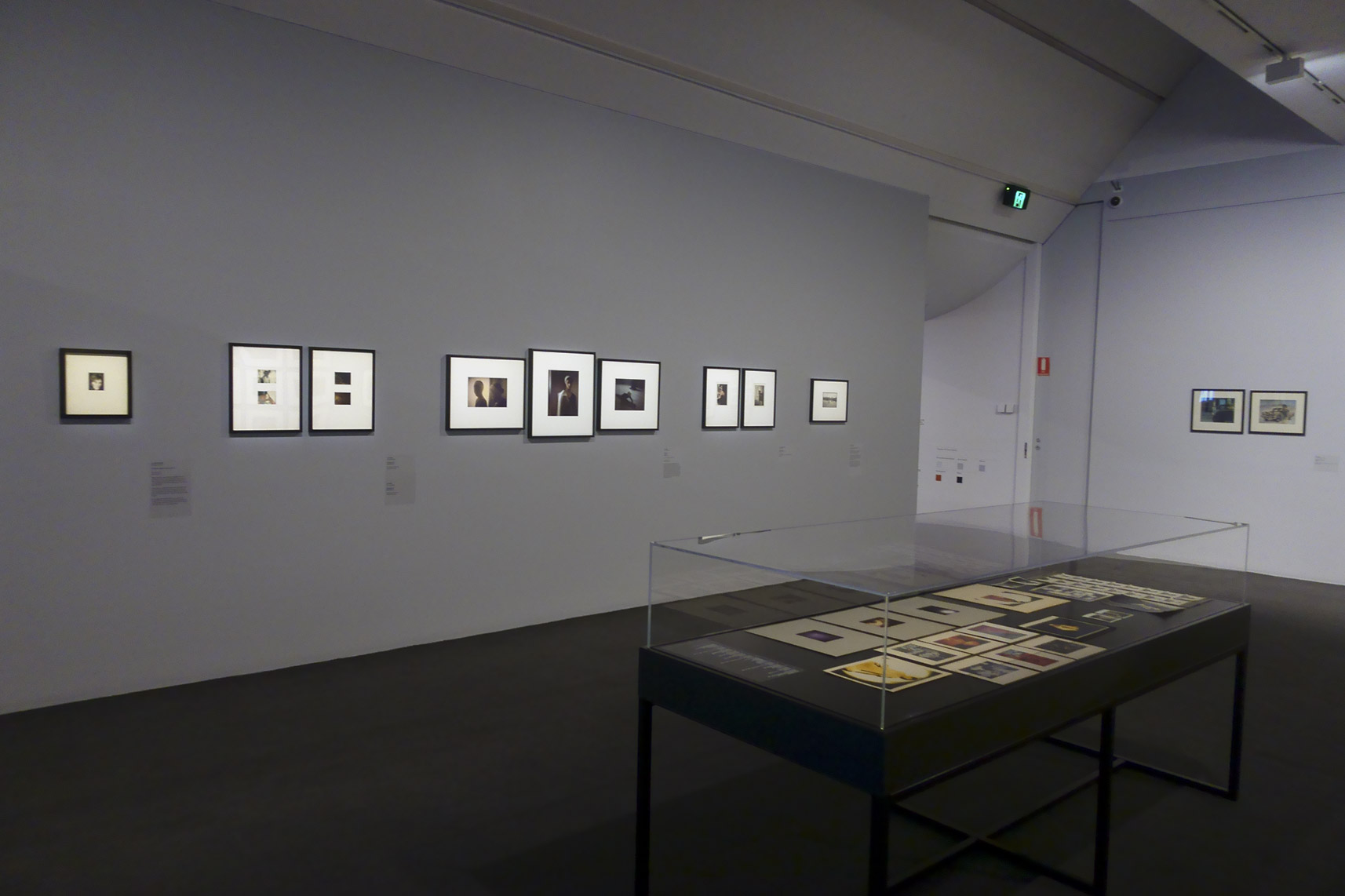
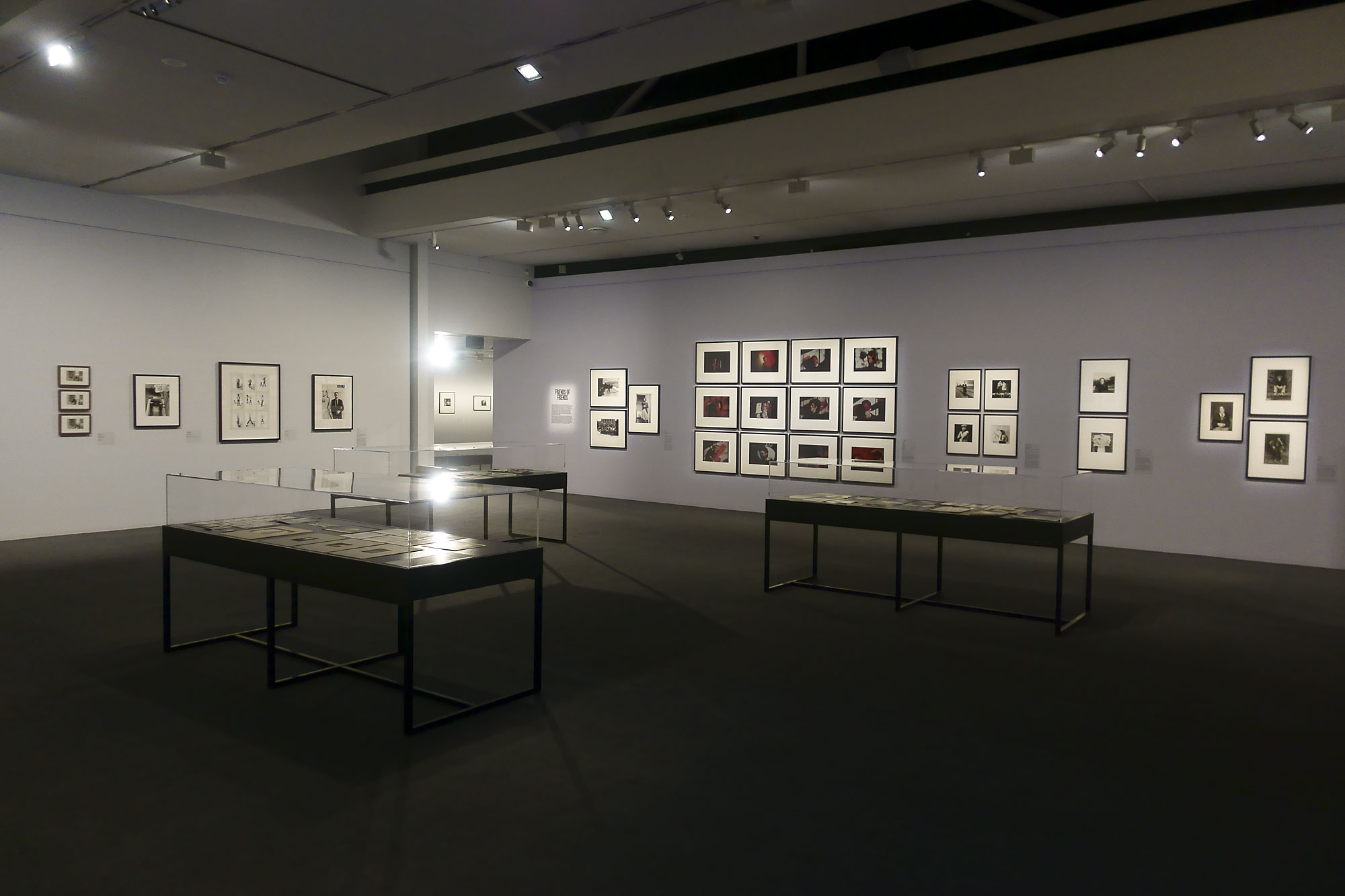
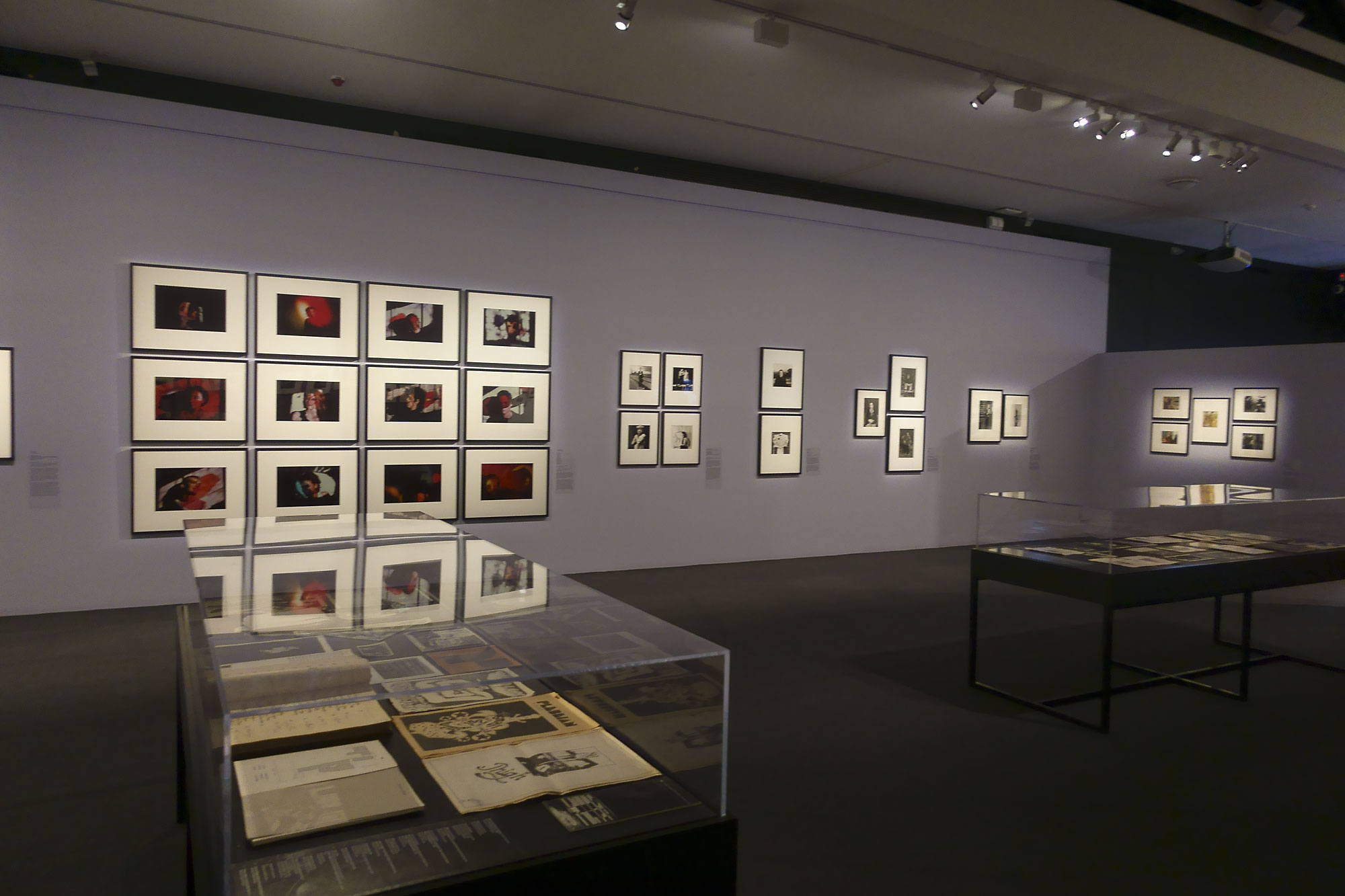
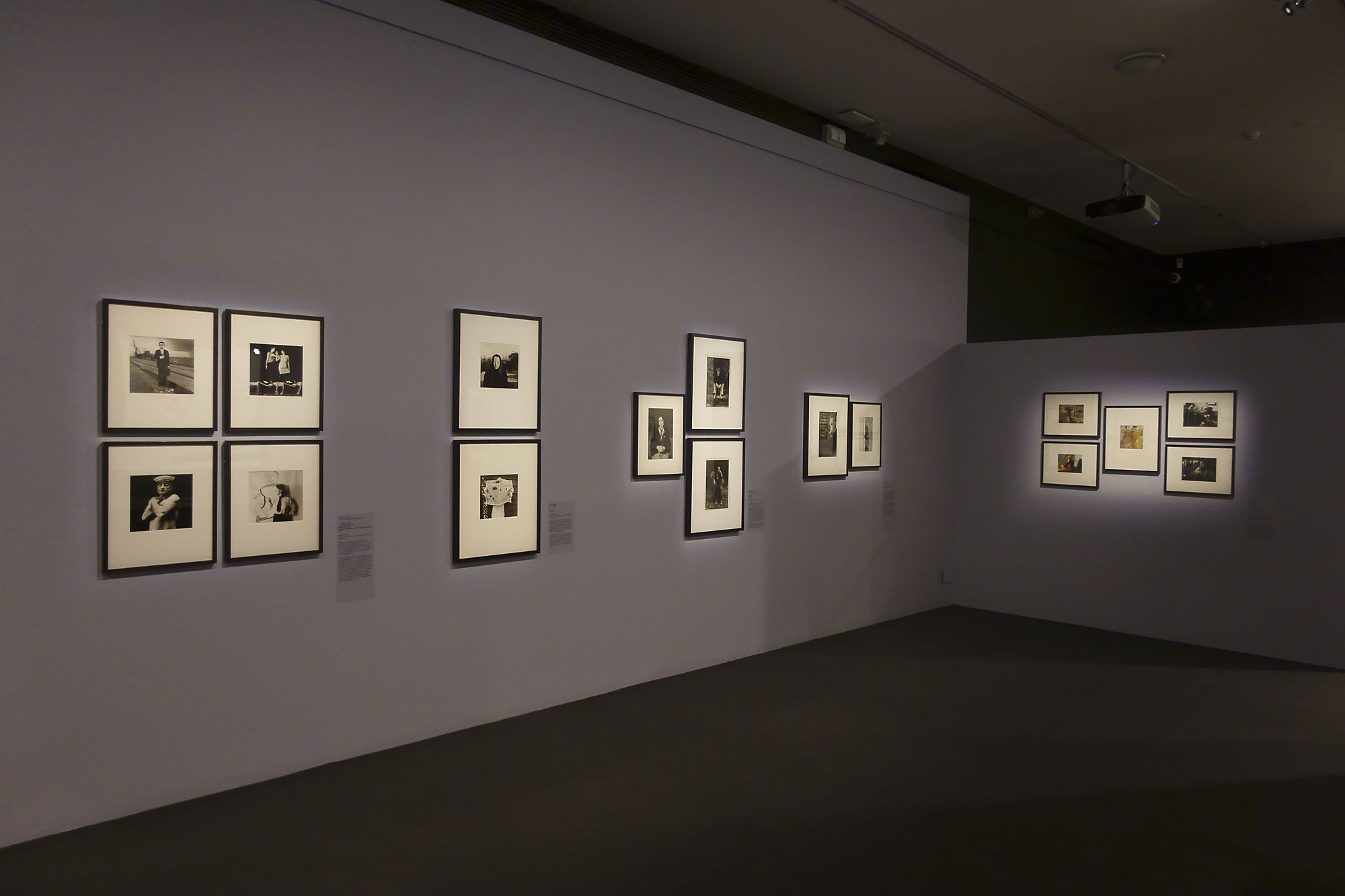
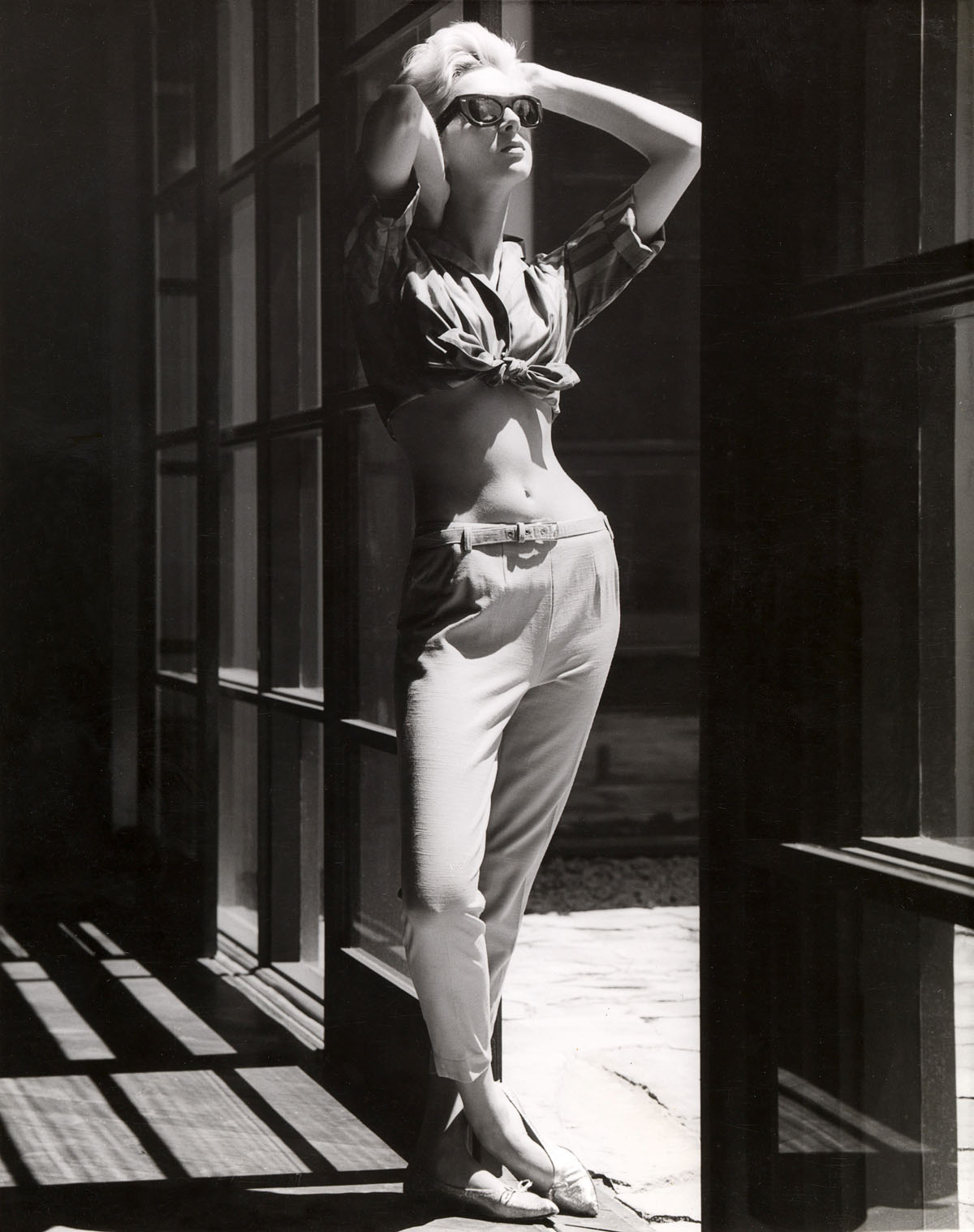
Exhibition: ‘The basement: photography from Prahran College (1968-1981)’ at the Museum of Australian Photography, Wheelers Hill, Melbourne

Exhibition dates: 1st March – 25th May, 2025

Curators: Angela Connor, MAPh Senior Curator, and Stella Loftus-Hills, MAPh Curator

Exhibiting artists: Colin Abbott, Robert Ashton, Con Aslanis, Polly Borland, Peter Bowes, John Brash, Peter Burgess, Nanette Carter, John Cato, Andrew Chapman, Lyn Cheong, Jon Conte, Kim Corbel, Paul Cox, Mimmo Cozzolino, Christina de Water, Duncan Frost, Rob Gale, Sandra Graham, Bill Henson, Julie Higginbotham, Graham Howe, Carol Jerrems, Moira Joseph, Peter Kelly, Christopher Köller, Johann Krix, Paul Lambeth, Derrick Lee, Peter Leiss, Carolyn Lewens, Steven Lojewski, Ian Macrae, James McArdle, Jim McFarlane, Rod McNicol, Julie Millowick, Peter Milne, Jacqueline Mitelman, Richard Muggleton, Martin Munz, Nicholas Nedelkopoulos, Greg Neville, Glen O’Malley, Viki Petherbridge, Ross Powell, Philip Quirk, Leonie Reisberg, Susan Russell, Stella Sallman, Athol Shmith, Geoff Strong, Ian Tippett, George Volakos, Stephen Wickham, Andrew Wittner, Ken Wright, Lynette Zeeng
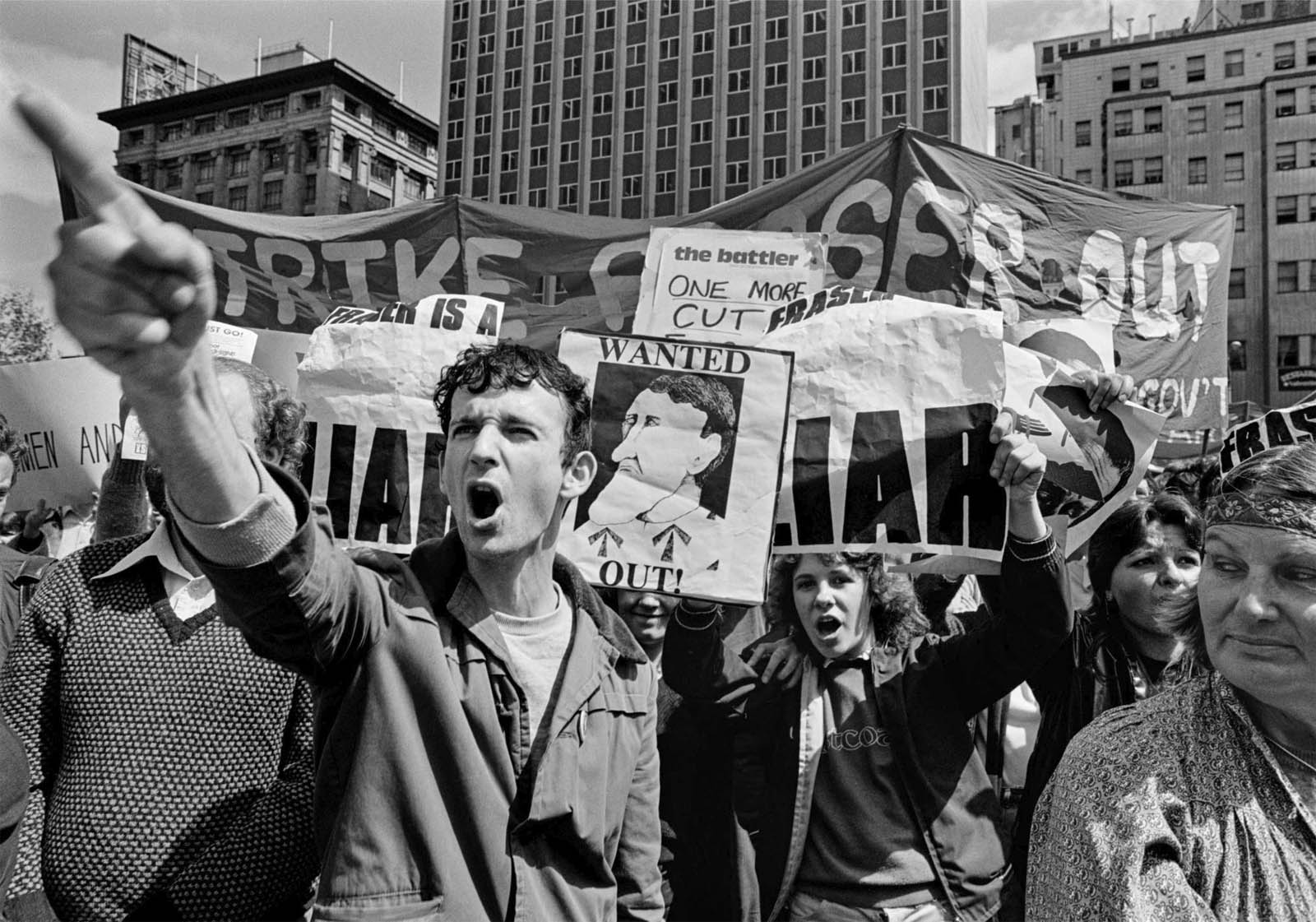
 

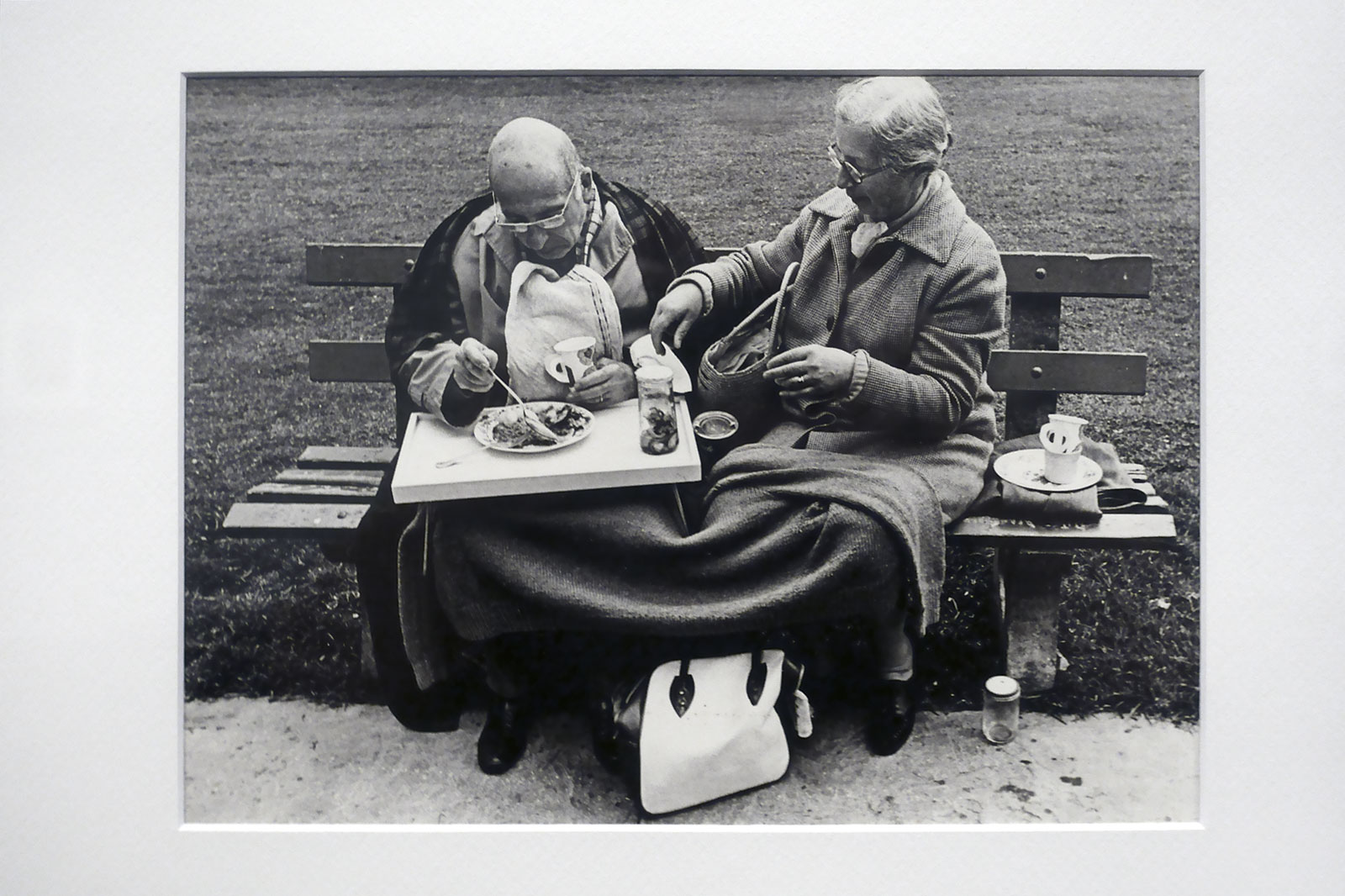
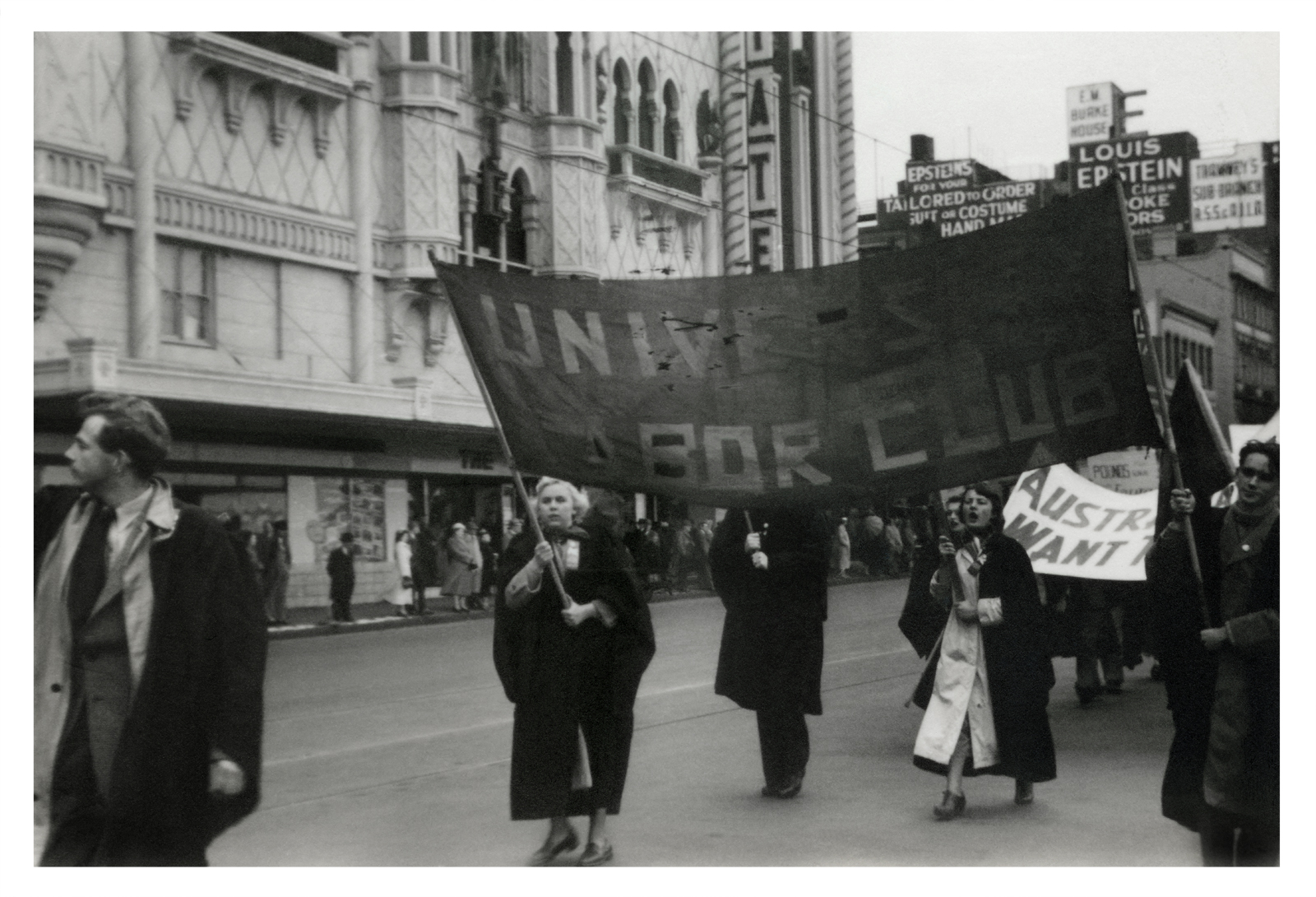
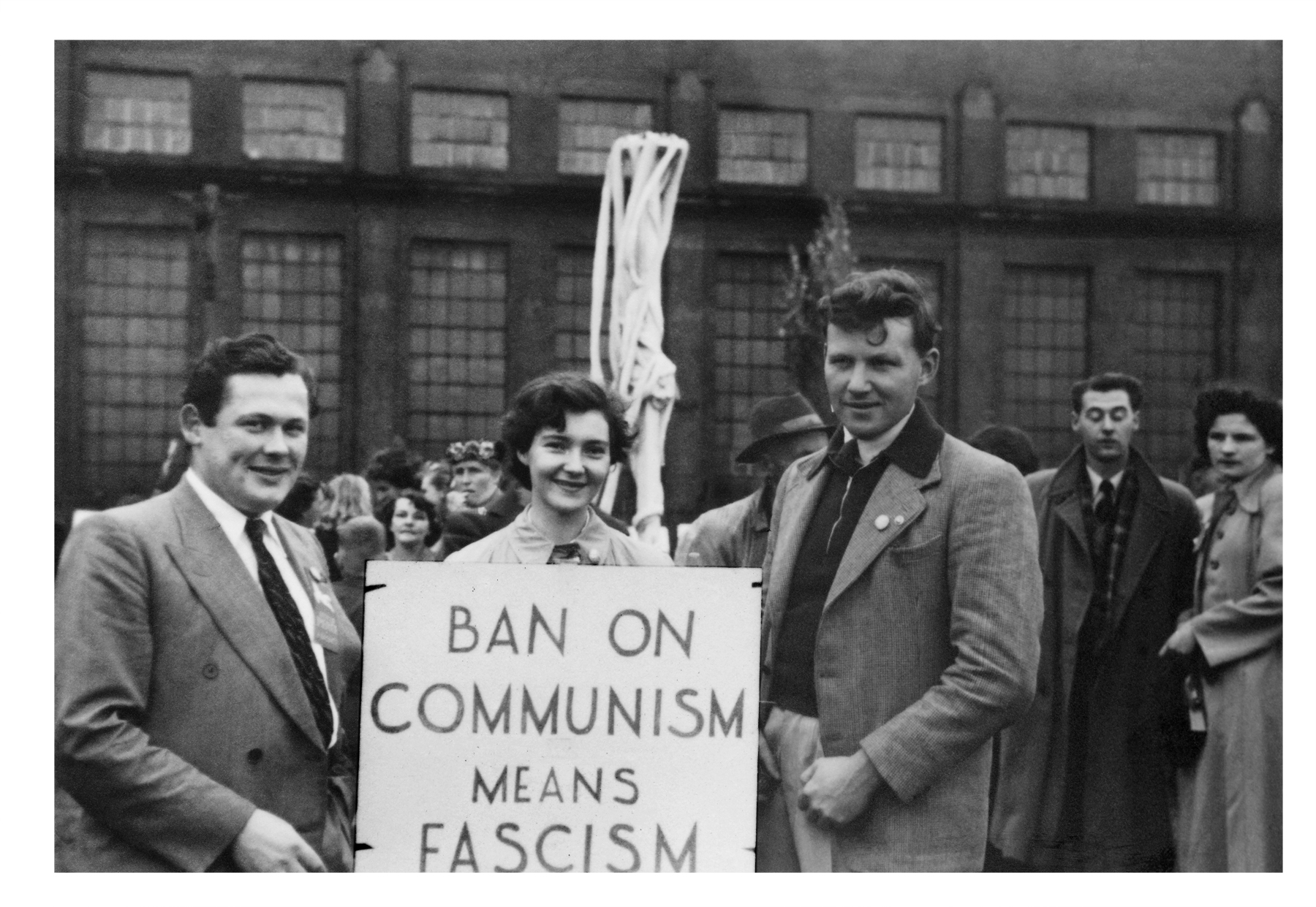
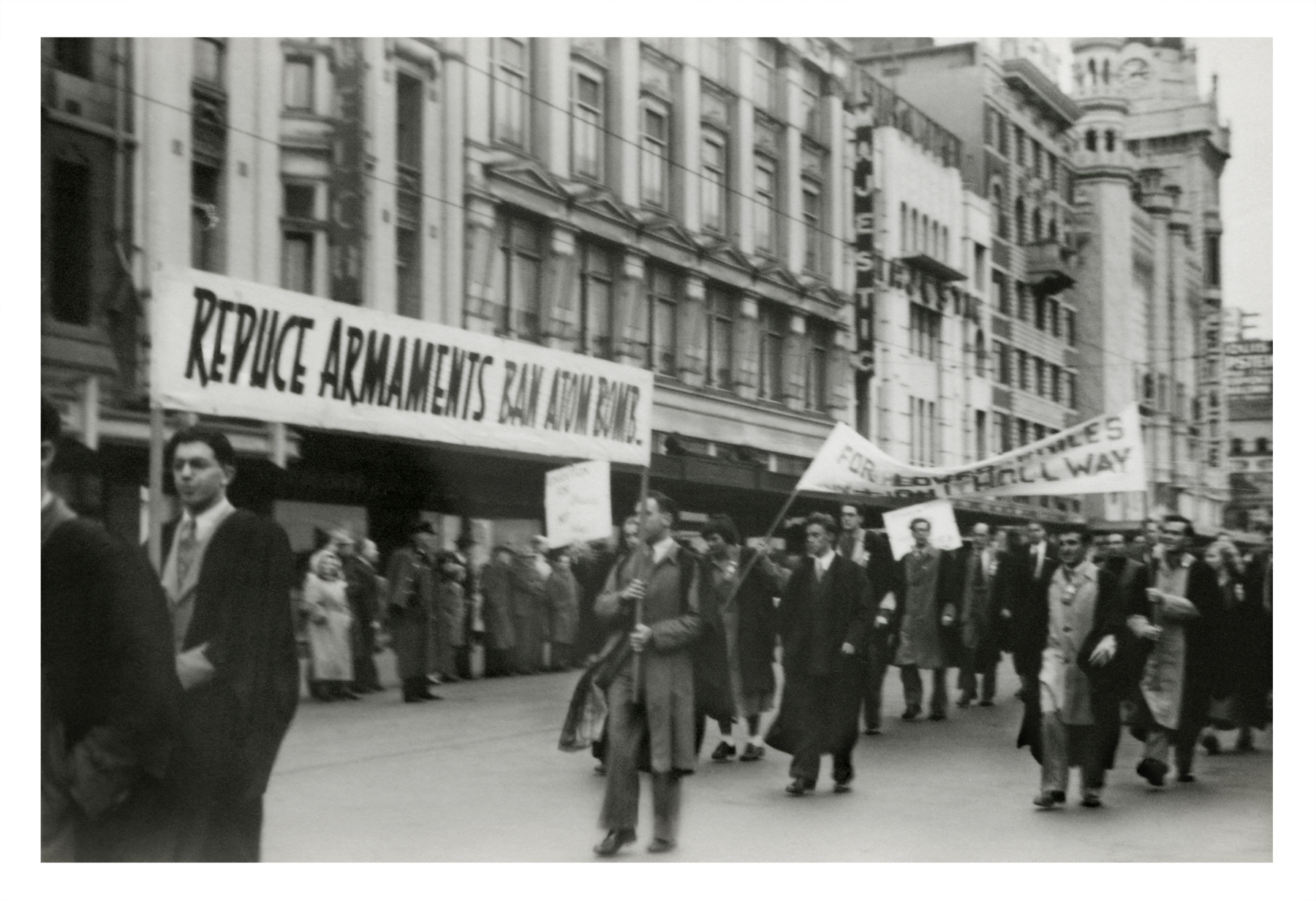
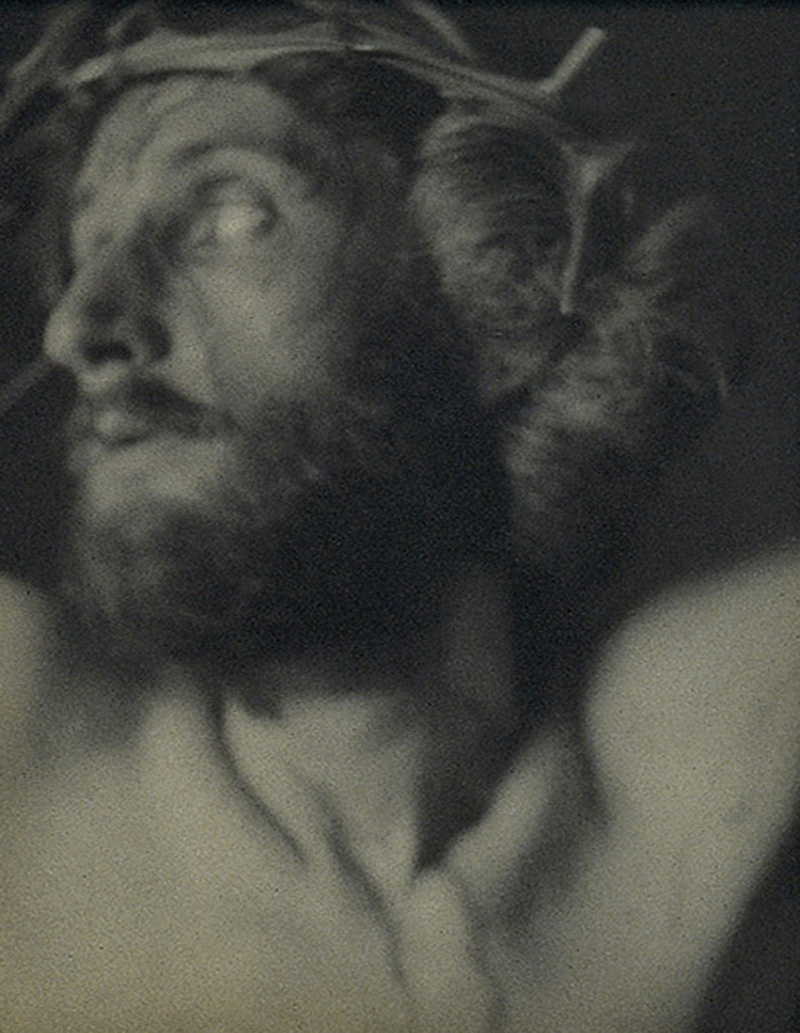
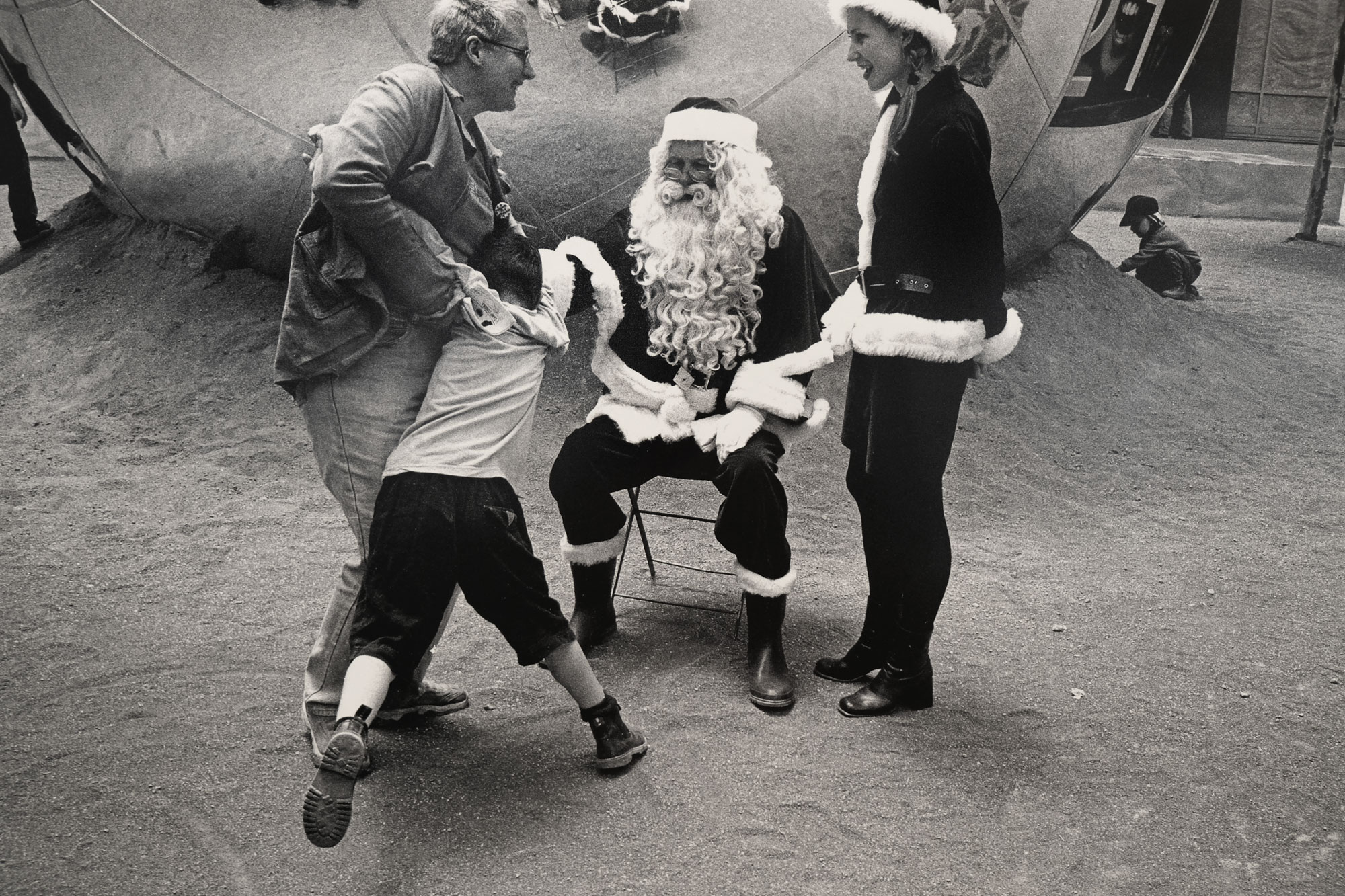
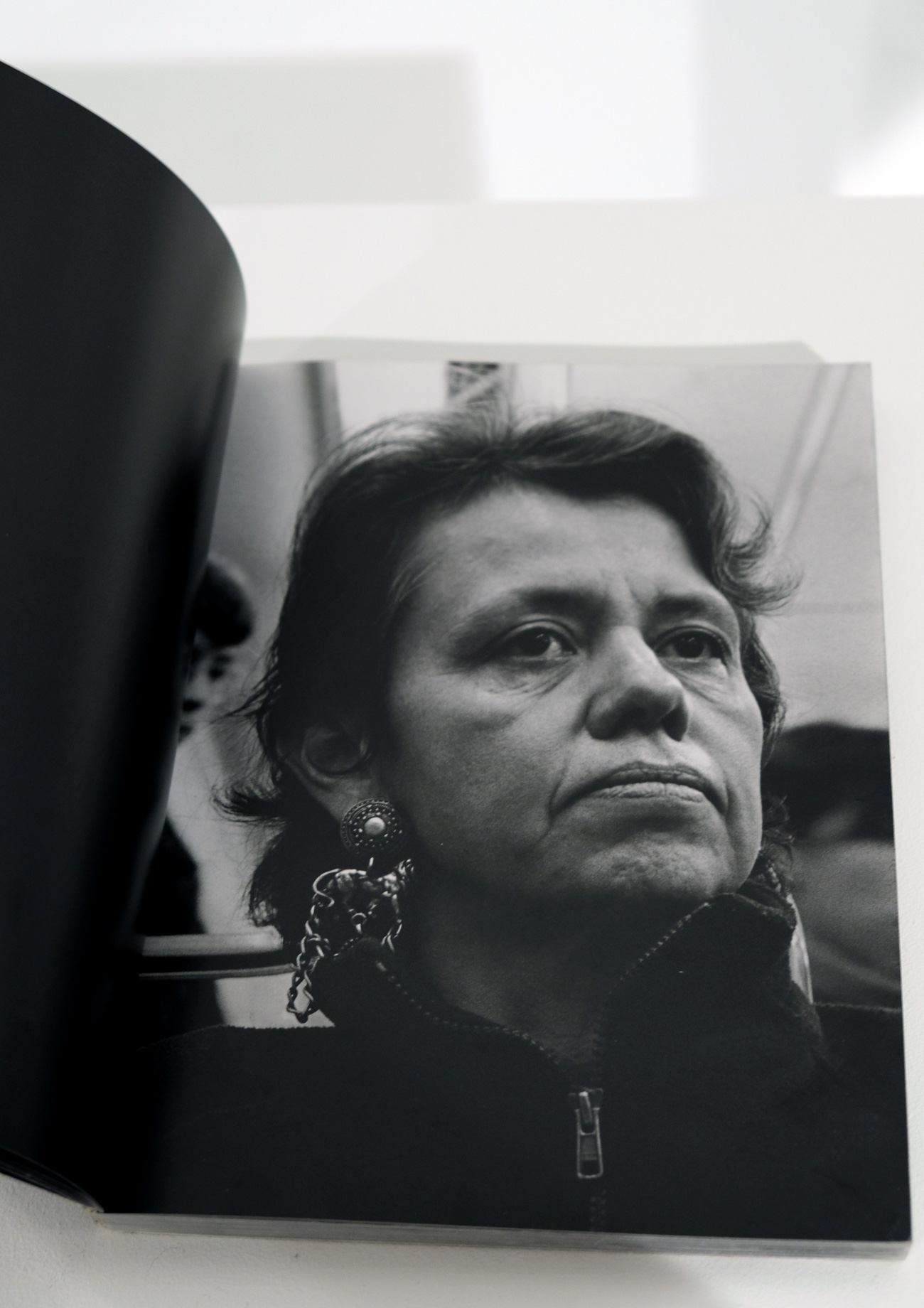
Andrew Chapman (Australian, b. 1954) 'Lest we forget' 1980 from the exhibition 'The basement: photography from Prahran College (1968-1981)' at the Museum of Australian Photography, Wheelers Hill, Melbourne, March - May 2025


Andrew Chapman (Australian, b. 1954)
Lest we forget
1980
Gelatin silver print
Museum of Australian Photography, City of Monash Collection donated 2024


Nurture

A world of creativity and transformation

This is a magnificent exhibition at the Museum of Australian Photography which showcases the work of students and teachers at Prahran College between 1958-1981.

People more eminent than myself have commented on the exhibition.

Gael Newton AM – formerly curator of photography at the Art Gallery of New South Wales, and the Senior Curator of Australian and International Photography at the National Gallery of Australia (NGA) in Canberra – “highlights the diverse and passionate nature of the Prahran College community, where an unstructured curriculum and open debates encouraged multiple approaches – from documentary and still life to collage and staged tableau – while the influence of European cinematic sensibilities and the local film and music scenes added depth to the artistic expression.”1

Daniel Palmer – Professor in the School of Art at RMIT University, his research and professional practice focuses on contemporary art and cultural theory, with a particular emphasis on photography and digital media – commenting on the era “frames the 1970s as a transformative era for Australian society and photography, characterised by social activism.”1

Helen Ennis – formerly Curator of Photography at the National Gallery of Australia and outstanding writer on Australian photography and photographers – emphasises “productive intergenerational exchanges between students and their older educators Prahran represented a space of creative possibility and hope” while acknowledging Prahran’s limitations including gender imbalance, “noting examination records from 1974 showing only five of twenty students were female, with the first woman (Julie Millowick) not appointed to teach until 1983.”1

“Ennis’s address brings to light from The Basement a critical reassessment of how we understand and present 1970s Australian photography. She advocated for approaches that preserve the complexity, contradictions, and energy of this formative period rather than imposing retrospective order that might simplify or misrepresent it. Her reflections bridge historical understanding with contemporary curatorial practice, suggesting ways to engage more authentically with photography’s rich past.”2

Bill Henson AO – former student and internationally acclaimed photographer – acknowledges that “that political movements such as feminism were present among Prahran’s students in the 1970s – “there were the feminists; there were little groups doing their social diligence” – he noted that these stances did not overshadow the college’s overarching emphasis on beauty and creative exploration. “There wasn’t this righteousness, this indignation, this kind of territorial thing about issues,” he said. In contrast there was an openness and enthusiasm that defined Prahran during his time there – a place where beauty and creativity were paramount.”3

On reflection

What struck me most about this exhibition was the creative strength of the STUDENT work … and that is something nobody mentions. This was student work.

These were artists finding their personal voice, exploring the world, being creative, learning how to envision the world in their photographs – through social documentary or conceptual, experimental photographs that challenged how Australian viewed itself. As Assoc. Professor James McArdle, a former student and one of the many driving forces behind this exhibition, insightfully observes:

“Prahran, at this time, was a nexus for the ‘New Photography’ movement in Australia, bringing to our country international developments from the 1960s, the candid, loosely structured photographic language that contrasted sharply with the rigid narratives of photojournalism and the increasingly commercial aesthetics of colour photography.

Prahran College itself played a critical role in the legitimisation of photography as an art form within Australia. It spearheaded the integration of art photography into tertiary education curricula, fostering an environment where young artists … could experiment formally and conceptually.”4

Indeed, Melbourne in the late 1960s and early 1970s could be seen as the nurturing centre of photography in Australia.

As my friend Ian Lobb said to me before he died, “In 1970 where did you go to see a fine art photograph on exhibition in a non-institutional gallery in Melbourne? The only place was the doorway to the John Cato / Athol Shmith / Peter Barr studio in Collins Street. You would never know which of the three photographers would have a print placed in that doorway.”5

But then things changed.

Variously, Melbourne had Jenny Boddington appointed curator of photography in 1972 at the National Gallery of Victoria, becoming the first such curator in Australia and perhaps only the third in the world.

Melbourne also had three commercial art photography galleries that supported local and international exhibitions, exposing major international photographers to local artists. These included Brummels Gallery of Photography reopened in the early 1970s by that wonderful photographer Rennie Ellis and deputy director Robert Ashton (Prahran), the first privately run art gallery in the country to be devoted specifically to photography; The Photographers’ Gallery and Workshop founded in 1973 by Paul Cox (Prahran), Ingeborg Tyssen, John F. Williams and Rod McNicol (Prahran), taken over by Ian Lobb in 1974 and joined by co-director Bill Heimerman in 1976 showcasing mostly American and some European original fine prints from major artists which were influential on Australian audiences and practitioners; and Church Street Photographic Centre opened by Joyce Evans OAM in 1976, the third commercial photographic gallery in 1970s Melbourne which exhibited international 19th and 20th Century photography

Prahran College was closely followed by Phillip Institute of Technology (PIT) which was a tertiary college in Bundoora which had an art photography course run by Ian Lobb and Les Walkling, from 6 January 1982 to 30 June 1992 at which time the school integrated as part of RMIT University. I attended PIT in 1991 and then RMIT University where I completed by doctorate, after having undertaken two years at Brighton Technical College completing two years on the basics of photography, a grounding for many budding photographers in those years under the direction of Peter Barker.

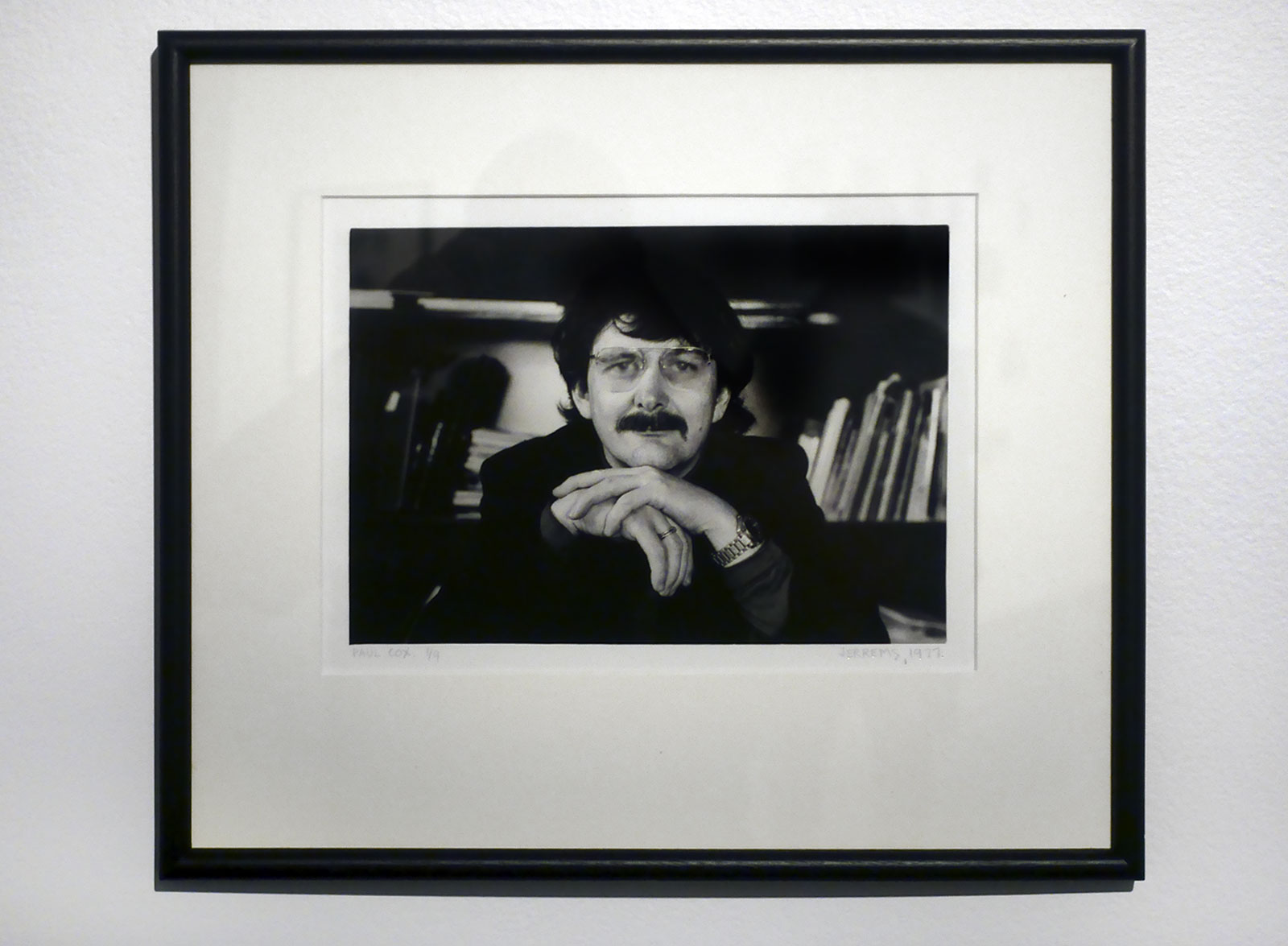
I remember at RMIT fine art photography course we would have reviews of student work every 4 weeks, where over 2 days students put up new work and we all sat together with the lecturers and discussed the ideas contained in the work. The atmosphere was electric, the disparate work, the in-depth conversations, the passion. Look at Greg Neville’s photograph Tutorial: lecturers and students [back row L–R Derrick Lee, Bryan Gracey, Athol Shmith, Paul Cox, Elizabeth Tainsh] (c. 1971, below) and you can feel a similar energy…

So Melbourne has been particularly blessed – I dislike that word but there is no other that really conveys what I mean – by this confluence of events, people and places that supported the rigorous investigation of photography and life that Prahran College was a part of. At Prahran there was optimism, social conscience, and an engagement with the street and with life, there was “creative rebellion and intellectual engagement”. I asked James McArdle at an artist’s talk about this: how exciting this would have been, the bouncing of ideas one off another, the sense of community and camaraderie, and yes they were all there … encouraging an “atmosphere” of creativity which has produced a generation of outstanding photographers who will leave a lasting legacy in the history of Australian photography.

As an artist who arrived as a “second generation” photographer after Prahran College I have a great affection for the people and the work produced in the exhibition.

I knew John Cato and his delightful wife Dawn Cato well and went down to their house for afternoon tea to discuss photography and life; together with Bill Heimerman I co-curated his retrospective at The Photographers’ Galley and Workshop in 2002, the text ‘and his forms were without number’ used in the book accompanying the exhibition John Cato Retrospective at the Ballarat International Foto Biennale in 2013 where Paul Cox and I made opening speeches. Both were good friends.

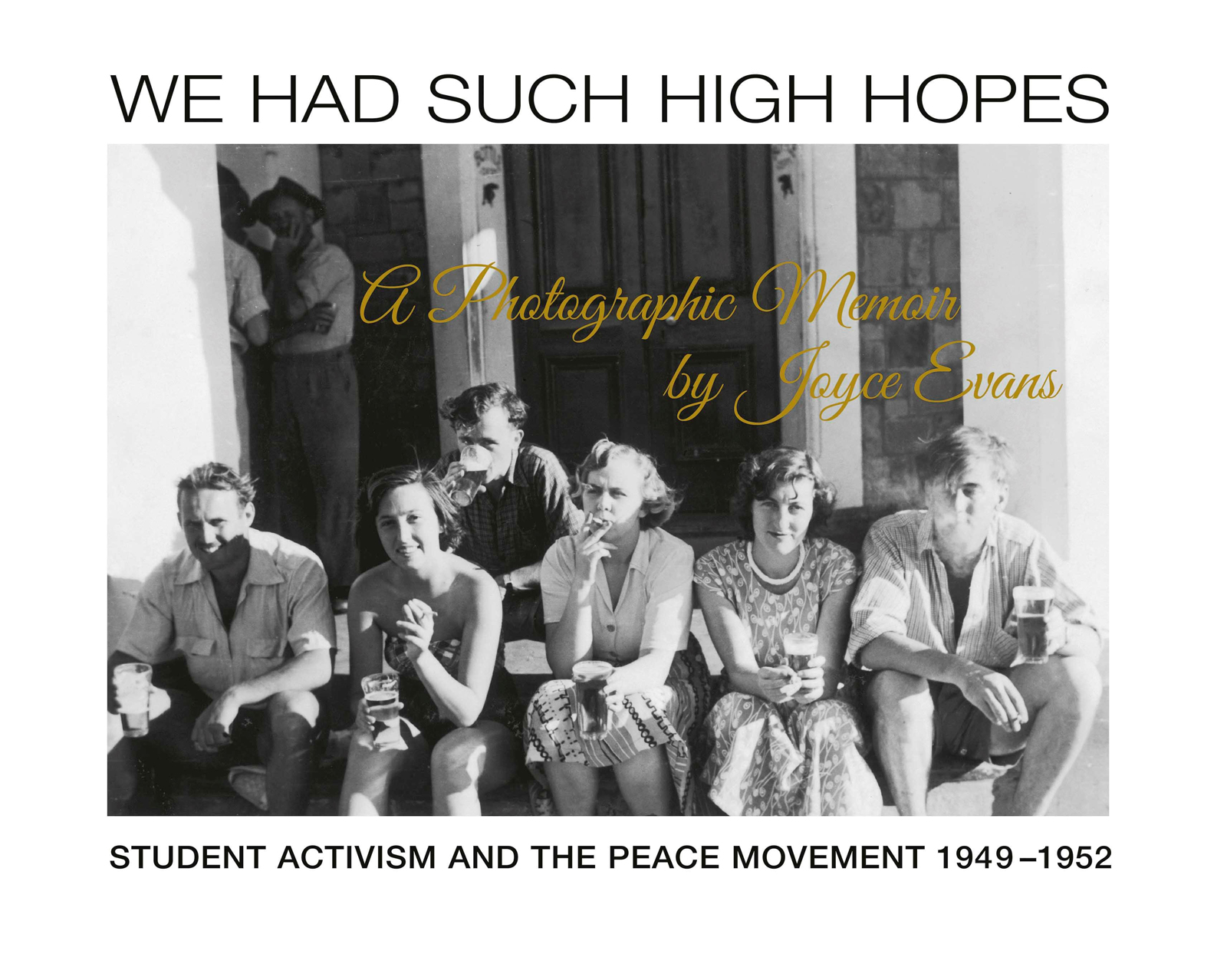
Joyce Evans was my substitute mother in Australia. What a wonderful, bohemian, creative, intelligent woman she was. I wrote “Nothing emerges from nothing,” foreword to her book We Had Such High Hopes: Student Activism and the Peace Movement 1949-1952, A Photographic Memoir by Joyce Evans 2019 published before she died, a book that instils the social conscience ethos emerging in postwar Australia which leads into the work of the Prahran College photographers. I still her miss greatly.

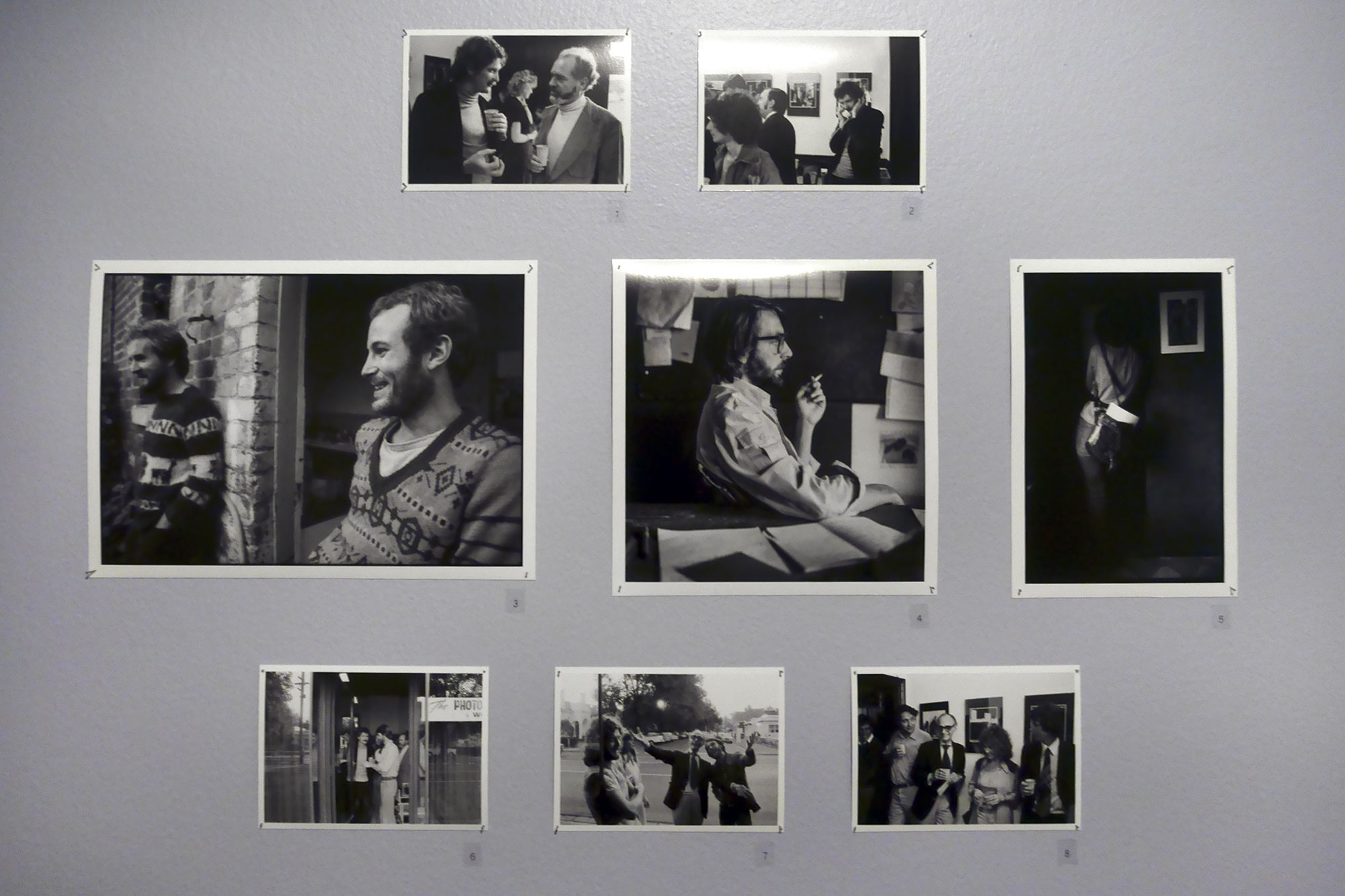
As I do both Ian Lobb and Bill Heimerman (pictured below in Peter Leiss’ Untitled [Bill Heimerman (right) and Ian Lobb (left) at the rear of The Photographers’ Gallery] c. 1975-1980), both good friends. Ian Lobb was my first photography lecturer at PIT and became my mentor and friend for over 30 years; Bill gave me three solo exhibitions at The Photographer’s Gallery and Workshop in my early days as an artist, and much excellent advice, for which I am forever grateful.

James McArdle and Gael Newton remain valued friends, both amazing fonts of knowledge in all aspects of photography and photographic research.


In conclusion, congratulations to all who have been involved in bringing this exhibition to fruition: artists, writers and curators. It is a magnificent achievement and a testament to the creativity and passion of the times, both theatre and document reflecting an era that sadly can no longer be repeated.

Prahran College photographers followed their heart and their eye, they possessed a curiosity which “evokes the care one takes for what exists or could exist; an acute sense of the real which, however, never becomes fixed; a readiness to find our surroundings strange and singular; a certain restlessness in ridding ourselves of our familiarities and looking at things otherwise; a passion for seizing what is happening now and what is passing away; a lack of respect for traditional hierarchies of the important and the essential.”6

However long I live, it has always been a privilege to be part of this community, to be part of the Melbourne photographic community.

Dr Marcus Bunyan


1/ James McArdle. “Launched!,” on the On This Date in Photography website, 6th April 2025 [Online] Cited 06/04/2025

2/ Helen Ennis quoted in James McArdle. “Unfixing,” on the On This Date in Photography website, 29th March 2025 [Online] Cited 06/04/2025

3/ Bill Henson opening speech summarised in James McArdle. “Opening!” on the On This Date in Photography website, 1st March, 2025 [Online] Cited 18/04/2025

4/ James McArdle. “Epoch,” on the On This Date in Photography website, 25th April, 2025 [Online] Cited 28/04/2025

5/ “Steve Lojewski [in the year ahead of me at PCAE] and I job shared at Shmith / Cato / Barr. A fantastic opportunity to work mainly in the darkroom, occasionally assisting in the studio and as they gained confidence in me sent out on [mickey mouse] jobs when they were double booked. A HUGE break and when Peter Barr bought out John and Athol and established Peter Barr & Associates he invited me to freelance out of his new studio. That offer would not have happened without the prior experience of the darkroom & studio work. My first job on the Monday morning of my 2 week trial for Athol, John and Peter was 250 prints [on fibre paper] of Malcom Fraser by 11.00 am [ie the wet deadline was 11.00. Dry and out the door was, from memory, 12.noon].”

Julie Millowick in conversation with Marcus Bunyan via Facebook, 20th May 2025

6/ Michel Foucault, “The Masked Philosopher” in Politics, philosophy, culture: interviews and other writings, 1977-1984. London: Routledge, 1988, p. 328


All installation photographs © Marcus Bunyan. Please click on the photographs for a larger version of the image.

Apologies if a couple of the photographs are slightly out of focus, these were digital RAW files shot on a Sony rx100 handheld at 1000ASA with low depth of field.

For more information please see The Prahran Photography website which upholds the legacy of Prahran College 1970s photography through posts on profiles of the alumni and lecturers (an ongoing project).


“Curiosity is a vice that has been stigmatized in turn by Christianity, by philosophy and even by a certain conception of science. Curiosity, futility. I like the word however. To me it suggests something all together different: it evokes concern; it evokes the care one takes for what exists or could exist; an acute sense of the real which, however, never becomes fixed; a readiness to find our surroundings strange and singular; a certain restlessness in ridding ourselves of our familiarities and looking at things otherwise; a passion for seizing what is happening now and what is passing away; a lack of respect for traditional hierarchies of the important and the essential.”


Michel Foucault, “The Masked Philosopher” in Politics, philosophy, culture: interviews and other writings, 1977-1984. London: Routledge, 1988, p. 328


Gallery One (clockwise)


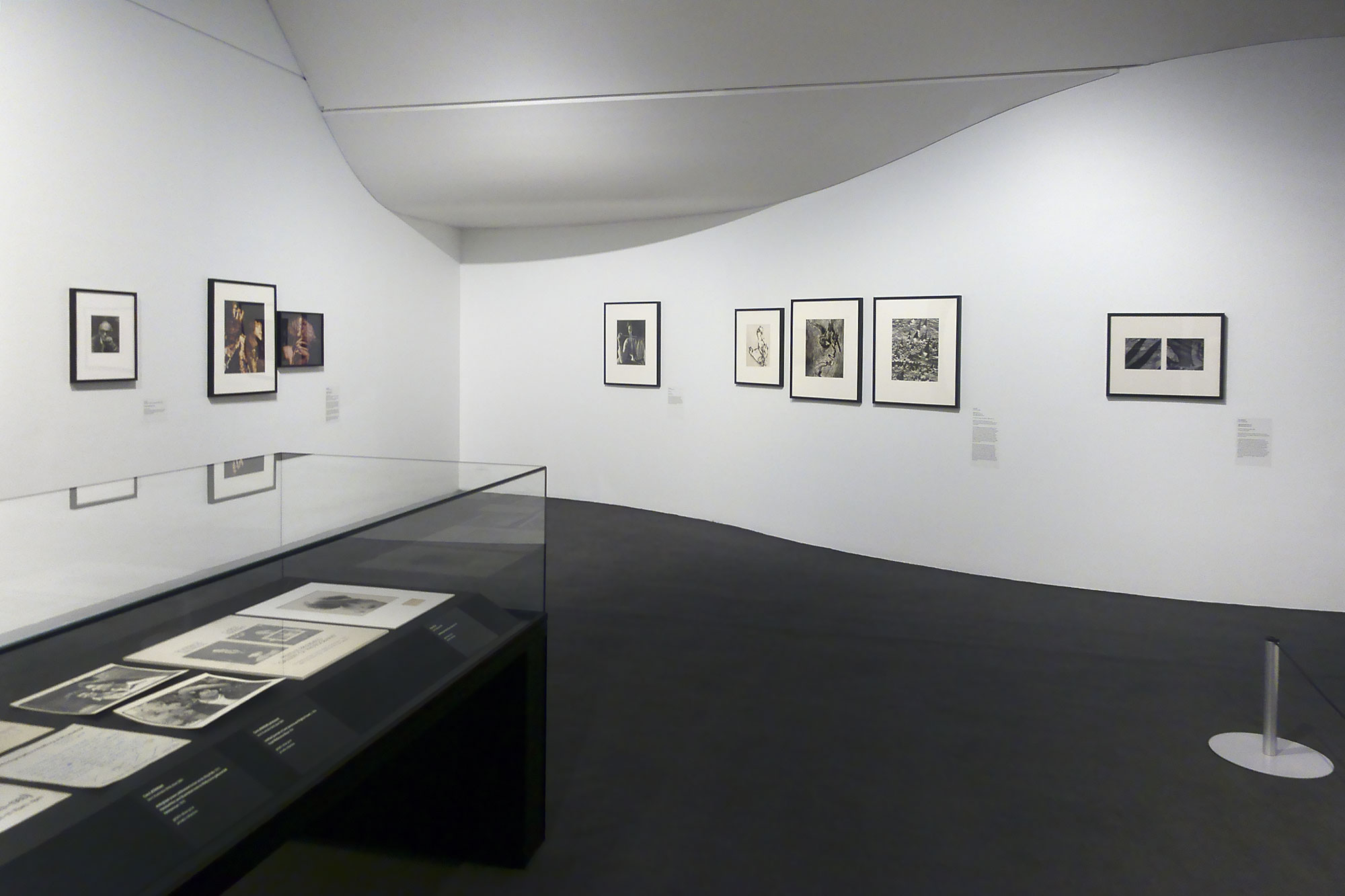
Installation view of the exhibition 'The basement: photography from Prahran College (1968-1981)' at the Museum of Australian Photography, Wheelers Hill, Melbourne
Wall text from the exhibition 'The basement: photography from Prahran College (1968-1981)' at the Museum of Australian Photography, Wheelers Hill, Melbourne, March - May, 2025
Installation view of the exhibition 'The basement: photography from Prahran College (1968-1981)' at the Museum of Australian Photography, Wheelers Hill, Melbourne, March - May, 2025


Installation views of the exhibition The basement: photography from Prahran College (1968-1981) at the Museum of Australian Photography, Wheelers Hill, Melbourne
Photos: Marcus Bunyan


In May 1968 the newly formed photography department of Prahran Technical School (known as Prahran College of Advanced Education (PCAE) from 1973) moved into the basement of a freshly completed art and design building on the corner of High Street and Thomas Street in Melbourne’s inner southeastern suburb of Prahran. Here, for the first time in Australia, photography was taught as an artform.

Featuring the work of approximately 60 artists, The basement brings to light rare vintage prints from the 1960s through to the early 1980s, key archival ephemera and folio work – from students and teachers of the College’s Diploma of Art & Design (Photography). It was a period where new discussions developed quickly around the possibilities of what photography could be. These students and teachers were part of a progressive, edgy wave of image-makers excited about the medium’s potential.

Under the vanguard of influential photographers such as John Cato, Paul Cox and Athol Shmith, the school became a breeding ground for some of this country’s most important art photographers: Carol Jerrems, Bill Henson, Nanette Carter, Rod McNicol, Polly Borland, Peter Milne, Robert Ashton, Philip Quirk, Peter Leiss, Jacqueline Mitelman, Mimmo Cozzolino, Graham Howe and Julie Millowick, among many others.

The exhibition’s accompanying publication elucidates the experience from several perspectives. As we hear from the curators, students, colleagues and academics, it’s clear that this course, in this time, was of great consequence to our photographic ecosystem and its development.

Curated by Angela Connor, MAPh Senior Curator, and Stella Loftus-Hills, MAPh Curator, The basement gathers works from close to 60 artists, traversing over 13 years of image-making and adjacent subcultures in music, protest, fashion and art criticism. This landmark exhibition will deliver new research into the canon of Australia’s cultural history through its assembled works and attendant publication.

Text from the Museum of Australian Photography website
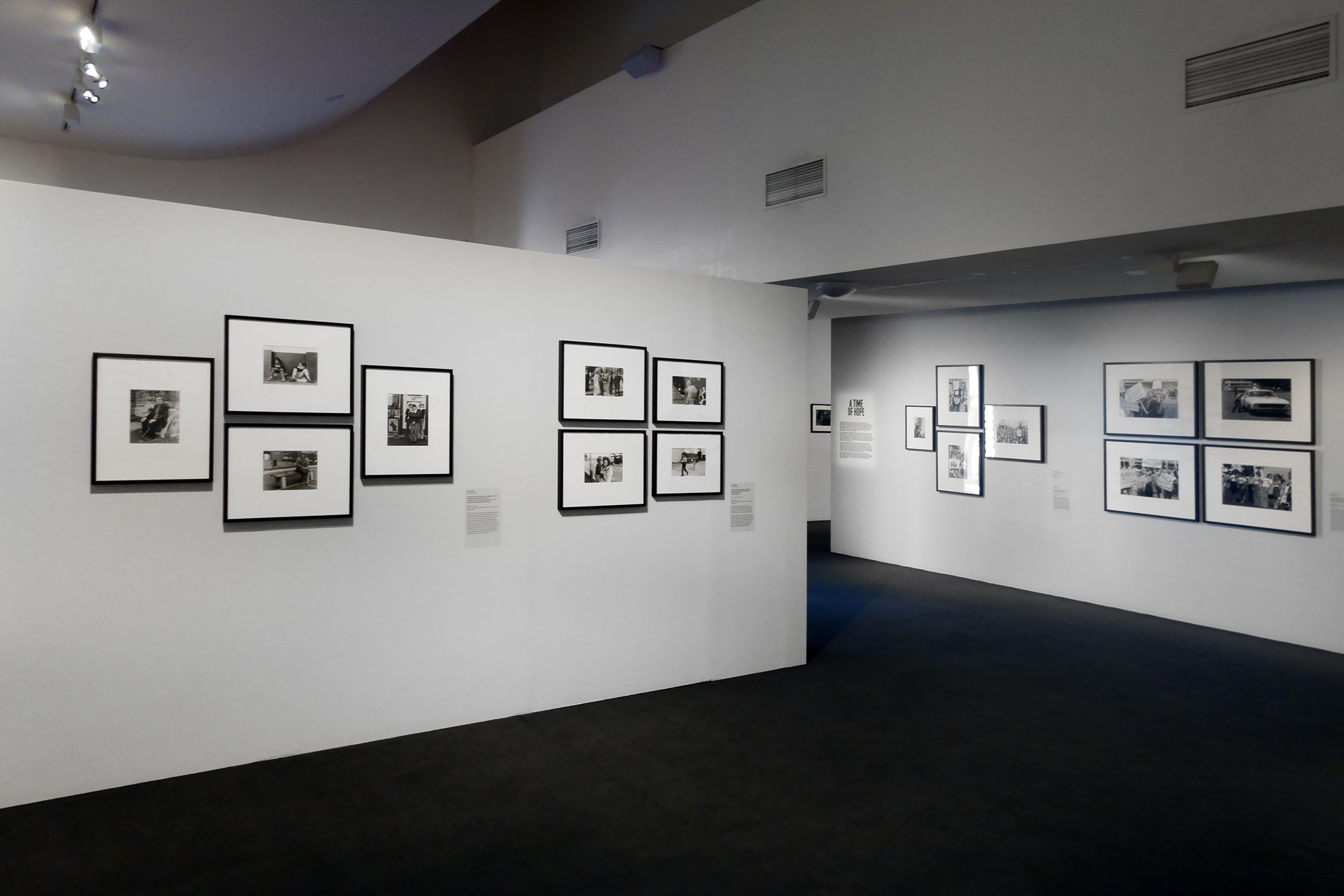
 

Installation view of the reverse of the opening wall of the exhibition 'The basement: photography from Prahran College (1968-1981)' at the Museum of Australian Photography, Wheelers Hill, Melbourne


Installation view of the reverse of the opening wall of the exhibition The basement: photography from Prahran College (1968-1981) at the Museum of Australian Photography, Wheelers Hill, Melbourne
Photo: Marcus Bunyan


Moira Joseph (Australian, b. 1955)
'Jack with a cigarette sitting in the church garden, St Kilda'  1974 (installation view) from the exhibition 'The basement: photography from Prahran College (1968-1981)' at the Museum of Australian Photography, March - May, 2025


Moira Joseph (Australian, b. 1955)
Jack with a cigarette sitting in the church garden, St Kilda (installation view)
1974
Gelatin silver print
Museum of Australian Photography, City of Monash Collection
Acquired 2024
Photo: Marcus Bunyan


Moira Joseph (Australian, b. 1955)
'Herald boys, Fitzroy Street, St Kilda' 1975 (installation view)


Moira Joseph (Australian, b. 1955)
Herald boys, Fitzroy Street, St Kilda (installation view)
1975
Gelatin silver print
Museum of Australian Photography, City of Monash Collection
Acquired 2024
Photo: Marcus Bunyan


Moira Joseph is a Melbourne-based professional photographer, filmmaker and teacher. She studied photography at Prahran College from 1974 to 1977. Joseph created the works on display here while she was a student. Armed with her Mamiya 220 medium-format camera, Joesph often walked between the College and her home in St Kilda, affectionately documenting the characters she regularly encountered. Jack with a cigarette sitting in the church garden, St Kilda (1974), for example, shows an elderly gentleman from a nearby men’s refuge sitting alone in Acland Street’s church square. Children regularly feature in Joseph’s student work, and she spent time photographing at luna park, as well as Prahran Primary School.

Wall text from the exhibition

Moira Joseph alumni profile on the Prahran Legacy website


Moira Joseph (Australian, b. 1955)
'Three Herald boys, Acland Street, St Kilda' 1975 (installation view)


Moira Joseph (Australian, b. 1955)
Three Herald boys, Acland Street, St Kilda (installation view)
1975
Gelatin silver print
Museum of Australian Photography, City of Monash Collection
Acquired 2024
Photo: Marcus Bunyan
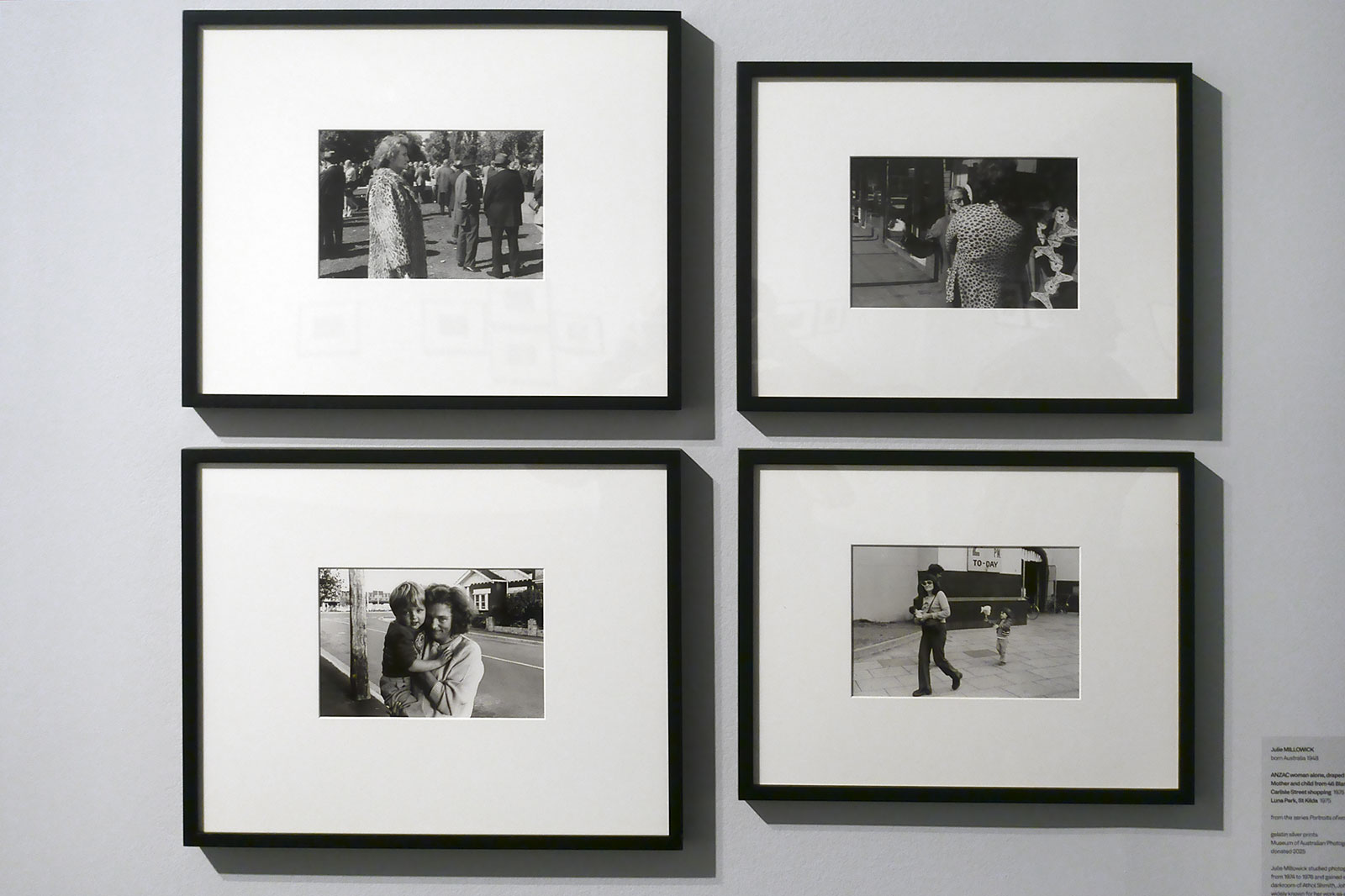
 

Installation view of the exhibition 'The basement: photography from Prahran College (1968-1981)' at the Museum of Australian Photography, Wheelers Hill, Melbourne showing Julie Millowick 's photographs


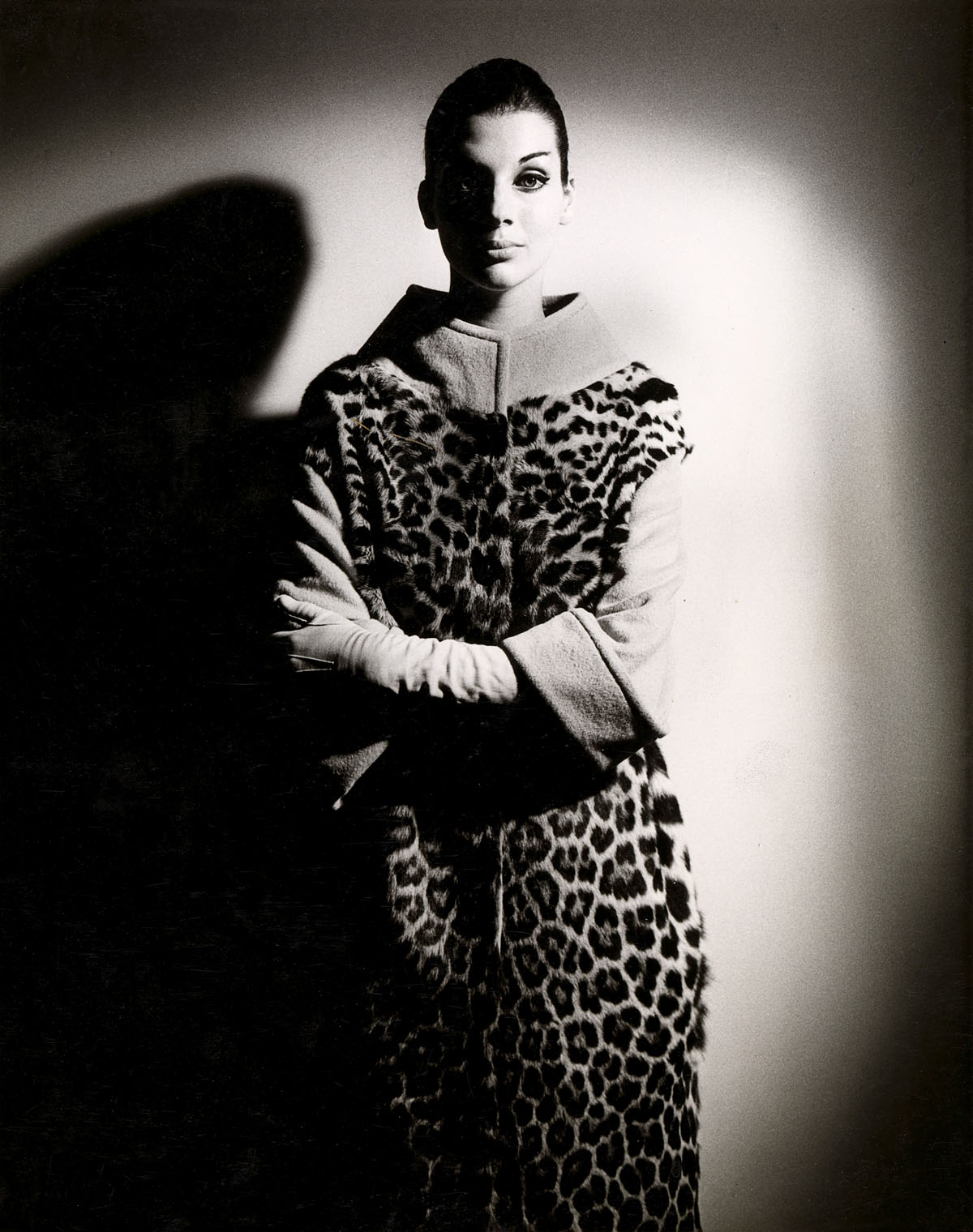
Installation view of the first gallery of the exhibition The basement: photography from Prahran College (1968-1981) at the Museum of Australian Photography, Wheelers Hill, Melbourne showing Julie Millowick ‘s photographs from clockwise: ANZAC woman alone, draped in leopard skin coat, 1975; Carlisle Street shopping, 1975; Luna Park, St Kilda, 1975; Mother and child from 46 Blanche Street, St Kilda, 1977 from the series Portraits of women
Photo: Marcus Bunyan


Julie Millowick studied photography at Prahran College from 1974 to 1976 and gained early experience working in the darkroom of Athol Shmith, John Cato and Peter Bart. She is widely known for her work as a commercial photographer and photojournalist as well as her personal documentary projects.

1975 was Millowick’s second year at Prahran College, and also International Women’s Year, as designated by the United Nations. With the spotlight set firmly on women’s rights, Millowick made an extensive series of photographs entitled Portraits of women, which she continued in subsequent years. This human-centred series with feminist undertones, sympathetically captured women in a variety of locations and depicted moments of motherhood, friendship, loneliness, old-age and youth.

Wall text from the exhibition

Read my review “Down with Earth,” on the exhibition Julie Millowick: Surrounding at the Castlemaine Art Museum, June 2024

Julie Millowick Alumni profile on the Prahran Legacy website


Julie Millowick (Australian, b. 1948)
'Mother and child from 46 Blanche Street, St Kilda' 1977 from the exhibition 'The basement: photography from Prahran College (1968-1981)' at the Museum of Australian Photography, Wheelers Hill, Melbourne, March - May 2025


Julie Millowick (Australian, b. 1948)
Mother and child from 46 Blanche Street, St Kilda
1977
Gelatin silver print
15.9 x 23.7cm
Museum of Australian Photography, City of Monash Collection donated by Julie Millowick 2024


Wall text from the exhibition 'The basement: photography from Prahran College (1968-1981)' at the Museum of Australian Photography, Wheelers Hill, Melbourne


Wall text from the exhibition The basement: photography from Prahran College (1968-1981) at the Museum of Australian Photography, Wheelers Hill, Melbourne
Photo: Marcus Bunyan
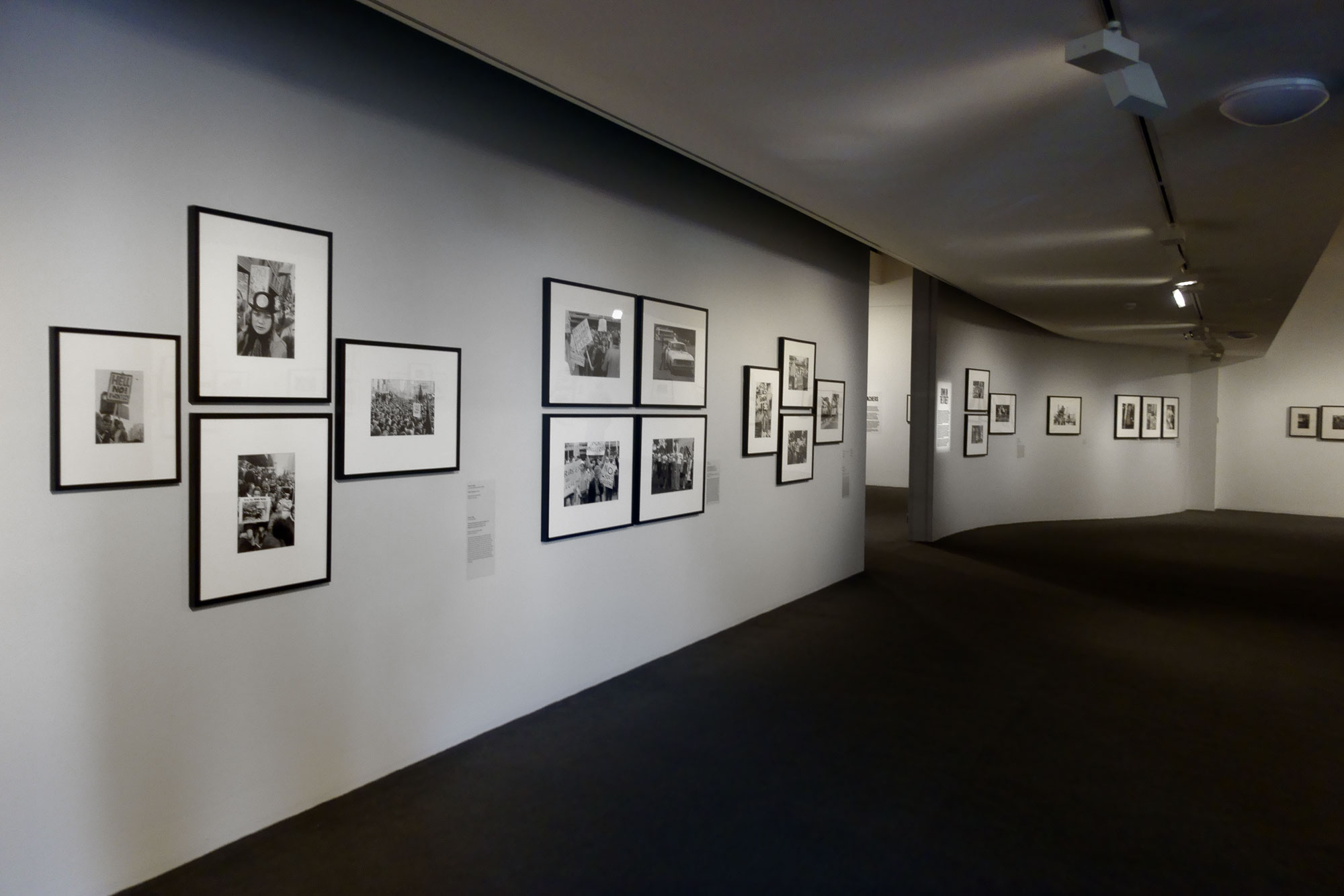
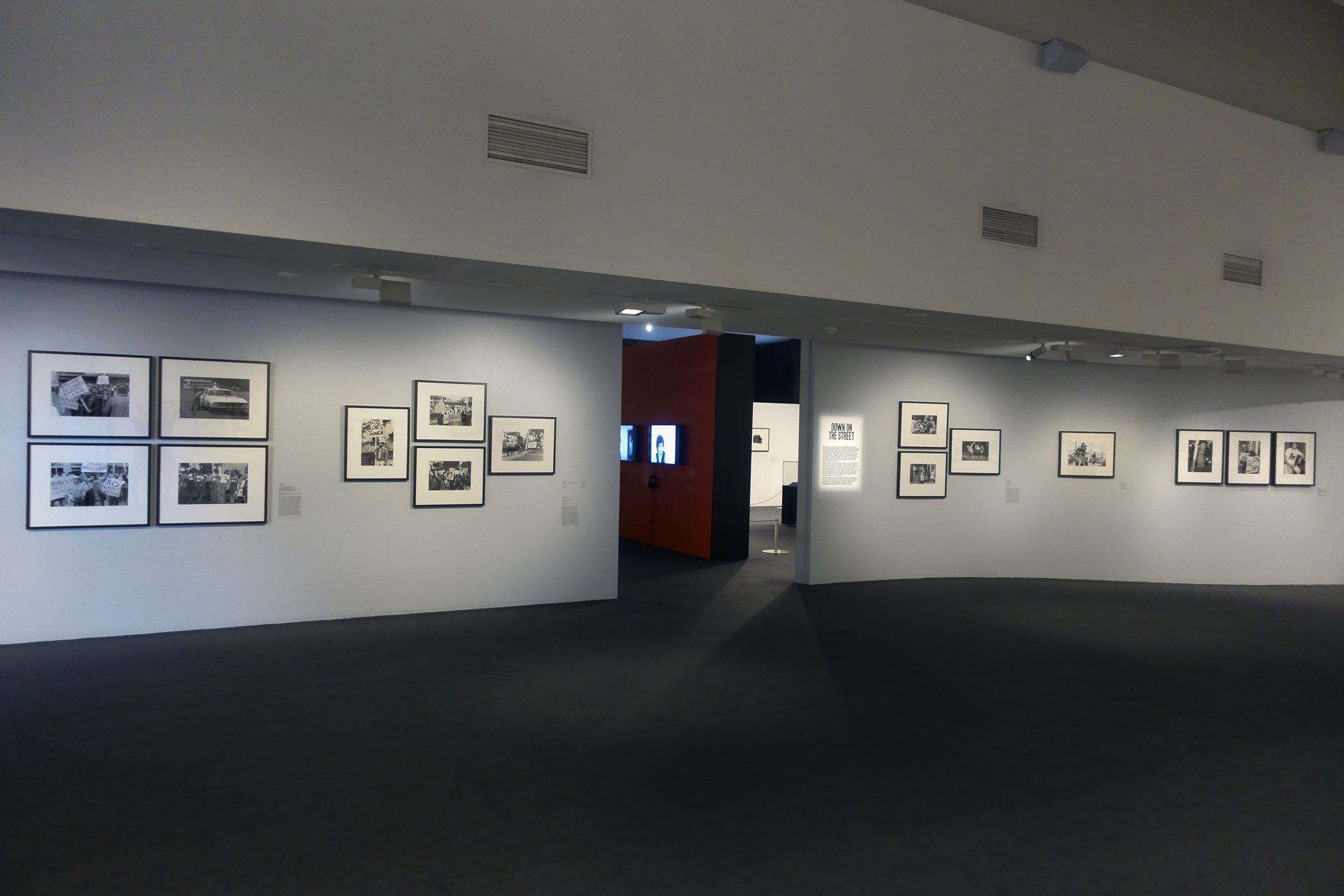
 

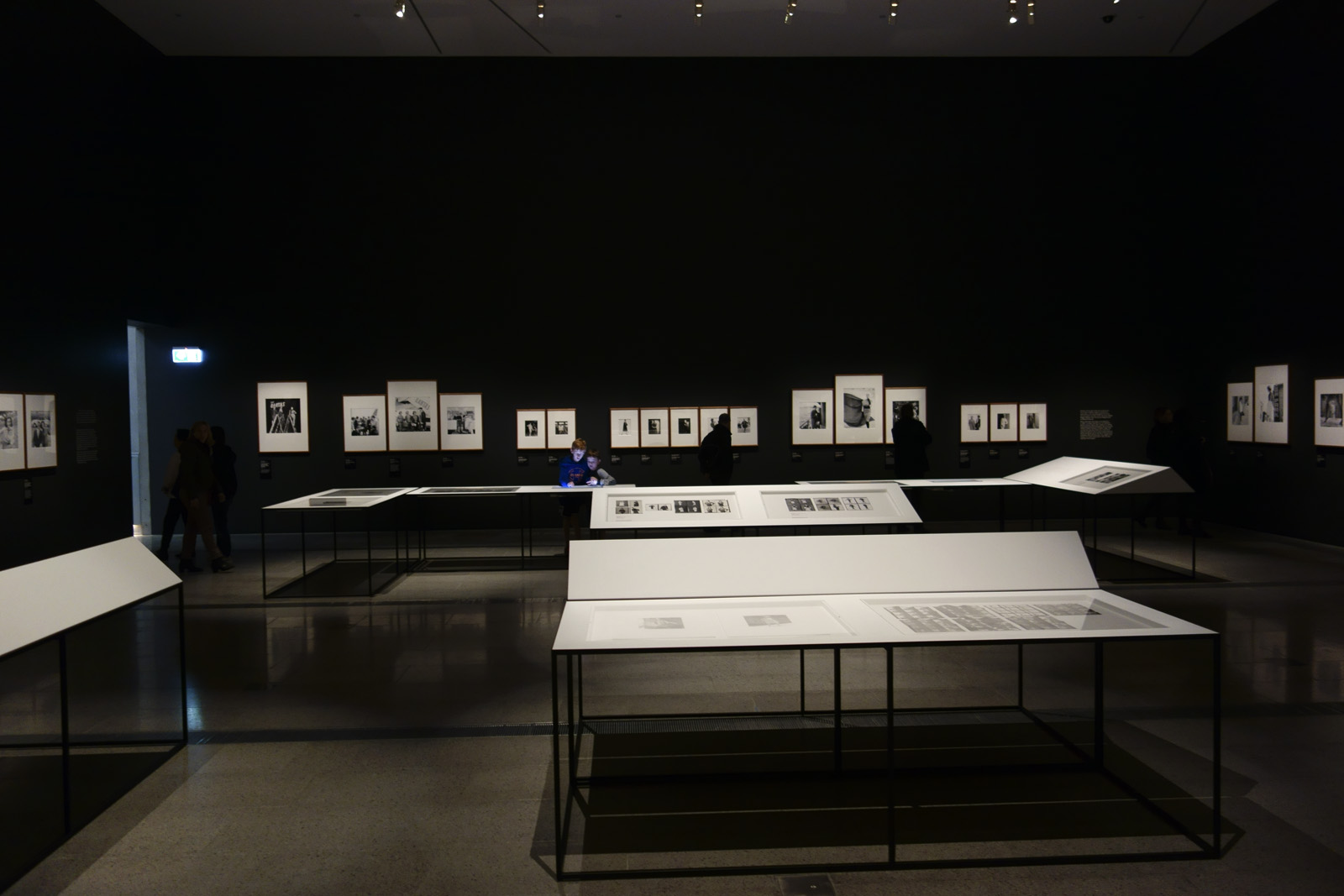
Installation view of the exhibition 'The basement: photography from Prahran College (1968-1981)' at the Museum of Australian Photography, Wheelers Hill, Melbourne
Installation view of the first gallery of the exhibition 'The basement: photography from Prahran College (1968-1981)' at the Museum of Australian Photography, Wheelers Hill, Melbourne


Installation views of the first gallery of the exhibition The basement: photography from Prahran College (1968-1981) at the Museum of Australian Photography, Wheelers Hill, Melbourne
Photos: Marcus Bunyan


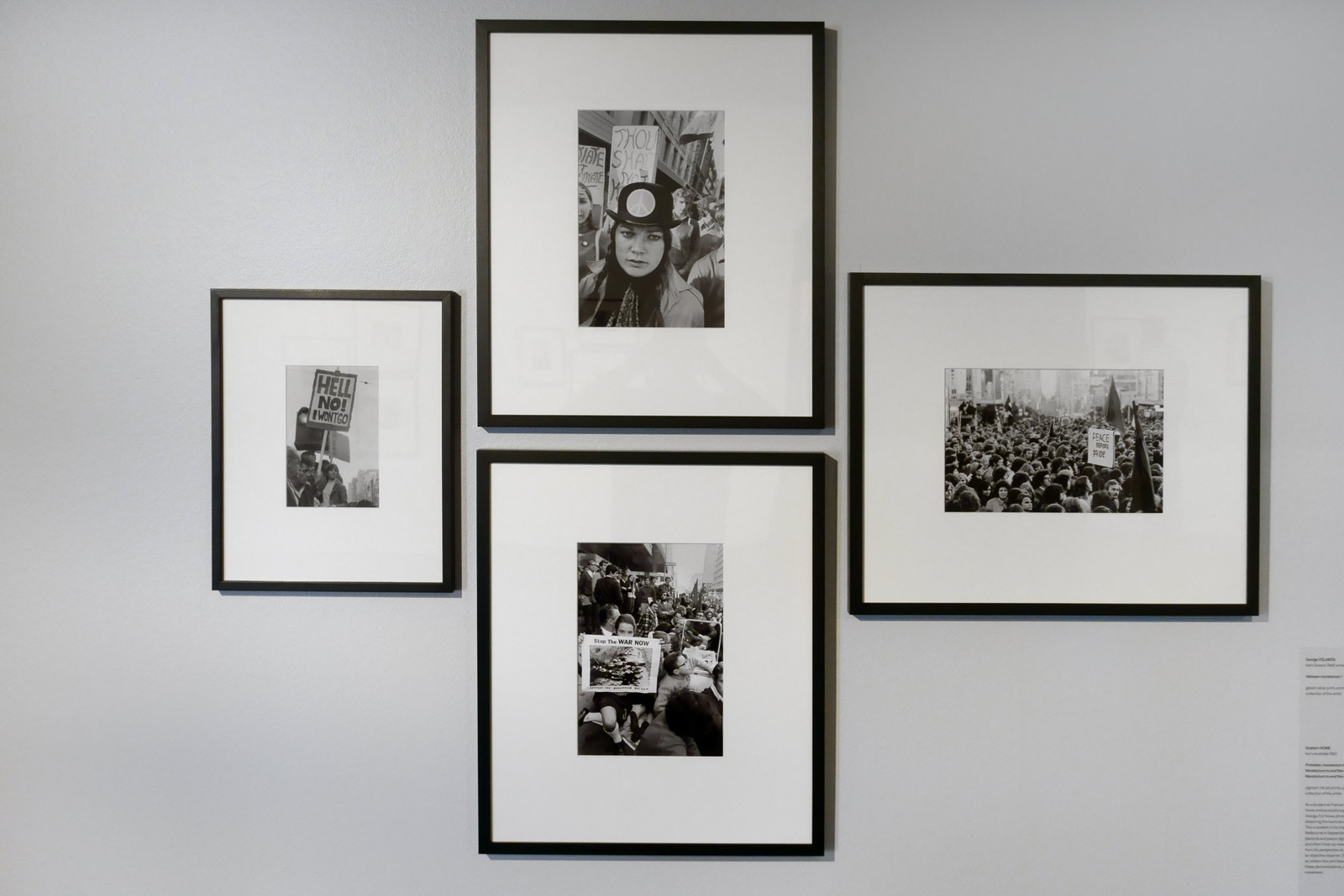
Installation view of the exhibition 'The basement: photography from Prahran College (1968-1981)' at the Museum of Australian Photography, Wheelers Hill, Melbourne showing photography by George Volakos and Graham Howe


Installation view of the first gallery of the exhibition The basement: photography from Prahran College (1968-1981) at the Museum of Australian Photography, Wheelers Hill, Melbourne showing at left, George Volakos’ photograph Vietnam moratorium 1 1970; at top centre, Graham Howe’s photograph Protester, moratorium to end the war in Vietnam 1970 followed by two photographs Moratorium to end the war in Vietnam 1970 (below)
Photo: Marcus Bunyan


As a student at Prahran College in the early 1970s, Graham Howe embraced photography’s ability to document social change. For Howe, photography was the perfect medium for observing the world around him and expressing a point of view. This is evident in his images of a Vietnam War moratorium in Melbourne in September 1970. Immersed in a sea of people, placards and peace signs, Howe made a series of tightly framed and often close-up views of the protesters, showing the event from his perspective as an impassioned participant rather than an objective observer. Other Prahran College students, such as Johann Kris and George Volvos, also took photographs at these demonstrations, documenting the intensity of the activist movement

Wall text from the exhibition

Graham Howe alumni profile on the Prahran Legacy website


Graham Howe (Australian, b. 1950)
'Moratorium to end the war in Vietnam' 1970, printed 2024  (installation view)


Graham Howe (Australian, b. 1950)
Moratorium to end the war in Vietnam (installation view)
1970, printed 2024
Pigment inkjet print
Collection of the artist
Photo: Marcus Bunyan


Graham Howe (Australian, b. 1950)
'Moratorium to end the war in Vietnam' 1970, printed 2024  (installation view) from the exhibition 'The basement: photography from Prahran College (1968-1981)' at the Museum of Australian Photography, March - May, 2025


Graham Howe (Australian, b. 1950)
Moratorium to end the war in Vietnam (installation view)
1970, printed 2024
Pigment inkjet print
Collection of the artist
Photo: Marcus Bunyan


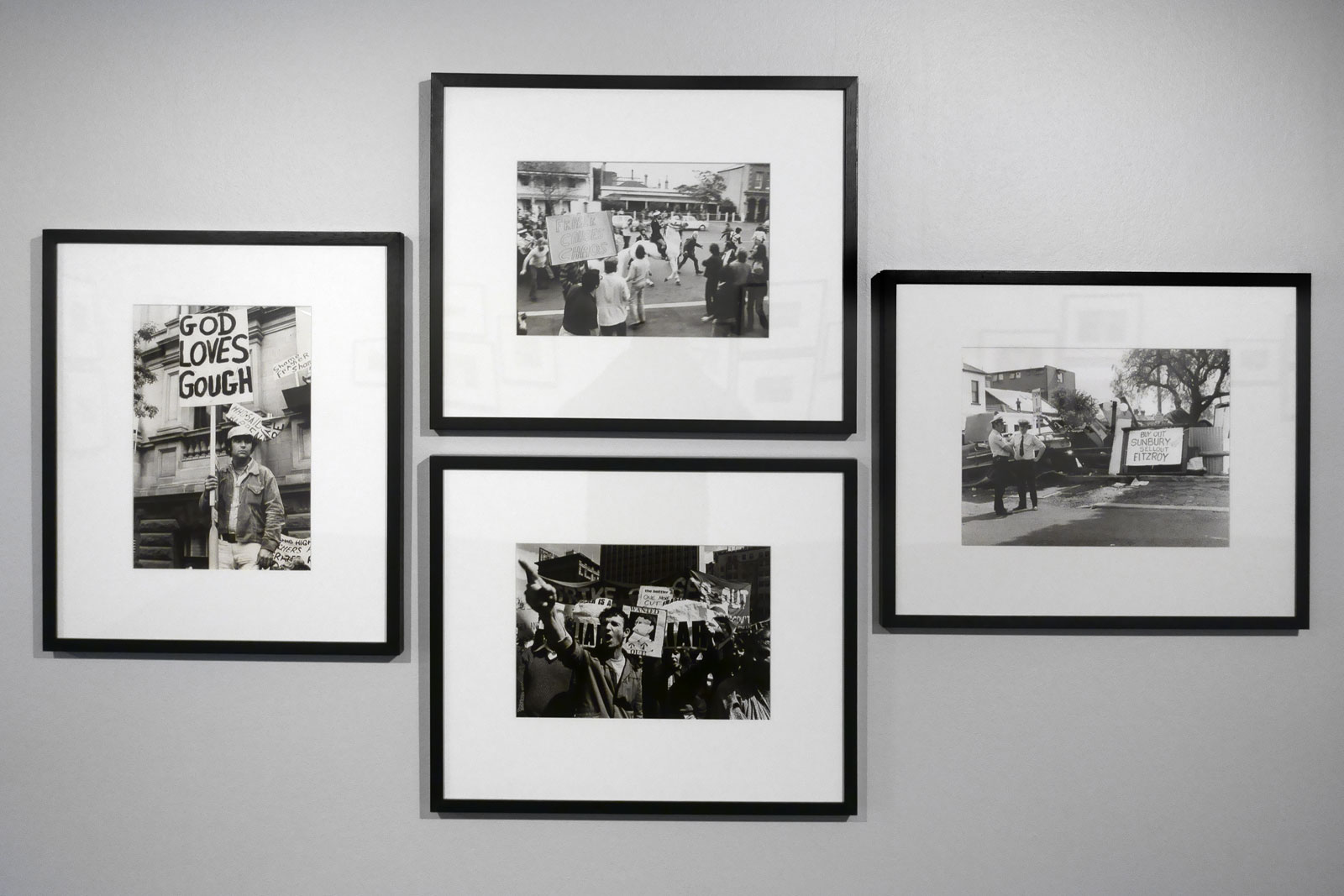
Installation view of the exhibition 'The basement: photography from Prahran College (1968-1981)' at the Museum of Australian Photography, Wheelers Hill, Melbourne showing from left clockwise, Ken Wright's 'Rally for Gough' 1975; Andrew Chapman's 'Street protest, November 11th' 1975; Richard Muggleton's 'Untitled (F19 protest)' c. 1977; and Andrew Chapman's 'Lest we forget' 1980


Installation view of the first gallery of the exhibition The basement: photography from Prahran College (1968-1981) at the Museum of Australian Photography, Wheelers Hill, Melbourne showing from left clockwise, Ken Wright’s Rally for Gough 1975; Andrew Chapman’s Street protest, November 11th 1975; Richard Muggleton’s Untitled (F19 protest) c. 1977; and Andrew Chapman’s Lest we forget 1980
Photo: Marcus Bunyan


Ken Wright (Australian / New Zealand, 1948-1998)
'Rally for Gough' 1975 (installation view)


Ken Wright (Australian/New Zealand, 1948-1998)
Rally for Gough (installation view)
1975
Gelatin silver print
Private collection
Photo: Marcus Bunyan


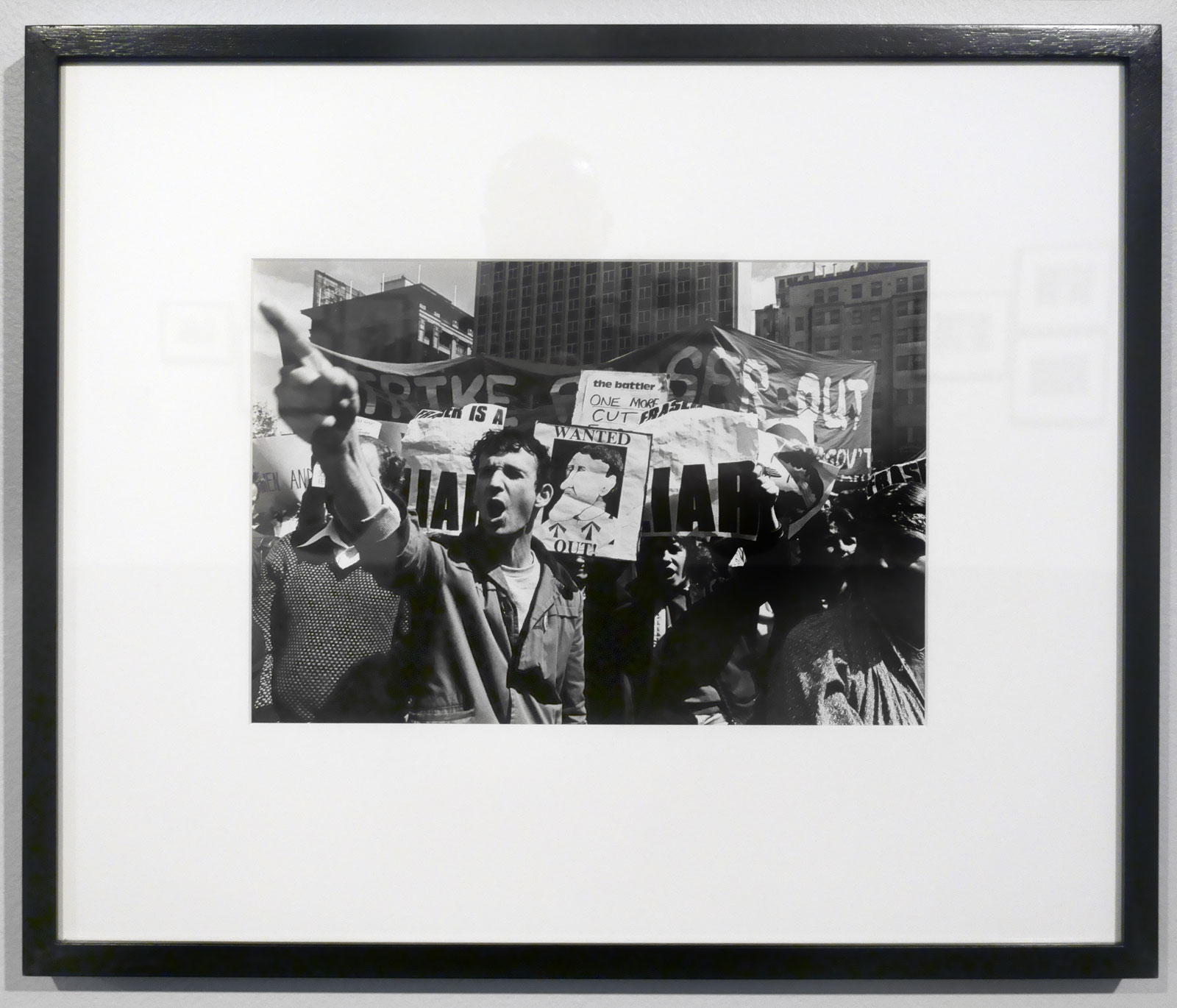
Andrew Chapman (Australian, b. 1954) 'Lest we forget' 1980 (installation view)


Andrew Chapman (Australian, b. 1954)
Lest we forget (installation view)
1980
Gelatin silver print
Museum of Australian Photography, City of Monash Collection donated 2024
Photo: Marcus Bunyan


Andrew Chapman studied photography at Prahran College from 1974 to 1976 and then again in 1980. His Street protest, November 11th (1975) documents a politically motivated rally. It was taken on the corner of Albert Street and moray Street in South Melbourne. Chapman was in his second year at Prahran College and had been listening to parliament on the radio in the office of the then photography technician Murray White. When the news broke of the Whitlam Government’s dismissal, Chapman was quick to join the rallies that broke out in the streets. Later, in 1980, the streets were still politically charged when Chapman returned to Prahran to complete his course. His image, Lest we forget (1980) was made in City Square on Swanston Street at an anti-Fraser demonstration in the lead-up to the 1980 federal election. Described by Julie Millowick as the student who never stopped photographing, even during class, Chapman always has his Leica camera ready. Throughout his career Chapman has photographed much of Australia’s social and political landscape, working both personally and for clients, including as a photojournalist for major Australian newspapers and magazines.

Wall text from the exhibition

Andrew Chapman alumni profile on the Prahran Legacy website


Wall text from the exhibition 'The basement: photography from Prahran College (1968-1981)' at the Museum of Australian Photography, Wheelers Hill, Melbourne


Wall text from the exhibition The basement: photography from Prahran College (1968-1981) at the Museum of Australian Photography, Wheelers Hill, Melbourne
Photo: Marcus Bunyan
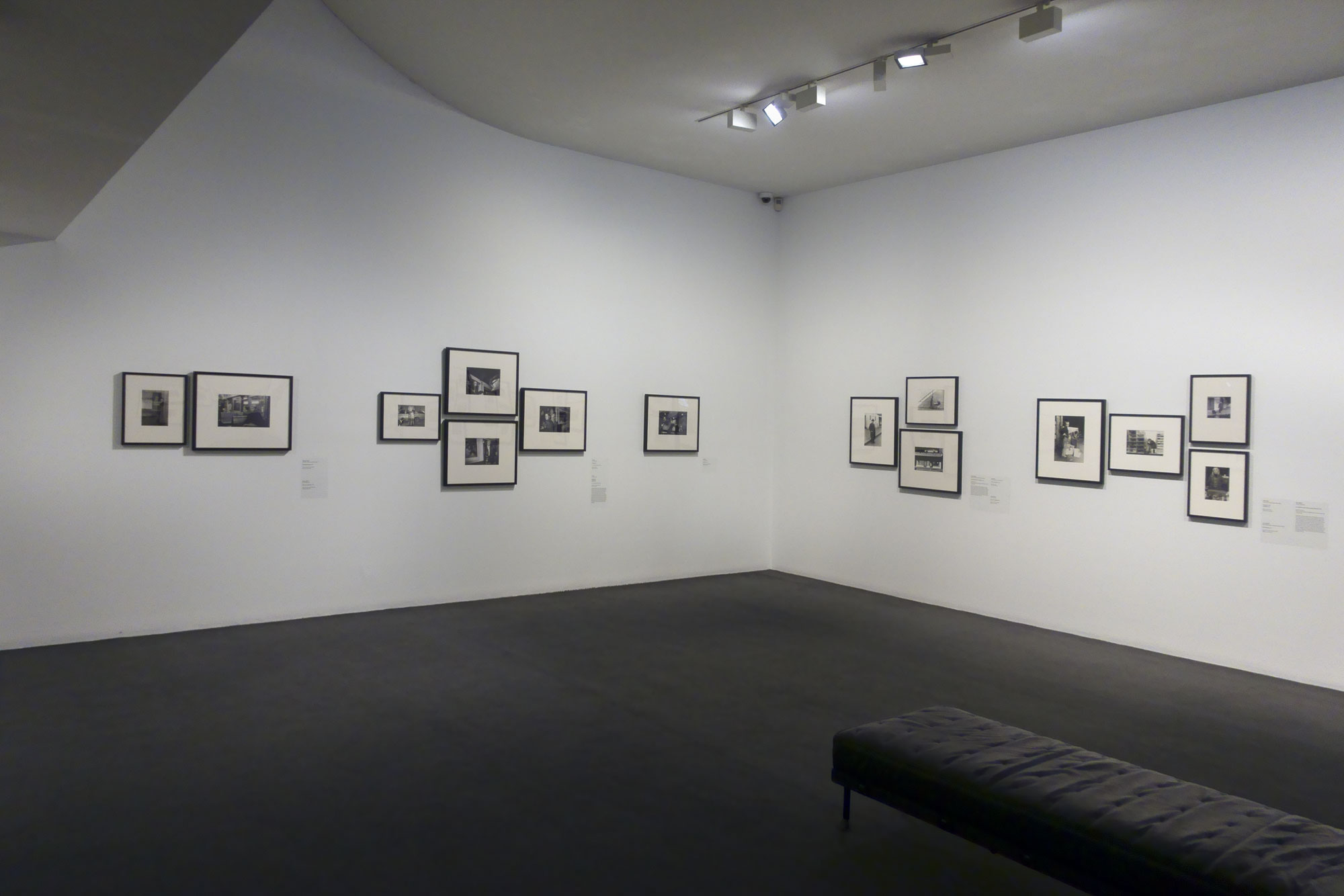
 

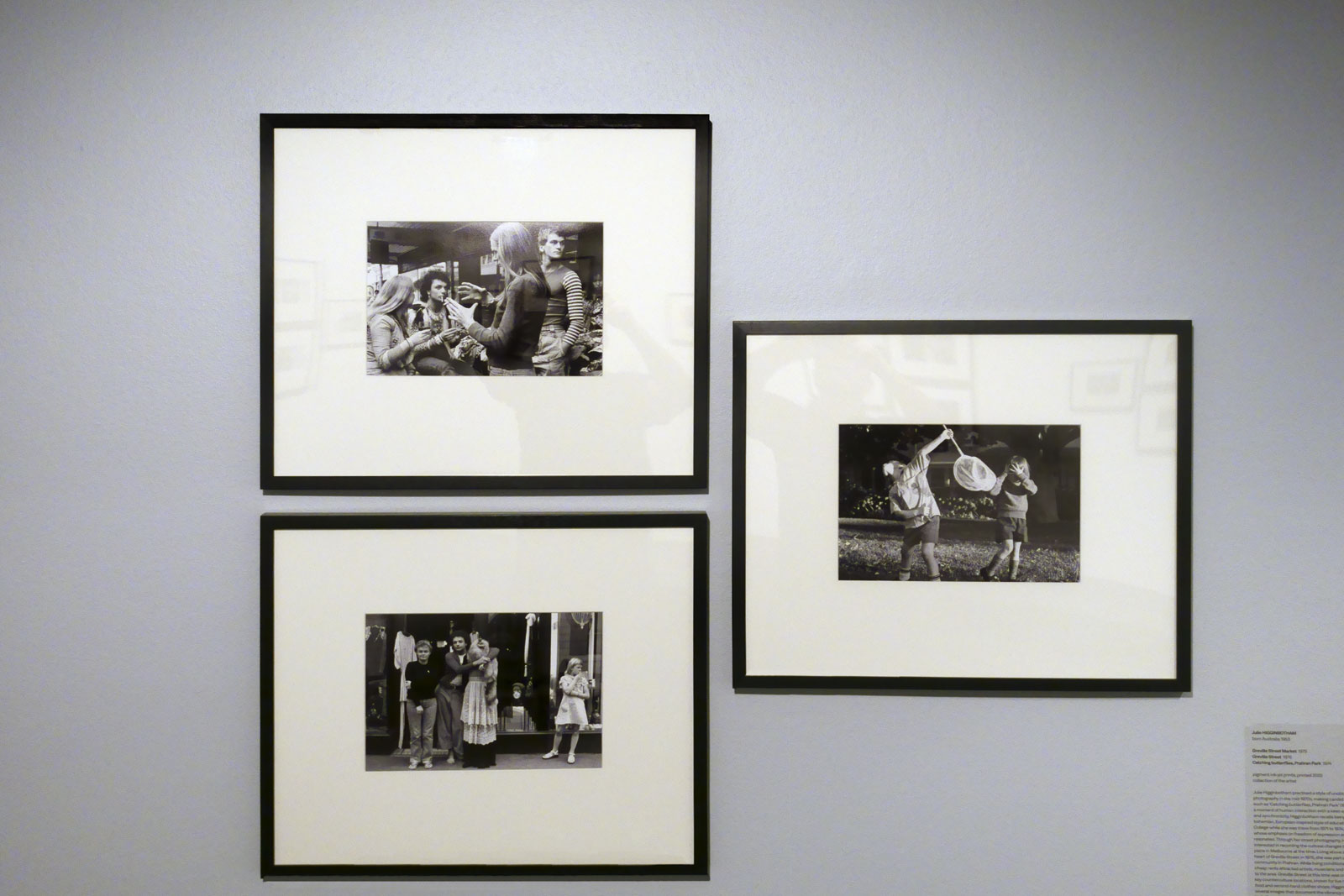
Installation view of the exhibition 'The basement: photography from Prahran College (1968-1981)' at the Museum of Australian Photography, Wheelers Hill, Melbourne showing from top left clockwise photographs by Julie Higginbotham: 'Greville Street Market', 1975; 'Catching butterflies, Prahran Park', 1974; and 'Greville Street', 1976


Installation view of the first gallery of the exhibition The basement: photography from Prahran College (1968-1981) at the Museum of Australian Photography, Wheelers Hill, Melbourne showing from top left clockwise photographs by Julie Higginbotham: Greville Street Market, 1975; Catching butterflies, Prahran Park, 1974; and Greville Street, 1976
Photo: Marcus Bunyan


Julie Higginbotham practiced a style of unobtrusive street photography in the mid-1970s, making candid expressive images such as ‘Catching butterflies, Prahran Park’ (1974), which records a moment of human interaction with a keen eye for composition and synchronicity. Higginbotham recalls being offered a bohemian, European-inspired style of education at Prahran College while she was there from 1971 to 1974, particularly by Cox whose emphasis on freedom of expression and personal choice resonated. Through her street photography, Higginbotham was interested in recording the cultural changes that were taking place in Melbourne at the time. Living above a shop in the heart of Greville Street in 1975, she was part of a lively hippie community in Prahran. While living conditions were squalid, the cheap rents attracted artists, musicians and alternative thinkers to the area. Greville Street at this time was one of Melbourne’s key counterculture locations, known for live music, organic food and second-hand clothes shops. Higginbotham produced several images that document the vibrancy of this movement, including a series of street photographs she made at the Greville Street Market on Saturday in 1975.

Wall text from the exhibition

Julie Higginbotham alumni profile on the Prahran Legacy website


Julie Higginbotham interview Prahran CAE 1971 – 74 Photography


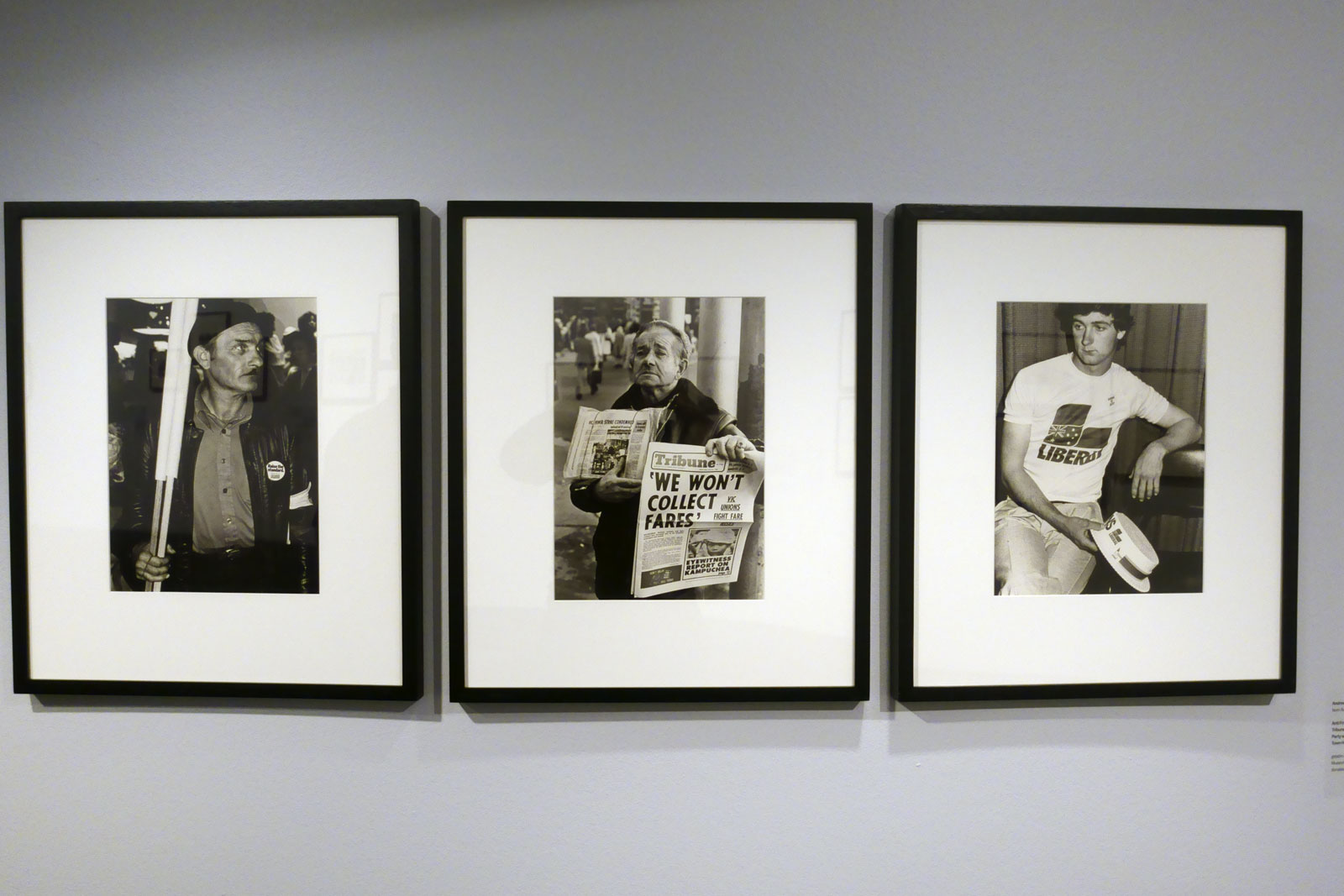
Installation view of the exhibition 'The basement: photography from Prahran College (1968-1981)' at the Museum of Australian Photography, Wheelers Hill, Melbourne showing from left, Andrew Chapman's photographs 'Anti Fraser demonstrator, Collins Street Melbourne' 1979; 'Tribune newspaper seller, Melbourne' 1980; 'Party supporter, Liberal Party campaign launch, Moorabbin Town Hall' 1980


Installation view of the first gallery of the exhibition The basement: photography from Prahran College (1968-1981) at the Museum of Australian Photography, Wheelers Hill, Melbourne showing from left, Andrew Chapman’s photographs Anti Fraser demonstrator, Collins Street Melbourne 1979; Tribune newspaper seller, Melbourne 1980; Party supporter, Liberal Party campaign launch, Moorabbin Town Hall 1980
Photo: Marcus Bunyan


Andrew Chapman (Australian, b. 1954) 'Tribune newspaper seller, Melbourne' 1980 (installation view)


Andrew Chapman (Australian, b. 1954)
Tribune newspaper seller, Melbourne (installation view)
1980
Gelatin silver print
Museum of Australian Photography, City of Monash Collection donated 2024
Photo: Marcus Bunyan


Andrew Chapman (Australian, b. 1954) 'Tribune newspaper seller, Melbourne' 1980 from the exhibition 'The basement: photography from Prahran College (1968-1981)' at the Museum of Australian Photography, Wheelers Hill, Melbourne, March - May 2025


Andrew Chapman (Australian, b. 1954)
Tribune newspaper seller, Melbourne (installation view)
1980
Gelatin silver print
Museum of Australian Photography, City of Monash Collection donated 2024


Andrew Chapman (Australian, b. 1954) 'Party supporter, Liberal Party campaign launch, Moorabbin Town Hall' 1980 (installation view)


Andrew Chapman (Australian, b. 1954)
Party supporter, Liberal Party campaign launch, Moorabbin Town Hall (installation view)
1980
Gelatin silver print
Museum of Australian Photography, City of Monash Collection donated 2024
Photo: Marcus Bunyan


Installation view of the exhibition 'The basement: photography from Prahran College (1968-1981)' at the Museum of Australian Photography, Wheelers Hill, Melbourne showing at left, George Volakos' 'Flinders Street Station' 1972; and at right, Graham Howe's 'Man on tram, Melbourne' 1970


Installation view of the exhibition The basement: photography from Prahran College (1968-1981) at the Museum of Australian Photography, Wheelers Hill, Melbourne showing at left, George Volakos’ Flinders Street Station 1972; and at right, Graham Howe’s Man on tram, Melbourne 1970
Photo: Marcus Bunyan


Installation view of the exhibition 'The basement: photography from Prahran College (1968-1981)' at the Museum of Australian Photography, Wheelers Hill, Melbourne


Installation view of the exhibition The basement: photography from Prahran College (1968-1981) at the Museum of Australian Photography, Wheelers Hill, Melbourne showing photographs by Rob Gale from his Dogs and their humans (1978) and Swanston Street 5pm (1978) series
Photo: Marcus Bunyan


Rob Gale (Australian, b. 1953) 'Untitled 01' 1978 (installation view)


Rob Gale (Australian, b. 1953)
Untitled 01 (installation view)
1978
From the series Swanston Street 5pm
Pigment ink-jet print, printed 2024
Collection of the artist
Photo: Marcus Bunyan


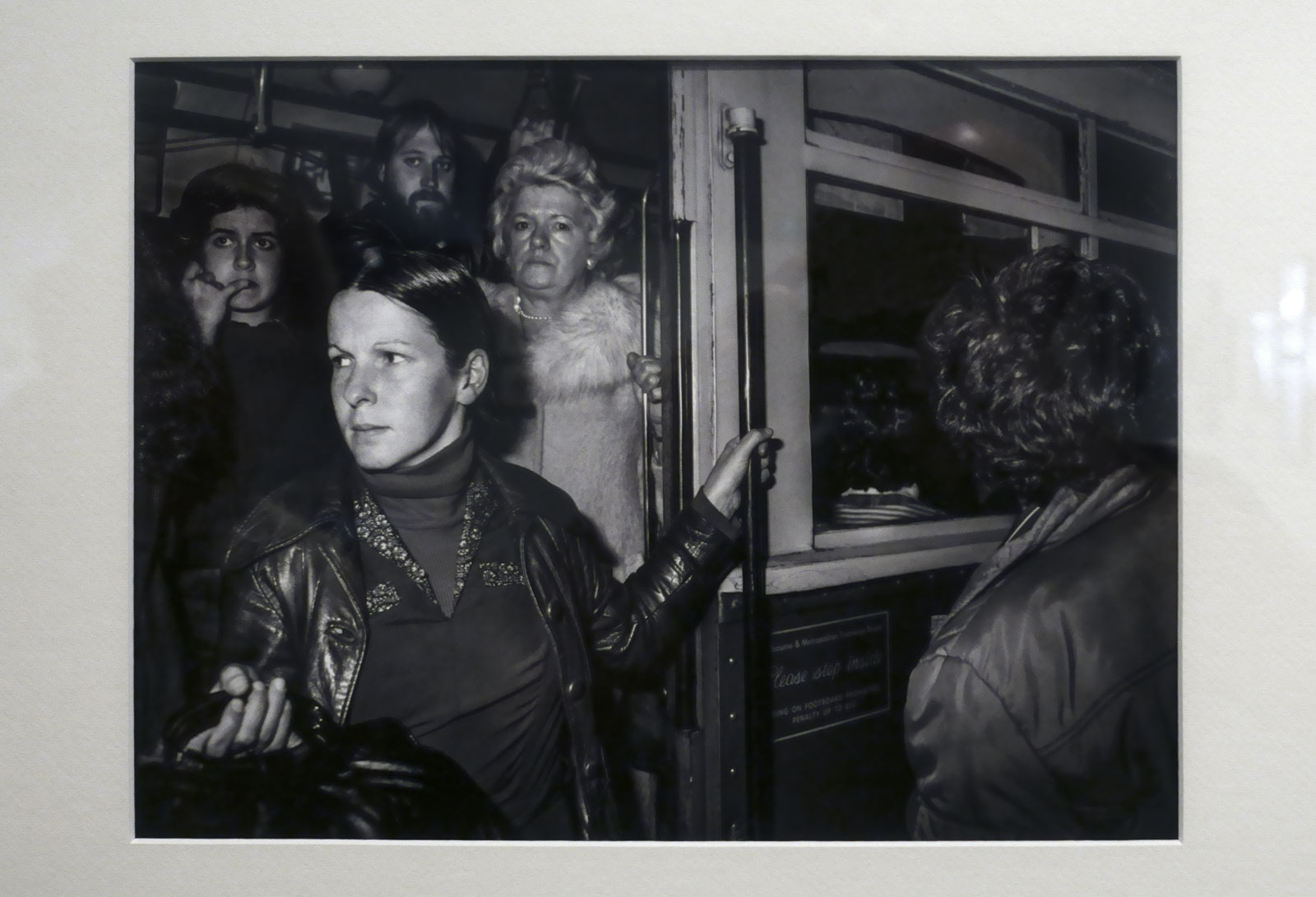
Rob Gale studied photography at Prahran Collect from 1976 to 1978. For his series, Swanston Street, 5pm (1978), Gale took inspiration from an iconic painting by the Australian artist John Brack, Collins Street, 5pm (1955). Gale’s photographic exploration of Brack’s stylised view of Melbourne’s office workers was made during peak hour at a busy tram stop near Flinders Street Station. Influenced by American street photographers such as Bruce Golden and Weegee, Gale used a hand-held flash to illuminate his subjects. In a nod to Brack’s painting, this technique allowed Gale to create harsh, stylised views of impatient commuters. The flash also seems to have induced grimaces and sideways stares which, along with the harsh lighting, shadows and unusual camera angles, served to accentuate the strange and surreal atmosphere in the photographs.

Wall text from the exhibition

Rob Gale alumni profile on the Prahran Legacy website


Rob Gale (Australian, b. 1953)
'Untitled 12' 1978 from the series 'Swanston Street 5pm' from the exhibition 'The basement: photography from Prahran College (1968-1981)' at the Museum of Australian Photography, Wheelers Hill, Melbourne, March - May 2025


Rob Gale (Australian, b. 1953)
Untitled 12
1978
From the series Swanston Street 5pm
Pigment ink-jet print, printed 2024
Collection of the artist


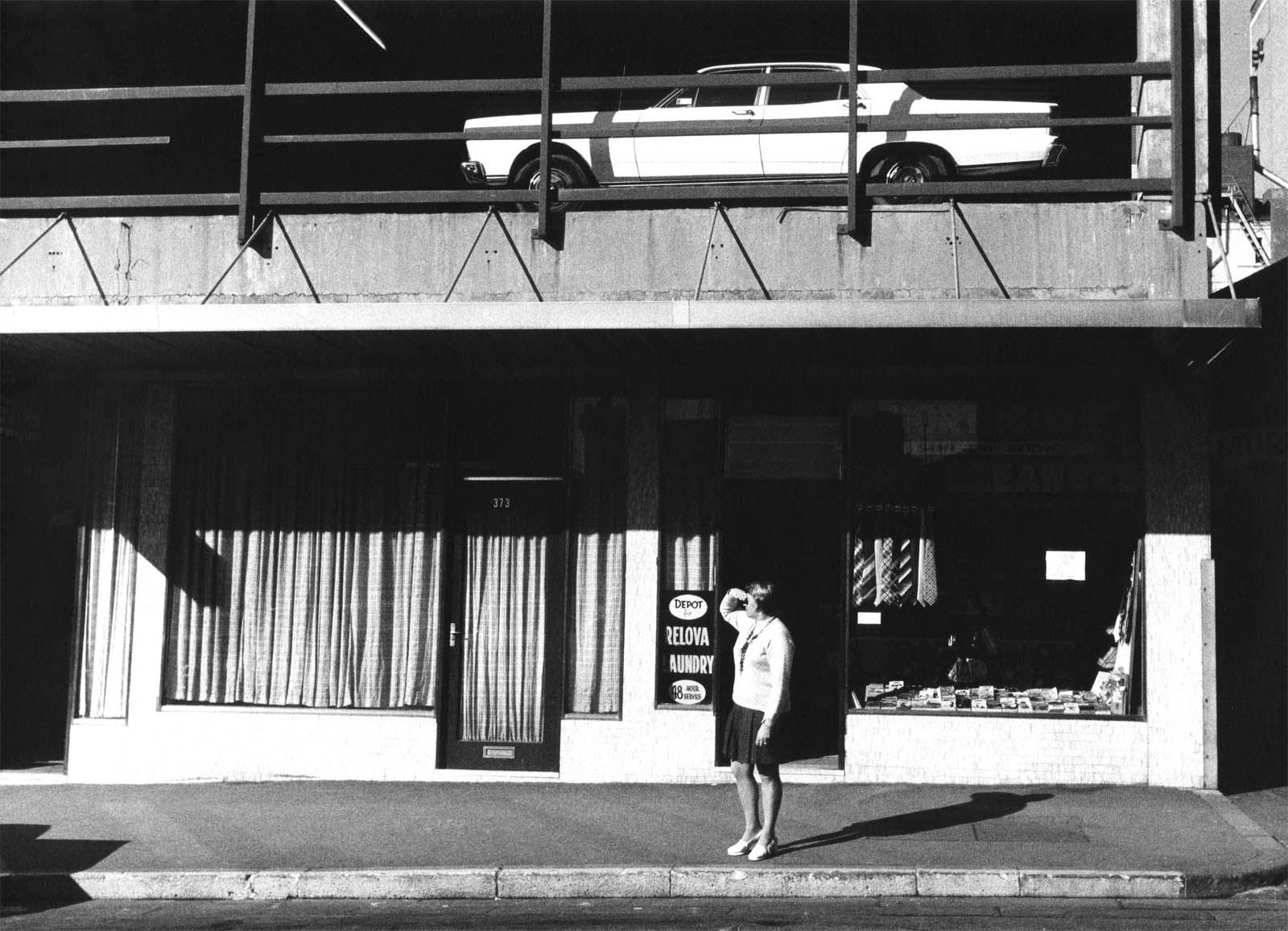
Installation view of the exhibition 'The basement: photography from Prahran College (1968-1981)' at the Museum of Australian Photography, Wheelers Hill, Melbourne showing photographs from left clockwise, Steven Lojewsi's 'Man with umbrella near curb, Melbourne' 1975; Johann Krix's 'Proud moment, Moomba' c. 1971; and Andrew Wittner's 'Where's my car, Melbourne' 1973


Installation view of the exhibition The basement: photography from Prahran College (1968-1981) at the Museum of Australian Photography, Wheelers Hill, Melbourne showing photographs from left clockwise, Steven Lojewsi’s Man with umbrella near curb, Melbourne 1975; Johann Krix’s Proud moment, Moomba c. 1971; and Andrew Wittner’s Where’s my car, Melbourne 1973
Photo: Marcus Bunyan


Andrew Wittner (Australian, b. 1955) 'Where's My Car?' 1973, printed 2024


Andrew Wittner (Australian, b. 1955)
Where’s My Car?
1973, printed 2024
Gelatin silver print
Collection of the artist

Andrew Wittner alumni profile on the Prahran Legacy website


Steven Lojewsi (Australian born England, b. 1952) 'Man with umbrella near curb, Melbourne' 1975 (installation view)


Steven Lojewsi (Australian born England, b. 1952)
Man with umbrella near curb, Melbourne (installation view)
1975
Gelatin silver print
Museum of Australian Photography, City of Monash Collection donated 2025
Photo: Marcus Bunyan


Steven Lojewski was born in London and grea up in Canada before arriving in Australian in 1969. He studied photography at Prahran College from 1974 to 1976 and later at Sydney College of the Arts. While studying at Prahran, Lojewski made a number of photographs on the streets of Melbourne. Sparsely populated, these early-career vintage prints demonstrate Lojewski’s highly defined, formal approach to documenting the urban landscape and illustrate his ability to produce a subtle range of silvery mid-tones and carefully styled compositions.

Wall text from the exhibition

Steven Lojewski alumni profile on the Prahran Legacy website


Steven Lojewsi (Australian born England, b. 1952) 'Man with umbrella near curb, Melbourne' 1975


Steven Lojewsi (Australian born England, b. 1952)
Man with umbrella near curb, Melbourne
1975
Gelatin silver print
Museum of Australian Photography, City of Monash Collection donated 2025


Installation view of the exhibition 'The basement: photography from Prahran College (1968-1981)' at the Museum of Australian Photography, Wheelers Hill, Melbourne showing at left, John Conte's 'Telephone, Prahran' 1971; at centre top, Philip Quirk's 'Lone ranger (Prahran resident with Royal Show souvenirs)' 1973; at centre bottom, Philip Quirk's 'The headmistress, sports day, Como Park' 1975; and at right, Johann Krix's 'Toorak Road, South Yarra' 1972


Installation view of the exhibition The basement: photography from Prahran College (1968-1981) at the Museum of Australian Photography, Wheelers Hill, Melbourne showing at left, John Conte’s Telephone, Prahran 1971; at centre top, Philip Quirk’s Lone ranger (Prahran resident with Royal Show souvenirs) 1973; at centre bottom, Philip Quirk’s The headmistress, sports day, Como Park 1975; and at right, Johann Krix’s Toorak Road, South Yarra 1972
Photo: Marcus Bunyan


Philip Quirk (Australian, b. 1948)
'Lone ranger (Prahran resident with Royal Show souvenirs)' 1973 (installation view)


Philip Quirk (Australian, b. 1948)
Lone ranger (Prahran resident with Royal Show souvenirs) (installation view)
1973
Gelatin silver print
15.9 x 23.8cm
Museum of Australian Photography, City of Monash Collection acquired 2024
Photo: Marcus Bunyan


Based in Sydney, Philip Quirk has been a practising documentary photographer since the 1970s. He studied photography at Prahran College from 1971 to 1973 and has frequently used his camera to capture endearing images of humanity. Influenced by international photographers such as Henri Cartier-Bresson and Diane Arbus, Quirk’s images feature unusual characters and situations, often incorporating humour and incongruity. His work, Lone ranger (Prahran resident with Royal Show souvenirs) (1973) formed part of his final portfolio assessment at Prahran College. Walking through the streets of Prahran, Quirk stopped to talk to this elderly resident and photographed him in the afternoon sunlight. With its emphasis on light and composition combined with an interest in Australian culture, this photograph is a precursor to the street and social documentary work Quirk produced in the years immediately following his time at Prahran College.

Wall text from the exhibition

Phil Quirk alumni profile on the Prahran Legacy website


Johann Krix (Australian born Austria, b. 1948) 'Toorak Road, South Yarra' 1972 (installation view)


Johann Krix (Australian born Austria, b. 1948)
Toorak Road, South Yarra (installation view)
1972
Gelatin silver print
Collection of the artist
Photo: Marcus Bunyan


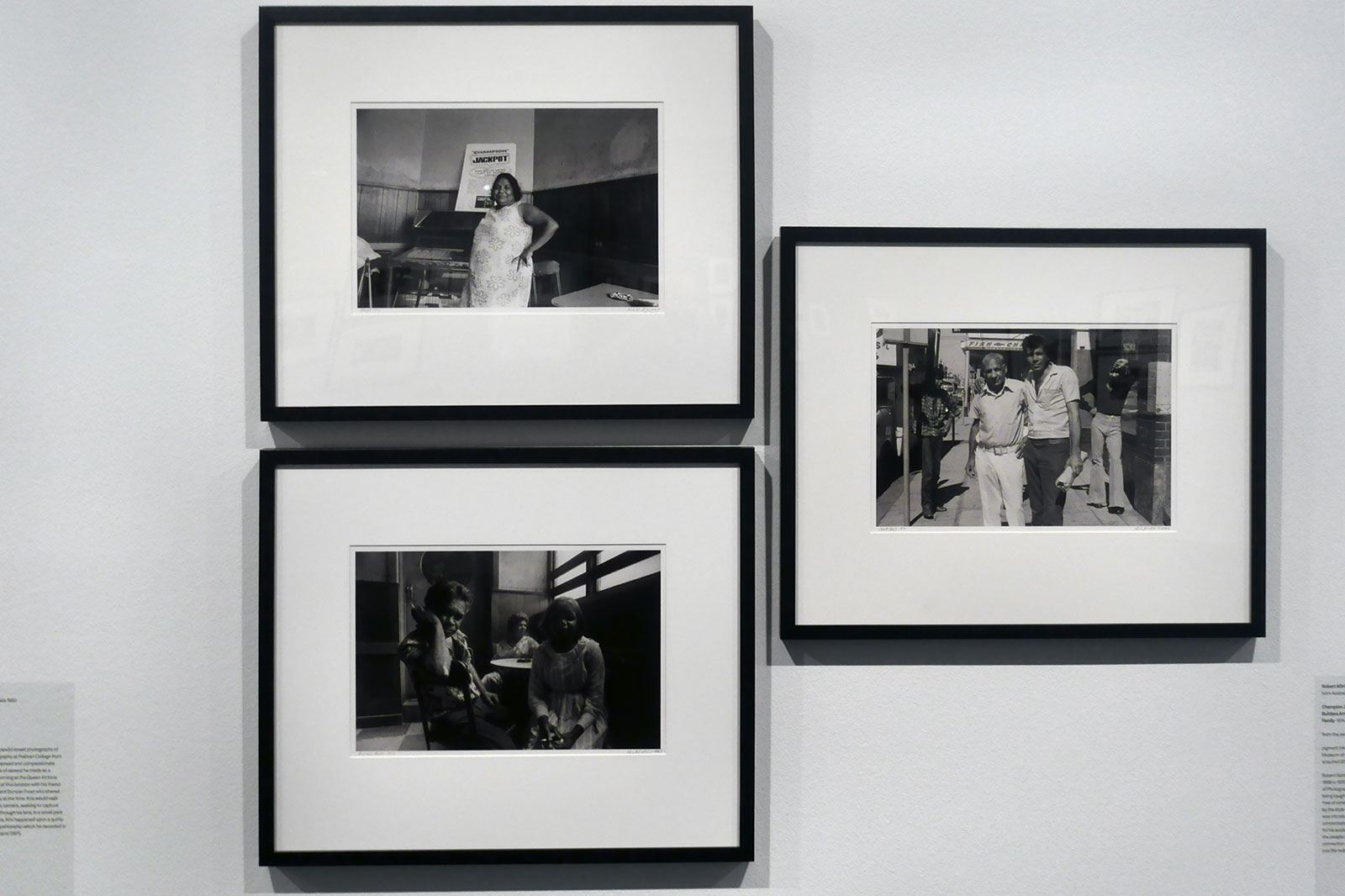
Installation view of the exhibition 'The basement: photography from Prahran College (1968-1981)' at the Museum of Australian Photography, Wheelers Hill, Melbourne showing Robert Ashton's photographs, 'Champion Jackpot' 1974; 'Builders Arms Hotel' 1974; 'Family' 1974 from the series 'Fitzroy'


Installation view of the exhibition The basement: photography from Prahran College (1968-1981) at the Museum of Australian Photography, Wheelers Hill, Melbourne showing Robert Ashton’s photographs, Champion Jackpot 1974; Builders Arms Hotel 1974; Family 1974 from the series Fitzroy
Photo: Marcus Bunyan


Robert Ashton (Australian, b. 1950)
'Champion Jackpot' 1974, printed 2008 (installation view)


Robert Ashton (Australian, b. 1950)
Champion Jackpot (installation view)
1974, printed 2008
Pigment inkjet print
Museum of Australian Photography, City of Monash Collection acquired 2010
Photo: Marcus Bunyan


Robert Ashton studied photography at Prahran college from 1968 to 1970 and first exhibited his work at Brummels Gallery of Photography in 1973. As a student at Prahran, Ashton recalls being taught to follow his heart and his eye in a way that was free of constraints, developing a visual language influenced by the style of European black-and-white photography that he was introduced to by Paul Cox. His early documentary work concentrated on inner-city subjects, and he is widely known for his acclaimed series Fitzroy, which warmly documents the people of Fitzroy, focusing on human life and community connection. This series was originally published as a photobook, Into the hollow mountains a portrait of Fitzroy, in 1974.

Wall text from the exhibition

Robert Ashton alumni profile on the Prahran Legacy website


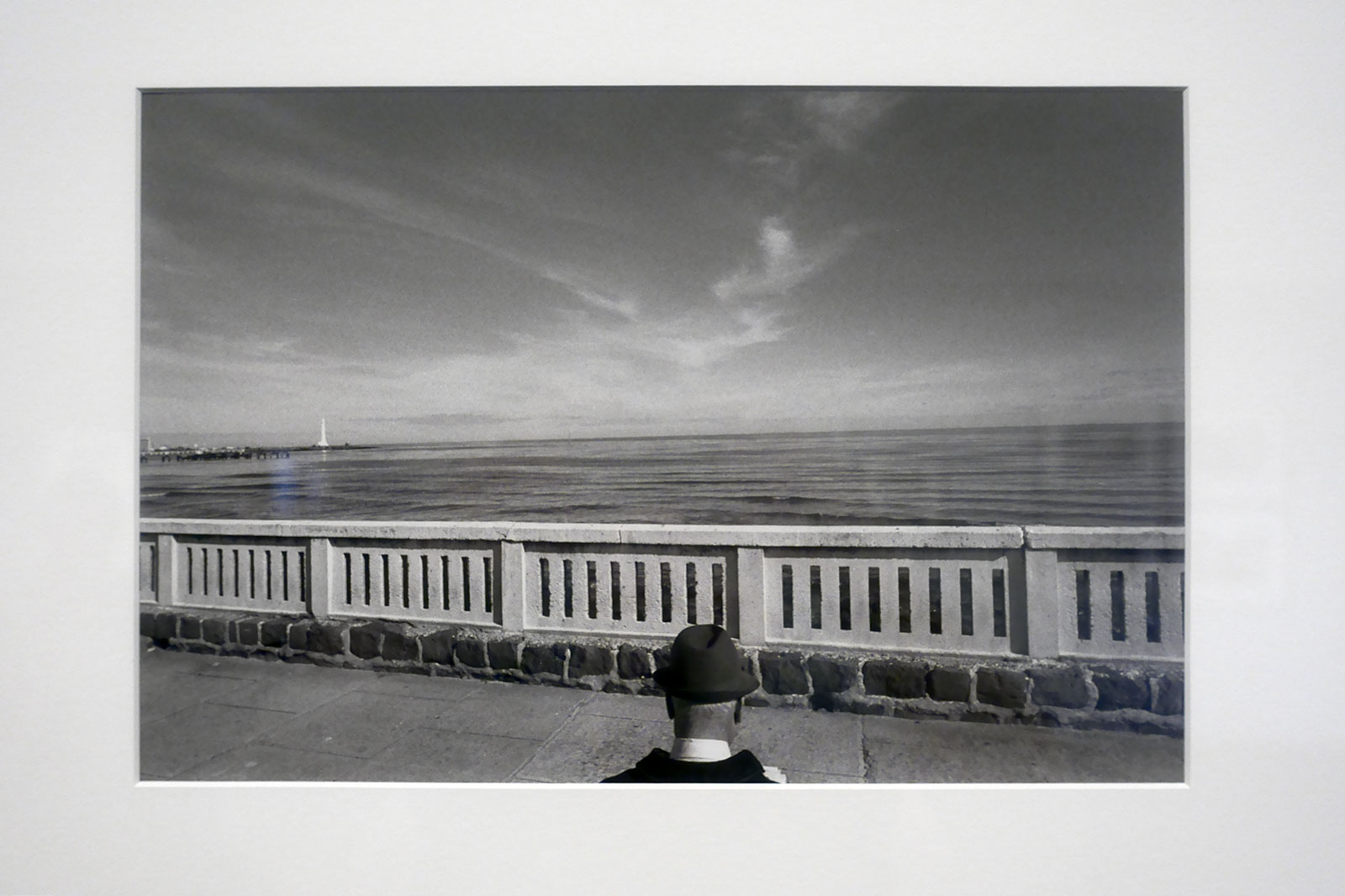
Installation view of the exhibition 'The basement: photography from Prahran College (1968-1981)' at the Museum of Australian Photography, Wheelers Hill, Melbourne  showing from left clockwise, Geoff Strong's 'Bald man enjoying the sun, St Kilda' 1975; Steven Lojewski's 'Man with hat and lighthouse, St Kilda' 1975; Glen O'Malley's 'St Kilda' 1973; and Steven Lojewski's 'Man on bench, Stardust St Kilda' 1975


Installation view of the exhibition The basement: photography from Prahran College (1968-1981) at the Museum of Australian Photography, Wheelers Hill, Melbourne showing from left clockwise, Geoff Strong’s Bald man enjoying the sun, St Kilda 1975; Steven Lojewski’s Man with hat and lighthouse, St Kilda 1975; Glen O’Malley’s St Kilda 1973; and Steven Lojewski’s Man on bench, Stardust St Kilda 1975
Photo: Marcus Bunyan


Geoff Strong (Australian, b. 1950) 'Bald man enjoying the sun, St Kilda'
1975


Geoff Strong (Australian, b. 1950)
Bald man enjoying the sun, St Kilda
1975
Gelatin silver print
19.1 x 26.3cm
Museum of Australian Photography, City of Monash Collection donated 2025


Geoff Strong moved to Melbourne from Brisbane for the photography course at Prahran College, which he began in 1975 after already having established himself as a political journalist. Strong’s image, Bald man enjoying the sun, St Kilda (1975) showcases his acute interest in the qualities of Melbourne’s sunlight. The human element, a man’s bald head, becomes a formal, compositional device, which appears more like a bronze ball than a human form. Strong’s depiction of harsh light in this sparse composition accentuates the photograph’s formal elements and calls to mind the surreal paintings of Georgio de Chirico.

Text from the Museum of Australian Photography website

Geoff Strong alumni profile on the Prahran Legacy website


Steven Lojewsi (Australian born England, b. 1952) 'Man with hat and lighthouse, St Kilda' 1975 (installation view)


Steven Lojewsi (Australian born England, b. 1952)
Man with hat and lighthouse, St Kilda (installation view)
1975
Gelatin silver print
Museum of Australian Photography, City of Monash Collection donated 2025
Photo: Marcus Bunyan


James McArdle (Australian, b. 1950)
'Couple, Luna Park' 1976 (installation view)


James McArdle (Australian, b. 1950)
Couple, Luna Park (installation view)
1976
Gelatin silver print
Museum of Australian Photography, City of Monash Collection donated 2025
Photo: Marcus Bunyan


James McArdle (Australian, b. 1950)
'Conscript, Luna Park' 1976 (installation view)


James McArdle (Australian, b. 1950)
Conscript, Luna Park (installation view)
1976
Gelatin silver print
Museum of Australian Photography, City of Monash Collection donated 2025
Photo: Marcus Bunyan


James McArdle is a photographic artist, curator, writer and educator based in Castlemaine, Victoria. While studying photography at Prahran College from 1974 to 1976, McArdle took his camera out onto the streets of Melbourne. He made several social documentary images as well as more playful, abstract compositions, which highlight his interest in shadow and form. The vintage silver gelatin prints on display here come mostly from McArdle’s first-and second-year street photography folios. They were made during long walks around St Kilda and Elwood. Conscript, Luna Park (1976) formed part of McArdle’s third-year major project on Luna Park, which included portraits taken in the Penny Arcade. Created using a Linhof 4 x 5 inch press camera and flash, this folio was assessed by Wolfgang Sievers.

Wall text from the exhibition

Dr James McArdle profile on the Academia website


Installation view of the exhibition 'The basement: photography from Prahran College (1968-1981)' at the Museum of Australian Photography, Wheelers Hill, Melbourne


Installation view of the exhibition The basement: photography from Prahran College (1968-1981) at the Museum of Australian Photography, Wheelers Hill, Melbourne
Photo: Marcus Bunyan
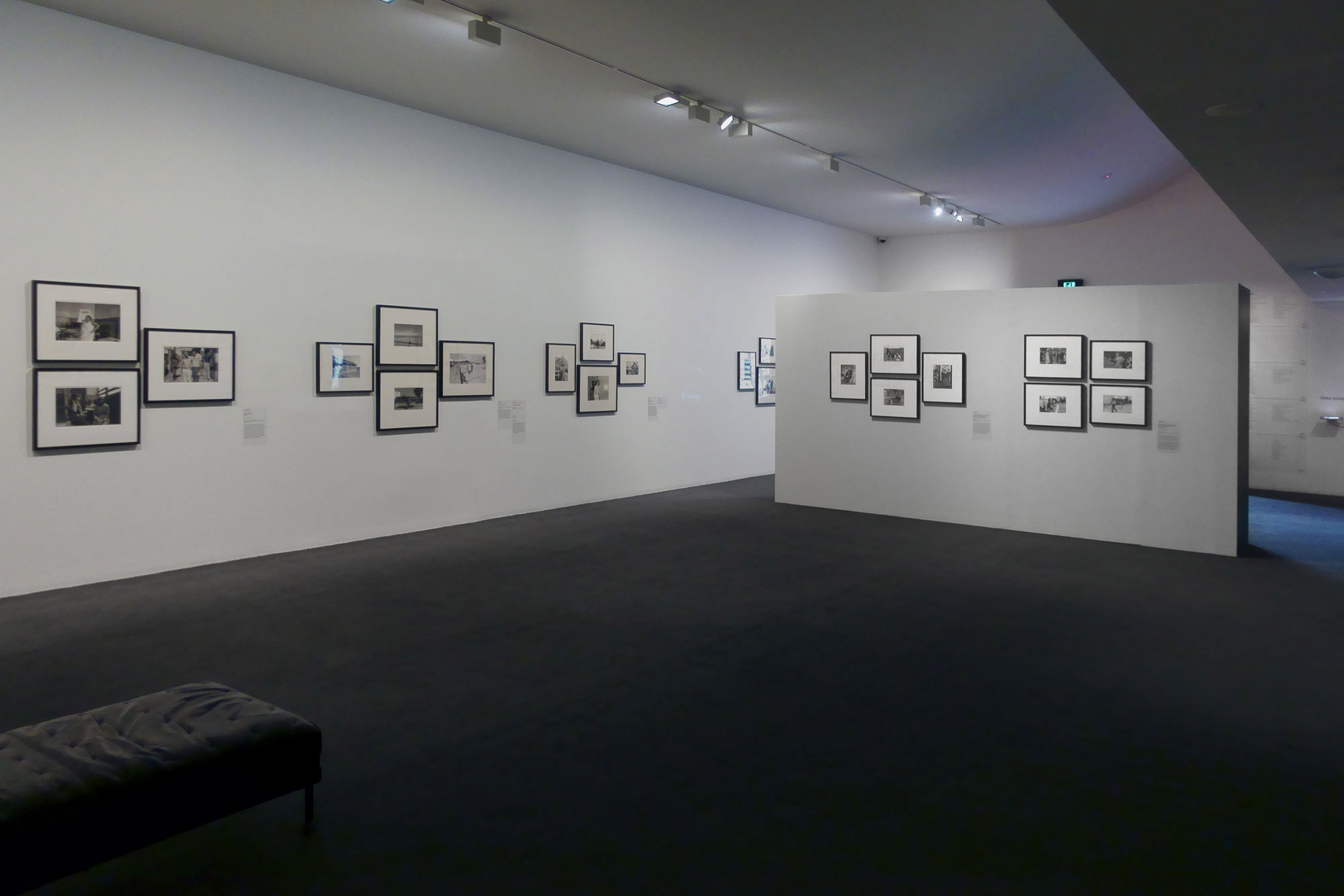
 

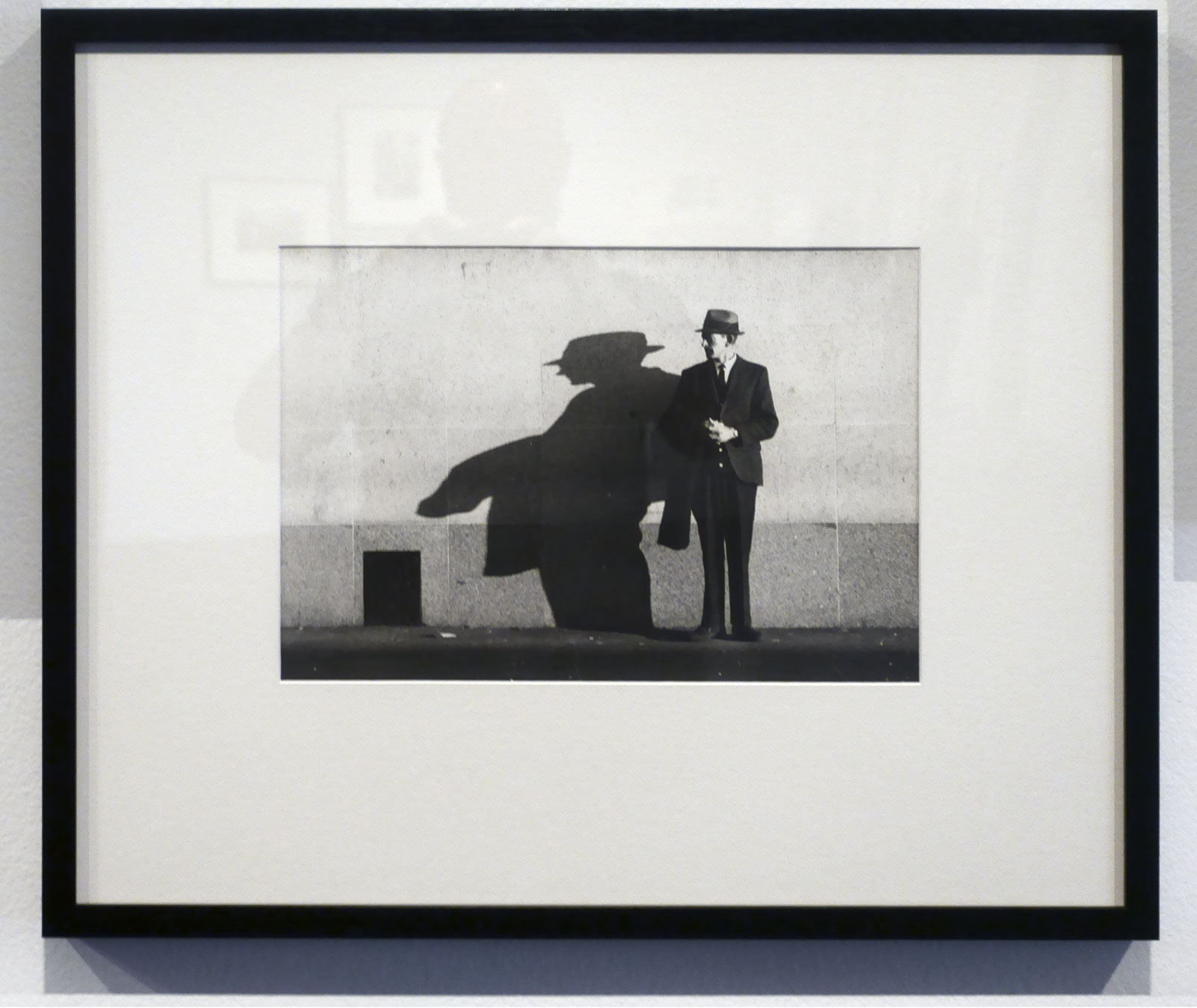
Installation view of the exhibition 'The basement: photography from Prahran College (1968-1981)' at the Museum of Australian Photography, Wheelers Hill, Melbourne showing from left clockwise, James McArdle's 'Hungry puddle, Elwood' 1975 and 'St Kilda Courthouse' 1974; Martin Munz's 'Man at crossing, Lower Esplanade St Kilda' 1979; and Greg Neville's 'Man and shadow' 1971


Installation view of the exhibition The basement: photography from Prahran College (1968-1981) at the Museum of Australian Photography, Wheelers Hill, Melbourne showing from left clockwise, James McArdle’s Hungry puddle, Elwood 1975 and St Kilda Courthouse 1974; Martin Munz’s Man at crossing, Lower Esplanade St Kilda 1979; and Greg Neville’s Man and shadow 1971
Photo: Marcus Bunyan


James McArdle (Australian, b. 1950)
'Hungry puddle, Elwood' 1975


James McArdle (Australian, b. 1950)
Hungry puddle, Elwood
1975
Gelatin silver print
27.0 x 18.5cm
Museum of Australian Photography, City of Monash Collection donated by James McArdle in honour of John Cato 2025


Greg Neville (Australian, b. 1950) 'Man and shadow' 1971 (installation view)


Greg Neville (Australian, b. 1950)
Man and shadow (installation view)
1971
Gelatin silver print
Collection of the artist
Photo: Marcus Bunyan


Installation view of the exhibition 'The basement: photography from Prahran College (1968-1981)' at the Museum of Australian Photography, Wheelers Hill, Melbourne showing Sandra Graham's photographs 'Walls 3 (Joseph)' and 'Walls 2 (cloak 1)' 1976 from the series 'Walls' (left); and 'Backstage, Chapel street bridge, Prahran' 1976 (right)


Installation view of the exhibition The basement: photography from Prahran College (1968-1981) at the Museum of Australian Photography, Wheelers Hill, Melbourne showing Sandra Graham’s photographs Walls 3 (Joseph) and Walls 2 (cloak 1) 1976 from the series Walls (left); and Backstage, Chapel street bridge, Prahran 1976 (right)
Photo: Marcus Bunyan


Sandra Graham (Australian, b. 1947)
'Walls 3 (Joseph)' 1976 (installation view)


Sandra Graham (Australian, b. 1947)
Walls 3 (Joseph) (installation view)
1976
Gelatin silver print
Collection of the artist
Photo: Marcus Bunyan


Formal concerns permeate the street portraits by Sandra Graham who studied photography at Prahran college fromollege from 1974-1975. In her series Walls, Graham relates the human forms of her subjects to the textured walls behind them. For instance, in Walls 3 (Joseph) (1976), the weathered face and stained clothes of a painter are shown in front of a mottled wall that he is about to paint white. Graham blends figure and ground in this image, playing with tonal relationships in black and white. She creates a painterly style of flatness through this series, which was made on streets around St Kilda and Albert Park.

Wall text from the exhibition

Sandra Graham alumni profile on the Prahran Legacy website


Sandra Graham (Australian, b. 1947)
'Walls 3 (Joseph)' 1976


Sandra Graham (Australian, b. 1947)
Walls 3 (Joseph)
1976
Gelatin silver print
Collection of the artist


Gallery two section one (clockwise)


Installation view of the exhibition 'The basement: photography from Prahran College (1968-1981)' at the Museum of Australian Photography, Wheelers Hill, Melbourne


Installation views of the second gallery part A of the exhibition The basement: photography from Prahran College (1968-1981) at the Museum of Australian Photography, Wheelers Hill, Melbourne
Photos: Marcus Bunyan
 

Wall text from the exhibition 'The basement: photography from Prahran College (1968-1981)' at the Museum of Australian Photography, Wheelers Hill, Melbourne


Wall text from the exhibition The basement: photography from Prahran College (1968-1981) at the Museum of Australian Photography, Wheelers Hill, Melbourne
Photo: Marcus Bunyan


Lyn Cheong (Australian, b. 1954)
'Self-portrait' 1977; 'Self-portrait' 1977 (installation view)


Lyn Cheong (Australian, b. 1954)
Self-portrait (installation view)
1977
Self-portrait (installation view)
1977
Dye diffusion transfer prints
Collection of the artist
Photo: Marcus Bunyan


Nicholas Nedelkopoulos (Australian, b. 1955)
'Shrunken head' 1978-1991; 'Dark wedding' 1978-1990 (installation view)


Nicholas Nedelkopoulos (Australian, b. 1955)
Shrunken head (installation view)
1978-1991
Dark wedding (installation view)
1978-1990
Chromogenic prints
Museum of Australian Photography, City of Monash Collection acquired 1992
Photo: Marcus Bunyan


Nicholas Nedelkopoulos (Australian, b. 1955) 'Shrunken head' 1978-1991 (installation view)


Nicholas Nedelkopoulos (Australian, b. 1955)
Shrunken head (installation view)
1978-1991
Chromogenic print
Museum of Australian Photography, City of Monash Collection acquired 1992
Photo: Marcus Bunyan


Leonie Reisberg (Australian, b. 1955) 'Portrait of Peggy Silinski, Merimbula, NSW' 1974 (installation view)


Leonie Reisberg (Australian, b. 1955)
Portrait of Peggy Silinski, Merimbula, NSW (installation view)
1974
Gelatin silver print
Museum of Australian Photography, City of Monash Collection donated by Janice Hinderaker through the Australian Government’s Cultural Gifts Program 2023
Photo: Marcus Bunyan


Leonie Reisberg attended Prahran College between 1974 and 1975, where she developed her photographic practice. Her work from this period is often associated with a growing interest in experimental and documentary photography that emerged in Melbourne during the 1970s.

Reisberg’s approach blends real-life moments with a more composed and conceptual style, often exploring themes of intimacy, femininity and social dynamics. She is part of a cohort of photographers that helped shape the trajectory of contemporary Australian photography, particularly within the context feminist and documentary practices.

Wall text from the exhibition

Leonie Reisberg alumni profile on the Prahran Legacy website


Leonie Reisberg (Australian, b. 1955)
'Portrait of Peggy Silinski, Merimbula, NSW' 1974


Leonie Reisberg (Australian, b. 1955)
Portrait of Peggy Silinski, Merimbula, NSW
1974
Gelatin silver print
Museum of Australian Photography, City of Monash Collection donated by Janice Hinderaker through the Australian Government’s Cultural Gifts Program 2023


Installation view of the exhibition 'The basement: photography from Prahran College (1968-1981)' at the Museum of Australian Photography, Wheelers Hill, Melbourne


Installation view of the exhibition The basement: photography from Prahran College (1968-1981) at the Museum of Australian Photography, Wheelers Hill, Melbourne showing at centre, Andrew Chapman’s Self-portrait in bath 1975; and at right, Viki Petherbridge’s Frames 10-18 1975 from the series Frames
Photo: Marcus Bunyan


Viki Petherbridge (Australian, b. 1954) 'Frames 10-18' 1975 (installation view)


Viki Petherbridge (Australian, b. 1954)
Frames 10-18 (installation view)
1975
from the series Frames
Gelatin silver print
Collection of the artist
Photo: Marcus Bunyan


Wall text from the exhibition 'The basement: photography from Prahran College (1968-1981)' at the Museum of Australian Photography, Wheelers Hill, Melbourne


Wall text from the exhibition The basement: photography from Prahran College (1968-1981) at the Museum of Australian Photography, Wheelers Hill, Melbourne
Photo: Marcus Bunyan


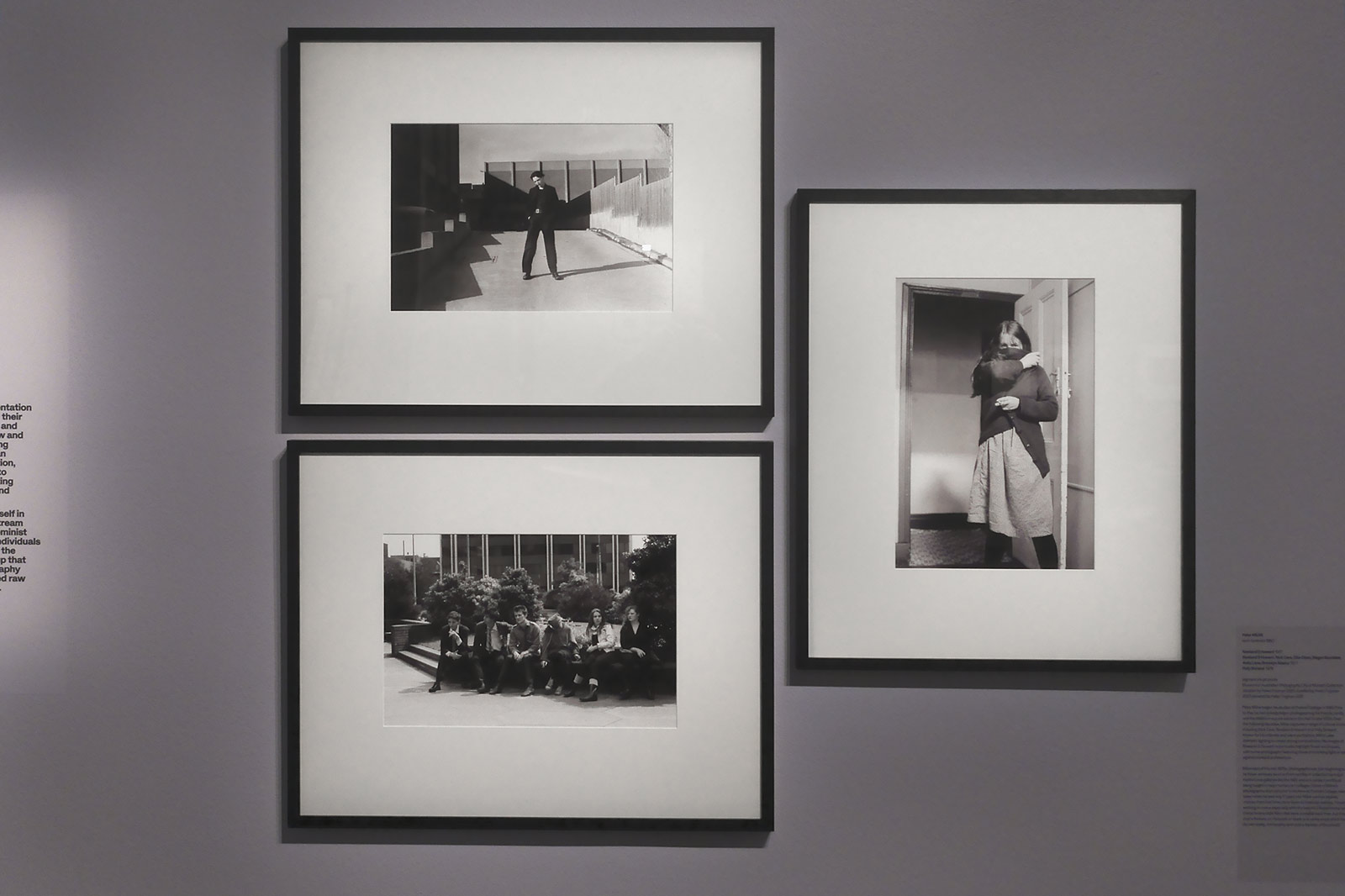
Installation view of the exhibition 'The basement: photography from Prahran College (1968-1981)' at the Museum of Australian Photography, Wheelers Hill, Melbourne showing Peter Milne's photographs from top clockwise, 'Rowland S Howard' 1977; 'Polly Borland' 1979; and 'Rowland S Howard, Nick Cave, Ollie Olsen, Megan Bannister, Anita Lane, Bronwyn Adams' 1977


Installation view of the exhibition The basement: photography from Prahran College (1968-1981) at the Museum of Australian Photography, Wheelers Hill, Melbourne showing Peter Milne’s photographs from top clockwise, Rowland S Howard 1977; Polly Borland 1979; and Rowland S Howard, Nick Cave, Ollie Olsen, Megan Bannister, Anita Lane, Bronwyn Adams 1977
Photo: Marcus Bunyan


Peter Milne (Australian, b. 1960)
'Rowland S Howard' 1977 (installation view)


Peter Milne (Australian, b. 1960)
Rowland S Howard (installation view)
1977
Pigment inkjet print
Museum of Australian Photography, City of Monash Collection donated by Helen Frajman 2023
Photo: Marcus Bunyan


Peter Milne began his studies at Prahran College in 1980. Prior to this, he had already begun photographing his friends, family, and the Melbourne punk scene in the mid-to late 1970s. Over the following decades, Milne captured a range of cultural icons, including Nick Cave, Rowland S Howard and Polly Borland. Known for his intimate and warm portraiture, Milne uses dramatic lighting to create strong compositions. His images of Rowland S Howard, in particular, highlight these techniques, with some photographs featuring Howard in striking light or set against brutalist architecture.

Wall text from the exhibition

See the exhibition Juvenilia: Peter Milne at Strange Neighbour, Fitzroy, Melbourne February – March 2015


Peter Milne (Australian, b. 1960)
'Polly Borland' 1979


Peter Milne (Australian, b. 1960)
Polly Borland
1979
Pigment ink-jet print
48 x 32cm
Museum of Australian Photography, City of Monash Collection donated by Helen Frajman 2021


Installation view of the exhibition 'The basement: photography from Prahran College (1968-1981)' at the Museum of Australian Photography, Wheelers Hill, Melbourne showing portraits by Polly Borland from 1983


Installation view of the exhibition The basement: photography from Prahran College (1968-1981) at the Museum of Australian Photography, Wheelers Hill, Melbourne showing portraits by Polly Borland from 1983
Photo: Marcus Bunyan


Polly Borland (Australian, b. 1959)
'Dave' 1983, printed 2025 (installation view)


Polly Borland (Australian, b. 1959)
Dave (installation view)
1983, printed 2025
Silver dye bleach print
Collection of the artist
Photo: Marcus Bunyan
 

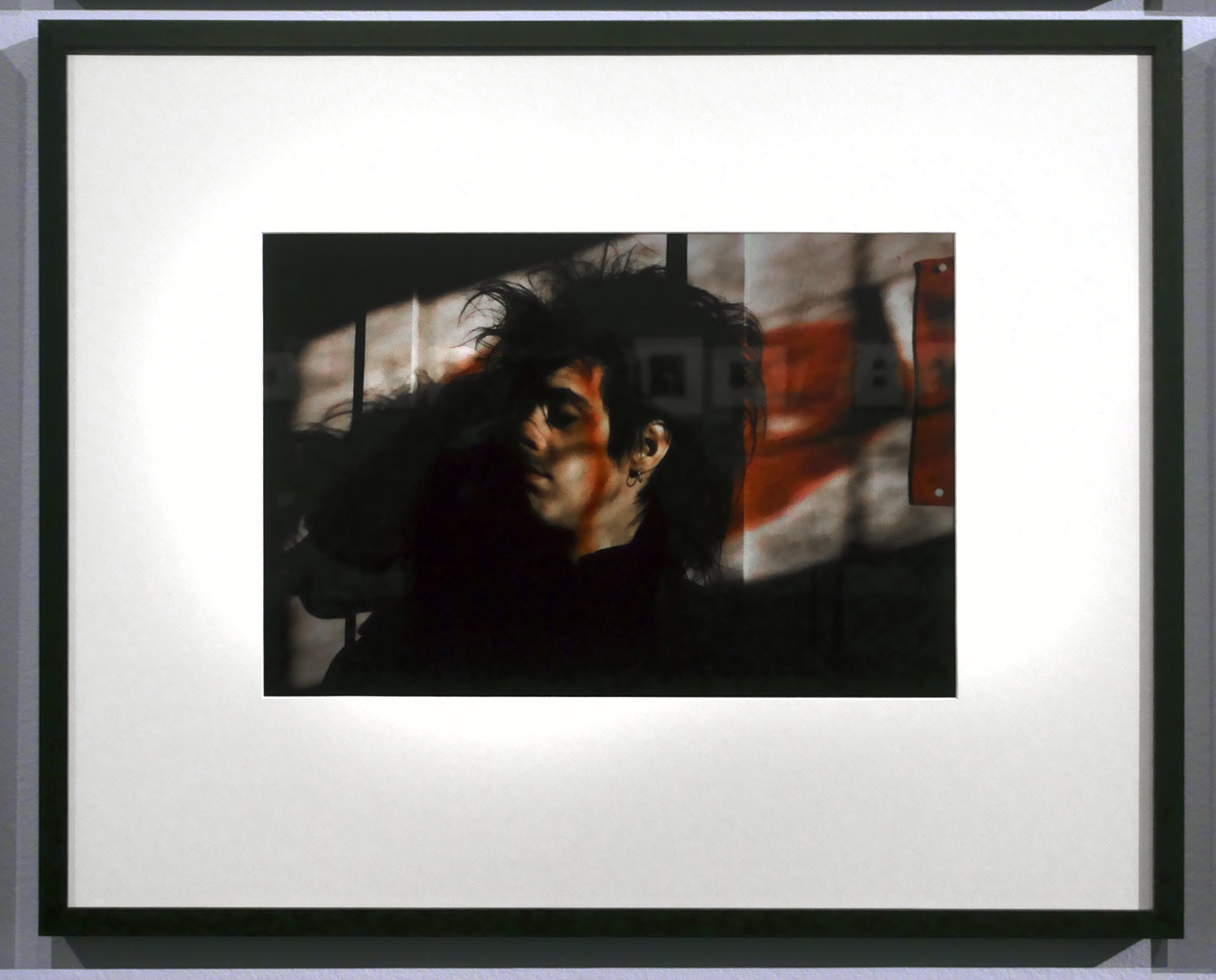
Polly Borland attended Prahran College between 1980 and 1983. Borland shot most of her student work, featured here, on Kodachrome. She shot the works in her Camberwell apartment with direct sunlight pouring through the window. Pieces of carefully placed cellophane on the window created coloured shadows across the subjects’ faces. …

Borland and Cave first began working together in the early 1980s after they met at a party in St Kilda in 1979. The image of Borland at the St Kilda party is documented by fellow friend Peter Milne. Borland’s formative photographs in the early 1980s were part of a new wave of experimental images that departed from renderings of ordinary life.

Wall text from the exhibition


Polly Borland (Australian, b. 1959) 'Nick' 1983, printed 2025 (installation view)


Polly Borland (Australian, b. 1959)
Nick (installation view)
1983, printed 2025
Silver dye bleach print
Museum of Australian Photography, City of Monash Collection acquired 2025
Photo: Marcus Bunyan


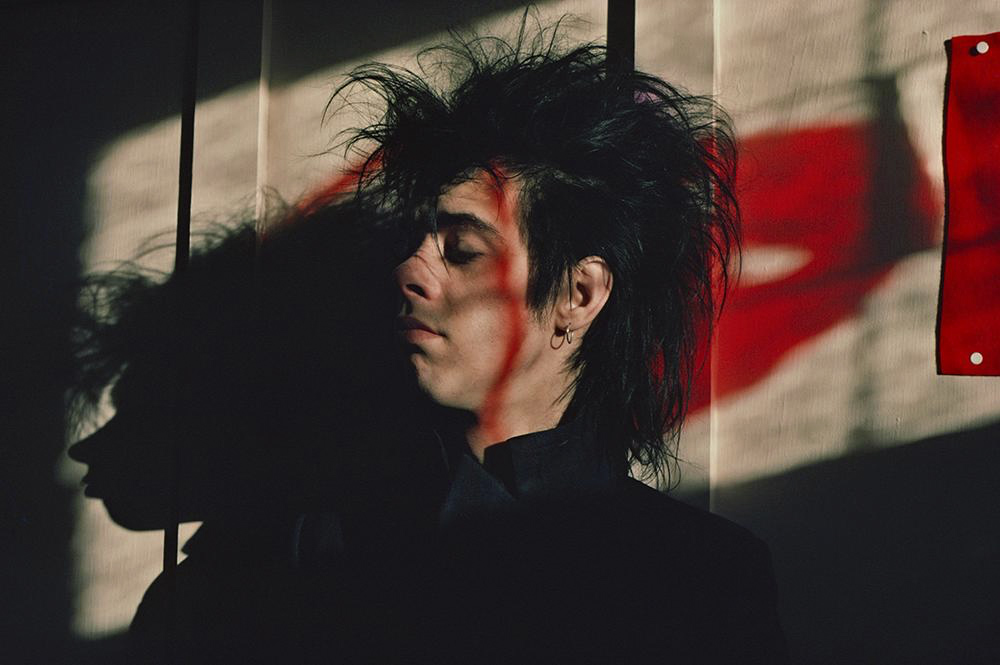
Polly Borland (Australian, b. 1959) 'Nick' 1983, printed 2025


Polly Borland (Australian, b. 1959)
Nick
1983, printed 2025
Silver dye bleach print
Museum of Australian Photography, City of Monash Collection acquired 2025


Polly Borland made this work during her student days at Prahran College where she studied between 1980 and 1983. Borland shot most of her student work on Kodachrome. Shot on Kodachrome, this work forms part of a series of portraits Borland made in her Camberwell apartment with direct sunlight pouring through the window. Pieces of carefully placed cellophane on the window created coloured shadows across the subjects’ faces. 

Borland’s images of Nick Cave from the 1980s and 1990s have become legendary. Often described as raw and intense, these images highlight the tension between the public persona of the famous musician and the more vulnerable, human side of the singer and artist. Borland and Cave first began working together in the early 1980s after they met at a party in St Kilda in 1979.

Text from the Museum of Australian Photography website


Installation view of the exhibition 'The basement: photography from Prahran College (1968-1981)' at the Museum of Australian Photography, Wheelers Hill, Melbourne showing from top left clockwise, Christopher Köller's photographs 'Past self portrait' 1980; 'Philip and Maria' 1981; 'Joe as a Russian soldier' 1980; and 'Bauhausler (homage to Oscar Schlemmer and August Sander)' 1980


Installation view of the exhibition The basement: photography from Prahran College (1968-1981) at the Museum of Australian Photography, Wheelers Hill, Melbourne showing from top left clockwise, Christopher Köller’s photographs Past self portrait 1980; Philip and Maria 1981; Joe as a Russian soldier 1980; and Bauhausler (homage to Oscar Schlemmer and August Sander) 1980
Photo: Marcus Bunyan


Christopher Köller (Australian born England, b. 1943) 'Past self-portrait' 1980


Christopher Köller (Australian born England, b. 1943)
Past self-portrait
1980
Gelatin silver print
23.0 x 24.0cm
Museum of Australian Photography, City of Monash Collection acquired 2024


Christopher Köller trained as a silk-screen printer before travelling extensively throughout the late 1960s and 1970s. Upon his return to Australia, Köller studied photography at Prahran college fromollege, graduating in 1980. Köller enrolled in Prahran with the intention of doing an expose on the conditions experienced by the miners of Bolivia as he had learnt about their plight while travelling in South America.

In his second year Köller stopped looking at photography books and started poring over the pages of art book, influenced by his now partner and historian Nanette Carter and lecturer Norbert Loeffler. Inspired by these teachings, Köller started to set up his images. His first self-portrait titled Past self portrait (1980) is an image of a young artist arriving at Station Pier, Melbourne with his passport in hand. It was part of a series of self-portraits that were shown at The Photographers’ Gallery and Workshop. Other works in this period were influenced by Russian Constructivism – particularly Vladimir Mayakovsky – and 1930s German avant-garde art. In another image, Köller’s subject, dressed in a shirt and tie, stand in front of an Oskar Schlemmer drawing, made by the artist.

Wall text from the exhibition

Christopher Köller alumni profile on the Prahran Legacy website


Christopher Köller (Australian born England, b. 1943) 'Joe as a Russian soldier' 1980 (installation view)


Christopher Köller (Australian born England, b. 1943)
Joe as a Russian soldier (installation view)
1980
Gelatin silver print
Museum of Australian Photography, City of Monash Collection acquired 2024
Photo: Marcus Bunyan


Christopher Köller (Australian born England, b. 1943) 'Joe as a Russian soldier' 1980


Christopher Köller (Australian born England, b. 1943)
Joe as a Russian soldier
1980
Gelatin silver print
Museum of Australian Photography, City of Monash Collection acquired 2024


Installation view of the exhibition 'The basement: photography from Prahran College (1968-1981)' at the Museum of Australian Photography, Wheelers Hill, Melbourne showing Nanette Carter's photographs 'Proof' 1979 and 'Newspaper' 1980


Installation view of the exhibition The basement: photography from Prahran College (1968-1981) at the Museum of Australian Photography, Wheelers Hill, Melbourne showing Nanette Carter’s photographs Proof 1979 and Newspaper 1980
Photo: Marcus Bunyan


Nanette Carter (Australian, b. 1954) 'Proof' 1979 (installation view)


Nanette Carter (Australian, b. 1954)
Proof (installation view)
1979
Gelatin silver print
Museum of Australian Photography, City of Monash Collection acquired 1981
Photo: Marcus Bunyan


Nanette Carter studied first-year photography at Prahran College in 1974 and then completed a diploma (1977) and post graduate diploma (1980) in fine art at the Phillip Institute of Technology, majoring in photography. Her practice explored feminist issues with autobiographical overtones, and she exhibited her work widely between 1981 and 1995. She ceased practising as a Photographer in the early 1990s to pursue her career as a lecturer in design history.

Carter’s image Proof (1979) is a striking self-portrait that reflects on the concept of identity and addresses the idea of photographic ‘proof’ in a multifaceted way. The word written across her face explores the proof of identity and the assertion of existence that photography claims. Newspaper (1980) utilities her partner Christopher Köller as subject. From early on in their relationship, Carter and Köller used each other as models.

Wall text from the exhibition

Nanette Carter alumni profile on the Prahran Legacy website


Nanette Carter (Australian, b. 1954)
'Proof' 1979


Nanette Carter (Australian, b. 1954)
Proof
1979
Gelatin silver print
Museum of Australian Photography, City of Monash Collection acquired 1981


Installation view of the exhibition 'The basement: photography from Prahran College (1968-1981)' at the Museum of Australian Photography, Wheelers Hill, Melbourne showing from left clockwise, Rod McNicol's photographs 'Nanette' 1978; 'Stewart' 1978; and 'Kent' 1978 from the series 'Permanent mirrors'


Installation view of the exhibition The basement: photography from Prahran College (1968-1981) at the Museum of Australian Photography, Wheelers Hill, Melbourne showing from left clockwise, Rod McNicol’s photographs Nanette 1978; Stewart 1978; and Kent 1978 from the series Permanent mirrors
Photo: Marcus Bunyan


Rod McNicol (Australian, b. 1946)
'Nanette' 1978 (installation view)


Rod McNicol (Australian, b. 1946)
Nanette (installation view)
1978
From the series Permanent mirrors
Gelatin silver print
Museum of Australian Photography, City of Monash Collection donated 2024
Photo: Marcus Bunyan


Rod McNicol (Australian, b. 1946) 'Nanette' 1978 from the series 'Permanent mirrors'


Rod McNicol (Australian, b. 1946)
Nanette
1978
From the series Permanent mirrors
Gelatin silver print
Museum of Australian Photography, City of Monash Collection donated 2024


Rod McNicol has been drawn to portraiture ever since he attended Prahran College in 1974. His fellow classmates included Nanette Carter and Bill Henson, and he formed a close connection with Athol Shmith, who would become, in McNicol’s words, ‘a lifelong mentor and friend’. McNicol held his first exhibition and Brummels Gallery of Photography with Carol Jerrems, where he exhibited works from his Permanent mirrors series. This exhibition marked a transition to what McNicol would call his structured approach to portraiture. In the image Nanette, McNicol made a makeshift studio on Paul Cox’s front veranda and placed Carter against a neutral backdrop.

In late 1978, McNicol moved into his warehouse apartment on Smith Street, Fitzroy. Since this move, he has incorporated this space into his work and it has become an important component, both as a location and as an aesthetic context.

Wall text from the exhibition

Rod McNicol alumni profile on the Prahran Legacy website


Rod McNicol (Australian, b. 1946)
'Kent' 1978 (installation view)


Rod McNicol (Australian, b. 1946)
Kent (installation view)
1978
From the series Permanent mirrors
Gelatin silver print
Museum of Australian Photography, City of Monash Collection acquired 2013
Photo: Marcus Bunyan


Rod McNicol’s series of portraits Permanent mirrors grew out of his interest in nineteenth-century photographic portraiture, whereby the slow exposure times necessitated what he calls a ‘gauche, self-conscious, fatalist stare’. For McNicol, these portraits carried the ‘spectre of mortality itself’. The environmental portraits that make up his Permanent mirrors series embody many of the formal attributes of nineteenth-century portraiture that appealed to him, insofar as the sitters are seated in highly static poses, staring directly and blankly at the camera. Soon after, McNicol introduced a range of highly significant formal changes to his portraits, whereby sitters were photographed on a kitchen chair against a plain, neutral background in the artist’s Fitzroy studio. McNicol continues to photograph people from his neighbourhood in this way.

Text from the Museum of Australian Photography website


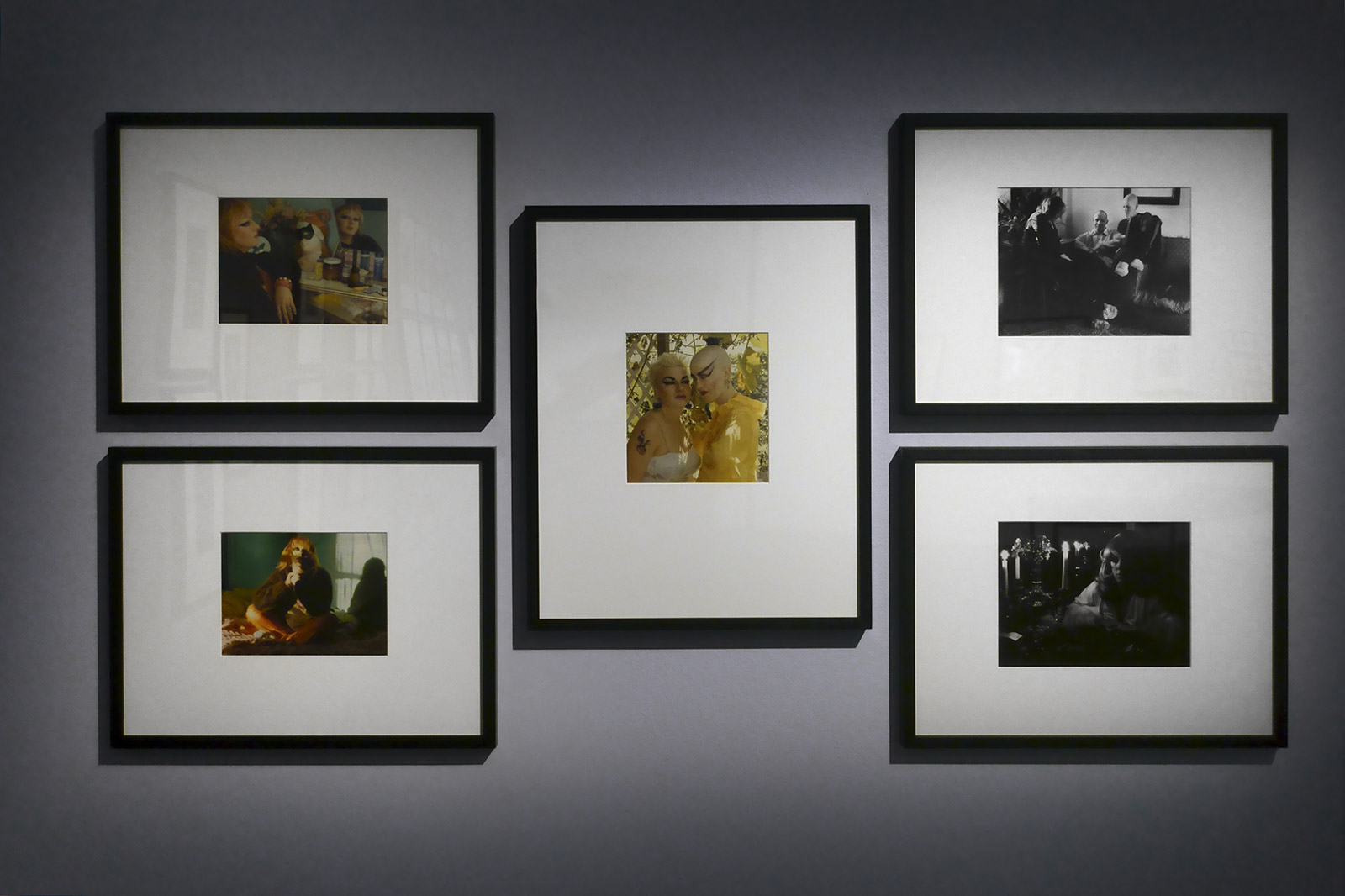
Installation view of the exhibition 'The basement: photography from Prahran College (1968-1981)' at the Museum of Australian Photography, Wheelers Hill, Melbourne showing from left top to bottom, Stella Sallman's photographs 'Sue at the mirror' 1977; 'Sue on the bed' 1977; 'Sue and Carmen' 1978; 'Sue, Simon and Carmen' 1977; 'Beautiful transvestite' 1975


Installation view of the exhibition The basement: photography from Prahran College (1968-1981) at the Museum of Australian Photography, Wheelers Hill, Melbourne showing from left top to bottom, Stella Sallman’s photographs Sue at the mirror 1977; Sue on the bed 1977; Sue and Carmen 1978; Sue, Simon and Carmen 1977; Beautiful transvestite 1975
Photo: Marcus Bunyan


Stella Sallman (Australian, b. 1956)
'Sue and Carmen' 1978 (installation view)


Stella Sallman (Australian, b. 1956)
Sue and Carmen (installation view)
1978
Chromogenic print
Museum of Australian Photography, City of Monash Collection acquired 2025
Photo: Marcus Bunyan


Stella Sallman attended Prahran College from 1976 to 1978. She had originally planned to study fashion design at RMIT, but she was unable pursue the course because she didn’t have a folio. Instead, after completing the preliminary year in Art and Design at Prahran College, she discovered a deep fascination with photography.

Sallman was invited by Rennie Ellis to exhibit her series of glam punks, which she started in her second year, at Brummels Gallery of Photography in 1978, as a support for fellow photographer Jon Rhodes. She said, ‘Rennie came and did some lectures at Prahran. I found him very inspiring because he wasn’t about things looking technically correct.’ He was also brimming with ‘exuberant enthusiastic positive energy.’ The 13 works exhibited at Brummels were portraits of people that Sallman had encountered. Sallman had seen Sue whilst travelling on a train and asked if she could take her portrait. ‘I was very curious about people that didn’t conform.’ In Sallman’s images, she uses colour to emphasise the personality and mood of her subjects, challenging the more traditional, formal portraiture that had prevailed at the time.

Wall text from the exhibition

Stella Sallman alumni profile on the Prahran Legacy website


Gallery two section two (clockwise)


Installation view of the exhibition 'The basement: photography from Prahran College (1968-1981)' at the Museum of Australian Photography, Wheelers Hill, Melbourne
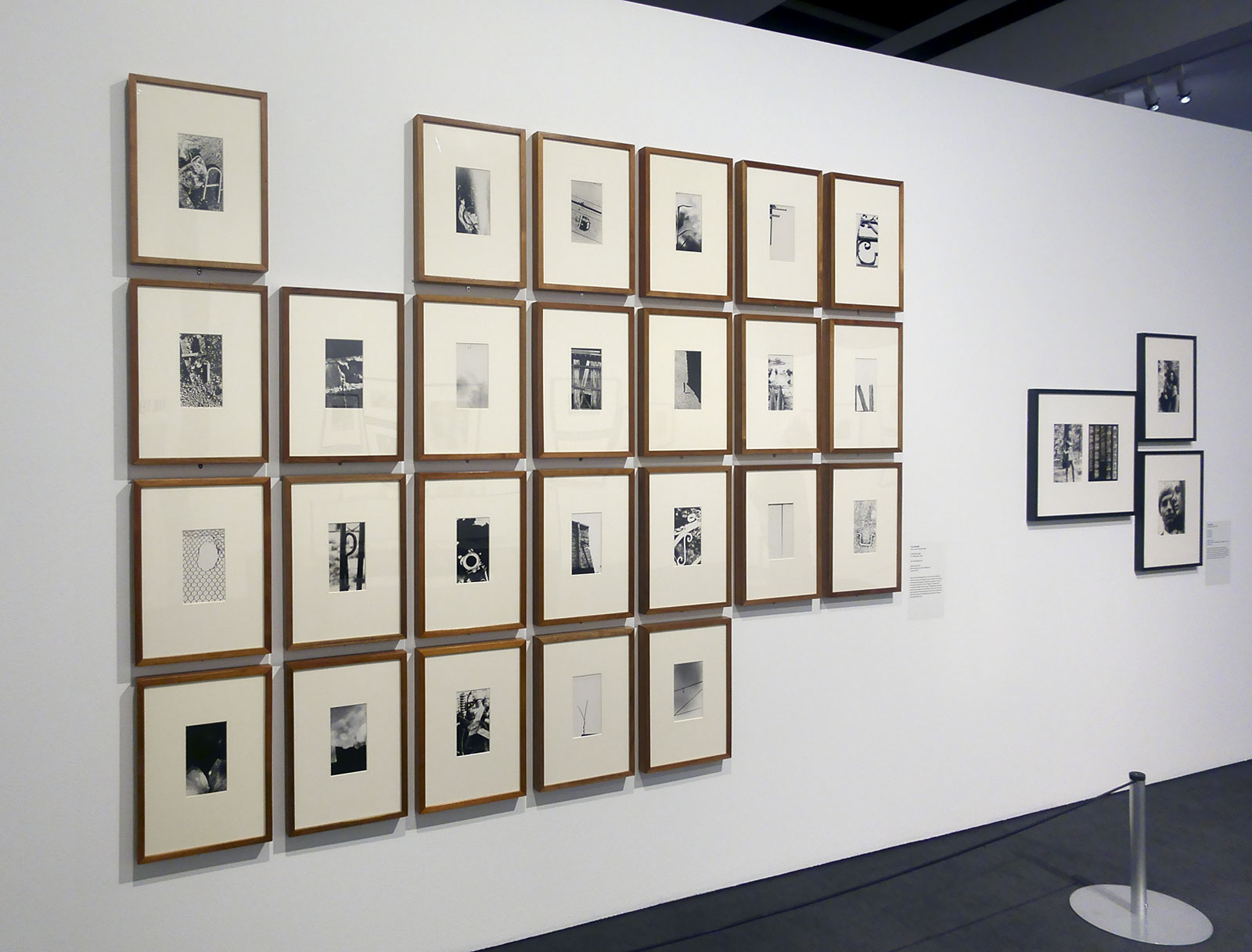
Installation view of the exhibition 'The basement: photography from Prahran College (1968-1981)' at the Museum of Australian Photography, Wheelers Hill, Melbourne showing at left, Carol Jerrems 'Alphabet folio' 1968 dated 1969


Installation view of the exhibition The basement: photography from Prahran College (1968-1981) at the Museum of Australian Photography, Wheelers Hill, Melbourne showing at left, Carol Jerrems Alphabet folio 1968 dated 1969
Photos: Marcus Bunyan


Carol Jerrems (Australian, 1949-1980) Letter from the 'Alphabet folio' 1968 dated 1969 (installation view)


Carol Jerrems (Australian, 1949-1980)
Letters from the Alphabet folio (installation views)
1968 dated 1969
Gelatin silver print
National Gallery of Victoria, Melbourne
Purchased 1971
Photos: Marcus Bunyan


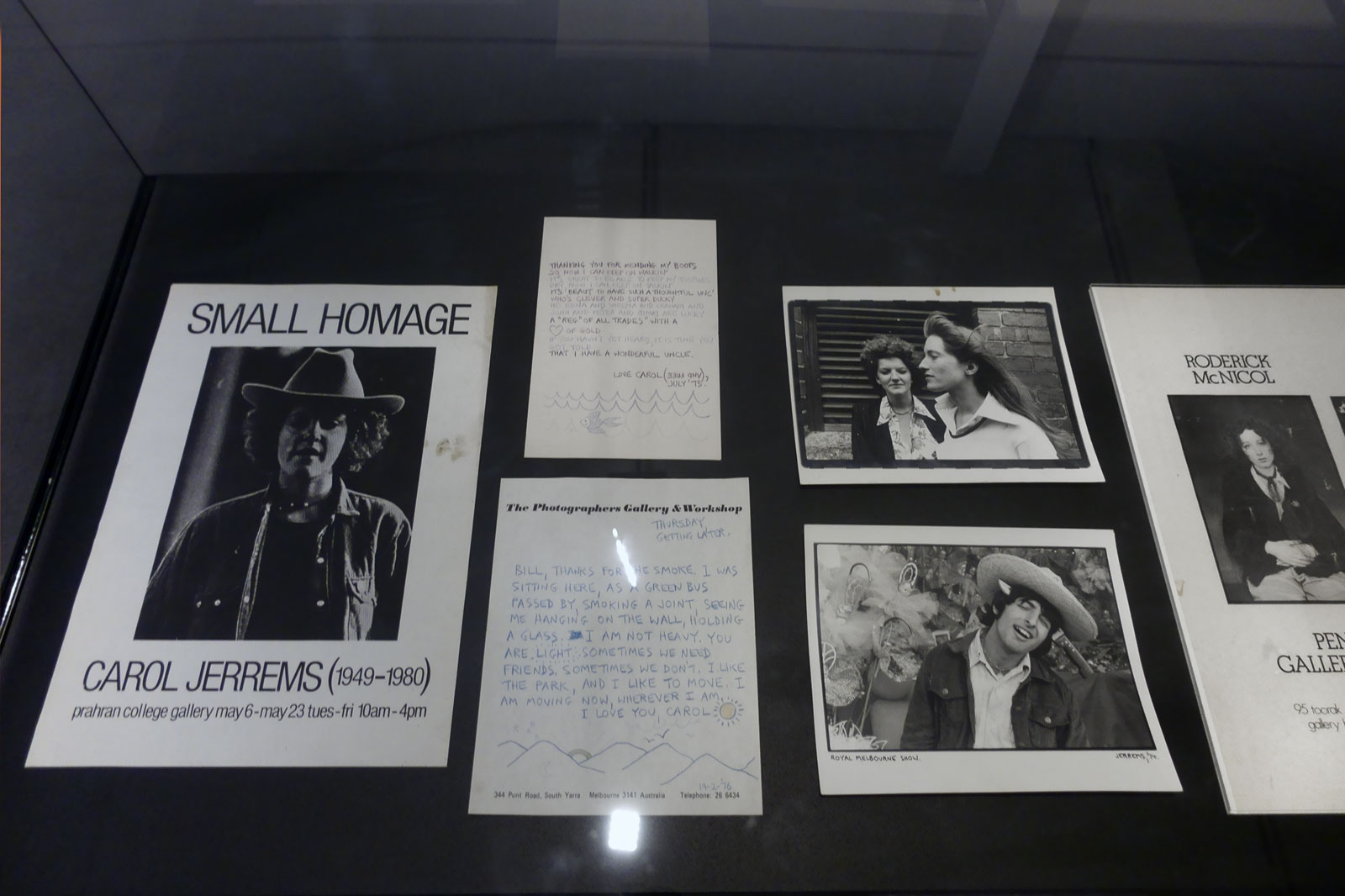
Carol Jerrem’s Alphabet folio is one of her most celebrated and iconic works, and it holds an important place in the history of Australian photography, Created as an assignment during her time as a student at Prahran College, the Alphabet folio consists of 25 letters, with the letter ‘S’ deliberately omitted by Jerrems. The assignment left a lasting impression on Jerrems, as she regularly set this assignment for her own students when she was teaching at the Heidelberg Technical School and the Tasmania School of Art.

Wall text from the exhibition

Carol Jerrems studied at Prahran College between 1967-1969 and graduated in 1970, studying under lecturers McKenzie, Cox, and Lee.

Carol Jerrems alumni profile on the Prahran Legacy website


Installation view of the exhibition 'The basement: photography from Prahran College (1968-1981)' at the Museum of Australian Photography, Wheelers Hill, Melbourne


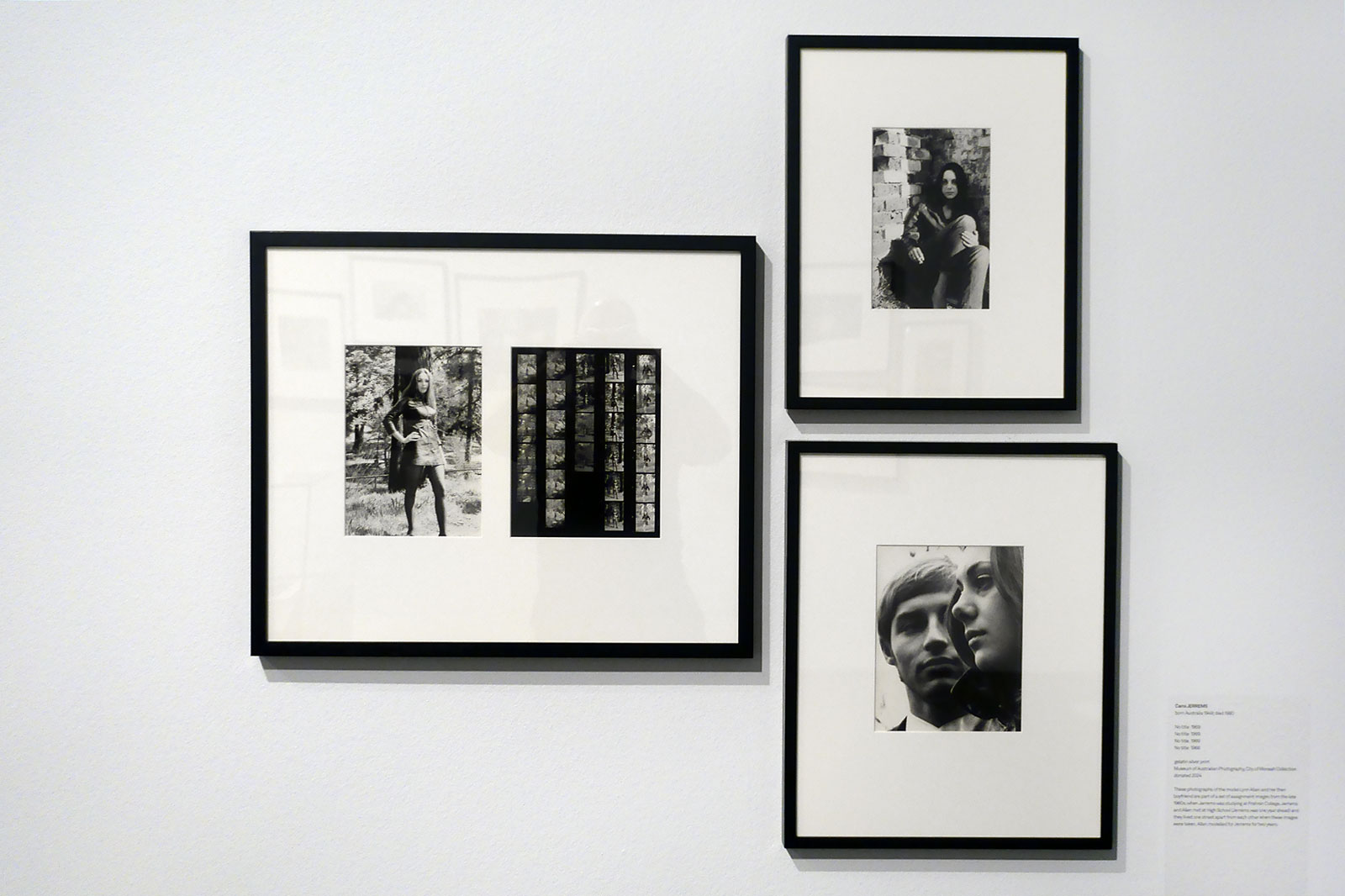
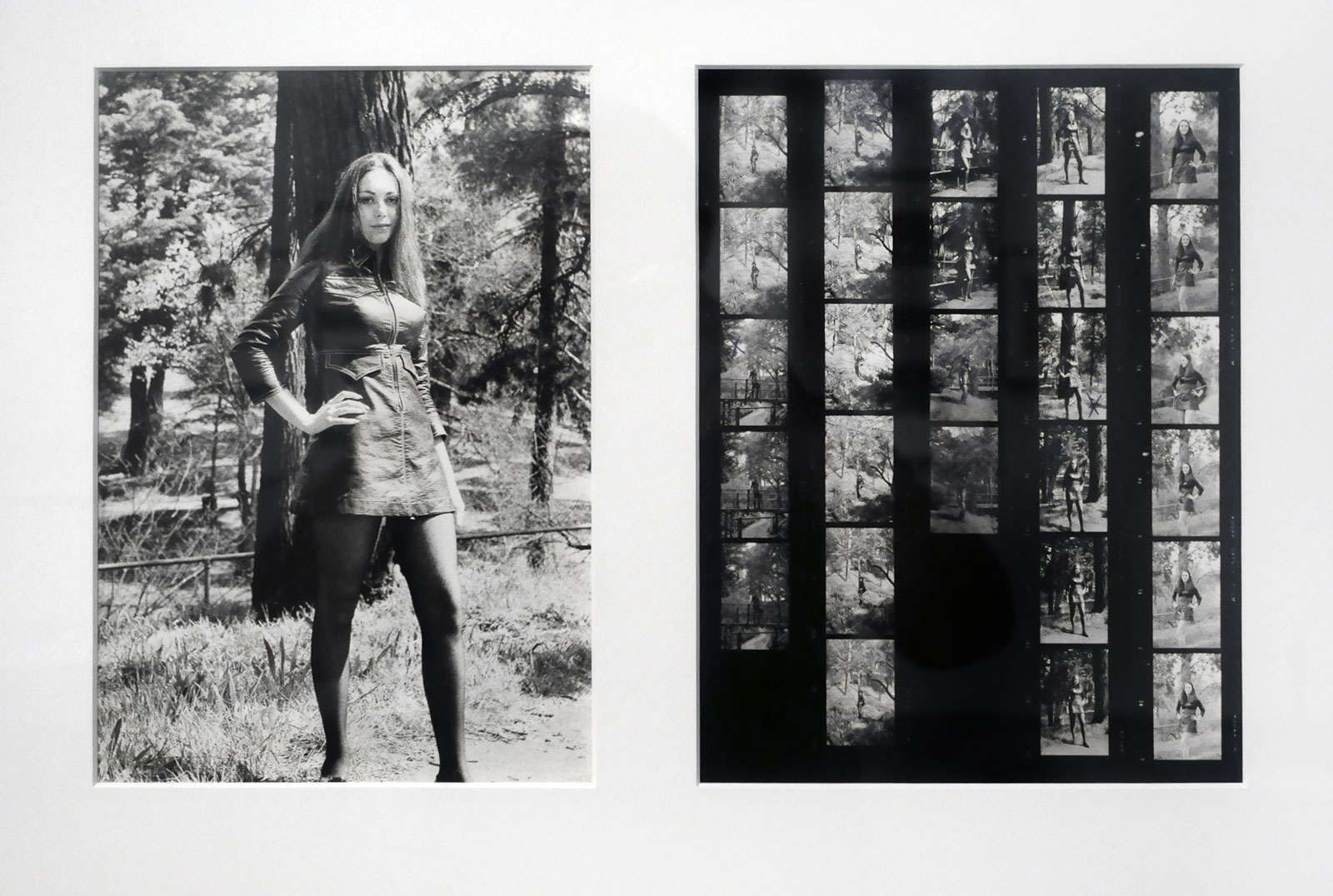
Installation view of the exhibition The basement: photography from Prahran College (1968-1981) at the Museum of Australian Photography, Wheelers Hill, Melbourne showing Carol Jerrems’ No title photographs 1968/1969
Photos: Marcus Bunyan


These photographs of the model Lynn Allen and her then boyfriend are part of a set of assignment images from the late 1960s, when Jerrems was studying at Prahran College. Jerrems and Allen met at High School (Jerrems was one year ahead) and they lived one street apart from each other when these images were taken. Allen modelled for Jerrems for two years.

Wall text from the exhibition


Carol Jerrems (Australian, 1949-1980) 'No title' 1969; 'No title' 1969 (installation view)


Carol Jerrems (Australian, 1949-1980)
No title (installation view)
1969
No title (installation view)
1969
Gelatin silver print
Museum of Australian Photography, City of Monash Collection donated 2024
Photo: Marcus Bunyan


Carol Jerrems (Australian, 1949-1980) 'No title' 1969 (installation view)


Carol Jerrems (Australian, 1949-1980)
No title (installation view)
1969
Gelatin silver print
Museum of Australian Photography, City of Monash Collection donated 2024
Photo: Marcus Bunyan


Installation view of the exhibition 'The basement: photography from Prahran College (1968-1981)' at the Museum of Australian Photography, Wheelers Hill, Melbourne showing photographs by Carol Jerrems


Installation view of the exhibition The basement: photography from Prahran College (1968-1981) at the Museum of Australian Photography, Wheelers Hill, Melbourne showing photographs by Carol Jerrems
Photo: Marcus Bunyan


Installation view of the exhibition 'The basement: photography from Prahran College (1968-1981)' at the Museum of Australian Photography, Wheelers Hill, Melbourne


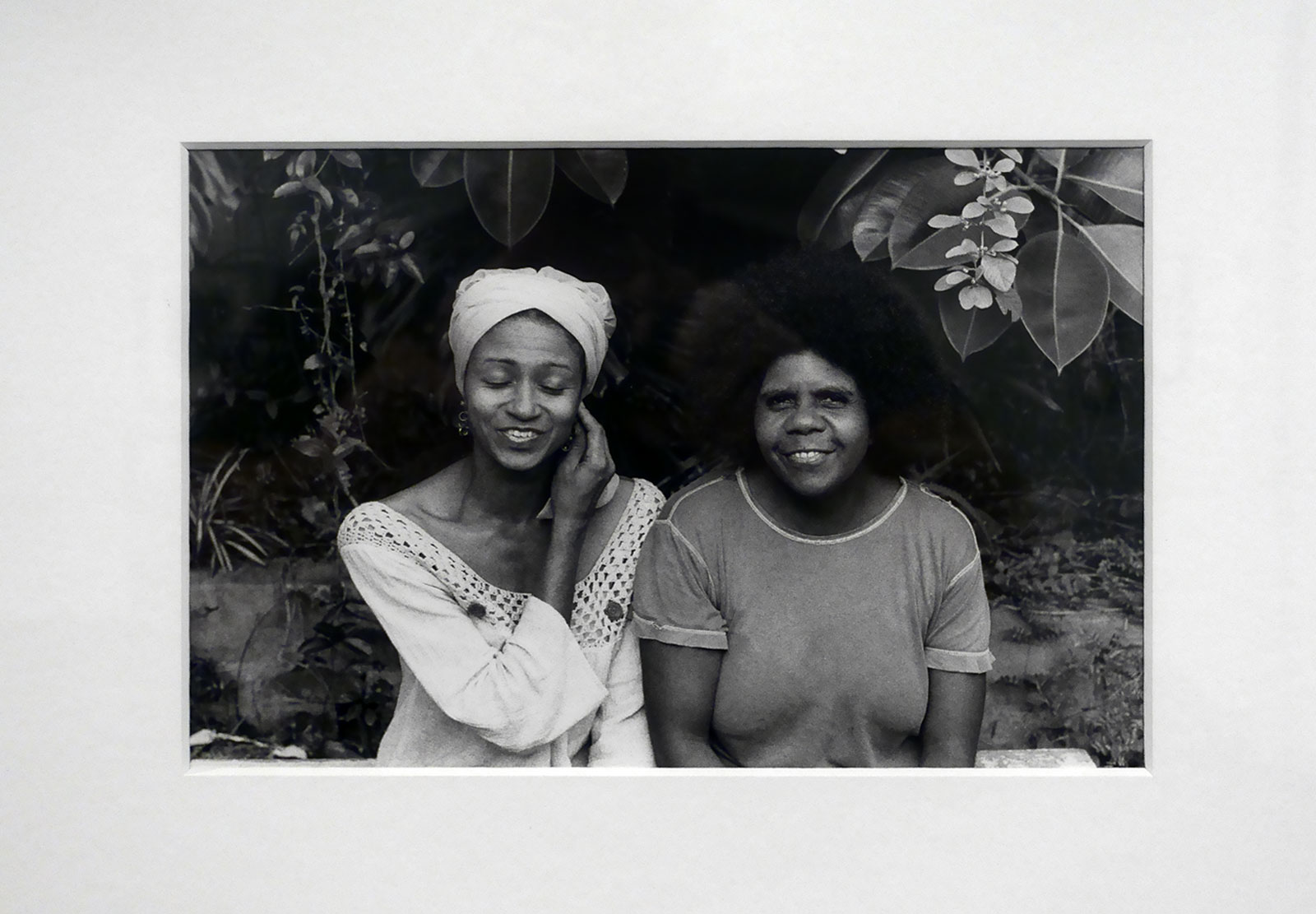
Installation view of the exhibition The basement: photography from Prahran College (1968-1981) at the Museum of Australian Photography, Wheelers Hill, Melbourne showing Carol Jerrems’ photographs at left top, Kath Walker 1974; at bottom left, Thancouple (Gloria Fletcher) and Carole Johnson 1974; and at right, Ron Johnson 1974
Photo: Marcus Bunyan


Carol Jerrems (Australian, 1949-1980) 'Thancouple (Gloria Fletcher) and Carole Johnson' 1974 (installation view)


Carol Jerrems (Australian, 1949-1980)
Thancouple (Gloria Fletcher) and Carole Johnson (installation view)
1974
Gelatin silver print
National Gallery of Australia, Canberra
Gift of Mrs Joy Jerrems 1981
Photo: Marcus Bunyan


Carol Jerrems (Australian, 1949-1980) 'Ron Johnson' 1974


Carol Jerrems (Australian, 1949-1980)
Ron Johnson
1974
Gelatin silver print
Museum of Australia Photography, City of Monash Collection donated through the Australian Government’s Cultural Gifts Program 2015
Photo: Marcus Bunyan


Installation view of the exhibition 'The basement: photography from Prahran College (1968-1981)' at the Museum of Australian Photography, Wheelers Hill, Melbourne


Installation view of the exhibition The basement: photography from Prahran College (1968-1981) at the Museum of Australian Photography, Wheelers Hill, Melbourne showing Carol Jerrem’s photographs at left, Esoteric personal (mini) recent exhibition 1976; at top right, Vale Street 1975; at bottom right, Juliet holding ‘Vale Street’ at Murray Road 1976
Photo: Marcus Bunyan


Carol Jerrems (Australian, 1949-1980) 'Esoteric personal (mini) recent exhibition' 1976 (installation view)


Carol Jerrems (Australian, 1949-1980)
Esoteric personal (mini) recent exhibition (installation view)
1976
Gelatin silver prints
Private collection
Photo: Marcus Bunyan
 

Carol Jerrems (Australian, 1949-1980) 'Vale Street' 1975 (installation view)


Carol Jerrems (Australian, 1949-1980)
Vale Street (installation view)
1975
Gelatin silver print
Museum of Australia Photography, City of Monash Collection donated through the Australian Government’s Cultural Gifts Program by Susan Hesse 2012
Photo: Marcus Bunyan


Carol Jerrems (Australian, 1949-1980) 'Vale Street' 1975


Carol Jerrems (Australian, 1949-1980)
Vale Street
1975
Gelatin silver print
Museum of Australia Photography, City of Monash Collection donated through the Australian Government’s Cultural Gifts Program by Susan Hesse 2012


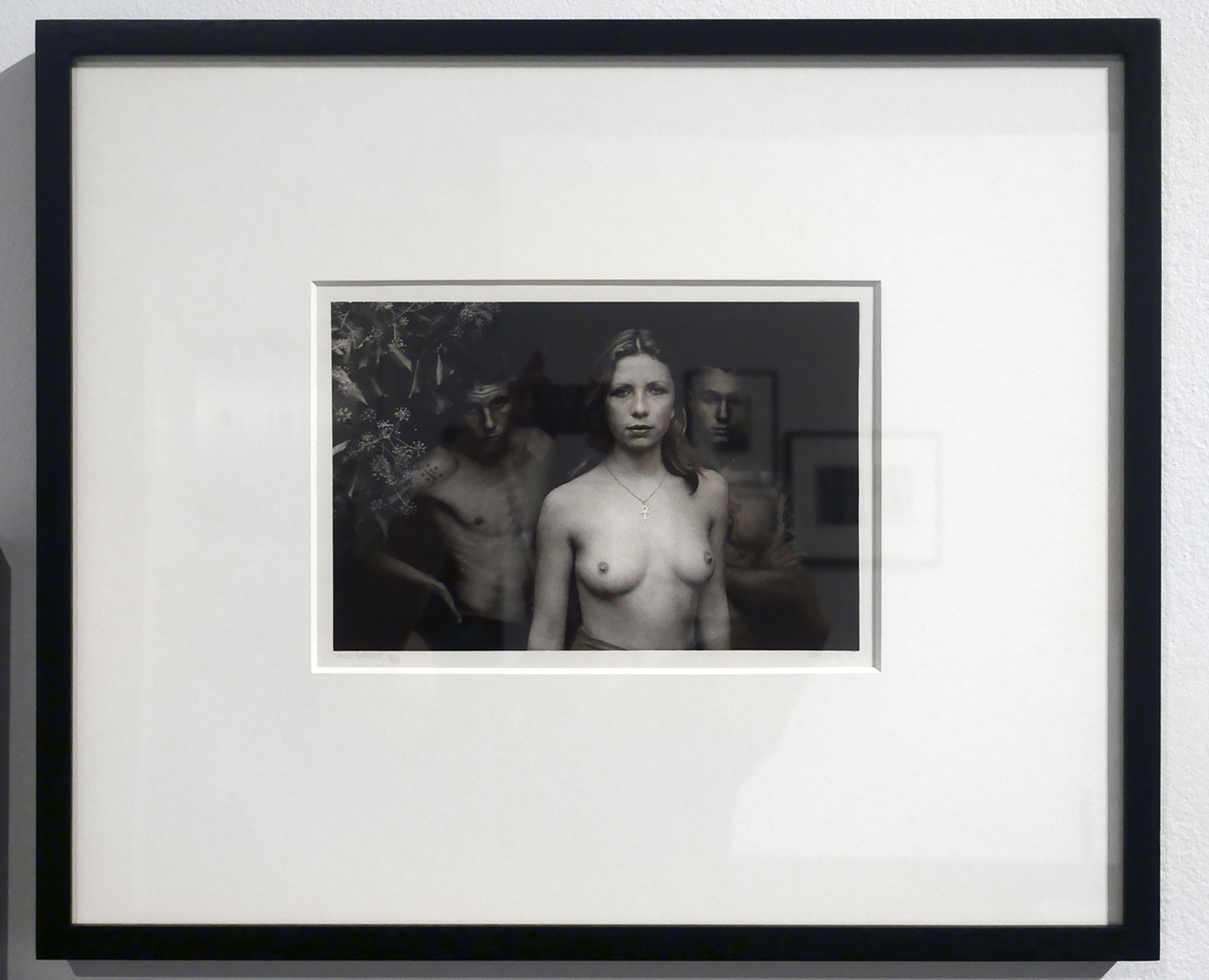
In 1975, Carol Jerrems made what would become her most famous photograph. Vale Street shows Jerrem’s friend Catriona Brown standing in front of Mark Lean and Jon Bourke, teenage boys from Heidelberg Technical School where Jerrems was teaching at the time. The photograph, taken in the back yard of a house at 52 Vale Street, St Kilda, comes from a series of pictures that show the three subjects socialising, smoking and, under the direction of Jerrems, gradually disrobing. Jerrems carefully set up and managed this no-iconic image, which quickly came to personify the optimism and ambitions of countercultural and feminist politics at the time

Wall text from the exhibition


Installation view of the exhibition 'The basement: photography from Prahran College (1968-1981)' at the Museum of Australian Photography, Wheelers Hill, Melbourne showing photographs by Carol Jerrems (left) and Paul Cox (centre)


Installation view of the exhibition The basement: photography from Prahran College (1968-1981) at the Museum of Australian Photography, Wheelers Hill, Melbourne showing photographs by Carol Jerrems (left) and Paul Cox (centre)
Photo: Marcus Bunyan


Installation view of the exhibition 'The basement: photography from Prahran College (1968-1981)' at the Museum of Australian Photography, Wheelers Hill, Melbourne


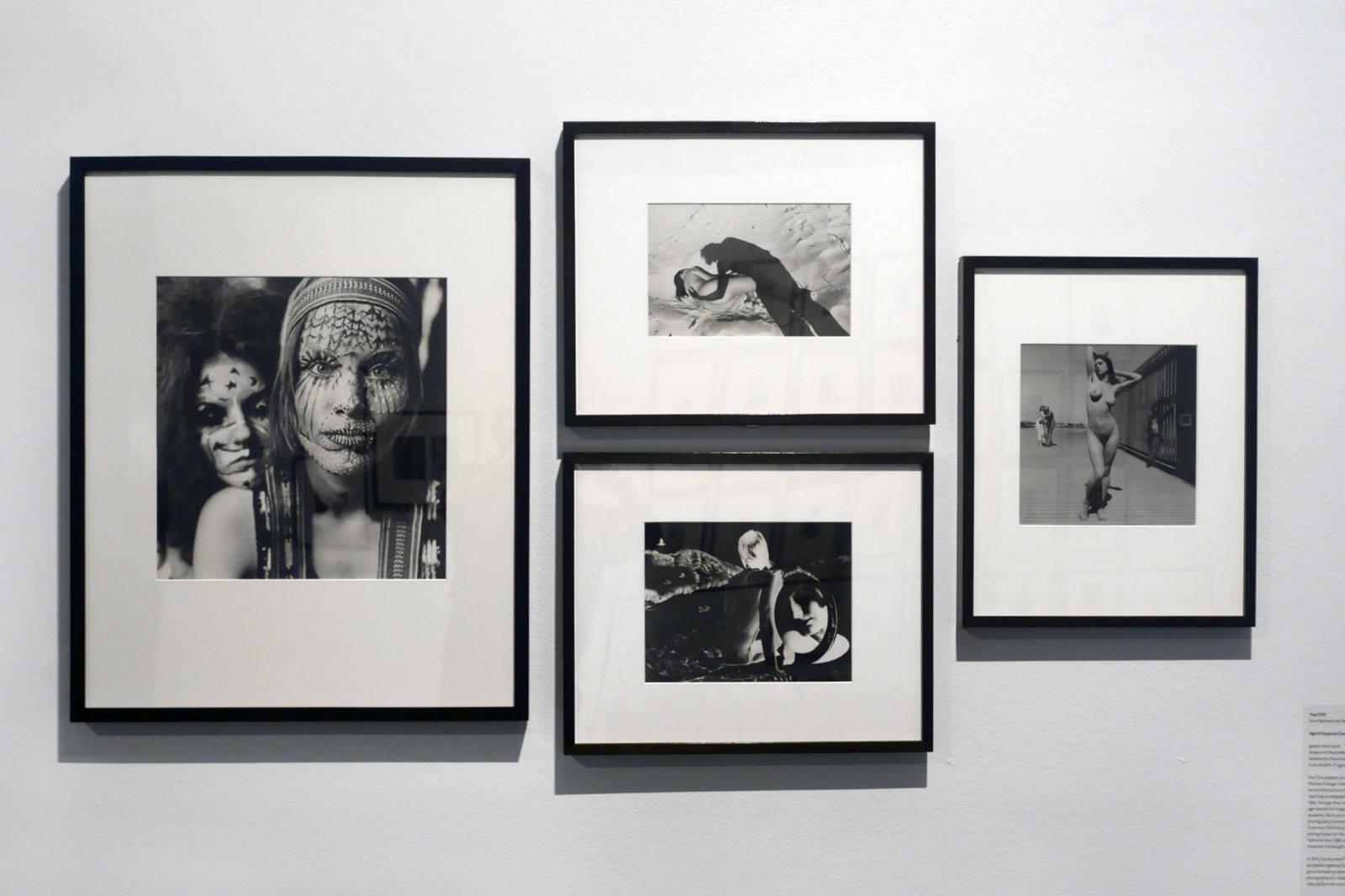
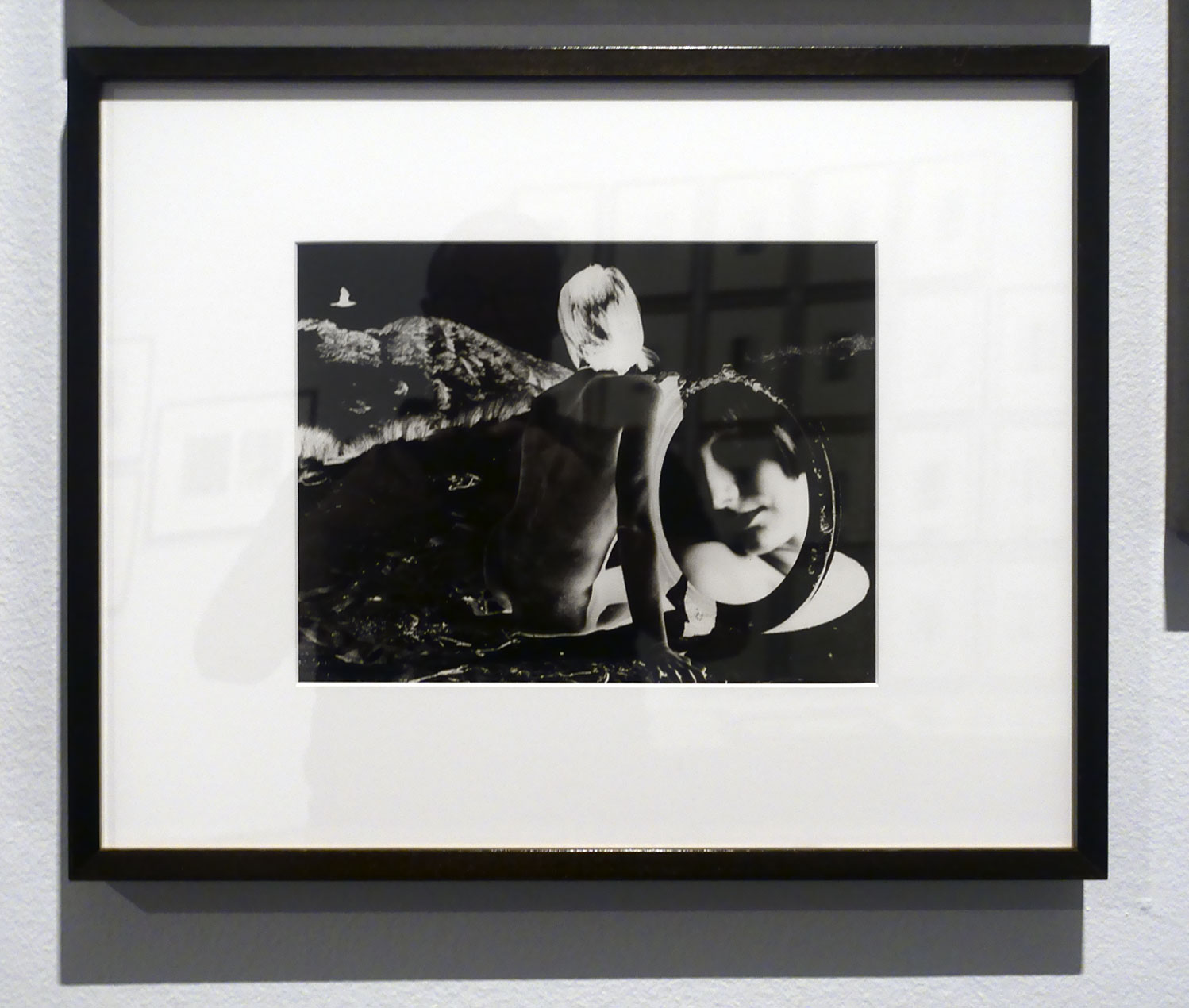
Installation view of the exhibition The basement: photography from Prahran College (1968-1981) at the Museum of Australian Photography, Wheelers Hill, Melbourne showing Paul Cox’s photographs with at left, Age of Aquarius (Carol Jerrems, Jan Hurrell) 1970; at centre top, Elizabeth 1 1972; at centre bottom, Fantasy of divine illusion 1972; and at right, Prahran 2 1974
Photo: Marcus Bunyan


Paul Cox (Australian born Netherlands, 1940-2016) 'Age of Aquarius (Carol Jerrems, Jan Hurrell)' 1970 (installation view)


Paul Cox (Australian born Netherlands, 1940-2016)
Age of Aquarius (Carol Jerrems, Jan Hurrell)
1970
Gelatin silver print
Museum of Australia Photography, City of Monash Collection donated by the artist through the Australian Government’s Cultural Gifts Program
Photo: Marcus Bunyan


Paul Cox played a pivotal role in the Photography Department at Prharan College, initially appointed part-time in February 1968, he transitioned to full-time position in 1970 and continued teaching photography and filmmaking until his departure in 1982. Younger than colleagues such as Cato and Shmith, Cox’s age helped him forge strong, personal connections with his students. Many alumni attribute their exposure to international photography luminaries to Cox’s influence. However, it was Cox’s own distinctive approach to photography that left a lasting impact on his students. Cox moved to Australia from the Netherlands in 1965 and although he was not formally trained as a teacher, he brought with him a European sensibility.

In 1973, Cox founded The Photographers’ Gallery and Workshop, alongside Ingeborg Tyssen, John F William and Rod McNicol, a groundbreaking space that played a crucial role in establishing photography as a respected art form in Australia and provided a vital platform for contemporary photographers.

Wall text from the exhibition

Paul Cox on the Prahran Legacy website


Paul Cox (Australian born Netherlands, 1940-2016) 'Age of Aquarius (Carol Jerrems, Jan Hurrell)' 1970


Paul Cox (Australian born Netherlands, 1940-2016)
Age of Aquarius (Carol Jerrems, Jan Hurrell)
1970
Gelatin silver print
Museum of Australia Photography, City of Monash Collection donated by the artist through the Australian Government’s Cultural Gifts Program


Paul Cox (Australian born Netherlands, 1940-2016) 'Fantasy of divine illusion' 1972 (installation view)


Paul Cox (Australian born Netherlands, 1940-2016)
Fantasy of divine illusion (installation view)
1972
Gelatin silver print
Museum of Australia Photography, City of Monash Collection donated by the artist through the Australian Government’s Cultural Gifts Program
Photo: Marcus Bunyan


Paul Cox (Australian born Netherlands, 1940-2016) 'Prahran 2' 1974 (installation view)


Paul Cox (Australian born Netherlands, 1940-2016)
Prahran 2 (installation view)
1974
Gelatin silver print
Museum of Australia Photography, City of Monash Collection donated by the artist through the Australian Government’s Cultural Gifts Program
Photo: Marcus Bunyan


Wall text from the exhibition 'The basement: photography from Prahran College (1968-1981)' at the Museum of Australian Photography, Wheelers Hill, Melbourne


Wall text from the exhibition The basement: photography from Prahran College (1968-1981) at the Museum of Australian Photography, Wheelers Hill, Melbourne
Photo: Marcus Bunyan


Installation view of the exhibition 'The basement: photography from Prahran College (1968-1981)' at the Museum of Australian Photography, Wheelers Hill, Melbourne showing a poster for an exhibition by Tod McNicol and Carol Jerrems at Brummels Gallery of Photography, August - September 1978
Installation view of the exhibition 'The basement: photography from Prahran College (1968-1981)' at the Museum of Australian Photography, Wheelers Hill, Melbourne two letters from Carol Jerrems including at bottom a letter to William (Bill) Heimerman (1950-2017) co-director at the time of The Photographers' Gallery and Workshop
Installation view of the exhibition 'The basement: photography from Prahran College (1968-1981)' at the Museum of Australian Photography, Wheelers Hill, Melbourne


Installation views of the exhibition The basement: photography from Prahran College (1968-1981) at the Museum of Australian Photography, Wheelers Hill, Melbourne with artefacts in a vitrine, showing a poster for an exhibition by Tod McNicol and Carol Jerrems at Brummels Gallery of Photography, August – September 1978; two letters from Carol Jerrems including at bottom a letter to William (Bill) Heimerman (1950-2017) co-director at the time of The Photographers’ Gallery and Workshop; and two gelatin silver prints by Carol Jerrems
Photos: Marcus Bunyan


Installation view of the exhibition 'The basement: photography from Prahran College (1968-1981)' at the Museum of Australian Photography, Wheelers Hill, Melbourne showing at centre, work by John Cato


Installation view of the exhibition The basement: photography from Prahran College (1968-1981) at the Museum of Australian Photography, Wheelers Hill, Melbourne showing at far left a photograph by Paul Cox, at second and third left photographs by Athol Shmith and at centre, photographs by John Cato
Photo: Marcus Bunyan


Installation view of the exhibition 'The basement: photography from Prahran College (1968-1981)' at the Museum of Australian Photography, Wheelers Hill, Melbourne


Installation view of the exhibition The basement: photography from Prahran College (1968-1981) at the Museum of Australian Photography, Wheelers Hill, Melbourne showing at left, Paul Cox’s Portrait of Athol Shmith 2 1983; and at right, Athol Shmith’s Anamorphic image No. 17 and Anamorphic image No. 1 both 1973
Photo: Marcus Bunyan


Athol Shmith is widely known for his commercial portraiture and fashion photography. His style became emblematic of an era that was transitioning from the more formal rigid photographic style of the early 20th century to something more dramatic. His portraits are highly polished, sophisticated and capture the essence of the post-war era’s glamour.

Shmith’s sale was characterised by a strong focus on lighting and composition, often using dramatic lighting setups to create bold, striking images. As Head of the Photography Department from 1972 to 1979 Art Prahran College, Shmith brought a high level of technical expertise.

Shmith created his Anamorphic series while teaching at Prahran College, and exhibited the series at Realities Gallery in 1973. Student Suzanne Budds recalls being a model for one of the images in this series.

Wall text from the exhibition

Athol Shmith Lecturer profile on the Prahran Legacy website


Paul Cox (Australian born Netherlands, 1940-2016) 'Portrait of Athol Shmith 2' 1983 (installation view)


Paul Cox (Australian born Netherlands, 1940-2016)
Portrait of Athol Shmith 2 (installation view)
1983
Gelatin silver print
Museum of Australia Photography, City of Monash Collection donated by the artist through the Australian Government’s Cultural Gifts Program 2000
Photo: Marcus Bunyan


Installation view of the exhibition 'The basement: photography from Prahran College (1968-1981)' at the Museum of Australian Photography, Wheelers Hill, Melbourne showing from left, John Cato's photographs 'Seawind' 1871-1975; 'Tree - a journey' 1971-1973; and 'Tree - a journey #13' 1971-1973 from the series 'Essay I: landscape in a figure' 1971-1979


Installation view of the exhibition The basement: photography from Prahran College (1968-1981) at the Museum of Australian Photography, Wheelers Hill, Melbourne showing from left, John Cato’s photographs Seawind 1871-1975; Tree – a journey 1971-1973; and Tree – a journey #13 1971-1973 from the series Essay I: landscape in a figure 1971-1979
Photo: Marcus Bunyan


John Cato (Australian, 1926-2011) 'Tree - a journey' 1971-1973 (installation view)


John Cato (Australian, 1926-2011)
Tree – a journey (installation views)
1971-1973
Gelatin silver print
Museum of Australian Photography, City of Monash Collection donated by the Cato Estate 2021


John Cato (Australian, 1926-2011) 'Tree - a journey' 1971-1973


John Cato (Australian, 1926-2011)
Tree – a journey
1971-1973
Gelatin silver print
Museum of Australian Photography, City of Monash Collection donated by the Cato Estate 2021


John Cato began his informal studies in photography with his father, the photographer Jack Cato, in 1938. He worked as a commercial photographer from 1947 to 1974, including a notable stint as a press photographer for The Argus from 1947 to 1950. Over the course of his career, Cato collaborated with Athol Shmith for more than two decades, before shifting away from commercial photography in 1974 to focus on his own fine art practice. That same year, Cato also embarked on his career as a photography educator, taking a teaching position at Prahran College, eventually succeeding Shmith as Head of the Photography Department in 1980.

Cato was known for his mystical and spiritual approach to photography, a philosophy that deeply influenced both his teaching style and his own photographic work. His method was unconventional, emphasising not just technical skill, but the creation of images with a deeper, almost transcendent resonance. Many of Cato’s works are minimalist, capturing quiet, still moments in nature, where form and texture take precedence over literal representation. These images often have an abstract quality, inviting the viewer to engage with the landscape on a more introspective, emotional level. Cato’s photography was not just about capturing a scene, it was about evoking a deeper connection to the transformative power of the natural world.

Wall text from the exhibition

Read my Vale to Dr John Cato (1926-2011)

John Cato on the Prahran Legacy website


John Cato (Australian, 1926-2011) 'Tree - a journey #13' 1971-1973 (installation view)


John Cato (Australian, 1926-2011)
Tree – a journey #13 (installation views)
1971-1973
Gelatin silver print
Museum of Australian Photography, City of Monash Collection donated by the artist
Acquired 1981


John Cato (Australian, 1926-2011) 'Tree - a journey #13' 1971-1973


John Cato (Australian, 1926-2011)
Tree – a journey #13
1971-1973
Gelatin silver print
Museum of Australian Photography, City of Monash Collection donated by the artist
Acquired 1981


“Thanks are due to…. Phil Quirk, Peter Leiss, and the now deceased Jon Conte, who started finding alumni (starting with those of 1968-1972) in 2012; Colin Abbott who encouraged Photonet gallery (now MAGNET) in 2014 to put on a show of 1 sample each of student-era and contemporary work of most of the 1974-1976 cohort; Colin has generously part-funded the book that MAPh has produced; designer and archivist Mimmo Cozzolino has contributed beautifully preserved ephemera from his College years, as well as donating his design skills to the ongoing project. Peter Leiss, assisted by Nicholas Nedelkopoulos, produced fine video interviews with alumni… a labour of love!

James McArdle joined the project in 2017. Merle Hathaway, who accepted an invitation to work with the team in 2021, has been an invaluable and key driver of the project in getting this exhibition (and future showings). Merle has secured upcoming shows of contemporary work by 1968-1991 alumni for MAGNET (through May 2025),  the BIFB (August 2025) and elsewhere…

Above all, MAPh curators, Angela Connor and Stella-Loftus-Hills, have been extraordinary in their enthusiasm for the concept, and their realisation of it through their expertise and hard work and is beyond our wildest expectations.  To have contributing writers of the calibre of Gael Newton, Helen Ennis, Daniel Palmer, Adrian Danks et al. is an honour and a further tribute to MAPh organisation and thoroughness.”

Associate Professor James McArdle


For more information please see The Prahran Photography website which upholds the legacy of Prahran College 1970s photography through posts on profiles of the alumni (an ongoing project). The site was initiated by James McArdle, who graduated in 1977 with a Diploma of Art and Design from Prahran College and Merle Hathaway, who coined the title, and who joins James in writing some of the posts.


Making film

Required to collaborate on a class film or create one of their own, photography students often took on multiple roles in each other’s projects. Paul Cox frequently cast his students as actors in his films, forging relationships that continued long after they graduated from college. In Cox’s productions, students also filled essential technical roles such as stills photographer and cinematographer. As well as developing their skills, this collaborative environment fostered a sense of community among aspiring filmmakers.

Paul Cox is known for his distinctive, often introspective films that explore human relationships, emotions, and existential themes. His work, while not always mainstream, is highly regarded in the Australian film industry and internationally for its emotional depth and unique storytelling style.

Mirka is a short film that features French-Australian visual artist Mirka Mora, a key figure in the Melbourne art scene. Mora gained recognition for her distinctive and colourful works, and her blend of surrealism, fantasy and personal experiences. The film explores her journey as an artist and her personal life, showcasing her experiences and her unique approach to art. The film offers a personal perspective into her world and is a rare glimpse into the life of one of Australia’s most beloved and influential artists.

Mirka was a collaborative project, directed by Paul Cox with the assistance of several Prahran students.

Student life

The students at Prahran College were part of a vibrant and dynamic environment that nurtured creativity, experimentation and community. Many drew inspiration from their immediate circles – friends and acquaintances – for their class assignments. They actively participated in exhibitions, showcasing their work to the public and their peers. Students presented their works in critique sessions that played a vital role in the learning process, providing a forum for discussion, debate and critical feedback.

Assignments often revolved around chosen topics such as fashion, portraiture or family, and sometimes involved field trips out into the landscape or excursions to places like hospitals, factories and the beach. Taking advantage of a ‘free assignment’ in 1976 a group of rebellious students got together to produce images of themselves dressed as revolutionaries, wearing clothes sourced from local opportunity shops and carrying real guns.

The images of students from Prahran College in the 1970s serve as visual documents of the bohemian spirit and encapsulate the idealism of the time. The way students were photographed, often in unposed and relaxed settings, captures the free-spirited nature of the College, with the camera becoming a tool for exploring vulnerability and personal expression, rather than just recording events or situations.

The legacy of the bohemian spirit that was cultivated at Prahran College during the 1970s is still evident in the work of contemporary Australian artists today, many of whom continue to embrace self-expression, individuality and alternative narratives.

Text from the Museum of Australian Photography website


Gallery three


Installation view of the exhibition 'The basement: photography from Prahran College (1968-1981)' at the Museum of Australian Photography, Wheelers Hill, Melbourne


Installation view of the exhibition The basement: photography from Prahran College (1968-1981) at the Museum of Australian Photography, Wheelers Hill, Melbourne
Photo: Marcus Bunyan


Installation view of the exhibition 'The basement: photography from Prahran College (1968-1981)' at the Museum of Australian Photography, Wheelers Hill, Melbourne showing Andrew Wittner's photograph 'John Cato leading a group on a photographic expedition, Steve Lojewski using a film camera' 1975; and George Volakos' 'Rye back beach 1' 1972


Installation view of the exhibition The basement: photography from Prahran College (1968-1981) at the Museum of Australian Photography, Wheelers Hill, Melbourne showing at left, Andrew Wittner’s photograph John Cato leading a group on a photographic expedition, Steve Lojewski using a film camera 1975; and at right, George Volakos’ Rye back beach 1 1972
Photo: Marcus Bunyan


Andrew Wittner (Australian, b. 1955) 'John Cato leading a group on a photographic expedition, Steve Lojewski using a film camera' 1975, printed 2024 (installation view)


Andrew Wittner (Australian, b. 1955)
John Cato leading a group on a photographic expedition, Steve Lojewski using a film camera (installation view)
1975, printed 2024
Gelatin silver print
Collection of the artist
Photo: Marcus Bunyan


George Volakos (Australian born Greece, b. 1948) 'Rye back beach 1' 1972, printed 2024 (installation view)


George Volakos (Australian born Greece, b. 1948)
Rye back beach 1 (installation view)
1972, printed 2024
Gelatin silver print
Collection of the artist
Photo: Marcus Bunyan


Installation view of the exhibition 'The basement: photography from Prahran College (1968-1981)' at the Museum of Australian Photography, Wheelers Hill, Melbourne showing photographs by Richard Muggleton, George Volakos, Colin Abbott, Graham Howe, Philip Quirk, Jim McFarlane, Greg Neville, Andrew Wittner, Peter Bowes, and an unknown photographer


Installation view of the exhibition The basement: photography from Prahran College (1968-1981) at the Museum of Australian Photography, Wheelers Hill, Melbourne showing photographs by Richard Muggleton, George Volakos, Colin Abbott, Graham Howe, Philip Quirk, Jim McFarlane, Greg Neville, Andrew Wittner, Peter Bowes, and an unknown photographer
Photo: Marcus Bunyan


Installation view of the exhibition 'The basement: photography from Prahran College (1968-1981)' at the Museum of Australian Photography, Wheelers Hill, Melbourne showing photographs by Philip Quirk, Jim McFarlane, Peter Bowes, and Peter Leiss


Installation view of the exhibition The basement: photography from Prahran College (1968-1981) at the Museum of Australian Photography, Wheelers Hill, Melbourne showing photographs by Philip Quirk, Jim McFarlane, Peter Bowes, and Peter Leiss
Photo: Marcus Bunyan


Installation view of the exhibition 'The basement: photography from Prahran College (1968-1981)' at the Museum of Australian Photography, Wheelers Hill, Melbourne showing photographs by Julie Higginbotham, Andrew Wittner, and Colin Abbott


Installation view of the exhibition The basement: photography from Prahran College (1968-1981) at the Museum of Australian Photography, Wheelers Hill, Melbourne showing photographs by Julie Higginbotham, Andrew Wittner, and Colin Abbott
Photo: Marcus Bunyan


Julie Higginbotham (Australian, b. 1953) 'Mirka film' 1973


Julie Higginbotham (Australian, b. 1953)
Mirka film
1973
Pigment ink-jet print
Courtesy of the artist


Installation view of the exhibition 'The basement: photography from Prahran College (1968-1981)' at the Museum of Australian Photography, Wheelers Hill, Melbourne


Installation view of the exhibition The basement: photography from Prahran College (1968-1981) at the Museum of Australian Photography, Wheelers Hill, Melbourne showing photographs by Philip Quirk, Peter Leiss, and Peter Bowes including at centre left, Peter Leiss’ Untitled [Bill Heimerman (right) and Ian Lobb (left) at the rear of The Photographers’ Gallery] c. 1975-1980 (below); and at centre Peter Leiss’ Jean-Marc Le Pechoux 1976
Photo: Marcus Bunyan


Ian Lobb was co-director of The Photographers’ Gallery and Workshop with Bill Heimerman. Jean-Marc Le Pechoux was editor of the important Light Vision: Australia’s international photography magazine launched in September 1977.

Read my Vale Ian Lobb (1948-2023), photographer
Read my Vale William Heimerman (1950-2017)


Peter Leiss (Australian born England, b. 1951) 'Untitled [Bill Heimerman and Ian Lobb at the rear of the Photographers' Gallery]' c. 1975-1980


Peter Leiss (Australian born England, b. 1951)
Untitled [Bill Heimerman and Ian Lobb at the rear of the Photographers’ Gallery]
c. 1975-1980
Silver gelatin print


Greg Neville (Australian, b. 1950)
'Tutorial: lecturers and students [back row L–R Derrick Lee, Bryan Gracey, Athol Shmith, Paul Cox, Elizabeth Tainsh]' c. 1971 (installation view)


Greg Neville (Australian, b. 1950)
Tutorial: lecturers and students [back row L–R Derrick Lee, Bryan Gracey, Athol Shmith, Paul Cox, Elizabeth Tainsh] (installation view)
c. 1971
Pigment ink-jet print
Collection of the artist
Photo: Marcus Bunyan

Greg Neville alumni profile on the Prahran Legacy website


Greg Neville (Australian, b. 1950)
'Tutorial: lecturers and students [back row L–R Derrick Lee, Bryan Gracey, Athol Shmith, Paul Cox, Elizabeth Tainsh]' c. 1971


Greg Neville (Australian, b. 1950)
Tutorial: lecturers and students [back row L–R Derrick Lee, Bryan Gracey, Athol Shmith, Paul Cox, Elizabeth Tainsh]
c. 1971
Pigment ink-jet print
Collection of the artist

Unidentified students with lecturers editing 35mm transparencies on a light box.


Summary of Bill Henson’s opening speech for The basement exhibition, 1st March, 2025

Internationally acclaimed photographer Bill Henson delivered a characteristically personal, challenging and reflective speech to mark the opening of The Basement.

He began his address by reminiscing about his time at Prahran in the mid-1970s – a period he remembered as unconventional and formative, despite his own intermittent attendance. “The only catch in my experience there is that I never went,” he quipped to rising laughter from the audience. Henson recalled how his interactions with lecturers such as John Cato and Athol Shmith shaped his artistic philosophy more than technical instruction ever could. “They were setting a moral example, an ethical example, an example of empathy,” he said, emphasising the profound impact their mentorship had on him.

Henson fondly and colourfully described Shmith, a glamorous portraitist who photographed Hollywood stars, and Cato, a figure of quiet wisdom, conjuring their style as an “imperious insouciance” – a blend of grandeur and carefree independence. He emphasised that, unlike today’s art educators who have to navigate academic formalities, these lecturers were practicing artists who brought hard-won experience into the classroom.

“They hadn’t gone through a professional teaching career,” Henson explained. “They weren’t like the kind of lecturer that I seem to see in art schools now, who have to go and get a ‘doctorate of painting’ to keep their job,” but were decidedly “outlandish” and unorthodox.

Their focus was not on rigid curricula but on fostering creativity and curiosity. “They were very generous with their comments,” Henson noted, recalling how they encouraged him to pursue his own path. He would disappear for months at a time, working on his own projects before returning with a bundle of photographs to share with his lecturers; “John would turn around and say, ‘Fuck, we thought you’d left!'” Despite his absences, they were formative in shaping his artistic independence, Shmith advised him to “just piss off and do your own work.”

Henson also shared anecdotes that highlighted the camaraderie and spontaneity of those years. One memorable moment was when Shmith surprised Henson by arranging for his work to be shown at the National Gallery of Victoria – a gesture that underscored his pride in his students’ potential. “That was as big a shock for me as anyone else,” Henson admitted.

Henson advised aspiring young artists to “try to be true to yourself, and don’t… stop… working!” Also important was intergenerational dialogue in art; he urged young people to seek wisdom from older artists before their insights are lost. Drawing on his own friendships with figures like Barry Humphries, Leo Schofield and Marc Newson, he highlighted how such exchanges enrich both parties through shared experiences and perspectives.

Beyond personal anecdotes, Henson used his speech to reflect on broader themes in art education and practice. He lamented what he sees as the increasing politicisation of contemporary art, which he believes has shifted focus away from aesthetics toward “box-ticking exercises” driven by ideology. While acknowledging that political movements such as feminism were present among Prahran’s students in the 1970s – “there were the feminists; there were little groups doing their social diligence” – he noted that these stances did not overshadow the college’s overarching emphasis on beauty and creative exploration. “There wasn’t this righteousness, this indignation, this kind of territorial thing about issues,” he said. In contrast was an openness and enthusiasm that defined Prahran during his time there – a place where beauty and creativity were paramount. Quoting Plato, he remarked, “Beauty is the splendour of truth,” positioning this ideal as central to artistic endeavour.

In opening The Basement exhibition Henson’s speech served not only as a tribute to Prahran College’s legacy – the enduring influence of its educators and alumni on Australia’s photographic landscape – but also as a call to preserve the values of curiosity, independence, and beauty in art.

Bill Henson opening speech summarised in James McArdle. “Opening!” on the On This Date in Photography website, 1st March, 2025 [Online] Cited 18/04/2025

Many thankx to James McArdle for allowing me to reproduce this text.


 Julie Millowick (Australian, b. 1948)
'John Cato, PCAE basement, Prahran' 1976 (installation view)


Julie Millowick (Australian, b. 1948)
John Cato, PCAE basement, Prahran (installation view)
1976
Gelatin silver print
Museum of Australian Photography, City of Monash Collection donated by Julie Millowick 2024
Photo: Marcus Bunyan


Julie Millowick (Australian, b. 1948)
'John Cato, PCAE basement, Prahran'
1976


Julie Millowick (Australian, b. 1948)
John Cato, PCAE basement, Prahran
1976
Gelatin silver print
Museum of Australian Photography, City of Monash Collection donated by Julie Millowick 2024
Photo: Marcus Bunyan


Peter Leiss (Australian born United Kingdom, b. 1951) 'Robert Besanko and Nanette Carter at The Photographers' Gallery, Punt Road' 1976 (installation view)


Peter Leiss (Australian born United Kingdom, b. 1951)
Robert Besanko and Nanette Carter at The Photographers’ Gallery, Punt Road (installation view)
1976
Gelatin silver print
Collection of the artist
Photo: Marcus Bunyan

Peter Leiss alumni profile on the Prahran Legacy website


Stella Sallman (Australian, b. 1956)
'Peter Leiss' 1976 (installation view)


Stella Sallman (Australian, b. 1956)
Peter Leiss (installation view)
1976
Gelatin silver print
Private collection
Photo: Marcus Bunyan


Carol Jerrems (Australian, 1949-1980) 'Rennie Ellis and Robert Ashton'
1976 (installation view)


Carol Jerrems (Australian, 1949-1980)
Rennie Ellis and Robert Ashton (installation view)
1976
Gelatin silver print
Private collection
Photo: Marcus Bunyan


In the early 1970s, advertising photographer and photojournalist Rennie Ellis with deputy director Robert Ashton reopened the space as Brummels Gallery of Photography. Assisted with two Arts Council grants, it was non-profit, and the first privately run art gallery in the country to be devoted specifically to photography…

The gallery closed in January 1980, the month before the premature death of its inaugural exhibitor, Carol Jerrems. Having run for eight years, the gallery had advanced the standing of photography as art and the careers of many Australian photographers including Warren Breninger, Godwin BradbeerPonch HawkesDavid Moore, Gerard Groeneveld, Peter Leiss, Steven Lojewski, Rod McNicol, Wesley Stacey, Robert Ashton, Ian Dodd, Sue FordGeorge Gittoes, Ashe Venn, John Williams, Jon Rhodes, Geoff Strong, Jean-Marc Le Pechoux and Henry Talbot.

“Brummels Gallery,” on the Wikipedia website


Carol Jerrems (Australian, 1949-1980) 'Paul Cox' 1977 (installation view)


Carol Jerrems (Australian, 1949-1980)
Paul Cox (installation view)
1977
Gelatin silver print
Private collection
Photo: Marcus Bunyan


Museum of Australian Photography
860 Ferntree Gully Road, Wheelers Hill
Victoria 3150 Australia
Phone: + 61 3 8544 0500

Opening hours:
Tue – Fri: 10am – 5pm
Sat – Sun: 10pm – 5pm
Mon/public holidays: closed

Museum of Australian Photography website

LIKE ART BLART ON FACEBOOK

Back to top

Exhibition: ‘Joyce Evans’ at the National Library of Australia, Canberra

Exhibition dates: 4th April – 5th November 2023

Curators: Dr Grace Blakeley-Carroll and Shelly McGuire


Joyce Evans (Australian, 1929-2019) 'May Day University Labour Club banner, May Day March, Flinders Street, Melbourne' 1951 from the exhibition 'Joyce Evans' at the National Library of Australia, April - Nov 2023


Joyce Evans (Australian, 1929-2019)
Students Protesting during a May Day March on Flinders Street, Melbourne
1951
Photograph
Joyce Evans Archive
National Library of Australia


At far-left, John Clendenin, philosopher and president of University of Melbourne SRC. Banner-bearer Jill Warwick, later a TV Producer, vice-president UniMelb SRC. The Forum Theatre on Flinders Street in the background.


That bohemian force of nature who was Australian artist, curator, teacher, writer, philanthropist, poet, gallery owner and collector Joyce Evans OAM (1929-2019) would have been the first to admit that she was not the most naturally gifted photographer the world has ever known. But Joyce worked assiduously at her craft for over 70 years and became a very fine image maker, picturing her beloved Australia through landscape, documentary and portrait photographs for many a decade.

Her early and historically important photographs of the late 1940s and early 1950s (of which three are in this posting) represent the post Second World War flowering of an Australian civil right movement. Further images from this period can be seen in the book We Had Such High Hopes: Student Activism and the Peace Movement 1949-1952, A Photographic Memoir by Joyce Evans published by Australian Scholarly Publishing in 2019; and you can read my foreword to the book and see more images from it in the Art Blart posting “Nothing emerges from nothing” (2019).

Joyce had an innate knack of putting people at their ease when having their photograph taken. Never without a camera close at hand, she would approach complete strangers anywhere and ask them whether she could take their portrait… and she was never refused. She had the most gracious way about her, as though she was speaking in communion with her subject: whether that be the contemplation of the Australian landscape, Indigenous Australians, or up close and personal portraits of the ordinary or famous. As author Professor Sasha Grishin observes in his book Joyce Evans (National Library of Australia, 2022) she “was an artist who possessed a definite photographic personality… [who] pursued an agenda that shone a light on racism, social inequality and environmental degradation.”

Joyce worked hard at her craft and it rewarded her soul in so many unconditional ways. Her energy for life and photography was full of unbridled enthusiasm. It is therefore a blessing that this passion has now found a permanent home: her complete photographic archive, the Joyce Evans Archive, is now housed at the National Library of Australia in Canberra, an institution for which she did much work over the years. And it is wonderful that they have staged this small exhibition of 27 of her photographs. My only quibble would be the lack of photographs of Indigenous Australians in the exhibition. Other than the portrait of Aboriginal activist Faith Bandler (1951, below) there are no other photographs of her immense engagement with Aboriginal communities and peoples in this exhibition – which is a great shame. Joyce was very proud of her photography of and relationship with remote Aboriginal communities and their people and it would have been nice to see that energy reflected in the photographs in this exhibition.

Dr Marcus Bunyan

Joyce Evans was a cherished friend of Marcus Bunyan.


Many thankx to the National Library of Australia for allowing me to publish the photographs in the posting. Please click on the photographs for a larger version of the image.


The career of Joyce Evans OAM (1929-2019) spans more than six decades of landscape, documentary, and portrait photography. Her work is preserved through the Library’s Joyce Evans Archive, one of our largest collections of images by a contemporary Australian photographer, and contains images which capture essential aspects of Australian life.


“We believed we had an obligation, neither social nor political, to make a difference. We were brought up as children to believe that we had an obligation to make that difference.

If we can find out what we are… that is the artist. This goes to the core element of your being, and the core element of your enquiry remains the same.

If the core part of your life is the search for the truth then that becomes a core part of your identity for the rest of your life. It becomes embedded in your soul.”


Joyce Evans


Joyce Evans (Australian, 1929-2019) 'Richard 'Dicky' Woolcott, delegate to conference, at NUAUS encampment' 1951 from the exhibition 'Joyce Evans' at the National Library of Australia, April - Nov 2023


Joyce Evans (Australian, 1929-2019)
Richard Woolcott AC at NUAUS Conference, Largs Bay, S.A.
1951, printed by David Chisolm and Joyce Evans, 2013
Photograph
Joyce Evans Archive
National Library of Australia


Richard Arthur Woolcott AC (11 June 1927 – 2 February 2023) was an Australian public servant, diplomat, author, and commentator.


The [photographic] form that Joyce found so early in her life was the music and poetry of humanist photographs, images that are subjective, lyrical, and reveal a state-of-mind. Here is passion and belief in the life of human beings, and the exquisiteness, beauty (and death) of the lived moment. You could label them “social documentary photography” if you were so inclined, but labels don’t capture the frisson of the creative process nor the joyous outcome of Joyce’s portraits. It’s as though Joyce, in a mixture of consciousness and unconsciousness, is making love to the world through her images: neither rational nor cerebral they evoke sensations and feelings, of being here and there, in that past space and time, now, all these years later. These were epic days of change and transformation – of nations, of continents, of cultures and of people. There was death and destruction but there was also such happiness, hope and joy.

Further, what her photographs also depict is the rise of an informed Australian social consciousness after the Second World War. Her important historical and personal photographs shine a light on forgotten people, times, places and actions, such as the broad based youth movements opposition to the atomic bomb, associations and friendships which eventually form the basis for the progressive social and political protest movements of the 1960s. The voices raised later in support of feminism, gay liberation, free love and Vietnam anti-war protests did not appear fully formed, for there was a history of activism… a slow build, a groundswell of public opinion that was the basis for such emerging actions. Nothing ever emerges from nothing.

Marcus Bunyan. “Nothing emerges from nothing,” foreword from the book We Had Such High Hopes: Student Activism and the Peace Movement 1949-1952, A Photographic Memoir by Joyce Evans. Melbourne: Australian Scholarly Publishing, 2019

Read the full text and see more early photographic images by Joyce Evans


Joyce Evans (Australian, 1929-2019) 'Faith Bandler' 1951 from the exhibition 'Joyce Evans' at the National Library of Australia, April - Nov 2023


Joyce Evans (Australian, 1929-2019)
Faith Bandler
1951, printed 2012
Photograph
Joyce Evans Archive
National Library of Australia


Faith Bandler AC MBE (27 September 1918 – 13 February 2015; née Ida Lessing Faith Mussing) was an Australian civil rights activist of South Sea Islander and Scottish-Indian heritage. A campaigner for the rights of Indigenous Australians and South Sea Islanders, she was best known for her leadership in the campaign for the 1967 referendum on Aboriginal Australians.


‘I don’t know what sort of photographer I am, but I try to be an honest one.’ ~ Joyce Evans.

The career of Joyce Evans OAM (1929-2019) spans more than six decades of landscape, documentary, and portrait photography. Her work is preserved through the Library’s Joyce Evans Archive, one of our largest collections of images by a contemporary Australian photographer, and contains images which capture essential aspects of Australian life.

This collection-in-focus display contains highlights from the Library’s Joyce Evans Archive, and can be seen in our Treasures Gallery from Tuesday 4 April 2023. Entry to the Gallery is free and no bookings are required.

You can read more about Evans’ life in the NLA Publishing title, Joyce Evans by Sasha Grishin.

Text from the National Library of Australia website.


Joyce Evans (Australian, 1929-2019) 'Cotswold Farm, Menzies Creek, Victoria' 1982


Joyce Evans (Australian, 1929-2019)
Cotswold Farm, Menzies Creek, Victoria
1982
Colour photograph
Joyce Evans Archive
National Library of Australia


Joyce Evans (Australian, 1929-2019) 'Moon over Coober Pedy, South Australia' 1988


Joyce Evans (Australian, 1929-2019)
Moon over Coober Pedy, South Australia
1988, printed by David Chisolm and Joyce Evans, 2013
Colour photograph
35.2 x 35cm
Joyce Evans Archive
National Library of Australia


Joyce Evans (Australian, 1929-2019) 'Windmill on Weerewa/Lake George, New South Wales' c. 1983-2012


Joyce Evans (Australian, 1929-2019)
Windmill on Weerewa/Lake George, New South Wales
c. 1983-2012
Colour photograph
35.6 x 37.2cm
Joyce Evans Archive
National Library of Australia


Joyce Evans (Australian, 1929-2019) 'Desert Car on Gunbarrel Highway, Northern Territory' 1991


Joyce Evans (Australian, 1929-2019)
Desert Car on Gunbarrel Highway, Northern Territory
1991
Colour photograph
21 x 50.6cm
Joyce Evans Archive
National Library of Australia


Joyce Evans (Australian, 1929-2019) 'Mud Football, Derby, Western Australia' 2000, printed 2012


Joyce Evans (Australian, 1929-2019)
Mud Football, Derby, Western Australia
2000, printed 2012
Inkjet on Hahnemuhle photo rag paper
34.3 x 41cm
Joyce Evans Archive
National Library of Australia


Joyce Evans (Australian, 1929-2019) 'The Big Galah and Tourist Gift Shop, Kimba, South Australia' c. 2006-2012


Joyce Evans (Australian, 1929-2019)
The Big Galah and Tourist Gift Shop, Kimba, South Australia
c. 2006-2012
Colour photograph
33.6 x 50.7cm
Joyce Evans Archive
National Library of Australia


Joyce Evans (Australian, 1929-2019) 'Gertrude, Boola Boolka Station, New South Wales' 2006


Joyce Evans (Australian, 1929-2019)
Gertrude, Boola Boolka Station, New South Wales
2006
Colour photograph
33.9 x 50.7cm
Joyce Evans Archive
National Library of Australia


Joyce Evans (Australian, 1929-2019) 'Evidence of Severe Drought at Menindee Dam, Menindee, New South Wales' 2006


Joyce Evans (Australian, 1929-2019)
Evidence of Severe Drought at Menindee Dam, Menindee, New South Wales
2006
Colour photograph
Joyce Evans Archive
National Library of Australia


Joyce Evans (Australian, 1929-2019) 'Uluru, Northern Territory' 1987


Joyce Evans (Australian, 1929-2019)
Uluru, Northern Territory
1987
Colour photograph
Joyce Evans Archive
National Library of Australia


Joyce Evans was an unusual phenomenon in the Australian photography scene. Her conversion to photography did not occur until she was already in her 40s, while her engagement in professional photography had to wait until she was 50. She never developed a signature style, nor had she become a template photographer, but she possessed a definite photographic personality. …

As a documentary photographer, Evans considered herself a hunter and gatherer waiting to find the image. She remarked, “as an artist, you channel the energy of the place – the image comes to you as a gift.”

Her oeuvre is remarkable for its diversity and includes landscapes, roadkill, portraiture, social documentation, brothels and erotica – all brought together through a unifying sensibility, the Evans photographic moment. She was also an artist with a social conscience and pursued an agenda that shone a light on racism, social inequality and environmental degradation.

Many of Evans’s photographs demand slow viewing and open up gradually. Uluru, Northern Territory, 1987 (above), shows the rock as if carved by nature. In one sense, it is a very simple photograph in which two colours meet – the brilliant red ochre of the rock and the fathomless blue of the sky. It is also an immensely complex photograph with the mysterious slit – like the womb of the earth – in the centre of the composition and galvanising the viewer’s attention.

Gradually, as you focus into the image, there are signs of human presence at the top of the rock: two climbers on the chain pathway, contrasted with organic shapes created through centuries of erosion – a contrast between the temporal and the eternal. Despite the sense of stillness and silence, there is also considerable movement as the light plays over the textured surfaces.

The photograph is rare in that it defines a space but also distils the spiritual essence of the place and asserts an atmosphere of mystery and contemplative presence.

In 2016, when I was working on a monograph on Evans’s work, she noted: “As a photographer – I have a voice – it is an Australian voice, as I do not know intimately any other culture. It comes at a time when you say: ‘This is my country’. One of the sub-texts, when I pick up a camera, is that I always try to identify the stereotypical that is always defined by that which is on the edge.”

Sasha Grishin. “Joyce Evans, an unheralded icon of photography, the focus of the National Library of Australia,” on the Riotact website 8 October 2023 [Online] Cited 16/10/2023


Joyce Evans (Australian, 1929-2019) 'Barbara Blackman' 1989


Joyce Evans (Australian, 1929-2019)
Barbara Blackman
1989
Photograph
30 x 40.7cm
Joyce Evans Archive
National Library of Australia


Barbara Blackman AO (née Patterson; born 22 December 1928) is an Australian writer, poet, librettist, broadcaster, model and patron of the arts. In 2004, she donated $1 million to a number of Australian music organisations, including Pro Musica, the Australian Chamber Orchestra, the Australian National University’s School of Music and the Stopera Chamber Opera Company. In 2006, she was awarded the Australian Contemporary Music Award for Patronage. Barbara Blackman was married for 27 years to renowned Australian artist Charles Blackman.


Joyce Evans (Australian, 1929-2019) 'Philanthropist Dame Elisabeth Murdoch, Langwarrin, Victoria' 1995


Joyce Evans (Australian, 1929-2019)
Philanthropist Dame Elisabeth Murdoch, Langwarrin, Victoria
1995
Photograph
24.9 x 37.0cm
Joyce Evans Archive
National Library of Australia


Dame Elisabeth Joy Murdoch, Lady Murdoch AC DBE (née Greene; 8 February 1909 – 5 December 2012), also known as Elisabeth, Lady Murdoch, was an Australian philanthropist and matriarch of the Murdoch family. She was the wife of Australian newspaper publisher Sir Keith Murdoch and the mother of international media proprietor Rupert Murdoch. She was appointed a Dame Commander of the Order of the British Empire (DBE) in 1963 for her charity work in Australia and overseas.


Joyce Evans (Australian, 1929-2019) 'Bernard Smith, Victoria' 2004, printed 2013


Joyce Evans (Australian, 1929-2019)
Bernard Smith, Victoria
2004, printed 2013
Colour photograph
47.5 x 37.5cm
Joyce Evans Archive
National Library of Australia


Bernard William Smith (3 October 1916 – 2 September 2011) was an Australian art historian, art critic and academic, considered the founding father of Australian art history, and one of the country’s most important thinkers. His book Place, Taste and Tradition: a Study of Australian Art Since 1788 (1945) is a key text in Australian art history, and influence on Robert Hughes. Smith was associated with the Communist Party of Australia, and after leaving the party remained a prominent left-wing intellectual and Marxist thinker.


Joyce Evans (Australian, 1929-2019) 'Stephen Dupont' 2009


Joyce Evans (Australian, 1929-2019)
Stephen Dupont
2009, printed by David Chisolm and Joyce Evans, 2013
Photograph
35.6 x 35.6cm
Joyce Evans Archive
National Library of Australia


Stephen Dupont (b. 1967) is an Australian photographer and director working on films, commercials, magazine and newspaper assignments and long term personal projects.


Joyce Evans (Australian, 1929-2019) 'William Yang' 1996


Joyce Evans (Australian, 1929-2019)
William Yang
1996
Photograph
Joyce Evans Archive
National Library of Australia


“William Yang [Aust., b.1943] belongs to a generation of artists who used photography to document alternative lifestyles and celebrate social diversity during the latter decades of the 20th century…Yang is the type of social documentary photographer who carries a camera around his neck, ready to capture things with a certain immediacy, as they happen around him.” ~ Museum of Contemporary Art


Joyce Evans was an unusual phenomenon in the Australian photography scene. Her conversion to photography did not occur until she was already in her forties, while her engagement in professional photography had to wait until she was fifty. She never developed a signature style, nor did she become a template photographer, but she possessed a sensibility that has become characteristic of her work, so that you can quickly recognise a Joyce Evans photograph. She was an artist who possessed a definite photographic personality.

Evans combined documentary photography, social photography, landscape photography and studio practice. She also had a social conscience. Although avoiding didactic images or illustrative propaganda, in her documentary work and in her choice of subjects, she had pursued an agenda that shone a light on racism, social inequality and environmental degradation.

This stylish and generously-illustrated monograph shows how Evans’ photography was about capturing not only the surface appearances, but ultimately the essences, of her subjects. It illustrates the Evans’ belief that in silence and stillness you come to feel the spirit of the subject, and that capturing this spirit was the photographer’s goal.

About the author

Professor Sasha Grishin AM, FAHA established the academic discipline of Art History at the ANU and was the Sir William Dobell Professor of Art History and Head of Art History and Curatorship at the ANU until December 2013. He works internationally as an art historian, art critic and curator. In 2005 he was awarded the Order of Australia (AM) for services to Australian art and art history. He has published over 25 books and over 2,000 articles and catalogue essays dealing with various aspects of art.

Text from the National Library of Australia website.

Purchase the book


Cover of the book 'Joyce Evans' by Sasha Grishin


Cover of the book Joyce Evans by Sasha Grishin


National Library of Australia
Parkes Place
Canberra ACT 2600
Australia

Opening hours:
Daily 9am – 5pm

National Library of Australia website

LIKE ART BLART ON FACEBOOK

Back to top

Text: Marcus Bunyan. “Nothing emerges from nothing,” Foreword to ‘We Had Such High Hopes: Student Activism and the Peace Movement 1949-1952, A Photographic Memoir by Joyce Evans’ 2019

August 2019

Publisher: Australian Scholarly Publishing
ISBN: 9781925801859
Hardback
Purchase


Book cover to 'We Had Such High Hopes: Student Activism and the Peace Movement 1949-1952, A Photographic Memoir by Joyce Evans' 2019


Book cover to We Had Such High Hopes: Student Activism and the Peace Movement 1949-1952, A Photographic Memoir by Joyce Evans. Australian Scholarly Publishing 2019.


The book We Had Such High Hopes: Student Activism and the Peace Movement 1949-1952, A Photographic Memoir by Joyce Evans has now been published by Australian Scholarly Publishing and is available to purchase from their website.

I just want to say a big thank you to everyone who worked on the book, and an especially big thank you to the wonderful Jenner Zimmer who edited the book and without whose help it would not be the book it turned out to be. Her research in tracking down who the people were in the photographs, their correct names, the location of some of the photographs, and her layout of the book, was magnificent to say the least. Through her excellent work, we can now place these photographs not only in a personal context, but in an important historical context in relation to the development of the civil rights movement in Australia directly after the Second World War.

The book is a reflection of the times, an insight into the nascent civil rights movement of the late 1940s-1950s that reached full bloom in the 1960s. As I observe in the foreword below it also becomes a reflection on how photography and friendship go hand in hand… and how this transformative process leads us to reassess our relationship to the world through the act of taking photographs.

Dr Marcus Bunyan


Please click on the photographs for a larger version of the image.


Foreword

Nothing emerges from nothing


“… every human being is a poet, a masker, a warrior, a dancer: and in his innocent artistry he projects, against the turmoil of the street, an image of human existence.”

Helen Levitt. ‘In the Street’ 1948.1


The gift of friendship between two people is a truly magical thing, a relationship built on the nurturing of respect between them, over time. The alchemical gift of a photograph does not arrive fully formed in a moment, for its magic is grounded in the context of its taking, informed by the wisdom, vision and creativity of the photographer. How Joyce Evans was touched by a connection between photography and friendship is another transformative process, one that leads her to reassess her relationship to the world through the act of taking photographs. Nothing ever emerges from nothing.

My friendship with Joyce Evans began when a joint acquaintance who knew of our love of photography introduced us. Over numerous years since – through trips to Sydney to see Joyce’s favourite photographer Julia Margaret Cameron; through visits to many exhibitions where we have discussed our reactions to the work (often with completely opposing views); through vigorous debate about the merits of different artists; through her promotion of Australian photography; and through her deep knowledge of the world, of life, and of art – I have come to know and love this vibrant and intelligent women. To begin to understand this complex human being and her approach to photography and life. The photographs, text and poetry in this book show evidence of the early maturing of this spirit of life.

Imagine being a nineteen year old who has been studying in America after the end of the Second World War, who has arrived in poverty-stricken England to meet friends who were mutually interested in the peace movement. Imagine travelling across Europe by car with those same friends, as mass migrations of people across Europe were still happening after the war, staying in youth hostels, to camp outside the city of Vienna. Then to cross the “Iron Curtain” and journey with thousands of other people from eight-two countries around the world to the city of Budapest for the Second World Festival of Youth and Students – a festival movement that grew out of the ashes of the war to proclaim, to shout, that youth would never again allow the horrors of fascism to terrorise the world. What a journey of discovery, love, friendship, excitement and danger that must have been!

Using her intelligence and the informed nature of her artistic being to define what interested her most, Joyce documented what she saw of the world around her.2 In so doing, these early photographs set the stage for concerns that have remained consistent in her work to this very day: peace, freedom, place, identity and humanity. While the photographs are a mirror of the times, portraying the improvisational vitality of everyday life, they also represent how the mind of the photographer can be embodied in the physical world, providing a glimpse into that most secret room of all – the core beliefs of a human being, their humanity, their soul.

The Australian photographer Max Dupain stated that the ‘mission of the photograph is to clarify the subject’.3 But perhaps the mission of the photograph is also to help clarify the identity of the artist. As the Austrian-born American photographer Inge Morath eloquently observes:

“Photography is a strange phenomenon. In spite of the use of that technical instrument, the camera, no two photographers, even if they were at the same place at the same time, come back with the same pictures. The personal vision is usually there from the beginning; result of a special chemistry of background and feelings, traditions and their rejection, of sensibility and voyeurism. You trust your eye and you cannot help but bare your soul. One’s vision finds of necessity the form suitable to express it.”4


The form that Joyce found so early in her life was the music and poetry of humanist photographs, images that are subjective, lyrical, and reveal a state-of-mind. Here is passion and belief in the life of human beings, and the exquisiteness, beauty (and death) of the lived moment. You could label them “social documentary photography” if you were so inclined, but labels don’t capture the frisson of the creative process nor the joyous outcome of Joyce’s portraits. It’s as though Joyce, in a mixture of consciousness and unconsciousness, is making love to the world through her images: neither rational nor cerebral they evoke sensations and feelings, of being here and there, in that past space and time, now, all these years later. These were epic days of change and transformation – of nations, of continents, of cultures and of people. There was death and destruction but there was also such happiness, hope and joy.

Further, what her photographs also depict is the rise of an informed Australian social consciousness after the Second World War. Her important historical and personal photographs shine a light on forgotten people, times, places and actions, such as the broad based youth movements opposition to the atomic bomb, associations and friendships which eventually form the basis for the progressive social and political protest movements of the 1960s. The voices raised later in support of feminism, gay liberation, free love and Vietnam anti-war protests did not appear fully formed, for there was a history of activism… a slow build, a groundswell of public opinion that was the basis for such emerging actions. Nothing ever emerges from nothing.

As much as Joyce’s photographs engage the viewer in memory, they also engage in the moment, both past and present. Not only an engagement with the history and nostalgia of the images, but in their present day hope and joy. It is such a pleasure to see these strong images, of people now old, still young, a moving image of humanity. This is the heart of the matter: a moving image of humanity. The photographs represent an understanding of (a) life, well formed and well lived, of a courageous and visionary woman who told it her way, who still tells it her way to this day.

I have a deep sense of gratitude for both our friendship and for Joyce Evans’ prescient vision in recording these remarkable stories so that they can be shared today. At the time they had such high hopes, for their lives and for the future, energy that eventually morphed into something else (as is its want). This leaves these images, written memory, as both poem and testimonial to the uncertainty of human dreams and to the percipience of the artist who embodied and enabled them… in feeling, in love and in spirit. Nothing ever emerges from nothing. Good on ya Bert!

Dr Marcus Bunyan
Melbourne, February 2019


Endnotes

1/ Levitt, Helen (ed.,). In the Street. Directed by Helen Levitt, Janice Loeb and James Agee. Black and white film, 14 mins. 1948 (VHS) New York: Arthouse, Inc., 1996.
2/ Joyce was ever attentive to the power of the historical for she had been studying the Baroque painters in Paris and on her travels through Italy, evidence of which can be seen in the grouping of human figures in her photographs.
3/ Anonymous label. “Max Dupain, (Factory chimney stacks) 1940,” on the National Gallery of Australia website [Online] Cited 15/02/2019.
4/ Morath, Inge; Folie, Sabine and Matt, Gerald. Inge Morath, Life as a Photographer. Munich: Gina Kehayoff Verlag, 1999, p. 13.


Joyce Evans (Australian, 1929-2019) 'Good on yer Bert' 1949


Joyce Evans (Australian, 1929-2019)
Good on yer Bert
1949
Gelatin silver print
From We Had Such High Hopes: Student Activism and the Peace Movement 1949-1952, A Photographic Memoir by Joyce Evans (Australian Scholarly Publishing 2019)


Joyce Evans (Australian, 1929-2019) 'Untitled [Budapest crowd]' 1949


Joyce Evans (Australian, 1929-2019)
Budapest crowd
1949
Gelatin silver print
From We Had Such High Hopes: Student Activism and the Peace Movement 1949-1952, A Photographic Memoir by Joyce Evans (Australian Scholarly Publishing 2019)


Joyce Evans (Australian, 1929-2019) 'Stalin banner, Budapest' 1949


Joyce Evans (Australian, 1929-2019)
Stalin banner, Budapest
1949
Gelatin silver print
From We Had Such High Hopes: Student Activism and the Peace Movement 1949-1952, A Photographic Memoir by Joyce Evans (Australian Scholarly Publishing 2019)


Joyce Evans (Australian, 1929-2019) 'Farewell to Delegates' 1951


Joyce Evans (Australian, 1929-2019)
Farewell to Delegates
1951
Gelatin silver print
From We Had Such High Hopes: Student Activism and the Peace Movement 1949-1952, A Photographic Memoir by Joyce Evans (Australian Scholarly Publishing 2019)


Joyce Evans (Australian, 1929-2019) 'Farewell to Delegates Townsend' 1951


Joyce Evans (Australian, 1929-2019)
Farewell to Delegates
1951
Gelatin silver print
From We Had Such High Hopes: Student Activism and the Peace Movement 1949-1952, A Photographic Memoir by Joyce Evans (Australian Scholarly Publishing 2019)


Joyce Evans (Australian, 1929-2019) 'Joyce with camera' 1951


Joyce Evans (Australian, 1929-2019)
Joyce with camera
1951
Gelatin silver print
From We Had Such High Hopes: Student Activism and the Peace Movement 1949-1952, A Photographic Memoir by Joyce Evans (Australian Scholarly Publishing 2019)


Joyce Evans (Australian, 1929-2019) 'Joyce onboard ship' 1951


Joyce Evans (Australian, 1929-2019)
Joyce onboard ship
1951
Gelatin silver print
From We Had Such High Hopes: Student Activism and the Peace Movement 1949-1952, A Photographic Memoir by Joyce Evans (Australian Scholarly Publishing 2019)


Joyce Evans (Australian, 1929-2019) 'Joyce with lifeboat' 1951


Joyce Evans (Australian, 1929-2019)
Joyce with lifeboat
1951
Gelatin silver print
From We Had Such High Hopes: Student Activism and the Peace Movement 1949-1952, A Photographic Memoir by Joyce Evans (Australian Scholarly Publishing 2019)


Joyce Evans (Australian, 1929-2019) 'Faith Bandler' 1951


Joyce Evans (Australian, 1929-2019)
Faith Bandler
1951
Gelatin silver print
From We Had Such High Hopes: Student Activism and the Peace Movement 1949-1952, A Photographic Memoir by Joyce Evans (Australian Scholarly Publishing 2019)


Joyce Evans (Australian, 1929-2019) 'Edward 'Woods Lloyd' Drummond' 1951


Joyce Evans (Australian, 1929-2019)
Edward ‘Woods Lloyd’ Drummond
1951
Gelatin silver print
From We Had Such High Hopes: Student Activism and the Peace Movement 1949-1952, A Photographic Memoir by Joyce Evans (Australian Scholarly Publishing 2019)


“We believed we had an obligation, neither social nor political, to make a difference. We were brought up as children to believe that we had an obligation to make that difference.

If we can find out what we are… that is the artist. This goes to the core element of your being, and the core element of your enquiry remains the same.

If the core part of your life is the search for the truth then that becomes a core part of your identity for the rest of your life. It becomes embedded in your soul.”


Joyce Evans


Description

Some think it all happened in the 1960s but Joyce Evans, acclaimed photographer of Australia’s land and its people, goes back to her youth and memories of her many adventures as a student activist. In 1949, aged 19, she set sail for Soviet-occupied Budapest to join the post-war demonstrations at ‘The World Festival of Youth and Students for Peace’. It was a time when young Australians dreamed of change and travelled to war-torn Europe in the hope of peace becoming the new reality. Among them were many who would later become important figures in Australia’s government, legal profession, diplomatic corps and academia. People like Frank Hardy, John Bluthal, Faith Bandler, Clyde Holding, Irving Saulwick and Richard Woolcott appear in Joyce Evans’ photographs of these events.

This story, with its cast of endearing and passionate characters, records voyages across battle-scarred Europe, clashes with draconian authorities, daring escapes, betrayals, lost idealism and a wealth of unlikely friendships. It describes the adventures of a youthful cohort who felt empowered and believed it could fulfil its dream of world-wide peace. Joyce says: ‘If such a dream existed then, such high hopes can be reclaimed by the youth of today!’

Text from the Australian Scholarly Publishing website [Online] Cited 08/08/2019


World Federation of Democratic Youth

The World Federation of Democratic Youth (WFDY) is an international youth organisation, recognised by the United Nations as an international youth non-governmental organisation, and has historically characterised itself as anti-imperialist and left-wing. WFDY was founded in London in 1945 as a broad international youth movement, organised in the context of the end of World War II with the aim of uniting youth from the Allies behind an anti-fascist platform that was broadly pro-peace, anti-nuclear war, expressing friendship between youth of the capitalist and socialist nations. The WFDY Headquarters are in Budapest, Hungary. The main event of WFDY is the World Festival of Youth and Students. The last festival was held in Sochi, Russia, in October 2017. It was one of the first organisations granted general consultative status with the United Nations Economic and Social Council.

History

On 10 November 1945, the World Youth Conference, organised in London, founded the World Federation of Democratic Youth. This historic conference was convened at the initiative of the World Youth Council which was formed during World War II to encourage the fight against fascism by the youth of the allied nations. The conference brought together, for the first time in the history of the international youth movement, representatives of more than 30,000,000 young people of diverse different political ideologies and religious beliefs from 63 nations. It adopted a pledge for peace.

Shortly after, with the onset of the Cold War and Winston Churchill’s Iron Curtain speech, the organisation was accused by the US State Department of being a “Moscow front”. Many of the founding organisations quit, leaving mostly youth from socialist nations, national liberation movements, and communist youth. Like the International Union of Students (IUS) and other pro-Soviet organisations, the WFDY became a target and victim of CIA espionage as well as part of active measures conducted by the Soviet state security.

The WFYD’s first General Secretary, Alexander Shelepin, was a former leader of the Young Communist International which had been dissolved in 1943. Shelepin had been a guerilla fighter during World War II (after his work with the WFDY, he was appointed head of Soviet State Security). Both the WFDY and IUS vocally criticised the Marshall Plan, supported the Czechoslovak coup d’état of 1948 and the new People’s Democracies in Europe. They opposed the Korean War.

The main event of the WFDY became the World Festival of Youth and Students, a massive political and cultural celebration for peace and friendship between the youth of the world. Most, but not all, of the early festivals were held in socialist nations in Europe.

Text from the Wikipedia website


World Festival of Youth and Students

The World Festival of Youth and Students is an international event, organised by the World Federation of Democratic Youth (WFDY), a United Nations-recognised international youth non-governmental organisation, jointly with the International Union of Students since 1947. Initially pluralist, the event became an outlet for Soviet propaganda for foreign audiences during the Cold War.

The festival has been held regularly since 1947 as an event of global youth solidarity for democracy and against war and imperialism. The largest festival was the 6th, held in 1957 in Moscow, when 34,000 young people from 131 countries attended the event. This festival also marked the international debut of the song “Moscow Nights”, which subsequently went on to become perhaps the most widely recognised Russian song in the world. Until the 19th festival in Sochi, Russia in 2017 (with 185 countries participating), the largest festival by number of countries with participants was the 13th, held in 1989 in Pyongyang when 177 countries attended the event.

The World Federation of Democratic Youth was founded to bring together young people of both the socialist and capitalist countries to promote peaceful cooperation and mutual rejection of war. However, with the onset of the Cold War soon after, the organisation and the festivals became a matter of contention within the rivalry. Because of the enormous expenditure and coordination required to support a youth festival, most of the early festivals were held in cities in the socialist countries of Europe. However, many festivals, both then and more so since, have been held in non-socialist countries, affirming the commitment to peaceful coexistence between the peoples living under the different systems. The most recent festival took place in Sochi, Russia, from 13 to 22 October 2017.

Text from the Wikipedia website


2nd World Festival of Youth and Students

The Second World Festival of Youth and Students (WFYS) was held in 1949, in Budapest, a city still recuperating from World War II. The 2nd WFYS was one of three major youth events held in Hungary in 1949, along with the World University Summer Games and the World Youth Congress. It was organised by the World Federation of Democratic Youth and the International Union of Students

On August 14, 1949, 20,000 young people from 82 countries, gathered in the Ujpest Stadium, inaugurating the festival. For two weeks, the participants took part in cultural, sport, and political activities. The festival expressed its solidarity for the “anti-colonialist struggle” of the peoples of Indonesia, Malaysia and French Indochina and also for the “anti-fascist struggle” of the Spanish and Greek peoples. It was the first time that a delegation from what would become East Germany took part.

It featured a sports programme, including an athletics competition.

The motto of the festival was: Youth Unite! Forward for Lasting Peace, Democracy, National Independence and a better future for the people!

Text from the Wikipedia website


Joyce Evans (Australian, 1929-2019) 'No Coal for War, May Day March' 1951


Joyce Evans (Australian, 1929-2019)
No Coal for War, May Day March
1951
Gelatin silver print
From We Had Such High Hopes: Student Activism and the Peace Movement 1949-1952, A Photographic Memoir by Joyce Evans (Australian Scholarly Publishing 2019)


Joyce Evans (Australian, 1929-2019) 'Reduce Armaments Ban Atomic Bomb, May Day March, Flinders Street, Melbourne' 1951


Joyce Evans (Australian, 1929-2019)
Reduce Armaments Ban Atomic Bomb, May Day March, Flinders Street, Melbourne
1951
Gelatin silver print
From We Had Such High Hopes: Student Activism and the Peace Movement 1949-1952, A Photographic Memoir by Joyce Evans (Australian Scholarly Publishing 2019)


Pictured image-right, Professor Bernard Rechter.


Joyce Evans (Australian, 1929-2019) 'University Labour Club banner, May Day March, Flinders Street, Melbourne' 1951


Joyce Evans (Australian, 1929-2019)
University Labour Club banner, May Day March, Flinders Street, Melbourne
1951
Gelatin silver print
From We Had Such High Hopes: Student Activism and the Peace Movement 1949-1952, A Photographic Memoir by Joyce Evans (Australian Scholarly Publishing 2019)


In far-left, John Clendenin, philosopher and president of University of Melbourne SRC. Banner-bearer Jill Warwick, later a TV Producer, vice-president UniMelb SRC.


Joyce Evans (Australian, 1929-2019) 'Want Peace and Freedom, May Day March, Flinders Street, Melbourne' 1951


Joyce Evans (Australian, 1929-2019)
Want Peace and Freedom, May Day March, Flinders Street, Melbourne
1951
Gelatin silver print
From We Had Such High Hopes: Student Activism and the Peace Movement 1949-1952, A Photographic Memoir by Joyce Evans (Australian Scholarly Publishing 2019)


Joyce Evans (Australian, 1929-2019) 'Richard 'Dicky' Woolcott, delegate to conference, at NUAUS encampment' 1951


Joyce Evans (Australian, 1929-2019)
Richard ‘Dicky’ Woolcott, delegate to conference, at NUAUS encampment
1951
Gelatin silver print
From We Had Such High Hopes: Student Activism and the Peace Movement 1949-1952, A Photographic Memoir by Joyce Evans (Australian Scholarly Publishing 2019)


Joyce Evans (Australian, 1929-2019) 'John O'Neil' 1951


Joyce Evans (Australian, 1929-2019)
John O’Neil
1951
Gelatin silver print
From We Had Such High Hopes: Student Activism and the Peace Movement 1949-1952, A Photographic Memoir by Joyce Evans (Australian Scholarly Publishing 2019)


Joyce Evans (Australian, 1929-2019) 'Jenny Lloyd and Clyde Holding' 1951


Joyce Evans (Australian, 1929-2019)
Jenny Lloyd and Clyde Holding
1951
Gelatin silver print
From We Had Such High Hopes: Student Activism and the Peace Movement 1949-1952, A Photographic Memoir by Joyce Evans (Australian Scholarly Publishing 2019)


Joyce Evans Photographer website

Australian Scholarly Publishing website

LIKE ART BLART ON FACEBOOK

Back to top

Vale Joyce Evans OAM photographer (1929-2019)

July 2019


Joyce Evans (Australian, 1929-2019) 'Untitled [Joyce with camera]' 1951


Joyce Evans (Australian, 1929-2019)
Untitled [Joyce with camera]
1951
Gelatin silver print
From We Had Such High Hopes: Student Activism and the Peace Movement 1949-1952, A Photographic Memoir by Joyce Evans (Australian Scholarly Publishing 2019)


It’s taken me more than a moment of reflection to write this text. The events are almost too close to write about my surrogate mother in Australia, my friend and fellow artist, Joycie. I can only write about the person I knew, not the time before I knew her – and so this will be a very personal reflection on one of the most incredible human beings that I have ever met.


Do not go gentle into that good night
Rage, rage, against the dying of the light

Vale Joyce Evans.

Human, female, lover, mother, grandmother, wife, poet, publisher, writer, romantic, creative, humanist, universalist, spiritualist, bohemian, pioneer, gallery director, teacher, lecturer, collector, philanthropist, activist, artist, feminist, supporter of artists, Indigenous rights, civil rights, and the disenfranchised, exhibitor… and working photographer.


I met the force of nature that was Joyce Olga Evans (1929-2019) through a mutual friend, Alison Inglis, who knew of our love of photography. It was the start of an intense friendship that lasted just seven or eight years until Joycie, as I used to call her, passed away at Easter this year. Before she passed she knew that she had been awarded an OAM (Medal of the Order of Australia) for service to photography. This was a long overdue tribute to a pioneer and supporter of photography in Australia, one of the first women to be the director of an independent, commercial photography gallery in this country.

Joyce had an incredible passion for and knowledge about photography, whether it was historical Australian or world photographers and their prints from any era, or contemporary artists here and overseas. Her collection of both local and international photographs was almost unparalleled in private hands in this country. She had such a keen eye. When attending a local auction with her she purchased an original William Mortensen for next to nothing. Nobody else had recognised the power and presence of the image by this master artist.

This incisive vision translated into her work as an artist who was a working photographer. At heart, that’s what Joyce was – a working photographer and a storyteller. She believed in photography like photographers get photography… not like an academic or a theoretician, but like an avid fan, an enthusiast, a passionate collector, a teacher. Photography was an integral part of her life, her soul.

She said to me of being an artist, “If we can find out what we are… that is the artist. The core element of your being, and the core element of your enquiry as an artist remains the same. The concerns that you had when you started being an artist are with you until the end. If the core part of your life is the search for truth then that becomes a core part of your identity. It becomes embedded in your soul.”

In this sense, photography becomes something of you, more than just intention – it becomes your essence, your shape…. your physical shape, a tangible thing.

Photography and its spirit inhabited Joyce as Joyce lived in the world. To Joyce, photography was just as much about the world and creativity as it was about the image. The image was just a manifestation of spirit, something that you worked at, recognised, and captured for what it was and could be. As Minor White said, “There is always a dragon in the negative,” and a dragon, that symbol of power, strength, and good luck, lived inside Joyce (see my favourite photograph of her below) and in her work. Her photographs possessed a spiritual and psychological sensation of the place.

As she said, “Making photographs that are memorable requires more than just camera, light and a story. It requires a type of harmony, unity, and an indefinable something, which I can best explain as becoming emotionally attached to the subject so that the images almost make themselves.”

Joyce’s commitment to photography was legendary. She was in it for the long haul.

I was always amazed when we were out in public, going to the exhibitions that we loved to visit, that she would always be taking photographs. Whenever she saw something that interested her out would come her beloved iPhone or digital camera, and she would talk to strangers and their children and take their photos. She was a totally open spirit and had no fear about the path she took. People embraced her, talked to her, responded to her energy and spirit. I remember travelling up to Sydney with her to see an exhibition of her favourite photographer, “Our Julia”, Julia Margaret Cameron at the Art Gallery of New South Wales, and just observing that sparkle in her eyes, that unparalleled love that transcends all our pasts and futures in the simple moment of being and looking at these photographs.

Joyce was uncompromising. If she thought you were being a fuckwit she told you so in no uncertain terms. But she was a rock on which I came to depend. As someone said of her, “Joyce wasn’t into niceties and didn’t take any shit from anyone! I hope I grow up to be as tough as her. She was a visionary.” She really did not stand fools gladly (thank god), and had little truck for fine art photographers who didn’t understand the medium, its history or their small place within the grand scheme of things. As the playwright Edward Albee commented at the American painter Lee Krasner’s memorial at the Metropolitan Museum of Art, in both her life and her work, ‘… she looked you straight in the eye, and you dared not flinch’. It was the same with Joycie. She could see deep inside you to the core of your being.

Joyce loved helping people. She was so generous of her time and energy, of her wisdom and knowledge. Some of the best times of my life were spent in her kitchen talking about art, love and life. People were drawn to her. As Julie Moss has observed, she was “such a strong, creative and vibrant role model for so many female photographers” in a sea of male prejudice and ambivalence. What Joyce did not do is live on her memories… she was ever active, ever inquiring. She stood up for what she believed. A couple of weeks before she passed she said to me, “I don’t want to go yet, I still have so much that I want to do.” She was still raging against the dying of the light, not going gently into that good night.

But what she achieved in her truly remarkable life is a testament to her unquenchable spirit. In a journey full of determination, intelligence, exploration and love she achieved so much and touched so many. I miss her terribly.


I am the (sublime) space where I am, that surrounds me with countless presences.

Dr Marcus Bunyan July 2019


Joyce Evans (Australian, 1929-2019) 'Dissipation at the pub: students outside Largs Bay pub while attending N.U.A.U.S. conference, South Australia 1951 - Joyce Zerfas, Jill Warwick, Val Groves' 1951


Joyce Evans (Australian, 1929-2019)
Dissipation at the pub: students outside Largs Bay pub while attending N.U.A.U.S. conference, South Australia 1951 – Joyce Zerfas, Jill Warwick, Val Groves
1951
Gelatin silver print
From We Had Such High Hopes: Student Activism and the Peace Movement 1949-1952, A Photographic Memoir by Joyce Evans (Australian Scholarly Publishing 2019)


This photograph, showing students smoking and drinking outside the pub at Largs Bay, was published in an Adelaide newspaper. At the time this was considered to be immoral behaviour. Note the man in the background with his fingers up in a derogatory manner.

The names of the three women who have been identified are from left to right: Joyce Evans (nee Zerfas) photographer, Jill Warwick, deceased, (producer of TV programme “It Could Be You”) Val Groves, psychologist. I have been unable to identify the men. ~ Joyce Evans


Joyce Evans (Australian, 1929-2019) 'Guard Thine Honour, May Day March, Flinders Street, Melbourne' 1951


Joyce Evans (Australian, 1929-2019)
Guard Thine Honour, May Day March, Flinders Street, Melbourne
1951
Gelatin silver print
From We Had Such High Hopes: Student Activism and the Peace Movement 1949-1952, A Photographic Memoir by Joyce Evans (Australian Scholarly Publishing 2019)


Joyce Evans (Australian, 1929-2019) 'Ban on Communism Means Fascism, May Day March, Flinders Street, Melbourne' 1951


Joyce Evans (Australian, 1929-2019)
Ban on Communism Means Fascism, May Day March, Flinders Street, Melbourne
1951
Gelatin silver print
From We Had Such High Hopes: Student Activism and the Peace Movement 1949-1952, A Photographic Memoir by Joyce Evans (Australian Scholarly Publishing 2019)


Joyce Evans (Australian, 1929-2019) 'Reduce Armaments Ban Atomic Bomb' 1951


Joyce Evans (Australian, 1929-2019)
Reduce Armaments Ban Atomic Bomb, May Day March, Flinders Street, Melbourne [pictured image-right, Professor Bernard Rechter]
1951
Gelatin silver print
From We Had Such High Hopes: Student Activism and the Peace Movement 1949-1952, A Photographic Memoir by Joyce Evans (Australian Scholarly Publishing 2019)


“Making photographs that are memorable requires more than just camera, light and a story. It requires a type of harmony, unity, and an indefinable something, which I can best explain as becoming emotionally attached to the subject so that the images almost make themselves.”


Joyce Evans


“Photography for me is a type of communion with my subject. Like everybody else I take photographs which have little meaning. But sometimes I sense an underlying value in the land, a group of people, a location, and then I make photograph, which is satisfying to myself. I think I would like to call that the way in which the quintessential spirit of what I am seeing has stirred me to need to make a photograph of it.

To me, I am alive, and my life and the life of everything in the world is connected. For me it is that universality that is the basis of my idea of the spiritual. I feel uncomfortable about formal organised religion and am perhaps more than a humanist, a universalist.”


Joyce Evans


“Aesthetically, I enjoy the camera’s capacity to record relationships and detail, which my subconscious may perceive, but I may not fully see.

My appreciation of aesthetics goes back to when I studied painting with John Olsen at the Bakery Art School, Sydney in 1967-1968. Olsen made me aware of the power of the edge of the image to relate to what was not shown in the image. My formal education was further enhanced when I did a degree in fine arts at Sydney University 1969-1971. There, Dr Anton Wilhelm taught me how to read an image. My understanding of the limits and potentials of two-dimensional imagery was expounded by Professor Bernard Smith.

Informally, my knowledge of photography and my practice was refined through formative conversations with a wide range of great photographers such as Andre Kertesz, Max Dupain, Ansel Adams and Bill Henson, Julie Millowick and Linda Connor.

Each of these relationships helped me to clarify my photographic position, which is based on a search for the essence of a subject.”


Joyce Evans


Joyce Evans (Australian, 1929-2019) 'Rain Dreaming, Yuendumu, NT' 2005


Joyce Evans (Australian, 1929-2019)
Rain Dreaming, Yuendumu, NT
2005


Joyce Evans (Australian, 1929-2019) 'Rain Dreaming, Yuendumu, NT' 2005


Joyce Evans (Australian, 1929-2019)
Rain Dreaming, Yuendumu, NT
2005


Joyce Evans (Australian, 1929-2019) 'Rain Dreaming, Yuendumu, NT' 2005


Joyce Evans (Australian, 1929-2019)
Rain Dreaming, Yuendumu, NT
2005


Joyce Evans (Australian, 1929-2019) 'Rain Dreaming, Yuendumu, NT' 2005


Joyce Evans (Australian, 1929-2019)
Rain Dreaming, Yuendumu, NT
2005


Joyce Evans (Australian, 1929-2019) 'Rain Dreaming, Yuendumu, NT' 2005


Joyce Evans (Australian, 1929-2019)
Rain Dreaming, Yuendumu, NT
2005


Joyce Evans short biography

Joyce Olga Evans is well known in Australian photography. In 1976 Joyce opened Church Street Photographic Centre, a pioneer Australian commercial gallery devoted to Photography. It showcased the best of Australian and International photographers. Joyce exhibited works by Frank Hurley, Imogen Cunningham, Bill Henson, Henri Cartier-Bresson, Julia Margret Cameron, Max Dupain and many other renowned photographers – she says that they were her teachers.

Passionately dedicated to photography, she has had many solo exhibitions of both her landscapes (she photographed in the Dandenongs and Mt Martha regions in the outer Melbourne; along the Hume Highway; in the Central Desert and outback Australia, most notably Oodnadatta, Oodlawirra, Menindee, and Lake Mungo; vineyards and rural villages in the South of France; the old Jewish cemetery in the centre of Prague; and numerous others) and her portraits (she photographed Australian intelligentsia and personalities, including Marianne Baillieu; Barbara Blackman; Baron Avid von Blumenthal; Tim Burstall; Dur-e Dara; Robert Dessaix; Germaine Greer; Elena Kats-Chernin; Joan Kerr; Ellen Koshland; David Malouf; Dame Elisabeth Murdoch; Lin Onus; Jill Reichstein; Chris Wallace-Crabbe; and innumerable others) throughout Australia and Europe.

Joyce has spent two decades documenting Australia for the National Library of Australia, who are acquiring her life’s work for their permanent collection. When this acquisition is complete the Library will hold over 30,000 analogue images and 80,000 digital files. Also included are diaries and other relevant documents and files. Much of this work is destined for display on Trove, the library’s online viewing resource. She has exhibited extensively in Australia and in France and her photographs are held in many major collections. Joyce has been published widely. Her monograph Only One Kilometre was published in 2003 by Lothian Press. It detailed her many years of studying the unique qualities of the Balcombe Estuary Reserve, at Mount Martha as well as poems and articles by distinguished writers. Her work is held in many collections both locally and internationally.

Joyce Evans also plays an important educational role in Australian photography. She taught history of photography at Melbourne’s RMIT University; appointed inaugural assistant director of Waverley City Gallery (now Monash Gallery of Art), 1990-1991, the first municipal public collection in Melbourne to specialise in photography; established and inaugurated a course on the History of Photography and appointed Research Fellow at the University of Melbourne, 1997-2010.

Evans worked as an honorary photographer for the Department of Aboriginal Affairs in Central Australia and for over ten years documented Australian country towns and events for the National Library of Australia. Important publications on Joyce Evans include a monograph Only One Kilometre (Melbourne: Lothian Press, 2003), and exhibition catalogues with essays by Alison Inglis, Eugene Barilo von Reisberg, Tim Page, Victoria Hammond, and many others.

Anonymous text from the Joyce Evans Photographer website Nd [Online] Cited 16th June 2019. No longer available online


William Yang (Australian, b. 1943) 'Marcus and Joyce' 2018


William Yang (Australian, b. 1943)
Marcus and Joyce
2018


Being two photographers, the only photograph of Joyce and Marcus together, taken by another photographer William Yang.


Michael Silver (Australian) 'Joyce Evans' 2013


Michael Silver (Australian)
Joyce Evans
2013


Marcus Bunyan (Australian, b. 1958) 'Joyce Evans standing in front of Max Dupain's 'Sunbaker' 1937' 2018


Marcus Bunyan (Australian, b. 1958)
Joyce Evans standing in front of Max Dupain’s ‘Sunbaker’ 1937
2018


Marcus Bunyan (Australian, b. 1958) 'Joyce and the dragon' 2016


Marcus Bunyan (Australian, b. 1958)
Joyce and the dragon
2016


Joyce standing in front of the fireplace at Jacques Reymond’s restaurant for the birthday of her friend Marcus Bunyan. In Chinese mythology the dragon traditionally symbolises potent and auspicious powers and also is a symbol of power, strength, and good luck for people who are worthy of it.


Julia Margaret Cameron (British, 1815-1879) 'Beatrice' 1866


Julia Margaret Cameron (British, 1815-1879)
Beatrice
1866
Albumen silver print


Joyce Evans Photographer website

LIKE ART BLART ON FACEBOOK

Back to top

Joyce Evans celebration

May 2019

Where: Monash Gallery of Art, Wheelers Hill
When: Monday 20th May 2019, 6-9pm


Joyce Evans photographer celebration… I hope many of you can attend.

A celebration of Joyce and her contribution to art, photography, women’s status, mentorship and philanthropy. At least 30 of her prints will be displayed. Celebrants will talk and recall in their own words experiences with Joyce and her passions. The event will be recorded and made available for non-attendees. Snacks and drinks will be available.

A truly remarkable human being.

Marcus


If we can find out what we are… that is the artist. This goes to the core element of your being, and the core element of your enquiry remains the same.

If the core part of your life is the search for the truth then that becomes a core part of your identity for the rest of your life. It becomes embedded in your soul.


Joyce Evans


Michael Silver (Australian) 'Joyce Evans' Nd


Michael Silver (Australian)
Joyce Evans
Nd


Monash Gallery of Art
860 Ferntree Gully Road, Wheelers Hill
Victoria 3150 Australia
Phone: + 61 3 8544 0500

Opening hours:
Tue – Fri: 10am – 5pm
Sat – Sun: 10pm – 4pm
Mon/public holidays: closed
Monash Gallery of Art website

LIKE ART BLART ON FACEBOOK

Back to top

In memoriam: Joyce Olga Evans (Australian, 1929-2019)

April 2019


We have lost a pioneer and legend of Australian photography.

We were blessed to have known her. What a life. What an incredible human being.

A tribute to Joyce Evans will appear on this website in due time.

I am so so sad at her loss. All my love…

Marcus xx


Two new books have be published after Joyce’s passing: “We Had Such High Hopes: Student activism and the Peace Movement 1947-52” which features Joyce’s stories of going behind the Iron Curtain to photograph in 1949 and 1951, protests against the atom bomb, and the beginning of civil rights protests after the Second World War in Australia (published by Australian Scholarly Publishing edited by Jenny Zimmer); and a large publication of her own work with text by Sasha Grishin.

A fitting tribute to a pioneer and legend of Australian photography.


Marcus Bunyan. 'Joyce Evans with Max Dupain's 'Sunbaker' 1937' 2018


Joyce Evans standing in front of Max Dupain’s Sunbaker 1937
Photo: Marcus Bunyan


LIKE ART BLART ON FACEBOOK

Back to top

Photographs: ‘F. Holland Day (1864-1933) – The Seven Last Words’ 1898

April 2019


F. Holland Day (American, 1864-1933) 'The Seven Last Words' 1898


F. Holland Day (American, 1864-1933)
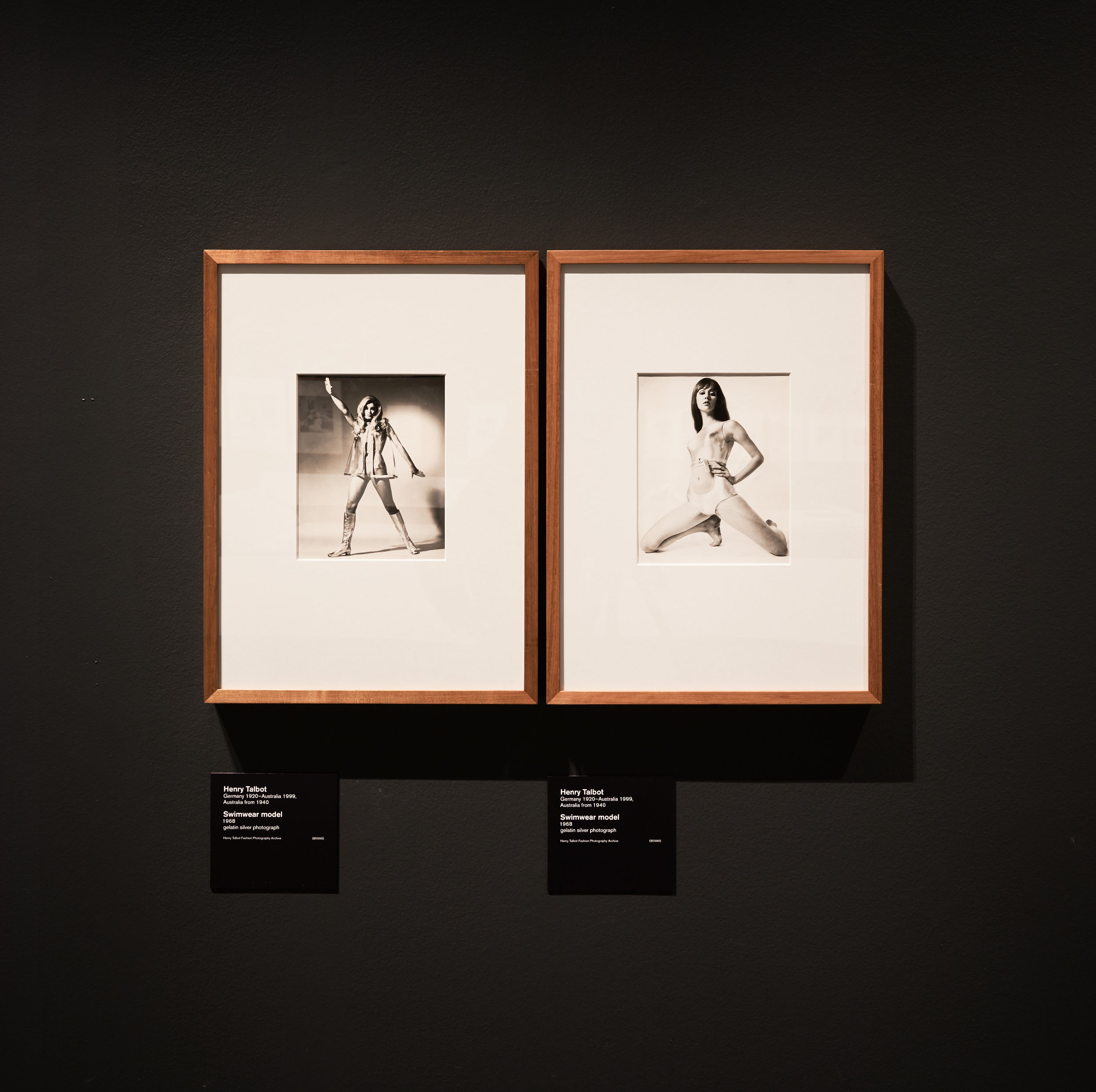
The Seven Last Words
1898
Seven platinum prints in original frame
H x W (overall with frame): 8 1/2 x 35 1/2 in. (21.6 x 90.2cm)
Barbara M. Marshall Fund, Frank B. Bemis Fund, Otis Norcross Fund, William E. Nickerson Fund, Lucy Dalbiac Luard Fund, and funds by exchange from a Gift of James Lawrence, Dorothy Mackenzie and John E. Lawrence, and funds donated by Michael and Elizabeth Marcus, Charles W. Millard III, and Scott Nathan and Laura DeBonis
Photo: © Museum of Fine Arts, Boston


Where Do We Come From / What Are We / Where Are We Going

I went to see one of my best friends for the last time in hospital today.

Joyce Evans has been like a surrogate mother to me for the last eight years. She has been wise counsel, friend, support, teacher, reconciler, adventurer and philosopher to this sometimes lost man. We had many adventures to exhibitions and openings, to our favourite restaurant Caffe e Cucina to have dinner, or going to see “Our Julia”, an exhibition of her favourite photographer Julia Margaret Cameron at the Art Gallery of New South Wales in Sydney. It is so sad in this life that we have to loose the wisdom of age only for the mistakes of past generations to be repeated over and over again.

Both Joyce and I do not believe in traditional, dogmatic religion. Both of us cannot stand the hypocrisy, baloney and proselytising that religion undertakes in the name of an “imaginary friend.” Religion is a crutch for the dogmatic who then impose their beliefs, and discrimination, on others.

But we both believe in spirit, that ineffable quality of experience where you obtain communion with the energy of the cosmos. A feeling, an emotional energy of connection to body, spirit and soul. Something noumenal, something that we have knowledge of, but that we can’t completely describe.

Strip away the baggage of religion from these photographs and you are left with a man being tortured and his spirit suffering. I wonder what this man was like when he was a baby? Who did he talk to growing up, what did he say, who did he meet. What was his essential journey to get to this place? Imagine Pontius Pilate not washing his hands of him, but sitting down with him and having a philosophical discussion on the nature of existence and being.

I felt immense love and sadness, hope and sorrow when I saw Joyce for the last time on this earth. I wished her a good journey and told her that I would see her soon.

I will miss her strength, intelligence, and beautiful spirit. But above all I will miss her love.

Dr Marcus Bunyan


These photographs are used under fair use conditions for the purpose of education and research. Please click on the photographs for a larger version of the image.


If we can find out what we are… that is the artist.

And then, this goes to the core element of your being:

If the core part of your life is the search for the truth then that becomes a core part of your identity for the rest of your life,

and the core element of your enquiry remains the same.

It becomes embedded in your soul.


Joyce Evans


F. Holland Day (American, 1864-1933) 'The Seven Last Words' 1898 (detail)

Father forgive them they know not what they do


F. Holland Day (American, 1864-1933) 'The Seven Last Words' 1898 (detail)

Today thou shalt be with me in Paradise


F. Holland Day (American, 1864-1933) 'The Seven Last Words' 1898 (detail)

Woman behold thy son: Son thy mother


F. Holland Day (American, 1864-1933) 'The Seven Last Words' 1898 (detail)

My God my God why hast thou forsaken me


F. Holland Day (American, 1864-1933) 'The Seven Last Words' 1898 (detail)

I thirst


F. Holland Day (American, 1864-1933) 'The Seven Last Words' 1898 (detail)

Into thy hands I commend my spirit


F. Holland Day (American, 1864-1933) 'The Seven Last Words' 1898 (detail)

It is finished


From 1895 to 1898 Day undertook a project that was without precedent: an extended series – some 250 negatives – showing scenes of the life of Christ, from the Annunciation to the Resurrection, in which he played the title role. In 1890 Day had traveled to Oberammergau to see the famous once-a-decade Passion Plays and may well have seen a similar multimedia presentation that toured the East Coast, including Boston, later in the 1890s. For his own production, Day starved himself, let his beard grow long, and imported cloth and a cross from Syria. Just prior to the reenacted Crucifixion, he made this series of close-up self-portraits – the most powerful images in his entire series – which represent Christ’s seven last words:

FATHER FORGIVE THEM; THEY KNOW NOT WHAT THEY DO.

TODAY THOU SHALT BE WITH ME IN PARADISE.

WOMAN, BEHOLD THY SON; SON, THY MOTHER

MY GOD, MY GOD, WHY HAST THOU FORSAKEN ME?

I THIRST.

INTO THY HANDS I COMMEND MY SPIRIT.

IT IS FINISHED.


For many people, Day’s self-portraits as Christ were – and remain – unsettling, as one tries to reconcile their fact and fiction. Day defended the use of photography for sacred subjects as a matter of artistic freedom, and Steichen wrote, “Few paintings contain as much that is spiritual and sacred in them as do the ‘Seven Words’ of Mr. Day. … If we knew not its origin or its medium how different would be the appreciation of some of us, and if we cannot place our range of vision above this prejudice the fault lies wholly with us. If there are limitations to any of the arts, they are technical; but of the motif to be chosen the limitations are dependent on the man – if he is a master he will give us great art and ever exalt himself.”

Text from The Metropolitan Museum of Art website [Online] Cited 26/03/2019


Edward Steichen (American born Luxembourg, 1879-1973) 'Solitude (Portrait of F. Holland Day)' 1901


Edward Steichen (American born Luxembourg, 1879-1973)
Solitude (Portrait of F. Holland Day)
1901
Platinum print
Barbara M. Marshall Fund, Frank B. Bemis Fund, Otis Norcross Fund, William E. Nickerson Fund, Lucy Dalbiac Luard Fund, and funds by exchange from a Gift of James Lawrence, Dorothy Mackenzie and John E. Lawrence, and funds donated by Michael and Elizabeth Marcus, Charles W. Millard III, and Scott Nathan and Laura DeBonis
Photo: © Museum of Fine Arts, Boston


Widely considered one of the masterpieces of photographic history, the monumental self portrait depicts Day as Christ in a series of seven platinum prints set in a frame designed by the artist. The work is a high point of Pictorialism – the turn-of-the-century movement advocating the artistic merit of photography. With few prints ever made by the artist and a tragic fire destroying his studio, Day’s photographs are tremendously rare. The Museum also acquired the crown of thorns worn by Day in The Seven Last Words and three important portraits of Day taken by photographers Edward Steichen, James Craig Annan and Clarence H. White. They were kept by the artist as part of his personal archive.

“The Seven Last Words is one of the most significant images in the history of photography, a work that reverberates with iconic importance and one that influenced subsequent artists significantly,” said Anne E. Havinga, Estrellita and Yousuf Karsh Senior Curator of Photographs at the MFA.

Born into an affluent family in Norwood, F. Holland Day was a turn-of-the-century Bostonian with an ultra-refined aesthetic sensibility and a multitude of interests, particularly in art and literature. He was a member of the “Boston Bohemians,” a circle of friends with whom he shared a love for the Arts and Crafts movement, sophisticated wit and Symbolist literature and art. He was also an admirer of old master painting and classical sculpture, and collected Japanese decorative arts and drawings. His interests led him into a career as a fine book publisher and photographer.

Day became interested in photography in the mid 1880s, joining the Pictorialist crusade to prove that photography could be a fine art, and within a decade he had become one of the most important figures in the international movement. While Day championed the same goals promoted by fellow photographers, he also defended religious imagery and the male nude – subjects that had previously been the domain of painting and sculpture. The seriousness of Day’s approach to artistic photography and his heightened sense of symbolism, enhanced by the subtle, low-keyed tonalities of his prints, were an inspiration to other photographers of the time.

In 1898, Day began exploring religious themes in his photographs. His “Sacred Studies,” as he called them, were widely acclaimed for their high-art aspirations – as seen in their relation to old master religious painting – and their unquestionable daring. The Seven Last Words was one of Day’s most expressive and best-known pieces and continues to be admired by many contemporary artists, especially those who explore identity, role play and staged photography in their work. Each of the seven photographs in the work, set in a frame designed by the artist, represents one of the last phrases spoken by Christ:

Father forgive them they know not what they do.
Today thou shalt be with me in Paradise.
Woman behold thy son: Son thy mother.
My God my God why hast thou forsaken me.
I thirst.
Into thy hands I commend my spirit.
It is finished.


Only two other versions of the work exist today: one is in the Metropolitan Museum of Art (without the artist-designed frame) and a third is owned by a private collector (with an altered frame). The MFA’s version is in tremendous condition and is in its original, un-altered frame.

Text from the Museum of Fine Arts Boston website [Online] Cited 26/03/2019


LIKE ART BLART ON FACEBOOK

Back to top

Review: ‘An unorthodox flow of images’ at the Centre for Contemporary Photography (CCP), Melbourne Part 2

Exhibition dates: 30th September – 12th November, 2017

Curators: Naomi Cass and Pippa Milne

Living artists include: Laurence Aberhart, Brook Andrew, Rushdi Anwar, Warwick Baker, Paul Batt, Robert Billington, Christian Boltanski, Pat Brassington, Jane Brown, Daniel Bushaway, Sophie Calle, Murray Cammick, Christian Capurro, Steve Carr, Mohini Chandra, Miriam Charlie, Maree Clarke, Michael Cook, Bill Culbert, Christopher Day, Luc Delahaye, Ian Dodd, William Eggleston, Joyce Evans, Cherine Fahd, Fiona Foley, Juno Gemes, Simryn Gill, John Gollings, Helen Grace, Janina Green, Andy Guérif, Siri Hayes, Andrew Hazewinkel, Lisa Hilli, Eliza Hutchison, Therese Keogh, Leah King-Smith, Katrin Koenning, O Philip Korczynski, Mac Lawrence, Kirsten Lyttle, Jack Mannix, Jesse Marlow, Georgie Mattingley, Tracey Moffatt, Daido Moriyama, Harry Nankin, Jan Nelson, Phuong Ngo.

Historic photographers: Hippolyte Bayard (French, 1801-1887), Charles Bayliss (Australian born England, 1850-1897), Bernd and Hilla Becher (German; Bernd Becher 1931-2007, Hilla Becher 1934-2015), Lisa Bellear (Australian / Goernpil, 1962-2006), James E. Bray (Australian, 1832-1891), Jeff Carter (Australian, 1928-2010), Harold Cazneaux (Australian, 1878-1953), Olive Cotton (Australian, 1911-2003), Peter Dombrovskis (Australian, 1995-1996), Max Dupain (Australian, 1911-1992), Joyce Evans (Australian, 1929-2019), Walker Evans (American, 1903-1975), Sue Ford (Australian, 1943-2009), Marti Friedlander (New Zealand born Britain, 1928-2016), Kate Gollings (Australian, 1943-2017), André Kertész (Hungarian, 1894-1985), J. W. Lindt (Australian born Germany, 1845-1926), W. H. Moffitt (Australian, 1888-1948), David Moore (Australian, 1927-2003), Michael Riley (Australian / Wiradjuri/Kamilaroi, 1960-2004), Robert Rooney (Australian, 1937-2017), Joe Rosenthal (American, 1911-2006), Mark Strizic (Australian, 1928 -2012), Ingeborg Tyssen (Australian, 1945-2002), Aby Warburg (German, 1866-1929), Charles Woolley (Australian, 1834-1922).


J W Lindt (Australian, 1845-1926) 'Body of Joe Byrne, member of the Kelly Gang, hung up for photography Benalla' 1880 from the exhibition 'An unorthodox flow of images' at the Centre for Contemporary Photography (CCP), Melbourne, Sept - Dec, 2017


(1) J W Lindt (Australian, 1845-1926)
Body of Joe Byrne, member of the Kelly Gang, hung up for photography, Benalla
1880
Courtesy State Library Victoria, Pictures Collection


Thought to be the first press photograph in Australia, this shows Joe Byrne, a member of the Kelly Gang, strung up for documentation days after his death, which followed the siege at Glenrowan. Byrne is displayed for an unknown photographer and the painter Julian Ashton who is standing to the left with possibly a sketchbook under his arm. Lindt’s photograph captures not only the spectacle of Byrne’s body but the contingent of documentarians who arrived from Melbourne to record and widely disseminate the event for public edification.


Double take

I was a curatorial interlocutor for this exhibition so it was very interesting to see this exhibition in the flesh.

An unorthodox flow of images is a strong exhibition, splendidly brought to fruition by curators Naomi Cass and Pippa Milne at the Centre for Contemporary Photography (CCP), Melbourne. To be able to bring so many themes, images, ideas and people together through a network of enabling, and a network of images, is an impressive achievement.

The exhibition explores the notion of connectivity between images in our media saturated world – across context, time and space. “With a nod to networked image viewing behaviour and image sharing – in one long line – the flow also impersonates the form of a sentence.” While the viewer makes their own flows through the works on view, they must interpret the interpolation of images (much like a remark interjected in a conversation) in order to understand their underlying patterns of connection. Like Deleuze and Guattari’s horizontal rhizome theory1 – where the viewer is offered a new way of seeing: that of infinite plateaus, nomadic thought and multiple choices – here the relationship between the photograph and its beholder as a confrontation between self and other, and the dynamic relation between time, subjectivity, memory and loss is investigated … with the viewer becoming an intermediary in an endless flow of non-hierarchical images/consciousness.

In this throng of dialects, the exhibition meanders through different “sections” which are undefined in terms of their beginning and end. The starting point for this flow is the public demonstration of trauma for the edification of society (the photographs of the aftermath of the siege of Ned Kelly and his gang at Glenrowan), notably what is thought to be the first press photograph in Australia, J W Lindt’s Body of Joe Byrne, member of the Kelly Gang, hung up for photography, Benalla (1880, above), and the flow then gathers its associations through concepts such as studio work, the gaze, disruption, truth, performance and traces, to name just a few. The exhibition ceaselessly establishes connections between semiotic chains, organisations of power and contextual circumstances, moving forward and backwards in time and space, jumping across the gallery walls, linking any point to any point if the beholder so desires. In this sense (that of an expanded way of thinking laterally to create a democracy of sight and understanding), the exhibition succeeds in fostering connections, offering multiple entryways into the flow of images that proposes a new cultural norm.

For Deleuze and Guattari these assemblages (of images in this case), “… are the processes by which various configurations of linked components function in an intersection with each other, a process that can be both productive and disruptive. Any such process involves a territorialization; there is a double movement where something accumulates meanings (re-territorialization), but does so co-extensively with a de-territorialization where the same thing is disinvested of meanings.”2 Now here’s the rub (or the trade-off if you like) of this exhibition, for everything in life is a trade-off: the accumulation of new meaning that such a flow of images creates is balanced by what has been lost. Both an accumulation and disinvestment of meaning.

I have a feeling that in such a flow of images the emotion and presence of the subject has been lost, subsumed into a networked, hypermedia flow where, “images become more and more layered until they are architectural in design, until their relationship to the context from which they have grown cannot be talked about through the simple models offered by referentiality, or by attributions of cause and effect.”3 The linear perspective developed during the Renaissance and its attendant evidence of truth / objective reality (the logic of immediacy) is disrupted. It is no longer about being there, about the desire for presence, but about a logic of hypermediacy that privileges fragmentation, process, and performance. Of course, immediacy / hypermediacy are part of a whole and are not exclusionary to each other. But here contemporary art, and in particular contemporary photography, keeps coming back to the surface, redefining conceptual and aesthetic spaces.

This is where I was plainly unmoved by the whole exhibition. Conceptually and intellectually the exhibition is very strong but sequentially and, more importantly, emotionally – the flow of images failed to engage me. The dissociative association proposed – like a dissociative identity disorder – ultimately becomes a form of ill/literation, in which the images seem drained of their passion, a degenerative illness in which all images loose their presence and power. In a media saturated world what does it mean to pluck these images from a variable spatio-temporal dimensionality and sequence them together and hope they give meaning to each other? Ultimately, it’s a mental exercise of identity organisation that is pure construct.

Further, this (re)iteration is a repetition that is supposed to bring you successively closer to the solution of a problem: what is the relevance of the stream of image consciousness in contemporary society? What happens to the referentiality and presence of the individual image?

With this in mind, let us return to the first image in the flow of images, J W Lindt’s Body of Joe Byrne, member of the Kelly Gang, hung up for photography, Benalla (1880, above). Here Byrne is displayed for an unknown photographer and the painter Julian Ashton who is standing to the left with possibly a sketchbook under his arm. Amongst other things, the image is by a photographer taking a photograph of another photographer taking a photograph of the body of Joe Byrne. Immediately, the triangular relationship of camera / subject / viewer (cause and effect) is disrupted with the addition of the second photographer. There is a doubling of space and time within this one image, as we imagine the image the photographer in the photograph would have taken. And then we can see two variations of that internal photograph: Photographer unknown Joe Byrne’s Body, Benalla Gaol, 29 June 1880 (below) and William J. Burman’s Joe Byrne’s Body, Benalla Gaol, 29 June 1880 (1880, below) which 1/ appears to solve who the “photographer unknown” is (unless Burman purchase the rights to use another’s photographers’ negatives); and 2/ is a more tightly framed image than the first iteration. If you look at the top of the head in the second image the hair goes over the metal hinge of the door behind… so the photographer (the same one) has moved closer and dropped the height of the camera, so that the camera looks up more, at the body.

Other details fascinate. The ring on the left finger of Joe Byrne; his stripped shirt; the rope under his arms used to help support his weight; the rope disappearing out of picture to help string him up; and questions such as, how did they get his left hand to stay in that position? This is also, “an image of an audience as much as a portrait of the deceased … Members of the public are also documented; children, men – trackers perhaps, bearing witness to the public display of retribution that was intended to restore social order.” To the left we have what is presumably the photographers’ coat hung on a tree; a man wiping his nose with his thumb; and Aboriginal man; and a boy looking at the camera. Through his silhouette the Aboriginal man can probably be identified as Tracker Johnny, one of five trackers who helped track Ned Kelly, and we can see a portrait of him in an albumen photograph held by the Queensland Police Museum (1880, below). A picture of the ‘Other’, both outsiders, the outlaw and the Aboriginal, detailing the social order. The blurred image of the boy looking at the camera shows the length of the time exposure for the glass plate, but it is his “Janus-faced” visage that I am fascinated with… as he both looks forwards and backwards in time. Whilst most images within An unorthodox flow of images are conceptually grounded, they also evidence only one direct meaning in relationship to themselves within that network, “each one connected to those on either side,” – from point to point to point. Conversely, in this image the interpretation is open-ended, WITHIN THE ONE IMAGE. It is a network all of its own. I also remember, emotionally, the other images of the burnt out Glenrowan Inn, the place where the rails were taken up (I was there!), the bodies in the coffins, the preparation for the photograph of the Kelly Gang Armour laid out in a muddy field for documentation, and the burnt to a cinder, charred remains rescued from the ashes of the Glenrowan Inn laid out on a piece of wood. There is a physicality to these photographs, and an emotional charge, that no other photograph in this exhibition matches. I think, then, not of Joe Bryne’s lifeless body and its/the photographs morbidity, but of him as a younger man – standing legs crossed, one hand on hip, the other resting on the surface of a table, imagining his touch on that table in reality – a son, an outlaw, a living being.

I wish the curators had been braver. I wish that they had given these images more chance to breathe. I wish they had cut the number of images and sequenced them so that the space between them (what Minor White calls ice/fire, that frisson of space between two images that adds to their juxtaposed meaning) provided opportunity for a more emotional engagement with what was being presented. Yes, this is a strong exhibition but it could have been so much more powerful if the flow had not just meandered through the sentence, but cried out, and declaimed, and was quiet. Where was the punctum? Where was the life blood of the party, if only disappearing in a contiguous flow of images.

Dr Marcus Bunyan

Word count: 1,642


Footnotes

1/ Deleuze, Gilles and Guattari, Felix. A Thousand Plateaus: Capitalism and Schizophrenia. Minneapolis and London: University of Minneapolis Press, 1987

2/ Wood, Aylish. “Fresh Kill: Information technologies as sites of resistance,” in Munt, Sally (ed.,). Technospaces: Inside the New Media. London: Continuum, 2001, p. 166

3/ Burnett, Ron. Cultures of Vision: Images, Media, & the Imaginary. Bloomington: Indiana University Press, 1995, pp. 137-138.


Many thankx to the CCP for allowing me to publish the photographs in the posting. Please click on the photographs for a larger version of the image. The numbers in brackets refer to the number of the image in the field guide. The text is taken from the field guide to the exhibition [Online] Cited 01/11/2017. No longer available online.


J W Lindt (Australian, 1845-1926) 'Body of Joe Byrne, member of the Kelly Gang, hung up for photography Benalla' 1880 (detail)

J W Lindt (Australian, 1845-1926) 'Body of Joe Byrne, member of the Kelly Gang, hung up for photography Benalla' 1880 (detail)

J W Lindt (Australian, 1845-1926) 'Body of Joe Byrne, member of the Kelly Gang, hung up for photography Benalla' 1880 (detail)


J W Lindt (Australian, 1845-1926)
Body of Joe Byrne, member of the Kelly Gang, hung up for photography, Benalla (details)
1880
Courtesy State Library Victoria, Pictures Collection


An unorthodox flow of images commences with what is known as the first press photograph in Australia and unfurls through historic, press, portraiture, popular and art photography, some in their intended material form and others as reproductions. An unbroken thread connects this line of still and moving images, each tied to those on either side through visual, conceptual, temporal, material or circumstantial links.

This is a proposition about photography now. Relationships between images are sometimes real, and sometimes promiscuous. Unorthodox brings new contexts to existing artworks whilst celebrating the materiality of real photographs, in real time and critically, honouring the shared democratic experience of the public gallery space.

Text from the CCP website


Photographer unknown (Australian). 'Joe Byrne's Body, Benalla Gaol, 29 June' 1880


(2) Photographer unknown (Australian)
Joe Byrne’s Body, Benalla Gaol, 29 June
1880
Photographic print from glass plate
12 × 19.5cm
© Collection of Joyce Evans
Photo: Marcus Bunyan


This image appears to the one of the images taken by the photographer in J. W. Lindt’s Body of Joe Byrne, member of the Kelly Gang, hung up for photography, Benalla 1880 (above)


William J. Burman (Australian born England, 1814-1890) 'Joe Byrne's Body, Benalla Gaol, 29 June 1880' 1880 from the exhibition 'An unorthodox flow of images' at the Centre for Contemporary Photography (CCP), Melbourne, Sept - Dec, 2017


William J. Burman (Australian born England, 1814-1890)
Joe Byrne’s Body, Benalla Gaol, 29 June 1880
1880
At 209 Bourke Street, East Melbourne 1878-1888
Albumen carte de visite
6.5 × 10.5cm


This image appears to the one of the images taken by the photographer in J. W. Lindt’s Body of Joe Byrne, member of the Kelly Gang, hung up for photography, Benalla 1880.


Unknown photographer. 'Untitled [Portrait of Tracker Johnny from Maryborough District one of five trackers who helped track Ned Kelly]' c. 1880


Unknown photographer
Untitled [Portrait of Tracker Johnny from Maryborough District one of five trackers who helped track Ned Kelly] (detail, not in exhibition)
c. 1880
Albumen photograph
Queensland Police Museum
Non-commercial – Share Alike (cc)


J. E. Bray (Australian, 1832-1891) 'Kelly Gang Armour' 1880


(3) J. E. Bray (Australian, 1832-1891)
Kelly Gang Armour
1880
Albumen cabinet portrait
16.5 × 10.5cm
© Collection of Joyce Evans
Photo: Marcus Bunyan


“As objects of contemplation, images of the atrocious can answer to several different needs. To steel oneself against weakness. To make oneself more numb. To acknowledge the existence of the incorrigible.”

~ Susan Sontag, Regarding the Pain of Others (2003)


Unknown photographer. 'Place where rails were taken up by Kelly gang' 1880


(4) Unknown photographer
Place where rails were taken up by Kelly gang
1880
Albumen carte de visite
6.5 × 10.5cm
© Collection of Joyce Evans
Photo: Marcus Bunyan


J. E. Bray (Australian, 1832-1891) 'The Glenrowan Inn after the Kelly Siege' 1880


(5) J. E. Bray (Australian, 1832-1891)
The Glenrowan Inn after the Kelly Siege
1880
Albumen carte de visite
6.5 × 10.5cm
© Collection of Joyce Evans
Photo: Marcus Bunyan


J. E. Bray (Australian, 1832-1891) 'Charred remains from Kelly gang siege' 1880


(6) J. E. Bray (Australian, 1832-1891)
Charred remains from Kelly gang siege
1880
Albumen carte de visite
6.5 × 10.5cm
© Collection of Joyce Evans
Photo: Marcus Bunyan


In her comments on a related photograph by Bray, Helen Ennis writes, “What you see pictured, presumably as part of the official documentation are the thoroughly blackened remains of either Dan Kelly or Steve Hart… Relatives raked what remained of the bodies… from the ashes of the Glenrowan Inn. These were then photographed before family members took them home on horseback and buried them. … [These photographs] also underscore the brutality and barbarism of the post-mortem photographs – the violence physically enacted on the body in the first instance and then visually in terms of the photographic representation.”

Helen Ennis. “Portraiture in extremis” in Photogenic Essays / Photography / CCP 2000-2004, Daniel Palmer (ed.), 2005, CCP, pp. 23-39, p. 34


J. E. Bray (Australian, 1832-1891) 'Untitled ["McDonnell's Tavern opposite Railway Station, remains of Dan Kelly and Hart in coffins"]' 1880


(7) J. E. Bray (Australian, 1832-1891)
Untitled [“McDonnell’s Tavern opposite Railway Station, remains of Dan Kelly and Hart in coffins”]
1880
Albumen cabinet portrait
16.5 × 10.5cm
© Collection of Joyce Evans
Photo: Marcus Bunyan


W. E. (William Edward) Barnes (Australian, 1841-1916) 'Steve Hart' (1859-1880) c. 1878

W. E. (William Edward) Barnes (Australian, 1841-1916) 'Steve Hart' (1859-1880) c. 1878 (verso)


W. E. (William Edward) Barnes (Australian, 1841-1916)
Steve Hart (1859-1880) (front and verso, not in exhibition)
c. 1878
Albumen carte de visite
6.5 × 10.5cm
© Collection of Joyce Evans
Photo: Marcus Bunyan


W. E. (William Edward) Barnes (Australian, 1841-1916) 'Steve Hart' (1859-1880) c. 1878


W. E. (William Edward) Barnes (Australian, 1841-1916)
Steve Hart (1859-1880) (not in exhibition)
c. 1878
Albumen carte de visite
State Library of Victoria


Piero della Francesca (Italian, 1415-1492) 'Flagellation of Christ' 1455-1460


(9) Piero della Francesca (Italian, 1415-1492)
Flagellation of Christ
1455-1460
Oil and tempera on wood, reproduced as digital print on wallpaper
58.4 × 81.5 cm, reproduced at 20 × 30 cm


The meaning of della Francesca’s Flagellation and exact identity of the three foreground figures in fifteenth century dress, is widely contested. In the context of this flow of images, the painting represents the pubic display of suffering as punishment, for the edification of society. In both J.W. Lindt’s documentary photograph and the possibly allegorical Flagellation, the broken body of Joe Byrne and that of Christ are isolated from other figures and subject of conversation and debate by gathered figures. Other formal similarities include framing of the tableau into shallow and deep space the organising role of architecture in signifying the key subject.


Joosep Martinson. 'Police Hostage Situation Developing at the Lindt Café in Sydney' 2014


(10) Joosep Martinson
Police Hostage Situation Developing at the Lindt Café in Sydney
2014
Digital print on wallpaper
20 × 30cm


The scene outside the Lindt Cafe siege, caught by the photojournalist in a moment of public trauma. This bears formal resemblance to J.W. Lindt’s photograph of Joe Byrne, and even further back to Piero della Francesca.


Tracey Moffatt (Australian, b. 1960) 'I made a camera' 2003


(13) Tracey Moffatt (Australian, b. 1960)
I made a camera
2003
photolithograph
38 × 43cm, edition 201 of 750
Private collection


Returning to J.W. Lindt’s photograph in particular the hooded central figure photographing Joe Byrne – Tracey Moffatt’s picturing of children role-playing calls to mind the colonial photographer’s anthropological gesture.


Siri Hayes (Australian, b. 1977) 'In the far reaches of the familiar' 2011


(14) Siri Hayes (Australian, b. 1977)
In the far reaches of the familiar
2011
C-type print
88 × 70 cm, exhibition print
Courtesy the artist


The photographer’s hood is the photographer.


Janina Green (Australian born Germany, b. 1944) 'Self Portrait' 1996


(15) Janina Green (Australian born Germany, b. 1944)
Self Portrait
1996
Digital version of a hand-coloured work in early Photoshop
44 × 60cm
Courtesy the artist and M.33, Melbourne


Georgie Mattingly. 'Portrait IV' 2016


(16) Georgie Mattingly
Portrait IV (After Arthroplasty)
2016
Hand-tinted silver gelatin print
36 × 26cm
Unique hand print
Courtesy the artist


The photographer’s hood has become a meat-worker’s protective gear, tenderly hand-coloured. [And spattered with blood ~ Marcus]


Lisa Hilli (Makurategete Vunatarai (clan) Gunantuna / Tolai People, Papua New Guinea) 'In a Bind' 2015


(17) Lisa Hilli (Makurategete Vunatarai (clan) Gunantuna / Tolai People, Papua New Guinea)
In a Bind
2015
Pigment print on cotton rag
76 × 51.5cm
Courtesy the artist


‘The woven material that hoods the artist’s identity is a reference to collected Pacific artefacts, which are usually of a practical nature. Magimagi is a plaited coconut fibre used for reinforcing architectural structures and body adornment within the Pacific. Here it emphasises the artist’s feeling of being bound by derogatory Western and anthropological labels used by museums and the erasure of Pacific bodies and narratives within public displays of Pacific materiality.’  ~ Lisa Hilli 2017, in an email to the curator


In an era of ‘tumbling’ images, An unorthodox flow of images presents visual culture in a novel way: commencing with Australia’s first press photograph, 150 images unfurl in flowing, a-historical sequences throughout the gallery. Each work is connected to the one before through formal, conceptual or material links.

An unorthodox flow of images draws upon the photographic image in its many forms, from significant historical photographs by major Australian artists, such as J.W. Lindt, Olive Cotton and Max Dupain, through to contemporary international and Australian artists, such as Tracey Moffatt, Michael Parekowhai, Christian Boltanski and Daido Moriyama. This exhibition brings early career artists into the flow, including Georgie Mattingley, Jack Mannix and James Tylor.

Celebrating the breadth of photographic technologies from analogue through to digital, including hand made prints, a hand-held stereoscope, early use of Photoshop, iPhone videos and holography, An unorthodox flow of images propels the viewer through a novel encounter with technology, art, and the act of looking. Rather than a definitive narrative, this exhibition is a proposition about relationships between images: sometimes real and sometimes promiscuous, and is inevitably open to alternative readings. Contemporary culture necessitates quick, networked visual literacy. So viewers are invited to make their own readings of this unorthodox flow.

Akin to how images are experienced in our personal lives and perhaps to how artists are influenced by the multiverse of photography, this extraordinary gathering also includes spirited incursions from other kinds of images – rare prints of grizzly 19th century photojournalism abuts contemporary video first shared on Instagram, and surrealist French cinema nestles in with Australian image-makers.

This exhibition aims to bring new contexts to existing artworks to highlight networked image-viewing behaviour, whilst honouring the materiality of real photographs, in real time and critically, honouring the shared democratic experience of the public gallery space. An unorthodox flow of images is presented as part of the 2017 Melbourne Festival.

Press release from the CCP


Siri Hayes (Australian, b. 1977) 'Plein air explorers' 2008


(30)Siri Hayes (Australian, b. 1977)
Plein air explorers
2008
C-type print
108 × 135cm, edition 4 of 6
Collection of Jason Smith


An artist’s studio in the landscape.


Robyn Stacey (Australian, b. 1952) 'Wendy and Brett Whiteley's Library' 2016


(31) Robyn Stacey (Australian, b. 1952)
Wendy and Brett Whiteley’s Library
2016
From the series Dark Wonder
C-type print
110 × 159cm, edition of 5 + 3 artist proofs
Courtesy the artist and Jan Manton Gallery, Brisbane


The landscape brought into the studio by a camera obscura. Robyn Stacey captures the perfect moment of light and clarity, in this instance, also turning the egg-object into an orb of light.


Pat Brassington (Australian, b. 1942) 'Vedette' 2015


(37) Pat Brassington (Australian, b. 1942)
Vedette
2015
Pigment print
75 × 60cm, edition of 8,
Courtesy the artist and ARC ONE Gallery, Melbourne and Bett Gallery, Hobart


Two orbs, a positive and a negative space.


Anne Noble (New Zealand, b. 1954) 'Rubys Room 10' 1998-2004


(38) Anne Noble (New Zealand, b. 1954)
Ruby’s Room 10
1998-2004
Courtesy the artist and Two Rooms Gallery Auckland


Daido Moriyama (Japanese, b. 1938) 'DOCUMENTARY '78' 1986


(42) Daido Moriyama (Japanese, b. 1938)
DOCUMENTARY ’78
1986
Silver gelatin print
61 × 50.8cm
Private collection


Leah King-Smith (Australian / Bigambul, b. 1957) 'Untitled #3' 1991


(43) Leah King-Smith (Australian / Bigambul, b. 1957)
Untitled #3
1991
From the series Patterns of connection
C-type print
102 × 102cm, edition 6 of 25
Private collection


‘I was seeing the old photographs as both sacred family documents on one hand, and testaments of the early brutal days of white settlement on the other. I was thus wrestling with anger, resentment, powerlessness and guilt while at the same time encountering a sense of deep connectedness, of belonging and power in working with images of my fellow Indigenous human beings.’ ~ L King-Smith, White apron, black hands, Brisbane City Hall Gallery, 1994, p. 7. In this series, the artist superimposes the colonial portrait onto images of the subject’s own landscape, returning the dispossessed to country.


Unorthodox: a field guide

We could have started anywhere. Perhaps every image ever made connects with another image in some way. But, we have begun with what is known as the first press photograph in Australia – a grisly depiction of Kelly Gang member Joe Byrne, strung up some days after his execution, for a group of onlookers, including a group of documentarians who came in by train to record the event: a painter and several photographers. This is an image of an audience as much as a portrait of the deceased. A hooded photographer bends to his tripod, and a painter waits in line. Perhaps a seminal moment between competing technologies of record, magnificently captured by colonial photographer, J. W. Lindt (1845-1926): this is as decisive a moment as current technology permitted. Members of the public are also documented; children, men – trackers perhaps, bearing witness to the public display of retribution that was intended to restore social order.

From here, Unorthodox draws a thread of images together, each one connected to those on either side, whether through visual, conceptual, temporal, material or circumstantial ties, or by something even more diffuse and smoky – some images just conjure others, without a concrete reason for their bond. Spanning the entire gallery space, nearly 150 images unfurl with links that move through historic, press, portraiture, popular and art photography.

You are invited to wander through CCPs nautilus galleries, and make what you will of this flow because unlike a chain of custody, there is no singular narrative or forensic link: you are invited to explore not just connections between works but to see individual works in a new light.

At the core of this exhibition is an attempt to lay bare the way that images inform and seep into everyday life, underpinning the way that we see, interpret and understand the world. With a nod to networked image viewing behaviour and image sharing – in one long line – the flow also impersonates the form of a sentence.

The act of looking. Looking is a process, informed by context – where and when we see something, and what surrounds it. Here, images are unbuckled from their original context, indeed there are no museum labels on the wall. But this is often the way when viewing images on the internet, or reproduced in books, referenced in ads, reenacted in fashion shoots, or reinterpreted by artists. The notion of reproductions within photography is slippery, made more so by the rapid circulation of images whereby we sometimes only know certain originals through their reproductions. In this exhibition, sometimes we have the original images, at others we proffer ‘reproductions’, setting out a swathe of contemporary and historical approaches to the craft of photography and video, unhampered by traditional constraints of what we can or cannot show within a non-collecting contemporary art space.

This exhibition moves through a number of notional chapters, for example visual connections can be made between orbs made by soap bubbles (no. 32, 34) and moons (no. 33); eyes (no. 40, 41, 42), gaping mouths (no. 37), the balletic body in space (no. 45); and light from orbs (no. 44, 46) and then moonlight on the ocean (no. 47), which tumbles into salty connections, with photographs exposed by the light of the moon through seawater (no. 48) connecting to an image of salt mines (no. 50), and on to salt prints (no. 51).

We have been influenced by observing how audiences view exhibitions, traversing the space, seemingly drawing connections, making their own flows through works on view. In spite of its indexicality to the world, photography is particularly open to multiple readings due to its reproducibility and its vulnerability to manipulation. A key to this permeability is the intention of the photographer, which can become opaque over time. For example, installation artist Christian Boltanski’s found photograph (no. 137) has been taken out of its time and context so as to mean something quite different from what the photographer intended.

Importantly, due to their multiple readings, many works could be equally effective if placed in other sections of the exhibition. For example, of the many places to position Leah King-Smith’s Untitled #3 (no. 43), we have elected to locate it amongst compositions that include orbs. However, it is also a staged work; a constructed or collaged photograph; it embodies an Indigenous artist returning the colonial gaze and, due to the age of her source photograph, it represents a deceased person. And, in her own words King-Smith is responding to the trauma of settlement. ‘I was thus wrestling with anger, resentment, powerlessness… while at the same time encountering a sense of deep connectedness, of belonging and power in working with images of my fellow Indigenous human beings.’

A curious process indeed, we have been open to many repositories of images while gathering this flow – from our work with artists at CCP; to childhood memories of images and personal encounters with photography and video; to our trawling of the Internet and books; as well as conversations with writers, artists and collectors. From these stores, we have also considered which works were available in their material form, as opposed to reproductions on wallpaper, postcards and record covers. While we exhibit a broad timespan and multiple technologies, our primary desire as a contemporary art space is to create new contexts for the exhibition of contemporary photography and video.

Unorthodox is a proposition about relationships between images: sometimes real and sometimes promiscuous, and is inevitably open to alternative readings. It brings new contexts to existing artworks whilst celebrating the materiality of real photographs, in real time and critically, honouring the shared democratic experience of the public gallery space.

Naomi Cass and Pippa Milne


Brook Andrew (Australian, b. 1970) 'I Split Your Gaze' 1997


(62) Brook Andrew (Australian, b. 1970)
I Split Your Gaze
1997, printed 2005
Silver gelatin print
160 × 127cm
Private collection
Courtesy the artist and Tolarno Galleries, Melbourne; Roslyn Oxley9 Gallery, Sydney; and Galerie Nathalie Obadia, Paris and Brussels


Brassaï (French, 1899-1984) 'Young couple wearing a two-in-one suit at Bal De La Montagne Saint-Genevieve' 1931


(63) Brassaï (French, 1899-1984)
Young couple wearing a two-in-one suit at Bal De La Montagne Saint-Genevieve
c. 1931
Gelatin silver print
Reproduced as digital print on wallpaper
23.2 × 15.9cm, reproduced at 24.5 × 19cm


William Yang (Australian, b. 1943) 'Alter Ego' 2000


(64) William Yang (Australian, b. 1943)
Alter Ego
2000
from the series Self Portraits
Inkjet print, edition 2 of 30
68 × 88cm
Courtesy the artist


Sue Ford (Australian, 1943-2009) 'St Kilda' 1963


(65) Sue Ford (Australian, 1943-2009)
Lyn and Carol
1961
Silver gelatin print, edition 3 of 5
44 × 38cm
Courtesy Sue Ford Archive


Harold Cazneaux (Australian, 1878-1953) 'Spirit of endurance' 1937


(76) Harold Cazneaux (Australian, 1878-1953)
Spirit of Endurance
1937
Silver gelatin print
16.8 × 20.4cm
Private collection


In the following two works, a critical change of title by the artist reveals what, alone, the eye cannot see. This photograph had already achieved iconic status as a symbol of the noble Australian landscape when, following the loss of his son who died aged 21 at Tobruk in 1941, Cazneaux flipped the negative and presented the image under the new title Spirit of Endurance. The tree is now classified on the National Trust of South Australia’s Register of Significant Trees.


Jeff Carter (Australian, 1928-2010) 'The Eunuch, Marree, South Australia' 1964


(77) Jeff Carter (Australian, 1928-2010)
The Eunuch, Marree, South Australia
1964
Silver gelatin print
37.5 × 27.2cm
Private collection


Changing a title can dramatically alter the meaning of an image. This work has had several titles:

Morning Break 1964;
Dreaming in the sun at Marree, outside the towns single store 1966;
At times there is not too much to do except just sit in the sun… 1968;
‘Pompey’ a well known resident of Marree;
and finally The Eunuch, Marree, South Australia 2000

Under early titles, the photograph appeared to be a simple portrait of “Pompey”, a local Aboriginal man in Marree who worked at the town’s bakery. The final title draws viewers’ attention away from what might have seemed to be the man’s relaxed approach to life, and towards the violence enacted on Aboriginal communities in castrating young boys.


Persons Of Interest - ASIO surveillance 1949 -1980. 'Frank Hardy under awning Caption: Author Frank Hardy shelters under an awning, in the doorway of the Building Workers Industrial Union, 535 George St, Sydney, August 1955'


(82) Photographer undisclosed
Persons Of Interest – ASIO surveillance images
1949 -1980
‘Frank Hardy under awning Caption: Author Frank Hardy shelters under an awning, in the doorway of the Building Workers Industrial Union, 535 George St, Sydney, August 1955’
C-type prints
22 × 29cm each
Private collection


The Australian Security and Intelligence Organisation (ASIO) employed photographers to spy on Australian citizens. The photographs which were annotated to indicate persons of interest, were retained by ASIO along with other forms of material gathered through espionage.


Luc Delahaye (French, b. 1962) 'L'Autre' 1999 (detail)


(85) Luc Delahaye (French, b. 1962)
L’Autre (detail)
1999
Book published by Phaidon Press, London
17 × 22cm
Private collection


In the footsteps of Walker Evans’ classic candid series, Rapid Transit 1956


David Moore (Australian, 1927-2003) 'Migrants arriving in Sydney' 1966


(94) David Moore (Australian, 1927-2003)
Migrants arriving in Sydney
1966
Silver gelatin print
35.7 × 47cm
Private collection


In 2015, Judy Annear said of this famous photograph: “It’s great to consider that it’s not actually what it seems.” Years after the photo was published, it emerged that four of the passengers in it were not migrants but Sydneysiders returning home from holiday.


Joe Rosenthal (American, 1911-2006) 'Raising the Flag on Iwo Jima' 1945


(95) Joe Rosenthal (American, 1911-2006)
Raising the Flag on Iwo Jima
1945
Digital print on wallpaper, reproduced at 20 × 25cm


While not present at the the raising of the first flag over Iwo Jima, Rosenthal witnessed the raising of the replacement flag. Some maintain that this Pulitzer Prize winning photograph was staged, while others hold that it depicts the replacement of the first flag with a larger one.


Charles Kerry (Australian, 1857-1928) 'Aboriginal Chief' c. 1901-1907


(103) Charles Kerry (Australian, 1857-1928)
Aboriginal Chief
c. 1901-1907
Carte de visite
13.7 × 8.5 cm
Private collection


No name or details are recorded of this sitter from Barron River, QLD. He was a member of the touring Wild West Aboriginal troupe, which staged corroborees, weapon skills and tableaux of notorious encounters between armed Native Police and unarmed local communities.


Brook Andrew (Australian, b. 1970) 'Sexy and Dangerous' 1996


(104) Brook Andrew (Australian, b. 1970)
Sexy and Dangerous
1996
Computer-generated colour transparency on transparent synthetic polymer resin, included here as postcard of artwork
original 146.0 × 95.6cm, included here at 15.3 × 10.5cm
The artist is represented by Tolarno Galleries, Melbourne; Roslyn Oxley9 Gallery, Sydney; and Galerie Nathalie Obadia, Paris and Brussels


William Eggleston (American, b. 1939) 'Untitled (glass on plane)' 1965-1974


(116) William Eggleston (American, b. 1939)
Untitled (glass on plane)
1965-1974
C-type print
41 × 56cm
Private collection


Bill Culbert (New Zealand, b. 1935) 'Small glass pouring Light, France' 1997


(117) Bill Culbert (New Zealand, b. 1935)
Small glass pouring Light, France
1997
Silver gelatin print, edition of 25
40.5 × 40.5cm
Courtesy the artist and Roslyn Oxley9 Gallery, Sydney and Hopkinson Mossman Gallery, Auckland


Olive Cotton (Australian, 1911-2003) 'Teacup ballet' 1935, printed 1992


(118) Olive Cotton (Australian, 1911-2003)
Teacup Ballet
1935
Silver gelatin print
35.5 × 28cm
Courtesy Tony Lee


David Moore (Australian, 1927-2003) 'Sisters of Charity' 1956


(119) David Moore (Australian, 1927-2003)
Sisters of Charity
1956
Silver gelatin print
40.5 × 27.1cm
Private collection


Bernd and Hilla Becher (German; Bernd Becher 1931-2007, Hilla Becher 1934-2015) 'Kies-und Schotterwerke (Gravel Plants)' 2006


(120) Bernd and Hilla Becher (German; Bernd Becher 1931-2007, Hilla Becher 1934-2015)
Kies-und Schotterwerke (Gravel Plants)
2006
Silver gelatin print
99 × 121cm
Private collection


Max Dupain (Australian, 1911-1992) 'Backyard, Forster, New South Wales' 1940


(123) Max Dupain (Australian, 1911-1992)
Backyard, Forster, New South Wales
1940
Silver gelatin print
44 × 39cm
Private collection


Joyce Evans (Australian, 1929-2019) 'Budapest Festival' 1949


(138) Joyce Evans (Australian, 1929-2019)
Budapest Festival
1949
Inkjet print
7.6 × 7.6cm
Courtesy the artist


Jeff Wall (Canadian, b. 1946) 'A sudden gust of wind (after Hokusai)' 1993


(145) Jeff Wall (Canadian, b. 1946)
A sudden gust of wind (after Hokusai)
1993
Transparency on lightbox, included here as postcard of artwork
250 × 397 × 34cm, included here at 15.3 × 10.5cm
Artist is represented by Marian Goodman Gallery; Gagosian; and White Cube Gallery


Masayoshi Sukita (Japanese, b. 1938) 'David Bowie - Heroes' 1977


(147) Masayoshi Sukita (Japanese, b. 1938)
David Bowie – Heroes
1977
Record cover
31 × 31cm


Sukita: In gesture and gaze, Sukita’s photograph for David Bowie’s 1977 cover harks back 60 years to Weimar Republic artist, Erich Heckel’s 1917 painting, Roquairol, which is in Bowie’s art collection.


(148) Francis Alÿs (Belgian based Mexico, b. 1959)
Railings (Fitzroy square)
London, 2004
4.03 min.
Francis Alÿs website


We posit Fitzroy Square at this point; in honour of your journey through this unorthodox flow of images.


Centre for Contemporary Photography

No permanent exhibition space at the moment

Centre for Contemporary Photography website

LIKE ART BLART ON FACEBOOK

Back to top

Exhibition: ‘An unorthodox flow of images’ at the Centre for Contemporary Photography (CCP), Melbourne Part 1

Exhibition dates: 30th September – 12th November, 2017

Curators: Naomi Cass and Pippa Milne

Living artists include: Laurence Aberhart, Brook Andrew, Rushdi Anwar, Warwick Baker, Paul Batt, Robert Billington, Christian Boltanski, Pat Brassington, Jane Brown, Daniel Bushaway, Sophie Calle, Murray Cammick, Christian Capurro, Steve Carr, Mohini Chandra, Miriam Charlie, Maree Clarke, Michael Cook, Bill Culbert, Christopher Day, Luc Delahaye, Ian Dodd, William Eggleston, Cherine Fahd, Fiona Foley, Juno Gemes, Simryn Gill, John Gollings, Helen Grace, Janina Green, Andy Guérif, Siri Hayes, Andrew Hazewinkel, Lisa Hilli, Eliza Hutchison, Therese Keogh, Leah King-Smith, Katrin Koenning, O Philip Korczynski, Mac Lawrence, Kirsten Lyttle, Jack Mannix, Jesse Marlow, Georgie Mattingley, Tracey Moffatt, Daido Moriyama, Harry Nankin, Jan Nelson, Phuong Ngo.

Historic photographers: Hippolyte Bayard (French, 1801-1887), Charles Bayliss (Australian born England, 1850-1897), Bernd and Hilla Becher (German; Bernd Becher 1931-2007, Hilla Becher 1934-2015), Lisa Bellear (Australian / Goernpil, 1962-2006), James E. Bray (Australian, 1832-1891), Jeff Carter (Australian, 1928-2010), Harold Cazneaux (Australian, 1878-1953), Olive Cotton (Australian, 1911-2003), Peter Dombrovskis (Australian, 1995-1996), Max Dupain (Australian, 1911-1992), Joyce Evans (Australian, 1929-2019), Walker Evans (American, 1903-1975), Sue Ford (Australian, 1943-2009), Marti Friedlander (New Zealand born Britain, 1928-2016), Kate Gollings (Australian, 1943-2017), André Kertész (Hungarian, 1894-1985), J. W. Lindt (Australian born Germany, 1845-1926), W. H. Moffitt (Australian, 1888-1948), David Moore (Australian, 1927-2003), Michael Riley (Australian / Wiradjuri/Kamilaroi, 1960-2004), Robert Rooney (Australian, 1937-2017), Joe Rosenthal (American, 1911-2006), Mark Strizic (Australian, 1928 -2012), Ingeborg Tyssen (Australian, 1945-2002), Aby Warburg (German, 1866-1929), Charles Woolley (Australian, 1834-1922).


Installation photographs of the exhibition

The installation photographs (some of the 148 images in the exhibition) proceed in spatial order, in the flow that they appear in the gallery spaces. The numbers in brackets refer to the number of the image in the field guide. The text is taken from the field guide to the exhibition (Online cited 01/11/2017. No longer available online).

Dr Marcus Bunyan


Many thankx to the CCP for allowing me to publish the photographs in the posting. Please click on the photographs for a larger version of the image. All installation photographs © Dr Marcus Bunyan, the artists and the CCP.


An unorthodox flow of images commences with what is known as the first press photograph in Australia and unfurls through historic, press, portraiture, popular and art photography, some in their intended material form and others as reproductions. An unbroken thread connects this line of still and moving images, each tied to those on either side through visual, conceptual, temporal, material or circumstantial links.

This is a proposition about photography now. Relationships between images are sometimes real, and sometimes promiscuous. Unorthodox brings new contexts to existing artworks whilst celebrating the materiality of real photographs, in real time and critically, honouring the shared democratic experience of the public gallery space.

Text from the CCP website


Installation view of the exhibition 'An Unorthodox Flow of Images' at the Centre for Contemporary Photography (CCP), Melbourne, September - November 2017 with at right, wallpaper of J. W. Lindt's 'Body of Joe Byrne, member of the Kelly Gang, hung up for photography, Benalla' 1880, to open the exhibition


Installation view of the exhibition An Unorthodox Flow of Images at the CCP, Melbourne with at right, wallpaper of J. W. Lindt’s Body of Joe Byrne, member of the Kelly Gang, hung up for photography, Benalla 1880, to open the exhibition
Photo: Marcus Bunyan


J W Lindt (Australian, 1845-1926) 'Body of Joe Byrne, member of the Kelly Gang, hung up for photography Benalla' 1880 from the exhibition 'An unorthodox flow of images' at the Centre for Contemporary Photography (CCP), Melbourne, Sept - Dec, 2017


(1) J W Lindt (Australian, 1845-1926)
Body of Joe Byrne, member of the Kelly Gang, hung up for photography, Benalla
1880
Courtesy State Library Victoria, Pictures Collection


J W Lindt: Thought to be the first press photograph in Australia, this shows Joe Byrne, a member of the Kelly Gang, strung up for documentation days after his death, which followed the siege at Glenrowan. Byrne is displayed for an unknown photographer and the painter Julian Ashton who is standing to the left with possibly a sketchbook under his arm. Lindt’s photograph captures not only the spectacle of Byrne’s body but the contingent of documentarians who arrived from Melbourne to record and widely disseminate the event for public edification.


Installation view of the exhibition 'An Unorthodox Flow of Images' at the Centre for Contemporary Photography (CCP), Melbourne, September - November 2017 showing (3) J. E. Bray's 'Kelly Gang Armour' 1880 cabinet card


Installation view of the exhibition An Unorthodox Flow of Images at the CCP, Melbourne showing (3) J. E. Bray’s Kelly Gang Armour 1880 cabinet card © Collection of Joyce Evans
Photo: Marcus Bunyan


J. E. Bray: “As objects of contemplation, images of the atrocious can answer to several different needs. To steel oneself against weakness. To make oneself more numb. To acknowledge the existence of the incorrigible.”

~ Susan Sontag, Regarding the Pain of Others (2003)


Installation view of the exhibition 'An Unorthodox Flow of Images' at the Centre for Contemporary Photography (CCP), Melbourne, September - November 2017 showing (7) J. E. Bray's 'Untitled ["McDonnell's Tavern opposite Railway Station, remains of Dan Kelly and Hart in coffins"]' 1880 cabinet card (right) and (8) a photograph by an unknown photographer Hunters of Ned Kelly 1880 (left)


Installation view of the exhibition An Unorthodox Flow of Images at the CCP, Melbourne showing (7) J. E. Bray’s Untitled [“McDonnell’s Tavern opposite Railway Station, remains of Dan Kelly and Hart in coffins”] 1880 cabinet card (right) and (8) a photograph by an unknown photographer Hunters of Ned Kelly 1880 (left)
Photo: Marcus Bunyan


Installation view of the exhibition 'An Unorthodox Flow of Images' at the Centre for Contemporary Photography (CCP), Melbourne, September - November 2017 showing at right (13) Tracey Moffatt's 'I Made a Camera' 2003

Installation view of the exhibition 'An Unorthodox Flow of Images' at the Centre for Contemporary Photography (CCP), Melbourne, September - November 2017 showing (13) Tracey Moffatt's 'I Made a Camera' 2003


Installation views of the exhibition An Unorthodox Flow of Images at the CCP, Melbourne showing (13) Tracey Moffatt’s I Made a Camera 2003
Photos: Marcus Bunyan


Moffatt: Returning to J.W. Lindt’s photograph – in particular the hooded central figure photographing Joe Byrne – Tracey Moffatt’s picturing of children role-playing calls to mind the colonial photographer’s anthropological gesture.


Installation view of the exhibition 'An Unorthodox Flow of Images' at the Centre for Contemporary Photography (CCP), Melbourne, September - November 2017 showing (14) Siri Hayes' 'In the far reaches of the familiar' 2011 (right) and (15) Janina Green's 'Self Portrait' 1996 (left)


Installation view of the exhibition An Unorthodox Flow of Images at the CCP, Melbourne showing (14) Siri Hayes’ In the far reaches of the familiar 2011 (right) and (15) Janina Green’s Self Portrait 1996 (left)
Photo: Marcus Bunyan


Installation view of the exhibition 'An Unorthodox Flow of Images' at the Centre for Contemporary Photography (CCP), Melbourne, September - November 2017 showing (15) Janina Green's 'Self Portrait' 1996


Installation view of the exhibition An Unorthodox Flow of Images at the CCP, Melbourne showing (15) Janina Green’s Self Portrait 1996
Photo: Marcus Bunyan


Green: Although celebrated for her hand coloured prints, this is in fact made with the second version of Photoshop.


Installation view of the exhibition 'An Unorthodox Flow of Images' at the Centre for Contemporary Photography (CCP), Melbourne, September - November 2017 showing (16) Georgie Mattingley's 'Portrait IV (After Arthroplasty)' 2016 (right) and (17) Lisa Hilli's 'In a Bind' 2015 (middle)


Installation view of the exhibition An Unorthodox Flow of Images at the CCP, Melbourne showing (16) Georgie Mattingley’s Portrait IV (After Arthroplasty) 2016 (right) and (17) Lisa Hilli’s In a Bind 2015 (middle)
Photo: Marcus Bunyan


Mattingley: The photographer’s hood has become a meat-worker’s protective gear, tenderly hand-coloured.

Hilli: ‘The woven material that hoods the artist’s identity is a reference to collected Pacific artefacts, which are usually of a practical nature. Magimagi is a plaited coconut fibre used for reinforcing architectural structures and body adornment within the Pacific. Here it emphasises the artist’s feeling of being bound by derogatory Western and anthropological labels used by museums and the erasure of Pacific bodies and narratives within public displays of Pacific materiality.’  ~ Lisa Hilli 2017, in an email to the curator


Installation view of the exhibition 'An Unorthodox Flow of Images' at the Centre for Contemporary Photography (CCP), Melbourne, September - November 2017 showing (18) Fiona Pardington's 'Saul' 1986 (right), (19) Fiona MacDonald's '12 Artists' 1987 (postcard, middle), and (20) Jack Mannix's 'Still Life, Footscray' 2013 (left)


Installation view of the exhibition An Unorthodox Flow of Images at the CCP, Melbourne showing (18) Fiona Pardington’s Saul 1986 (right), (19) Fiona MacDonald’s 12 Artists 1987 (postcard, middle), and (20) Jack Mannix’s Still Life, Footscray 2013 (left)
Photo: Marcus Bunyan


Pardington: A portrait of Joe Makea in his beekeeper’s helmet.

MacDonald: A vintage Victorian Centre for Photography (VCP) postcard, prior to its change of name to CCP.

Mannix: A vanitas is a still life artwork which includes various symbolic objects designed to remind the viewer of their mortality and of the worthlessness of worldly goods and pleasures.


Installation view of the exhibition 'An Unorthodox Flow of Images' at the Centre for Contemporary Photography (CCP), Melbourne, September - November 2017 showing (27) Wolfgang Sievers' 'The writer Jean Campbell, in her flat in East Melbourne' 1950 (right); (26) André Kertész's 'Chez Mondrian, Paris' 1926 (middle top); (28) Gisèle Freund's 'Vita Sackville-West' 1938 (middle bottom); and (29) Anne Zahalka's 'Home #3 (mirror)' 1998 (left)


Installation view of the exhibition An Unorthodox Flow of Images at the CCP, Melbourne showing (27) Wolfgang Sievers’ The writer Jean Campbell, in her flat in East Melbourne 1950 (right); (26) André Kertész’s Chez Mondrian, Paris 1926 (middle top); (28) Gisèle Freund’s Vita Sackville-West 1938 (middle bottom); and (29) Anne Zahalka’s Home #3 (mirror) 1998 (left)
Photo: Marcus Bunyan


Sievers: Wolfgang’s inscription on the back of this particular print reads: The writer Jean Campbell in her near-eastern flat with her portrait by Lina Bryans.

Kertész: A studio is site for the artist’s gathering of images.

Freund: Vita Sackville-West’s writing studio was in an Elizabethan tower at Sissinghurst in Kent, overlooking her famous white garden. It remains, exactly as she left it.

Zahalka: The boundary between home and studio is often blurred when an artist has a small child.


Installation view of the exhibition 'An Unorthodox Flow of Images' at the Centre for Contemporary Photography (CCP), Melbourne, September - November 2017

Installation view of the exhibition 'An Unorthodox Flow of Images' at the Centre for Contemporary Photography (CCP), Melbourne, September - November 2017

Installation view of the exhibition 'An Unorthodox Flow of Images' at the Centre for Contemporary Photography (CCP), Melbourne, September - November 2017 showing (30) Siri Hayes' 'Plein air explorers' 2008


Installation views of the exhibition An Unorthodox Flow of Images at the CCP, Melbourne showing in the bottom image (30) Siri Hayes’ Plein air explorers 2008
Photos: Marcus Bunyan


Hayes: An artist’s studio in the landscape.


Installation view of the exhibition 'An Unorthodox Flow of Images' at the Centre for Contemporary Photography (CCP), Melbourne, September - November 2017 showing (31) Robyn Stacey's 'Wendy and Brett Whiteley's Library from the series Dark Wonder' 2016


Installation view of the exhibition An Unorthodox Flow of Images at the CCP, Melbourne showing (31) Robyn Stacey’s Wendy and Brett Whiteley’s Library from the series Dark Wonder 2016
Photo: Marcus Bunyan


Stacey: The landscape brought into the studio by a camera obscura. Robyn Stacey captures the perfect moment of light and clarity, in this instance, also turning the egg-object into an orb of light.


Installation view of the exhibition 'An Unorthodox Flow of Images' at the Centre for Contemporary Photography (CCP), Melbourne, September - November 2017 showing (33) NASA Images' 'A lunar disc as seen from the Apollo 15 spacecraft' 1971 (top); (34) Steve Carr's 'Smoke Bubble No. 30' 2010 (right); and (35) National Geographic Vol. 174, No. 6, December 1988 (left)


Installation view of the exhibition An Unorthodox Flow of Images at the CCP, Melbourne showing (33) NASA Images’ A lunar disc as seen from the Apollo 15 spacecraft 1971 (top); (34) Steve Carr’s Smoke Bubble No. 30 2010 (right); and (35) National Geographic Vol. 174, No. 6, December 1988 (left)
Photo: Marcus Bunyan


Carr: Smoke filled soap orb, reminiscent of a planet.

National Geographic: The subtitle to this special 1988 issue of National Geographic, which has a holographic front and back cover is: “As We Begin Our Second Century, the Geographic Asks: Can Man Save this Fragile Earth?”


Installation view of the exhibition 'An Unorthodox Flow of Images' at the Centre for Contemporary Photography (CCP), Melbourne, September - November 2017 showing (39) Jesse Marlow's 'Santa' 2002


Installation view of the exhibition An Unorthodox Flow of Images at the CCP, Melbourne showing (39) Jesse Marlow’s Santa 2002
Photo: Marcus Bunyan


Installation view of the exhibition 'An Unorthodox Flow of Images' at the Centre for Contemporary Photography (CCP), Melbourne, September - November 2017 showing (44) Susan Fereday's 'Köln' 2016


Installation view of the exhibition An Unorthodox Flow of Images at the CCP, Melbourne showing (44) Susan Fereday’s Köln 2016
Photo: Marcus Bunyan


Installation view of the exhibition 'An Unorthodox Flow of Images' at the Centre for Contemporary Photography (CCP), Melbourne, September - November 2017 showing (49) W. H. Moffitt's 'Beach Scene, Collard #3' c. 1944


Installation view of the exhibition An Unorthodox Flow of Images at the CCP, Melbourne showing (49) W. H. Moffitt’s Beach Scene, Collard #3 c. 1944
Photo: Marcus Bunyan


W. H. Moffitt: The bromoil process was invented in 1907 by Englishman C. Wellbourne Piper. A bromoil print is simply a black and white photograph printed on a suitable photographic paper from which the silver image is removed and lithography inks applied.


Installation view of the exhibition 'An Unorthodox Flow of Images' at the Centre for Contemporary Photography (CCP), Melbourne, September - November 2017 showing (51) Sarah Brown's 'Quietly' 2017 (right); (52) Robert Billington's 'Narrabeen Baths' 1994 (middle bottom); and (53) Trent Parke's 'Untitled #92' 1999-2000 (middle top)


Installation view of the exhibition An Unorthodox Flow of Images at the CCP, Melbourne showing (51) Sarah Brown’s Quietly 2017 (right); (52) Robert Billington’s Narrabeen Baths 1994 (middle bottom); and (53) Trent Parke’s Untitled #92 1999-2000 (middle top)
Photo: Marcus Bunyan


Brown: The salted paper technique was created in the mid-1830s by Henry Fox Talbot. He made what he called “sensitive paper for “photogenic drawing” by wetting a sheet of writing paper with a weak solution of ordinary table salt, blotting and drying it, then brushing one side with a strong solution of silver nitrate.


Installation view of the exhibition 'An Unorthodox Flow of Images' at the Centre for Contemporary Photography (CCP), Melbourne, September - November 2017 showing (55) Charles Bayliss' 'Ngarrindjeri people, Chowilla Station, Lower Murray River, South Australia' 1886 (right) and (56) Anne Noble's 'Antarctic diorama, Polaria Centre, Tromso, Norway' 2005 (left)

Installation view of the exhibition 'An Unorthodox Flow of Images' at the Centre for Contemporary Photography (CCP), Melbourne, September - November 2017 showing (55) Charles Bayliss' 'Ngarrindjeri people, Chowilla Station, Lower Murray River, South Australia' 1886 (right) and (56) Anne Noble's 'Antarctic diorama, Polaria Centre, Tromso, Norway' 2005 (left)


Installation view of the exhibition An Unorthodox Flow of Images at the CCP, Melbourne showing (55) Charles Bayliss’ Ngarrindjeri people, Chowilla Station, Lower Murray River, South Australia 1886 (right) and (56) Anne Noble’s Antarctic diorama, Polaria Centre, Tromso, Norway 2005 (left)
Photos: Marcus Bunyan


Bayliss: Water looks like glass in this colonial photograph where the subjects perform for Bayliss. “Bayliss here re-creates a ‘native fishing scene’ tableau, reminiscent of a museum diorama.”

Noble: Water is glass in this diorama; photographed as if it were from nature.


Installation view of the exhibition 'An Unorthodox Flow of Images' at the Centre for Contemporary Photography (CCP), Melbourne, September - November 2017 showing (55) Charles Bayliss' 'Ngarrindjeri people, Chowilla Station, Lower Murray River, South Australia' 1886


Installation view of the exhibition An Unorthodox Flow of Images at the CCP, Melbourne showing (55) Charles Bayliss’ Ngarrindjeri people, Chowilla Station, Lower Murray River, South Australia 1886
Photo: Marcus Bunyan


Installation view of the exhibition 'An Unorthodox Flow of Images' at the Centre for Contemporary Photography (CCP), Melbourne, September - November 2017 showing (58) Andrew Hazewinkel's 'Staring together at the stars, #1' 2013 (right); (59) Ian Dodd's 'Wet Hair' 1974 (second right); (60) Juno Gemes' 'One with the Land' 1978 (middle); (61) David Rosetzky's 'Milo' 2017 (upper left); and (62) Brook Andrew's 'I Split Your Gaze' 1997 (left)


Installation view of the exhibition An Unorthodox Flow of Images at the CCP, Melbourne showing (58) Andrew Hazewinkel’s Staring together at the stars, #1 2013 (right); (59) Ian Dodd’s Wet Hair 1974 (second right); (60) Juno Gemes’ One with the Land 1978 (middle); (61) David Rosetzky’s Milo 2017 (upper left); and (62) Brook Andrew’s I Split Your Gaze 1997 (left)
Photo: Marcus Bunyan


Gemes: The subtitle to this photograph in some collections reads: ‘waiting for the sacred fish the Dunya and Wanra to come in, Mornington Island, Queensland’.


Installation view of the exhibition 'An Unorthodox Flow of Images' at the Centre for Contemporary Photography (CCP), Melbourne, September - November 2017

Installation view of the exhibition 'An Unorthodox Flow of Images' at the Centre for Contemporary Photography (CCP), Melbourne, September - November 2017

Installation view of the exhibition 'An Unorthodox Flow of Images' at the Centre for Contemporary Photography (CCP), Melbourne, September - November 2017

Installation view of the exhibition 'An Unorthodox Flow of Images' at the Centre for Contemporary Photography (CCP), Melbourne, September - November 2017 showing at centre right in the bottom image (64) William Yang's 'Alter Ego' 2000


Installation views of the exhibition An Unorthodox Flow of Images at the CCP, Melbourne showing at centre right in the bottom image (64) William Yang’s Alter Ego 2000 and at right, Brook Andrew’s I Split Your Gaze 1997
Photos: Marcus Bunyan


Brook Andrew (Australian, b. 1970) 'I Split Your Gaze' 1997


Brook Andrew (Australian, b. 1970)
I Split Your Gaze
1997
Gelatin silver print


Installation view of the exhibition 'An Unorthodox Flow of Images' at the Centre for Contemporary Photography (CCP), Melbourne, September - November 2017 showing (65) Sue Ford's 'Lyn and Carol' 1961 (right)


Installation view of the exhibition An Unorthodox Flow of Images at the CCP, Melbourne showing (65) Sue Ford’s Lyn and Carol 1961 (right)
Photo: Marcus Bunyan


Sue Ford (Australian, 1943-2009) 'Lyn and Carol' 1961


Sue Ford (Australian, 1943-2009)
Lyn and Carol
1961
Gelatin silver print


Installation view of the exhibition 'An Unorthodox Flow of Images' at the Centre for Contemporary Photography (CCP), Melbourne, September - November 2017 showing (67) a stereoscope by an unknown photographer titled 'Affection' c. 1882


Installation view of the exhibition An Unorthodox Flow of Images at the CCP, Melbourne showing (67) a stereoscope by an unknown photographer titled Affection c. 1882
Photo: Marcus Bunyan


Kilburn Brothers, Littleton, N. H. (publisher): In the stereoscope, the double image combines to create the illusion of three-dimensional space. Compelled to make meaning from disrupted information, the brain merges two slightly different images into a seemingly single three-dimensional image.


Installation view of the exhibition 'An Unorthodox Flow of Images' at the Centre for Contemporary Photography (CCP), Melbourne, September - November 2017 showing (68) a photograph by an unknown photographer (Courret Hermanos Fotografía - Eugenio Courret 1841 - c. 1900) titled 'Lima Tapadas' c. 1887


Installation view of the exhibition An Unorthodox Flow of Images at the CCP, Melbourne showing (68) a photograph by an unknown photographer (Courret Hermanos Fotografía – Eugenio Courret 1841 – c. 1900) titled Lima Tapadas c. 1887
Photo: Marcus Bunyan


Installation view of the exhibition 'An Unorthodox Flow of Images' at the Centre for Contemporary Photography (CCP), Melbourne, September - November 2017 showing (76) Harold Cazneaux's 'Spirit of Endurance' 1937


Installation view of the exhibition An Unorthodox Flow of Images at the CCP, Melbourne showing (76) Harold Cazneaux’s Spirit of Endurance 1937
Photo: Marcus Bunyan


Cazneaux: In the following two works, a critical change of title by the artist reveals what, alone, the eye cannot see. This photograph had already achieved iconic status as a symbol of the noble Australian landscape when, following the loss of his son who died aged 21 at Tobruk in 1941, Cazneaux flipped the negative and presented the image under the new title Spirit of Endurance. The tree is now classified on the National Trust of South Australia’s Register of Significant Trees.


Harold Cazneaux (Australian born New Zealand, 1878-1953)
'Spirit of endurance' 1937


Harold Cazneaux (Australian born New Zealand, 1878-1953)
Spirit of endurance
1937
Gelatin silver print


Installation view of the exhibition 'An Unorthodox Flow of Images' at the Centre for Contemporary Photography (CCP), Melbourne, September - November 2017 showing (77) Jeff Carter's 'The Eunuch, Marree, South Australia' 1964 (NB. note reflections in the image from the gallery)


Installation view of the exhibition An Unorthodox Flow of Images at the CCP, Melbourne showing (77) Jeff Carter’s The Eunuch, Marree, South Australia 1964 (NB. note reflections in the image from the gallery)
Photo: Marcus Bunyan


Carter: Changing a title can dramatically alter the meaning of an image. This work has had several titles:

Morning Break 1964;
Dreaming in the sun at Marree, outside the towns single store 1966;
At times there is not too much to do except just sit in the sun… 1968;
‘Pompey’ a well known resident of Marree;
and finally The Eunuch, Marree, South Australia 2000

Under early titles, the photograph appeared to be a simple portrait of “Pompey”, a local Aboriginal man in Marree who worked at the town’s bakery. The final title draws viewers’ attention away from what might have seemed to be the man’s relaxed approach to life, and towards the violence enacted on Aboriginal communities in castrating young boys.


Jeff Carter (Australian 1928-2010) 'Morning Break, Marnee SA' 1964


Jeff Carter (Australian 1928-2010)
Morning Break, Marnee SA
1964
Silver gelatin print


Installation view of the exhibition 'An Unorthodox Flow of Images' at the Centre for Contemporary Photography (CCP), Melbourne, September - November 2017 showing (78) Lisa Bellear's 'The Black GST Protest at Camp Sovereignty' 2006


Installation view of the exhibition An Unorthodox Flow of Images at the CCP, Melbourne showing (78) Lisa Bellear’s The Black GST Protest at Camp Sovereignty 2006
Photo: Marcus Bunyan


Bellear (Minjungbul/Goernpil/Noonuccal/Kanak): Is the demonstrator leading the policeman? Is the policeman arresting this demonstrator? Or is this tenderness between two men? This is a photograph of a photograph. As was her practice, Lisa Bellear always gave the original to her subject.


Installation view of the exhibition 'An Unorthodox Flow of Images' at the Centre for Contemporary Photography (CCP), Melbourne, September - November 2017 showing (82) photographer undisclosed ASIO surveillance images 1949-1980

Installation view of the exhibition 'An Unorthodox Flow of Images' at the Centre for Contemporary Photography (CCP), Melbourne, September - November 2017 showing (82) photographer undisclosed ASIO surveillance images 1949-1980


Installation views of the exhibition An Unorthodox Flow of Images at the CCP, Melbourne showing (82) photographer undisclosed ASIO surveillance images 1949-1980
Photos: Marcus Bunyan


ASIO: The Australian Security and Intelligence Organisation (ASIO) employed photographers to spy on Australian citizens. The photographs which were annotated to indicate persons of interest, were retained by ASIO along with other forms of material gathered through espionage.


Installation view of the exhibition 'An Unorthodox Flow of Images' at the Centre for Contemporary Photography (CCP), Melbourne, September - November 2017 showing (83) O. Philip Korczynski's 'Unwanted Witness and Run' 1980s


Installation view of the exhibition An Unorthodox Flow of Images at the CCP, Melbourne showing (83) O. Philip Korczynski’s Unwanted Witness and Run 1980s
Photo: Marcus Bunyan


Installation view of the exhibition 'An Unorthodox Flow of Images' at the Centre for Contemporary Photography (CCP), Melbourne, September - November 2017 showing (85) pages from Luc Delahaye's book 'L'Autre' 1999

Installation view of the exhibition 'An Unorthodox Flow of Images' at the Centre for Contemporary Photography (CCP), Melbourne, September - November 2017 showing (85) pages from Luc Delahaye's book 'L'Autre' 1999

Installation view of the exhibition 'An Unorthodox Flow of Images' at the Centre for Contemporary Photography (CCP), Melbourne, September - November 2017 showing (85) pages from Luc Delahaye's book 'L'Autre' 1999

Installation view of the exhibition 'An Unorthodox Flow of Images' at the Centre for Contemporary Photography (CCP), Melbourne, September - November 2017 showing (85) pages from Luc Delahaye's book 'L'Autre' 1999


Installation views of the exhibition An Unorthodox Flow of Images at the CCP, Melbourne showing (85) pages from Luc Delahaye’s book L’Autre 1999
Photos: Marcus Bunyan


Delahaye: In the footsteps of Walker Evans’ classic candid series, Rapid Transit 1956.


Installation view of the exhibition 'An Unorthodox Flow of Images' at the Centre for Contemporary Photography (CCP), Melbourne, September - November 2017 showing (88) Tracey Lamb's 'Surveillance Image #3' 2015


Installation view of the exhibition An Unorthodox Flow of Images at the CCP, Melbourne showing (88) Tracey Lamb’s Surveillance Image #3 2015
Photo: Marcus Bunyan


Installation view of the exhibition 'An Unorthodox Flow of Images' at the Centre for Contemporary Photography (CCP), Melbourne, September - November 2017 showing (89) Walker Evans' 'Family Snapshots on Farmhouse Wall' 1936 (right) with (91) Photographer unknown 'Lee family portrait before the funeral' c. 1920 (top left); and (92) Photographer unknown 'Lee family portrait with portrait of dead father added' c. 1920 (bottom left)


Installation view of the exhibition An Unorthodox Flow of Images at the CCP, Melbourne showing (89) Walker Evans’ Family Snapshots on Farmhouse Wall 1936 (right) with (91) Photographer unknown Lee family portrait before the funeral c. 1920 (top left); and (92) Photographer unknown Lee family portrait with portrait of dead father added c. 1920 (bottom left)
Photo: Marcus Bunyan


Evans: During his celebrated work for the Farm Security Administration documenting the effects of the Great Depression, Walker Evans secretly removed these photographs from the home of his subject, and seemingly hurriedly pinned them to the exterior wall of the house, and photographed them without permission.


Installation view of the exhibition 'An Unorthodox Flow of Images' at the Centre for Contemporary Photography (CCP), Melbourne, September - November 2017 showing (90) photographer unknown 'In memoriam' album 1991


Installation view of the exhibition An Unorthodox Flow of Images at the CCP, Melbourne showing (90) photographer unknown In memoriam album 1991
Photo: Marcus Bunyan


Memoriam: Double exposure enables the impossible in this personal memorial album.


Installation view of the exhibition 'An Unorthodox Flow of Images' at the Centre for Contemporary Photography (CCP), Melbourne, September - November 2017 showing (91) Photographer unknown. 'Lee family portrait before the funeral' c. 1920 (top) and (92) photographer unknown. 'Lee family portrait with portrait of dead father added' c. 1920 (bottom)


Installation view of the exhibition An Unorthodox Flow of Images at the CCP, Melbourne showing (91) Photographer unknown Lee family portrait before the funeral c. 1920 (top) and (92) photographer unknown Lee family portrait with portrait of dead father added c. 1920 (bottom)
Photo: Marcus Bunyan


Funeral: When the family photographer arrived at the Lee home – the day of grandfather’s funeral – he asked them to pose with smiles so that, in the absence of a family portrait, he could create a composite portrait, which was given to the family some days later.


Installation view of the exhibition 'An Unorthodox Flow of Images' at the Centre for Contemporary Photography (CCP), Melbourne, September - November 2017 showing (93) Kate Gollings' 'Lee family portrait' 1986 (right) and (94) David Moore's 'Migrants arriving in Sydney' 1966 (left)


Installation view of the exhibition An Unorthodox Flow of Images at the CCP, Melbourne showing (93) Kate Gollings’ Lee family portrait 1986 (right) and (94) David Moore’s Migrants arriving in Sydney 1966 (left)
Photo: Marcus Bunyan


Gollings: A studio portrait of the Lee family, some 60 years following the previous two photographs. The young man is now grandfather. Still the photographer continues to craft the family, in this case through positioning the subjects, in ways which may or may not reflect actual family relationships.

Moore: In 2015, Judy Annear said of this famous photograph: “It’s great to consider that it’s not actually what it seems.” Years after the photo was published, it emerged that four of the passengers in it were not migrants but Sydneysiders returning home from holiday.


Installation view of the exhibition 'An Unorthodox Flow of Images' at the Centre for Contemporary Photography (CCP), Melbourne, September - November 2017 showing (98) Hippolyte Bayard's 'Self-portrait as a Drowned Man' 1840 (right); (99) J. W. Lindt's 'Untitled (Seated Aboriginal man holding Boomerangs)' c. 1874 (top middle); (100) J. W. Lindt's 'Untitled (Aboriginal man with Snake)' c. 1875 (bottom middle); and (101) Charles Woolley's 'Truccanini, last female Aborigine of Tasmania with shell necklace' 1886 (left)


Installation view of the exhibition An Unorthodox Flow of Images at the CCP, Melbourne showing (98) Hippolyte Bayard’s Self-portrait as a Drowned Man 1840 (right); (99) J. W. Lindt’s Untitled (Seated Aboriginal man holding Boomerangs) c. 1874 (top middle); (100) J. W. Lindt’s Untitled (Aboriginal man with Snake) c. 1875 (bottom middle); and (101) Charles Woolley’s Truccanini, last female Aborigine of Tasmania with shell necklace 1886 (left)
Photo: Marcus Bunyan


Bayard: With its telling title, this staged image is the first instance of intentional photographic fakery, made in protest by Bayard because he felt aggrieved that his role in the invention of photography was unrecognised.

Lindt: For white colonialists, photography became “a vehicle for recording new and exotic lands and informing the ‘unexotic’ Europe of the strange landscape, flora, fauna, and people. In the case of the postcard print fashion from around 1900; to entice tourists to cruise to [exotic] places … Ultimately and blatantly however, photography became another tool of colonialism, to label, control, dehumanise and disempower their subjects who could only reply in defiant gaze at the lens controlled by someone else.” ~ Djon Mundine from Fiona Foley: River of Corn, exh. cat. University of South Florida Contemporary Art Museum, Tampa, USA, 2001


Installation view of the exhibition 'An Unorthodox Flow of Images' at the Centre for Contemporary Photography (CCP), Melbourne, September - November 2017 showing (101) Charles Woolley's 'Truccanini, last female Aborigine of Tasmania with shell necklace' 1886 (right); (102) Christian Thompson's '(Bidjara) Untitled (self portrait) Image No 1' from 'Emotional Striptease' 2003 (middle); (103) Charles Kerry's 'Aboriginal Chief' c. 1901-1907 (top left); and (104) Brook Andrew's 'Sexy and Dangerous' 1996 (bottom left)


Installation view of the exhibition An Unorthodox Flow of Images at the CCP, Melbourne showing (101) Charles Woolley’s Truccanini, last female Aborigine of Tasmania with shell necklace 1886 (right); (102) Christian Thompson’s (Bidjara) Untitled (self portrait) Image No 1 from Emotional Striptease 2003 (middle); (103) Charles Kerry’s Aboriginal Chief c. 1901-1907 (top left); and (104) Brook Andrew’s Sexy and Dangerous 1996 (bottom left)
Photo: Marcus Bunyan


Thompson: Contemporary Indigenous artists return the colonial photographer’s gaze. “For Indigenous people the camera’s central role has been in transforming but really stereotyping our cultures.” In more recent times, “Indigenous people have moved behind the camera, firstly replacing the documenter, then creatively reinterpreting their photographic history.” ~ Djon Mundine from Fiona Foley: River of Corn, exh. cat. University of South Florida Contemporary Art Museum, Tampa, USA, 2001

Kerry: No name or details are recorded of this sitter from Barron River, QLD. He was a member of the touring Wild West Aboriginal troupe, which staged corroborees, weapon skills and tableaux of notorious encounters between armed Native Police and unarmed local communities.


Installation view of the exhibition 'An Unorthodox Flow of Images' at the Centre for Contemporary Photography (CCP), Melbourne, September - November 2017 showing (105) Fiona Foley's '(Badtjala) Wild Times Call 2' 2001 (right); (106) Murray Cammick's 'Bob Marley p owhiri, White Heron Hotel, April 1979' 1979 (second right); and (107) Kirsten Lyttle's '(Waikato, Tainui A Whiro, Ngāti Tahinga) Twilled Work' 2013 (middle left)


Installation view of the exhibition An Unorthodox Flow of Images at the CCP, Melbourne showing (105) Fiona Foley’s (Badtjala) Wild Times Call 2 2001 (right); (106) Murray Cammick’s Bob Marley p owhiri, White Heron Hotel, April 1979 1979 (second right); and (107) Kirsten Lyttle’s (Waikato, Tainui A Whiro, Ngāti Tahinga) Twilled Work 2013 (middle left)
Photo: Marcus Bunyan


Foley: Referencing Hollywood’s representation of the Wild West, Fiona Foley stands with Seminole Indians.

Lyttle: This is woven using the Maori raranga (plaiting) technique for making kete whakario (decorated baskets). According to Mick Pendergrast, the pattern is not named, but attributed to Te Hikapuhi, (Ngati Pikiao), late 19th Century. ~ Pendergrast, M (1984), Raranga Whakairo, Coromandel Press, NZ, pattern 19.


Installation view of the exhibition 'An Unorthodox Flow of Images' at the Centre for Contemporary Photography (CCP), Melbourne, September - November 2017 showing (107) Kirsten Lyttle's '(Waikato, Tainui A Whiro, Ngāti Tahinga) Twilled Work' 2013 (right) and (108) Michael Riley's '(Wiradjuri/Kamilaroi) Maria' 1985 (left)


Installation view of the exhibition An Unorthodox Flow of Images at the CCP, Melbourne showing (107) Kirsten Lyttle’s (Waikato, Tainui A Whiro, Ngāti Tahinga) Twilled Work 2013 (right) and (108) Michael Riley’s (Wiradjuri/Kamilaroi) Maria 1985 (left)
Photo: Marcus Bunyan


Installation view of the exhibition 'An Unorthodox Flow of Images' at the Centre for Contemporary Photography (CCP), Melbourne, September - November 2017 showing (109) Maree Clarke's '(Mutti Mutti, Yorta Yorta, BoonWurrung) Nan's House' (detail of installation) 2017 (right); (110) photographer unknown. 'Writer, Andre Malraux poses in his house of the Boulogne near Paris working at his book Le Musee Imaginaire or Imaginary Museum 2nd volume' 1953 (middle top); and (111) Clare Rae's 'Law Library' 2016 (bottom left)


Installation view of the exhibition An Unorthodox Flow of Images at the CCP, Melbourne showing (109) Maree Clarke’s (Mutti Mutti, Yorta Yorta, BoonWurrung) Nan’s House (detail of installation) 2017 (right); (110) photographer unknown Writer, Andre Malraux poses in his house of the Boulogne near Paris working at his book Le Musee Imaginaire or Imaginary Museum 2nd volume 1953 (middle top); and (111) Clare Rae’s Law Library 2016 (bottom left)
Photo: Marcus Bunyan


Clarke: This work is currently on display at the National Gallery of Australia, Canberra, as a hologram of the artist’s grandmother’s house, as remembered by the artist.

Unknown: ‘The imaginary museum’ or ‘the museum without walls’ (as it is often translated) is a collection reflecting Andre Malraux’s eurocentric conception of art history.


Installation view of the exhibition 'An Unorthodox Flow of Images' at the Centre for Contemporary Photography (CCP), Melbourne, September - November 2017 showing (117) Bill Culbert's 'Small glass pouring Light, France' 1997 (right) and (119) David Moore's 'Sisters of Charity' 1956 (left)


Installation view of the exhibition An Unorthodox Flow of Images at the CCP, Melbourne showing (117) Bill Culbert’s Small glass pouring Light, France 1997 (right) and (119) David Moore’s Sisters of Charity 1956 (left)
Photo: Marcus Bunyan


David Moore (Australian, 1927-2003) 'Sisters of Charity' 1956


David Moore (Australian, 1927-2003)
Sisters of Charity
1956
Gelatin silver print


Installation view of the exhibition 'An Unorthodox Flow of Images' at the Centre for Contemporary Photography (CCP), Melbourne, September - November 2017 showing (119) David Moore's 'Sisters of Charity' 1956 (bottom right); (118) Olive Cotton's 'Teacup Ballet' c. 1935 (top right); and (120) Bernd and Hilla Becher's 'Kies-und Schotterwerke' (Gravel Plants) 2006 (left)

Installation view of the exhibition 'An Unorthodox Flow of Images' at the Centre for Contemporary Photography (CCP), Melbourne, September - November 2017 showing (119) David Moore's 'Sisters of Charity' 1956 (bottom right); (118) Olive Cotton's 'Teacup Ballet' c. 1935 (top right); and (120) Bernd and Hilla Becher's 'Kies-und Schotterwerke' (Gravel Plants) 2006 (left)


Installation view of the exhibition An Unorthodox Flow of Images at the CCP, Melbourne showing (119) David Moore’s Sisters of Charity 1956 (bottom right); (118) Olive Cotton’s Teacup Ballet c. 1935 (top right); and (120) Bernd and Hilla Becher’s Kies-und Schotterwerke (Gravel Plants) 2006 (left)
Photo: Marcus Bunyan


Olive Cotton (Australian, 1911-2003) 'Teacup Ballet' 1935


Olive Cotton (Australian, 1911-2003)
Teacup Ballet
c. 1935
Gelatin silver print


Installation view of the exhibition 'An Unorthodox Flow of Images' at the Centre for Contemporary Photography (CCP), Melbourne, September - November 2017 showing (120) Bernd and Hilla Becher's 'Kies-und Schotterwerke' (Gravel Plants) 2006


Installation view of the exhibition An Unorthodox Flow of Images at the CCP, Melbourne showing (120) Bernd and Hilla Becher’s Kies-und Schotterwerke (Gravel Plants) 2006
Photo: Marcus Bunyan


Installation view of the exhibition 'An Unorthodox Flow of Images' at the Centre for Contemporary Photography (CCP), Melbourne, September - November 2017 showing (120) Bernd and Hilla Becher's 'Kies-und Schotterwerke' (Gravel Plants) 2006 (right) and (121) Robert Rooney's 'Garments: 3 December - 19 March 1973' 1973 (left)


Installation view of the exhibition An Unorthodox Flow of Images at the CCP, Melbourne showing (120) Bernd and Hilla Becher’s Kies-und Schotterwerke (Gravel Plants) 2006 (right) and (121) Robert Rooney’s Garments: 3 December – 19 March 1973 1973 (left)
Photo: Marcus Bunyan


Installation view of the exhibition 'An Unorthodox Flow of Images' at the Centre for Contemporary Photography (CCP), Melbourne, September - November 2017 showing (122) Helen Grace's 'Time and motion study #1 'Women seem to adapt to repetitive-type tasks...'' 1980, printed 2011 (detail)


Installation view of the exhibition An Unorthodox Flow of Images at the CCP, Melbourne showing (122) Helen Grace’s Time and motion study #1 ‘Women seem to adapt to repetitive-type tasks…’ 1980, printed 2011 (detail)
Photo: Marcus Bunyan


Installation view of the exhibition 'An Unorthodox Flow of Images' at the Centre for Contemporary Photography (CCP), Melbourne, September - November 2017 showing (122) Helen Grace's 'Time and motion study #1 'Women seem to adapt to repetitive-type tasks...'' 1980, printed 2011 (detail, right) and (123) Max Dupain's 'Backyard Forster' 1940 (left)


Installation view of the exhibition An Unorthodox Flow of Images at the CCP, Melbourne showing (122) Helen Grace’s Time and motion study #1 ‘Women seem to adapt to repetitive-type tasks…’ 1980, printed 2011 (detail, right) and (123) Max Dupain’s Backyard, Forster 1940 (left)
Photo: Marcus Bunyan


Max Dupain (Australian, 1911 - 1992) 'Backyard, Forster, New South Wales' 1940


Max Dupain (Australian, 1911-1992)
Backyard, Forster, New South Wales
1940
Gelatin silver print


Installation view of the exhibition 'An Unorthodox Flow of Images' at the Centre for Contemporary Photography (CCP), Melbourne, September - November 2017 showing (123) Max Dupain's 'Backyard Forster' 1940 (right) and (124) Marie Shannon's 'Pussy' 2016 (left)


Installation view of the exhibition An Unorthodox Flow of Images at the CCP, Melbourne showing (123) Max Dupain’s Backyard Forster 1940 (right) and (124) Marie Shannon’s Pussy 2016 (left)
Photo: Marcus Bunyan


Shannon: Also a trace of the cat.


Installation view of the exhibition 'An Unorthodox Flow of Images' at the Centre for Contemporary Photography (CCP), Melbourne, September - November 2017 showing (127) Mac Lawrence's 'Five raised fingers' 2016


Installation view of the exhibition An Unorthodox Flow of Images at the CCP, Melbourne showing (127) Mac Lawrence’s Five raised fingers 2016
Photo: Marcus Bunyan


Lawrence: Watery trace.


Installation view of the exhibition 'An Unorthodox Flow of Images' at the Centre for Contemporary Photography (CCP), Melbourne, September - November 2017 showing (136) Simon Terrill's 'Arsenal vs Fenerbahce' 2009


Installation view of the exhibition An Unorthodox Flow of Images at the CCP, Melbourne showing (136) Simon Terrill’s Arsenal vs Fenerbahce 2009


Terrill: The long exposure leaves only a trace of the football crowd, that has disappeared for the day.


Installation view of the exhibition 'An Unorthodox Flow of Images' at the Centre for Contemporary Photography (CCP), Melbourne, September - November 2017 showing (137) Christian Boltanski's 'L'ecole de la Große Hamburger Straße, Berlin 1938' 1993


Installation view of the exhibition An Unorthodox Flow of Images at the CCP, Melbourne showing (137) Christian Boltanski’s L’ecole de la Große Hamburger Straße, Berlin 1938 1993
Photo: Marcus Bunyan


Boltanski: Photography records the passing or death of a particular moment. This is a photograph of a Jewish School in Berlin in 1938.


Installation view of the exhibition 'An Unorthodox Flow of Images' at the Centre for Contemporary Photography (CCP), Melbourne, September - November 2017 showing (138) Joyce Evans' 'Budapest Festival' 1949 (top) and (139) photographer unknown. 'Nina Dumbadze, Honoured Master of Sports of the USSR, world champion in discus throwing from the series Women of the Soviet Georgia' c. 1953 (bottom)


Installation view of the exhibition An Unorthodox Flow of Images at the CCP, Melbourne showing (138) Joyce Evans’ Budapest Festival 1949 (top) and (139) photographer unknown Nina Dumbadze, Honoured Master of Sports of the USSR, world champion in discus throwing from the series Women of the Soviet Georgia c. 1953 (bottom)
Photo: Marcus Bunyan


Installation view of the exhibition 'An Unorthodox Flow of Images' at the Centre for Contemporary Photography (CCP), Melbourne, September - November 2017 showing (139) photographer unknown. 'Nina Dumbadze, Honoured Master of Sports of the USSR, world champion in discus throwing from the series Women of the Soviet Georgia' c. 1953


Installation view of the exhibition An Unorthodox Flow of Images at the CCP, Melbourne showing (139) photographer unknown Nina Dumbadze, Honoured Master of Sports of the USSR, world champion in discus throwing from the series Women of the Soviet Georgia c. 1953
Photo: Marcus Bunyan


Installation view of the exhibition 'An Unorthodox Flow of Images' at the Centre for Contemporary Photography (CCP), Melbourne, September - November 2017 showing (141) Harry Burrell's 'Thylacine or Tasmanian Tiger', cover image for 'The Australian Magazine' 1958, September, Vol 12, No 11 1958


Installation view of the exhibition An Unorthodox Flow of Images at the CCP, Melbourne showing (141) Harry Burrell’s Thylacine or Tasmanian Tiger, cover image for The Australian Magazine 1958, September, Vol 12, No 11 1958
Photo: Marcus Bunyan


Burrell: Published in this museum journal, there is now some contention as to whether Burrell’s series of photographs of the extinct thylacine were made from life, or staged using a taxidermied animal.


Installation view of the exhibition 'An Unorthodox Flow of Images' at the Centre for Contemporary Photography (CCP), Melbourne, September - November 2017 showing (148) Francis Alÿs' 'Fitzroy Square' 2004 (video still)

Installation view of the exhibition 'An Unorthodox Flow of Images' at the Centre for Contemporary Photography (CCP), Melbourne, September - November 2017 showing (148) Francis Alÿs' 'Fitzroy Square' 2004 (video still)


Installation view of the exhibition An Unorthodox Flow of Images at the CCP, Melbourne showing (148) Francis Alÿs’ Fitzroy Square 2004 (video stills)
Photos: Marcus Bunyan


(148) Francis Alÿs
Railings (Fitzroy square)
London, 2004
4.03 min.
Francis Alÿs website


We posit Fitzroy Square at this point; in honour of your journey through this unorthodox flow of images.


Centre for Contemporary Photography

No permanent exhibition space at the moment

Centre for Contemporary Photography website

LIKE ART BLART ON FACEBOOK

Back to top

Review: ‘Henry Talbot: 1960s Fashion Photographer’ at The Ian Potter Centre: NGV Australia, Melbourne

Exhibition dates: 7th May – 21st August, 2016

Curator: Susan van Wyk


Henry Talbot (Germany 1920 - Australia 1999, Australia from 1940) 'No title (Fashion illustration for Lisal of Melbourne)' 1971, printed 2016 (installation view)


Henry Talbot (Germany 1920 – Australia 1999, Australia from 1940)
No title (Fashion illustration for Lisal of Melbourne) (installation view)
1971, printed 2016
Inkjet print
Henry Talbot Fashion Photography Archive
Photo: © Marcus Bunyan and the National Gallery of Victoria


To be frank, this handsomely installed exhibition of the work of Australian fashion photographer Henry Talbot is a bit of a let down. The images look terribly dated, and while historically they have some significance in terms of the time and context from which they emerged – the movement towards en plein air photography, taking the model from the studio to the street – most of the photographs are not very good. The prints are either commercial vintage prints with all their faults (dust, scratches, poor printing, over exposure, lack of burning in etc.) evidencing a lack of care and attention to detail, or modern inkjet reproductions from original negatives and even then some of the printing is poor: for example, the hair of the model in Fashion illustration for Blunden Wool, models Joan Crellin and Bruce Anderson (1961, below) is completely blown out with no detail retained in the highlights. Some of the angles in his images (the positioning of the figure) are just off, the cropping of the negatives (the space above and below the figure) often does not work and framing of the prints is also less than exemplary. But we must remember Talbot was a commercial photographer from the 1960s and that’s just what these photographs are: commercial fashion photographs that fulfil a client brief.

Talbot was no experimenter. Too often his images are really basic, a basic visualisation, and he has a fixed idea for a shot and goes with that idea and variations of it, even when it is evident that the photograph is not working. Any photographer worth their salt would recognise such a situation and be flexible enough to change it up but with Talbot this does not happen. Positioning his model centrally, he usually uses low depth of field so that everything falls out of focus behind. In this sense he still seems to possess a studio mindset. While professing his love of free-moving fashion, his photographs seem stilted and conformist, even as they are taken out of doors. His proof sheets are evidence of a “team” oriented focus in order to fulfil a client brief, but in these very proof sheets we see uneven exposures and severe cropping into the frame to get the final image. And while he was more romantic than the hard edged Helmut Newton, his photographs only ever project a surface and rarely show any true emotion. Without doubt his best two photographs are Fashion illustration for Fibremakers, model Maggi Eckardt (1966, below) taken at the Altona Petrochemical Company. The photographs are a symphony of form, movement and light. They possess a “feeling” a lot of his other photographs simply cannot, and do not, contain.

There is no catalogue to the exhibition so this posting will have to serve historically to document the exhibition and Talbot’s work. Thus, there is an in depth interview included with Australian curator, artist and photography collector Joyce Evans who ran Church Street Photographic Centre in Melbourne from 1976 and who showed Talbot’s work in her gallery. It is all very well that I have an opinion on the work but what I write needs to be an informed opinion, and the interview with Joyce provides valuable background with regard to the people, the era and the context from which these photographs emerged. One thing noted in the conversation is that Talbot photographed strong, independent women like Janice Wakeley and Maggie Taberer… something that is not mentioned at all in the wall text and press release that accompanies the exhibition. I would have thought it vital that a curator would have linked the presence of these independent women in fashion photography to the work of art photographers such as Australian artist Carol Jerrems who published her seminal book A Book About Australian Women in 1975.

Another insight into the times is provided by a friend Ian Lobb who knew Talbot:

“People said he was good, and he charged enough, but he just thought he was having fun, fun with a certain quality. I don’t think he had any grand ideas about his talent, but he was quite prepared to sell a print or sell his time if someone wanted to pay. Henry knew the fun he was having wasn’t going to last beyond his life. And now, it is weird and very country town that his work should be regurgitated. His work looks poor because people are making him into something he wasn’t.

There is a seminal incident that can help with the context of the Henry Talbot, Athol Shmith and Helmut Newton generation. Athol Shmith was giving a print critique at Prahran, and someone had left a glass of fixer on the shelf of the room. Athol finished his critique and drank it. Rushed to hospital of course. But think of that from all its angles. The world in which these photographers worked and the stories from those times reveal a world that was flying by the seat of its pants – just.”

Talbot is a solid photographer, no more. While the exhibition gives some sense of depth to the quality of work that was coming out of Melbourne at that time, perhaps it would have been best to let sleeping dogs lie.

Dr Marcus Bunyan


Many thankx to the National Gallery of Victoria for allowing me to publish the photographs in the posting. Please click on the photographs for a larger version of the image. Some installation photographs as noted © Marcus Bunyan and the National Gallery of Victoria. All the rest as noted taken by Brooke Holm for the National Gallery of Victoria.


In conversation with Australian curator, artist and photography collector Joyce Evans about the Australian photographer Henry Talbot

17/07/2016

MB: Just before we started this conversation you said to me Joyce that Talbot was a gentle man. Can you explain what you meant by that please?

JE: I use the word gentle in comparison to his one-time partner Helmut Newton, who I found to be an aggressive man.

MB: So they were in partnership together before Newton left for Europe

JE: Yes

MB: So Talbot was intelligent, he knew his field and understood the history of the genre that he was working in, he could speak well, and was well liked both by clients, models and the society in which he worked.

JE: Well, he was not a superficial person. When he spoke he researched things properly, he had the depth of knowledge which came from a sort of European intellect. This intellect was broadly read, and he was also a person that listened.

MB: And he was also a good teacher as well…

JE: In his commercial work, Henry photographed his women (as far as I could see), with the idea of having a client, and he was displaying clothes on the women, which was part of the old tradition. In an environment where, if you wanted to make a living, that’s what you had to do. If he had been, however, in a place like New York – which was avant-garde as compared to Melbourne, which was not avant-garde – he may well have gone the same way as Helmut Newton. The very big difference, though, is in the personality of the two men.

Helmut Newton went out and he was an aggressive man. He had charm, but it was an aggressive charm, it wasn’t a gentle charm. He had intelligence and he knew how to handle his women so that he got aggression out of his women, that’s what he wanted.

MB: Whereas Talbot was doing it for a job?

JE: Talbot A was doing it for a job and B, he had a gentle nature. He was not an aggressive man and actually if you look at those photographs you can see that he liked the women that he photographed and he lived in an environment where fashion was still, fairly soft, in many ways. You can see in things like the swimwear industry and the sports industry there was quite a lot of Australian independence, but he, combined with Athol Shmith in Melbourne, took his models out into the street, they interacted with the environment, and he did not depend on the studio.

MB: When I look at his photographs they are quite modernist, they are quite clean, but his vision seems to me to be quite limited… in the sense that he uses a central female figure (sometimes two central figures), low depth of field, out of focus background. And then you look at the proof sheets and you can see that he is not an experimenter. From shot to shot there is a slight change in angle of a hand or the tilt of a head but he really doesn’t push the boundaries of what he is trying to say with the image. He has his set idea (for the shot, for the location) and then he does slight variants in the proof sheet towards that idea. Very rarely do you get a feeling, a sense of atmosphere in his images – of the outdoors in the sense of the outdoors enveloping the model. The models seem to be isolated within their environment…

JE: But who does what is asked of him, at that time? You can compare him to Avedon or Athol Shmith, but you cannot compare him to today. You cannot ask someone to work outside of his own time. You can ask him to lead in his own time and the leading that occurred at that time, by both Shmith and Talbot, was that they took models out into the city and the environment and away from the studio. This was something that Avedon did and these two photographers did also. The big argument is, did Talbot do it effectively? Who chose his proofs? Which ones got published?

MB: But also, a quite organised and restricted view of the world, even though he was pushing the boundaries by taking fashion photography outdoors, he still seems to be in a studio mindset when he was outside.

JE: What you did in those days, is that you would do the shoot, you would come in with your proof sheets, and the art director would go over it with the red crayon with the team – it tended often to be team work. So he’s working to a brief …. and you are the instrument of the team. The art director sets everything up and you do the shoot. Now, when you get a name like Talbot had, you could start to begin to influence what the art director was doing. Now, how much and when and at what time and what effect – I really don’t know.

MB: Did he photograph strong women? You mentioned Maggie Taberer and Janice Wakeley.

JE: Maggie Taberer and Janice Wakeley – both educated women, well read women – Talbot would have chosen his own models and they were two of his favourites. Or been offered models, depending on the control of the art director and what they desired.

MB: Today, all we can do is try and understand the history of these photographs, and the time and context from which they emerged. From today’s standpoint they look rather dated and stilted.

JE: You have to see them from a decade earlier, looking at fashion photography in Australia from the 1930s and 1940s to see what was happening. The 1930s fashion stuff was very very largely in the studio. Very little of it was en plein air.

MB: But that doesn’t negate his aesthetic choices to shoot with so low a depth of field that the context of the outdoors becomes more or less irrelevant. Yes, you have the images of the oil refinery behind with the movement of the women, in my opinion some of his best photographs, that are more romantic in feel… and these tend to work better than other more prosaic shots.

JE: He was more of a romantic than Newton was. Newton was very hard edged and he managed to get that extra particular something out of his women…

MB: Even in his Melbourne images?

JE: Well, we don’t know Newton’s Melbourne images, because he has denied them all.

MB: Yes exactly, that’s the thing.

JE: Thinking about Talbot, he was part of a movement. He wasn’t the leader of it or the only one, but he was part of the early evolution of the movement.

MB: Does that mean his photographs stand up to scrutiny today?

JE: I have this feeling that when you only look at the top of the cake, you don’t know what the cake is all about. I don’t know whether I would put him as the fairy on top of the cake or one of the really nice pieces of icing. I think that Athol Shmith is a stronger photographer.

MB: What about the Australian photographer Bruno Benini? I find him incredibly strong in terms of his style, his lighting.

JE: My understanding of Bruno is that he is a decade younger that Talbot…

MB: So 1950s?

JE: Yes I think so

MB: So he has a more classical influence…

JE: It’s not that, he’s like John Eaton is to Pictorialism, he’s a very good photographer – but he’s not a groundbreaker, he’s not of the beginning of Pictorialism. I think Benini is a very good fashion photographer and I think he is working on other people’s shoulders. I think Athol Shmith is stronger and if I had a choice about having to show one, but I like the fact that we have shown Talbot, because it gives some sense of depth to the quality of work that was coming out of Melbourne. Places like Sportscraft were exceptionally good at encouraging talent, both in design and in photography.

MB: All I can do is understand the history and the context and what was going on at the time and then, as I was thinking the other day, all I can write is what I see.

JE: Compare this… Athol Shmith had Bambi. Bambi was the most exquisite women you would ever find in your whole life. I remember her when I was a teenager, me and my girlfriend were both sitting in a room and she was there, both in our late teens / early 20s, and I remember saying to my friend that I feel as though I have ten feet – and I am so clumsy when I look at her. She is so beautiful. Now Janice Wakeley was also a stunning looking women as was Maggie Taberer. But the number one model with Athol was Bambi and then there were really other top people that he had. And he, I think, had a much broader base to work with – not only his models, but his clientele was broader. Talbot was predominantly clothing as compared to Shmith who did a whole stack of things other than fashion. His love of music, he did a lot of musicians, he did some amazing portraiture. Shmith did H.G. Wells etc…

MB: His breadth was greater than Talbot. My concern with Talbot is 1/ the dating of the images, and 2/ his aesthetic choices when taking those photographs which may be a team decision but, the fact that he didn’t experiment that much. When looking at his proof sheets there are only slight changes to the positioning of the model…

JE: He’s got an idea and he goes for it.

MB: And that just really shows a lack of flexibility in his vision.

JE: No, I don’t think so I just think that it shows that he knows what he wants and that’s it.

MB: I think that is where we differ.

JE: He is very professional. How many shots of a person do you make at a time?

MB: I work on a ratio of 10 to 1, so if you take 10 shots you will get one, possibly two excellent shots. Talbot must have been thinking I need one good shot and he kept shooting and shooting, even though some of his exposures are poor, even though he radically crops the full frame image to get the final shot. It shows he was not as confident as you think about getting the shot, because he is hedging his bets with his in camera framing, relying on cropping later.

JE: He knows he wants her getting this feeling, and he goes bang, bang, bang, head turned slightly, arm down slightly and that’s it… and he knew what he wanted at the beginning and then he just saw the variations to fine tune it. And that’s what every photographer tends to do.

MB: And that’s where I really think there is a problem with his photography. Most of his images don’t really work – and yet he never recognised that fact at the time, when he was taking or setting up the shot, that it was not working. Any good photographer worth his salt, worth his previsualisation of the shot, must know how to adapt and be flexible enough to change on the run. He didn’t recognise that they weren’t working and change the idea. That’s the problem I have with him. It shows a fixed mindset in terms of not being able to see through the viewfinder when a shot is not working.

JE: That’s another story…

MB: Let’s leave it there. Thank you Joyce so very much for your thoughts.


“Well man, this is 1966 and in this game you have to be open to, and live, contemporary influences to a certain degree. The younger generation is very strong in fashion – very much in command. They’re spending a great deal of money in the garment industry, so fashion is geared to the young. There is, of course, in this “with it” idea itself, certain conformity to non-conformity, to a non-conformity standard. But, as a photographer, you must accept this idea as far as you can and that probably reflects to some extent in your own behaviour and dress.”


Henry Talbot, 1966


“I always tried to show models in a free-moving fashion. I avoided stiff poses and I tried to keep up with what the great fashion photographers overseas were doing”


Henry Talbot


Installation view of the exhibition 'Henry Talbot: 1960s Fashion Photographer' at The Ian Potter Centre: NGV Australia, Melbourne

Installation view of the exhibition 'Henry Talbot: 1960s Fashion Photographer' at The Ian Potter Centre: NGV Australia, Melbourne

Installation view of the exhibition 'Henry Talbot: 1960s Fashion Photographer' at The Ian Potter Centre: NGV Australia, Melbourne

Installation view of the exhibition 'Henry Talbot: 1960s Fashion Photographer' at The Ian Potter Centre: NGV Australia, Melbourne

Installation view of the exhibition 'Henry Talbot: 1960s Fashion Photographer' at The Ian Potter Centre: NGV Australia, Melbourne

Installation view of the exhibition 'Henry Talbot: 1960s Fashion Photographer' at The Ian Potter Centre: NGV Australia, Melbourne


Installation views of the exhibition Henry Talbot: 1960s Fashion Photographer at The Ian Potter Centre: NGV Australia, Melbourne
Photos: © Marcus Bunyan and the National Gallery of Victoria


Henry Talbot (Germany 1920 - Australia 1999, Australia from 1940) 'Collection of proof sheets 1958-1972'

Henry Talbot (Germany 1920 - Australia 1999, Australia from 1940) 'Collection of proof sheets 1958-1972'

Henry Talbot (Germany 1920 - Australia 1999, Australia from 1940) 'Collection of proof sheets 1958-1972'

Henry Talbot (Germany 1920 - Australia 1999, Australia from 1940) 'Collection of proof sheets 1958-1972' (installation view)


Henry Talbot (Germany 1920 – Australia 1999, Australia from 1940)
Collection of proof sheets (installation view)
1958-1972
Gelatin silver photographs
Henry Talbot Fashion Photography Archive
Photos: © Marcus Bunyan and the National Gallery of Victoria


Henry Talbot (Germany 1920 - Australia 1999, Australia from 1940) 'No title (Fashion illustration for Blunden Wool, models Joan Crellin and Bruce Anderson)' 1961, printed 2016 (installation view)


Henry Talbot (Germany 1920 – Australia 1999, Australia from 1940)
No title (Fashion illustration for Blunden Wool, models Joan Crellin and Bruce Anderson) (installation view)
1961, printed 2016
Photographed on location at the National Gallery of Victoria
Inkjet print
Henry Talbot Fashion Photography Archive

Henry Talbot (Germany 1920 – Australia 1999, Australia from 1940)
No title (Fashion illustration for Blunden Wool, models Joan Crellin and Bruce Anderson) (installation view)
1961, printed 2016
Photographed on location at the National Gallery of Victoria
Inkjet print
Henry Talbot Fashion Photography Archive

Henry Talbot (Germany 1920 – Australia 1999, Australia from 1940)
No title (Fashion illustration for Blunden Wool, models Joan Crellin and Bruce Anderson) (installation view)
1961, printed 2016
Photographed on location at the National Gallery of Victoria
Inkjet print
Henry Talbot Fashion Photography Archive

Photo: © Marcus Bunyan and the National Gallery of Victoria


Henry Talbot (Germany 1920 - Australia 1999, Australia from 1940) 'No title (Fashion illustration for Watersun ski wear)' 1970, printed 2016 (installation view)


Henry Talbot (Germany 1920 – Australia 1999, Australia from 1940)
No title (Fashion illustration for Watersun ski wear) (installation view)
1970, printed 2016
Inkjet print
Henry Talbot Fashion Photography Archive

Henry Talbot (Germany 1920 – Australia 1999, Australia from 1940)
No title (Fashion illustration for Watersun ski wear) (installation view)
1970, printed 2016
Inkjet print
Henry Talbot Fashion Photography Archive

Henry Talbot (Germany 1920 – Australia 1999, Australia from 1940)
No title (Fashion illustration for Watersun ski wear) (installation view)
1970, printed 2016
Inkjet print
Henry Talbot Fashion Photography Archive

Photo: © Marcus Bunyan and the National Gallery of Victoria


Henry Talbot (Germany 1920 - Australia 1999, Australia from 1940) 'No title (Fashion illustration for the Australian Wool Board) (installation photo)' 1968, printed 2016 (installation view)


Henry Talbot (Germany 1920 – Australia 1999, Australia from 1940)
No title (Fashion illustration for the Australian Wool Board) (installation view)
1968, printed 2016
Inkjet print
Henry Talbot Fashion Photography Archive
Photo: © Marcus Bunyan and the National Gallery of Victoria


“There is little an Australian fashion photographer can do that has not been done overseas, and often better. But one thing they do not have is our Australian environment. I use it a great deal because the idea makes it possible to come up with something uniquely different.”

Henry Talbot 1966


“The striking and youthful fashion of 1960s Melbourne is the starring subject of more than eighty photographs by fashion photographer Henry Talbot, many of which have never been exhibited before. Showcasing the shifting face of fashion from a time that has captured popular imagination, many of the images have never been seen since their original publication 50 years ago and offer an insight into the styles and attitudes of the 1960s. The photographs on display have been carefully selected from an extraordinary archive of 35,000 negatives that Talbot gifted to the NGV in the 1980s.

“Henry Talbot’s photography captures the exuberance and changing times of a generation. His modern photographs depict an emerging youth culture and offer an insider’s look into a thriving cultural scene during the 1960s,” said Tony Ellwood, Director, NGV.

A European émigré artist from Germany, Talbot brought an invigorating internationalism to Australian photography and partnered with Helmut Newton. Their Flinders Lane studio was very successful enterprise and secured major clients including the Australian Wool Board and Sportscraft. It was during the 1960s that Talbot established his place as a dynamic force in Australian fashion photography and his work was regularly published in Australian Vogue.

The exhibition includes some of Talbot’s beautiful fashion spreads from 1960s Australian Vogue, providing a visual history that chronicles the magazine’s first decade in Australia. The photographs will be presented alongside a display of early edition Australian Vogue magazines, including those in which Talbot’s photographs originally appeared, offering an insight into the aspirational fashion and lifestyle choices of Australians living in this era. Talbot’s photography also highlights the public’s affinity with uniquely Australian brands, such as Qantas and Holden. Fast cars and air travel were aspirational luxury experiences in the 1960s and, as a result, airports, planes and brand new cars were the glamorous setting for many of Talbot’s photographs, demonstrating his astute understanding of current trends and consumer culture.

From an outback sheep station, to lamp-lit streets of Melbourne, Australian cityscapes and landscapes also provided the backdrop to some of Talbot’s most arresting photographs. Shot on location around Melbourne, these photographs showcase Talbot’s adventurous style and ability to transform 1960s Melbourne into scenes that looked like Paris, London, New York – a testament to his ‘international eye’. A photographer with an astute vision, Talbot also ingeniously transformed Altona Petrochemical Company into an intergalactic, futuristic setting that captured the public’s fascination with space travel during the ‘space race’ of the 1960s. This exciting suite of images demonstrates the ways in which space travel permeated popular culture, including space-age fashion trends.

The exhibition will open during the NGV’s landmark 200 Years of Australian Fashion exhibition and together, these two exhibitions will offer a comprehensive and fresh new look at Australian fashion in the 1960s.”

Press release from the National Gallery of Victoria


Henry Talbot (Australian born Germany, 1920-1999)

Henry Talbot was born in Germany in 1920. As a young man he studied graphic design and photography in Berlin and Birmingham. After leaving Germany in 1939, he arrived in Australia in 1940. Following a period of internment, Talbot then served in the Australian army. In the postwar years he left Australia, travelling to South America and Europe, before returning to Melbourne in 1950. At the time Melbourne was the most important centre of fashion in Australia because of the abundance of textile and garment manufacturing in Flinders Lane; boutiques in the Paris End of Collins Street, and major department stores around the city.

Talbot worked in some of the leading Melbourne photographic studios and quickly established a reputation as a major fashion photographer in Melbourne. In 1956 he was invited to go into partnership with Helmut Newton. Newton was already renowned for his innovate fashion images and this partnership offered Talbot recognition for his talent in this field. In 1973 Talbot closed his studio, and ten years later presented the NGV with what is now known as the Henry Talbot Fashion Photography Archive. Works in this exhibition at taken from this remarkable collection, comprising 35,000 black-and-white negatives, photographs and contact prints.

Wall text


Installation view of the National Gallery of Victoria’s 'Henry Talbot: 1960s Fashion Photographer' exhibition at NGV Australia at Federation Square with at left, 'No title (Fashion illustration, model Janice Wakely)' (1961) (installation view)


Installation view of the National Gallery of Victoria’s Henry Talbot: 1960s Fashion Photographer exhibition at NGV Australia at Federation Square with at left, No title (Fashion illustration, model Janice Wakely) (1961, below) (installation view)
Photo: Brooke Holm


Henry Talbot (Germany 1920 - Australia 1999, Australia from 1940) 'No title (Fashion illustration, model Janice Wakely)' 1961 from the exhibition 'Henry Talbot: 1960s Fashion Photographer' at The Ian Potter Centre: NGV Australia, Melbourne, May - August, 2016


Henry Talbot (Germany 1920 – Australia 1999, Australia from 1940)
No title (Fashion illustration, model Janice Wakely)
1961
Gelatin silver photograph
24.3 x 19.3cm
Henry Talbot Fashion Photography Archive
© Lynette Anne Talbot


Working with the right model was as important to the success of Talbot’s images as choosing the right location. Like most photographers he had his favourite models, and often worked with Janice Wakely, Maggie Tabberer, Helen Homewood, Maggi Eckardt and Margot McKendry.

Talbot’s philosophy was simple, as he explained it in 1995: “I’ve always held that if you can establish a definite emotional rapport with a model you’re halfway toward producing good photographs. My own favourite method  of fashion working is to explain roughly what I am after then leave the model more or less free to interpret the garment she’s to show. A good model will absorb and become part of what she is wearing almost completely. Whilst shooting away I may suggest minor changes, the model senses what I’m after, and then really good shots happen.”


Henry Talbot (Germany 1920 - Australia 1999, Australia from 1940) 'No title (Fashion illustration for Sportscraft on location Yarra River near Princes Bridge)' 1961 from the exhibition 'Henry Talbot: 1960s Fashion Photographer' at The Ian Potter Centre: NGV Australia, Melbourne, May - August, 2016


Henry Talbot (Germany 1920 – Australia 1999, Australia from 1940)
No title (Fashion illustration for Sportscraft on location Yarra River near Princes Bridge)
1961
Gelatin silver photograph
24.4 x 19.0cm
Henry Talbot Fashion Photography Archive
© Lynette Anne Talbot


Henry Talbot (Germany 1920 - Australia 1999, Australia from 1940) 'No title (Fashion illustration model wearing long feather dress)' 1961-1966


Henry Talbot (Germany 1920 – Australia 1999, Australia from 1940)
No title (Fashion illustration model wearing long feather dress)
1961-1966
Gelatin silver photograph
24.2 x 19.4cm
Henry Talbot Fashion Photography Archive
© Lynette Anne Talbot


Henry Talbot (Germany 1920 - Australia 1999, Australia from 1940) 'No title (Fashion illustration model wearing a three-quarter length coat)' 1961-1966


Henry Talbot (Germany 1920 – Australia 1999, Australia from 1940)
No title (Fashion illustration model wearing a three-quarter length coat)
1961-66
Gelatin silver photograph
25.0 x 19.1cm
Henry Talbot Fashion Photography Archive
© Lynette Anne Talbot


‘Forsaking city airs for cool country breezes, she previews the three day event at Oaklands Hunt Club which will finish the Melbourne Cup season, wearing a three-quarter oat of palest blue pearl lamb.’

Descriptive caption, 1966


Installation view of the National Gallery of Victoria’s 'Henry Talbot: 1960s Fashion Photographer' exhibition at NGV Australia at Federation Square showing 3 photographs: 'No title (Fashion illustration)' 1963 (installation view)


Installation view of the National Gallery of Victoria’s Henry Talbot: 1960s Fashion Photographer exhibition at NGV Australia at Federation Square

Henry Talbot (Germany 1920 – Australia 1999, Australia from 1940)
No title (Fashion illustration) (installation view)
1963, printed 2016
Inkjet print
40.7 x 40.6cm (image)
67.4 x 61.1cm (sheet)
Henry Talbot Fashion Photography Archive
© Lynette Anne Talbot

Henry Talbot (Germany 1920 – Australia 1999, Australia from 1940)
No title (Fashion illustration) (installation view)
1963, printed 2016
Inkjet print
40.7 x 40.6cm (image)
67.4 x 61.1cm (sheet)
Henry Talbot Fashion Photography Archive
© Lynette Anne Talbot

Henry Talbot (Germany 1920 – Australia 1999, Australia from 1940)
No title (Fashion illustration) (installation view)
1963, printed 2016
Inkjet print
50.9 x 50.8cm (image)
72.4 x 61.0cm (sheet)
Henry Talbot Fashion Photography Archive
© Lynette Anne Talbot

Photo: Brooke Holm


Henry Talbot (Germany 1920 - Australia 1999, Australia from 1940) 'No title (Fashion illustration)' 1963, printed 2016


Henry Talbot (Germany 1920 – Australia 1999, Australia from 1940)
No title (Fashion illustration)
1963, printed 2016
Inkjet print
40.7 x 40.6cm (image)
67.4 x 61.1cm (sheet)
Henry Talbot Fashion Photography Archive
© Lynette Anne Talbot


The locations used by Talbot were an important aspect of his image making; they played a significant role in the implicit narratives he constructed in his fashion photography. Talbot’s work, like most fashion photographs, presents an aspirational ideal. In his case a picture of the modern woman – at an opening night; arriving at the airport; on the streets of London; visiting an art gallery; or in a beatnik coffee bar – who looks effortlessly up to date and glamorous because she has bought the perfect garment.

Despite Talbot’s assertion that using Australian settings gave his work an edge, some of his most successful photographs artfully disguise the familiar streets of Melbourne. The streets of the city are transformed in Talbot’s photographs to look like Fifth Avenue, New York or Hyde Park in London.

Wall text


Henry Talbot (Germany 1920 - Australia 1999, Australia from 1940) 'No title (Fashion illustration)' 1963, printed 2016


Henry Talbot (Germany 1920 – Australia 1999, Australia from 1940)
No title (Fashion illustration)
1963, printed 2016
Inkjet print
50.8 x 50.3cm (image and sheet)
Henry Talbot Fashion Photography Archive
© Lynette Anne Talbot


Henry Talbot (Germany 1920 - Australia 1999, Australia from 1940) 'No title (Fashion illustration)' 1963, printed 2016


Henry Talbot (Germany 1920 – Australia 1999, Australia from 1940)
No title (Fashion illustration)
1963, printed 2016
Inkjet print
50.9 x 50.8cm (image)
72.4 x 61.0cm (sheet)
Henry Talbot Fashion Photography Archive
© Lynette Anne Talbot


The 1960s was a period of social turbulence, when youth-led movements changed the world. In Australia it was a time of prosperity: employment rates were high and, for many, the opportunities seemed boundless. The fashions of the day, including mini skirts and hipster pants, reflected the “youthquake” that was shaking up the status quo. Photography studios made the transition to the 1960s by creating images with a fresh, contemporary edge, and increasingly worked on location rather than in the studio.

Henry Talbot began to work in fashion photography in the 1950s, but it was in the 1960s that he established himself as a leading force in Melbourne’s fashion industry. He worked for designers and manufacturers, department stores and boutiques, as well as on the job for the Australian Wool Bureau, taking photographs that showed Australian fashion to the world.

Wall text


Henry Talbot (Germany 1920 - Australia 1999, Australia from 1940) 'No title (Fashion illustration for Classweave Fabric, models Uschi Huber, Ellen Neudal and Heather Ceembruger)' 1963, printed 2016


Henry Talbot (Germany 1920 – Australia 1999, Australia from 1940)
No title (Fashion illustration for Classweave Fabric, models Uschi Huber, Ellen Neudal and Heather Ceembruger)
1963, printed 2016
Inkjet print
50.9 x 50.8cm (image)
72.5 x 61.1cm (sheet)
Henry Talbot Fashion Photography Archive
© Lynette Anne Talbot


‘The magic carpet revisited: Classweave takes to the air. Classweave deny weaving the magic carpet, but [the] chic three disagree, find Classweave fabrics magic. Feel like flying,and choose Qantas.’

Advertising copy, Australian Vogue, 1963


Installation view of the National Gallery of Victoria’s 'Henry Talbot: 1960s Fashion Photographer' exhibition at NGV Australia at Federation Square


Installation view of the National Gallery of Victoria’s Henry Talbot: 1960s Fashion Photographer exhibition at NGV Australia at Federation Square
Photo: Brooke Holm


Henry Talbot (Germany 1920 - Australia 1999, Australia from 1940) 'No title (Fashion illustration for Pelaco shirts and Ford Falcon, models Margot McKendry and Murray Rose)' 1963, printed 2016


Henry Talbot (Germany 1920 – Australia 1999, Australia from 1940)
No title (Fashion illustration for Pelaco shirts and Ford Falcon, models Margot McKendry and Murray Rose)
1963, printed 2016
Inkjet print
41.0 x 40.6cm (image)
67.5 x 61.1cm (sheet)
Henry Talbot Fashion Photography Archive
© Lynette Anne Talbot


‘They’re going places, the Pelaco Pair – and riding the crest all the way. They live their life with a style and carefree assurance that many envy. They know and demand the best this modern world has to offer, a personal formula for success that shows in everything they do. You can see it in the clothes they wear (he doesn’t own a shirt that isn’t Pelaco; she collects Lady Pelaco, secretly feels they were created especially for her). You can see it in the cars they drive – always, a trim, taut, terrific Falcon.’

Advertising copy, Vogue Australia, April/May 1963


Murray Rose (Australian, 1939-2012)

Iain Murray Rose, AM (6 January 1939 – 15 April 2012) was an Australian swimmer, actor, sports commentator and marketing executive. He was a six-time Olympic medalist (four gold, one silver, one bronze), and at one time held the world records in the 400-metre, 800-metre, and 1500-metre freestyle (long course). He made his Olympic debut at the 1956 Summer Olympics as a 17-year-old and won three Olympic medals, all gold. Four years later, as a 21-year-old, he won three Olympic medals (one gold, one silver, one bronze) at the 1960 Summer Olympics.

At the age of 17, Rose participated in the 1956 Summer Olympics in Melbourne. He won the 400-metre and 1500-metre freestyle races and was a member of the winning team in the 4×200-metre freestyle relay. Winning three gold medals in his home country immediately made him a national hero. He was the youngest Olympian to be awarded three gold medals in one Olympic Games. Afterwards, Rose moved to the United States to accept an athletic scholarship at the University of Southern California where he received a Bachelor of Arts degree in Business/Communications.

He continued competing while at USC, and graduated in 1962. At the 1960 Summer Olympics in Rome, Italy, Rose again won an Olympic gold medal in the 400m freestyle, as well as a silver in the 1500m freestyle and a bronze in the 4 x 200m freestyle relay, bringing his haul to six Olympic medals. In addition to his Olympic medals, he won four gold medals at the 1962 Commonwealth Games in Perth, Australia. He eventually set 15 world records, including the world record in the 800-metre freestyle in 1962, which was not broken until Semyon Belits-Geiman set a new record in 1966. Rose continued to compete as a masters swimmer. During the 1960s, he also pursued an acting career, starring in two Hollywood films and making guest appearances on television shows.

In addition, Rose worked as an Australian sports commentator for the Nine Network, plus each of the major US networks, participating in seven consecutive Olympic Games.

Text from the Wikipedia website


Installation view of the National Gallery of Victoria’s 'Henry Talbot: 1960s Fashion Photographer' exhibition at NGV Australia at Federation Square

Installation view of the National Gallery of Victoria’s 'Henry Talbot: 1960s Fashion Photographer' exhibition at NGV Australia at Federation Square


Installation views of the National Gallery of Victoria’s Henry Talbot: 1960s Fashion Photographer exhibition at NGV Australia at Federation Square
Photos: Brooke Holm


Henry Talbot (Germany 1920 - Australia 1999, Australia from 1940) 'No title (Fashion illustration, model Maggie Tabberer)' (1960s), printed 2016


Henry Talbot (Germany 1920 – Australia 1999, Australia from 1940)
No title (Fashion illustration, model Maggie Tabberer)
(1960s), printed 2016
Inkjet print
61.2 x 47.4cm (image)
86.3 x 60.9cm (sheet)
Henry Talbot Fashion Photography Archive (119664)
© Lynette Anne Talbot


Maggie Tabberer (Australian, 1936-2024)

Maggie Tabberer AM (also known as Maggie T; born 11 December 1936 – died 6 December 2024) is a dual Gold Logie-winning Australian fashion, publishing and media / television personality. Maggie’s first modelling job was a one-off assignment at the age of 14, after a photographer spotted her at her sister’s wedding. She attended a modelling school in her early twenties, and at the age of 23 was discovered by photographer Helmut Newton, who mentored her and launched a highly successful modelling career. While living in Melbourne in 1960, she won ‘Model of the Year’, and moved to Sydney to take advantage of the modelling opportunities there, but she chose to end her modelling career at the age of 25 after she began to lose her slim figure.

Tabberer stayed well connected to the fashion industry, however. In 1967 she started a public relations company, Maggie Tabberer & Associates, which took on many fashion-related clients and assignments. In 1981, she launched a plus-size clothing label called Maggie T. A portrait of her by Australian artist Paul Newton was a finalist in the 1999 Archibald Prize.

Publishing work

Tabberer began working in publishing when she wrote a fashion column, “Maggie Says”, for Sydney’s Daily Mirror newspaper in 1963. She remained with the paper for sixteen years, until billionaire Kerry Packer asked her to become fashion editor of Australian Women’s Weekly magazine in 1981, and she soon became the public face of the magazine, frequently appearing on its cover and television advertising. Tabberer stayed with Women’s Weekly for fifteen years until 1996.

Television work

Tabberer began appearing on television in 1964, as the “beauty” on panel talk show Beauty and the Beast (the “beast” being the show’s host: Eric Baume until 1965, and then Stuart Wagstaff). Tabberer’s appearances on Beauty and the Beast made her a household name, and she began hosting her own daily chat show, Maggie, for which she won two consecutive Gold Logies, in 1970 and 1971. She was the first person to win back-to-back awards, although Graham Kennedy had already won three non-consecutive Gold Logies by 1970.

Since 2005, she has hosted her own television interview show, Maggie… At Home With on Australian pay TV channel Bio. (formerly The Biography Channel). On her show she “visits the homes of various Australian celebrities and elites to discuss their lives, careers, tragedies, and triumphs.”

Text from the Wikipedia website


Henry Talbot (Germany 1920 - Australia 1999, Australia from 1940) 'No title (Fashion illustration for Fibremakers, model Maggi Eckardt)' 1966, printed 2016


Henry Talbot (Germany 1920 – Australia 1999, Australia from 1940)
No title (Fashion illustration for Fibremakers, model Maggi Eckardt)
1966, printed 2016
Inkjet print
54.45 x 50.8cm (image)
72.5 x 61.0cm (sheet)
Henry Talbot Fashion Photography Archive
© Lynette Anne Talbot


Henry Talbot (Germany 1920 - Australia 1999, Australia from 1940) 'No title (Fashion illustration for Fibremakers, model Maggi Eckardt)' 1966, printed 2016


Henry Talbot (Germany 1920 – Australia 1999, Australia from 1940)
No title (Fashion illustration for Fibremakers, model Maggi Eckardt)
1966, printed 2016
Inkjet print
Henry Talbot Fashion Photography Archive
© Lynette Anne Talbot


“Fibres for fashions future. Its theme was fibres for the present and the future … pictures taken by Melbourne photographer Henry Talbot – a man who is as sophisticated as James Bond and always a jump ahead of ‘now’. The visiting ‘Venusians’ in Mr Talbot’s photographs (Maggi Eckardt and Jackie Holme) are gyrating at the Altona Petrochemical Company in Victoria.”

Australian Fashion News, March 1967


Henry Talbot (Germany 1920 - Australia 1999, Australia from 1940) 'No title (Fashion illustration for Fibremakers, model Maggi Eckardt)' 1966, printed 2016


Henry Talbot (Germany 1920 – Australia 1999, Australia from 1940)
No title (Fashion illustration for Fibremakers, model Maggi Eckardt) (installation view)
1966, printed 2016
Inkjet print
Henry Talbot Fashion Photography Archive
© Lynette Anne Talbot

Henry Talbot (Germany 1920 – Australia 1999, Australia from 1940)
No title (Fashion illustration for Fibremakers, model Maggi Eckardt) (installation view)
1966, printed 2016
Inkjet print
Henry Talbot Fashion Photography Archive
© Lynette Anne Talbot

Photo: Brooke Holm


Maggi had been brought up on Sydney’s northern beaches and went to a ladies’ college in Manly. She had the proud, sultry looks of a flamenco dancer. Her distinctive appearance limited her potential in Australian modelling but she was heaven-sent for elegant Parisian designers such as Balenciaga and Givenchy and was transformed through the worshipping lens of American photographer Richard Avedon into an international icon. After seven years overseas, Maggi returned to Sydney in 1972 to be embraced as a TV personality and high-profile fashion adviser to David Jones.

Text from Gerald Stone. “The six wives of Singo,” on The Sydney Morning Herald website July 27, 2002 [Online] Cited 09/10/2021


During the 1960s Maggi Eckhardt was one of the world’s most sought after models. Her modelling career began in 1958 when she was selected to model for celebrated British designer Norman Hartnell. He offered her a job in his London salon and she never looked back. The brunette beauty rapidly shot to international fame modelling top designer brands including Dior and Balenciaga. She posed for a string of famous photographers such as Richard Avedon and Helmut Newton and graced the covers of Australian and French Vogue.

Text from “Australia’s 25 top models named” on the News.com.au website [Online] Cited 17/08/2016. No longer available online


Henry Talbot (Germany 1920 - Australia 1999, Australia from 1940) 'No title (Fashion illustration for Sportscraft)' 1967, printed 2016 (installation view)


Henry Talbot (Germany 1920 – Australia 1999, Australia from 1940)
No title (Fashion illustration for Sportscraft) (installation view)
1967, printed 2016
Inkjet print
Henry Talbot Fashion Photography Archive
© Lynette Anne Talbot

Henry Talbot (Germany 1920 – Australia 1999, Australia from 1940)
No title (Fashion illustration for Sportscraft) (installation view)
1967, printed 2016
Inkjet print
Henry Talbot Fashion Photography Archive
© Lynette Anne Talbot

Henry Talbot (Germany 1920 – Australia 1999, Australia from 1940)
No title (Fashion illustration for Sportscraft) (installation view)
1967, printed 2016
Inkjet print
Henry Talbot Fashion Photography Archive
© Lynette Anne Talbot

Photo: Brooke Holm


Henry Talbot (Germany 1920 - Australia 1999, Australia from 1940) 'Swimwear model' 1968 (installation view)


Henry Talbot (Germany 1920 – Australia 1999, Australia from 1940)
Swimwear model (installation view)
1968
Gelatin silver photograph
Henry Talbot Fashion Photography Archive
© Lynette Anne Talbot

Henry Talbot (Germany 1920 – Australia 1999, Australia from 1940)
Swimwear model (installation view)
1968
Gelatin silver photograph
Henry Talbot Fashion Photography Archive
© Lynette Anne Talbot

Photo: Brooke Holm


Henry Talbot (Germany 1920 - Australia 1999, Australia from 1940) 'No title (Fashion illustration for Blunden Wool, models Joan Crellin and Bruce Anderson)' 1961, printed 2016 (installation view)


Henry Talbot (Germany 1920 – Australia 1999, Australia from 1940)
No title (Fashion illustration for Blunden Wool, models Joan Crellin and Bruce Anderson) (installation view)
1961, printed 2016
Photographed on location at the National Gallery of Victoria
Inkjet print
Henry Talbot Fashion Photography Archive

Henry Talbot (Germany 1920 – Australia 1999, Australia from 1940)
No title (Fashion illustration for Blunden Wool, models Joan Crellin and Bruce Anderson) (installation view)
1961, printed 2016
Photographed on location at the National Gallery of Victoria
Inkjet print
Henry Talbot Fashion Photography Archive

Henry Talbot (Germany 1920 – Australia 1999, Australia from 1940)
No title (Fashion illustration for Blunden Wool, models Joan Crellin and Bruce Anderson) (installation view)
1961, printed 2016
Photographed on location at the National Gallery of Victoria
Inkjet print
Henry Talbot Fashion Photography Archive

Photo: Brooke Holm


Henry Talbot (Germany 1920 - Australia 1999, Australia from 1940) 'No title (Fashion illustration, model wearing cotton capri pants and cropped sleeveless top on location in Papua New Guinea)' 1961-1966


Henry Talbot (Germany 1920 – Australia 1999, Australia from 1940)
No title (Fashion illustration, model wearing cotton capri pants and cropped sleeveless top on location in Papua New Guinea)
1961-1966
Gelatin silver photograph
Henry Talbot Fashion Photography Archive
© Lynette Anne Talbot


‘Discovering the hidden charms of New Guinea in the obvious attributes of Swiss cotton… she wears a cropped top and lean slack in sunny yellow, embroidered in diamond panels of white.’ Descriptive caption, 1966


Henry Talbot (Germany 1920 - Australia 1999, Australia from 1940) 'No title (Fashion illustration model wearing cropped pants and jacket, Papua New Guinea)' 1961-1966


Henry Talbot (Germany 1920 – Australia 1999, Australia from 1940)
No title (Fashion illustration model wearing cropped pants and jacket, Papua New Guinea)
1961-1966
Gelatin silver photograph
22.4 x 19.1cm
Henry Talbot Fashion Photography Archive
© Lynette Anne Talbot


Henry Talbot (Germany 1920 - Australia 1999, Australia from 1940) 'No title (Fashion illustration for Stella Ricks, model wearing coat and hat)' 1960s


Henry Talbot (Germany 1920 – Australia 1999, Australia from 1940)
No title (Fashion illustration for Stella Ricks, unknown model wearing coat and hat)
1960s
Gelatin silver photograph
Henry Talbot Fashion Photography Archive
© Lynette Anne Talbot


‘Town and country, sport and travel are words enough to place this American style coat in the all-purpose group, and its colour is the outstanding feature – honey bamboo saddle stitched with white. Loose and casual it has fly-away cuffs on sleeves, hip, and breast pockets, and a tailored revere collar. By Stella Ricks.’ Descriptive caption, 1960s


Henry Talbot (Germany 1920 - Australia 1999, Australia from 1940) 'No title (Fashion illustration model wearing plaid kilt style skirt, Spring Street, Melbourne)' 1956-1960


Henry Talbot (Germany 1920 – Australia 1999, Australia from 1940)
No title (Fashion illustration model wearing plaid kilt style skirt, Spring Street, Melbourne)
1956-1960
Gelatin silver photograph
24.4 X 21.0cm
Henry Talbot Fashion Photography Archive
© Lynette Anne Talbot


Henry Talbot (Germany 1920 - Australia 1999, Australia from 1940) 'No title (Fashion illustration model wearing hip length fur jacket, photographed at the National Gallery of Victoria)' 1960s


Henry Talbot (Germany 1920 – Australia 1999, Australia from 1940)
No title (Fashion illustration model wearing hip length fur jacket, photographed at the National Gallery of Victoria)
1960s
Gelatin silver photograph
24.3 x 19.1cm
Henry Talbot Fashion Photography Archive
© Lynette Anne Talbot


Henry Talbot (Germany 1920 - Australia 1999, Australia from 1940) 'No title (Fashion illustration, model Maggie Tabberer wearing ocelot coat)' 1961-1966


Henry Talbot (Germany 1920 – Australia 1999, Australia from 1940)
No title (Fashion illustration, model Maggie Tabberer wearing ocelot coat)
1961-66
Gelatin silver photograph
24.0 x 19.0cm
Henry Talbot Fashion Photography Archive
© Lynette Anne Talbot


Henry Talbot (Germany 1920 - Australia 1999, Australia from 1940) 'No title (Fashion illustration, model Janice Wakely standing in front of wool bale)' 1961-1966


Henry Talbot (Germany 1920 – Australia 1999, Australia from 1940)
No title (Fashion illustration, model Janice Wakely standing in front of wool bale)
1961-66
Gelatin silver photograph
24.5 x 18.8cm
Henry Talbot Fashion Photography Archive
© Lynette Anne Talbot


Henry Talbot (Germany 1920 - Australia 1999, Australia from 1940) 'No title (Fashion illustration for Sportscraft, Treasury Gardens, Melbourne)' 1960-1961


Henry Talbot (Germany 1920 – Australia 1999, Australia from 1940)
No title (Fashion illustration for Sportscraft, Treasury Gardens, Melbourne)
1960-61
Gelatin silver photograph
24.3 x19.1cm
Henry Talbot Fashion Photography Archive
© Lynette Anne Talbot


Henry Talbot (Germany 1920 - Australia 1999, Australia from 1940) 'No title (Fashion illustration, model Maggie Tabberer)' 1960


Henry Talbot (Germany 1920 – Australia 1999, Australia from 1940)
No title (Fashion illustration, model Maggie Tabberer)
1960
Gelatin silver photograph
24.4 x 19.1cm
Henry Talbot Fashion Photography Archive
© Lynette Anne Talbot


Henry Talbot (Germany 1920 - Australia 1999, Australia from 1940) 'No title (Fashion illustration for Sportscaft, model Janice Wakely)' 1956-1961


Henry Talbot (Germany 1920 – Australia 1999, Australia from 1940)
No title (Fashion illustration for Sportscaft, model Janice Wakely)
1956-61
Gelatin silver photograph
24.1 x 19.1cm
Henry Talbot Fashion Photography Archive
© Lynette Anne Talbot


Janice Wakely (Australian, 1935-2022)

Janice Wakely, fashion model and photographer, graduated from Sydney’s Mannequin Academy in 1952 and began her modelling career in Melbourne two years later. Dismissed as ‘too thin’ by various Australian agencies after working on a Department of Trade-sponsored fashion tour to New Zealand in 1956, she decamped for London. Within ten days, Wakely snared a shoot with Marie Claire in Paris and St Tropez; soon, she was dubbed ‘The Girl of the Moment’ with ‘The Look of 1958’.

The Australian Women’s Weekly reported that, in the competitive English market, her “fragile but tough and oh, so carefully casual” look had set her apart – for the time being – from “the thousands from Commonwealth countries who invade Britain each year to see something of the world before they settle down to marriage and the building of a home and family.”

Returning to Australia in 1958, Wakely commandeered the camera herself, proceeding to capture photographers such as Helmut Newton, Athol Shmith and Henry Talbot while they worked with models on location. During this time, Wakely maintained a strong presence in front of the camera. Photographed by Terence Donovan in London in 1960, in 1961 and 1962, she starred in the All-Australian Fashion Parades, was featured on the cover of The Women’s Weekly, was Model of the Year and wore the Gown of the Year.

Then, in 1963, she stepped down from the catwalk, establishing the Penthouse modelling agency and photographic studio in Flinders Lane, Melbourne with co-model Helen Homewood. After an overseas tour in 1965, Wakely returned to Melbourne and set up a studio with fashion photographer Bruno Benini, who, according to People magazine, had “given many other girls a helping hand up the ladder to success”.

Wakely commented in 1968 that “the Australian sense of fashion is appalling”.

Extract from “Treasure Trove: Janice Wakely, fashion icon,” on the ABC Canberra website 11 October, 2012 [Online] Cited 30/07/2016. No longer available online


The Ian Potter Centre: NGV Australia
Federation Square
Corner of Russell and 
Flinders Streets, Melbourne

Opening hours:
Open daily 10am – 5pm

National Gallery of Victoria website

LIKE ART BLART ON FACEBOOK

Back to top