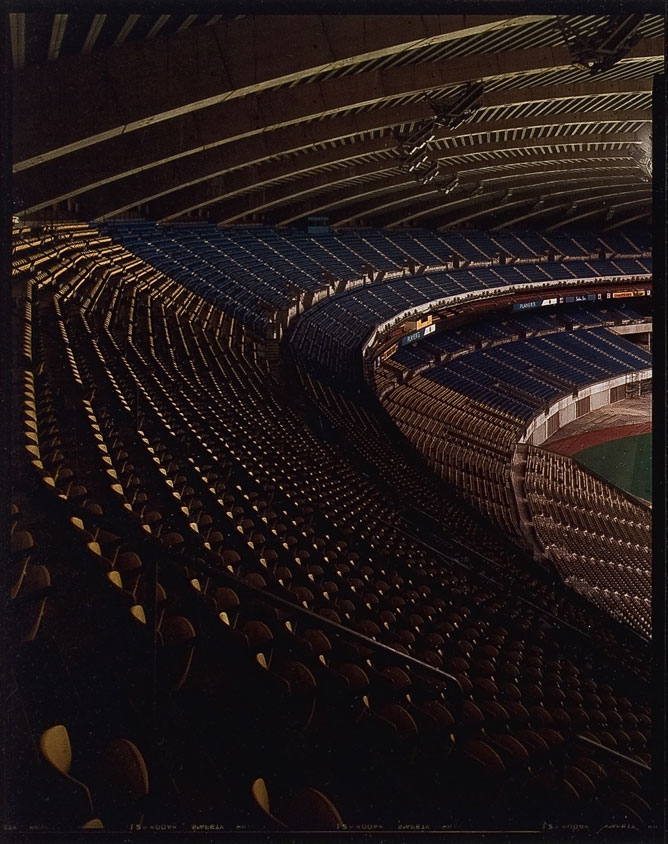
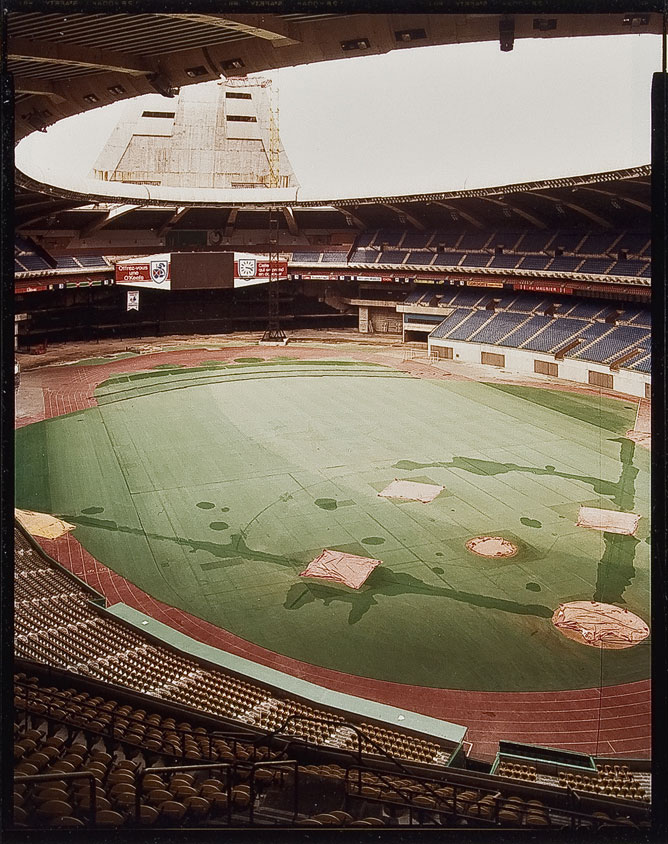
Jim Dow (American, b. 1942) Exhibition Stadium 1982 National Gallery of Canada, Ottawa Gift of Benjamin Greenberg, Ottawa, 1988 and 1989
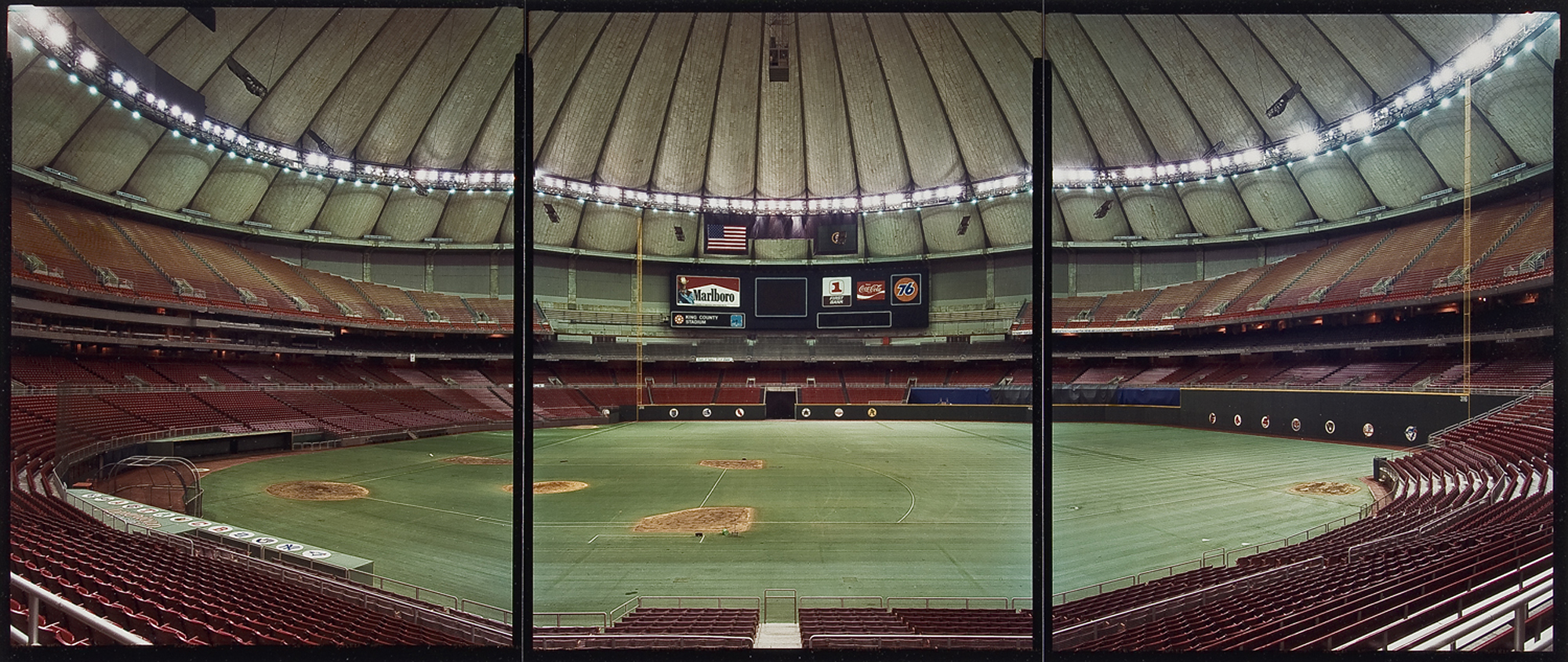
These feel like religious reliquaries, a triptych form which arises from early Christian art but here a paean to the monumentalisation of sport, architecture, human heroics and grandiosity.
Apologies that the blog is not wide enough to display these panoramic images at a decent size but you can click on the photographs to see a larger version of the image. I have also displayed each 8″ x 10″ negative sequentially.
Dr Marcus Bunyan
Many thankx to The National Gallery of Canada for allowing me to publish the photographs in the posting. Please click on the photographs for a larger version of the image.
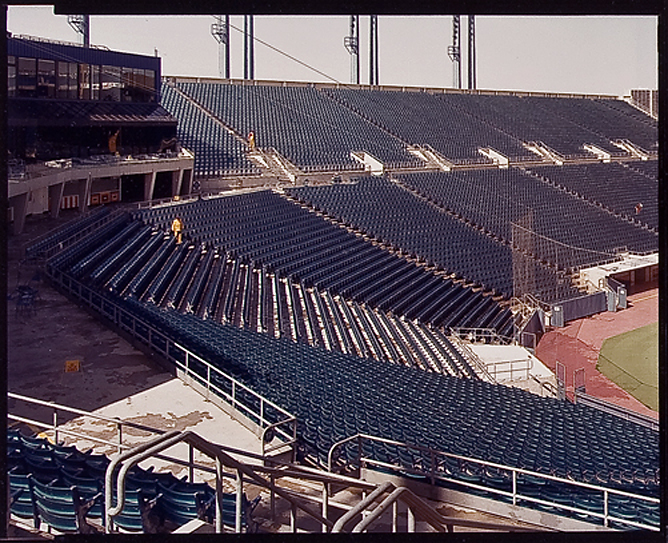
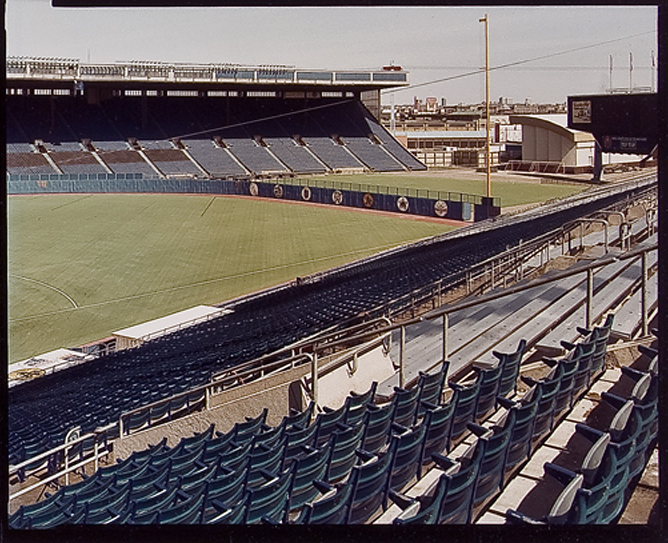
Jim Dow (American, b. 1942) Exhibition Stadium (individual frames) 1982 National Gallery of Canada, Ottawa Gift of Benjamin Greenberg, Ottawa, 1988 and 1989
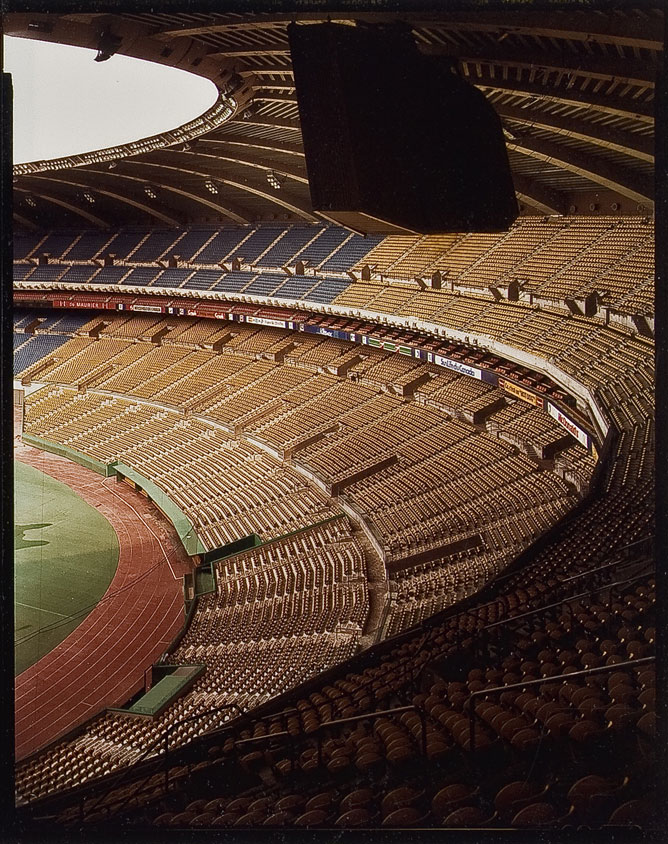
This installation from the National Gallery’s Collection of Photographs comprises 26 colour panoramic views of empty baseball stadiums across North America, from Exhibition Stadium, the home of the Toronto Blue Jays, and Montréal’s Olympic Stadium to the Houston Astro’s Astrodome. Taken in 1982, Jim Dow, a respected American photographer as well as a sports enthusiast, imparts through these images both a passion for the monumentality of the architecture and its abstract geometry and his love of baseball. The emptiness of the stadiums simultaneously evokes memory and a sense of anticipation.
Jim Dow’s interest in those places where people enact their everyday rituals, from the barbershop to the baseball park, has guided the path of his photographic career. Dow is concerned with capturing “human ingenuity and spirit” in endangered regional traditions – a barbershop with a heavy patina of town life covering the walls, the opulent time capsule of an old private New York club, the densely packed display of smoking pipes in an English tobacconist shop – all artefacts of a vanishing era.
Dow earned a B.F.A. and a M.F.A. in graphic design and photography from the Rhode Island School of Design in 1965 and 1968 respectively. An early influence was Walker Evans’s seminal book American Photographs (1938). Dow recalls the appeal of Evans’s “razor sharp, infinitely detailed, small images of town architecture and people. What stood out was a palpable feeling of loss … pictures that seemingly read like paragraphs, even chapters in one long, complex, rich narrative.” Soon after graduate school Dow had the opportunity to work with Evans. He was hired to print his mentor’s photographs for a 1972 Museum of Modern Art retrospective.
Dow has taught photography at Harvard, Tufts University and the School of the Museum of Fine Arts, Boston, and his work has been widely exhibited. Among his series is Corner Shops of Britain (1995), which features facades of small family-run businesses: vitrine-like shop windows showcase goods from candy jars to jellied eels. Another series, Time Passing (1984-2004), captures North Dakota “folk art” such as rural road signage, hand-painted billboards, and ornate gravestones.
Dow first gained attention for his panoramic triptychs of baseball stadiums, a project that began with an image he made of Veteran’s Stadium in Philadelphia in 1980. Using an 8 x 10″ camera, he has documented more than two hundred major and minor league parks in the United States and Canada.”
Text from Artdaily.org website [Online] Cited 17/04/2019
Jim Dow (American, b. 1942) The Kingdome. Seattle Mariners 1982 National Gallery of Canada, Ottawa Gift of Benjamin Greenberg, Ottawa, 1988 and 1989
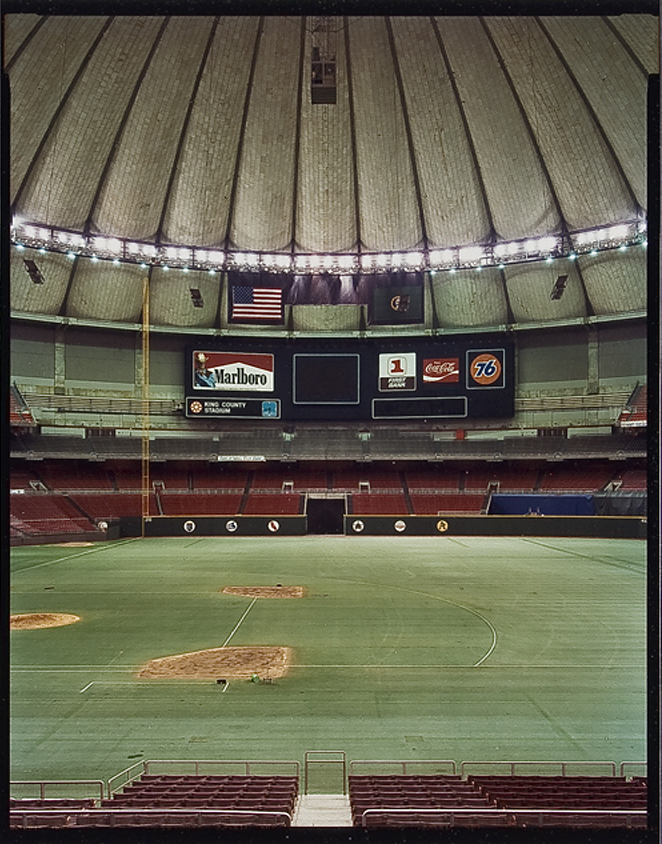
Jim Dow (American, b. 1942) The Kingdome. Seattle Mariners (individual frames) 1982 National Gallery of Canada, Ottawa Gift of Benjamin Greenberg, Ottawa, 1988 and 1989
Jim Dow (American, b. 1942) Olympic Stadium, Montreal 1982 National Gallery of Canada, Ottawa Gift of Benjamin Greenberg, Ottawa, 1988 and 1989
Jim Dow (American, b. 1942) Olympic Stadium, Montreal (individual frames) 1982 National Gallery of Canada, Ottawa Gift of Benjamin Greenberg, Ottawa, 1988 and 1989
National Gallery of Canada 380 Sussex Drive P.O. Box 427, Station A Ottawa, Ontario Canada K1N 9N4
Hill & Adamson (Scottish, active 1843-1848) [Lane and Peddie as Afghans] 1843 Salted paper print from a paper negative 20.6 × 14.3cm (8 1/8 × 5 5/8 in.) The J. Paul Getty Museum
The team of Hill and Adamson initially began making dramatic portrait photographs as studies for one of Hill’s composite paintings. They also produced costume studies, including this scene in which Arabic scholar Mr. Lane and Mr. (Peddie) Redding appear in foreign garb.
What a fabulous selection of photographs to illustrate a fascinating “scene”. I love staged, theatrical, constructed, conceptual, collaged, surreal, imaginary, narrative photography.
Dr Marcus Bunyan
Many thankx to the J. Paul Getty Museum for allowing me to publish the photographs in the posting. Please click on the photographs for a larger version of the image.
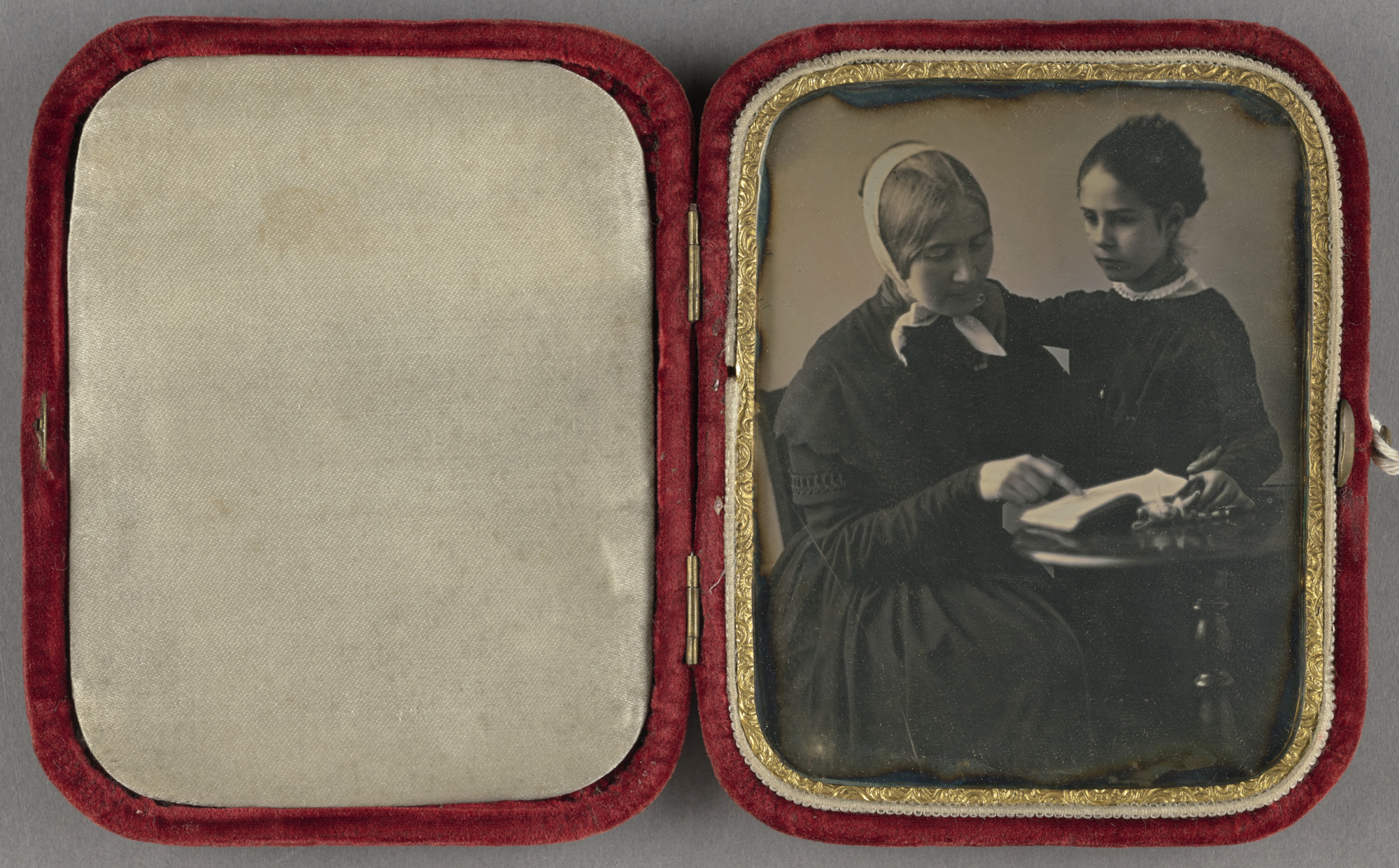
Unknown maker, French Woman Reading to a Girl c. 1845 Daguerreotype 9.1 × 7.1cm (3 9/16 × 2 13/16 in.) The J. Paul Getty Museum
Through a skilful manipulation, the light coming from above and behind the figures casts the faces of mother and child in a softly modulated half-shadow. Their close grouping and familiar, intimate gestures evoke tenderness. The reflected light on the woman’s pointing finger and on the glowing white pages of the open book forms a strong visual triangle, drawing the viewer’s eye and serving to integrate and balance the composition.
Oscar Gustave Rejlander (British born Sweden, 1813-1875) The Infant Photography Giving the Painter an Additional Brush c. 1856 Albumen silver print 6 × 7.1cm (2 3/8 × 2 13/16 in.) The J. Paul Getty Museum
Oscar Rejlander’s photograph could be read as a metaphor of his own career. The additional “brush” or image-making tool provided by photography to painters was evident from the beginnings of the medium. Many early practitioners arrived at photography from painting, as did Rejlander. Photographs were often thought of and used as sketching tools for painters. Although photographs never managed to signal the death of painting as initially predicted, they did frequently assume the function that drawing had traditionally held in relation to painting.
Compositionally, this is an unusual photograph. Rejlander employs a narrative device from painting: the use of figures, or parts of figures, as allegorical representations for ideas. A very young child represents the infant medium of photography. The Painter appears only as a hand extending into the frame at the upper left, although the traditional arts are also represented by the sculpture reproduction in the lower left corner. The Infant Photography, identified by the camera on which the child supports himself, faces away from the camera, his features totally obscured. The mirror behind the child gives a clear reflection of Rejlander at his camera, making this image.
Roger Fenton (English, 1819-1869) Contemplative Odalisque 1858 Albumen silver print 35.9 × 43.8cm (14 1/8 × 17 1/4 in.) The J. Paul Getty Museum Gift of Professors Joseph and Elaine Monsen
Three years after traveling in the Crimea, Roger Fenton made a series of Orientalist photographs in his London studio using props gathered during his travels and non-Eastern models. Orientalism refers to just such romanticised depictions of imagined scenes of Muslim culture in the Ottoman Empire and its territories in the Near East and North Africa.
Orientalist scenes were more often fiction than fact. Cultural biases and misunderstandings were laid down on paper or canvas and frequently became the only source of information on the subjects depicted. When a group of these Orientalist photographs was exhibited in 1858, one reviewer described them as “truly representing some phases in the life of this interesting people.”
But not everyone so easily accepted Fenton’s images at face value; a more astute critic called for “the necessity of having real national types as models.” The same model shown here also appears as “Nubian” and “Egyptian” in other photographs by Fenton. This photograph may have originally been exhibited with the title The Reverie. The odalisque, meaning a slave or concubine in a harem, poses upon her sofa. Barefoot, blouse open, her surroundings convey a sensual disarray that conforms to an Orientalising fantasy of the available woman.
Julia Margaret Cameron (British, born India, 1815-1879) The Rosebud Garden of Girls June 1868 Album silver print 29.4 × 26.7cm (11 9/16 × 10 1/2 in.) The J. Paul Getty Museum
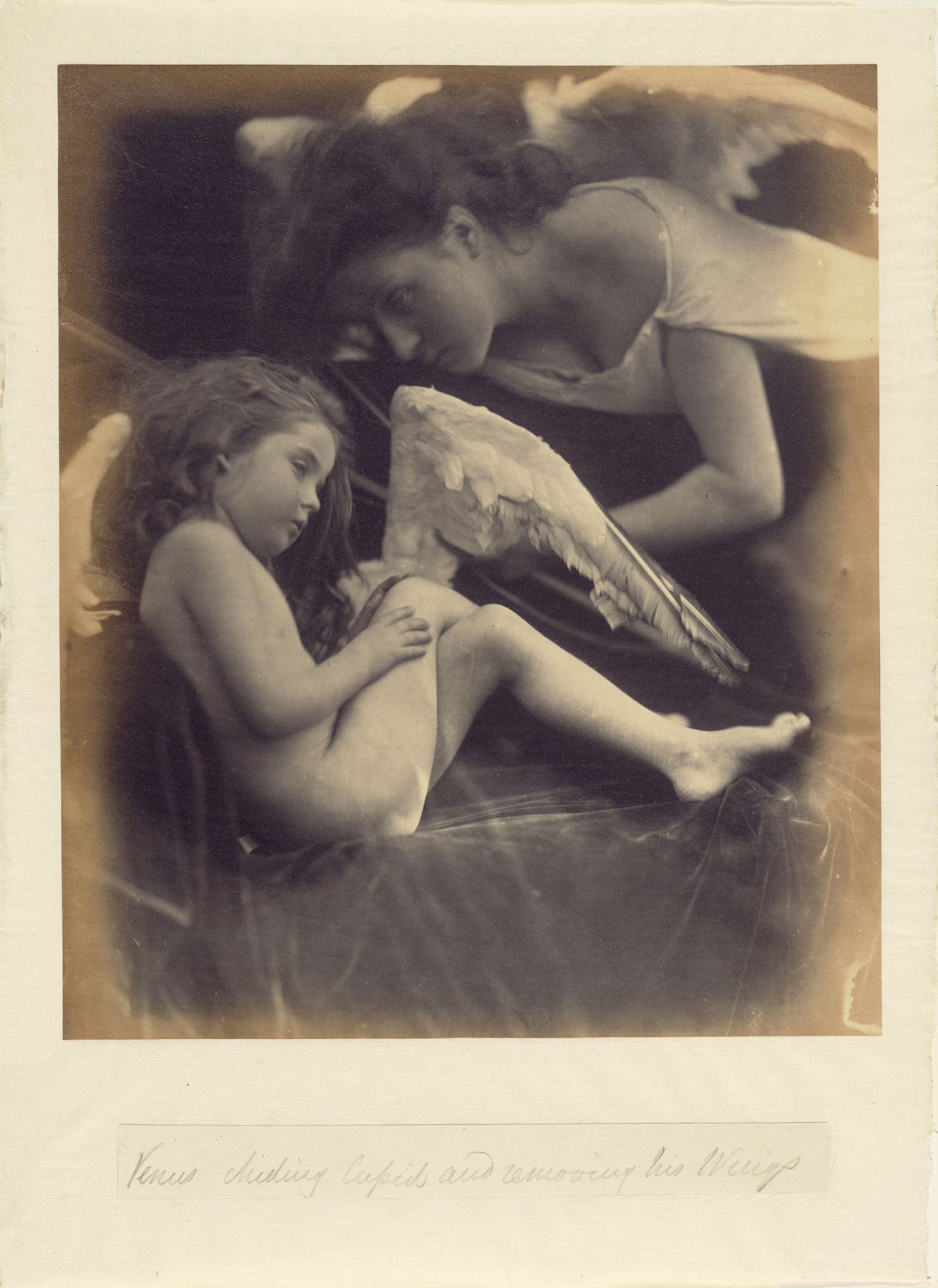
As evolutionary science and increasing secularism transformed the way Victorians understood the world, Cameron remained a devout Christian. She photographed influential public figures of her day as well as the women of her household, casting them in allegories of literary and religious subjects. Like her artistic contemporaries, the Pre-Raphaelite painters, who modelled their work on medieval religious and mythological art, Cameron intended her photographs to evince a connection between the spiritual and the natural realms.
Julia Margaret Cameron (British, born India, 1815-1879) Venus Chiding Cupid and Removing His Wings 1872 Album silver print 32.4 × 27.3cm (12 3/4 × 10 3/4 in.) The J. Paul Getty Museum
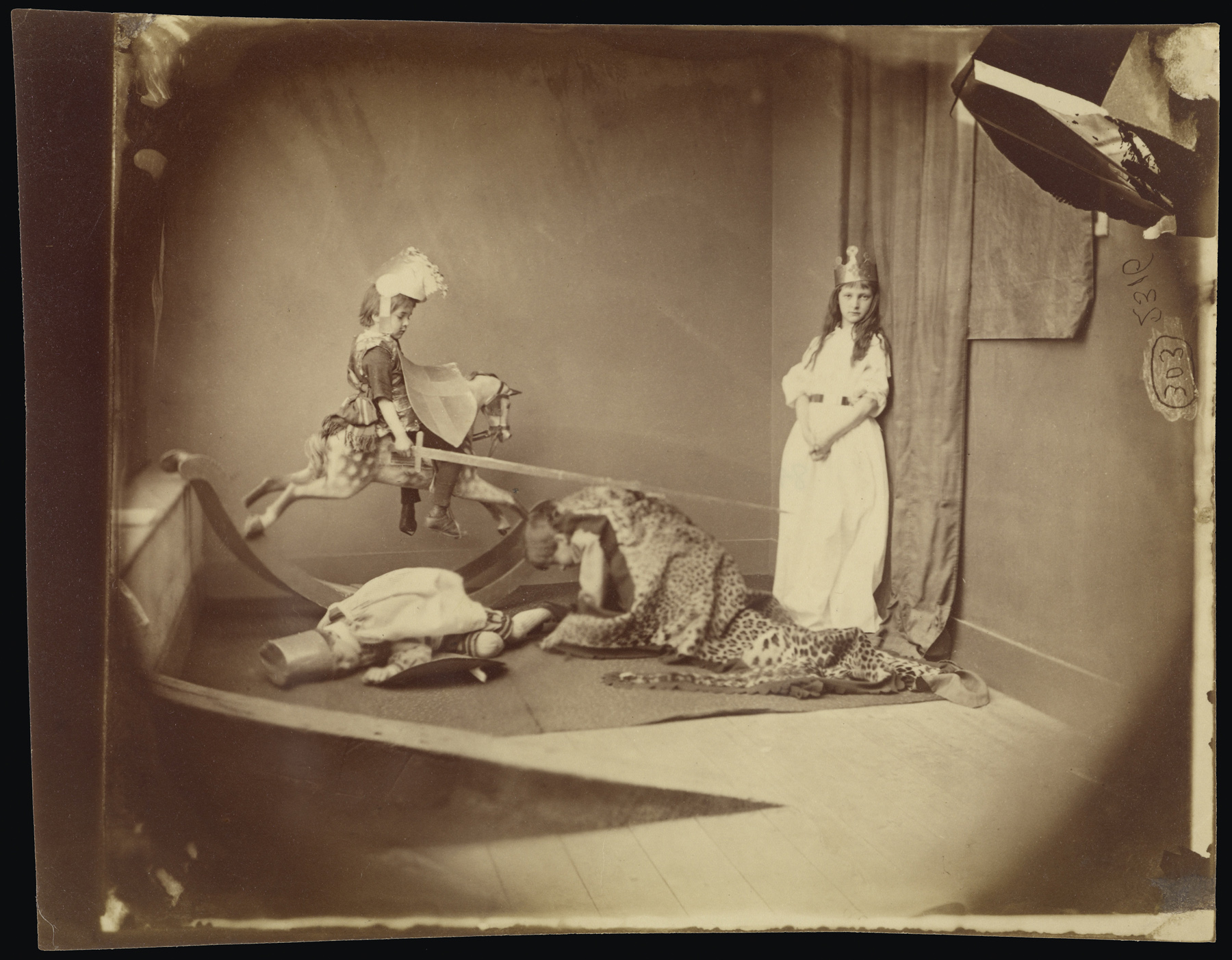
Lewis Carroll (British, 1832-1898) Saint George and the Dragon June 26, 1875 Albumen silver print 12.2 × 16.2cm (4 13/16 × 6 3/8 in.) The J. Paul Getty Museum
Like Alice’s Adventures in Wonderland and his other books, Carroll’s photographs are fantasies starring the children of his friends. In this production, the Kitchin siblings enacted the romantic legend of Saint George, the patron saint of England, who slayed a child-eating dragon before it devoured a princess. George later married the rescued princess and converted her pagan town to Christianity. Using crude stagecraft to reference key plot points, Carroll condensed the entire legend into a single scene in which the princess appears as both damsel in distress and bride.
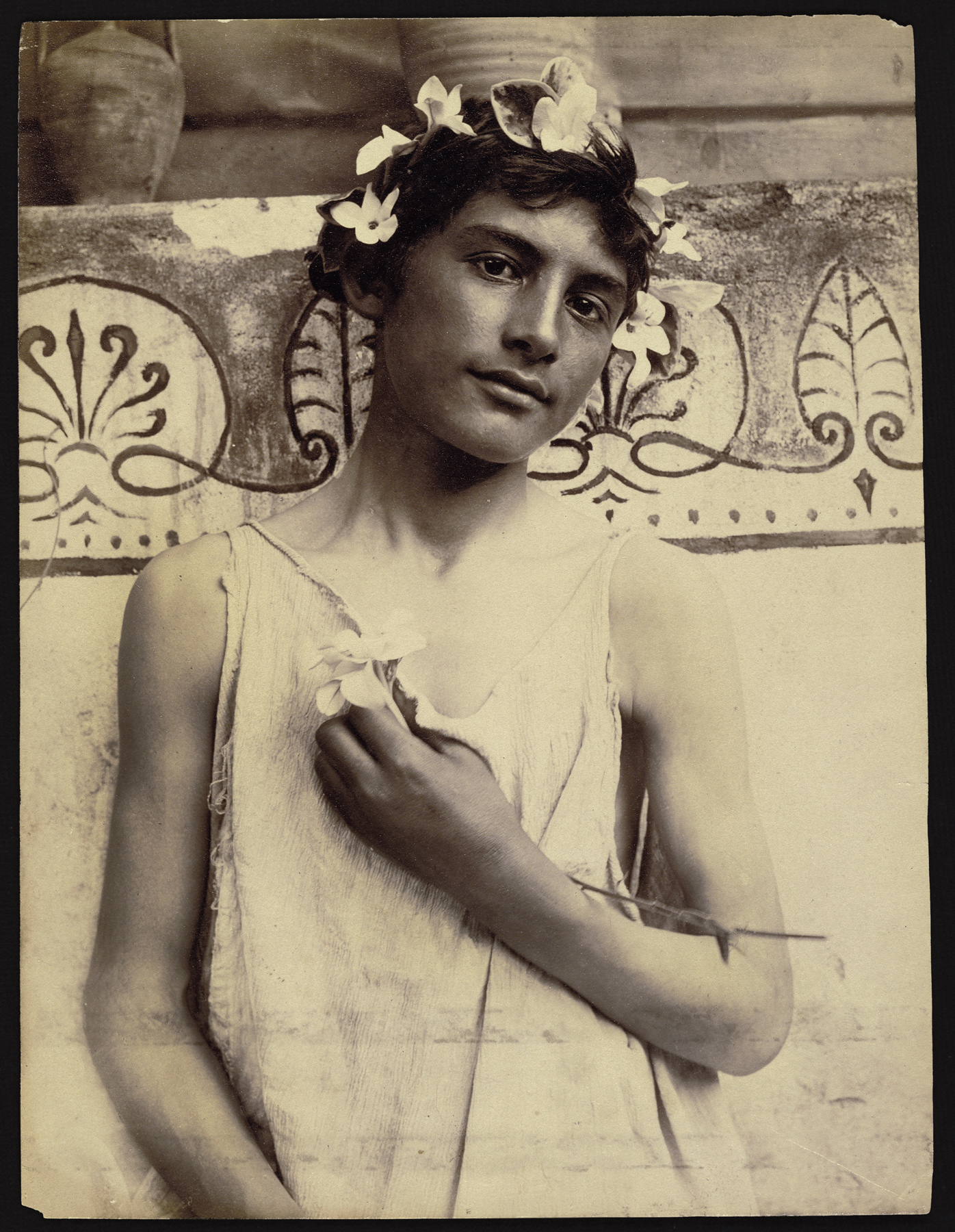
Baron Wilhelm von Gloeden (German, 1856-1931) Untitled [Two Male Youths Holding Palm Fronds] c. 1885-1905 Albumen silver print 23.3 × 17.5cm (9 3/16 × 6 7/8 in.) The J. Paul Getty Museum
Baron Wilhelm von Gloeden (German, 1856-1931) L’Offerta (The Offering) 1902 Albumen silver print 22.4 × 16.8cm (8 13/16 × 6 5/8 in.) The J. Paul Getty Museum
Von Gloeden left Germany and settled in a coastal town in Sicily, where he took up photography. His subjects were young native boys, whom he often photographed nude in classical compositions. Rather than reenact specific historical or literary scenes, von Gloeden mused nostalgically on the ancient Greek and Roman ancestry of his attractive models.
Guido Rey (Italian, 1861-1935) [The Letter] 1908 Platinum print 21.9 × 17cm (8 5/8 × 6 11/16 in.) The J. Paul Getty Museum
A deliberate homage to an earlier artistic style that Guido Rey admired, the composition derives from a painting made by Dutch artist Jan Vermeer in the 1600s. In this posed scene, a young suitor bearing flowers approaches a woman seated at her writing desk, with her pen poised in mid-air as she turns to greet him. A leaded glass window opens into her room, providing a natural light source for the photograph’s illumination. The mounted corner clock, decorative jar on the desk, and painting on the wall were Rey’s everyday household items or objects borrowed from friends, carefully chosen for period accuracy. Likewise, a seamstress who lived in the attic of Rey’s home in Turin created the costumes to his specifications.
Photography, although commonly associated with truthfulness, has been used to produce fiction since its introduction in 1839. The acceptance of staging, and the degree of its application, has varied greatly depending on the genre and the historical moment, but it has persisted as an artistic approach. The photographs in this exhibition, drawn exclusively from the J. Paul Getty Museum’s collection, make no pretence about presenting the world as it exists; instead, they are the productions of directors and actors who rely on stagecraft and occasional darkroom trickery to tell stories. Spanning photography’s history and expressing a range of sentiments, the images in this exhibition are inspired by art history, literature, religion, and mainstream media.
Like Alice’s Adventures in Wonderland and his other books, Lewis Carroll’s photographs are fantasies starring his friends’ children. In the image below, children enact the mythological story of Saint George, the patron saint of England, slaying a child-eating dragon before it could devour a princess.
Life Imitating Art
Well-represented in this exhibition are tableaux vivants (living pictures), inspired by the popular Victorian parlour game in which costumed participants posed to resemble famous works of art or literary scenes. The genre paintings of 17th-century Dutch masters Johannes Vermeer and Pieter de Hooch fascinated Guido Rey. Not self-conscious about being slavish to the past, he carefully studied the paintings and then arranged similar tableaux for his camera. His photographs captured equally serene domestic scenes and mimicked the minute architectural details of 17th-century interiors, such as the leaded-glass windowpanes and the checkerboard floor.
Playing Dress Up
The exhibition also includes costume studies of people posing as literary characters and self-portraits of artists pretending to be other people. American painter and photographer Man Ray and the French artist Marcel Duchamp met in New York in 1915, and they began a playful, iconoclastic collaboration that resulted in the photograph (above), among others. Influenced by Dadaism, a cultural movement that rejected reason and logic in favour of anarchy and the absurd, their work embraced games of chance, performance, and wordplay. Here an irreverent Duchamp appears in women’s clothing as his alter ego, Rrose Sélavy, a pun on the French pronunciation “Eros, c’est la vie” (Sex, that’s life).
Imaginary Subjects
A number of photographs in the exhibition explore the medium’s capacity to visualise subjects of the imagination by using darkroom trickery to manipulate prints. An optician and family man, Ralph Eugene Meatyard photographed his children, friends, and neighbours enacting dramas in suburban backyards and abandoned buildings near his Lexington, Kentucky, home. He often used experimental techniques, such as multiple exposures and blurred motion. Uncanny details imbue Meatyard’s otherwise ordinary vernacular scenes with the qualities of a dream or supernatural vision.
Theatricality as a Critical Strategy
In recent decades there has been renewed interest in theatricality among contemporary photographers whose highly artificial scenes critique mainstream media and representation. In her series Family Docudrama Eileen Cowin blurs the boundaries between truth and fiction, and private behaviour and public performance. Drawing equally from family snapshots and soap operas, Cowin presents staged domestic scenes in which she and members of her family, including her identical twin sister, perform as actors. In these ambiguous, open-ended narratives, dramatic moments are exaggerated, and the camera’s glare is ever present.”
When Man Ray moved to Paris, he was greeted by his friend and artistic compatriot Marcel Duchamp, who introduced him to members of the Dada circle of writers and artists. The two men had collaborated in a number of creative endeavours in New York, including the creation of a female alter-ego for Duchamp named Rrose Sélavy (a pun on the French pronunciation Eros, c’est la vie “Sex, that’s life”). Man Ray photographed Duchamp several times as Rrose Sélavy.
Judging from his inclusion of this image in other photographic compositions, Man Ray must have considered Tears one of his most successful photographs. A cropped version of it with a single eye also appears as the first plate in a 1934 book of his photographs.
Like the emotive expression of a silent screen star in a film still, the woman’s plaintive upward glance and mascara-encrusted lashes seem intended to invoke wonder at the cause of her distress. The face belongs to a fashion model who cries tears of glistening, round glass beads; the effect is to aestheticise the sentiment her tears would normally express. Man Ray made this photograph in Paris around the time of his breakup with his lover Lee Miller, and the woman’s false tears may relate to that event in the artist’s life.
In this picture Dora Maar constructed her own reality by joining together several images and rephotographing them. The seamlessness of the photographic surface makes this construction believable and leaves the viewer wondering about the strange world the figure inhabits. On closer examination, the viewer may notice that the floor is an upside-down ceiling vault, that the bricked-in windows are drawn in by hand, and that the figure was added separately. Despite these discoveries, the picture resists logical interpretation.
An optician and family man, Meatyard photographed his children, friends, and neighbours enacting dramas in the suburban backyards and abandoned buildings of Lexington, Kentucky. He often used experimental techniques, such as multiple exposures and blurred motion. Uncanny details imbue Meatyard’s otherwise ordinary vernacular scenes with the qualities of a dream or supernatural vision.
In this self-portrait, Lucas Samaras reaches out as if trapped in the photograph. In sharp contrast to the indistinct background of his upper body, his crisply defined fingers curl forward, as if he is searching for a way to transcend a two-dimensional world of his own creation. An overriding sense of claustrophobia defines this image, underscored by the small scale of the Polaroid print. Samaras, a hermit-like person, made many Polaroid self-portraits like this in the 1970s as a means of observing himself. The images are open to a wide range of interpretation. Here, Samaras may have tried to convey the sense of isolation he experiences as a reclusive person.
As if engaging in a tug-of-war with himself, Lucas Samaras confronts and struggles with his own reflection in this self-portrait. The leg-less reflection is incomplete, however, giving the impression of a deformed adversary. A monochromatic polka-dot background and a vibrant green and red border act as a stage for this dramatic struggle.
Samaras’s Photo-Transformations, which he made in the 1970s as a means to examine various facets of himself, could be understood as visual manifestations of internal conflict. They are complex psychological investigations that, according to at least one critic, illustrate one person’s efforts toward spiritual healing.
Submerged in narcissism, nothing remains… but “me and myself, I am my own audience, the other, contemplating my existence.”
Made in the 1970s as a means of studying himself, Lucas Samaras’s photographs illustrate the internal struggle that can occur between conflicting aspects of one personality. Bent over a captain’s chair, Samaras rests his head as if he is at the guillotine. Another blurry form hovers above, about to violently attack the submissive figure.
Samaras made his Photo-Transformations, a series of self-portraits, with SX-70 Polaroid film. Still wet, the film’s emulsions could be manipulated to alter the finished image. He used straight pins, rubber erasers, and other simple tools to “draw” into the developing surface. For this portrait, he created a diamond pattern over and around the dominant figure that underscores the frenzy of motion.
In her series Family Docudrama Cowin blurs the boundaries between truth and fiction, and private behaviour and public performance. Drawing equally from family snapshots and soap operas, she presents staged domestic scenes in which she and members of her family, including her identical twin sister, perform as actors. In these ambiguous, open-ended narratives, dramatic moments are exaggerated and the camera’s glare is ever present.
The J. Paul Getty Museum 1200 Getty Center Drive Los Angeles, California 90049
Exhibition dates: 24th July – 12th September, 2009
Vera Lutter (American, b. 1960) Campo Santa Sofia, Venice, XV: December 12, 2007 2007 Unique gelatin silver print 68 5/16 × 56 in (173.5 × 142.2cm)
I really like this atmospheric work – the scale, the ‘grandness’ of it, the dismemberment through verticality, the immersion into inky darkness – there is something almost subterranean (man living under-earth, under-evolution) about the pictures vestigial structures.
Dr Marcus Bunyan
Many thankx to Gagosian Gallery for allowing me to publish the photographs in the posting. Please click on the photographs for a larger version of the image.
Vera Lutter (American, b. 1960) Campo Santa Sofia, Venice, XXIII: December 17, 2007 2007 Unique gelatin silver print 85 7/16 × 112 in 217 × 284.5cm
Vera Lutter (American, b. 1960) Ca Del Duca Sforza, Venice II: January 13-14, 2008 2008 Unique gelatin silver print 104 1/2 × 168 in 265.4 × 426.7cm
Vera Lutter (American, b. 1960) Calle Vallaresso, Venice XXVII: January 31, 2008 2008 Unique gelatin silver print 55 3/8 × 68 1/4 in 140.7 × 173.4cm
“Instability, uncertainty, suspense, and monumentality are entities that I consider and think about; they inform my work.”
~ Vera Lutter
Gagosian Gallery is pleased to announce an exhibition of large-scale unique photographs by Vera Lutter. This is her first exhibition in Los Angeles.
In Lutter’s conceptual approach to the camera obscura, the most rudimentary form of photography, the apparatus records in a very direct and immediate way what exists in the world outside. By choosing to retain the negative image, she transforms the visual facts of her chosen environments into uncanny scenes that reflect on the two principal realities of time and space.
In recent years, Lutter has made the hauntingly romantic city of Venice an object of prolonged study. Building on her previous recordings of industrial landscapes and cities surrounded by water, such as Old Slip, New York (1995), and Cleveland (1997), the works created in Venice elaborate her intention “to create an image in which the city appears to be suspended above its own reflection, rendering a place that appears to exist outside of gravity.”
During the anticipated high-water season of 2005, Lutter captured mirage-like emanations of San Marco and Piazza Leoni in which the spectral landmarks appear to hover above their own reflected image in the placid water. Lutter returned to Venice the following year to record the area where the Grand Canal flows into the Bacino, which then opens up into the lagoon. This unstable body of water not only gives Venice its special ethereal character; it also threatens the floating city’s very existence.
Lutter revisited Venice in 2007 and 2008 to explore further the physical, technical, and architectural complexities of the city. Works such as San Giorgio (2008), Campo Santa Sofia (2007) and Calle Vallaresso (2008) reveal certain innate qualities and conditions of the city that elude direct observation and can be experienced only through her luminous incarnations, the physical image.
Text from the Gagosian Gallery website [Online] Cited 01/09/2009 no longer available online
Vera Lutter uses the camera obscura, the most basic photographic device, to render in massive form images that serve as faithful transcriptions of immense architectural spaces. The camera obscura was originally developed during the Renaissance as an aid in the recording of the visible world.
Vera Lutter is best known for monumental black-and-white photographs of cityscapes. Her unique silver gelatin prints are negatives made by transforming a room into a pinhole camera obscura chamber. Directly exposed, often over many hours, onto photosensitive paper, these vistas appear as solarised images, their ethereal platinum tones imbuing the scenes with a haunting melancholy. From an early concentration on the Manhattan skyline, Lutter has turned lately to more industrial sites, including a dry dock, a zeppelin factory, an airport runway, a marina and a deserted warehouse.
Vera Lutter Biography on the Metro Art Works website [Online] Cited 01/09/2009 no longer available online
Installation views of Vera Lutter works at Gagosian Gallery, Beverly Hills
Vera Lutter (American, b. 1960) San Giorgio, Venice XVIII: January 26, 2008 2008 Unique gelatin silver print
Vera Lutter (American, b. 1960) San Marco, Venice, XIX: December 1, 2005 2005 Unique gelatin silver print 92 ¼ x 112 ¾ in 234.3 x 286.4cm
Vera Lutter (American, b. 1960) Ca’ del Duca Sforza, Venice XXXI: July 14, 2008 2008 Unique gelatin silver print 56 × 80 3/4 in 142.2 × 205.1cm
Vera Lutter (American, b. 1960) Ca del Duca Sforza, Venice, XXXXIII: July 24, 2008 2008 Unique gelatin silver print 50 1/2 × 67 1/8 in 128.3 × 170.5cm
Vera Lutter (American, b. 1960) Ca del Duca, Venice, XA: December 8, 2007 2007 Unique gelatin silver print
Gagosian Gallery 456 North Camden Drive Beverly Hills, CA 90210 Phone: 310.271.9400
Exhibition dates: 21st June – 27th September, 2009
Many thankx to the Bruce Museum and Mike Horyczun (Director of Public Relations) for allowing me to publish the wonderful photographs below.
Marcus
Jeannette Klute (American, 1918-2009) Cardinal Flower Nd (early-mid 1950s) Dye transfer photograph 20 1/4 x 16 1/4 in. Bruce Museum collection Gift of George Stephanopoulos
Jeannette Klute (American, 1918-2009) Misty Willow Nd (early-mid 1950s) Dye transfer photograph 20 1/4 x 16 1/4 in. Bruce Museum collection Gift of George Stephanopoulos
Jeannette Klute (American, 1918-2009) Miterwort Nd (early-mid 1950s) Dye transfer photograph 14 1/8 x 11 1/4 in. Bruce Museum collection Gift of George and Alexandra Stephanopoulos
Jeannette Klute (American, 1918-2009) Beech Fern Nd (early-mid 1950s) Dye transfer photograph 20 1/4 x 16 1/4 in. Bruce Museum collection Gift of George Stephanopoulos
Jeannette Klute (American, 1918-2009) Jewel Weed Nd (early-mid 1950s) Dye transfer photograph 20 1/4 x 16 1/4 in. Bruce Museum collection Gift of George Stephanopoulos
Jeannette Klute (American, 1918-2009) Christmas Fern Nd (early-mid 1950s) Dye transfer photograph 12 1/2 x 9 1/2 in. Bruce Museum collection Gift of George Thomsen
Jeannette Klute (American, 1918-2009) Jack in the Pulpit (Arisaema triphyllum) Nd (early-mid 1950s) Dye transfer photograph 20 1/4 x 16 1/4 in. Bruce Museum collection Gift of George and Alexandra Stephanopoulos
Jeannette Klute (American, 1918-2009) Green Grasses – blue Nd (early-mid 1950s) Dye transfer photograph 20 1/4 x 16 1/4 in. Bruce Museum collection Gift of Richard and Elena Pollack
The exhibition features 24 colour photographs by Jeannette Klute (1918-2009) drawn from more than fifty of her prints held in the Bruce Museum’s permanent collection. Ranging from landscapes to intimate “woodland portraits” of orchids, ferns, and trees, Jeannette Klute’s photographs of New England are vibrant compositions produced through the labour intensive dye transfer process.
Trained at the Rochester Institute of Technology through the Works Progress Administration during the Depression, Jeanette Klute worked extensively on perfecting the dye transfer process, a laborious photographic technique that allowed for rich colours in exceptionally permanent prints. Klute tested and refined this process at the Eastman Kodak Company in Rochester, NY, beginning her career as photographic illustrator to physicist Ralph M. Evans and ascending to research photographer in charge of the Visual Research Studio of the Color Control Division.
Klute’s photography merged environmental consciousness with cutting edge technology. Using only natural light and leaving a minimal impact on the environment, she spent many years investigating colour and demonstrating the capabilities of dye transfer by photographing nature. Her work resulted in some of the finest examples of colour printing and all of its capabilities.
“My purpose has been to somehow express the feeling one experiences being out of doors,” Ms. Klute wrote for her Woodland Portraits exhibition. “I am concerned with the delight to the senses as much as with the intellectual. The woods are mystical and enchanting to me as well as spiritual.”
Jeanette Klute’s work was featured in Edward Steichen’s 1950 exhibition All Color Photography at the Museum of Modern Art, and her large one-woman shows were circulated internationally by the Smithsonian Institution and Kodak International. She was also invited to submit work for the San Francisco Museum of Art’s landmark exhibition Women of Photography: An Historical Survey in 1975.
Text from the Bruce Museum website
Jeannette Klute (American, 1918-2009) Maple Tree – red leaves Nd (early-mid 1950s) Dye transfer photograph 20 1/4 x 16 1/4 in. Bruce Museum collection Gift of LeGrand Belnap
Jeannette Klute (American, 1918-2009) Frosted Tree Nd (early-mid 1950s) Dye transfer photograph 20 1/4 x 16 1/4 in. Bruce Museum collection Gift of Richard and Elena Pollack
Jeannette Klute (American, 1918-2009) Yellow Lady’s Slipper Nd (early-mid 1950s) Dye transfer photograph 20 1/4 x 16 1/4 in. Bruce Museum collection Gift of LeGrand Belnap
“The first month they were sending people out for job interviews, but not me,” she recalled in a speech at the Rochester Institute of Technology in 1984. “I asked how come? The head of the department said, ‘Oh, there are no jobs for women in photography.’ My world fell apart.”
Ms. Klute took it upon herself to go out for interviews, and every week on her day off, she walked to the offices of Eastman Kodak Co. to ask for a job. For a long time, she never made it past the personnel office. Then, one day, in the pouring rain, decked in her finest navy blue suit, she stalked to the offices and was sent straight to the sixth floor for an interview.
“The man took a look at me with the rain dripping off my hat and said, ‘If you want a job that bad, you’ve got it,'” she recalled. “There was a celebration in the neighbourhood that night.” …
“She was really like my college education,” said Barbara Erbland, who assisted Ms. Klute in the lab at Kodak for many years. “She taught me everything – about light, colour, about people … how to live well.” … “Her lab consisted of all women,” she said. “I think it was by intention. She believed women had brains. We worked very well together.” …
Lugging a 4-by-5 Graflex single-lens reflex camera wherever they went, Erbland ventured into swamps and tide pools… “She taught me you don’t make do, you make things happen,” said Erbland. “You’re not a victim.”
Back in Rochester, the two sought out swamps and woodland for Ms. Klute to take her photographs – or, as she put it, to “make pictures.”
PHOTO GALLERY: In memory of Jeannette Klute, a ‘Renaissance woman’, by Philip Anselmo, August 2009
Jeannette Klute (American, 1918-2009) Grape Leaves Nd (early-mid 1950s) Dye transfer photograph 20 1/4 x 16 1/4 in. Bruce Museum collection Gift of George Stephanopoulos
Bruce Museum One Museum Drive Greenwich, CT 06830
Opening hours: Tuesday – Sunday 10am – 5pm Last admission 4.30pm Closed Monday and major holidays
Many thankx to the Paine Art Center for allowing me to publish the photographs in the posting. Please click on the photographs for a larger version of the image.
Alvin Langdon Coburn (English born United States, 1882-1966) The Singer Building, New York c. 1910 Gum bichromate over platinum print
Edward Weston (American, 1886-1958) Nautilus 1927 Gelatin silver print 9 1/2 by 7 1/2 in. (24 by 19cm)
Like their painter counterparts, many photographers experimented with abstraction in the 1920s and 1930s, exploring relations of form, tonality, and space. Here, Weston isolates a nautilus shell against a solid black ground, creating a study of curves, subtle shadows, and contrasts between light and dark. As in many of his close-ups of natural forms, the nautilus appears both recognisable and yet strangely unfamiliar. Unlike the rigorously nonrepresentational compositions of photographers like László Moholy-Nagy, Weston’s abstractions always remained grounded in objects from the real world; as he wrote in 1930, “To see the Thing Itself is essential.”
Text from the Metropolitan Museum of Art website
Nautilus is now recognised as one of Weston’s greatest photographs, but all of his images of shells have a greater-than-life quality to them. Weston biographer Ben Maddow has said that what is so remarkable about them “is not in the closeness nor in the monumentality of the forms; or at least, not in these alone. It is instead in the particular light, almost an inward luminescence, that he saw implicit in them before he put them before the lens. Glowing with an interior life … one is seeing more than form.”
Lewis W. Hine (American, 1874-1940) Italian family looking for lost baggage, Ellis Island 1905 Gelatin silver print
The largest exhibition of masterpieces of American photography ever presented in Wisconsin, Seeing Ourselves features over a hundred iconic images from the internationally acclaimed George Eastman House Collections of Rochester, New York. This extraordinary exhibition dramatically illustrates our country’s landscape, people, culture, and historic events through works ranging from vast western scenes to fascinating documentary photographs to intimate celebrity portraits. Artists represented include such masters of the medium as Ansel Adams, Alfred Stieglitz, Paul Strand, Edward Weston, Lewis Hine, Dorothea Lange, and dozens of other accomplished photographers.
Spanning more than 150 years of photography, Seeing Ourselves is organised according to five broad themes: American Masterpieces, American Faces, America at War, America the Beautiful, and American Families. Each section features renowned photographs documenting the American experience. The exhibition begins with “American Masterpieces,” which sheds light on celebrated images like Yosemite Valley, Summer by Ansel Adams, Nautilus by Edward Weston, and The Steerage by Alfred Stieglitz. Other highlights include Oshkosh native Lewis Hine’s Powerhouse Mechanic, a dynamic image symbolising the arrival of a new Industrial Age, and Dorothea Lange’s unforgettable photograph Migrant Mother, Nipomo, California, which gave a human face to poverty and suffering during the Great Depression.
“American Faces” illustrates the diversity of our nation, including subjects ranging from Native Americans whose ancestors have lived here for thousands of years to immigrants at Ellis Island who had just arrived in America that day. Photographs of everyday people are juxtaposed with portraits of illustrious political and civil rights leaders, artists, celebrities, and athletes, including Abraham Lincoln, Martin Luther King, Marilyn Monroe, Babe Ruth, and many other familiar faces. Master photographers who portrayed these individuals include Mathew Brady, Edward S. Curtis, Walker Evans, Richard Avedon, Alfred Stieglitz, and Edward Steichen.
Some of the most famous, memorable, and shocking images in the history of American photography are photographs of war. While photographs of war may be difficult to look at, they serve as an important record of America’s past. “America at War” displays images from the American Civil War, World Wars I and II, the Korean War, and the Vietnam War, as well as contemporary photographs created in response to 9/11.
“America the Beautiful” features timeless photographs that capture the beauty and power of unspoiled nature, as well as scenes of westward expansion, urban America, and the intimate spaces we call home. Dramatic images of Alaskan glaciers, majestic western views, and tranquil dunes are contrasted with big-city skyscrapers, small-town neighborhoods, and backyard gardens. Major works in this section include Alvin Langdon Coburn’s beautifully atmospheric view of New York’s Singer Building and landscapes by Ansel Adams and Edward Weston.
The final section, “American Families,” brings together families from all walks of life, exploring their differences and commonalities. A variety of examples by such notable photographers as Weegee, Lewis Hine, Aaron Siskind, Margaret Bourke-White, and Mary Ellen Mark are included. Some works portray idealised scenes of American life, while others capture a glimpse of everyday life and the serious challenges many families face, such as poverty or illness. Highlights include Hine’s photograph of an Italian family seeking lost luggage at Ellis Island and a tender portrait of a mother and son from the series Black in America by Eli Reed, an award-winning member of Magnum, the prestigious photojournalists’ cooperative.
Seeing Ourselves: Masterpieces of American Photography from George Eastman House Collections is organised by George Eastman House International Museum of Photography and Film and is made possible through a grant from the National Endowment for the Arts as part of the American Masterpieces program. George Eastman House is the world’s oldest photography museum, founded in 1947 on the estate of Kodak founder George Eastman, the father of popular photography. The museum has unparalleled collections of 400,000 photographs from 14,000 photographers dating from the beginnings of the medium to the present day.”
Text from The Paine Art Center website [Online] Cited 01/07/2009. No longer available online
Benedict J. Fernandez (American, 1936-2021) Dick Gregory with MLK [Martin Luther King, JR.] New Politics Convention, Chicago, ILL. October, 1967 1967 Gelatin silver print
Eli Reed (American, b. 1946) A Mother and Her Son at Her Home In Bed Sty in Brooklyn c. 1990 Gelatin silver print
Kay Westhues (American) CSX railroad building, Walkerton 2005
I really like this work. An insightful eye, sensitive, tapped into the community that the artist is documenting. Attuned to its inflections and incongruities, the isolation and loneliness of a particular culture in time and place. There are further strong photographs from the series on the Kay Westhues website. It’s well worth your time looking through these excellent photographs. And observing the wonderful light!
Kay Westhues (American) Man with patriotic cast, Original Famous Fish of Stroh 2005
Kay Westhues (American) Knox laundromat 2005
The Snite Museum of Art announces the opening of the exhibition: Fourteen Places to Eat: a Narrative: Photographing Rural Culture in the Midwest, opening on Sunday, May 31,2009.
Kay Westhues is a photographer who is interested in documenting the ways in which rural tradition and history are interpreted and transformed in the present day. Kay shares her intention for this series of work:
“For the past five years I have been working on a series of photographs depicting rural culture in Indiana and the Midwest. This project was inspired by my memories of growing up on a farm in Walkerton, Indiana, and observing first hand the shifting cultural identity that has occurred over time and through changing economic development. I moved back to Walkerton in order to help care for my ageing parents in 2001.
These photos mirror my personal history, but I am also capturing a people’s history grounded in a sense of place. My intention is to celebrate rural life, without idealising it.
The overall theme since the project’s inception is the effect of the demise of local economies that have historically sustained rural communities. Many of my images contain the remains of an earlier time, when locally owned stores and family farms were the norm. Today chain stores and agribusiness are prevalent in rural communities. These communities are struggling to thrive in the global economy, and my images reflect that reality.
Most recently I have focused on the complex relationship between farmers and domesticated animals. I make many of my images at Animal Swap Meets and sale barns, places where animals are bought and sold. Family farms are quickly being replaced by large-scale food production, and these events still draw smaller farmers and the local people who support them.”
Why fourteen places to eat?
“One of my biggest complaints after moving to Walkerton was that there were not enough places to eat out. Or, rather, practically no places to eat out. So I was happy when news arrived that a new restaurant was opening there. Imagine my surprise when I read a letter to the editor in the local paper against the new restaurant. The letter stated we already had enough places to eat in this town. The writer counted a total of fourteen places to eat, which included four restaurants, three gas stations, four bars, a truck stop, a convenience mart, and a bowling alley.”
Ms. Westhues studied photography at Rhode Island School of Design and Indiana University, Bloomington. She has a BS degree in Photography and Ethnocentrism from the Indiana University Individualised Major Program (1994), and an MS in Instructional Systems Technology at Indiana University (1998). She currently lives in Elkhart, Indiana, and is completing a five-year project photographing rural culture in the Midwest. This series is a visual exploration of the ways rural identity is defined in contemporary society.
Press release from the Snite Museum of Art Cited 20/06/2009. No longer available online
Kay Westhues (American) Chicken bingo, Francesville Fall Festival 2005
Kay Westhues (American) Patriotic hammers ($3.00) 2005
Kay Westhues (American) Parked trailer, Ligonier 2006
Kay Westhues (American) Lunch at the Crockpot, Walkerton (The Young and the Restless) 2007
Kay Westhues (American) Momence Speed Wash, Momence IL 2007
Kay Westhues (American) Mary Ann Rubio, Family Cafe, Knox 2007
The Snite Museum of Art at University of Notre Dame, Notre Dame, Indiana
Karen Halverson (American, b. 1941) Hite Crossing, Lake Powell, Utah from the Downstream series 1994-1995
As clear as a bell!
Marcus
Many thankx to the Huntington Library for allowing me to publish the photographs in the posting. Please click on the photographs for a larger version of the image.
Karen Halverson (American, b. 1941) Lodore Canyon, Dinosaur National Monument from the Downstream series 1994-1995
Karen Halverson (American, b. 1941) Boulder Beach, Lake Mead, Nevada from the Downstream series 1994-1995
Karen Halverson (American, b. 1941) Wahweap Pool, Lake Powell, Arizona from the Downstream series 1994-1995
To celebrate the expansion and reinstallation of the Virginia Steele Scott Galleries of American Art, The Huntington Library, Art Collections, and Botanical Gardens presents an exhibition of works from American photographer Karen Halverson’s Colorado River series, on view May 30 through Sept. 28, 2009. Downstream: Colorado River Photographs of Karen Halverson will be on display in the Scott Galleries’ Susan and Stephen Chandler Wing, inaugurating a new changing exhibition space that will highlight photography and works on paper that, because of the fragile nature of the medium, cannot be placed on permanent display.
The exhibition will feature 26 works from Halverson’s Downstream series as well as a sampling of images from The Huntington’s historic holdings related to the Colorado River region, including photographs from John Wesley Powell’s pioneering expedition down the Colorado in 1871 and a snapshot album compiled in 1940 by Mildred Baker, one of the first women to successfully navigate the river from Green River, Wyo., to Boulder (now Hoover) Dam.
Halverson (b. 1941) says she woke one wintry morning in 1994 convinced that she needed to photograph the Colorado River. An accomplished landscape photographer who had already spent 20 years exploring the American West, she embarked on a two-year encounter with the vast terrain along the river’s serpentine route.
The desire to explain, understand, and experience the 1,700-mile river – which originates in Wyoming and Colorado before converging in Utah toward its terminus in Mexico – has exerted a powerful influence on a long line of explorers, scientists, thrill seekers, writers, artists, and photographers. Once largely wild, the modern river has been tamed by dams built to slake the American West’s thirst for water and power. Today the river’s reservoirs supply 30 million people.
“In her resonant imagery, Halverson speaks both to this immutable, rugged past while confronting the river’s complicated and often contested present,” says Jennifer Watts, curator of photographs at The Huntington.
Lush green riverbanks frame a seemingly remote Colorado River in Shafer Trail, Near Moab, Utah – a dramatic departure from the river-turned-lake in Wahweap Marina, Lake Powell, Arizona, in which the setting sun illuminates a satellite dish, a trio of passersby, and a jumble of houseboats set against distant rock outcroppings. Davis Gulch, Lake Powell, Utah captures Halverson’s voice especially succinctly: the power of nature in the form of a gigantic sandstone wall dwarfing a tiny group of plastic lawn chairs, lined up along the river bank, with not a soul in sight.
“In my travels along the Colorado,” says Halverson, “sometimes I find beauty, sometimes desecration, often a perplexing and absurd combination.”
Halverson’s large-format colour photography references the 19th-century era of exploration when the United States, still reeling from the Civil War, saw photographers fan across the West to make pictures for scientific and commercial ends. Many of these iconic views by William H. Bell, John K. Hillers, Timothy O’Sullivan and others form the core of The Huntington’s superlative photography collection. Halverson consulted these works in preparation for her own trips.
The two years Halverson spent hiking, driving, and rafting along the Colorado brought her to a more profound understanding of the river and her relationship to it. During her travels, Halverson wrote, “I feel my place, small and finite in relation to space and time: I feel my self, expansive and trusting.”
Text from The Huntington Library website [Online] Cited 12/06/2009. No longer available online
Karen Halverson (American, b. 1941) Big River, California from the Downstream series 1994-1995
Karen Halverson (American, b. 1941) Davis Gulch, Lake Powell from the Downstream series 1994-1995
“In my travels along the Colorado, sometimes I find beauty, sometimes desecration, often a perplexing and absurd combination.”
Karen Halverson
One wintry morning in1994, Karen Halverson (b. 1941) awoke convinced she needed to photograph the Colorado River. An accomplished artist who had already spent 20 years exploring the American West, she set off on a two-year encounter with the vast, breathtaking terrain along the river’s serpentine route. “The impulse to photograph the Colorado River came to me out of the blue,” she writes, “but I acted on it as if it were my destiny.” Personal destiny and the Colorado River have long been linked in the lives of the explorers, scientists, writers, artists, and thrill seekers who have sought to understand and experience this remarkable river.
“Nature appears to have been partial to this stream,” noted “Captain” Samuel Adams, who described the river in 1869. The Colorado and its major tributary, the Green River, run 1,700 miles from headwaters in the Rocky Mountains and Wyoming’s Wind River Range to a terminus in Mexico. Sheer size helps explain the river’s enduring allure; the Colorado’s gargantuan watershed covers a quarter of a million miles and runs through seven states. The Colorado is the riparian centre and symbol of the American West. Once wild, the river has been tamed by dams built to slake the arid West’s demand for water and power; 30 million people are dependent on it today.
Halverson’s large-format colour photography alludes to a 19th-century era of exploration when photographers fanned out across the West to make pictures for scientific and commercial ends. Iconic views by William H. Bell (1830-1910), John K. Hillers (1843-1925), Timothy O’Sullivan (c. 1840-1882), and others captured timeless landscapes of fierce, often forbidding, beauty. Halverson looked at these works in preparation for her trips, viewing them as documentary and visual points of departure for her own image making. Beyond the debt she owes these photographic pioneers, Halverson is firmly rooted in a late 20th-century aesthetic that comments on humanity’s use, and misuse, of the environment.
Beginning in the 1970s, a group of photographers, almost all of them men – who are now sometimes called the “New Topographers” – used their cameras to criticise the effects of rampant urban and suburban growth on western lands. Sprawling cities like Los Angeles, Phoenix, and Las Vegas owe their existence almost entirely to the importation of water from the Colorado River. As Halverson rightly claims, today the river is a “water delivery system,” with its dozens of reservoirs, dams, and diversions ensuring the allocation of virtually every drop for human needs.
Yet Downstream is no visual jeremiad railing against environmental abuse. Nor is it a dispassionate travelogue of the two years Halverson spent hiking, driving, and rafting along the Colorado. The wild terrain that flabbergasted early explorers is still here in the Paleozoic strata of gigantic rock outcroppings, the ancient calm of ghostly canyons, the dizzying heights overlooking a ribbon of water far below. And the colours – ochre, cerulean blue, deep red, electric green – are all intensified against the palette of a dammed river running colder and deeper than if it flowed freely. A modern-day beauty even finds itself inscribed in steel and concrete, whether in the sleek form of a pipeline or the still surface of an irrigation canal.
But it is in the bizarre, sometimes humorous, intersections of past and present that Downstream gains its potency. Cheap plastic lawn chairs, sitting vacant, look puny and ridiculous against a looming canyon wall. Weekend revellers pump fists skyward on the shores of Lake Mead, a giant reservoir held in place by Hoover Dam. A garden hose waters a scrawny palm tree in a desert oasis populated by rows of RVs.
What is gained and what is lost by controlling the Colorado River? And what are the river’s limits? Halverson’s Downstream series asks the viewer to contemplate these questions in a time when the arid West’s thirsty population threatens to overwhelm technological as well as natural resources, and when our well-watered urban lives remain utterly disconnected from riparian realities. Through her resonant imagery, Halverson speaks to the immutability of the river’s past while confronting its complex, contested present and future.
Jennifer A. Watts, Curator of Photographs from “Colorado River Photographs of Karen Halverson,” The Huntington Library Halverson Gallery guide [Online] Cited 28/02/2019. No longer available online
Karen Halverson (American, b. 1941) Near Palo Verde, California from the Downstream series 1994-1995
Karen Halverson (American, b. 1941) Imperial Dam, near Yuma, Arizona from the Downstream series 1994-1995
Karen Halverson (American, b. 1941) Flaming Gorge Reservoir, Wyoming from the Downstream series 1994-1995
Karen Halverson (American, b. 1941) Shafer Trail, Near Moab, Utah from the Downstream series 1994-1995
The Huntington Library The Huntington Library, Art Collections, and Botanical Gardens 1151 Oxford Road San Marino, CA 91108
Eirik Johnson (American, b. 1974) Freshly Felled Trees, Nemah, Washington from the series Sawdust Mountain 2007
Not much joy in this melancholy tone poem, but there doesn’t need to be. Masses of history, memory, anxiety, isolation and death, all reinforced by Johnson’s photographic perspective, which seems to flatten out the pictorial plane. Some stunning photographs and others that don’t hit the mark, but overall a very strong body of work. View the complex, environmental, social documentary photographs of the Sawdust Mountain series on Eirik Johnson’s website.
Dr Marcus Bunyan
Many thankx to Rena Bransten Gallery for allowing me to publish the photographs in the posting. Please click on the photographs for a larger version of the image.
“When I was a young, my family would hunt for mushrooms in the forests of the Cascade and Olympic Mountains. Some days we would spend afternoons along the shallows of a river watching salmon fight their way to spawning grounds upstream. These were the icons of the region: forest and salmon, pillars of Northwest identity. These photographs address the complicated relationship between the region’s landscape, the industries that rely upon natural recourses, and the communities they support.
‘Sawdust Mountain’ is a melancholy love letter of sorts, a personal reflection on the region’s past, its hardscrabble identity and the turbulent future it must navigate.”
Eirik Johnson
Eirik Johnson (American, b. 1974) Junked Blue Trucks, Forks, Washington from the series Sawdust Mountain 2007
Eirik Johnson (American, b. 1974) Elwha River Dam, Washington from the series Sawdust Mountain 2008
Eirik Johnson (American, b. 1974) Stacked logs in Weyerhaeuser sort yard, Cosmopolis, Washington from the series Sawdust Mountain 2007
Eirik Johnson’s colour photographs chronicle his study of Sawdust Mountain, a once idyllic patch of the Pacific Northwest now in decline after a century of human encroachment. The story is a familiar one – early settlers attracted by the sublime beauty and abundant natural resources – of Washington state in the case – began local nature-based industries that eventually depleted the natural resources. The romance of lumberjacks and fishermen taming the wilderness and living off the land has been replaced by the hardscrabble reality of those now trying to eke out a living as well as conservationists and ecologists trying to save and restore the landscape. Johnson presents a well-rounded portrait of a town and country struggling to find solutions to these conflicting demands. His photographs capture the history and legacy of the industries, the landscape at the centre of the vortex, and the changes undertaken to staunch the economic and ecological declines so all can survive.
Johnson was born in Seattle, WA and graduated with a Bachelor of Fine Arts from the University of Washington, Seattle and with a Master of Fine Arts from the San Francisco Art Institute. Sawdust Mountain photographs will also be exhibited at the Henry Art Gallery at the University of Washington who co-published the accompanying book with Aperture. Other Johnson book and exhibitions include Borderlands from 2006 and Animal Holes from 2007. Johnson is currently living and teaching in Boston at the Massachusetts College of Art and Design.
Text from the Rena Bransten Gallery website [Online] Cited 11/06/2009. No longer available online
Eirik Johnson (American, b. 1974) Weyerhaeuser sorting yard along the Chehalis River, Cosmopolis, Washington from the series Sawdust Mountain 2006
Eirik Johnson (American, b. 1974) Stacked alder boards, Seaport Lumber Planer, South Bend, Washington from the series Sawdust Mountain 2007
Eirik Johnson (American, b. 1974) Adult books, firewood and truck for sale, Port Angeles, Washington from the series Sawdust Mountain 2008
A culmination of four years of photographing throughout Oregon, Washington, and Northern California, Sawdust Mountain focuses on the tenuous relationship between industries reliant upon natural resources and the communities they support.
Timber and salmon are the bedrock of a regional Northwest identity, but the environmental impact of these declining industries has been increasingly at odds with the contemporary ideal of sustainability. In this, his second book, Johnson reveals a landscape imbued with an uncertain future – no longer the region of boomtowns built upon the riches of massive old-growth forests.
Johnson, a Seattle native, describes his photographs as “a melancholy love letter of sorts, my own personal ramblings.” Through this poetic approach, Sawdust Mountain records a region affected by historic economic complexities, and by extension, one aspect of our fraught relationship with the environment in the twenty-first century.
Text from the Aperture Foundation website. No longer available online
Many thankx to the Fotomuseum Winterthur for allowing me to publish the photographs in the posting. Please click on the photographs for a larger version of the image.
With this retrospective of the work of Walker Evans (1903-1975) Fotomuseum Winterthur presents one of the twentieth century’s pre-eminent photographers. His lucid and detailed portrayals of American life, especially his images of rural poverty during the Great Depression, made photographic history and went on to influence countless photographers. Walker Evans took an extremely innovative approach, capturing the very essence of the American way of life.
The exhibition, featuring some 120 works (the majority of which are from the most important private collection of Walker Evans’ works) represents every phase of his career: his early street photographs of the 1920s, his poignant documentation of 1930s America and pre-revolutionary Cuba, his landscapes and architectural photography, his subway portraits, storefronts, signage, the later colour Polaroids and more besides. As early as the 1930s, Walker Evans, in a departure from conventional notions of art and style, sought a new direct approach to reality. It is this that makes him a truly modern photographer.
The exhibition was curated by Jeff L. Rosenheim and Carlos Gollonet. Realisation in Winterthur: Urs Stahel. A cooperation with the Fundación MAPFRE, Madrid.
With this major retrospective of the work of Walker Evans (1903-1975) Fotomuseum Winterthur pays homage to one of the twentieth century’s pre-eminent photographers. His insightful and detailed portrayals of American life, especially his images of rural poverty during the Great Depression, made photographic history and went on to influence countless photographers. The 130 works in this retrospective exhibition represent every phase of his career: his early street photographs of the 1920s, his poignant documentation of 1930s America and pre-revolutionary Cuba, his landscapes and architectural photography, his subway portraits, storefronts, signage, and more besides.
On his return from France, where he had tried unsuccessfully to launch a literary career inspired by his love of Flaubert and Baudelaire, Walker Evans turned to photography. From the very start, with his keen eye for street life and the visual freshness of his unexpected slant on what he saw, his work spoke the language of European Modernism. But it was not long before Evans found his true voice – and it was at once profoundly personal and unequivocally American.
Some years before, the direct, undistorted and innovative gaze of Eugène Atget (1857-1927), whose work Evans knew and admired, had quietly paved the way for the split between documentary auteur photography and the purely descriptive photographic tradition. Atget’s unconventional angles, his de-centralised view and his focus on the seemingly trivial all had a major impact on Evans.
Walker Evans’ work is a far remove from what had, until then, been accepted as art photography. He was not interested in superficial beauty, but in a new objectivity. He subscribed to a style that observed undistorted facts and sought to capture things precisely as they were, seemingly without intervention, emotion or idealisation. For the first time in art photography, there were such unusual subjects as a pair of old boots or a subway passenger lost in thought. The artistic quality was based solely on the clarity, intelligence and authenticity of the photographer’s gaze. In this, Walker Evans’ oeuvre represents both a high point and a turning point in the formal and visual evolution of photography.
As the creator of this new, direct style, often referred to as straight photography, which drew upon scenes of sometimes blatant banality and rolled back the boundaries between the ‘important’ and the ‘trivial’, Walker Evans introduced the aesthetics of Modernism into American photography. This seemingly cold detachment spawned a style rich in expressive substance that was not only capable of embracing the lyricism and complexity of the American tradition, but of doing so without a trace of false romanticism, sentimentality or nostalgia. At long last, there was a forward-looking and enduring alternative to the traditional conventions of photography.
Press release from the Fotomuseum Winterthur website [Online] Cited 05/06/2009. No longer available online
Edward Weston (American, 1886-1958) Palma Cuernavaca 1925 Gelatin silver print Sheet: 24.4 x 16.5cm (9 5/8 x 6 1/2 in.) The Lane Collection Museum of Fine Arts, Boston
What a privilege to be able to post these photographs that appear in the exhibition. Breathe, look, enjoy!
Marcus
Many thankx to the Museum of Fine Arts, Boston for allowing me to publish the photographs in the posting. Please click on the photographs for a larger version of the image.
Edward Weston (American, 1886-1958) Desde la Azotea 1924 Platinum or palladium print Sheet: 19.4 x 24.4cm (7 5/8 x 9 5/8 in.) The Lane Collection Museum of Fine Arts, Boston
In the decades following the Revolution of 1910, foreign artists and intellectuals flocked to Mexico in order to experience its warm climate and lively cultural scene. They were inspired by Mexico‘s exotic tropical landscape, its ancient monuments and colonial architecture, the work of its modern muralists, and the country‘s indigenous arts and crafts. During two extended trips to Mexico made between 1923 and 1926, American photographer Edward Weston (1886-1958) created some of his earliest modernist photographs, which form the core of the exhibition, Viva Mexico! Edward Weston and His Contemporaries, at the Museum of Fine Arts, Boston (MFA). Featured are approximately 45 works, among them about 30 rare photographs by Weston and selected images by Tina Modotti, Brett Weston, Manuel Alvarez Bravo, and Paul Strand. These photographs from the 1920s and ’30s are drawn from the Museum’s own collection, as well as The Lane Collection, which is on long-term loan to the MFA. Additionally, a compelling 1939 portrait of Frida Kahlo by Hungarian-born photographer Nickolas Muray has been lent from a local private collection. Viva Mexico! is on view May 30 through November 2 in the MFA’s Herb Ritts Gallery.
“Viva Mexico! highlights Weston’s pivotal years in this highly creative environment, which had a lasting impact on his work and inspired some of his earliest experiments in still life, landscape, and cloud studies,” said Malcolm Rogers, Ann and Graham Gund Director of the MFA. “This exhibition allows us to focus on a critical juncture in Weston’s career, and to present one of the strengths of The Lane Collection – its holdings of the photographer’s early modernist work.”
The Lane Collection, which includes gifts and loans to the MFA, comprises modern American paintings, photographs, and works on paper assembled by the late William H. Lane and his wife, Saundra B. Lane, a Trustee of the MFA. During the late 1960s, the Lanes acquired a large number of Weston’s vintage photographs, which are now widely acknowledged to be the most important collection of the photographer’s work in private hands.
“Acquiring more than 2,000 Edward Weston photographs directly from his sons was an amazing learning experience for us and we were thrilled to be able to immerse ourselves in the work of such a major artist in such great depth,” said collector Saundra Lane. “The Mexico pictures by Edward, Brett, and Tina Modotti are some of my personal favourites. These works inspired me to more recently acquire two early Manuel Alvarez Bravo photographs, El soñador (The Dreamer) and Nude, included in the exhibition, each of them a quintessentially Mexican subject and clearly made under the influence of Weston and Modotti.”
In an early biography of Edward Weston, writer and editor Nancy Newhall described Mexico as his “Paris,” the place where he greatly expanded his range as an artist. His total of more-than two years in Mexico – Weston’s only travel outside the US – offered him the opportunity to move away from his Pictorialist style, with its soft focus and ethereal, romantic qualities, toward more abstract forms and sharper resolution of detail. Heroic portrait heads, avant-garde nudes, urban views, cloud studies and landscapes, and images of Mexican toys and folk art are among the subjects he captured with his large-format camera. This period of experimentation with isolated objects also resulted in some of Weston’s earliest forays into still life, as can be seen in Chayotes (1924), a close-up of the beautiful, spiny squash arranged in a painted wooden bowl.
In 1923, Weston made the difficult decision to close his portrait photography studio in Tropico (now Glendale), California, and move to Mexico, as he wrote in his journal – to start life anew. He left behind his wife and three of his four young sons and traveled to Mexico City with his lover, Italian-born actress Tina Modotti (1896-1942) and his oldest son Chandler. Modotti ran Weston’s new studio, served as his translator and muse, and under his tutelage began to make highly accomplished photographs of her own. Together they became immersed in the vibrant community of artists and intellectuals centred there, which included painters Diego Rivera, Jean Charlot, Xavier Guerrero, and Rafael Salas, as well as the poet Luis Quintanilla, writer D.H. Lawrence, anthropologist Frances Toor, and journalist Carleton Beals. Although Weston and Modotti always remained outsiders looking in, the several exhibitions of their work during their Mexican sojourn helped spark a lively interest in modernist photography in their adopted country, where until this time photography had been admired mainly as a documentary tool, rather than a fine art.
“This exhibition will be a wonderful opportunity for our visitors to experience Weston’s stunning Mexican photographs firsthand, many of which are rarely seen platinum prints taken in the period just before he made his classic black-and-white images of peppers and shells,” said Karen Haas, The Lane Collection Curator of Photographs, who organised Viva Mexico! “These rich, warm-toned prints, when seen in context with photographs by his contemporaries in Mexico during the 1920s and ’30s, promise to be a revelation even to those who know Weston’s work well.”
Many of the earliest images that Weston produced in Mexico were portraits and nudes, both subjects that he had specialised in previously but now took on a very different look and feel. Soon after his arrival, he began a series of monumental portraits of friends and acquaintances, all of them shot very close-up and from slightly below eye level, their heads filling the picture frame and their features heroicised. These include Galván Shooting (1924), Tina Modotti (1924), Victoria Marin (1926), and Rose Roland Covarrubias (1926). He also made a stunning group of nudes of Modotti posing on their sun-baked rooftop patio, all three of which he titled Tina on the Azotea (1924), as well as an incredibly simple and sculptural image, Nude (1926) of fellow American expatriate Anita Brenner. The Brenner nude, along with Palma Cuernavaca (1925), Aqueduct (1924), and Excusado (1925) all share a similarly stark, abstract, and timeless quality – what Weston described as an attempt to render “the very substance and quintessence of the thing itself.”
Abstract architectural details began to make their way into Weston’s work as well and he was drawn to capture light and shadow on a variety of surfaces, from the zigzag stone patterns of the ancient Ruinas de Mitla (1926) to the angled forms of the convent stairwell and skylight in San Pedro y San Pablo (1924). Viva Mexico! also showcases Weston’s experimentation with landscape photography, both urban and rural. The striking view from his studio roof is recorded in Desde la Azotea (1924), in which the geometry of the buildings below is heightened by the elevated vantage point and steeply raking light, and in Michoacán (1926), where he captures the beautifully undulating silhouette of the pastoral countryside. Much less common among his subjects from this period are some of Weston’s little-known photographs made in outdoor markets and fairs, such as Mercado, Oaxaca (1926) and Bowls, Oaxaca (1926). These open-air street images closely relate to another group of pictures, including Torito (1925), a playful little papier-maché bull, and Fish Gourd and Striped Serape (1926), which reflect Weston’s newfound interest in the vernacular Mexican toys and folk objects that he collected and lovingly documented in his studio while waiting for clients to arrive for portrait sittings. These whimsical photographs also serve as fascinating precursors to Weston’s high modernist still lifes of less than a decade later.
Over the course of her time in Mexico, Modotti rapidly went from photographer’s apprentice and model to fine art photographer in her own right. Although her career as a photographer was relatively brief, her powerful pictures from this period sometimes rival those of her lover and teacher, Edward Weston. Modotti was a rare woman in a mostly male profession, but she brought to her work a deep-seated interest in the people and the politics of Mexico in the 1920s. Unlike Weston, who preferred to work in the studio rather than the street, Modotti straddled the worlds of fine art photography and radical social activism. Her commitment to the struggles of the people can be seen in her iconic Worker’s Hands (1927), and her fascination with Mexico’s public demonstrations and celebrations is captured in Effigies of Judas (1924). She was so impassioned by these causes, in fact, that Modotti joined the Communist party and continued to work in Mexico for several years after Weston finally returned home in 1926. Before he left for California, however, Weston and Modotti collaborated on a photographic commission to illustrate a book on Mexican history and culture entitled Idols Behind Altars, which was written by their friend Anita Brenner and published in 1929. A copy of the book is among the case materials featured in the exhibition, as is American photographer Laura Gilpin’s book, Temples in Yucatan: A Camera Chronicle of Chichén Itzá (1948), which showcases her pictures of the ancient Mayan ruins taken during her two trips there in the early 1930s and mid ’40s.
Viva Mexico! also offers visitors to the MFA a rare chance to see some of Brett Weston’s (1911-1993) earliest serious photographs made during Edward Weston’s second extended trip to Mexico in 1925 and 1926 (after an eight-month-long hiatus in California). The second eldest of Weston’s four sons was only 14 years old when he accompanied his father to Mexico City and went with him to live in the house and studio that Weston shared with Modotti. Rather than the large-format camera and platinum prints that his father preferred, Brett Weston was given a 3 1/4 x 4 1/4 Graflex camera and printed his pictures on less expensive gelatin silver papers, which captured the precise detail and texture that his father admired in his work. The boy quickly fell under the spell of photography and his time in Mexico proved to be an ideal preparation for his own future as a professional photographer. Two of Brett Weston’s highly abstract architectural views, Tin rooftops (1926) and Ventilator (1926), are on view in the exhibition.
The only Mexican-born artist in the exhibition, Manuel Alvarez Bravo (1902-2002), is represented with three works, El soñador (The Dreamer) (1931), Nude (1935), and Las lavanderas sobreentendidas (Washerwomen Implied), Draped Yucca Plants, Mexico (1932). As a young, aspiring photographer in Mexico City, Bravo first met Modotti in 1927, soon after Weston’s departure. He was greatly inspired by the look and spirit of Modotti’s work as well as the Weston prints that she shared with him. Bravo is perhaps best-known for the stunning female nudes that he made over the course of his long career, but Viva Mexico! features a rare male figure study, Nude (1935). With its androgynous curves and simplified form, it clearly relates to Weston’s nudes of his son Neil made a decade earlier. Bravo’s photographs always have a profoundly Mexican essence to them, but especially during the 1920s and ’30s; they also demonstrate the influence of the European Surrealists as can be seen in the slightly unsettling, yet lovely work El soñador (The Dreamer).“
Viva Mexico! also showcases the work of American photographer and documentary filmmaker Paul Strand (1890-1976), who lived in Mexico during the mid-1930s. Although he and Weston had met in New York in 1922 and were aware of each other’s careers, their sojourns in Mexico did not coincide. The situation that Strand found on crossing the border in 1932 was very different than the more optimistic period of cultural Renaissance that Weston had experienced during the mid-1920s. Like Modotti, whose social concerns and unsentimental approach he shared, Strand was inspired to make portraits of Mexico’s indigenous peoples and the country’s dramatic landscapes. Landscape, Near Saltillo (1932) was one of the earliest images Strand shot in Mexico; taken in the north of the country on his initial trip down to Mexico City, it features the glowing white form of an adobe building set off by spiny, tall cacti and a vast expanse of sky. Also on view is Día de Fiesta (1933), a starkly simple image of three men and a child standing against a sunlit wall, which was made just prior to the production of Redes (Nets, or The Wave, in the US), his documentary film focusing on the struggles of a group of fisherman near Veracruz.”
Press release from the Museum of Fine Arts, Boston [Online] Cited 03/06/2009 no longer available online
Edward Weston (American, 1886-1958) Chayotes 1924 Platinum or palladium print Sheet: 19.4 x 24.3cm (7 5/8 x 9 9/16 in.) The Lane Collection Museum of Fine Arts, Boston
Edward Weston (American, 1886-1958) Ruinas de Mitla 1926 Platinum or palladium print Sheet: 19.1 x 24.1cm (7 1/2 x 9 1/2 in.) The Lane Collection Museum of Fine Arts, Boston
Edward Weston (American, 1886-1958) San Pedro y San Pablo 1924 Platinum or palladium print Sheet: 19.4 x 24.4cm (7 5/8 x 9 5/8 in.) The Lane Collection Museum of Fine Arts, Boston
Edward Weston (American, 1886-1958) Tina on the Azotea, with kimono 1924 Gelatin silver print Sheet: 16.2 x 23.8cm (6 3/8 x 9 3/8 in.) The Lane Collection Museum of Fine Arts, Boston
Edward Weston (American, 1886-1958) Tina On The Azotea c. 1924 Palladium print Sheet: 22.2 x 17.5cm (8 3/4 x 6 7/8 in.) The Lane Collection Museum of Fine Arts, Boston
Edward Weston (American, 1886-1958) Tina Modotti 1924 Palladium print Sheet: 22.7 x 17cm (8 15/16 x 6 11/16 in.) The Lane Collection Museum of Fine Arts, Boston
Pure your gentle name, pure your fragile life, bees, shadows, fire, snow, silence and foam, combined with steel and wire and pollen to make up your firm and delicate being.
Part of Modotti’s epitaph which can be found on her tombstone, composed by Pablo Neruda,
Edward Weston (American, 1886-1958) Galván Shooting (Manuel Hernández Galván, Mexico) 1924 Gelatin silver print 22.5 x 18.7cm (8 7/8 x 7 3/8 in.) Mary L. Smith Fund Museum of Fine Arts, Boston
Edward Weston (American, 1886-1958) Rosa Rolanda (de Covarrubias) 1926 Gelatin silver print 21.9 x 16.5 cm (8 5/8 x 6 1/2 in.) Sophie M. Friedman Fund Museum of Fine Arts, Boston
Edward Weston (American, 1886-1958) Excusado (Toilet) 1925 Gelatin silver print Sheet: 24.3 x 19.1cm (9 9/16 x 7 1/2 in.) The Lane Collection Museum of Fine Arts, Boston
Tina Modotti (American born Italy, died Mexico, 1896-1942) Manos de trabajador, Mexico (Worker’s Hands, Mexico) 1927 Gelatin silver print 19.2 x 21.7cm (7 9/16 x 8 9/16 in.) Sophie M. Friedman Fund Museum of Fine Arts, Boston
Tina Modotti’s closely cropped picture of a worker’s dusty hands conveys the realities of hard work. In 1923, the Italian-born film actress accompanied her lover, photographer Edward Weston, to Mexico City, where Weston taught her to use a large-format camera. She worked as his studio assistant, quickly mastering the technique and making striking portraits, close-up images of flowers, and still lifes of her own. Modotti’s compassion for the indigenous culture and political struggles of the Mexican people led her to join the Communist Party in 1927 and to focus on socially concerned subjects, using her camera as a tool to document the proud faces and weathered hands of the peasant labourers, artisans, and revolutionaries of her adopted country.
Text from the Museum of Fine Arts, Boston website
Screenshot
Tina Modotti (American born in Italy, died in Mexico, 1896-1942) Hands Washing 1927 Gelatin silver print
Tina Modotti (American born Italy, died Mexico, 1896-1942) Effigies of Judas 1924 Gelatin silver print






![Hill & Adamson (Scottish, active 1843-1848) '[Lane and Peddie as Afghans]' 1843 from the exhibition 'In Focus: Making A Scene' at The J. Paul Getty Museum, Los Angeles, June - Oct, 2009](https://artblart.com/wp-content/uploads/2009/09/hill-and-adamson-lane-and-peddie-as-afghans-web.jpg "Hill & Adamson (Scottish, active 1843-1848) '[Lane and Peddie as Afghans]' 1843 from the exhibition 'In Focus: Making A Scene' at The J. Paul Getty Museum, Los Angeles, June - Oct, 2009")


![Baron Wilhelm von Gloeden (German, 1856-1931) 'Untitled [Two Male Youths Holding Palm Fronds]' c. 1885 - 1905](https://artblart.com/wp-content/uploads/2009/09/gloeden-two-male-youths-holding-palm-fronds-web.jpg "Baron Wilhelm von Gloeden (German, 1856-1931) 'Untitled [Two Male Youths Holding Palm Fronds]' c. 1885 - 1905")
![Guido Rey (Italian, 1861-1935) '[The Letter]' 1908](https://artblart.com/wp-content/uploads/2009/09/guido-rey-the-letter-1908-web.jpg "Guido Rey (Italian, 1861-1935) '[The Letter]' 1908")
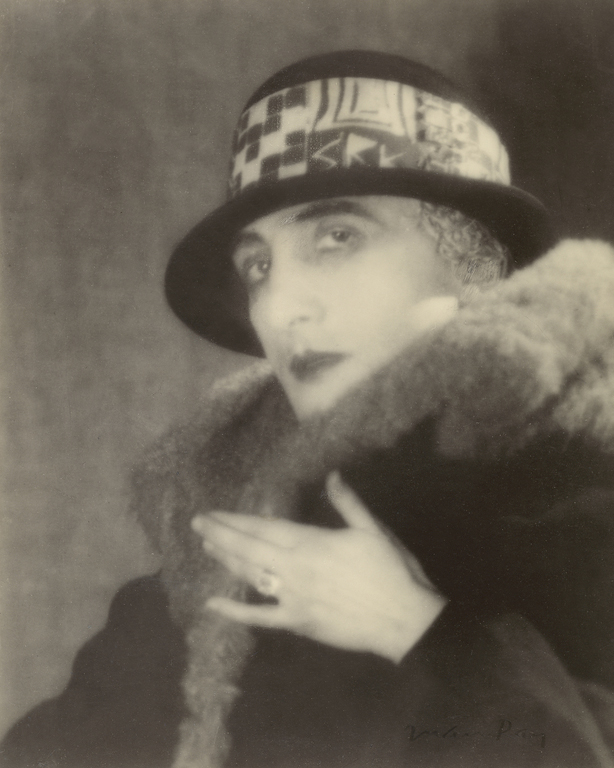

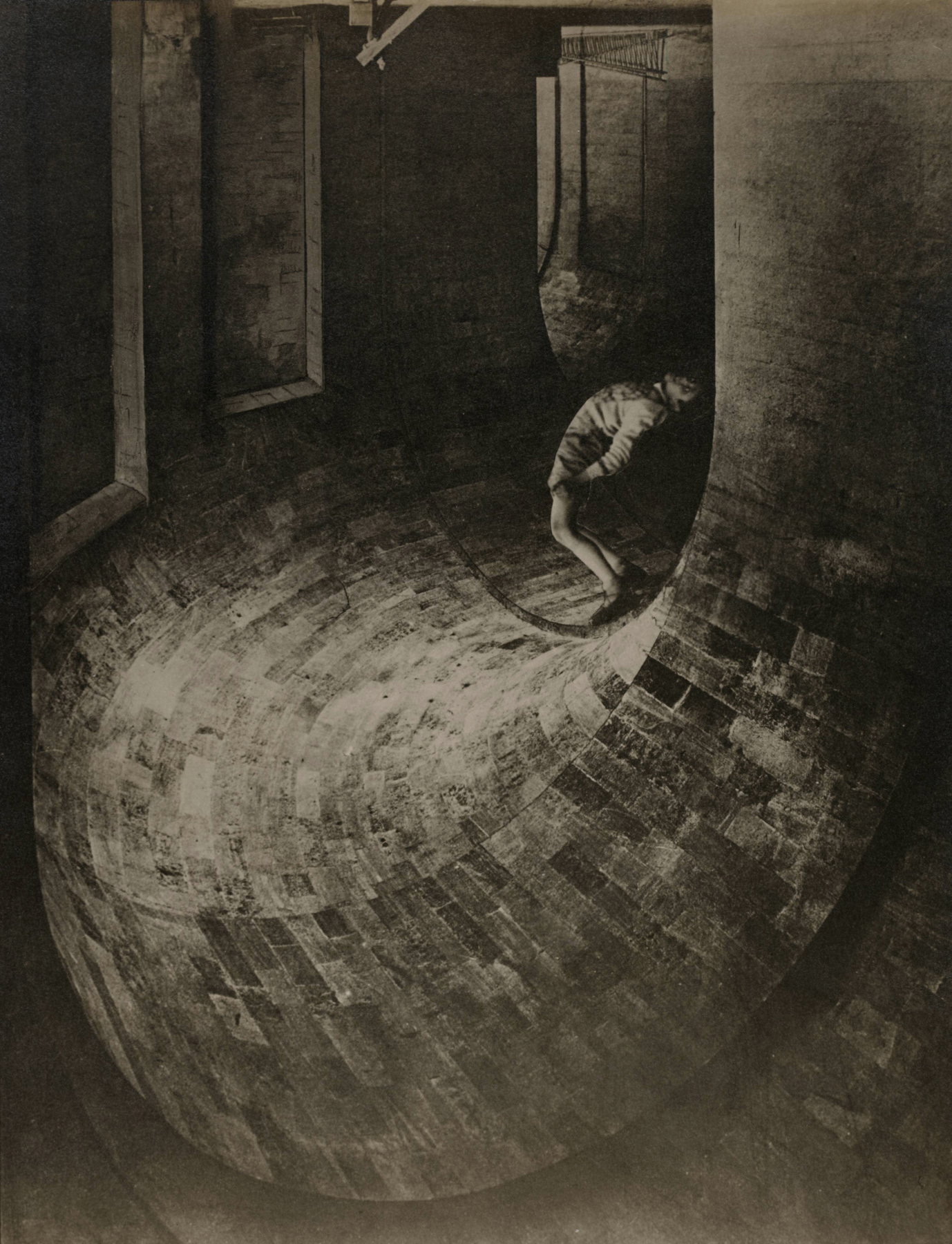
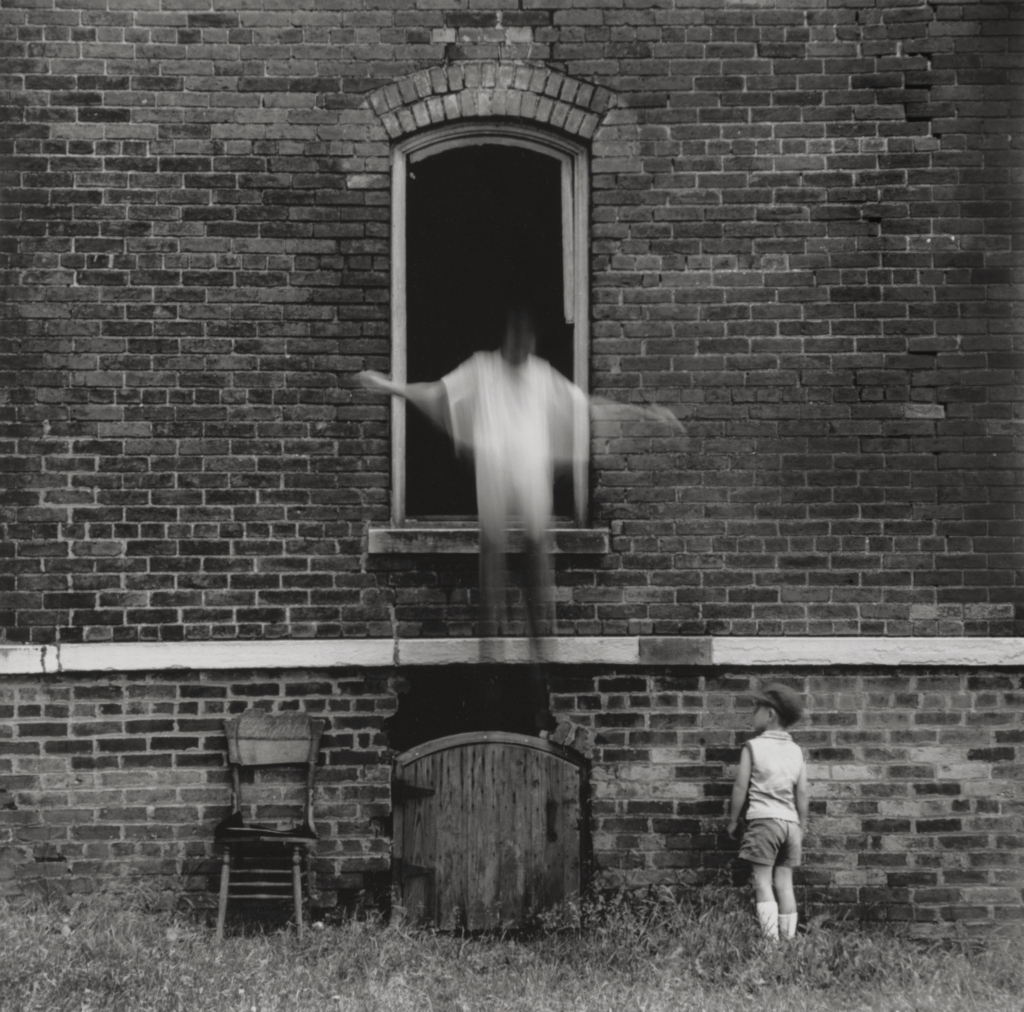
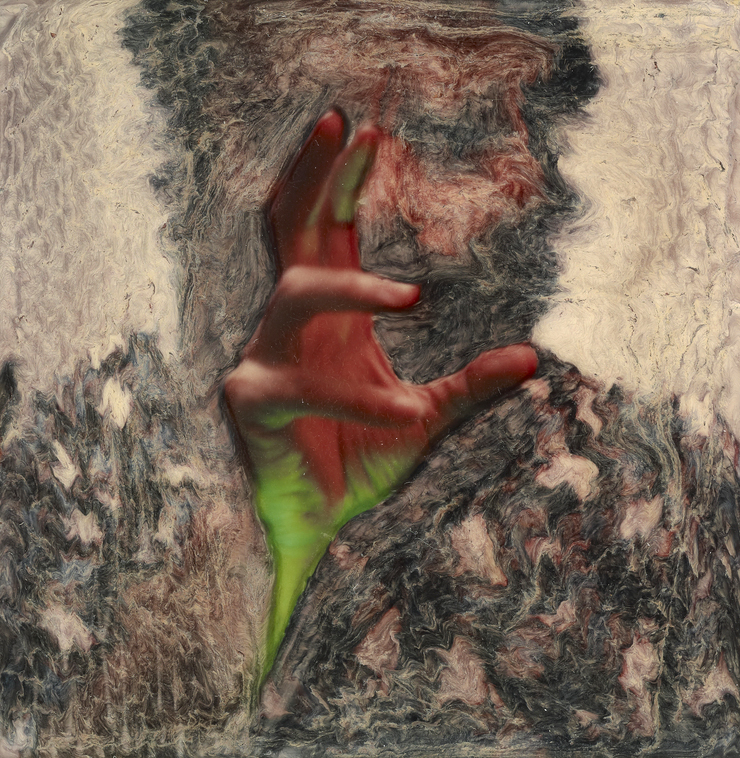
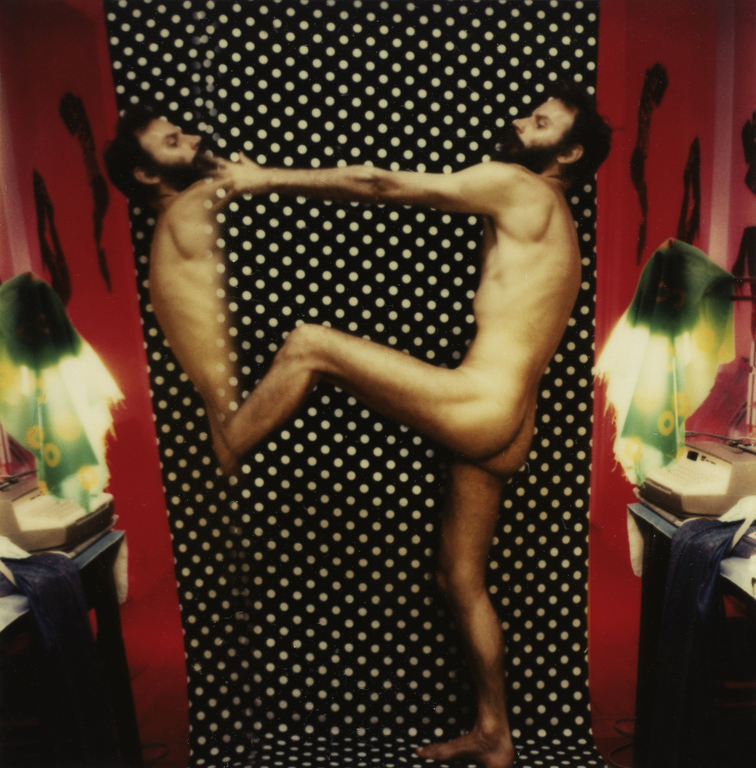

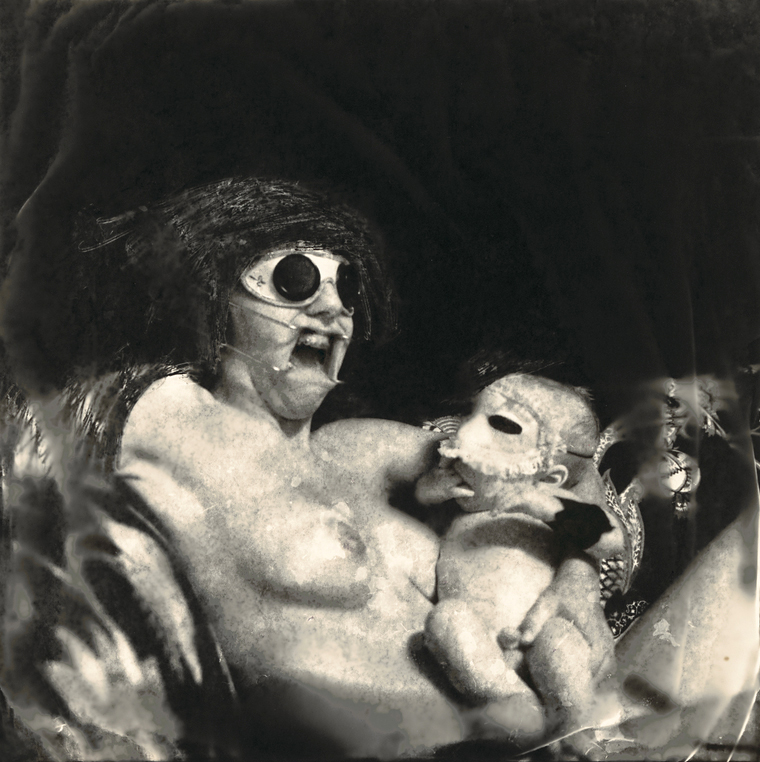
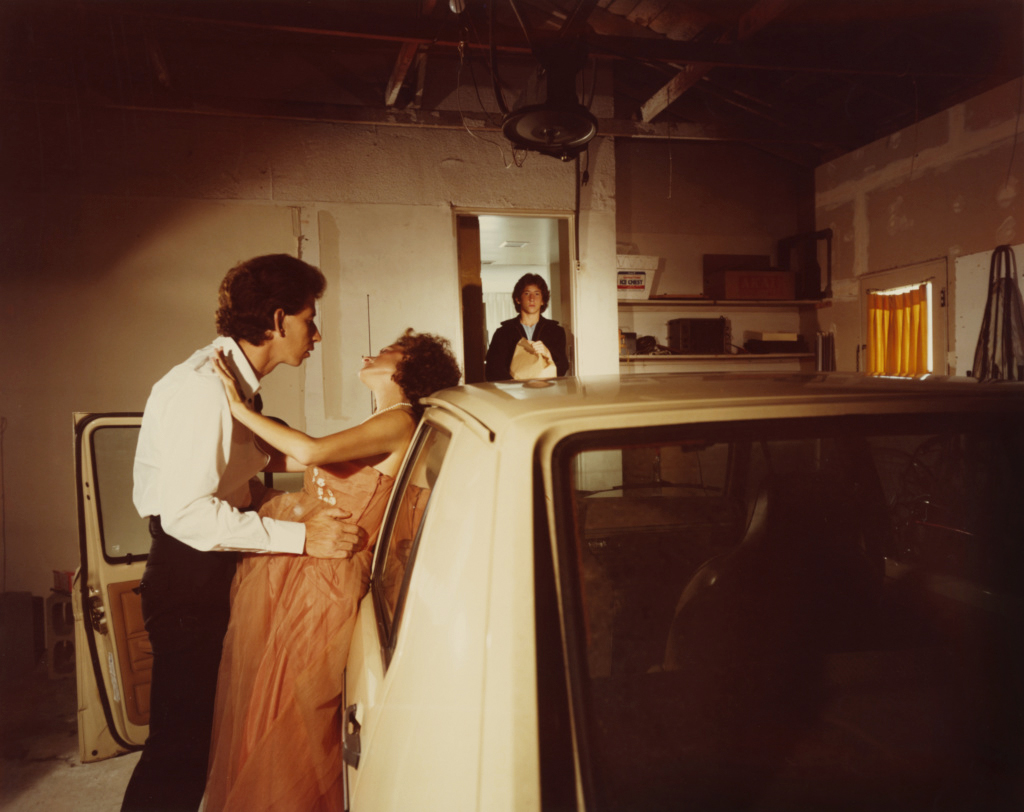
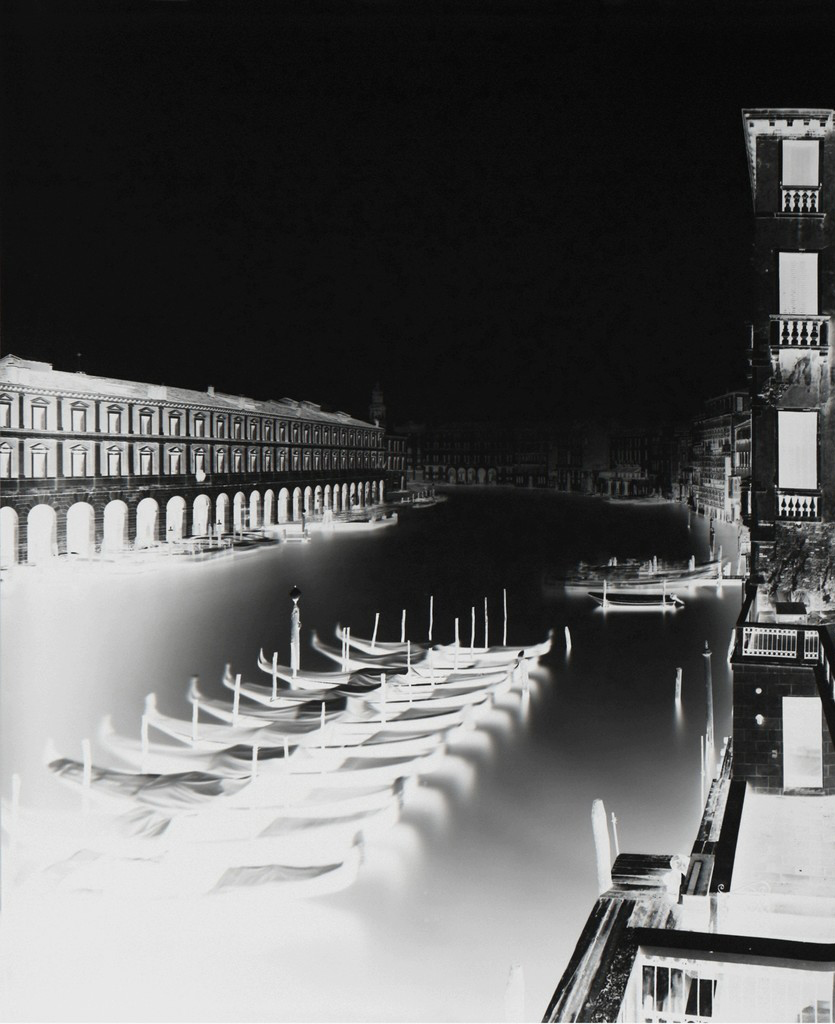
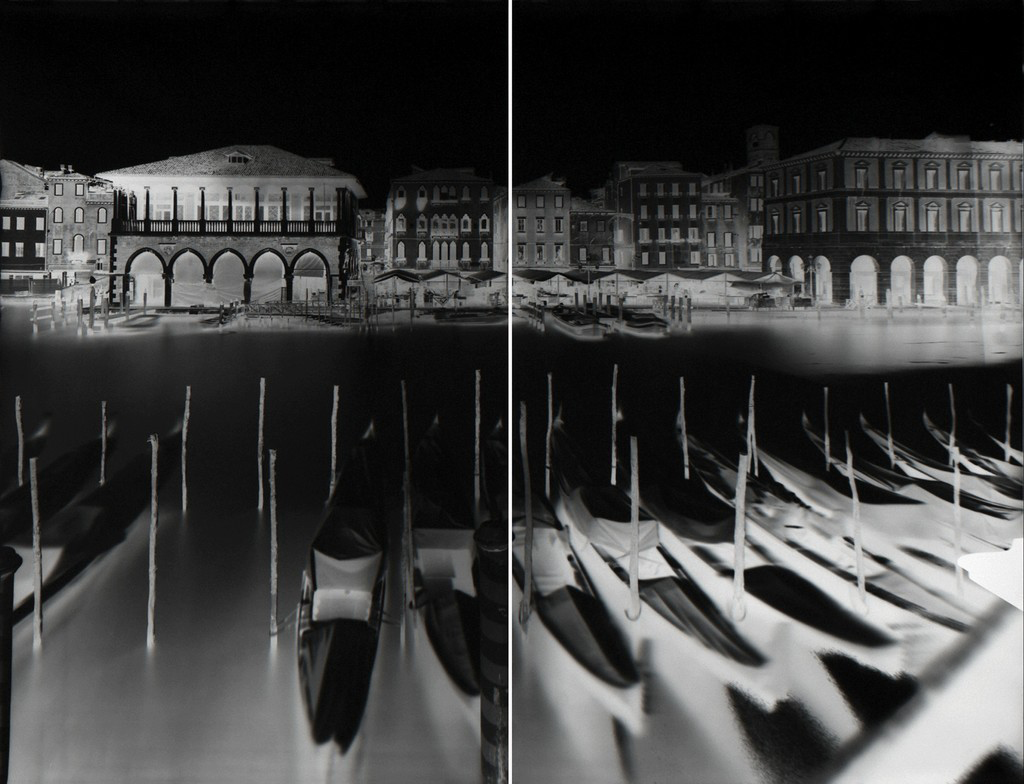

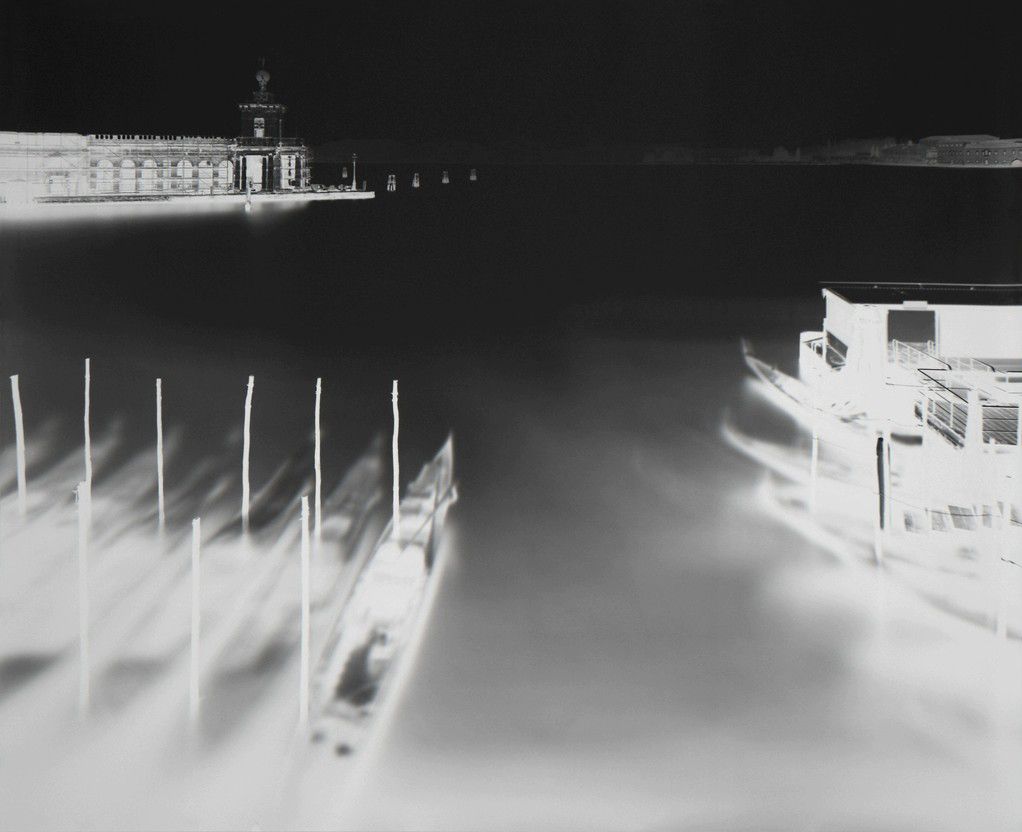

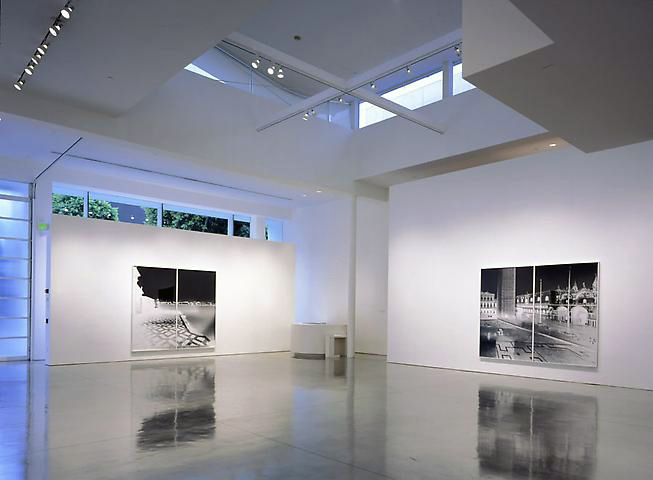
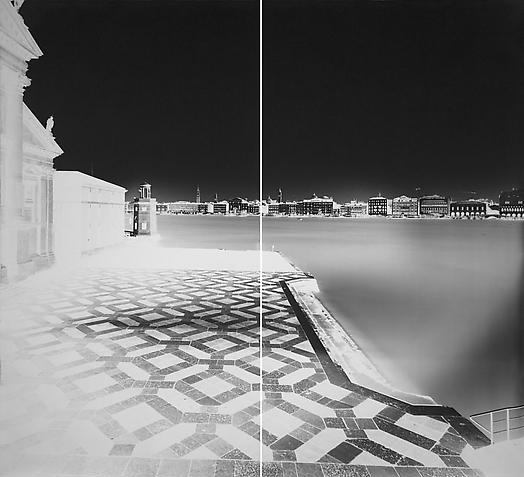

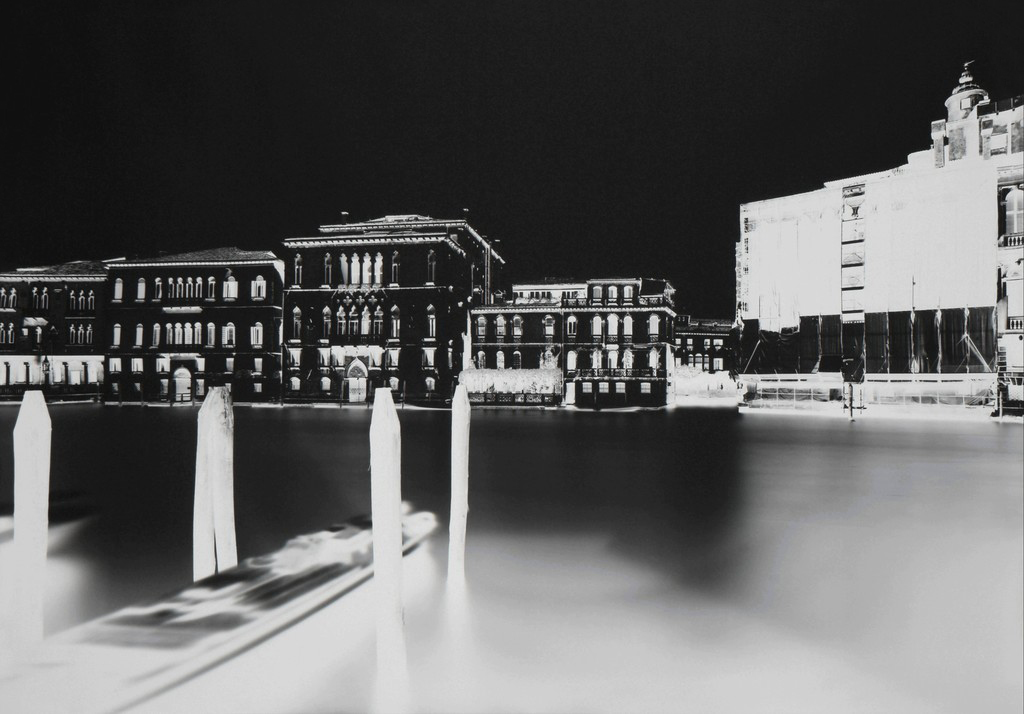

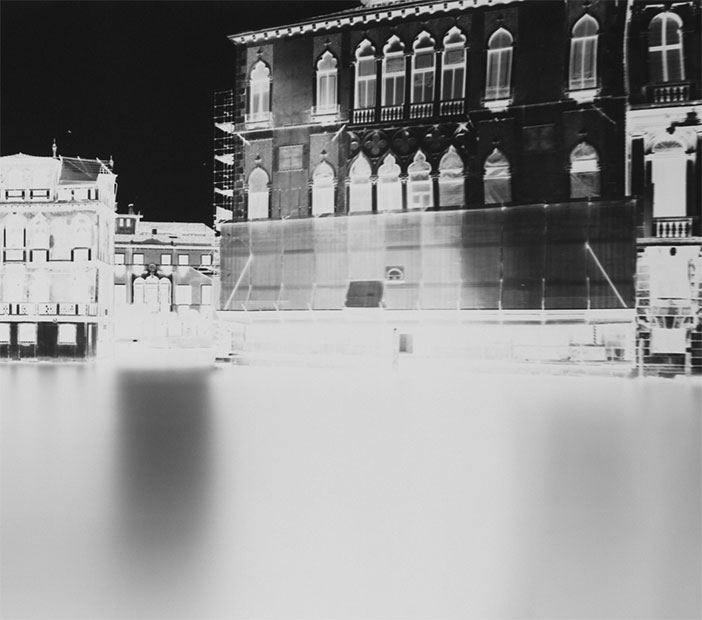
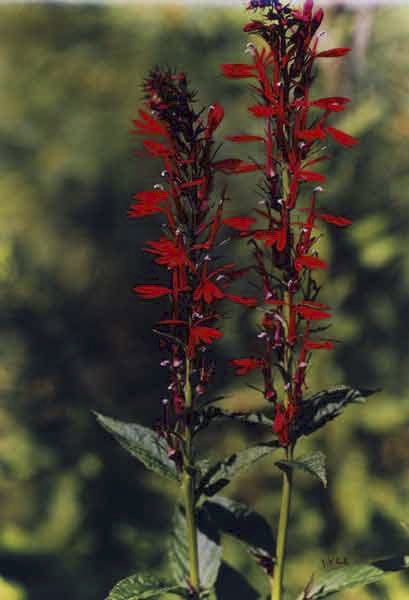
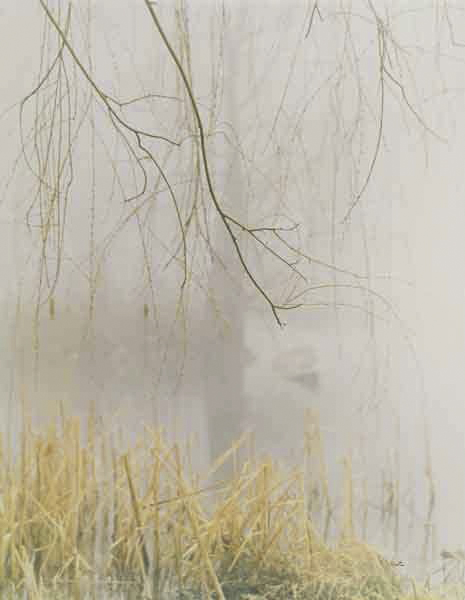
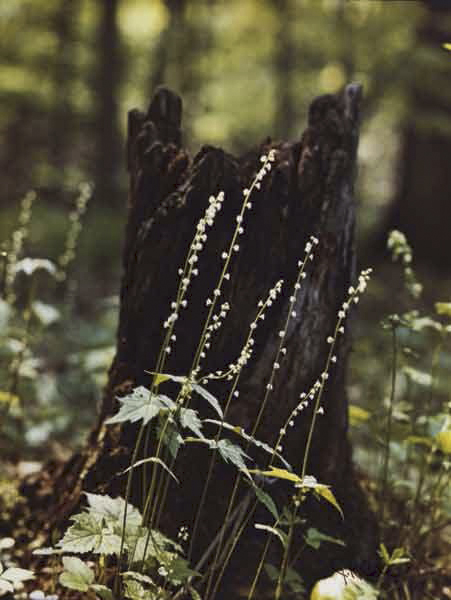
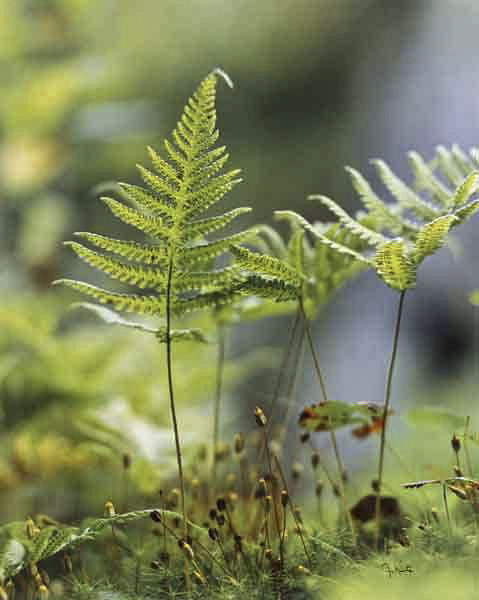
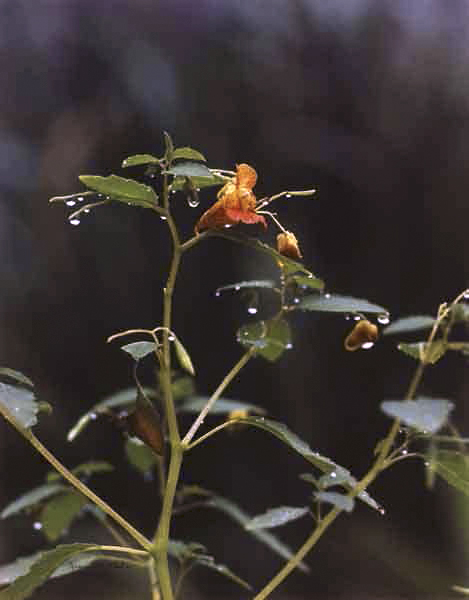
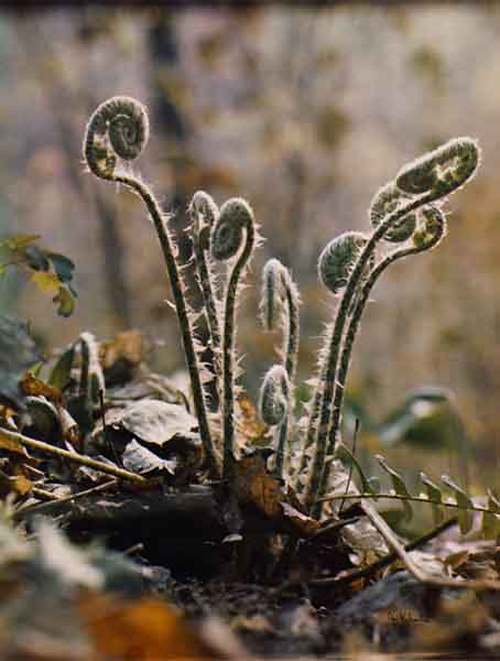
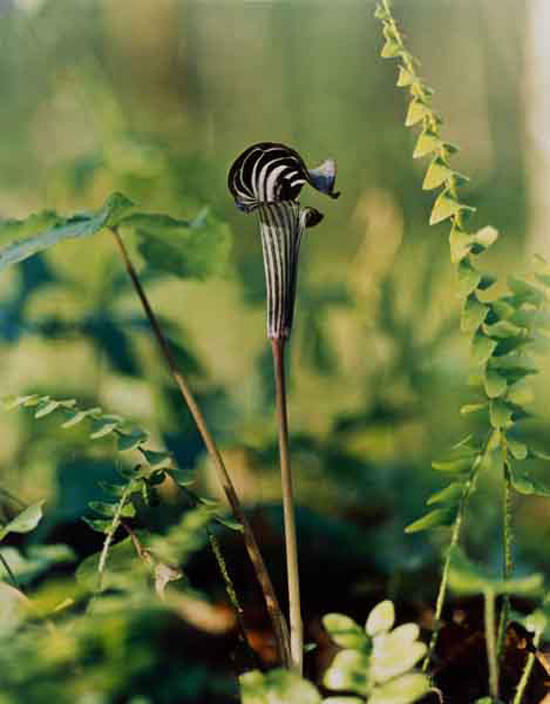
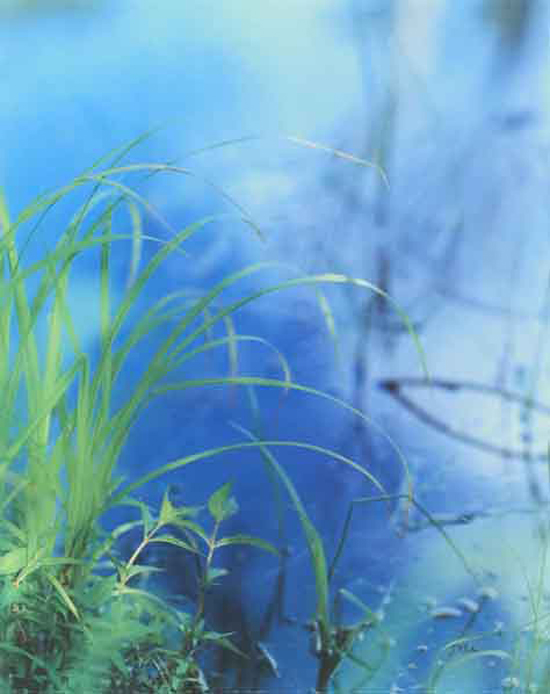
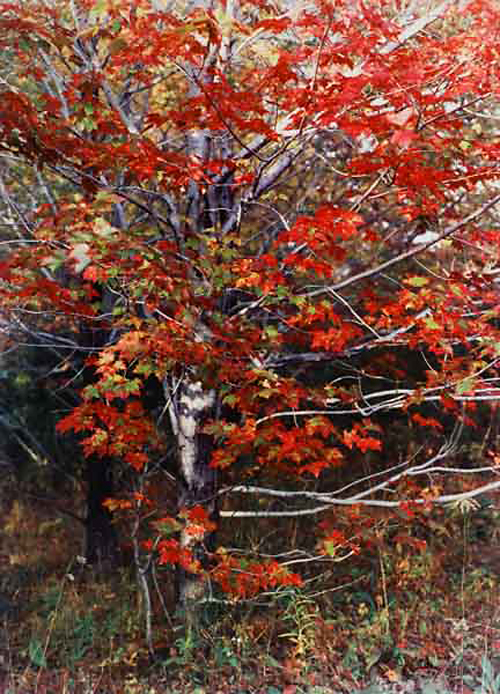
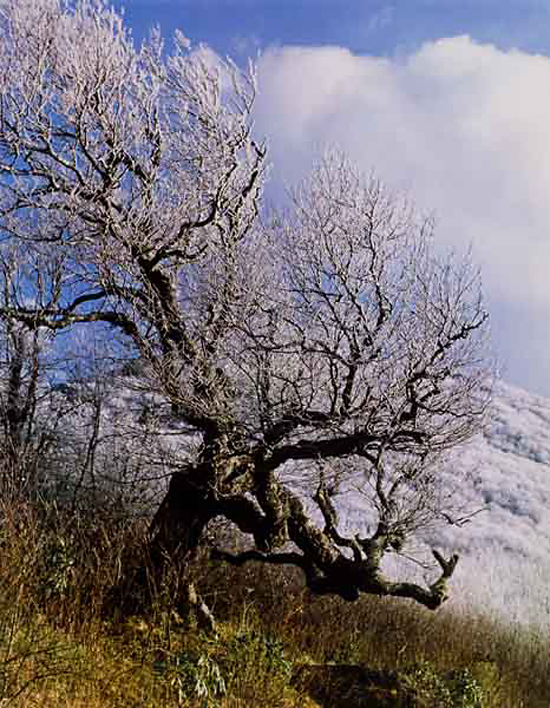
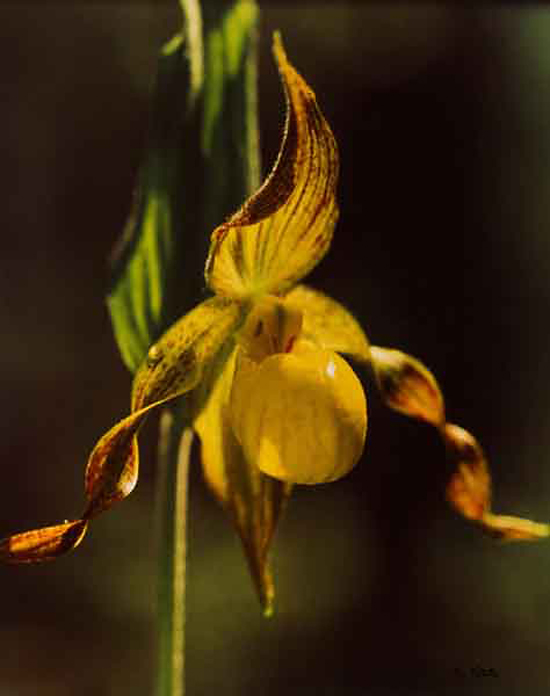
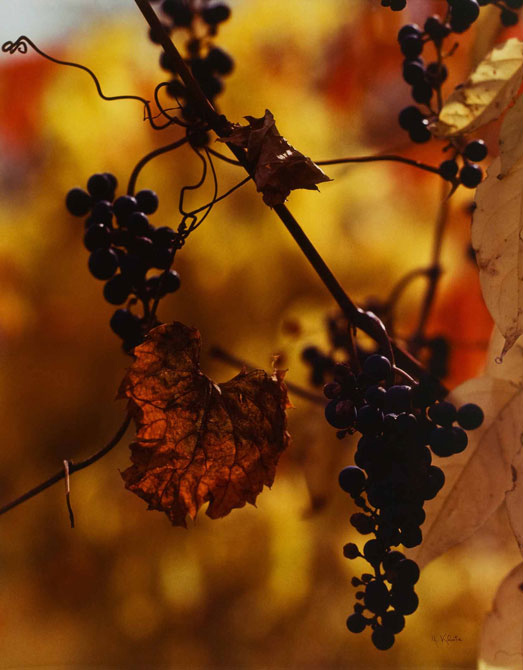

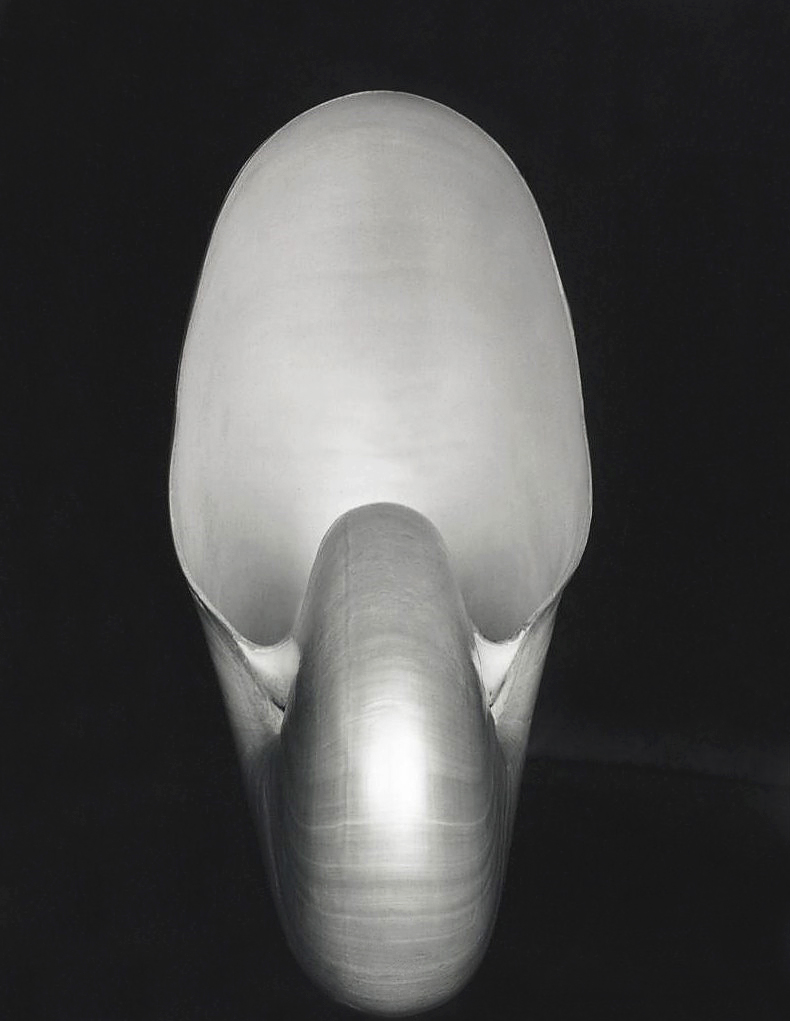

![Benedict J. Fernandez (American, 1936-2021) 'Dick Gregory with MLK [Martin Luther King, JR.] New Politics Convention, Chicago, ILL. October, 1967' 1967](https://artblart.com/wp-content/uploads/2009/07/benedict-j.-fernandez-dick-gregory-with-mlk.jpg "Benedict J. Fernandez (American, 1936-2021) 'Dick Gregory with MLK [Martin Luther King, JR.] New Politics Convention, Chicago, ILL. October, 1967' 1967")
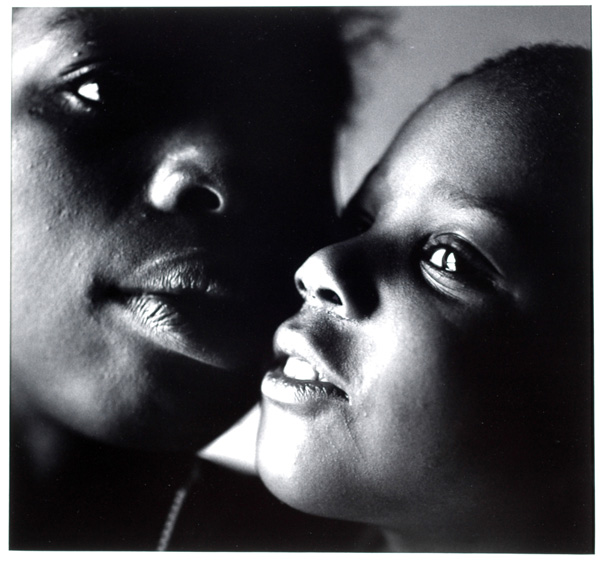

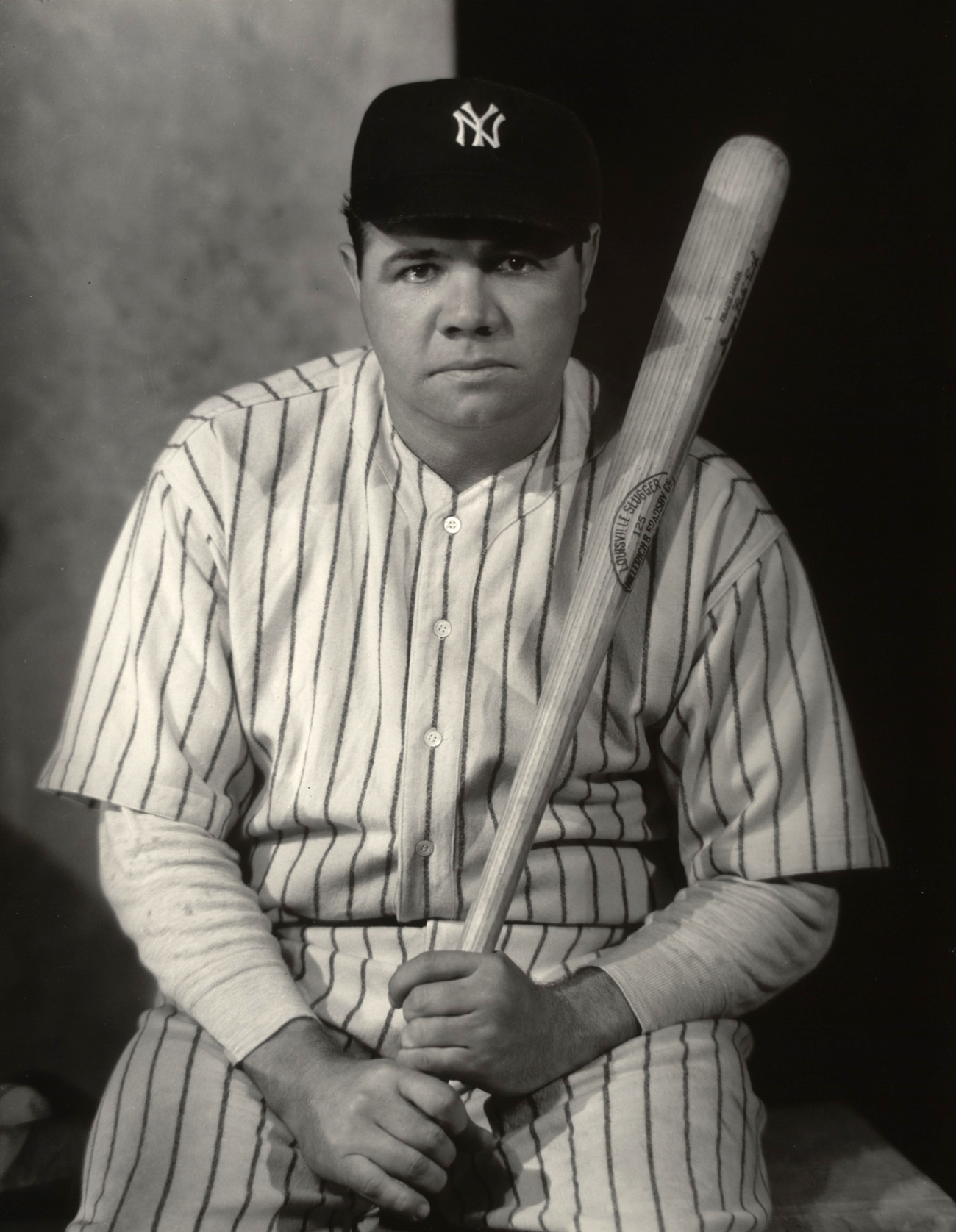


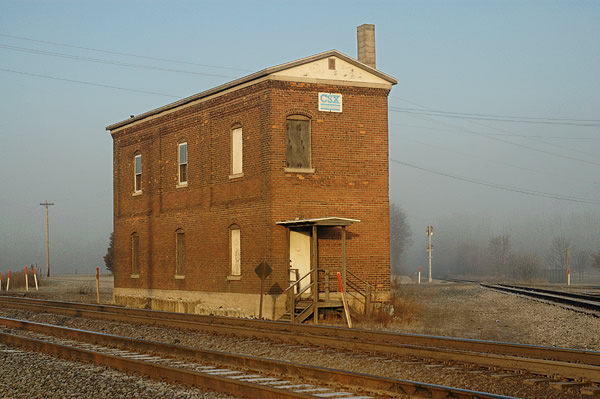
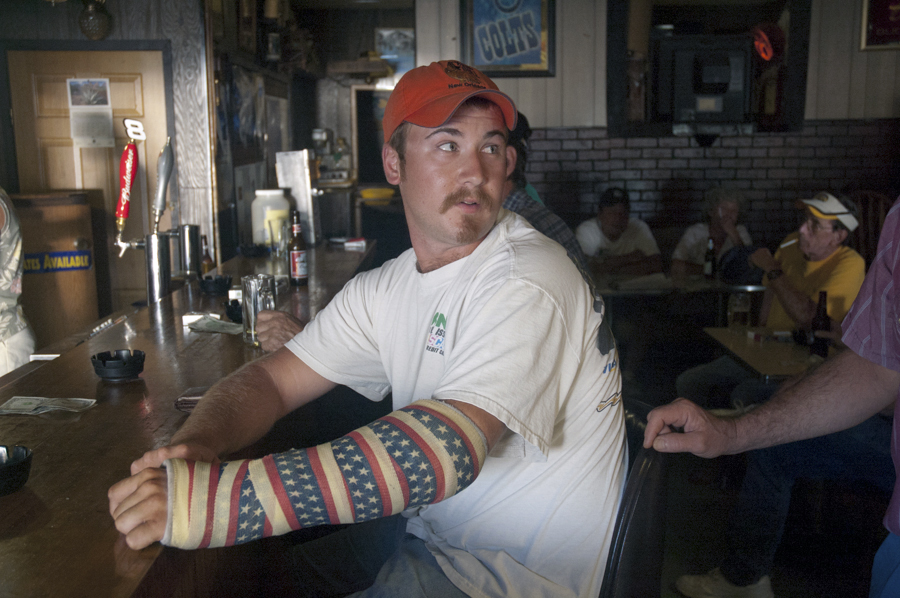
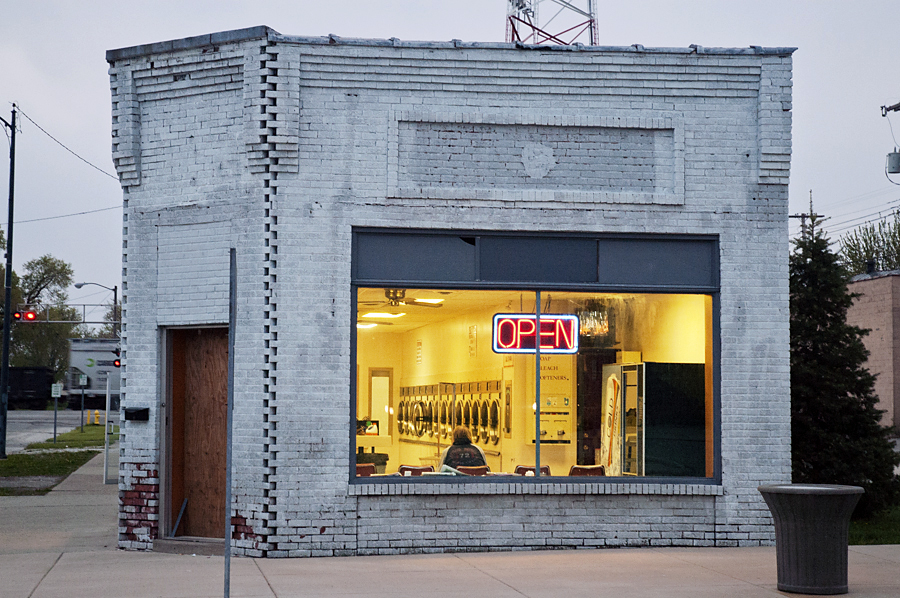
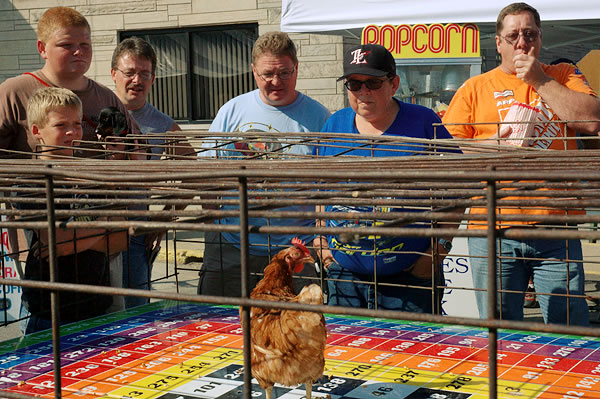
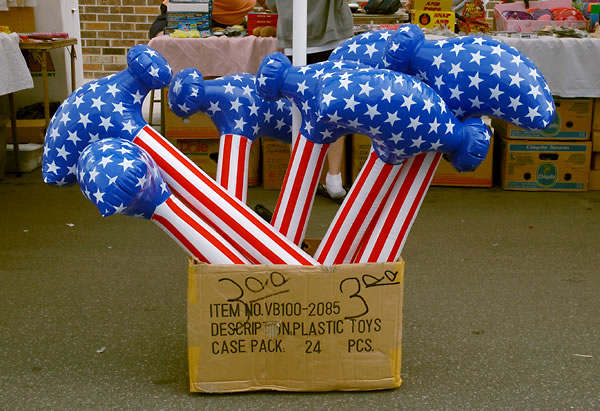
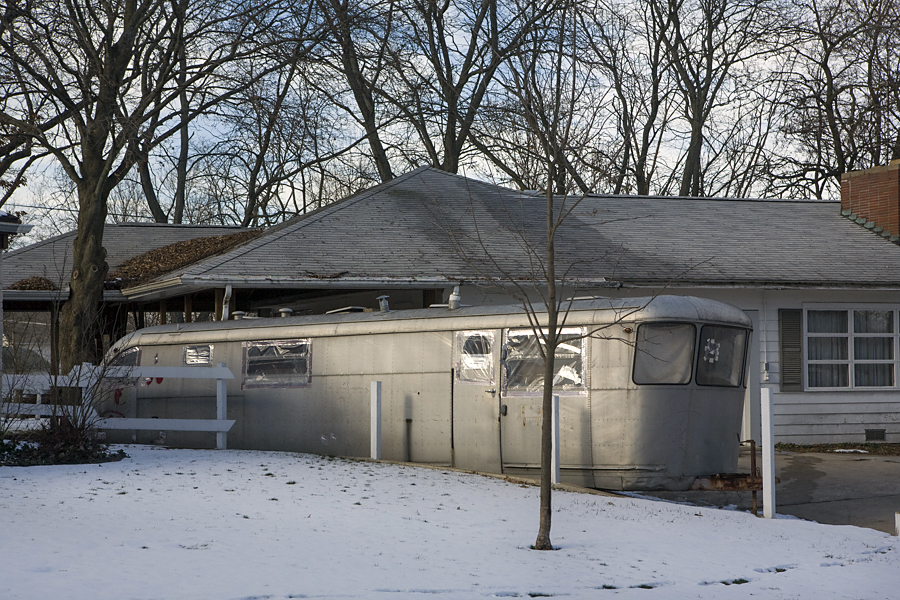
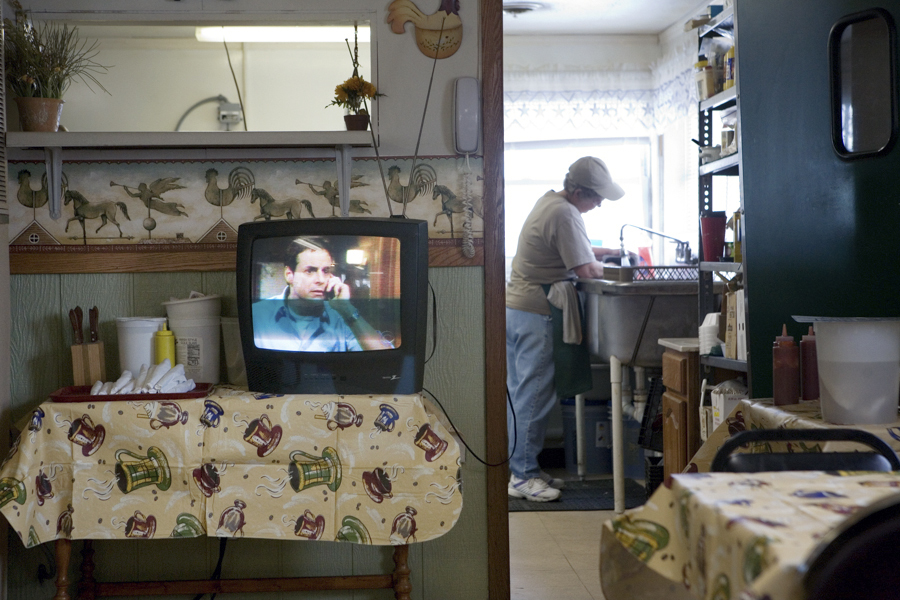
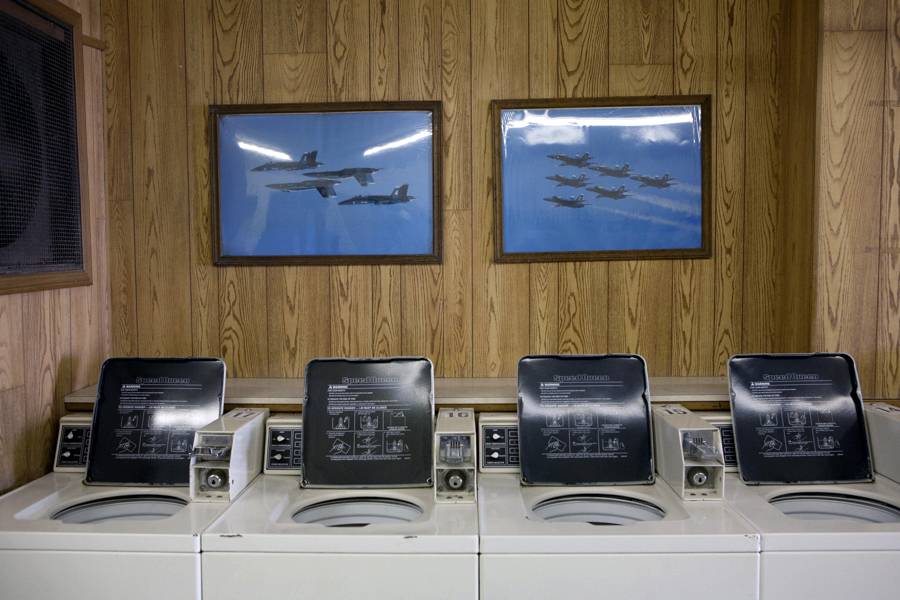
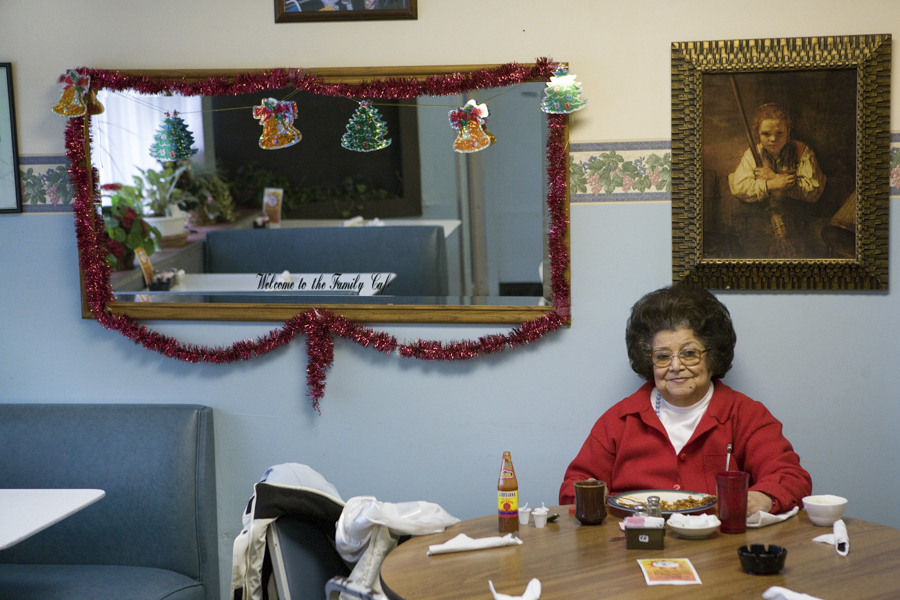
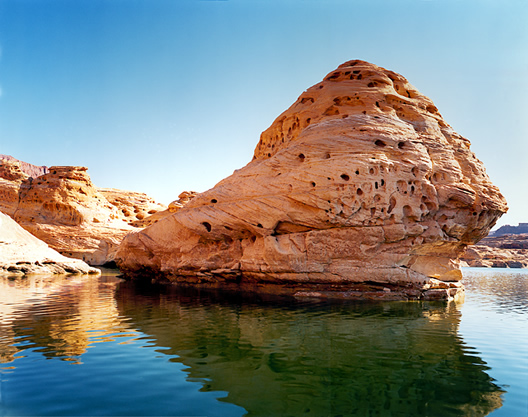

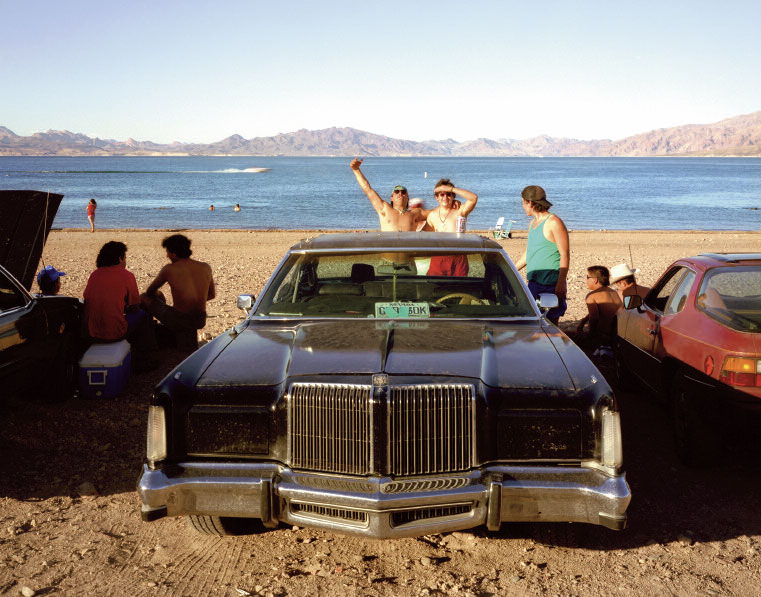
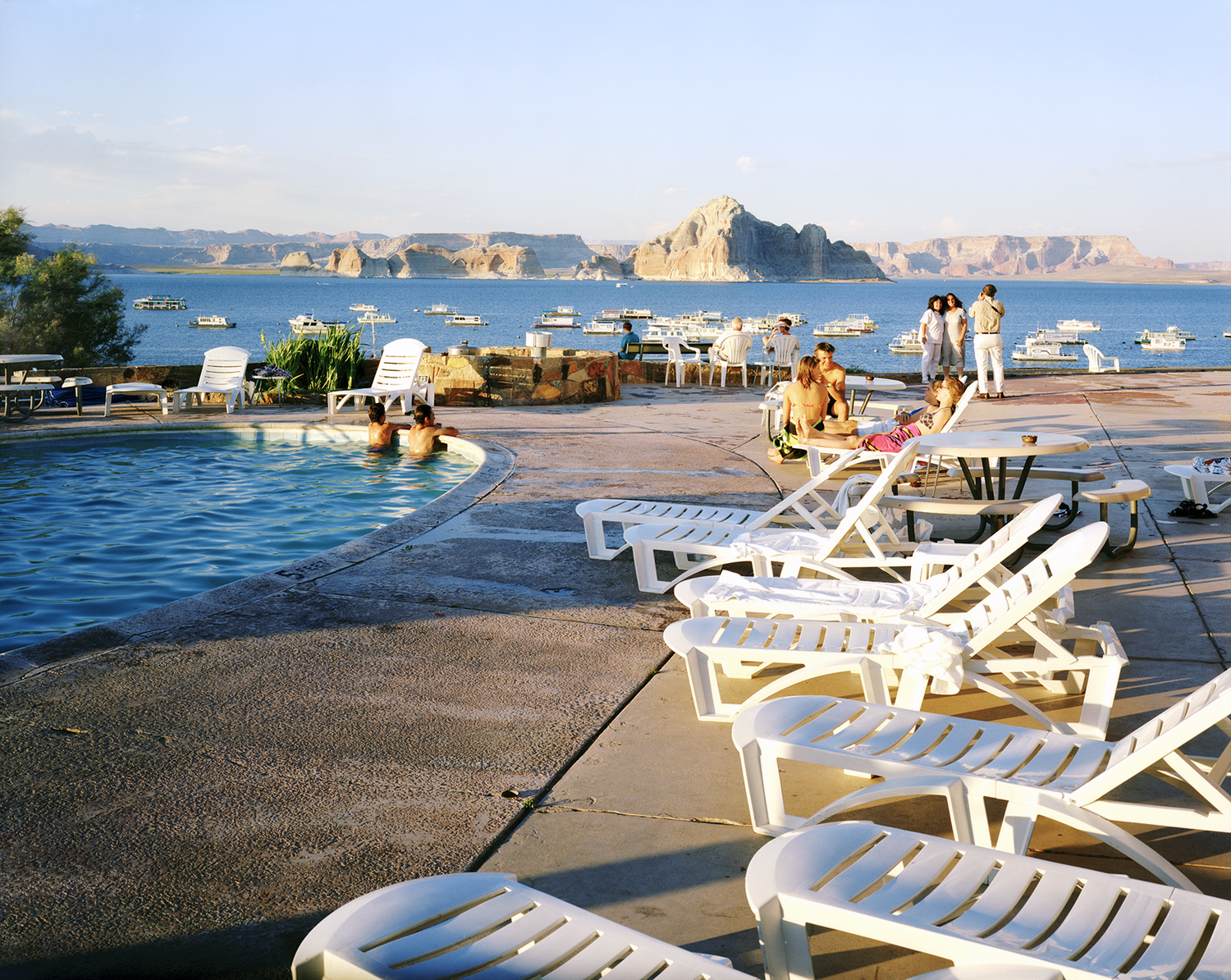
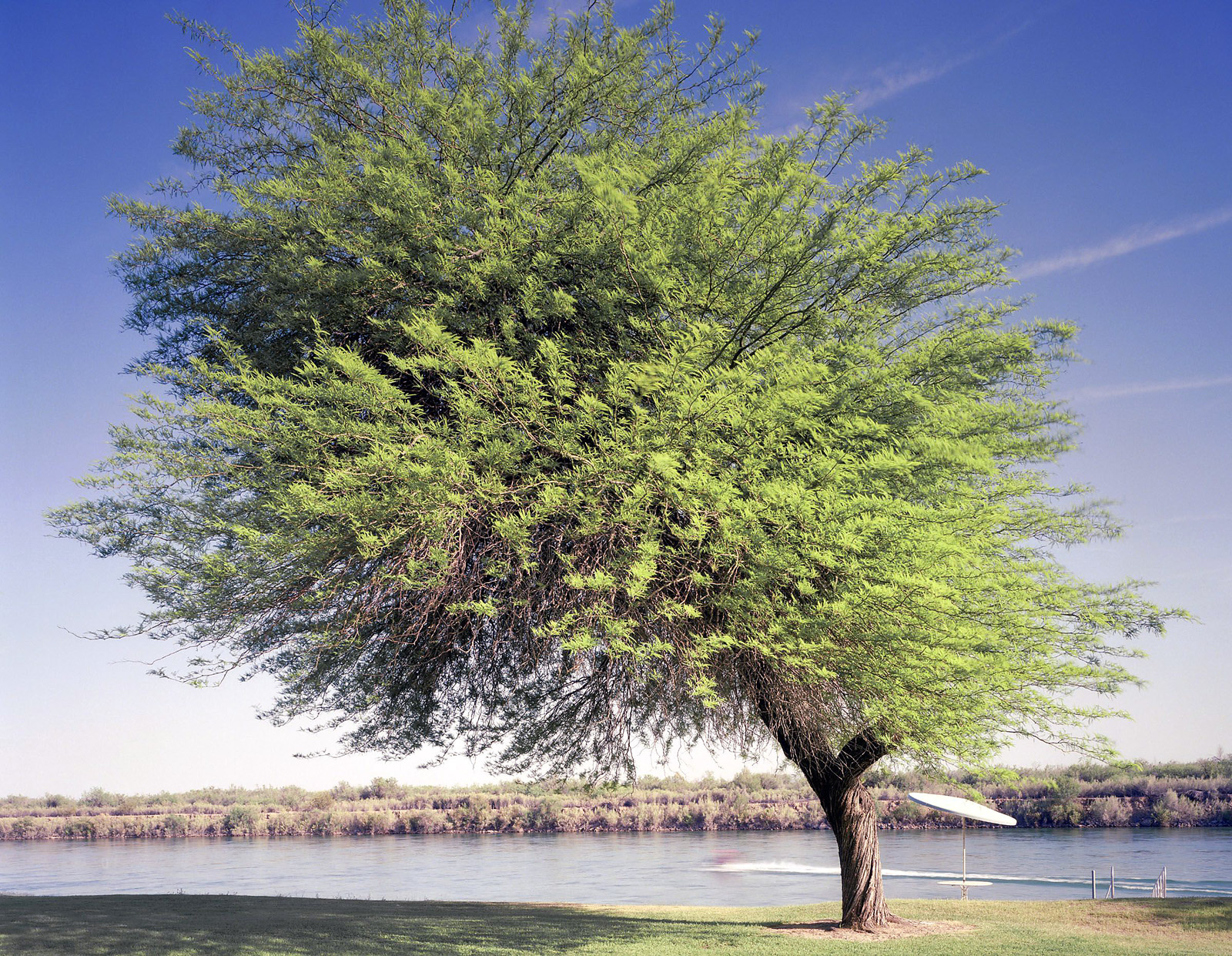
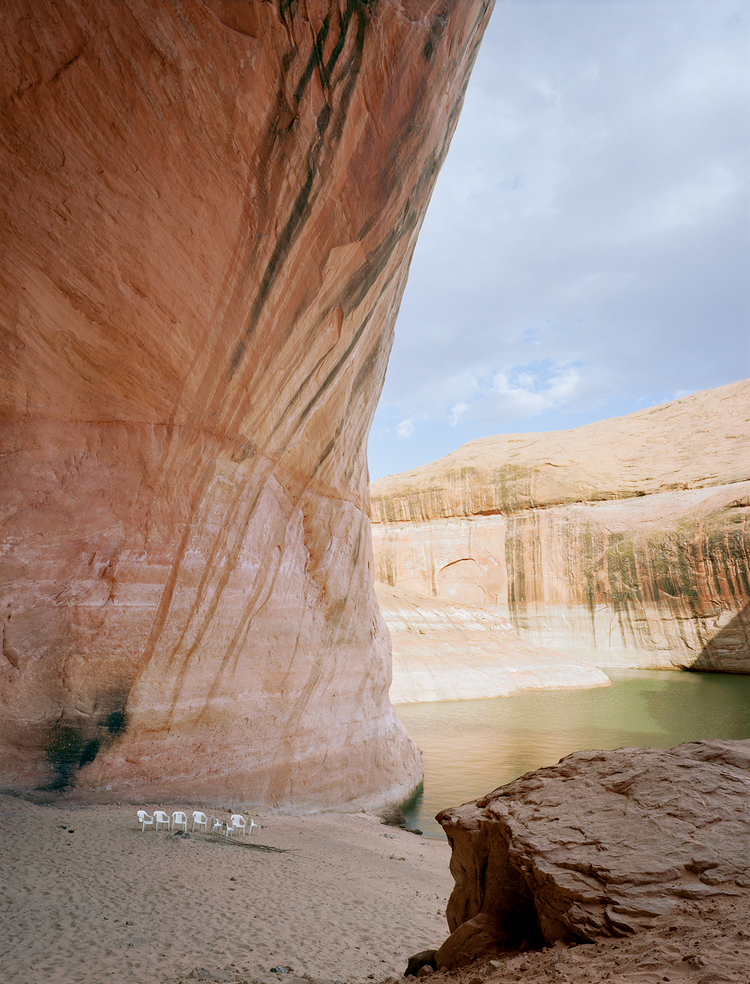
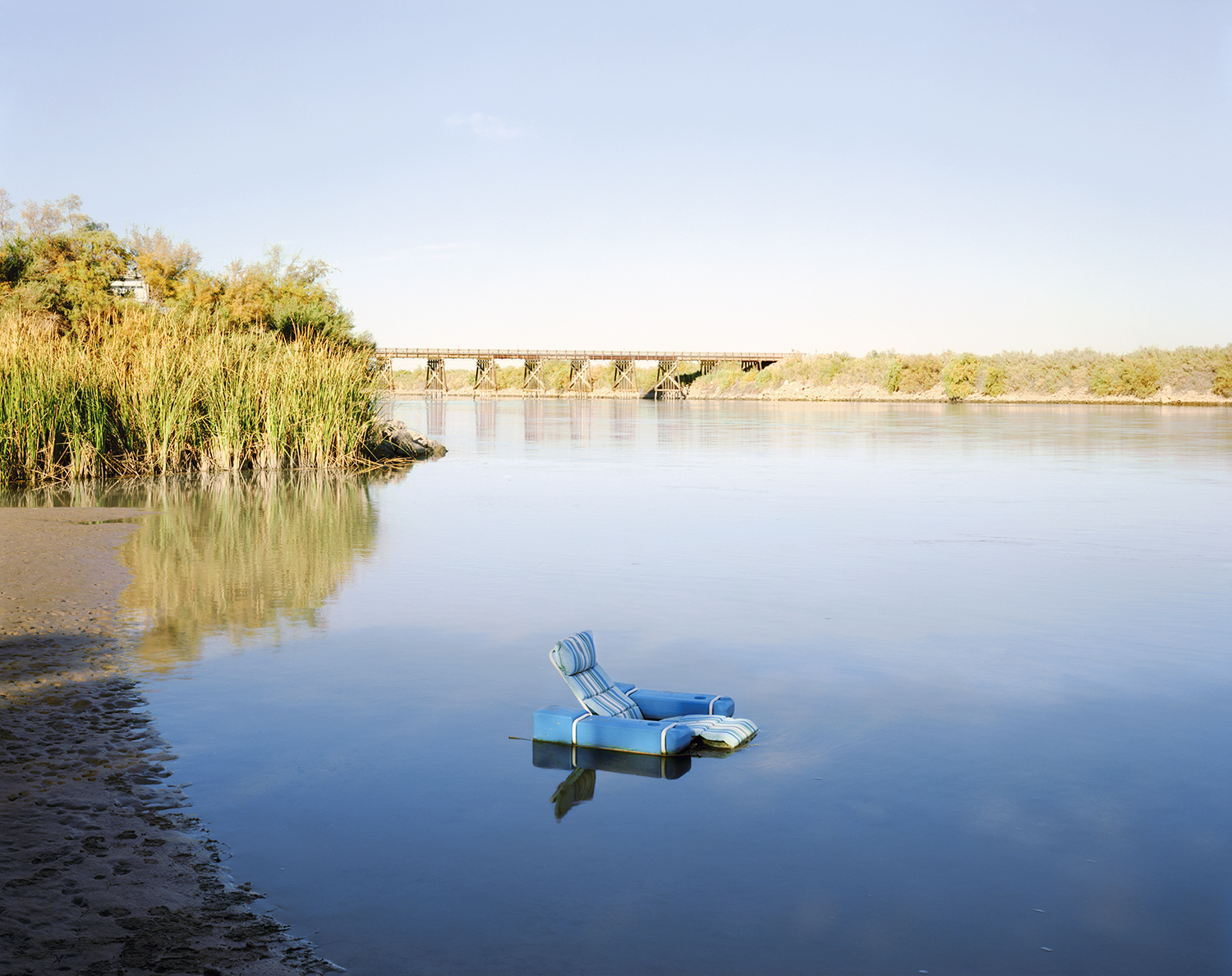
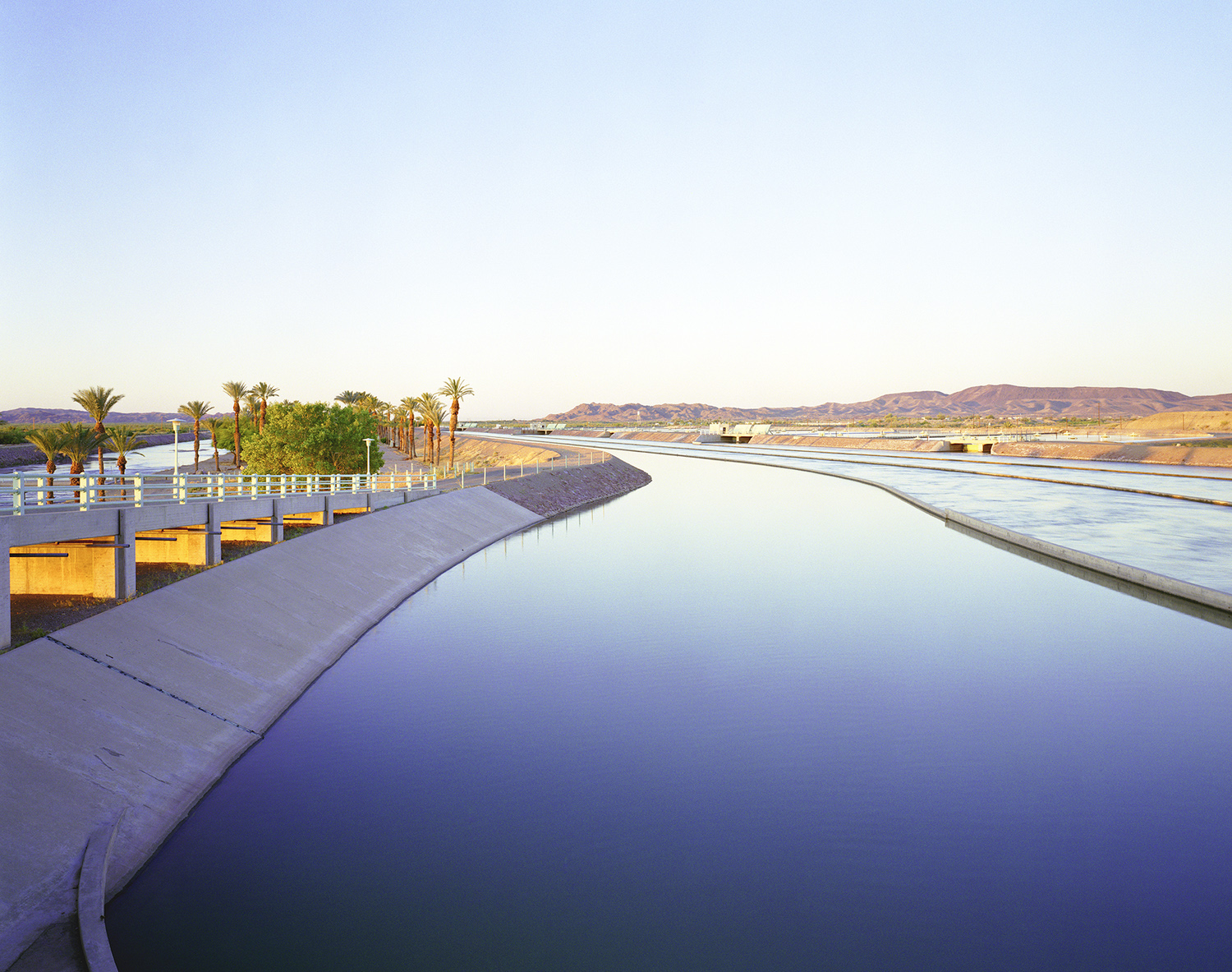
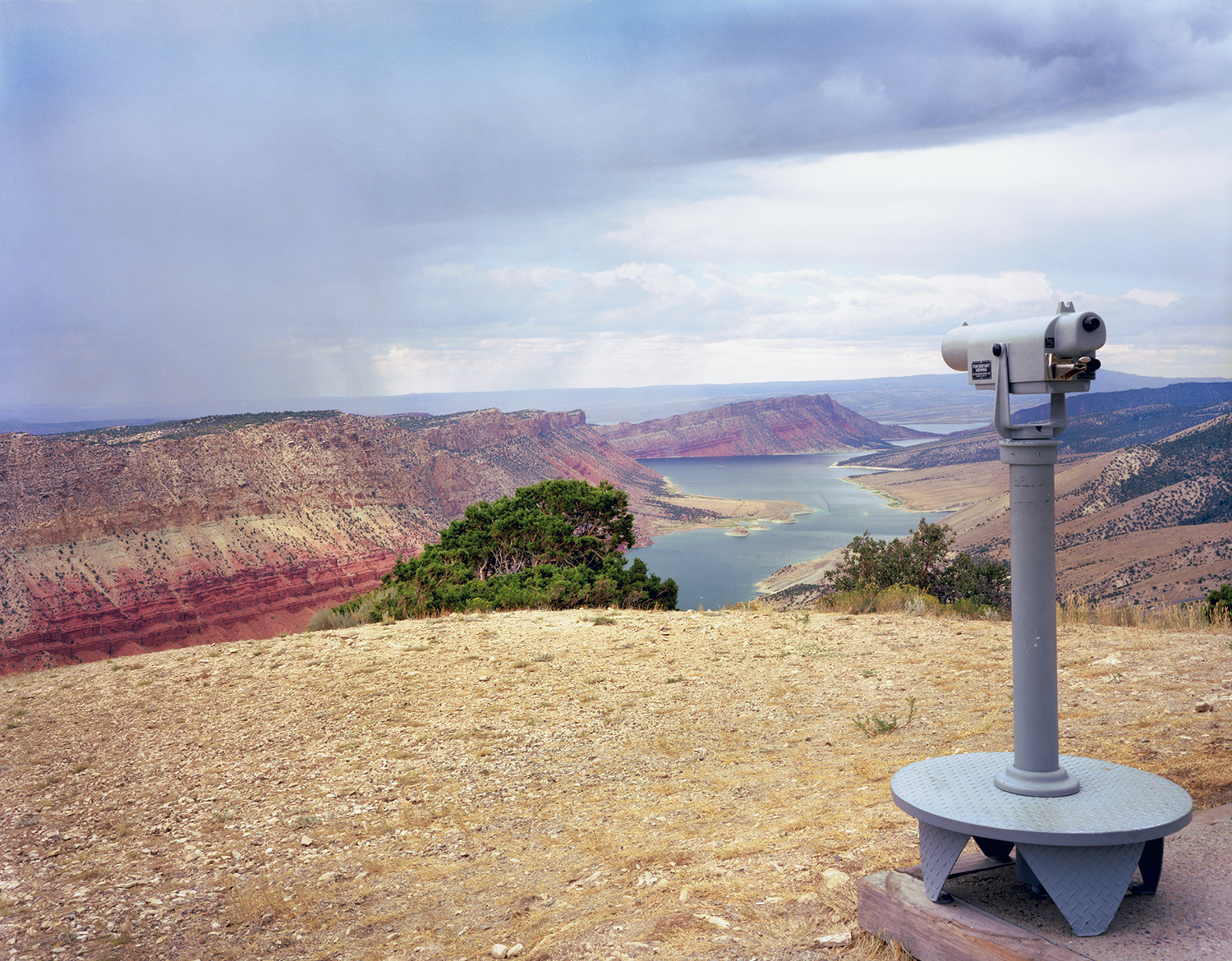
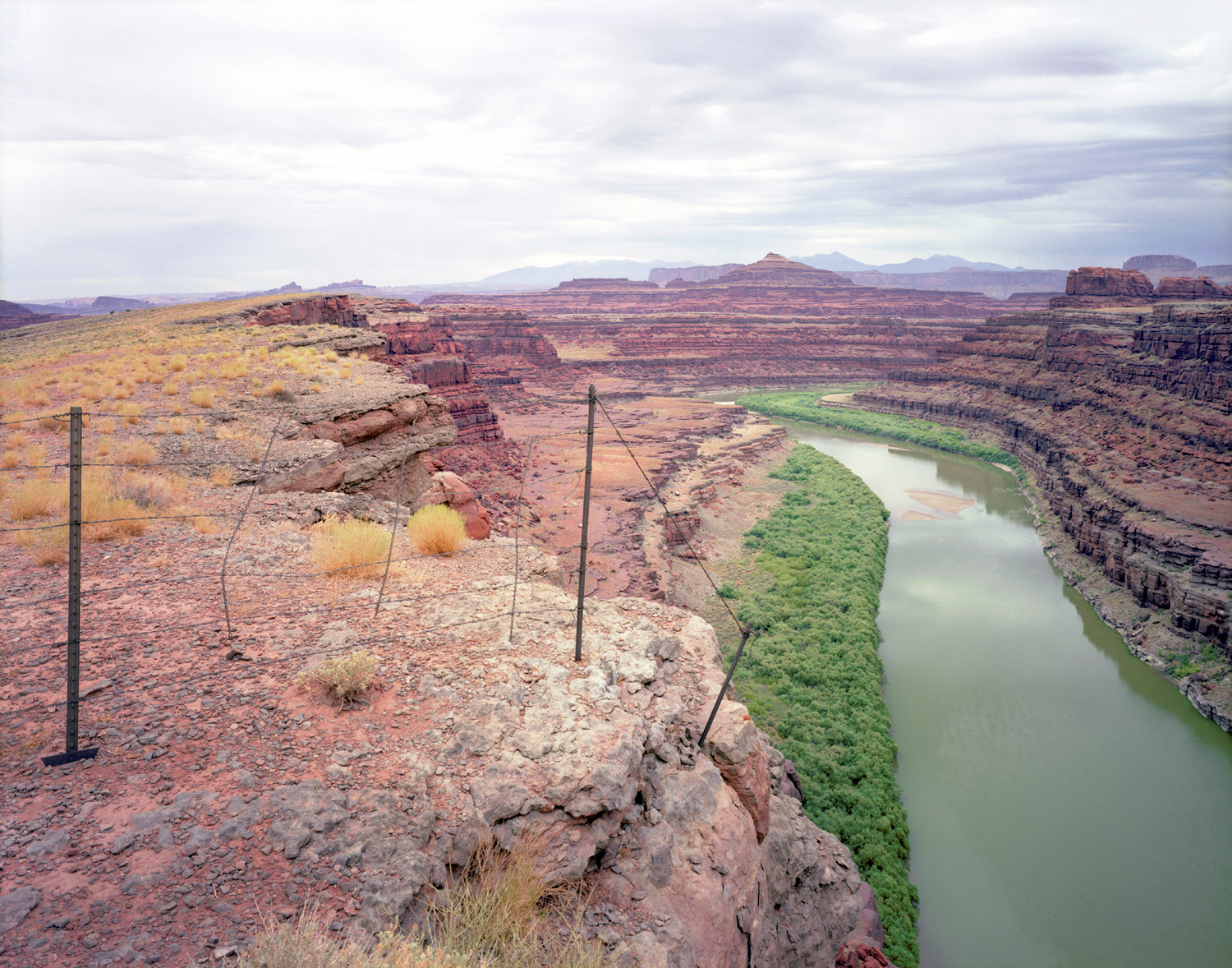
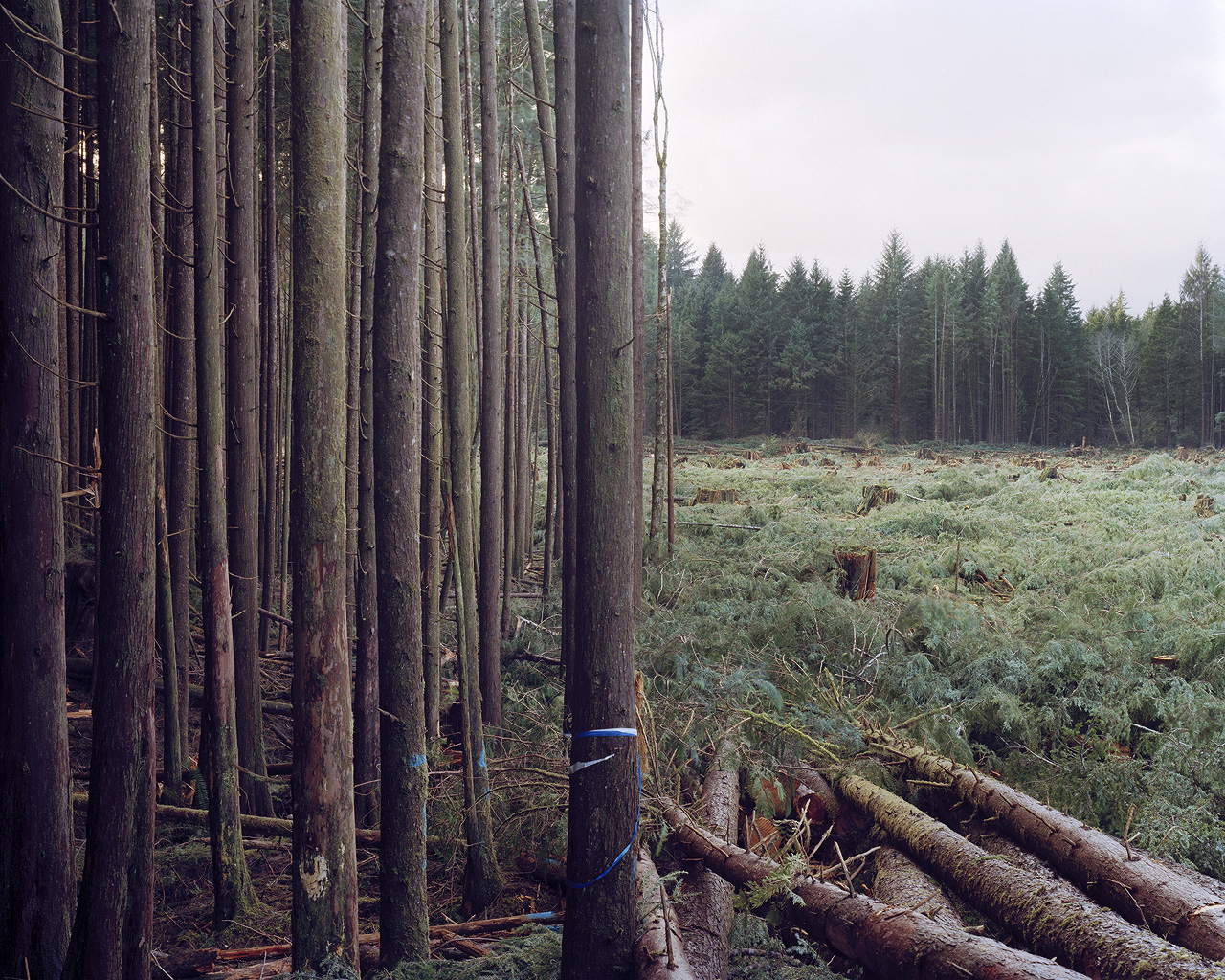
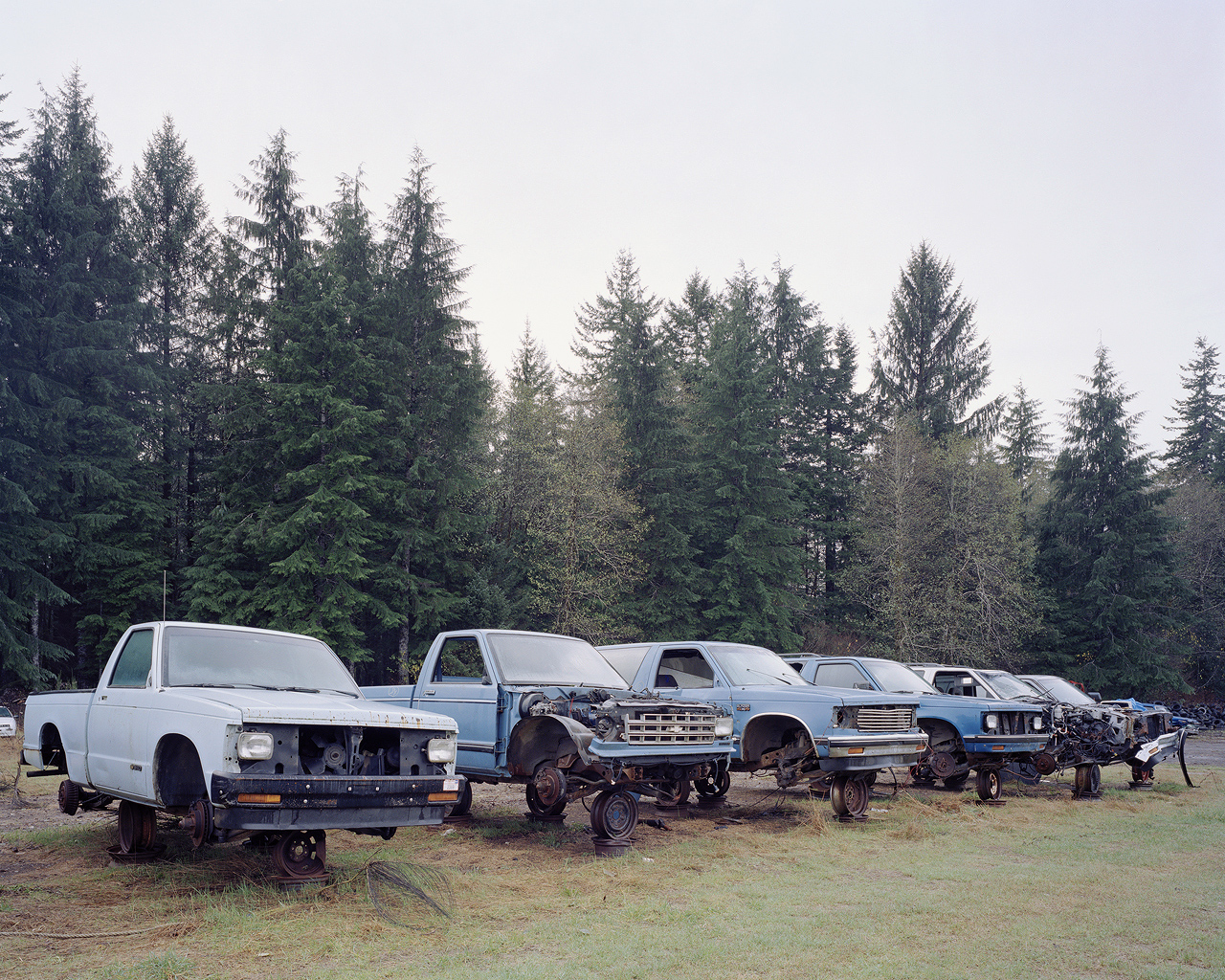
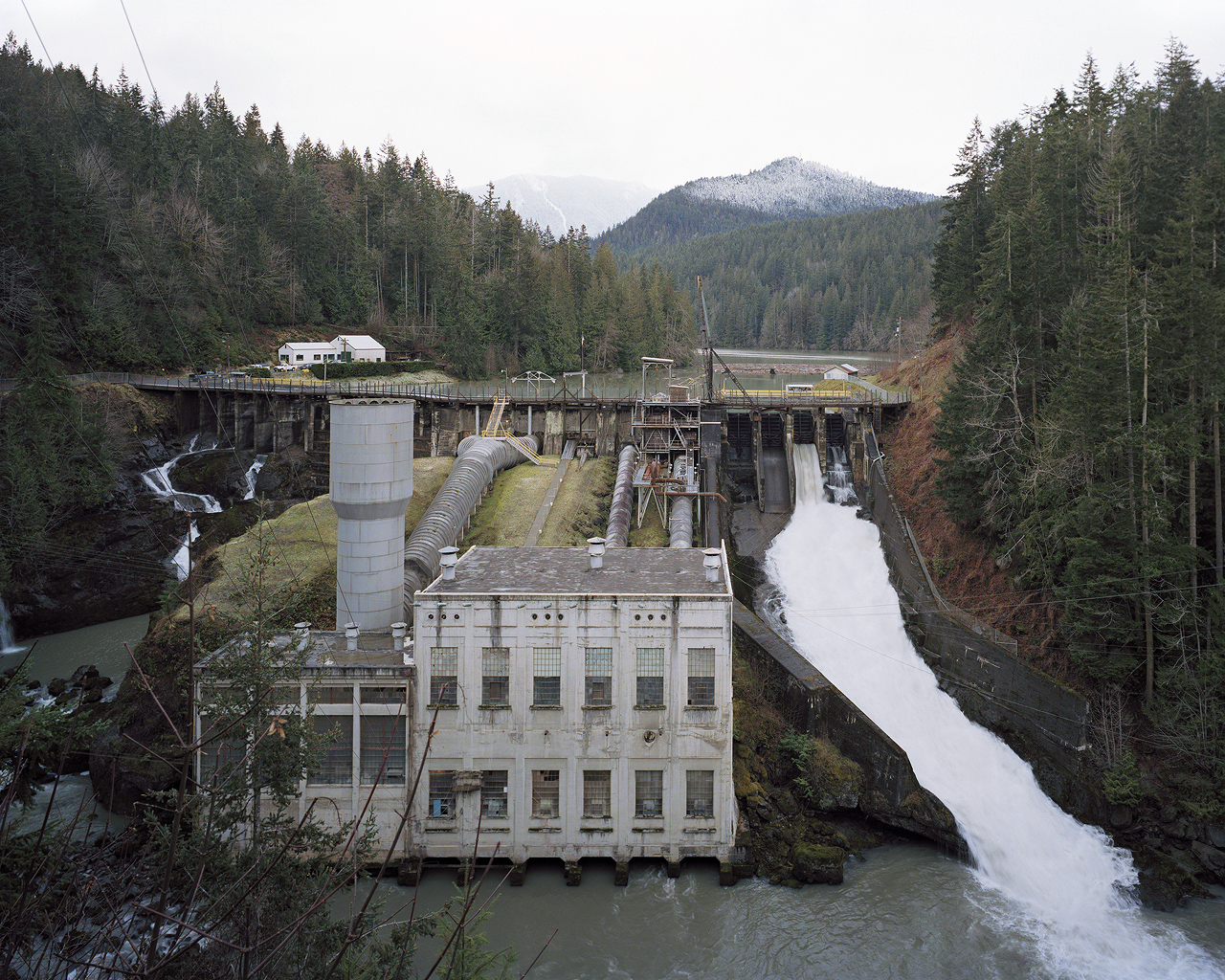
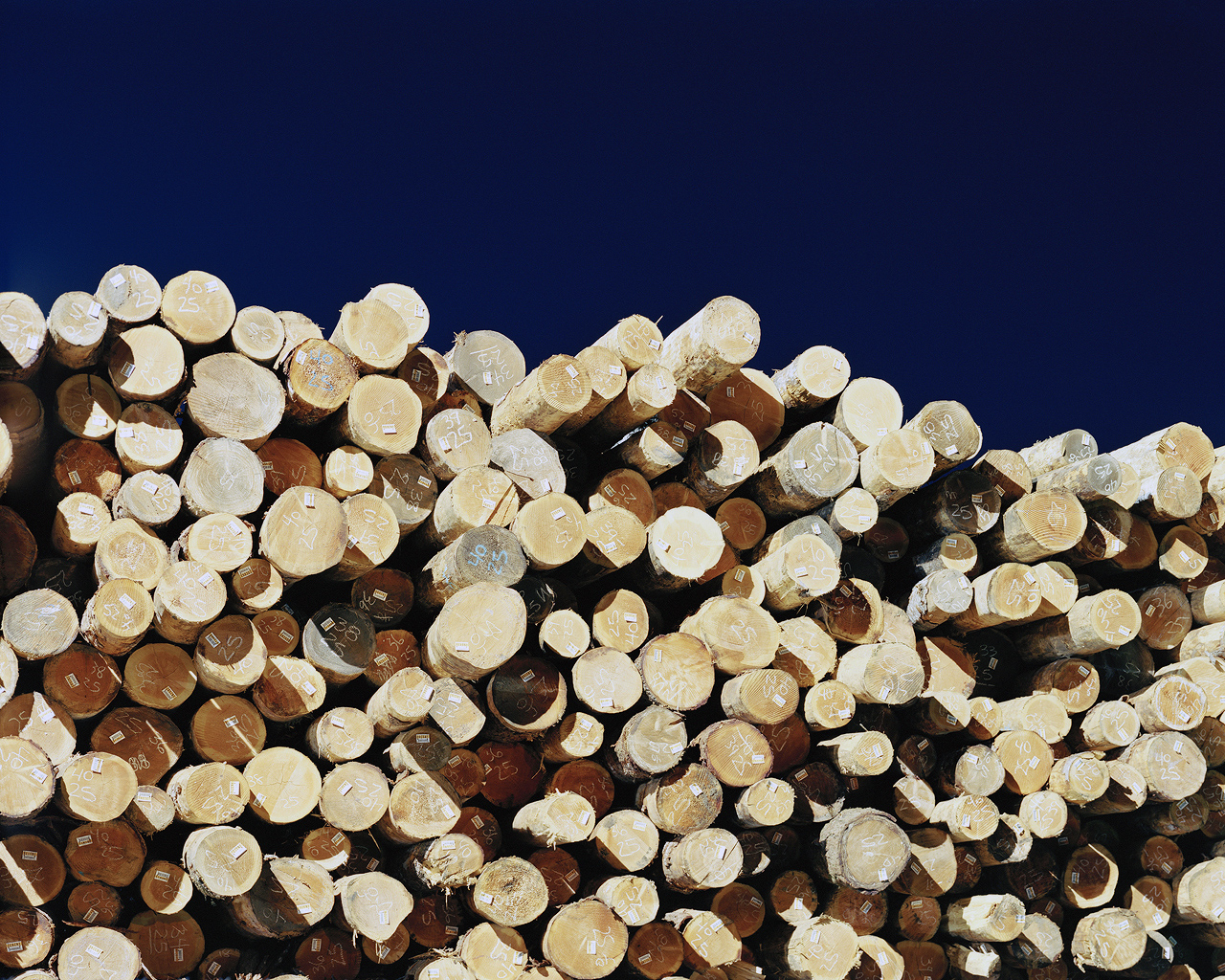
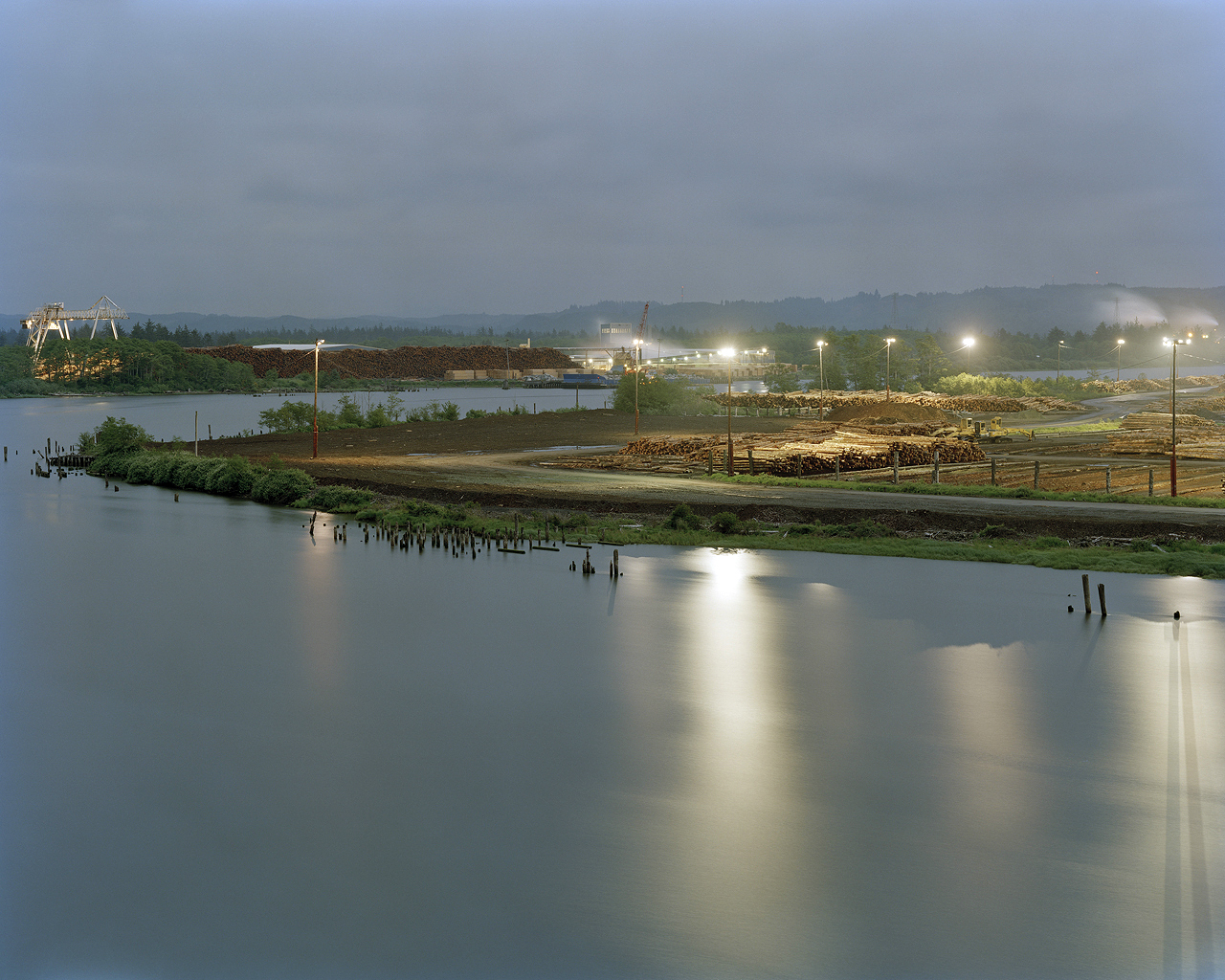
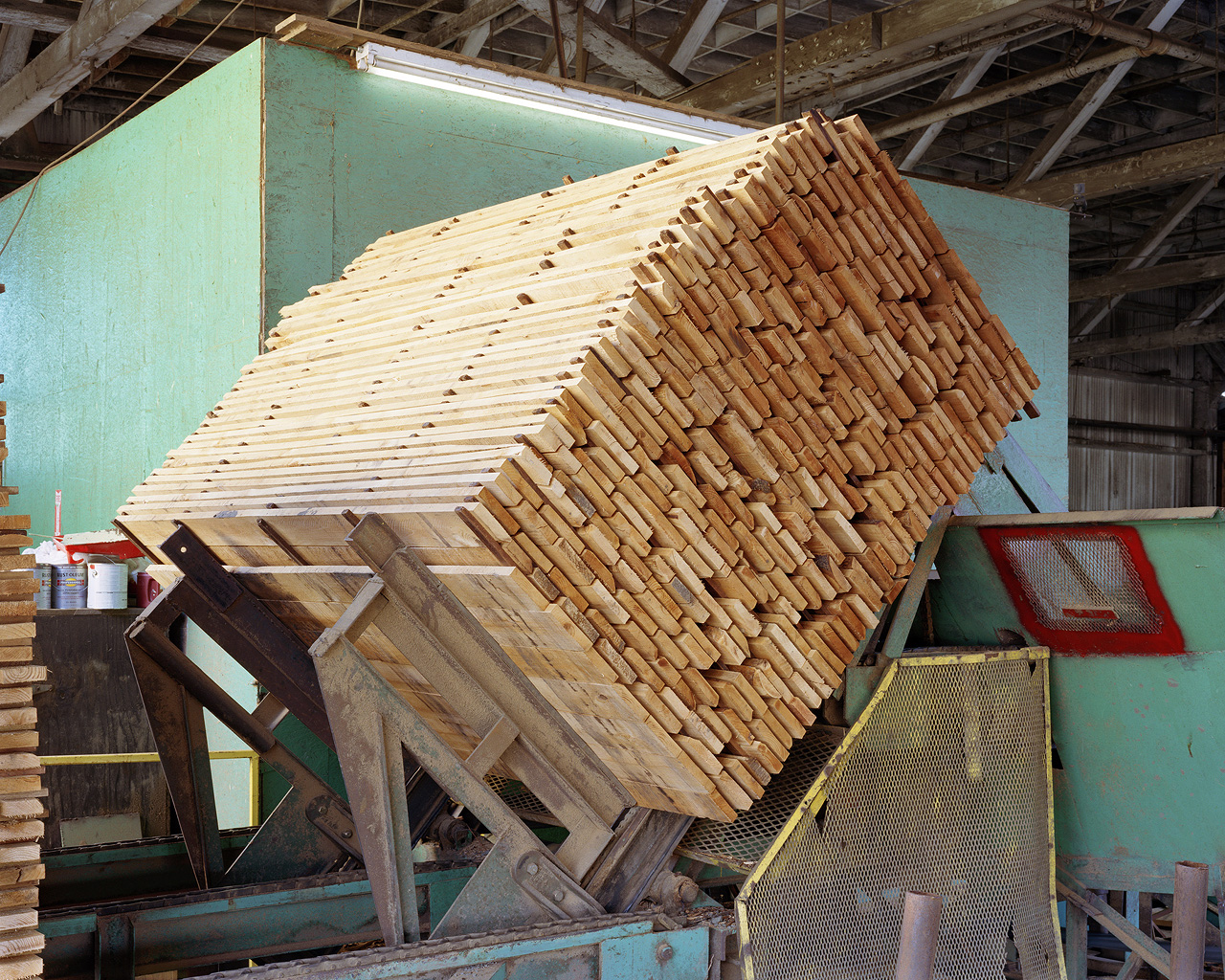
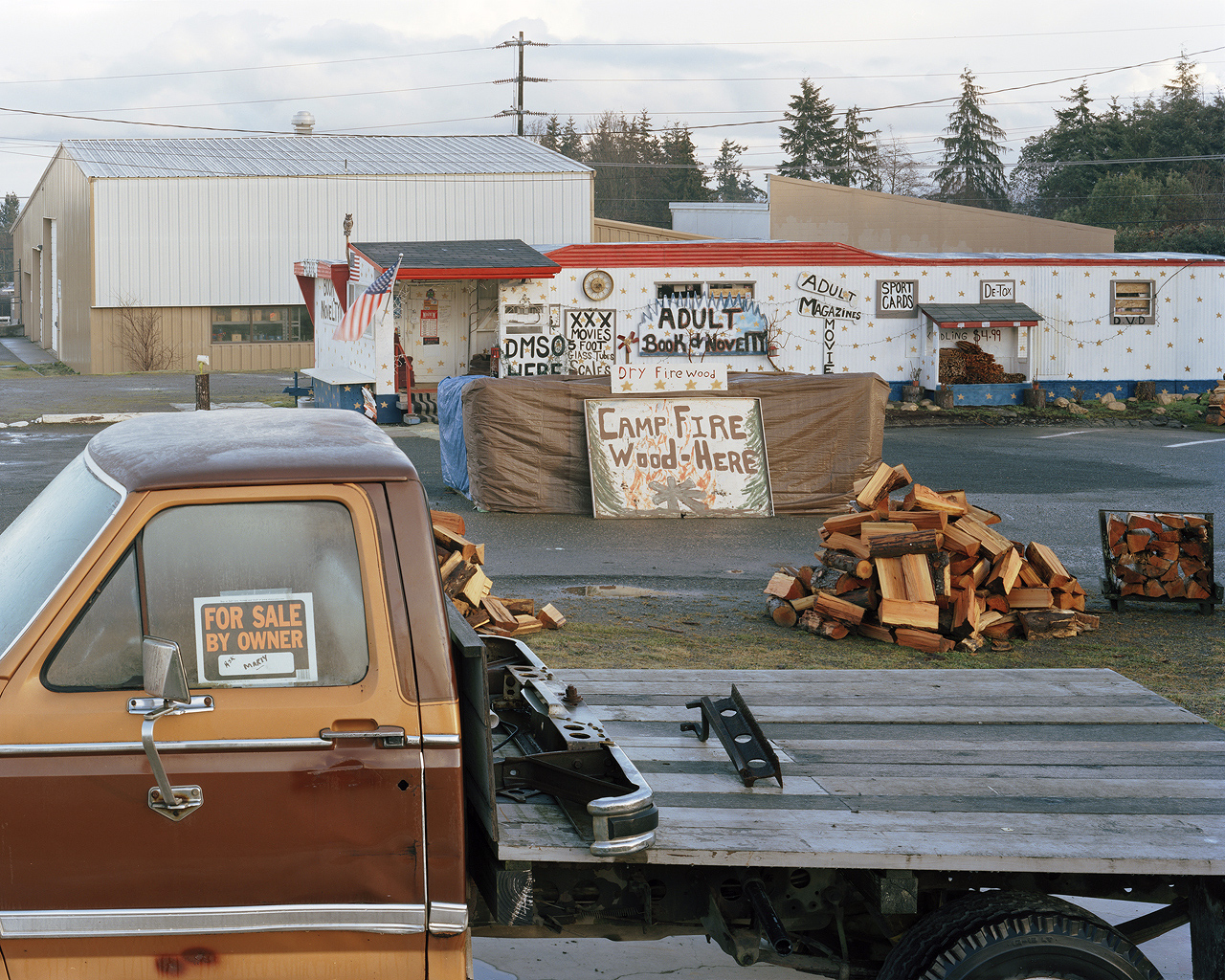

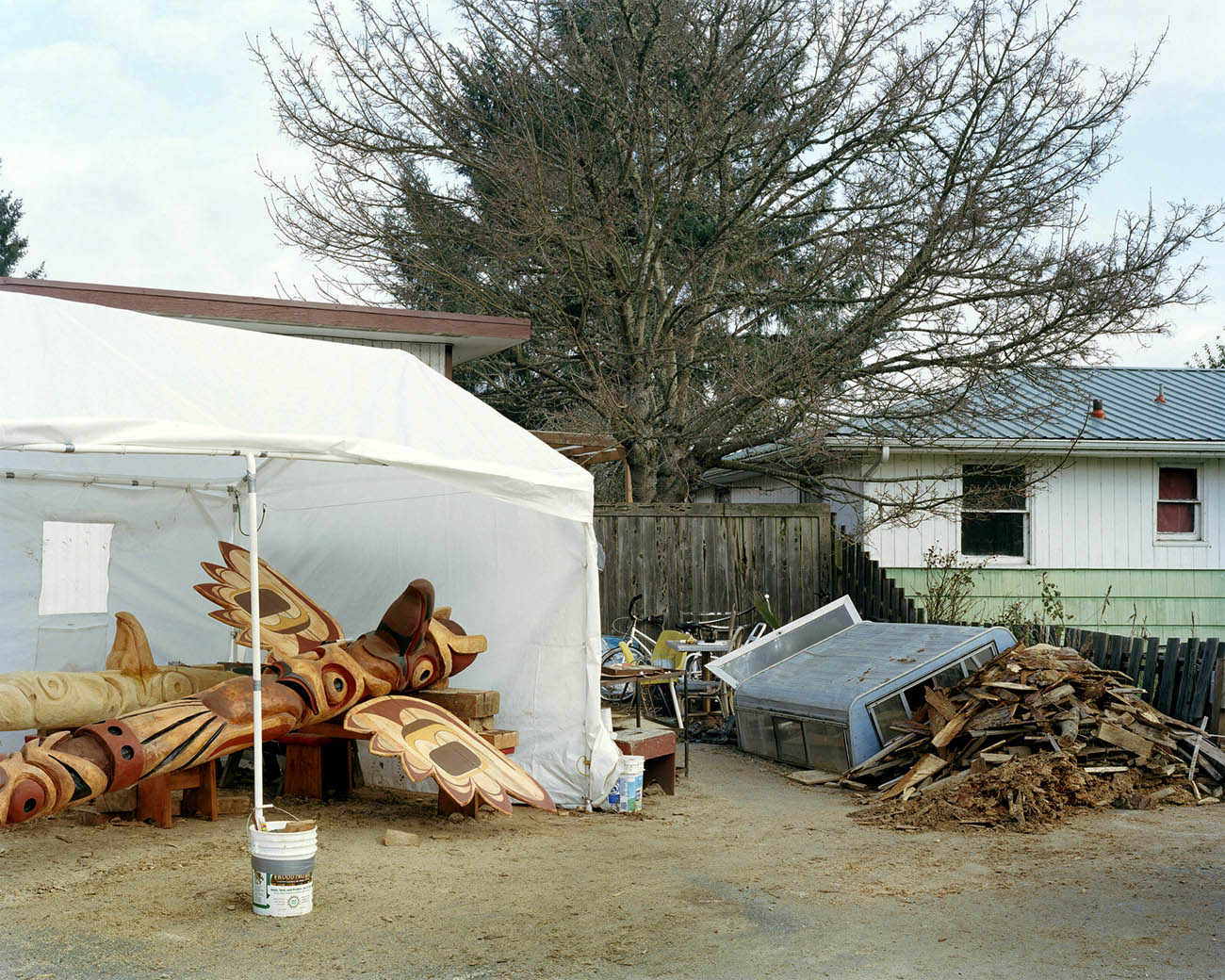
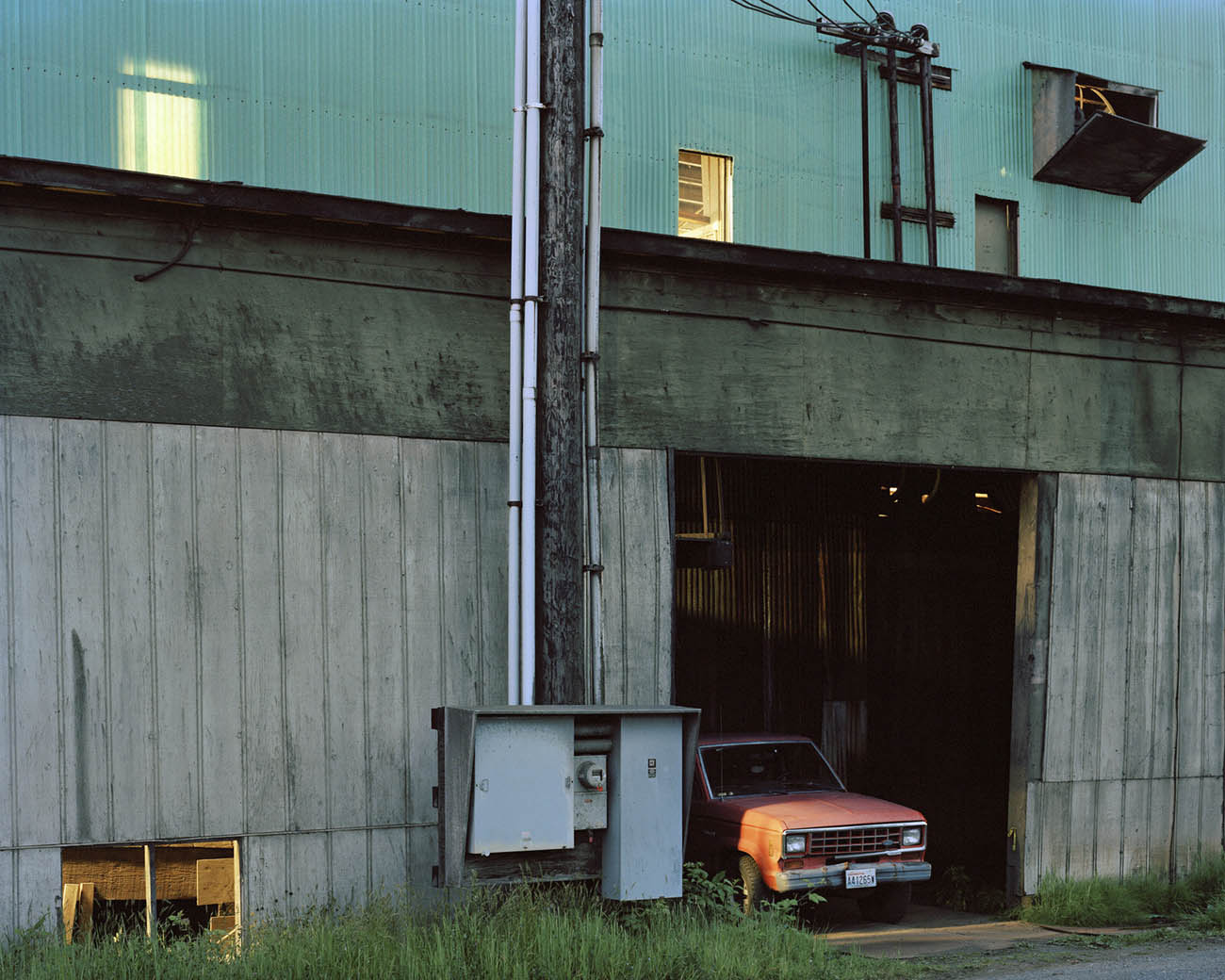


![Walker Evans (American, 1903-1975) '[Detail of Stencilled Lettering on Yellow Railroad Car: "DO NOT HUMP"]' September 16, 1974](https://artblart.com/wp-content/uploads/2009/06/evans-do-not-hump-web.jpg "Walker Evans (American, 1903-1975) '[Detail of Stencilled Lettering on Yellow Railroad Car: \"DO NOT HUMP\"]' September 16, 1974")


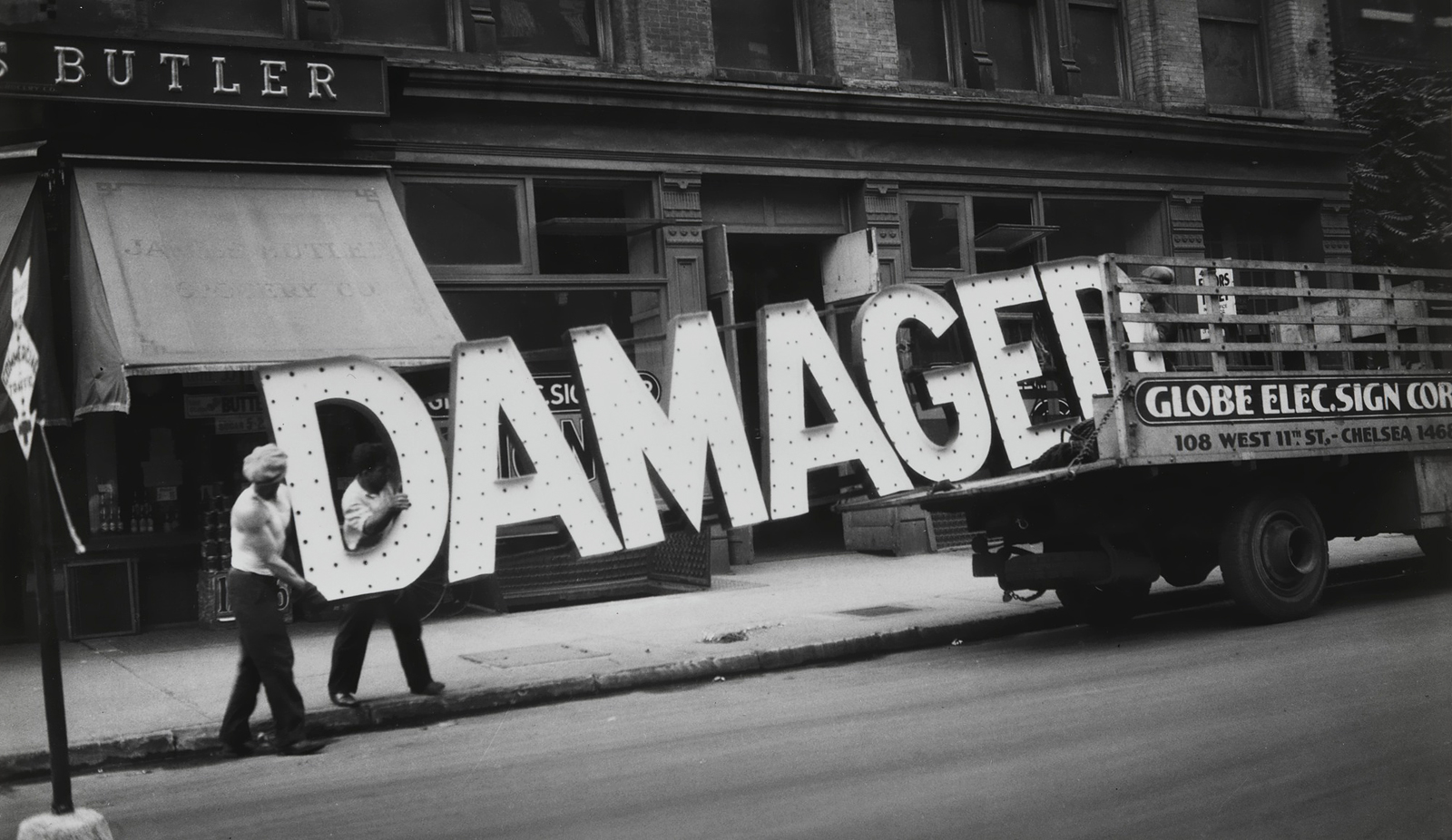

![Walker Evans (American, 1903-1975) '[Fireplace in Floyd Burrroughs's Bedroom with Bedpost in Foreground, Hale County, Alabama]' 1936](https://artblart.com/wp-content/uploads/2009/06/walker-evans-fireplace-web.jpg "Walker Evans (American, 1903-1975) '[Fireplace in Floyd Burrroughs's Bedroom with Bedpost in Foreground, Hale County, Alabama]' 1936")

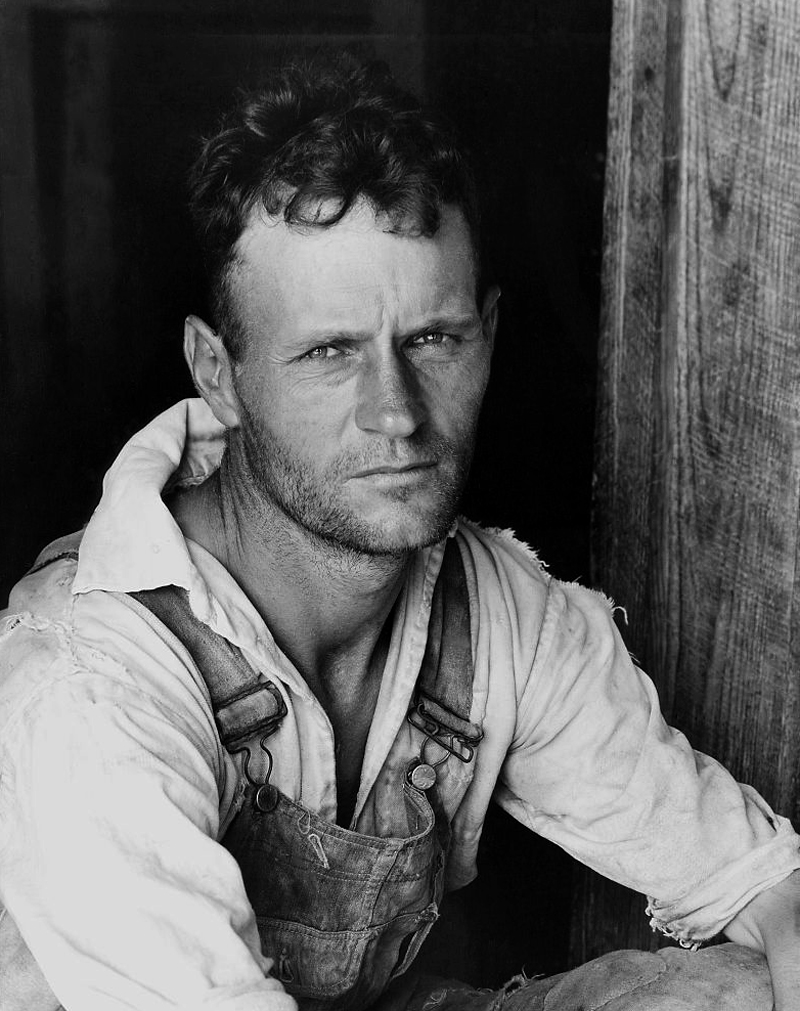
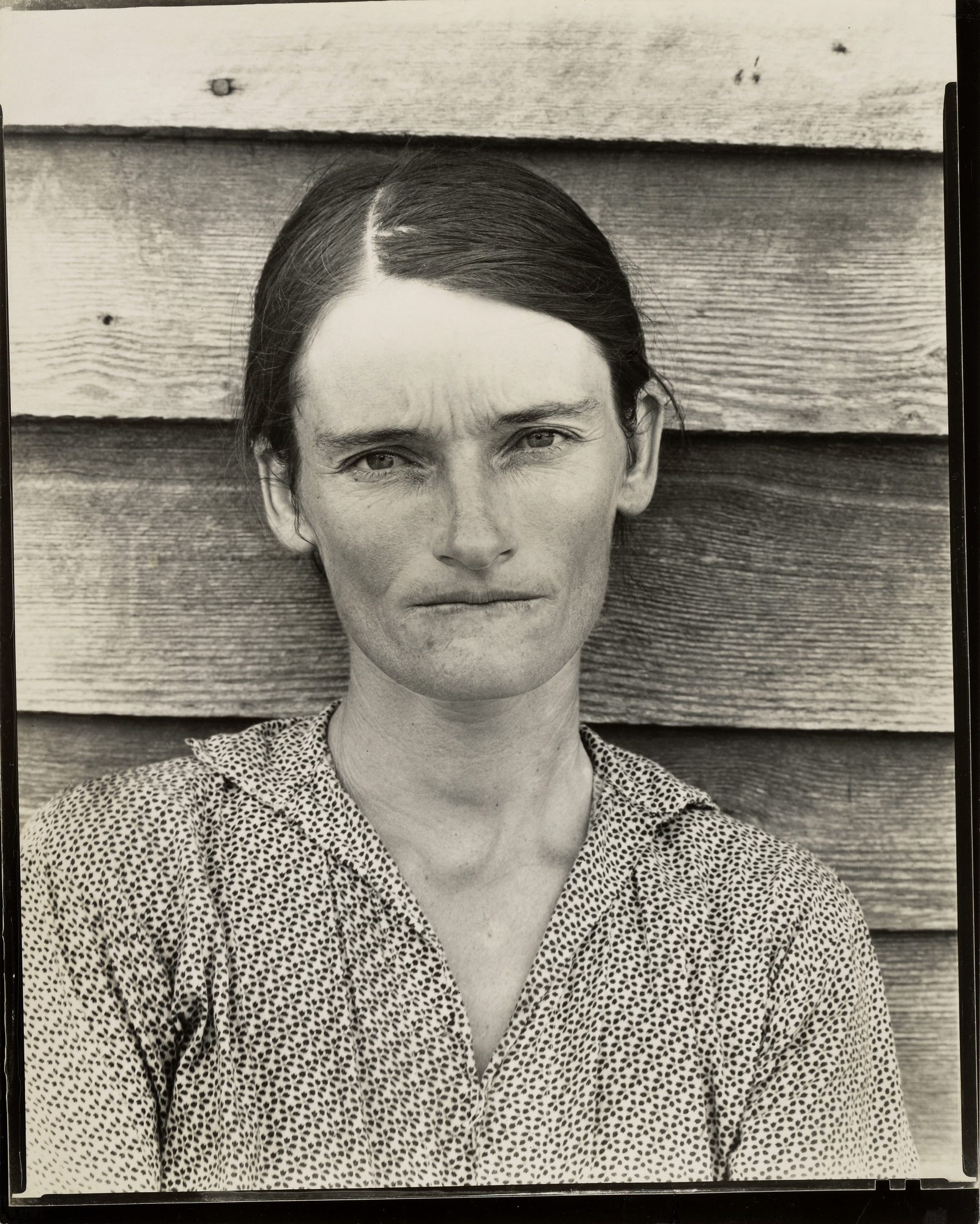

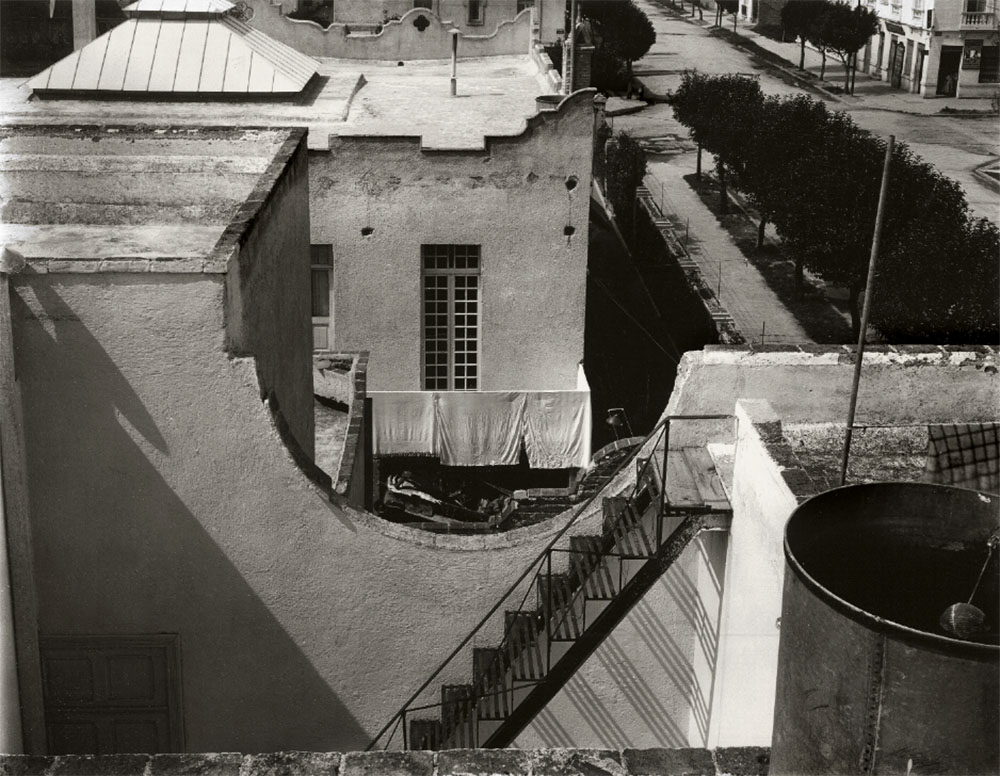


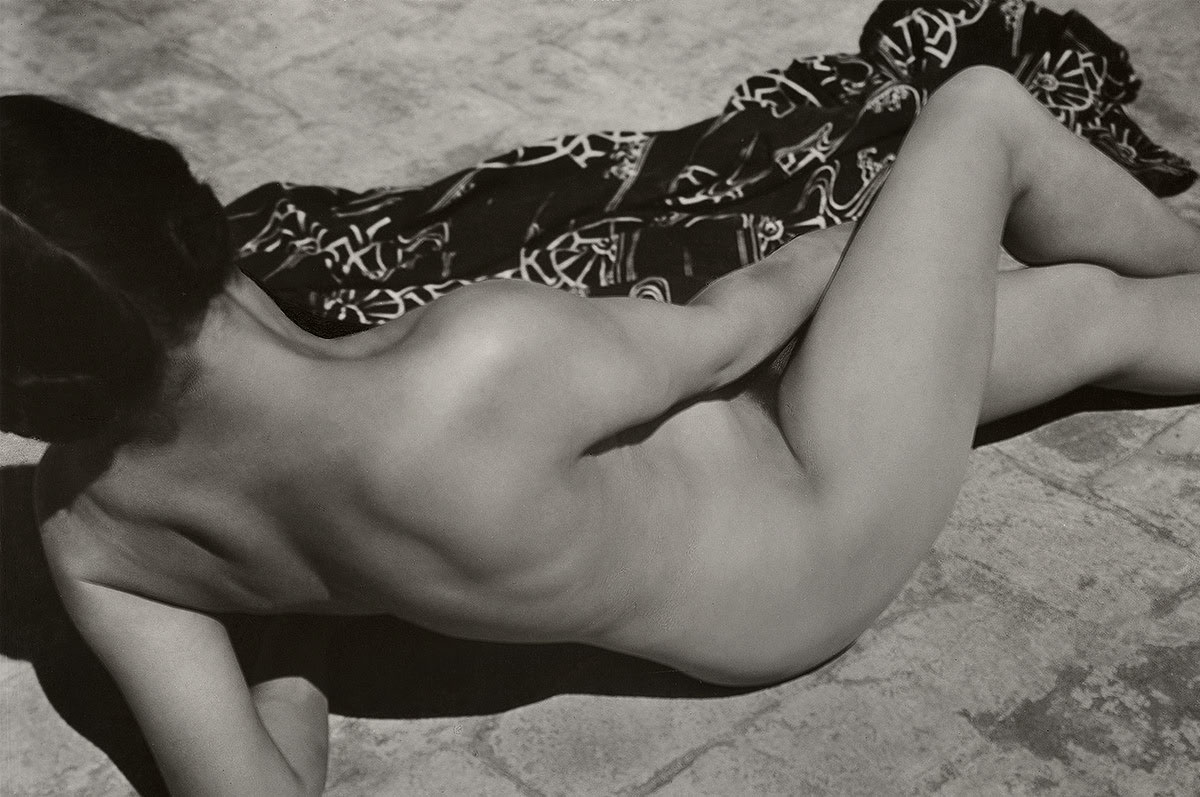


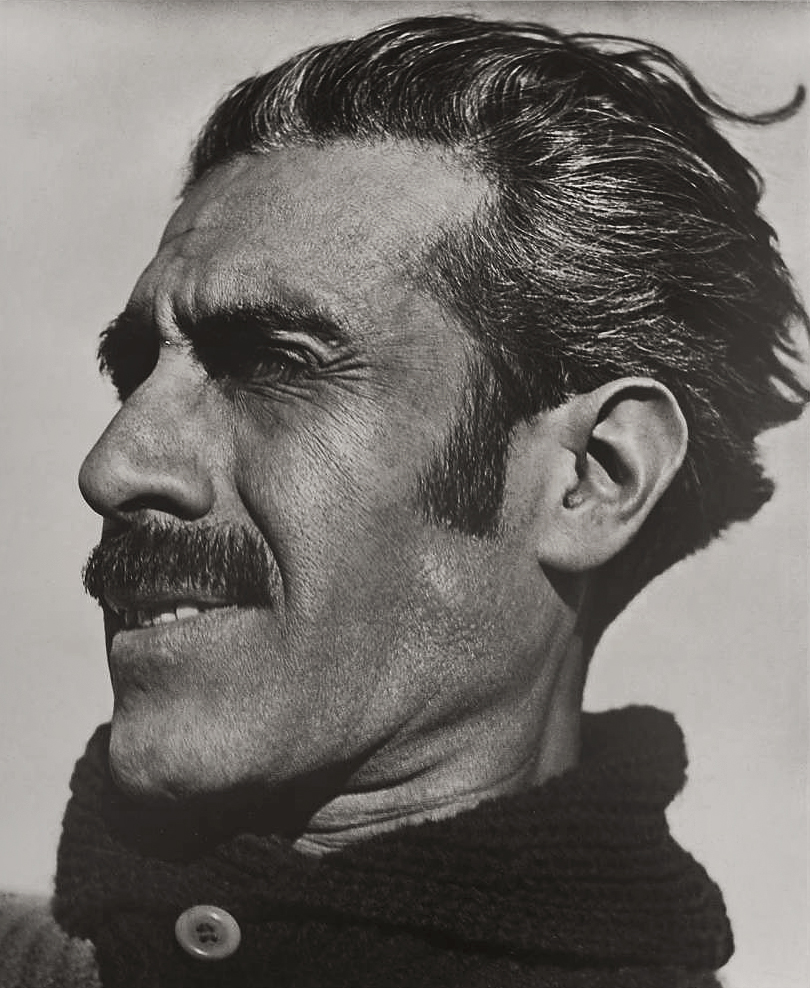


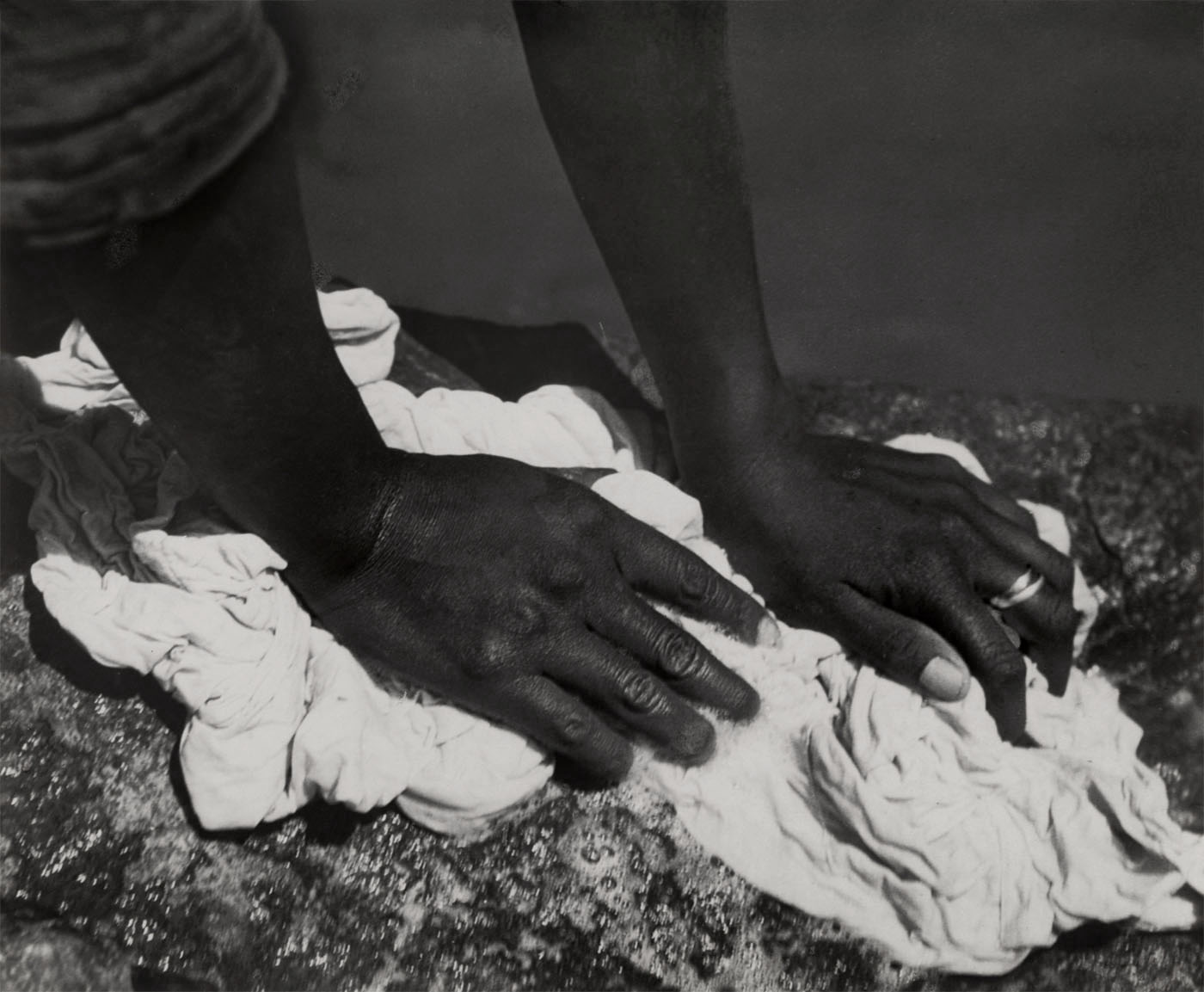
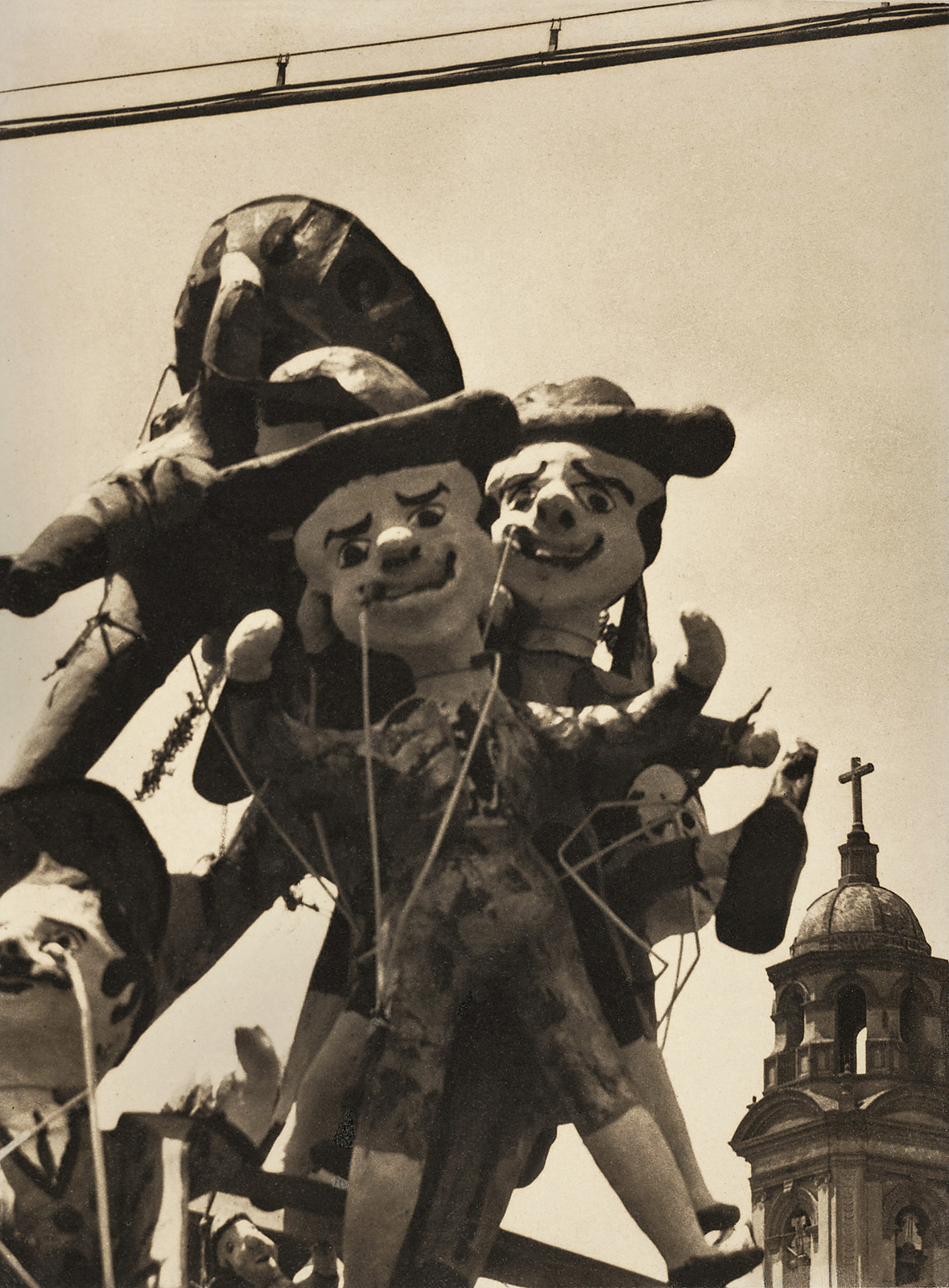


 Art Blart _ art and cultural memory archive
You must be logged in to post a comment.