Exhibition: ‘Andy Warhol and Photography: A Social Media’ at the Art Gallery of South Australia, Adelaide

Exhibition dates: 3rd March – 14th May 2023

Curator: Julie Robinson is Senior Curator, Prints, Drawings and Photographs at AGSA


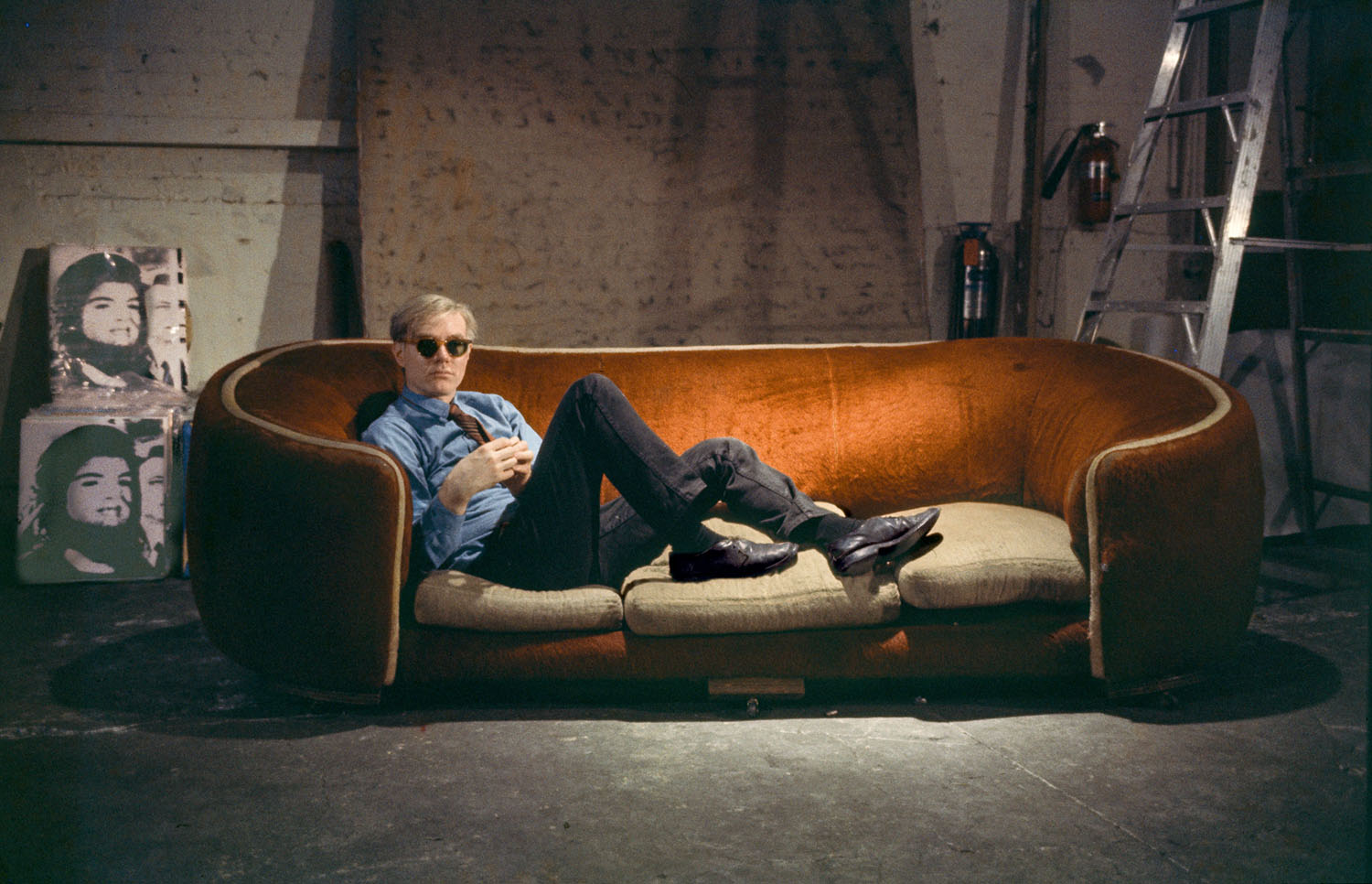
Bob Adelman (American, 1930-2016) 'Andy Warhol on the red couch at the Factory, New York' 1964 from the exhibition 'Andy Warhol and Photography: A Social Media' at the Art Gallery of South Australia, Adelaide, March - May, 2023


Bob Adelman (American, 1930-2016)
Andy Warhol on the red couch at the Factory, New York
1964
Pigment print
Courtesy of Bob Adelman Estate


LOOK – SOCIAL

CELEBRITY–POLAROID

SELF – PORTRAIT

STUDIO–STREET

SCREEN – PRINT

QUEER – INFLUENCE(R)

CAMP–POP

PHOTO–GRAPHIC – PRODUCTION

PICTURE–ART

the photograph is a vehicle for performance


“In the scopic field, the gaze is outside, I am looked at, that is to say, I am a picture …. The gaze is the instrument through which light is embodied and through which – if you will allow me to use a word, as I often do, in a fragmented form – I am photo-graphed.”

~ Lacan, The Four Fundamental Concepts, p. 106


Dr Marcus Bunyan


Many thankx to the Art Gallery of South Australia for allowing me to publish the photographs in the posting. Please click on the photographs for a larger version of the image.

SEE MORE INTERESTING AND ESSENTIAL PHOTOGRAPHS BY ANDY WARHOL:

1/ Andy Warhol unplugged 2 May 2015

2/ Andy Warhol unplugged December 2014

3/ ‘Andy Warhol: Polaroids / MATRIX 240’ at Berkeley Art Museum and Pacific Film Archive, University of California, January – May 2012


“A good picture is … of a famous person doing something unfamous. It’s about being in the right place at the wrong time.”


Andy Warhol


“Warhol was a famously detached person, and numerous accounts call attention to the verbal, psychological and technological barriers the artist created between himself and the world around him. Yet, here he describes technology as integrated into the social dynamic of the Factory. Photography became a vital tool in the formation and commemoration of this emerging countercultural community, and the photographs of Name, Berlin and other Factory denizens document everything from the making Warhol’s films and paintings to the Factory crowd at lunch at the local diner. Similar to the family reunion, the tourist vacation or a growing child, the Factory seems to realise itself through this kind of documentation. As the saying goes: pictures, or it didn’t happen.”


Catherine Zuromskis, Associate Professor, School of Photographic Arts and Sciences, College of Art and Design, at Rochester Institute of Technology, USA


“In subtitling the show, A Social Media, Robinson is emphasising the way Warhol surrounded himself with two kinds of people: those who were to be photographed, and those who were photographing him. In the first category there was room for the whole world. In the second, we find a succession of photographers of varying levels of professionalism. Early on there is Billy Name, who took over camera duties when Warhol became bored with the technical stuff. There was David McCabe, whom Warhol paid to follow and photograph him for a whole year in 1964-65. There were long-term friends and colleagues such as Brigid Berlin and Gerard Malanga; and finally, Makos, a constant companion in the latter part of Warhol’s career, who took those startling pictures of the artist made up as a glamorous blonde woman.


John McDonald. “Fame is power: Andy Warhol’s embarrassing pictures of the rich and famous,” on The Sydney Morning Herald website April 28, 2023 [Online] Cited 03/05/2023


Andy Warhol and Photography: A Social Media reveals an unseen side of celebrated Pop artist Andy Warhol through his career-long obsession with photography. Whether he was behind or in front of the camera, photography formed an essential part of his artistic practice while also capturing an insider’s view of his celebrity social world.

Exclusive to AGSA, this exhibition features photographs, experimental films and paintings by Warhol, including his famed Pop Art portraits of Marilyn Monroe and Elvis Presley from the 1960s. It also contains works by his photographic collaborators and creative contemporaries such as Christopher Makos, Gerard Malanga, Robert Mapplethorpe, David McCabe, and Duane Michals.

Decades before social media, Warhol’s photography was candid, collaborative and social, attuned to the power of the image to shape his public persona and self-identity. Many of his photographs from the 1970s and 1980s offer behind-the-scenes glimpses into his own life and the lives of friends and celebrities such as Muhammad Ali, Bob Dylan, Debbie Harry, Mick Jagger, John Lennon, Liza Minnelli, Lou Reed and Elizabeth Taylor. This exhibition asks the question, was Warhol the original influencer?

Text from the AGSA website

Christopher Makos on Andy Warhol

Henry Gillespie on Andy Warhol


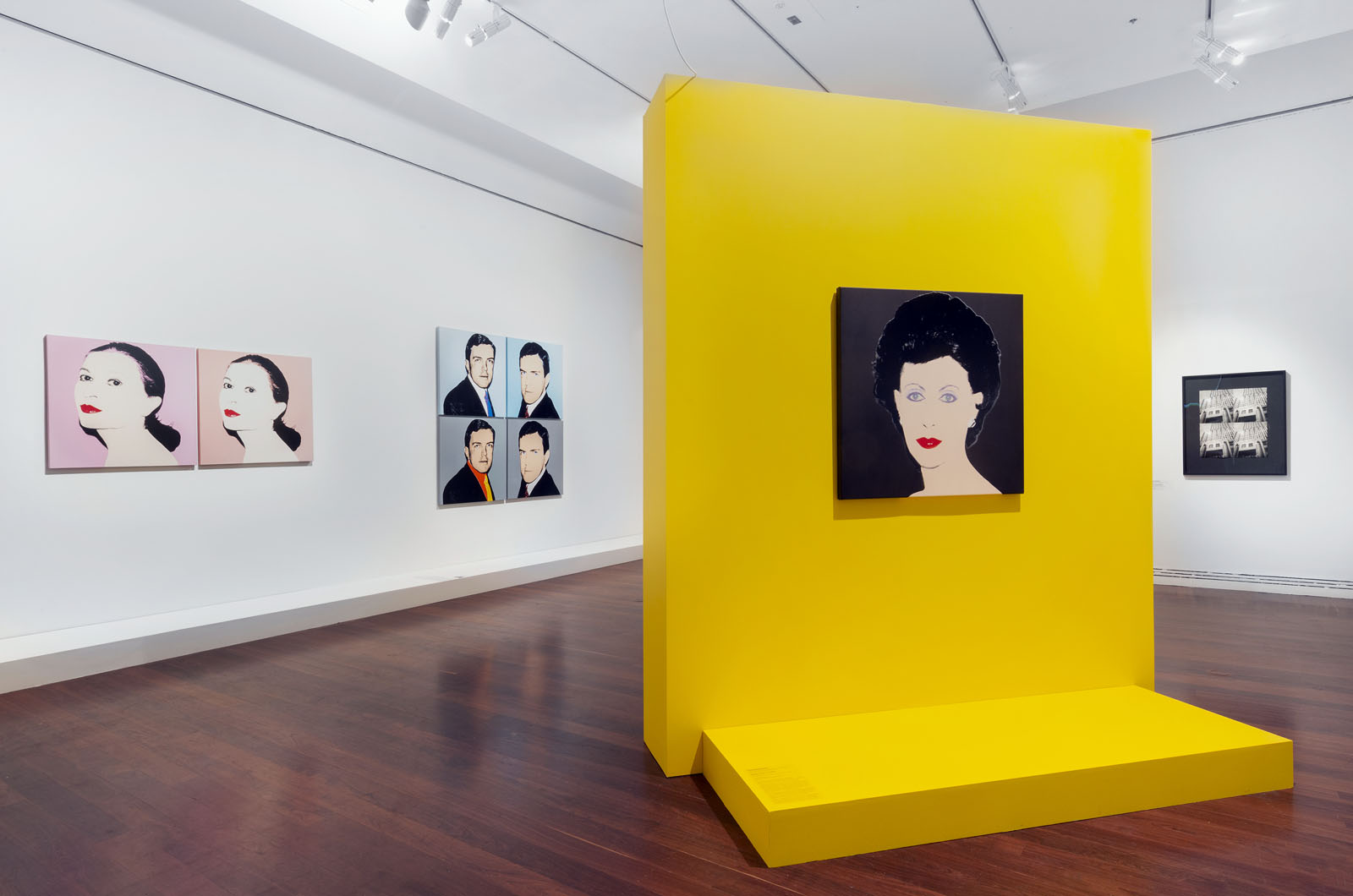
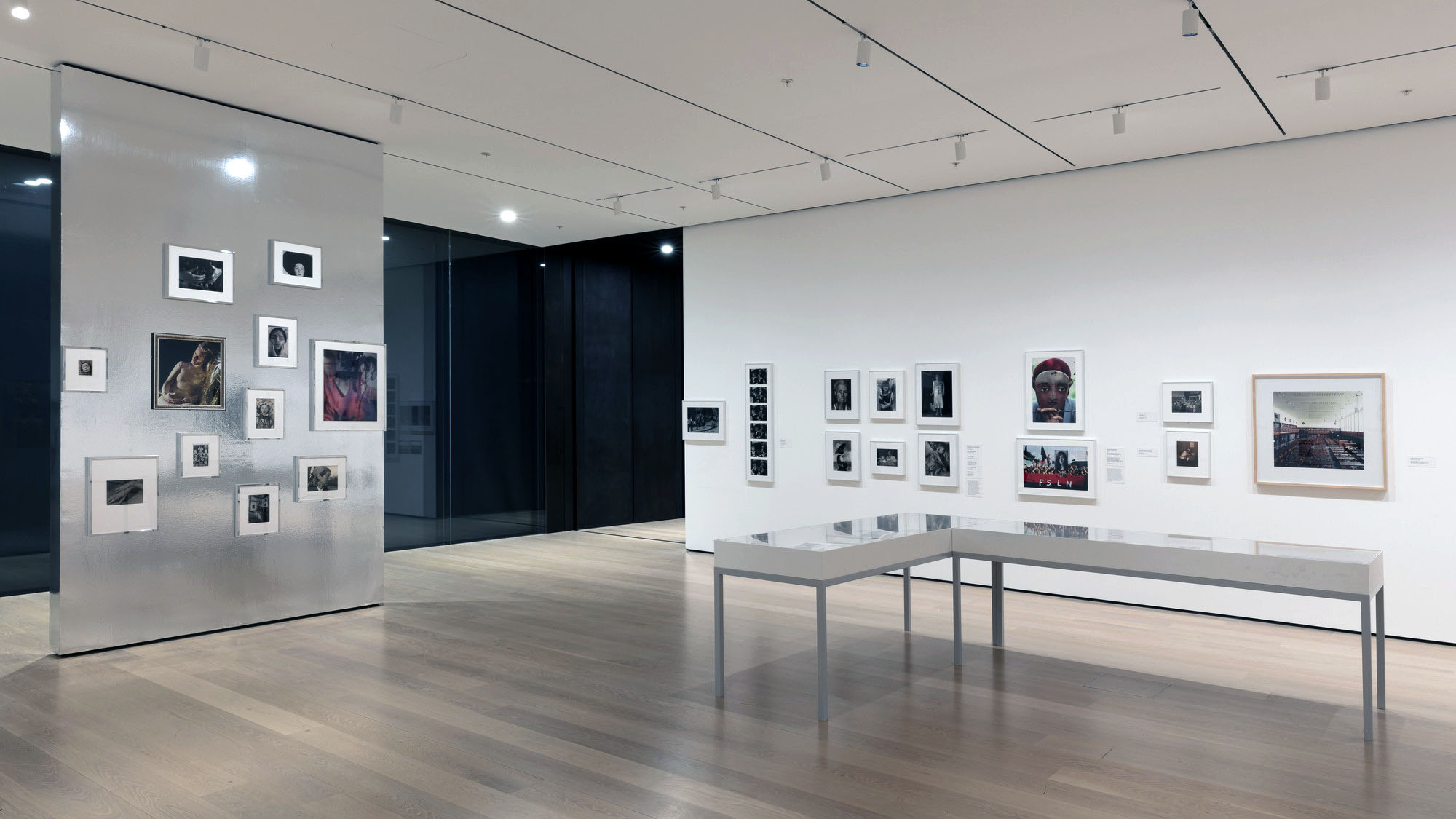
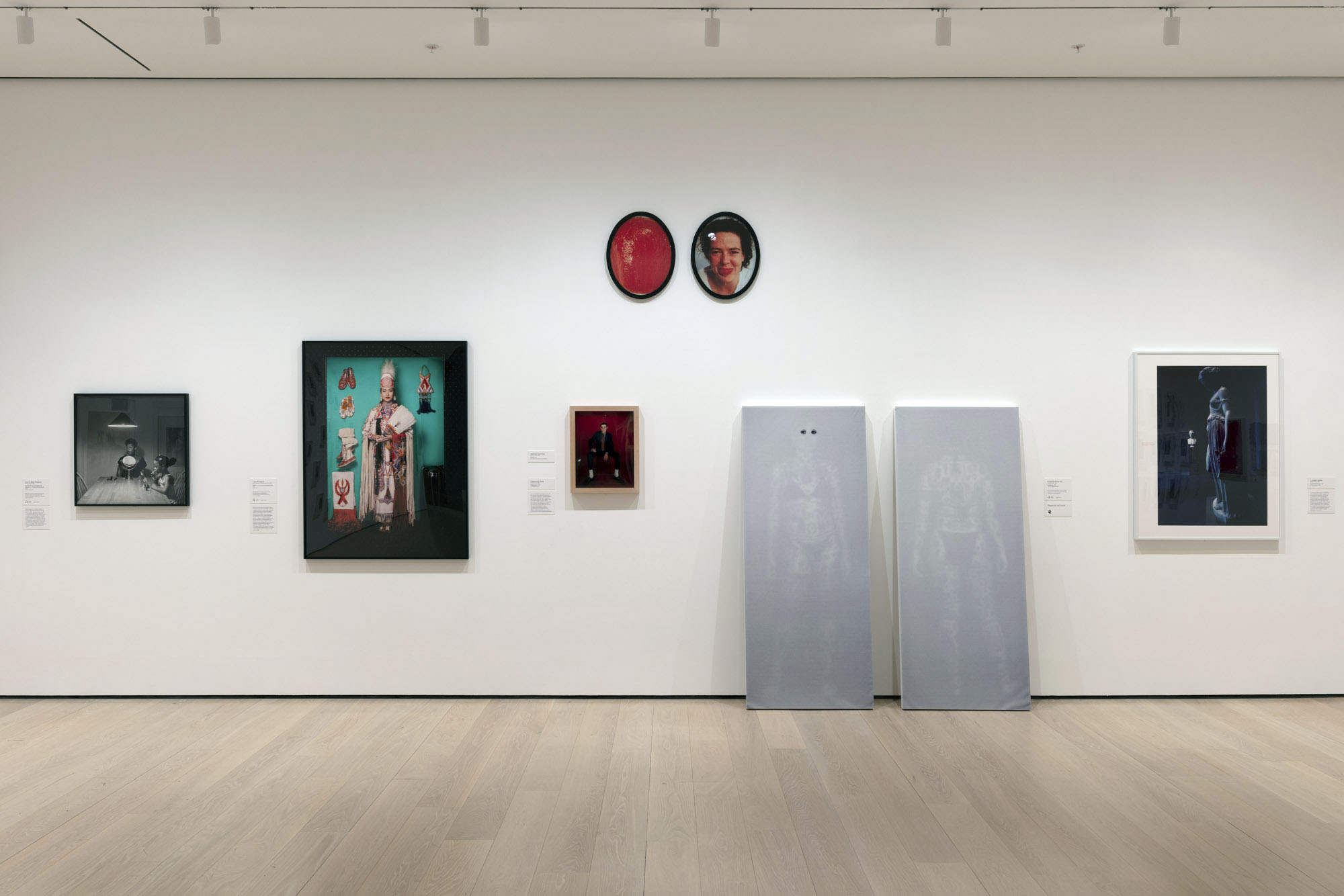
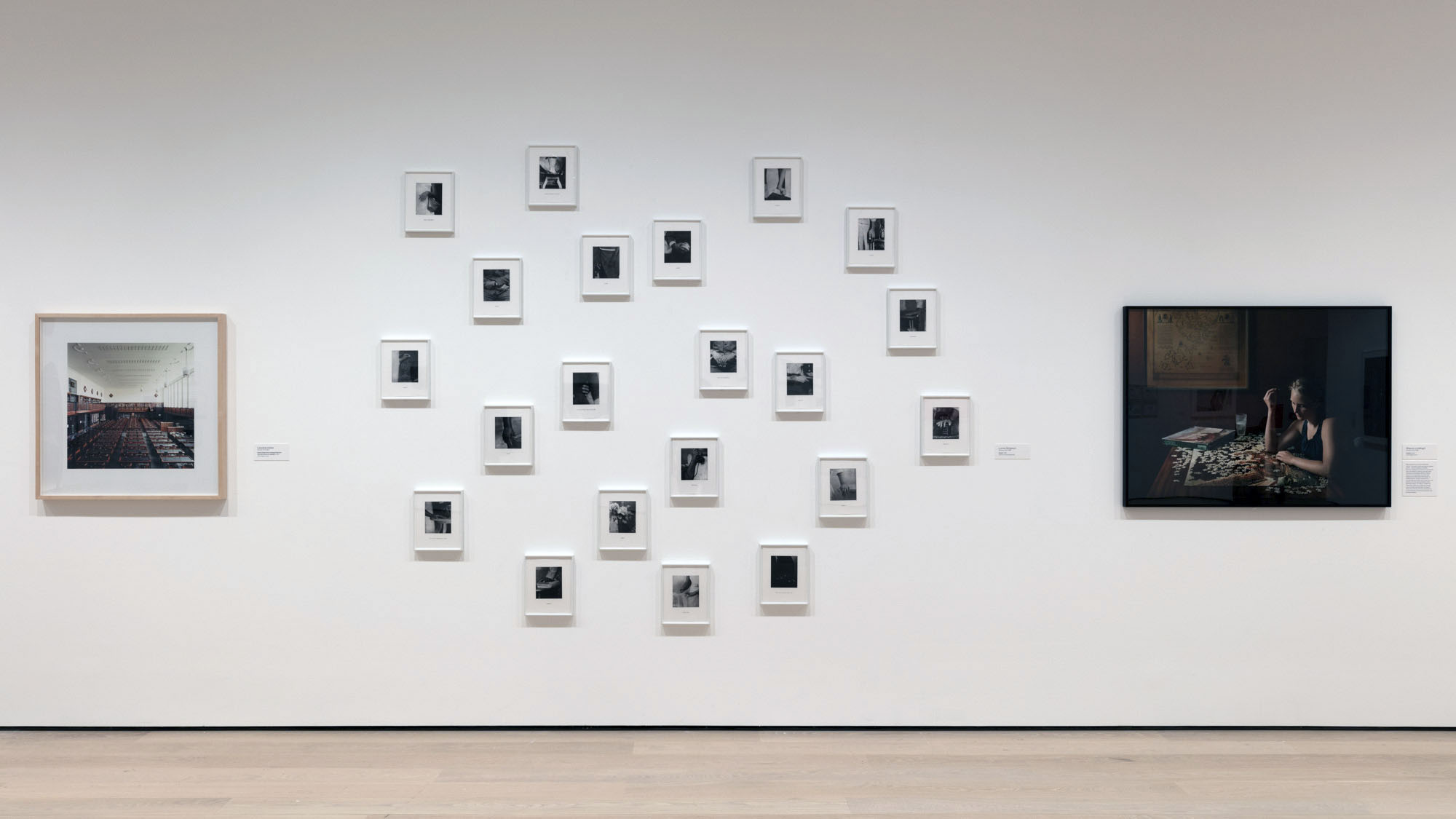
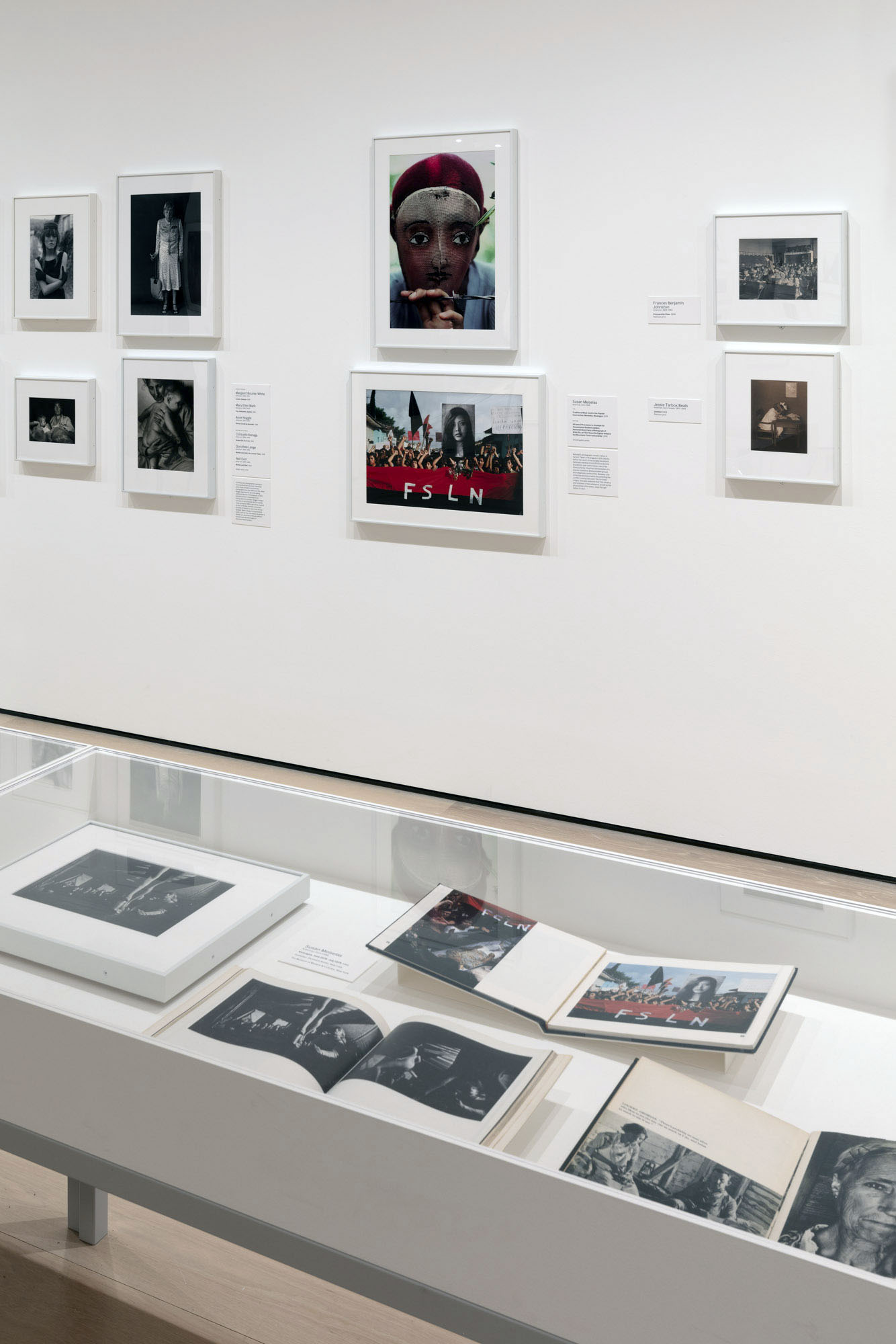
Installation view of the exhibition 'Andy Warhol and Photography: A Social Media' at the Art Gallery of South Australia, Adelaide

Installation view of the exhibition 'Andy Warhol and Photography: A Social Media' at the Art Gallery of South Australia, Adelaide

Installation view of the exhibition 'Andy Warhol and Photography: A Social Media' at the Art Gallery of South Australia, Adelaide

Installation view of the exhibition 'Andy Warhol and Photography: A Social Media' at the Art Gallery of South Australia, Adelaide

Installation view of the exhibition 'Andy Warhol and Photography: A Social Media' at the Art Gallery of South Australia, Adelaide

Installation view of the exhibition 'Andy Warhol and Photography: A Social Media' at the Art Gallery of South Australia, Adelaide

Installation view of the exhibition 'Andy Warhol and Photography: A Social Media' at the Art Gallery of South Australia, Adelaide

Installation view of the exhibition 'Andy Warhol and Photography: A Social Media' at the Art Gallery of South Australia, Adelaide

Installation view of the exhibition 'Andy Warhol and Photography: A Social Media' at the Art Gallery of South Australia, Adelaide

Installation view of the exhibition 'Andy Warhol and Photography: A Social Media' at the Art Gallery of South Australia, Adelaide


Installation views of the exhibition Andy Warhol and Photography: A Social Media at the Art Gallery of South Australia, Adelaide
Photos: Saul Steed


“My idea of a good photograph is one that’s in focus and of a famous person doing something unfamous. It’s being in the right place at the wrong time.”

~ Andy Warhol


The first exhibition in Australia to explore Andy Warhol’s career-long obsession with photography opens at the Art Gallery of South Australia on 3 March 2023, as part of the 2023 Adelaide Festival. Exclusive to Adelaide, Andy Warhol and Photography: A Social Media will reveal an unseen side of the celebrated Pop artist through more than 250 works, spanning photographs, experimental films, screenprints and paintings, many on display in Australia for the first time.

Warhol’s close friend and collaborator, Christopher Makos, will travel from New York City to join Andy Warhol and Photography curator Julie Robinson in conversation as part of the exhibition’s opening weekend program. Speaking about his decade-long friendship with Warhol and his own career as a photographer, Makos will reminisce about his time as part of Warhol’s inner circle, socialising with celebrities at Studio 54 and Warhol’s studio, always with a camera by his side.

Decades before social media, Warhol’s photography was candid, collaborative and social, attuned to the power of the image to shape his public persona and self-identity. Andy Warhol and Photography offers a fresh perspective on the influential artist, as well as behind-the-scenes glimpses into his own life and the lives of friends and celebrities, including Muhammad Ali, Bob Dylan, Debbie Harry, Mick Jagger, John Lennon, Liza Minnelli, Lou Reed and Elizabeth Taylor.

Headlining the 2023 Adelaide Festival’s visual arts program, Andy Warhol and Photography: A Social Media is curated by AGSA’s Senior Curator of Prints, Drawings & Photographs, bringing together works from national and international collections, as well as AGSA’s own extensive collection of 45 Warhol photographs which will be shown together for the first time.

AGSA Director, Rhana Devenport ONZM says, ‘Some 35 years after his death, this exhibition attests to Andy Warhol’s enduring relevance as an artist and cultural figure in an era defined by social media. With cross-generational appeal, this is an exhibition of our times which begs the question, was Warhol the original influencer?’

Revealing Warhol from both in front of and behind the camera, the exhibition will also feature works by his photographic collaborators and creative contemporaries such as Brigid Berlin, Nat Finkelstein, Christopher Makos, Gerard Malanga, Robert Mapplethorpe, Duane Michals and Billy Name. Andy Warhol and Photography will also include iconic Warhol paintings never-before-seen in Adelaide, including his famed Pop Art portraits of Marilyn Monroe and Elvis Presley from the 1960s, demonstrating how Warhol translated many of his photographs into paintings and screenprints.

Exhibition curator, Julie Robinson says, ‘Photography underpinned Warhol’s whole artistic practice – both as an essential part of his working method and as an end in its own right. He took some 60,000 photographs in his lifetime. His candid images, which capture his own life as well as the lives of his celebrity friends, offer audiences a revealing insight into Warhol the person, taking viewers beneath the veneer of his Pop paintings and persona.’

Adelaide Festival Artistic Director, Ruth Mackenzie CBE, said, ‘It is thrilling to be working with AGSA to explore Andy Warhol’s ground-breaking work which speaks so immediately to everybody. Today more than ever, with the popularity of social media, Warhol’s idea of 15 minutes of fame is incredibly relatable and this exhibition will be a must-see during the festival season next year.’

Press release from the AGSA


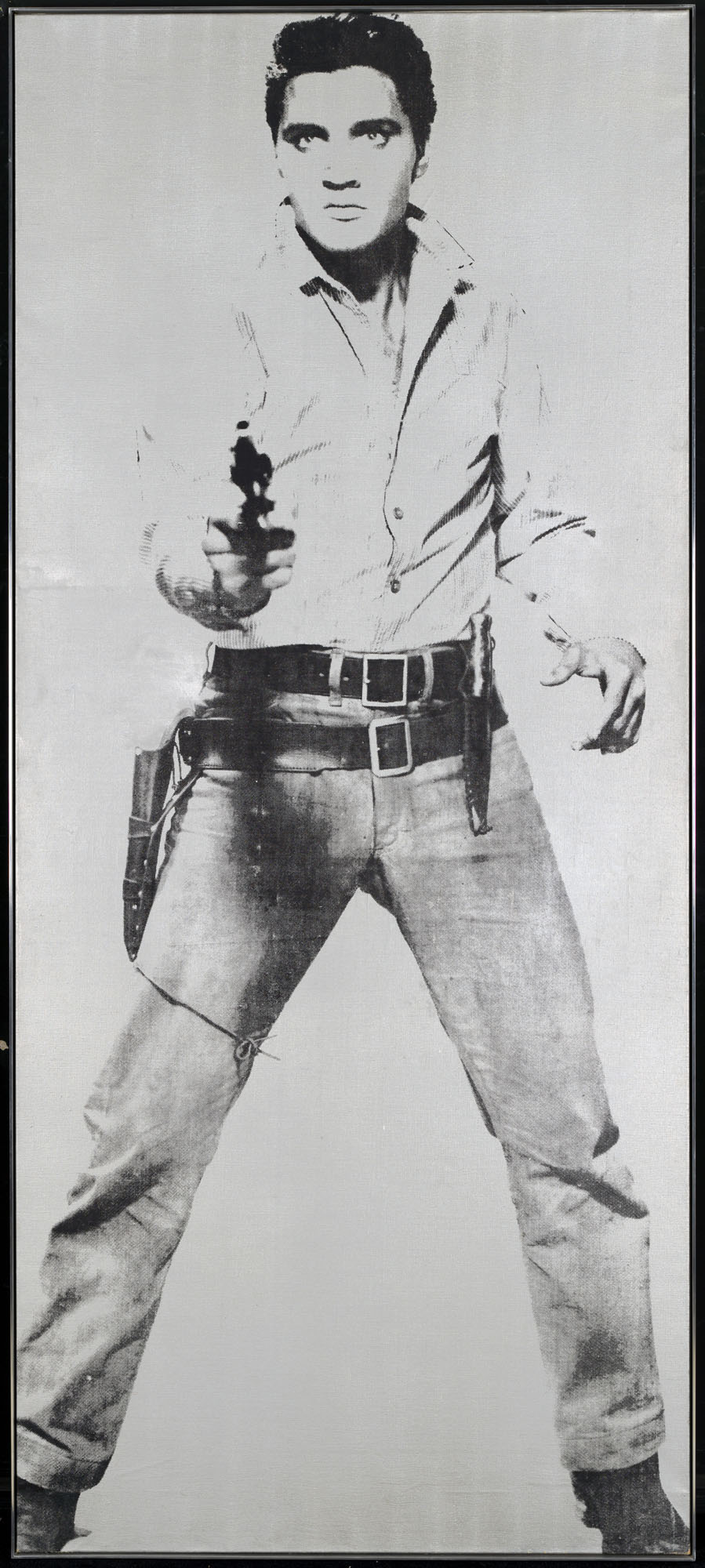
Andy Warhol (American, 1928-1987) 'Elvis' 1963 from the exhibition 'Andy Warhol and Photography: A Social Media' at the Art Gallery of South Australia, Adelaide, March - May, 2023


Andy Warhol (American, 1928-1987)
Elvis
1963
Synthetic polymer paint and screenprint on canvas
208.0 x 91.0cm
National Gallery of Australia, Canberra
Purchased 1973
© Andy Warhol Foundation for the Visual Arts, Inc. ARS/Copyright Agency


The cultural theorist José Esteban Muñoz gave a name to the process by which those outside a social, racial, or sexual mainstream negotiate majority culture, not by aligning themselves with or against exclusionary representations (staying in their own lane, so to speak), but by transforming mainstream representations for their own purposes. They might do this by identifying with models of aspiration or experience denied to them. Muñoz called this ‘disidentification’; to ‘disidentify’ was ‘to read oneself and one’s own life narrative in a moment, object, or subject’ with which one was ‘not culturally coded to “connect”‘.[7] LGBTQI people have long understood this kind of identification intuitively. (This is not quite the same as drag, though there is similar energy in drag-ball performances of categories like ‘Executive Realness’, for example.[8]) Disidentifying means identifying in spite of, or at an angle to, the model prescribed for you by a dominant culture; it involves the scrambling and reconstructing of coded meanings of cultural objects to expose the encoded message’s universalising – and therefore exclusionary – machinations, recircuiting its workings to include and empower minority identifications.[9]

We see something like this in the early works by Warhol that draw on found photography. Elvis, 1963, [fig1, above] for instance, uses a publicity still from the iconic singer’s role in the Western Flaming Star (1960) as the basis for an image that references the sex idol star’s performative embodiment of a particular mythic trope of US masculinity – the frontiersman caught on the edge of a moral dilemma. The ‘outlaw sensibility’ associated with such a model, Elisa Glick argues, came to signify in gay male culture in a version of what Muñoz would call disidentification.[10] Other examples might include Montgomery Clift in Red River, or James Dean in Rebel Without a Cause (not a Western, but with similar energies).[11] Apparently straight figures, apparently the embodiment of the spirit of liberty, promise and rebellion, a heady (and sometimes internally contradictory) mix in popular US culture, they are also objects of coded identification at an angle (of disidentification) for queer subjects, black subjects (etcetera).

Elvis is emblematic of Warhol’s interest in performance and replication, in other words, but also, viewed as an act of disidentification, deeply transgressive. Most of the celebrities the artist would go on to image in similar serial form would be female, often women who had suffered some kind of trauma. These are disidentificatory subjects too, but they are also perhaps more cautious models for a queer artist (especially one whose sensibilities were formed before the Stonewall Rising), whether models of resilience or of sacrifice, in a hostile, straight-male-dominated world. Or, as Jonathan Katz argues, activating the suggestiveness of Warhol’s most iconic represented commodity, they constitute ‘camp bells’ (perhaps also belles) in Warhol’s oeuvre.[12] They announce something, chiming with popular press adoration of the beautiful, but they do not sound the alarm bells that might have rung had Warhol focused (only) on beautiful men. Perhaps there was something too obviously queer in Elvis more easily hidden in plain sight in representations of women.

Extract from Andrew van der Vlies. “Andy Warhol’s Queer Practice: Disidentification and Utopian Desire,” on the Art Gallery of South Australia website Nd [Online] Cited 03/05/2023


[7] José Esteban Muñoz, Disidentifications, University of Minnesota Press, Minneapolis, 1999, p. 12.
[8] One might recall the memorable Harlem Ballroom scenes in Jennie Livingston’s film Paris is Burning (1990).
[9] See Muñoz, Disidentifications, p. 31.
[10] Elisa Glick, Materializing queer desire: Oscar Wilde to Andy Warhol, State University of New York Press, Albany, NY, 2009, 145.
[11] Of course, modern audiences for those films might now know more about both stars’ sexuality, but the point is that they performed a certain kind of sensibility that (closeted) gay men in the 1950s and 1960s did not feel was available to them, or which they performed as cover.
[12] Jonathan D. Katz, ‘From Warhol to Mapplethorpe: postmodernity in two acts’, in Patricia Hickson (ed.), Warhol & Mapplethorpe: guise & dolls, Yale Univ. Press, New Haven, CT, and London, 2015. The allusion is to Campbell’s soup cans, the subject of one of Warhol’s most famous early works. Katz notes the ‘repeated evocation[s] of a historically specific mode of queer political redress spoken in and through the names of iconic female stars’ (p. 22).


Bob Adelman (American, 1930-2016) 'Andy Warhol in Gristedes Supermarket, New York City' 1965 from the exhibition 'Andy Warhol and Photography: A Social Media' at the Art Gallery of South Australia, Adelaide, March - May, 2023


Bob Adelman (American, 1930-2016)
Andy Warhol in Gristedes Supermarket, New York City
1965
Pigment print
Courtesy of Bob Adelman Estate


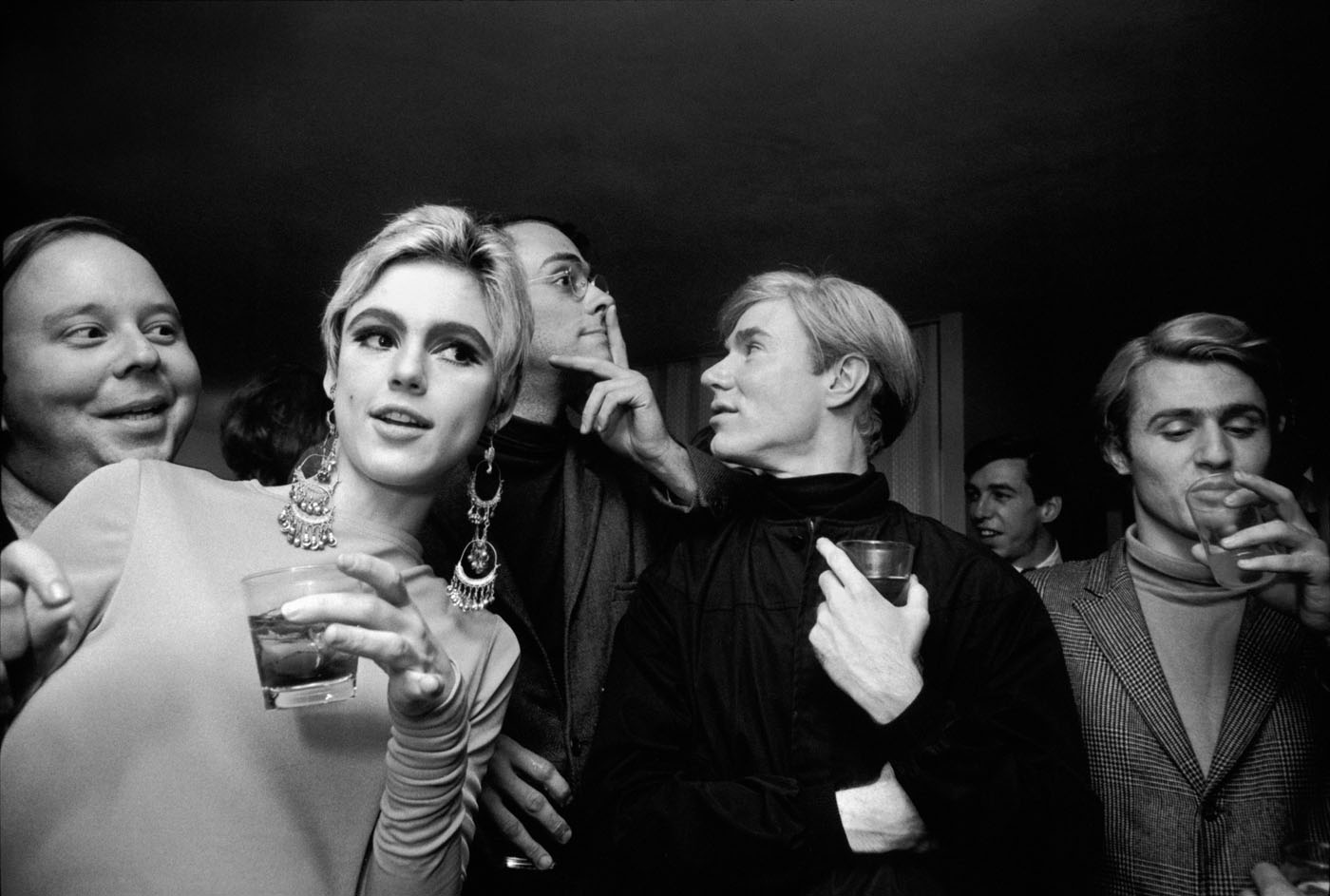
Steve Schapiro (American, 1934-2022) 'Edie Sedgwick, Andy Warhol, and others at a party' 1965


Steve Schapiro (American, 1934-2022)
Edie Sedgwick, Andy Warhol, and others at a party
1965
Gelatin silver photograph
31.5 x 47.1cm (image)
40.0 x 49.9cm (sheet)
Courtesy of Fahey/Klein Gallery
© estate of Steve Schapiro


Nat Finkelstein (American, 1993-2009) 'Silver Clouds installation, Leo Castelli Gallery' 1966


Nat Finkelstein (American, 1993-2009)
Silver Clouds installation, Leo Castelli Gallery
1966
Pigment print
Private collection
© Nat Finkelstein Estate


Andy Warhol (American, 1928-1987) 'Cream of mushroom soup' 1968


Andy Warhol (American, 1928-1987)
Cream of mushroom soup
1968
Colour screenprint on paper
81.0 x 47.5cm (image)
88.8 x 58.5cm (sheet)
South Australian Government Grant 1977
Art Gallery of South Australia, Adelaide
© Andy Warhol Foundation for the Visual Arts, Inc. ARS/Copyright Agency


Curator’s Insight – Andy Warhol and Photography: A Social Media

Julie Robinson

Exclusive to Adelaide, Andy Warhol & Photography: A Social Media is the first Australian exhibition to survey Warhol’s career-long obsession with photography. As the title suggests, the exhibition explores the social aspects of Warhol’s photography, including the collaborative nature of his photographic practice, the role photography had in his social interactions with others, and the candid social media ‘look’ of his images, which were taken decades before today’s obsession with social media.

These concepts apply to the two strands of Warhol’s photographic practice that are brought together in this exhibition – photography as an essential part of his working method and photography as an end in its own right.

From the beginning of Warhol’s career, photographs became important source material and were used by the artist as the basis of his paintings and screenprints. Included were existing photographs from magazines, advertisements, publicity portraits of movie stars, and photographs taken by his friends. Warhol’s painting of Elvis Presley, for instance, is based on a publicity still from the movie Flaming Star (1960); while photographs by Edward Wallowitch, Warhol’s boyfriend at the time, formed the basis of Warhol’s printed imagery in A Gold Book, 1957.

During the 1970s and 1980s, when commissioned portraits became a significant part of his artistic practice, Warhol based these portraits on Polaroid snapshots taken by him during photo shoots in his studio. The instantaneous nature of Polaroid photography allowed Warhol and the sitter to immediately select a favoured image to be transformed into a painting. Warhol’s studio photo shoots were often a social and collaborative affair, with studio assistants and others photographing alongside Warhol, while studio guests watched on. Film and video footage provides rare behind-the-scenes insights into Warhol’s studio practice for several of his portraits, including the excitement in the studio on Friday 17 February 1978, when John Lennon unexpectedly arrived during Liza Minnelli’s photo session, with the two celebrities meeting for the first time.

During the 1960s, in addition to creating his Pop Art paintings, Warhol was a leading underground film maker, making hundreds of experimental films. Some were silent, some were loosely scripted and others were largely improvised; most invariably relied upon friends and acquaintances as ‘actors’, such as in his 1965 film Camp. The exhibition also includes various screentests or ‘stillies’ – three-minute silent portraits of sitters who were instructed to sit motionless and gaze directly at the camera.

Warhol’s engagement with still photography for most of the 1960s was through the myriad of photographers who were drawn into his circle and studio, which was known as the Silver Factory.[1] Their images captured an insider’s view of Warhol’s world and studio practice, as Billy Name, the Factory’s resident photographer explained, ‘Cameras were as natural to us as mirrors. We were children of technology … It was almost as if the Factory became a big box camera – you’d walk into it, expose yourself and develop yourself’.[2] As well as Name, other photographers from this period represented in the exhibition include Duane Michals, David McCabe, Bob Adelman, Nat Finkelstein and Steve Schapiro. In 1969 Warhol’s closest confidante and a fellow artist, Brigid Berlin, bought a Polaroid camera and over the next five years obsessively photographed her life and surroundings. Inspired by her example and attracted to the immediacy of the medium, Warhol himself bought a Polaroid camera and similarly used it to compulsively document his life and social milieu until 1976, when he purchased a new type of camera, which took on this role in his photographic practice.[3] The new camera, a Minox 35 EL, the smallest type of 35 mm camera at that time, facilitated a new direction for him – black-and-white photography – which lasted until his death in 1987 and resulted in many thousands of 8 x 10 inch gelatin-silver photographs, each of which exists as a work of art in its own right.

Warhol took his camera everywhere; it was a constant presence in private and social situations, where he captured his friends and celebrities in candid moments with a ‘snapshot’ aesthetic. The nature of Warhol’s gelatin-silver photographic practice was publicly revealed when he published his first photographic book, Andy Warhol’s Exposures, in 1979. At that time he described his philosophy on photography: ‘My idea of a good picture is one that’s in focus and of a famous person doing something unfamous. It’s being in the right place at the wrong time’.[4] Warhol also stated that his favourite photographer was paparazzi photographer Ron Galella. The pair occasionally found themselves photographing at the same social events – Galella as a press photographer and Warhol as an invited guest, an insider.

In 1980 Warhol’s Swiss-based gallerist, Bruno Bischofberger, published the only two editioned portfolios of Warhol’s photographs. In this exhibition these two portfolios – one comprising twelve photographs and the other, forty photographs – are for the first time in Australia being shown together. Bischofberger, who had a long association with Warhol, considers Warhol’s gelatin-silver photographs to be part of his diaristic tendency to record his life, writing that Warhol’s tape recordings and dictated diaries could be regarded as his verbal memories, while his photographs became his ‘pictorial or visual memory’.[5] Warhol’s contact sheets reveal his daily journeys, the people he meets, and his wry observations of details from everyday life, including shop windows, signage and roadside rubbish.[6] Warhol’s eye was also drawn to serial imagery and abstract patterns, such as a shadow on a sidewalk, images he was collecting for his intended ‘stitched’ photographs.

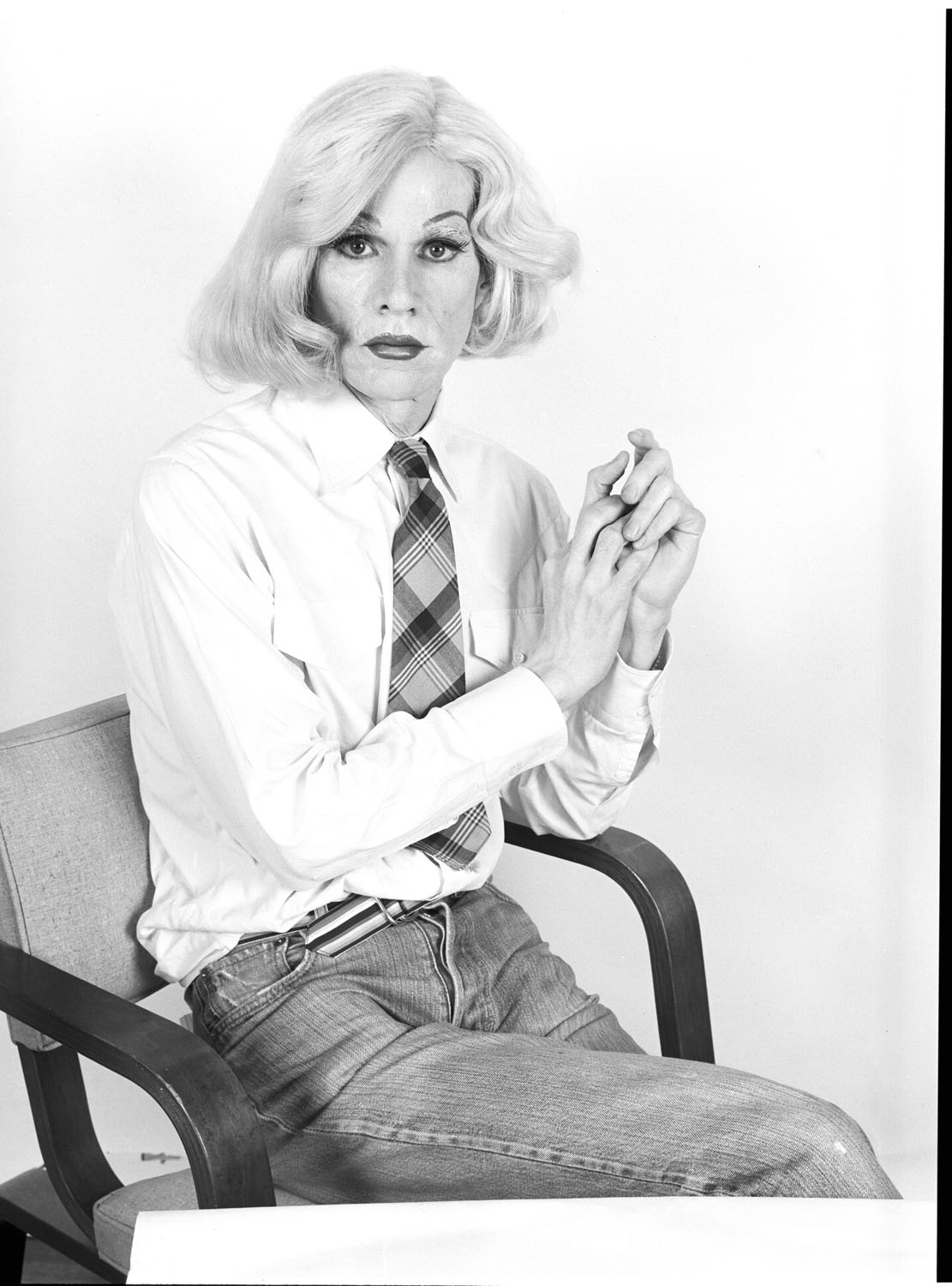
Most of Warhol’s gelatin-silver photographs were printed by Christopher Makos; each week they would review the contact sheets together and select the images for printing. Makos, one of the young photographers working for Warhol’s Interview magazine, was also art director of the book Andy Warhol’s Exposures, and became a key photographic companion of and collaborator with Warhol. As Makos said, ‘I undoubtably learnt a great deal from him, but he also learnt from me, especially about photography. We were in constant confrontation, continually exchanging impressions and ideas’.[7] They often photographed the same subjects side by side – whether travelling or in the studio – and Makos also took many photographs of his friend. The exhibition includes Makos portraits of Warhol doing everyday or ‘unfamous things’, including rowing a boat on a lake in Paris, having a massage, or posing wearing a clown nose. Perhaps their most enduring collaboration was the suite of Altered Image photographs: Warhol dressed in male attire but with female wigs and make-up. Makos remembers that Warhol ‘didn’t want to look like a beautiful woman, he wanted to show the way it felt to be beautiful’.[8]

Warhol exhibited very few of his photographs during his lifetime, although in January 1987, just weeks before he died, he revealed a new approach to his photography in an exhibition of ‘stitched photographs’ at Robert Miller Gallery, New York. Made by sewing several identical photographs together in a grid formation, these works frequently used photographs with strong abstract qualities in order to enhance the visual impact of the work.

AGSA’s exhibition Andy Warhol & Photography: A Social Media presents a new perspective on Warhol for Australian audiences.[9] Tracing Warhol’s photographic practice both behind and in front of the camera, and focusing primarily on portraiture, the exhibition explores the social nature of Warhol’s photographic practice and in doing so offers new insights into his art and life.

Julie Robinson is Senior Curator, Prints, Drawings and Photographs at AGSA


[1] So called because from 1964 to 1968 Warhol’s studio was on the site of a former hat factory on East 47th Street. Warhol asked Billy Linich, known as Billy Name, to decorate the interior with silver foil and paint, as Billy had done for his own apartment.
[2] Billy Name, All tomorrow’s parties, Frieze, London and D.A.P. New York, 1997, p. 18.
[3] In the studio, however, Warhol continued to use his Polaroid camera for portrait shoots for the rest of his career.
[4] Andy Warhol, with Bob Colacello, ‘Introduction: social disease’ in Andy Warhol’s Exposures, Hutchison, London, 1979, p. 19.
[5] Bruno Bischofberger, ‘Andy Warhol’s visual memory’, 2001, p. 4, https://www.brunobischofberger.com/_files/ugd/d90357_015362edc78746d3b4ec6654231933ef.pdf accessed 23 December 2022.
[6] Warhol’s contact sheets archive is held at the Cantor Arts Center, Stanford University.
[7] Christopher Makos, Andy Warhol, Charta, in collaboration with Edition Bruno Bischofberger, Zurich, 2002, p. 8.
[8] Christopher Makos, ‘Lady Warhol the book, Altered Image’, https://www.makostudio.com/gallery/2717, accessed 23 December 2022.
[9] I am grateful to the many supporters who have made this exhibition possible, including sponsors and donors, lenders in Australia and overseas, artists and artists’ estates, sitters and their families, colleagues at other institutions, and the staff at AGSA.


Gerard Malanga (American, b. 1943) 'Andy Warhol' 1971


Gerard Malanga (American, b. 1943)
Andy Warhol
1971
Gelatin silver photograph
33.7 x 22.6cm (image), 35.6 x 27.8cm (sheet)
National Gallery of Australia, Canberra
Purchased 1973


Oliviero Toscani (Italian, b. 1942) 'Andy Warhol' 1975


Oliviero Toscani (Italian, b. 1942)
Andy Warhol
1975
Pigment print
32 x 46cm (image)
40 x 50cm (sheet)
Public Engagement Fund 2021
Art Gallery of South Australia, Adelaide
© Oliviero Toscani


Andy Warhol (American, 1928-1987) 'Bianca Jagger at Halston's house, New York', no. 1 from the portfolio 'Photographs' 1976, published 1980


Andy Warhol (American, 1928-1987)
Bianca Jagger at Halston’s house, New York, no. 1 from the portfolio Photographs
1976, published 1980
Gelatin silver photograph
40.8 x 28.8cm (image)
50.5 x 41.0cm (sheet)
Art Gallery of South Australia, Adelaide
James and Diana Ramsay Fund 2020
© Andy Warhol Foundation for the Visual Arts, Inc. ARS/Copyright Agency


Andy Warhol (American, 1928-1987) 'Halston at home, New York', no. 7 from the portfolio 'Photographs' c. 1976-1979, published 1980


Andy Warhol (American, 1928-1987)
Halston at home, New York, no. 7 from the portfolio Photographs
c. 1976-1979, published 1980
Gelatin silver photograph
42.2 x 29.4cm (image)
50.5 x 40.8cm (sheet)
Art Gallery of South Australia, Adelaide
James and Diana Ramsay Fund 2020
© Andy Warhol Foundation for the Visual Arts, Inc. ARS/Copyright Agency


Andy Warhol (American, 1928-1987) 'Truman Capote at home, New York', no. 4 from the portfolio 'Photographs' c. 1976-1979


Andy Warhol (American, 1928-1987)
Truman Capote at home, New York, no. 4 from the portfolio Photographs
c. 1976-1979, published 1980
Gelatin silver photograph
30.5 x 42.9cm (image), 41.0 x 50.5cm (sheet)
Art Gallery of South Australia, Adelaide
James and Diana Ramsay Fund 2020,
© Andy Warhol Foundation for the Visual Arts, Inc. ARS/Copyright Agency


Christopher Makos (American, b. 1948) 'Andy taping Christopher Reeves for 'Interview' magazine' 1977


Christopher Makos (American, b. 1948)
Andy taping Christopher Reeves for ‘Interview’ magazine
1977
Gelatin silver photograph
21.2 x 32.2cm (image), 27.5 x 35.3cm (sheet)
Private collection
© Christopher Makos


Andy Warhol (American, 1928-1987) 'Muhammad Ali, his infant daughter, Hanna, and wife, Veronica at Ali's training camp in Deer Lake, PA' August 18, 1977


Andy Warhol (American, 1928-1987)
Muhammad Ali, his infant daughter, Hanna, and wife, Veronica at Ali’s training camp in Deer Lake, PA
August 18, 1977
Gelatin silver photograph


Robin Platzer (American) 'Andy Warhol showing his artistry' 1978


Robin Platzer (American)
Andy Warhol showing his artistry
1978
Pigment print
Getty Images Collection
© Robin Platzer/ Images Press
Photo: Images Press


Christopher Makos (American, b. 1948) 'Andy Warhol and Liza Minnelli' 1978


Christopher Makos (American, b. 1948)
Andy Warhol and Liza Minnelli
1978
Gelatin silver photograph
26.9 x 34.1cm (image)
40.6 x 50.3cm (sheet)
Private collection
© Christopher Makos


Christopher Makos (American, b. 1948) 'Andy Warhol Kissing John Lennon' 1978


Christopher Makos (American, b. 1948)
Andy Warhol Kissing John Lennon
1978
Gelatin silver photograph
27.7 x 41.7cm (image)
40.7 x 50.4cm (sheet)
Art Gallery of South Australia, Adelaide
V.B.F. Young Bequest Fund 2022
© Christopher Makos


Andy Warhol (American, 1928-1987) 'Liza Minnelli' 1978


Andy Warhol (American, 1928-1987)
Liza Minnelli
1978
Polaroid™ Polacolor Type 108
9.5 x 7.3cm (image)
10.8 x 8.5cm (sheet)
V.B.F. Young Bequest Fund 2012
Art Gallery of South Australia, Adelaide
© Andy Warhol Foundation for the Visual Arts, Inc. ARS/Copyright Agency


Andy Warhol (American, 1928-1987) 'Debbie Harry' 1980


Andy Warhol (American, 1928-1987)
Debbie Harry
1980
Polaroid™ Polacolor Type 108
10.8 x 8.6cm (sheet)
9.7 x 7.3cm (image)
Art Gallery of South Australia, Adelaide
V.B. F. Young Bequest Fund and d’Auvergne Boxall Bequest Fund 2018
© Andy Warhol Foundation for the Visual Arts, Inc. ARS/Copyright Agency


Christopher Makos (American, b. 1948) 'Andy Warhol in a row boat in Paris's Bois de Boulogne' 1981


Christopher Makos (American, b. 1948)
Andy Warhol in a row boat in Paris’s Bois de Boulogne
1981
Gelatin silver photograph
27.7 x 35.6cm (sheet)
18.3 x 27.9cm (image)
Private collection
© Christopher Makos


Christopher Makos (American, b. 1948) 'Altered Image' from the portfolio 'Altered Image: Five Photographs of Andy Warhol' 1981; published 1982


Christopher Makos (American, b. 1948)
Altered Image from the portfolio Altered Image: Five Photographs of Andy Warhol
1981; published 1982
Gelatin silver photograph
44.8 x 32.2cm (image)
50.6 x 40.8cm (sheet)
National Gallery of Australia, Canberra
Purchased 1982
© Christopher Makos


Andy Warhol (American, 1928-1987) 'Woman on the street' 1982


Andy Warhol (American, 1928-1987)
Woman on the street
1982
Gelatin silver photograph
25.3 x 20.3cm (sheet)
22.3 x 15.6cm (image)
Art Gallery of South Australia, Adelaide
V.B. F. Young Bequest Fund and d’Auvergne Boxall Bequest Fund 2018
© Andy Warhol Foundation for the Visual Arts, Inc. ARS/Copyright Agency


Christopher Makos (American, b. 1948) 'Andy Warhol in American flag, Madrid' 1983


Christopher Makos (American, b. 1948)
Andy Warhol in American flag, Madrid
1983
Gelatin silver photograph
32.3 x 21.6cm (image)
35.6 x 27.6cm (sheet)
Private collection
© Christopher Makos


Warhol’s queer practice – what we might, with a nod to the mechanics of repetition at the heart of the project, call his queer ‘technics’ – involved less an embrace of commodification than a recognition of radical difference and equality. These were always mutually dependent in Warhol’s work and the basis for what we might regard as a philosophical commitment, one that informed his entire career.

I believe we see this especially in Warhol’s films and photography, those aspects of artistic practice most overlooked by the critical establishment who rushed to canonise Warhol as the High Prince of affectless serial pop in the 1990s. Warhol’s photographs and films not only attest to the radical collectivism and performance-art culture of his Factory (the name is significant), they are also the most resistant to market logic. The photographs have been reproduced as saleable commodities less often – or to lesser degree – than his work in other media (screenprints, paintings). They also attest to some of the key paradoxes at the heart of Warhol’s whole body of work.

Photographs, after all, are often treated as aide-mémoire ephemera and are (almost) endlessly reproducible: the negative renders theoretically infinite numbers of positives. Warhol’s photographs, however, tended to the singular as well as the serial: polaroids (one of a kind) and silver-gelatin prints (from a negative, able to be multiplied), the ephemeral (throwaway records of a moment) and the auratic (emanating the aura of singularity and originality). They could be both simultaneously, too. Warhol’s photographic subjects are also more varied than the celebrity images that many associate with his screenprint practice: they range from unidentified objects of vicarious desire to glitterati – although Warhol’s celebrity subjects were often represented in ways that subverted or manipulated their mass-produced public image for effect, in line with the radical equality that is the essence of machine reproduction.

Extract from Andrew van der Vlies. “Andy Warhol’s Queer Practice: Disidentification and Utopian Desire,” on the Art Gallery of South Australia website Nd [Online] Cited 03/05/2023


Andy Warhol (American, 1928-1987) 'Henry Gillespie' 1985


Andy Warhol (American, 1928-1987)
Henry Gillespie
1985
Synthetic polymer paint and screenprint on canvas
101.6 x 101.6cm
Art Gallery of South Australia, Adelaide
South Australian Government Grant 1996
© Andy Warhol Foundation for the Visual Arts, Inc. ARS/Copyright Agency


Andy Warhol (American, 1928-1987) 'Self-portrait no.9' 1986


Andy Warhol (American, 1928-1987)
Self-portrait no.9
1986
Synthetic polymer paint and screenprint on canvas
203.5 x 203.7cm
Purchased through The Art Foundation of Victoria with the assistance of the National Gallery Women’s Association, Governor, 1987
National Gallery of Victoria, Melbourne
© Andy Warhol Foundation for the Visual Arts, Inc. ARS/Copyright Agency


Andy Warhol (American, 1928-1987) 'Curiosity Killed the Cat' 1986


Andy Warhol (American, 1928-1987)
Curiosity Killed the Cat
1986
Gelatin silver photograph
20.1 x 25.3cm (image & sheet)
Art Gallery of South Australia, Adelaide
V.B. F. Young Bequest Fund and d’Auvergne Boxall Bequest Fund 2018,
© Andy Warhol Foundation for the Visual Arts, Inc. ARS/Copyright Agency


Nonetheless, the openness to technology and looseness of approach to the medium that Hujar identifies in Warhol’s practice suggest ways in which we might understand much of Warholian photographic work. This is particularly the case if we consider how his practice predicts our own moment of photographic hyperproduction, casualisation, and omnipresence: Warhol’s use of the Polaroid almost has the immediacy of the camera phone – although without the same capacity for taking an image discreetly, even voyeuristically, or the potential for instant global transmission. But like the inundation of images awash on social media today (and the status of digital photograph as virtual ‘object’), the polaroid has the potential for public circulation, as well as total privacy – the image of the beloved, the erotic image that requires no third party to develop and print it. Warhol’s polaroids of male nudes, but also those of him in drag, activate energies of the private-public continuum, teasing the public viewer with imagery that suggests a zone of private erotic fetish as much as an exploration of the limits and mutability of the self.[11] Warhol’s Polaroid nudes also anticipate the social media phenomenon of people trading explicit images of the self (and sometimes of others as deceptive proxies for a fantasy self) as tease, invitation, or souvenir of intimate encounters.

Despite the clear differences in their practice and philosophy of photography, Warhol and Hujar produced bodies of photographic work that are significantly connected and entangled. This is not only attributable to their having in common queer subjects like Factory stars Candy Darling and Jackie Curtis, early reality television icon Lance Loud, theorist and writer Susan Sontag, and poet John Ashbery, each of whom had their image made by both artists to very different effect.

If Hujar left us with hauntingly beautiful – and often painterly – images of such figures, photographs that seem to capture the sitter’s animating spirt, Warhol offers a more direct impression of what his subjects were like as people in the world on a particular day.

The connections and possible dynamics of influence are also evident in Hujar’s and Warhol’s parallel movement between impulses of street photography [fig 1], studio work, celebrity and self-portraiture, documentation and celebration of the male nude (whether eroticised, stylised, or aestheticised), fascination with animal and architectural subjects, as well as their exploration of the performance culture of drag. While Warhol’s images across these genres may not occupy the same category of ‘beauty’ as Hujar’s, there is unmistakable beauty of a different variety; this might be characterised as a beauty of immediacy, of the candid moment and ephemeral gesture, a beauty that takes informality as its impulse, and which does not try to hide its flaws. It is, in a real sense, a very democratic beauty.

Extract from Patrick Flanery. “Queer Influencers: Hujar and Warhol,” on the Art Gallery of South Australia website Nd [Online] Cited 03/05/2023


Robert Mapplethorpe (American, 1946-1989) 'Andy Warhol' 1986


Robert Mapplethorpe (American, 1946-1989)
Andy Warhol
1986
Gelatin silver photograph
61.0 x 51.0cm
National Gallery of Australia, Canberra
Purchased 1989


Art Gallery of South Australia
North Terrace Adelaide
Public information: 08 8207 7000

Opening hours:
Daily 10am – 5pm (last admissions 4.30pm)

Art Gallery of New South Wales website

LIKE ART BLART ON FACEBOOK

Back to top

Exhibition: ‘Georgia O’Keeffe, Photographer’ at the Cincinnati Art Museum

Exhibition dates: 3rd February – 7th May, 2023

Originating curator: Lisa Volpe
Cincinnati Art Museum curator: Nathaniel M. Stein


Georgia O'Keeffe (American, 1887-1986) 'Chrysler Building from the Window of the Waldorf Astoria, New York' c. 1960 from the exhibition 'Georgia O'Keeffe, Photographer' at the Cincinnati Art Museum, February - May, 2023


Georgia O’Keeffe (American, 1887-1986)
Chrysler Building from the Window of the Waldorf Astoria, New York
c. 1960
Gelatin silver print
Georgia O’Keeffe Museum, Santa Fe
© Georgia O’Keeffe Museum


O’Keeffe was unconcerned with creating perfect photographic prints and none of these photographs by Georgia O’Keeffe are memorable but the photographs help inform her art practice, acting as a form of documentary sketch rather than being about the art of photography. Perhaps for O’Keeffe it’s about a clarity of looking, and then looking again at the pictorial plane, in order to abrogate in her paintings a photographic reality that is always unreal in the first place.

Form, light, perspective and place in photographs are all reframed through O’Keeffe’s intuitive mind’s eye resulting in the physical painting so conceived. They inform her creative reimag(in)ings and expressive compositions of the landscape. The formal elements of the photographs, their light and shade, their depth and weight, are rendered – depicted artistically, become, made, translated, performed, surrendered – abstractly in the medium of paint, substituting one perceived reality for another. But the paradox is, what is being seen here, what does O’Keeffe see in her relations with the camera?

“To apprehend myself as seen is, in fact, to apprehend myself as seen in the world and from the standpoint of the world. The look does not carve me out in the universe; it comes to search for me at the heart of my situation and grasps me only in irresolvable relations with instruments. If I am seen as seated, I must be seen as “seated-on-a-chair,” … But suddenly the alienation of myself, which is the act of being-looked-at, involves the alienation of the world which I organise. I am seated on this chair with the result that I do not see it at all, that it is impossible for me to see it …”1

Everything (photography, painting, self, world) is in dis/agreement, everything is up for negotiation – as nothing is “in fact”. What did you say?

Dr Marcus Bunyan


1/ Jean-Paul Satre. Being and Nothingness (trans. Hazel Barnes). London: Methuen, 1966, p. 263.


Many thankx to the Cincinnati Art Museum for allowing me to publish the photographs in the posting. Please click on the photographs for a larger version of the image.


How well do we know iconic American artist, Georgia O’Keeffe? Scholars have examined her paintings, home, library, letters, and even her clothes. Yet, despite O’Keeffe’s long and complex association with the American photographic avant-garde, no previous exhibition has explored her work as a photographer.

Georgia O’Keeffe, Photographer presents nearly 100 photographs by the artist, together with a complementary selection of paintings and drawings. These works illuminate O’Keeffe’s use of the camera to further her modernist vision, showing how she embraced photography as a unique artistic practice and took ownership of her relationship with the medium. Discover, for the first time, O’Keeffe’s eloquent and perceptive photographic vision.


Through Another Lens: Georgia O’Keeffe’s Photography

Georgia O’Keeffe is revered for her iconic paintings of flowers, skyscrapers, animal skulls, and Southwestern landscapes. Her photographic work, however, has not been explored in depth until now. Originating exhibition curator Lisa Volpe joins us from The Museum of Fine Arts, Houston, to discuss O’Keeffe’s relationship to and personal use of photography, the research that brought this history to light, and the discoveries still waiting to be made.


“There’s an incredible clarity in the way that she thought about composition and the way that forms fill a space the most beautifully… That was her primary concern, and that’s what she’s interested in photographing. It’s not about making a pretty picture or even showing what her dogs look like or any of those things. It’s about what the image looks like as a picture.”


Nathaniel Stein, Cincinnati Art Museum curator of photography


'Georgia O'Keeffe's Spotting Kit' Late 1910s - late 1940s from the exhibition 'Georgia O'Keeffe, Photographer' at the Cincinnati Art Museum, February - May, 2023


Georgia O’Keeffe’s Spotting Kit
Late 1910s – late 1940s
Various materials
Georgia O’Keeffe Museum, Santa Fe
Gift of Juan and Anna Marie Hamilton
© Georgia O’Keeffe Museum


Before the advent of digital retouching, flaws in a photographic print, such as dust spots or scratches, were covered on the print surface with a brush and spot tone dye. “Spotting” is a demanding process that requires patience, precision, and a sensitivity to tone. O’Keeffe first learned the technique while assisting Alfred Stieglitz (1864-1946) in the late 1910s. Decades later, she used her kit again, to eliminate visual interference in the perfect tonal masses and shapes in her own photographs. O’Keeffe’s mastery of painting easily translated to spotting – her touch-ups are so fine that they are almost imperceptible.

Large print label to the exhibition


Most people know renowned artist Georgia O’Keeffe as a painter. What they probably don’t know? O’Keeffe was also a passionate photographer. Soon, visitors can see a selection of her photographs at the exhibition Georgia O’Keeffe, Photographer, coming to the Cincinnati Art Museum February 3 – May 7, 2023.

In the first major investigation of O’Keeffe’s 30-year engagement with photography, Cincinnati Art Museum visitors can gain a rare, new understanding of the artist. More than 100 photographs and a complementary selection of paintings, drawings and objects from O’Keeffe’s life tell the story of her eloquent use of the camera to pursue her singular artistic vision.

“For me, an exciting facet of this project is how it shifts the paradigm for multiple audiences,” states Cincinnati Art Museum Curator of Photography Nathaniel M. Stein, PhD. “Photography buffs are learning her relationship with photography was larger and more complicated than we knew. I think those audiences will be surprised by the sophistication and rigour of O’Keeffe’s own exploration of photographic seeing, even as they have to let go of an assumption that she would be making photographs in service of her painting practice. On the other hand, audiences arriving out of admiration for O’Keeffe as a painter are coming to know the artist’s vision in an entirely new way, seeing her digest the world more clearly and gaining an understanding of elemental tenets of photographic composition and form through her eyes.”

Exhibition overview

Georgia O’Keeffe is the widely admired “Mother of American Modernism” who has long been examined by scholars for her paintings of flowers, skulls, and desert landscapes. Despite being one of the most significant artists of the 20th century, no previous exhibition has explored her work as a photographer … until now.

The exhibition is accompanied by a richly illustrated catalogue containing new scholarship by Museum of Fine Arts, Houston Curator of Photography Lisa Volpe and a contribution from Georgia O’Keeffe Museum Curator of Fine Arts Ariel Plotek. The catalogue will significantly broaden readers’ understanding of one of the most innovative artists of the 20th century. It will be available soon for purchase from the museum shop in person and online.

Press release from the Cincinnati Art Museum


Alfred Stieglitz (American, 1864-1946) 'Georgia O'Keeffe' 1933 from the exhibition 'Georgia O'Keeffe, Photographer' at the Cincinnati Art Museum, February - May, 2023


Alfred Stieglitz (American, 1864-1946)
Georgia O’Keeffe
1933
Gelatin silver print
The Museum of Fine Arts, Houston: The Target Collection of American Photography
Museum purchase funded by Target Stores
© Georgia O’Keeffe Museum


Gallerist, publisher, and photographer Alfred Stieglitz made his first portrait of O’Keeffe in 1917 at the beginning of their romantic relationship. Over the next 20 years, he photographed her more than 300 times. Due in large part to Stieglitz’s epic portrait project and his outsized legacy in the American art world, historians have assumed that O’Keeffe’s relationship to photography was passive – that of a sitter, assistant, or spectator. However, O’Keeffe’s photographs prove that she developed her own visionary practice behind the camera.

Large print label to the exhibition


“It is only by selection, by elimination, by emphasis that we get at the real meaning of things.”


Georgia O’Keeffe


American artist Georgia O’Keeffe (1887-1986) strived to give visual form to “the unexplainable thing in nature that makes me feel the world is big far beyond my understanding … to find the feeling of infinity on the horizon line or just over the next hill.”

After nearly thirty years rendering the vistas of the Southwest on canvas, O’Keeffe still sought new ways to express the beauty and essential forms of the land in all its cycles. She produced more than 400 photographs of her New Mexico home, its surrounding landscape, and other subjects in the 1950s, 60s, and 70s. Photography offered a new means of artistic engagement with her world. Revisiting subjects she painted years or even decades earlier, O’Keeffe explored new formal and expressive possibilities with the camera.

Like her work in other media, O’Keeffe’s photographs demonstrate an acute attention to composition and passion for nature. Her photography provides a window into an artistic practice based on tireless looking and reconsideration. O’Keeffe used the camera to capture both momentary impressions and sustained investigations over the course of days, seasons, and years. Alongside her better-known paintings and drawings, O’Keeffe’s photographs open new insight into her unending dialogue with the world around her.

Introduction

From the mid-1950s until the 1970s, Georgia O’Keeffe (1887-1986) produced more than 400 photographic images, focused primarily on her New Mexico home and the surrounding landscape. After rendering the vistas of the Southwest on canvas and paper for over 25 years, the artist still sought new ways to express the beauty of the land in all its cycles and forms. Photography offered O’Keeffe a new means of artistic engagement with her world. Revisiting subjects she painted years, or even decades, earlier, the artist’s photographs explored new formal and expressive possibilities.

Her photographs reveal the same passion for nature and acute attention to composition that we see in her paintings and drawings. Through photography, O’Keeffe captured multiple momentary impressions and recorded sustained investigations over the course of days, seasons, and years. Alongside her better-known paintings and drawings, O’Keeffe’s photographs reveal her unending, unique dialogue with the natural world.

A Life in Photography

O’Keeffe was no stranger to photography. Family photos and travel snapshots marked her early decades. Sophisticated photographers – including her husband, Alfred Stieglitz (1864-1946) – were drawn to picture the enigmatic artist throughout her life. O’Keeffe’s approach to the medium was informed by past encounters, but principally guided by her own interests. O’Keeffe dedicated her life to expressing her unique perspective, whether through her clothing, home décor, paintings, or photographs. By the time she began her photographic practice in earnest in the mid-1950s, O’Keeffe brought her singular, fully formed identity and artistic vision to her camera work.


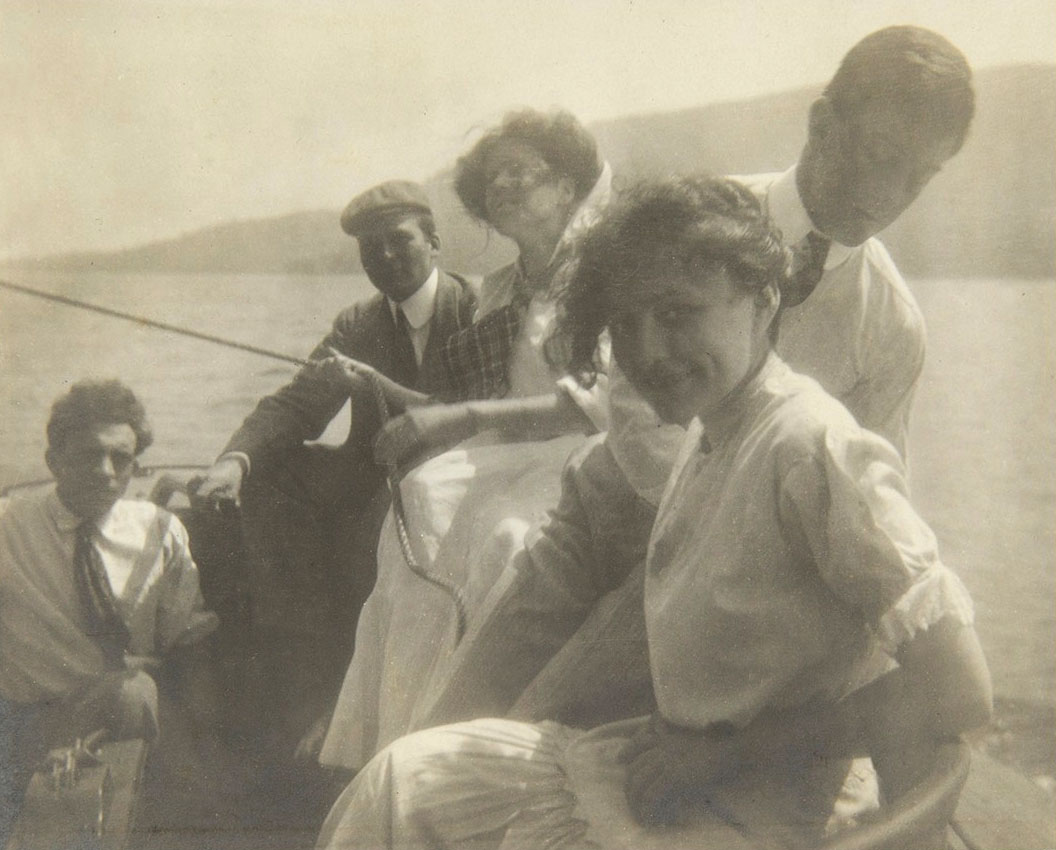
Unknown Photographer. 'Georgia O'Keeffe and Friends in a Boat' 1908


Unknown Photographer
Georgia O’Keeffe and Friends in a Boat
1908
Gelatin silver print
Georgia O’Keeffe Museum, Santa Fe Museum Purchase


By 1890, the Eastman Company had sold millions of $1 Kodak Brownie cameras and photography was part of daily life for many people. Family photographs, studio portraits, and snapshots taken by O’Keeffe and her friends mark the artist’s earliest decades.

Born in Wisconsin, O’Keeffe studied and worked in Virginia, Illinois, New York, South Carolina, and Texas before she was 30. As she moved from place to place, she kept her close friendships in part by trading snapshots. Her friend Anita Pollitzer wrote, “Won’t you send me a Kodak picture… of you?” O’Keeffe responded with her own request, noting, “I want to know what you are looking like this fall.” O’Keeffe continued this practice when she began photographing with a clear artistic intention in the late 1950s, sending her photos to family and friends.

Large print label to the exhibition


Between 1907-1908, Georgia O’Keeffe attended the Art Students League in New York and studied with William Merritt Chase, F. Luis Mora, and Kenyon Cox. In June of 1908, she was awarded League’s Still Life Scholarship and attended the League’s Outdoor School at Lake George, New York.

O’Keeffe’s years as a young student were marked by the release of the first easy-to-use handheld cameras that made photography more widely available. This amateur photograph shows a 21-year-old O’Keeffe enjoying the day on a boat with her friends.

Text from the Georgia O’Keeffe Museum Instagram website


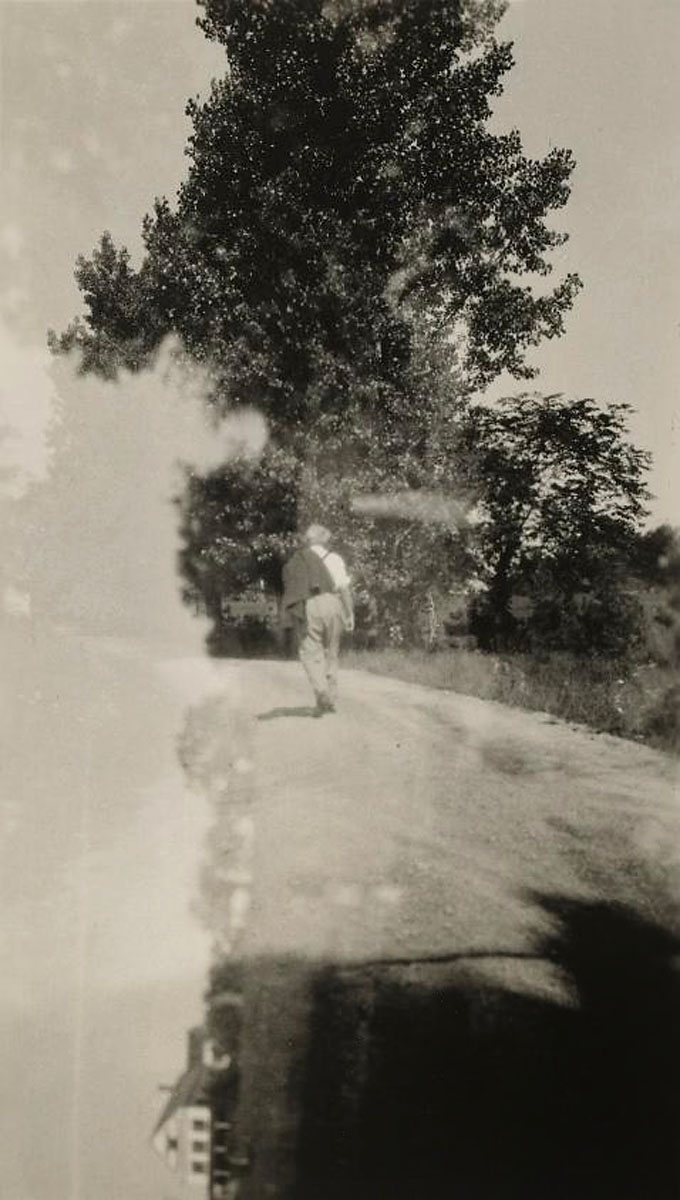
Georgia O'Keeffe (American, 1887-1986) 'Stieglitz at Lake George' c. 1923


Georgia O’Keeffe (American, 1887-1986)
Stieglitz at Lake George
c. 1923
Gelatin silver print
Georgia O’Keeffe Museum, Santa Fe Museum


This double exposure – produced when two images are captured on the same frame of film – shows two views of the Stieglitz family property at Lake George, New York. In the vertical image, Alfred Stieglitz walks ahead on a path, while the horizontal image shows an expanse of the family’s summer residence. Though the double exposure was probably unintentional, O’Keeffe kept this photograph for more than 60 years, suggesting she found the image noteworthy even though it was the result of operator error. Her later photographic practice also demonstrated a sense of certainty in her own visual instincts over and above the rules of technique.

Large print label to the exhibition


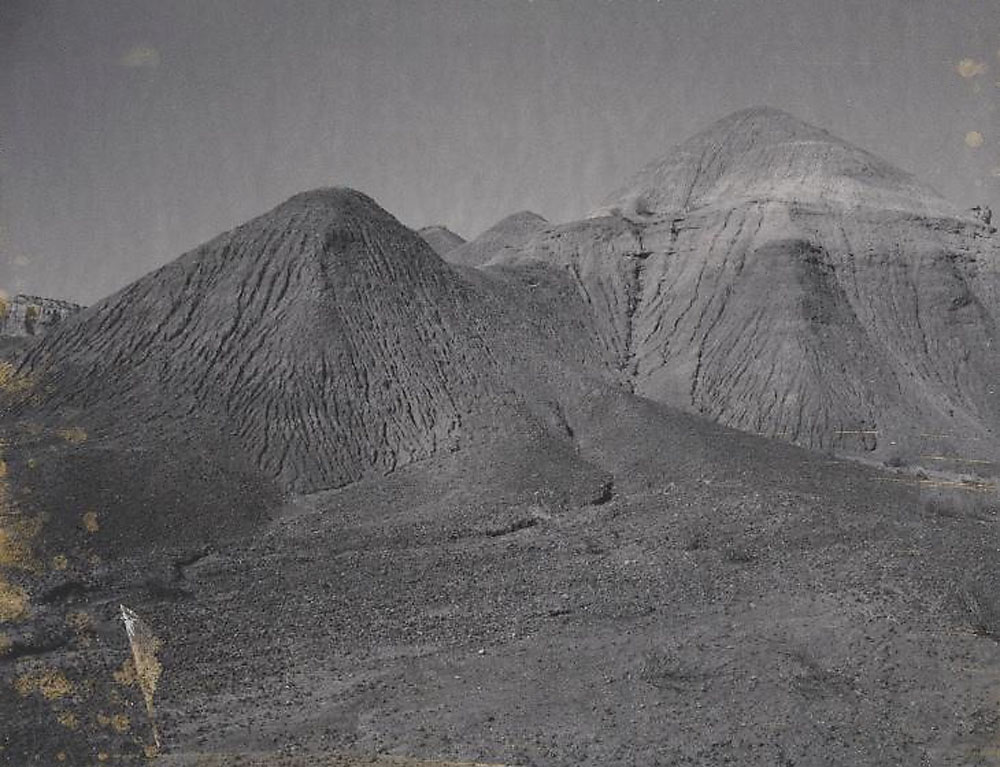
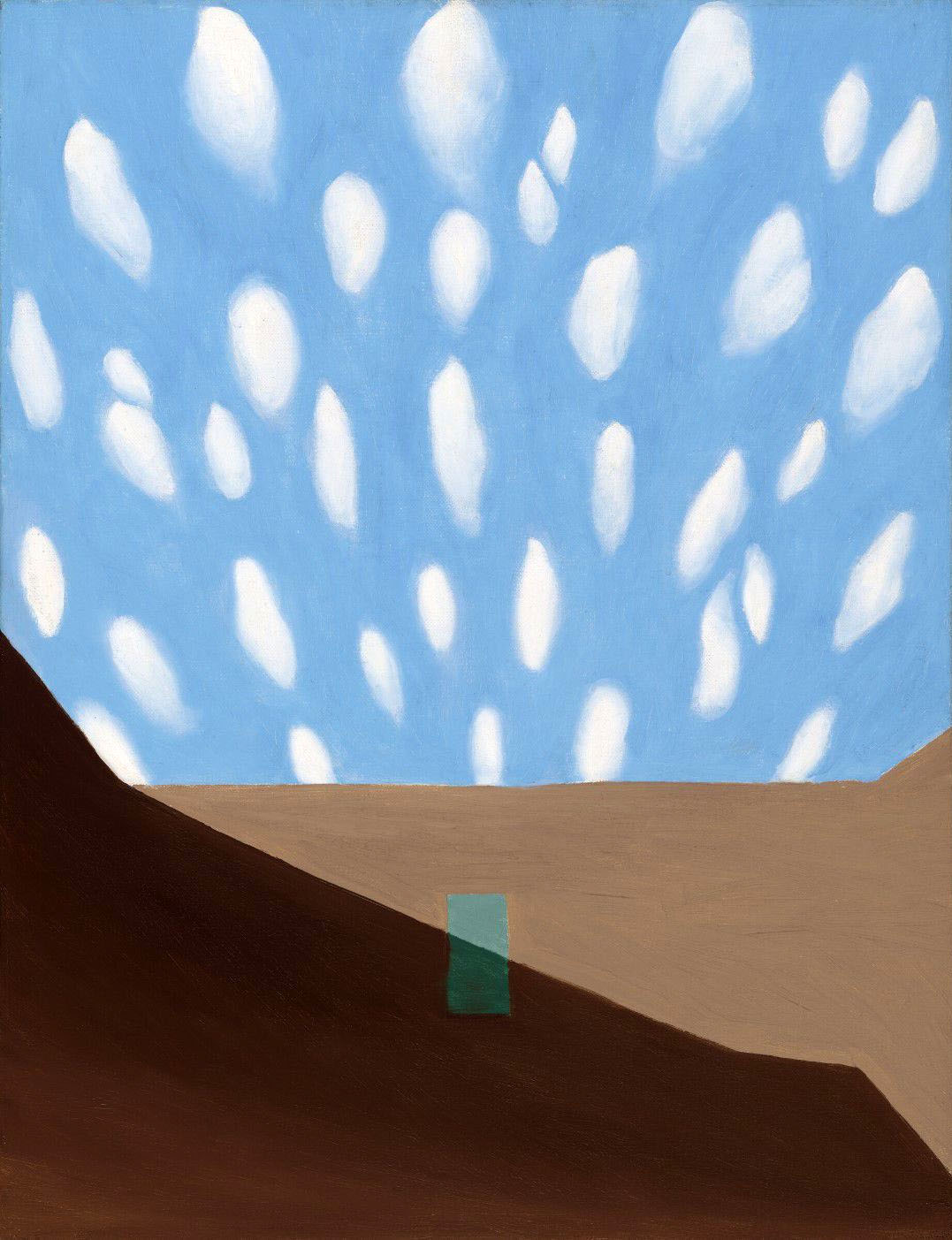
Georgia O'Keeffe (American, 1887-1986) 'The Black Place' c. 1970


Georgia O’Keeffe (American, 1887-1986)
The Black Place
c. 1970
Black-and-white Polaroid
Georgia O’Keeffe Museum, Santa Fe
Georgia O’Keeffe Papers


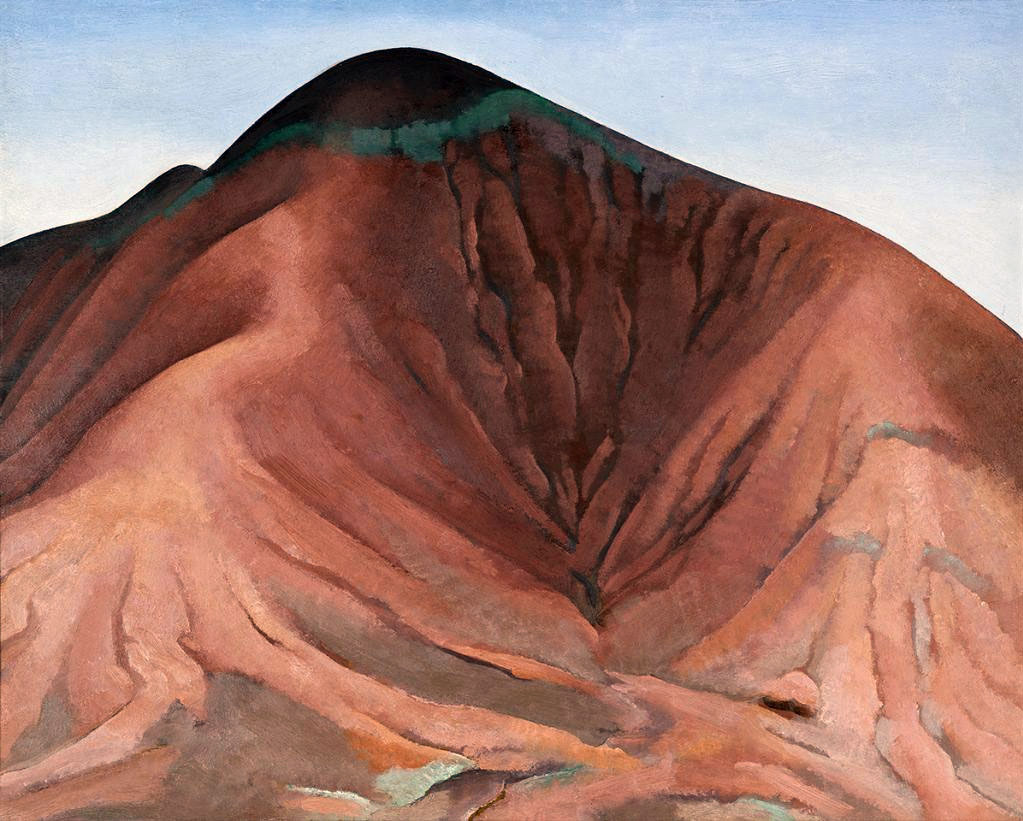
Georgia O'Keeffe (American, 1887-1986) 'Small Purple Hills' 1934


Georgia O’Keeffe (American, 1887-1986)
Small Purple Hills
1934
Oil on panel
Crystal Bridges Museum of American Art, Bentonville, Arkansas


Beginning in 1929, O’Keeffe spent part of almost every year in New Mexico until moving there permanently in 1949. Her beloved Southwestern landscape was a continual source of inspiration. “I never seem to get over my excitement in walking about here – I always find new places or see the old ones differently,” she wrote in 1943. O’Keeffe’s paintings, such as Small Purple Hills, conveyed her pleasure in the forms and colours of New Mexico. These same vistas would become the subjects of her photographs. In photography, O’Keeffe continued the formal exploration of those places that had ignited her artistic passions.

Large print label to the exhibition


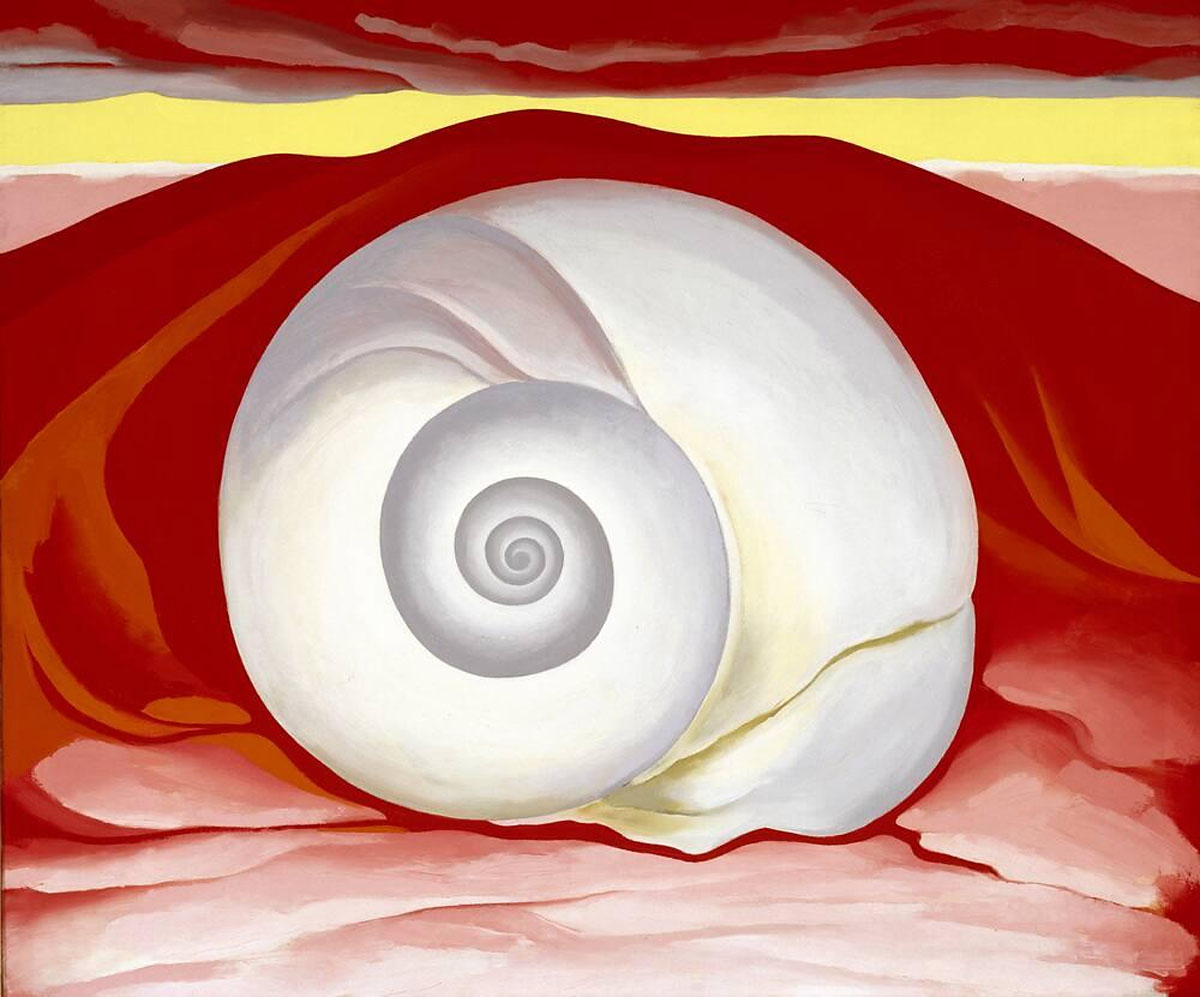
Georgia O'Keeffe (American, 1887-1986) 'Red Hill and White Shell' 1938


Georgia O’Keeffe (American, 1887-1986)
Red Hill and White Shell
1938
Oil on canvas
The Museum of Fine Arts, Houston Gift of Isabel B. Wilson in memory of her mother, Alice Pratt Brown


Red Hill and White Shell embodies O’Keeffe’s experiments with the fresh colours and dynamism of the natural world. Using the dual elements of a massive sandstone mesa and a small iridescent shell, the painting expresses attentiveness to environmental forms, both great and small. O’Keeffe’s careful abstractions in both painting and photography strove for a perfect union of aesthetic order and emotional expression. She wrote, “It is only by selection, by elimination, by emphasis that we get at the real meaning of things.”

Large print label to the exhibition


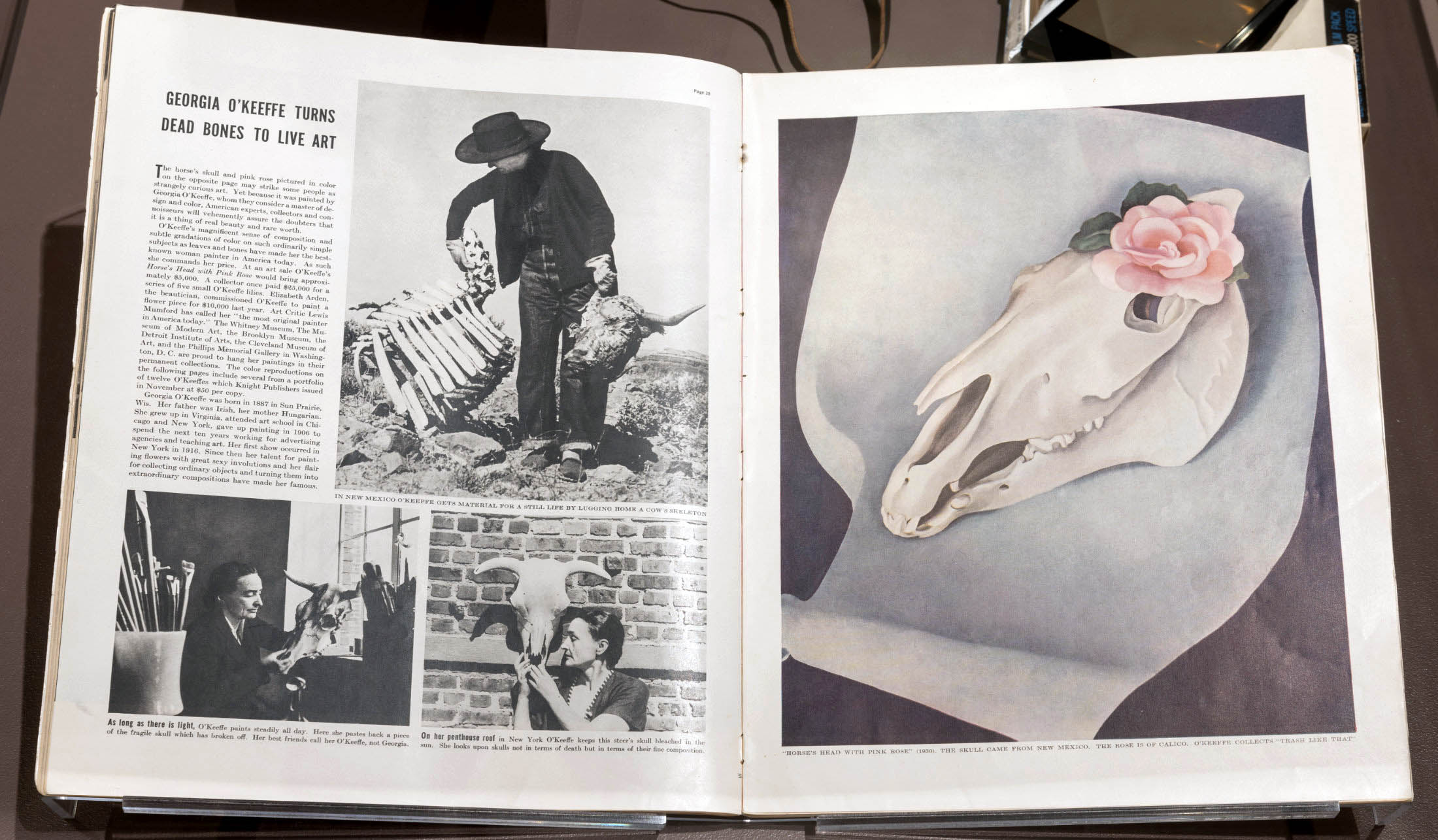
LIFE magazine (publisher) "Georgia O'Keeffe Turns Dead Bones to Live Art" February 14, 1938


LIFE magazine (publisher)
“Georgia O’Keeffe Turns Dead Bones to Live Art”
February 14, 1938
The Museum of Fine Arts, Houston: Courtesy of the Hirsch Library


During O’Keeffe’s lifetime, articles in newspapers and magazines made her face as recognisable to the public as her art, linking O’Keeffe, the woman, to the landscapes and objects she painted. This LIFE essay from 1938 juxtaposes the artist’s Horse’s Head with Pink Rose (1930) with three photos of her handling bones from New Mexico, presenting her art and her life as synonymous.

Large print label to the exhibition


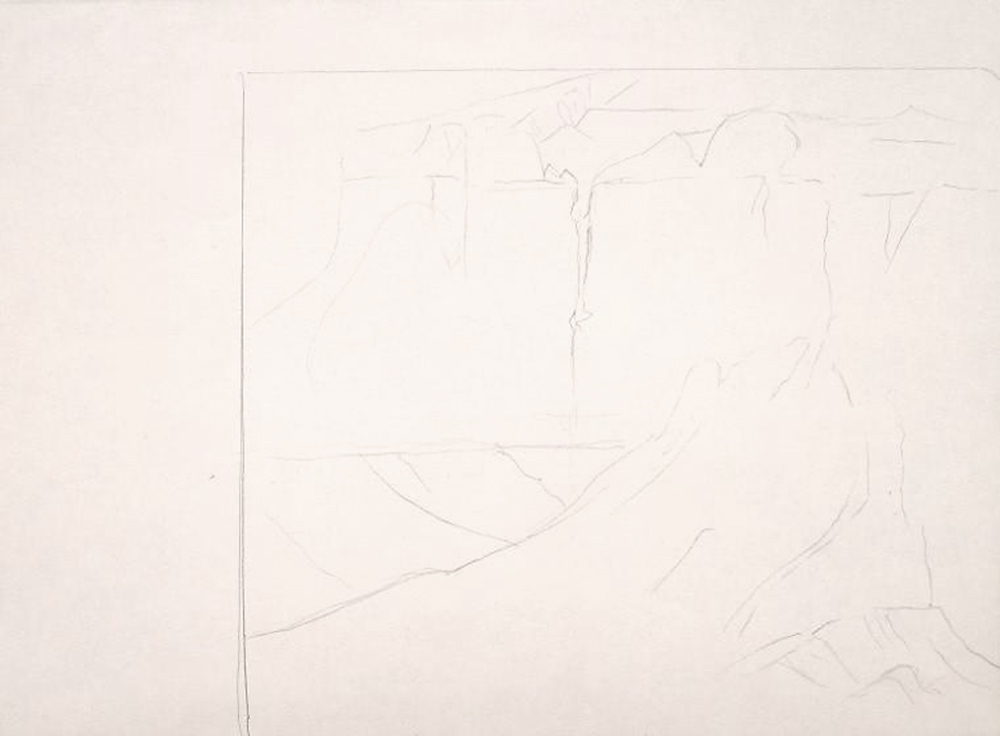
Georgia O'Keeffe (American, 1887-1986) 'Untitled (Ghost Ranch Cliffs)' About 1940


Georgia O’Keeffe (American, 1887-1986)
Untitled (Ghost Ranch Cliffs)
About 1940
Graphite on paper
Georgia O’Keeffe Museum, Santa Fe
Gift of the Georgia O’Keeffe Foundation
© Georgia O’Keeffe Museum


Like her photographs, Ghost Ranch Cliffs reveals O’Keeffe’s restless experimentation with composition. Drawing upon lessons from her teacher, Arthur Wesley Dow, O’Keeffe would frame and reframe her landscape sketches, searching for the most expressive arrangement of forms. Accustomed to framing on paper, O’Keeffe’s transition to framing with a camera was a natural one.

Large print label to the exhibition


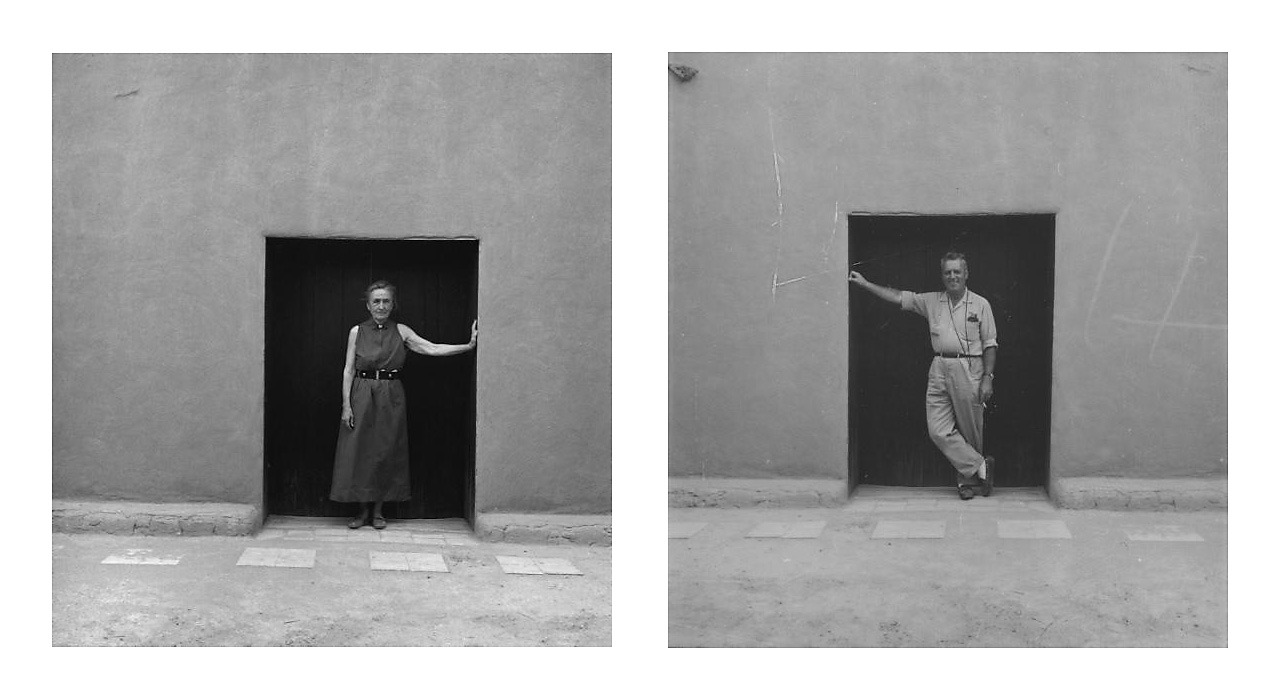
Todd Webb (American, 1905-2000) 'Georgia O'Keeffe in Salita Door' July 1956, printed later and Georgia O'Keeffe (American, 1887-1986) 'Todd Webb in the Salita Door' July 1956, printed later


Todd Webb (American, 1905-2000)
Georgia O’Keeffe in Salita Door
July 1956, printed later
Inkjet print
Courtesy of the Todd Webb Archive

Georgia O’Keeffe (American, 1887-1986)
Todd Webb in the Salita Door
July 1956, printed later
Inkjet print
The Museum of Fine Arts, Houston Museum
Purchases funded by the Director’s Accessions Endowment


In 1955 O’Keeffe’s interest in beginning a photographic practice was sparked by a visit from her friend, photographer Todd Webb. Over the next few summers, Webb visited O’Keeffe in New Mexico, and the pair photographed together, often trading his cameras back and forth. Here, the friends took turns posing for each other in O’Keeffe’s Abiquiú courtyard. “As you can see, you are a very good portrait photographer,” Webb wrote encouragingly to O’Keeffe. “I like the one of me in the doorway very much.”

Large print label to the exhibition


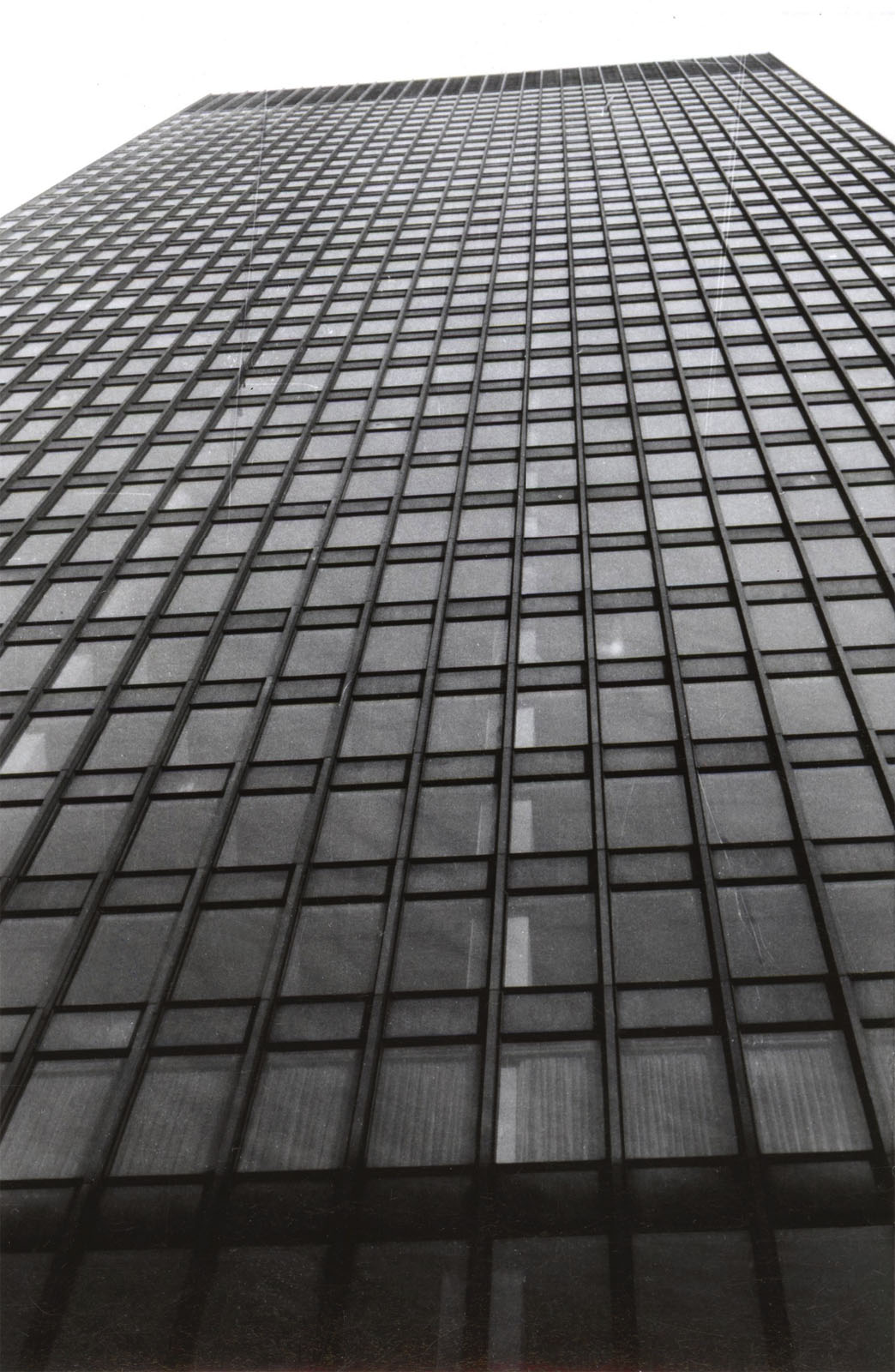
Georgia O'Keeffe (American, 1887-1986) 'Seagram Building, New York' 1958-1965


Georgia O’Keeffe (American, 1887-1986)
Seagram Building, New York
1958-1965
Gelatin silver print
Georgia O’Keeffe Museum, Santa Fe
© Georgia O’Keeffe Museum


Like her paintings of New York, many of O’Keeffe’s photographs of the city explore aspects of its monumentality and modernity. “One can’t paint New York as it is, but rather as it is felt,” she noted. O’Keeffe took this photo of the architect Ludwig Mies van der Rohe’s minimalist Seagram Building soon after it opened. Her dramatic, low camera angle presents the structure’s innovative vertical beams as endless lines stretching into the sky. Her view of the Chrysler Building [see first image in the posting] seems to grapple with a related experience, as a sense of quiet intimacy coexists with the vast scale and loftiness of the modern urban environment.

Large print label to the exhibition


Todd Webb (American, 1905-2000) 'Georgia O'Keeffe Reviewing Photographs' 1961, printed later


Todd Webb (American, 1905-2000)
Georgia O’Keeffe Reviewing Photographs
1961, printed later
Inkjet print
Courtesy of the Todd Webb Archive
© Todd Webb Archive, Portland, Maine, USA


Unlike most photographers, O’Keeffe was unconcerned with creating perfect photographic prints. More interested in the image than the final print, she used her instant Polaroid camera, printed her work at drugstores, or asked Todd Webb to create test prints or enlarged contact sheets of her pictures. These approaches did not align with the norms of contemporary art photography, yet they match O’Keeffe’s larger artistic practice.

Text from the Denver Art Museum website


Reframing

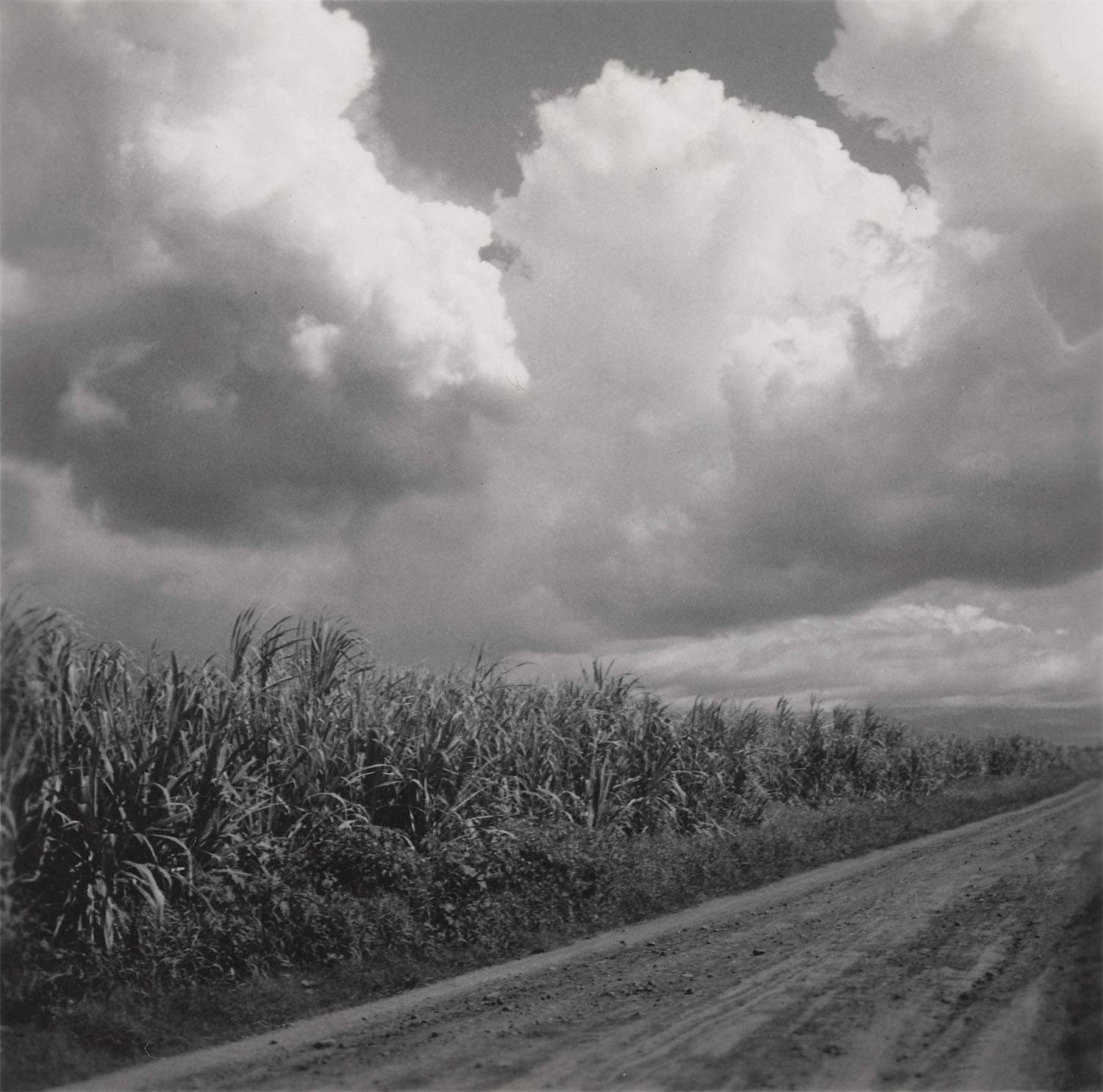
Georgia O'Keeffe (American, 1887-1986) 'Sugar Cane Fields and Clouds' March 1939


Georgia O’Keeffe (American, 1887-1986)
Sugar Cane Fields and Clouds
March 1939
Gelatin silver print
Georgia O’Keeffe Museum, Santa Fe
© Georgia O’Keeffe Museum


In 1939, O’Keeffe accepted an invitation from an advertising company to go to Hawaii to produce paintings for the Hawaiian Pineapple Company. She kept these photographs for the remaining five decades of her life. The “Hawaii snaps,” as she referred to them, capture subject matter that is quintessentially O’Keeffe – dramatic landforms and perfect flower blooms.

Large print label to the exhibition


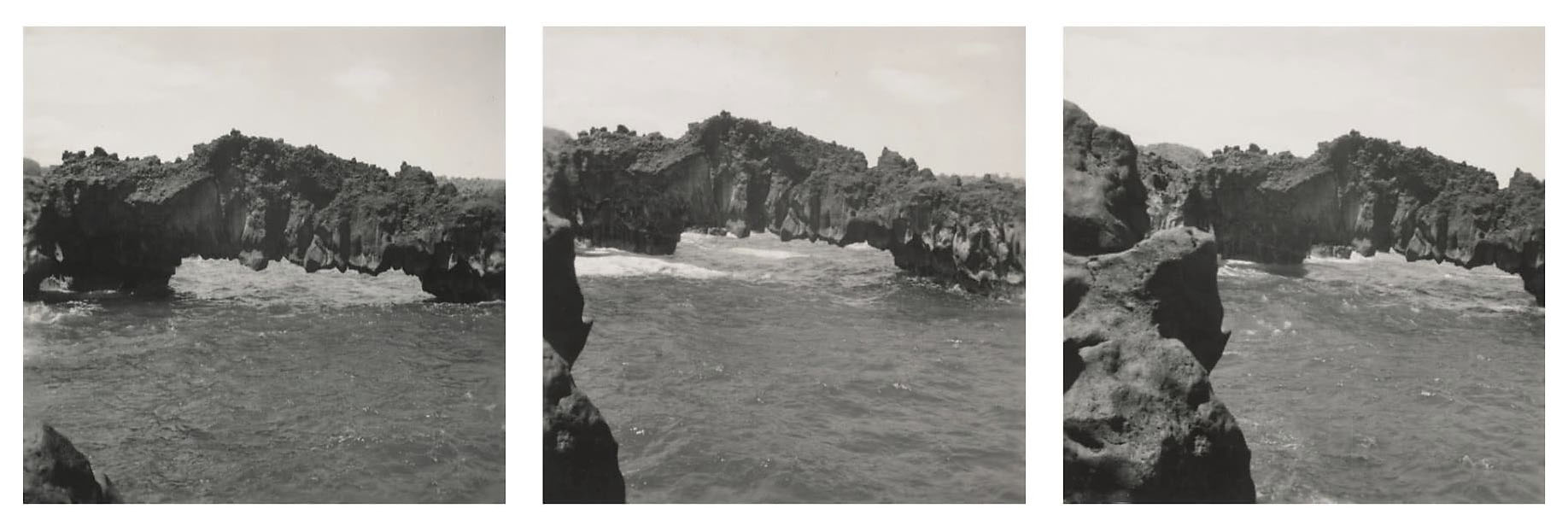
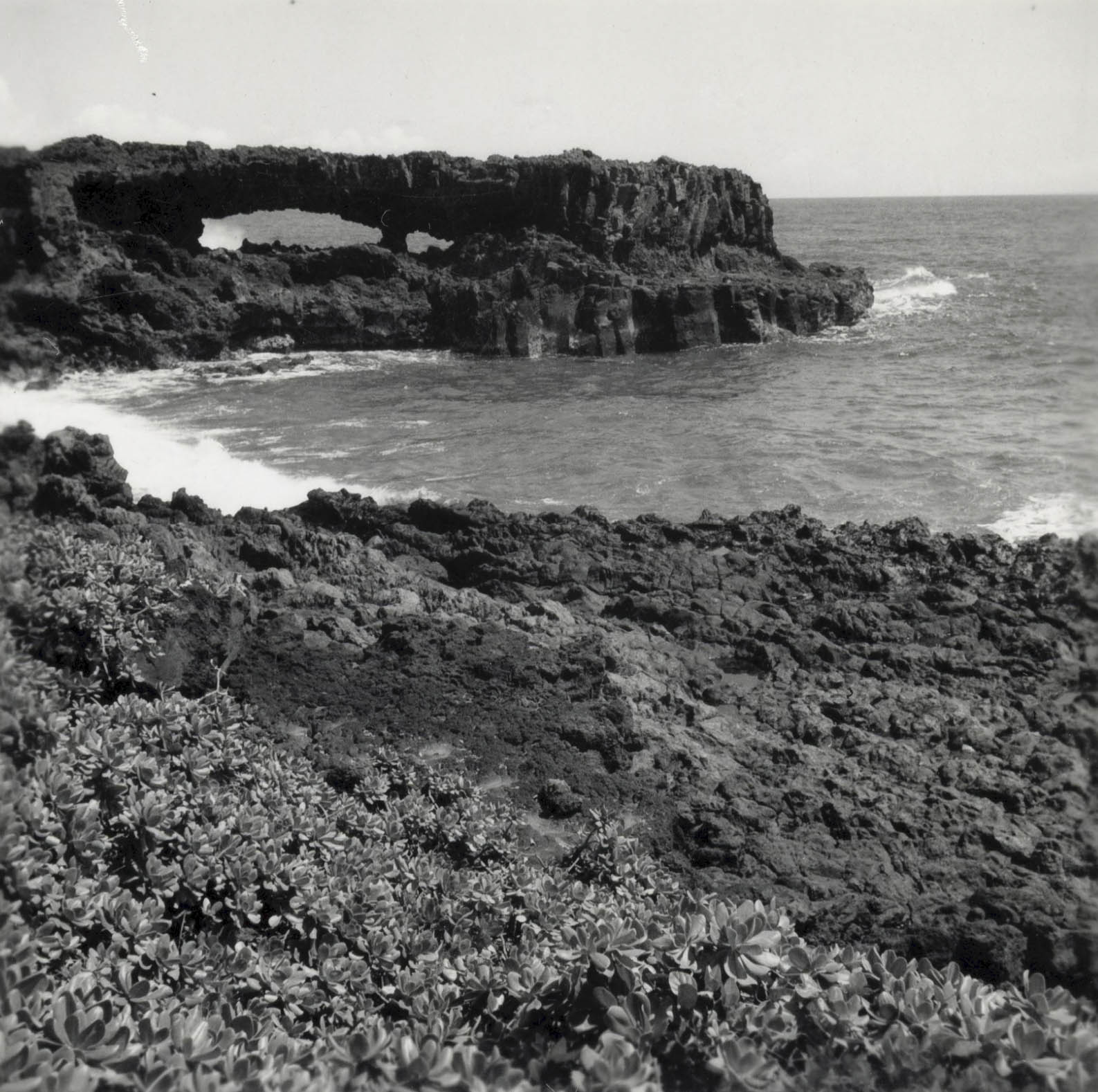
Georgia O'Keeffe (American, 1887-1986) 'Lava Arch, Wai'anapanapa State Park' March 1939


Georgia O’Keeffe (American, 1887-1986)
Lava Arch, Wai’anapanapa State Park March
1939
Gelatin silver prints
Georgia O’Keeffe Museum, Santa Fe
© Georgia O’Keeffe Museum


O’Keeffe made her first significant body of photographs on her 1939 trip to Hawaii. These photographs make clear that O’Keeffe had an intuitive interest in the photographic frame. Later, reframing would become a central tool in her sustained exploration of the medium.

Large print label to the exhibition


Though a handful of scattered snapshots made before 1939 can be attributed to O’Keeffe, her trip to Hawaii that year produced her first significant body of photographs. From this group of images, you can see O’Keeffe already framing and reframing the same landscape. These early photographs reveal that reframing was a method she intuitively brought to the medium and not one she learned from others nearly two decades later.

Text from the Denver Art Museum website


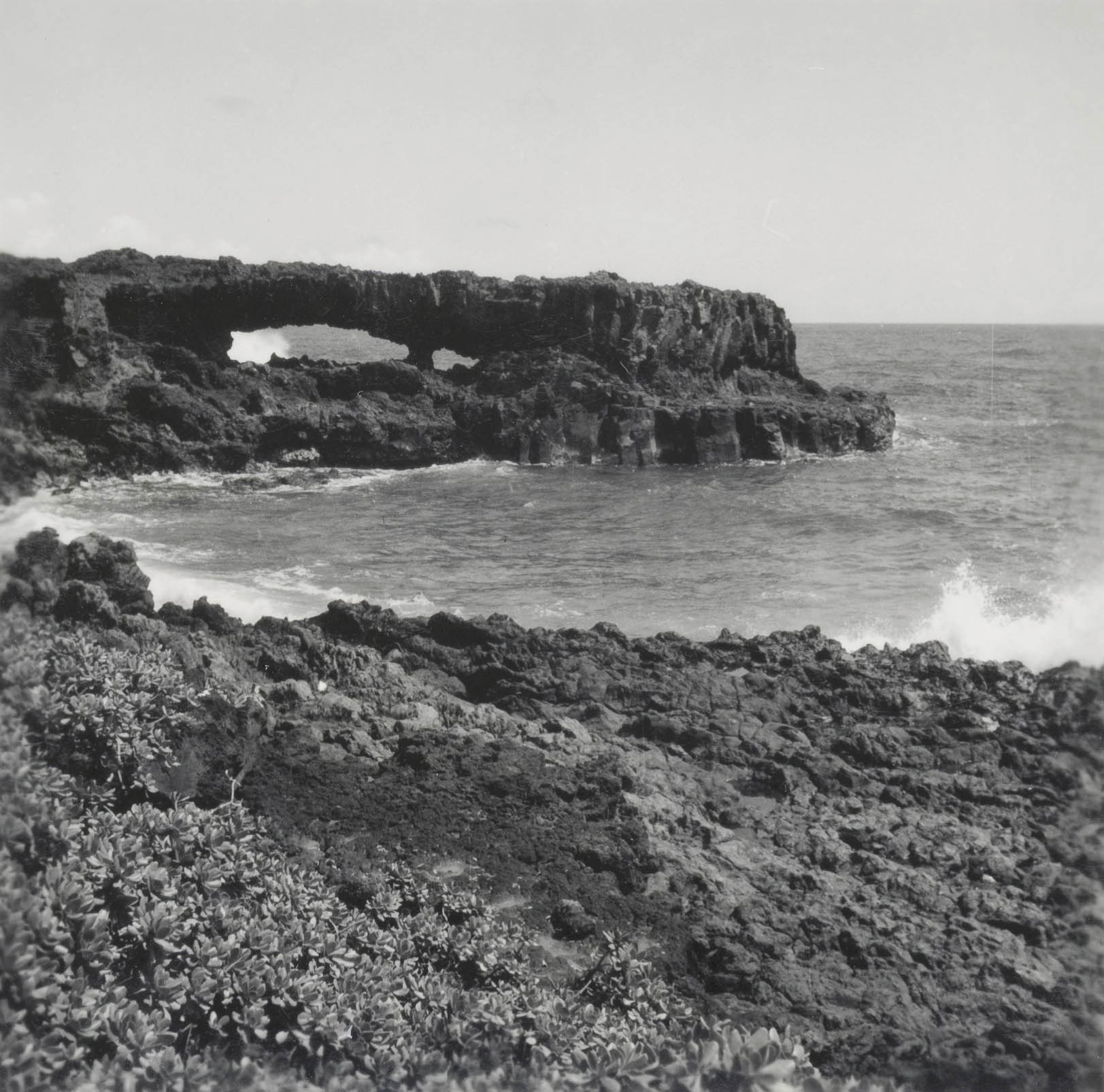
Georgia O'Keeffe (American, 1887-1986) 'Natural Stone Arch near Leho'ula Beach, 'Aleamai' March 1939

Georgia O'Keeffe (American, 1887-1986) 'Natural Stone Arch near Leho'ula Beach, 'Aleamai' March 1939


Georgia O’Keeffe (American, 1887-1986)
Natural Stone Arch near Leho’ula Beach, ‘Aleamai
March 1939
Gelatin silver prints
Georgia O’Keeffe Museum, Santa Fe
© Georgia O’Keeffe Museum


Here, O’Keeffe uses subtle reframing to seek an ideal expression of her experience of the place. She works with four boldly simplified elements – arch, water, sky, and coast – within a square picture area. In the top image, O’Keeffe uses the shoreline to bisect the middle of the picture plane, resulting in a composition that feels natural and balanced. In the bottom image, she has raised the shoreline within the frame, compressing the ocean, arch, and sky. How does your experience of the picture change because of her compositional choices?

Large print label to the exhibition


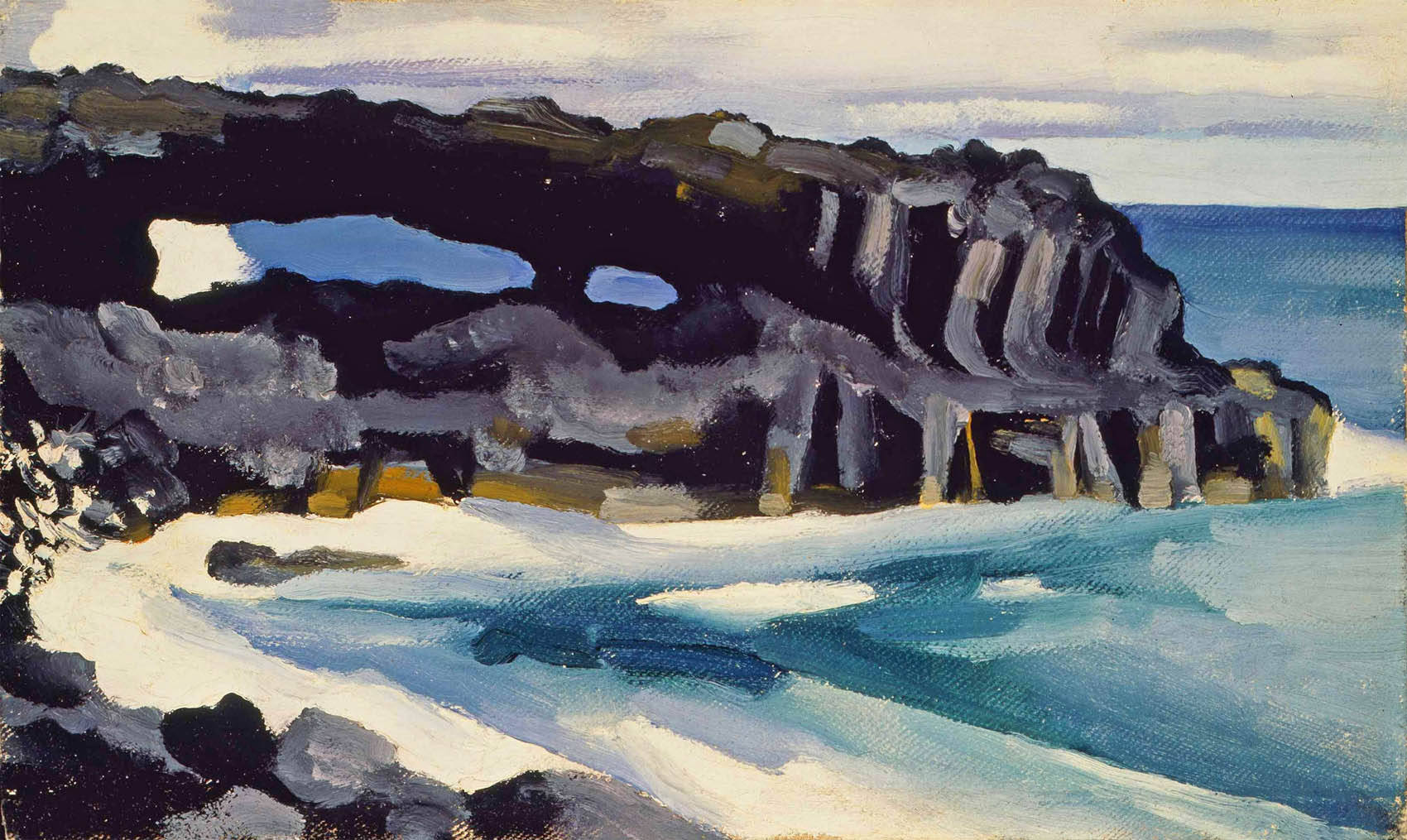
Georgia O'Keeffe (American, 1887-1986) 'Black Lava Bridge, Hana Coast No. 2' 1939


Georgia O’Keeffe (American, 1887-1986)
Black Lava Bridge, Hana Coast No. 2
1939
Oil paint on canvas
Honolulu Museum of Art: Gift of the Georgia O’Keeffe Foundation, 1994, 7893.1. © Georgia O’Keeffe Museum


O’Keeffe’s small oil painting Black Lava Bridge, Hana Coast No. 2 depicts the same coastline as her nearby photographs. Compared to the square pictures, the painting’s wider, lateral format emphasises the massy character of the rock formation itself, drawing our attention to its horizontality and relationship with the water.

Large print label to the exhibition


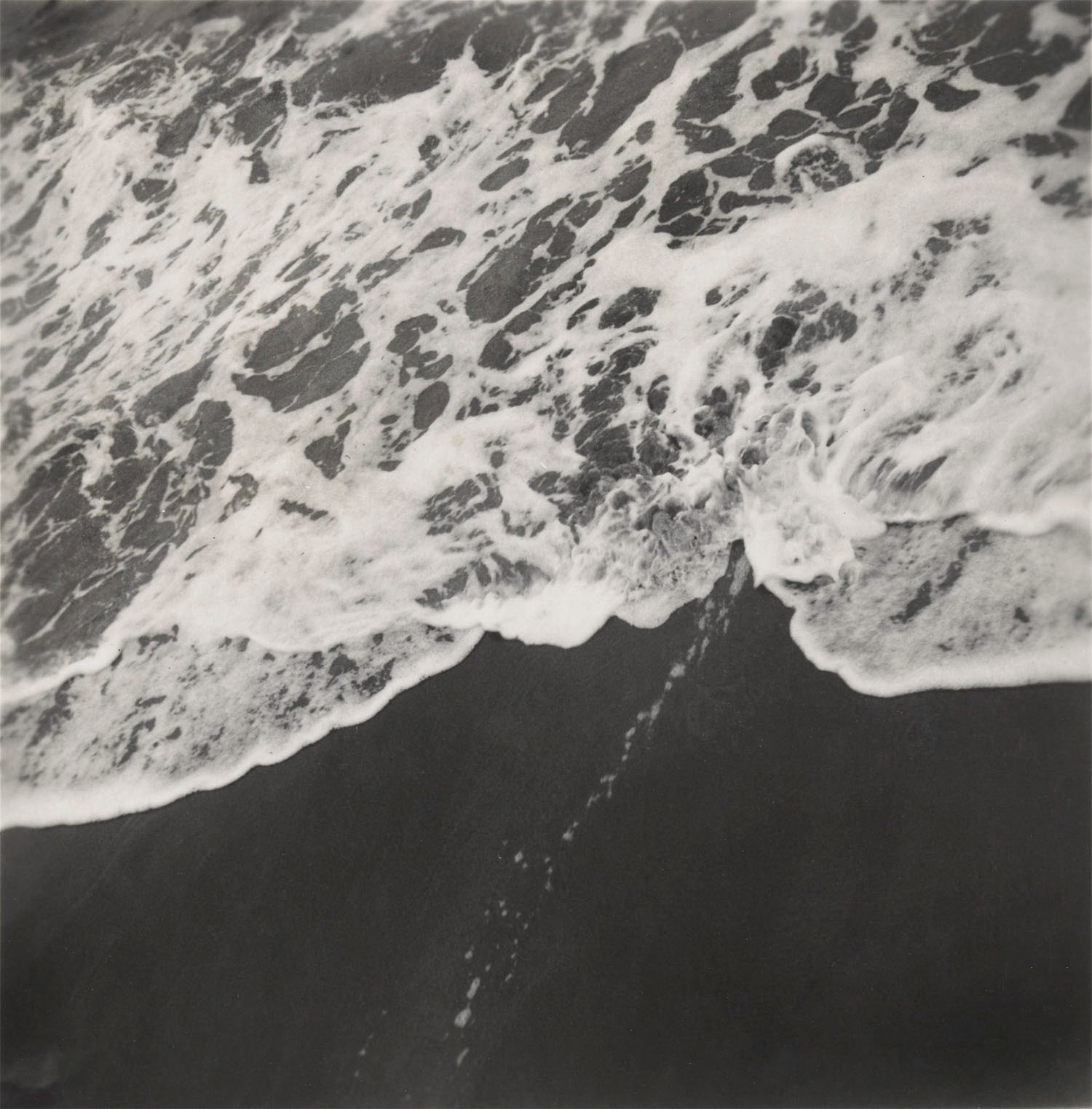
Georgia O'Keeffe (American, 1887-1986) 'Wai'anapanapa Black Sand Beach' March 1939

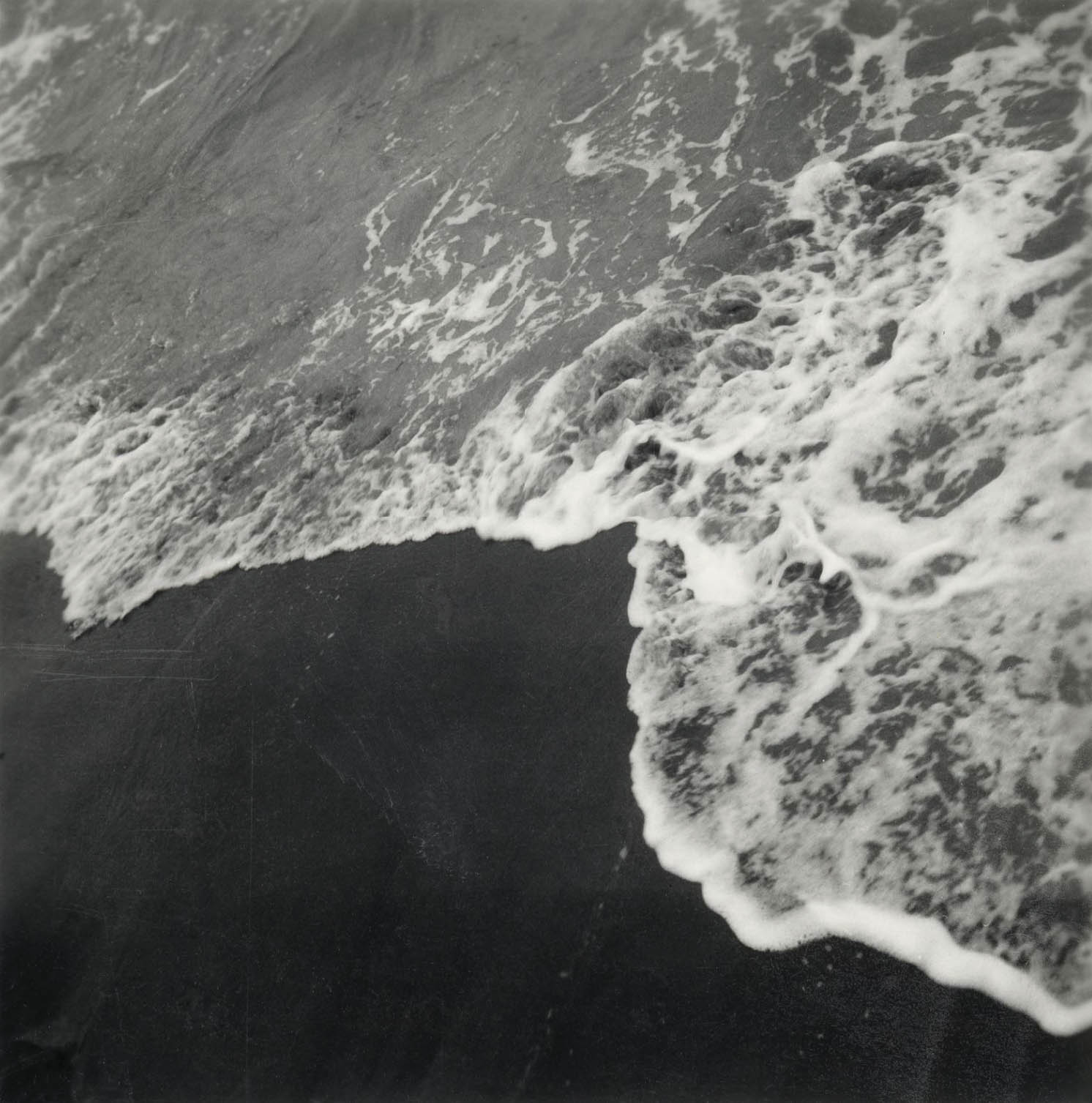
Georgia O'Keeffe (American, 1887-1986) 'Wai'anapanapa Black Sand Beach' March 1939


Georgia O’Keeffe (American, 1887-1986)
Wai’anapanapa Black Sand Beach
March 1939
Gelatin silver prints
Georgia O’Keeffe Museum, Santa Fe
© Georgia O’Keeffe Museum


In many of her letters home from Maui, O’Keeffe described her desire to photograph the island’s landscape and vistas. “The black sands of Hawaii – have something of a photograph about them,” she wrote. Perhaps the artist was responding to the chromatic simplicity of lacy white sea foam on black sand. Yet, there is also a notable relationship between O’Keeffe’s attraction to reframing and the constantly changing, expressive compositions created by nature as the edges of waves skim over the beach. Here, she seems to explore exactly that visual potential.

Large print label to the exhibition


Todd Webb (American, 1905-2000) 'Georgia O'Keeffe with Camera' 1959, printed later


Todd Webb (American, 1905-2000)
Georgia O’Keeffe with Camera
1959, printed later
Inkjet print
Todd Webb Archive
© Todd Webb Archive, Portland, Maine, USA


In 1940, O’Keeffe purchased a cottage on Ghost Ranch, northwest of Abiquiú, New Mexico. Ghost Ranch would become her summer and fall home – a place of solitude where she concentrated on painting. In 1945 she purchased a home in Abiquiú, where she would spend the winter and spring seasons. She moved to the Southwest permanently in 1949. In the mid-1950s, O’Keeffe took up the camera in earnest to continue her relentless search for ideal artistic expression. She made most of her photographs on or near her Abiquiú property.

Large print label to the exhibition


Georgia O'Keeffe (American, 1887-1986) 'Garage Vigas and Studio Door' July 1956


Georgia O’Keeffe (American, 1887-1986)
Garage Vigas and Studio Door
July 1956
Gelatin silver print
Metropolitan Museum of Art, New York. Anonymous Gift, 1977
© 2022 Georgia O’Keeffe Museum / Artists Rights Society (ARS), New York


Georgia O'Keeffe (American, 1887-1986) 'Studio Door' July 1956


Georgia O’Keeffe (American, 1887-1986)
Studio Door
July 1956
Gelatin silver print
Metropolitan Museum of Art, New York. Anonymous Gift, 1977
© 2022 Georgia O’Keeffe Museum / Artists Rights Society (ARS), New York


The Abiquiú studio door is a subject unique to O’Keeffe’s photography. In this series of photographs, she explored ways to visually compress the subject into two dimensions using the arrangement of forms within the frame. Photographing her studio door from a vantage point inside her garage (which is located across an open courtyard), she positioned her camera to include more or less of the garage ceiling. The linear pattern of vigas (round roof beams) and latillas (ceiling slats) change the way space seems to work in the picture, moving from three-dimensional depth to increasingly flattened planes of form.

Large print label to the exhibition


Georgia O'Keeffe (American, 1887-1986) Salita Door, Patio 1956-1957


Georgia O’Keeffe (American, 1887-1986)
Salita Door, Patio
1956-1957
Gelatin silver print
Museum of Fine Arts, Boston, the Lane Collection
© Georgia O’Keeffe Museum
Image © Museum of Fine Arts, Boston


“As I climbed and walked about in the ruin, I found a patio with a very pretty well house and bucket to draw up water. It was a good-sized patio with a long wall with a door on one side. That wall with a door in it was something I had to have.”

~ Georgia O’Keeffe


On many occasions, O’Keeffe claimed that the dark salita door – the door leading into her salita, or sitting room – was the reason she purchased her Abiquiú home. She depicted this door in her work with notable frequency, producing 23 paintings and drawings from 1946 until 1960 and numerous photographs beginning in 1956. “It’s a curse – the way I feel I must continually go on with that door,” she noted.

Text from the Denver Art Museum website


Georgia O'Keeffe (American, 1887-1986) Salita Door, Patio 1956-1957


Georgia O’Keeffe (American, 1887-1986)
Salita Door, Patio
1956-1957
Gelatin silver print
Metropolitan Museum of Art, New York
Anonymous Gift, 1977
© Georgia O’Keeffe Museum


On many occasions, O’Keeffe claimed that the salita door was the reason she purchased her Abiquiú property. This interior door separates the central patio from the salita, or sitting room. O’Keeffe used the salita as a workroom and storage space for her paintings, making the door a physical and metaphorical link between her home and her art. “I’m always trying to paint that door – I never quite get it,” O’Keeffe wrote. Her 23 paintings and drawings of the door were followed by a series of photographs.

Large print label to the exhibition


This door separates the central patio from the salita, or sitting room, which O’Keeffe used as a workroom and storage space for her paintings. The door can be seen as a physical and metaphorical link between her home and her art. “I’m always trying to paint that door – I never quite get it,” O’Keeffe wrote.

Text from the Denver Art Museum website


Georgia O'Keeffe (American, 1887-1986) 'Patio and Zaguan' 1956-1957


Georgia O’Keeffe (American, 1887-1986)
Patio and Zaguan
1956-1957
Gelatin silver print
Georgia O’Keeffe Museum, Santa Fe
© Georgia O’Keeffe Museum


The multiple doors and windows of the central patio in O’Keeffe’s Abiquiú home lent themselves to experiments in reframing. By moving the position and orientation of her camera, the artist could explore a huge variety of precise compositions in her own domestic space. Here, she turned toward the entryway of the zaguan – a central passage between the interior courtyard and the exterior of the house. O’Keeffe’s reflection, sometimes visible in a window at the left of the frame, captures the artist carefully framing the scene.

Large print label to the exhibition


Georgia O'Keeffe (American, 1887-1986) 'Salita Door' 1956-1958


Georgia O’Keeffe (American, 1887-1986)
Salita Door
1956-1958
Gelatin silver print
Metropolitan Museum of Art, New York
Anonymous Gift


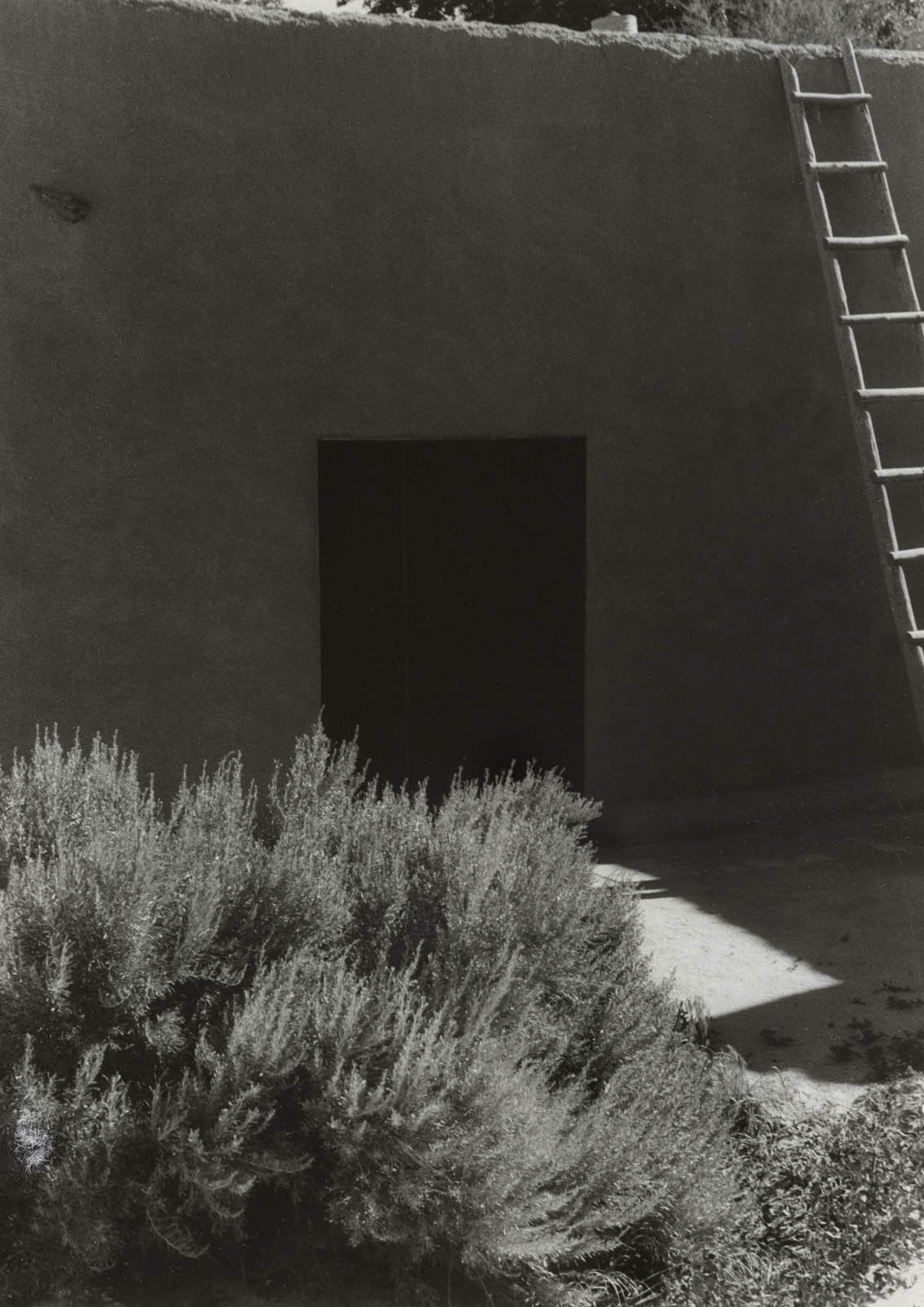
One of O’Keeffe’s first photographs of her Abiquiú, New Mexico home was a carefully and beautifully rendered image of the salita door in her courtyard. In the picture, the dark rectangle of the door breaks the adobe wall. A long, sleek shadow cuts diagonally through the frame, and a silvery sage bush fills the bottom left corner.

Large print label to the exhibition


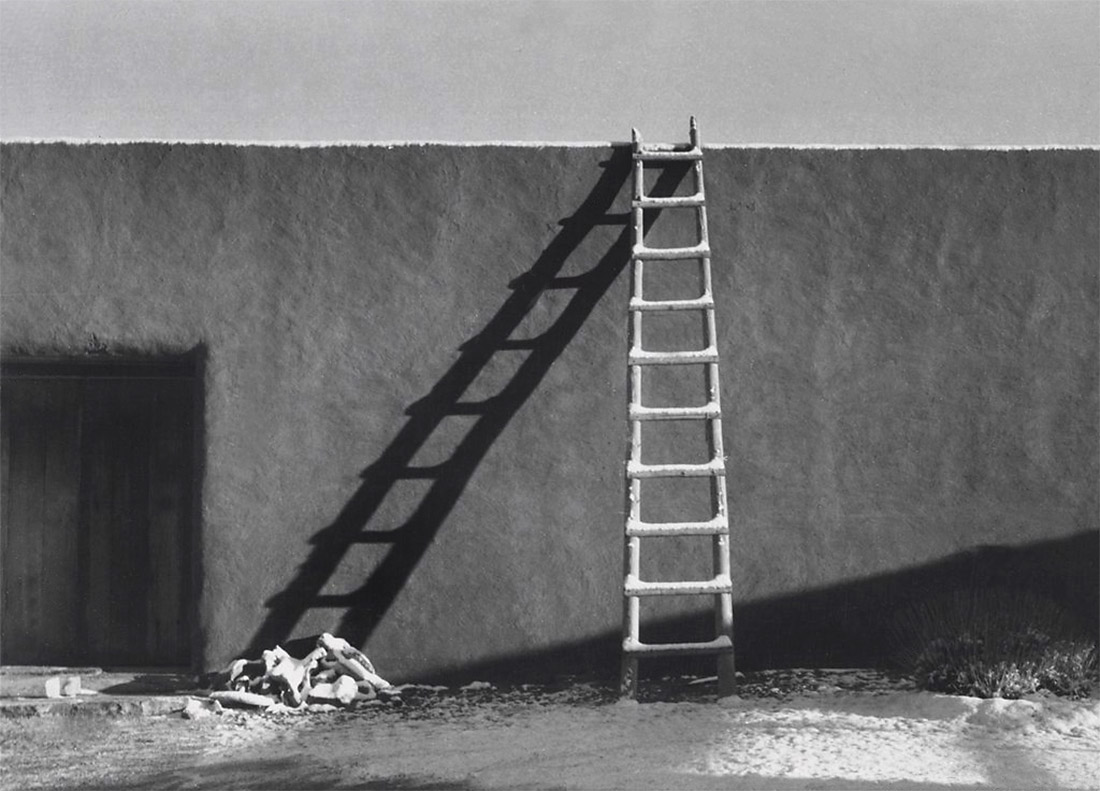
Georgia O'Keeffe (American, 1887-1986) 'Ladder against Studio Wall in Snow' 1959-1960


Georgia O’Keeffe (American, 1887-1986)
Ladder against Studio Wall in Snow
1959-1960
Gelatin silver print
Georgia O’Keeffe Museum, Santa Fe, N.M.
© Georgia O’Keeffe Museum


Georgia O'Keeffe (American, 1887-1986) 'Big Sage (Artemisia tridentata)' 1957


Georgia O’Keeffe (American, 1887-1986)
Big Sage (Artemisia tridentata)
1957
Gelatin silver prints
Georgia O’Keeffe Museum, Santa Fe
© Georgia O’Keeffe Museum


In 1957, O’Keeffe produced a group of eight photographs of big sagebrush (Artemisia tridentata) near Barranca, New Mexico. She pictured the three, tightly grouped shrubs at close range, in contrast to the rolling horizon, or framed against the packed ground. Moving her camera with each capture, she altered the arrangement of the forms and changed the overall organisation of the scene. The resulting images are radically different, though each contains the same basic elements.

Large print label to the exhibition


Georgia O'Keeffe (American, 1887-1986) 'Big Sage (Artemisia tridentata)' 1957


Georgia O’Keeffe (American, 1887-1986)
Big Sage (Artemisia tridentata)
1957
Gelatin silver print
Georgia O’Keeffe Museum, Santa Fe
© Georgia O’Keeffe Museum


Georgia O'Keeffe (American, 1887-1986) 'White House Overlook' and 'Spider Rock' July 1957


Georgia O’Keeffe (American, 1887-1986)
White House Overlook
Spider Rock
July 1957
Gelatin silver prints
Georgia O’Keeffe Museum, Santa Fe
© Georgia O’Keeffe Museum


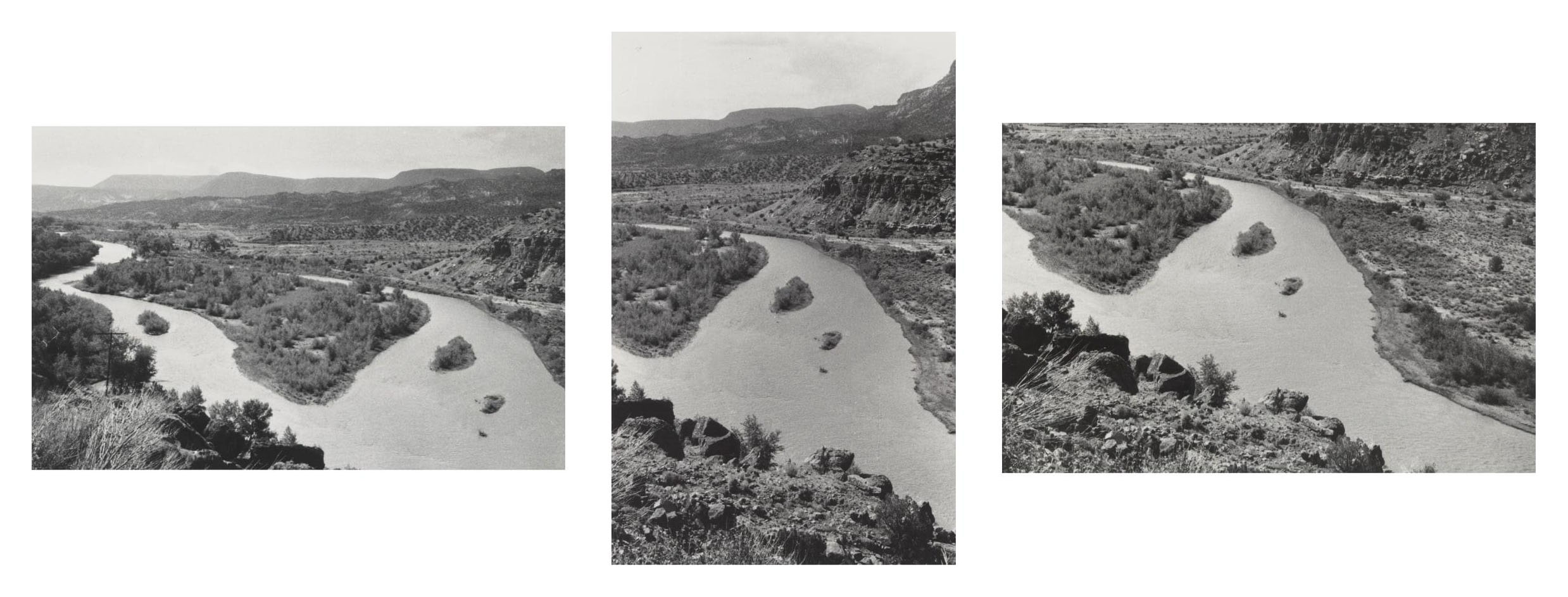
While O’Keeffe organised most of her photographic compositions within single film frames, a few noteworthy examples demonstrate her interest in testing that limitation. In July 1957, O’Keeffe visited Canyon de Chelly, Arizona, making three images at White House Overlook. Together, the images form a panorama, moving from the starburst form of a crag, through the winding canyon below, to the tall sandstone spire of Spider Rock. O’Keeffe’s choice to use vertical frames to capture a sweeping horizontal vista is distinctive. What might have interested her about this approach?

Large print label to the exhibition


In July 1957, O’Keeffe visited Canyon de Chelly, Arizona, and produced three images at White House Overlook. Together, the three images form a panorama, moving from the starburst form of a crag, through the winding canyon below, to the tall sandstone spire of Spider Rock. O’Keeffe’s choice to capture a sweeping, horizontal vista through three vertical photos is another characteristic of her photography.

Text from the Denver Art Museum website


Light


Georgia O'Keeffe (American, 1887-1986) 'Dark Rocks' 1938


Georgia O’Keeffe (American, 1887-1986)
Dark Rocks
1938
Oil on canvas
The Museum of Fine Arts, Houston
Gift of Patricia Barrett Carter


The painting Dark Rocks exemplifies O’Keeffe’s talent for abstracting natural forms. Her rendering of stacked rocks includes precisely placed areas of highlight and shadow. These formal elements result in an ambiguous relationship between positive and negative space. What is solid and what is mere shadow? This play of depth and weight is also evident in O’Keeffe’s photographs of her chow chows, which she rendered in her art as abstract round forms – much like these rocks. O’Keeffe often used light and dark to explore the qualities of form, dimension, and depth.

Large print label to the exhibition


Georgia O'Keeffe (American, 1887-1986) 'Bo II (Bo-Bo)' 1960-1961


Georgia O’Keeffe (American, 1887-1986)
Bo II (Bo-Bo)
1960-1961
Gelatin silver print
Georgia O’Keeffe Museum, Santa Fe


In these photographs, O’Keeffe’s chow Bo II (also known as Bo-Bo) curls up on sun-bleached tree trunks outside the artist’s studio door. The dog’s body is a dark, weighty form juxtaposed in various ways against the light cylindrical forms of the tree trunks. At the same time, the shadow of a ladder suggests the dog’s form could read as a shadow – a negative space without depth or weight.

Large print label to the exhibition


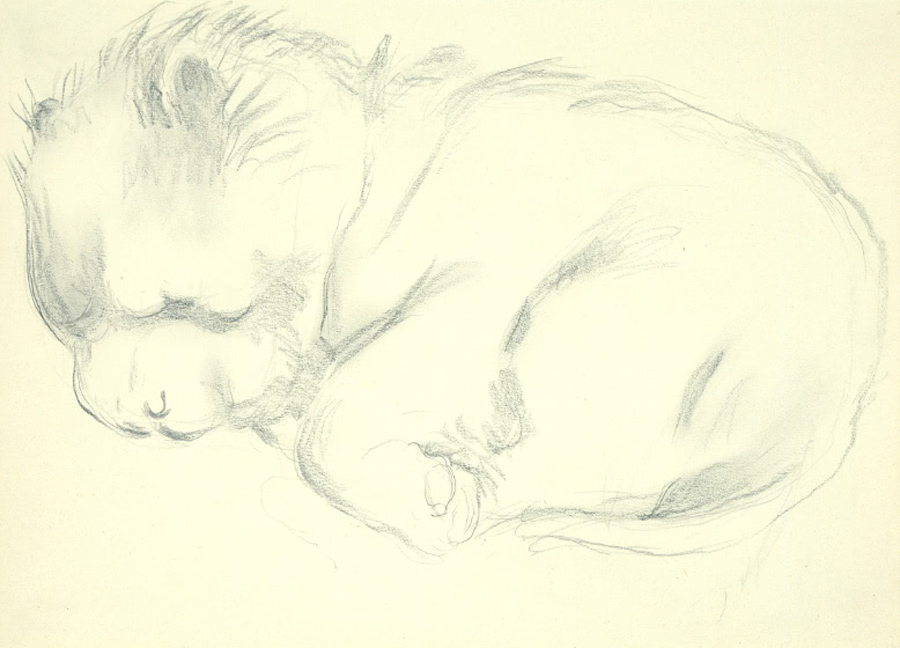
Georgia O'Keeffe (American, 1887-1986) 'Untitled (Dog)' 1951


Georgia O’Keeffe (American, 1887-1986)
Untitled (Dog)
1951
Graphite on paper
Georgia O’Keeffe Museum, Santa Fe
Gift of the Georgia O’Keeffe Foundation


O’Keeffe owned eight chow chows – seven blue and one red – over the course of more than 20 years. She received her first two, Bo and Chia, as Christmas presents in 1951. O’Keeffe often described her dogs in formal terms. She wrote to her sister Claudia, “I have two new chow puppies – half grown… not quite blue and against the half snow has a frosty colour – very pretty.” The artist appreciated the dogs’ dark fur in contrast to the bright New Mexico environment and their ambiguous shape when they lay curled on the ground.

Large print label to the exhibition


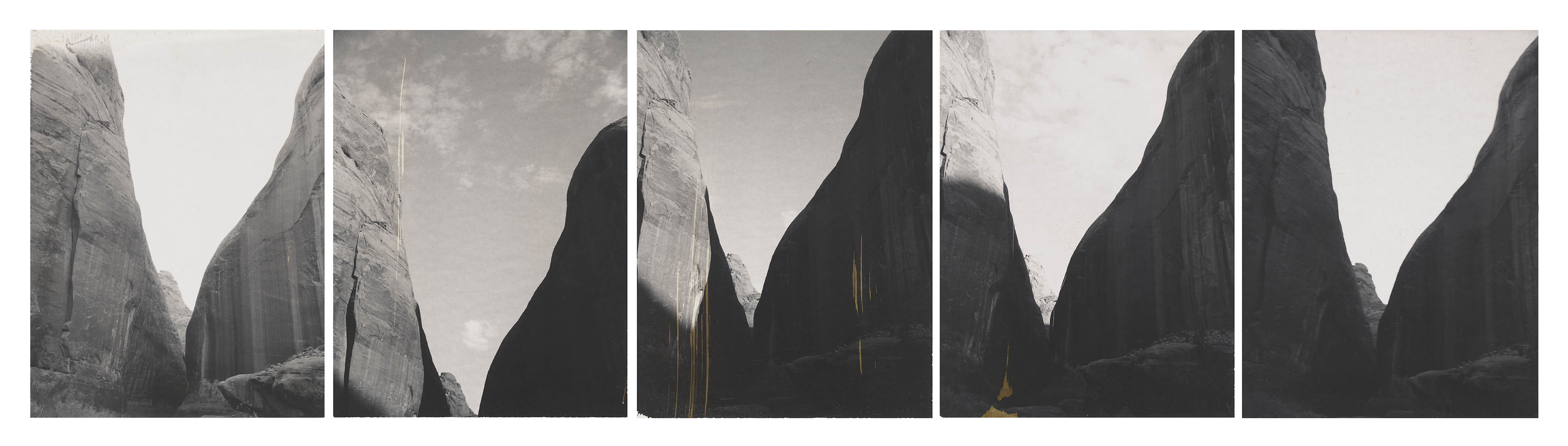
Georgia O'Keeffe (American, 1887-1986) 'Forbidding Canyon, Glen Canyon' September 1964


Georgia O’Keeffe (American, 1887-1986)
Forbidding Canyon, Glen Canyon
September 1964
Black-and-white Polaroids
Georgia O’Keeffe Museum, Santa Fe


During her second trip to Glen Canyon in Utah and Arizona, O’Keeffe and her group camped for four nights at a picturesque location near Forbidding Canyon. There, the monumental form of two cliffs meeting in a “V” shape provided a spectacular view each morning. The strong morning light turned one cliff into a bright white form, while the other, cast in shade, became a dark mass. As the sun moved across the morning sky, the shadows quickly shifted. O’Keeffe’s Polaroids tracked the changing proportions of dark and light in this dynamic scene, much like she had looked at the surf on the black sands of Maui 25 years earlier.

Large print label to the exhibition


Georgia O'Keeffe (American, 1887-1986) 'In the Patio VIII' 1950


Georgia O’Keeffe (American, 1887-1986)
In the Patio VIII
1950
Oil on canvas
Georgia O’Keeffe Museum, Santa Fe
Gift of the Burnett Foundation and the Georgia O’Keeffe Foundation
© Georgia O’Keeffe Museum


In the Patio VIII depicts the interior courtyard of O’Keeffe’s Abiquiú home. In the painting, she uses a bold band of a shadow to pick out the geometry of the space. The dark angular shape cuts across the lower half of the painting, differentiating the planes of walls and ground. It is as if the shadow lends the space a three-dimensional nature. For O’Keeffe, shadows were entities that could define a composition.

Large print label to the exhibition


Georgia O'Keeffe (American, 1887-1986) 'North Patio Corridor' 1956-1957


Georgia O’Keeffe (American, 1887-1986)
North Patio Corridor
1956-1957
Gelatin silver print
Georgia O’Keeffe Museum, Santa Fe
© Georgia O’Keeffe Museum


The door, wall, and sagebrush at the north corner of O’Keeffe’s Abiquiú patio presented the artist with an eye-catching array of lines, shadows, and shapes. Characteristically, she used these features of her environment relentlessly to search for the perfect arrangement of forms.

Large print label to the exhibition


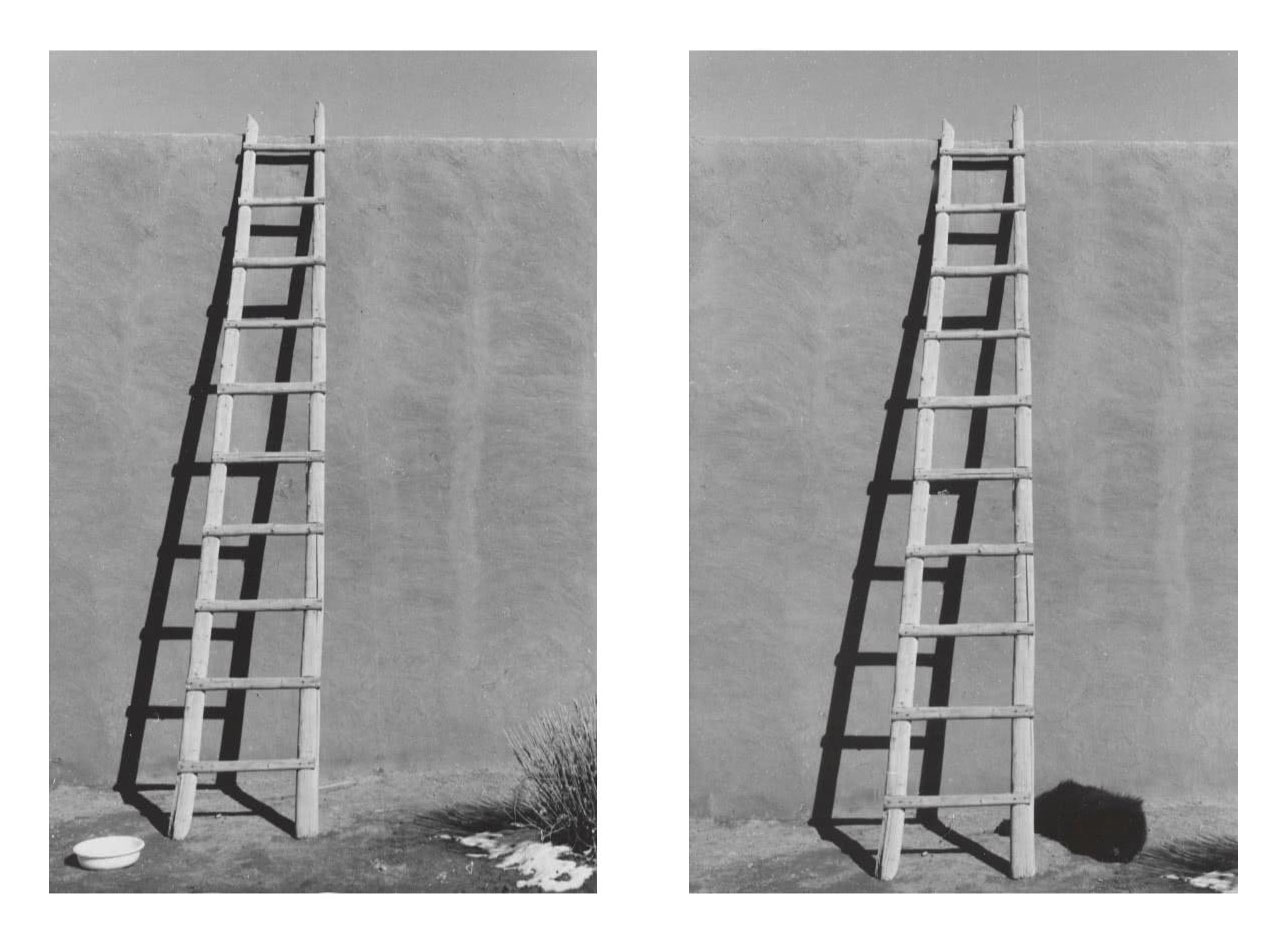
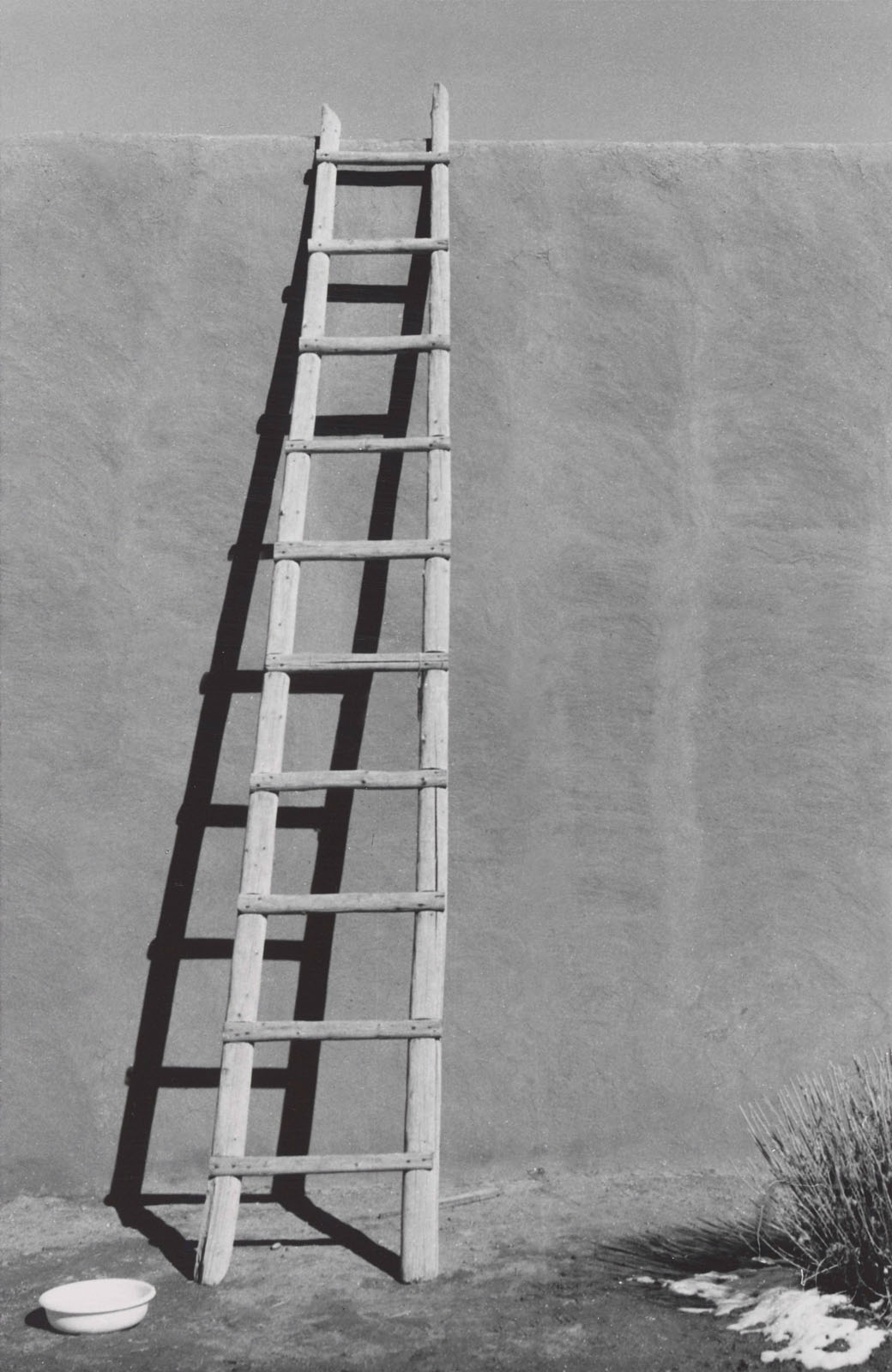
Georgia O'Keeffe (American, 1887-1986) 'Ladder against Studio Wall with White Bowl' and 'Ladder against Studio Wall with Black Chow (Bo-Bo)' 1959-1960


Georgia O’Keeffe (American, 1887-1986)
Ladder against Studio Wall with White Bowl
Ladder against Studio Wall with Black Chow (Bo-Bo)
1959-1960
Gelatin silver prints
Georgia O’Keeffe Museum, Santa Fe
© Georgia O’Keeffe Museum


O’Keeffe produced these two photographs in rapid succession. Often, she rendered light as a bright white form and shadow as a weighty dark object. By placing a white bowl to the left of the ladder in one frame and one of her pet dogs to the right in the other, O’Keeffe created startlingly different compositions through one minor change.

Large print label to the exhibition


Georgia O'Keeffe (American, 1887-1986) 'Ladder against Studio Wall with White Bowl' 1959-1960


Georgia O’Keeffe (American, 1887-1986)
Ladder against Studio Wall with White Bowl
1959-1960
Gelatin silver prints
Georgia O’Keeffe Museum, Santa Fe
© Georgia O’Keeffe Museum


Georgia O'Keeffe (American, 1887-1986) 'Skull, Ghost Ranch' 1961-1972


Georgia O’Keeffe (American, 1887-1986)
Skull, Ghost Ranch
1961-1972
Chromogenic print
Georgia O’Keeffe Museum, Santa Fe, N.M.
© Georgia O’Keeffe Museum


O’Keeffe shared her photographs with family and friends, often mailing prints with handwritten notes on the back. For the artist, these photographs provided her friends with glimpses of her home and artistic world. Skull, Ghost Ranch was printed multiple times. On the verso of one print, O’Keeffe hand wrote to an unknown acquaintance, “Another present this is. It is beside the Studio door. Pretty isn’t it!”

“It never occurs to me that [skulls] have anything to do with death. They are very lively,” O’Keeffe noted. “I have enjoyed them very much in relation to the sky.” For O’Keeffe, the artistry in rendering skulls lay in juxtaposition. The harmonious relation of the skull’s form to other elements resulted in an artistic play of light and shadow and positive and negative space that sustained her interest.

Large print label to the exhibition


Georgia O'Keeffe (American, 1887-1986) 'Goat's Head' 1957


Georgia O’Keeffe (American, 1887-1986)
Goat’s Head
1957
Oil on canvas
McNay Art Museum, San Antonio
Gift of the Estate of Tom Slick


Skulls were a favourite subject for O’Keeffe, appearing in her paintings from the 1930s until the 1960s and in her photographs until the 1970s. These bones, however, were never depicted in isolation. O’Keeffe’s skulls were always juxtaposed with other elements: cloth backgrounds, desert landscapes, architectural forms, and blue skies. In Goat’s Head, O’Keeffe presents the skull against alternating planes of light and shadow, suggesting a retreating desert landscape. The careful cropping of the composition, like a photograph, unites the forms of the skull and landscape and encourages a comparison of bone and background.

Large print label to the exhibition


Georgia O'Keeffe (American, 1887-1986) 'Roofless Room' 1959-1960


Georgia O’Keeffe (American, 1887-1986)
Roofless Room
1959-1960
Gelatin silver print
Georgia O’Keeffe Museum, Santa Fe
© Georgia O’Keeffe Museum


Georgia O'Keeffe (American, 1887-1986) 'Roofless Room' 1959-1960


Georgia O’Keeffe (American, 1887-1986)
Roofless Room
1959-1960
Gelatin silver print
Georgia O’Keeffe Museum, Santa Fe
© Georgia O’Keeffe Museum


Streaked by morning shadows, O’Keeffe’s photographs of her “roofless room” at Abiquiú are stunning studies of the dimensional quality of shadows. As the sun’s position changed throughout the day, the shadows cast by the latillas (ceiling slats) crept down the walls and across the bare floor, reframing the scene. In each image, O’Keeffe uses these dramatic shadows to articulate the planes and angles of the room.

Large print label to the exhibition


Seasons

In the Southwest, each season brings subtle and dramatic shifts in the quality of sunlight and the appearance of the landscape. While full, leafy trees cast deep shadows in the summer, the same place offers bare branches and evenly lit, snowy ground in the low sun of winter. O’Keeffe photographed her environment in all seasons, allowing the change in nature to act as an inherent formal characteristic in her artwork.


Georgia O'Keeffe (American, 1887-1986) 'Road from Abiquiú' 1964-1968


Georgia O’Keeffe (American, 1887-1986)
Road from Abiquiú
1964-1968
Black-and-white Polaroids
Georgia O’Keeffe Museum, Santa Fe


“The valley is wide and flat with a row of bare trees on the far side – masking the river that I do not see because of them – then a very fine long mountain rises beyond. It is all frosty this morning – The sun this time of year hits the mountain first – then the trees – with a faint touch of pink – then spreads slowly across the valley as sun light.” O’Keeffe’s sensitivity to the seasonal change outside her bedroom windows is evident in her multiple photographs of those views, which capture the landscape in winter, spring, summer, and fall.

Large print label to the exhibition


Georgia O'Keeffe (American, 1887-1986) 'Road out Bedroom Window' Probably 1957

Georgia O'Keeffe (American, 1887-1986) 'Road out Bedroom Window' Probably 1957


Georgia O’Keeffe (American, 1887-1986)
Road out Bedroom Window

Probably 1957
Gelatin silver prints
Metropolitan Museum of Art, New York
Anonymous Gift, 1977


Several extant photographs of the mesa and road outside O’Keeffe’s east window track the view at different times of the year. In addition to overtly reframing the scene, the artist allowed nature’s changes to alter the relationships of form and light within the composition. The strong summer sun cast hard shadows onto the silvery road in one photograph, while in another, the diffuse light of spring highlights the new growth of the thin foliage.

Large print label to the exhibition


Georgia O'Keeffe (American, 1887-1986) 'Road Past the View' 1964


Georgia O’Keeffe (American, 1887-1986)
Road Past the View
1964
Oil on canvas
Collection of Carl & Marilynn Thoma


In her 1976 Viking Press book, titled Georgia O’Keeffe, the artist included the following text next to the seductive painting Road Past the View: “The road fascinates me with its ups and downs and finally its wide sweep as it speeds toward the wall of my hilltop to go past me. I had made two or three snaps of it with a camera.” It is notable that this anecdote about photography was included in a book with limited text covering an impressive 60-year career. O’Keeffe was sure to write photography into her story.

Large print label to the exhibition


Todd Webb (American, 1905-2000) 'Georgia O'Keeffe Photographing the Chama River' 1961, printed later


Todd Webb (American, 1905-2000)
Georgia O’Keeffe Photographing the Chama River
1961, printed later
Inkjet print
Courtesy of the Todd Webb Archive


In 1957 Todd Webb wrote to O’Keeffe, “Will we stand on the bridge and watch the Chama in flood?” The pair often visited this spot, located between O’Keeffe’s Ghost Ranch property and her main house in Abiquiú. In these three frames, Webb captured O’Keeffe as she moved along the rise, reframing the river view with her camera.

Large print label to the exhibition


Georgia O’Keeffe and Todd Webb met in 1946. That year she was the first woman to be honored with a retrospective exhibition at the Museum of Modern Art (MoMA). Webb, a photographer and protégé of the artist’s husband Alfred Stieglitz, documented the exhibition. That same year, Webb’s urban scenes were shown at the Museum of the City of New York, curated by influential photographic historian Beaumont Newhall. Despite these professional accomplishments, it was also a time of loss as Stieglitz died in July of that year. They went on to have a long friendship and Webb visited O’Keeffe in New Mexico multiple times. Their friendship is documented in a series of photographs on exhibit alongside works by O’Keeffe.

In 1961, O’Keeffe traveled with Lucille and Todd Webb along with a dozen other friends on a ten-day raft trip down the Colorado River to Glen Canyon, Utah. After the trip, Webb presented O’Keeffe with an album of photographs from their shared experience. With his camera focused on the artist, he also framed the extraordinary beauty of the canyons accessible only on the water…

In a 1981 letter to the photographer, O’Keeffe remembered a day in 1946 which solidified their friendship. She was packing artwork for her MoMA exhibition. “I had the world to myself to pack up thirty or forty paintings to go. It looked like quite a formidable task… When you saw the problem you started right in to help me. I may have seen you before, talking with Stieglitz, but I never spoke with you. However, I will never forget your helping me for hours – a person, almost a stranger – till we had everything packed and ready to go.”

Anonymous. “Todd Webb,” on the Georgia O’Keeffe Museum website 2016 [Online] Cited 07/04/2023


Georgia O'Keeffe (American, 1887-1986) 'Chama River' 1957-1963


Georgia O’Keeffe (American, 1887-1986)
Chama River
1957-1963
Gelatin silver prints
Georgia O’Keeffe Museum, Santa Fe


Located between O’Keeffe’s Abiquiú home and Ghost Ranch, this south-facing elevation overlooks the Chama River as it makes a tight bend. O’Keeffe photographed the view in a variety of seasons, capturing the changing depth of the rushing water, the density of foliage, and the deepness of shadows throughout the year.

Large print label to the exhibition


Georgia O'Keeffe (American, 1887-1986) 'Jimsonweed (Datura stramonium)' 1964-1968


Georgia O’Keeffe (American, 1887-1986)
Jimsonweed (Datura stramonium)
1964-1968
Black-and-white Polaroid
Georgia O’Keeffe Museum, Santa Fe
© Georgia O’Keeffe Museum


O’Keeffe’s photographs of jimsonweed flowers exemplify her interest in seasonal change. The trumpet-like flowers of the jimsonweed began blooming around her home in late summer and continued through the first frost. The flowers obey both the cycle of the seasons and a shorter daily cycle, opening in the afternoon and closing with the rising sun the next day.

O’Keeffe’s many photographs of jimsonweed present the bright white flower in contrast to its dark surrounding leaves. Individually or in groups of blooms, jimsonweed signals O’Keeffe’s ongoing fascination with nature’s transformation in all its forms.

“Well – I made you take time to look at what I saw and when you took time to really notice my flower you hung all your own associations with flowers on my flower and you write about my flower as if I think and see what you think and see of the flower – and I don’t,” O’Keeffe scolded. For the artist, her renderings of flowers were about detail, light and shade, and formal juxtaposition. Though many critics read other meanings into these works, O’Keeffe maintained that they signified only the artistic potential of flowers. Here, she distills their potential not with pencil or paint, but with her camera.

Large print label to the exhibition


Georgia O'Keeffe (American, 1887-1986) 'White Flower' 1929


Georgia O’Keeffe (American, 1887-1986)
White Flower
1929
Oil on canvas
The Cleveland Museum of Art, Hinman B. Hurlbut Collection


Georgia O’Keeffe is perhaps best known for her paintings of flowers. Their magnified structures fill the canvas and absorb the viewer in her unique vision of nature. She magnified her painted flowers so that people would “be surprised into taking time to look at it.” O’Keeffe rendered her blooms at their peak, capturing this fleeting view of nature in enveloping detail.

Large print label to the exhibition


Cincinnati Art Museum
953 Eden Park Drive
Cincinnati, Ohio 45202
Phone: (513) 721-ARTS (2787)

Opening hours:
Open Tuesday – Sunday 11am – 5pm
Closed Mondays

Cincinnati Art Museum website

LIKE ART BLART ON FACEBOOK

Back to top

Exhibition: ‘Jan Groover. Laboratory of Forms’ at the Fondation Henri Cartier-Bresson, Paris

Exhibition dates: 8th November 2022 – 12th February 2023

Exhibition curators: Tatyana Franck, President of the French Institute Alliance Française in New York, former director of Photo Elysée Emilie and Delcambre Hirsch Agnès Sire, Artistic director, for the Paris version


Jan Groover (American, 1943-2012) 'Untitled' c. 1971 from the exhibition 'Jan Groover. Laboratory of Forms' at the Fondation Henri Cartier-Bresson, Paris, Nov 2022 - Feb 2023


Jan Groover (American, 1943-2012)
Untitled
c. 1971
Diptych
© Photo Elysée – Fonds Jan Groove


Formalism is everything

Well no. No it isn’t. Groover is not one of my favourite photographers but I acknowledge how she broadened the definition of what a photograph can be. But her photographs are too clinical for my taste. They leave me cold. I like a little serendipity and spirit in my photography…

A painter before she became a photographer.

All images are constructions.

She composed her photographs as artists compose their paintings.

She wanted to “reinvent everything”.

Still life were influenced by Edward Weston, Paul Outerbridge and Alfred Stieglitz.

The reality is in the detail.

Nothing was left to chance. Every photograph had a plan:

“Spotlight on the house sink: who would have thought that so much beauty was nestled there? Reflection of a fork, transparency of a glass, sliding of water, damaged enamel, burning of coffee: under its tight framing, effects and materials are intertwined. Nothing is left to chance, each arrangement is first sketched out in pencil, tested with Polaroid.”1


concept [of] space

elements [of] reality

perception [of] image

photographs [of] objects


Dr Marcus Bunyan


1/ Emmanuelle Lequeux. “Jan Groover, l’abstraction du réel,” on the Le Monde website 18 September 2019 [Online] Cited 10/01/2022. Translated from the French by Google Translate


Many thankx to the Fondation Henri Cartier-Bresson for allowing me to publish the photographs in the posting. Please click on the photographs for a larger version of the image.


“And then one day I had the thought that I didn’t want to have to make everything up, so I quit painting. Then I found out that you have to make everything up anyway.”


Jan Groover, in Pure invention: The Tabletop Still Life, 1990


“I had some wild concept that you could change space – which you can… If the thing doesn’t look like the way I want it to look, I’ll try something else.”


Jan Groover, 1994


Interview with Tatyana Franck around the Jan Groover. Laboratory of Forms exhibition

A singular artist, Jan Groover (1943-2012), of American origin, had a considerable impact on the recognition of colour photography. This exhibition, the first retrospective to be dedicated to her since her death in 2012, shows the evolution of her work, from her original polyptychs to the still lifes that she would produce throughout her life. Thanks to the donation of Jan Groover’s archives to Photo Elysée (Lausanne) in 2017, this exhibition, presented in 2019 in Lausanne, pays tribute to an artist who has constantly renewed herself, thus becoming part of the history of photography.


Jan Groover (American, 1943-2012) 'Untitled' c. 1971 from the exhibition 'Jan Groover. Laboratory of Forms' at the Fondation Henri Cartier-Bresson, Paris, Nov 2022 - Feb 2023


Jan Groover (American, 1943-2012)
Untitled
c. 1971
© Photo Elysée – Fonds Jan Groover


Jan Groover (American, 1943-2012) 'Untitled' c. 1975 from the exhibition 'Jan Groover. Laboratory of Forms' at the Fondation Henri Cartier-Bresson, Paris, Nov 2022 - Feb 2023


Jan Groover (American, 1943-2012)
Untitled
c. 1975
© Photo Elysée – Fonds Jan Groover


Jan Groover (American, 1943-2012) 'Untitled' c. 1975


Jan Groover (American, 1943-2012)
Untitled
c. 1975
© Photo Elysée – Fonds Jan Groover


Jan Groover (American, 1943-2012) 'Untitled' c. 1975


Jan Groover (American, 1943-2012)
Untitled
c. 1975
© Photo Elysée – Fonds Jan Groover


Exhibition

Born in the United States, singular artist Jan Groover (1943-2012) played a significant role in the appreciation of colour photography. In the first retrospective since her death in 2012, the exhibition shows the development of Groover’s work, from original polyptychs to still lifes she produced throughout her career. Thanks to a donation from the Jan Groover archives at Photo Elysée (Lausanne) in 2017, the exhibition, shown in Lausanne in 2019, pays tribute to an artist who constantly reinvented herself, thus leaving her mark on the history of photography.

Jan Groover took up photography as a sort of challenge. Noting that “photography wasn’t taken seriously” in the United States in the 1960s, she distanced herself from abstract painting, which she’d previously studied. In 1967, Groover bought her first camera in what she described as her “first adult decision.” Her fondness for abstraction and the pictorial can already be seen in her first series of polyptychs, where the subject is multiplied, divided, or hidden behind opaque forms to the point of negation.

Starting in the late 1970s, Groover turned to the still life, a traditional genre in pictorial art, experimenting with it until the end of her life through impressively diverse subjects, formats and techniques. At a time when documentary photography was at the forefront in magazines like LIFE, Groover applied her background in painting to photography, giving abstract photography due credit by creating images for the sake of form, far from signification and statement. On top of her still lifes, Groover also produced series on freeways, portraits, and Body Parts.

As an actor in rendering the photographic medium more versatile – a property then attributed to painting and drawing – Groover explored different creative techniques, as in the use of platinum and palladium prints for her urban series and portraits of close friends (John Coplans or Janet Borden, with whom she was in constant intellectual dialogue).

In Jan Groover. Laboratory of Forms, colour and black-and-white vintage prints are presented, along with the artist’s work materials (polaroids, notebooks, etc.). The exhibition explores Groover’s artistic process and gives us insight into the experimental nature of her work and her influence on modern photography.

Biography

Born on April 24, 1943, in Plainfield, New Jersey, Jan Groover first studied abstract painting at the Pratt Institute in New York before taking up photography, with the purchase of her first camera in the early 1970s. This marked the beginning of a diverse career made of polyptychs, series of shots of the same location, portraits and still lifes (a recurring theme of her art). In 1970, she earned a Master’s in Art Education from Ohio State University, Columbus. She then moved to New York with her partner, painter and art critic Bruce Boice.

In New York, a center of contemporary art, she gradually gained recognition on the art scene and experimented with other techniques in photography, like platinum/palladium prints.

In 1974, the Light Gallery put on her first solo exhibition, and in 1978 she received a grant from the federal agency National Endowment for the Arts. As a respected teacher at Purchase College, she taught photographers Gregory Crewdson, Laurie Simmons and Philip-Lorca diCorcia, for a few.

In 1987, the New York Museum of Modern Art (MoMA) held a retrospective on Groover’s work.

The Groover-Boice couple turned in this way on the New York art scene until 1991, the year they settled in the Dordogne region of France. Groover continued her series of still lifes despite falling ill in 1998. The couple gained French nationality in 2005. Jan Groover passed away a few years later, on January 1st, 2012.

Thanks to Bruce Boice’s donation, Photo Elysée in Lausanne was able to expand its collection with the archive of Jan Groover, including a great majority of her work as well as unpublished archival material from her studio. The museum ensures the conservation, study and distribution of the archive.

Text from the Fondation Henri Cartier-Bresson website


Jan Groover (American, 1943-2012) 'Untitled' Nd


Jan Groover (American, 1943-2012)
Untitled
Nd
© Photo Elysée – Fonds Jan Groover


Jan Groover (American, 1943-2012) 'Untitled' c. 1978


Jan Groover (American, 1943-2012)
Untitled
c. 1978
© Photo Elysée – Fonds Jan Groover


Jan Groover (American, 1943-2012) 'Untitled' c. 1978


Jan Groover (American, 1943-2012)
Untitled
c. 1978
© Photo Elysée – Fonds Jan Groover


In 1978, another radical turning point. Jan Groover focuses all her efforts on still life. Spotlight on the house sink: who would have thought that so much beauty was nestled there? Reflection of a fork, transparency of a glass, sliding of water, damaged enamel, burnt coffee: under its tight framing, effects and materials are intertwined. Nothing is left to chance, each arrangement is first sketched out in pencil, tested with Polaroid. In fact, she has never stopped painting: she simply does it with the elements of reality. Her challenge, “that the entire surface of the photo have the same magnetism and the same importance,” summarises the painter Bruce Boice, her husband.

Resounding success: her Kitchen Still Lifes establish her as an immense visual artist. In the eyes of Susan Kismaric, curator in the photography department at MoMA in New York, she invented “nothing less than a resplendent new way of seeing”. An “anomaly of the photographic world”? Some call it that. But of those who have a sacred heritage: initiated by Jan Groover, photographers Gregory Crewdson and Philip-Lorca diCorcia bring her composition lessons to incandescence.

Emmanuelle Lequeux. “Jan Groover, l’abstraction du réel,” on the Le Monde website 18 September 2019 [Online] Cited 10/01/2022. Translated from the French by Google Translate


Jan Groover (American, 1943-2012) 'Untitled' c. 1978


Jan Groover (American, 1943-2012)
Untitled
c. 1978
© Photo Elysée – Fonds Jan Groover


Jan Groover (American, 1943-2012) 'Untitled' c. 1978


Jan Groover (American, 1943-2012)
Untitled
c. 1978
© Photo Elysée – Fonds Jan Groover


Jan Groover (American, 1943-2012) 'Untitled (Ealan Wingate)' c. 1980


Jan Groover (American, 1943-2012)
Untitled (Ealan Wingate)
c. 1980
© Photo Elysée – Fonds Jan Groover


A summary inventory of Groover’s archive tallied a total of 11,663 negatives, 525 slides, and 9,485 paper prints, along with unpublished drawings and all of her camera equipment. “Jan Groover was not only interested in beautiful prints, but she was very much interested in techniques, and the artisanal way of making images,” says Franck. “We were very lucky to have been able to find a complete laboratory with all of her prints, negatives, everything was kept in her house.”

Marigold Warner. “Jan Groover: Laboratory of Forms,” on the British Journal of Photography website 8th November 2019 [Online] Cited 10/01/2022.


Jan Groover (American, 1943-2012) 'Untitled (Mel Bochner)' 1980


Jan Groover (American, 1943-2012)
Untitled (Mel Bochner)
1980
© Photo Elysée – Fonds Jan Groover


Jan Groover (American, 1943-2012) 'Untitled' 1983


Jan Groover (American, 1943-2012)
Untitled
1983
© Photo Elysée – Fonds Jan Groover


Jan Groover (American, 1943-2012) 'Untitled' c. 1981


Jan Groover (American, 1943-2012)
Untitled
c. 1981
© Photo Elysée – Fonds Jan Groover


Jan Groover (American, 1943-2012) 'Untitled' c. 1983


Jan Groover (American, 1943-2012)
Untitled
c. 1983
© Photo Elysée – Fonds Jan Groover


An unpublished exhibition, from the artist’s archive

This exhibition looks back over the life’s work of Jan Groover (1943- 2012), the American photographer whose personal collection was added to the Musée de l’Elysée’s collections in 2017. Based on a selection of archives from her personal collections, the exhibition evokes not only the artist’s years in New York but also her years in France – a less known part of her career. With the will to enrich research on Jan Groover, the exhibition displays the first results of the considerable work on the collection conducted by the museum – from the perspective both of conservation as well as historical documentation.

Formalism is everything

Taking Jan Groover’s statement as a guiding principle, the exhibition highlights the eminently plastic design pursued by the photographer throughout her career. Conducted in a spirit of endless experimentation, this research and the creative process it involves are emphasised not only by the presentation of early tests and experiments but also by the inclusion of unique documents, notes and preparatory notebooks.

In the early 1970s, abandoning her earlier vocation as a painter, Jan Groover began to attract attention with her photographic polyptychs constructed around the motifs of the road, cars and the urban environment. As the early stages of her formal and aesthetic explorations, they offer an opportunity to re-examine the reflections initiated at the time by the conceptual trend (especially with regard to notions of seriality and sequence).

By 1978, Jan Groover had radically changed subject, turning to still life. She embarked on pictures that were to form the main body of her work and thanks to which she remains to this day one of the eminent figures of the genre. Mostly created in her studio, her compositions use a variety of processes. In the 1980s, they actively contributed to the recognition of colour photography. Despite the indisputable pre-eminence of her photographs of objects, Jan Groover’s work is also studded with landscapes, bodies and portraits, often in monochrome. She developed a keen interest in the technique of platinum and palladium, which she studied in greater depth when she arrived in France, with several series in a very specific elongated format (banquet camera) concluding the exhibition.

Text from the Musée de l’Elysée website


Jan Groover (American, 1943-2012) 'Untitled' c. 1985


Jan Groover (American, 1943-2012)
Untitled
c. 1985
© Photo Elysée – Fonds Jan Groover


Jan Groover (American, 1943-2012) 'Untitled' c. 1989


Jan Groover (American, 1943-2012)
Untitled
c. 1989
© Photo Elysée – Fonds Jan Groover


Bruce Boice (American, b. 1941) 'Jan Groover' c. 1968


Bruce Boice (American, b. 1941)
Jan Groover
c. 1968
© Photo Elysée – Fonds Jan Groover


Tatyana Franck (author). 'Jan Groover. Laboratory of Forms' book cover 2019


Tatyana Franck (author)
Photo Elysée & Scheidegger and Spiess (publisher)
February, 2020 (date of publication)
ISBN 978-3858818386
192 pages
48 euros


This book accompanies the eponymous exhibition presented at Photo Elysée from September 18, 2019 to January 5, 2020, then at the Fondation Henri Cartier-Bresson from November 8, 2022 to February 12, 2023.

“Formalism is everything”: Jan Groover’s statement alone sums up the plastic ambition of a work that today embodies one of the key moments in the history of photography and the genre of still life.

Conducted through constant and varied experimentation, her research focused on forms and their ability to transform the perception of the image. In the early 1970s, the photographer was noticed by the New York art scene for her polyptychs based on the motifs of the car and the urban environment. Around 1978, Jan Groover radically changed the subject to still life, which would form the main part of his later work. Produced in the studio, her compositions use a variety of techniques; in the 1970s and 1980s, they actively contributed to the institutional and artistic recognition of colour photography. She then developed a great interest in a late 19th century process, the platinum-palladium.

Defending the historical and technical importance of her work, the publication thus puts Jan Groover’s work in perspective with the analysis of the archival finds given by her husband, Bruce Boice, to Photo Elysée.

Edited by Tatyana Franck

With contributions from Bruce Boice, Emilie Delcambre Hirsch, Paul Frèches, Tatyana Franck, Sarah Hermanson Meister, and Pau Maynés Tolosa

21 x 27 cm.
Texts in English


Fondation Henri Cartier-Bresson
79 rue des Archives
75003 Paris

Opening hours:
Tuesday – Sunday
11am – 7pm
Closed on Mondays

Fondation Henri Cartier-Bresson website

LIKE ART BLART ON FACEBOOK

Back to top

Exhibition: ‘Baldwin Lee’ at Joseph Bellows Gallery, La Jolla, California

Exhibition dates: 22nd October – 10th December, 2022


Baldwin Lee (Chinese-American, b. 1951) 'Vicksburg, Mississippi' 1983 from the exhibition 'Baldwin Lee' at Joseph Bellows Gallery, La Jolla, California, October - December, 2022


Baldwin Lee (Chinese-American, b. 1951)
Vicksburg, Mississippi
1983
Vintage gelatin silver print
16 x 20 inches


“The work of two contemporary photographers, Bill Brandt of England and the American, Walker Evans, have influenced me. When I first looked at Walker Evans’ photographs, I thought of something Malraux wrote: “To transform destiny into awareness.” One is embarrassed to want so much for oneself. But, how else are you going to justify your failure and your effort?”


Robert Frank, ‘U.S. Camera Annual’, 1958, p. 115


In terms of training as a photographer, Baldwin Lee couldn’t have done much better than study with those two photographic greats, Minor White and Walker Evans. His work is suffused with their glow, especially the influence of Walker Evans. Lee’s works continues that wonderful tradition of documenting with frankness, things that are placed before the lens. In his photographs of “Black Americans: at home, at work, and at play, in the street, and among nature”, Lee responds with understanding and a “a sensitive eye for both poverty and dignity” to the plight of the lower echelons of American society, in work that “exposes the violence of poverty inherited from the plantation-economy past.” And though his photographs he tries to transform the destiny (of a race) into awareness (of their plight).

“In 1983, Baldwin Lee (Chinese-American, b. 1951) left his home in Knoxville, Tennessee, with his 4 × 5 view camera and set out on the first of a series of road trips to photograph the American South.” Lee received a Guggenheim Fellowship in 1984, and a National Endowment for the Arts Fellowship in 1984 and 1987 to continue his project until the end of the decade. The resultant photographs show “attentiveness to the composure of his subjects that is echoed masterfully in the composition of his shots” … “Lee’s graceful pictures from this project perfectly balance the photographer’s presence and the subject’s will, honouring both through the resulting, beautifully printed 16 x 20-inch black-and-white photographs.”

At their best, Lee’s photographs (such as Vicksburg, Mississippi, 1983 above) have an incisive presence which illuminates the human condition through a revelation of spirit, the spirit of a people with the strength to survive and flourish against the forces of tyranny, discrimination and oppression. The proud stare of the child, the placement in of his hands, his large belt buckle, and the attitude of the father make this photograph a masterpiece of observation and composition. Other powerful photographs such as New Orleans, Louisiana (1984, below), Columbia, South Carolina (1984, below), Valdosta, Georgia (1984, below) and Valdosta, Georgia (1986, below) intimately capture the inter-generational strength that courses through generations of survivors – survivors of life, of hardship, of disenfranchisement. And then we must place those portraits in a historical context for their wider import to be understood: Vicksburg, Mississippi and its political and racial unrest after the Civil War; Montgomery, Alabama and the bus boycott that changed a nation; Mobile, Alabama and its race riots during the Second World War and the desegregation of the school system in 1964. And so it still goes…

Other photographs, such as Montgomery, Alabama (1984, below), Lula, Mississippi (1984, below), Natchez, Mississippi (1984, below) and Garnett, South Carolina (1985, below) are an extension of the work of Walker Evans. They really have no signature of the individual artist but continue the tradition, the story, of documentary photography in America. In the camera magazines of the mid- 60s to mid- 70s the photographer who was published would also have a small image check-list in the last pages of the magazine with technical information – aperture / developer / paper etc… Instead, for these pages, Minor White would say: “For technical information, the camera was faithfully used.” And one could imagine this artist saying the same thing, for there are no attempts at obfuscation or anything that would alter the intensity of his vision.

Of the remaining photographs in the posting… I have rather ambivalent feelings about them. All of the photographs possess a calmness and quietness to them, have balanced (perhaps too balanced) composition, but some leave me feeling rather cold. It’s almost as if I am looking at a “scene” from reality, rather than reality itself. Much like Edward S. Curtis and his storytelling of the First Nations peoples, that is, the myth that he wanted to tell of a “vanishing race” – some of Lee’s photographs are too staged, to constructed by the photographer that real life gets put in the deep freeze. A good example of this is the photograph Canton, Mississippi (1985, below). Imagine the time it would have taken Lee to set up his large format camera, to check the light, to focus the ground glass, and then to place the figures in such a deliberate arrangement. Did the subjects have a say in how they wanted to be portrayed? With this arrangement, especially the figure at left with her hand in the air, I suspect not… it’s all just so stilted and unmoving, particularly the spacing between the figures. Certainly, in this one particular photograph, the image does not balance photographer’s presence and the subject’s will. It’s a story that the photographer wants to tell in a particular way.

Other photographs teeter either side of this line, between seemingly spontaneous and obviously staged compositions. I don’t believe Vicksburg, Mississippi (1984, below) whereas I do feel Walls, Mississippi (1984, below), mainly because of the too stiff pose of the standing boy in the former and the languid pose and look of the girl in the latter. I believe in the direct stares of the children in Boyle, Mississippi (1985, below) and yet in the photograph below (Columbia, South Carolina 1984, below), that trust is dissolved. It is so difficult with a large format camera to stop the images becoming a facsimile of real life… something that appeals to the direction of the photographer but is a creation of their imagination, not a portrait of the real life of the subjects. In other words, the images do not go into that world with equal drama (usually the feeling is modified by Walker Evans directness), for there is a range of using this “drama” trope.

Here I am not appealing for something close to Cartier-Bresson’s “decisive moment” for that is almost impossible with a large format camera, but rather something more akin to the work of Minor White than that of Walker Evans – more a revelation of spirit rather than a humanist “family of man”. As with any portrait, whether it is in the objective but slightly surreal portraits by August Sander or the dynamic exposures by Diane Arbus, it is the ability of the photographer to reveal the Self behind the mask that creates memorable portraits.

This is why Lee’s photograph Vicksburg, Mississippi 1983 stands head and shoulders above all the other photographs in this posting. The portrait challenges our preconceptions of what is it to live this life, to be Black in America, and with fierce resolve that echoes down through the generations, it says, we will survive and flourish… for we are whole and free.

Dr Marcus Bunyan

PS. Sometimes we say something about an image which is “after the case” of its place in the world. Knowing the boundaries of when this stops and starts is the big challenge…


Many thankx to Joseph Bellows Gallery for allowing me to publish the photograph in the posting. Please click on the photographs for a larger version of the image.


Baldwin Lee (Chinese-American, b. 1951) 'Vicksburg, Mississippi' 1983 from the exhibition 'Baldwin Lee' at Joseph Bellows Gallery, La Jolla, California, October - December, 2022


Baldwin Lee (Chinese-American, b. 1951)
Vicksburg, Mississippi
1983
Vintage gelatin silver print
16 x 20 inches


Baldwin Lee (Chinese-American, b. 1951) 'Vicksburg, Mississippi' 1984 from the exhibition 'Baldwin Lee' at Joseph Bellows Gallery, La Jolla, California, October - December, 2022


Baldwin Lee (Chinese-American, b. 1951)
Vicksburg, Mississippi
1984
Gelatin silver print
16 x 20 inches


Baldwin Lee (Chinese-American, b. 1951) 'Vicksburg, Mississippi' 1984


Baldwin Lee (Chinese-American, b. 1951)
Vicksburg, Mississippi
1984
Vintage gelatin silver print
16 x 20 inches


Vicksburg, Mississippi

Civil War

During the American Civil War, the city finally surrendered during the Siege of Vicksburg, after which the Union Army gained control of the entire Mississippi River. The 47-day siege was intended to starve the city into submission. Its location atop a high bluff overlooking the Mississippi River proved otherwise impregnable to assault by federal troops. The surrender of Vicksburg by Confederate General John C. Pemberton on July 4, 1863, together with the defeat of General Robert E. Lee at Gettysburg the day before, has historically marked the turning point of the Civil War in the Union’s favour.

From the surrender of Vicksburg until the end of the war in 1865, the area was under Union military occupation. The Confederate president, Jefferson Davis, was based at his family plantation at Brierfield, just south of the city.

Political and racial unrest after Civil War

In the first few years after the Civil War, white Confederate veterans developed the Ku Klux Klan, beginning in Tennessee; it had chapters throughout the South and attacked freedmen and their supporters. It was suppressed about 1870. By the mid-1870s, new white paramilitary groups had arisen in the Deep South, including the Red Shirts [white supremacist paramilitary terrorist groups that were active in the late 19th century] in Mississippi, as whites struggled to regain political and social power over the black majority. Elections were marked by violence and fraud as white Democrats worked to suppress black Republican voting.

In August 1874, a black sheriff, Peter Crosby, was elected in Vicksburg. Letters by a white planter, Batchelor, detail the preparations of whites for what he described as a “race war,” including acquisition of the newest guns, Winchester 16 mm. On December 7, 1874, white men disrupted a black Republican meeting celebrating Crosby’s victory and held him in custody before running him out of town. He advised blacks from rural areas to return home; along the way, some were attacked by armed whites. During the next several days, armed white mobs swept through black areas, killing other men at home or out in the fields. Sources differ as to total fatalities, with 29-50 blacks and 2 whites reported dead at the time. Twenty-first-century historian Emilye Crosby estimates that 300 blacks were killed in the city and the surrounding area of Claiborne County, Mississippi. The Red Shirts were active in Vicksburg and other Mississippi areas, and black pleas to the federal government for protection were not met.

At the request of Republican Governor Adelbert Ames, who had left the state during the violence, President Ulysses S. Grant sent federal troops to Vicksburg in January 1875. In addition, a congressional committee investigated what was called the “Vicksburg Riot” at the time (and reported as the “Vicksburg Massacre” by northern newspapers.) They took testimony from both black and white residents, as reported by the New York Times, but no one was ever prosecuted for the deaths. The Red Shirts and other white insurgents suppressed Republican voting by both whites and blacks; smaller-scale riots were staged in the state up to the 1875 elections, at which time white Democrats regained control of a majority of seats in the state legislature.

Under new constitutions, amendments and laws passed between 1890 in Mississippi and 1908 in the remaining southern states, white Democrats disenfranchised most blacks and many poor whites by creating barriers to voter registration, such as poll taxes, literacy tests, and grandfather clauses. They passed laws imposing Jim Crow [laws enforcing racial segregation in the Southern United States] and racial segregation of public facilities.

20th century to present

The exclusion of most blacks from the political system lasted for decades until after Congressional passage of civil rights legislation in the mid-1960s. Lynchings of blacks and other forms of white racial terrorism against them continued to occur in Vicksburg after the start of the 20th century. In May 1903, for instance, two black men charged with murdering a planter were taken from jail by a mob of 200 farmers and lynched before they could go to trial. In May 1919, as many as a thousand white men broke down three sets of steel doors to abduct, hang, burn and shoot a black prisoner, Lloyd Clay, who was falsely accused of raping a white woman. From 1877 to 1950 in Warren County, 14 African Americans were lynched by whites, most in the decades near the turn of the century…

Particularly after World War II, in which many blacks served, returning veterans began to be active in the civil rights movement, wanting to have full citizenship after fighting in the war. In Mississippi, activists in the Vicksburg Movement became prominent during the 1960s.

Text from the Wikipedia website


Baldwin Lee (Chinese-American, b. 1951) 'Montgomery, Alabama' 1984


Baldwin Lee (Chinese-American, b. 1951)
Montgomery, Alabama
1984
Vintage gelatin silver print
16 x 20 inches


Montgomery, Alabama

In the post-World War II era, returning African-American veterans were among those who became active in pushing to regain their civil rights in the South: to be allowed to vote and participate in politics, to freely use public places, to end segregation. According to the historian David Beito of the University of Alabama, African Americans in Montgomery “nurtured the modern civil rights movement.” African Americans comprised most of the customers on the city buses, but were forced to give up seats and even stand in order to make room for whites. On December 1, 1955, Rosa Parks was arrested for refusing to give up her bus seat to a white man, sparking the Montgomery bus boycott. Martin Luther King Jr., then the pastor of Dexter Avenue Baptist Church, and E.D. Nixon, a local civil rights advocate, founded the Montgomery Improvement Association to organise the boycott. In June 1956, the US District Court Judge Frank M. Johnson ruled that Montgomery’s bus racial segregation was unconstitutional. After the US Supreme Court upheld the ruling in November, the city desegregated the bus system, and the boycott was ended.

In separate action, integrated teams of Freedom Riders rode South on interstate buses. In violation of federal law and the constitution, bus companies had for decades acceded to state laws and required passengers to occupy segregated seating in Southern states. Opponents of the push for integration organised mob violence at stops along the Freedom Ride. In Montgomery, there was police collaboration when a white mob attacked Freedom Riders at the Greyhound Bus Station in May 1961. Outraged national reaction resulted in the enforcement of desegregation of interstate public transportation.

Martin Luther King Jr. returned to Montgomery in 1965. Local civil rights leaders in Selma had been protesting Jim Crow laws and practices that raised barriers to blacks registering to vote. Following the shooting of a man after a civil rights rally, the leaders decided to march to Montgomery to petition Governor George Wallace to allow free voter registration. The violence they encountered from county and state highway police outraged the country. The federal government ordered National Guard and troops to protect the marchers. Thousands more joined the marchers on the way to Montgomery, and an estimated 25,000 marchers entered the capital to press for voting rights. These actions contributed to Congressional passage of the Voting Rights Act of 1965, to authorise federal supervision and enforcement of the rights of African Americans and other minorities to vote.

Text from the Wikipedia website


Montgomery bus boycott

The Montgomery bus boycott was a political and social protest campaign against the policy of racial segregation on the public transit system of Montgomery, Alabama. It was a foundational event in the civil rights movement in the United States. The campaign lasted from December 5, 1955 – the Monday after Rosa Parks, an African-American woman, was arrested for her refusal to surrender her seat to a white person – to December 20, 1956, when the federal ruling Browder v. Gayle took effect, and led to a United States Supreme Court decision that declared the Alabama and Montgomery laws that segregated buses were unconstitutional. …

Background

Before the bus boycott, Jim Crow laws mandated the racial segregation of the Montgomery Bus Line. As a result of this segregation, African Americans were not hired as drivers, were forced to ride in the back of the bus, and were frequently ordered to surrender their seats to white people even though black passengers made up 75% of the bus system’s riders. Many bus drivers treated their black passengers poorly beyond the law: African-Americans were assaulted, shortchanged, and left stranded after paying their fares.

The year before the bus boycott began, the Supreme Court decided unanimously, in the case of Brown v. Board of Education, that racial segregation in schools was unconstitutional. The reaction by the white population of the Deep South was “noisy and stubborn”. Many white bus drivers joined the White Citizens’ Council as a result of the decision.

Although it is often framed as the start of the civil rights movement, the boycott occurred at the end of many black communities’ struggles in the South to protect black women, such as Recy Taylor, from racial violence. The boycott also took place within a larger statewide and national movement for civil rights, including court cases such as Morgan v. Virginia, the earlier Baton Rouge bus boycott, and the arrest of Claudette Colvin for refusing to give up her seat on a Montgomery bus. …

History

Under the system of segregation used on Montgomery buses, the ten front seats were reserved for white people at all times. The ten back seats were supposed to be reserved for black people at all times. The middle section of the bus consisted of sixteen unreserved seats for white and black people on a segregated basis.[22] White people filled the middle seats from the front to back, and black people filled seats from the back to front until the bus was full. If other black people boarded the bus, they were required to stand. If another white person boarded the bus, then everyone in the black row nearest the front had to get up and stand so that a new row for white people could be created; it was illegal for white and black people to sit next to each other. When Rosa Parks refused to give up her seat for a white person, she was sitting in the first row of the middle section.

Often when boarding the buses, black people were required to pay at the front, get off, and reenter the bus through a separate door at the back. Occasionally, bus drivers would drive away before black passengers were able to reboard. National City Lines owned the Montgomery Bus Line at the time of the Montgomery bus boycott. Under the leadership of Walter Reuther, the United Auto Workers donated almost $5,000 (equivalent to $51,000 in 2021) to the boycott’s organising committee.

Boycott

See the full details of the bus boycott on the Wikipedia website

Aftermath

White backlash against the court victory was quick, brutal, and, in the short term, effective. Two days after the inauguration of desegregated seating, someone fired a shotgun through the front door of Martin Luther King’s home. A day later, on Christmas Eve, white men attacked a black teenager as she exited a bus. Four days after that, two buses were fired upon by snipers. In one sniper incident, a pregnant woman was shot in both legs. On January 10, 1957, bombs destroyed five black churches and the home of Reverend Robert S. Graetz, one of the few white Montgomerians who had publicly sided with the MIA.

The City suspended bus service for several weeks on account of the violence. According to legal historian Randall Kennedy, “When the violence subsided and service was restored, many black Montgomerians enjoyed their newly recognised right only abstractly … In practically every other setting, Montgomery remained overwhelmingly segregated …” On January 23, a group of Klansmen (who would later be charged for the bombings) lynched a black man, Willie Edwards, on the pretext that he was dating a white woman.

The city’s elite moved to strengthen segregation in other areas, and in March 1957 passed an ordinance making it “unlawful for white and colored persons to play together, or, in company with each other … in any game of cards, dice, dominoes, checkers, pool, billiards, softball, basketball, baseball, football, golf, track, and at swimming pools, beaches, lakes or ponds or any other game or games or athletic contests, either indoors or outdoors.”

Later in the year, Montgomery police charged seven Klansmen with the bombings, but all of the defendants were acquitted. About the same time, the Alabama Supreme Court ruled against Martin Luther King’s appeal of his “illegal boycott” conviction. Rosa Parks left Montgomery due to death threats and employment blacklisting. According to Charles Silberman, “by 1963, most Negroes in Montgomery had returned to the old custom of riding in the back of the bus.”

Text from the Wikipedia website


Baldwin Lee (Chinese-American, b. 1951) 'Shreveport, Louisiana' 1985


Baldwin Lee (Chinese-American, b. 1951)
Shreveport, Louisiana
1985
Vintage gelatin silver print
16 x 20 inches


Baldwin Lee (Chinese-American, b. 1951) 'Walls, Mississippi' 1984


Baldwin Lee (Chinese-American, b. 1951)
Walls, Mississippi
1984
Gelatin silver print
16 x 20 inches


Baldwin Lee (Chinese-American, b. 1951) 'Lula, Mississippi' 1984


Baldwin Lee (Chinese-American, b. 1951)
Lula, Mississippi
1984
Vintage gelatin silver print
16 x 20 inches


Baldwin Lee (Chinese-American, b. 1951) 'Lula, Mississippi' 1984


Baldwin Lee (Chinese-American, b. 1951)
Lula, Mississippi
1984
Vintage gelatin silver print
16 x 20 inches


Baldwin Lee (Chinese-American, b. 1951) 'Helena, Arkansas' 1986


Baldwin Lee (Chinese-American, b. 1951)
Helena, Arkansas
1986
Vintage gelatin silver print
16 x 20 inches


Baldwin Lee (Chinese-American, b. 1951) 'Natchez, Mississippi' 1984


Baldwin Lee (Chinese-American, b. 1951)
Natchez, Mississippi
1984
Vintage gelatin silver print
16 x 20 inches


Joseph Bellows Gallery is pleased to announce its upcoming exhibition, Baldwin Lee. The exhibition will open with a reception for the artist on Saturday, the 22nd of October, from 4 – 6pm, and continue through December 10th. This will be the second solo exhibition of the photographer’s work presented by Joseph Bellows Gallery. The gallery first showcased Lee’s epic project online, from April 18th – June 26, 2020.

The upcoming show will present a remarkable selection of vintage prints from this critically acclaimed and highly celebrated body of work taken within Black communities in the South, that began in 1983, and continued throughout that decade. The resulting collection of images from this seven-year period contains nearly ten thousand black-and-white negatives taken with a 4 x 5-inch view camera. Lee’s graceful pictures from this project perfectly balance the photographer’s presence and the subject’s will, honouring both through the resulting, beautifully printed 16 x 20-inch black-and-white photographs. The esteemed photography curator Joshua Chuang has noted that, “The pictures stand apart, not because they are depictions of Black subjects by a first-generation Chinese-American, but because they were made by a photographer of rare perception and instinct.”

Baldwin Lee studied photography with Minor White at the Massachusetts Institute of Technology, receiving a Bachelor of Science degree in 1972. Lee then continued his education at Yale University, where he studied with Walker Evans. He received a Master of Fine Arts in 1975. After school, Lee began teaching photography at the Massachusetts College of Art and then at Yale, while creating his own photographs, which at the time were rooted in the exploration of the contemporary built environment. Lee’s later work from the early to late-1980s entitled, Black Americans in the South (from which this exhibition is drawn), is a compelling and empathic portrait that represents its subjects within their rural environments, expressing the joys of childhood, the gravity of adult life, and the places in between. Images from Lee’s Southern work were featured in Aperture Magazine, Issue 115, ‘New Southern Photography: Between Myth and Reality’ (1989), and now form the newly published monograph, Baldwin Lee (Hunters Point Press, 2022).

Lee’s work has been exhibited at the Museum of Modern Art, New York, the Chrysler Museum of Art, the Knoxville Museum of Art, the Southeast Center for Contemporary Art, and the Museum of Contemporary Art of Georgia. His photographs are in the permanent collections of the Museum of Modern Art, the Virginia Museum of Fine Arts, the University of Michigan Museum of Art, the University of Kentucky Art Museum, the Yale University Art Gallery, The Morgan Library, and the Museum of the City of New York. He has been honoured with fellowships from the John Simon Guggenheim Foundation (1984) and the National Endowment for the Arts (1984 and 1990).

Text from the Joseph Bellows Gallery website [Online] Cited 28/10/2022


Baldwin Lee (Chinese-American, b. 1951) 'Boyle, Mississippi' 1985


Baldwin Lee (Chinese-American, b. 1951)
Boyle, Mississippi
1985
Vintage gelatin silver print
16 x 20 inches


Baldwin Lee (Chinese-American, b. 1951) 'Columbia, South Carolina' 1984


Baldwin Lee (Chinese-American, b. 1951)
Columbia, South Carolina
1984
Gelatin silver print
16 x 20 inches


Baldwin Lee (Chinese-American, b. 1951) 'Rosedale, Mississippi' 1985


Baldwin Lee (Chinese-American, b. 1951)
Rosedale, Mississippi
1985
Vintage gelatin silver print
16 x 20 inches


Baldwin Lee (Chinese-American, b. 1951) 'Monroe, Louisiana' 1985


Baldwin Lee (Chinese-American, b. 1951)
Monroe, Louisiana
1985
Gelatin silver print
16 x 20 inches


Baldwin Lee (Chinese-American, b. 1951) 'Mobile, Alabama' 1983


Baldwin Lee (Chinese-American, b. 1951)
Mobile, Alabama
1983
Vintage gelatin silver print
16 x 20 inches


Mobile, Alabama

20th century

The turn of the 20th century brought the Progressive Era to Mobile. The economic structure developed with new industries, generating new jobs and attracting a significant increase in population.[50] The population increased from around 40,000 in 1900 to 60,000 by 1920. During this time the city received $3 million in federal grants for harbour improvements to deepen the shipping channels. During and after World War I, manufacturing became increasingly vital to Mobile’s economic health, with shipbuilding and steel production being two of the most important industries.

During this time, social justice and race relations in Mobile worsened, however. The state passed a new constitution in 1901 that disenfranchised most blacks and many poor whites; and the white Democratic-dominated legislature passed other discriminatory legislation. In 1902, the city government passed Mobile’s first racial segregation ordinance, segregating the city streetcars. It legislated what had been informal practice, enforced by convention. Mobile’s African-American population responded to this with a two-month boycott, but the law was not repealed. After this, Mobile’s de facto segregation was increasingly replaced with legislated segregation as whites imposed Jim Crow laws to maintain supremacy.

In 1911 the city adopted a commission form of government, which had three members elected by at-large voting. Considered to be progressive, as it would reduce the power of ward bosses, this change resulted in the elite white majority strengthening its power, as only the majority could gain election of at-large candidates. In addition, poor whites and blacks had already been disenfranchised. Mobile was one of the last cities to retain this form of government, which prevented smaller groups from electing candidates of their choice. But Alabama’s white yeomanry had historically favoured single-member districts in order to elect candidates of their choice. …

A race riot broke out in May 1943 of whites against blacks. ADDSCO management had long maintained segregated conditions at the shipyards, although the Roosevelt administration had ordered defence contractors to integrate facilities. That year ADDSCO promoted 12 blacks to positions as welders, previously reserved for whites; and whites objected to the change by rioting on May 24. The mayor appealed to the governor to call in the National Guard to restore order, but it was weeks before officials allowed African Americans to return to work, keeping them away for their safety.

In the late 1940s, the transition to the postwar economy was hard for the city, as thousands of jobs were lost at the shipyards with the decline in the defence industry. Eventually the city’s social structure began to become more liberal. Replacing shipbuilding as a primary economic force, the paper and chemical industries began to expand. No longer needed for defence, most of the old military bases were converted to civilian uses. Following the war, in which many African Americans had served, veterans and their supporters stepped up activism to gain enforcement of their constitutional rights and social justice, especially in the Jim Crow South. During the 1950s the City of Mobile integrated its police force and Spring Hill College accepted students of all races. Unlike in the rest of the state, by the early 1960s the city buses and lunch counters voluntarily desegregated. …

In 1963, three African-American students brought a case against the Mobile County School Board for being denied admission to Murphy High School. This was nearly a decade after the United States Supreme Court had ruled in Brown v. Board of Education (1954) that segregation of public schools was unconstitutional. The federal district court ordered that the three students be admitted to Murphy for the 1964 school year, leading to the desegregation of Mobile County’s school system.

The civil rights movement gained congressional passage of the Civil Rights Act of 1964 and Voting Rights Act of 1965, eventually ending legal segregation and regaining effective suffrage for African Americans. But whites in the state had more than one way to reduce African Americans’ voting power. Maintaining the city commission form of government with at-large voting resulted in all positions being elected by the white majority, as African Americans could not command a majority for their candidates in the informally segregated city. …

Mobile’s city commission form of government was challenged and finally overturned in 1982 in City of Mobile v. Bolden, which was remanded by the United States Supreme Court to the district court. Finding that the city had adopted a commission form of government in 1911 and at-large positions with discriminatory intent, the court proposed that the three members of the city commission should be elected from single-member districts, likely ending their division of executive functions among them. Mobile’s state legislative delegation in 1985 finally enacted a mayor-council form of government, with seven members elected from single-member districts. This was approved by voters. As white conservatives increasingly entered the Republican Party in the late 20th century, African-American residents of the city have elected members of the Democratic Party as their candidates of choice. Since the change to single-member districts, more women and African Americans were elected to the council than under the at-large system.

Text from the Wikipedia website


Baldwin Lee (Chinese-American, b. 1951) 'New Orleans, Louisiana' 1984


Baldwin Lee (Chinese-American, b. 1951)
New Orleans, Louisiana
1984
Vintage gelatin silver print
16 x 20 inches


Baldwin Lee (Chinese-American, b. 1951) 'Canton, Mississippi' 1985


Baldwin Lee (Chinese-American, b. 1951)
Canton, Mississippi
1985
Vintage gelatin silver print
16 x 20 inches


Baldwin Lee (Chinese-American, b. 1951) 'Plain Dealing, Louisiana' 1985


Baldwin Lee (Chinese-American, b. 1951)
Plain Dealing, Louisiana
1985
Vintage gelatin silver print
16 x 20 inches


Plain Dealing is a town in Bossier Parish, Louisiana, United States. The population was 893 in 2020.


Baldwin Lee (Chinese-American, b. 1951) 'Columbia, South Carolina' 1984


Baldwin Lee (Chinese-American, b. 1951)
Columbia, South Carolina
1984
Vintage gelatin silver print
16 x 20 inches


Baldwin Lee (Chinese-American, b. 1951) 'Quitman, Georgia' 1984


Baldwin Lee (Chinese-American, b. 1951)
Quitman, Georgia
1984
Vintage gelatin silver print
16 x 20 inches


Quitman is a city in and the county seat of Brooks County, Georgia, United States. The population was 3,850 at the 2010 census.


Baldwin Lee (Chinese-American, b. 1951) 'Valdosta, Georgia' 1984


Baldwin Lee (Chinese-American, b. 1951)
Valdosta, Georgia
1984
Vintage gelatin silver print
16 x 20 inches


Valdosta, Georgia

Valdosta is a city in and the county seat of Lowndes County, Georgia, United States. As of 2019, Valdosta had an estimated population of 56,457.

On May 16, 1918, a white planter named Hampton Smith was shot and killed at his house near Morven, Georgia, by a black farm worker named Sidney Johnson who was routinely mistreated by Smith. Johnson also shot Smith’s wife but she later recovered. Johnson hid for several days in Valdosta without discovery. Lynch mobs formed in Valdosta ransacking Lowndes and Brooks counties for a week looking for Johnson and his alleged accomplices. These mobs lynched at least 13 African Americans, among them Mary Turner and her unborn eight-month-old baby who was cut from her body and murdered. Mary Turner’s husband Hazel Turner was also lynched the day before.

Sidney Johnson was turned in by an acquaintance, and on May 22 Police Chief Calvin Dampier led a shootout at the Valdosta house where he was hiding. Following his death, a crowd of more than 700 castrated Johnson’s body, then dragged it behind a vehicle down Patterson Street and all the way to Morven, Georgia, near the site of Smith’s murder. There the body of Johnson was hanged and burned on a tree. That afternoon, Governor Hugh Dorsey ordered the state militia to be dispatched to Valdosta to halt the lynch mobs, but they arrived too late for many victims. Dorsey later denounced the lynchings, but none of the participants were ever prosecuted.

Following the violence, more than 500 African Americans fled from Lowndes and Brooks counties to escape such oppressive conditions and violence. From 1880 to 1930, Brooks County had the highest number of lynchings in the state of Georgia. By 1922 local chapters of the Ku Klux Klan, which had been revived starting in 1915, were holding rallies openly in Valdosta.

Text from the Wikipedia website


Baldwin Lee (Chinese-American, b. 1951) 'Valdosta, Georgia' 1986


Baldwin Lee (Chinese-American, b. 1951)
Valdosta, Georgia
1986
Vintage gelatin silver print
20 x 16 inches


Baldwin Lee (Chinese-American, b. 1951) 'Garnett, South Carolina' 1985


Baldwin Lee (Chinese-American, b. 1951)
Garnett, South Carolina
1985
Vintage gelatin silver print
20 x 16 inches


In 1983, Baldwin Lee (Chinese-American, b. 1951) left his home in Knoxville, Tennessee, with his 4 × 5 view camera and set out on the first of a series of road trips to photograph the American South. The subject of his pictures were Black Americans: at home, at work, and at play, in the street, and among nature. This project would consume Lee – a first-generation Chinese American – for the remainder of that decade, and it would forever transform his perception of his country, its people, and himself. The resulting archive from this seven-year period contains nearly ten thousand black-and-white negatives. This monograph, Baldwin Lee, presents a selection of eighty-eight images edited by the photographer Barney Kulok, accompanied by an interview with Lee by the curator Jessica Bell Brown and an essay by the writer Casey Gerald. Arriving almost four decades after Lee began his journey, this publication reveals the artist’s unique commitment to picturing life in America and, in turn, one of the most piercing and poignant bodies of work of its time.

“A new book – the first-ever collection of [Baldwin] Lee’s work – and a solo exhibition in New York make the case that he is one of the great overlooked luminaries of American picture-making. It’s not often that a body of photography is hoisted up from obscurity and straight into the canon.”

~ Chris Wiley, The New Yorker

“The warmth and soulfulness of his work is not the result of intellectual effort; it’s grounded in understanding, a combination of intensity and restraint, and, surely, a shared sense of otherness.”

~ Vince Aletti, Photograph Magazine

“… Walker Evans was one of Lee’s teachers. Like Evans, Lee has a sensitive eye for both poverty and dignity. But Lee’s southern exposure wasn’t overwhelmingly white, as it was in Evans’s classic “Let Us Now Praise Famous Men.” Quite the contrary, Lee is a witness to those at the bottom of U.S. stratification, and their refusal to swallow that status. … The work is political, because it exposes the violence of poverty inherited from the plantation-economy past. But it is most of all attentiveness to the composure of his subjects that is echoed masterfully in the composition of his shots. …We are a motley assortment of people in the United States. Our relations are not tidy, not in their beauty, nor in their disastrous disaffection and cruelty. “

~ Imani Perry, The Atlantic


Baldwin Lee (Chinese-American, b. 1951) 'Untitled' 1983-1989


Baldwin Lee (Chinese-American, b. 1951)
Untitled
1983-1989
Vintage gelatin silver print
16 x 20 inches


Baldwin Lee (Chinese-American, b. 1951) 'Untitled' 1983-1989


Baldwin Lee (Chinese-American, b. 1951)
Untitled
1983-1989
Vintage gelatin silver print
16 x 20 inches


Baldwin Lee (Chinese-American, b. 1951) 'Untitled' 1983-1989


Baldwin Lee (Chinese-American, b. 1951)
Untitled
1983-1989
Vintage gelatin silver print
16 x 20 inches


Baldwin Lee (Chinese-American, b. 1951) 'Untitled' 1983-1989


Baldwin Lee (Chinese-American, b. 1951)
Untitled
1983-1989
Vintage gelatin silver print
16 x 20 inches


Baldwin Lee (Chinese-American, b. 1951) 'Untitled' 1983-1989


Baldwin Lee (Chinese-American, b. 1951)
Untitled
1983-1989
Vintage gelatin silver print
16 x 20 inches


Baldwin Lee (Chinese-American, b. 1951) 'Untitled' 1983-1989


Baldwin Lee (Chinese-American, b. 1951)
Untitled
1983-1989
Vintage gelatin silver print
16 x 20 inches


Baldwin Lee (Chinese-American, b. 1951) 'Untitled' 1983-1989


Baldwin Lee (Chinese-American, b. 1951)
Untitled
1983-1989
Vintage gelatin silver print
16 x 20 inches


Baldwin Lee (Chinese-American, b. 1951) 'Untitled' 1983-1989


Baldwin Lee (Chinese-American, b. 1951)
Untitled
1983-1989
Vintage gelatin silver print
16 x 20 inches


Baldwin Lee (Chinese-American, b. 1951) 'Untitled' 1983-1989


Baldwin Lee (Chinese-American, b. 1951)
Untitled
1983-1989
Vintage gelatin silver print
16 x 20 inches


Baldwin Lee (Chinese-American, b. 1951) 'Untitled' 1983-1989


Baldwin Lee (Chinese-American, b. 1951)
Untitled
1983-1989
Vintage gelatin silver print
20 x 16 inches


Baldwin Lee (Chinese-American, b. 1951) 'Untitled' 1983-1989


Baldwin Lee (Chinese-American, b. 1951)
Untitled
1983-1989
Vintage gelatin silver print
20 x 16 inches


Joseph Bellows Gallery
7661 Girrard Avenue
La Jolla, California
Phone: 858 456 5620

Opening hours:
Tuesday – Saturday 11am – 5pm and by appointment

Joseph Bellows Gallery website

LIKE ART BLART ON FACEBOOK

Back to top

Exhibition: ‘American Silence: The Photographs of Robert Adams’ at the National Gallery of Art, Washington

Exhibition dates: 29th May – 2nd October, 2022

Curator: Sarah Greenough, senior curator and head of the department of photographs, National Gallery of Art


Robert Adams (American, b. 1937) 'Summer, Early Morning, Immigrant Cemetery, North of Bethune, Colorado' 1965 from the exhibition 'American Silence: The Photographs of Robert Adams' at the National Gallery of Art, Washington, May - Oct, 2022


Robert Adams (American, b. 1937)
Summer, Early Morning, Immigrant Cemetery, North of Bethune, Colorado
1965
Gelatin silver print
Image: 10.4 x 15.2 cm (4 1/8 x 6 in.)
National Gallery of Art, Washington, Pepita Milmore Memorial Fund and Gift of Robert and Kerstin Adams
© Robert Adams, Courtesy Fraenkel Gallery, San Francisco


The quiet of the great beyond

With gratitude, I admire the photographs of Robert Adams. I admire their perspicuous (“clear, lucid”, able to be seen through) and perspicacious (“keen, astute,” able to see through) nature.

They imbibe (“absorb, assimilate,” ideas or knowledge) in us “the wonder and fragility of the American landscape, its inherent beauty, and the inadequacy of our response to it… [they] capture the sense of peace and harmony that the beauty of nature can instill in us – “the silence of light,” as he calls it… [and they] question our silent complicity in the desecration of that beauty by consumerism, industrialisation, and lack of environmental stewardship… While these photographs lament the ravages that have been inflicted on the land, they also pay homage to what remains.”

Like so many photographers of the American landscape, Adams’ debt to the vision of Walker Evans can be seen in his early work, in images such as Movie Theater, Otis, Colorado (1965, below) and Catholic Church, Summer, Ramah, Colorado (1965, below) – but even in images such as Wheat Stubble, South of Thurman, Colorado (1965, below) we can begin to see the beginnings of Adams personal artistic signature, the quiet of “the great beyond” (both physically and spiritually).

In modernist photographs that step off from Walker Evans’ legacy, Adams quiet, still photographs require of the viewer contemplation and reflection… reflection on the isolation of tract housing seemingly dropped into the vast American landscape. In these photographs (such as the two photographs Newly Occupied Tract Houses, Colorado Springs, 1968 below) Adams’ use of near/far is exemplary, with the nearness of the new excavation, the new scarring of the earth, contrasting with the sublime majesty of the mountains beyond. Other more personal psychological scarring can be seen in the two photographs Colorado Springs (1968-1971, below) where single, isolated, anonymous human beings are occluded in silhouette or shadow, damned by the hot sun.

In other photographs houses become like fossilised dinosaur skeletons, their graves marked by ironic street names such as Darwin Pl. (Frame for a Tract House, Colorado Springs, 1969 below), or multiply across the landscape, breeding like some genetically identical sequence (Pikes Peak Park, Colorado Springs, 1969, below). Even petrol stations blare out the name “Frontier” as though to irrevocably define that here we live on the edge of nowhere. And so it goes in Adams’ work… isolated people living in a barren landscape being colonised and inhabited without much thought for the beauty or the destruction of the landscape.

From the mid-1970s onwards, Adams’ landscape photographs begin to eschew all but the smallest pointers to human habitation, but this makes these human marks on the landscape all the more intrusive because of it. For example, in the photograph of the vast landscape South of the Rocky Flats Nuclear Weapons Plant, Jefferson County, Colorado (1976, below) the only markings of human activity are the tyre marks in the foreground and the telegraph poles, road and cars at far right… and then the title hits you with a double-whammy, “Rocky Flats Nuclear Weapons Plant”, not present in the photograph but present in our consciousness (of the landscape). Even less evidence of human existence is signalled in the photograph Missouri River, Clay County, South Dakota (1977, below), but then we notice at bottom left a discarded tin can, just a discarded tin can, but this one tin can says so much about our use and abuse of our only habitable planet, earth.

In image after image, roads scar the landscape, planes fly overhead, industry and housing colonise the sublime, and human beings hug and are alienated amongst concrete jungles and car parks. New development erodes the earth leaving behind the detritus of human existence. Old growth trees are slaughtered in clearcut operations in which every tree has been cut down and removed. A dead albatross rots on an expanse of beach (The Sea Beach, Albatross, 2015 below) while in the distance the photographer picks out 4 ghosts of human beings (The Sea Beach, 2015 below).

Adams’ photographic vision is extra ordinary and I cannot fault his individual photographs. I become engrossed in them. I breathe their atmosphere. He has a resolution, both in terms of large format aesthetic, the aesthetic of beauty and of using materials, light and composition… that seems exactly right. He possesses that superlative skill of few great photographers, and by that I mean: sometimes he has true compassion** / parallel to a religious compassion, but not based on something higher / just perfect human. In some of his photographs (such as East from Flagstaff Mountain, Boulder County, Colorado 1975, below) he possesses real forgiveness, in others there is the perfection of cruel, the perfection of de/composition.

** achieved by Arbus, Atget and sometimes by Clift, Gowin.

And then, each image holds small clues vital to the overall conversation that is the accumulation of his work and it is in their collective accumulation of meaning that Adams’ photographs grow and build to shatter not just the American silence on environmental issues, but the deafening silence of the whole industrialised world. In their holistic nature, Adams’ body of work becomes punctum and because of this his work produces other “things”, things as great as anything the French literary theorist, essayist, philosopher, critic, and semiotician Roland Barthes wrote about. As in Barthes’ seminal work Camera Lucida, Adams’ work reminds us that the “photograph is evidence of ‘what has ceased to be’. Instead of making reality solid, it reminds us of the world’s ever changing nature.”1

Human beings can never leave anything as they find it, they always have to possess and change whatever they see in a form of desecration (the action of damaging or showing no respect toward something holy or very much respected). Except human beings do not respect the only place that have to live on, this earth. When will it change?

As Alain de Botton observes on the importance of the sublime places to the human psyche,

“If the world is unfair or beyond our understanding, sublime places suggest it is not surprising things should be thus. We are the playthings of the forces that laid out the oceans and chiselled the mountains. Sublime places acknowledge limitations that we might otherwise encounter with anxiety or anger in the ordinary flow of events. It is not just nature that defies us. Human life is as overwhelming, but it is the vast spaces of nature that perhaps provide us with the finest, the most respectful reminder of all that exceeds us. If we spend time with them, they may help us to accept more graciously the great unfathomable events that molest our lives and will inevitably return us to dust.”2


We loose these places at our peril and the peril of the entire human race.

Dr Marcus Bunyan


1/ Anonymous. “Roland Barthes,” on the Wikipedia website Nd [Online] Cited 23/09/2022

2/ Alain de Botton. The Art of Travel. London: Penguin, 2002, pp. 178-179.


Many thankx to the National Gallery of Art for allowing me to publish the photographs in the posting. Please click on the photographs for a larger version of the image.


“Robert Adams’s photographs often seem to demand that viewers do a double-take. Seemingly ordinary subjects like tree stumps, tract housing or the moon seen from a parking lot “require very careful looking and careful consideration,” says curator Sarah Greenough, before they reveal the photographer’s deeply personal visions of nature – and, sometimes, his despair at what humans have done with it.”


Peter Saenger. “Robert Adams Takes Photos That Face Facts,” on The Wall Street Journal website May 13, 2022 [Online] Cited 23/06/2022


Robert Adams (American, b. 1937) 'Wheat Stubble, South of Thurman, Colorado' 1965, printed 1988 from the exhibition 'American Silence: The Photographs of Robert Adams' at the National Gallery of Art, Washington, May - Oct, 2022


Robert Adams (American, b. 1937)
Wheat Stubble, South of Thurman, Colorado
1965, printed 1988
Gelatin silver print
Image: 22.9 x 27.9cm (9 x 11 in.)
Collection of Jeffrey Fraenkel and Alan Mark
© Robert Adams, Courtesy Fraenkel Gallery, San Francisco


For 50 years, Robert Adams (b. 1937) has made compelling, provocative, and highly influential photographs that show us the wonder and fragility of the American landscape, its inherent beauty, and the inadequacy of our response to it. This exhibition explores the reverential way he looks at the world around him and the almost palpable silence of his work.

Many of these photographs of the American West capture the sense of peace and harmony that the beauty of nature can instill in us – “the silence of light,” as he calls it, that he sees on the prairie, in the woods, and by the ocean. Other pictures question our silent complicity in the desecration of that beauty by consumerism, industrialisation, and lack of environmental stewardship. Divided into three sections – The Gift, Our Response, and Tenancy – the exhibition features some 175 works from the artist’s most important projects and includes pictures of suburban sprawl, strip malls, highways, homes, and stores, as well as rivers, skies, the prairie, and the ocean.

While these photographs lament the ravages that have been inflicted on the land, they also pay homage to what remains.


Robert Adams (American, b. 1937) 'Movie Theater, Otis, Colorado' 1965, printed c. 1977 from the exhibition 'American Silence: The Photographs of Robert Adams' at the National Gallery of Art, Washington, May - Oct, 2022


Robert Adams (American, b. 1937)
Movie Theater, Otis, Colorado
1965, printed c. 1977
Gelatin silver print
Image: 16.3 x 20.3cm (6 7/16 x 8 in.)
National Gallery of Art, Washington, Pepita Milmore Memorial Fund and Gift of Robert and Kerstin Adams
© Robert Adams, Courtesy Fraenkel Gallery, San Francisco


Robert Adams (American, b. 1937) 'Catholic Church, Winter, Ramah, Colorado' 1965, printed 1982


Robert Adams (American, b. 1937)
Catholic Church, Winter, Ramah, Colorado
1965, printed 1982
Gelatin silver print
Image: 22.3 x 16.4cm (8 3/4 x 6 7/16 in.)
National Gallery of Art, Washington, Pepita Milmore Memorial Fund and Gift of Robert and Kerstin Adams
© Robert Adams, Courtesy Fraenkel Gallery, San Francisco


Robert Adams (American, b. 1937) 'Catholic Church, Summer, Ramah, Colorado' 1965, printed 1981


Robert Adams (American, b. 1937)
Catholic Church, Summer, Ramah, Colorado
1965, printed 1981
Gelatin silver print
Image: 21.5 x 16.4cm (8 7/16 x 6 7/16 in.)
National Gallery of Art, Washington, Pepita Milmore Memorial Fund and Gift of Robert and Kerstin Adams
© Robert Adams, Courtesy Fraenkel Gallery, San Francisco


Robert Adams (American, b. 1937) 'Store, Elizabeth, Colorado' 1965, printed 1988


Robert Adams (American, b. 1937)
Store, Elizabeth, Colorado
1965, printed 1988
Gelatin silver print
Image: 26.9 x 22.8cm (10 9/16 x 9 in.)
National Gallery of Art, Washington, Pepita Milmore Memorial Fund and Gift of Robert and Kerstin Adams
© Robert Adams, Courtesy Fraenkel Gallery, San Francisco


Robert Adams (American, b. 1937) 'Arriba, Colorado' 1966, printed 1981


Robert Adams (American, b. 1937)
Arriba, Colorado
1966, printed 1981
Gelatin silver print
Image: 28.4 x 22.7cm (11 3/16 x 8 15/16 in.)
National Gallery of Art, Washington, Pepita Milmore Memorial Fund and Gift of Robert and Kerstin Adams
© Robert Adams, Courtesy Fraenkel Gallery, San Francisco


Robert Adams (American, b. 1937) 'Schoolyard, Ramah, Colorado' 1968


Robert Adams (American, b. 1937)
Schoolyard, Ramah, Colorado
1968
Gelatin silver print
Image: 15.2 x 15.2 cm (6 x 6 in.)
Private collection, San Francisco
© Robert Adams, Courtesy Fraenkel Gallery, San Francisco


Robert Adams (American, b. 1937) 'Newly Occupied Tract Houses, Colorado Springs' 1968


Robert Adams (American, b. 1937)
Newly Occupied Tract Houses, Colorado Springs
1968
Gelatin silver print
Image: 12.7 x 13.3cm (5 x 5 1/4 in.)
Private collection, San Francisco
© Robert Adams, Courtesy Fraenkel Gallery, San Francisco


Robert Adams (American, b. 1937) 'New Tract Housing, Colorado Springs' 1968, printed 1981


Robert Adams (American, b. 1937)
New Tract Housing, Colorado Springs
1968, printed 1981
Gelatin silver print
Image: 14.4 x 15cm (5 11/16 x 5 7/8 in.)
Philadelphia Museum of Art, Purchased with the Alice Newton Osborn Fund, 1982
Courtesy of the Philadelphia Museum of Art
© Robert Adams, Courtesy Fraenkel Gallery, San Francisco


Robert Adams (American, b. 1937) 'Colorado Springs' 1968, printed 1983


Robert Adams (American, b. 1937)
Colorado Springs
1968, printed 1983
Gelatin silver print
Image: 15.2 x 15.2cm (6 x 6 in.)
National Gallery of Art, Washington, Gift of Mary and Dan Solomon and Patrons’ Permanent Fund
© Robert Adams, Courtesy Fraenkel Gallery, San Francisco


Robert Adams (American, b. 1937) 'Colorado Springs' 1968-1971


Robert Adams (American, b. 1937)
Colorado Springs
1968-1971
Gelatin silver print
Image: 15.2 x 15.2cm (6 x 6 in.)
Private collection, San Francisco
© Robert Adams, Courtesy Fraenkel Gallery, San Francisco


Robert Adams (American, b. 1937) 'Alameda Avenue, Denver' 1968-1971


Robert Adams (American, b. 1937)
Alameda Avenue, Denver
1968-1971
Gelatin silver print
Image: 15.2 x 15.2cm (6 x 6 in.)
Private collection, San Francisco
© Robert Adams, Courtesy Fraenkel Gallery, San Francisco


Robert Adams (American, b. 1937) 'Northeast of Keota, Colorado' 1969, printed 1981


Robert Adams (American, b. 1937)
Northeast of Keota, Colorado
1969, printed 1981
Gelatin silver print
Image: 39.2 x 47.8cm (15 7/16 x 18 13/16 in.)
National Gallery of Art, Washington, Pepita Milmore Memorial Fund and Gift of Robert and Kerstin Adams
© Robert Adams, Courtesy Fraenkel Gallery, San Francisco


Robert Adams (American, b. 1937) 'Frame for a Tract House, Colorado Springs' 1969, printed 1984


Robert Adams (American, b. 1937)
Frame for a Tract House, Colorado Springs
1969, printed 1984
Gelatin silver print
Image: 15.1 x 15cm (5 15/16 x 5 7/8 in.)
National Gallery of Art, Washington, Gift of Mary and David Robinson
© Robert Adams, Courtesy Fraenkel Gallery, San Francisco


Robert Adams (American, b. 1937) 'Basement for a Tract House, Colorado Springs' 1969


Robert Adams (American, b. 1937)
Basement for a Tract House, Colorado Springs
1969
Gelatin silver print
Image: 26.6 x 27.6cm (10 1/2 x 10 7/8 in.)
National Gallery of Art, Washington, Gift of Robert and Kerstin Adams
© Robert Adams, Courtesy Fraenkel Gallery, San Francisco


Robert Adams (American, b. 1937) 'Colorado Springs' 1969


Robert Adams (American, b. 1937)
Colorado Springs
1969
Gelatin silver print
Image: 15.6 x 15.2cm (6 1/8 x 6 in.)
Private collection, San Francisco
© Robert Adams, Courtesy Fraenkel Gallery, San Francisco


Robert Adams (American, b. 1937) 'Pikes Peak Park, Colorado Springs' 1969


Robert Adams (American, b. 1937)
Pikes Peak Park, Colorado Springs
1969
Gelatin silver print
Image: 15.1 x 15.2cm (5 15/16 x 6 in.)
Yale University Art Gallery, Purchased with a gift from Saundra B. Lane, a grant from the Trellis Fund, and the Janet and Simeon Braguin Fund
© Robert Adams, Courtesy Fraenkel Gallery, San Francisco


Robert Adams (American, b. 1937) 'New Housing, Colorado Springs' 1969, printed 2005


Robert Adams (American, b. 1937)
New Housing, Colorado Springs
1969, printed 2005
Gelatin silver print
Image: 17.5 x 15.1cm (6 7/8 x 5 15/16 in.)
National Gallery of Art, Washington, Pepita Milmore Memorial Fund and Gift of Robert and Kerstin Adams
© Robert Adams, Courtesy Fraenkel Gallery, San Francisco


Robert Adams (American, b. 1937) 'Pikes Peak, Colorado Springs' 1969


Robert Adams (American, b. 1937)
Pikes Peak, Colorado Springs
1969
Gelatin silver print
Image: 14 x 14.9cm (5 1/2 x 5 7/8 in.)
Private collection, San Francisco
© Robert Adams, Courtesy Fraenkel Gallery, San Francisco


For 50 years, Robert Adams (b. 1937) has made compelling, provocative, and highly influential photographs that show the wonder and fragility of the American landscape, its inherent beauty, and the inadequacy of our response to it. American Silence: The Photographs of Robert Adams celebrates the art of this seminal American photographer and explores the reverential way he looks at the world around him and the almost palpable silence of his work. Organised in cooperation with the artist, the exhibition is accompanied by a fully illustrated catalog. American Silence: The Photographs of Robert Adams is on view from May 29 through October 2, 2022, in the West Building of the National Gallery of Art.

Capturing the sense of peace and harmony created through what Adams calls “the silence of light” that can be seen on the prairie, in the woods, and by the ocean, American Silence features some 175 pictures from 1965 to 2015. Other images on view question our moral silence to the desecration of that beauty by consumerism, industrialisation, and lack of environmental stewardship. Divided into three sections – The Gift, Our Response, and Tenancy – the exhibition includes works from not only the artist’s most important projects but also lesser-known ones that depict suburban sprawl, strip malls, highways, homes, and stores, as well as rivers, skies, the prairie, and the ocean. While these photographs lament the ravages that have been inflicted on the land, they also pay homage to what remains.

“The photographs in this exhibition encourage us to experience the sense of silence that the beauty of nature can inspire while asking us to question our own silent complicity in the face of its desecration,” said Kaywin Feldman, director of the National Gallery of Art. “We are deeply grateful to Robert Adams and his wife, Kerstin, for their steadfast commitment to this endeavour and for their many donations to the National Gallery. I would like to extend our thanks to the Trellis Fund, Jane P. Watkins, The Shared Earth Foundation, Randi and Bob Fisher, Wes and Kate Mitchell, Nion McEvoy, Greg and Aline Gooding, and the James D. and Kathryn K. Steele Fund for Photography whose generous support has made this exhibition possible as well as to all our lenders for their willingness to share their treasured works of art with our public.”

About the exhibition

The exhibition begins with The Gift, which presents selected works that reveal the silence, beauty, peace, and spiritual harmony found in the landscape itself. Spanning three decades, this section includes photographs from Prairie (1978), Perfect Times, Perfect Places (1988), Listening to the River (1994), Pine Valley (2005), and This Day (2011). These pictures demonstrate the artist’s exceptional ability to find the sublime in the vast vistas and quiet, often overlooked, corners of the sparse and fragile American West, particularly in Colorado and Oregon, two areas of the country that Adams knows intimately. Infused with a deep understanding of the way light articulates forms, these photographs illuminate the natural world and demonstrate how Adams seeks to illustrate, in his own words, “a quiet so absolute that it allows one to begin again, to love the future.”

The largest section of the exhibition, Our Response examines how Americans have dealt with both the potential and the vulnerability of the West. Divided into six thematic subjects arranged chronologically, this section begins with “Early Hispanic and Plains Communities,” including work from some of the artist’s earliest publications: White Churches of the Plains (1970), The Architecture and Art of Early Hispanic Colorado (1974), and Prairie (1978). These pictures portray the respectful nature of older settlements in the West and acknowledge the importance of the gravel roads, farmhouses, furrowed fields, stores, and churches. They also demonstrate how early settlers attempted to achieve a unity with nature, rather than dominate over it.

“Our Imprint on the Land” and “A New West” feature works from seminal early publications by Adams: The New West: Landscapes along the Colorado Front Range (1974), denver: A Photographic Survey of the Metropolitan Area (1977), From the Missouri West (1980), and What We Bought: The New World, Scenes from the Denver Metropolitan Area, 1970-1974 (1995). “Our Imprint on the Land” includes pictures made along the Missouri River around the time of the 1976 bicentennial of the United States, a moment of national reflection on the past and assessment of the present. The photographs in “A New West” address the construction of a new kind of American environment. Dominated by cars, highways, cheaply fabricated homes, and commercial developments, these pictures emphasise the lack of community and the great isolation that grew in these new suburban communities.

“Our Lives and Our Children” depicts the area near Rocky Flats, a nuclear weapons plant northwest of Denver, where Adams photographed the simple dignity of everyday people to illustrate what would be lost in a nuclear disaster. Our Response ends with “Southern California” and “A Mythic Forest,” drawing works from two of his sharpest critiques: Los Angeles Spring (1986), depicting the destruction of the fragile landscape around Los Angeles in the early 1980s, and Turning Back: A Photographic Journal of Re-exploration (2005), illustrating the American timber industry’s exploitation of the North­west forests.

American Silence concludes with a selection of works from one of the artist’s recent books, Tenancy: Between the River and the Sea; The Nehalem Spit, the Coast of Oregon (2017). Divided into three parts, this series of photographs was made between 2013 and 2015 along a two-mile promontory on the Oregon coast, the Nehalem Spit. The first examines the eastern edge of the spit where massive tree stumps washed up on the shore reveal the brutality of the clearcutting done farther up the Nehalem River. The second part looks at the spit itself, a sanctuary of small trees, meadows, and dunes resting near a large geologic fault, and the third depicts the ever-changing beauty and wonder of the ocean to the west, as well as the people who seek “to escape illusion and to be reconciled,” as Adams noted. Tenancy illustrates his belief that we are only temporary occupants of the land that nourishes and sustains us, and it reveals the strength of his convictions, his deep spirituality, and the eloquent power of his vision.

Exhibition Catalog

Published by the National Gallery of Art and Aperture, New York, American Silence: The Photographs of Robert Adams traces the evolution of his work, highlighting the importance of faith to his art and – through his elegant visual reckonings – how “what was” has become “what is.” It is richly illustrated, with over 200 compelling photographs that explore the profound questions of our responsibility to the land and the moral dilemmas of progress. This extensive 332-page monograph includes award-winning curator Sarah Greenough’s in-depth examination of the evolution of his art as well as personal reflections by the celebrated nonfiction author Terry Tempest Williams and writings by Adams himself, along with a timeline of the artist’s life.

Press release from the National Gallery of Art, Washington


Robert Adams (American, b. 1937) 'Genoa, Colorado' 1970


Robert Adams (American, b. 1937)
Genoa, Colorado
1970
Gelatin silver print
Image: 19.1 x 19.1cm (7 1/2 x 7 1/2 in.)
Private collection, San Francisco
© Robert Adams, Courtesy Fraenkel Gallery, San Francisco


Robert Adams (American, b. 1937) 'Boys in a Pickup, Simla, Colorado' 1970, printed 1991


Robert Adams (American, b. 1937)
Boys in a Pickup, Simla, Colorado
1970, printed 1991
Gelatin silver print
Image: 15.1 x 14.2cm (5 15/16 x 5 9/16 in.)
National Gallery of Art, Washington, Pepita Milmore Memorial Fund and Gift of Robert and Kerstin Adams
© Robert Adams, Courtesy Fraenkel Gallery, San Francisco


Robert Adams (American, b. 1937) 'Lakewood, Colorado' 1970, printed 1981


Robert Adams (American, b. 1937)
Lakewood, Colorado
1970, printed 1981
Gelatin silver print
Image: 15.1 x 15cm (5 15/16 x 5 7/8 in.)
Philadelphia Museum of Art, Purchased with the Alice Newton Osborn Fund, 1982
Courtesy of the Philadelphia Museum of Art
© Robert Adams, Courtesy Fraenkel Gallery, San Francisco


Robert Adams (American, b. 1937) 'Walking to a Shopping Center, North Edge of Denver' 1970-1974


Robert Adams (American, b. 1937)
Walking to a Shopping Center, North Edge of Denver
1970-1974
Gelatin silver print
Image: 15.1 x 19.2cm (5 15/16 x 7 9/16 in.)
Philadelphia Museum of Art, Purchased with the Alice Newton Osborn Fund, 1982
Courtesy of the Philadelphia Museum of Art
© Robert Adams, Courtesy Fraenkel Gallery, San Francisco


Robert Adams (American, b. 1937) 'Sandstone Grave Marker, Walsenburg, Colorado' 1972


Robert Adams (American, b. 1937)
Sandstone Grave Marker, Walsenburg, Colorado
1972
Gelatin silver print
Image: 15.2 x 15.2cm (6 x 6 in.)
National Gallery of Art, Washington, Pepita Milmore Memorial Fund and Gift of Robert and Kerstin Adams
© Robert Adams, Courtesy Fraenkel Gallery, San Francisco


Robert Adams (American, b. 1937) 'Clarkville, Colorado' 1972


Robert Adams (American, b. 1937)
Clarkville, Colorado
1972
Gelatin silver print
Image: 18.4 x 16.5cm (7 1/4 x 6 1/2 in.)
Private collection, San Francisco
© Robert Adams, Courtesy Fraenkel Gallery, San Francisco


Robert Adams (American, b. 1937) 'North of Keota, Colorado' 1973


Robert Adams (American, b. 1937)
North of Keota, Colorado
1973
Gelatin silver print
Image: 15.2 x 19cm (6 x 7 1/2 in.)
Private collection, San Francisco
© Robert Adams, Courtesy Fraenkel Gallery, San Francisco


Robert Adams (American, b. 1937) 'Longmont, Colorado' 1973, printed 1988


Robert Adams (American, b. 1937)
Longmont, Colorado
1973, printed 1988
Gelatin silver print
Image: 15.1 x 19.3cm (5 15/16 x 7 5/8 in.)
National Gallery of Art, Washington, Pepita Milmore Memorial Fund and Gift of Robert and Kerstin Adams
© Robert Adams, Courtesy Fraenkel Gallery, San Francisco


Robert Adams (American, b. 1937) 'Tract House, Longmont, Colorado' 1973


Robert Adams (American, b. 1937)
Tract House, Longmont, Colorado
1973
Gelatin silver print
Image: 15.6 x 19.4cm (6 1/8 x 7 5/8 in.)
Collection of Frish Brandt and August Fischer
© Robert Adams, Courtesy Fraenkel Gallery, San Francisco


Robert Adams (American, b. 1937) 'Longmont, Colorado' 1973, printed 1981


Robert Adams (American, b. 1937)
Longmont, Colorado
1973, printed 1981
Gelatin silver print
Image: 15.2 x 19.4cm (6 x 7 5/8 in.)
Philadelphia Museum of Art, Purchased with the Alice Newton Osborn Fund, 1982
Courtesy of the Philadelphia Museum of Art
© Robert Adams, Courtesy Fraenkel Gallery, San Francisco


Robert Adams (American, b. 1937) 'Lakewood, Colorado' 1973-1974, printed 2008


Robert Adams (American, b. 1937)
Lakewood, Colorado
1973-1974, printed 2008
Gelatin silver print
Image: 15.2 x 15.1cm (6 x 5 15/16 in.)
National Gallery of Art, Washington, Pepita Milmore Memorial Fund and Gift of Robert and Kerstin Adams
© Robert Adams, Courtesy Fraenkel Gallery, San Francisco


Robert Adams (American, b. 1937) 'From Interstate 25, North Edge of Denver' 1973


Robert Adams (American, b. 1937)
From Interstate 25, North Edge of Denver
1973
Gelatin silver print
Image: 15.2 x 19.1cm (6 x 7 1/2 in.)
National Gallery of Art, Washington, Pepita Milmore Memorial Fund and Gift of Robert and Kerstin Adams
© Robert Adams, Courtesy Fraenkel Gallery, San Francisco


Robert Adams (American, b. 1937) 'Mobile Home Park, North Edge of Denver' 1973, printed 2005


Robert Adams (American, b. 1937)
Mobile Home Park, North Edge of Denver
1973, printed 2005
Gelatin silver print
Image: 15.2 x 19.8cm (6 x 7 13/16 in.)
National Gallery of Art, Washington, Gift of Mary and Dan Solomon and Patrons’ Permanent Fund
© Robert Adams, Courtesy Fraenkel Gallery, San Francisco


Robert Adams (American, b. 1937) 'North Edge of Denver' 1973-1974, printed 2008


Robert Adams (American, b. 1937)
North Edge of Denver
1973-1974, printed 2008
Gelatin silver print
Image: 15.2 x 19.2cm (6 x 7 9/16 in.)
National Gallery of Art, Washington, Gift of Robert and Kerstin Adams
© Robert Adams, Courtesy Fraenkel Gallery, San Francisco


Robert Adams (American, b. 1937) 'Next to Interstate 25, Denver' 1973, printed 1991


Robert Adams (American, b. 1937)
Next to Interstate 25, Denver
1973, printed 1991
Gelatin silver print
Image: 15.2 x 19.3cm (6 x 7 5/8 in.)
National Gallery of Art, Washington, The Ahmanson Foundation and Gift of Robert and Kerstin Adams
© Robert Adams, Courtesy Fraenkel Gallery, San Francisco


Robert Adams (American, b. 1937) 'Outdoor Theater, North Edge of Denver' 1973-1974


Robert Adams (American, b. 1937)
Outdoor Theater, North Edge of Denver
1973-1974
Gelatin silver print
Image: 15.6 x 19.7cm (6 1/8 x 7 3/4 in.)
National Gallery of Art, Washington, Gift of Robert and Kerstin Adams
© Robert Adams, Courtesy Fraenkel Gallery, San Francisco


Robert Adams (American, b. 1937) 'Highway, Northeast Denver' 1973


Robert Adams (American, b. 1937)
Highway, Northeast Denver
1973
Gelatin silver print
Image: 15.1 x 19.1cm (5 15/16 x 7 1/2 in.)
Stephen G. Stein Employee Benefit Trust
© Robert Adams, Courtesy Fraenkel Gallery, San Francisco


Robert Adams (American, b. 1937) 'Longmont, Colorado' 1973-1974, printed 2001


Robert Adams (American, b. 1937)
Longmont, Colorado
1973-1974, printed 2001
gelatin silver print
Image: 16.8 x 17.2cm (6 5/8 x 6 3/4 in.)
Private collection
© Robert Adams, Courtesy Fraenkel Gallery, San Francisco


Robert Adams (American, b. 1937) 'Lakewood, Colorado' 1973


Robert Adams (American, b. 1937)
Lakewood, Colorado
1973
Gelatin silver print
Image: 14.3 x 15.1cm (5 5/8 x 5 15/16 in.)
National Gallery of Art, Washington, Pepita Milmore Memorial Fund and Gift of Robert and Kerstin Adams
© Robert Adams, Courtesy Fraenkel Gallery, San Francisco


Robert Adams (American, b. 1937) 'Lakewood, Colorado' 1973, printed 1979


Robert Adams (American, b. 1937)
Lakewood, Colorado
1973, printed 1979
gelatin silver print
Image: 15.2 x 15.2cm (6 x 6 in.)
National Gallery of Art, Washington, Pepita Milmore Memorial Fund and Gift of Robert and Kerstin Adams
© Robert Adams, Courtesy Fraenkel Gallery, San Francisco


Robert Adams (American, b. 1937) 'Longmont, Colorado' 1973


Robert Adams (American, b. 1937)
Longmont, Colorado
1973
Gelatin silver print
Image: 17.2 x 15.2cm (6 3/4 x 6 in.)
National Gallery of Art, Washington, Pepita Milmore Memorial Fund and Gift of Robert and Kerstin Adams
© Robert Adams, Courtesy Fraenkel Gallery, San Francisco


Robert Adams (American, b. 1937) 'Boulder County, Colorado' 1974


Robert Adams (American, b. 1937)
Boulder County, Colorado
1974
Gelatin silver print
Image and sheet: 15.2 x 19.2cm (6 x 7 9/16 in.)
Philadelphia Museum of Art, Purchased with the Alice Newton Osborn Fund, 1982
Courtesy of the Philadelphia Museum of Art
© Robert Adams, Courtesy Fraenkel Gallery, San Francisco


Robert Adams (American, b. 1937) 'Lakewood, Colorado' 1974, printed 1981


Robert Adams (American, b. 1937)
Lakewood, Colorado
1974, printed 1981
Gelatin silver print
Image: 22.8 x 29.2cm (9 x 11 1/2 in.)
Philadelphia Museum of Art, Purchased with the Alice Newton Osborn Fund, 1982
Courtesy of the Philadelphia Museum of Art
© Robert Adams, Courtesy Fraenkel Gallery, San Francisco


Robert Adams (American, b. 1937) 'Arvada, Colorado' 1974


Robert Adams (American, b. 1937)
Arvada, Colorado
1974
Gelatin silver print
Image: 15.2 x 19.7cm (6 x 7 3/4 in.)
National Gallery of Art, Washington, The Ahmanson Foundation and Gift of Robert and Kerstin Adams
© Robert Adams, Courtesy Fraenkel Gallery, San Francisco


Robert Adams (American, b. 1937) 'Shopping Mall and Parking Lot, Denver' 1974, printed 1980s


Robert Adams (American, b. 1937)
Shopping Mall and Parking Lot, Denver
1974, printed 1980s
Gelatin silver print
Image: 15.2 x 19.4cm (6 x 7 5/8 in.)
National Gallery of Art, Washington, Gift of Robert and Kerstin Adams
© Robert Adams, Courtesy Fraenkel Gallery, San Francisco


Robert Adams (American, b. 1937) 'Northeast from Flagstaff Mountain, Boulder County, Colorado' 1975


Robert Adams (American, b. 1937)
Northeast from Flagstaff Mountain, Boulder County, Colorado
1975
Gelatin silver print
Image: 38.1 x 47.9cm (15 x 18 7/8 in.)
National Gallery of Art, Washington, Gift of Robert and Kerstin Adams
© Robert Adams, Courtesy Fraenkel Gallery, San Francisco


Robert Adams (American, b. 1937) 'East from Flagstaff Mountain, Boulder County, Colorado' 1975


Robert Adams (American, b. 1937)
East from Flagstaff Mountain, Boulder County, Colorado
1975
Gelatin silver print
Image: 22.9 x 28.6cm (9 x 11 1/4 in.)
Fraenkel Gallery, San Francisco
© Robert Adams, Courtesy Fraenkel Gallery, San Francisco


Robert Adams (American, b. 1937) 'Garden of the Gods, El Paso County, Colorado' 1976


Robert Adams (American, b. 1937)
Garden of the Gods, El Paso County, Colorado
1976
Gelatin silver print
Image: 22.9 x 28.3cm (9 x 11 1/8 in.)
National Gallery of Art, Washington, Pepita Milmore Memorial Fund and Gift of Robert and Kerstin Adams
© Robert Adams, Courtesy Fraenkel Gallery, San Francisco


Robert Adams (American, b. 1937) 'South of the Rocky Flats Nuclear Weapons Plant, Jefferson County, Colorado' 1976


Robert Adams (American, b. 1937)
South of the Rocky Flats Nuclear Weapons Plant, Jefferson County, Colorado
1976
Gelatin silver print
Image: 17.4 x 21.8cm (6 7/8 x 8 9/16 in.)
National Gallery of Art, Washington, Pepita Milmore Memorial Fund and Gift of Robert and Kerstin Adams
© Robert Adams, Courtesy Fraenkel Gallery, San Francisco


Robert Adams (American, b. 1937) 'Lakewood, Jefferson County, Colorado' 1976


Robert Adams (American, b. 1937)
Lakewood, Jefferson County, Colorado
1976
Gelatin silver print
Image: 22.9 x 28.6cm (9 x 11 1/4 in.)
National Gallery of Art, Washington, Gift of Robert and Kerstin Adams
© Robert Adams, Courtesy Fraenkel Gallery, San Francisco


Robert Adams (American, b. 1937) 'Longmont, Colorado' 1976


Robert Adams (American, b. 1937)
Longmont, Colorado
1976
Gelatin silver print
Image: 17.8 x 17.8cm (7 x 7 in.)
Private collection, San Francisco
© Robert Adams, Courtesy Fraenkel Gallery, San Francisco


Robert Adams (American, b. 1937) 'Berthoud, Colorado' 1976


Robert Adams (American, b. 1937)
Berthoud, Colorado
1976
Gelatin silver print
Image: 12.7 x 12.7 cm (5 x 5 in.)
Philadelphia Museum of Art, Purchased with funds contributed by Marilyn L. Steinbright, 1985
Courtesy of the Philadelphia Museum of Art
© Robert Adams, Courtesy Fraenkel Gallery, San Francisco


Robert Adams (American, b. 1937) 'Missouri River, Clay County, South Dakota' 1977


Robert Adams (American, b. 1937)
Missouri River, Clay County, South Dakota
1977
Gelatin silver print
Image: 22.7 x 28.1cm (8 15/16 x 11 1/16 in.)
National Gallery of Art, Washington, Gift of Mary and Dan Solomon and Patrons’ Permanent Fund
© Robert Adams, Courtesy Fraenkel Gallery, San Francisco


Robert Adams (American, b. 1937) 'Concrete and Ice, Missouri River, Clay County, South Dakota' 1977


Robert Adams (American, b. 1937)
Concrete and Ice, Missouri River, Clay County, South Dakota
1977
Gelatin silver print
Image: 18 x 22.2cm (7 1/16 x 8 3/4 in.)
National Gallery of Art, Washington, Pepita Milmore Memorial Fund and Gift of Robert and Kerstin Adams
© Robert Adams, Courtesy Fraenkel Gallery, San Francisco


Robert Adams (American, b. 1937) 'Larimer County, Colorado' 1977


Robert Adams (American, b. 1937)
Larimer County, Colorado
1977
Gelatin silver print
Image: 22.5 x 28.1cm (8 7/8 x 11 1/16 in.)
National Gallery of Art, Washington, Gift of Jeffrey Fraenkel and Alan Mark
© Robert Adams, Courtesy Fraenkel Gallery, San Francisco


Robert Adams (American, b. 1937) 'Abandoned Car, Carbon County, Wyoming' 1977


Robert Adams (American, b. 1937)
Abandoned Car, Carbon County, Wyoming
1977
Gelatin silver print
Image: 22.8 x 28.5cm (9 x 11 1/4 in.)
National Gallery of Art, Washington, Pepita Milmore Memorial Fund and Gift of Robert and Kerstin Adams
© Robert Adams, Courtesy Fraenkel Gallery, San Francisco


Robert Adams (American, b. 1937) 'Arkansas River Canyon, Colorado' 1977


Robert Adams (American, b. 1937)
Arkansas River Canyon, Colorado
1977
Gelatin silver print
Image: 22.7 x 28.5cm (8 15/16 x 11 1/4 in.)
National Gallery of Art, Washington, Gift of Lou and Di Stovall
© Robert Adams, Courtesy Fraenkel Gallery, San Francisco


Robert Adams (American, b. 1937) 'Highway 287, Larimer County, Colorado' 1977


Robert Adams (American, b. 1937)
Highway 287, Larimer County, Colorado
1977
Gelatin silver print
Image: 22.3 x 28.5cm (8 3/4 x 11 1/4 in.)
National Gallery of Art, Washington, Pepita Milmore Memorial Fund and Gift of Robert and Kerstin Adams
© Robert Adams, Courtesy Fraenkel Gallery, San Francisco


Robert Adams (American, b. 1937) 'Longmont, Colorado' 1977


Robert Adams (American, b. 1937)
Longmont, Colorado
1977
Gelatin silver print
Image: 12.7 x 12.7cm (5 x 5 in.)
Philadelphia Museum of Art, Purchased with the Alice Newton Osborn Fund, 1982
Courtesy of the Philadelphia Museum of Art
© Robert Adams, Courtesy Fraenkel Gallery, San Francisco


Robert Adams (American, b. 1937) 'Fort Collins, Colorado' 1977, printed 1985


Robert Adams (American, b. 1937)
Fort Collins, Colorado
1977, printed 1985
Gelatin silver print
Image: 12.7 x 12.7cm (5 x 5 in.)
Philadelphia Museum of Art, Purchased with funds contributed by Marilyn L. Steinbright, 1985
Courtesy of the Philadelphia Museum of Art
© Robert Adams, Courtesy Fraenkel Gallery, San Francisco


Robert Adams (American, b. 1937) 'Development Road, San Timoteo Canyon, Redlands, California' 1977


Robert Adams (American, b. 1937)
Development Road, San Timoteo Canyon, Redlands, California
1977
Gelatin silver print
Image: 17.8 x 22.2cm (7 x 8 3/4 in.)
Philadelphia Museum of Art, Purchased with a grant from the National Endowment for the Arts and with matching funds contributed by Mr. and Mrs. Robert A. Hauslohner and Harvey S. Shipley Miller, 1980
Courtesy of the Philadelphia Museum of Art
© Robert Adams, Courtesy Fraenkel Gallery, San Francisco


Robert Adams (American, b. 1937) 'Edge of San Timoteo Canyon, Redlands, California' 1977-1978


Robert Adams (American, b. 1937)
Edge of San Timoteo Canyon, Redlands, California
1977-1978
Gelatin silver print
Image: 17.8 x 22.5cm (7 x 8 7/8 in.)
Philadelphia Museum of Art, Purchased with a grant from the National Endowment for the Arts and with matching funds contributed by Mr. and Mrs. Robert A. Hauslohner and Harvey S. Shipley Miller, 1980
Courtesy of the Philadelphia Museum of Art
© Robert Adams, Courtesy Fraenkel Gallery, San Francisco


Robert Adams (American, b. 1937) 'Santa Ana Wash, Norton Air Force Base, San Bernardino County, California' 1977-1978


Robert Adams (American, b. 1937)
Santa Ana Wash, Norton Air Force Base, San Bernardino County, California
1977-1978
Gelatin silver print
Image: 17.8 x 22.2cm (7 x 8 3/4 in.)
Philadelphia Museum of Art, Purchased with a grant from the National Endowment for the Arts and with matching funds contributed by Mr. and Mrs. Robert A. Hauslohner and Harvey S. Shipley Miller, 1980
Courtesy of the Philadelphia Museum of Art
© Robert Adams, Courtesy Fraenkel Gallery, San Francisco


Robert Adams (American, b. 1937) 'Nebraska State Highway 2, Box Butte County, Nebraska' 1978, printed 1991


Robert Adams (American, b. 1937)
Nebraska State Highway 2, Box Butte County, Nebraska
1978, printed 1991
Gelatin silver print
Image: 22.2 x 27.8cm (8 3/4 x 10 15/16 in.)
National Gallery of Art, Washington, The Ahmanson Foundation and Gift of Robert and Kerstin Adams
© Robert Adams, Courtesy Fraenkel Gallery, San Francisco


Robert Adams (American, b. 1937) 'Umatilla County, Oregon' 1978


Robert Adams (American, b. 1937)
Umatilla County, Oregon
1978
Gelatin silver print
Image: 38.2 x 47.6cm (15 1/16 x 18 3/4 in.)
National Gallery of Art, Washington, Patrons’ Permanent Fund
© Robert Adams, Courtesy Fraenkel Gallery, San Francisco


Robert Adams (American, b. 1937) 'Quarried Mesa Top, Pueblo County, Colorado' 1978


Robert Adams (American, b. 1937)
Quarried Mesa Top, Pueblo County, Colorado
1978
Gelatin silver print
Image: 38 x 47cm (14 15/16 x 18 1/2 in.)
National Gallery of Art, Washington, Patrons’ Permanent Fund
© Robert Adams, Courtesy Fraenkel Gallery, San Francisco


Robert Adams (American, b. 1937) 'Edge of San Timoteo Canyon, Redlands, California' 1978


Robert Adams (American, b. 1937)
Edge of San Timoteo Canyon, Redlands, California
1978
Gelatin silver print
Image: 22.7 x 28.3cm (8 15/16 x 11 1/8 in.)
National Gallery of Art, Washington, Gift of Mary and Dan Solomon and Patrons’ Permanent Fund
© Robert Adams, Courtesy Fraenkel Gallery, San Francisco


Robert Adams (American, b. 1937) 'Eucalyptus along Interstate 10, Redlands, California' 1978


Robert Adams (American, b. 1937)
Eucalyptus along Interstate 10, Redlands, California
1978
Gelatin silver print
Image: 22.9 x 28.3cm (9 x 11 1/8 in.)
Collection of Frish Brandt and August Fischer
© Robert Adams, Courtesy Fraenkel Gallery, San Francisco


Robert Adams (American, b. 1937) 'Longmont, Colorado' 1979, printed 1985


Robert Adams (American, b. 1937)
Longmont, Colorado
1979, printed 1985
Gelatin silver print
Image: 12.7 x 12.7cm (5 x 5 in.)
National Gallery of Art, Washington, Gift of Mary and David Robinson
© Robert Adams, Courtesy Fraenkel Gallery, San Francisco


Robert Adams (American, b. 1937) 'Longmont, Colorado' 1979


Robert Adams (American, b. 1937)
Longmont, Colorado
1979
Gelatin silver print
Image: 22.9 x 22.5cm (9 x 8 7/8 in.)
Robert and Kerstin Adams, Courtesy Fraenkel Gallery, San Francisco
© Robert Adams, Courtesy Fraenkel Gallery, San Francisco


Robert Adams is a man who walks with silences. I feel the pace of his stride in the quiet, acute considerations of his photographs of the American West. That he is drawn to sources of light in darkness, be it the moon, the shimmering light on poplar leaves, or the lonely lamp radiating on to the streets from a house in the suburbs, inspires me to pursue my own night walks in summer. In the embrace of the night, my own darkness is absorbed into an uncommon stillness that does not frighten me. I see the eye-shine of other creatures and it is a comfort to know we are not alone.

The stillness married to loneliness in Adams work is something I understand as a westerner born in the suburbs of 1955. Though we have never met, he photographed my mother on one of his walks in Colorado Springs (1968) even though she was sitting in a different living room on Moor Mont Drive in Salt Lake City, Utah. …

The silhouette of the woman I see in the window, facing the door that is closed, in a red brick house, with a putting-green lawn, where a gentle curve of concrete leads to the entrance, is the home I was raised in as a child. I write this long sentence intentionally, because those were the days of my childhood that felt languid and secure.

This was the New West that Robert Adams captured in the middle of construction. We lived inside the green square houses used in the game Monopoly. But what we always knew was that beyond the dust of development and the play money that became real, wildness awaited us – even if it was the empty lot next door or the dirt road nearby that led to the creek shaded by cottonwoods.

Cottonwoods were the guardians of our childhood. They were deemed safe by our parents. They sheltered us from the heat of summer and the claustrophobia of winter. We knew their secrets. Inside their tangled skirts of lower branches families of house wrens lived and in the upper branches, great horned owls could be heard. The cottonwoods’ massive fluted trunks were our hide-and-seek. And if we gave our siblings a hand-stirrup up, we could climb into the large embrace of the trees. Once in the cottonwood’s arms, we were camouflaged in its rustling leaves – we would simply listen. It’s where I learned to trust other species more than my own. My love of solitude was nurtured inside these cathedral groves of cottonwoods.

The cottonwoods that appear in Weld County, Colorado (1992) and reappear throughout Adams’ work are emblematic of his intimacy and understanding of the American West. Cottonwoods root themselves near water. They are the wanderer’s hope in arid country. Water is the difference between living and dying in the West. And when Adams speaks of his affection toward one particular cottonwood in a field in Colorado, photographing it over many years, only to return one day to see it cut down – he faced what remained of the beloved tree as grieving kin. The body of a man, the body of a tree, there is no separation in the shared reach of a relationship. …

Robert Adams has been led by Beauty on what could be seen as the spiritual path of the artist as he followed forms of light again and again through the depths of darkness, even his own. Never easy, but often, glorious. We are the beneficiaries of his focus. He is a trustworthy companion. I choose to walk with him. Perhaps, he learned something about tenacious love as a form of being on those solitary summer nights as he walked in moonlight with an eye toward stillness.

Terry Tempest Williams. “Terry Tempest Williams on Walking with Robert Adams,” on the National Gallery of Art website May 19, 2022 [Online] Cited 31/05/2022, excerpted from the afterword by Terry Tempest Williams in the book American Silence: The Photographs of Robert Adams.


Robert Adams (American, b. 1937) 'Denver' 1980


Robert Adams (American, b. 1937)
Denver
1980
Gelatin silver print
Image: 16.8 x 17.2cm (6 5/8 x 6 3/4 in.)
Robert and Kerstin Adams, Courtesy Fraenkel Gallery, San Francisco
© Robert Adams, Courtesy Fraenkel Gallery, San Francisco


Robert Adams (American, b. 1937) 'Denver' 1980


Robert Adams (American, b. 1937)
Denver
1980
Gelatin silver print
Image: 20.3 x 15.9cm (8 x 6 1/4 in.)
Robert and Kerstin Adams, Courtesy Fraenkel Gallery, San Francisco
© Robert Adams, Courtesy Fraenkel Gallery, San Francisco


Robert Adams (American, b. 1937) 'Denver' 1980


Robert Adams (American, b. 1937)
Denver
1980
Gelatin silver print
Image: 24.6 x 22.7cm (9 11/16 x 8 15/16 in.)
National Gallery of Art, Washington, Pepita Milmore Memorial Fund and Gift of Robert and Kerstin Adams
© Robert Adams, Courtesy Fraenkel Gallery, San Francisco


Robert Adams (American, b. 1937) 'Denver' 1980


Robert Adams (American, b. 1937)
Denver
1980
Gelatin silver print
Image: 26 x 22.6cm (10 1/4 x 8 7/8 in.)
National Gallery of Art, Washington, Pepita Milmore Memorial Fund and Gift of Robert and Kerstin Adams
© Robert Adams, Courtesy Fraenkel Gallery, San Francisco


Robert Adams (American, b. 1937) 'Longmont, Colorado' 1980


Robert Adams (American, b. 1937)
Longmont, Colorado
1980
Gelatin silver print
Image: 18.1 x 15.6cm (7 1/8 x 6 1/8 in.)
Robert and Kerstin Adams, Courtesy Fraenkel Gallery, San Francisco
© Robert Adams, Courtesy Fraenkel Gallery, San Francisco


Robert Adams (American, b. 1937) 'Denver' 1980


Robert Adams (American, b. 1937)
Denver
1980
Gelatin silver print
Image: 27.9 x 22.5cm (11 x 8 7/8 in.)
Robert and Kerstin Adams, Courtesy Fraenkel Gallery, San Francisco
© Robert Adams, Courtesy Fraenkel Gallery, San Francisco


Robert Adams (American, b. 1937) 'Weld County, Colorado' 1981, printed 1987


Robert Adams (American, b. 1937)
Weld County, Colorado
1981, printed 1987
Gelatin silver print
Image: 38 x 47.6cm (14 15/16 x 18 3/4 in.)
National Gallery of Art, Washington, Pepita Milmore Memorial Fund and Gift of Robert and Kerstin Adams
© Robert Adams, Courtesy Fraenkel Gallery, San Francisco


Robert Adams (American, b. 1937) 'Weld County, Colorado' 1981, printed 1988


Robert Adams (American, b. 1937)
Weld County, Colorado
1981, printed 1988
Gelatin silver print
Image: 37.8 x 47cm (14 7/8 x 18 1/2 in.)
National Gallery of Art, Washington, Pepita Milmore Memorial Fund and Gift of Robert and Kerstin Adams
© Robert Adams, Courtesy Fraenkel Gallery, San Francisco


Robert Adams (American, b. 1937) 'Denver' 1981


Robert Adams (American, b. 1937)
Denver
1981
Gelatin silver print
Image: 14.6 x 15.2cm (5 3/4 x 6 in.)
Robert and Kerstin Adams, Courtesy Fraenkel Gallery, San Francisco
© Robert Adams, Courtesy Fraenkel Gallery, San Francisco


Robert Adams (American, b. 1937) 'Denver' 1981


Robert Adams (American, b. 1937)
Denver
1981
Gelatin silver print
Image: 17.15 x 16.83cm (6 3/4 x 6 5/8 in.)
Robert and Kerstin Adams, Courtesy Fraenkel Gallery, San Francisco
© Robert Adams, Courtesy Fraenkel Gallery, San Francisco


Robert Adams (American, b. 1937) 'Denver' 1981


Robert Adams (American, b. 1937)
Denver
1981
Gelatin silver print
Image: 17.2 x 17.2cm (6 3/4 x 6 3/4 in.)
Robert and Kerstin Adams, Courtesy Fraenkel Gallery, San Francisco
© Robert Adams, Courtesy Fraenkel Gallery, San Francisco


Robert Adams (American, b. 1937) 'Denver' 1981


Robert Adams (American, b. 1937)
Denver
1981
Gelatin silver print
Image: 18.4 x 15.7cm (7 1/4 x 6 3/16 in.)
Yale University Art Gallery, Purchased with a gift from Saundra B. Lane, a grant from the Trellis Fund, and the Janet and Simeon Braguin Fund
© Robert Adams, Courtesy Fraenkel Gallery, San Francisco


Robert Adams (American, b. 1937) 'Denver' 1981


Robert Adams (American, b. 1937)
Denver
1981
Gelatin silver print
Image: 20.6 x 15.9cm (8 1/8 x 6 1/4 in.)
Robert and Kerstin Adams, Courtesy Fraenkel Gallery, San Francisco
© Robert Adams, Courtesy Fraenkel Gallery, San Francisco


Robert Adams (American, b. 1937) 'Denver' 1981


Robert Adams (American, b. 1937)
Denver
1981
Gelatin silver print
Image: 17.8 x 15.9cm (7 x 6 1/4 in.)
Fraenkel Gallery, San Francisco
© Robert Adams, Courtesy Fraenkel Gallery, San Francisco


Robert Adams (American, b. 1937) 'Remains of a Eucalyptus Windbreak, Redlands, California' 1982, printed 1990


Robert Adams (American, b. 1937)
Remains of a Eucalyptus Windbreak, Redlands, California
1982, printed 1990
Gelatin silver print
Image: 38.1 x 47.5cm (15 x 18 11/16 in.)
National Gallery of Art, Washington, Pepita Milmore Memorial Fund and Gift of Robert and Kerstin Adams
© Robert Adams, Courtesy Fraenkel Gallery, San Francisco


Robert Adams (American, b. 1937) 'Firebreak, above East Highland, California' 1982


Robert Adams (American, b. 1937)
Firebreak, above East Highland, California
1982
Gelatin silver print
Image: 27.4 x 22.8cm (10 13/16 x 9 in.)
National Gallery of Art, Washington, The Ahmanson Foundation and Gift of Robert and Kerstin Adams
© Robert Adams, Courtesy Fraenkel Gallery, San Francisco


Robert Adams (American, b. 1937) 'Santa Ana Wash, Redlands, California' 1982


Robert Adams (American, b. 1937)
Santa Ana Wash, Redlands, California
1982
Gelatin silver print
Image: 38 x 47.1cm (14 15/16 x 18 9/16 in.)
National Gallery of Art, Washington, Pepita Milmore Memorial Fund and Gift of Robert and Kerstin Adams
© Robert Adams, Courtesy Fraenkel Gallery, San Francisco


Robert Adams (American, b. 1937) 'Rialto, California' 1982


Robert Adams (American, b. 1937)
Rialto, California
1982
Gelatin silver print
Image: 22.8 x 28.6cm (9 x 11 1/4 in.)
National Gallery of Art, Washington, The Ahmanson Foundation and Gift of Robert and Kerstin Adams
© Robert Adams, Courtesy Fraenkel Gallery, San Francisco


Robert Adams (American, b. 1937) 'Looking toward the Mountains in Smog, Weld County, Colorado' 1983


Robert Adams (American, b. 1937)
Looking toward the Mountains in Smog, Weld County, Colorado
1983
Gelatin silver print
Image: 37.8 x 47cm (14 7/8 x 18 1/2 in.)
National Gallery of Art, Washington, Gift of Robert and Kerstin Adams
© Robert Adams, Courtesy Fraenkel Gallery, San Francisco


Robert Adams (American, b. 1937) 'Boulder County, Colorado' 1983


Robert Adams (American, b. 1937)
Boulder County, Colorado
1983
Gelatin silver print
Image: 37.8 x 47.5cm (14 7/8 x 18 11/16 in.)
National Gallery of Art, Washington, Pepita Milmore Memorial Fund and Gift of Robert and Kerstin Adams
© Robert Adams, Courtesy Fraenkel Gallery, San Francisco


Robert Adams (American, b. 1937) 'Old Estate Road, Redlands, California' 1983


Robert Adams (American, b. 1937)
Old Estate Road, Redlands, California
1983
Gelatin silver print
Image: 22.9 x 28.6cm (9 x 11 1/4 in.)
National Gallery of Art, Washington, Gift of Robert and Kerstin Adams
© Robert Adams, Courtesy Fraenkel Gallery, San Francisco


Robert Adams (American, b. 1937) 'Eucalyptus Branch, Redlands, California' 1983


Robert Adams (American, b. 1937)
Eucalyptus Branch, Redlands, California
1983
Gelatin silver print
Image: 37.9 x 47.1cm (14 15/16 x 18 9/16 in.)
Philadelphia Museum of Art, Gift of the Friends of the Philadelphia Museum of Art, 1986
Courtesy of the Philadelphia Museum of Art
© Robert Adams, Courtesy Fraenkel Gallery, San Francisco


Robert Adams (American, b. 1937) 'On Signal Hill, Overlooking Long Beach, California' 1983, printed 1990


Robert Adams (American, b. 1937)
On Signal Hill, Overlooking Long Beach, California
1983, printed 1990
Gelatin silver print
Image: 22.9 x 28.5cm (9 x 11 1/4 in.)
National Gallery of Art, Washington, Gift of Mary and Dan Solomon and Patrons’ Permanent Fund
© Robert Adams, Courtesy Fraenkel Gallery, San Francisco


Robert Adams (American, b. 1937) 'Broken Trees, East of Riverside, California' 1983


Robert Adams (American, b. 1937)
Broken Trees, East of Riverside, California
1983
Gelatin silver print
Image: 37.6 x 46.7cm (14 13/16 x 18 3/8 in.)
Philadelphia Museum of Art, Purchased with the Alice Newton Osborn Fund, 1986
Courtesy of the Philadelphia Museum of Art
© Robert Adams, Courtesy Fraenkel Gallery, San Francisco


Robert Adams (American, b. 1937) 'Eroding Edge of a Former Citrus-Growing Estate, Highland, California' 1983


Robert Adams (American, b. 1937)
Eroding Edge of a Former Citrus-Growing Estate, Highland, California
1983
Gelatin silver print
Image: 38 x 46.7cm (14 15/16 x 18 3/8 in.)
Philadelphia Museum of Art, Purchased with the Alice Newton Osborn Fund, 1986
Courtesy of the Philadelphia Museum of Art
© Robert Adams, Courtesy Fraenkel Gallery, San Francisco


Robert Adams (American, b. 1937) 'On Top of the La Loma Hills, Colton, California' 1983


Robert Adams (American, b. 1937)
On Top of the La Loma Hills, Colton, California
1983
Gelatin silver print
Image: 38 x 47cm (14 15/16 x 18 1/2 in.)
Philadelphia Museum of Art, Purchased with the Alice Newton Osborn Fund, 1986
Courtesy of the Philadelphia Museum of Art
© Robert Adams, Courtesy Fraenkel Gallery, San Francisco


Robert Adams (American, b. 1937) 'New Development on a Former Citrus-Growing Estate, Highland, California' 1983


Robert Adams (American, b. 1937)
New Development on a Former Citrus-Growing Estate, Highland, California
1983
Gelatin silver print
Image: 38.1 x 47cm (15 x 18 1/2 in.)
Andrew Szegedy-Maszak and Elizabeth Bobrick
© Robert Adams, Courtesy Fraenkel Gallery, San Francisco


Robert Adams (American, b. 1937) 'New Housing, Reche Canyon, San Bernardino County, California' 1983


Robert Adams (American, b. 1937)
New Housing, Reche Canyon, San Bernardino County, California
1983
Gelatin silver print
Image: 37.9 x 47.8cm (14 15/16 x 18 13/16 in.)
Philadelphia Museum of Art, Purchased with funds contributed by Ann and Donald W. McPhail and the Atlantic Richfield Foundation, 1986
Courtesy of the Philadelphia Museum of Art
© Robert Adams, Courtesy Fraenkel Gallery, San Francisco


Robert Adams (American, b. 1937) 'Interstate 10, West Edge of Redlands, California' 1983


Robert Adams (American, b. 1937)
Interstate 10, West Edge of Redlands, California
1983
Gelatin silver print
Image: 37.5 x 45.7cm (14 3/4 x 18 in.)
Christine and Michael J. Murray
© Robert Adams, Courtesy Fraenkel Gallery, San Francisco


Robert Adams (American, b. 1937) 'Fontana, California' 1983


Robert Adams (American, b. 1937)
Fontana, California
1983
Gelatin silver print
Image: 22.9 x 28.6cm (9 x 11 1/4 in.)
National Gallery of Art, Washington, Gift of Robert and Kerstin Adams
© Robert Adams, Courtesy Fraenkel Gallery, San Francisco


Robert Adams (American, b. 1937) 'Weld County, Colorado' 1984


Robert Adams (American, b. 1937)
Weld County, Colorado
1984
Gelatin silver print
Image: 38 x 47.7cm (14 15/16 x 18 3/4 in.)
National Gallery of Art, Washington, The Ahmanson Foundation and Gift of Robert and Kerstin Adams
© Robert Adams, Courtesy Fraenkel Gallery, San Francisco


Robert Adams (American, b. 1937) 'Weld County, Colorado' 1984


Robert Adams (American, b. 1937)
Weld County, Colorado
1984
Gelatin silver print
Image: 37.9 x 46.8cm (14 15/16 x 18 7/16 in.)
National Gallery of Art, Washington, The Ahmanson Foundation and Gift of Robert and Kerstin Adams
© Robert Adams, Courtesy Fraenkel Gallery, San Francisco


Robert Adams (American, b. 1937) 'Weld County, Colorado' 1984


Robert Adams (American, b. 1937)
Weld County, Colorado
1984
Gelatin silver print
Image: 38.1 x 47.3cm (15 x 18 5/8 in.)
National Gallery of Art, Washington, Gift of Robert and Kerstin Adams
© Robert Adams, Courtesy Fraenkel Gallery, San Francisco


Robert Adams (American, b. 1937) 'Sally, Weld County, Colorado' 1984, printed 1990


Robert Adams (American, b. 1937)
Sally, Weld County, Colorado
1984, printed 1990
Gelatin silver print
Image: 22.7 x 28.2cm (8 15/16 x 11 1/8 in.)
National Gallery of Art, Washington, Gift of Mary and David Robinson
© Robert Adams, Courtesy Fraenkel Gallery, San Francisco


Robert Adams (American, b. 1937) 'Weld County, Colorado' 1992


Robert Adams (American, b. 1937)
Weld County, Colorado
1992
Gelatin silver print
Image: 37 x 46cm (14 9/16 x 18 1/8 in.)
National Gallery of Art, Washington, Pepita Milmore Memorial Fund and Gift of Robert and Kerstin Adams
© Robert Adams, Courtesy Fraenkel Gallery, San Francisco


Robert Adams (American, b. 1937) 'Irrigation Canal, Larimer County, Colorado' 1995


Robert Adams (American, b. 1937)
Irrigation Canal, Larimer County, Colorado
1995
Gelatin silver print
Image: 29 x 22.8cm (11 7/16 x 9 in.)
National Gallery of Art, Washington, Pepita Milmore Memorial Fund and Gift of Robert and Kerstin Adams
© Robert Adams, Courtesy Fraenkel Gallery, San Francisco


Robert Adams (American, b. 1937) 'Poplars, Harney County, Oregon' 1999


Robert Adams (American, b. 1937)
Poplars, Harney County, Oregon
1999
Photogravure
Image: 50.5 x 40cm (19 7/8 x 15 3/4 in.)
National Gallery of Art, Washington, Linda Hackett and Russell Munson Fund and Alfred H. Moses and Fern M. Schad Fund
© Robert Adams, Courtesy Fraenkel Gallery, San Francisco


Robert Adams (American, b. 1937) 'Poplars, Harney County, Oregon' 1999


Robert Adams (American, b. 1937)
Poplars, Harney County, Oregon
1999
Photogravure
Image: 49.3 x 40cm (19 7/16 x 15 3/4 in.)
National Gallery of Art, Washington, Linda Hackett and Russell Munson Fund and Alfred H. Moses and Fern M. Schad Fund
© Robert Adams, Courtesy Fraenkel Gallery, San Francisco


Robert Adams (American, b. 1937) 'Poplars, Harney County, Oregon' 1999


Robert Adams (American, b. 1937)
Poplars, Harney County, Oregon
1999
Photogravure
Image: 50.5 x 40cm (19 7/8 x 15 3/4 in.)
National Gallery of Art, Washington, Linda Hackett and Russell Munson Fund and Alfred H. Moses and Fern M. Schad Fund
© Robert Adams, Courtesy Fraenkel Gallery, San Francisco


Robert Adams (American, b. 1937) 'Poplars, Harney County, Oregon' 1999


Robert Adams (American, b. 1937)
Poplars, Harney County, Oregon
1999
Photogravure
Image: 50 x 40cm (19 11/16 x 15 3/4 in.)
National Gallery of Art, Washington, Linda Hackett and Russell Munson Fund and Alfred H. Moses and Fern M. Schad Fund
© Robert Adams, Courtesy Fraenkel Gallery, San Francisco


Robert Adams (American, b. 1937) 'Clearcut, Coos County, Oregon' 1999


Robert Adams (American, b. 1937)
Clearcut, Coos County, Oregon
1999
Gelatin silver print
Image: 28.2 x 22.7cm (11 1/8 x 8 15/16 in.)
National Gallery of Art, Washington, Pepita Milmore Memorial Fund and Gift of Robert and Kerstin Adams
© Robert Adams, Courtesy Fraenkel Gallery, San Francisco


Robert Adams (American, b. 1937) 'Kerstin next to an Old-Growth Stump, Coos County, Oregon' 1999


Robert Adams (American, b. 1937)
Kerstin next to an Old-Growth Stump, Coos County, Oregon
1999
Gelatin silver print
Image: 27.9 x 22.9cm (11 x 9 in.)
San Francisco Museum of Modern Art, Gift of Daniel Greenberg and Susan Steinhauser
© Robert Adams, Courtesy Fraenkel Gallery, San Francisco
Photograph: Don Ross


Robert Adams (American, b. 1937) 'Clearcut, Coos County, Oregon' 1999


Robert Adams (American, b. 1937)
Clearcut, Coos County, Oregon
1999
Gelatin silver print
Image: 22.7 x 28.2cm (8 15/16 x 11 1/8 in.)
National Gallery of Art, Washington, Pepita Milmore Memorial Fund and Gift of Robert and Kerstin Adams
© Robert Adams, Courtesy Fraenkel Gallery, San Francisco


Robert Adams (American, b. 1937) 'Columbia County, Oregon' 1999-2001


Robert Adams (American, b. 1937)
Columbia County, Oregon
1999-2001
Gelatin silver print
Image: 31.3 x 39.7cm (12 5/16 x 15 5/8 in.)
San Francisco Museum of Modern Art, Purchase through a gift of an anonymous donor
© Robert Adams, Courtesy Fraenkel Gallery, San Francisco
Photograph: Don Ross


Robert Adams (American, b. 1937) 'Baker County, Oregon' 2000


Robert Adams (American, b. 1937)
Baker County, Oregon
2000
Gelatin silver print
Image: 20.6 x 26.1cm (8 1/8 x 10 1/4 in.)
National Gallery of Art, Washington, Gift of Robert and Kerstin Adams
© Robert Adams, Courtesy Fraenkel Gallery, San Francisco


Robert Adams (American, b. 1937) 'Clearcut, Coos County, Oregon' c. 2000


Robert Adams (American, b. 1937)
Clearcut, Coos County, Oregon
c. 2000
Gelatin silver print
Image: 39.4 x 31.3cm (15 1/2 x 12 5/16 in.)
San Francisco Museum of Modern Art, Gift of Daniel Greenberg and Susan Steinhauser
© Robert Adams, Courtesy Fraenkel Gallery, San Francisco
Photograph: Don Ross


Robert Adams (American, b. 1937) 'Clearcut, Clatsop County, Oregon' c. 2000


Robert Adams (American, b. 1937)
Clearcut, Clatsop County, Oregon
c. 2000
Gelatin silver print
Image: 22.8 x 28.6cm (9 x 11 1/4 in.)
National Gallery of Art, Washington, Gift of Robert and Kerstin Adams
© Robert Adams, Courtesy Fraenkel Gallery, San Francisco


Robert Adams (American, b. 1937) 'Clearcut, Clatsop County, Oregon' c. 2000


Robert Adams (American, b. 1937)
Clearcut, Clatsop County, Oregon
c. 2000
Gelatin silver print
Image: 22.5 x 28.6cm (8 7/8 x 11 1/4 in.)
San Francisco Museum of Modern Art, Purchase through a gift of an anonymous donor
© Robert Adams, Courtesy Fraenkel Gallery, San Francisco
Photograph: Don Ross


Robert Adams (American, b. 1937) 'Clearcut, Clatsop County, Oregon' 2001


Robert Adams (American, b. 1937)
Clearcut, Clatsop County, Oregon
2001
Gelatin silver print
Image: 22.8 x 28.9cm (9 x 11 3/8 in.)
National Gallery of Art, Washington, Pepita Milmore Memorial Fund and Gift of Robert and Kerstin Adams
© Robert Adams, Courtesy Fraenkel Gallery, San Francisco


Robert Adams (American, b. 1937) 'Kerstin, Old-Growth Stump, the Last Evidence of the Original Forest, Clatsop County, Oregon' c. 2001


Robert Adams (American, b. 1937)
Kerstin, Old-Growth Stump, the Last Evidence of the Original Forest, Clatsop County, Oregon
c. 2001
Gelatin silver print
Image: 22.8 x 28.7cm (9 x 11 5/16 in.)
National Gallery of Art, Washington, Pepita Milmore Memorial Fund and Gift of Robert and Kerstin Adams
© Robert Adams, Courtesy Fraenkel Gallery, San Francisco


These views of the American West evoke a wide range of memories, myths, and regrets associated with America’s final frontier. In the nineteenth century, that frontier began at the Missouri River. Beyond it lay a landscape of natural grandeur and purity, challenging the spirit and promising redemption. At the time the pictures were made, the hand of man had not so much disfigured as domesticated that paradise, leaving its mark of intrusion almost casually, with the assurance of absolute triumph. Adams recorded this intrusion with neither judgment nor irony; the land he shows has simply been changed, reduced, made ordinary. Yet a second look makes it apparent that the hand of man has, after all, its limitations. The simple natural facts imposed upon by civilization still exert a mysterious counterforce: they abide, in a kind of triumph of resignation. That counterforce is present in all of Adams’s images, recognizable as the same silence and stillness that once summoned pioneers into a wilderness, and now summon their descendants to remember.

~ from the book Robert Adams: From the Missouri West

9.5 x 11.5 in, Hardcover
First edition, 46 b&w photographs
Aperture
1980


denver and What We Bought, together with The New West, form a loose trilogy of Robert Adams’s work exploring the rapidly developing landscape of the Denver metropolitan area from 1968 through 1974. In the former two books, Adams created a comprehensive document that was resolute in its avoidance of romantic notions of the American West and dispassionately honest about man’s despoliation of the land. Both books demonstrate the artist at the height of his powers as a documentary photographer and a poetic sequencer of images.

The photographs featured in denver and What We Bought show tract housing with mountain ranges in the distance, trailer lots devoid of people, suburban streets through generic windows, shopping mall interiors, and parking lots: subjects distinctly unspectacular, familiar, and banal. Adams’s compositions are straightforward and democratic, and it is this precise turn from sentimentality that has made Adams one of the most influential figures in the history of American photography.

~ the publisher

8 x 9.25 in., Hardbound
136 pages, 117 tritone illustrations
Yale University Press
2009


Listening to the River is a celebration of anonymous places where we can still find nature’s beauty. Robert Adams first visited these particular locations as a boy, when the West seemed unchanging. Now in his fifties, he returns to them with the affection of a longtime acquaintance. The book records hushed walks when irrelevancies are forgotten, when sunlight makes the fields, hills, and roads new. Adams has chosen twelve poems by William Stafford to accompany the pictures. Both photographer and poet observe a practice of quiet in the out-of-doors, and both discover there a promise.

This is an optimistic book, though not a sentimental one: a number of the photographs record views of the suburban West. “Any tree in the path of development appears to have an uncertain future,” Adams observes. Listening to the River affirms, however, that trees and other elements of nature are ultimately protected. “Part of what their beauty means,” says the photographer, “is that they are safe.”

In 1989 Adams spoke at the Philadelphia Museum of Art about his enjoyment of the landscape, citing as an example his experiences at rural crossroads on the plains: “Sometimes there doesn’t seem to be anything there at all – just two roads, four fields, and sky. Small things, however, can become important – a lark or a mailbox or sunflowers. And if I wait I may see the architecture – the roads and the fields and the sky. Were you and I to drive the prairie together, and the day turned out to be a good one, we might not say much. We might get out of the truck at a crossroads, stretch, walk a little ways, and then walk back. Maybe the lark would sing. Maybe we would stand for a while, all views to the horizon, all roads interesting. We might find there a balance of form and openness, even of community and freedom. It would be the world as we had hoped, and we would recognize it together.”

~ the publisher

10 x 13 in, Hardcover
Featuring poems by William Stafford; 176 plates
Aperture
1994


Robert Adams (American, b. 1937) 'The River's Edge' 2015


Robert Adams (American, b. 1937)
The River’s Edge
2015
Gelatin silver print
Image: 19.8 x 29.9cm (7 13/16 x 11 3/4 in.)
National Gallery of Art, Washington, Gift of Stephen G. Stein
© Robert Adams, Courtesy Fraenkel Gallery, San Francisco


Robert Adams (American, b. 1937) 'The River's Edge' 2015


Robert Adams (American, b. 1937)
The River’s Edge
2015
Gelatin silver print
Image: 19.7 x 29.8cm (7 3/4 x 11 3/4 in.)
National Gallery of Art, Washington, Gift of Stephen G. Stein
© Robert Adams, Courtesy Fraenkel Gallery, San Francisco


Robert Adams (American, b. 1937) 'The River's Edge' 2015


Robert Adams (American, b. 1937)
The River’s Edge
2015
Gelatin silver print
Image: 19.9 x 29.9cm (7 13/16 x 11 3/4 in.)
National Gallery of Art, Washington, Gift of Stephen G. Stein
© Robert Adams, Courtesy Fraenkel Gallery, San Francisco


Robert Adams (American, b. 1937) 'The River's Edge' 2015


Robert Adams (American, b. 1937)
The River’s Edge
2015
Gelatin silver print
Image: 19.8 x 30cm (7 13/16 x 11 13/16 in.)
National Gallery of Art, Washington, Gift of Stephen G. Stein
© Robert Adams, Courtesy Fraenkel Gallery, San Francisco


Robert Adams (American, b. 1937) 'The River's Edge' 2015


Robert Adams (American, b. 1937)
The River’s Edge
2015
Gelatin silver print
Image: 19.8 x 29.8cm (7 13/16 x 11 3/4 in.)
National Gallery of Art, Washington, Gift of Stephen G. Stein
© Robert Adams, Courtesy Fraenkel Gallery, San Francisco


Robert Adams (American, b. 1937) 'The Interior of the Spit' 2015


Robert Adams (American, b. 1937)
The Interior of the Spit
2015
Gelatin silver print
Image: 22.5 x 28.7cm (8 7/8 x 11 5/16 in.)
National Gallery of Art, Washington, Gift of Stephen G. Stein
© Robert Adams, Courtesy Fraenkel Gallery, San Francisco


Robert Adams (American, b. 1937) 'The Interior of the Spit' 2015


Robert Adams (American, b. 1937)
The Interior of the Spit
2015
Gelatin silver print
Image: 22.6 x 28.8cm (8 7/8 x 11 5/16 in.)
National Gallery of Art, Washington, Gift of Stephen G. Stein
© Robert Adams, Courtesy Fraenkel Gallery, San Francisco


Robert Adams (American, b. 1937) 'The Interior of the Spit' 2015


Robert Adams (American, b. 1937)
The Interior of the Spit
2015
Gelatin silver print
Image: 22.6 x 28.8cm (8 7/8 x 11 5/16 in.)
National Gallery of Art, Washington, Gift of Stephen G. Stein
© Robert Adams, Courtesy Fraenkel Gallery, San Francisco


Robert Adams (American, b. 1937) 'The Sea Beach' 2015


Robert Adams (American, b. 1937)
The Sea Beach
2015
Gelatin silver print
Image: 22.6 x 28.2cm (8 7/8 x 11 1/8 in.)
National Gallery of Art, Washington, Gift of Stephen G. Stein
© Robert Adams, Courtesy Fraenkel Gallery, San Francisco


Robert Adams (American, b. 1937) 'The Sea Beach' 2015


Robert Adams (American, b. 1937)
The Sea Beach
2015
Gelatin silver print
Image: 22.7 x 28.8cm (8 15/16 x 11 5/16 in.)
National Gallery of Art, Washington, Gift of Stephen G. Stein
© Robert Adams, Courtesy Fraenkel Gallery, San Francisco


Robert Adams (American, b. 1937) 'The Sea Beach' 2015


Robert Adams (American, b. 1937)
The Sea Beach
2015
Gelatin silver print
Image: 22.5 x 28.5cm (8 7/8 x 11 1/4 in.)
National Gallery of Art, Washington, Gift of Stephen G. Stein
© Robert Adams, Courtesy Fraenkel Gallery, San Francisco


Robert Adams (American, b. 1937) 'The Sea Beach' 2015


Robert Adams (American, b. 1937)
The Sea Beach
2015
Gelatin silver print
Image: 22.5 x 28.3cm (8 7/8 x 11 1/8 in.)
National Gallery of Art, Washington, Gift of Stephen G. Stein
© Robert Adams, Courtesy Fraenkel Gallery, San Francisco


Robert Adams (American, b. 1937) 'The Sea Beach' 2015


Robert Adams (American, b. 1937)
The Sea Beach
2015
Gelatin silver print
Image: 22.6 x 28.2cm (8 7/8 x 11 1/8 in.)
National Gallery of Art, Washington, Gift of Stephen G. Stein
© Robert Adams, Courtesy Fraenkel Gallery, San Francisco


Robert Adams (American, b. 1937) 'The Sea Beach, Albatross' 2015


Robert Adams (American, b. 1937)
The Sea Beach, Albatross
2015
Gelatin silver print
Image: 22.5 x 28.2cm (8 7/8 x 11 1/8 in.)
National Gallery of Art, Washington, Gift of Stephen G. Stein
© Robert Adams, Courtesy Fraenkel Gallery, San Francisco


Robert Adams (American, b. 1937) 'The Sea Beach' 2015


Robert Adams (American, b. 1937)
The Sea Beach
2015
Gelatin silver print
Image: 22.5 x 28.5cm (8 7/8 x 11 1/4 in.)
National Gallery of Art, Washington, Gift of Stephen G. Stein
© Robert Adams, Courtesy Fraenkel Gallery, San Francisco


Robert Adams (American, b. 1937) 'The Sea Beach' 2015


Robert Adams (American, b. 1937)
The Sea Beach
2015
Gelatin silver print
Image: 22.8 x 28.8cm (9 x 11 5/16 in.)
National Gallery of Art, Washington, Gift of Stephen G. Stein
© Robert Adams, Courtesy Fraenkel Gallery, San Francisco


Robert Adams (American, b. 1937) 'The Sea Beach' 2015


Robert Adams (American, b. 1937)
The Sea Beach
2015
Gelatin silver print
Image: 22.5 x 28.4cm (8 7/8 x 11 3/16 in.)
National Gallery of Art, Washington, Gift of Stephen G. Stein
© Robert Adams, Courtesy Fraenkel Gallery, San Francisco


Robert Adams (American, b. 1937) 'The Sea Beach' 2015


Robert Adams (American, b. 1937)
The Sea Beach
2015
Gelatin silver print
Image: 22.7 x 28.9cm (8 15/16 x 11 3/8 in.)
National Gallery of Art, Washington, Gift of Stephen G. Stein
© Robert Adams, Courtesy Fraenkel Gallery, San Francisco


Robert Adams (American, b. 1937) 'The Sea Beach' 2015


Robert Adams (American, b. 1937)
The Sea Beach
2015
Gelatin silver print
Image: 22.5 x 28cm (8 7/8 x 11 in.)
National Gallery of Art, Washington, Gift of Stephen G. Stein
© Robert Adams, Courtesy Fraenkel Gallery, San Francisco


Robert Adams (American, b. 1937) 'The Sea Beach' 2015


Robert Adams (American, b. 1937)
The Sea Beach
2015
Gelatin silver print
Image: 22.8 x 28.9cm (9 x 11 3/8 in.)
National Gallery of Art, Washington, Gift of Stephen G. Stein
© Robert Adams, Courtesy Fraenkel Gallery, San Francisco


Robert Adams (American, b. 1937) 'The Sea Beach' 2015


Robert Adams (American, b. 1937)
The Sea Beach
2015
Gelatin silver print
Image: 22.7 x 28.9cm (8 15/16 x 11 3/8 in.)
National Gallery of Art, Washington, Gift of Stephen G. Stein
© Robert Adams, Courtesy Fraenkel Gallery, San Francisco


Robert Adams (American, b. 1937) 'The Sea Beach' 2015


Robert Adams (American, b. 1937)
The Sea Beach
2015
Gelatin silver print
Image: 22.6 x 28.3cm (8 7/8 x 11 1/8 in.)
National Gallery of Art, Washington, Gift of Stephen G. Stein
© Robert Adams, Courtesy Fraenkel Gallery, San Francisco


National Gallery of Art
National Mall between 3rd and 7th Streets
Constitution Avenue NW, Washington

Opening hours:
Daily 10am – 5pm

National Gallery of Art website

LIKE ART BLART ON FACEBOOK

Back to top

Exhibition: ‘Signs: Photographs by Jim Dow’ at the Nelson-Atkins Museum of Art, Kansas City

Exhibition dates: 7th May – 9th October, 2022


Jim Dow (American, b. 1942) '"Fortune Teller" Sign. US 79 & 80, Greenwood, Louisiana' 1975 from the exhibition 'Signs: Photographs by Jim Dow' at the Nelson-Atkins Museum of Art, Kansas City, May - Oct, 2022


Jim Dow (American, b. 1942)
“Fortune Teller” Sign. US 79 & 80, Greenwood, Louisiana
1975
Gelatin silver print
15 5/8 × 19 9/16 inches (39.7 × 49.68cm)
The Nelson-Atkins Museum of Art
Gift of the Hall Family Foundation


These photographs build on the lexicon of existing photographs of this type (Americurbana) from photographers such as Dorothea Lange, Berenice Abbott, Walker Evans, Margaret Bourke-White, Minor White and Harry Callahan. As such they add to the pantheon of known images on a subject. Dow studied with not just Harry Callahan, but also Walker Evans and Minor White, and these are early images in the development of the artist, when he was starting to find his artistic signature.

In some of the first images such as Lott’s Grocery Store. US 11, Bessemer, Alabama (1968, below) we can see Dow’s indebtedness to his teacher, Walker Evans’ vision; in other later photographs (1972 onwards) we see Dow’s concentration on detail, so that the sign fills the frame. In these contextless, groundless photographs the signs become floating signs, floating signifiers, where interpretation is left wholly up to the viewer.

In this sense, Dow is developing a different artistic and visual language to describe the American vernacular… graphic, isolated, strong and more than slightly surreal images that creep into the imagination as if in a bad dream. The robotic head covered in neon; the bowling ball struck through with an arrow; the diver like a swooping fighter plane; the skeletal horse and rider; and the look of fear on the child’s face as he gets inoculated. Weird tales and gothic fiction.

Dr Marcus Bunyan


Many thankx to The Nelson-Atkins Museum of Art for allowing me to publish the photographs in the posting. Please click on the photographs for a larger version of the image.


“Late in the fall of 1965, I met Walker Evans. I had no idea who he was or anything about his work. But his book ‘American Photographs’ completely changed the way I thought about photography. The pictures were descriptive, literate and distinct. They could be read slowly; information was packed into every square inch. They were intense but not dramatic. Rigorous in their making, they demanded attentive scrutiny. It was clear that I had a template for my education through a classic method: at first emulate, then lease the space and ultimately own the process, until taking pictures was no longer a re-enactment. …

I never travelled around the US to find myself. I went to find people, places and things I didn’t know about. Leaving familiar confines is an outward-facing process best done by car on older two- or three-lane roads, stopping, looking and listening every step of the way.”


Jim Dow in the book Signs: Photographs by Jim Dow


Vivid, clear-sighted images of American vernacular signage and architecture encountered along old US highways showcase the early black-and-white work of the acclaimed photographer Jim Dow.

The American photographer Jim Dow (b. 1942) is renowned for photographs that depict the built environment – he first gained attention for his panoramic triptychs of baseball stadiums – and for his skill at conveying the “human ingenuity and spirit” that suffuse the spaces. This book is the first to focus on Dow’s early black-and-white pictures, featuring more than 60 photographs made between 1967 and 1977, a majority of which have never before been published. Indebted to the work of Walker Evans, a key mentor of Dow’s, these photographs depict time-worn signage taken from billboards, diners, gas stations, drive-ins, and other small businesses. While still recognisable as icons of commercial Americana, without their context Dow’s signs impart ambiguous messages, often situated between documentation and abstraction. Including a new essay by Dow that reveals his own perspective on the development of the work, Signs suggests how these formative years honed the artist’s sensibility and conceptual approach.


Signs: Photographs by Jim Dow, with essays by Jim Dow and April M. Watson
Distributed for The Nelson-Atkins Museum of Art


Jim Dow (American, b. 1942) 'Lott's Grocery Store. US 11, Bessemer, Alabama' 1968 from the exhibition 'Signs: Photographs by Jim Dow' at the Nelson-Atkins Museum of Art, Kansas City, May - Oct, 2022


Jim Dow (American, b. 1942)
Lott’s Grocery Store. US 11, Bessemer, Alabama
1968
Gelatin silver print
3 3/4 × 4 3/4 inches (9.53 × 12.07cm)
The Nelson-Atkins Museum of Art
Gift of the Hall Family Foundation


Jim Dow (American, b. 1942) 'Abandoned Truck Stop. US 61/AR 150, near Number Nine, Arkansas' 1970 from the exhibition 'Signs: Photographs by Jim Dow' at the Nelson-Atkins Museum of Art, Kansas City, May - Oct, 2022


Jim Dow (American, b. 1942)
Abandoned Truck Stop. US 61/AR 150, near Number Nine, Arkansas
1970
Gelatin silver print
7 15/16 × 9 11/16 inches (20.14 × 24.61cm)
The Nelson-Atkins Museum of Art
Gift of the Hall Family Foundation


Jim Dow (American, b. 1942) 'Bowling Pin with Arrow. US 1, Branford, Connecticut' 1971


Jim Dow (American, b. 1942)
Bowling Pin with Arrow. US 1, Branford, Connecticut
1971
Gelatin silver print
7 7/8 x 9 11/16 inches (19.99 × 24.61cm)
The Nelson-Atkins Museum of Art
Gift of Jim and Jacquie Dow


Jim Dow (American, b. 1942) 'Horse Painting on Sign, Ranch Entrance. US 87, Billings, Montana' 1972


Jim Dow (American, b. 1942)
Horse Painting on Sign, Ranch Entrance. US 87, Billings, Montana
1972
Gelatin silver print
15 7/8 × 20 1/16 inches (40.31 × 50.95cm)
The Nelson-Atkins Museum of Art
Gift of the Hall Family Foundation


Jim Dow (American, b. 1942) 'Curlicue Arrow Sign. US 2, near Wenatchee, Washington' 1972


Jim Dow (American, b. 1942)
Curlicue Arrow Sign. US 2, near Wenatchee, Washington
1972
Gelatin silver print
7 15/16 × 9 5/8 inches (20.14 × 24.46cm)
The Nelson-Atkins Museum of Art
Gift of the Hall Family Foundation


Jim Dow (American, b. 1942) 'Rear of Screen, Van Nuys Drive-In Theatre. Old US 101, Van Nuys, California' 1973


Jim Dow (American, b. 1942)
Rear of Screen, Van Nuys Drive-In Theatre. Old US 101, Van Nuys, California
1973
Gelatin silver print
15 9/16 x 19 ½ inches (39.52 × 49.53cm)
The Nelson-Atkins Museum of Art
Gift of the Hall Family Foundation


Jim Dow (American, b. 1942) 'Detail, Diving Lady Sign. Near US 19, Blairsville, Georgia' 1973


Jim Dow (American, b. 1942)
Detail, Diving Lady Sign. Near US 19, Blairsville, Georgia
1973
Gelatin silver print
7 15/16 x 9 11/16 inches (20.14 × 24.61cm)
The Nelson-Atkins Museum of Art
Gift of the Hall Family Foundation


For American photographer Jim Dow, a road trip was not just an excuse to travel from one place to another; it provided an opportunity to find inspiration in the unique structures lining old U. S. highways. Between 1967 and 1977, a decade marking the first ten years of his career, Dow traveled over 150,000 miles on multiple cross-country road trips, photographing vernacular architecture, signage, and commercial billboards that conveyed a unique sense of human spirit and industry. A new, free exhibition at The Nelson-Atkins Museum of Art in Kansas City, Signs: Photographs by Jim Dow, draws visitors into Dow’s fascination with the everyday structures that constitute the landscapes we inhabit.

“Although most of Dow’s subjects have long since disappeared, the impetus to make one’s mark on the land through an assertion of livelihood, values, and aspiration remains,” said Julián Zugazagoitia, Menefee D. and Mary Louise Blackwell CEO & Director of the Nelson-Atkins. “There will always be a desire to express individual agency and creativity, and Dow’s photographs remind us that as difficult as that may be, it remains vital for understanding ourselves and our community.”

Signs: Photographs by Jim Dow opens May 7 and features 62 black-and-white photographs from the early part of Dow’s career, as well as a small selection of recent colour photographs that extend the themes forged during his formative years.

“Dow travelled on back roads rather than the interstate system,” said April M. Watson, Senior Curator of Photography. “He always sought unusual or unique subjects that stood apart from the corporate chains that had begun to dominate the social landscape, often isolating specific details so they appear unmoored from their immediate surroundings.”

Born in 1942, Dow grew up in Belmont, Massachusetts and attended the Rhode Island School of Design. As an undergraduate, he majored in graphic design, and in his senior year, had the good fortune to take his introductory photography classes with renowned photographer Harry Callahan. Thanks to Callahan’s influence, Dow was able to continue graduate studies at RISD, completing his MFA in photography in 1968.

A meeting with Walker Evans while Dow was in graduate school made a profound impact on him. Dow found Evans’s sophisticated embrace of vernacular American subject matter and straightforward, descriptive application of the medium to be revelatory. Between 1969 and 1971, he worked closely with Evans when printing Evans’s work for a career retrospective at the Museum of Modern Art in New York. In the late 1960s, Dow began searching for his own subject matter, taking numerous road trips. Roadside diners, drive-in movie theatres, ice cream stands, burger joints, billboards, gas stations, and small-town, storefront murals all became part of Dow’s regular roster of subjects, as he refined his own artistic vision. Grants from the National Endowment for the Arts in 1973, and a Guggenheim Fellowship in 1974 allowed Dow to continue his project.

This exhibition is accompanied by a fully illustrated catalogue with essays by Dow and Watson, distributed by Yale University Press. Signs: Photographs by Jim Dow runs through Oct. 9, 2022.


Jim Dow (American, b. 1942) 'Trailer Park Sign. US 27, Red Bank, Tennessee' 1973


Jim Dow (American, b. 1942)
Trailer Park Sign. US 27, Red Bank, Tennessee
1973
Gelatin silver print
7 7/8 × 9 11/16 inches (19.99 × 24.61cm)
The Nelson-Atkins Museum of Art
Gift of the Hall Family Foundation


Jim Dow (American, b. 1942) 'Neon Cowboy Sign. US 66, Duarte, California' 1973


Jim Dow (American, b. 1942)
Neon Cowboy Sign. US 66, Duarte, California
1973
Gelatin silver print
8 × 9 15/16 inches (20.32 × 25.22cm)
The Nelson-Atkins Museum of Art
Gift of the Hall Family Foundation


Jim Dow (American, b. 1942) 'Lady Reclining on La-Z-Boy Sign. PA 61, Shamokin, Pennsylvania' 1973


Jim Dow (American, b. 1942)
Lady Reclining on La-Z-Boy Sign. PA 61, Shamokin, Pennsylvania
1973
Gelatin silver print
8 × 9 15/16 inches (20.32 × 25.22cm)
The Nelson-Atkins Museum of Art
Gift of the Hall Family Foundation


Jim Dow (American, b. 1942) 'Coffee At It's Best Sign. US 11, Pittston, Pennsylvania' 1973


Jim Dow (American, b. 1942)
Coffee At It’s Best Sign. US 11, Pittston, Pennsylvania
1973
Gelatin silver print
8 x 9 15/16 inches
The Nelson-Atkins Museum of Art
Gift of the Hall Family Foundation


Jim Dow (American, b. 1942) '"Heated Pool" Sign at Motel. US 99, Bakersfield, California' 1975


Jim Dow (American, b. 1942)
“Heated Pool” Sign at Motel. US 99, Bakersfield, California
1975
Gelatin silver print
7 11/16 × 9 11/16 inches (19.53 × 24.61cm)
The Nelson-Atkins Museum of Art
Gift of the Hall Family Foundation


Jim Dow (American, b. 1942) 'Detail, Coy Getting on Inoculation Sign. US 20, Idaho Falls, Idaho' 1975


Jim Dow (American, b. 1942)
Detail, Coy Getting on Inoculation Sign. US 20, Idaho Falls, Idaho
1975
Gelatin silver print
15 7/8 × 19 7/8 inches (40.31 × 50.47cm)
The Nelson-Atkins Museum of Art
Gift of the Hall Family Foundation


“Jim was extremely fortunate to study with not just Harry Callahan, but also Walker Evans and Minor White; three of the most outstanding figures in photographic history, and all masters of black and white. His formal approach to his work obviously stems from their teaching, and in some ways, his love of “collecting culture” with his 8 x 10 view camera does as well. Like Evans and to some degree, Minor White, Jim is attracted to aspects of material culture which often speak to a fading history – that of small town America. He doesn’t seek out majestic or sublime subject matter, rather, he simply elevates the everyday. This characteristic of his work aligns him with other photographers working in colour in the 1970s and 80s, such as Stephen Shore, William Eggleston, and Joel Sternfeld who were all similarly enchanted with revealing the true textures of the world immediately around us and feeding our popular imaginations. And like his peers, Jim is indelibly part of the tried and true American tradition of hitting the road and traveling extensively to make his work. His wanderlust has led him throughout the country and he has amassed an impressive archive of the American vernacular in the process.”

Hannah Sloan, The Rose Gallery quoted in Aline Smithson. “Interview with Jim Dow: The Griffin Museum’s Focus Award recipient for Lifetime Achievement,” on the Lenscratch website October 24, 2014 [Online] Cited 31/08/2022


Jim Dow (American, b. 1942) 'Detail, School Crossing Sign. Albany, Georgia' 1975


Jim Dow (American, b. 1942)
Detail, School Crossing Sign. Albany, Georgia
1975
Gelatin silver print
7 11/16 x 9 5/8 inches
The Nelson-Atkins Museum of Art
Gift of the Hall Family Foundation


When Dow took to the road, he always sought unusual or unique subjects that stood apart from the ever-increasing presence of corporate chains. Rather than focusing on the entirety of his subjects, he often isolated specific details of image and text so that they appear unmoored from their immediate surroundings. Roadside diners, drive-in movie theatres, ice cream stands, burger joints, billboards, gas stations and small-town, storefront murals all became part of Dow’s regular roster, as he refined his own artistic vision and organically developed categories of subject matter. …

More often than not, Dow’s subjects bear the marks of time’s passage, evident in the weather-worn surfaces, outdated clichés, and stereotyped imagery that prevailed in mid-20th-century American consumer culture but had begun to deteriorate in the shifting socioeconomic and political landscape of the early 1970s. It is this sense of things passing out of one time period and into another that permeates Dow’s photographs, which are less of a particular time than about the passage of time itself. Though most of the subjects Dow photographed have long since disappeared, the impetus to make one’s mark on the land through an assertion of livelihood, values and aspiration remains. In a nation where economic prosperity relies on a perpetual renewal of tastes, trends and styles, there will always be a desire to express individual agency and creativity. Dow’s photographs remind us that as difficult as that endeavour may be in an era of monopolised, corporate consumption, it remains vital for understanding our sense of self and community.

April M. Watson, Senior Curator, Photography. “Signs: Photographs by Jim Dow,” on the K C Studio website March 11, 2022 [Online] Cited 31/08/2022


Jim Dow (American, b. 1942) 'Papier-mâché Elephant. US 202, Gwynedd, Pennsylvania' 1977


Jim Dow (American, b. 1942)
Papier-mâché Elephant. US 202, Gwynedd, Pennsylvania
1977
Gelatin silver print
7 15/16 × 9 7/8 inches (20.14 × 25.07cm)
The Nelson-Atkins Museum of Art
Gift of the Hall Family Foundation


Jim Dow (American, b. 1942) 'Hardware Store Painting on Wall. Nashville, Tennessee' 1977


Jim Dow (American, b. 1942)
Hardware Store Painting on Wall. Nashville, Tennessee
1977
Gelatin silver print
15 15/16 × 19 7/8 inches (40.46 × 50.47cm)
The Nelson-Atkins Museum of Art
Gift of the Hall Family Foundation


Jim Dow Trailer


'Signs: Photographs by Jim Dow' book cover


Signs: Photographs by Jim Dow book cover


The Nelson-Atkins Museum of Art
4525 Oak Street
Kansas City, MO 64111

Opening hours:
Thursday – Monday 10am – 5pm
Closed Tuesdays and Wednesdays

The Nelson-Atkins Museum of Art website

LIKE ART BLART ON FACEBOOK

Back to top

Exhibition: ‘Our Selves: Photographs by Women Artists from Helen Kornblum’ at the Museum of Modern Art (MoMA), New York

Exhibition dates: 16th April – 2nd October, 2022

Organised by Roxana Marcoci, The David Dechman Senior Curator of Photography, with Dana Ostrander, Curatorial Assistant, and Caitlin Ryan, Curatorial Assistant, Department of Photography, MoMA


Lotte Jacobi (American, 1896-1990) 'Head of the Dancer' 1929 from the exhibition 'Our Selves: Photographs by Women Artists from Helen Kornblum' at the Museum of Modern Art (MoMA), New York, April - Oct, 2022


Lotte Jacobi (American, 1896-1990)
Head of the Dancer Niura Norskaya
1929
Gelatin silver print
7 1/2 × 9 3/8″ (19.1 × 23.8cm)
The Museum of Modern Art, New York
Gift of Helen Kornblum in honour of Roxana Marcoci


With a focus on people, this is a challenging exhibition that can only scratch the surface of the importance of the photographic work of women artists to the many investigations critical to the promotion of equality and diversity in a complex and male orientated world.

Germaine Krull is always a favourite, as is the work of neutered genius (and my hero), Claude Cahun. Susan Meiselas’s immersive work is also impressive in its “understanding of social, political and global issues and of the potentially complex ethical relationship between photographer and subject”, especially in her early work Carnival Strippers (1972-1975). I also particularly like the sensibility of the Mexican women photographers: sensitive portraits of strong women.

The most cringe worthy photograph that illustrates some of the ills associated with a male-orientated society is Ruth Orkin’s staged but spontaneous photograph, American Girl in Florence, Italy (1951, below) which was “an instant conversation starter about feminism and street harassment long… [and which is] more relevant now than ever for what it truly represents: independence, freedom and self-determination.”

“The photos ran in Cosmopolitan magazine in 1952 in a photo essay, “When You Travel Alone…”, offering tips on “money, men and morals to see you through a gay trip and a safe one.” The article encourages readers to buy ship and train tickets ahead of time. It reminds them to bring their birth certificate and check in with the State Department. The caption on the photo of Craig walking down the street reflects cultural mores of the era.

“Public admiration … shouldn’t fluster you. Ogling the ladies is a popular, harmless and flattering pastime you’ll run into in many foreign countries. The gentlemen are usually louder and more demonstrative than American men, but they mean no harm.”

It’s a far cry from what we tell women these days, but for its time the mere notion of encouraging women to travel alone was progressive. That’s what made the photos so special, Craig says. They offered a rare glimpse of two women – behind and in front of the camera – challenging the era’s gender roles and loving every minute of it.”1


Talking of challenging gender roles, I’m rather surprised there aren’t any photographs by Diane Arbus, Cindy Sherman or Francesca Woodman for example, critical women photographers who challenge our orientation towards our selves and the world. Many others could have been included as well. But that is the joy and paradox of collecting: what do you collect and what do you leave out. You have to focus on what you like and what is available.

“Rather than presenting a chronological history of women photographers or a linear account of feminist photography, the exhibition prompts new appraisals and compelling dialogues from a contemporary, intersectional feminist perspective. African-diasporic, queer, and postcolonial / Indigenous artists have brought new mindsets and questions to the canonical narratives of art history. Our Selves will reexamine a host of topics, countering racial and gender invisibility, systemic racial injustice, and colonialism, through a diversity of photographic practices, including portraiture, photojournalism, social documentary, advertising, avant-garde experimentation, and conceptual photography.” (Press release)

Dr Marcus Bunyan


1/ Emanuella Grinberg. “The real story behind ‘An American Girl in Italy’,” on the CNN website March 30, 2017 [Online] Cited 28/08/2022


Many thankx to the Museum of Modern Art for allowing me to publish the photographs in the posting. Please click on the photographs for a larger version of the image.


The Museum of Modern Art announces Our Selves: Photographs by Women Artists from Helen Kornblum, an exhibition that will present 90 photographic works by female artists from the last 100 years, on view from April 16 to October 2, 2022. Drawn exclusively from the Museum’s collection, thanks to a transformative gift of photographs from Helen Kornblum in 2021, the exhibition takes as a starting point the idea that the histories of feminism and photography have been intertwined.


Installation view of the exhibition 'Our Selves: Photographs by Women Artists from Helen Kornblum' at the Museum of Modern Art (MoMA), New York

Installation view of the exhibition 'Our Selves: Photographs by Women Artists from Helen Kornblum' at the Museum of Modern Art (MoMA), New York

Installation view of the exhibition 'Our Selves: Photographs by Women Artists from Helen Kornblum' at the Museum of Modern Art (MoMA), New York

Installation view of the exhibition 'Our Selves: Photographs by Women Artists from Helen Kornblum' at the Museum of Modern Art (MoMA), New York

Installation view of the exhibition 'Our Selves: Photographs by Women Artists from Helen Kornblum' at the Museum of Modern Art (MoMA), New York


Installation views of the exhibition Our Selves: Photographs by Women Artists from Helen Kornblum at the Museum of Modern Art (MoMA), New York


How have women artists used photography as a tool of resistance? Our Selves: Photographs by Women Artists from Helen Kornblum reframes restrictive notions of womanhood, exploring the connections between photography, feminism, civil rights, Indigenous sovereignty, and queer liberation. “Society consumes both the good girl and the bad girl,” wrote artist Silvia Kolbowski in 1984. “But somewhere between those two polarities, space must be made for criticality.”

Spanning more than 100 years of photography, the works in this exhibition range from Frances Benjamin Johnston’s early documentary photographs of racially segregated education in turn-of-the-century United States, to a contemporary portrait by Chemehuevi artist Cara Romero that celebrates the specificity of Indigenous art forms. A tribute to the generosity of collector Helen Kornblum, Our Selves features women’s contributions to a diversity of practices, including portraiture, photojournalism, social documentary, avant-garde experimentation, advertising, and performance.

As we continue to reckon with equity and diversity, Our Selves invites viewers to meditate on the artist Carrie Mae Weems’s evocative question: “In one way or another, my work endlessly explodes the limits of tradition. I’m determined to find new models to live by. Aren’t you?”

Text from the MoMA website


Alma Lavenson (American, 1897-1989) 'Self-Portrait' 1932 from the exhibition 'Our Selves: Photographs by Women Artists from Helen Kornblum' at the Museum of Modern Art (MoMA), New York, April - Oct, 2022


Alma Lavenson (American, 1897-1989)
Self-Portrait
1932
Gelatin silver print
9 × 11 7/8″ (22.9 × 30.2cm)
The Museum of Modern Art, New York
Gift of Helen Kornblum in honour of Roxana Marcoci


Germaine Krull (Dutch born Germany, 1897-1985) 'The Hands of the Actress Jenny Burnay' c. 1930 from the exhibition 'Our Selves: Photographs by Women Artists from Helen Kornblum' at the Museum of Modern Art (MoMA), New York, April - Oct, 2022


Germaine Krull (Dutch born Germany, 1897-1985)
The Hands of the Actress Jenny Burnay
c. 1930
Gelatin silver print
6 1/2 × 8 5/8″ (16.5 × 21.9cm)
The Museum of Modern Art, New York
Gift of Helen Kornblum in honour of Roxana Marcoci


Germaine Krull (Dutch born Germany, 1897-1985)

Germaine Krull was a pioneer in the fields of avant-garde photomontage, the photographic book, and photojournalism, and she embraced both commercial and artistic loyalties. Born in Wilda-Poznań, East Prussia, in 1897, Krull lived an extraordinary life lasting nine decades on four continents – she was the prototype of the edgy, sexually liberated Neue Frau (New Woman), considered an icon of modernity and a close cousin of the French garçonne and the American flapper. She had a peripatetic childhood before her family settled in Munich in 1912. She studied photography from 1916 to 1918 at Bayerische Staatslehranstalt für Lichtbildwesen (Instructional and Research Institute for Photography), and in 1919 opened her own portrait studio. Her early engagement with left-wing political activism led to her expulsion from Munich. Then, on a visit to Russia in 1921, she was incarcerated for her counterrevolutionary support of the Free French cause against Hitler. In 1926, she settled in Paris, where she became friends with artists Sonia and Robert Delaunay and intellectuals André Malraux, Jean Cocteau, Colette, and André Gide, who were also subjects of her photographic portraits.

Krull’s artistic breakthrough began in 1928, when she was hired by the nascent VU magazine, the first major French illustrated weekly. Along with photographers André Kertész and Éli Lotar, she developed a new form of reportage rooted in a freedom of expression and closeness to her subjects that resulted in intimate close-ups, all facilitated by her small-format Icarette, a portable, folding bed camera. During this period, she published the portfolio, Metal (Métal) (1928), a collection of 64 pictures of modernist iron giants, including cranes, railways, power generators, the Rotterdam transporter bridge, and the Eiffel Tower, shot in muscular close-ups and from vertiginous angles. Krull participated in the influential Film und Foto, or Fifo, exhibition (1929-1930), which was accompanied by two books, Franz Roh’s and Jan Tschichold’s Foto-Auge (Photo-Eye) and Werner Gräff’s Es kommt der neue Fotograf! (Here Comes the New Photographer!). Fifo marked the emergence of a new critical theory of photography that placed Krull at the forefront of Neues Sehen or Neue Optik (New Vision) photography, a new direction rooted in exploring fully the technical possibilities of the photographic medium through a profusion of unconventional lens-based and darkroom techniques. After the end of World War II, she traveled to Southeast Asia, and then moved to India, where, after a lifetime dedicated to recording some of the major upheavals of the twentieth century, she decided to live as a recluse among Tibetan monks.

Introduction by Roxana Marcoci, Senior Curator, Department of Photography, 2016


Ruth Orkin (American, 1921-1985) 'American Girl in Italy' 1951


Ruth Orkin (American, 1921-1985)
American Girl in Florence, Italy
1951
Gelatin silver print
8 1/2 × 11 15/16″ (21.6 × 30.3cm)
The Museum of Modern Art, New York
Gift of Helen Kornblum in honour of Roxana Marcoci


Although this photograph appears to be a street scene caught on the fly-an instance of what Henri Cartier-Bresson called the “decisive moment”  – it was actually staged for the camera by Orkin and her model. “The idea for this picture had been in my mind for years, ever since I had been old enough to go through the experience myself,” Orkin later wrote. While travelling alone in Italy, she met the young woman in the photograph at a hotel in Florence and together they set out to reenact scenes from their experiences as lone travellers. “We were having a hilarious time when this corner of the Piazza della Repubblica suddenly loomed on our horizon,” the photographer recalled. “Here was the perfect setting I had been waiting for all these years… And here I was, camera in hand, with the ideal model! All those fellows were positioned perfectly, there was no distracting sun, the background was harmonious, and the intersection was not jammed with traffic, which allowed me to stand in the middle of it for a moment.” The picture, with its eloquent blend of realism and theatricality, was later published in Cosmopolitan magazine as part of the story “Don’t Be Afraid to Travel Alone.”

Text from the Metropolitan Museum of Art website


Imogen Cunningham (American, 1883-1976) 'Three Harps' 1935


Imogen Cunningham (American, 1883-1976)
Three Harps
1935
Gelatin silver print
9 5/8 × 7 1/2″ (24.4 × 19.1cm)
The Museum of Modern Art, New York
Gift of Helen Kornblum in honour of Roxana Marcoci


Consuelo Kanaga (American, 1894-1978) 'School Girl, St. Croix' 1963


Consuelo Kanaga (American, 1894-1978)
School Girl, St. Croix
1963
Gelatin silver print
12 13/16 × 8 15/16″ (32.5 × 22.7cm)
The Museum of Modern Art, New York
Gift of Helen Kornblum in honour of Roxana Marcoci


Gertrud Arndt (German, 1903–2000) 'Untitled (Masked Self-Portrait, Dessau)' 1930


Gertrud Arndt (German, 1903–2000)
Untitled (Masked Self-Portrait, Dessau)
1930
Gelatin silver print
9 × 5 5/8 in. (22.9 × 14.3cm)
The Museum of Modern Art, New York
Gift of Helen Kornblum in honour of Roxana Marcoci


Gertrud Arndt (German, 1903-2000)

Gertrud Arndt (born Gertrud Hantschk in Upper Silicia) set out to become an architect, beginning a three-year apprenticeship in 1919 at the architecture firm of Karl Meinhardt in Erfurt, where her family lived at the time. While there, she began teaching herself photography by taking pictures of buildings in town. She also attended courses in typography, drawing, and art history at the Kunstgewerbeschule (School of design). Encouraged by Meinhardt, a friend of Walter Gropius, Arndt was awarded a scholarship to continue her studies at the Bauhaus in Weimar. Enrolled from 1923 to 1927, Arndt took the Vorkurs (foundation course) from László Moholy-Nagy, who was a chief proponent of the value of experimentation with photography. After her Vorkurs, Georg Muche, leader of the weaving workshop, persuaded her to join his course, which then became the formal focus of her studies. Upon graduation, in March 1927, she married fellow Bauhaus graduate and architect Alfred Arndt. The couple moved to Probstzella in Eastern Germany, where Arndt photographed buildings for her husband’s architecture firm.

In 1929, Hannes Meyer invited Alfred Arndt to teach at the Bauhaus, where Arndt focused her energy on photography, entering her period of greatest activity, featuring portraits of friends, still-lifes, and a series of performative self-portraits, as well as At the Masters’ Houses, which shows the influence of her studies with Moholy-Nagy as well as her keen eye for architecture. After the Bauhaus closed, in 1932, the couple left Dessau and moved back to Probstzella. Three years after the end of World War II the family moved to Darmstadt; Arndt almost completely stopped making photographs.

Introduction by Mitra Abbaspour, Associate Curator, Department of Photography, 2014


Claude Cahun (Lucy Schwob) (French, 1894-1954) 'M.R.M (Sex)' c. 1929-1930


Claude Cahun (Lucy Schwob) (French, 1894-1954)
M.R.M (Sex)
c. 1929-1930
Gelatin silver print
6 × 4 in. (15.2 × 10.2cm)
The Museum of Modern Art, New York
Gift of Helen Kornblum in honour of Roxana Marcoci


Juliet Jacques: I’m Juliet Jacques. I am a writer and filmmaker based in London. You’re looking at a photomontage by the French artist Claude Cahun, entitled M.R.M (Sex). It’s a photomontage of Cahun’s self-portraits.

Claude Cahun was born in 1894 in France into a family of prominent Jewish intellectuals and began making photomontages in 1912 when she was 18. The works were often exploring Cahun’s own identity in terms of gender and sexuality, but also this sense of a complex and fragmented personhood. Nonbinary pronouns, as we’d understand them now, weren’t officially in existence in the 1920s. Cahun actually wrote “Masculine? Feminine? It depends on the situation. Neuter is the only gender that always suits me.” So, I think either she or they is appropriate.

M.R.M was published as one of the illustrations in Cahun’s book Aveux non Avenus in 1930. Throughout the book you see this playing with the possibilities of gender expression that are kind of funny, sometimes melancholic, but are very emotionally complicated and do really speak to a sense of sometimes being trapped by the confines of gender and sometimes finding these very playful and beautiful ways to break out of it.

Artists and writers, we’re supposed to be dreamers, I think, and people who want to come up with a better world. And of course Cahun’s work is really suggesting different possibilities of free expression.

It’s hard to know how Cahun might have felt about being included in an exhibition of women artists. But, I think Cahun definitely deserves a place within this feminist canon, if not a strictly female one.

Transcript of audio from the MoMA website


Claude Cahun (Lucy Schwob) (French, 1894-1954) 'Aveux non avenus' (Disavowals or Cancelled Confessions) 1930


Claude Cahun (Lucy Schwob) (French, 1894-1954)
Aveux non avenus (Disavowals or Cancelled Confessions)
1930
Illustrated book with photogravures
Cover (closed) approx. 8 11/16 × 6 11/16″ (22 × 17cm)
The Museum of Modern Art, New York
Gift of Helen Kornblum in honour of Roxana Marcoci


Juliet Jacques: My name is Juliet Jacques.

You’re looking at Claude Cahun’s book Aveux non Avenus, which has been translated variously as “denials” or “disavowals” or “cancelled confessions.”

It’s an autobiographical text that doesn’t just refuse the conventions of memoir, it also really refuses to open up to the reader in a clearly understandable way. It’s this mixture of photography and aphorisms and longer prose-poetic passages. It doesn’t have a formalised narrative. It’s rather just exploring the fragmented and somewhat chaotic nature of their own consciousness and what they are able to access.

I’ve just flipped to page 91. Cahun writes:

“Consciousness. The carver. My enthusiasms, my impulses, my little passions were irksome. … Come on, then. … By a process of elimination, what is necessary about me? … The material is badly cut. I want it to be straightened up. A clumsy snip with the scissors. Bach! Let’s even it up on the other side. … A stain? We’ll cover it up. Let’s trim it again. I no longer exist. Perfect. Now nothing can come between us.”


The affinity I felt with Cahun is because I ended up doing a lot of writing that got bracketed as confessional or sort of first-person autobiographical writing. You can get yourself into a situation where you’re constantly expected to give away details about your personal life. And what I have always found really interesting about Cahun is the refusal of that trap, even in the project of putting oneself on the page.

I was always looking for queer and trans writers, and Cahun’s work gave me this gender non-conforming take on art that I thought always should have been there.

Transcript of audio from the MoMA website


Hulleah J. Tsinhnahjinnie (Native American (Seminole-Muscogee-Navajo)) 'Vanna Brown, Azteca Style' 1990


Hulleah J. Tsinhnahjinnie (Native American (Seminole-Muscogee-Navajo))
Vanna Brown, Azteca Style
1990
Photocollage
15 11/16 × 22 13/16″ (39.9 × 58cm)
The Museum of Modern Art, New York
Gift of Helen Kornblum in honour of Roxana Marcoci


Veronica Passalacqua: My name is Veronica Passalacqua, and I’m a curator at the C.N. Gorman Museum at the University of California Davis. My research focus is upon contemporary Native American art with a specialty in photography. This is a work called Vanna Brown, Azteca Style by the Navajo-Tuskegee artist Hulleah Tsinhnahjinnie.

It’s a hand collage that depicts Tsinhnahjinnie’s friend, dressed in her Azteca dancing regalia within the frame of a Philco television set. It was the beginning of a series of works and videos related to a project called NTV, or Native Television. She wanted to create her own vision of what she’d like to see on television.

Curator, Roxana Marcoci: The photograph makes reference to Wheel of Fortune, a televised game show where contestants guess words and phrases one letter at a time. Vanna White has been the show’s co-host for 40 years.

Veronica Passalacqua: Vanna White was always dressed in these elaborate gowns to show the letters of the enduring game show. She was there really as a symbol of the idealised beauty that television was portraying. Tsinhnahjinnie changes the name from Vanna White to Vanna Brown, addressing the beauty that she sees in her friend. What Tsinhnahjinnie wanted to focus on was this notion that you can create these beautiful images when you have a relationship with the sitter.

I’d like to read you a quote by Tsinhnahjinnie: “No longer is the camera held by an outsider looking in, the camera is held with brown hands opening familiar worlds. We document ourselves with a humanising eye, we create new visions with ease, and we can turn the camera to show how we see you.”

Transcript of audio from the MoMA website


Laura Gilpin (American, 1881-1979) 'Navajo Weaver' 1933


Laura Gilpin (American, 1881-1979)
Navajo Weaver
1933
Platinum print
13 1/8 × 9 3/8 in. (33.3 × 23.8cm)
The Museum of Modern Art, New York
Gift of Helen Kornblum in honour of Roxana Marcoci


Lola Alvarez Bravo (Mexican, 1907-1993) 'Frida Kahlo' c. 1945


Lola Alvarez Bravo (Mexican, 1907-1993)
Frida Kahlo
c. 1945
Gelatin silver print
8 3/8 × 6 1/4″ (21.3 × 15.9cm)
The Museum of Modern Art, New York
Gift of Helen Kornblum in honour of Roxana Marcoci


Lucia Moholy (British born Prague, 1894-1989) 'Frau Finsler' 1926


Lucia Moholy (British born Prague, 1894-1989)
Frau Finsler
1926
Gelatin silver print
7 7/8 × 10″ (20 × 25.4cm)
The Museum of Modern Art, New York
Gift of Helen Kornblum in honour of Roxana Marcoci


Margaret Bourke-White (American, 1904-1971) 'Woman, Locket, Georgia' 1936


Margaret Bourke-White (American, 1904-1971)
Woman, Locket, Georgia
1936
Gelatin silver print
13 × 9 3/4″ (33 × 24.8cm)
The Museum of Modern Art, New York
Gift of Helen Kornblum in honour of Roxana Marcoci


Margrethe Mather (American, 1885-1952) 'Buffie Johnson, Painter' 1933


Margrethe Mather (American, 1885-1952)
Buffie Johnson, Painter
1933
Gelatin silver print
3 3/4 × 2 7/8″ (9.5 × 7.3cm)
The Museum of Modern Art, New York
Gift of Helen Kornblum in honour of Roxana Marcoci


Meridel Rubenstein (American, b. 1948) 'Fatman with Edith' 1993


Meridel Rubenstein (American, b. 1948)
Fatman with Edith
1993
Palladium print
18 1/2 × 22 1/2″ (47 × 57.2cm)
The Museum of Modern Art, New York
Gift of Helen Kornblum in honour of Roxana Marcoci


Helen Kornblum: I’m Helen Kornblum. If there’s a theme in my collection, I’d say it’s people. My interest in people, meeting people, knowing people, learning about people.

I have felt about my photographs almost like a third child. Each one actually has its own story for me. Where I found them, who led me to them. I’ve just attached myself in different ways to each one.

One, for instance, is Fatman with Edith by Meridel Rubenstein. With this photograph she conflates war with the feminine. She has the inhumanly destructive warhead, the plutonium bomb, called Fatman, dropped on Nagasaki, juxtaposed with a portrait of a woman, Edith Warner, and a nurturing, warm cup of tea.

Curator, Roxana Marcoci: In the early 1940s Robert Oppenheimer, a physicist in charge of The Manhattan Project developed the first atomic bomb.This photograph belongs to a series that explores encounters in New Mexico between indigenous communities and the scientists who created the bomb. These two worlds collided in the home of Edith Warner, who ran a tearoom in Los Alamos.

Helen Kornblum: Oppenheimer knew Edith Warner, who lived near Santa Fe. And when he came to create the bomb at Los Alamos, he asked Edith if he could bring scientists to her home for a place away from the creation of this bomb, and he would come with them for dinner, all during the Manhattan Project.

Roxana Marcoci: By pairing two seemingly dissimilar images, Rubenstein said she hopes “to enlarge the lives of ordinary people, and strip the mythic characters of history down to their ordinariness.”

Transcript of audio from the MoMA website


Edith Warner (1893-1951), also known by the nickname “The Woman at Otowi Crossing”, was an American tea room owner in Los Alamos, New Mexico, who is best known for serving various scientists and military officers working at the Los Alamos National Laboratory during the original creation of the atomic bomb as a part of the Manhattan Project. Warner’s influence on the morale and overall attitude of the people there has been noted and written about by various journalists and historians, including several books about her life, a stage play, a photography exhibition, an opera, and a dance.

Text from the Wikipedia website


Rosemarie Trockel (German, b. 1952) 'Untitled' 2004


Rosemarie Trockel (German, b. 1952)
Untitled
2004
Chromogenic print
20 3/4 × 19″ (52.7 × 48.3 cm)
The Museum of Modern Art, New York
Gift of Helen Kornblum in honour of Roxana Marcoci


Tatiana Parcero (Mexican, b. 1967) 'Interior Cartography #35' 1996


Tatiana Parcero (Mexican, b. 1967)
Interior Cartography #35
1996
Chromogenic print and acetate
9 3/8 × 6 3/16 in. (23.8 × 15.7cm)
The Museum of Modern Art, New York
Gift of Helen Kornblum in honour of Roxana Marcoci


Artist, Tatiana Parcero

My name is Tatiana Parcero. I’m from Mexico and I’m a visual artist and a psychologist. The work is called Interior Cartography #35, and belongs to the series of the same name.

Cartography is a science that deals with maps. I am interested in working with the body as a territory, where I can explore different paths at a physical and also in a symbolic level.

I am the one that appears in all the photographs. When I did this specific shot, I wanted to show a moment of introspection and calm. And when you see my hands near my cheeks, I wanted to represent a way to be in touch with myself, not just in a physical way, but in a more spiritual way.

The image superimposed on the face is from the Codex Tudela of the 16th century. The codices are documents that were created by ancient civilisations, like Mayans, Aztecs, that represent the pre-Columbian cultures of Mexico, their amazing universe, and the way that they lived.

When I moved to New York from Mexico, I was feeling a little bit out of place and I wanted to recreate a sense of belonging. The work is a way to connect myself with my country and the ancient cultures that are before me.

I decided to study psychology because I wanted to help people. I wanted to be able to understand emotions and be able to translate personal experiences into images and make them more accessible. It’s important for me to give the viewer several layers so that you can really explore the image and make your own interpretations and reflections. I think art can transform you and take you to a parallel universe. That is where I feel that you can be able to heal and to cure.

Transcript of audio from the MoMA website


Lorie Novak (American, b. 1954) 'Self-Portraits' 1987


Lorie Novak (American, b. 1954)
Self-Portraits
1987
Chromogenic print
22 1/2 × 18 9/16″ (57.2 × 47.1cm)
The Museum of Modern Art, New York
Gift of Helen Kornblum in honour of Roxana Marcoci


The Museum of Modern Art announces Our Selves: Photographs by Women Artists from Helen Kornblum, an exhibition that will present 90 photographic works by female artists from the last 100 years, on view from April 16 to October 2, 2022. Drawn exclusively from the Museum’s collection, thanks to a transformative gift of photographs from Helen Kornblum in 2021, the exhibition takes as a starting point the idea that the histories of feminism and photography have been intertwined. Our Selves: Photographs by Women Artists from Helen Kornblum is organised by Roxana Marcoci, The David Dechman Senior Curator, with Dana Ostrander, Curatorial Assistant, and Caitlin Ryan, Curatorial Assistant, Department of Photography, MoMA.

Rather than presenting a chronological history of women photographers or a linear account of feminist photography, the exhibition prompts new appraisals and compelling dialogues from a contemporary, intersectional feminist perspective. African-diasporic, queer, and postcolonial / Indigenous artists have brought new mindsets and questions to the canonical narratives of art history. Our Selves will reexamine a host of topics, countering racial and gender invisibility, systemic racial injustice, and colonialism, through a diversity of photographic practices, including portraiture, photojournalism, social documentary, advertising, avant-garde experimentation, and conceptual photography. Highlighting both iconic and rare or lesser-known images, the exhibition’s groupings and juxtapositions of modern and contemporary works will encourage unexpected connections in the Museum’s fifth-floor collection galleries, which are typically devoted to art from the 1880s through the 1940s.

Our Selves will open with a wall of self-portraits and portraits of female artists by such modernist photographers as Lola Álvarez Bravo, Gertrud Arndt, Lotte Jacobi, and Lucia Moholy, alongside contemporary practitioners including Tatiana Parcero, Rosemarie Trockel, and Lorie Novak. Inviting viewers to consider the structural relationship between knowledge and power, Frances Benjamin Johnston’s Penmanship Class (1899) – a depiction of racially segregated education at the turn of the 20th century in the United States – will hang near Candida Höfer’s Deutsche Bucherei Leipzig IX (1997) – a part of Höfer’s series documenting library interiors weighted by forms of social inequality and colonial supremacy. Lorna Simpson’s Details (1996), a portfolio of 21 found photographs, signals how both the camera and language can culturally inscribe the body and reinforce racial and gender stereotypes.

Works by Native artists including Cara Romero and Hulleah J. Tsinhnahjinnie, and non-Native practitioners such as Sharon Lockhart and Graciela Iturbide, explore indigeneity and its relationship to colonial history. Photographs by Flor Garduño, Ana Mendieta, Marta María Pérez Bravo, and Mariana Yampolsky attest to the overlapping histories of colonialism, ethnographic practice, and patriarchy in Latin America.

Our Selves is accompanied by a richly illustrated catalogue that features more than 100 colour and black-and-white photographs. A critical essay by curator Roxana Marcoci asks the question, “What is a Feminist Picture?” and a series of 12 focused essays by Dana Ostrander, Caitlin Ryan, and Phil Taylor address a range of themes, from dance to ecology to perception. The catalogue offers both historical context and critical interpretation, exploring the myriad ways in which different photographic practices can be viewed when looking through a feminist lens.

Press release from the MoMA website


Installation view of the exhibition 'Our Selves: Photographs by Women Artists from Helen Kornblum' at the Museum of Modern Art (MoMA), New York


Installation view of the exhibition Our Selves: Photographs by Women Artists from Helen Kornblum at the Museum of Modern Art (MoMA), New York.

The images below before the next installation image are left to right in the above installation image.


Graciela Iturbide (Mexican, b. 1943) 'Mujercita' 1981


Graciela Iturbide (Mexican, b. 1943)
Mujercita
1981
Gelatin silver print
10 1/8 × 6 3/4″ (25.7 × 17.1cm)
The Museum of Modern Art, New York
Gift of Helen Kornblum in honour of Roxana Marcoci


Mariana Yampolsky (Mexican, 1925-2002) 'Mujeres Mazahua' 1989


Mariana Yampolsky (Mexican, 1925-2002)
Mujeres Mazahua
1989
Gelatin silver print
13 5/8 × 18 1/2″ (34.6 × 47cm)
The Museum of Modern Art, New York
Gift of Helen Kornblum in honour of Roxana Marcoci


Flor Garduño (Mexican, b. 1957) 'Reina (Queen)' 1989


Flor Garduño (Mexican, b. 1957)
Reina (Queen)
1989
Gelatin silver print
12 1/4 × 8 3/4″ (31.1 × 22.2cm)
The Museum of Modern Art, New York
Gift of Helen Kornblum in honour of Roxana Marcoci


Barbara Morgan (American, 1900-1992) 'Corn Stalks Growing' 1945


Barbara Morgan (American, 1900-1992)
Corn Stalks Growing
1945
Gelatin silver print
12 3/16 × 9″ (31 × 22.9cm)
The Museum of Modern Art, New York
Gift of Helen Kornblum in honour of Roxana Marcoci


Sonya Noskowiak (American born Germany, 1900-1975) 'Plant Detail' 1931


Sonya Noskowiak (American born Germany, 1900-1975)
Plant Detail
1931
Gelatin silver print
9 11/16 × 7 1/2″ (24.6 × 19.1cm)
The Museum of Modern Art, New York
Gift of Helen Kornblum in honour of Roxana Marcoci


Imogen Cunningham (American, 1883-1976) 'Agave Design I' 1920s


Imogen Cunningham (American, 1883-1976)
Agave Design I
1920
Gelatin silver print
12 7/8 × 9 13/16″ (32.7 × 24.9cm)
The Museum of Modern Art, New York
Gift of Helen Kornblum in honour of Roxana Marcoci


Florence Henri (Swiss born United States, 1893-1982) 'Composition Nature Morte' 1931


Florence Henri (Swiss born United States, 1893-1982)
Composition Nature Morte
1931
Gelatin silver print
3 3/8 × 4 1/2″ (8.6 × 11.4cm)
The Museum of Modern Art, New York
Gift of Helen Kornblum in honour of Roxana Marcoci


Alma Lavenson (American, 1897-1989) 'Eucalyptus Leaves' 1933


Alma Lavenson (American, 1897-1989)
Eucalyptus Leaves
1933
Gelatin silver print
12 × 9″ (30.5 × 22.9cm)
The Museum of Modern Art, New York
Gift of Helen Kornblum in honour of Roxana Marcoci


Ruth Bernhard (American born Germany, 1905-2006) 'Angel Wings' 1943


Ruth Bernhard (American born Germany, 1905-2006)
Angel Wings
1943
Gelatin silver print
9 5/8 × 6 1/4″ (24.4 × 15.9cm)
The Museum of Modern Art, New York
Gift of Helen Kornblum in honour of Roxana Marcoci


Nelly (Elli Sougioultzoglou-Seraidari) (Greek born Turkey, 1899-1998) 'Elizaveta "Lila" Nikolska in the Parthenon, Athens, Greece' November 1930


Nelly (Elli Sougioultzoglou-Seraidari) (Greek born Turkey, 1899-1998)
Elizaveta “Lila” Nikolska in the Parthenon, Athens, Greece
November 1930
Gelatin silver print
6 × 8 1/2″ (15.2 × 21.6cm)
The Museum of Modern Art, New York
Gift of Helen Kornblum in honour of Roxana Marcoci


Installation view of the exhibition 'Our Selves: Photographs by Women Artists from Helen Kornblum' at the Museum of Modern Art (MoMA), New York


Installation view of the exhibition Our Selves: Photographs by Women Artists from Helen Kornblum at the Museum of Modern Art (MoMA), New York

The images below before the next installation image are left to right in the above installation image.


Laurie Simmons (American, b. 1949) 'Three Red Petit-Fours' 1990


Laurie Simmons (American, b. 1949)
Three Red Petit-Fours
1990
Chromogenic print
23 × 35″ (58.4 × 88.9cm)
The Museum of Modern Art, New York
Gift of Helen Kornblum in honour of Roxana Marcoci


Kati Horna (Mexican, 1912-2000) 'Figurines' c. 1933


Kati Horna (Mexican, 1912-2000)
Figurines
c. 1933
Gelatin silver print
8 1/2 × 8″ (21.6 × 20.3cm)
The Museum of Modern Art, New York
Gift of Helen Kornblum in honour of Roxana Marcoci


Dora Maar (French 1907-1997) 'Mannequin in Window' 1935


Dora Maar (French 1907-1997)
Mannequin in Window
1935
Gelatin silver print
9 1/2 × 6″ (24.1 × 15.2 cm)
The Museum of Modern Art, New York
Gift of Helen Kornblum in honour of Roxana Marcoci


Inge Morath (Austrian, 1923-2002) 'Siesta of a Lottery Ticket Vendor, Plaza Mayor, Madrid' 1955


Inge Morath (Austrian, 1923-2002)
Siesta of a Lottery Ticket Vendor, Plaza Mayor, Madrid
1955
Gelatin silver print
7 3/16 × 4 3/4″ (18.3 × 12.1cm)
The Museum of Modern Art, New York
Gift of Helen Kornblum in honour of Roxana Marcoci


Ringl + Pit (German) Grete Stern (Argentine born Germany, 1904-1999) Ellen Auerbach (German, 1906-2004) 'Columbus' Egg' 1930


Ringl + Pit (German)
Grete Stern (Argentine born Germany, 1904-1999)
Ellen Auerbach (German, 1906-2004)
Columbus’ Egg
1930
Gelatin silver print
8 3/4 × 7 1/2″ (22.2 × 19.1cm)
The Museum of Modern Art, New York
Gift of Helen Kornblum in honour of Roxana Marcoci


Yva (Else Ernestine Neuländer) (German, 1900-1942) 'Untitled' 1935


Yva (Else Ernestine Neuländer) (German, 1900-1942)
Untitled
1935
Gelatin silver print
9 1/16 × 6 11/16″ (23 × 17cm)
The Museum of Modern Art, New York
Gift of Helen Kornblum in honour of Roxana Marcoci


Marie Cosindas (American, 1923-2017) 'Masks, Boston' 1966


Marie Cosindas (American, 1923-2017)
Masks, Boston
1966
Dye transfer print
10 × 7″ (25.4 × 17.8cm)
The Museum of Modern Art, New York
Gift of Helen Kornblum in honour of Roxana Marcoci


Kati Horna (Mexican, 1912-2000) 'Man and Candlesticks' c. 1933


Kati Horna (Mexican, 1912-2000)
Man and Candlesticks
c. 1933
Gelatin silver print
8 × 7 3/4″ (20.3 × 19.7cm)
The Museum of Modern Art, New York
Gift of Helen Kornblum in honour of Roxana Marcoci


Barbara Probst (German, b. 1964) 'Exposure #78, NYC, Collister and Hubert St.' 2010


Barbara Probst (German, b. 1964)
Exposure #78, NYC, Collister and Hubert St.
2010
Two inkjet prints (diptych)
18 3/4 × 28″ (47.6 × 71.1cm)
The Museum of Modern Art, New York
Gift of Helen Kornblum in honour of Roxana Marcoci


Barbara Probst (German, b. 1964)

Artist, Barbara Probst: I am Barbara Probst. I’m an artist working with photography. I’m born in Munich, in Germany, and I live in New York.

I’m interested in photography as a phenomenon that seemingly and supposedly depicts reality. But maybe it is the subjectivity of the photographer, which determines the image. And not the objectivity of the world.

I get a set of pictures from the same moment. By comparing these pictures, it becomes quite clear that the link between reality and photography is very thin and fragile because every picture from this moment gives a different take of this moment.

None of these images is more true or more false than any others. They are equally truthful. The viewpoints and angles and settings of the cameras and the framing and all these things determine the picture.

It’s not what is in front of the camera that determines the picture. It’s the photographer behind the camera that decides how reality is translated into an image.

Audio of Barbara Probst from the video “Elles X Paris Photo: Barbara Probst.” © Fisheye l’Agence 2021

Transcript of audio from the MoMA website


Installation view of the exhibition 'Our Selves: Photographs by Women Artists from Helen Kornblum' at the Museum of Modern Art (MoMA), New York


Installation view of the exhibition Our Selves: Photographs by Women Artists from Helen Kornblum at the Museum of Modern Art (MoMA), New York

The images below before the next installation image are left to right in the above installation image.


Carrie Mae Weems (American, b. 1953) 'Untitled (Woman and Daughter with Makeup)' 1990


Carrie Mae Weems (American, b. 1953)
Untitled (Woman and Daughter with Makeup)
1990
Gelatin silver print
27 3/16 × 27 3/16″ (69.1 × 69.1cm)
The Museum of Modern Art, New York
Gift of Helen Kornblum in honour of Roxana Marcoci


“My work endlessly explodes the limits of tradition.”

~ Carrie Mae Weems


What does it mean to bear witness to history? The artist Carrie Mae Weems has asked this question for decades through photography, video, performance, installation, and social practice. For Weems, to examine the past is to imagine a different future. “In one way or another, my work endlessly explodes the limits of tradition,” she declared in an interview with her friend, the photographer Dawoud Bey. “I’m determined to find new models to live by. Aren’t you?”1

Weems was trained as both a dancer and a photographer before enrolling in the folklore studies program at the University of California, Berkeley, in the mid-1980s, where she became interested in the observation methods used in the social sciences. In the early 1990s, she began placing herself in her photographic compositions in an “attempt to create in the work the simultaneous feeling of being in it and of it.”2 She has since called this recurring figure an “alter-ego,” “muse,” and “witness to history” who can stand in for both the artist and audience. “I think it’s very important that as a Black woman she’s engaged with the world around her,” Weems has said, “she’s engaged with history, she’s engaged with looking, with being. She’s a guide into circumstances seldom seen.”3

In her 1990 Kitchen Table series – 20 gelatin silver prints and 14 texts on silkscreen panels – Weems uses her own persona to “respond to a number of issues: woman’s subjectivity, woman’s capacity to revel in her body, and the woman’s construction of herself, and her own image.”4 Weems, or rather her protagonist, inhabits the same intimate domestic interior throughout the series. Anchored around a wooden table illuminated by an overhead light, scenes such as Untitled (Man smoking) and Untitled (Woman and Daughter with Makeup) portray the protagonist alongside a rotating cast of characters (friends, children, lovers) and props (posters, books, playing cards, a birdcage). In Untitled (Woman and Daughter with Makeup), for example, the woman sits at the table with a young girl; they gaze into mirrors at their own reflections, applying lipstick in parallel gestures. The photograph shows that gender is a learned performance, at the same time tenderly centering its Black women subjects.

With projects such as From Here I Saw What Happened and I Cried (1995), the act of witnessing is suggested in the first-person title. The J. Paul Getty Museum commissioned the work in 1994, inviting the artist to respond to 19th-century photographs of African American subjects collected by the lawyer Jackie Napoleon Wilson. In 28 chromogenic photographic prints overlaid with text on glass, Weems appropriated images from a variety of sources: Wilson’s collection, museum and university archives, The National Geographic, and the work of photographers like Walker Evans, Robert Frank, and Garry Winogrand. The artist cropped and reformatted these photographs, adding blue and red tints, text, and circular mats resembling a camera lens. Through this reframing, Weems poses a question about power: Who is doing the looking, and for what reasons?

Among the rephotographed images are four daguerreotypes by photographer J. T. Zealy of enslaved men and women – two father-and-daughter pairs, named Renty, Delia, Jack, and Drana – commissioned as racial types by Swiss naturalist Louis Agassiz in 1850. Weems exposes Agassiz’s racist pseudoscience and the violence of the white Anglo-American gaze through the addition of texts that address the subjects: “You became a scientific profile,” “a negroid type,” “an anthropological debate,” “& a photographic subject.” Discussing the daguerreotypes, the artist has described the sitters as agents of resistance and refusal: “In their anthropological way, most of these photographs were meant to strip the subjects of their humanity. But if you look closely, what you see is the evidence of a contest of wills over contested territory, contested terrain – contested by the by the owner of the Black body and the photographer’s attempt to conquer it vis-à-vis the camera.”5

Caitlin Ryan, Curatorial Assistant, Department of Photography, 2021


1/ “Carrie Mae Weems by Dawoud Bey,” BOMB, July 1, 2009, https://bombmagazine.org/articles/carrie-mae-weems/
2/ Ibid.
3/ Ibid.
4/ Weems, quoted in Carrie Mae Weems: The Kitchen Table Series (Houston: Contemporary Arts Museum Houston, 1996), 6.
5/ Weems to Deborah Willis, “In Conversation with Carrie Mae Weems,” in To Make Their Own Way in the World: The Enduring Legacy of the Zealy Daguerreotypes, eds. Ilisa Barbash, Molly Rogers, and Deborah Willis (Cambridge, MA: Peabody Museum Press; New York, NY: Aperture, 2020), 397.


Curator, Roxana Marcocci: We’re looking at a photograph from Carrie Mae Weems’s larger body of work, the Kitchen Table series.

Artist, Carrie Mae Weems: About 1990, I think, I had been really thinking a lot about what it meant to develop your own voice. And so I made this body of work.

It started as a kind of response to my sense of what needed to happen, what needed to be and these ideas about the sort of spaces of domesticity that have historically belonged to women.

Roxana Marcoci: In this image, Weems applies makeup in front of a mirror while a young girl seated in front of another mirror, puts on lipstick and looks at her own reflection. The two enact beauty in a synchronised performance, through posing, mirroring, and self-empowerment.

Carrie Mae Weems: I made them all in my own kitchen, using a single light source hanging over the kitchen table. It just swung open this door of what I could actually do in my own environment. What I’m suggesting really is that the battle around the family, the battle around monogamy, the battle around polygamy, the social dynamics that happens between men and women, that war gets carried on in that space.

The Kitchen Table series would not be simply a voice for African-American women, but more generally for women.

Audio of Carrie Mae Weems in the Art21 digital series Extended Play, “Carrie Mae Weems / ‘The Kitchen Table Series.'” © Art21, Inc. 2011

Transcript of audio from the MoMA website


Cara Romero (Native American (Chemehuevi), b. 1977) 'Wakeah' 2018


Cara Romero (Native American (Chemehuevi), b. 1977)
Wakeah
2018
Inkjet print
52 × 44″ (132.1 × 111.8cm)
The Museum of Modern Art, New York
Gift of Helen Kornblum in honour of Roxana Marcoci


Artist, Cara Romero: My name is Cara Romero, and this photograph is called Wakeah.

The inspiration for the First American Girl series was a lifetime of seeing Native American people represented in a dehumanised way. My daughter was born in 2006 and I really wanted her self image to be different. But all of the dolls that depict Native American girls were inaccurate. They lacked the detail. They lacked the love. They lacked the historical accuracy. So the series began with Wakeah.

Wakeah is Wakeah Jhane Myers and she is an incredible artist in her own right. She descends from both the Kiowa and Comanche tribes of Oklahoma. We posed Wakeah in the doll box much like you would find on the store shelves, placing all of her cultural accoutrement around her. She is wearing a traditional Southern Buckskin dress. She has a change of moccasins and her fan that she uses in dance. A lot of people ask me about the suitcase, and this is an inside joke between Native people, many of us carry our regalia in a suitcase as a way to keep it safe.

It took five family members over a year to make her regalia that she wears to compete at the pow wow dance. These contemporary pieces of regalia are really here against all odds. They exist through activism, through resistance.

A lot of what I’m doing is constructing these stories about resisting these ideas of being powerless, of being gone. Instead, I’m constructing a story of power and of knowledge and of presence. I want the viewer to fall in love. I want them to see how much I love the people that I’m working with.

Transcript of audio from the MoMA website


Catherine Opie (American, b. 1961) 'Angela Scheirl' 1993


Catherine Opie (American, b. 1961)
Angela Scheirl
1993
Silver dye bleach print
19 5/16 × 15″ (49.1 × 38.1cm)
The Museum of Modern Art, New York
Gift of Helen Kornblum in honour of Roxana Marcoci


Louise Lawler (American, b. 1947) 'Sappho and Patriarch' 1984


Louise Lawler (American, b. 1947)
Sappho and Patriarch
1984
Silver dye bleach print
39 3/4 × 27 1/2″ (101 × 69.9cm)
The Museum of Modern Art, New York
Gift of Helen Kornblum in honour of Roxana Marcoci


Installation view of the exhibition 'Our Selves: Photographs by Women Artists from Helen Kornblum' at the Museum of Modern Art (MoMA), New York


Installation view of the exhibition Our Selves: Photographs by Women Artists from Helen Kornblum at the Museum of Modern Art (MoMA), New York

The images below before the next installation image are left to right in the above installation image.


Candida Höfer (German, b. 1944) 'Deutsche Bücherei Leipzig IX' 1997


Candida Höfer (German, b. 1944)
Deutsche Bücherei Leipzig IX
1997
C-print
The Museum of Modern Art, New York
Gift of Helen Kornblum in honour of Roxana Marcoci


Sharon Lockhart (American, b. 1964) 'Untitled' 2010


Sharon Lockhart (American, b. 1964)
Untitled
2010
Chromogenic print
37 × 49″ (94 × 124.5cm)
The Museum of Modern Art, New York
Gift of Helen Kornblum in honour of Roxana Marcoci


Installation view of the exhibition 'Our Selves: Photographs by Women Artists from Helen Kornblum' at the Museum of Modern Art (MoMA), New York


Installation view of the exhibition Our Selves: Photographs by Women Artists from Helen Kornblum at the Museum of Modern Art (MoMA), New York

The images below are left to right in the above installation image.


Mary Ellen Mark (American, 1940-2015) 'Tiny, Halloween, Seattle' 1983


Mary Ellen Mark (American, 1940-2015)
Tiny, Halloween, Seattle
1983
Gelatin silver print
Image: 13 5/16 × 9″ (33.8 × 22.9cm)
Sheet: 14 × 11″ (35.6 × 27.9cm)
The Museum of Modern Art, New York
Gift of Helen Kornblum in honour of Roxana Marcoci


Dorothea Lange (American, 1895-1965) 'Mother and Child, San Joaquin Valley' 1938


Dorothea Lange (American, 1895-1965)
Mother and Child, San Joaquin Valley
1938
Gelatin silver print
7 × 9 1/2″ (17.8 × 24.1cm)
The Museum of Modern Art, New York
Gift of Helen Kornblum in honour of Roxana Marcoci


Anne Noggle (American, 1922-2005) 'Shirley Condit de Gonzales' 1986


Anne Noggle (American, 1922-2005)
Shirley Condit de Gonzales
1986
Gelatin silver print
18 1/8 × 13″ (46 × 33cm)
The Museum of Modern Art, New York
Gift of Helen Kornblum in honour of Roxana Marcoci


Nell Dorr (American, 1893-1988) 'Mother and Child' 1940


Nell Dorr (American, 1893-1988)
Mother and Child
1940
Gelatin silver print
13 15/16 × 10 13/16″ (35.4 × 27.5cm)
The Museum of Modern Art, New York
Gift of Helen Kornblum in honour of Roxana Marcoci


Susan Meiselas (American, b. 1948) 'Carnival Strippers' book cover 1975


Susan Meiselas (American, b. 1948)
Carnival Strippers
1976
New York: Farrar, Straus and Giroux.
The Museum of Modern Art Library, New York


Susan Meiselas (American, b. 1948) 'Tentful of marks, Tunbridge, VT' 1974


Susan Meiselas (American, b. 1948)
Tentful of Marks, Tunbridge, Vermont
1974, printed c. 2000
Gelatin silver print
7 11/16 × 11 3/4″ (19.5 × 29.9cm)
The Museum of Modern Art, New York
Gift of Helen Kornblum in honour of Roxana Marcoci


Wary of photography’s power to shape our understanding of social, political and global issues and of the potentially complex ethical relationship between photographer and subject, Susan Meiselas has developed an immersive approach through which she gets to know her subjects intimately. Carnival Strippers is among her earliest projects and the first in which she became accepted by the community she was documenting. Over the summers of 1972 to 1975, she followed an itinerant, small-town carnival, photographing the women who performed in the striptease shows. She captured not only their public performances, but also their private lives. To more fully contextualise these images, Meiselas presents them with audio recordings of interviews with the dancers, giving them voice and a measure of control over the way they are presented.

Additional text from “Seeing Through Photographs online course”, Coursera, 2016


Susan Meiselas (American, b. 1948)

Artist, Susan Meiselas: My name is Susan Meiselas. I’m a photographer based in New York.

Carnival Strippers is my first real body of work. The idea of projecting a self to attract a male gaze was completely counter to my sense of culture, what I wanted for myself. So I was fascinated by women who were choosing to do that. I just felt, magnetically, I need to know more.

The feminists of that period were perceiving the girl shows as exploitative institutions that should be closed down. I actually was positioned in the place of feeling these voices should be heard. They should self-define as to who they are and what their economic realities are.

Getting to know the women was very much one by one, obviously I’m in the public fairgrounds making this photograph so there are many other people surrounding me. There weren’t many other cameras. I mean, if we were making this picture today, it’s interesting the differences of how many people would have been with cameras, iPhones, etc. So I don’t think she’s performing for me. She’s performing for the public.

The girl show moves around from town to town. My working process was to be somewhere on a weekend, go back to Boston, which at the time was my base, and process the work and bring back the contact sheets and show whoever was there the following weekend, what the pictures were. And they left little initials saying, I like this one, I don’t like that one.

This negotiated or collaborative space with photography really still fascinates me. It’s a kind of offering, it’s a moment in which someone says, I want you to be here with us. The challenge of making that moment, creating that moment, that’s what still intrigues me, I think, and keeps me engaged with photography.

Transcript of audio from the MoMA website


Susan Meiselas (American, b. 1948) 'Traditional Indian dance mask from the town of Monimbó, adopted by the rebels during the fight against Somoza to conceal identity, Nicaragua' 1978


Susan Meiselas (American, b. 1948)
Traditional mask used in the popular insurrection, Monimbo, Nicaragua
1978
Chromogenic print
23 1/2 × 15 3/4″ (59.7 × 40cm)
The Museum of Modern Art, New York
Gift of Helen Kornblum in honour of Roxana Marcoci


Traditional Indian dance mask from the town of Monimbó, adopted by the rebels during the fight against Somoza to conceal identity, Nicaragua


Susan Meiselas (American, b. 1948) 'A Funeral Procession in Jinotepe for Assassinated Student Leaders. Demonstrators Carry a Photograph of Arlen Siu, an FSLN Guerilla Fighter Killed in the Mountains Three Years Earlier' 1978


Susan Meiselas (American, b. 1948)
A Funeral Procession in Jinotepe for Assassinated Student Leaders. Demonstrators Carry a Photograph of Arlen Siu, an FSLN Guerilla Fighter Killed in the Mountains Three Years Earlier
1978
Chromogenic print
15 3/8 × 23 1/4″ (39.1 × 59.1cm)
The Museum of Modern Art, New York
Gift of Helen Kornblum in honour of Roxana Marcoci


“The camera…gives me both a point of connection and a point of separation.”

~ Susan Meiselas


“The camera is an excuse to be someplace you otherwise don’t belong,” said the photographer Susan Meiselas. “It gives me both a point of connection and a point of separation.” Meiselas studied anthropology before turning to teaching and photography, and her photographic work has remained firmly rooted in those early interests.

Beginning in 1972, Meiselas spent three consecutive summers documenting women who performed stripteases as part of itinerant, small-town carnivals throughout New England. She not only photographed them at work and during their down time, but she made audio recordings of interviews she conducted with the dancers (and the men who surrounded them), to add context and give her subjects a voice. Meiselas later reflected, “The feminists of that period were perceiving the girls’ shows as exploitative institutions that should be closed down, and so I actually was positioned in the place of feeling these voices should be heard, they should self-define as to who they are and what their economic realities are.”1 Meiselas travelled with the dancers from town to town, eventually becoming accepted by the community of women. This personal connection comes across in the intimacy of the scenes. Her photo book Carnival Strippers2 was published in 1976, the same year that Meiselas was invited to join the international photographic cooperative Magnum Photos.

Over the last 50 years, Meiselas has remained dedicated to getting to know her subjects, and she maintains relationships with them, sometimes returning to photograph them decades after the initial project. One place she has photographed again and again is Nicaragua, starting with the burgeoning Sandinista revolution. From June 1978 to July 1979, she documented the violent end of the regime of dictator Anastasio Somoza Debayle. In 1990 she returned to the country with her book of photographs made at that time, Nicaragua3, and used it as a tool to track down as many subjects of those photographs as she could: “Now I want to retrace my steps, to go back to the photos I took at the time of the insurrection, and search for the people in them. What brought them to cross my path at the moment they did? What’s happened to them since? What do they think now? What do they remember?”4 She gathered their testimonies and co-directed a film, Pictures from a Revolution 5, that explored the Nicaraguan people’s hardships after the revolution. She went back to Nicaragua yet again in 2004, on the 25th anniversary of Somoza’s overthrow, and worked with local communities to install murals of her photographs on the sites where they were taken.6 It is the job of a photojournalist to bear witness, but Meiselas also considers ways in which she can challenge and confront future communities with the scenes she has witnessed.

In 1997, Meiselas completed a six-year-long project about the photographic history of the Kurds, working to piece together a collective memory of people who faced extreme displacement and destruction. She gathered these memories in a book – Kurdistan: In the Shadow of History7 – an exhibition and an online archive that can still be added to today. Throughout this project Meiselas worked with both forensic and historical anthropologists who added their own specialised context; the innumerable oral accounts from the Kurdish people themselves provide a perspective often left out of history books.

Referring to her early studies in anthropology, Meiselas said, “Those very primary experiences of diversity led me to be more curious about the world, putting me into a certain mode of exploration and openness to difference at a young age.” She has long understood the importance of giving a voice to her often little-known and marginalised subjects, and through her work she draws attention to a wide variety of human rights and social justice issues. Meiselas constantly considers the challenging relationship between photographer and subject, and the relationship of images to memory and history, always looking for new cross-disciplinary and collaborative ways to evolve the medium of documentary storytelling.

Jane Pierce, Carl Jacobs Foundation Research Assistant, Department of Photography


1/ The Museum of Modern Art, New York, “Seeing Through Photographs,” YouTube video, 5:03. February 13, 2019 https://youtu.be/HHQwAkPj8Bc
2/ Susan Meiselas, Carnival Strippers (New York: Noonday Press, 1976) and a revised second edition with bonus CD (New York: Steidl, 2003).
3/ Susan Meiselas, Nicaragua (New York: Pantheon Books, 1981).
4/ Susan Meiselas, Alfred Guzzetti and Richard P. Rogers, Pictures from a Revolution, DVD (New York: Kino International Corp., 1991).
5/ Susan Meiselas, Alfred Guzzetti, and Richard P. Rogers, Pictures from a Revolution, DVD (New York: Kino International Corp., 1991).
6/ Susan Meiselas, Alfred Guzzetti, and Pedro Linger Gasiglia, Reframing History, DVD (2004).
7/ Susan Meiselas, Kurdistan: In the Shadow of History (New York: Random House, 1997).


Frances Benjamin Johnston (American, 1864-1952) 'Penmanship Class' 1899


Frances Benjamin Johnston (American, 1864-1952)
Penmanship Class
1899
Platinum print
7 3/8 × 9 3/8 in. (18.7 × 23.8cm)
The Museum of Modern Art, New York
Gift of Helen Kornblum in honour of Roxana Marcoci


Frances Benjamin Johnston (American, 1864-1952)

After setting up her own photography studio in 1894, in Washington, D.C., Frances Benjamin Johnston was described by The Washington Times as “the only lady in the business of photography in the city.”1 Considered to be one of the first female press photographers in the United States, she took pictures of news events and architecture and made portraits of political and social leaders for over five decades. From early on, she was conscious of her role as a pioneer for women in photography, telling a reporter in 1893, “It is another pet theory with me that there are great possibilities in photography as a profitable and pleasant occupation for women, and I feel that my success helps to demonstrate this, and it is for this reason that I am glad to have other women know of my work.”2

In 1899, the principal of the Hampton Normal and Agricultural Institute in Virginia commissioned Johnston to take photographs at the school for the 1900 Exposition Universelle in Paris. The Hampton Institute was a preparatory and trade school dedicated to preparing African American and Native American students for professional careers. Johnston took more than 150 photographs and exhibited them in the Exposition Nègres d’Amerique (American Negro Exhibit) pavilion, which was meant to showcase improving race relations in America. The series won the grand prize and was lauded by both the public and the press.

Years later, writer and philanthropist Lincoln Kirstein discovered a leather-bound album of Johnston’s Hampton Institute photographs. He gave the album to The Museum of Modern Art, which reproduced 44 of its original 159 photographs in a book called The Hampton Album, published in 1966. In its preface, Kirstein acknowledged the conflict inherent in Johnston’s images, describing them as conveying the Institute’s goal of assimilating its students into Anglo-American mainstream society according to “the white Victorian ideal as criterion towards which all darker tribes and nations must perforce aspire.”3 The Hampton Institute’s most famous graduate, educator, leader, and presidential advisor Booker T. Washington, advocated for black education and accommodation of segregation policies instead of political pressure against institutionalised racism, a position criticised by anti-segregation activists such as author W. E. B. Du Bois.

Johnston’s pictures neither wholly celebrate nor condemn the Institute’s goals, but rather they reveal the complexities of the school’s value system. This is especially clear in her photographs contrasting pre- and post-Hampton ways of living, including The Old Well and The Improved Well (Three Hampton Grandchildren). In both images, black men pump water for their female family members. The old well system is represented by an aged man, a leaning fence, and a wooden pump that tilts against a desolate sky, while the new well is handled by an energetic young boy in a yard with a neat fence, a thriving tree, and two young girls dressed in starched pinafores. Johnston’s photographs have prompted the attention of artists like Carrie Mae Weems, who has incorporated the Hampton Institute photographs into her own work to explore what Weems described as “the problematic nature of assimilation, identity, and the role of education.”4

Johnston’s photographs of the Hampton Institute were only a part of her long and productive career. Having started out by taking society and political portraits, she later extensively photographed gardens and buildings, hoping to encourage the preservation of architectural structures that were quickly disappearing. Her pictures documenting the changing landscape of early-20th-century America became sources for historians and conservationists and led to her recognition by the American Institute for Architects (AIA). At a time when photography was often thought of as scientific in its straightforwardness, Johnston recognised its expressive power. As she wrote in 1897, “It is wrong to regard photography as purely mechanical. Mechanical it is, up to a certain point, but beyond that there is great scope for individual and artistic expression.”5

Introduction by Kristen Gaylord, Beaumont and Nancy Newhall Curatorial Fellow, Department of Photography, 2016


1/ “Washington Women with Brains and Business,” The Washington Times, April 21, 1895, 9.
2/ Clarence Bloomfield Moore, “Women Experts in Photography,” The Cosmopolitan XIV.5 (March 1893), 586.
3/ Lincoln Kirstein, “Introduction,” in The Hampton Album: 44 photographs by Frances B. Johnston from an album of Hampton Institute (New York: The Museum of Modern Art, 1966), 10.
4/ Quoted in Denise Ramzy and Katherine Fogg, “Interview: Carrie Mae Weems,” Carrie Mae Weems: The Hampton Project (New York: Aperture, 2000), 78.
5/ Frances Benjamin Johnston, “What a Woman Can Do with a Camera,” The Ladies’ Home Journal (September 1897): 6-7.


Installation view of the exhibition 'Our Selves: Photographs by Women Artists from Helen Kornblum' at the Museum of Modern Art (MoMA), New York

Installation view of the exhibition 'Our Selves: Photographs by Women Artists from Helen Kornblum' at the Museum of Modern Art (MoMA), New York


Installation views of the exhibition Our Selves: Photographs by Women Artists from Helen Kornblum at the Museum of Modern Art (MoMA), New York


The Museum of Modern Art
11 West 53 Street
New York, NY 10019
Phone: (212) 708-9400

Opening hours:
10.30am – 5.30pm
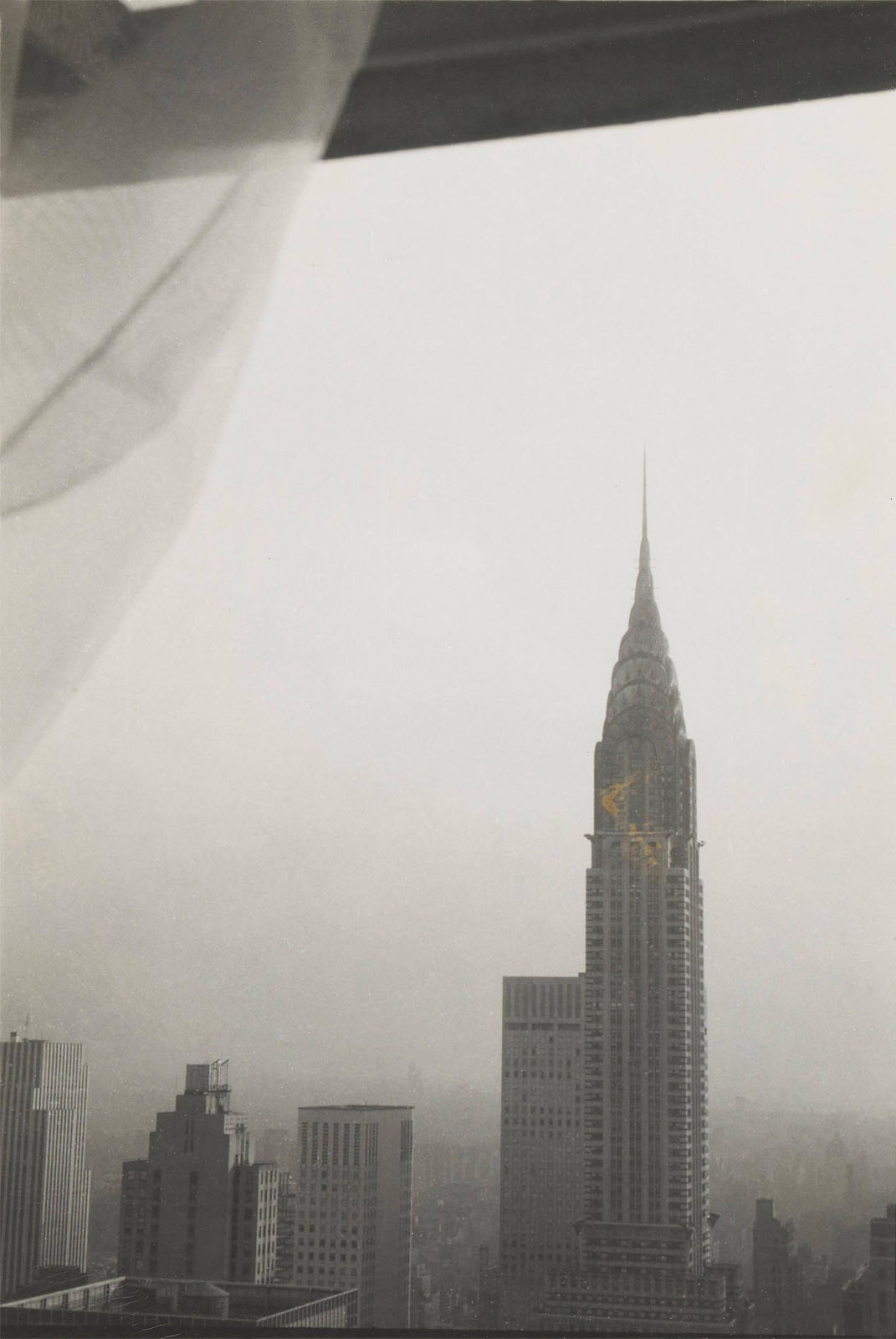
Open seven days a week

MoMA website

LIKE ART BLART ON FACEBOOK

Back to top

Exhibition: ‘George Tice Lifework: A Tribute, Photographs 1953-2013’ at Joseph Bellows Gallery, La Jolla, California

Exhibition dates: 21st June – 30th July, 2022


George Tice (American, b. 1938) 'Petit's Mobil Station, Cherry Hill, New Jersey' 1974


George Tice (American, b. 1938)
Petit’s Mobil Station, Cherry Hill, New Jersey
1974
Gelatin silver print
8 x 10 inches


I have always loved the work of George Tice. I have one of his photographs in my collection. I think his work is very underrated.

Tice’s consumate control of the construction of the image plane never gets in the way of the elemental, eternal, and magical aspects of the photograph.

Photographers such as Tice, and Atget, have an innate ability to place the camera in such as position as to reveal the subject matter in a new light. More intuitive, more sensitive to other ways of seeing, these great photographers look at the world from a different point of view.

In this posting, the hovering spaceship that is Petit’s Mobil Station, Cherry Hill, New Jersey (1974, above) is a superb example of this … almost hallucinatory feeling in the image. Other mesmerising photographs include the Cubist Houses and Water Towers, Moorestown, New Jersey (1973, below) and Industrial Landscape, Kearny, New Jersey (1973, below) with its acknowledgment of Alfred Stieglitz’s The Hand of Man (1902, below). Notice how Tice lowers the level of his camera when compared to Stieglitz’s photograph, thus raising the horizon line, so we now follow the bare, ascending train tracks to the massed stacks of the barren industrial landscape instead of looking down on the scene as in The Hand of Man. Here is a master of previsualisation at work.

Other photographs have already been seen in postings on Art Blart, but it is always a pleasure to look at George Tice’s work – especially his dusk and night time photographs such as New International Cinema, New Brunswick, New Jersey (1974, below), Steve’s Diner, Route 130, North Brunswick, New Jersey (1974, below) and Ideal Diner, Perth Amboy, New Jersey (1980, below). There are hints of the intimacies of Walker Evans and the clinical observations of Bernd and Hiller Becker in Tice’s work, but somehow he always makes images which possess his own signature, his own creative writing.

Following on from last week’s posting where I was banging on about the “spiritual” in contemporary photography (and by “spiritual” I mean an energy and feeling for subject matter captured in the negative and then revealed in the image), the photographs I have presented by Tice in this posting are a perfect example of this alternate perspective. As he observes, “The great difficulty of what I attempt is seeing beyond the moment; the everydayness of life gets in the way of the eternal.”

Dr Marcus Bunyan


Many thankx to Joseph Bellows Gallery for allowing me to publish the photograph in the posting. Please click on the photographs for a larger version of the image.


“It takes the passage of time before an image of a commonplace subject can be assessed. The great difficulty of what I attempt is seeing beyond the moment; the everydayness of life gets in the way of the eternal.”


George Tice


George Tice (American, b. 1938) 'Houses and Water Towers, Moorestown, New Jersey' 1973


George Tice (American, b. 1938)
Houses and Water Towers, Moorestown, New Jersey
1973
Gelatin silver print
11 x 14 inches


George Tice (American, b. 1938) 'Industrial Landscape, Kearny, New Jersey' 1973


George Tice (American, b. 1938)
Industrial Landscape, Kearny, New Jersey
1973
Gelatin silver print
8 x 10 inches


Alfred Stieglitz (American, 1864-1946) 'The Hand of Man' 1902


Alfred Stieglitz (American, 1864-1946)
The Hand of Man
1902
Photogravure
24.1 × 31.8cm (9 1/2 × 12 1/2 in.)
The J. Paul Getty Museum, Los Angeles


A locomotive engine steams toward the camera on its barely visible tracks, wearing a billowing black cloud of smoke like a plumed hat. The criss-crossing lines of tracks beside it snake off toward the horizon, and the telephone poles at the left appear to be making the same march. Alfred Stieglitz’s composition is a treatise on the importance of the machine in the modern Industrial Age. The title of the photograph, The Hand of Man, sets up a comparison between the machine that is depicted and the human artistic impulse that created the image. Stieglitz reproduced this photograph in the January 1903 issue of Camera Work, a journal that he both founded and edited. In the early 1930s he returned to the image and printed additional photographs.

Text from the Google Arts and Culture website


George Tice (American, b. 1938) 'Railroad Bridge, High Bridge, New Jersey' 1974


George Tice (American, b. 1938)
Railroad Bridge, High Bridge, New Jersey
1974
Gelatin silver print
8 x 10 inches


George Tice (American, b. 1938) 'Rooftops, 21st and King Street, Paterson, New Jersey' 1969


George Tice (American, b. 1938)
Rooftops, 21st and King Street, Paterson, New Jersey
1969
Vintage gelatin silver print
16 x 20 inches


George Tice (American, b. 1938) 'Tenement Rooftops, Hoboken, New Jersey' 1974


George Tice (American, b. 1938)
Tenement Rooftops, Hoboken, New Jersey
1974
Vintage gelatin silver print
8 x 10 inches


George Tice (American, b. 1938) 'Pulaski Skyway, Jersey City, New Jersey' 1974


George Tice (American, b. 1938)
Pulaski Skyway, Jersey City, New Jersey
1974
Vintage gelatin silver print
8 x 10 inches


George Tice (American, b. 1938) 'Drawbridge, Morgan, New Jersey' 1973


George Tice (American, b. 1938)
Drawbridge, Morgan, New Jersey
1973
Vintage gelatin silver print
8 x 10 inches


The gallery’s current exhibition is a tribute to the lifework of George Tice, including many vintage prints of both famous and lesser-known images. Signed copies of his new book, Lifework, 1953-2013, are also available.

Tice is drawn to vestiges of American culture on the verge of extinction – from people in rural or small-town communities to suburban buildings and neighbourhoods that are often in decline. Although he has photographed throughout the Northwestern United States, he is best known for pictures of his native New Jersey, and the impeccable quality of his black-and-white prints.

Tice was born and raised in Newark, New Jersey – the state in which his ancestors had settled generations earlier. At fourteen, he joined a camera club. A turning point in his self-training happened two years later when a professional photographer critiquing club members’ work praised his picture of an alleyway. Tice briefly studied commercial photography at Newark Vocational and Technical High School; he then joined the Navy. A published image he made of an explosion aboard an American ship caught the eye of photographer Edward Steichen, who purchased it for The Museum of Modern Art. For about a decade, Tice worked as a portrait photographer and helped establish a gallery. That success enabled him to concentrate on personal projects.

In the 1960s, Tice shifted from smaller camera formats to larger ones, which enabled him to craft carefully toned and detailed prints. He portrayed traditional Amish and Shaker communities, as well as the hard lives of fishermen in Maine. In the 1970s, Tice began exploring his home state. Those photographs formed the beginnings of his Urban Landscapes series, which he worked on until the year 2000.

Text from the Joseph Bellows Gallery website


George Tice (American, b. 1938) 'Strand Theater, Keyport, New Jersey' 1973


George Tice (American, b. 1938)
Strand Theater, Keyport, New Jersey
1973
Gelatin silver print
16 x 20 inches


George Tice (American, b. 1938) 'New International Cinema, New Brunswick, New Jersey' 1974


George Tice (American, b. 1938)
New International Cinema, New Brunswick, New Jersey
1974
Vintage gelatin silver print
8 x 10 inches


George Tice (American, b. 1938) 'Ideal Diner, Perth Amboy, New Jersey' 1980


George Tice (American, b. 1938)
Ideal Diner, Perth Amboy, New Jersey
1980
Gelatin silver print
11 x 14 inches


George Tice (American, b. 1938) 'Steve's Diner, Route 130, North Brunswick, New Jersey' 1974


George Tice (American, b. 1938)
Steve’s Diner, Route 130, North Brunswick, New Jersey
1974
Vintage gelatin silver print
16 x 20 inches


George Tice (American, b. 1938) 'Palace Funhouse, Ashbury Park, New Jersey' 1995


George Tice (American, b. 1938)
Palace Funhouse, Ashbury Park, New Jersey
1995
Gelatin silver print
16 x 20 inches


George Tice (American, b. 1938) 'Lexington Avenue, Passaic, New Jersey' 1973


George Tice (American, b. 1938)
Lexington Avenue, Passaic, New Jersey
1973
Vintage gelatin silver print
8 x 10 inches


George Tice (American, b. 1938) 'Goldy Pharmacy, Mount Holly, New Jersey' 1974


George Tice (American, b. 1938)
Goldy Pharmacy, Mount Holly, New Jersey
1974
vintage gelatin silver print
8 x 10 inches


George Tice (American, b. 1938) 'Gar's Bakery and Leisure Laundry, Newark, New Jersey' 1974


George Tice (American, b. 1938)
Gar’s Bakery and Leisure Laundry, Newark, New Jersey
1974
Vintage gelatin silver print
8 x 10 inches


George Tice (American, b. 1938) 'Dari O' Lite, Wood Avenue, Linden, New Jersey' 1973


George Tice (American, b. 1938)
Dari O’ Lite, Wood Avenue, Linden, New Jersey
1973
Vintage gelatin silver print
8 x 10 inches


George Tice (American, b. 1938) 'Jimmy's Bar and Grill, Newark, New Jersey' 1973


George Tice (American, b. 1938)
Jimmy’s Bar and Grill, Newark, New Jersey
1973
Gelatin silver print
8 x 10 inches


George Tice (American, b. 1938) 'Hudson's Fish Market, Atlantic City, New Jersey' 1973


George Tice (American, b. 1938)
Hudson’s Fish Market, Atlantic City, New Jersey
1973
Vintage gelatin silver print
8 x 10 inches


George Tice (American, b. 1938) 'Houses, Ocean Grove, New Jersey' 1974


George Tice (American, b. 1938)
Houses, Ocean Grove, New Jersey
1974
Vintage gelatin silver print
8 x 10 inches


George Tice (American, b. 1938) 'Dorn's Photoshop, Red Bank, New Jersey' 1999


George Tice (American, b. 1938)
Dorn’s Photoshop, Red Bank, New Jersey
1999
Gelatin silver print
16 x 20 inches


Joseph Bellows Gallery
7661 Girrard Avenue
La Jolla, California
Phone: 858 456 5620

Opening hours:
Tuesday – Saturday 11am – 5pm and by appointment

Joseph Bellows Gallery website

LIKE ART BLART ON FACEBOOK

Back to top

Exhibition: ‘Imogen Cunningham: A Retrospective’ at the J. Paul Getty Museum, Los Angeles

Exhibition dates: 8th March – 12th June, 2022


Imogen Cunningham (American, 1883-1976) 'On Mount Rainer' 1915 from the exhibition 'Imogen Cunningham: A Retrospective' at the J. Paul Getty Museum, Los Angeles, March - June, 2022
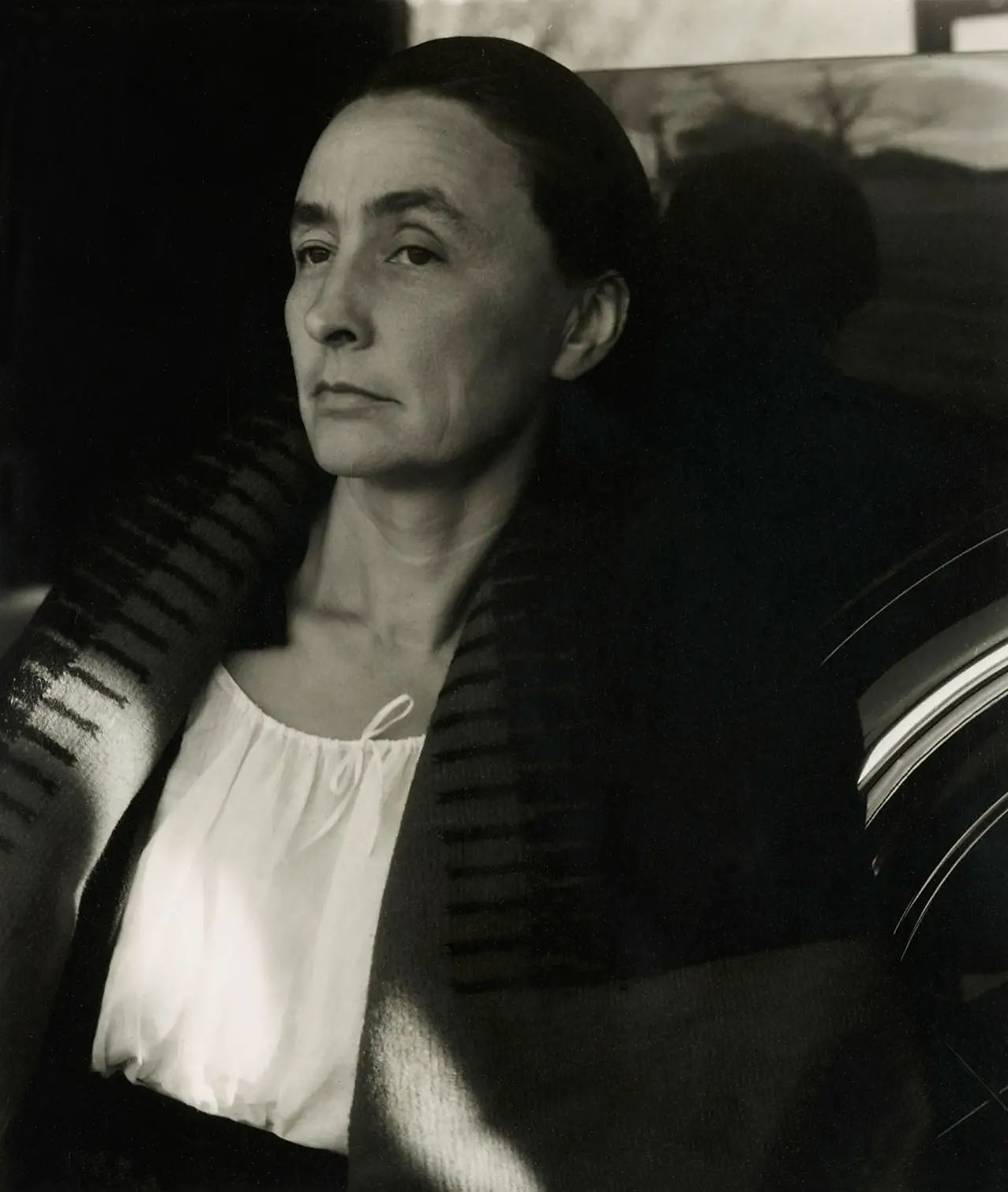
 

Imogen Cunningham (American, 1883-1976)
On Mount Rainer
1915
Platinum print
18.4 × 23.4cm (7 1/4 × 9 3/16 in.)
Getty Museum
© Imogen Cunningham Trust


This is the second posting on this magnificent exhibition on the work of the American photographer Imogen Cunningham (1883-1976), this time its iteration at the J. Paul Getty Museum, Los Angeles. Cunningham, whose broad expanse of work stretches from Pictorialism through avant-garde to Group f/64 modernism, has for too long been underrated in the pantheon of 20th century photographic stars.

In this posting there are 20 or so new images from the exhibition, including contributions from luminaries and friends such as Minor White, Edward Weston, Lisette Model and Dorothea Lange. Of interest is the close framing of the portraits (for example see Sonya Noskowiak 1928, below) and, with these media images, the ability to see the placement and size of the photographic print on the supporting backing card.

I particularly respond to the tonality and texture of the plant photographs and Imogen’s sensitivity to their form and structure.

My favourite photograph in the posting is an image of Cunningham’s I have never seen before – the wonderful late work, Aiko’s Hands (1971, below). The Stieglitz hands, the suspended leaf like Minor White, the message in the water…

There are parts of this image that are a quiet metaphor, but the overall impression is not. It talks directly and immediately to the viewer.

Dr Marcus Bunyan


Many thanks to the J. Paul Getty Museum for allowing me to publish the photographs in the posting. Please click on the photographs for a larger version of the image. See the posting on this exhibition when it was at the Seattle Art Museum.


In a career that spanned seventy years, Imogen Cunningham created a large and diverse body of work – from portraits, to nudes, to florals, and to street photographs. In a field dominated by men, she was one of a handful of women who helped to shape early modernist photography in America. This exhibition seeks to acknowledge her stature as equivalent to that of her male peers and to reevaluate her enormous contribution to twentieth century photographic history.


Imogen Cunningham (American, 1883-1976) 'Mrs. Walsh and Middie at the Window' 1907-1908 from the exhibition 'Imogen Cunningham: A Retrospective' at the J. Paul Getty Museum, Los Angeles, March - June, 2022


Imogen Cunningham (American, 1883-1976)
Mrs. Walsh and Middie at the Window
1907-1908
Platinum print
10.6 × 15.7cm (4 3/16 × 6 3/16 in.)
© The Imogen Cunningham Trust


Imogen Cunningham (American, 1883-1976) 'The Dream / New-san-Koburi' about 1910


Imogen Cunningham (American, 1883-1976)
The Dream / New-san-Koburi
about 1910
Platinum print
22.7 × 16.2cm (8 15/16 × 6 3/8 in.)
© The Imogen Cunningham Trust


Imogen Cunningham (American, 1883-1976) 'Roi Partridge, Etcher' 1915


Imogen Cunningham (American, 1883-1976)
Roi Partridge, Etcher
1915
Platinum print
20.6 × 15.5cm (8 1/8 × 6 1/8 in.)
Getty Museum
© Imogen Cunningham Trust


The Wood Beyond the World

After her graduation from the University of Washington, Cunningham took a job in the studio of photographer and ethnologist Edward S. Curtis. She learned the platinum printing process there, and received a grant that allowed her to continue her studies in Dresden, Germany. On her return to Seattle, she began making soft-focus platinum prints with an ethereal dreamlike quality. Her work in this period was influenced by the Pre-Raphaelite movement in art and literature, which called for renewal within the Victorian art establishment through spiritualism and an enhanced connection with nature. An epic tale set in a medieval forest, The Wood Beyond the World (1894) by William Morris, a leading figure in the movement, particularly sparked her imagination.


Imogen Cunningham (American, 1883-1976) 'Wood Beyond the World 1' 1910


Imogen Cunningham (American, 1883-1976)
Wood Beyond the World 1
1910
Platinum print
Getty Museum
© The Imogen Cunningham Trust


Imogen Cunningham (American, 1883-1976) 'In the Wood / Voice of the Wood' 1910


Imogen Cunningham (American, 1883-1976)
In the Wood / Voice of the Wood
1910
Platinum print
19.8 × 19.1cm (7 13/16 × 7 1/2 in.)
© The Imogen Cunningham Trust


Imogen Cunningham (American, 1883-1976) 'Amaryllis' 1933


Imogen Cunningham (American, 1883-1976)
Amaryllis
1933
Gelatin silver print
Getty Museum
© The Imogen Cunningham Trust


Imogen Cunningham (American, 1883-1976) 'Aloe' 1925


Imogen Cunningham (American, 1883-1976)
Aloe
1925
Gelatin silver print
20.8 × 16.5cm (8 3/16 × 6 1/2 in.)
Getty Museum
© Imogen Cunningham Trust


In Her Garden

After Cunningham moved her family to San Francisco in 1917, she turned away from soft-focus images and began to make sharply delineated pictures. She cultivated a garden, growing plants and flowers for a series of botanical studies, all while taking care of her three young sons. In 1929 the prominent photographer Edward Weston recommended that ten of Cunningham’s photographs be included in the seminal exhibition Film und Foto in Stuttgart, Germany. Although the show did not bring her financial success, it garnered international recognition for her as a leading American modernist photographer.


Imogen Cunningham (American, 1883-1976) 'Hen and Chickens' 1929


Imogen Cunningham (American, 1883-1976)
Hen and Chickens
1929
Gelatin silver print
25.2 × 24.6cm (9 15/16 × 9 11/16 in.)
Getty Museum
© Imogen Cunningham Trust


Imogen Cunningham (American, 1883-1976) 'Flax' 1926


Imogen Cunningham (American, 1883-1976)
Flax
1926
Gelatin silver print
23.5 × 16.1cm (9 1/4 × 6 5/16 in.)
Getty Museum
© Imogen Cunningham Trust


Imogen Cunningham (American, 1883-1976) 'Banana Plant' 1925-1929


Imogen Cunningham (American, 1883-1976)
Banana Plant
1925-1929
Gelatin silver print
29.5 × 22.2cm (11 5/8 × 8 3/4 in.)
The Art Institute of Chicago, Julien Levy Collection
Gift of Jean Levy and the estate of Julien Levy
© Imogen Cunningham Trust


Imogen Cunningham (American, 1883-1976) 'Triangles' 1928


Imogen Cunningham (American, 1883-1976)
Triangles
1928
Gelatin silver print
9.7 × 7.1cm (3 13/16 × 2 13/16 in.)
Getty Museum
© Imogen Cunningham Trust


Imogen Cunningham (American, 1883-1976) 'Two Callas' 1925-1929


Imogen Cunningham (American, 1883-1976)
Two Callas
1925-1929
Gelatin silver print
30 × 22.6cm (11 13/16 × 8 7/8 in.)
The Art Institute of Chicago, Julien Levy Collection
Gift of Jean Levy and the estate of Julien Levy
© Imogen Cunningham Trust


Imogen Cunningham (American, 1883-1976) 'Calla Lily (Black and White Lily)' 1925-1933


Imogen Cunningham (American, 1883-1976)
Calla Lily (Black and White Lily)
1925-1933
Gelatin silver print
30 × 23.5 cm (11 13/16 × 9 1/4 in.)
© The Imogen Cunningham Trust


Imogen Cunningham (American, 1883-1976) 'Tower of Jewels' 1925


Imogen Cunningham (American, 1883-1976)
Tower of Jewels
1925
Gelatin silver print
30.5 × 23.8cm
UC Berkeley Art Museum and Pacific Film Archive


Ansel Adams (American, 1902-1984) '[Dogwood Blossoms, Yosemite National Park]' Negative about 1938; print 1941


Ansel Adams (American, 1902-1984)
[Dogwood Blossoms, Yosemite National Park]
Negative about 1938; print 1941
Gelatin silver print
16.8 × 11.4cm (6 5/8 × 4 1/2 in.)
© 2014 The Ansel Adams Publishing Rights Trust


Imogen Cunningham (American, 1883-1976) '[Sonya Noskowiak]' 1928


Imogen Cunningham (American, 1883-1976)
[Sonya Noskowiak]
1928
Gelatin silver print
8.9 × 7.6cm (3 1/2 × 3 in.)
© The Imogen Cunningham Trust


Imogen Cunningham (American, 1883-1976) 'Martha Graham, Dancer' 1931


Imogen Cunningham (American, 1883-1976)
Martha Graham, Dancer
1931
Gelatin silver print
18.5 × 25.2cm (7 5/16 × 9 15/16 in.)
Getty Museum
Gift of Daniel Greenberg and Susan Steinhauser
© Imogen Cunningham Trust


Imogen Cunningham (American, 1883-1976) 'Frida Kahlo Rivera, Painter' 1931


Imogen Cunningham (American, 1883-1976)
Frida Kahlo Rivera, Painter
1931
Gelatin silver print
Getty Museum, Gift of Daniel Greenberg and Susan Steinhauser
© The Imogen Cunningham Trust


On the Portrait

When asked to describe the requirements for a successful portrait photographer, Cunningham replied, “You must be able to gain an understanding at short notice and at close range of the beauties of character, intellect, and spirit, so you can draw out the best qualities and make them show in the face of the sitter.” She would often engage her sitters in conversation until they relaxed, or ask them to think of the nicest thing they could imagine. She resisted indulging their vanity, however, and “face-lifting” was her word for the type of portrait work that required beautification – in her estimation an obstacle to a good likeness.


Imogen Cunningham (American, 1883-1976) 'Self-Portrait with Korona View' 1933


Imogen Cunningham (American, 1883-1976)
Self-Portrait with Korona View
1933
Gelatin silver print
10.2 × 8.4cm (4 × 3 5/16 in.)
© Imogen Cunningham Trust


Dorothea Lange (American, 1895-1965) 'Waiting for Work on Edge of the Pea Field, Holtville, Imperial Valley, California' February 1937 


Dorothea Lange (American, 1895-1965)
Waiting for Work on Edge of the Pea Field, Holtville, Imperial Valley, California
February 1937
Gelatin silver print
20.5 × 19.2 cm (8 1/16 × 7 9/16 in.)
The J. Paul Getty Museum, Los Angeles


“HUMAN EROSION [all underlined] / Erosion of the soil has its counterpart in erosion / of our society. / The one wastes natural resources; / the other human resources / Employment is intermittent. Jobs are precarious and / annual income is low. / Waited weeks for the maturity of 1937 winter pea / crop, which froze; then more weeks until maturity / of second crop. / Near Hollville,California / February 1937.”


Lisette Model (American born Austria, 1901-1983) 'Woman with Veil, San Francisco' 1949


Lisette Model (American born Austria, 1901-1983)
Woman with Veil, San Francisco
1949
Gelatin silver print
34.9 x 27cm
The J. Paul Getty Museum, Los Angeles


Imogen Cunningham (American, 1883-1976) 'Angel Island' 1952


Imogen Cunningham (American, 1883-1976)
Angel Island
1952
Gelatin silver print
19.3 x 19.3cm
© Imogen Cunningham Trust


Imogen Cunningham (American, 1883-1976) 'Stan, San Francisco' 1959


Imogen Cunningham (American, 1883-1976)
Stan, San Francisco
1959
Gelatin silver print
24.2 × 17.9cm (9 1/2 × 7 1/16 in.)
© Imogen Cunningham Trust


Edward Weston (American, 1886-1958) 'Armco Steel' 1922


Edward Weston (American, 1886-1958)
Armco Steel
1922
Palladium print
24.4 × 19.4cm (9 5/8 × 7 5/8 in.)
© 1981 Arizona Board of Regents, Center for Creative Photography


West Coast Photography

In 1932 Imogen Cunningham, along with Ansel Adams, John Paul Edwards, Sonya Noskowiak, Henry Swift, Willard Van Dyke, and Edward Weston – all San Francisco Bay Area photographers – helped found Group f/64. (They adopted the name from the aperture setting on a large-format camera that would yield the greatest depth of field, making a photograph equally sharp from foreground to background.) The goal of this loosely formed association was to promote a modernist style through sharply focused images created with a West Coast perspective or sense of place. The works presented in this gallery, created by Cunningham’s closest colleagues – all contributors to the Group f/64 legacy – demonstrate how the influence they had on one another defined the future of West Coast photography.


Edward Weston (American, 1886-1958) 'Bananas and Orange' 1927


Edward Weston (American, 1886-1958)
Bananas and Orange
1927
Gelatin silver print
Getty Museum
© 1981 Arizona Board of Regents, Center for Creative Photography


Imogen Cunningham (American, 1883-1976) 'Aiko's Hands' 1971


Imogen Cunningham (American, 1883-1976)
Aiko’s Hands
1971
Gelatin silver print
27.2 × 34.7cm (10 11/16 × 13 11/16 in.)
Getty Museum
Gift of Daniel Greenberg and Susan Steinhauser
© Imogen Cunningham Trust


Minor White (American, 1908–1976) 'Nude Foot, San Francisco' 1947


Minor White (American, 1908-1976)
Nude Foot, San Francisco
Negative 1947; print 1975
Gelatin silver print
21.2 × 27cm (8 3/8 × 10 5/8 in.)
Reproduced with permission of the Minor White Archive, Princeton University Art Museum. © Trustees of Princeton University
Gift of Daniel Greenberg and Susan Steinhauser


Imogen Cunningham (American, 1883-1976) 'Dancer, Mills College' 1929


Imogen Cunningham (American, 1883-1976)
Dancer, Mills College
1929
Gelatin silver print
21.7 × 18.7cm (8 9/16 × 7 3/8 in.)
Getty Museum
© Imogen Cunningham Trust


Imogen Cunningham (American, 1883-1976) 'Snake' 1929


Imogen Cunningham (American, 1883-1976)
Snake
1929
Gelatin silver print
19.7 × 16.5cm (7 3/4 × 6 1/2 in.)
The Art Institute of Chicago
Julien Levy Collection, Gift of Jean and Julien Levy
© Imogen Cunningham Trust


Imogen Cunningham (American, 1883-1976) 'Gertrude Stein, Writer' 1934


Imogen Cunningham (American, 1883-1976)
Gertrude Stein, Writer
1934
Gelatin silver print
Getty Museum
© The Imogen Cunningham Trust


A Parting of Ways

In 1934 Cunningham’s marriage to Roi Partridge ended in divorce. Their three teenage boys, Gryffyd, Rondal, and Padraic, remained in the family home with their mother until they finished high school. Cunningham never remarried, and although she received the house as part of her settlement, the divorce was the beginning of three decades of financial difficulties. Without Partridge, Cunningham had to pick up the pace of her work to stay afloat. She took more commissions, made more portraits, and began teaching portrait photography to students in her home. Despite the added stress, Cunningham sought out ways to challenge herself.


Imogen Cunningham (American, 1883-1976) 'Cornish School Trio 2' 1935


Imogen Cunningham (American, 1883-1976)
Cornish School Trio 2
1935
Gelatin silver print
22.9 × 19.1cm (9 × 7 1/2 in.)
© Imogen Cunningham Trust


Imogen Cunningham (American, 1883-1976) 'Pentimento' 1973


Imogen Cunningham (American, 1883-1976)
Pentimento
1973
Gelatin silver print
18.3 × 22.4cm (7 3/16 × 8 13/16 in.)
Getty Museum
Gift of Daniel Greenberg and Susan Steinhauser
© Imogen Cunningham Trust


Imogen Cunningham (American, 1883-1976) 'A Man Ray Version of Man Ray' 1961


Imogen Cunningham (American, 1883-1976)
A Man Ray Version of Man Ray
1961
Gelatin silver print
23.5 × 16.3cm (9 1/4 × 6 7/16 in.)
Getty Museum
Gift of Daniel Greenberg and Susan Steinhauser
© Imogen Cunningham Trust


Imogen Cunningham (American, 1883-1976) 'Double Image, Sutter St. and Fillmore' c. 1947


Imogen Cunningham (American, 1883-1976)
Double Image, Sutter St. and Fillmore
c. 1947
Gelatin silver print
Collection of the Oakland Museum of California, Gift of the Junior League of Oakland
© The Imogen Cunningham Trust


Into the Street

In 1934, while in New York, Cunningham made what she called her first “stolen pictures,” documentary street photographs that she took while trying to hide herself and her camera from view. Her interest in street photography was renewed in 1946 when she met Lisette Model while they were both teaching at the California School of Fine Arts (now the San Francisco Art Institute). Cunningham’s candid depictions of her subjects have often been described as gentler and more sympathetic than those by many of her contemporaries. Her “stolen pictures” capture people as they are and not how they look when they know they are being photographed.


Imogen Cunningham (American, 1883-1976) 'Tea at Foster's, San Francisco' 1940s


Imogen Cunningham (American, 1883-1976)
Tea at Foster’s, San Francisco
1940s
Gelatin silver print
19.1 × 18.7cm (7 1/2 × 7 3/8 in.)
Seattle Art Museum
Gift of John H. Hauberg
© Imogen Cunningham Trust


Imogen Cunningham (American, 1883-1976) 'Self-Portrait with Grandchildren in Funhouse' 1955


Imogen Cunningham (American, 1883-1976)
Self-Portrait with Grandchildren in Funhouse
1955
Gelatin silver print
22.2 × 18.5cm (8 3/4 × 7 5/16 in.)
Getty Museum
© Imogen Cunningham Trust


One of the greatest photographers of the 20th century, Imogen Cunningham (American, 1883-1976) enjoyed a career that spanned three-quarters of a century, creating a large and diverse body of work that underscored her vision, versatility, and commitment to the medium.

The first major retrospective in the United States in more than 35 years, Imogen Cunningham: A Retrospective brings together her insightful portraits, elegant flower and plant studies, poignant street pictures, and groundbreaking nudes in a visual celebration of Cunningham’s enormous contributions to the history of photography.

“Despite Cunningham’s exceptional achievements as a photographic artist, her work has not received the attention accorded her male counterparts,” says Timothy Potts, Maria Hummer-Tuttle and Robert Tuttle Director of the J. Paul Getty Museum. “Though struggling to meet the demands of family and career, she emerged by the second half of the 1920s as one of the most important and innovative modernist photographers in America, collaborating with leading practitioners, mentoring novices, and actively engaging with contemporary controversies in modern art. This exhibition and publication will provide the spotlight on her contribution to 20th-century photography that she so richly deserves.”

Cunningham was initially self-taught, learning the fundamentals of photography from the instructions that came with her first camera. After graduating from the University of Washington, she established a portrait studio in Seattle and began making soft-focus photographs. Her work in this period was influenced by the Pre-Raphaelite movement in art and literature. In 1915, Cunningham married and started a family. After she moved her family to San Francisco in 1917, she turned away from soft-focus images and began making a series of sharply delineated botanical studies.

In 1932 Cunningham, along with Ansel Adams, John Paul Edwards, Sonya Noskowiak, Henry Swift, Willard Van Dyke, and Edward Weston – all San Francisco Bay Area photographers – helped found Group f/64. This loosely formed association promoted a modernist style through sharply focused images created with a West Coast perspective and sense of place.

From the mid-1940s forward, Cunningham could often be seen roaming the streets of San Francisco with her Rolleiflex, making environmental portraits of the city’s inhabitants. Her enlightened attitude about her place in the world extended to her relationships with people of different racial backgrounds and sexual orientations, which broke down social barriers while enriching and diversifying her oeuvre. Cunningham’s last major project, a series of portraits of older people, was started at age 92 and published posthumously in the book After Ninety: Imogen Cunningham in 1977. The project reflected her determination to keep active and provided a way to come to grips with being a nonagenarian herself.

Cunningham was a woman of exceptional intelligence and talent, yet competing in a male-dominated profession posed a formidable challenge. She felt disparaged by some of her male colleagues, who occasionally downplayed her talent and influence. As a bulwark against the stress, she joined San Francisco Women Artists, a group organised to promote, support, and expand the representation of women in the arts. Over the years Cunningham served as a resource for female artists such as Laura Andreson, Ruth Asawa, Alma Lavenson, Laura Gilpin, Dorothea Lange, Consuelo Kanaga, and Merry Renk, among others, providing advice, moral support, and essential connections throughout the art and business worlds.

“Cunningham continually sought out new opportunities to grow, learn, and change as an artist and a person” says Paul Martineau, curator of photographs at the Getty Museum, and curator of the exhibition. “She readily admitted that she was never fully satisfied with anything and considered self-improvement, in all its forms, her life’s work.”

Imogen Cunningham: A Retrospective is organised by the Getty Museum, Los Angeles and curated by Paul Martineau, associate curator of Photographs. Major support from Jordan Schnitzer and the Harold & Arlene Schnitzer CARE Foundation. Accompanying the exhibition is a lavishly illustrated companion book, Imogen Cunningham: A Retrospective.

Press release from the J. Paul Getty Museum website


Imogen Cunningham (American, 1883-1976) 'Ruth Asawa, Sculptor' 1952


Imogen Cunningham (American, 1883-1976)
Ruth Asawa, Sculptor
1952
Gelatin silver print
Fine Arts Museums of San Francisco, Gift of Ruth Asawa and Albert Lanier
© The Imogen Cunningham Trust


A Network of Women

Cunningham was a woman of exceptional intelligence and talent, yet competing in a male-dominated profession posed a formidable challenge, particularly after Partridge divorced her in 1934 and she struggled to support herself. To make matters worse, Cunningham felt disparaged by some of her male colleagues, who occasionally downplayed her talent and influence. As a bulwark against the stress, Cunningham joined San Francisco Women Artists, a group organised to promote, support, and expand the role of women in the arts. Over the years Cunningham served as a resource for female artists such as Laura Andresen, Ruth Asawa, Alma Lavenson, Laura Gilpin, Dorothea Lange, Consuelo Kanaga, and Merry Renk, among others, providing advice, moral support, and essential connections throughout the art and business worlds.


Imogen Cunningham (American, 1883-1976) 'The Unmade Bed' 1957


Imogen Cunningham (American, 1883-1976)
The Unmade Bed
1957
Gelatin silver print
27.1 × 34.3cm (10 11/16 × 13 1/2 in.)
Getty Museum
Gift of Daniel Greenberg and Susan Steinhauser
© Imogen Cunningham Trust


Minor White (American, 1908-1976) 'Sandblaster, San Francisco' Negative 1949; print 1975


Minor White (American, 1908-1976)
Sandblaster, San Francisco
Negative 1949; print 1975
Gelatin silver print
21.6 × 25.1cm (8 1/2 × 9 7/8 in.)
Reproduced with permission of the Minor White Archive, Princeton University Art Museum. © Trustees of Princeton University
Gift of Daniel Greenberg and Susan Steinhauser


The Light Within

In 1964 the photographer and editor Minor White devoted an issue of the influential magazine Aperture to Cunningham. In an elegant tribute, he described his own experience of the spell she cast over her subjects as a kind of inner light. The first publication dedicated entirely to Cunningham’s work, this issue of Aperture contained a selection of forty-four images dating from 1912 to 1963, representing her wide range of genres and styles.

Between 1965 and 1973 Cunningham served as a visiting photography instructor at the California College of Arts and Crafts, Oakland; Humboldt State College, Arcata; the San Francisco Art Institute; and San Francisco State College. In 1970 she was awarded a Guggenheim Foundation grant of $5,000 to make prints from her old negatives. This prestigious prize marked a turning point in her long career, an acknowledgment that coincided with a rising interest among museums and enthusiasts in collecting photographs, both historical and contemporary.


Imogen Cunningham (American, 1883-1976) 'Minor White, Photographer' 1963


Imogen Cunningham (American, 1883-1976)
Minor White, Photographer
1963
Gelatin silver print
Getty Museum
© The Imogen Cunningham Trust


Imogen Cunningham (American, 1883-1976) 'Phoenix Recumbent' 1968


Imogen Cunningham (American, 1883-1976)
Phoenix Recumbent
1968
Gelatin silver print
19.1 × 22.2cm (7 1/2 × 8 3/4 in.)
Collection of Rudi Bianchi
© Imogen Cunningham Trust


Imogen Cunningham (American, 1883-1976) 'My Father at Ninety' 1936


Imogen Cunningham (American, 1883-1976)
My Father at Ninety
1936
Gelatin silver print
Getty Museum
© The Imogen Cunningham Trust


After Ninety

When she was ninety-two, Cunningham started a new project, photographing people of advanced age. She estimated that this would take two years to complete, and she planned to publish the photographs in a volume to be called After Ninety. She began to seek out subjects, visiting them in their homes, in hospitals, and in convents. The project provided an outlet for her determination to keep active as well as a way to come to grips with being a nonagenarian herself. Cunningham died on June 24, 1976, and the book was published the following year.


Imogen Cunningham (American, 1883-1976) 'After Ninety' 1977


Imogen Cunningham (American, 1883-1976)
After Ninety
1977
Closed: 31.1 x 23.5 x 1.3cm
Private collection


Imogen Cunningham (American, 1883-1976) 'The Coffee Gallery' 1960


Imogen Cunningham (American, 1883-1976)
The Coffee Gallery
1960
Gelatin silver print
19.5 x 22.4cm
Getty Museum
Gift of Daniel Greenberg and Susan Steinhauser
© Imogen Cunningham Trust


Imogen Cunningham (American, 1883-1976) 'Another Arm' 1973


Imogen Cunningham (American, 1883-1976)
Another Arm
1973
Gelatin silver print
23.2 × 19cm (9 1/8 × 7 1/2 in.)
© Imogen Cunningham Trust


Judy Dater. 'Imogen Cunningham and Twinka Thiebaud' 1974


Judy Dater (American, born 1941)
Imogen and Twinka at Yosemite
1974
Gelatin silver print
24.2 × 19cm (9 1/2 × 7 1/2 in.)
© Judy Dater. All rights reserved


The J. Paul Getty Museum
1200 Getty Center Drive
Los Angeles, California 90049

Opening hours:
Daily 10am – 5pm
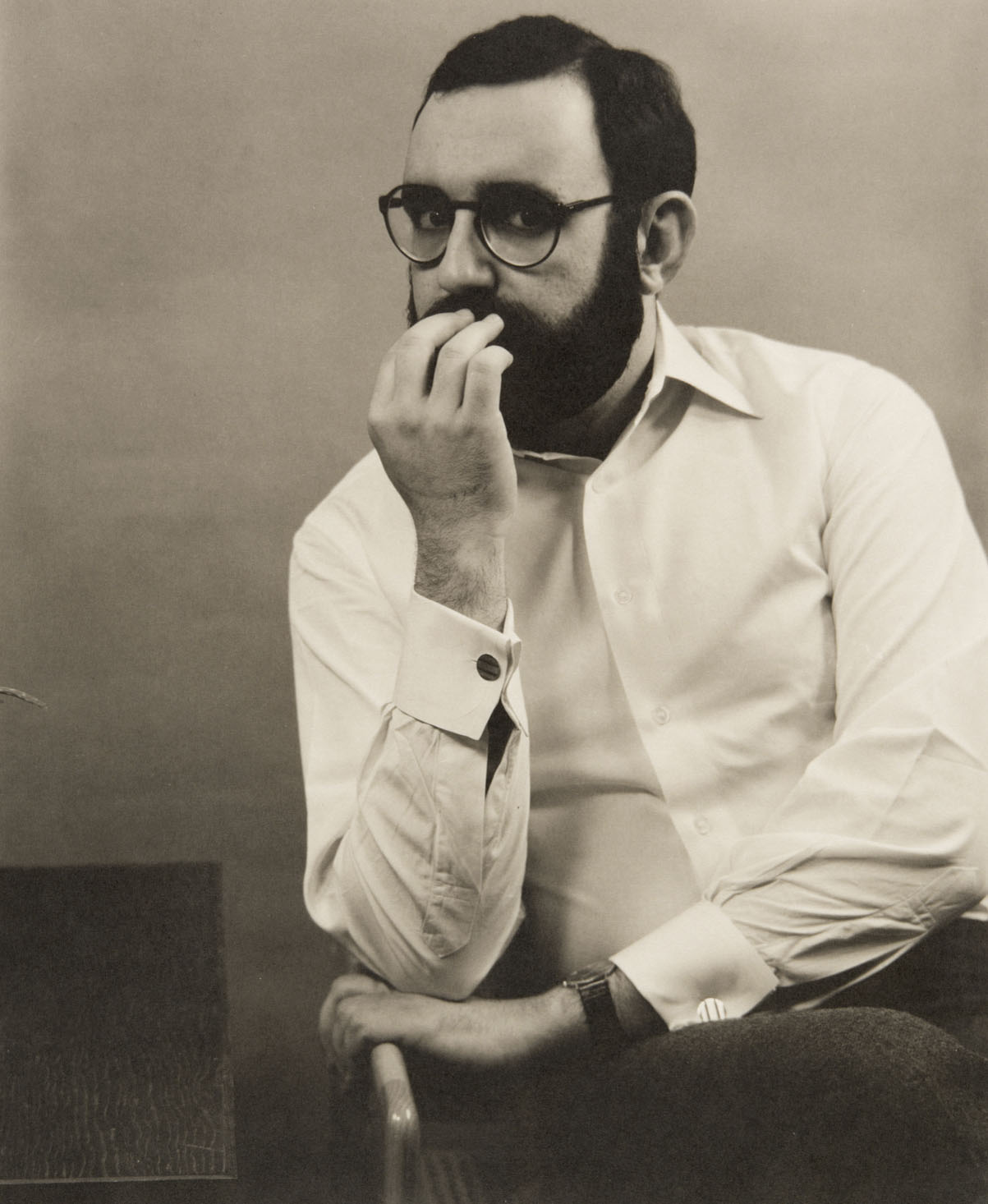
The J. Paul Getty Museum website
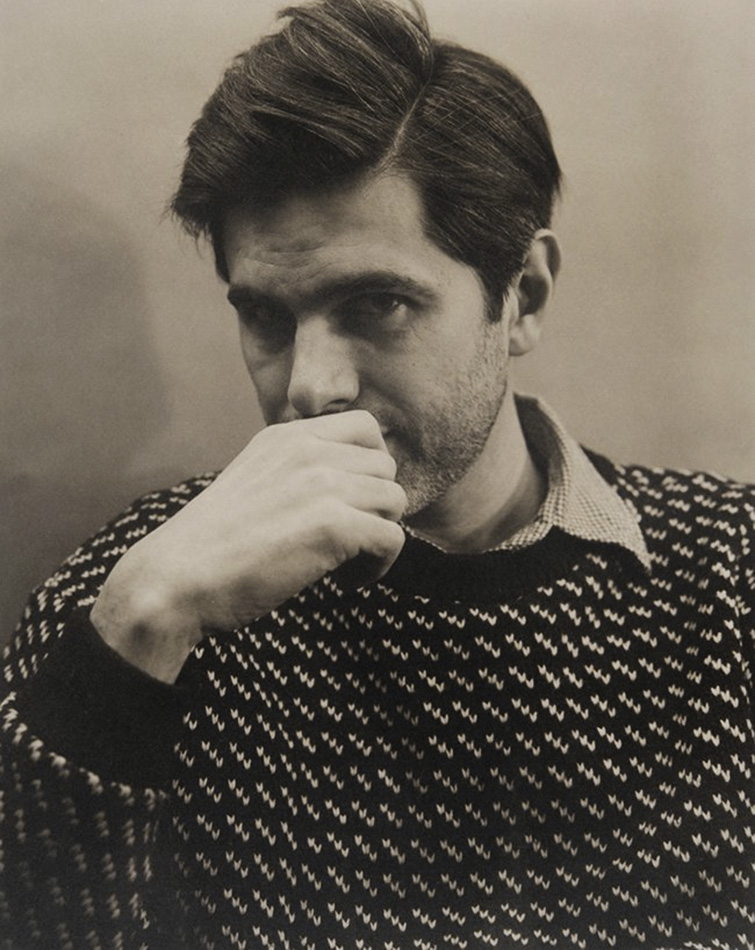
LIKE ART BLACK ON FACEBOOK

Back to top

Exhibition: ‘Richard Benson: The World Is Smarter Than You Are’ at the Philadelphia Museum of Art

Exhibition dates: 3rd October, 2021 – 23rd January, 2022

Curator: Peter Barberie, Brodsky Curator of Photographs, Alfred Stieglitz Center

Field Galleries and Honickman Galleries 154-157


Richard Benson (American, 1943-2017) 'Barbara Benson' 1968 from the exhibition 'Richard Benson: The World Is Smarter Than You Are' at the Philadelphia Museum of Art, October 2021 - January 2022


Richard Benson (American, 1943-2017)
Barbara Benson
1968
Gelatin silver print
Image and sheet: 7 1/2 × 9 1/2 inches
Mount: 9 1/8 × 11 inches
© Estate of Richard M. A. Benson. Promised gift of William M. and Elizabeth Ann Kahane
Image courtesy Philadelphia Museum of Art, 2021


Welcome to the first posting on Art Blart for 2022 and a Happy New Year to you all.

We start with an exhibition by highly regarded photographic printer (including prints for Paul Strand and Walker Evans and books for Lee Friedlander and about Eugène Atget) and teacher Richard Benson. A master of the craft of photography, “Benson became devoted to the technical aspects of printing and reproducing photographs” … “thoroughly imbued with the tradition, science and artistry of photography.” Benson was also an artist and the exhibition includes prints from the late 1960s until shortly before Benson’s death in 2017, the exhibition tracing his quest for the perfect print.

And therein lies the rub. It feels to me as though Benson’s work is more about the aesthetic of the print than about a good photograph and here I am going to call it as I see it. It might be a little controversial or even sacrilegious to one held in so high esteem for his printing, but I don’t particularly like his photographic work. Why?

Benson’s subject matter (“ageing farm machinery, austerely utilitarian boats, derelict factories, and the frequent intersections of history, nature, and our built environments”) can be found throughout the history of American photography. In that sense he offers few new insights on the environment in which he operates. Further, his “unsentimental specificity” – “or what his friend and fellow photographer Garry Winogrand referred to as the mystery of “a fact clearly described” – leaves me feeling … well, nothing really. To me his photographs are emotionally dead photographic experiments become artefacts. What is the story that he is telling, what was his vision?

Benson went to extraordinary lengths to make the print look how the world looked, because he wanted things to look in a print the way things looked when he saw them. But, as Paul Turounet comments, “Craft and technical execution function to support the photographers’ vision and curiosity with visual engagement, and clarity of intention and purpose. It becomes a tremendous opportunity for the photographer to experience how all of photography’s materials and processes, analog, digital or an alternative / hybrid system, can be used to reveal a personal photographic vision and what pictures are going to be about.”1

A personal photographic vision! What was that for Benson, for he has no signature style, his photographs being a mishmash of influences. As Arthur Lubow has observed, “In some of Benson’s black-and-white photographs of building interiors, like “65 Kenyon Street, Hartford, Connecticut” (1974), I thought of Walker Evans. Edward Weston floated into my consciousness as I looked at the organic semi-abstraction of “Agave” (c. 1975-85). And it was hard to avoid recalling Eggleston in viewing the colour jolts of the vintage red truck in “Wyoming” (2008), or the lime-green rowboat in “Newfoundland” (2006-8).”2 Quite so.

So we are left with what exactly. Beautiful but emotionally stilted representations of the world that offer small insight into the condition of its becoming.

Benson’s two statements, “Go out into the world with the camera and photograph and find out that the world is smarter than you are” and “When I make the picture, I’m seeing how I could make the print” are instructive here. Firstly, the world is not smarter than you are, it’s just more confusing. Nothing is ever as neat and tidy, as perfect as Benson would have us believe in his perfect prints. This is when the mystery of the fact clearly described is just that – a description and not a feeling. Secondly, when he’s taking a photograph he thinking about the print! He’s not thinking about resonances, vibrations of energy, time and space in the place itself but only what he sees as its perfect outcome. But Richard, there are many ways to make a print! You can print a mid-grey Zone V and as near black Zone 2, or use digital manipulation to intensive the feeling of an image. There is no single way to print a photographic image that is “correct” for there are many interpretations of a constructed reality. In my humble opinion Benson has his equation arse about tit. As Minor White in one of his Three Canons (1955) would say,

When the image mirrors the man
And the man mirrors the subject
Something might take over


Minor White elaborates further,

“To get from the tangible to the intangible (which mature artists in any medium claim as part of their task) a paradox of some kind has frequently been helpful. For the photographer to free himself of the tyranny of the visual facts upon which he is utterly dependent, a paradox is the only possible tool. And the talisman paradox for unique photography is to work “the mirror with a memory” as if it were a mirage, and the camera as a metamorphosing machine, and the photograph as if it were a metaphor… Once freed of the tyranny of surfaces and textures, substance and form [the photographer] can use the same to pursue poetic truth.”3


The critical observation is that craft and technical execution function to support the photographers’ vision and curiosity with visual engagement.

My friend and mentor Ian Lobb keeps saying to me, “the really good stuff is there, I KNOW its there” – but you have to dig really deep to find it. Perhaps p. 25 in the preview of Benson’s book North South East West gets as close as I have felt (a sense of mystery and subtle spirit) … but I remain a skeptic with regard not to Benson’s craft but to his artistic vision, for he seems to have never freed himself of the tyranny of visual facts bound to their reproduction in the perfect print.

Dr Marcus Bunyan


Footnotes

1/ Paul Turounet. “Well-Executed, Poorly Conceived Photographs,” on A Photo Teacher website Nd [Online] Cited 18/12/2021. No longer available online

2/ Arthur Lubow. “When a Master Printer Picks Up the Camera,” on The New York Times website December 30, 2021 [Online] Cited 02/01/2022

3/ Minor White quoted in Beaumont Newhall (ed.,). The History of Photography. Boston: Little, Brown, and Co., 1982, p. 281


Many thankx to the Philadelphia Museum of Art for allowing me to publish the photographs in the posting. Please click on the photographs for a larger version of the image.


The fundamental problem any artist faces in regard to craft is that it must be largely ignored. This seems to be an extreme statement, but it is surely true. Today we are experiencing a revival of sorts of non-silver, or alternative, systems for photographic printing, and the field is littered with well-executed, poorly conceived photographs. It seems to me that this has happened because all these photographers, or printers, are more interested in how they print their pictures than in what these pictures might be about.


Excerpt from the essay “Print Making” by Richard Benson in the book Paul Strand: Essays on His Life and Work. Aperture, 1991


“Isn’t that what we do as artists… don’t we try to create a surrogate that gives to the viewer something that was given to us when we saw the thing.

We get an inkling that there is something extraordinary there, we’ve stumbled on something extraordinary and the picture is our mechanism for understanding it.

When I make the picture, I’m seeing how I could make the print.”


Excerpts from a conversation with Richard Benson and Jay Maisel by George Jardine for Adobe Lightroom


“In black-and-white and color, in film and digital, in platinum prints, offset lithographs and inkjet prints, Benson mastered the procedures and, when he found them inadequate, invented his own. Like those sonically stunning LPs that were recorded to demonstrate the range of the first generation of stereos, Benson’s photographs often seem designed to mark the outer limits of what photography can practically achieve. …

Walking through the show, I saw the work of someone thoroughly imbued with the tradition, science and artistry of photography. But I was also reminded of a remark by Henry James, in a letter from 1888, about John Singer Sargent, who, similarly, could achieve with a brush anything he asked of it. “Yes, I have always thought Sargent a great painter,” James remarked. “He would be greater still if he had one or two little things he hasn’t – but he will do.””


Arthur Lubow. “When a Master Printer Picks Up the Camera,” on The New York Times website December 30, 2021 [Online] Cited 02/01/2022


Curators’ Talk on Richard Benson

Curator Peter Barberie and Sarah Meister of Aperture discuss the life and work of photographer Richard Benson.

Speakers

Peter Barberie is Brodsky Curator of Photographs, Alfred Stieglitz Center, at the Philadelphia Museum of Art.
Sarah Meister is Executive Director of Aperture, a not-for-profit foundation, multi-platform publisher, and center for the photo community.


Richard Benson (American, 1943-2017) 'Barbara Benson (Young, Skinny, and Pissed Off)' 1970 (negative); 2005-2014 (print) from the exhibition 'Richard Benson: The World Is Smarter Than You Are' at the Philadelphia Museum of Art, October 2021 - January 2022


Richard Benson (American, 1943-2017)
Barbara Benson (Young, Skinny, and Pissed Off)
1970 (negative); 2005-2014 (print)
Inkjet print
Image: 17 3/16 × 13 3/8 inches (43.6 × 33.9cm)
Sheet: 19 1/16 × 15 5/16 inches (48.4 × 38.9cm)
© Estate of Richard M. A. Benson. Promised gift of William M. and Elizabeth Ann Kahane
Image courtesy Philadelphia Museum of Art, 2021


Richard Benson (American, 1943-2017) 'Sarah Benson' 1974 from the exhibition 'Richard Benson: The World Is Smarter Than You Are' at the Philadelphia Museum of Art, October 2021 - January 2022


Richard Benson (American, 1943-2017)
Sarah Benson
1974
Palladium print
Image: 6 1/2 × 4 5/8 inches
Sheet: 6 3/4 × 4 3/4 inches
Mount: 7 7/8 × 6 inches
© Estate of Richard M. A. Benson. Promised gift of William M. and Elizabeth Ann Kahane
Image courtesy Philadelphia Museum of Art, 2021


Richard Benson (American, 1943-2017) 'Christopher Benson' 1981-1982 (negative); 1985-1995 (print)


Richard Benson (American, 1943-2017)
Christopher Benson
1981-1982 (negative); 1985-1995 (print)
Offset lithograph
Image: 16 1/4 × 12 7/8 inches (41.2 × 32.7cm)
Sheet: 24 15/16 × 19 inches (63.4 × 48.2cm)
© Estate of Richard M. A. Benson. Promised gift of William M. and Elizabeth Ann Kahane
Image courtesy Philadelphia Museum of Art, 2021


Richard Benson (American, 1943-2017) 'Barbara and Daniel Benson' 1978-1979


Richard Benson (American, 1943-2017)
Barbara and Daniel Benson
1978-1979 (negative), 1985-1995 (print)
© Estate of Richard M. A. Benson. Promised gift of William M. and Elizabeth Ann Kahane
Image courtesy Philadelphia Museum of Art, 2021


It’s worth mentioning that this was the late 1980s, when everywhere you looked it appeared as if “art photography” needed big ideas more than it needed great photographs. Benson would shoot down our art-speak while sympathising with our ambitions and the obstacles we faced in wanting to break new ground. He reminded us that “an artist is a person who tends to be really good at one thing but spends most of their time trying to do something else.” For him, the revelations and the ideas in photographs were in the details, in the unsentimental specificity, or what his friend and fellow photographer Garry Winogrand referred to as the mystery of “a fact clearly described.”

Many of the subjects Benson photographed across decades will be instantly familiar to anyone who’s ever crossed the US by car or run a few errands via bicycle in coastal New England: ageing farm machinery, austerely utilitarian boats, derelict factories, and the frequent intersections of history, nature, and our built environments. Benson’s encyclopaedic knowledge of the Industrial Revolution only partly accounts for the complete absence of nostalgia in photographs that regularly describe remnants and artefacts sharing present-tense place and time within a single frame.

At certain moments in his work, Benson chose black-and-white film and inkjet printers. In others he found it necessary – and appropriate – to hack a twenty-first-century desktop printer with nineteenth-century brass registration pins. Or, frustrated with pre-Photoshop colour gamut limitations, he needed to invent a technique combining multiple halftone separations and layers upon layers of hand-applied house paint. It was the only way to produce colour prints from his large-format colour negatives that finally met his exacting standards.

If asked why he had gone to such lengths while others remained content with the latest readymade printer options from Kodak or Epson, Richard would simply offer: “Because that’s the way the world looks … and I want things to look in a print the way things looked when I saw them.”

As fascinating and impressive as many of Benson’s technical innovations may have been, none were intended to be more interesting than the photographs they made possible.

The building blocks of the medium (optics, resolution, inherent qualities of various printing methods) often served as dowsing rods to suggest where, what, or whom to photograph. For example, many of Benson’s photographs of his family are produced with and informed by the unique properties of the 8 x 10-inch view camera and black-and-white negative film. Photographing this way requires a mixture of emphatic care and authoritarian control. But in the course of Benson’s work, photographs of family and other closest-to-home subjects are entirely natural extensions of a larger inquiry into our designs, arrangements, purpose-driven work, civic progress, and looming fragilities written across a landscape without end.

Although Richard Benson’s working life ranged across disciplines (hand-tooled mechanical clockworks, steam and combustion-engine design and restoration, hand-ground lenses, and custom-built telescopes), the exhibition at the museum limits its scope to Benson’s photographs. For Benson, neither capital-A “Art” nor rigorous craft were virtues unto themselves. Yet the world described in these photographs, with their “just-the-facts” titles – places and dates without backstory or anecdote – tell us all we need to know about Benson’s omnivorous curiosity and his belief in the nature and purpose of photographic seeing.

Extract from John Pilson. “Richard Benson’s All-Seeing Eye,” on the Philadelphia Museum of Art website November 15, 2021 [Online] Cited 18/12/2021


Richard Benson (American, 1943-2017) 'Luquillo Woman, Puerto Rico' c. 1980


Richard Benson (American, 1943-2017)
Luquillo Woman, Puerto Rico
c. 1980
Inkjet print
Image: 13 5/8 × 17 1/8 inches
Sheet: 15 1/2 × 18 7/8 inches
© Estate of Richard M. A. Benson. Promised gift of William M. and Elizabeth Ann Kahane
Image courtesy Philadelphia Museum of Art, 2021


Richard Benson (American, 1943-2017) 'John Bull's Great Stone, Common Burying Ground, Newport, Rhode Island' 1973-1978


Richard Benson (American, 1943-2017)
John Bull’s Great Stone, Common Burying Ground, Newport, Rhode Island
1973-1978
© Estate of Richard M. A. Benson. Promised gift of William M. and Elizabeth Ann Kahane
Image courtesy Philadelphia Museum of Art, 2021


One of his early pictures, “John Bull’s Great Stone, Common Burying Ground, Newport, Rhode Island” (1973-78), was made with a large-format view camera and composed of two contact prints mounted side by side. It depicts a series of six headstones for babies in one family, each marker incised with the face of an angel. Benson descended from a family of Newport stone carvers that dated to Colonial times. This composition, framed with perfect symmetry and sharp as a scalpel, is almost palpable, an appreciative flourish across the centuries from one consummate craftsman to another.

Arthur Lubow. “When a Master Printer Picks Up the Camera,” on The New York Times website December 30, 2021 [Online] Cited 02/01/2022


Richard Benson (American, 1943-2017) 'John Bull's Great Stone, Common Burying Ground, Newport, Rhode Island' 1973-1978 (detail)


Richard Benson (American, 1943-2017)
John Bull’s Great Stone, Common Burying Ground, Newport, Rhode Island (detail)
1973-1978
© Estate of Richard M. A. Benson. Promised gift of William M. and Elizabeth Ann Kahane
Image courtesy Philadelphia Museum of Art, 2021


Richard Benson (American, 1943-2017) '53 Tilden Avenue Porch' Date unknown


Richard Benson (American, 1943-2017)
53 Tilden Avenue Porch
Date unknown
Offset lithograph
Image: 16 3/16 × 12 13/16 inches (41.1 × 32.5cm)
Sheet: 24 15/16 × 19 inches (63.3 × 48.2cm)
© Estate of Richard M. A. Benson. Promised gift of William M. and Elizabeth Ann Kahane
Image courtesy Philadelphia Museum of Art, 2021


Richard Benson (American, 1943-2017) 'Harford, Connecticut' c. 1974 (negative); c. 2005-2011 (print)


Richard Benson (American, 1943-2017)
Harford, Connecticut
c. 1974 (negative); c. 2005-2011 (print)
Inkjet print
Image: 13 9/16 × 17 3/16 inches (34.5 × 43.6cm)
Sheet: 15 7/8 × 19 3/16 inches (40.4 × 48.8cm)
© Estate of Richard M. A. Benson. Promised gift of William M. and Elizabeth Ann Kahane
Image courtesy Philadelphia Museum of Art, 2021


Richard Benson (American, 1943-2017) '65 Kenyon Street, Hartford, Connecticut' 1974


Richard Benson (American, 1943-2017)
65 Kenyon Street, Hartford, Connecticut
1974
© Estate of Richard M. A. Benson. Promised gift of William M. and Elizabeth Ann Kahane
Image courtesy Philadelphia Museum of Art, 2021


Richard Benson (American, 1943-2017) 'Billy Goode's, Newport, Rhode Island' 1976-1978


Richard Benson (American, 1943-2017)
Billy Goode’s, Newport, Rhode Island
1976-1978
Platinum/palladium print
Image: 7 7/16 × 9 7/16 inches (18.9 × 24cm)
Sheet: 8 7/16 × 10 7/8 inches (21.4 × 27.6cm)
© Estate of Richard M. A. Benson. Promised gift of William M. and Elizabeth Ann Kahane
Image courtesy Philadelphia Museum of Art, 2021


Richard Benson (American, 1943-2017) 'The Dark House (49 Tilden Avenue, Newport, Rhode Island)' c. 1975-1980


Richard Benson (American, 1943-2017)
The Dark House (49 Tilden Avenue, Newport, Rhode Island)
c. 1975-1980
Platinum/palladium print
Image: 9 7/16 × 7 7/16 inches (24 × 18.9cm)
Sheet: 9 13/16 × 7 13/16 inches (24.9 × 19.8cm)
© Estate of Richard M. A. Benson. Promised gift of William M. and Elizabeth Ann Kahane
Image courtesy Philadelphia Museum of Art, 2021


Richard Benson (American, 1943-2017) 'Puerto Rico' 1977-1985


Richard Benson (American, 1943-2017)
Puerto Rico
1977-1985
Platinum/palladium print
Image: 7 3/8 × 9 3/8 inches (18.7 × 23.8cm)
Sheet: 8 × 9 15/16 inches (20.3 × 25.2cm)
© Estate of Richard M. A. Benson. Promised gift of William M. and Elizabeth Ann Kahane
Image courtesy Philadelphia Museum of Art, 2021


Richard Benson (American, 1943-2017) 'Sugar Mill at Aguirre, Puerto Rico' c. 1978-1985 (negative); 1985-1995 (print)


Richard Benson (American, 1943-2017)
Sugar Mill at Aguirre, Puerto Rico
c. 1978-1985 (negative); 1985-1995 (print)
Offset lithograph
Image: 12 3/16 × 15 5/16 inches (31 × 38.9cm)
Sheet: 19 1/8 × 25 inches (48.5 × 63.5cm)
© Estate of Richard M. A. Benson. Promised gift of William M. and Elizabeth Ann Kahane
Image courtesy Philadelphia Museum of Art, 2021


“Go out into the world with the camera and photograph and find out that the world is smarter than you are.”

With this exhortation, Richard Benson encouraged his students to explore one of photography’s core functions: recording things and events in the world. He wanted them to step out of their own mindsets and grapple with the many challenges – material, physical, and conceptual – encountered when making anything. It is precisely how Benson approached his own art. This exhibition surveys nearly fifty years of his photography, a wide-ranging body of work that reflects his humility and boundless curiosity about the world.

Renowned in photography circles for his acumen and inventiveness at printing and his far-ranging impact as a teacher and dean at the Yale University School of Art, Benson is best known today for the remarkable photography books he helped produce and the prints he made of other artists’ work. This exhibition puts his photography at the centre of these other achievements. It follows his continuous investigation of photographic processes and technologies and explores the dialogue between his pictures and other projects.

Benson’s subjects

Benson viewed human knowledge – particularly technology – as a cumulative, almost organic process, more a matter of continual adaptation and adjustment than of individual genius. This outlook is reflected in his photographic subjects. He recorded products of human ingenuity from stone carvings to steam engines and complex constructions of every sort. He also made straightforward and sensitive portraits of people and things he loved. And his subjects include the diverse spaces people create for themselves, which Benson viewed as “living rooms” that help us recover from the continuous disruptions of our technological age.


Richard Benson (American, 1943-2017) 'Fort Adams, Newport, Rhode Island' 1975 (negative); 1975 (print)


Richard Benson (American, 1943-2017)
Fort Adams, Newport, Rhode Island
1975 (negative); 1975 (print)
Platinum/palladium print
Image: 7 7/8 × 9 5/8 inches (20 × 24.4cm)
Sheet: 8 1/16 × 10 1/8 inches (20.5 × 25.7cm)
Mount: 8 7/8 × 11 inches (22.5 × 27.9cm)
© Estate of Richard M. A. Benson. Promised gift of William M. and Elizabeth Ann Kahane
Image courtesy Philadelphia Museum of Art, 2021


Richard Benson (American, 1943-2017) 'Fall River Boiler' 1978 (negative); 1985-1995 (print)


Richard Benson (American, 1943-2017)
Fall River Boiler
1978 (negative); 1985-1995 (print)
Offset lithograph
Image: 16 3/8 × 13 1/16 inches (41.6 × 33.1cm)
Sheet: 24 15/16 × 18 15/16 inches (63.3 × 48.1cm)
© Estate of Richard M. A. Benson. Promised gift of William M. and Elizabeth Ann Kahane
Image courtesy Philadelphia Museum of Art, 2021


For reproducing photographs in a 1985 book devoted to the extraordinary Gilman Paper Company Collection (later acquired by the Metropolitan Museum of Art), he amplified the duotone process, where ink is passed through a fine mesh screen to impart subtle shades of black, gray and even, for older photographs, purple and sepia. The technique also allowed him to enlarge a negative without sacrificing detail. “Fall River Boiler,” a black-and-white image that he photographed in 1978 and printed a decade or so later, is a nocturne of texture and tone: feathery asbestos, gloppy encrustations, circular black holes.

Arthur Lubow. “When a Master Printer Picks Up the Camera,” on The New York Times website December 30, 2021 [Online] Cited 02/01/2022


Richard Benson (American, 1943-2017) 'Hector Morales's Horse, Don Pedro, San Juan, Puerto Rico' 1977-1982


Richard Benson (American, 1943-2017)
Hector Morales’s Horse, Don Pedro, San Juan, Puerto Rico
1977-1982
Platinum/palladium print
Image: 7 5/8 × 9 1/2 inches (19.4 × 24.1cm)
Sheet: 8 × 10 1/8 inches (20.3 × 25.7cm)
© Estate of Richard M. A. Benson. Promised gift of William M. and Elizabeth Ann Kahane
Image courtesy Philadelphia Museum of Art, 2021


Richard Benson (American, 1943-2017) 'Poplar Street Driftway, Newport, Rhode Island' 1975-1985


Richard Benson (American, 1943-2017)
Poplar Street Driftway, Newport, Rhode Island
1975-1985
Gelatin silver print
Image and sheet: 7 1/2 × 9 1/2 inches (19.1 × 24.1cm)
Mount: 18 × 14 inches (45.7 × 35.6cm)
© Estate of Richard M. A. Benson. Promised gift of William M. and Elizabeth Ann Kahane
Image courtesy Philadelphia Museum of Art, 2021


Richard Benson (American, 1943-2017) 'Agave plant' 1975-1985


Richard Benson (American, 1943-2017)
Agave plant
1975-1985
Collection of Barbara Benson


Richard Benson (American, 1943-2017) 'New Orleans Tugboat' Mid-1980s (negative); 1985-1995 (print)


Richard Benson (American, 1943-2017)
New Orleans Tugboat
Mid-1980s (negative); 1985-1995 (print)
Offset lithograph
Image: 12 15/16 × 16 1/4 inches (32.9 × 41.3cm)
Sheet: 19 1/16 × 25 inches (48.4 × 63.5cm)
© Estate of Richard M. A. Benson. Promised gift of William M. and Elizabeth Ann Kahane
Image courtesy Philadelphia Museum of Art, 2021


Richard Benson (American, 1943-2017) 'Puerto Rico Landscape' c. 1980


Richard Benson (American, 1943-2017)
Puerto Rico Landscape
c. 1980
Gelatin silver print
Image and sheet: 7 1/2 × 9 1/2 inches
Mount: 18 × 14 inches
© Estate of Richard M. A. Benson. Promised gift of William M. and Elizabeth Ann Kahane
Image courtesy Philadelphia Museum of Art, 2021


Richard Benson (American, 1943-2017) 'Memphis, TN' 1987


Richard Benson (American, 1943-2017)
Memphis, TN
1987
Offset lithograph
Image: 12 7/8 × 16 3/4 inches
Sheet: 16 × 19 3/8 inches
© Estate of Richard M. A. Benson. Promised gift of William M. and Elizabeth Ann Kahane
Image courtesy Philadelphia Museum of Art, 2021


Richard Benson (American, 1943-2017) 'Scottish Engine, Puerto Rico' c. 1980


Richard Benson (American, 1943-2017)
Scottish Engine, Puerto Rico
c. 1980
Gelatin silver print
Image and sheet: 7 1/2 × 9 1/2 inches
Mount: 18 × 14 inches
© Estate of Richard M. A. Benson. Promised gift of William M. and Elizabeth Ann Kahane
Image courtesy Philadelphia Museum of Art, 2021


Richard Benson (American, 1943-2017) 'Scottish Engine, Puerto Rico' c. 1980


Richard Benson (American, 1943-2017)
Scottish Engine, Puerto Rico
c. 1980; 2005-2014 (print)
Gelatin silver print
Image: 13 9/16 × 17 3/16 inches
Sheet: 15 7/16 × 18 7/8 inches
© Estate of Richard M. A. Benson. Promised gift of William M. and Elizabeth Ann Kahane
Image courtesy Philadelphia Museum of Art, 2021


Steam engines were among Richard Benson’s many enthusiasms. He was particularly excited to come across this one in a field in Puerto Rico, recognising it as a version of the engine invented by Scottish engineer James Watt in 1776. Watt’s engine was one of the key developments of the Industrial Revolution. Benson surmised this example was a relic from one of the sugar plantations that existed on the island in the 1800s.


Richard Benson (American, 1943-2017) 'The Beaubourg, Paris, France' 1976


Richard Benson (American, 1943-2017)
The Beaubourg, Paris, France
1976
Platinum/palladium print
Image: 7 1/2 × 9 1/2 inches (19.1 × 24.1cm)
Sheet: 8 1/2 × 11 inches (21.6 × 27.9cm)
© Estate of Richard M. A. Benson. Promised gift of William M. and Elizabeth Ann Kahane
Image courtesy Philadelphia Museum of Art, 2021


Richard Benson (American, 1943-2017) 'Wildwood, New Jersey' Date unknown


Richard Benson (American, 1943-2017)
Wildwood, New Jersey
Date unknown
Offset lithograph
Image: 16 3/8 × 13 1/16 inches
Sheet: 24 15/16 × 19 1/16 inches
© Estate of Richard M. A. Benson. Promised gift of William M. and Elizabeth Ann Kahane
Image courtesy Philadelphia Museum of Art, 2021


In October, the Philadelphia Museum of Art will present an exhibition dedicated to the late Richard Benson, who is most often celebrated as a virtuoso printer and gifted teacher and is perhaps best known for helping produce some of the most significant photography books of the past fifty years. The World Is Smarter Than You Are is the first in-depth survey of Benson’s own photography. This exhibition includes around 100 works that convey his pathfinding exploration of photographic processes, his embrace of technologies old and new, and his deep empathy for his human subjects and the objects and environments they have built. It celebrates an important promised gift of Benson’s art, assembled by the artist and offered to the museum by his close friends, collectors William H. and Elizabeth Ann Kahane. It is accompanied by a major publication of the same title.

Including prints from the late 1960s until shortly before Benson’s death in 2017, the exhibition traces his quest for the perfect print. This reflects both his abiding interest in improving traditional photo-making methods as well as his gradual embrace of digital photography and experiments in printing that yielded new directions for his artistic craft. It also explores his philosophical musings and writings, teaching materials and work as a printer, underscoring the deep connections between his intellectual, technical, and creative pursuits.

Benson’s interest in photography began with utilising this medium to document examples of fine craftsmanship and technological innovation, ranging from stone carving and antique buildings to machines such as steam engines or contemporary feats of engineering in steel and other modern materials. This breadth of interests can be seen in work from visits he made to France in the 1970s, when he recorded such sites as the Château de Maintenon and the recently completed Centre Pompidou. In another project of the 1970s, Benson photographed grave markers in the Common Burying Ground in his hometown of Newport, Rhode Island. He was the son and brother of celebrated stone carvers, and these pictures reflect his desire to document not only this antique art form, but also his developing ideas about the continual evolution of human technology which, in his thinking, comprised everything from language to microchips.

During this same decade Benson also made sensitive portraits of friends and family members – most notably his wife, Barbara Benson – and views of interiors and townscapes that often stand as indirect portraits of anonymous subjects. Numerous family portraits are presented throughout the exhibition and a concentrated grouping appears in the first galleries.

In the late ’70s and early ’80s, Benson made several trips to Puerto Rico. Included in the exhibition are his records of an antique steam engine he discovered on an old sugar plantation, Scottish Engine, Puerto Rico, c. 1980, and a variety of portraits and landscapes that represent the unique characteristics of the island. Luquillo Woman, Puerto Rico (c. 1980), is representative of the candid pictures he captured during these visits.

Benson embarked on his most ambitious book project in 1981, dedicated to the Gilman Paper Company Collection. It was considered to be one of the most important private photography collections ever assembled and included rare nineteenth-century prints in diverse processes as well as works by noted twentieth-century photographers such as Diane Arbus, Henri Cartier-Bresson, and Alfred Stieglitz, among others. Benson’s efforts to make the reproductions in this book by using offset lithography, printing each sheet up to six times in order to achieve specific print tonalities, remain unmatched. Spreads from the book, Photographs from the Collection of the Gilman Paper Company, will be on view in the exhibition. Displayed in cases are other notable books on which he worked including Lay This Laurel (Benson and Lincoln Kirstein); The American Monument (Lee Friedlander); The Face of Lincoln (James Mellon); O, Write My Name (a portfolio of Benson photogravures from Carl Van Vechten photographs); Paul Strand prints of Wall Street and Wild Iris, Maine; and three later Benson books, A Maritime Album, The Printed Picture, and North South East West.

As his reputation as an innovator in printing processes grew, so too did his influence. In 1986, following the success of the Gilman Paper Company Collection project, Benson was awarded both his second Guggenheim Fellowship and a MacArthur Fellowship. Seven years earlier, in 1979, Benson had begun teaching at Yale University, where he would become a professor and later Dean of the Art School. His idiosyncratic teaching style is described by the noted artist An-My Lê, who reflects in her essay: “His lectures were dazzling with information, but we were chided for taking notes. This was in line with this wanting us to think for ourselves and not passively absorb information that was thrown at us. As I have progressed in my work over the years, I have come to realise that one of Richard’s most important lessons was about humility.”

Another section of the exhibition will be devoted to his work in colour photography. Benson had avoided colour photography through much of his career, in part because of the unreliability of colour processes. But with the emergence of digital photography in the 1990s, he embraced working in colour, leading to the creation of an extraordinary body of pictures. Three works known as “photographs in paint” will be shown with two chromogenic prints from the 1990s to demonstrate his shift from offset lithography to inkjet printing. Moving into the early 2000s, Benson would fully deploy colour into his photographic practice. This shift can be seen in the examples of his pictures taken on the road in Georgia (2007), Texas (2008), Ohio (2009), and even Apples for John (2007).

The exhibition is organised by Peter Barberie, the Brodsky Curator of Photographs, Alfred Stieglitz Center, Philadelphia Museum of Art, who also edited the book that accompanies the exhibition. Barberie said: “In the photography world, Benson is highly regarded as a printer and teacher, but never before has there been an in-depth survey to explore his own photographs, which are challenging, difficult, and beautiful representations of everyday life. His free-thinking blend of traditional craftsmanship, cutting-edge technology, and human empathy resulted in a unique and powerful body of work, and I am gratified to bring his important contributions to photography to audiences in Philadelphia and beyond.”

Related publication

The first major survey of Benson’s photography, this volume features works from the gift complemented by important prints from other collections and comparative illustrations from several of the photography books Benson helped produce in his career. It includes a critical and historical essay about Benson’s photography by Peter Barberie. Artist An-My Lê has written an essay about her memories of her teacher and friend. Publication date: September 2021 (160 pages; $45.00).

About Richard Benson (1943-2017)

Richard Benson spent much of his life in Newport, Rhode Island, where he grew up. His father, John Howard Benson (1901-1956), was a noted stone carver and calligrapher who in 1927 acquired the John Stevens Shop, which had been in operation since 1705. It became under the elder Benson’s direction a nationally celebrated firm for monumental lettering. Known by his nickname “Chip,” Richard occupied a workshop at the back of their house, where he pursued his craft and tinkered with a variety of creative pursuits including antique vehicles.

In 1961 he enrolled at Brown University but left after one semester before serving for three years in the Navy, studying at its Optical Repair School. He also took courses at the Art Students League in New York City. In 1966, after marrying Barbara Murray, he obtained a job at Meriden Gravure, a printing company in Connecticut that would expose him to the highest levels of craft in printing and set the course for his career in books and photography.

Benson became devoted to the technical aspects of printing and reproducing photographs. He made fine prints for other artists, including Paul Strand and Walker Evans and helped produce many of the finest photography books of his generation, including Lee Friedlander’s American Monument (1976); The Work of Atget (4 vols., 1981-84); and Photographs from the Collection of the Gilman Paper Company (1985). During these years, he quietly pursued his own photography, working with a large camera and producing black-and-white prints in various processes.

In 1979 Benson began teaching at Yale University School of Art, where he eventually served as dean from 1996 to 2006. He mentored younger colleagues and a generation of art students, many of whom recall his teaching as a formative experience. The unique quality of his teaching is reflected in his book The Printed Picture (2008), a survey of the entire history of printing as seen in the teaching materials he assembled over forty years. …

In the 1990s Benson embraced digital photography and dove into colour. He experimented with inkjet printing and traveled broadly to make photographs, many of which were published in North South East West (2011), a collection of his pictures from the previous six years.

Benson’s work is represented in the collections of the Eakins Press Foundation, Los Angeles County Museum of Art, Metropolitan Museum of Art, San Francisco Museum of Art, Whitney Museum of American Art, and Yale University Art Gallery.

About the Promised Gift

In 2015, William H. and Elizabeth Ann Kahane, collectors and close friends of Richard Benson, pledged a promised gift of 180 of Benson’s works to the Philadelphia Museum of Art, which fulfilled a commitment they had made to the artist to keep a significant body of his work intact as a single collection. The exhibition and the publication have been six years in the making.


Richard Benson (American, 1943-2017) 'Manhattan Waterfront Project' c. 1992


Richard Benson (American, 1943-2017)
Manhattan Waterfront Project
c. 1992
Chromogenic print
Image: 8 3/8 × 12 5/8 inches (21.3 × 32.1cm)
Sheet: 10 7/8 × 14 inches (27.6 × 35.6cm)
© Estate of Richard M. A. Benson. Promised gift of William M. and Elizabeth Ann Kahane
Image courtesy Philadelphia Museum of Art, 2021


Richard Benson (American, 1943-2017) 'Manhattan Waterfront Project' c. 1992


Richard Benson (American, 1943-2017)
Manhattan Waterfront Project
c. 1992
Chromogenic print
Image: 8 3/8 × 12 5/8 inches (21.2 × 32cm)
Sheet: 10 15/16 × 13 15/16 inches (27.8 × 35.4cm)
© Estate of Richard M. A. Benson. Promised gift of William M. and Elizabeth Ann Kahane
Image courtesy Philadelphia Museum of Art, 2021


Richard Benson (American, 1943-2017) 'New Mexico' 2006


Richard Benson (American, 1943-2017)
New Mexico
2006
Pigment print
Image: 13 3/8 × 20 1/16 inches (34 × 51cm)
Sheet: 16 × 21 15/16 inches (40.7 × 55.8cm)
© Estate of Richard M. A. Benson. Promised gift of William M. and Elizabeth Ann Kahane
Image courtesy Philadelphia Museum of Art, 2021


Richard Benson (American, 1943-2017) 'Newfoundland (Green Boat)' c. 2006


Richard Benson (American, 1943-2017)
Newfoundland (Green Boat)
c. 2006
Multiple impression pigment print
Image: 11 9/16 × 17 3/8 inches
Sheet: 12 15/16 × 19 inches
© Estate of Richard M. A. Benson. Collection of Barbara Benson
Image courtesy Philadelphia Museum of Art, 2021


Richard Benson (American, 1943-2017) 'Georgia' 2007


Richard Benson (American, 1943-2017)
Georgia
2007
Pigment print
Image: 20 × 13 3/8 inches (50.8 × 34cm)
Sheet: 22 × 16 inches (55.9 × 40.6cm)
© Estate of Richard M. A. Benson. Promised gift of William M. and Elizabeth Ann Kahane
Image courtesy Philadelphia Museum of Art, 2021


“Georgia” (2007), which portrays a vertical array of four signs – two red octagonal stop signs, two circular railroad crossings, in yellow and orange – makes a visual counterpoint to three storage silos in the background that are painted red, blue and yellow-embellished silver. But the most virtuosic turn is the rendition of the sky, which is bleached out to a pale blue-gray at the horizon and gradually darkens to a full-throated cerulean at the top. If, as Willem de Kooning once remarked, flesh was the reason oil paint was created, Benson in his many crepuscular photographs makes the case that twilight skies were the reason color film was invented.

Arthur Lubow. “When a Master Printer Picks Up the Camera,” on The New York Times website December 30, 2021 [Online] Cited 02/01/2022


Richard Benson (American, 1943-2017) 'Apples for John' 2007


Richard Benson (American, 1943-2017)
Apples for John
2007
Pigment print
Image: 13 3/8 × 20 inches
Sheet: 15 7/8 × 22 inches
© Estate of Richard M. A. Benson. Promised gift of William M. and Elizabeth Ann Kahane
Image courtesy Philadelphia Museum of Art, 2021


Richard Benson (American, 1943-2017) 'Selma, Alabama' 2007


Richard Benson (American, 1943-2017)
Selma, Alabama
2007
Pigment print
Image: 11 5/8 × 17 3/8 inches (29.5 × 44.1cm)
Sheet: 13 × 19 inches (33 × 48.3cm)
© Estate of Richard M. A. Benson. Promised gift of William M. and Elizabeth Ann Kahane
Image courtesy Philadelphia Museum of Art, 2021


Richard Benson (American, 1943-2017) 'Kentucky' 2007


Richard Benson (American, 1943-2017)
Kentucky
2007
Pigment print
Image: 11 5/8 × 17 3/8 inches (29.5 × 44.2cm)
Sheet: 12 15/16 × 19 inches (32.8 × 48.2cm)
© Estate of Richard M. A. Benson. Promised gift of William M. and Elizabeth Ann Kahane
Image courtesy Philadelphia Museum of Art, 2021


Richard Benson (American, 1943-2017) 'Okeechobee, Florida' 2007


Richard Benson (American, 1943-2017)
Okeechobee, Florida
2007
Pigment print
© Estate of Richard M. A. Benson. Promised gift of William M. and Elizabeth Ann Kahane
Image courtesy Philadelphia Museum of Art, 2021


Richard Benson (American, 1943-2017) 'Wyoming (Reinke Sprinkler)' 2008


Richard Benson (American, 1943-2017)
Wyoming (Reinke Sprinkler)
2008
Multiple impression pigment print
Image: 13 3/8 × 20 1/8 inches
Sheet: 16 1/8 × 22 inches
© Estate of Richard M. A. Benson. Collection of Barbara Benson
Image courtesy Philadelphia Museum of Art, 2021


Richard Benson (American, 1943-2017) 'Untitled (Cotton Farm)' 2008


Richard Benson (American, 1943-2017)
Untitled (Cotton Farm)
2008
Pigment print
Image: 13 3/8 × 20 inches (34 × 50.8cm)
Sheet: 14 15/16 × 21 15/16 inches (38 × 55.8cm)
© Estate of Richard M. A. Benson. Promised gift of William M. and Elizabeth Ann Kahane
Image courtesy Philadelphia Museum of Art, 2021


Richard Benson (American, 1943-2017) 'Louisiana' 2008


Richard Benson (American, 1943-2017)
Louisiana
2008
Pigment print
© Estate of Richard M. A. Benson. Promised gift of William M. and Elizabeth Ann Kahane
Image courtesy Philadelphia Museum of Art, 2021


Richard Benson (American, 1943-2017) 'Texas' 2008


Richard Benson (American, 1943-2017)
Texas
2008
Pigment print
Image: 13 3/8 × 20 inches
Sheet: 15 9/16 × 22 inches
© Estate of Richard M. A. Benson. Promised gift of William M. and Elizabeth Ann Kahane
Image courtesy Philadelphia Museum of Art, 2021


Richard Benson (American, 1943-2017) 'Arizona' 2008


Richard Benson (American, 1943-2017)
Arizona
2008
Pigment print
Image: 13 3/8 × 20 inches (34 × 50.8cm)
Sheet: 14 15/16 × 21 15/16 inches (38 × 55.8cm)
© Estate of Richard M. A. Benson. Promised gift of William M. and Elizabeth Ann Kahane
Image courtesy Philadelphia Museum of Art, 2021


Richard Benson (American, 1943-2017) 'Ohio' 2009


Richard Benson (American, 1943-2017)
Ohio
2009
Pigment print
Image: 13 3/8 × 20 inches (34 × 50.8cm)
Sheet: 16 × 22 inches (40.6 × 55.9cm)
© Estate of Richard M. A. Benson. Promised gift of William M. and Elizabeth Ann Kahane
Image courtesy Philadelphia Museum of Art, 2021


Richard Benson (American, 1943-2017) 'Untitled (Celeryville field)' 2009 (negative); 2009 (print)


Richard Benson (American, 1943-2017)
Untitled (Celeryville field)
2009 (negative); 2009 (print)
Pigment print
Image: 13 3/8 × 20 inches (34 × 50.8cm)
Sheet: 14 15/16 × 21 15/16 inches (38 × 55.8cm)
© Estate of Richard M. A. Benson. Promised gift of William M. and Elizabeth Ann Kahane
Image courtesy Philadelphia Museum of Art, 2021


Publication

A wide-ranging retrospective that reveals a master printer’s own photographs to be technically brilliant work of remarkable breadth and complexity.

This book presents the first in-depth survey of photographs by Richard Benson (1943-2017), who approached photography as a thrilling set of technical challenges and used the medium to craft profound depictions of people, the spaces of their lives and work, and the products of their labor. An essay by curator Peter Barberie interweaves examination of Benson’s photographic practices with the story of his ideas, writing, and reproductive printing, while photographer An-My Lê, Benson’s former student, offers her perspective on his teaching, family life, and art. The book begins with his stunning darkroom prints in silver and platinum and follows his trajectory toward extraordinary digital photography, culminating in later colour prints that are at once elegant and garish, representing the contemporary world in vivid detail. Benson’s democratic eye also extended to human subjects: he photographed loved ones and strangers with extraordinary attention, and directed the same gaze to the buildings and landscapes entwined with individual lives.

Author: Peter Barberie
Hardcover
Publisher: Philadelphia Museum of Art, October 2021
152 pages, 11 3/4 x 9 3/4
134 color illustrations
ISBN: 9780876332016


Richard Benson: The World Is Smarter Than You Are

Richard Benson: The World Is Smarter Than You Are

Richard Benson: The World Is Smarter Than You Are

Richard Benson: The World Is Smarter Than You Are

Richard Benson: The World Is Smarter Than You Are

Richard Benson: The World Is Smarter Than You Are

Richard Benson: The World Is Smarter Than You Are

Richard Benson: The World Is Smarter Than You Are


Richard Benson: The World Is Smarter Than You Are publication


Philadelphia Museum of Art
26th Street and the Benjamin Franklin Parkway
Philadelphia, PA 19130

Opening hours:
Thursday – Monday: 10am – 5pm
Closed Tuesday and Wednesday

Philadelphia Museum of Art website

LIKE ART BLART ON FACEBOOK

Back to top