Exhibition: ‘Haunted Screens: German Cinema in the 1920s’ at the Milwaukee Art Museum, Milwaukee

Exhibition dates: 21st October, 2016 – 22nd January, 2017

Curators: Margaret Andera, adjunct curator of contemporary art at the Milwaukee Art Museum, Milwaukee and Britt Salvesen, Los Angeles County Museum of Art’s curator of the department of prints and drawings and the department of photography


Unknown photographer(s). 'Set photograph from Fritz Lang's "The Nibelungen: The Death of Siegfried (Die Nibelungen: Siegfrieds Tod)"' 1923 from the exhibition Exhibition: 'Haunted Screens: German Cinema in the 1920s' at the Milwaukee Art Museum, Milwaukee, Oct 2016 - Jan 2017


Unknown photographer(s)
Set photograph from Fritz Lang’s “The Nibelungen: The Death of Siegfried (Die Nibelungen: Siegfrieds Tod)”
1923
Gelatin silver print
BiFi, Collection of La Cinémathèque française, Paris
Photo Collection of La Cinémathèque française, Paris


The interwar years of the European avant-garde are some of the most creative years in the history of the human race.

Whether because of political and social instability – the aftershocks of the First World War, the hardships, the looming fight between Communism and Fascism, the Great Depression – or the felt compression and compaction of time and space taking place all over Europe (as artists fled Russia, as artists fled Germany for anywhere but Germany, as though time was literally running out… as it indeed was), these years produced a frenzy of creativity in writing, film, design, architecture and all the arts.

The “avant-garde” produced new and experimental ideas and methods in art, music, and literature, the avant-garde literally being the “vanguard” of an army of change, producing for so very brief an instant, a bright flowering of camp, cabaret, and kitsch paralleled? intertwined with a highly charged emotionalism which, in German Expressionist film, “employed geometrically skewed set designs, dramatic lighting, off-kilter framing, strong shadows and distorted perspectives to express a sense of uneasiness and discomfort.”

Here we find the catalyst for subsequent film genres, most notably science fiction, horror and film noir. Here we find dark fantasies, desire, love and redemption. All to be swept away with the rushing rushing rushing tide of prejudice and persecution, of death and destruction that was to envelop the world during the Second World War.

The creative legacy of this period, however, is still powerful and unforgettable. I just have to look at the photographic stills of Metropolis to recognise what a visionary period it was, and how that film and others have stood the test of passing time (as the hands of the workers move the clock hands to their different positions in Metropolis). The feeling and aesthetic of the art remains as fresh as the day it was created.

Dr Marcus Bunyan


Many thankx to the Milwaukee Art Museum for allowing me to publish the photographs in the posting. Please click on the photographs for a larger version of the image.


Siegfried’s Dragon


Unknown photographer(s). 'Set photograph from Fritz Lang's "The Nibelungen: The Death of Siegfried (Die Nibelungen: Siegfrieds Tod)"' 1923 from the exhibition Exhibition: 'Haunted Screens: German Cinema in the 1920s' at the Milwaukee Art Museum, Milwaukee, Oct 2016 - Jan 2017


Unknown photographer(s)
Set photograph from Fritz Lang’s “The Nibelungen: The Death of Siegfried (Die Nibelungen: Siegfrieds Tod)”
1923
Gelatin silver print
BiFi, Collection of La Cinémathèque française, Paris
Photo courtesy Collection of La Cinémathèque française, Paris


Unknown photographer(s). 'Set photograph from Fritz Lang's "The Nibelungen: The Death of Siegfried (Die Nibelungen: Siegfrieds Tod)"' 1923


Unknown photographer(s)
Set photograph from Fritz Lang’s “The Nibelungen: The Death of Siegfried (Die Nibelungen: Siegfrieds Tod)”
1923
Gelatin silver print
BiFi, Collection of La Cinémathèque française, Paris
Photo Collection of La Cinémathèque française, Paris


Fritz Lang (Austrian, 1890-1976)

… In this first phase of his career, Lang alternated between films such as Der Müde Tod (“The Weary Death”) and popular thrillers such as Die Spinnen (“The Spiders”), combining popular genres with Expressionist techniques to create an unprecedented synthesis of popular entertainment with art cinema.

In 1920, he met his future wife, the writer and actress Thea von Harbou. She and Lang co-wrote all of his movies from 1921 through 1933, including Dr. Mabuse, der Spieler (Dr. Mabuse the Gambler; 1922), which ran for over four hours in two parts in the original version and was the first in the Dr. Mabuse trilogy, the five-hour Die Nibelungen (1924), the famous 1927 film Metropolis, the science fiction film Woman in the Moon (1929), and the 1931 classic, M, his first “talking” picture.

Considered by many film scholars to be his masterpiece, M is a disturbing story of a child murderer (Peter Lorre in his first starring role) who is hunted down and brought to rough justice by Berlin’s criminal underworld. M remains a powerful work; it was remade in 1951 by Joseph Losey, but this version had little impact on audiences, and has become harder to see than the original film. During the climactic final scene in M, Lang allegedly threw Peter Lorre down a flight of stairs in order to give more authenticity to Lorre’s battered look. Lang, who was known for being hard to work with, epitomised the stereotype of the tyrannical German film director, a type embodied also by Erich von Stroheim and Otto Preminger. His wearing a monocle added to the stereotype.

In the films of his German period, Lang produced a coherent oeuvre that established the characteristics later attributed to film noir, with its recurring themes of psychological conflict, paranoia, fate and moral ambiguity. At the end of 1932, Lang started filming The Testament of Dr. Mabuse. Adolf Hitler came to power in January 1933, and by March 30, the new regime banned it as an incitement to public disorder. Testament is sometimes deemed an anti-Nazi film as Lang had put phrases used by the Nazis into the mouth of the title character.

Lang was worried about the advent of the Nazi regime, partly because of his Jewish heritage, whereas his wife and screenwriter Thea von Harbou had started to sympathise with the Nazis in the early 1930s and joined the NSDAP in 1940. They soon divorced. Lang’s fears would be realised following his departure from Austria, as under the Nuremberg Laws he would be identified as a Jew even though his mother was a converted Roman Catholic, and he was raised as such.

Shortly afterwards, Lang left Germany. According to Lang, propaganda minister Joseph Goebbels called Lang to his offices to inform him that The Testament of Dr Mabuse was being banned but that he was nevertheless so impressed by Lang’s abilities as a filmmaker (especially Metropolis), he was offering Lang a position as the head of German film studio UFA. Lang had stated that it was during this meeting that he had decided to leave for Paris – but that the banks had closed by the time the meeting was over. Lang has stated that he fled that very evening. …

In Hollywood, Lang signed first with MGM Studios. His first American film was the crime drama Fury, which starred Spencer Tracy as a man who is wrongly accused of a crime and nearly killed when a lynch mob sets fire to the jail where he is awaiting trial. Lang became a naturalised citizen of the United States in 1939. He made twenty-three features in his 20-year American career, working in a variety of genres at every major studio in Hollywood, and occasionally producing his films as an independent. Lang’s American films were often compared unfavourably to his earlier works by contemporary critics, but the restrained Expressionism of these films is now seen as integral to the emergence and evolution of American genre cinema, film noir in particular. Lang’s film titled in 1945 as Scarlet Street is considered a central film in the genre.

One of his most famous films noir is the police drama The Big Heat (1953), noted for its uncompromising brutality, especially for a scene in which Lee Marvin throws scalding coffee on Gloria Grahame’s face. As Lang’s visual style simplified, in part due to the constraints of the Hollywood studio system, his worldview became increasingly pessimistic, culminating in the cold, geometric style of his last American films, While the City Sleeps (1956) and Beyond a Reasonable Doubt (1956).

Text from the Wikipedia website


Otto Hunte (German, 1881-1950) and Fritz Lang (German, 1890-1976) 'Set design drawing for "The Nibelungen: The Death of Siegfried (Die Nibelungen: Siegfrieds Tod)"' 1923


Otto Hunte (German, 1881-1950) and Fritz Lang (German, 1890-1976)
Set design drawing for “The Nibelungen: The Death of Siegfried (Die Nibelungen: Siegfrieds Tod)”
1923
BiFi, Collection of La Cinémathèque française, Paris
Photo Collection of La Cinémathèque française, Paris


Otto Hunte (German, 1881-1950) and Fritz Lang (German, 1890-1976) 'Set design drawing for "The Nibelungen: The Death of Siegfried (Die Nibelungen: Siegfrieds Tod)"' 1923


Otto Hunte (German, 1881-1950) and Fritz Lang (German, 1890-1976)
Set design drawing for “The Nibelungen: The Death of Siegfried (Die Nibelungen: Siegfrieds Tod)”
1923
BiFi, Collection of La Cinémathèque française, Paris
Photo Collection of La Cinémathèque française, Paris


Caspar David Friedrich (German, 1774-1840) 'Two Men Contemplating the Moon' c. 1825-1830


Caspar David Friedrich (German, 1774-1840)
Two Men Contemplating the Moon
c. 1825-1830
The Metropolitan Museum of Art, Wrightsman Fund, 2000
Photo: courtesy The Metropolitan Museum of Art
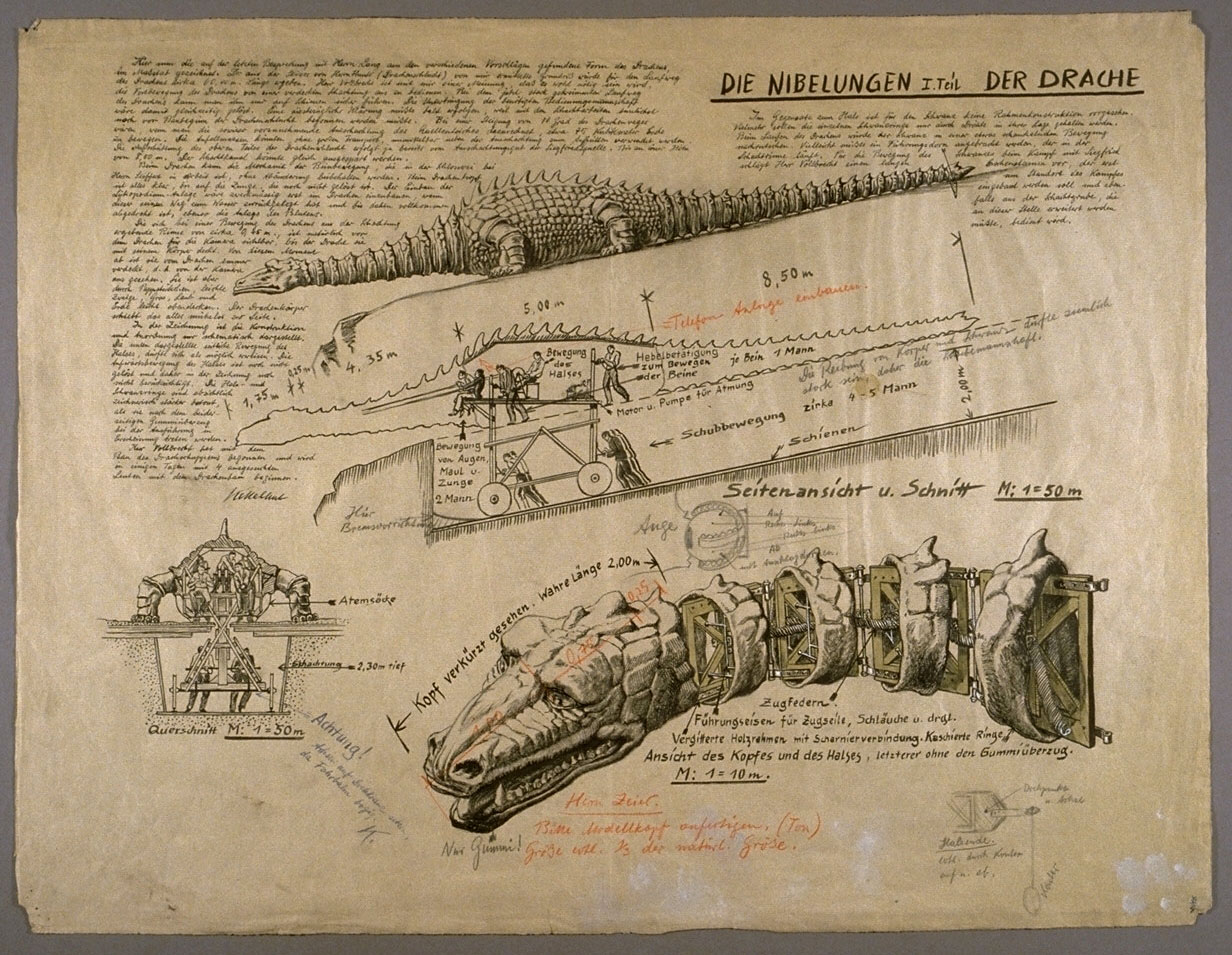
 

Erich Kettelhut (German, 1893-1979) and Fritz Lang (German, 1890-1976) 'Set design drawing for "The Nibelungen: The Death of Siegfried (Die Nibelungen: Siegfrieds Tod)"' 1923


Erich Kettelhut (German, 1893-1979) and Fritz Lang (German, 1890-1976)
Set design drawing for “The Nibelungen: The Death of Siegfried (Die Nibelungen: Siegfrieds Tod)”
1923
BiFi, Collection of La Cinémathèque française, Paris
Photo courtesy Collection of La Cinémathèque française, Paris


In the wake of WWI, while Hollywood and the rest of Western cinema were focused mostly on adventure, romance and comedy, German filmmakers explored the anxiety and emotional turbulence that dominated life in Germany. They took their inspiration from Expressionist art and employed geometrically skewed sets, dramatic lighting, off-kilter framing, strong shadows and distorted perspectives.

The impact of this aesthetic has lasted nearly a century, inspiring directors from Alfred Hitchcock to Tim Burton. Its influence is reflected to this day in the dark, brooding styles of film noir, the unsettling themes of horror, and the fantastic imagery of sci-fi. From Blade Runner to The Godfather, from Star Wars to The Hunger Games – our modern blockbusters owe much to these German masters and the visions they created.

Haunted Screens: German Cinema in the 1920s explores masterworks of German Expressionist cinema, from the stylized fantasy of The Cabinet of Dr. Caligari to the chilling murder mystery M. Featured are production design drawings, photographs, posters, documents, equipment and film clips from more than 20 films. The exhibition ends with a contemporary 3-channel projection work – Kino Ektoplamsa, 2012 – by filmmaker Guy Maddin, which was inspired by German Expressionist cinema.

Text from the Milwaukee Art Museum website


Designed by USC architecture professor Amy Murphy and architect Michael Maltzan, “Haunted Screens” has been grouped by theme: “Madness and Magic,” “Myths and Legends,” “Cities and Streets” and “Machines and Murderers.” The latter contains a subsection, “Stairs,” that includes drawings from films that feature stairs as both a visual and psychological theme. Two darkened tunnels will feature excerpts from the movies highlighted in the exhibit.

“The core of the show is the collection from La Cinémathèque française,” said Britt Salvesen, LACMA’s curator of both the department of prints and drawings and the department of photography.

The 140 drawings from the Cinémathèque were acquired by noted German film historian Lotte Eisner, who wrote the 1952 book “The Haunted Screen.”


Josef Fenneker (Germany, 1895-1956) 'Reissue of original poster for The Burning Soil (Der brennende acker)' c. 1922


Josef Fenneker (Germany, 1895-1956)
Reissue of original poster for The Burning Soil (Der brennende acker)
c. 1922
Director: Friedrich Wilhelm Murnau (German, 1888-1931)
Offset lithograph
Collection of La Cinémathèque française, Paris


Friedrich Wilhelm Murnau (German, 1888-1931)

Friedrich Wilhelm “F. W.” Murnau (born Friedrich Wilhelm Plumpe; December 28, 1888 – March 11, 1931) was a German film director. Murnau was greatly influenced by Schopenhauer, Nietzsche, Shakespeare and Ibsen plays he had seen at the age of 12, and became a friend of director Max Reinhardt. During World War I he served as a company commander at the eastern front and was in the German air force, surviving several crashes without any severe injuries.

One of Murnau’s acclaimed works is the 1922 film Nosferatu, an adaptation of Bram Stoker’s Dracula. Although not a commercial success due to copyright issues with Stoker’s novel, the film is considered a masterpiece of Expressionist film. He later directed the 1924 film The Last Laugh, as well as a 1926 interpretation of Goethe’s Faust. He later emigrated to Hollywood in 1926, where he joined the Fox Studio and made three films: Sunrise (1927), 4 Devils (1928) and City Girl (1930). The first of these three is widely regarded as one of the greatest films ever made.

In 1931 Murnau travelled to Bora Bora to make the film Tabu (1931) with documentary film pioneer Robert J. Flaherty, who left after artistic disputes with Murnau, who had to finish the movie on his own. A week prior to the opening of the film Tabu, Murnau died in a Santa Barbara hospital from injuries he had received in an automobile accident that occurred along the Pacific Coast Highway near Rincon Beach, southeast of Santa Barbara.

Of the 21 films Murnau directed, eight are considered to be completely lost. One reel of his feature Marizza, genannt die Schmuggler-Madonna survives. This leaves only 12 films surviving in their entirety.

Text from the Wikipedia website
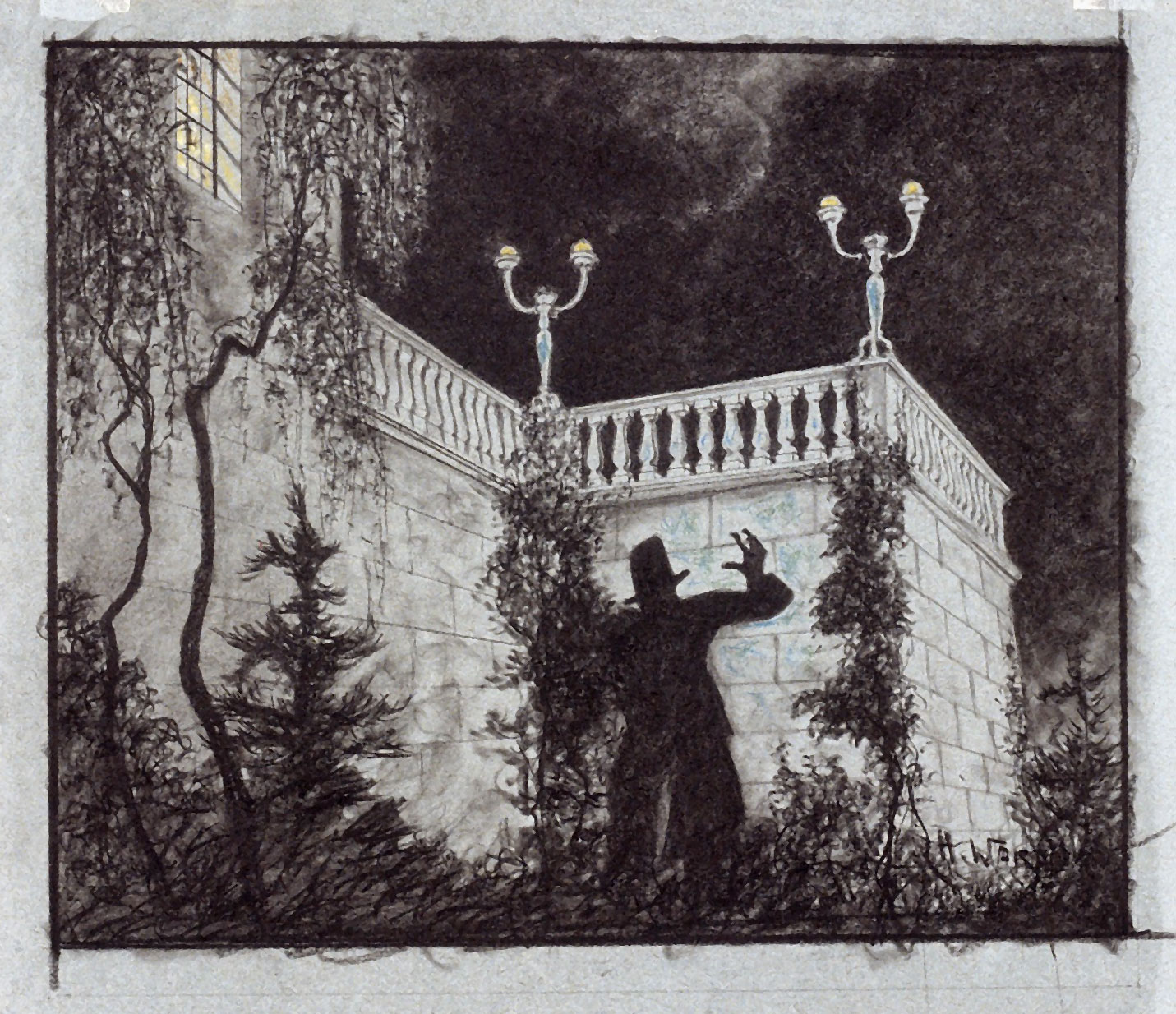
 

Hermann Warm (German, 1889-1976) and Henrik Galeen (Austrian, 1881-1949) 'Drawing for "Der Student von Prag" (The Student of Prague)' 1926

Hermann Warm (German, 1889-1976) and Henrik Galeen (Austrian, 1881-1949) 'Drawing for "Der Student von Prag" (The Student of Prague)' 1926


Hermann Warm (German, 1889-1976) and Henrik Galeen (Austrian, 1881-1949)
Drawing for “Der Student von Prag” (The Student of Prague)
1926
Pastel
Collection of La Cinémathèque française, Paris/LACMA
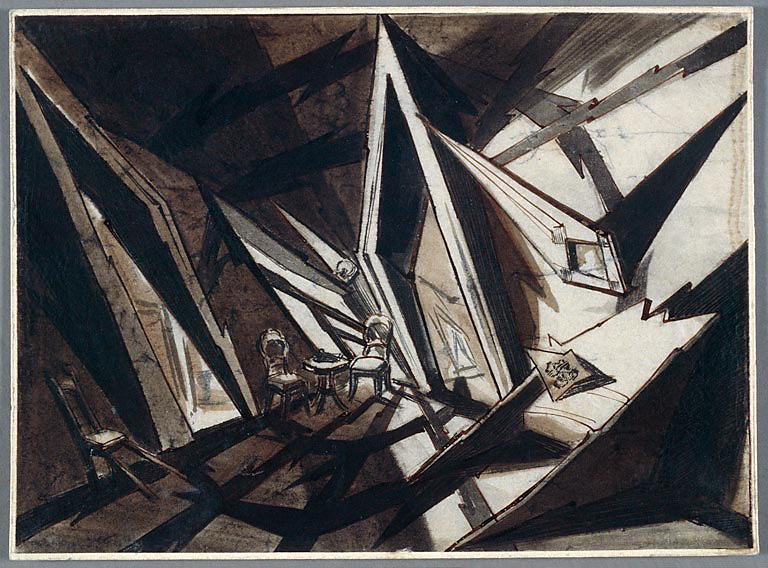
 

Andrei Andrejew (Russia, 1887-1966) 'Set design drawing for Crime and Punishment (Raskolnikow)' 1923


Andrei Andrejew (Russia, 1887-1966)
Set design drawing for Crime and Punishment (Raskolnikow)
1923
Director: Robert Wiene (Germany, 1873-1938)
Ink and ink wash
Collection of La Cinémathèque française, Paris


Raskolnikow is a 1923 German silent drama film directed by Robert Wiene. The film is based on the novel Crime and Punishment by Fyodor Dostoyevsky, whose protagonist is Rodion Raskolnikov. The film’s art direction is by André Andrejew. The film is characterised by Jason Buchanan of Allmovie as a German expressionist view of the story: a “nightmarish” avante-garde or experimental psychological drama.

Robert Wiene (German, 1873-1938)

Robert Wiene (German, 27 April 1873 – 17 July 1938) was a film director of the German silent cinema. He is particularly known for directing the German silent film The Cabinet of Dr. Caligari and a succession of other expressionist films. Wiene also directed a variety of other films of varying styles and genres. Following the Nazi rise to power in Germany, Wiene fled into exile.

Four months after the Nazis took power Wiene’s latest film, “Taifun,” was banned on May 3, 1933. A Hungarian film company had been inviting German directors to come to Budapest to make films in simultaneous German/Hungarian versions, and given his uncertain career prospects under the new German regime Wiene took up that offer in September to direct “One Night in Venice” (1934). Wiene went later to London, and finally to Paris where together with Jean Cocteau he tried to produce a sound remake of The Cabinet of Dr. Caligari. …

Wiene died in Paris ten days before the end of production of a spy film, Ultimatum, after having suffered from cancer. The film was finished by Wiene’s friend Robert Siodmak.

Text from the Wikipedia website


Otto Erdmann (German, 1834-1905) and Georg Wilhelm Pabst (Austrian, 1885-1967) 'Die Freudlose Gasse (The Joyless Street)' 1923


Otto Erdmann (German, 1834-1905) and Georg Wilhelm Pabst (Austrian, 1885-1967)
Die Freudlose Gasse (The Joyless Street)
1923
Gouache and watercolour
Photo courtesy Collection of La Cinémathèque française, Paris/LACMA


Otto Erdmann (German, 1834-1905) and Georg Wilhelm Pabst (Austrian, 1885-1967) 'Die Freudlose Gasse (The Joyless Street)' 1923


Otto Erdmann (German, 1834-1905) and Georg Wilhelm Pabst (Austrian, 1885-1967)
Die Freudlose Gasse (The Joyless Street)
1923
Director: Georg Wilhelm Pabst
Gouache and watercolor
Photo courtesy Collection of La Cinémathèque française, Paris/LACMA
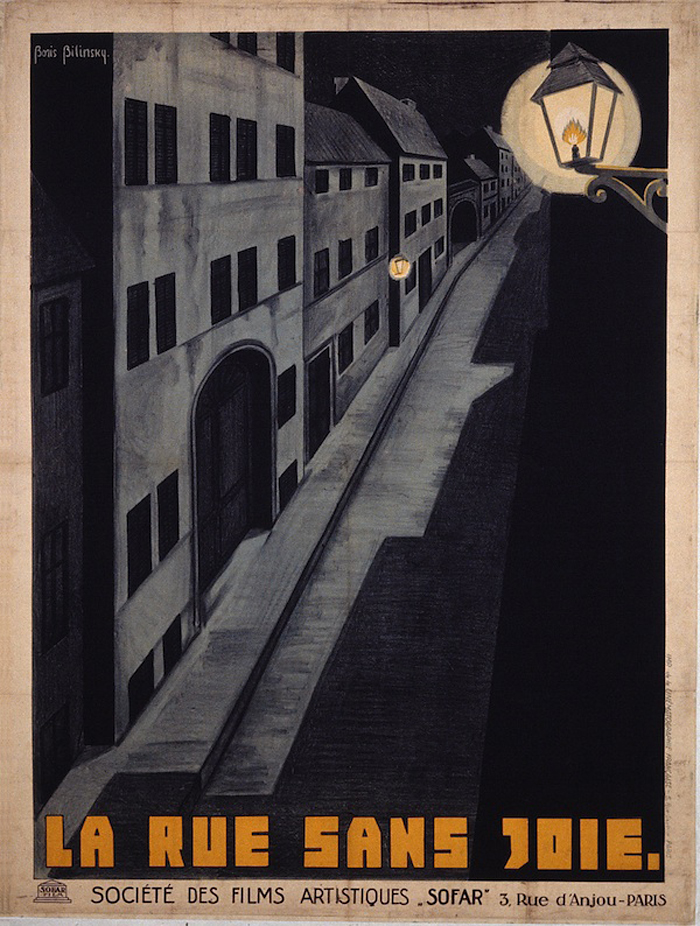
 

Boris Bilinsky (Russia, 1900-1948) 'Poster for The Joyless Street (Die freudlose Gasse)' c. 1925


Boris Bilinsky (Russia, 1900-1948)
Poster for The Joyless Street (Die freudlose Gasse)
c. 1925
Director: Georg Wilhelm Pabst (Austria, 1885-1967)
Lithograph
Collection of La Cinémathèque française, Paris
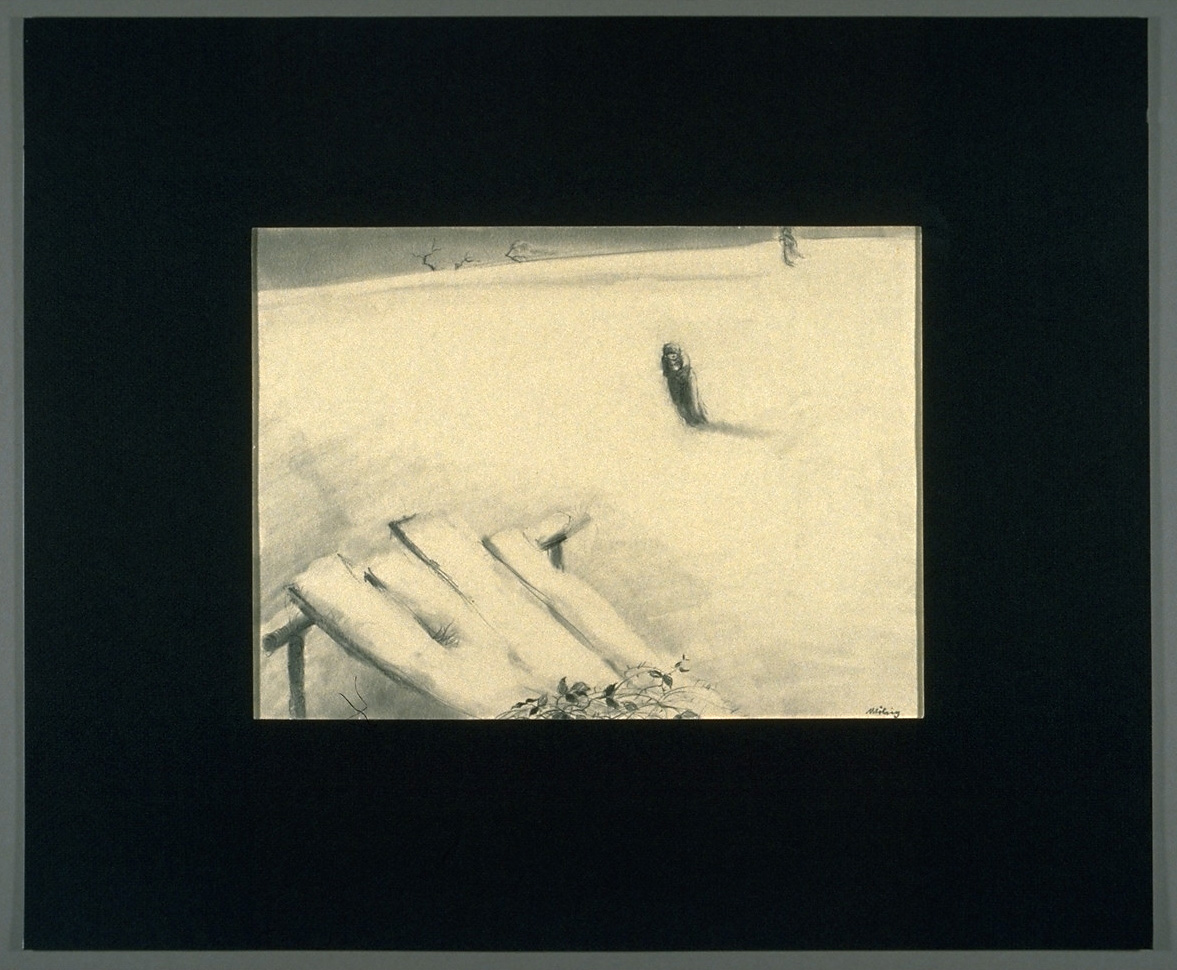
 

Walter Röhrig (German, 1892-1945) and Friedrich Wilhelm Murnau (German, 1888-1931) 'Faust' 1926


Walter Röhrig (German, 1892-1945) and Friedrich Wilhelm Murnau (German, 1888-1931)
Faust
1926
BiFi, Collection of La Cinémathèque française, Paris
© 2014 Artists Rights Society (ARS), New York
Photo courtesy Collection of La Cinémathèque française, Paris


Robert Herlth (German, 1893-1962) and Friedrich Wilhelm Murnau (German, 1888-1931) 'Faust' 1926


Robert Herlth (German, 1893-1962) and Friedrich Wilhelm Murnau (German, 1888-1931)
Faust
1926
Director: Friedrich Wilhelm Murnau
BiFi, Collection of La Cinémathèque française, Paris
Photo courtesy Collection of La Cinémathèque française, Paris


Robert Herlth (German, 1893-1962) and Friedrich Wilhelm Murnau (German, 1888-1931) 'Faust' 1926


Robert Herlth (German, 1893-1962) and Friedrich Wilhelm Murnau (German, 1888-1931)
Faust
1926
BiFi, Collection of La Cinémathèque française, Paris
Photo courtesy Collection of La Cinémathèque française, Paris


Robert Herlth (German, 1893-1962) and Friedrich Wilhelm Murnau (German, 1888-1931) 'Faust' 1926


Robert Herlth (German, 1893-1962) and Friedrich Wilhelm Murnau (German, 1888-1931)
Faust
1926
BiFi, Collection of La Cinémathèque française, Paris
Photo courtesy Collection of La Cinémathèque française, Paris


Robert Herlth (German, 1893-1962) and Friedrich Wilhelm Murnau (German, 1888-1931) 'Drawing for "Faust"' 1926


Robert Herlth (German, 1893-1962) and Friedrich Wilhelm Murnau (German, 1888-1931)
Drawing for “Faust”
1926
Collection of La Cinémathèque française, Paris


Unknown photographer. 'Set photograph from The Cabinet of Dr. Caligari (Das Kabinett des Dr. Caligari)' 1919


Unknown photographer
Set photograph from The Cabinet of Dr. Caligari (Das Kabinett des Dr. Caligari)
1919
Director: Robert Wiene (German, 1873-1938)
Los Angeles County Museum of Art, Robert Gore Rifkind Center for German Expressionist Studies


Hermann Warm (German, 1889-1976) 'Robert Wiene's "Das Kabinett des Dr Caligari"' 1919


Hermann Warm (German, 1889-1976)
Robert Wiene’s “Das Kabinett des Dr Caligari”
1919
Watercolour and ink
BiFi, Collection of La Cinémathèque française, Paris


'Set drawing for the"Das Kabinett des Dr Caligari" (The Cabinet of Dr Caligari)' 1920


Set drawing for the”Das Kabinett des Dr Caligari” (The Cabinet of Dr Caligari)
1920
Collection of La Cinémathèque française, Paris


Ernst Stern (Romanian-German, 1876-1954) 'Paul Leni's "Das Wachfigurenkabinett (Le cabinet des figures de cire)"' (Wax Works) 1924


Ernst Stern (Romanian-German, 1876-1954)
Paul Leni’s “Das Wachfigurenkabinett (Le cabinet des figures de cire)” (Wax Works)
1924
Director: Paul Leni
Watercolour and charcoal
Collection of La Cinémathèque française, Paris/LACMA


Ernst Stern (Romanian-German, 1876-1954) and Paul Leni (German, 1885-1929) '"Das Wachfigurenkabinett (Le cabinet des figures de cire)"' (Wax Works) 1924


Ernst Stern (Romanian-German, 1876-1954) and Paul Leni (German, 1885-1929)
“Das Wachfigurenkabinett (Le cabinet des figures de cire)” (Wax Works)
1924
Watercolour, gouache, and graphite
34.6 x 24.8cm
Collection of La Cinémathèque française, Paris/LACMA


Unknown photographer. 'Set photograph from "The Blue Angel" (Der blaue Engel)' 1930


Unknown photographer
Set photograph from “The Blue Angel” (Der blaue Engel)
1930
Director: Josef von Sternberg (Austria, 1894-1969)
Gelatin silver print
Collection of La Cinémathèque française, Paris
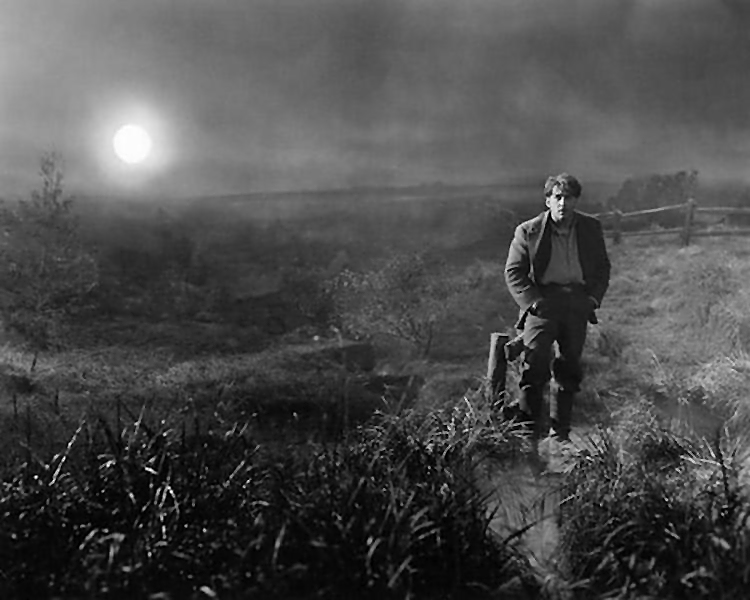
 

Karl Struss (American, 1886-1981) 'Set photograph from "Sunrise: A Song of Two Humans" (Sonnenaufgang: Ein Lied zweier Menschen)' (detail) 1927, printed 2014


Karl Struss (American, 1886-1981)
Set photograph from “Sunrise: A Song of Two Humans” (Sonnenaufgang: Ein Lied zweier Menschen) (detail)
1927, printed 2014
Directed by Friedrich Wilhelm Murnau
Courtesy of Academy of Motion Picture Arts and Sciences’ Margaret Herrick Library
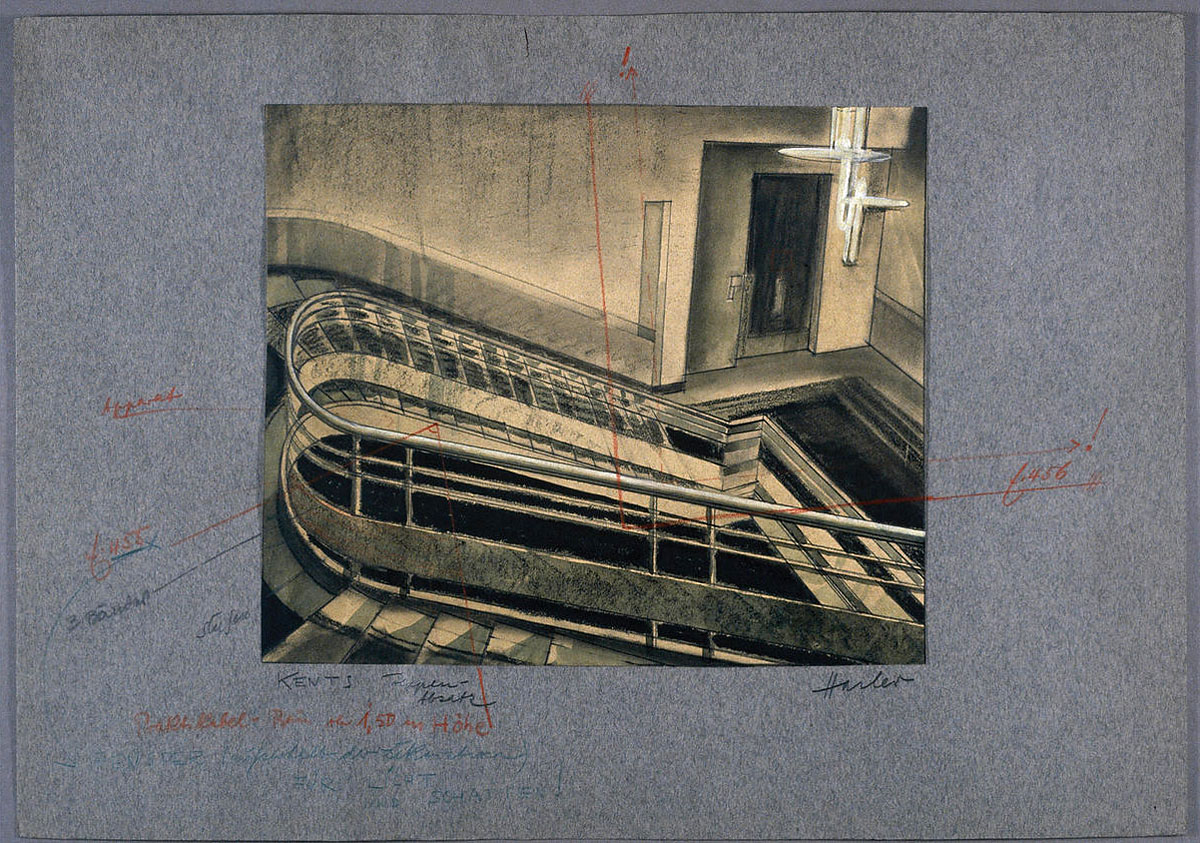
 

Emil Hasler (German, 1901-1986) 'Drawing for Fritz Lang's "Das Testament des Dr Mabuse"' 1932


Emil Hasler (German, 1901-1986)
Drawing for Fritz Lang’s “Das Testament des Dr Mabuse” (The Testament of Dr Mabuse)
1932
Pastel, graphite, and gouache
Collection of La Cinémathèque française, Paris/LACMA


Paul Scheurich (German, 1883-1945) 'Poster design for Fritz Lang's "Das Testament des Dr Mabuse"' 1932


Paul Scheurich (German, 1883-1945)
Poster design for Fritz Lang’s “Das Testament des Dr Mabuse” (The Testament of Dr Mabuse)
1932
Ink, gouache, and graphite
BiFi, Collection of La Cinémathèque française, Paris


Emil Hasler (German, 1901-1986) 'Drawing for Fritz Lang's "M," le Maudit' (Cursed) 1931


Emil Hasler (German, 1901-1986)
Drawing for Fritz Lang’s “M,” le Maudit (Cursed)
1931
Charcoal, gouache, and coloured pencil
Collection of La Cinémathèque française, Paris/LACMA
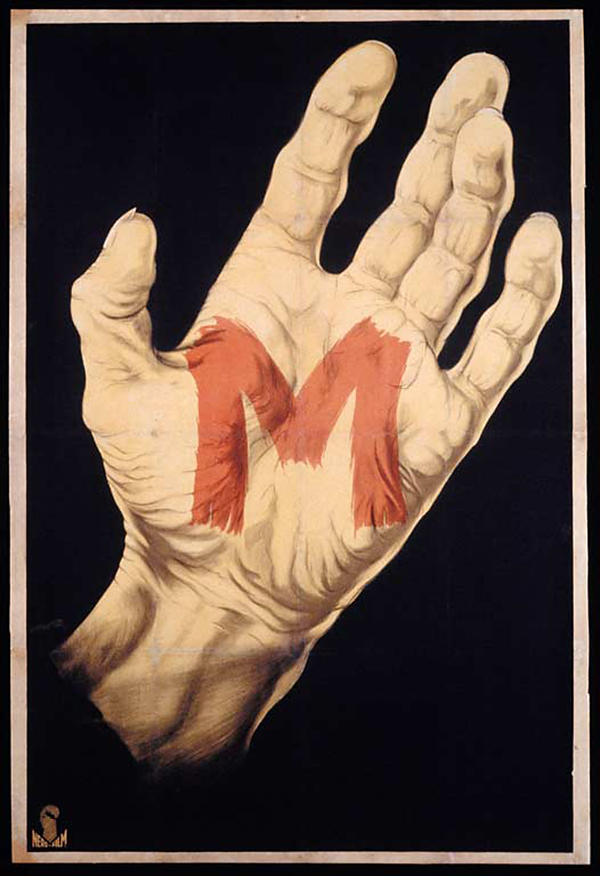
 

Unknown artist. 'Poster for "M"' 1931


Unknown artist
Poster for “M”
1931
Director: Fritz Lang (Austria, 1890-1976)
Collection of La Cinémathèque française
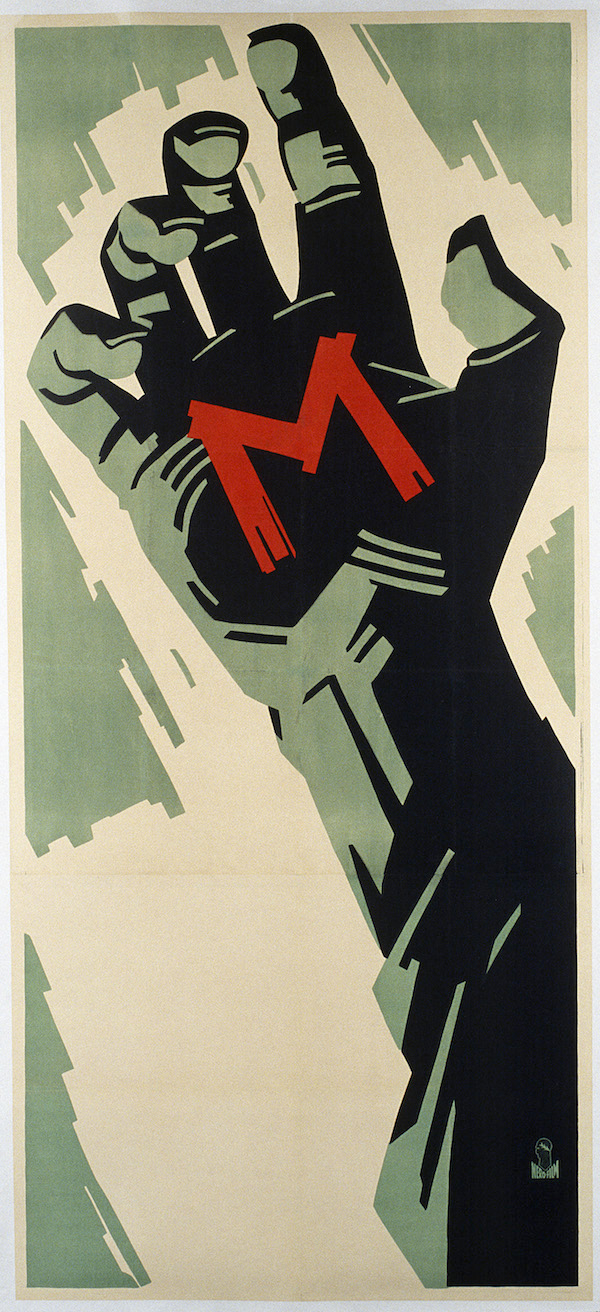
 

Unknown artist. 'Poster for "M"' 1933


Unknown artist
Poster for “M”
1933
Made for Paramount release in Los Angeles
Director: Fritz Lang (Austria, 1890-1976)
Courtesy of Academy of Motion Picture Arts and Sciences’ Margaret Herrick Library


The Milwaukee Art Museum is excited for visitors to experience its newest exhibition, Haunted Screens: German Cinema in the 1920s on view from Oct. 21 through Jan. 22. Organised by La Cinémathèque française, Paris, the exhibition examines the groundbreaking period in film history that occurred in Germany during the Weimar era after World War I, through more than 150 objects, including set design drawings, photographs, posters, documents, equipment, cameras and film clips from more than 20 films.

The Expressionist movement introduced a highly charged emotionalism to the artistic disciplines of painting, photography, theater, literature and architecture, as well as film, in the early part of the 20th century. German filmmakers employed geometrically skewed set designs, dramatic lighting, off-kilter framing, strong shadows and distorted perspectives to express a sense of uneasiness and discomfort. These films reflected the mood of Germany during this time, when Germans were reeling from the death and destruction of WWI and were enduring hyperinflation and other hardships.

“We’re thrilled to present Haunted Screens at the Milwaukee Art Museum this fall, and to offer our visitors a glimpse into a unique and revolutionary time in film and art history,” said Margaret Andera, the Museum’s adjunct curator of contemporary art. “This exhibition represents a tremendous period of creativity, and allows visitors a fascinating look at the nuanced aesthetics of German Expressionist cinema through a wealth of diverse objects.”

The exhibition is grouped into five sections by theme: Nature, Interiors, The Street, Staircases and The Expressionist Body. From the dark fantasy of The Cabinet of Dr. Caligari to the chilling murder mystery M, the exhibition explores masterworks of German Expressionist cinema in aesthetic, psychological and technical terms. More than 140 drawings are complemented by some 40 photographs, eight projected film clip sequences, numerous film posters, three cameras, one projector, and a resin-coated, life-size reproduction of the Maria robot from Metropolis.

German Expressionist cinema was the first self-conscious art cinema, influencing filmmakers throughout the world at the time and continuing to inspire artists today. It served as a catalyst for subsequent film genres, most notably science fiction and horror. The conflicting attitudes about technology and the future that are the cornerstones of science fiction, and the monsters and villains that form the basis of horror, appear often in Expressionist films. The influence of Expressionist cinema undoubtedly extends to the work of contemporary filmmakers, including Tim Burton, Martin Scorsese and Guy Maddin, whose 3-channel projection work, Kino Ektoplamsa, appears at the end of the exhibition.

The Museum is taking a unique approach to the exhibition’s installation design, one that mirrors the mood of the time and the objects on display. Walls intersecting at unexpected angles and even breaking through the exhibition space into Windhover Hall give visitors an engaging experience.

The Milwaukee Art Museum’s permanent collection includes extensive holdings in the German Expressionist area, including a significant collection of paintings from the period, as well as one of the most important collections of German Expressionist prints in the nation, the Marcia and Granvil Specks Collection. This collection includes more than 450 prints by German masters. Visitors are encouraged to stroll through the collection galleries after seeing Haunted Screens.”

Press release from the Milwaukee Art Museum


Metropolis (1927) full movie


Synopsis of Metropolis

Metropolis is ruled by the powerful industrialist Joh Fredersen. He looks out from his office in the Tower of Babel at a modern, highly technicised world. Together with the children of the workers, a young woman named Maria reaches the Eternal Gardens where the sons of the city’s elite amuse themselves and where she meets Freder, Joh Fredersen’s son. When the young man later goes on a search for the girl, he witnesses an explosion in a machine hall, where numerous workers lose their lives. He then realises that the luxury of the upper class is based on the exploitation of the proletariat. In the Catacombs under the Workers’ City Freder finally finds Maria, who gives the workers hope with her prophecies for a better future. His father also knows about Maria’s influence on the proletariat and fears for his power. In the house of the inventor Rotwang, Joh Fredersen learns about his experiments to create a cyborg based on the likeness of Hel, their mutual love and Freder’s mother. Fredersen orders Rotwang to give Maria’s face to the robot in order to send it to the underground city to deceive and stir up its inhabitants.

After the robot Maria has succeeded, a catastrophe ensues. The riotous workers destroy the Heart Machine and as a result the Workers’ City, where only the children have remained, is terribly flooded. The real Maria brings the children to safety along with Freder. When they learn about the disaster, the rebelling masses stop. Their rage is now aimed at the robot Maria, who is captured and burned at the stake. At the same time Rotwang, driven by madness, pursues the genuine Maria across the Cathedral’s rooftop, where he ultimately falls to his death. Freder and Maria find each other again. The son devotes himself to his father, mediating between him and the workers. As a consequence, Maria’s prophecy of reconciliation between the ruler and those who are mastered (head and hands) triumphs – through the help of the mediating heart.


Horst von Harbou (Germany, 1879-1953) 'Set photograph from "Metropolis"' 1927


Horst von Harbou (Germany, 1879-1953)
Set photograph from “Metropolis”
1927
Director: Fritz Lang (Austria, 1890-1976)
Gelatin silver print
Collection of La Cinémathèque française
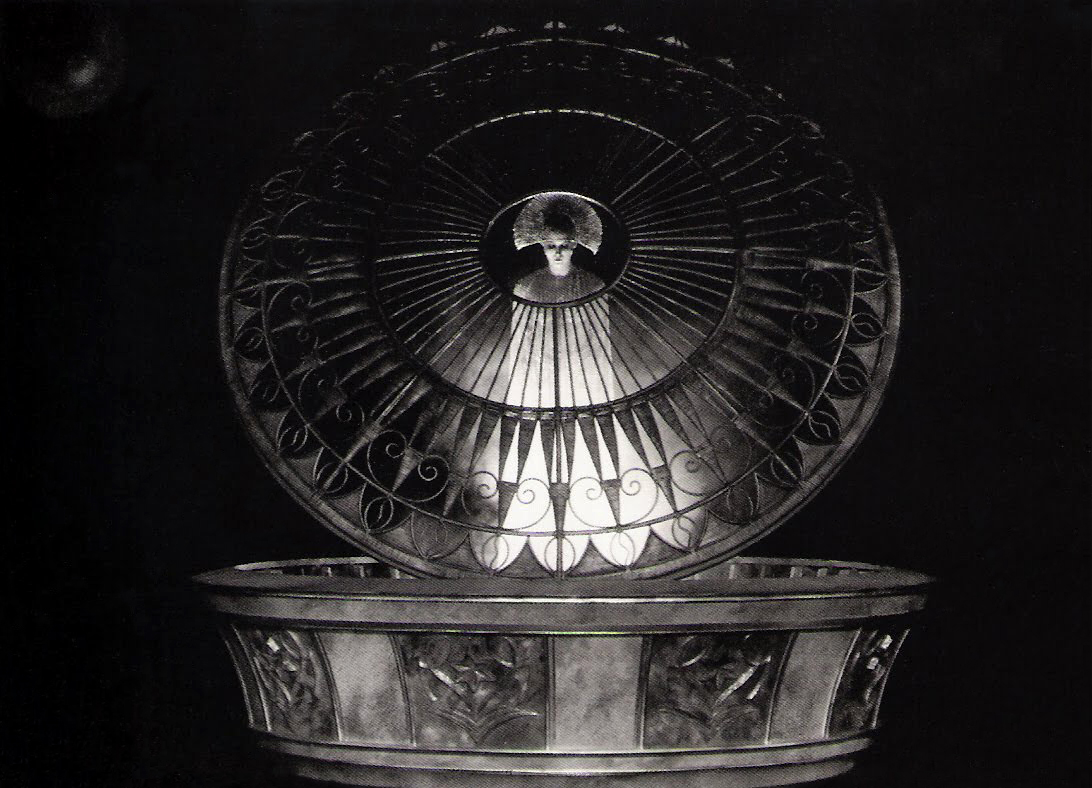
 

Horst von Harbou (Germany, 1879-1953) 'Set photograph from "Metropolis"' 1927


Horst von Harbou (Germany, 1879-1953)
Set photograph from “Metropolis”
1927
Director: Fritz Lang (Austria, 1890-1976)
Gelatin silver print
Collection of La Cinémathèque française
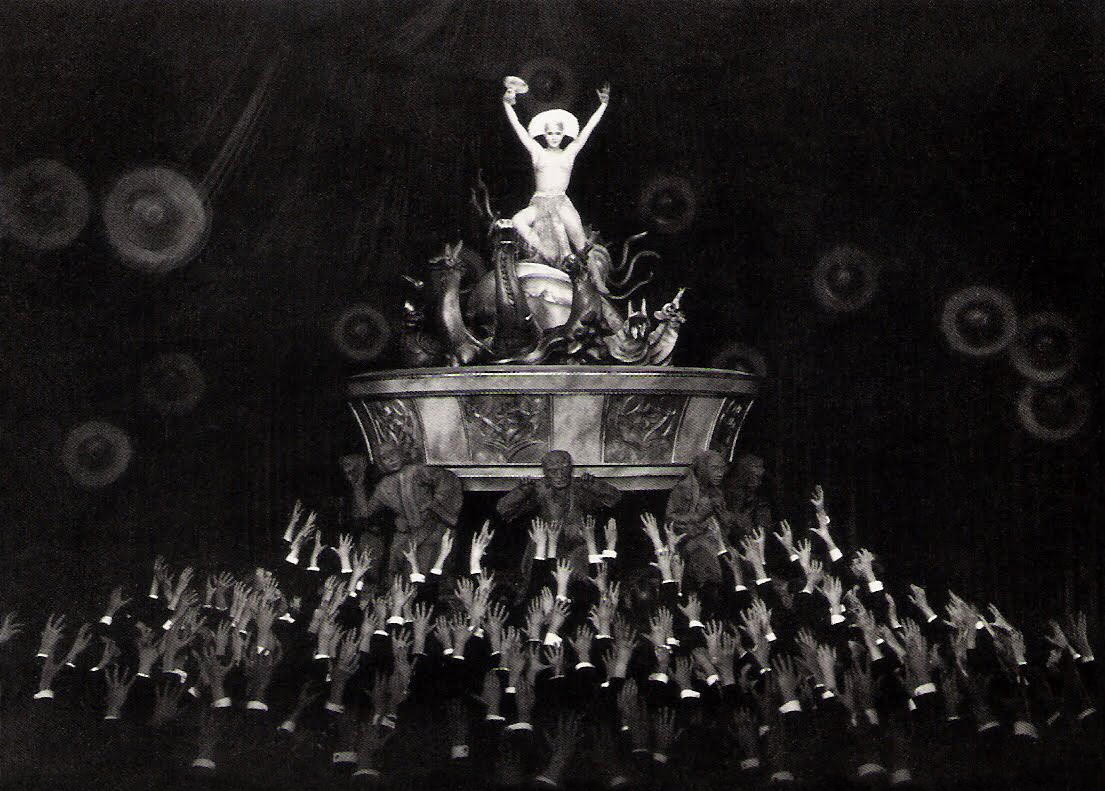
 

Horst von Harbou (Germany, 1879-1953) 'Set photograph from "Metropolis"' 1927


Horst von Harbou (Germany, 1879-1953)
Set photograph from “Metropolis”
1927
Director: Fritz Lang (Austria, 1890-1976)
Gelatin silver print
Collection of La Cinémathèque française
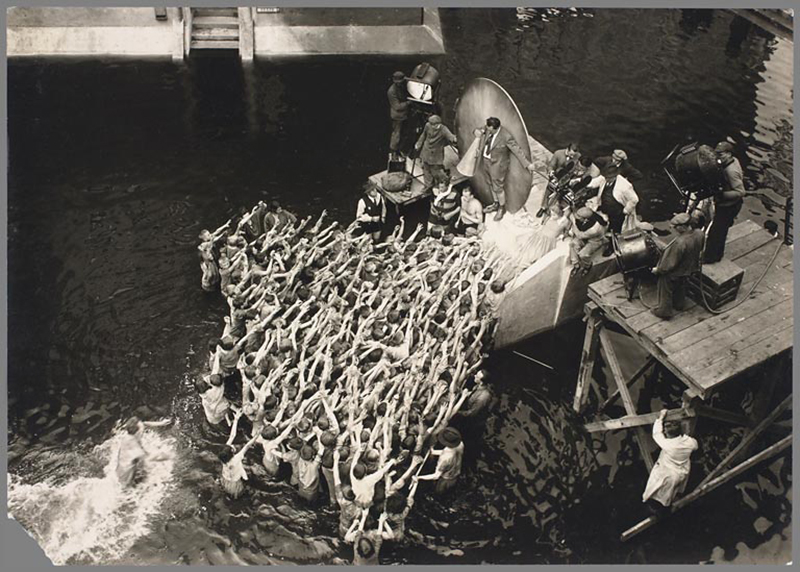
 

Horst von Harbou (Germany, 1879-1953) 'Set photograph from "Metropolis"' 1927


Horst von Harbou (Germany, 1879-1953)
Set photograph from “Metropolis”
1927
Director: Fritz Lang (Austria, 1890-1976)
Gelatin silver print
Collection of La Cinémathèque française

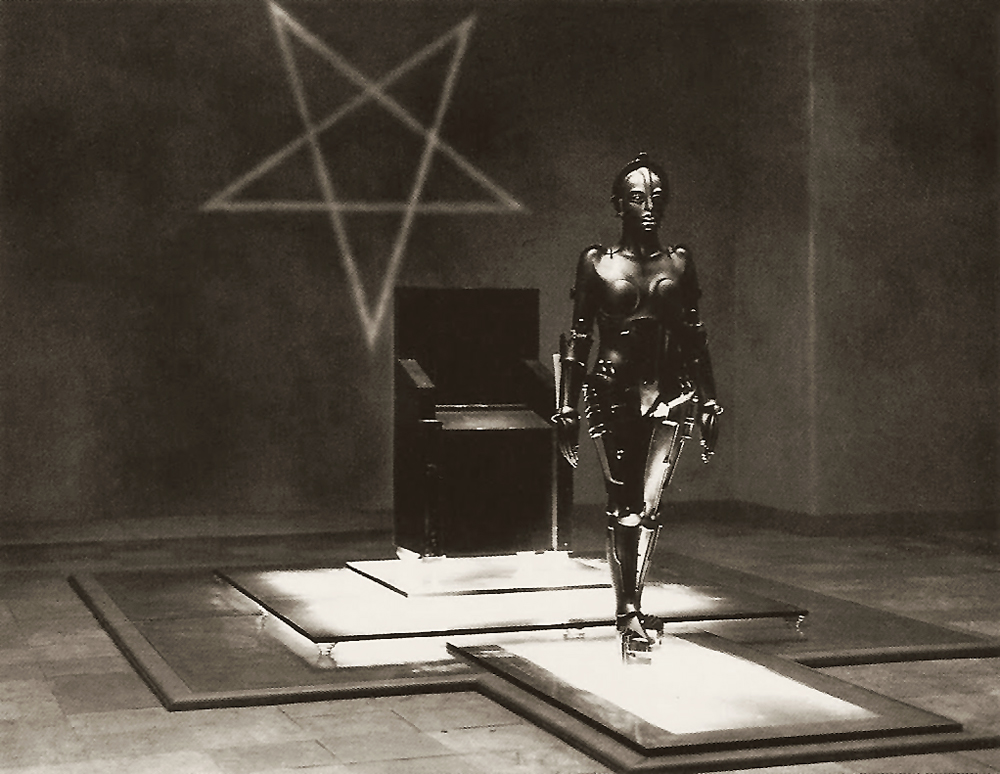
 

Horst von Harbou (Germany, 1879-1953) 'Set photograph from "Metropolis"' 1927

Horst von Harbou (Germany, 1879-1953) 'Set photograph from "Metropolis"' 1927


Horst von Harbou (Germany, 1879-1953)
Set photograph from “Metropolis”
1927
Director: Fritz Lang (Austria, 1890-1976)
Gelatin silver print
Collection of La Cinémathèque française


Horst von Harbou (Germany, 1879-1953) 'Set photograph from "Metropolis"' 1927


Horst von Harbou (Germany, 1879-1953)
Set photograph from “Metropolis”
1927
Director: Fritz Lang (Austria, 1890-1976)
Gelatin silver print
Collection of La Cinémathèque française


Horst von Harbou (Germany, 1879-1953) 'Set photograph from "Metropolis"' 1927


Horst von Harbou (Germany, 1879-1953)
Set photograph from “Metropolis”
1927
Director: Fritz Lang (Austria, 1890-1976)
Gelatin silver print
Collection of La Cinémathèque française


Fritz Lang’s Metropolis (1927) is a defining film of the silent era and science fiction genre. But the work of the film’s still photographer Horst von Harbou has remained obscure. Von Harbou, brother of Thea von Harbou, Lang’s then wife and co-screenwriter of Metropolis, photographed filmed scenes as well as off-camera action, and made an album of thirty-five photographs which he gave to the film’s young star Brigitte Helm. The book Metropolis is a careful reconstruction of this album, showing the photographs and some of their backsides which feature hand-written notes. Von Harbou’s photographs not only offer a rare insight into Lang’s film, but have been crucial in reconstructing missing scenes from it.

Horst von Harbou was born in 1879 in Hutta, Posen, and died in 1953 in Potsdam-Babelsberg. Very little is known about von Harbou, except for the films on which he worked as a still photographer: these include Mensch ohne Namen (1932), Starke Herzen im Sturm (1937) and Augen der Liebe (1951).

Text from the Steidl Books website


Horst von Harbou (Germany, 1879-1953) 'Set photograph from "Metropolis"' 1927 (detail)


Horst von Harbou (Germany, 1879-1953)
Set photograph from “Metropolis” (detail)
1927
Director: Fritz Lang (Austria, 1890-1976)
Gelatin silver print
Collection of La Cinémathèque française


Otto Hunte (German, 1881-1960) 'Set design drawing for "Metropolis"' 1923


Otto Hunte (German, 1881-1960)
Set design drawing for “Metropolis”
1923
Director: Fritz Lang
Collection of La Cinémathèque française, Paris


Otto Hunte (German, 1881-1960)

Otto Hunte (9 January 1881 – 28 December 1960) was a German production designer, art director and set decorator. Hunte is considered as one of the most important artists in the history of early German cinema, mainly for his set designs on the early silent movies of Fritz Lang. His early career was defined by a working relationship with fellow designers Karl Vollbrecht and Erich Kettelhut. Hunte’s architectural designs are found in many of the most important films of the period including Dr. Mabuse the Gambler, Die Nibelungen (1924), Metropolis (1927) and Der blaue Engel. Hunte subsequently worked as one of the leading set designers during the Nazi era. Post-Second World War he was employed by the East German studio DEFA.


Paramount. 'Trade advertisement for 'Metropolis'' 1927


Paramount
Trade advertisement for “Metropolis”
1927
Lithograph


Milwaukee Art Museum
700 N Art Museum Dr,
Milwaukee WI 53202

Opening hours:
Monday – Tuesday Closed
Wednesday 10am – 5pm
Thursday 10am – 8pm
Friday – Sunday 10am – 5pm
Milwaukee Art Museum website

LIKE ART BLART ON FACEBOOK

Back to top

Exhibition: ‘The Intimate World of Josef Sudek’ at Jeu de Paume, Paris

Exhibition dates: 7th June – 25th September, 2016


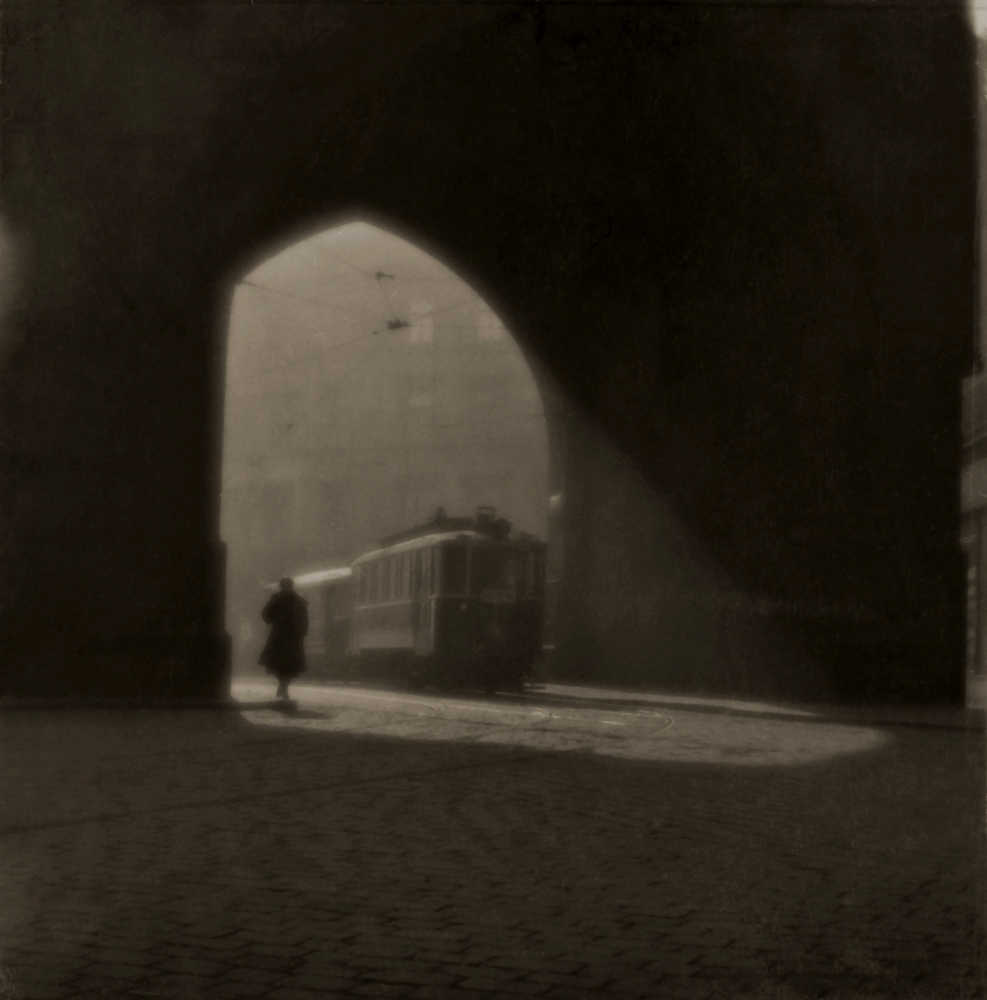
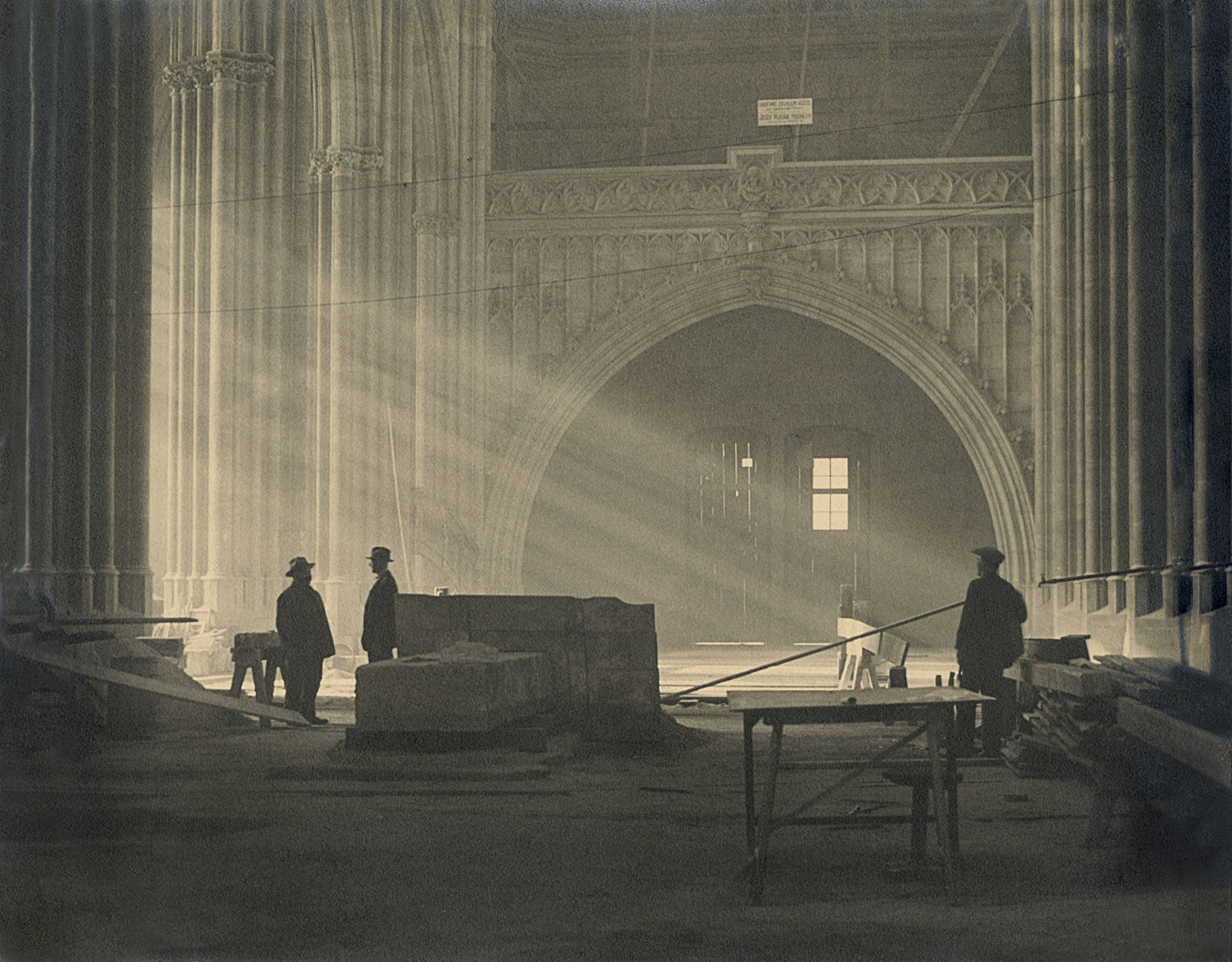
Josef Sudek (Czech, 1896-1976) 'St. Vitus cathedral, Prague, Czech Republic' c. 1926 from the exhibition 'The Intimate World of Josef Sudek' at Jeu de Paume, Paris, June - Sept, 2016


Josef Sudek (Czech, 1896-1976)
St. Vitus cathedral, Prague, Czech Republic
c. 1926
Silver gelatin print


A poetry of the everyday

Josef Sudek, a one-armed man lugging around a large format camera, is one of my top ten photographers of all time.

His photographs, sometimes surreal, always sensitive, have a profound sensibility that affect the soul. Melancholy and mysterious by turns, they investigate the inner life of objects which stand as metaphors for the inner life of the artist. A form of healing after his horrific injuries and the loss of his arm during the First World War, the photographs purportedly look outwards upon the world but are actually interior meditations on life, death and the nature of being. Light emerges from the darkness; understanding from tribulation; and Sudek, in Jungian terms, integrates his ego into his soul through the process of (photographic) individuation – whereby the personal and collective unconscious (his hurt and damage) are brought into consciousness (eg. by means of dreams, active imagination, or free association) to be assimilated into the whole personality. It is a completely natural process necessary for the integration of the psyche and, in Sudek’s life, was integral to his healing from the vicissitudes of war.

Using Pictorialism as the starting point for his exploration of the world, Sudek never abandons the creation of “atmosphere” in his photographs, even as the images become modernist, surrealist and offer a new way of seeing the world. Having myself photographed extensively at night, and from the interior of my flat, I can understand Sudek’s fascination with both locations: the quiet of night, the stillness, the clarity of vision and thought; the interior as exterior, the projection of interior thoughts onto an external surface reflected back into the camera lens. “Nature, architecture, streets and objects are magnified by his sensitivity and mastery of the effects of light, contrasting with the impenetrable cloak of darkness.” Except the cloak of darkness is not impenetrable, as light cannot exist without darkness.

Pace, his photographs are breath / taking. They are exhalations of the spirit.

Sudek’s ability to transcend the literal, his ability to transform the objectal quality of photography ranks him as one of the top photographers of all time. He synthesises  a poetry of objects, a poetry of the everyday, and projects the folds of his mind onto the visual field (through “tears” of condensation on the window, through labyrinths of paper and glass, such as in Labyrinth on my table, 1967, below). As a form of self-actualisation – the desire to become everything that one is capable of becoming – Sudek’s photographs interrogate that chthonic darkness that lurks in the heart of everyone of us, our dark night of the soul.

In that process of discovery (who am I, what kind of human being am I, how can I heal myself), he finds redemption.

Dr Marcus Bunyan


Many thankx to Jeu de Paume for allowing me to publish the photographs in the posting. Please click on the photographs for a larger version of the image.


“I like to tell stories about the life of inanimate objects, to relate something mysterious: the seventh side of a dice. Everything around us, dead or alive, in the eyes of a crazy photographer mysteriously takes on many variations, so that a seemingly dead object comes to life through light or by its surroundings.”


Josef Sudek


Josef Sudek at Jeu de Paume

“The Intimate World of Josef Sudek”, exhibition at Jeu de Paume Paris, from 07 June 2016 until 25 September 2016

Entitled “The Intimate World of Josef Sudek”, this exhibition is the first of this scale to revisit the life and work of Josef Sudek (Kolin, 1896 – Prague, 1976) within its socio-geographical and historical context: Prague during the first half of the twentieth century, at a time when the Czech capital was a veritable hub of artistic activity.

The exhibition features a selection of 130 works spanning the totality of Sudek’s career, from 1920 to 1976, and allows the public to examine the extent to which his photography was a reflection of his personal relationship to the surrounding world. On display are works that are the result of Sudek’s photographic experiments carried out within the privacy of his own studio, images of the garden seen from his window, and photographs of adventures further afield. The artist enjoyed meandering through the streets of Prague and its surrounding suburbs, and made frequent excursions to the nearby countryside.

Sudek’s enduring fascination with light, and its absence, is at the root of some of the most haunting photographs of the twentieth century. Nature, architecture, streets and objects are magnified by his sensitivity and mastery of the effects of light, contrasting with the impenetrable cloak of darkness.

Text from the Jeu de Paume Vimeo website


On display are works that are the result of Sudek’s photographic experiments carried out within the privacy of his own studio, images of the garden seen from his window, and photographs of adventures further afield. The artist enjoyed meandering through the streets of Prague and its surrounding suburbs, and made frequent excursions to the nearby countryside. Sudek’s enduring fascination with light, and its absence, is at the root of some of the most haunting photographs of the twentieth century. Nature, architecture, streets and objects are magnified by his sensitivity and mastery of the effects of light, contrasting with the impenetrable cloak of darkness.

As a photographer, Sudek was particularly concerned with the quality of the photographic print, an essential component in terms of the expressive potential of an image. His mastery of the pigment printing process enabled him to produce highly atmospheric and evocative images, thereby reaping all of the reflective and descriptive power of the gelatin silver print. The exhibition presents work from Sudek’s early career, but also features photographs from a pivotal period of experimentation and innovation, beginning in the 1940s. Focusing on the technical and formal aspects of the medium of photography, Sudek created pigment prints, halftone prints, puridlos (photographs between two windows) and veteše (photographs inserted into old frames), techniques which allowed him to transform the objectal quality of photography.

The loss of his right arm during the First World War and the difficulties he now encountered in transporting his view camera did not dampen his passion for photography. Sudek’s studio window became an object of abiding fascination – rather like the surface of a canvas – reflecting moments of exquisite tenderness and hope when a flowering branch brushed against its pane, or of poignant melancholy when he observed the world beyond his window transformed by the playful infinity of mist. His room with a view allowed him to capture, on film, his love of Prague. His photographs demonstrate both a precision and a depth of feeling, fitting odes to the rich history and architectural complexity of the Czech capital.

Like many artists of his generation marked by their experience of war, Sudek expresses a particularly acute awareness of the dark and tormented aspects of human existence – feelings that would inspire some of his most melancholy and most moving pictures. A photograph taken at night, through the glass pane of his window, shows a city plunged into darkness during the Occupation of the Second World War, and communicates a sentiment of unspeakable despair – a dramatic illustration of Sudek’s technical ability to transcend the literal.

The first part of the exhibition features images that herald the photographer’s later work, showing his early landscapes, portraits of fellow patients at Invalidovna, the Prague hospice for war invalids like Sudek, his hesitant foray into modernism, and his interior shots of St. Vitus Cathedral. Through images that recount the narrative of his life, the viewer gains access to Sudek’s inner world, and an insight into his immediate environment, the views and objects he loved, his studio and garden. His endless walks in Prague found expression in the views of the city and its surroundings, as well as in photographs of its more sordid “suburbs”, a subject explored by other Prague artists. The eastern and northern areas of Bohemia, the Beskid Mountains and the Mionší forest were other destinations close to the photographer’s heart. The exhibition “The Intimate World of Josef Sudek” provides a fascinating panorama of the work of this unique artist.

Text from the Jeu de Paume website


Beginnings

Sudek’s first photographic prints – small and largely assembled in albums – were mainly views of the countryside taken along the Elbe River when he travelled from Prague to Kolín to visit his mother between 1916 and 1922.

Using processes such as gelatin silver and bromoil he showed a talent for printing his pictures in a style that favoured soft edges and broad swathes of tone. Here Sudek was not so much studying the effects of light as he was observing the conventions of Pictorialism, a photography movement that straddled the last decade of the nineteenth century and the first decades of the twentieth century, and was based on a strong Romantic ethos. Pictorialist photographers enhanced atmospheric effects with such processes as carbon and gum bichromate. Sudek began using the carbon process regularly and in a personally expressive manner in the late 1940s.

His Invalidovna and St. Vitus Cathedral series in Prague, begun in the first half of the 1920s, show him exploring interior spaces where light emphasises both the profane and the sacred. The play of bands of sunlight and darkness is a central feature of the composition and, indeed, of the life of the photograph.


Josef Sudek (Czech, 1896-1976) 'Dimanche après-midi à l'île Kolín' [Sunday afternoon at Kolín island] c. 1922–1926


Josef Sudek (Czech, 1896-1976)
Dimanche après-midi à l’île Kolín [Sunday afternoon at Kolín island]
c. 1922-1926
Gelatin silver print
28.4 × 28.7cm
Musée des beaux-arts du Canada, Ottawa. Achat, 2000
© Succession de Josef Sudek


“… [Sudek] referred to photography as meteorology to describe the significance of the atmosphere, and how a photographer must predict the right conditions for photographing and enlarging prints. His work became sharper with richer tones, and his compositions became more illusive. The foregrounds and backgrounds of his photographs, particularly in his “Window” series began to oscillate. These achievements were perhaps made more attainable by his focus on inanimate objects over which he had more control than living things. Most of his cityscapes became deserted, as he directed his camera at statues or replaced what would have been a living subject with such emulative sculptures.

In effect, Sudek’s substitution of the inanimate for the animate brought the objects he photographed to life in his mind. He called the enormous decaying trees in the woods of Bohemia “sleeping giants” and would take portraits of masks and statuary heads, transforming them into frozen, worn grotesqueries. His personification of objects is even more vivid in his studio photography, particularly after 1939, the oncoming of World War II and the Nazi occupation of Prague. As the city was oppressed by German troops, the artist retreated into his studio and insulated himself sentimentally with still lifes. To an interviewer, he explained, “I love the life of objects. When the children go to bed, the objects come to life. I like to tell stories about the life of inanimate objects.” He devoted endless hours to arranging and photographing the everyday – apples, eggs, bread, and shells – and special objects given to him by friends, such as feathers, spectacles, and watches, which he called “remembrances” of that person. A photograph from his series “Remembrances of Architect Rothmayer, Mr. Magician,” for example, portrays objects respectfully placed in a row on a desk, as if artifacts from an archeological site, from which the history of a life or character of a man could be divined.

“Everything around us, dead or alive, in the eyes of a crazy photographer mysteriously takes on many variations,” Sudek said, “so that a seemingly dead object comes to life through light or by its surroundings.” This statement is perhaps telling of Sudek’s relationship to death and life, as a result of the loss of his arm and the manner in which he suffered the loss. In the 1963 film, “Zit Svuj Zivot” (Living Your Life), a documentary portrait of Sudek by Evald Strom, we see a sensitive man describing his efforts to photograph the reality of the objects around him, not as if he were bringing the objects to life, but as if it was his purpose to represent the lives of objects as they truly are. Of the image of a vase of wildflowers, he says “This is a photograph of wildflowers, my attempt to photograph wildflowers,” and of an old lamp, “This is a celebrated lamp; it holds a lot of memories.””

Ashley Booth Klein, “Josef Sudek and The Life of Objects,” in Obelisk Vol. 2 Issue 1, Winter 2015 [Online] Cited 18/09/2016. No longer available online


Josef Sudek (Czech, 1896-1976) 'Rue de Prague' 1924


Josef Sudek (Czech, 1896-1976)
Rue de Prague
1924
Gelatin silver print
8.3 × 8.2cm
Musée des beaux-arts du Canada, Ottawa. Don anonyme, 2010
© Succession de Josef Sudek


Josef Sudek (Czech, 1896-1976) 'Portrait de mon ami Funke' [Portrait of my friend Funke] 1924


Josef Sudek (Czech, 1896-1976)
Portrait de mon ami Funke [Portrait of my friend Funke]
1924
Gelatin silver print
28.5 × 22.6cm
Musée des beaux-arts du Canada, Ottawa. Achat, 1985
© Succession de Josef Sudek


“Josef Sudek: The World at My Window” is the first exhibition in France since 1988 to cover Sudek’s entire career and spotlight the different phases of his work. Coming in the wake of several exhibitions at the Jeu de Paume devoted to Eastern European photographers of the early twentieth century, among them André Kertész and Francois Kollar, this one comprises some 130 vintage prints by the Czech artist. Bringing to bear a vision at once subjective and timeless, Sudek captures the ongoing changes in Prague’s natural world and landscapes.

His early profession as a bookbinder came to an abrupt halt when he was conscripted into the Austro-Hungarian army in Bohemia and sent to the Italian front. After the First World War he came back to Prague wounded; the loss of his right arm meant abandoning bookbinding, and he turned to photography. After revisiting the battlefield in Italy once more he returned, in despair, to Prague: “I found the place,” he recounted, “but my arm wasn’t there. Since then I’ve never gone anywhere. I didn’t find what I was looking for.”

A study grant enabled him to train at the state-run school of graphic arts in Prague, where he mixed with practitioners of Pictorialism, a photographic movement aiming at achieving colour and texture effects similar to those of painting. He started concentrating on architectural details, always waiting until the light was absolutely perfect. Little by little he gave up the Pictorialist ambiences of his views of St Vitus’s cathedral, opting for a pure, straightforward approach which the American photographer Alfred Stieglitz summed up as “maximum detail for maximum simplification”.

During the Second World War Sudek began photographing the window giving onto his garden, the result being the celebrated Window of My Studio series. He then shifted his focus to the accumulated jumble of objects in the studio, producing a further series titled Labyrinths. Light was an inexhaustible theme in his work, orchestrating the seasons, making the invisible visible and transporting us into another world. As if to escape the leaden context of the War and then of Communism, Sudek took refuge in music, especially that of his compatriot Leoš Janáček. A true music lover, he gradually built up a substantial collection of recordings which he played to his friends during improvised concerts in his studio.

The second half of his career saw Sudek abandon photography’s traditional subjects as he explored the outskirts of Prague with his black view camera on his shoulder. Known as “the poet of Prague”, he became an emblematic figure in the Czech capital. Discreet and solitary, he gradually withdrew from the city’s art scene, leaving his studio only to prowl the streets at night with his imagination as his guide.

Sudek’s photographs rarely include people; his focus was more on empty urban and rural spaces. Fascinated by the streets of Prague, the city’s deserted parks and public gardens, and the wooded Bohemian landscapes his mastery of light rendered sublime, he preferred the un-enlarged contact print as a means of preserving all the detail and authenticity of the places he roamed through.  His work moved towards experiments with light. In photographs shot through with simplicity and sensitivity, Sudek foregrounds a kind of poetry of the everyday, using the interplay of light and shade to achieve a kind of fluctuation between interior and exterior.

Text from Jeu de Paume


Josef Sudek (Czech, 1896-1976) 'La Fenêtre de mon atelier' [The window of my studio] c. 1940-1948


Josef Sudek (Czech, 1896-1976)
La Fenêtre de mon atelier [The window of my studio]
c. 1940-1948
Gelatin silver print
17 × 11.2cm
Musée des beaux-arts du Canada, Ottawa. Don anonyme, 2010
© Succession de Josef Sudek


Josef Sudek (Czech, 1896-1976) 'La Fenêtre de mon atelier' [The window of my studio] c. 1940–1954


Josef Sudek (Czech, 1896-1976)
La Fenêtre de mon atelier [The window of my studio]
c. 1940-1954
Gelatin silver print
22.9 × 16.8cm
Musée des beaux-arts du Canada, Ottawa. Don anonyme, 2010
© Succession de Josef Sudek


Josef Sudek (Czech, 1896-1976) 'La Fenêtre de mon atelier' [The window of my studio] c. 1940-1950


Josef Sudek (Czech, 1896-1976)
La Fenêtre de mon atelier [The window of my studio]
c. 1940-1950
Gelatin silver print
28.1 × 22.9cm
Musée des beaux-arts du Canada, Ottawa. Don anonyme, 2010
© Succession de Josef Sudek


The world from my window

Sudek was not content with making single, unrelated images. He generally worked in projects or series, creating extended visual explorations of the phenomena and scenes he viewed – often from the closed window of his studio, which separated his private studio-home from the exterior world. In the series From My Window it was the endlessly varying states of transformation of droplets of water that he watched streaming down his windowpane. His images invite us to contemplate, with great fascination, the physical cycles of water and the phenomenon of rivulets coursing down a surface – like human tears. Reminding us even of [Paul] Verlaine’s “There is weeping in my heart like the rain upon the city…” Sometimes the melancholy mood of these images is leavened by a rose in a vase on the windowsill or tendrils of leaves announcing the arrival of spring.


There is weeping in my heart
like the rain falling on the town.
What is this languor
that pervades my heart?

Oh the patter of the rain
on the ground and the roofs!
For a heart growing weary
oh the song of the rain!

There is weeping without cause
in this disheartened heart.
What! No betrayal?
There’s no reason for this grief.

Truly the worst pain
is not knowing why,
without love or hatred,
my heart feels so much pain.

Paul Verlaine. “Il pleure dans mon coeur”


Josef Sudek (Czech, 1896-1976) 'Quatre saisons: l'été' [Four seasons: summer] c. 1940-1954


Josef Sudek (Czech, 1896-1976)
Quatre saisons: l’été [Four seasons: summer]
c. 1940-1954
From the series “La Fenêtre de mon atelier” [The window of my studio]
Gelatin silver print
22.6 × 17.1cm
Musée des beaux-arts du Canada, Ottawa. Don anonyme, 2010
© Succession de Josef Sudek


Josef Sudek (Czech, 1896-1976) 'La Dernière Rose' [The Last Rose] 1956


Josef Sudek (Czech, 1896-1976)
La Dernière Rose [The Last Rose]
1956
Gelatin silver print
28.2 x 23.2cm
Musée des beaux-arts du Canada, Ottawa. Don anonyme, 2010
© Succession Josef Sudek


Night walks

Sudek’s preoccupation with darkness dates to the Nazi Occupation of Prague from March 1939 until the end of the war. Experiencing his city plunged into nights of enforced darkness Sudek explored the absence of light in his pictures. We know that this was more than a technical exercise, for he wrote “Memories” and “Restless Night” on the verso of one nocturnal photograph dated 1943.

The curfews imposed on citizens at the time made it unlikely that Sudek ventured out into the city after dark during wartime. Neither agile nor inconspicuous with his large-format camera slung over his increasingly hunched back, Sudek would have risked his life had he done so. The small courtyard of his studio on Ujezd street was hidden from the road, however, and one or two lights in neighbouring apartments served as beacons. Well after sundown he would photograph the syncopated play of blurs of light against the wall of impenetrable blackness.

The spirit of place

Sudek visited and photographed places that held either personal or spiritual significance for him: the landscape along the Elbe River, Invalidovna, St. Vitus Cathedral, his studio, Prague’s complex streets and open squares, the majestic Prague Castle, the city’s surrounds, and Frenštát pod Radhoštĕm where he spent summers with friends. Hukvaldy, home of Leoš Janaček, the composer whose music he loved, was a particularly favoured haunt. This was true also of the ancient Mionší Forest where he navigated his way through dense brush and forests by way of shortcuts that he created and playfully named. The Beskid Mountains also served as spiritual retreat. Although he was an urbanite in many respects, Sudek’s love of nature and sense of despair for its desecration is strongly expressed in Sad Landscapes, his series of images made in the Most region where industrialisation ravaged the countryside in the 1950s.

The life of objects

Sudek collected everything. Today he would be known as a hoarder. But his obsession served him well, for out of the chaos of his small studio and living spaces he carefully selected a variety of these objects to photograph. From delicate feathers to crumpled paper and tinfoil, multi-faceted drinking glasses, flowers, fruit, seashells, envelopes, flasks, frames, prisms, candelabras, string and shoe moulds, the subjects ranged from the mundane to the exotic. Once chosen, the set-up was lovingly composed – often in subtly changed configurations with other objects – and carefully lit before being memorialised in either pigment or gelatin silver prints.


Josef Sudek (Czech, 1896-1976) 'Le Jardin Royal' [The Royal Garden] c. 1940-1946


Josef Sudek (Czech, 1896-1976)
Le Jardin Royal [The Royal Garden]
c. 1940-1946
Procédé pigmentaire au papier charbon [Carbon pigment on paper]
16.1 × 11.7cm
Musée des beaux-arts du Canada, Ottawa. Don anonyme, 2010
© Succession de Josef Sudek


Josef Sudek (Czech, 1896-1976) 'Prague pendant la nuit' [Prague at night] 1950


Josef Sudek (Czech, 1896-1976)
Prague pendant la nuit [Prague at night]
1950
Gelatin silver print
22.8 × 29cm
Musée des beaux-arts du Canada, Ottawa. Don anonyme, 2010
© Succession de Josef Sudek


Josef Sudek (Czech, 1896-1976) 'Prague pendant la nuit' [Prague at night] c. 1950-1959


Josef Sudek (Czech, 1896-1976)
Prague pendant la nuit [Prague at night]
c. 1950-1959
Gelatin silver print
12 × 16.7cm
Musée des beaux-arts du Canada, Ottawa. Don anonyme, 2010
© Succession de Josef Sudek


Josef Sudek (Czech, 1896-1976) 'Prague pendant la nuit' [Prague at night] c. 1950-1959


Josef Sudek (Czech, 1896-1976)
Prague pendant la nuit [Prague at night]
c. 1950-1959
Gelatin silver print
12.2 × 17.3cm
Musée des beaux-arts du Canada, Ottawa. Don anonyme, 2010
© Succession de Josef Sudek


Josef Sudek (Czech, 1896-1976) 'Le Jardin de Rothmayer' [The Rothmayer Garden] 1954-1959


Josef Sudek (Czech, 1896-1976)
Le Jardin de Rothmayer [The Rothmayer Garden]
1954-1959
Gelatin silver print
16.9 × 22.9cm
Musée des beaux-arts du Canada, Ottawa. Don anonyme, 2010
© Succession de Josef Sudek


Entitled “The Intimate World of Josef Sudek”, this exhibition is the first of this scale to revisit the life and work of Josef Sudek (Kolín, 1896 – Prague, 1976) within its socio-geographical and historical context: Prague during the first half of the twentieth century, at a time when the Czech capital was a veritable hub of artistic activity. The exhibition features a selection of 130 works spanning the totality of Sudek’s career, from 1920 to 1976, and allows the public to examine the extent to which his photography was a reflection of his personal relationship to the surrounding world. On display are works that are the result of Sudek’s photographic experiments carried out within the privacy of his own studio, images of the garden seen from his window, and photographs of adventures further afield. The artist enjoyed meandering through the streets of Prague and its surrounding suburbs, and made frequent excursions to the nearby countryside. Sudek’s enduring fascination with light, and its absence, is at the root of some of the most haunting photographs of the twentieth century. Nature, architecture, streets and objects are magnified by his sensitivity and mastery of the effects of light, contrasting with the impenetrable cloak of darkness.

As a photographer, Sudek was particularly concerned with the quality of the photographic print, an essential component in terms of the expressive potential of an image. His mastery of the pigment printing process enabled him to produce highly atmospheric and evocative images, thereby reaping all of the reflective and descriptive power of the gelatin silver print.

The exhibition presents work from Sudek’s early career, but also features photographs from a pivotal period of experimentation and innovation, beginning in the 1940s. Focusing on the technical and formal aspects of the medium of photography, Sudek created pigment prints, halftone prints, puridlos (photographs between two windows) and veteše (photographs inserted into old frames), techniques which allowed him to transform the objectal quality of photography. The loss of his right arm during the First World War and the difficulties he now encountered in transporting his view camera did not dampen his passion for photography.

Sudek’s studio window became an object of abiding fascination – rather like the surface of a canvas – reflecting moments of exquisite tenderness and hope when a flowering branch brushed against its pane, or of poignant melancholy when he observed the world beyond his window transformed by the playful infinity of mist. His room with a view allowed him to capture, on film, his love of Prague. His photographs demonstrate both a precision and a depth of feeling, fitting odes to the rich history and architectural complexity of the Czech capital.

Like many artists of his generation marked by their experience of war, Sudek expresses a particularly acute awareness of the dark and tormented aspects of human existence – feelings that would inspire some of his most melancholy and most moving pictures. A photograph taken at night, through the glass pane of his window, shows a city plunged into darkness during the Occupation of the Second World War, and communicates a sentiment of unspeakable despair – a dramatic illustration of Sudek’s technical ability to transcend the literal.

Through images that recount the narrative of his life, the viewer gains access to Sudek’s inner world, and an insight into his immediate environment, the views and objects he loved, his studio and garden. His endless walks in Prague found expression in the views of the city and its surroundings, as well as in photographs of its more sordid “suburbs”, a subject explored by other Prague artists. The eastern and northern areas of Bohemia, the Beskid Mountains and the Mionší forest were other destinations close to the photographer’s heart.

Text from Jeu de Paume


New ways of seeing

Although more influenced by prevailing photographic conventions in the beginning, Sudek came to show an openness to experimenting with new ways of composing and printing his images. In the late 1920s, Sudek photographed objects designed by modernist Ladislav Sutnar, thus creating angled views of furniture with reflective surfaces and ceramics of pure form.

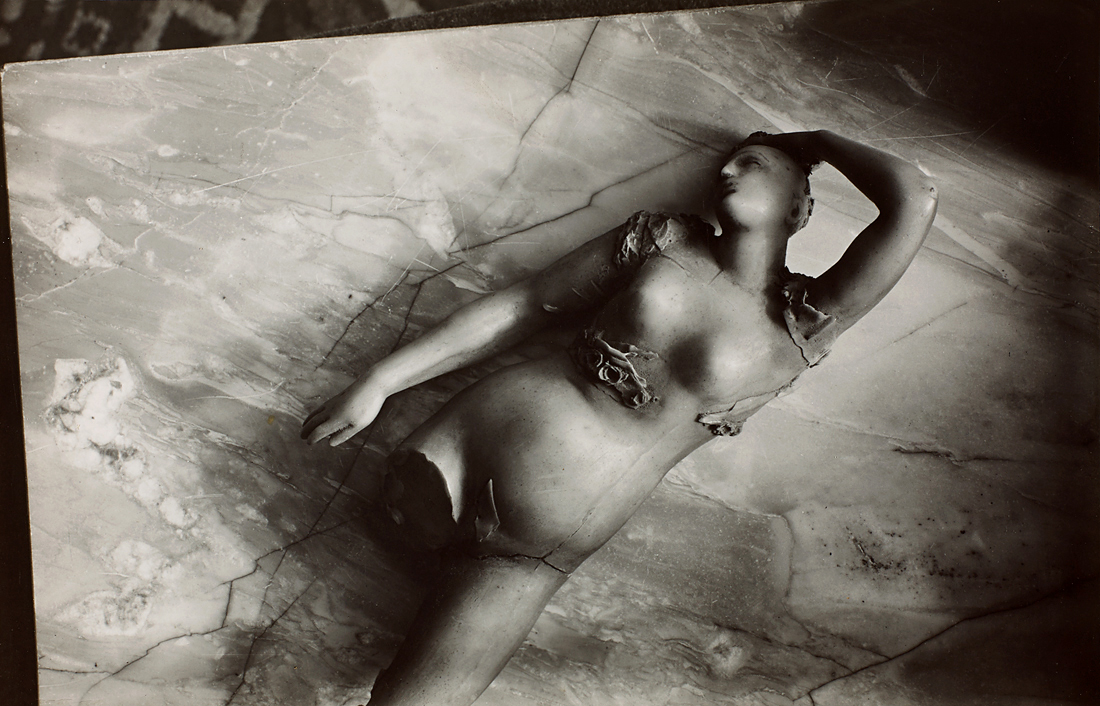
Sudek’s most successful foray into modernism is his experimentation with grotesque (surreal) subjects such as mannequins, decaying sculptures and the accoutrements of the architect Otto Rothmayer’s garden. There is little doubt that in the fragmented figurative sculptures Sudek was recalling some of the human devastation that he witnessed on the battlefields of the First World War.


Josef Sudek (Czech, 1896-1976) 'Statue' c. 1948-1964


Josef Sudek (Czech, 1896-1976)
Statue
c. 1948-1964
Gelatin silver print
9 × 14cm
Musée des beaux-arts du Canada, Ottawa. Don anonyme, 2010
© Succession de Josef Sudek


Josef Sudek (Czech, 1896-1976) 'Dans le jardin' [In the garden] 1954-1959


Josef Sudek (Czech, 1896-1976)
Dans le jardin [In the garden]
1954-1959
Gelatin silver print
17 × 23.3cm
Musée des beaux-arts du Canada, Ottawa. Don anonyme, 2010
© Succession de Josef Sudek


Josef Sudek (Czech, 1896-1976) 'Labyrinthe sur ma table' [Labyrinth on my table] 1967


Josef Sudek (Czech, 1896-1976)
Labyrinthe sur ma table [Labyrinth on my table]
1967
Gelatin silver print
39 × 22.9cm
Musée des beaux-arts du Canada, Ottawa. Don anonyme, 2010
© Succession de Josef Sudek


Josef Sudek (Czech, 1896-1976) 'Labyrinthe de verre' [Glass Maze] around 1968-1972


Josef Sudek (Czech, 1896-1976)
Labyrinthe de verre [Glass Maze]
around 1968-1972
Gelatin silver print
39 × 22.9cm
Musée des beaux-arts du Canada, Ottawa. Don anonyme, 2010
© Succession de Josef Sudek


Josef Sudek (Czech, 1896-1976) 'Sans titre (Nature morte sur le rebord de la fenêtre)' [Untitled (Still life on the windowsill)] 1951


Josef Sudek (Czech, 1896-1976)
Sans titre (Nature morte sur le rebord de la fenêtre) [Untitled (Still life on the windowsill)]
1951
Montage par le photographe c. 1960.
Two silver gelatin prints, glass plate, lead
48.2 × 39.2cm
Musée des arts décoratifs, Prague.
© Succession de Josef Sudek


Jeu de Paume
1, Place de la Concorde
75008 Paris
métro Concorde
Phone: 01 47 03 12 50

Opening hours:
Tuesday: 11.00 – 21.00
Wednesday – Sunday: 11.00 – 19.00
Closed Monday

Jeu de Paume website

LIKE ART BLART ON FACEBOOK

Back to top

Review: ‘Degas: A New Vision’ at the National Gallery of Victoria International, Melbourne Part 2

Exhibition dates: 24th June – 18th September, 2016

Curator: Dr Ted Gott, Senior Curator of International Art at the National Gallery of Victoria


Edgar Degas (French, 1834-1917) 'Finishing the arabesque' 1877 from the exhibition 'Degas: A New Vision' at the National Gallery of Victoria International, Melbourne, June - Sept, 2016


Edgar Degas (French, 1834-1917)
Finishing the arabesque
1877
Oil and essence, pastel on canvas
67.4 x 38cm
Musée d’Orsay, Paris (RF 4040)
© Musée d’Orsay, Dist. RMN-Grand Palais / Patrice Schmidt


This is a magnificent exhibition, well paced and beautifully hung in the gallery spaces. It is gratifying to see a “blockbuster” at the National Gallery of Victoria that does not rely on papered walls or patterned floors, that just allows the work to speak for itself. There is an excellent chronological trajectory to the work, showcasing the holistic development of the artist in one interweaving arc: from the early history paintings, where Degas is educating himself not only in the history of art but also in the practicalities of the history of painting (how actually to paint) … through to the late, bravura pastels.

Pastel is Degas’s strongest medium and it was incredible to observe close up how he could make pastel look like oil paint and vice versa. My favourite was Femme à la toilette [Woman at her toilette] (c. 1894, below) were the flattened perspectival image disintegrates before your eyes: “As well as reflecting the artist’s love of Japanese woodblock prints with their frequently intimate subject matter, in this late drawing Degas applied his vivid pigments with an almost sculptural intensity, building them up as though modelling form with his fingers.” Abstraction eat your heart out.

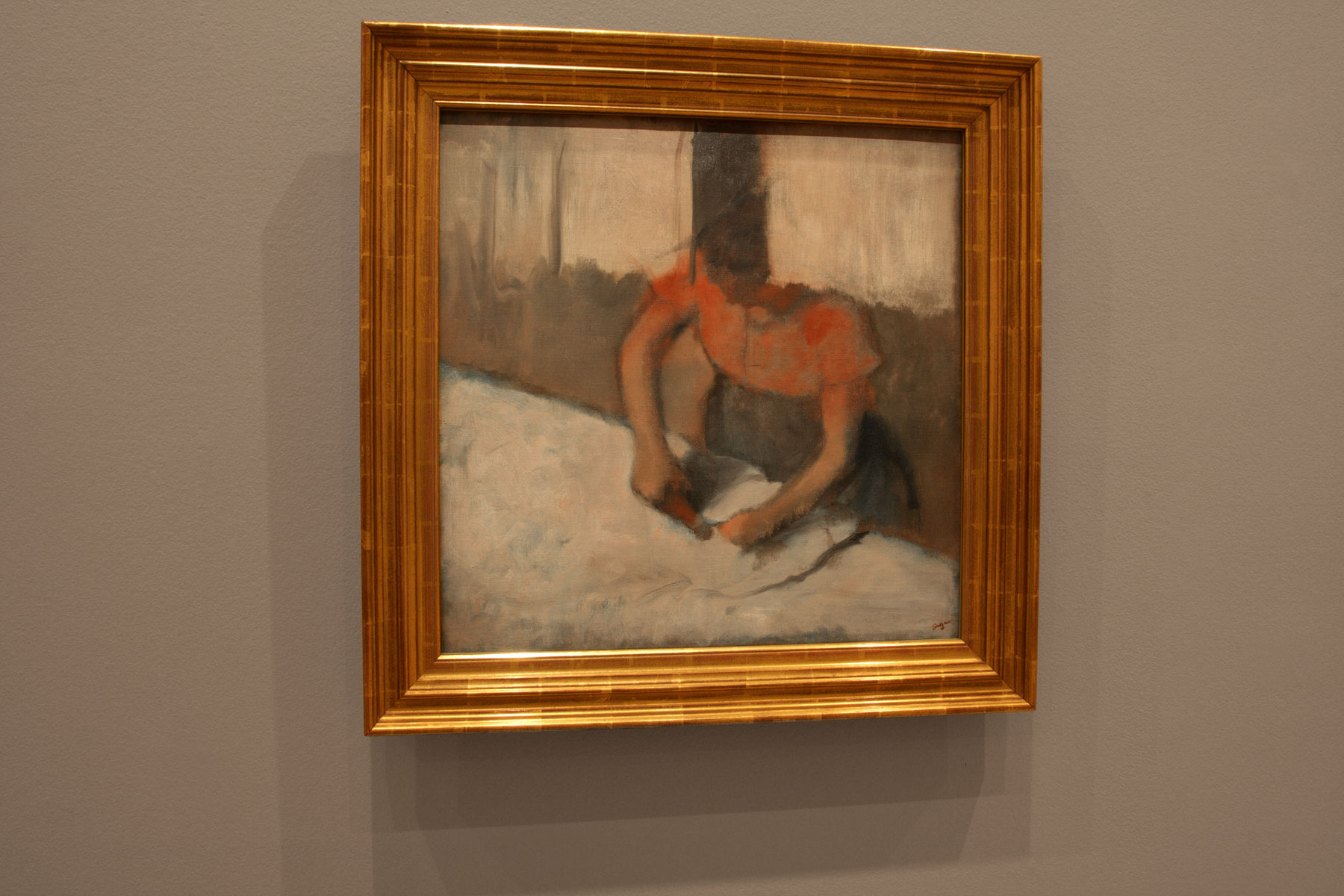
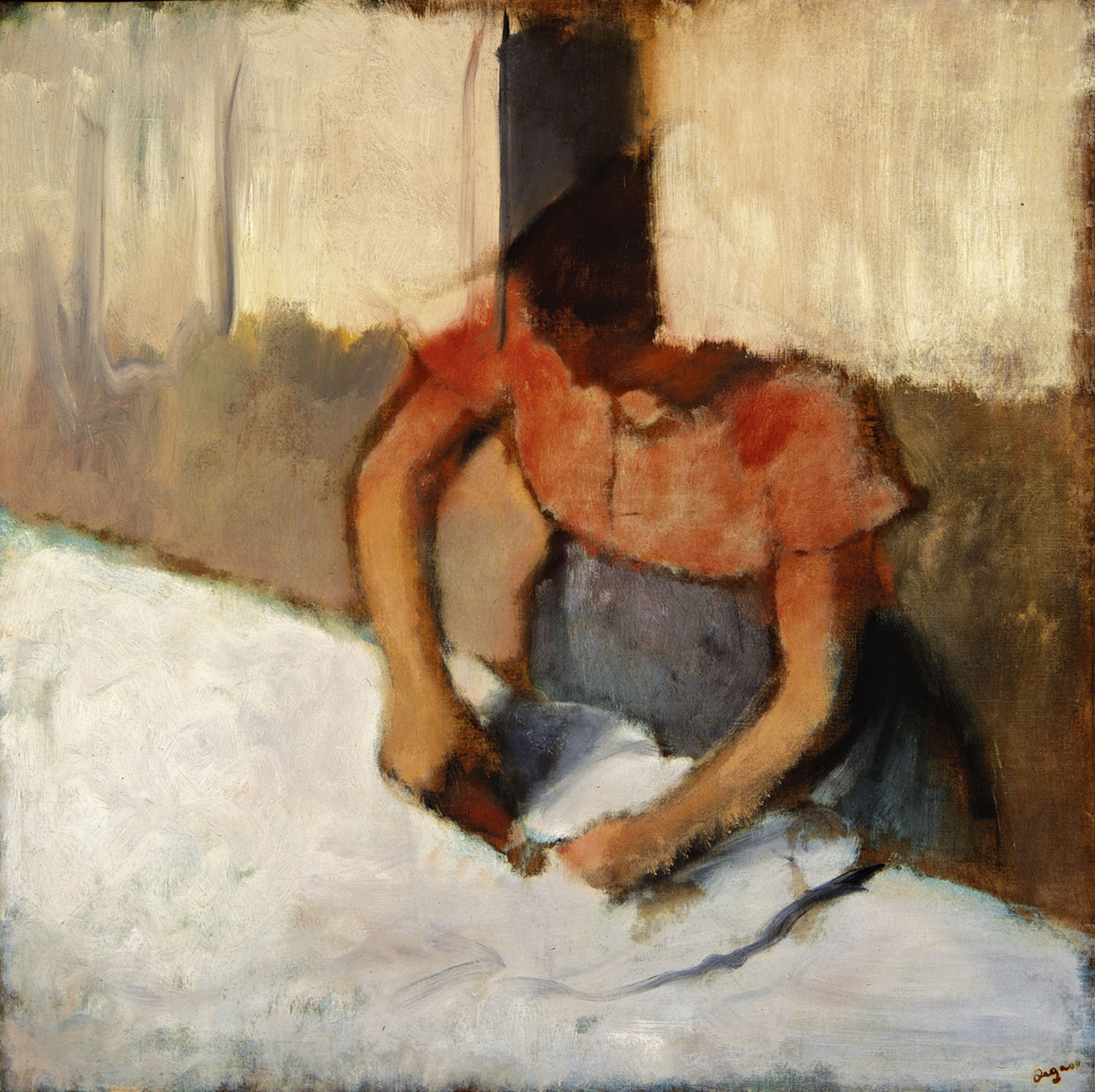
His “impressions” of reality rely on a keen eye, a wonderful understanding of space and the refractions of light, and the use of depth of field. The paintings I like best were not of the ballet, but rather the everyday “observational” paintings of the theatre box, a conversation and, particularly, The laundress ironing (c. 1882-86, below) with its simplified planar colour fields that run in different directions. These “punctures” of reality, or punctum to use a photographic term, elevate mundane everyday occurrences into a revelatory state – as though these encounters were taken from the flow of space and time, one frame out of a non-linear narrative.

The paintings of women at the toilettes are not voyeuristic but show a love and passion for an intimacy with women which he perhaps never achieved in real life, brought forth in observations of the female form “that challenged conventional notions of feminine beauty in their depiction of non-idealised jolie-laide (unconventionally beautiful) models”. Melbourne arts blogger Natalie Thomas observes that, “”Women and girls are everywhere in this show, but strangely absent too,” writes Thomas. Despite the fact the majority of Degas’ work explores femininity and the female body, the show, she says, fails to provide a female perspective.” (Natalie Thomas quoted in Shad D’Souza, “Gender and the NGV: ‘More white male artists than you can shake a stick at’,” on The Guardian website 15 September 2016 Cited 16/09/2016).

While I agree with Natalie Thomas that these paintings fail to provide a contemporary female perspective, that is not all that these paintings are about. Of course, they are a privileged white male gaze looking upon the body of a female and we must accept and acknowledge that is what they are. But that is just one element of their narrative. It’s all very well critiquing the work from the present day and saying there is no female perspective, but in the era in which these “sensational” paintings emerged – it was an epoch where the privileged, powerful male gaze could look upon the female body. Yes, please look at the paintings from a contemporary perspective while understanding the conditions under which they were created, and then try to say something more interesting about them: the perspective, the colours, the form, the position of the painter, the framing of the scene, the possible disappearance of the artist to the sitter, as though the camera (his eyes) had disappeared: where someone is so used to the other being there, that they are natural (do not act or perform), unselfconscious in front of them. Then, and only then, do the paintings perhaps become something else – about women, their lives and habits / habitats. A different perspective from trotting out the usual “we are objectified / subjugated / defiled” trope.

The sculptures are the revelation of the exhibition. Again, the male gaze pushing and prodding at the female form… except, these sculptures seem to erupt from within – like bubbling hot mud that seems to emanate from deep within the artist, erupting into the glorious form of the female body. Dark and mysterious, I would have loved to have seen one of the wax models, just one, to see the colour and feel the fragility of that form, over the robustness of the bronze.

And finally to the last room, the late works. There is an essentialness to the late work, the form stripped bare, heavily applied pastel in layers, dark heavy outlines with the frame filled with an “orgy of colours” – he “developed an expressive use of colour and line that may have arisen due to his deteriorating vision.” But he could still feel what he was doing and we can feel it too: the working of the medium, the working of the theme to its final resolution.

While I didn’t know much about the work of Degas other than the ballet pictures before this exhibition – after three visits, perhaps I know just a little more.

Dr Marcus Bunyan

See Part 1 of the posting


Many thankx to the National Gallery of Victoria for allowing me to publish the artwork and photographs in the posting. All installation photographs © Marcus Bunyan and the National Gallery of Victoria. Please click on the photographs for a larger version of the image.


Edgar Degas biography

Edgar Degas was born in 1834 into a wealthy banking family. Unlike many of his contemporaries, his family were supportive of his artistic talent and desire to become an artist.

Degas resisted being labelled an ‘Impressionist’ yet was at the core of the movement’s most important manifestations. Classically trained, Degas initially aspired to be a painter of historical narratives. As he matured, however, he made the depiction of daily life the central focus of his art. He was drawn primarily to the human figure engaged in movement and work, sketching on the spot then working up his finished compositions indoors in his studio. Degas’ obsession with the theatre and ballet in particular enabled him to explore his fascination with artificial light, which set him apart from the other Impressionists who preferred to work out-of-doors capturing the transient effects of natural daylight.

Degas absorbed many diverse influences, from Japanese prints to Italian Mannerism, and reinterpreted them in innovative ways. Degas obsessively revisited and experimented with his favourite themes which saw him fashion varied and unusual vantage points and asymmetrical framing. His depictions of ballet dancers alone number in the hundreds. Such endeavours helped him to achieve the innovative and distinctive style which is explored in Degas: A New Vision.

Degas served in the Franco-Prussian War of 1870-71 and began to experience eyesight deterioration by the late 1880s. He increasingly took up sculpture as his eyesight weakened. In his later years, he was preoccupied with the subject of women bathing unselfconsciously and developed an expressive use of colour and line that may have arisen due to his deteriorating vision.

Degas continued working to as late as 1912. He died five years later in 1917, at the age of eighty-three.


Edgar Degas (French, 1834-1917) 'Danseuses, éventail [Dancers (Fan, design)]' 1879 (installation view)


Edgar Degas (French, 1834-1917)
Danseuses, éventail [Dancers (Fan, design)] (installation view)
1879
Gouache, pastel and oil paint on silk
Tacoma Art Museum, Washington State
Gift of Mr and Mrs W. Hilding Lindberg
Photo: © Marcus Bunyan and the National Gallery of Victoria


[Dancers (Fan, design)] belongs to a group of fans made in the late 1870s that reflect Degas’s fascination at this time with Japanese art. Highly aestheticised, these fans show how Degas took advantage of this unusual format to explore new compositional possibilities. Here, for example, the balletic action taking place on stage competes for the viewer’s attention with the theatre’s screening machinery, as well as with the group of black-clad abonnés (subscribers with back stage passes) gathered in the wings in the middle distance.

Wall text from the exhibition


Installation view of the exhibition 'Degas: A New Vision' at the National Gallery of Victoria International, Melbourne with at left, 'Theatre box' (1885) and at right, 'Theatre box' (1880)


Installation view of the exhibition Degas: A New Vision at the National Gallery of Victoria International, Melbourne with at left, Theatre box (1885) and at right, Theatre box (1880)
Photo: © Marcus Bunyan and the National Gallery of Victoria


Edgar Degas (French, 1834-1917 'La Loge [Theatre box]' 1885 (installation view)


Edgar Degas (French, 1834-1917)
La Loge [Theatre box] (installation view)
1885
Pastel
Hammer Museum, Los Angeles
The Armand Hammer Collection
Photo: © Marcus Bunyan and the National Gallery of Victoria


In contrast with his numerous ballet works, Degas produced relatively few studies of the spectators at the Opera and other theatrical venues. Theatre box is one of his most captivating studies of the magical effects created by artificial stage lighting. Its contrast between the shadowy reality of the viewer in her dimmer theatre box and the vividly illuminated fantasy being performed before her onstage is as compelling as it is radical.

Wall text from the exhibition


Edgar Degas (French, 1834-1917) 'La Loge [Theatre box]' 1880 (installation view)


Edgar Degas (French, 1834-1917)
La Loge [Theatre box] (installation view)
1880
Pastel and oil on cardboard on canvas
The Lewis Collection, Houston
Photo: © Marcus Bunyan and the National Gallery of Victoria


When exhibited at the fifth ‘impressionist’ group exhibition in Paris in 1880, this pastel attracted the attention of the critic Charles Ephrussi, who wrote glowingly of how it shoed ‘a profound knowledge of the relations between tones, producing the most unexpected and curious effects: the wine-coloured draperies of the spectator’s box and the yellowish glow of the footlights are projected onto the face of a diminutive theatre-goer, who thus finds herself illuminated by violet and brilliant yellow; the impression is strange, but captured with perfect reality’.

Wall text from the exhibition


Edgar Degas (French, 1834-1917) 'Theatre box' 1880 from the exhibition 'Degas: A New Vision' at the National Gallery of Victoria International, Melbourne, June - Sept, 2016


Edgar Degas (French, 1834-1917)
Theatre box
1880
Pastel and oil on cardboard on canvas
66.0 x 53.0cm
The Lewis Collection


Edgar Degas (French, 1834-1917) 'In a café (The Absinthe drinker)' c. 1875-1876


Edgar Degas (French, 1834-1917)
In a café (The Absinthe drinker)
c. 1875-1876
Oil on canvas
92 x 68.5cm
Musée d’Orsay, Paris (RF 1984)
© RMN-Grand Palais (Musée d’Orsay) / Martine Beck-Coppola


Cafés-concerts: 1870s

The time that Degas spent overseas in New Orleans made him surprisingly nostalgic for everything he had left behind in Paris. The simple reason he gave was that ‘One loves and gives art only to the things to which one is accustomed’. Although delighted by the new sights and sensations he experienced in New Orleans, he felt that ‘ new things capture your face and bore you by turns’. With these words, Degas expressed what would become his credo for the rest of his career.

After this time, Degas refused invitations to travel to exotic locales and put aside the search for new subjects, focusing instead on the same themes: dancers, rockets, women in the bath. The novelty of what he had discovered in America also led him soon afterwards to retreat into himself. seeing inspiration in introspection. For Degas the exotic could be found perfectly well at home, especially in the new evening venues of 1870s Paris, the café-concerts. He delighted in exploring the tension and psychological preparation that lay behind the surface glamour of stage performances conducted within an artificial other-reality.

Wall text from the exhibition


All that gesture in theatre summon,
or that the agile and mendacious tongue
of ballet speaks to those who comprehend
the silent eloquence of limbs in motion.


Edgar Degas


Edgar Degas (French, 1834-1917) 'Rehearsal hall at the Opéra, rue Le Peletier' 1872


Edgar Degas (French, 1834-1917)
Rehearsal hall at the Opéra, rue Le Peletier
1872
Oil on canvas
32.7 x 46.3cm
Musée d’Orsay, Paris
© RMN-Grand Palais (Musée d’Orsay) / Hervé Lewandowski


Edgar Degas (French, 1834-1917) 'The dance rehearsal' c. 1870-1872


Edgar Degas (French, 1834-1917)
The dance rehearsal
c. 1870-1872
Oil on canvas
40.6 x 54.6cm
The Phillips Collection, Washington D.C.
Gift of anonymous donor, initiated 2001, completed 2006


Installation view of the exhibition 'Degas: A New Vision' at the National Gallery of Victoria International, Melbourne showing at left, 'The rehearsal' (c. 1874), and at right 'The dance class' (c. 1873)


Installation view of the exhibition Degas: A New Vision at the National Gallery of Victoria International, Melbourne showing at left, The rehearsal (c. 1874), and at right The dance class (c. 1873)
Photo: © Marcus Bunyan and the National Gallery of Victoria


Edgar Degas (French, 1834-1917) 'The rehearsal' c. 1874 (installation view)


Edgar Degas (French, 1834-1917)
The rehearsal (installation view)
c. 1874
Oil on canvas
58.4 x 83.8cm
Lent by Glasgow Life (Glasgow Museums) on behalf of Glasgow City Council: from the Burrell Collection with the approval of the Burrell Trustees
© CSG CIC Glasgow Museums Collection
Photo: © Marcus Bunyan and the National Gallery of Victoria


Edgar Degas (French, 1834-1917) 'The rehearsal' c. 1874


Edgar Degas (French, 1834-1917)
The rehearsal
c. 1874
Oil on canvas
58.4 x 83.8 cm
Lent by Glasgow Life (Glasgow Museums) on behalf of Glasgow City Council: from the Burrell Collection with the approval of the Burrell Trustees
© CSG CIC Glasgow Museums Collection


First Ballet Works: 1870s

While the friendships he established in the 1860s with musicians such as Désiré Dihau, a bassoon player with the Paris Opéra, brought Degas into the orbit of ballet performances in the French capital, the full extent of his access to this world prior to the mid-1880s remains unknown. This may explain why his many depictions of dancers practising backstage in rehearsal rooms in the 1870s were his own studio inventions rather than accurate depictions of the Opéra’s foyers de la danse.

Degas’ favourite theatrical venues – the Opéra in the rue le Peletier that was destroyed by fire in October 1873 and its replacement, the Palais Garnier, which opened in 1875 – were both located in the 9th arrondissement, close to his studio. Degas exhibited ballet compositions at the ‘impressionist’ group exhibitions from 1874 onwards, all the while resisting the label, arguing that his own art was Realist and meticulously crafted in the studio instead of spontaneously created before nature. When the Galeries Durand-Ruel began acquiring Degas’ paintings in 1872, the artist’s first sales at this time were of ballet subjects. Unlike the romantic perspective through which these scenes are viewed today, Degas’ contemporaries recognised in them a rejection of the surface glamour of ballet’s front of house in favour of a serious study of the gritty reality of life backstage. There, junior impoverished dancers jostled for attention from their trainers, all too frequently prostituting themselves on the side so they could afford to stay in competition for coveted stardom.

While The rehearsal and other similar depictions such as The dance class, c. 1873, are ostensibly based on direct observations of dance rehearsals at the Paris Opéra in the rue Le Peletier, their different treatments of architecture hint at the degree to which Degas constructed their compositions from memory. This painting shows a radical cropping of the spiral staircase at left connecting the stage level to the rehearsal room, down which the disembodied limbs of young ballerinas descend. In the background to the right the celebrated dance instructor Jules Perrot can be seen.

Wall text from the exhibition


Edgar Degas (French, 1834-1917) 'The dance class' c. 1873


Edgar Degas (French, 1834-1917)
The dance class
c. 1873
Oil on canvas
47.6 x 62.2cm
National Gallery, Washington D.C.
Corcoran Collection (William A. Clark Collection)
© Courtesy of National Gallery, Washington


Edgar Degas (French, 1834-1917) 'The dance class' c. 1873 (installation view)


Edgar Degas (French, 1834-1917)
The dance class (installation view)
c. 1873
Oil on canvas
47.6 x 62.2cm
National Gallery, Washington D.C.
Corcoran Collection (William A. Clark Collection)
© Courtesy of National Gallery, Washington
Photo: © Marcus Bunyan and the National Gallery of Victoria


Edgar Degas (French, 1834-1917) 'Dancers on the stage' c. 1899 (installation view)

Edgar Degas (French, 1834-1917) 'Dancers on the stage' c. 1899 (installation view)


Edgar Degas (French, 1834-1917)
Dancers on the stage (installation views)
c. 1899
Oil on canvas
76.0 x 82.0cm
Musée des Beaux-Arts de Lyon
Legs Jacqueline Delubac, 1997
Photos: © Marcus Bunyan and the National Gallery of Victoria


Edgar Degas (French, 1834-1917) 'Dancers on the stage' c. 1899


Edgar Degas (French, 1834-1917)
Dancers on the stage
c. 1899
Oil on canvas
76.0 x 82.0cm
Musée des Beaux-Arts de Lyon
Legs Jacqueline Delubac, 1997
Image © Lyon MBA – Photo RMN / Ojeda, Le Mage


Edgar Degas (French, 1834-1917) 'Dancers on the stage' c. 1899 (detail)


Edgar Degas (French, 1834-1917)
Dancers on the stage (detail)
c. 1899
Oil on canvas
76.0 x 82.0cm
Musée des Beaux-Arts de Lyon
Legs Jacqueline Delubac, 1997


Dancers on the stage looks back to the experiments with pictorial space and repoussoir compositional staging that had so characterised Degas’s ballet works of the 1870s and early 1880s. Repoussoir was a favourite technique for Degas, a technique in which an object place prominently in the foreground of a work serves to emphasise the recession of physical space in the rest of the composition. In an unusual choice for the artist, Degas shows here a dress rehearsal on stage. The attention of the dancers is focused upon the diminutive figure of the dave master in the far left background whose presence ignites a diagonal magnetism that animates the whole painting.

Wall text from the exhibition


Curator Dr Ted Gott talking to the media standing in front of Degas's 'Dancer with bouquets' c. 1895-1900


Dr Ted Gott, Senior Curator of International Art at the National Gallery of Victoria talking to the media, standing in front of Degas’s Dancer with bouquets c. 1895-1900
Photo: © Marcus Bunyan and the National Gallery of Victoria


Edgar Degas (French, 1834-1917) 'Dancer with bouquets' c. 1895-1900 (installation view)

Edgar Degas (French, 1834-1917) 'Dancer with bouquets' c. 1895-1900 (installation view detail)


Edgar Degas (French, 1834-1917)
Dancer with bouquets (installation view and detail)
c. 1895-1900
Oil on canvas
180.3 x 152.4 cm
Chrysler Museum of Art, Norfolk, Virginia
Gift of Walter P. Chrysler, Jr, in memory of Della Viola Forker Chrysler
Photos: © Marcus Bunyan and the National Gallery of Victoria


Edgar Degas (French, 1834-1917) 'Dancer with bouquets' c. 1895-1900


Edgar Degas (French, 1834-1917)
Dancer with bouquets
c. 1895-1900
Oil on canvas
180.3 x 152.4cm
Chrysler Museum of Art, Norfolk, Virginia
Gift of Walter P. Chrysler, Jr, in memory of Della Viola Forker Chrysler


Sculptures

Although Degas exhibited only one sculpture during his lifetime, The little fourteen-year old dancer, he worked in this medium in privacy in his studio from the 1860s until the 1910s. His primary subjects were thoroughbred racehorses, female dances and women at the toilette, and he modelled his sculptures in wax, over steel wire and cork armatures. Never satisfied, he made, destroyed and remade them repeatedly. As Degas’s eyesight deteriorated in his later years, making three-dimensional figures fulfilled a physical and emotional need that transcended any desire to perfect a finished object; he allegedly side that sculpture was ‘a blind man’s trade’.

After Degas’s death in 1917, some 150 wax sculptures were found in his studio, some broken but many intact. His heirs subsequently authorised the casting in bronze of seventy-four of the most intact of Degas’s sculptures. While many of Degas’s original wax sculptures still survive, they are too fragile to travel. These bronzes allow wider audiences today to engage with some of the most beautiful sculptures of the nineteenth century.

Wall text from the exhibition


Installation view of the exhibition 'Degas: A New Vision' at the National Gallery of Victoria International, Melbourne

Installation view of the exhibition 'Degas: A New Vision' at the National Gallery of Victoria International, Melbourne

Installation view of the exhibition 'Degas: A New Vision' at the National Gallery of Victoria International, Melbourne

Installation view of the exhibition 'Degas: A New Vision' at the National Gallery of Victoria International, Melbourne

Installation view of the exhibition 'Degas: A New Vision' at the National Gallery of Victoria International, Melbourne showing the sculpture cases


Installation views of the exhibition Degas: A New Vision at the National Gallery of Victoria International, Melbourne showing the sculpture cases
Photos: © Marcus Bunyan and the National Gallery of Victoria


Edgar Degas (French, 1834-1917) 'The tub' 1888-1889


Edgar Degas (French, 1834-1917)
The tub
1888-89, cast 1919-32
Bronze
22.5 x 45.0 x 42.0cm
Czestochowski/Pingeot 26 (cast S)
Museu de Arte de São Paulo, Assis Chateaubriand
Donated by Alberto José Alves, Alberto Alves Filho and Alcino Ribeiro de Lima


Edgar Degas (French, 1834-1917) 'The masseuse' c. 1896-1911


Edgar Degas (French, 1834-1917)
The masseuse
c. 1896-1911, cast 1919-32
Bronze
43 x 38 x 30cm
Czestochowski/Pingeot 55 (cast S)
Museu de Arte de São Paulo, Assis Chateaubriand
Donated by Alberto José Alves, Alberto Alves Filho and Alcino Ribeiro de Lima


Edgar Degas (French, 1834-1917) 'Seated woman wiping her left side' c. 1901-1911


Edgar Degas (French, 1834-1917)
Seated woman wiping her left side
c. 1901-11, cast 1919-32
Bronze
35 x 30.5 x 30.4cm
Czestochowski/Pingeot 46 (cast S)
Museu de Arte de São Paulo, Assis Chateaubriand
Donated by Alberto José Alves, Alberto Alves Filho and Alcino Ribeiro de Lima


Edgar Degas (French, 1834-1917) 'Dancer adjusting the shoulder strap of her bodice' 1882-1895


Edgar Degas (French, 1834-1917)
Dancer adjusting the shoulder strap of her bodice
1882-95, cast 1919-32
Bronze
35.2 x 15.9 x 11.8cm
Czestochowski/Pingeot 64 (cast S)
Museu de Arte de São Paulo, Assis Chateaubriand
Donated by Alberto José Alves, Alberto Alves Filho and Alcino Ribeiro de Lima


Edgar Degas (French, 1834-1917) 'Dancer looking at the sole of her right foot' (Second study) c. 1900-1910


Edgar Degas (French, 1834-1917)
Dancer looking at the sole of her right foot (Second study)
c. 1900-1910, cast 1919-1937 or later
Bronze
47.3 x 24.3 x 20.8cm
Czestochowski/Pingeot 59 (cast T)
National Gallery of Victoria, Melbourne
Purchased with funds donated by Leigh Clifford AO and Sue Clifford, 2016


Edgar Degas (French, 1834-1917) 'The laundress ironing' c. 1882-1886 (installation view)


Edgar Degas (French, 1834-1917)
The laundress ironing (installation view)
c. 1882-1886
Oil on canvas
64.8 x 66.7cm
Reading Public Museum, Pennsylvania Gift, Miss Martha Elizabeth Dick Estate
© Courtesy of the Reading Public Museum, Pennsylvania
Photo: © Marcus Bunyan and the National Gallery of Victoria


Edgar Degas (French, 1834-1917) 'The laundress ironing' c. 1882-1886


Edgar Degas (French, 1834-1917)
The laundress ironing
c. 1882-1886
Oil on canvas
64.8 x 66.7cm
Reading Public Museum, Pennsylvania Gift, Miss Martha Elizabeth Dick Estate
© Courtesy of the Reading Public Museum, Pennsylvania


Edgar Degas (French, 1834-1917) 'The Conversation' 1895 (installation view)


Edgar Degas (French, 1834-1917)
The Conversation (installation view)
1895
Pastel
65 x 50cm (sheet)
Acquavella Galleries
© Courtesy of Acquavella Galleries
Photo: © Marcus Bunyan and the National Gallery of Victoria


Edgar Degas (French, 1834-1917) 'The Conversation' 1895


Edgar Degas (French, 1834-1917)
The Conversation
1895
Pastel
65 x 50cm (sheet)
Acquavella Galleries
© Courtesy of Acquavella Galleries


Walter Sickert recalled Degas speaking of his obsession with observing women at their most private moments. He wanted to look at their private activities through keyholes, according to Sickert: ‘He said that painters too much made of women formal portraits, whereas their hundred and one gestures, their chatteries, &c., should inspire an infinite variety of design’. The Conversation reflects the artist’s love of Japanese woodblock prints and their frequently intimate subject matter. The specifics of setting are only alluded to in this exquisite pastel, the emphasis being placed instead upon the close relationship between these two elegant Parisiennes.

Wall text from the exhibition


Edgar Degas (French, 1834-1917) 'Rose Caron' c. 1892 (installation view)


Edgar Degas (French, 1834-1917)
Rose Caron (installation view)
c. 1892
Albright-Knox Art Gallery, Buffalo
Photo: © Marcus Bunyan and the National Gallery of Victoria


Women at their toilettes: 1880s and 1890s

In 1875 pastel became one of Degas’s favourite techniques. Gustave Moreau had introduced him to this medium during their time together in Italy during the late 1850s, and the increasing interest in pastel in artistic circles during the 1870s influenced Degas’s choice to explore its potential. At the eighth and last ‘impressionist’ group exhibition in 1886 Degas exhibited a suite of pastel studies of women bathing that challenged conventional notions of feminine beauty in their depiction of non-idealised jolie-laide (unconventionally beautiful) models. George Moore wrote tellingly of these nudes: ‘The effect is prodigious. Degas has done what Baudelaire did – he has invented un frisson nouveau (a new sensation)’.

Because intimate access to female ablutions was rarely experience by husbands in bourgeois married life at the time, it was assumed by critics and audiences that Degas’s female nudes were performing their toilettes in a brothel setting. The close observation of undressed women engaged in private acts of washing and drying themselves led Degas’s ongoing status as a bachelor to become a topic of speculation in both the art world and wider social circles.

Wall text from the exhibition


Installation view of the exhibition 'Degas: A New Vision' at the National Gallery of Victoria International, Melbourne with, from left to right, 'Nude woman lying down' (c. 1901), 'Dancer in a leotard' (c. 1896) and 'Toilette after the bath' (c. 1890)


Installation views of the exhibition Degas: A New Vision at the National Gallery of Victoria International, Melbourne with, from left to right, Nude woman lying down (c. 1901), Dancer in a leotard (c. 1896) and Toilette after the bath (c. 1890)
Photo: © Marcus Bunyan and the National Gallery of Victoria


Installation view of the exhibition 'Degas: A New Vision' at the National Gallery of Victoria International, Melbourne

Installation view of the exhibition 'Degas: A New Vision' at the National Gallery of Victoria International, Melbourne showing at centre left, 'The Bather' (La Baigneuse), c. 1895


Installation views of the exhibition Degas: A New Vision at the National Gallery of Victoria International, Melbourne showing at centre left in the bottom image, The Bather (La Baigneuse), c. 1895
Photos: © Marcus Bunyan and the National Gallery of Victoria


Edgar Degas (French, 1834-1917) 'La Baigneuse [The bather]' c. 1895


Edgar Degas (French, 1834-1917)
The Bather (La Baigneuse) (installation view)
c. 1895
Pastel and charcoal on paper
Bequest, Henry K. Dick Estate
Photo: © Marcus Bunyan and the National Gallery of Victoria


Edgar Degas (French, 1834-1917) 'Femme a la toilette [Woman at he toilette] c. 1895-1900 (installation view)


Edgar Degas (French, 1834-1917)
Femme à la toilette [Woman at he toilette] (installation view)
c. 1895-1900
Oil on canvas
Private collection
Photo: © Marcus Bunyan and the National Gallery of Victoria


Edgar Degas (French, 1834-1917) 'Femme a la toilette [Woman at her toilette] c. 1894 (installation view)


Edgar Degas (French, 1834-1917)
Femme à la toilette [Woman at her toilette] (installation view)
c. 1894
Charcoal and pastel on paper
956 x 1099mm
Tate, London
Presented by C. Frank Stoop 1933
© Tate, London 2016
Photo: © Marcus Bunyan and the National Gallery of Victoria


Edgar Degas (French, 1834-1917) 'Femme a la toilette [Woman at her toilette] c. 1894


Edgar Degas (French, 1834-1917)
Femme à la toilette [Woman at her toilette]
c. 1894
Charcoal and pastel on paper
956 x 1099mm
Tate, London
Presented by C. Frank Stoop 1933
© Tate, London 2016


The repetitive work involved in a woman’s daily maintenance of her hair appealed greatly to Degas. As early as 187 he asked whether he could observe Geneviève Halévy, a cousin of his old school friend Ludovic, performing this private tasks. Woman at her toilette is a fascinating study of a woman’s labour-intensive morning routine, drawn with a sense of pathos and human frailty. As well as reflecting the artist’s love of Japanese woodblock prints with their frequently intimate subject matter, in this late drawing Degas applied his vivid pigments with an almost sculptural intensity, building them up as though modelling form with his fingers.

Wall text from the exhibition


Edgar Degas (French, 1834-1917) 'Woman in a Tub' 1883


Edgar Degas (French, 1834-1917)
Woman in a Tub
c. 1883
Pastel on paper
70 x 70cm
Tate, London
Bequeathed by Mrs A.F. Kessler 1983
© Tate, London 2016


Edgar Degas (French, 1834-1917) 'Woman at her bath' c. 1895


Edgar Degas (French, 1834-1917)
Woman at her bath
c. 1895
Oil on canvas
71.1 x 88.9cm
Art Gallery of Ontario, Toronto
Purchase, Frank P. Wood Endowment, 1956
© 2016 Art Gallery of Ontario


Edgar Degas (French, 1834-1917) 'Woman at her bath' c. 1895 (installation view)


Edgar Degas (French, 1834-1917)
Woman at her bath (installation view)
c. 1895
Oil on canvas
71.1 x 88.9cm
Art Gallery of Ontario, Toronto
Purchase, Frank P. Wood Endowment, 1956
© 2016 Art Gallery of Ontario
Photo: © Marcus Bunyan and the National Gallery of Victoria


Edgar Degas (French, 1834-1917) 'Woman seated on the edge of the bath sponging her neck' 1880-1895 (installation view)


Edgar Degas (French, 1834-1917)
Woman seated on the edge of the bath sponging her neck (installation view)
1880-1895
Oil and essence on paper mounted to canvas
52.2 x 67.5 cm
Musée d’Orsay, Paris
© RMN-Grand Palais (Musée d’Orsay) / Hervé Lewandowski
Photo: © Marcus Bunyan and the National Gallery of Victoria


Edgar Degas (French, 1834-1917) 'Woman seated on the edge of the bath sponging her neck' 1880-1895


Edgar Degas (French, 1834-1917)
Woman seated on the edge of the bath sponging her neck
1880-1895
Oil and essence on paper mounted to canvas
52.2 x 67.5cm
Musée d’Orsay, Paris
© RMN-Grand Palais (Musée d’Orsay) / Hervé Lewandowski


Installation view of the exhibition 'Degas: A New Vision' at the National Gallery of Victoria International, Melbourne showing at right, 'Femme au Tub' [Nude woman drying herself] c. 1884-1886


Installation view of the exhibition Degas: A New Vision at the National Gallery of Victoria International, Melbourne showing at right, Femme au Tub [Nude woman drying herself] c. 1884-1886
Photo: © Marcus Bunyan and the National Gallery of Victoria


Edgar Degas. 'Femme au Tub [Nude woman drying herself]' c. 1884-1886 (installation view)


Edgar Degas (French, 1834-1917)
Femme au Tub [Nude woman drying herself] (installation view)
c. 1884-1886
Oil on canvas
Brooklyn Museum, New York
Photo: © Marcus Bunyan and the National Gallery of Victoria


Horse racing


Broken staccato heralds its approach,
strong, steaming breath, as early as the dawn,
kept to its straining pace by stable lad,
the fine colt gallops throwing up the dew.


Edgar Degas


Racecourses: 1860s

Horse racing was Degas’s first recurrent modern subject, and preceded his dance classes and opera scenes. In 1861 Degas visited Ménil-Hubert in the Normandy countryside, the family estate of his old school friend Paul Valpinçon, situated near to the Haras-le-Pin stud and the Argentan racecourse. The recreational sports of horse racing and the steeplechase now offered him scope for exploring contemporary narrative painting. In pre-mechanised Europe, horses were as ubiquitous as the car is today. They were an essential part of life, whether for work or pleasure, and Degas was accordingly fascinated by these magnificent creatures. They feature in his earliest sketchbooks when he carefully copied equestrian subjects after the Parthenon frieze sculptures and the Italian Old Masters Paolo Uccello and Benozzo Gozzoli; and he continuously drew, painted and sculpted horses until his death.

Degas’s approach to depicting horses embodies his lifelong methodology. He studied and copied how they were represented by specialist animalier artists, as well as by the Old Masters, and he spent many hours observing and examining them. How he portrayed horses changed over time and his earliest works reveal a slightly tentative and clichéd manner as he struggled for perfection. As his art evolved, his images of horses became more innovative and remarkable: he attained great precision in their appearance yet the rendering remained tactile and lively. He also perfectly captured the physical relationship between rider and horse through all the different poses they struck, whether at rest or in full flight. Few artists have reproduced the grace, power and elegance of horses as well as Degas.

Wall text from the exhibition


Edgar Degas (French, 1834-1917) 'Out of the paddock (Racehorses)' c. 1871-1872, reworked c. 1874-1878


Edgar Degas (French, 1834-1917)
Out of the paddock (Racehorses)
c. 1871-1872, reworked c. 1874-1878
Oil on wood panel
32.5 x 40.5cm
Private collection


Edgar Degas (French, 1834-1917) 'Chevaux de courses [Racehorses]' c. 1895-1899 (installation view)


Edgar Degas (French, 1834-1917)
Chevaux de courses [Racehorses] (installation view)
c. 1895-1899
Pastel on tracing paper on cardboard
55.8 x 64.8cm
National Gallery of Canada, Ottawa
Purchase 1950
Photo: © Marcus Bunyan and the National Gallery of Victoria


Edgar Degas (French, 1834-1917) 'Chevaux de courses [Racehorses]' c. 1895-1899


Edgar Degas (French, 1834-1917)
Racehorses
c. 1895-1899
Pastel on tracing paper on cardboard
55.8 x 64.8cm
National Gallery of Canada, Ottawa
Purchased 1950
Photo © NGC


Edgar Degas (French, 1834-1917) 'Before the race' c. 1883-1890


Edgar Degas (French, 1834-1917)
Before the race
c. 1883-1990
Pastel
49 x 62cm (sheet)
Private collection


Photography

By the time he began making photographs in 1895, Degas was 61 years old and the eighth and final Impressionist exhibition was a decade behind him. Daniel Halévy, son of his old friends Ludovic and Louise Halévy, introduced Degas to photography, prompting the artist to acquire a camera that required glass plates and a tripod. In a burst of creative energy that lasted less than five years, he made a body of photographs of which fewer than 50 survive…

Exactly why Degas took up photography remains unknown. Clearly, photography provided a new pair of eyes during the period when his eyesight was failing. The illness and death of his sister, Marguerite, in 1895 and his brother Achille in 1893 may also have played a role. Photographs were for Degas a powerful tool of memory to recall his loved ones, and the activity of photographing bound him closely to an extended family-the Halévys-that embraced him in his time of grief…

Degas often illuminated his subjects with a single bright light source. The figures seem to emerge from darkness. In a series of individual portraits he made of Daniel and Louise Halévy in the autumn of 1895, each sitter is pictured in the same armchair in their home, under this Rembrandtesque light. They are seen in original contact prints (about 3 x 4 inches) and in enlargements. Altogether, these images show the artist’s picture-making process and reveal Degas’ manipulations of space, scale, focus, and emotional effect. In Louise Halévy Reading to Degas (J. Paul Getty Museum), another enlargement from a contact print done about the same time, Degas conveys unusual intimacy. It shows a vulnerable man’s dependence upon a friend in reading the newspaper at a time when his eyesight was failing.

Text from the J. Paul Getty Museum website. No longer available online


“These days, Degas abandons himself entirely to his new passion for photography,” wrote an artist friend in autumn 1895, the moment of the great Impressionist painter’s most intense exploration of photography. Degas’s major surviving photographs little known even among devotees of the artist’s paintings and pastels, are insightfully analysed and richly reproduced for the first time in this volume, which accompanies an exhibition at The Metropolitan Museum of Art, The J. Paul Getty Museum, and the Bibliothéque Nationale de France.

Degas’s photographic figure studies, portraits of friends and family, and self-portraits – especially those in which lamp-lit figures emerge from darkness – are imbued with a Symbolist spirit evocative of realms more psychological than physical. Most were made in the evenings, when Degas transformed dinner parties into photographic soirees, requisitioning the living rooms of his friends, arranging oil lamps, and directing the poses of dinner guests enlisted as models. “He went back and forth … running from one end of the room to the other with an expression of infinite happiness,” wrote Daniel Halévy, the son of Degas’s close friends Ludovic and Louise Halévy, describing one such evening. “At half-past eleven everybody left; Degas, surrounded by three laughing girls, carried his camera as proudly as a child carrying a rifle.”

Text from The Met website


Installation view of the exhibition 'Degas: A New Vision' at the National Gallery of Victoria International, Melbourne with at right, 'Paul Gobillard, Jeannie Gobillard, Julie Manet, and Geneviève Mallarmé' (16 December 1895)


Installation view of the exhibition Degas: A New Vision at the National Gallery of Victoria International, Melbourne with at right, Paul Gobillard, Jeannie Gobillard, Julie Manet, and Geneviève Mallarmé (16 December 1895, below)
Photo: © Marcus Bunyan and the National Gallery of Victoria


Edgar Degas (French, 1834-1917) 'Paul Gobillard, Jeannie Gobillard, Julie Manet, and Genevieve Mallarme' 16 December 1895 (installation view)


Edgar Degas (French, 1834-1917)
Paul Gobillard, Jeannie Gobillard, Julie Manet, and Geneviève Mallarmé (installation view)
16 December 1895
Gelatin silver print
The Metropolitan Museum of Art, New York
Photo: © Marcus Bunyan and the National Gallery of Victoria


Edgar Degas (French, 1834-1917) 'Self-portrait with Zoé Closier' probably Autumn 1895


Edgar Degas (French, 1834-1917)
Self-portrait with Zoé Closier
Probably Autumn 1895
Gelatin silver print
18.2 x 24.2cm (image and sheet)
Bibliothèque Nationale de France


Edgar Degas (French, 1834-1917) 'Self-portrait with Zoé Closier' probably Autumn 1895 (installation view)


Edgar Degas (French, 1834-1917)
Self-portrait with Zoé Closier (installation view)
Probably Autumn 1895
Gelatin silver print
18.2 x 24.2cm (image and sheet)
Bibliothèque Nationale de France
Photo: © Marcus Bunyan and the National Gallery of Victoria


Edgar Degas (French, 1834-1917) 'Self-portrait with Bartholome's Weeping girl' probably Autumn 1895 (installation view)


Edgar Degas (French, 1834-1917)
Self-portrait with Bartholomé’s Weeping girl (installation view)
Probably Autumn 1895
Gelatin silver print
Musée d’Orsay, Paris
Photo: © Marcus Bunyan and the National Gallery of Victoria


Edgar Degas (French, 1834-1917) 'Daniel Halévy' 14 October 1895


Edgar Degas (French, 1834-1917)
Daniel Halévy
14 October 1895
Gelatin silver print
40.0 x 29.4cm (image and sheet)
Musée d’Orsay, Paris
Gift of the children of Mme Halévy-Joxe
Photo © RMN – Hervé Lewandowski


Late works


Edgar Degas (French, 1834-1917) 'Three dancers' 1896-1905


Edgar Degas (French, 1834-1917)
Les Trois Danseuses [Three dancers]
1896-1905
Pastel
51 x 47cm
Lent by Glasgow Life (Glasgow Museums) on behalf of Glasgow City Council: from the Burrell Collection with the approval of the Burrell Trustees (35.249)
© CSG CIC Glasgow Museums Collection


Pastel entitled Les Trois Danseuses, depicting three ballet dancers, apparently making an entry, wearing yellow ballet skirts.


Edgar Degas (French, 1834-1917) 'Group of dancers (red skirts)' 1895-1900 (installation view)


Edgar Degas (French, 1834-1917)
Group of dancers (red skirts) [Les Jupes Rouges] (installation view)
1895-1900
Pastel
77 x 58cm
Lent by Glasgow Life (Glasgow Museums) on behalf of Glasgow City Council: from the Burrell Collection with the approval of the Burrell Trustees
© CSG CIC Glasgow Museums Collection
Photo: © Marcus Bunyan and the National Gallery of Victoria


Edgar Degas (French, 1834-1917) 'Group of dancers (red skirts)' 1895-1900


Edgar Degas (French, 1834-1917)
Group of dancers (red skirts) [Les Jupes Rouges]
1895-1900
Pastel
77 x 58cm
Lent by Glasgow Life (Glasgow Museums) on behalf of Glasgow City Council: from the Burrell Collection with the approval of the Burrell Trustees
© CSG CIC Glasgow Museums Collection


Pastel entitled Les Jupes Rouges, depicting three ballet dancers in red skirts – in posing practice.

Throughout his career Degas produced more than 700 works in pastel. In the 1870s he often worked ‘wet’, employing pastel à l’eau (crushing pastel sticks to powder which, mixed with water, could be applied with a brush) to create smooth, seamless textures. By the mid 1890s he worked increasingly with layers of pastel cement together over applications of fixative. This created shimmering optical effects that celebrated the crumbly texture of the pastel medium.

Wall text from the exhibition


Edgar Degas (French, 1834-1917) 'Dancers at the barre' 1900


Edgar Degas (French, 1834-1917)
Dancers at the barre
1900
Charcoal and pastel on tracing paper on cardboard
111.2 x 95.6cm
National Gallery of Canada, Ottawa
Purchased 1921
Photo © NGC


Installation view of the exhibition 'Degas: A New Vision' at the National Gallery of Victoria International, Melbourne

Installation view of the exhibition 'Degas: A New Vision' at the National Gallery of Victoria International, Melbourne with at right, 'Dancers at the barre' (1900)


Installation views of the exhibition Degas: A New Vision at the National Gallery of Victoria International, Melbourne with at right in the bottom image, Dancers at the barre (1900)
Photos: © Marcus Bunyan and the National Gallery of Victoria


Installation view of the exhibition 'Degas: A New Vision' at the National Gallery of Victoria International, Melbourne with at right, 'The Russian dancer' (1895)


Installation views of the exhibition Degas: A New Vision at the National Gallery of Victoria International, Melbourne with at right, The Russian dancer (1895)
Photo: © Marcus Bunyan and the National Gallery of Victoria


Edgar Degas (French, 1834-1917) 'Dancers at a rehearsal' c. 1895-1898 (installation view)


Edgar Degas (French, 1834-1917)
Dancers at a rehearsal (installation view)
c. 1895-1898
Von der Heydt-Museum, Wuppertal
Photo: © Marcus Bunyan and the National Gallery of Victoria


NGV International
180 St Kilda Rd, Melbourne

Opening hours:
Open daily, 10am – 5pm

National Gallery of Victoria website

LIKE ART BLART ON FACEBOOK

Back to top

Exhibition: ‘Moholy-Nagy: Future Present’ at the Solomon R. Guggenheim Museum, New York

Exhibition dates: 27th May – 7th September, 2016

Curator: Karole P. B. Vail, Guggenheim’s exhibition curator, in collaboration with co-organisers Carol S. Eliel (LACMA) and Matthew S. Witkovsky (Art Institute of Chicago)


Installation view: 'Moholy-Nagy: Future Present', Solomon R. Guggenheim Museum, New York, May 27–September 7, 2016 showing at left, 'B-10 Space Modulator' (1942)


Installation view of Moholy-Nagy: Future Present at the Solomon R. Guggenheim Museum, New York, May 27 – September 7, 2016 showing at left, B-10 Space Modulator (1942, below)
Photo: David Heald © Solomon R. Guggenheim Foundation


“To understand the production of art at the end of tradition, which in our lifetime means art at the end of modernism, requires, as the postmodern debate has shown, a careful consideration of the idea of history and the notion of ending. Rather than just thinking ending as the arrival of the finality of a fixed chronological moment, it can also be thought as a slow and indecisive process of internal decomposition that leaves in place numerous deposits of us, in us and with us – all with a considerable and complex afterlife. In this context all figuration is prefigured. This is to say that the design element of the production of a work of art, the compositional, now exists prior to the management of form of, and on, the picture plane. Techniques of assemblage, like montage and collage – which not only juxtaposed different aesthetics but also different historical moments, were the precursors of what is now the general condition of production.”

Fry, Tony. “Art Byting the Dust,” in Hayward, Phillip. Culture, Technology and Creativity in the Late Twentieth Century. London: John Libbey and Company, 1990, pp. 169-170.


Many thankx to the Solomon R. Guggenheim Museum for allowing me to publish the photographs in the posting. Please click on the photographs for a larger version of the image.


In order to understand the present we must link it to the self transforming urges of the past. We must see it as an evolutionary urge toward a transformation of all traditional notions, as a gradual process of growth in which several earlier currents have penetrated one another and thus have changed their very essence.


László Moholy-Nagy


László Moholy-Nagy (Hungarian, 1895-1946) 'B-10 Space Modulator' 1942


László Moholy-Nagy (Hungarian, 1895-1946)
B-10 Space Modulator
1942
Oil and incised lines on Plexiglas, in original frame
Plexiglas: 42.9 × 29.2cm
Frame: 82.9 × 67.6cm
Solomon R. Guggenheim Museum, New York, Solomon R. Guggenheim Founding Collection
© 2016 Hattula Moholy-Nagy/VG Bild-Kunst, Bonn/Artists Rights Society (ARS), New York


László Moholy-Nagy. 'Room of the Present (Raum der Gegenwart)' constructed in 2009 from plans and other documentation dated 1930

László Moholy-Nagy. 'Room of the Present (Raum der Gegenwart)' constructed in 2009 from plans and other documentation dated 1930

László Moholy-Nagy. 'Room of the Present (Raum der Gegenwart)' constructed in 2009 from plans and other documentation dated 1930


László Moholy-Nagy (Hungarian, 1895-1946)
Room of the Present (Raum der Gegenwart)
Constructed in 2009 from plans and other documentation dated 1930
Van Abbemuseum, Eindhoven
© 2016 Hattula Moholy-Nagy/VG Bild-Kunst, Bonn/Artists Rights Society (ARS), New York
Photo: Peter Cox, courtesy Art Resource, New York


Installation view: 'Moholy-Nagy: Future Present', Solomon R. Guggenheim Museum, New York, May 27–September 7, 2016 showing at right, 'A II (Construction A II)' (1924)


Installation view of Moholy-Nagy: Future Present at the Solomon R. Guggenheim Museum, New York, May 27 – September 7, 2016 showing at right, A II (Construction A II) (1924, below)
Photo: David Heald © Solomon R. Guggenheim Foundation


László Moholy-Nagy (Hungarian, 1895-1946) 'A II' 1924 from the exhibition 'Moholy-Nagy: Future Present' at the Solomon R. Guggenheim Museum, New York, May - Sept, 2025


László Moholy-Nagy (Hungarian, 1895-1946)
A II (Construction A II)
1924
Oil and graphite on canvas
115.8 × 136.5cm
Solomon R. Guggenheim Museum, New York, Solomon R. Guggenheim Founding Collection
© 2016 Hattula Moholy-Nagy/VG Bild-Kunst, Bonn/Artists Rights Society (ARS), New York


Installation view: 'Moholy-Nagy: Future Present', Solomon R. Guggenheim Museum, New York, May 27–September 7, 2016

Installation view: 'Moholy-Nagy: Future Present', Solomon R. Guggenheim Museum, New York, May 27–September 7, 2016

Installation view: 'Moholy-Nagy: Future Present', Solomon R. Guggenheim Museum, New York, May 27–September 7, 2016

Installation view: 'Moholy-Nagy: Future Present', Solomon R. Guggenheim Museum, New York, May 27–September 7, 2016


Installation views of Moholy-Nagy: Future Present at the Solomon R. Guggenheim Museum, New York, May 27 – September 7, 2016
Photo: David Heald © Solomon R. Guggenheim Foundation


László Moholy-Nagy (Hungarian, 1895-1946) 'Dual Form with Chromium Rods' 1946 (installation view)


László Moholy-Nagy (Hungarian, 1895-1946)
Dual Form with Chromium Rods (installation view)
1946
Plexiglas and chrome-plated brass
92.7 × 121.6 × 55.9cm
Solomon R. Guggenheim Museum, New York, Solomon R. Guggenheim Founding Collection
© 2016 Hattula Moholy-Nagy/VG Bild-Kunst, Bonn/Artists Rights Society (ARS), New York


László Moholy-Nagy (Hungarian, 1895-1946) 'Dual Form with Chromium Rods' 1946 from the exhibition 'Moholy-Nagy: Future Present' at the Solomon R. Guggenheim Museum, New York, May - Sept, 2025


László Moholy-Nagy (Hungarian, 1895-1946)
Dual Form with Chromium Rods
1946
Plexiglas and chrome-plated brass
92.7 × 121.6 × 55.9cm
Solomon R. Guggenheim Museum, New York, Solomon R. Guggenheim Founding Collection
© 2016 Hattula Moholy-Nagy/VG Bild-Kunst, Bonn/Artists Rights Society (ARS), New York
Photo: Kristopher McKay © Solomon R. Guggenheim Foundation, New York


From May 27 to September 7, 2016, the Solomon R. Guggenheim Museum presents the first comprehensive retrospective in the United States in nearly fifty years of the work of pioneering artist and educator László Moholy-Nagy (1895-1946). Organised by the Solomon R. Guggenheim Foundation, the Art Institute of Chicago, and the Los Angeles County Museum of Art, Moholy-Nagy: Future Present examines the full career of the utopian modernist who believed in the potential of art as a vehicle for social transformation, working hand in hand with technology. Despite Moholy-Nagy’s prominence and the visibility of his work during his lifetime, few exhibitions have conveyed the experimental nature of his work, his enthusiasm for industrial materials, and his radical innovations with movement and light. This long overdue presentation, which encompasses his multidisciplinary methodology, brings together more than 300 works drawn from public and private collections across Europe and the United States, some of which have never before been shown publicly in this country. After its debut presentation in New York, the exhibition will travel to the Art Institute of Chicago (October 2, 2016 – January 3, 2017) and the Los Angeles County Museum of Art (February 12 – June 18, 2017).

Moholy-Nagy: Future Present provides an opportunity to examine the full career of this influential Bauhaus teacher, founder of Chicago’s Institute of Design, and versatile artist who paved the way for increasingly interdisciplinary and multimedia work and practice. Among his radical innovations were his experiments with cameraless photographs (which he dubbed “photograms”); use of industrial materials in painting and sculpture that was unconventional for his time; researching with light, transparency, and movement; his work at the forefront of abstraction; and his ability to move fluidly between the fine and applied arts. The exhibition is presented chronologically up the Guggenheim’s rotunda and features collages, drawings, ephemera, films, paintings, photograms, photographs, photomontages, and sculptures. The exception to the sequential order is Room of the Present (Raum der Gegenwart) in the High Gallery, a contemporary fabrication of a space originally conceived by Moholy-Nagy in 1930 but never realised in his lifetime. Constructed by designers Kai-Uwe Hemken and Jakob Gebert, the large-scale work contains photographic reproductions, films, slides, documents, and replicas of architecture, theater, and industrial design, including a 2006 replica of his kinetic Light Prop for an Electric Stage (Lichtrequisit einer elektrischen Bühne, 1930). Room of the Present illustrates the artist’s belief in the power of images and his approach to the various means with which to view them – a highly relevant paradigm in today’s constantly shifting and evolving technological world. Room of the Present will be on display at all three exhibition venues and for the first time in the United States. The Guggenheim installation is designed by Kelly Cullinan, Senior Exhibition Designer, and is inspired by Moholy-Nagy’s texts on space and his concept of a “spatial kaleidoscope” as applied to the experience of walking up the ramps.

Born in 1895 in Austria-Hungary (now southern Hungary), Moholy-Nagy moved to Vienna briefly and then to Berlin in 1920, where he encountered Dada artists, whose distinctive visual attributes of the urban industrial landscape had already entered his work. He was also influenced by the Constructivists, and exhibited work on several occasions at Berlin’s Der Sturm gallery. During this time, Moholy-Nagy experimented with metal constructions, photograms, and enamel paintings. At the same moment, in his ongoing quest to depict light and transparency, he painted abstract canvases composed of floating geometric shapes. While teaching at the Bauhaus in Weimar and then Dessau, he and Walter Gropius pioneered the Bauhaus Books series, which advanced Moholy-Nagy’s belief that arts education and administration went hand in hand with the practice of art making. Around this period, the artist became temporarily disenchanted with the limitations of traditional painting. Photography took on greater importance for him, and he described the photogram as “a bridge leading to new visual creation for which canvas, paint-brush and pigment cannot serve.” He fashioned photomontages by combining photographs (usually found) and newspaper images into absurd, satirical, or fantastical narratives. When he moved back to Berlin in 1928, he enjoyed success as a commercial artist, exhibition and stage designer, and typographer, examples of which will be on display in Moholy-Nagy: Future Present. Adolf Hitler’s rise to power made life increasingly difficult for the avant-garde in Germany; thus, in 1934 Moholy-Nagy moved with his family to the Netherlands and then to London. Once he moved to Chicago in 1937, he never returned to Europe.

Moholy-Nagy immigrated to Chicago to become founding director of the New Bauhaus, known today as the Institute of Design at the Illinois Institute of Technology. He also made some of his most original and experimental work during this time, pursuing his longtime fascination with light, shadow, transparency, and motion. He continued to make photograms, created his Space Modulators (hybrids of painting and sculpture made from Plexiglas), and pioneered 35 mm colour slide photography, shown as projections in the exhibition. He gave his full attention to American exhibition venues before his untimely death of leukaemia in 1946, showing nearly three dozen times across the United States – including in four solo shows.

Moholy-Nagy was a central figure in the history of the Guggenheim Museum. His work was included in the museum’s founding collection, and he held a special place at the Museum of Non-Objective Painting, the forerunner of the Guggenheim Museum. He was among the first artists director Hilla Rebay exhibited and collected in depth, and the museum presented a memorial exhibition shortly after his death. Moholy-Nagy: Future Present highlights the artist’s interdisciplinary and investigative approach, migrating from the school to the museum or gallery space, consistently pushing toward the Gesamtwerk, the total work, which he sought to achieve throughout his lifetime.

Press release from the Solomon R. Guggenheim Museum


László Moholy-Nagy (Hungarian, 1895-1946) 'Nickel Sculpture with Spiral' 1921 (installation photograph)


László Moholy-Nagy (Hungarian, 1895-1946)
Nickel Sculpture with Spiral (installation view)
1921
Nickel-plated iron, welded
35.9 x 17.5 x 23.8cm
The Museum of Modern Art, New York, Gift of Mrs. Sibyl Moholy-Nagy 1956
© 2016 Hattula Moholy-Nagy/VG Bild-Kunst, Bonn/Artists Rights Society (ARS), New York


László Moholy-Nagy (Hungarian, 1895-1946) 'A 19' 1927 from the exhibition 'Moholy-Nagy: Future Present' at the Solomon R. Guggenheim Museum, New York, May - Sept, 2025


László Moholy-Nagy (Hungarian, 1895-1946)
A 19
1927
Oil and graphite on canvas
80 x 95.5cm
Hattula Moholy-Nagy, Ann Arbor, MI
© 2016 Hattula Moholy-Nagy/VG Bild-Kunst, Bonn/Artists Rights Society (ARS), New York


László Moholy-Nagy (Hungarian, 1895-1946) 'Photogram' 1941


László Moholy-Nagy (Hungarian, 1895-1946)
Photogram
1941
Gelatin silver photogram
28 x 36cm
The Art Institute of Chicago, gift of Sally Petrilli, 1985
© 2016 Hattula Moholy-Nagy/VG Bild-Kunst, Bonn/Artists Rights Society (ARS), New York


László Moholy-Nagy (Hungarian, 1895-1946) 'Space Modulator' 1939-1945


László Moholy-Nagy (Hungarian, 1895-1946)
Space Modulator
1939-1945
Oil and incised lines on Plexiglas, in original frame
Plexiglas: 63.2 × 66.7cm
Frame: 88.6 × 93cm
Solomon R. Guggenheim Museum, New York, Solomon R. Guggenheim Founding Collection
© 2016 Hattula Moholy-Nagy/VG Bild-Kunst, Bonn/Artists Rights Society (ARS), New York


László Moholy-Nagy (Hungarian, 1895-1946) 'Papmac' 1943


László Moholy-Nagy (Hungarian, 1895-1946)
Papmac
1943
Oil and incised lines on Plexiglas, in original frame
Plexiglas: 58.4 × 70.5cm
Frame: 91.1 × 101.9cm
Private collection
© 2016 Hattula Moholy-Nagy/VG Bild-Kunst, Bonn/Artists Rights Society (ARS), New York


László Moholy-Nagy (Hungarian, 1895-1946) 'CH BEATA I' 1939


László Moholy-Nagy (Hungarian, 1895-1946)
CH BEATA I
1939
Oil and graphite on canvas
118.9 × 119.8cm
Solomon R. Guggenheim Museum, New York, Solomon R. Guggenheim Founding Collection
© 2016 Hattula Moholy-Nagy/VG Bild-Kunst, Bonn/Artists Rights Society (ARS), New York


László Moholy-Nagy (Hungarian, 1895-1946) 'Construction AL6 (Konstruktion AL6)' 1933-1934


László Moholy-Nagy (Hungarian, 1895-1946)
Construction AL6 (Konstruktion AL6)
1933-1934
Oil and incised lines on aluminium
60 × 50cm
IVAM, Institut Valencià d’Art Modern, Generalitat
© 2016 Hattula Moholy-Nagy/VG Bild-Kunst, Bonn/Artists Rights Society (ARS), New York


László Moholy-Nagy (Hungarian, 1895-1946) 'Photogram' 1926


László Moholy-Nagy (Hungarian, 1895-1946)
Photogram
1926
Gelatin silver photogram
23.8 x 17.8cm
Los Angeles County Museum of Art, Ralph M. Parsons Fund
© 2016 Hattula Moholy-Nagy/VG Bild-Kunst, Bonn/Artists Rights Society (ARS), New York
Photo: © Museum Associates/LACMA


László Moholy-Nagy (Hungarian, 1895-1946) 'Cover and design for Vision in Motion' (Paul Theobald, 1947)


László Moholy-Nagy (Hungarian, 1895-1946)
Cover and design for Vision in Motion (Paul Theobald, 1947)
Bound volume
28.6 × 22.9cm
The Hilla von Rebay Foundation Archive
© 2016 Hattula Moholy-Nagy/VG Bild-Kunst, Bonn/Artists Rights Society (ARS), New York


Solomon R. Guggenheim Museum
1071 5th Avenue (at 89th Street)
New York

Opening hours:
Sunday – Friday 11am – 6pm
Saturday 11am – 8pm

Solomon R. Guggenheim Museum website

LIKE ART BLART ON FACEBOOK

Back to top

Exhibition: ‘A History: Contemporary Art from the Centre Pompidou’ at the Haus der Kunst, Munich

Exhibition dates: 25th March – 4th September, 2016

Curator: Christine Macel

Artists include: Pawel Althamer/ Maja Bajević / Yto Barrada / Jean-Michel Basquiat / Taysir Batniji / Christian Boltanski / Erik Boulatov / Mohammed Bourouissa / Frédéric Bruly Bouabré / Sophie Calle and Greg Shephard / Mircea Cantor / Chen Zhen / Hassan Darsi / Destroy All Monsters / Atul Dodiya / Marlene Dumas / Ayşe Erkmen / Fang Lijun / Harun Farocki and Andrei Ujica / Samuel Fosso / Michel François / Coco Fusco und Paula Heredia / Regina José Galindo / Kendell Geers / Liam Gillick / Fernanda Gomes / Dominique Gonzalez-Foerster / Felix Gonzalez-Torres / Renée Green / Subodh Gupta / Andreas Gursky / Hans Haacke / Petrit Halilaj / Edi Hila / Gregor Hildebrandt / Thomas Hirschhorn / Nicholas Hlobo / Carsten Höller / Pierre Huyghe / Fabrice Hyber / Isaac Julien / Oleg Kulik / Glenn Ligon / Robert Longo / Sarah Lucas / Gonçalo Mabunda / David Maljković / Chris Marker / Ahmed Mater / Mike Kelley and Paul McCarthy / Annette Messager / Rabih Mroué / Zanele Muholi / Jun Nguyen-Hatsushiba / Roman Ondák / Gabriel Orozco / Damián Ortega / Philippe Parreno / Nira Pereg / Dan Perjovschi / Wilfredo Prieto / Tobias Putrih / Walid Raad / Sara Rahbar / Tobias Rehberger / Nick Relph und Oliver Payne / Pipilotti Rist / Chéri Samba / Anne-Marie Schneider / Santiago Sierra / Mladen Stilinović / Georges Tony Stoll / Wolfgang Tillmans / Rirkrit Tiravanija / Danh Vo / Marie Voignier / Akram Zaatari / Zhang Huan


Thomas Hirschhorn (Swiss, b. 1957) 'Outgrowth' 2005 from the exhibition 'A History: Contemporary Art from the Centre Pompidou' at the Haus der Kunst, Munich, March - Sept, 2016


Thomas Hirschhorn (Swiss, b. 1957)
Outgrowth
2005
Wood, plastic, newspaper clipping, tape, metal, bubble wrap
Installation: 374 x 644 x 46cm
Minimum dimensions of the rail: 400 x 670cm
Achat en 2006, Ankauf / Purchase
Collection Centre Pompidou, Paris
Musée national d’art moderne – Centre de création industrielle
Crédit photographique: © Centre Pompidou, MNAM-CCI/Georges Meguerditchian/Dist. RMN-GP
Copyright de l’oeuvre: © VG Bild-Kunst, Bonn 2016


Take your pick: some interesting, some not. My favourite: Annette Messager Mes voeux (1989, below) … such a strong, creative and inspiring artist.

I’m not writing so much as I have bad RSI in my left wrist at the moment.

Dr Marcus Bunyan


Many thankx to Haus der Kunst for allowing me to publish the art work in the posting. Please click on the photographs for a larger version of the image.


In 2016, two prominent exhibition projects explore the pressing question of which factors remain relevant to the writing of art history. While “Postwar – Art between the Pacific and Atlantic, 1945-1965” concentrates on the time immediately after World War II, “A History: Contemporary Art from the Centre Pompidou” provides an overview of contemporary art since the 1980s with 160 works by more than 100 artists.

The year 1989 marked a break with the past and the start of a new era. The fall of the Berlin Wall toppled divisions in the world of European art, while the events of Tiananmen Square focused attention on a new China. The ongoing globalisation allows for an unprecedented mobility. The static understanding of identity, once based on origin and nationality, has since given way to a more transnational and variable narrative. Contemporary artistic proposals, which arise from the new “decolonised subjectivity”, are also based on a new understanding of site-specificity. For example, in the 1960s and 1970s the protagonists of Land Art still understood landscapes primarily as post-industrial ruins. In contemporary artistic practice, however, space is defined above all socially and politically – by traumatic historical events, home country, exile, diaspora and hybrid identities, such as African-American, Latino, Turkish-German, African-Brazilian, and so forth. The new presentation of the Centre Pompidou contemporary collections at Haus der Kunst focuses particularly on this altered geography, notably the former Eastern Europe, China, Lebanon, and various Middle Eastern countries, India, Africa, and Latin America. This is the first time such a large-scale view of the Centre Pompidou collection has been presented outside France.


Lijun Fang (Chinese, b. 1963) 'Sans titre' 2003 from the exhibition 'A History: Contemporary Art from the Centre Pompidou' at the Haus der Kunst, Munich, March - Sept, 2016


Lijun Fang (Chinese, b. 1963)
Sans titre
2003
Woodcut on paper
400 x 854cm
Each panel: 400 x 120cm
Achat en 2004, Ankauf / Purchase
Collection Centre Pompidou, Paris
Musée national d’art moderne – Centre de création industrielle


Marlene Dumas (South African, b. 1953) 'The Missionary' (Le Missionnaire) 2002-2004


Marlene Dumas (South African, b. 1953)
The Missionary (Le Missionnaire)
2002-2004
Oil on canvas
60 x 230cm
Don de la Clarence Westbury Foundation, 2005
Collection Centre Pompidou, Paris
Musée national d’art moderne – Centre de création industrielle
Crédit photographique: © Centre Pompidou, MNAM-CCI/Philippe Migeat/Dist. RMN-GP
Copyright de l’oeuvre: © Marlene Dumas


Jean-Michel Basquiat (American, 1960-1988) 'Slave Auction (Vente aux enchères d’esclaves)' 1982


Jean-Michel Basquiat (American, 1960-1988)
Slave Auction (Vente aux enchères d’esclaves)
1982
Acrylic paint, oil pastel and collages
Collage of crumpled papers, oil pastel and acrylic paint on canvas
183 x 305.5cm
Don de la Société des Amis du Musée national d’art moderne, 1993
Collection Centre Pompidou, Paris
Musée national d’art moderne – Centre de création industrielle
Crédit photographique: © Centre Pompidou, MNAM-CCI/Philippe Migeat/Dist. RMN-GP
Copyright de l’oeuvre: © The estate of Jean-Michel Basquiat / VG Bild-Kunst, Bonn 2016


Fabrice Hyber (French, b. 1961) 'Peinture homéopathique n° 10 (Guerre désirée)' (Homeopathic painting n° 10 (Desired war)) 1983-1996


Fabrice Hyber (French, b. 1961)
Peinture homéopathique n° 10 (Guerre désirée) (Homeopathic painting n° 10 (Desired war))
1983-1996
Mixed media on canvas
Graphite lead, charcoal, coloured pencil, resin, gouache, India ink, acrylic, pastel, watercolour, felt-tip pen, adhesive tape, on paper, photocopy, photographs and tissue paper pasted on canvas
225 x 450cm
Each panel: 225 x 225cm
Achat en 1996, Ankauf / Purchase
Collection Centre Pompidou, Paris
Musée national d’art moderne – Centre de création industrielle
Crédit photographique: © Centre Pompidou, MNAM-CCI/Jacques Faujour/Dist. RMN-GP
Copyright de l’oeuvre: © Adagp, Paris


Hans Haacke (German, b. 1936) 'MetroMobiltan' 1985


Hans Haacke (German, b. 1936)
MetroMobiltan
1985
Fibreglass, photography, hardboard, polyester fabric, aluminum, acrylic paint
Fibreglass pediment, 1 fibreglass plate with English text, 1 black and white photograph in 5 parts laminated on hardboard, 3 banners in synthetic polyester fabric each mounted on 2 aluminium tubes: on the left and on the right 2 banners blue with English text (letters in cut and sewn white polyester fabric), in the centre 1 brown banner with photographic enlargement in cut and sewn fabric and English text), platform in 8 elements of acrylic painted fibreglass
Installation: 355.6 x 609.6 x 152.4cm
Achat en 1988, Ankauf / Purchase
Collection Centre Pompidou, Paris
Musée national d’art moderne – Centre de création industrielle
Crédit photographique: © Centre Pompidou, MNAM-CCI/Georges Meguerditchian/Dist. RMN-GP
Copyright de l’oeuvre: © VG Bild-Kunst, Bonn 2016


Chéri Samba (Democratic Republic of Congo, b. 1956) 'Marche de soutien à la campagne sur le SIDA' 1988


Chéri Samba (Democratic Republic of Congo, b. 1956)
Marche de soutien à la campagne sur le SIDA
1988
Oil and glitter on prepared canvas
134.5 x 200cm
Purchase in 1990
Collection Centre Pompidou, Paris Musée national d’art moderne – Centre de création industrielle
© Chéri Samba, photo © Centre Pompidou, MNAM-CCI/Philippe Migeat/Dist. RMN-GP


Haus der Kunst is pleased to present A History: Contemporary Art from Centre Pompidou, an exhibition originally curated by Christine Macel at the Centre Pompidou, Paris. With approximately 160 works by more than 100 artists from across the world, “A History: Contemporary Art from the Centre Pompidou” provides an incisive overview of artistic positions since the 1980s in painting, sculpture, installation, video, photography, and performance.

The Centre Pompidou’s collection of contemporary art has rarely been presented so comprehensively outside France. The selected works on view date from the 1980s to the present raising two significant questions: What factors are relevant for ensuring that art history is written in a specific way, and what does an ever changing understanding of the term ‘contemporary’ mean for public museums and their collections? Still, the concentration on Euro- American domains, which many museums formerly pursued in the acquisition of works for their collections, can hardly be sustained today and is no longer the aspiration of most museums. Globalisation, with its expanded narratives, has recently become too determining for the position of contemporary art to ignore. Curator Christine Macel defines her intention accordingly: to present ‘one’ among many possible histories of contemporary art.

With the progression of globalisation – understood here as the consolidation of economic, technological and financial systems, but also the questioning of linear history, and hegemonic cultural narratives – our perception of identity has changed. Since the first globally-oriented biennial in Havana in 1986, exhibition organisers and larger museums in Europe and North America have strived to display art created beyond the Western artistic circuit. The static understanding of identity as something based in origins and a “home base” has largely given way to a transnational and variable one.

The turning point for Centre Pompidou was its 1989 exhibition “Les Magiciens de la Terre”, in which curator Jean-Hubert Martin aimed to confront the problematic phenomenon of “one hundred percent of exhibitions that ignore eighty percent of the world.” Half the participating artists came from non-Western countries, while the other half came from the West. In addition, all exhibiting artists were – without exception – still active, making the presentation truly contemporary. Since then, the Centre Pompidou, like many large museums, has had to confront the reality of the expanded circuits of contemporary art. Over the years the museum gradually changed its acquisition practices and has increasingly opened its focus toward Eastern Europe, China, Lebanon, the Middle East, India, Congo, Nigeria, South Africa, Cameroon, Mexico and Brazil.

Meanwhile, our understanding of the term “origins” has continued to evolve. Consequently, the definition of “site-specific” has also changed. In the 1960s and 70s, artists of the Land Art movement still essentially regarded landscapes as post-industrial ruins. By contrast, Okwui Enwezor, director of Haus der Kunst believes that, in today’s artistic practice, space is defined by impermanence, by the mutability of politically and socially grounded positions, by aesthetic pluralism, and by cultural differences. Furthermore, colonial and postcolonial experiences shaped by traumatic historical events, home, exile, diaspora produced hybrid identities – such as African-American, Euro- American, Latino, Turkish-German, French-Arabic, African-Brazilian, etc. Consequently new forms of cosmopolitanism and provincialism jostle next to one another. It is no coincidence that the exhibition practice of today can already look back on a number of shows that focused on borders and issues of migration.

Against this backdrop of dynamism and permanent transition the exhibition is divided into seven chapters:

The Artist as Historian

An interest in the historical document and a more general obsession with the past, have led to the nostalgic excavation and re-enactments of existing works of art. Artists from the Arab speaking world are increasingly present in the art world; having borne witness to the Gulf War in 1991, these artists have developed new practices around the examination of history.

The Artist as Archivist

A passion for the archive initially led to a demand for completeness and later to an acceptance of the fragmentary, resulting on the one hand in concurrence of taxonomic efforts and endless accumulation, and, on the other, in an insight into the accelerated loss of memory. On a higher level, both coincide: Archives are especially useful in helping to identify and address wounds in the collective memory.

Sonic Boom

Trying to capture the sensation of listening to music in an image has a long tradition. Yet, even for artists who take their works to the edge of physical dissolution, listening often moves to the fore. Further, changes in the music industry and music production have reinforced the permeability of art and composition.

The Artist as Producer: The “Traffic” Generation

The concept of artwork is transformed through its dematerialisation. An awareness of temporality, volatility, and process shifts to the foreground. Artists develop new forms of collaboration and collective creation, and make aesthetic use of clips, sampling, and film narrative (which is also regarded as an exhibition platform). As a result, copyright as an object of reflection has come into focus.

The Artist as Documentarist: As Close as Possible to the Real

The proliferation of the Internet in the context of a market economy and consumer society has led to a greater interest in the real, in the status quo of the observer and the reporter and generally in an engagement with all areas of human life. The artist takes on the role of a witness who accepts the subjectivity of his observations.

Artist and Object

Between 1980 and 1990, artists turned to an exploration of the everyday and the object; the 1990’s can be considered as the ultimate epoch of the aesthetic of the mundane. The now-famous video, “The Way Things Go” by Fischli and Weiss (1986-87) sings this song of songs to the everyday. No less iconic is Gabriel Orozco’s modified Citroën (La DS, 1993). The confrontation with consumer society is manifested in photography in detailed and richly coloured compositions like Gursky’s 99 Cent (1999), and in sculpture with the integration of found objects. The common denominator is the attention artists pay to excessive consumption – as an opportunity or as a fact.

The Artist and the Body

Video and photography seem to be particularly fitting mediums for artists whose works include a performative element. The theme of the human body – wounded or damaged by oppression – returns as a theme with a vengeance. Many works with erotic and sexual overtones emerge. New technical possibilities, either through plastic surgery or image manipulation, bring the grotesque into the fold.

Press release from Haus der Kunst


Fischli and Weiss
The Way Things Go
1986-1987


Erik Boulatov (Russian, b. 1933) 'Printemps dans une maison de repos des travailleurs' 1988


Erik Boulatov (Russian, 1933-2025)
Printemps dans une maison de repos des travailleurs
1988
Oil on canvas
169.2 x 239 x 4cm
Purchased in 1989
Collection Centre Pompidou, Paris Musée national d’art moderne – Centre de création industrielle
© VG Bild-Kunst, Bonn 2016,
Photo © Centre Pompidou, MNAM-CCI/Philippe Migeat/Dist. RMN-GP


Michel François (Belgian, b. 1956) 'Affiche Cactus' 1997


Michel François (Belgian, b. 1956)
Affiche Cactus
1997
Print on paper
120 x 178cm
Don de l’artiste en 2003
Collection Centre Pompidou
Paris Musée national d’art moderne – Centre de création industrielle
© VG Bild-Kunst, Bonn 2016
Photo © Centre Pompidou, MNAM-CCI/Philippe Migeat/Dist. RMN-GP


Pawel Althamer (Polish, b. 1967) 'Tecza' (Rainbow) 2004


Pawel Althamer (Polish, b. 1967)
Tecza (Rainbow)
2004
Metal, cotton, felt, rubber, cork, plastic
120 x 185 x 57cm
Purchased in 2006
Collection Centre Pompidou, Paris Musée national d’art moderne – Centre de création industrielle
© Pawel Althamer
Photo © Centre Pompidou, MNAM-CCI/Service de la documentation photographique du MNAM/Dist. RMN-GP


Samuel Fosso (Nigerian born Cameroon, b. 1962) 'La Femme américaine libérée des années 70' 1997


Samuel Fosso (Nigerian born Cameroon, b. 1962)
La Femme américaine libérée des années 70
1997
Chromogenic print
127 x 101cm
Crédit photographique: © Centre Pompidou, MNAM-CCI/Philippe Migeat/Dist. RMN-GP
Copyright de l’oeuvre: © Samuel Fosso, courtesy J.M. Patras, Paris
Achat en 2004, Ankauf / Purchase
Collection Centre Pompidou, Paris
Musée national d’art moderne – Centre de création industrielle


Atul Dodiya (Indian, b. 1959) 'Charu' 2004


Atul Dodiya (Indian, b. 1959)
Charu
2004
Enamel paint and synthetic varnish on plywood
183 x 122cm
Don de la Société des Amis du Musée national d’art moderne, 2013
Collection Centre Pompidou, Paris
Musée national d’art moderne – Centre de création industrielle
Crédit photographique: © Centre Pompidou, MNAM-CCI/Philippe Migeat/Dist. RMN-GP
Copyright de l’oeuvre: © Atul Dodiya


Huan Zhang (Chinese, b. 1966) 'Family Tree' 2000


Huan Zhang (Chinese, b. 1966)
Family Tree
2000
9 chromogenic prints
396 x 318cm
Each print 132 x 106cm
Montage of the nine prints
Collection Centre Pompidou, Paris
Musée national d’art moderne – Centre de création industrielle,
Purchased in 2004
© droits réservés, photo © Centre Pompidou, MNAM-CCI/Philippe Migeat/Dist. RMN-GP


Huan Zhang (Chinese, b. 1966) 'Family Tree' 2000 (detail)

Huan Zhang (Chinese, b. 1966) 'Family Tree' 2000 (detail) 'Family Tree' 2000 (detail)


Huan Zhang (Chinese, b. 1966)
Family Tree (details)
2000
9 chromogenic prints
396 x 318cm
Each print 132 x 106cm
Montage of the nine prints
Musée national d’art moderne – Centre de création industrielle,
Achat en 2004
© droits réservés, photo
© Centre Pompidou, MNAM-CCI/Philippe Migeat/Dist. RMN-GP


Andreas Gursky (German, b. 1955) 'Madonna I' 2001


Andreas Gursky (German, b. 1955)
Madonna I
2001
Chromogenic print
282 x 213 x 6.5cm
Achat en 2003, Ankauf / Purchase
Collection Centre Pompidou, Paris
Musée national d’art moderne – Centre de création industrielle
Crédit photographique: © Centre Pompidou, MNAM-CCI/Georges Meguerditchian/Dist. RMN-GP
Copyright de l’oeuvre: © Courtesy: Monika Sprüth Galerie, Cologne / VG Bild-Kunst, Bonn 2016


Ahmed Mater (Saudi, b. 1979) 'From the Real to the Symbolic City' 2012


Ahmed Mater (Saudi, b. 1979)
From the Real to the Symbolic City
2012
Digital proof
292 x 245cm
Don de Athr Gallery, avec le soutien de Sara Binladin et Zahid Zahid, Sara Alireza et Faisal Tamer, Abdullah Al-Turki, 2013
Collection Centre Pompidou, Paris
Musée national d’art moderne – Centre de création industrielle
Crédit photographique: © Centre Pompidou, MNAM-CCI/Georges Meguerditchian/Dist. RMN-GP
Copyright de l’oeuvre: © droits réservés


Annette Messager (French, b. 1943) 'Mes voeux' 1989


Annette Messager (French, b. 1943)
Mes voeux
1989
263 gelatin silver prints framed under glass held in place by black adhesive paper and hung on the wall by long strings
Overall dimensions: 320 x 160cm
1 épreuve 24 x 17cm, 50 épreuves 20 x 14cm, 57 épreuves 15 x 11cm, 49 épreuves 13 x 9cm, 106 épreuves 8 x 6cm
Collection Centre Pompidou, Paris
Musée national d’art moderne – Centre de création industrielle
Achat en 1990
© VG Bild-Kunst, Bonn 2016, photo Centre Pompidou, MNAM-CCI/Philippe Migeat/Dist. RMN-GP


Annette Messager (French, b. 1943) 'Mes voeux' 1989 (detail)


Annette Messager (French, b. 1943)
Mes voeux (detail)
1989
263 gelatin silver prints framed under glass held in place by black adhesive paper and hung on the wall by long strings
Overall dimensions: 320 x 160cm
1 épreuve 24 x 17cm, 50 épreuves 20 x 14cm, 57 épreuves 15 x 11cm, 49 épreuves 13 x 9cm, 106 épreuves 8 x 6cm
Collection Centre Pompidou, Paris
Musée national d’art moderne – Centre de création industrielle
Achat en 1990
© VG Bild-Kunst, Bonn 2016, photo Centre Pompidou, MNAM-CCI/Philippe Migeat/Dist. RMN-GP


Ayse Erkmen (Turkish, b. 1949) 'Netz' 2006


Ayse Erkmen (Turkish, b. 1949)
Netz
2006
Cotton garment labels, nails
Installation: 220 x 60 x 20cm
Purchased in 2012
Collection Centre Pompidou, Paris
Musée national d’art moderne – Centre de création industrielle
© Ayse Erkmen
Photo © Centre Pompidou, MNAM-CCI/Georges Meguerditchian/Dist. RMN-GP


Wolfgang Tillmans (German, b. 1968) 'Suzanne & Lutz, white dress, army skirt' 1993


Wolfgang Tillmans (German, b. 1968)
Suzanne & Lutz, white dress, army skirt
1993
Chromogenic print
99 x 66 x 2cm
Donation de la Caisse des Dépôts en 2006
Collection Centre Pompidou, Paris
Musée national d’art moderne – Centre de création industrielle
© Wolfgang Tillmans
Photo © Centre Pompidou, MNAM-CCI/Philippe Migeat/Dist. RMN-GP


Gabriel Orozco (Mexican, b. 1962) 'La D.S.' 1992

Gabriel Orozco (Mexican, b. 1962) 'La D.S.' 1992 'La D.S.' 1992


Gabriel Orozco (Mexican, b. 1962)
La D.S.
1992
Centre national des arts plastiques, FNAC 94003
© Gabriel Orozco/CNAP, courtesy photo Galerie Crousel-Robelin-Bama


Gonçalo Mabunda (Mozambique, b. 1975) 'O trono de um mundo sem revoltas (Le trône d’un monde sans révolte)' 2011


Gonçalo Mabunda (Mozambique, b. 1975)
O trono de um mundo sem revoltas (Le trône d’un monde sans révolte) (The throne of the world without revolt)
2011
Recycled iron, weapons of the civil war in Mozambique
79 x 88 x 49cm
Don de la Société des Amis du Musée national d’art moderne, 2012. Projet pour l’art contemporain 2011, avec le soutien de Nathalie Quentin-Mauroy
Collection Centre Pompidou, Paris
Musée national d’art moderne – Centre de création industrielle
Crédit photographique: © Centre Pompidou, MNAM-CCI/Georges Meguerditchian/Dist. RMN-GP
Copyright de l’oeuvre: © Gonçalo Mabunda


Chen Zhen (Chinese-French, 1955-2000) 'Paris Round Table' 1995


Chen Zhen (Chinese-French, 1955-2000)
Paris Round Table
1995
Wood, metal
180cm, diameter 550cm
Purchased in 2002
Dépôt du Centre national des arts plastiques, 2002
Collection Centre Pompidou, Paris
Musée national d’art moderne – Centre de création industrielle
© VG Bild-Kunst, Bonn 2016, Présentation dans “Extra Large”, Grimaldi Forum, Monaco, juillet 2012
Photo © Centre Pompidou, MNAM-CCI/Philippe Migeat/Dist. RMN-GP


Yto Barrada (Franco-Moroccan, b. 1971) 'Sans titre' 1998-2004


Yto Barrada (Franco-Moroccan, b. 1971)
Sans titre
1998-2004
Chromogenic print
73 x 73cm
Donation de la Caisse des Dépôts en 2006
Collection Centre Pompidou, Paris
Musée national d’art moderne – Centre de création industrielle
© Yto Barrada
Photo © Centre Pompidou, MNAM-CCI/Georges Meguerditchian/Dist. RMN-GP


Haus der Kunst
Prinzregentenstraße 1
80538 Munich
Germany
Phone: +49 89 21127 113

Opening hours:
Mon | Wed | Fri | Sat | Sun 10am – 8pm
Thurs 10am – 10pm
Tues closed

Haus der Kunst website

LIKE ART BLART ON FACEBOOK

Back to top

Exhibition: ‘Robert Mapplethorpe: The Perfect Medium’ at the J. Paul Getty Museum, Los Angeles

Exhibition dates: 15th March – 31st July, 2016

Curator: Paul Martineau, associate curator of photographs at the J. Paul Getty Museum


Robert Mapplethorpe (American, 1946-1989) 'Self-portrait of Robert Mapplethorpe with trip cable in hand' 1974  from the exhibition 'Robert Mapplethorpe: The Perfect Medium' at the J. Paul Getty Museum, Los Angeles, March - July, 2016


Robert Mapplethorpe (American, 1946-1989)
Self-portrait of Robert Mapplethorpe with trip cable in hand
1974
Gelatin silver print
Sheet (each): 9.3 x 11.6cm (3 11/16 x 4 9/16 in.)
Gift of The Robert Mapplethorpe Foundation to the J. Paul Getty Trust and the Los Angeles County Museum of Art
© Robert Mapplethorpe Foundation


The Perfect Moment, The Perfect Medium and … Mapplethorpe, that seminal exhibition for Australia that I saw at the Museum of Contemporary Art (MCA) in Sydney in 1995.

The technical brilliance, ravishing platinum prints (even though he never printed them himself), formalism, beauty, sensuality and, dare I say it –  morality of his work fair bowled me over. His was an eye with a innate sensibility: “a quick sense of the right and wrong, in all human actions. And other objects considered in every view of morality and taste.”

I have never forgotten that exhibition, yet until recently there was hardly a sentence online about Mapplethorpe at the MCA. Now, thankfully, there are a some installation photographs and four paragraphs of text up on the MCA website.

The lack of information about this exhibition was one of the driving forces behind the setting up of Art Blart. Museums spend inordinate amounts of money putting on these exhibitions and after they are finished and the art work packed up, the catalogue shelved in a bookcase, that’s it. I wanted this website to be a form of cultural memory where I could record the exhibition objects, installation photos and my thoughts about them so that they could live on, online.

I had great fun sequencing these images from the Getty (part of a double exhibition with the Los Angeles County Museum of Art (LACMA) second posting to follow): self-portraits in chronological order; portraits of the body as flesh and stone spliced by sculptural grapes; Lily and Lisa Lyon’s leg; the cross-over between tulips and white curtain; the sinuousness of Poppy and fabric of Lisa Lyon’s gown; Hermes / Moody / Sherman; and the blindness of all three men – the perfect Ken Moody, the darker (in both psychological and bodily sense) Ajitto, and the roughest, Jim, Sausalito.

I doubt that Mapplethorpe would have ever have sequenced them thus, but I hope it gives insight and a different perspective into his work.

Dr Marcus Bunyan


Many thankx to the J. Paul Getty Museum for allowing me to publish the photographs in the posting. Please click on the photographs for a larger version of the image.


“I don’t understand the way my pictures are. It’s all about the relationship I have with the subject that’s unique to me. Taking a picture and sexuality are parallels. They’re both unknowns. And that’s what excites me most.”


Robert Mapplethorpe


Robert Mapplethorpe (American, 1946-1989) 'Self-Portrait' 1975 from the exhibition 'Robert Mapplethorpe: The Perfect Medium' at the J. Paul Getty Museum, Los Angeles, March - July, 2016


Robert Mapplethorpe (American, 1946-1989)
Self-Portrait
1975
Gelatin silver print
35.4 x 35.7cm (13 15/16 x 14 1/16 in.)
Jointly acquired by the J. Paul Getty Trust and the Los Angeles County Museum of Art, with funds provided by the J. Paul Getty Trust and the David Geffen Foundation
© Robert Mapplethorpe Foundation


Robert Mapplethorpe (American, 1946-1989) 'Self-Portrait' 1980


Robert Mapplethorpe (American, 1946-1989)
Self-Portrait
1980
Gelatin silver print
35.6 x 35.6cm (14 x 14 in.)
Jointly acquired by the J. Paul Getty Trust and the Los Angeles County Museum of Art; partial gift of The Robert Mapplethorpe Foundation; partial purchase with funds provided by the J. Paul Getty Trust and the David Geffen Foundation
© Robert Mapplethorpe Foundation


Robert Mapplethorpe (American, 1946-1989) 'Self-Portrait' 1985


Robert Mapplethorpe (American, 1946-1989)
Self-Portrait
1985
Gelatin silver print
38.7 x 38.6cm (15 1/4 x 15 3/16 in.)
Jointly acquired by the J. Paul Getty Trust and the Los Angeles County Museum of Art, with funds provided by the J. Paul Getty Trust and the David Geffen Foundation
© Robert Mapplethorpe Foundation


Robert Mapplethorpe (American, 1946-1989) 'Self-Portrait' 1988


Robert Mapplethorpe (American, 1946-1989)
Self-Portrait
1988
Platinum print
58.7 x 48.3cm (23 1/8 x 19 in.)
Jointly acquired by the J. Paul Getty Trust and the Los Angeles County Museum of Art; partial gift of The Robert Mapplethorpe Foundation; partial purchase with funds provided by the J. Paul Getty Trust and the David Geffen Foundation
© Robert Mapplethorpe Foundation


Robert Mapplethorpe (American, 1946-1989) 'Sam Wagstaff' 1977


Robert Mapplethorpe (American, 1946-1989)
Sam Wagstaff
1977
Gelatin silver print
35.2 x 35.3cm (13 7/8 x 13 7/8 in.)
Promised Gift of The Robert Mapplethorpe Foundation to the J. Paul Getty Trust and the Los Angeles County Museum of Art
© Robert Mapplethorpe Foundation


Robert Mapplethorpe (American, 1946-1989) 'Andy Warhol' 1983


Robert Mapplethorpe (American, 1946-1989)
Andy Warhol
1983
Gelatin silver print
39.1 x 38.5cm (15 3/8 x 15 3/16 in.)
Promised Gift of The Robert Mapplethorpe Foundation to the J. Paul Getty Trust and the Los Angeles County Museum of Art
© Robert Mapplethorpe Foundation


Robert Mapplethorpe (American, 1946-1989) 'Wrestler' 1988


Robert Mapplethorpe (American, 1946-1989)
Wrestler
1988
Gelatin silver print
49 x 49cm (19 5/16 x 19 5/16 in.)
Jointly acquired by the J. Paul Getty Trust and the Los Angeles County Museum of Art; partial gift of The Robert Mapplethorpe Foundation; partial purchase with funds provided by the J. Paul Getty Trust and the David Geffen Foundation
© Robert Mapplethorpe Foundation


Robert Mapplethorpe (American, 1946-1989) 'Derrick Cross' 1983


Robert Mapplethorpe (American, 1946-1989)
Derrick Cross
1983
Gelatin silver print
48.5 x 38.2cm (19 1/8 x 15 1/16 in.)
Promised Gift of The Robert Mapplethorpe Foundation to the J. Paul Getty Trust and the Los Angeles County Museum of Art
© Robert Mapplethorpe Foundation


Robert Mapplethorpe (American, 1946-1989) 'Grapes' 1985


Robert Mapplethorpe (American, 1946-1989)
Grapes
1985
Gelatin silver print
38.5 x 38cm (15 3/16 x 14 15/16 in.)
Jointly acquired by the J. Paul Getty Trust and the Los Angeles County Museum of Art, with funds provided by the J. Paul Getty Trust and the David Geffen Foundation
© Robert Mapplethorpe Foundation


Robert Mapplethorpe (American, 1946-1989) 'Lydia Cheng' 1987


Robert Mapplethorpe (American, 1946-1989)
Lydia Cheng
1987
Gelatin silver print
59 x 49.1cm (23 1/4 x 19 5/16 in.)
Promised Gift of The Robert Mapplethorpe Foundation to the J. Paul Getty Trust and the Los Angeles County Museum of Art
© Robert Mapplethorpe Foundation


Robert Mapplethorpe (American, 1946-1989) 'Melody (Shoe)' 1987


Robert Mapplethorpe (American, 1946-1989)
Melody (Shoe)
1987
Gelatin silver print
48.9 x 49.2cm (19 1/4 x 19 3/8 in.)
Gift of The Robert Mapplethorpe Foundation to the J. Paul Getty Trust and the Los Angeles County Museum of Art
© Robert Mapplethorpe Foundation


Since his death in 1989, Robert Mapplethorpe (American, 1946-1989) has become recognised as one of the most significant artists of the late 20th century. He is best known for his perfectly composed photographs that explore gender, race, and sexuality, which became hallmarks of the period and exerted a powerful influence on his contemporaries. The J. Paul Getty Museum will present one half of Robert Mapplethorpe: The Perfect Medium, a major retrospective exhibition of Mapplethorpe’s work, on view March 15-July 31, 2016 at the Getty Center. The Los Angeles County Museum of Art (LACMA) will host the other half of the exhibition March 20-July 31, 2016. The two exhibitions are drawn from the landmark joint acquisition and gift of art and archival materials made in 2011 by the J. Paul Getty Trust and LACMA from the Robert Mapplethorpe Foundation.

“The historic acquisition of Mapplethorpe’s art and archival materials in 2011 has enabled our institutions’ curators and other scholars to study and assess Mapplethorpe’s achievement in greater depth than ever before,” says Timothy Potts, director of the J. Paul Getty Museum. “The rich photographic holdings in the Getty Museum and LACMA, together with the artist’s archive housed at the Getty Research Institute, make Los Angeles an essential destination for anyone with a serious interest in the late 20th-century photography scene in New York. These exhibitions will provide the most comprehensive and intimate survey of Mapplethorpe’s work ever seen.”

The Getty’s exhibition features the full range of Mapplethorpe’s photographs from his portraits, self-portraits, and figure studies to his floral still lifes. It includes some of Mapplethorpe’s best-known images alongside work that has been seldom exhibited. Key themes include Mapplethorpe’s studio practice, the controversy provoked by the inclusion of his sexually explicit pictures in the 1988-90 retrospective exhibition The Perfect Moment, and the legacy he left behind after his death from AIDS-related complications in 1989.

The exhibition begins with a survey of some of Mapplethorpe’s most familiar portraits, including those of his long-time benefactor and lover Samuel J. Wagstaff Jr., poet-musician Patti Smith, and fashion designer Carolina Herrera, among others. It also includes a number of intimate self-portraits, images of artists, and a rarely exhibited series of portraits of the eleven dealers who dominated the downtown New York City art scene during the late 1970s.

Mapplethorpe searched for well-proportioned models and underscored their powerful physical presence through obsessive attention to detail, the precision of their statuesque poses, and sophisticated lighting. This interest becomes evident in examples of the sculptural bodies he enlisted as subjects through the years. In particular, Mapplethorpe was attracted to the colour of black skin (he liked to refer to it as “bronze”), and the exhibition includes a number of photographs of African-American models such as Ajitto and Thomas, whom he frequently used to evoke classical themes.

Mapplethorpe’s Ken and Lydia and Tyler (1985) suggests the ancient trope of the Three Graces through three models of different racial backgrounds, while select photographs of model Lydia Cheng were further idealised through the application of a shimmering bronze powder on her skin.

One of Mapplethorpe’s frequent subjects was Lisa Lyon, a bodybuilding champion who considered herself a performance artist or sculptor whose body was her medium. After meeting Lyon at a party in 1979, Mapplethorpe and his new model embarked on a six-year collaboration that resulted in 184 editioned portraits. A selection of these images in the exhibition shows her dressed, undressed, and in various guises, ranging from ingénue to dominatrix. In his art Mapplethorpe was a perfectionist who preferred to make photographs in the highly controlled environment of his New York City studio loft. His style was predominately directorial – during a shoot he used short verbal commands and gestures to communicate the poses he wanted his models to strike. Afterwards, he would spend hours reviewing his contact sheets and hired master printer Tom Baril to make finely crafted gelatin silver prints.

“Mapplethorpe was more sophisticated than most people realise,” says Paul Martineau, associate curator of photographs at the J. Paul Getty Museum and curator of the exhibition. “He was an artist who understood the value of his own intuition and eye, who taught himself the history of photography, how to network, how to run a studio, and how to keep the public interested in him.”

The exhibition includes a selection of Mapplethorpe’s floral still lifes, which further demonstrate his skill in the studio. In these photographs he imbued orchids, calla lilies, poppies, and irises with an erotic charge through carefully orchestrated compositions and meticulous lighting. The Getty’s installation also features Mapplethorpe’s X Portfolio, which depicts the gay s&m community of which he was not just an observer, but a participant. It comprises 13 photographs of sex acts that Mapplethorpe staged for the camera with particular attention to the harmonious arrangement of forms. The careful selection, sizing, sequencing, and packaging of these prints in a luxurious portfolio case wrapped in black silk help to blur the line between fine art and pornography.

The exhibition directly addresses Robert Mapplethorpe: The Perfect Moment, a retrospective exhibition that opened in 1988 at the Institute of Contemporary Art at the University of Pennsylvania in Philadelphia before beginning an eight-venue tour. After the exhibition caught the attention of conservative politicians, it was canceled at the Corcoran Gallery of Art in Washington, D.C., two weeks before its scheduled opening. When it was later shown at the Contemporary Arts Center in Cincinnati, director Dennis Barrie was arrested and charged with pandering obscenity – a charge of which he was acquitted. The exhibition also traveled to the Washington Project for the Arts (WPA), where it had record-breaking attendance. The Getty exhibition documents the media uproar surrounding The Perfect Moment through items that include a 1989 cover of ArtForum International featuring a protest that took place outside the Corcoran, exhibition catalogues that include images that were considered “obscene,” by some and Mapplethorpe’s photograph of an American flag.

“When planning this exhibition, I wanted the focus to be on Mapplethorpe’s work and not on the sensationalism that accompanied The Perfect Moment. I’ve included it in a small way because that exhibition not only represents a highpoint in Mapplethorpe’s career, but the controversy it engendered puts his sex pictures in a historical context,” says Paul Martineau. “I’m afraid that the first thing that comes to people’s minds when they think of Mapplethorpe is that controversy. There is so much more to discover about Mapplethorpe and his work than that. He continues to have an enormous impact on the photographic scene.”

The exhibition also emphasises the care that Mapplethorpe took to craft his legacy. After being diagnosed with AIDS in 1986, Mapplethorpe continued to work more ardently than ever. In 1988 he established the Robert Mapplethorpe Foundation to steward his own work into the future, provide support for photography at the institutional level, and help fund AIDS research. A 1988 self-portrait on view shows Mapplethorpe’s face revealing signs of illness, his hand gripping a skull-topped cane, a symbol of his impending death. The simple composition and brutal honesty combine to make this photograph one of his most visually and psychologically powerful images.

The two complementary presentations at the Getty and LACMA highlight different aspects of the artist’s complex personality. LACMA’s exhibition underscores the artist’s relationship to New York’s underground, as well as his experimentation with a variety of media. Following its Los Angeles debut, the exhibition will go on an international tour, traveling to the Montreal Museum of Fine Arts in Montreal, Canada (8/29/16 – 1/22/17), the Art Gallery of New South Wales in Sydney, Australia (10/28/17 – 2/4/18), and another international venue. The Getty and LACMA will be the exhibition’s sole U.S. venues, and the exhibitions will be combined and toured as one for the international locations. The LACMA exhibition is curated by Britt Salvesen, Department Head and Curator, Wallis Annenberg Photography Department and the Department of Prints and Drawings at LACMA.

Two books will be published in conjunction with the Mapplethorpe exhibition: Robert Mapplethorpe: The Photographs by Paul Martineau and Britt Salvesen with an essay by Eugenia Parry and an introduction by Weston Naef, and Robert Mapplethorpe: The Archive by Frances Terpak and Michelle Brunnick, with essays by Patti Smith and Jonathan Weinberg.

Press release from the J. Paul Getty Museum


Robert Mapplethorpe (American, 1946-1989) 'Orchid' 1987


Robert Mapplethorpe (American, 1946-1989)
Orchid
1987
Gelatin silver print
49.1 x 49.2cm (19 5/16 x 19 3/8 in.)
Gift of The Robert Mapplethorpe Foundation to the J. Paul Getty Trust and the Los Angeles County Museum of Art
© Robert Mapplethorpe Foundation


Robert Mapplethorpe (American, 1946-1989) 'Calla Lily' 1988


Robert Mapplethorpe (American, 1946-1989)
Calla Lily
1988
Gelatin silver print
49 x 49cm (19 5/16 x 19 5/16 in.)
Jointly acquired by the J. Paul Getty Trust and the Los Angeles County Museum of Art; partial gift of The Robert Mapplethorpe Foundation; partial purchase with funds provided by the J. Paul Getty Trust and the David Geffen Foundation
© Robert Mapplethorpe Foundation


Robert Mapplethorpe (American, 1946-1989) 'Lisa Lyon' 1981


Robert Mapplethorpe (American, 1946-1989)
Lisa Lyon
1981
Gelatin silver print
45.1 x 35cm (17 3/4 x 13 3/4 in.)
Promised Gift of The Robert Mapplethorpe Foundation to the J. Paul Getty Trust and the Los Angeles County Museum of Art
© Robert Mapplethorpe Foundation


Robert Mapplethorpe (American, 1946-1989) 'Tulips' 1988


Robert Mapplethorpe (American, 1946-1989)
Tulips
1988
Gelatin silver print
49.1 x 49cm (19 5/16 x 19 5/16 in.)
Gift of The Robert Mapplethorpe Foundation to the J. Paul Getty Trust and the Los Angeles County Museum of Art
© Robert Mapplethorpe Foundation


Robert Mapplethorpe (American, 1946-1989) 'Phillip Prioleau' 1982


Robert Mapplethorpe (American, 1946-1989)
Phillip Prioleau
1982
Gelatin silver print
38.8 x 38.8cm (15 1/4 x 15 1/4 in.)
Promised Gift of The Robert Mapplethorpe Foundation to the J. Paul Getty Trust and the Los Angeles County Museum of Art
© Robert Mapplethorpe Foundation


Robert Mapplethorpe (American, 1946-1989) 'Tulips' 1978


Robert Mapplethorpe (American, 1946-1989)
Tulips
1978
Gelatin silver print
35.4 x 35.4cm (13 15/16 x 13 15/16 in.)
Jointly acquired by the J. Paul Getty Trust and the Los Angeles County Museum of Art, with funds provided by the J. Paul Getty Trust and the David Geffen Foundation
© Robert Mapplethorpe Foundation


Robert Mapplethorpe (American, 1946-1989) 'Flower Arrangement' 1986


Robert Mapplethorpe (American, 1946-1989)
Flower Arrangement
1986
Gelatin silver print
49 x 49cm (19 5/16 x 19 5/16 in.)
Promised Gift of The Robert Mapplethorpe Foundation to the J. Paul Getty Trust and the Los Angeles County Museum of Art
© Robert Mapplethorpe Foundation


Robert Mapplethorpe (American, 1946-1989) 'Flower With Knife' 1985


Robert Mapplethorpe (American, 1946-1989)
Flower With Knife
1985
Platinum print
49.2 x 49.5cm (19 3/8 x 19 1/2 in.)
Jointly acquired by the J. Paul Getty Trust and the Los Angeles County Museum of Art, with funds provided by the J. Paul Getty Trust and the David Geffen Foundation
© Robert Mapplethorpe Foundation


Robert Mapplethorpe (American, 1946-1989) 'Poppy' 1988


Robert Mapplethorpe (American, 1946-1989)
Poppy
1988
Gelatin silver print
49.1 x 49.2cm (19 5/16 x 19 3/8 in.)
Promised Gift of The Robert Mapplethorpe Foundation to the J. Paul Getty Trust and the Los Angeles County Museum of Art
© Robert Mapplethorpe Foundation


Robert Mapplethorpe (American, 1946-1989) 'Lisa Lyon' 1982


Robert Mapplethorpe (American, 1946-1989)
Lisa Lyon
1982
Gelatin silver print
38.4 x 38.4cm (15 1/8 x 15 1/8 in.)
Promised Gift of The Robert Mapplethorpe Foundation to the J. Paul Getty Trust and the Los Angeles County Museum of Art
© Robert Mapplethorpe Foundation


Robert Mapplethorpe (American, 1946-1989) 'Lisa Lyon' 1982


Robert Mapplethorpe (American, 1946-1989)
Lisa Lyon
1982
Gelatin silver print
40 x 38.5cm (15 3/4 x 15 3/16 in.)
Promised Gift of The Robert Mapplethorpe Foundation to the J. Paul Getty Trust and the Los Angeles County Museum of Art
© Robert Mapplethorpe Foundation


Robert Mapplethorpe (American, 1946-1989) 'Calla Lily' 1986


Robert Mapplethorpe (American, 1946-1989)
Calla Lily
1986
Gelatin silver print
48.6 x 48.6cm (19 1/8 x 19 1/8 in.)
Promised Gift of The Robert Mapplethorpe Foundation to the J. Paul Getty Trust and the Los Angeles County Museum of Art
© Robert Mapplethorpe Foundation


Robert Mapplethorpe (American, 1946-1989) 'Thomas' 1987


Robert Mapplethorpe (American, 1946-1989)
Thomas
1987
Gelatin silver print
48.8 x 48.8cm (19 3/16 x 19 3/16 in.)
Jointly acquired by the J. Paul Getty Trust and the Los Angeles County Museum of Art, with funds provided by the J. Paul Getty Trust and the David Geffen Foundation
© Robert Mapplethorpe Foundation


Robert Mapplethorpe (American, 1946-1989) 'Ken and Lydia and Tyler' 1985


Robert Mapplethorpe (American, 1946-1989)
Ken and Lydia and Tyler
1985
Gelatin silver print
38.4 x 38.2cm (15 1/8 x 15 1/16 in.)
Jointly acquired by the J. Paul Getty Trust and the Los Angeles County Museum of Art, with funds provided by the J. Paul Getty Trust and the David Geffen Foundation
© Robert Mapplethorpe Foundation


Robert Mapplethorpe (American, 1946-1989) 'Ken Moody and Robert Sherman' 1984


Robert Mapplethorpe (American, 1946-1989)
Ken Moody and Robert Sherman
1984
Platinum print
49.4 x 50.2cm (19 7/16 x 19 3/4 in.)
Jointly acquired by the J. Paul Getty Trust and the Los Angeles County Museum of Art, with funds provided by the J. Paul Getty Trust and the David Geffen Foundation
© Robert Mapplethorpe Foundation


Robert Mapplethorpe (American, 1946-1989) 'Hermes' 1988


Robert Mapplethorpe (American, 1946-1989)
Hermes
1988
Gelatin silver print
49 x 49cm (19 5/16 x 19 5/16 in.)
Jointly acquired by the J. Paul Getty Trust and the Los Angeles County Museum of Art; partial gift of The Robert Mapplethorpe Foundation; partial purchase with funds provided by the J. Paul Getty Trust and the David Geffen Foundation
© Robert Mapplethorpe Foundation


Robert Mapplethorpe (American, 1946-1989) 'Ken Moody' 1983


Robert Mapplethorpe (American, 1946-1989)
Ken Moody
1983
Gelatin silver print
38.5 x 38.7cm (15 3/16 x 15 1/4 in.)
Jointly acquired by the J. Paul Getty Trust and the Los Angeles County Museum of Art, with funds provided by the J. Paul Getty Trust and the David Geffen Foundation
© Robert Mapplethorpe Foundation


Robert Mapplethorpe (American, 1946-1989) 'Ajitto' 1981


Robert Mapplethorpe (American, 1946-1989)
Ajitto
1981
Gelatin silver print
45.4 x 35.5cm (17 7/8 x 14 in.)
Jointly acquired by the J. Paul Getty Trust and the Los Angeles County Museum of Art, with funds provided by the J. Paul Getty Trust and the David Geffen Foundation
© Robert Mapplethorpe Foundation


Robert Mapplethorpe (American, 1946-1989) 'Jim, Sausalito' 1977


Robert Mapplethorpe (American, 1946-1989)
Jim, Sausalito
1977
from The X Portfolio
Selenium toned gelatin silver print mounted on black board
19.5 x 19.5cm (7 11/16 x 7 11/16 in.)
Jointly acquired by the J. Paul Getty Trust and the Los Angeles County Museum of Art; partial gift of The Robert Mapplethorpe Foundation; partial purchase with funds provided by the J. Paul Getty Trust and the David Geffen Foundation
© Robert Mapplethorpe Foundation


Robert Mapplethorpe (American, 1946-1989) 'Patrice, N.Y.C.' 1977


Robert Mapplethorpe (American, 1946-1989)
Patrice, N.Y.C.
1977
from The X Portfolio
Selenium toned gelatin silver print mounted on black board
19.5 x 19.5cm (7 11/16 x 7 11/16 in.)
Jointly acquired by the J. Paul Getty Trust and the Los Angeles County Museum of Art; partial gift of The Robert Mapplethorpe Foundation; partial purchase with funds provided by the J. Paul Getty Trust and the David Geffen Foundation
Robert Mapplethorpe Foundation


The J. Paul Getty Museum
1200 Getty Center Drive
Los Angeles, California 90049

Opening hours:
Daily 10am – 5pm

The J. Paul Getty Museum website

LIKE ART BLART ON FACEBOOK

Back to top

Exhibition: ‘Brett Weston: Significant Details’ at Pasadena Museum of California Art

Exhibition dates: 17th April – 11th September, 2016

Curator: Erin Aitali, PMCA Director of Exhibitions and Registrar


Installation view of the exhibition 'Brett Weston: Significant Details' at the Pasadena Museum of California Art


Installation photographs of the exhibition Brett Weston: Significant Details at the Pasadena Museum of California Art
Photos: © 2016 Don Milici


If your subject is essentially unrecognisable – a defining characteristic of many of Weston’s photographs – devoid of sentimentality, featuring an explosion of geometry as a form of Western expressionism, able to extract the microcosm from the macrocosm through an absence of human presence and apparent narrative – then your previsualisation must be spot on otherwise you loose clear focus as to just what it is you are trying to communicate. It’s all very well being obsessed with capturing the intricacies and rhythms of form, light and shadow, visual poetry in photography, but if that obsession has no ‘feeling’ outcome then you are doomed to failure.

Imagine (if you can) that master of documentary realism Eugène Atget placing his camera in just the wrong position for one of his photographs. The tripod just a little too low, the position a metre to the left of where it should have been. The resulting image would not feel like an Atget, the angles would not feel right, the mixture of objective and subjective would not be present, the magic of his photographs – recognisably his photographs – would be missing. What Atget does so convincingly is to combine the aesthetic with the documentary or representational. As G.H. Saxon Mills observes in his essay ‘Modern photography’ ‘”modern” photography means photography whose aim is partly or wholly aesthetic, as opposed to photography which is merely documentary or representational.’ Atget proves that both were possible within the same frame.

This is not the case with the photographs by Brett Weston in this posting. Although I have commented elsewhere on this website that, “Brett Weston’s pictures are ageing well – the decorative aesthetic seems to have more currency today than previously when the values of his father were predominant,” and admired the reductive minimalism of his photographs … this is not the case with these ‘significant details’. In this instance they are just representation, poor relations to the photographs of Minor White and Aaron Siskind.

I think that the best of his work is very fine – a sort of celebration of all that had gone before with a layer of super-fineness added. However he made many images that were a bit like a preacher rather than an artist. In some of his portfolios the choice of images is just plain weird, catering to the market rather than taking the chance to make a powerful statement. And photography aficionados remain unconvinced by his work, shying away from collecting it. Perhaps they know, or feel a lack of something, some spirit or other, or a seeming unevenness in the quality of his artistic production.

Perhaps it is his printing, which is a bit “Kodak meets EW” in the darkroom (even as his father entrusted him with printing some of his negatives). Weston achieved his good results because he was a careful craftsman, not an experimenter. Someone, I forget who, said that you never looked at his work when desperate for sustenance – and I think a lot of “connoisseurs” think that – and in a Brett Weston you can too often argue yourself out of the celebration. There is a certain dourness that is hard to overcome. I challenge you, now, to say one meaningful thing about any of the images presented here. They take you nowhere. They are either too tightly cropped (that lack of true previsualisation / placing the camera in the wrong position / lack of context) or rely on pattern and representation, and only that, to do the heavy lifting.

My feeling about his work is that he saw and felt many great things that he used in his work – but at the final hurdle, his implementation was always handled a little directly, or not a well as might have been… or is sometimes absent. Perhaps it’s just his viewpoint which seems to be too limited in a psychological sense. If Atget had photographed the city without those magnificent tripod positions and understanding of space, then they would have been dead. That’s how BW’s work sometimes feels. Instead of the space feeling larger than the camera can contain, on occasions his photographs feel enclosed and stilted.

Weston said, “There are a million choices for shot. At its simplest, photography is very complex. So I try to keep it simple and focus on things I can master.”

Sometimes, keeping things simple does not result in preternatural outcomes.

Dr Marcus Bunyan


Many thankx to the Pasadena Museum of California Art for allowing me to publish the photographs in the posting. Please click on the photographs for a larger version of the image.


“My father was driven and so am I. You’re ruthless. You brush off your friends and women. He was much kinder than me. I don’t verbalize well and I don’t socialize much. Too time consuming. And I’m not a good salesman of my work. I love people, but they can be a drain. Some are stimulating; some are leeches. So I seek people on my own terms. Most artists are loners. I guess they have to be.”


Brett Weston


“Weston isn’t really a nature photographer… He was obsessed with capturing the intricacies and rhythms of form, light and shadow. Weston is as fascinated by close-ups of the exfoliating bark of a bristlecone pine or the spikes of a Joshua Tree as he is with the visual poetry of peeling paint on the side-panel of a rusted out truck.”


Jeffrey St. Clair. “A Natural Eye,” on the Counter Punch website, May 25, 2012 [Online] Cited 01/10/2021


Installation view of the exhibition 'Brett Weston: Significant Details' at the Pasadena Museum of California Art

Installation view of the exhibition 'Brett Weston: Significant Details' at the Pasadena Museum of California Art


Installation photographs of the exhibition Brett Weston: Significant Details at the Pasadena Museum of California Art
Photos: © 2016 Don Milici


Although Brett Weston (1911-1993) is best known for his striking scenic photographs, the majority of his work ranges from middle-distance scenes to close-up abstractions. These concentrated images share the high-contrast and graphic qualities of Weston’s panoramas while emphasising his affinity for “significant details” and the unprecedented attention to form, texture, shadow, and light that he explored throughout his nearly-seventy-year career.

Weston took up photography at the age of fourteen. Although he received basic technical instruction from his father, renowned photographer Edward Weston, Brett’s early efforts owed much to his intuition and innate eye. His elemental talent coupled with an unflagging commitment to his photographic vision – often at the expense of personal relationships and fiscal well-being – carried him from early critical acclaim, through difficult periods, to eventual financial success within his own lifetime.

By the age of twenty-five, Weston’s photographs were included in significant exhibitions both nationally and internationally, but despite early recognition he served as a WPA photographer during the Great Depression and as a Signal Corps photographer during World War II. By necessity, he also worked intermittently in the first half of his career as an industrial and portrait photographer. However, when he achieved prosperity beginning in the 1970s, he devoted himself exclusively to the photography and intercontinental expeditions that fulfilled him. His initial interest in abstracted details continually revealed itself, especially once he began using a new, smaller camera after health problems in the late 1960s forced him to abandon the bulky equipment he had used for over thirty years.

Early and continuing critical success notwithstanding, following Brett’s death, the comparison to his famed father left the younger Weston on the wrong side of a narrowing modern canon of photography. Reaffirming Weston’s legacy and his exceptional contributions to modernist photography, these uncharted, close-up images – more than half of which are on view for the first time – demonstrate the major themes present in Weston’s work: a focus on natural and urban landscapes and the objects therein, the absence of human presence and apparent narrative, and an extraordinary ability to extract the microcosm from the macrocosm.

Introduction text from the exhibition


Brett Weston (American, 1911-1993) 'Untitled (Worm Wood, California)' c. 1937 (printed c. 1970) from the exhibition 'Brett Weston: Significant Details' at Pasadena Museum of California Art, April - Sept, 2016


Brett Weston (American, 1911-1993)
Worm Wood, California
c. 1937 (printed c. 1970)
Silver gelatin print
10 1/2 x 13 3/4 inches
The Brett Weston Archive
Courtesy Christian Keesee Collection, 2016


Although Weston’s wife Cicely provided the couple with a steady income, she became pregnant with the pair’s first (and only) child in 1937, providing Weston impetus to generate additional means of support. Hoping to replicate the financial success of Ansel Adams’s portfolio of limited edition original photographs, Weston produced one of his own. His first portfolio San Francisco (1937) consisted of twelve 8 x 10 original prints. Unlike the photograph Staircase, San Francisco (1928) included in this exhibition, the portfolio photos were panoramic vistas. However, without the robust support of a collector like Albert Bender, who both promoted and purchased enough of Adams’s portfolios to assure commercial success, Weston didn’t profit from his portfolio. He lacked not only the promotional skills and collector base but also refused gallery sales owing to his deep distrust and outrage at their commissions.


Brett Weston (American, 1911-1993) 'Wood' 1972 from the exhibition 'Brett Weston: Significant Details' at Pasadena Museum of California Art, April - Sept, 2016


Brett Weston (American, 1911-1993)
Wood
1972
Silver gelatin print
7 1/2 x 8 5/8 inches
The Brett Weston Archive
Courtesy Christian Keesee Collection, 2016


One of the most celebrated and prolific photographers of the twentieth century, Brett Weston (1911-1993) is best known for his striking scenic images, yet the bulk of his work ranges from middle-distance scenes to closeup abstractions. The Pasadena Museum of California Art (PMCA) is proud to present Brett Weston: Significant Details, the first museum exhibition to focus on Weston’s close-up photography. The works – over half of which are on view for the first time – share the high-contrast and graphic qualities of Weston’s panoramic photographs while emphasising the “significant details,” the tendency toward abstraction and extremes in tonality that Weston explored through his nearly 60-year career. The exhibition further contextualises Weston within the pivotal Group f/64 and highlights how intuition and a dedication to photography in its purest form guided his practice.

Although the teaching of his father, famed modernist photographer Edward Weston, was invaluable and his influence undeniable, Weston’s practice was largely shaped by instinct and informal training. He took up photography at the age of 14 when, on an extended trip to Mexico with his father, he started photographing the crew of the SS Oaxaca with the elder Weston’s Graflex camera. This trip also coincided with the end of his formal education; he was enrolled at an English-speaking school, but dropped out within two weeks. While in Mexico, Weston became part of the modernist mileu, socialising with and viewing the work of some of the greatest artists of the time, including David Siqueiros, Diego Rivera, and José Clemente Orozco.

Weston’s professional entry into the world of photography occurred during a shift from the East Coast Pictorialists and their accentuation of romantic effects to the West Coast photographic movement, which coalesced with Group f/64 and their sharp images that captured daily life. Like the members of Group f/64, which included Edward Weston and Ansel Adams, Brett Weston focused primarily on two types of images: close-ups and the scenic view. However, Weston’s approach was distinct, tending toward highly graphic images, with intense areas of dark and highlights, rather than mid-grey tones used by many, including his father.

By the age of 25, Weston’s work had been included in the landmark international photography exhibition Film und Foto and in a solo exhibition at the M. H. de Young Museum in San Francisco. Though he received critical acclaim and  his reputation grew, Weston remained dedicated to art for art’s sake and to creating pure, elemental photographs. He was a simple man and used the same equipment for most of his career. However, when health problems forced him to switch to a smaller camera – the Rollei – in 1968, he further experimented with close-up photographs, and his work became even more intent on exploring specific details and abstract qualities. In Torn Leaf, Hawaii (1978, below), for example, the brittle, curling leaf appears monumental on a black ground. It exists as a singular object, not fully contained within the composition, and the size is indeterminable without context.

The uncharted, close-up images that are the focus of Significant Details demonstrate the major themes present in Weston’s work: a play on scale, the absence of the human presence, and a refrain from imposed order. This exhibition features approximately 40 works taken over a period of 55 years, ranging from 1929 to 1984, and brings to the forefront the unprecedented attention to form, texture, shadow, and light that was the distinctive characteristic of Weston’s oeuvre.

Press release from the Pasadena Museum of California Art


Brett Weston (American, 1911-1993) 'Wall, Europe' 1971


Brett Weston (American, 1911-1993)
Wall, Europe
1971
Silver gelatin print
8 x 10 inches
The Brett Weston Archive
Courtesy Christian Keesee Collection, 2016


In 1971 Brett returned to Europe for the third time. While there, he captured both abstract images, like this one, and panoramas. Notably, this trip resulted in the photograph of Holland Canal, which Weston grew to hate, despite its commercial success or perhaps because of it, “I’m so sick of the thing but people love it. I could retire on sales of this print alone. I’d hate to tell you how many of these I’ve printed.” Although this scenic print wasn’t the legacy Weston desired for himself, it led to an overall increased attention from collectors interested in his work, including his abstractions.


Brett Weston (American, 1911-1993) 'Untitled (Cracked Mud, High Sierra, California)' 1960


Brett Weston (American, 1911-1993)
Cracked Mud, High Sierra, California
1960
Silver gelatin print
8 x 10 inches
The Brett Weston Archive
Courtesy Christian Keesee Collection, 2016


Direct evidence of human presence was rare in Weston’s photos. But here, two playful sets of handprints on the mud provide scale, which would otherwise be indeterminable in the image.


Brett Weston (American, 1911-1993) 'Electrical Towers, Metal' c. 1975


Brett Weston (American, 1911-1993)
Electrical Towers, Metal
c. 1975
Silver gelatin print
8 x 10 inches
The Brett Weston Archive
Courtesy Christian Keesee Collection, 2016


Brett Weston: Significant Details

Brett Weston, born in 1911 in Tropico, CA (now Glendale), took up photography at the age of fourteen while on an extended trip to Mexico with his father, famed photographer Edward Weston. In Mexico for just over a year, his time there was pivotal in many ways, not only marking the start of his photography career, but also the end of his formal education. His father allowed him to drop out of the international school after two short weeks and provided the younger Weston with basic instructions in photography. Still, Brett relied heavily on his innate sensibilities toward form and tonality, evident in Tin Roof, Mexico, an early photograph from 1926 featuring a cropped view of a jagged roofline with dramatic dark shadows splitting the image. Weston also benefited from a social education of sorts. Through connections of his father’s mistress, photographer Tina Modotti, Weston became a part of the Mexican modernist milieu, socialising with and viewing the work of some of the greatest artists of the time, including Frida Kahlo, Diego Rivera, José Clemente Orozco, and David Alfaro Siqueiros.

During his nearly-seventy-year career, Weston’s talent and unique vision developed into two related types of works, panoramic landscapes and abstracted close-ups. The image most associated with Weston was and probably still is Holland Canal from 1971. The photograph of a tree-lined canal with still water reflecting a flawless image of the surrounding landscape is sensual and magnificently balanced. However, the photographer bemoaned his connection to this particular work and its extreme popularity saying, “I’m so sick of the thing, but people love it.” Although this print and other panoramic images, such as Mendenhall Glacier, Alaska (1973), came to typify his work in the public’s mind, the bulk of Weston’s photographs range from middle-distance scenes to close-ups, which became increasingly abstract beginning in the 1950s. Brett Weston: Significant Details focuses on the close-up works that epitomise his unique and unwavering vision. These images share the high-contrast and graphic qualities of Weston’s well-known scenic photographs while emphasising what the photography historian Beaumont Newhall characterised as his affinity for “significant details.” Weston applied this penchant for details to natural and urban environments alike. Another early image, Stairway, Grandview Park, San Francisco from 1928, offers a fragmented view of a San Francisco stairwell. Without context, the unpopulated image’s narrative possibilities are limited; instead, the emphasis is on the orderly, graphic form of the staircase.

From the beginning of his career, Weston’s work was celebrated by institutions and peers. The year following Stairway, Weston’s work was included in the landmark 1929 German photography exhibition Film und Foto, and the early 1930s saw his association with Group f/64, a distinctly West Coast movement of “straight” photographers (as opposed to the East Coast Pictorialist tradition, which was waning at this time) that comprised Ansel Adams, Imogen Cunningham, Edward Weston, and others. Brett’s work appeared in their 1932 inaugural exhibition at the M.H. de Young Memorial Museum in San Francisco. The following year, both San Francisco Stairway and Tin Roofs (presumably the same works discussed in this essay) were included with forty-three other photographs in a solo exhibition at the de Young.

Although Weston saw early success with his work included in major exhibitions, this did not translate into a steady income. Like most artists during the Great Depression, the Federal Art Project – a branch of the Works Progress Administration – employed Weston, first as a sculptor and then later as a photographer. He quit the FAP in December of 1936 after about two and half years because he had no passion for the documentary nature of the work and it impinged upon time for his personal projects, something that he could not bear for long. Throughout the thirties and forties, he worked intermittently – and discontentedly – as a portrait and industrial photographer to stave off poverty and support his daughter who was born in 1938. In complete contrast to the realistic, documentary style of his FAP and commissioned works, an untitled photograph from 1937 is an extreme close-up of paint that is almost organic in appearance, with leaf-like veins in the upper portion of the image. The subject is essentially unrecognisable, which is a defining characteristic of many of Weston’s photographs.

The slim Depression years segued into the tumultuousness of World War II, during which Weston served in the US Army before a much-requested transfer to the US Signal Corps stationed him to work as a photographer in New York. At the end of the war, when Brett returned to Carmel, CA, where the Weston family had made their long-time home, he found his father beginning to show marked symptoms of Parkinson’s disease, which would increasingly debilitate the elder Weston in the last decade of his life. Before Edward’s death in 1958, he enlisted his sons Brett and Cole and a small group of trusted assistants to secure his lasting legacy by making thousands of prints under his supervision. In addition to printing work for his father, during this time, Brett also worked on his Guggenheim fellowship project and his second and third portfolios, White Sands (1949) and New York (1954).

Besides photographing the beaches of Carmel, one of which was dubbed “Weston Beach,” Brett also traveled up and down the California coast countless times over the decades. He repeatedly returned to capture the dunes of Oceano, and these images range from sweeping vistas to striking abstractions. An image from 1952, Dune, Oceano, although not technically a detail, falls into the latter category. The dunes appear wave-like and swirling, and a dark, somewhat-menacing shadow at the centre – similar to the roofline image taken in Mexico – provides graphic force. Jellyfish, California, another beach image, taken in 1967, is a close-up of one of the bulbous marine animals washed ashore. In contrast to the ethereal and weightless appearance jellyfish take underwater, it looks monumental and grotesquely beautiful. The curving form expands beyond the picture’s boundaries and in place of luminescence is a gradation of pure white reflections to jet-black striated patterns on the bell.

Although the tendency to work close-up had always been present in Weston’s work, it became much more pronounced and obvious after health issues necessitated a change in camera equipment. For over thirty years, Weston worked with a large format 8 x 10 camera and preferred contact prints (versus enlarging from smaller negatives). However, a heart attack in 1967 and an ongoing battle with angina forced Weston to switch to a smaller camera because he could no longer manage the bulky equipment. In 1968, he began using the Rollei SL-66 almost exclusively. The camera used roll film that produced small, square negatives and allowed the artist to work close-up with ease. As a result, his work became even more intent on exploring specific elements and abstract qualities. Sand and Kelp from around 1970 is a lyrical example of this. Individual grains of sand are visible and marked by traces of implied movement, both in the dancing shadows of the kelp and the trailing patterns lightly indented into the surface.

While Weston had traveled steadily and as often as he could afford to in his younger years – expeditions that included Europe, Japan, the Pacific Northwest, Baja California, and Mexico – his later years were spent primarily in Hawaii. The tropical climate was beneficial for his health, and the varied terrain provided limitless visual appeal. In 1979, the photographer purchased land there on the slopes of a volcanic mountain. He became especially engrossed with the lava formations and the verdant and spectacular plant life, which he photographed until his death in 1993.

Weston achieved, within his lifetime, the recognition and financial comforts of a highly esteemed photographer. Even so, following his death, Brett’s reputation was eclipsed in favour of his father, due in part to the notion that there wasn’t room for two Westons in the canon of modernist photography. The 2008 exhibition Out of the Shadow (Oklahoma City Museum of Art and The Phillips Collection) and his biography A Restless Eye (2011) have begun to remedy this situation. Significant Details furthers that work by centring on the uncharted, closeup images that characterise Weston’s innate and distinctive eye. These photographs reveal the major themes present in his oeuvre: a focus on natural and urban landscapes and the objects therein, the absence of human presence and apparent narrative, and an extraordinary ability to extract the microcosm from the macrocosm.

Erin Aitali, Director of Exhibitions and Registrar


Brett Weston (American, 1911-1993) 'Broken Glass, California' 1954


Brett Weston (American, 1911-1993)
Broken Glass, California
1954
Silver gelatin print
8 x 10 inches
The Brett Weston Archive
Courtesy Christian Keesee Collection, 2016


Brett Weston (American, 1911-1993) 'Torn Leaf, Hawaii' 1978


Brett Weston (American, 1911-1993)
Torn Leaf, Hawaii
1978
Silver gelatin print
10 3/4 x 12 inches
The Brett Weston Archive
Courtesy Christian Keesee Collection, 2016


Brett Weston (American, 1911-1993) 'Jellyfish, California' 1967


Brett Weston (American, 1911-1993)
Jellyfish, California
1967
Silver gelatin print
7 5/8 x 9 5/8 inches
The Brett Weston Archive
Courtesy Christian Keesee Collection, 2016


Brett Weston (American, 1911-1993) 'Cracked Paint' 1937 (printed later)


Brett Weston (American, 1911-1993)
Cracked Paint
1937 (printed later)
Silver gelatin print
12 1/2 x 10 1/8 inches
The Brett Weston Archive
Courtesy Christian Keesee Collection, 2016


Like Broken Glass, California (1954, above), this image of cracked paint is an extreme close-up to the point that the subject is indistinguishable. Instead pure form becomes the focus. This intense focus also characterises Weston’s approach to life; he prioritised his photography above all else, often at the expense of both financial stability and personal relationships (he was married four times and had countless lovers).

In 1937 Weston was living with his first wife, Cicely, in San Francisco who was employed as a violinist in the WPA symphony. Weston had recently quit the WPA because, as he explained in a letter to his father in December 1936, “It has been a good thing in many ways but after 2 1/2 years I feel that I have had enough experience of this kind. I feared it was beginning to tell on me as well as my work. I would rather divorce, starve, anything, than have this happen. The actual work I’ve been doing for the work program has been child’s play but the sacrifice of one’s priceless days… has become too much.”


Brett Weston (American, 1911-1993) 'Snow' 1954


Brett Weston (American, 1911-1993)
Snow
1954
Silver gelatin print
9 1/2 x 7 5/8 inches
The Brett Weston Archive
Courtesy Christian Keesee Collection, 2016


Pasadena Museum of California Art

This museum closed in October 2018

LIKE ART BLART ON FACEBOOK

Back to top

Exhibition: ‘Roger Ballen’s Theatre of the Mind’ at SCA Galleries, Sydney College of the Arts, Sydney

Exhibition dates: 16th March – 7th May, 2016

Curator: Professor Colin Rhodes, Dean of SCA


Roger Ballen (South African born America, b. 1950) 'Caged' 2011 from the exhibition 'Roger Ballen's Theatre of the Mind' at SCA Galleries, Sydney College of the Arts, Sydney, March - May, 2016


Roger Ballen (South African born America, b. 1950)
Caged
2011
Image courtesy of the artist and Stills Gallery


Taken as a whole, the artist Roger Ballen’s body of work is exceptionally strong. From his early documentary series Dorps (1986) and Platteland (1996) which featured alienated and poverty poverty stricken whites in South Africa struggling with their place in the world after Apartheid; through my favourite series Outland (2001), Shadow Chamber (2005) and Boarding House (2009) which portrayed down and out whites on the fringe of South African society in a surrealist, performative art; to the more recent Animal Abstraction (2011), I Fink U Freeky (2013) and Asylum of the Birds (2014) … through each of these series you can trace the development of this preternatural artist, whose work seems to exist almost beyond nature itself.

The move from documentary photographer to director / collaborator / actor / observer was critical to the development of Ballen’s art. As the text on the Outland web page on Roger Ballen’s website states, “Where previously his pictures, however troubling, fell firmly into the category of documentary photography, these pictures move into the realms of fiction. Ballen’s characters act out dark and discomfiting tableaux, providing images which are exciting and disturbing in equal measure. One is forced to wonder whether they are exploited victims, colluding directly in their own ridicule, or newly empowered and active participants within the drama of their representation.” [No longer available online]

From the videos included in this posting, it is obvious that the latter statement is the correct interpretation. Through this thematic development, the viewer may come to understand the nature of the artist’s collaboration with the people, places and things that he photographs. The empathy that these photographs and videos evidence, the interchangeable director/actor roles, and the connection that he has with his subject matter gives insight into the compassion of this man. He never judges anyone. He accepts them for who they are and works with them to create these challenging art works.

Apparently these photographs, “have a singular ability to cause disquiet to the viewer.” Personally, they have never caused me disquiet for I find them quite fascinating. They follow on from a long line of photographers who have observed the marginalised in society, from the circus freak show photographs, through Diane Arbus and Arthur Tress (who also has a book called Theater of the Mind) to Joel Peter-Witkin and Roger Ballen. Much like the earlier Robert Frank’s seminal book The Americans, which featured an outsider photographing a world from a different point of view, Ballen moved to South Africa from America in 1982 and has never fully lost that outsider status. As John McDonald observes, “He has been there long enough to be an insider, but retains the probing eye of an outsider, able to see a side of life that native-born can’t see, or don’t wish to see.” And that is the point: all of these artists, with their probing eyes, can perceive difference and accept it on its own terms. They portray the world through a horizontal consciousness (an equal “living field” if you like), not a hierarchical system of privilege, power and control, where some are better, more worthy than others.

But what nature is he investigating? Is it human nature and its ability to survive under the most dire circumstances? Is it the nature of the relationship of the body to its environment, or the human to animals, or the relationship between our souls and our subconscious? It’s all of these and more. Ballen probes these nexus, the strands that connect and link our lives together: our dreams, nightmares and desires. His photographs act as a form of binding together, bringing the periphery of society into the centre (of attention). He creates an extant reality in which we are asked to question: how do we feel towards these people and how do we feel about our own lives?

He achieves this creation through the use of what I call “heightened awareness” – both situationally and subconsciously. Ballen is fully aware and receptive towards the conditions of his environment and his dreams. Instead of a desire to possess the object of his longing and then to be possessed by that desire (desire to possess / possessed by desire) Ballen has learnt, as Krishnamurti did, not to make images out of every word, out of every vision and desire. Ballen understands that he must be attentive to the clarity of not making images – of desire, of prejudice, of flattery – because only then might you become aware of the world that surrounds us, just for what it is and nothing more. He accepts what he can create and what is given to him by being fully aware. Then you are sensitive to every occasion, it brings its own right action.1 His images become a blend of the space of intimacy and world-space as he strains toward, “communion with the universe, in a word, space, the invisible space that man can live in nevertheless, and which surrounds him with countless presences.”2

His photographs become an enveloping phenomenon in which the viewer is draped in their affect… this ‘wearing of images’ is both magical and all encompassing.

We are the people in his pictures. We are their dreams.

Dr Marcus Bunyan


Footnotes

1/ Concepts from KrishnamurtiBeginnings of Learning. Harmondsworth: Penguin Books, 1978, pp. 130-131.

2/ Bachelard, Gaston. The Poetics of Space. (trans Maria Jolas). Boston: Beacon Press, 1994, p. xxxv.


Many thankx to SCA Galleries for allowing me to publish the photographs in the posting. Please click on the photographs for a larger version of the image.


“Archetypal levels of the deeper subconscious pervade my photographs… When I create my photographs I often travel deep into my own interior, a place where dreams and many of my images originate. I see my photographs as mirrors, reflectors, connectors into the mind… The light comes from the dark.”

“These pictures are a very complex way of seeing, a very complex way of viewing the world and you know perhaps this went back to the time I was in my mother’s stomach… I can’t really say what exactly is the primary cause of what I do.”

“So the thing is is my pictures, my better pictures or a lot of my pictures, embed themselves deeply in the subconscious, because the mind isn’t ready for those photographs, they don’t have any corresponding experience in some way or another, so the pictures tend to have more of an impact on the person’s deeper mind than something we would normally think of as disturbing because the pictures get into the mind. People aren’t used to having things get in there and stay in there and threaten their image of themselves in some way or another and so that’s why they call them disturbing, they’re not actually disturbing a better way of saying it is that if somebody has some kind of consciousness they’re actually enlightening.”


Roger Ballen


Roger Ballen’s Asylum of the Birds (full film)

To mark the publication of his long-awaited new monograph Asylum of the Birds, photographer Roger Ballen, with director Ben Crossman, has produced this psychologically powerful, unforgettable film that follows Roger into a world synonymous with his photographs, as never before seen on film.


Roger Ballen’s Outland (2015)

Phaidon Press has released a revised version of the iconic book Outland by photographer Roger Ballen. Film maker Ben Jay Crossman takes us on a journey to the Outland to show us the mind inside the mind.


ROGER BALLEN: PHOTOGRAPHS 1982-2009 Part 3: Outland

Roger Ballen talks about his past projects leading up to his current work in the celebrated exhibition ROGER BALLEN: PHOTOGRAPHS 1982-2009, on display at George Eastman House from Feb. 27 – June 6, 2010. Hear more from the curator of the exhibition, Eastman House director Dr. Anthony Bannon, discussing Ballen’s work in ‘Embracing Difficult Art’


His raw, black & white images are alluring, fascinating and disturbing. He is one of the most important and exciting photographers of the 21st century. The intriguing work of Roger Ballen is coming to Australia, to Sydney College of the Arts (SCA), this March in the artist’s first major Sydney exhibition. Staged to coincide with the 20th Biennale of Sydney, Roger Ballen’s Theatre of the Mind is a provocative exhibition of 75 contemporary works created by the artist over the last two decades.

Professor Colin Rhodes, Dean of the University of Sydney’s contemporary art school and curator of the exhibition, said: “For a long time Roger Ballen’s photography has trodden a path where others are too timid to tread, toying with our innermost dreams, nightmares and desires. The raw, atmospheric exhibition spaces at Sydney College of the Arts [the site of the former Rozelle Psychiatric Hospital] are the ideal setting to articulate this core aspect of Ballen’s work.”

Born in New York in 1950, Ballen has lived in Johannesburg since the 1970s. His work as a geologist took him across the countryside and led him to explore, through the camera lens, the smaller South African towns. His early photographs of the hidden lives of people living on the fringes of society made considerable impact, receiving acclaim from American writer and filmmaker Susan Sontag among others.

Through the medium of black and white photography, Ballen has achieved a unique integration of drawing, painting and installation that have been compared to the masters of art brut. His peculiar and somewhat shocking imagery confronts the viewer and drags them into the work. Viewers are participants in the work – not merely observers – taking them on a journey into the recesses of their minds, as Ballen explores his own.

Roger Ballen’s Theatre of the Mind consists of five sections that see people, birds, animal and inanimate subjects become the ‘cast’ in an exhibition that is hard-hitting, psychological theatre. The Sydney exhibition includes a new installation work created onsite at SCA by Ballen in response to the site’s mental health history, in the labyrinth of underground cells of the former Rozelle hospital.

The show includes Ballen’s award-winning music video ‘I Fink U Freeky’ (2012) by South African rap-rave group Die Antwoord, which has received over 76 million hits on YouTube and earned a cult following. In addition, the public will be able to access his equally remarkable video works Outland and Asylum of the Birds.

The worldwide impact of Ballen’s work was celebrated in major retrospective exhibition at Washington DC’s Smithsonian National Museum of African Art from 2013 to 2014. It was this exhibition that drove Rhodes’ interest to bring Ballen’s work to Australia.

“When I first saw Ballen’s work en masse, I was struck by the role of drawing in his photos and what seemed to me a relationship with Art Brut or Outsider Art. The artist’s interest in and knowledge of Outsider Art is a key part of understanding the growth of Ballen’s identity as an international artist,” said Professor Rhodes.

Roger Ballen will present a public talk in Sydney at SCA on 9 March, ahead of the official opening of his Sydney exhibition on Tuesday 15 March. Roger Ballen’s Theatre of the Mind is showing at SCA Galleries from 16 March to 7 May 2016. A 96-page book will accompany the exhibition featuring Ballen’s photography and an essay by Professor Rhodes.

Press release from SCA Galleries


Roger Ballen (South African born America, b. 1950) 'Bewitched' 2012 from the exhibition 'Roger Ballen's Theatre of the Mind' at SCA Galleries, Sydney College of the Arts, Sydney, March - May, 2016


Roger Ballen (South African born America, b. 1950)
Bewitched
2012
Image courtesy of the artist and Stills Gallery


Roger Ballen (South African born America, b. 1950) 'Untitled' 2015


Roger Ballen (South African born America, b. 1950)
Untitled
2015
Image courtesy of the artist and Stills Gallery


Roger Ballen (South African born America, b. 1950) 'Twirling Wires' 2001


Roger Ballen (South African born America, b. 1950)
Twirling Wires
2001
Image courtesy of the artist and Stills Gallery


Roger Ballen (South African born America, b. 1950) 'Mirrored' 2012


Roger Ballen (South African born America, b. 1950)
Mirrored
2012
Image courtesy of the artist and Stills Gallery


Ballen has no qualms about creating dramatic scenarios in his search for “archetypal” symbols that speak to the viewer’s subconscious. He began as a documentary photographer but over the years his pictures have become filled with drawings, paintings and sculptural brac-a-brac, created by the artist himself, or by his subjects. In works such as Collision (2005) or Deathbed (2010), there are no figures, but the human presence is implied by a face drawn on a pillow or the broken head of a doll. The walls in both photos are covered in crude drawings and dirty marks – signs of previous occupation…

[Ballen] argues that these images are primarily psychological, not sociological. He wants to address that deep, dark part of the mind that Freud called “the Id”. As a concept it’s more poetic than biological – a shared repository of instinctive drives that remains buried under the trappings of civilisation…

Despite the extreme nature of her work, Diane Arbus remained within the documentary tradition, whereas a figure such as Joel-Peter Witkin constructs his own theatrical tableaux in the studio. Ballen’s work is somewhere between these two poles. The subjects of his photographs are society’s misfits, but his approach is shamelessly theatrical. His figures are not posing passively, they are collaborating with someone who has won their trust, creating a form of ad hoc performance art in bare, filthy rooms…

It’s more interesting to ask what Ballen feels when he enters such environments. To take these photos he has immersed himself in a world of violence and madness. If he has built up a rapport with his subjects it is by treating them not as freaks, but as people with their own sense of dignity. He refuses to buy into conventional distinctions about what is normal and abnormal, presumably as a legacy of his early exposure to the counterculture and the anti-psychiatry movement.

John McDonald. “Roger Ballen,” on the John McDonald website April 7, 2016 [Online] Cited 25/04/2016


Roger Ballen (South African born America, b. 1950) 'Lunchtime' 2001


Roger Ballen (South African born America, b. 1950)
Lunchtime
2001
Image courtesy of the artist and Stills Gallery


Roger Ballen (South African born America, b. 1950) 'Take off' 2012


Roger Ballen (South African born America, b. 1950)
Take off
2012
Image courtesy of the artist and Stills Gallery


Roger Ballen (South African born America, b. 1950) 'Cat and Mouse' 2001


Roger Ballen (South African born America, b. 1950)
Cat and Mouse
2001
Image courtesy of the artist and Stills Gallery


Roger Ballen (South African born America, b. 1950) 'School Room' 2003


Roger Ballen (South African born America, b. 1950)
School Room
2003
Image courtesy of the artist and Stills Gallery


Roger Ballen (South African born America, b. 1950) 'Portrait of sleeping girl' 2000


Roger Ballen (South African born America, b. 1950)
Portrait of sleeping girl
2000


Roger Ballen (South African born America, b. 1950) 'Deathbed' 2010


Roger Ballen (South African born America, b. 1950)
Deathbed
2010


Roger Ballen (South African born America, b. 1950) 'Three hands' 2006


Roger Ballen (South African born America, b. 1950)
Three hands
2006


Roger Ballen (South African born America, b. 1950) 'Head inside shirt' 2001


Roger Ballen (South African born America, b. 1950)
Head inside shirt
2001


SCA Galleries
Sydney College of the Arts (University of Sydney)
Kirkbride Way, off Balmain Road, Lilyfield (enter opposite Cecily Street)
Phone: +61 2 9351 1008

Opening hours:
Monday to Friday, 11am – 5pm
Saturday, 12 – 4pm (during exhibitions)

SCA Galleries website

LIKE ART BLART ON FACEBOOK

Back to top

Exhibition: ‘Cosa Mentale: Art and Telepathy in the 20th century’ at the Centre Pompidou-Metz, Paris

Exhibition dates: 28th October, 2015 – 28th March, 2016

Curator: Pascal Rousseau, Professor of Contemporary History of Art at the University of Paris I Panthéon Sorbonne


Louis Darget (French, 1847-1923) 'Fluidic Thought-Image Photography' 1896 from the exhibition 'Cosa Mentale: Art and Telepathy in the 20th century' at the Centre Pompidou-Metz, Paris, Oct 2015 - March 2016


Louis Darget (French, 1847-1923)
Fluidic Thought-Image Photography
1896

(L) Inscribed: “Photo… of thought. Head obtained by Mr. Henning, having a plate wrapped in black paper on his forehead while he played the piano. Opposite him on the piano was a portrait of Beethoven. Could this be that [same] portrait reflected by the brain onto the plate through the black paper. Comt. Darget”

(R) “Photograph of a Dream: The Eagle.” 25 June, 1896.
Inscribed: “Obtained by placing a photographic plate above the forehead of Mme Darget while she was asleep.”


Telepathic art in the 20th century. What a fascinating subject for a spiritual, phantasmagoric exhibition which explores artists’ fascination with the direct transmission of thought and emotion. A lot of phenomena – for example telepathy, X-rays, psychoanalysis – were named or discovered in the last half of the nineteenth century or are concepts and things that began to gain popularity in the collective consciousness at that time, such as the unconscious mind, the anima and animus, the study of signs, photographs of thought, photographs of hysteria (Charcot) and notes and photographs on unexplained paranormal experiences.

“The exhibition enables the spectator to understand how, throughout the 20th century, attempts to give material and visible form to thought processes coincide with the experiments of avant-garde artists. This fantasy of a direct projection of thought not only had a decisive impact on the birth of abstraction but also influenced surrealism and its obsession with the collective sharing of creation and, in the post war period, it gave rise to numerous visual and sound installations inspired by the revolution in information technology, leading to the declaration of “the dematerialisation of art” in conceptual practices.”

Love the work of Émile Cohl and Len Lye, both a revelation to me.

Dr Marcus Bunyan


Many thankx to the Centre Pompidou-Metz for allowing me to publish the photographs in the posting. Please click on the photographs for a larger version of the image.


Edvard Munch (Norwegian, 1863-1944) 'Madonna' 1895 from the exhibition 'Cosa Mentale: Art and Telepathy in the 20th century' at the Centre Pompidou-Metz, Paris, Oct 2015 - March 2016


Edvard Munch (Norwegian, 1863-1944)
Madonna
1895
Paris, Centre Pompidou, Musée national d’Art moderne
© Centre Pompidou, MNAM-CCI, Dist. RMN-Grand Palais / Georges Meguerditchian


Odilon Redon (French, 1840-1916) 'Portrait de Paul Gauguin' 1903-1906


Odilon Redon (French, 1840-1916)
Portrait of Paul Gauguin
1903-1906
Paris, Musée d’Orsay
© RMN-Grand Palais (musée d’Orsay) / Hervé Lewandowski


Émile Cohl (French, 1857-1938)
Le retapeur de cervelles (The creators brain)
1910


Auguste Rodin (French, 1840-1917) 'Le Penseur [The Thinker]' 1903


Auguste Rodin (French, 1840-1917)
Le Penseur [The Thinker]
1903
Plâtre patiné / patinated plaster
72 x 37 x 57.50cm
© Photographe: Christian Baraja
© Musée Rodin, Paris


When conceived in 1880 in its original size (approx. 70cm) as the crowning element of The Gates of Hell, seated on the tympanum, The Thinker was entitled The Poet. He represented Dante, author of the Divine Comedy which had inspired The Gates, leaning forward to observe the circles of Hell, while meditating on his work. The Thinker was therefore initially both a being with a tortured body, almost a damned soul, and a free-thinking man, determined to transcend his suffering through poetry. The pose of this figure owes much to Carpeaux’s Ugolino (1861) and to the seated portrait of Lorenzo de Medici carved by Michelangelo (1526-31).

While remaining in place on the monumental Gates of Hell, The Thinker was exhibited individually in 1888 and thus became an independent work. Enlarged in 1904, its colossal version proved even more popular: this image of a man lost in thought, but whose powerful body suggests a great capacity for action, has became one of the most celebrated sculptures ever known. Numerous casts exist worldwide, including the one now in the gardens of the Musée Rodin, a gift to the City of Paris installed outside the Panthéon in 1906, and another in the gardens of Rodin’s house in Meudon, on the tomb of the sculptor and his wife.

Text from the Rodin Museum website [Online] Cited 22/03/2016. No longer available online


Stephen Haweis (British, 1878-1969) and Henry Coles 'Le Penseur' c. 1903-1904


Stephen Haweis (British, 1878-1969) and Henry Coles
Le Penseur
c. 1903-1904
Epreuve au charbon / Charcoal
23 x 16.60cm
© Musée Rodin, Paris


Cosa Mentale is a unique exhibition that offers a re-reading of the history or art from 1990 to modern day by exploring artists’ fascination with the direct transmission of thought and emotion. It invites the spectator to re-live one of the unexpected adventures of modernity: telepathic art in the 20th century. This exhibition traces a chronological path from symbolism to conceptual art with a collection of some one hundred works by major artists, ranging from Edvard Munch to Vassily Kandinsky, and from Joan Miró to Sigmar Polke. These artists provide innovative ways of communicating with spectators that take us beyond conventional linguistic codes.

The exhibition enables the spectator to understand how, throughout the 20th century, attempts to give material and visible form to thought processes coincide with the experiments of avant-garde artists. This fantasy of a direct projection of thought not only had a decisive impact on the birth of abstraction but also influenced surrealism and its obsession with the collective sharing of creation and, in the post war period, it gave rise to numerous visual and sound installations inspired by the revolution in information technology, leading to the declaration of “the dematerialisation of art” in conceptual practices.

The exhibition begins with the invention of the term “telepathy” in 1882, at a time when the study of psychology interacted with rapid developments in telecommunications. Endeavours ranged from the creation of “photographs of thought” in 1895 to the first “encephalograms” in 1924 (the year when the Surrealist Manifesto was published) and it was the actual activity of the brain which was to be shown in all its transparency, which encouraged artists to reject the conventions of representation by suppressing all restrictions of translation. Telepathy was far from remaining an obscure paranormal fantasy and consistently intrigued and enthralled artists throughout the 20th century. Always present in the world of science fiction, it resurfaced in psychedelic and conceptual art in the period from 1960 to 1970 before reappearing today in contemporary practices enraptured by technologies of “shared knowledge” and the rapid development of neuroscience.

Curator

Pascal Rousseau, professor of contemporary history of art at the University of Paris I Panthéon Sorbonne. Pascal Rousseau has also curated Robert Delaunay exhibitions: From impressionism to abstraction, 1906-1914, at the Centre Pompidou (1999) and To the origins of abstraction (1800-1914) at the Musée d’Orsay (2003).

Press release from the Centre Pompidou-Metz


Joan Miró (Spanish, 1893-1983) 'La Sieste' July-September 1925


Joan Miró (Spanish, 1893-1983)
La Sieste
July – September 1925
© Successió Miró/ ADAGP, Paris, 2015


Vassily Kandinsky (Russian, 1866-1944) 'Bild mit rotem Fleck [Tableau à la tache rouge / Image with red spot]' 25 February 1914


Vassily Kandinsky (Russian, 1866-1944)
Bild mit rotem Fleck [Tableau à la tache rouge / Image with red spot]
25 February 1914
Paris, Centre Pompidou – Musée national d’art moderne
© Centre Pompidou, MNAM-CCI, Dist. RMN-Grand Palais / Adam Rzepka


Frantisek Kupka (Czech, 1871-1957) 'Facture robuste' 1920


Frantisek Kupka (Czech, 1871-1957)
Facture robuste
1920
Strasbourg, Musée d’Art moderne et contemporain
© ADAGP, Paris, 2015
© Centre Pompidou, MNAM-CCI, Dist. RMN-Grand Palais / Jacques Faujour


Len Lye (New Zealand/America, 1901-1980)
Tusalava
1929
Film
10 min. 5 sec.


As a student, Lye became convinced that motion could be part of the language of art, leading him to early (and now lost) experiments with kinetic sculpture, as well as a desire to make film. Lye was also one of the first Pākehā artists to appreciate the art of Māori, Australian Aboriginal, Pacific Island and African cultures, and this had great influence on his work. In the early 1920s Lye travelled widely in the South Pacific. He spent extended periods in Australia and Samoa, where he was expelled by the New Zealand colonial administration for living within an indigenous community.

Working his way as a coal trimmer aboard a steam ship, Lye moved to London in 1926. There he joined the Seven and Five Society, exhibited in the 1936 International Surrealist Exhibition and began to make experimental films. Following his first animated film Tusalava, Lye began to make films in association with the British General Post Office, for the GPO Film Unit. He reinvented the technique of drawing directly on film, producing his animation for the 1935 film A Colour Box, an advertisement for “cheaper parcel post”, without using a camera for anything except the title cards at the beginning of the film. It was the first direct film screened to a general audience. It was made by painting vibrant abstract patterns on the film itself, synchronising them to a popular dance tune by Don Baretto and His Cuban Orchestra. A panel of animation experts convened in 2005 by the Annecy film festival put this film among the top ten most significant works in the history of animation (his later film Free Radicals was also in the top 50).

Text from the Wikipedia website


Rudolf Steiner (Austrian, 1861-1925) 'Untitled (drawing on blackboard at a conference of 14 May 1924)' Dornach, 14 May 1924


Rudolf Steiner (Austrian, 1861-1925)
Untitled (drawing on blackboard at a conference of 14 May 1924)
Dornach, 14 May 1924
Chalk on black paper
Rudolf Steiner Archive, Dornach
© Rudolf Steiner Archiv, Dornach
© ADAGP, Paris, 2015


A room of the exhibition features ten blackboards by Rudolf Steiner. They are the instructions of a new design language that the artist wants to develop. Steiner believes in the development of a supersensible consciousness, a big change for the future of humanity. He gives many lectures in which he details his research on the concept of transmission and its influence on the social. Whether true or not, artists such as Piet Mondrian, Wassily Kandinsky and others are interested in the complex graphics of Steiner and his research. Mondrian will even write: “Art is a way of development of mankind.”

Text from the Culture Box website translated from the French


Victor Brauner (Romanian, 1903-1966) 'Signe' 1942-1945


Victor Brauner (Romanian, 1903-1966)
Signe
1942-45
© ADAGP, Paris, 2015


Exhibition layout

Introduction

The exhibition starts with a version of the famous figure of Rodin’s Thinker, set off against a sequence of seven photographs from the start of the century, in which the Pictorialist dimension seems to attempt to show lighting emissions produced by the cerebral concentration of the subject. This collection is presented opposite TV Rodin, a video installation created by the artist Nam June Paik who, in the 1970s, reinterpreted electromagnetic animation of closed-circuit thought, when interest in cybernetics was at its peak.

Auras

The direct visualisation of thought and emotional states and the impact of this on the beginnings of abstraction at the start of the 20th century.

The first room focuses on the passion during the century for “photography of thought.” As a direct response to the discovery of radiography by Röntgen, in 1895, numerous amateur researchers attempted to produce images of the brain on photosensitive plates. Since it was possible to see through opaque bodies, why not try to see through the skull, which was now transparent? A curiosity cabinet presents the photographic experiments of Hippolyte Baraduc and Louis Darget with “psychic ones” or “images of thought.” This selection of photographs interacts with two film animation extracts by Émile Cohl, showing, with some humour, the direct projection of thought onto the big screen with the arrival of the cinema.

In the second room, a collection of engravings from the theosophical works of Annie Besant and Charles Leadbeater, presented by the American artist Christian Sampson, reveals the close relationship between the representation of emotional states (thought-patterns) and early abstract painting. They inspired many pioneers of abstract painters, including Kupka and Kandinsky. A group of auras and halos is shown, associated with a colour code for different effects, captured by Kandinsky in order to paint authentic abstract (auto) portraits. In the same vein, paintings by Wilhelm Morgner, Janus de Winter and Jacob Bendien present “psychic portraits” which illustrate a psychological range of emotions by means of chromatic signs.

The third room presents a sequence of ten “blackboards” by Rudolph Steiner, the founder of anthroposophy (the “science of the mind” that was a major influence on some of the members of the avant-garde abstract movement), showing how he developed his theories of the “mental body” and “psychic force”. Next to this is a collection of watercolours by the Swedish painter Hilma af Klint, a pioneer of abstract art. Around this area a multimedia installation by the artist Tony Oursler has been specially created for this exhibition reinterpreting the historical imagination of these “mental projections”.

Magnetic fields

The spread of telepathy in the inter-war period and its influence on surrealism.

In 1924, André Breton published the Surrealist Manifesto (1924) just when the neurologist Hans Berger invented the first electroencephalogram as a result of experimental research into telepathy: this being a less than accidental coincidence, relating to automated transcriptions of the mind. The “exquisite corpses” or “communicated drawings” of the surrealists are linked to experiments that took place at that time into the telepathic transfer of images.

The first room presents a sequence of photographs of the surrealist group in poses in which heads and bodies communicate with each other to produce a collective work under the mysterious influence of “magnetic fields.” Tusalava (1929), a film by the Australian artist Len Lye, illustrates the cinematographic solution found to make mental activity visible, in the form of abstract ideograms taken from aboriginal language.

The second room shows a collection of photographs from the 1920s, some of which are presented by the artist Frédéric Vaesen, relating to the materialisation of psychic entities, the famous “ectoplasms” which give a more tangible reality to imponderable thought. Next to this is a series of works by Joan Miró, in which the painter depicts coloured auras, including a mental map of emotional states, a “photograph of his dreams”.

Mind expander

With the reconstruction of the post war period, divided between the cybernetic model and psychedelic liberation, telepathy remained more than ever a creative horizon for artists in search of perception extended to the electromagnetic manifestations of consciousness.

The New Age spirit of the 1960s witnessed the curious revival of “photographs of thought” (Ted Serios and Salas Portugal), which influenced experimental cinema and psychedelic video (Jordan Belson), a well as some photographic practices (Anna and Bernhard Blume, Dieter Appelt, Suzanne Hiller, John Baldessari and Sigmar Polke).

Under the influence of psychotropic drugs or immersed in highly intense audiovisual devices, electric thought in motion is captured with a penetrating eye. Experimental and radical architectural patterns embody “expanded consciousness”, as is seen in the Mind Expander project (1967) by the Austrian group Haus Rucker Co, which invites the spectator to venture into “superception.” Music has its role here, with the rise in “biomusic” at the end of the 1960s, led by Alvin Lucier, Pierre Henry and David Rosenboom, who produced authentic “brain symphonies,” by means of the sound transcription of the activity of electric waves emitted by the brain, directly captured by electrodes.

Telepathy

The establishment of telepathic art in the 1970s influenced by conceptual practices.

On the margins of pop art, avant-garde artists in the 1970s produced a critique of both form and the art market, by means of strategies that emphasised language and sociological discourse. This also involved a major project in the dematerialisation of art works in which telepathy could be an ideal model for a new non-standard form of communication.

The American artist Robert Morris produced his own Autoportrait in the form of an encephalogram (EEG Portrait) at the same time as his compatriot Robert Barry, a central figure in conceptual art, produced Telepathic Pieces (1969) and Vito Acconci explored extra sensory perception through the form of video (Remote Control, 1971). Against this backdrop, we see considerable new interest in a utopia of shared creation (Robert Filliou and Marina Abramovic) in the era of global communication and the “noosphere” prophetically declared by Teilhard de Chardin and Marshall McLuhan.

The exhibition ends with a vast installation by the artist Fabrice Hyber, a major figure of contemporary art in France, with experimental telepathic booths, paintings, drawings and “prototypes of operating objects” (POF). Hyber invites the spectator to participate, alone or in groups, in an experience which has several surprises, reminding us how, today, under the influence of information networks, neuroscience and the globalised internet, telepathy (ultra democratic and utopian yet also obscure) is more topical than ever and can be explored by artists with the same spirit of derision or anticipation.

Press release from the Centre Pompidou-Metz


Haus-Rucker-Co (Viennese, founded 1967) Laurids, Zamp and Pinter with 'Environment Transformern (Flyhead, Viewatomizer and Drizzler)' 1968, from the 'Mind Expander project'


Haus-Rucker-Co (Viennese, founded 1967)
Laurids, Zamp and Pinter with Environment Transformern (Flyhead, Viewatomizer and Drizzler)
1968
From the Mind Expander project
Photo: Gert Winkler


Taking their cue from the Situationist’s ideas of play as a means of engaging citizens, Haus-Rucker-Co created performances where viewers became participants and could influence their own environments, becoming more than just passive onlookers. These installations were usually made from pneumatic structures such as Oase No. 7 (1972), which was created for Documenta 5 in Kassel, Germany. An inflatable structure emerged from the façade of an existing building creating a space for relaxation and play, of which contemporary echoes can be found in the ‘urban reserves’ of Santiago Cirugeda. The different versions of the Mind Expander series (1967-1969), consisted of various helmets that could alter the perceptions of those wearing them, for example the ‘Fly Head’ disoriented the sight and hearing of the wearer to create an entirely new apprehension of reality; it also produced one of their most memorable images.

Haus-Rucker-Co’s installations served as a critique of the confined spaces of bourgeois life creating temporary, disposable architecture, whilst their prosthetic devices were designed to enhance sensory experience and highlight the taken-for-granted nature of our senses, seen also in the contemporaneous work of the Brazilian artist Lygia Clark. Contemporary versions of such work can be found in the pneumatic structures favoured by Raumlabor and Exyzt.

Anonymous text from the Spatial Agency website [Online] Cited 22/03/2016.


Installation view of Haus-Rucker-Co, 'Mindexpander 1' 1967 in the exhibition 'Cosa mentale' at the Centre Pompidou-Metz


Installation view of Haus-Rucker-Co, Mindexpander 1 1967 in the exhibition Cosa mentale at the Centre Pompidou-Metz.
Photo Pompidou Centre. MNAM CCI-distrib. RMN / G. Meguerditchian.


In 1968, the Austrian collective Haus-Rucker-Co designed the Mind Expander as an immersive capsule propelling the audience into a new mode of perception of reality: the “Superception”. This, then, is a synthesis of avant-garde utopias, throughout the twentieth century, influenced by the imagination that gave rise to the development of telecommunications, seeking to develop a way of live transmission of emotion. Its aim was to invent a new, immediate, relationship between the artist and the viewer.


Haus-Rucker-Co. 'Mind Expander' 1967


Haus-Rucker-Co (Viennese, founded 1967)
Mind Expander
1967 Vienna
Epreuve gélatino-argentique
Photo: Michael Plitz. Haus-Rucker-Co.


David Rosenboom (American, b. 1947) 'Portable Gold and Philosophers' Stones in Paris 1' 1975


David Rosenboom (American, b. 1947)
Portable Gold and Philosophers’ Stones in Paris 1
1975
© David Rosenboom 1975
All rights reserved


Pianist-composer J.B. Floyd, a long-time collaborator with David Rosenboom is seen with electrodes attached to his head while performing a solo version of Rosenboom’s brainwave music composition Portable Gold and Philosophers’ Stones at Centre Culturel Americain in Paris on 7 January 1975. The equipment shown includes a brainwave monitoring device and an ARP 2600 Synthesizer. The performance occurred simultaneously with a lecture given by David Rosenboom in a presentation titled Biofeedback and the Arts. Artist Jacqueline Humbert, who also participated in the performance, is seated off to the right of the picture frame.


Nam June Paik (American, 1932-2006) 'TV Rodin' 1976-1978 (detail)


Nam June Paik (American, 1932-2006)
TV Rodin (detail)
1976-1978
Plaster, video camera, tripod, monitor, pedestal
132 x 110 x 115 cm


Long considered the most important video artist since the advent of the form in the late 1960s, Nam June Paik’s TV Rodin is one of several related works that involve sculpture – in this case, a cast of Auguste Rodin’s Thinker, studying itself in a small video monitor via closed circuit television. As museum visitors walk around the work and look over the sculpture’s shoulder, their image also appears on the screen. Paik’s influential vision of television as a global cultural force found intelligent and witty form in his videotapes, video sculptures, and intercontinental satellite performances.

Text from the Carnegie Museum of Art website [Online] Cited 22/03/2016.


Nam June Paik (American, 1932-2006) 'TV Rodin' 1976-1978


Nam June Paik (American, 1932-2006)
TV Rodin
1976-1978
Plaster, video camera, tripod, monitor, pedestal
132 x 110 x 115cm
Photo: Primae / Claude Germain. The Estate of Nam June Paik


Marina Abramovic (Serbian, b. 1946) and Ulay (Frank Uwe Laysiepen) (German, 1943-2020) 'That Self – Point of Contact' 1980


Marina Abramovic (Serbian, b. 1946) and Ulay (Frank Uwe Laysiepen) (German, 1943-2020)
That Self – Point of Contact
1980
Performance au De Appel Art Centre, Amsterdam
© Adagp, Paris 2015
Courtesy Marina Abramovic Archives


Sigmar Polke (German, 1941-2010) 'Untitled (Blue)' 1992


Sigmar Polke (German, 1941-2010)
Untitled (Blue)
1992
Set of 10 Cibachromes trials
61 x 51cm
The estate of Sigmar Polke / ADAGP, Paris, 2015


Fabrice Hyber (French, b. 1961) 'screen+télépathy' 2013


Fabrice Hyber (French, b. 1961)
screen+télépathy
2013
Watercolour, charcoal on paper
76 x 57cm
Collection of the artist
© Photographie Marc Domage


Susan Hiller (American, 1940-2019) 'Homage to Marcel Duchamp: Aura (Blue Boy)' 2011


Susan Hiller (American, 1940-2019)
Homage to Marcel Duchamp: Aura (Blue Boy)
2011
© Susan Hiller


Centre Pompidou-Metz
1, parvis des Droits-de-l’Homme
CS 90490
F-57020 Metz Cedex 1
Phone: +33 (0)3 87 15 39 39

Opening hours:
Monday 10am – 6pm
Tuesday closed
Wednesday 10am – 6pm
Thursday 10am – 6pm
Friday 10am – 7pm
Saturday 10am – 7pm
Sunday 10am – 7pm

Centre Pompidou-Metz website

LIKE ART BLART ON FACEBOOK

Back to top