Photographs: ‘Australian cartes-de-visite, Melbourne’ 1860s-1880s

January 2022


Archibald McDonald (Australian born Canada, c. 1831-1873) 'Untitled (Portrait of a man)' c. 1864-1875 (recto)


A. Archibald McDonald (Australian born Canada, c. 1831-1873)
Untitled (Portrait of a man) (recto)
c. 1864-1875
Albumen silver print
Cartes-de-visite
11 x 7cm


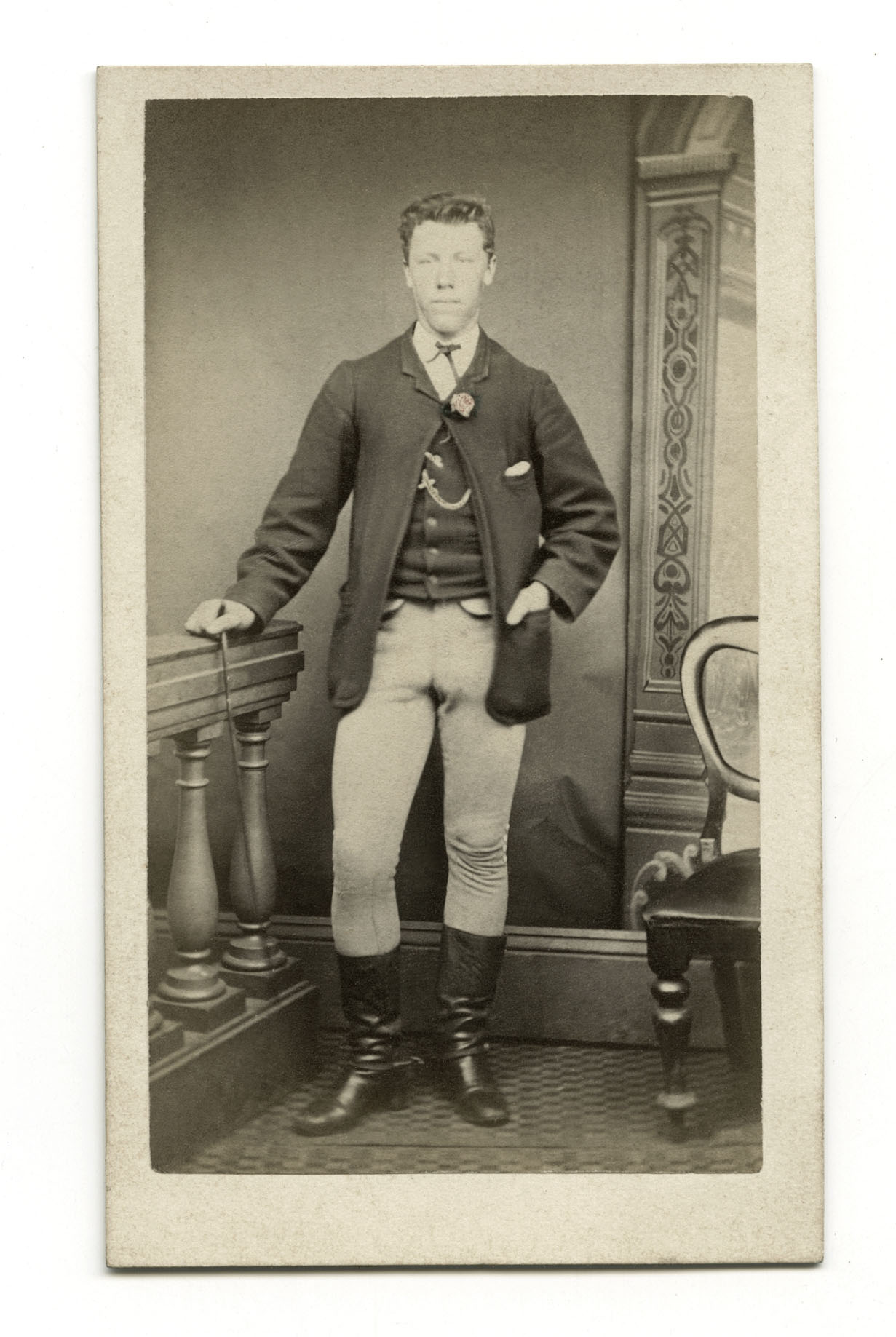
My friend Terence lent me his family photo album. It contains a lot of wonderful cartes-de-visite from photography salons in central Melbourne and country Victoria all in remarkably good condition. There are some unusual cards: family groups, twins in identical chequered outfits, a Latino woman, casual portraits with the sitter relaxing with their knees crossed and even an outdoor photograph of a dirty young vagabond with a chair. There is also a rare card, not strictly a cartes-de-visite, that lists when Omnibuses leave Hoddle Street (late Punt Road) and Toorak Road for St. Kilda via Chapel, Wellington, and Fitzroy Streets.

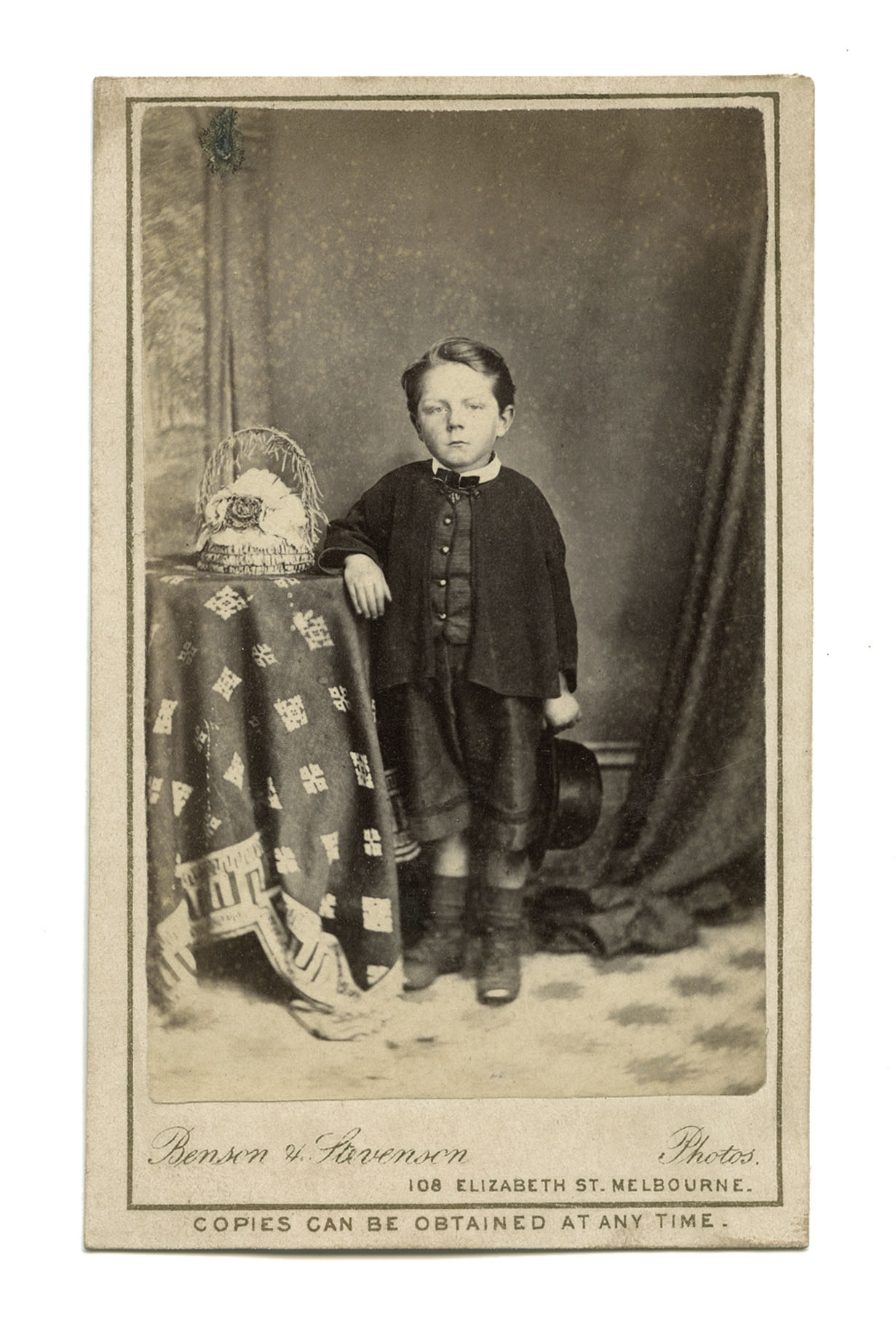
Several cartes-de-visite seem to have been taken at the same session but with different props: witness the Benson & Stevenson cards Untitled (Standing boy), Untitled (Seated woman) and Untitled (Seated woman holding book) where the background remains basically the same but the tablecloth has been inverted – probably son, mother and grandmother. Another Benson & Stevenson pairing Untitled (Seated wife and husband) and Untitled (Family group) possibly show the grandparents and their extended family.

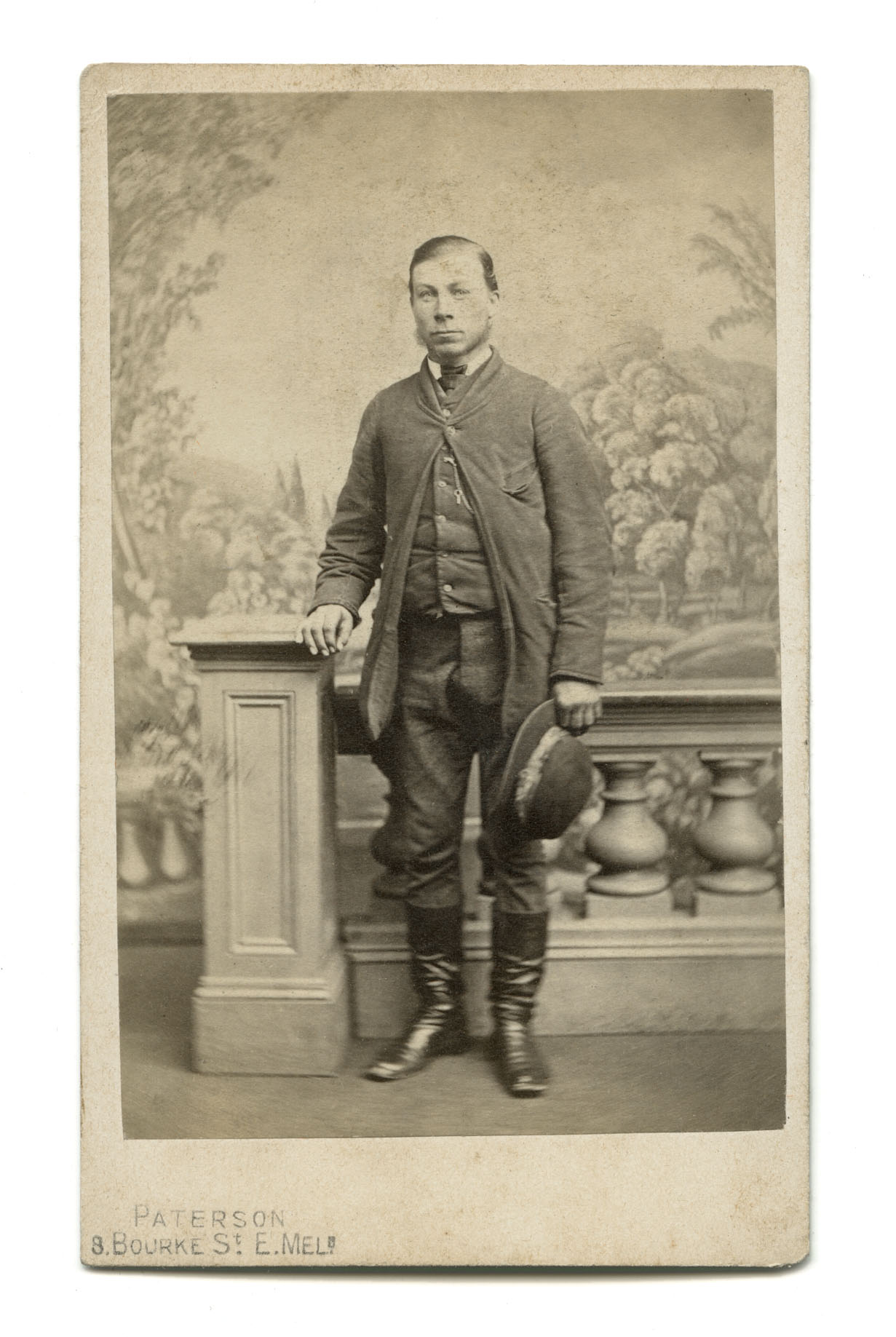
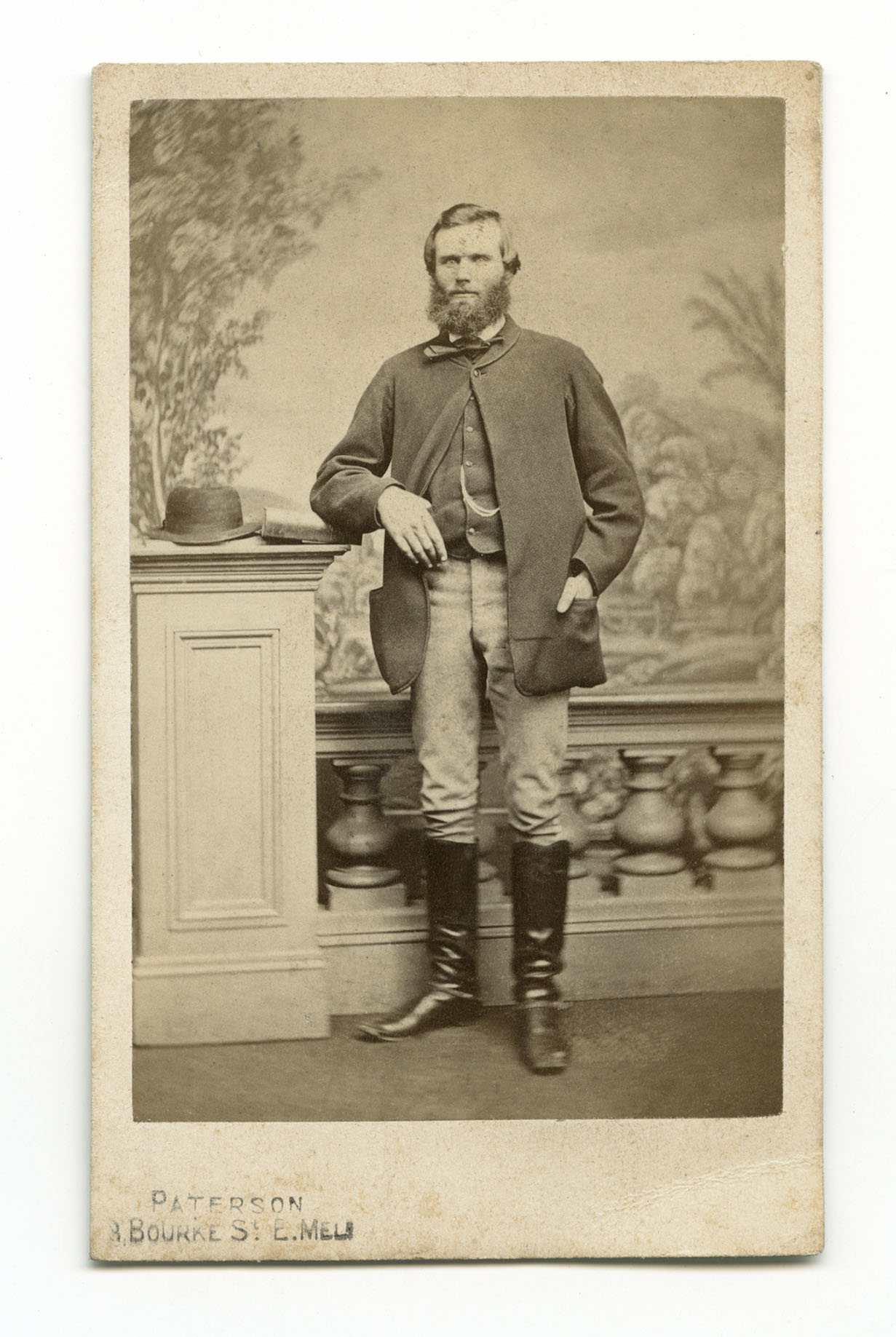
Two cards by the Paterson Brothers, Untitled (Standing man holding a hat) and Untitled (Standing man) show the same backdrop but with a different width, height and design of column attached to the end of the colonnaded fence… perhaps to accommodate for the different height of the subjects. Were these two photographs taken in the same photographic session? Did the men know each other, were they brothers, or business partners?

A most beautiful card is that by an unknown photographer of Mr and Mrs Ritchie (1868, below). Against a plain backdrop and standing on a patterned piece of linoleum, the couple stand frontally facing the camera, her body slightly titled to the right while his lanky frame in oversized coat and lanky trousers is positioned to the left of the frame. The most striking thing about the photograph is Mrs Ritchie’s voluminous striped dress which takes up two-thirds of the pictorial frame, encroaching on Mr Ritchie’s space and obscuring his left foot. Her petite hand is nestled in the crook of his arm while his hands seem massive in comparison. He stares resolutely at the camera while she stares wistfully off camera to her right, mimicking the positioning of her body. This, as the back of the card observes, is the “likeness” of Mrs Alex Ritchie and a memory of her. Alex. Alex. Alex. What was your life like? What happiness and sadness did you endure that we remember you now, revisiting your likeness, bringing you into our consciousness, our hearts and thus into our memory – loved as you were by God & highly esteemed by all that knew her.

The more I reflect on these early photographs, the more I consider the moment that these people had their photographs taken – in those days, those several seconds that they had to remain still for the exposure – and the performance that led up to the capturing of their image. The appointment (if they had one), the entry into the gallery, the greeting, the seating, the waiting for the room to be available, the preparation of the attire, the combing of the hair, the direction by the photographer, the posing of the figure(s) and the exposure of the plate.

Some people would have been annoyed at the process, irritated at how long it took and how long they had to keep still for. I suspect others were imbued of the magic and the theatre of the photographic gallery… and that those few seconds of stillness could become like a period of extended time, like a car crash, where time slows down.** A brief abeyance of the laws of physics becomes an extension of the time of the spirit. The “presence” of the man in A. Archibald McDonald’s cartes-de-visite (c. 1864-1875, above) is a case in point: the low depth of field; the casual placement of hands on thigh and back of chair; the high-buttoned coat, chequered shirt, and top pocket handkerchief; the magnificent beard and the coiffed hair; but above all that penetrating gaze, as though he is staring off into the space of immortality.

Everything in balance, in focus, in stillness.

Dr Marcus Bunyan


** What I am encouraging you to think about here is that the time freeze of the photograph, the snap of the shutter, can be defeated in the physicality of the image, and in the space of the exposure – by a distortion of the witness’s felt temporality.

I am using Paul Virilio’s observation:

“‘No’, Rodin replies. ‘It is art that tells the truth and photography that lies. For in reality time does not stand still, and the artist who manages to give the impression that a gesture is being executed over several seconds, their work is certainly much less conventional than the scientific image in which time is abruptly suspended …’ The sharing of duration (between art and witness) is automatically defeated by the innovation of photographic instantaneity, for if the instantaneous image pretends to scientific accuracy in its details, the snap-shot’s image freeze or rather image-time-freeze invariably distorts the witness’s felt temporality …”

Paul Virilio. The Vision Machine (trans. Julie Rose). Bloomington: Indiana University Press, 1994, p. 2.


Please click on the photographs for a larger version of the image.


Archibald McDonald (Australian born Canada, c. 1831-1873) 'Untitled (Portrait of a man)' c. 1864-1875 (verso)


A. Archibald McDonald (Australian born Canada, c. 1831-1873)
Untitled (Portrait of a man) (verso)
c. 1864-1875
Albumen silver print
Cartes-de-visite
11 x 7cm


Archibald McDonald (Australian born Canada, c. 1831-1873)

Archibald McDonald was a professional photographer, son of Hugh McDonald and Grace née McDougal, was born in Nova Scotia where his father was a planter. He came to Melbourne in about 1847 and was in partnership with Townsend Duryea by 1852. Their daguerreotype portraits and views in the 1854 Melbourne Exhibition were awarded a medal (which McDonald was still citing in advertisements in 1866). At the end of 1854 Duryea and McDonald were in Tasmania announcing that they would open a daguerreotype studio on 11 December at 46 Liverpool Street, Hobart Town. Still enough of a novelty to require promotion and explanation, their daguerreotypes were labelled ‘Curiosities as works of art – puzzles to the uninitiated – studies for the contemplative – pleasing reflections – historical records – pocket editions of the works of nature which “he who runs may read”‘. The partners had gone their separate ways by the following July when ‘Macdonald & Co., late Duryea & Macdonald’ began to advertise from Brisbane Street, Launceston. Archibald visited Launceston in July and again in November, in the interim making short tours to Deloraine (August), Longford (September) and Campbell Town (October).

Afterwards he continued the Melbourne firm of Duryea & McDonald possibly with Sanford Duryea , Townsend having relocated to Adelaide. By 1855 Thomas Adams Hill was the other half of the partnership at 3 Bourke Street, East Melbourne, but Hill soon left the studio to set up on his own. The young Charles Nettleton had joined the firm in 1854 and, according to Cato, then took over the outdoor work while McDonald concentrated on studio portraiture. The business flourished and by 1858 Duryea & McDonald had two Melbourne studios. McDonald set up a studio in his sole name in 1860 at 25 Bourke Street. In 1861 a case of his daguerreotype portraits in the Victorian Exhibition was awarded a first-class certificate and his photograph of the Albion Hotel received an honourable mention in the supplementary awards. Both his untouched and ‘Mezzotinto’ portrait photographs gained honourable mentions at the 1866 Melbourne Intercolonial Exhibition.

Having moved to St George’s Hall at 71 Bourke Street by 1864 McDonald was advertising extensive additions, including a new gallery, in 1866. His studio, he predictably claimed, was now ‘second to none in Europe or America and far surpassing anything in the Colonies’. The fire of March 1872 that destroyed the Theatre Royal, located directly behind his studio, also damaged his premises, but they were soon repaired and McDonald was at this address when he died the following year. His death was reported in the Illustrated Australian News on 4 December 1873…

Staff Writer. “Archibald McDonald,” on the Design & Art Australia Online website Jan 1, 1992 updated Oct 19, 2011 [Online] Cited 04/11/2021.


Archibald McDonald (Australian born Canada, c. 1831-1873) 'Untitled (Portrait of a man)' c. 1864-1875 (recto)


B. Archibald McDonald (Australian born Canada, c. 1831-1873)
Untitled (Portrait of a man) (recto)
c. 1864-1875
Albumen silver print
Cartes-de-visite
11 x 7cm


Archibald McDonald (Australian born Canada, c. 1831-1873) 'Untitled (Portrait of a man)' c. 1864-1875 (verso)


B. Archibald McDonald (Australian born Canada, c. 1831-1873)
Untitled (Portrait of a man) (verso)
c. 1864-1875
Albumen silver print
Cartes-de-visite
11 x 7cm


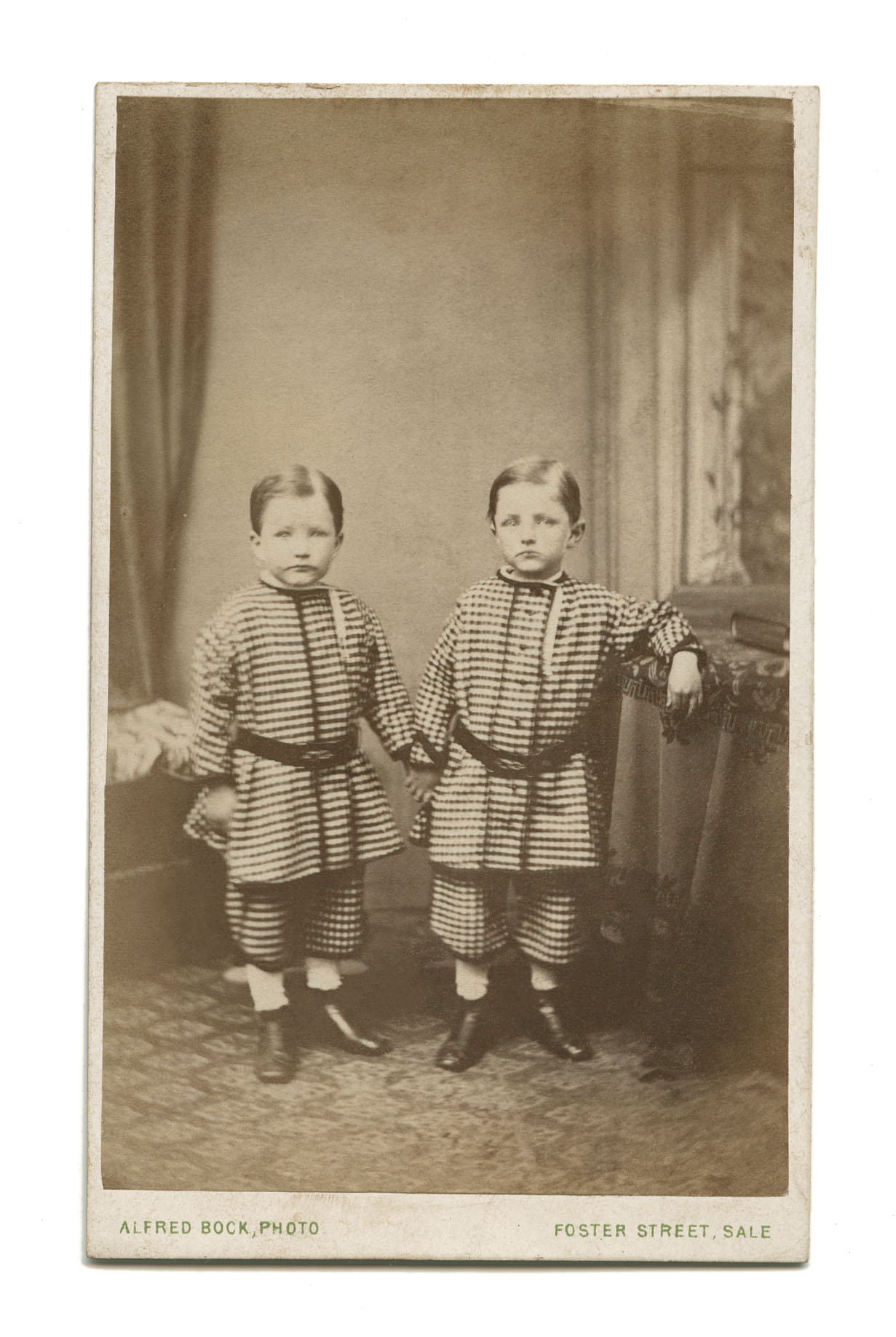
Alfred Bock (Australian, 1835-1920) 'Untitled (Portrait of a child)' c. 1867-1882 (recto)


Alfred Bock (Australian, 1835-1920)
Untitled (Portrait of a child) (recto)
c. 1867-1882
Albumen silver print
Cartes-de-visite
11 x 7cm


This could be the sister of the twin boys below. Notice the same backdrop and the same table and cover to the right. In this image a chair has been used as a prop while in the image of the twins it has been removed.


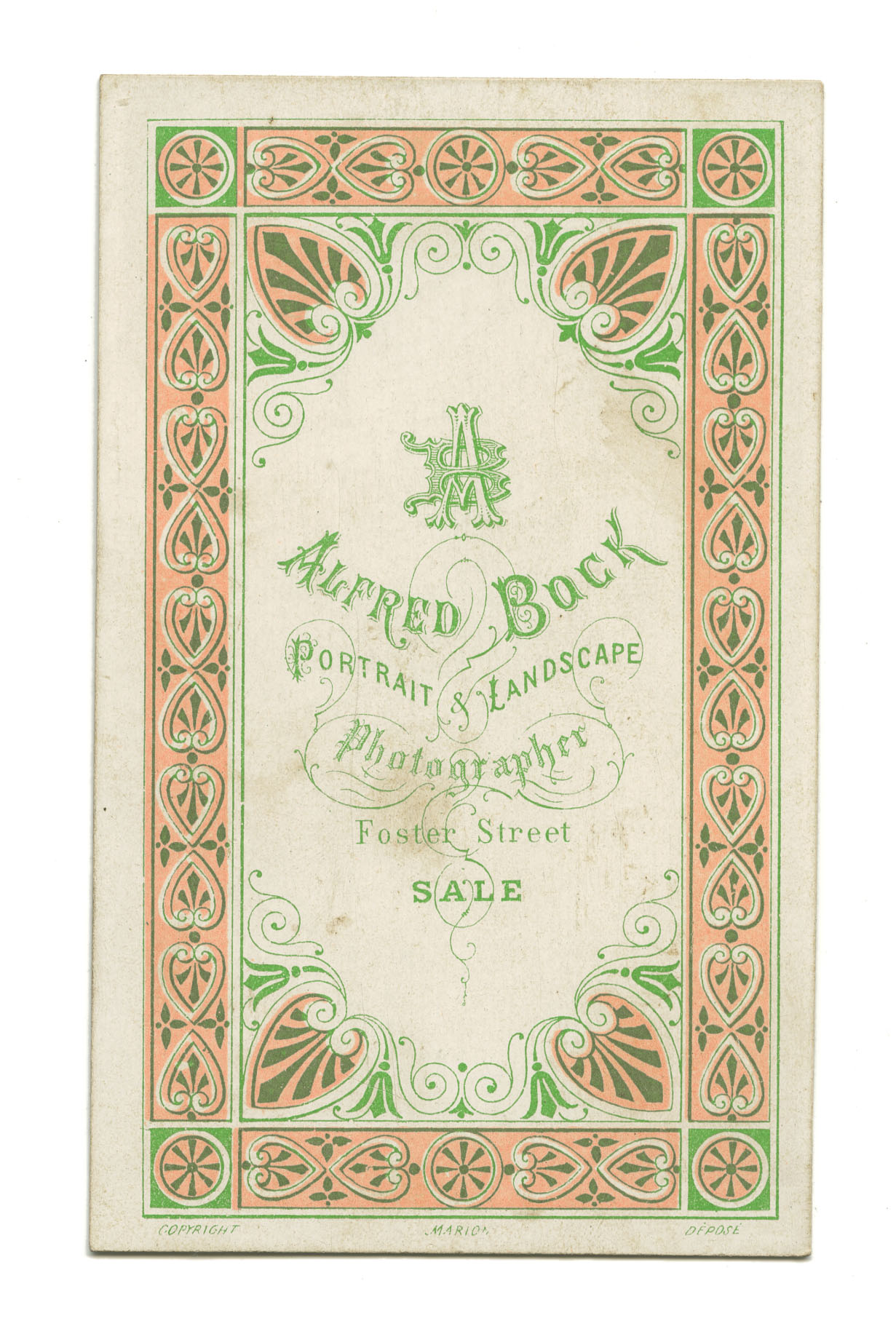
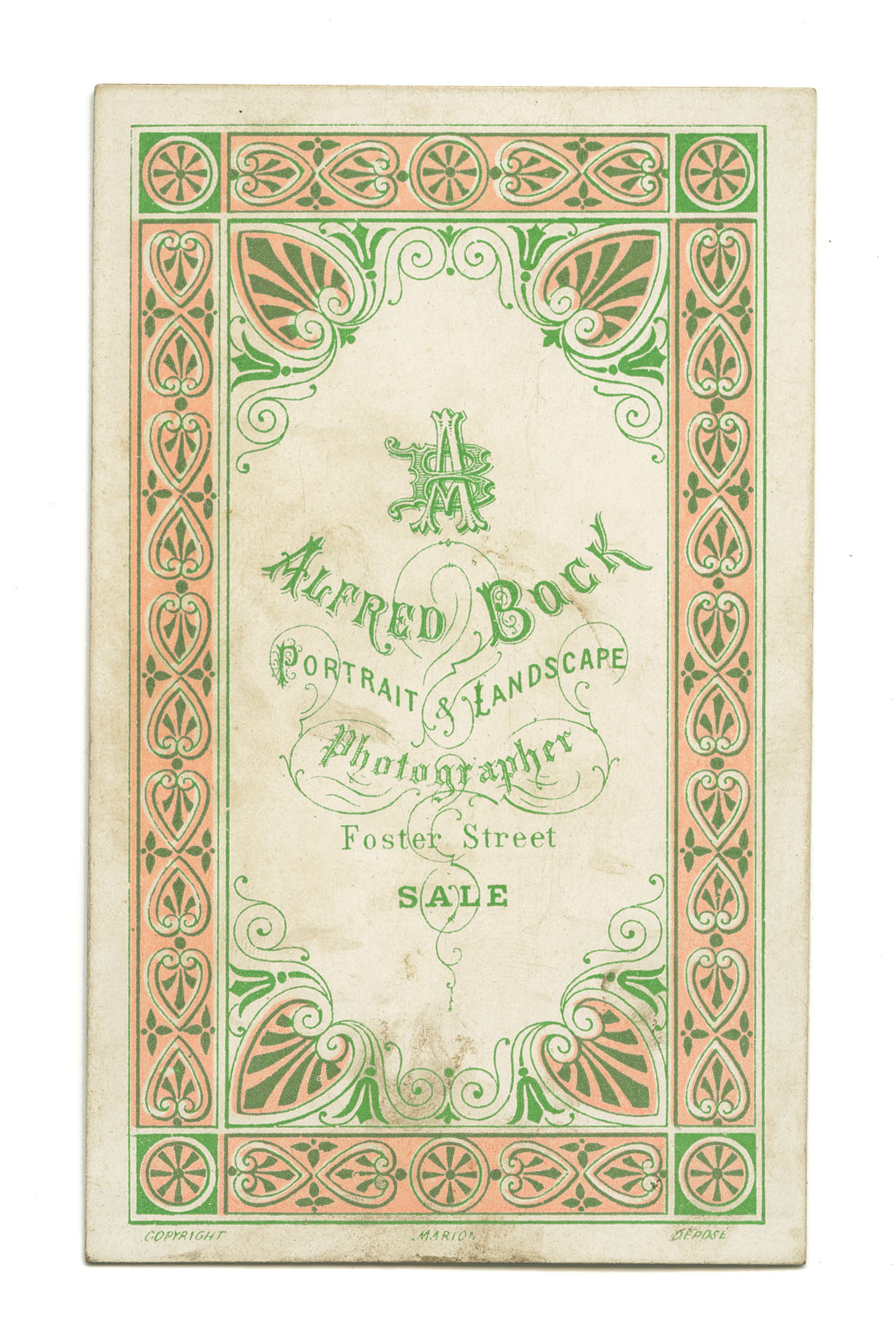
Alfred Bock (Australian, 1835-1920) 'Untitled (Portrait of a child)' c. 1867-1882 (verso)


Alfred Bock (Australian, 1835-1920)
Untitled (Portrait of a child) (verso)
c. 1867-1882
Albumen silver print
Cartes-de-visite
11 x 7cm


Alfred Bock (Australian, 1835-1920)

One of the pioneers of early photography in the 19th century along with his stepfather Thomas Bock, Alfred Bock also pursued a number of other interests including botany, painting and engraving. Mostly a resident of Tasmania, Bock also spent time in Victoria and New Zealand. …

With Thomas, Alfred had practiced photography commercially from its beginning in the daguerreotype form and he was concerned in every stage of development of the technique in Australia, undertaking innovative work in connection with the wet-plate process. Davies states that Bock introduced the carte-de-visite to Hobart Town in 1861, its first appearance anywhere in Tasmania. In 1864 he himself claimed to be the only person in the colony using the genuine sennotype process, a technique that gave a rich three-dimensional effect to portraits by overlaying a waxed albumen print on a normal photograph. The claim led to a lengthy controversy with Henry Frith, aired in the press from April to July. In the Mercury of 3 September 1864 Bock advertised that he had ‘succeeded, after a great number of experiments, in producing ALBUM PORTRAITS, by a modification of the SENNOTYPE PROCESS, retaining all the relief, delicacy, and lifelike beauty of the larger pictures’. He became most expert at the process and introduced a variation for cartes-de-visite in 1864. He continued to advertise sennotypes and ‘every description of Photograph from Locket to Life-size, executed in the most perfect manner’ until he left Hobart Town. His repertoire also included oil portraits painted over solar-enlarged photographs. His painted photographs of J. Boyd , civil commandant at Port Arthur, and ‘the late Captain Spring’ were commended in the Mercury of 14 July 1866. …

In 1867 Bock moved to Victoria and settled at Sale where he again conducted a photography business, producing not only the popular cartes-de-visite from his studio in Foster Street but also enlarging hand-coloured photographic portraits of Gippsland notables. At the 1880 Melbourne International Exhibition, Sale Borough Council was exhibiting two Alfred Bock watercolours, Redbank, River Avon, North Gippsland and On the Albert River, South Gippsland , possibly painted earlier. Bock himself showed his work at various exhibitions – the London International Exhibition (1873), the Philadelphia Centennial Exhibition (1876), the Sandhurst (Bendigo) Industrial Exhibition (1879), the Adelaide International Exhibition (1887) and the Paris International Exhibition (1889) – and gained several awards.

In 1882 Bock advertised the sale ‘of the whole of his portrait and landscape negatives as well as those by the late Mr Jones and others, to Mr F. Cornell of Foster Street, Sale’ and went to Auckland, New Zealand. The family was back in Melbourne by 1887 where they remained until about 1906. Then Alfred retired from business and settled near Wynyard, Tasmania. He died there on 19 February 1920, survived by his second wife and a number of his children.

Plomley, N. J. B. and Kerr, Joan. “Alfred Bock,” on the Design & Art Australia Online website 1992 updated 2012 [Online] Cited 04/11/2021.


Alfred Bock (Australian, 1835-1920) 'Untitled (Portrait of twins)' c. 1867-1882 (recto)


Alfred Bock (Australian, 1835-1920)
Untitled (Portrait of twins) (recto)
c. 1867-1882
Albumen silver print
Cartes-de-visite
11 x 7cm


Alfred Bock (Australian, 1835-1920) 'Untitled (Portrait of twins)' c. 1867-1882 (verso)


Alfred Bock (Australian, 1835-1920)
Untitled (Portrait of twins) (verso)
c. 1867-1882
Albumen silver print
Cartes-de-visite
11 x 7cm


Alfred Bock (Australian, 1835-1920) 'Untitled (Portrait of a man)' c. 1867-1882 (recto)


Alfred Bock (Australian, 1835-1920)
Untitled (Portrait of a man) (recto)
c. 1867-1882
Albumen silver print
Cartes-de-visite
11 x 7cm


Alfred Bock (Australian, 1835-1920) 'Untitled (Portrait of a man)' c. 1867-1882 (verso)


Alfred Bock (Australian, 1835-1920)
Untitled (Portrait of a man) (verso)
c. 1867-1882
Albumen silver print
Cartes-de-visite
11 x 7cm


Benson & Stevenson (Australian) 'Untitled (Standing man)' c. 1872-1880


Benson & Stevenson (Australian)
Untitled (Standing man)
c. 1872-1880
Albumen silver print
Cartes-de-visite
11 x 7cm


Not dated, but photographers’ flourish dates for Elizabeth St. address: 1872-1880


Benson & Stevenson (Australian) 'Untitled (Standing boy)' c. 1872-1880


Benson & Stevenson (Australian)
Untitled (Standing boy)
c. 1872-1880
Albumen silver print
Cartes-de-visite
11 x 7cm


Notice the same floral basket on the table as in the photograph of the seated woman below: same background, inverted covering to the table, perhaps mother and son.


Benson & Stevenson (Australian) 'Untitled (Seated woman)' c. 1872-1880


Benson & Stevenson (Australian)
Untitled (Seated woman)
c. 1872-1880
Albumen silver print with hand colouring
Cartes-de-visite
11 x 7cm


Benson & Stevenson (Australian) 'Untitled (Seated woman holding book)' c. 1872-1880


Benson & Stevenson (Australian)
Untitled (Seated woman holding book)
c. 1872-1880
Albumen silver print with hand colouring
Cartes-de-visite
11 x 7cm


Again, the same background, table covering and floral basket as the seated woman in the photograph above: this could be the grandmother.


Benson & Stevenson (Australian) 'Untitled (Standing woman)' c. 1872-1880


Benson & Stevenson (Australian)
Untitled (Standing woman)
c. 1872-1880
Albumen silver print with hand colouring
Cartes-de-visite
11 x 7cm


Notice the same painted background with the column as the image of the seated woman above, but with different props: one a covered table, the other a colonnade


Benson & Stevenson (Australian) 'Untitled (Standing woman)' c. 1872-1880


Benson & Stevenson (Australian)
Untitled (Standing woman)
c. 1872-1880
Albumen silver print
Cartes-de-visite
11 x 7cm


Benson & Stevenson (Australian) 'Mrs E. Thornton' c. 1872-1880 (recto)


Benson & Stevenson (Australian)
Mrs E. Thornton (recto)
c. 1872-1880
Albumen silver print with hand colouring
Cartes-de-visite
11 x 7cm


Benson & Stevenson (Australian) 'Mrs E. Thornton' c. 1872-1880 (verso)


Benson & Stevenson (Australian)
Mrs E. Thornton (verso)
c. 1872-1880
Albumen silver print with hand colouring
Cartes-de-visite
11 x 7cm


Benson & Stevenson (Australian) 'Untitled (Seated man)' c. 1872-1880


Benson & Stevenson (Australian)
Untitled (Seated man)
c. 1872-1880
Albumen silver print
Cartes-de-visite
11 x 7cm


Benson & Stevenson (Australian) 'Untitled (Seated wife and husband)' c. 1872-1880


Benson & Stevenson (Australian)
Untitled (Seated wife and husband)
c. 1872-1880
Albumen silver print
Cartes-de-visite
11 x 7cm


This could be the grandparents of the family in the cartes-de-visite below.


Benson & Stevenson (Australian) 'Untitled (Family group)' c. 1872-1880


Benson & Stevenson (Australian)
Untitled (Family group)
c. 1872-1880
Albumen silver print
Cartes-de-visite
11 x 7cm


John Botterill (Australian born England, 1817-1881) 'Untitled (Standing man)' 1872-1874 (recto)


John Botterill (Australian born England, 1817-1881)
Untitled (Standing man) (recto)
1872-1874
Albumen silver print
Cartes-de-visite
11 x 7cm


John Botterill (Australian born England, 1817-1881) 'Untitled (Standing man)' 1872-1874 (verso)


John Botterill (Australian born England, 1817-1881)
Untitled (Standing man) (verso)
1872-1874
Albumen silver print
Cartes-de-visite
11 x 7cm


John Botterill (Australian born England, 1817-1881)

John Botterill, miniaturist, portrait painter and professional photographer, was born in Britain, son of John Botterill and Mary, née Barker. John junior was working in Melbourne from the early 1850s, advertising in the Argus of 12 April 1853 as a portrait, miniature and animal painter and offering lessons in landscape, fruit and flower painting in oil, watercolour, ‘crayon’ or pencil. …

Botterill appeared in Melbourne directories from 1862 to 1866 as an artist of Caroline Street, South Yarra. Between 1861 and 1865 he was also working at P.M. Batchelder ‘s Photographic Portrait Rooms in Collins Street East, Melbourne, ‘engaged … to paint miniatures and portraits in oil, watercolour or mezzotint – these deserve what they are receiving, a wide reputation’, stated the Argus on 22 November 1865. In 1866 he became one of the proprietors of Batchelder’s with F.A. Dunn and J.N. Wilson, but the partnership lasted only until the end of the following year. For the visit of the Duke of Edinburgh to Melbourne in November 1867 Botterill painted a 4 × 5 foot (121 × 152cm) transparency to decorate Batchelder’s. The Argus described this in detail, noting that it represented four of England’s chief naval heroes (Drake, Blake, Nelson and Collingwood) as well as Prince Alfred, an Elizabethan galleon and the Galatea , with the motto ‘England’s naval heroes and her hope’. Two coloured photographs by Botterill, Portrait of Sir J.H.T. Manners-Sutton and Portrait of Lady Manners-Sutton, were lent by the Governor Manners-Sutton to both the Melbourne Public Library and Ballarat Mechanics Institute exhibitions in 1869. From 1870 to 1879 Botterill operated his own Melbourne photographic studio: at 19 Collins Street East in 1872-74 and at 12 Beehive Chambers, Elizabeth Street in 1875-79. He died on 25 July 1881 and was buried in the St Kilda Cemetery.

Staff Writer. “John Botterill,” on the Design & Art Australia Online website Jan 1, 1992 updated October 19, 2011 [Online] Cited 04/11/2021.


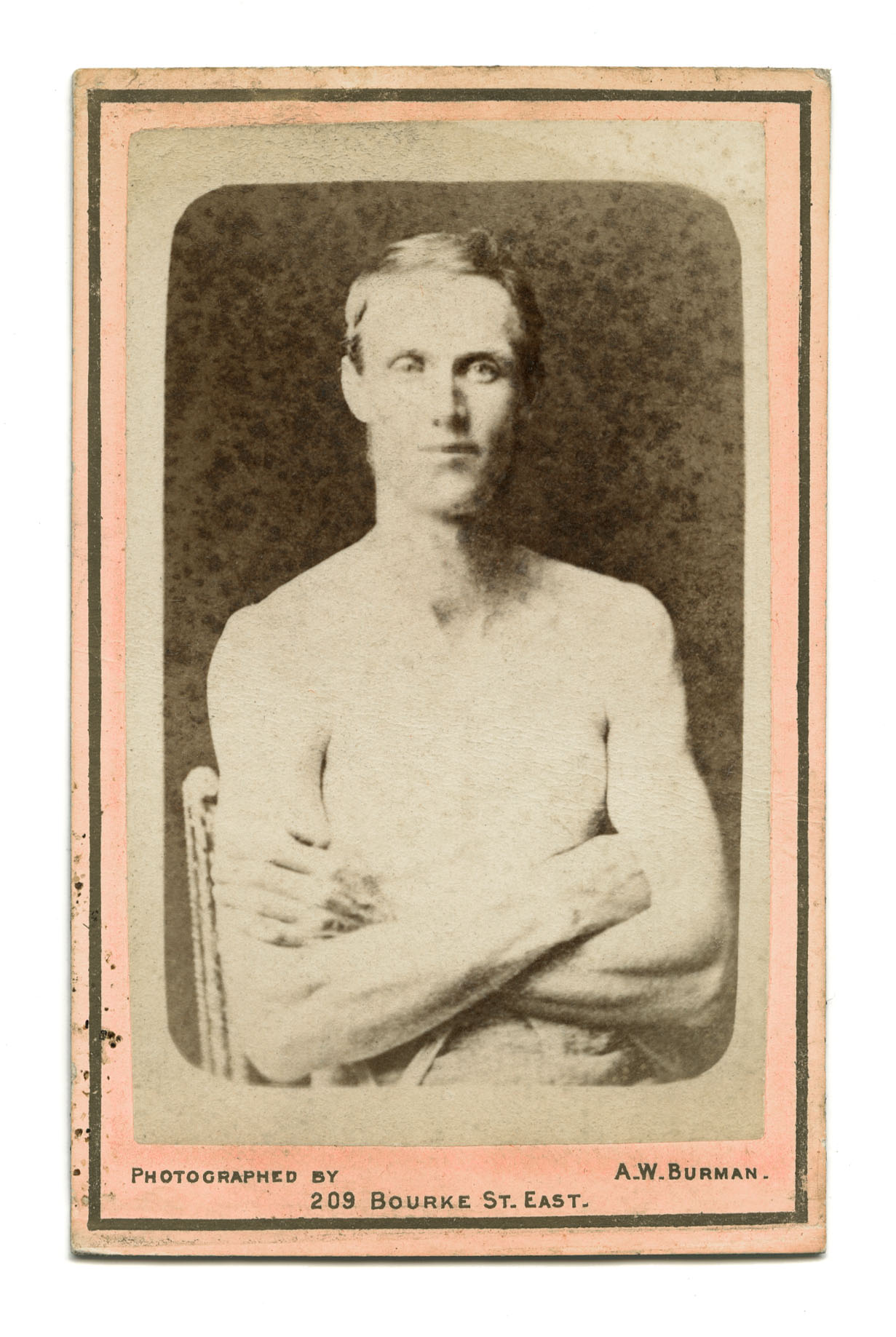
A. W. Burman (Australian, 1851-1915) (active 1869-1889, photographer) 'Untitled (shirtless man with arms folded)' 1878-1888 (recto)


Arthur William Burman (Australian, 1851-1915) (active 1869-1889, photographer)
Untitled (shirtless man with arms folded) (recto)
1878-1888
Albumen silver print
Cartes-de-visite
11 x 7cm


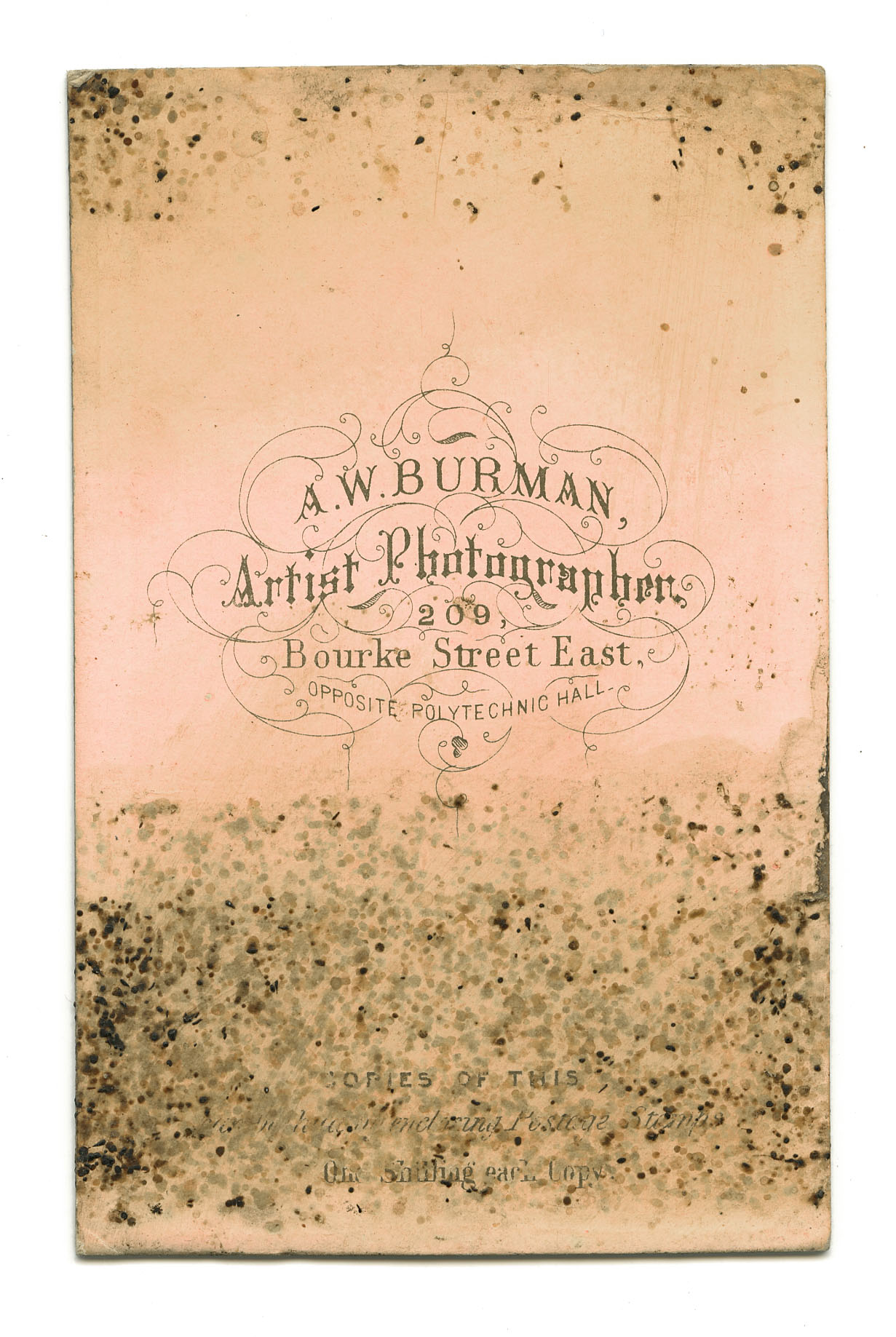
A. W. Burman (Australian, 1851-1915) (active 1869-1889, photographer) 'Untitled (shirtless man with arms folded)' 1878-1888 (verso)


Arthur William Burman (Australian, 1851-1915) (active 1869-1889, photographer)
Untitled (shirtless man with arms folded) (verso)
1878-1888
Albumen silver print
Cartes-de-visite
11 x 7cm


Undated but photographer’s flourish dates for this address: 1878-1888

Arthur William Burman was one of the nine children of photographer William Insull Burman (1814-1890), who came to Victoria in 1853. Burman senior worked as a painter and decorator before establishing his own photography business in Carlton around 1863. Arthur and his older brother, Frederick, worked in the family business which, by 1869, operated a number of studios around Melbourne. Arthur is listed as operating businesses under his own name from addresses in East Melbourne, Carlton, Windsor, Fitzroy and Richmond between 1878 and his death in 1890.


F. C. Burman & Co (Australian) 'Untitled (Standing woman)' Nd (recto)


F. C. Burman & Co (Australian)
Untitled (Standing woman) (recto)
Nd
Albumen silver print
Cartes-de-visite
11 x 7cm


F. C. Burman & Co (Australian) 'Untitled (Standing woman)' Nd (verso)


F. C. Burman & Co (Australian)
Untitled (Standing woman) (verso)
Nd
Albumen silver print
Cartes-de-visite
11 x 7cm


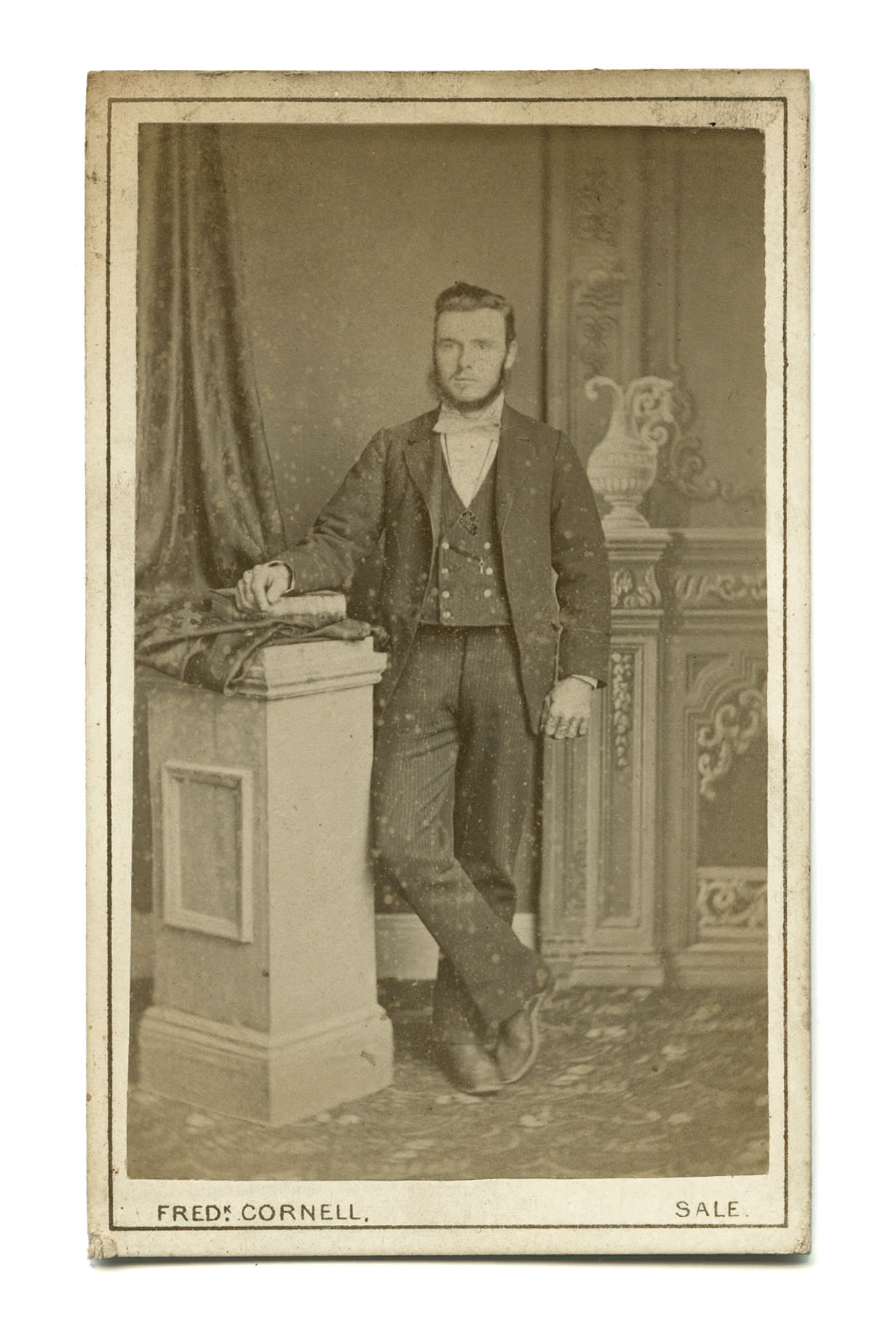
Frederick Cornell (Australian born England, c. 1833-1890) 'Untitled (Standing man)' c. 1873 - c. 1890 (recto)


Frederick Cornell (Australian born England, c. 1833-1890) (active 1865-1890)
Untitled (Standing man) (recto)
c. 1873 – c. 1890 at Foster Street, Sale, Gippsland, Vic.
Albumen silver print
Cartes-de-visite
11 x 7cm


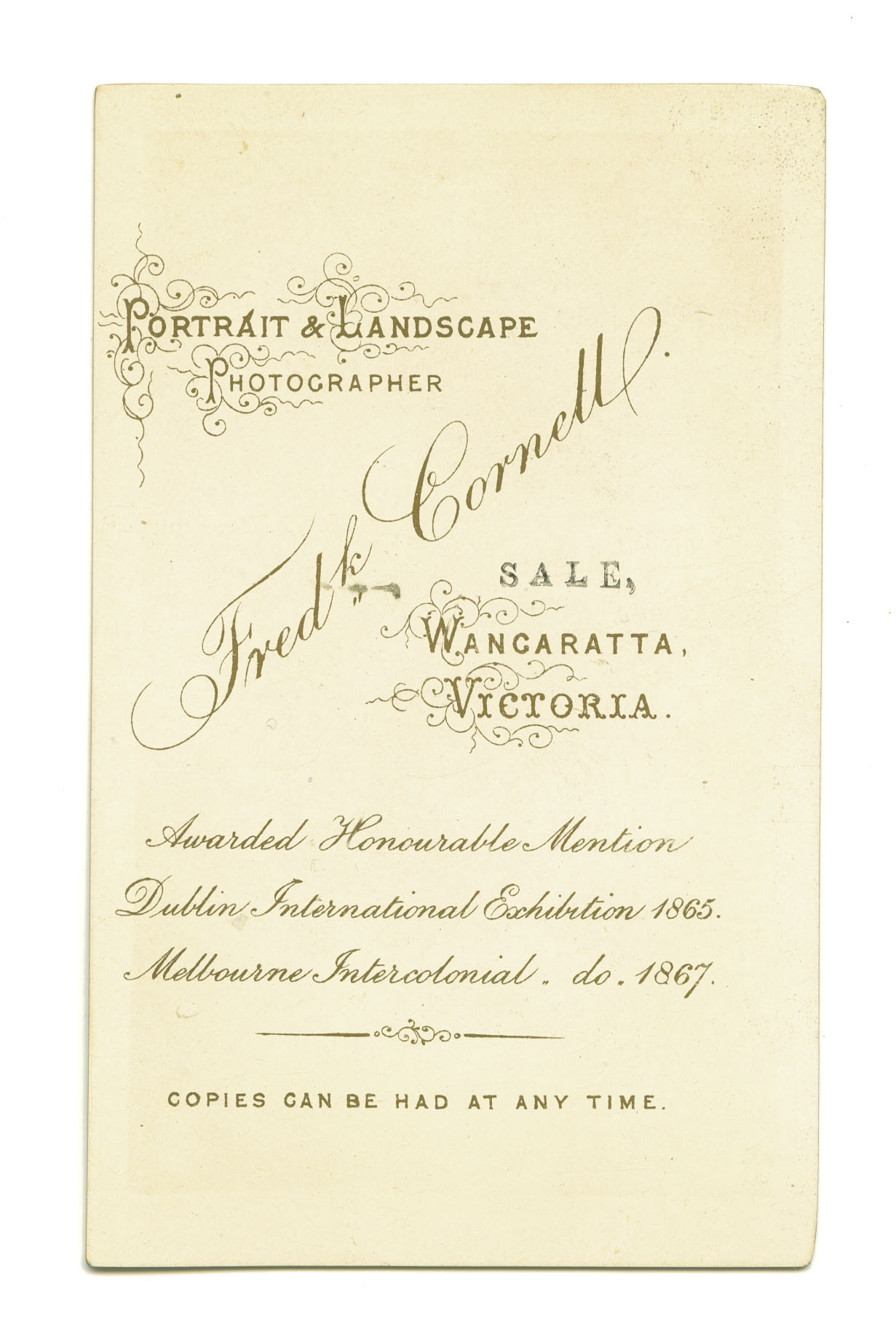
Frederick Cornell (Australian born England, c. 1833-1890) 'Untitled (Standing man)' c. 1873 - c. 1890 (verso)


Frederick Cornell (Australian born England, c. 1833-1890) (active 1865-1890)
Untitled (Standing man) (verso)
c. 1873 – c. 1890 at Foster Street, Sale, Gippsland, Vic.
Albumen silver print
Cartes-de-visite
11 x 7cm


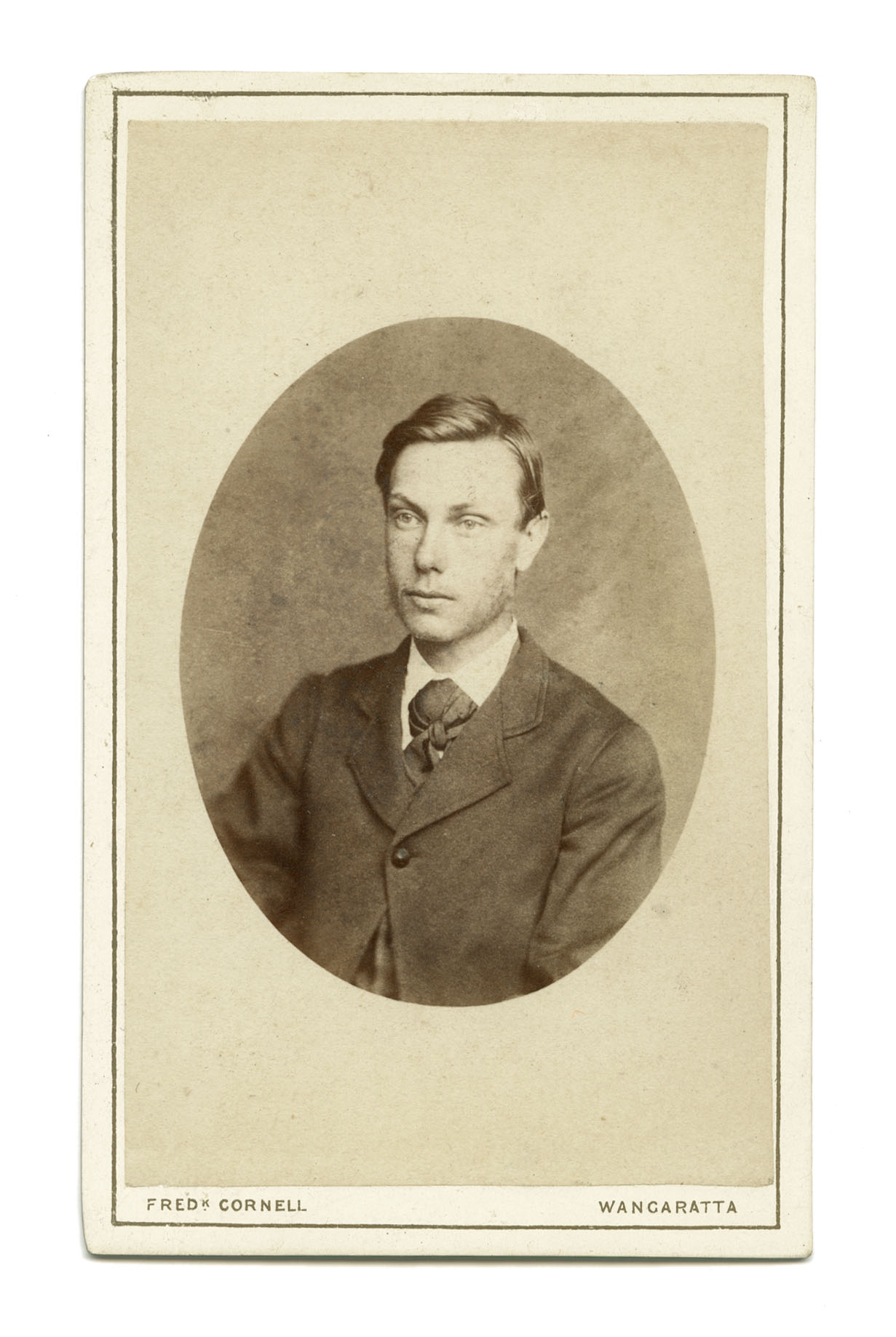
Frederick Cornell arrived in Melbourne in 1854 from England aged 21. He was joined in Melbourne by his brothers, and they ran a number of shops there. By 1865 Cornell was taking and exhibiting photographs, and in 1867 relocated to Sale. He was then variously at Bairnsdale and Beechworth until he finally settled at Sale in 1875. He travelled throughout Gippsland at various times, and set up temporary studios. Frederick Cornell died at Sale in June 1890.


Frederick Cornell (Australian born England, c. 1833-1890) 'Untitled (Standing woman)' c. 1873 - c. 1890 (recto)


Frederick Cornell (Australian born England, c. 1833-1890) (active 1865-1890)
Untitled (Standing woman) (recto)
c. 1873 – c. 1890 Foster Street, Sale, Gippsland, Vic.
Albumen silver print
Cartes-de-visite
11 x 7cm


Frederick Cornell (Australian born England, c. 1833-1890) 'Untitled (Standing woman)' c. 1873 - c. 1890 (verso)


Frederick Cornell (Australian born England, c. 1833-1890) (active 1865-1890)
Untitled (Standing woman) (verso)
c. 1873 – c. 1890 Foster Street, Sale, Gippsland, Vic.
Albumen silver print
Cartes-de-visite
11 x 7cm


Frederick Cornell (Australian born England, c. 1833-1890) 'Untitled (Portrait of a man)' Nd (recto)


Frederick Cornell (Australian born England, c. 1833-1890) (active 1865-1890)
Untitled (Portrait of a man) (recto)
Nd
Albumen silver print
Cartes-de-visite
11 x 7cm


Frederick Cornell (Australian born England, c. 1833-1890) 'Untitled (Portrait of a man)' Nd (verso)


Frederick Cornell (Australian born England, c. 1833-1890) (active 1865-1890)
Untitled (Portrait of a man) (verso)
Nd
Albumen silver print
Cartes-de-visite
11 x 7cm


William Davies & Co (Australian born England) (active Australia, 1855-1882) 'Untitled (Standing man)' c. 1862 - 1870 (recto)


William Davies & Co (Australian born England) (active Australia, 1855-1882)
Untitled (Standing man) (recto)
c. 1862 – 1870
Albumen silver print
Cartes-de-visite
11 x 7cm


William Davies & Co (Australian born England) (active Australia, 1855-1882) 'Untitled (Standing man)' c. 1862 - 1870 (verso)


William Davies & Co (Australian born England) (active Australia, 1855-1882)
Untitled (Standing man) (verso)
c. 1862 – 1870
Albumen silver print
Cartes-de-visite
11 x 7cm


William Davies (Australian born England)

English photographer William Davies had arrived in Melbourne by 1855. He is said to have worked with his friend Walter Woodbury and for the local outpost of the New York firm Meade Brothers before establishing his own business in 1858. By the middle of 1862, ‘Davies & Co’ had rooms at 91 and 94 Bourke Street, from where patrons could procure ‘CARTE de VISITE and ALBUM PORTRAITS, in superior style’. Like several of his contemporaries and competitors, Davies appears to have made the most of his location ‘opposite the Theatre Royal’, subjects of Davies & Co cartes de visite including leading actors such as Barry Sullivan and Gustavus Vaughan Brooke, and comedian Harry Rickards. Examples of the firm’s work – portraits and views – were included in the 1861 Victorian Exhibition and the London International Exhibition of 1862; and at the 1866 Intercolonial Exhibition the firm exhibited ‘Portraits, Plain and Coloured, in Oils and Water Colours’ alongside a selection of views for which they received an honourable mention.

Sandie Barrie’s book Australians under the Camera refers the user to an entry for Davies, William & Co. who operated as a photographer between 1855 and 1882 and then in April 1893 as a travelling photographer.


William Davies was a professional photographer who established a number of studios in Melbourne between the 1858 and 1882. Davies was probably born in Manchester, UK and arrived in Melbourne around 1855. He began his photographic career in Australia in the employ of his friend, Walter Woodbury (inventor of the Woodburytype) and the Meade Brothers. Davies purchased the Meades’ business in 1858 and opened his own studio, William Davies and Co at 98 Bourke St, specialising in albumen photography of individuals and local premises. This address was opposite the Theatre Royal, and Davies took advantage of the proximity by selling cartes de visite of famous actors, actresses and opera singers. In 1861, Davies’s firm showed a number of portraits and images of Melbourne and Fitzroy buildings, often with the proprietors standing outside, at the Victorian Exhibition, and then at the 1862 London International Exhibition, where they received honourable mention. Along with actresses and buildings, the company also specialised in carte de visite portraits of Protestant clergymen posed in the act of writing their sermons. From 1862 to 1870 the firm was located at 94A Bourke St, where they shared the premises with the photographers Cox and Luckin.

Text from the Art Gallery of New South Wales website [Online] Cited 05/11/2021


St. George's Hall Photographic Co. / William Davies & Co (Australian born England) (active Australia, 1855-1882) 'Untitled (Standing woman)' c. 1862 - 1870 (recto)


St. George’s Hall Photographic Co.,
William Davies & Co (Australian born England) (active Australia, 1855-1882)
Untitled (Standing woman) (recto)
c. 1862 – 1870
Albumen silver print
Cartes-de-visite
11 x 7cm


St. George's Hall Photographic Co. / William Davies & Co (Australian born England) (active Australia, 1855-1882) 'Untitled (Standing woman)' c. 1862-1870 (verso)


St. George’s Hall Photographic Co.,
William Davies & Co (Australian born England) (active Australia, 1855-1882)
Untitled (Standing woman) (verso)
c. 1862 – 1870
Albumen silver print
Cartes-de-visite
11 x 7cm


Ezra Goulter (Australian born England, 1825-1899) Untitled (Standing woman) c. 1876 - c. 1893 (recto)


Ezra Goulter (Australian born England, 1825-1899)
Untitled (Standing woman) (recto)
c. 1876 – c. 1893
Albumen silver print
Cartes-de-visite
11 x 7cm


Ezra Goulter (1825-1899) was born in England and arrived in Australia with his new wife Sarah in 1860. He had previously visited Australia in 1849. Goulter was a professional photographer who worked in various studios around Melbourne. From 1863-1871 he worked in Emerald Hill (now South Melbourne), then he had a brief period at 57 Collins Street East from 1866-1867, and from 1876-1893 he was based on Chapel Street in Prahran. He focused on portraiture and produced cartes-de-visite in both black-and-white and hand-coloured formats. He exhibited his portraits at the 1866 Melbourne Intercolonial Exhibition where he received an honourable mention.

Text from the Monash Gallery of Art website


Ezra Goulter (Australian born England, 1825-1899) Untitled (Standing woman) c. 1876 - c. 1893 (verso)


Ezra Goulter (Australian born England, 1825-1899)
Untitled (Standing woman) (verso)
c. 1876 – c. 1893
Albumen silver print
Cartes-de-visite
11 x 7cm


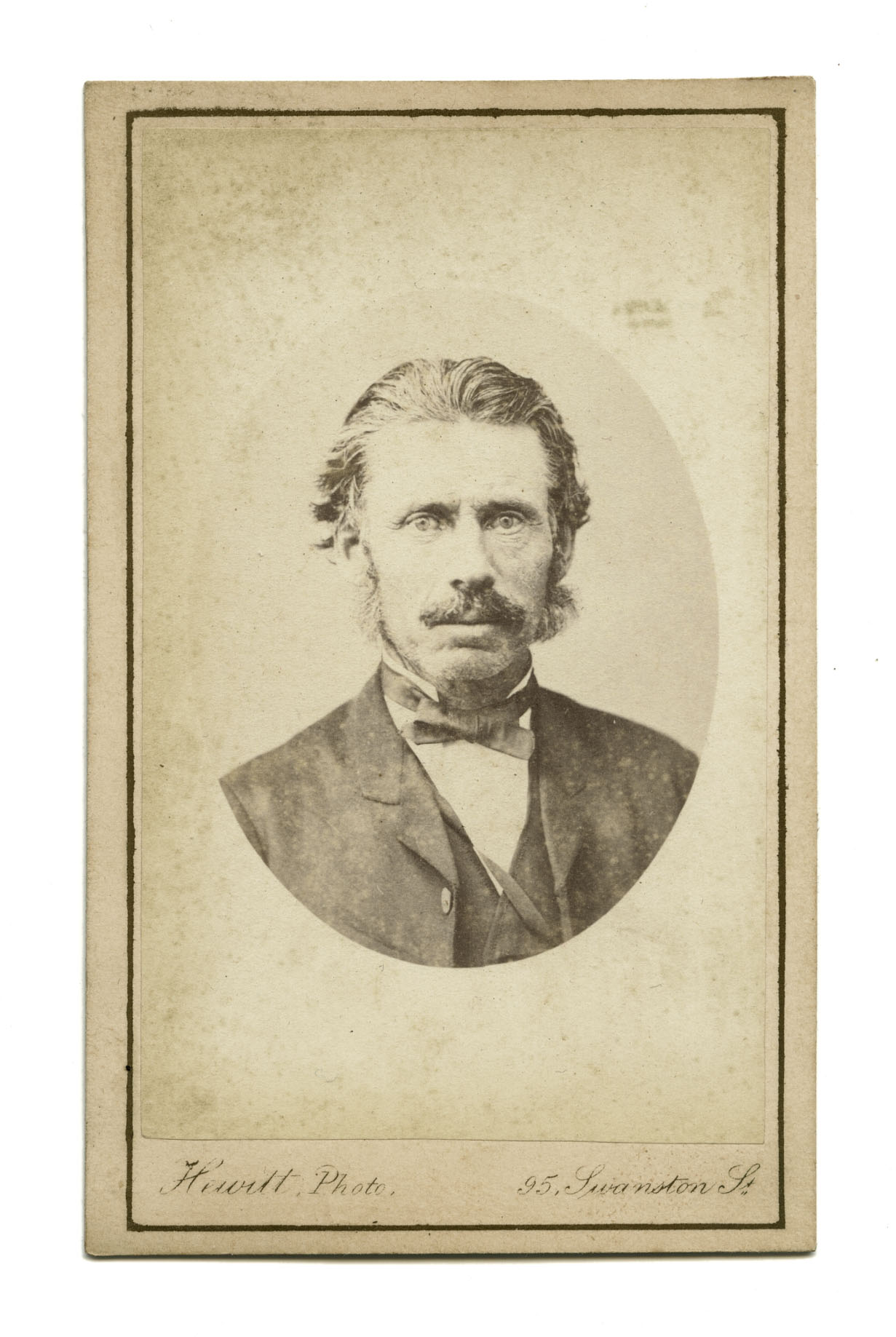
Charles Hewitt (Australian, 1837-1912) (active c. 1860 - c. 1899) Untitled (Vignette of a man) c. 1866-1880 (recto)


Charles Hewitt (Australian, 1837-1912) (active c. 1860 – c. 1899)
Untitled (Vignette of a man) (recto)
c. 1866-1880
Albumen silver print
Cartes-de-visite
11 x 7cm


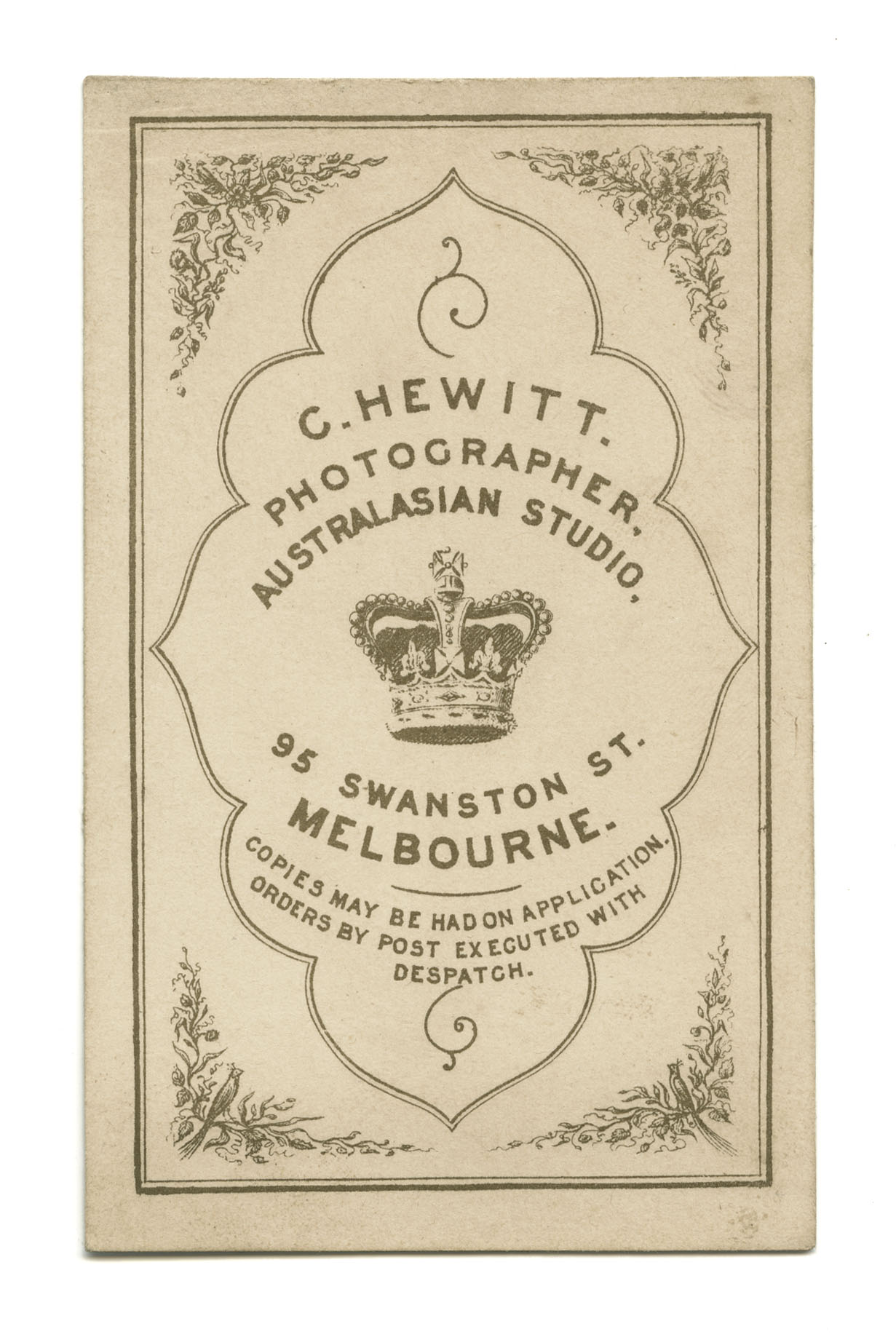
Charles Hewitt (Australian, 1837-1912) (active c. 1860 - c. 1899) Untitled (Vignette of a man) c. 1866-1880 (verso)


Charles Hewitt (Australian, 1837-1912) (active c. 1860 – c. 1899)
Untitled (Vignette of a man) (verso)
c. 1866-1880
Albumen silver print
Cartes-de-visite
11 x 7cm


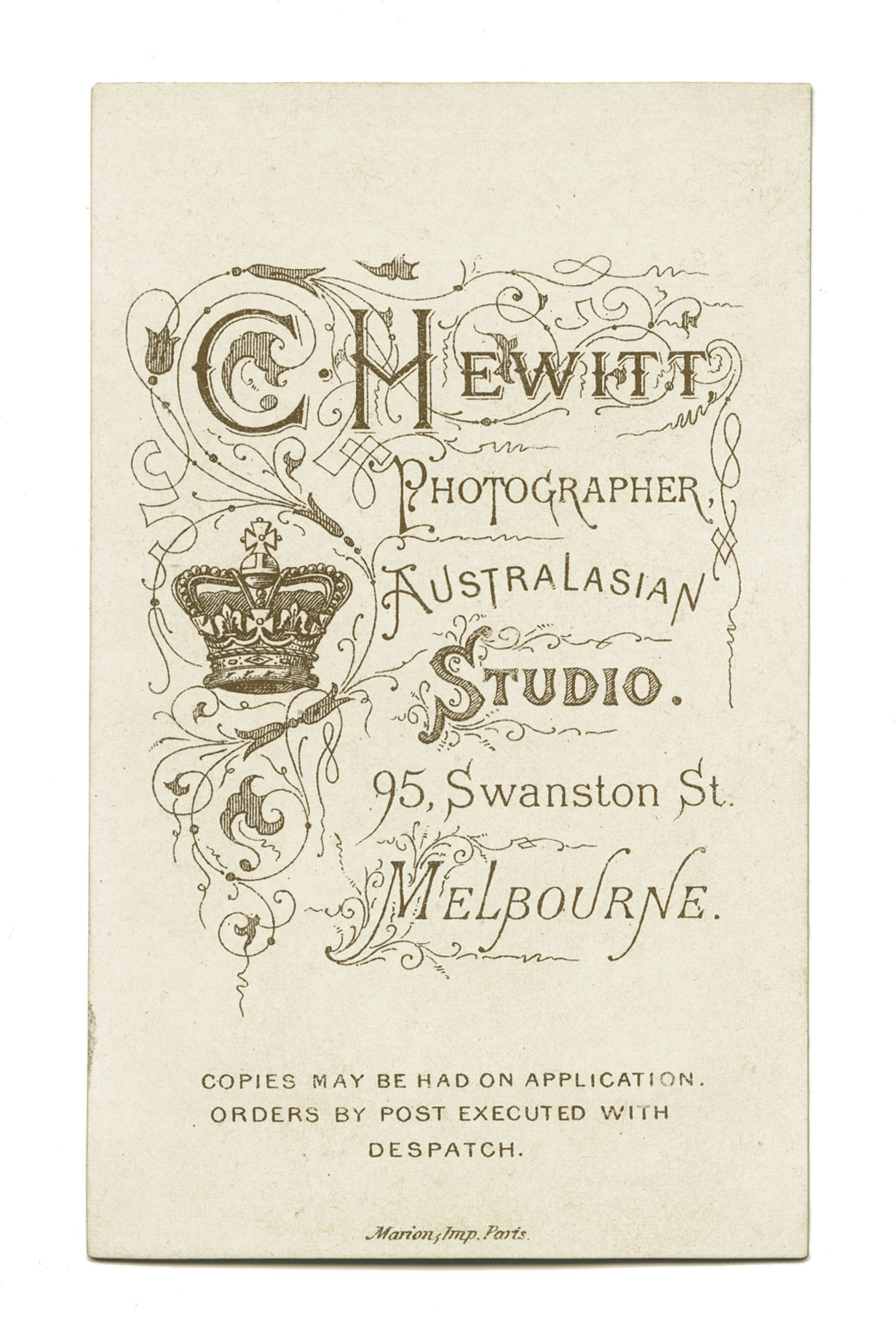
Charles Hewitt was a professional photographer, was a foundation member of the Council of the Photographic Society of Victoria formed at Melbourne in 1860. Ran his own studios in various Melbourne locations until 1899 when he moved to Stawell, Victoria.

Not dated but a Hewitt worked at 95 Swanston Street, Melbourne between 1866-1880. Ref.: Australians behind the camera, directory of early Australian photographers, 1841-1945 / Sandy Barrie, 2002


Charles Hewitt (Australian, 1837-1912) (active c. 1860 - c. 1899) Untitled (Oval of a man) c. 1866-1880 (recto)


Charles Hewitt (Australian, 1837-1912) (active c. 1860 – c. 1899)
Untitled (Oval of a man) (recto)
c. 1866-1880
Albumen silver print
Cartes-de-visite
11 x 7cm


Charles Hewitt (Australian, 1837-1912) (active c. 1860 - c. 1899) 'Untitled (Oval of a man)' c. 1866-1880 (verso)


Charles Hewitt (Australian, 1837-1912) (active c. 1860 – c. 1899)
Untitled (Oval of a man) (verso)
c. 1866-1880
Albumen silver print
Cartes-de-visite
11 x 7cm


Charles Hewitt (Australian, 1837-1912) (active c. 1860 - c. 1899) 'Untitled (Oval of a woman)' c. 1866-1880 (recto)


Charles Hewitt (Australian, 1837-1912) (active c. 1860 – c. 1899)
Untitled (Oval of a woman) (recto)
c. 1866-1880
Albumen silver print
Cartes-de-visite
11 x 7cm


Charles Hewitt (Australian, 1837-1912) (active c. 1860 - c. 1899) 'Untitled (Oval of a woman)' c. 1866-1880 (verso)


Charles Hewitt (Australian, 1837-1912) (active c. 1860 – c. 1899)
Untitled (Oval of a woman) (verso)
c. 1866-1880
Albumen silver print
Cartes-de-visite
11 x 7cm


E. E. Hibling (photographer active c. 1873 - c. 1877) Johnstone O'Shannessy & Co (active 1865-1905) 'Untitled (family group)' c. 1873 - c. 1877 (recto)


E. E. Hibling (photographer active c. 1873 – c. 1877)
Johnstone O’Shannessy & Co (active 1865-1905)
Untitled (family group) (recto)
c. 1873 – c. 1877
Albumen silver print
Cartes-de-visite
11 x 7cm


E. E. Hibling (photographer active c. 1873 - c. 1877) Johnstone O'Shannessy & Co (active 1865-1905) 'Untitled (family group)' c. 1873 - c. 1877 (verso)


E. E. Hibling (photographer active c. 1873 – c. 1877)
Johnstone O’Shannessy & Co (active 1865-1905)
Untitled (family group) (verso)
c. 1873 – c. 1877
Albumen silver print
Cartes-de-visite
11 x 7cm


Not dated but a Hibling worked at 7 Collins Street East, Melbourne between between 1873-1877. Ref.: Australians behind the camera, directory of early Australian photographers, 1841-1945 / Sandy Barrie, 2002.

Johnstone, O’Shannessy & Co was founded in Melbourne in 1864 by Henry James Johnstone and a photographer known as ‘Miss O’Shaughnessy’, who had previously been in partnership with her mother in their own photographic business in Carlton. The firm exhibited photographs at the Intercolonial Exhibition in Melbourne in 1866, where the ‘special excellence’ of their work was noted by the judges. By the mid-1880s, when the firm moved from their Bourke Street address to purpose-built premises in the section of Collins Street known as ‘the Block’, Johnstone, O’Shannessy & Co. were arguably Melbourne’s leading portrait photographers, their services sought by governors, visiting royalty, politicians and other prominent members of society. Examples of Johnstone, O’Shannessy & Co.’s portraits were included in the Philadelphia Centennial Exhibition of 1875 and the 1888 Melbourne International Exhibition. They expanded to Sydney during the 1880s, but the firm’s fortunes declined during the economic downturn of the following decade.

Text from the National Portrait Gallery website updated 2018 [Online] Cited 08/11/2021


Johnstone, O’Shannessy & Co was a leading photographic studio located in Melbourne, Victoria, Australia. It was active from 1865 to 1905.

Henry James Johnstone was born in Birmingham, England, in 1835 and studied art under a number of private teachers and at the Birmingham School of Design before joining his father’s photographic firm. He arrived in Melbourne in 1853 aged 18 and became Melbourne’s leading portrait photographer during the 1870s and 1880s. In 1862 he bought out the Duryea and MacDonald Studio and started work as Johnstone and Co. In 1865 the firm became Johnstone, O’Shannessy and Co. with partner Emily O’Shannessy and co-owner George Hasler.

Johnstone, O’Shannessy & Co. were Melbourne’s leading portrait photographers whose services were sought by governors, visiting royalty, politicians and other prominent members of society. Johnstone impressed the Duke of Edinburgh during his visit to Victoria and was appointed to his staff as Royal Photographer. Examples of Johnstone, O’Shannessy & Co.’s photographic portraits were included in the Philadelphia Centennial Exhibition of 1875 and the 1888 Melbourne International Exhibition where the excellence of their work was noted by the judges.

In 1876 Johnstone left Melbourne for South Australia and then travelled extensively in America, and then in 1880 to London, where he regularly exhibited paintings at the Royal Academy until 1900. He died in London in 1907 aged 72. The firm continued without him and expanded to Sydney during the 1880s and occupied a variety of buildings in Melbourne until the 1890s, but the firm’s fortunes declined during the economic downturn of the following decade. George Hasler, who created a printing process called Neogravure, ran the company till his death in 1897, after which his son-in-law, Rupert De Clare Wilks, took over the company from 1897 until 1905 when he put it into liquidation.

Text from the Wikipedia website


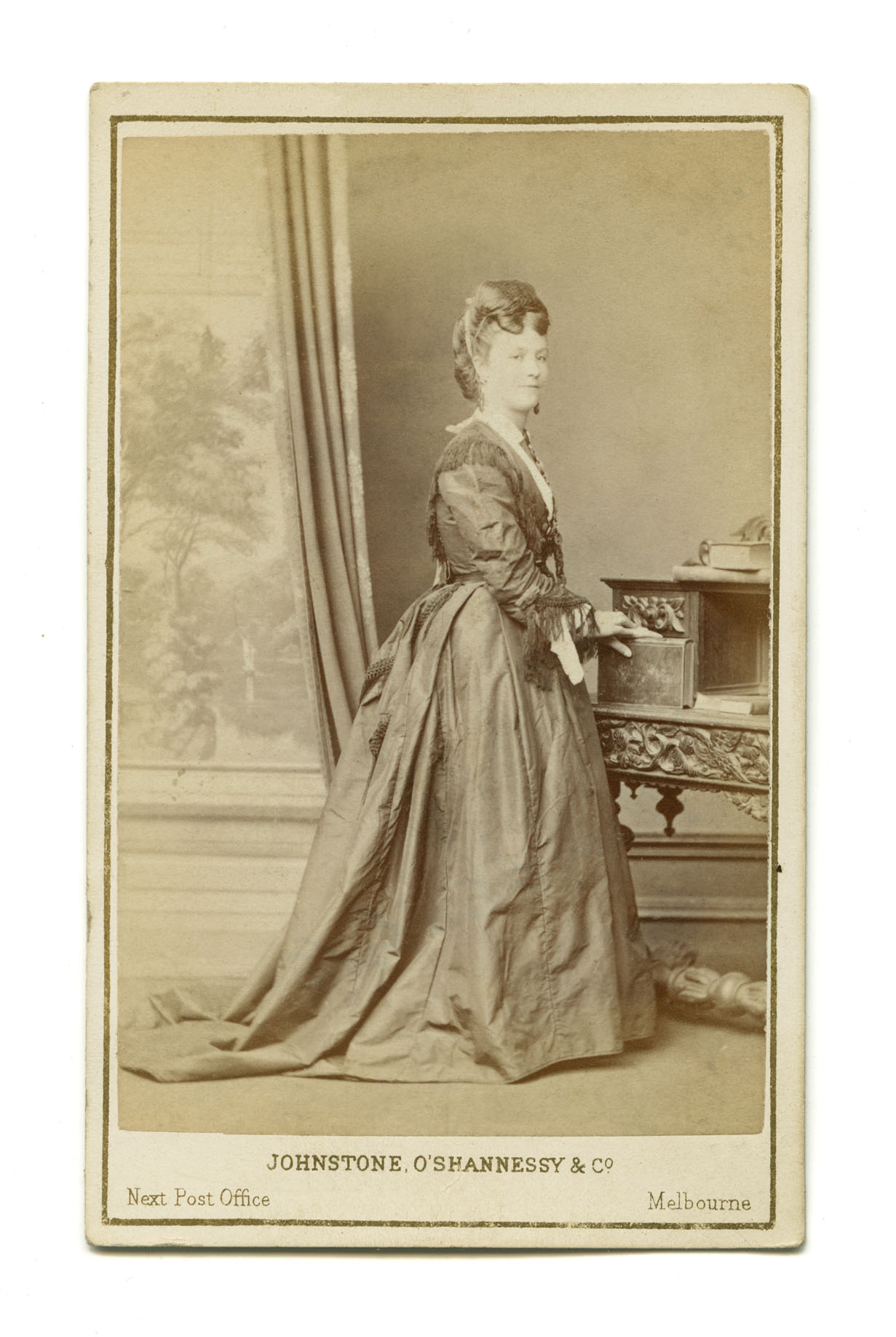
Johnstone, O'Shannessy & Co (active 1865-1905) 'Untitled (Standing woman)' 1865-1886 (recto)


Johnstone, O’Shannessy & Co (active 1865-1905)
Untitled (Standing woman) (recto)
1865-1886
Albumen silver print
Cartes-de-visite
11 x 7cm


Not dated but Johnstone, O’Shannessy & Co. worked from 3 Bourke St. East, Melbourne, 1865-1886. Ref.: Australians behind the camera, directory of early Australian photographers, 1841-1945 / Sandy Barrie, 2002.


Johnstone, O'Shannessy & Co (active 1865-1905) 'Untitled (Standing woman)' 1865-1886 (verso)


Johnstone, O’Shannessy & Co (active 1865-1905)
Untitled (Standing woman) (verso)
1865-1886
Albumen silver print
Cartes-de-visite
11 x 7cm


Charles Nettleton (Australian born England, 1826-1902) 'Untitled (Seated man)' c. 1867 - late 1880s (recto)


Charles Nettleton (Australian born England, 1826-1902)
Untitled (Seated man) (recto)
c. 1867 – late 1880s
Albumen silver print
Cartes-de-visite
11 x 7cm


This could be the same man as in the photograph by A. Archibald McDonald (Australian born Canada, c. 1831-1873) Untitled (Portrait of a man) at the top of the posting. Very similar hair, beard, eyes, countenance and gaze.


Charles Nettleton (Australian born England, 1826-1902) 'Untitled (Seated man)' c. 1867 - late 1880s (verso)


Charles Nettleton (Australian born England, 1826-1902)
Untitled (Seated man) (verso)
c. 1867 – late 1880s
Albumen silver print
Cartes-de-visite
11 x 7cm


When this portrait was taken, Nettleton’s business address was No. 1, Madeline St. North Melbourne where he remained from 1863 until the late 1880s, although he had three other studios in Melbourne, including an office in the Victoria Arcade, Bourke St (Kerr 1992: 568). This photograph has to be after 1867


Charles Nettleton (Australian born England, 1826-1902)

Charles Nettleton (1826-1902), photographer, was born in north England, son of George Nettleton. He arrived in Victoria in 1854 accompanied by his wife Emma, née Miles. In Melbourne he joined the studio of T. Duryea and Alexander McDonald and specialised in outdoor work. He carried his dark tent and equipment with him everywhere, a necessity in the days of the collodion process when plates had to be developed immediately after exposure. He became special photographer for the government and the Melbourne Corporation and is credited with having photographed the first Australian steam train when the private Melbourne-Sandridge (Port Melbourne) line was opened on 12 September 1854.

Nettleton systematically recorded Melbourne’s growth from a small town to a metropolis. Every major public work was photographed including the water and sewerage system, bridges and viaducts, roads, wharves, diversion of the River Yarra and construction of the Botanical Gardens. His public buildings include the Town Hall, Houses of Parliament, Treasury, Royal Mint, Law Courts and Post Office and he also photographed theatres, churches, schools, banks, hospitals and markets. His collection of ships includes photographs of the Cutty Sark, and the Shenandoah. He photographed the troops sent to the Maori war in 1860, the artillery camp at Sunbury in 1866 as well as contingents for the Sudan campaign and the Boxer rising. The sharp delineation of his pictures taken at six seconds exposure was a credit to his skill.

Nettleton visited the goldfields and country towns, photographed forests and fern glades, and rushed to disaster areas. In 1861 he boarded the Great Britain to take pictures of the first English cricket team to come to Australia. During the Victorian visit of the Duke of Edinburgh in 1867 he was appointed official photographer. He was police photographer for over twenty-five years and his portrait of Ned Kelly, of which one print is still extant, is claimed to be the only genuine photograph of the outlaw. Nettleton had opened his own studio in 1858. His souvenir albums were the first of the type to be offered to the public. However, when the dry-plate came into general use in 1885 he knew that the new process offered opportunities that were beyond his scope. Five years later his studio was closed. His work had won recognition abroad. His first success was at the London Exhibition of 1862 and in 1867 he was honoured in Paris. He was not a great artist but a master technician.

Nettleton was an active member of the Collingwood Lodge of Freemasons and a match-winning player of the West Melbourne Bowling Club. Aged 76 he died on 4 January 1902, survived by his wife, seven daughters and three sons.

Jean Gittins, “Nettleton, Charles (1826-1902),” on the Australian Dictionary of Biography website, National Centre of Biography, Australian National University, published first in hardcopy (Australian Dictionary of Biography, Volume 5, Melbourne University Press, 1974), accessed online 9 November 2021.


Charles Nettleton (Australian born England, 1826-1902) 'Untitled (Standing man)' c. 1860 - late 1880s (recto)


Charles Nettleton (Australian born England, 1826-1902)
Untitled (Standing man) (recto)
c. 1867 – late 1880s
Albumen silver print
Cartes-de-visite
11 x 7cm


Charles Nettleton (Australian born England, 1826-1902) 'Untitled (Standing man)' c. 1860 - late 1880s (verso)


Charles Nettleton (Australian born England, 1826-1902)
Untitled (Standing man) (verso)
c. 1867 – late 1880s
Albumen silver print
Cartes-de-visite
11 x 7cm


Unknown photographer. 'Untitled (Two brothers)' 1860s-1880s


Unknown photographer (Australian)
Untitled (two brothers)
1860s-1880s
Albumen silver print
Cartes-de-visite
11 x 7cm


Notice what looks like a photo album of cartes-de-visite on the table at left probably open at a photographic of their mother and father


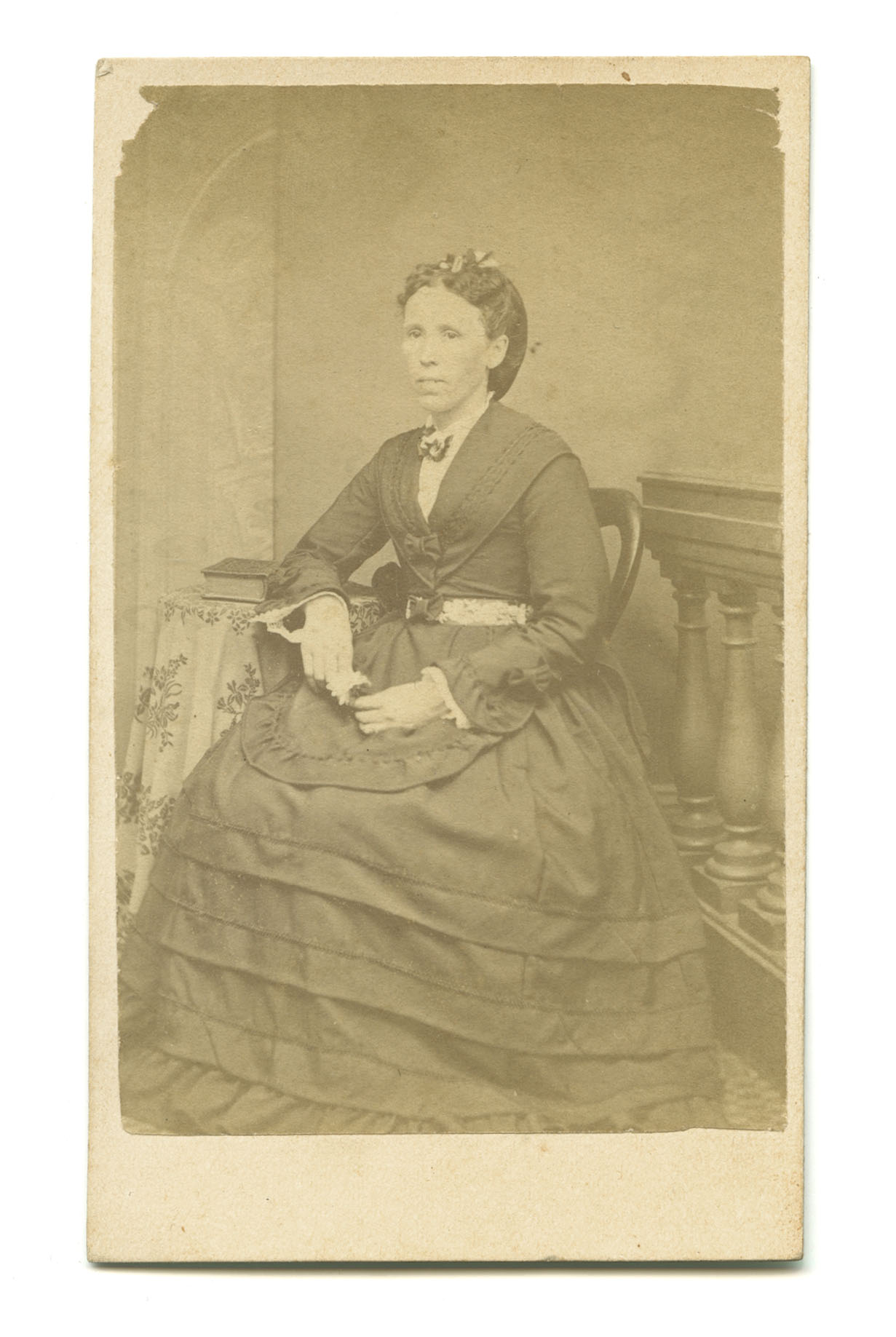
Unknown photographer. 'Untitled (Seated woman clasping hands)' 1860s-1880s


Unknown photographer (Australian)
Untitled (Seated woman with clasped hands)
1860s-1880s
Albumen silver print
Cartes-de-visite
11 x 7cm


Unknown photographer. 'Untitled (Seated woman)' 1860s-1880s


Unknown photographer (Australian)
Untitled (Seated woman)
1860s-1880s
Albumen silver print
Cartes-de-visite
11 x 7cm


Unknown photographer. 'Untitled (Standing man)' 1860s-1880s


Unknown photographer (Australian)
Untitled (Standing man)
1860s-1880s
Albumen silver print
Cartes-de-visite
11 x 7cm


Unknown photographer. 'Untitled (Young vagabond standing outdoors)' 1860s-1880s


Unknown photographer (Australian)
Untitled (Young vagabond standing outdoors)
1860s-1880s
Albumen silver print
Cartes-de-visite
11 x 7cm


Unknown photographer. 'Untitled (Young vagabond standing outdoors)' 1860s-1880s (detail)


Unknown photographer (Australian)
Untitled (Young vagabond standing outdoors) (detail)
1860s-1880s
Albumen silver print
Cartes-de-visite
11 x 7cm


Unknown photographer. 'Untitled (Seated woman)' 1860s-1880s


Unknown photographer (Australian)
Untitled (Seated woman)
1860s-1880s
Albumen silver print
Cartes-de-visite
11 x 7cm


Unknown photographer. 'Untitled (Standing man holding hat)' 1860s-1880s


Unknown photographer (Australian)
Untitled (Standing man holding hat)
1860s-1880s
Albumen silver print
Cartes-de-visite
11 x 7cm


Unknown photographer. 'Untitled (Standing man leaning on a pillar)' 1860s-1880s


Unknown photographer (Australian)
Untitled (Standing man leaning on a pillar)
1860s-1880s
Albumen silver print
Cartes-de-visite
11 x 7cm


Unknown photographer. 'Untitled (Mr and Mrs Ritchie)' 1868 (recto)


Unknown photographer (Australian)
Untitled (Mr and Mrs Ritchie) (recto)
1868
Albumen silver print
Cartes-de-visite
11 x 7cm


Unknown photographer. 'Untitled (Mr and Mrs Ritchie)' 1868 (verso)


Unknown photographer (Australian)
Untitled (Mr and Mrs Ritchie) (verso)
1868
Albumen silver print
Cartes-de-visite
11 x 7cm


“The likeness of Mrs Alex Ritchie.

In memory of Mrs Ritchie who died on Friday January 10th 1868. She was a child of God, loved by God & highly esteemed by all that knew her.

Her end was peace.

Sykes”


Unknown photographer. 'Untitled (Standing man with blue sash)' 1860s-1880s


Unknown photographer (Australian)
Untitled (Standing man with blue sash)
1860s-1880s
Albumen silver print with hand colouring
Cartes-de-visite
11 x 7cm


Unknown photographer. 'Untitled (Standing man)' 1860s-1880s


Unknown photographer (Australian)
Untitled (Standing man)
1860s-1880s
Albumen silver print
Cartes-de-visite
11 x 7cm


Unknown photographer. 'Untitled (Standing man in boots and spurs)' 1860s-1880s


Unknown photographer (Australian)
Untitled (Standing man in boots and spurs)
1860s-1880s
Albumen silver print with hand colouring
Cartes-de-visite
11 x 7cm


'Omnibuses timetable cartes-de-visite, Melbourne' February 1873 (recto)


'Omnibuses timetable cartes-de-visite, Melbourne' February 1873 (verso)


Omnibuses timetable, Melbourne
February 1873 (recto and verso)
Cartes-de-visite
11 x 7cm


Paterson Brothers (William and Archibald Paterson) 'Untitled (Standing man holding a hat) c. 1866 - c. 1869


Paterson Brothers (William and Archibald Paterson) (Australian, active c. 1858 – c. 1893)
Untitled (Standing man holding a hat)
c. 1866 – c. 1869 at 8 Bourke Street East, Melbourne, Vic
Albumen silver print
Cartes-de-visite
11 x 7cm


William Paterson was a professional photographer. He worked in Melbourne in partnership with his brother Archibald. At the 1866 Melbourne Intercolonial Exhibition, both of them were awarded an honourable mention for their ‘Untouched and Coloured Portraits and Photographic Views’.


Paterson Brothers (William and Archibald Paterson) 'Untitled (Standing man holding a hat) c. 1866 - c. 1869 (detail)


Paterson Brothers (William and Archibald Paterson) (Australian, active c. 1858 – c. 1893)
Untitled (Standing man holding a hat) (detail)
c. 1866 – c. 1869 at 8 Bourke Street East, Melbourne, Vic
Albumen silver print
Cartes-de-visite
11 x 7cm


Paterson Brothers (William and Archibald Paterson) 'Untitled (Standing man)' c. 1866 - c. 1869


Paterson Brothers (William and Archibald Paterson) (Australian, active c. 1858 – c. 1893)
Untitled (Standing man)
c. 1866 – c. 1869 at 8 Bourke Street East, Melbourne, Vic
Albumen silver print
Cartes-de-visite
11 x 7cm


Paterson Brothers (William and Archibald Paterson) 'Untitled (Standing man)' c. 1866 - c. 1869 (detail)


Paterson Brothers (William and Archibald Paterson) (Australian, active c. 1858 – c. 1893)
Untitled (Standing man) (detail)
c. 1866 – c. 1869 at 8 Bourke Street East, Melbourne, Vic
Albumen silver print
Cartes-de-visite
11 x 7cm


Paterson Brothers (William and Archibald Paterson) 'Untitled (Standing boy)' c. 1866 - c. 1869 (recto)


Paterson Brothers (William and Archibald Paterson) (Australian, active c. 1858 – c. 1893)
Untitled (Standing boy) (recto)
c. 1866 – c. 1869 at 8 Bourke Street East, Melbourne, Vic
Albumen silver print
Cartes-de-visite
11 x 7cm


Paterson Brothers (William and Archibald Paterson) 'Untitled (Standing boy)' c. 1866 - c. 1869 (verso)


Paterson Brothers (William and Archibald Paterson) (Australian, active c. 1858 – c. 1893)
Untitled (Standing boy) (verso)
c. 1866 – c. 1869 at 8 Bourke Street East, Melbourne, Vic
Albumen silver print
Cartes-de-visite
11 x 7cm


Paterson Brothers (William and Archibald Paterson) 'Untitled (Vignette of a man)' c. 1866 - c. 1869 (recto)


Paterson Brothers (William and Archibald Paterson) (Australian, active c. 1858 – c. 1893)
Untitled (Vignette of a man) (recto)
c. 1866 – c. 1869 at 8 Bourke Street East, Melbourne, Vic
Albumen silver print
Cartes-de-visite
11 x 7cm


Paterson Brothers (William and Archibald Paterson) 'Untitled (Vignette of a man)' c. 1866 - c. 1869 (verso)


Paterson Brothers (William and Archibald Paterson) (Australian, active c. 1858 – c. 1893)
Untitled (Vignette of a man) (verso)
c. 1866 – c. 1869 at 8 Bourke Street East, Melbourne, Vic
Albumen silver print
Cartes-de-visite
11 x 7cm


C. Rudd & Co (Australian) 'Untitled (Seated man)' c. 1872 (recto)


C. Rudd & Co (Australian)
Untitled (Seated man) (recto)
c. 1872
Albumen silver print
Cartes-de-visite
11 x 7cm


Undated, flourish dates for photographer at Chapel Street, South Yarra: circa 1872.


C. Rudd & Co (Australian) 'Untitled (Seated man)' c. 1872 (verso)


C. Rudd & Co (Australian)
Untitled (Seated man) (verso)
c. 1872
Albumen silver print
Cartes-de-visite
11 x 7cm


C. Rudd & Co (Australian) 'Untitled (Standing man)' c. 1872 (recto)


C. Rudd & Co (Australian)
Untitled (Standing man) (recto)
c. 1872
Albumen silver print
Cartes-de-visite
11 x 7cm


C. Rudd & Co (Australian) 'Untitled (Standing man)' c. 1872 (verso)


C. Rudd & Co (Australian)
Untitled (Standing man) (verso)
c. 1872
Albumen silver print
Cartes-de-visite
11 x 7cm


C. Rudd & Co (Australian) 'Untitled (Standing woman)' c. 1872 (recto)


C. Rudd & Co (Australian)
Untitled (Standing woman) (recto)
c. 1872
Albumen silver print
Cartes-de-visite
11 x 7cm


C. Rudd & Co (Australian) 'Untitled (Standing woman)' c. 1872 (verso)


C. Rudd & Co (Australian)
Untitled (Standing woman) (verso)
c. 1872
Albumen silver print
Cartes-de-visite
11 x 7cm


William H. Bardwell (Australian, 1836-1929) 'Untitled (Seated man)' c. 1880-1888 (recto)


William H. Bardwell (Australian, 1836-1929)
Untitled (Seated man)
c. 1880-1888
Albumen silver print
Cartes-de-visite
11 x 7cm


William Bardwell was a professional photographer and regular exhibitor who spent most of his working life in Ballarat, Victoria. Bardwell’s studio operated between 1875-1891. Flourish dates for Bardwell at 21 Collins Street East, Melbourne: 1880-1888.

According to Davies & Stanbury (The Mechanical Eye In Australia: Photography 1841-1900. Oxford University Press, 1985), Bardwell was active at his 21 Collins Street address – his first Melbourne studio – only from 1880, but the Design & Art Australia Online website suggests he had already relocated to Melbourne by the end of 1878.


Solomon & Bardwell (Australian, active c. 1859-1866? 1874?) 'Untitled (Mrs John Keys)' c. 1866 (recto)


Solomon & Bardwell (Australian, active c. 1859-1866? 1874?)
Untitled (Mrs John Keys) (recto)
c. 1866
Albumen silver print
Cartes-de-visite
11 x 7cm


Saul Solomon (Australian born England, 1836-1929)

Saul Solomon (1836-1929) had a studio in Main Road, Ballarat from 1857 to 1862, and worked in partnership with William Bardwell at 29 Sturt Street, Ballarat until 1874. Solomon and Bardwell also operated in Maryborough and Dunolly. From 1874 to 1891 Solomon operated under the name of the Adelaide School of Photography at 51 Rundle Street, Adelaide.

Saul Solomon was born on 15 January 1836 in Knightbridge, London. He was the son of well known dealer in photographic equipment, Joseph Solomon. He migrated to Victoria in 1852. He was in Ballarat in 1854 and in 1857 he set up a professional photography studio. In 1859 he was joined by William H. Bardwell (active, c.1858 – c.1889). He married Martha Patti at Balalrat on 13 October 1866. Two years later they moved to Adelaide.

William Bardwell (Australian, active c. 1858 – c. 1889)

Bardwell was a professional photographer and regular exhibitor who spent most of his working life in Ballarat, Vic.

He was a professional photographer, was employed in 1858 by Saul Solomon at Ballarat, Victoria providing photographs of the town which were lithographed by Francois Cogne (q.v.) for The Ballarat Album (1859). Solomon and Bardwell were soon partners; they worked in Main Street from 1859, in Sturt Street from 1865 and visited Maryborough and Dunolly (Victoria) in 1865. Together they exhibited photographic portraits at the 1862 Geelong Industrial Exhibition and the 1863 Ballarat Mechanics Institute Exhibition. Their ‘new sennotype process’ was judged ‘highly successful’ by the Illustrated Melbourne Post of 27 December 1862. On 9 February 1863, the Argus reported that Bardwell had photographed the ceremony of the laying of the foundation stone of the Burke and Wills memorial in Sturt Street from a vantage point on the roof of the Ballarat Post Office. By 28 September 1866 the partnership seems to have been dissolved for Bardwell was then advertising his Royal Photographic Studio in the Clunes Gazette: ‘The studio is every way replete with suitable accommodation for the preparation of toilet and rooms are provided for both ladies and gentlemen. Mr Bardwell’s long and practical example will entitle him to the claim to the first position in Ballarat as a photographer.’ He exhibited views and portraits, including Portrait of the Very Rev. Dean Hayes, at the 1869 Ballarat Institute Exhibition and showed photographs of Ballarat at the 1870 Sydney Intercolonial (for sale at £6). Other exhibited photographs included ‘a large panorama of the city of Ballarat, in a semi-circular form’, …

Text from the Trove website [Online] Cited 12/11/2021


William Bardwell was a professional photographer with a successful business in Ballarat and Melbourne. In Ballarat he formed a partnership with Saul Solomon in 1859 and together they exhibited photographic portraits at the 1862 Geelong Industrial Exhibition and the 1863 Ballarat Mechanics Institute Exhibition. It seems Bardwell was fond of using unusual vantage points: in 1863, the ‘Argus’ reported that he had photographed the ceremony of the laying of the foundation stone of the Burke and Wills memorial in Sturt Street from the roof of the Ballarat Post Office. ‘Bardwell established his own studio in 1866, which included rooms for ladies and gentlemen to prepare themselves for the lens’. He showed photographs of Ballarat at the 1870 Sydney Intercolonial exhibition (for sale at £6), and ‘a photographic panorama of the city of Ballarat’ as well as other photographs of its buildings and streets in the Victorian section of the London International Exhibition of 1873.

Text from the Art Gallery of New South Wales website [Online] Cited 12/11/2021


Solomon & Bardwell (Australian, active c. 1859-1866? 1874?) 'Untitled (Mrs John Keys)' c. 1866 (verso)


Solomon & Bardwell (Australian, active c. 1859-1866? 1874?)
Untitled (Mrs John Keys) (verso)
c. 1866
Albumen silver print
Cartes-de-visite
11 x 7cm


“In memory of Mrs John Keys who died in the year 1866. Her end was peace.”


Stewart & Co. 'Untitled (Oval of a gentleman) (recto)


Stewart & Co (Australian)
Untitled (Oval of a gentleman) (recto)
1881-1889
Albumen silver print
Cartes-de-visite
11 x 7cm


Flourish dates for Stewart & Co. at 217-219 Bourke Street East, Melbourne: 1881-1889

“… the upmarket city studio of Stewart & Co. ‘photographers, miniature and portrait painters’, which was located in the theatre district of Bourke Street east. The owner, Englishman Robert Stewart (1838-1912), was a professional photographer who relocated from Sydney to Melbourne in 1871.”


Stewart & Co. 'Untitled (Oval of a gentleman) (verso)


Stewart & Co (Australian)
Untitled (Oval of a gentleman) (verso)
1881-1889
Albumen silver print
Cartes-de-visite
11 x 7cm


Joseph Turner (Australian, active 1856- 1880s) 'Untitled (Standing woman)' c. 1866 (recto)


Joseph Turner (Australian, active 1856-1880s)
Untitled (Standing woman) (recto)
c. 1866
Albumen silver print
Cartes-de-visite
11 x 7cm


Not dated but Turner’s New Portrait Rooms were at Moorabool St., Geelong, Victoria, between 1865-1867. Ref.: Australians behind the camera, directory of early Australian photographers, 1841-1945 / Sandy Barrie, 2002.

The dates for Moorabool St., differ from the entry on Design & Art Australia Online below.


Joseph Turner (Australian)

Joseph Turner was a professional photographer, worked at 24 Great Ryrie Street, Geelong, Victoria, in late 1856. Turner’s New Portrait Rooms were at 60 (later 66) Moorabool Street in 1857-1867, then at Latrobe Terrace until 1869. In June 1856 Turner lectured at the Geelong Mechanics Institute on ‘The Art of Photography’, promoting its superior accuracy to painting. Basing his talk on the quasi-scientific sermons of the Scottish divine Dr Thomas Dick, published as The Practical Astronomer (1855), Turner argued that the minuteness of light particles was a testament to ‘the wisdom and beneficence of the creator’.

The photographs Turner showed at the 1857 Geelong Mechanics Institute Exhibition may have been ambrotypes as his surviving ambrotype of three children (National Gallery of Australia) is thought to date from about 1860. At the Melbourne Intercolonial Exhibition in 1866 he showed albumen paper prints of architectural and landscape views in Geelong, including ‘large sized photographs of the Chamber of Commerce and the Savings Bank, as well as the United Presbyterian Church, the Mechanics Institute, the Telegraphic and Post offices, the London Chartered Bank, the Town Hall, a well arranged view of Malop Street, and the Private residences of the town’s leading citizens’. Aware of the importance of the photographic portrait to his business, he also exhibited four frames of plain and coloured cartes-de-visite, including portraits of women where ‘the pose and the drapery was wonderfully managed’. Cartes of the mayor, alderman, councillors and officials of Geelong were arranged against a crimson background in one frame. His several enlarged portraits included one of Mr Morrison of the Geelong College. He won a medal for his tinted portraits and another for his architectural and landscape views.

Reviewing the photographic views at the exhibition in the Australian Monthly Magazine, ‘Sol’ commended Turner’s method of printing and presentation. ‘Vignetting portraits has long been a favourable occupation’, he noted, ‘and we have sometimes seen it applied to landscapes, but never in this particular way, and we certainly admire the exquisite finish it gives to the picture’. The Geelong press, on the other hand, admired Turner’s ‘business enterprise’ in using these views and portraits for local publicity when he set up ‘a miniature exhibition’ in his New Portrait Rooms before sending the photographs to the Melbourne Intercolonial Exhibition, particularly as he advertised it at precisely the time that J. Norton and L. Ormerod’s commissioned views were on display in the Geelong Town Hall.

His ability to make the most of an opportunity again surfaced the following year, on the occasion of the visit of the Duke of Edinburgh to Geelong. A pair of plates he took, showing the reception for the royal visitor on the Yarra Street wharf with the mayor welcoming the Duke and the town clerk reading the corporation’s address to his Royal Highness, appeared as engravings in the Illustrated London News soon afterwards.

On 9 October 1869 a large fire in Geelong destroyed five buildings in Moorabool Street, including Turner’s premises, and he disappeared from Geelong. [Gael] Newton notes that Joseph Turner, described as ‘an excellent photographer’, was appointed to the Melbourne Observatory on 10 February 1873 and remained there until 1883. Lunar photographs by Turner are held at the Mount Stromlo and Siding Springs Observatory (Australian Capital Territory) and at the Australian National Gallery. Other photographs are in the La Trobe Library and at Melbourne University.

Paul Fox. “Joseph Turner,” on the Design & Art Australia Online website 1992 updated 2011 [Online] Cited 12/11/2021


Joseph Turner (Australian, active 1856- 1880s) 'Untitled (Standing woman)' c. 1866 (verso)


Joseph Turner (Australian, active 1856- 1880s)
Untitled (Standing woman) (verso)
c. 1866
Albumen silver print
Cartes-de-visite
11 x 7cm


LIKE ART BLART ON FACEBOOK

Back to top

New website: Marcus Bunyan – celebrating 30 years of art practice in 2021

November 2021

Celebration!

Recent work


Marcus Bunyan (Australian, b. 1958) 'Untitled' from the series 'Resonance' 2021


Marcus Bunyan (Australian, b. 1958)
Untitled
2021
From the series Resonance


In 2021, I celebrate 30 years of art practice with the creation of a new website, the first to contain all my bodies of work since 1991 (note: more bodies of work still have to be added between 1996-1999).

My first solo exhibition was in a hair dressing salon in High Street, Prahran, Melbourne in 1991, during my second year of a Bachelor of Arts (Fine Art Photography) at RMIT University (formerly Phillip Institute out in Bundoora). Titled Of Magic, Music and Myth it featured black and white medium format photographs of the derelict Regent Theatre and the old Victorian Railway’s Newport Workshops.

The concerns that I had at the time in my art making have remained with me to this day: that is, an investigation into the boundaries between identity, space and environment. Music and “spirit” have always been an abiding influence – the intrinsic music of the world and the spirit of objects, nature, people and the cosmos … in a continuing exploration of spaces and places, using found images and digital and film cameras to record glances, meditations and movement through different environments.

30 years after I started I hope I have learnt a lot about image making … and a lot about myself. I also hope the early bodies of my work are still as valid now as they were when I made them. In the 30 years since I became an artist my concerns have remained constant but as well, my sense of exploration and joy at being creative remains undimmed and an abiding passion.

Now, with ego integrated and the marching of the years I just make art for myself, yes, but the best reason to make art is … for love and for the cosmos. For I believe any energy that we give out to the great beyond is recognised by spirit. Success is fleeting but making art gives energy to creation. We all return to the great beyond, eventually.

Dr Marcus Bunyan


Unknown photographer. 'Opening of Marcus Bunyan's exhibition 'The Naked Man Fears No Pickpockets' at The Photographers' Gallery and Workshop, Melbourne, 1993 showing at left (behind the crowd) the photograph 'Richmond Steps' 1993' 1993


Unknown photographer
Opening of Marcus Bunyan’s exhibition The Naked Man Fears No Pickpockets at The Photographers’ Gallery and Workshop, Melbourne, 1993 showing at left (behind the crowd) the photograph Richmond Steps 1993
1993
Polaroid


Ian Lobb (Australian, b. 1948) 'Marcus 31/8/92 Taken by Ian Lobb at Phillip [Institute]' 1992


Ian Lobb (Australian, b. 1948)
Marcus 31/8/92 Taken by Ian Lobb at Phillip [Institute]
1992
Polaroid


Jeff Whitehead (Australian) 'Marcus in his Fred Perry and Doc Martens with his Mamiya RZ67 on tripod with Pelican case on Jeff's car, Studley Park, Melbourne' 1991-1992


Jeff Whitehead (Australian)
Marcus in his Fred Perry and Doc Martens with his Mamiya RZ67 on tripod with Pelican case on Jeff’s car, Studley Park, Melbourne
1991-1992
Colour photograph


The only photograph of me with my camera 30 years ago!


Each photograph from a body of work in this posting (below) links to the body of work on my new website. Please click on the photographs to see the work.


Marcus Bunyan (Australian, b. 1958) 'Untitled' from the series 'Stones, Vaults, Flowers: Père Lachaise' 2017-2020


Marcus Bunyan (Australian, b. 1958)
Untitled
2017-2020
From the series Stones, Vaults, Flowers: Père Lachaise


Marcus Bunyan (Australian, b. 1958). 'Untitled' from the series 'A Day in the Tiergarten' 2019-2020


Marcus Bunyan (Australian, b. 1958)
Untitled
2019-2020
From the series A Day in the Tiergarten


Marcus Bunyan (Australian, b. 1958) ‘Untitled’ from the series ‘The Night Journey’ 2019


Marcus Bunyan (Australian, b. 1958)
Untitled
2019
From the series The Night Journey


Marcus Bunyan (English-Australian, b. 1958) 'Untitled' 2019 From the series 'Oblique'


Marcus Bunyan (Australian, b. 1958)
Untitled
2019
From the series Oblique


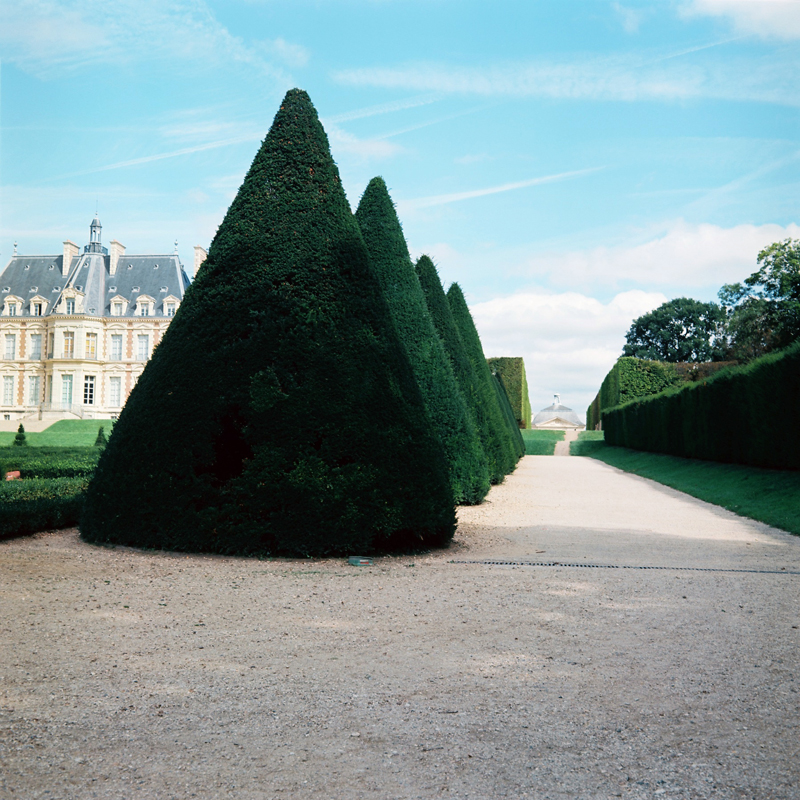
Marcus Bunyan (Australian, b. 1958) 'Parc de Sceaux' from the series 'Paris in film' 2018


Marcus Bunyan (Australian, b. 1958)
Parc de Sceaux
2018
From the series Paris in film


War dreams 2007-2017


Marcus Bunyan (Australian, b. 1958) 'Untitled' from the series 'The Shape of Dreams' 2013-2017


Marcus Bunyan (Australian, b. 1958)
Untitled
2013-2017
From the series The Shape of Dreams


Marcus Bunyan (Australian, b. 1958) 'Too Much of the Air' 2015


Marcus Bunyan (Australian, b. 1958)
Untitled
2015
From the series Too Much of the Air


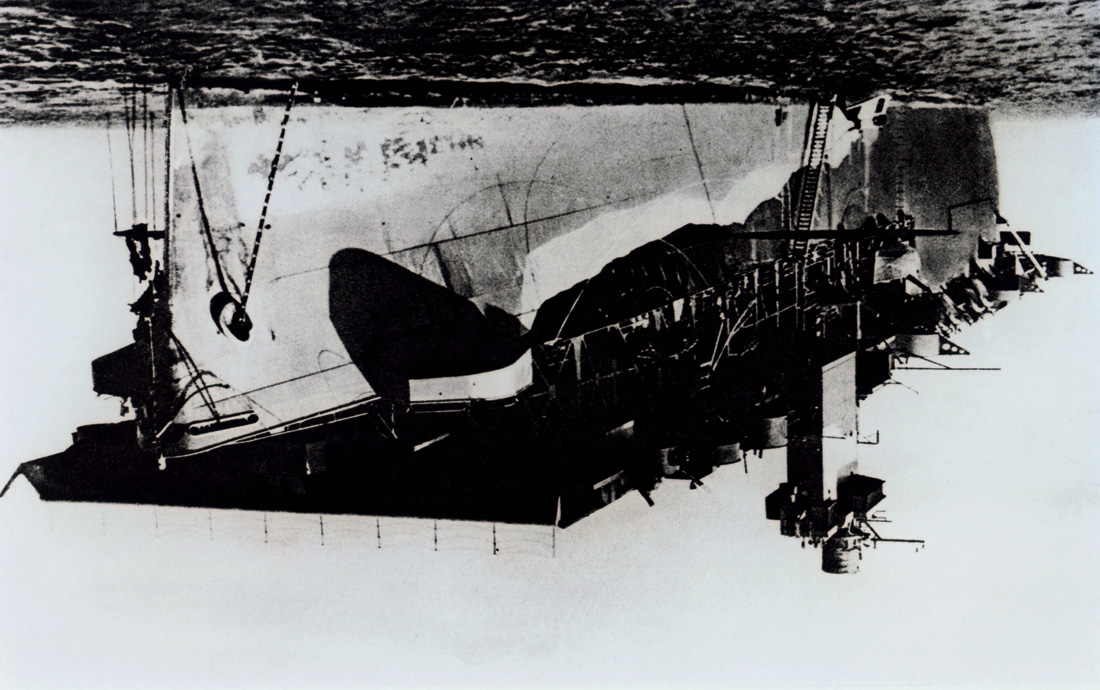
Marcus Bunyan (Australian, b. 1958) 'Untitled' from the series 'upside down' 2013


Marcus Bunyan (Australian, b. 1958)
Untitled
2013
From the series upside down


Marcus Bunyan (Australian, b. 1958) 'Untitled' from the series 'Vertical' 2011


Marcus Bunyan (Australian, b. 1958)
Untitled
2011
From the series Vertical


Marcus Bunyan (Australian, b. 1958) 'Untitled' from the series 'The Symbolic Order (cartes de visite)' 2011


Marcus Bunyan (Australian, b. 1958)
Untitled
2011
From the series The Symbolic Order (cartes de visite)


Marcus Bunyan (Australian, b. 1958) 'Untitled' from the series 'Missing in Action (red kenosis)' 2010


Marcus Bunyan (Australian, b. 1958)
Untitled
2010
From the series Missing in Action (red kenosis)


Marcus Bunyan (Australian, b. 1958) 'Missing in Action (dark kenosis) No. 68' 2010


Marcus Bunyan (Australian, b. 1958)
Untitled
2010
From the series Missing in Action (dark kenosis)


Marcus Bunyan (Australian, b. 1958) 'Missing in Action (horizontal kenosis) No. 17' 2010


Marcus Bunyan (Australian, b. 1958)
Untitled
2010
From the series Missing in Action (horizontal kenosis)


Marcus Bunyan (Australian, b. 1958) 'Untitled' from the series 'There But For The Grace of You Go I' 2009


Marcus Bunyan (Australian, b. 1958)
Untitled
2009
From the series There but for the Grace of You Go I


Marcus Bunyan (Australian, b. 1958) 'Untitled' from the series 'The Shape of Dreams' 2009


Marcus Bunyan (Australian, b. 1958)
Untitled
2009
From the series The Shape of Dreams


Marcus Bunyan (Australian, b. 1958) 'Untitled' from the series 'Momentum' 2009


Marcus Bunyan (Australian, b. 1958)
Untitled
2009
From the series Momentum


Marcus Bunyan (Australian, b. 1958) 'Untitled' from the series 'Cut and Thrust' 2008


Marcus Bunyan (Australian, b. 1958)
Untitled
2008
From the series Cut and Thrust


Marcus Bunyan (Australian, b. 1958) 'Untitled' from the series 'Drone' 2007


Marcus Bunyan (Australian, b. 1958)
Untitled
2007
From the series Drone


Marcus Bunyan (Australian, b. 1958) 'Untitled' from the series 'Nebula' 2007


Marcus Bunyan (Australian, b. 1958)
Untitled
2007
From the series Nebula


Transformations 1996-2008


Marcus Bunyan (Australian, b. 1958) 'Untitled' from the series 'Discarded Views' 2008


Marcus Bunyan (Australian, b. 1958)
Untitled
2008
From the series Discarded Views


Marcus Bunyan (Australian, b. 1958) 'Untitled' from the series 'Last Stand' 2008


Marcus Bunyan (Australian, b. 1958)
Untitled
2008
From the series Last Stand


Marcus Bunyan (Australian, b. 1958) 'Untitled' from the series 'Wonders Never Cease' 2007


Marcus Bunyan (Australian, b. 1958)
Untitled
2007
From the series Wonders Never Cease


Marcus Bunyan (Australian, b. 1958) 'Untitled' from the series 'Unearth' 2007


Marcus Bunyan (Australian, b. 1958)
Untitled
2007
From the series Unearth


Marcus Bunyan (Australian, b. 1958) 'Untitled' from the series 'Aporia' 2006


Marcus Bunyan (Australian, b. 1958)
Untitled
2006
From the series Aporia


Marcus Bunyan (Australian, b. 1958) 'Untitled' from the series 'Photos My Mother Sent Me' 2005


Marcus Bunyan (Australian, b. 1958)
Untitled
2005
From the series Photos My Mother Sent Me


Marcus Bunyan (Australian, b. 1958) 'Untitled' from the series 'No Man's Land' 2005


Marcus Bunyan (Australian, b. 1958)
Untitled
2005
From the series No Man’s Land


Marcus Bunyan (Australian, b. 1958) 'Untitled' from the series 'Tokern' 2005


Marcus Bunyan (Australian, b. 1958)
Untitled
2005
From the series Tokern


Marcus Bunyan (Australian, b. 1958) 'Untitled' from the series 'Inurtia' 2005


Marcus Bunyan (Australian, b. 1958)
Untitled
2005
From the series Inurtia


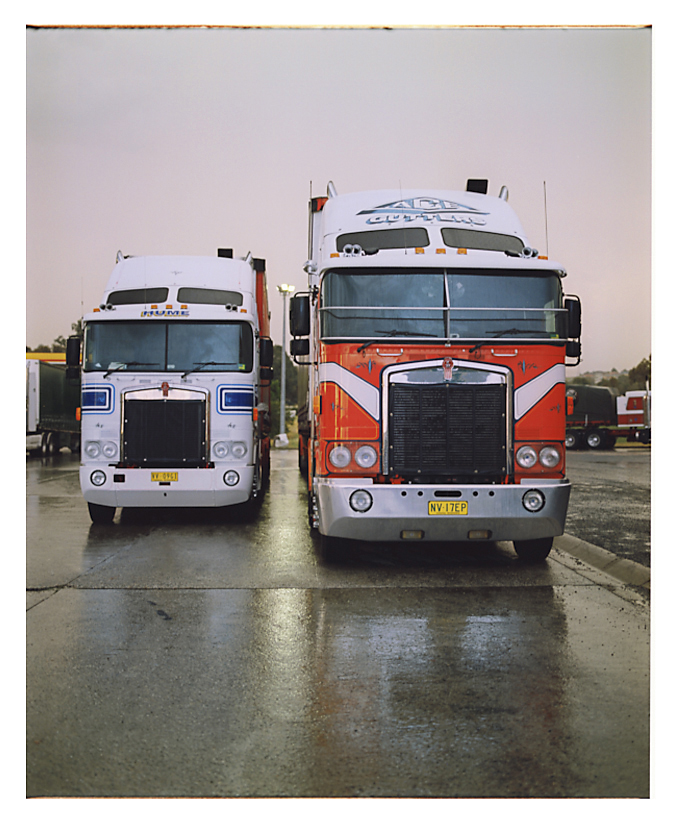
Marcus Bunyan (Australian, b. 1958) 'VV – 09GI and NV – 17EP during a thunderstorm, Albury' from the series 'Enclosure' 2005


Marcus Bunyan (Australian, b. 1958)
VV – 09GI and NV – 17EP during a thunderstorm, Albury
2005
From the series Enclosure


Marcus Bunyan (Australian, b. 1958) 'Bedtime' from the series 'Neo_mort' 2004


Marcus Bunyan (Australian, b. 1958)
Bedtime
2004
From the series Neo_mort


Marcus Bunyan (Australian, b. 1958) 'Untitled' from the series 'Desideratum' 2003


Marcus Bunyan (Australian, b. 1958)
Untitled
2003
From the series Desideratum


Marcus Bunyan (Australian, b. 1958) 'Untitled' from the series 'Last Days at Karngara' 2002


Marcus Bunyan (Australian, b. 1958)
Untitled
2002
From the series Last Days at Karngara


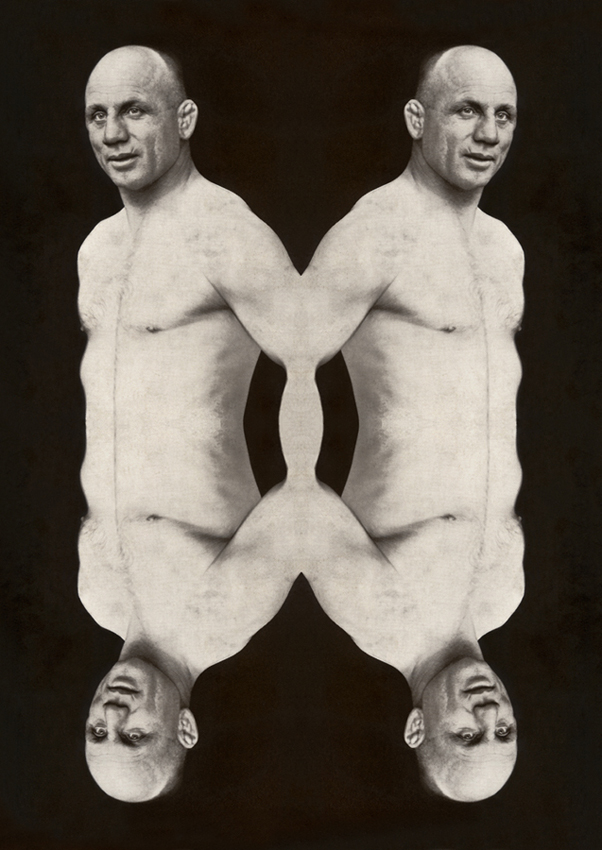
Marcus Bunyan (Australian, b. 1958) 'Untitled' from the series 'The Wrestlers' 2001


Marcus Bunyan (Australian, b. 1958)
Untitled
2001
From the series The Wrestlers


Marcus Bunyan (Australian, b. 1958)
Button 2B
2001
From the series D O < R >


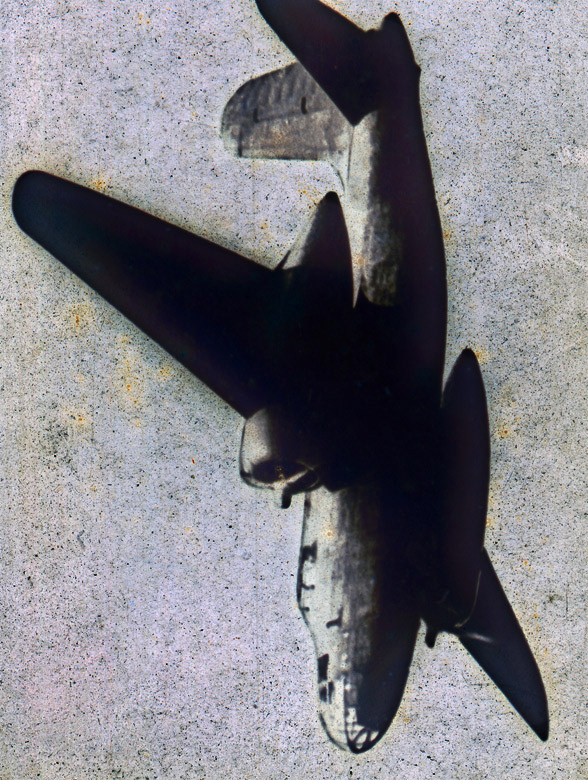
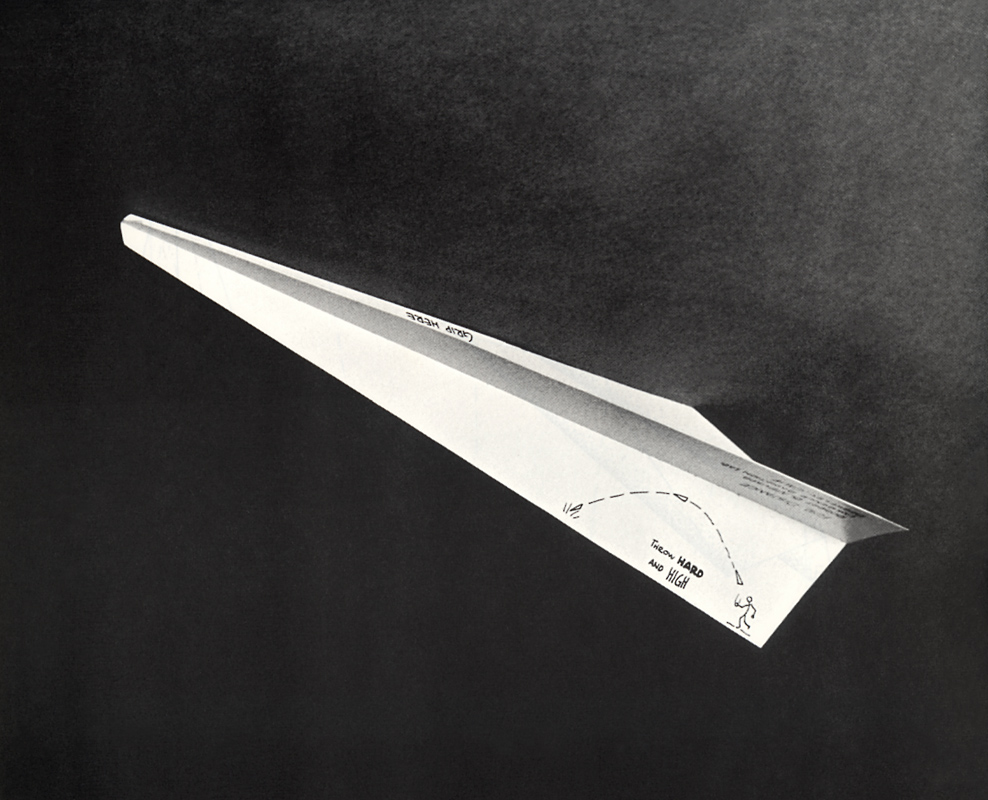
Marcus Bunyan (Australian, b. 1958) 'Plane 6' from the series 'Throw High and Hard' 2001


Marcus Bunyan (Australian, b. 1958)
Plane 6
2001
From the series Throw High and Hard


Marcus Bunyan (Australian, b. 1958) 'Untitled' 2000 From the series 'Thirdspace'


Marcus Bunyan (Australian, b. 1958)
Untitled
2000
From the series Thirdspace


Black and white archive 1991-1997

PLEASE VIEW THE BLACK AND WHITE ARCHIVE POSTINGS


Marcus Bunyan black and white archive 1991-1997

PLEASE VIEW THE BLACK AND WHITE ARCHIVE POSTINGS


Marcus Bunyan website

LIKE ART BLART ON FACEBOOK

Back to top

Photo album: ‘John “Jack” Riverstone Faviell (1892-1960), 1922-1933’ Part 1

July 2021

Warning: Aboriginal and Torres Strait Islander readers should be aware that this posting contains images and names of people who may have since passed away.


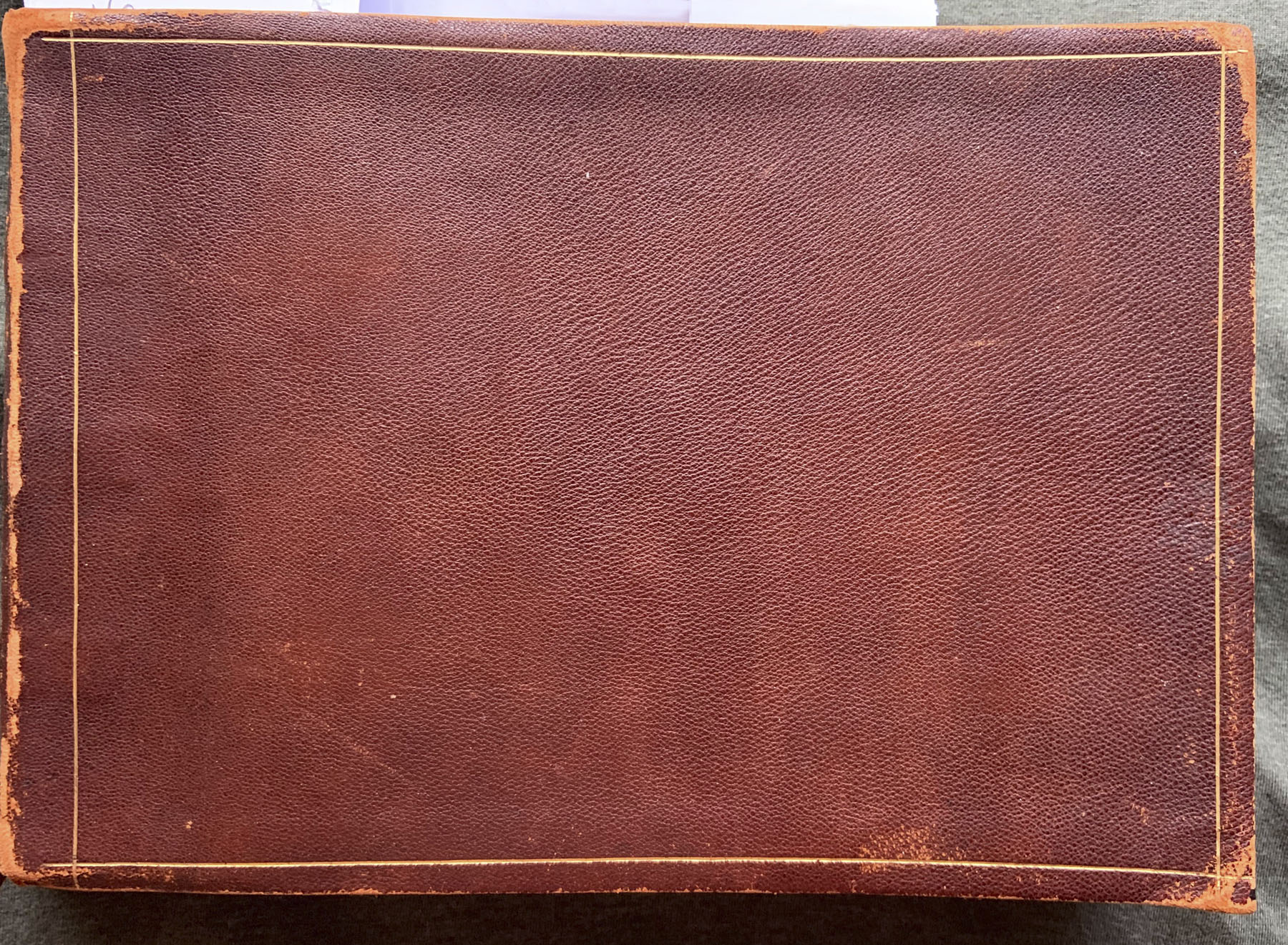
John "Jack" Riverstone Faviell (1892-1960), 1922-1933 photo album front cover


John “Jack” Riverstone Faviell 1922-1933 photo album front cover


Discovered in an op shop (charity shop in America), this is the most historically important and exciting Australian photo album that I have ever found.

Belonging to John “Jack” Riverston Faviell, a senior New South Wales public accountant and featuring his photographs, the album ranges across the spectrum of Australian life and culture from the East to the West of the continent in the years 1922-1933. A list of locations and topics can be seen below.

I undertake a fuller analysis of the album in Part 2 of the posting in an essay titled Golden splendour: privilege, ceremony and racism in 1920s-1930s Australia (2023), the second part of the posting containing previously unpublished photographs of the opening of the Sydney Harbour Bridge.

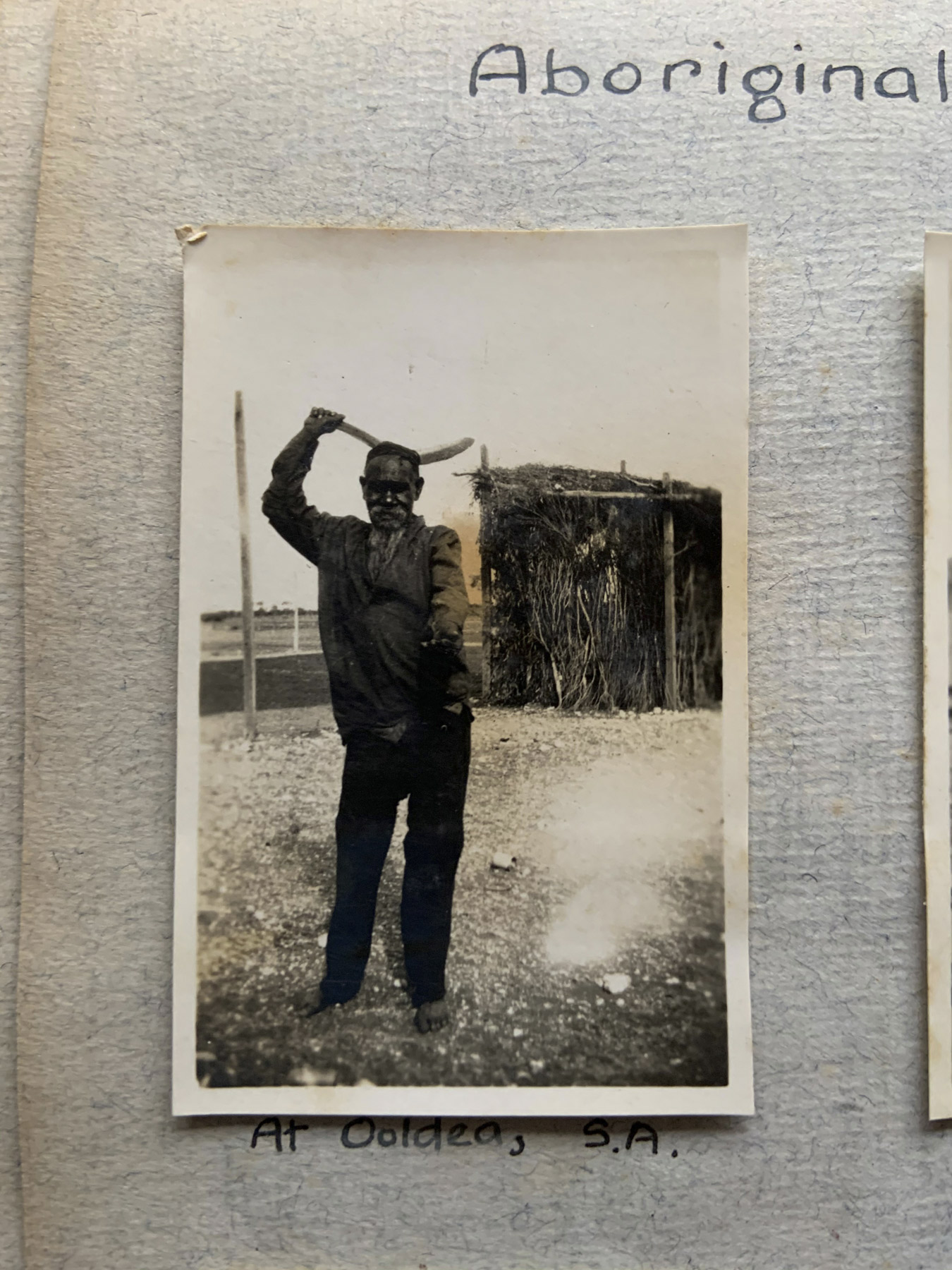
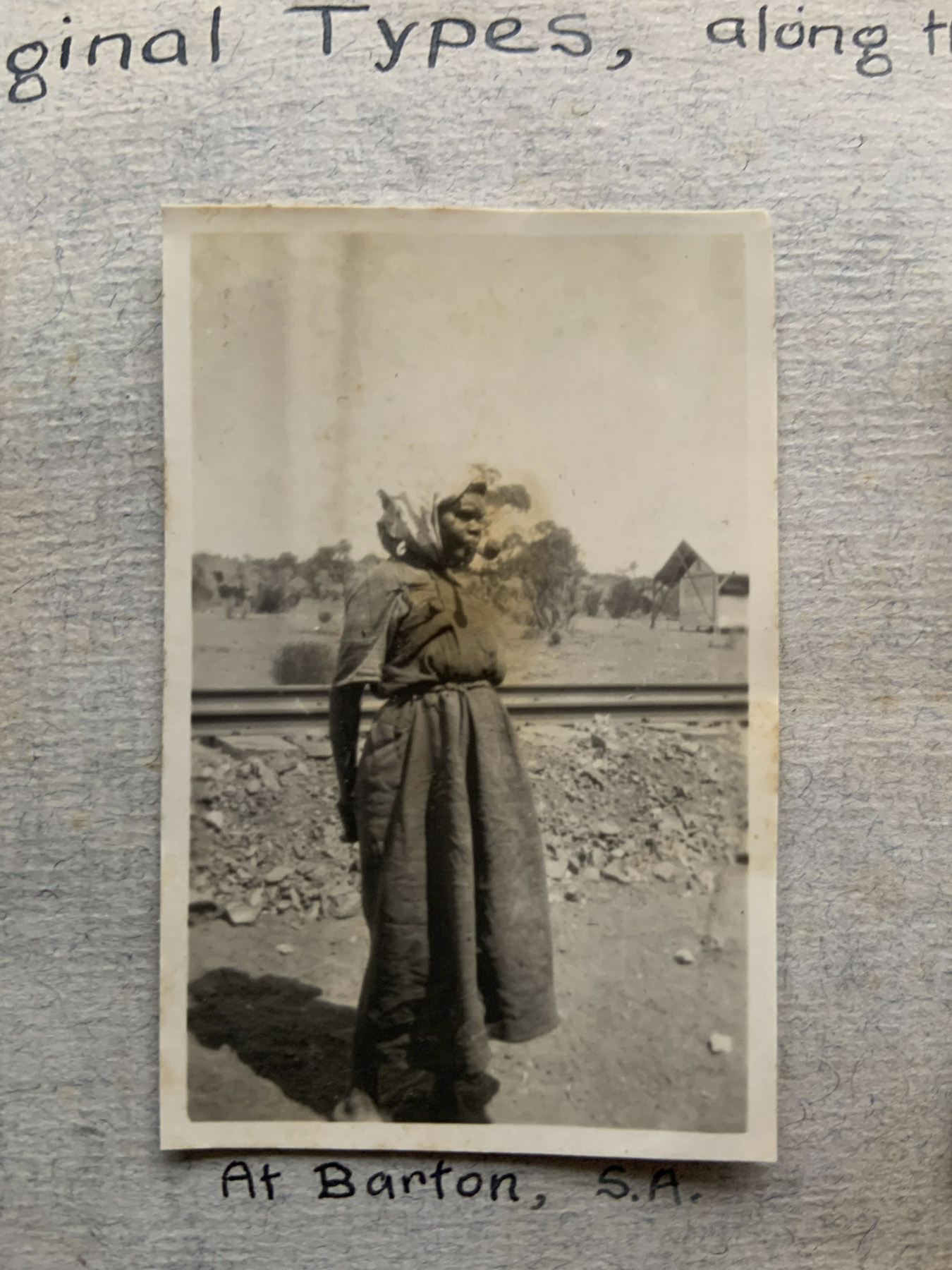
In this posting there are some important photographs of “Aboriginal Types, along the Trans-Australian Railway” and “Australian Desert Blacks.” The Indigenous Australians had come to trade boomerangs and spears in return for money and clothing. According to the excellent book Bitter Fruit: Australian photographs to 1963 by Michael Graham-Stewart and Francis McWhannell, after the completion of the continental railway in 1917,

“The Railway provided a source of income for Aboriginal people, much to the ire of the Chief Protector  of Aborigines in Western Australia, A. O. Neville, to whom the slightest hint of autonomy was anathema. There was some begging (Neville was convinced that children were being ‘bred’ for the purpose), but also a system of charging for photographs. Boomerang and spear demonstrations were given, and artefacts were souvenired.

The most important stop on the line was Ooldea. This was situated six kilometres south of Ooldea Soak, one of the few places in the region with permanent water. The site had long been of great ceremonial and social significance for Aboriginal people, a fact attested by the profusion of stone artefacts in the area… It was a junction of migratory routes, a centre for exchange, and a refuge in times of drought.”1


As Episode 1 of the series ‘Australia in Colour’ states of similar home movie images, “these photographs offer an unfiltered glimpse into a world seldom seen.”2

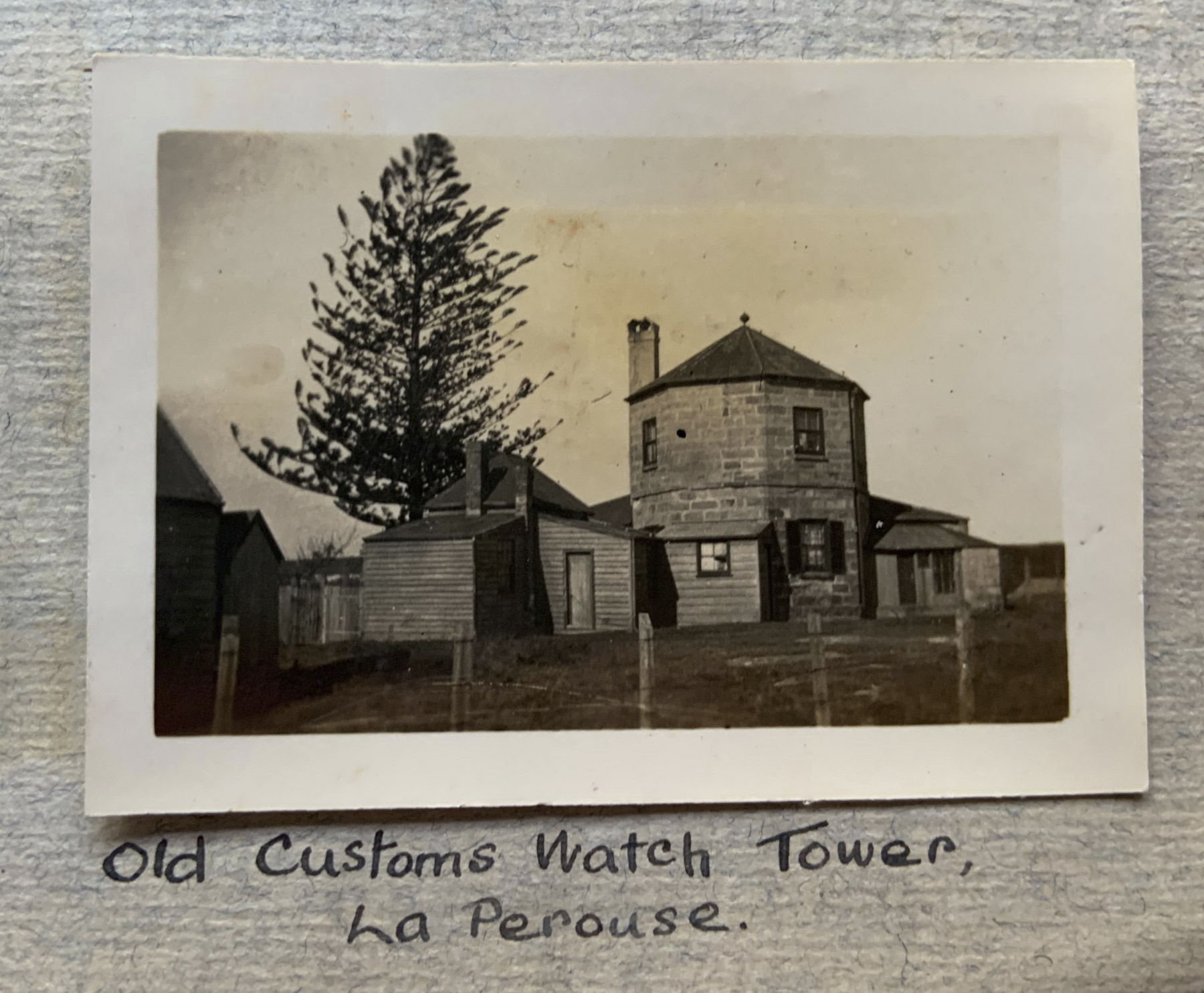
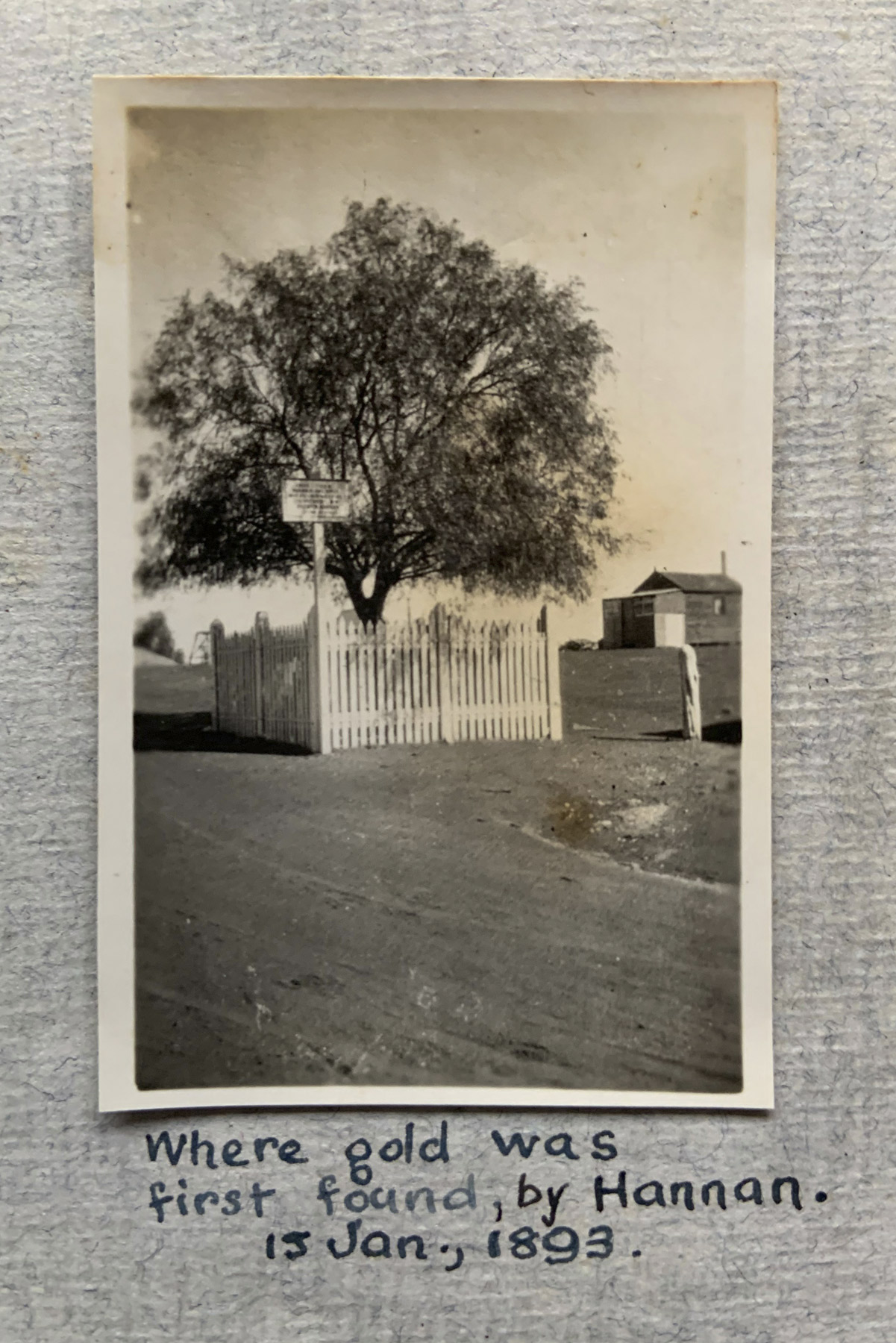
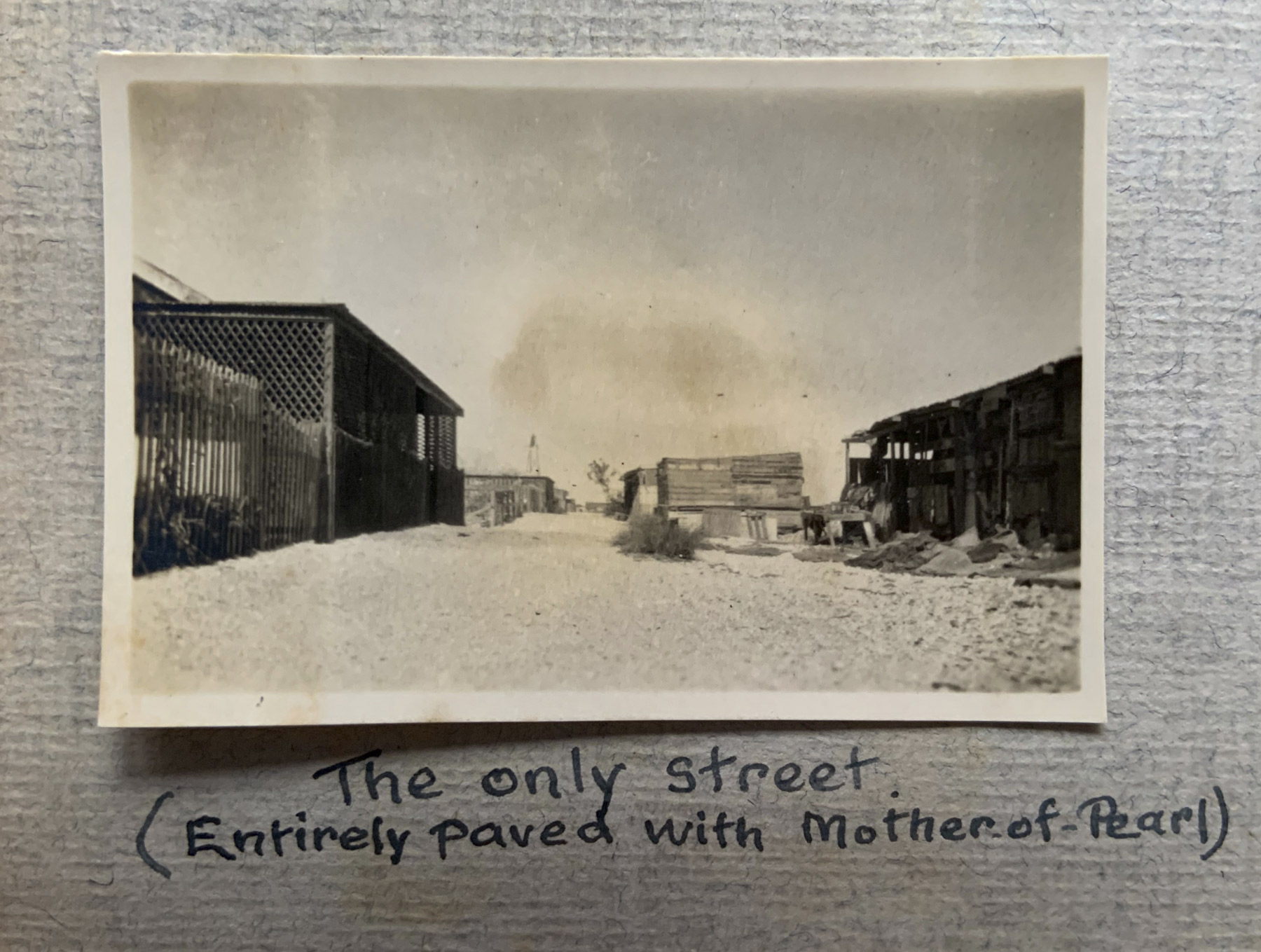
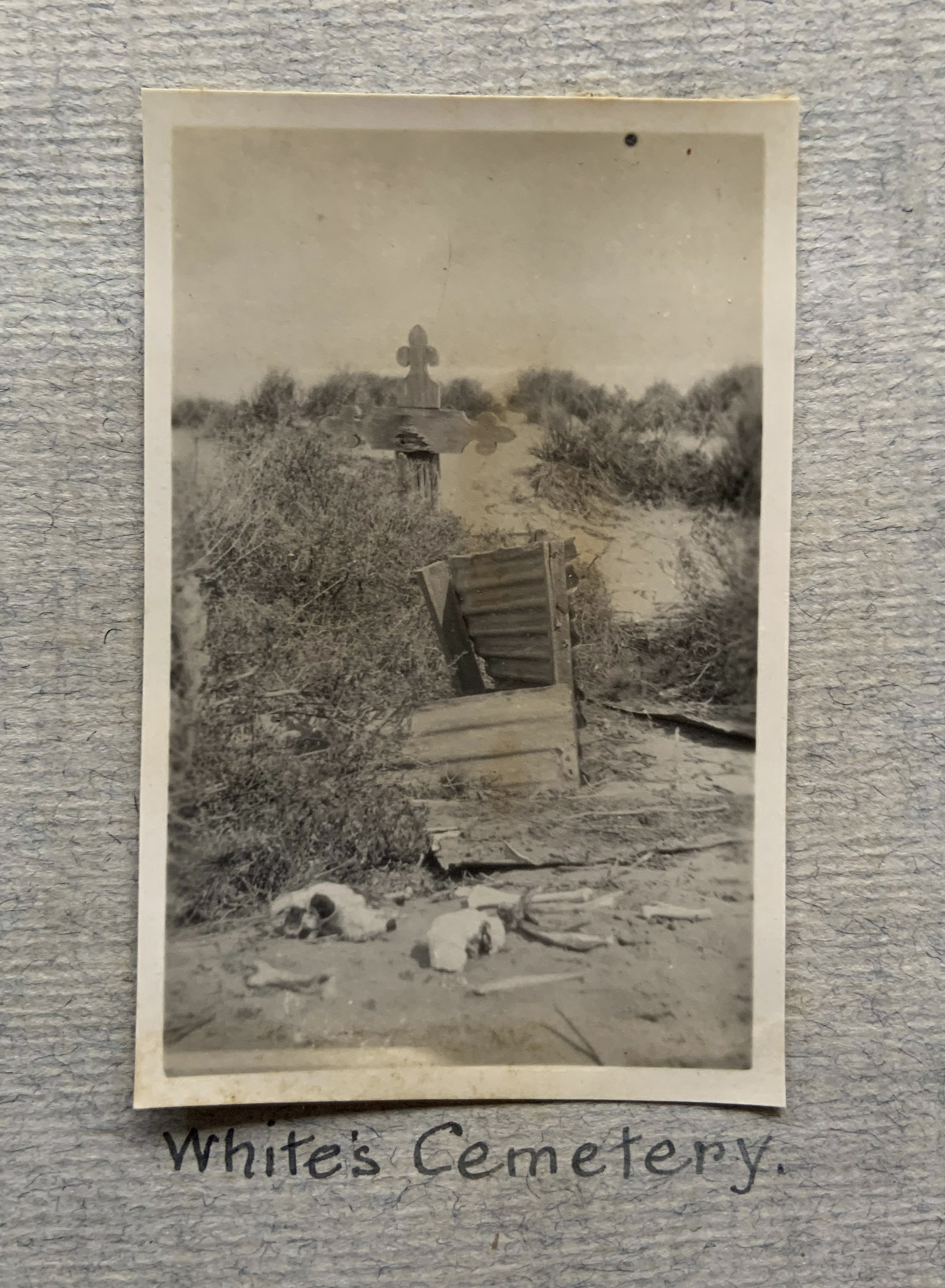
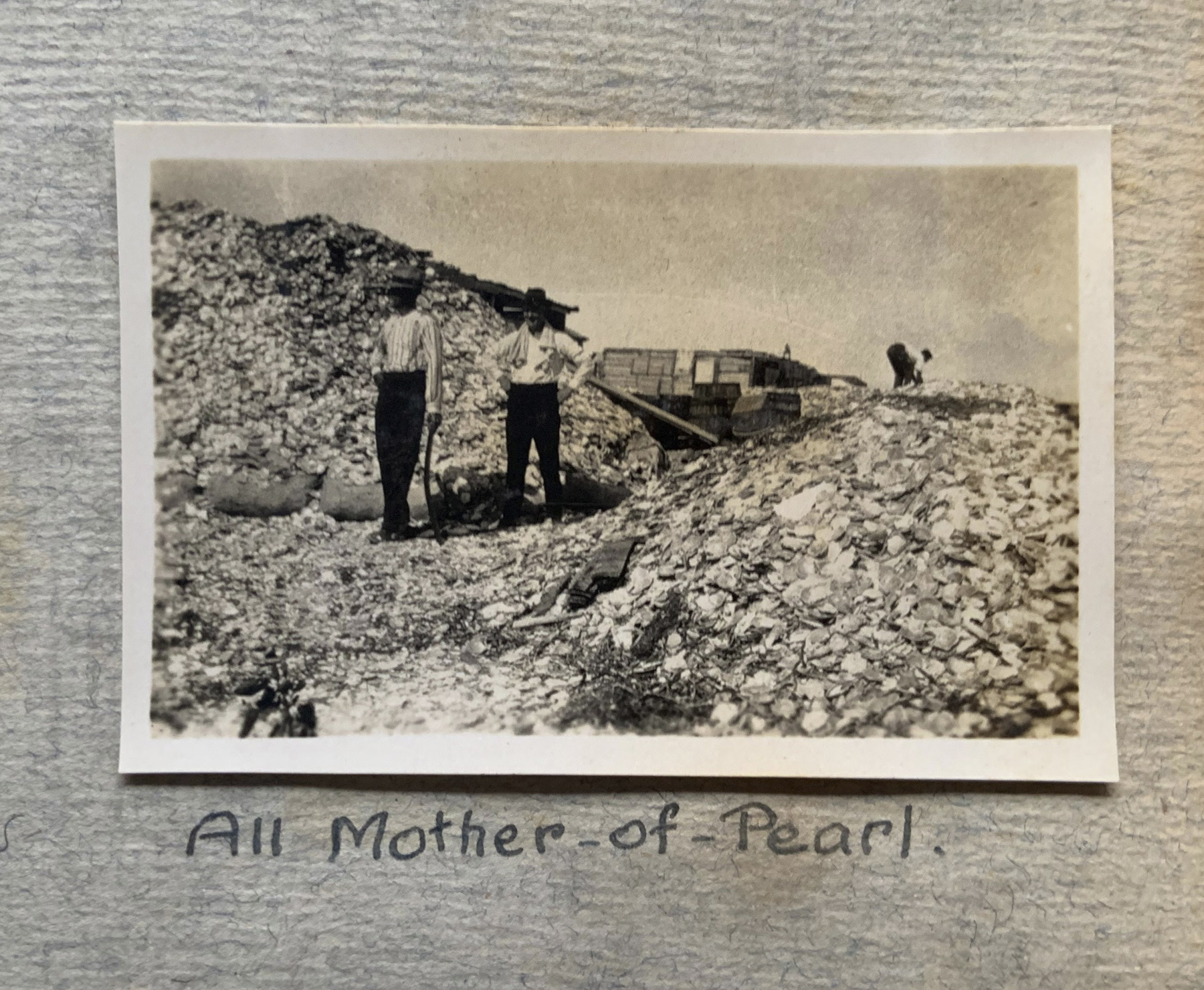
Other fascinating images in this posting include the grave of bushranger John Dunn; the Macquarie Watchtower in La Perouse; the goldfields and mines of Kalgoorlie and “Boulder City” in Western Australia; the oldest inhabitant of Geraldton, W.A.; Fremantle prison; and pearling in Shark’s Bay, W.A. including two photographs – one of the dilapidated “White’s Cemetery” with single cross and bones and the other a “Grave in the Niggers Cemetery” with nothing but a mound of earth and some dead branches. Other photographs offer casual racism as a matter of course in their titles.

Dr Marcus Bunyan

PS. This album is now in the State Library of New South Wales collection, given its importance in documenting through photographs regional NSW, Indigenous Australians and the opening of the Sydney Harbour Bridge. See Part 2 of the posting for these previously unseen images of the opening of the bridge.


Footnotes

1/ Michael Graham-Stewart and Francis McWhannell. Bitter Fruit: Australian photographs to 1963. Michael Graham-Stewart, 2017, p. 66.

2/ Episode 1 Season 1: “Outpost Of Empire”: This episode charts the story of the nation from 1897 to 1929 as agriculture transforms the land. ‘Australia in Colour’ is the history of Australia told via a unique collection of cinematic moments brought to life for the first time in stunning colour. It tells the story of how Australia came to be the nation it is today. Narrated by Hugo Weaving, it’s a reflection on our nation’s character, its attitudes, its politics, and its struggle to value its Indigenous and multicultural past. ‘Australia in Colour’ gives us a chance to relive history from a fresh perspective.


Grateful thankx to Douglas Stewart Fine Books for their research help with this photo album. Please click on the photographs for a larger version of the image.


“Biscuits and cake and fruit were thrown to them from the train windows, while their boomerangs and native weapons, and their importance in the landscape as subjects for photography, brought many a shilling and sixpence for them to spend.”


Daisy Bates, The Passing of the Aborigines quoted in Bitter Fruit: Australian photographs to 1963.1


“John “Jack” Riverston Faviell, was a senior NSW public accountant. Originally from Colinroobie, near Narrandera in NSW, he married Melanie Audrey Pickburn (daughter of Judge Pickburn) in a society wedding at St James’ Church, Sydney, in February 1925. He built no. 20 Yarranabbe Rd, Darling Point as their first married home but he divorced Audrey in October 1930. He would later remarry in 1934, as would Audrey.”


Jon Dickson. Douglas Stewart Fine Books


Locations

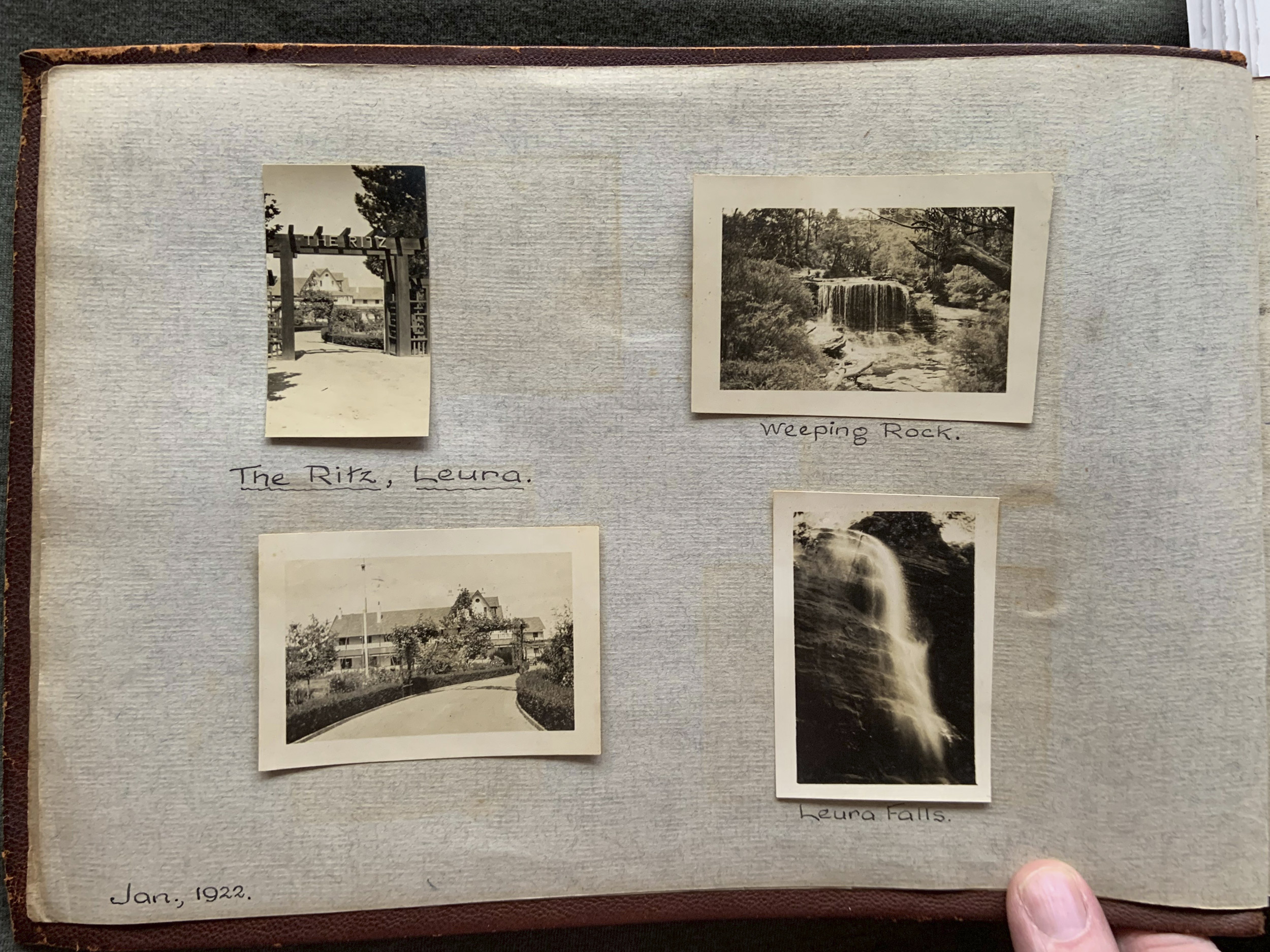
Blue Mountains, NSW (1922)
Leura Falls, NSW (1922)
Weeping Rock, Wentworth Falls, NSW (1922)
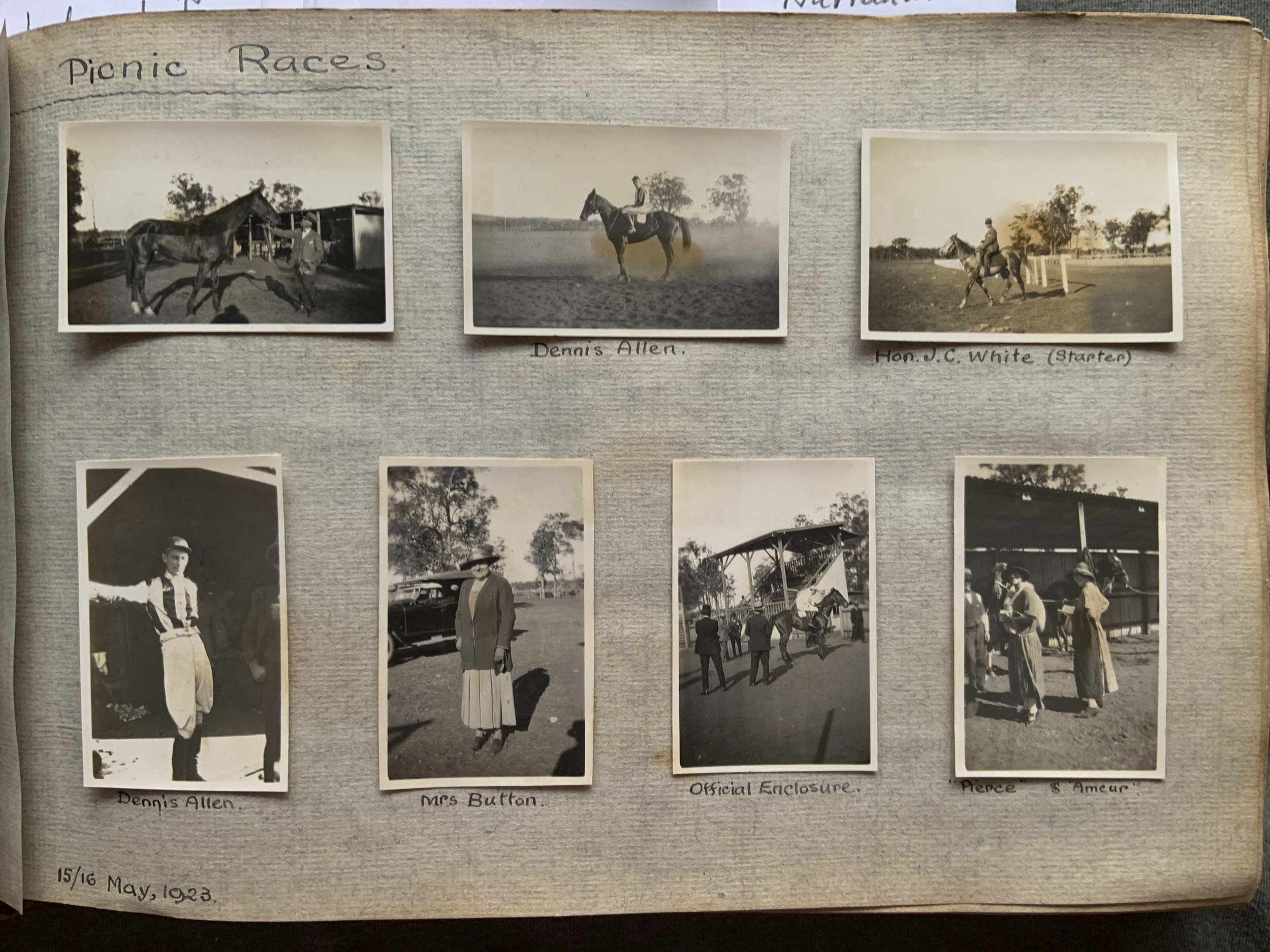
Tarana Picnic Races, NSW (1922)
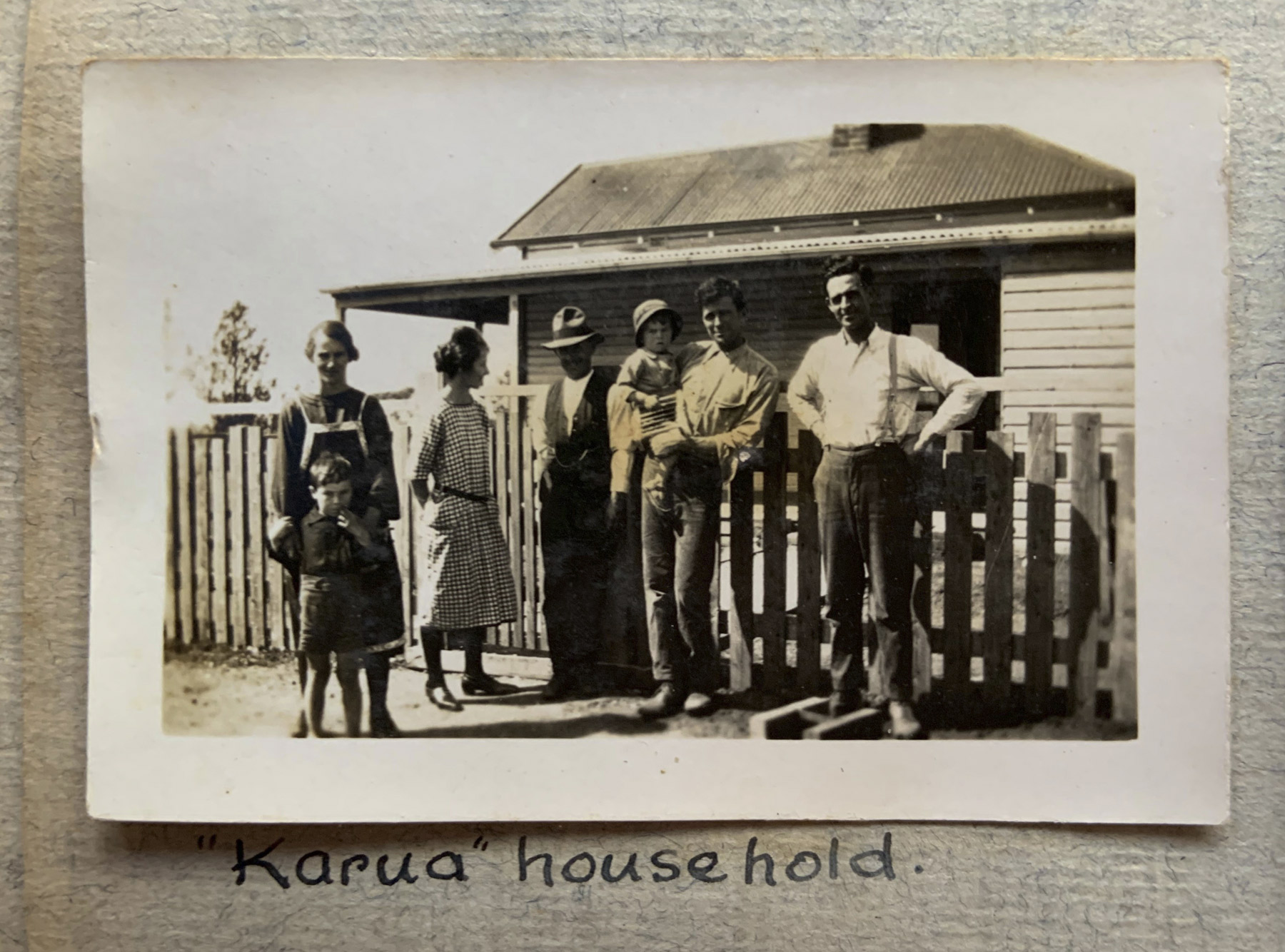
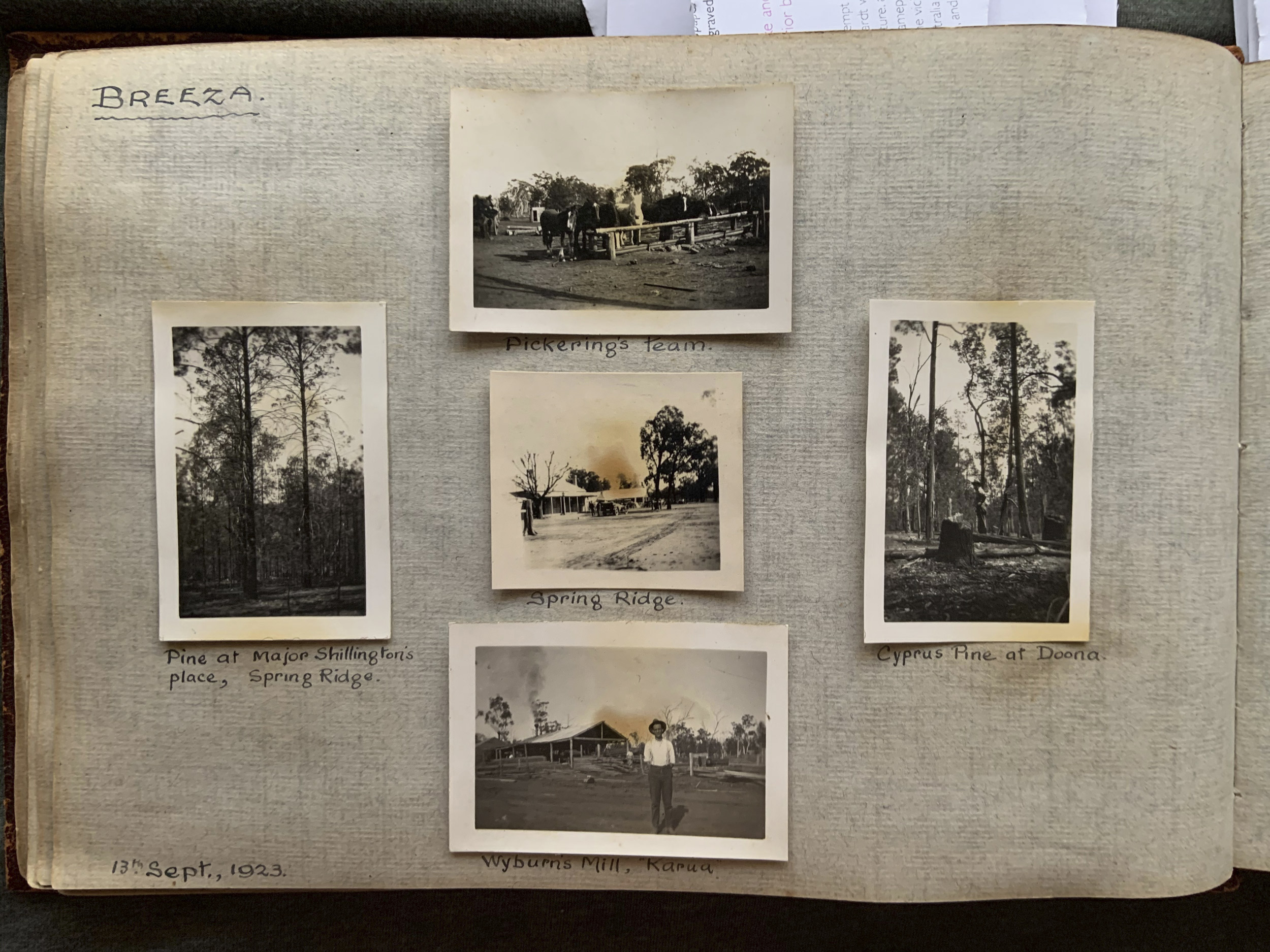
Doona, Breeza, NSW (1922)
Avoca, NSW (1922)
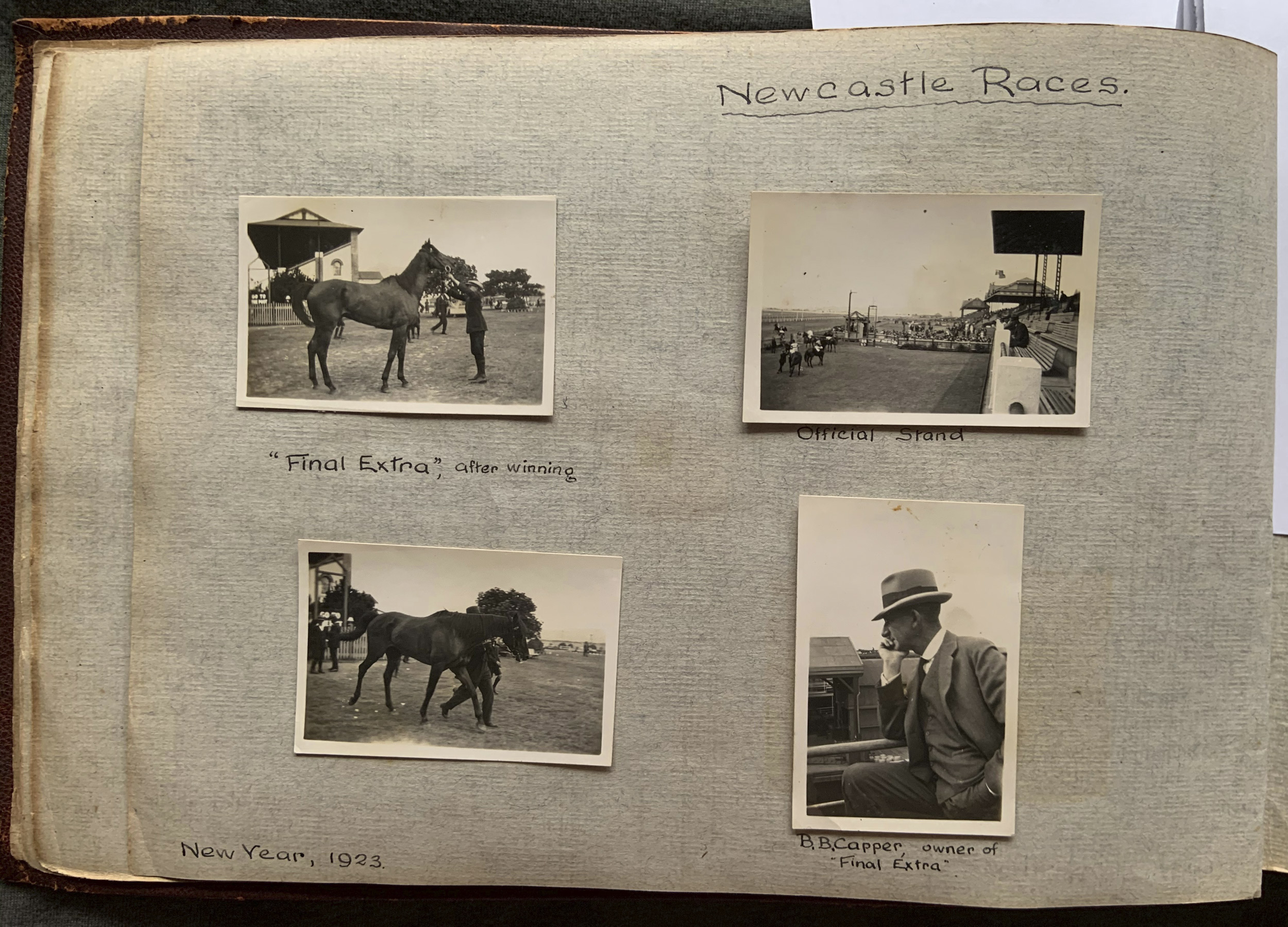
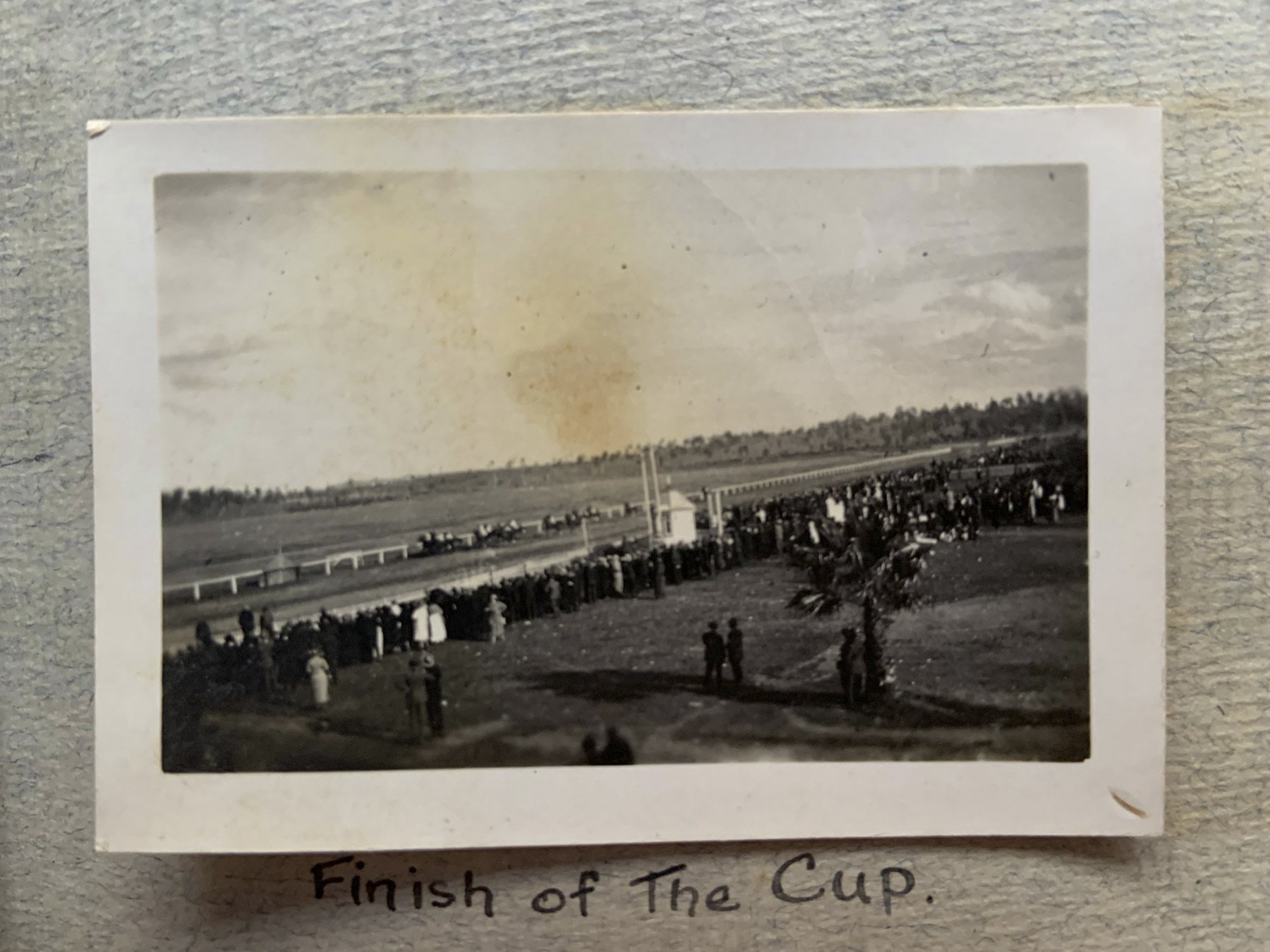
Newcastle Races, NSW (1923)
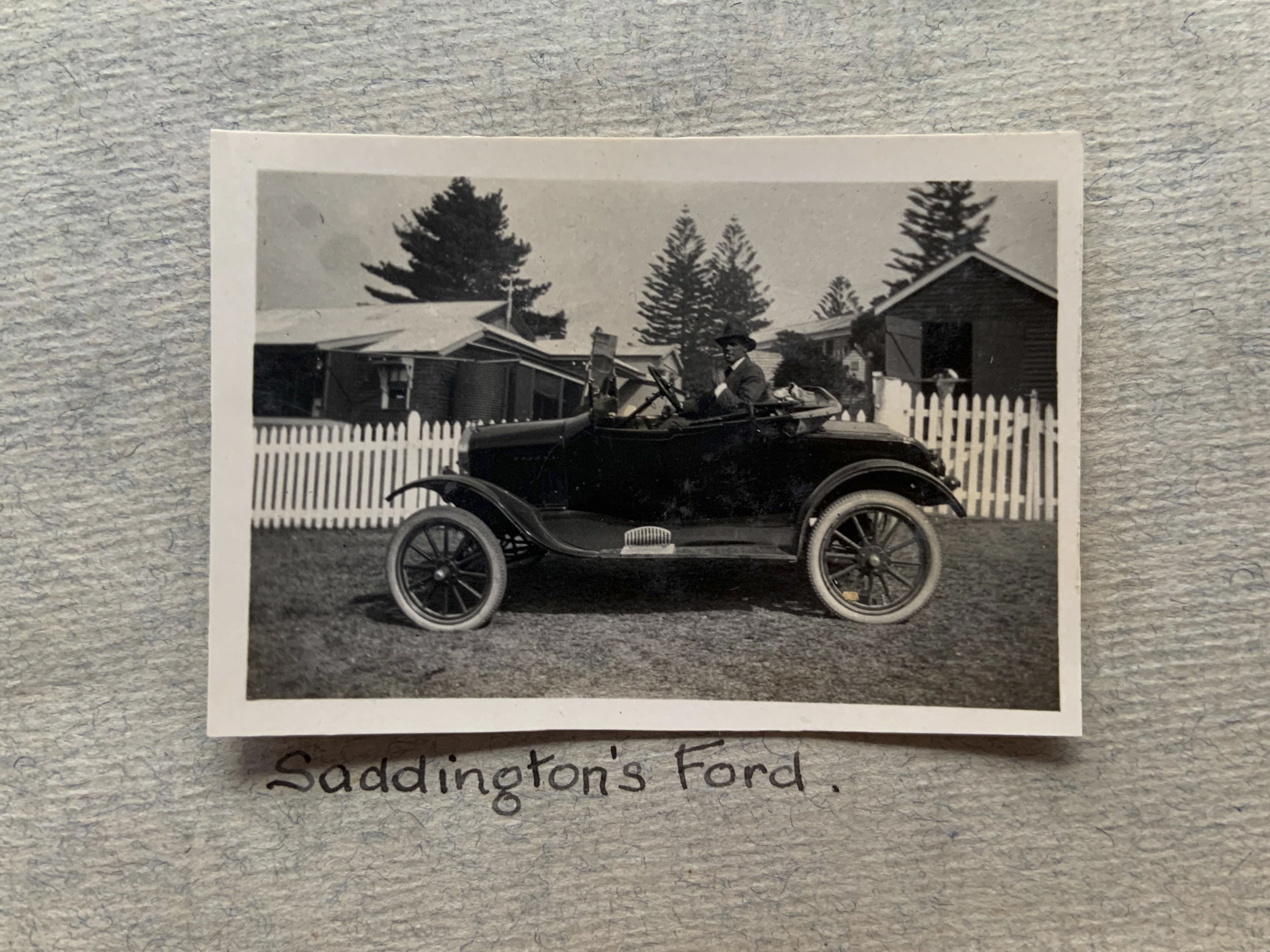
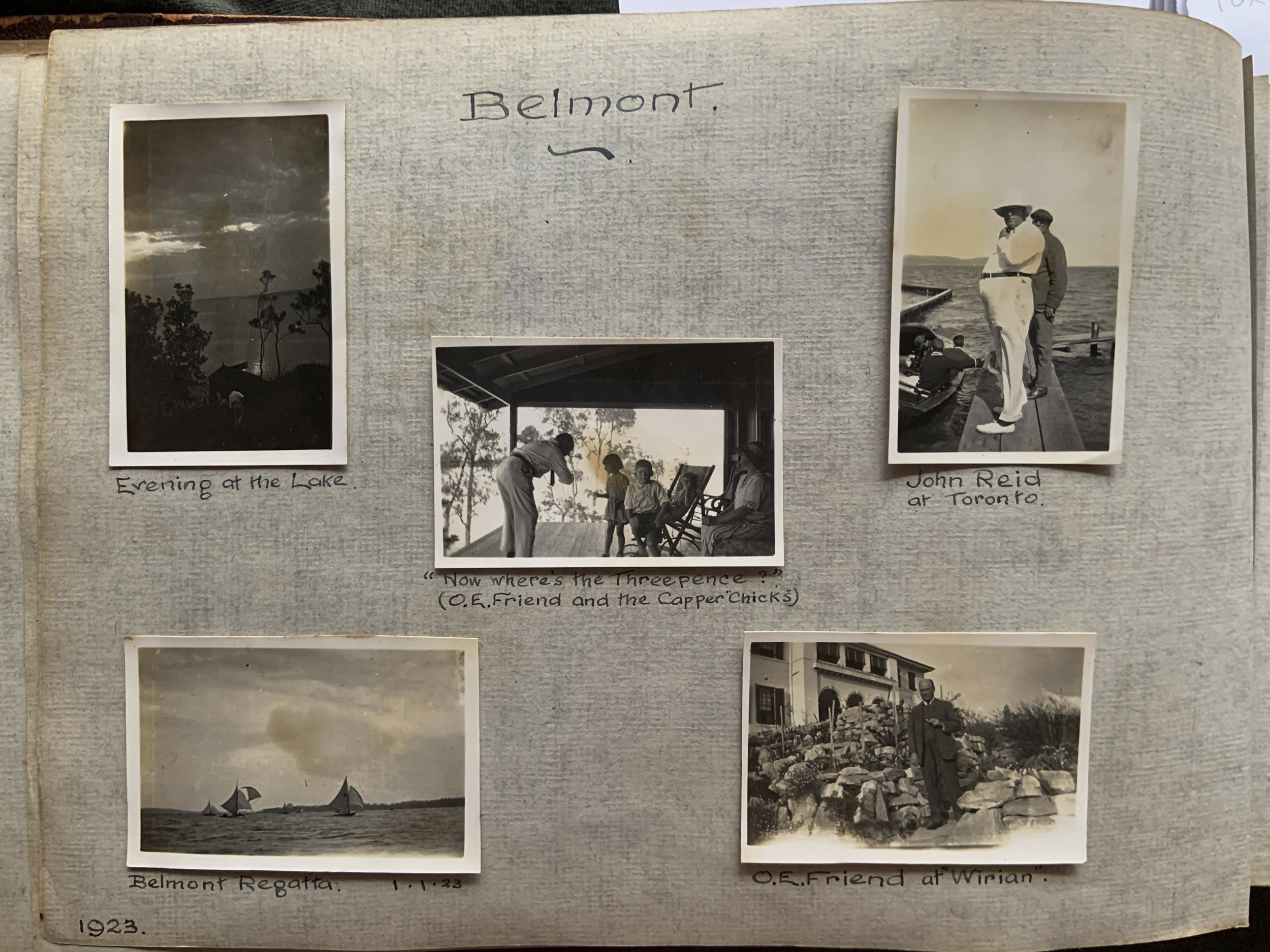
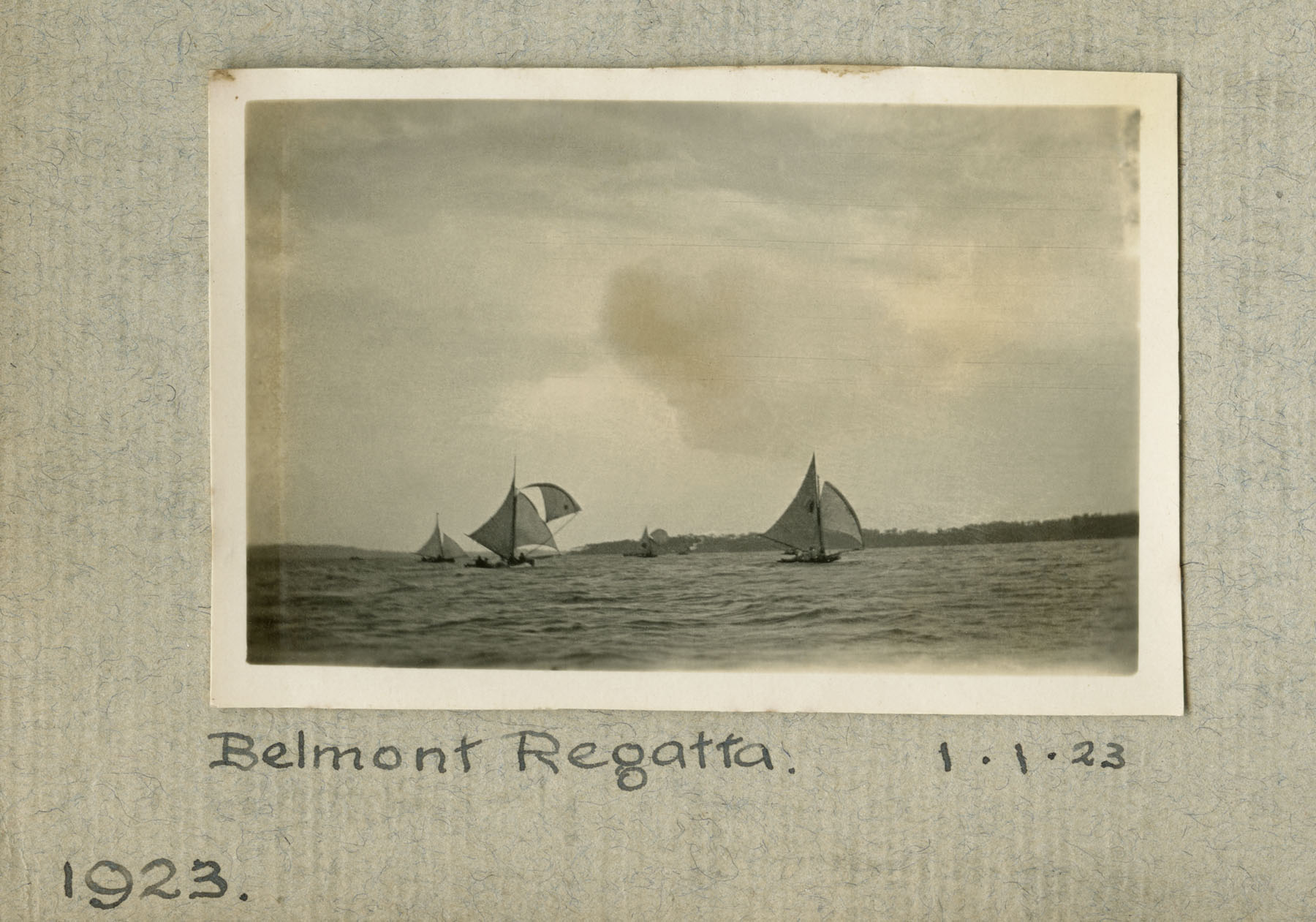
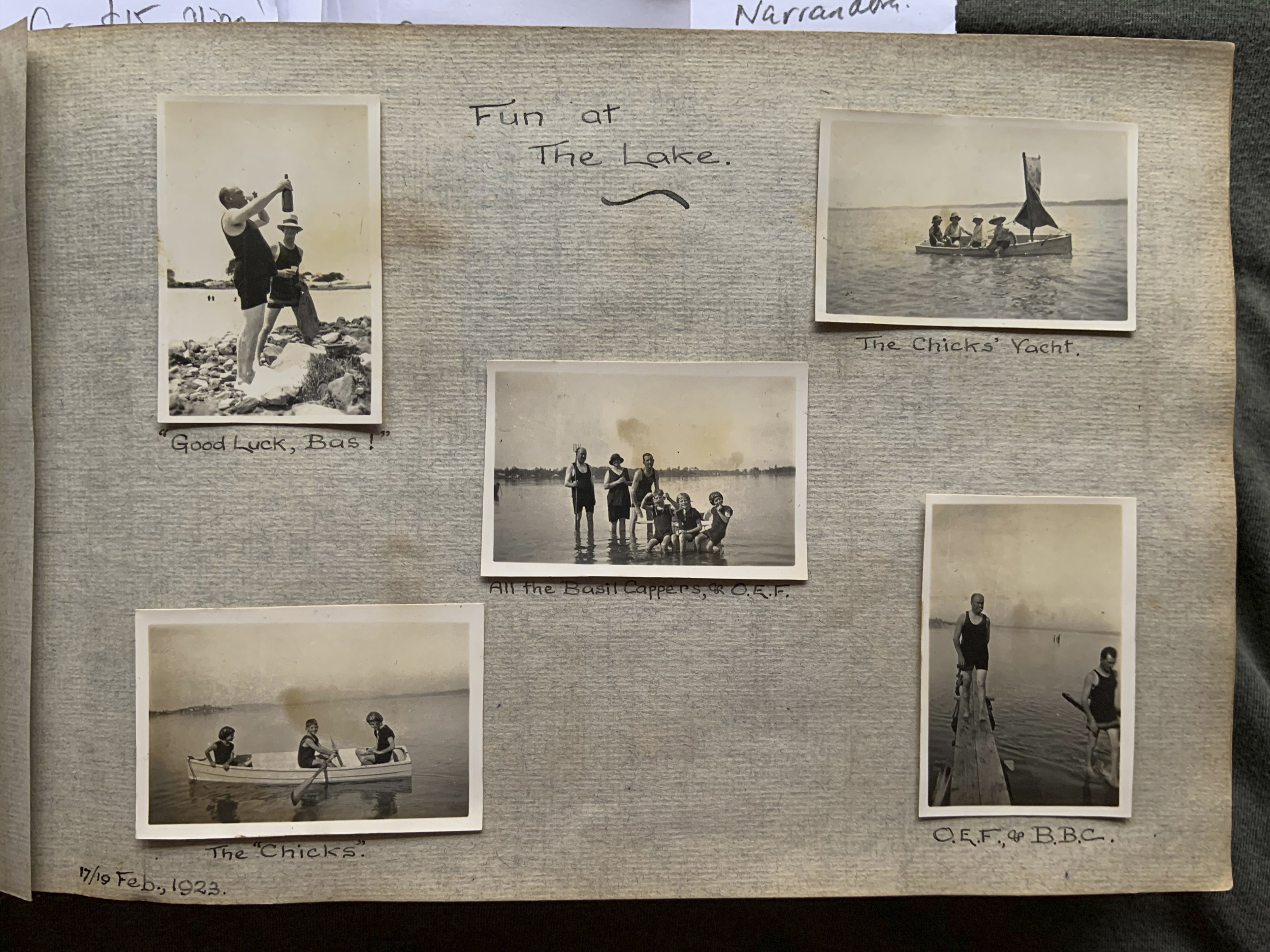
Belmont / Belmont Regatta, NSW (1923)
Hawkesbury, NSW (1923)
Frenches Forest, NSW (1923)
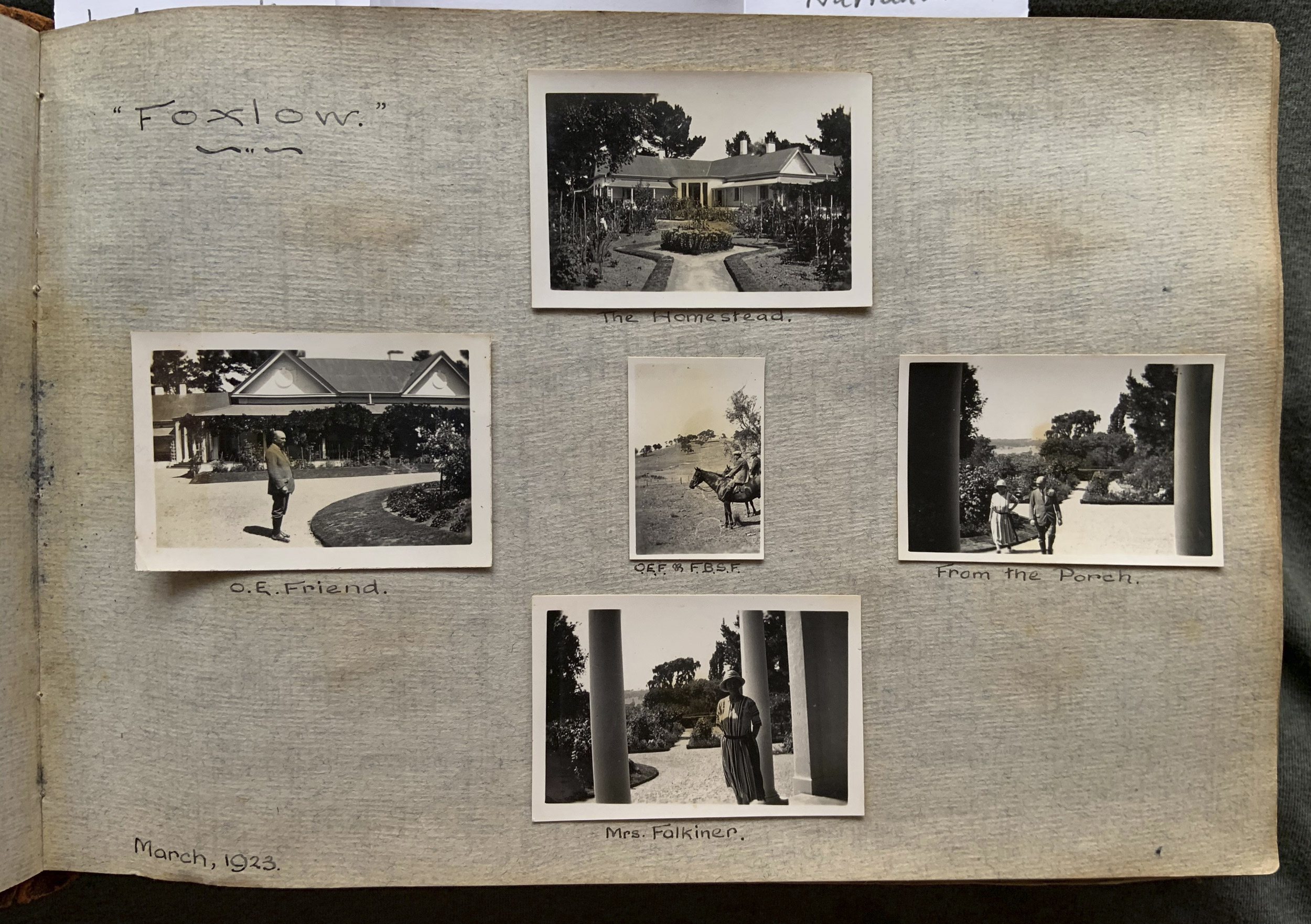
“Foxlow” Station, Bungedore, NSW (1923)
Sydney, NSW (Customs House, National Art Gallery, Mitchell Library, Darlinghurst Courthouse) (1923)
Muswellbrook Picnic Races, NSW (1923)
Maitland / Maitland Cup Meeting, NSW (1923)
Breeza, NSW (1923)
Wiseman’s Ferry, NSW (1923)
Moss Vale / Sutton Forest Church, NSW (1923)
Frensham, NSW (1923)
La Perouse, NSW (Historical Society Excursion) (1923)
Old Customs Watch Tower, La Perouse (1923)
The Old Illawarra Road, NSW (1923)
Yarcowie, SA (1923)
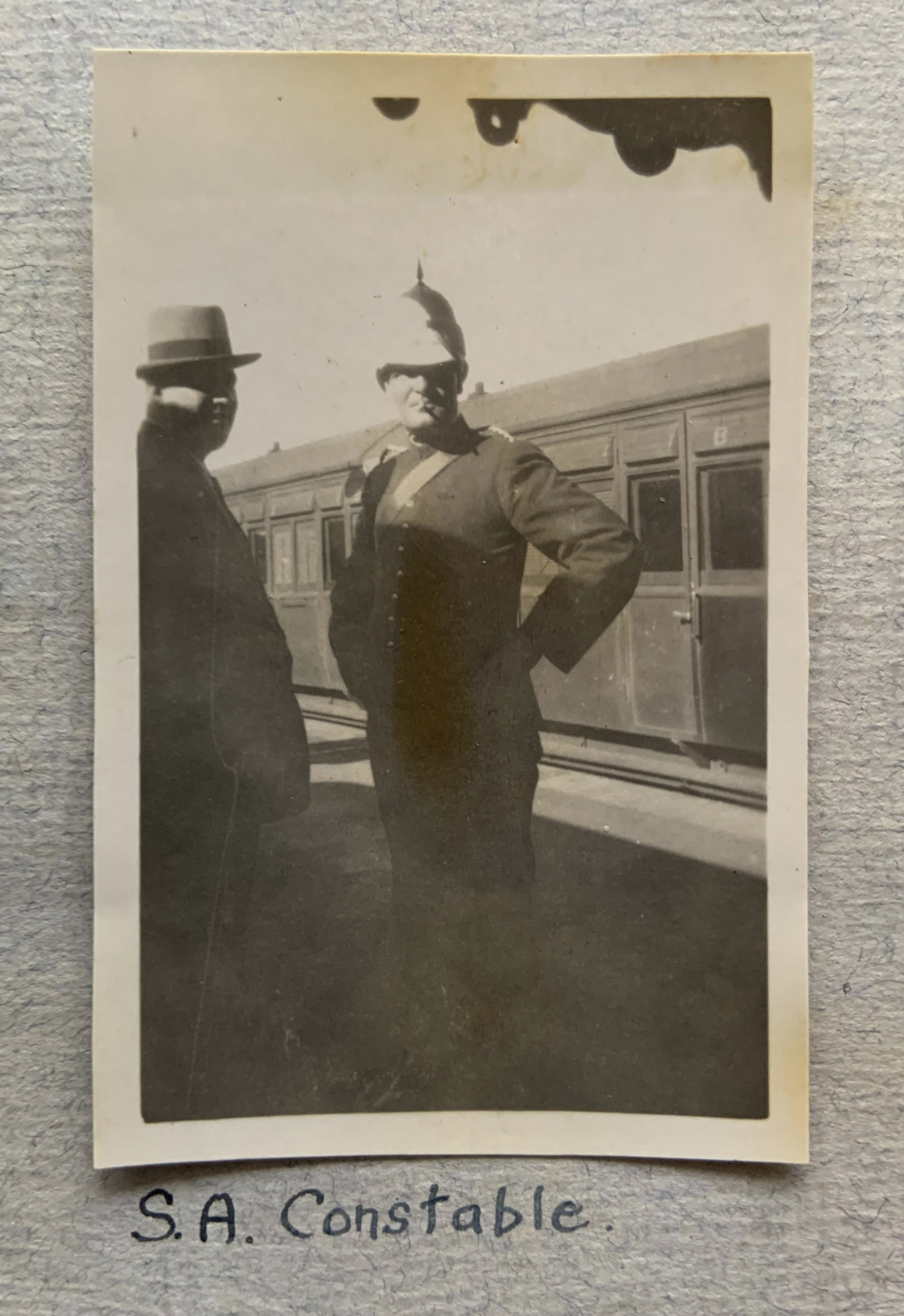
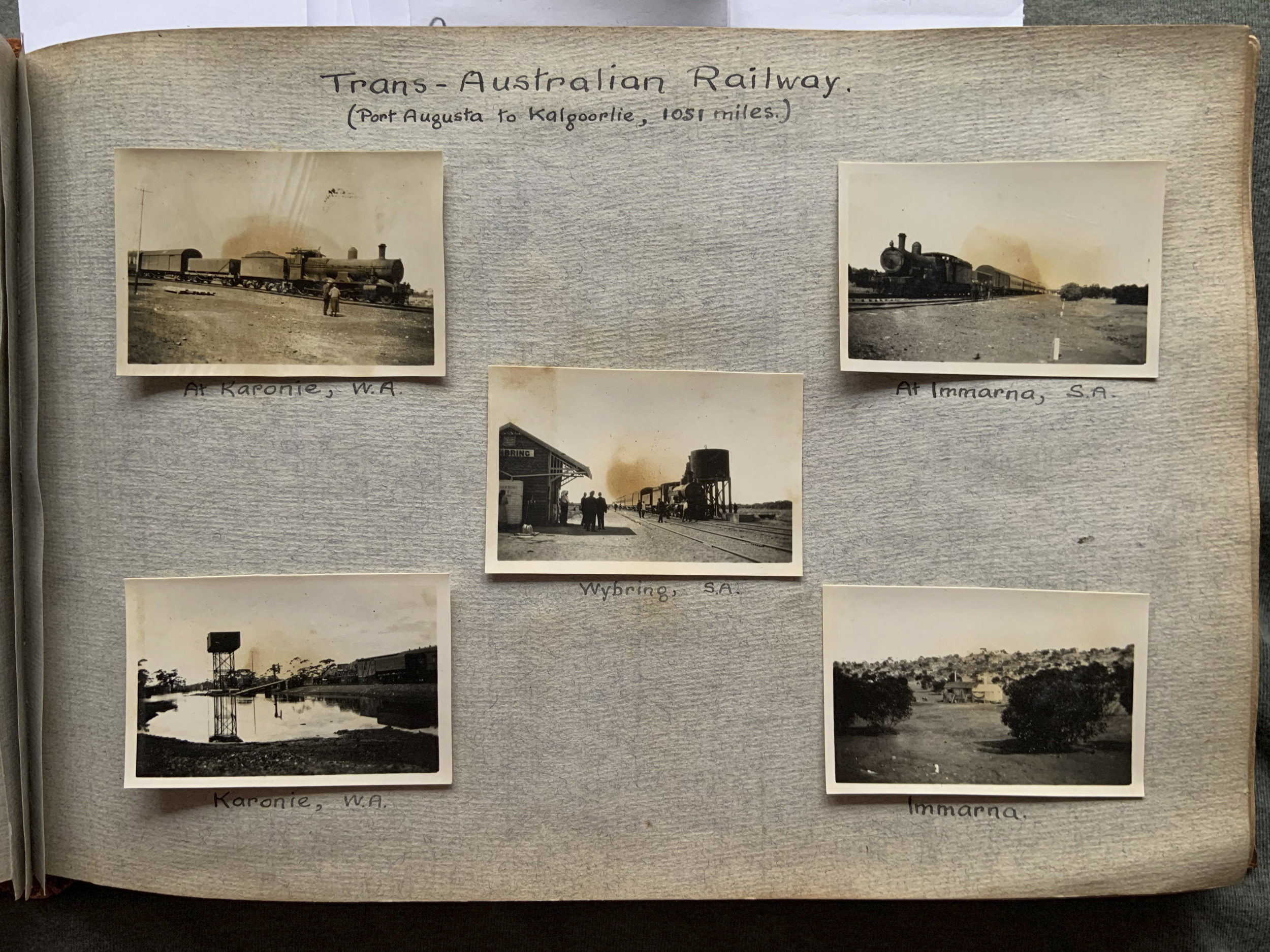
Trans-Australian Railway (Port Augusta to Kalgoorlie) (1923)
Karonie, WA (1923)
Kalgoorlie, WA (1923)
Boulder City, WA (1923)
Fremantle, WA (1923)
Geraldton, WA (1923)
Shark’s Bay, WA (1923)
Henry Freycinet Estuary, WA (1923)
Tamala Station, WA (1923)
Perth, WA (1923)
Adelaide, SA (Torrens River) (1923)
“Redbank,” Scone, NSW (1924)
Muswellbrook Picnic Races, NSW (1924)
“Craigieburn,” Bowral, NSW (1924)
The Dudley Cup at Kensington, NSW (1924)
Camden Grammar School, NSW (1924)
Liverpool Church, NSW (1924)
Landsdowne Bridge, NSW (1924)
Jenolan Caves, NSW (1924)
Avon Dam, NSW (1924)Herald Office, Pitt Street, NSW (1924)
Camping, Cronulla, NSW (1925)
Roseville, NSW (1926)
Whale Beach, NSW (1927)
Visit of the Duke and Duchess of York, Macquarie Street, NSW (1927)
20, Yarranabbe Rd., Darling Point, NSW (1926)
Canberra, ACT (1927)
Jenolan Caves, NSW (Lady Dorothy Hope-Morley) (1927)
Ellen’s Isle, Loch Katrine, Scotland (1925)
Sydney Harbour Bridge, NSW (1931-32)
“Springfield,” Byng, Near Orange, NSW (1932)
Lucknow, near Orange, NSW (1933)
Hawkesbury, NSW (1933)
Bathurst, NSW (1933)
“Millambri, ” Canowindra, NSW (1933)
Melbourne, VIC (1933)


Topics

Men
Pastoralism and grazing
Horses / country horse racing
Sheep and shearing
Cows
Mill / logging
Pine plantation
Bush
Bores and dams
Cathedral / churches
Tennis
Golf
Cars (Ford, Pan-American, Essex, Oldsmobile, early Hupmobile, Chrysler 70)
Buses
Bank, post office
Pastoral Play
Monuments
Rock carvings
Houses
Cemetery / tombstones
John Dunn, executed 1866
South Australian Railways / locomotives
S.A. constable and Adelaide cop
Indigenous Australians (Aboriginal types, along the Trans-Australian Railway)
Australian Desert Blacks
Gold mine / gold panning
Mining (Boulder and Perseverance Mines)
Convict gaol
Oldest inhabitant (Henry Desmond)
Hotels
Beach and sea, surf girls
Mother of pearl
Dates
Afghan / camels
Yachting, sailing / boats
Guano
Fred Adams, Boss-Pearler
Stations and station hands
Rowing
Dredging
Polo
Rugby
Caves
Guns
Nobility and royalty
Camping, picnics
Tennis
House building / old houses
Parliament House
Prime Ministers residence
Bridges and bridge building
Federal and state governors
The world’s first auto-gyro plane (1909-1912)
The Southern Cross
Pioneers
Mounted police
First house in Byng
Rabbiting
Glamour
Social status / socialite
Family
Women and children
Sydney Harbour Bridge opening
Carillon (bells)
Myers and Bourke Street, Melbourne


"Blue Mountains, N.S.W," January 1922 in John "Jack" Riverstone Faviell 1922-1933 photo album


“Blue Mountains, N.S.W,” January, 1922 in John “Jack” Riverstone Faviell 1922-1933 photo album


"Blue Mountains, N.S.W," January 1922 in John "Jack" Riverstone Faviell 1922-1933 photo album


“Blue Mountains, N.S.W,” January, 1922 in John “Jack” Riverstone Faviell 1922-1933 photo album


"Blue Mountains, N.S.W," January 1922 in John "Jack" Riverstone Faviell 1922-1933 photo album


“Blue Mountains, N.S.W,” January, 1922 in John “Jack” Riverstone Faviell 1922-1933 photo album


Blue Mountains

The Blue Mountains are a mountainous region and a mountain range located in New South Wales, Australia. The region borders on Sydney’s metropolitan area, its foothills starting about 50 kilometres (31 mi) west of centre of the state capital, close to the major suburb of Penrith. The public’s understanding of the extent of the Blue Mountains is varied, as it forms only part of an extensive mountainous area associated with the Great Dividing Range. Officially the Blue Mountains region is bounded by the Nepean and Hawkesbury rivers in the east, the Coxs River and Lake Burragorang to the west and south, and the Wolgan and Colo rivers to the north. Geologically, it is situated in the central parts of the Sydney Basin. …

The Blue Mountains have been inhabited for millennia by the Gundungurra people, now represented by the Gundungurra Tribal Council Aboriginal Corporation based in Katoomba, and, in the lower Blue Mountains, by the Darug people, now represented by the Darug Tribal Aboriginal Corporation…

Examples of Aboriginal habitation can be found in many places. In the Red Hands Cave, a rock shelter near Glenbrook, the walls contain hand stencils from adults and children. On the southern side of Queen Elizabeth Drive, at Wentworth Falls, a rocky knoll has a large number of grinding grooves created by rubbing stone implements on the rock to shape and sharpen them. There are also carved images of animal tracks and an occupation cave. The site is known as Kings Tableland Aboriginal Site and dates back 22,000 years.

Text from the Wikipedia website

You’ll find the locality of Kanimbla Valley in New South Wales about 90km west-northwest of Sydney. At about 677m above sea level, Kanimbla Valley is one of the higher localities in New South Wales.


"Tarana Picnic Races," January 1922 in John "Jack" Riverstone Faviell 1922-1933 photo album


“Tarana Picnic Races,” January, 1922 in John “Jack” Riverstone Faviell 1922-1933 photo album


Tarana

Tarana is a small town in the Central West of New South Wales, Australia in the City of Lithgow.


"Doona, Breeza," October 1922 in John "Jack" Riverstone Faviell 1922-1933 photo album


“Doona, Breeza,” October, 1922 in John “Jack” Riverstone Faviell 1922-1933 photo album


J. Pickering – John Pickering, grazier of Breeza, Upper Hunter Valley, killed by a log he was loading onto a wagon in February 1924.
B.B. Capper – Capper family of Rossmer Homestead at Breeza, Upper Hunter Valley.
Doona Station and Breeza Station owned by the Clift family.

Information from Douglas Stewart Fine Books


"Doona, Breeza," October 1922 in John "Jack" Riverstone Faviell 1922-1933 photo album


“Doona, Breeza,” October, 1922 in John “Jack” Riverstone Faviell 1922-1933 photo album


Breeza

Breeza is a small village located about 45 kilometres south east of Gunnedah on the Kamilaroi Highway. The aboriginal name for Breeza means “one hill”.

The village overlooks the rich fertile Liverpool Plains and this diverse farming area produces many and varied crops throughout the year. When in season, the fields of sunflowers, sorghum, canola, wheat and cotton provide a picturesque vista across the sweeping plains.

Breeza was settled in 1848 by Andrew Lang. Old folk say that Bushranger Ben Hall was born at Breeza, he was in fact born near Maitland, but his father, Ben Hall Snr worked on Breeza Station at one time. A mural ‘Ben Hall’s Wall’ stands in the heart of Breeza to commemorate Ben Hall’s final years set against “those wild colonial days” of yesteryear.

Text from the australias.guide website [Online] Cited 18/10/2019


"Avoca," Xmas, 1922 in John "Jack" Riverstone Faviell 1922-1933 photo album


“Avoca,” Xmas, 1922 in John “Jack” Riverstone Faviell 1922-1933 photo album


Avoca Beach

Avoca Beach is a coastal suburb of the Central Coast region of New South Wales, Australia, about 95 kilometres (59 mi) north of Sydney. Avoca Beach is primarily a residential suburb but also a popular tourist destination. Terrigal is a major coastal suburb of the Central Coast region of New South Wales, Australia, located 12 kilometres (7 mi) east of Gosford on the Pacific Ocean. (Text from the Wikipedia website)


"Newcastle Races," New Year, 1923 in John "Jack" Riverstone Faviell 1922-1933 photo album


“Newcastle Races,” New Year, 1923 in John “Jack” Riverstone Faviell 1922-1933 photo album


Located in the heart of Newcastle on the picturesque Hunter Coast only two hours drive north of Sydney is Newcastle Racecourse. In operation for over 100 years, the Newcastle Racecourse is the largest provincial club in NSW.


"Belmont," New Year, 1923 in John "Jack" Riverstone Faviell 1922-1933 photo album


“Belmont,” New Year, 1923 in John “Jack” Riverstone Faviell 1922-1933 photo album


Belmont, on Lake Macquarie near Newcastle, NSW.


"Saddington's Ford," New Year, 1923 in John "Jack" Riverstone Faviell 1922-1933 photo album


“Saddington’s Ford,” New Year, 1923 in John “Jack” Riverstone Faviell 1922-1933 photo album


"Belmont," 1923 in John "Jack" Riverstone Faviell 1922-1933 photo album


“Belmont,” 1923 in John “Jack” Riverstone Faviell 1922-1933 photo album


John C Reid and Mark C Reid

The Reid brothers John C Reid and Mark C Reid were nephews of Sir George Houstoun Reid, 4th Prime Minister of Australia and former Premier of New South Wales prior to Federation. On Friday 14 January, 1898 the Reid boys were at the train station to welcome their uncle the Premier to Newcastle.

Roger Steel, Historian, Belmont

O.E. Friend (died 1942)

O.E. Friend was a very wealthy man and was Director of the Commercial Banking Company of Sydney with a keen interest in pastoral pursuits, investments, etc., Perhaps Faviell worked for Friend or was a close confidante, which would explain all the shots of pastoral locations (Friend’s interests).

Information from Douglas Stewart Fine Books

Obituary

MR. O. E. FRIEND DIES IN SYDNEY

Mr O. E. Friend, 60, died today. He was a director of the Permanent Trustee Company, the Commercial Banking Company of Sydney, Pitt, Son, and Badgery, the United Insurance, and Howard Smith companies, and several other business organisations. Mr. Friend was keenly interested in pastoral pursuits. He was chairman of directors of Retreat Station Ltd., Queensland, and was formerly president of the Royal Historical Society.

The Courier-Mail, Brisbane, Qld., Tue 26 May, 1942, Page 4 on the Trove website [Online] Cited 05/11/2019


"Belmont Regatta," 1.1.23 in John "Jack" Riverstone Faviell 1922-1933 photo album


“Belmont Regatta,” 1.1.23 in John “Jack” Riverstone Faviell 1922-1933 photo album


Belmont Regatta

I am researching the local history of Belmont, NSW and in particular the history of the Belmont Sailing Club. The Belmont Sailing Club was formed at a meeting on 13th May 1922 and it held its first race on 7th October 1922.

Whilst an annual regatta had been held on Belmont Bay for some decades, the Belmont Regatta held on 1st January 1923 is the first run under the auspices of the newly formed Belmont Sailing Club. The photo in the album would be the earliest photograph of 16ft skiffs sailing on Belmont Bay.

Interestingly, John C. Reid, living in Weeroona on the shores of Lake Macquarie was the sailing club’s first patron, having been involved previously with the Belmont regattas as well as the regattas held on Newcastle Harbour. He was also a benefactor providing trophies for the club and had a high profile having formerly been the Mayor of Newcastle and the French Consul for Newcastle, there to assist French sailors. He played a significant role following the wreck of the ship Adolphe (1904, see below) in Newcastle Harbour. His younger brother Mark Christian Reid was the sailing club’s first President. Both of these men lived truly amazing lives.

Is there any possibility of getting a high resolution scan of a few of these photographs?  In particular the photo of the 1923 Belmont Regatta is priceless.

The skiffs in the club then used numbers on their sails instead of ensigns like other 16ft skiff clubs. Its hard to see, but it looks like the leading skiff has the number one on the sail, making it the skiff named ‘Clift’ (No numbers are visible on the sails just splotches – Marcus). That name Clift is significant in Belmont as you can see from your photo album. The Clifts were wealthy graziers from Breeza who would holiday at Belmont in their 17 room home.

Roger Steel, Historian, Belmont

Email to Marcus Bunyan 07/07/2021


This slide depicts the wreck of the 'Adolphe' as photographed on 30 September 1904. You can also see the mast of the shipwreck Regent Murray in this photo. University of Newcastle Library's Cultural Collections


This slide depicts the wreck of the Adolphe as photographed on 30 September 1904. You can also see the mast of the shipwreck Regent Murray in this photo.
University of Newcastle Library’s Cultural Collections


Adolphe

The Adolphe was a sailing ship that was wrecked at the mouth of the Hunter River in New South Wales, Australia, in 1904. The ship is now the most prominent of several wrecks on what is now the Stockton breakwall, which protects Newcastle harbour. The rescue of the ship’s crew has gone down in local maritime history as one of the most remarkable in local waters.

On 30 September 1904, the Adolphe was being towed through the entrance of Newcastle harbour by the tugs Hero and Victoria after an 85-day voyage in ballast from Antwerp under the command of Captain Lucas. Heavy seas prevented the tugs from holding her, and after the tug hawser parted she was swept first on to the wreck of the Colonist, then battered by waves that forced her on top of other submerged wrecks on what was then called the Oyster Bank. The lifeboat hurried to the scene and within two hours all 32 of the crew had been taken off. The northern breakwater of the entrance to the port of Newcastle was extended after the loss of the Adolphe. The French consul made an official visit to Newcastle to recognise the efforts of the lifeboat crew.

Text from the Wikipedia website


"Fun at The Lake," 17/19 February, 1923 in John "Jack" Riverstone Faviell 1922-1933 photo album


“Fun at The Lake,” 17/19 February, 1923 in John “Jack” Riverstone Faviell 1922-1933 photo album


"O.E.F. (O.E. Friend) & B.B.C. (Basil Cappers)," 17/19 February, 1923 in John "Jack" Riverstone Faviell 1922-1933 photo album


“O.E.F. (O.E. Friend) & B.B.C. (Basil Cappers),” 17/19 February, 1923 in John “Jack” Riverstone Faviell 1922-1933 photo album


"The Basil Cappers' departure for England," 9 March, 1923 in John "Jack" Riverstone Faviell 1922-1933 photo album


“The Basil Cappers’ departure for England,” 9 March, 1923 in John “Jack” Riverstone Faviell 1922-1933 photo album


"Untitled," 1923 in John "Jack" Riverstone Faviell 1922-1933 photo album


“Untitled,” 1923 in John “Jack” Riverstone Faviell 1922-1933 photo album


"Pan-American, 6666," 1923 in John "Jack" Riverstone Faviell 1922-1933 photo album


“Pan-American, 6666,” 1923 in John “Jack” Riverstone Faviell 1922-1933 photo album


"The Hawkesbury from the train," 1923 in John "Jack" Riverstone Faviell 1922-1933 photo album


“The Hawkesbury from the train,” 1923 in John “Jack” Riverstone Faviell 1922-1933 photo album


"Foxlow," 3/5 March, 1923 in John "Jack" Riverstone Faviell 1922-1933 photo album


“Foxlow,” 3/5 March, 1923 in John “Jack” Riverstone Faviell 1922-1933 photo album


"Foxlow," March, 1923 in John "Jack" Riverstone Faviell 1922-1933 photo album


“Foxlow,” March, 1923 in John “Jack” Riverstone Faviell 1922-1933 photo album


"Foxlow," 3/5 March, 1923 in John "Jack" Riverstone Faviell 1922-1933 photo album


“Foxlow,” 3/5 March, 1923 in John “Jack” Riverstone Faviell 1922-1933 photo album


"Foxlow Station, Bungendore," 3/5 March, 1923 in John "Jack" Riverstone Faviell 1922-1933 photo album


“Foxlow Station, Bungendore,” 3/5 March, 1923 in John “Jack” Riverstone Faviell 1922-1933 photo album


"Foxlow," 3/5 March, 1923 in John "Jack" Riverstone Faviell 1922-1933 photo album


“Foxlow,” 3/5 March, 1923 in John “Jack” Riverstone Faviell 1922-1933 photo album


Foxlow

Bungendore property “Foxlow” has more than 7500 hectares of land. It was purchased by F.B.S Falkiner (the son of F.S. Falkiner) in 1920.

Before the Falkiner family ownership, “Foxlow” had been in the hands of the Osborne family, and previously the Rutledge family; they had a short ownership of two years after purchasing it from John Hosking, in the 1860s. Hosking himself was the first mayor of Sydney, and had given the property its name, after his wife, Martha Foxlow Terry.

Mr Falkiner said “Foxlow” was one of the first farms to be taken up in the Molonglo Valley.

The property was profiled in The Land‘s country homes series in 1976, which detailed the property’s history extending back to an original grant in 1839 to Thomas Wood.

It is not known exactly when Hosking himself purchased the property, but his ownership lasted until 1868 when it was purchased by Thomas Rutledge, and then later George Osborne, who had owned the property for 50 years before the Falkiner family ownership.

Nick Heydon. “Historic ‘Foxlow’ offering,” on The Land website 26 April 2014 [Online] Cited 28/10/2019

Foxlow sold for $15 million in 2015.


"Mr Friend examining the old bell," March, 1923 in John "Jack" Riverstone Faviell 1922-1933 photo album


“Mr Friend examining the old bell,” March, 1923 in John “Jack” Riverstone Faviell 1922-1933 photo album


"Sydney," 1923 in John "Jack" Riverstone Faviell 1922-1933 photo album


“Sydney,” 1923 in John “Jack” Riverstone Faviell 1922-1933 photo album


"Customs House," Sydney, 1923 in John "Jack" Riverstone Faviell 1922-1933 photo album


“Customs House,” Sydney, 1923 in John “Jack” Riverstone Faviell 1922-1933 photo album


Customs House, Sydney

Customs House, Sydney is a heritage-listed museum space, visitor attraction, commercial building and performance space located in the Circular Quay area at 45 Alfred Street, in the Sydney central business district, in the City of Sydney local government area of New South Wales, Australia. The building served as a customs house prior to Federation and then as the head office of New South Wales operations of the Government of Australia agency Department of Trade and Customs (and its successors) until 1988. The customs function relocated to a new site in 1990. The initial designs were by Mortimer Lewis and it was built during 1845 by under the administration of Governor Sir George Gipps.

Text from the Wikipedia website


"National Art Gallery," Sydney, 1923 in John "Jack" Riverstone Faviell 1922-1933 photo album


“National Art Gallery,” Sydney, 1923 in John “Jack” Riverstone Faviell 1922-1933 photo album


"Upper Hunter Amateur Race Club Meeting... (Muswellbrook Picnic Races)" 15/16 May, 1923 in John "Jack" Riverstone Faviell 1922-1933 photo album


“Upper Hunter Amateur Race Club Meeting… (Muswellbrook Picnic Races)” 15/16 May, 1923 in John “Jack” Riverstone Faviell 1922-1933 photo album


Muswellbrook

Muswellbrook is a town in the Upper Hunter Region of New South Wales, Australia, about 243 km (151 mi) north of Sydney and 127 km (79 mi) north-west of Newcastle. Geologically, Muswellbrook is situated in the northern parts of the Sydney basin, bordering the New England region. The area is predominantly known for coal mining and horse breeding, but has also developed a reputation for gourmet food and wine production.

Text from the Wikipedia website


"Upper Hunter Amateur Race Club Meeting... (Muswellbrook Picnic Races)" 15/16 May, 1923 in John "Jack" Riverstone Faviell 1922-1933 photo album


“Upper Hunter Amateur Race Club Meeting… (Muswellbrook Picnic Races)” 15/16 May, 1923 in John “Jack” Riverstone Faviell 1922-1933 photo album


"The Button's Essex," May, 1923 in John "Jack" Riverstone Faviell 1922-1933 photo album


“The Button’s Essex,” May, 1923 in John “Jack” Riverstone Faviell 1922-1933 photo album


"Muswellbrook Picnic Races," 15/16 May, 1923 in John "Jack" Riverstone Faviell 1922-1933 photo album


“Muswellbrook Picnic Races,” 15/16 May, 1923 in John “Jack” Riverstone Faviell 1922-1933 photo album


"Muswellbrook Picnic Races," 15/16 May, 1923 in John "Jack" Riverstone Faviell 1922-1933 photo album


“Muswellbrook Picnic Races,” 15/16 May, 1923 in John “Jack” Riverstone Faviell 1922-1933 photo album


"Belmont," 23/25 June, 1923 in John "Jack" Riverstone Faviell 1922-1933 photo album


“Belmont,” 23/25 June, 1923 in John “Jack” Riverstone Faviell 1922-1933 photo album


Belmont Soldier's Memorial Hall and Belmont School of Arts


Three women standing in front of Belmont Soldier’s Memorial Hall (middle) and Belmont School of Arts (right) in John “Jack” Riverstone Faviell 1922-1933 photo album


Belmont Soldier’s Memorial Hall and Belmont School of Arts

My interest in the photo of the women in front of the Belmont Soldier’s Memorial Hall (opened 1921) (above) is also in the hope of seeing what is written on the building beside it (it says Belmont Literary Institute – more commonly known as the Belmont School of Arts, opened 1914). If it is the School of Arts, this suggests the building may have been moved at some stage. I’m very curious as I believed the School of Arts was close by in an adjoining street.

Roger Steel, Historian, Belmont

Belmont

Belmont is a suburb in the Hunter Region of New South Wales, Australia, located 20 kilometres (12 mi) from Newcastle’s central business district on the eastern side of Lake Macquarie and is part of the City of Lake Macquarie. Belmont is situated on a sandy peninsula formed by the Tasman Sea on the east and Lake Macquarie.


""Weroona", Belmont," 23/25 June, 1923 in John "Jack" Riverstone Faviell 1922-1933 photo album


“”Weroona”, Belmont,” 23/25 June, 1923 in John “Jack” Riverstone Faviell 1922-1933 photo album


3 women at Weeroona in John "Jack" Riverstone Faviell 1922-1933 photo album


3 women at Weeroona in John “Jack” Riverstone Faviell 1922-1933 photo album


Weeroona and the Reid’s

If we look carefully at the photograph of the 3 women at Weeroona with the lake in the back ground (above), you can see the old stone ferry jetty. It was in a state of disrepair in 1923 and Mark C Reid, having been a former Alderman on Newcastle Council and a very prominent business man, was lobbying Lake Macquarie Shire Council to have the jetty repaired. Note this jetty became the club house of Lake Macquarie Yacht Club in the early 1930’s, built at the end of the pier, and still in the same location to this day. I’ve attached an old postcard (below) which shows a view of the yacht club from the Weeroona boatshed.

Some of the information from the Wikipedia page is not correct (below). John C Reid didn’t live in Weeroona during his retirement as he died relatively young and Mark C Reid took over his brother’s position as manager of John Reid Limited and as French Consul following his brother’s unexpected death. The Crippled Children’s Association did purchase Weeroona in about 1950 following Mark C Reid’s death however based on my memory, Weeroona would have been demolished much later than 1979.

Roger Steel, Historian, Belmont

John Christian Reid

John Christian Reid, JP (1873 – 20 March 1932) was a New South Wales businessman, yachtsman and alderman, who served several terms as Mayor of Newcastle… In retirement, Reid lived with his family at his residence, “Weroona”, in Belmont, which later became the holiday home for the NSW Crippled Children’s Association and was demolished in 1979.

Text from the Wikipedia website


The Reid's water-front, Lake Macquarie in John "Jack" Riverstone Faviell 1922-1933 photo album


The Reid’s water-front, Lake Macquarie in John “Jack” Riverstone Faviell 1922-1933 photo album


'Belmont, Near Newcastle' 1950s? Postcard


Belmont, Near Newcastle
1950s?
Postcard
Colour lithograph


"Maitland," 25 August, 1923 in John "Jack" Riverstone Faviell 1922-1933 photo album


“Maitland,” 25 August, 1923 in John “Jack” Riverstone Faviell 1922-1933 photo album


Maitland

Maitland is a city in the Lower Hunter Valley of New South Wales, Australia and the seat of Maitland City Council, situated on the Hunter River approximately 166 kilometres (103 mi) by road north of Sydney and 35 km (22 mi) north-west of Newcastle. It is on the New England Highway about 17 km (11 mi) from its start at Hexham.


"Dr Kennedy's house, East Maitland," August, 1923 in John "Jack" Riverstone Faviell 1922-1933 photo album


“Dr Kennedy’s house, East Maitland,” August, 1923 in John “Jack” Riverstone Faviell 1922-1933 photo album


"Maitland Cup Meeting," Spring, 1923 in John "Jack" Riverstone Faviell 1922-1933 photo album


“Maitland Cup Meeting,” Spring, 1923 in John “Jack” Riverstone Faviell 1922-1933 photo album


"Finish of The Cup," Spring, 1923 in John "Jack" Riverstone Faviell 1922-1933 photo album


“Finish of The Cup,” Spring, 1923 in John “Jack” Riverstone Faviell 1922-1933 photo album


"Breeza (Doona Cyprus Pine Venture)," 13th September, 1923 in John "Jack" Riverstone Faviell 1922-1933 photo album


“Breeza (Doona Cyprus Pine Venture),” 13th September, 1923 in John “Jack” Riverstone Faviell 1922-1933 photo album


""Karua" household," September, 1923 in John "Jack" Riverstone Faviell 1922-1933 photo album


“”Karua” household,” September, 1923 in John “Jack” Riverstone Faviell 1922-1933 photo album


"Breeza," 13th September, 1923 in John "Jack" Riverstone Faviell 1922-1933 photo album


“Breeza,” 13th September, 1923 in John “Jack” Riverstone Faviell 1922-1933 photo album


John Pickering was killed by a log, 1924. Cyprus Pine venture was an investment project that Friend and Faviell were working on with Pickering and Capper?

Information from Douglas Stewart Fine Books


Breeza

Breeza is a locality in New South Wales, Australia. It is about 43 kilometres south of Gunnedah, in the Liverpool Plains agricultural region. The area around Breeza in particular is called the “Breeza Plains”. The name “Breeza” may be derived from an Aboriginal word meaning “one hill”.


"The team in the bush," Breeza, September 1923 in John "Jack" Riverstone Faviell 1922-1933 photo album


“The team in the bush,” Breeza, September 1923 in John “Jack” Riverstone Faviell 1922-1933 photo album


"Breeza," 13th September, 1923 in John "Jack" Riverstone Faviell 1922-1933 photo album


“Breeza,” 13th September, 1923 in John “Jack” Riverstone Faviell 1922-1933 photo album


"Wiseman's Ferry," 25 November, 1923 in John "Jack" Riverstone Faviell 1922-1933 photo album


“Wiseman’s Ferry,” 25 November, 1923 in John “Jack” Riverstone Faviell 1922-1933 photo album


Wisemans Ferry

Wisemans Ferry is a town in the state of New South Wales, Australia, located 75 kilometres north north-west of the Sydney central business district in the local government areas of Hornsby Shire, The Hills Shire, City of Hawkesbury and Central Coast Council. The town is a tourist spot with picnic and barbecue facilities. As well as a rich convict and colonial heritage in the area, the Dharug National Park and Yengo National Park are close by.

The town was originally called Lower Portland Headland, but the name was eventually changed to Wisemans Ferry, named after Solomon Wiseman, a former convict (1778-1838), who received a land grant in the area from Governor Macquarie in 1817. Wiseman established a ferry service on the Hawkesbury River in 1827 for the transport of produce and provisions to the convicts building the Great North Road and was known to many as King of the Hawkesbury.

Text from the Wikipedia website


"Moss Vale," 8/9 December, 1923 in John "Jack" Riverstone Faviell 1922-1933 photo album


“Moss Vale,” 8/9 December, 1923 in John “Jack” Riverstone Faviell 1922-1933 photo album


Moss Vale

Moss Vale is a town in the Southern Highlands of New South Wales, Australia, in the Wingecarribee Shire. At the 2016 census, it has a population of 8,579 and is sited on the Illawarra Highway, which connects to Wollongong and the Illawarra coast via Macquarie Pass.


"Frensham Pastoral Play," 8th December 1923 in John "Jack" Riverstone Faviell 1922-1933 photo album


“Frensham Pastoral Play,” 8th December 1923 in John “Jack” Riverstone Faviell 1922-1933 photo album


Frensham School

Frensham School is an independent non-denominational comprehensive single-sex early learning, primary, and secondary day and boarding school for girls, located at Mittagong, south of Sydney, in the Southern Highlands region of New South Wales, Australia.


"La Perouse (Historical Society Excursion)," 17 November, 1923 in John "Jack" Riverstone Faviell 1922-1933 photo album


“La Perouse (Historical Society Excursion),” 17 November, 1923 in John “Jack” Riverstone Faviell 1922-1933 photo album


Captain J. H. Watson, Royal Historical Society

O.E. Friend was President of the Royal Historical Society. Faviell was evidently also a member and visited La Perouse on a RHS excursion, with O.E. Friend. Friend disappears from the album after this time. Did Friend and Faviell part ways?

Information from Douglas Stewart Fine Books


La Perouse

La Perouse is a suburb in south-eastern Sydney, in the state of New South Wales, Australia. The suburb of La Perouse is located about 14 kilometres southeast of the Sydney central business district, in the City of Randwick.


"La Perouse (Historical Society Excursion)," 17 November, 1923 in John "Jack" Riverstone Faviell 1922-1933 photo album


“La Perouse (Historical Society Excursion),” 17 November, 1923 in John “Jack” Riverstone Faviell 1922-1933 photo album


"John Dunn. Executed, 19.3.1866," 17 November, 1923 in John "Jack" Riverstone Faviell 1922-1933 photo album


“John Dunn. Executed, 19.3.1866,” 17 November, 1923 in John “Jack” Riverstone Faviell 1922-1933 photo album


John Dunn

John Dunn (14 December 1846 – 19 March 1866) was an Australian bushranger. He was born at Murrumburrah near Yass in New South Wales. He was 19 years old when he was hanged in Darlinghurst Gaol. He was buried in the former Devonshire Street Cemetery in Sydney.


"Old Customs Watch Tower, La Perouse," 17 November, 1923 in John "Jack" Riverstone Faviell 1922-1933 photo album


“Old Customs Watch Tower, La Perouse,” 17 November, 1923 in John “Jack” Riverstone Faviell 1922-1933 photo album


Macquarie Watchtower

The Macquarie Watchtower is the earliest known surviving, sandstone tower building in Australia, the oldest surviving building on Botany Bay, and has long been recognised as a picturesque landmark on the headland, particularly popular for wedding photographs. The c. 1820 Macquarie Watchtower is thought to have been commissioned by Governor Macquarie. Not only is it the oldest surviving watchtower in Australia but it is the only known tower specifically constructed for colonial border protection and the prevention of smuggling.


"The old Illawarra Road," in John "Jack" Riverstone Faviell 1922-1933 photo album


“The old Illawarra Road,” 1923 in John “Jack” Riverstone Faviell 1922-1933 photo album


"Vera Capper and the children," in John "Jack" Riverstone Faviell 1922-1933 photo album


“Vera Capper and the children,” 1923 in John “Jack” Riverstone Faviell 1922-1933 photo album


"South Australian Railways," in John "Jack" Riverstone Faviell 1922-1933 photo album


“South Australian Railways,” 1923 in John “Jack” Riverstone Faviell 1922-1933 photo album


South Australian Railways

South Australian Railways (SAR) was the statutory corporation through which the Government of South Australia built and operated railways in South Australia from 1854 until March 1978, when its non-urban railways were incorporated into Australian National, and its Adelaide urban lines were transferred to the State Transport Authority.


"Terowie to Pt. Augusta, 120 ml," c. 1923 in John "Jack" Riverstone Faviell 1922-1933 photo album


“Terowie to Pt. Augusta, 120 ml.,” 1923 in John “Jack” Riverstone Faviell 1922-1933 photo album


"S.A. Constable," 1923 in John "Jack" Riverstone Faviell 1922-1933 photo album


“S.A. Constable,” 1923 in John “Jack” Riverstone Faviell 1922-1933 photo album


"Trans-Australian Railway (Port August to Kalgoorlie, 1051 miles)," 1923 John "Jack" Riverstone Faviell 1922-1933 photo album


“Trans-Australian Railway (Port August to Kalgoorlie, 1051 miles),” 1923 in John “Jack” Riverstone Faviell 1922-1933 photo album


Trans-Australian Railway

The Trans-Australian Railway crosses the Nullarbor Plain of Australia from Port Augusta in South Australia to Kalgoorlie in Western Australia. It includes a 478-kilometre (297 mi) stretch of dead-straight track, the world’s longest, between the 797 km (495 mi) post west of Ooldea and the 1,275 km (792 mi) post west of Loongana.

The line forms an important freight route between Western Australia and the eastern states. Currently two passenger services also use the line, the Indian Pacific for its entire length and The Ghan between Port Augusta and Tarcoola. Earlier passenger services on the route were known as the Great Western Express.

Text from the Wikipedia website


"Aboriginal Types, along the Trans-Australian Railway," 1923 in John "Jack" Riverstone Faviell 1922-1933 photo album


“Aboriginal Types, along the Trans-Australian Railway,” 1923 in John “Jack” Riverstone Faviell 1922-1933 photo album


"At Ooldea, S.A." 1923 in John "Jack" Riverstone Faviell 1922-1933 photo album


“At Ooldea, S.A.,” 1923 in John “Jack” Riverstone Faviell 1922-1933 photo album


"At Barton, S.A.," 1923 in John "Jack" Riverstone Faviell 1922-1933 photo album


“At Barton, S.A.,” 1923 in John “Jack” Riverstone Faviell 1922-1933 photo album


"Ooldea," 1923 in John "Jack" Riverstone Faviell 1922-1933 photo album


“Ooldea,” 1923 in John “Jack” Riverstone Faviell 1922-1933 photo album


Ooldea

Ooldea is a tiny settlement in South Australia. It is on the eastern edge of the Nullarbor Plain, 863 km (536 mi) west of Port Augusta on the Trans-Australian Railway. Ooldea is 143 km (89 mi) from the bitumen Eyre Highway.


"At Ooldea," 1923 in John "Jack" Riverstone Faviell 1922-1933 photo album


“At Ooldea,” 1923 in John “Jack” Riverstone Faviell 1922-1933 photo album


"Australian Desert Blacks," 1923 in John "Jack" Riverstone Faviell 1922-1933 photo album


“Australian Desert Blacks,” 1923 in John “Jack” Riverstone Faviell 1922-1933 photo album


"Untitled," 1923 in John "Jack" Riverstone Faviell 1922-1933 photo album


“Untitled,” 1923 in John “Jack” Riverstone Faviell 1922-1933 photo album


"Kalgoorlie," 1923 in John "Jack" Riverstone Faviell 1922-1933 photo album


“Kalgoorlie,” 1923 in John “Jack” Riverstone Faviell 1922-1933 photo album


Kalgoorlie-Boulder

Kalgoorlie-Boulder, known colloquially as just Kalgoorlie, is a city in the Goldfields-Esperance region of Western Australia, located 595 km (370 mi) east-northeast of Perth at the end of the Great Eastern Highway. The city was founded in 1889 by the amalgamation of the towns of Kalgoorlie and Boulder, which developed in 1893 during the Coolgardie gold rush, on Western Australia’s “Golden Mile”. It is also the ultimate destination of the Goldfields Water Supply Scheme and the Golden Pipeline Heritage Trail.

Text from the Wikipedia website


"Where gold was first found, by Hannan. 15 Jan., 1893," 1923 in John "Jack" Riverstone Faviell 1922-1933 photo album


“Where gold was first found, by Hannan. 15 Jan., 1893,” 1923 in John “Jack” Riverstone Faviell 1922-1933 photo album


"Boulder City," 1923 in John "Jack" Riverstone Faviell 1922-1933 photo album


“Boulder City,” 1923 in John “Jack” Riverstone Faviell 1922-1933 photo album


Boulder

Boulder is a suburb in the Western Australian Goldfields 595 kilometres (370 mi) east of Perth and bordering onto the town of Kalgoorlie in the Eastern Goldfields region.


"Perseverence Mine," 1923 in John "Jack" Riverstone Faviell 1922-1933 photo album


“Perseverence Mine,” 1923 in John “Jack” Riverstone Faviell 1922-1933 photo album


Perseverance Gold Mine, Golden Mile Mines, Kalgoorlie-Boulder, Kalgoorlie-Boulder Shire, Western Australia, Australia

The lease was spoken as the richest 24 acre block on the Golden Mile in 1901. Ten shafts were on the lease, but the two most important was Main Shaft (700feet 1901) in the centre of the block accessing the Perseverance Lode, and No6 Shaft (600 feet 1901) near the southern boundary on the Consols Lode. Measurements are in imperial in keeping with the historic references. Lake View Consols was to its north, South Kalgurli to its south, Associated to its east, and Great Boulder Proprietary to its west.

The general manager of the mine was Ralph Nicholls who arrived in July 1899, about three years after the mine opened. He was in for a torrid time later. A new mill was constructed shortly after to process the sulphide ore, while remaining oxidised ore was taken to Hannan’s Public Crushing Company, which the mine owned. All ore was processed at a new mill constructed on the lease in 1910.

Around 1900 a series of scandals hit the Golden Mile mines. From 1896-1900 they had mined incredibly rich ore loads, but as these became exhausted, lower (but still very profitable) gold grades became the norm. Several of the mines had over estimated the potential gold which could be extracted, leading to wild fluctuations in share prices. Employees of the companies were accused of what we would now call insider trading of shares they owned.

Around 1903, the Boulder Perseverance Mine was the latest to be caught in the scandal. The outcry finally forced the Government’s hand which launched a Royal Commission. Delivering its report in 1904, it was scathing of the company.

Text from “Perseverance Gold Mine (Boulder Perseverance Mine),” on the mindat.org website [Online] Cited 29/10/2019


"Boulder Mine," 1923 in John "Jack" Riverstone Faviell 1922-1933 photo album


“Boulder Mine,” 1923 in John “Jack” Riverstone Faviell 1922-1933 photo album


Great Boulder Gold Mine, Golden Mile Mines, Kalgoorlie-Boulder, Kalgoorlie-Boulder Shire, Western Australia, Australia

The Great Boulder Mine was the first large scale mine on the Golden Mile, and considered the largest and richest on the field.

The town of Boulder (as in Kalgoorlie-Boulder) was named after the mine.

Visitors to the underground workings in the early part of the Twentieth Century wrote in amazement at seeing ore shoots loaded with fine grained gold. One writer wrote the battery was barely keeping up with gold being processed from the access tunnels, let alone the ore shoots. In 1929 the mine had extracted the most gold of any location in Western Australia. In 1940 it was noted as the second largest producer to that point in Australia.

The discovery of gold at Hannans, just north of the Golden Mile, led to the greatest gold-rush in Australia’s history. After only a couple of years of frenzied activity, by thousands of individual miners, the alluvial gold had been exhausted.

British speculators successfully floated the Great Boulder and Lakeview Mines in 1895 to access the rich underground reefs. The Great Boulder Gold Mines Limited was formed at this time, until it ceased as a company in 1972. …

Between 1895-1931 over four million tonnes of ore was processed for almost the same amount in ounces of gold. Dividends amounted to 3524% of the initial capital invested. The company had produced 15 million pounds of gold monetary wise, and 7.5 million pounds in profits.

Text from “Great Boulder Gold Mine,” on the mindat.org website [Online] Cited 29/10/2019


"Fremantle," 1923 in John "Jack" Riverstone Faviell 1922-1933 photo album


“Fremantle,” 1923 in John “Jack” Riverstone Faviell 1922-1933 photo album


"Interior Courtyard, Old Gaol," Fremantle, 1923 in John "Jack" Riverstone Faviell 1922-1933 photo album


“Interior Courtyard, Old Gaol,” Fremantle, 1923 in John “Jack” Riverstone Faviell 1922-1933 photo album


Fremantle Prison

Fremantle Prison, sometimes referred to as Fremantle Gaol or Fremantle Jail, is a former Australian prison and World Heritage Site in Fremantle, Western Australia. The six-hectare (15-acre) site includes the prison cellblocks, gatehouse, perimeter walls, cottages, and tunnels. It was initially used for convicts transported from Britain, but was transferred to the colonial government in 1886 for use for locally-sentenced prisoners. Royal Commissions were held in 1898 and 1911, and instigated some reform to the prison system, but significant changes did not begin until the 1960s.

Text from the Wikipedia website


"Geraldton, W.A.," in John "Jack" Riverstone Faviell 1922-1933 photo album


“Geraldton, W.A.,” in John “Jack” Riverstone Faviell 1922-1933 photo album


Geraldton

Geraldton is a coastal city in the Mid West region of the Australian state of Western Australia, 424 kilometres (263 mi) north of the state capital, Perth.


"Oldest Inhabitant (Henry Desmond.)," Geraldton, W.A. 1923 in John "Jack" Riverstone Faviell 1922-1933 photo album


“Oldest Inhabitant (Henry Desmond.),” Geraldton, W.A. 1923 in John “Jack” Riverstone Faviell 1922-1933 photo album


"Shark's Bay, W.A.," 1923 in John "Jack" Riverstone Faviell 1922-1933 photo album


“Shark’s Bay, W.A.,” 1923 in John “Jack” Riverstone Faviell 1922-1933 photo album


Pearling interests? Investments? in Western Australia (Information from Douglas Stewart Fine Books)


Shark Bay

Shark Bay is a World Heritage Site in the Gascoyne region of Western Australia. The 23,000-square-kilometre (8,900 sq mi) area is located approximately 800 kilometres (500 mi) north of Perth, on the westernmost point of the Australian continent.


"The only street (Entirely paved of Mother of Pearl)," 1923 in John "Jack" Riverstone Faviell 1922-1933 photo album


“The only street (Entirely paved of Mother of Pearl),” 1923 in John “Jack” Riverstone Faviell 1922-1933 photo album


"Shark's Bay," 1923 in John "Jack" Riverstone Faviell 1922-1933 photo album


“Shark’s Bay,” 1923 in John “Jack” Riverstone Faviell 1922-1933 photo album


"White's Cemetery," 1923 in John "Jack" Riverstone Faviell 1922-1933 photo album


“White’s Cemetery,” Shark’s Bay, 1923 in John “Jack” Riverstone Faviell 1922-1933 photo album


"Grave in Nigger's Cemetery," Shark's Bay, 1923 in John "Jack" Riverstone Faviell 1922-1933 photo album


“Grave in Nigger’s Cemetery,” Shark’s Bay, 1923 in John “Jack” Riverstone Faviell 1922-1933 photo album


"Shark's Bay," 1923 in John "Jack" Riverstone Faviell 1922-1933 photo album


“Shark’s Bay,” 1923 in John “Jack” Riverstone Faviell 1922-1933 photo album


Gin

Gin is the term for an Aboriginal woman. It is racist, the derogatory saying most people would be familiar with is “looks like a gin’s camp”, meaning they think the place is dirty/untidy.


"Shark's Bay," 1923 in John "Jack" Riverstone Faviell 1922-1933 photo album


“Shark’s Bay,” 1923 in John “Jack” Riverstone Faviell 1922-1933 photo album


"All Mother-of-Pearl," 1923 in John "Jack" Riverstone Faviell 1922-1933 photo album


“All Mother-of-Pearl,” 1923 in John “Jack” Riverstone Faviell 1922-1933 photo album


State Library of New South Wales website

LIKE ART BLACK ON FACEBOOK

Back to top

Review: ‘Do Brumbies Dream in Red? – Tom Goldner’ at the Meat Market Stables, Melbourne

Exhibition dates: 5th February – 27th February, 2021

Photography & Curation/Art Direction – Tom Goldner
Moving Image – Angus Scott
Sound – Sean Kenihan
Poetry – Dr Judith Crispin (publication)
Colourist – CJ Dobson (moving image)
Audio Visual – Toto Creative
Cover Art – Katherina Rodrigues (publication)


Tom Goldner (Australian, b. 1984) 'Untitled' from the series 'Do Brumbies Dream In Red?' 2020 from the exhibition 'Do Brumbies Dream in Red? – Tom Goldner' at the Meat Market Stables, Melbourne, February 2021


Tom Goldner (Australian, b. 1984)
Untitled from the series Do Brumbies Dream In Red?
2020


Strange Beauty

Bloated prostrate tentacles

wither into our idea of dying

overlapping human, shit

feeding foulest vegetables,

regenerating sourly

Kingdoms of foulest water

regorging sourly

Bloated brumbies, winged coal

rejigs

Strange Beauty

Floating in our mind

In grey greasy horror water

Full of surprises –

like a holocaust holding pond

At your peril


Skull twisted,

Served on corrugated soot

Land, once precious

disguised, drained

black, gold – split

burnt to reburn

charred brumbies, flying coal

rem/embers,

Millions of worst worst

Strange Beauty

lost as sources

Boiling, bubbling – like a holocaust

At your peril


Belching wishes to reassemble

Hexing new forms

Bottom of our nightmare

Bottom of our innings

Animals worst worst

Plants unredeemable

Satan not lucifer

Sky a trap

Wings a trap

Escape a trap

Strange Beauty

beside the dead and ugly

like a holocaust

Do you want to …

(At your peril)

… Remember ?


Marcus Bunyan and Ian Lobb, May 2021


Contested Ground

I saw this darkly mysterious, immersive exhibition by the artist Tom Goldner just after Melbourne suffered its mini-five day COVID lock down in February 2021, but I have been awaiting the installation photographs and video of the event to publish this posting.

This stimulating exhibition, with its wonderfully atmospheric sound track, was an overlapping animation of conceptual, documentary photographs that appear in Goldner’s book Do Brumbies Dream in Red? – and placed “the audience within the Snowy Mountains and Victorian Alpine regions during the period of 2019-2020 referred to as the Black Summer“, the project (both multimedia exhibition and book) considering “the systems which position the Snowy Mountain brumby and the catastrophic 2019-2020 Australian bushfires within a time of ecological uncertainty.” The starting point into Goldner’s investigation was that of the Snowy Mountain brumby, an Australian feral wild-roaming horse, an invasive, non-native species introduced during colonisation. The brumbies cannot see in red, and the artist wondered how the world must have appeared to them illuminated by the strange light of the raging bushfires. He uses this idea as a metonym throughout the project which acts as an entry point into both the human and nonhuman world, to begin to understand the human perception of this catastrophic event and the anthropogenic changes that are happening in the Australian landscape.

The research which underpins Goldner’s project is guided “by the work of English professor Timothy Morton and his theories on ‘ecological awareness’ in Dark Ecology (2016), which examine the intersection of places, scales and nonhuman interrelations. Running parallel to these ideas are those of American professor Donna Haraway’s most recent book, Staying with the Trouble (2016). Particularly her concept of the ‘Chthulucene’ that strives to capture a future in which all things in the world are connected, coexist and, in many cases, ‘collaborate’, and through this, we learn to ‘live and die well together’ and achieve a kind of ‘ongoingness’.” The artist seeks to flatten the hierarchy between human and nonhuman life by allowing us to recognise ourselves within the violence we inflict on the natural world during this human-assisted ecological disaster.


While the project professes to challenge the notion of clear and tidy boundaries in a time of ecological uncertainty, in reality it offers a particularly one-eyed perspective on the subject of anthropogenic changes to the landscape. I don’t mind this perspective at all, in fact I applaud it, for the ultimate goal of the photographs is to open our eyes to the destruction that human actions are inflicting on our environment. Through beautifully modulated photographs of great sensitivity Goldner pictures these spaces of destruction and re/generation. But is there ever an “original” landscape to which we must return?

In humans, a reduced sensitivity to red light due to missing or defective L-cones (or long wave cones) is known as protanopia or protanomaly. The derivation of the word protanopia is from the early 20th century: from proto- ‘original’ (red being regarded as the first component of colour vision) + an- ‘lacking’ + ‘opia’- (denoting a visual disorder). Protanomaly makes red look more green and less bright while protanopia makes you unable to tell the difference between red and green at all. People with protanopia are more likely to confuse black with many shades of red; dark brown with dark green, dark orange and dark red; some blues with some reds, purples and dark pinks; and mid-greens with some oranges (see image below).

When the first component of colour vision (red) is lacking we have a visual disorder. How, then, can we see the intersection of the human and non-human world clearly if we have a visual disorder? To what are we to return, to an untouched paradisiacal landscape pre-colonisation, pre-human inhabitation – to an “original” we can no longer see – or do we acknowledge the paradoxical “nature” of our contemporary existence on this earth in a more balanced way. Nothing is ever black and white, or in this case colour(–).1

For many generations humans have lived in the Snowy Mountains and Victorian Alpine regions, singing pastorals to the gods, seeking guidance to live on the land: the mountain ranges are thought to have had Aboriginal occupation for 20,000 years and after the areas were first explored by Europeans from the 1830s-1850s, high country stockmen followed using the mountains for grazing during the summer months (Wikipedia). Over the last few years, people of Victoria’s high country and animal lovers have rallied against the proposed culling of feral brumbies in the state’s national parks. They cite that brumbies hold “heritage value, they are part of our cultural and social history. Brumbies have lived in our Heritage National Parks for two centuries; are descendants of remounts that were sent to War with our soldiers… Brumbies were immortalised by Banjo Patterson, feature in paintings by Sydney Nolan and written about in the Silvery Brumby novels by Ellyne Mitchell. Brumbies are part of the fabric of our Australian society. It is undeniable that extremist elements must not be allowed to dictate on cultural and social values.”2 Goldner states that, “Brumbies are a symbol of national consciousness. While they may be labelled as a ‘feral species’ and a threat to native ecosystems by environmentalists, they are also valued as an important part of Australia’s history as a symbol of national spirit.”

Contested ground indeed, and perhaps one that needed to be more fully investigated in Goldner’s project.

While the second sentence in the above paragraph is true I would argue that the opposite of the first sentence is at least possible – that brumbies are an anti-symbol of national consciousness, for the animals hardly ever impinge on the collective consciousness of most Australians when they think about the Australian landscape. How often would the vast bulk of the city-dwelling Australian population think about the brumby as a symbol of national consciousness? Hardly ever would be my answer. It is not an original thought about the landscape that they would have.


Walking through the darkened spaces of the exhibition, I let the phenomena of superb images and sounds wash over me. The experience was particularly moving given the strange beauty of the limited colour palette images and the atmospheric vibrations of the music. For me, the key image of the exhibition was not that of the bloated brumby lying prostrate on the blackened earth, but that of an isolated grave standing erect in the scorched landscape. With no context to allow the viewer to anchor this grave to a historical past, all we are left with are questions and metaphors. What is this grave doing seemingly in the middle of nowhere? Who is the person buried there? The metaphors are rich indeed: the erect whiteness of the white man’s grave stone isolated against the black ness of the landscape, a landscape not their own, and perhaps not of their own making. The anonymous writing on the grave stone standing as a metaphor for any human who has ever lived. The iron fence that segregates the human from the land even as they buried in it… as though they are a part of this earth but apart from it. A masterful image if ever I saw one.

In the overlapping, interstitial, spatio-temporal dimensions of the gallery I placed myself into the existence of these works, into their networks of existence. As the artist wanted, I recognised “the violence we inflict on the natural world during this human-assisted ecological disaster” but not, I insist, through the flattening of the hierarchy between human and nonhuman life but through it’s very opposite – through an acknowledgement of the multiple, fragmented, lexias of existence,2 networks that live in multiple levels of intersectionality, like a spiders web created in the dimensions of extended space. Into this geometry of space, into the spatio-temporal ‘nature’ of photography – death, power, transcendence, timelines, delay, exposure, territorialisations, assemblage, bricolage, rhizomic structures and the author – “seeing is no longer framed or presupposed through relations of distance or perspective. Rather, the eye and the visible are embodied as they struggle with positionality, in the physical, mental, and emotional conflicts that result when you have to take responsibility for what you see, instead of conferring that responsibility on an-other.”4

Goldner’s vision embodies this ongoing thickness, this ongoing responsibility.

Dr Marcus Bunyan


Footnotes

1/ “Conceptually, wholes are divided up or taken apart, dis-integrated into component pieces. They may be reintegrated, but in a way that reflects the understanding of those pieces at the time of their disassembly; the way the functions of individual parts of a whole are seen depends on the way the whole is divided into parts. Different visions result in different views of the whole.”
Wolf, Mark. Abstracting Reality: Art, Communication, and Cognition in the Digital Age. Lanham: University Press of America, 2000, p. 196.

2/ Anonymous author. “Melbourne rally “Stop the bullets”,” media release on the Australian Brumby Alliance website May 1, 2021 [Online] Cited 09/05/2021.

3/ Lexia is perhaps the most widely applicable term for describing the linked pieces of information within a hypertext, referred to in various contexts as nodes, pages, frames and workspaces.

4/ Burnett, Ron. Cultures of Vision: Images, Media, & the Imaginary. Bloomington: Indiana University Press, 1995, pp. 137-138.


Many thankx to Tom Goldner for allowing me to publish the photographs and video in the posting. Please click on the photographs for a larger version of the image. The Do Brumbies Dream in Red? – Photo Book is available from Tom Goldner’s website.


protanopia vision


Protanopia vision


Photography & Curation/Art Direction – Tom Goldner
Moving Image – Angus Scott


Photography & Curation/Art Direction – Tom Goldner
Moving Image – Angus Scott


“A large portion of the project was made in the Snowy Mountain region of New South Wales.

During the first tip to the fire grounds in early January 2020 we came across a wild horse… It had died of a lung bleed while trying to escape the bushfires. I used the brumby as an entry point into Australia’s colonial history, proposing that the brumby is a manifestation of our collective actions.

I later learn that horses only see in blues and greens, and I wondered how the world must have appeared to them illuminated by that strange red light.

The project asks, can we too see the world differently?”


Tom Goldner on the Blackriver website [Online] Cited 05/04/2021


Do Brumbies Dream in Red? is a research-driven project which explores anthropogenic changes in the Australian landscape through the use of conceptual documentary photography. Presented as an immersive experience this collaborative project utilises large-scale projection to place the audience within the Snowy Mountains and Victorian Alpine regions during the period of 2019-2020 referred to as the Black Summer.

Do Brumbies Dream in Red? negotiates the human perception of this catastrophic event. This exhibition and publication reveals the bushfires and resulting damage through the eyes of another human-assisted ecological disaster, one of an invasive species: the Snowy Mountain Brumby.

The project considers the systems which position the Snowy Mountain brumby and the catastrophic 2019-2020 Australian bushfires within a time of ecological uncertainty. The Snowy Mountain brumby, an Australian feral wild-roaming horse, appears as a metonym throughout the project and acts as an entry point into both the human and nonhuman world.


Installation view of the exhibition 'Do Brumbies Dream In Red? – Tom Goldner' 2021

Installation view of the exhibition 'Do Brumbies Dream In Red? – Tom Goldner' 2021

Installation view of the exhibition 'Do Brumbies Dream In Red? – Tom Goldner' 2021

Installation view of the exhibition 'Do Brumbies Dream In Red? – Tom Goldner' 2021

Installation view of the exhibition 'Do Brumbies Dream In Red? – Tom Goldner' 2021

Installation view of the exhibition 'Do Brumbies Dream In Red? – Tom Goldner' 2021

Installation view of the exhibition 'Do Brumbies Dream In Red? – Tom Goldner' 2021

Installation view of the exhibition 'Do Brumbies Dream In Red? – Tom Goldner' 2021

Installation view of the exhibition 'Do Brumbies Dream In Red? – Tom Goldner' 2021

Installation view of the exhibition 'Do Brumbies Dream In Red? – Tom Goldner' 2021

Installation view of the exhibition 'Do Brumbies Dream In Red? – Tom Goldner' 2021


Installation views of the exhibition Do Brumbies Dream In Red? – Tom Goldner 2021 at the Meat Market Stables, Melbourne


“Mixed-up times are overflowing with both pain and joy – with vastly unjust patterns of pain and joy, with unnecessary killing of ongoingness but also with necessary resurgence. The task is to make kin in lines of inventive connection as a practice of learning to live and die well with each other in a thick present. Our task is to make trouble, to stir up potent response to devastating events, as well as to settle troubled waters and rebuild quiet places.”


Donna Haraway, 2016


Do Brumbies Dream in Red? is a project driven by research which explores anthropogenic changes in the Australian landscape through the use of conceptual documentary photography, video and audio recordings.

The project considers the systems which position the Snowy Mountain brumby and the catastrophic 2019-2020 Australian bushfires within a time of ecological uncertainty. The Snowy Mountain brumby, an Australian feral wild-roaming horse, appears as a metonym throughout the project and acts as an entry point into both the human and nonhuman world.

Brumbies are a symbol of national consciousness. While they may be labelled as a ‘feral species’ and a threat to native ecosystems by environmentalists, they are also valued as an important part of Australia’s history as a symbol of national spirit. Brumbies represent wildness and the way we relate to, and attempt to control, nature.

The project challenges the notion of clear and tidy boundaries in a time of ecological uncertainty. The research is underpinned by the work of English professor Timothy Morton and his theories on ‘ecological awareness’ in Dark Ecology (2016), which examine the intersection of places, scales and nonhuman interrelations. Running parallel to these ideas are those of American professor Donna Haraway’s most recent book, Staying with the Trouble (2016). Particularly her concept of the ‘Chthulucene’ that strives to capture a future in which all things in the world are connected, coexist and, in many cases, ‘collaborate’, and through this, we learn to ‘live and die well together’ and achieve a kind of ‘ongoingness’.

Do Brumbies Dream in Red? seeks to flatten the hierarchy between human and nonhuman life by allowing us to recognise ourselves within the violence we inflict on the natural world. The visual outcomes that navigate these ideas are intertwined and are driven by a series of photographs, moving images and audio recordings. The project culminates in a photobook with an accompanying poem by Australian artist and academic Dr Judith Nangala Crispin. The publication was produced to be presented alongside a mixed-media exhibition, comprising of large-format projected still and moving imagery and a soundscape.

Text from the Tom Goldner website [Online] Cited 05/04/2021


Tom Goldner (Australian, b. 1984) 'Untitled' from the series 'Do Brumbies Dream In Red?' 2020


Tom Goldner (Australian, b. 1984)
Untitled from the series Do Brumbies Dream In Red?
2020


Tom Goldner (Australian, b. 1984) 'Untitled' from the series 'Do Brumbies Dream In Red?' 2020


Tom Goldner (Australian, b. 1984)
Untitled from the series Do Brumbies Dream In Red?
2020


Tom Goldner. 'Untitled' from the series 'Do Brumbies Dream In Red?' 2020


Tom Goldner (Australian, b. 1984)
Untitled from the series Do Brumbies Dream In Red?
2020


Tom Goldner (Australian, b. 1984) 'Untitled' from the series 'Do Brumbies Dream In Red?' 2020


Tom Goldner (Australian, b. 1984)
Untitled from the series Do Brumbies Dream In Red?
2020


Tom Goldner (Australian, b. 1984) 'Untitled' from the series 'Do Brumbies Dream In Red?' 2020


Tom Goldner (Australian, b. 1984)
Untitled from the series Do Brumbies Dream In Red?
2020


Tom Goldner (Australian, b. 1984) 'Untitled' from the series 'Do Brumbies Dream In Red?' 2020


Tom Goldner (Australian, b. 1984)
Untitled from the series Do Brumbies Dream In Red?
2020


Tom Goldner (Australian, b. 1984) 'Untitled' from the series 'Do Brumbies Dream In Red?' 2020


Tom Goldner (Australian, b. 1984)
Untitled from the series Do Brumbies Dream In Red?
2020


Tom Goldner (Australian, b. 1984) 'Untitled' from the series 'Do Brumbies Dream In Red?' 2020


Tom Goldner (Australian, b. 1984)
Untitled from the series Do Brumbies Dream In Red?
2020


Tom Goldner (Australian, b. 1984) 'Untitled' from the series 'Do Brumbies Dream In Red?' 2020


Tom Goldner (Australian, b. 1984)
Untitled from the series Do Brumbies Dream In Red?
2020


Tom Goldner (Australian, b. 1984) 'Untitled' from the series 'Do Brumbies Dream In Red?' 2020


Tom Goldner (Australian, b. 1984)
Untitled from the series Do Brumbies Dream In Red?
2020


Tom Goldner (Australian, b. 1984) 'Untitled' from the series 'Do Brumbies Dream In Red?' 2020


Tom Goldner (Australian, b. 1984)
Untitled from the series Do Brumbies Dream In Red?
2020


Tom Goldner (Australian, b. 1984) 'Untitled' from the series 'Do Brumbies Dream In Red?' 2020


Tom Goldner (Australian, b. 1984)
Untitled from the series Do Brumbies Dream In Red?
2020


Tom Goldner (Australian, b. 1984) 'Untitled' from the series 'Do Brumbies Dream In Red?' 2020


Tom Goldner (Australian, b. 1984)
Untitled from the series Do Brumbies Dream In Red?
2020


Tom Goldner (Australian, b. 1984) 'Untitled' from the series 'Do Brumbies Dream In Red?' 2020


Tom Goldner (Australian, b. 1984)
Untitled from the series Do Brumbies Dream In Red?
2020


Tom Goldner (Australian, b. 1984) 'Untitled' from the series 'Do Brumbies Dream In Red?' 2020


Tom Goldner (Australian, b. 1984)
Untitled from the series Do Brumbies Dream In Red?
2020


Tom Goldner (Australian, b. 1984) 'Untitled' from the series 'Do Brumbies Dream In Red?' 2020


Tom Goldner (Australian, b. 1984)
Untitled from the series Do Brumbies Dream In Red?
2020


Tom Goldner (Australian, b. 1984) 'Untitled' from the series 'Do Brumbies Dream In Red?' 2020


Tom Goldner (Australian, b. 1984)
Untitled from the series Do Brumbies Dream In Red?
2020


'Do Brumbies Dream in Red? – Photo Book'


Do Brumbies Dream in Red? – Photo Book


Meat Market Stables
2 Wreckyn St, North Melbourne

Meat Market Stables website

Tom Goldner website

LIKE ART BLART ON FACEBOOK

Back to top

Review: ‘Ruth Maddison: It was the best of times, it was the worst of times’ at the Centre for Contemporary Photography, Melbourne

Exhibition dates: 26th February  –  18th April, 2021

Curators: a collaboration of Adam Harding CCP Director, Jack Willet CCP Curator, Ruth Maddison and independent Curator Olivia Poloni, with inceptive curatorial work from Linsey Gosper and Madé Spencer-Castle.


Ruth Maddison (Australian, b. 1945) 'Equal pay demo, Bourke Street Melbourne' 1985 from the exhibition 'Ruth Maddison: It was the best of times, it was the worst of times' at the Centre for Contemporary Photography, Melbourne, Feb - April, 2021


Ruth Maddison (Australian, b. 1945)
Equal pay demo, Bourke Street Melbourne
1985
Pigment print from scanned negative
39 x 58cm (image size)
Courtesy of the artist and the Centre for Contemporary Photography


“One can also pursue politics with art.
Everything that intervenes in the processes of life, and transforms them, is politics.”


Hans Richter


“I always wanted to document people’s lives – their work, their family, their relationships, their leisure – their pain and pleasure.

“To me, every individual’s life is more wondrous than any fantasy could ever be.”


Ruth Maddison


The Art of a Fellow Traveller

Since the 1970s Australia has been blessed with many talented women photographers… Sue Ford, Carol Jerrems, Joyce Evans, Ponch Hawkes, Micky Allan, Ruth Maddison, Rosemary Laing, Hoda Afshar, Anne Ferran, Katrin Koenning, Robyn Stacey, Janina Green, Bindi Cole, Tracey Moffatt, Polixeni Papapetrou, Pat Brassington, Claire Rae, Claudia Terstappen, Jacqui Stockdale, Siri Hayes, Petrina Hicks, Kim Lawler, Carolyn Lewens, Nicola Loder, Jill Orr, Kim Percy, Patricia Piccinini, Elizabeth Gertsakis, Jane Brown, to name just a few…

 ** Thinking. Australia. For such a small (in population) and isolated (geographically) country, rarely in the history of photography can there have been such an accumulated wealth of talent within the space of 60 years or so. I have suggested to a major public gallery in Melbourne a group exhibition of these artists but it went nowhere. Why? This is world class talent! **


Which brings me to the exhibition Ruth Maddison: It was the best of times, it was the worst of times which occupies all galleries at the Centre for Contemporary Photography, Melbourne.

What a delight it is to see this artist in full flight in this exceptionally strong exhibition. As pictured in the flow of images, Maddison has carved her name as a social documentary and feminist photographer, her holistic body of work providing a “significant contribution to the documentation of Australian life and society from the 1970s to the present – from her earliest iconic hand-coloured works, the working life of women, Melbourne’s social and cultural life of the 1980s, and Maddison’s documentation of the people and industries of her adopted home of Eden.”

Through direct, frontal mainly black and white / hand coloured photographs, Maddison builds compelling stories in her work, stories which explore the cultures and sub-cultures of Australia: the political upheavals, alternative lifestyles and counter culture, the women’s movement, gay liberation, Vietnam, union, nuclear, anti-fascist and other protests; the fight for equality and equal pay, the fight against discrimination and other actions that fight for fairness, acceptance and respect for all, within Australian society. With compassion and understanding Maddison pictures youth and exuberance, old age and protest, life on the land and sea, and life leaving it for the cities. Her photographs serve a testificatory function – related to BOTH a person who has witnessed these events (the artist) AND an object used as evidence (the photograph).

Maddison’s testimony to such events creates a polyperspectivity – not so much in terms of what the camera sees in individual images, but in what it sees directed by the artist over an entire career, comprising more than 40 years. Of looking, of being present, of being ethical. In her work, “the shadows already become immortal while still alive.”1

This is the crux of the matter. Since the very day that Maddison picked up a camera being ethical when representing the world around her has been a gut reaction. “Ethics is concerned with what is good for individuals and society and is also described as moral philosophy. The term is derived from the Greek word ethos which can mean custom, habit, character or disposition.” Her presentation of the world reflects her character and disposition. Her ethos is embedded in her being and psyche – the human soul, mind AND spirit. You can’t make this stuff up, you either have it or you don’t.

Maddison has this generosity of spirit in spades. The belief in balance, fairness, and equality for all. Yes, her photographs document people’s pleasure and pain, their lives, their existence but only through her own presence and vision. Her photographs are a reflection of her inner being, her spirit. What she believes the world can be, should be. It is this force of nature, her own being, that propels the investigation forwards. Never more so than now, in the midst of a pandemic, the world needs such ethical artists. To remind us for what we fight for.

For example, Netflix have recently announced a new “docu-soap” series “Byron Baes” (babes) to be filmed in the northern NSW beachside town of Byron Bay, which will reveal “hot Instagrammers, living their best lives, being their best selves,” with a cast of “celebrity-adjacent-adjacent influencers.” Who cares about these egotistical non-entities, when in the town drug use is rampant, housing is unaffordable and people cannot get a job! That is the real story, one which an artist such as Maddison would recognise and document with empathy and insight.

Maddison is a fellow traveller2 and I travel with her. She doesn’t follow “the running dog of capitalism” – or as people used to call them, “running dogs”3 – nipping at your heels, constantly harassing you, but these days not even that… just lackadaisical multinational corporations who don’t even care to hide their disdain for the working class, or their ecological disdain for the health of the world. All that matters is money and keeping the shareholders happy. She follows her own path and long may that continue. Looking and documenting is always both personal and political and this is Maddison’s story: “Everything that intervenes in the processes of life, and transforms them, is politics.” Blessings to her.

Dr Marcus Bunyan


1/ Joseph Roth, quoted, in translation, from Ulrich Raulff. “Umbrische Figuren,” in Floris M. Neusüss. Fotogramme – die lichtreichen Schatten. Kassel 1983, p. 16.

2/ A person who travels with another; a person who is not a member of a particular group or political party … but who sympathises with the group’s aims and policies.

3/ A servile follower, especially of a political system.

Many thankx to the Centre for Contemporary Photography for allowing me to publish the installation photographs at the bottom of the posting. All other iPhone photographs © Marcus Bunyan and the artist. Please click on the photographs to view a larger version of the image.


Gallery One


Text from the exhibition 'Ruth Maddison It was the best of times, it was the worst of times' at the Centre for Contemporary Photography, Melbourne

Text from the exhibition 'Ruth Maddison It was the best of times, it was the worst of times' at the Centre for Contemporary Photography, Melbourne


Ruth Maddison (Australian, b. 1945) 'First roll of film' 1976 (installation view) from the exhibition 'Ruth Maddison: It was the best of times, it was the worst of times' at the Centre for Contemporary Photography, Melbourne, Feb - April, 2021


Ruth Maddison (Australian, b. 1945)
From First roll of film (installation view)
1976
Photo: Marcus Bunyan


Ruth Maddison (Australian, b. 1945) 'First roll of film' 1976 (installation view)


Ruth Maddison (Australian, b. 1945)
From First roll of film (installation view)
1976
Photo: Marcus Bunyan


Ruth Maddison (Australian, b. 1945) 'First roll of film' 1976


Ruth Maddison (Australian, b. 1945)
From First roll of film (installation view)
1976
Photo: Marcus Bunyan


Installation view of the exhibition 'Ruth Maddison It was the best of times, it was the worst of times' at the Centre for Contemporary Photography, Melbourne showing at left the series 'Christmas Holidays with Bob's Family, Mermaid Beach, Queensland' (1979)


Installation view of the exhibition Ruth Maddison It was the best of times, it was the worst of times at the Centre for Contemporary Photography, Melbourne showing at left the series Christmas Holidays with Bob’s Family, Mermaid Beach, Queensland (1979)
Photo: Marcus Bunyan


Installation view of the exhibition 'Ruth Maddison It was the best of times, it was the worst of times' at the Centre for Contemporary Photography, Melbourne


Installation view of the exhibition 'Ruth Maddison It was the best of times, it was the worst of times' at the Centre for Contemporary Photography, Melbourne Installation view of the exhibition 'Ruth Maddison It was the best of times, it was the worst of times' at the Centre for Contemporary Photography, Melbourne showing the series 'Christmas Holidays with Bob's Family, Mermaid Beach, Queensland' (1979)

Installation view of the exhibition 'Ruth Maddison It was the best of times, it was the worst of times' at the Centre for Contemporary Photography, Melbourne Installation view of the exhibition 'Ruth Maddison It was the best of times, it was the worst of times' at the Centre for Contemporary Photography, Melbourne showing the series 'Christmas Holidays with Bob's Family, Mermaid Beach, Queensland' (1979)


Installation views of the exhibition Ruth Maddison It was the best of times, it was the worst of times at the Centre for Contemporary Photography, Melbourne showing the series Christmas Holidays with Bob’s Family, Mermaid Beach, Queensland (1979)
Photos: Marcus Bunyan


Ruth Maddison (born Australia 1945) 'No title (Woman collecting a Christmas present from the car)' 1977-1978


Ruth Maddison (Australia, b. 1945)
No title (Woman collecting a Christmas present from the car)
1977-1978
From the series Christmas Holidays with Bob’s Family, Mermaid Beach, Queensland 1979


Ruth Maddison. 'Christmas holiday with Bob's family, Mermaid Beach, Queensland' 1977/78


Ruth Maddison (Australia, b. 1945)
From Christmas Holidays with Bob’s family, Mermaid Beach, Queensland
1979


Ruth Maddison (Australia, b. 1945) 'Christmas Holidays with Bob's family, Mermaid Beach, Queensland' 1979


Ruth Maddison (Australia, b. 1945)
From Christmas Holidays with Bob’s family, Mermaid Beach, Queensland
1979


Installation view of the series 'Christmas Holidays with Bob's family, Mermaid Beach, Queensland' (1979) from the exhibition 'Ruth Maddison It was the best of times, it was the worst of times' at the Centre for Contemporary Photography, Melbourne

Installation view of the series 'Christmas Holidays with Bob's family, Mermaid Beach, Queensland' (1979) from the exhibition 'Ruth Maddison It was the best of times, it was the worst of times' at the Centre for Contemporary Photography, Melbourne

Installation view of the series 'Christmas Holidays with Bob's family, Mermaid Beach, Queensland' (1979) from the exhibition 'Ruth Maddison It was the best of times, it was the worst of times' at the Centre for Contemporary Photography, Melbourne


Installation views of the series Christmas Holidays with Bob’s family, Mermaid Beach, Queensland (1979) from the exhibition Ruth Maddison It was the best of times, it was the worst of times at the Centre for Contemporary Photography, Melbourne
Photos: Marcus Bunyan


Ruth Maddison (Australian, b. 1945) 'Untitled #18' 1979


Ruth Maddison (Australian, b. 1945)
Untitled #18
1979
From the series Christmas holidays with Bob’s family. Mermaid Beach, Queensland 1979
Pigment print from scan, edition 1/1
10.5 x 16.2cm
Courtesy of the artist and the Centre for Contemporary Photography


Text from the exhibition 'Ruth Maddison It was the best of times, it was the worst of times' at the Centre for Contemporary Photography, Melbourne


Installation view of the exhibition 'Ruth Maddison It was the best of times, it was the worst of times' at the Centre for Contemporary Photography, Melbourne showing photographs of women workers and single mothers (various dates and series, see above)


Installation view of the exhibition Ruth Maddison It was the best of times, it was the worst of times at the Centre for Contemporary Photography, Melbourne showing photographs of women workers and single mothers (various dates and series, see above)
Photo: Marcus Bunyan


Installation views of the exhibition 'Ruth Maddison It was the best of times, it was the worst of times' at the Centre for Contemporary Photography, Melbourne showing images from the series 'And so we joined the Union' (1985)

Installation views of the exhibition 'Ruth Maddison It was the best of times, it was the worst of times' at the Centre for Contemporary Photography, Melbourne showing images from the series 'And so we joined the Union' (1985)

Installation views of the exhibition 'Ruth Maddison It was the best of times, it was the worst of times' at the Centre for Contemporary Photography, Melbourne showing images from the series 'And so we joined the Union' (1985)

Installation views of the exhibition 'Ruth Maddison It was the best of times, it was the worst of times' at the Centre for Contemporary Photography, Melbourne showing images from the series 'And so we joined the Union' (1985)

Installation views of the exhibition 'Ruth Maddison It was the best of times, it was the worst of times' at the Centre for Contemporary Photography, Melbourne showing images from the series 'And so we joined the Union' (1985)

Installation views of the exhibition 'Ruth Maddison It was the best of times, it was the worst of times' at the Centre for Contemporary Photography, Melbourne showing images from the series 'And so we joined the Union' (1985)


Installation views of the exhibition Ruth Maddison It was the best of times, it was the worst of times at the Centre for Contemporary Photography, Melbourne showing images from the series And so we joined the Union (1985)
Photos: Marcus Bunyan


Ruth Maddison (Australian, b. 1945) 'Prison Officers, Pentridge' 1985


Ruth Maddison (Australian, b. 1945)
Prison Officers, Pentridge
1985
Pigment print from scanned negative (Print by Les Walkling)
50 x 50cm (image size)
Courtesy of the artist and the Centre for Contemporary Photography


Ruth Maddison (Australian, b. 1945) From the series 'Let's Dance' 1979 (installation view)

Ruth Maddison (Australian, b. 1945) From the series 'Let's Dance' 1979 (installation view)


Ruth Maddison (Australian, b. 1945)
From the series Let’s Dance (installation views)
1979
Photos: Marcus Bunyan


Ruth Maddison photographed the social spaces that had been important to activist communities but which were in the process of passing away. These were mainly commissioned projects for labour and social movements, otherwise these histories would have been lost.

Dancing and entertainment were features of Ruth Maddison’s work throughout the 1980s. These photographs reflected Maddison’s own social life, which often revolved around Melbourne’s pubs and nightclubs. But there was also a classical documentary function to her photographs of trade union dances and the annual women’s dance at St Kilda Town Hall. These pictures reflected social spaces that had been important to activist communities, but which by the mid-1980s were in the process of passing away; as women’s groups began to fragment, and as the membership of labour organisations changed. The photograph shown here of the Vehicle Builders’ Union Ball at Collingwood Town Hall were part of a commission. Like many photographers in this exhibition (including Helen Grace, Sandy Edwards and Ponch Hawkes), political affiliation and professional practice often came together in commissioned projects for labour and social movements.

Text from the Monash Gallery of Art website


Ruth Maddison. 'Vehicle Builders' Union Ball, Collingwood Town Hall, Melbourne' 1979


Ruth Maddison (Australian, b. 1945)
Vehicle Builders’ Union Ball, Collingwood Town Hall, Melbourne
1979
Gelatin silver print


Ruth Maddison (Australian, b. 1945) 'Single Mothers and their Children' 1994 (installation view)


Installation view of a work from Ruth Maddison’s series Single Mothers and their Children 1994
Photo: Marcus Bunyan


Ruth Maddison (Australian, b. 1945) 'Mmaskepe Sejoe and her daughter Nthabelong. Botswana - Melbourne' 1997 (installation view)


Ruth Maddison (Australian, b. 1945)
Mmaskepe Sejoe and her daughter Nthabelong. Botswana – Melbourne (installation view)
1997
From the series Australian Women
Photo: Marcus Bunyan


Ruth Maddison (Australian, b. 1945) 'Mary Marcoftsis. Macedonia – Melbourne' 1997 (installation view)


Ruth Maddison (Australian, b. 1945)
Mary Marcoftsis. Macedonia – Melbourne (installation view)
1997
From the series Australian Women
Photo: Marcus Bunyan


Ruth Maddison (Australian, b. 1945) 'Nada Jankovic. Serbia – Buli, NSW' 1997 (installation view)


Ruth Maddison (Australian, b. 1945)
Nada Jankovic. Serbia – Buli, NSW (installation view)
1997
From the series Australian Women
Photo: Marcus Bunyan


Ruth Maddison (Australian, b. 1945) 'Lia Tata Ruga, Devi Hamid, Anna Dartania and Ita Sulis. Indonesia – Sydney' 1997 (installation view)


Ruth Maddison (Australian, b. 1945)
Lia Tata Ruga, Devi Hamid, Anna Dartania and Ita Sulis. Indonesia – Sydney (installation view)
1997
From the series Australian Women
Photo: Marcus Bunyan


Ruth Maddison (Australian, b. 1945) 'Trade workshop for girls, Preston TAFE' 1984 (installation view)


Ruth Maddison (Australian, b. 1945)
Trade workshop for girls, Preston TAFE (installation view)
1984, printed 2020
Pigment print from scanned negative
18.6 x 28cm
Photo: Marcus Bunyan


Ruth Maddison (Australian, b. 1945) 'Trade workshop for girls, Preston TAFE' 1984 (installation view)


Ruth Maddison (Australian, b. 1945)
Trade workshop for girls, Preston TAFE (installation view)
1984, printed 2020
Pigment print from scanned negative
18.6 x 28cm
Photo: Marcus Bunyan


Ruth Maddison (Australian, b. 1945) 'Women's Dance, St Kilda Hall' 1985, printed 2014 (installation view)


Ruth Maddison (Australian, b. 1945)
Women’s Dance, St Kilda Hall (installation view)
1985, printed 2014
Gelatin silver prints


Text from the exhibition 'Ruth Maddison It was the best of times, it was the worst of times' at the Centre for Contemporary Photography, Melbourne


Installation view of the exhibition 'Ruth Maddison It was the best of times, it was the worst of times' at the Centre for Contemporary Photography, Melbourne

Installation view of the exhibition 'Ruth Maddison It was the best of times, it was the worst of times' at the Centre for Contemporary Photography, Melbourne

Installation view of the exhibition 'Ruth Maddison It was the best of times, it was the worst of times' at the Centre for Contemporary Photography, Melbourne


Installation views of the exhibition Ruth Maddison It was the best of times, it was the worst of times at the Centre for Contemporary Photography, Melbourne
Photos: Marcus Bunyan


Ruth Maddison (Australian, b. 1945) 'Ponch Hawkes, Helen and Alice Garner' 1978-2018


Ruth Maddison (Australian, b. 1945)
Ponch Hawkes, Helen and Alice Garner
1978-2018
Pigment print from scanned negative
Image: 22.6 x 15cm
Courtesy of the artist and the Centre for Contemporary Photography


Ruth Maddison (Australian, b. 1945) 'Jane Clifton and Helen Garner' 1976-2013 (installation view)

Ruth Maddison (Australian, b. 1945) 'Jane Clifton and Helen Garner' 1976-2013 (installation view)


Ruth Maddison (Australian, b. 1945)
Jane Clifton and Helen Garner (installation views)
1976-2013
Photos: Marcus Bunyan


Text from the exhibition 'Ruth Maddison It was the best of times, it was the worst of times' at the Centre for Contemporary Photography, Melbourne


Installation view of the exhibition 'Ruth Maddison It was the best of times, it was the worst of times' at the Centre for Contemporary Photography, Melbourne


Installation view in gallery one of the exhibition Ruth Maddison It was the best of times, it was the worst of times at the Centre for Contemporary Photography, Melbourne
Photo: Marcus Bunyan


Installation view of the exhibition 'Ruth Maddison It was the best of times, it was the worst of times' at the Centre for Contemporary Photography, Melbourne showing at second top left, 'Keith Haring' (1985-2014)


Installation view of the exhibition Ruth Maddison It was the best of times, it was the worst of times at the Centre for Contemporary Photography, Melbourne showing at second top left, Keith Haring (1985-2014)
Photo: Marcus Bunyan


Ruth Maddison (Australian, b. 1945) 'Keith Haring' 1985-2014


Ruth Maddison (Australian, b. 1945)
Keith Haring
1985-2014
Pigment print from scanned negative, hand-coloured and digitally enhanced
40 x 40cm
Courtesy of the artist and the Centre for Contemporary Photography


Ruth Maddison (Australian, b. 1945) 'Monika Behrem, Rochelle Haley and their baby Indigo' 2017 (installation view)


Ruth Maddison (Australian, b. 1945)
Monika Behrem, Rochelle Haley and their baby Indigo (installation view)
2017
Photo: Marcus Bunyan


Installation view of the exhibition 'Ruth Maddison It was the best of times, it was the worst of times' at the Centre for Contemporary Photography, Melbourne

Installation view of the exhibition 'Ruth Maddison It was the best of times, it was the worst of times' at the Centre for Contemporary Photography, Melbourne

Installation view of the exhibition 'Ruth Maddison It was the best of times, it was the worst of times' at the Centre for Contemporary Photography, Melbourne

Installation view of the exhibition 'Ruth Maddison It was the best of times, it was the worst of times' at the Centre for Contemporary Photography, Melbourne


Installation views of the exhibition Ruth Maddison It was the best of times, it was the worst of times at the Centre for Contemporary Photography, Melbourne
Photos: Marcus Bunyan


Ruth Maddison (Australian, b. 1945) 'Equal pay demo, Bourke Street Melbourne' 1985 (installation view)


Ruth Maddison (Australian, b. 1945)
Equal pay demo, Bourke Street Melbourne (installation view)
1985
Photo: Marcus Bunyan


Installation view of the exhibition 'Ruth Maddison It was the best of times, it was the worst of times' at the Centre for Contemporary Photography, Melbourne

Installation view of the exhibition 'Ruth Maddison It was the best of times, it was the worst of times' at the Centre for Contemporary Photography, Melbourne

Installation view of the exhibition 'Ruth Maddison It was the best of times, it was the worst of times' at the Centre for Contemporary Photography, Melbourne

Installation view of the exhibition 'Ruth Maddison It was the best of times, it was the worst of times' at the Centre for Contemporary Photography, Melbourne

Installation view of the exhibition 'Ruth Maddison It was the best of times, it was the worst of times' at the Centre for Contemporary Photography, Melbourne

Installation view of the exhibition 'Ruth Maddison It was the best of times, it was the worst of times' at the Centre for Contemporary Photography, Melbourne


Installation view of the exhibition Ruth Maddison It was the best of times, it was the worst of times at the Centre for Contemporary Photography, Melbourne
Photos: Marcus Bunyan


Gallery two


Text from the exhibition 'Ruth Maddison It was the best of times, it was the worst of times' at the Centre for Contemporary Photography, Melbourne


Installation view of the exhibition 'Ruth Maddison It was the best of times, it was the worst of times' at the Centre for Contemporary Photography, Melbourne

Installation view of the exhibition 'Ruth Maddison It was the best of times, it was the worst of times' at the Centre for Contemporary Photography, Melbourne


Installation views in gallery two of the exhibition Ruth Maddison It was the best of times, it was the worst of times at the Centre for Contemporary Photography, Melbourne
Photos: Marcus Bunyan


Installation view of the exhibition 'Ruth Maddison It was the best of times, it was the worst of times' at the Centre for Contemporary Photography, Melbourne

Installation view of the exhibition 'Ruth Maddison It was the best of times, it was the worst of times' at the Centre for Contemporary Photography, Melbourne

Installation view of the exhibition 'Ruth Maddison It was the best of times, it was the worst of times' at the Centre for Contemporary Photography, Melbourne

Installation view of the exhibition 'Ruth Maddison It was the best of times, it was the worst of times' at the Centre for Contemporary Photography, Melbourne

Installation view of the exhibition 'Ruth Maddison It was the best of times, it was the worst of times' at the Centre for Contemporary Photography, Melbourne

Installation view of the exhibition 'Ruth Maddison It was the best of times, it was the worst of times' at the Centre for Contemporary Photography, Melbourne

Installation view of the exhibition 'Ruth Maddison It was the best of times, it was the worst of times' at the Centre for Contemporary Photography, Melbourne


Installation views of the exhibition Ruth Maddison It was the best of times, it was the worst of times at the Centre for Contemporary Photography, Melbourne
Photos: Marcus Bunyan


Text from the exhibition 'Ruth Maddison It was the best of times, it was the worst of times' at the Centre for Contemporary Photography, Melbourne


Ruth Maddison (Australian, b. 1945) 'Highway 23' 2009 (installation view)


Ruth Maddison (Australian, b. 1945)
Highway 23 (installation view)
2009
Type C print from digital file
Photo: Marcus Bunyan


Installation view showing work from the series 'Crossing the Monaro' (2009) in the exhibition 'Ruth Maddison It was the best of times, it was the worst of times' at the Centre for Contemporary Photography, Melbourne

Installation view showing work from the series 'Crossing the Monaro' (2009) in the exhibition 'Ruth Maddison It was the best of times, it was the worst of times' at the Centre for Contemporary Photography, Melbourne

Installation view showing work from the series 'Crossing the Monaro' (2009) in the exhibition 'Ruth Maddison It was the best of times, it was the worst of times' at the Centre for Contemporary Photography, Melbourne


Installation views showing work from the series Crossing the Monaro (2009) in the exhibition Ruth Maddison It was the best of times, it was the worst of times at the Centre for Contemporary Photography, Melbourne
Photos: Marcus Bunyan


In Ruth Maddison’s regular trips across the Monaro she stopped frequently to take photographs. She is drawn to the expansiveness of this unencumbered landscape, the way it opens up and seems to encourage something similar in ourselves.

“I drive across the Monaro and look at the sweep of the land and think about what was there and what has gone – time and time again. Stopping at small cemeteries scattered across the Monaro, passing through the dying towns, collecting bird and animal bones scattered all along the way, watching grass seeds blowing across the road. I am conscious of layers of history held beneath the surface of the land. …

History is writ large on this route. Small towns attest to times of brief plenty: the promise of gold, the economy of fleece. They are established at distances determined in an era when horses paced the daily work. Where rail provided a short-lived reprise. They are now towns that compete for use to “Stop Revive Survive” or to which some retire…

This new body of work is a departure from the people-focused documentary / portrait based work that has informed my public practice for 30 years. This departure is the outcome of my social and professional isolation [in Eden], which I sought and have embraced. Yet I consider this work a documentary piece – I am documenting the passage of my life through a place and a time via photography and the problem solving processes it presents to me. I am documenting what it is that makes me want to go on and on with the work.”

Ruth Maddison artist statements 2008-09 quoted in Merryn Gates. “There is a time,” (catalogue essay) from the exhibition There is a time at the Huw Davies Gallery, September 2009 [Online] Cited 05/04/2021


Text from the exhibition 'Ruth Maddison It was the best of times, it was the worst of times' at the Centre for Contemporary Photography, Melbourne


Installation view of the exhibition 'Ruth Maddison It was the best of times, it was the worst of times' at the Centre for Contemporary Photography, Melbourne


Installation view in gallery two of the exhibition Ruth Maddison It was the best of times, it was the worst of times at the Centre for Contemporary Photography, Melbourne
Photo: Marcus Bunyan


Ruth Maddison (Australian, b. 1945) 'Millsy (Jason Mills)' 2000-2002 (installation view)


Ruth Maddison (Australian, b. 1945)
Millsy (Jason Mills) (installation view)
2000-2002
From the series Now a river went out of Eden
Photo: Marcus Bunyan


Ruth Maddison (Australian, b. 1945) 'Bounge (Gregory Curtis) and Apple (John McCrory)' 2000-2002 (installation view)


Ruth Maddison (Australian, b. 1945)
Bounge (Gregory Curtis) and Apple (John McCrory) (installation view)
2000-2002
From the series Now a river went out of Eden
Photo: Marcus Bunyan


Ruth Maddison (Australian, b. 1945) 'Norm Joiner' 2000-2002 (installation view)


Ruth Maddison (Australian, b. 1945)
Norm Joiner (installation view)
2000-2002
From the series Now a river went out of Eden
Photo: Marcus Bunyan


Ruth Maddison (Australian, b. 1945) 'Imlay Street, Eden 1.44 pm 31 December 2019' and 'Walking towards Aslings Beach 7.14 am 31 December 2019' 2019 (installation view)


Ruth Maddison (Australian, b. 1945)
Imlay Street, Eden 1.44 pm 31 December 2019 (installation view)
Walking towards Aslings Beach 7.14 am 31 December 2019
2019
From the series When No Birds Sing 2020
Photo: Marcus Bunyan


Ruth Maddison (Australian, b. 1945) 'Volunteers sorting. At the Fishermen's Co-op, Eden. 3.06 pm 18 January 2020' 2020 (installation view)


Ruth Maddison (Australian, b. 1945)
Volunteers sorting. At the Fishermen’s Co-op, Eden. 3.06 pm 18 January 2020 (installation view)
2020
From the series When No Birds Sing 2020
Photo: Marcus Bunyan


Ruth Maddison (Australian, b. 1945) 'Julie Ristanovic, canteen supervisor. Chip mill' Nd (installation view)


Ruth Maddison (Australian, b. 1945)
Julie Ristanovic, canteen supervisor. Chip mill (installation view)
Nd
Photo: Marcus Bunyan


Gallery three


Text from the exhibition 'Ruth Maddison It was the best of times, it was the worst of times' at the Centre for Contemporary Photography, Melbourne

Fifty-one selected posters, from the Samuel Goldbloom Collection, Melbourne University Archives, pigment prints

Fifty-one selected posters, from the Samuel Goldbloom Collection, Melbourne University Archives, pigment prints

Fifty-one selected posters, from the Samuel Goldbloom Collection, Melbourne University Archives, pigment prints

Fifty-one selected posters, from the Samuel Goldbloom Collection, Melbourne University Archives, pigment prints

Fifty-one selected posters, from the Samuel Goldbloom Collection, Melbourne University Archives, pigment prints

Fifty-one selected posters, from the Samuel Goldbloom Collection, Melbourne University Archives, pigment prints

Fifty-one selected posters, from the Samuel Goldbloom Collection, Melbourne University Archives, pigment prints


Fifty-one selected posters, from the Samuel Goldbloom Collection, Melbourne University Archives, pigment prints
Photos: Marcus Bunyan


Installation view of the exhibition 'Ruth Maddison It was the best of times, it was the worst of times' at the Centre for Contemporary Photography, Melbourne

Installation view of the exhibition 'Ruth Maddison It was the best of times, it was the worst of times' at the Centre for Contemporary Photography, Melbourne showing on the television 'The Dustbins of History' (1950s/2020), edited from ASIO footage sourced from the National Archives of Australia


Installation views in gallery three of the exhibition Ruth Maddison It was the best of times, it was the worst of times at the Centre for Contemporary Photography, Melbourne showing on the television The Dustbins of History (1950s / 2020), edited from ASIO footage sourced from the National Archives of Australia
Photos: Marcus Bunyan


'The Dustbins of History' (1950s), edited from Asio footage sourced from the National Archives of Australia.


Still from The Dustbins of History (1950s / 2020), edited from ASIO footage sourced from the National Archives of Australia


She [Maddison] also discovered reels of surveillance film documenting suspected members of the Communist party as they arrived at a secret meeting in one of Melbourne’s laneways in the 50s. This footage appears in the exhibition as The Dustbins of History, a short film that is comedic in its ambiguity and monotony. All that’s missing is the Keystone Cops.

Alison Stieven-Taylor. “The communist who raised me: photographer Ruth Maddison interrogates her father’s Asio file,” on the Guardian website Thurs 25 February 2021 [Online] Cited 05/04/2021


Installation view of the exhibition 'Ruth Maddison It was the best of times, it was the worst of times' at the Centre for Contemporary Photography, Melbourne

Installation view of the exhibition 'Ruth Maddison It was the best of times, it was the worst of times' at the Centre for Contemporary Photography, Melbourne

Installation view of the exhibition 'Ruth Maddison It was the best of times, it was the worst of times' at the Centre for Contemporary Photography, Melbourne


Installation views in gallery three of the exhibition Ruth Maddison It was the best of times, it was the worst of times at the Centre for Contemporary Photography, Melbourne
Photos: Marcus Bunyan


Installation view of the exhibition 'Ruth Maddison It was the best of times, it was the worst of times' at the Centre for Contemporary Photography, Melbourne showing works from the series 'My father's footsteps' (1942-2020)

Installation view of the exhibition 'Ruth Maddison It was the best of times, it was the worst of times' at the Centre for Contemporary Photography, Melbourne showing works from the series 'My father's footsteps' (1942-2020)

Installation view of the exhibition 'Ruth Maddison It was the best of times, it was the worst of times' at the Centre for Contemporary Photography, Melbourne showing works from the series 'My father's footsteps' (1942-2020)

Installation view of the exhibition 'Ruth Maddison It was the best of times, it was the worst of times' at the Centre for Contemporary Photography, Melbourne showing works from the series 'My father's footsteps' (1942-2020)

Installation view of the exhibition 'Ruth Maddison It was the best of times, it was the worst of times' at the Centre for Contemporary Photography, Melbourne showing works from the series 'My father's footsteps' (1942-2020)

Installation view of the exhibition 'Ruth Maddison It was the best of times, it was the worst of times' at the Centre for Contemporary Photography, Melbourne showing works from the series 'My father's footsteps' (1942-2020)

Installation view of the exhibition 'Ruth Maddison It was the best of times, it was the worst of times' at the Centre for Contemporary Photography, Melbourne showing works from the series 'My father's footsteps' (1942-2020)

Installation view of the exhibition 'Ruth Maddison It was the best of times, it was the worst of times' at the Centre for Contemporary Photography, Melbourne showing works from the series 'My father's footsteps' (1942-2020)

Installation view of the exhibition 'Ruth Maddison It was the best of times, it was the worst of times' at the Centre for Contemporary Photography, Melbourne showing works from the series 'My father's footsteps' (1942-2020)

Installation view in gallery three of the exhibition 'Ruth Maddison It was the best of times, it was the worst of times' at the Centre for Contemporary Photography, Melbourne showing works from the series 'My father's footsteps' (1942-2020)

Installation view in gallery three of the exhibition 'Ruth Maddison It was the best of times, it was the worst of times' at the Centre for Contemporary Photography, Melbourne showing works from the series 'My father's footsteps' (1942-2020)


Installation views in gallery three of the exhibition Ruth Maddison It was the best of times, it was the worst of times at the Centre for Contemporary Photography, Melbourne showing works from the series My father’s footsteps (1942-2020)
Photos: Marcus Bunyan


Ruth Maddison (Australian, b. 1945) 'To everything there is a turn, turn, turn' 2020


Ruth Maddison (Australian, b. 1945)
To everything there is a turn, turn, turn
2020
From the series My father’s footsteps (1942-2020)
Diptych
Pigment print from ASIO files


After decades of being denigrated in the press and parliament, in 1990 Goldbloom was awarded an OAM for his service as an activist for peace. Later, a street was named after him in Canberra. Maddison has paired an ASIO image of her father at a peace rally in 1965 with the Goldbloom street sign, evidence she says of “history doing the wheel again”.

Alison Stieven-Taylor. “The communist who raised me: photographer Ruth Maddison interrogates her father’s Asio file,” on the Guardian website Thurs 25 February 2021 [Online] Cited 05/04/2021


Installation view of the exhibition 'Ruth Maddison It was the best of times, it was the worst of times' at the Centre for Contemporary Photography, Melbourne


Installation view in gallery three of the exhibition Ruth Maddison It was the best of times, it was the worst of times at the Centre for Contemporary Photography, Melbourne
Photo: Marcus Bunyan


Ruth Maddison (Australian, b. 1945) 'Hiroshima Day, Melbourne' 1981/2020 (installation view)

Ruth Maddison (Australian, b. 1945) 'Hiroshima Day, Melbourne' 1981/2020 (installation view detail)

Ruth Maddison (Australian, b. 1945) 'Hiroshima Day, Melbourne' 1981/2020 (installation view detail)


Ruth Maddison (Australian, b. 1945)
Hiroshima Day, Melbourne (installation views)
1981/2020
Pigment print from scanned black and white negative. Hand coloured and digitally enhanced
Photos: Marcus Bunyan


Herta and Jill Koppel


I just met the most wonderful lady at the Ruth Maddison exhibition at the Centre for Contemporary Photography, Melbourne.

100 year old Herta Koppel (pictured with her daughter Jill) was as bright as a button. She escaped the Nazis from Vienna with her two sisters in 1939, a few weeks before the war, leaving behind her parents who did not make it.

In the gallery the family were reminiscing on the people they knew in Ruth’s photographs while ‘The Internationale’ played in the background. How fitting.

Marcus

Photo: Marcus Bunyan


Samuel Goldbloom. Four photographs by ASIO 1957/1965/1968/1970 archival pigments prints 2020 (installation view)

Samuel Goldbloom. Four photographs by ASIO 1957/1965/1968/1970 archival pigments prints 2020 (installation view)


Samuel Goldbloom. Four photographs by ASIO 1957/1965/1968/1970 archival pigments prints 2020 (installation view)
Photos: Marcus Bunyan


Ruth Maddison (Australian, b. 1945) Sam self-portrait, self-redacted Nd (installation view)


Ruth Maddison (Australian, b. 1945)
Sam self-portrait, self-redacted (installation view)
Nd
Pigment print from scanned negative
Photo: Marcus Bunyan


Ruth Maddison (Australian, b. 1945) 'Sam self-portrait, self-redacted' Nd (installation view detail)


Ruth Maddison (Australian, b. 1945)
Sam self-portrait, self-redacted (installation view detail)
Nd
Pigment print from scanned negative
Photo: Marcus Bunyan


Installation view of the exhibition 'Ruth Maddison It was the best of times, it was the worst of times' at the Centre for Contemporary Photography, Melbourne

Installation view of the exhibition 'Ruth Maddison It was the best of times, it was the worst of times' at the Centre for Contemporary Photography, Melbourne

Installation view of the exhibition 'Ruth Maddison It was the best of times, it was the worst of times' at the Centre for Contemporary Photography, Melbourne


Installation views in gallery three of the exhibition Ruth Maddison It was the best of times, it was the worst of times at the Centre for Contemporary Photography, Melbourne
Photos: Marcus Bunyan


Ruth Maddison (Australian, b. 1945) 'Maddison's parents' Nd (installation view)


Ruth Maddison (Australian, b. 1945)
Maddison’s parents (installation view)
Nd
Pigment print from scanned black and white negative
Photo: Marcus Bunyan


Ruth Maddison (Australian, b. 1945) 'Last night I had the strangest dream (#1)' 2020 (installation view)


Ruth Maddison (Australian, b. 1945)
Last night I had the strangest dream (#1) (installation view)
2020
Pigment print, hand coloured and digitally enhanced
64 x 70cm
Photo: Marcus Bunyan


From an early age, Ruth Maddison knew her father, Sam Goldbloom, was being watched. “He used to tell us not to worry about the men sitting in the car in front of the house … we were aware the clicks on the phone meant ‘they’ were listening too,” the award-winning Melbourne-born photographer says.

“They” were the Australian Security Intelligence Organisation. In the 1940s, Goldbloom’s anti-fascist ideals drew ASIO’s attention. He later joined the Communist party before becoming a major player in the World Peace Council. These associations made him a person of interest for more than 30 years. …

While the spy agency’s prolonged surveillance of her father was not news, Maddison says that when her mother, Rosa, died in 2008, she discovered a much more layered history. As she and her two sisters packed up the family home, Maddison was tasked with clearing out her father’s shed. He had died in 1999 but until then no one had gone through “Sam’s stuff”.

There she found packs of slides, video footage from Goldbloom’s numerous peace missions to communist regimes including the USSR, East Germany and Cuba, as well as home movies, correspondence and other paraphernalia related to his activist work. This discovery became the entry point to The Fellow Traveller, the centrepiece for the first major survey of Maddison’s work, “It was the best of times, it was the worst of times”.

She [Maddison] uses her camera to explore the influence of politics on everyday life, often focusing on the personal. In The Fellow Traveller she exposes the social and political climate of the postwar years through a very intimate and at times painful lens.

“For my father, politics was number one,” she says. “To see it all laid out in the ASIO files, you know, night after night after night Sam was at meetings, and then this year he’s overseas for one month, and then another year for two months, then three. While I was looking at all of that I realised family wasn’t number one for him.”

While Maddison was not witness to her father’s interactions with world leaders, she imagined him meeting men like Mao and Khrushchev. In a series, “Last night I had the strangest dream” Maddison has inserted Goldbloom into pictures with his political heroes [see Last night I had the strangest dream (#1) below].

“It’s not about reinterpreting history, I am playing with him and his life, and wondering if he ever daydreamed these images like I am now.” These hand-coloured photographs are also visual evidence of the fiction ASIO pursued.

Maddison describes her treatment of the archival materials as “part real, part desire and part imaginary”, which parallels the narrative in the ASIO files. In the endless reams of observational notes, innocuous photographs and informers’ statements lies the hope that Goldbloom was up to something.

After decades of being denigrated in the press and parliament, in 1990 Goldbloom was awarded an OAM for his service as an activist for peace. Later, a street was named after him in Canberra. Maddison has paired an ASIO image of her father at a peace rally in 1965 with the Goldbloom street sign, evidence she says of “history doing the wheel again”. [See the diptych To everything there is a turn, turn, turn 2020 above]

Alison Stieven-Taylor. “The communist who raised me: photographer Ruth Maddison interrogates her father’s Asio file,” on the Guardian website Thurs 25 February 2021 [Online] Cited 05/04/2021


Ruth Maddison (Australian, b. 1945) 'Last night I had the strangest dream (#1)' 2020


Ruth Maddison (Australian, b. 1945)
Last night I had the strangest dream (#1)
2020
Pigment print, hand coloured and digitally enhanced
64 x 70cm
Courtesy of the artist and the Centre for Contemporary Photography


Gallery four


Text from the exhibition 'Ruth Maddison It was the best of times, it was the worst of times' at the Centre for Contemporary Photography, Melbourne


Installation view of the exhibition 'Ruth Maddison It was the best of times, it was the worst of times' at the Centre for Contemporary Photography, Melbourne

Installation view of the exhibition 'Ruth Maddison It was the best of times, it was the worst of times' at the Centre for Contemporary Photography, Melbourne

Installation view of the exhibition 'Ruth Maddison It was the best of times, it was the worst of times' at the Centre for Contemporary Photography, Melbourne

Installation view of the exhibition 'Ruth Maddison It was the best of times, it was the worst of times' at the Centre for Contemporary Photography, Melbourne

Installation view of the exhibition 'Ruth Maddison It was the best of times, it was the worst of times' at the Centre for Contemporary Photography, Melbourne

Installation view of the exhibition 'Ruth Maddison It was the best of times, it was the worst of times' at the Centre for Contemporary Photography, Melbourne

Installation view of the exhibition 'Ruth Maddison It was the best of times, it was the worst of times' at the Centre for Contemporary Photography, Melbourne

Installation view of the exhibition 'Ruth Maddison It was the best of times, it was the worst of times' at the Centre for Contemporary Photography, Melbourne

Installation view of the exhibition 'Ruth Maddison It was the best of times, it was the worst of times' at the Centre for Contemporary Photography, Melbourne

Installation view of the exhibition 'Ruth Maddison It was the best of times, it was the worst of times' at the Centre for Contemporary Photography, Melbourne


Installation views in gallery four of the exhibition Ruth Maddison It was the best of times, it was the worst of times at the Centre for Contemporary Photography, Melbourne
Photos: Marcus Bunyan


Ruth Maddison: It was the best of times, it was the worst of times is a significant survey exhibition focusing on Maddison’s social documentary practice from 1976 to the current day. Bringing together key historical works with a major new commission, this exhibition is a timely and focused look at one of Australia’s leading feminist photographers.

The exhibition features several key series, from Maddison’s earliest hand-coloured works Miss Universe (1979); her iconic Christmas Holidays with Bob’s Family, Mermaid Beach, Queensland (1979); a selection of series focusing on women in the workforce (from 1979); The Beginning of Absence (1996) documenting her father’s mortality; photojournalistic works documenting political rallies and activism in Australia (1975-2015); to Maddison’s more recent projects documenting the people and industries of Eden, NSW (2002-2014).

These works are presented alongside Maddison’s documentation of the cultural milieu of Melbourne with a focus on the late 1970s and 1980s. Her portraits of Melbourne’s leading writers, artists, theatre makers and musicians include Helen Garner, Tracey Moffatt, Steven Cummings, Jenny Watson, Mickey Allen, Ponch Hawkes and the founders of Melbourne’s Circus Oz amongst others.

Maddison’s more recent projects documenting Eden’s people and industries illustrate the changing face of regional Australia and the societal pressures that have come to bear. The Eden teens captured in Maddison’s 2002 series have now splintered, with half leaving town for new opportunities and the other remaining. The two industries – fishing and timber – that have underpinned Eden’s economy for decades have been dramatically reduced. While the 2019 bushfires, followed by the COVID-19 pandemic have further economically ravaged a community trying to rebuild itself.

The newly commissioned work The Fellow Traveller (2020) is an immersive photographic installation exploring Maddison’s father’s radical political activities in Australia and overseas from the 1950s-1980s, which were under ASIO scrutiny. Combining archival material, footage and hand-coloured photographs among a sea of revealing and curious images, The Fellow Traveller presents the shifting nature of long held personal and historical truths at a time of increasing social and political urgency.

Delivered through the collaboration of Adam Harding CCP Director, Jack Willet CCP Curator, Ruth Maddison and independent Curator Olivia Poloni, with inceptive curatorial work from Linsey Gosper and Madé Spencer-Castle.

Biography

Ruth Maddison (b. Melbourne, 1945, lives and works in Eden) is one of Australia’s foremost senior feminist photographers. Best known for her hand-coloured series, Christmas Holidays with Bob’s Family, Mermaid Beach, Queensland (1977-78), for over 40 years Maddison has been exploring ideas surrounding relationships, working lives, and communities through portraiture and social documentary photography.

An entirely self-taught practitioner, Maddison shot her first roll of film in 1976 under the encouragement of longtime friend Ponch Hawkes, and has hardly put down a camera since. Maddison’s work is represented in major public collections, including the National Gallery of Australia, National Gallery of Victoria, the Museum of Contemporary Art, the National Library and the State Libraries of Victoria and New South Wales.

Text from the CCP website [Online] Cited 28/03/2021


Gallery one

Documentation photography J Forsyth


’Ruth Maddison: It was the best of times, it was the worst of times’, installation view Centre for Contemporary Photography, 2021. Documentation photography J Forsyth.

’Ruth Maddison: It was the best of times, it was the worst of times’, installation view Centre for Contemporary Photography, 2021. Documentation photography J Forsyth.

’Ruth Maddison: It was the best of times, it was the worst of times’, installation view Centre for Contemporary Photography, 2021. Documentation photography J Forsyth.

’Ruth Maddison: It was the best of times, it was the worst of times’, installation view Centre for Contemporary Photography, 2021. Documentation photography J Forsyth.

’Ruth Maddison: It was the best of times, it was the worst of times’, installation view Centre for Contemporary Photography, 2021. Documentation photography J Forsyth.

’Ruth Maddison: It was the best of times, it was the worst of times’, installation view Centre for Contemporary Photography, 2021. Documentation photography J Forsyth.

’Ruth Maddison: It was the best of times, it was the worst of times’, installation view Centre for Contemporary Photography, 2021. Documentation photography J Forsyth.

’Ruth Maddison: It was the best of times, it was the worst of times’, installation view Centre for Contemporary Photography, 2021. Documentation photography J Forsyth.

’Ruth Maddison: It was the best of times, it was the worst of times’, installation view Centre for Contemporary Photography, 2021. Documentation photography J Forsyth.


Gallery two


’Ruth Maddison: It was the best of times, it was the worst of times’, installation view Centre for Contemporary Photography, 2021. Documentation photography J Forsyth.

’Ruth Maddison: It was the best of times, it was the worst of times’, installation view Centre for Contemporary Photography, 2021. Documentation photography J Forsyth.

’Ruth Maddison: It was the best of times, it was the worst of times’, installation view Centre for Contemporary Photography, 2021. Documentation photography J Forsyth.


Gallery three


’Ruth Maddison: It was the best of times, it was the worst of times’, installation view Centre for Contemporary Photography, 2021. Documentation photography J Forsyth.

’Ruth Maddison: It was the best of times, it was the worst of times’, installation view Centre for Contemporary Photography, 2021. Documentation photography J Forsyth.

’Ruth Maddison: It was the best of times, it was the worst of times’, installation view Centre for Contemporary Photography, 2021. Documentation photography J Forsyth.


Gallery four


’Ruth Maddison: It was the best of times, it was the worst of times’, installation view Centre for Contemporary Photography, 2021. Documentation photography J Forsyth.

’Ruth Maddison: It was the best of times, it was the worst of times’, installation view Centre for Contemporary Photography, 2021. Documentation photography J Forsyth.


Ruth Maddison: It was the best of times, it was the worst of times, installation views Centre for Contemporary Photography, 2021.
Documentation photography J Forsyth


Centre for Contemporary Photography

No permanent exhibition space at the moment

Centre for Contemporary Photography website

LIKE ART BLART ON FACEBOOK

Back to top

Marcus Bunyan black and white archive: ‘Orphans and small groups’ 1994-1996 Part 2

April 2021


Marcus Bunyan (Australian, b. 1958) 'Ma mère' 1994


Marcus Bunyan (Australian, b. 1958)
Ma mère
1994
Gelatin silver print


Earlier in my life I believed that identity was always fluid, always in flux. These photographs reflect that belief.

Now as I get older, this belief has changed.

Identity is always steady – at a certain level – and that the old adage to know ones-self is still the greatest challenge. And that this knowledge brings a core that is consistent.

The fluidity of self-knowledge disappears when attention is sharpened.


Marcus Bunyan 2021


I am scanning my medium format Mamiya RZ67 negatives made during the years 1991-1997 to preserve them in the form of an online archive as a process of active memory, so that the images are not lost forever. These photographs were images of my life and imagination at the time of their making, the ideas I was thinking about and the people and things that surrounded me.

All images © Marcus Bunyan. Please click the photographs for a larger version of the image. Please remember these are straight scans of the prints, all full frame, no cropping !

Dr Marcus Bunyan

*PLEASE NOTE THIS POSTING CONTAINS ART PHOTOGRAPHS OF MALE NUDITY – IF YOU DO NOT LIKE PLEASE DO NOT LOOK, FAIR WARNING HAS BEEN GIVEN*

Photographs are available from this series for purchase. As a guide, a vintage 8″ x 10″ silver gelatin print costs $700 plus tracked and insured shipping. For more information please see my Store web page.


Marcus Bunyan (Australian, b. 1958) 'Untitled (Rembrandt thinking)' 1996


Marcus Bunyan (Australian, b. 1958)
Untitled (Rembrandt thinking)
1996
Gelatin silver print


Marcus Bunyan (Australian, b. 1958) 'The conversation' 1996


Marcus Bunyan (Australian, b. 1958)
The conversation
1996
Gelatin silver print


Marcus Bunyan (Australian, b. 1958) 'Untitled (Pope folded)' 1996


Marcus Bunyan (Australian, b. 1958)
Untitled (Pope folded)
1996
Gelatin silver print


Marcus Bunyan (Australian, b. 1958) 'Untitled (Pope unfolded)' 1996


Marcus Bunyan (Australian, b. 1958)
Untitled (Pope unfolded)
1996
Gelatin silver print


Marcus Bunyan. 'The Angelus, New R, 1892' 1996


Marcus Bunyan (Australian, b. 1958)
The Angelus, New R, 1892
1996
Gelatin silver print


Marcus Bunyan (Australian, b. 1958) 'Thy Kingdom Come' 1996


Marcus Bunyan (Australian, b. 1958)
Thy Kingdom Come
1996
Gelatin silver print


Marcus Bunyan (Australian, b. 1958) 'Purity' 1996


Marcus Bunyan (Australian, b. 1958)
Purity
1996
Gelatin silver print


Marcus Bunyan (Australian, b. 1958) 'Whistler's mother (looking out to sea)' 1996


Marcus Bunyan (Australian, b. 1958)
Whistler’s mother (looking out to sea)
1996
Gelatin silver print


Marcus Bunyan (Australian, b. 1958) 'Holbein's Happiness' 1996


Marcus Bunyan (Australian, b. 1958)
Holbein’s Happiness
1996
Gelatin silver print


Marcus Bunyan. 'Untitled (Sweet heart with leaves)' 1996


Marcus Bunyan (Australian, b. 1958)
Untitled (Sweet heart with leaves)
1996
Gelatin silver print


Marcus Bunyan (Australian, b. 1958) 'Windows at 63aa' 1995


Marcus Bunyan (Australian, b. 1958)
Windows at 63aa
1995
Gelatin silver print


Marcus Bunyan (Australian, b. 1958) 'Untitled' 1995


Marcus Bunyan (Australian, b. 1958)
Untitled
1995
Gelatin silver print


Marcus Bunyan. 'Urban abstraction (for Max)' 1995


Marcus Bunyan (Australian, b. 1958)
Urban abstraction (for Max)
1995
Gelatin silver print


Marcus Bunyan. 'Untitled' 1995


Marcus Bunyan (Australian, b. 1958)
Untitled
1995
Gelatin silver print


Marcus Bunyan. 'Between the breath and the silence' 1995


Marcus Bunyan (Australian, b. 1958)
Between the breath and the silence
1995
Gelatin silver print


Marcus Bunyan (Australian, b. 1958) 'Shame Fraser' 1995


Marcus Bunyan (Australian, b. 1958)
Shame Fraser
1995
Gelatin silver print


Marcus Bunyan (Australian, b. 1958) 'Port Melbourne to Port of Melbourne' 1995


Marcus Bunyan (Australian, b. 1958)
Port Melbourne to Port of Melbourne
1995
Gelatin silver print


Marcus Bunyan (Australian, b. 1958) 'Out back' 1995


Marcus Bunyan (Australian, b. 1958)
Out back
1995
Gelatin silver print


Marcus Bunyan (Australian, b. 1958) 'Untitled (pear on black)' 1994


Marcus Bunyan (Australian, b. 1958)
Untitled (pear on black)
1994
Gelatin silver print


Marcus Bunyan (Australian, b. 1958) 'Pear I' 1994


Marcus Bunyan (Australian, b. 1958)
Pear I
1994
Gelatin silver print


Marcus Bunyan (Australian, b. 1958) 'Pear II' 1994


Marcus Bunyan (Australian, b. 1958)
Pear II
1994
Gelatin silver print


Marcus Bunyan (Australian, b. 1958) 'Abstract I' 1995


Marcus Bunyan (Australian, b. 1958)
Abstract I
1995
Gelatin silver print


Marcus Bunyan (Australian, b. 1958) 'Abstract II' 1995


Marcus Bunyan (Australian, b. 1958)
Abstract II
1995
Gelatin silver print


Marcus Bunyan (Australian, b. 1958) 'Nude in sunlight' 1995


Marcus Bunyan (Australian, b. 1958)
Nude in sunlight
1995
Gelatin silver print


Marcus Bunyan (Australian, b. 1958) 'Abstract III' 1995


Marcus Bunyan (Australian, b. 1958)
Abstract III
1995
Gelatin silver print


Marcus Bunyan (Australian, b. 1958) 'Abstract IIII' 1995


Marcus Bunyan (Australian, b. 1958)
Abstract IIII
1995
Gelatin silver print


Marcus Bunyan (Australian, b. 1958) 'Abstract V' 1995


Marcus Bunyan (Australian, b. 1958)
Abstract V
1995
Gelatin silver print


Marcus Bunyan (Australian, b. 1958) 'Abstract VI' 1995


Marcus Bunyan (Australian, b. 1958)
Abstract VI
1995
Gelatin silver print


Marcus Bunyan (Australian, b. 1958) 'Question  mark' 1995


Marcus Bunyan (Australian, b. 1958)
Question    mark
1995
Gelatin silver print


Marcus Bunyan (Australian, b. 1958) 'Four lines and two trestles' 1995


Marcus Bunyan (Australian, b. 1958)
Four lines and two trestles
1995
Gelatin silver print


Marcus Bunyan (Australian, b. 1958) 'Four tyres' 1995


Marcus Bunyan (Australian, b. 1958)
Four tyres
1995
Gelatin silver print


Marcus Bunyan (Australian, b. 1958) 'Untitled (two cracks)' 1995


Marcus Bunyan (Australian, b. 1958)
Untitled (two cracks)
1995
Gelatin silver print


Marcus Bunyan (Australian, b. 1958) 'Untitled' 1995


Marcus Bunyan (Australian, b. 1958)
Untitled
1995
Gelatin silver print


Marcus Bunyan (Australian, b. 1958) 'Untitled (plank)' 1995


Marcus Bunyan (Australian, b. 1958)
Untitled (plank)
1995
Gelatin silver print


Marcus Bunyan (Australian, b. 1958) 'Untitled (creature)' 1996


Marcus Bunyan (Australian, b. 1958)
Untitled (creature)
1996
Gelatin silver print


Marcus Bunyan (Australian, b. 1958) 'Untitled (creature)' 1996


Marcus Bunyan (Australian, b. 1958)
Untitled (creature)
1996
Gelatin silver print


Marcus Bunyan (Australian, b. 1958) 'Untitled (creature)' 1996


Marcus Bunyan (Australian, b. 1958)
Untitled (creature)
1996
Gelatin silver print


Marcus Bunyan (Australian, b. 1958) 'Untitled (creature)' 1996


Marcus Bunyan (Australian, b. 1958)
Untitled (creature)
1996
Gelatin silver print


Marcus Bunyan (Australian, b. 1958) 'Untitled (creatures)' 1996


Marcus Bunyan (Australian, b. 1958)
Untitled (creatures)
1996
Gelatin silver print


Marcus Bunyan (Australian, b. 1958) 'Untitled (creatures)' 1996


Marcus Bunyan (Australian, b. 1958)
Untitled (creatures)
1996
Gelatin silver print


Marcus Bunyan (Australian, b. 1958) 'Roundel I' 1996


Marcus Bunyan (Australian, b. 1958)
Roundel I
1996
Gelatin silver print


Marcus Bunyan (Australian, b. 1958) 'Roundel II' 1996


Marcus Bunyan (Australian, b. 1958)
Roundel II
1996
Gelatin silver print


Marcus Bunyan (Australian, b. 1958) 'Roundel III' 1996


Marcus Bunyan (Australian, b. 1958)
Roundel III
1996
Gelatin silver print


Marcus Bunyan (Australian, b. 1958) 'Roundel IIII' 1996


Marcus Bunyan (Australian, b. 1958)
Roundel IIII
1996
Gelatin silver print


Marcus Bunyan (Australian, b. 1958) 'The structure and fabric of existence 1' 1995


Marcus Bunyan (Australian, b. 1958)
The structure and fabric of existence 1
1995
Gelatin silver print


Marcus Bunyan (Australian, b. 1958) 'Passionfruit²' 1995


Marcus Bunyan (Australian, b. 1958)
Passionfruit²
1995
Gelatin silver print


Marcus Bunyan (Australian, b. 1958) 'Passionfruit²' 1995


Marcus Bunyan (Australian, b. 1958)
Passionfruit²
1995
Gelatin silver print


Marcus Bunyan (Australian, b. 1958) 'The structure and fabric of existence 2' 1995


Marcus Bunyan (Australian, b. 1958)
The structure and fabric of existence 2
1995
Gelatin silver print


Marcus Bunyan (Australian, b. 1958) 'Untitled' 1995


Marcus Bunyan (Australian, b. 1958)
Untitled
1995
Gelatin silver print


Marcus Bunyan (Australian, b. 1958) 'Williamstown 1' 1995


Marcus Bunyan (Australian, b. 1958)
Williamstown 1
1995
Gelatin silver print


Marcus Bunyan (Australian, b. 1958) 'Williamstown 2' 1995


Marcus Bunyan (Australian, b. 1958)
Williamstown 2
1995
Gelatin silver print


Marcus Bunyan (Australian, b. 1958) 'Williamstown 3' 1995


Marcus Bunyan (Australian, b. 1958)
Williamstown 3
1995
Gelatin silver print


Marcus Bunyan (Australian, b. 1958) 'Case Tractor – 1925 –' 1996


Marcus Bunyan (Australian, b. 1958)
Case Tractor – 1925 –
1996
Gelatin silver print


Marcus Bunyan (Australian, b. 1958) 'Fordson Tractor 1922' 1995


Marcus Bunyan (Australian, b. 1958)
Fordson Tractor 1922
1995
Gelatin silver print


Marcus Bunyan (Australian, b. 1958) 'Hart Parr' 1995


Marcus Bunyan (Australian, b. 1958)
Hart Parr
1995
Gelatin silver print


Marcus Bunyan (Australian, b. 1958) 'John Deere Tractor c. 1925' 1995


Marcus Bunyan (Australian, b. 1958)
John Deere Tractor c. 1925
1995
Gelatin silver print


Marcus Bunyan (Australian, b. 1958) 'Lanz Bulldog Tractor 1930' 1995


Marcus Bunyan (Australian, b. 1958)
Lanz Bulldog Tractor 1930
1995
Gelatin silver print


Marcus Bunyan (Australian, b. 1958) 'McCormick Deering Tractor c. 1928' 1995


Marcus Bunyan (Australian, b. 1958)
McCormick Deering Tractor c. 1928
1995
Gelatin silver print


Marcus Bunyan (Australian, b. 1958) 'Fighter 1' 1994-1996


Marcus Bunyan (Australian, b. 1958)
Fighter 1
1994-96
Gelatin silver print


Marcus Bunyan (Australian, b. 1958) 'Fighter 2' 1994-1996


Marcus Bunyan (Australian, b. 1958)
Fighter 2
1994-96
Gelatin silver print

Marcus Bunyan (Australian, b. 1958) '"Boomerang Way" Tocumwal Wishing Well' 1995


Marcus Bunyan (Australian, b. 1958)
“Boomerang Way” Tocumwal Wishing Well
1995
Gelatin silver print


Marcus Bunyan (Australian, b. 1958) '"Boomerang Way" Tocumwal Wishing Well' 1995


Marcus Bunyan (Australian, b. 1958)
“Boomerang Way” Tocumwal Wishing Well
1995
Gelatin silver print


Marcus Bunyan (Australian, b. 1958) '"Boomerang Way" Tocumwal Wishing Well' 1995


Marcus Bunyan (Australian, b. 1958)
“Boomerang Way” Tocumwal Wishing Well
1995
Gelatin silver print


Marcus Bunyan (Australian, b. 1958) 'Australian landscape' 1995


Marcus Bunyan (Australian, b. 1958)
Australian landscape
1995
Gelatin silver print


Marcus Bunyan (Australian, b. 1958) 'Australian landscape' 1995


Marcus Bunyan (Australian, b. 1958)
Australian landscape
1995
Gelatin silver print


Marcus Bunyan (Australian, b. 1958) 'Australian landscape' 1995


Marcus Bunyan (Australian, b. 1958)
Australian landscape
1995
Gelatin silver print


Marcus Bunyan (Australian, b. 1958) 'A twist of the mind' 1995


Marcus Bunyan (Australian, b. 1958)
A twist of the mind
1995
Gelatin silver print


Marcus Bunyan (Australian, b. 1958) 'A twist of the mind' 1995


Marcus Bunyan (Australian, b. 1958)
A twist of the mind
1995
Gelatin silver print


Marcus Bunyan (Australian, b. 1958) 'A twist of the mind' 1995


Marcus Bunyan (Australian, b. 1958)
A twist of the mind
1995
Gelatin silver print


Marcus Bunyan (Australian, b. 1958) 'Australian landscape' 1995


Marcus Bunyan (Australian, b. 1958)
Australian landscape
1995
Gelatin silver print


Marcus Bunyan (Australian, b. 1958) 'Australian landscape' 1995


Marcus Bunyan (Australian, b. 1958)
Australian landscape
1995
Gelatin silver print


Marcus Bunyan (Australian, b. 1958) 'Australian landscape' 1995


Marcus Bunyan (Australian, b. 1958)
Australian landscape
1995
Gelatin silver print


Marcus Bunyan (Australian, b. 1958) 'Australian landscape' 1995


Marcus Bunyan (Australian, b. 1958)
Australian landscape
1995
Gelatin silver print


Marcus Bunyan. 'Untitled' 1996


Marcus Bunyan (Australian, b. 1958)
Untitled
1995
Gelatin silver print


Marcus Bunyan. 'Untitled' 1996


Marcus Bunyan (Australian, b. 1958)
Untitled
1995
Gelatin silver print


Marcus Bunyan. 'Untitled' 1996


Marcus Bunyan (Australian, b. 1958)
Untitled
1995
Gelatin silver print


Marcus Bunyan. 'Untitled' 1996


Marcus Bunyan (Australian, b. 1958)
Untitled
1995
Gelatin silver print


Marcus Bunyan. 'Untitled' 1996


Marcus Bunyan (Australian, b. 1958)
Untitled
1995
Gelatin silver print


Marcus Bunyan. 'Untitled' 1996


Marcus Bunyan (Australian, b. 1958)
Untitled
1995
Gelatin silver print


Marcus Bunyan. 'Two men and a ute' 1994-1995


Marcus Bunyan (Australian, b. 1958)
Two men and a ute
1994-95
Gelatin silver print


Marcus Bunyan (Australian, b. 1958) 'Plume (X marks the spot)' 1995


Marcus Bunyan (Australian, b. 1958)
Plume (X marks the spot)
1995
Gelatin silver print


Marcus Bunyan (Australian, b. 1958) 'Lumbe, Blacksmith, Undertaker' 1995


Marcus Bunyan (Australian, b. 1958)
Lumbe, Blacksmith, Undertaker
1995
Gelatin silver print


Marcus Bunyan website

Marcus Bunyan black and white archive 1991-1997

LIKE ART BLART ON FACEBOOK

Back to top

Marcus Bunyan black and white archive: ‘Orphans and small groups’ 1994-1996 Part 1

February 2021


Marcus Bunyan (Australian, b. 1958) 'Bamboo' 1994-1996


Marcus Bunyan (Australian, b. 1958)
Tall Bamboo
1994-1996
Gelatin silver print


I am scanning my negatives made during the years 1991-1997 to preserve them in the form of an online archive as a process of active memory, so that the images are not lost forever. These photographs were images of my life and imagination at the time of their making, the ideas I was thinking about and the people and things that surrounded me.

All images © Marcus Bunyan. Please click the photographs for a larger version of the image. Please remember these are just straight scans of the prints, all full frame, no cropping !

Marcus

Photographs are available from this series for purchase. As a guide, a vintage 8″ x 10″ silver gelatin print costs $700 plus tracked and insured shipping. For more information please see my Store web page.


Marcus Bunyan (Australian, b. 1958) 'Baby, Oslo' 1994-1996


Marcus Bunyan (Australian, b. 1958)
Baby, Oslo
1994-1996
Gelatin silver print


Marcus Bunyan (Australian, b. 1958) 'Baby, Oslo' 1994-1996


Marcus Bunyan (Australian, b. 1958)
Baby, Oslo
1994-1996
Gelatin silver print


Marcus Bunyan (Australian, b. 1958) 'Baby, Oslo' 1994-1996


Marcus Bunyan (Australian, b. 1958)
Baby, Oslo
1994-1996
Gelatin silver print


Marcus Bunyan (Australian, b. 1958) 'Baby, Oslo' 1994-1996


Marcus Bunyan (Australian, b. 1958)
Baby, Oslo
1994-1996
Gelatin silver print


Marcus Bunyan (Australian, b. 1958) 'Barrows' 1994-1996


Marcus Bunyan (Australian, b. 1958)
Barrows
1994-1996
Gelatin silver print


Marcus Bunyan (Australian, b. 1958) 'Barrows' 1994-1996


Marcus Bunyan (Australian, b. 1958)
Barrows
1994-1996
Gelatin silver print


Marcus Bunyan (Australian, b. 1958) 'Bellows' 1994-1996


Marcus Bunyan (Australian, b. 1958)
Bellows
1994-1996
Gelatin silver print


Marcus Bunyan (Australian, b. 1958) 'Bonsai' 1994-1996


Marcus Bunyan (Australian, b. 1958)
Bonsai
1994-1996
Gelatin silver print


Marcus Bunyan (Australian, b. 1958) 'Bricks and cups' 1994-1996


Marcus Bunyan (Australian, b. 1958)
Bricks and cups
1994-1996
Gelatin silver print


Marcus Bunyan (Australian, b. 1958) 'Cabbage' 1994-1996


Marcus Bunyan (Australian, b. 1958)
Cabbage
1994-1996
Gelatin silver print


Children and flowers


Marcus Bunyan (Australian, b. 1958) 'Children and flowers I' 1994-1996


Marcus Bunyan (Australian, b. 1958)
Children and flowers I
1994-1996
Gelatin silver print


Marcus Bunyan (Australian, b. 1958) 'Children and flowers II' 1994-1996


Marcus Bunyan (Australian, b. 1958)
Children and flowers II
1994-1996
Gelatin silver print


Marcus Bunyan (Australian, b. 1958) 'Children and flowers III' 1994-1996


Marcus Bunyan (Australian, b. 1958)
Children and flowers III
1994-1996
Gelatin silver print


Marcus Bunyan (Australian, b. 1958) 'Children and flowers IV' 1994-1996


Marcus Bunyan (Australian, b. 1958)
Children and flowers IV
1994-1996
Gelatin silver print

______________________________


Marcus Bunyan (Australian, b. 1958) 'Corrugations I' 1994-1996


Marcus Bunyan (Australian, b. 1958)
Corrugations I
1994-1996
Gelatin silver print


Marcus Bunyan (Australian, b. 1958) 'Corrugations II' 1994-1996


Marcus Bunyan (Australian, b. 1958)
Corrugations II
1994-1996
Gelatin silver print


Marcus Bunyan (Australian, b. 1958) 'Corrugations III' 1994-1996


Marcus Bunyan (Australian, b. 1958)
Corrugations III
1994-1996
Gelatin silver print


Marcus Bunyan (Australian, b. 1958) 'Corrugations IV' 1994-1996


Marcus Bunyan (Australian, b. 1958)
Corrugations IV
1994-1996
Gelatin silver print


Marcus Bunyan (Australian, b. 1958) 'Crazy paving' 1994-1996


Marcus Bunyan (Australian, b. 1958)
Crazy paving
1994-1996
Gelatin silver print


Marcus Bunyan (Australian, b. 1958) 'Marguerite Daisy I' 1994-1996


Marcus Bunyan (Australian, b. 1958)
Marguerite Daisy I
1994-1996
Gelatin silver print


Marcus Bunyan (Australian, b. 1958) 'Marguerite Daisy II' 1994-1996


Marcus Bunyan (Australian, b. 1958)
Marguerite Daisy II
1994-1996
Gelatin silver print

______________________________


Marcus Bunyan (Australian, b. 1958) 'Doll face I' 1994-1996


Marcus Bunyan (Australian, b. 1958)
Doll face I
1994-1996
Gelatin silver print


Marcus Bunyan (Australian, b. 1958) 'Doll face II' 1994-1996


Marcus Bunyan (Australian, b. 1958)
Doll face II
1994-1996
Gelatin silver print


Marcus Bunyan (Australian, b. 1958) 'Drainpipe I' 1994-1996


Marcus Bunyan (Australian, b. 1958)
Drainpipe I
1994-1996
Gelatin silver print


Marcus Bunyan (Australian, b. 1958) 'Drainpipe II' 1994-1996


Marcus Bunyan (Australian, b. 1958)
Drainpipe II
1994-1996
Gelatin silver print


Marcus Bunyan (Australian, b. 1958) 'Face I (William Klein)' 1994-1996


Marcus Bunyan (Australian, b. 1958)
Face I (William Klein)
1994-1996
Gelatin silver print


Marcus Bunyan (Australian, b. 1958) 'Face II (William Klein)' 1994-1996


Marcus Bunyan (Australian, b. 1958)
Face II (William Klein)
1994-1996
Gelatin silver print


Marcus Bunyan (Australian, b. 1958) 'Gate I' 1994-1996


Marcus Bunyan (Australian, b. 1958)
Gate I
1994-1996
Gelatin silver print


Marcus Bunyan (Australian, b. 1958) 'Gate II' 1994-1996


Marcus Bunyan (Australian, b. 1958)
Gate II
1994-1996
Gelatin silver print


Marcus Bunyan (Australian, b. 1958) 'Chalice I' 1994-1996


Marcus Bunyan (Australian, b. 1958)
Chalice I
1994-1996
Gelatin silver print


Marcus Bunyan (Australian, b. 1958) 'Chalice II' 1994-1996


Marcus Bunyan (Australian, b. 1958)
Chalice II
1994-1996
Gelatin silver print


Marcus Bunyan (Australian, b. 1958) 'Chalice III' 1994-1996


Marcus Bunyan (Australian, b. 1958)
Chalice III
1994-1996
Gelatin silver print


Marcus Bunyan (Australian, b. 1958) 'Cracked' 1994-1996


Marcus Bunyan (Australian, b. 1958)
Cracked
1994-1996
Gelatin silver print


Marcus Bunyan (Australian, b. 1958) 'Gumnuts' 1994-1996


Marcus Bunyan (Australian, b. 1958)
Gumnuts
1994-1996
Gelatin silver print


Marcus Bunyan (Australian, b. 1958) 'Hat I' 1994-1996


Marcus Bunyan (Australian, b. 1958)
Hat I
1994-1996
Gelatin silver print


Marcus Bunyan (Australian, b. 1958) 'Hat II' 1994-1996


Marcus Bunyan (Australian, b. 1958)
Hat II
1994-1996
Gelatin silver print


Marcus Bunyan (Australian, b. 1958) 'Helicopter, flag pole and sun' 1994-1996


Marcus Bunyan (Australian, b. 1958)
Helicopter, flag pole and sun
1994-96
Gelatin silver print


Marcus Bunyan (Australian, b. 1958) 'If?' 1994-1996


Marcus Bunyan (Australian, b. 1958)
If?
1994-1996
Gelatin silver print


Marcus Bunyan (Australian, b. 1958) 'Jubilee Street, Melbourne' 1994-1996


Marcus Bunyan (Australian, b. 1958)
Jubilee Street, Melbourne
1994-1996
Gelatin silver print


Marcus Bunyan (Australian, b. 1958) 'Kids horse I' 1994-1996


Marcus Bunyan (Australian, b. 1958)
Kids horse I
1994-1996
Gelatin silver print


Marcus Bunyan (Australian, b. 1958) 'Kids horse II' 1994-1996


Marcus Bunyan (Australian, b. 1958)
Kids horse II
1994-1996
Gelatin silver print


Marcus Bunyan (Australian, b. 1958) 'Monster' 1994-1996


Marcus Bunyan (Australian, b. 1958)
Monster
1994-1996
Gelatin silver print


Marcus Bunyan (Australian, b. 1958) 'Marquetry' 1994-1996


Marcus Bunyan (Australian, b. 1958)
Marquetry
1994-1996
Gelatin silver print


Marcus Bunyan (Australian, b. 1958) 'Saint Gregory I' 1994-1996


Marcus Bunyan (Australian, b. 1958)
Saint Gregory I
1994-1996
Gelatin silver print


Marcus Bunyan (Australian, b. 1958) 'Saint Gregory II' 1994-1996


Marcus Bunyan (Australian, b. 1958)
Saint Gregory II
1994-1996
Gelatin silver print


Marcus Bunyan (Australian, b. 1958) 'Saint Gregory III' 1994-1996


Marcus Bunyan (Australian, b. 1958)
Saint Gregory III
1994-96
Gelatin silver print


Melbourne gay pride 1994


Marcus Bunyan (Australian, b. 1958) 'Melbourne gay pride' 1994


Marcus Bunyan (Australian, b. 1958)
Melbourne gay pride
1994
Gelatin silver print


Marcus Bunyan (Australian, b. 1958) 'Body painting, Melbourne gay pride' 1994


Marcus Bunyan (Australian, b. 1958)
Body painting, Melbourne gay pride
1994
Gelatin silver print


Marcus Bunyan (Australian, b. 1958) 'Body painting, Melbourne gay pride' 1994


Marcus Bunyan (Australian, b. 1958)
Body painting, Melbourne gay pride
1994
Gelatin silver print


Marcus Bunyan (Australian, b. 1958) 'Body painting, Melbourne gay pride' 1994


Marcus Bunyan (Australian, b. 1958)
Body painting, Melbourne gay pride
1994
Gelatin silver print


Marcus Bunyan (Australian, b. 1958) 'Body painting, Melbourne gay pride' 1994


Marcus Bunyan (Australian, b. 1958)
Body painting, Melbourne gay pride
1994
Gelatin silver print


Marcus Bunyan (Australian, b. 1958) 'James Dean, Melbourne gay pride' 1994


Marcus Bunyan (Australian, b. 1958)
James Dean, Melbourne gay pride
1994
Gelatin silver print


Marcus Bunyan (Australian, b. 1958) 'Banquet table, Melbourne gay pride' 1994


Marcus Bunyan (Australian, b. 1958)
Banquet table, Melbourne gay pride
1994
Gelatin silver print


Marcus Bunyan (Australian, b. 1958) 'Eagle brand, Melbourne gay pride' 1994


Marcus Bunyan (Australian, b. 1958)
Eagle brand, Melbourne gay pride
1994
Gelatin silver print


Marcus Bunyan (Australian, b. 1958) 'Pentagram, Melbourne gay pride' 1994


Marcus Bunyan (Australian, b. 1958)
Pentagram, Melbourne gay pride
1994
Gelatin silver print


Marcus Bunyan (Australian, b. 1958) 'Love, Melbourne gay pride' 1994


Marcus Bunyan (Australian, b. 1958)
Love, Melbourne gay pride
1994
Gelatin silver print


Marcus Bunyan (Australian, b. 1958) 'Dragons wing, Melbourne gay pride' 1994


Marcus Bunyan (Australian, b. 1958)
Dragons wing, Melbourne gay pride
1994
Gelatin silver print


Marcus Bunyan (Australian, b. 1958) 'Rose Kennedy, Melbourne gay pride' 1994


Marcus Bunyan (Australian, b. 1958)
Rose Kennedy, Melbourne gay pride
1994
Gelatin silver print


Marcus Bunyan (Australian, b. 1958) 'Om, Melbourne gay pride' 1994


Marcus Bunyan (Australian, b. 1958)
Om, Melbourne gay pride
1994
Gelatin silver print


Marcus Bunyan website

Marcus Bunyan black and white archive 1991-1997

LIKE ART BLART ON FACEBOOK

Back to top

Review: ‘DESTINY’ at NGV Australia, Federation Square, Melbourne

Exhibition dates: 23rd November, 2020 – 14th February, 2021


Installation view of 'DESTINY' at The Ian Potter Centre: NGV Australia, Melbourne, 2020


Installation view of DESTINY at The Ian Potter Centre: NGV Australia, Melbourne, 2020
Photo: Tom Ross


“There is no excuse for ignorance, and you should make an effort to understand what happens in our world. How else can you be contemporary?”


Destiny Deacon


Embodied Ab/origin

This is a strong, powerful if rather repetitive exhibition by Destiny Deacon at NGV Australia, Melbourne. It’s like being hit over the head with a blakly ironic blunt object many times over, just like Aboriginal people have had both physical and cultural violence enacted upon them many times over since the arrival of the white man in terra nullius, a misnomer if ever there was one.

“Drawing from her vast collection of Aboriginalia, Deacon interrogates the way in which Aboriginal people have been, and continue to be, misrepresented within popular culture.” Aboriginalia is repurposed “historicised, interpreted and recast through Aboriginal eyes”, especially through the use of white-appropriated and conceptualised Blak dolly models that allegedly “possess a liveliness and personality, making the violence enacted on to them all the more confronting.” Deacon photographs her reclaimed dollies using Polaroids from which colour prints are enlarged. Technically and aesthetically this means the photographs loose the uniqueness, size and aura of a Polaroid, perhaps not the best outcome for the use of the instant photography process in the making of memorable images.

The exhibition never strays far from its theme: that whities will never understand the symbols of racism perpetrated against Blaks embedded in white culture, unless they are pointed out to them. This concept is expressed through the silent voice of the archetypal Blak doll – dis/embodied, headless, amputated, tied up, trapped in a blizzard, over the fence, adopted – inserted placelessly into whatever scenario bigotry and racism rears its head, a snatched headline of dispossession and grief. While the Blak dolls are a paradigm that Deacon uses to represent the “collective lives” of Aborigines under the heal of a repressive regime, no idea is ever investigated fully for the viewer is only given a snippet of information. Holistically, these snippets add up to a terrible indictment of a dominant race lording it over a vanquished one.

“Marcia Langton once described Destiny Deacon’s work as a ‘barometer of postcolonial anxiety’.” Personally, I don’t feel any sense of postcolonial anxiety when I look at Deacon’s work. I just feel sad, very sad and guilty. Sad for the invasion, sad and guilty for the lives lost, dispossession, poor health, shorter life spans, racism and inequality, the ongoing discrimination and neglect. It’s like sticking the knife in over and over again. I so wish it was different. We KNOW, if we are informed sentient beings, the injustices that Aboriginal people suffered and continue to suffer. As Deacon says, there is no excuse for ignorance. But this is preaching to the converted. How many Joe Public will come and see this exhibition to be informed and to change their mind? As a friend of mine succinctly said, “Don’t come to this exhibition if you don’t want your racism challenged.” Many will not bother. For others this will be a confronting exhibition. And in all this reclaiming of Aboriginalia, all this confrontation, all this looking back, the dredging up of every little inequality – it leaves me thinking: what is the future, where is the positiveness, where is the forward looking cultural creativity of a great people?

I believe that this contemporary reconceptualisation of history from a singular standpoint – that of a unified Ab/original people represented by Blak dolly – is pure hokum. Aboriginal culture is made up of many mobs, many voices, reflecting the difference in backgrounds and experiences of different communities which come together in diversity to present “a statement about the unity of Aboriginal people, the defiant continuity of their cultural traditions and the personal search of many individual artists for their own Aboriginal identity.”1 In this exhibition, where are the homosexual Aboriginals, the lesbian Aboriginals, the transgender Sista Girls, or an investigation into interracial marriages that are loving and kind, instead of just more and more works that reinforce injustices (of history) in the here and now, through the dis/embodied plastic body of a silent doll. Where is the positivity for the future, for example an acknowledgement of the thousands of people that attended Invasion Day rallies this year?

Collectively, the exhibition powerfully questions the processes of a problematic cultural assimilation using repurposed Aboriginalia but today Aboriginal identities, like all identities, are in a state of transformation and flux. I look at the work of contemporary African artists and I see joy, hope, colour, movement, new identities, new sites of conceptualisation in the evolving struggle to engage new definitions of nationhood in relation to the autonomous, self-governing body. They acknowledge history, discrimination, the struggle for freedom, but are more forward looking, more engaged with the possibilities of the future rather than the deficits of the past expressed in the inequalities of the present. When is a positive voice of embodied (not disembodied, decapitated) Ab/origin going to emerge in contemporary art?

Dr Marcus Bunyan


1/ Jennifer Isaacs. “Introduction,” in Jennifer Isaacs (ed.,). Aboriginality: Contemporary Aboriginal Paintings and Prints. University of Queensland Press, 1996, p. 8.


Many thankx to the NGV for allowing me to publish some of the photographs in the posting. All the other images, as noted, are iPhone images of the exhibition by Marcus Bunyan. Please click on the photographs for a larger version of the image.


Destiny Deacon is one of Australia’s boldest and most acclaimed contemporary artists. In the largest retrospective of her work to date, DESTINY marks the artist’s first solo show in over 15 years. Featuring more than 100 multi-disciplinary works made over a 30-year period, the exhibition includes the premiere of newly-commissioned works. Numerous early video works created with the late Wiradjuri / Kamilaroi photographer Michael Riley and West Australian performance artist Erin Hefferon are also on display.

A descendant of the Kuku and Erub / Mer people from Far North Queensland and Torres Strait, Deacon is internationally known for a body of work depicting her darkly comic, idiosyncratic worldview. Offering a nuanced, thoughtful and, at times, intensely funny snapshot of contemporary Australian life, Deacon reminds us that ‘serious’ art can also have a sense of humour.

Melbourne-based, Deacon works across photography, video, sculpture and installation to explore dichotomies such as childhood and adulthood, comedy and tragedy, and theft and reclamation. Her chaotic worlds, where disgraced dolls play out sinister scenes for audience amusement, subvert cultural phenomena to reflect and parody the environments around us.


Installation view of Destiny Deacon and Virginia Fraser's 'Abi see da classroom' 2006


Installation view of Destiny Deacon and Virginia Fraser’s Abi see da classroom 2006 on display in DESTINY at The Ian Potter Centre: NGV Australia, Melbourne, 2020
Photo: Tom Ross


Destiny Deacon (Kuku/Erub/Mer b. Australia 1957) Virginia Fraser (Australian) 'Abi see da classroom' 2006 (still)

Destiny Deacon (Kuku/Erub/Mer b. Australia 1957) Virginia Fraser (Australian) 'Abi see da classroom' 2006 (still)

Destiny Deacon (Kuku/Erub/Mer b. Australia 1957-2024) Virginia Fraser (Australian) 'Abi see da classroom' 2006 (still)


Destiny Deacon (Kuku/Erub/Mer b. Australia 1957-2024)
Virginia Fraser (Australian, d. 2021)
Abi see da classroom (stills)
2006
10 min. sound
National Gallery of Victoria
Photos: Marcus Bunyan


Abi see da classroom

For the fiftieth anniversary of the Australian Broadcasting Commission (ABC), Destiny Deacon and her long-time collaborator Virginia Fraser were given unrestricted access to the ABC’s archive, possibly the most significant collection of film and television held in Australia. By searching for any keywords that started with ‘Aborigin’ they were able to uncover a large assortment of videos.

In this installation, two CRT television screens play alongside each other, creating a mashup of noise and black-and-white moving images. The television on the right shows archival footage of Aboriginal children attending school, reading and playing musical instruments, while the television on the left presents a series of short clips of people in varying degrees of blackface. Switching from uncomfortable to distasteful, to overtly racist, the two channels juxtapose extreme versions of how Aboriginal people have historically been depicted on television. The footage is problematic and offensive; though, some might say ‘it was a different time’. The flashback to the 1950s prompts audiences to consider Australia’s legacy of televised racism and poses the question: how far have we actually come?


Installation view of Destiny Deacon's 'Blak lik mi' 1991 on display in 'DESTINY' at The Ian Potter Centre: NGV Australia, Melbourne, 2020


Installation view of Destiny Deacon’s Blak lik mi 1991 on display in DESTINY at The Ian Potter Centre: NGV Australia, Melbourne, 2020
Photo: Tom Ross


Destiny Deacon (Kuku/Erub/Mer b. Australia 1957-2024) 'Blak lik mi' 1991 from the exhibition 'DESTINY' at NGV Australia, Federation Square, Melbourne, Nov 2020 - Feb 2021


Destiny Deacon (Kuku/Erub/Mer b. Australia 1957-2024)
Blak lik mi
1991, printed 1995
Exhibition version printed 202
Colour laser print from Polaroid original
80.0 x 100.0cm
National Gallery of Victoria, Melbourne
© Destiny Deacon


Blak lik mi

Historically photography has been used as a tool to categorise and document Aboriginal people and their lives. In this work Destiny Deacon reclaims three images taken from a 1960s reproduction of a 1957 Axel Poignant photograph, from his photo essay, originally titled Picaninny Walkabout, later renamed Bush Walkabout. Deacon turns the colonial gaze back on the coloniser, photographing the photograph, and subverting her position as both subject and photographer.

The title Blak lik mi is a reference to John Howard Griffin’s autobiographical novel, Black Like Me, in which Griffin took large doses of an anti-vitiligo drug and spent hour daily under an ultraviolet lamp in order to change the appearance of his skin so that he ‘passed’ as Black. Deacon’s work offers a window into her own interrogation about what constitutes her Aboriginal identity. On this, Deacon often jokes that she ‘took the c, out of black little c**t’. Rude words beginning with ‘c’, of which there are many, are often used as offensive slights, and Deacon recalls being taunted with these words as a child.

‘Blak’, unlike ‘Black’, was Deacon’s way of self-determining her identity, and originating a version of the self that comes entirely from within. The legacy of this work has been massive. Countless Aboriginal people now self-determine their identity as Blak, so much so that a Google search of ‘Blak’ returns a nearly all Australian Indigenous search result.


Installation view of 'DESTINY' at The Ian Potter Centre: NGV Australia, Melbourne, 2020


Installation view of DESTINY at The Ian Potter Centre: NGV Australia, Melbourne, 2020
Photo: Tom Ross


Installation view of Destiny Deacon's 'Me and Virginia's doll (Me and Carol)' 1997 at left, 'Last laughs' 1995 at centre, and 'Where's Mickey' 2002 at right, on display in 'DESTINY' at The Ian Potter Centre: NGV Australia, Melbourne, 2020


Installation view of Destiny Deacon’s Me and Virginia’s doll (Me and Carol) 1997 at left, Last laughs 1995 at centre, and Where’s Mickey 2002 at right, on display in DESTINY at The Ian Potter Centre: NGV Australia, Melbourne, 2020


Destiny Deacon (Kuku/Erub/Mer b. Australia 1957-2024) 'Me and Virginia's doll (Me and Carol)' 1997 from the exhibition 'DESTINY' at NGV Australia, Federation Square, Melbourne, Nov 2020 - Feb 2021


Destiny Deacon (Kuku/Erub/Mer b. Australia 1957-2024)
Me and Virginia’s doll (Me and Carol)
1997, printed 2020
Lightjet print from Polaroid original


Destiny Deacon began her professional career in photography in her late thirties as a way to express herself and her political beliefs. A self-taught artist, Deacon is primarily known for her photographs and videos where she subverts familiar icons with humour and wit. Often when Deacon photographs people she poses them like paintings. In this image, Deacon presents herself as Frida, staging the image as an homage to Kahlo’s 1937 painting Me and my doll.


Destiny Deacon (Kuku/Erub/Mer b. Australia 1957-2024) 'Last laughs' 1995


Destiny Deacon (Kuku/Erub/Mer b. Australia 1957-2024)
Last laughs
1995
Lightjet photograph from Polaroid photograph
80.0 x 100.0cm
Courtesy of the artist
© Destiny Deacon


In this image Deacon both reclaims and ridicules a genre of colonial photography, which historically depicted Aboriginal women as a highly sexualised or exotic ‘other’. In the nineteenth century it was commonplace for Aboriginal women to appear naked in ethnographic photographs that were mass reproduced and distributed as souvenirs around the world. In Last laughs three Blak women pose for the camera, limbs intertwined, performing their sexuality. Unlike in the colonial photography it references, the subjects in this work are the ones in control.


Destiny Deacon (Kuku/Erub/Mer b. Australia 1957-2024) 'Where's Mickey?' 2002


Destiny Deacon (Kuku/Erub/Mer b. Australia 1957-2024)
Where’s Mickey?
2002, printed 2016
Exhibition version printed 2020
Lightjet print from Polaroid original
National Gallery of Victoria, Melbourne


Where’s Mickey? plays on the Australian slang phrase ‘Mickey Mouse’, used to refer to something that is substandard, poorly executed or amateurish. Mickey Mouse is also the archetypal figure of an (often white) American consumerist culture. In this portrait of Luke Captain, Deacon pokes fun at the cartoon icon, suggesting his animated spirit has possessed the body of an Aboriginal Australian man, who is dressed as a woman.


Installation view of 'DESTINY' at The Ian Potter Centre: NGV Australia, Melbourne, 2020 showing at left, 'Where's Mickey?' 2002, and at right 'Meloncholy' 2000


Installation view of DESTINY at The Ian Potter Centre: NGV Australia, Melbourne, 2020 showing at left, Where’s Mickey? 2002, and at right Meloncholy 2000
Photo: Tom Ross


Destiny Deacon (Kuku/Erub/Mer b. Australia 1957-2024) 'Meloncholy' 2000


Destiny Deacon (Kuku/Erub/Mer b. Australia 1957-2024)
Meloncholy
2000
From the Sad & Bad series
Lightjet photograph from Polaroid photograph
80.0 x 100.0cm
Courtesy of the artist
© Destiny Deacon


In 1970 African-American film director, Melvin Van Peebles released Watermelon Man, a movie in which a fictional, white insurance salesman wakes up one morning only  to discover he has turned Black overnight. The film is inspired by John Howard Griffin’s autobiographical novel, Black Like Me. In this image Deacon gives the watermelon a double meaning. The emptied peel of the melon cradles the doll’s body, kind of like the coolamon [Coolamon is an anglicised NSW Aboriginal word used to describe an Australian Aboriginal carrying vessel], but it is also a fruit that has been severed from its skin. She challenges the relationship between identity, skin colour, and how the world perceives and responds to both Blackness and Blakness.


Destiny Deacon (Kuku/Erub/Mer b. Australia 1957-2024) 'Adoption' 2000 (installation view)


Destiny Deacon (Kuku/Erub/Mer b. Australia 1957-2024)
Adoption (installation view)
2000; printed 2020
Lightjet print from Polaroid original
Purchased, Victorian Foundation for Living Australian Artists, 2016; copy printed 2020
Photo: Marcus Bunyan


In this image Destiny Deacon has placed a collection of plastic, black toy babies into paper cupcake shells. Titled Adoption, this work directly references Australia’s shameful history of government-sanctioned Aboriginal child removal. In addition, Adoption also pokes fun at the deeply offensive misnomer of the nineteenth century that Aboriginal mothers were both infanticidal, as well as cannibals of their newborns. Deacon describes how she came to collect dolls, saying ‘in the beginning I wanted to rescue them, because otherwise they’d end up in a white home or something, somewhere no one would appreciate them’.


Destiny Deacon, one of Australia’s boldest and most acclaimed contemporary artists, will be celebrated in her largest retrospective to date opening at the National Gallery of Victoria on 23 November 2020.

DESTINY will mark Deacon’s first solo show in over 15 years, featuring more than 100 multi-disciplinary works made over a 30-year period, and including the premiere of newly-commissioned works created with the artist and her long-term collaborator Virginia Fraser. The exhibition will also feature a number of early video works created with the late Wiradjuri / Kamilaroi photographer Michael Riley and West Australian performance artist Erin Hefferon.

A descendant of the Kuku and Erub / Mer people from Far North Queensland and Torres Strait, Deacon is internationally known for a body of work depicting her darkly comic, idiosyncratic world view. Offering a nuanced, thoughtful and, at times, intensely funny snapshot of contemporary Australian life, Deacon reminds us that art can have both pathos and humour.

Melbourne-based, Deacon works across photography, video, sculpture, and installation to explore dichotomies such as childhood and adulthood, comedy and tragedy, and theft and reclamation. Her chaotic worlds, where disgraced dolls play out sinister scenes for audience amusement, subvert cultural phenomena to reflect and parody the environments around us.

Featuring early videos which mock negative stereotypes of Aboriginal Australians – Home video 1987, Welcome to my Koori world 1992, I don’t wanna be a bludger 1999 – the exhibition will also feature an installation of a lounge room housing Deacon’s own collection of ‘Koori kitsch’. Deacon and Fraser’s highly acclaimed installation Colourblinded 2005 will also be on display. A powerful combination of photographs, sculptures, and video projections, this interactive work leaves the viewer both literally and metaphorically ‘colourblinded’.

“Featuring new NGV commissions and some of the highlights of Deacon’s 30-year career, the retrospective DESTINY pays tribute to an artist who has been challenging audiences for more than 30 years,” said Tony Ellwood AM, Director, National Gallery of Victoria. “Destiny Deacon has never shied away from confronting our country’s difficult history and her work continues to make a vital contribution to Australian cultural discourse,” said Ellwood.

Press release from the National Gallery of Victoria


Installation view of 'DESTINY' at The Ian Potter Centre: NGV Australia, Melbourne, 2020 showing at second right, 'Meloncholy' 2000 and at right, 'Over the fence' 2000


Installation view of DESTINY at The Ian Potter Centre: NGV Australia, Melbourne, 2020 showing at second right, Meloncholy 2000 and at right, Over the fence 2000
Photo: Tom Ross


Destiny Deacon (Kuku/Erub/Mer b. Australia 1957-2024) 'Over the fence' 2000 (installation view)


Destiny Deacon (Kuku/Erub/Mer b. Australia 1957-2024)
Over the fence (installation view)
2000, printed 2000
Exhibition version printed 2020
From the Sad & Bad series
Lightjet print from Polaroid original
Purchased, Victorian Foundation for Living Australian Artists, 2016
Photo: Marcus Bunyan


The nostalgic qualities in Deacon’s poignant photograph Over the fence reinforce a narrative familiar to many Aboriginal people. Two segregated dollies peer at each other across a suburban, wooden fence, leaving the audience wondering who is fenced in, and who is fenced out? The image illustrates an ‘us’ and ‘them’ mentality towards race, which many Aboriginal people would recognise beneath this seemingly ‘friendly’ neighbourhood encounter.


Destiny Deacon (Kuku/Erub/Mer b. Australia 1957-2024) 'Portrait of Peter Blazey, writer' 2004 (installation view)


Destiny Deacon (Kuku/Erub/Mer b. Australia 1957-2024)
Portrait of Peter Blazey, writer (installation view)
2004, printed 2020
Lightjet print from Polaroid original
Photo: Marcus Bunyan


Peter Blazey, journalist, author and gay activist.

Blazey was born in Melbourne in 1939 and worked for The Australian, the National Times and as a regular columnist for OutRage, a gay magazine. He published a number of books, including a political biography of Henry Bolte, and was co-editor of the short fiction anthology, Love Cries. His personal memoir, Screw Loose, appeared after his death from AIDS in 1997.

“Peter was someone with a lion’s head of loose ends that could never fit into some ideologically sound and tidy space. Storyteller, mythomane, and one of the last great conversationalists in a country wary of the free flow of uncensored language, he was a comet who flashed his tail at everyone.” ~ Tim Herbert, OutRage, 1997.

Text from the University of Melbourne Scholarship website [Online] Cited 29/01/2021


Destiny Deacon (Kuku/Erub/Mer b. Australia 1957-2024) 'Portrait of Gary Foley, activist' 1995 (installation view)


Destiny Deacon (Kuku/Erub/Mer b. Australia 1957-2024)
Portrait of Gary Foley, activist (installation view)
1995, printed 2020
Lightjet print from Polaroid original
Photo: Marcus Bunyan


Often in Deacon’s portrait photography, sitters are posed like those in paintings. In these three images, Deacon presents Gary Foley, an Aboriginal Gumbainggir activist, academic, writer and actor; Peter Blazey, the late journalist, author and gay activist; and Richard Bell, and activist and artist of the Kamilaroi, Kooma, Jiman and Gurang Gurang communities. All three men are posed in a near identical way to the 1932 painting The boy at the basin by Australian landscape and portrait artist William Dobell.


Destiny Deacon (Kuku/Erub/Mer b. Australia 1957-2024) 'My boomerang did come back' 2003 (installation view)


Destiny Deacon (Kuku/Erub/Mer b. Australia 1957-2024)
My boomerang did come back (installation view)
2003, printed 2020
Lightjet photograph from Polaroid photograph
80.0 x 100.0cm
Courtesy of the artist
© Destiny Deacon
Photo: Marcus Bunyan


Destiny Deacon (Kuku/Erub/Mer b. Australia 1957-2024) 'My boomerang did come back' 2003


Destiny Deacon (Kuku/Erub/Mer b. Australia 1957-2024)
My boomerang did come back
2003, printed 2020
Lightjet photograph from Polaroid photograph
80.0 x 100.0cm
Courtesy of the artist
© Destiny Deacon


This image is a reference to Charlie Drake’s 1961 song ‘My Boomerang Won’t Come Back’. Drake sings in a halting and staccato manner, wildly grunting ‘ho’ and ‘ugh’ as he narrates the story of an effeminate young Aboriginal boy named Mac, who has been banished from his tribe because he is ‘a big disgrace to the Aborigine [sic] race’ because his ‘boomerang won’t come back’. A single hand (Lisa Bellear’s) reachers upward, grasping a bloody boomerang in front of a black background. Deacon suggests that Drake, whose song is at best a kind of vaudevillian blackface, has assassinated himself.


Destiny Deacon (Kuku/Erub/Mer b. Australia 1957-2024) 'Hear come the judge' 2006 (installation view)


Destiny Deacon (Kuku/Erub/Mer b. Australia 1957-2024)
Hear come the judge (installation view)
2006
Exhibition version printed 2020
Lightjet print from Polaroid original
Photo: Marcus Bunyan


Deacon references the 1968 comedic funk song ‘Here Comes the Judge’ by American entertained Dewey ‘Pigmeat’ Markham, which is regarded by many to be the first recorded hip-hop song. Markham’s lyrics ridicule the formalities of courtroom etiquette by painting a picture of a make-believe world where justice is in the hands of Black people. Deacon’s photograph uses humour to disarm and interrogate something that is inherently unfunny. The Blak / Black judge is only comical because it is supposedly unbelievable, a notion Deacon challenges audiences to reconsider.


Destiny Deacon (Kuku/Erub/Mer b. Australia 1957-2024) 'Border patrol' 2006 (installation view)


Destiny Deacon (Kuku/Erub/Mer b. Australia 1957-2024)
Border patrol (installation view)
2006, printed 2020
Lightjet print from Polaroid original
Photo: Marcus Bunyan


“And they figured a dispossessed people as racial types, suggesting that authentic Aboriginal identity was purely tribal and something to be trivialised as curios and knick-knacks…

But the figurines of a racialised people, of warriors, beautiful girls and adorable children, took this interest into a different realm of curiosity, namely objectification.

Elder women, who were often savagely vilified in popular newspapers as “unsightly frights”, never appear among these figurines. Lithe young women, deep-chested warrior tribesmen, dignified elder “noble savages” and sweetly smiling “piccaninnies” were particularly prized. In the early prints of artists Peg Maltby and Brownie Downing, endearing Aboriginal children are orphaned by the bush rather than being at home in the country of their birthright. They find playmates with baby native animals but are divested of family and community. They seem to be crying out for the care that only the state, it was thought, could properly provide. …

The figures found in Aboriginalia evoke a troubling presence, in which visual appeal, sometimes libidinal, stands in for the profound ambivalence at the heart of settler-colonialism, which has benefited from the violent dispossession of a people.

While townships were campaigning to exclude Aboriginal kids from schools, families from housing and adults from pubs, these nostalgic, perplexing images were being taken into white homes in the form of bric-a-brac.

Sociologist Adrian Franklin has described the “semiotic drenching” of souvenirs with Aboriginal motifs and argues “these objects became ‘repositories of recognition’ of what was often entirely absent, denied or undermined in the everyday political and policy spheres”.

These objects, he suggests, gave some expression to the sadness surrounding dispossession and removal. In more recent years, Indigenous artists such as Destiny Deacon and Tony Albert have repurposed Aboriginalia.

Thus it is finally being historicised, interpreted and recast through Aboriginal eyes.

Deacon uses dolls and kitsch ephemera from her own extensive collection to turn the tables on the uncritical consumption of racist imagery. In one of her best backhanders, she puts plastic, black babies in cupcake shells and titles the photograph Adoption.”

Extract from Dr Liz Conor. “Friday essay: the politics of Aboriginal kitsch,” on The Conversation website March 3, 2017 [Online] Cited 29/01/2021 CC


Installation view of 'DESTINY' at The Ian Potter Centre: NGV Australia, Melbourne, 2020

Installation view of 'DESTINY' at The Ian Potter Centre: NGV Australia, Melbourne, 2020

Installation view of 'DESTINY' at The Ian Potter Centre: NGV Australia, Melbourne, 2020 showing at right 'Border patrol' 2006


Installation views of DESTINY at The Ian Potter Centre: NGV Australia, Melbourne, 2020 showing at right Border patrol 2006
Photos: Tom Ross


Installation view of 'DESTINY' at The Ian Potter Centre: NGV Australia, Melbourne, 2020 showing at second left, 'Heart broken' 2006


Installation view of DESTINY at The Ian Potter Centre: NGV Australia, Melbourne, 2020 showing at second left, Heart broken 2006
Photo: Marcus Bunyan


Destiny Deacon (Kuku/Erub/Mer b. Australia 1957-2024) 'Heart broken' 2006


Destiny Deacon (Kuku/Erub/Mer b. Australia 1957-2024)
Heart broken
2006
Lightjet photograph from Polaroid photograph
80.0 x 100.0cm
Courtesy of the artist
© Destiny Deacon


Destiny Deacon (Kuku/Erub/Mer b. Australia 1957-2024) 'Ask your mother for sixpence' 1995


Destiny Deacon (Kuku/Erub/Mer b. Australia 1957-2024)
Ask your mother for sixpence
1995
Lightjet photograph from Polaroid photograph
80.0 x 100.0cm
Courtesy of the artist © Destiny Deacon


This image takes its name from a cheeky nursery rhyme Deacon recalls learning when living in Port Melbourne as a child. The playful limerick teases audiences with the threat of a rude word: ‘Ask your mum for sixpence, to see the big giraffe, pimples on his whiskers, and pimples on his – ask your mum for sixpence’. The work was originally displayed in juxtaposition with a photograph of a half-built Crown Casino in Melbourne, challenging audiences to consider the dynamic between the main character, a Blak woman working in service sweeping up coins, and the multinational gambling corporation.


Installation view of Destiny Deacon and Michael Riley's 'I don't wanna be a bludger' 1999

Installation view of Destiny Deacon and Michael Riley's 'I don't wanna be a bludger' 1999


Installation views of Destiny Deacon and Michael Riley’s I don’t wanna be a bludger 1999 on display in DESTINY at The Ian Potter Centre: NGV Australia, Melbourne, 2020
Photos: Tom Ross


Wall text of Destiny Deacon and Michael Riley's 'I don't wanna be a bludger' 1999


Wall text from the exhibition


Installation view of 'DESTINY' at The Ian Potter Centre: NGV Australia, Melbourne, 2020 with at left, 'Whitey's watching' 1994; and at right, 'Moomba princess' and 'Moomba princeling' (both 2004)


Installation view of DESTINY at The Ian Potter Centre: NGV Australia, Melbourne, 2020 with at left, Whitey’s watching 1994; and at right, Moomba princess and Moomba princeling (both 2004)
Photo: Tom Ross


Installation view of 'DESTINY' at The Ian Potter Centre: NGV Australia, Melbourne, 2020 showing at centre, 'Moomba princess' and 'Moomba princeling' (both 2004), and at right 'Thought cone (A-F)' 1997


Installation view of DESTINY at The Ian Potter Centre: NGV Australia, Melbourne, 2020 showing at centre, Moomba princess and Moomba princeling (both 2004), and at right Thought cone (A-F) 1997
Photo: Marcus Bunyan


Destiny Deacon (Kuku/Erub/Mer b. Australia 1957-2024) 'Moomba princess' 2004 (installation view)


Destiny Deacon (Kuku/Erub/Mer b. Australia 1957-2024)
Moomba princess (installation view)
2004, printed 2020
Lightjet print from Polaroid original
Photo: Marcus Bunyan


Moomba princess and Moomba princeling show Deacon’s young niece and nephew dressed in the robes and regalia of Moomba sovereigns. Moomba is an annual parade and community festival held in Melbourne, which each year crowns a ‘Moomba monarch’. The portraits reference Elizabethan Armada portraiture, a style of painting which first depicted the Tudor queen seated in royal garb and surrounded by symbols against a backdrop depicting the defeat of the Spanish Armada in 1588. At first glance, the Moomba portraits can be read as innocent children playing dress ups, but by presenting two Aboriginal models in this type of colonial ceremonial dress, Deacon challenges audiences to consider the legacy and impact of British invasion.


Destiny Deacon (Kuku/Erub/Mer b. Australia 1957-2024) 'Moomba princeling' 2004 (installation view)


Destiny Deacon (Kuku/Erub/Mer b. Australia 1957-2024)
Moomba princeling (installation view)
2004, printed 2020
Lightjet print from Polaroid original
Photo: Marcus Bunyan


Destiny Deacon (Kuku/Erub/Mer b. Australia 1957-2024) 'Thought cone (A-F)' 1997 (installation view detail)

Destiny Deacon (Kuku/Erub/Mer b. Australia 1957-2024) 'Thought cone (A-F)' 1997 (installation view detail)


Destiny Deacon (Kuku/Erub/Mer b. Australia 1957-2024)
Thought cone (A-F) (installation view details)
1997, printed 2020
Lightjet print from Polaroid original
Photos: Marcus Bunyan


Installation view of Destiny Deacon's 'Whitey's watching' 1994


Installation view of Destiny Deacon’s Whitey’s watching 1994 on display in DESTINY at The Ian Potter Centre: NGV Australia, Melbourne, 2020
Photo: Tom Ross


Installation view of Destiny Deacon's 'Whitey's watching' 1994 on display in 'DESTINY' at The Ian Potter Centre: NGV Australia, Melbourne, 2020


Installation view of Destiny Deacon’s Whitey’s watching 1994 on display in DESTINY at The Ian Potter Centre: NGV Australia, Melbourne, 2020
Photo: Marcus Bunyan


For more than thirty years Destiny Deacon has forged a path as an international artist with a distinct brand of artistic humour unlike any other. Descended from the Kuku and Erub / Mer peoples of Far North Queensland and the Torres Strait, Deacon has been living and working in Melbourne since she arrived here as a small child.

Deacon’s work sits in the uncomfortable but compelling space between comedy and tragedy, and contrasts seemingly innocuous childhood imagery with scenes from the dark side of adulthood. She actively resists interpretation and so called ‘art speak’, instead choosing to let her work speak for itself. The more we look, the greater we understand that the world Deacon conjures is a complex one. Drawing from her vast collection of Aboriginalia, Deacon interrogates the way in which Aboriginal people have been, and continue to be, misrepresented within popular culture. Decapitated, amputated, pants down, tied up, trapped in a blizzard or flying through the air, the characters in Deacon’s world both reflect and parody the one in which we live.


Installation view of 'DESTINY' at The Ian Potter Centre: NGV Australia, Melbourne, 2020 showing at right, 'Regal eagles (A-B)' 1994


Installation view of DESTINY at The Ian Potter Centre: NGV Australia, Melbourne, 2020 showing at right, Regal eagles (A-B) 1994
Photo: Tom Ross


Destiny Deacon (Kuku/Erub/Mer b. Australia 1957-2024) 'Regal eagles (A-B)' 1994 (installation view)

Destiny Deacon (Kuku/Erub/Mer b. Australia 1957-2024) 'Regal eagles (A-B)' 1994 (installation view)

Destiny Deacon (Kuku/Erub/Mer b. Australia 1957-2024) 'Regal eagles (A-B)' 1994 (installation view)


Destiny Deacon (Kuku/Erub/Mer b. Australia 1957-2024)
Regal eagles (A-B) (installation views)
1994, printed 2020
Lightjet print from Polaroid original
Photos: Marcus Bunyan


Academic, historian and Indigenous rights activist Marcia Langton once described Destiny Deacon’s work as a ‘barometer of postcolonial anxiety’. This diptych combines two congruent images: the photo on the left shows a pair of young, white boys holding plastic Union Jacks and eating in front of a disregarded, spread-eagled Black doll. The image on the right shows another Black dolly in a Koori flag T-shirt pinned onto a board surrounded by appropriated Aboriginalia. As always in Deacon’s work, the dolls possess a liveliness and personality, making the violence enacted on to them all the more confronting.


Installation view of 'DESTINY' at The Ian Potter Centre: NGV Australia, Melbourne, 2020

Installation view of 'DESTINY' at The Ian Potter Centre: NGV Australia, Melbourne, 2020

Installation view of 'DESTINY' at The Ian Potter Centre: NGV Australia, Melbourne, 2020


Installation views of DESTINY at The Ian Potter Centre: NGV Australia, Melbourne, 2020
Photos: Tom Ross


Installation view of 'DESTINY' at The Ian Potter Centre: NGV Australia, Melbourne, 2020 showing Destiny Deacon and Virginia Fraser's 'Melbourne Noir' 2013

Installation view of 'DESTINY' at The Ian Potter Centre: NGV Australia, Melbourne, 2020 showing Destiny Deacon and Virginia Fraser's 'Melbourne Noir' 2013

Installation view of 'DESTINY' at The Ian Potter Centre: NGV Australia, Melbourne, 2020 showing Destiny Deacon and Virginia Fraser's 'Melbourne Noir' 2013

Installation view of 'DESTINY' at The Ian Potter Centre: NGV Australia, Melbourne, 2020 showing Destiny Deacon and Virginia Fraser's 'Melbourne Noir' 2013


Installation views of DESTINY at The Ian Potter Centre: NGV Australia, Melbourne, 2020 showing Destiny Deacon and Virginia Fraser’s Melbourne Noir 2013
Photos: Tom Ross


Adapting the quotidian formats of snapshot photography, home videos, community TV and performance modes drawn from vaudeville and minstrel shows, Deacon’s artistic practice is marked by a wicked yet melancholy comedic and satirical disposition. In decidedly lo-fi vignettes, friends, family and members of Melbourne’s Indigenous community appear in mischievous narratives that amplify and deconstruct stereotypes of Indigenous identity and national history. For Melbourne Now, Deacon and Fraser present a trailer for a film noir that does not exist, a suite of photographs and a carnivalesque diorama. The pair’s playful political critiques underscore a prevailing sense of postcolonial unease, while connecting their work to wider global discourses concerned with racial struggle and cultural identity.

Text from Exhibition: ‘Melbourne Now’ at the National Gallery of Victoria, Melbourne, Part 1


Installation view of 'DESTINY' at The Ian Potter Centre: NGV Australia, Melbourne, 2020 showing Destiny Deacon and Virginia Fraser's 'Melbourne Noir' 2013

Installation view of 'DESTINY' at The Ian Potter Centre: NGV Australia, Melbourne, 2020 showing Destiny Deacon and Virginia Fraser's 'Melbourne Noir' 2013

Installation view of 'DESTINY' at The Ian Potter Centre: NGV Australia, Melbourne, 2020 showing Destiny Deacon and Virginia Fraser's 'Melbourne Noir' 2013

Installation view of 'DESTINY' at The Ian Potter Centre: NGV Australia, Melbourne, 2020 showing Destiny Deacon and Virginia Fraser's 'Melbourne Noir' 2013

Installation view of 'DESTINY' at The Ian Potter Centre: NGV Australia, Melbourne, 2020 showing Destiny Deacon and Virginia Fraser's 'Melbourne Noir' 2013

Installation view of 'DESTINY' at The Ian Potter Centre: NGV Australia, Melbourne, 2020 showing Destiny Deacon and Virginia Fraser's 'Melbourne Noir' 2013

Installation view of 'DESTINY' at The Ian Potter Centre: NGV Australia, Melbourne, 2020 showing Destiny Deacon and Virginia Fraser's 'Melbourne Noir' 2013


Installation views of DESTINY at The Ian Potter Centre: NGV Australia, Melbourne, 2020 showing Destiny Deacon and Virginia Fraser’s Melbourne Noir 2013
Photos: Marcus Bunyan

Digital prints, Digital prints on plywood, wood, gelatin silver photographs, high-definition video, sound
National Gallery of Victoria, Melbourne


Wall text for the work 'Melbourne noir' from the exhibition 'DESTINY' at The Ian Potter Centre: NGV Australia, Melbourne, 2020


Wall text from the exhibition


Installation view of 'DESTINY' at The Ian Potter Centre: NGV Australia, Melbourne, 2020

Installation view of 'DESTINY' at The Ian Potter Centre: NGV Australia, Melbourne, 2020

Installation view of 'DESTINY' at The Ian Potter Centre: NGV Australia, Melbourne, 2020


Installation views of DESTINY at The Ian Potter Centre: NGV Australia, Melbourne, 2020 showing in the foreground Snow storm 2005
Photos: Tom Ross

Colour Blinded

Man & doll (a)
Man & doll (b)
Man & doll (c)
Baby boomer
Back up
Pacified
2005, printed 2020
Lightfoot print from orthochromatic film negative


Wall text for the work 'Colour blinded' from the exhibition 'DESTINY' at The Ian Potter Centre: NGV Australia, Melbourne, 2020


Wall text from the exhibition


Destiny Deacon (Kuku/Erub/Mer b. Australia 1957-2024) Virginia Fraser (Australian) 'Snow storm' 2005 (installation view)

Destiny Deacon (Kuku/Erub/Mer b. Australia 1957-2024) Virginia Fraser (Australian) 'Snow storm' 2005 (installation view)

Destiny Deacon (Kuku/Erub/Mer b. Australia 1957-2024) Virginia Fraser (Australian) 'Snow storm' 2005 (installation view)


Destiny Deacon (Kuku/Erub/Mer b. Australia 1957-2024)
Virginia Fraser (Australian)
Snow storm (installation views)
2005
Golliwogs, polystyrene and perspex cube
National Gallery of Victoria, Melbourne
Photos: Marcus Bunyan


Destiny Deacon (Kuku/Erub/Mer b. Australia 1957-2024) 'Man & doll' 2005 (installation view detail)

Destiny Deacon (Kuku/Erub/Mer b. Australia 1957-2024) 'Man & doll' 2005 (installation view detail)


Destiny Deacon (Kuku/Erub/Mer b. Australia 1957-2024)
Man & doll (installation view details)
2005, printed 2020
Lightfoot print from orthochromatic film negative
Photos: Marcus Bunyan


Installation view of 'DESTINY' at The Ian Potter Centre: NGV Australia, Melbourne, 2020 showing Destiny Deacon and Virginia Fraser's 'Koori lounge room' 2021

Installation view of 'DESTINY' at The Ian Potter Centre: NGV Australia, Melbourne, 2020 showing Destiny Deacon and Virginia Fraser's 'Koori lounge room' 2021


Installation views of DESTINY at The Ian Potter Centre: NGV Australia, Melbourne, 2020 showing Destiny Deacon and Virginia Fraser’s Koori lounge room 2021
Photos: Tom Ross


Wall text for the work 'Koori lounge room' from the exhibition 'DESTINY' at The Ian Potter Centre: NGV Australia, Melbourne, 2020


Wall text from the exhibition


Installation view of 'DESTINY' at The Ian Potter Centre: NGV Australia, Melbourne, 2020 showing Destiny Deacon and Virginia Fraser's 'Koori lounge room' 2021

Installation view of 'DESTINY' at The Ian Potter Centre: NGV Australia, Melbourne, 2020 showing Destiny Deacon and Virginia Fraser's 'Koori lounge room' 2021

Installation view of 'DESTINY' at The Ian Potter Centre: NGV Australia, Melbourne, 2020 showing Destiny Deacon and Virginia Fraser's 'Koori lounge room' 2021

Installation view of 'DESTINY' at The Ian Potter Centre: NGV Australia, Melbourne, 2020 showing Destiny Deacon and Virginia Fraser's 'Koori lounge room' 2021


Installation views of DESTINY at The Ian Potter Centre: NGV Australia, Melbourne, 2020 showing Destiny Deacon and Virginia Fraser’s Koori lounge room 2021
Photos: Marcus Bunyan


Destiny Deacon (Kuku/Erub/Mer b. Australia 1957-2024) 'Ebony and Ivy face race' 2016 (installation view)

Destiny Deacon (Kuku/Erub/Mer b. Australia 1957-2024)
Ebony and Ivy face race (installation view)
2016, printed 2020
Lightjet print
Photo: Marcus Bunyan


Destiny Deacon (Kuku/Erub/Mer b. Australia 1957-2024) 'Sand minding / Sand grabs' 2017 (installation view)

Destiny Deacon (Kuku/Erub/Mer b. Australia 1957-2024) Sand minding / Sand grabs 2017 (installation view detail)


Destiny Deacon (Kuku/Erub/Mer b. Australia 1957-2024)
Sand minding / Sand grabs (installation views)
2017, printed 2020
Inkjet print from digital image on archival paper
Photos: Marcus Bunyan


More than half of all mining projects in Australia are in close proximity to Indigenous communities. This relationship has long been, and continues to be, the source of much debate. In this work Deacon condemns the violence committed by the sand mining industry on the ecosystem, the land and its people. A latex-gloved hand makes an incision in a bag of soil, destructively releasing the sand inside. The white hand grasps the contents and takes a handful. Two disturbing characters look on with a seemingly perplexed expression, perhaps inviting us to consider the consequences of mining.


Installation view of 'DESTINY' at The Ian Potter Centre: NGV Australia, Melbourne, 2020 showing at left, 'Arrears windows' 2009; at centre, 'Sand minding / Sand grabs' 2017; and in the background 'Koori lounge room' 2021


Installation views of DESTINY at The Ian Potter Centre: NGV Australia, Melbourne, 2020 showing at left, Arrears windows 2009; at centre, Sand minding / Sand grabs 2017; and in the background Koori lounge room 2021


Destiny Deacon (Kuku/Erub/Mer b. Australia 1957-2024) 'Arrears windows' 2009


Destiny Deacon (Kuku/Erub/Mer b. Australia 1957-2024)
Arrears windows
2009
From the series Gazette
Inkjet print from digital image on archival paper
60.0 x 80.0cm
Courtesy of the artist
© Destiny Deacon


Gazette

Gossip walks
Look out!
Action men
Arrears windows
Come on in my kitchen

In 2009 Deacon produced the series Gazette. These now eerily familiar scenes appear like vignettes, offering windows into the lives of those living inside Melbourne’s public housing towers. Recent scenes from the news are echoed in Arrears windows, which shows Deacon’s collection of black and brown dolls crammed into yellow plastic tubs. The series draws attention to the individual lives and struggles of residents within these buildings, while also reminding viewers of the often-overcrowded conditions these residents live in. Each image brings to light Deacon’s idiosyncratic take on current global and national events with her semi-autobiographical edge.


Destiny Deacon (Kuku/Erub/Mer b. Australia 1957-2024) 'Action men' 2009


Destiny Deacon (Kuku/Erub/Mer b. Australia 1957-2024)
Action men
2009
From the series Gazette
Inkjet print from digital image on archival paper
80.0 x 60cm
Courtesy of the artist
© Destiny Deacon


Destiny Deacon (Kuku/Erub/Mer b. Australia 1957-2024) 'Dolly eyes (A-H)' 2020 (installation view)

Destiny Deacon (Kuku/Erub/Mer b. Australia 1957-2024) 'Dolly eyes (A-H)' 2020 (installation view detail)

Destiny Deacon (Kuku/Erub/Mer b. Australia 1957-2024) 'Dolly eyes (A-H)' 2020 (installation view detail)


Destiny Deacon (Kuku/Erub/Mer b. Australia 1957-2024)
Dolly eyes (A-H)
2020
Lightjet print
Photos: Marcus Bunyan


A doll with piercing blue eyes and dark brown skin is among the unblinking, manic faces that make up Destiny Deacon’s most recent series, Dolly Eyes, 2020. While people of colour can and do have an array of different-coloured eyes, blue eyes are often seen as a signifier of whiteness. Deacon’s tightly cropped images reduce these dollies to just eyes and skin tone, highlighting the problematic nature of using physical features to signify of racial identity.


Destiny Deacon (Kuku/Erub/Mer b. Australia 1957-2024) 'Dolly lips (A-E)' 2017


Destiny Deacon (Kuku/Erub/Mer b. Australia 1957-2024)
Dolly lips (A-E)
2017, printed 2020
Lightjet print
Photo: Tom Ross


Dolly lips extracts surprising expressions from some of Deacon’s regular models. Some of these dolls have been posing for Deacon for decades, but these sensitive and suggestive images show them in a new light.


Installation view of Destiny Deacon's 'Smile' 2017


Installation view of Destiny Deacon’s Smile 2017 on display in DESTINY at The Ian Potter Centre: NGV Australia, Melbourne, 2020
Photo: Tom Ross


Destiny Deacon (Kuku/Erub/Mer b. Australia 1957-2024) 'Smile' 2017


Destiny Deacon (Kuku/Erub/Mer b. Australia 1957-2024)
Smile
2017
Exhibition version printed 2020
Lightjet photograph from Polaroid photograph
80.0 x 100.0cm
National Gallery of Victoria, Melbourne
Purchased, Victorian Foundation for Living Australian Artists, 2016
© Destiny Deacon


Deacon undercuts our trust in the innocuous smiley face emoji and prompts the viewer to look more closely at the everyday symbols that proliferate in our lives. The dolls appear decapitated, but perhaps even more ominously the disembodied heads are actually poking through a yellow sheet. Deacon uses an op-shop boomerang to complete the smile. When broken down, the individual features that make up the happy face are all racially charged. However, when viewed at a glance, all people see is the familiar smiley face emoji.


Destiny Deacon (Kuku/Erub/Mer b. Australia 1957-2024) 'Oz Games – Under the spell of the tall poppies' 1998


Destiny Deacon (Kuku/Erub/Mer b. Australia 1957-2024)
Oz Games – Under the spell of the tall poppies
1998
Lightjet photograph from Polaroid photograph
80.0 x 100.0cm
Courtesy of the artist
© Destiny Deacon


In the lead-up to the Sydney 2000 Olympics, Deacon produced Oz, a series of works parodying the 1939 film The Wizard of Oz. In the original film, Dorothy Gale is swept away from a farmhouse in Kansas to the magical land of Oz. In this series, Deacon transforms the journey undertaken by the original characters into a contemporary recognition of Aboriginality. Dorothy, now known as the ‘traveller’, appears alongside a ‘sad’ tin man, a ‘slow’ scarecrow in blackface and a ‘scared’ cowardly lion. The character’s quest for self-realisation resembles the personal journeys many Aboriginal people go through every day.


Installation view of 'DESTINY' at The Ian Potter Centre: NGV Australia, Melbourne, 2020 showing at right, 'On reflection' 2019


Installation views of DESTINY at The Ian Potter Centre: NGV Australia, Melbourne, 2020 showing at right, On reflection 2019 (below)


Destiny Deacon (Kuku/Erub/Mer b. Australia 1957-2024) 'On reflection' 2019


Destiny Deacon (Kuku/Erub/Mer b. Australia 1957-2024)
On reflection
2019
Lightjet print
100.0 x 80.0cm
Collection of the artist
© Destiny Deacon, courtesy Roslyn Oxley9 Gallery, Sydney


Destiny Deacon (Kuku/Erub/Mer b. Australia 1957-2024) 'Escape – From the whacking spoon' 2007


Destiny Deacon (Kuku/Erub/Mer b. Australia 1957-2024)
Escape – From the whacking spoon
2007
Lightjet photograph from Polaroid photograph
80.0 x 100.0cm
Courtesy of the artist
© Destiny Deacon


Whacked

Escape – from the whacking spoon
Whacked to sleep (B)
Fence sitters (A)
The goodie hoodie family
Waiting for the bust
Whacked & coming home

2007, printed 2020
Lightjet print


This series of photographs references familiar imagery from news media and contemporary culture, making a link between themes of terrorism, surveillance, suppression and Australian nationalism. Playing with stereotypes, Deacon and her friends have masked themselves in long johns with disturbing painted faces. The images use sinister humour to highlight shared similarities between fanatics around the world.


Installation view of Destiny Deacon's 'Postcards from Mummy' 1998

Installation view of Destiny Deacon's 'Postcards from Mummy' 1998


Installation view of Destiny Deacon’s Postcards from Mummy 1998 on display in DESTINY at The Ian Potter Centre: NGV Australia, Melbourne, 2020
Photo: Tom Ross


Installation view of 'DESTINY' at The Ian Potter Centre: NGV Australia, Melbourne, 2020 showing at left 'Dolly eyes (A-H)' 2020; and at right, 'Blak' 2020


Installation view of DESTINY at The Ian Potter Centre: NGV Australia, Melbourne, 2020 showing at left Dolly eyes (A-H) 2020; and at right, Blak 2020
Photo: Tom Ross


Throughout her career, this cast of characters has become central to Deacon’s practice, as has her subversive use of language. For Deacon, language, and in particular spelling, has provided an opportunity to reframe and assert her identity on her own terms. In its deceptive simplicity the recasting of ‘Black’ to ‘Blak’ resonated with Aboriginal communities everywhere. What started as Deacon asserting her personal identity as a Kuku / Erub / Mer woman, has since morphed into a Community-owned declaration of Aboriginal pride. It is fitting to conclude this exhibition with a singular photographic work: the letters b-l-a-k emblazoned across the surface with seventeen of Deacon’s regular dolly models.


Destiny Deacon (Kuku/Erub/Mer b. Australia 1957-2024) 'Blak' 2020 (installation view)


Destiny Deacon (Kuku/Erub/Mer b. Australia 1957-2024)
Blak (installation view)
2020
Light jet print
Photo: Marcus Bunyan


The Ian Potter Centre: NGV Australia

Federation Square
Corner of Russell and 
Flinders Streets, Melbourne

Opening hours:
Daily 10am – 5pm
National Gallery of Victoria website

LIKE ART BLART ON FACEBOOK

Back to top

Photographs: Max Dupain (Australian, 1911-1992) Part 2

December 2020


Max Dupain (Australian, 1911-1992) '(Seven Yachts in the Bay)' Nd


Max Dupain (Australian, 1911-1992)
(Seven Yachts in the Bay)
Nd
Gelatin silver print
29 x 37cm (11.4 x 14.6 in.)


A second tranche of photographs from the Australian photographer Max Dupain. This means that Art Blart has one of the largest groups of his work online with larger images.

In this posting I have grouped the images through ships and boats; surf and beach; nudes / montage / surrealism; city and Harbour Bridge; dance and abstraction; portraits and Pictorialism – finishing with two stunning bromoil landscapes.

View Max Dupain photographs Part 1

Dr Marcus Bunyan


All images are used under fair use conditions for the purpose of educational research. Please click on the photographs for a larger version of the image.


Max Dupain (Australian, 1911-1992) 'Hero Towing Pamir to Sydney Heads' c. 1940s


Max Dupain (Australian, 1911-1992)
Hero Towing Pamir to Sydney Heads
c. 1940s
Gelatin silver print
41 x 39.5cm


Pamir was a four-masted barque built for the German shipping company F. Laeisz. One of their famous Flying P-Liners, she was the last commercial sailing ship to round Cape Horn, in 1949. By 1957, she had been outmoded by modern bulk carriers and could not operate at a profit. Her shipping consortium’s inability to finance much-needed repairs or to recruit sufficient sail-trained officers caused severe technical difficulties. On 21 September 1957, she was caught in Hurricane Carrie and sank off the Azores, with only six survivors rescued after an extensive search.

Text from the Wikipedia website


A model of Pamir, a four-masted barque


A model of Pamir, a four-masted barque that was one of the famous Flying P-Liner sailing ships of the German shipping company F. Laeisz


Max Dupain (Australian, 1911-1992) 'Rigging Sails' Nd


Max Dupain (Australian, 1911-1992)
Rigging Sails
Nd
Gelatin silver print
25.5 x 25cm


Max Dupain (Australian, 1911-1992) 'Life at the Spit' Nd


Max Dupain (Australian, 1911-1992)
Life at the Spit
Nd
Gelatin silver print
23.5 x 22cm


Max Dupain (Australian, 1911-1992) '(Aerial of Waters Edge)' 1930s


Max Dupain (Australian, 1911-1992)
(Aerial of Waters Edge)
1930s
Gelatin silver print
26 x 24cm


Max Dupain (Australian, 1911-1992) '(Aerial View of Manly Beach)' 1938


Max Dupain (Australian, 1911-1992)
(Aerial View of Manly Beach)
1938
Gelatin silver print
23 x 31cm


Max Dupain (Australian, 1911-1992) '(Life Guards Marching with Reel)' Nd


Max Dupain (Australian, 1911-1992)
(Life Guards Marching with Reel)
Nd
Gelatin silver print
34.5 x 30cm


Max Dupain (Australian, 1911-1992) '(Sunbaking by the Wall)' Nd


Max Dupain (Australian, 1911-1992)
(Sunbaking by the Wall)
Nd
Gelatin silver print
30.5 x 32cm


Max Dupain (Australian, 1911-1992) '(Surfboard, Umbrella and Crowds)' Nd


Max Dupain (Australian, 1911-1992)
(Surfboard, Umbrella and Crowds)
Nd
Gelatin silver print
29 x 25.5cm


Max Dupain (Australian, 1911-1992) 'Stiff Nor'Easter' 1940s


Max Dupain (Australian, 1911-1992)
Stiff Nor’Easter
1940s
Gelatin silver print
38 x 40.5cm


Max Dupain (Australian, 1911-1992) 'Beach Watchers, Bondi' 1940s


Max Dupain (Australian, 1911-1992)
Beach Watchers, Bondi
1940s
Gelatin silver print
28.5 x 25.5cm


Max Dupain (Australian, 1911-1992) 'Surf Race Start' 1947


Max Dupain (Australian, 1911-1992)
Surf Race Start
1947
Gelatin silver print
36 x 37cm


Max Dupain (Australian, 1911-1992) 'Picnicker Leaving the Beach' Nd


Max Dupain (Australian, 1911-1992)
Picnicker Leaving the Beach
Nd
Gelatin silver print
30 x 34.5cm


Max Dupain (Australian, 1911-1992) 'Beach Play' 1937


Max Dupain (Australian, 1911-1992)
Beach Play
1937
Gelatin silver print
30.5 x 36cm


Max Dupain (Australian, 1911-1992) '(Nude Figures)' 1930s


Max Dupain (Australian, 1911-1992)
(Nude Figures)
1930s
Gelatin silver print
24 x 20cm


Max Dupain (Australian, 1911-1992) '(Nude in Shadow on the Sand)' 1937


Max Dupain (Australian, 1911-1992)
(Nude in Shadow on the Sand)
1937
Gelatin silver print
35.5 x 30cm


Max Dupain (Australian, 1911-1992) '(Nude Montage)' 1930s


Max Dupain (Australian, 1911-1992)
(Nude Montage)
1930s
Gelatin silver print
34.5 x 33cm


Max Dupain (Australian, 1911-1992) '(Standing Nude on Sand)' 1930s


Max Dupain (Australian, 1911-1992)
(Standing Nude on Sand)
1930s
Gelatin silver print
39 x 33.5cm


Max Dupain (Australian, 1911-1992) '(Nude Sunbaker)' 1939


Max Dupain (Australian, 1911-1992)
(Nude Sunbaker)
1939
Gelatin silver print
35 x 46.5cm


Max Dupain (Australian, 1911-1992) '(Rhythmic Form)' 1935


Max Dupain (Australian, 1911-1992)
(Rhythmic Form)
1935
Gelatin silver print


Max Dupain (Australian, 1911-1992) 'Debussy Quartet in G' 1937


Max Dupain (Australian, 1911-1992)
Debussy Quartet in G
1937
Gelatin silver print
30.5 x 23.5cm


Max Dupain. '(Solarised Nude and Rays of Light)' 1935


Max Dupain (Australian, 1911-1992)
(Solarised Nude and Rays of Light)
1935
Gelatin silver print
12.5 x 9.5cm


Max Dupain. '(Nude and Pole)' 1934


Max Dupain (Australian, 1911-1992)
(Nude and Pole)
1934
Gelatin silver print
45.5 x 36cm


Max Dupain. 'Little Nude' 1938


Max Dupain (Australian, 1911-1992)
Little Nude
1938
Gelatin silver print
41 x 31cm


Max Dupain (Australian, 1911-1992) 'Spontaneous Composition' 1935


Max Dupain (Australian, 1911-1992)
Spontaneous Composition
1935
Gelatin silver print
38 x 41cm


Max Dupain (Australian, 1911-1992) '(Moira in the Mirror)' 1931


Max Dupain (Australian, 1911-1992)
(Moira in the Mirror)
1931
Gelatin silver print
25.5 x 28cm


Max Dupain (Australian, 1911-1992) '(Elizabeth Street, Melbourne)' Nd


Max Dupain (Australian, 1911-1992)
(Elizabeth Street, Melbourne)
Nd
Gelatin silver print
40.5 x 39cm


Max Dupain (Australian, 1911-1992) '(Angel Statue, 392 Bus and Terraces)' Nd


Max Dupain (Australian, 1911-1992)
(Angel Statue, 392 Bus and Terraces)
Nd
Gelatin silver print
28 x 38cm


Max Dupain (Australian, 1911-1992) '(Australian Hotel, The Rocks)' Nd


Max Dupain (Australian, 1911-1992)
(Australian Hotel, The Rocks)
Nd
Gelatin silver print
31 x 38cm


Max Dupain (Australian, 1911-1992) '(Hickson Road)' Nd


Max Dupain (Australian, 1911-1992)
(Hickson Road)
Nd
Gelatin silver print
39 x 50.5cm


Max Dupain (Australian, 1911-1992) 'Darling Harbour from Studio Window' 1940s


Max Dupain (Australian, 1911-1992)
Darling Harbour from Studio Window
1940s
Gelatin silver print
32 x 45cm


Max Dupain (Australian, 1911-1992) 'Brooms for Sale' 1950


Max Dupain (Australian, 1911-1992)
Brooms for Sale
1950
Gelatin silver print
31.5 x 44.5cm


Max Dupain (Australian, 1911-1992) 'George Street Silhouette' 1940


Max Dupain (Australian, 1911-1992)
George Street Silhouette
1940
Gelatin silver print
30.5 x 29.5cm


Max Dupain (Australian, 1911-1992) 'Central Station, Sydney' 1939


Max Dupain (Australian, 1911-1992)
Central Station, Sydney
1939
Gelatin silver print
40 x 39cm


Max Dupain (Australian, 1911-1992) 'Collins Street, Melbourne' 1946


Max Dupain (Australian, 1911-1992)
Collins Street, Melbourne
1946
Gelatin silver print
42 x 39.5cm


Max Dupain (Australian, 1911-1992) 'Morning, Kings Cross Ice Wagon' Nd


Max Dupain (Australian, 1911-1992)
Morning, Kings Cross Ice Wagon
Nd
Gelatin silver print
45 x 40.5cm


Max Dupain (Australian, 1911-1992) 'Parking, Macquarie Street' 1930s


Max Dupain (Australian, 1911-1992)
Parking, Macquarie Street
1930s
Gelatin silver print
39 x 48.5cm


Max Dupain (Australian, 1911-1992) 'Suburban Terraces' Nd


Max Dupain (Australian, 1911-1992)
Suburban Terraces
Nd
Gelatin silver print
28 x 38cm


Max Dupain (Australian, 1911-1992) 'Hobart Siesta' 1947


Max Dupain (Australian, 1911-1992)
Hobart Siesta
1947
Gelatin silver print
38.5 x 38cm


Max Dupain (Australian, 1911-1992) 'Diver, Northbridge Baths' Nd


Max Dupain (Australian, 1911-1992)
Diver, Northbridge Baths
Nd
Gelatin silver print
23 x 18.5cm


Max Dupain (Australian, 1911-1992) '(Milson's Point)' Nd


Max Dupain (Australian, 1911-1992)
(Milson’s Point)
Nd
Gelatin silver print
30.5 x 32.5cm


Max Dupain (Australian, 1911-1992) '(Harbour Bridge at Dusk)' Nd


Max Dupain (Australian, 1911-1992)
(Harbour Bridge at Dusk)
Nd
Gelatin silver print
31 x 28.5cm


Max Dupain (Australian, 1911-1992) 'Sydney from South Pylon' 1938


Max Dupain (Australian, 1911-1992)
Sydney from South Pylon
1938
Gelatin silver print
38 x 50.5cm


Max Dupain (Australian, 1911-1992) '(Harbour Bridge Closed at Night)' 1946


Max Dupain (Australian, 1911-1992)
(Harbour Bridge Closed at Night)
1946
Gelatin silver print
18 x 24cm


Max Dupain (Australian, 1911-1992) '(Harbour Bridge with Traffic, Buses and Policeman)' 1940-1950s


Max Dupain (Australian, 1911-1992)
(Harbour Bridge with Traffic, Buses and Policeman)
1940-1950s
Gelatin silver print
17.5 x 24cm


Max Dupain (Australian, 1911-1992) 'Observatory Hill, Looking North to the Sydney Harbour Bridge' 1940


Max Dupain (Australian, 1911-1992)
Observatory Hill, Looking North to the Sydney Harbour Bridge
1940
Gelatin silver print
40.5 x 40cm


Max Dupain (Australian, 1911-1992) '(Four Graces)' Nd


Max Dupain (Australian, 1911-1992)
(Four Graces)
Nd
Gelatin silver print
37 x 48cm


Max Dupain (Australian, 1911-1992) '(Four Graces)' Nd


Max Dupain (Australian, 1911-1992)
(Four Graces)
Nd
Gelatin silver print
24 x 30.5cm


Max Dupain (Australian, 1911-1992) 'Design – Suburbia' 1933


Max Dupain (Australian, 1911-1992)
Design – Suburbia
1933
Gelatin silver print
29.5 x 23cm


Max Dupain (Australian, 1911-1992) 'Design in Barred Light' Nd


Max Dupain (Australian, 1911-1992)
Design in Barred Light
Nd
Gelatin silver print
25 x 18.5cm


Max Dupain (Australian, 1911-1992) '(Timelapse Nude Figure)' Nd


Max Dupain (Australian, 1911-1992)
(Timelapse Nude Figure)
Nd
Gelatin silver print
23.5 x 29.5cm


Max Dupain (Australian, 1911-1992) '(Nude Figure and Light)' 1930s


Max Dupain (Australian, 1911-1992)
(Nude Figure and Light)
1930s
Gelatin silver print
30.5 x 36cm


Max Dupain (Australian, 1911-1992) '(Portrait and Shadows)' Nd


Max Dupain (Australian, 1911-1992)
(Portrait and Shadows)
Nd
Gelatin silver print
50 x 40cm


Max Dupain (Australian, 1911-1992) 'Domestic Poem, Douglas Stewart' Nd


Max Dupain (Australian, 1911-1992)
Domestic Poem, Douglas Stewart
Nd
Gelatin silver print
27 x 26cm


Max Dupain (Australian, 1911-1992) 'Jean' 1936-1937


Max Dupain (Australian, 1911-1992)
Jean
1936-1937
Gelatin silver print
37 x 31cm


Max Dupain (Australian, 1911-1992) 'Tired Soldier in Queensland Train' 1943


Max Dupain (Australian, 1911-1992)
Tired Soldier in Queensland Train
1943
Gelatin silver print
45 x 40.5cm


Max Dupain (Australian, 1911-1992) 'Hostel Breakfast' Nd


Max Dupain (Australian, 1911-1992)
Hostel Breakfast
Nd
Gelatin silver print
31 x 41cm


Max Dupain (Australian, 1911-1992) '(Three Men at Work)' 1940s


Max Dupain (Australian, 1911-1992)
(Three Men at Work)
1940s
Gelatin silver print
52 x 49cm


Max Dupain (Australian, 1911-1992) 'Waiting for the Queen' 1954


Max Dupain (Australian, 1911-1992)
Waiting for the Queen
1954
Gelatin silver print
38.5 x 39.5cm


Max Dupain (Australian, 1911-1992) '(Waiting for the Queen)' Nd


Max Dupain (Australian, 1911-1992)
(Waiting for the Queen)
Nd
Gelatin silver print
24.5 x 24cm


Max Dupain (Australian, 1911-1992) 'Enter The Queen' 1954


Max Dupain (Australian, 1911-1992)
Enter The Queen
1954
Gelatin silver print
50 x 50cm


Max Dupain (Australian, 1911-1992) 'Gloucester Landscape' 1951


Max Dupain (Australian, 1911-1992)
Gloucester Landscape
1951
Gelatin silver print
40.5 x 50.5cm


Max Dupain (Australian, 1911-1992) 'Sundown, Mona Vale Marshes' 1932


Max Dupain (Australian, 1911-1992)
Sundown, Mona Vale Marshes
1932
18.5 x 24cm


Max Dupain (Australian, 1911-1992) 'The Flight of the Spectres' 1932


Max Dupain (Australian, 1911-1992)
The Flight of the Spectres
1932
Bromoil
27.5 x 29cm


LIKE ART BLART ON FACEBOOK

Back to top

Marcus Bunyan black and white archive: ‘Horses, sheep’, 1994-1995

September 2020


Marcus Bunyan (Australian, b. 1958) 'Untitled' from 'Horses, sheep' 1994-1995


Marcus Bunyan (Australian, b. 1958)
Untitled
1994-1995
From Horses, sheep
Gelatin silver print
© Marcus Bunyan


The second of two postings of new scans from my black and white negative archive.

The horse photographs were taken at a Royal Melbourne Show one year. The photographs of the sheep were taken in country New South Wales.

Ah, the light!

Dr Marcus Bunyan


I am scanning my negatives made during the years 1991-1997 to preserve them in the form of an online archive as a process of active memory, so that the images are not lost forever. These photographs were images of my life and imagination at the time of their making, the ideas I was thinking about and the people and things that surrounded me.

All images © Marcus Bunyan. Please click the photographs for a larger version of the image. Please remember these are just straight scans of the prints, all full frame, no cropping !

Photographs are available from this series for purchase. As a guide, a vintage 8″ x 10″ silver gelatin print costs $700 plus tracked and insured shipping. For more information please see my Store web page.


Marcus Bunyan (Australian, b. 1958) 'Untitled' from 'Horses, sheep' 1994-1995


Marcus Bunyan (Australian, b. 1958)
Untitled
1994-1995
From Horses, sheep
Gelatin silver print
© Marcus Bunyan


Marcus Bunyan (Australian, b. 1958) 'Untitled' from 'Horses, sheep' 1994-1995


Marcus Bunyan (Australian, b. 1958)
Untitled
1994-1995
From Horses, sheep
Gelatin silver print
© Marcus Bunyan


Marcus Bunyan (Australian, b. 1958) 'Untitled' from 'Horses, sheep' 1994-1995


Marcus Bunyan (Australian, b. 1958)
Untitled
1994-1995
From Horses, sheep
Gelatin silver print
© Marcus Bunyan


Marcus Bunyan (Australian, b. 1958) 'Untitled' from 'Horses, sheep' 1994-1995


Marcus Bunyan (Australian, b. 1958)
Untitled
1994-1995
From Horses, sheep
Gelatin silver print
© Marcus Bunyan


Marcus Bunyan (Australian, b. 1958) 'Untitled' from 'Horses, sheep' 1994-1995


Marcus Bunyan (Australian, b. 1958)
Untitled
1994-1995
From Horses, sheep
Gelatin silver print
© Marcus Bunyan


Marcus Bunyan (Australian, b. 1958) 'Untitled' from 'Horses, sheep' 1994-1995


Marcus Bunyan (Australian, b. 1958)
Untitled
1994-1995
From Horses, sheep
Gelatin silver print
© Marcus Bunyan


Marcus Bunyan (Australian, b. 1958) 'Untitled' from 'Horses, sheep' 1994-1995


Marcus Bunyan (Australian, b. 1958)
Untitled
1994-1995
From Horses, sheep
Gelatin silver print
© Marcus Bunyan


Marcus Bunyan (Australian, b. 1958) 'Foal' from 'Horses, sheep' 1994-1995


Marcus Bunyan (Australian, b. 1958)
Foal
1994-1995
From Horses, sheep
Gelatin silver print
© Marcus Bunyan


Marcus Bunyan (Australian, b. 1958) 'Foal' from 'Horses, sheep' 1994-1995


Marcus Bunyan (Australian, b. 1958)
Foal
1994-1995
From Horses, sheep
Gelatin silver print
© Marcus Bunyan


Marcus Bunyan (Australian, b. 1958) 'Mother, foal' from 'Horses, sheep' 1994-1995


Marcus Bunyan (Australian, b. 1958)
Mother, Foal
1994-1995
From Horses, sheep
Gelatin silver print
© Marcus Bunyan


Marcus Bunyan (Australian, b. 1958) 'Brand' from 'Horses, sheep' 1994-1995


Marcus Bunyan (Australian, b. 1958)
Brand
1994-1995
From Horses, sheep
Gelatin silver print
© Marcus Bunyan


Marcus Bunyan (Australian, b. 1958) 'Diamonds' from 'Horses, sheep' 1994-1995


Marcus Bunyan (Australian, b. 1958)
Diamonds
1994-1995
From Horses, sheep
Gelatin silver print
© Marcus Bunyan


Marcus Bunyan (Australian, b. 1958) 'Diamonds' from 'Horses, sheep' 1994-1995


Marcus Bunyan (Australian, b. 1958)
Diamonds
1994-1995
From Horses, sheep
Gelatin silver print
© Marcus Bunyan


Marcus Bunyan (Australian, b. 1958) 'Button braids' from 'Horses, sheep' 1994-1995


Marcus Bunyan (Australian, b. 1958)
Button braids
1994-1995
From Horses, sheep
Gelatin silver print
© Marcus Bunyan


Marcus Bunyan (Australian, b. 1958) 'Bridle' from 'Horses, sheep' 1994-1995


Marcus Bunyan (Australian, b. 1958)
Bridle
1994-1995
From Horses, sheep
Gelatin silver print
© Marcus Bunyan


Marcus Bunyan (Australian, b. 1958) 'Hock, Gaskin' from 'Horses, sheep' 1994-1995


Marcus Bunyan (Australian, b. 1958)
Hock, Gaskin
1994-1995
From Horses, sheep
Gelatin silver print
© Marcus Bunyan


Marcus Bunyan (Australian, b. 1958) 'Saddle' from 'Horses, sheep' 1994-1995


Marcus Bunyan (Australian, b. 1958)
Saddle
1994-1995
From Horses, sheep
Gelatin silver print
© Marcus Bunyan


Marcus Bunyan (Australian, b. 1958) 'Saddle' from 'Horses, sheep' 1994-1995


Marcus Bunyan (Australian, b. 1958)
Saddle
1994-1995
From Horses, sheep
Gelatin silver print
© Marcus Bunyan


Marcus Bunyan (Australian, b. 1958) 'Untitled' from 'Horses, sheep' 1994-1995


Marcus Bunyan (Australian, b. 1958)
Untitled
1994-1995
From Horses, sheep
Gelatin silver print
© Marcus Bunyan


Marcus Bunyan (Australian, b. 1958) 'Untitled' from 'Horses, sheep' 1994-1995


Marcus Bunyan (Australian, b. 1958)
Untitled
1994-1995
From Horses, sheep
Gelatin silver print
© Marcus Bunyan


Marcus Bunyan (Australian, b. 1958) 'Untitled' from 'Horses, sheep' 1994-1995


Marcus Bunyan (Australian, b. 1958)
Untitled
1994-1995
From Horses, sheep
Gelatin silver print
© Marcus Bunyan


Marcus Bunyan (Australian, b. 1958) 'Untitled' from 'Horses, sheep' 1994-1995


Marcus Bunyan (Australian, b. 1958)
Untitled
1994-1995
From Horses, sheep
Gelatin silver print
© Marcus Bunyan


Marcus Bunyan (Australian, b. 1958) 'Untitled' from 'Horses, sheep' 1994-1995


Marcus Bunyan (Australian, b. 1958)
Untitled
1994-1995
From Horses, sheep
Gelatin silver print
© Marcus Bunyan


Marcus Bunyan (Australian, b. 1958) 'Untitled' from 'Horses, sheep' 1994-1995


Marcus Bunyan (Australian, b. 1958)
Untitled
1994-1995
From Horses, sheep
Gelatin silver print
© Marcus Bunyan


Marcus Bunyan black and white archive 1991-1997

Marcus Bunyan website

LIKE ART BLART ON FACEBOOK

Back to top