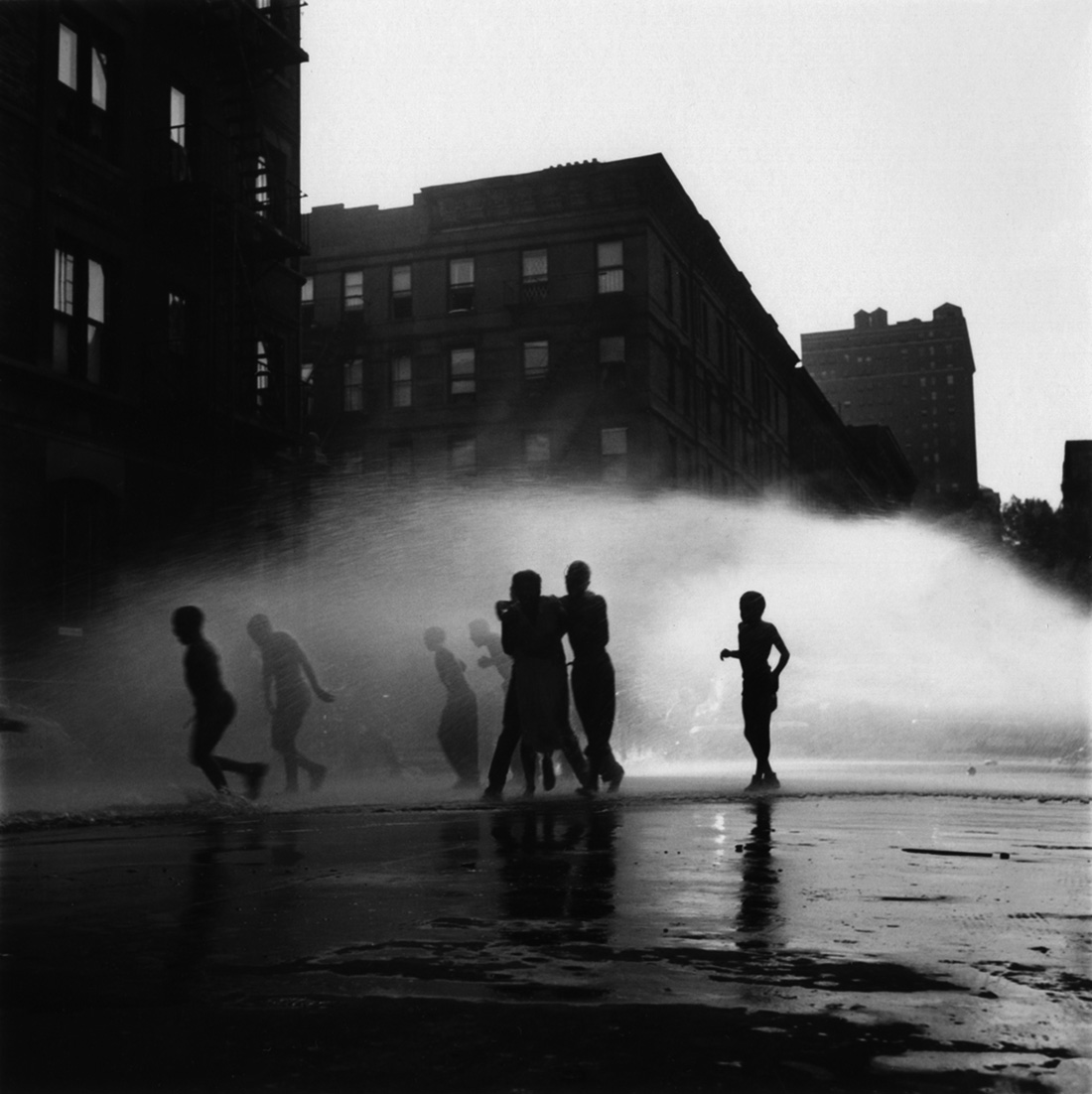
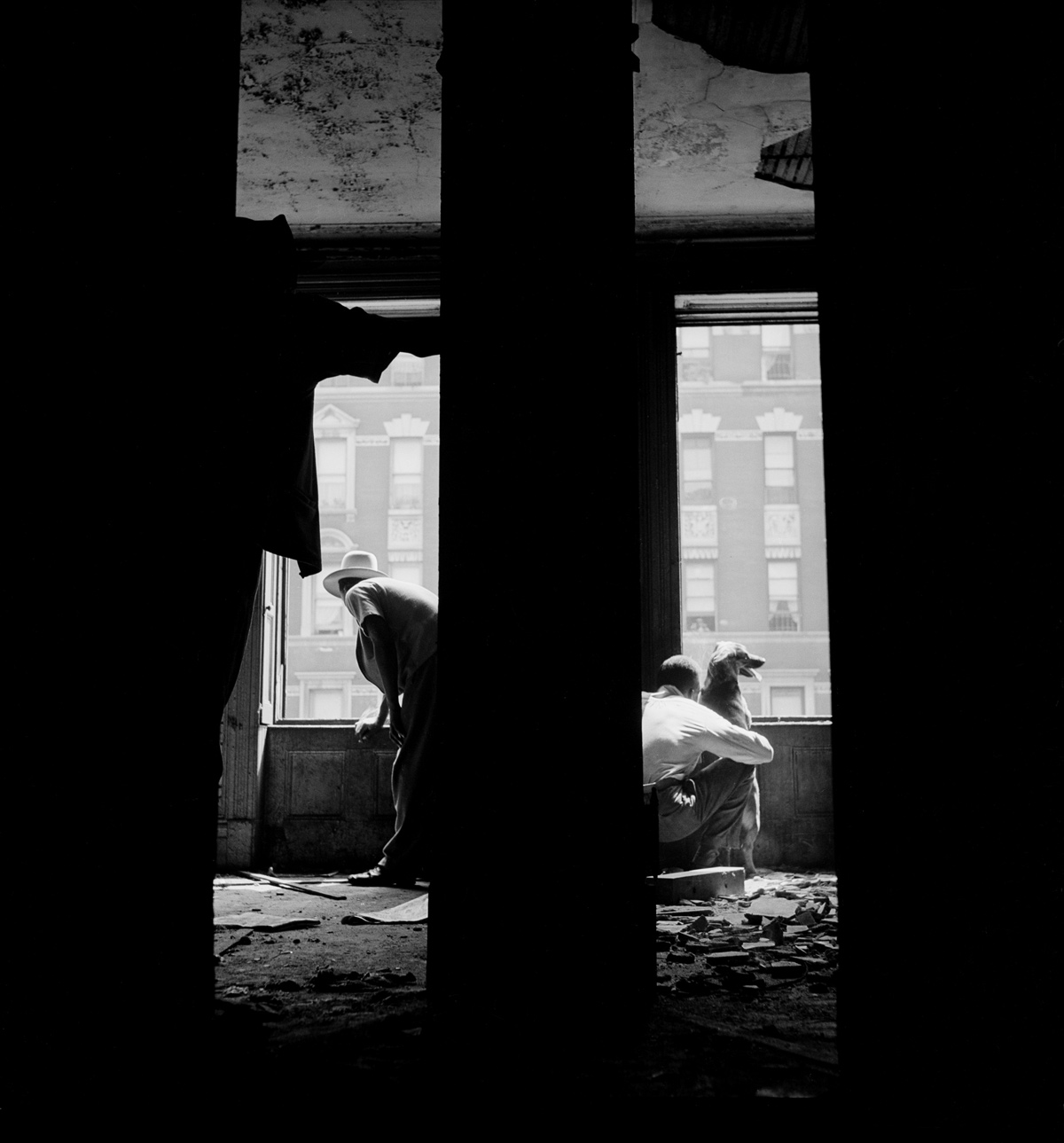
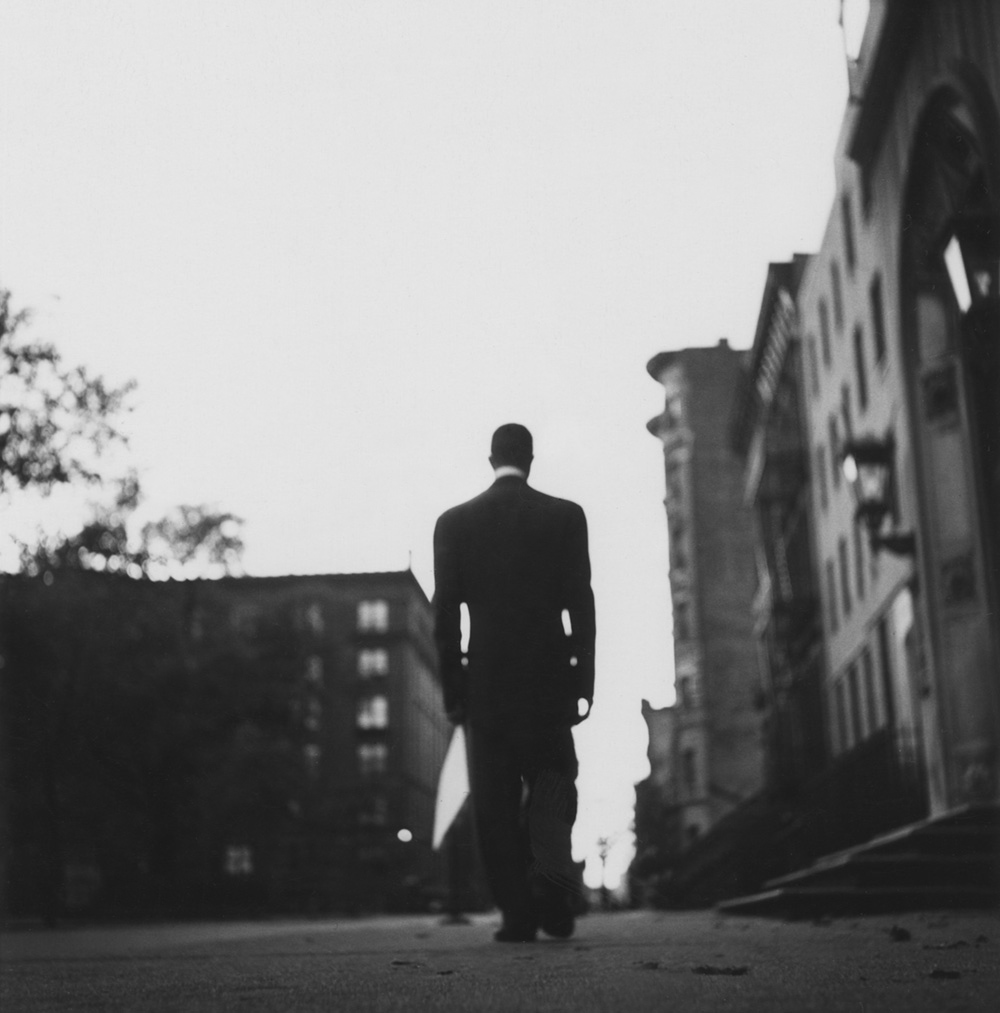
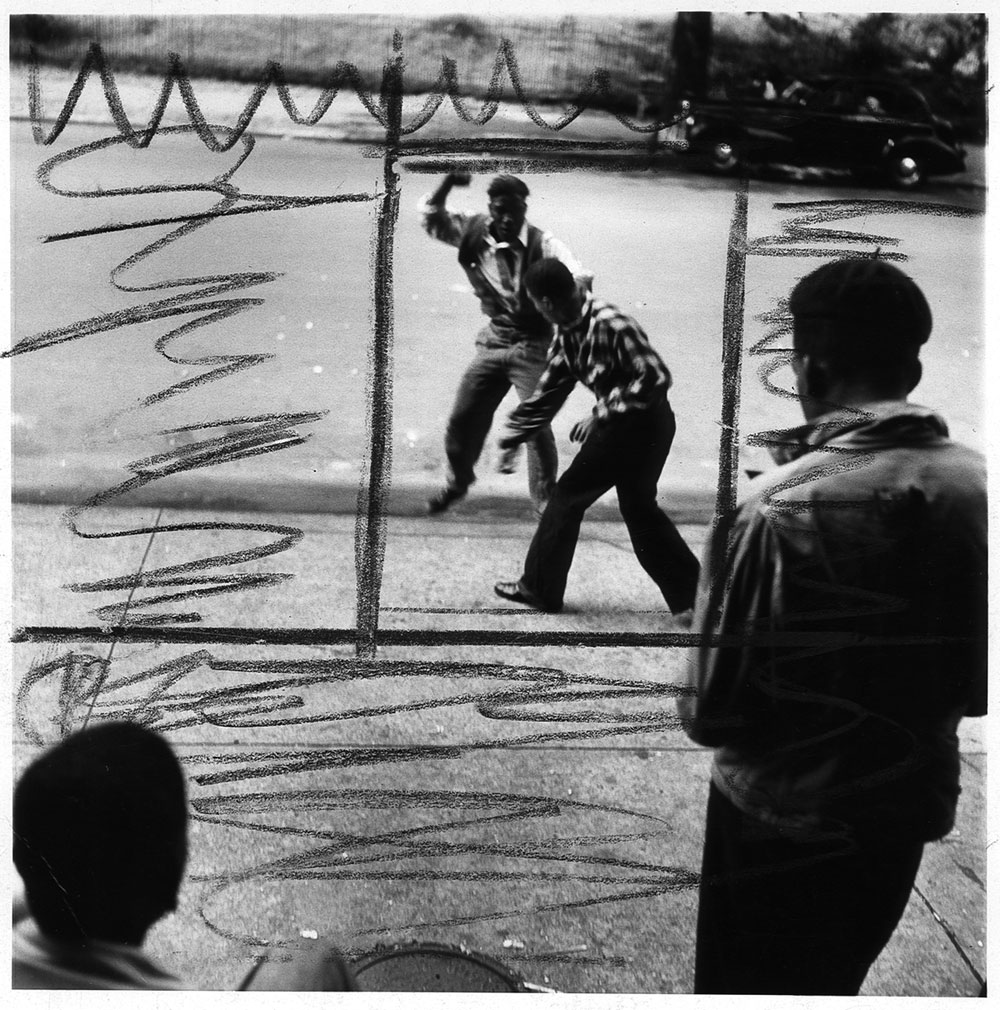
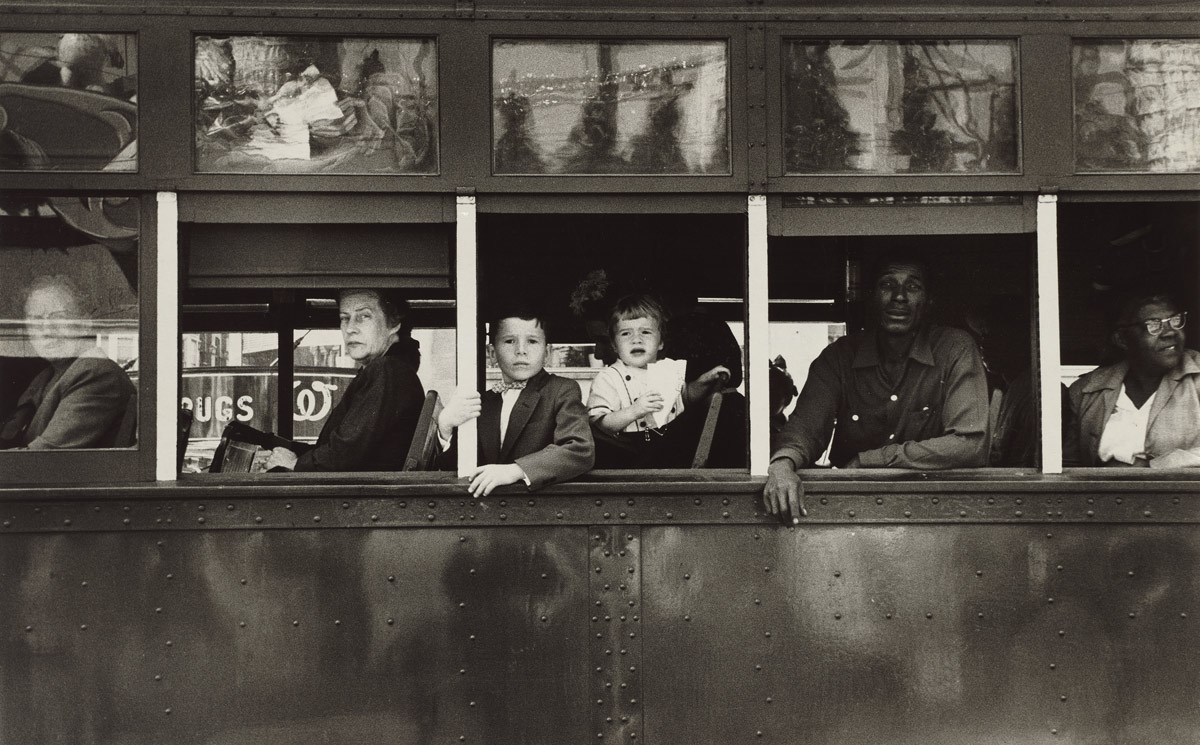
William Klein talks about his works, technique and process.
William Klein (1928-2022) is an American-born French photographer and filmmaker noted for his ironic approach to both media and his extensive use of unusual photographic techniques in the context of photojournalism and fashion photography. He was ranked 25th on Professional Photographer’s list of 100 most influential photographers.
Klein trained as a painter, studying under Fernand Léger and found early success with exhibitions of his work. He soon moved on to photography and achieved widespread fame as a fashion photographer for Vogue and for his photo essays on various cities. He has directed feature-length fiction films, numerous short and feature-length documentaries and has produced over 250 television commercials.
He has been awarded the Prix Nadar in 1957, the Royal Photographic Society’s Centenary Medal and Honorary Fellowship (HonFRPS) in 1999, and the Outstanding Contribution to Photography Award at the Sony World Photography Awards in 2012.
Many thankx to the Amon Carter Museum of American Art for allowing me to publish the photographs in the posting. Please click on the photographs for a larger version of the image.
Jack Delano (American, 1914-1997) Chopping cotton on rented land near White Plains, Greene County, Georgia, 1941 1941
Inkjet print, 2013
Courtesy the Library of Congress
On October 5, the Amon Carter Museum of American Art opens Color! American Photography Transformed,a compelling examination of how colour has changed the very nature of photography, transforming it into today’s dominant artistic medium. Color! includes more than 70 exceptional photographs by as many photographers and is on view through January 5, 2014.
“Colour is so integral to photography today that it is difficult to remember how new it is or realise how much it has changed the medium,” says John Rohrbach, senior curator of photographs.
The exhibition covers the full history of photography, from 1839, when Frenchman Louis-Jacques-Mandé Daguerre (1787-1851) introduced his daguerreotype process, to the present. From the start, disappointed that photographs could only be made in black and white, photographers and scientists alike sought with great energy to achieve colour. Color! begins with a rare direct-colour photograph made in 1851 by Levi L. Hill (1816-1865), but explains how Hill could neither capture a full range of colour nor replicate his achievement. It then shows finely rendered hand-coloured photographs to share how photographers initially compensated for the lack of colour.
When producing colour photographs became commercially feasible in 1907 in the form of the glass-plate Autochrome, leading artists like Alfred Stieglitz (1864-1946) were initially overjoyed, according to Rohrbach. Color! offers exquisite examples of their work even as it explains their ultimate rejection of the process because it was too difficult to display and especially because they felt it mirrored human sight too closely to be truly creative.
“Although many commercial photographers embraced colour photography over succeeding decades, artists continued to puzzle over the medium,” Rohrbach explains. Color! reveals that many artists from Richard Avedon (1923-2004) to Henry Holmes Smith (1909-1986) tried their hand at making colour photographs through the middle decades of the 20th century, and it shows the wide range of approaches they took to colour. It also shares the background debates among artists and photography critics over how to employ colour and even whether colour photographs could have the emotional force of their black-and-white counterparts.
Only in 1976, when curator John Szarkowski at the Museum of Modern Art in New York heralded the young Memphis photographer William Eggleston’s (b. 1939) snapshot-like colour photographs as the solution to artful colour, did fine art colour photography gain full acceptance.
“Eggleston revealed how colour can simultaneously describe objects and stand apart from those objects as pure hue,” Rohrbach says. “In so doing, he successfully challenged the longstanding conception of photography as a medium that found its calling on close description.”
Color! illustrates through landmark works by Jan Groover (1943-2012), Joel Meyerowitz (b. 1938) and others the blossoming of artists’ use of colour photography that followed in the wake of Szarkowski’s celebration of Eggleston. It also reveals artists’ gradual absorption of the notion that colour could be used flexibly to critique cultural mores and to shape stories. In this new colour world, recording the look of things was important, but it was less important than conveying a message about life. In this important shift, led by artists as diverse as Andres Serrano (b. 1950) and Laurie Simmons (b. 1949), the exhibition explains, photography aligned itself far more closely with painting.
Color! shows how the rise of digital technologies furthered this transformation, as photographers such as Gregory Crewdson (b. 1962), Richard Misrach (b. 1949) and Alex Prager (b. 1979) have explicitly embraced the hues, scale, and even subjects of painting and cinema.
“Photography still gains its power and wide popularity today from its ability to closely reflect the world,” explains Rohrbach, “but Color! reveals how contemporary artists have been using reality not as an end unto itself, but as a jumping off point for exploring the emotional and cultural power of colour, even blurring of line between record and fiction to make their points. These practices, founded on colour, have transformed photography into the dominant art form of today even as they have opened new questions about the very nature of the medium.”
The exhibition will include an interactive photography timeline enabling visitors to contribute to the visual dialogue by sharing their own colour images. The photographs will be displayed along the timeline and on digital screens in the museum during the exhibition to illustrate how quantity, format and colour quality have evolved over time.
“By telling the full story of colour photography’s evolution, the exhibition innovatively uncovers the fundamental change that colour has brought to how photographers think about their medium,” says Andrew J. Walker, museum director. “The story is fascinating and the works are equally captivating. Photography fans and art enthusiasts in general will revel in the opportunity to see works by this country’s great photographers.
Press release from the Amon Carter Museum of American Art website
The von Gloeden is stunning and some of the paintings are glorious: the muscularity / blood red colour in Falguière by Lutteurs d’Alexandre (1875, below); the beauty of Ángel Zárraga’s Votive Offering (Saint Sebastian) (1912, below); the sheer nakedness and earthiness of the Freud; and the colour, form and (homo)eroticism of The Bath by Paul Cadmus (1951, below), with their pert buttocks and hands washing suggestively.
But there is nothing too outrageous here. Heaven forbid!
After all, this is the male nude as curatorial commodity.
Dr Marcus Bunyan
Many thankx to the Musée d’Orsay for allowing me to publish the art work in the posting. Please click on the photographs for a larger version of the image.
“The high brow peep show is divided thematically into depictions of religion, mythology, athleticism, homosexuality, and shifting notions of manliness. Wandering the Musee’s grand halls you will see rippling Greco-Roman Apollonian gods, Egon Schiele’s finely rendered, debauched self portraits and David LaChapelle’s 90s macho-kitsch celebs. Edward Munch’s hazy, pastel bathers mingle with Lucian Freud’s grossly erotic fleshy animals and reverent depictions of Christ and Saint Sebastian, showing the many ways to interpret a body sans outerwear.”
Priscilla Frank. “‘Masculine/Masculine’ Explores Male Nude Throughout Art History And We Couldn’t Be Happier (NSFW),” on the Huffpost Arts and Culture website, 26/09/2013 updated 07/12/2017 [Online] Cited 02/01/2021
In the late 19th century, Belgium was one of the great centres of European symbolism. Jean Delville’s paintings and writings expressed the most esoteric side of the movement. In the mid-1880s, Delville’s discovery of the symbolist milieu in Paris and the friendships he made there led him to break with the naturalism inherited from his academic training. Thus his friendship with the Sâr Péladan and his regular attendance at the Salon of the Rose+Croix, testified to his belief in an intellectual art which focused on evocation more than description.
School of Plato, a decoration intended for the Sorbonne but never installed there, is a striking work in many respects. Its monumental size and its ambitious message – an interpretation of classical philosophy seen through the prism of the symbolist ideal – set it apart. The manifesto makes no secret of its references, from Raphael to Puvis de Chavannes, but envelops them in the strange charm of a deliberately unreal colour range. The ambiguity emanating from this fin de siècle Mannerism knowingly blurs the borderline between purity and sensuality.
In this work the arrangement of the bathers is brilliantly orchestrated – a complex grouping of foregrounded figures is contrapuntally arranged against another group occupying the middle ground. There is a strong classical echo to the triangular, pedimental architecture of these four foregrounded figures, anchoring the work compositionally. The effect is to create an architecturally interlocking circle of figures surrounding a group of bathers in the water or sitting on the banks. The corporeal presence of the foregrounded figures and the luminosity of their skin tones are echoed in the volumetric forms of the cumulus clouds that loom in the background. We see Cézanne’s technical confidence in the way the terrain has been flattened and the treescape simplified. He uses trees here not for their anecdotal fidelity, but to anchor the composition at key points.
There is an undeniable sense of ritual in this work. Some commentators interpret the scene as baptismal – Cézanne became a devout catholic in 1890 – with the figure at left pouring water over the head of a partially submerged bather to his right. But it is also clear here that Cézanne mixes the sacred with the profane. There is a celebratory, Arcadian purity which finds its mirror in the compositional structure as a whole, whether it be the way in which light reflects off the facets of the bodies or in which it is refracted off the looming cloud masses. A paganistic, sensual exuberance informs the way in which the figures circle the bathers in the water, which Henri Matisse’s famous The dance 1910 will later recall. (Matisse was a great admirer of Cézanne’s work and owned a number of his paintings.) And it is probably no coincidence that the ‘attendant’ holds a luminous, vulva-shaped towel at the very centre of the composition. Grammatically, the title Baigneurs does not preclude the possibility that some of the participants may be female – the seated figure who is, significantly, adjacent to the towel, appears to be clearly female, for example. Bathers, then, is redolent with meaning. This is a powerfully multivalent work, and along with the later The large bathers paintings of 1894-1905 and 1900-1905, is considered to be one of Cézanne’s great masterpieces.
Mark Henshaw
Text from the National Gallery of Canberra website [Online] Cited 02/01/2021
This red/pink monochrome that characterises The Adolescents first appeared after Picasso’s visit to Gosol with his partner Fernande. The earth in this village in the Catalan Pyrenees was done in an unusual ochre colour that Picasso included in his “Rose Period” (1904-1906). Two nude figures, outlined and modelled on a monochrome background, give the image a sculptural and classical character. The poses are hieratic: the young man crosses his arms above his head, while the young woman, or androgynous adolescent, balances a pitcher on her head in a timeless pose. Jean Cassou highlighted the Mediterranean character of this brief phase in Picasso’s art, and its relationship with the art of Maillol (1861-1944). Undulating lines can be made out below the legs of the two figures. This in fact is the sketch from another composition intended to be in horizontal format, but which the artist chose to erase. Paul Guillaume bought this beautiful painting in 1930. It came from the art dealer Ambroise Vollard (1866-1939). The “pink classicism” of this painting seems to anticipate the period after 1906 of the “return to order”, which characterised Picasso’s work in the 1920s, and which corresponds with other paintings in the Orangerie like the large Bathers of the 1920s.
Provenance: Ambroise Vollard, Paris; Paul Guillaume (1930); Domenica Walter
Text from the Musée de l’Orangerie website [Online] Cited 08/01/2021
Auguste Rodin (French, 1840-1917) The Age of Bronze
1875-1876
Bronze
H. 180.5cm ; W. 68.5cm ; D. 54.5cm
Made in Brussels, this figure, one of Rodin’s most famous works, attests to the sculptor’s masterly skill and his attention to living nature that informs the pose and the modelling.A young Belgian soldier, Auguste Ney,was the model for this statue devoid of any element that would shed light on the subject’s identity. The untitled work was exhibited at the Cercle Artistique, Brussels, in 1877, then, entitled The Age of Bronze, at the Salon in Paris, where it caused a scandal.
Also known as The Awakening Man or The Vanquished One, the statue recalls one of the early ages of mankind. There was originally a spear in the left hand, as is shown in a photograph by Gaudenzio Marconi, but Rodin decided to suppress the weapon so as to free the arm of any attribute and infuse the gesture with a new liberality.
Accused of having used a life cast of his sitter, when the statue was shown in Paris, Rodin had to prove that the quality of his sculpture’s modelling came from a thorough study of profiles, not from a life cast. His critics eventually recognised that the sculptor was innocent of any trickery. The scandal, however, did draw attention to Rodin and earned him the commission for The Gates of Hellin 1880.
Text from the Musée Rodin website [Online] Cited 08/01/2020
While it has been quite natural for the female nude to be regularly exhibited, the male nude has not been accorded the same treatment. It is highly significant that until the show at the Leopold Museum in Vienna in the autumn of 2012, no exhibition had opted to take a fresh approach, over a long historical perspective, to the representation of the male nude. However, male nudity was for a long time, from the 17th to 19th centuries, the basis of traditional Academic art training and a key element in Western creative art. Therefore when presenting the exhibition Masculine / Masculine, the Musée d’Orsay, drawing on the wealth of its own collections (with several hitherto unknown sculptures) and on other French public collections, aims to take an interpretive, playful, sociological and philosophical approach to exploring all aspects and meanings of the male nude in art. Given that the 19th century took its inspiration from 18th century classical art, and that this influence still resonates today, the Musée d’Orsay is extending its traditional historical range in order to draw a continuous arc of creation through two centuries down to the present day. The exhibition will include the whole range of techniques: painting, sculpture, graphic arts and, of course, photography, which will have an equal place in the exhibition.
To convey the specifically masculine nature of the body, the exhibition, in preference to a dull chronological presentation, takes the visitor on a journey through a succession of thematic focuses, including the aesthetic canons inherited from Antiquity, their reinterpretation in the Neo-Classical, Symbolist and contemporary eras where the hero is increasingly glorified, the Realist fascination for truthful representation of the body, nudity as the body’s natural state, the suffering of the body and the expression of pain, and finally its eroticisation. The aim is to establish a genuine dialogue between different eras in order to reveal how certain artists have been prompted to reinterpret earlier works. In the mid 18th century, Winckelmann examined the legacy of the divine proporzioni of the body inherited from Antiquity, which, in spite of radical challenges, still apply today having mysteriously come down through the history of art as the accepted definition of beauty. From Jacques-Louis David to George Platt-Lynes, LaChapelle and Pierre et Gilles, and including Gustave Moreau, a whole series of connections is revealed, based around issues of power, censorship, modesty, the boundaries of public expectation and changes in social mores.
Winckelmann’s glorification of Greek beauty reveals an implicit carnal desire, relating to men as well as women, which certainly comes down through two centuries from the “Barbus” group and from David’s studio, to David Hockney and the film director James Bidgood. This sensibility also permeates the turn of the 19th and 20th centuries as it questions its own identity, as we see in the extraordinary painting École de Platon [School of Plato], inexplicably purchased by the French state in 1912 from the Belgian artist Delville. Similarly, the exhibition will reveal other visual and intellectual relationships through the works of artists as renowned as Georges de La Tour, Pierre Puget, Abilgaard, Paul Flandrin, Bouguereau, Hodler, Schiele, Munch, Picasso, Bacon, Mapplethorpe, Freud and Mueck, while lining up some surprises like the Mexican Angel Zarraga’s Saint Sébastien (Saint Sebastian), De Chirico’s Les Bains mystérieux (Mysterious Baths) and the erotica of Americans Charles Demuth and Paul Cadmus.
This autumn therefore, the Musée d’Orsay will invite the visitor to an exhibition that challenges the continuity of a theme that has always interested artists, through unexpected yet productive confrontations between the various revivals of the nude man in art.”
Why had there never been an exhibition dedicated to the male nude until Nackte Männer at the Leopold Museum in Vienna last year? In order to answer this question, the exhibition sets out to compare works of different eras and techniques, around great themes that have shaped the image of the male body for over two centuries.
We must distinguish above all between nudity and the nude: a body simply without clothes, that causes embarrassment with its lack of modesty, is different from the radiant vision of a body restructured and idealised by the artist. Although this distinction can be qualified, it highlights the positive, uninhibited approach to the nude in western art since the Classical Period.
Today, the nude essentially brings to mind a female body, the legacy of a 19th century that established it as an absolute and as the accepted object of male desire. Prior to this, however, the female body was regarded less favourably than its more structured, more muscular male counterpart. Since the Renaissance, the male nude had been accorded more importance: the man as a universal being became a synonym for Mankind, and his body was established as the ideal human form, as was already the case in Greco-Roman art. Examples of this interpretation abound in the Judeo-Christian cultural heritage: Adam existed before Eve, who was no more than his copy and the origin of sin. Most artists being male, they found an “ideal me” in the male nude, a magnified, narcissistic reflection of themselves. And yet, until the middle of the 20th century, the sexual organ was the source of a certain embarrassment, whether shrunken or well hidden beneath strategically placed drapery, thong or scabbard.
From the 17th century, training of the highest standard was organised for the most privileged artists. In sculpture and in history painting, the ultimate aim of this teaching was to master the representation of the male nude: this was central to the creative process, as the preparatory studies had to capture the articulation of the body as closely as possible, whether clothed or not, in the finished composition.
In France, pupils studied at the Académie Royale then at the Académie des Beaux-Arts, working from drawings, engravings, sculptures “in the round” and life models. Right up until the late 20th century, these models were exclusively male, for reasons of social morality, but also because the man was considered to have the archetypal human form. In order to be noble and worthy of artistic representation, and to appeal to all, this could not be the body of an ordinary man: the distinctive features of the model had to be tempered in order to elevate the subject.
Above all, the artists of Antiquity and of the Renaissance were considered to have established an ideal synthesis of the human body without being distracted by individual characteristics. For Winckelmann, the German 18th century aesthete, the ideal beauty of Greek statues could only be embodied by the male nude. But although it inspired numerous artists, the “noble simplicity and quiet grandeur” of Winckelmann’s gods was undermined by other interpretations of Classical art: the torment of Laocoon, a work from late Antiquity, can be seen in the work of the Danish painter Abildgaard, while David advocated a much more Roman masculinity. Even when challenged, reinterpreted and renewed by the 20th century avant-garde, the Classical male nude and its rich legacy remains an object of fascination right up to the inter-war years and up to the present day.
The concept and the word “hero” itself come from ancient Greece: whether a demigod or simply a mortal transcending his human condition to become an exemplum virtutis, he embodies an ideal. The admiration for Classical art and culture explains the ubiquity of the hero in Academic painting, particularly in subjects given to candidates of the Prix de Rome: great history painting thrived on the exploits of supermen in the most perfect bodies.
This connection between anatomy and heroic virtue, conveying noble and universal values, goes back to the Neo-Platonic concept linking beauty and goodness. The hero’s nudity has been so self-evident that the “heroic nude” has become the subject of a recurrent debate about the representation of great men, past or present, no matter how incongruous the result may appear.
Heroism is not a state, rather a means by which the strength of character of an exceptional being man is revealed: although Hercules’ strength is inseparable from his exploits, it was David’s cunning that overcame the powerful Goliath. In both cases they are endowed with a warrior’s strength, which was particularly valued by a 19th century thirsting for virility and patriotic assertion: more than ever, this was the ideal to be attained. We had to wait for the 20th century crisis of masculinity before we could see the renewal of the status of the increasingly contemporary hero, and the diversification of his physical characteristics. However, whether a star or a designer like Yves Saint-Laurent, or even the young men on the streets of Harlem painted by the American Kehinde Wiley, the evocative power of nudity remains.
The 20th century witnessed the start of a new way of looking at the human body where the focus was on medical aspects and hygiene, and this had a considerable impact on the concept of the artistic nude. Numerous physical education movements and gymnasia appeared. People were captivated by the figure of the “sportsman” and, as in the work of the painter Eugene Jansson, came to admire and covet the virile power of his body in action. This concept is realised in culturalism, the narcissistic admiration of a body that has become an object to be fashioned like an artwork in its own right. Modern man with his athletic morphology has become a new potential ideal: he embodies a beauty that invites comparison with Greco-Roman art.
Linked with the affirmation of national identity, the athlete has come to personify the brute force of the nation and an ability to defend the country in times of war. During the 1930s in the United States, the image of the athlete evolved in a distinctive way, highlighting the ordinary man as a mixture of physical strength and bravery. Totalitarian regimes, however, perverted the cult of the athlete in order to promote their own ideology: Germany linked it in a demiurgic way with the made-up concept of the “Aryan” race, while Mussolini’s government erected marble idols on the Stadio dei Marmi.
As he moves outside the established order, the mythological hero risks the anger of the gods and the jealousy of men. Although his passions, his moral shortcomings and occasionally his frailties stem from his human condition, he is happy to possess the perfect form of the gods: thus the artist and the spectator find expression of a perfect self. The great dramatic destinies thus give character to the compositions, and enable them to interpret a whole range of emotions from determination to despair, from hostility to eternal rest.
Although it is a platitude to say that feelings are expressed most accurately in the face – from the theorised and institutional drawings of Charles Le Brun to the “tête d’expression” competition at the Ecole des Beaux-Arts – one must not underestimate the key role of the body and the anatomy as vehicles for expressing emotion: certain formal choices even led to generally accepted conventions.
Mythology and the Homeric epic abound with stories of the ill-fated destinies and destructive passions of heroes, whose nudity is justified by its origins in ancient Greece: Joseph-Désiré Court displays the broken body of the ill-fated Hippolytus, a premonition of the transposition in the ancient world of Mort pour la patrie [Dying for The Fatherland] of Lecomte du Nouÿ.
Nude Veritas
The Realist aesthetic, which came to the fore in western art during the 19th century, had a dramatic effect on the representation of male nudity. The human body, represented as nature intended, was no longer seen from the decorous distance that characterised the idealised image of the nude, a goal to be achieved through Academic drawing exercises. In this context, where revealing the body was an affront to modesty – in the male-dominated society of the 19th century, the unclothed male appeared even more obscene and shocking than the unclothed female – the male nude gradually became less common as female figures proliferated.
This reversal did not mean, however, that naked men disappeared altogether: scientific study of the male nude, aided by new techniques such as the decomposition of movement through a series of photographs taken in rapid succession – chronophotography – brought advances in the study of anatomy and transformed the teaching of art students. From then on, it was less a case, for the most avant-garde artists, of striving to reproduce a canon of beauty inherited from the past, than of representing a body that retained the harmony of the model’s true characteristics.
The evocative power of the nude inspired artists like the Austrian Schiele to produce nude self portraits that revealed the existential torments of the artist. Invested at times with a Christ-like dimension, these depictions, moving beyond realism into introspection, continued to be produced right up to the 21st century, especially in photography.
The fascination for reality established in artistic circles in the mid 19th century prompted a thorough renewal of religious painting. Although resorting to the classical idealisation of the body seemed to be consistent with religious dogma, artists like Bonnat breathed fresh life into the genre by depicting the harsh truth of the physical condition of biblical figures.
This principle was already at work in Egalité devant la mort (Equality before Death), by Bouguereau, who, in his early work, in the final days of Romanticism, exploited the power of the image of an ordinary corpse. Rodin, far from enhancing the appearance of the novelist that he was invited to celebrate, sought to render Balzac’s corpulent physique with implacable accuracy, without diminishing his grandeur in any way.
The question is thus raised of art’s relationship to reality, a question Ron Mueck tackles in his work. And the strange effect brought about by a change of scale gives an intensity to the dead body of his father that echoes the dead figure in Bouguereau’s painting.
Including the naked body in a landscape was not a new challenge for 19th century artists. In many aspects, this was recurrent in large-scale history painting, and a demanding artistic exercise by which a painter’s technical mastery was judged. It was about making the relationship between the naked body and its setting as accurate as possible in terms of proportion, depth and light. Although Bazille’s Pêcheur à l’épervier [Fisherman with a Net] is one of the most successful attempts – in a contemporary context – at depicting a naked man in an atmospheric light that the Impressionists later took for their own, he nevertheless observed the principles of academic construction.
Masculine nudity in nature took another meaning as society was transformed through technical advances and urbanisation. Man was now seeking a communion with nature, that could reconcile him with the excesses and the sense of dislocation created by the modern world, while still conforming to the theories of good health advocating physical exercise and fresh air.
In pain
In allowing themselves to deviate from the classical norms, artists opened up new possibilities for a more expressive representation of a body in the throes of torment or pain. The decline of the Academic nude and of classical restraint explains this predilection for ordeals: Ixion’s for example, condemned by Zeus to be bound to an eternally spinning wheel of fire.
The writhing body can also express torment of a more psychological nature. The pain experienced by the male body naturally relates to the issues of power between men and women in contemporary society: the naked body can be demeaning and, in certain circumstances, likely to call into question virility and male domination. In this respect, Louise Bourgeois’ choice of a male figure for her Arch of Hysteria was not a random one.
The martyr can, nevertheless, inspire compositions other than the tortured body: the death of Abel, killed by his brother Cain in the Book of Genesis, seems, on the contrary, to have inspired the pose of a totally relaxed body at the point of death. This abandon, however, conveyed a certain ambivalence that artists were determined to exploit: the body, often magnified and in state of morbid ecstasy, was in fact there for the spectator to relish. In these cases, suffering was merely a device to justify fetishising the body once again. In contrast with this seductive treatment, photographers engaged in experiments to divide the body into individual parts, in an aesthetic or even playful approach.
Judeo-Christian culture has undeniably influenced the representation of the naked man since the beginning of modern art. However, the Catholic concept of the body has been at variance with nudity since Paleochristian times: the body is merely the corporeal envelope from which the soul is freed on death. Influenced by theologians advocating the union of the sensory and the spiritual, nudity gradually became accepted for important figures such as Christ and Saint Sebastian. Their martyred bodies, transcended by suffering endured through faith, paradoxically allowed the human soul to come close to God.
For the Catholic church, the vulnerability of Christ’s body, subjected to suffering and bearing the stigmata, is evidence of his humanity, while his divinity is revealed in his inspired expression and his idealised body, a legacy of the underlying classical models. The figure of Saint Sebastian is especially complex: this popular saint, the epitome of the martyr who survives his first ordeal, embodies the victory of life over death. This life force is no doubt related to his youthful beauty and his naked body, both of which made their appearance in the 17th century. This being the case, his representation gradually moves away from Catholic dogma, and acquires an unprecedented freedom and life of its own: his sensuality is more and more obvious, whereas his suffering is at times impossible to detect. In this quest for sensual pleasure, and until the 20th century, the only taboo was to reveal the penis.
Boris Ignatovitch (Russian, 1899-1976) Douche (Shower)
1932
Silver gelatin photograph
In Shower, a group of young athletes enjoys a therapeutic water massage; in the foreground is the back of a young man, whose stately figure takes up almost the entire frame. The masterful light and airiness of the image have a stunning aesthetic effect, illuminating the drops of water that are sprinkled across the spine and muscles of his tanned back. Aleksandr Deineka (1899-1969) was so captivated by the powerful composition of Shower that he recreated the scene in his painting After the Battle (1937-1942, below).
Text from the Nailya Alexander Gallery website [Online] Cited 10/01/2021
Aleksandr Deyneka (Russian, 1899-1969) After the Battle
1937-1942
Oil on canvas
Kursk State Art Gallery
This painting was inspired by a photograph by legendary Soviet photographer Boris Ignatovich that he had presented to Deyneka (above). The artist thought the composition with an athlete in the foreground was perfection itself. However, he had difficulty transferring it to the canvas, and the painting took five years to complete. Deyneka finished it at the height of World War II, which is why the athletes in the title had turned into soldiers.
Anonymous text from the Russia Beyond website December 2019 [Online] Cited 10/01/2021
“This male homoeroticism maintains close ties with the revolutionary project to destroy the family and traditional marriage and the construction of new types of social relations based on collective values above all, with the idea that the bonds of friendship and camaraderie between men (homosociality, “male bonding”) are equally or more important than heterosexual bonding. It is mainly in the period from the Revolution to the 1930s the values of friendship and camaraderie seem particularly highlighted the detriment of the bonds of love, very devalued as “petty-bourgeois”, but even more later, with the Stalinist project of “restoration” of the family, it can be assumed that the emotional and romantic in the heterosexual couple have never been a pervasive and rewarding cultural representation of magnitude of that which may be known in the West. [11] The researcher Lilya Kaganovsky, analysing the Soviet visual culture (especially cult films of the 1930s and 1940s), speaks of “heterosexual panic” in response to the concept of “homosexual panic” coined by Eve K. Segdwick: according Kaganovsky, Soviet cultural works largely reflects the idea that the relations of friendship, especially homosocial, particularly between men, is a moral value than heterosexual relationships. [12] In such a cosmology, heterosexual relationships could be perceived from within oneself and risk jeopardising the homosocial relationships of camaraderie and friendship, and the same social and national cohesion, thought to be based on collective values that conflicts with the value of exclusivity in the couple, “cozy comforts of home” [13].”
Mona. “Représenter le corps socialiste : l’exemple du peintre A. Deïneka (1899-1969),” on the Genre, politique et sexualités website, 16th April 2012 (translation by Google translate). No longer available online
The Temptation of the male
An acknowledged desire for the male body, and the liberalisation of social conventions gave rise to some daring works from the mid 20th century onwards. In the United States, in spite of its puritan outlook since the Second World War, Paul Cadmus did not balk at depicting a pick up scene between men in a most unlikely Finistère. While the physical attraction of the body remained confined for a long time to the secrecy of private interiors, it was increasingly evident in public, in exclusively masculine social situations like communal showers or in the guise of a reconstructed Platonic Antiquity.
Eroticism is even presented quite crudely by Cocteau, whose influence on the young Warhol is undeniable. Beauty and seduction part company when the ideal transmitted by references to the past takes root in idiosyncratic practices and contemporary culture, as Hockney has expressed so accurately in his painting.
For many years, the male body in art had been the subject of “objectification”. The unrestrained admiration for the perfection of the Greco-Roman nudes, a purely intellectual reconstruction of a body that had become the canon of beauty, meant that no interpretation of the nude was considered improper, even Winckelmann’s, with its powerful erotic charge.
Although Academic circles naturally encouraged the nude in great history paintings, certain subjects retained elements of sensuality and ambiguity. At the turn of the 19th century, discussion of the characteristics of the two sexes and their respective boundaries aroused interest in the bisexual amours of Jupiter and Apollo, while the formula of the young hero dying in the arms of his male lover was met with particular interest.
Girodet’s Endymion is depicted as an ephebe, his body caressed sensuously by the rays of the moon goddess, inspiring numerous homoerotic interpretations. With the Symbolists, as with Gustave Moreau, the difference between the sexes results in the downfall of a vulnerable man overcome by an inexorable and destructive force that is seen as feminine. However, at the other extreme, and in a less dramatic way, Hodler depicts the awakening of adolescent love between a self-obsessed young man and a girl who is captivated by his charm.
The sensuality and acknowledged eroticisation considered to be appropriate to the female body during the 19th century struck a serious blow against the traditional virility of the male nude: this blow was not fatal however, as the male nude was still very visible in the 20th century. Sexual liberation expressed, loud and clear, a feeling of voluptuousness and, often with few reservations, endowed the male body with a sexual charge. The model was usually identified, an assertive sign as a statement of the individuality: with Pierre and Gilles, where mythology and the contemporary portrait become one.
From the 1870s, Alexandre Falguière worked simultaneously as a painter and sculptor. Wrestlers, which was his first large painting, caught the critics’ eye and won him a second-class medal at the Salon in 1875. The theme of modern wrestling, fashionable in the Romantic period, had enjoyed a revival in the 1850s. After the Franco-Prussian War of 1870, the figure of the wrestler took on another meaning: his courage was held up as an example to develop the young citizens’ fighting spirit.
Critics were divided between those who scorned “the painting of a sculptor” and the larger group of those who recognised that Falguière had the talent of a true painter. The discussion also focused on the painting’s realism. Some commentators, who preferred the antique, slated the triviality of the theme, seeing nothing more than banal fairground wrestlers. Defenders of realism, on the other hand, enthused over the modernity of the subject and the lack of idealisation.
From 1876, Falguière nonetheless forsook modern subjects in his painting and turned to historical, mythological, literary or religious themes. If Castagnary is to be believed, the painting “was no more than a response to a dare by a painter faintly infatuated with himself and his talent.” Falguière perhaps produced The Wrestlers to prove that he was also a painter.
Text from the Musée d’Orsay website [Online] Cited 06/01/2021
Lucian Freud (British, 1922-2011) Naked Man on Bed
1989
Oil on canvas
Lucian Freud (British, 1922-2011) David and Eli
2004
Oil on canvas
Masculin / Masculin – La video on YouTube
Musée d’Orsay 62, rue de Lille
75343 Paris Cedex 07
France
Exhibition dates: 2nd November – 21st December 2013
Enrico Natali (American, b. 1933) Ford Motor Company press conference, Detroit, 1968
1968
Gelatin silver print
The second tranche of images from the artist Enrico Natali demonstrate his command of visual space. Groups of people face away from the camera, then towards it (image above and below), people clutch at each other or walk in opposite directions (next two images). There is the comparison of races, between abject poverty and young people dressed in fur going to the prom. There is the silence of the singular women in the office, and the (op)posed camaraderie of the Detroit Bolt and Nut Company workers (1968, below). Above all, there is light and shade coupled with a sensitive understanding of how human beings interact – with themselves and the camera. Newlywed couple, Detroit, 1968 (1968, below) is a case in point: the clock on the wall, the record player with single, the hand on the shoulder and the ash lengthening on the cigarette complement the presence of the couple and the wonderful look on their faces. Somehow Natali adds genuine charisma to these people, a dignity and poignancy that makes these photographs memorable.
Dr Marcus Bunyan
Many thankx to Joseph Bellows Gallery for allowing me to publish the photographs in the posting. Please click on the photographs for a larger version of the image.
Exhibition dates: 2nd November – 21st December 2013
Enrico Natali (American, b. 1933) Spectators at a public demonstration, Detroit, 1968
1968
Gelatin silver print
It takes about five or six photographs. Then, in a light bulb moment, you realise what the artist is doing and how good these images really are.
They stink of humanity!
They are good because the humanity is not something that the photographer has been able to whip around to serve his photography. In fact, because of the milieu in which they were made, he might not have even been aware of it as an outstanding feature. But after looking at contemporary photography, Natali serves up something that is now missing in aces. As a full house in fact.
The strength of these photographs lies in their directness, intimacy and immediacy. The 35mm format adds to latter quality, as does the photographers ability to get his subjects to engage with the process of having their photograph taken. In different contexts, Natali seems to have a wonderful rapport with all sorts of people, whether it be office workers, people at home, students at school or men sitting under hair dryers. The look of the woman with sunglasses fourth in line in the photograph Women’s Convention, Detroit, 1968 (1968, below) is priceless.
Natali never defines his point of departure and just moves around it but in his case it doesn’t matter, for the “humanity” present in his work is obvious. Admittedly, there are elements that Natali borrows from people such as Robert Frank and Diane Arbus. And a photographer such as Lee Friedlander for example, by his intellect / aesthetic, tops the attribute of humanity under a layer of quality and a veneer of fame. But this work has a wonderful presence and substance, a respect for human beings and their worlds and real guts to the work. You can absolutely feel his love for the medium, the craft of photography, and the capturing of these self-contained moments.
Today – all too often (as in most of the photography in the Melbourne Now exhibition) – we have a top layer of aesthetic / intellect etc… but there is rarely anything under it. And that my friends, gives me the shits.
Dr Marcus Bunyan
Many thankx to Joseph Bellows Gallery for allowing me to publish the photographs in the posting. Please click on the photographs for a larger version of the image.
Enrico Natali (American, b. 1933) Incident at Bell Isle Park, Detroit, 1968
1968
Gelatin silver print
Enrico Natali (American, b. 1933) Businessmen at a squash match, Detroit, 1968
1968
Gelatin silver print
Enrico Natali (American, b. 1933) Woman at a gym, Detroit, 1968
1968
Gelatin silver print
Enrico Natali (American, b. 1933) Husband and wife at home with their youngest child, Detroit, 1968
1968
Gelatin silver print
As the fall of Detroit began, as her middle class American Dreamers began moving to greener pastures, and while the Motor City’s status as one of the shining stars of the industrial revolution began to fade, Detroit became a locus for the racial conflict and political upheaval that swept the country during the late 1960s. Throughout this pivotal moment, Enrico Natali was present, empathically documenting Detroit, her people and their environments, and their lives and conditions in his compelling photographs.
Forty-one years later, Natali’s photographs of Detroit still resonate with hope and emotion, and indeed, have taken on an added pathos. These pictures capture the relative calm before the storm: people attending art exhibitions, sporting events, a high school prom; families posing together for portraits; secretaries smoking their afternoon cigarettes; children, parents and grandparents, workers of every stripe – machinists, waitresses, beauticians – plying their trades with what might be described in retrospect as innocence. The spirits of these nameless faces, young and old, are the ghosts that haunt what is now – very literally – this bankrupt metropolis.
Enrico Natali was born in 1933, in Utica, New York. During the 1960s he lived and photographed in various American cities, including New York, New Orleans, Chicago, and Detroit. At the end of that decade he ceased work as a photographer and began a meditation practice that became his primary focus, as he built a home and raised his family in California’s Los Padres National Forest. In 1990 Natali and his wife Nadia founded the Blue Heron Center for Integral Studies, a Zen meditation center in Ojai, California. A handsome, timely and poignant publication, Detroit 1968, published by Foggy Notion Books, including an essay by Mark Binelli, author of the critically acclaimed Detroit City is the Place to Be (2012, Metropolitan Books), accompanies the exhibition.
Press release from the Joseph Bellows Gallery website
Enrico Natali (American, b. 1933) Young woman on a street, Detroit, 1968
1968
Gelatin silver print
Stephen Benwell (Australian, b. 1953) Statue (installation view)
2012 Photo: Marcus Bunyan
Throughout his career a major preoccupation of Benwell’s work has been the depiction of the male figure. In 2006 he commenced a series of figurative sculptural works that explore issues relating to masculinity, naked beauty and sensuality. These works, initially inspired by eighteenth century figurines and Greco-Roman statuary, have become a significant aspect of Benwell’s recent practice. The artist contributes a group of these evocative male figures for Melbourne Now.
This is the second of a two-part posting on the huge Melbourne Now exhibition at the National Gallery of Victoria, Melbourne. The photographs in this posting are from NGV Australia at Federation Square. The first part of the posting featured work from NGV International venue in St Kilda Road. Melbourne Now celebrates the latest art, architecture, design, performance and cultural practice to reflect the complex cultural landscape of creative Melbourne.
“Melbourne is a microcosm of the global art world. This is evident not only in its possession of world-class infrastructure, but also in the multitude of tendencies, styles and modes of practice that circulate in its midst. I doubt that there is an underlying formal unity, or even a hierarchy of movements, that holds together and directs the global art world. This then begs the question: does the teeming multitude of art forms in Melbourne suggest that the local scene is an isomorph [a substance or organism that exactly corresponds in form with another] of global chaos, or a unique fragment that coexists with other entities?
The answer is paradoxical. It is our haunted and resistant sense of place that allows for both a form of belonging that is forever seeking to be elsewhere, and a unique aesthetic that anticipates the many returns of a repressed past.”
Nikos Papastergiadis. “As Melbourne in the world.” 2013
“What the show delivers in spades is a sense of the city as a place of immense creativity and subtle exploration. While non-Melburnians might be tempted to see this as an especially large example of the city’s enduring fascination with itself, when the theme is the city, the inclusion of architecture and design makes sense.
And the result is anything but narcissistic; a turn round the exhibition reveals that although Melbourne features strongly in some works, it is also curiously incidental; at the heart of the show is an examination of urban and suburban, and what it feels like to live in a rapidly changing world where old certainties no longer apply.”
Papapetrou’s contribution to Melbourne Now comprises three photographs from her 2013 series The Ghillies. Working with her children as models and using the extreme camouflage costumes that are employed by the military, Papapetrou reflects on the passing of childhood and the moment when children separate themselves from their mothers. Young men often assume the costumes and identities of masculine stereotypes, hiding themselves, and their true identity, from plain sight in the process.
Hamer’s contribution to Melbourne Now pairs works referencing local signage, Blame and punish the individual, 2013, and Can’t, 2013, with three earlier tapestries from her American series I Send Mixed Messages, 2013. While the contrasting palettes and particular nuances of typography, built architecture and native vegetation point to specific times and places, when amplified and dislocated Hamer’s chosen texts suggest a more universal narrative of perplexity and turmoil. The artist describes these powerful distillations as ‘revealing the small in-between moments that characterise everyday life’.
Piccinini’s work for Melbourne Now is The carrier, 2012, a hyper-real sculpture of a bear-like figure holding an elderly woman. With his massive, hirsute and muscular physique, the creature is almost human; there is warmth and intimacy between the mismatched couple. The figures’ relationship is ambiguous. Are they mistress and servant, or simply unlikely friends, embarked on a journey together? It is nice to believe the latter, but hard to forget that humans rarely treat other animals equitably. The carrier investigates what we want from our creations, and wonders about unexpected emotional connections that might arise between us and them.
Metaxas’s contribution to Melbourne Now comprises five photographs from The Mourners series, 2011, which was first exhibited at the Centre for Contemporary Photography, Melbourne, in 2011. These stately portraits show women who have adopted the traditional practice of wearing black, symbolising perpetual mourning, following the death of their husbands. Photographed against plain black backdrops, dressed in their widows’ weeds, these women form an austere and mournful frieze.
Expanding the artist’s greater naturist project, Nudes, 2013, is a series of collages featuring images of twentieth-century modernist art objects and nudes taken from soft porn references. In these works, Ringholt complicates the original function of the images as the spectator considers the relationship between the nude and the work of art. Interested in how images can be transformed by simple interventions, Ringholt opens possibilities for new narratives to emerge between the nude, the object and the audience.
Since challenging fellow artist Luke Sinclair to a boxing match at Melbourne’s Northside Boxing Gym in 2001 (as a performance), Lewer has remained interested in the site, training there regularly and making art about it. For Melbourne Now Lewer presents an immersive recreation of the gymnasium, featuring a large-scale charcoal wall-drawing accompanied by mirrors, sound and a sweaty boxing bag.
The collective’s members are Cassandra Chilton, Molly O’Shaughnessy, Sarah Parkes, Caroline Price and Lyndal Walker. Their practice embraces themes of home life, feminism and craft and explores how collaborative participation in, and contemporising of, these activities creates a distinct cultural community. Their work’s innovative combination of humour and contemporary critique with nostalgic or familiar elements makes it appealing to a wide audience. Often thought of in terms of dysfunction, the share house in their hands becomes a site of creativity, cooperation and overindulgence.
Food is a constant presence in HSL’s work, from recipe swap meets, street art and public art commissions to controversial cake entries in the Royal Melbourne Show. For Melbourne Now the group take baking and icing to a whole new level. Their installation At home with the Hotham Street Ladies, 2013, transforms the foyer of The Ian Potter Centre: NGV Australia into an icing-bombed domestic wonderland. Their commission for kids invites children and families to photograph themselves within one of the scenes from HSL’s icing- and lolly encrusted share house.
For Melbourne Now Irvine has constructed a large site-specific work at The Ian Potter Centre: NGV Australia, Before the after, 2013, which establishes a dialogue with the gallery building, its architecture and the temporality of the exhibition. Spilling out across the floor, the serpentine form is an interruption of the order of things, a writhing obsidian mass that clings to the interior of the building. At the same time the work is a nuanced meditation on the nature of surfaces and skin. Irvine’s iterative practice argues for value in the gestural, and proposes the act of making as a form of knowledge.
Knight’s recent folded photographic works extend his interest in notions of authorship, photographic agency, the relationships between observer and observed, and ideas of intimacy and love. Each scene captures a couple lying together, bodies entwined, in bed – the artist privy to an intense, personal scene of absorption. There is an evident trust between Knight and his subjects, who sleep gently, seemingly unaware of, or perhaps complicit in, his presence. The illusion is ruptured by the folding of the photographic print, which has the effect of sometimes forcing the couples closer together, other times slicing them apart. The fold intensifies the sense of intimacy and draws attention to the physical state of the photograph.
For Melbourne Now, Wadelton contributes a series of recent photographs of suburban milk bars selected from his vast personal cache. Whereas these shots of corner-store facades – windows jammed with ice-cream, soft drink and newspaper logos, hand-painted typography and scrawled graffiti – echo the Pop paintings that made his name, insofar as they combine ready-made commercial symbols on the same flat, pictorial plane, the photographs’ grey-scale palette and documentary presentation differ from the futuristic aesthetic of Wadelton’s canvases. While the paintings delight in global commercial imagery, Milk Bars of Melbourne, 2010-2013, shows a local culture in terminal decline.
While at first iProtest, 2012-2013, resembles a display of endearing souvenir-style figurines hanging on a wall, its potency is revealed on closer inspection. Each figurine is personalised with details relating to one of the many conflicts driven by mass protests around the world. Nationalism is referenced by faces painted with flags; acts of violence leave bodies dismembered and bloodied; and the cutest figurines are in fact riot police, wielding guns and dressed as clowns. The omnipresent symbol of Facebook is also ingeniously added to the work. Byrne’s crowd of modified figurines explores the way social media has become a significant tool for coordinating protests around the world.
Informed by a fascination with death, memento mori and Victorian jewellery design, deVille’s work relies on traditional techniques and involves a broad range of animals, precious and semiprecious metals and gems. The artist is a vegan and passionate advocate for the fair and just treatment of animals, and only uses animals that have died of natural causes in her work. By examining death in this distinctive way, deVille urges us to consider our own mortality and the beauty of death and remembrance. For Melbourne Now she has created an installation titled Degustation, 2013, which evokes an ornate Victorian-style dining room, filled with her sculptural pieces and works from the NGV collection.
With Transfer station 2, 2011, Gojak creates a sculptural work of unfurling, freewheeling loops, shaky erratic lines and clusters of blossoming tangles that appears like a drawing suspended in space. A high-keyed palette of cobalt blues, soft pinks and fluorescent yellows activates heavier blackened thickets that punctuate perspectives of uninterrupted space. Suspended from the ceiling by a single line, Gojak’s sculpture is a not-quite-settled upon Venn diagram. Its openness is held still in a moment, together with all the scribbled-out mistakes, digressions and exclusions, stalling or directing the movement and exchange circulating around the forms.
The first version of 150 rotations was displayed recently in an exhibition, curated by Gower, that explored the appropriation and use of urban detritus as a visual art strategy by a variety of Melbourne artists. Further developed for Melbourne Now, Gower’s contribution now comprises 150 circular components, each made up of tea-bag tags, price tags and elements cut from junk mail catalogues, which colonise the wall like a galaxy of vibrant constellations. Akin to the light from long-dead stars, the familiar ephemera, which is usually thrown out, recycled or composted, now serves a new purpose and takes on a mesmeric, formal beauty.
Von Sturmer’s Melbourne Now commission for kids, Paradox park, 2013, creates a space for enquiry and interaction with art, conceived with a child’s innate sense of curiosity and wonder. Paradox park comprises a large tilted plane with small circular apertures through which a child (or adventurous adult) can push their head in order to view small projections of animated objects atop and below the surface. By placing the viewer’s point of reference inside the work, von Sturmer posits experience itself as a creative act – a unique interplay between viewer and viewed.
Melbourne Design Now is the first design exhibition of its kind to be shown at the National Gallery of Victoria. A presentation of localised creative intelligence in the fields of industrial, product, furniture and object design, this project comprises more than ninety design projects from forty designers, design studios and companies. Melbourne Design Now celebrates design’s relationship to everyday life and how contemporary designers are embedding unique and serial design production with ideas, meaning and emotion to resonate with the city of Melbourne.
The breadth of design projects in this ‘exhibition within the exhibition’ intends to communicate to the public that the work of Melbourne designers is influencing discourses, future scenarios and markets both at home and around the world. Ranging from cinema cameras by Blackmagic Design to the Bolwell EDGE caravan, eco-design education tools by Leyla Acaroglu to Monash Vision Group’s direct-to-brain bionic eye, and furniture made with ancient Australian timber by Damien Wright to biodegradable lampshades by LAB DE STU, these design projects consolidate Melbourne as one of the great design cities in the world today.
Gregory Bonasera is a ceramicist with an in depth understanding of the processes utilised in the production of ceramics; a methodical thinker who works more like an industrial designer than a potter to realise his creations and to advise and collaborate with other designers on their projects. Consistently adding new works to his range of innovative functional and sculptural ceramic wares, Gregory casts his creations in fine porcelain and bone china employing a hybrid of state of the art CAD technology with traditional 270 year old ceramic production methods. His works are strongly influenced by natural forms, science, biology, botany and geometry.
Kate Rohde’s jewellery and vessels are created in resin, a signature material that features extensively in her visual art practice. These pieces take a playful, decorative approach, often incorporating elements typical of Baroque and Rococo style, drawing particularly on the decorative arts and interior design of this era. The highly ornate nature reveals, on closer inspection, that much of the patterning is drawn from flora and fauna sources. The combination of the two intersecting interests creates a psychedelic supernature.
Text from the Pieces of Eight Gallery website [Online] Cited 25/11/2013
Johnson creates fantastic worlds in images that combine densely layered patterns, objects and figures within architectural settings. Cryptic words and phrases are part of her unique and idiosyncratic iconography. The artist’s drawing and installation practice is inspired by science fiction, mythological cosmology and comic books, and reflects a diverse interest in art, ranging from illuminated manuscripts to folk art traditions such as quilt making. Her contribution to Melbourne Now includes ten new drawings that depict the imagined formation of a future civilisation. These are displayed within a constructed environment featuring a raised podium, painted walls and patterned floor which, together with the drawings, offers an immersive experience.
Sampling the City: Architecture in Melbourne Now reveals the complex web of personalities, factions and trajectories that make up Melbourne’s vibrant contemporary architectural culture. This project asks: What are the ideas and themes that inform Melbourne’s design culture? Who are its agitators and protagonists? How are emerging architects driving new ways of thinking? The project is in four parts:
~ A ‘super graphic’ introduction sampling Melbourne’s contemporary architectural culture
~ A projection space with architectural imagery curated to five themes: representation and the city; craftsmanship and materiality; art-engaged practice; stitching the city; and bio-futures/advanced architecture
~ An incubator/studio environment providing insight into the processes of six leading Melbourne architects: Cassandra Fahey, Make Architecture, March Studio, Muir Mendes, Studio Bird and Studio Roland Snooks
~ An intimate screening room with a video artwork by Matthew Sleeth
Sampling the City is curated by Fleur Watson, with exhibition design by Amy Muir and Stuart Geddes, projection and soundscape design by Keith Deverall, introductory narrative by Watson and Michael Spooner and built environment imagery by Peter Bennetts.
For Melbourne Now, un Magazine presents un Retrospective – a selective history of artists, writers and art practice in Melbourne since 2004, as featured in the back catalogue of the magazine. Taking inspiration and content from past issues, un Retrospective assembles recent local works of art alongside correlating text – whether original essay, review or interview – from the pages of un Magazine, highlighting the relationships between criticism and practice, writers and artists, that have been fostered in the publication. un Retrospective celebrates ten years of un Magazine and contemporary art in Melbourne while providing a point of historical context within the newness of Melbourne Now.
Slave Pianos – a collaboration between artists, composers and musicians Rohan Drape, Neil Kelly, Danius Kesminas, Michael Stevenson and Dave Nelson – make historically grounded, research-based installations and performances utilising humour, immediacy and the conflation of ‘high’ and ‘low’ idioms to suggest connections and interrelations between the largely discrete fields of music, art and architecture.
For Melbourne Now Slave Pianos present Gamelan sisters, 2013, a self-governing electromechanical ‘slave’ gamelan, which allows audience members to select pieces from a repertoire of compositions arranged by Slave Pianos via a wall-mounted console alongside related scores. The Gamelan sisters instrument features in Slave Pianos’ space opera The Lepidopters, to be performed in Indonesia and Australia in 2014, which is based on a three part science fiction story set in Indonesia commissioned from American writer and art critic Mark von Schlegell. A comic depicting the first two parts of The Lepidopters, drawn by Yogyakarta-based artist ‘Iwank’ Erwan Hersi Susanto – a member, with Kesminas, of the Indonesian art-rock collective Punkasila – is also presented in the Melbourne Now Reading Room.
The Ian Potter Centre: NGV Australia Federation Square
Corner of Russell and Flinders Streets, Melbourne
This is the first of a two-part posting on the huge Melbourne Now exhibition at the National Gallery of Victoria, Melbourne. The photographs in this posting are from the NGV International venue in St Kilda Road. The second part of the posting features photographs of work at NGV Australia: The Ian Potter Centre at Federation Square. Melbourne Now celebrates the latest art, architecture, design, performance and cultural practice to reflect the complex cultural landscape of creative Melbourne.
Keywords
Place, memory, anxiety, democracy, death, cultural identity, spatial relationships.
The best
Daniel Crooks An embroidery of voids 2013 video.
Highlights
Patricia Piccinini The Carrier 2012 sculpture; Mark Hilton dontworry 2013 sculpture.
Honourable mentions
Stephen Benwell Statues various dates sculpture; Rick Amor mobile call 2012 painting; Destiny Deacon and Virginia Fraser Melbourne Noir 2013 installation.
Disappointing
The weakness of the photography. With a couple of notable exceptions, I can hardly recall a memorable photographic image. Some of it was Year 12 standard.
Low points
~ The lack of visually interesting and beautiful art work – it was mostly all so ho hum in terms of pleasure for the eye
~ The preponderance of installation / design / architectural projects that took up huge areas of space with innumerable objects
~ The balance between craft, form and concept
~ Too much low-fi art
~ Too much collective art
~ Little glass art
~ Weak third floor at NGV International
~ Two terrible installations on the ground floor of NGVA
Verdict
As with any group exhibition there are highs and lows, successes and failures. Totally over this fad for participatory art spread throughout the galleries. Too much deconstructed / performance / collective design art that takes the viewer nowhere. Good effort by the NGV but the curators were, in some cases, far too clever for their own (and the exhibitions), good. 7/10
Please note: All text below the images is from the guide book.
“Although the word “new” recurs like an incantation in the catalogue essays many exhibits are variations on well-worn themes. The trump cards of Melbourne Now are bulk and variety… It’s astonishing that curators still seem to assume that art which proclaims its own radicality must be intrinsically superior to more personal expressions. Yet mediocrity recognises no such distinctions. Most of this show’s avant-garde gestures are no better than clichés.”
John Macdonald. “Review of Melbourne Now,” in the Sydney Morning Herald, Saturday 11 January, 2014 [Online] Cited 03/10/2022
“A rich, inspiring critical context prevails within Melbourne’s contemporary art community, reflecting the complexity of multiple situations and the engaging reality of a culture that is always in the process of becoming. Local knowledge is of course specific and resists generalisation – communities are protean things, which elide neat definition and representation. Notwithstanding the inevitable sampling and partial account which large-scale survey exhibitions unavoidably present, we hope that Melbourne Now retains a sense of semantic density, sensory intensity and conceptual complexity, harnessing the vision and energy that lie within our midst. Perhaps most importantly, the contributors to Melbourne Now highlight the countless ways in which art is able to change, alter and invigorate the senses, adding new perspectives and modes of perceiving the world in which we live.”
Max Delany. “Metro-cosmo-polis: Melbourne now” 2013
With 10,000 paper planes – aftermath (1), 2011, Coulter encountered Melbourne’s intellectual heart, the State Library of Victoria (SLV). Being awarded the Georges Mora Foundation Fellowship in 2010 allowed Coulter to realise a concept he had been developing since he worked at the SLV in the late 1990s. The result is a playful intervention into what is usually a serious place of contemplation. Coulter’s paper planes, launched by 165 volunteers into the volume of the Latrobe Reading Room, give physical form to the notion of ideas flying through the building and the mind. This astute work investigates the striking contrast between the strict discipline of the library space and its categorisation system and the free flow of creativity that its holdings inspire in the visitor.
The drawings OK and KO, both 2013, which decorate the horizontal surfaces of two table-tennis tables and contain four large self-portraits portraying unease and concern, are more restrained. The hirsute beards of McGregor’s earlier works have evolved into all enveloping geometric grids, their hand-drawn asymmetry creating a subtle sense of distortion that contradicts the inherently flat surface of the tables.
Best known for his brooding urban landscapes, Amor’s work in Melbourne Now, Mobile call, 2012, stays true to this theme. The painting speaks to the heart of urban living in its depiction of a darkened city alleyway, with dim, foreboding lighting. A security camera on the wall surveys the scene, a lone, austere figure just within its watch. The camera represents the omnipresent surveillance of our modern lives, and an uneasy air of suspicion permeates the painting’s subdued, grey landscape. Amor’s reflections on the urban landscape are solemn, restrained and often melancholic. Quietly powerful, his work alludes to a mystery in the banality of daily existence. Mobile call is a realistic portrayal of a metropolitan landscape that opens our eyes to a strange and complex world.
Cloaked combat, 2013, is a visual exploration of the material and technological conflicts between cultures, and how these differences enable one culture to assert dominance over another. Five Aboriginal bark shields, customarily used in combat to deflect spears, repel psychedelic arrows shot from a foreign weapon. Fired by an unseen intruder cloaked in contemporary European camouflage, the psychedelic arrows rupture the bark shields and their diamond designs of identity and place, violating Aboriginal nationhood and traditional culture. The jarring clash of weapons not only illustrates a material conflict between these two cultures, but also suggests a deeper struggle between old and new. In its juxtaposition of prehistoric and modern technologies, Cloaked combat highlights an uneven match between Indigenous and European cultures and discloses the brutality of Australia’s colonisation.
Anchored around a dynamic tapestry of data by Melbourne data artist Greg More, this exhibit offers a window into the ‘system of systems’ that makes up the modern city, peeling back the layers to reveal a sea of information beneath us. Data ebbs and flows, creating patterns normally inaccessible to the naked eye. Set against this morphing data field, an analogue human survey asks the audience to guide the future design of Melbourne through choice and opinion. ZOOM proposes that every citizen influences the future of the city, and that the city in turn influences everyone within it. Accepting this co-dependent relationship empowers us all to imagine the city we want to create together.
For Melbourne Now Campbell presents DUNNO (T. Towels), 2012, a work that continues his fascination with the vernacular culture of suburban Australia. Comprising eighty-five tea towels, some in their original condition and others that Campbell has modified through the addition of ‘choice’ snippets of Australian slang and cultural signifiers, this seemingly quotidian assortment of kitsch ‘kitchenalia’ is transformed into a mock heroic frieze in which we can discover the values and dramas of our present age.
Initiation, 2013, a mural-scale, multi-panelled hoarding that subverts the negative stereotyping of Indigenous people living in contemporary Australian cities. This declarative, renegade installation work is a psychedelic farrago of street art, native flora and fauna, Kamilaroi patterns, X-ray images and text that addresses what it means to be an urban Aboriginal person. By yoking together contrary elements of graffiti, advertising, bling, street slogans and Kamilaroi diamond geometry, Rennie creates a monumental spectacle of resistance.
Installation view of Reko RennieInitiation, 2013 Photo: Marcus Bunyan
Shields from Papua New Guinea held in the National Gallery of Victoria’s collection provided an aesthetic catalyst for the artists to develop an open-ended series of their own ‘shields’. The Belief includes shields made by Burchill and McCamley between 2004 and 2013. In part, this installation meditates on the form and function of shields from the perspective of a type of reverse ethnography. As the artists explain:
“The shield is an emblematic form ghosted by the functions of attack and defence and characterised by the aggressive display of insignia … We treat the shield as a perverse type of modular unit. While working with repetition, each shield acts as a carrier or container for different types and registers of content, motifs, emblems and aesthetic strategies. The series as a whole, then, becomes a large sculptural collage which allows us to incorporate a wide range of responses to making art and being alive now.”
Melbourne Now is an exhibition unlike any other we have mounted at the National Gallery of Victoria. It takes as its premise the idea that a city is significantly shaped by the artists, designers, architects, choreographers, intellectuals and community groups that live and work in its midst. With this in mind, we have set out to explore how Melbourne’s visual artists and creative practitioners contribute to the dynamic cultural identity of this city. The result is an exhibition that celebrates what is unique about Melbourne’s art, design and architecture communities.
When we began the process of creating Melbourne Now we envisaged using several gallery spaces within The Ian Potter Centre: NGV Australia; soon, however, we recognised that the number of outstanding Melbourne practitioners required us to greatly expand our commitment. Now spreading over both The Ian Potter Centre: NGV Australia and NGV International, Melbourne Now encompasses more than 8000 square metres of exhibition space, making it the largest single show ever presented by the Gallery.
Melbourne Now represents a new way of working for the NGV. We have adopted a collaborative curatorial approach which has seen twenty of our curators work closely with both external design curators and many other members of the NGV team. Committing to this degree of research and development has provided a great opportunity to meet with artists in their studios and to engage with colleagues across the city as a platform not only for this exhibition, but also for long-term engagement.
A primary aim throughout the planning process has been to create an exhibition that offers dynamic engagement with our audiences. From the minute visitors enter NGV International they are invited to participate through the exhibition’s Community Hall project, which offers a diverse program of performances and displays that showcase a broad concept of creativity across all art forms, from egg decorating to choral performances. Entering the galleries, visitors discover that Melbourne Now includes ambitious and exciting contemporary art and design commissions in a wide range of media by emerging and established artists. We are especially proud of the design and architectural components of this exhibition which, for the first time, place these important areas of practice in the context of a wider survey of contemporary art. We have designed the exhibition in terms of a series of curated, interconnected installations and ‘exhibitions within the exhibition’ to offer an immersive, inclusive and sometimes participatory experience.
Viewers will find many new art commissions featured as keynote projects of Melbourne Now. One special element is a series of commissions developed specifically for children and young audiences – these works encourage participatory learning for kids and families. Artistic commissions extend from the visual arts to architecture, dance and choreography to reflect Melbourne’s diverse artistic expression. Many of the new visual arts and design commissions will be acquired for the Gallery’s permanent collections, leaving the people of Victoria a lasting legacy of Melbourne Now.
The intention of this exhibition is to encourage and inspire everyone to discover some of the best of Melbourne’s culture. To help achieve this, family-friendly activities, dance and music performances, inspiring talks from creative practitioners, city walks and ephemeral installations and events make up our public programs. Whatever your creative interests, there will be a lot to learn and enjoy in Melbourne Now. Melbourne Now is a major project for the NGV which we hope will have a profound and lasting impact on our audiences, our engagement with the art communities in our city and on the NGV collection. We invite you to join us in enjoying some of the best of Melbourne’s creative art, design and architecture in this landmark exhibition.
Tony Ellwood
Director, National Gallery of Victoria
Foreword from the Melbourne Now exhibition guide book
Adapting the quotidian formats of snapshot photography, home videos, community TV and performance modes drawn from vaudeville and minstrel shows, Deacon’s artistic practice is marked by a wicked yet melancholy comedic and satirical disposition. In decidedly lo-fi vignettes, friends, family and members of Melbourne’s Indigenous community appear in mischievous narratives that amplify and deconstruct stereotypes of Indigenous identity and national history. For Melbourne Now, Deacon and Fraser present a trailer for a film noir that does not exist, a suite of photographs and a carnivalesque diorama. The pair’s playful political critiques underscore a prevailing sense of postcolonial unease, while connecting their work to wider global discourses concerned with racial struggle and cultural identity.
For Melbourne Now Sylvester presents For you, 2013, an illuminated dance floor utilising the current palette of colours of an international make-up brand. By tapping into commonly felt fears of embarrassment and the desire to show off in front of others, For you provides a gentle push onto a dance floor flush in colours already proven by market research to appear flattering on the widest cross-section of people. It is a work that plays on viewers’ vanity while acting as their support. In Sylvester’s own words, this work ‘will make you look good whilst enjoying it. It is for you’.
Assembling over 250 outstanding commissions, acquired and loaned works and installations, Melbourne Now explores the idea that a city is significantly shaped by the artists, designers and architects who live and work in its midst. It reflects the complexity of Melbourne and its unique and dynamic cultural identity, considering a diverse range of creative practice as well as the cross-disciplinary work occurring in Melbourne today.
Melbourne Now is an ambitious project that represents a new direction for the National Gallery of Victoria in terms of its scope and its relationship with audiences. Drawing on the talents of more than 400 artists and designers from across a wide variety of art forms, Melbourne Now will offer an experience unprecedented in this city; from video, sound and light installations, to interactive community exhibitions and artworks, to gallery spaces housing working design and architectural practices. The exhibition will be an immersive, inclusive and participatory exhibition experience, providing a rich and compelling insight into Melbourne’s art, design and cultural practice at this moment. Melbourne Now aims to engage and reflect the inspiring range of activities that drive contemporary art and creative practice in Melbourne, and is the first of many steps to activate new models of art and interdisciplinary exhibition practice and participatory modes of audience engagement at the NGV.
The collaborative curatorial structure of Melbourne Now has seen more than twenty NGV curators working across disciplinary and departmental areas in collaboration with exhibition designers, public programs and education departments, among others. The project also involves a number of guest curators contributing to specific contexts, including architecture and design, performance and sound, as well as artist-curators invited to create ‘exhibitions within the exhibition’, develop off-site projects and to work with the NGV’s collection. Examples of these include Sampling the City: Architecture in Melbourne Now, curated by Fleur Watson; Drawing Now, curated by artist John Nixon, bringing together the work of forty-two artists; ZOOM, an immersive data visualisation of cultural demographics related to the future of the city, convened by Ewan McEoin; Melbourne Design Now, which explores creative intelligence in the fields of industrial, product, furniture and object design, curated by Simone LeAmon; and un Retrospective, curated by un Magazine. Other special projects present recent developments in jewellery design, choreography and sound.
Numerous special projects have been developed by NGV curators, including Designer Thinking, focusing on the culture of bespoke fashion design studios in Melbourne, and a suite of new commissions and works by Indigenous artists from across Victoria which reflect upon the history and legacies of colonial and postcolonial Melbourne. The NGV collection is also the subject of artistic reflection, reinterpretation and repositioning, with artists Arlo Mountford, Patrick Pound and The Telepathy Project and design practice MaterialByProduct bringing new insights to it through a suite of exhibitions, videos and performative installations.
In our Community Hall we will be hosting 600 events over the four months of Melbourne Now offering a daily rotating program of free workshops, talks, catwalks and show’n’tells run by leaders in their fields. And over summer, the NGV will present a range of programs and events, including a Children’s Festival, dance program, late-night music events and unique food and beverage offerings.
The exhibition covers 8000 square metres of space, covering much of the two campuses of the National Gallery of Victoria, and moves into the streets of Melbourne with initiatives such as the Flags for Melbourne project, ALLOURWALLS at Hosier Lane, walking and bike tours, open studios and other programs that will help to connect the wider community with the creative riches that Melbourne has to offer.
A camera’s ability to act as an extension of our eyes and to capture and preserve images renders it a potent instrument. In the case of Constable, this power has particular resonance and added poignancy. The artist lives with profound vision impairment and his compelling, hand-modelled ceramic reinterpretations of the camera – itself sometimes referred to as the ‘invented eye’ – possess an altogether more moving presence. For Melbourne Now, Constable has created a special group of his very personal cameras.
Marrinon’s art lingers romantically somewhere between the past and present. Her figures engage with notions of formal classical sculpture, with references to Hellenistic and Roman periods, yet remain quietly contemporary in their poise, scale, adornments and subject matter. Each work has a sophisticated and nonchalant air of awareness, as if posing for the audience. Informed by feminism and a keen sense of humour, Marrinon’s work is anti-heroic and anti-monumental. The figures featured in Melbourne Now range from two young siblings, Twins with skipping rope, New York, 1973, 2013, and a young woman, Debutante, 2009, to a soldier, Patriot in uniform, 2013, presented as a pantheon of unlikely types.
Andrew’s Vox: Beyond Tasmania, 2013, renders palpable as contemporary art a central preoccupation of his humanist practice – the legacy of historical trauma on the present. Inspired by a rare volume of drawings of fifty-two Tasmanian Aboriginal crania, Andrew has created a vast wunderkammer containing a severed human skeleton, anthropological literature and artefacts. The focal point of this assemblage of decontextualised exotica is a skull, which lays bare the practice of desecrating sacred burial sites in order to snatch Aboriginal skeletal remains as scientific trophies, amassed as specimens to be studied in support of taxonomic theories of evolution and eugenics. Andrew’s profound and humbling memorial to genocide was supported in its first presentation by fifty-two portraits and a commissioned requiem by composer Stéphanie Kabanyana Kanyandekwe.
Commissioned for Melbourne Now, Crooks’s most recent video work focuses his ‘time-slice’ treatment on the city’s famous laneways. As the camera traces a direct, Hamiltonian pathway through these lanes, familiar surroundings are captured in seamless temporal shifts. Cobblestones, signs, concrete, street art, shadows and people gracefully pan, stretch and distort across our vision, swept up in what the artist describes as a ‘dance of energy’. Exposing the underlying kinetic rhythm of all we see, Crooks’s work highlights each moment once, gloriously, before moving on, always forward, transforming Melbourne’s gritty and often inhospitable laneways into hypnotic and alluring sites.
Senbergs’s significance as a contemporary artist and his understanding of the places he depicts and their meanings make his contribution to Melbourne Now essential. Drawing inspiration from Scottish poet Edwin Muir’s collection The labyrinth (1949), Senbergs’s Extended Melbourne labyrinth, 2013, takes us on a journey through the myriad streets and topography that make up our sprawling city. His characteristic graphic style and closely cropped rendering of the city’s urban thoroughfares is at once enthralling and unsettling. While the artist neither overtly celebrates nor condemns his subject, there is a strong sense of Muir’s ‘roads that run and run and never reach an end’.
For Melbourne Now Pound has created The gallery of air, 2013, a contemporary wunderkammer of works of art and objects from across the range of the NGV collection. There are Old Master paintings depicting the effect of the wind, and everything from an exquisite painted fan to an ancient flute and photographs of a woman sighing. When taken as a group these disparate objects hold the idea of air. Added to works from the Gallery’s collection is an intriguing array of objects and pictures from Pound’s personal collection. On entering his installation, visitors will be drawn into a game of thinking and rethinking about the significance of the objects and how they might be activated by air. Some are obvious, some are obscure, but all are interesting.
For Melbourne Now, Fusinato presents Aetheric plexus (Broken X), 2013, a dispersed sculpture comprising deconstructed stage equipment that is activated by the presence of the viewer, triggering a sensory onslaught with a resonating orphic haze. The work responds to the wider context of galleries, in the artist’s words, ‘changing from places of reflection to palaces of entertainment’ by turning the engulfed audience member into a spectacle.
In her most recent project, Jacobs fabricates a rudimentary version of the material Hemacite (also known as Bois Durci) – made from the blood of slaughtered animals and wood flour – which originated in the late nineteenth century and was moulded with hydraulic pressure and heat to form everyday objects, such as handles, buttons and small domestic and decorative items. The attempt to re-create this outmoded material highlights philosophical, economic and ethical implications of manufacturing and considers how elemental materials are reconstituted. Wood flour for pig iron (vessel for mixing metaphors), 2013, included in Melbourne Now, explores properties, physical forces and processes disparately linked across various periods of history.
dontworry, 2013, included in Melbourne Now, is the most ambitious and personal work Hilton has made to date. A dark representation of events the artist witnessed growing up in suburban Melbourne, this wall-based installation presents an unnerving picture of adolescent mayhem and bad behaviour. Extending across nine intricately detailed panels, each corresponding to a formative event in the artist’s life, dontworry can be understood as a deeply personal memoir that explores the transition from childhood to adulthood, and all the complications of this experience. Detailing moments of violence committed by groups or mobs of people, the installation revolves around Hilton’s continuing fascination with the often indistinguishable divide between truth and myth.
Installation view of the exhibition Manuel Álvarez Bravo at The Wittliff Collections, Texas State University
This photographer will always be in my top ten photographers of all time. His lyricism and sensitivity to subject matter and narrative is up there with the very best that the medium has to offer. He was a great influence on my photography when I started taking black and white photographs in 1990. In this posting, it is nice to see some of the less well known of his images.
Dr Marcus Bunyan
Many thankx to The Wittliff Collections for allowing me to publish the photographs in the posting. Please click on the photographs for a larger version of the image.
Manuel Álvarez Bravo (Mexican, 1902-2002)
La señal / The Sign 1967 Gelatin silver print
Gift of Patricia and Keith Carter
Manuel Álvarez Bravo (Mexican, 1902-2002) La buena fama durmiendo / The Good Reputation Sleeping
1938-1939
Gelatin silver print
Manuel Álvarez Bravo (Mexican, 1902-2002) Obrero en huelga, asesinado / Striking Worker, Assassinated
1934
Gelatin silver print
Manuel Álvarez Bravo (Mexican, 1902-2002) Caja de visiones / Box of Visions
1938
Gelatin silver print
One of the founders of modern photography, Manuel Álvarez Bravo (1902-2002) is Mexico’s most accomplished and renowned photographer. His images are masterpieces of post-revolutionary Mexico, composed with avant-garde and surreal aesthetics that resonate with stylised vision. Álvarez Bravo’s signature landscapes, portraits, and nudes translate reality into dream-like moments that have become iconic. “Don Manuel,” as he was called, taught photography at various schools in Mexico City and mentored generations of Mexico’s finest photographers. The Wittliff is proud to present its first-ever solo exhibition of works by this esteemed master – the result of more than 20 years of collecting – more than 50 of Álvarez Bravo’s signed prints. Included among the many famous images are: Bicicletas en domingo / Bicycles on Sunday; Caja de visiones / Box of Visions; El ensueño / The Day Dream; Obrero en huelga asesinado / Striking Worker Murdered; Parábola óptica / Optical Parable; and Retrato de lo eterno / Portrait of the Eternal.
Born in 1902 in Mexico City into a family that supported the arts, Manuel Álvarez Bravo learned photography largely on his own but was encouraged by other well-known photographers, including Hugo Brehme, Tina Modotti, and Edward Weston, as well as the French surrealist writer André Breton. Álvarez Bravo’s art – which matured into a transcendence of culture, time, and place – was inspired by the times, during post-Revolutionary Mexico when Mexico City flourished as one of the major creative and intellectual centers of the world. In 1955, Edward Steichen included his work in the landmark exhibition The Family of Man for the New York Museum of Modern Art (MoMA). Álvarez Bravo’s imagery has been featured in over 150 solo exhibitions, and he garnered many honours throughout his career.
The interests of “Don Manuel,” as he was called, went beyond his own photographic work, and his influence was far-reaching. He co-founded the Mexican Foundation for Publishing in the Plastic Arts devoted to books about Mexican art, planned the Mexican Museum of Photography in Mexico City, and mentored and befriended a great many younger, emerging photographers and artists in Mexico. He died at the age of 100 in October 2002. On view in addition to the Álvarez Bravo photographs are portraits of him by Graciela Iturbide, Rodrigo Moya, and Bill Wittliff. The poem Facing Time, an ode to Álvarez Bravo’s work by Nobel Laureate Octavio Paz, is featured among other supplementary materials. Paz, a collaborator and friend of Álvarez Bravo’s, describes the photographer’s vision as “the arrow of the eye / dead center / in the target of the moment.
Text from The Wittliff Collections website
Manuel Álvarez Bravo (Mexican, 1902-2002) Retrato de lo Eterno / Portrait of the Eternal 1977
Gelatin silver print
Manuel Álvarez Bravo (Mexican, 1902-2002) En el templo del tigre rojo / In the Temple of the Red Tiger
1949
Gelatin silver print
Manuel Álvarez Bravo (Mexican, 1902-2002)
Calabaza y caracol / Squash and Snail
1928, printed 1980
Platinum print
Manuel Álvarez Bravo (Mexican, 1902-2002) Nino Orinando
1927
Manuel Álvarez Bravo (Mexican, 1902-2002) Día de todos muertos / Day of the Dead
1933
Gelatin silver print
Courtesy of Bill and Sally Wittliff
Manuel Álvarez Bravo (Mexican, 1902-2002)
Las lavanderas sobreentendidas / The Washerwomen Implied 1932 Gelatin silver print
Manuel Álvarez Bravo (Mexican, 1902-2002) Señor de Papantla / Man from Papantla 1934
Gelatin silver print
Henri van Noordenburg (Australian born Netherlands, b. 1967) Composition XXI
2013
Hand carved archival pigment print
30 x 30cm
Three solid exhibitions at Edmund Pearce Gallery. All three have interesting elements and strong images. All three have their positives and negatives.
Henri van Noordenburg presents us with a European, colonialist take on the Australian landscape in his new series Efface, similar in their vernacular to early Australian painters visions of their new homeland, with their longing for an “original” home many leagues away over the sea. Except Noordenburg’s interventions look nothing like any Australian landscape I know, heavily influenced as they are by the work of French artist and engraver Gustav Doré (1832-1883) and Japanese wood block prints. His dark, brooding, subterranean art works – in which the artist photographs himself naked and bruised, prints this image on a large sheet of black photographic paper, then hand carves the landscape with a scalpel back into the paper base, isolating but at the same time surrounding the vulnerable, exposed body – image a gothic, melancholy vision of man lost in the wilderness. Here the body (self) is helpless before various forces, but these forces must still be engaged before some progress (pilgrims progress?) can be made.
The technique is truly extraordinary and the artist sets up a “perceptible tension” between technique and form, etching and photograph, body and bulimic (as in excessive), landscape. These ‘synthetic landscapes’ whose form is produced by spatial reorganisation and topographical interventions, man-made spaces, serve as background for what the artist wants us to see as our collective existence.1 Unfortunately, the conceptualisation of the work seems, well, a little confused. And perhaps that is the point. Noordenburg, with his Dutch heritage, is apparently still unsure of his place in a multicultural Australia, even after a few decades living here. But, I feel his point of departure for this work still remains uncertain. And this leads to uncertain outcomes for the viewer.
This uncertainty in the point of departure makes it difficult for the viewer to empathise with the stylistic inclinations of the landscape or the work as a whole. Somehow, it all seems so remote from too much. We can all sympathise with the “humanity” of the work, its anguish and sense of dislocation and wish it well, but I was left a little non-plussed by the visual evidence presented to me. If the exhibition was about wildness (not wilderness) and craziness (not a form of identity dislocation), then it would have been spot on:
“God against man. Man against God. Man against nature. Nature against man. Nature against God. God against nature. Very funny religion!”
D.T. Suzuki (1870-1966)
Amber McCaig‘s series Imagined Histories image “contemporary people captured by a sharp technology… [as they] aspire to join the consciousness of another epoch” (Robert Nelson). Small, intense prints, hung in pairs, re-present figures dressed in renaissance costume acting out the fantasy of living in a romantic, historical era. The portraits are paired with still life of wooden boxes filled with allegorical objects full of symbolic representation. The portraits are strong (the incongruity of an Asian knight is particularly effective), and the relationship between portrait and still life is ambiguous and nuanced. However, the still life become repetitive with the constant placement of images at the back of the box coupled with objects situated towards the front of the box. A study of the magical boxes of the artist Joseph Cornell would have been beneficial in this regard.
I feel that there needs to be more layering in the construction of the individual photographs and between the works in the series as a whole, not just the pairs of images. While the work is a little one dimensional in this imagined time, this is a good beginning to an ongoing investigation.
While Sally Mann’s body of work What Remains is the rolled-gold standard for this kind of work, Greg Elms series What Remains offers an interesting forensic amplification of skeletal “nature”. These animalistic portraits of nature mort are eloquent, strong and forthright. Some work better than others. The Cheetah skull, the Vervet monkey skull (with Rayban Aviator sunglass eyes) and best of them all, the magnificent, constructivist Black cockatoo skull – are all haunting in their deathly presence. Some of the smaller skulls lack these works muscularity, especially when they are printed horizontally on a vertical piece of photographic paper, which simply does not work.
Whether the series needed the ironic commentary of the titles, or the trope of hanging the conceptualisation of the series on the back of global warming, is also debatable. I think the best images are strong enough, and the conviction of the artist obvious enough over numerous bodies of work, that the viewer does not need to be spoon fed this rationalisation.
Dr Marcus Bunyan
1/ Jackson, J. B. Discovering the Vernacular Landscape. New Haven: Yale University Press, 1984, p. 8 quoted in Goldswain, Phillip. “Surveying the Field, Picturing the Grid: John Joseph Dwyer’s Urban Industrial Landscapes,” in Goldswain, Phillip and Taylor, William (eds.,). An Everyday Transience: The Urban Imaginary of Goldfields Photographer John Joseph Dwyer. Crawley, WA: University of Western Australia Publishing, 2010, p. 75.
Many thankx to Edmund Pearce Gallery for allowing me to publish the photographs in the posting. Please click on the photographs for a larger version of the image.
Gustave Doré (French, 1832-1883)
llustration of Lord Alfred Tennyson’s Idylls of the King
1868
Henri van Noordenburg (Australian born Netherlands, b. 1967) Composition X
2012
Hand carved archival pigment print
106 x 106cm
Abstracted within the landscape, the artist features as the protagonist facing the threats of a seemingly hostile bush. Efface references The Expulsion from the Garden of Eden with a focus on the overlaying of a European aesthetic on the physical and intellectual landscape. Starting with self portraits set amid a featureless black background, the photographic surface is hand etched to reveal the landscape.
Van Noordenburg describes the process of self-nude photography as an “incredible mix between strength and weakness, frustration and containment a feeling of euphoria and adrenaline”. Feelings, which mirror van Noordenburg’s attempts to assimilate within a dominant culture.
Text from the Edmund Pearce Gallery website
Henri van Noordenburg (Australian born Netherlands, b. 1967) Composition XXII
2013
Hand carved archival pigment print
30 x 30cm
Henri van Noordenburg (Australian born Netherlands, b. 1967) Composition XXIII
2013
Hand carved archival pigment print
30 x 30cm
Between Here and There
The figure that haunts these images is far from a signifier of passivity and calm. Dwarfed and subjugated by that which surrounds, his naked form seems deep in the throes the landscape’s implicit bewilderment and assault. His pallid, naked flesh is scarred and reddened and soiled, the reproach of this eerie land leaving an acrid evidence.
The work of Henri van Noordenburg veers towards the anxieties of juncture, displacement and exodus – art history, religious mythology, the socio-cultural tropes of migration and dislocation and the tensions of the photographic medium underlie his visual and allegorical language.
Indeed, the sensibilities and narratives that punctuate the Dutch-born artist’s new series, Efface, are significant on several levels. The immediately perceptible tension is that of technique and form. Beginning their lives as nude photographic self-portraits (the body set against a vast, featureless, black backdrop), van Noordenburg’s renderings of the Australian landscape and wilderness are in fact painstakingly realised hand-etchings. The photographic surface is an amalgam, the physicality of the photographic object unmistakable. In an era of fluctuation and change for the now ubiquitous digital form, van Noordenburg attempts to reengage, reinterpret and gain further understanding of the photograph’s physical roots.
The formal and stylistic inclinations that the artist achieves via such a process offers another intriguing layer. Resting upon the myth of the Expulsion from the Garden of Eden, this loaded series operates in the shadows of art history, forging a Romantic European imagining of the landscape and broaching its loaded colonialist underpinnings. Just as van Noordenburg’s photographic visage wanders a landscape created via the hand and the imagination, the European man stalks the myth of the non-European landscape as a base, inhospitable threat. Allegories and references double back on one another; themes of movement, displacement, exile and expulsion break bread with the iconography of the colonialist gaze.
That it is van Noordenburg’s own image that haunts these works – his body writhing, crouched or prone amid the bush – proves telling. Though living in Australia for the best part of two decades, the artist is an outsider in a nation that remains in acute denial of the extent of its immigrant foundations. Whether white, black, yellow or brown, the great myth of a quintessential Australianness – one that exists on a plane distinct from the cultural melange that marks the Australian reality – threatens to dislocate all who fail to blindly buy in.
In the suite of works that populate Efface, van Noordenburg sets himself adrift, haunted by his own place in history, mythology and the wider Australian scheme. Though we live in an increasingly borderless and post-national world, some things tend not to change.
Dan Rule
Amber McCaig (Australian) Ute von Tangermunde
2013
Archival pigment print
48 x 33cm
Amber McCaig (Australian) Untitled VII
2013
Archival pigment print
48 x 33cm
“Using a combination of portraits and still life elements, Amber recreates an exploration into the idea of identity and imagination, providing an insight into what it is like to live out fantasies in everyday life. Laden with armour, treasure chests, maps and lore, these fantasies show the power of our imagination and what is possible if we dare to dream.”
Text from the Edmund Pearce Gallery website
Amber McCaig (Australian) The Knight Errant
2013
Archival pigment print
60 x 42cm
Amber McCaig (Australian) Untitled IV
2013
Archival pigment print
60 x 42cm
Amber McCaig (Australian) The Knight
2013
Archival pigment print
60 x 42cm
Amber McCaig (Australian) Untitled III
2013
Archival pigment print
60 x 42cm
Greg Elms (Australian, b. 1960) We knew it was serious, but we were kind of busy (Black cockatoo skull)
2013
Archival pigment print
85 x 110cm
“This taxonomy series of large-scale prints, which acts as an amplification of its forensic nature, is an examination of where our relationships with animals are headed. Whilst those with vested interests may deride climate change, it is beyond dispute that there is a decline in many species of fauna (and flora). In 21st century life, where the distractions are numerous and social media pervasive, 24-hour news counteracts important issues amidst a blur of information overload… Elms work investigates the natural world exploring themes of reality, mortality and the sublime.”
Text from the Edmund Pearce Gallery website
Greg Elms (Australian, b. 1960) It got overrun by other news (Wombat skull, aerial view)
2013
Archival pigment print
70 X 55cm
Respice post te!
There is something incredibly human about Greg Elms’ latest suite of works. Something uncannily and immediately recognisable in these gaping eyes and grimacing teeth. What links each of the ‘individuals’ here is very simple. It is not just death, it is the cause of death. These are forensic portraits of homicide victims, genocidal talismans for the perpetrator. Enjoy them, for it is we who must plead futile innocence.
Stripped of fur and flesh, they were beforehand stripped of the flora and fauna that sustained them, they were humiliated, out-numbered and out equipped and we? Well it’s simple. We needed more coffee plantations, more timber, more cultivation, more food for our yapping pets.
I’m not suggesting here that Elms is some kind of tree-hugging animal lover. But I am saying that, like the best forensic analysts, he has identified his victims well.
Elms himself gives away much of the story behind this cruelly grinning menagerie. Think of how many times in recent decades you have read the kinds of commentary that Elms utilises here as titles; “We knew it was serious, but we were kind of busy,” “Lobbyists were employed to dispute the facts,” “It got overrun by other news,” “We felt like we were helpless,” “It would’ve been fine if Newscorp was onside.”
These are everyday, generic comments. All too much so. think: Global Warming, human genocide, animal extinctions. Just everyday comments accompanied by a shrug of the shoulders. One could add “too late now.” Elms himself adds: “Everything comes and goes…”
But if there is beauty in Apocalypse then Elms has found it. There is an elegance alongside a silence in these animalistic portraits of nature mort. These un-furred memento mori.
The Latin phrase, memento mori, translates essentially as “Remember that you must die.” Another translation of the term reads Respice post te! Hominem te esse memento – Look behind you! Remember that you are but a man! But here in Elms’ portraits it is the Vervet Monkey, the Black Cockatoo, the Cheetah. Indeed, the only thing missing is the skull of the human.
But there is time enough for that…
Ashley Crawford
Greg Elms (Australian, b. 1960) We felt sort of helpless to stop the extinction (Cheetah skull)
2012
Archival pigment print
110 x 85cm
Greg Elms (Australian, b. 1960) You won’t get away with this for much longer (Vervet monkey skull)
2011
Archival pigment print
110 x 85cm
Rembrandt van Rijn (Dutch, 1641-1668) Portrait of a Boy in Fancy Dress (Titus)
c. 1655
Oil on canvas
The Book of Memory. Book Four.
Several blank pages. To be followed by profuse illustrations. Old family photographs, for each person his own family, going back as many generations as possible. To look at these with utmost care.
Afterwards, several sequences of reproductions, beginning with the portraits Rembrandt painted of his son, Titus. To include all of them: from the view of the little boy in 1650 (golden hair, red feathered cap) to the 1655 portrait of Titus ‘puzzling over his lessons’ (pensive, at his desk, compass dangling from his left hand, right thumb pressed against his chin) to Titus in 1658 (seventeen years old, the extraordinary red hat, and, as one commentator has written, ‘The artist has painted his son with the same sense of penetration usually reserved for his own features’) to the last surviving canvas of Titus, from the early 1660s: ‘the face seems that of a weak old man ravaged with disease. Of course, we look at it with hindsight – we know that Titus will predecease his father…’
To be followed by the 1602 portrait of Sir Walter Raleigh and his eight-year-old-son Wat (artist unknown) that hangs in the National Portrait Gallery in London. To note: the uncanny similarity of their poses. Both father and son facing forward, left hands on hips, right feet pointing forward, and the somber determination on the boy’s face to imitate the self-confident, imperious stare of the father. To remember: that when Raleigh was released after a thirteen-year incarceration in the Tower of London (1618) and launched out on a doomed voyage to Guiana to clear his name, Wat was with him. To remember that Wat, leading a reckless military charge against the Spanish, lost his life in the jungle. Raleigh to his wife: ‘I have never known what sorrow meant until now.’ And so went he went back to England, and allowed the King to chop of his head.
To be followed by more photographs, perhaps several dozen: Mallarmé’s son, Anatole; Anne Frank (‘This is a photo that shows me as I should always like to look. Then I would surely have a chance to go to Hollywood. but now, unfortunately, I usually look different’); Mur; the children of Cambodia; the children of Atlanta. The dead children. The children who will vanish, the children who are dead. Himmler: ‘I have made the decision to annihilate every Jewish child from the face of the earth.’ Nothing but pictures. Because, at a certain point, the words lead one to conclude that it is no longer possible to speak. Because these pictures are the unspeakable.
Paul Auster. “The Book of Memory,” from The Invention of Solitude. Faber and Faber, 1982, pp. 102-103.
Please click on the images for a larger version.
Marcus Bunyan (Australian, b. 1958) Untitled (family)
2005
From the series Photos my mother sent me, 2005
Rembrandt van Rijn (Dutch, 1641-1668) Portrait of Titus
1655
Oil on canvas
Rembrandt van Rijn (Dutch, 1641-1668) The Artists Son Titus
1657
Oil on canvas
Rembrandt van Rijn (Dutch, 1641-1668) Portrait of Titus
1663
Oil on canvas
Unknown artist Sir Walter Ralegh and son
1602
Oil on canvas
78 1/2 in. x 50 1/8 in. (1994 mm x 1273mm)
Given by Lennard family, 1954
National Portrait Gallery, London
Anonymous photographer Portrait of Anatole Mallarmé
c. 1874
Photograph
Unknown photographer Anne Frank
10th October 1942
Hand written note from The Diary of a Young Girl
Photos of child victims on display at the Toul Sleng Genocide museum in Cambodia
Unknown photographer Executions of Kiev Jews by German army mobile killing units (Einsatzgruppen) near Ivangorod Ukraine. A woman protects a child with her body as Einsatzgruppen soldiers aim their rifles
1942
Executions of Kiev Jews by German army mobile killing units (Einsatzgruppen) near Ivangorod Ukraine. The photo was mailed from the Eastern Front to Germany and intercepted at a Warsaw post office by a member of the Polish resistance collecting documentation on Nazi war crimes. The original print was owned by Tadeusz Mazur and Jerzy Tomaszewski and now resides in Historical Archives in Warsaw. The original German inscription on the back of the photograph reads, “Ukraine 1942, Jewish Action [operation], Ivangorod.”
You must be logged in to post a comment.