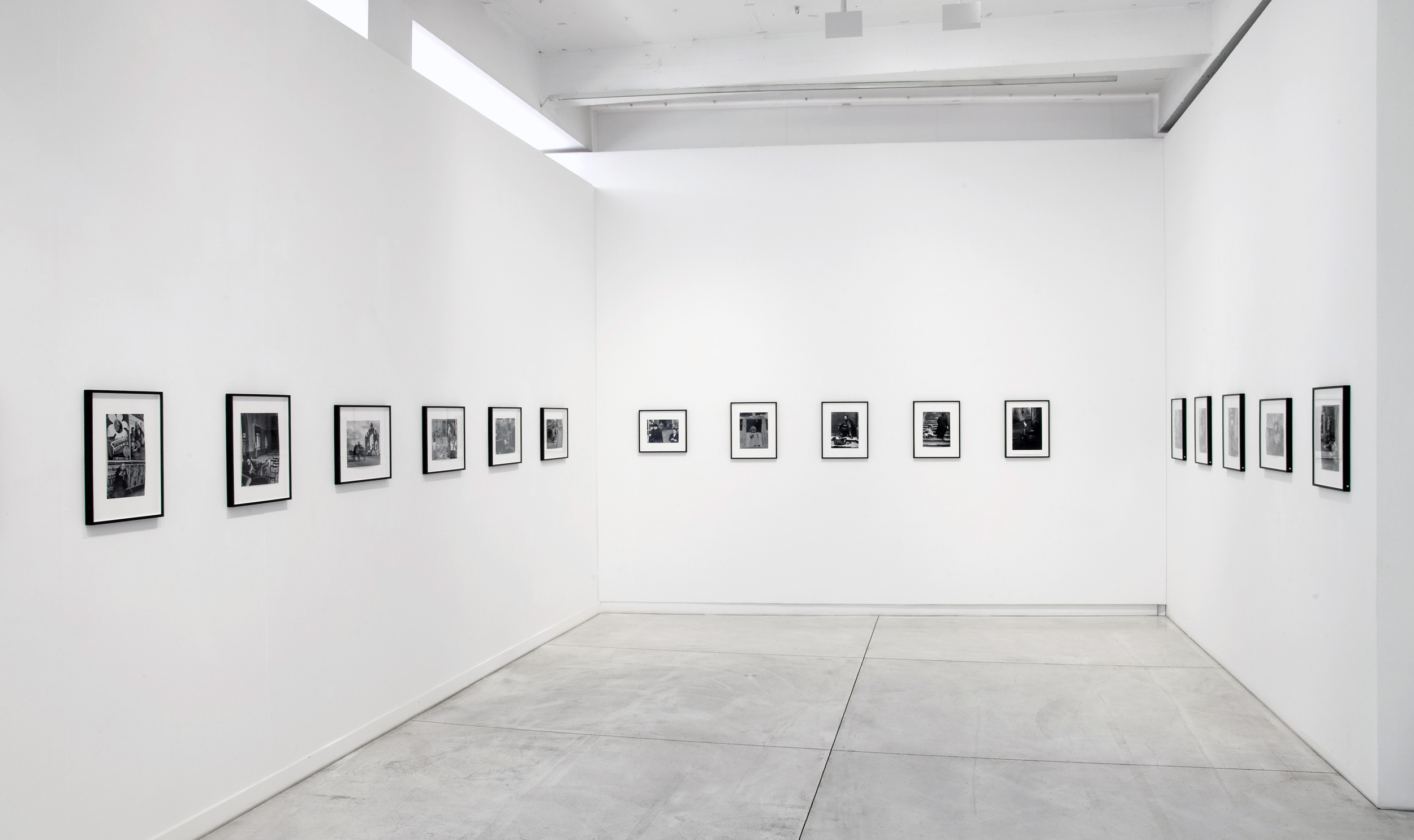
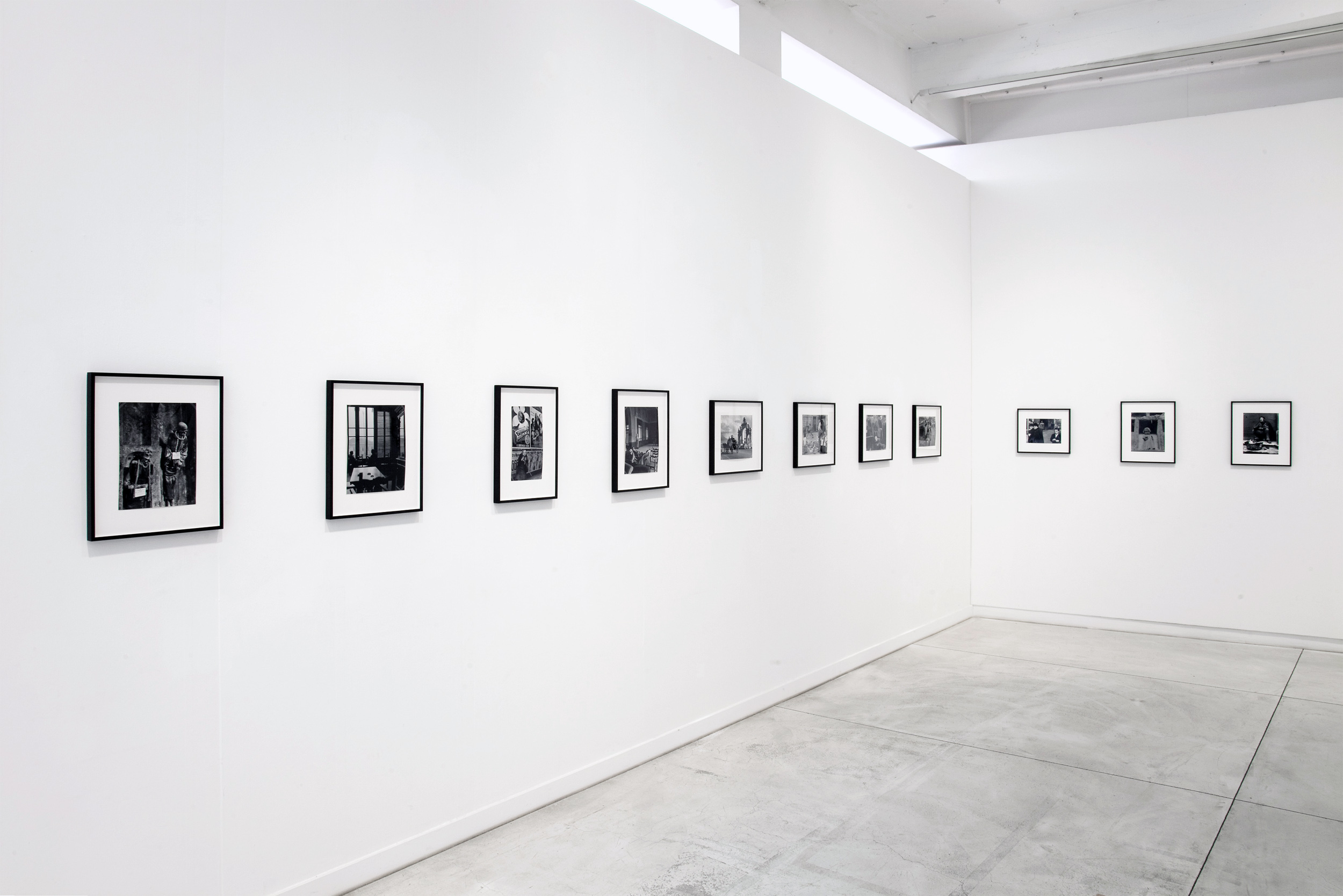
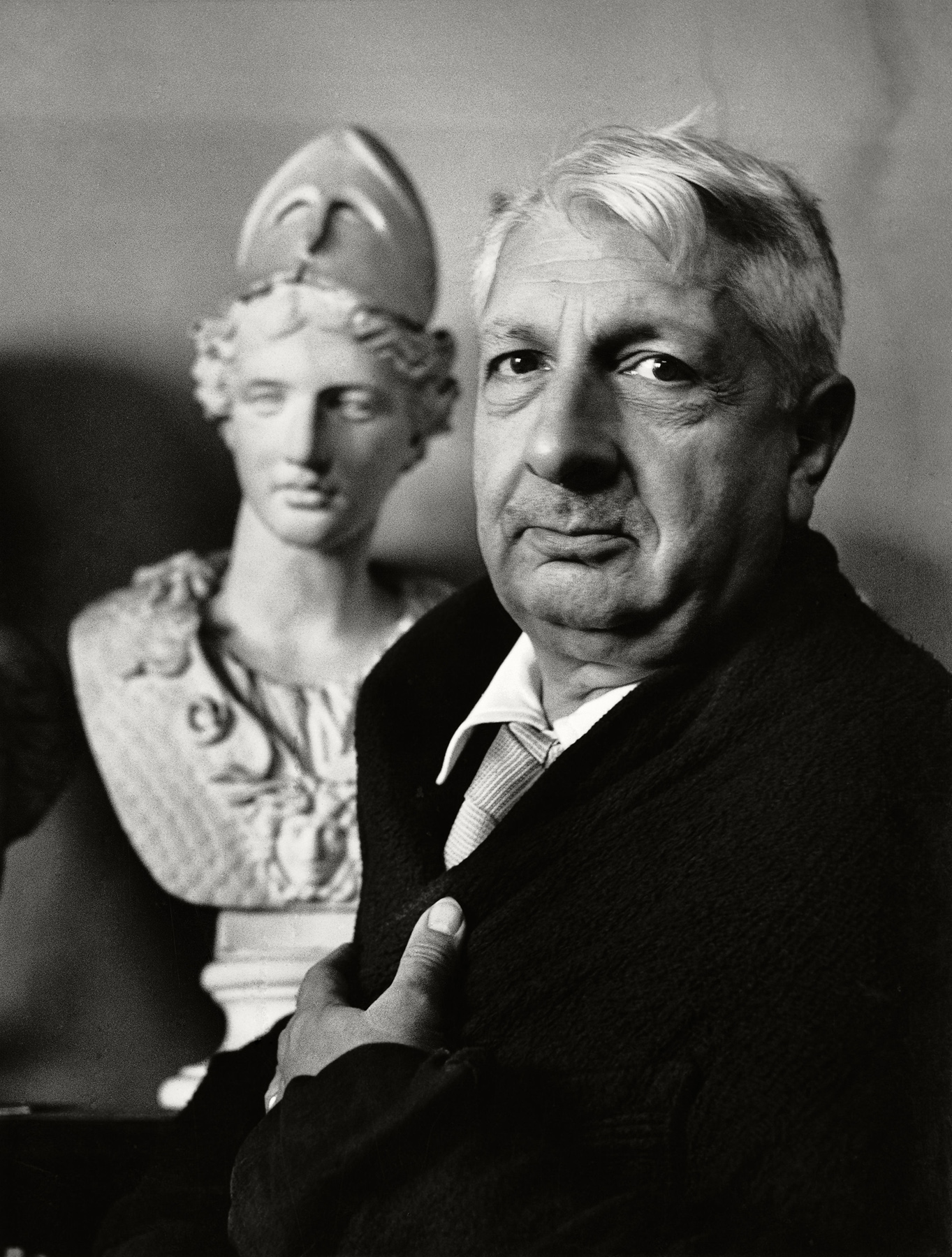
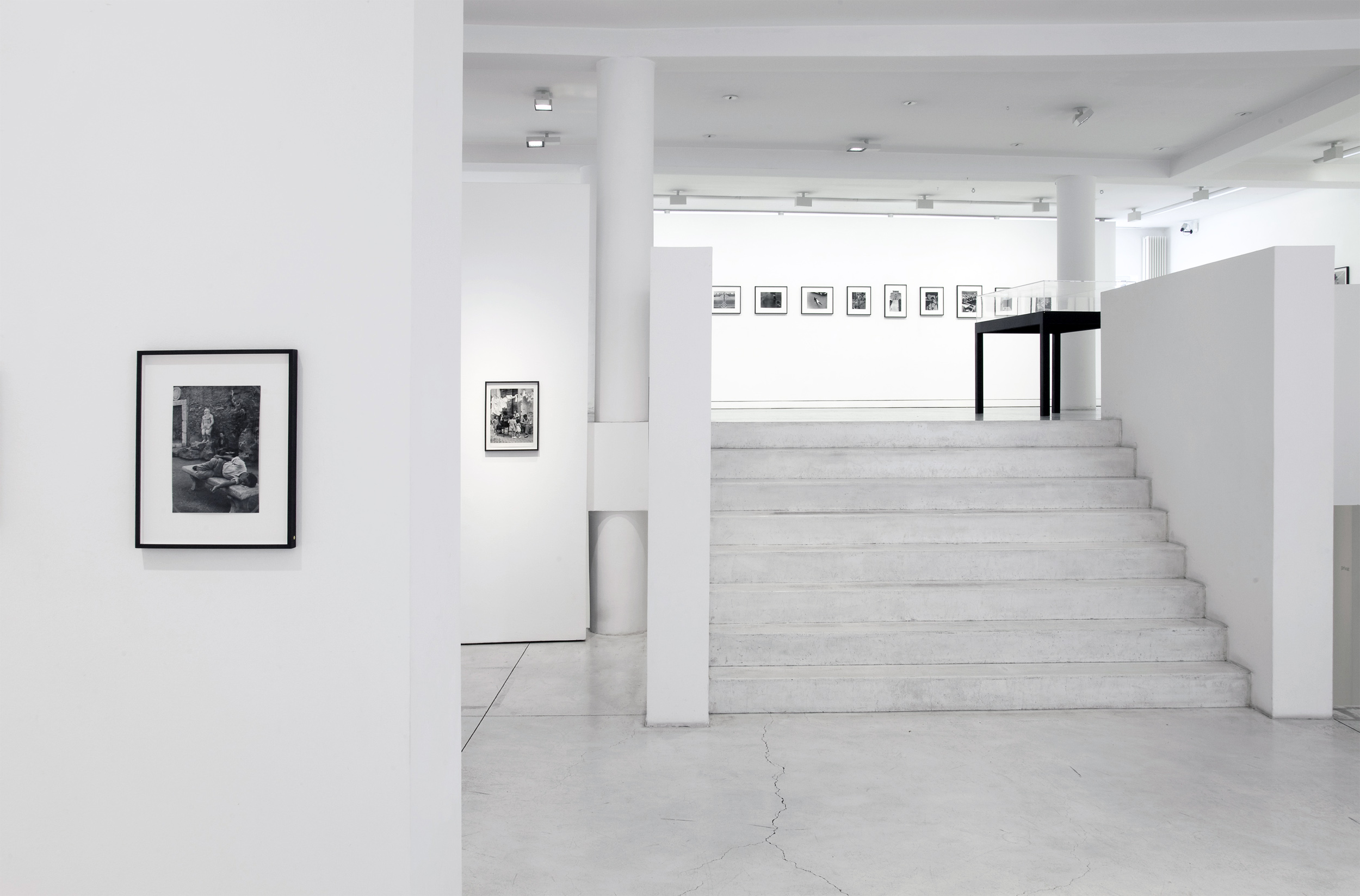
Review: ‘William Yang: Seeing and Being Seen’ at the Queensland Art Gallery | Gallery of Modern Art (GOMA), Brisbane

Exhibition dates: 27th March – 22nd August, 2021

Curator: Rosie Hays, Associate Curator, Australian Cinémathèque, QAGOMA


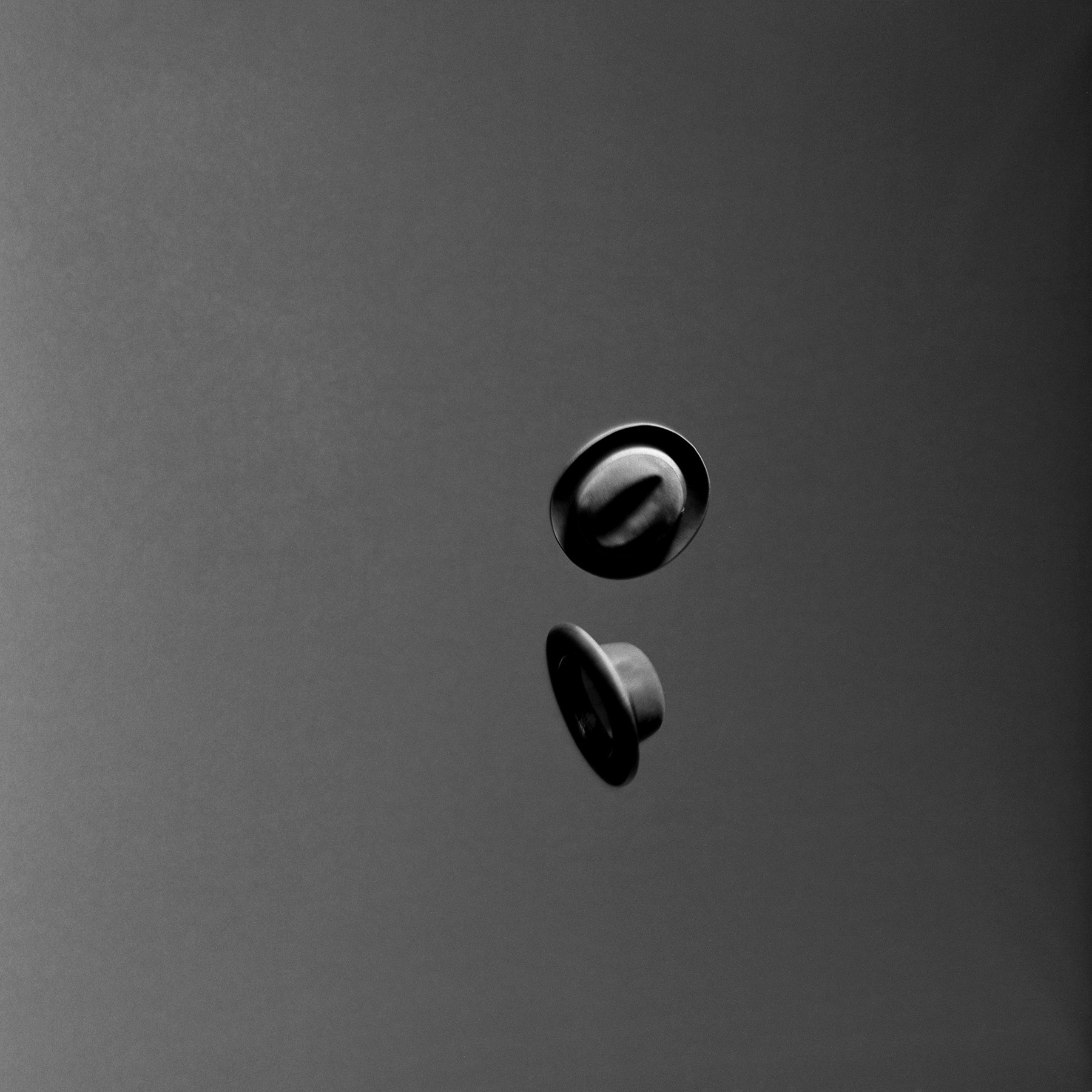
William Yang (Australia b. 1943) 'Golden Summer' 1987/2016 from the exhibition 'William Yang: Seeing and Being Seen' at the Queensland Art Gallery | Gallery of Modern Art (GOMA), Brisbane, March - August, 2021


William Yang (Australia b. 1943)
Golden Summer
1987/2016
Inkjet print, gold leaf on Innova Softex paper
40 x 30cm
© William Yang
Courtesy: The artist


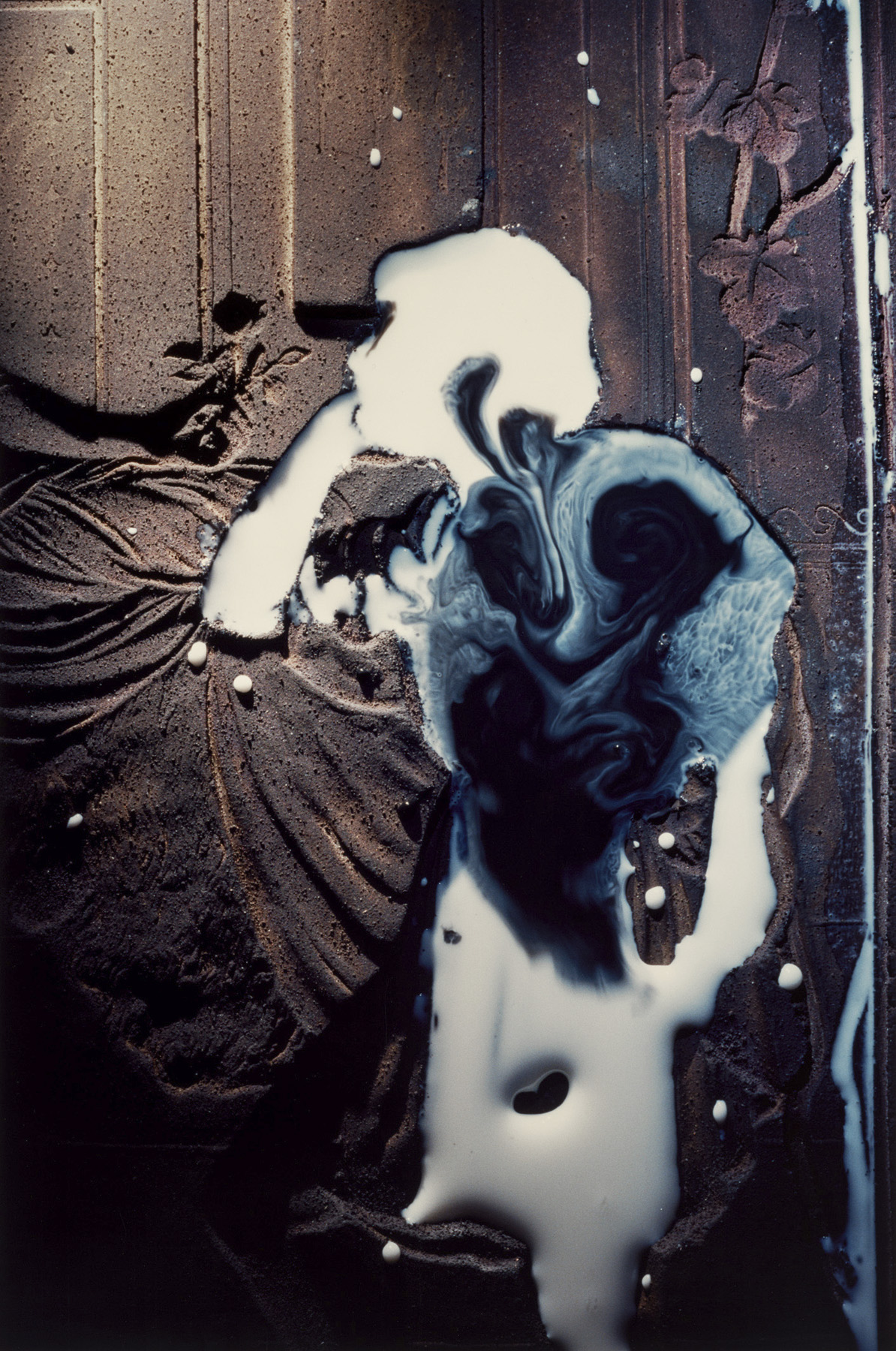
William Yang (Australia b. 1943) ''Allan' from the monologue 'Sadness'' 1992 from the exhibition 'William Yang: Seeing and Being Seen' at the Queensland Art Gallery | Gallery of Modern Art (GOMA), Brisbane, March - August, 2021


William Yang (Australia b. 1943)
‘Allan’ from the monologue ‘Sadness’
1992
© William Yang
Courtesy: The artist


The Family of Yang

Let me tell you a story… a story made up of many smaller tales, told to me by a chronicler, diarist, writer, performance artist and filmmaker; socio-documentary photographer and historian; master of oral history and storytelling – Chinese-Australian artist William Yang.

Voluminous amounts of text have been written about Yang’s art practice and for this reason I only offer here a brief precis of his fifty year career as an artist. Indeed, it is impossible to cover such an expansive career in performance, film, text and photographs in one posting. After the precis I offer some thoughts and insights into Yang’s work.

Yang was born in 1943 into a family of Chinese immigrants in Far North Queensland. After moving to Brisbane in the mid-1960s to study architecture, he journeyed to Sydney in 1969 where he helped produce plays. Yang picked up a camera and started taking photographs of his friends, celebrities, parties and the gay scene in Sydney, Australia in the early-mid 1970s. His first exhibition Sydneyphiles at the Australian Centre for Contemporary Photography in 1977 set him on his way. Personal reflections were written directly on the mounts around his photographs something that he was to adapt further, inscribing his stories directly on the photographs in later bodies of work (“an oral tradition of storytelling transferred to the physical medium of the photograph”). In 1989, Yang began performing monologues with slide projections in theatres, integrating his skills as a writer and a visual artist.

As can be heard in the exhibition curator Rosie Hays’ video talk below, Yang’s first period was as a social life photographer / commercial photographer, earning a living selling his photographs to gay newspapers; his second period encompassed investigations into marginalised communities: queer community, Australian-Chinese community, Indigenous communities and telling alternative histories of Australia including the history of his Chinese-Australian heritage; and in the third period, Yang’s work has become more reflective, interested in ordinary things, interested in the life of the human embodied in the landscape.

.
As a documentary photographer and performance artist, Yang’s work has examined numerous linked themes. The artist investigates the intimate connections between dystopian and utopian worlds – for example, between the body racked by AIDS and the body beautiful (see above), or between the racism of his childhood and the acceptance of his Chinese heritage – as he probes the paradoxes of existence, those parallels streams of life and death, where one person looks death in the eye and the other doesn’t even know it exists… in that moment. And then proposes a reconciliation between past and present, personal and private, between the margins and the centre. Through his personal stories he exposes himself in the act of making his art, transcending his life in art. Ego drops away and he becomes entirely his own person, entirely himself, when he performs in his inimitable, self-deprecating style.

I have a suspicion, and I could be entirely wrong here, that at heart the young Yang was a very shy and insecure person. From personal experience I know that many introverts hide their shyness through extrovert behaviour, wanting to belong, wanting to be in with the in crowd, to be the life of the party. Yang was always there at any event opening or party, never without a camera, always ready to capture what life put before him because he wanted to belong. Then, to his great credit, instead of getting caught in a rut as many artists do repeating the same thing over and over again, he had the intelligence, will and creativity to push himself further, to take those next steps in his development as an artist and human being… to take those steps that descend, in metaphor, to the centre of the earth, to the centre of his existence. He was on that golden path of self discovery, another step in the evolution of himself. He wanted to know how he, and others, fitted into the great scheme of life. As a chronicler of moments, a chronicler of history, he speaks aloud the thoughts of his own becoming.

While photography is about capturing a moment and being a vehicle for storytelling, it is so much more than that. It can be about the relationship between the photographer and the subject and how that relationship evolves from a personal engagement to a universal engagement. It is the artist’s view of the world through the camera lens turned from a personal story into a universal story to which any human being can relate. Here we have empathy and humanity, diversity and racism, voyeurism and performance, public and private, bigotry and poofdom, decadence and death. The artist tells those stories, where personal is universal.

Yang is an national treasure, a living legend. People relate to William Yang. They reveal themselves to him because they feel comfortable in his presence, comfortable in his spirit and energy. He draws people to him, he is a sage – from the Latin sapere ‘be wise’ – who loves documenting people and their interactions with each other and with himself. He draws people into his orbit… and creates magical stories and intimate photographs about human existence. There is an undeniable virtu to the person and his work. All the subjects of his art are his family. Whether a celebration of life, an investigation into community, in joy and in sadness, we are all, always, part of the Family of Yang.

Dr Marcus Bunyan

Many thankx to the Queensland Art Gallery | Gallery of Modern Art (GOMA) for allowing me to publish the photographs in the posting. Please click on the photographs for a larger version of the image.


Queensland-born, Sydney-based photographer William Yang’s significant contribution to Australian photography spans five decades. Known for his reflective and joyous depictions of Australia’s LGBTIQ+ scene in the late 70s and 80s through to the present. Yang’s photography is informed by the cultural and political pressures of growing up as a gay man from a Chinese immigrant family in north Queensland.

This exhibition is a major survey of Yang’s work, which traces his career from documentary photography through to explorations of cultural and sexual identities and his depictions of landscape. Yang integrates a photographic practice with writing, video and performance. The exhibition includes Yang’s prolific social portraiture which features prominent creative identities from theatre, film, art and literature such as Patrick White, Brett Whiteley and Cate Blanchett, his revelatory insights into the LGBTIQ+ community, and insightful images of the Australian landscape.

Seeing and Being Seen also includes early social photographs of Sydney’s arts scene as well as the artist’s long exploration of his family and childhood experience in North Queensland which interrogate and celebrate his Chinese-Australian identity, Yang’s identity as a Chinese-Australian, a gay man and artist informs his marginalised experience.

While the stories and images included in the exhibition are quite specific to Yang’s life, the emotions underpinning them are instantly recognisable and acutely relatable. There is confession and courage in his storytelling – his most well-known works are often deeply personal and represent the means by which he reckons with his past, his relationships, and his experience outside the mainstream.

Text from the QAGOMA website


“Yang’s generation is not life as reported in the newspapers but ‘as I saw it’: a personal account summed up as a litany of parties, of innocence lost and worldliness gained, a continuum of his search for contact and meaning. Like his contemporaries Rennie Ellis or Michael Rosen, William Yang is a social photographer, a recorder of life. His strength lies in creating a living testament, and his medium’s strength is that it is necessarily shared. He offers no moral tale, nor any notion of karma to underscore the events: just the three basic but vital stories – birth, love and death.”


Michael Desmond, Senior Curator, National Portrait Gallery, Canberra


“For me, seeing William’s images of men, swaddled in their desire, affection and easy love for one another, continues to disentangle something that’s been knotted up inside me for as long as I can remember. Asian men occupy a very specific idea in the Australian imagination – of being non-sexual, and therefore, undesirable – that we all inevitably internalise. The raw, unashamed sensuality of William’s imagery – of his unabashed desire for the men he captures, and the framing of Asian male beauty itself – is such a potent corrective. His images remind us that desire isn’t anything to be ashamed of, and that Asian men are desirable too.”


Benjamin Law. ‘Bearing witness in the church of William Yang’ 2021


“I was a photographer, which means that I was a voyeur.”


William Yang


“It was difficult to make ends meet as a playwright, so I became a photographer as a way of making money. I was attracted to the glamorous world. I wanted to be a part of it. One way of doing this, I thought, was to be a fashion photographer but i was terrible at it – I couldn’t cover up the flaws. I was better at covering parties and events.”


William Yang, 1993


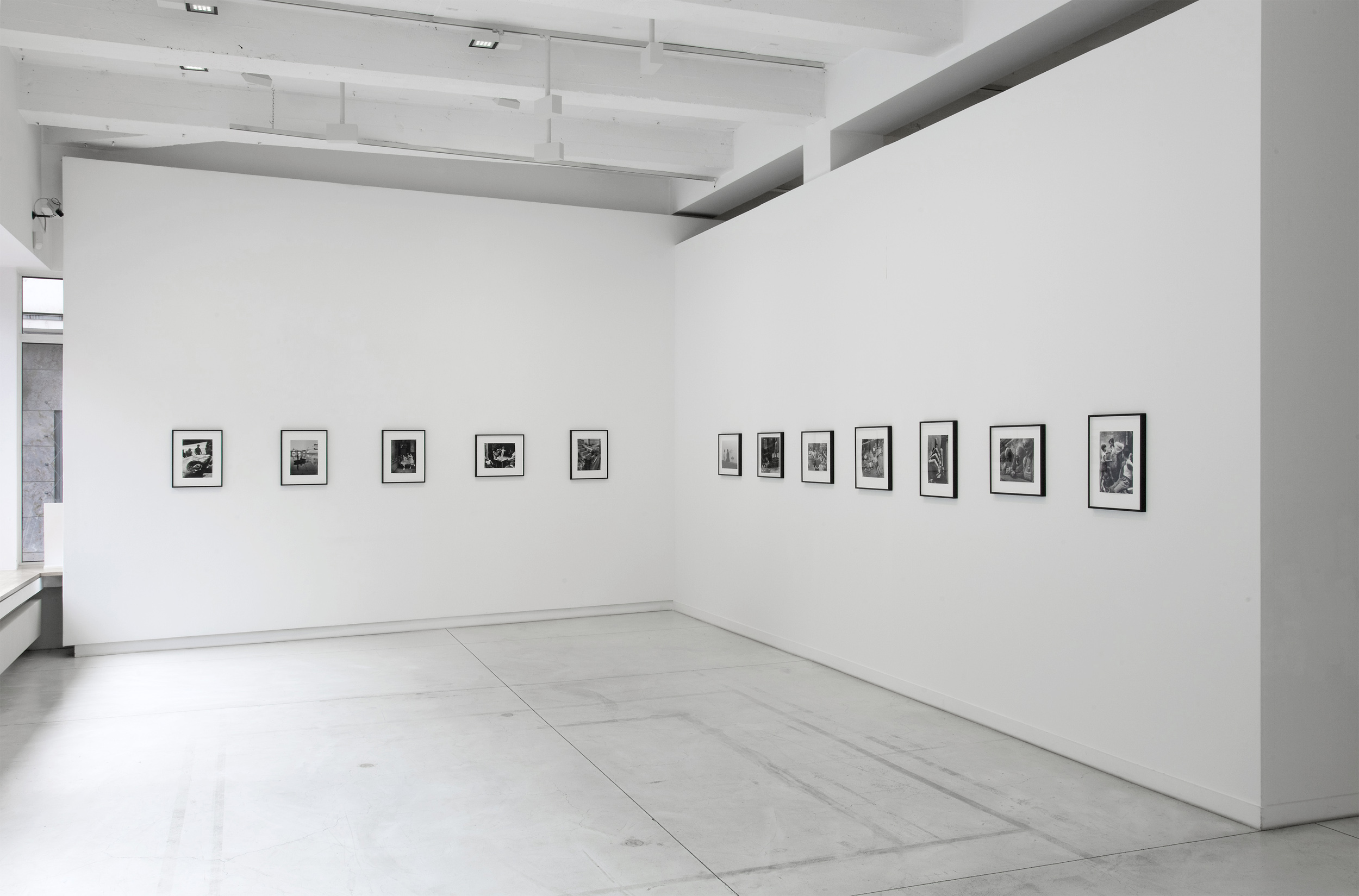
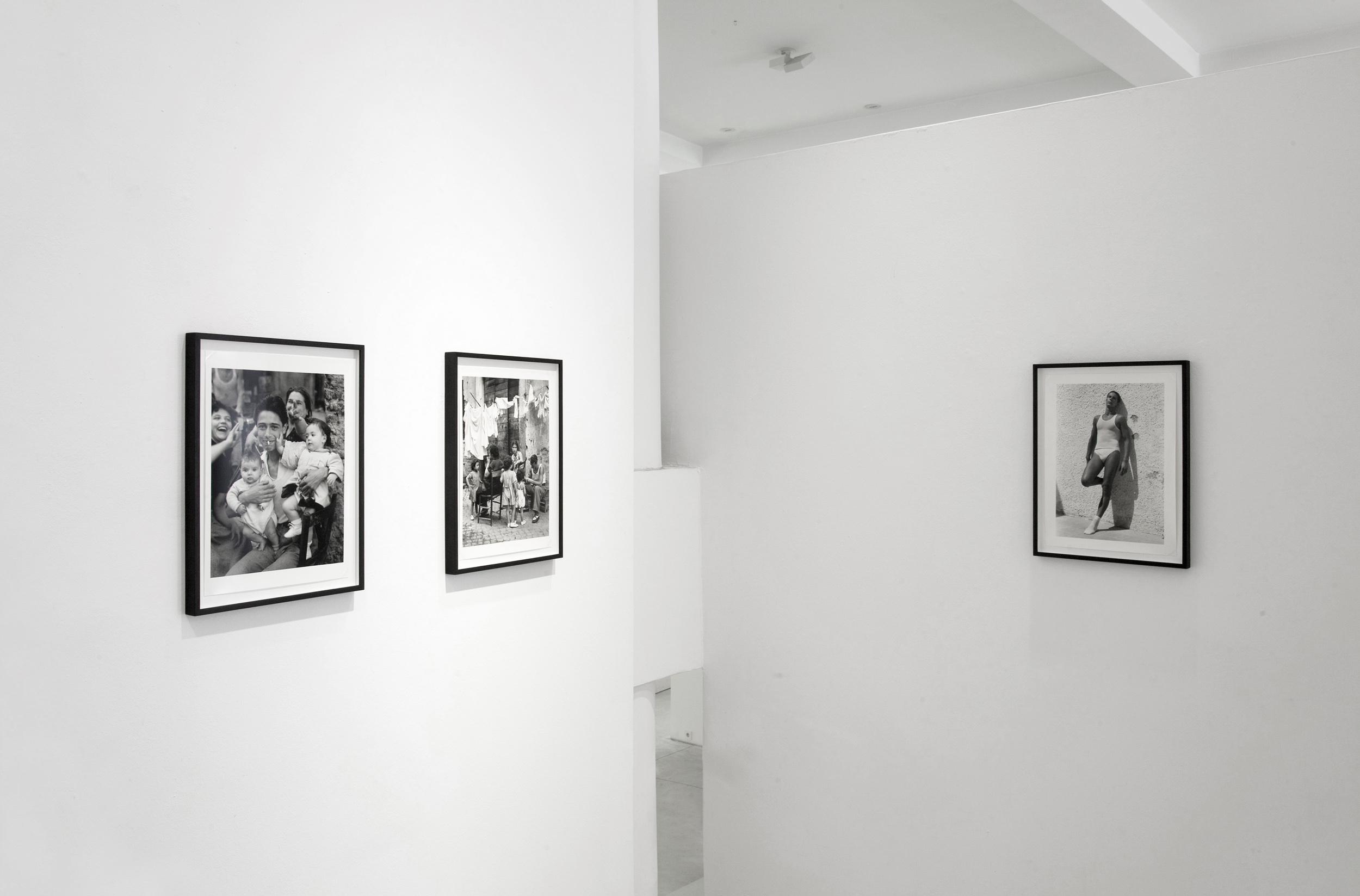
Installation view of the exhibition 'William Yang: Seeing and Being Seen' at the Queensland Art Gallery | Gallery of Modern Art (GOMA) showing at left, 'Stand Palm Beach' (1981); at middle, 'The Pool at Bondi #3' (1987); and at right, 'Golden Summer' (1987/2016)


Installation view of the exhibition William Yang: Seeing and Being Seen at the Queensland Art Gallery | Gallery of Modern Art (GOMA) showing at left, Stand Palm Beach (1981); at middle, The Pool at Bondi #3 (1987); and at right, Golden Summer (1987/2016, above)


William Yang (Australia b. 1943) 'Tamarama Lifesavers' 1981


William Yang (Australia b. 1943)
Tamarama Lifesavers
1981
Inkjet print on Hahnemühle Fine Art Pearl
39 x 70cm
© William Yang
Courtesy: The artist


William Yang: Seeing and Being Seen / Exhibition walk-through


William Yang (Australia b. 1943) 'Life Lines #3 – Self portrait #2 (1947)' 1947/2008


William Yang (Australia b. 1943)
Life Lines #3 – Self portrait #2 (1947)
1947/2008
Photographer: Unknown
Inkjet print on Innova Softex paper, ed. 2/30
100 x 70cm
Collection of The University of Queensland, purchased 2010
Photo: Carl Warner Reproduced courtesy of the artist and Andrew Baker Art Dealer, Brisbane


William Yang (Australia b. 1943) 'Alter ego' 2001


William Yang (Australia b. 1943)
Alter ego
2001
Digital inkjet print on rag paper
68 x 88cm
© William Yang
Courtesy: The artist


Installation view of the exhibition 'William Yang: Seeing and Being Seen' at the Queensland Art Gallery | Gallery of Modern Art (GOMA)


Installation view of the exhibition William Yang: Seeing and Being Seen at the Queensland Art Gallery | Gallery of Modern Art (GOMA) showing the artist standing in front of his photograph Life Lines #11 – William in scholar’s costume (1984) (1984/2009, below)


William Yang (Australia b. 1943) 'Life Lines #11 – William in scholar's costume (1984)' 1984/2009


William Yang (Australia b. 1943)
Life Lines #11 – William in scholar’s costume (1984)
1984/2009
Inkjet print on Innova Softex paper, ed. 1/20
94.6 x 61.6cm
Collection of The University of Queensland, purchased 2010
Photo: Carl Warner Reproduced courtesy of the artist and Andrew Baker Art Dealer, Brisbane


William Yang (Australia b. 1943) 'Self Portrait #5' 2008


William Yang (Australia b. 1943)
Self Portrait #5
2008
Inkjet print on Innova Softex paper
42 x 65cm
© William Yang
Courtesy: The artist


An exhibition of more than 250 works by Australian photographer and performance artist William Yang opens at the Queensland Art Gallery from tomorrow until 22 August, 2021. William Yang: Seeing and Being Seen spans the artist’s five-decade career and is the first major survey of his work to be presented by an Australian state gallery.

Queensland Art Gallery | Gallery of Modern Art Director Chris Saines said Seeing and Being Seen referred to the artist’s view of the world through the camera lens. ‘Yang captures people across all walks of life, including celebrity artists, alongside photographic explorations that throw light onto subcultures and marginalised groups, and he does not turn away from unsettling narratives or uncomfortable truths,’ Mr Saines said. ‘We are thrilled to be presenting this major exhibition encompassing every aspect of Yang’s practice and highlighting his life-long fascination with people and storytelling. We are also premiering his major new performance ‘In Search of Home’ at GOMA.’

Minister for the Arts Leeanne Enoch said QAGOMA continued to take a leading role in showcasing Queensland-born artists, such as William Yang.

‘William Yang is a noted writer, performer and visual artist with an international profile and this exhibition is an important survey of his work, celebrating inclusivity and diversity,’ Minister Enoch said. ‘The Queensland Government’s support for QAGOMA helps ensure the Gallery will continue its legacy of celebrating Queensland artists and sharing works that tell our stories.’

The exhibition includes Yang’s prolific social portraiture which features prominent creative identities from theatre, film, art and literature such as Patrick White, Brett Whiteley and Cate Blanchett, his revelatory insights into the LGBTIQ+ community, and insightful images of the Australian landscape. Seeing and Being Seen also includes early social photographs of Sydney’s arts scene as well as the artist’s long exploration of his family and childhood experience in North Queensland which interrogate and celebrate his Chinese-Australian identity.

Rosie Hays, Associate Curator, Australian Cinémathèque, QAGOMA and curator of Seeing and Being Seen said Yang’s identity as a Chinese-Australian, a gay man and artist informs his marginalised experience.

‘While the stories and images included in the exhibition are quite specific to William’s life, the emotions underpinning them are instantly recognisable and acutely relatable,’ Ms Hays said. ‘There is confession and courage in William’s storytelling. His most well-known works are often deeply personal and represent the means by which he reckons with his past, his relationships, and his experience outside the mainstream.’

Born in North Queensland in 1943, Yang grew up with little knowledge of his Chinese heritage. Even though his parents were second-generation Chinese-Australian, Cantonese was not spoken at home. After coming to Brisbane in the mid-1960s to study architecture at the University of Queensland, he moved to Sydney in 1969, and has lived and worked there ever since.

A major hard-cover publication accompanying the exhibition features essays by William Yang, curator Rosie Hays, Professor Susan Best and Benjamin Law.

Press release from the GOMA website


William Yang: Seeing and Being Seen / Illustrated Curator’s Talk

Exhibition curator Rosie Hays (Associate Curator, Australian Cinémathèque, QAGOMA) traces William Yang’s reflective and joyous career, delving deeper into the artworks and themes addressed in Seeing and Being Seen.


Artist William Yang’s slideshow performance with stories and eyewitness images from Sydney’s thrilling and turbulent gay scene from the 1970s until now.

Yang is one of Australia’s greatest storytellers, a prolific photographer and a performer of monologues with slide projections. His stories describe the experience of coming to terms with his identity as a gay Chinese Australian. Yang’s work presents a rich and celebratory visual record of this journey, from Gay Liberation in the seventies, to the emergence of the Mardi Gras and a gay subculture in the eighties, to AIDS in the nineties.


William Yang. Families and Fictions: Contemporary Photography from the Collection: Artist Talk, Queensland Art Gallery, 2005


William Yang (Australia b. 1943) '"Mother Standing" Brisbane' 1981


William Yang (Australia b. 1943)
“Mother Standing” Brisbane
1981
Gelatin silver photographs, ed. 2/10
51.3 x 61.1cm
Queensland Art Gallery Foundation Grant purchased 2004
Collection: Queensland Art Gallery | Gallery of Modern Art
© William Yang


William Yang (Australia b. 1943) '"Mother Standing" Brisbane' 1981


William Yang (Australia b. 1943)
“Mother Standing” Brisbane (detail)
1981
Gelatin silver photographs, ed. 2/10
51.3 x 61.1cm
Queensland Art Gallery Foundation Grant purchased 2004
Collection: Queensland Art Gallery | Gallery of Modern Art
© William Yang


Installation view of the exhibition 'William Yang: Seeing and Being Seen' at the Queensland Art Gallery | Gallery of Modern Art (GOMA) showing photographs for Yang's 'About my mother' portfolio


Installation view of the exhibition William Yang: Seeing and Being Seen at the Queensland Art Gallery | Gallery of Modern Art (GOMA) showing photographs for Yang’s ‘About my mother’ portfolio


William Yang (Australia b. 1943) 'Mother. Graceville. 1989' 1989


William Yang (Australia b. 1943)
Mother. Graceville. 1989
1989
From ‘About my mother’ portfolio 2003
Gelatin silver photograph ed. 2/10
51.3 x 61.1cm
Queensland Art Gallery Foundation Grant purchased 2004
Collection: Queensland Art Gallery│Gallery of Modern Art
© William Yang
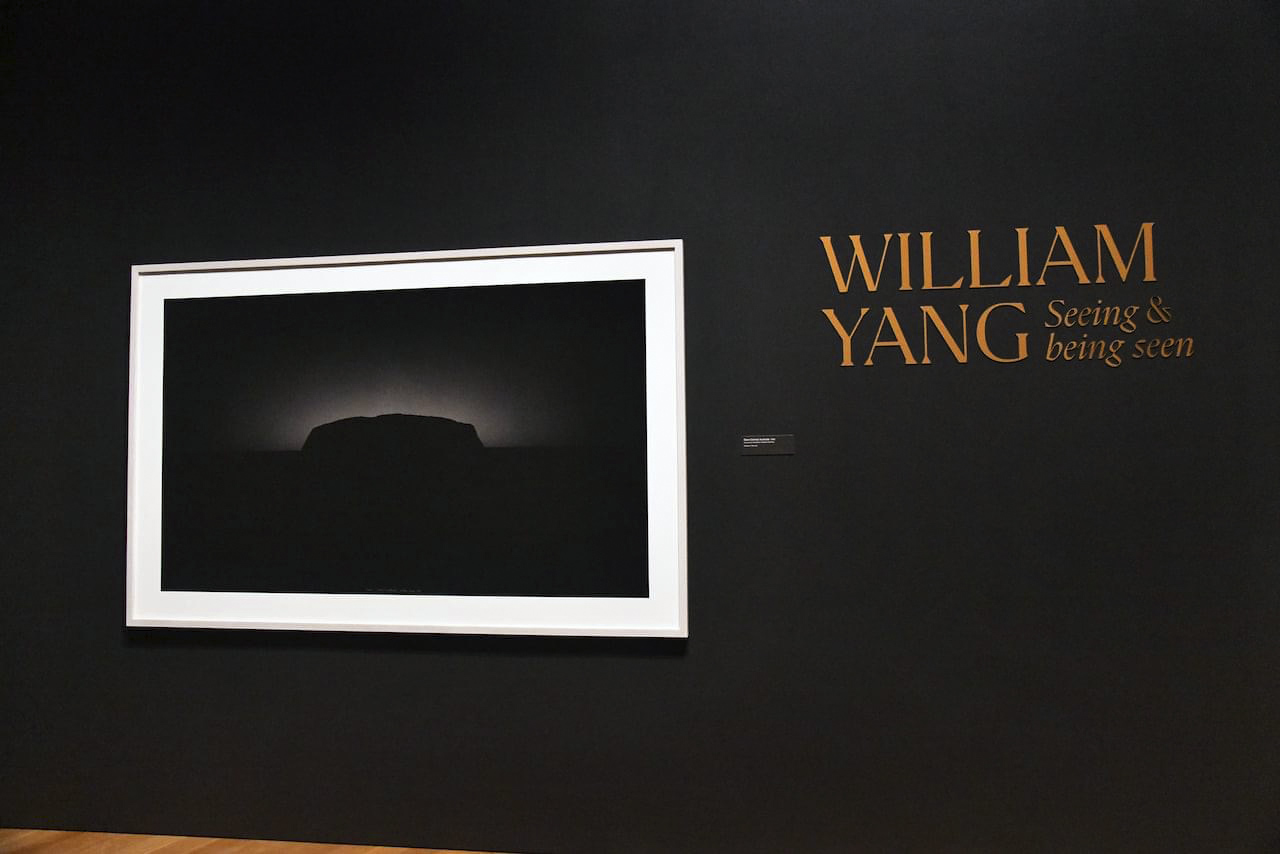
 

Installation view of the exhibition 'William Yang: Seeing and Being Seen' at the Queensland Art Gallery | Gallery of Modern Art (GOMA) showing 'Dawn, Central Australia #3'

Installation view of the exhibition 'William Yang: Seeing and Being Seen' at the Queensland Art Gallery | Gallery of Modern Art (GOMA)

Installation view of the exhibition 'William Yang: Seeing and Being Seen' at the Queensland Art Gallery | Gallery of Modern Art (GOMA) showing at centre top, Doris Fish (1988)


Installation views of the exhibition William Yang: Seeing and Being Seen at the Queensland Art Gallery | Gallery of Modern Art (GOMA) showing in the top image, Dawn, Central Australia #3; and in the bottom image at centre top, Doris Fish (1988, below)


William Yang. 'Doris Fish' 1988


William Yang (Australia b. 1943)
Doris Fish
1988
© William Yang
Courtesy: The artist


William Yang (Australia b. 1943) 'The morning after' 1976


William Yang (Australia b. 1943)
The morning after
1976
Gelatin silver print
© William Yang
Courtesy: The artist


Morning sun raking through a window gently lights William Yang’s photograph of sleeping bodies and cast-off clothing, portraying ‘the morning after’ with the intimacy of the dawn. Yang photographed Sydney’s social scene of the 1970s and 80s, capturing wild times at discos, nightclubs and parties. Yang also captured the revellers at rest, photographing the supine forms of his naked lovers, night-clubbers passed out on city pavements and benches, and friends sharing makeshift beds on lounge-room floors.

Yang’s first solo exhibition in 1977, Sydneyphiles, was a frank depiction of the Sydney party scene and the emerging gay community. In their unposed realism, his photographs avoid any air of glamour, focusing instead on the unguarded moment and the spontaneous interactions between friends. The scrupulous honesty of his black-and-white documentary style is offset by his poignant and affectionate portrayals of those people and places familiar to him. His photographs are taken from the position of a participant in the worlds they depict, collectively describing the experience of coming to terms with his identity as a gay Chinese Australian. Yang’s visual stories are infused with a gently wry tone, mixing self-deprecating humour with insightful reflections on cultural identity. Here Yang has created images of the aftermath of intimate encounters, apparent in crumpled sheets and the shapes of sleeping bodies.

Text from the Museum of Contemporary Art, Sydney website
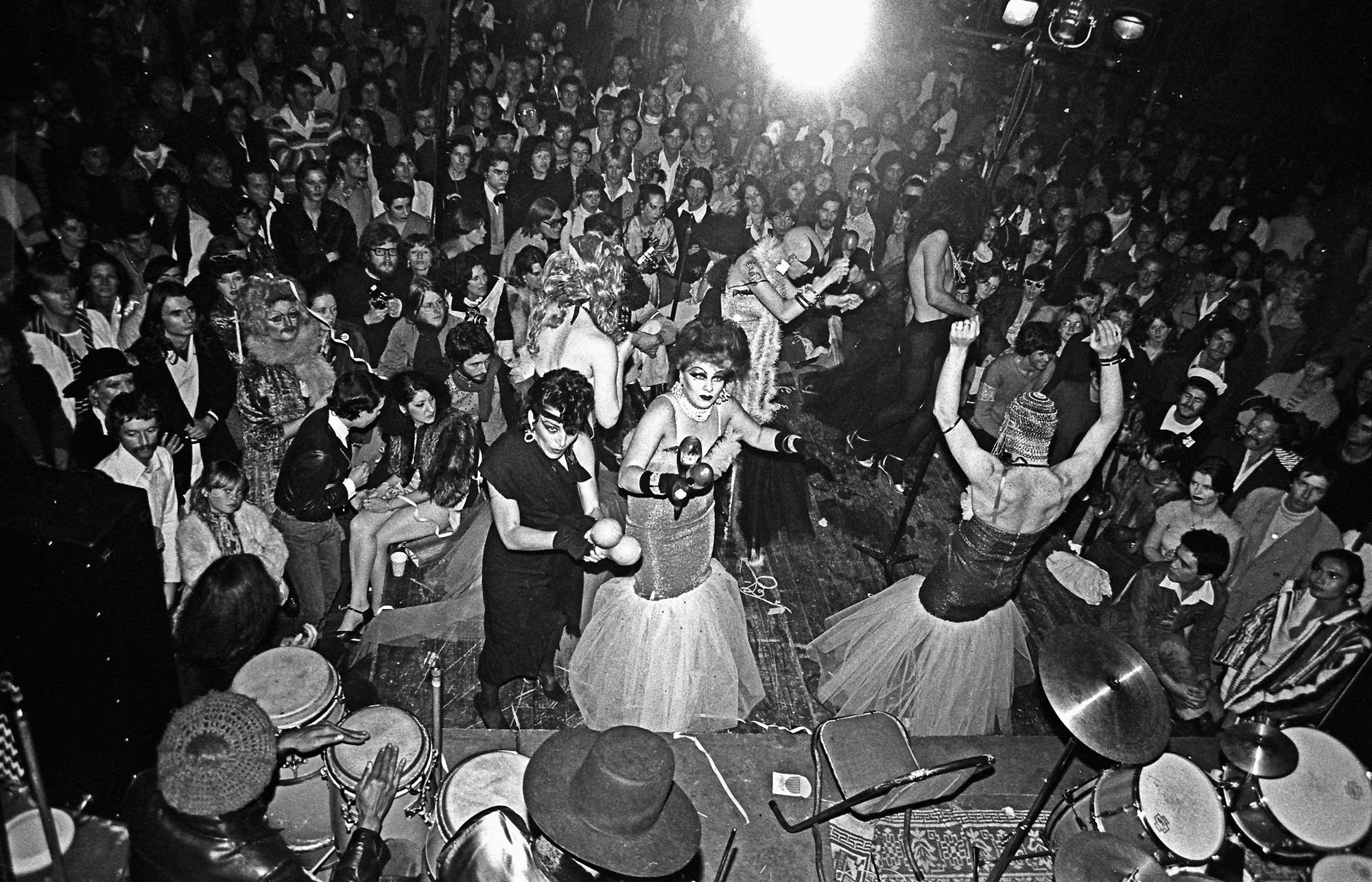
 

William Yang. 'Synthetic Diamonds at Paddington Town Hall' 1977


William Yang (Australia b. 1943)
Synthetic Diamonds at Paddington Town Hall
1977
© William Yang
Courtesy: The artist


William Yang (Australia b. 1943) 'Alpha' late 1960s


William Yang (Australia b. 1943)
Alpha
late 1960s
Gelatin silver photograph with fibre-tipped pen on fibre-based paper, ed. 6/10
26.7 x 40.2cm
Collection: The University of Queensland purchased 2001
© William Yang


William Yang (Australia b. 1943) 'Ben Law. Arncliffe' 2016/2020


William Yang (Australia b. 1943)
Ben Law. Arncliffe
2016/2020
Inkjet print on Ilford Galerie Smooth Cotton Rag
30 x 50cm
© William Yang
Courtesy: The artist


William Yang (Australia b. 1943) 'The Story of Joe' 1979/2020


William Yang (Australia b. 1943)
The Story of Joe
1979/2020
Inkjet print on Ilford Galerie Smooth Cotton Rag; single-channel video
Print: 40 x 60cm
Video: 16:9, 3:50 minutes, colour, sound; installed dimensions variable
Writer/Performer: William Yang; Director/Producer: Ben Latham Jones
Co-Director/ Co-Producer: Sophie Georgiou
Camera Operator/Editor: Dean Lever; Auslan
Consultant: Sue Jo Wright
Technical Assistant: Jack Okeby
© William Yang
Courtesy: The artist


William Yang. 'Bondi Beach' 1970s


William Yang (Australia b. 1943)
Bondi Beach
1970s
© William Yang
Courtesy: The artist


William Yang. 'Splashproof #1' 1994


William Yang (Australia b. 1943)
Splashproof #1
1994
© William Yang
Courtesy: The artist


William Yang, like many of his fellow Australian photographers, cannot help but be fascinated with the beach. In 1969, Yang left Brisbane for the bright lights of Sydney, and he fell in love with the city. At a distance from his family and Queensland’s conservatism, Sydney provided an opportunity for reinvention.

It was here that he combined his two photographic passions – landscape and people. Yang embraced the bleached allure of the city’s eastern beaches and took many iconic photographs of Bondi, Tamarama and Clovelly. …

Yang’s beach images present a refreshingly different framing of the typical Australian beach scene. The usual shots of bronzed female bodies or recreational pursuits take a backseat. Instead, Yang takes immense joy in the male figure, and his works represent a desirous male gaze on desirable male bodies.

The beach captured Yang’s eye from early in his career. At the time he started exploring the beach in his new Sydney home, Yang was also a jobbing social photographer, capturing celebrities and the ‘beautiful people’ behind the scenes at A-list parties for magazines. His approach to this work was in the photo-journalist style of capturing the unguarded moment.

Of his passion for taking images of the beach, Yang is a romantic at heart and has said:

“There’s an impulse in me that makes me go for the runny make-up, the unguarded moment, the Freudian slip. I mean I could photograph the plastic bags in the water, the rolls of fat, but the beach brings out the romantic in me. I’m overwhelmed by the beauty of it – the space, the surf, the sand and all that flesh. I’ve never gotten beyond the obvious.”

Rosie Hays. “William Yang: The Beach,” on the QAGOMA website 17 June, 2021 [Online] Cited 10/08/2021


William Yang (Australia b. 1943) 'Great Wave off Clovelly' 2005/2016


William Yang (Australia b. 1943)
Great Wave off Clovelly
2005/2016
Inkjet print on Hahnemühle Fine Art Pearl
40 x 40cm
© William Yang
Courtesy: The artist


William Yang. 'Lifesaver Double' 1987/2017


William Yang (Born 1943, Mareeba, Qld Lives and works Sydney, NSW)
Lifesaver Double
1987/2017
Digital print
© William Yang
Courtesy: The artist
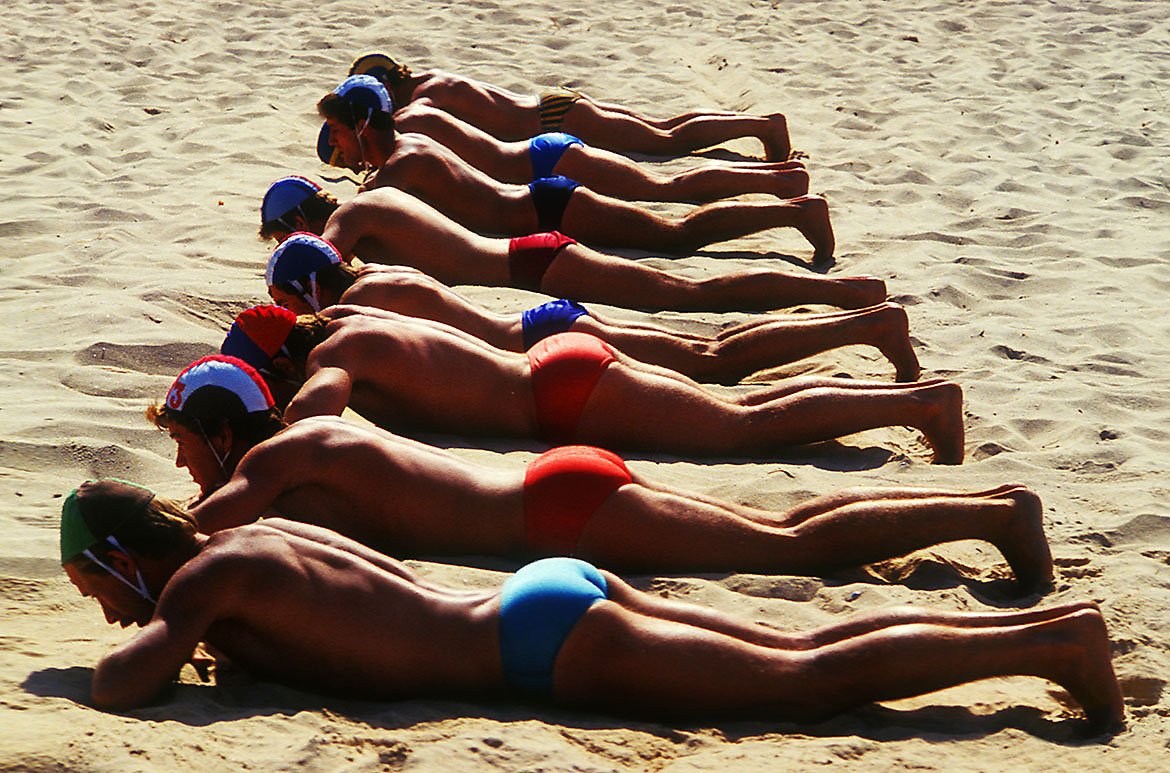
 

William Yang (Australia b. 1943) 'Lifesavers #3' 1987


William Yang (Australia b. 1943)
Lifesavers #3
1987
Inkjet print on Hahnemühle Fie Art Metallic Pearl
32 x 49.5cm
© William Yang
Courtesy: The artist


“A prolific documentary photographer, storyteller and performer, William Yang creates works that tell an intimate, autobiographical story. Yang draws on his extensive archive of images, memories and sensual experiences, showing the unique atmosphere of freedom that prevailed on Sydney beaches in the 70s, 80s and 90s. Taken around Bondi and Tamarama, Yang has captured the joy of an era and the beauty of the elements with humour and generosity. More than reminiscence or exposé, Yang’s images reveal sensitive connections and insightful reflections about cultural identity.”


Text from the ‘Under The Sun’ exhibition 2017
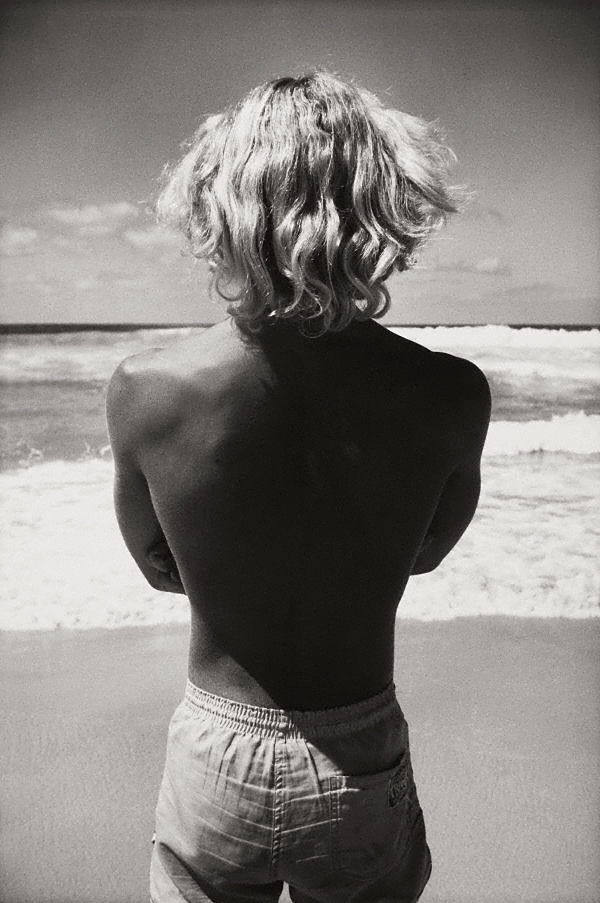


William Yang 'Checking Out Bondi' 1981/2017


William Yang (Australia b. 1943)
Checking Out Bondi
1981/2017
Digital print
© William Yang
Courtesy: The artist


The Power of Being Seen

William Yang’s work, intimate and considered, draws on the artist’s own lived experience. Yang’s personal stories inform his spoken-word performances and photography, and he often scribes these stories directly onto his photographic prints. Drawn to people, Yang’s work reveals unsettling narratives in his own life, in the lives of his subjects, and in society. Adept at uncovering the unvarnished beauty and hidden foibles of our lives, storytelling is intrinsic to his practice. The artist spoke with exhibition curator Rosie Hays.

Rosie Hays: Are there stories you feel must be told? What draws you to the stories you tell from your own life?

William Yang: I [was] brought up as an assimilated Australian. Neither my brother, Alan, or my sister, Frances, or I learned to speak Chinese. Partly because my father’s clan was the Hakka, so he spoke Hakka, whereas my mother’s clan was the See Yap, and she spoke Cantonese, so English was their common language and that was what we spoke at home. My mother could have taught us Cantonese as it was generally left up to her to do that sort of thing, but she never did. She thought being Chinese was a complete liability and wanted us to be more Australian than the Australians. So, the Chinese part of me was completely denied and unacknowledged until I was in my mid-30s and I became Taoist. It was through my engagement with Chinese philosophy that I embraced my Chinese heritage. People at the time called me Born Again Chinese, and that’s not a bad description as there was a certain zealousness to the process, but now I see it as a liberation from racial suppression, and I prefer to say I came out as a Chinese.


William Yang (Australia b. 1943) 'Chinese New Year Party Year of the Rabbit' 1999


William Yang (Australia b. 1943)
Chinese New Year Party Year of the Rabbit
1999
Gelatin silver print
51 x 61.5cm
© William Yang
Courtesy: The artist


My first big success was my show ‘Sydneyphiles’ at the Australian Centre for Photography in 1977. It was mainly about my social life in Sydney, with portraits of people I had met. Besides my own set of artistic types (I knew Brett Whiteley, Martin Sharp, Jenny Kee and Linda Jackson), I brushed with celebrities on the social rounds working for magazines. The exhibition caused a sensation. I knew then that people were my subject. I found that they wanted to see themselves on the gallery walls, they wanted representation. A compromising photo might cause annoyance, but it was better than being left out. There has always been an appetite for celebrities, well, that was to be expected. A vicarious interest in celebrity life still fuels the media. But I showed many photos of the emerging gay community as well. Australian photos of this type had not been shown in institutions before and it got a mixed reaction. Some said that these works shouldn’t be shown at a public institution, but mostly the pictures were accepted, especially by the gay community. A few were angry with me for outing them, but mostly I was hailed as a hero and was metaphorically given the keys to Oxford Street. I sensed that the mood of the gay community at the time was this: throughout history our community has been invisible. These photos may not be pretty, but we recognise them, and we accept them. We want our stories told.


William Yang (Australia b. 1943) 'Four film directors' 1981


William Yang (Australia b. 1943)
Four film directors
1981
Inkjet print on solid substrate Kapaplast
53 x 80cm
© William Yang
Courtesy: The artist


William Yang (Australia b. 1943) 'Brett Whiteley, Martin Sharp, Wirian' 1982


William Yang (Australia b. 1943)
Brett Whiteley, Martin Sharp, Wirian
1982
Inkjet print on solid substrate Kapaplast
© William Yang
Courtesy: The artist


William Yang (Australia b. 1943) 'Party at the Whiteleys', Lavender Bay' 1982


William Yang (Australia b. 1943)
Party at the Whiteleys’, Lavender Bay
1982
Inkjet print on solid substrate Kapaplast
65 x 110cm
© William Yang
Courtesy: The artist


Installation view of the exhibition 'William Yang: Seeing and Being Seen' at the Queensland Art Gallery | Gallery of Modern Art (GOMA) showing at centre right, 'Brett Whiteley, Lavender Bay, Sydney' (1975); and directly below this, 'Cate Blanchett: The star in her dressing room. After "Hedda Gabler." Wharf Theatre. Sydney' (2004)


Installation view of the exhibition William Yang: Seeing and Being Seen at the Queensland Art Gallery | Gallery of Modern Art (GOMA) showing at centre right, Brett Whiteley, Lavender Bay, Sydney (1975, below); and directly below this, Cate Blanchett: The star in her dressing room. After “Hedda Gabler.” Wharf Theatre. Sydney (2004, below)


William Yang (Australia b. 1943) 'Brett Whiteley, Lavender Bay, Sydney' 1975


William Yang (Australia b. 1943)
Brett Whiteley, Lavender Bay, Sydney
1975
© William Yang
Courtesy: The artist


William Yang (Australia b. 1943) 'Cate Blanchett: The star in her dressing room. After "Hedda Gabler." Wharf Theatre. Sydney' 2004


William Yang (Australia b. 1943)
Cate Blanchett: The star in her dressing room. After “Hedda Gabler.” Wharf Theatre. Sydney
2004
Inkjet print on solid substrate Kapaplast
54 x 80cm
© William Yang
Courtesy: The artist


These days I don’t take as many photographs. I’m sorting through my collection, trying to get it into some sort of order, and trying to digitise the negatives and the colour transparencies […]. I don’t want to be a photographer who dies leaving a pile of mouldy negatives for someone else to sort out […]. Every time I look through my collection, I am surprised because I have largely forgotten what happened in the past. Photography is a major aid to memory and the photographer a witness to the past. A photograph captures a moment in time. You don’t have to do anything special for this to happen, just press the shutter. There is something in the nature of the camera to freeze these moments in time, and there is something in the nature of the world to change and move on, so these moments never occur again.

In the early 1980s I started to do slide projection. It started off as a way to show my colour photography. At the time the colour printing process, Cibachrome, was expensive, and projection was a cheaper way showing my colour images. In 1980 in Adelaide, I met Ian de Gruchy, who did slide projection as his main art form. I was interested in his dissolve unit – a device using two projectors where the projected images dissolved into each other. Music was used, usually minimal music, and the result was known as an audio-visual. When one projects slides, as in a living room slide show, there is a tendency to talk with the slides, explaining them, and I started to do that. I worked with audio-visuals for seven years during the 80s until I had nine photographic essays, or short stories, to string together into a one man show. It was called ‘The Face of Buddha’ and I presented it at the Downstairs Belvoir Street Theatre in 1989. I lost money on that show, but still consider it a success. Everyone liked the form, story-telling with images and music.


William Yang (Australia b. 1943) "William Yang performing Sadness" Sydney 1992


William Yang (Australia b. 1943)
“William Yang performing Sadness”
Sydney 1992
Photo: Peter Elfes (from ‘About my mother’ portfolio 2003)
Gelatin silver photograph, ed. 2/10 / 51.3 x 61.1cm
Purchased 2004
Queensland Art Gallery Foundation Grant
Collection: Queensland Art Gallery | Gallery of Modern Art
© William Yang


William Yang (Australia b. 1943) 'Production still from Sadness' 1999


William Yang (Australia b. 1943)
Production still from Sadness
1999
Director: Tony Ayres
Image courtesy: National Film and Sound Archive, Australia and William Yang


William Yang (Australia b. 1943) ''Allan' from the monologue 'Sadness'' 1992


William Yang (Australia b. 1943)
‘Allan’ from the monologue ‘Sadness’
1992
© William Yang
Courtesy: The artist


“Allan was a landmark for Yang and for Australian documentary photography. The combination of simple, unadorned portrait photos and diaristic, handwritten commentary made each viewer feel intimately acquainted with the subject. The step-by-step progress towards death puts us on the alert for every passing emotion in Allan’s face – he is sad, stoical, cheerful, grim, frivolous and heroic by turns. At the end of his life he has become an empty husk. It’s a devastating slice of reality smuggled into an art gallery, a piece that stops viewers in their tracks every time it’s shown.”


Extract from John McDonald. “Devastating and intimate: the landmark photos that stop viewers in their tracks,” on the Sydney Morning Herald website April 1, 2021 [Online] Cited 09/08/2021


William Yang (Australia b. 1943) ''Allan' from the monologue 'Sadness'' 1992


William Yang (Australia b. 1943)
‘Allan’ from the monologue ‘Sadness’
1992
© William Yang
Courtesy: The artist


The most popular story was called ‘About My Mother’. I told the story about my mother’s family, how they came to Australia in the 1880s from Guang Dong province in China. My mother’s sister, my Aunt Bessie, married a rich landowner, William Fang Yuen, who was murdered by the white manager on his cane farm at Marilyan in north Queensland in 1922. I got an Australia Council grant to do my third performance piece, ‘Sadness’, in 1992. There were two themes: the first involved the AIDS pandemic in Sydney where many gay men, some of them my friends, were dying; and the second was a trip I took to north Queensland to talk to my relatives about William Fang Yuen’s murder. The two themes formed a powerful story about death and legacy. It was an immediate hit and toured Australia and the world. International entrepreneurs wanted my performance pieces, which they considered unique, not my exhibitions, so I kept doing more performance pieces and they became my main artistic expression.


William Yang (Australia b. 1943) 'William in Cane Fields' 2008


William Yang (Australia b. 1943)
William in Cane Fields
2008
From ‘My uncle’s murder’ portfolio 2008
Inkjet print on Innova Softex paper
59 x 91cm
© William Yang
Photograph: Jenni Carter
Courtesy: The artist


William Yang (Australia b. 1943) 'Self Portrait, Listening' 2017


William Yang (Australia b. 1943)
Self Portrait, Listening
2017
Inkjet print on Ilford Galerie Smooth Cotton Rag
38 x 60cm
© William Yang
Courtesy: The artist


The performance pieces changed my photographic practice. Before the 1990s, I made my living from freelance work. I would do whatever jobs people would pay me money to do. Then I found I could make a living doing my performance pieces, so I didn’t have to work for other people. I was able to channel all my energy into my own work and I became more productive. My performance pieces were about stories and I realised that many of my photos had stories behind them. I started writing the text directly onto the photo with a pen. My first series was about men with whom I had had encounters. All those photos had good stories. I have continued to do written works, as I call them, and the pictures with my handwriting have become the signifier of my work. Now I often choose images because they have a story.

Rosie Hays: Do you ever feel you’re telling other people’s stories, or are they your stories that happen to intersect with other people?

William Yang: When I ran out of my own stories, I wanted to tell an Aboriginal story because I felt the Chinese and the Aboriginal people had something in common: both had suffered under British colonialism. In my commissioned piece ‘Shadows’, I tried to tell an Aboriginal story about a community in Enngonia in north-western New South Wales, and it was successful in that I made myself part of the story, but I felt a little uncomfortable telling their story. Later I found someone, Noeline Briggs-Smith, who could tell her own story, and we did a story-telling duet on stage [called] ‘Meeting at Moree’, where we told alternating chapters of our stories on stage. She […] had a much stronger story than me. She had suffered more and worse injustices than I had, but there were interesting intersections in our stories.

Rosie Hays: Something we highlight in the exhibition is your connection to landscape. How would you describe your relationship to nature / the landscape, and has it changed over time?

William Yang: Most photographers have a go at nature. Everyone has photographed a sunset. I had my first serious encounter with photographing nature when I was recovering from a bad case of hepatitis at Frogs Hollow, Maleny, in 1979. I felt fragile from the illness and taking photos made me feel I could still do things. Looking at the photos now, the pictures are a beginner’s view. That’s the thing about nature: it’s been done a billion times before, and it’s difficult [to] escape cliché, but I had to start somewhere and I got a few good ones.

When I became Taoist, I took on a whole new philosophy. I came to appreciate nature, in the form of landscape, as a source and a driving force behind everything that exists. It was constantly changing and renewing itself. Everything about nature was beautiful because it was essentially always itself. I found I could apply a concept of beauty to nature, at least compared to the human nature I was photographing at the time. Later I began to see nature as a titanic struggle for survival […].

I came to realise that the landscape which moved me the most was the country around Dimbulah in north Queensland (on the Atherton Tableland), where I had grown up. It was part of my identity, part of my idea of home. I had absorbed it, it had imprinted itself upon me, and, although I did not realise it at the time – this was before I had articulated an artistic consciousness – it was there in my consciousness and I could draw upon it. So, in the early 90s, I made several trips up to Dimbulah, checking out the country that I remembered from my childhood. Nothing quite fitted my memories, but perhaps that’s a thing about childhood and memory. Nevertheless, I photographed a series on a medium format camera, trying to recapture memories. Now I enjoy returning to Dimbulah and seeing the landscape. It still triggers off emotions, but I feel they have become more distant. This text is from my print William at Thornborough, 2006:

“I have left these places and I have changed. These places still hold me but I move around these hills like a ghost. It is the motherland which formed and nourished me, from where I came, but to which I can never return.”


William Yang (Australia b. 1943) 'Climbing Huang Shan' 2005


William Yang (Australia b. 1943)
Climbing Huang Shan
2005
Inkjet print on Innova Softex paper
41 x 48cm
© William Yang
Courtesy: The artist


Installation view of the exhibition 'William Yang: Seeing and Being Seen' at the Queensland Art Gallery | Gallery of Modern Art (GOMA) showing 'Return to the place of childhood. Dimbulah' (2016)


Installation view of the exhibition William Yang: Seeing and Being Seen at the Queensland Art Gallery | Gallery of Modern Art (GOMA) showing Return to the place of childhood. Dimbulah (2016, below)


William Yang (Australia b. 1943) 'Boranup Karri Forest #1' 2018


William Yang (Australia b. 1943)
Boranup Karri Forest #1
2018
Inkjet print on Ilford Galerie Smooth Cotton Rag
50 x 150cm
© William Yang
Courtesy: The artist


William Yang (Australia b. 1943) 'Return to the place of childhood. Dimbulah' 2016


William Yang (Australia b. 1943)
Return to the place of childhood. Dimbulah
2016
Inkjet print on Ilford Galerie Smooth Cotton Rag
50 x 150cm
© William Yang
Courtesy: The artist

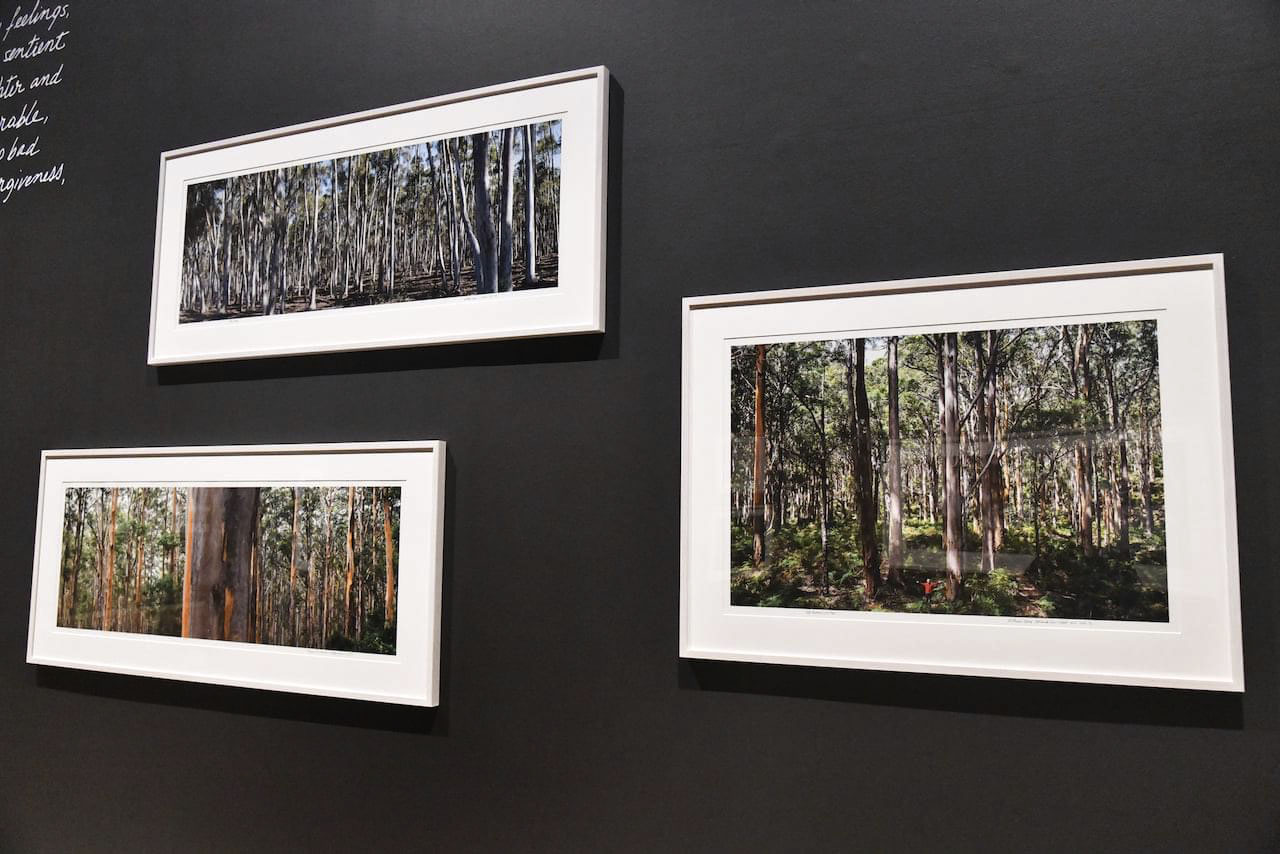
 

Installation view of the exhibition 'William Yang: Seeing and Being Seen' at the Queensland Art Gallery | Gallery of Modern Art (GOMA)

Installation view of the exhibition 'William Yang: Seeing and Being Seen' at the Queensland Art Gallery | Gallery of Modern Art (GOMA) showing at lower left, 'Boranup Karri Forest #1' (2018)


Installation views of the exhibition William Yang: Seeing and Being Seen at the Queensland Art Gallery | Gallery of Modern Art (GOMA) showing at lower left, Boranup Karri Forest #1 (2018, above)


William Yang (Australia b. 1943) 'Earth Below, Heaven Above' 2020 (still)


William Yang (Australia b. 1943)
Earth Below, Heaven Above (still)
2020
Two-channel video, 16:9, 5:36 minutes, colour, sound
Editor: Jack Okeby
© William Yang
Courtesy: The artist


Rosie Hays: What are your aspirations as an artist? What is the aim for your work in the larger sense?

William Yang: Two of my most important realisations were, firstly, that I was not white but Chinese, and secondly, that I was not straight, but gay. I probably realised these at an early age, but it took me a long time to articulate the condition and to come to terms with it. Personally, I suffered more pain being a closeted gay than being Chinese. These are both big themes in my work. When I started including gay work in my exhibitions, some photographers told me it [was] a phase I was going through and I’d be better off dealing with universal issues. They were right, in a way, because by continuing to deal with marginalised issues, my audience base is much smaller. I would probably have made more money sticking with celebrity lives and continuing the status quo, but it is important for me to talk about being gay and to talk about racial difference, even if they are commercially unpopular subjects. Nowadays, there is more acceptance of being gay here in Australia, and likewise, there is more awareness of racial difference, but in the wider world this is not always the case. It is a cause worth pursuing, and documentary photography with a personal story thrown in is a good way of doing it. I want to acknowledge the activists around the world that have made social change happen.

I want my work to embrace my life. I’ve managed to live to a mature age – I was fortunate not to die young as many of my colleagues did during the AIDS pandemic. One lives a life, and I am not the same person as I was when I was younger. Then I had more energy, had more opinions, some of them obnoxious – in short, I had many of the traits of a young person that old people like to complain about. But one learns from life, and I have lived to this age and can see there is a shape to one’s life. It has to do with the things you believe in and the choices you make (I always knew being an artist would be a hard road), it is shaped by external forces beyond your control, and it is also shaped by luck. Still, I consider my life a fortunate one.

I think I like stories because they are about people and the world. They somehow embrace humanity. I would like my art to convey feelings, emotions, what it is like to be a sentient human: experiencing joy, laughter and sadness, to realise we are vulnerable, that we have our failings, we do bad things, but we are capable of forgiveness, kindness and love.

Rosie Hays is Associate Curator, Australian Cinémathèque, QAGOMA She spoke with the artist in 2020.

This is an edited excerpt of the original interview, which appears in the exhibition publication William Yang: Seeing and Being Seen, available at the QAGOMA Store


William Yang. 'Deposition. Innisfail Court House. 1922' 1990


William Yang (Australia b. 1943)
Deposition. Innisfail Court House. 1922
1990
From ‘About my mother’ portfolio 2003
Gelatin silver photograph on paper
51.3 x 61.1cm (comp.)
Queensland Art Gallery Foundation Grant
Collection: Queensland Art Gallery | Gallery of Modern Art purchased 2004
© William Yang


William Yang (Australia b. 1943) 'Self portrait #1' 1992, printed 2013


William Yang (Australia b. 1943)
Self portrait #1
1992, printed 2013
Inkjet print on paper
87 x 119cm (comp.)
Gallery of Modern Art Foundation Grant
Collection: Queensland Art Gallery | Gallery of Modern Art purchase 2013
© William Yang


William Yang Self portrait #1 / A Director’s Perspective

Join QAGOMA Director Chris Saines CNZM as he discusses William Yang’s Self portrait #1 1992 (printed 2013)


William Yang’s work, intimate and considered, draws on the artist’s own lived experience. Yang’s personal stories inform his spoken-word performances and photography, and he often scribes these stories directly onto his photographic prints. Drawn to people, Yang’s work reveals unsettling narratives in his own life, in the lives of his subjects, and in society. Adept at uncovering the unvarnished beauty and hidden foibles of our lives, storytelling is intrinsic to his practice.


Self Portrait #1

Yang’s unflinching photographic gaze draws from the documentary tradition. Since the 1980s, Yang has displayed an unyielding persistence in unearthing stories that society, or even his subjects, might prefer to remain hidden. His instinct and passion is to present the whole, flawed story, not just the glossy surface.

With stories such as his uncle’s murder, Yang courts his family’s disapproval by airing hidden family stories, balancing potential indiscretions with the importance of telling real stories that reveal experiences or communities often left out of public discourse.

…

In the mid 1980s, Yang met Yensoon Tsai, a young Taiwanese woman who would become a close friend. Tsai taught Yang the tenets of the Chinese philosophy of Taoism, which led him to explore his Chinese-Australian identity.

Throughout the late 1980s and 90s in Australia, multicultural stories emerged across various art forms. Yang was part of this wave of artists rejecting a suppression of their cultural histories, and who instead wanted to highlight and celebrate diversity. Yang travelled throughout regional and urban Australia documenting the lives of Chinese-Australians, and the landscapes reflecting the legacy of the Chinese in Australia, such as religious shrines and mining sites.

Self Portrait #1 is a landscape work (in the way Yang talks about landscape which is often rooted in people and place and memory) as much as it a portrait work. Capturing the landscape is part of Yang’s somewhat diaristic approach to processing his social and physical environment.

When Yang returns to the Queensland landscape from his childhood, he characterises it as a site to escape from. He needed to escape from racist school bullying, constrictive family expectations, and the dread that his sexuality may be met with disapproval. Yang revisits his childhood home regularly, and some of his most potent performances and photographs come from connecting family and place. The series ‘My Uncle’s Murder’ – and its recounting of an injustice borne of racism dating from 1922 – resulted from such a trip. In his later works, he makes an uneasy peace with these past experiences that are embedded in the landscape of his youth.

Rosie Hays. “William Yang’s work reveals unsettling narratives in his own life,” on the QAGOMA website 4 October, 2020 [Online] Cited 10/08/2021


William Yang (Australia b. 1943) 'Waiting for the Parade to Start' 2019


William Yang (Australia b. 1943)
Waiting for the Parade to Start
2019
Inkjet print on solid substrate Kapaplast
56.5 x 85cm
© William Yang
Courtesy: The artist


William Yang (Australia b. 1943) 'Jac Vidgen and Akira Isogawa, Sweatbox Party' 1989


William Yang (Australia b. 1943)
Jac Vidgen and Akira Isogawa, Sweatbox Party
1989
Inkjet print on solid substrate Kapaplast
© William Yang
Courtesy: The artist


William Yang (Australia b. 1943) 'Patrick White #1, living room, Martin Road' 1988


William Yang (Australia b. 1943)
Patrick White #1, living room, Martin Road
1988
Gelatin silver photograph, ed. 2/10
45.6 x 36.4cm
Queensland Art Gallery Foundation Grant purchased 1998
Collection: Queensland Art Gallery | Gallery of Modern Art


William Yang (Australia b. 1943) 'My Generation (Brett Whiteley)' 1975 (detail)


William Yang (Australia b. 1943)
My Generation (Brett Whiteley) (detail)
1975
© William Yang
Courtesy: The artist


My Generation

Queensland-born, Sydney-based artist William Yang describes a moment in Sydney when a number of creative groups came together to generate an artistic wave that swept across Australian society.

The intersections of the tight literary circle of Nobel award winner Patrick White and his partner, Manoly Lascaris, with the theatrical circle, their friends Jim Sharman and actress Kate Fitzpatrick. Fitzpatrick, in turn, models frocks in the exuberant fashion parades organised by designers Linda Jackson and Jenny Kee, while artists Peter Tully and David McDiarmid extend the tongue-in-cheek Australiana of the two fashionistas’ outfits with witty accessories. Their parades and parties at retail outlet Flamingo Park, a magnet for influential people in business, politics and the arts, determined the look of the 1970s and early 1980s. Tully and McDiarmid used their bravura visuals to jump start the Gay and Lesbian Mardi Gras, giving the event its unique and unforgettable style. The pair lived out a parallel lifestyle that might epitomise the Australian story of gay liberation, with its heady rush unfolding into aching tragedy.

Golden couple Brett and Wendy Whiteley enjoyed the creative atmosphere of the swinging ’60s and the plunge into a riotous world of sex, drugs and rock’n’roll. Yang shows Brett painting, smoking and partying with the beautiful people, and his eventual deterioration as heroin took a fearful hold. The early death of their beautiful daughter, Arkie, was another aspect of this fated family history. Linda Jackson and Jenny Kee eventually split; Kee takes Danton Hughes, the son of Robert Hughes, as a lover; Danton suicides; Kee takes up Buddhism. Yang portrays lives that unfold, flower or wither: lives lived.

Yang’s generation is not life as reported in the newspapers but ‘as I saw it’: a personal account summed up as a litany of parties, of innocence lost and worldliness gained, a continuum of his search for contact and meaning. Like his contemporaries Rennie Ellis or Michael Rosen, William Yang is a social photographer, a recorder of life. His strength lies in creating a living testament, and his medium’s strength is that it is necessarily shared. He offers no moral tale, nor any notion of karma to underscore the events: just the three basic but vital stories – birth, love and death.

Extract from Michael Desmond. “William Yang: My Generation,” in Artlines 1-2009 in “William Yang: Portraits,” on the QAGOMA website 22 September, 2017 [Online] Cited 10/08/2021.


William Yang (Australia b. 1943) 'David Gulpilil' 1978


William Yang (Australia b. 1943)
David Gulpilil
1978
Inkjet print on solid substrate Kapaplast
© William Yang
Courtesy: The artist


William Yang (Australia b. 1943) 'Linda Jackson and Jenny Kee' 1979


William Yang (Australia b. 1943)
Linda Jackson and Jenny Kee
1979
Inkjet print on solid substrate Kapaplast
© William Yang
Courtesy: The artist
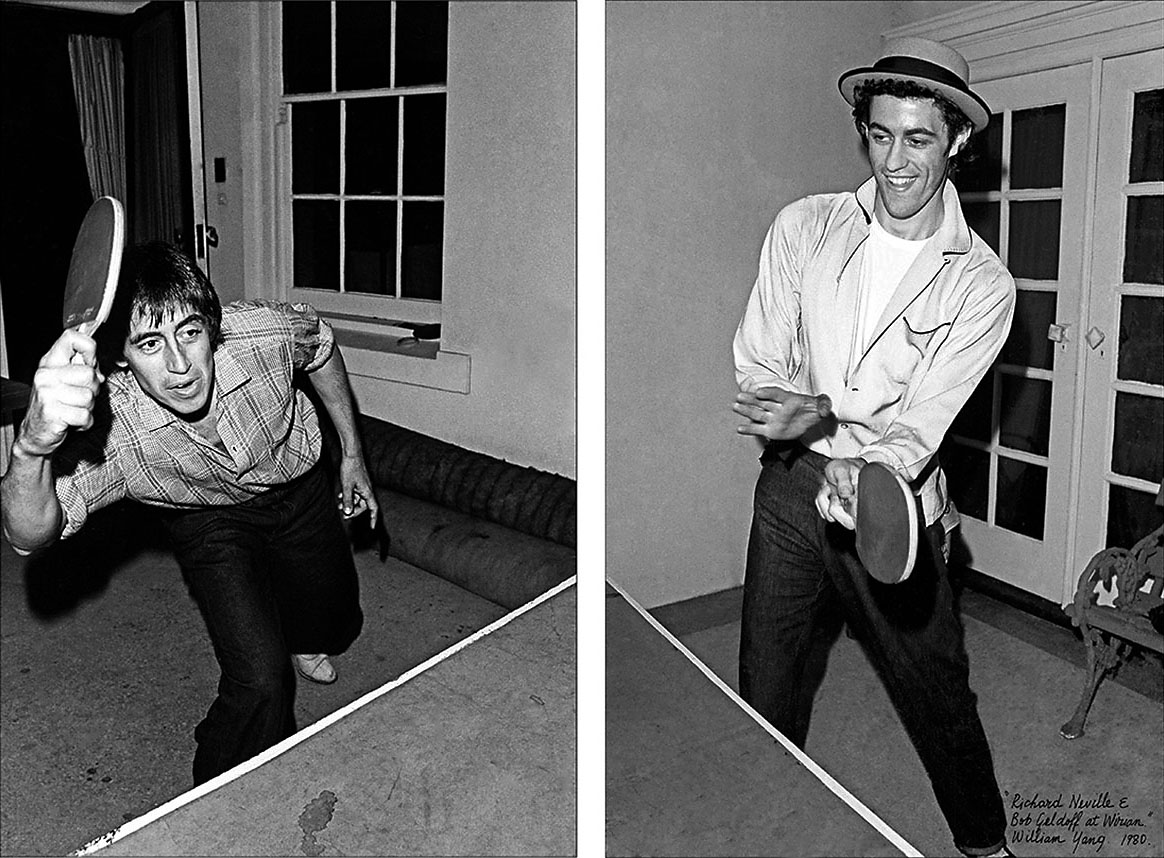
 

William Yang (Australia b. 1943) 'Richard Neville and Bob Geldof at Wirian' 1980


William Yang (Australia b. 1943)
Richard Neville and Bob Geldof at Wirian
1980
Inkjet print on solid substrate Kapaplast
© William Yang
Courtesy: The artist


In order to make a living as a photographer, Yang began his career taking candid shots of ‘beautiful people’ at parties and events for the social pages of newspapers and magazines. Yang rubbed shoulders with celebrities, artists and performers, and discovered that the camera was an entry pass to an exclusive backstage world populated by kindred spirits, with whom he formed close bonds.

Yang’s prolific social portraiture includes some of the most prominent people in Australian theatre, film, art and literature, with more than a few international cameos. A much-loved and trusted figure who is embedded into Sydney’s social fabric, Yang’s images are taken with the razzle-dazzle of celebrity, but little of its conceit.

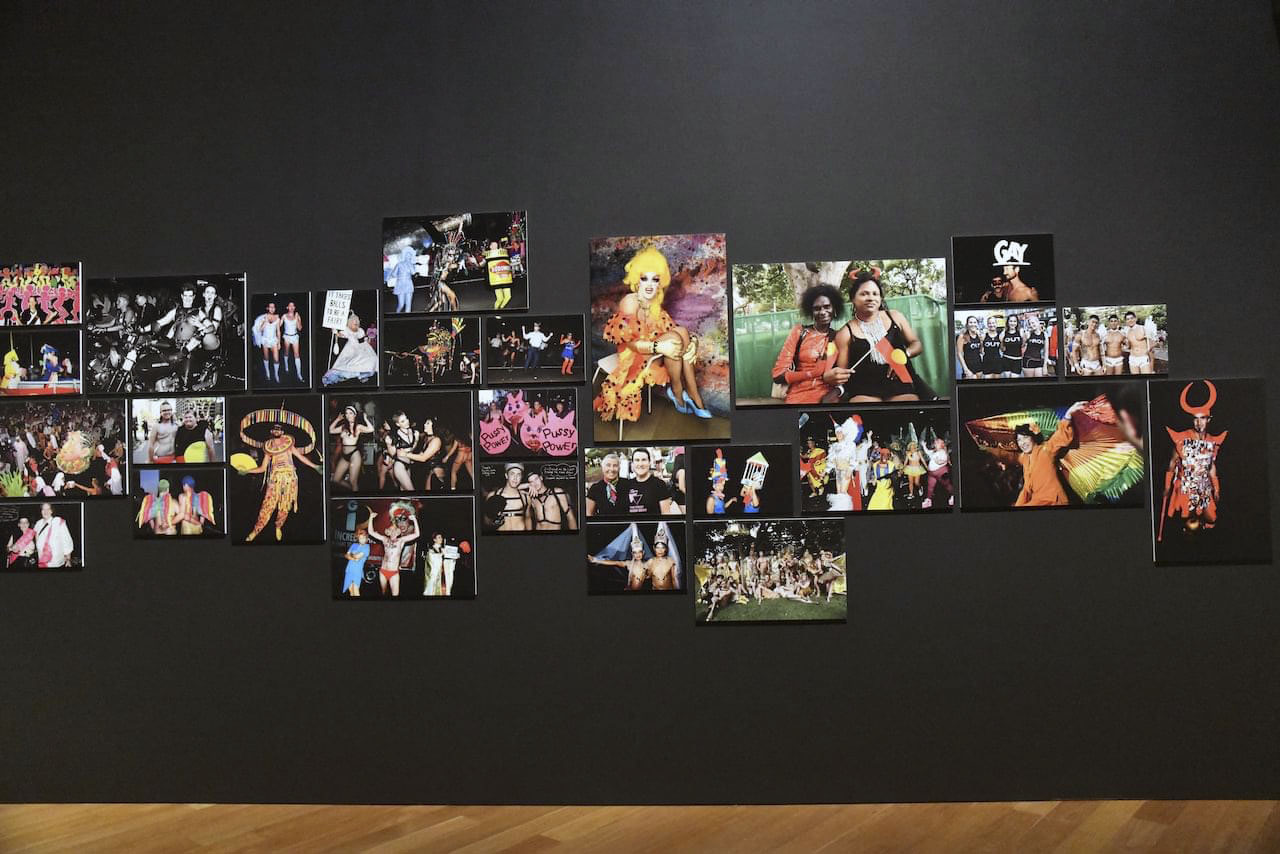
Within the show is a salon hang ‘social wall’ which long predates Instagram. The selection of faces is reflective of Yang’s friendships and his abiding passion for the arts – they embody both the glamour of celebrity and provide behind-the-scenes insights into the lives of artists from a range of backgrounds. With a camera around his neck, Yang came to understand that he could ask his subjects a series of personal questions, and they would reveal more of themselves than they would during the course of casual conversation.

Representing only a fraction of Yang’s social photography, these images capture the almost compulsive nature of his passion for recording people and places. His gift for eliciting the essence of his subjects through portraiture – whether candid or posed – has been apparent his entire career.

Rosie Hays. “William Yang: Celebrity and Portraiture,” on the QAGOMA website 7 May, 2021 [Online] Cited 10/08/2021.


William Yang (Australia b. 1943) 'Rainbow Angel Wings' 2003


William Yang (Australia b. 1943)
Rainbow Angel Wings
2003
Inkjet print on solid substrate Kapaplast
27 x 40cm
© William Yang
Courtesy: The artist


William Yang (Australia b. 1943) 'Marriage Equality, Mardi Gras' 2013


William Yang (Australia b. 1943)
Marriage Equality, Mardi Gras
2013
© William Yang
Courtesy: The artist


Queensland Art Gallery | Gallery of Modern Art (GOMA)
Stanley Place, South Brisbane
Queensland 4101, Australia
Phone: +61 (0)7 3840 7303

Opening hours:
Daily 10.00am – 5.00pm

Queensland Art Gallery | Gallery of Modern Art (GOMA) website
LIKE ART BLART ON FACEBOOK

Back to top

Review: ‘An-My Lê: On Contested Terrain’ at the Amon Carter Museum of American Art, Fort Worth, Texas

Exhibition dates: 18th April – 8th August, 2021


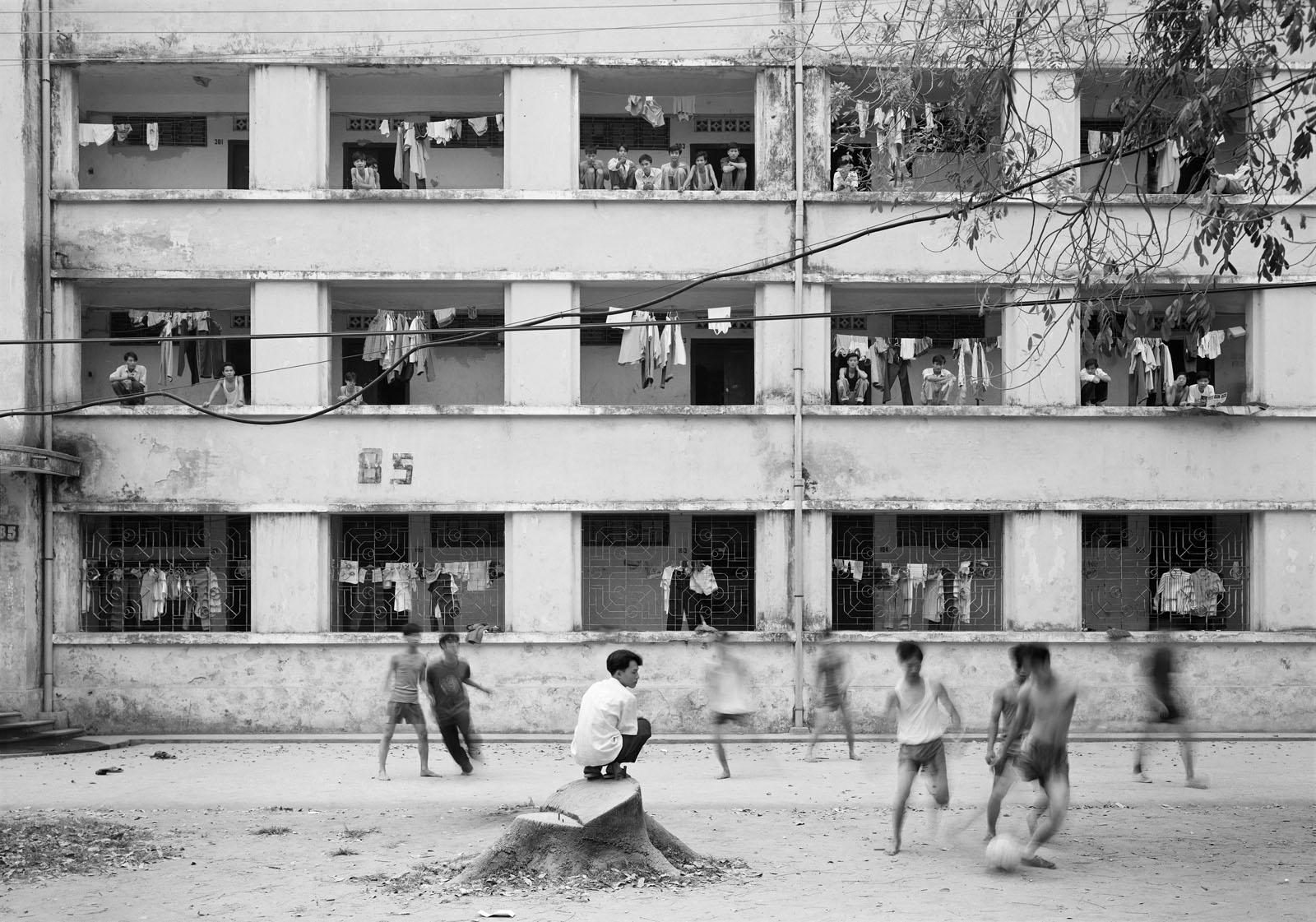
An-My Lê (Vietnamese-American, b. 1960) 'Untitled, Hanoi' 1995 from the exhibition 'An-My Lê: On Contested Terrain' at the Amon Carter Museum of American Art, Fort Worth, Texas, April - August, 2021


An-My Lê (Vietnamese-American, b. 1960)
Untitled, Hanoi
1995
From the series Viêt Nam (1994-1998)
Gelatin silver print
Courtesy of the artist and Marian Goodman Gallery, New York, Paris, and London
© An-My Lê


“In their essential nature men do not change. The great and noble, the Masters of Life, will be great and noble to the end of time, and to contemplate them and their deeds inspires us to endeavour to emulate them. Learn whom a man venerates, and you can come to judge his character. Like is assimilated unto like. The mind approaches that which it continually contemplates, and kindred inevitably follow.”


Alvin Langdon


Disguising power as virtue or, the Inner Landscape of Beauty

One of the great assets of VR, especially in times of lockdown, is that you can view an exhibition from a distance. Such is the case with this strong exhibition by Vietnamese-American photographer An-My Lê at the Amon Carter Museum of American Art, Fort Worth, Texas. It gives the viewer the ability to come to grips with an artists work displayed as a whole, to contemplate the myriad threads that run through the five bodies of work that are presented in the exhibition.

While there are no remarkable “hero” shots contained within the body of Lê’s work, collectively the photographs from each series build a serious interrogation into the contested terrains of colonialism, war, the military, racism and protest. As we know with life nothing is ever black and white, and through her classically inspired photographs Lê probes the interweaving of existence, desire, possession and control in the landscape, in the landscape of life. As assistant curator Kirsten Gaylord observes, “Her photographs consider questions that we are all thinking about now: What does it mean to be an American citizen? How does our country’s history shape our contemporary lives? What should be the role of the U.S. in the world?” These are complex issues which Lê addresses with intelligence and rigorous conceptualisation, fully aware of the paradoxes that exist within her inquiry.

My favourite series are the more personal and engaging, the more empathetic and feeling of the works – the first and the last, Viêt Nam (1994-98) and Silent General (2015-ongoing). In Viêt Nam, Lê returns to her homeland of Vietnam after almost 20 years with her large format camera. The resulting meditation on homeland evidenced in beautiful, perfectly formed photographs are moving and touching, poetic reveries on lost innocence, regained? In Silent General, Lê again again puts more of her self on the line, her photographs confronting the “issues of our time that are rooted in our history, from the fate of Confederate monuments to immigration debates around agricultural labourers.”

I am ambivalent about the other series in the exhibition, which while beautiful have a slightly chilly aura.

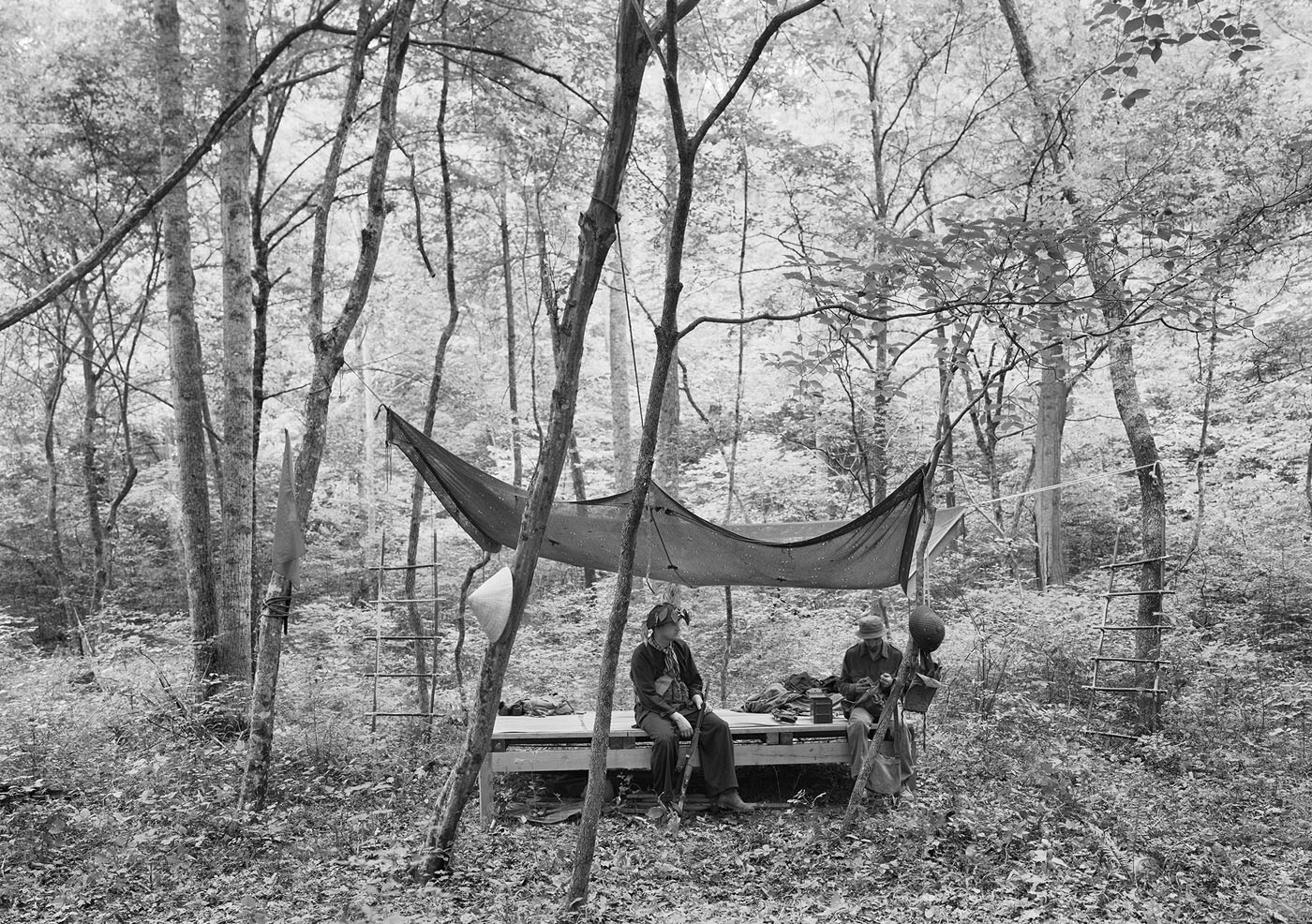
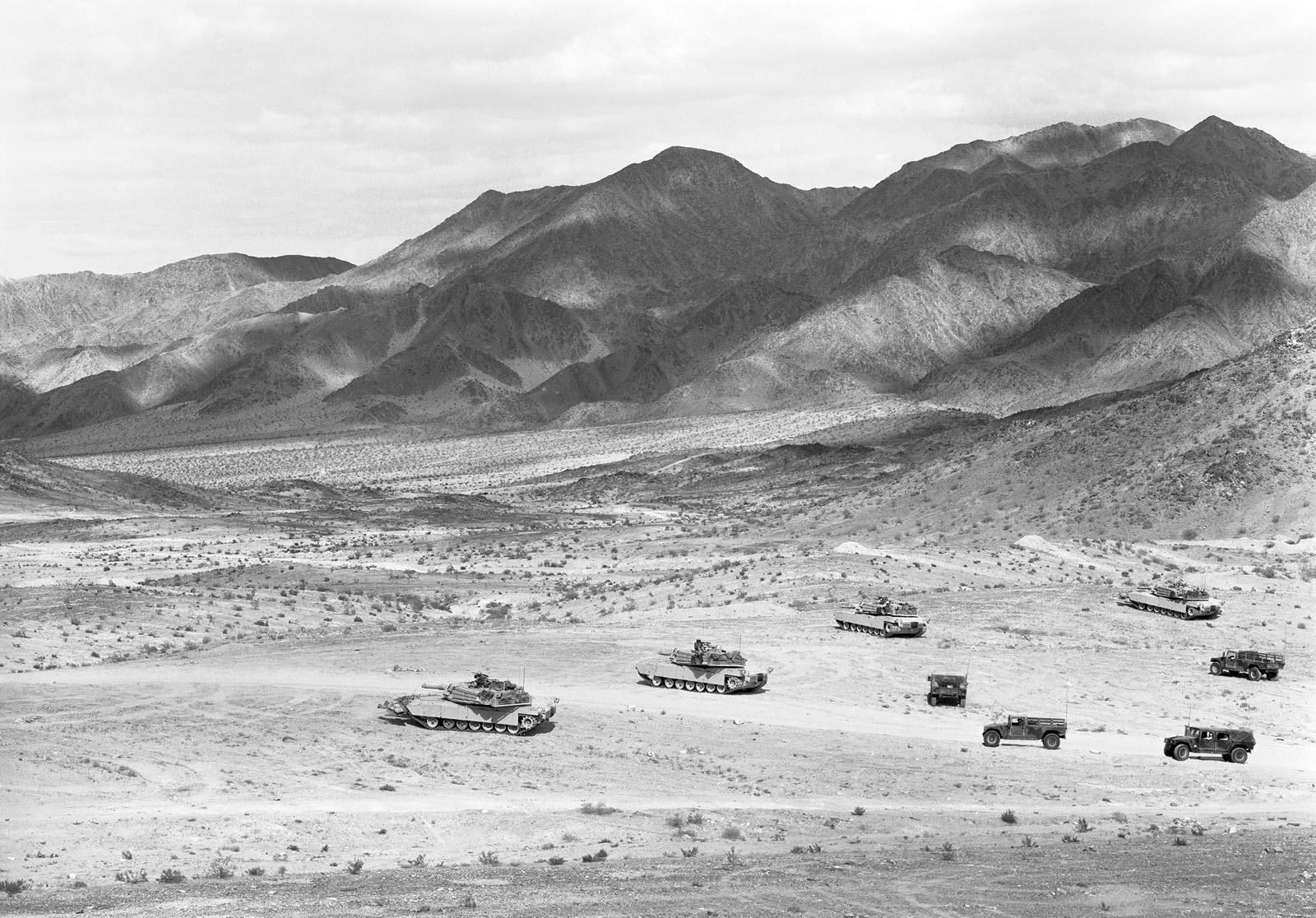
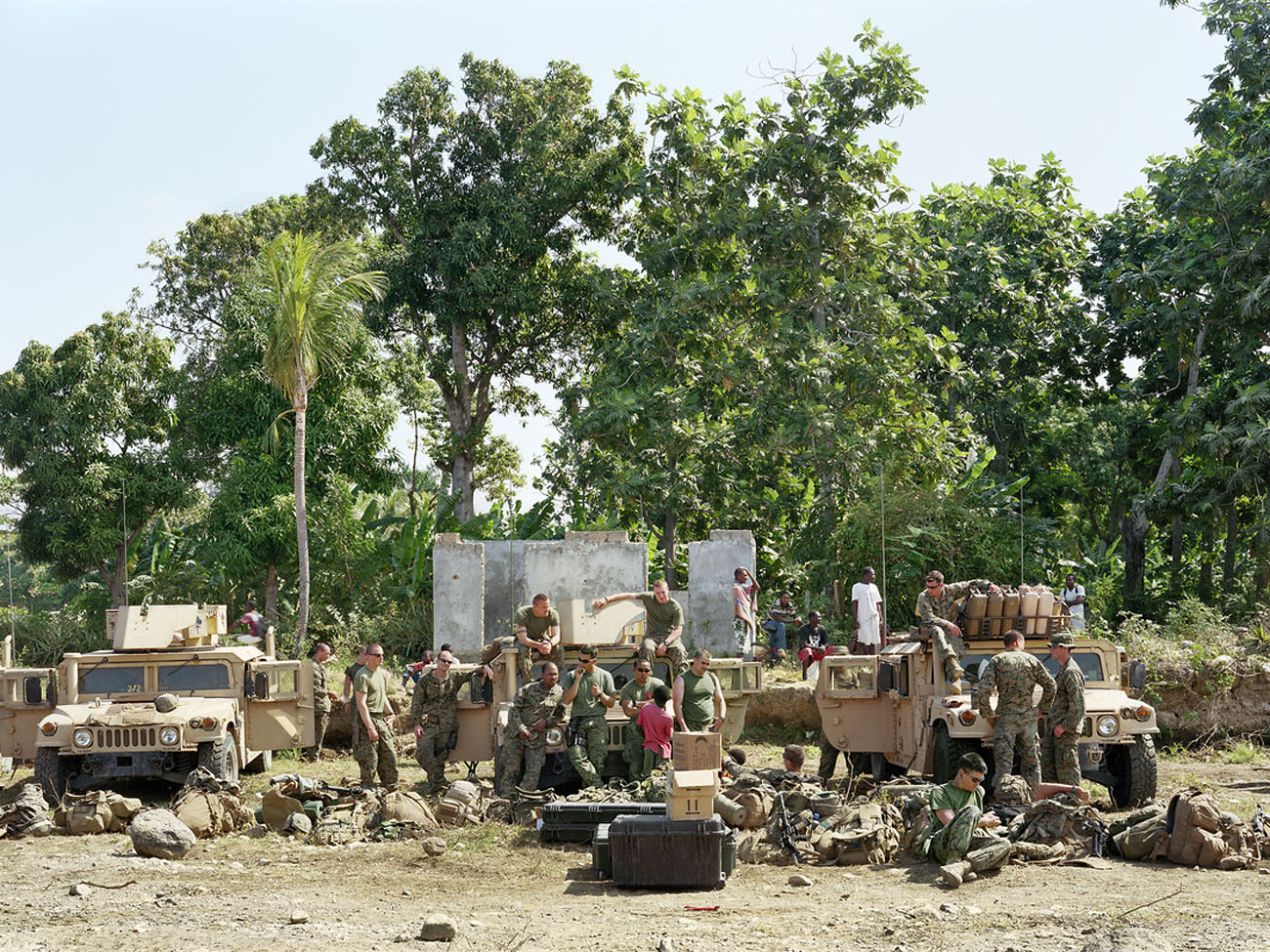
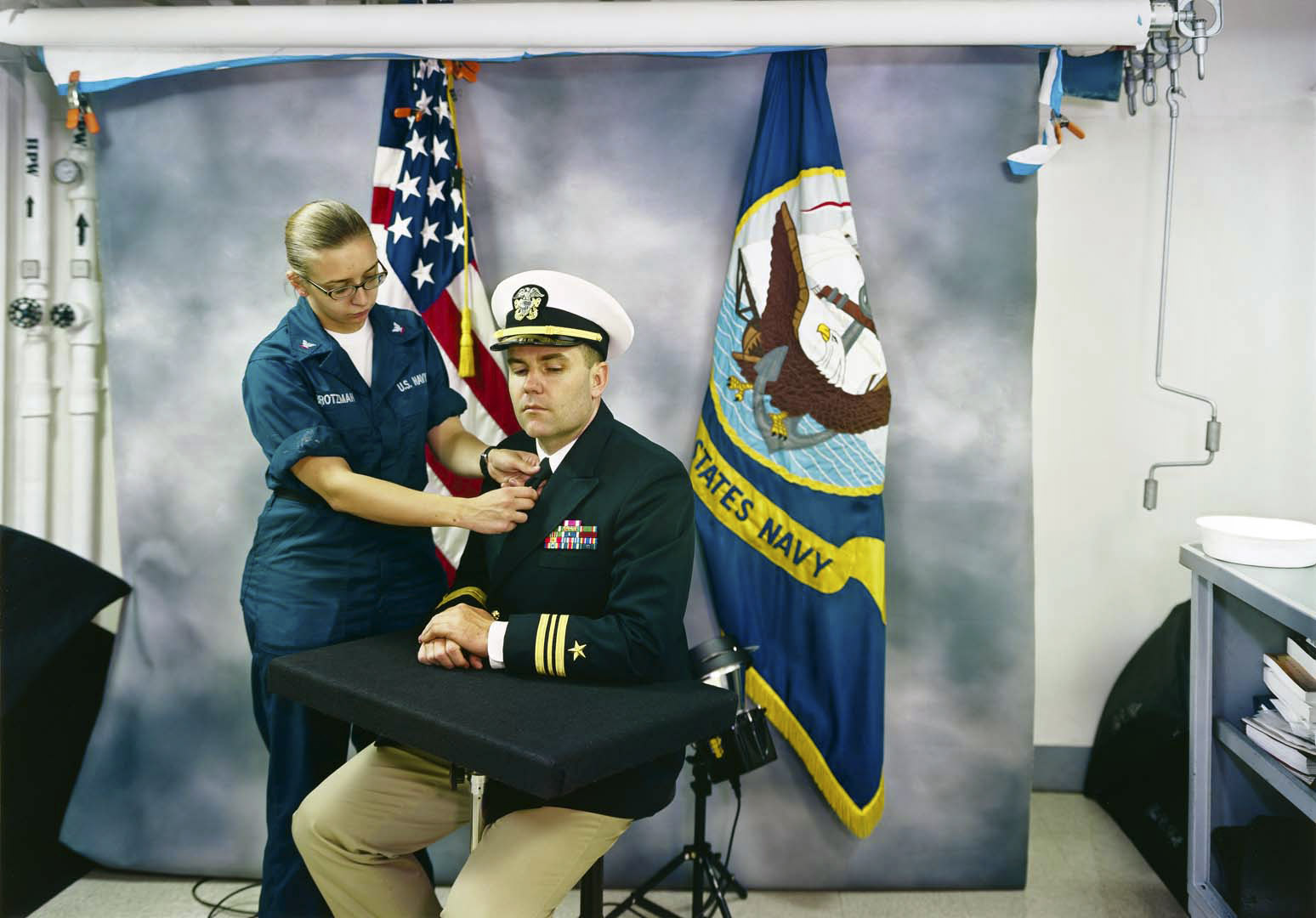
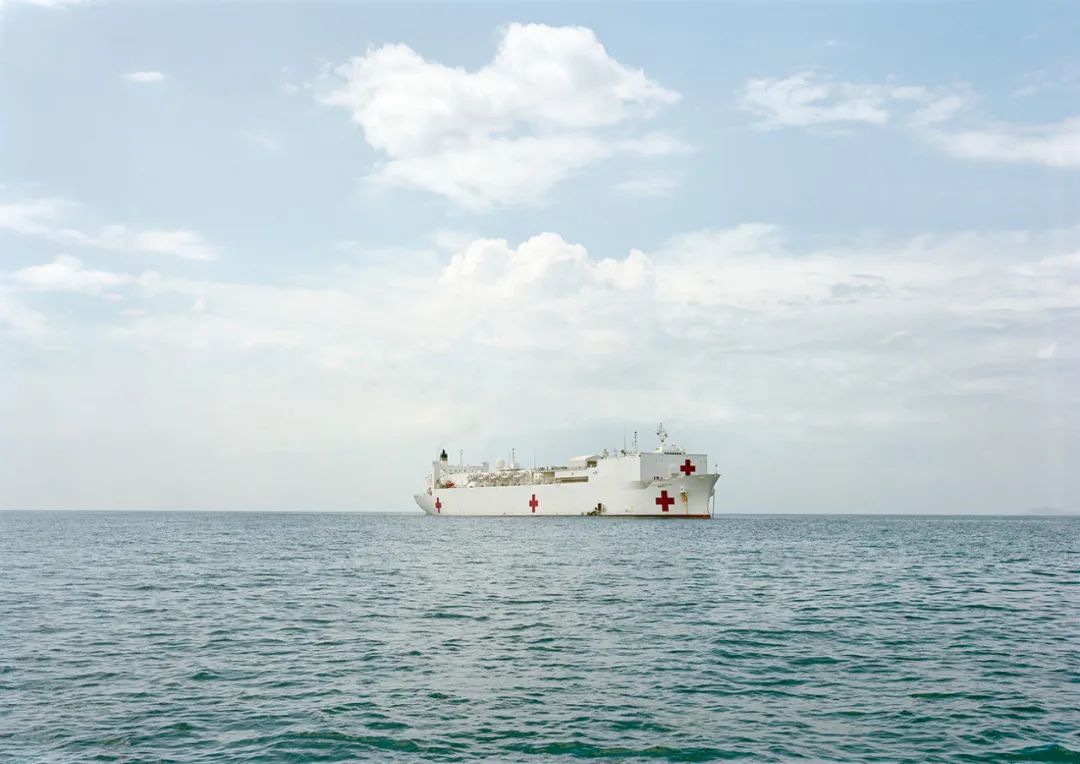
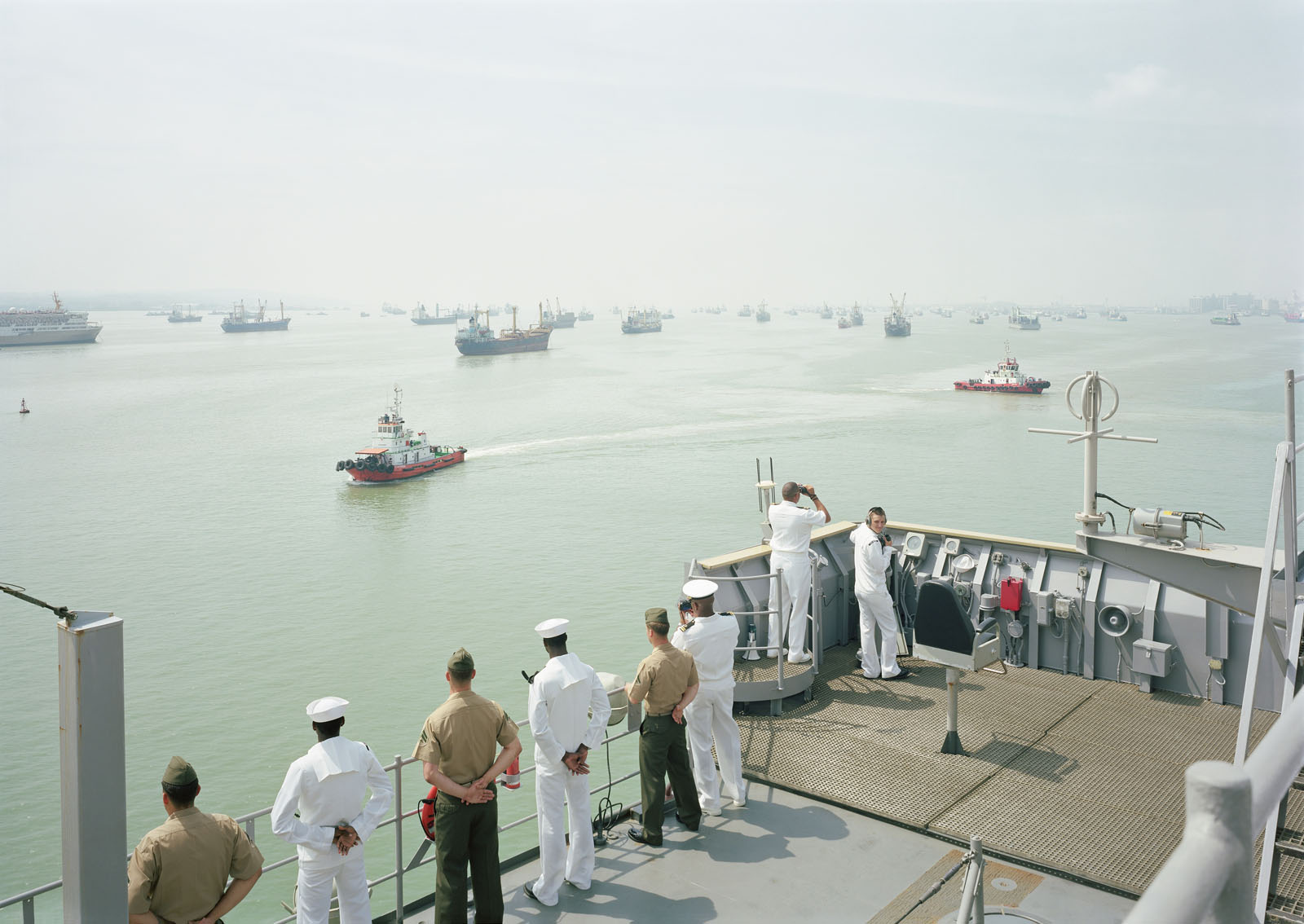
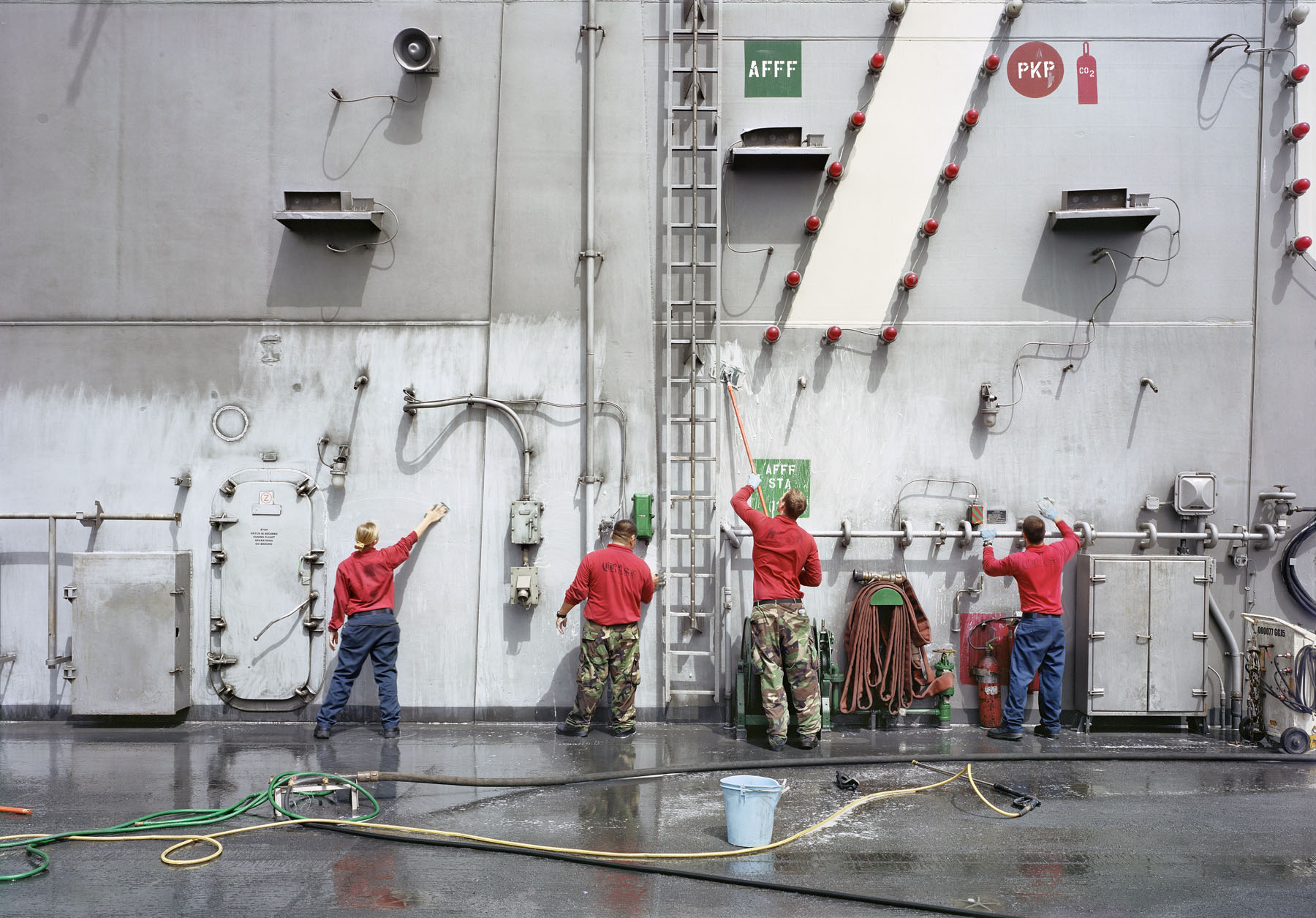
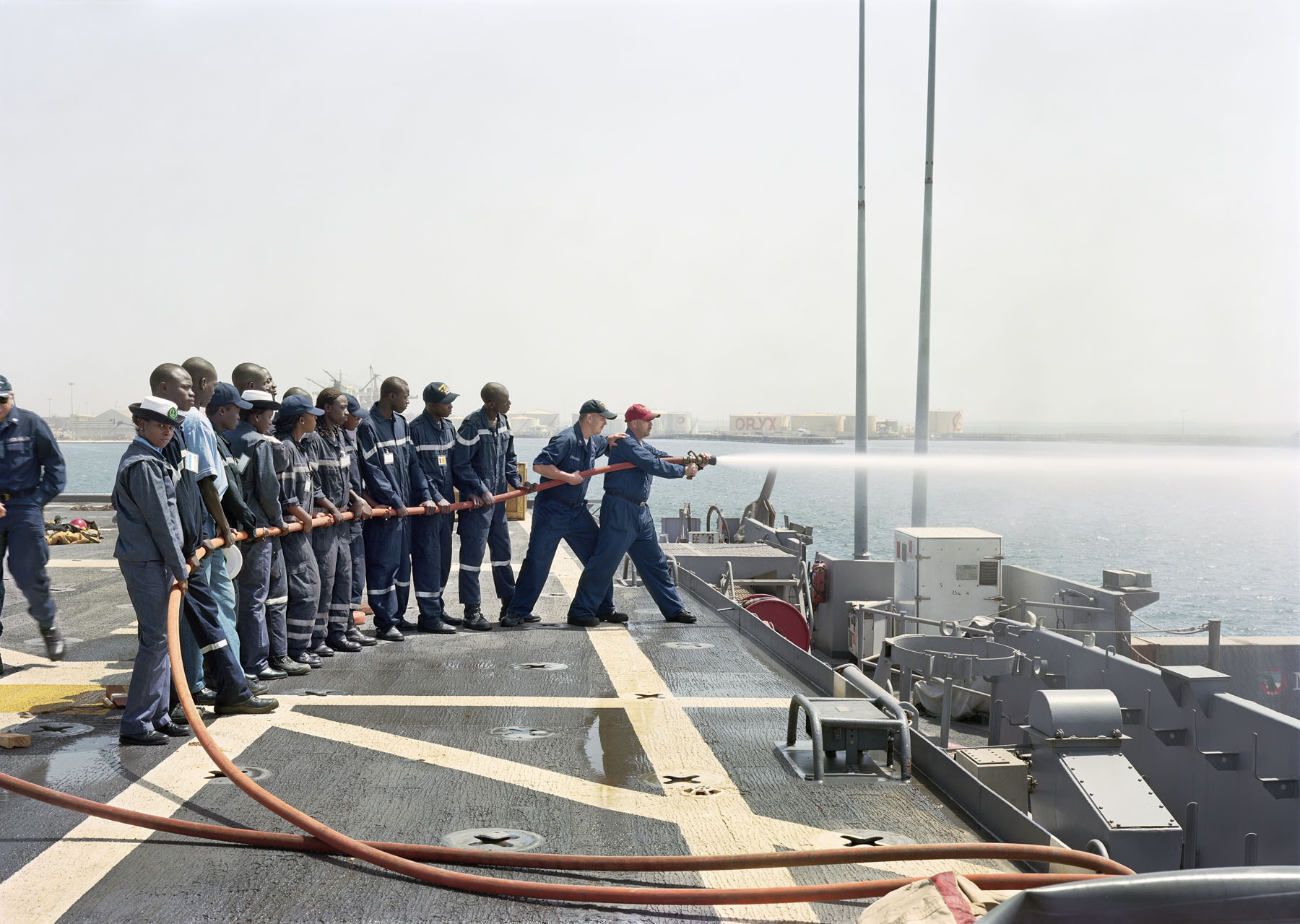
In the series Small Wars (1999-2002), Lê photographs Vietnam War reenactors in North Carolina and Virginia with the utmost sense of “authenticity” creating images that “explore the legacy and mythology of the Vietnam War for contemporary Americans.” In 29 Palms (2003-04) she photographs troops training in an American landscape similar to the one they would soon be deployed to in Iraq. In Events Ashore (2005-14) the artist photographs the crews of U.S. naval vessels around the world exploring the global reach of the American military, its diplomatic, humanitarian, military, and political activities.

In Small Wars and 29 Palms, Lê pictures a simulacra of war, simulations of a war already past (and lost), and a war yet to run its course, which would ultimately lead to the withdrawal of US forces. Her work blurs the boundaries between photojournalism and reality / fiction.

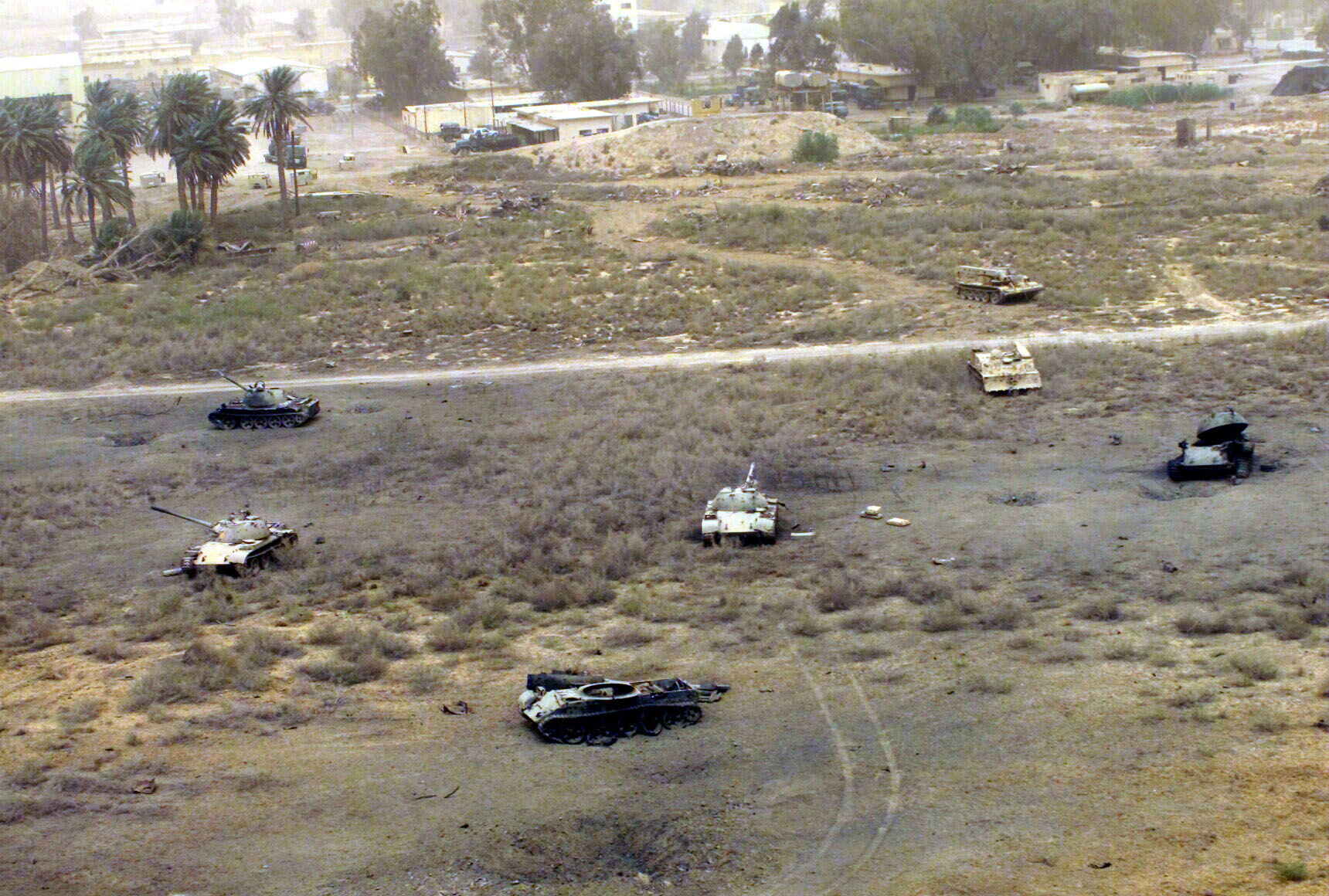
The photograph Ambush I (1999-2002, below) from Small Wars is eerily similar to Henri Huet’s photograph of Life magazine photographer Larry Burrows struggling through elephant grass in 1970 (below) with the difference that Burrows is helping to evacuate a wounded soldier, and that Huet, Burrows and two other photojournalists would be killed when their helicopter was shot down over Laos later in February 1971. Similarly, Lê’s photographs Mechanized Assault (2003-2004) shows a pristine landscape foregrounded with immaculate tanks and personnel carriers in the American landscape… when in reality, American Marines photograph the burnt remains of Iraqi T-55 Main Battle Tanks amongst a non-descript landscape of shell holes and mundane buildings (16 April 2003, below). Further, while not a simulation, the very stillness and chillness of Events Ashore – the physical and metaphorical distance of the photographer from the subject, from the reason of the existence of the military – make the photographs in that series seem almost an apologia for the military.

In a quotation, Lê states that, “… I am not categorically against war. I was more interested in drawing people into my work, to think about the issues that envelop war – representations of war, landscape and terrain in war. When I’m working with the military, I still think of myself as a landscape photographer. My main goal is to try to photograph landscape in such a way that it suggests a universal history, a personal history, a history of culture.”

I understand what the photographer is attempting, but in one sense I remain unconvinced about the success of the mission.

Simply put, the raison d’etre for the military – despite all protestations to the contrary, despite all the good works they otherwise undertake – is “to engage in combat, should it be required to do so by the national defence policy, and to win. This represents an organisational goal of any military, and the primary focus for military thought through military history.” (Wikipedia) In terms of military doctrine,1 we note that in the history of the United States of America, the country has been at war 225 out of 243 years since 1776. America is a militarised society where the military prosecutes war on its own terms, disguising power as virtue. In terms of the prosecution of war, the country seems to be manifestly belligerent.

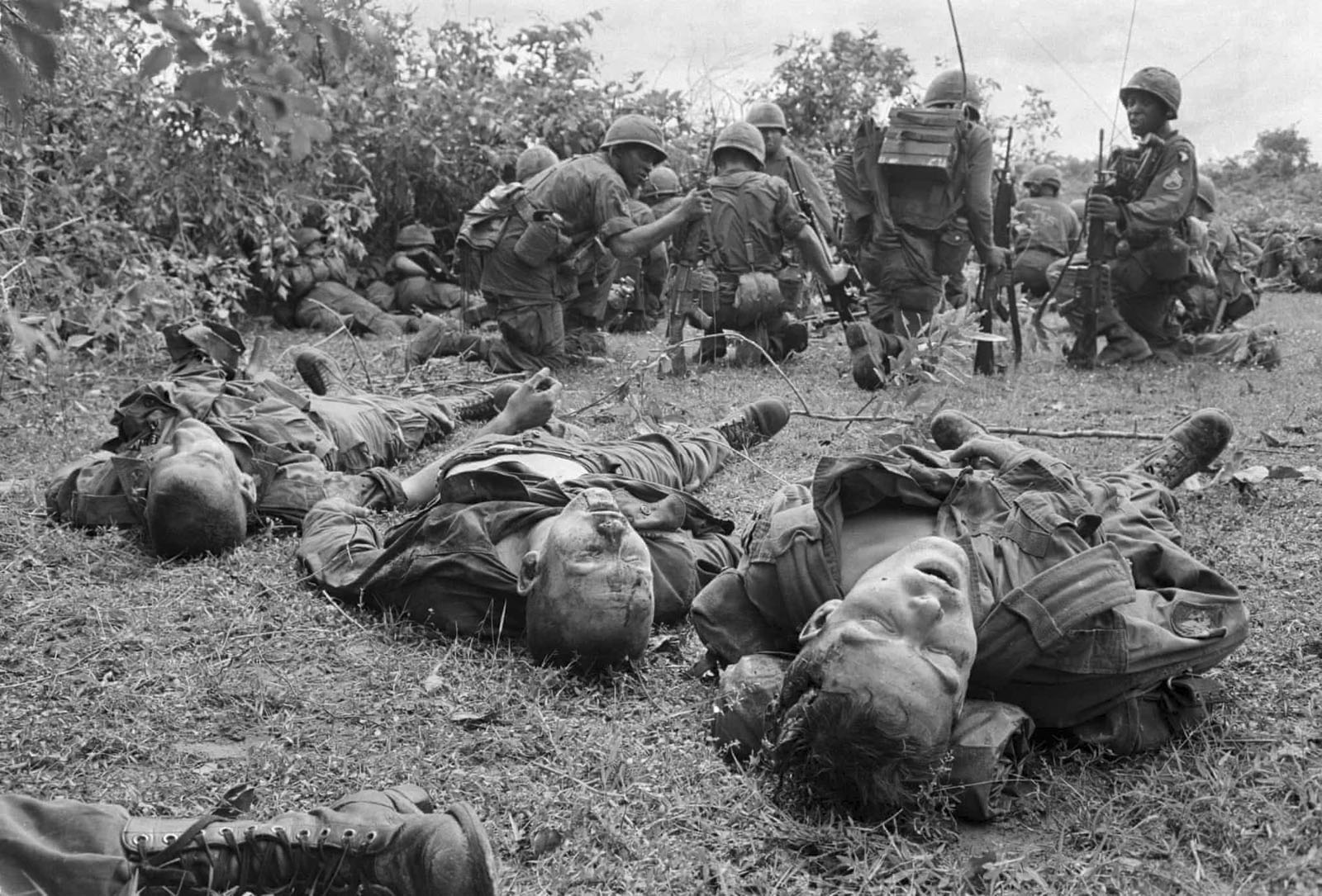
The outcome of any war is death. Sure, the soldiers might be there for economic or social reasons, they may experience fear and exhilaration, boredom and dreams, brotherhood and purpose, travel and education… but ultimately the military is a fighting and killing machine. “Young soldiers in combat inevitably confront killing. They take life away from others, and in so doing breach one of the most fundamental moral values of their society, often with long-term consequences.” Listening to an American veteran from the battle of Caens after the D-Day landings in 1944 recently in a documentary, he observed that all war is, is death – dead German soldiers, dead American soldiers, dead civilians. The reality (not a simulation or a reenactment) of Henri Huet’s photograph of dead soldiers, Bodies of US paratroopers lie near a command post during the battle of An Ninh (1965, below) is shocking and unimpeachable.

Soldiers kill. Human beings, civilian and military, die.

And then the military doesn’t want you to know about that. They cover it up. In World War 1, the British stopped posting lists of the missing and dead in the newspapers because there were so many of them. And in the Iraq war, the American military didn’t want photographs of American coffins in the back of a transport plane published because it would upset the families and the public. Even the metadata (hidden text data) written by the military contained in a public domain image of destroyed Iraqi tanks (see below) in 2003 states, “Operation IRAQI FREEDOM is the multinational coalition effort to liberate the Iraqi people, eliminate Iraq’s weapons of mass destruction and end the regime of Saddam Hussein.” Outright lies and deception … the invasion was illegal under international law as it violated the UN Charter, there were no weapons of mass destruction found, and no link between Saddam Hussein and al-Qaeda. The Iraq War caused at least one hundred thousand civilian deaths, as well as tens of thousands of military deaths.

Everyone is involved in the construction of the world. You can be informed or not. You have choices. Human beings have a choice to go into the military, or not. The problem is that human beings in power, in control (at the top of the military for example) inspire others to endeavour to emulate them. As Alvin Langdon observes, “Like is assimilated unto like. The mind approaches that which it continually contemplates, and kindred inevitably follow.”

Now, in another sense I believe that Lê achieves her aim, to suggest a universal history, a personal history, and a history of culture embodied in the landscape, suggestions that possibly sweep away landscapes of control.

As the Irish poet and philosopher John O’Donohue observed, “Even in landscapes of control you can be swept off your feet by sheer beauty.” Landscapes of control cannot stand before the power of beauty embodied in the landscape and in Lê’s photographs the memory of the landscape, its music, embeds itself in the photograph. Through the power of beauty, the Inner Landscape of Beauty (one that is metaphorical as much as physical, in the mind as much as it is externally verbalised), the photographs of An-My Lê subversively undermine the control of the military over the land: its occupation and colonisation of it, its wars to control it, and its very “uniform” presence in it. Look again at the photograph Mechanized Assault (2003-2004, below) and now it is the distance of the photographer from the subject – the infinite sublime as I call it – that upends the punitive intentions of the military and overwhelms their puny vehicles. It’s an earth, spirit and mind thing.

In the viewers recognition of the beauty of this land(e)scape, we acknowledge our own virtue and assert our desire to be free. Free from restrictive control. Free from oppression. Free from war. The military, police “force” and government are and always will be, afraid of the infinite within us…

Dr Marcus Bunyan

Word count: 1,540


Footnotes

1/ “Development of military doctrine is perhaps the more important of all capability development activities, because it determines how military forces are used in conflicts, the concepts and methods used by the command to employ appropriately military skilled, armed and equipped personnel in achievement of the tangible goals and objectives of the war, campaign, battle, engagement, and action.” (Wikipedia)


Many thankx to the Amon Carter Museum of American Art for allowing me to publish the art work in the posting. Please click on the photographs for a larger version of the image.


Henri Huet (French, 1927-1971) / AP 'Bodies of US paratroopers lie near a command post during the battle of An Ninh' 18 September 1965 from the exhibition 'An-My Lê: On Contested Terrain' at the Amon Carter Museum of American Art, Fort Worth, Texas, April - August, 2021


Henri Huet (French, 1927-1971)/AP
Bodies of US paratroopers lie near a command post during the battle of An Ninh
18 September 1965


The paratroopers, of the 1st Brigade, 101st Airborne Division, were hit by heavy fire from guerrillas that began as soon as the first elements of the unit landed. The dead and wounded were later evacuated to An Khe, where the 101st was based. The battle was one of the first of the war between major units of US forces and the Vietcong.


An-My Lê: On Contested Terrain is the first comprehensive survey of the work of Vietnamese-American photographer An-My Lê. Featuring photographs from a selection of the artist’s five major bodies of work, the nationally touring exhibition considers the celebrated photographer’s nearly 25-year career exploring the edges of war and recording these landscapes of conflict in beautiful, classically composed photographs.

Born in Saigon in the midst of the Vietnam War, Lê was evacuated with her family by the U.S. military. She has spent decades considering the complexity of American history and conflict, from war reenactments to the removal of Confederate monuments. This timely exhibition explores politically-charged topics through Lê’s subtle, evocative images that avoid the sensationalism often seen in newspapers and movies. Sweeping views that emphasise the size and breadth of the theatre of war display the artist’s technical strengths in the classical landscape tradition, which she uses to compose beautiful images that draw the viewer into deeper consideration of complex themes of history and power.


” …as a photographer, I’m interested in looking at and representing the real world, and interpreting it in ways that allow me to learn from it and enlighten the issues I am trying to understand. I feel entirely comfortable using photographs with simple titles and explanatory texts. And I feel comfortable with the fact that some people may interpret a photograph differently from others. My photographs are visually complicated and carry complex messages because of the way I pack the information into the frame and structure the picture. People need to spend time with the work in order to piece together all the information. But of course the reading is subjective. I like that. I like that it could be contradictory, that it could be full of surprises, that it could be confusing. I see a fragile construct between the objective and subjective.

Ultimately, the picture is there to incite someone to think about the issues at stake, rather than say explicitly how I myself feel about the American military. Some of my work could be understood as being supportive of the military. You could look at some pictures and think: wow, those young Americans are so heroic! Or you could see in the same image a reflection of American imperialism: look at the American guy standing there, trying to teach the locals how to do it the American way! There are so many possible interpretations. Sometimes the US military comes in and does help people. For example, after the earthquake in Haiti, the military was able to accomplish what no one else could. It was there with supplies in a matter of hours. But there’s a fine line between coming to help and invading, and it has to do with physical and economic presence and the ways in which Americans occupy the land. So the work is about those tensions.

I think it goes back to my own conflicted perceptions of the US military and what it did to Vietnam. At the end of the war, it was the Americans who could help us escape from the approach of communism. Everyone tried to scale the walls of the American Embassy, not the French Embassy. So it’s about all those conflicted things.”


An-My Lê quoted in Andrew Maerkle. “Fires on the Plain,” on the ART-iT website 28/07/2015 [Online] Cited 26/07/2021.
 

“Living through the Vietnam War as a child and immigrating to the United States as a teenager, An-My Lê’s life has been indelibly marked by international conflict. For over two decades, her work as a photographer has engaged the unseen facets within the theater of war. With her large-format camera in tow, she has immersed herself in the Appalachian forest with Vietnam War reenactors, and traveled aboard U.S. aircraft carriers around the globe. Lê identifies as a landscape photographer, a perspective that grounds her subtle, impactful images of American interventionism within a larger history of violence.”


Sara Christoph. “An-My Lê with Sara Christoph,” on the Brooklyn Rail website February 2015 [Online] Cited 26/07/2021.


Photographer An-My Lê: 2012 MacArthur Fellow | MacArthur Foundation | October 2012

Meet An-My Lê and learn about how she came to photography, her work with the U.S. military, and her 19th-century-style camera.

Photographer An-My Lê was named a MacArthur Fellow in 2012. The Fellowship is a $500,000, no-strings-attached grant for individuals who have shown exceptional creativity in their work and the promise to do more.


An-My Lê: Landscapes of war | July 2018

Find out more about An-My Lê’s series Small Wars (1992-2002), and Lê’s experiences photographing Vietnam war reenactors.

Photographer An-My Lê, who grew up in Saigon during the Vietnam War, describes her series Small Wars (1999-2002) and 29 Palms (2003-2004). She discusses how contemporary landscape photography can be used to present more than just scenery; it can illuminate culture, architecture, and social and political issues that citizens are concerned with today.


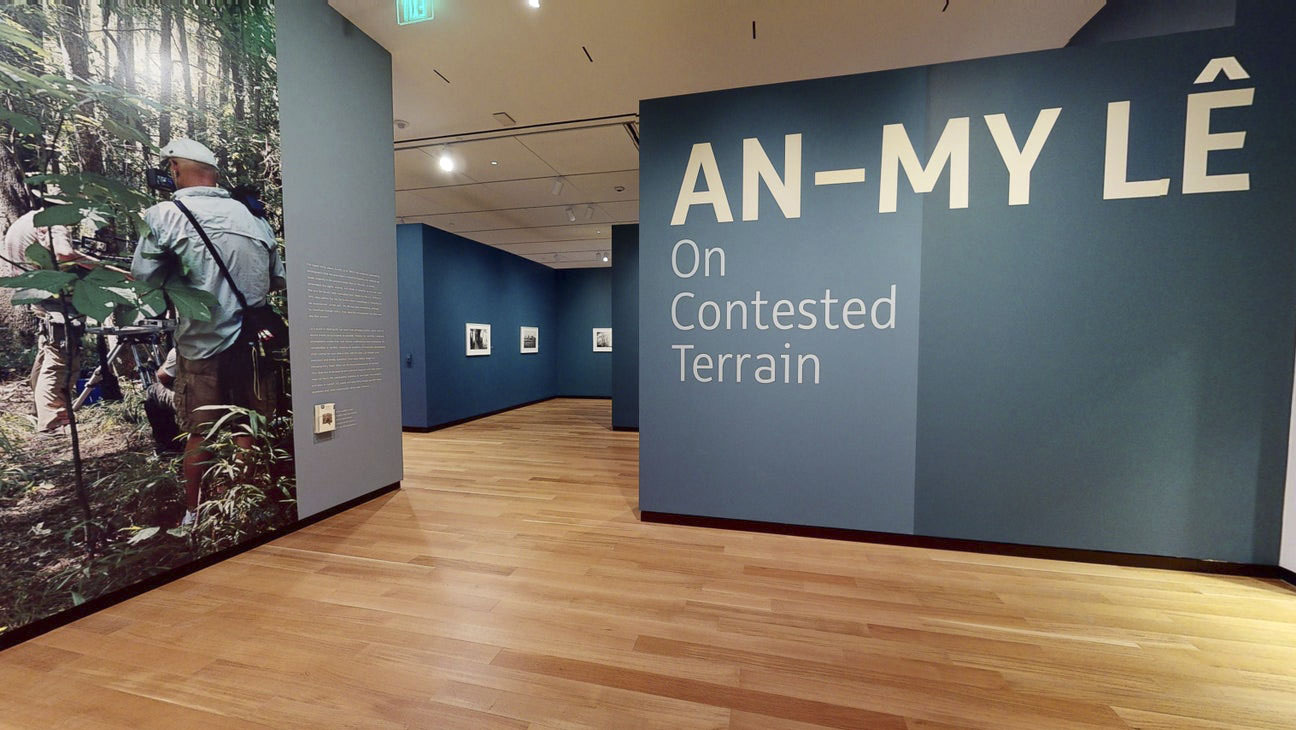
Installation view of the exhibition 'An-My Lê: On Contested Terrain' at the Amon Carter Museum of American Art


Installation view of the exhibition An-My Lê: On Contested Terrain at the Amon Carter Museum of American Art


An-My Lê (Vietnamese-American, b. 1960) 'Untitled, Mekong Delta' 1994


An-My Lê (Vietnamese-American, b. 1960)
Untitled, Mekong Delta
1994
Gelatin silver print
© An-My Lê


Viêt Nam (1994-1998)

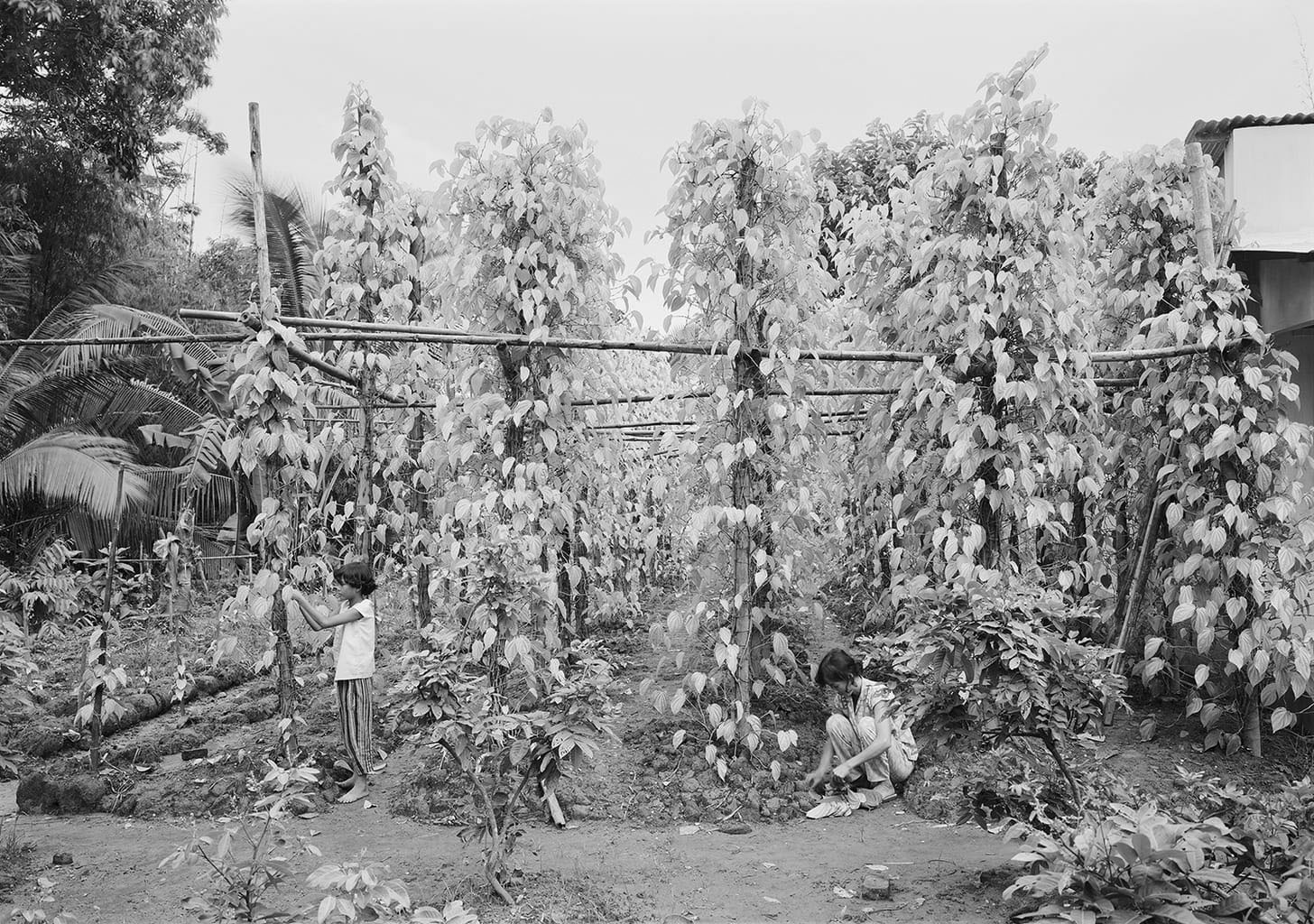
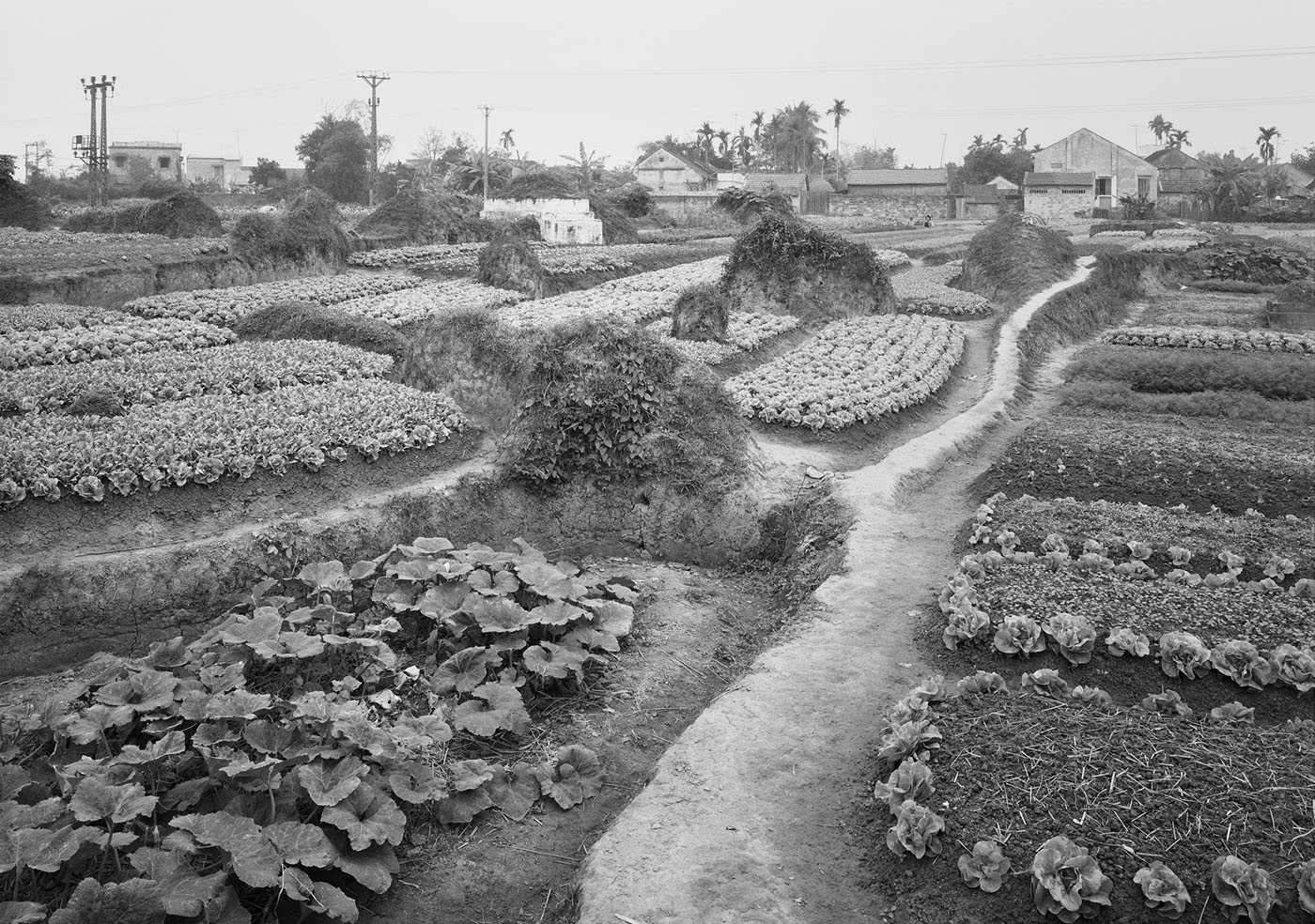
In 1994, Lê returned to her home country for the first time since being evacuated as a teenager in 1975, arriving shortly after relations between the U.S. and Vietnam were normalised. She brought her camera with her, hoping to untangle the reality of her childhood memories from what she had seen over the years in movies and the news. She started the project in her mother’s birthplace, Hanoi, which she had never visited before, and returned to Vietnam three more times, spending about a month there on each trip. Using a large-format camera and shooting from an elevated perspective, Lê portrayed the landscape as a backdrop for human activity – particularly war and conflict – throughout history and into the present. Her series began with images of traditional, rural landscape she recalled from her childhood but eventually evolved into a photographic meditation on the fog of war and its tendency to scramble perceptions. Other images include scenes from urban and modern-day Vietnam unlike anything she had seen represented in the U.S. In this series Lê refined her working methods and began engaging with themes that remain cornerstones of her practice today.

Wall text from the exhibition


An-My Lê (Vietnamese-American, b. 1960) 'Untitled, Mekong Delta' 1994


An-My Lê (Vietnamese-American, b. 1960)
Untitled, Mekong Delta
1994
Gelatin silver print
© An-My Lê


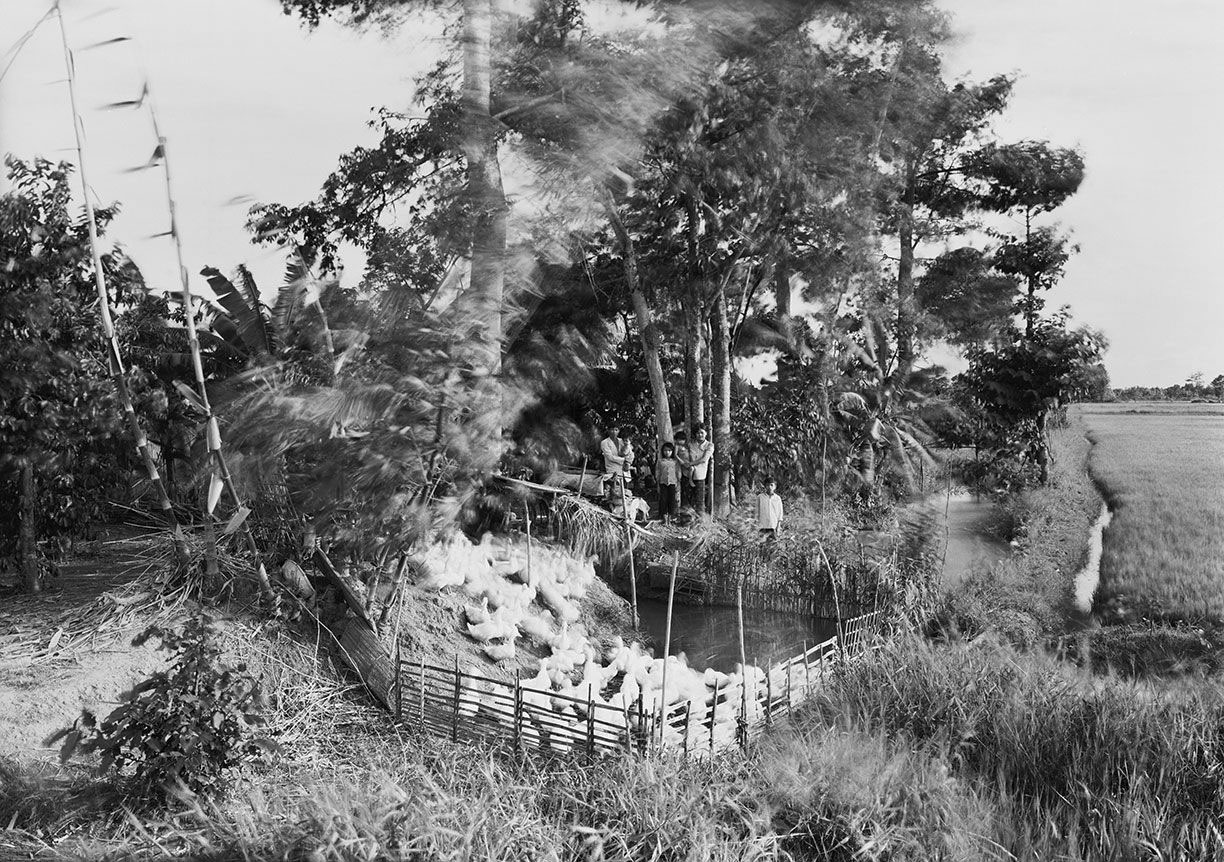
This was the first photograph Lê made in Vietnam after almost twenty years away. It reflects her directorial style: Unlike a photojournalist, who strives to record events without intervening, Lê instructed the members of this farming family to stand still and look at the camera. The movement of their livestock and the surrounding foliage in the wind creates blur – perhaps a nod to the quickening pace of modern life in Vietnam.


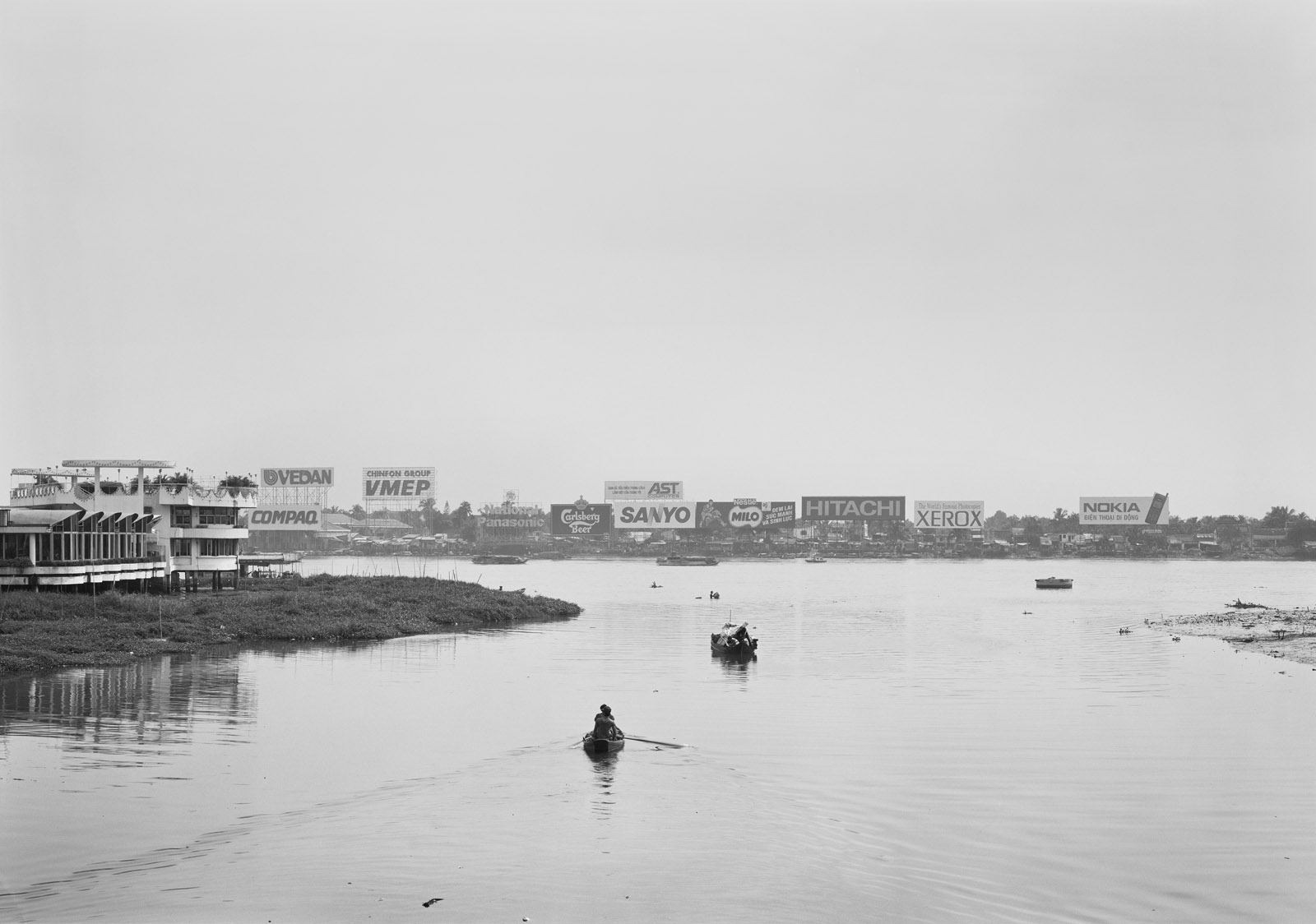
An-My Lê (Vietnamese-American, b. 1960) 'Untitled, Ho Chi Minh City' 1995


An-My Lê (Vietnamese-American, b. 1960)
Untitled, Ho Chi Minh City
1995
Gelatin silver print
© An-My Lê


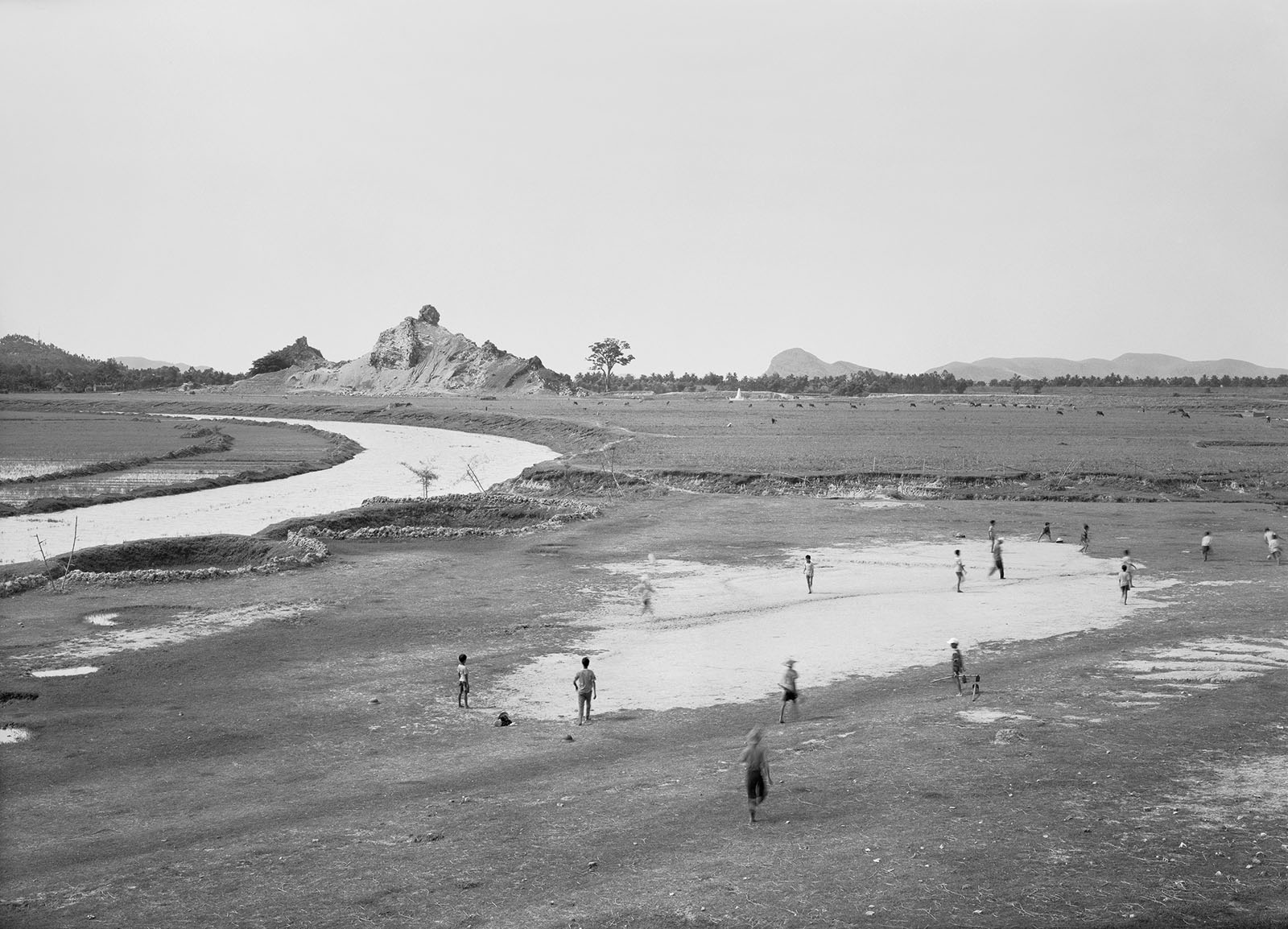
An-My Lê (Vietnamese-American, b. 1960) 'Untitled, Thanh Hoa' 1998


An-My Lê (Vietnamese-American, b. 1960)
Untitled, Thanh Hoa
1998
Gelatin silver print
© An-My Lê


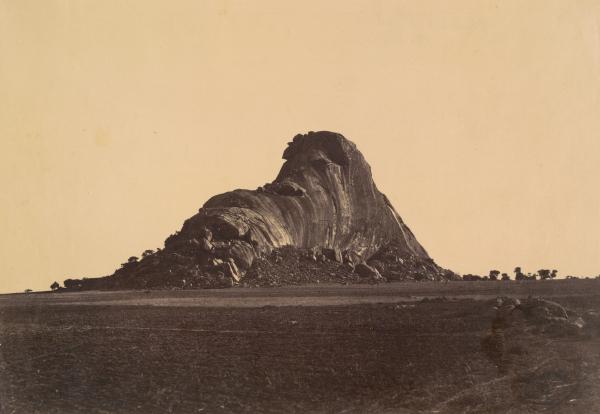
Linnaeus Tripe (British, 1822-1902) 'Between Chittumputty and Teramboor: Elephant Rock, End View, January-February 1858' 1858


Linnaeus Tripe (British, 1822-1902)
Between Chittumputty and Teramboor: Elephant Rock, End View, January-February 1858
1858


Linnaeus Tripe (British, 1822-1902)

Linnaeus Tripe (1822-1902) was a British pioneer of photography, best known for his photographs of India and Burma taken in the 1850s.

Linnaeus Tripe was born in Plymouth Dock (now Devonport), Devon, to Mary (1786-1842) and Cornelius (1785-1860). He was the ninth of twelve children. He joined the East India Company army in 1838, and in 1840, became a lieutenant based in the south of India. He returned to England in 1850, on a leave that was extended due to ill health until 1854. During this time he began to experiment with photography, and joined the Photographic Society of London in 1853. He returned to Bangalore, India, as a captain in June 1854. In December of that year he made his first photographs of India. In February of the following year he took part in the Madras Exhibition of Raw Products, Arts, and Manufactures of Southern India, displaying 68 photographs of previously unphotographed temples. The jury declared these photographs the “Best series of photographic views on paper.”

Text from the Wikipedia website
 

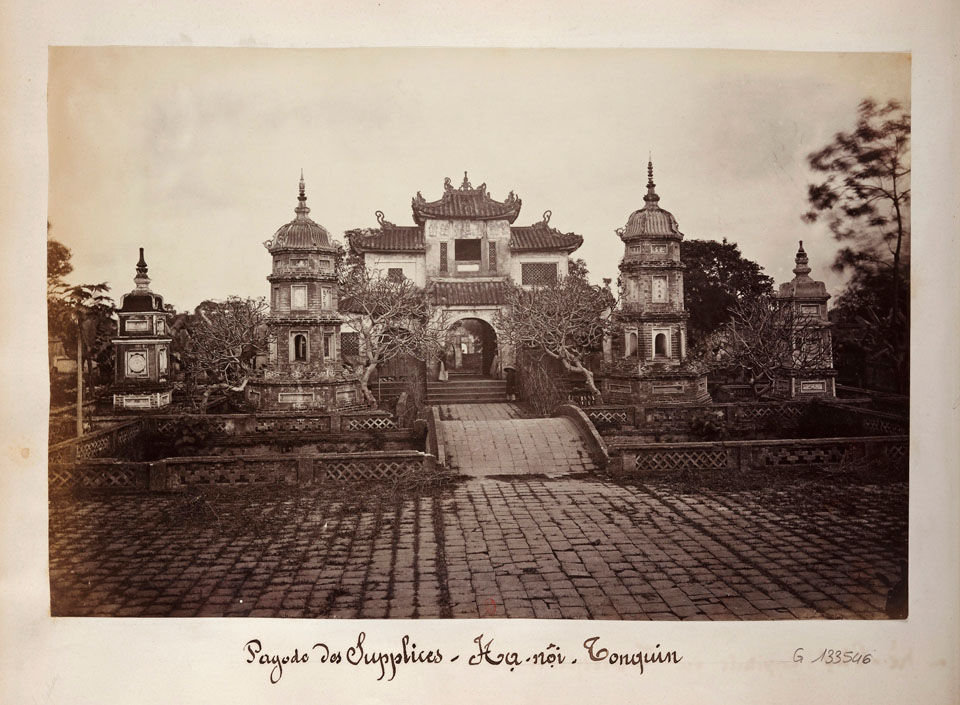
Hippolyte Arnoux (French, (active c. 1860 - c. 1890) and Emile Gsell (French, 1838-1879) 'Pagoda des Supplices, Hanoi' 1880


Hippolyte Arnoux (French, (active c. 1860 – c. 1890) and Emile Gsell (French, 1838-1879)
Pagoda des Supplices, Hanoi
1880
From “The trip from Egypt to Indochina” (Voyage de l’ Egypte à l’ Indochine)


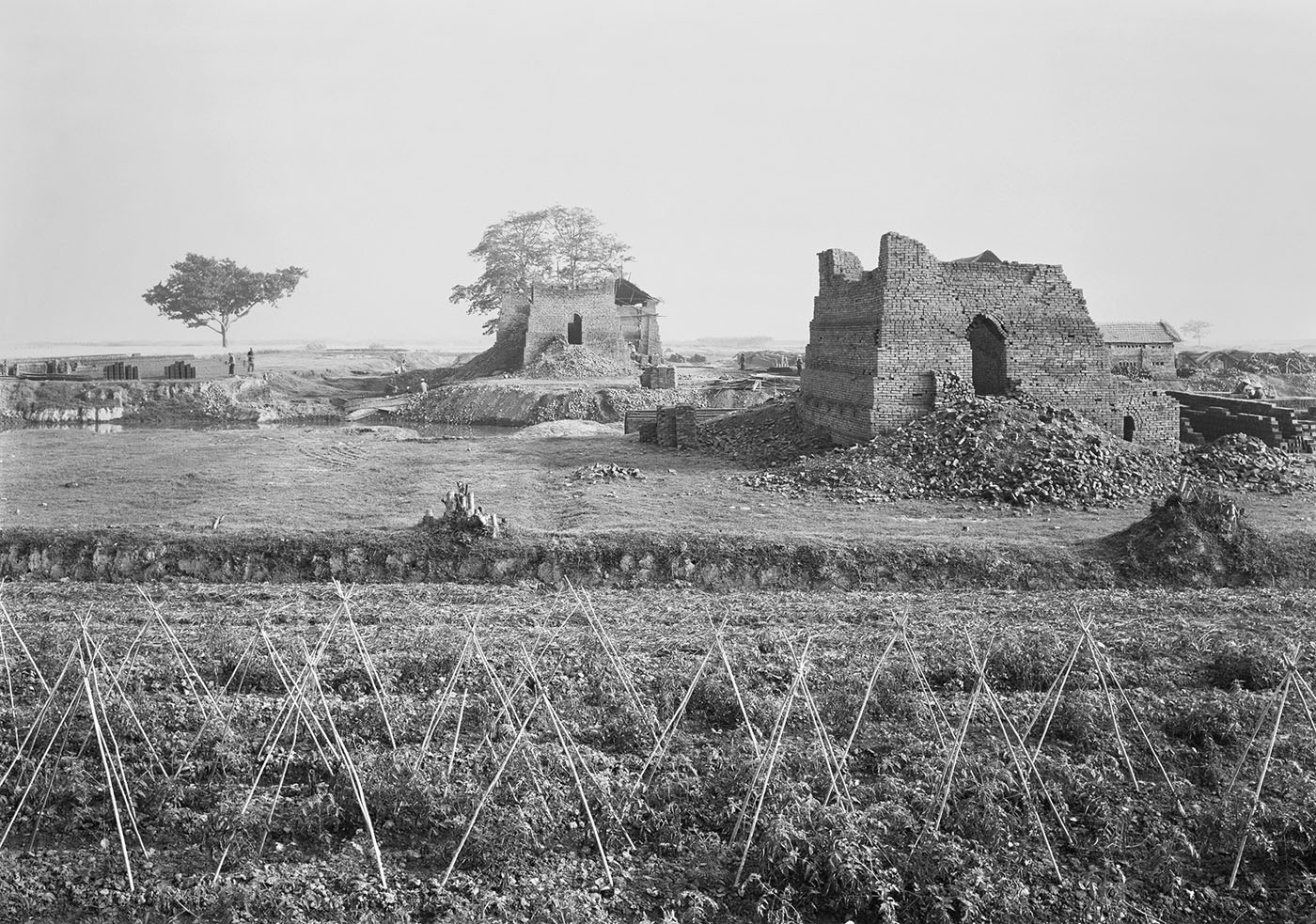
An-My Lê (Vietnamese-American, b. 1960) 'Untitled, But Thap' 1996


An-My Lê (Vietnamese-American, b. 1960)
Untitled, But Thap
1996
Gelatin silver print
© An-My Lê


“In graduate school, I was nudged to draw from my personal experience. This was in 1992, before Bill Clinton lifted the economic embargo against Vietnam, so it was not easy to travel there. Having escaped Vietnam in 1975 without our family albums, I pored through the photography catalogs in the libraries at Yale for references to Vietnam. I was shocked to find devastating images of war, and also patronising ethnographic photographs taken by European photographers during the colonial period, but nothing else. When I was finally able to travel there a few years later, I made a series of black-and-white photographs, mostly landscapes, that were intended to fill in the gaps that existed between the war documentation and the ethnographic archive.”


An-My Lê, 2021. Conversation with Viet Thanh Nguyen, The New York Review of Books


“For me, the landscape has always been the constant in my work. I work with scale as a way to give context to human endeavours, military endeavours, and the history of power. In the end, Vietnam has endured many battles and gone through so many changes. The Chinese invasion, the Japanese occupation, the colonialism of the French, the Indochina War, the Americans – the constancy was always the landscape. And people change, cultures change over time, but there is something about the land. Even as our world modernises, there is a certain consistency, a certain authenticity.”


An-My Lê quoted in Sara Christoph. “An-My Lê with Sara Christoph,” on the Brooklyn Rail website February 2015 [Online] Cited 26/07/2021.
 

“When I first made the pictures in Vietnam, I was not ready to deal with the war. Being able to go back to Vietnam was a way to reconnect with a homeland, or with the idea of what a homeland is and with the idea of going home. When you live in exile, things like smells and memories and stories from childhood all take on such importance. So, this was an opportunity to reconnect with the real thing, and to be confronted with contemporary Vietnam. It’s not the way it was twenty years ago, or the way it’s described in folktales my grandmother and mother used to tell me, or even in stories from my mother’s own childhood in the North. So, I really looked for things that suggested a certain way of life – agrarian life – things that connect you to the land. Unfortunately, pictures don’t smell; but if I could do that, they would be about smells as well.”


An-My Lê quoted in “Vietnam: An-My Lê,” on the Art21 website Nd [Online] Cited 26/07/2021


An-My Lê (Vietnamese-American, b. 1960) 'Untitled, Son Tay' 1998


An-My Lê (Vietnamese-American, b. 1960)
Untitled, Son Tay
1998
Gelatin silver print
© An-My Lê


“People always say that it is so bizarre how these men reenact the Vietnam War, and go to so much trouble to do so! But then, you think about Steven Spielberg or even Kathryn Bigelow, and in a way, their work is a kind of reenactment pushed to the extreme. And no one has any issues with that! Just because it is a movie and there are millions of dollars involved, it is entertainment. And then you look to the military. All the training, practice drills, etc. They use the same language of reenactment. ‘Today, our scenario is…'”


An-My Lê, 2015

Read the poem “A Brief History of Reënactment” by Vietnamese-American poet Hai-Dang Phan that was inspired by Lê’s series ‘Small Wars’.


“I feared for my safety on my first trip to Virginia, because I didn’t know the reenactors or their motivations. They called themselves ‘living historians.’ They grew up collecting badges and they knew everything about war histories, and this was a way for them to live out some of these fantasies. […]

It was so interesting to see the way who played what was economically replicated in real life. The kids who had more money would play the Americans because the American gear was more expensive, and they also tended to be less fit. They were always up on the hill sleeping on air mattresses and eating C-rations. And then us, the North Vietnamese Army or Viet Cong, we were down sleeping on the ground or in hammocks. We were always hiking up and ambushing them.”


An-My Lê, 2019 conversation with Viet Thanh Nguyen in the catalogue for “An-My Lê: On Contested Terrain.”


An-My Lê (Vietnamese-American, b. 1960) 'Viet Cong Camp' 1999-2002


An-My Lê (Vietnamese-American, b. 1960)
Viet Cong Camp
1999-2002
From the series Small Wars (1999-2002)
Gelatin silver print
© An-My Lê


Small Wars (1999-2002)

While researching the Vietnam War for her work, Lê discovered small groups of Vietnam War reenactors based in Virginia and North Carolina who were primarily civilians with little or no military experience. The organisers agreed to let her photograph if she also participated, and over the course of three summers she attended and photographed four or five reenactments, which became her series Small Wars. Even though Lê is from South Vietnam and had little firsthand knowledge of the North, she was often enlisted to play the role of North Vietnamese soldier or Viet Cong rebel. The other reenactors appreciated the “authenticity” she brought to the scenes, in part because it made their own experience feel more realistic. Lê’s participation became a way for her to understand personal histories and associations the reenactors brought with them to their performances, and it helped her better imagine what it might have been like for the North Vietnamese soldiers who fought in the war. Matching the reenactors’ commitment to authenticity, and underscoring her control of the scenes occurring in front of her camera, Lê consulted a military expert to restage certain moments and ensure that every detail, from the uniforms to the equipment, was as historically accurate as possible.


An-My Lê (Vietnamese-American, b. 1960) 'Stars and Stripes' 1999-2002


An-My Lê (Vietnamese-American, b. 1960)
Stars and Stripes
1999-2002
From the series Small Wars (1999-2002)
Gelatin silver print
© An-My Lê


An-My Lê (Vietnamese-American, b. 1960) 'Sniper I' 1999-2002


An-My Lê (Vietnamese-American, b. 1960)
Sniper I
1999-2002
From the series Small Wars (1999-2002)
Gelatin silver print
© An-My Lê


Henri Huet (French, 1927-1971) / AP ''Life' magazine photographer Larry Burrows (far left) struggles through elephant grass and the rotor wash of an American evacuation helicopter as he helps GIs carry a wounded soldier on a stretcher from the jungle to the chopper in Mimot, Cambodia' 4 May 1970


Henri Huet (French, 1927-1971) / AP
‘Life’ magazine photographer Larry Burrows (far left) struggles through elephant grass and the rotor wash of an American evacuation helicopter as he helps GIs carry a wounded soldier on a stretcher from the jungle to the chopper in Mimot, Cambodia
4 May 1970


Life magazine photographer Larry Burrows (far left) struggles through elephant grass and the rotor wash of an American evacuation helicopter as he helps GIs carry a wounded soldier on a stretcher from the jungle to the chopper in Mimot, Cambodia on 4 May 1970. The evacuation came during the US incursion into Cambodia. Burrows was killed on 10 February 1971, along with the photographer who took this picture, Henri Huet, and two other photojournalists – Kent Potter of UPI and Keisaburo Shimamoto of Newsweek – when their helicopter was shot down over Laos.


An-My Lê (Vietnamese-American, b. 1960) 'Ambush I' 1999-2002


An-My Lê (Vietnamese-American, b. 1960)
Ambush I
1999-2002
From the series Small Wars (1999-2002)
Gelatin silver print
© An-My Lê


An-My Lê (Vietnamese-American, b. 1960) 'Rescue' 1999-2002


An-My Lê (Vietnamese-American, b. 1960)
Rescue
1999-2002
From the series Small Wars (1999-2002)
Gelatin silver print
Courtesy of the artist and Marian Goodman Gallery, New York, Paris, and London
© An-My Lê


The Vietnam War reenactors Lê photographed were committed to creating “authentic” scenarios. This meant that every element, from their uniforms to their weapons and even their encampments, was meticulously researched and either purchased from approved sources or carefully fabricated. To further heighten the realism of their scenes, the reenactors gained access to Fort Story, a Joint Expeditionary Base in Virginia Beach that has been used as a training site for amphibious combat exercises since the end of World War II. A Vietnam-era jet that is grounded there became the site of a crash reenactment.
 

An-My Lê (Vietnamese-American, b. 1960) 'Colonel Greenwood' 2003-2004


An-My Lê (Vietnamese-American, b. 1960)
Colonel Greenwood
2003-2004
Gelatin silver print
Collection of the Museum of Contemporary Photography at Columbia College, Chicago, Gift of Lannan Foundation, Santa Fe, NM
Courtesy of the artist and Marian Goodman Gallery, New York, Paris, and London
© An-My Lê


“I came to understand a lot about life in the military through conversations with the marines. At that point, I had never quite understood why someone would join the military. I thought people join because they want to fight, because they want to shoot guns, because they want to combat evil forces. But I realised that some join for economic reasons: just to get a job. Some want to travel. Some see it as a way to get out of difficult circumstances: Some were orphans who grew up in tough foster homes and felt the military gave them an opportunity to escape. So I gradually came to understand the human component, the redemptive aspect of this complicated equation.”


An-My Lê in Andrew Maerkle. “Fires on the Plain,” on the ART-iT website 28/07/2015 [Online] Cited 26/07/2021.


From War Reenactors to the Removal of Confederate Monuments, An-My Lê: On Contested Terrain Spotlights Politically Charged Work that Resonates Today

The Amon Carter Museum of American Art (the Carter) will present the first comprehensive survey of the work of Vietnamese-American photographer An-My Lê (b. 1960), on view April 18 through August 8, 2021. Featuring photographs from a selection of the artist’s five major bodies of work, the nationally touring An-My Lê: On Contested Terrain draws connections across Lê’s career and provides unprecedented insight into her subtle, evocative images that draw on the classical landscape tradition to explore the complexity of American history and conflict.

Celebrated photographer Lê has spent nearly 25 years exploring the edges of war and recording these landscapes of conflict in beautiful, classically composed photographs. Born in Saigon in the midst of the Vietnam War, Lê vividly remembers the sights, sounds, and smells of growing up in a war zone. She and her family were eventually evacuated by the U.S. military in 1975. It would take another 20 years for Lê to return to her homeland, this time with a large-format camera in tow.

“We are proud to bring An-My Lê: On Contested Terrain to our North Texas community,” said Andrew J. Walker, Executive Director. “Lê’s photographs bring history into conversation with the present, confronting head-on, complicated questions that remain relevant today. It feels especially important that we are spotlighting her work during our anniversary year, as it draws on the traditions reflected in our historical photography collection and underlines our 60-year commitment to exhibiting the best American photographers at the Carter.”

Lê follows in the tradition of nineteenth-century photographers like Timothy O’Sullivan and Mathew Brady, whose images of the Civil War brought the realities of combat to everyday Americans. Crafting sweeping views that emphasise the size and breadth of the theatre of war, Lê captures the complexity of conflict and the full scope of military life, avoiding the sensationalism often seen in newspapers and movies. On Contested Terrain highlights the artist’s technical strengths, used to compose beautiful images that draw the viewer into deeper consideration of complex themes of history and power.

The exhibition presents selections from five of Lê’s major series:

Viêt Nam (1994-1998)

Almost 20 years after her family was evacuated, Lê returned to Vietnam with her large-format camera. The resulting series is a meditation on her homeland, addressing both her memories of it and the country’s reality decades later. It depicts the landscape as a backdrop for human history, a theme Lê would return to again and again.

Small Wars (1999-2002)

Back in the United States, Lê photographed Vietnam War reenactors in North Carolina and Virginia, often participating as a North Vietnamese soldier or Viet Cong rebel. Working with the reenactors, many of whom had not fought in the war, to achieve “authenticity” whenever possible, Lê made images that explore the legacy and mythology of the Vietnam War for contemporary Americans.

29 Palms (2003-2004)

Unable to secure credentials to embed on the front lines of the Iraq War, Lê traveled to a California military base to photograph troops training in a landscape similar to the environment in which they would soon be deployed. In addition to the desert training exercises, Lê photographed the debriefings and downtime that filled the soldiers’ days.

Events Ashore (2005-2014)

This series, the artist’s first foray into colour photography, was created over nine years that Lê spent photographing the crews of U.S. naval vessels around the world. An extensive exploration of the global reach of the American military, Events Ashore includes scenes of everyday life on an aircraft carrier alongside diplomatic, humanitarian, military, and political activities.

Silent General (2015-ongoing)

In her current series, Lê grapples with the legacy of America’s Civil War and responds to the complexities of the current socio-political moment. Her poetic photographs of polarised landscapes confront issues of our time that are rooted in our history, from the fate of Confederate monuments to immigration debates around agricultural labourers.


“An-My Lê has spent decades investigating conflicted terrains, both physical and metaphorical” stated Kristen Gaylord, Assistant Curator of Photographs. “Her photographs consider questions that we are all thinking about now: What does it mean to be an American citizen? How does our country’s history shape our contemporary lives? What should be the role of the U.S. in the world? These questions are especially salient for the City of Fort Worth, which includes a major defence contractor, the first Joint Reserve Base in the country, and residents and refugees from around the world, including Vietnam, Somalia, Guatemala, and Afghanistan. The generosity and incisiveness of Lê’s vision are a model for how we can navigate these complexities together.”

An-My Lê: On Contested Terrain is organised by Carnegie Museum of Art, Pittsburgh. Major support for this exhibition is provided by Lannan Foundation and the William Talbott Hillman Foundation. Additional support is generously provided by the Virginia Kaufman Fund, the Henry John Simonds Foundation, the Phillip and Edith Leonian Foundation, the E. Rhodes and Leona B. Carpenter Foundation, Jennifer and Karl Salatka, and the Virginia S. Warner Foundation. Generous support for the exhibition catalogue has been provided by Marian Goodman Gallery. The exhibition debuted at Carnegie Museum of Art in March 2020 and is on view there through January 18, 2021. Following the presentation at the Carter, the exhibition will travel to the Milwaukee Art Museum in fall 2021. An-My Lê: On Contested Terrain is included in the museum’s free admission. The exhibition is accompanied by a fully illustrated catalogue featuring many images never-before-published.

About An-My Lê

An-My Lê was born in Saigon in 1960. She and her family fled Vietnam in 1975, living for a short period of time in Paris, France, before settling in the United States as a political refugee. Lê received her BAS (1981) and MS (1985) degrees in biology from Stanford University and an MFA from Yale University in 1993. While Lê is represented in many major museum collections including the Museum of Modern Art, New York; Metropolitan Museum of Art, New York; Los Angeles County Museum of Art; and the Dallas Museum of Art – An-My Lê: On Contested Terrain is the first survey of her work in an American museum. Currently, a professor of photography at Bard, Lê has received many awards, including the MacArthur Foundation Fellow (2012), the Tiffany Comfort Foundation Fellowship (2010), the National Science Foundation Antarctic Artists and Writers Program Award (2007), and the John Simon Guggenheim Memorial Foundation Fellowship (1997). Her work has been exhibited at museums and galleries across the world, including the Baltimore Museum of Art; Dia Beacon, Beacon, New York; San Francisco Museum of Modern Art; MoMA PS1, New York; and more, and her photography was featured in the 2017 Whitney Biennial.

Press release from the Amon Carter Museum of American Art


An-My Lê (Vietnamese-American, b. 1960) 'Night Operations VII' 2003-2004


An-My Lê (Vietnamese-American, b. 1960)
Night Operations VII
2003-2004
From the series 29 Palms (2003-2004)
Gelatin silver print, 2018
Collection of the Museum of Contemporary Photography at Columbia College Chicago
© An-My Lê


“Twentynine Palms was the first extended period of time I spent in an unpopulated landscape. That was where I first started to think about this idea of the sublime. You see this extraordinary, open land, and you understand how insignificant we are. The most powerful experience I had happened during a night exercise in the middle of the desert. It was completely dark. We were at least a two-hour drive from the camp, and then the whole sky lit up. It was the most extraordinary fireworks I have ever seen – 20 minutes of jets dropping bombs, howitzers firing, and tracers in the air. […] You could feel the tremors in your heart. It was a rush of life power, but at the same time, it was devastating. The kind of destruction that this exercise entails is a destruction that is all our own doing.”


An-My Lê, 2015


29 Palms (2003-2004)

For her series 29 Palms, Lê turned to real soldiers acting out possible scenarios for a war that was still developing. Unable to secure credentials to embed on the front lines of the Iraq War (2003-2011), she instead sought access to the Marine Corps Air Ground Combat Center, also known as Twentynine Palms, outside Joshua Tree National Park in California – a base that was also used by Marines preparing for the Vietnam War decades earlier. Military command had determined that the arid, mountainous landscape was a good approximation to parts of Afghanistan and Iraq, where these soldiers would eventually de deployed. At Twentynine Palms, Lê focused her camera on field exercises, from special ops tactical training to sweeping views of tanks rolling across the desert. Some of the photographs are indistinguishable from images of actual war, while in others the artificiality of the scenario is obvious. She also captured moments that don’t appear in military promotional materials: troops whose attention is drifting during debriefings, huddled together to avoid the hot sun, and smoking and chatting during downtime.

At Twentynine Palms, entire buildings were given over to re-creations of Iraqi towns for security and stabilisation exercises, and cadets were conscripted to role play as Iraqi police. Three images in this gallery show the exercises as well as the facilities, which have been sprayed with anti-USA and pro-Saddam graffiti meant to impart a sense of realism. Simplistic phrases like “Good Saddam” and “Down USA” could never encapsulate an Iraqi’s complicated feelings about the war. Those sentiments, coupled with fake Arabic graffiti, leave a viewer wondering how well the military is preparing these troops who are about to be dropped into a completely foreign country on the other side of the globe.


An-My Lê: “29 Palms” | Art21 “Extended Play” | February 2011

“I just wanted to approach the idea of war in a more complicated and more challenging way” says artist An-My Lê, whose photographic series and film “29 Palms” (2003-2004) explore the training exercises and desert landscape near Joshua Tree National Park as a staging ground for the conflicts in Iraq and Afghanistan.

An-My Lê’s photographs and films examine the impact, consequences, and representation of war, framing a tension between the natural landscape and its violent transformation into battlefields. Suspended between the formal traditions of documentary and staged photography, Lê’s work explores the disjunction between wars as historical events and the ubiquitous representation of war in contemporary entertainment, politics, and collective consciousness.


An-My Lê (Vietnamese-American, b. 1960) 'Security and Stabilization Operations, Iraqi Police' 2003-2004


An-My Lê (Vietnamese-American, b. 1960)
Security and Stabilization Operations, Iraqi Police
2003-2004
From the series 29 Palms (2003-2004)
Gelatin silver print, 2018
Collection of the Museum of Contemporary Photography at Columbia College Chicago, Museum Purchase
© An-My Lê


An-My Lê (Vietnamese-American, b. 1960) 'Security and Stabilization Operations, Graffiti' 2003-2004


An-My Lê (Vietnamese-American, b. 1960)
Security and Stabilization Operations, Graffiti
2003-2004
From the series 29 Palms (2003-2004)
Gelatin silver print
© An-My Lê


MSGT Howard J. Farrell, US Marine Corps. 'T-54s, T-55s, Type 59s or Type 69s at Diwaniyah, Iraq' 16 April 2003


MSGT Howard J. Farrell, US Marine Corps
T-54s, T-55s, Type 59s or Type 69s at Diwaniyah, Iraq
16 April 2003
Public domain


The destroyed remains of Iraqi T-55 Main Battle Tanks (MBT) litter an Iraqi military complex West of Diwaniyah, near Al Qadisiyah, Iraq during Operation Iraqi Freedom. Visible on the picture are also two ARVs (the upper one is a Chinese-made Type 653 while the lower one is a Polish-made WZT-2). The tank in the bottom of the picture is a Type 69 as evidenced by the fender-mounted headlights.


An-My Lê (Vietnamese-American, b. 1960) 'Mechanized Assault' 2003-2004


An-My Lê (Vietnamese-American, b. 1960)
Mechanized Assault
2003-2004
Gelatin silver print
© An-My Lê


“The kind of work that I make is not the standard political work. It’s not agitprop. You would think, because I’ve seen so much devastation and lived through a war, that I should make something that’s outwardly antiwar. But I am not categorically against war. I was more interested in drawing people into my work, to think about the issues that envelop war – representations of war, landscape and terrain in war. When I’m working with the military, I still think of myself as a landscape photographer. My main goal is to try to photograph landscape in such a way that it suggests a universal history, a personal history, a history of culture.”


An-My Lê quoted in “War and Aesthetics: An-My Lê,” on the Art21 website Nd [Online] Cited 26/07/2021
 

“I love the way things are drawn in black and white but it was evident to me Events Ashore needed to be in color. It was at first a technical issue. I found the [black-and-white] palette restrictive. I was frustrated not being able to distinguish colder from warmer gray. [Black and white] is about a removal of the information provided by color, which is interesting in itself. Only the essential is retained, and this forces the imagination to go into overdrive to compensate. As I was exploring this huge global enterprise that is the U.S. Navy, I wanted to describe my experience in details and overwhelm the viewer with information. Bringing color back was crucial.”


An-My Lê quoted in Jon Feinstein. “An-My Lê: The Landscape of Conflict,” on the Daylight website 10th February 2017 [Online] Cited 26/07/2021


Events Ashore (2005-2014)

Lê’s time at Twentynine Palms let to friendships with military personnel that facilitated her next series, titled Events Ashore. She was invited to join a Marine Expeditionary Unit on an aircraft carrier and over the next nine years spent weeks at a time visiting twenty different countries aboard U.S. naval vessels travelling the world, from Antartica to Greenland. Events Ashore was Lê’s first foray into colour photography, made in part because her standard black-and-white film could not capture the subtle differences in the tonalities of ships, sky and water that filled the views from aircraft carriers, amphibious assault ships, and nuclear-powered submarines.

In this series intimate scenes of life aboard an aircraft carrier are interspersed with coverage of less-known military outreach efforts, like tutoring individuals for an English proficiency exam, and landmark geopolitical moments including the first U.S. naval exchange with Vietnam since the Vietnam War (1955-1975). Lê attempts to fathom the full scope fo the navy’s activities around the world. The result is an extensive exploration of the environmental, financial, human, and political costs of military intervention.


“I [am] interested in many aspects of the military endeavour, from humanitarian missions in Africa and Asia and strategic trainings and engagements in the North Arabian Gulf and Indian Ocean to scientific missions in the Arctic and Antarctic. This work is as much about my perspective and personal history as a political refugee from Vietnam as it is about the vast geopolitical forces and conflicts that shape these landscapes. It is also about how the U.S. military is seen around the world, and how it represents our country. A polarising subject in popular imagination, the U.S. military has inspired fear, patriotism, debate, and suspicion. My goal has been to give a visual analog to that complex topic, to address issues of power and fragility. […] My intention is to stir up thought but not dictate a message. It is not a call to action so much as a call for perspective.”


An-My Lê, 2014 from the exhibition catalogue


An-My Lê (Vietnamese-American, b. 1960) 'Earthquake Relief, Marine Corps Weapons Company Beach Landing Site, Haiti' 2010


An-My Lê (Vietnamese-American, b. 1960)
Earthquake Relief, Marine Corps Weapons Company Beach Landing Site, Haiti
2010
From the series Events Ashore
Inkjet print
© An-My Lê


An-My Lê (Vietnamese-American, b. 1960) 'Portrait Studio, USS Ronald Reagan, North Arabian Gulf' 2009


An-My Lê (Vietnamese-American, b. 1960)
Portrait Studio, USS Ronald Reagan, North Arabian Gulf
2009
From the series Events Ashore
Inkjet print
© An-My Lê


An-My Lê (Vietnamese-American, b. 1960) 'US Naval Hospital Ship Mercy, Vietnam' 2009


An-My Lê (Vietnamese-American, b. 1960)
US Naval Hospital Ship Mercy, Vietnam
2009
From the series Events Ashore
Inkjet print
© An-My Lê


Lê has said that her ultimate subject in Events Ashore was scale, and the ocean is one of the only environments vast enough to dwarf the massive ships of the U.S. Navy. USNS Mercy is the lead ship of a class of hospital ships that are the third largest ship class in the navy, although in this image it seems small. Hospital ships carry only defensive weapons, and it is a war crime to attack them. Last spring, Mercy was sent to Los Angeles to provide relief to local hospitals dealing with COVID-19 cases. A train engineer deliberately ran a train off the tracks in an attempt to crash into it, saying he was suspicious of Mercy and did not believe “the ship is what they say it’s for.”

Wall text from the exhibition


An-My Lê (Vietnamese-American, b. 1960) 'Manning the rail, the U.S.S. Tortuga, Java Sea' 2010


An-My Lê (Vietnamese-American, b. 1960)
Manning the rail, the U.S.S. Tortuga, Java Sea
2010
From the series Events Ashore
Inkjet print
Courtesy of the artist and Marian Goodman Gallery, New York, Paris, and London
© An-My Lê


An-My Lê (Vietnamese-American, b. 1960) 'Fresh Water Wash-Down of Super Structure, USS Ronald Reagan, North Arabian Gulf' 2009


An-My Lê (Vietnamese-American, b. 1960)
Fresh Water Wash-Down of Super Structure, USS Ronald Reagan, North Arabian Gulf
2009
From the series Events Ashore
Inkjet print
© An-My Lê


An-My Lê (Vietnamese-American, b. 1960) 'Damage Control Training, USS Nashville, Dakar, Senegal' 2009


An-My Lê (Vietnamese-American, b. 1960)
Damage Control Training, USS Nashville, Dakar, Senegal
2009
From the series Events Ashore
Inkjet print
© An-My Lê


An-My Lê (Vietnamese-American, b. 1960) 'Ship Divers, USS New Hampshire, Arctic Seas' 2011


An-My Lê (Vietnamese-American, b. 1960)
Ship Divers, USS New Hampshire, Arctic Seas
2011
Inkjet print
Courtesy of the artist and Marian Goodman Gallery, New York, Paris, and London
© An-My Lê


“[Walt] Whitman epitomises the acknowledgment that art offers the most inclusive and accurate method for addressing an experience. Whitman’s work resisted easy categorisation – it was neither journalism nor poetry. It allowed him to explore his curiosity about himself and the world in a way that always inspired complex responses. In a way, a photographer’s independence is what defines their identity as an artist. If your work doesn’t serve a story, document an event, or promote a product, then it must be art. But, in another sense, a photography artist is usually excited by the risk of their work not being considered art at all. When you decide to look at a polarising subject that plenty of non-artists are also working with – like a newsworthy event – then you are begging a question: ‘Are you doing anything better as an artist? Might you be doing something worse?'”


An-My Lê quoted in Tom Seymour. “An-My Lê: Landscape is not a narrow category – it is a source of surprise,” on The Art Newspaper website 13th August 2020 [Online] Cited 26/07/2021


Silent General (2015-ongoing)

Lê’s current project examines the contemporary state of affairs in the united States through the lens of history. It takes its title from Walt Whitman’s tribute to Ulysses S. Grant in Specimen Days (1882), an autobiographical account of Whitman’s time tending to wounded Union and Confederate soldiers during the Civil War (1861-65), another fractured moment in the countries history. Her arrangement of these photographs in groups, or what she calls “fragments,” is an homage to the literary structure of Specimen Days and a poetic way of sequencing the pictures.

Lê made her first photographs for the series in 2015, when the news was dominated by Donald Trump’s candidacy for president and public controversy over monuments commemorating the Confederacy. Since then, Lê has photographed politically polarised landscapes from Louisiana to New York, California to Texas, and down into Mexico. The images in Silent General address much-debated issues including citizenship, immigration, labour rights, land access, and racism, and often trace them back to their historical roots.

Wall text from the exhibition


Confederate Memorials in Texas


Confederate Memorials in Texas

The photographs in this gallery address significant and contested issues facing our country, including the presence of Confederate monuments and markers throughout the United States.

Should these memorials remain, or should they be removed? While some believe that removing them erases history, others think that they were created to assert dominance over Black people.

There are over 150 Confederate memorials in Texas, most of which were created in two eras: first, the 1900 to the mid-1930s, as Jim Crow laws were passed and the Ku Klux Klan resurged; and second, the 1950s and 1960s, during the civil rights movement and coinciding with the centennial of the Civil War.

What, if anything, surprises you about Confederate monuments and markers in Texas?

Information on this map was gathered from the Southern Poverty Law Center, the Texas Historical Commission, “The Texas Tribune,” and various private databases.

Wall text from the exhibition


An-My Lê (Vietnamese-American, b. 1960) 'Fragment I: General P. G. T. Beauregard Monument, New Orleans' 2016


An-My Lê (Vietnamese-American, b. 1960)
Fragment I: General P. G. T. Beauregard Monument, New Orleans
2016
Inkjet print
© An-My Lê


Pierre Gustave Toutant-Beauregard was a well-known Confederate general who conveyed racist views about Black people before, during, and immediately after the Civil War. But he was adamantly against the federalist Reconstruction policies of the postwar period and became part of a group that advocated for Black suffrage and equal rights as a way of uniting Southern interests against them. A statue of him as a Confederate general was unveiled at the main entrance of New Orleans’ City Park in 1915. One hundred years later, it was one of four memorials related to the Confederacy that the New Orleans City Council voted to remove, although the removal took over a year and a half.


An-My Lê (Vietnamese-American, b. 1960) 'Fragment VI: General Robert E. Lee and P.G.T. Beauregard Monuments, Homeland Security Storage, New Orleans' 2017


An-My Lê (Vietnamese-American, b. 1960)
Fragment VI: General Robert E. Lee and P.G.T. Beauregard Monuments, Homeland Security Storage, New Orleans
2017
Inkjet print
© An-My Lê


“We should start with the paradoxical ideas about photography and truth, journalism, and the issue that a photograph is an evidence of something. In film for example, if you talk about documentary films, or feature films, or fictional films, there is never any issue with which is which, but somehow for photography when people see a photograph, they think it is showing the truth. But we know that all photographs are fictional. This creates a kind of dichotomy, but I think artists such as myself like to take advantage of this misunderstanding. I do straddle that, but my pictures are not photojournalism. They do not attest to anything except perhaps of my interest in the world, and what I bring in terms of my baggage and personal biography to it.”


An-My Lê quoted in Cleo Roberts. “Complicated Truths: Interview with An-My Lê,” on the ArtAsiaPacific website Feb 24, 2020 [Online] Cited 26/07/2021


An-My Lê (Vietnamese-American, b. 1960) 'Fragment VII: Film Set (Free State of Jones), Firing Lesson, Chicot State Park, Louisiana' 2016


An-My Lê (Vietnamese-American, b. 1960)
Fragment VII: Film Set (Free State of Jones), Firing Lesson, Chicot State Park, Louisiana
2016
Inkjet print
© An-My Lê


“Protest is a commitment to clarity, urgency, and spontaneity. The slogans and chants only work if they can be shared and invested with belief. I used to shy away from explicit language, political or otherwise, as a subject for my work because I feared I would neither document nor reveal anything that wasn’t already there or already stated. Recently I’ve come to the conclusion that the language of protest and resistance is not complete without a response… It invites and demands a response. So, with these photographs, I’ve tried to present protest and public address as intimate and integral gestures, within time and place, that hopefully push back at the more predictable images and commentaries we expect.”


An-My Lê quoted in Fi Churchman. “‘We Will Dance Again’: Photographer An-My Lê on Reconnecting with New York in Lockdown,” on the ArtReview website 23 September 2020 [Online] Cited 26/07/2021


An-My Lê (Vietnamese-American, b. 1960) 'Fragment VII: High School Students Protesting Gun Violence, Washington Square Park, New York' 2018


An-My Lê (Vietnamese-American, b. 1960)
Fragment VII: High School Students Protesting Gun Violence, Washington Square Park, New York
2018
Inkjet print
© An-My Lê


An-My Lê (Vietnamese-American, b. 1960) 'November 5, Sugar Cane Field, Houma, Louisiana' 2016


An-My Lê (Vietnamese-American, b. 1960)
November 5, Sugar Cane Field, Houma, Louisiana
2016
Inkjet print
© An-My Lê


An-My Lê (Vietnamese-American, b. 1960) 'November 10, Workers, Venice, Louisiana' 2016


An-My Lê (Vietnamese-American, b. 1960)
November 10, Workers, Venice, Louisiana
2016
Inkjet print
© An-My Lê


Monsen Photography Lecture: An-My Lê | March 2021

The annual Monsen Photography Lecture brings key makers and thinkers in photographic practice to the Henry Art Gallery. Named after Drs. Elaine & Joseph Monsen, the series is designed to further knowledge about and appreciation for the art of photography.

The Henry welcomed An-My Lê as the 2018 Monsen Photography Lecture speaker. Lê is renowned for creating images that raise questions about the representations and effects of war, and for leveraging photographic techniques to challenge understandings of what is fictional or historical. Her work “Small Wars (Ambush I)”, (1999-2002) was included in the Henry’s exhibition, “The Time. The Place: Contemporary Art from the Collection.”


Amon Carter Museum of American Art
3501 Camp Bowie Boulevard
Fort Worth, TX 76107-2695

Opening hours:
Tuesday, Wednesday, Friday, Saturday:
 10am – 5pm
Thursday: 10am – 8pm
Sunday: 12am – 5pm
Closed Mondays and major holidays

Amon Carter Museum of American Art website
LIKE ART BLART ON FACEBOOK

Back to top

Photo album: ‘John “Jack” Riverstone Faviell (1892-1960), 1922-1933’ Part 1
July 2021

Warning: Aboriginal and Torres Strait Islander readers should be aware that this posting contains images and names of people who may have since passed away.


John "Jack" Riverstone Faviell (1892-1960), 1922-1933 photo album front cover


John “Jack” Riverstone Faviell 1922-1933 photo album front cover


Discovered in an op shop (charity shop in America), this is the most historically important and exciting Australian photo album that I have ever found.

Belonging to John “Jack” Riverston Faviell, a senior New South Wales public accountant and featuring his photographs, the album ranges across the spectrum of Australian life and culture from the East to the West of the continent in the years 1922-1933. A list of locations and topics can be seen below.

I undertake a fuller analysis of the album in Part 2 of the posting in an essay titled Golden splendour: privilege, ceremony and racism in 1920s-1930s Australia (2023), the second part of the posting containing previously unpublished photographs of the opening of the Sydney Harbour Bridge.

In this posting there are some important photographs of “Aboriginal Types, along the Trans-Australian Railway” and “Australian Desert Blacks.” The Indigenous Australians had come to trade boomerangs and spears in return for money and clothing. According to the excellent book Bitter Fruit: Australian photographs to 1963 by Michael Graham-Stewart and Francis McWhannell, after the completion of the continental railway in 1917,

“The Railway provided a source of income for Aboriginal people, much to the ire of the Chief Protector  of Aborigines in Western Australia, A. O. Neville, to whom the slightest hint of autonomy was anathema. There was some begging (Neville was convinced that children were being ‘bred’ for the purpose), but also a system of charging for photographs. Boomerang and spear demonstrations were given, and artefacts were souvenired.

The most important stop on the line was Ooldea. This was situated six kilometres south of Ooldea Soak, one of the few places in the region with permanent water. The site had long been of great ceremonial and social significance for Aboriginal people, a fact attested by the profusion of stone artefacts in the area… It was a junction of migratory routes, a centre for exchange, and a refuge in times of drought.”1


As Episode 1 of the series ‘Australia in Colour’ states of similar home movie images, “these photographs offer an unfiltered glimpse into a world seldom seen.”2

Other fascinating images in this posting include the grave of bushranger John Dunn; the Macquarie Watchtower in La Perouse; the goldfields and mines of Kalgoorlie and “Boulder City” in Western Australia; the oldest inhabitant of Geraldton, W.A.; Fremantle prison; and pearling in Shark’s Bay, W.A. including two photographs – one of the dilapidated “White’s Cemetery” with single cross and bones and the other a “Grave in the Niggers Cemetery” with nothing but a mound of earth and some dead branches. Other photographs offer casual racism as a matter of course in their titles.

Dr Marcus Bunyan

PS. This album is now in the State Library of New South Wales collection, given its importance in documenting through photographs regional NSW, Indigenous Australians and the opening of the Sydney Harbour Bridge. See Part 2 of the posting for these previously unseen images of the opening of the bridge.


Footnotes

1/ Michael Graham-Stewart and Francis McWhannell. Bitter Fruit: Australian photographs to 1963. Michael Graham-Stewart, 2017, p. 66.

2/ Episode 1 Season 1: “Outpost Of Empire”: This episode charts the story of the nation from 1897 to 1929 as agriculture transforms the land. ‘Australia in Colour’ is the history of Australia told via a unique collection of cinematic moments brought to life for the first time in stunning colour. It tells the story of how Australia came to be the nation it is today. Narrated by Hugo Weaving, it’s a reflection on our nation’s character, its attitudes, its politics, and its struggle to value its Indigenous and multicultural past. ‘Australia in Colour’ gives us a chance to relive history from a fresh perspective.


Grateful thankx to Douglas Stewart Fine Books for their research help with this photo album. Please click on the photographs for a larger version of the image.


“Biscuits and cake and fruit were thrown to them from the train windows, while their boomerangs and native weapons, and their importance in the landscape as subjects for photography, brought many a shilling and sixpence for them to spend.”


Daisy Bates, The Passing of the Aborigines quoted in Bitter Fruit: Australian photographs to 1963.1


“John “Jack” Riverston Faviell, was a senior NSW public accountant. Originally from Colinroobie, near Narrandera in NSW, he married Melanie Audrey Pickburn (daughter of Judge Pickburn) in a society wedding at St James’ Church, Sydney, in February 1925. He built no. 20 Yarranabbe Rd, Darling Point as their first married home but he divorced Audrey in October 1930. He would later remarry in 1934, as would Audrey.”


Jon Dickson. Douglas Stewart Fine Books


Locations

Blue Mountains, NSW (1922)
Leura Falls, NSW (1922)
Weeping Rock, Wentworth Falls, NSW (1922)
Tarana Picnic Races, NSW (1922)
Doona, Breeza, NSW (1922)
Avoca, NSW (1922)
Newcastle Races, NSW (1923)
Belmont / Belmont Regatta, NSW (1923)
Hawkesbury, NSW (1923)
Frenches Forest, NSW (1923)
“Foxlow” Station, Bungedore, NSW (1923)
Sydney, NSW (Customs House, National Art Gallery, Mitchell Library, Darlinghurst Courthouse) (1923)
Muswellbrook Picnic Races, NSW (1923)
Maitland / Maitland Cup Meeting, NSW (1923)
Breeza, NSW (1923)
Wiseman’s Ferry, NSW (1923)
Moss Vale / Sutton Forest Church, NSW (1923)
Frensham, NSW (1923)
La Perouse, NSW (Historical Society Excursion) (1923)
Old Customs Watch Tower, La Perouse (1923)
The Old Illawarra Road, NSW (1923)
Yarcowie, SA (1923)
Trans-Australian Railway (Port Augusta to Kalgoorlie) (1923)
Karonie, WA (1923)
Kalgoorlie, WA (1923)
Boulder City, WA (1923)
Fremantle, WA (1923)
Geraldton, WA (1923)
Shark’s Bay, WA (1923)
Henry Freycinet Estuary, WA (1923)
Tamala Station, WA (1923)
Perth, WA (1923)
Adelaide, SA (Torrens River) (1923)
“Redbank,” Scone, NSW (1924)
Muswellbrook Picnic Races, NSW (1924)
“Craigieburn,” Bowral, NSW (1924)
The Dudley Cup at Kensington, NSW (1924)
Camden Grammar School, NSW (1924)
Liverpool Church, NSW (1924)
Landsdowne Bridge, NSW (1924)
Jenolan Caves, NSW (1924)
Avon Dam, NSW (1924)Herald Office, Pitt Street, NSW (1924)
Camping, Cronulla, NSW (1925)
Roseville, NSW (1926)
Whale Beach, NSW (1927)
Visit of the Duke and Duchess of York, Macquarie Street, NSW (1927)
20, Yarranabbe Rd., Darling Point, NSW (1926)
Canberra, ACT (1927)
Jenolan Caves, NSW (Lady Dorothy Hope-Morley) (1927)
Ellen’s Isle, Loch Katrine, Scotland (1925)
Sydney Harbour Bridge, NSW (1931-32)
“Springfield,” Byng, Near Orange, NSW (1932)
Lucknow, near Orange, NSW (1933)
Hawkesbury, NSW (1933)
Bathurst, NSW (1933)
“Millambri, ” Canowindra, NSW (1933)
Melbourne, VIC (1933)


Topics

Men
Pastoralism and grazing
Horses / country horse racing
Sheep and shearing
Cows
Mill / logging
Pine plantation
Bush
Bores and dams
Cathedral / churches
Tennis
Golf
Cars (Ford, Pan-American, Essex, Oldsmobile, early Hupmobile, Chrysler 70)
Buses
Bank, post office
Pastoral Play
Monuments
Rock carvings
Houses
Cemetery / tombstones
John Dunn, executed 1866
South Australian Railways / locomotives
S.A. constable and Adelaide cop
Indigenous Australians (Aboriginal types, along the Trans-Australian Railway)
Australian Desert Blacks
Gold mine / gold panning
Mining (Boulder and Perseverance Mines)
Convict gaol
Oldest inhabitant (Henry Desmond)
Hotels
Beach and sea, surf girls
Mother of pearl
Dates
Afghan / camels
Yachting, sailing / boats
Guano
Fred Adams, Boss-Pearler
Stations and station hands
Rowing
Dredging
Polo
Rugby
Caves
Guns
Nobility and royalty
Camping, picnics
Tennis
House building / old houses
Parliament House
Prime Ministers residence
Bridges and bridge building
Federal and state governors
The world’s first auto-gyro plane (1909-1912)
The Southern Cross
Pioneers
Mounted police
First house in Byng
Rabbiting
Glamour
Social status / socialite
Family
Women and children
Sydney Harbour Bridge opening
Carillon (bells)
Myers and Bourke Street, Melbourne


"Blue Mountains, N.S.W," January 1922 in John "Jack" Riverstone Faviell 1922-1933 photo album


“Blue Mountains, N.S.W,” January, 1922 in John “Jack” Riverstone Faviell 1922-1933 photo album


"Blue Mountains, N.S.W," January 1922 in John "Jack" Riverstone Faviell 1922-1933 photo album


“Blue Mountains, N.S.W,” January, 1922 in John “Jack” Riverstone Faviell 1922-1933 photo album


"Blue Mountains, N.S.W," January 1922 in John "Jack" Riverstone Faviell 1922-1933 photo album


“Blue Mountains, N.S.W,” January, 1922 in John “Jack” Riverstone Faviell 1922-1933 photo album


Blue Mountains

The Blue Mountains are a mountainous region and a mountain range located in New South Wales, Australia. The region borders on Sydney’s metropolitan area, its foothills starting about 50 kilometres (31 mi) west of centre of the state capital, close to the major suburb of Penrith. The public’s understanding of the extent of the Blue Mountains is varied, as it forms only part of an extensive mountainous area associated with the Great Dividing Range. Officially the Blue Mountains region is bounded by the Nepean and Hawkesbury rivers in the east, the Coxs River and Lake Burragorang to the west and south, and the Wolgan and Colo rivers to the north. Geologically, it is situated in the central parts of the Sydney Basin. …

The Blue Mountains have been inhabited for millennia by the Gundungurra people, now represented by the Gundungurra Tribal Council Aboriginal Corporation based in Katoomba, and, in the lower Blue Mountains, by the Darug people, now represented by the Darug Tribal Aboriginal Corporation…

Examples of Aboriginal habitation can be found in many places. In the Red Hands Cave, a rock shelter near Glenbrook, the walls contain hand stencils from adults and children. On the southern side of Queen Elizabeth Drive, at Wentworth Falls, a rocky knoll has a large number of grinding grooves created by rubbing stone implements on the rock to shape and sharpen them. There are also carved images of animal tracks and an occupation cave. The site is known as Kings Tableland Aboriginal Site and dates back 22,000 years.

Text from the Wikipedia website

You’ll find the locality of Kanimbla Valley in New South Wales about 90km west-northwest of Sydney. At about 677m above sea level, Kanimbla Valley is one of the higher localities in New South Wales.


"Tarana Picnic Races," January 1922 in John "Jack" Riverstone Faviell 1922-1933 photo album


“Tarana Picnic Races,” January, 1922 in John “Jack” Riverstone Faviell 1922-1933 photo album


Tarana

Tarana is a small town in the Central West of New South Wales, Australia in the City of Lithgow.


"Doona, Breeza," October 1922 in John "Jack" Riverstone Faviell 1922-1933 photo album


“Doona, Breeza,” October, 1922 in John “Jack” Riverstone Faviell 1922-1933 photo album


J. Pickering – John Pickering, grazier of Breeza, Upper Hunter Valley, killed by a log he was loading onto a wagon in February 1924.
B.B. Capper – Capper family of Rossmer Homestead at Breeza, Upper Hunter Valley.
Doona Station and Breeza Station owned by the Clift family.

Information from Douglas Stewart Fine Books


"Doona, Breeza," October 1922 in John "Jack" Riverstone Faviell 1922-1933 photo album


“Doona, Breeza,” October, 1922 in John “Jack” Riverstone Faviell 1922-1933 photo album


Breeza

Breeza is a small village located about 45 kilometres south east of Gunnedah on the Kamilaroi Highway. The aboriginal name for Breeza means “one hill”.

The village overlooks the rich fertile Liverpool Plains and this diverse farming area produces many and varied crops throughout the year. When in season, the fields of sunflowers, sorghum, canola, wheat and cotton provide a picturesque vista across the sweeping plains.

Breeza was settled in 1848 by Andrew Lang. Old folk say that Bushranger Ben Hall was born at Breeza, he was in fact born near Maitland, but his father, Ben Hall Snr worked on Breeza Station at one time. A mural ‘Ben Hall’s Wall’ stands in the heart of Breeza to commemorate Ben Hall’s final years set against “those wild colonial days” of yesteryear.

Text from the australias.guide website [Online] Cited 18/10/2019


"Avoca," Xmas, 1922 in John "Jack" Riverstone Faviell 1922-1933 photo album


“Avoca,” Xmas, 1922 in John “Jack” Riverstone Faviell 1922-1933 photo album


Avoca Beach

Avoca Beach is a coastal suburb of the Central Coast region of New South Wales, Australia, about 95 kilometres (59 mi) north of Sydney. Avoca Beach is primarily a residential suburb but also a popular tourist destination. Terrigal is a major coastal suburb of the Central Coast region of New South Wales, Australia, located 12 kilometres (7 mi) east of Gosford on the Pacific Ocean. (Text from the Wikipedia website)


"Newcastle Races," New Year, 1923 in John "Jack" Riverstone Faviell 1922-1933 photo album


“Newcastle Races,” New Year, 1923 in John “Jack” Riverstone Faviell 1922-1933 photo album


Located in the heart of Newcastle on the picturesque Hunter Coast only two hours drive north of Sydney is Newcastle Racecourse. In operation for over 100 years, the Newcastle Racecourse is the largest provincial club in NSW.


"Belmont," New Year, 1923 in John "Jack" Riverstone Faviell 1922-1933 photo album


“Belmont,” New Year, 1923 in John “Jack” Riverstone Faviell 1922-1933 photo album


Belmont, on Lake Macquarie near Newcastle, NSW.


"Saddington's Ford," New Year, 1923 in John "Jack" Riverstone Faviell 1922-1933 photo album


“Saddington’s Ford,” New Year, 1923 in John “Jack” Riverstone Faviell 1922-1933 photo album


"Belmont," 1923 in John "Jack" Riverstone Faviell 1922-1933 photo album


“Belmont,” 1923 in John “Jack” Riverstone Faviell 1922-1933 photo album


John C Reid and Mark C Reid

The Reid brothers John C Reid and Mark C Reid were nephews of Sir George Houstoun Reid, 4th Prime Minister of Australia and former Premier of New South Wales prior to Federation. On Friday 14 January, 1898 the Reid boys were at the train station to welcome their uncle the Premier to Newcastle.

Roger Steel, Historian, Belmont

O.E. Friend (died 1942)

O.E. Friend was a very wealthy man and was Director of the Commercial Banking Company of Sydney with a keen interest in pastoral pursuits, investments, etc., Perhaps Faviell worked for Friend or was a close confidante, which would explain all the shots of pastoral locations (Friend’s interests).

Information from Douglas Stewart Fine Books

Obituary

MR. O. E. FRIEND DIES IN SYDNEY

Mr O. E. Friend, 60, died today. He was a director of the Permanent Trustee Company, the Commercial Banking Company of Sydney, Pitt, Son, and Badgery, the United Insurance, and Howard Smith companies, and several other business organisations. Mr. Friend was keenly interested in pastoral pursuits. He was chairman of directors of Retreat Station Ltd., Queensland, and was formerly president of the Royal Historical Society.

The Courier-Mail, Brisbane, Qld., Tue 26 May, 1942, Page 4 on the Trove website [Online] Cited 05/11/2019


"Belmont Regatta," 1.1.23 in John "Jack" Riverstone Faviell 1922-1933 photo album


“Belmont Regatta,” 1.1.23 in John “Jack” Riverstone Faviell 1922-1933 photo album


Belmont Regatta

I am researching the local history of Belmont, NSW and in particular the history of the Belmont Sailing Club. The Belmont Sailing Club was formed at a meeting on 13th May 1922 and it held its first race on 7th October 1922.

Whilst an annual regatta had been held on Belmont Bay for some decades, the Belmont Regatta held on 1st January 1923 is the first run under the auspices of the newly formed Belmont Sailing Club. The photo in the album would be the earliest photograph of 16ft skiffs sailing on Belmont Bay.

Interestingly, John C. Reid, living in Weeroona on the shores of Lake Macquarie was the sailing club’s first patron, having been involved previously with the Belmont regattas as well as the regattas held on Newcastle Harbour. He was also a benefactor providing trophies for the club and had a high profile having formerly been the Mayor of Newcastle and the French Consul for Newcastle, there to assist French sailors. He played a significant role following the wreck of the ship Adolphe (1904, see below) in Newcastle Harbour. His younger brother Mark Christian Reid was the sailing club’s first President. Both of these men lived truly amazing lives.

Is there any possibility of getting a high resolution scan of a few of these photographs?  In particular the photo of the 1923 Belmont Regatta is priceless.

The skiffs in the club then used numbers on their sails instead of ensigns like other 16ft skiff clubs. Its hard to see, but it looks like the leading skiff has the number one on the sail, making it the skiff named ‘Clift’ (No numbers are visible on the sails just splotches – Marcus). That name Clift is significant in Belmont as you can see from your photo album. The Clifts were wealthy graziers from Breeza who would holiday at Belmont in their 17 room home.

Roger Steel, Historian, Belmont

Email to Marcus Bunyan 07/07/2021


This slide depicts the wreck of the 'Adolphe' as photographed on 30 September 1904. You can also see the mast of the shipwreck Regent Murray in this photo. University of Newcastle Library's Cultural Collections


This slide depicts the wreck of the Adolphe as photographed on 30 September 1904. You can also see the mast of the shipwreck Regent Murray in this photo.
University of Newcastle Library’s Cultural Collections


Adolphe

The Adolphe was a sailing ship that was wrecked at the mouth of the Hunter River in New South Wales, Australia, in 1904. The ship is now the most prominent of several wrecks on what is now the Stockton breakwall, which protects Newcastle harbour. The rescue of the ship’s crew has gone down in local maritime history as one of the most remarkable in local waters.

On 30 September 1904, the Adolphe was being towed through the entrance of Newcastle harbour by the tugs Hero and Victoria after an 85-day voyage in ballast from Antwerp under the command of Captain Lucas. Heavy seas prevented the tugs from holding her, and after the tug hawser parted she was swept first on to the wreck of the Colonist, then battered by waves that forced her on top of other submerged wrecks on what was then called the Oyster Bank. The lifeboat hurried to the scene and within two hours all 32 of the crew had been taken off. The northern breakwater of the entrance to the port of Newcastle was extended after the loss of the Adolphe. The French consul made an official visit to Newcastle to recognise the efforts of the lifeboat crew.

Text from the Wikipedia website


"Fun at The Lake," 17/19 February, 1923 in John "Jack" Riverstone Faviell 1922-1933 photo album


“Fun at The Lake,” 17/19 February, 1923 in John “Jack” Riverstone Faviell 1922-1933 photo album


"O.E.F. (O.E. Friend) & B.B.C. (Basil Cappers)," 17/19 February, 1923 in John "Jack" Riverstone Faviell 1922-1933 photo album


“O.E.F. (O.E. Friend) & B.B.C. (Basil Cappers),” 17/19 February, 1923 in John “Jack” Riverstone Faviell 1922-1933 photo album


"The Basil Cappers' departure for England," 9 March, 1923 in John "Jack" Riverstone Faviell 1922-1933 photo album


“The Basil Cappers’ departure for England,” 9 March, 1923 in John “Jack” Riverstone Faviell 1922-1933 photo album


"Untitled," 1923 in John "Jack" Riverstone Faviell 1922-1933 photo album


“Untitled,” 1923 in John “Jack” Riverstone Faviell 1922-1933 photo album


"Pan-American, 6666," 1923 in John "Jack" Riverstone Faviell 1922-1933 photo album


“Pan-American, 6666,” 1923 in John “Jack” Riverstone Faviell 1922-1933 photo album


"The Hawkesbury from the train," 1923 in John "Jack" Riverstone Faviell 1922-1933 photo album


“The Hawkesbury from the train,” 1923 in John “Jack” Riverstone Faviell 1922-1933 photo album


"Foxlow," 3/5 March, 1923 in John "Jack" Riverstone Faviell 1922-1933 photo album


“Foxlow,” 3/5 March, 1923 in John “Jack” Riverstone Faviell 1922-1933 photo album


"Foxlow," March, 1923 in John "Jack" Riverstone Faviell 1922-1933 photo album


“Foxlow,” March, 1923 in John “Jack” Riverstone Faviell 1922-1933 photo album


"Foxlow," 3/5 March, 1923 in John "Jack" Riverstone Faviell 1922-1933 photo album


“Foxlow,” 3/5 March, 1923 in John “Jack” Riverstone Faviell 1922-1933 photo album


"Foxlow Station, Bungendore," 3/5 March, 1923 in John "Jack" Riverstone Faviell 1922-1933 photo album


“Foxlow Station, Bungendore,” 3/5 March, 1923 in John “Jack” Riverstone Faviell 1922-1933 photo album


"Foxlow," 3/5 March, 1923 in John "Jack" Riverstone Faviell 1922-1933 photo album


“Foxlow,” 3/5 March, 1923 in John “Jack” Riverstone Faviell 1922-1933 photo album


Foxlow

Bungendore property “Foxlow” has more than 7500 hectares of land. It was purchased by F.B.S Falkiner (the son of F.S. Falkiner) in 1920.

Before the Falkiner family ownership, “Foxlow” had been in the hands of the Osborne family, and previously the Rutledge family; they had a short ownership of two years after purchasing it from John Hosking, in the 1860s. Hosking himself was the first mayor of Sydney, and had given the property its name, after his wife, Martha Foxlow Terry.

Mr Falkiner said “Foxlow” was one of the first farms to be taken up in the Molonglo Valley.

The property was profiled in The Land‘s country homes series in 1976, which detailed the property’s history extending back to an original grant in 1839 to Thomas Wood.

It is not known exactly when Hosking himself purchased the property, but his ownership lasted until 1868 when it was purchased by Thomas Rutledge, and then later George Osborne, who had owned the property for 50 years before the Falkiner family ownership.

Nick Heydon. “Historic ‘Foxlow’ offering,” on The Land website 26 April 2014 [Online] Cited 28/10/2019

Foxlow sold for $15 million in 2015.


"Mr Friend examining the old bell," March, 1923 in John "Jack" Riverstone Faviell 1922-1933 photo album


“Mr Friend examining the old bell,” March, 1923 in John “Jack” Riverstone Faviell 1922-1933 photo album


"Sydney," 1923 in John "Jack" Riverstone Faviell 1922-1933 photo album


“Sydney,” 1923 in John “Jack” Riverstone Faviell 1922-1933 photo album


"Customs House," Sydney, 1923 in John "Jack" Riverstone Faviell 1922-1933 photo album


“Customs House,” Sydney, 1923 in John “Jack” Riverstone Faviell 1922-1933 photo album


Customs House, Sydney

Customs House, Sydney is a heritage-listed museum space, visitor attraction, commercial building and performance space located in the Circular Quay area at 45 Alfred Street, in the Sydney central business district, in the City of Sydney local government area of New South Wales, Australia. The building served as a customs house prior to Federation and then as the head office of New South Wales operations of the Government of Australia agency Department of Trade and Customs (and its successors) until 1988. The customs function relocated to a new site in 1990. The initial designs were by Mortimer Lewis and it was built during 1845 by under the administration of Governor Sir George Gipps.

Text from the Wikipedia website


"National Art Gallery," Sydney, 1923 in John "Jack" Riverstone Faviell 1922-1933 photo album


“National Art Gallery,” Sydney, 1923 in John “Jack” Riverstone Faviell 1922-1933 photo album


"Upper Hunter Amateur Race Club Meeting... (Muswellbrook Picnic Races)" 15/16 May, 1923 in John "Jack" Riverstone Faviell 1922-1933 photo album


“Upper Hunter Amateur Race Club Meeting… (Muswellbrook Picnic Races)” 15/16 May, 1923 in John “Jack” Riverstone Faviell 1922-1933 photo album


Muswellbrook

Muswellbrook is a town in the Upper Hunter Region of New South Wales, Australia, about 243 km (151 mi) north of Sydney and 127 km (79 mi) north-west of Newcastle. Geologically, Muswellbrook is situated in the northern parts of the Sydney basin, bordering the New England region. The area is predominantly known for coal mining and horse breeding, but has also developed a reputation for gourmet food and wine production.

Text from the Wikipedia website


"Upper Hunter Amateur Race Club Meeting... (Muswellbrook Picnic Races)" 15/16 May, 1923 in John "Jack" Riverstone Faviell 1922-1933 photo album


“Upper Hunter Amateur Race Club Meeting… (Muswellbrook Picnic Races)” 15/16 May, 1923 in John “Jack” Riverstone Faviell 1922-1933 photo album


"The Button's Essex," May, 1923 in John "Jack" Riverstone Faviell 1922-1933 photo album


“The Button’s Essex,” May, 1923 in John “Jack” Riverstone Faviell 1922-1933 photo album


"Muswellbrook Picnic Races," 15/16 May, 1923 in John "Jack" Riverstone Faviell 1922-1933 photo album


“Muswellbrook Picnic Races,” 15/16 May, 1923 in John “Jack” Riverstone Faviell 1922-1933 photo album


"Muswellbrook Picnic Races," 15/16 May, 1923 in John "Jack" Riverstone Faviell 1922-1933 photo album


“Muswellbrook Picnic Races,” 15/16 May, 1923 in John “Jack” Riverstone Faviell 1922-1933 photo album


"Belmont," 23/25 June, 1923 in John "Jack" Riverstone Faviell 1922-1933 photo album


“Belmont,” 23/25 June, 1923 in John “Jack” Riverstone Faviell 1922-1933 photo album


Belmont Soldier's Memorial Hall and Belmont School of Arts


Three women standing in front of Belmont Soldier’s Memorial Hall (middle) and Belmont School of Arts (right) in John “Jack” Riverstone Faviell 1922-1933 photo album


Belmont Soldier’s Memorial Hall and Belmont School of Arts

My interest in the photo of the women in front of the Belmont Soldier’s Memorial Hall (opened 1921) (above) is also in the hope of seeing what is written on the building beside it (it says Belmont Literary Institute – more commonly known as the Belmont School of Arts, opened 1914). If it is the School of Arts, this suggests the building may have been moved at some stage. I’m very curious as I believed the School of Arts was close by in an adjoining street.

Roger Steel, Historian, Belmont

Belmont

Belmont is a suburb in the Hunter Region of New South Wales, Australia, located 20 kilometres (12 mi) from Newcastle’s central business district on the eastern side of Lake Macquarie and is part of the City of Lake Macquarie. Belmont is situated on a sandy peninsula formed by the Tasman Sea on the east and Lake Macquarie.


""Weroona", Belmont," 23/25 June, 1923 in John "Jack" Riverstone Faviell 1922-1933 photo album


“”Weroona”, Belmont,” 23/25 June, 1923 in John “Jack” Riverstone Faviell 1922-1933 photo album


3 women at Weeroona in John "Jack" Riverstone Faviell 1922-1933 photo album


3 women at Weeroona in John “Jack” Riverstone Faviell 1922-1933 photo album


Weeroona and the Reid’s

If we look carefully at the photograph of the 3 women at Weeroona with the lake in the back ground (above), you can see the old stone ferry jetty. It was in a state of disrepair in 1923 and Mark C Reid, having been a former Alderman on Newcastle Council and a very prominent business man, was lobbying Lake Macquarie Shire Council to have the jetty repaired. Note this jetty became the club house of Lake Macquarie Yacht Club in the early 1930’s, built at the end of the pier, and still in the same location to this day. I’ve attached an old postcard (below) which shows a view of the yacht club from the Weeroona boatshed.

Some of the information from the Wikipedia page is not correct (below). John C Reid didn’t live in Weeroona during his retirement as he died relatively young and Mark C Reid took over his brother’s position as manager of John Reid Limited and as French Consul following his brother’s unexpected death. The Crippled Children’s Association did purchase Weeroona in about 1950 following Mark C Reid’s death however based on my memory, Weeroona would have been demolished much later than 1979.

Roger Steel, Historian, Belmont

John Christian Reid

John Christian Reid, JP (1873 – 20 March 1932) was a New South Wales businessman, yachtsman and alderman, who served several terms as Mayor of Newcastle… In retirement, Reid lived with his family at his residence, “Weroona”, in Belmont, which later became the holiday home for the NSW Crippled Children’s Association and was demolished in 1979.

Text from the Wikipedia website


The Reid's water-front, Lake Macquarie in John "Jack" Riverstone Faviell 1922-1933 photo album


The Reid’s water-front, Lake Macquarie in John “Jack” Riverstone Faviell 1922-1933 photo album


'Belmont, Near Newcastle' 1950s? Postcard


Belmont, Near Newcastle
1950s?
Postcard
Colour lithograph


"Maitland," 25 August, 1923 in John "Jack" Riverstone Faviell 1922-1933 photo album


“Maitland,” 25 August, 1923 in John “Jack” Riverstone Faviell 1922-1933 photo album


Maitland

Maitland is a city in the Lower Hunter Valley of New South Wales, Australia and the seat of Maitland City Council, situated on the Hunter River approximately 166 kilometres (103 mi) by road north of Sydney and 35 km (22 mi) north-west of Newcastle. It is on the New England Highway about 17 km (11 mi) from its start at Hexham.


"Dr Kennedy's house, East Maitland," August, 1923 in John "Jack" Riverstone Faviell 1922-1933 photo album


“Dr Kennedy’s house, East Maitland,” August, 1923 in John “Jack” Riverstone Faviell 1922-1933 photo album


"Maitland Cup Meeting," Spring, 1923 in John "Jack" Riverstone Faviell 1922-1933 photo album


“Maitland Cup Meeting,” Spring, 1923 in John “Jack” Riverstone Faviell 1922-1933 photo album


"Finish of The Cup," Spring, 1923 in John "Jack" Riverstone Faviell 1922-1933 photo album


“Finish of The Cup,” Spring, 1923 in John “Jack” Riverstone Faviell 1922-1933 photo album


"Breeza (Doona Cyprus Pine Venture)," 13th September, 1923 in John "Jack" Riverstone Faviell 1922-1933 photo album


“Breeza (Doona Cyprus Pine Venture),” 13th September, 1923 in John “Jack” Riverstone Faviell 1922-1933 photo album


""Karua" household," September, 1923 in John "Jack" Riverstone Faviell 1922-1933 photo album


“”Karua” household,” September, 1923 in John “Jack” Riverstone Faviell 1922-1933 photo album


"Breeza," 13th September, 1923 in John "Jack" Riverstone Faviell 1922-1933 photo album


“Breeza,” 13th September, 1923 in John “Jack” Riverstone Faviell 1922-1933 photo album


John Pickering was killed by a log, 1924. Cyprus Pine venture was an investment project that Friend and Faviell were working on with Pickering and Capper?

Information from Douglas Stewart Fine Books


Breeza

Breeza is a locality in New South Wales, Australia. It is about 43 kilometres south of Gunnedah, in the Liverpool Plains agricultural region. The area around Breeza in particular is called the “Breeza Plains”. The name “Breeza” may be derived from an Aboriginal word meaning “one hill”.


"The team in the bush," Breeza, September 1923 in John "Jack" Riverstone Faviell 1922-1933 photo album


“The team in the bush,” Breeza, September 1923 in John “Jack” Riverstone Faviell 1922-1933 photo album


"Breeza," 13th September, 1923 in John "Jack" Riverstone Faviell 1922-1933 photo album


“Breeza,” 13th September, 1923 in John “Jack” Riverstone Faviell 1922-1933 photo album


"Wiseman's Ferry," 25 November, 1923 in John "Jack" Riverstone Faviell 1922-1933 photo album


“Wiseman’s Ferry,” 25 November, 1923 in John “Jack” Riverstone Faviell 1922-1933 photo album


Wisemans Ferry

Wisemans Ferry is a town in the state of New South Wales, Australia, located 75 kilometres north north-west of the Sydney central business district in the local government areas of Hornsby Shire, The Hills Shire, City of Hawkesbury and Central Coast Council. The town is a tourist spot with picnic and barbecue facilities. As well as a rich convict and colonial heritage in the area, the Dharug National Park and Yengo National Park are close by.

The town was originally called Lower Portland Headland, but the name was eventually changed to Wisemans Ferry, named after Solomon Wiseman, a former convict (1778-1838), who received a land grant in the area from Governor Macquarie in 1817. Wiseman established a ferry service on the Hawkesbury River in 1827 for the transport of produce and provisions to the convicts building the Great North Road and was known to many as King of the Hawkesbury.

Text from the Wikipedia website


"Moss Vale," 8/9 December, 1923 in John "Jack" Riverstone Faviell 1922-1933 photo album


“Moss Vale,” 8/9 December, 1923 in John “Jack” Riverstone Faviell 1922-1933 photo album


Moss Vale

Moss Vale is a town in the Southern Highlands of New South Wales, Australia, in the Wingecarribee Shire. At the 2016 census, it has a population of 8,579 and is sited on the Illawarra Highway, which connects to Wollongong and the Illawarra coast via Macquarie Pass.


"Frensham Pastoral Play," 8th December 1923 in John "Jack" Riverstone Faviell 1922-1933 photo album


“Frensham Pastoral Play,” 8th December 1923 in John “Jack” Riverstone Faviell 1922-1933 photo album


Frensham School

Frensham School is an independent non-denominational comprehensive single-sex early learning, primary, and secondary day and boarding school for girls, located at Mittagong, south of Sydney, in the Southern Highlands region of New South Wales, Australia.


"La Perouse (Historical Society Excursion)," 17 November, 1923 in John "Jack" Riverstone Faviell 1922-1933 photo album


“La Perouse (Historical Society Excursion),” 17 November, 1923 in John “Jack” Riverstone Faviell 1922-1933 photo album


Captain J. H. Watson, Royal Historical Society

O.E. Friend was President of the Royal Historical Society. Faviell was evidently also a member and visited La Perouse on a RHS excursion, with O.E. Friend. Friend disappears from the album after this time. Did Friend and Faviell part ways?

Information from Douglas Stewart Fine Books


La Perouse

La Perouse is a suburb in south-eastern Sydney, in the state of New South Wales, Australia. The suburb of La Perouse is located about 14 kilometres southeast of the Sydney central business district, in the City of Randwick.


"La Perouse (Historical Society Excursion)," 17 November, 1923 in John "Jack" Riverstone Faviell 1922-1933 photo album


“La Perouse (Historical Society Excursion),” 17 November, 1923 in John “Jack” Riverstone Faviell 1922-1933 photo album


"John Dunn. Executed, 19.3.1866," 17 November, 1923 in John "Jack" Riverstone Faviell 1922-1933 photo album


“John Dunn. Executed, 19.3.1866,” 17 November, 1923 in John “Jack” Riverstone Faviell 1922-1933 photo album


John Dunn

John Dunn (14 December 1846 – 19 March 1866) was an Australian bushranger. He was born at Murrumburrah near Yass in New South Wales. He was 19 years old when he was hanged in Darlinghurst Gaol. He was buried in the former Devonshire Street Cemetery in Sydney.


"Old Customs Watch Tower, La Perouse," 17 November, 1923 in John "Jack" Riverstone Faviell 1922-1933 photo album


“Old Customs Watch Tower, La Perouse,” 17 November, 1923 in John “Jack” Riverstone Faviell 1922-1933 photo album


Macquarie Watchtower

The Macquarie Watchtower is the earliest known surviving, sandstone tower building in Australia, the oldest surviving building on Botany Bay, and has long been recognised as a picturesque landmark on the headland, particularly popular for wedding photographs. The c. 1820 Macquarie Watchtower is thought to have been commissioned by Governor Macquarie. Not only is it the oldest surviving watchtower in Australia but it is the only known tower specifically constructed for colonial border protection and the prevention of smuggling.


"The old Illawarra Road," in John "Jack" Riverstone Faviell 1922-1933 photo album


“The old Illawarra Road,” 1923 in John “Jack” Riverstone Faviell 1922-1933 photo album


"Vera Capper and the children," in John "Jack" Riverstone Faviell 1922-1933 photo album


“Vera Capper and the children,” 1923 in John “Jack” Riverstone Faviell 1922-1933 photo album


"South Australian Railways," in John "Jack" Riverstone Faviell 1922-1933 photo album


“South Australian Railways,” 1923 in John “Jack” Riverstone Faviell 1922-1933 photo album


South Australian Railways

South Australian Railways (SAR) was the statutory corporation through which the Government of South Australia built and operated railways in South Australia from 1854 until March 1978, when its non-urban railways were incorporated into Australian National, and its Adelaide urban lines were transferred to the State Transport Authority.


"Terowie to Pt. Augusta, 120 ml," c. 1923 in John "Jack" Riverstone Faviell 1922-1933 photo album


“Terowie to Pt. Augusta, 120 ml.,” 1923 in John “Jack” Riverstone Faviell 1922-1933 photo album


"S.A. Constable," 1923 in John "Jack" Riverstone Faviell 1922-1933 photo album


“S.A. Constable,” 1923 in John “Jack” Riverstone Faviell 1922-1933 photo album


"Trans-Australian Railway (Port August to Kalgoorlie, 1051 miles)," 1923 John "Jack" Riverstone Faviell 1922-1933 photo album


“Trans-Australian Railway (Port August to Kalgoorlie, 1051 miles),” 1923 in John “Jack” Riverstone Faviell 1922-1933 photo album


Trans-Australian Railway

The Trans-Australian Railway crosses the Nullarbor Plain of Australia from Port Augusta in South Australia to Kalgoorlie in Western Australia. It includes a 478-kilometre (297 mi) stretch of dead-straight track, the world’s longest, between the 797 km (495 mi) post west of Ooldea and the 1,275 km (792 mi) post west of Loongana.

The line forms an important freight route between Western Australia and the eastern states. Currently two passenger services also use the line, the Indian Pacific for its entire length and The Ghan between Port Augusta and Tarcoola. Earlier passenger services on the route were known as the Great Western Express.

Text from the Wikipedia website


"Aboriginal Types, along the Trans-Australian Railway," 1923 in John "Jack" Riverstone Faviell 1922-1933 photo album


“Aboriginal Types, along the Trans-Australian Railway,” 1923 in John “Jack” Riverstone Faviell 1922-1933 photo album


"At Ooldea, S.A." 1923 in John "Jack" Riverstone Faviell 1922-1933 photo album


“At Ooldea, S.A.,” 1923 in John “Jack” Riverstone Faviell 1922-1933 photo album


"At Barton, S.A.," 1923 in John "Jack" Riverstone Faviell 1922-1933 photo album


“At Barton, S.A.,” 1923 in John “Jack” Riverstone Faviell 1922-1933 photo album


"Ooldea," 1923 in John "Jack" Riverstone Faviell 1922-1933 photo album


“Ooldea,” 1923 in John “Jack” Riverstone Faviell 1922-1933 photo album


Ooldea

Ooldea is a tiny settlement in South Australia. It is on the eastern edge of the Nullarbor Plain, 863 km (536 mi) west of Port Augusta on the Trans-Australian Railway. Ooldea is 143 km (89 mi) from the bitumen Eyre Highway.


"At Ooldea," 1923 in John "Jack" Riverstone Faviell 1922-1933 photo album


“At Ooldea,” 1923 in John “Jack” Riverstone Faviell 1922-1933 photo album


"Australian Desert Blacks," 1923 in John "Jack" Riverstone Faviell 1922-1933 photo album


“Australian Desert Blacks,” 1923 in John “Jack” Riverstone Faviell 1922-1933 photo album


"Untitled," 1923 in John "Jack" Riverstone Faviell 1922-1933 photo album


“Untitled,” 1923 in John “Jack” Riverstone Faviell 1922-1933 photo album


"Kalgoorlie," 1923 in John "Jack" Riverstone Faviell 1922-1933 photo album


“Kalgoorlie,” 1923 in John “Jack” Riverstone Faviell 1922-1933 photo album


Kalgoorlie-Boulder

Kalgoorlie-Boulder, known colloquially as just Kalgoorlie, is a city in the Goldfields-Esperance region of Western Australia, located 595 km (370 mi) east-northeast of Perth at the end of the Great Eastern Highway. The city was founded in 1889 by the amalgamation of the towns of Kalgoorlie and Boulder, which developed in 1893 during the Coolgardie gold rush, on Western Australia’s “Golden Mile”. It is also the ultimate destination of the Goldfields Water Supply Scheme and the Golden Pipeline Heritage Trail.

Text from the Wikipedia website


"Where gold was first found, by Hannan. 15 Jan., 1893," 1923 in John "Jack" Riverstone Faviell 1922-1933 photo album


“Where gold was first found, by Hannan. 15 Jan., 1893,” 1923 in John “Jack” Riverstone Faviell 1922-1933 photo album


"Boulder City," 1923 in John "Jack" Riverstone Faviell 1922-1933 photo album


“Boulder City,” 1923 in John “Jack” Riverstone Faviell 1922-1933 photo album


Boulder

Boulder is a suburb in the Western Australian Goldfields 595 kilometres (370 mi) east of Perth and bordering onto the town of Kalgoorlie in the Eastern Goldfields region.


"Perseverence Mine," 1923 in John "Jack" Riverstone Faviell 1922-1933 photo album


“Perseverence Mine,” 1923 in John “Jack” Riverstone Faviell 1922-1933 photo album


Perseverance Gold Mine, Golden Mile Mines, Kalgoorlie-Boulder, Kalgoorlie-Boulder Shire, Western Australia, Australia

The lease was spoken as the richest 24 acre block on the Golden Mile in 1901. Ten shafts were on the lease, but the two most important was Main Shaft (700feet 1901) in the centre of the block accessing the Perseverance Lode, and No6 Shaft (600 feet 1901) near the southern boundary on the Consols Lode. Measurements are in imperial in keeping with the historic references. Lake View Consols was to its north, South Kalgurli to its south, Associated to its east, and Great Boulder Proprietary to its west.

The general manager of the mine was Ralph Nicholls who arrived in July 1899, about three years after the mine opened. He was in for a torrid time later. A new mill was constructed shortly after to process the sulphide ore, while remaining oxidised ore was taken to Hannan’s Public Crushing Company, which the mine owned. All ore was processed at a new mill constructed on the lease in 1910.

Around 1900 a series of scandals hit the Golden Mile mines. From 1896-1900 they had mined incredibly rich ore loads, but as these became exhausted, lower (but still very profitable) gold grades became the norm. Several of the mines had over estimated the potential gold which could be extracted, leading to wild fluctuations in share prices. Employees of the companies were accused of what we would now call insider trading of shares they owned.

Around 1903, the Boulder Perseverance Mine was the latest to be caught in the scandal. The outcry finally forced the Government’s hand which launched a Royal Commission. Delivering its report in 1904, it was scathing of the company.

Text from “Perseverance Gold Mine (Boulder Perseverance Mine),” on the mindat.org website [Online] Cited 29/10/2019


"Boulder Mine," 1923 in John "Jack" Riverstone Faviell 1922-1933 photo album


“Boulder Mine,” 1923 in John “Jack” Riverstone Faviell 1922-1933 photo album


Great Boulder Gold Mine, Golden Mile Mines, Kalgoorlie-Boulder, Kalgoorlie-Boulder Shire, Western Australia, Australia

The Great Boulder Mine was the first large scale mine on the Golden Mile, and considered the largest and richest on the field.

The town of Boulder (as in Kalgoorlie-Boulder) was named after the mine.

Visitors to the underground workings in the early part of the Twentieth Century wrote in amazement at seeing ore shoots loaded with fine grained gold. One writer wrote the battery was barely keeping up with gold being processed from the access tunnels, let alone the ore shoots. In 1929 the mine had extracted the most gold of any location in Western Australia. In 1940 it was noted as the second largest producer to that point in Australia.

The discovery of gold at Hannans, just north of the Golden Mile, led to the greatest gold-rush in Australia’s history. After only a couple of years of frenzied activity, by thousands of individual miners, the alluvial gold had been exhausted.

British speculators successfully floated the Great Boulder and Lakeview Mines in 1895 to access the rich underground reefs. The Great Boulder Gold Mines Limited was formed at this time, until it ceased as a company in 1972. …

Between 1895-1931 over four million tonnes of ore was processed for almost the same amount in ounces of gold. Dividends amounted to 3524% of the initial capital invested. The company had produced 15 million pounds of gold monetary wise, and 7.5 million pounds in profits.

Text from “Great Boulder Gold Mine,” on the mindat.org website [Online] Cited 29/10/2019


"Fremantle," 1923 in John "Jack" Riverstone Faviell 1922-1933 photo album


“Fremantle,” 1923 in John “Jack” Riverstone Faviell 1922-1933 photo album


"Interior Courtyard, Old Gaol," Fremantle, 1923 in John "Jack" Riverstone Faviell 1922-1933 photo album


“Interior Courtyard, Old Gaol,” Fremantle, 1923 in John “Jack” Riverstone Faviell 1922-1933 photo album


Fremantle Prison

Fremantle Prison, sometimes referred to as Fremantle Gaol or Fremantle Jail, is a former Australian prison and World Heritage Site in Fremantle, Western Australia. The six-hectare (15-acre) site includes the prison cellblocks, gatehouse, perimeter walls, cottages, and tunnels. It was initially used for convicts transported from Britain, but was transferred to the colonial government in 1886 for use for locally-sentenced prisoners. Royal Commissions were held in 1898 and 1911, and instigated some reform to the prison system, but significant changes did not begin until the 1960s.

Text from the Wikipedia website


"Geraldton, W.A.," in John "Jack" Riverstone Faviell 1922-1933 photo album


“Geraldton, W.A.,” in John “Jack” Riverstone Faviell 1922-1933 photo album


Geraldton

Geraldton is a coastal city in the Mid West region of the Australian state of Western Australia, 424 kilometres (263 mi) north of the state capital, Perth.


"Oldest Inhabitant (Henry Desmond.)," Geraldton, W.A. 1923 in John "Jack" Riverstone Faviell 1922-1933 photo album


“Oldest Inhabitant (Henry Desmond.),” Geraldton, W.A. 1923 in John “Jack” Riverstone Faviell 1922-1933 photo album


"Shark's Bay, W.A.," 1923 in John "Jack" Riverstone Faviell 1922-1933 photo album


“Shark’s Bay, W.A.,” 1923 in John “Jack” Riverstone Faviell 1922-1933 photo album


Pearling interests? Investments? in Western Australia (Information from Douglas Stewart Fine Books)


Shark Bay

Shark Bay is a World Heritage Site in the Gascoyne region of Western Australia. The 23,000-square-kilometre (8,900 sq mi) area is located approximately 800 kilometres (500 mi) north of Perth, on the westernmost point of the Australian continent.


"The only street (Entirely paved of Mother of Pearl)," 1923 in John "Jack" Riverstone Faviell 1922-1933 photo album


“The only street (Entirely paved of Mother of Pearl),” 1923 in John “Jack” Riverstone Faviell 1922-1933 photo album


"Shark's Bay," 1923 in John "Jack" Riverstone Faviell 1922-1933 photo album


“Shark’s Bay,” 1923 in John “Jack” Riverstone Faviell 1922-1933 photo album


"White's Cemetery," 1923 in John "Jack" Riverstone Faviell 1922-1933 photo album


“White’s Cemetery,” Shark’s Bay, 1923 in John “Jack” Riverstone Faviell 1922-1933 photo album


"Grave in Nigger's Cemetery," Shark's Bay, 1923 in John "Jack" Riverstone Faviell 1922-1933 photo album


“Grave in Nigger’s Cemetery,” Shark’s Bay, 1923 in John “Jack” Riverstone Faviell 1922-1933 photo album


"Shark's Bay," 1923 in John "Jack" Riverstone Faviell 1922-1933 photo album


“Shark’s Bay,” 1923 in John “Jack” Riverstone Faviell 1922-1933 photo album


Gin

Gin is the term for an Aboriginal woman. It is racist, the derogatory saying most people would be familiar with is “looks like a gin’s camp”, meaning they think the place is dirty/untidy.


"Shark's Bay," 1923 in John "Jack" Riverstone Faviell 1922-1933 photo album


“Shark’s Bay,” 1923 in John “Jack” Riverstone Faviell 1922-1933 photo album


"All Mother-of-Pearl," 1923 in John "Jack" Riverstone Faviell 1922-1933 photo album


“All Mother-of-Pearl,” 1923 in John “Jack” Riverstone Faviell 1922-1933 photo album


State Library of New South Wales website

LIKE ART BLACK ON FACEBOOK

Back to top

Exhibition: ‘Eugène Atget, Voir Paris’ at the Fondation Henri Cartier-Bresson, Paris

Exhibition dates: 3rd June – 19th September, 2021

Curators: Anne de Mondenard, Head of the Photography and Digital Images Department, musée Carnavalet – Histoire de Paris Agnès Sire, Artistic director, Fondation HCB


Eugène Atget (French, 1857-1927) 'Parc Delessert, XVIe' 1914 from the exhibition 'Eugène Atget, Voir Paris' at the Fondation Henri Cartier-Bresson, Paris, June - Sept, 2021


Eugène Atget (French, 1857-1927)
Parc Delessert, XVIe
1914
Albumen print
© Paris Musées / musée Carnavalet – Histoire de Paris


The power of imagination


“Imagination is more important than knowledge. For knowledge is limited to all we know and understand, while imagination embraces the entire world, and all there ever will be to know and understand.”


Albert Einstein


Imagination, or Visualisation, may be simply defined as the formation of mental images or pictures. It helps us form images of the world – in the case of Atget, images of Old Paris – in which the viewer can value the experience of walking in the city, Paris, walking in the footsteps of history through the gaze of the artist, our gaze.

If we exercise our imagination we can resist, and subvert, our presumed reality – undermining the so-called reality of the world, a world in which we are rationally and relationally forced to understand how things are and how they work.

This is what artists do… they undermine the logic of the world through being exposed to the qualities instantiated in the physical world, and by then stepping aside from that world they exercise their imagination to create, to imagine, to expose themselves (much like a photographic plate) to the perceptions of an external physical world viewed from multiple perspectives.

Thus, “Imagination … plays a central role in empirical cognition by serving as the basis for both memory and the creative arts. In addition it also plays a kind of mediating role between the faculties of sensibility and understanding. Kant calls this mediating role a “transcendental function” of the imagination. It mediates and transcends by being tied in its functioning to both faculties. On one hand, it produces sensible representations, and is thus connected to sensibility. On the other hand, it is not a purely passive faculty but rather engages in the activity of bringing together various representations, as does memory, for example. Kant explicitly connects understanding with this kind of active mental processing.”1

How appropriate for the visualisations of Atget, purported documents for artists but in an alternative reality, poetic concepts (of his imagination) in which he “invites us to exercise our gaze, to consider the complexity of the world as the source of our faculty of imagination.”

You only have to look at one image to imagine Atget lugging his large plate camera to the Place du Tertre, Montmartre in 1922 (below); scouting the square in the 18th arrondissement of Paris near the Basilica of the Sacré Cœur; setting up the camera on its heavy tripod, throwing the dark cloth over his head and then focusing the composition on the ground glass – to then place a tree dissected by another tree directly in your eye line, and starting half way up the tree.2 Who would do that!

It gives you the shivers… the scene is just a little too real. It appears from the transcendental function of the imagination as surrealist “other”. It is un/real. Super real.

Dr Marcus Bunyan


1/ Colin McLear. “Kant: Philosophy of Mind,” on the Internet Encyclopaedia of Philosophy website [Online] Cited 20/06/2021.

2/ Also note how far the camera front has moved beyond the circle of light from the lens – so vertical parallels stay parallel.


Many thankx to the Fondation HCB for allowing me to publish the photographs in the posting. Please click on the photographs for a larger version of the image.


Eugène Atget gave up a career as an actor in order to pursue a relatively new art: photographic recording. From the most classical architecture to the most remote courtyards, Atget, more interested in the city, obsessively depicted a Paris marked by history, offering his prints to painters and libraries. Characters that show up in the frame blend into the background.

Atget said little to nothing about his own work. Reported statements served to define his project as essentially documentary, but it was his direct, poetic approach that fascinated many of his contemporaries. This produced contradictory commentary on his unusual oeuvre. He was fundamentally independent, a bit austere, and fostered neither intellectual concepts nor artistic principles as foundations from which to value experience. He invites us to exercise our gaze, to consider the complexity of the world as the source of our faculty of imagination.


Interview des commissaires de l’exposition Eugène Atget – Voir Paris


Eugène Atget (French, 1857-1927) 'Église Saint-Médard, Ve' 1900-1901 from the exhibition 'Eugène Atget, Voir Paris' at the Fondation Henri Cartier-Bresson, Paris, June - Sept, 2021


Eugène Atget (French, 1857-1927)
Église Saint-Médard, Ve (Church of Saint-Médard, Ve)
1900-1901
Albumen print
© Paris Musées / musée Carnavalet – Histoire de Paris


Eugène Atget (French, 1857-1927) 'Ambassade d'Autriche, 57, rue de Varenne, VIIe' 1905


Eugène Atget (French, 1857-1927)
Ambassade d’Autriche, 57, rue de Varenne, VIIe (Austrian embassy, 57, rue de Varenne, VIIe)
1905
Albumen print
© Paris Musées / musée Carnavalet – Histoire de Paris


Eugène Atget (French, 1857-1927) 'Un coin de l'entrepôt de Bercy, rue Léopold, XIIe' 1913


Eugène Atget (French, 1857-1927)
Un coin de l’entrepôt de Bercy, rue Léopold, XIIe (A corner of the Bercy warehouse, rue Léopold, XIIe)
1913
Albumen print
© Paris Musées / musée Carnavalet – Histoire de Paris


Eugène Atget (French, 1857-1927) 'Maison de Balzac, 24, rue Berton, XVIe' 1913


Eugène Atget (French, 1857-1927)
Maison de Balzac, 24, rue Berton, XVIe
1913
Albumen print
© Paris Musées / musée Carnavalet – Histoire de Paris


Eugène Atget (French, 1857-1927) 'Place du Tertre, Montmartre, XVIIIe' 1922


Eugène Atget (French, 1857-1927)
Place du Tertre, Montmartre, XVIIIe
1922
Albumen print
© Paris Musées / musée Carnavalet – Histoire de Paris


Eugène Atget (French, 1857-1927) 'Fortifications, porte de Sèvres, XVe' 1923


Eugène Atget (French, 1857-1927)
Fortifications, porte de Sèvres, XVe
1923
Albumen print
© Paris Musées / musée Carnavalet – Histoire de Paris


This exhibition, presented at the Fondation HCB, is the fruit of long research efforts jointly undertaken by the two institutions throughout the musée Carnavalet – Histoire de Paris’ collections. The result is an outstanding presentation of the oeuvre of Eugène Atget (1857-1927), a unique figure and photography pioneer. Above all an artisan, Atget’s prolific output of photographs was intended for artists and lovers of the old Paris; he rose to fame posthumously. A forerunner of modernity is seen in his work by art critics and photographers, among them Henri Cartier-Bresson, whose early work sought to imitate Atget. Paris’ place within the oeuvre of Cartier-Bresson is also the subject of an exhibition at the musée Carnavalet from June 15 to October 31, a project in partnership with the Fondation HCB.

First acknowledged in the United States and by the French surrealist scene before finding acclaim with succeeding generations of photographers, Atget still exerts unprecedented influence in the 21st century, though reception of his work remains mixed. Bearing a view camera and glass plates, he often captured his subject at dawn. For almost thirty years, he sought to make a collection of the Paris of his time. He also explored city limits, what is known as “the zone”. Today, his images of nearly‑deserted streets, store fronts, and courtyards evidence urban change at the turn of the 20th century.

Beyond its documentary aspects, Atget’s photography expresses a deep aesthetic sensibility, illustrating the incalculable contribution he made to the medium. As Paris changed, Atget’s work method evolved accordingly, becoming more and more sensitive to the light and to atmospheric effects. This devotion to detail (using a modest subject matter), in contrast to the triumphant pictorialism of the time, is also singularly modern, allowing a notion of pleasure to surface – one which is rarely mentioned in reference to Atget. The exhibition and its accompanying publication propose sharing this pleasure.

The exhibition is organised by the musée Carnavalet – Histoire de Paris, Paris-Musées and the Fondation Henri Cartier-Bresson. The musée Carnavalet – Histoire de Paris houses a collection of over 9,000 prints by Atget, the largest archive on the photographer. The exhibition Eugène Atget – Voir Paris presents a selection of around 150 of the artist’s original prints.

Biography

Eugène Atget was born in Libourne, France in 1857. He gave up a career as an actor and took up photography starting in 1888. He was self-taught. In 1890, he began producing material for use by artists: shots of plants, landscapes and diverse objects. In 1897, he started to take photographs of the Paris of his time systematically, attentive to scenes of urban life, architectural detail and the capital’s topography. Towards the end of his life, he met Man Ray’s assistant, Berenice Abbott, who took two portraits of him. He died in Paris in 1927. Abbott learned of his death just as she was planning to offer him the portraits. Along with gallerist Julien Levy and Atget’s executor, André Calmettes, Abbott aided in rescuing Atget’s studio archive, the recognition of his work through various publications, and the admission of the Abbott / Levy collection to the New York Museum of Modern Art’s collection in 1968.


Eugène Atget (French, 1857-1927) 'Cabaret de l'Homme armé, 25, rue des Blancs-Manteaux, IVe' September 1900


Eugène Atget (French, 1857-1927)
Cabaret de l’Homme armé, 25, rue des Blancs-Manteaux, IVe
September 1900
Albumen print
© Paris Musées / musée Carnavalet – Histoire de Paris


Eugène Atget (French, 1857-1927) 'Ancien hôtel Sully-Charost, 11, rue du Cherche-Midi, VIe' 1904


Eugène Atget (French, 1857-1927)
Ancien hôtel Sully-Charost, 11, rue du Cherche-Midi, VIe (Former Sully-Charost hotel, 11, rue du Cherche-Midi, VIe)
1904
Albumen print
© Paris Musées / musée Carnavalet – Histoire de Paris


Eugène Atget (French, 1857-1927) 'Vieille maison, 6, rue de Fourcy, IVe' 1910


Eugène Atget (French, 1857-1927)
Vieille maison, 6, rue de Fourcy, IVe (Old house, 6, rue de Fourcy, IVe)
1910
Albumen print
© Paris Musées / musée Carnavalet – Histoire de Paris


Eugène Atget (French, 1857-1927) 'Fontaine du passage des Singes, 6, rue des Guillemites, IVe' 1911


Eugène Atget (French, 1857-1927)
Fontaine du passage des Singes, 6, rue des Guillemites, IVe
1911
Albumen print
© Paris Musées / musée Carnavalet – Histoire de Paris


Eugène Atget (French, 1857-1927) 'Coin de la place Saint-André-des-Arts et de la rue Hautefeuille, VIe' 1912


Eugène Atget (French, 1857-1927)
Coin de la place Saint-André-des-Arts et de la rue Hautefeuille, VIe (Corner of Place Saint-André-des-Arts and Rue Hautefeuille, VIe)
1912
Albumen print
© Paris Musées / musée Carnavalet – Histoire de Paris


Eugène Atget (French, 1857-1927) 'Un coin du pont Marie, IVe' 1921


Eugène Atget (French, 1857-1927)
Un coin du pont Marie, IVe (A corner of Marie bridge, IVe)
1921
Albumen print
© Paris Musées / musée Carnavalet – Histoire de Paris


Eugène Atget (French, 1857-1927) 'Rue des Chantres, IVe' 1923


Eugène Atget (French, 1857-1927)
Rue des Chantres, IVe
1923
Albumen print
© Paris Musées / musée Carnavalet – Histoire de Paris


Fondation Henri Cartier-Bresson
79 rue des Archives
75003 Paris

Opening hours:
Tuesday – Sunday
11am – 7pm
Closed on Mondays

Fondation Henri Cartier-Bresson website

LIKE ART BLART ON FACEBOOK

Back to top

Exhibition: ‘Herbert List: Italia’ at Galerie Karsten Greve, Cologne

Exhibition dates: 20th May – 31st July, 2021


Herbert List (German, 1903-1975) 'Orco, Sacro Bosco – Garden of Pier Francesco Orsini, Bomarzo, (Lazio), Italy' 1952 from the exhibition 'Herbert List: Italia' at Galerie Karsten Greve, Cologne, May - July, 2021


Herbert List (German, 1903-1975)
Orco, Sacro Bosco – Garden of Pier Francesco Orsini, Bomarzo, (Lazio), Italy
1952
Vintage gelatin silver print
30.4 x 24cm
© Herbert List Estate, Hamburg, Germany
Courtesy Galerie Karsten Greve, Cologne Paris St. Moritz


Every kind of pleasure

I feel that Herbert List is a very underrated photographer.

While celebrated socialites and fashion, architectural and urban(e) photographers in their day, the fame of List (together with his compatriots George Hoyningen-Huene and Horst P. Horst) has largely waned.

Is this because of the photographs aesthetic beauty and classical forms, their austerity and stillness, or their allusion to Romantic realism? Or is it because all three are gay and their homoerotic photographs of youthful masculinity still possess a residual stigma that clings to photographs of young men?

Whatever the reason this is a great pity for they are, all, superb photographers.

In his Self-Portrait in a Mirror, Rome, Italy (1955, below), List can be seen as an illusionist.

With seeming simplicity but utmost dexterity, List constructs magical spaces within the image plane – enchanted openings into other worlds that are actually present in the here and now: The Enchanted – At the Villa Magica, Rome Italy (1949, below); Painter in the Forum Romanum, Rome, Italy (1949, below).

His photographs play (there is the critical word) with how the camera pictures the reality of life on earth.

At a fundamental level of existence, this is magic (realism)1 played out on a global scale that investigates the fabric and structure of existence itself.

As a song I love titled “Dreams” by the group Nuages reflects:


“… and you understand black implies white

self implies other

life implies death

you can feel yourself

not as a stranger in the world

not as something here on probation

not as something that has arrived here by fluke

but you can begin to feel your own existence as absolutely fundamental

what you are basically

deep deep down

far far in

is simply the fabric and structure of existence itself.“


Dr Marcus Bunyan


1/ The existence of fantastic elements in the real world provides the basis for magical realism. Writers do not invent new worlds, but rather, they reveal the magical in the existing world, as was done by Gabriel García Márquez, who wrote the seminal work One Hundred Years of Solitude. In the world of magical realism, the supernatural realm blends with the natural, familiar world. List’s style of fotografia metafisica, which pictured dream states and fantastic imagery, is related to magic realism.


Many thankx to Galerie Karsten Greve for allowing me to publish the photographs in the posting. Please click on the photographs for a larger version of the image.


“The lens is not objective. Otherwise photography would be useless as an artistic medium.”


Herbert List. “Photografie als künstlerisches Ausdrucksmittel,” in List, H. (1985). Herbert List. München: Christian Verlag., p. 36.


Herbert List (German, 1903-1975) 'Boys Playing Soccer, Naples, Italy' 1950 from the exhibition 'Herbert List: Italia' at Galerie Karsten Greve, Cologne, May - July, 2021


Herbert List (German, 1903-1975)
Boys Playing Soccer, Naples, Italy
1950
Vintage gelatin silver print
23 x 29.5cm
© Herbert List Estate, Hamburg, Germany
Courtesy Galerie Karsten Greve, Cologne Paris St. Moritz


Herbert List (German, 1903-1975) 'Painter in the Forum Romanum, Rome, Italy' 1949


Herbert List (German, 1903-1975)
Painter in the Forum Romanum, Rome, Italy
1949
Vintage gelatin silver print
29.1 x 22.4cm
© Herbert List Estate, Hamburg, Germany
Courtesy Galerie Karsten Greve, Cologne Paris St. Moritz


Herbert List (German, 1903-1975) 'Ottavio Russo – The Vagabond, Naples, Italy' 1961


Herbert List (German, 1903-1975)
Ottavio Russo – The Vagabond, Naples, Italy
1961
Vintage gelatin silver print
29 x 22cm
© Herbert List Estate, Hamburg, Germany
Courtesy Galerie Karsten Greve, Cologne Paris St. Moritz


Installation view of the exhibition 'Herbert List Italia' at Galerie Karsten Greve, Cologne


Installation view of the exhibition Herbert List: Italia at Galerie Karsten Greve, Cologne showing at right, Fight in Trastevere (1953)


Herbert List (German, 1903-1975) 'Fight in Trastevere, Trastevere, Rome, Italy' 1953


Herbert List (German, 1903-1975)
Fight in Trastevere, Trastevere, Rome, Italy
1953
Vintage gelatin silver print
29.3 x 23.2cm


Galerie Karsten Greve is presenting an exhibition dedicated to one of the major photographers of the 20th century: Herbert List Italia. This is a debut for Herbert List at Karsten Greve’s Cologne gallery space. Photo essays, photo reports, and portraits from the artist’s estate are on show, including around 80 vintage gelatin silver prints, based on photographs taken during Herbert List’s stays in Italy between 1934 and 1961. As much a bon vivant and educational traveler as an artist, professional photographer, and a collector of 16th to 18th-century Italian Old Master drawings, Herbert List felt closely connected to Italy.

Born in Hamburg in 1903, the son of Felix List of coffee importers List & Heineken, Herbert List started an apprenticeship with a Heidelberg coffee wholesaler in 1921 while studying art history and literature at Heidelberg University, attending lectures, for instance, given by Friedrich Gundolf, a professor of German philology, Goethe scholar, and member of the George circle. His encounter with photographer Andreas Feininger, who introduced him to the reflex camera (Rolleiflex), inspired Herbert List to take up photography in 1930. Influenced by Surrealism and the Bauhaus, he began shooting still life and portraits. In 1936, he emigrated to London and Paris; most of the time between 1937 and 1941, he spent in Greece. In 1941, to avoid internment, he fled to Munich where the American military government eventually admitted him as a photo reporter after he had been forbidden to officially publish or work in Germany. Being drafted into the Wehrmacht, the German armed forces, in 1944, he served in Norway until the end of the war. In 1946, he took photos of the ruins in bombed-out Munich. He became art editor of Heute magazine. In 1952, he joined Magnum, the international photographic cooperative, in Paris and traveled Italy. He completed several book projects. From the mid-1960s, he devoted himself almost entirely to his collection of Italian Old Master drawings. Herbert List died in Munich in 1975.

The artist’s estate, formerly in the care of Max Scheler from 1975 to 2003, is currently managed by Peer-Olaf Richter in Hamburg. Since Herbert List’s first solo exhibition in Paris in 1937, his oeuvre has been shown in numerous international exhibitions and published in internationally renowned magazines. His works are held in notable public collections, including the Metropolitan Museum of Art in New York, the Museum of Fine Art, Boston, Kunsthaus Zürich, the Photography Museum (now Photography Collection) at Münchner Stadtmuseum, Munich, the Museum für Kunst und Gewerbe Hamburg, Museum Ludwig in Cologne, and the Musée Picasso in Paris.

In the 1930s, creating works of homoerotic sensuality in line with classical aesthetics, Herbert List took photographs of vigorous boys worshiping the sun on the beaches and coasts of Liguria, and on the islands of Capri and Ischia. He dealt with age, loneliness, and death in a 1938 picture essay about Casa Verdi, the old age residence and final destination for many singers and musicians at La Scala in Milan. List’s photographs taken in the catacombs of Palermo’s Capuchin monastery (Le Catacombe dei Cappuccini) with skeletons wrapped in robes whose bizarre facial expressions gain an uncanny presence thanks to close vision and lighting effects, date from 1939. Another grotesque photographic essay shows the monster monuments overgrown with moss and leaves in the Sacro Bosco of Bomarzo (province of Viterbo, Lazio), which is used as a pasture and playground. In the jaws of Orcus, the personified throat of hell, stands a shepherd boy trying to survey his flock of grazing sheep. The ingenious gardens designed by architects Pirro Ligorio and Giacomo Barozzi da Vignola on behalf of the Roman condottiero and patron of the arts Pier Francesco (called Vicinio) Orsini between 1552 and 1585 are unique and full of puzzles.

Herbert List uncovers, and, at the same time, ironically comments on, the monumental character of architecture in Rome, the Eternal city, by juxtaposing it with people or animals: the giant marble hand of the Colossus of Emperor Constantine points its index finger towards Heaven behind a monk’s head; a cat poses under a monumental head of Jupiter. In 1952, the camera artist first used a 35 mm camera (Leica) with a telephoto lens to candidly capture events on the piazza in the Trastevere district for his View from a Window series. For a photo report about Naples, Herbert List went on photographic forays through the city starting in 1957. His sympathy was with the local residents: fishermen, traders, craftsmen, seamstresses, and laundresses, but also nuns and priests, idlers and singers, and, in particular, with the street urchins. A native of Naples, director and actor Vittorio De Sica interviewed the people List portrayed. Their collaboration resulted in Napoli, an illustrated book published in 1962; featuring photographs of authentic everyday occurrences and quotations from the people shown, it provides an overall picture of the southern Italian metropolis interspersed with social criticism.

As a specialty of Herbert List’s photography, the exhibition presents vintage gelatin silver prints of portraits of contemporary artists, writers, and intellectuals from List’s circle of acquaintances, including Giorgio de Chirico and Giorgio Morandi, Anna Magnani, Wystan H. Auden, Pier Paolo Pasolini and Benedetto Croce, to name just a few of these character studies that are considered among the outstanding achievements of 20th century portrait photography.

Accompanying the exhibition, a publication on Herbert List published by Galerie Karsten Greve is available: HERBERT LIST Italia, text: Matthias Harder, Galerie Karsten Greve, Paris, 2020, 12.00 euros.

Text from the Galerie Karsten Greve website


Installation view of the exhibition 'Herbert List Italia' at Galerie Karsten Greve, Cologne

Installation view of the exhibition 'Herbert List Italia' at Galerie Karsten Greve, Cologne

Installation view of the exhibition 'Herbert List Italia' at Galerie Karsten Greve, Cologne

Installation view of the exhibition 'Herbert List Italia' at Galerie Karsten Greve, Cologne

Installation view of the exhibition 'Herbert List Italia' at Galerie Karsten Greve, Cologne

Installation view of the exhibition 'Herbert List Italia' at Galerie Karsten Greve, Cologne

Installation view of the exhibition 'Herbert List Italia' at Galerie Karsten Greve, Cologne

Installation view of the exhibition 'Herbert List Italia' at Galerie Karsten Greve, Cologne

Installation view of the exhibition 'Herbert List Italia' at Galerie Karsten Greve, Cologne

Installation view of the exhibition 'Herbert List Italia' at Galerie Karsten Greve, Cologne

Installation view of the exhibition 'Herbert List Italia' at Galerie Karsten Greve, Cologne


Installation views of the exhibition Herbert List: Italia at Galerie Karsten Greve, Cologne


Born in Hamburg in 1903, the son of Felix List of coffee importers List & Heineken, Herbert List started an apprenticeship with a Heidelberg coffee wholesaler in 1921 while studying art history and literature at Heidelberg University, attending lectures, for instance, given by Friedrich Gundolf, a professor of German philology, Goethe scholar, and member of the George circle. His encounter with photographer Andreas Feininger, who introduced him to the reflex camera (Rolleiflex), inspired Herbert List to take up photography in 1930. Influenced by Surrealism and the Bauhaus, he began shooting still life and portraits. In 1936, he emigrated to London and Paris; most of the time between 1937 and 1941, he spent in Greece. In 1941, to avoid internment, he fled to Munich where the American military government eventually admitted him as a photo reporter after he had been forbidden to officially publish or work in Germany. Being drafted into the Wehrmacht, the German armed forces, in 1944, he served in Norway until the end of the war. After his return to Germany, the American military government eventually admitted him as a photo reporter after he had been forbidden to officially publish or work in Germany.  He became art editor of Heute magazine. In 1952, he joined Magnum, the international photographic cooperative, in Paris and traveled Italy. He completed several book projects. From the mid-1960s, he devoted himself almost entirely to his collection of Italian Old Master drawings. Herbert List died in Munich in 1975.

The artist’s estate, formerly in the care of Max Scheler from 1975 to 2003, is currently managed by Peer-Olaf Richter in Hamburg. Since Herbert List’s first solo exhibition in Paris in 1937, his oeuvre has been shown in numerous international exhibitions and published in internationally renowned magazines. His works are held in notable public collections, including the Metropolitan Museum of Art in New York, the Museum of Fine Art, Boston, Kunsthaus Zürich, the Photography Museum (now Photography Collection) at Münchner Stadtmuseum, Munich, the Museum für Kunst und Gewerbe Hamburg, Museum Ludwig in Cologne, and the Musée Picasso in Paris.

In the 1930s, creating works of homoerotic sensuality in line with classical aesthetics, Herbert List took photographs of vigorous boys worshiping the sun on the beaches and coasts of Liguria, and on the islands of Capri and Ischia. He dealt with age, loneliness, and death in a 1938 picture essay about Casa Verdi, the old-age residence and final destination for many singers and musicians at La Scala in Milan. List’s photographs taken in the catacombs of Palermo’s Capuchin monastery (Le Catacombe dei Cappuccini) with skeletons wrapped in robes whose bizarre facial expressions gain an uncanny presence thanks to close vision and lighting effects, date from 1939. Another grotesque photographic essay shows the monster monuments overgrown with moss and leaves in the Sacro Bosco of Bomarzo (province of Viterbo, Lazio), which is used as a pasture and playground. In the jaws of Orcus, the personified throat of hell, stands a shepherd boy trying to survey his flock of grazing sheep. The ingenious gardens designed by architects Pirro Ligorio and Giacomo Barozzi da Vignola on behalf of the Roman condottiero and patron of the arts Pier Francesco (called Vicinio) Orsini between 1552 and 1585 are unique and full of puzzles.

Herbert List uncovers, and, at the same time, ironically comments on, the monumental character of architecture in Rome, the Eternal city, by juxtaposing it with people or animals: the giant marble hand of the Colossus of Emperor Constantine points its index finger towards Heaven behind a monk’s head; a cat poses under a monumental head of Jupiter. In 1952, the camera artist first used a 35 mm camera (Leica) with a telephoto lens to candidly capture events on the piazza in the Trastevere district for his View from a Window series. For a photo report about Naples, Herbert List went on photographic forays through the city starting in 1957. His sympathy was with the local residents: fishermen, traders, craftsmen, seamstresses, and laundresses, but also nuns and priests, idlers and singers, and, in particular, with the street urchins. A native of Naples, director and actor Vittorio De Sica interviewed the people List portrayed. Their collaboration resulted in Napoli, an illustrated book published in 1962; featuring photographs of authentic everyday occurrences and quotations from the people shown, it provides an overall picture of the southern Italian metropolis interspersed with social criticism.

As a specialty of Herbert List’s photography, the exhibition presents vintage gelatin silver prints of portraits of contemporary artists, writers, and intellectuals from List’s circle of acquaintances, including Giorgio de Chirico and Giorgio Morandi, Anna Magnani, Wystan H. Auden, Pier Paolo Pasolini and Benedetto Croce, to name just a few of these character studies that are considered among the outstanding achievements of 20th century portrait photography.

Text from the Galerie Karsten Greve website


Installation view of the exhibition 'Herbert List: Italia' at Galerie Karsten Greve, Cologne showing at right, 'Italian Painter Giorgio de Chirico #4' (1951)


Installation view of the exhibition Herbert List: Italia at Galerie Karsten Greve, Cologne showing at right, Italian Painter Giorgio de Chirico #4 (1951)


Herbert List (German, 1903-1975) 'Italian Painter Giorgio de Chirico #4, Rome, Italy' 1951


Herbert List (German, 1903-1975)
Italian Painter Giorgio de Chirico #4, Rome, Italy
1951
Vintage gelatin silver print
30 x 22 .7cm
© Herbert List Estate, Hamburg, Germany
Courtesy Galerie Karsten Greve, Cologne Paris St. Moritz


Italian Painter Giorgio di Chirico in his Atelier and Home at Piazza di Spagna


Herbert List (German, 1903-1975) 'Girls playing in a Passageway, Naples, Italy' 1959


Herbert List (German, 1903-1975)
Girls playing in a Passageway, Naples, Italy
1959
Vintage gelatin silver print
28.9 x 21.6cm
© Herbert List Estate, Hamburg, Germany
Courtesy Galerie Karsten Greve, Cologne Paris St. Moritz


Installation view of the exhibition Herbert List: Italia at Galerie Karsten Greve, Cologne showing at left, 'The Enchanted – At the Villa Magica' (1949)


Installation view of the exhibition Herbert List: Italia at Galerie Karsten Greve, Cologne showing at left, The Enchanted – At the Villa Magica (1949)


Herbert List (German, 1903-1975) 'The Enchanted – At the Villa Magica, Rome Italy' 1949


Herbert List (German, 1903-1975)
The Enchanted – At the Villa Magica, Rome Italy
1949
Vintage gelatin silver print
29.4 x 23.8cm
© Herbert List Estate, Hamburg, Germany
Courtesy Galerie Karsten Greve, Cologne Paris St. Moritz


Herbert List (German, 1903-1975) 'View from a window: Little Garibaldi – Boy with Italian flag, Rome, Trastevere, Italy' 1953


Herbert List (German, 1903-1975)
View from a window: Little Garibaldi – Boy with Italian flag, Rome, Trastevere, Italy
1953
Vintage gelatin silver print
22.5 x 29cm
© Herbert List Estate, Hamburg, Germany
Courtesy Galerie Karsten Greve, Cologne Paris St. Moritz


Herbert List (German, 1903-1975) 'Finger of God - Capuchin Monk in front of a fragment of the Statua Colossale di Costantino, Italy, Rome' 1949


Herbert List (German, 1903-1975)
Finger of God – Capuchin Monk in front of a fragment of the Statua Colossale di Costantino, Italy, Rome
1949
Vintage gelatin silver print
28.8 x 22.2cm
© Herbert List Estate, Hamburg, Germany
Courtesy Galerie Karsten Greve, Cologne Paris St. Moritz


Herbert List (German, 1903-1975) 'Balloons at the Trevi Fountain, Rome, Italy' 1950


Herbert List (German, 1903-1975)
Balloons at the Trevi Fountain, Rome, Italy
1950
Vintage gelatin silver print
28.9 x 23.7cm
© Herbert List Estate, Hamburg, Germany
Courtesy Galerie Karsten Greve, Cologne Paris St. Moritz


Herbert List (German, 1903-1975) 'Conversation on a Rose' 1950


Herbert List (German, 1903-1975)
Conversation on a Rose
1950
Vintage gelatin silver print
Image: 23 x 29.6cm
Frame: 37.4 x 45.4 x 2.8cm
© Herbert List Estate, Hamburg, Germany
Courtesy Galerie Karsten Greve, Cologne Paris St. Moritz


Herbert List (German, 1903-1975) 'Togliatti Poster, Rome Trastevere, Italy' 1953


Herbert List (German, 1903-1975)
Togliatti Poster, Rome Trastevere, Italy
1953
Vintage gelatin silver print
Image: 21.3 x 29cm
Frame: 37.4 x 45.4 x 2.8cm
© Herbert List Estate, Hamburg, Germany
Courtesy Galerie Karsten Greve, Cologne Paris St. Moritz


Herbert List (German, 1903-1975) 'View from the Window: Shadows of Houses, Rome Trastevere, Italy' 1953


Herbert List (German, 1903-1975)
View from the Window: Shadows of Houses, Rome Trastevere, Italy
1953
Vintage gelatin silver print
Image: 25.3 x 18.3cm
Frame: 39.4 x 34.4 x 2.8cm
© Herbert List Estate, Hamburg, Germany
Courtesy Galerie Karsten Greve, Cologne Paris St. Moritz


Herbert List (German, 1903-1975) 'Self-Portrait in a Mirror, Rome, Italy' 1955


Herbert List (German, 1903-1975)
Self-Portrait in a Mirror, Rome, Italy
1955
Vintage gelatin silver print
15.9 x 21.6cm
© Herbert List Estate, Hamburg, Germany
Courtesy Galerie Karsten Greve, Cologne Paris St. Moritz


Galerie Karsten Greve
Drususgasse 1-5
50667 Cologne
Germany
Phone: +49 (0)221 257 10 12

Opening hours:
Tuesday – Friday 10am – 6.30pm
Saturday 10am – 6pm

Galerie Karsten Greve website

LIKE ART BLART ON FACEBOOK

Back to top

Review: ‘Do Brumbies Dream in Red? – Tom Goldner’ at the Meat Market Stables, Melbourne

Exhibition dates: 5th February – 27th February, 2021

Photography & Curation/Art Direction – Tom Goldner
Moving Image – Angus Scott
Sound – Sean Kenihan
Poetry – Dr Judith Crispin (publication)
Colourist – CJ Dobson (moving image)
Audio Visual – Toto Creative
Cover Art – Katherina Rodrigues (publication)


Tom Goldner (Australian, b. 1984) 'Untitled' from the series 'Do Brumbies Dream In Red?' 2020 from the exhibition 'Do Brumbies Dream in Red? – Tom Goldner' at the Meat Market Stables, Melbourne, February 2021


Tom Goldner (Australian, b. 1984)
Untitled from the series Do Brumbies Dream In Red?
2020


Strange Beauty

Bloated prostrate tentacles

wither into our idea of dying

overlapping human, shit

feeding foulest vegetables,

regenerating sourly

Kingdoms of foulest water

regorging sourly

Bloated brumbies, winged coal

rejigs

Strange Beauty

Floating in our mind

In grey greasy horror water

Full of surprises –

like a holocaust holding pond

At your peril


Skull twisted,

Served on corrugated soot

Land, once precious

disguised, drained

black, gold – split

burnt to reburn

charred brumbies, flying coal

rem/embers,

Millions of worst worst

Strange Beauty

lost as sources

Boiling, bubbling – like a holocaust

At your peril


Belching wishes to reassemble

Hexing new forms

Bottom of our nightmare

Bottom of our innings

Animals worst worst

Plants unredeemable

Satan not lucifer

Sky a trap

Wings a trap

Escape a trap

Strange Beauty

beside the dead and ugly

like a holocaust

Do you want to …

(At your peril)

… Remember ?


Marcus Bunyan and Ian Lobb, May 2021


Contested Ground

I saw this darkly mysterious, immersive exhibition by the artist Tom Goldner just after Melbourne suffered its mini-five day COVID lock down in February 2021, but I have been awaiting the installation photographs and video of the event to publish this posting.

This stimulating exhibition, with its wonderfully atmospheric sound track, was an overlapping animation of conceptual, documentary photographs that appear in Goldner’s book Do Brumbies Dream in Red? – and placed “the audience within the Snowy Mountains and Victorian Alpine regions during the period of 2019-2020 referred to as the Black Summer“, the project (both multimedia exhibition and book) considering “the systems which position the Snowy Mountain brumby and the catastrophic 2019-2020 Australian bushfires within a time of ecological uncertainty.” The starting point into Goldner’s investigation was that of the Snowy Mountain brumby, an Australian feral wild-roaming horse, an invasive, non-native species introduced during colonisation. The brumbies cannot see in red, and the artist wondered how the world must have appeared to them illuminated by the strange light of the raging bushfires. He uses this idea as a metonym throughout the project which acts as an entry point into both the human and nonhuman world, to begin to understand the human perception of this catastrophic event and the anthropogenic changes that are happening in the Australian landscape.

The research which underpins Goldner’s project is guided “by the work of English professor Timothy Morton and his theories on ‘ecological awareness’ in Dark Ecology (2016), which examine the intersection of places, scales and nonhuman interrelations. Running parallel to these ideas are those of American professor Donna Haraway’s most recent book, Staying with the Trouble (2016). Particularly her concept of the ‘Chthulucene’ that strives to capture a future in which all things in the world are connected, coexist and, in many cases, ‘collaborate’, and through this, we learn to ‘live and die well together’ and achieve a kind of ‘ongoingness’.” The artist seeks to flatten the hierarchy between human and nonhuman life by allowing us to recognise ourselves within the violence we inflict on the natural world during this human-assisted ecological disaster.


While the project professes to challenge the notion of clear and tidy boundaries in a time of ecological uncertainty, in reality it offers a particularly one-eyed perspective on the subject of anthropogenic changes to the landscape. I don’t mind this perspective at all, in fact I applaud it, for the ultimate goal of the photographs is to open our eyes to the destruction that human actions are inflicting on our environment. Through beautifully modulated photographs of great sensitivity Goldner pictures these spaces of destruction and re/generation. But is there ever an “original” landscape to which we must return?

In humans, a reduced sensitivity to red light due to missing or defective L-cones (or long wave cones) is known as protanopia or protanomaly. The derivation of the word protanopia is from the early 20th century: from proto- ‘original’ (red being regarded as the first component of colour vision) + an- ‘lacking’ + ‘opia’- (denoting a visual disorder). Protanomaly makes red look more green and less bright while protanopia makes you unable to tell the difference between red and green at all. People with protanopia are more likely to confuse black with many shades of red; dark brown with dark green, dark orange and dark red; some blues with some reds, purples and dark pinks; and mid-greens with some oranges (see image below).

When the first component of colour vision (red) is lacking we have a visual disorder. How, then, can we see the intersection of the human and non-human world clearly if we have a visual disorder? To what are we to return, to an untouched paradisiacal landscape pre-colonisation, pre-human inhabitation – to an “original” we can no longer see – or do we acknowledge the paradoxical “nature” of our contemporary existence on this earth in a more balanced way. Nothing is ever black and white, or in this case colour(–).1

For many generations humans have lived in the Snowy Mountains and Victorian Alpine regions, singing pastorals to the gods, seeking guidance to live on the land: the mountain ranges are thought to have had Aboriginal occupation for 20,000 years and after the areas were first explored by Europeans from the 1830s-1850s, high country stockmen followed using the mountains for grazing during the summer months (Wikipedia). Over the last few years, people of Victoria’s high country and animal lovers have rallied against the proposed culling of feral brumbies in the state’s national parks. They cite that brumbies hold “heritage value, they are part of our cultural and social history. Brumbies have lived in our Heritage National Parks for two centuries; are descendants of remounts that were sent to War with our soldiers… Brumbies were immortalised by Banjo Patterson, feature in paintings by Sydney Nolan and written about in the Silvery Brumby novels by Ellyne Mitchell. Brumbies are part of the fabric of our Australian society. It is undeniable that extremist elements must not be allowed to dictate on cultural and social values.”2 Goldner states that, “Brumbies are a symbol of national consciousness. While they may be labelled as a ‘feral species’ and a threat to native ecosystems by environmentalists, they are also valued as an important part of Australia’s history as a symbol of national spirit.”

Contested ground indeed, and perhaps one that needed to be more fully investigated in Goldner’s project.

While the second sentence in the above paragraph is true I would argue that the opposite of the first sentence is at least possible – that brumbies are an anti-symbol of national consciousness, for the animals hardly ever impinge on the collective consciousness of most Australians when they think about the Australian landscape. How often would the vast bulk of the city-dwelling Australian population think about the brumby as a symbol of national consciousness? Hardly ever would be my answer. It is not an original thought about the landscape that they would have.


Walking through the darkened spaces of the exhibition, I let the phenomena of superb images and sounds wash over me. The experience was particularly moving given the strange beauty of the limited colour palette images and the atmospheric vibrations of the music. For me, the key image of the exhibition was not that of the bloated brumby lying prostrate on the blackened earth, but that of an isolated grave standing erect in the scorched landscape. With no context to allow the viewer to anchor this grave to a historical past, all we are left with are questions and metaphors. What is this grave doing seemingly in the middle of nowhere? Who is the person buried there? The metaphors are rich indeed: the erect whiteness of the white man’s grave stone isolated against the black ness of the landscape, a landscape not their own, and perhaps not of their own making. The anonymous writing on the grave stone standing as a metaphor for any human who has ever lived. The iron fence that segregates the human from the land even as they buried in it… as though they are a part of this earth but apart from it. A masterful image if ever I saw one.

In the overlapping, interstitial, spatio-temporal dimensions of the gallery I placed myself into the existence of these works, into their networks of existence. As the artist wanted, I recognised “the violence we inflict on the natural world during this human-assisted ecological disaster” but not, I insist, through the flattening of the hierarchy between human and nonhuman life but through it’s very opposite – through an acknowledgement of the multiple, fragmented, lexias of existence,2 networks that live in multiple levels of intersectionality, like a spiders web created in the dimensions of extended space. Into this geometry of space, into the spatio-temporal ‘nature’ of photography – death, power, transcendence, timelines, delay, exposure, territorialisations, assemblage, bricolage, rhizomic structures and the author – “seeing is no longer framed or presupposed through relations of distance or perspective. Rather, the eye and the visible are embodied as they struggle with positionality, in the physical, mental, and emotional conflicts that result when you have to take responsibility for what you see, instead of conferring that responsibility on an-other.”4

Goldner’s vision embodies this ongoing thickness, this ongoing responsibility.

Dr Marcus Bunyan


Footnotes

1/ “Conceptually, wholes are divided up or taken apart, dis-integrated into component pieces. They may be reintegrated, but in a way that reflects the understanding of those pieces at the time of their disassembly; the way the functions of individual parts of a whole are seen depends on the way the whole is divided into parts. Different visions result in different views of the whole.”
Wolf, Mark. Abstracting Reality: Art, Communication, and Cognition in the Digital Age. Lanham: University Press of America, 2000, p. 196.

2/ Anonymous author. “Melbourne rally “Stop the bullets”,” media release on the Australian Brumby Alliance website May 1, 2021 [Online] Cited 09/05/2021.

3/ Lexia is perhaps the most widely applicable term for describing the linked pieces of information within a hypertext, referred to in various contexts as nodes, pages, frames and workspaces.

4/ Burnett, Ron. Cultures of Vision: Images, Media, & the Imaginary. Bloomington: Indiana University Press, 1995, pp. 137-138.


Many thankx to Tom Goldner for allowing me to publish the photographs and video in the posting. Please click on the photographs for a larger version of the image. The Do Brumbies Dream in Red? – Photo Book is available from Tom Goldner’s website.


protanopia vision


Protanopia vision


Photography & Curation/Art Direction – Tom Goldner
Moving Image – Angus Scott


Photography & Curation/Art Direction – Tom Goldner
Moving Image – Angus Scott


“A large portion of the project was made in the Snowy Mountain region of New South Wales.

During the first tip to the fire grounds in early January 2020 we came across a wild horse… It had died of a lung bleed while trying to escape the bushfires. I used the brumby as an entry point into Australia’s colonial history, proposing that the brumby is a manifestation of our collective actions.

I later learn that horses only see in blues and greens, and I wondered how the world must have appeared to them illuminated by that strange red light.

The project asks, can we too see the world differently?”


Tom Goldner on the Blackriver website [Online] Cited 05/04/2021


Do Brumbies Dream in Red? is a research-driven project which explores anthropogenic changes in the Australian landscape through the use of conceptual documentary photography. Presented as an immersive experience this collaborative project utilises large-scale projection to place the audience within the Snowy Mountains and Victorian Alpine regions during the period of 2019-2020 referred to as the Black Summer.

Do Brumbies Dream in Red? negotiates the human perception of this catastrophic event. This exhibition and publication reveals the bushfires and resulting damage through the eyes of another human-assisted ecological disaster, one of an invasive species: the Snowy Mountain Brumby.

The project considers the systems which position the Snowy Mountain brumby and the catastrophic 2019-2020 Australian bushfires within a time of ecological uncertainty. The Snowy Mountain brumby, an Australian feral wild-roaming horse, appears as a metonym throughout the project and acts as an entry point into both the human and nonhuman world.


Installation view of the exhibition 'Do Brumbies Dream In Red? – Tom Goldner' 2021

Installation view of the exhibition 'Do Brumbies Dream In Red? – Tom Goldner' 2021

Installation view of the exhibition 'Do Brumbies Dream In Red? – Tom Goldner' 2021

Installation view of the exhibition 'Do Brumbies Dream In Red? – Tom Goldner' 2021

Installation view of the exhibition 'Do Brumbies Dream In Red? – Tom Goldner' 2021

Installation view of the exhibition 'Do Brumbies Dream In Red? – Tom Goldner' 2021

Installation view of the exhibition 'Do Brumbies Dream In Red? – Tom Goldner' 2021

Installation view of the exhibition 'Do Brumbies Dream In Red? – Tom Goldner' 2021

Installation view of the exhibition 'Do Brumbies Dream In Red? – Tom Goldner' 2021

Installation view of the exhibition 'Do Brumbies Dream In Red? – Tom Goldner' 2021

Installation view of the exhibition 'Do Brumbies Dream In Red? – Tom Goldner' 2021


Installation views of the exhibition Do Brumbies Dream In Red? – Tom Goldner 2021 at the Meat Market Stables, Melbourne


“Mixed-up times are overflowing with both pain and joy – with vastly unjust patterns of pain and joy, with unnecessary killing of ongoingness but also with necessary resurgence. The task is to make kin in lines of inventive connection as a practice of learning to live and die well with each other in a thick present. Our task is to make trouble, to stir up potent response to devastating events, as well as to settle troubled waters and rebuild quiet places.”


Donna Haraway, 2016


Do Brumbies Dream in Red? is a project driven by research which explores anthropogenic changes in the Australian landscape through the use of conceptual documentary photography, video and audio recordings.

The project considers the systems which position the Snowy Mountain brumby and the catastrophic 2019-2020 Australian bushfires within a time of ecological uncertainty. The Snowy Mountain brumby, an Australian feral wild-roaming horse, appears as a metonym throughout the project and acts as an entry point into both the human and nonhuman world.

Brumbies are a symbol of national consciousness. While they may be labelled as a ‘feral species’ and a threat to native ecosystems by environmentalists, they are also valued as an important part of Australia’s history as a symbol of national spirit. Brumbies represent wildness and the way we relate to, and attempt to control, nature.

The project challenges the notion of clear and tidy boundaries in a time of ecological uncertainty. The research is underpinned by the work of English professor Timothy Morton and his theories on ‘ecological awareness’ in Dark Ecology (2016), which examine the intersection of places, scales and nonhuman interrelations. Running parallel to these ideas are those of American professor Donna Haraway’s most recent book, Staying with the Trouble (2016). Particularly her concept of the ‘Chthulucene’ that strives to capture a future in which all things in the world are connected, coexist and, in many cases, ‘collaborate’, and through this, we learn to ‘live and die well together’ and achieve a kind of ‘ongoingness’.

Do Brumbies Dream in Red? seeks to flatten the hierarchy between human and nonhuman life by allowing us to recognise ourselves within the violence we inflict on the natural world. The visual outcomes that navigate these ideas are intertwined and are driven by a series of photographs, moving images and audio recordings. The project culminates in a photobook with an accompanying poem by Australian artist and academic Dr Judith Nangala Crispin. The publication was produced to be presented alongside a mixed-media exhibition, comprising of large-format projected still and moving imagery and a soundscape.

Text from the Tom Goldner website [Online] Cited 05/04/2021


Tom Goldner (Australian, b. 1984) 'Untitled' from the series 'Do Brumbies Dream In Red?' 2020


Tom Goldner (Australian, b. 1984)
Untitled from the series Do Brumbies Dream In Red?
2020


Tom Goldner (Australian, b. 1984) 'Untitled' from the series 'Do Brumbies Dream In Red?' 2020


Tom Goldner (Australian, b. 1984)
Untitled from the series Do Brumbies Dream In Red?
2020


Tom Goldner. 'Untitled' from the series 'Do Brumbies Dream In Red?' 2020


Tom Goldner (Australian, b. 1984)
Untitled from the series Do Brumbies Dream In Red?
2020


Tom Goldner (Australian, b. 1984) 'Untitled' from the series 'Do Brumbies Dream In Red?' 2020


Tom Goldner (Australian, b. 1984)
Untitled from the series Do Brumbies Dream In Red?
2020


Tom Goldner (Australian, b. 1984) 'Untitled' from the series 'Do Brumbies Dream In Red?' 2020


Tom Goldner (Australian, b. 1984)
Untitled from the series Do Brumbies Dream In Red?
2020


Tom Goldner (Australian, b. 1984) 'Untitled' from the series 'Do Brumbies Dream In Red?' 2020


Tom Goldner (Australian, b. 1984)
Untitled from the series Do Brumbies Dream In Red?
2020


Tom Goldner (Australian, b. 1984) 'Untitled' from the series 'Do Brumbies Dream In Red?' 2020


Tom Goldner (Australian, b. 1984)
Untitled from the series Do Brumbies Dream In Red?
2020


Tom Goldner (Australian, b. 1984) 'Untitled' from the series 'Do Brumbies Dream In Red?' 2020


Tom Goldner (Australian, b. 1984)
Untitled from the series Do Brumbies Dream In Red?
2020


Tom Goldner (Australian, b. 1984) 'Untitled' from the series 'Do Brumbies Dream In Red?' 2020


Tom Goldner (Australian, b. 1984)
Untitled from the series Do Brumbies Dream In Red?
2020


Tom Goldner (Australian, b. 1984) 'Untitled' from the series 'Do Brumbies Dream In Red?' 2020


Tom Goldner (Australian, b. 1984)
Untitled from the series Do Brumbies Dream In Red?
2020


Tom Goldner (Australian, b. 1984) 'Untitled' from the series 'Do Brumbies Dream In Red?' 2020


Tom Goldner (Australian, b. 1984)
Untitled from the series Do Brumbies Dream In Red?
2020


Tom Goldner (Australian, b. 1984) 'Untitled' from the series 'Do Brumbies Dream In Red?' 2020


Tom Goldner (Australian, b. 1984)
Untitled from the series Do Brumbies Dream In Red?
2020


Tom Goldner (Australian, b. 1984) 'Untitled' from the series 'Do Brumbies Dream In Red?' 2020


Tom Goldner (Australian, b. 1984)
Untitled from the series Do Brumbies Dream In Red?
2020


Tom Goldner (Australian, b. 1984) 'Untitled' from the series 'Do Brumbies Dream In Red?' 2020


Tom Goldner (Australian, b. 1984)
Untitled from the series Do Brumbies Dream In Red?
2020


Tom Goldner (Australian, b. 1984) 'Untitled' from the series 'Do Brumbies Dream In Red?' 2020


Tom Goldner (Australian, b. 1984)
Untitled from the series Do Brumbies Dream In Red?
2020


Tom Goldner (Australian, b. 1984) 'Untitled' from the series 'Do Brumbies Dream In Red?' 2020


Tom Goldner (Australian, b. 1984)
Untitled from the series Do Brumbies Dream In Red?
2020


Tom Goldner (Australian, b. 1984) 'Untitled' from the series 'Do Brumbies Dream In Red?' 2020


Tom Goldner (Australian, b. 1984)
Untitled from the series Do Brumbies Dream In Red?
2020


'Do Brumbies Dream in Red? – Photo Book'


Do Brumbies Dream in Red? – Photo Book


Meat Market Stables
2 Wreckyn St, North Melbourne

Meat Market Stables website

Tom Goldner website

LIKE ART BLART ON FACEBOOK

Back to top

Exhibition: ‘Photography Is Art’ at the Amon Carter Museum of American Art, Fort Worth, Texas

Exhibition dates: 18th April – 8th August, 2021


Timothy H. O'Sullivan (American, 1840-1882) 'Entrance to Black Cañon, Colorado River, from Above' 1871 from the exhibition 'Photography Is Art' at the Amon Carter Museum of American Art, Fort Worth, Texas, April - August, 2021


Timothy H. O’Sullivan (American, 1840-1882)
Entrance to Black Cañon, Colorado River, from Above
1871
Albumen silver print
Amon Carter Museum of American Art, Fort Worth, Texas


A quick posting as I am not feeling that well.

This exhibition drags up that perennial favourite, is photography art? by addressing it in the affirmative ‘Photography Is Art’.

While historically the statement has had to be fought for, even having to make that statement today in the title of exhibition implies – through its very existence – that there still exists an opposite, that photography is not art. Surely a more apposite title could have been found, especially as over half the media images are from a period when photography was collected by major galleries and museums around the world.

Highlights for me are the O’Sullivan, Stieglitz, Clarence H. White and the Gordon Parks.

Let the photographs speak for themselves (now there’s a good title: ‘Speaking for themselves’).
They need no justification.

Dr Marcus Bunyan


Many thankx to the Amon Carter Museum of American Art for allowing me to publish the art work in the posting. Please click on the photographs for a larger version of the image.


Has photography always been considered art? Though widely accepted today as a medium in its own right, art museums have not always embraced photography. In fact, it wasn’t until the late 1970s and early 1980s that many museums began actively collecting and displaying photographs. Photography Is Art tells the story of American photographers’ efforts, from the late 19th century on, to explore and proclaim photography’s artfulness. Drawn from the Carter’s expansive and renowned photography collection, this exhibition reveals how artists shaped their medium’s artistic language.

Text from the Amon Carter Museum of American Art website


Alfred Stieglitz (American, 1864-1946) 'A Wet Day on the Boulevard, Paris' 1894 from Above' 1871 from the exhibition 'Photography Is Art' at the Amon Carter Museum of American Art, Fort Worth, Texas, April - August, 2021


Alfred Stieglitz (American, 1864-1946)
A Wet Day on the Boulevard, Paris
1894
Photogravure
Amon Carter Museum of American Art, Fort Worth, Texas
Gift of Doris Bry


Clarence H. White (American, 1871–1925) 'Nude' c. 1900


Clarence H. White (American, 1871-1925)
Nude
c. 1900
Platinum print
Amon Carter Museum of American Art; Fort Worth, Texas
Bequest of the Artist


Carlotta Corpron (American, 1901-1988) 'A Walk in Fair Park, Dallas' c. 1943


Carlotta Corpron (American, 1901-1988)
A Walk in Fair Park, Dallas
c. 1943
Gelatin silver print
Amon Carter Museum of American Art, Fort Worth, Texas, Gift of the artist
© 1988 Amon Carter Museum of American Art


Carlotta Corpron was born in Blue Earth, Minnesota, but spent fifteen years of her youth in India. She returned to the United States in 1920 to earn degrees in art education at Michigan State Normal College and Columbia University, and was first introduced to photography in 1933. Her interest grew out of her desire to create close-up images of natural forms for use in art and design courses, and her vision was influenced by László Moholy-Nagy, and further shaped by her friendship with Gyorgy Kepes, who included her in his book The Language of Vision (1944). Of particular note are Corpron’s early light drawings, made by tracking moving light at amusement parks – radiant images of wild edges and rhythmic lines – and her “space compositions,” which employed eggs and shells, although their real subject is the constructed space in which they exist. This space, achieved by the use of light-reflecting surfaces, often seems to reproduce the perceptual distortions of underwater realms. Corpron also made “fluid light designs” examining reflections on plastic materials; “light follows form” studies of sculpture; abstractions of light flowing through glass; and solarisations of flowers and portraits. She retired from teaching in 1968 but continued printing her earlier work. Corpron’s photographs were shown at the Museum of Modern Art and the Art Institute of Chicago, and were included in the 1979 ICP exhibition Recollections: Ten Women in Photography.

Corpron’s experiments with light are among the most intriguing abstract photographic works from her day, sharing as they do the concerns of her predecessors Moholy-Nagy, Man Ray, and Alvin Langdon Coburn. Her work is significant for its inventive and resolutely independent exploration of the aesthetic possibilities of light and space. Wrought from simple materials and the free play of imagination, Corpron’s light abstractions are increasingly admired.
Cynthia Fredette

Handy et al. Reflections in a Glass Eye: Works from the International Center of Photography Collection, New York: Bulfinch Press in association with the International Center of Photography, 1999, p. 212 on the International Centre of Photography website [Online] Cited 18/04/2021.


Gordon Parks (American, 1912-2006) 'Leonard "Red" Jackson (standing, right) supervises painting of bicycles belonging to members of his Harlem gang. In foreground is "Brother" Price, Red's cousin and assistant gang leader 1948' Oct. 8, 1948


Gordon Parks (American, 1912-2006)
Leonard “Red” Jackson (standing, right) supervises painting of bicycles belonging to members of his Harlem gang. In foreground is “Brother” Price, Red’s cousin and assistant gang leader 1948
Oct. 8, 1948
Gelatin silver print
Amon Carter Museum of American Art, Fort Worth, Texas


Barbara Crane (American, 1928-2019) 'NS-015-1969' 1969


Barbara Crane (American, 1928-2019)
NS-015-1969
1969
Gelatin silver print
Amon Carter Museum of American Art, Fort Worth, Texas
Gift of Elizabeth, Jennifer, and Bruce Crane


Richard Avedon (American, 1923-2004) 'Clyde Corley, Rancher, Belgrade, Montana, 8/26/79' 1979


Richard Avedon (American, 1923-2004)
Clyde Corley, Rancher, Belgrade, Montana, 8/26/79
1979
Gelatin silver print
Amon Carter Museum of American Art, Fort Worth, Texas


Ellen Carey (American, b. 1952) 'Self-portrait' 1984


Ellen Carey (American, b. 1952)
Self-portrait
1984
Dye diffusion transfer print
Amon Carter Museum of American Art, Fort Worth, Texas
© 1984 Ellen Carey


Justine Kurland (American, b. 1969) 'The Wall' 2000


Justine Kurland (American, b. 1969)
The Wall
2000
Inkjet print
Amon Carter Museum of American Art, Fort Worth, Texas
© Justine Kurland / Courtesy of the artist and Mitchell-Innes & Nash, New York


Sharon Core (American, b. 1965) 'Peaches and Blackberries' 2008


Sharon Core (American, b. 1965)
Peaches and Blackberries
2008
Dye coupler print
Amon Carter Museum of American Art, Fort Worth, Texas
Purchase with funds provided by Nenetta C. Tatum and Stephen L. Tatum


Alex Prager (American, b. 1979) 'Crowd #1 (Stan Douglas)' 2010


Alex Prager (American, b. 1979)
Crowd #1 (Stan Douglas)
2010
Dye coupler print
Amon Carter Museum of American Art, Fort Worth, Texas


Amon Carter Museum of American Art
3501 Camp Bowie Boulevard
Fort Worth, TX 76107-2695

Opening hours:
Tuesday, Wednesday, Friday, Saturday:
 10am – 5pm
Thursday: 10am – 8pm
Sunday: 12am – 5pm
Closed Mondays and major holidays

Amon Carter Museum of American Art website

LIKE ART BLART ON FACEBOOK

Back to top

Marcus Bunyan black and white archive: ‘Orphans and small groups’ 1994-1996 Part 2

April 2021


Marcus Bunyan (Australian, b. 1958) 'Ma mère' 1994


Marcus Bunyan (Australian, b. 1958)
Ma mère
1994
Gelatin silver print


Earlier in my life I believed that identity was always fluid, always in flux. These photographs reflect that belief.

Now as I get older, this belief has changed.

Identity is always steady – at a certain level – and that the old adage to know ones-self is still the greatest challenge. And that this knowledge brings a core that is consistent.

The fluidity of self-knowledge disappears when attention is sharpened.


Marcus Bunyan 2021


I am scanning my medium format Mamiya RZ67 negatives made during the years 1991-1997 to preserve them in the form of an online archive as a process of active memory, so that the images are not lost forever. These photographs were images of my life and imagination at the time of their making, the ideas I was thinking about and the people and things that surrounded me.

All images © Marcus Bunyan. Please click the photographs for a larger version of the image. Please remember these are straight scans of the prints, all full frame, no cropping !

Dr Marcus Bunyan

*PLEASE NOTE THIS POSTING CONTAINS ART PHOTOGRAPHS OF MALE NUDITY – IF YOU DO NOT LIKE PLEASE DO NOT LOOK, FAIR WARNING HAS BEEN GIVEN*

Photographs are available from this series for purchase. As a guide, a vintage 8″ x 10″ silver gelatin print costs $700 plus tracked and insured shipping. For more information please see my Store web page.


Marcus Bunyan (Australian, b. 1958) 'Untitled (Rembrandt thinking)' 1996


Marcus Bunyan (Australian, b. 1958)
Untitled (Rembrandt thinking)
1996
Gelatin silver print


Marcus Bunyan (Australian, b. 1958) 'The conversation' 1996


Marcus Bunyan (Australian, b. 1958)
The conversation
1996
Gelatin silver print


Marcus Bunyan (Australian, b. 1958) 'Untitled (Pope folded)' 1996


Marcus Bunyan (Australian, b. 1958)
Untitled (Pope folded)
1996
Gelatin silver print


Marcus Bunyan (Australian, b. 1958) 'Untitled (Pope unfolded)' 1996


Marcus Bunyan (Australian, b. 1958)
Untitled (Pope unfolded)
1996
Gelatin silver print


Marcus Bunyan. 'The Angelus, New R, 1892' 1996


Marcus Bunyan (Australian, b. 1958)
The Angelus, New R, 1892
1996
Gelatin silver print


Marcus Bunyan (Australian, b. 1958) 'Thy Kingdom Come' 1996


Marcus Bunyan (Australian, b. 1958)
Thy Kingdom Come
1996
Gelatin silver print


Marcus Bunyan (Australian, b. 1958) 'Purity' 1996


Marcus Bunyan (Australian, b. 1958)
Purity
1996
Gelatin silver print


Marcus Bunyan (Australian, b. 1958) 'Whistler's mother (looking out to sea)' 1996


Marcus Bunyan (Australian, b. 1958)
Whistler’s mother (looking out to sea)
1996
Gelatin silver print


Marcus Bunyan (Australian, b. 1958) 'Holbein's Happiness' 1996


Marcus Bunyan (Australian, b. 1958)
Holbein’s Happiness
1996
Gelatin silver print


Marcus Bunyan. 'Untitled (Sweet heart with leaves)' 1996


Marcus Bunyan (Australian, b. 1958)
Untitled (Sweet heart with leaves)
1996
Gelatin silver print


Marcus Bunyan (Australian, b. 1958) 'Windows at 63aa' 1995


Marcus Bunyan (Australian, b. 1958)
Windows at 63aa
1995
Gelatin silver print


Marcus Bunyan (Australian, b. 1958) 'Untitled' 1995


Marcus Bunyan (Australian, b. 1958)
Untitled
1995
Gelatin silver print


Marcus Bunyan. 'Urban abstraction (for Max)' 1995


Marcus Bunyan (Australian, b. 1958)
Urban abstraction (for Max)
1995
Gelatin silver print


Marcus Bunyan. 'Untitled' 1995


Marcus Bunyan (Australian, b. 1958)
Untitled
1995
Gelatin silver print


Marcus Bunyan. 'Between the breath and the silence' 1995


Marcus Bunyan (Australian, b. 1958)
Between the breath and the silence
1995
Gelatin silver print


Marcus Bunyan (Australian, b. 1958) 'Shame Fraser' 1995


Marcus Bunyan (Australian, b. 1958)
Shame Fraser
1995
Gelatin silver print


Marcus Bunyan (Australian, b. 1958) 'Port Melbourne to Port of Melbourne' 1995


Marcus Bunyan (Australian, b. 1958)
Port Melbourne to Port of Melbourne
1995
Gelatin silver print


Marcus Bunyan (Australian, b. 1958) 'Out back' 1995


Marcus Bunyan (Australian, b. 1958)
Out back
1995
Gelatin silver print


Marcus Bunyan (Australian, b. 1958) 'Untitled (pear on black)' 1994


Marcus Bunyan (Australian, b. 1958)
Untitled (pear on black)
1994
Gelatin silver print


Marcus Bunyan (Australian, b. 1958) 'Pear I' 1994


Marcus Bunyan (Australian, b. 1958)
Pear I
1994
Gelatin silver print


Marcus Bunyan (Australian, b. 1958) 'Pear II' 1994


Marcus Bunyan (Australian, b. 1958)
Pear II
1994
Gelatin silver print


Marcus Bunyan (Australian, b. 1958) 'Abstract I' 1995


Marcus Bunyan (Australian, b. 1958)
Abstract I
1995
Gelatin silver print


Marcus Bunyan (Australian, b. 1958) 'Abstract II' 1995


Marcus Bunyan (Australian, b. 1958)
Abstract II
1995
Gelatin silver print


Marcus Bunyan (Australian, b. 1958) 'Nude in sunlight' 1995


Marcus Bunyan (Australian, b. 1958)
Nude in sunlight
1995
Gelatin silver print


Marcus Bunyan (Australian, b. 1958) 'Abstract III' 1995


Marcus Bunyan (Australian, b. 1958)
Abstract III
1995
Gelatin silver print


Marcus Bunyan (Australian, b. 1958) 'Abstract IIII' 1995


Marcus Bunyan (Australian, b. 1958)
Abstract IIII
1995
Gelatin silver print


Marcus Bunyan (Australian, b. 1958) 'Abstract V' 1995


Marcus Bunyan (Australian, b. 1958)
Abstract V
1995
Gelatin silver print


Marcus Bunyan (Australian, b. 1958) 'Abstract VI' 1995


Marcus Bunyan (Australian, b. 1958)
Abstract VI
1995
Gelatin silver print


Marcus Bunyan (Australian, b. 1958) 'Question  mark' 1995


Marcus Bunyan (Australian, b. 1958)
Question    mark
1995
Gelatin silver print


Marcus Bunyan (Australian, b. 1958) 'Four lines and two trestles' 1995


Marcus Bunyan (Australian, b. 1958)
Four lines and two trestles
1995
Gelatin silver print


Marcus Bunyan (Australian, b. 1958) 'Four tyres' 1995


Marcus Bunyan (Australian, b. 1958)
Four tyres
1995
Gelatin silver print


Marcus Bunyan (Australian, b. 1958) 'Untitled (two cracks)' 1995


Marcus Bunyan (Australian, b. 1958)
Untitled (two cracks)
1995
Gelatin silver print


Marcus Bunyan (Australian, b. 1958) 'Untitled' 1995


Marcus Bunyan (Australian, b. 1958)
Untitled
1995
Gelatin silver print


Marcus Bunyan (Australian, b. 1958) 'Untitled (plank)' 1995


Marcus Bunyan (Australian, b. 1958)
Untitled (plank)
1995
Gelatin silver print


Marcus Bunyan (Australian, b. 1958) 'Untitled (creature)' 1996


Marcus Bunyan (Australian, b. 1958)
Untitled (creature)
1996
Gelatin silver print


Marcus Bunyan (Australian, b. 1958) 'Untitled (creature)' 1996


Marcus Bunyan (Australian, b. 1958)
Untitled (creature)
1996
Gelatin silver print


Marcus Bunyan (Australian, b. 1958) 'Untitled (creature)' 1996


Marcus Bunyan (Australian, b. 1958)
Untitled (creature)
1996
Gelatin silver print


Marcus Bunyan (Australian, b. 1958) 'Untitled (creature)' 1996


Marcus Bunyan (Australian, b. 1958)
Untitled (creature)
1996
Gelatin silver print


Marcus Bunyan (Australian, b. 1958) 'Untitled (creatures)' 1996


Marcus Bunyan (Australian, b. 1958)
Untitled (creatures)
1996
Gelatin silver print


Marcus Bunyan (Australian, b. 1958) 'Untitled (creatures)' 1996


Marcus Bunyan (Australian, b. 1958)
Untitled (creatures)
1996
Gelatin silver print


Marcus Bunyan (Australian, b. 1958) 'Roundel I' 1996


Marcus Bunyan (Australian, b. 1958)
Roundel I
1996
Gelatin silver print


Marcus Bunyan (Australian, b. 1958) 'Roundel II' 1996


Marcus Bunyan (Australian, b. 1958)
Roundel II
1996
Gelatin silver print


Marcus Bunyan (Australian, b. 1958) 'Roundel III' 1996


Marcus Bunyan (Australian, b. 1958)
Roundel III
1996
Gelatin silver print


Marcus Bunyan (Australian, b. 1958) 'Roundel IIII' 1996


Marcus Bunyan (Australian, b. 1958)
Roundel IIII
1996
Gelatin silver print


Marcus Bunyan (Australian, b. 1958) 'The structure and fabric of existence 1' 1995


Marcus Bunyan (Australian, b. 1958)
The structure and fabric of existence 1
1995
Gelatin silver print


Marcus Bunyan (Australian, b. 1958) 'Passionfruit²' 1995


Marcus Bunyan (Australian, b. 1958)
Passionfruit²
1995
Gelatin silver print


Marcus Bunyan (Australian, b. 1958) 'Passionfruit²' 1995


Marcus Bunyan (Australian, b. 1958)
Passionfruit²
1995
Gelatin silver print


Marcus Bunyan (Australian, b. 1958) 'The structure and fabric of existence 2' 1995


Marcus Bunyan (Australian, b. 1958)
The structure and fabric of existence 2
1995
Gelatin silver print


Marcus Bunyan (Australian, b. 1958) 'Untitled' 1995


Marcus Bunyan (Australian, b. 1958)
Untitled
1995
Gelatin silver print


Marcus Bunyan (Australian, b. 1958) 'Williamstown 1' 1995


Marcus Bunyan (Australian, b. 1958)
Williamstown 1
1995
Gelatin silver print


Marcus Bunyan (Australian, b. 1958) 'Williamstown 2' 1995


Marcus Bunyan (Australian, b. 1958)
Williamstown 2
1995
Gelatin silver print


Marcus Bunyan (Australian, b. 1958) 'Williamstown 3' 1995


Marcus Bunyan (Australian, b. 1958)
Williamstown 3
1995
Gelatin silver print


Marcus Bunyan (Australian, b. 1958) 'Case Tractor – 1925 –' 1996


Marcus Bunyan (Australian, b. 1958)
Case Tractor – 1925 –
1996
Gelatin silver print


Marcus Bunyan (Australian, b. 1958) 'Fordson Tractor 1922' 1995


Marcus Bunyan (Australian, b. 1958)
Fordson Tractor 1922
1995
Gelatin silver print


Marcus Bunyan (Australian, b. 1958) 'Hart Parr' 1995


Marcus Bunyan (Australian, b. 1958)
Hart Parr
1995
Gelatin silver print


Marcus Bunyan (Australian, b. 1958) 'John Deere Tractor c. 1925' 1995


Marcus Bunyan (Australian, b. 1958)
John Deere Tractor c. 1925
1995
Gelatin silver print


Marcus Bunyan (Australian, b. 1958) 'Lanz Bulldog Tractor 1930' 1995


Marcus Bunyan (Australian, b. 1958)
Lanz Bulldog Tractor 1930
1995
Gelatin silver print


Marcus Bunyan (Australian, b. 1958) 'McCormick Deering Tractor c. 1928' 1995


Marcus Bunyan (Australian, b. 1958)
McCormick Deering Tractor c. 1928
1995
Gelatin silver print


Marcus Bunyan (Australian, b. 1958) 'Fighter 1' 1994-1996


Marcus Bunyan (Australian, b. 1958)
Fighter 1
1994-96
Gelatin silver print


Marcus Bunyan (Australian, b. 1958) 'Fighter 2' 1994-1996


Marcus Bunyan (Australian, b. 1958)
Fighter 2
1994-96
Gelatin silver print

Marcus Bunyan (Australian, b. 1958) '"Boomerang Way" Tocumwal Wishing Well' 1995


Marcus Bunyan (Australian, b. 1958)
“Boomerang Way” Tocumwal Wishing Well
1995
Gelatin silver print


Marcus Bunyan (Australian, b. 1958) '"Boomerang Way" Tocumwal Wishing Well' 1995


Marcus Bunyan (Australian, b. 1958)
“Boomerang Way” Tocumwal Wishing Well
1995
Gelatin silver print


Marcus Bunyan (Australian, b. 1958) '"Boomerang Way" Tocumwal Wishing Well' 1995


Marcus Bunyan (Australian, b. 1958)
“Boomerang Way” Tocumwal Wishing Well
1995
Gelatin silver print


Marcus Bunyan (Australian, b. 1958) 'Australian landscape' 1995


Marcus Bunyan (Australian, b. 1958)
Australian landscape
1995
Gelatin silver print


Marcus Bunyan (Australian, b. 1958) 'Australian landscape' 1995


Marcus Bunyan (Australian, b. 1958)
Australian landscape
1995
Gelatin silver print


Marcus Bunyan (Australian, b. 1958) 'Australian landscape' 1995


Marcus Bunyan (Australian, b. 1958)
Australian landscape
1995
Gelatin silver print


Marcus Bunyan (Australian, b. 1958) 'A twist of the mind' 1995


Marcus Bunyan (Australian, b. 1958)
A twist of the mind
1995
Gelatin silver print


Marcus Bunyan (Australian, b. 1958) 'A twist of the mind' 1995


Marcus Bunyan (Australian, b. 1958)
A twist of the mind
1995
Gelatin silver print


Marcus Bunyan (Australian, b. 1958) 'A twist of the mind' 1995


Marcus Bunyan (Australian, b. 1958)
A twist of the mind
1995
Gelatin silver print


Marcus Bunyan (Australian, b. 1958) 'Australian landscape' 1995


Marcus Bunyan (Australian, b. 1958)
Australian landscape
1995
Gelatin silver print


Marcus Bunyan (Australian, b. 1958) 'Australian landscape' 1995


Marcus Bunyan (Australian, b. 1958)
Australian landscape
1995
Gelatin silver print


Marcus Bunyan (Australian, b. 1958) 'Australian landscape' 1995


Marcus Bunyan (Australian, b. 1958)
Australian landscape
1995
Gelatin silver print


Marcus Bunyan (Australian, b. 1958) 'Australian landscape' 1995


Marcus Bunyan (Australian, b. 1958)
Australian landscape
1995
Gelatin silver print


Marcus Bunyan. 'Untitled' 1996


Marcus Bunyan (Australian, b. 1958)
Untitled
1995
Gelatin silver print


Marcus Bunyan. 'Untitled' 1996


Marcus Bunyan (Australian, b. 1958)
Untitled
1995
Gelatin silver print


Marcus Bunyan. 'Untitled' 1996


Marcus Bunyan (Australian, b. 1958)
Untitled
1995
Gelatin silver print


Marcus Bunyan. 'Untitled' 1996


Marcus Bunyan (Australian, b. 1958)
Untitled
1995
Gelatin silver print


Marcus Bunyan. 'Untitled' 1996


Marcus Bunyan (Australian, b. 1958)
Untitled
1995
Gelatin silver print


Marcus Bunyan. 'Untitled' 1996


Marcus Bunyan (Australian, b. 1958)
Untitled
1995
Gelatin silver print


Marcus Bunyan. 'Two men and a ute' 1994-1995


Marcus Bunyan (Australian, b. 1958)
Two men and a ute
1994-95
Gelatin silver print


Marcus Bunyan (Australian, b. 1958) 'Plume (X marks the spot)' 1995


Marcus Bunyan (Australian, b. 1958)
Plume (X marks the spot)
1995
Gelatin silver print


Marcus Bunyan (Australian, b. 1958) 'Lumbe, Blacksmith, Undertaker' 1995


Marcus Bunyan (Australian, b. 1958)
Lumbe, Blacksmith, Undertaker
1995
Gelatin silver print


Marcus Bunyan website

Marcus Bunyan black and white archive 1991-1997

LIKE ART BLART ON FACEBOOK

Back to top

Text / Exhibition: ‘Clarice Beckett: The present moment’ at the Art Gallery of South Australia, Adelaide

Exhibition dates: 27th February – 16th May, 2021

Curator: AGSA Curator of Australian Art and Exhibition Curator Tracey Lock


Clarice Beckett (Australia, 1887-1935) 'Solitude' c. 1932 from the exhibition 'Clarice Beckett: The present moment' at the Art Gallery of South Australia, Adelaide, Feb - May, 2021


Clarice Beckett (Australia, 1887-1935)
Solitude
c. 1932
Melbourne
Oil on board
Gift of Alastair Hunter OAM and the late Tom Hunter in memory of Elizabeth through the Art Gallery of South Australia Foundation 2019
Art Gallery of South Australia, Adelaide


Realist structuralist illusionist

The only four words that you really need to know are this: I bought the catalogue.

Beckett’s story of tragedy and redemption is briefly told. Trained as a painter under Max Meldrum in the modernist Australian tonalist school (which she far surpassed). Painted the hazy, misty suburbs of Melbourne en plein air in all weather conditions, usually in the early morning or at dusk. Worked incredibly hard at her art but, as with a lot of artists, had little recognition during her brief career despite numerous solo exhibitions. Died at a young age of double pneumonia after an outdoor painting session. Work lost to the mists of time until the art historian Rosalind Hollinrake salvaged a mere 369 paintings – 1,600 were beyond repair – from an open sided barn in country Victoria. Sadness at the loss of a young life cut short, of so many paintings lost to the elements and possums, but a deep gratitude that we still have what remains of her reality, as seen through her paintings. Now become, in my humble opinion, one of the greatest Australian painters of all time.

In her review of the exhibition Catherine Speck observes that Beckett’s works are a “study in transience”; another commentary has her as the “master of the half-light”; curator Tracey Lock has said her work is “luminous, ethereal, and very gentle… producing some of the most radically minimalist landscapes of the period … atmospheric abstractions of the commonplace.” All true.

Beckett had studied theosophy – a belief in divine wisdom via mysticism – and had read Madame Blavatsky’s book The Voice of Silence. Blavatsky urged her followers to seek spiritual knowledge beyond sensory experience – a sense of “limitless” and expanse. As John MacDonald observes, Beckett “explored the spiritual dimension of modernism” but only in so far “as a function of the open-minded, open-hearted way she approached the subject of a painting.” Again, all true.

But I find there is something more grounded in Beckett’s work than just smoke and mirrors.

While Beckett’s work can be seen as both radically minimalist landscapes and “atmospheric abstractions”, if you really look at these paintings – seemingly just daubs of paint over layers of thin background washes – there is an incredible draughtsmanship and structure to all of her paintings. The underpinning of these transient paintings are anything but random tones applied to the canvas. A foundation built on sand cannot last, cannot sustain such a penetrating inquiry.

In many ways I see Beckett as much a structuralist as a modernist or tonalist. Following Meldrum’s ideas about the rational analytic observation of subtle visual patterns of tones and accents, we can say that Beckett worked to uncover the structures that underlie all the things that humans do, think, perceive, and feel in the immediacy of her painting, in her painting outdoors, in her inner vision of a reality that she felt and saw. In the phenomena of her life she envisaged, intimately, her interrelations with the world, and understood that below the surface phenomena there are constant laws of abstract structure.

How she evinces that structure in the solitude of a man in a boat, or passing trams, the warmth of the setting sun, or motor car lights in rain shows her “characteristic ability to catch the spontaneity of a lived moment.” As with a legion of great artists – van Gogh’s bedroom, Cezanne’s still life, Hooper’s diner at night – it is her ability to make the ordinary extraordinary that sets her apart from the rest. “She found a distinctive beauty in the ordinary objects such as telegraph poles, strips of road, trams, cars, buses and the daily activity taking place in the street.”

In paintings such as The Red Bus (Nd), Morning Ride (Nd), Out Walking (c. 1928-1929), The Bus Stop (1930), Evening light, Beaumaris (c. 1925), Beach Road after the rain (Street scene) (c. 1927), Walking home (1931) and Dusk (Nd) it is the spatial distance between objects, not just physically but mentally – that leap of faith that the viewer must make into the space of the painting – that draws you in, that immerses you into that time and space that Beckett observed so truthfully. Poetic and lyrical yes, but also grounded and spatial, opening out this vista in front of you … humans as colourful accretions of paint (in)distinct in their existence, placed in fleeting moments, caught on the wind.

MacDonald notes, “If this show were being staged at Tate Modern or the Museum of Modern Art, Beckett would be hailed as a figure of world renown.” I heartily concur. Much as the Swedish artist Hilma af Klint (1862-1944) – whose lyrical abstract canvases were hidden for 20 years after her death – has recently had blockbuster exhibitions at Moderna Museet Malmö, Solomon R. Guggenheim Museum, New York and coming to the Art Gallery of New South Wales Sydney later in 2021, so I believe that Clarice Beckett will be recognised as an important world artist.

You really can’t pick out a bad painting by Beckett. Each has its own personality and seduction. I am ravished by them all.

Dr Marcus Bunyan


Many thankx to the Art Gallery of South Australia for allowing me to publish the photographs in the posting. Please click on the photographs for a larger version of the image.


“To give a sincere and truthful representation of a portion of the beauty of Nature, and to show the charm of light and shade, which I try to give forth in correct tones so as to give as nearly as possible an exact illusion of reality.”


Clarice Beckett


“It sometimes sounds as though [Max] Meldrum actually invented the idea of tone, but artists had understood this quality since the days of Leonardo da Vinci and Velasquez. In brief, it refers to the lightness or darkness of colours and the way they relate to each other in a composition. Meldrum’s innovation was to make tone the defining feature of painting – the inflexible standard to which every other aspect of a work must conform.”


John MacDonald. “Misty Moderns,” on the Sydney Morning Herald website, November 21, 2009 [Online] Cited 19/03/2021


“The facts of Beckett’s life may be told in short order. She was born in 1887 into a well-heeled, middle-class family. She had a passion for art and literature and would go on to study drawing under Fred McCubbin at the National Gallery School, then spend nine months attending the independent art school run by the outspoken Max Meldrum. It was an experience that would help mould her technique and views on art, although not so much as many have presumed. Although Beckett had admirers, she turned down several offers of marriage and would end her life living at home in the bayside suburb of Beaumaris, having spent years looking after her invalid mother.

In 1935, shortly after her mother’s death, Beckett caught double pneumonia and passed away at the age of 48. What happened next is just as tragic, as her father burnt paintings that he didn’t consider finished or good enough. Her sister, Hilda, would store the remaining 2000 canvases in an open-sided shed in the countryside near Benalla. When Hollinrake tracked them down in 1970, only 369 were salvageable. The weather and the possums had laid waste to the rest.

The loss of so many works ranks as one of the great disasters of Australian art history. We may all be thankful that Hollinrake saved what she could.”


John MacDonald. “This exhibition is so phenomenal I saw it three days in row,” on the Sydney Morning Herald website, March 25, 2021 [Online] Cited 29/03/2021


“Modern science maintains that all colours in the universe are founded in three elements: hue (colour), saturation (chroma) and tone (value). Hue refers to the spectral colours such as red, green, blue, and so on, that are visibly distinct from each other…

Saturation represents the intensity, or quantity, of colour… The best way to understand this is if you take a can of blue paint and gradually stir in some white, rather than getting a new colour, the result is a lighter blue. An exception to this rule is that by adding white to red, we make pink. Red is a highly saturated pink; they are of the same hue but the quantity of red colour is less in pink.

Tone refers to how light or dark a colour is. On a scale of 0 to 10, 0 is colourless (or white), 5 is a medium grey [think Zone V in the black and white zone system] and 10 is black. So, as the tone increases, it intensifies the darkness [of the colour]. Tone begins to impact the saturation … once it reaches a percentage high enough to overpower it. This percentage varies with each colour, just as the saturation range varies with hues. For example, saturation in a yellow … may reach as high as ninety percent, whilst in a blue … it may only reach three percent, with the result that a small percentage increase in tone on a blue … would have a far greater impact on the blue, resulting in the grey becoming more noticeable. [Colours] with a higher saturation, such as yellow, would require correspondingly higher levels of tone for the brown to be observed. When the percentage of tone exceeds the saturation, the brown or grey will actually become the body (primary) colour and the hue the modifier, for example bluish-grey.”


Hamish Sharma. “Colour: How we see diamonds and gemstones,” in the Leonard magazine, Issue 90, February – March 2021 Cited 19/03/2021.


Tracey Lock – Clarice Beckett from Art Gallery of South Australia.


 Clarice Beckett: The present moment TVC from Art Gallery of South Australia.


Clarice Beckett: The present moment – walking Tour with Rosalind Holinrake and Tracey Lock (no captions) from Art Gallery of South Australia.


Featuring the artist’s luscious and distinctive soft focus, the Art Gallery of South Australia’s newly opened Clarice Beckett exhibition, curated by Tracey Lock, presents her paintings as a sensorium – with colour, music and video to enhance the experience.

Each room in the gallery’s exhibition space is dedicated to her paintings of specific times of the day, from sunrise, to early morning, then midday and sunset, concluding with the nocturnes. She was fascinated with temporal change. The exhibition is very much an experiential journey. Viewers enter through an elliptical portal to an immersive rounded space filled with magnified projections of her paintings, and music from Simone Slattery’s specially commissioned soundscape.

Beckett was musical too. The transcendence to another realm has begun. The mood changes with each room in the exhibition.

A sad loss but precious works remain

The poignant Clarice Beckett story is known by many. She died from pneumonia in 1935 at 48 years of age, and left behind a large cache of work. It was stored for a number of years in an open-side shed in rural Victoria, only to be discovered in the late 1960s, in a poor state of repair, by art historian Rosalind Hollinrake. She salvaged a mere 369 paintings – 1,600 were beyond repair.

Hollinrake guided the artist’s rediscovery at a time when numerous women artists were reinserted into the canon. The impetus for this exhibition is the generous donation by Alastair Hunter of a large collection of Beckett’s work previously held by Hollinrake.

Mysticism meets science

Theosophy – a belief in divine wisdom via mysticism – was a major influence on her approach to painting. Like others around the world, Beckett came under the popular esoteric movement’s spell in the early years of the 20th century. She owned a well-thumbed copy of Madame Blavatsky’s seminal occult text The Voice of Silence, attended spiritualist meetings and moved in artistic circles where post-dinner seances were often held.

But Beckett also took on board painter Max Meldrum’s quasi-scientific ideas about rational analytic observation of subtle visual patterns of tones and accents. She studied with him for nine months, although it is widely accepted she surpassed him with her brilliant tonal landscapes. This is the hybrid intellectual and artistic milieu she moved in, supplemented by an interest in Eastern philosophy and Freud.

For Beckett, painting was as much about performing her spiritual beliefs as it was about portraying that which was observable. Her friends in the Melbourne Society of Women Painters and Sculptors, to which she belonged, recall she loved talking about theories behind her work.

What emerges in the exhibition is her finely honed and daring visual language.

Artist without a studio

A curatorial coup is achieved with the installation of a domestic kitchen in the exhibition space. Her father had declined her request for a studio to work in. He suggested she use the kitchen table instead.

While most of her paintings were completed outdoors, she did paint still life and portraits, and finish off larger en plein air works at home. This work was indeed done on the kitchen table, which is so tellingly included in the exhibition, surrounded by her still life paintings including Marigolds (1925).

Catherine Speck. “Clarice Beckett exhibition is a sensory appreciation of her magical moments in time,” on The Conversation website March 1, 2021 [Online] Cited 06/03/2021.


Clarice Beckett (Australia, 1887-1935) 'Passing trams' c. 1931 from the exhibition 'Clarice Beckett: The present moment' at the Art Gallery of South Australia, Adelaide, Feb - May, 2021


Clarice Beckett (Australia, 1887-1935)
Passing trams
c. 1931
Oil on board
48.60 mm (1.91 in); Width: 44.20 mm (1.74 in)
Art Gallery of South Australia
Public domain, Google Art Project


Clarice Beckett (Australia, 1887-1935) 'Summer fields' 1926


Clarice Beckett (Australia, 1887-1935)
Summer fields
1926
Naringal, Western District, Victoria
Oil on board
Gift of Alastair Hunter OAM and the late Tom Hunter in memory of Elizabeth through the Art Gallery of South Australia Foundation 2019
Art Gallery of South Australia, Adelaide


Clarice Beckett (Australia, 1887-1935) 'The plains' 1926


Clarice Beckett (Australia, 1887-1935)
The plains
1926
Naringal, Western District, Victoria
Oil on board; Gift of Alastair Hunter OAM and the late Tom Hunter in memory of Elizabeth through the Art Gallery of South Australia Foundation 2019
Art Gallery of South Australia, Adelaide


Clarice Beckett (Australia, 1887-1935) 'Wet sand, Anglesea' 1929


Clarice Beckett (Australia, 1887-1935)
Wet sand, Anglesea
1929
Victoria
Oil on board
Gift of Alastair Hunter OAM and the late Tom Hunter in memory of Elizabeth through the Art Gallery of South Australia Foundation 2019
Art Gallery of South Australia, Adelaide


Clarice Beckett (Australia, 1887-1935) 'The boatshed' 1929


Clarice Beckett (Australia, 1887-1935)
The boatshed
1929
Melbourne
Oil on board
Gift of Alastair Hunter OAM and the late Tom Hunter in memory of Elizabeth through the Art Gallery of South Australia Foundation 2019
Art Gallery of South Australia, Adelaide


Clarice Beckett (Australia, 1887-1935) 'October morning' c. 1927


Clarice Beckett (Australia, 1887-1935)
October morning
c. 1927
Melbourne
Oil on board
Gift of Alastair Hunter OAM and the late Tom Hunter in memory of Elizabeth through the Art Gallery of South Australia Foundation 2019
Art Gallery of South Australia, Adelaide


Clarice Beckett (Australia, 1887-1935) 'Walking home' c. 1931


Clarice Beckett (Australia, 1887-1935)
Walking home
c. 1931
Oil on board
Gift of Alastair Hunter OAM and the late Tom Hunter in memory of Elizabeth through the Art Gallery of South Australia Foundation 2019
Art Gallery of South Australia, Adelaide


The Art Gallery of South Australia is presenting the most comprehensive retrospective ever staged of Clarice Beckett, one of Australia’s most enigmatic and admired modernist painters. Clarice Beckett: The present moment, sees nearly 130 works by the artist on display as part of the 2021 Adelaide Festival in February 2021.

Associated with a legendary story of rediscovery, Clarice Beckett is today celebrated for her ethereal, atmospheric landscape paintings that capture the commonplace. In 1935 Clarice Beckett died at the age of forty-eight, and for the next thirty-five years her work vanished from art history before being rescued by Dr Rosalind Hollinrake. Hollinrake salvaged 369 of the artist’s neglected canvases from a remote, open-sided shed in rural Victoria. Hollinrake’s extensive research and promotion led to Beckett’s recognition as a major force in Australian modernism.

The present moment includes many of the salvaged paintings, as well as her master works drawn from national public collections as well as private collections including Russell Crowe and Ben Quilty. Misunderstood in her lifetime, The present moment presents Beckett as a visionary mystic who saw nature as all powerful and as an artist driven by spiritual impulses rather than worldly success.

Her timeless and incidental everyday scenes have been curated to chart the chronology of one single day. The present moment exhibition will take visitors on a sensory journey from the first breath of sunrise, through to the hush of sunset and finally a return into the enveloping mists of nightfall.

AGSA Curator of Australian Art and Exhibition Curator Tracey Lock says, ‘Audiences experience an affinity with the art of Clarice Beckett. On one level Beckett represents the triumph of the spirit over adversity and certainly the ideal of an artist driven by something beyond worldly success. On a deeper level they sense a profound humanity, something that has united the world in such adversity over the past year.

‘There is a certain magnetism to her paintings: an experiential quality of sound, sight or feeling that transcends language. Enveloped in diffused light and exuding peacefulness, her paintings invite a sense of stillness that points to a healing, spiritual quality.’

AGSA Director Rhana Devenport ONZM says, ‘The Art Gallery of South Australia is thrilled to stage this important exhibition which was initiated following the significant acquisition of 21 paintings by Clarice Beckett early in 2020, made possible thanks to the extraordinary generosity of Alastair Hunter OAM.’

Press release from the Art Gallery of South Australia


Clarice Beckett (Australia, 1887-1935) 'Sandringham Beach' c. 1933


Clarice Beckett (Australia, 1887-1935)
Sandringham Beach
c. 1933
Oil on canvas
55.8 x 50.9cm
National Gallery of Australia


Centre painting in the second installation image below.


Clarice Beckett’s Sandringham Beach is a dynamic and modern composition of sand, bathing boxes and beach walkers. Beckett depicted the scene from an unusual perspective – from a cliff looking down onto the beach. Captured in the glare of a summer day, the smooth body of sand appears to shimmer with ‘white heat’. Backing onto scruffy vegetation, the brightly coloured striped roofs of the bathing boxes are the most solid aspects of the composition.

The ocean occupies a small portion of Beckett’s view, with beachgoers strolling along the water’s edge and a game of beach cricket taking place. The bright modern swimsuits and exposed skin of the walkers have been brushed onto the canvas with soft dabs of colour. The playful atmosphere of Sandringham Beach encapsulates Australian’s love of the beach as a key site of recreation and relaxation.

Beckett first studied in Ballarat, and then from 1914 to 1916 with Frederick McCubbin at the National Gallery School. In 1917 she attended Max Meldrum’s public lecture on tonal painting at Melbourne’s Athenaeum Theatre and, impressed by his theories, enrolled in his classes. While Beckett was considered a ‘Meldrumite’ – a devotee of her teacher’s theories of tonal values as the best means of depicting nature – she adapted his ideas to create her own lyrical vision of the Australian landscape.

Text © National Gallery of Australia, Canberra 2014
From: Collection highlights: National Gallery of Australia, National Gallery of Australia, Canberra, 2014.


Clarice Beckett (Australia, 1887-1935) 'Beach Scene' 1932


Clarice Beckett (Australia, 1887-1935)
Beach Scene
1932
Oil on canvas
52.1 x 62.0cm
Cbus art collection


Second left painting in the second installation image below.


Installation view of the exhibition 'Clarice Beckett: The present moment', Art Gallery of South Australia, Adelaide, 2021

Installation view of the exhibition 'Clarice Beckett: The present moment', Art Gallery of South Australia, Adelaide, 2021

Installation view of the exhibition 'Clarice Beckett: The present moment', Art Gallery of South Australia, Adelaide, 2021

Installation view of the exhibition 'Clarice Beckett: The present moment', Art Gallery of South Australia, Adelaide, 2021

Installation view of the exhibition 'Clarice Beckett: The present moment', Art Gallery of South Australia, Adelaide, 2021


Installation view of the exhibition Clarice Beckett: The present moment, Art Gallery of South Australia, Adelaide, 2021
Photos: Saul Steed


It may be that a dash of Meldrum had a beneficial effect on artists who took only what they wanted and never became followers. By contrast, those who bought the full package seem to belong to a single family, sharing the same DNA. The true Meldrumites in this show are Colin Colahan, Clarice Beckett, Percy Leason, A.D.Colquhoun, Hayward Veal, Justus Jorgensen, A.E.Newbury, John Farmer and Polly Hurry. Most took part in the first group exhibitions of the Meldrum School held in 1919, 1920 and 1921, in which paintings were exhibited in uniform black frames and identified only by numbers. A photograph in the catalogue shows pictures crammed together like items on a supermarket shelf.

This was not simply a way of submerging the ego of the student into that of the great God, Meldrum, it was intended to demonstrate the futility of any personal, subjective approach. For Meldrum, learning to paint was largely synonymous with learning to look. In his first major public lecture, given in 1917, he argued:  “The art of painting is a pure science – the science of optical analysis.”

Needless to say there were numerous techniques to master, all of them expounded at great length in an anthology of 1950, titled The Science of Appearances – which has been freshly issued in a new (but expensive) paperback edition. The Meldrumite palette was restricted to only five tones, with outlines being strictly forbidden. This was one of the master’s articles of faith from his earliest days. …

Meldrum’s famous method required a lot of squinting and stepping back from the canvas to compare one’s impression with the true tones of the motif. Some students wore sunglasses to get the appropriate frisson, some put their palettes on trolleys that could be wheeled back and forth. They cared so little for the subject that detractors thought the School motto should be: “Anything’ll do.”

The paintings that resulted were remarkably similar in their blurred edges and smudgy, atmospheric surfaces. Looking at a large number of these works side by side one begins to see the world as a dim, misty, melancholy place. Even though Meldrum despised the word, this penchant for gloom seems to have been a temperamental preference among his students. They liked to paint on rainy, overcast days, which may explain why Melbourne remained the heartland of the movement.

Despite the self-imposed bondage of Meldrum’s method many of these artists were exceptionally talented. Painting in a doctrinaire style that eschewed individuality, squinting at the most ordinary scenery in the rain, they still managed to produce beautiful and poetic pictures.

Following her rediscovery in recent decades, Clarice Beckett is firmly established as a significant figure in Australian modern art. By almost universal assent she is now considered the greatest of the Meldrumites; her previous obscurity being caused by her early death at the age of forty-eight in 1935 and the misfortune of having many of her works in storage eaten by possums.

John MacDonald. “Misty Moderns,” on the Sydney Morning Herald website, November 21, 2009 [Online] Cited 19/03/2021.


Installation view of the exhibition 'Clarice Beckett: The present moment', Art Gallery of South Australia, Adelaide, 2021 featuring 'Tea Gardens' by Clarice Beckett, c. 1933, Gift of Sir Edward Hayward 1980, Art Gallery of South Australia, Adelaide, 2021


Installation view of the exhibition Clarice Beckett: The present moment featuring Tea Gardens by Clarice Beckett, c. 1933, Gift of Sir Edward Hayward 1980, Art Gallery of South Australia, Adelaide, 2021
Photos: Saul Steed


Clarice Beckett (Australia, 1887-1935) 'Hawthorn Tea Gardens' 1933


Clarice Beckett (Australia, 1887-1935)
Hawthorn Tea Gardens
1933
Oil on canvas laid on pulpboard
51.0 x 43.7cm
Gift of Sir Edward Hayward 1980
Art Gallery of South Australia


Installation view of the exhibition 'Clarice Beckett: The present moment', Art Gallery of South Australia, Adelaide, 2021 featuring 'Zinnias (Flower piece)' by Clarice Beckett, 1927, Private collection, Art Gallery of South Australia, Adelaide, 2021


Installation view of the exhibition Clarice Beckett: The present moment featuring Zinnias (Flower piece) by Clarice Beckett, 1927, Private collection, Art Gallery of South Australia, Adelaide, 2021
Photos: Saul Steed


Australian tonalism

Australian tonalism was an art movement that emerged in Melbourne during the 1910s. Known at the time as tonal realism or Meldrumism, the movement was founded by artist and art teacher Max Meldrum, who developed a unique theory of painting, the “Scientific Order of Impressions”. He argued that painting was a pure science of optical analysis, and believed that a painter should aim to create an exact illusion of spatial depth by carefully observing in nature tone and tonal relationships (shades of light and dark) and spontaneously recording them in the order that they had been received by the eye.

Meldrum’s followers – among the most notable being Clarice Beckett, Colin Colahan and William Frater â€“ began staging group exhibitions at the Melbourne Athenaeum in 1919. They favoured painting in adverse weather conditions, and often went out together in the morning or towards evening in search of fog and wintry wet surfaces, which provided increased spatial effects. Their subtle, “misty” depictions of Melbourne’s beaches and parks, as well as its everyday, unadorned suburbia, show an interest in the interplay between softness and structure, nature and modernity.

The movement peaked during the interwar period, and its lingering influence can be seen in experimental works by other Australian artists, such as Lloyd Rees and Roland Wakelin. Although dismissed by many of their art world contemporaries, today the Australian tonalists are well-represented in Australia’s major public art galleries. The minimum of means they used to distil the essence of their subjects has drawn comparisons to the haiku form of poetry, and the movement has been described as prefiguring the late modernist style minimalism. [Tonalism opposed Post-Impressionism and Modernism and is now regarded as a precursor to Minimalism and Conceptualism.]

Text from the Wikipedia website


Clarice Beckett (Australia, 1887-1935) 'Evening, after Whistler' c. 1931


Clarice Beckett (Australia, 1887-1935)
Evening, after Whistler
c. 1931
Melbourne
Oil on board
Gift of Alastair Hunter OAM and the late Tom Hunter in memory of Elizabeth through the Art Gallery of South Australia Foundation 2019
Art Gallery of South Australia, Adelaide


Clarice Beckett (Australia, 1887-1935) 'Motor lights' 1929


Clarice Beckett (Australia, 1887-1935)
Motor lights
1929
Melbourne
Oil on board
Gift of Alastair Hunter OAM and the late Tom Hunter in memory of Elizabeth through the Art Gallery of South Australia Foundation 2019
Art Gallery of South Australia, Adelaide


Clarice Beckett (Australia, 1887-1935) 'Tranquility' c. 1933


Clarice Beckett (Australia, 1887-1935)
Tranquility
c. 1933
Melbourne
Oil on board
Gift of Alastair Hunter OAM and the late Tom Hunter in memory of Elizabeth through the Art Gallery of South Australia Foundation 2019
Art Gallery of South Australia, Adelaide


Clarice Beckett (Australia, 1887-1935) 'Sea Drift' c. 1930


Clarice Beckett (Australia, 1887-1935)
Sea Drift
c. 1930
Melbourne
Oil on canvas on board
Gift of Alastair Hunter OAM and the late Tom Hunter in memory of Elizabeth through the Art Gallery of South Australia Foundation 2019
Art Gallery of South Australia, Adelaide


Clarice Beckett

Clarice Marjoribanks Beckett (21 March 1887 – 7 July 1935) was an Australian artist and a key member of the Australian tonalist movement. Her works are featured in the collections of Australia’s major public galleries, including the National Gallery of Australia, National Gallery of Victoria and the Art Gallery of South Australia. …

Work

Beckett is recognised as one of Australia’s most important modernist artists, though some have classified her as a ‘daughter of Monet’. In his review of the first of two exhibitions held at the Rosalind Humphrey Gallery in 1971 and 1972, Patrick McCaughey described Beckett as a remarkable Modernist, because of the ‘flatness of the surface in her painting’. Despite a talent for portraiture and a keen public appreciation for her still lifes, the subject matter favoured by her teacher Meldrum, Beckett preferred the solo, outdoor process of painting landscapes. She persistently and diligently painted sea and beachscapes, rural and suburban scenes, often enveloped in the atmospheric effects of early mornings or evening. Candice Bruce describes “a sense of an ever-present melancholy: a vulnerability mixed with a calm that, even if one were in total ignorance of the details of the artist’s life, would still be felt.” Her subjects were often drawn from the Beaumaris area, where she lived for the latter part of her life. She was one of the first of her group to use a painting trolley, or mobile easel to make it easier to paint outdoors in different locations.

Formal qualities and reception

In her mid-thirties, Beckett elucidated her artistic aims in the catalogue accompanying the sixth annual exhibition of the Twenty Melbourne Painters in 1924:

To give a sincere and truthful representation of a portion of the beauty of Nature, and to show the charm of light and shade, which I try to give forth in correct tones so as to give as nearly as possible an exact illusion of reality.

…

By 1931, however, Percy Leason, writing a long review in Table Talk, draws comparison with Rembrandt, Whistler and Corot to say;

Miss Beckett’s work has so much in common with them: there is a like success in achieving the first essential, a convincing illusion of actual space and air and light; the same refinement and delicacy of true colour; the same regard for true form and character; and the same complete indifference to conventions and the mere clever handling of paint for the sake of it. (Leason in the next issue of Table Talk reiterated his praise, calling the show “one of the best exhibitions of the year.”)

However, like her female contemporaries, Beckett faced considerable prejudice from conservative male artists. Meldrum, commenting as late as 1939 on Nora Heyson’s receiving the Archibald Prize, expressed his opinion on women’s capacity to be great artists; “Men and women are differently constituted. Women are more closely attached to the physical things of life, and to expect them to do some things equally as well as men is sheer lunacy […] A great artist has to tread a lonely road. He becomes great only by exerting himself to the limit of his strength the whole time. I believe that such a life is unnatural and impossible for a women,” an attitude he qualified in relation to his favourite pupil Beckett, announcing in the event of her death that “Beckett had done work of which any nation should be proud.”

During her lifetime no Beckett work was purchased for a public collection, though now almost every major Australian gallery holds examples. By 2001 her paintings had achieved six figures at auction.

Australian Tonalism

Tonalism opposed Post-Impressionism and Modernism, but is now regarded as a precursor to Minimalism. The whole movement had been under fierce controversy and they were unpopular amongst other artists and derided as “Meldrumites”. Influential Melbourne artist and teacher George Bell described Australian Tonalism as a “cult which muffles everything in a pall of opaque density”.

Meldrum blamed social decadence for artists’ exaggerated interest in colour over tone and proportion. Beckett’s painting however represents a departure from Meldrum’s strict principles which dictated that tone should take precedence over colour, as commented upon in a newspaper critique of her 1931 solo exhibition. A reviewer of her 1932 Atheneum show expressed her particular version of this as “an adaptation of art to nature, which belongs neither to the realm of the orthodox normalist or the avowed modern, but is a purely individual expression of certain sensations in light, form and colour…” Rosalind Hollinrake, who was largely responsible for Beckett’s revival, notes a use colour to reinforce form, and more daring design, in the later years of the artist’s short life.

Text from the Wikipedia website


Clarice Beckett (Australia, 1887-1935) 'Luna Park' 1919


Clarice Beckett (Australia, 1887-1935)
Luna Park
1919
Melbourne
Oil on board
Gift of Alastair Hunter OAM and the late Tom Hunter in memory of Elizabeth through the Art Gallery of South Australia Foundation 2019
Art Gallery of South Australia, Adelaide


Clarice Beckett (Australia, 1887-1935) 'Bathing boxes, Brighton' 1933


Clarice Beckett (Australia, 1887-1935)
Bathing boxes, Brighton
1933
Melbourne
Oil on board
Gift of Alastair Hunter OAM and the late Tom Hunter in memory of Elizabeth through the Art Gallery of South Australia Foundation 2019
Art Gallery of South Australia, Adelaide


Clarice Beckett (Australia, 1887-1935) 'The red sunshade' 1932


Clarice Beckett (Australia, 1887-1935)
The red sunshade
1932
Melbourne
Oil on board
Gift of Alastair Hunter OAM and the late Tom Hunter in memory of Elizabeth through the Art Gallery of South Australia Foundation 2019
Art Gallery of South Australia, Adelaide


Clarice Beckett (Australia, 1887-1935) 'Wet day, Brighton' c. 1928


Clarice Beckett (Australia, 1887-1935)
Wet day, Brighton
c. 1928
Melbourne
Oil on board
Gift of Alastair Hunter OAM and the late Tom Hunter in memory of Elizabeth through the Art Gallery of South Australia Foundation 2019
Art Gallery of South Australia, Adelaide


Clarice Beckett (Australia, 1887-1935) 'Bathing boxes in the storm' 1934


Clarice Beckett (Australia, 1887-1935)
Bathing boxes in the storm
1934
Melbourne
Oil on board
Gift of Alastair Hunter OAM and the late Tom Hunter in memory of Elizabeth through the Art Gallery of South Australia Foundation 2019
Art Gallery of South Australia, Adelaide


Clarice Beckett (Australia, 1887-1935) 'Bathing boxes after the storm' 1934


Clarice Beckett (Australia, 1887-1935)
Bathing boxes after the storm
1934
Melbourne
Oil on board
Gift of Alastair Hunter OAM and the late Tom Hunter in memory of Elizabeth through the Art Gallery of South Australia Foundation 2019
Art Gallery of South Australia, Adelaide


During the 1920s and 1930s Clarice Beckett surrendered to the sensory impressions of her everyday world with such intensity that the force of her painted observations created an entirely new visual language. The extreme economy of her painting tested her Australian audiences, and yet distinguished her as working at the avant-garde of international modernism. Drawn from national public and private collections, highlights include the artist’s famed ethereal images of commonplace motifs such as lone figures, waves, trams and cars.

Driven by spiritual impulses beyond worldly success, she was a visionary mystic that saw nature as all powerful. Through veils of natural light she captured the eternal in the temporal. Accordingly, the 130 paintings in The present moment will be thematically displayed around shifts in time that chart the chronology of one single day. The exhibition will take visitors on a sensory journey from the first breath of sunrise, through to the hush of sunset and finally a return into the enveloping mists of nightfall.

The Art Gallery of South Australia is renowned for collecting, displaying and publishing the work of modern Australian women artists. Clarice Beckett: The present moment showcases Alastair Hunter OAM’s recent support of the acquisition of 21 Clarice Beckett paintings and proudly announces the AGSA’s ongoing commitment to the promotion and celebration of the work of great Australian women artists.

Text from the Art Gallery of South Australia website [Online] Cited 19/03/2021


Clarice Beckett (Australia, 1887-1935) 'Pavlova, the dying swan' 1929


Clarice Beckett (Australia, 1887-1935)
Pavlova, the dying swan
1929
Melbourne
Oil on board
Gift of Alastair Hunter OAM and the late Tom Hunter in memory of Elizabeth through the Art Gallery of South Australia Foundation 2019
Art Gallery of South Australia, Adelaide


Clarice Beckett (Australia, 1887-1935) 'Pavlova, the dying swan' 1929


Clarice Beckett (Australia, 1887-1935)
Pavlova, the dying swan
1929
Melbourne
Oil on board
Gift of Alastair Hunter OAM and the late Tom Hunter in memory of Elizabeth through the Art Gallery of South Australia Foundation 2019
Art Gallery of South Australia, Adelaide


Clarice Beckett (Australia, 1887-1935) 'The cottage San Remo' c. 1931


Clarice Beckett (Australia, 1887-1935)
The cottage San Remo
c. 1931
Melbourne
Oil on board
Gift of Alastair Hunter OAM and the late Tom Hunter in memory of Elizabeth through the Art Gallery of South Australia Foundation 2019
Art Gallery of South Australia, Adelaide


Clarice Beckett (Australia, 1887-1935) 'Sunset' Nd


Clarice Beckett (Australia, 1887-1935)
Sunset
Nd
Melbourne
Oil on card
Gift of Alastair Hunter OAM and the late Tom Hunter in memory of Elizabeth through the Art Gallery of South Australia Foundation 2019
Art Gallery of South Australia, Adelaide


Clarice Beckett (Australia, 1887-1935) 'Across the Yarra' c. 1931


Clarice Beckett (Australia, 1887-1935)
Across the Yarra
c. 1931
Oil on cardboard
32.5 × 45.9cm
National Gallery of Victoria, Melbourne
Purchased through The Art Foundation of Victoria with the assistance of the Marjorie Webster Memorial, Governor, 1985


Clarice Beckett (Australia, 1887-1935) 'Marigolds' c. 1925


Clarice Beckett (Australia, 1887-1935)
Marigolds
c. 1925
Oil on board
40.5 x 30.5cm


Unknown photographer. 'Portrait of Clarice Beckett' Nd


Unknown photographer
Portrait of Clarice Beckett
Nd
Art Gallery of South Australia


Further works by Clarice Beckett


Clarice Beckett (Australia, 1887-1935) '(Phillip Island from San Remo)' c. 1930-1933


Clarice Beckett (Australia, 1887-1935)
(Phillip Island from San Remo)
c. 1930-1933
Oil on cardboard
18.6 × 23.7cm
National Gallery of Victoria, Melbourne
Gift of Jennifer Rogers in memory of her father, Ron Lilburne, 2008


Clarice Beckett (Australia 1887-1935) 'Taxi rank' c. 1931


Clarice Beckett (Australia, 1887-1935)
Taxi rank
c. 1931
Oil on canvas on board
58.5 x 51.0cm
National Gallery of Australia


Clarice Beckett. 'The Red Bus' Nd


Clarice Beckett (Australia, 1887-1935)
The Red Bus
Nd
Oil on canvas on composition board
36.5 x 44cm


The Red Bus is an excellent example of one of Clarice Beckett’s outer Melbourne suburban street scenes. It expresses her characteristic ability to catch the spontaneity of a lived moment, in an intensely lyrical and poetic manner. She found a distinctive beauty in the ordinary objects such as telegraph poles, strips of road, trams, cars, buses and the daily activity taking place in the street.

In this painting the everyday scene is made extraordinary by an atmospheric dreamlike slice of landscape which in turn is contrasted with the subtle feeling of action. This comes from the sensation of the motion of the bus travelling uphill in opposition to the gently felt abstract figures moving away downhill. Beckett’s use of the enveloping haze does not detract from the effect of the fresh atmosphere of a bright sunny morning in this painting, but serves to unify the scene and evoke a sense of quiet calm.

Beckett achieves this with her famed use of soft dissolving edges, a difficult technical feat employed to create an atmospheric reality of emotional content, a characteristic of her modernist style. The lumbering red bus moves towards the viewer and alerts our attention with its bright colour and dark windows which eerily suggest no visible driver. This creates an eerie feeling of uncertainty and mystery which is reminiscent of the paintings of Edward Hopper who worked at a similar time to Beckett although half a world away. Beckett’s modernism lies in her minimalist aesthetic and her ability to arouse an emotional response with her images.

She was hailed for making the tarred road artistically acceptable and as the critic Mervyn Skipper wrote in The Bulletin 29 October 1930: “She has become the most original painter. She has merely abandoned conventions which earlier artists brought from Europe, has in fact done quite quietly and as if by accident what Australian poets and writers are only just beginning to do.”

Beckett was an innovative and extremely important figure in Australia’s art history during the 1920’s and early 30’s. Her work is seldom found in auction rooms or galleries, and The Red Bus is a part of the first private collection to have ever come up for sale. Her influence and inspiration has been wide in contemporary Australian art beginning fifty years after her death. Her original label of artist’s artist continues to be vindicated, although a more receptive public now are beginning to appreciate the beauty and allure of her ability to capture transient moments of life and the calming effect of her beautiful meditative images.


Clarice Beckett. 'Winter Morning, Beaumaris' c. 1927-1931


Clarice Beckett (Australia, 1887-1935)
Winter Morning, Beaumaris
c. 1927-1931
Oil on canvas
39.3 x 55cm


Beckett was renowned for her innovative compositions, her remarkable poetic lyricism and the dramatic intensity she was able to create. This work shows the essence of the atmospheric moment as well as creating an illusion of the actual temperature and a sense of atmospheric space all characteristic traits of the artist.

Winter Morning Beaumaris has a typically Melbourne winter mood and is a very strong image due to the compositional choice where the image is dramatically strengthened by a stark tree trunk which contrasts with Zen-like meditative softness of shifting fog shrouding the headland and flora. Subtle in its poetic style, it holds the wonderful sense of the mysterious unknown that sea fog brings to the landscape. Another characteristic of Beckett’s work was her ability to create a sense of place and a sense of the actual temperature of the subject. This was due to her ability to mix the finest degrees of tonal range that the landscape before her held and her ability to run her soft edges into each other to form a unified and genuine sense of airy atmosphere. This is even difficult to achieve in a studio environment.

This large size work is a rare example of a limited number (approx. 10) paintings on canvas and stretcher that survived the destruction of at least 60 works of this size and even larger which were burnt straight after her death. The challenge of painting an impression of nature en plein air on this size canvas is immense. Fleeting sunsets, sunrises and gathering dusk and moving sea fogs last for only minutes and the image and tones in a landscape changes constantly. The painter must work with enormous speed and a great knowledge of tones, being able to know what colours to mix to achieve the perfect reflection of what is being painted. Incredible skill with handling the paint and keeping a freedom of the impression is evident in this image. Beckett was greatly admired for achieving all those requirements of painting to achieve a sense of living breathing elusive reality.

This work was painted from Beckett’s favourite haunts on the cliff tops along the foreshore looking out to Port Phillip Bay. It shows her classic poetic lyricism and a contemporary daring with her sparing use of paint and her paring back of form.

Rosalind Hollinrake on the Lauraine Diggins Fine Art website [Online] Cited 08/03/2021.


Clarice Beckett (Australia, 1887-1935) 'Out Walking' c. 1928-1929


Clarice Beckett (Australia, 1887-1935)
Out Walking
c. 1928-1929
Oil on canvas on board
29 x 34.5cm


Out Walking, c. 1928-29, depicts a view close to Clarice Beckett’s home in the Melbourne bay-side suburb of Beaumaris. Beckett moved there from Casterton, near Bendigo, in 1919 with her parents whose health was failing; and the suburb is aptly named, being a truncation of the French ‘beau marais’, meaning ‘beautiful marsh’. Following Melbourne’s European settlement, Beaumaris became a popular holiday destination noted for its winding coastal trails, atmospheric tangles of ti-tree and capacious views over Port Phillip Bay. At the base of the weathered sandstone cliffs lie secluded beaches and rock ledges full of fossils. Beckett would return to these familiar sites many times throughout her career – and in all weathers – to such an extent that it is impossible to walk the same territory today and not see it through her eyes.

The family lived at ‘St. Enoch’s’ in Dalgetty Road, and Out Walking shows that street’s intersection with Beach Road, with the shimmering blue of the bay beyond. Beckett would already have been a familiar sight to locals, as she walked the paths with her hand-built painting trolley. Her painting technique was aligned to the group of artists called the ‘tonalists’ who gathered around Max Meldrum; and the trolley, in fact, had a particular use beyond mere transport. ‘Tonalist works were created to be viewed, when complete, from a distance of about six metres (approximately twenty feet). The painting process required much to-ing and fro-ing between the subject and the observation point by both the painter and the painting … Consequently to assist with this process, many of the artists constructed custom-built wheeled easels or painting trolleys. Clarice Beckett was one of the first to adopt a trolley.’1 This description of the dedicated process involved in constructing such images belies the spontaneous sensation given by Out Walking, that of a snapshot briefly glimpsed before being captured in a hurried application of paint. As noted by the curator Ted Gott, ‘Beckett’s compositions have an elusive, phantasmic mystique. [By comparison] everything in our world today is sharp, crystal clear, hard and fast.’2 Not surprisingly, critics often attached the term ‘Whistler-ian’ to her work.

Judging by the long coats, Out Walking was painted on an early Spring morning, with the overcast sky punctured at points by sunshine which illuminates patches of the sandy road and grassed verge. To the left, a carer in a blue coat watches a red-caped girl as she rushes towards the intersection. Two older ladies in grey hats and coats walk the other way, deep in conversation; and, crunching the unsealed road between them, the hand-propelled cart in the middle-centre. The rows of telegraph poles create a frame within the frame, anchored horizontally by the white fence line indicating the cliff path. To the left, a flash of muted red indicates an emergency box, a tiny detail of colour which links visually to the girl’s cape and the man’s cart. Like the companion work with the same title,3 Beckett’s paintings of pedestrians are predominantly solo studies, making this version of Out Walking one of the rarer compositions to include small groups of people.

We are grateful to Rosalind Hollinrake for her assistance with this catalogue entry.

Andrew Gaynor. “Clarice Beckett, Out Walking, c. 1928-29,” on the Invaluable website [Online] Cited 08/03/2021.

1/ Lock-Weir, T. Misty Moderns: Australian tonalists 1915-1950, Art Gallery of South Australia, Adelaide, 2008, p. 46

2/ Gott, T. ‘Foreword’, Clarice Beckett: 1887-1935, Niagara Galleries, Melbourne, 29 February – 1 April 2000, p. 5

3/ Rosalind Hollinrake describes this alternate version as being of Beckett’s young niece Patricia walking along the cliff top path


Clarice Beckett (Australia, 1887-1935) 'Silent Approach' c. 1924


Clarice Beckett (Australia, 1887-1935)
Silent Approach
c. 1924
Oil on board
48.0 x 58.0cm
National Gallery of Australia


Clarice Beckett, like the visual arts equivalent of a haiku master, was able to distil the essence of her subjects with a minimum of means. Silent approach is a particularly fine example of the strength and delicacy of Beckett’s approach in which no mark is wasted. While the painting exudes a pervasive stillness, the green vegetation in the foreground appears to have a vitality of its own, extending out to the shadowy figure. This fluid organic form is balanced by the vertical power pole (with echoes of the form receding into the distance), a classic Beckett subject indicating modernity. The interplay between structure and softness gives way on the left to the foggy atmosphere in which space itself is the dominant aspect.

A magical aspect of Silent approach is that, for all the restraint of Beckett’s palette, subtle tonalities and subject matter, it is full of presence and imbued with an inner life. In 1919, Beckett moved with her parents to the bayside suburb of Beaumaris, an environment that provided her with evocative inspiration. Despite many challenges, she was driven to paint every day and in all weathers. She also exhibited regularly. While each work is self-sufficient, she felt considerable pleasure in seeing the cumulative effects of her paintings shown together – each illuminating the other.

Beckett’s interest in a tonal approach was informed by Max Meldrum, an influential teacher in Melbourne who espoused a theory of Tonalism. Meldrum considered her his star pupil and, before long, her independent vision shone through – a fact that he acknowledged in a tribute to her at a memorial exhibition at the Athenaeum Gallery in 1936. Tragically, she died far too early, at the age of forty-seven, from pneumonia after catching a chill while painting in inclement weather.

After Beckett’s death, a large number of her paintings were left to deteriorate in a barn and were unsalvageable. Thanks to the great generosity of a number of donors, the Gallery has been able to add Silent approach, one of her most accomplished remaining works, to the national collection.

Deborah Hart, Senior Curator of Australian Painting and Sculpture post 1920 in artonview, issue 80, Summer 2014.


Clarice Beckett (Australia, 1887-1935) 'Princes Bridge Station' c. 1928


Clarice Beckett (Australia, 1887-1935)
Princes Bridge Station
c. 1928
Oil on board
25.0 x 35.0cm
Private collection


Clarice Beckett (Australia, 1887-1935) 'Chestnut Avenue, Ballarat Gardens' c. 1927


Clarice Beckett (Australia, 1887-1935)
Chestnut Avenue, Ballarat Gardens
c. 1927
Oil on canvas board
30.5 x 40.5cm
Private collection


Clarice Beckett’s connection with Ballarat was more than that of a happy visit to its beautiful lakeside gardens in 1927. Born in Casterton, she attended school in Ballarat at Queen’s College and also studied charcoal drawing under a Miss Eva Hopkins, before her family moved to Melbourne in 1904. Some years later, in 1914 she returned to art, studying drawing under Frederick McCubbin at the National Gallery School, and then painting with Max Meldrum from 1917. While she became Meldrum’s ‘star’ pupil, the poetic and philosophical inclination of her art was, no doubt, encouraged by McCubbin, whose philosophising had led to him being dubbed ‘The Proff’ by his friends. From 1919, when her parents retired to the Melbourne suburb of Beaumaris, its beach sides and surrounds became a major inspiration for her paintings. Captured early and late in the day, in different seasons, and focused on the everyday of unglamorous roads and telegraph poles, or bathing boxes, through her art the ordinary was metamorphosed into paintings of profound beauty. Evening Light, Beaumaris, c.1925, in the collection of the National Gallery of Victoria, Melbourne, and Sandringham Beach, c. 1933, in the National Gallery of Australia, Canberra are captivating examples of the prosaic transformed into the poetic. In Melbourne city she painted light-filled streets on wet nights and tranquil views across the Yarra River, often embraced by the spans of its most handsome bridges. One such major work, Princes Bridge, 1930, was sold by Deutscher and Hackett in Melbourne on 29 April 2009, lot 100.

Paintings of foggy mornings, dreamy sunsets, Collins Street, the Dandenongs and Olinda were among the sixty works that made up Beckett’s 1927 exhibition, which included Chestnut Walk, Avenue Gardens, c. 1927. There were only two other Ballarat subjects in the show – Ballarat Gardens and Ash Tree, Ballarat Gardens, clearly rare examples in her oeuvre. Ballarat Botanical Gardens would have appealed to Beckett both through recollections from childhood and in their own right as highly significant cool climate gardens. Established in 1858, they are noted for their many mature trees, the avenue of Horse Chestnuts being one of the four main axes running north south through the gardens.1 Beckett captures the quiet, natural grandeur of the avenue in Chestnut Walk, Avenue Gardens, greens contrasted with terracottas, verticals with horizontals, classic in balance. The shadows are as substantial as the trees that cast them, adding a sense of drama within the harmony of forms and colours wrapped in stillness. According to Beckett scholar and curator, Rosalind Hollinrake, one of the most striking features of Beckett’s art is her sense of place, which ‘… became heightened by the growing intimacy she developed for certain locations’.2 While this has been noted in her Beaumaris works, Chestnut Walk, Avenue Gardens captures perfectly the stately feel and calm of the place. Its sense of time past is touched by the universal through a seemingly disarming simplicity that invites contemplation of its profundity. Of art, Beckett said her aim was: ‘To give a sincere and truthful representation of a portion of the beauty of Nature, and to show the charm of light and shade, which I try to set forth in correct tones so as to give as nearly as possible an exact illusion of reality’.3

David Thomas on the Invaluable website [Online] Cited 13/03/2021

1/ Since 1940 this avenue has also accommodated the avenue of Prime Ministers’ bronze busts. The Botanical Gardens are rich in earlier sculptures, especially Italian marble figures donated by Thomas Stoddart in 1884 and the later Flight from Pompeii and others in the Statuary Pavilion of 1887

2/ Hollinrake, R., Clarice Beckett: Politically Incorrect, The Ian Potter Museum of Art, The University of Melbourne, Melbourne, 1999, p. 21

3/ Clarice Beckett, Twenty Melbourne Painters, 6th Annual Exhibition Catalogue, Melbourne, 1924


Clarice Beckett (Australia, 1887-1935) 'Beaumaris Foreshore' Nd


Clarice Beckett (Australia, 1887-1935)
Beaumaris Foreshore
Nd
Oil on board
37 x 29cm


Clarice Beckett (Australia, 1887-1935) 'Evening landscape' c. 1925


Clarice Beckett (Australia, 1887-1935)
Evening landscape
c. 1925
Oil on cardboard
35.5 x 40.7cm
Purchased 1974
National Gallery of Australia


Clarice Beckett (Australia, 1887-1935) 'From the Boatshed Roof' Nd


Clarice Beckett (Australia, 1887-1935)
From the Boatshed Roof
Nd


Clarice Beckett (Australia, 1887-1935) 'The Bus Stop' 1930


Clarice Beckett (Australia, 1887-1935)
The Bus Stop
1930
Oil on canvas
41 x 34cm


Clarice Beckett (Australia, 1887-1935) 'Early Morning (The Fishermen)' c. 1930


Clarice Beckett (Australia, 1887-1935)
Early Morning (The Fishermen)
c. 1930
Oil on canvas on board
45.5 x 38cm


Clarice Beckett (Australia, 1887-1935) 'Evening light, Beaumaris' c. 1925


Clarice Beckett (Australia, 1887-1935)
Evening light, Beaumaris
c. 1925
Oil on canvas on cardboard
0.3 × 40.2cm
National Gallery of Victoria, Melbourne
Presented by the National Gallery Society of Victoria to mark the retirement of Paton Forster, General Secretary of the Society (1968-1989), 1989


‘For an artist of her time, and especially a woman artist, it must have been a leap of faith on her part to paint four ‘ordinary’ poles as revered and exalted lyrical subject matter. This was not only innovative, it was nothing short of daring.’

Painting ordinary elements of modern suburban life which included wet roads, telegraph poles, motor vehicles, bathing boxes and petrol bowsers was unique for its time. In contrast to the popular idealised views of rural landscapes often painted in panoramic scale, Beckett showed a sensitivity to beauty in the everyday in her modestly scaled paintings. In Evening light Beaumaris (c. 1925), seen above, she has taken a humble telegraph pole and turned it into something worthy of contemplation.

Hollinrake, Rosalind. ‘Clarice Beckett’, The Ordinary Instant, The Gallery at Bayside Arts and Cultural Centre: Melbourne, 2016, p. 11 quoted in Anonymous. “Her Own Path: Clarice Beckett,” in the Bayside City Council website [Online] Cited 08/03/2021.


Clarice Beckett (Australia, 1887-1935) 'Evening on the Yarra from Alexandra Avenue' Nd


Clarice Beckett (Australia, 1887-1935)
Evening on the Yarra from Alexandra Avenue
Nd
Oil on pulpboard
29 x 39.5cm


Clarice Beckett (Australia, 1887-1935) 'Dusk' Nd


Clarice Beckett (Australia, 1887-1935)
Dusk
Nd
Oil on canvas on pulpboard
24.5 x 34.5cm


Clarice Beckett (Australia, 1887-1935) 'Anglesea' 1929


Clarice Beckett (Australia, 1887-1935)
Anglesea
1929
Oil on pulpboard
24.5 x 34.5cm


An uncharacteristically sun-drenched work, this scene depicts Beckett’s companions on the foreshore in front of what is now the Anglesea Caravan Park. A land of rich resources for the Wathaurong people, the area had been popular with campers from Geelong since the 1860s. Like all of Beckett’s outdoor images, it was painted in one plein air session, capturing her friends on a perfect summer’s day without a cloud in the sky, and only a single distant yacht sharing the experience. Beckett has utilised broad, simplified bands of colour – caramel and blue highlighted by white – with the only pronounced brush stokes representing the waves rolling to the shore and the casual poses of the figures. Anglesea, is also an environmental record of the time for the foreshore has been much changed by ninety years of storms and erosion. The beach remains but the ochre-coloured limestone cliffs have crumbled leaving the shore strewn with large boulders. Beckett included a group of Anglesea paintings in her solo exhibition at the Athenaeum Gallery in October 1930.

Andrew Gaynor. “Anglesea, 1929,” on the Invaluable website [Online] Cited 08/03/2021


Clarice Beckett (Australia, 1887-1935) 'Beach Road after the rain (Street scene)' c. 1927


Clarice Beckett (Australia, 1887-1935)
Beach Road after the rain (Street scene)
c. 1927
Oil on cardboard
35.7 × 25.5cm
National Gallery of Victoria, Melbourne
Bequest of Harriet Minnie Rosebud Salier, 1984


Clarice Beckett (Australia, 1887-1935) 'Sunset across Beaumaris Bay' c. 1930-1931


Clarice Beckett (Australia, 1887-1935)
Sunset across Beaumaris Bay
c. 1930-1931
Oil on composition board
Bayside City Council Art and Heritage Collection
Purchased 2014


In 1919, her father retired due to ill health and the Beckett family moved to the Bayside suburb of Beaumaris, living in a newly built weatherboard house on the corner of Beach Road and Tramway Parade. Built without any consideration for Clarice’s painting practice, the new house had no space for an art studio, however she cleverly constructed a small cart which would hold her easel and painting equipment which she could transport to the sites she was to paint around the area. She had a relentless work ethic, painting most days of her life and became a known character in Beaumaris, wearing her dowdy art clothes as she painted the foreshore and suburban streets, occasionally selling a work to a local passer-by.

Aside from a brief stint teaching art at a girl’s school in Mount Macedon in 1927 and yearly painting trips to San Remo with fellow Meldrumites, Beckett was to remain in Beaumaris for the rest of her life and many of her paintings are synonymous with the area.

Anonymous. “Her Own Path: Clarice Beckett,” in the Bayside City Council website [Online] Cited 08/03/2021.


Clarice Beckett (Australia, 1887-1935) 'Cliff path' c. 1929


Clarice Beckett (Australia, 1887-1935)
Cliff path
c. 1929
Oil on composition board
Bayside City Council Art and Heritage Collection
Purchased 2000


Clarice Beckett (Australia, 1887-1935) 'Ship at sea or Warship on the Bay' c. 1925


Clarice Beckett (Australia, 1887-1935)
Ship at sea or Warship on the Bay
c. 1925
Oil on canvas on board
30 x 41.2cm
Courtesy Cruthers Collection of Women’s Art, The University of Western Australia


Clarice Beckett (Australia, 1887-1935) 'Reflected Lights, Beaumaris Bay' c. 1930-1931


Clarice Beckett (Australia, 1887-1935)
Reflected Lights, Beaumaris Bay
c. 1930-1931
Oil on composition board
Bayside City Council Art and Heritage Collection
Purchased 2014


Max Meldrum believed that the tonal values (areas of dark and light) of a subject were of utmost importance and privileged them over detailed draughtsmanship or the use of colour. Despite being criticised for it, Beckett embraced Meldrum’s theories and her work shows his influence in their limited colour and handling of tone.

In Reflected lights, Beaumaris Bay (c. 1930-1931), seen above, through an economy of brushstrokes and paint, Beckett has captured the hazy quality of her nocturnal coastal scene. Here Beckett records the atmosphere and unique evocation of the reflected lights rather than focusing on details.

Anonymous. “Her Own Path: Clarice Beckett,” in the Bayside City Council website [Online] Cited 08/03/2021.


Clarice Beckett (Australia, 1887-1935) '(Summer Day, Beaumaris)' c. 1933


Clarice Beckett (Australia, 1887-1935)
(Summer Day, Beaumaris)
c. 1933
Oil on canvas on board
55 x 45cm


Writing in the catalogue of the sixth annual exhibition of the Twenty Melbourne Painters in 1924, Clarice Beckett defined her artistic aim as being ‘To give a sincere and truthful representation of a portion of the beauty of Nature, and to show the charm of light and shade, which I try to give forth in correct tones so as to give as nearly as possible an exact illusion of reality’.1 A student of the Melbourne tonal realist painter Max Meldrum, whose theory and teaching of art as a science based on optical analysis upset conservative art circles and presented a direct challenge to the strict academic approach of the National Gallery School, Beckett absorbed his methods but developed a personal style and distinctive range of subject matter that made her work unique within early twentieth century Australian art. As curator Rosalind Hollinrake has noted, ‘She saw in soft focus and there were no edges in her work. She was concerned with achieving an harmonic atmospheric unity … While many paintings were completed in situ, many others were worked upon indoors, taken from colour notations, sketches and memory with later imaginative touches.’2

Beckett and her family moved to Beaumaris in 1919, the Melbourne bayside suburb where they had previously spent many summer holidays. The streets and surrounding coastal landscape of this and other nearby areas including Black Rock, Sandringham and Brighton soon became favourite subjects for her painting. In a vivid expression of her determination to succeed as a professional artist, Beckett responded to her father’s refusal to build a dedicated studio by constructing a small cart to house her painting materials which she wheeled around as she worked, using the lid of her painting box as a mobile easel.3 Her first solo exhibition was held at the Athenaeum Gallery, Melbourne in 1923 and in another measure of her drive and commitment, Beckett continued to exhibit there annually throughout the next decade before her premature death from pneumonia in 1935. During these years she reportedly painted almost every day, six hours in the morning and another six in the evening when, like so many other female artists, she worked at the kitchen table.

A gift from the artist to a friend which is still housed in its original Thallon frame, (Summer Day, Beaumaris), c. 1933 is classic Clarice Beckett. Tall gnarled trees shaped by their coastal environment and a row of bathing boxes – a familiar feature of Melbourne’s bayside beaches that appears frequently in her work – provide the backdrop for a trio of figures walking along the beach. The heat is palpable, glimpses of the pale bleached blue sky appear as part of a scene that has been recorded quickly and viewed through the haze of a hot summer afternoon. Her mature colour sense comes to the fore in this work, the muted tones of the trees enlivened by the subtle play of the pinks, brown and ochres of the bathing boxes and the brilliant flashes of blue and yellow that attract the eye to the movement of the foreground figures. Beckett found a seemingly endless array of inspiration in her immediate surrounds and when asked why she didn’t travel overseas replied, ‘Why would I wish to go somewhere else … I’ve only just got the hang of painting Beaumaris.’4

Kirsty Grant on the Invaluable website [Online] Cited 13/03/2021

1/ Beckett, C., Twenty Melbourne Painters 6th Annual Exhibition Catalogue, 1924 quoted in Hollinrake, R., Clarice Beckett: Politically Incorrect, exhibition catalogue, The Ian Potter Museum of Art, Melbourne, 1999, p. 19

2/ Hollinrake, R., ibid., p. 17

3/ Op. cit., pp. 14-15

4/ Mundy, A., quoted in interview with Hollinrake, R., op. cit., p. 24.


Clarice Beckett (Australia, 1887-1935) '(At Rickett's Point, Beaumaris)' Nd


Clarice Beckett (Australia, 1887-1935)
(At Rickett’s Point, Beaumaris)
Nd
Oil on canvas on composition board
35.5 x 45.5cm


Clarice Beckett (Australia, 1887-1935) 'Rose and Grey' c. 1928-1929


Clarice Beckett (Australia, 1887-1935)
Rose and Grey
c. 1928-1929
Oil on pulpboard
27.5 x 37.5cm


Clarice Beckett (Australia, 1887-1935) 'After Sunset' c. 1929


Clarice Beckett (Australia, 1887-1935)
After Sunset
c. 1929
Oil on canvas on board
26 x 29cm


Clarice Beckett (Australia, 1887-1935) 'Evening on the Yarra' Nd


Clarice Beckett (Australia, 1887-1935)
Evening on the Yarra
Nd
Oil on board
35 x 39.5cm


Clarice Beckett (Australia, 1887-1935) 'Evening Calm' c. 1928


Clarice Beckett (Australia, 1887-1935)
Evening Calm
c. 1928
Oil on board
40.5 x 30.5cm


Clarice Beckett (Australia, 1887-1935) 'Saturday' Nd


Clarice Beckett (Australia, 1887-1935)
Saturday
Nd
Oil on pulpboard
30.5 x 23.7cm


Clarice Beckett (Australia, 1887-1935) 'Collins Street' Nd


Clarice Beckett (Australia, 1887-1935)
Collins Street
Nd
Oil on board
39.5 x 29.5cm


Time has been Clarice Beckett’s friend both in terms of her art and her reputation. Largely overlooked during her lifetime, her posthumous recognition as one of Australia’s leading modernists has now far surpassed her initial cool reception at the hands of critics. Beckett’s interest in the everyday features of modern life were long captured through the poetic and ephemeral half-light of dusk and dawn or the soft darkness of the evening light.

To great effect, Beckett employs a rose-gold ambient light in City Street, Melbourne c. 1925 to reveal the dual realities of her hometown where cars share the road with a horse-led delivery cart and a pedestrian in transit – not an uncommon sight, but perhaps also the artist’s subtle signifier of transition as Melbourne transforms itself into the metropolis we know it as today.


Clarice Beckett (Australia, 1887-1935) 'The Yarra, Sunset' c. 1930


Clarice Beckett (Australia, 1887-1935)
The Yarra, Sunset
c. 1930
Oil on board
30.5 x 35.5cm


‘When we look back at the 20th century from a vantage point in the next, certain Australian artists stand out, not just for the aesthetic quality of their work, but also for their significant contribution to our understanding of what constitutes the Australian identity. Clarice Beckett is one such artist. Her works capture the essence of Australian city life, in particular that of Melbourne and more specifically that of the bayside suburbs, at a time between the World Wars when the advent of the modern age was signified by the motor car and the ubiquitous telegraph pole’.1

Although enjoying universal admiration and acclaim today, Clarice Beckett’s highly evocative works that celebrated modernity and the quiet beauty of suburbia were nevertheless challenging for her time. Not only was the momentous task of expressing Australian values in landscape painting a distinctly male prerogative, with flower pieces and indoor scenes the only subject matter deemed suitable for women artists. Moreover, the ridicule and critical denigration she frequently encountered in reviews of her paintings was the direct result of her association with her teacher, tonal realist painter Max Meldrum a ferociously argumentative man whose theory and teaching of art as a science based upon exact optical analysis upset conservative art circles and undermined the strict academic approach endorsed by the National Gallery School. Indeed, that Beckett never compromised her unique vision, continuing to paint ‘against all odds’ and that today her legacy endures despite near obscurity at the time of her death in 1935 and the vast destruction of her works subsequently poignantly highlights the compelling and inspirational nature of her achievements.

Recalling Whistler’s lyrical nocturnes, The Yarra, Sunset, c. 1930 offers one of the most exquisite elaborations of the artist’s signature motif the city enveloped in a rosy toned, transparent veil of luminosity evoking the last moments of twilight. Painted on the Richmond side of the Yarra River, from a position near the Chapel Street bridge, the composition features the railway bridge still present today (although altered in appearance) that carries busy suburban trains to and from the city, with the tall gothic spires of the city churches, Scots and the Independent, just perceptible in the palest silhouette of the background. Although conveying a very definite sense of time and place Melbourne of the 1930s paradoxically the work also bears an unmistakable sense of the universal, of silence within its stillness. Rich in lyricism and beauty, it encapsulates the artist’s preference for early evening subjects which, importantly, was not simply to enhance poetic effect. Rather, Beckett delighted in the technical challenge of capturing the essence of her subject within the fleeting moment of observing the transient, atmospheric effects of light to develop delicate tonal nuances that blurred the boundaries between reality and illusion. As the artist herself aptly elucidated in the catalogue accompanying the sixth annual exhibition of the Twenty Melbourne painters in 1924, her artistic aim was always ‘To give a sincere and truthful representation of a portion of the beauty of Nature, and to show the charm of light and shade, which I try to give forth in correct tones so as to give as nearly as possible an exact illusion’.

No author. Text from the Invaluable website [Online] Cited 13/03/2021


Clarice Beckett (Australia, 1887-1935) 'Yacht at Sunset' c. 1928


Clarice Beckett (Australia, 1887-1935)
Yacht at Sunset
c. 1928
Oil on board
38 x 32cm


Clarice Beckett (Australia, 1887-1935) 'The Old Model T Ford' Nd


Clarice Beckett (Australia, 1887-1935)
The Old Model T Ford
Nd
Oil on board
43 x 52cm


Clarice Beckett (Australia, 1887-1935) 'Sunset Glow' 1928


Clarice Beckett (Australia, 1887-1935)
Sunset Glow
1928
Oil on pulpboard
24.5 x 34.5cm


Clarice Beckett (Australia, 1887-1935) 'Path to the Beach' Nd


Clarice Beckett (Australia, 1887-1935)
Path to the Beach
Nd
Oil on board
49 x 43.5cm


Clarice Beckett (Australia, 1887-1935) 'Morning Ride' Nd


Clarice Beckett (Australia, 1887-1935)
Morning Ride
Nd
Oil on canvas on composition board
31 x 36cm


Clarice Beckett (Australia, 1887-1935) 'Dusk' Nd


Clarice Beckett (Australia, 1887-1935)
Dusk
Nd
Oil on board
28 x 41cm


Clarice Beckett (Australia, 1887-1935) 'Evening, St Kilda Road' c. 1930


Clarice Beckett (Australia, 1887-1935)
Evening, St Kilda Road
c. 1930
Oil on board
35.5 x 40.5cm


Times of transience and soft-focus realism unite in the art of Clarice Beckett, suited ideally to sunrises and sunsets, foggy days and heat haze. Evening, St Kilda Road, c. 1930 provides the perfect moment as Beckett cloaks the city scene in a diaphanous veil, highlighted by lights and anchored in the darker forms of cars and trams. Its aesthetic appeal is enormous. But there is twofold pleasure in the reminiscence of a scene well known to Melburnians from a time less crowded than today. The absence of narrative allows for the better presentation of beauty, like music, free from the demands of verisimilitude. As Beckett once said, ‘My pictures like music should speak for themselves.’1 The likeness was appreciated in her own time, as witness The Bulletin art critic, who said, when reviewing her solo exhibition at the Athenaeum Hall in 1930, ‘Her counterpoint is so simple in its elements that the intrusion of the slightest false accent would destroy the harmony.’2 Therein lies a happy paradox. The stillness which envelops her paintings, allies itself to silence, leitmotifs wherein comes so much of the magic of her art. In painting, as in music, there is harmony, rhythm, and colour. Painting gives you its pleasures in a moment, its realms of silence are unique. The seeming simplicity with which Beckett creates profoundly moving visual statements is disarming. While her subjects are the everyday, her creativity transforms the pedestrian into poetic vision.

While Beckett painted many scenes of Melbourne’s bayside beaches – Silver Morning (Near Beaumaris), c. 1931 or Sandringham Beach, c. 1933 (National Gallery of Australia, Canberra) – she found the city of Melbourne rich in subject matter, especially the River Yarra and its bridges. City street scenes include Collins Street, Evening, 1931 (National Gallery of Australia) and Taxi Rank, c. 1931. The latter, with its lights reflecting on wet roads, is so free and painterly that it might pass for a work of lyric abstraction. As in Evening, St Kilda Road, the illusion of depth is halted either by reflection or string of lights, with paint thin, and sky and ground similar in tone to maintain a flatness of the picture plane. Beckett seeks no illusion of reality, preferring the beauty of creativity and its inner harmonies. St Kilda Road and the suburb of St Kilda itself featured often as a sources of inspiration, as in St Kilda Road, Wet Night, and from her 1923 exhibition Sand Pump, Foreshore, St Kilda and Grey Morning, St Kilda. The mellifluous luminosity and handling of tone in Evening, St Kilda Road recalls the lyricism of Whistler in a nocturne, mellow of poesy, and dreamily romantic.

David Thomas on the Invaluable website [Online] Cited 13/03/2021

1/ Beckett, quoted in R. Hollinrake, Clarice Beckett: Politically Incorrect, Ian Potter Museum of Art, University of Melbourne, 1999, p. 19

2/ The Bulletin, Sydney, 29 October 1930, p. 33


Clarice Beckett (Australia, 1887-1935) 'Warm Shallows' c. 1930


Clarice Beckett (Australia, 1887-1935)
Warm Shallows
c. 1930
Oil on card
21 x 25cm


Clarice Beckett (Australia, 1887-1935) 'Summer Morning, Beaumaris' Nd


Clarice Beckett (Australia, 1887-1935)
Summer Morning, Beaumaris
Nd
Oil on pulpboard
22 x 31cm


Clarice Beckett (Australia, 1887-1935) 'Moonrise Beaumaris, Sunset and Trees' Nd


Clarice Beckett (Australia, 1887-1935)
Moonrise Beaumaris, Sunset and Trees
Nd
Oil on pulpboard
17.5 x 19.5cm


Clarice Beckett (Australia, 1887-1935) 'Wet Evening' c. 1927


Clarice Beckett (Australia, 1887-1935)
Wet Evening
c. 1927
25.7 x 30.4cm
Oil on cardboard
Castlemaine Art Museum, Maud Rowe Bequest, acq. 1937


Clarice Beckett (Australia, 1887-1935) 'Boatshed, Beaumaris' c. 1928


Clarice Beckett (Australia, 1887-1935)
Boatshed, Beaumaris
c. 1928
Oil on cardboard
30.5 x 36.0cm
Castlemaine Art Museum, Maud Rowe Bequest, acq. 1937


Art Gallery of South Australia
North Terrace Adelaide
Public information: 08 8207 7000

Opening hours:
Daily 10am – 5pm (last admissions 4.30pm)

Art Gallery of New South Wales website

LIKE ART BLART ON FACEBOOK

Back to top

Exhibition: ‘From Becher to Blume – Photographs from the Garnatz Collection and Die Photographische Sammlung/SK Stiftung Kultur in Dialogue’ at Die Photographische Sammlung/SK Stiftung Kultur, Cologne

Exhibition dates: 12th March – 8th August, 2021

Artists: Bernd and Hilla Becher, Boris Becker, Anna and Bernhard Blume, Chargesheimer, Jim Dine, Frank Dömer, Gina Lee Felber, Candida Höfer, Benjamin Katz, Jürgen Klauke, Astrid Klein, Werner Mantz, Augustina von Nagel, Floris Neusüss, Sigmar Polke, Arnulf Rainer, Albert Renger-Patzsch, Tata Ronkholz, Thomas Ruff, Hugo Schmölz, Wilhelm Schürmann, and Thomas Struth.


Werner Mantz (German, 1901-1983) 'Waldecker Str., Cologne-Buchforst (formerly Kalker Feld)' 1928 from the exhibition Exhibition: 'From Becher to Blume – Photographs from the Garnatz Collection and Die Photographische Sammlung/SK Stiftung Kultur in Dialogue' at Die Photographische Sammlung/SK Stiftung Kultur, Cologne, March - August, 2021


Werner Mantz (German, 1901-1983)
Waldecker Str., Köln-Buchforst (ehemals Kalker Feld)
Waldecker Str., Cologne-Buchforst (formerly Kalker Feld)
1928
© VG Bild-Kunst, Bonn 2020


A Kodak Brownie camera launched Werner Mantz‘s photographic career. As an adolescent, he photographed Cologne and the surrounding landscape and later studied photography at the Bavarian State Academy in Munich. He returned to Cologne, set up a studio and began a freelance career. Mantz soon distinguished himself as an architectural photographer, receiving numerous commissions. In 1932 he moved to Maastricht, in the Netherlands near the German border. He opened a second studio there and closed the Cologne studio in 1938. Mantz received public and private commissions throughout his career and retired in 1971.

Text from the Getty website [Online] Cited 19/03/2021


Werner Mantz‘s (German, 1901-1983) youthful passion for taking pictures inspired him to study photography at the Bayerische Lehr-und Versuchsanstalt in Munich in 1920-1921. After that he opened a portrait photography studio in Cologne and joined the artists group Kölner Progressive. Around 1926, encouraged by architect Wilhelm Ripahn, Mantz became one of the leading contemporary photographers of modern architecture in the Rhineland. He worked for architects such as Bruno Paul and Hans Schumacher and was under exclusive contract with the architects Ripahn & Grod. In 1932 he relocated to Maastricht in the Netherlands close to the German border. He opened a second studio there and closed the Cologne studio in 1938. In addition to his architectural work he devoted himself to photographing children.

Text from the Kicken Berlin website [Online] Cited 19/03/2021


The Renger-Patzsch is a cracker.

Further information about the Dusseldorf School artists and their successors can be found at ‘Photographs Become Pictures. The Becher Class’ at the Städel Museum, Frankfurt, April – August 2017.

Marcus


Many thankx to the Die Photographische Sammlung / SK Stiftung Kultur for allowing me to publish the photographs in the posting. Please click on the photographs for a larger version of the image.


Albert Renger-Patzsch (German, 1897-1966) 'Untitled (Grimberg colliery, Bergkamen)' 1951-1952 from the exhibition Exhibition: 'From Becher to Blume – Photographs from the Garnatz Collection and Die Photographische Sammlung/SK Stiftung Kultur in Dialogue' at Die Photographische Sammlung/SK Stiftung Kultur, Cologne, March - August, 2021


Albert Renger-Patzsch (German, 1897-1966)
Ohne Titel (Zeche Grimberg, Bergkamen)
Untitled (Grimberg colliery, Bergkamen)
1951-1952
© 2020 Albert Renger-Patzsch / Archiv Ann und Jurgen Wilde, Zulpich / VG Bild-Kunst, Bonn


Tata Ronkholz (German, 1940-1977) 'Trinkhalle, Sankt-Franziskusstraße 107' 1977


Tata Ronkholz (German, 1940-1977)
Trinkhalle (Refreshment Stand), Sankt-Franziskusstraße 107
1977
© VAN HAM Art Estate: Tata Ronkholz


Along with Thomas Ruff, Candida Höfer, and Thomas Struth, Tata Ronkholz (German, 1940-1997) was among the first students of Bernd Becher at the Kunstakademie Düsseldorf. Ronkholz is perhaps best known for her most extensive series Trinkhallen: kiosks and small shops around the corner that are witnesses of social neighbourhoods and vernacular cultures. In her work, Tata Ronkholz shows elements of urban architecture, which due to their transient nature turn the photographs into valuable historical documents. Ronkholz found her characteristic subjects in Cologne, Düsseldorf, Bochum, and parts of the Rhineland. Together with Thomas Struth, Tata Ronkholz documented a part of the port of Düsseldorf between 1978 and 1980, shortly before it was torn down. Struth and Ronkholz created a unique historical document, which also received great recognition from the city of Düsseldorf. In 1979 Ronkholz took part in the seminal exhibition In Deutschland (In Germany) at the Rheinisches Landesmuseum in Bonn.

Text from the Kicken Berlin website [Online] Cited 19/03/2021


Cigarette and gumball machines are fixed to exterior walls. Advertising posters overlap. Beverages, magazines and sweets are visibly lined up behind glass. It is Tata Ronkholz’ serial presentation that enables the comparison of the kiosks and their study as a social phenomenon in urban contexts.

Kiosks are everyday meeting points and the setting for social life. At the same time their role fundamentally changed in the past decades. Ronkholz photographs kiosks as socially grown places. She positions them centrally in their architectural environment – people are absent. This is what the photos have in common with Becher-photographs. Like her teachers, Ronkholz is committed to the conservation and archiving of a changing urban culture.

More information about the work of Tata Ronkholz: ‘Photographs Become Pictures. The Becher Class’ at the Städel Museum, Frankfurt


Tata Ronkholz (German, 1940-1977) Thomas Struth (German, b. 1954) 'Rheinhafen, Düsseldorf' 1979-1980


Tata Ronkholz (German, 1940-1977)
Thomas Struth (German, b. 1954)
Rheinhafen, Düsseldorf
1979-1980
© VAN HAM Art Estate: Tata Ronkholz
© Thomas Struth


Tata Ronkholz was born in 1940 in Krefeld under the female name Roswitha Tolle. She studied architecture and interior design at the School of Applied Arts in Krefeld. Thereafter, she completed a one-year apprenticeship at the Schroer Furniture Store in Krefeld. She subsequently began work as a freelance product designer. Tata Ronkholz first encountered photography through her husband, Coco Ronkholz, who managed the production of a catalogue for Bernd Becher. In 1977, she enrolled in the State Art Academy in Düsseldorf and studied photography shortly thereafter with Prof. Becher. Along with Volker Döhne, Andreas Gursky, Candida Höfer, Axel Hütte, Thomas Ruff, and Thomas Struth, Ronkholz counts among Becher’s earliest (and later legendary) students at the Academy. In 1985, she gave up photography and worked for photography agency in Cologne from 1985-95 to support herself. In 1997, Ronkholz died at Burg Kendenich near Cologne. Her photographs of refreshment stands, of which few remain, were arguably her most substantial works. In 1978, she also began to collaborate with Thomas Struth on documenting the Rhine harbor. Ronkholz called her final group of photographs Schaufenster (Display Windows).

Text from the Van Ham Art Estate website [Online] Cited 19/03/2021


Wilhelm Schürmann (German, b. 1946) 'Untitled (construction trailer and view of Cologne Cathedral)' 1988


Wilhelm Schürmann (German, b. 1946)
Ohne Titel (Bauwagen und Blick auf Kölner Dom)
Untitled (construction trailer and view of Cologne Cathedral)
1988
© Wilhelm Schürmann


Bernd and Hilla Becher. 'Charleroi-Montigny, B' 1984


Bernd (German, 1931-2007) and Hilla (German, 1934-2015) Becher
Charleroi-Montigny, B
1984
© Estate Bernd & Hilla Becher, vertreten durch Max Becher, courtesy Die Photographische Sammlung / SK Stiftung Kultur – Bernd und Hilla Becher Archiv, Köln, 2020


Boris Becker (German, b. 1961) 'Zeebrugge' 2003


Boris Becker (German, b. 1961)
Zeebrugge
2003
© VG Bild-Kunst, Bonn 2020


“The great charm of Boris Becker’s photographs is due to the fact that through the consequent isolation of his objects they appear mysterious and alienated which makes us curious to look closer with greater attention and to see things in a different way.”

Rupert Pfab, Exhibition catalogue: “Boris Becker”, published by Städtisches Museum Zwickau, 1995, p. 15.


Frank Dömer (German, b. 1961) 'Äbnet' 2002


Frank Dömer (German, b. 1961)
Äbnet
2002
© Frank Dömer


Anna and Bernhard Blume. 'Telekinetisch hysterische Szene' (Telekinetically hysterical scene) 1986-1987


Anna (German, 1936-2020) and Bernhard (German, 1937-2011) Blume
Telekinetisch hysterische Szene (Telekinetically hysterical scene)
1986-87
From the series Trautes Heim (Sweet home)
© VG Bild-Kunst, Bonn 2020


Anna and Bernhard Blume were a collaborative duo of German artists, best known for their large-scale, monochromatic photographs. Throughout their practice, they captured themselves dynamically engaging with Minimalist sculpture, resulting in humorous investigations into space, art history, and contemporary life. Anna was born Anna Helming in Bork, Germany and Bernhard was born in Dortmond, Germany, both in 1937. They went on to study at the Staatliche Kunstakademie in Düsseldorf from 1960 to 1965, where they met and were married in 1966. Notably, their work is entirely self-produced, from conceptualisation to finished product, with total mastery of technical components. “We paint with our camera,” Anna Blume explained, “and this painterly work continues in the lab, too.”

Anna and Bernhard Blume’s work has been widely acclaimed, resulting in such exhibitions as at the Museum Ludwig in Cologne in 2005, The Museum of Modern Art in New York in 1989, and documenta 6 in Kassel in 1977. Bernhard Blume died in Cologne, Germany on September 1, 2011. Anna Blume passed away on June 18, 2020 at the age of 84 after a long illness.

Text from the Artnet website [Online] Cited 19/03/2021


Jim Dine. 'Leaves Painted in the Eastern Part of the State' 2010


Jim Dine (American, b. 1935)
Leaves Painted in the Eastern Part of the State
2010
© VG Bild-Kunst, Bonn 2020


Candida Höfer. 'Kunsthalle Karlsruhe V' 1999


Candida Höfer (German, b. 1944)
Kunsthalle Karlsruhe V
1999
© VG Bild-Kunst, Bonn 2020


Thomas Struth (German, b. 1954) 'Rijksmuseum Amsterdam 1' 1990


Thomas Struth (German, b. 1954)
Rijksmuseum Amsterdam 1
1990
© Thomas Struth


The exhibition From Becher to Blume provides in-depth insights in particular into the influential photography of the 1980s and 90s, a period that produced a number of innovative bodies of work and concepts. A central role is played by the Rhineland, home to numerous artists, museums, and galleries. The collector couple Ute and Eberhard Garnatz were part of this extremely lively scene, and began as early as the 1970s to pursue their collecting activities with great dedication. In addition to amassing a large number of paintings, sculptures, and prints, they also built a distinctive and remarkably diverse collection of photographs, some of them dating back to the 1950s but for the most part produced during the 1980s to the 2000s. During that decade, photography was more and more becoming part of the fine arts cosmos. The medium resolutely carved out a place for itself with and alongside the traditional genres. And the collectors followed this development with an alert eye. Keeping pace with the times, they began to focus on artists who used the photographic image as basis for their work and for whom the camera was hence a matter-of-fact technical tool in their artistic practice. Some of these artists chose the documentary image as their springboard, while others were far less interested in the medium’s ability to faithfully reproduce reality and instead ventured into experimental realms. There were also those who attempted to confound the world of objects in their photos, or who staged or made use of the chemical nature of the photographic process to arrive at pictorial works in a more painterly idiom.

Showcasing the Garnatz Collection offers Die Photographische Sammlung / SK Stiftung Kultur the opportunity to arrange photographs from both collections in a productive dialogue. A common denominator can be found in particular in the works of Bernd and Hilla Becher, while photographers including Boris Becker, Candida Höfer, Thomas Ruff, and Thomas Struth are likewise represented in both collections. The exhibition furthermore places rare staged and experimental works in context. These are juxtaposed with other works that straddle the genres of photography and painting. As much as the medium of photography claims to reproduce reality, the range of possibilities it offers equally inspires artists to create works verging on the abstract or lyrical.

From Becher to Blume thus unfurls a broad and extremely varied spectrum of photographic approaches, which come together here in a refreshingly informal way to reveal their many contrasts and contradictions. On display are over 150 exhibits, including extensive serial works, by a total of 22 artists who have been instrumental in shaping recent German photography through their innovative contributions and continue to exert a major influence on the artistic medium.

A catalogue has been published by Snoeck Verlag to accompany the exhibition.

Press release from Die Photographische Sammlung/SK Stiftung Kultur


Chargesheimer (Karl-Heinz Hargesheimer) (German, 1924-1972) 'Untitled (girl scattering confetti)' c. 1956-1957


Chargesheimer (Karl-Heinz Hargesheimer) (German, 1924-1972)
Ohne Titel (Konfetti streuendes Mädchen)
Untitled (girl scattering confetti)
c. 1956-1957
© Museum Ludwig Köln


Chargesheimer (Karl Heinz Hargesheimer) belongs among the most outstanding artists of his generation – as photographer, sculptor, stage designer and director. The press called Chargesheimer a “restlessly proliferative creative spirit” and an artist “who loves to provoke.”

He was during his entire life an individual who never compromised. “Chargesheimer was insatiable, a person for whom nothing was ever enough, who consumed himself, a malcontent with an entirely crazy life (…). He made life for himself and his peers as difficult as possible.” (Georg Ramseger)

Chargesheimer began his career in 1947 as an independent photographer for various theaters in Germany. Towards the end of the 1940s he was in contact with the photographic group “fotoform.” In 1950 he participated in the “photo-kino” exhibition in Cologne and also in the legendary exhibitions of “Subjective Photography” in 1952 and 1954. At the core of Chargesheimer’s photographic oeuvre, alongside portraiture and experimental photography, stands his Street Photography, depictions of street life in Cologne and other cities of post-war Germany. These works were as a rule put by Chargesheimer into different series, and from 1957 to 1970 published in book form.

In 1958 he published concurrently two photography books, Unter Krahnenbäumen (the name of a tiny and notorious street behind the train station in Cologne) and Im Ruhrgebiet (In the Ruhr Valley), with texts from the Nobel Prizewinner for Literature Heinrich Böll. In these works Chargesheimer portrays the everyday life of ordinary people from a radical subjective perspective without a trace of sentimentality. In close succession are found all the basic human emotions and behaviours: love and sadness, cares and conflicts, reflectiveness and high spirits, the dignity of age and the exuberance of youth…

Text from the Priska Pasquer website [Online] Cited 19/03/2021


Floris Neusüss (German, 1937-2020) 'Neusüss leaves the shadows, Kassel' 1976


Floris Neusüss (German, 1937-2020)
Neusüss verlässt den Schatten, Kassel
Neusüss leaves the shadows, Kassel
1976
© Floris Neusüss


Floris Neusüss was born in Lennep, Germany, on 3 March 1937. He began as a painter the took up photography which he studied at the Wuppertal School of Arts and Crafts in North Rhine-Westphalia, before continuing at the Bavarian State Institute of Photography in Munich. He trained alongside photographer Heinz Hajek-Halke at the Berlin University of the Arts. In 1957, he began making photograms and photomontages.

His series Körperbilder (whole-body photograms) set him in the 1960s on a lifelong exploration of conceptual, technical and artistic possibilities of camera-less photography. From 1964 he has also experimented with chemical painting on photograms. Neusüss brought the photogram out of the darkroom and out of the studio to the objects recording motifs not with a camera but rather a folder with photo paper, on which he exposed subjects such as plants or windows, as in the photo series Dream Images. Continuing into the 1970s are his nudograms; silhouettes of nude figures; and also life-size portraits, including several using his friend and frequent collaborator, Robert Heinecken as the subject; and shadowy reproductions of museum sculptures, such as those of Greek statues from the Glypothek in Munich For Neusüss, the photographic medium was not an impression, but a contact image. According to this interpretation, the original object touched the image;

“It is true that the subject resting on the photo-sensitive paper presents its reverse side to be recorded, the side that is in shadow, the shadow cast by the object itself. This intimate physical connection inscribes into the paper, and this, if you are open to it, is the real fascination of photograms: the tension between the hidden and the revealed.”

Text from the Wikipedia website


Floris Neusüss is a contemporary experimental German photographer known for his use of camera-less photography (photograms). His most famous works are the Nudogramms from the late 1960s, in which he exposed a nude figure directly onto photographic paper “Photograms don’t show us what’s beyond the visible, but they give us a hint of it,” Neusüss has said. “It is true that the subject resting on the photo-sensitive paper presents its reverse side to be recorded, the side that is in shadow, the shadow cast by the object itself. This intimate physical connection inscribes into the paper, and this, if you are open to it, is the real fascination of photograms: the tension between the hidden and the revealed.” Born on March 3, 1937 in Remscheid Lennep, Germany, he studied at a number of schools throughout Germany before completing his education at the School of Art in Berlin, where he studied under the revered photographer Heinz Hajek-Halke. Graduating in 1960, Neusüss went on to teach at the Academy of Fine Arts in Kassel while beginning to experiment with photograms. The artist continues to live and work in Kassel, Germany. Today, his works are held in the collections of the Victoria and Albert Museum in London, the San Francisco Museum of Modern Art, and the Art Institute of Chicago, among others.

Text from the Artnet website [Online] Cited 19/03/2021


Arnulf Rainer (Austrian, b. 1929) 'Selbst mit Ei (Self with an egg)' c. 1969-1971


Arnulf Rainer (Austrian, b. 1929)
Selbst mit Ei (Self with an egg)
c. 1969-1971
© Arnulf Rainer


Arnulf Rainer (born 8 December 1929) is an Austrian painter noted for his abstract informal art.

Rainer was born in Baden, Austria. During his early years, Rainer was influenced by Surrealism. In 1950, he founded the Hundsgruppe (dog group) together with Ernst Fuchs, Arik Brauer, and Josef Mikl. After 1954, Rainer’s style evolved towards Destruction of Forms, with blackenings, overpaintings, and maskings of illustrations and photographs dominating his later work. He was close to the Vienna Actionism, featuring body art and painting under the influence of drugs. He painted extensively on the subject of Hiroshima such as it relates to the nuclear bombing of the Japanese city and the inherent political and physical fallout.

In 1978, he received the Grand Austrian State Prize. In the same year, and in 1980, he became the Austrian representative at the Venice Biennale. From 1981 to 1995, Rainer held a professorship at the Academy of Fine Arts in Vienna – the same place where he aborted his own studies after three days, unsatisfied.

Text from the Wikipedia website


Sigmar Polke (German, 1941-2010) 'Untitled (Oberkassel Bridge)' 1971-1983


Sigmar Polke (German, 1941-2010)
Ohne Titel (Oberkasseler Brücke)
Untitled (Oberkassel Bridge)
1971-83
© The Estate of Sigmar Polke, Cologne / VG Bild-Kunst, Bonn 2020


Sigmar Polke (13 February 1941 – 10 June 2010) was a German painter and photographer.

Polke experimented with a wide range of styles, subject matters and materials. In the 1970s, he concentrated on photography, returning to paint in the 1980s, when he produced abstract works created by chance through chemical reactions between paint and other products. In the last 20 years of his life, he produced paintings focused on historical events and perceptions of them…

Work

In 1963, Polke founded the painting movement “Kapitalistischer Realismus” (“Capitalist realism”) with Gerhard Richter and Konrad Fischer (alias Konrad Lueg as artist). It is an anti-style of art, appropriating the pictorial shorthand of advertising. This title also referred to the realist style of art known as “Socialist Realism”, then the official art doctrine of the Soviet Union and its satellites (from one which he had fled with his family), but it also commented upon the consumer-driven art “doctrine” of western capitalism. He also participated in “Demonstrative Ausstellung”, a store-front exhibition in Düsseldorf with Manfred Kuttner, Lueg, and Richter. Essentially a self-taught photographer, Polke spent the next three years painting, experimenting with filmmaking and performance art.

Photography

In 1966-1968, during his most conceptual period, Polke used a Rollei camera to capture ephemeral arrangements of objects in his home and studio.[6] In 1968, the year after he left the art academy, Polke published these images as a portfolio of 14 photographs of small sculptures he had made from odds and ends – buttons, balloons, a glove. From 1968 to 1971, he completed several films and took thousands of photographs, most of which he could not afford to print.

During the 1970s, Polke slowed his art production in favour of travel to Afghanistan, Brazil, France, Pakistan, and the U.S., where he shot photographs (using a handheld 35mm Leica camera) and film footage that he would incorporate in his subsequent works during the 1980s. In 1973 he visited the U.S. with artist James Lee Byars in search of the “other” America; the fruit of that journey was a series of manipulated images of homeless alcoholics living on New York’s Bowery. He produced an additional series of photographic suites based on his journeys to Paris (1971), Afghanistan and Pakistan (1974) and São Paulo (1975), often treating the original image as raw material to be manipulated in the dark room, or in the artist’s studio. Beginning with his 1971 Paris photographs printed using chemical staining to create works full of strange presences while under the influence of LSD, Polke exploited the photographic process as a means to alter “reality.” He combined both negatives and positives with images that had both vertical and horizontal orientations. The resulting collage-like compositions take advantage of under- and overexposure and negative and positive printing to create enigmatic narratives. With the negative in his enlarger, the artist developed large sheets selectively, pouring on photographic solutions and repeatedly creasing and folding the wet paper.

Completed in 1995 in collaboration with his later wife Augustina von Nagel, a suite of 35 prints entitled “Aachener Strasse” combine street photography with images from Polke’s paintings, developed using techniques of multiple exposures and multiple negatives.

Text from the Wikipedia website


Benjamin Katz (Belgium, b. 1939) 'Sigmar Polke in Düsseldorf' 1984


Benjamin Katz (Belgium, b. 1939)
Sigmar Polke in Düsseldorf
1984
© VG Bild-Kunst, Bonn 2020


More information about and images from the artist: ‘Benjamin Katz Berlin Havelhöhe, 1960/61’ at Museum Ludwig, Cologne


Astrid Klein (German, b. 1951) 'Zwischenbereich (Intermediate area)' 1986


Astrid Klein (German, b. 1951)
Zwischenbereich (Intermediate area)
1986
© Astrid Klein / Courtesy Sprüth Magers


Astrid Klein (b. 1951) is one of Germany’s most distinguished conceptual artists. Collage constitutes the main formal and artistic principal of her work. Her large-scale wall pieces often combine found images with her own text or quotes from philosophy, theory or science to illuminate suppressed aspects of the collective unconscious and to question conventional power structures and modes of representation. Her oeuvre – comprising photographic work but also neon and mirror sculptures, installations, painting and drawing – oscillates between poetry and criticism, skepticism and longing.

Photoworks

Klein began working with photography in 1978. Her early works were based on themes of human tragedy and often combined texts with images.

Klein produces photographic images on a large scale to make what she refers to as ‘photoworks’, distinguishing them from straightforward photographs. Starting with images drawn from newspapers and magazines, Klein transforms them with a variety of processing and printing techniques in the darkroom, often verging on abstraction. The resulting works question assumptions about photography as an accurate documentary medium.

Text from the Wikipedia website


Gina Lee Felber (German, b. 1957) 'Tacet (Silent)' 1988


Gina Lee Felber (German, b. 1957)
Tacet (Silent)
1988
© Gina Lee Felber


Jürgen Klauke (German, b. 1943) 'Untitled (Flying Hats)' 1990-1992


Jürgen Klauke (German, b. 1943)
Ohne Titel (Fliegende Hüte)
Untitled (Flying Hats)
1990-92
From the series Sonntagsneurosen (Sunday Neuroses)
© Jürgen Klauke


Jürgen Klauke (born 6 September 1943) is a German artist. Beginning in the 1960s, he used his own body as a subject of his photographs. He also experimented with minimalism and surrealism. The ZKM in Karlsruhe exhibits his work. Since 1968 he lives and works in Cologne.


Augustina von Nagel (German, b. 1952) 'Der Denker (The Thinker)' 1997


Augustina von Nagel (German, b. 1952)
Der Denker (The Thinker)
1997
© Augustina von Nagel


Married to Sigmar Polke.


Die Photographische Sammlung/SK Stiftung Kultur
Im Mediapark 7
50670 Cologne
Phone: 0049-(0)221-88895 300

Opening hours:
Open daily 14 – 19hrs
Closed Wednesdays

Die Photographische Sammlung/SK Stiftung Kultur website

LIKE ART BLART ON FACEBOOK

Back to top