Siri Hayes (Australian, b. 1977) Gunnai man land 2008
A handsome group of large photographs in crisp white frames is displayed in the large space of Gallerysmith, Melbourne. Undoubtably they are well taken and printed photographs but conceptually their thematic development is confused. The photographs purport to investigate how industrialisation has changed the Gippsland landscape since colonisation whilst referencing human interactions that ‘are sometimes’ associated with Western art.
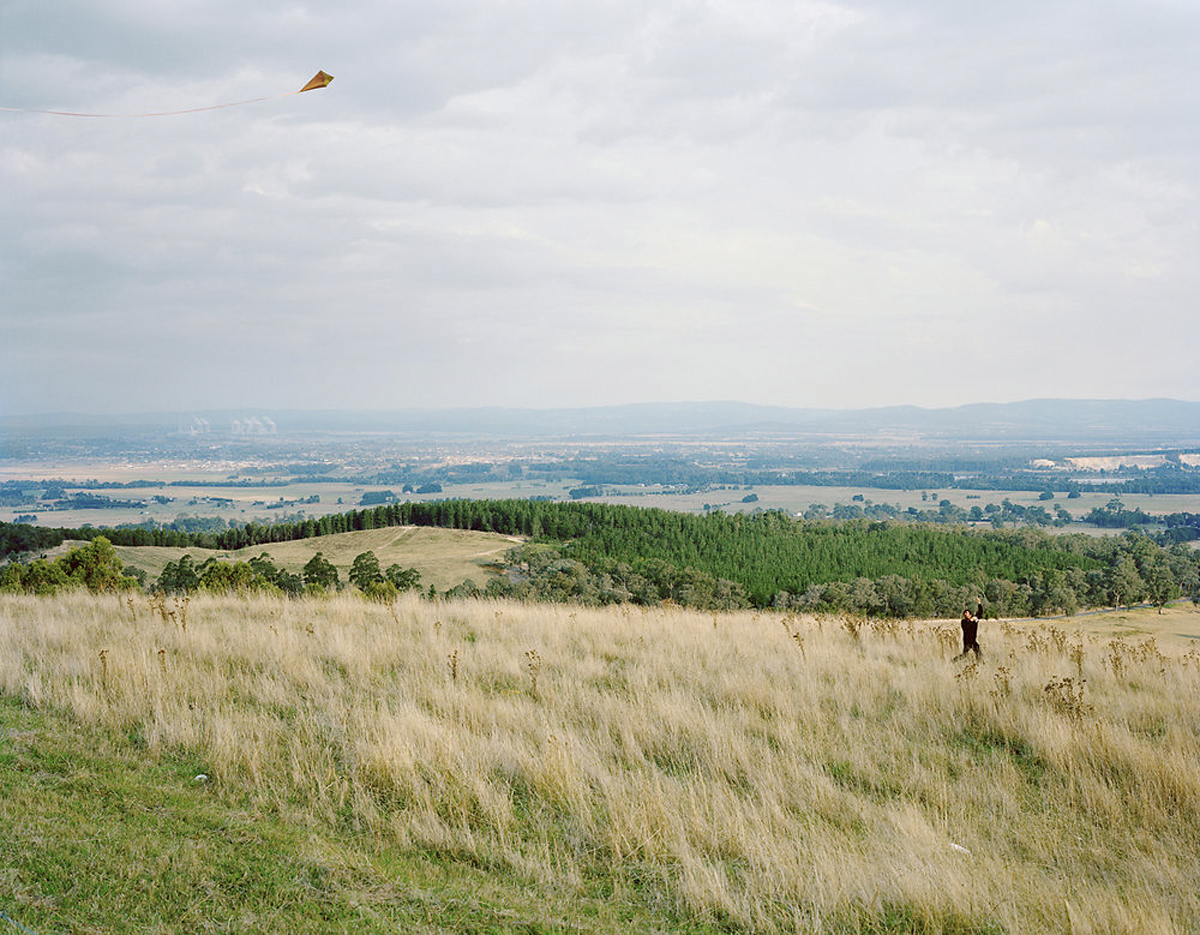
Gunnai land man (above) is very effective in this quest juxtaposing as it does an Indigenous Australian and fallen tree on a bare track with a smoke billowing power station (symbolic of the industrialisation of the area) looming in the background. Other photographs are less successful. What a man flying a kite has to do with the pre-colonial Gippsland landscape is beyond me and the juxtapositional incongruity sought by the artist simply does not work, despite the presence of the power station on the plains in the distance. The symbology has more to do with Japanese art than it has to do with Western art.
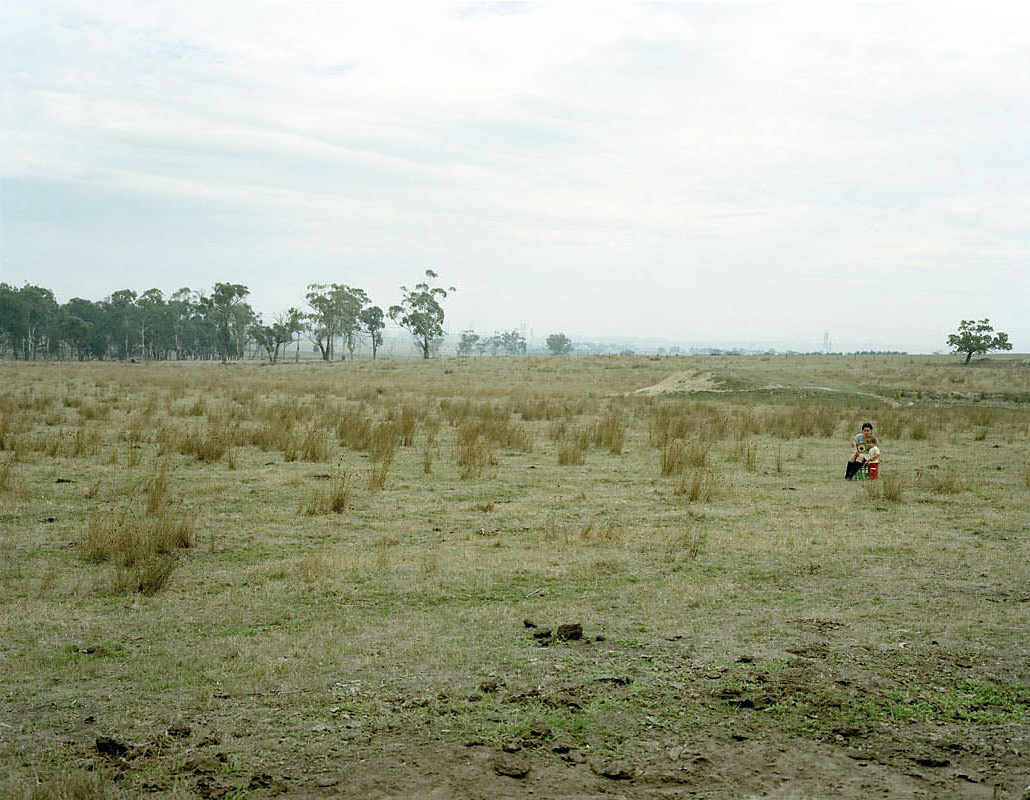
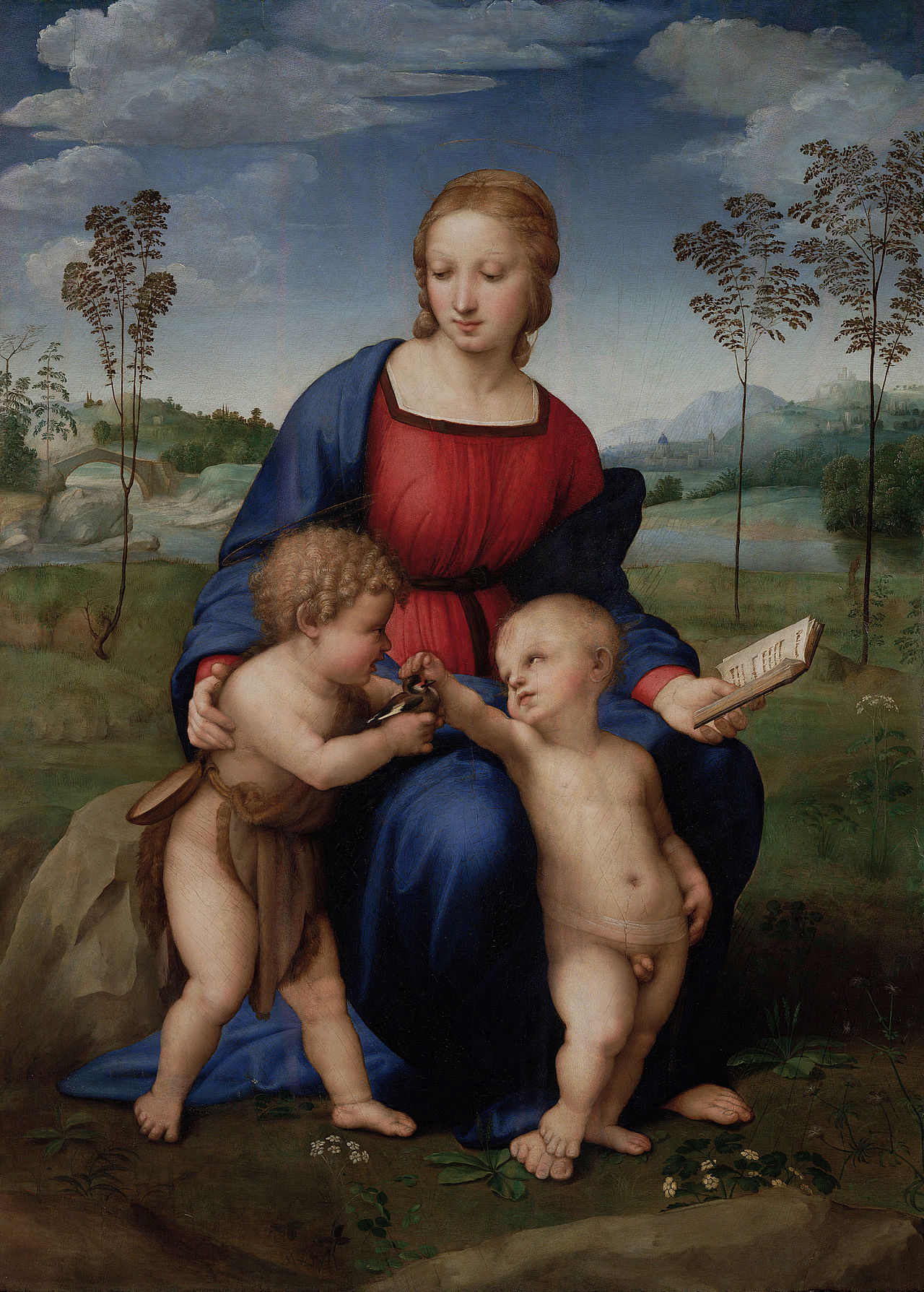
The conceptual narrative of the photograph Moe Madonna (below) works only partially as well. The destruction of the landscape has been caused by pastoralisation not industrialisation. In the image that Hayes is referencing the Madonna is front and centre set in an idyllic landscape. In the work by Hayes the incongruity has to be explained, has to be verbalised in text for the association to be didactically made. The interpretation leaves no room for personal reflection and when I looked at this image, the mother and child were so small in the landscape, the placement so obviously constructed that there incongruity turned to disbelief: namely that I simply did not believe the mise en scène being created.
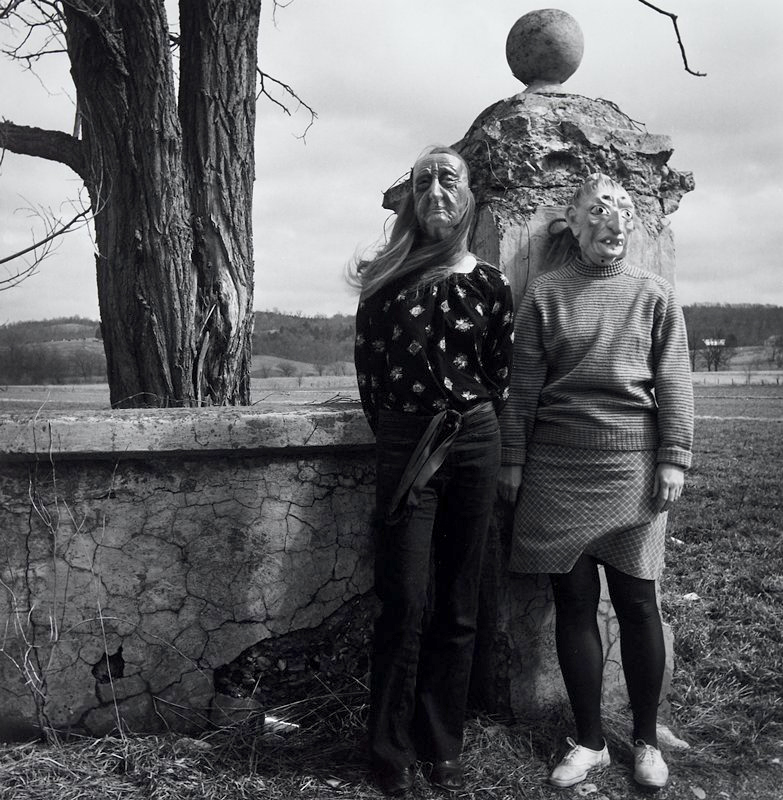
Other narratives are equally confusing. In Paper bag lovers (below) I had to ask the gallery director what was going on in the photograph because the bodies where so small in the landscape (in fact it looks like one body) and you can’t really see the paper bags on their heads because the bodies are just an amorphous mass containing no detail at all (you can just see the body in the photograph below in the mid distance just below the large central tree). Why paper bags anyway? If something intentionally odd and incongruous is sought to be portrayed in the landscape perhaps Hayes should look at the work of Eugene Meatyard (see below) to see a real subversion of the body/landscape dichotomy.
The one standout photograph of the exhibition is Plein air explorers (below). This is confirmed in the sales of the show as all six prints of this photograph have been sold. One can see why!
The title is perfect, the construction of the image faultless. The naked white man stands proudly surveying his conquered domain, the land, whilst around him artists (reminding me of the dilettantes of the Victorian age going on day trips), hunker down into the ground with their easels oblivious to the desiccated trees around them. Here the photographer just observes, doesn’t construct, the incongruity of it all. The artists draw the white man based on direct observation of him and not on their conceptions or conventional images or memories of him while ignoring their surroundings.
Here is the paradox, the ironic perfect storm that the artist was conceptually seeking: the representation of landscape based upon direct observation “in the open air” ignored for a perfect white arse while on the horizon smoke stacks of a power station stand in silent witness to the present and imminent destruction of the world.
What a photograph! Can I have one now please?
Dr Marcus Bunyan
Many thankx to Gallerysmith for allowing me to publish the photographs in the posting. Please click on the photographs for a larger version of the image.
Siri Hayes (Australian, b. 1977) Moe Madonna 2008
Siri Hayes (Australian, b. 1977) Kite 2008
Raphael (Italian, 1483-1520) Madonna of the Goldfinch 1505-1506 Oil on panel 107 x 77cm Galleria degli Uffizi
Siri Hayes (Australian, b. 1977) Paper Bag Lovers 2008
I have predominantly focused on the parts of the Gippsland landscape that have been impacted by white settlement. I have composed various human interactions that are sometimes associated with Western art and its construction. For example, Moe Madonna references Raphael’s Goldfinch Madonna. The narratives are intentionally odd and incongruous with the surrounding location. My son and I seem out-of-place in a barren paddock while the autumn mist shrouds distant gum trees and electricity pylons. The soil here has been compacted beyond repair by cattle hooves – an inappropriate animal in Australia’s delicate ecosystems. As we sit on this barren plain, I read to Oliver from a European pre-schooler book titled Autumn, creating an interesting juxtaposition with the antipodean equivalent season.
The work in this exhibition considers the pre-colonial Gippsland landscape and how industrial ‘progress’ has altered it. Hopefully it provides pause for thought.
Siri Hayes exhibition notes. March 2009
Siri Hayes (Australian, b. 1977) Plein air explorers 2008
Gallerysmith 170-174 Abbotsford St, North Melbourne, Victoria, 3051 Australia
Curator: Shane Hulbert Opening: Thursday 2nd April, 2009
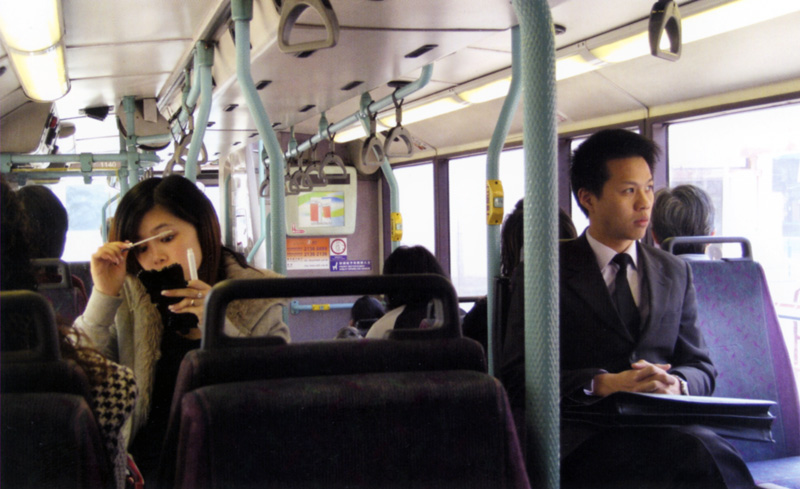
Group photography show with artists: Shane Hulbert (Aus), John Billan (Aus), So Hing Keung (HK), Stephanie Neoh (Aus), Darren Sylvester (Aus), Ming Tse Ching (HK), Kellyann Geurts (Aus), Andrew Guthrie (HK), Kim Lawler (Aus), Law Sum Po Jamsen (HK), and Lyndal Walker (Aus).
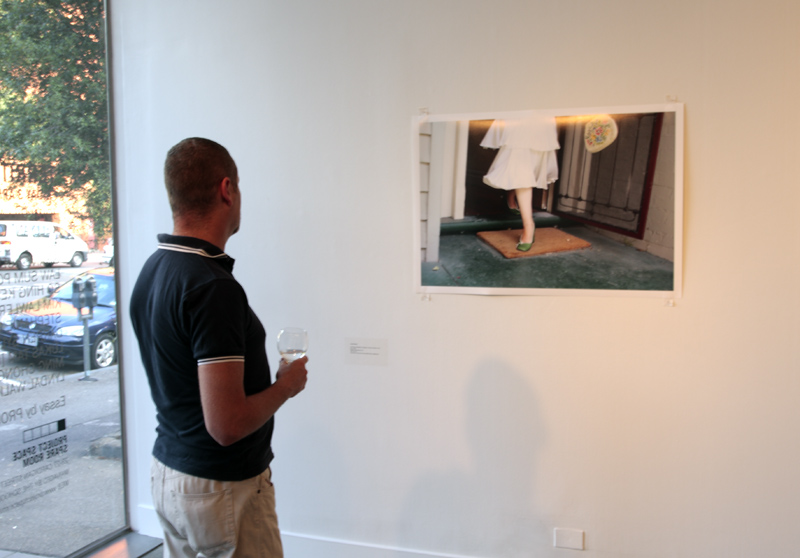
Sculptor Fredrick White in front of Lyndal Walker’s The Time to Hesitate is Through, no Time to Wallow in the Mire 2009
Great to catch up again with John Billan, Shane Hulbert and Les Walkling!
Marcus
Please click on the photographs for a larger version of the image.
Lyndal Walker (Australian, b. 1973) The Time to Hesitate is Through, no Time to Wallow in the Mire 2009
“The images in this show all reflect on an exploration of intersecting territories within Australia and the Chinese Special Administration Region [SAR] of Hong Kong. Central to this exploration are the cultural linkages between claimed and reclaimed territories, social territories and psychological territories and the way this in turn influences national identity. The claim is that these things of importance, and the way we respond to the notion of territory, have recurring similarities between different cultures.
Despite the broadness of the title, the notion of territories is becoming increasingly relevant in a global community, as the traditional borderlines and barriers that define who we are and what we stand for as a culture change in response to internal and external shifts.”
Shane Hulbert 2009
Territories opening night crowd at Project Space/Spare Room, Melbourne
Ming Tse Chong (Chinese, b. 1960) City Still Life II 2008
Many thankx to Philadelphia Museum of Art for allowing me to publish the photographs in the posting. Please click on the photographs for a larger version of the image.
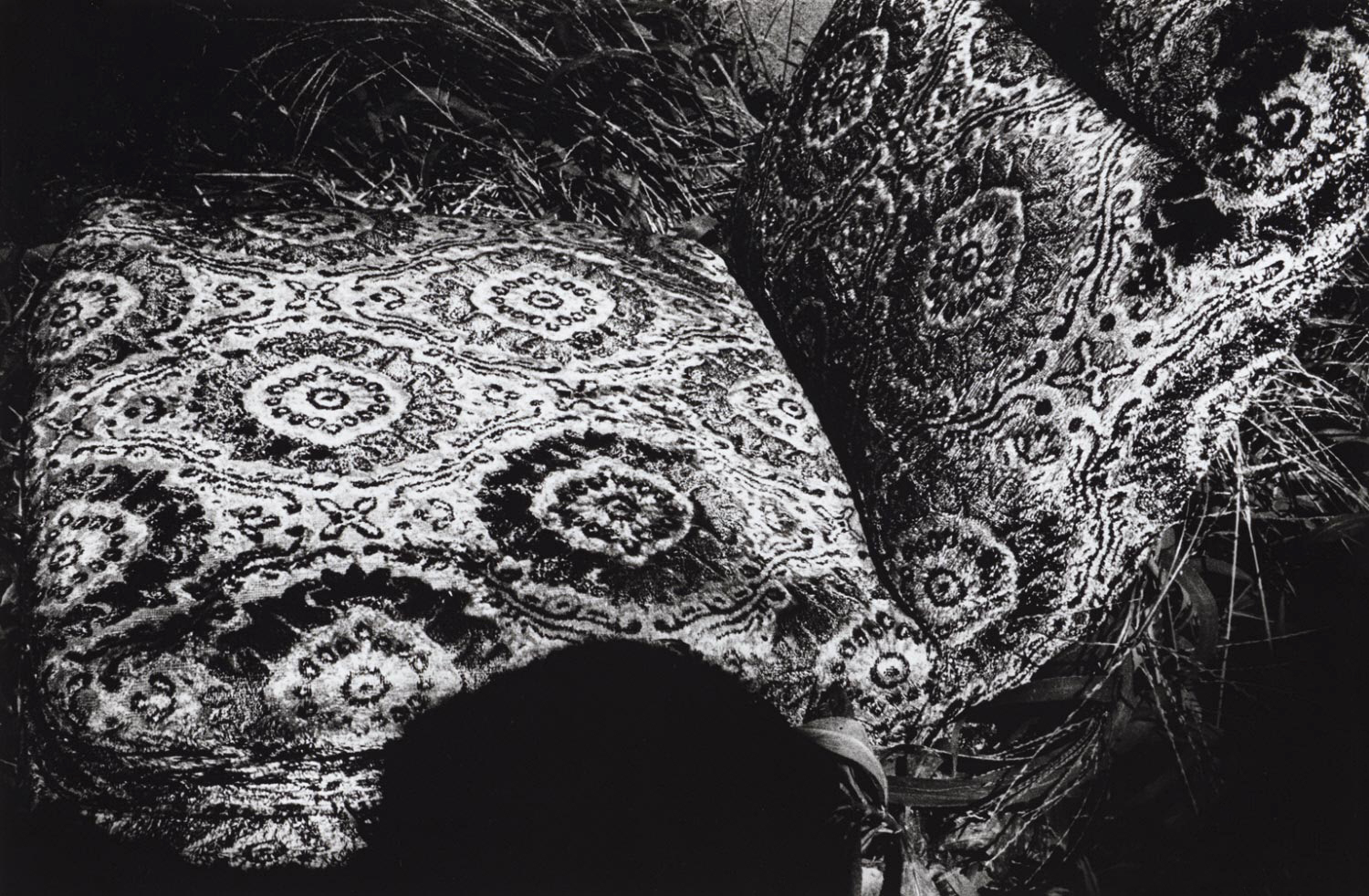
Daidō Moriyama often calls himself a “stray dog,” a reference to one of his iconic early pictures of a roaming mongrel, but also to his preferred incidental vantage points in relation to his subjects and his beguiled yet wary stance toward modernising Japanese society. In the series Memory of Dog, he revisited photographic scenarios and motifs from his previous two decades of work, overlaying his peripheral approach with another quality that he finds crucial to photography: its relationship to memory.
Daidō Moriyama is one of the most important and exciting Japanese photographers of our time, having made prolific, often experimental pictures of modern urban life since the 1960s. This exhibition showcases a group of approximately 45 photographs made in and around Tokyo in the 1980s, when Moriyama focused his mature aesthetic on the city with renewed intensity.
Moriyama approaches the world with an equalising eye, capturing disparate peripheral details that in themselves account for little, but together add up to a powerful diagnosis of modern experience. In 1980s Japan such details encompassed the disorienting and sometimes brutal juxtaposition of traditional culture and modernisation, most visible in the glut of consumer goods and images. But in Moriyama’s photographs these subjects appear alongside the banal elements of any streetscape: a derelict patch of pavement and wall, a car with an aggressive key scratch running its full length, even a single rose blossom.
Moriyama’s urban imagery shares some of its qualities with other great street photography of the 20th century, and he has cited the photographs of William Klein as a major influence. But his work involves strong responses to a wide range of modern art and literature, including photographs and graphic designs by many of his Japanese contemporaries, Andy Warhol’s silkscreens, and the novels of Jack Kerouac and James Baldwin. Moriyama’s mix of international and Japanese trends to represent modern Tokyo is one source of his photography’s power, and the exhibition will include a small number of works by other artists to demonstrate his visual sensibility, including prints and photographs by Warhol, Klein, Shomei Tomatsu, and Tadanori Yokoo.
Text from the Philadelphia Museum of Art website [Online] Cited 23/03/2009. Used under fair use conditions for the purposes of education and research
Since the 1960s Japanese photographer Daidō Moriyama (born 1938) has been making dynamic, often experimental images of modern urban life, establishing a reputation as one of the most important and exciting photographers of our time. The Philadelphia Museum of Art will present an exhibition of approximately 45 photographs by Moriyama, made in and around Tokyo in the 1980s, when the artist focused his mature aesthetic on the city with renewed intensity. The exhibition will be on view from February 28-June 30, 2009 in the Julien Levy Gallery at the Ruth and Raymond G. Perelman Building.
Born in 1938 in Ikeda-cho (now Ikeda-shi), Osaka, Moriyama witnessed the dramatic changes that swept over Japan in the decades following World War II. After his father’s death in a train accident, he began working as a freelance graphic designer at age 20. He was intrigued by the graphic possibilities of screenprinting, the cheapest and most prolific form for printed imagery, and by international trends in contemporary art. These interests, along with attention to the various forms of visual stimuli that populate the urban landscape have been a hallmark of Moriyama’s career.
In 1960 Moriyama took up the study of photography under Takeji Iwamiya and one year later moved to Tokyo hoping to join the eminent photographers’ group VIVO, a short-lived cooperative whose members were exploring and confronting the revolution in modern Japanese society in their work. Although VIVO disbanded a week after Moriyama’s arrival in the capital, the visual and existential turmoil they explored would become one of the core subjects in Moriyama’s photographs. His gritty, black and white images of streets and highways express the conflicting realities of contemporary Japan, the disorienting and sometimes brutal juxtaposition of traditional culture and modernisation.
“It is a pleasure to present this group of photographs from the Museum’s collection reflecting the distinctive vision of Daidō Moriyama, who is undoubtedly among the great urban photographers of the 20th century,” Curator of Photographs Peter Barberie said. These particular images focus on the visual experience of modern-day Tokyo, but through them Moriyama is documenting broader global trends of modernisation, and at the same time exploring the unique aesthetic qualities of his medium.”
His early images from the 1960s and 70s tested the notion of photographic artistry in an extreme fashion. He chose seemingly arbitrary subjects, and experimented with motion and overexposure to create blurred or nearly blank images, adopting an anti-aesthetic position. Other Japanese photographers were also working in this vein, but Moriyama’s 1972 book Bye Bye Photography became the defining statement of this particular style. The later photographs presented in this exhibition are generally sharper in focus but maintain the peripheral vantage point that Moriyama so often employed, as well as the seemingly random content. His images capture with an equalising eye the kinds of disparate peripheral details that litter the modern urban experience: shadows, cars, and abandoned corners, as well as the glut of consumer goods and commodities.
Profoundly influenced by Japanese photographers Eikoh Hosoe and Shomei Tomatsu, Moriyama’s vision was also enriched by his acquaintance with the work of American photographers William Klein and Robert Frank. Like them he practiced a new, more action-oriented street photography. His images are often out of focus, vertiginously tilted, or invasively cropped.
His work also involves strong responses to a wide range of modern art and literature, including photographs and graphic designs by many of his Japanese contemporaries, Andy Warhol’s silkscreens, and the novels of Jack Kerouac and James Baldwin. The exhibition will include a small number of works by other artists to demonstrate his visual sensibility, including prints and photographs by Warhol, Klein, Shomei Tomatsu, and Tadanori Yokoo.
“Remembering is an ethical act. It is also a voluntary act. We can choose not to remember. We can choose to forget. In this photograph I choose to remember, to not let pass into the dark night of the soul.” Dr Marcus Bunyan
March 2009
Marcus Bunyan (Australian born England, b. 1958) Oakland, 7-’51 from the series The Shape of Dreams (restored) 2009
“Fragments of harmonic lines assemble and collapse as the meaning of each interval must be continually revised in light of the unfolding precession of further terms in an ultimately unsustainable syntax. The mind’s ear tries to remember the sum of passing intervals, but without the ability to incorporate them into larger identifiable units each note inevitably lapses back into silence, surrendered to the presence of the currently sounding tone, itself soon to give way to another newly isolated note in its turn.”
Craig Dworkin1
The Passing of Memory
Thinking about this photograph
I bought an album on Ebay that contained an anonymous aviator with snapshots of his life: photographs of him in Oakland, California, Cologne in Germany and flying out of Italy – photos of his buddies and the work they did, the places they visited, the fun they had.
This one photograph has haunted me more than the rest.
Who was he? What was his life like? Do he get married and have children? Is he still alive?
When scanned the image was so dirty, so degraded, that I spent 7 weeks of my life cleaning and restoring the photograph working all hours of the day and night. I was obsessive almost to the point of obstinacy. Many times I nearly gave up as I thought the task impossible – thousands of dots and hairs inhabited the surface of the image and, surely, it was just another photograph one of millions that circle the world. Why expend so much energy just to resurrect this one particular image?
Some things that can be said about this photograph
It is small measuring only 9cm high by 7.5 cm wide
It is printed on cheap glossy photographic paper which now has a slight yellow tinge to it.
The image is creased at top left.
The back is annotated ‘Oakland, 7-’51’
The dark roundel with the wing on the side of the aircraft has faint text that spells out the words ‘AERO ACE’.
There is no engine in the aircraft and it looks from the parts lying on the ground that the aircraft is being broken up or used for spares.
The man is wearing work overalls with unidentifiable insignia on them, a worker on the aircraft being dismantled or just a fitter on the base.
Someone standing on the ground has obviously called out the man’s name and he has turned around in response to the call and lent forward and put out his hand in greeting – a beautiful spontaneous response – and the photograph has been taken.
Some other things that can be said about this photograph, in passing
The sun splashes the man’s face. He smiles at the camera.
His arm rests gently on the metal of the aircraft, shielded from the sun.
Perhaps he wears a ring on his fifth finger.
He is blind.
This photograph is an individual, isolated note in the fabric of time. It could easily pass into silence as memory and image fade from view. Memories of the individual form the basis for remembering and photographs act as an aide-memoire both for individual memory and the collective memory that flows from individual memory. Memory is always and only partial and fragmentary – who is remembering, what are they remembering, when do they remember, what prompts them to remember and how these memories are incorporated into the collective memory, an always mediated phenomenon that manifests itself in the actions and statements of individuals, are important questions.
Images are able to trigger memories and emotional responses to a particular time and place, but since this photograph has no personal significance what is going on here? Why did I cry when I was restoring it? What emotional association was happening inside me?
“To remember is always to give a reading of the past, a reading which requires linguistic skills derived from the traditions of explanation and story-telling within a culture and which [presents] issues in a narrative that owes its meaning ultimately to the interpretative practices of a community of speakers. This is true even when what is remembered is one’s own past experience… [The] mental image of the past … becomes a phenomenon of consciousness only when clothed with words, and these owe their meaning to social practices of communication.”2
His blindness stares at us while underneath his body walks away into his passing.
I have become the speaker for this man, for this image.
His brilliant face is our brilliant face.
In this speaking, the phenomenon of making the image conscious, the gap between image and presence, between the photo and its shadow has collapsed. There is no past and present but a collective resonance that has presence in images.
“Such reasoning questions the separation of past and present in a fundamental way. As a consequence it becomes fruitless to discuss whether or not a particular event or process remembered corresponds to the actual past: all that matters are the specific conditions under which such memory is constructed as well as the personal and social implications of memories held.”3
‘The personal and social implications of memories held’. Or not held, if images are lost in passing.
It is such a joyous image, the uplifted hand almost in supplication. I feel strong connection to this man. I bring his presence into consciousness in my life, and by my thinking into the collective memory. Perhaps the emotional response is that as I get older photographs of youth remind me of the passing of time more strongly. Perhaps the image reminds me of the smiling father I never had. These are not projections of my own feelings but resonances held in the collective memory.
As Susan Sontag has observed,
“Remembering is an ethical act, has ethical value in and of itself. Memory is, achingly, the only relation we can have with the dead. So the belief that remembering is an ethical act is deep in our natures as humans, who know we are going to die, and who mourn those who in the normal course of things die before us – grandparents, parents, teachers and older friends.”4
Remembering is an ethical act. It is also a voluntary act. We can choose not to remember. We can choose to forget. In this photograph I choose to remember, to not let pass into the dark night of the soul. My mind, eyes and heart are open.
This is not a simulacra of an original image but an adaptation, an adaptation that tries to find resonances between past and present, between image and shadow. As such this photograph is no longer an isolated tone that inevitably lapses back into silence but part of a bracketing of time that is beautiful in its illumination, its presence. The individual as collective, collected memory present for all to see.
The form of formlessness, the shape of dreams.
Dr Marcus Bunyan
1/ Dworkin, Craig. “Grammar Degree Zero (Introduction to Re-Writing Freud)” (2005) [Online] Cited 23rd March, 2009. No longer available online
2/ Holtorf, Cornelius. “Social Memory,” part of a doctoral thesis Monumental Past: The Life-histories of Megalithic Monuments in Mecklenburg-Vorpommern (Germany) submitted 1998 [Online] Cited 23/03/2009
3/ Ibid.,
4/ Sontag, Susan. Regarding the Pain of Others. London: Hamish Hamilton, 2003, p. 103
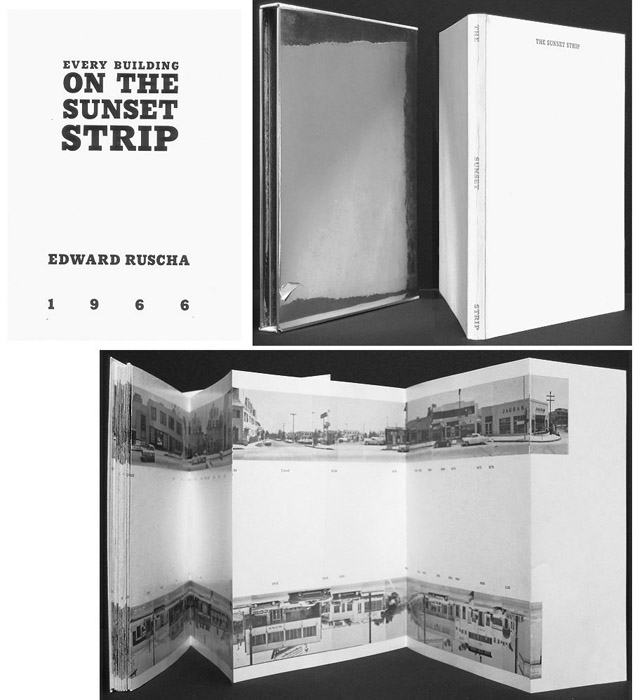
An interesting exhibition is presented in the [now closed] permanent third floor photography gallery at NGV International, Melbourne on a subject that deserved a much more rigorous investigation than could been undertaken in this small gallery space. Presenting single works by Ed Ruscha, Bernd and Hilla Becher, Patrick Pound, Robert Rooney, Simon Obarzanek, Penelope Davis, Candid Hofer, Linda Judge and Charles Green and Lyndell Brown the works seek to investigate the nature of the relationship between photography and the archive, between the semi-permanences of an archival memory and the spaces of a transgressive intertexuality marked by fragmentary, ironic counter-performances.
As noted in the catalogue essay by NGV curator Maggie Finch the archive is a place for holding knowledge that contains elements of truth and error, order and disorder; archives are able to shape history and memory, depending on how, when and by whom the records are accessed. Any disruption of order, governance and authority can lead to alternative readings and interpretations as the arcane ‘mysteries’ of the methods of classification are overturned. Since Victorian times when the body came under the self-surveillance of the camera and was found wanting, photographs have documented the faces of criminals, the physiognomy of degeneration and the fever of war.
As Yiannis Papatheodorou has observed when reviewing Jacques Derrida Mal d’Archive,
“Derrida declares that since the dominant power of the archive derives from the economy of knowledge, it also provides the institutional responsibility of the interpretation. The localisation of the information transforms the inscription, provided by the function of the archive, into the impression of a memory’s trace, conscious or unconscious …
The preservation of memory, the access to information, the “resources” of the sources and the working environment are not just the representation of a future memory. They are active practices and discourses that create hierarchies and exclusions. The archives are the languages of the past, activated however dialogically, according to scientific and social demands. The content of our choice is marked by the way we are seeking information. Far from being an abstract principle, our choice is an ideologically oriented negotiation closely related to the politics of interpretation.”1
And there’s the rub.
Not only is this exhibition a reordering of an unpublished memory (for that is what an archive is, a unique unpublished memory), it is also a reiteration of the authority of the gallery itself, the “institutional responsibility of the interpretation.”2
Deciding what was in this exhibition and what to leave out creates hierarchies of inclusion and exclusion – and in this case the inclusions are mainly ‘safe’ works, ones that challenge the ontology of existence, the cataloguing of reality in a slightly ironic way but oh – nothing too shocking! nothing too disordered! Nothing here then of the archive of images that substantiate the horrors of war, the trans/disfiguration of men in both World Wars for example. There are few images to haunt us, none to refresh our memories in a problematic way.
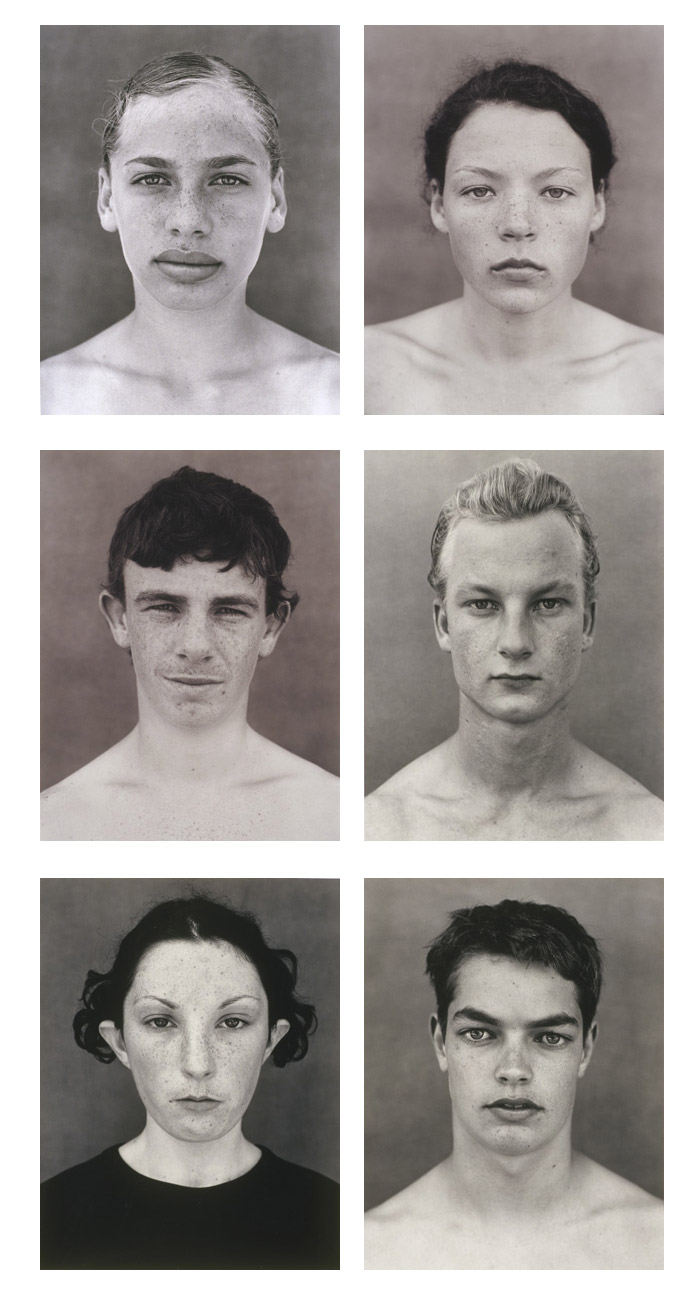
The more successful pieces, the works that challenge the order of the archive (“what is no longer archived in the same way is no longer lived in the same way”)3, are the ones by Ed Ruscha, Penelope Davis and Simon Obarzaneck (all below).
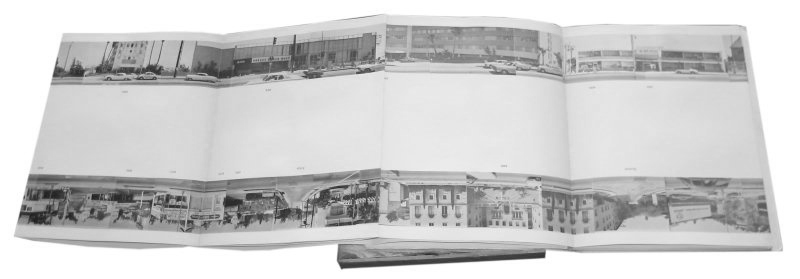
Ruscha’s vertical inverted cityscape is trapped in a display cabinet opened out on the horizontal plane in concertina format, like one of those optical illusion images in which you see an image looking from one direction and a different image from the other direction. Ruscha’s personal experience of driving down Sunset Strip in Los Angeles and his anthropological recording of the urban experience has been disseminated in a mass produced ‘artists’ book. No unique unpublished archive here. Beneath the facades of the shops other narratives emerge – images are stitched together, cars chopped off, people dismembered – all in a very linear, conceptual way; a journey from one point to another, one that is both subjective (the voice and hand of the author) and objective (the en masse production of the book).
As Chris Balaschak has noted, “The images, taken during the day, capture only the facades of the buildings. Ignorance is given to cars or people, both of which are often cut in half between separate exposures. The imperfections of matching the facades are cracks along Ruscha’s drive. Through these cracks we find Ruscha, not such an anonymous author after all. Splitting cars in two, and mismatching facades we become keenly aware of the passage of time. The facades of buildings may appear as stage sets but they are active points on other itineraries, anticipating future and past narratives.”4
This is Ruscha’s trace through the city but also our intersection with his journey, our chance to make our own itineraries as Balaschak (in his insightful writing) rightly points out. The fragmentary dismembering becomes the space between, the disorder of the linear into a heterotopic space of remembering. We the viewer create our own narrative, flitting through the cracks in the archive of memory, the photographer, the author of our own journey.
Penelope Davis photograms are luminous objects. She makes resin casts of the spine of discarded books and places the casts directly onto photographic paper and then exposes them to light. The books glow and hover in the blackness, the words on the spine reversed. Stripped of their context, of their memory, they become ethereal books, phantom texts, liminal images that hover between what is known and what is imagined. As Davis has said, “Most people assume that when they look at a photo that they are looking at the thing photographed – but they are not. They are looking at a photo. Books and photographic images and archives are enigmatic – you can’t be sure of a singular definition or meaning.”
Davis is ‘messing around’ with the idea of veracity, the truth of photography and the ordering of the archive of our mind through the images we collate. We seek to grasp the original memory of an event, of the reading and ordering of our life through images and none is available to us, for as Foucault has observed memories are only ever fragmentary and distorted representations, partial truths a best. Like Jorge Luis Borges’ journey into the infinite universe of The Library of Babel, for Foucault the psyche is not an archive but a mirror, like the shining silver foil surface of the cover of the Ed Ruscha book:
“The search for the self is a journey into a mental labyrinth that takes random courses and ultimately ends at impasses. The memory fragments recovered along the way cannot provide us with a basis for interpreting the overall meaning of the journey. The meanings that we derive from our memories are only partial truths, and their value is ephemeral. For Foucault, the psyche is not an archive but only a mirror. To search the psyche for the truth about ourselves is a futile task because the psyche can only reflect the images we have conjured up to describe ourselves. Looking into the psyche, therefore, is like looking into the mirror image of a mirror. One sees oneself reflected in an image of infinite regress. Our gaze is led not toward the substance of our beginnings but rather into the meaninglessness of previously discarded images of the self.”5
This leads us nicely onto the images of Simon Obarzanek.
In a fantastic series of photographs, the only ones of this exhibition that seemed to haunt me (as Susan Sontag says images do), Obarzanek photographs people in an ordered, almost scientific, manner. Photographed face on against a non-contextual background using a low depth of field, these repetitive, collective, unnamed people remind me of the images of Galton. But here the uniformity is overwhelmed by quirky differences – the placement of eyes and lips seem large offering a strange, surreal physiognomy. These images resonate, the challenge, they remain with you, they question the order of things as no other photograph in this exhibition does. From simplicity comes eloquence.
To finish I must address the elephant in the room, in fact two elephants!
There is not one digital photograph contained in the exhibition, the work being collage, Type C colour or black and white silver gelatin prints. There is no mention in the catalogue of the crisis of cultural memory that is now permeating our world. Some believe the ever-expanding digital archive, the Internet, threatens our lived memories “amidst the process of the ‘digitisation of culture’ and the new possibilities of storing.”6
This vision entails the fear of losing cultural content, hitting the delete button so that memory passes into forgetting. This is a vision to which I do not subscribe, but the issue needed to be addressed in this exhibition: how are digital technologies altering our re-assemblance of memory, altering photography’s ability inherent ability to record, store and organise visual images? What about the aura of the original or was there never such a thing?
Furthermore, it would seem that with photographs becoming less and less a fixed essence; with the meaning of the photograph more and more divorced from its referent; with the spectators look the key to reading photographs; and the performance of the photograph a cut and paste reality… then perhaps we are left not with the two polar opposites of order and disorder but some orthogonal spaces in-between.
The second elephant in the room in the gallery space itself.
Whilst the curators of photography at the National Gallery of Victoria do an amazing job running large exhibitions such as the Andreas Gursky and Rennie Ellis shows that have starred this year, the NGV ‘International’ is shooting itself in the foot with the current permanent photography gallery space. Small, jaded and dour it seems an addendum to other larger spaces in the gallery and to be honest photography and Melbourne deserve better. Personally I feel more alive in the fashion gallery that is on the floor below and that, for a photographer, is a hard thing to say.
As the theme for this exhibition deserved a greater in-depth investigation so the gallery needs to expand its horizons and give the permanent photography gallery a redesign and overhaul. Where is the life and passion of contemporary photography displayed in a small space for all to see in a gallery that sees itself as ‘International’?
In an occularcentric world the key word is intertexuality: the gallery space should reflect the electri-city, the mixing of a gallery design ethos with images to surround us in a space that makes us passionate about contemporary photography. Now that would really be a new order of things!
Dr Marcus Bunyan
1/ Papatheodorou, Yiannis. History in the promised land of memory. Review of Jacques Derrida, Mal d’Archive, Paris, Éd. Galilée, 1995 [Online] Cited on 20th March 2009 (no longer available online)
2/ “The archive is understood as a collective reservoir of knowledge fulfilling diverse functions and conditioned by three main factors: conservation, selection and accessibility. How are contents stored and which media are used to conserve them? What is selected for storage and what is decided to be cleared out and thus forgotten? Who decides what is archived and who has access to the resources? All these questions paint the archive as a political space where relations of power cross aspects of culture and collective identity.”
Assmann, A. Erinnerungsräume, Formen und Wandlungen des kulturellen Gedächtnis. [Memory Spaces, Forms and Transformations of Cultural Memory] Special paperback editon, 1st edition publ. 1999, München: Beck, 2003, p. 343-346
3/ Derrida, Jacques. Archive Fever, A Freudian Impression. Transl. by E. Prenowitz, 1996, p. 18 orig. publ. as Mal d’Archive: une impression freudienne. Chicago, London: The University of Chicago Press, 1995
4/ Balaschak, Chris. Itineraries [part 3] [Online] Cited on 20th March 2009. No longer available online
5/ Hutton, Patrick. “Foucault, Freud, and the Technologies of the Self,” in Martin, Luther and Gutman, Huck and Hutton, Patrick (eds.,). Technologies of the Self: A Seminar with Michel Foucault. London: Tavistock Publications, 1988, p. 139
6/ Featherstone, M. (2000) “Archiving Cultures,” in British Journal of Sociology, 51(1), pp. 161-184
Many thankx to the National Gallery of Victoria for allowing me to publish the images in the posting. Please click on the photographs for a larger version of the image.
Penelope Davis (Australian, b. 1963) Shelf 2008 From the Fiction-Non-Fiction series 2007-2008 Type C photograph 90 x 70cm National Gallery of Victoria, Melbourne Purchased, Victorian Foundation for Living Australian Artists, 2008
Archives contain elements of truth and error, order and disorder and are infinitely fascinating. As both collections of records and repositories of data, archives are able to shape history and memory depending on how, when and by whom the materials are accessed. Their vastness allows for multiple readings to be unravelled over time.
Photography is naturally associated with archives because of its inherent ability to record, store and organise visual images. With this in mind, this exhibition brings together artists drawn largely from the permanent collection of the NGV who explore the idea of archives as complex, living and occasionally mysterious systems of knowledge. Several of the selected artists act as archivists, collecting and ordering their own unique bodies of photographs, while others create disorder by critiquing the ideas and systems of archives.
Bernd and Hilla Becher (German, 1931-2007 and 1934-2015) Coal tipple, Goodspring, Pennsylvania 1975 From the Artists and photographs folio 1975 Gelatin silver photographs 24.0 x 33.9cm (image and sheet) 40.7 x 49.6cm (support) National Gallery of Victoria, Melbourne Purchased, 1976
Curator: Jeff L. Rosenheim, Curator in the Department of Photographs at The Metropolitan Museum of Art
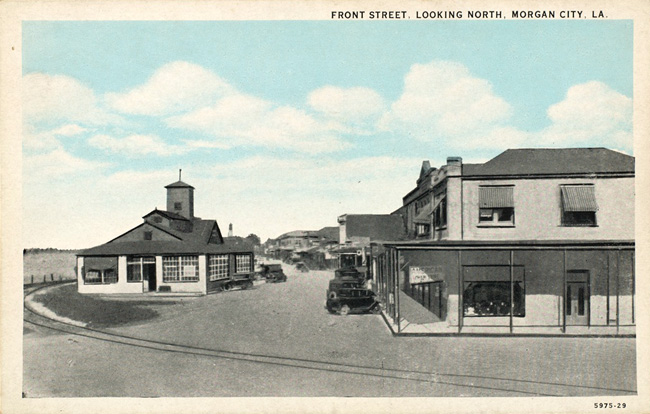
Unknown artist (American) Front Street, Looking North, Morgan City, LA 1929 Postcard, Photomechanical reproduction 3 1/2 x 5 1/2 in. (8.9 x 14 cm) The Metropolitan Museum of Art, New York, Walker Evans Archive, 1994
This looks a very interesting exhibition – I wish I could see the actual thing!
Many thankx to The Metropolitan Museum of Art for allowing me to publish the photographs and art work in the posting. Please click on the photographs for a larger version of the image.
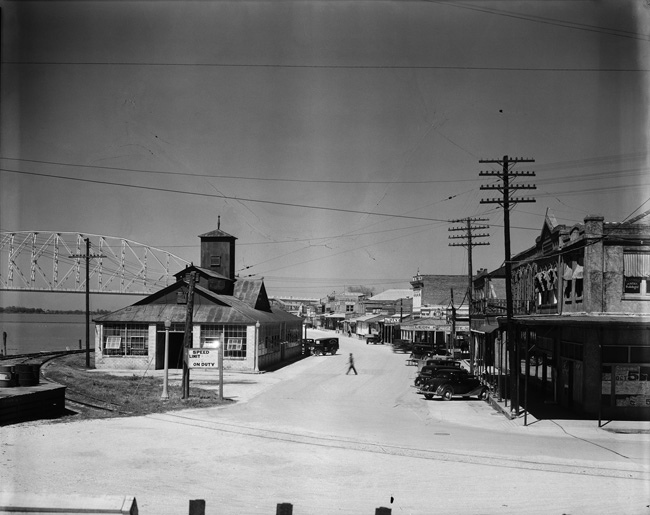
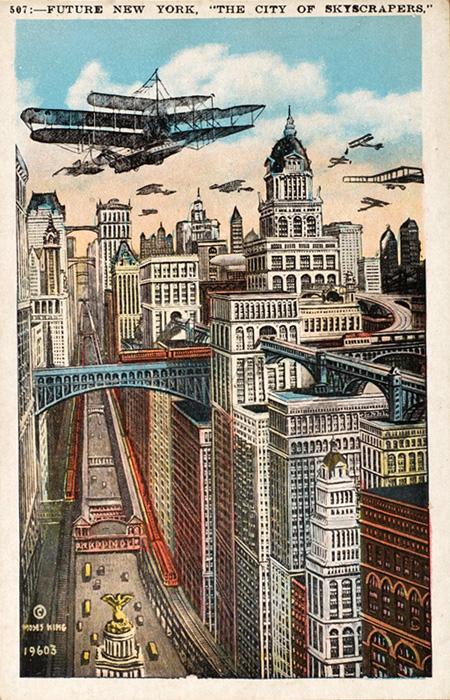
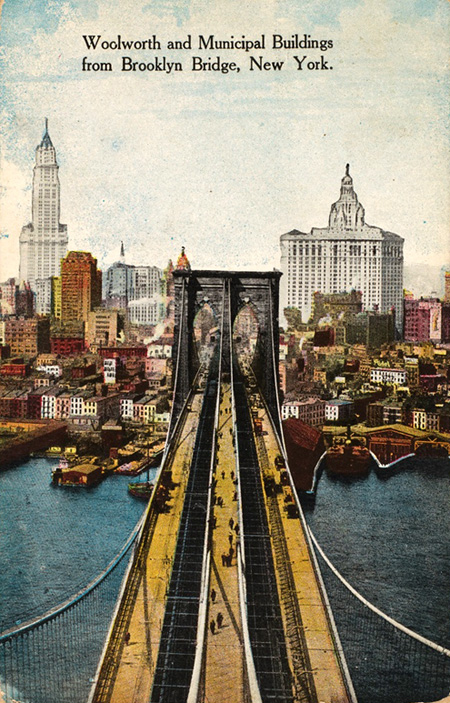
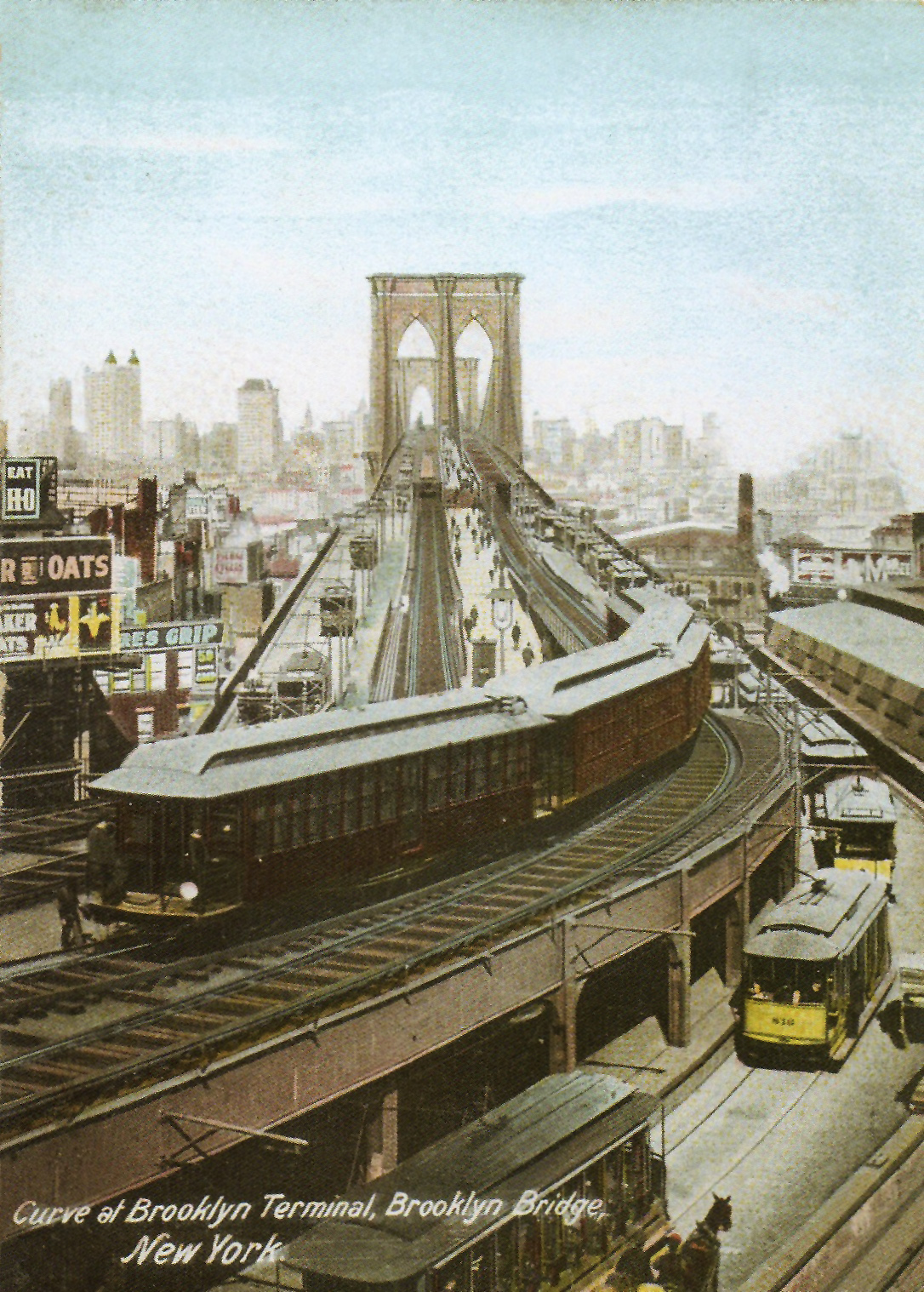
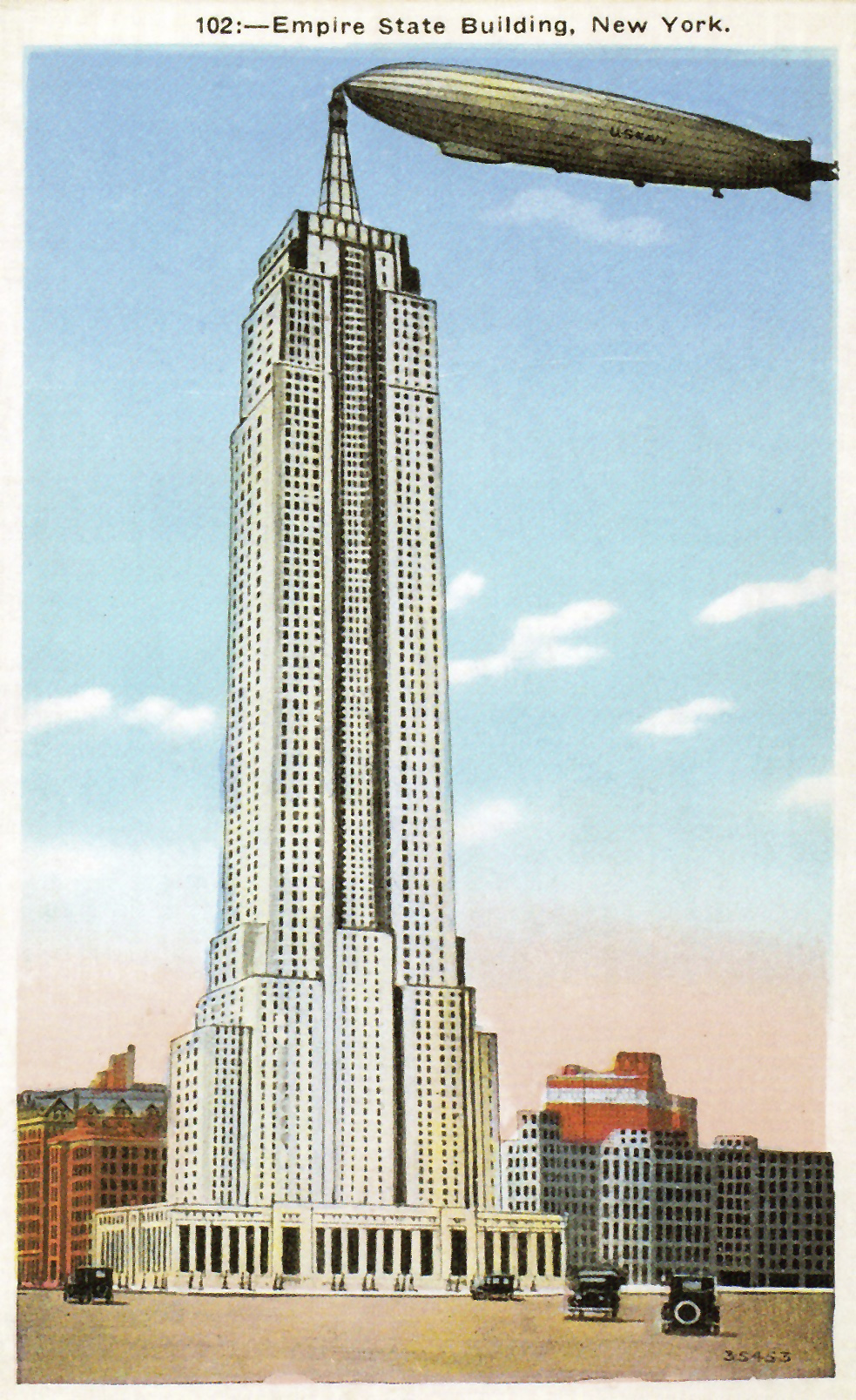
This exhibition will focus on a collection of 9,000 picture postcards amassed and classified by the American photographer Walker Evans (1903-1975), now part of the Metropolitan’s Walker Evans Archive. The picture postcard represented a powerful strain of Indigenous American realism that directly influenced Evans’s artistic development. The dynamic installation of hundreds of American postcards drawn from Evans’s collection will reveal the symbiotic relationship between Evans’s own art and his interest in the style of the postcard. This will also be demonstrated with a selection of about a dozen of his own photographs printed in 1936 on postcard-format photographic paper.
Text from The Metropolitan Museum of Art website
Walker Evans (American, 1903-1975) Street Scene, Morgan City, Louisiana 1935 Film negative 8 x 10 in. (20.3 x 25.4cm) The Metropolitan Museum of Art, New York, Walker Evans Archive, 1994
“Sold in five-and-dime stores in every small town in America, postcards satisfied the country’s need for human connection in the age of the railroad and Model T when, for the first time, many Americans regularly found themselves traveling far from home. At age twelve, Walker Evans began to collect and classify his cards. What appealed to the nascent photographer were the cards’ vernacular subjects, the simple, unvarnished, “artless” quality of the pictures, and the generic, uninflected, mostly frontal style that he later would borrow for his own work with the camera. Both the picture postcard and Evans’s photographs seem equally authorless – quiet documents that record the scene with an economy of means and with simple respect. Walker Evans and the Picture Postcard proposes that the picture postcard represented a powerful strain of indigenous American realism that directly influenced Evans’s artistic development.”
Text from the Steidl website
The American postcard came of age around 1907, when postal deregulations allowed correspondence to be written on the address side of the card. By 1914, the craze for picture postcards had proved an enormous boon for local photographers, as their black-and-white pictures of small-town main streets, local hotels and new public buildings were transformed into handsomely coloured photolithographic postcards that were reproduced in great bulk and sold in five-and-dime stores in every small town in America. Postcards met the nation’s need for communication in the age of the railroad and Model T, when, for the first time, many Americans often found themselves traveling far from home. In the Walker Evans Archive at New York’s Metropolitan Museum of Art, there is a collection of 9,000 such postcards amassed by the great American photographer, who began his remarkable collection at the age of 10. What appealed to Evans, even as a boy, were the vernacular subjects, the unvarnished, “artless” quality of the pictures and the generic, uninflected, mostly frontal style that he later would borrow for his own work. The picture postcard and Evans’ photographs seem equally authorless, appearing as quiet documents that record a scene with both economy of means and simple respect. This volume demonstrates that the picture postcard articulated a powerful strain of indigenous American realism that directly influenced Evans’ artistic development.
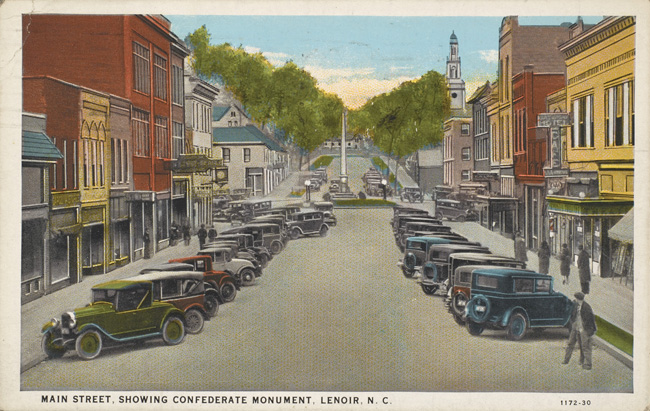
Unknown artist (American) Main Street, Showing Confederate Monument, Lenoir, N. C. 1930s Postcard, Photomechanical reproduction 3 1/2 x 5 1/2 in. (8.9 x 14cm) The Metropolitan Museum of Art, New York, Walker Evans Archive, 1994
Walker Evans was the progenitor of the documentary style in American photography, and he argued that picture postcard captured a part of America that was not recorded in any other medium. In the early 20th century, picture postcards, sold in five-and-dime stores across America, depicted small towns and cities with realism and hometown pride – whether the subject was a local monument, a depot, or a coal mine.
Evans wrote of his collection: “The very essence of American daily city and town life got itself recorded quite inadvertently on the penny picture postcards of the early 20th century .… Those honest direct little pictures have a quality today that is more than mere social history .… The picture postcard is folk document.”
Walker Evans and the Picture Postcard is the first exhibition to focus primarily on works drawn from The Walker Evans Archive. The installation is designed to convey the incredible range of his collection and to reflect the eclectic and obsessional ways in which the artist organised his picture postcards. For example, Evans methodically classified his collection into dozens of subject categories, such as “American Architecture,” “Factories,” “Automobiles,” “Street Scenes,” “Summer Hotels,” “Lighthouses,” “Outdoor Pleasures,” “Madness,” and “Curiosities”.
Marty Weil. “Walker Evans’ Picture Postcard Collection on the ephemera: exploring the world of old paper website Feb 24, 2009 [Online] Cited 12/06/2022. No longer available online. Used under fair use conditions for the purposes of education and research
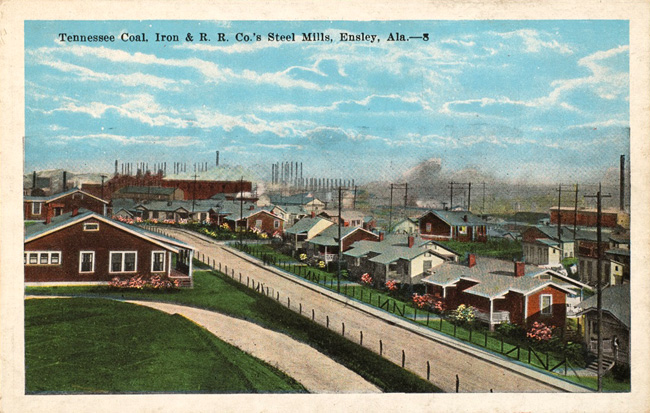
Unknown artist (American) Tennessee Coal, Iron, & R. R. Co.’s Steel Mills, Ensley, Ala. 1920s Postcard, Photomechanical reproduction 3 1/2 x 5 1/2 in. (8.9 x 14cm) The Metropolitan Museum of Art, New York, Walker Evans Archive, 1994
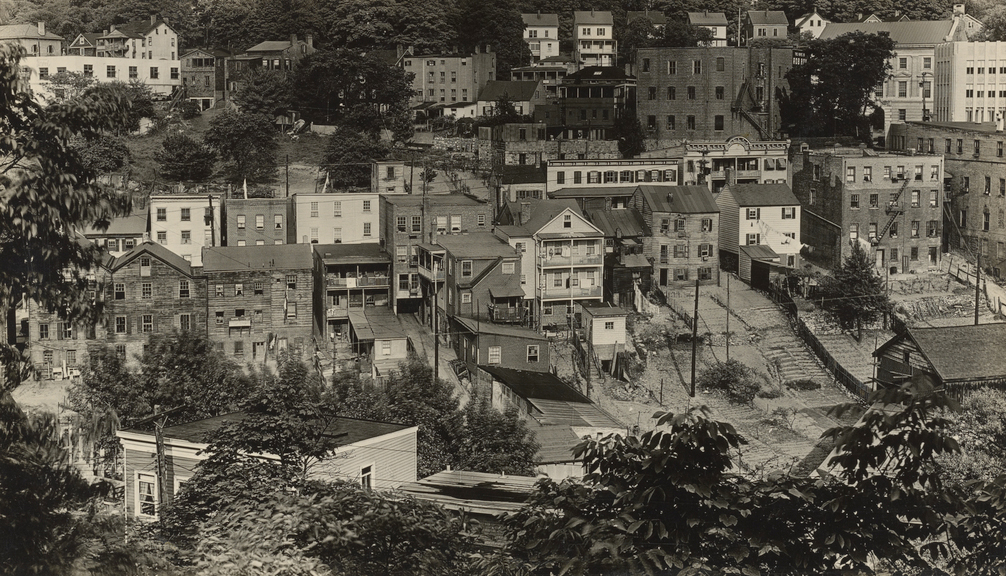
Walker Evans (American, 1903-1975) View of Easton, Pennsylvania 1935 Postcard format gelatin silver print
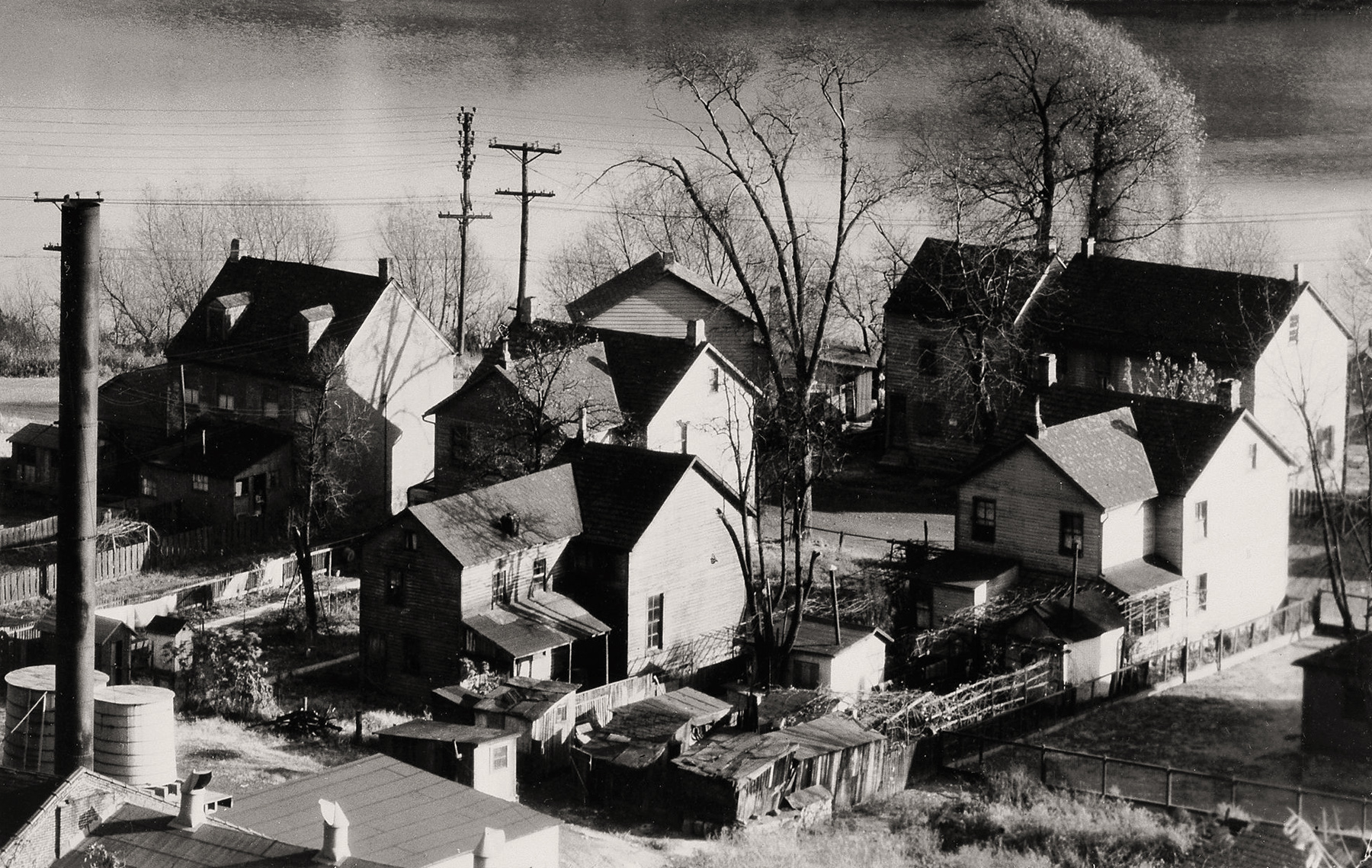
Walker Evans (American, 1903-1975) View of Ossining, New York 1930-1931 Gelatin silver print 4 1/8 x 7 13/16 in. (10.5 x 19.8cm) The Metropolitan Museum of Art, New York, Purchase, The Horace W. Goldsmith Foundation Gift through Joyce and Robert Menschel, 1999
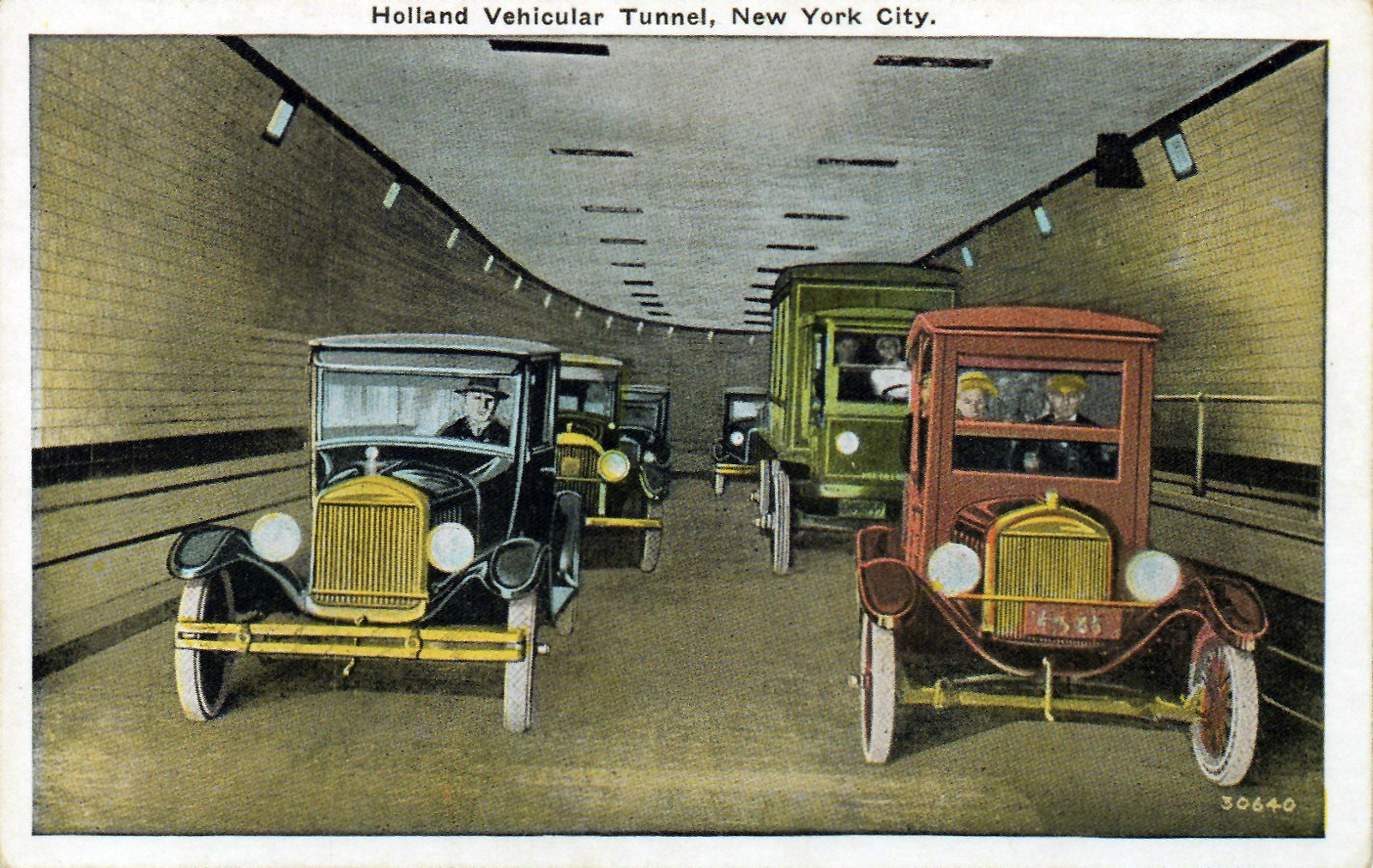
Unknown artist (American) Holland Vehicular Tunnel, New York City 1920s Postcard, Photomechanical reproduction 3 9/16 x 5 1/2 in. (9 x 14cm) The Metropolitan Museum of Art, New York, Walker Evans Archive, 1994
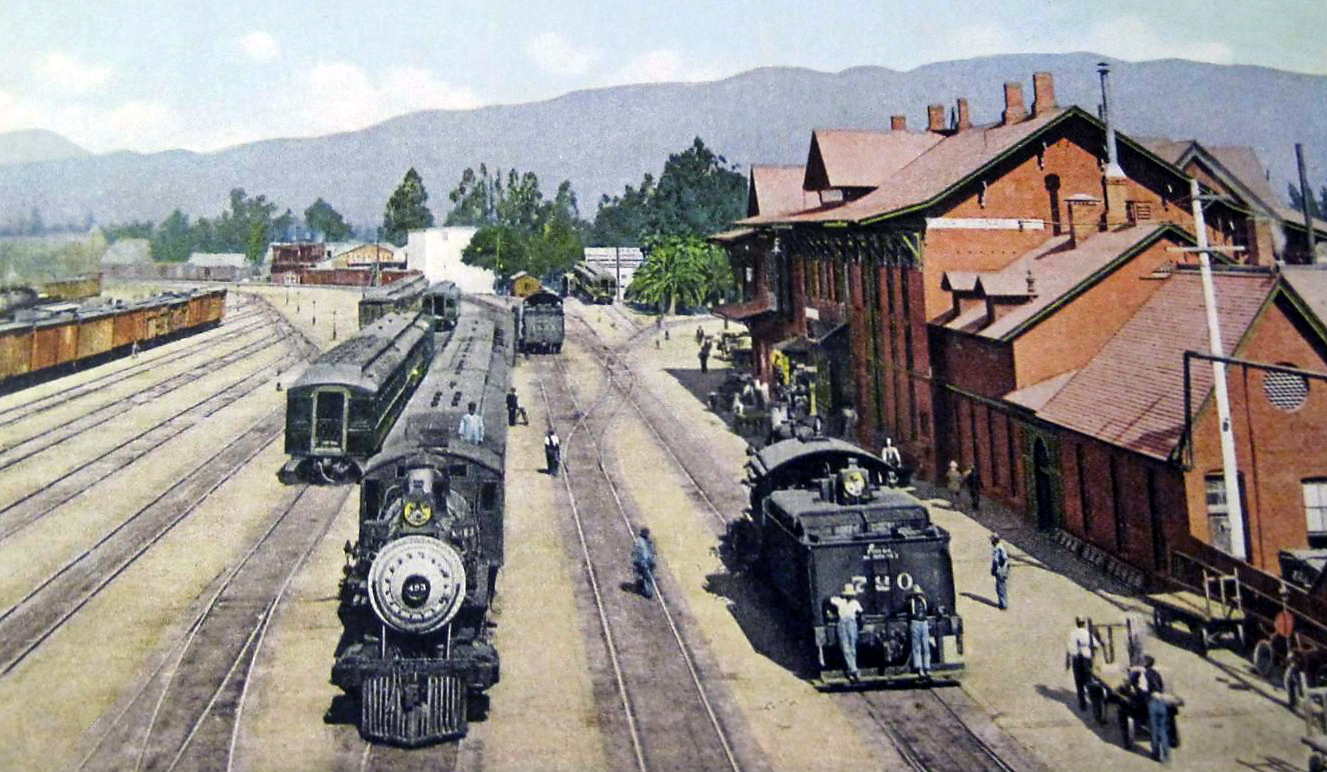
Unknown artist (American) Santa Fe station and yards, San Bernardino, California c. 1910 Postcard, Photomechanical reproduction 3 9/16 x 5 1/2 in. (9 x 14cm) The Metropolitan Museum of Art, New York, Walker Evans Archive, 1994
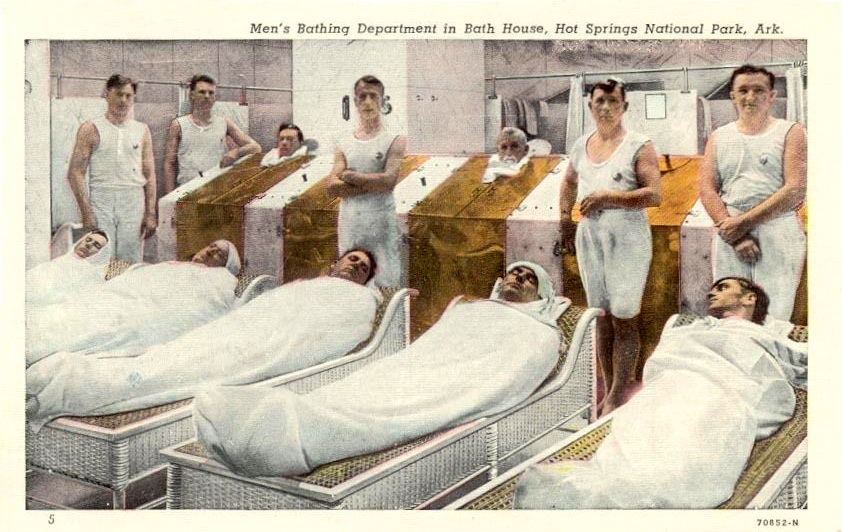
Unknown artist (American) Men’s Bathing Department, Bath House, Hot Springs National Park, Ark. 1920s Postcard, Photomechanical reproduction 3 9/16 x 5 1/2 in. (9 x 14cm) The Metropolitan Museum of Art, New York, Walker Evans Archive, 1994
Walker Evans and the Picture Postcard
In 1903, the year Walker Evans was born, the US Postal service handled 700 million picture postcards. Evans would later recall his fondness for those “honest, direct, little pictures that once flooded the mail.” By the age of twelve he was a collector and through his lifetime, an obsessive. “Yes, I was a postcard collector at an early age. Every time my family would take me around for what they thought was my education, to show me the country in a touring car, to go to Illinois, to Massachusetts, I would rush into Woolworth’s and buy all the postcards.” For Evans, the addition of hand-colouring added a great deal of aesthetic value. …
Walker Evans and the Picture Postcard reproduces hundreds of cards from his collection including the three magazine features mentioned above. Also the fine addition of an “illustrated transcript” of his now famous Lyric Documentary lecture at Yale in 1964 makes this a bit more interesting than the title may suggest. …
Later in life Evans had friends around the country while on photo trips keeping an eye for postcards that might interest. He had a particular love for ones produced by the Detroit Publishing Company which were considered the “Cadillac” of postcards. Lee Friedlander related the following from a recent interview: “The Detroit Publishing Company had a formula. If a town had 2,000 people or so, it got a main street postcard; if it had 3,500, it got the main street and also a courthouse square. Walker liked the formula. He had everyone looking for this or that. He told me once in Old Lyme, “If you run across any ‘Detroits,’ get them for me.” I found sixty or seventy cards for him. He loved them.”
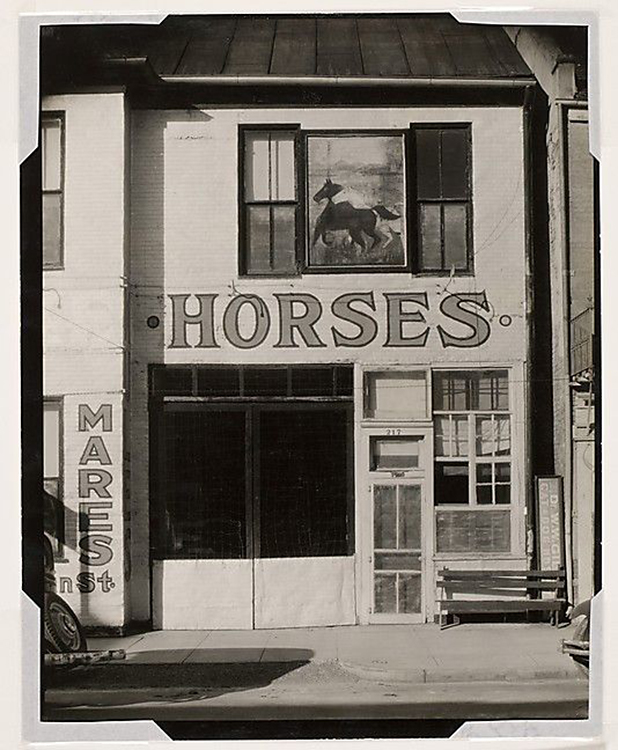
Walker Evans (American, 1903-1975) Stable, Natchez, Mississippi March 1935 Gelatin silver print 10 x 8 in. (25.4 x 20.3cm) The Metropolitan Museum of Art, New York, Gilman Collection, Purchase, The Horace W. Goldsmith Foundation Gift through Joyce and Robert Menschel, 2005
Unknown artist (American) Future New York, The City of Skyscrapers 1910s Postcard, Photomechanical reproduction 3 9/16 x 5 1/2 in. (9 x 14cm) The Metropolitan Museum of Art, New York, Walker Evans Archive, 1994
Unknown artist (American) Woolworth and Municipal Buildings from Brooklyn Bridge, New York 1910s Postcard, Photomechanical reproduction 3 9/16 x 5 1/2 in. (9 x 14cm) The Metropolitan Museum of Art, New York, Walker Evans Archive, 1994
Unknown artist (American) Curve at Brooklyn Terminal, Brooklyn Bridge, New York 1907 Postcard, Photomechanical reproduction 3 9/16 x 5 1/2 in. (9 x 14cm) The Metropolitan Museum of Art, New York, Walker Evans Archive, 1994
Unknown artist (American) Empire State Building, New York 1930s Postcard, Photomechanical reproduction 3 9/16 x 5 1/2 in. (9 x 14cm) The Metropolitan Museum of Art, New York, Walker Evans Archive, 1994
The Metropolitan Museum of Art 1000 Fifth Avenue at 82nd Street New York, New York 10028-0198 Phone: 212-535-7710
Opening hours: Sunday – Tuesday and Thursday: 10am – 5pm Friday and Saturday: 10am – 9pm Closed Wednesday
Exhibition dates: National Gallery of Art, January 18 – April 26, 2009; San Francisco Museum of Modern Art, May 16 – August 23, 2009; Metropolitan Museum of Art, September 22 – December 27, 2009
Curator: Sarah Greenough, senior curator and head of the Department of Photographs at the National Gallery of Art
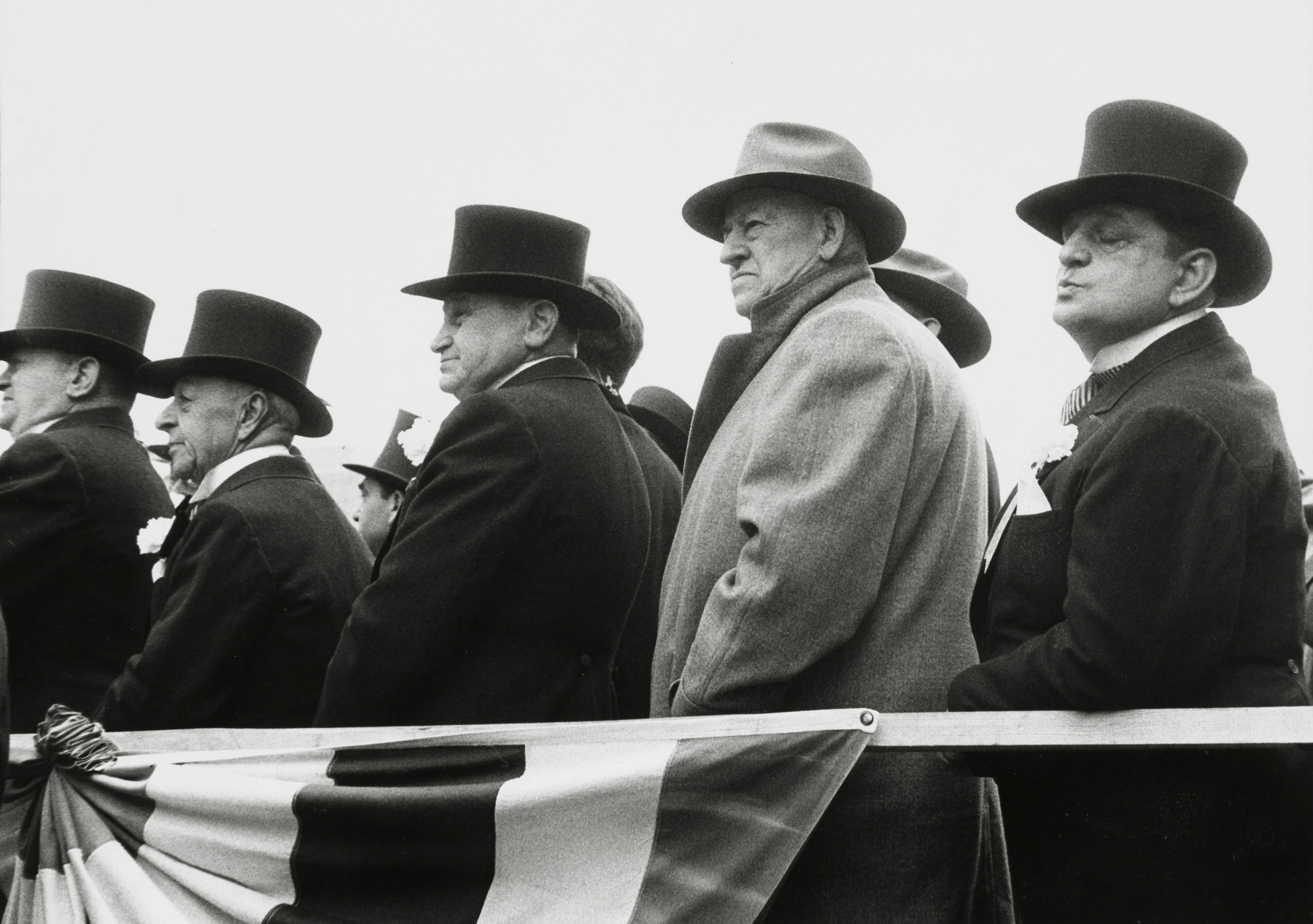
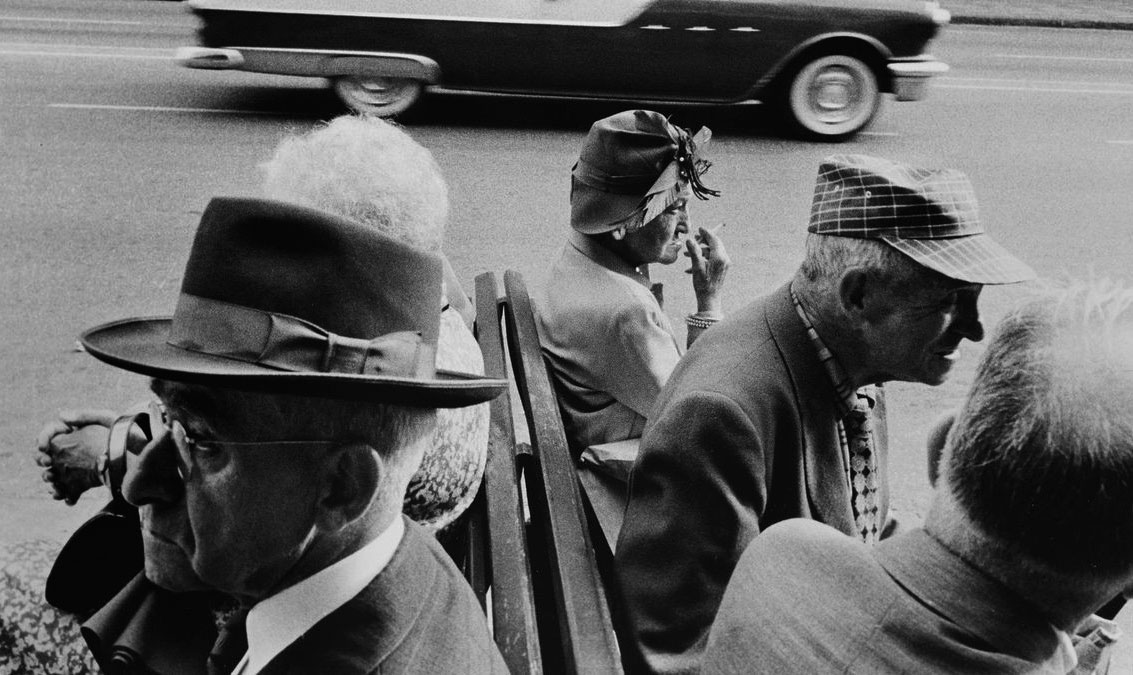
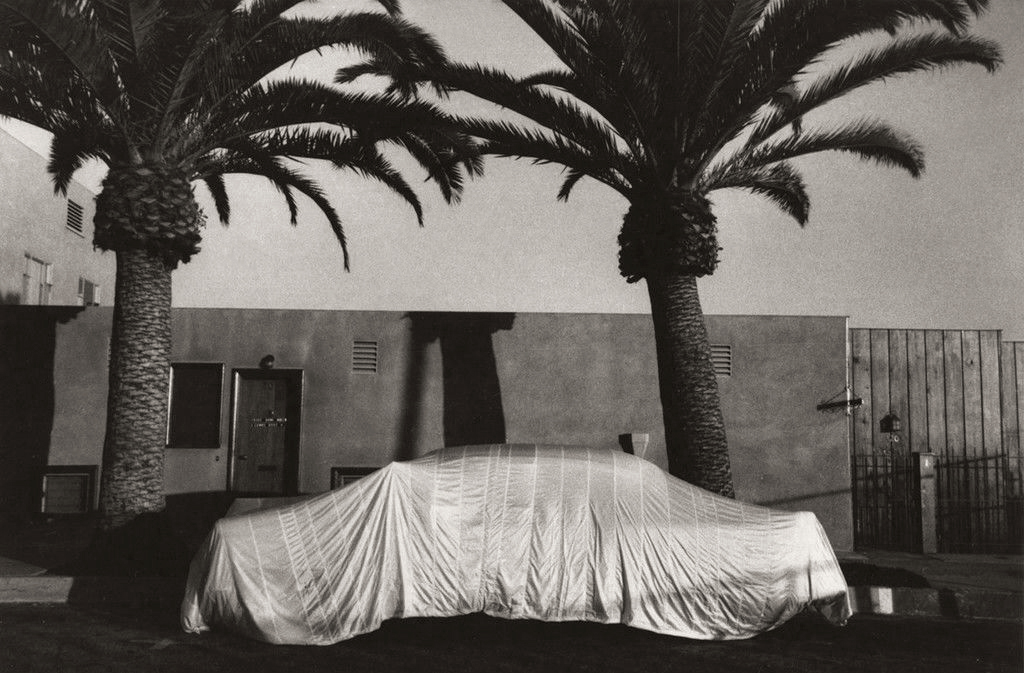
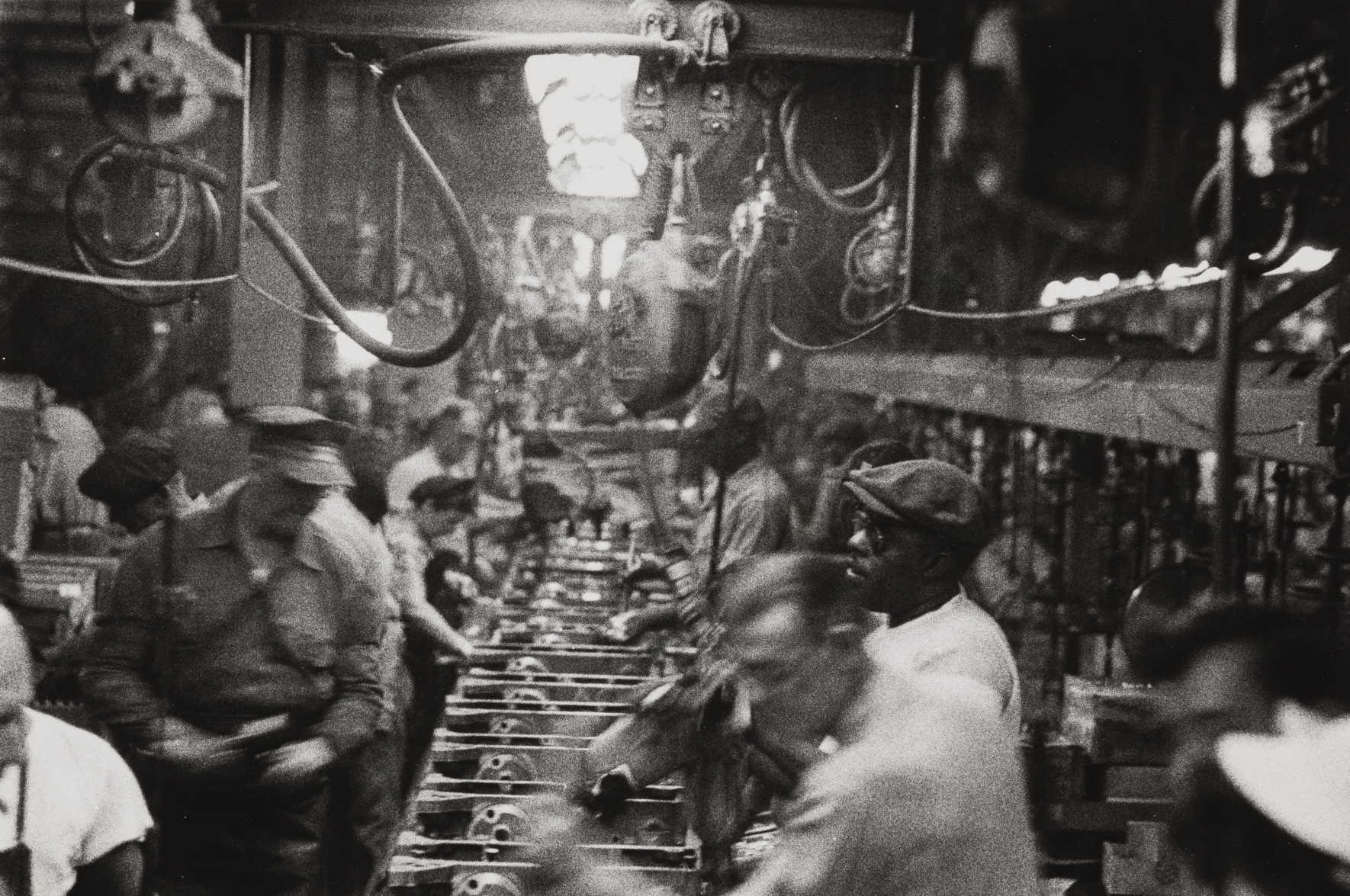
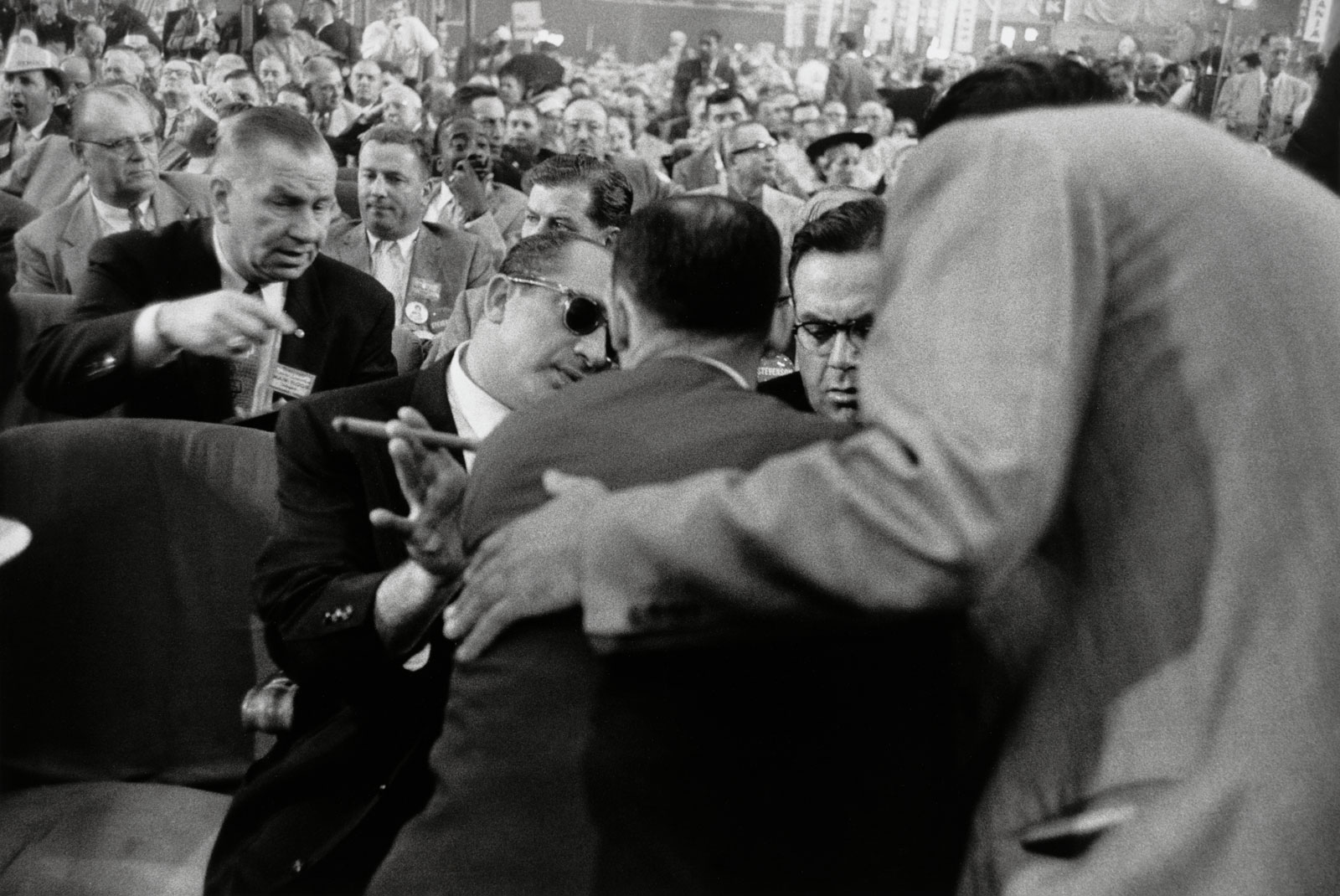
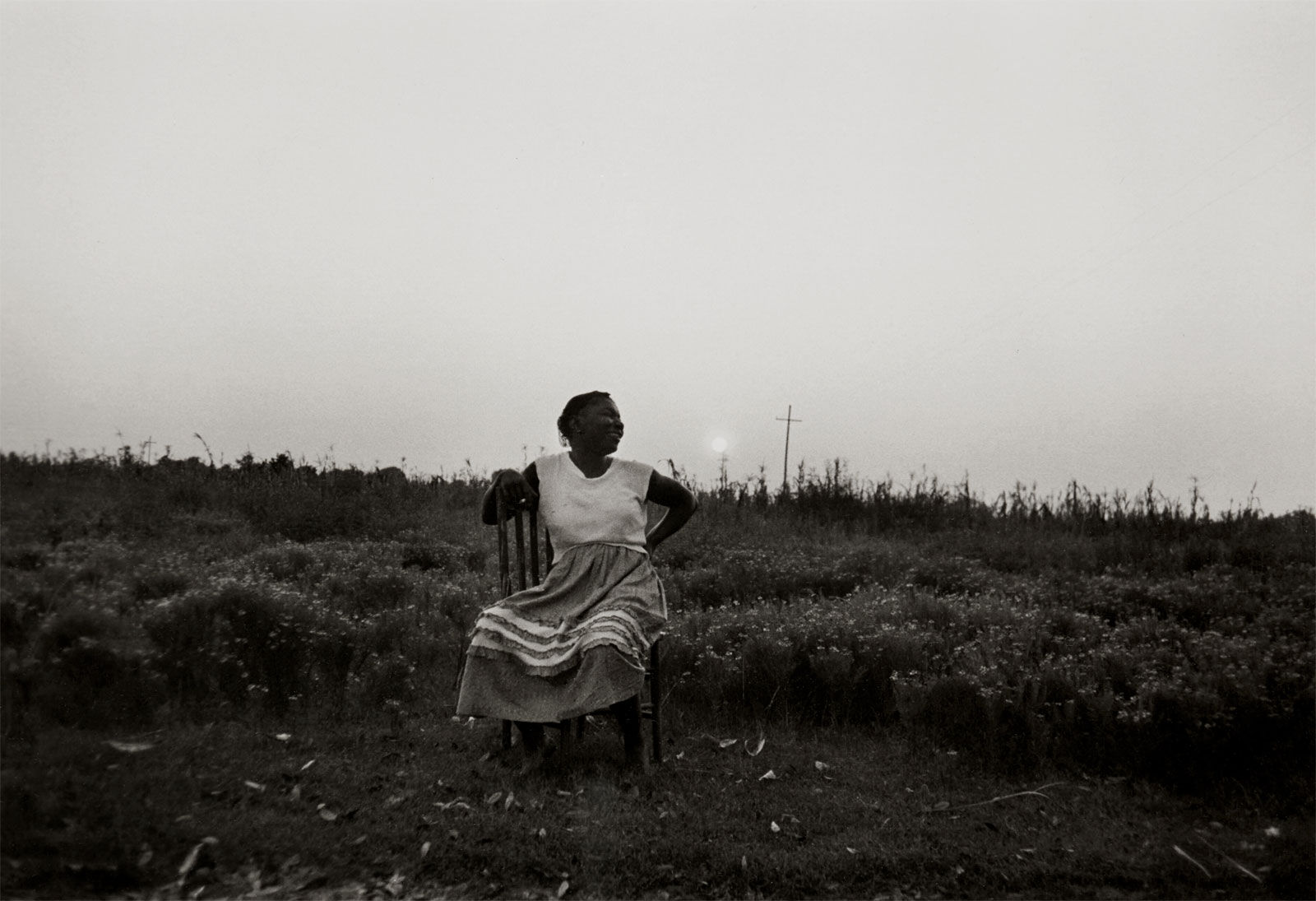
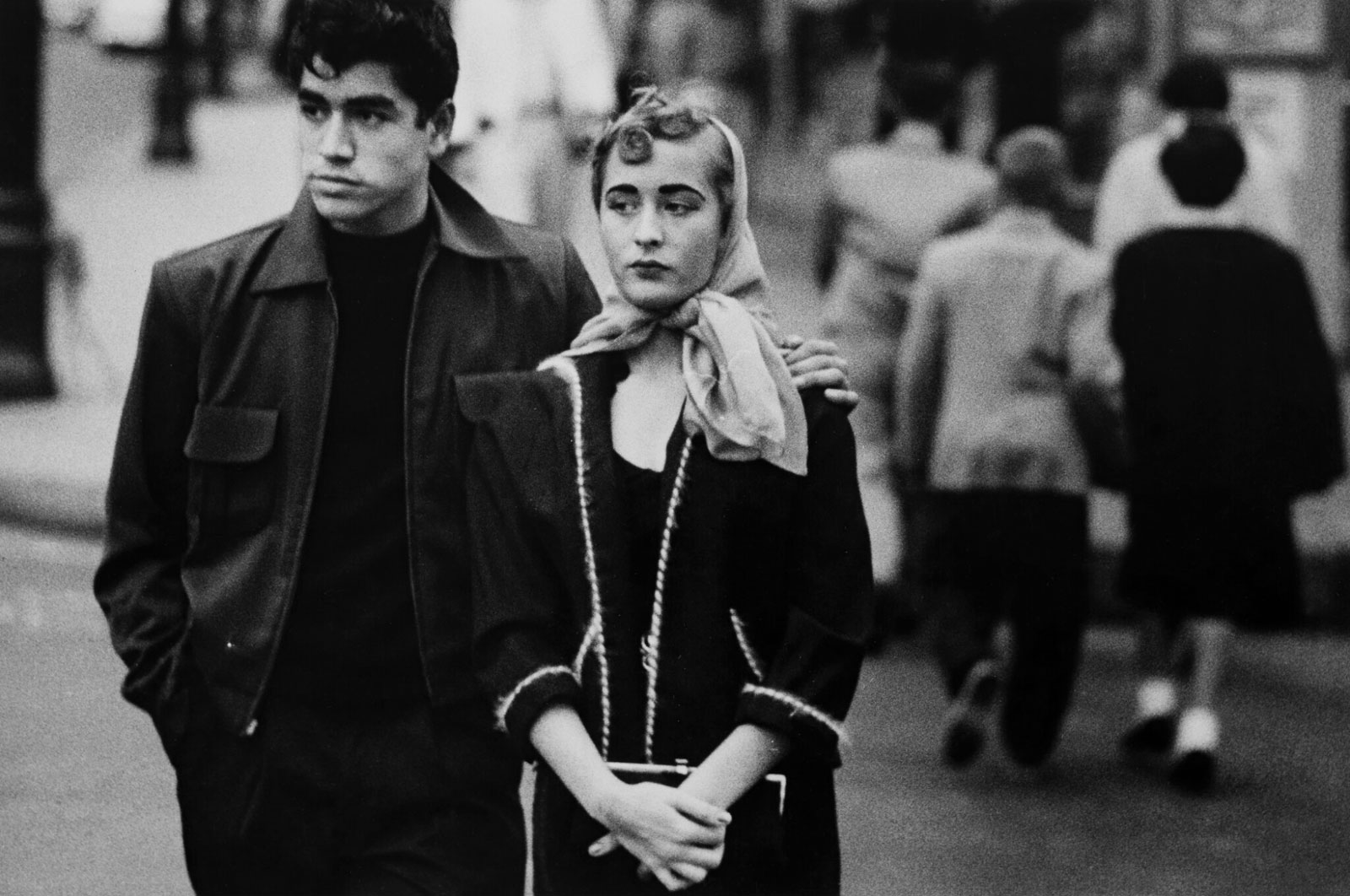
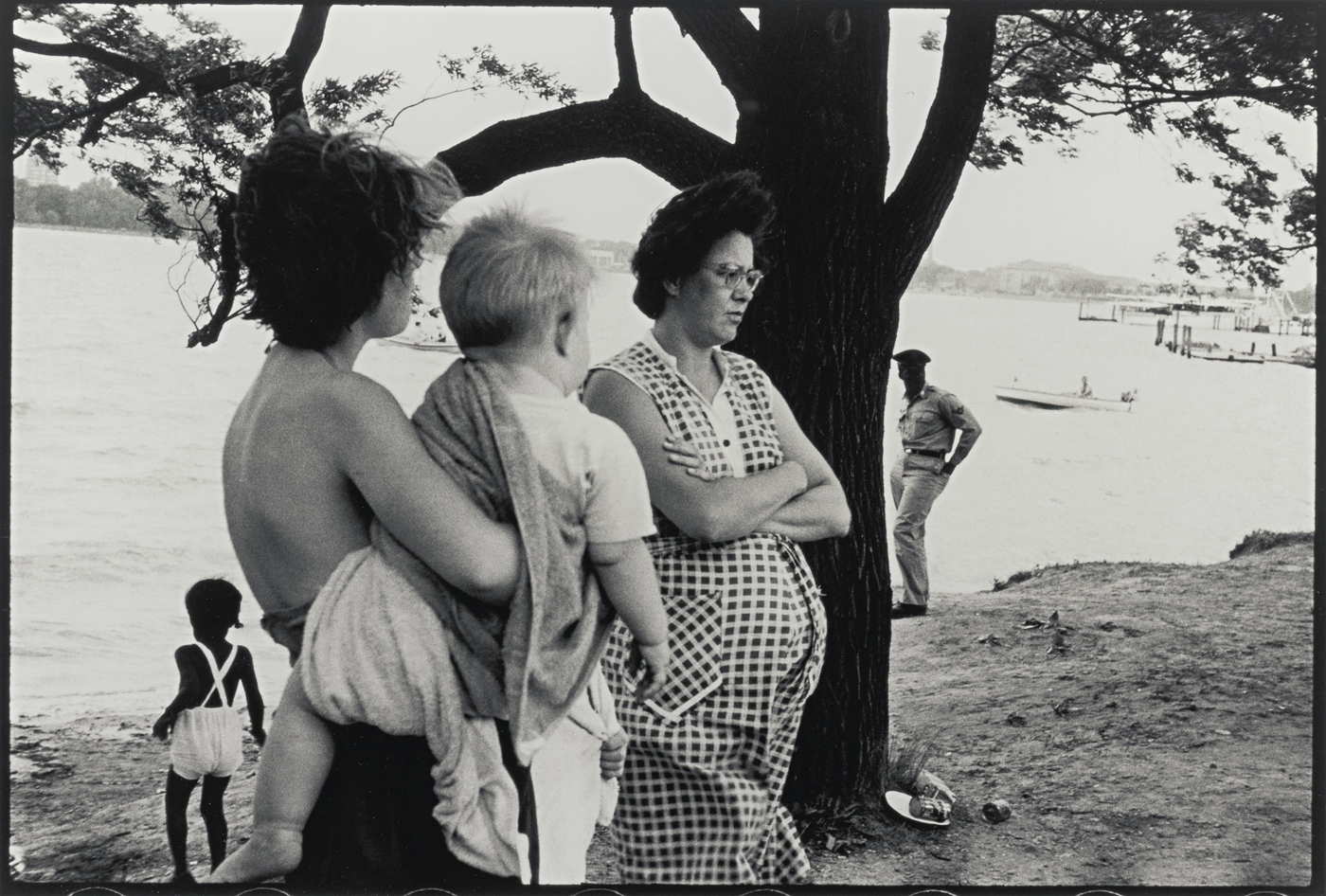
Robert Frank (Swiss-American, 1924-2019) The Americans New York: Grove Press 1959
One of the seminal photography books of the twentieth century, Robert Frank’s The Americans changed photography forever, changed how America saw itself and became a cult classic.
Like Eugene Atget’s positioning of the camera in an earlier generation Frank’s use of camera position is unique; his grainy and contrasty images add to his outsider vision of a bleak America; his sequencing of the images, like the cadences of the greatest music, masterful.
One of the easiest things for an artist to do is to create one memorable image, perhaps even a group of 4 or 5 images that ‘hang’ together – but to create a narrative of 83 images that radically alter the landscape of both photography and country is, undoubtedly, a magnificent achievement.
The photographs in the posting appear by number order that they appear in the book.
Dr Marcus Bunyan
Many thankx to the National Gallery of Art for allowing me to publish the photographs in the posting. Please click on the photographs for a larger version of the image.
Released at the height of the Cold War, The Americans was initially reviled, even decried as anti-American. Yet during the 1960s, many of the issues that Frank had addressed – racism, dissatisfaction with political leaders, skepticism about a rising consumer culture – erupted into the collective consciousness. The book came to be regarded as both prescient and revolutionary and soon was embraced with a cult-like following.
First published in France in 1958 and in the United States in 1959, Robert Frank’s The Americans is widely celebrated as the most important photography book since World War II. Including 83 photographs made largely in 1955 and 1956 while Frank (1924-2019) travelled around the United States, the book looked beneath the surface of American life to reveal a profound sense of alienation, angst, and loneliness. With these prophetic photographs, Frank redefined the icons of America, noting that cars, jukeboxes, gas stations, diners, and even the road itself were telling symbols of contemporary life. Frank’s style – seemingly loose, casual compositions, with often rough, blurred, out-of-focus foregrounds and tilted horizons – was just as controversial and influential as his subject matter. The exhibition celebrates the 50th anniversary of the book’s publication by presenting all 83 photographs from The Americans in the order established by the book, and by providing a detailed examination of the book’s roots in Frank’s earlier work, its construction, and its impact on his later art.
Anonymous text from The National Gallery of Art website [Online] Cited 06/03/2009. No longer available online. Used under fair use conditions for the purposes of education and research
“The photos revealed a bleaker, more dislocated view of America than Americans were used to (at least in photography). Frank’s “in-between moments” demonstrated that disequilibrium can seem more revealing, seeming to catch reality off-guard. In doing so the collection also announced to the world that photos with a completely objective reference / referent could be subjective, lyrical, and reveal a state of mind. Looser framing, more forced or odd juxtapositions, “drive-by” photos and other elements offer a sense of the process that has produced the photos”
Lloyd Spencer on Discussing The Americans in Hardcore Street Photography
“Frank’s contact sheets take us back to the moment he made the photographs for The Americans. They show us what he saw as he travelled around The United States and how he responded to it. These sheets are not carefully crafted objects; in his eagerness to see what he had captured, Frank did not bother to order his film strips numerically or even to orientate them all in the same direction.”
The 50th anniversary of a groundbreaking publication will be celebrated in the nation’s capital with the exhibition Looking In: Robert Frank’s The Americans, premiering January 18 through April 26, 2009, in the National Gallery of Art’s West Building ground floor galleries. In 1955 and 1956, the Swiss-born American photographer Robert Frank (b. 1924) traveled across the United States to photograph, as he wrote, “the kind of civilisation born here and spreading elsewhere.” The result of his journey was The Americans, a book that looked beneath the surface of American life to reveal a culture on the brink of massive social upheaval and one that changed the course of 20th-century photography.
First published in France in 1958 and in the United States in 1959, The Americans remains the single most important book of photographs published since World War II. The exhibition will examine both Frank’s process in creating the photographs and the book by presenting 150 photographs, including all of the images from The Americans, as well as 17 books, 15 manuscripts, and 28 contact sheets. In honour of the exhibition, Frank has created a film and participated in selecting and assembling three large collages. The exhibition will travel to the San Francisco Museum of Modern Art from May 17 through August 23, 2009, and The Metropolitan Museum of Art from September 22 through December 27, 2009.
“The Americans is as powerful and provocative today as it was 50 years ago,” said Earl A. Powell III, director, National Gallery of Art. “We are immensely grateful to Robert Frank and his wife, June Leaf, for their enthusiastic participation and assistance in all aspects of this exhibition and its equally ambitious catalogue. We also wish to thank Robert Frank for his donation of archival material related to The Americans, in addition to gifts of his photographs and other exhibition prints to the National Gallery of Art in 1990, 1994, and 1996, all of which formed the foundation of the project.”
“It’s hard to stress how different The Americans was. Over the course of those 83 pictures – shot from Detroit to San Francisco to Chattanooga, Tennessee – Frank captured the country in images that were intentionally unglamorous. On a technical level, he brazenly tossed out an adherence to traditional ideas of composition, framing, focus, and exposure.”
Sarah Greenough, Senior Curator of Photography at the National Gallery of Art in Washington
Co-curators: Andrea Nelson, assistant curator of photography at the National Gallery of Art, and Yuri Long of the National Gallery of Art Library
Looks a great exhibition for fans of photography books!
Many thankx to the National Gallery of Art, Washington for allowing me to publish the photographs in the posting. Please click on the photographs for a larger version of the image.
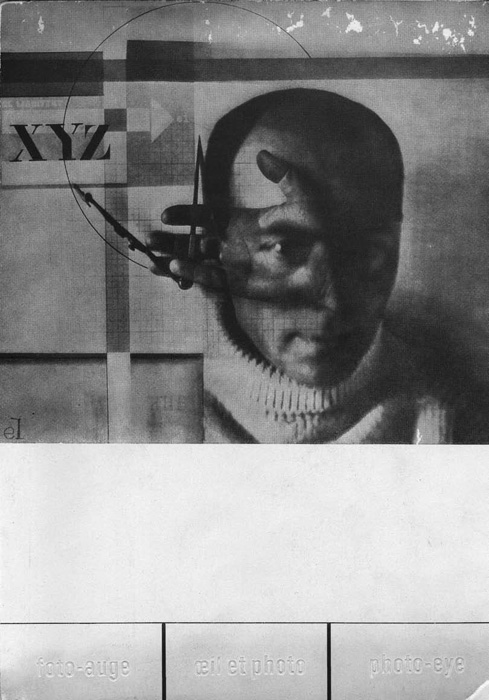
foto-auge (photo-eye) Edited and with an introduction by Franz Roh, cover design by Jan Tschichold (Stuttgart: Akademischer Verlag, Dr. Fritz Wedekind & Co., 1929)
“Also produced in conjunction with Film und Foto, this book showcases a wide variety of photographic practices as a way of examining the social importance of the medium’s ability to construct visual knowledge.”
Held in conjunction with Looking In: Robert Frank’s “The Americans,” this exhibition examines a variety of artistic and thematic approaches to the modern photography book, displaying examples that span the period from the late 1920s to the early 1970s. The photography book, more than simply a book containing photographs, is a publication composed by the careful sequencing and editing of photographic material. Often produced by a photographer, they present visual narratives through creative page design that frequently integrates photographs with text and graphic elements.
This focus exhibition organises 21 books from the Gallery’s library into four themes: “New Visions,” “Documented Realities,” “Postwar Scenes,” and “Conceptual Practices.” It highlights diverse projects from individual photographers such as László Moholy-Nagy, Henri Cartier-Bresson, and Yasuhiro Ishimoto as well as collaborative projects from the Hungarian Work Circle (Munka Kör) and Andy Warhol’s Factory, revealing that the photography book is both a significant conveyer of contemporary experience and a witness to historical events.
The modern photography book, more than simply a book containing photographs, is a publication composed by the careful sequencing and editing of photographic material. Often produced by a photographer, these books present visual narratives through creative page design that frequently integrates photographs with text and graphic elements. Popular across the political spectrum, photography books have been published both as art objects and as documentary records. Through their organisation they foster a critical examination of the visual world, and as works of historical witness they have helped to construct cultural memories. Photography books have been a primary format for the arrangement and display of photographs, making them a vital but commonly overlooked component of the history of photography. Today they continue to provide an important forum for photographers to convey their work to a wide public audience.
Photographs have appeared in book format since their inception. For example, William Henry Fox Talbot’s commercially published The Pencil of Nature (1844) was one of the earliest explorations of photography’s narrative capabilities. Like all early photography books, Talbot’s photographs were printed separately from the letterpress text. It was not until the 1880s, with the development of the halftone plate and printing process, that mass-produced newspapers, magazines, and books regularly featured photographs. This invention, which allowed type and photographic images to be mechanically reproduced on the same press, dramatically changed the means by which the general public viewed and had access to photographs. By the 1920s the number of photographically illustrated publications had increased exponentially, and photographs regularly recounted events without explanatory text. As people began to see more and more photographs on a daily basis, they became far more visually literate. Set within this context, the modern mass-produced photography book challenged not only traditional narrative structures but also popular habits of reading and seeing.
Text from the National Gallery of Art website [Online] Cited 06/03/2009. No longer available online. Used under fair use conditions for the purposes of education and research
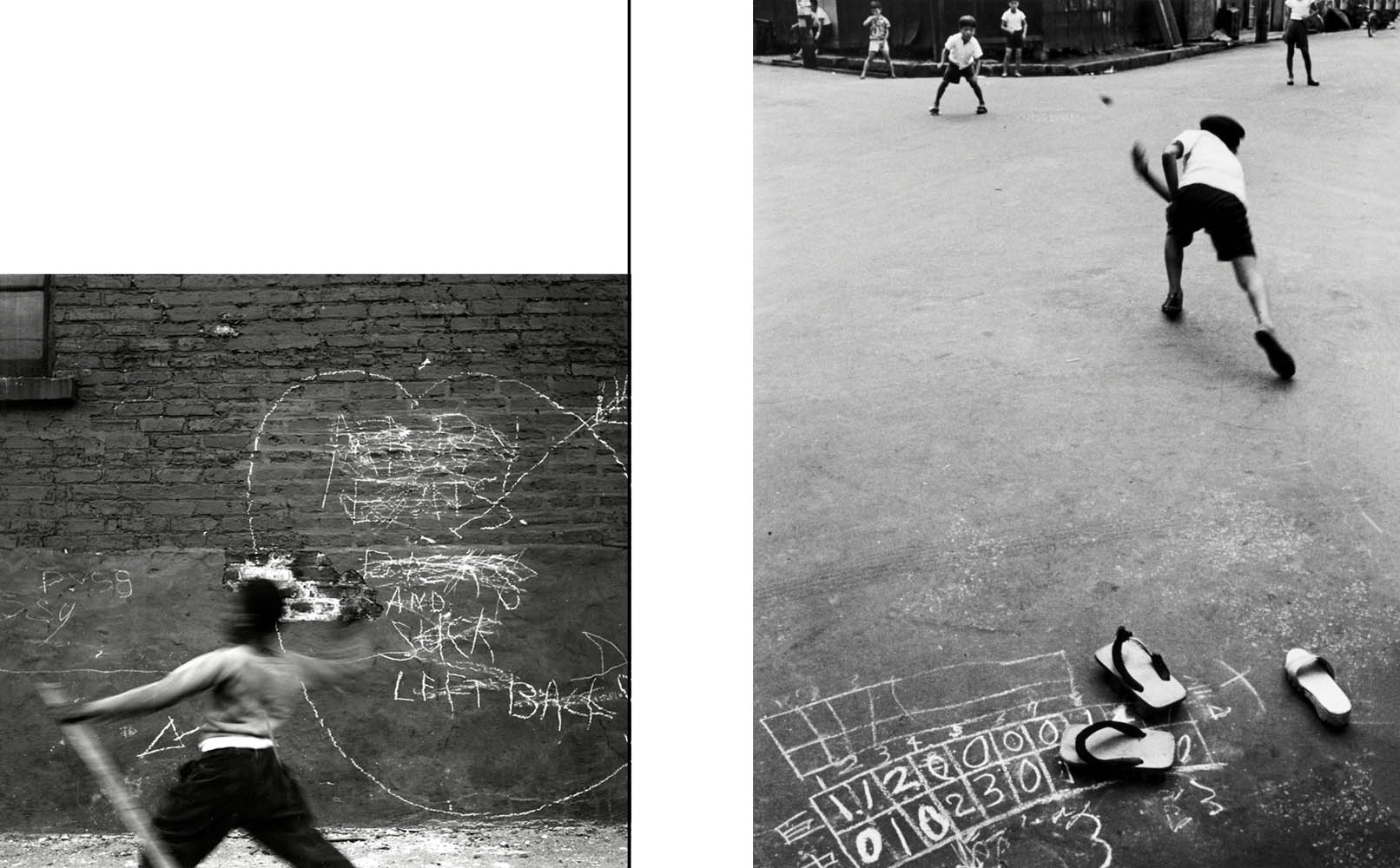
Yasuhiro Ishimoto (Japanese-American, 1921-2012) Aruhi Arutokoro (Someday, Somewhere) Preface by Tsutomu Watanabe, design by Ryuuichi Yamashiro (Tokyo: Geibi Shuppan, 1958)
“This engaging publication juxtaposes photographs taken by Ishimoto in Chicago and Tokyo. Born in the United States, Ishimoto spent his childhood in Japan and later returned to the U.S. to attend school at the Institute of Design in Chicago. Finally settling in Tokyo, he influenced a new generation of postwar Japanese photographers interested in producing books.”
Henri Cartier-Bresson (French, 1908-2004) The Decisive Moment (New York: Simon & Schuster, in collaboration with Éditions Verve, Paris, 1952)
“An important presentation of Cartier-Bresson’s photographs from the 1930s and 1940s, this large-format book helped to popularise his work, in which a distinctive documentary approach transforms ordinary moments into remarkable photographic visions.”
National Gallery of Art National Mall between 3rd and 7th Streets Constitution Avenue NW, Washington
Inge Morath (American born Austria, 1923-2002) From the series about Regensburg Museums 1999 Gelatin silver print
“To take pictures had become a necessity and I did not want to forgo it for anything.”
Inge Morath
The Magnum Foundation and the Inge Morath Foundation announce the sixth annual Inge Morath Award. The annual prize of $5,000 is awarded by the Magnum Foundation to a female documentary photographer under the age of 30, to support the completion of a long-term project. One award winner and up to two finalists are selected by a jury composed of Magnum photographers.
Inge Morath was an Austrian-born photographer who was associated with Magnum Photos for nearly fifty years. After her death in 2002, the Inge Morath Foundation was established to manage Morath’s estate and facilitate the study and appreciation of her contribution to photography.
Because Morath devoted much of her enthusiasm to encouraging women photographers, her colleagues at Magnum Photos established the Inge Morath Award in her honour. The Award is now given by the Magnum Foundation as part of its mission of supporting new generations of socially-conscious documentary photographers, and is administered by the Magnum Foundation in collaboration with the Inge Morath Foundation.
Past winners of the Inge Morath Award include: Kathryn Cook (US, ’08) for Memory Denied: Turkey and the Armenian Genocide; Olivia Arthur (UK, ’07) for The Middle Distance; Jessica Dimmock (US, ’06) for The Ninth Floor; Mimi Chakarova (US, ’06) for Sex Trafficking in Eastern Europe; Claudia Guadarrama (MX, ’05) for Before the Limit; and Ami Vitale (US, ’02), for Kashmir.
Text from The Inge Morath Foundation website [Online] Cited 01/03/2009. No longer available online
Inge Morath (American born Austria, 1923-2002) Visitor in the Metropolitan Museum 1958 Gelatin silver print
“I have photographed since 1952 and worked with Magnum Photos since 1953, first out of Paris, later out of New York. I am usually labeled as a photojournalist, as are all members of Magnum. I am quoting Henri Cartier-Bresson’s explanation for this: He wrote to John Szarkowski in answer to an essay in which Szarkowski stated that Cartier-Bresson labels himself as a photojournalist.
“May I tell you the reason for this label? As well as the name of its inventor? It was Robert Capa. When I had my first show in the Museum of Modern Art in New York in 1948 he warned me: ‘watch out what label they put on you. If you become known as a surrealist […] then you will be considered precious and confidential. Just go on doing what you want to do anyway but call yourself a photojournalist, which puts you into direct contact with everything that is going on in the world.'”
It is in this understanding that we have been working as a group and yet everyone following their own way of seeing. The power of photography resides no doubt partly in the tenacity with which it pushes whoever gets seriously involved with it to contribute in an immeasurable number of forms his own vision to enrich the sensibility and perception of the world around him.
[In the 1950s] the burden of the already photographed was considerably less than now. There was little of the feeling of being a latecomer who has to overwhelm the huge existing body of the photographic oeuvre – which, in photography as in painting and literature, necessarily leads first to the adoption and then rejection of an elected model, until one’s own work is felt to be equal or superior, consequently original.
Photography is a strange phenomenon. In spite of the use of that technical instrument, the camera, no two photographers, even if they were at the same place at the same time, come back with the same pictures. The personal vision is usually there from the beginning; result of a special chemistry of background and feelings, traditions and their rejection, of sensibility and voyeurism. You trust your eye and you cannot help but bare your soul. One’s vision finds of necessity the form suitable to express it.”
Inge Morath, Life as a Photographer, 1999
Text from The Inge Morath Foundation website [Online] Cited 01/03/2009. No longer available online. Used under fair use conditions for the purposes of education and research
Curator: Craig Richards, photography curator at the Whyte Museum of the Canadian Rockies
Edward Burtynsky (Canadian, b. 1955) Silver Lake Operations #1, Lake Lefroy, Western Australia 2007 2007
One of the great photographers of the world.
Enjoy some of his images and for more photographs please visit his website.
Many thankx to The Whyte Museum of the Canadian Rockies for allowing me to publish the photographs in the posting. Please click on the photographs for a larger version of the image.
Edward Burtynsky (Canadian, b. 1955) Tanggu Port, Tianjin, China 2005 2005
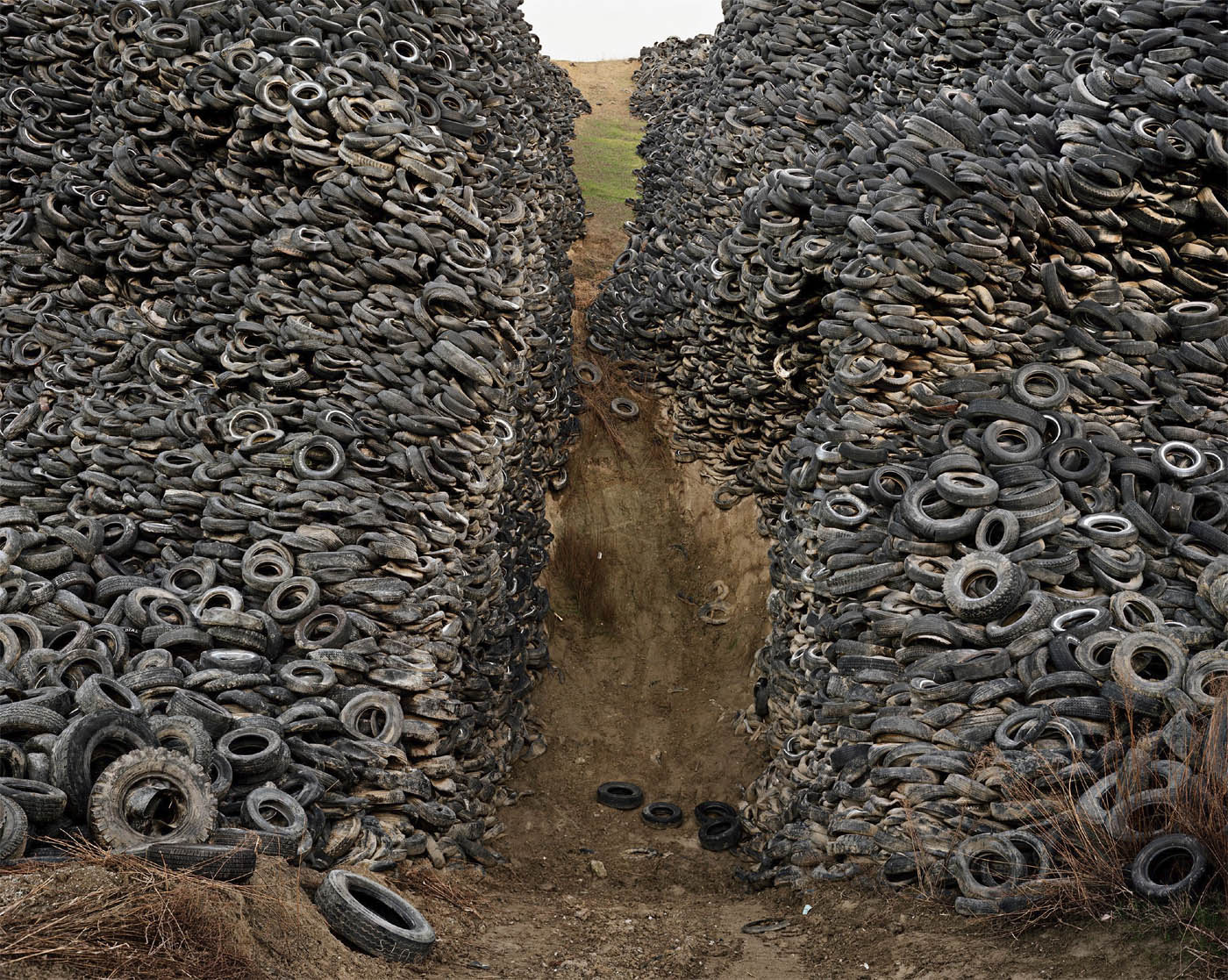
Nature transformed through industry is a predominant theme in my work. I set course to intersect with a contemporary view of the great ages of man; from stone, to minerals, oil, transportation, silicon, and so on. To make these ideas visible I search for subjects that are rich in detail and scale yet open in their meaning. Recycling yards, mine tailings, quarries and refineries are all places that are outside of our normal experience, yet we partake of their output on a daily basis.
These images are meant as metaphors to the dilemma of our modern existence; they search for a dialogue between attraction and repulsion, seduction and fear. We are drawn by desire – a chance at good living, yet we are consciously or unconsciously aware that the world is suffering for our success. Our dependence on nature to provide the materials for our consumption and our concern for the health of our planet sets us into an uneasy contradiction. For me, these images function as reflecting pools of our times.
Edward Burtynsky quoted on The Whyte Museum website
Edward Burtynsky (Canadian, b. 1955) Oxford Tire Pile #8, Westley, California 1999 1999
Edward Burtynsky (Canadian, b. 1955) Nickel Tailings #30, Sudbury, Ontario, 1996 1996
Edward Burtynsky (Canadian, b. 1955) Nickel Tailings #31, Sudbury, Ontario 1996 1996
Edward Burtynsky (Canadian, b. 1955) Feng Jie #4, Three Gorges Dam Project, Yangtze River, 2002 2002
“These images are meant as metaphors to the dilemma of our modern existence; they search for a dialogue between attraction and repulsion, seduction and fear,” said Edward Burtynsky, photographer. “We are drawn by desire – a chance at good living, yet we are consciously or unconsciously aware that the world is suffering for our success. Our dependence on nature to provide the materials for our consumption and our concern for the health of our planet sets us into an uneasy contradiction. For me, these images function as reflecting pools of our times.
Speaking of his “Quarries” series, Burtynsky has said, “The concept of the landscape as architecture has become, for me, an act of imagination. I remember looking at buildings made of stone, and thinking, there has to be an interesting landscape somewhere out there, because these stones had to have been taken out of the quarry one block at a time. I had never seen a dimensional quarry, but I envisioned an inverted cubed architecture on the side of a hill. I went in search of it, and when I had it on my ground glass I knew that I had arrived.”
Text from The Whyte Museum of the Canadian Rockies
Edward Burtynsky (Canadian, b. 1955) Shipbreaking #1, Chittagong, Bangladesh, 2000 2000
Edward Burtynsky (Canadian, b. 1955) Bao Steel #2, Shanghai, China, 2005 2005
Edward Burtynsky (Canadian, b. 1955) Iberia Quarries #3, Bencatel, Portugal, 2006 2006
Edward Burtynsky (Canadian, b. 1955) China Quarries #8, Xiamen, Fujian Province, 2004 2004
Edward Burtynsky (Canadian, b. 1955) Dam #6, Three Gorges Dam Project, Yangtze River, 2005 2005
Trailer for the film Manufactured Landscapes in which Jennifer Baichwal documents Edward Burtynsky doing what artists do – making art, in this case photographing Bangladesh and China as he observes the “manufacturer to the world”.
Edward Burtynsky Manufactured Landscapes
The Whyte Museum of the Canadian Rockies 111 Bear Street, Banff, Alberta T1L 1A3 Canada Phone: 1 403 762 2291
































You must be logged in to post a comment.