Many thankx to the Anne & Gordon Samstag Museum of Art for allowing me to publish the photographs in the posting. Please click on the photographs for a larger version of the image.
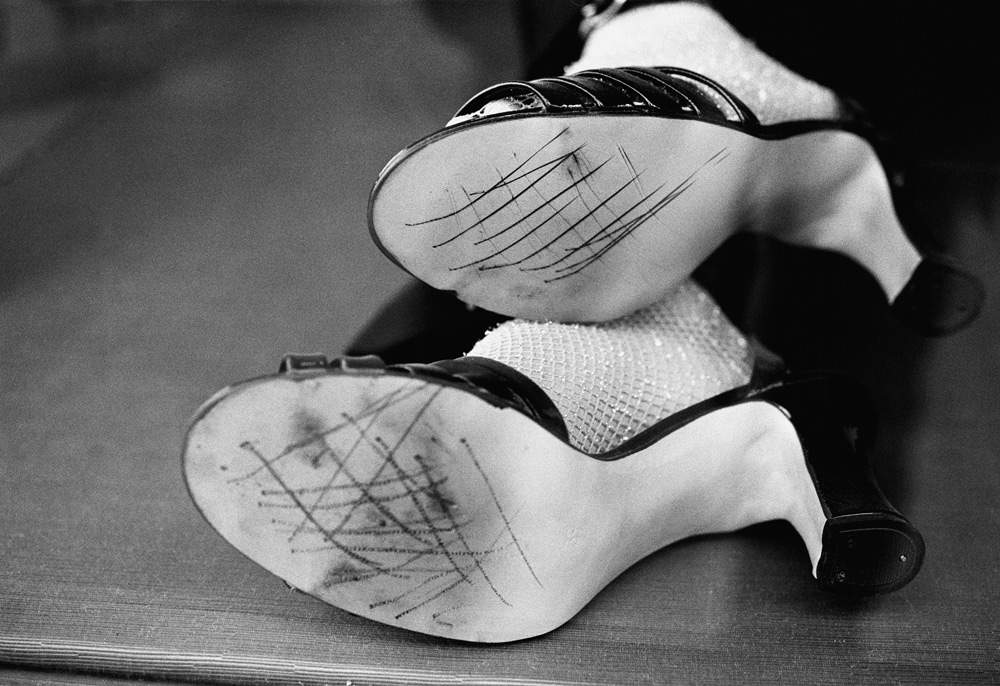
Olaf Unverzart (German, b. 1972) Untitled (from the series Fallen Kann Ich Auch Alleine)
1999
Pigment print
56 x 38cm/125 x 85cm
Courtesy of Oechsner Galerie
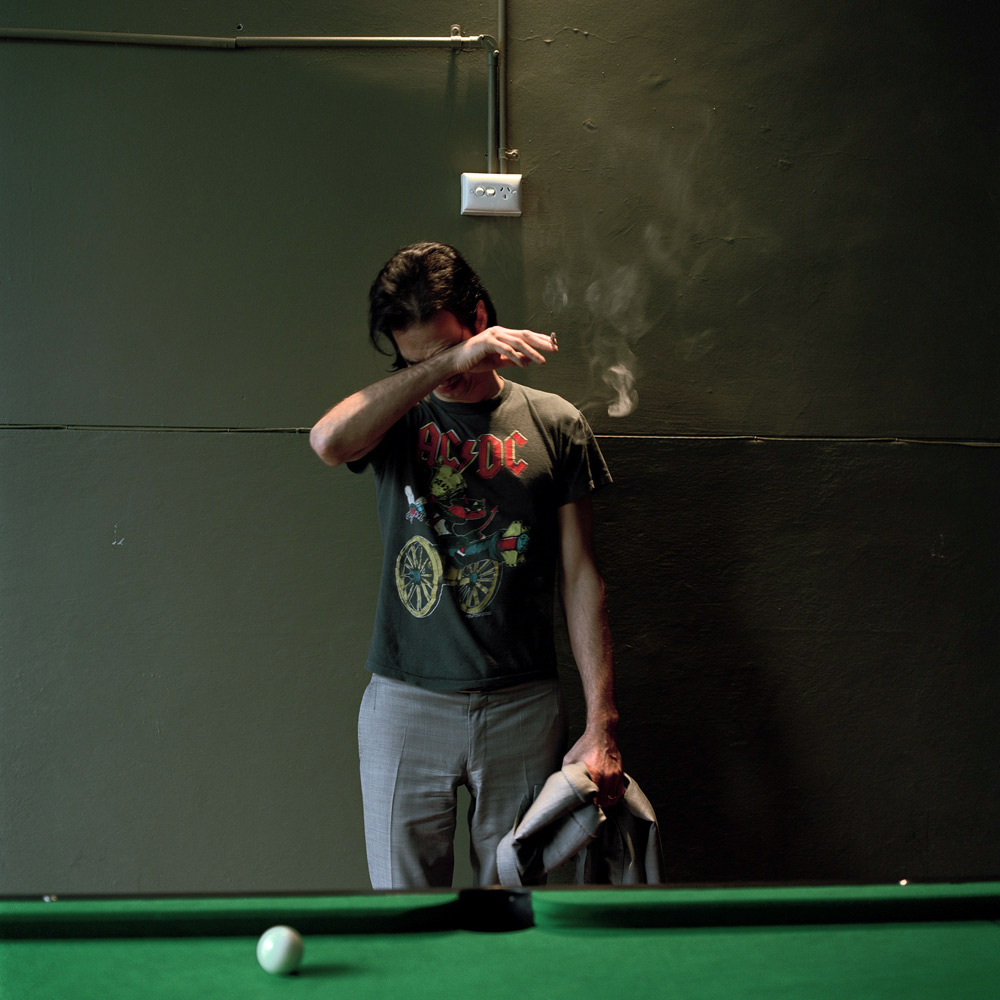
Ingvar Kenne (Australian born Sweden, b. 1965) Nick Cave 2001
From the series Citizen 1997-2012
C-type print
100 x 100cm
Courtesy of the artist
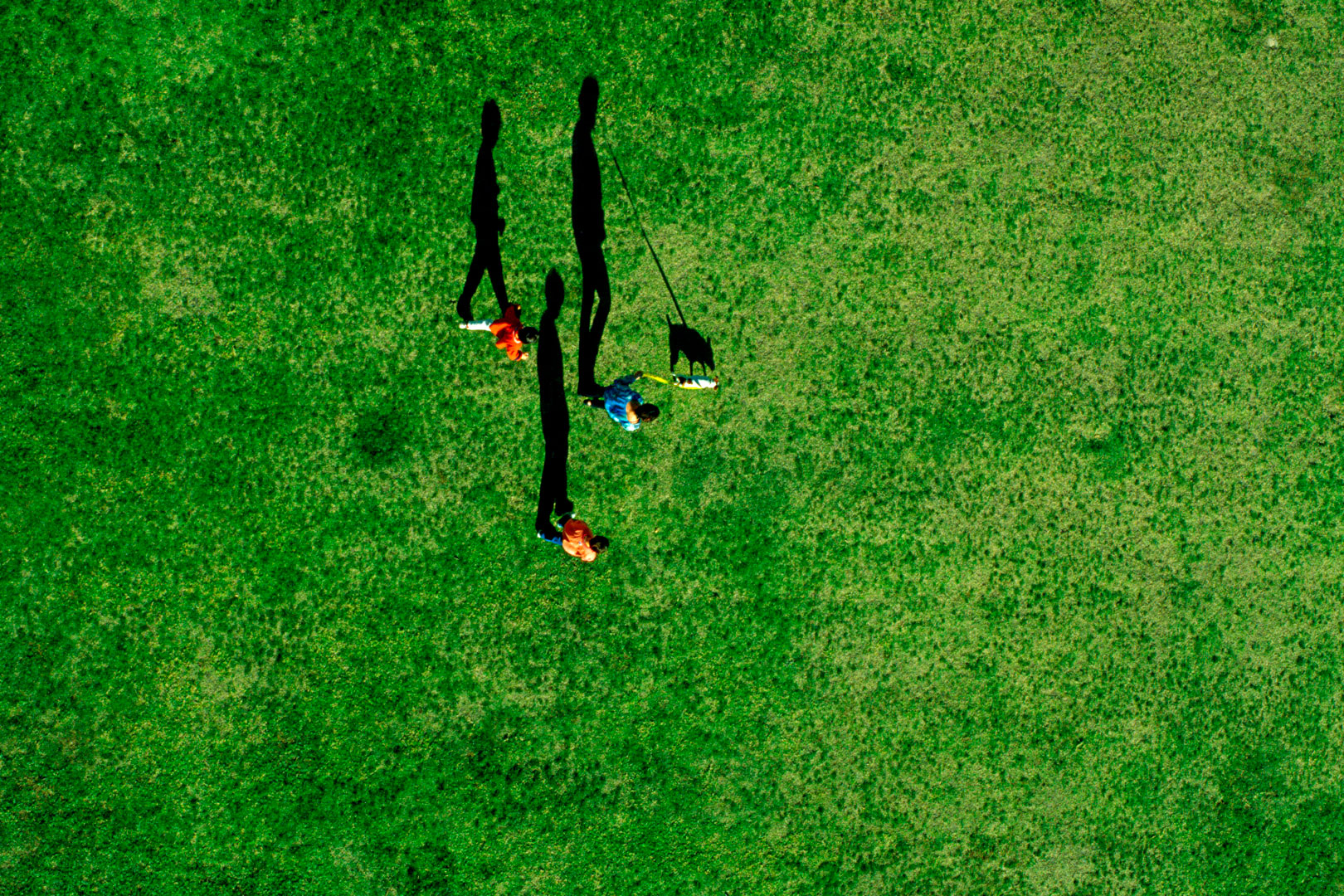
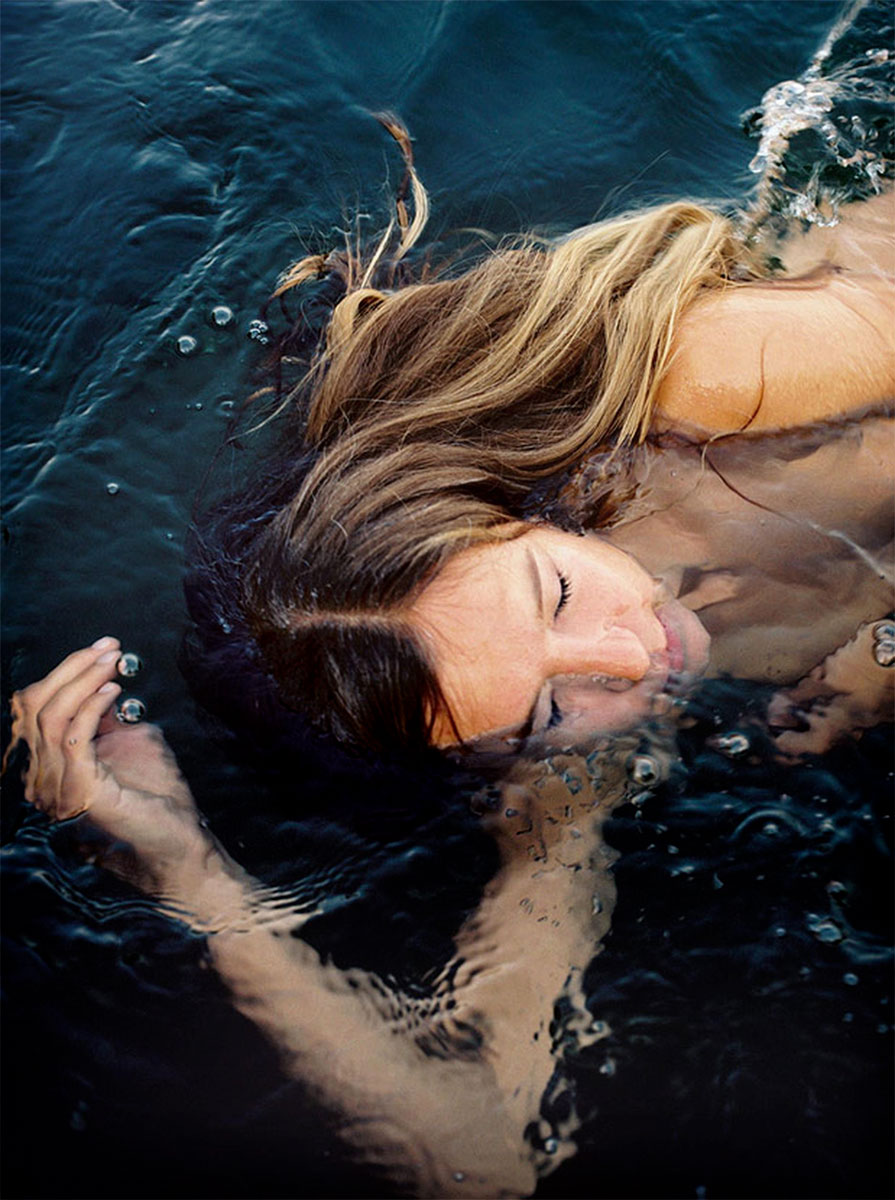
Narelle Autio (Australian, b. 1969) Untitled 8 (from the series Not of This Earth) 2001
Courtesy of the artist
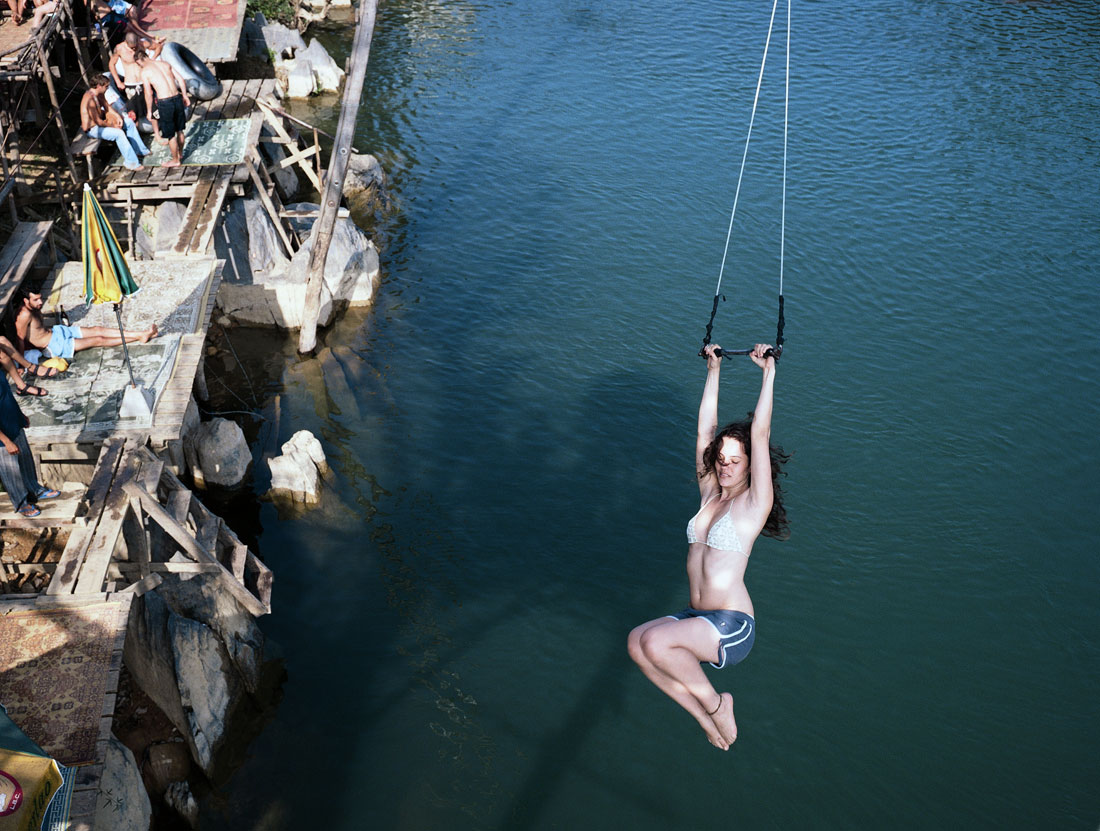
Jörg Brüggemann (German, b. 1979) Nam Song River, Vang Vieng, Laos, December 2007 2007
C-type print
69 x 57cm
Courtesy of the artist and Ostkreuz
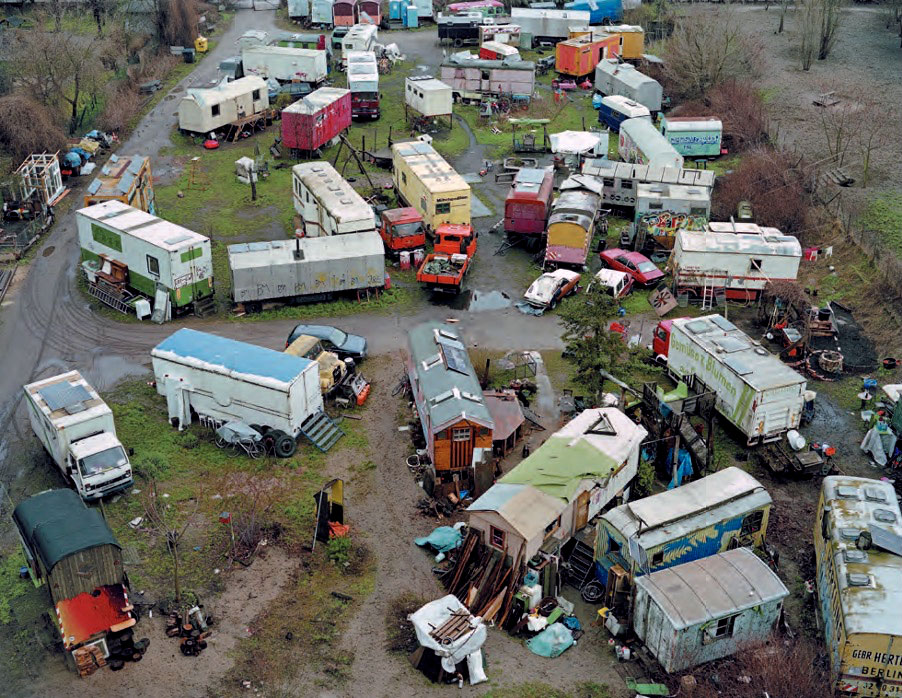
Johanna Ahlert (German, b. 1980) Truck and Trailer Castle, Berlin
2008
From the series CONVOI 2008
C-type print
100 x 127cm
Courtesy of the artist
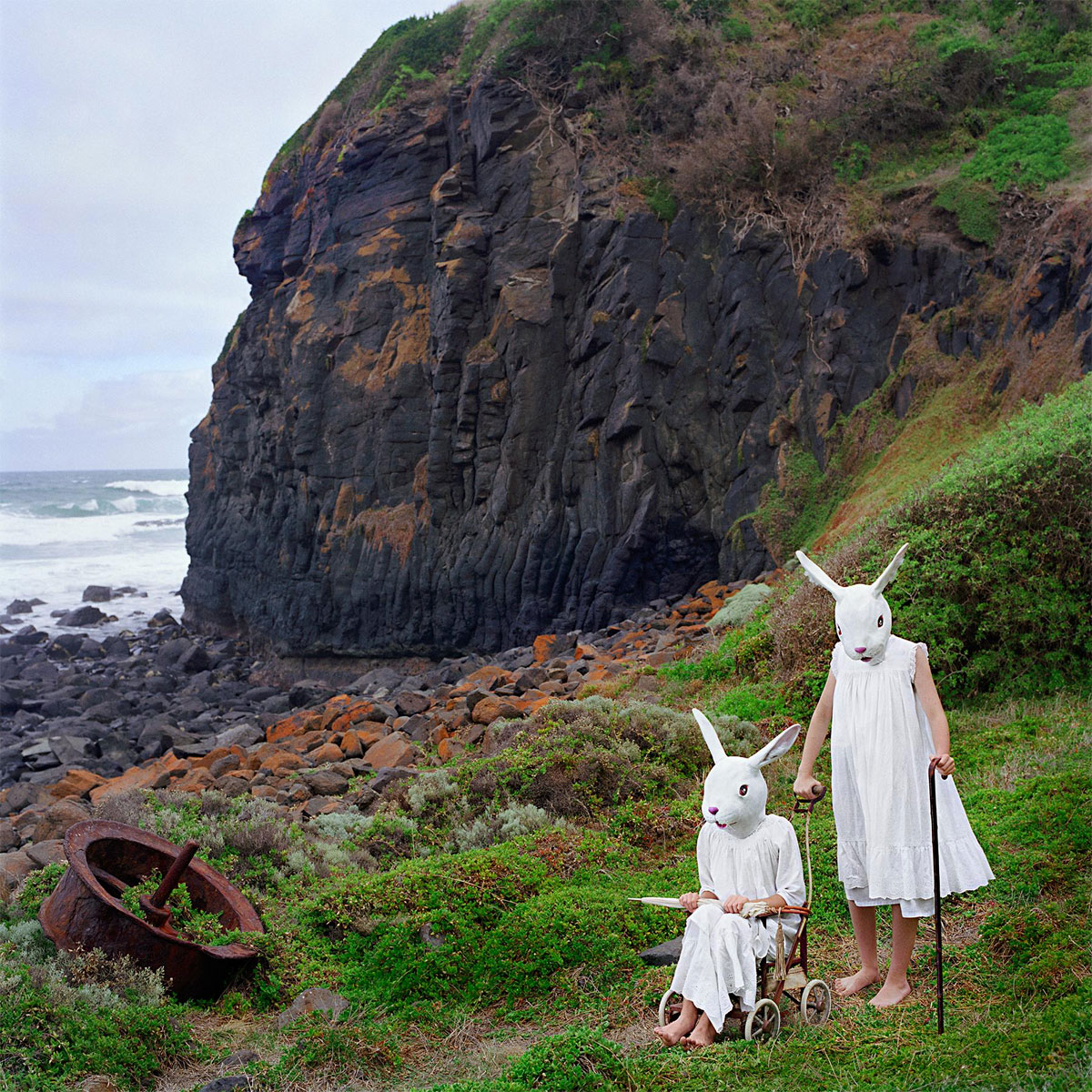
Polixeni Papapetrou (Australian, 1960-2018) The loners
2009
From the series Between worlds
Pigment ink-jet print
105 x 105cm
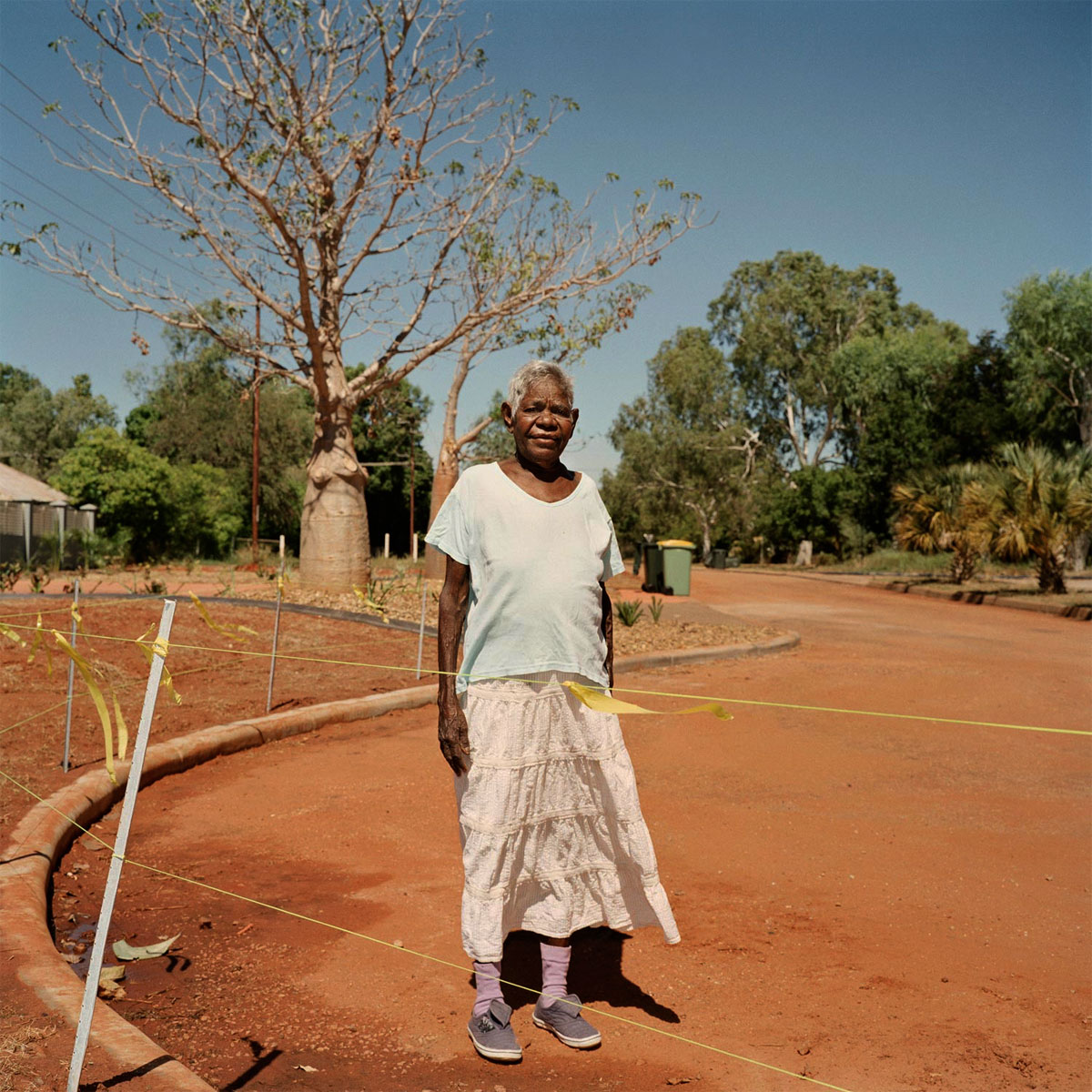
Ingvar Kenne (Australian born Sweden, b. 1965) Mona Chuguna, Author, Broome, Australia
2009
From the series Citizen 1997-2012 C-type print
100 x 100cm
Courtesy of the artist
Hijacked 2: Australia/Germany builds on the very considerable success of the inaugural exhibition, Hijacked 1 – Australia and America, and its internationally celebrated and hugely successful book. This new exhibition effectively considers two socially disparate nations, Germany and Australia, through an expansive photographic anthology of fascinating works, juxtaposed to suggest connections.
Hijacked 2 has been curated by Mark McPherson and Ute Noll and showcases the diverse talents and perspectives of thirty contemporary German and Australian photographers. With a focus on the depiction of the young, the boundary-riding, and the fringe-dwelling, Hijacked 2 is evocative, confronting, dreamlike and rousing.
Featured artists from Australia are: Narelle Autio, James Brickwood, Michael Corridore, Andrew Cowen, Tamara Dean, Suzie Fox, Lee Grant, Derek Henderson, Rebecca Ann Hobbs, Ingvar Kenne, Bronek Kózka, Georgia Metaxas, Polixeni Papapetrou and Louis Porter.
From Germany the artists are: Johanna Ahlert, Natalie Bothur, Jörg Brüggemann, Thekla Ehling, Albrecht Fuchs, Jan von Holleben, Karsten Kronas, Anne Lass, Jens Liebchen, Myriam Lutz, Julian Röder, Josef Schulz, Oliver Sieber, Ivonne Thein, Olaf Unverzart and Sascha Weidner.
Hijacked 2: Australia/Germany is toured by the Australian Centre for Photography. A substantial 412-page publication accompanies the exhibition with texts by Uta Daur, Bec Dean, Alasdair Foster, Bill Kouwenhoven, Katja Melzer, Daniel Palmer and Katrina Schwarz.
Text from the Anne & Gordon Samstag Museum of Art website
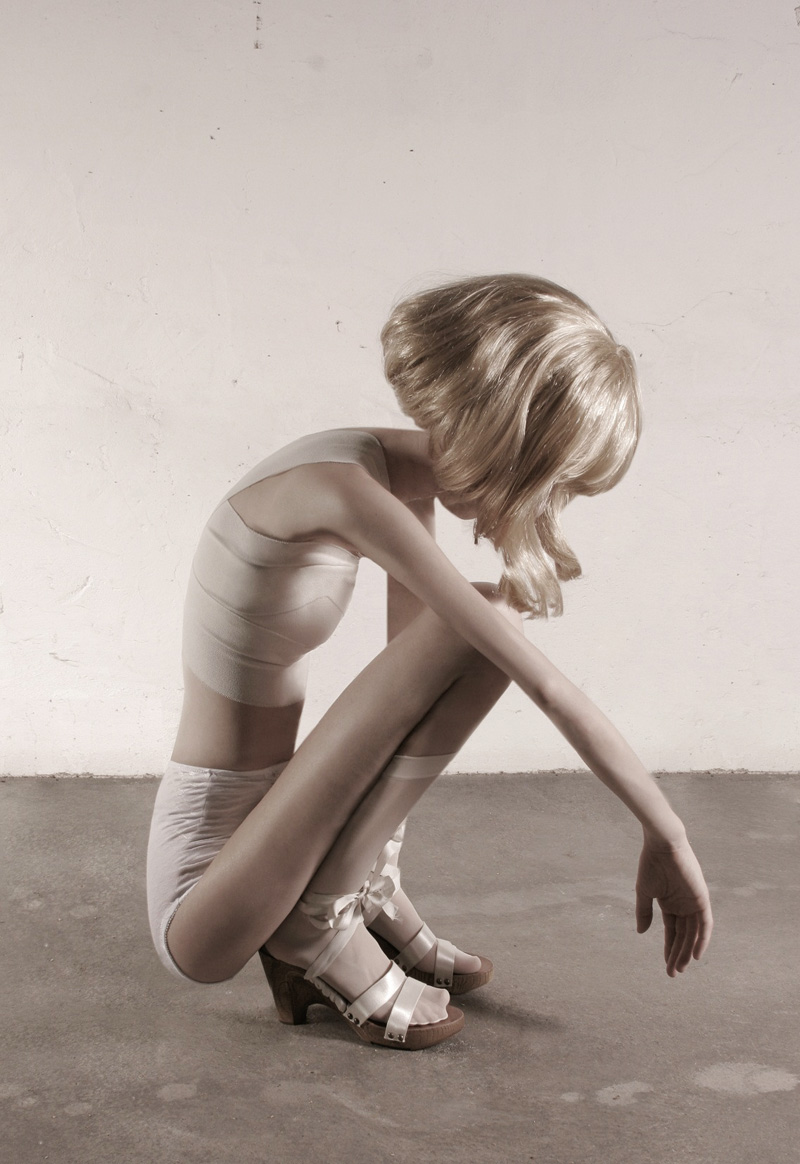
Ivon Thein (German, b. 1979) Untitled 07 (from the series Thirty-Two Kilos) 2006
C-type print
55 x 80cm
Courtesy of Galerie Voss
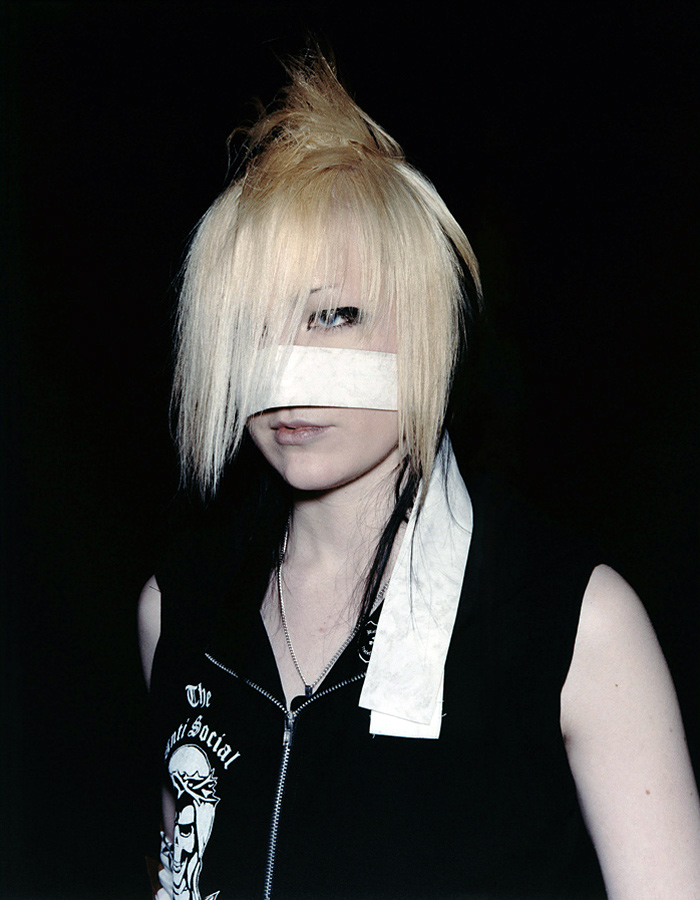
Oliver Sieber (German, b. 1966) Reita, Köln, 2007
2007
Pigment print
34 x 27cm
Courtesy Galerie Priska Pasquer, Germany
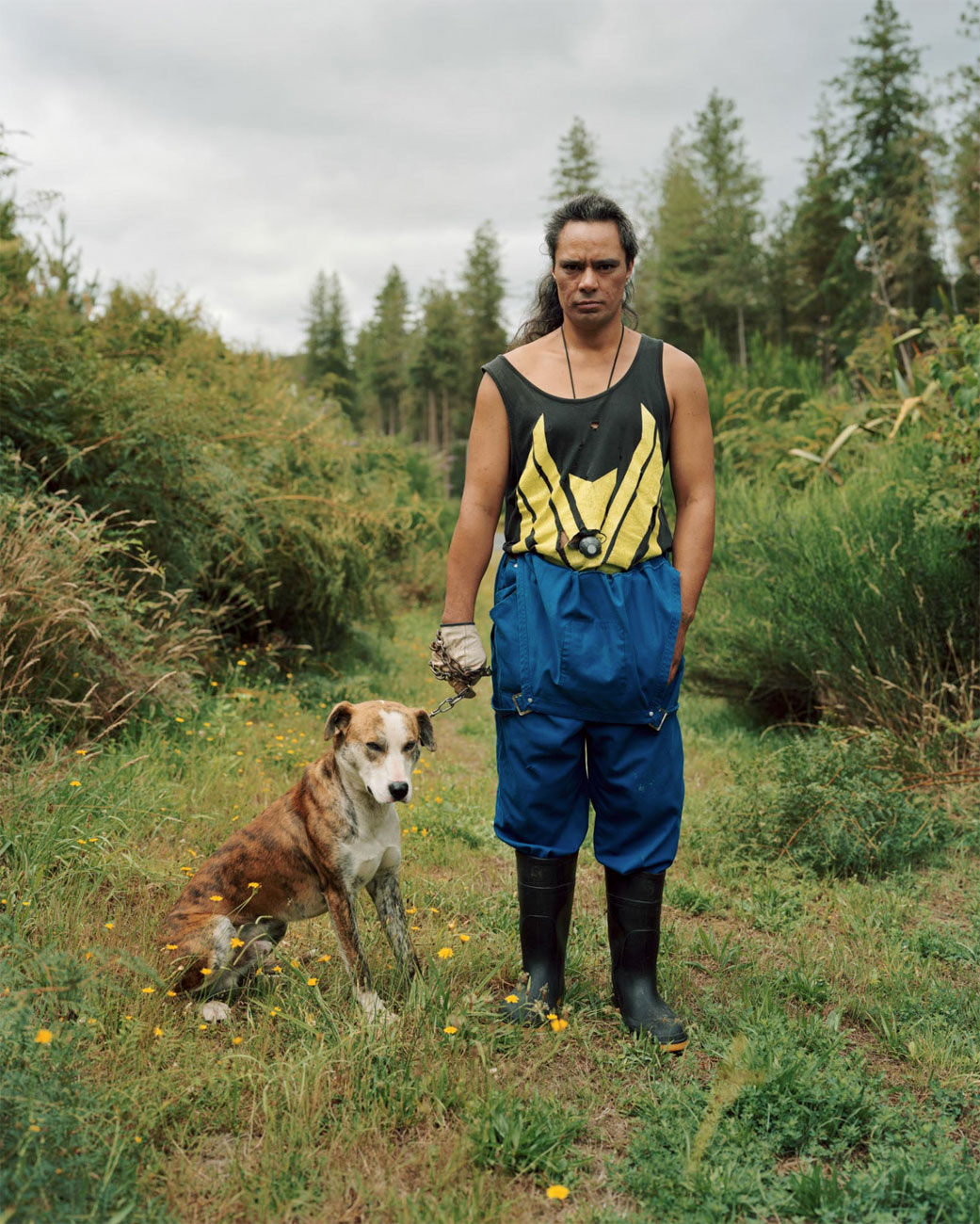
David Henderson (New Zealand, b. 1963) Dave Omeka Kidwell and Feather, Ātiamuri
2008
From the series Mercy Mercer
Thekla Ehling (German, b. 1968) Untitled
2011
From the series Vergiszmeinnicht (forget-me-not)
Anne & Gordon Samstag Museum of Art Hawke Building, City West campus
University of South Australia
55 North Terrace, Adelaide Phone: (08) 8302 0870
Robyn Stacey (Australian, b. 1952) Come unto me
2011
84 x 120cm
Type C print
Edition of 5 + 2/3 AP
Ozymandias
I met a traveller from an antique land
Who said: Two vast and trunkless legs of stone
Stand in the desert. Near them, on the sand,
Half sunk, a shattered visage lies, whose frown
And wrinkled lip, and sneer of cold command
Tell that its sculptor well those passions read
Which yet survive, stamped on these lifeless things,
The hand that mocked them and the heart that fed.
And on the pedestal these words appear:
“My name is Ozymandias, king of kings:
Look on my works, ye Mighty, and despair!”
Nothing beside remains. Round the decay
Of that colossal wreck, boundless and bare
The lone and level sands stretch far away.
Percy Bysshe Shelley 1818
Many thankx to Jessica Howard for her help and to Stills Gallery and Peter Timms for allowing me to publish the text and the photographs in the posting. Please click on the photographs for a larger version of the image.
Robyn Stacey (Australian, b. 1952) Help yourself 2011
90 x 120cm
Type C print
Edition of 5 + 2/3 AP
Working extensively with historic collections since 2000, Robyn Stacey’s early projects dealt with Australian flora and fauna, exploring the Herbarium at the Royal Botanic Gardens Sydney and the Macleay collection at the University of Sydney. Over the last three years she has worked closely the NSW Historic Houses Trust to produce a series of artworks and a book focusing on three of their properties, Elizabeth Bay House, Vaucluse House, and Rouse Hill estate as well as the Caroline Simpson Research Collection and Library. In these works Stacey reveals her fascination with the still life tradition but also speaks about the Australian notion of home and what it means to our national psyche.
Stacey’s transformation of these historic spaces and objects allows us not only to glance into earlier worlds but also to consider hierarchies of taste, culture and knowledge. By using the still life to re-work and re-view the Trust’s collection she aims to deconstruct the traditional museum display. The objects are returned to an approximate albeit fictional reality, creating a sense that the settings have been left only momentarily and that people are never far away.
In this latest exhibition Stacey looks at the traces of inhabitation. Chatelaine for example, features a sumptuous collection of objects including Wisteria spilling out of an ornate vase on top of a beautifully carved side table. The objects are from the collection of Vaucluse House having belonged to its inhabitant Sarah Wentworth. Her convict past prevented easy entry into high society at the time. In this accumulation of tasteful things we see evidence of Sarah Wentworth’s attempts to assert her social position within a society that spurned her. In other works, which draw from the collection at Rouse Hill estate we bear witness to the varying fortunes of the Rouse family.
As well as being a reflection upon the nature and minutiae of nineteenth century domesticity these still lives also reflect our colonial history; the desire for betterment and the need to re-create what has been left behind through the transport of taste and knowledge systems.
Text from the Stills Gallery website
Robyn Stacey (Australian, b. 1952) Presentation (Apple) 2011
90 x 74cm
Type C print
Edition of 5 + 2/3 AP
Robyn Stacey (Australian, b. 1952) Presentation (Pear) 2011
90 x 74cm
Type C print
Edition of 5 + 2/3 AP
Playing a double game
We all have a penchant for hidden essences. They spur our desires. Sometimes, of course, a thing is just a thing: a cup merely a convenient way of getting coffee to our mouths; a car no more than a machine to get around in. Often, however, (surprisingly often in fact) we choose to invest such apparently lifeless objects with little souls, or what the psychologist Paul Bloom calls ‘realities that are not present to the senses’. Almost everything, it seems, is capable of leading a double life.
And where better to seek out these double lives than in the historic house museum? Here the Regency candlesticks, the ormolu clocks, even the gardening tools and saucepans, come already imbued with a special significance, for here the domestic has been raised to the level of theatre.
The choices Robyn Stacey has made from the wealth of objects at Elizabeth Bay House, Vaucluse House and Rouse Hill Estate are by no means the obvious ones. They are not necessarily things of high status or great beauty. She is equally attracted to the rusted sickle, the well-thumbed book, the peeling painting and the old postcard: everyday things that bear the traces of long usage. Through judicious juxtaposition, dramatic lighting, and the addition of her own evocative flourishes, she dramatises these humble items, teasing out their souls and revealing their double lives.
What Robyn is doing is transforming inanimate objects into surrogate people. In the absence of their corporeal selves, those who made their lives in these houses are reborn through what they owned, loved, used and made. And, in the process, their stories are expanded into the realm of cultural history.
Chatelaine, for example, enlists flowers, a silk shawl, a richly decorated Staffordshire jar and the titular chatelaine itself (a sort of female version of the Swiss army knife) to reconstruct nineteenth-century ideals of femininity. Only when we discover that it is intended, in part, as a homage to Sarah Wentworth, the mistress of Vaucluse House, does its gentle irony morph into poignant masquerade. For, despite being married to one of early Sydney’s richest and most powerful men, Sarah’s impoverished and morally compromised background led to her rejection by polite society. So these outwardly vivacious mementos also serve as emblems of one woman’s tragedy and, by extension, the tragedy of many women’s lives at the time.
What could be more richly evocative than the cornucopia of flowers, fruits, grains and agricultural implements assembled for Rouse and the Cumberland Plain? What, indeed, could be more shamelessly calculated to provoke astonishment? This virtuosic picture is at once a homage to and a respectful parody of the European still-life tradition. Ostensibly it sets out, in almost forensic detail, what was once grown in the gardens and fields around Rouse Hill House, every leaf and petal historically accurate as to species and type. In that sense, it can be appreciated as an authentic record of nineteenth-century colonial gardening and agriculture. But of course it is much more than that.
We don’t have to be au fait with seventeenth-century Dutch iconography to be able to tease out the allusions in those overturned baskets, those pomegranates spilling their seeds, those provocative little asparagus spears, the decaying timber and the butterflies, nor to be touched by the pathos of that hand-made house-brick in the foreground, impressed with a heart. These symbolic clues qualify and complicate our initial response of unguarded optimism. Here and there, melancholy and loss begin to intrude. And the longer we look, the more enveloped we become by a stifling air of artificiality, as if everything has been stilled and embalmed. Initial delight slowly morphs into an eerie silence. It is in their delicate balance of abundance and ruin that all these photographs find their moral core. They are awe-inspiring, in the eighteenth-century meaning of the term.
This is true even of apparently simple works such as, for example, Presentation (Pear). While its reticence seems a world away from the fecundity of Rouse and the Cumberland Plain or Chatelaine, the underlying themes correspond. In fact, Presentation (Pear) is a composition of such elegant straightforwardness that we might suspect a trap. And indeed we might be right.
On a substantial marble pedestal sits, somewhat incongruously, a ripe pear with a fly on it. A butterfly has come to rest nearby. There are just these four individual components, each with its own tale to tell. Combined, however, into a Joseph-Cornell-like assemblage, they assume an almost mythical dimension. The massive plinth, its pomposity worthy of an Ozymandias, can be seen as representing the vanity of human ambition. The pear has long been a symbol of birth and fecundity, the fly represents decay, and the butterfly the brevity of life. Yet such pat interpretations will probably strike a modern sensibility as overdetermined or too reductive. These days we are not inclined to take this sort of thing too seriously, and the very transparency of the symbolism in Presentation (Pear) is perhaps a warning that we should not. There is a good deal of self-referentiality here. The symbols keep turning in on themselves.
What these photographs are, in fact, inviting us to do is to momentarily assume a double life, to surrender to the romantic perceptions of past generations without abandoning our modern scepticism, to experience a pre-scientific world through a post-scientific consciousness so as to understand not just the material world of past generations but also to enter into their way of thinking. As in the cinema (and these photographs are nothing if not cinematic) we are being invited to suspend our disbelief and imagine ourselves in another time, not for nostalgia’s sake, but for the opposite – to strip away sentiment and to see ourselves more clearly.
Thus, beneath their apparent sumptuousness, Robyn’s artfully contrived tableaux are playing a crafty double game of de-familiarisation.
Peter Timms
Robyn Stacey (Australian, b. 1952)
Early morning Rouse 2010
110 x 75.6cm
Type C print
Edition of 5 + 2/3 AP
Robyn Stacey (Australian, b. 1952) Chatelaine
2010
110 x 82.5cm
Type C print
Edition of 5 + 2/3 AP
Robyn Stacey (Australian, b. 1952) The Royal Guard
2011
90 x 76cm
Type C print
Edition of 5 + 2/3 AP
Robyn Stacey (Australian, b. 1952) Venetian Beauty
2011
120 x 107.7cm
Type C print
Edition of 5 + 2/3 AP
Murray Fredericks (Australian, b. 1970) Salt 271
2011
150 x 120cm
Pigment print on cotton rag
“Photographers tell me what I already know. The recognition of the beautiful, bizarre, or boring (the three photographic B’s) is not the problem. You would have to be a refrigerator not to be moved by the beauty of Yosemite. The problem is to deal with one’s total experience, emotionally as well as visually. Photographers should tell me what I don’t know.”
Duane Michals Real Dreams1
“While we cannot describe its appearance (the equivalent), we can define its function. When a photograph functions as an Equivalent we can say that at that moment, and for that person the photograph acts as a symbol or plays the role of a metaphor for something that is beyond the subject photographed.”
Minor White
Fredericks new infrared panoramic works show the strength of nature at it’s finest (9 out of 10 to nature especially when see through this type of filtration), excellent technical skills and good printing but somehow any revelation of spirit in the sublime has been lost in these photographs.
The photographer does not take me anywhere, there is no new space to step into, another view of the world that I want to spend time with. The relationship between the two series is also nebulous, the critical ice / fire space between the works adding little frisson to the exhibition.
I ask: Is it sufficient to use a digital scientific infrared back, if for no other reason that it is there? Is it sufficient to know that these climatic conditions take place in the same area each day, at the same time, place the camera down and just capture the scene? Is there really a non-decisive moment in these photographs, a poetic insight, or is this just what was, literally, hanging around so to speak?
The answer to all three questions I leave up to the reader.
Personally, I need photography to push the boundaries of elusiveness through an understanding in revelation, not just through an understanding of space and form, light and colour. I believe that conventional patterns of perception are there to be broken in ways that disrupt the technologies of the self – the self-regulating of our senses, the conventions of cultural capital – but too what do we open ourselves up to?
As Minor White says: ‘The sound of one hand clapping’.
While the photographs have the weight of serious equipment and professional acumen behind them after the initial awe on viewing they fall to earth, like the rainstorms they portray. As with my earlier review of Salt they seem to be more about the photographer than any revelation of the thing being photographed.
Duane Michals observes that, “The best artists give themselves in their work” but this giving is ego-less, the dropping away of the bells and whistles to let an’other’ emerge: in this sense I do not feel the total experience, emotionally as well as visually.
Paul Strand said that it took him 10 years to start to become an artist, to let go of ego in his work; paradoxically after this the work became more his own.
For me, these photographs never become a metaphor for something that is beyond the subject being photographed.
Dr Marcus Bunyan
1/ Michals, Duane. Real Dreams 1976 [Online] Cited 08/06/2011, on longer available online.
Many thankx to Angela Connor for her help and to Arc One Gallery for allowing me to publish the photographs in the posting. Please click on the photographs for a larger version of the image.
Murray Fredericks (Australian, b. 1970) Salt 272
2010
Pigment print on cotton rag
150 x 120cm
Murray Fredericks (Australian, b. 1970) Salt 273
2011
Pigment print on cotton rag
150 x 120cm
Salt began in 2003 and is a series of photographs of vast empty landscapes. Each image in the series is connected by the placement of the horizon running across the lower third of the frame. The horizon is the only referential form, breaking the void and providing the viewer with an element that paradoxically ‘defines’ the space. These new works add another dimension to Salt, with the water from last year’s rains now creating scenes diametrically opposed to the work occupying the adjacent walls as Hector.
Hector draws its title from an affectionately name atmospheric phenomenon that produces some of the world’s biggest thunderstorms. These new black and white works employ Murray’s methodical consistency of composition with distinctly different outcomes to the Zen-like vistas of Salt. In these works the expanse of the storm is consciously contained and forced into a barometric battle with the invisible air at its limits for the place of subject within the photograph…
By juxtaposing these series, each viewer is at once placed outside the containers which harbour these landscapes of remote territories – one calm and one facing the eye of the storm – and at the same time place in the centre of Murray’s minimal, ethereal representations of these places. In this way we can trace his exploration into these subjects – capturing the moment is our witness to a reverence to land and country.
Text from Arc One Gallery
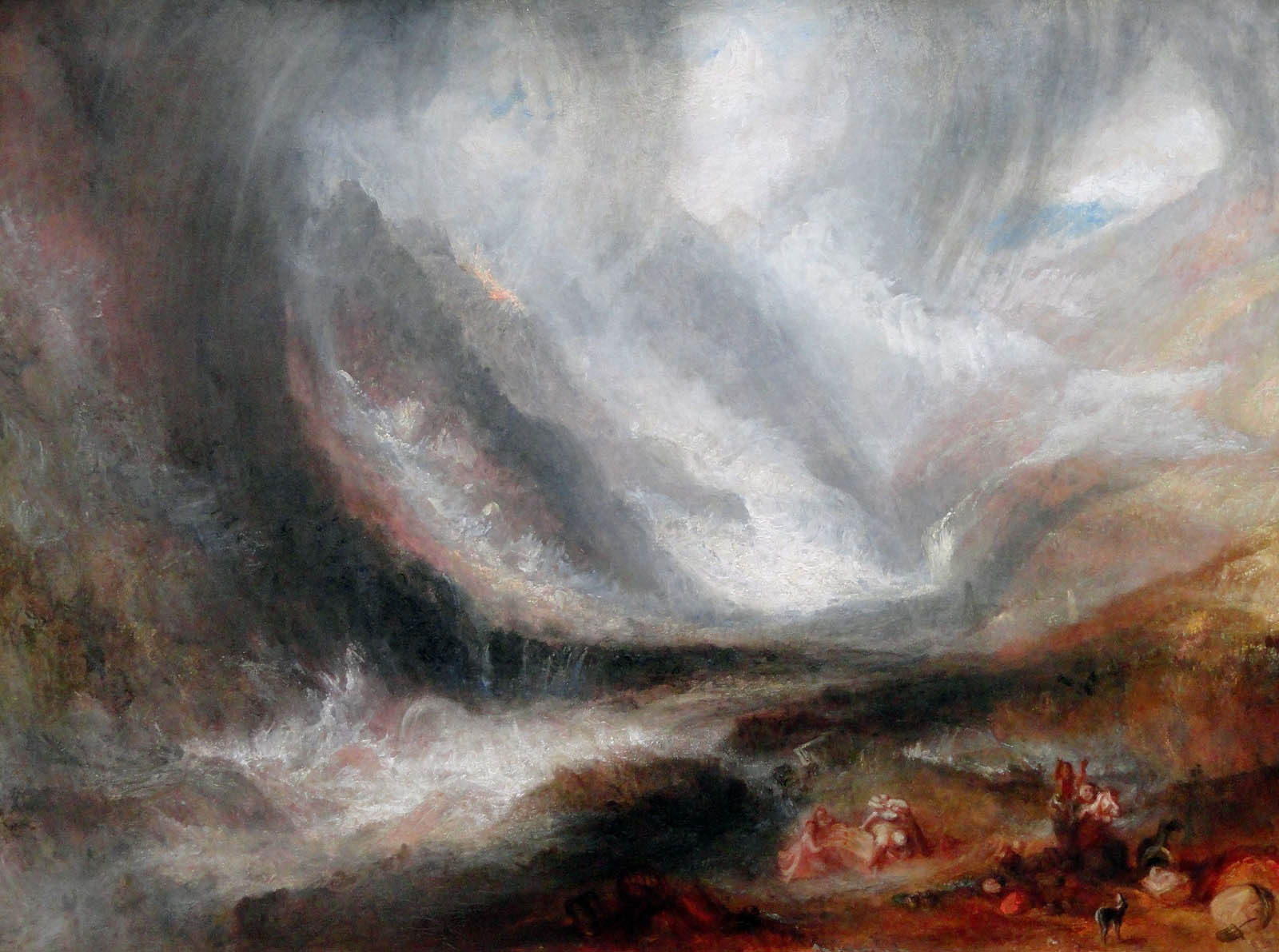
Joseph Mallord William Turner (English, 1775-1851) Valley of Aosta: Snowstorm, Avalanche, and Thunderstorm
1836/37
Oil on canvas
36 1/4 x 48 in. (92.2 x 123cm)
The Art Institute of Chicago: Frederick T. Haskell Collection
Murray Fredericks (Australian, b. 1970) Hector 10
2011
220 x 120cm
Pigment print on cotton rag
Murray Fredericks (Australian, b. 1970) Hector 11
2011
204 x 120cm
Pigment print on cotton rag
Arc One Gallery
45 Flinders Lane
Melbourne, 3000 Phone: (03) 9650 0589
Kirsten Haydon (New Zealand, b. 1973)
ice objects
2011
Enamel, copper, reflector beads
Various dimensions
“Confronted by the immensity and power of desert and ice, one cannot simply stand to the side and evaluate as though one were standing before a landscape garden and other works of art. Conflicting emotions, including fear, are aroused and simultaneously absorbed or taken over by the overmastering presence of nature.”
Yi Fu Tuan. Desert and Ice: Ambivalent Aesthetics, 1993
There are many things to like about this exhibition: the fine craftsmanship, the forms, the observation and the beauty of some of the pieces. The symbolism is simple and effective – re-imaged relics of white, vitreous enamel objects from the huts of Robert Scott and Ernest Shackleton, the use of reflector beads to imitate snow and Meccano-like steel girders to symbolise human construction and encroachment on a pristine land.
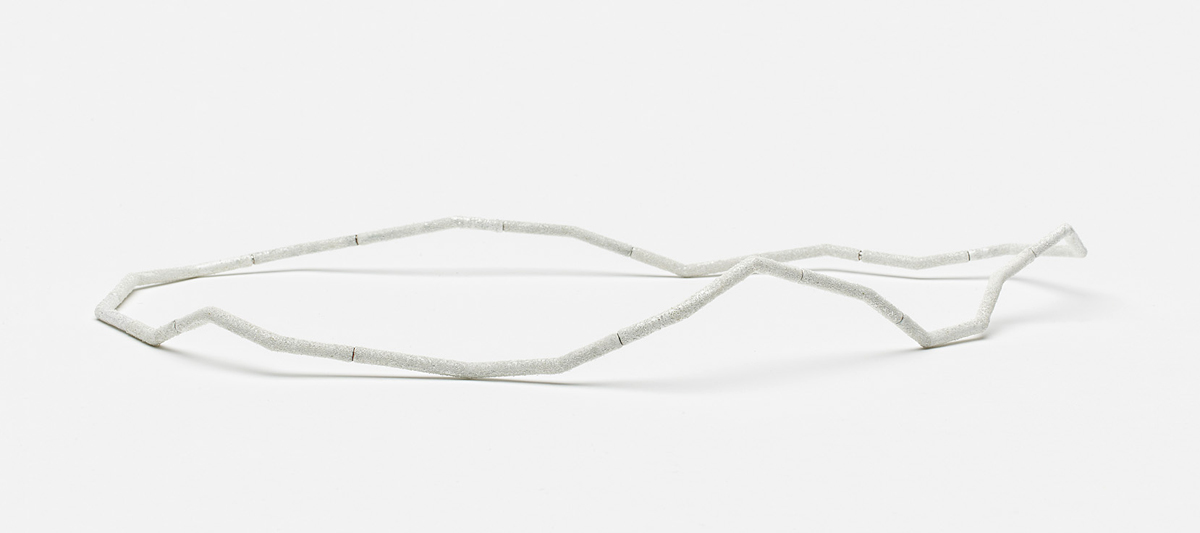
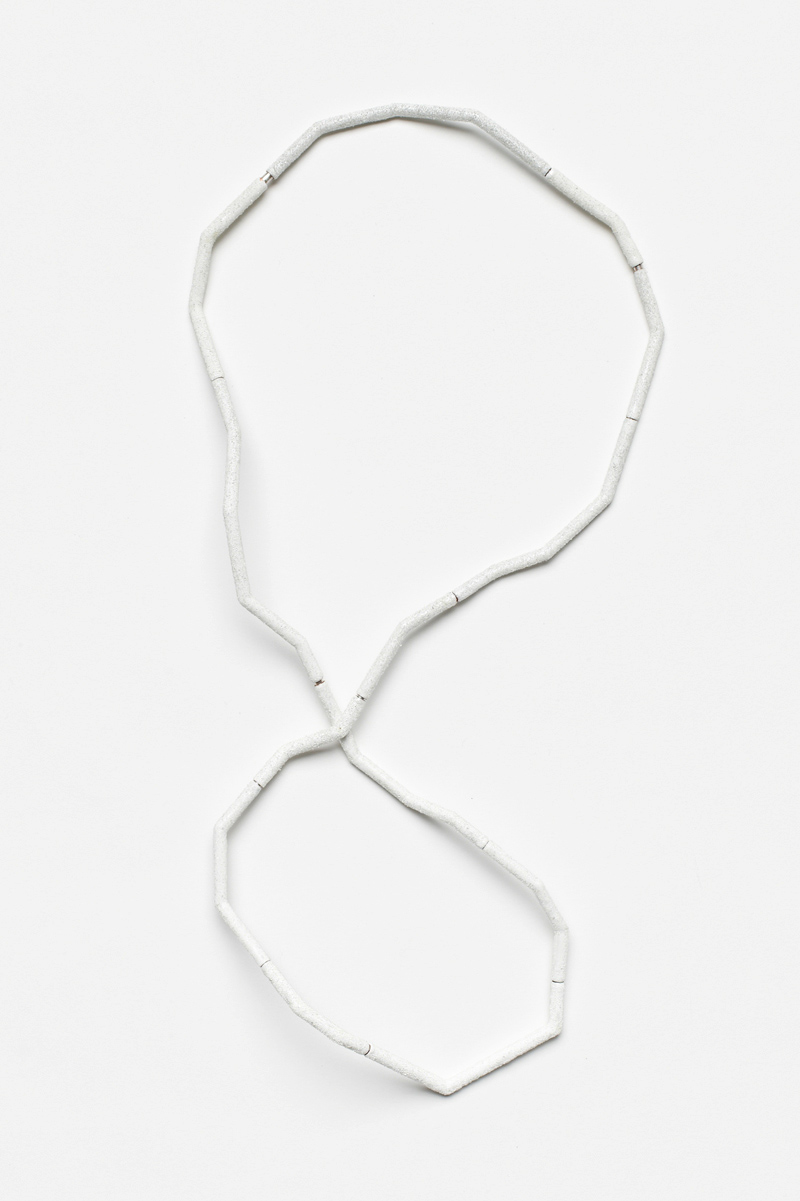
Some of the ‘objects’ remind me of the beauty and simplicity of Etruscan vessels, seemingly delicate apports, being the transference of an article from one place and time to another; the use of reflector beads at the bottom of ice sample (2011, below) is also inspired. So too is the occlusion of the image in the brooch ice plane (2011, below) which adds further mystery to an already surreal landscape. One piece is absolutely stunning. The wonderful neckpiece ice movement (2011, see two photographs below) is ravishing in it’s articulation and form, its snow-covered twig-like coolness.
Unfortunately where the exhibition fails is in the use of banal images in several works such as ice depot, ice runway, ice industry (brooch, all 2011, not pictured) and ice industry (2011, neckpiece, below). The obvious point being made is that of man made construction in a pristine landscape but the simple symbology used so effectively in other pieces becomes a little awkward in these pieces. The images used are quite ugly and while this fits the symbolic use of them it doesn’t make for very interesting or illuminating art. There needed to be more layering for the message to be effective – which is why the occluded brooch works so well, human construction blinded, dissolved.
This is a pity because the rest of the exhibition is excellent. Enter this ice world and you will be delightfully surprised!
Dr Marcus Bunyan
Many thankx to Katie Scott for her help and Gallery Funaki for allowing me to publish the photographs and text in the posting. Please click on the photographs for a larger version of the image.
Kirsten Haydon (New Zealand, b. 1973)
ice edge (left)
Object
2011, enamel, reflector beads, copper, silver
60 x 350 x 210 mm
ice sheet flow (right)
Object
2011
Enamel, reflector beads, copper, silver
70 x 130 x 195 mm
Kirsten Haydon (New Zealand, b. 1973)
ice plane
Brooch
2011
Enamel, photo transfer, reflector beads, silver, copper, steel
80 x 80 x 10 mm
Kirsten Haydon (New Zealand, b. 1973)ice industry
neckpiece
2011
enamel, copper, photo transfer, paint, silver
280 x 160 x 10 mm
I make jewellery and objects that both connect to and explore human experience and place. Since Antarctica’s discovery explorers, expeditioners, artists and writers have attempted to record and visualise this isolated continent. In 2004 I was awarded a New Zealand Antarctic Arts Fellowship en joined those who communicate their experiences of Antarctica.
Antarctica is often regarded as a pristine yet harsh environment, home to extraordinary wildlife and the domain of scientists. Due to its remoteness projects that are supported by international Antarctic programmes are predominantly science-based and as a result artistic research in Antarctica is limited. The cultural theorist, Yi Fu Tuan describes the experience of the explorer as: “the longing to be taken out of oneself and ones habitual world into something vast, overpowering and indifferent.” His statement resonates with my experience of Antarctica where I found myself drawn to the minutiae of the ice crystal and the structures and forms that I could associate with in the extraordinary landscape. While in that place, so removed from the conventions of civilisation, I came to understand the immensity of nature and to see that it exists without the necessity for human presence …
Inside the historic huts of Robert Scott and Ernest Shackleton I was captivated by the history, contained both in the interior spaces themselves and in the material artefacts left by the expeditioners … These seemingly mundane objects are transformed into a still life of significant artefacts of a previous time, preserving the memory and story of their parties of explorers.
My interpretations engage through the iconography of personal jewellery, domestic objects and the environment of Antarctica. In the course of making I continue to investigate and portray Antarctica through my own and others’ personal experiences. The objects I produce reference valued souvenir jewellery and objects now displayed in museums as historical artefacts, which were once personal mementos …
Excerpts from the catalogue text by Kirsten Haydon May 2011
Kirsten Haydon (New Zealand, b. 1973)
ice movement
Neckpiece
2011
Enamel, copper, reflector beads, silver
Kirsten Haydon (New Zealand, b. 1973)
ice sample
Object
2011
Enamel, copper, reflector beads
Gallery Funaki
Sackville House
Apartment 33
27 Flinders Lane
Melbourne 3000
Australia
Opening hours:
Wednesday – Friday 12 – 5pm
Saturday on occasion (check our socials) or by appointment
Gallery Funaki websiteLIKE ART BLART ON FACEBOOKBack to top
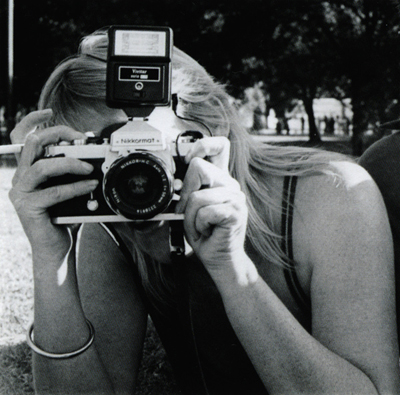
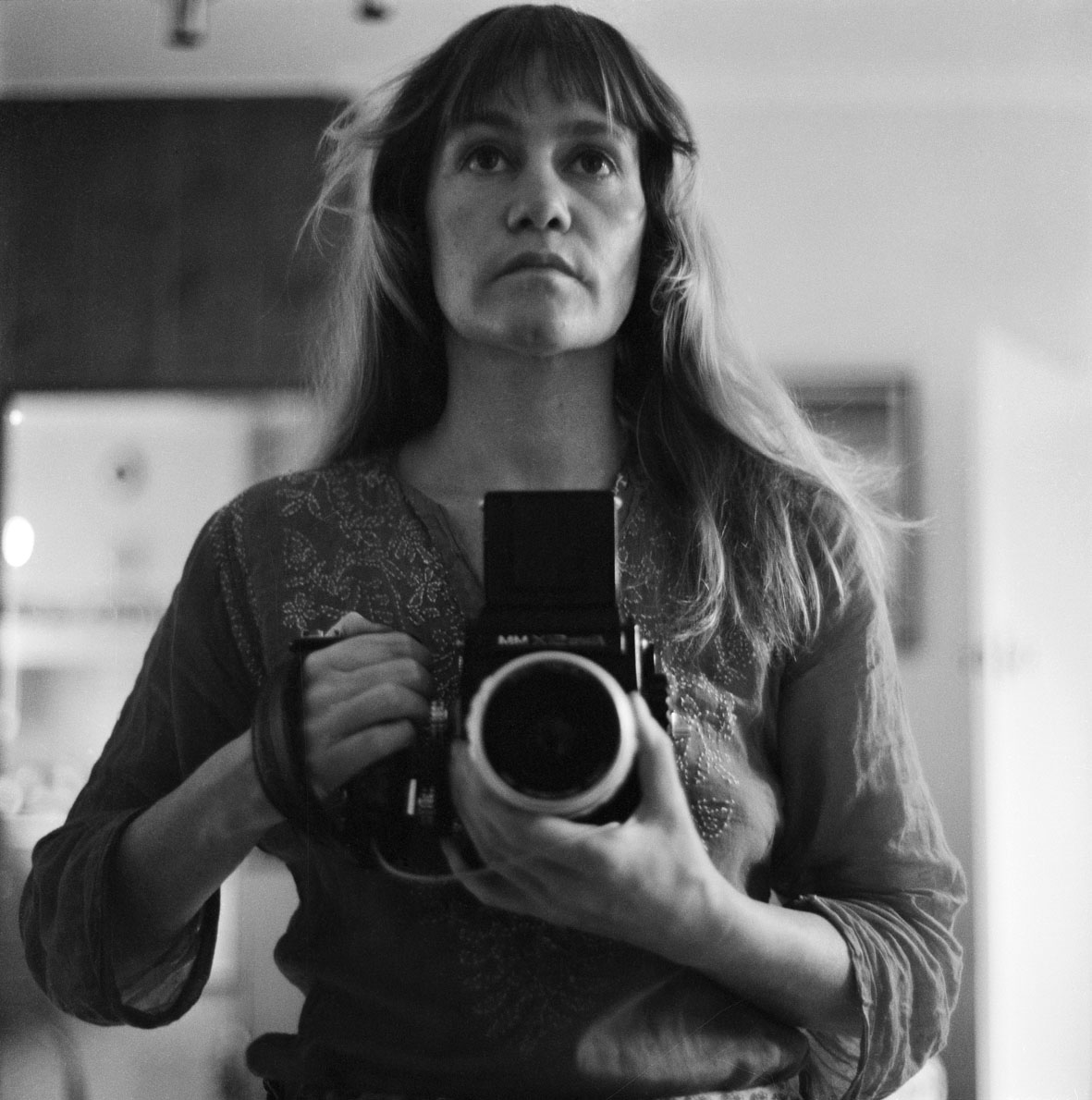
Sue Ford (Australian, 1943-2009) Self-portrait 1968 1968, printed 2011 From the series Self-portrait with camera (1960-2006) Selenium toned gelatin silver 22.8 x 24 cm Courtesy Sue Ford Archive
“Choosing to photograph oneself, one’s life and one’s time exemplified the now well-worn slogan ‘the person is political’. Ford’s self-examination across the decades is unflinching and exacting. As Janine Burke wrote in 1980, her ‘psychological history [is] etched in her face for everyone to see’. Burke concluded that Ford’s self-portraits are ‘as honest as one can ever be about oneself’.”
Helen Ennis. Faces are Maps: Sue Ford and Portraiture.1
“The search for the self is a journey into a mental labyrinth that takes random courses and ultimately ends at impasses. The memory fragments recovered along the way cannot provide us with a basis for interpreting the overall meaning of the journey. The meanings that we derive from our memories are only partial truths, and their value is ephemeral. For Foucault, the psyche is not an archive but only a mirror. To search the psyche for the truth about ourselves is a futile task because the psyche can only reflect the images we have conjured up to describe ourselves. Looking into the psyche, therefore, is like looking into the mirror image of a mirror. One sees oneself reflected in an image of infinite regress. Our gaze is led not toward the substance of our beginnings but rather into the meaninglessness of previously discarded images of the self.”
Patrick Hutton. Foucault, Freud, andthe Technologies of the Self.2
This is a solid exhibition of the work of beloved Australian photographer Sue Ford, essential looking for anyone wanting to have an overview of Australian photography.
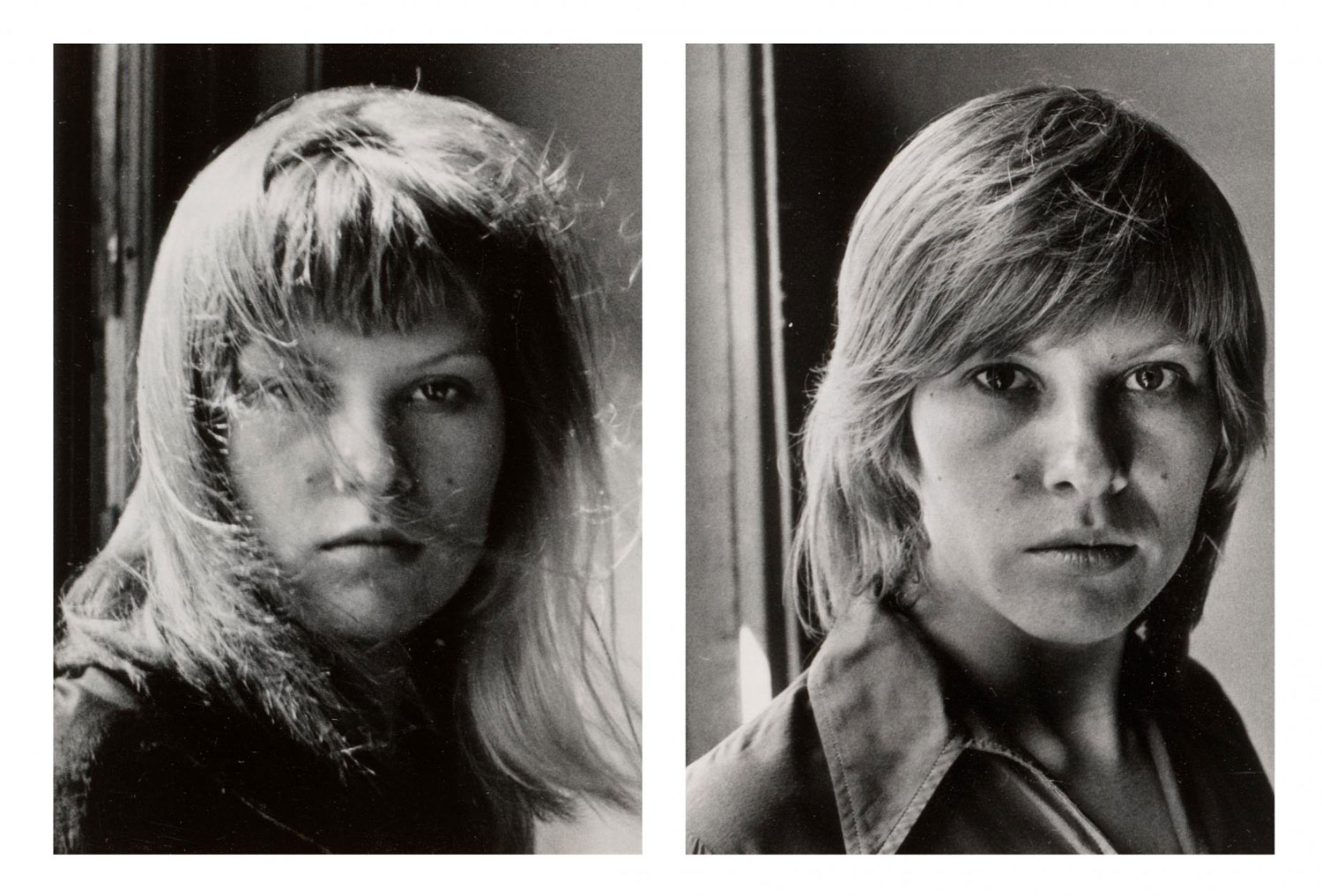
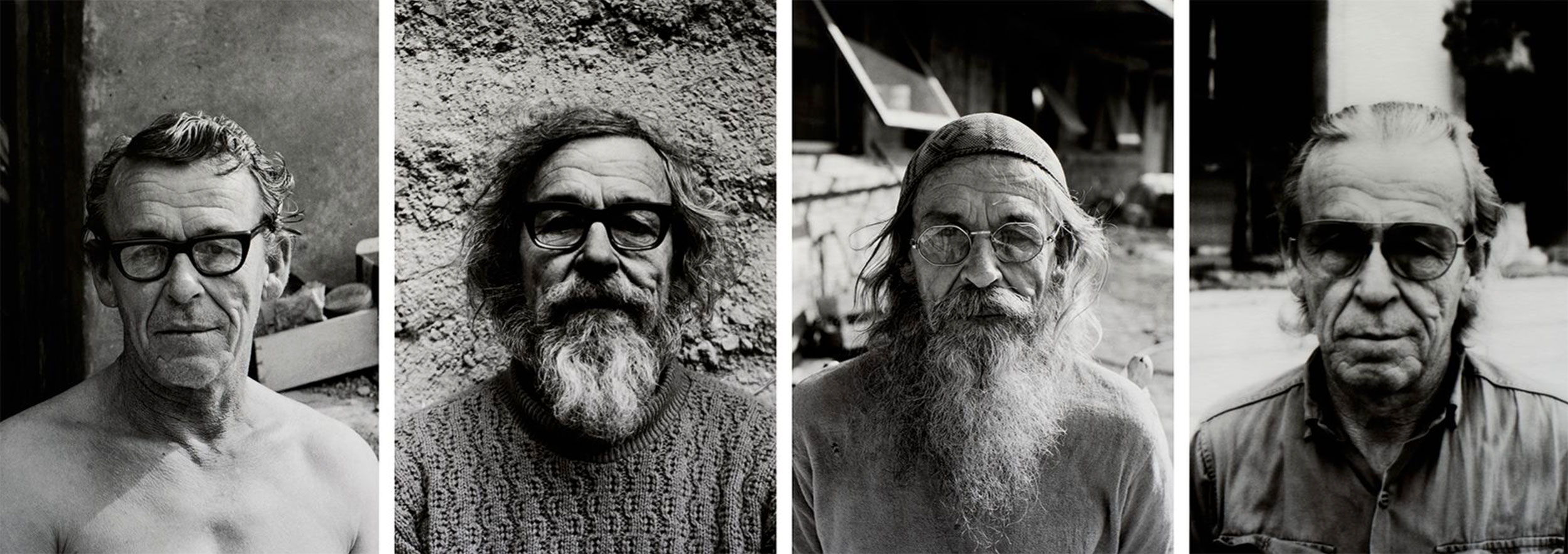
The beautifully hung exhibition flows like music, interweaving up and down, the photographs framed in thin, black wood frames. It features examples of Ford’s black and white fashion and street photography; a selection of work from the famous black and white Time series (being bought for their collection by the Art Gallery of New South Wales) – small, snapshot size double portraits, the first portraits taken during the 1960’s, the second around 1974, formalist portraits in which the sitter is closely cropped around head and shoulders with the photographer using the camera as objectively as possible, the double portrait used to display changes in identity over time; a selection of Photographs of Women – modern prints from the Sue Ford archive that are wonderfully composed photographs with deep blacks that portray strong, independent, vulnerable, joyous women (see last four photographs below); and the most interesting work in the exhibition, the posthumous new series Self-portrait with camera (1960-2006) that evidence, through a 47 part investigation using colour prints from Polaroids, silver gelatin prints printed by the artist, prints made from original negatives and prints from scanned images where there was no negative available, a self-portrait of the artist in the process of ageing (see the two photographs above and below this review).
One of my favourite photographs in the exhibition was Margaret with Emma, Redcliffs, Queensland, 1971. The black and white photograph features a grandmother with her granddaughter, close to each other, both wearing floral dresses of different pattern, both staring intently out of the image at what is possibly a television with a weatherboard backdrop. A dark form hovers at the upper left of the photograph adding a disturbing note to the image but it is the look on the grandmother’s face – a look of shock, enthralment, blankness with eyes wide, that is matched by the intensity on the granddaughter’s face as she stares intently – that transcends the distance between photograph and viewer, between grandmother and granddaughter across time and space. The process of looking and ageing captured by the ‘time machine’, the camera, in one single image. The viewer understands this photograph for we all experience the evidence of our bodies, our mortality. We relate intimately to how the photograph reanimates in the present this moment from the past, the momenti mori of the photograph, the little death becoming our future death.
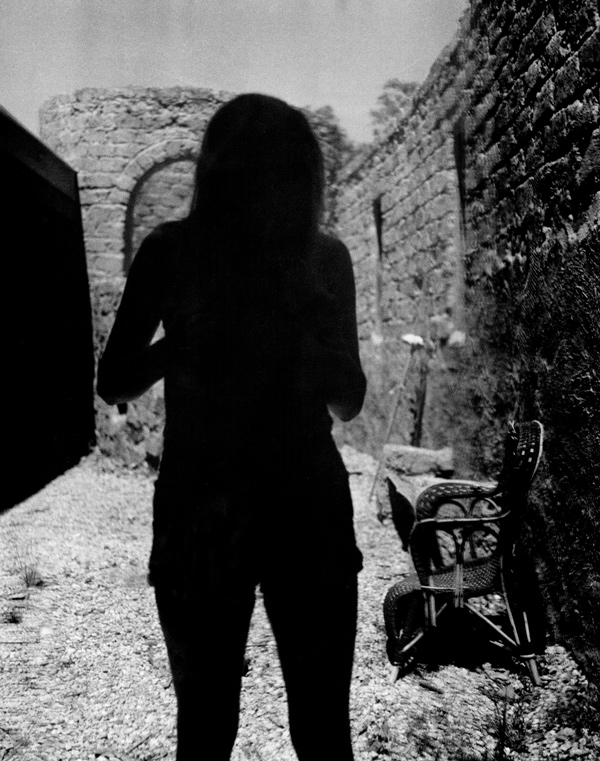
This notion is particularly poignant in the series Self-portrait with camera (1960-2006), a work that Sue Ford was actively engaged with before her death. Smaller colour prints from negatives and Polaroids are here interspersed with black and white photographs up to about 8″ x 10″ in size: the series contains 12 chromogenic photographs, 7 silver gelatin photographs, 6 dye fusion photographs and 22 selenium-toned photographs (printed 2011). In dark, contrasty prints the artist has photographed herself looking down into the camera shooting into a mirror, looking directly into the mirror with camera, with the camera on a timer, with the camera in/visible, being shot by other people with the camera pointed directly at her, with the camera perpendicular to the artist shot by someone else, with Ford behind a movie camera, with multiple refractions in mirrors. Sometimes Ford even becomes the camera (as in the 1986 self-portrait below: I am the camera, the camera is me).
Ford becomes the “one who looks” knowingly at herself, sometimes the author of that observation, sometimes oblivious to it (until later when she has collected these images). As Burke and Ennis note, these photographs of self-examination across the decades are as honest as one can ever be about oneself. This a deeply political but also deeply psychoanalytical investigation: not to “take care of yourself” as a form of knowing as in Greco-Roman antiquity but “knowing yourself” as the fundamental principle of understanding yourself: a procedure of objectification and subjection in which the photograph ‘marks’ our status and the passage of time, that makes us who we are – photographs as vital techniques in the constitution of the self as subject.3
The mirror is frequently used in these photographs to portray the self. While it is true that these are strong, intimate, unflinching and exacting images, in the use of the mirror the im(pose)tures of life are singled / doubled / tripled – a reflection of the psyche that lead to discarded images of the self that are of little use in understanding the substance of our beginnings … or the overall interpretation of the journey. What they do offer is cumulative evidence of a deep, personal conviction into the inquiry: who am I?
Rembrandt famously painted, drew and etched himself hundreds of times in the process of ageing; Ford has likewise done the same. If, as Victor Burgin observes, “An identity implies not only a location but a duration, a history,”4 then the nature of photography (including Ford’s self-reflexive project), concerned as it is with space and time, becomes the mirror in a search for identity. Photography as a mirror on the world constantly repeats moments of illumination in a re/vision of eternal recurrence, a performance that is a hybrid site: both a homogenous (the same “I”) and heterogenous (a different “I”) site of self-representation, different every time we look. To that end I would like you to look at the self-portrait from 1976 (below). The artist is completely absent, her silhouette, her dark shadow swallowed whole by the blank photographic plate on the left hand side of the image as though Ford, the camera and an image of infinite regress have become one, eternally engulfed by space-time but open to re/view at any time.
Whether looking down, looking toward or looking inward these fantastic photographs show a strong, independent women with a vital mind, an élan vital, a critical self-organisation and an understanding of the morphogenesis of things that will engage us for years to come. Essential looking.
Dr Marcus Bunyan
1/ Burke, Janine. Self-portrait/self-image 1980-1981. Melbourne: Australian Directors’ Council, 1981. p. 4 quoted in Ennis, Helen. “Faces are Maps: Sue Ford and Portraiture,” in Lakin, Shaune (ed.,). Sue Ford: Self-portrait with camera (1960-2006). Melbourne: Monash Gallery of Art, 2011, np.
2/ Hutton, Patrick. “Foucault, Freud, and the Technologies of the Self,” in Martin, Luther and Gutman, Huck and Hutton, Patrick (eds.,). Technologies of the Self: A Seminar with Michel Foucault. London: Tavistock Publications, 1988, p. 139
3/ Foucault, Michel. Discipline and Punish, quoted in Gutman, Huck. “Rousseau’s Confessions: A Technology of the Self,” in Martin, Luther and Gutman, Huck and Hutton, Patrick (eds.,). Technologies of the Self: A Seminar with Michel Foucault. London: Tavistock Publications, 1988, p. 99
4/ Burgin, Victor. In/Different Spaces: Place and Memory in Visual Culture. Berkeley: University of California Press, 1995, p. 36
Many thankx to Mark Hislop for his help and the Monash Gallery of Art for allowing me to publish the photographs in the posting. Please click on the photographs for a larger version of the image.
Sue Ford (Australian, 1943-2009) Self-portrait 1986 1986 From the series Self-portrait with camera (1960-2006) Gelatin silver print, printed 2011 8.4 x 6.5cm Courtesy Sue Ford Archive
Sue Ford (Australian, 1943-2009) Self-portrait 1976 1976, printed 2011 From the series Self-portrait with camera (1960-2006) Selenium toned gelatin silver print 24 x 18cm Courtesy Sue Ford Archive
Sue Ford (Australian, 1943-2009) Self-portrait 1974 1974, printed 2011 From the series Self-portrait with camera (1960-2006) Selenium toned gelatin silver print 19.9 x 18cm Courtesy Sue Ford Archive
On 16 April 2011, the first major exhibition of the work of the late Sue Ford for two decades will open at Monash Gallery of Art.
Sue Ford (1943-2010) was one of Australia’s most important photographers and filmmakers. Ford studied photography at RMIT and in 1974 was the first Australian photographer to be given a solo exhibition at the National Gallery of Victoria.
Ford passed away in 2009. Before her death, she was working with Monash Gallery of Art on an exhibition of her work which would feature her final major project Self-portrait with camera (1960-2006). This series of 47 photographs has never been shown before, and presents a compelling self-portrait of an artist. It underscores the central role the camera played in Ford’s life. Self-portrait with camera will be shown alongside a survey of Ford’s black-and-white photographs from the 1960s and 70s and examples of her most iconic work, Time series (1960s-1970s).
The exhibition describes a period when photography was charged with political and personal meaning. As photographic historian and contributor to the publication accompanying the exhibition Helen Ennis states: “Ford’s approach to art making has always been straightforward … She does not cultivate a mysterious artistic persona [since] … her art practice is purposeful; it is the outcome of her view of art as a political activity that is democratic, liberating and relevant to contemporary society.”
As MGA Director and curator of the exhibition Shaune Lakin states: “This exhibition provides a great opportunity for Australian audiences to reassess the work of this important photographer, whose work was always at once political, beautiful and elegiac. In an era when the photograph has become a highly disposable thing, it is important to acknowledge its role as an agent of change and memory.”
Press release from the Monash Gallery of Art
Sue Ford (Australian, 1943-2009) Helen, 1962; Helen, 1974 1974 From the series Time series Gelatin silver prints 11.0 x 8.0cm; 11.5 x 8.3cm Museum of Australian Photography, City of Monash Collection Acquired with assistance from the Robert Salzer Foundation and the Friends of MGA Inc 2020
Sue Ford (1943-2009) was one of Australia’s most important twentieth-century photographers, and Time series is her most iconic body of work, widely recognised as a key moment in the history of Australian photography. First exhibited at the NGV and Brummels Gallery of Photography in 1974, the series highlights Ford’s interest in the camera’s ability to record the effects of time and history. To create this series, Ford made portraits of her friends and acquaintances during the early to mid-1960s then rephotographed the sitters around a decade later, showing the second portraits beside the first. In some cases Ford later added third and fourth portraits to create Time series II, which she made for exhibition at the 1982 Sydney Biennale. Ford described the camera as a ‘time machine’ and the works in these series bracket periods in the lives of her subjects. With a tender pathos, they evoke the inevitability of time’s passing along with the processes of human ageing and constant change.
Sue Ford (Australian, 1943-2009) Annette 1962; Annette 1974 1974 From the Time series Gelatin silver prints 11.1 x 20.1cm National Gallery of Victoria, Melbourne Purchased with the assistance of the Visual Arts Board and the KODAK (Australasia) Pty Ltd Fund, 1974
Sue Ford (Australian, 1943-2009) Jim, 1964; Jim, 1969; Jim, 1974; Jim, 1979 1982 From the series Time series Gelatin silver prints 11.0 x 7.6cm (each) Museum of Australian Photography, City of Monash Collection donated by the Sue Ford Archive 2020
Sue Ford (Australian, 1943-2009) Lynne and Carol 1962, printed 2011 Selenium toned gelatin silver print 38.0 x 38.0cm Courtesy Sue Ford Archive
Sue Ford (Australian, 1943-2009) Carol, Little Collins St studio 1962, printed 2011 Selenium toned gelatin silver print 37.9 x 38.1cm Courtesy Sue Ford Archive
Sue Ford (Australian, 1943-2009) St Kilda 1963, printed 2011 Selenium toned gelatin silver print 38.0 x 38.0cm Courtesy Sue Ford Archive
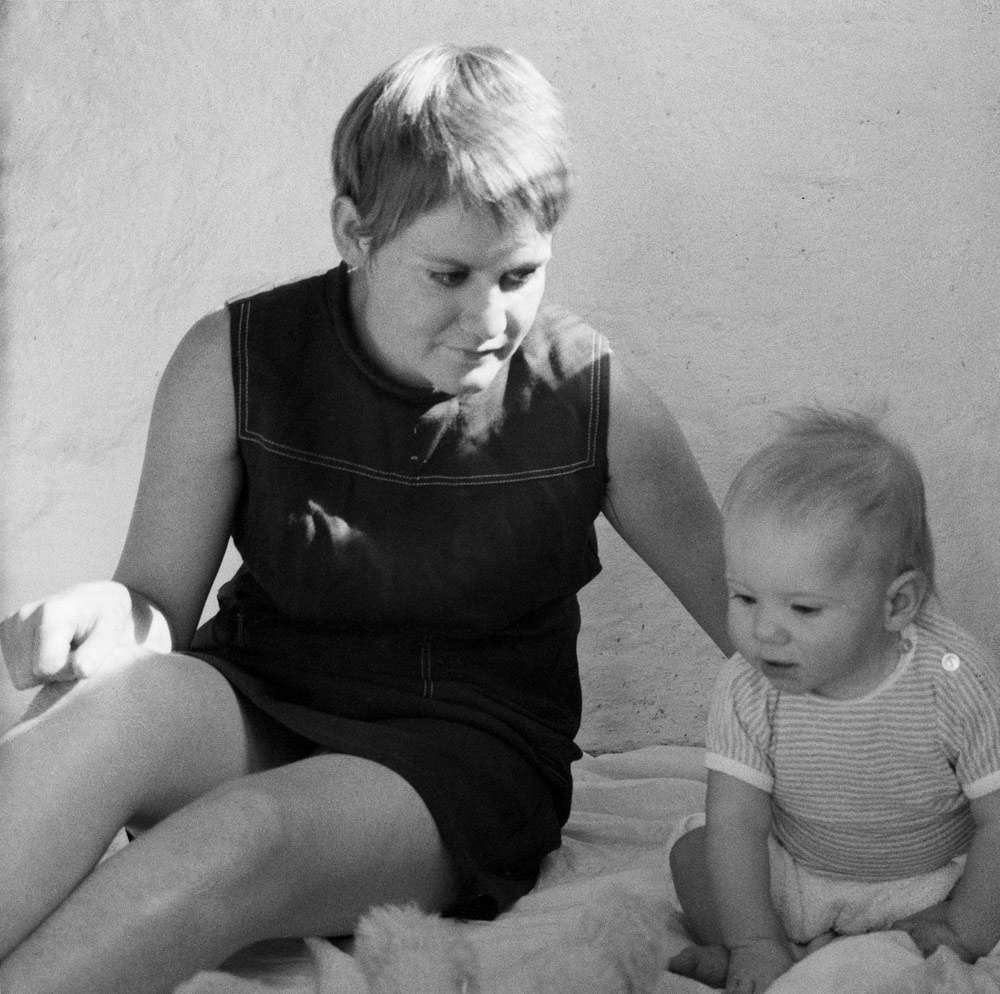
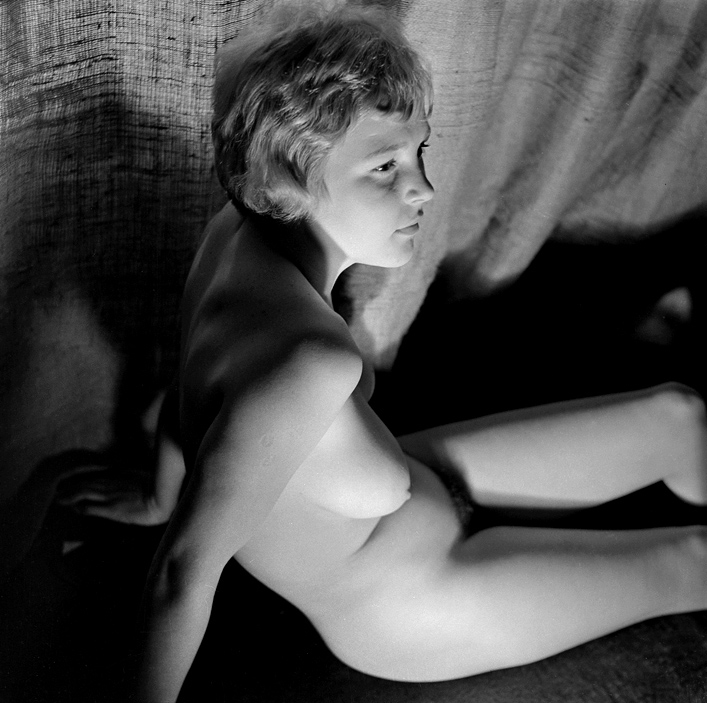
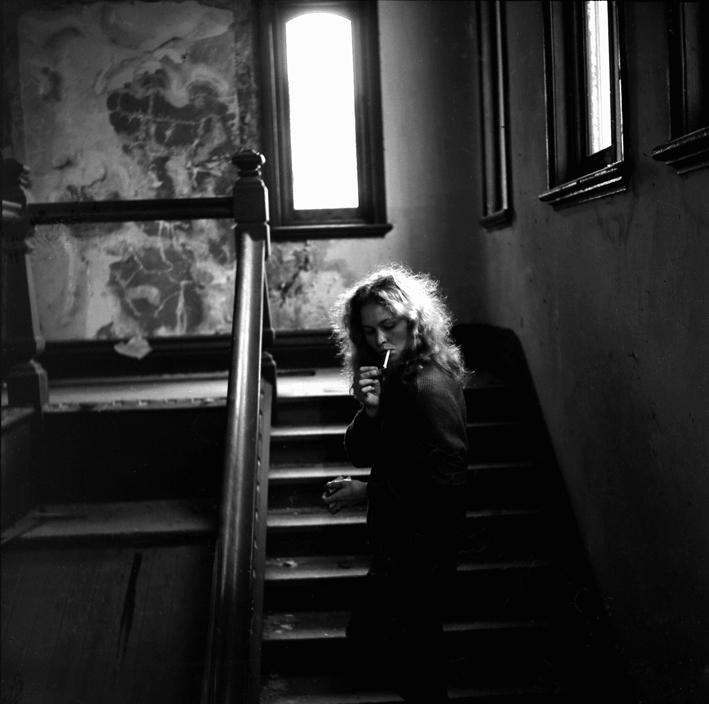
Sue Ford (Australian, 1943-2009) Untitled [Bliss at Yellow House, King’s Cross, Sydney] c. 1972-3, printed 2011 Selenium toned gelatin silver print 47.9 x 34.2cm Courtesy Sue Ford Archive
Monash Gallery of Art 860 Ferntree Gully Road, Wheelers Hill Victoria 3150 Australia phone: + 61 3 8544 0500
Opening hours: Tue – Fri 10am – 5pm Sat – Sun 10pm – 4pm Mon/public holidays closed
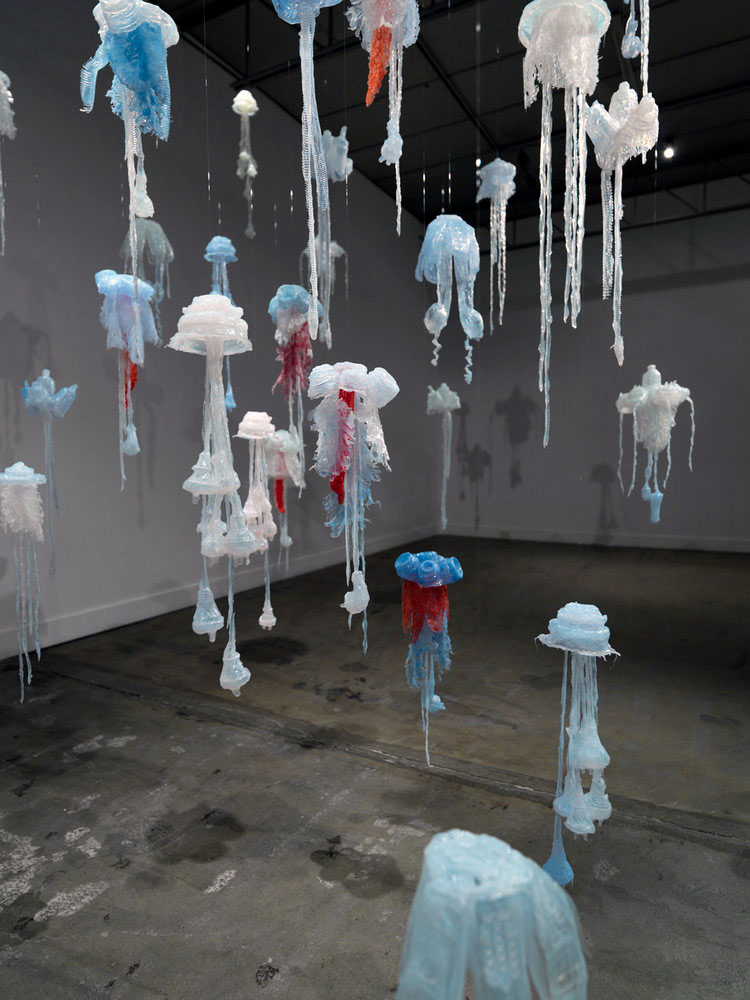
Penelope Davis (Australian, b. 1963) Smack installation 2011 Silicone, nylon thread Dimensions variable
A beautiful, hypnotic installation; one outstanding photograph (out of four); and a distance between elements, installation and photographs that, in the gallery space, seemed almost insurmountable.
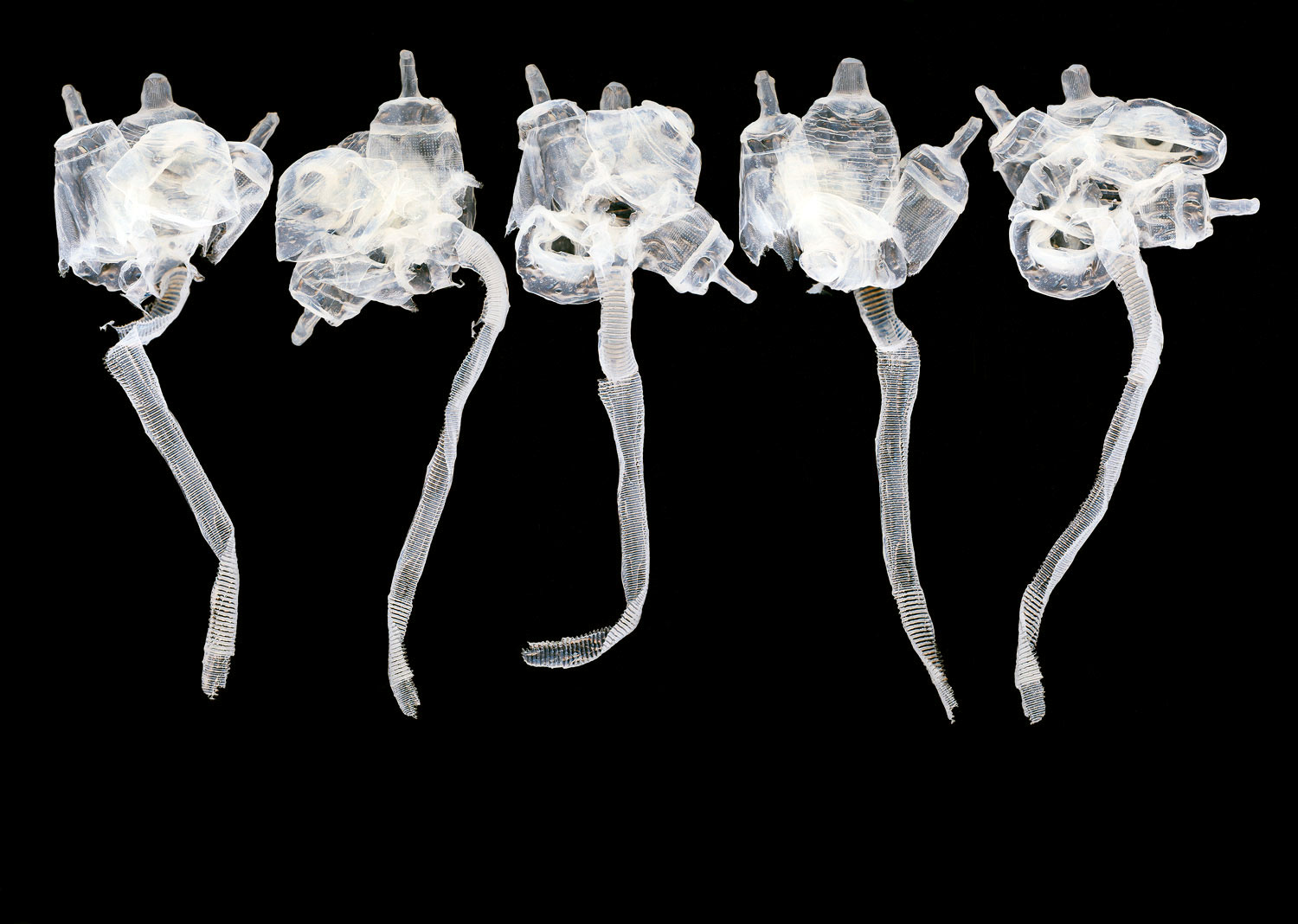
The installation is intoxicating, taking the viewer into a world outside of reality – inverted, convoluted creatures “after the things of nature” (me ta physika) – in this case mobile phones, camera lenses and electrical plugs and leads, the skin of these objects flayed, extruded and made in silicone. These filamentary ‘jellies’ are wondrous. As Susan Fereday observes they are like detached skin, which “can become a kind of negative, a reversed memory, a perverse relic of its previously animated form … Detached, distraught, dangling. But there is also something slippery in these forms, something visceral, uterine, umbilical …”. The installation reminded me of the chthonian nature of the womb, our birth and that first gasp of breath – do you remember? was it all that you ever needed?
Water, blood, the detritus of birth and the emergence of life into light. Floating, gliding to the surface.
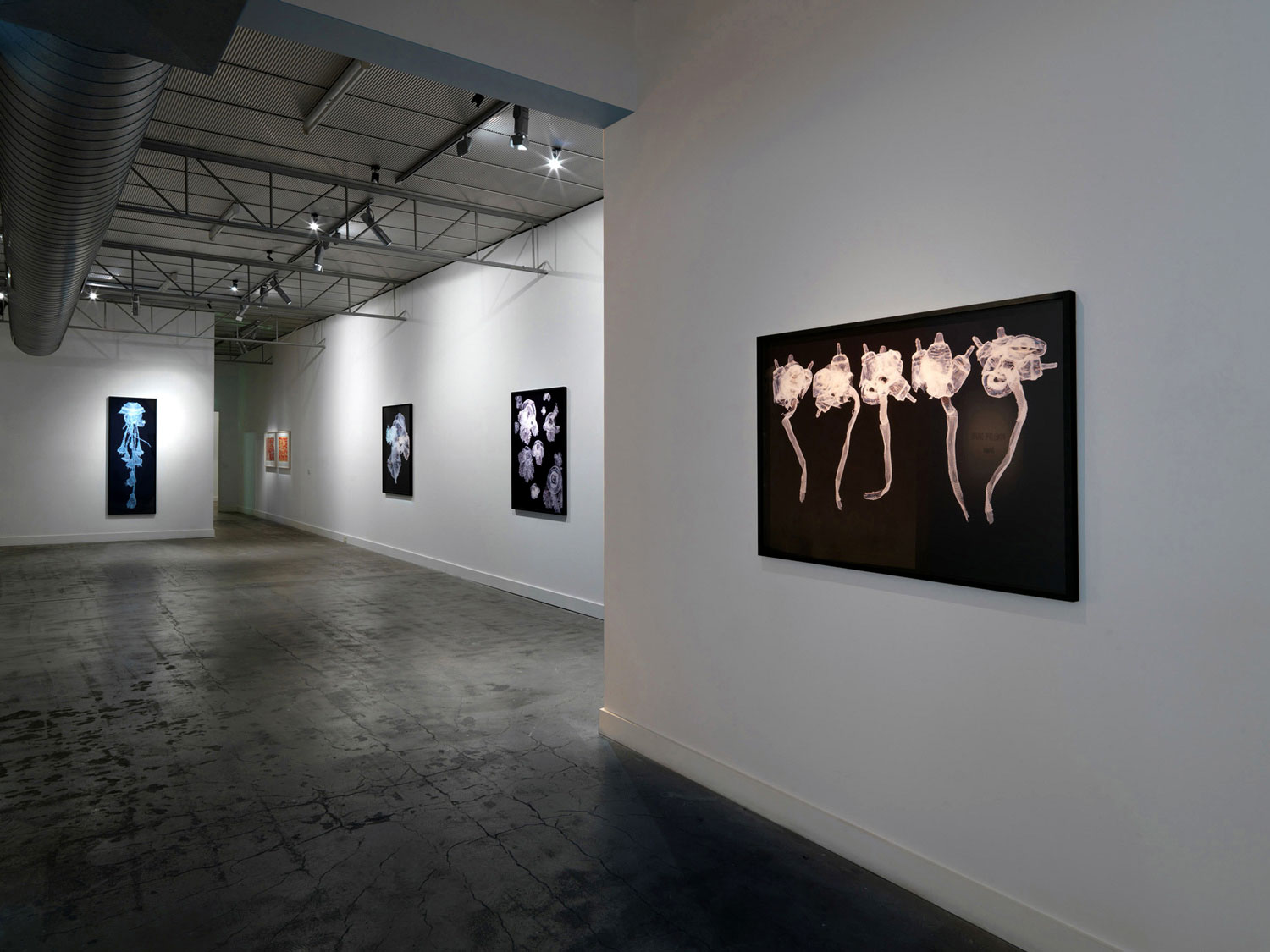
Only one photograph, Fluther (2011, below), approaches this detachment. A beauty it is too. The other three photographs felt more like addendum than adding anything further to the work and failed to achieve a ‘presence’ when compared to the installation. I suspect one of the problems was the scale of the three photographs and the fact that they are so tightly framed. Evidence of this can be seen in the installation shot below, the photograph of the blue ‘jellie’ so tightly prescribed and enclosed so as to not allow any interaction between installation and photograph. Perhaps making the photographs slightly larger and face mounting them behind PlexiGlass would have softened the edges of the photographs allowing a malleable (meta)physical air to breathe across the gallery space.
The highlight is the installation. Go and see, it is well worth the visit.
Penelope Davis (Australian, b. 1963) Smack installation 2011 Silicone, nylon thread Dimensions variable
Stretched Skin
“Where my inside meets the outside, where my body’s surfaces curve or stretch, dimple or fold, they create sensory cavities that are designed to respond to the outside world, at least to some degree. More difficult to resolve is the place that’s made when my inside turns out and there and no pickets to hide the private things – things I don’t want to look at myself, things too fleshy for the world to see, too soft, raw and pink to be exposed. Bringing the inside out, I am turned outside in and where does that leave me? In the edgeless space of the everyday saturated by grief.
Penelope Davis’ ‘jellies’ make me think about how a person’s skin can record their body’s history through marks – scars, distentions, swellings, bruises and wrinkles – just as a photograph can record a body’s outward appearance through light. We could say that skin is an index to its experiences, but it is not iconic. Skin does not reproduce the body’s image the way a photograph does, unless the skin is lifted to make a new shape. Then, just as hot wind can suck the life out of a fallen leaf and turn its veins into a street map, or sun and sea can batter a plastic bottle into a miraculous Marian figurine, detached skin can become a kind of negative, a reversed memory, a perverse relic of its previously animated form.
That’s what the ‘jellies’ look like: skin, turned inside out, photographic skin turned outside in. Detached, distraught, dangling. But there is also something slippery in these forms, something visceral, uterine, umbilical …”
Except from pamphlet text by artist and writer Susan Fereday, March 2011
Penelope Davis (Australian, b. 1963) Fluther 2011 Type C photograph 120 x 100cm
In Smack, Penelope Davis’ latest body of work, jellyfish-like forms have been assembled from a collage of components. These elements include the detritus of contemporary technologies. Among these are cameras, computer parts, mobile phones, wiring and electrical parts. Organic source materials such as leaves and seaweed (many sourced from the community garden plots surrounding Davis’ studio) are cast and intermixed with these forms. After being cast in silicone, the works are sewn together to create forms that resemble jellyfish. The resulting swarm – or smack, as the collective noun is properly known – is displayed as an installation of semi transparent, suspended forms.
A selection of these ‘jellies’ have also been placed in the digital scanner and ‘photographed’. Some digital post-production work is also employed to create large scale photographic images.
The materials and techniques used allow Penelope Davis to play with some of the procedures and assumptions central to photographic practice. The central motif of the jellyfish is a vehicle to examine critical contemporary issues of consumption and environmental degradation.
Text from the Nellie Castan website [Online] Cited 28/05/2011 no longer available online
Installation view of the exhibition Penelope Davis: Smack at Nellie Castan Gallery, Melbourne showing at right the photograph Bloom (2011, below)
Penelope Davis (Australian, b. 1963) Bloom 2011 Type C photograph 120 x 100cm
Penelope Davis (Australian, b. 1963) Smack installation (detail) 2011 Silicone, nylon thread Dimensions variable
Many thankx to the Martin-Gropius-Bau, Berlin for allowing me to publish the photographs in the posting. Please click on the photographs for a larger version of the image.
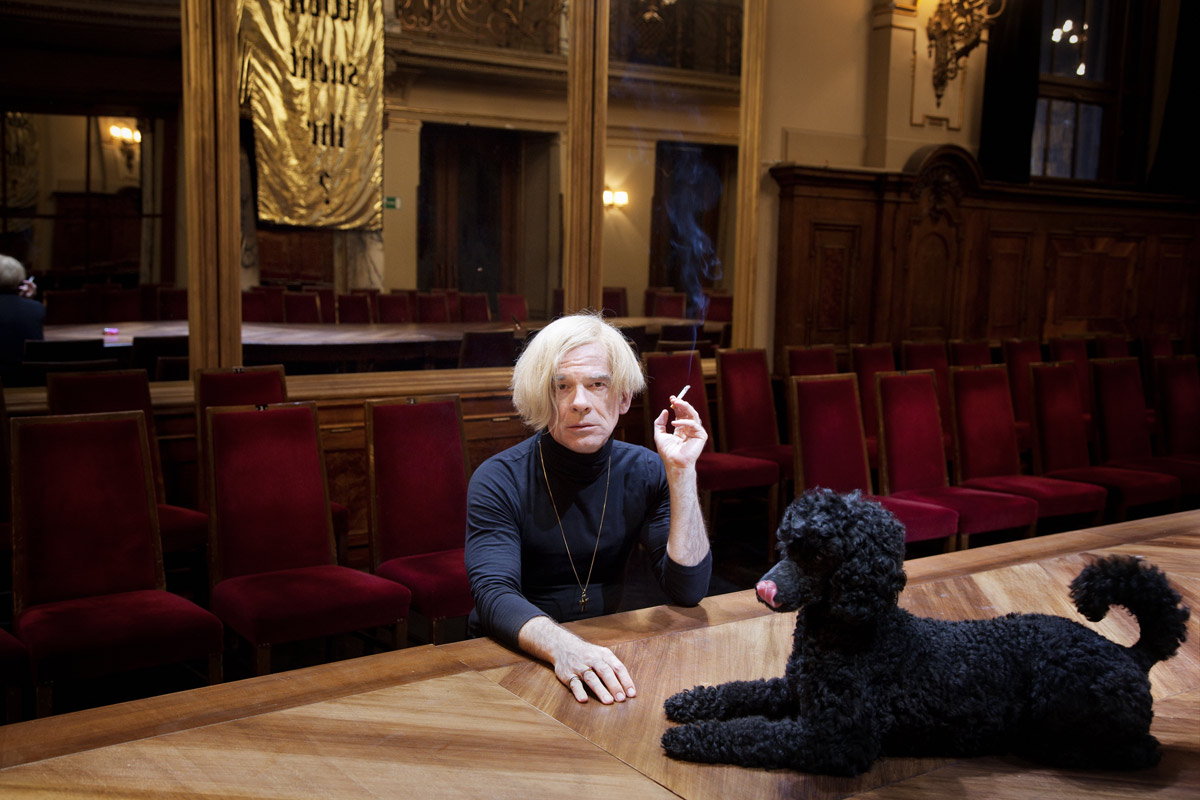
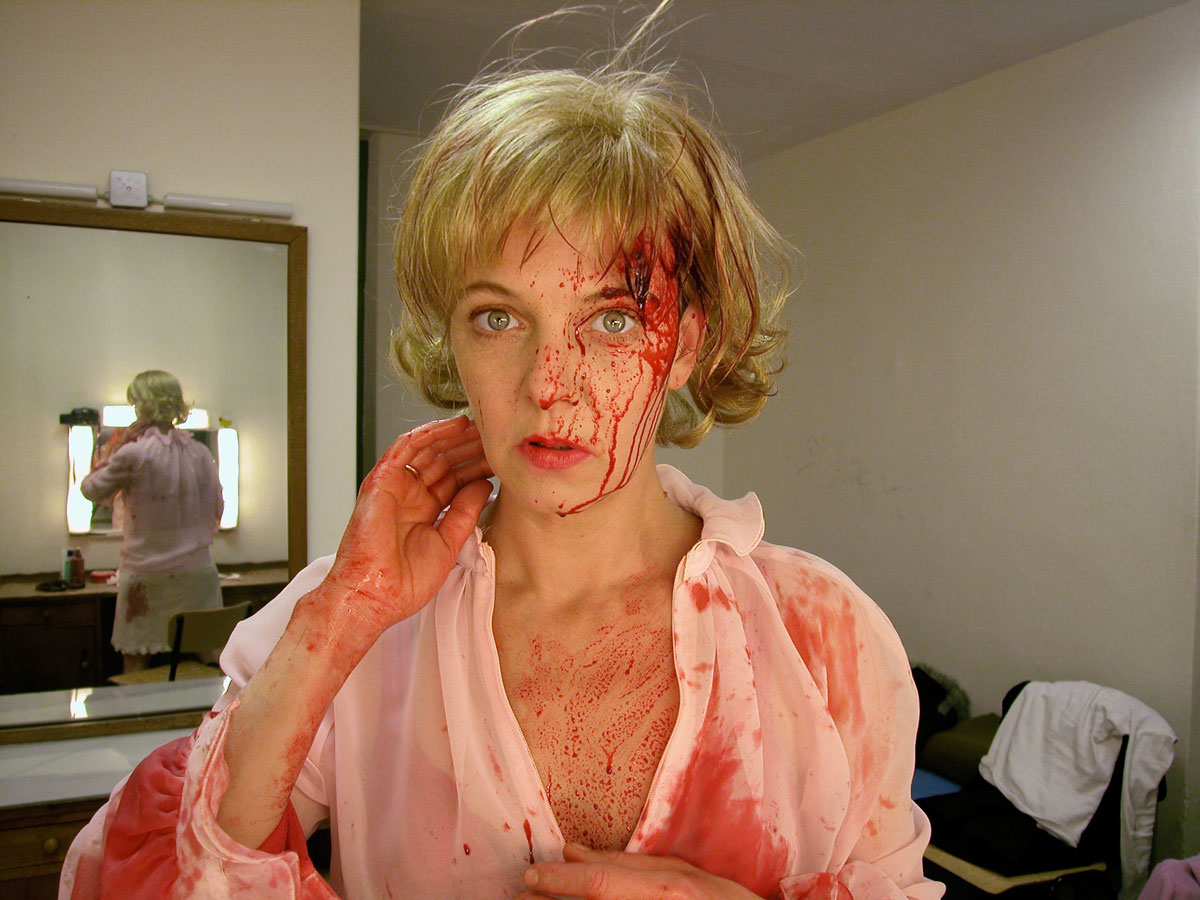
As an actress Margarita Broich is one of the big names, but it may come as a surprise to many that she is also a photographer. For the first time the Martin-Gropius-Bau is showing an exhibition of her work consisting of over 60 portraits of her fellow artists, including Ben Becker, Kate Winslet, Veronika Ferres, Klaus Maria Brandauer, Christoph Schlingensief, Thomas Quasthoff and many more. Margarita Broich has captured those fleeting moments when the actor sheds the role in the intervals or a few minutes after the end of a performance. The role can still be discerned on the features of the players when they are still surrounded by the world of scenery and mirrors but not acting any more. They have been sought out in changing rooms, theatre foyers, or with the make-up artist, taking off their make-up while still surrounded by the tools of their transformation.
Broich portrays the artists with the instinct of a colleague. Her photographs capture famous artists from her circle of acquaintances at those moments when they are returning from the stage after playing their role. However matter-of-fact the situation of the subject may occasionally appear, each photograph has its own charm. The beholder is granted glimpses of scenes that must be among the most intimate in show business: whether they show Martin Wuttke with a blonde, Andy Warhol mane and his poodle, Taxi, smoking a cigarette after a performance of “Gretchens Faust”, or Klaus Maria Brandauer at the end of a 10-hour Wallenstein epic, sitting on a stool with a bottle of beer, the snapshots are full of tension.
Born in Neuwied in 1960, Margarita Broich initially studied photo design in Dortmund and worked as a theatrical photographer at the Bochum Schauspielhaus (Theatre) under Claus Peymann, before studying dramatic art herself at Berlin’s College of Arts. Since then she has appeared in numerous German-language stage performances and television dramas, working with such directors as Claus Peymann, Robert Wilson and, earlier, with Christoph Schlingensief.
Text from the Martin-Gropius-Bau website [Online] Cited 26/05/2011 no longer available online
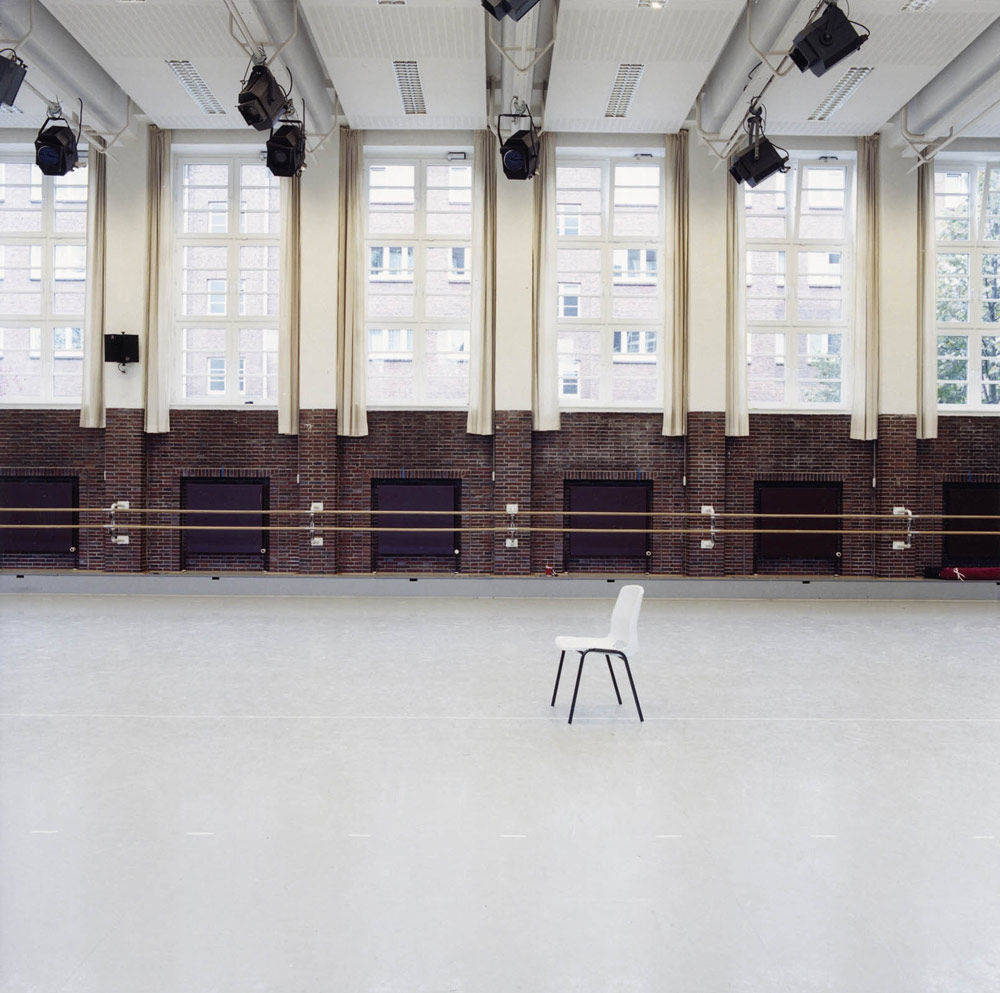
Candida Höfer (German, b. 1944) Ballettzentrum Hamburg III 2000 Chromogenic print Courtesy of Sonnabend Gallery
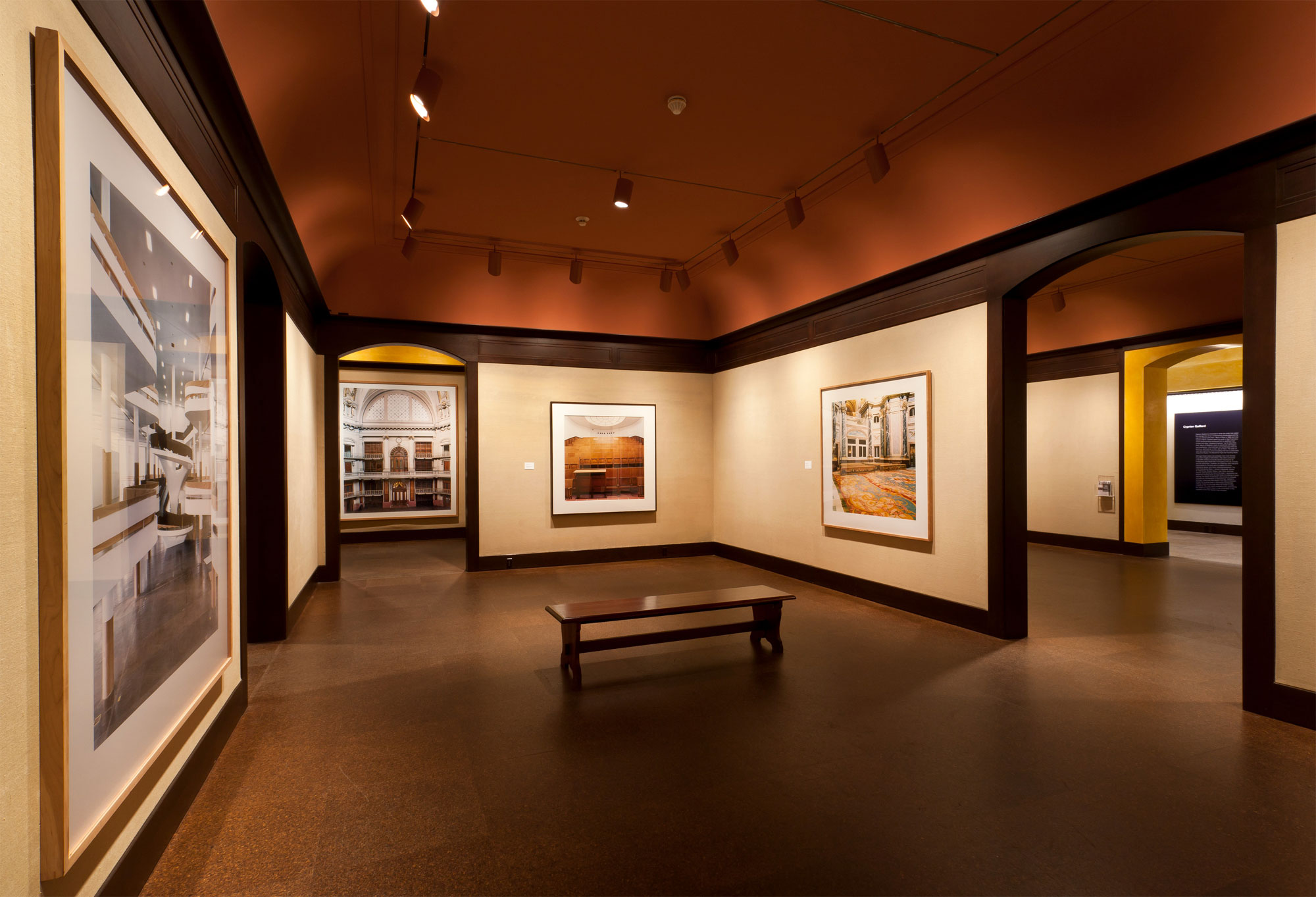
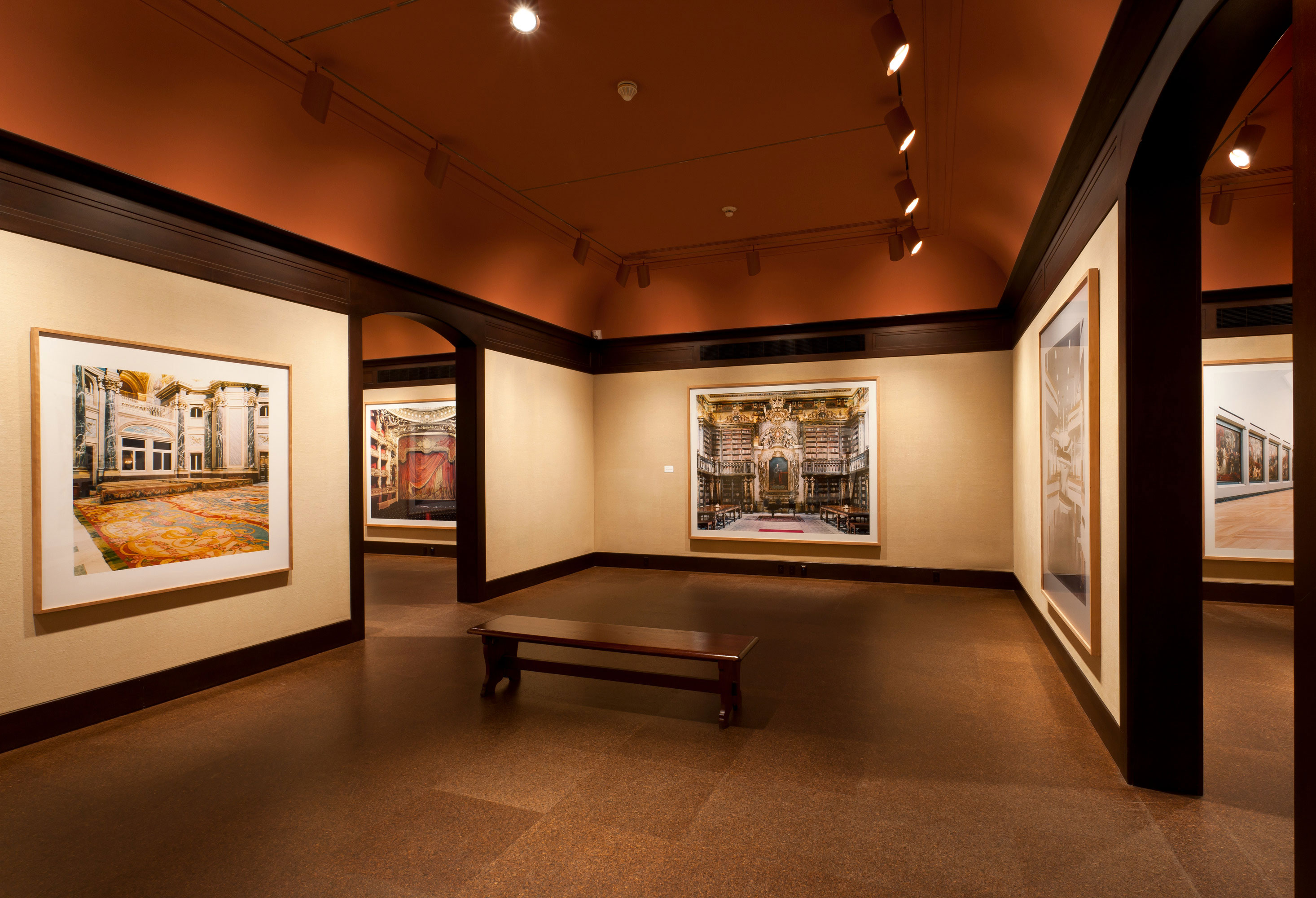
Inspired curating conjoins the monumental, classicist purity of Höfer with the picturesque, dystopian (dis)quietude of Gaillard in an exhibition that investigates our relationship to buildings and their environments and their relationship to us – the ‘i’ in our histor-i-city.
Dr Marcus Bunyan
Many thankx to the Carnegie Museum of Art for allowing me to publish the photographs in the posting. Please click on the photographs for a larger version of the image.
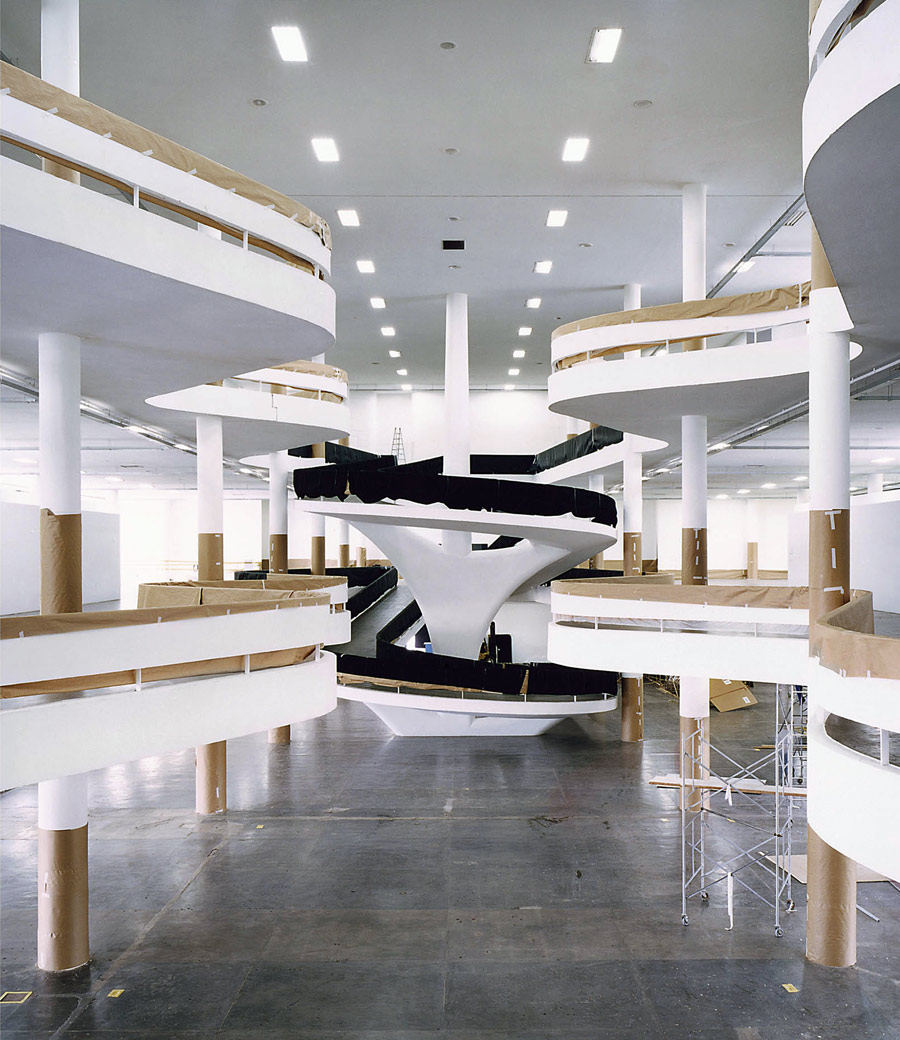
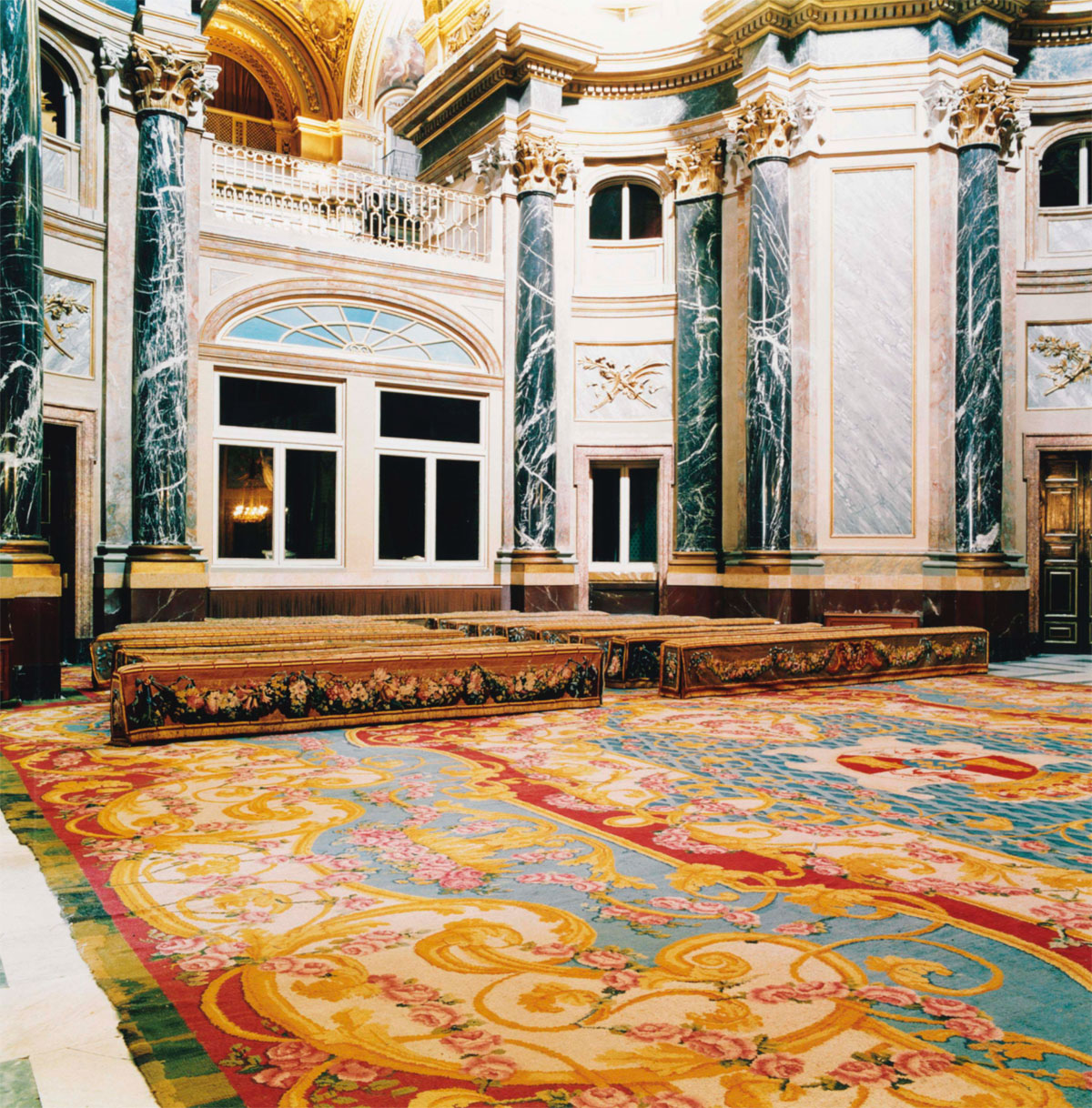
Candida Höfer (German, b. 1944) Fundação Bienal de São Paulo XI 2005 Chromogenic print 81 3/8 x 71 7/8 in. Courtesy of Sonnabend Gallery
Carnegie Museum of Art presents the powerful work of two contemporary artists – Candida Höfer and Cyprien Gaillard – who explore architectural environments and how they influence experiences and perceptions of the world.
“We shape our buildings, and afterwards our buildings shape us.” With that simple but profound insight, Winston Churchill conveyed people’s complex relationship to architecture: The physical form of a building is controlled by its designer, but the impact a constructed environment has can be unpredictable, emotional, and even visceral. That dynamic is evident in the upcoming exhibition You Are Here: Architecture and Experience, which brings together the photographs of German artist Candida Höfer and a video and etchings by French artist Cyprien Gaillard. Both artists express the formative power of architecture in different but complementary ways, according to Tracy Myers, curator of architecture at the Heinz Architectural Center and organiser of the exhibition.
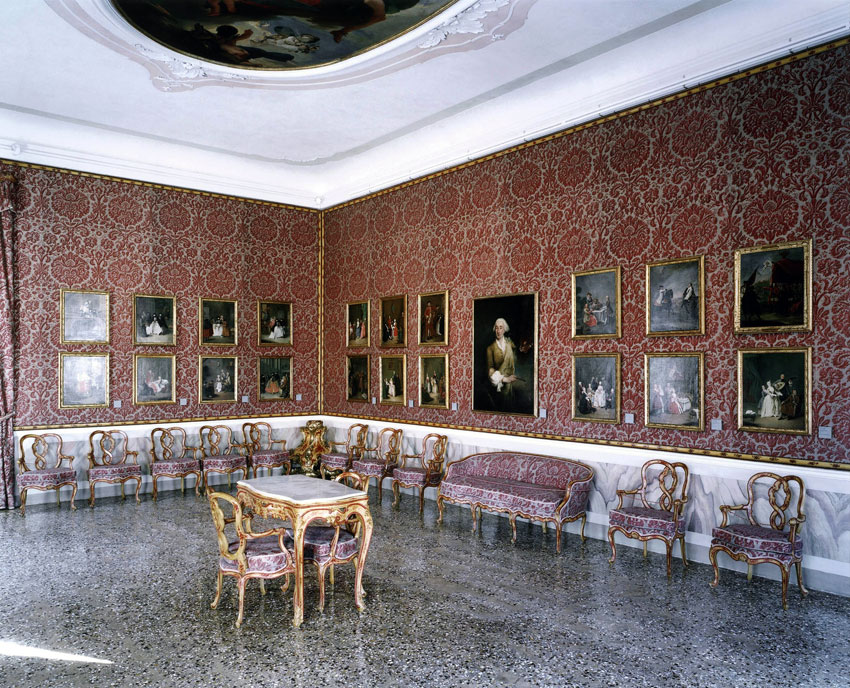
Candida Höfer’s lush colour photographs of ornate historical and contemporary interior spaces are usually devoid of humans, yet they reveal details that draw the viewer into a consideration of what each place means. Höfer’s photographs usually focus on spaces of cultural and social activity. Printed very large (from about 4 x 4 feet to a massive 6 x 8 feet), the 17 photographs in You Are Here represent the range of Höfer’s work in terms of scale, point of view, building type, and geographical location.
By contrast, Cyprien Gaillard’s video Desniansky Raion and his meticulously detailed etchings probe the human legacy of Modernist high-rise housing blocks. Constructed after World War II throughout the United States, Europe, and the Eastern Bloc to provide decent housing, these buildings often became warehouses for the poor and incubators of crime and antisocial behaviours.
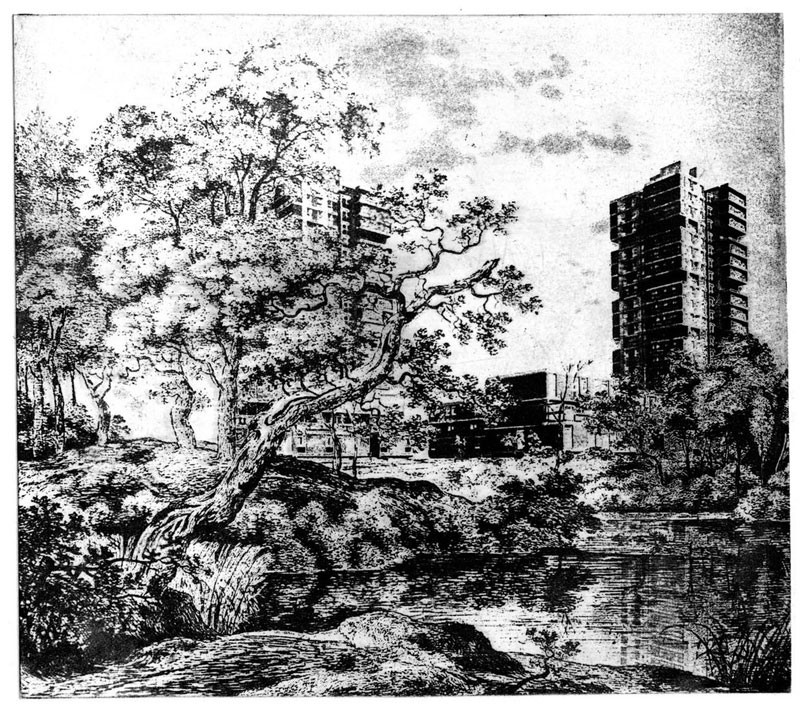
Named for an administrative district in Kiev, Desniansky Raion poignantly reflects on the gap between the utopian Modernist aspiration for universal housing and the banal reality that instead prevailed. It comprises three parts. In the first section, weekend fight clubs of 50 or 100 people face off against each other in a pugilistic ritual set against the backdrop of housing towers in St. Petersburg, Russia. The second part shows the implosion of a similar tower in Meaux, a small city near Paris; the demolition of the building was treated by the city government as a literal spectacle, with a light show and fireworks preceding the destruction. The final third is a very long panning aerial shot of seemingly endless ranks of virtually identical housing blocks in Kiev, Ukraine. The video is accompanied by a soundtrack composed by Koudlam, a young musician born in the Ivory Coast. Also featured are six etchings by Gaillard, collectively titled Belief in the Age of Disbelief, in which the Modernist housing tower is placed in classic picturesque landscapes.
“Gaillard’s video packs a powerful and direct emotional punch: each time I view it, I experience physically the anticipation that ebbs and flows through the course of the work,” said Myers. “By contrast, Höfer’s photographs embody a kind of quietude that encourages slow, sustained exploration of the meaning that builds through accumulation of detail. But both works are equally affecting and bring the viewer with compelling intensity into the realm of architectural experience. Höfer and Gaillard capture the constant oscillation between what we make of our buildings, and what they make of us.”
Artists’ Biographies
Candida Höfer has been creating photographs for more than 30 years. Born in Eberswalde, Germany, in 1944, she studied with Berndt Becher and is identified with a group of German artists – Thomas Ruff, Andreas Gursky, Axel Hütte, and Thomas Struth – best known for their unsentimental photographs of architecture, landscapes, and urban developments. Höfer has made interiors her focus.
Cyprien Gaillard, born in Paris in 1980 and currently based in Berlin, explores contemporary landscapes and buildings in a variety of media, including video, painting, and etchings. Much of his work is concerned with the legacy and inheritance of buildings and landscapes that are left to us, and the ways in which we interact with them.
Press release from the Carnegie Museum of Art website
The video takes place in a parking lot of a drab housing complex in St. Petersburg, Russia, where he witness two large groups of men – one mostly wearing red shirts and the other blue – slowly walking towards each other. Set by Gaillard to the hypnotic electronic beats of French composer Koudlam’s I See you All, the video shows the colour-coordinated groups marching in loose formation, reminiscent of ancient armies confronting each other on some distant battlefield. Suddenly, signal flares billowing smoke arc through the air and the two groups come together, clashing in flurry of fists – a breathtaking display of raw physical violence set against the stark backdrop of the housing block. As the sounds of Koudlam’s pulsing music draw louder and more urgent, the furious hand-to-hand combat intensifies while bodies of the fallen lay strewn on the pavement. Before long, the blue faction beats a hasty retreat, only to regroup moments later on one side of a nearby pedestrian bridge. The two sides come together again, this time clashing on the impossibly narrow span of the footbridge. The blue group is once more chased off, and the victors in red erupt in victorious celebration.
“We are unhealthy, middle-aged, dirty-minded, depressed, cynical, empty, tired-brained, seedy, rotten, dreaming, badly-behaved, ill-mannered, arrogant, intellectual, self-pitying, honest, successful, hard-working, thoughtful, artistic, religious, fascistic, blood-thirsty, teasing, destructive, ambitious, colourful, damned, stubborn, perverted and good. We are artists.”
Gilbert & George, 1980
More from the Jack Freak picture show!
Marcus
Many thankx to Deichtorhallen Hamburg for allowing me to publish the photographs in the posting. Please click on the photographs for a larger version of the image.
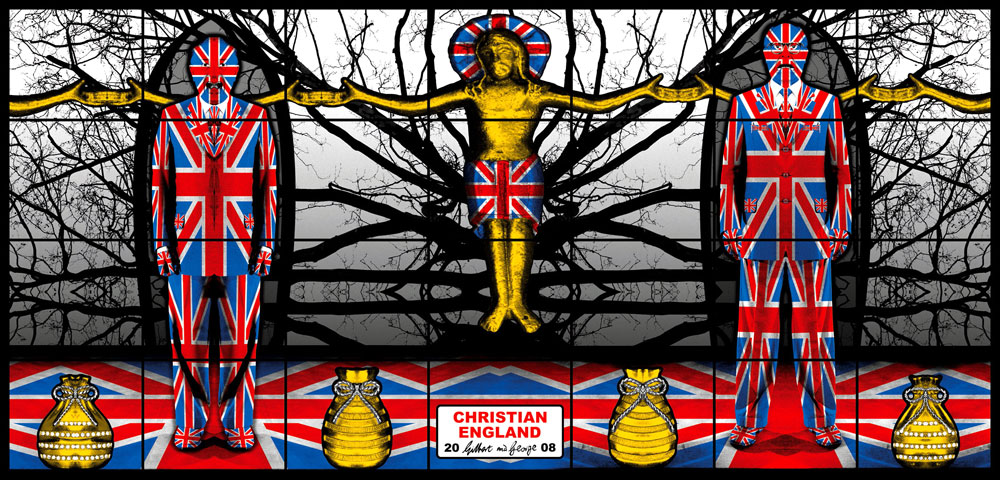
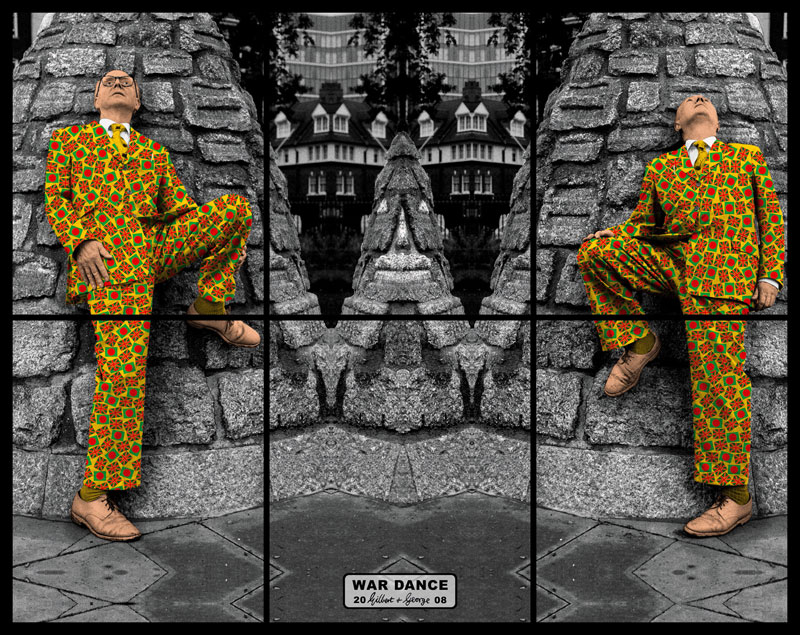
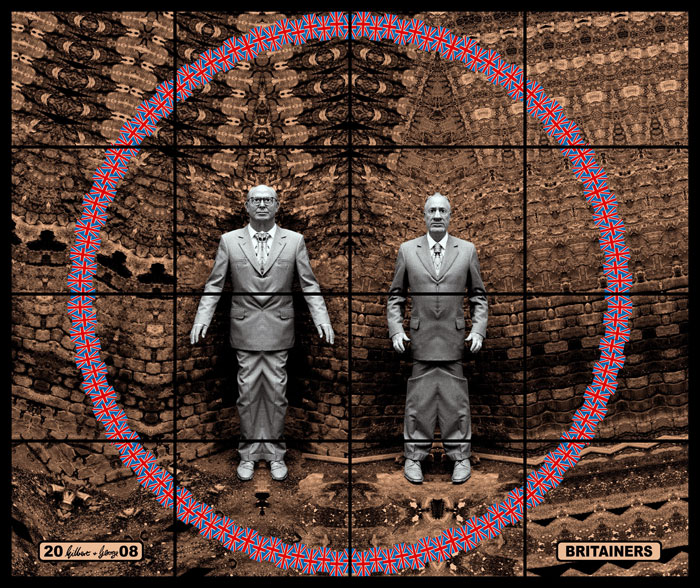
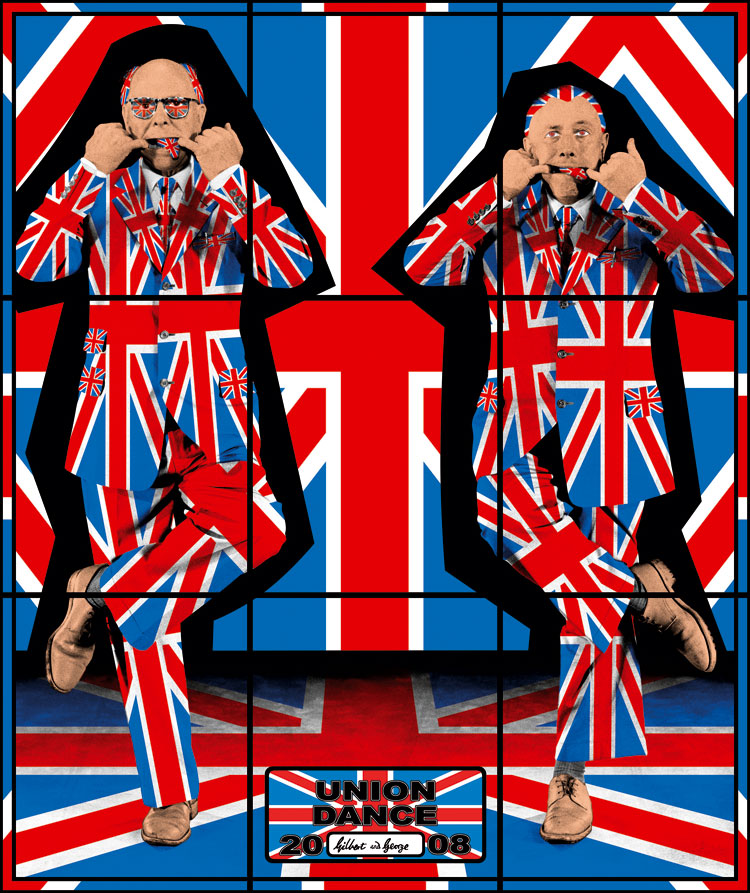
According to the writer Michael Bracewell, “the Jack Freak Pictures are among the most iconic, philosophically astute and visually violent works that Gilbert & George have ever created.” The dominant pictorial element is the Union Jack, itself an internationally familiar, abstract, geometric pattern and a socially and politically charged symbol whose significance spans the cultural spectrum from contemporary fashion to aggressive national pride. Equally prominent, and linking the Jack Freak Pictures to almost every work previously created by the artists, are Gilbert & George themselves in a variety of guises: dancing, gurning, howling, watching, waiting. Sometimes their bodies seem complete; other times they have been fragmented or contorted. Invariably they feature as both subject and object, artwork and artist; they are players in the epic and complex pictorial drama they have created.
Set in the East End of London where Gilbert & George have lived and worked for over forty years, the Jack Freak Pictures bring numerous aspects of the modern world to life. Medals, flags, maps, street-signs, graffiti and other less immediately obvious motifs jostle for attention with the brickwork, buildings and even foliage of the contemporary urban environment in works that are densely layered and complexly nuanced to evoke (and sometimes conflate) a sense of past, present and future. They raise fundamental and rudimentary questions about religion, identity, politics, economics, sexuality and death. The Jack Freak Pictures reaffirm Gilbert & George’s status as pre-eminent Modernists and underline Robert Rosenblum’s observation that “of the singularity of their duality in life as art, there is little doubt.” Michael Bracewell’s view that they are “visionary artists in the lineage of William Blake” rings truer now than ever before.
Text from the White Cube website [Online] Cited 12/05/2011 no longer available online
With its major spring show, Deichtorhallen Hamburg is once again bringing stars of the international art world to Hamburg. Gilbert & George (born 1943 and 1942) have long since been acknowledged icons of contemporary art.
The exhibition will present the latest, wide-ranging group of pictures they have ever created. Called the “Jack Freak Pictures”. They will be on display in the cathedral-like setting of the large Deichtorhalle from February 25 to May 22, 2011 for the first time more or less in its entirety – some 120 pictures will be on view.
Gilbert & George’s large-format pictures present decidedly sacred and secular themes. In this case, Gilbert & George have created a group around the British national symbol, the Union Jack, with all its different connotations, from symbol of national pride through to the cult symbol of the British Pop Music world and countercultures. Surrounded by medals and amulets, the streets of London and the red, blue and white design of the British flag, as in their previous art here Gilbert & George are not only the creators of their own world of images, but also act as protagonists in it.
The “Jack Freak Pictures” are among the most symbolic, philosophically most elaborate and visually striking art Gilbert & George have ever created. Within Gilbert & George’s oeuvre as a whole they constitute the powerful concentration of the themes and emotions that the artists have now been exploring in their art for more than 40 years. In these pictures, the artists play the roles of both victim and monster, puppets of a cosmic revue, sleepless guardians of empty big-city streets and crazy-looking talking heads, as Michael Bracewell outlines in his essay in the exhibition catalog. The large pictures, do not address the individual constitution of the two artists but instead point up states of human existence and can be read as a description of the modern world from the artists’ point of view.
The exhibition is being organised by Deichtorhallen Hamburg and the British Council and will move on from Hamburg, albeit it on a smaller scale, to Lentos Kunstmuseum, Linz, Austria. Hatje Cantz Verlag has brought out a catalog with an essay by Michael Bracewell and colour illustrations of all 153 works in the series.
Curators: Roxana Marcoci, Curator, and Eva Respini, Associate Curator, Department of Photography, The Museum of Modern Art
Many thank to The Museum of Modern Art, New York for allowing me to publish the photographs in the posting. Please click on the photographs for a larger version of the image.
Installation view of the exhibition Staging Action: Performance in Photography Since 1960 at The Museum of Modern Art (MoMA), New York showing at right, George Maciunas Performing for Self-Exposing Camera, New York 1966
George Maciunas (American born Lithuania, 1931-1978) George Maciunas Performing for Self-Exposing Camera, New York 1966 Gelatin silver print
Focusing on a wide range of images of performances that were expressly made for the artist’s camera, Staging Action: Performance in Photography Since 1960 draws together approximately 50 works from the Museum’s collection, and is on view from January 28 to May 9, 2011. Though performances are often intended to be experienced live, in real time, with photography playing an ancillary function in recording them, these works function as independent, expressive pictures, often staged in the absence of a public audience. At the center of these pictures is a performer (often the artist), posing or enacting an action conceived for the photographic lens. Among the works on view, approximately half are recent acquisitions by MoMA, including pieces by Laurel Nakadate, Rong Rong, Ai Weiwei, Huang Yan, and La Monte Young. Staging Action is organised by Roxana Marcoci, Curator, and Eva Respini, Associate Curator, Department of Photography, The Museum of Modern Art.
Beginning with Fluxus artists in the 1960s, Staging Action includes the work of George Maciunas, an artist who engaged the production of the self as positional rather than fixed and often played with transvestism. According to personal reminiscences of the American poet Emmett Williams, a friend, Maciunas’s closets were full of prom dresses that he scavenged from the Salvation Army. In his 1966 cross-dressing striptease, George Maciunas Performing for Self-Exposing Camera, New York, he reinforced the active construction of identity through gender indeterminacy. The participation of the camera as accomplice to the artist’s actions was also a constant theme in Vito Acconci’s work of the early 1970s. In Conversions I: Light, Reflections, Self-Control (1970-1971), Acconci tried to feminize his male body by plucking hair from his chest and navel area, pushing his pectorals together to mimic breasts, and hiding his genitals between his legs. Performances that explored gender play were soon embraced by other artists. A few years later, Richard Prince and Cindy Sherman collaborated on a photo shoot in which they sported identical suits and red-haired wigs, each playing androgynous double to the other.
Staging Action continues with artists who experimented with the camera to test the physical and psychological limits of the body. Reacting against the post-World War II repressive sexual and political atmosphere of Austrian society, the group known as the Vienna Actionists – including Günter Brus, Otto Muehl, Herman Nitsch, and Rudolf Schwarzkogler – staged highly provocative actions that were mostly ritualistic, incorporating elements such as wine and animal blood from Dionysian rites and Christian ceremonies in an attempt to free human instincts that had been repressed by society. In the early 1990s, numerous artists living in Beijing’s East Village artist community actively engaged in endurance-based performances. On view is East Village, Beijing No. 22 (1994) by Rong Rong, an iconic picture of the now seminal performance known as 12 Square Meters, which takes its title from the size of the public urinal where the action took place. The artist Zhang Huan covered himself in fish guts and honey and sat motionless for an hour in the heat of a summer day as flies gathered on his body, while the photographer Rong Rong captured the gritty performance.
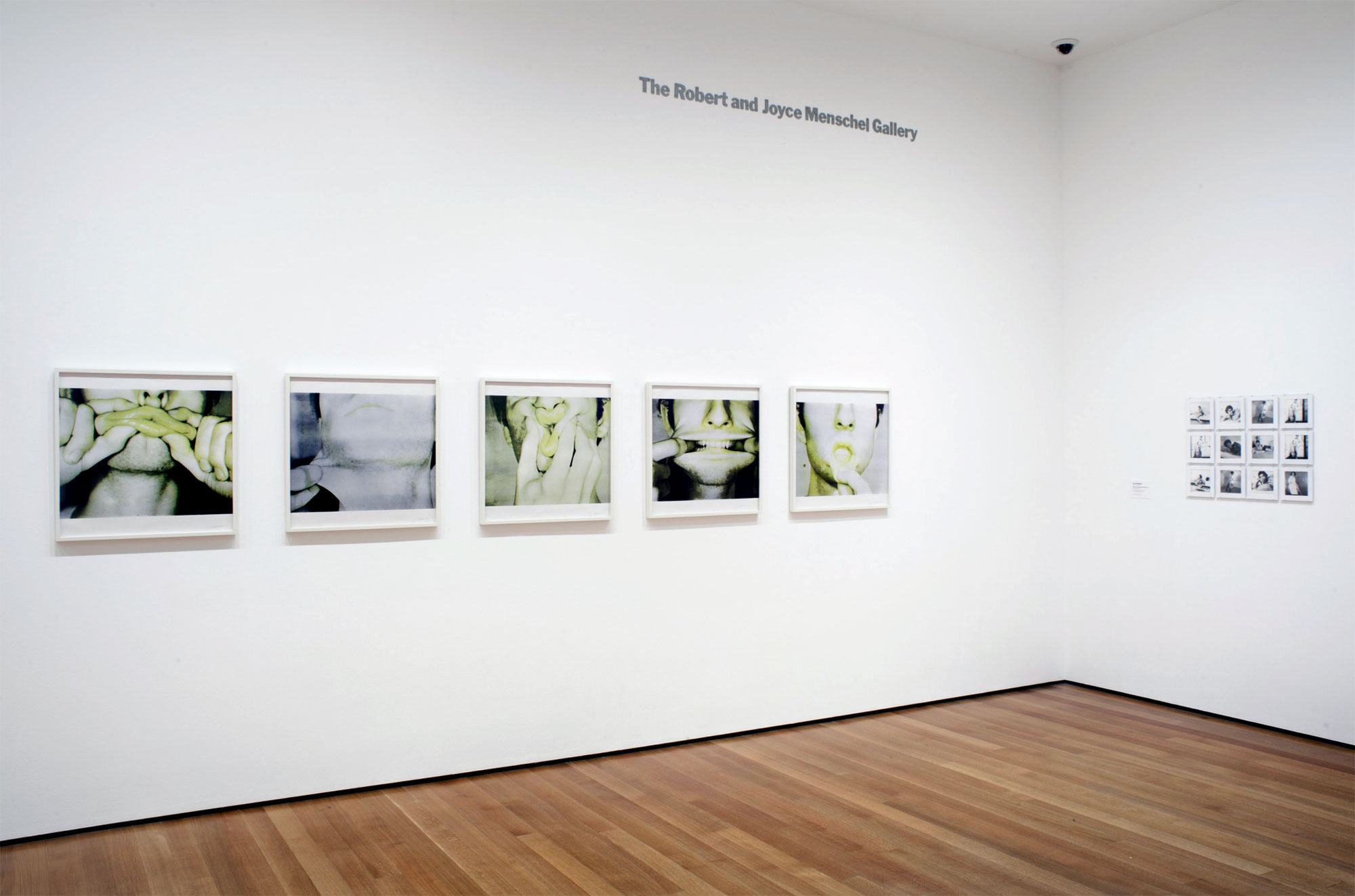
The face as a site for alteration and extreme expression is of particular interest to several artists in the exhibition. In his five-part work, Studies for Holograms (1970), Bruce Nauman poked, pulled, pinched, and kneaded his mouth, neck, and cheeks in extreme and cartoonish ways. For her 1972 work (Untitled) Facial Cosmetic Variations, Ana Mendieta used tape and make-up to mould and manipulate her face to create, at turns, disturbing and humorous results that reference the cosmetic changes women inflict upon themselves in the name of beauty. Lucas Samaras’s transformations in a series of self-portrait Polaroids from 1969-1971 suggest the plasticity or mutability of identity itself. For these works, the artist utilised an array of wigs, pancake make-up, and props to transform himself into grotesque characters for the camera.
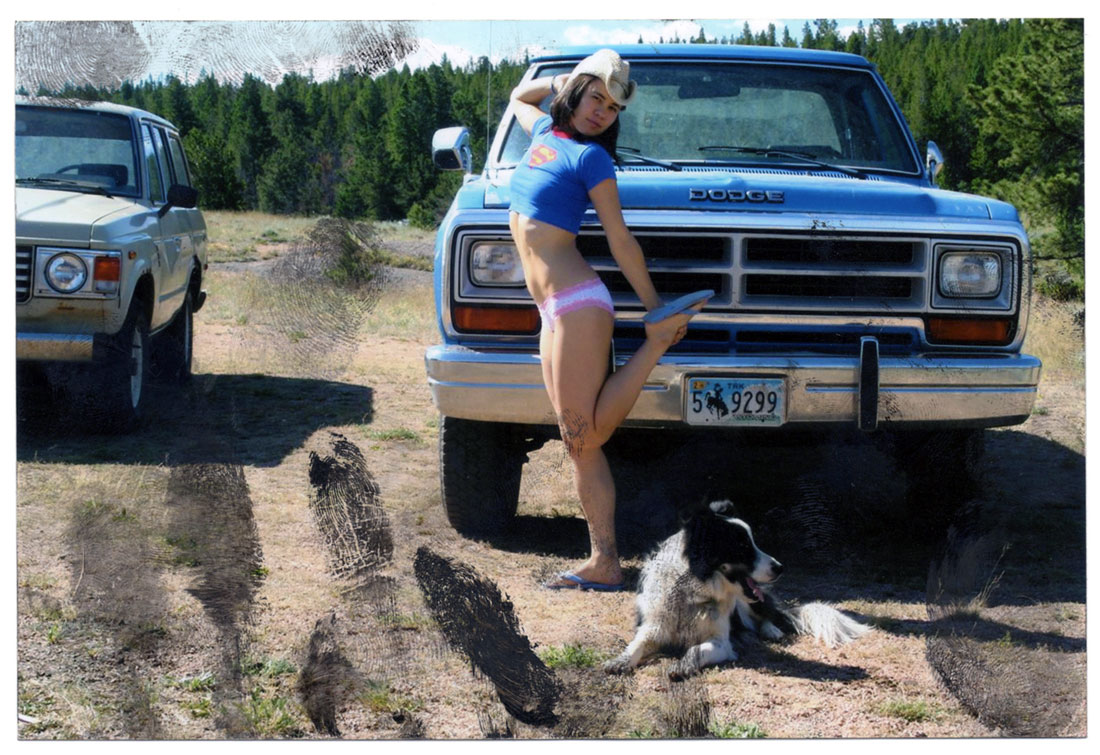
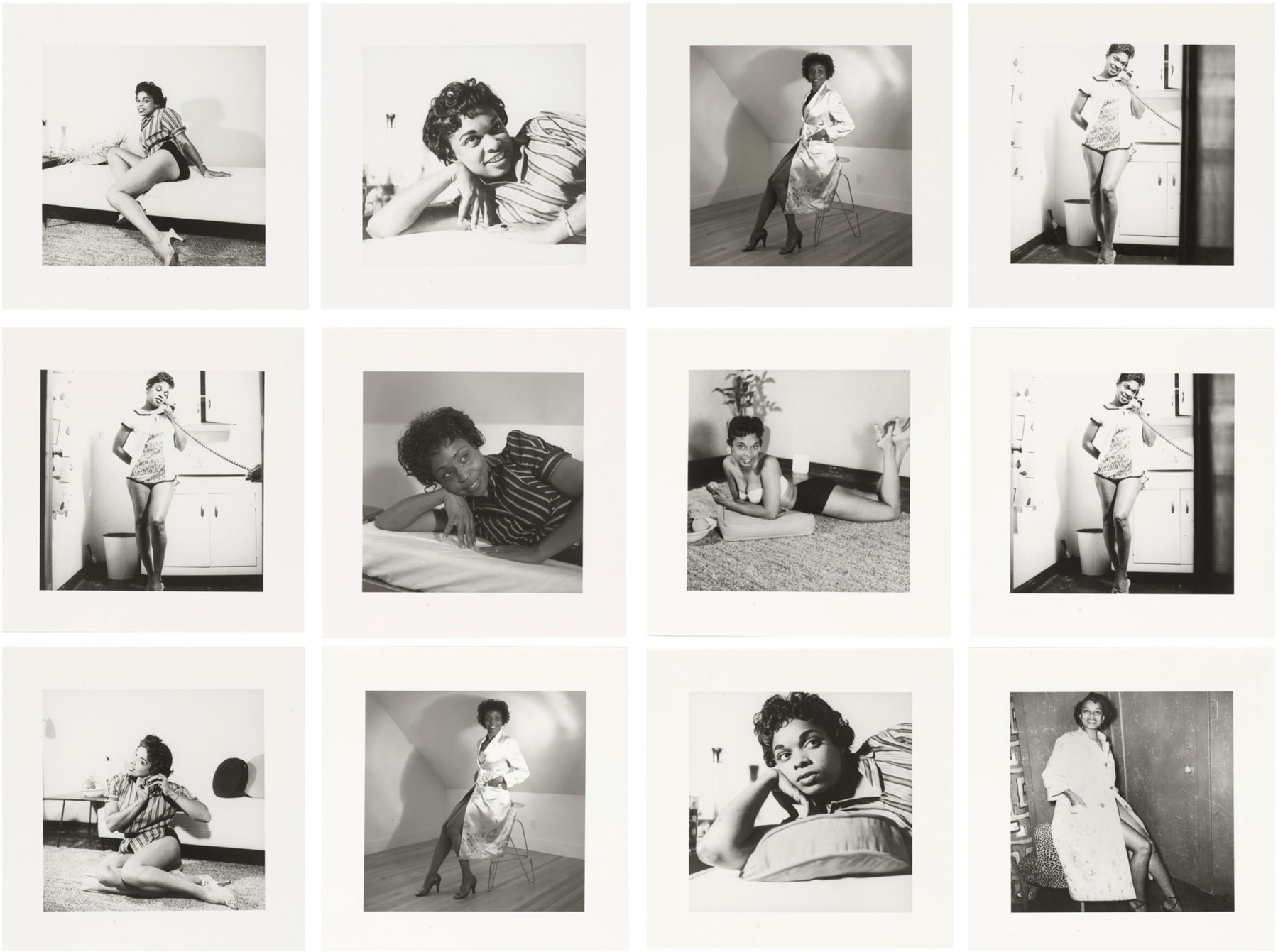
Other performances required a sustained, emotional engagement on the part of the artist. Bas Jan Ader’s particular brand of existential-based Conceptualism is crystallised in I’m too sad to tell you (1970), in which the artist cried in front of the camera. In 1971, Adrian Piper performed a time-lapse piece titled Food for Spirit. Inspired by an assignment to write a text on Immanuel Kant’s Critique of Pure Reason, Piper began fasting in order to isolate herself into a state of self-transcendence, and took pictures of herself in front of a mirror to insure reconnaissance of her own body. The ability of the camera to both freeze and extend a moment in time was also instrumental to the Japanese artist Mieko Shiomi. In Disappearing Music for Face (1966), Shiomi sequenced a series of film stills focusing on the mouth of Yoko Ono as her smile intermittently faded into a neutral facial expression. In Laurel Nakadate’s pictures from the Lucky Tiger series that she conceived of in 2009 during a road trip through the American West, the artist is seen riding a horse in a cropped T-shirt, doing a backbend in cowboy boots by the Grand Canyon, and striking a Playboy pose in her “lucky tiger” bikinis, rehashing photographic conventions inspired by 1950s-style “cheesecake” and camera-club pictures. Lorna Simpson’s multi-part work, May, June, July, August ’57 / ’09 (2009) also responds to the photographic conventions of posing for the camera. Simpson turned to the photographic archive as source material, combining found photographs of a young African-American woman who posed for hundreds of pin-up pictures in 1957 in Los Angeles with her own performative self-portraits, in which she replicates every outfit, pose, and setting of the original photographs. Through juxtaposition, repetition, and de-contextualization, a historical fiction arises, whereby the two women, despite the many differences that separate them, seem to be joined through a shared identity.
The exhibition includes both off-the-cuff and staged performative gestures of political dissent. Ai Weiwei’s photographic series Study of Perspective (1995-2003) reveals a spirited irreverence toward national monuments. Traveling to various landmarks – from the Eiffel Tower to Tiananmen Square to the White House – the artist photographed his own arm extended in front of the camera’s lens as he gave each marker the middle finger. Robin Rhode’s pictures, presented sequentially in storyboard format, record situations in which the artist interacts with a set of objects that he has drawn, erased and redrawn in black charcoal on dilapidated walls. Untitled, (Dream House) (2005) comprises a sequence of 28 colour photographs in which Rhode mimics the act of struggling to catch a television set, a chair, and a car that appear to have been thrown at him from above. In reality, these items are drawn in cartoonish lines on an exterior wall. Referencing the South African New Year custom of tossing out old objects, the artist identifies society’s two opposing poles: consumerism and dispossession. Rhode’s pictures, like those of the other artists in Staging Action, attest to the myriad ways in which photography constitutes – not just documents – performance as a conceptual exercise.
Press release from the MoMA website
Installation view of the exhibition Staging Action: Performance in Photography Since 1960 at The Museum of Modern Art (MoMA), New York showing at right, Rong Rong’s East Village, Beijing, No. 81 1994
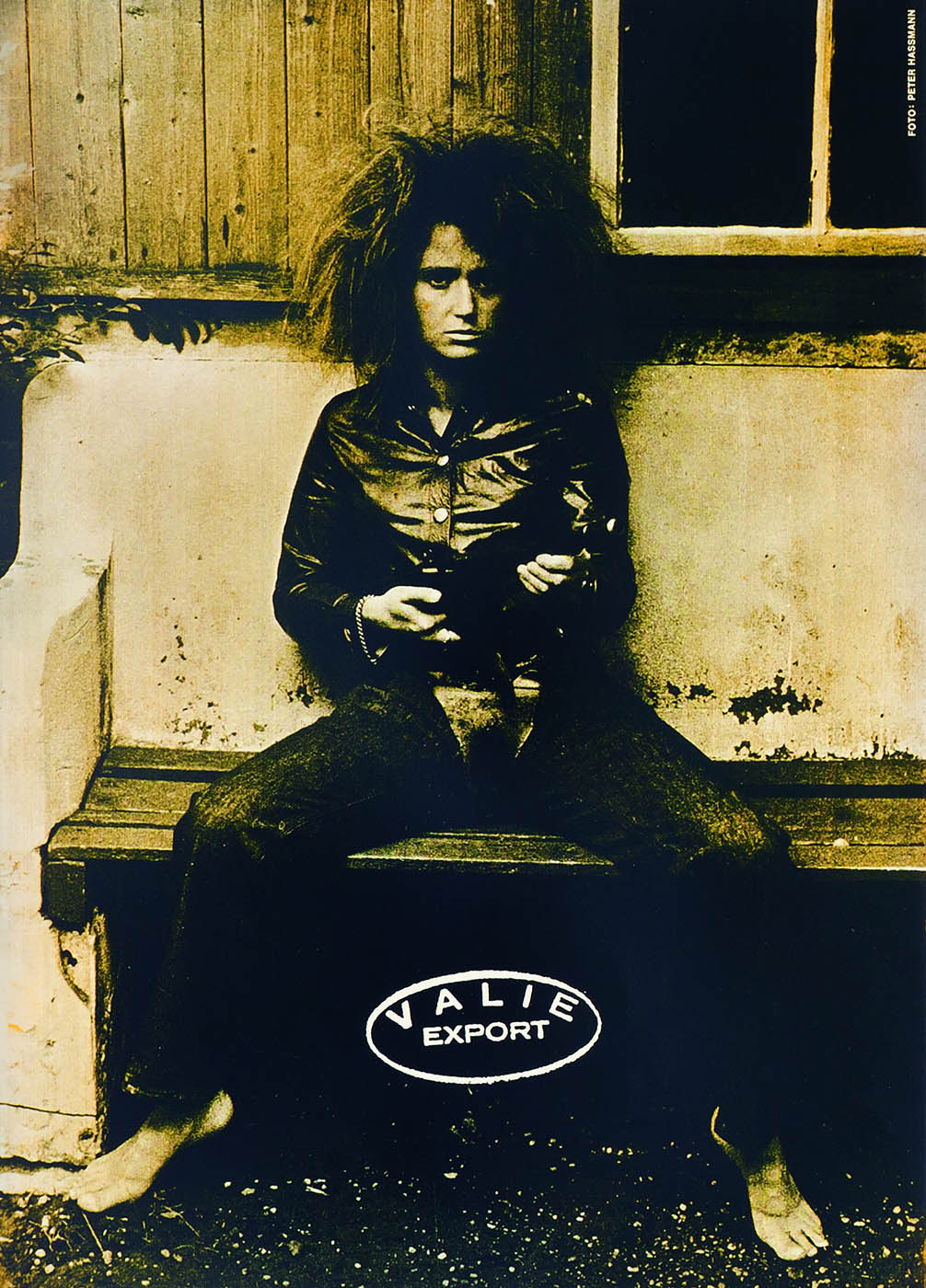
Installation view of the exhibition Staging Action: Performance in Photography Since 1960 at The Museum of Modern Art (MoMA), New York showing at left, Ana Mendieta’s Facial Cosmetic Variations 1972; at centre, the work of Rudolf Schwarzkogler; and at right, VALIE EXPORT with Peter Hassmann’s Action Pants: Genital Panic (1969, below)
This series of screenprints relates to a performance in which EXPORT reportedly walked into an experimental art-film house in Munich wearing crotchless trousers and a tight leather jacket, with her hair teased wildly, and roamed through the rows of seated spectators, her exposed genitalia level with their faces. Challenging the public to engage with a “real woman” instead of with images on a screen, she illustrated her notion of “expanded cinema,” in which the artist’s body activates the live context of watching. EXPORT’s defiant feminist action was memorialised in a picture taken the following year by the photographer Peter Hassmann in Vienna. EXPORT had the image, in which she holds a machine gun, screenprinted in a large edition and fly-posted it in public squares and on the street.
Gallery label from From the Collection: 1960-69, March 26, 2016 – March 12, 2017
Installation view of the exhibition Staging Action: Performance in Photography Since 1960 at The Museum of Modern Art (MoMA), New York showing at left, Bruce Nauman’s Studies for Holograms (1970); and at right, Lorna Simpson’s May, June, July, August ’57/’09 #8 (2009, below)
Lorna Simpson describes 1957-2009 as “a project that happened kind of by accident.” Since she often works with vintage photographs, advertisements, and magazines, she was on eBay in search of material, when she came across a couple of black-and-white photographs of a young black woman posing alluringly. As it turned out, these were part of a much larger album of photographs, featuring this woman, and, occasionally, a young black man, in attractively staged poses. The sellers offered the entire album to Simpson. Struck by the images, though not yet sure what to do with them, she bought it.
When the album arrived, she hung the photographs in her studio, where they remained for months. Taken in 1957, in modest domestic and outdoor settings, most of them appeared to be inspired by the pin-up, mass-produced images of seductively posed actresses and models, widely circulated in the 1940s and 50s. But the identities of the photographer, the woman, and the man were unknown. Ultimately, Simpson decided to restage these images. Using herself as her model, she mimicked the settings, clothing, hairstyles, and poses of both the woman and the man and photographed herself using black-and-white film. She then paired her own photographs with the originals (for a total of 307 individually framed images) and has displayed them together in various arrangements.
As with much of her work, it is up to viewers to draw their own conclusions about the identities of the subjects of 1957-2009. A feminist and an African American woman, Simpson has been concerned with black female identity since the beginning of her career. By providing little or no information about the people who appear in her images, she poses challenging questions about how we perceive and make assumptions about others based upon their appearance – and upon stereotypes associated with aspects of identity like skin colour, hair, gender, and clothing.










![Sue Ford (1943-2009) 'Untitled [Bliss at Yellow House, King's Cross, Sydney]' c. 1972–1973](https://artblart.com/wp-content/uploads/2011/06/008.jpg "Sue Ford (1943-2009) 'Untitled [Bliss at Yellow House, King's Cross, Sydney]' c. 1972–1973")
























 Art Blart _ art and cultural memory archive
You must be logged in to post a comment.