Exhibition: ‘Patrick Pound: The Great Exhibition’ as part of the NGV Festival of Photography at NGV Australia, Melbourne Part 1

Exhibition dates: 31st March – 30th July, 2017

Individual art works from the NGV collection (in artist alphabetical order) appearing in Patrick Pound: The Great Exhibition at NGV Australia


” … from an air guitar to Being and nothingness … “
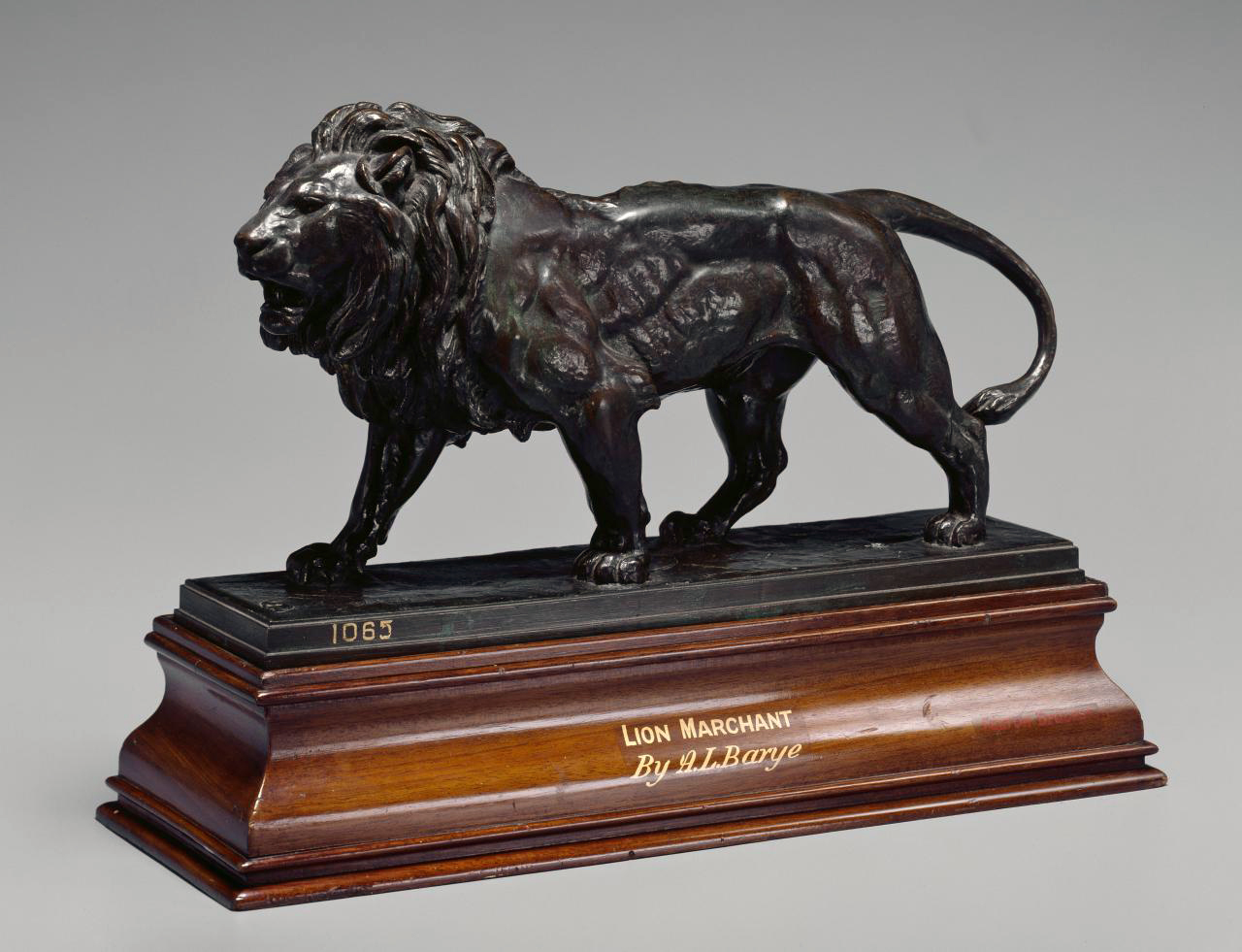
 

Antoine-Louis Barye (France, 1796-1875) 'Walking lion' c. 1840 from the exhibition 'Patrick Pound: The Great Exhibition' as part of the NGV Festival of Photography at NGV Australia, Melbourne, March - July, 2017


Antoine-Louis Barye (French, 1796-1875)
Walking lion
Lion qui marche
c. 1840, cast 1900
Bronze
National Gallery of Victoria
Felton Bequest, 1927


Part 1 of this bumper posting. See Part 2 of the posting with my review of the exhibition.

My hand is progressing slowly. A return to part-time work in the next couple of weeks, for which I will be grateful. It has been tough road dealing with this injury.

Dr Marcus Bunyan


Many thankx to the National Gallery of Victoria for allowing me to publish the photographs in the posting. Please click on the photographs for a larger version of the image.
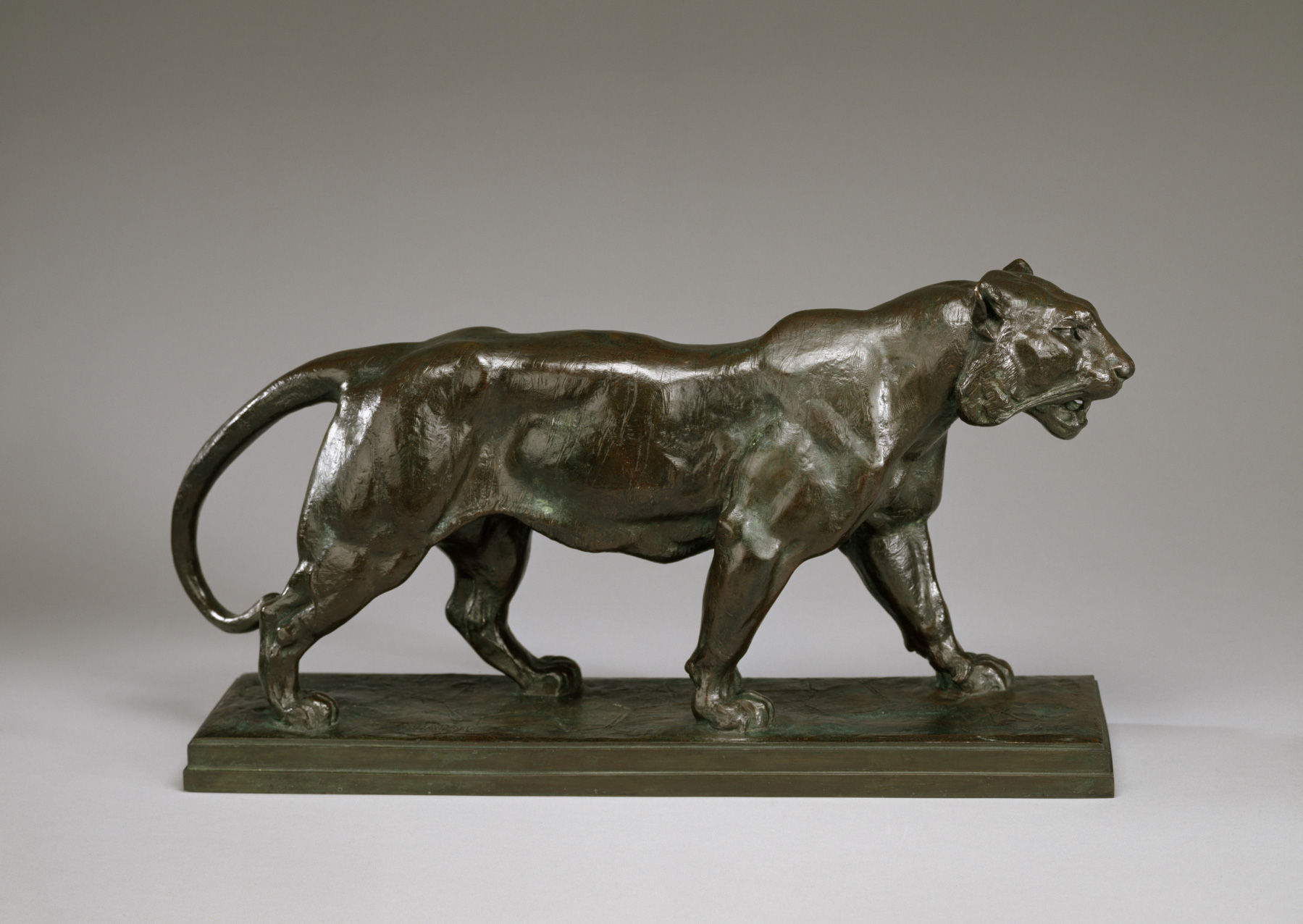


Antoine-Louis Barye (French, 1796-1875) 'Walking tiger' c. 1841 from the exhibition 'Patrick Pound: The Great Exhibition' as part of the NGV Festival of Photography at NGV Australia, Melbourne, March - July, 2017


Antoine-Louis Barye (French, 1796-1875)
Walking tiger
Tigre qui marche
c. 1841, cast 1900
Bronze
National Gallery of Victoria
Felton Bequest, 1927


John Armstrong (English, 1893-1973) 'Invocation' 1938 from the exhibition 'Patrick Pound: The Great Exhibition' as part of the NGV Festival of Photography at NGV Australia, Melbourne, March - July, 2017


John Armstrong (English, 1893-1973)
Invocation
1938
Tempera on plywood
National Gallery of Victoria
Purchased with funds donated by Ian Hicks AM and Dorothy Hicks, 2006


Invocation is one of a series of paintings, which John Armstrong begun in the 1930’s as a direct statement against the rise of Fascism in Europe. John Armstrong observed Fascism in Italy at first hand and became an active left wing campaigner against the proliferation of nuclear weapons. He was commissioned as an official war artist, designing a cover for a leaflet in the 1945 election campaign and contributed occasional articles and poetry to left wing journals. In his painting Victory, he imagined the result of a nuclear holocaust, which attracted the attention at the Royal Academy Summer Exhibition in 1958.

Text from the Leicester Galleries website [Online] Cited 17/07/2017. No longer available online


Eugène Atget (French, 1857-1927) 'Eclipse' 1911, printed 1956- early 1970s


Eugène Atget (French, 1857-1927)
Eclipse
1911, printed 1956- early 1970s
Gelatin silver photograph
National Gallery of Victoria
Purchased, 1978


Surrogates and the Surreal

Atget’s photograph Pendant l’éclipse (During the eclipse) was featured on the cover of the seventh issue of the Parisian Surrealists’ publication La Révolution surréaliste, with the caption Les Dernières Conversions (The last converts), in June 1926. The picture was uncredited, as were the two additional photographs reproduced inside. Although Atget firmly resisted the association, his work – in particular his photographs of shop windows, mannequins, and the street fairs around Paris – had captured the attention of artists with decidedly avant-garde inclinations, such as Man Ray and Tristan Tzara. Man Ray lived on the same street as Atget, and the young American photographer Berenice Abbott (working as Man Ray’s studio assistant) learned of the French photographer and made his acquaintance in the mid-1920s – a relationship that ultimately brought the contents of Atget’s studio at the time of his death (in 1927) to The Museum of Modern Art almost forty years later.

Text from Art Blart posting Eugène Atget: “Documents pour artistes” at the Museum of Modern Art (MoMA), New York


Pierre Bonnard (France, 1867-1947) 'Siesta' 1900


Pierre Bonnard (France, 1867-1947)
Siesta
La Sieste
1900
Oil on canvas
National Gallery of Victoria
Felton Bequest, 1949
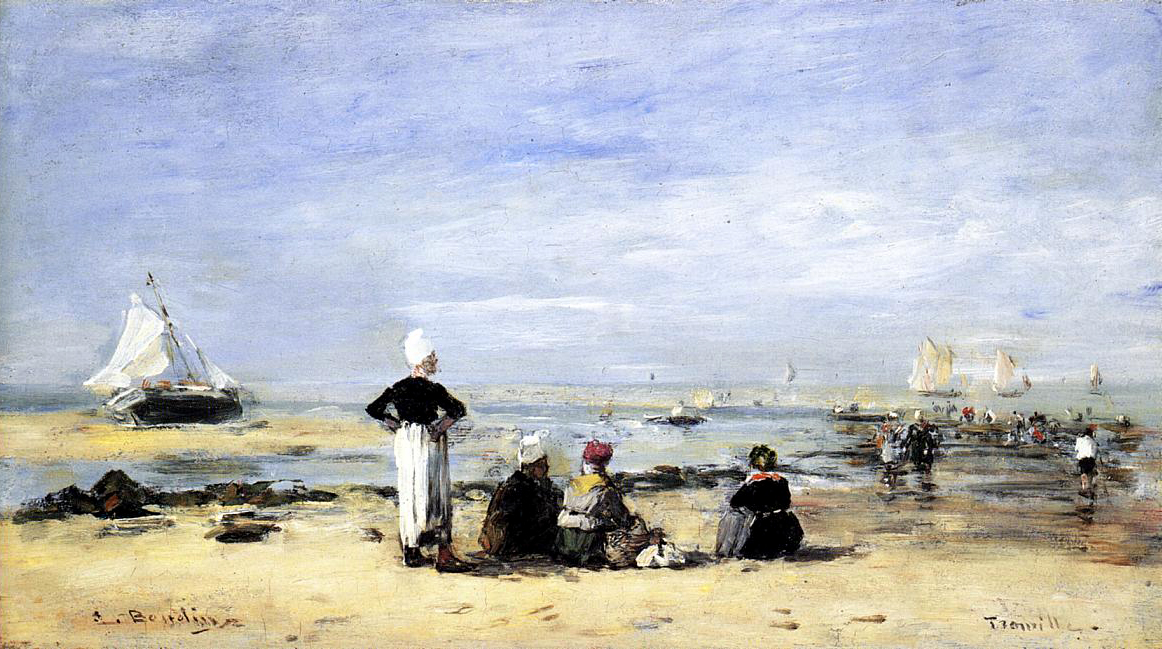
 

Eugène Boudin (French, 1824-1998) 'Low tide at Trouville' 1894


Eugène Boudin (French, 1824-1998)
Low tide at Trouville
Trouville, Mareé basse
1894
Oil on canvas
National Gallery of Victoria
Felton Bequest, 1939


John Brack (Australian, 1920-1999) 'Self-portrait' 1955


John Brack (Australian, 1920-1999)
Self-portrait
1955
Melbourne, Victoria
Oil on canvas
National Gallery of Victoria
Purchased with the assistance of the National Gallery Women’s Association, 2000


Striking in its candour, with its subject stripped of vanity and dressed in early-morning attire, Self portrait is a piercing study of a man engaged in the intimacy of shaving. Although images of women at their toilette have been frequently depicted by both male and female Australian artists, it is unusual for men to be shown or to show themselves in this context. Modest in scale, Brack’s image is conceived in a complex yet subtle colour scheme, applied with clarity and precision.

Geoffrey Smith. “John Brack’s Self Portrait,” on the National Gallery of Victoria website 4th June 2014 [Online] Cited 21/12/2021
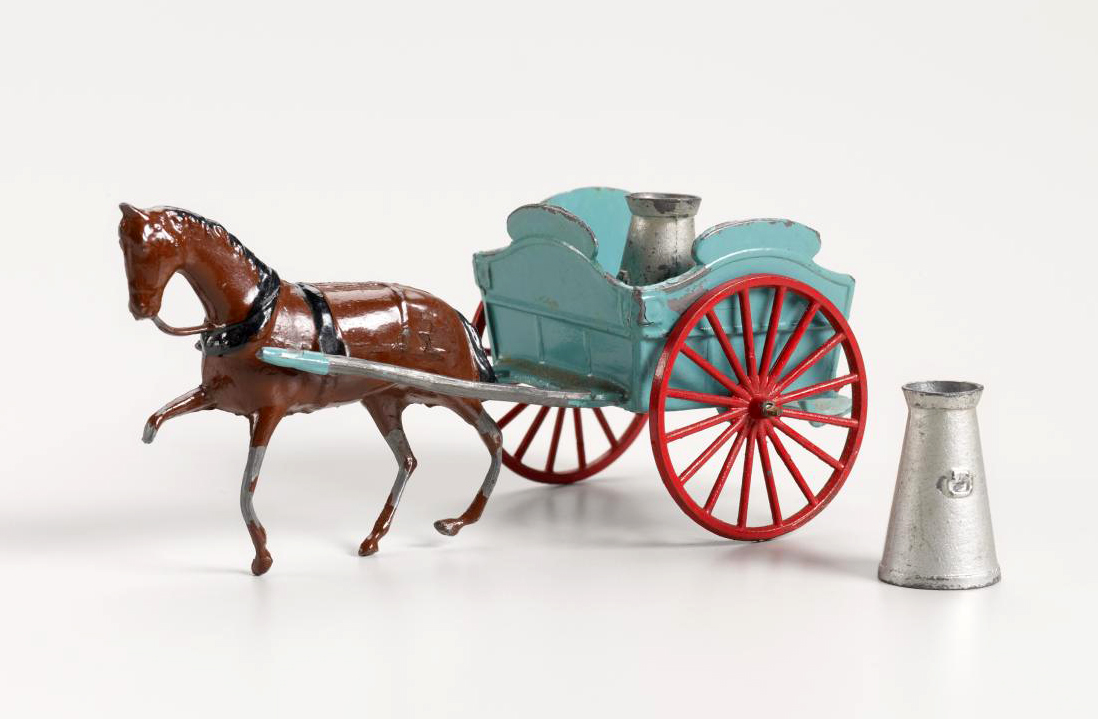
 

Britains Ltd, London manufacturer (English, 1860-1997) 'Milk float and horse' c. 1950


Britains Ltd, London manufacturer (English, 1860-1997)
Milk float and horse
no. 45F from the Model home farm series 1921-1961
c. 1950
Painted lead alloy
National Gallery of Victoria
Presented by Miss Lucy Kerley and her nephew John Kerley, 1982


Jacques Callot (French, 1592-1635) 'The firing squad' 1633


Jacques Callot (French, 1592-1635)
The firing squad
L’Arquebusade
Plate 12 from Les Misères et les malheurs de la guerre
The miseries and misfortunes of war series
1633
Etching, 2nd of 3 states
National Gallery of Victoria
Purchased, 1950


Paul Caponigro (American, 1932-2024) 'Nahant, Massachusetts' 1965


Paul Caponigro (American, 1932-2024)
Nahant, Massachusetts
1965
Gelatin silver photograph
National Gallery of Victoria
Purchased with the assistance of the National Gallery Society of Victoria, 1977
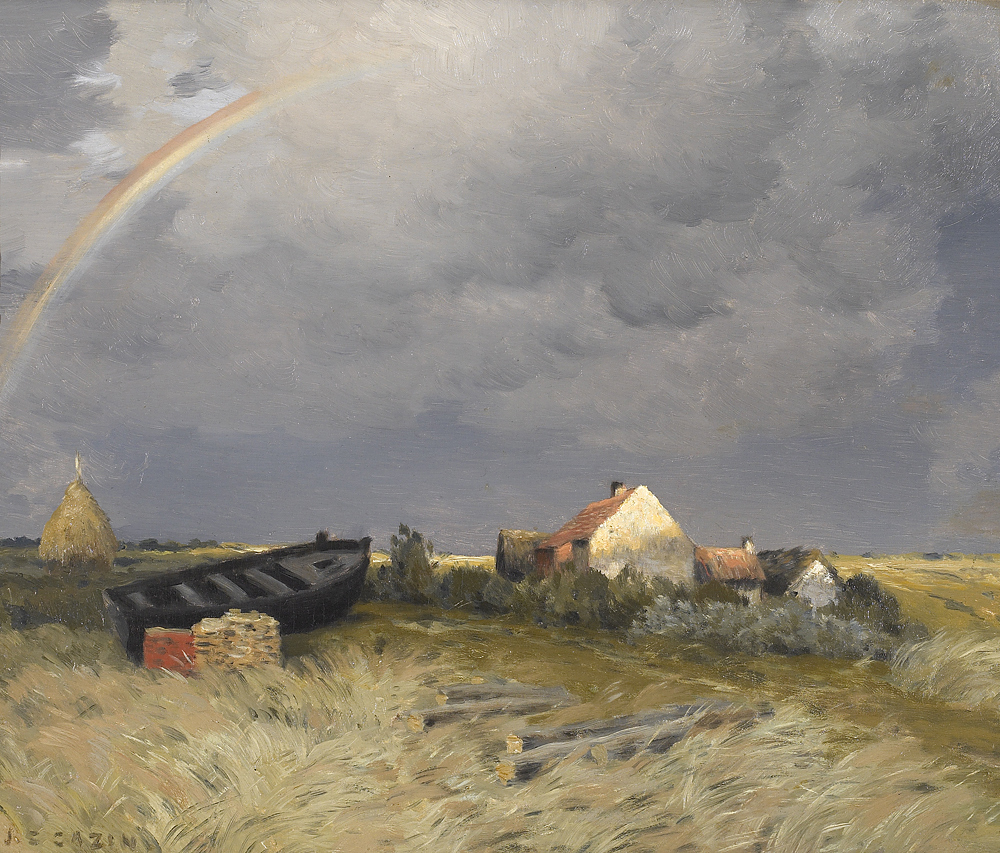
 

Jean Charles Cazin (French, 1841-1901, lived in England 1871-1875) 'The rainbow' late 1880s


Jean Charles Cazin (French, 1841-1901, lived in England 1871-1875)
The rainbow
L’Arc-en-ciel
late 1880s
Oil on canvas
National Gallery of Victoria
Felton Bequest, 1913
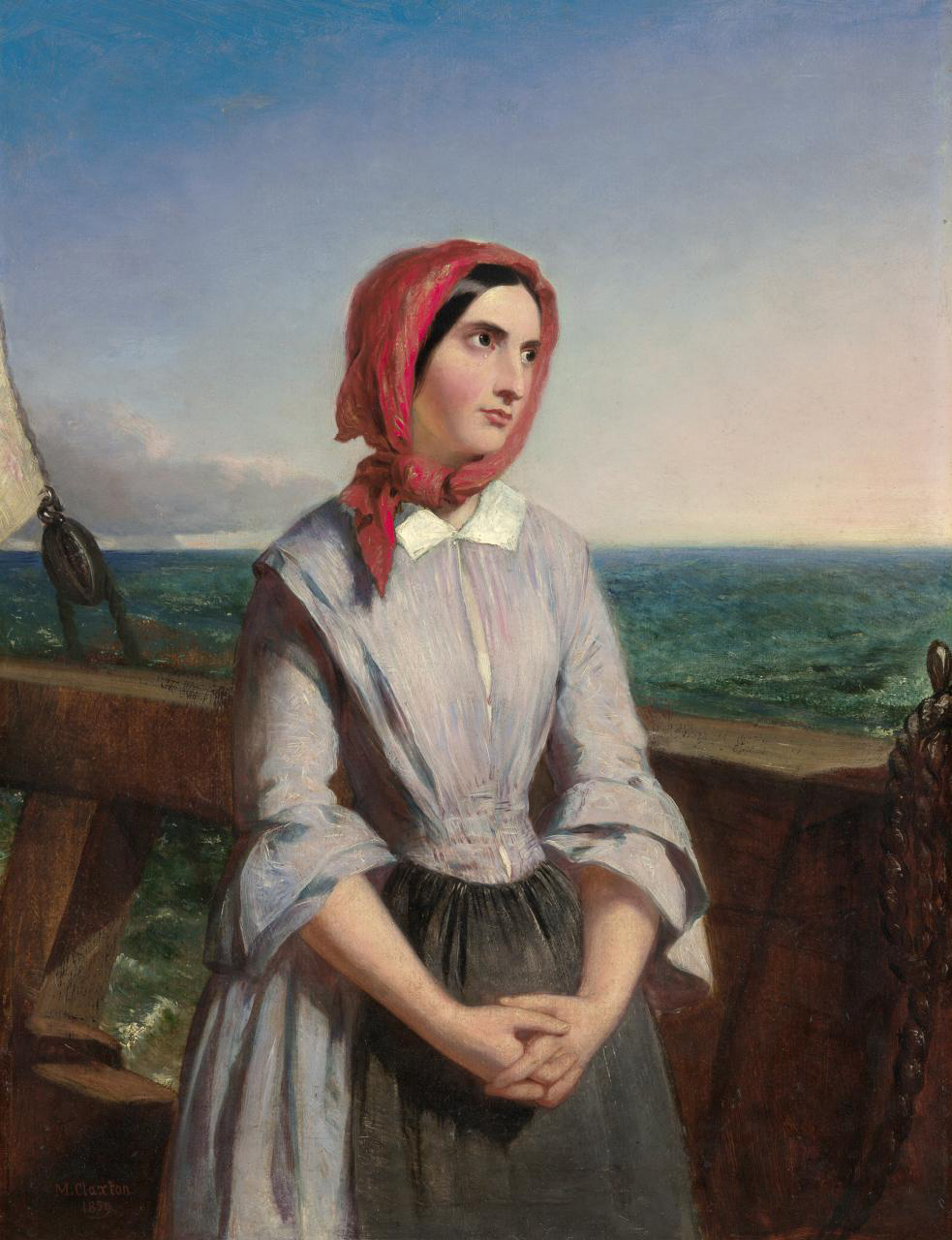
 

Marshall Claxton (English, 1813-1881, lived in Australia 1850-1854) 'An emigrant's thoughts of home' 1859


Marshall Claxton (English, 1813-1881, lived in Australia 1850-1854)
An emigrant’s thoughts of home
1859
Oil on cardboard
National Gallery of Victoria
Presented by the National Gallery Women’s Association, 1974


Marshall Claxton’s painting An emigrant’s thoughts of home (1859) belongs to a clutch of works, both fine and popular, both pictorial and literary, that for an Australasian audience are perhaps the most resonant of the many products of Victorian culture. Emigration, a social and political phenomenon for mid-nineteenth-century Britain, and the essential lubricant of British imperialism, inspired a profusion of paintings, prints, novels, plays, poems, essays and letters that speak eloquently about the realities and myths of Victorian Britain and its role in the world, engaging concepts of the family, womanhood, the artist’s role and function and, indeed, the meaning of life.

Pamela Gerrish Nunn. “Look homeward Angel: Marshall Claxton’s emigrant,” on the National Gallery of Victoria website 18th June 2014 [Online] Cited 21/12/2021


Olive Cotton (Australian, 1911-2003) 'Teacup ballet' 1935, printed 1992


Olive Cotton (Australian, 1911-2003)
Teacup ballet
1935, printed 1992
Gelatin silver photograph
National Gallery of Victoria
Purchased from Admission Funds, 1992


Among Cotton’s most famous photographs, Teacup ballet has very humble origins. It was taken after hours in the Dupain studio and used a set of cheap cups and saucers Cotton had earlier bought from a Woolworths store for use around the studio. As she later recounted: ‘Their angular handles suggested to me the position of “arms akimbo” and that led to the idea of a dance pattern’. The picture uses a range of formal devices that became common to Cotton’s work, especially the strong backlighting used to create dramatic tonal contrasts and shadows. The picture achieved instant success, and was selected for exhibition in the London Salon of Photography for 1935.

Text © National Gallery of Australia, Canberra
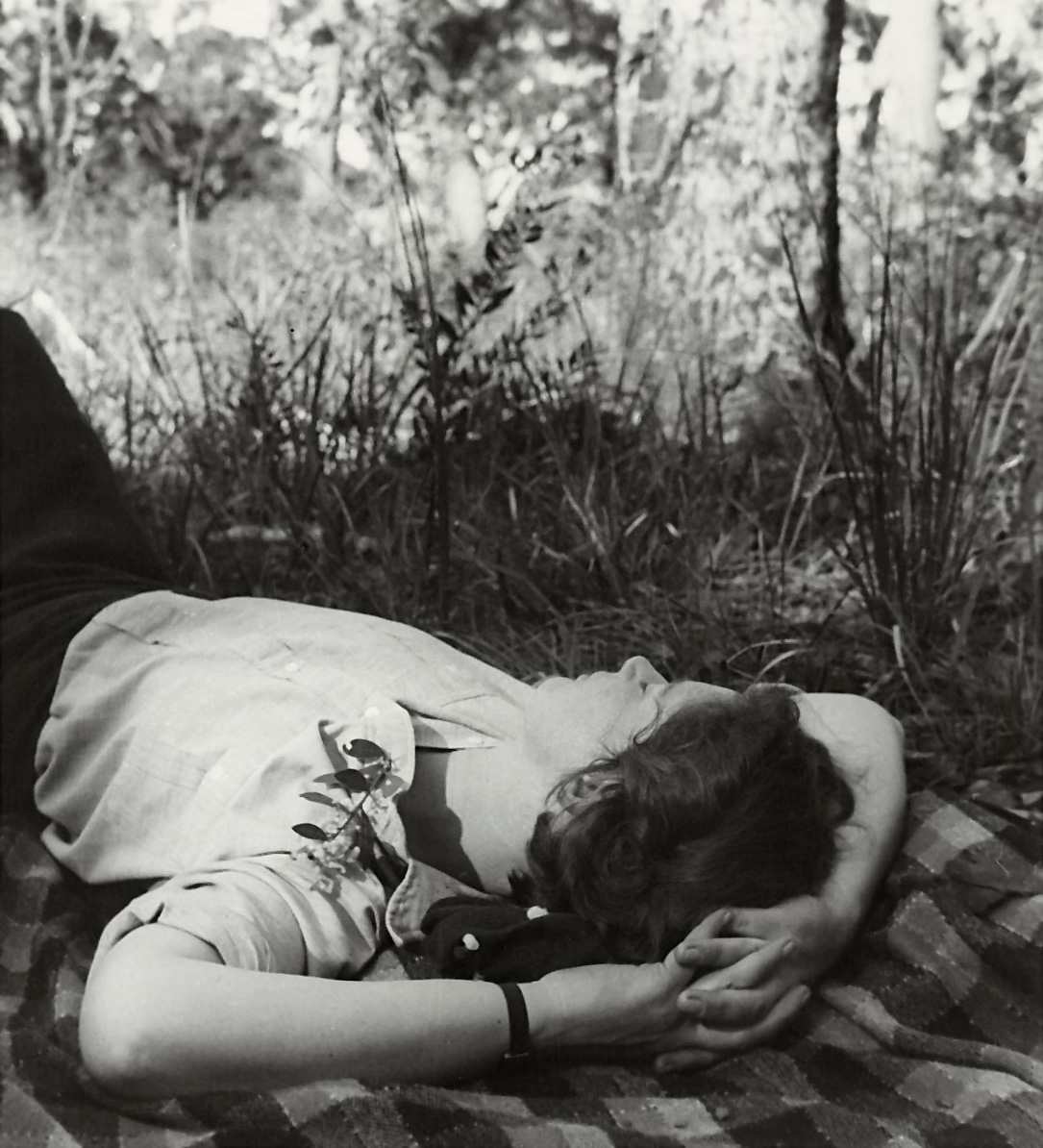
 

Olive Cotton (Australian, 1911-2003) 'The sleeper' 1939, printed 1992


Olive Cotton (Australian, 1911-2003)
The sleeper
1939, printed 1992
Gelatin silver photograph, ed. 4/25
National Gallery of Victoria
Purchased from Admission Funds, 1992


The sleeper 1939, Olive Cotton’s graceful study of her friend Olga Sharp resting while on a bush picnic, made around the same time as Max Dupain’s Sunbaker, presents a different take upon the enjoyment of life in Australia. The woman is relaxed, nestled within the environment. The mood is one of secluded reverie.

Text © National Gallery of Australia, Canberra
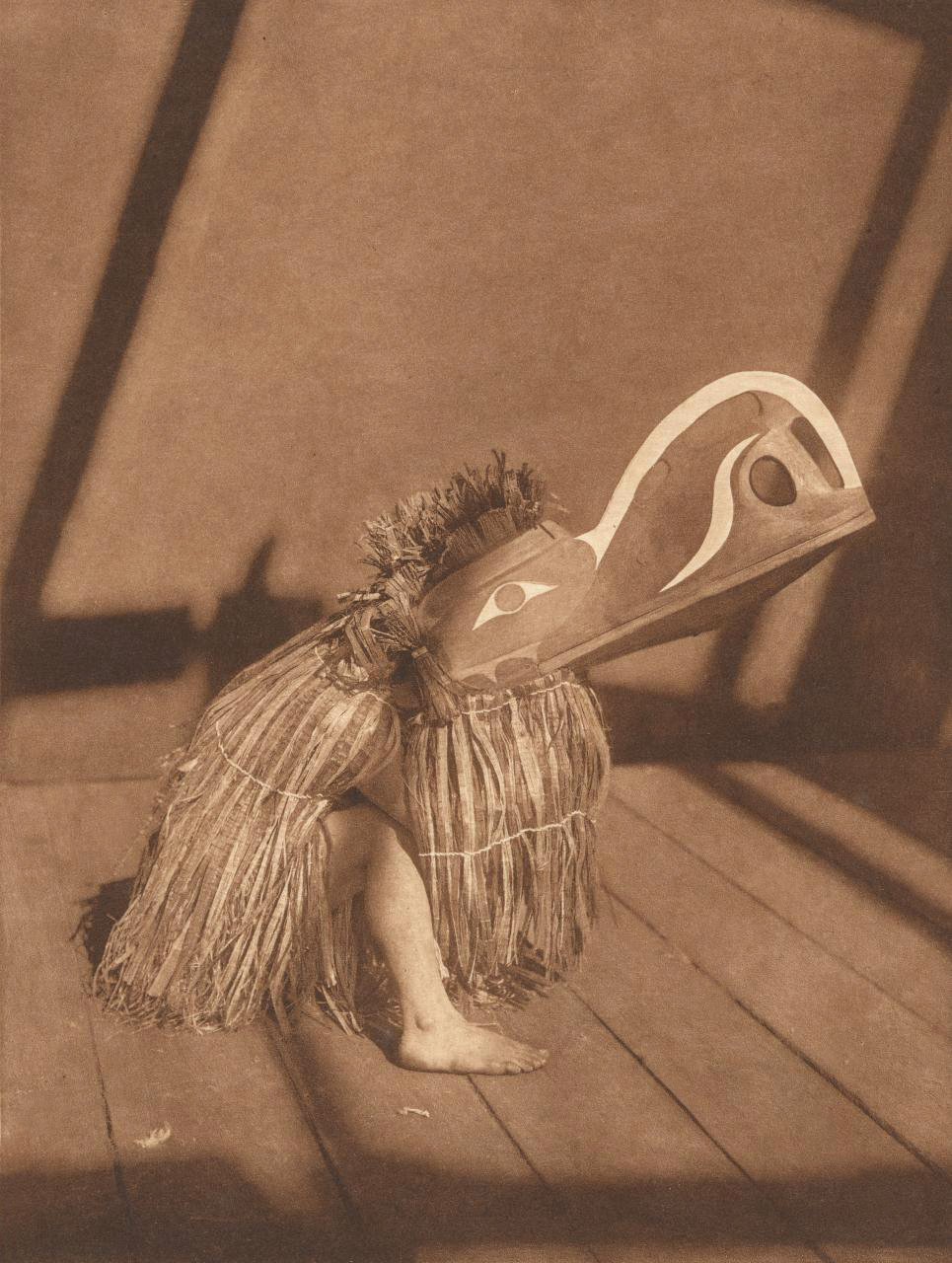
 

Edward Curtis (American, 1868-1952) 'Kalóqutsuis - Qágyuhl' 1914, printed 1915


Edward Curtis (American, 1868-1952)
Kalóqutsuis – Qágyuhl
1914, printed 1915
Photogravure
National Gallery of Victoria
Gift of Ms Christine Godden, 1991


Not only was he one of the greatest ethnographic photographers of all time (as well as being an ethnographer recording more than 10,000 songs on a primitive wax cylinder, and writing down vocabularies and pronunciation guides for 75 languages) … he was also an aesthetic photographer. Looking at his photographs you can feel that he adhered to the principles of the nature and appreciation of beauty situated within the environment of the Native American cultures and peoples. He had a connection to the people and to the places he was photographing…

Curtis created a body of work unparrallleled in the annals of photography – an ethnographic study of an extant civilisation before it vanished (or so they thought at the time). Such a project stretched over thirty years, producing 45-50 thousand negatives “many of them on glass and some as large as fourteen by seventeen inches” of which 2,200 original photographs appeared in his magnum opus, The North American Indian…

While all great photographers have both technical skill and creative ability it is the dedication of this artist to his task over so many years that sets him apart. That dedication is critically coupled with his innate ability to capture the “spirit” of the Native American cultures and peoples, their humanity.

Dr Marcus Bunyan from a posting on the Palm Springs Art Museum exhibition Edward S. Curtis: One Hundred Masterworks 2016


Frances Derham (Australian, 1894-1987) 'Building the bridge' 1929


Frances Derham (Australian, 1894-1987)
Building the bridge
1929
Colour linocut on Japanese paper
National Gallery of Victoria
Gift of Mr Richard Hodgson Derham, 1988
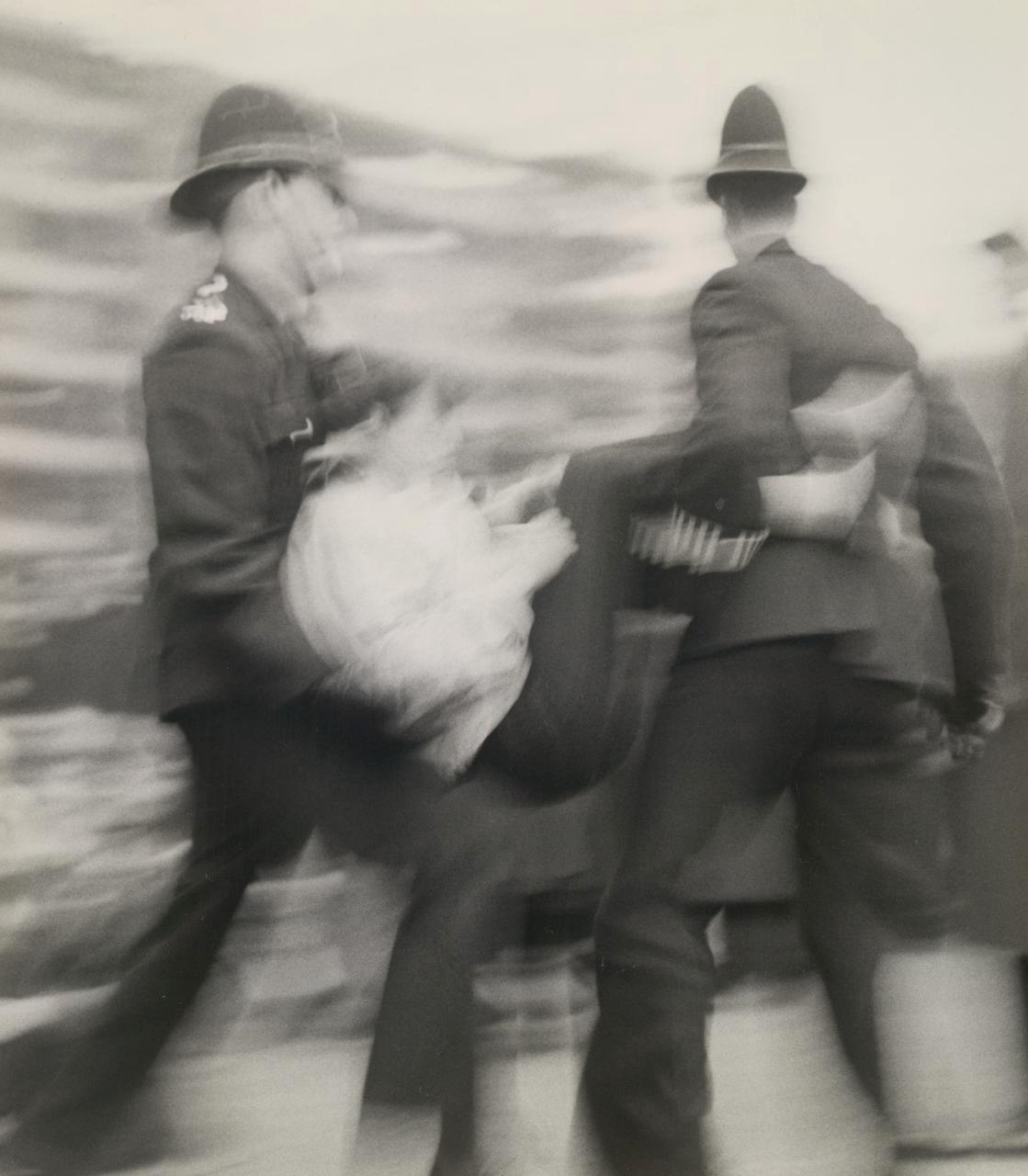
 

Kerry Dundas (Australian, b. 1931, lived in Europe 1958-1967) 'A girl is carried away under arrest' 1961-1963


Kerry Dundas (Australian, b. 1931, lived in Europe 1958-1967)
A girl is carried away under arrest
From the Youth against the Bomb series
1961-1963
Gelatin silver photograph
National Gallery of Victoria
Purchased 1971


Max Dupain (Australian, 1911-1992) 'Bondi' 1939


Max Dupain (Australian, 1911-1992)
Bondi
1939
Gelatin silver photograph
30.3 × 29.5cm
National Gallery of Victoria
Purchased with the assistance of the Visual Arts Board, 1976


Walker Evans (American, 1903-1975) 'Hitchhikers, near Vicksburg, Mississippi' 1936, printed c. 1975


Walker Evans (American, 1903-1975)
Hitchhikers, near Vicksburg, Mississippi
1936, printed c. 1975
Gelatin silver photograph
National Gallery of Victoria
Purchased 1975


Walker Evans (American, 1903-1975) 'Auto dump, near Easton, Pennsylvania' 1935, printed c. 1975


Walker Evans (American, 1903-1975)
Auto dump, near Easton, Pennsylvania
1935, printed c. 1975
Gelatin silver photograph
National Gallery of Victoria
Purchased 1975


William Frater (born Scotland 1890, arrived Australia 1913, died 1974) 'The blue nude' c. 1934


William Frater (born Scotland 1890, arrived Australia 1913, died 1974)
The blue nude
c. 1934
Oil on canvas on cardboard
National Gallery of Victoria
Gift of Mrs Lina Bryans 1969


His contribution to art in Australia was, however, as a painter who introduced Post-Impressionist principles and challenged the notion that art was an imitation of nature.

Frater’s oeuvre developed between 1915 and 1920 towards a simplification of design, an interplay of massed lights and shadows, and sonorous low-keyed colour that reflected his interest in the classical seventeenth century painters in interaction with the analytical tonal theory of Max Meldrum. Notable examples of his predominantly figure and portrait paintings are ‘The artist’s wife reading’ (1915) and ‘Portrait of artist’s wife’ (1919). An experimental Colourist phase followed in the next decade. His first solo exhibition was held in May 1923 at the Athenaeum, Melbourne, and he exhibited with the Twenty Melbourne Painters from the late 1920s, and the Contemporary Group of Melbourne in the 1930s.

His approach in the 1930s was markedly indebted to Cézanne, especially in the portraits which predominated until his retirement… Frater gave aggressive leadership to the small group of modernists in the 1920s. His example, teaching, lecturing and crusty style of polemic did much to disrupt the academic style as the arbiter of pictorial values and to pioneer a change of taste in the community.

L. J. Course. “Frater, William (1890-1974),” on the Australian Dictionary of Biography website, published first in hardcopy 1981 [Online] Cited 23 December 2021


Emmanuel Frémiet (French, 1824-1910) 'Gorilla carrying off a woman' 1887


Emmanuel Frémiet (French, 1824-1910)
Gorilla carrying off a woman
Gorille enlevant une femme
1887
Bronze
National Gallery of Victoria
Gift of the artist 1907


Lee Friedlander (American, b. 1934) 'Hillcrest, New York' 1970, printed c. 1977


Lee Friedlander (American, b. 1934)
Hillcrest, New York
1970, printed c. 1977
Gelatin silver photograph
National Gallery of Victoria
Purchased 1977


Lee Friedlander (American, b. 1934) 'Mount Rushmore' 1969, printed c. 1977


Lee Friedlander (American, b. 1934)
Mount Rushmore
1969, printed c. 1977
Gelatin silver photograph
National Gallery of Victoria
Purchased 1977


The ‘tourist gaze’

As Grundberg notes, Friedlander’s terse depiction shows both the sight and the tourists themselves, being brought into existence through the effects of looking, reflecting, framing and imaging. These, he adds, are all linked to the general project of culturally appropriating the natural world. ‘Natural site has become acculturated sight’ (Grundberg 1990: 15).

As the image makes clear, the ‘sight’ or the ‘site’ is a ‘seeing’ without a subject, for it pre-exists the arrival and activity of any individual tourist-photographer, who, once located there, is framed as much as framing. The sight is not so much an object to be viewers an already structured condition of seeing, a situation which places the sightseer even as he or she freely choose to look or shoot.

The effects of photography’s presence in the tourist system merely completed a process under way before photography’s birth. As tourists, even at the moment of photographing, even if touring cameraless, we are not so much looking as looking at images, or looking for images. Tourism provides us less with experience than with events to be seen, Or rather, events to look at. The privileging of the visual grants us separation from our own experience… We look on or look in through the distancing arrangements of the camera or through eyes educated to see with the same ontological remoteness. The world of the tourist is ‘over there’, in the past-present, in the exotic-ordinary. It is framed off, the object of imaging or description, in some spectacular distance, or set back as performance (Greenwood in Smith 1989).

Peter Osborne. Traveling Light: Photography, Travel and Visual Culture. Manchester University Press, 2000, pp. 81-82.
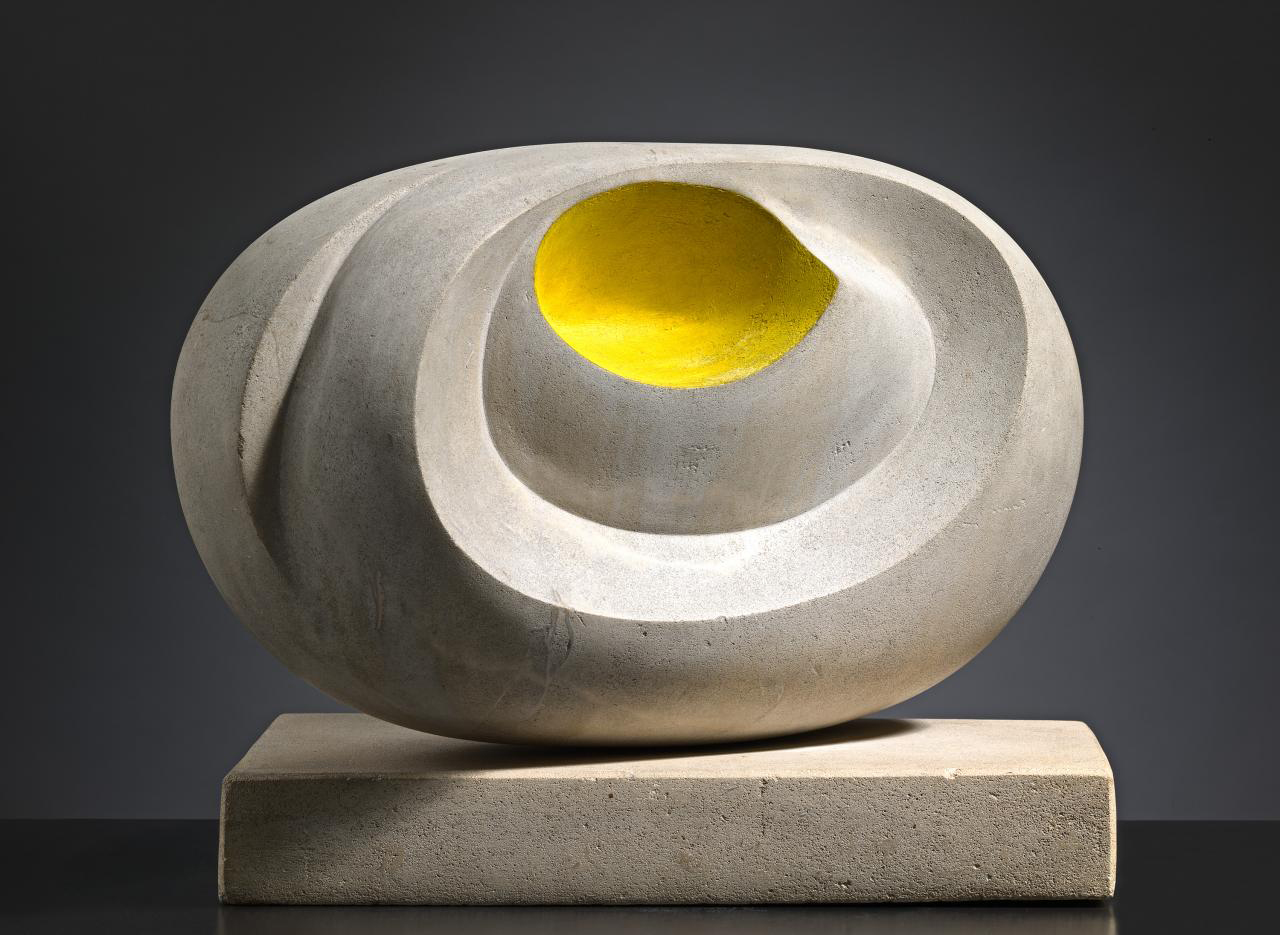
 

Barbara Hepworth (English, 1903-1975) 'Eidos' 1947


Barbara Hepworth (English, 1903-1975)
Eidos
1947
Stone, synthetic polymer paint
National Gallery of Victoria
Purchased with the assistance of the Samuel E. Wills Bequest to commemorate the retirement of Dr E. Westbrook, Director of Arts for Victoria, 1981


Eidos a Greek term meaning “form” “essence”, “type” or “species”. The early Greek concept of form precedes attested philosophical usage and is represented by a number of words mainly having to do with vision, sight, and appearance. The words, εἶδος (eidos) and ἰδέα (idea) come from the Indo-European root *weid-, “see”. Eidos (though not idea) is already attested in texts of the Homeric era, the earliest Greek literature. This transliteration and the translation tradition of German and Latin lead to the expression “theory of Ideas.” The word is however not the English “idea,” which is a mental concept only.

The meaning of the term εἶδος (eidos), “visible form”, and related terms μορφή (morphē), “shape”, and φαινόμενα (phainomena), “appearances”, from φαίνω (phainō), “shine”, Indo-European *bhā-, remained stable over the centuries until the beginning of philosophy, when they became equivocal, acquiring additional specialised philosophic meanings.

“Theory of forms” on the Wikipedia website
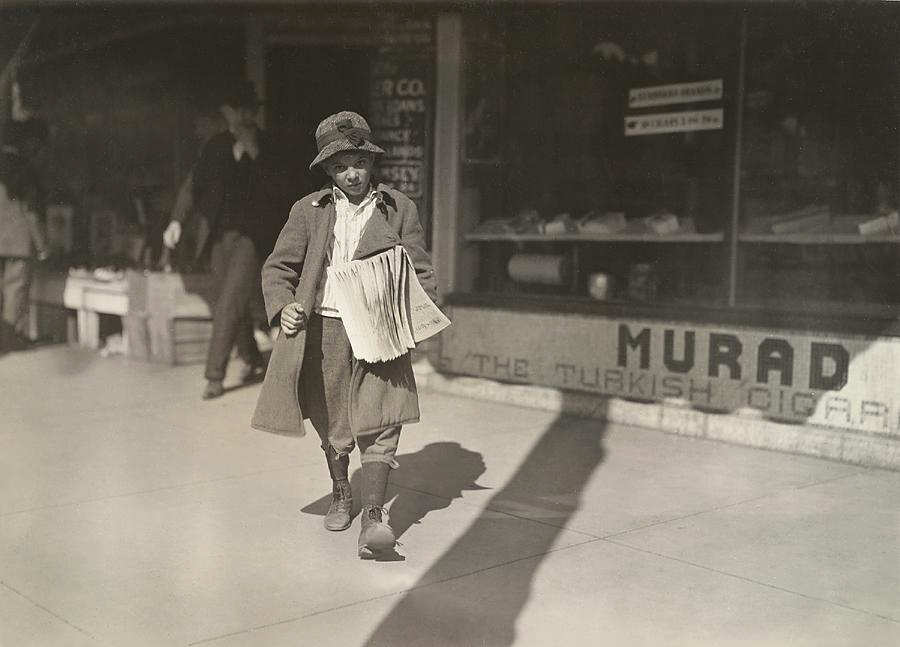
 

Lewis Hine (American, 1874-1940) 'Sam Pine, 8 year old truant newsboy who lives at 717 West California Street' 1917


Lewis Hine (American, 1874-1940)
Sam Pine, 8 year old truant newsboy who lives at 717 West California Street
1917
Gelatin silver photograph
National Gallery of Victoria
Purchased 1980
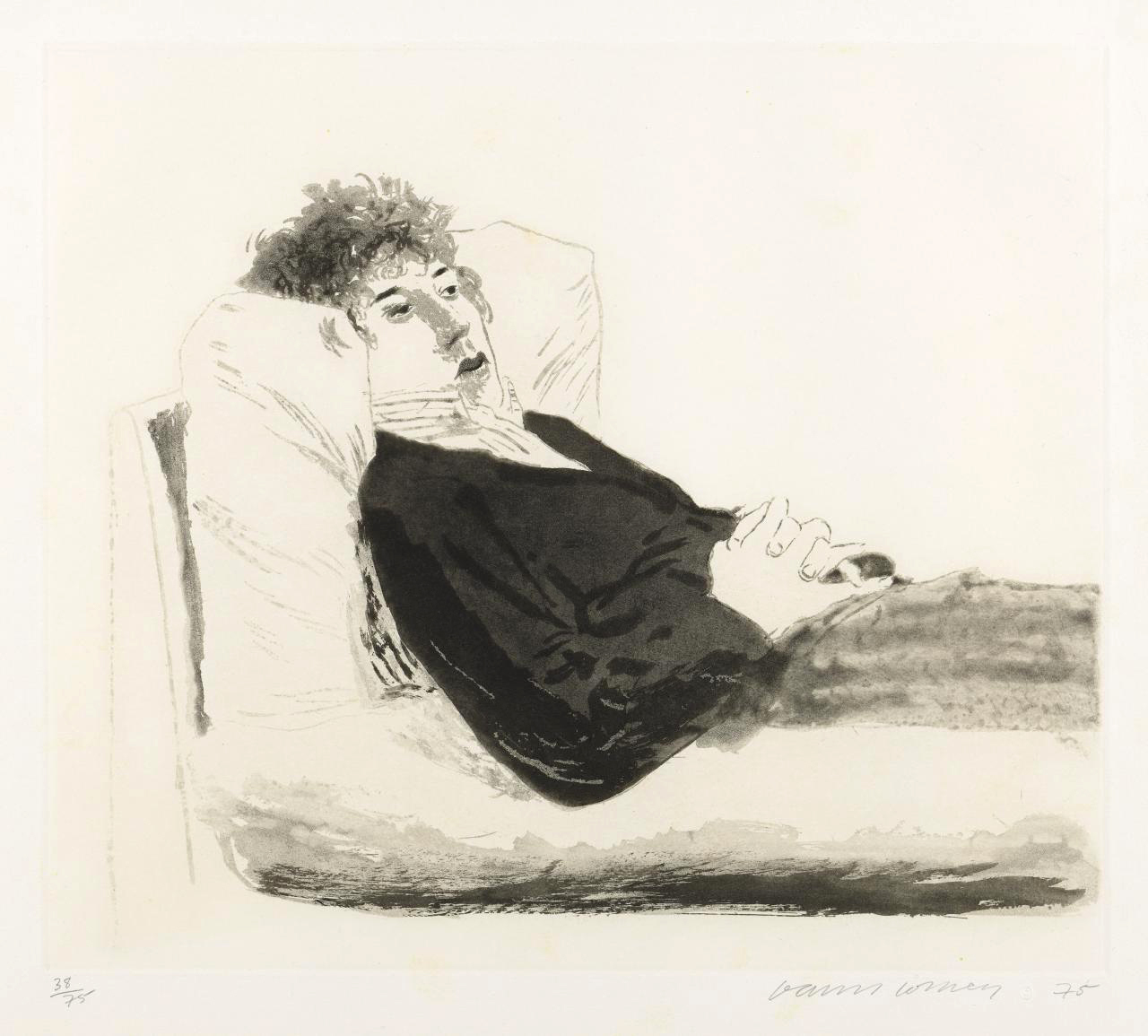
 

David Hockney (born England 1937, worked in United States 1964-1968, 1975- ) 'Reclining figure' 1975


David Hockney (born England 1937, worked in United States 1964-1968, 1975- )
Reclining figure
1975
Etching and liftground etching, ed. 38/75
National Gallery of Victoria
Gift of Margaret Toll 2006


Edmond-François Aman-Jean (French, 1860-1936) 'Woman resting' c. 1904


Edmond-François Aman-Jean (French, 1860-1936)
Woman resting
La Femme couchée
c. 1904
Oil on canvas
National Gallery of Victoria
Felton Bequest 1905
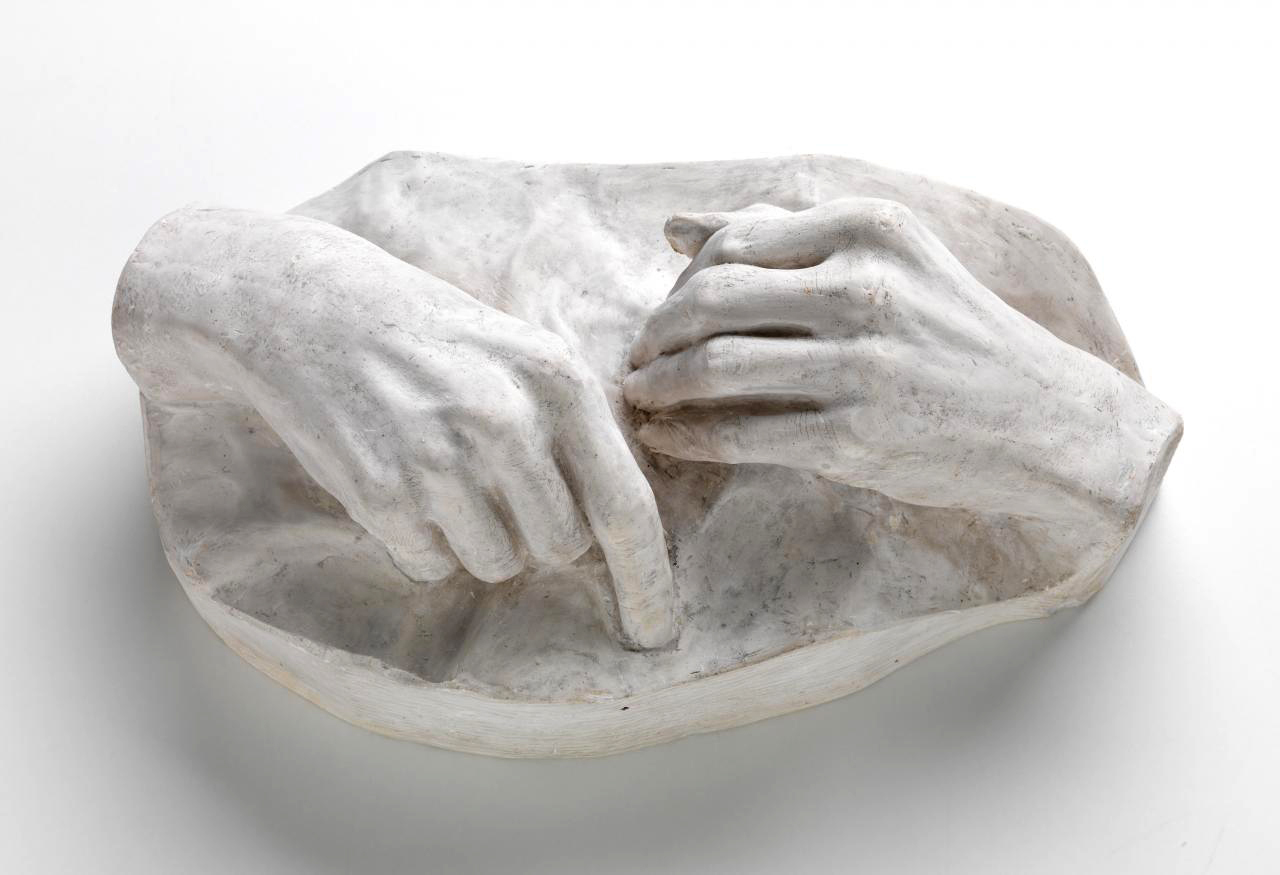
 

Max Klinger (German, 1857-1920) 'Cast of artist's hands' 1920


Max Klinger (German, 1857-1920)
Cast of artist’s hands
1920
plaster
National Gallery of Victoria
Gift of Mrs Marcelle Osins, 1994


Fred Kruger (Australian born Germany, 1831-1888) 'Coast scene, Mordialloc Creek, near Cheltenham' c. 1871


Fred Kruger (Australian born Germany, 1831-1888)
Coast scene, Mordialloc Creek, near Cheltenham
c. 1871
Albumen silver photograph
National Gallery of Victoria
Gift of Mrs Beryl M. Curl, 1979


The best of the landscape photographs have nothing to do with Arcadian, pastoral life at all. For me, Kruger’s photographs only start to come alive when he is photographing gum trees against the sky. Anyone who has tried to photograph the Australian bush knows how difficult it is to evince a “feeling” for the bush and Kruger achieves this magnificently in a series of photographs of gum trees in semi-cleared land, such as Bush scene near Highton (c. 1879). These open ‘park-like’ landscapes are not sublime nor do they picture the spread of colonisation but isolate the gum trees against the sky. They rely on the thing itself to speak to the viewer, not a constructed posturing or placement of figures to achieve a sterile mise-en-scène.

Dr Marcus Bunyan from a posting on the NGV exhibition Fred Kruger: Intimate Landscapes 2012


Kusakabe Kimbei (Japanese, 1841-1934) 'No title (Couple with a cabinet photograph and ghost in background)' 1880s


Kusakabe Kimbei (Japanese, 1841-1934)
No title (Couple with a cabinet photograph and ghost in background)
1880s
Albumen silver photograph, colour dyes
National Gallery of Victoria
Purchased 2004


Kimbei Kusakabe arrived in Yokohama in 1856 and became Felice Beato’s pupil, hand-colouring his photographs until 1863. In 1881, he opened his own studio and promptly became one of the most prosperous and influential photographers of his generation, rivalling the Western artists that had until then dominated the market. With his coloured portraits, everyday scenes and landscapes, he is the purveyor of souvenir images for Westerners visiting Japan. Kimbei Kusakabe depicted men in serene social and economic contexts while women – his favourite subjects – were represented in romantic portraits as well as domestic and cultural scenes. The young mysterious and submissive geisha was particularly appealing to Western audiences and the Japanese photographer helped establish their visual identity as icons of feminine beauty and social etiquette. Kimbei Kusakabe’s rare images are a rich resource for the comprehension of a Japan that has now disappeared.

Text from The Red List website [Online] Cited 17/07/2017. No longer available online


Kusakabe Kimbei worked with Felice Beato and Baron Raimund von Stillfried as a photographic colourist and assistant before opening his own workshop in Yokohama in 1881, in the Benten-dōri quarter, and from 1889 operating in the Honmachi quarter. He also opened a branch in the Ginza quarter of Tokyo. Around 1885, he acquired the negatives of Felice Beato and of Stillfried, as well as those of Uchida Kuichi. Kusakabe also acquired some of Ueno Hikoma’s negatives of Nagasaki. He stopped working as a photographer in 1912-1913.

Text from the Wikipedia website
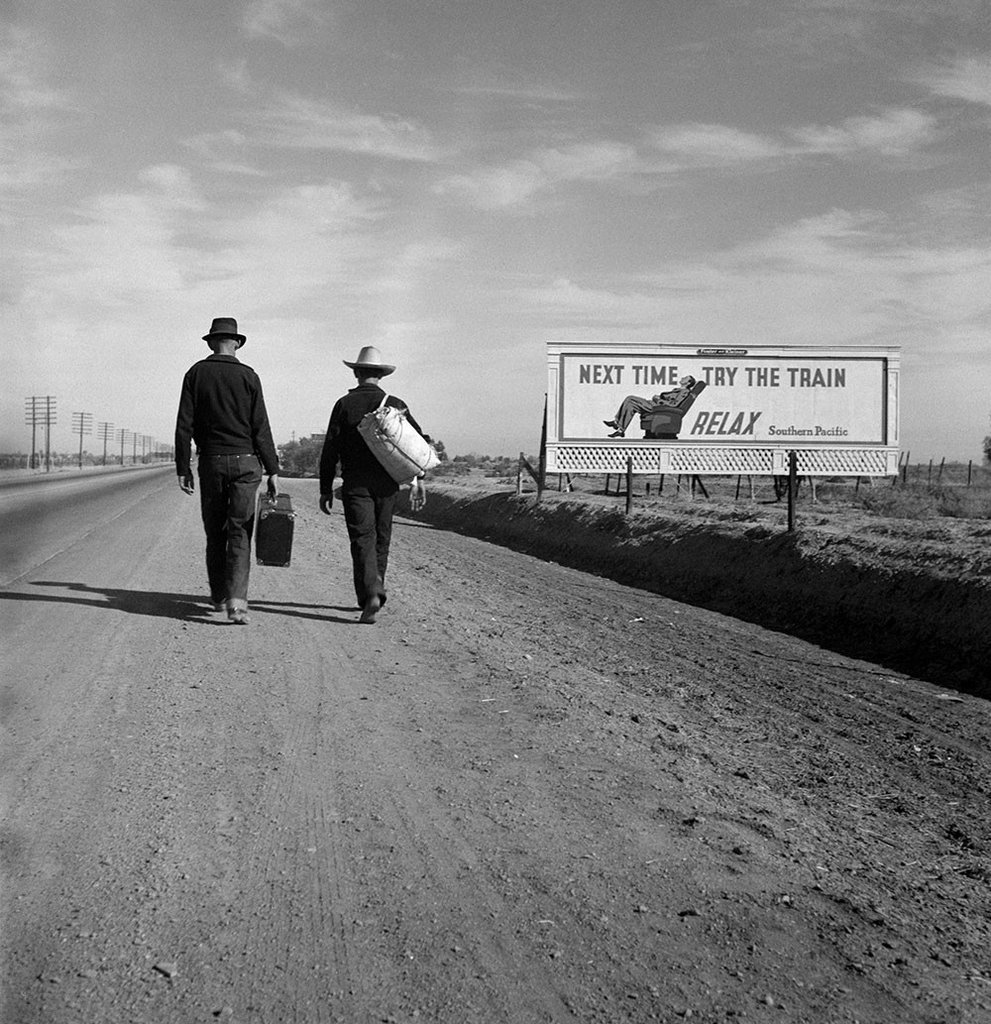
 

Dorothea Lange (American, 1895-1965) 'Towards Los Angeles, California' 1936, printed c. 1975


Dorothea Lange (American, 1895-1965)
Towards Los Angeles, California
1936, printed c. 1975
Gelatin silver photograph
National Gallery of Victoria
Purchased 1975


Dorothea Lange (American, 1895-1965) 'Ditched, stalled and stranded, San Joaquin Valley, California' 1935, printed c. 1975


Dorothea Lange (American, 1895-1965)
Ditched, stalled and stranded, San Joaquin Valley, California
1935, printed c. 1975
Gelatin silver photograph
National Gallery of Victoria
Purchased 1975
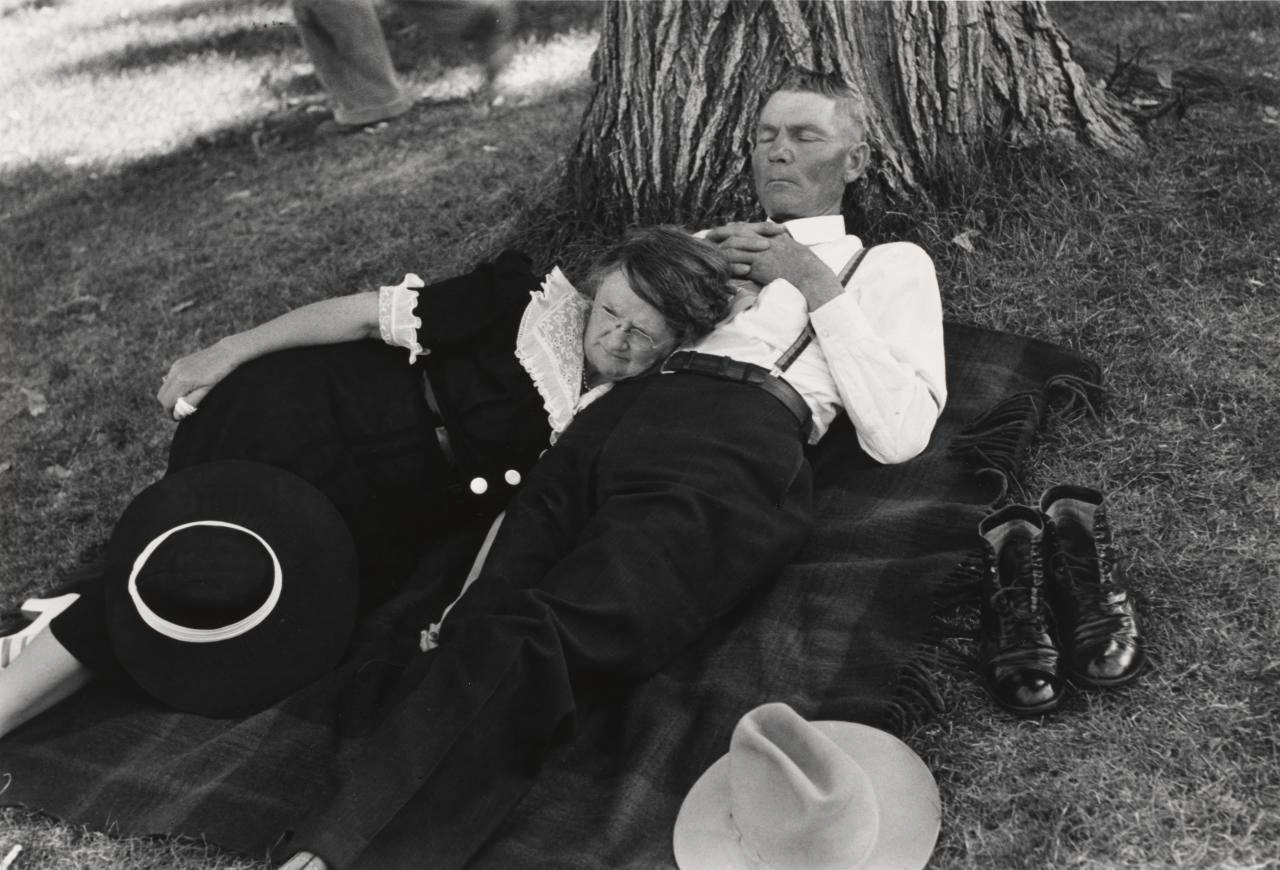
 

Russell Lee (American, 1903-1986) 'Interlude, after watching the Fourth of July Parade, Vale, Oregon' 1941, printed c. 1975


Russell Lee (American, 1903-1986)
Interlude, after watching the Fourth of July Parade, Vale, Oregon
1941, printed c. 1975
Gelatin silver photograph
National Gallery of Victoria
Purchased 1975


José López (born Cuba 1941, lived in United States c. 1961-1992, died United States 1992) Luis Medina (born Cuba 1942, lived in United States 1961-1985, died United States 1985) 'Boy asleep by the beach' 1976


José López (born Cuba 1941, lived in United States c. 1961-1992, died United States 1992)
Luis Medina (born Cuba 1942, lived in United States 1961-1985, died United States 1985)
Boy asleep by the beach
1976
Gelatin silver photograph
National Gallery of Victoria
Purchased 1978


Ruth Maddison (Australian, b. 1945) 'No title (Woman collecting a Christmas present from the car)' 1977-1978


Ruth Maddison (Australian, b. 1945)
No title (Woman collecting a Christmas present from the car)
from the Christmas Holidays with Bob’s Family, Mermaid Beach, Queensland series
1977-1978, printed 1979
Gelatin silver photograph, coloured pencils and fibre tipped pen, ed. 1/5
National Gallery of Victoria
Purchased 1980


This was a very hands on process, an observation confirmed by artist Ruth Maddison. “The process was like hand watering your garden, an intense exchange and engagement with the object. When I started I was completely untrained, but I loved the process. I just experimented in order to understand what medium does what on what paper surface. There was the beauty of its object and its physicality. I just loved the object.” Her series Christmas holiday with Bob’s family, Mermaid Beach, Queensland (1977-1978), photographed over Christmas Day and several days afterwards, evidences this magical transformation. Vernacular photographs of a typical Australia Christmas holiday become something else, transformed into beautiful, atypical representations of family, friendship, celebration and life.

Dr Marcus Bunyan commenting on the National Gallery of Australia exhibition Colour My World: Handcoloured Australia Photography 2015
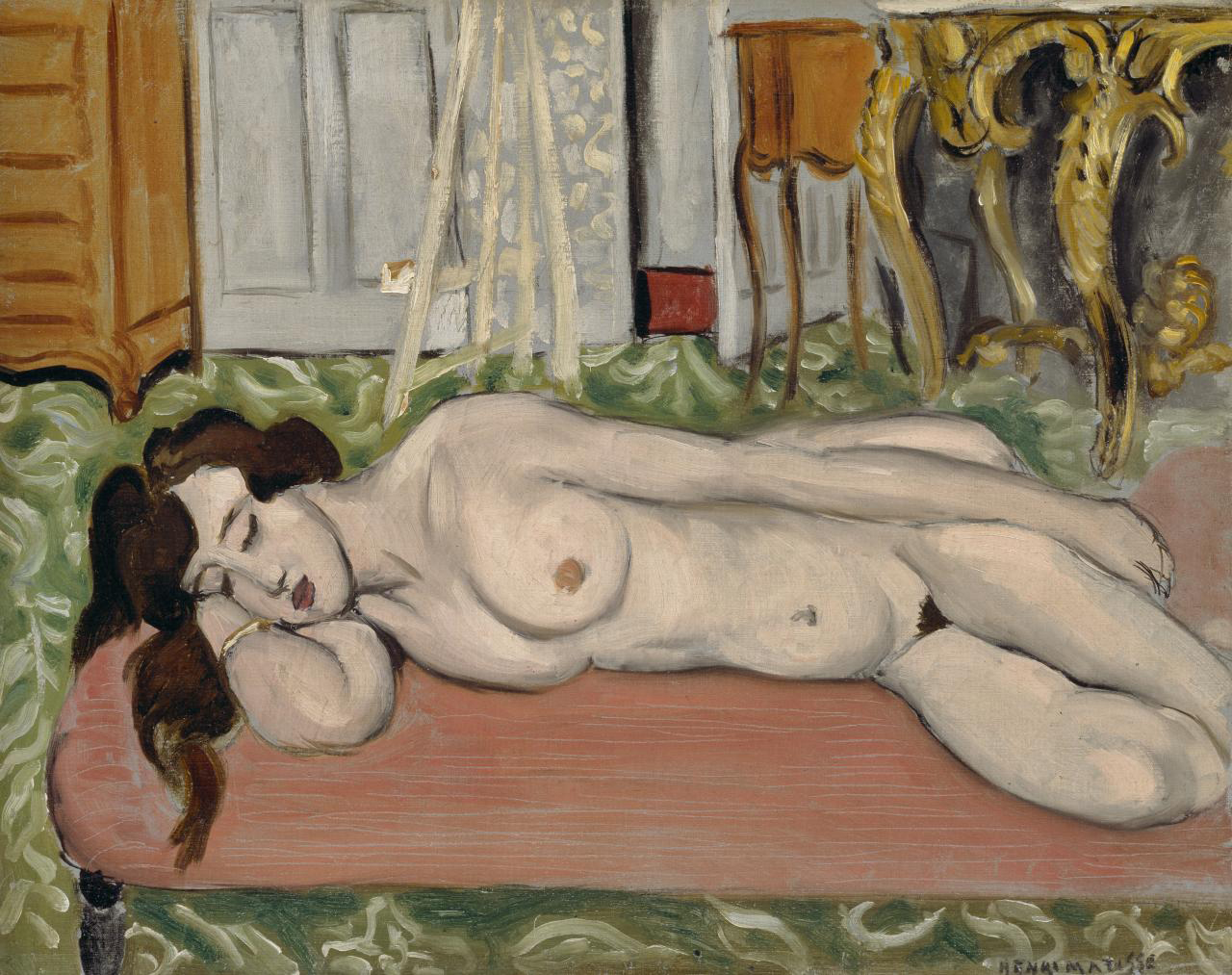
 

Henri Matisse (France, 1869-1954) 'Reclining nude on a pink couch' 1919


Henri Matisse (France, 1869-1954)
Reclining nude on a pink couch
Nu couché sur canapé rose
1919
Oil on canvas
National Gallery of Victoria
Felton Bequest 1952


Amedeo Modigliani (born Italy 1884, lived in France 1906-1920, died France 1920) 'Nude resting' c. 1916-1919


Amedeo Modigliani (born Italy 1884, lived in France 1906-1920, died France 1920)
Nude resting
c. 1916-1919
Pencil on buff paper; laid down
National Gallery of Victoria
Felton Bequest 1948


László Moholy-Nagy (born Hungary 1895, lived in Germany 1920-1934, lived in United States 1935-1937, United States 1937-1946, died United States 1946) 'Helsinki' 1927, printed 1973


László Moholy-Nagy (born Hungary 1895, lived in Germany 1920-1934, lived in United States 1935-1937, United States 1937-1946, died United States 1946)
Helsinki
1927, printed 1973
Gelatin silver photograph
National Gallery of Victoria
Purchased 1975


David Moore (Australian, 1927-2003) 'Migrants arriving in Sydney' 1966


David Moore (Australian, 1927-2003)
Migrants arriving in Sydney
1966
Gelatin silver photograph
National Gallery of Victoria
Purchased 1991


In this evocative image Moore condenses the anticipation and apprehension of immigrants into a tight frame as they arrive in Australia to begin a new life. The generational mix suggests family reconnections or individual courage as each face displays a different emotion.

Moore’s first colour image Faces mirroring their expectations of life in the land down under, passengers crowd the rail of the liner Galileo Galilei in Sydney Harbour was published in National Geographic in 1967.1 In that photograph the figures are positioned less formally and look cheerful. But it is this second image, probably taken seconds later, which Moore printed in black-and-white, that has become symbolic of national identity as it represents a time when Australia’s rapidly developing industrialised economy addressed its labour shortage through immigration. The strength of the horizontal composition of cropped figures underpinned by the ship’s rail is dramatised by the central figure raising her hand – an ambiguous gesture either reaching for a future or reconnecting with family. The complexity of the subject and the narrative the image implies ensured its public success, which resulted in a deconstruction of the original title, ‘European migrants’, by the passengers, four of whom it later emerged were Sydneysiders returning from holiday, alongside two migrants from Egypt and Lebanon.2 Unintentionally Moore’s iconic image has become an ‘historical fiction’, yet the passengers continue to represent an evolving Australian identity in relation to immigration.

1/ Max Dupain and associates: Accessed 17/06/2006. No longer available online
2/ Thomas D & Sayers A 2000, From face to face: portraits by David Moore, Chapter & Verse, Sydney

© Art Gallery of New South Wales Photography Collection Handbook, 2007

From a posting on the exhibition The Photograph and Australia at the Art Gallery of New South Wales.
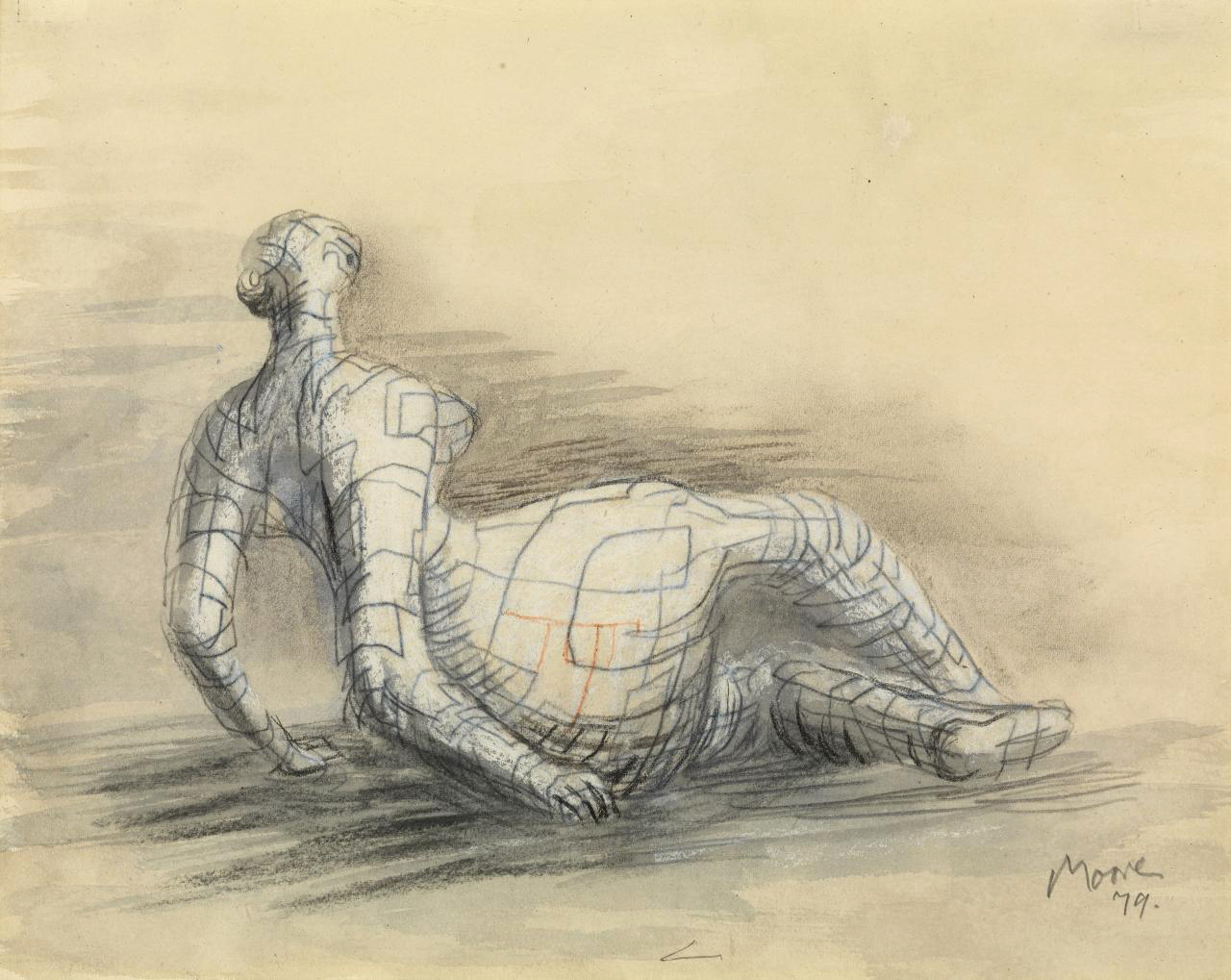
 

Henry Moore (English, 1898-1986) 'Reclining figure distorted - Sectional line' 1979


Henry Moore (English, 1898-1986)
Reclining figure distorted – Sectional line
1979
Chalk, charcoal, wax crayon, ballpoint pen and watercolour over pencil
National Gallery of Victoria
Gift of Ginny Green, Sandra Bardas OAM family, Vicki Vidor OAM and Bindy Koadlow in memory of their parents Loti Smorgon AO and Victor Smorgon AC through the Australian Government’s Cultural Gifts Program, 2014


William De Morgan (designer, England 1839-1917) 'Startled tigers, dish' c. 1880


William De Morgan & Co., London (manufacturer, England 1872-1911)
William De Morgan (designer, England 1839-1917)
Startled tigers, dish
c. 1880
Earthenware
National Gallery of Victoria
Felton Bequest 1980
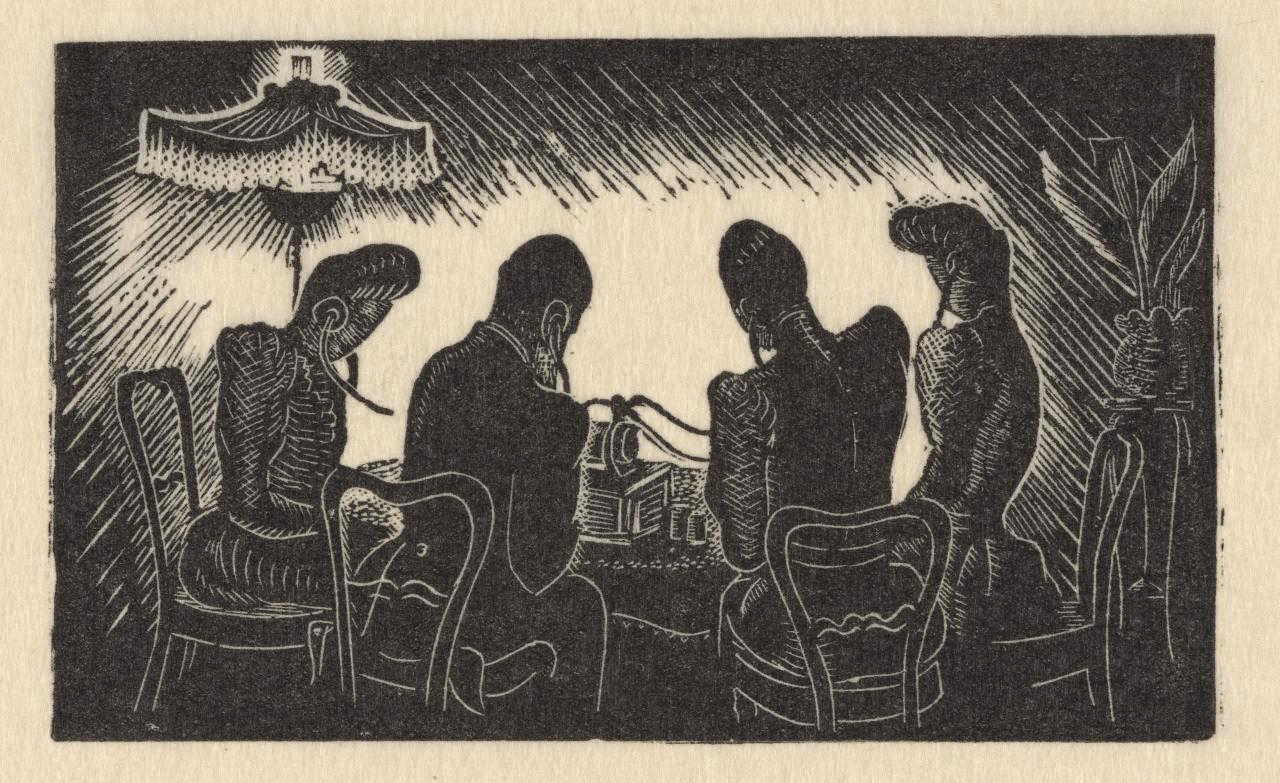
 

Helen Ogilvie (Australian, 1902-1993) '(Four figures seated at a table listening to a phonograph through earpieces)' c. 1947


Helen Ogilvie (Australian, 1902-1993)
(Four figures seated at a table listening to a phonograph through earpieces)
Illustration to Flinders Lane: recollections of Alfred Felton by Russell Grimwade. Melbourne University Press, Carlton, 1947
c. 1947
Wood-engraving on Japanese paper, proof
National Gallery of Victoria


“What interested me I think were the English wood engravers. I would have seen them in reproductions in books … I think it appealed to me as an artistic expression because it was done so directly with the hand. I know that when a painter is painting the hand is connected with the brain. But with wood engraving it seemed to me it was almost more so. And I got very worked up about it, but I had no way of learning … I know how I got started. Eric Thake was the man who said to me, “I’ll show you how to use your tool.”‘

from Anne Ryan, ‘Australian etchings and engravings 1880s-1930s from the Gallery’s collection’, AGNSW, Sydney 2007
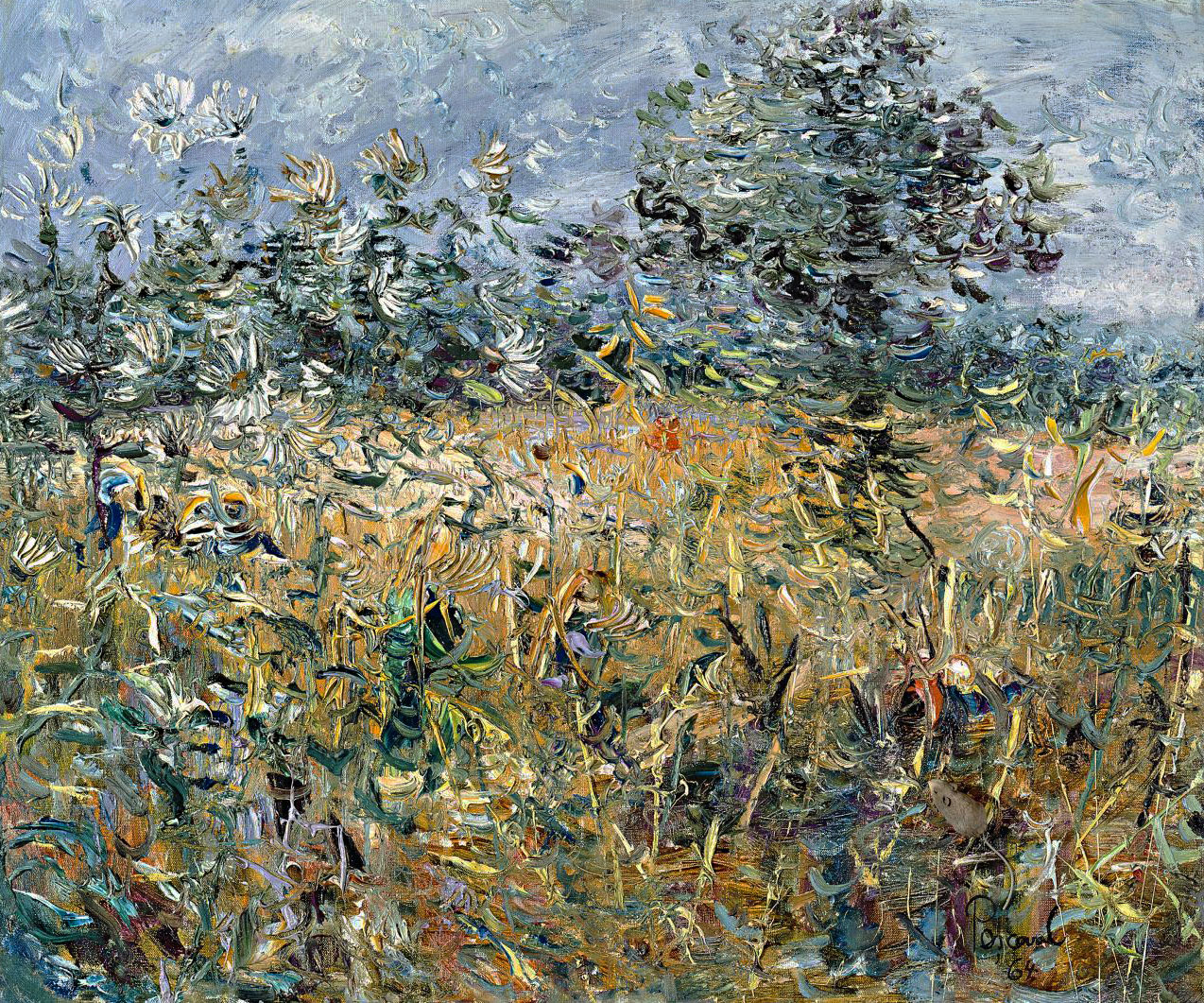
 

John Perceval (Australian, 1923-2000) 'Lover's walk in the corn, summer, England' 1964


John Perceval (Australian, 1923-2000)
Lover’s walk in the corn, summer, England
1964
Oil and toy mouse on canvas
National Gallery of Victoria
Presented through The Art Foundation of Victoria by Fingal Pastoral Property Limited, Fellow, 1997


Peter Peryer (New Zealand, 1941-2018) 'Seeing' 1989


Peter Peryer (New Zealand, 1941-2018)
Seeing
1989
Gelatin silver photograph
National Gallery of Victoria
Purchased 1996
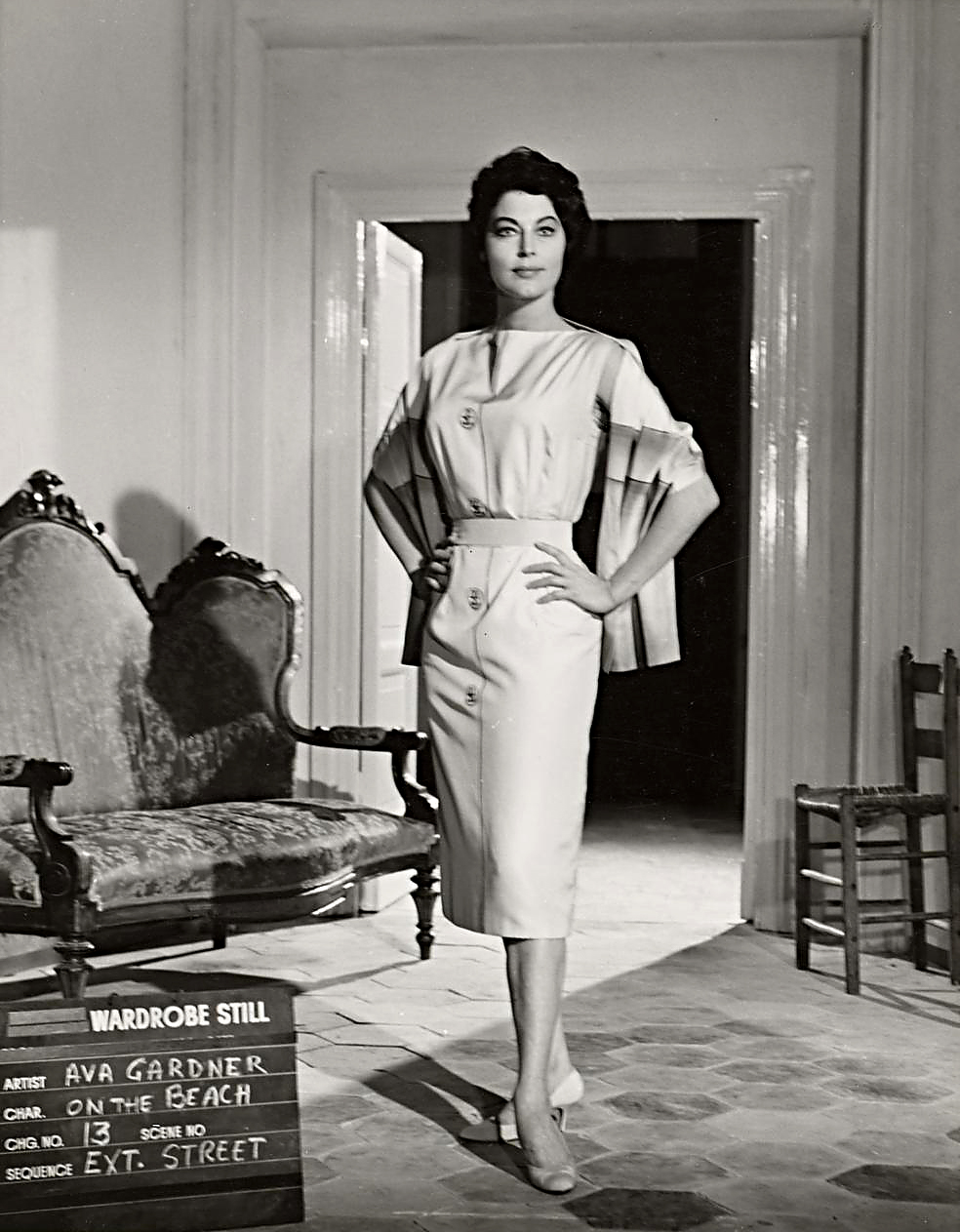
 

G. B. Poletto (Italian, 1915-1988) 'No title (Ava Gardner in wardrobe still for On the beach: Street)' 1957


G. B. Poletto (Italian, 1915-1988)
No title (Ava Gardner in wardrobe still for On the beach: Street)
1957
Gelatin silver photograph
National Gallery of Victoria
Purchased 2003


David Potts (Australian, 1926-2012, lived in England 1950-1955) 'Cat show, London' 1953


David Potts (Australian, 1926-2012, lived in England 1950-1955)
Cat show, London
1953
Gelatin silver photograph
National Gallery of Victoria
Purchased through the KODAK (Australasia) Pty Ltd Fund 1975
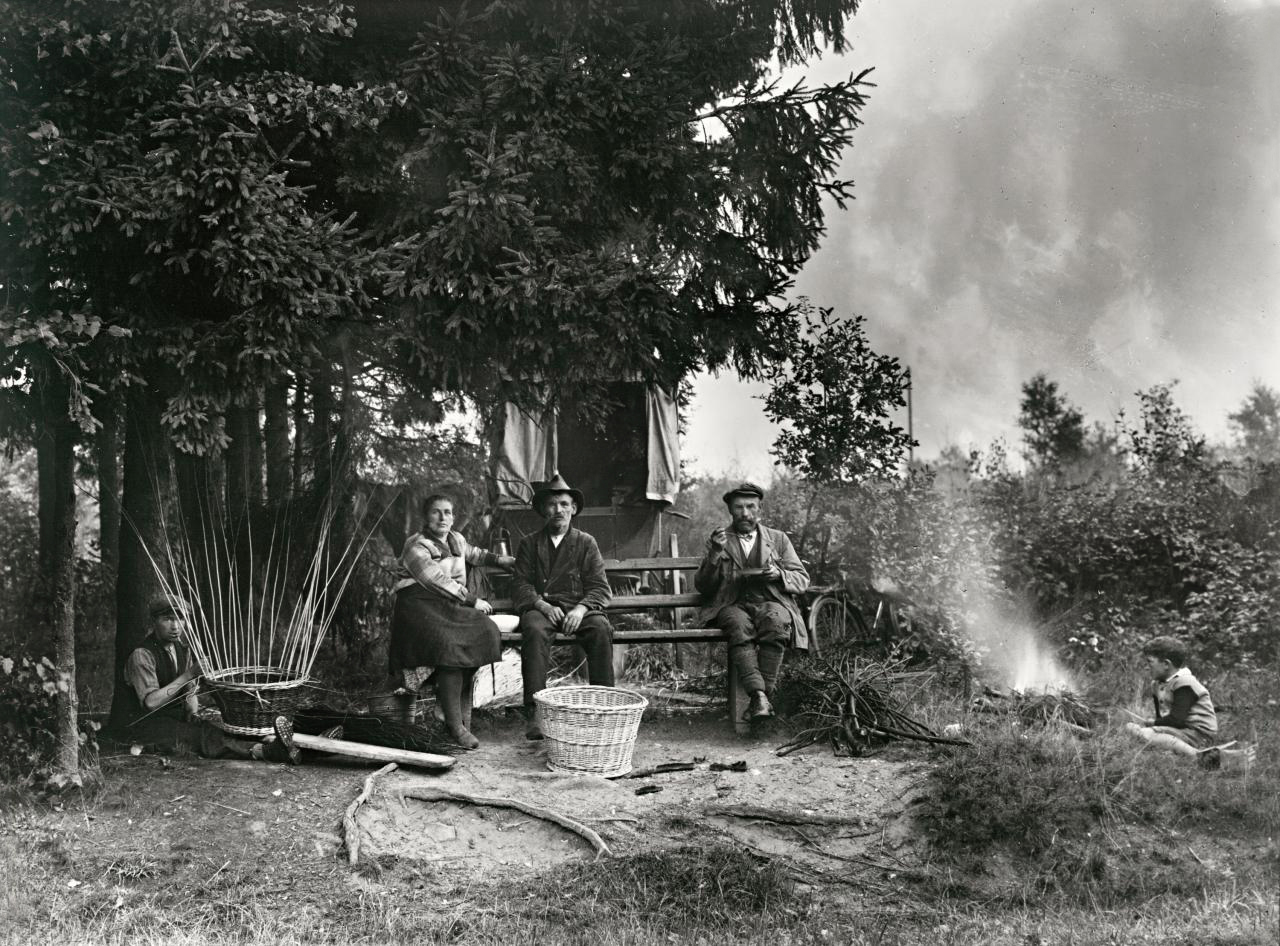
 

August Sander (German, 1876-1964) 'Itinerant basket makers' 1929


August Sander (German, 1876-1964)
Itinerant basket makers
from the People of the Twentieth Century project
1929, printed 1973
Gelatin silver photograph
National Gallery of Victoria
Purchased 1974


Nomadism

In the literature on nomadism, there is considerable disagreement over the range of societies that should be designated as “nomadic,” but there is some consensus that at least three categories of mobile peoples should be recognised. The first category, to which many wish to restrict the term “nomadic,” is that of pastoral nomads… The second broad category of nomads is that of hunter-gatherers, whose mode of subsistence sets them apart from both pastoralists and sedentary farmers…

The third basic category is that of Gypsies, itinerant basket-makers, tinkers, weavers, mimes, magicians, musicians, horse dealers, nostrum traders, carnival people, circus performers, and so on. Characterised the variously as “service nomads,” “economic nomads,” “commercial nomads,” “craftsman nomads,” “non-food producing nomads,” “floating industrial populations,” “peripatetic tribes,” “peripatetic peoples” or plain “peripatetics,” these are spatially mobile peoples who primarily exploit resources in the social environment. They exploit what Berland and Salo call a distinct peripatetic niche: “the regular demand for specialised goods and/or services that more sedentary or pastoral communities cannot, or will not, support on a permanent basis.”

Ronald Bogue. Deleuze’s Way: Essays in Transverse Ethics and Aesthetics. London and New York: Routledge, 2007, pp. 114-115.


Ben Shahn (born Lithuania 1898, lived in United States c. 1925-1969, died United States 1969) 'A deputy with a gun on his hip during the September 1935 strike in Morgantown, West Virginia' 1935, printed c. 1975


Ben Shahn (born Lithuania 1898, lived in United States c. 1925-1969, died United States 1969)
A deputy with a gun on his hip during the September 1935 strike in Morgantown, West Virginia
1935, printed c. 1975
Gelatin silver photograph
National Gallery of Victoria
Purchased, 1975


Athol Shmith (Australian, 1914-1990) 'Misses Mary and Rae Plotkin, bridesmaids at the wedding of Mrs Edith Sheezel' 1940


Athol Shmith (Australian, 1914-1990)
Misses Mary and Rae Plotkin, bridesmaids at the wedding of Mrs Edith Sheezel
1940
Hand-coloured gelatin silver photograph
National Gallery of Victoria
Gift of Mary Lipshut through the Australian Government’s Cultural Gift’s Program, 2012


Baron Raimund von Stillfried (Austrian, 1839-1911, lived throughout Europe and Asia 1871-1910) 'No title (Tattooed bettōs, porters)' c. 1875, printed c. 1877-1880


Baron Raimund von Stillfried (Austrian, 1839-1911, lived throughout Europe and Asia 1871-1910)
No title (Tattooed bettōs, porters)
c. 1875, printed c. 1877-1880
Albumen silver photograph, colour dyes
National Gallery of Victoria
Purchased through the NGV Foundation with the assistance of The Herald & Weekly Times Limited, Fellow, 2001


“There are two employments which I have mentioned among those of domestic servants because they would be so classed by us, but which in Japan rank among the trades. The jinrikisha man and the groom belong, as a rule, to a certain class at the bottom of the social ladder, and no samurai would think of entering either of these occupations, except under stress of severest poverty. The bettōs, or grooms, are a hereditary class and a regular guild, and have a reputation, among both Japanese and foreigners, as a betting, gambling, cheating, good-for-nothing lot. An honest bettō is a rare phenomenon.”

Alice Mabel Bacon. Japanese Girls and Women. Boston and New York: Houghton Mifflin Company The Riverside Press, 1891, p. 319.


Hiroshi Sugimoto (born Japan 1948, lived in United States and Japan 1976- ) 'Winnetka Drive-In, Paramount' 1993


Hiroshi Sugimoto (born Japan 1948, lived in United States and Japan 1976- )
Winnetka Drive-In, Pb  aramount
1993
Gelatin silver photograph, ed. 8/25
National Gallery of Victoria
Bowness Family Fund for Contemporary Photography, 2009


Hiroshi Sugimoto’s famous series Theaters is represented in the exhibition by the work Winnetka Drive-In, Paramount (1993) where  Sugimoto “photographs auditoriums of American movie theaters, and drive-in movies, during showings. The exposure time used for the photograph corresponds with the projection time of the film. This allows him to save the duration of the entire film in a single shot. What remains visible of the film’s time-compressed, individual images is the bright screen of the movie theater, which illuminates the architecture of the space. That its content retreats into the background makes the actual film a piece of information, manifesting itself in the (movie theater) space. As a result, instead of a content-related event, film presents itself here as the relationship between time and spatial perception.”3

If we think of the camera lens as being fully open, like an eye without blinking, for the duration of the length of the film then the shutter of the lens has to be set on “B” for Bulb which allows for long exposure times under the direct control of the photographer. “The term bulb is a reference to old-style pneumatically actuated shutters; squeezing an air bulb would open the shutter and releasing the bulb would close it… It appears that when instantaneous shutters were introduced, they included a B setting so that the familiar bulb behaviour could be duplicated with a cable release.”4 In other words light waves, reflecting from the surface of objects, are controlled by the photographer over an indefinite period (not the short “snap” of the freeze frame / the decisive moment), accumulating light from thousands of years in the past through the lens of the camera onto the focal plane, coalescing into a single image, controlled and constructed by the photographer.

Dr Marcus Bunyan from a review of the NGV exhibition Light Works 2012

3/ Kellein, Thomas and Sugimoto, Hiroshi. Time Exposed. Thames & Hudson, First edition, 1995, p. 91, quoted in Heike Helfert. “Hiroshi Sugimoto “Theaters”,” on the Media Art Net website Nd [Online] Cited 08/09/2012.
4/ Anonymous. “Bulb (photography),” on the Wikipedia website Nd [Online] Cited 08/09/2012.
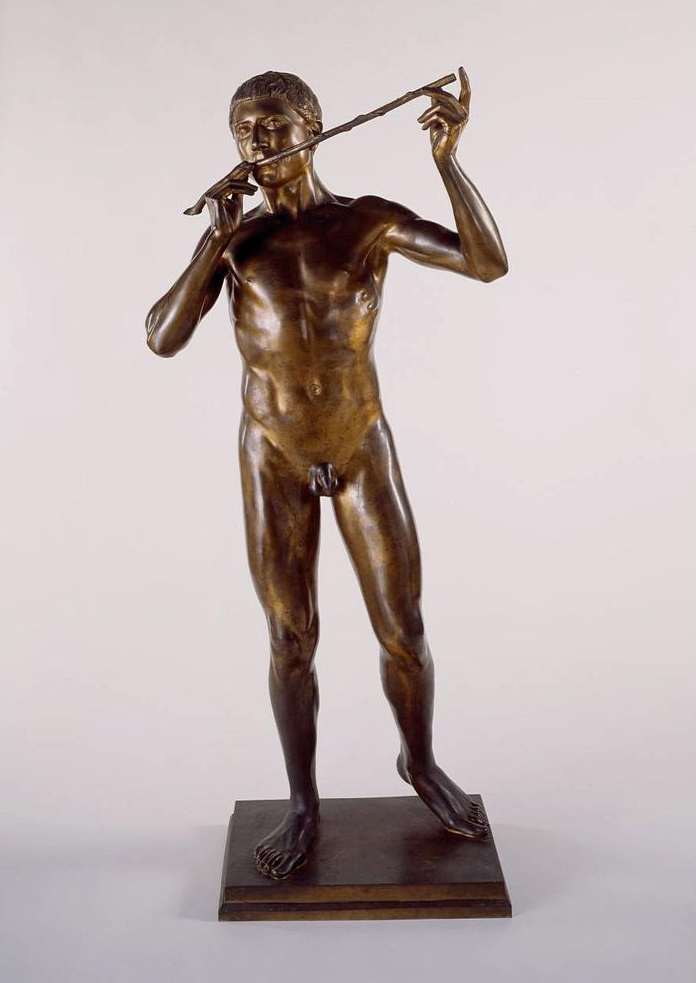
 

James Thomas (English, 1854-1921, lived in Italy 1889-1906) 'Thyrsis' 1914


James Thomas (English, 1854-1921, lived in Italy 1889-1906)
Thyrsis
1914
Bronze, patina
National Gallery of Victoria
Felton Bequest, 1915
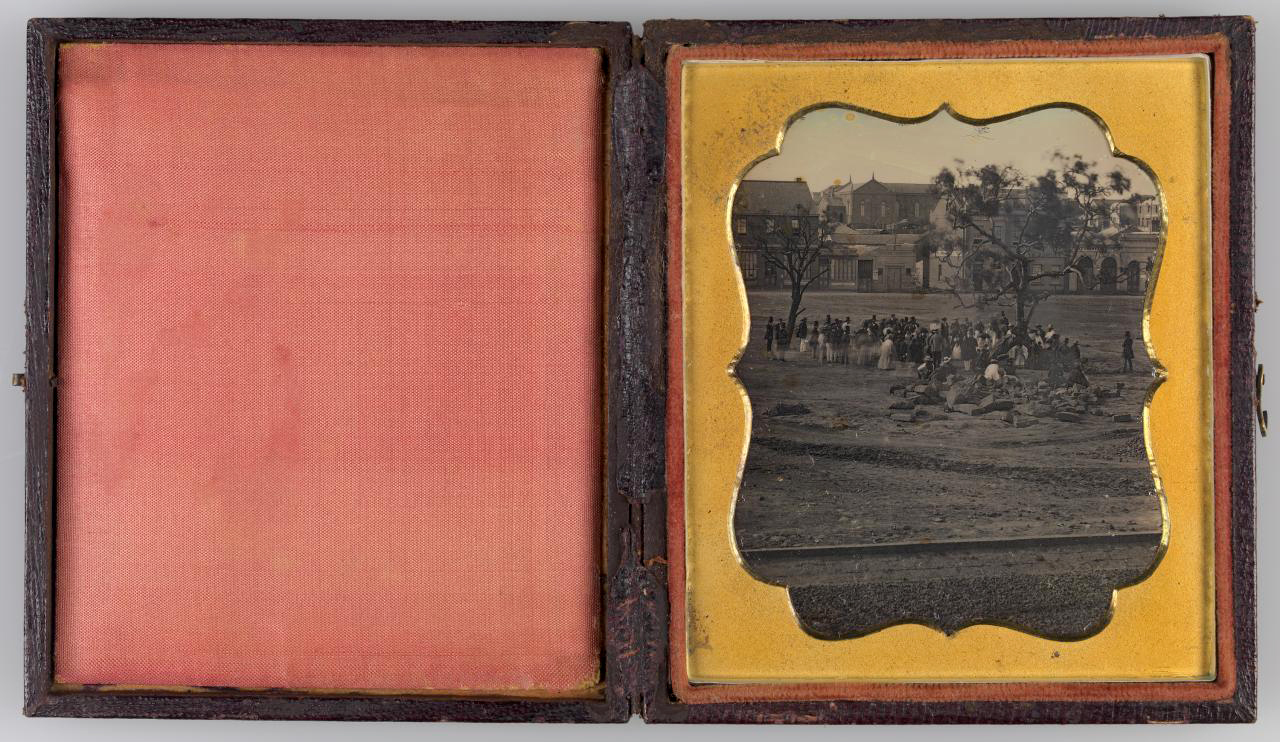
 

Joseph Turner (active in Australia 1856-1880s) 'No title (Laying the foundation stone of the Geelong clock tower)' 1856


Joseph Turner (active in Australia 1856-1880s)
No title (Laying the foundation stone of the Geelong clock tower)
1856
Daguerreotype leather, wood, silk, gilt metal and glass (case)
National Gallery of Victoria
Purchased, 1974


Market Square was a town square located in the centre of Geelong, Victoria, Australia. Consisting of eight acres (2.9 hectares) of land, the area was reserved by Governor Sir George Gipps as a town square during the initial surveying of Geelong. The area later became a produce market, before being progressively built upon. Today the Market Square Shopping Centre occupies the site, having been opened in 1985 by the City of Geelong…

A clock tower was built in the centre of the square in 1856. It was the idea of the second mayor of Geelong James Austin, who offered to pay for a clock tower in Geelong to mark his term as mayor. The clock was featured in The Illustrated London News in March 1855. Components for the clock arrived in Geelong on November 13, 1855 from England, but the location for the clock had yet to be decided. Suggestions of high ground at top of Moorabool, Yarra or Gheringhap Streets were put forward at the time, the indecision lasting into early 1856. In July 1857 a decision was made, and the foundation stone was finally laid in the Market Square…

The clock tower remained until October 1923 when it was demolished to make way for the CML Building. There was a public outcry, and no one was willing to demolish it. However, it was deemed too impractical to move intact, and was brought down by steel cables attached to traction engine. The site of the clock tower is marked by a plaque in the Market Square Shopping Centre.

Text from the Wikipedia website


William Wegman (American, b. 1943) 'Horned hound' 1991


William Wegman (American, b. 1943)
Horned hound
1991
Polaroid photograph
National Gallery of Victoria
Purchased, 1992


The Ian Potter Centre: NGV Australia
Federation Square
Corner of Russell and 
Flinders Streets, Melbourne

Opening hours:
Daily 10am – 5pm
National Gallery of Victoria website

LIKE ART BLART ON FACEBOOK

Back to top

Review: ‘Christian Thompson: Ritual Intimacy’ at Monash University Museum of Art (MUMA), Melbourne

Exhibition dates: 27th April – 8th July, 2017

This project has been supported by the Victorian Government through Creative Victoria

PLEASE NOTE: I am still recovering from my hand operation which is going to take longer than expected. All of the text has been constructed using a dictation programme and corrected using only my right hand – a tedious process. I have to keep my mental faculties together, otherwise this hand will drive me to distraction… Marcus


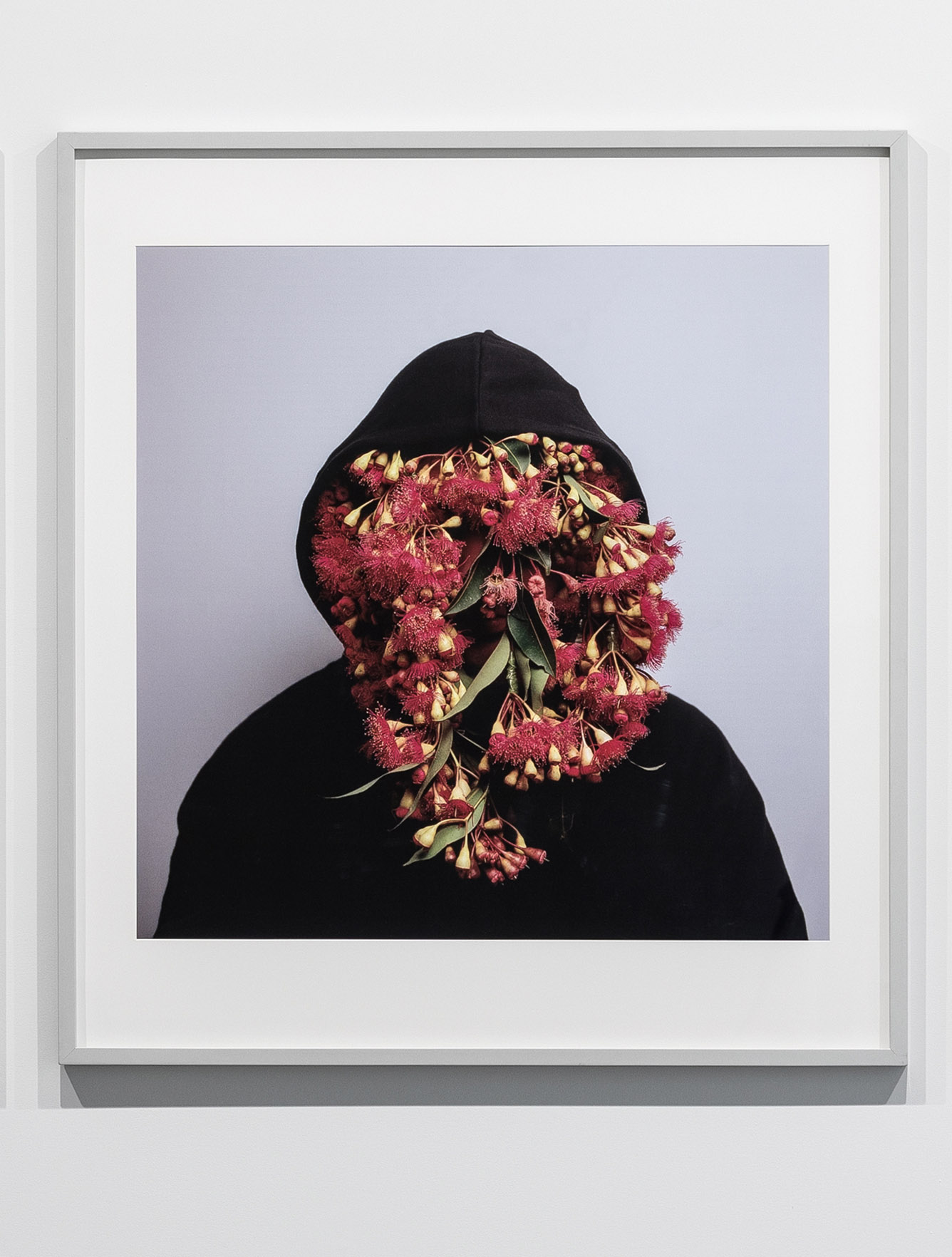
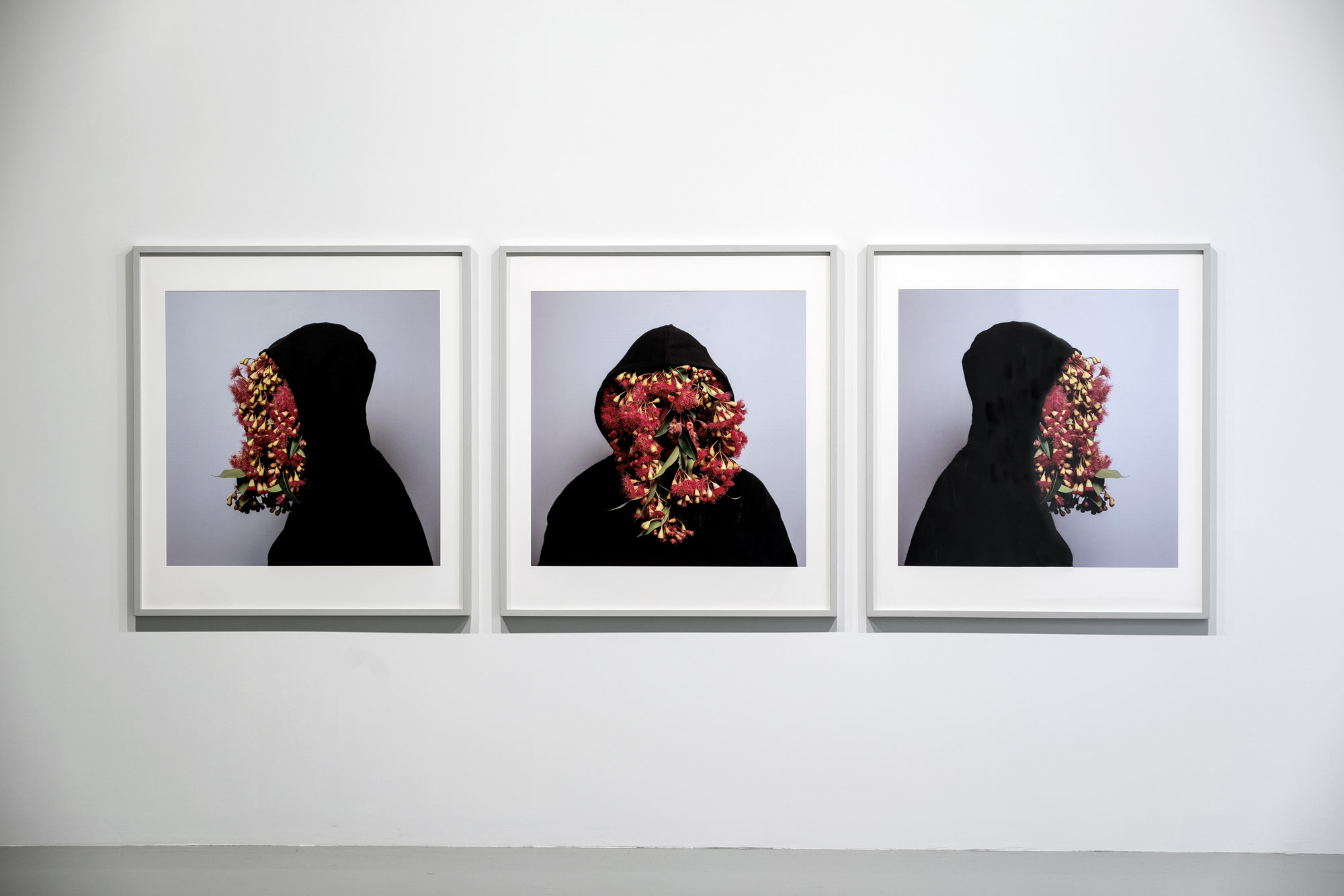
Christian Thompson (Australian, b. 1978) 'Black gum 1-3' 2007 from the exhibition 'Christian Thompson: Ritual Intimacy' at Monash University Museum of Art (MUMA), Melbourne, April - July, 2017


Christian Thompson (Australian, b. 1978)
Black gum 1-3
2007
From the series Australian graffiti
C-type prints
Collection of the National Gallery of Australia, Canberra
Photo: Andrew Curtis


Still singing, still Dreaming,
still loving… not dying.

This is a strong survey exhibition of the work of contemporary Australian Indigenous artist and Bidjara man exploring the world, Christian Thompson. As with any survey exhibition, it can only give us a glimpse into the long standing development of the artist’s work, inviting the viewer to then research more fully the themes, conceptual acts and bodies (of work) that have led the artist to this point in his artistic development. Having said that the exhibition, together with its insightful catalogue essays and additional images that do not appear in the exhibition, allow the viewer to be challenged intellectually, aesthetically and most importantly … spiritually. And to be somewhat conflicted by the art as well, it has to be said.

Thompson’s “multidisciplinary practice explores notions of cultural hybridity, along with identity and history, creating works that transcend cultural boundaries.” His self-reflexive and self-referential bodies of work, often with the artist using his body as an “armature for his characters, costumes and various props,” are intuitive and imaginative in how they relate Aboriginal and Australian/European history, taking past time into present time which influences future time. Time, memory, history, space, landscape are conflated into one point, enunciated through acts of ritual intimacy. These ritual intimacies, these performative acts, are enabled through an understanding of a regularised and constrained repetition of norms (in this case, the declarative power of colonialism), where the taking of a photograph of an Aboriginal person (for example), is “a ritual reiterated under and through constraint, under and through the force of prohibition and taboo, with the threat of ostracism and even death controlling and compelling the shape of the production…” (Judith Butler, Bodies That Matter. New York: Routledge, 1993, p. 95).

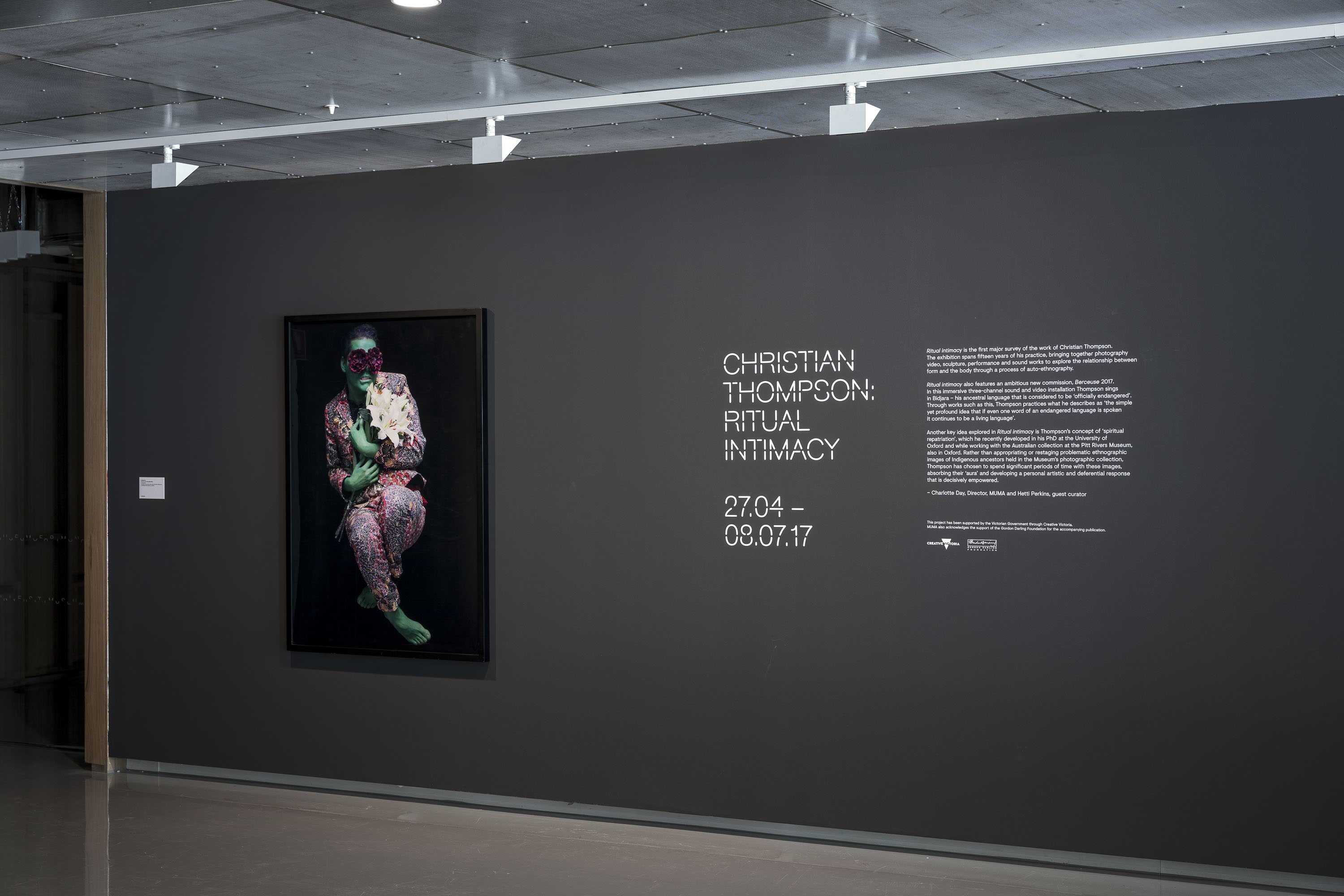
What is so heartening to see in this exhibition is a contemporary Indigenous artist not relying on re-animating colonial images of past injustices, but re-imagining these images to produce a spiritual connection to Country, to place, to people in the present moment. As Charlotte Day, Director, MUMA and Hetti Perkins, guest curator observe in the wall text at the beginning of the exhibition, “Rather than appropriating or restaging problematic ethnographic images of indigenous ancestors held in the Museum’s photographic collection, Thompson has chosen to spend significant periods of time with these images, absorbing their ‘aura’ and developing a personal artistic and deferential response that is decisively empowered.” As Marina Warner states in her excellent catalogue essay “Magical Aesthetics”, these ritual intimacies are a “magical re-animation and adopt time-honoured processes of making holy – of hallowing. Adornment is central to ritual and a prime way of glorifying and consecration.” What Thompson is doing is not quoting but translating the source-text into new material. As Mary Jacobus notes of the work of the painter Cy Twombly, “Quotation involves the repurposing of an existing text: translation requires a swerve from the source-text as it finds new directions and enters unknown terrain.” (Mary Jacobus. Reading Cy Twombly: Poetry in Paint.  Princeton & Oxford: Princeton University Press, 2016, p. 7).

This auto-ethnographic exploration and adornment leads to a deterritorialisation and reterritorialisation of time in a heterotopic space, juxtaposing in a single real place several spaces, several sites of contestation – Thompson’s travels and research from around the world, the embodiment in his own culture and that of contemporary Australia, pop culture, fashion, music and language – where, as Hetti Perkins says, “the unknowable is a lovely thing” and where Thompson can affect and influence “the Zeitgeist through more subversive means.” These spaces of ritualised production overlaid with memory, imagination, desire, and nostalgia, these fragmented images, become a process and a performance in which Thompson seeks to ameliorate the objects aura through a process of ‘spiritual repatriation’. Thompson’s performativity is where the ritual of production and meaning is never fully predetermined at any stage of production and reception.

Here, in terms of ‘aura’ and ‘spirit’, I am interested in the word “repatriation”. Repatriation means to send (someone) back to their own country – from the verb repatriare, from re- ‘back’ + Latin patria ‘native land’. It has an etymological link to the word “patriot” – from late Latin patriota ‘fellow countryman’, from Greek patriōtēs, from patrios ‘of one’s fathers’, from patris ‘fatherland’ – and all the imperial connotations that are associated with the word. So, to send someone back (against their own will? by force?) or to be patriotic, as belonging to or coming from, the fatherland. A land that is father, farther away. Therefore, it is with regard to a centralised, monolithic body and its materialities (for the body is usually centrally placed in Thompson’s work) in Thompson’s instinctive works, that relations of discourse and power will always produce hierarchies and overlappings which are going to be contested. As Judith Butler notes,

“That each of those categories [body and materiality] have a history and a historicity, that each of them is constituted through the boundary lines that distinguish them and, hence, by what they exclude, that relations of discourse and power produce hierarchies and overlappings among them and challenge those boundaries, implies that these are both persistent and contested regions.” (Judith Butler. Bodies That Matter. New York: Routledge, 1993, pp. 66-67)


Thus performativity is the power of discourse, the politicisation of abjection, and the ritual of being.

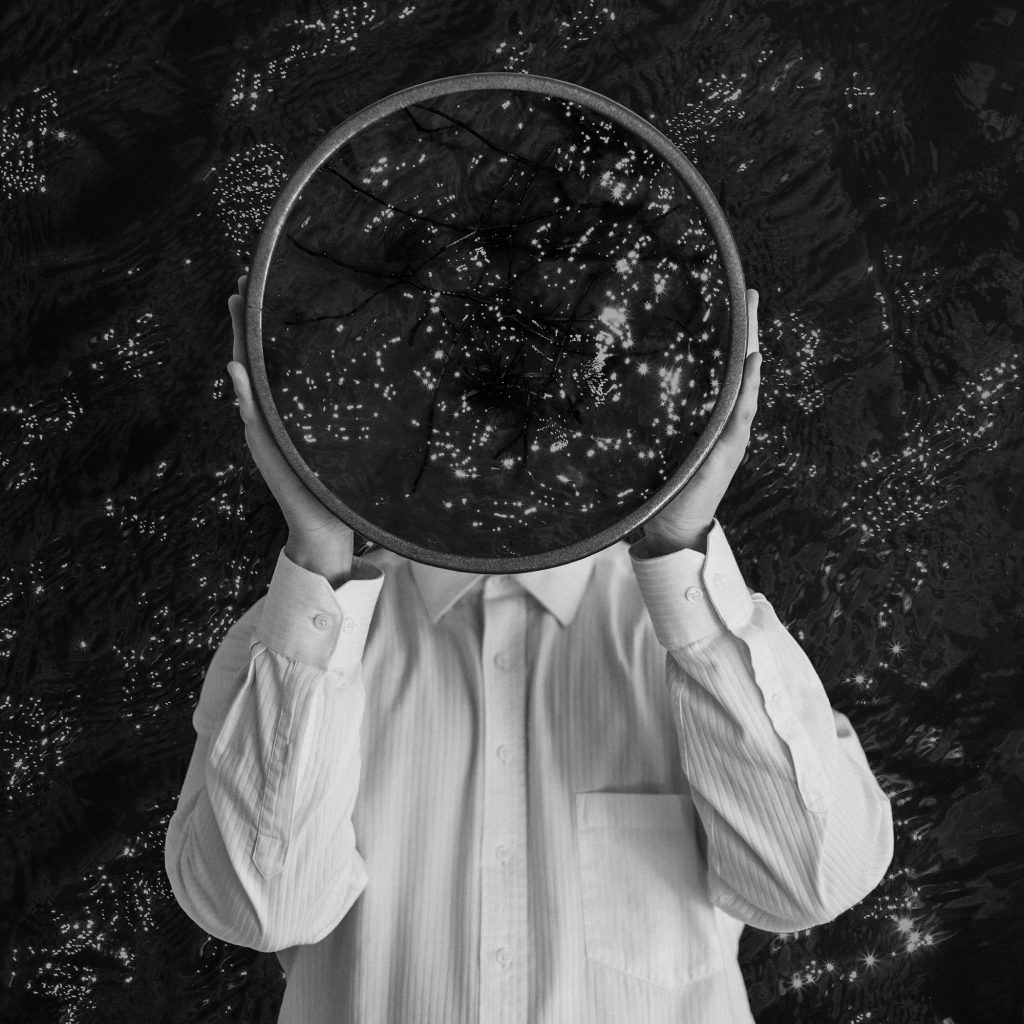
This is where I become conflicted by much of this work. Intellectually and conceptually I fully understand the instinctive, intuitive elements behind the work (crystals, flowers, maps, butterflies, dreams) but aesthetically I feel little ‘aura’ emanating from the photographs. Thompson’s “peripatetic life and your bowerbird, magpie-like fascination” (p. 107) lead to all sorts of influences emerging in the work – orange from The Netherlands, Morris dancers from England, Jewish heritage, Aboriginal and Australian heritage, fashion, pop culture, music, language – all evidenced through “acts of concealment in his self-portraits.” (p. 75). Now there’s the rub!

In Thompson’s ritual intimacies the intimacy is performed only once, for the camera. It is not didactic, but it is interior and hidden, leaving much to the feelings of the viewer, looking. The re-presentation of that intimacy is performed by the viewer every time they look at the art. I think of the work of one of my favourite performance artists, Claude Cahun, where the artist inhabits her personas, adorning her androgynous face with costume after costume to become something that she wants to become – a buddha, a double, a harpy, a lunatic or a doll with equal ease. Cahun is always and emphatically herself, undermining a certain authority… and she produces indelible images that sear the mind.

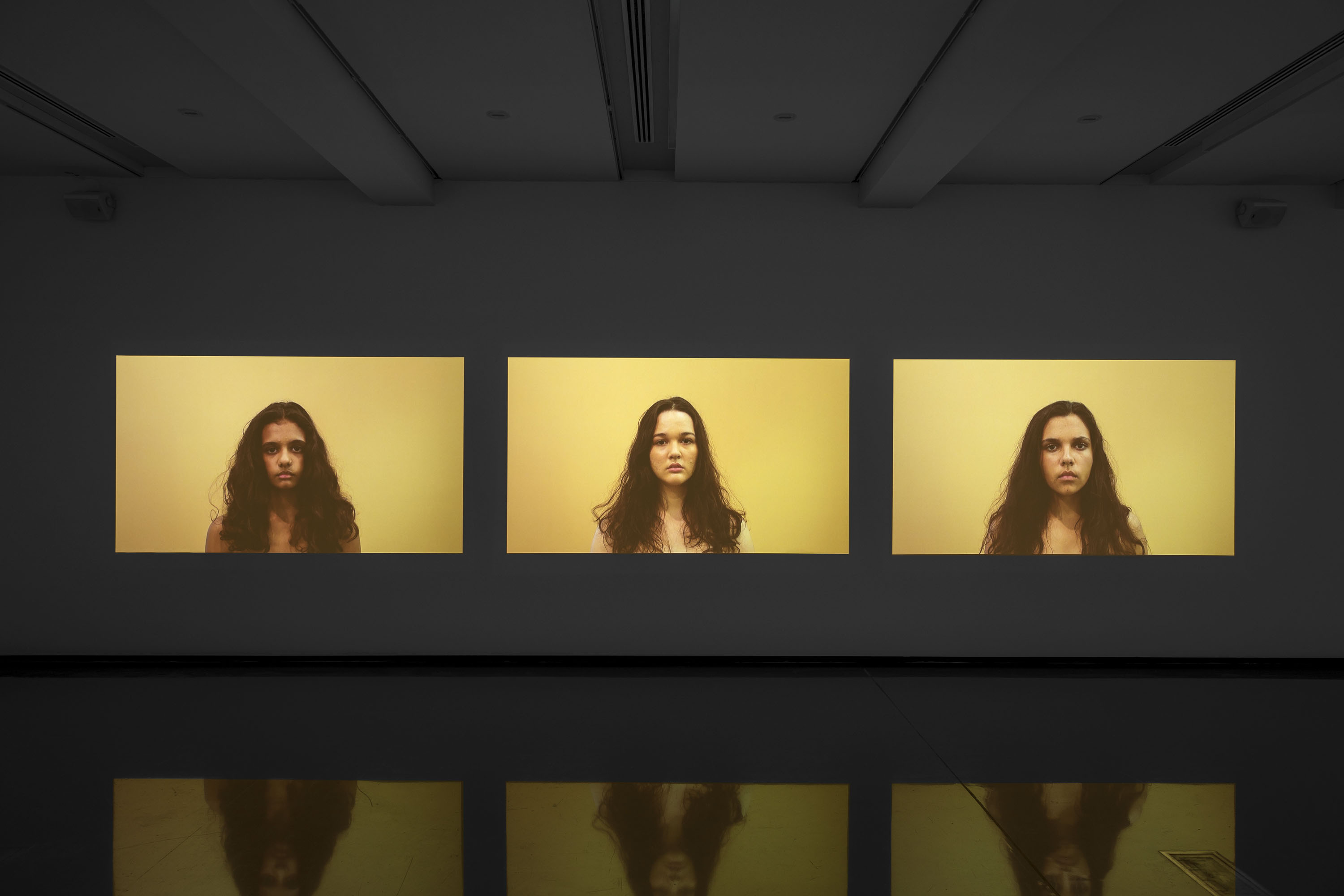
I don’t get that from Thompson. I don’t know who he really is. Does it matter? Yes it does. In supposedly his most autobiographic work (according to Hetti Perkins), the video Heat (2010, below) the work emerges out of Thompson’s memories of growing up in the desert surrounding Barcaldine in central west Queensland where “heat captures the sensation that he associates with being on his country: the dry wind blowing through his hair.” Perhaps for him or someone from the desert country like Hetti Perkins (as she states in the catalogue), but not for me. I feel no ‘heat’ from these three beautiful woman standing in a contextless background with a wind machine blowing their hair. The only ‘heat’ I felt was perhaps the metaphoric heat of colonisation, violence and abuse thrust on a vulnerable culture.

Talking of vulnerable cultures, in the work Polari (2014, below) Thompson invokes the history of languages in an intimate ritual “as he seeks to reanimate and repossess vanishing knowledge. Polari is a private language … a kind of code used by sailors, circus and fairground folk, and in gay circles. … Thompson’s Polari series warns us that the artist has a language of his own, which we can overhear but not fully understand: something is withheld, in contrast to the imposed and implacable exposure which the subjects of scientific collections were made to suffer in the past.” (Warner, p. 74) But why is he using Polari specifically, a language that is strongly associated with the libertine gay culture of the 1950s-70s? Does he have a right to use this word and its linguistic heritage because he is gay? It is never stated, again another thing left hidden, concealed and unresolved.

Although no culture can ever fully own its language (language is a construct after all) … if Thompson is not gay, then I would take exception to his invoking the Polari language, just as an Indigenous artist would take exception to me using Bidjara language in an art work of my own. I remember coming out in London in 1975 and speaking Polari myself when it was still being used in pubs and clubs such as the A + B club in Soho. It was not being used as a language of resistance, far from it, but as a language of desire. It was a language used to inculcate that desire. As a video on YouTube observes of speaking Polari, “you didn’t think, oh God I’m so oppressed I can never speak about myself, you just did it, you just slipped into it without thinking.” It was your own language, like a comfortable pair of slippers. Does Thompson understand how using that word to title a body of work could be as offensive to some people as he finds the denaturing of his own culture? For me this is where the work really becomes problematic, when an artist does not enunciate these connections, where things, like sexuality, remain hidden. Similarly, with historical photographs of Indigenous people taken for ethnographic study, Thompson fails to acknowledge the work of academics such as Jane Lydon and her important books Eye Contact: Photographing Indigenous Australians (2005) and Photography, Humanitarianism, Empire (2016) where she unpacks the historical baggage of the images and notes that the photographs were not solely a tool of colonial exploitation. Lydon articulates an understanding in Eye Contact that the residents of Coranderrk, an Aboriginal settlement near Healsville, Melbourne, “had a sophisticated understanding of how they were portrayed, and they became adept at manipulating their representations.” Again, there is more than meets the eye, more than just ‘spiritual repatriation’ of aura.

For me, the magic of this exhibition arrives when Thompson lets go all obfuscation, let’s go all actions that make something obscure, unclear, or unintelligible. Where his ritual intimacies become grounded in language, earth and spirit. This happens in the video works, Desert slippers (2006, below), Refuge (2014, below), Gamu Mambu (Blood Song) (2011) and Dhagunyilangu (Brother) (2011, below). In these videos, the Other’s gaze disintegrates and we are left with poignant, heart felt words and actions that engage history, emotion, family and Country.

The video Desert slippers “features a Bidjara ritual in which a father and son transfer sweat. The desert slipper is a native cactus that symbolises the transferal of the spirit back to earth as the plant grows.” It is simple, eloquent, powerful, present. The other videos feature two baroque singers from Europe and Thompson singing in his native tongue Bidjara (Bidyara, Pitjara), a language that Wikipedia states “is an extinct Australian Aboriginal language. In 1980 it was spoken by twenty elders in Queensland, between Tambo and Augathella, Warrego and Langlo rivers.” Spelt out in black and white. Extinct. To hear Thompson sing a berceuse (French, from bercer ‘to rock’), or lullaby in his native language, a language taught to him by his father, is the most emotional of experiences. The work “combines evocative chanting and electronic elements to invoke the cultural experiences and narratives of his Bidjara culture,” and “is premised on the notion that if one word of Bidjara is spoken, or sung in this case, it remains a living language.” Amen to that.

This is the real hallowing, not the dress ups or the concealments. It is in these videos that the raw material of his and his cultures experience is transmuted into living, breathing stories, in an alchemical transmutation, a magical re-animation of past time into present and future time. My transfiguration into a more spiritual state was complete when listening in quiet contemplation. For I was given, if only for a very brief moment, access to the pain of our First Peoples and a vision of hope for their future healing.

Still singing, still Dreaming,
still loving… and certainly not dying.

Dr Marcus Bunyan

Word count: 2,053


Many thankx to MUMA for allowing me to publish the photographs and videos in the posting. All installation photographs unless otherwise noted © Marcus Bunyan, the artist and MUMA. Please click on the photographs for a larger version of the image.


Christian Thompson (Australian, b. 1978) 'Black gum 1' 2007 (installation view)


Christian Thompson (Australian, b. 1978)
Black gum 1 (installation view)
2007
From the series Australian graffiti
C-type print
Collection of the National Gallery of Australia, Canberra
Photo: Marcus Bunyan


Christian Thompson (Australian, b. 1978) 'Black gum 2' 2007 (installation view)


Christian Thompson (Australian, b. 1978)
Black gum 2 (installation view)
C-type print
2007
From the series Australian graffiti
Collection of the National Gallery of Australia, Canberra
Photo: Marcus Bunyan


“While I’m interested in portraiture – I don’t consider my work as portraiture because that suggests that I’m trying to portray myself, my own visage, my own image. I employ images, icons, materials, metaphors to capture and idea and moment in time. There are many different things at play; taking a picture of myself is really the last thing that’s on my mind.”


Christian Thompson in conversation with Hetti Perkins, catalogue extract


“I’m interested in simple aesthetic gestures that can say something … something quite profound about the world that we live in. I tend to build images how I create a sculpture. I borrow from the world around me.”

On being away from home: “You’re able to remove yourself from the local discourse, and romanticise home. When you’re displaced you tend to gravitate towards certain memories … But this is who I am. It would be weird not to express that somehow. I combine memories of my past with my lived experience and an idea of where I’d like to be … it’s all montaged into one.”


Christian Thompson quoted in Will Cox. “Christian Thompson’s Ritual Intimacy,” on the Broadsheet website 15 June 2017 [Online] Cited 22/12/2021


“But Thompson makes things up. His ‘We bury our own’ does not let us see the early daguerreotype but improvises a series of fugues on its spiritual essence. This is the crucial step that Thompson has taken: if you repeat the spectacle you cannot escape the past. But if you, a spiritual descendant, transmogrify yourself in keeping with the aura of the image’s subject, during the prolonged period of encounter and immersion, you can ‘repatriate’ that forebear. Or so he desires.”

“Through these conjurings of the language his people spoke before colonisation set out to strip them of their culture as well as their land, Christian Thompson performs private ceremonies – to reach beyond visual statements of personal presence and reawaken the knowledge of his forebears, and allow us, his listeners and viewers, into their living story.”


Marina Warner. “Magical Aesthetics,” extracts from the catalogue essay


“At the heart of my practice is a concern with aura: what it is, how it can be photographed and how it can be repatriated.”


Christian Thompson


'Christian Thompson: Ritual intimacy', installation view: Monash University Museum of Art, Melbourne 2017


Christian Thompson: Ritual intimacy, installation view: Monash University Museum of Art, Melbourne 2017
Photo: Andrew Curtis


Christian Thompson (Australian, b. 1978) 'Untitled #6' 2010


Christian Thompson (Australian, b. 1978)
Untitled #6
2010
From the series King Billy
C-type print
Image courtesy of the artist, Sarah Scout Presents, Melbourne, and Michael Reid, Sydney and Berlin


'Christian Thompson: Ritual intimacy', installation view: Monash University Museum of Art, Melbourne 2017 featuring stills from the video 'Berceuse' (2017)

'Christian Thompson: Ritual intimacy', installation view: Monash University Museum of Art, Melbourne 2017 featuring stills from the video 'Berceuse' (2017)


Christian Thompson: Ritual intimacy, installation view: Monash University Museum of Art, Melbourne 2017 featuring stills from the video Berceuse (2017)
Photos: Marcus Bunyan


Christian Thompson (Australian, b. 1978)
Berceuse (extract installation view)
2017
Three-channel digital colour video, sound
5.47 minutes
Sound design: Duane Morrison


Christian Thompson (Australian, b. 1978)
Berceuse
2017
Three-channel digital colour video, sound
5.47 minutes
Sound design: Duane Morrison


In this newly commissioned work, Thompson sings a berceuse – a cradle song or lullaby – that combines evocative chanting and electronic elements to invoke the cultural experiences and narratives of his Bidjara culture. Intended as a gesture of re-imagining his traditional Bidjara language, which is been categorised as extinct, the work is premised on the notion that if one word of Bidjara is spoken, or sung in this case, it remains a living language.

Thompson makes subtle reference to his maternal Sephardic Jewish roots by ruminating in this work on the lullaby Nani Nani:


Lullaby, lullaby
The boy wants a lullaby,
The mother’s son,
Who although small will grow.

Oh, oh my lady open,
Open the door,
I come home tired,
From ploughing the fields.

Oh, I won’t open them,
You don’t come home tired,
You’ve just come back,
From seeing your new lover.


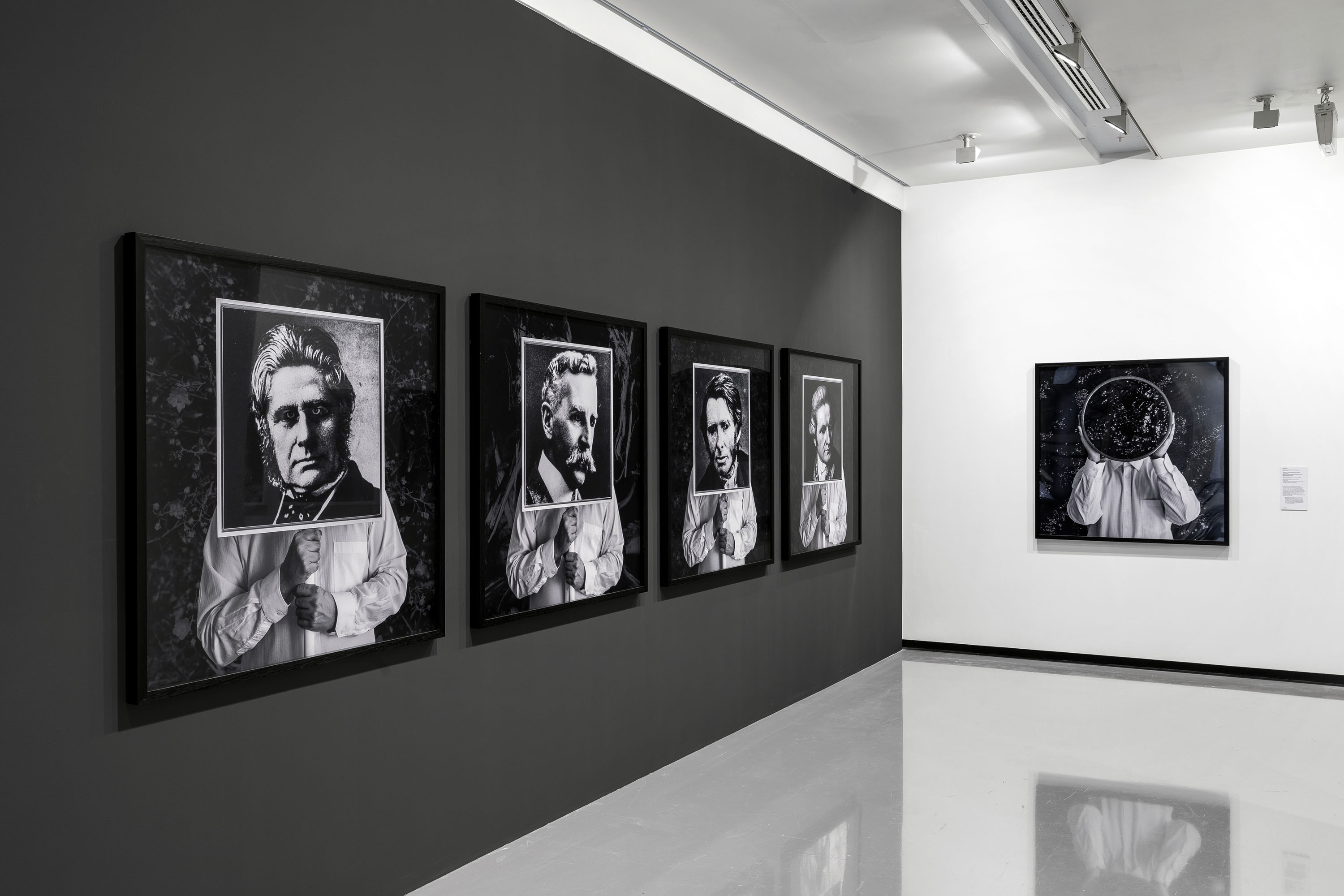
'Christian Thompson: Ritual intimacy', installation view: Monash University Museum of Art, Melbourne 2017 featuring the series 'Museum of Others' (2016)

'Christian Thompson: Ritual intimacy', installation view: Monash University Museum of Art, Melbourne 2017 featuring the series 'Museum of Others' (2016)


Christian Thompson: Ritual intimacy, installation view: Monash University Museum of Art, Melbourne 2017 featuring the series Museum of Others (2016)
Photos: Marcus Bunyan


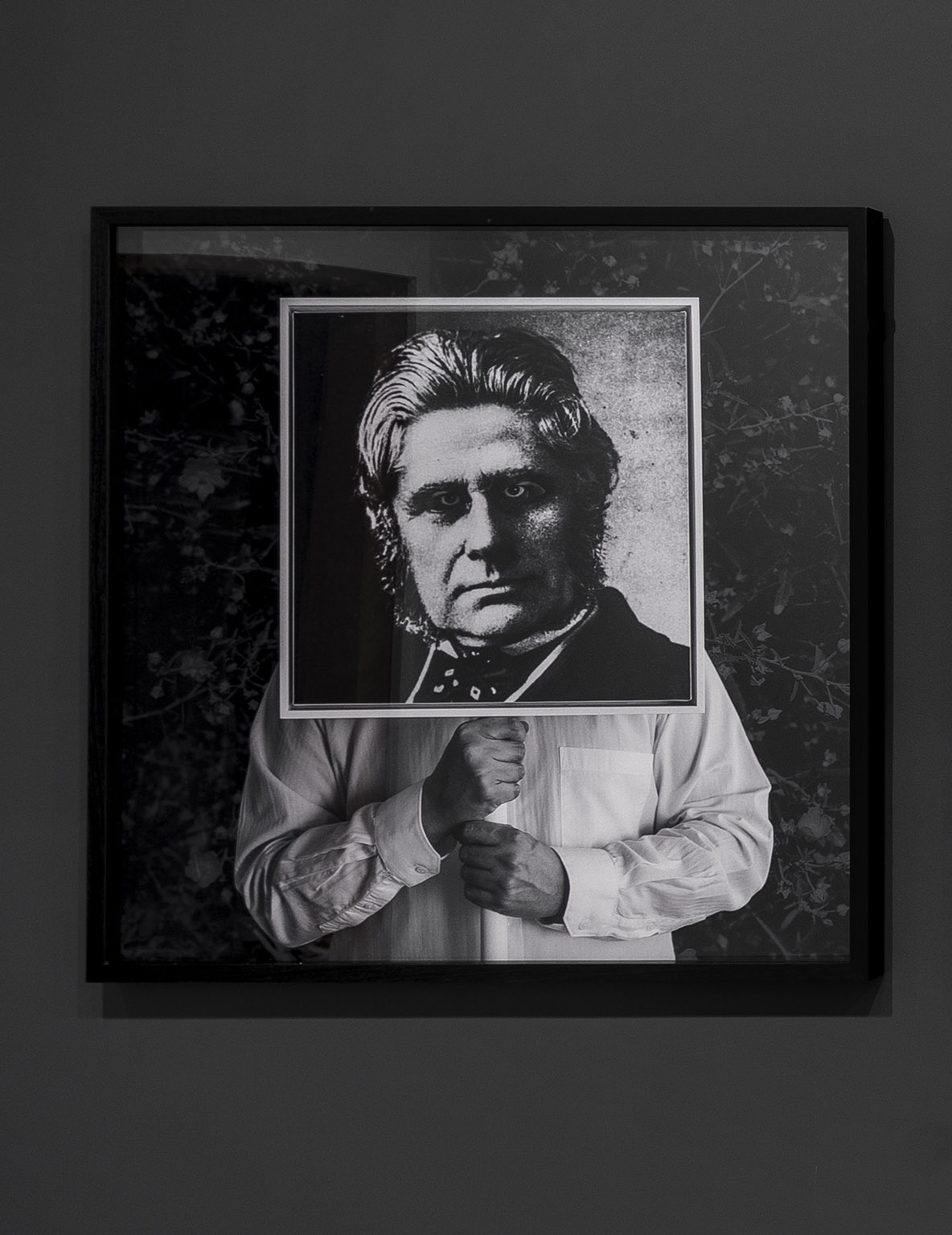
Installation view of Christian Thompson's 'Museum of Others (Othering the Ethnologist, Augustus Pitt Rivers)' 2016


Installation view of Museum of Others (Othering the Ethnologist, Augustus Pitt Rivers) 2016
Photo: Marcus Bunyan


Christian Thompson (Australian, b. 1978) 'Museum of Others (Othering the Anthropologist, Walter Baldwin Spencer)' 2016 (installation view)


Christian Thompson (Australian, b. 1978)
Museum of Others (Othering the Anthropologist, Walter Baldwin Spencer)
2016
From the series Museum of Others
C-type print


Installation view of Christian Thompson's 'Museum of Others (Othering the Explorer, James Cook)' 2016


Installation view of Museum of Others (Othering the Explorer, James Cook) 2016
Photo: Marcus Bunyan


Christian Thompson (Australian, b. 1978) 'Othering the Explorer, James Cook' 2016


Christian Thompson (Australian, b. 1978)
Museum of Others (Othering the Explorer, James Cook)
2016
From the series Museum of Others
C-type print


Christian Thompson (Australian, b. 1978) 'Equilibrium' 2016


Christian Thompson (Australian, b. 1978)
Equilibrium
2016
From the series Museum of Others
C-type print


Museum of others is Thompson’s most recent photographic series and continues to reflect on his time at the University of Oxford. It features several ‘dead white males’ from the pantheon of British and Australian culture. The explorer, the ethnologist and the anthropologist all had roles in the process of colonisation in Australia but the art critic is particular to Thompson; Ruskin was the first Slade Professor of Fine Art at University of Oxford, just as Thompson was one of its first Australian Aboriginal students. Thompson explains his motivation for the series:

“Historically, it was the western gaze that was projected onto the ethnic other and I thought I’ll create a ‘museum of others’ and I’ll be the one othering, so to speak. ‘Equilibrium’ is based around the idea that the vessel is the equaliser. The vessel is the cradle of all civilisations. We all have that in common.”


Wall text from the exhibition


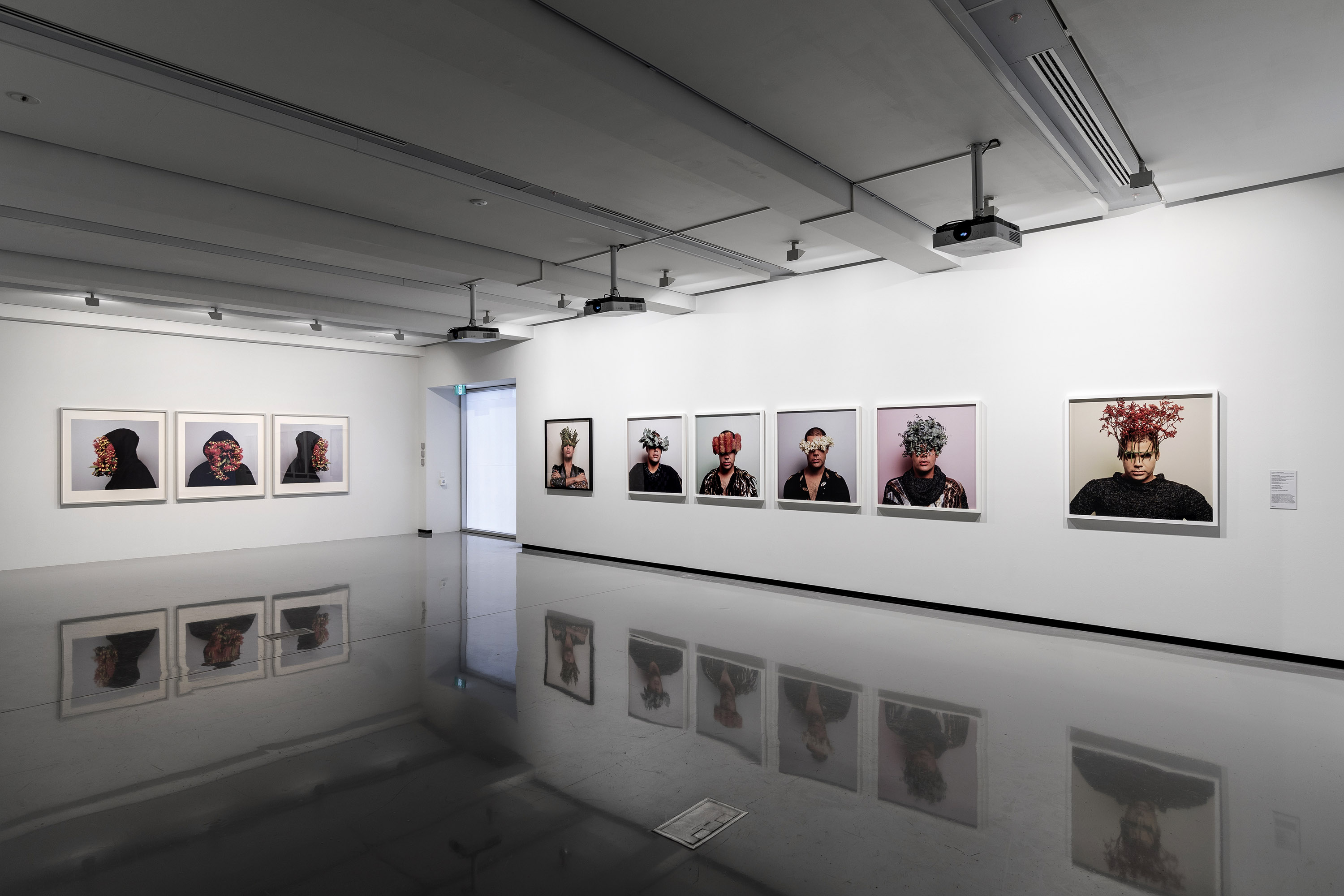
'Christian Thompson: Ritual intimacy', installation view: Monash University Museum of Art, Melbourne 2017 featuring photographs from the series 'We bury our own' 2010 (C-type prints)

'Christian Thompson: Ritual intimacy', installation view: Monash University Museum of Art, Melbourne 2017 featuring photographs from the series 'We bury our own' 2010 (C-type prints)


Christian Thompson: Ritual intimacy, installation view: Monash University Museum of Art, Melbourne 2017 featuring photographs from the series We bury our own 2010 (C-type prints)
Photos: Andrew Curtis


We bury our own is a body of work that was developed in response to the historic collection of photography, featuring Aboriginal people from the late nineteenth century, at the Pitt Rivers Museum in Oxford. Thompson noted in 2012 that these early images “have permeated my work over the last year. They have remained at the forefront of every artistic experiment and they have pushed me into new territory, they have travelled with me… I was drawn to elements of opulence, ritual, homage, fragility, melancholy, strength and even a sense of play operating in the photographs…”

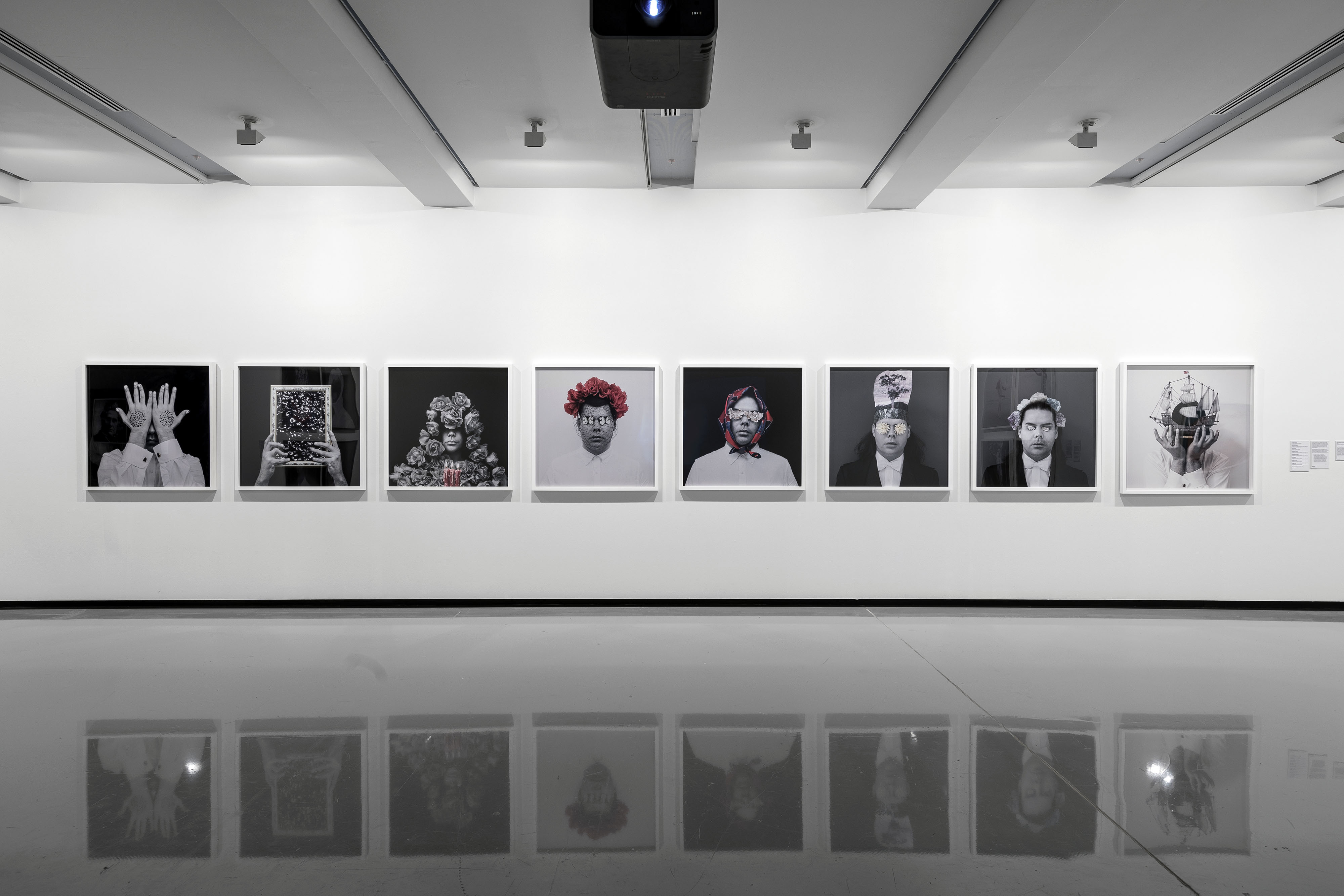
Each of Thompson’s lyrical photographic images from We bury our own and Pagan sun feature himself partially disguised with props and costumes. The works are virtually monochromatic with elements highlighted in full colour, and his eyes, or face, are partially concealed or painted. The use of votive objects is explained in his equally lyrical 2012 statement: “I lamented the passing of the flowers at the meadow, I lit candles and offered blood to the ancestral beings, looked into the black sparkling sea, donned the Oxford garb, visited the water by fire light and bowed at the knees of the old father ghost gum.”

Text from the Turner Galleries website [Online] Cited 22/12/2021


Christian Thompson (Australian, b. 1978) 'Energy Matter' 2010


Christian Thompson (Australian, b. 1978)
Energy Matter
2010
From the series We bury our own
C-type print


Christian Thompson (Australian, b. 1978) 'Lamenting the flowers' 2010


Christian Thompson (Australian, b. 1978)
Lamenting the flowers
2010
From the series We bury our own
C-type print


Christian Thompson (Australian, b. 1978) 'Forgiveness of Land' 2010 from the exhibition 'Christian Thompson: Ritual Intimacy' at Monash University Museum of Art (MUMA), Melbourne, April - July, 2017


Christian Thompson (Australian, b. 1978)
Forgiveness of Land
2010
From the series We bury our own
C-type print


Christian Thompson (Australian, b. 1978) 'Down Under World' 2010


Christian Thompson (Australian, b. 1978)
Down Under World
2010
From the series We bury our own
C-type print


I conceived the We Bury Our Own series in 2010 after curator Christopher Morton invited me to develop a body of work that would be inspired by and in dialogue with the Australian photographic collection at the Pitt Rivers Museum…

The archival images have permeated my work over the last year. They have remained at the forefront of every artistic experiment and pushed me into new territory; they have travelled with me to residencies at the Fonderie Darling in Montreal and Greene Street Studio, New York. I was drawn to elements of opulence, ritual, homage, fragility, melancholy, strength and even a sense of play operating in the photographs. The simplicity of a monochrome and sepia palette, the frayed delicate edges and the cracks on the surface like a dry desert floor that reminded me of the salt plains of my own traditional lands.

I wanted to generate an aura around this series, a meditative space that was focused on freeing oneself of hurt, employing crystals and other votive objects that emit frequencies that can heal, ward off negative energies, psychic attack, geopathic stress and electro magnetic fields, and, importantly, transmit ideas.

I lamented the passing of the flowers at the meadow, I lit candles and offered blood to the ancestral beings, looked into the black sparkling sea, donned the Oxford garb, visited the water by fire light and bowed at the knees of the old father ghost gum. I asked the photographs in the Pitt Rivers Museum to be catalysts and waited patiently to see what ideas and images would surface in the work, I think with surprising results. Perhaps this is what art is able to do, perform a ‘spiritual repatriation’ rather than a physical one, fragment the historical narrative and traverse time and place to establish a new realm in the cosmos, set something free, allow it to embody the past and be intrinsically connected to the present?

I heard a story many years ago from some old men, they told me about a ceremony where young warriors would make incisions through the flesh exposing the joints, they would insert gems between the bones to emulate the creator spirits, often enduring infection and agonising pain or resulting in death. The story has stuck with me for many years, one that suggests immense pain fused with intoxicating beauty. The idea of aspiring to embody the creators, to transgress the physical body by offering to our gods our spiritual heart, freeing ourselves of suffering by inducing a kind of excruciating decadent torture. This was something that played on my mind during the production of this series of photos and video work. The deliverance of the spirit back to land – the notion that art could be the vehicle for such a passage, the aspiration to occupy a space that belongs to something higher than one’s physical self.

Christian Thompson artist statement in “Christian Thompson: We Bury Our Own,” on the Pitt Rivers Museum website [Online] Cited 21/12/2021


'Christian Thompson: Ritual intimacy', installation view: Monash University Museum of Art, Melbourne 2017 featuring 'Ship of dreams', 'Ancient bloom', 'Death's second self', and 'Gods and kings' from the series 'Imperial relic' 2015 (C-type prints) and a still from the video 'dead tongue' 2015


Christian Thompson: Ritual intimacy, installation view: Monash University Museum of Art, Melbourne 2017 featuring Ship of dreams, Ancient bloom, Death’s second self, and Gods and kings from the series Imperial relic 2015 (C-type prints) and a still from the video dead tongue 2015
Photo: Andrew Curtis


In Dead tongue Thompson continues to interrogate the implications of England’s empirical quest on the former colonies of the British Empire through the threat to or loss of Indigenous languages. In works such as this, Thompson actively challenges the perception that Aboriginal culture has become reduced to a captured trophy of Empire.

Wall text from the exhibition


'Christian Thompson: Ritual intimacy', installation view: Monash University Museum of Art, Melbourne 2017 featuring 'Ship of dreams', 'Ancient bloom', 'Death's second self', and 'Gods and kings' from the series 'Imperial relic' 2015 (C-type prints)


Christian Thompson: Ritual intimacy, installation view: Monash University Museum of Art, Melbourne 2017 featuring Ship of dreams, Ancient bloom, Death’s second self, and Gods and kings from the series Imperial relic 2015 (C-type prints)
Photo: Andrew Curtis


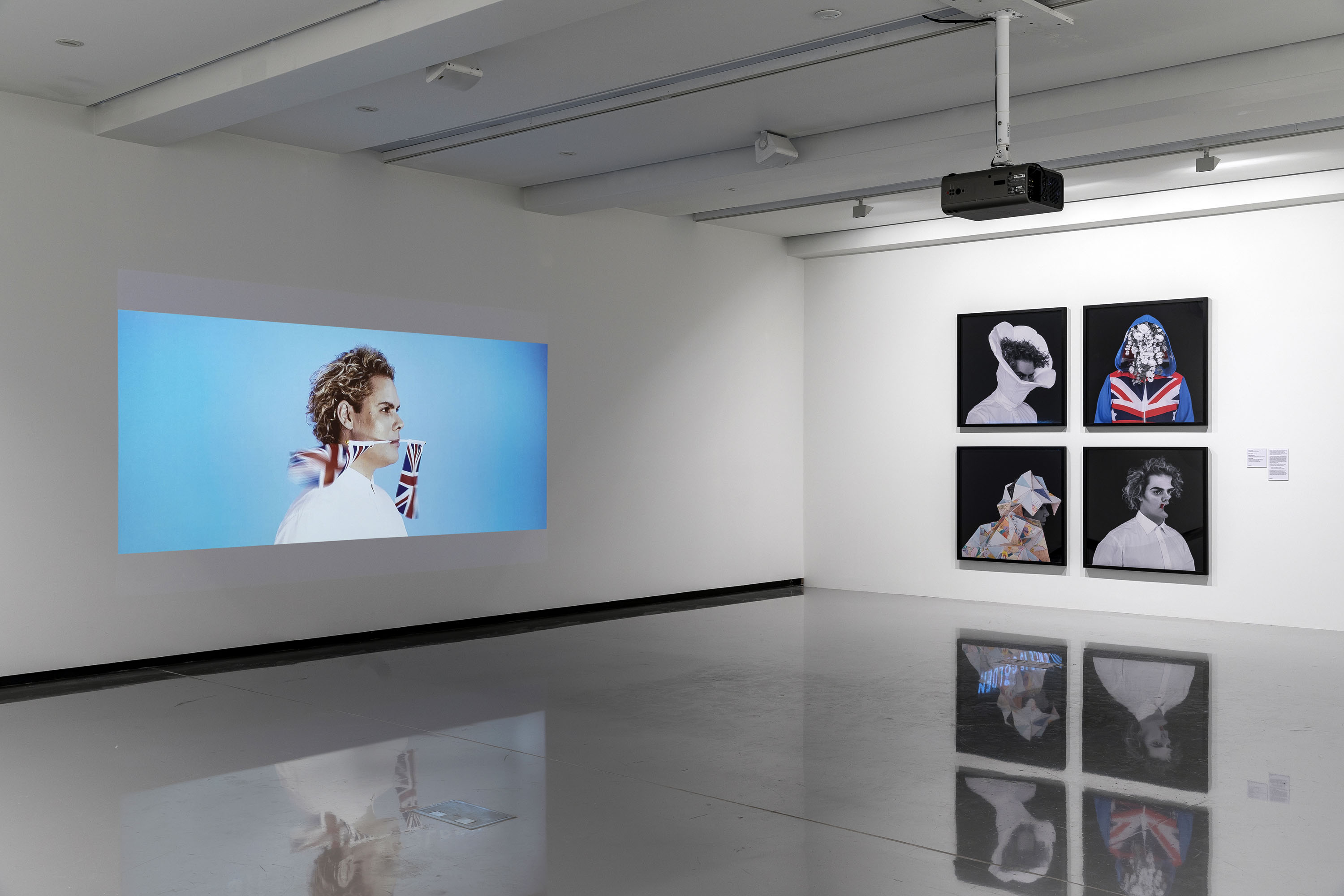
In … Imperial relic, he continues to use himself as the ‘armature for his characters, costumes and various props’. Drawing on his background in sculpture, he has created ‘wearable sculptures’ including a trumpet shaped shirt collar, an eruption of white flowers from a union jack hoodie, and an armature of maps. In each his face is partially or fully obscured again. “I’m interested in ideas of submission and domination,” he says. “So the trumpet headpiece is beautiful, but it also potentially muffles or silences the voice. The same thing with maps: they are purporting different kinds of historical narrative, depending who is telling the story. One is about the history of Indigenous people, one is about the history of white colonisers and then one is about the idea of charting the land and of discovery. I’m wearing it as an armature over my own body: that’s part of my own history but also of Australian history.”

Text from the Turner Galleries website [Online] Cited 22/12/2021


Christian Thompson (Australian, b. 1978) 'Ancient bloom' 2015


Christian Thompson (Australian, b. 1978)
Ancient bloom
2015
From the series Imperial relic
C-type print on fuji pearl metallic paper
100 x 100cm
Image courtesy of the artist, Sarah Scout Presents, Melbourne, and Michael Reid, Sydney and Berlin


Christian Thompson (Australian, b. 1978) 'Ship of dreams' 2015


Christian Thompson (Australian, b. 1978)
Ship of dreams
2015
From the series Imperial relic
C-type print on fuji pearl metallic paper
100 x 100 cm
Image courtesy of the artist, Sarah Scout Presents, Melbourne, and Michael Reid, Sydney and Berlin


The series title Imperial relic, summarises the fundamental philosophy underpinning the colonial occupation of Australia. Like the nearby series We bury our own, it is closely connected to Thompson’s studies in the collections of the Pitt Rivers Museum and shares with the Australian graffiti series Thomson’s physical presence is standing in for the Australian landscape.

The work Ancient bloom alludes to the phonograph horn out which might be heard the voice of Fanny Cochran Smith, who’s wax cylinder recordings of songs are the only historical audio recordings of any of the Tasmanian Aboriginal languages. Is also represents a Victorian-era shirt collar – a motif that has appeared in Thompson’s work since his Emotional striptease series of 2003 – but here is exaggerated into a soft-sculptural form that both projects and stifles the voice.

In Death’s second self the artist’s face is uncovered but distorted by make up and digital postproduction effects.The title quotes William Shakespeare’s Sonnet 73:

As after sunset fadeth in the west,
Which by and by black night doth take away,
Death’s second self, that seals up all in rest.


In God and Kings Thompson is cloaked with a map of Aboriginal language groups like a coat of armour. In the Ship of dreams he reprises the motif of Australian flora obscuring his face but here his hoodie is stitched together from several flags: the red ensign (flown by British registered ships), the RAAF flag and the Australian flag.


“I’m interested in ideas of submission and domination … So the trumpet headpiece is beautiful, but it also potentially muffles or silences the voice. The same thing with maps: they are purporting different kinds of historical narrative, depending who is telling the story. One is about the history of Indigenous people, one is about the history of white colonisers and then one is about the idea of charting the land and of discovery. I’m wearing it as an armature over my own body: that’s part of my own history but also of Australian history.”


Christian Thompson in text from the Turner Galleries website [Online] Cited 22/12/2021


'Christian Thompson: Ritual intimacy', installation view: Monash University Museum of Art, Melbourne 2017 featuring 'Isabella kept her dignity', 'I'm not going anywhere without you', 'Dead as a door nail' and 'Hannah's diary' from the series 'Lost together' 2009


Christian Thompson: Ritual intimacy, installation view: Monash University Museum of Art, Melbourne 2017 featuring Isabella kept her dignity, I’m not going anywhere without you, Dead as a door nail and Hannah’s diary from the series Lost together 2009 (C-type prints)
Photo: Andrew Curtis


On 13 February 2008 then Prime Minister Kevin Rudd made an official apology to Aboriginal Australians for the Stolen Generations – the children of Aboriginal and Torres Strait Islander descent who were removed from their families between 1910 and 1970 under the respective Federal and State government policies of assimilation. At the time, Thompson was preparing to leave Australia for further studies aboard and felt this historic gesture allowed him to proudly take his culture and history with him as he ventured into the world.

Thompson photographed the series Lost together in the Netherlands while studying at the DasArts Academy of Theatre and Dance at Amsterdam University. The theme of the orange throughout the series is a reference to the national colour of the Netherlands, while the tartan patterning refers to early clan societies in the United Kingdom. The combination of these different styles is based on counter-cultural aesthetics – particularly punk collage of 1970s London.


Christian Thompson (Australian, b. 1978) 'Hannah's Diary' 2009


Christian Thompson (Australian, b. 1978)
Hannah’s Diary
2009
From the series Lost Together
C-type print
Image courtesy of the artist, Sarah Scout Presents, Melbourne, and Michael Reid, Sydney and Berlin


MUMA | Monash University Museum of Art is proud to announce the first major survey exhibition of the work of Bidjara artist, Christian Thompson, one of Australia’s leading and most intriguing contemporary artists.

Thompson works across photography, video, sculpture, performance and sound, interweaving themes of identity, race and history with his lived experience. His work is held in the collections of major state and national art museums in Australia and internationally.

Thompson made history as one of the first two Aboriginal Australians to be accepted into the University of Oxford as a Charlie Perkins Scholar, where he completed his Doctorate of Philosophy (Fine Art) in 2016. Christian Thompson: Ritual Intimacy opens as the artist looks forward to the graduation ceremony in July, when he will be conferred his degree.

Featuring a major new commission created for this exhibition, Christian Thompson: Ritual Intimacy will survey Thompson’s diverse practice, spanning fifteen years, and will also be accompanied by the publication of the first monograph on the artist’s career and work, including essays by Brian Catling RA and Professor Dame Marina Warner DBE, CBE, FBA, FRSL.

The specially commissioned installation will be an ambitious multichannel composition, developing the sonic experimentation that is a signature of Thompson’s work. Incorporating Bidjara language, it will invite viewers into an immersive space of wall-to-wall imagery and sound:

“Bidjara is officially an endangered language but my work is motivated by the simple yet profound idea that if even one word of an endangered language is spoken it continues to be a living language,” Thompson says.

Christian Thompson: Ritual Intimacy explores the unique perspective and breadth of Thompson’s practice from the fashioning of identity through to his ongoing interest in Indigenous language as the expression of cultural survival. The new multichannel work will develop musical ideas Thompson has previously explored.

“It will be a much more ambitious iteration of a song in Bidjara. At one stage I’m singing on one screen and then other versions of me appear singing the melodies. I really see it as an opportunity to do something that’s more complex musically, more textured sonically – I also want it to be more intricate with my use of language,” the artist says.

Ritual Intimacy is curated by MUMA director Charlotte Day and guest curator Hetti Perkins. Day explains that the exhibition is part of MUMA’s Australian artist series, which affords the opportunity to look at each artist’s practice in depth. “Christian’s exhibition traces a particularly productive period of research and development, from early well-known works such as the Australian Graffiti series to more recent experiments with language in sound and song works,” Day says.

A long-time curatorial collaborator with Thompson, Perkins is the writer and presenter of art + soul, the ABC’s acclaimed television series about contemporary Aboriginal and Torres Strait Islander art. Thompson was accepted to Oxford University on an inaugural Charlie Perkins Scholarship, set up to honour Hetti Perkins’s famous father – a leader, activist and the first Aboriginal Australian to graduate from university. Perkins says the MUMA exhibition is well-earned recognition for Thompson’s work, which she featured in the second series of art + soul.

“Christian has spent periods of his adult life, as a practicing artist, away from home, but there is a common thread in his work, and it’s this connection to home or Country,” Perkins says. “In terms of the rituals or rites of the exhibition title, he is constantly reiterating that connection to home – through words, through performance, through his art, through ideas and writing,” she says.

Alongside performance and ritual, Thompson’s concept of “spiritual repatriation” is central to his work. Working with the Australian collection at famed ethnographic storehouse the Pitt Rivers Museum, Oxford, the artist was offered copies of colonial photographs of Aboriginal people but preferred not to work this way. Instead, he chose to spend significant periods of time with these ancestral images, absorbing their “aura” in order to then make his own artistic response that did not reproduce those original problematic images.

Dr Christian Thompson is a Bidjara contemporary artist whose work explores notions of identity, cultural hybridity, and history; often referring to the relationships between these concepts and the environment. Formally trained as a sculptor, Thompson’s multidisciplinary practice engages mediums such as photography, video, sculpture, performance, and sound. His work focuses on the exploration of identity, sexuality, gender, race, and memory. In his live performances and conceptual anti-portraits he inhabits a range of personas achieved through handcrafted sculptures and carefully orchestrated poses and backdrops.

Press release from MUMA


'Christian Thompson: Ritual intimacy', installation view: Monash University Museum of Art, Melbourne 2017 featuring the series 'Polari' (2014)

'Christian Thompson: Ritual intimacy', installation view: Monash University Museum of Art, Melbourne 2017 featuring the series 'Polari' (2014)


Christian Thompson: Ritual intimacy, installation view: Monash University Museum of Art, Melbourne 2017 featuring the series Polari (2014)
Photos: Marcus Bunyan


‘Polari’ is a form of cant or cryptic slang that evolved over several centuries from the various languages that converged in London’s theatres, circuses and fairgrounds, the merchant navy and criminal circles. It came to be associated with gay subculture, as many gay men worked in theatrical entertainment or joined ocean liners as waiters, stewards and entertainers at a time when homosexual activity was illegal. This slang rendered the speaker unintelligible to hostile outsiders, such as policeman, but fell out of use after the Sexual Offences Act (1967) effectively decriminalised homosexuality in the United Kingdom. Attracted to the theatricality and defiant nature of Polari (which he likens to the situation of Australian Indigenous languages under assimilationist policies), Thompson borrowed its name for the series which examines how subcultures express themselves.


Christian Thompson (Australian, b. 1978) 'Siren' 2014


Christian Thompson (Australian, b. 1978)
Siren
2014
From the series Polari
C-type print
Image courtesy of the artist, Sarah Scout Presents, Melbourne, and Michael Reid, Sydney and Berlin


Christian Thompson (Australian, b. 1978) 'Trinity II' 2014


Christian Thompson (Australian, b. 1978)
Trinity II
2014
From the series Polari
C-type print
Image courtesy of the artist, Sarah Scout Presents, Melbourne, and Michael Reid, Sydney and Berlin


Christian Thompson (Australian, b. 1978) 'Trinity III' 2014


Christian Thompson (Australian, b. 1978)
Trinity III
2014
From the series Polari
C-type print
Image courtesy of the artist, Sarah Scout Presents, Melbourne, and Michael Reid, Sydney and Berlin


Christian Thompson (Australian, b. 1978) 'Ariel' 2014


Christian Thompson (Australian, b. 1978)
Ariel
2014
From the series Polari
C-type print
Image courtesy of the artist, Sarah Scout Presents, Melbourne, and Michael Reid, Sydney and Berlin


'Christian Thompson: Ritual intimacy', installation view: Monash University Museum of Art, Melbourne 2017 showing at left, 'Ellipse' (2014)


Christian Thompson: Ritual intimacy, installation view: Monash University Museum of Art, Melbourne 2017 showing at left, Ellipse (2014, below)
Photo: Marcus Bunyan


Christian Thompson (Australian, b. 1978) 'Ellipse' 2014


Christian Thompson (Australian, b. 1978)
Ellipse
2014
From the series Polari
C-type print
Image courtesy of the artist, Sarah Scout Presents, Melbourne, and Michael Reid, Sydney and Berlin


Putting on the Dish – A short film in Polari

Polari was a form of slang used by gay men in Britain prior to the decriminalisation of homosexuality in 1967, used primarily as a coded way for them to discuss their experiences. It quickly fell out of use in the 70s, although several words entered mainstream English and are still used today. For more about Polari see Wikipedia.


Polari – The Story of Britain’s Gay Slang

Author and academic Paul Baker of Lancaster University discusses a form of gay slang known as Polari that was spoken in Britain. It was a secret type of language used mainly by gay men and some lesbians and members of the trans, drag and other communities in the United Kingdom in the 20th century until it largely died out by the early 1970s.


Christian Thompson (Australian, b. 1978)
Refuge
2014
Video and sound
4 mins 18 secs


Refuge is a video work by contemporary Australian artist Christian Thompson. Thompson sings in the endangered Bidjara language of his heritage. A collaboration with James Young formerly of ‘Nico’ and recorded the original track in Oxford, United Kingdom.


'Christian Thompson: Ritual intimacy', installation view: Monash University Museum of Art, Melbourne 2017 featuring stills from the video 'Heat' (2010)

'Christian Thompson: Ritual intimacy', installation view: Monash University Museum of Art, Melbourne 2017 featuring stills from the video 'Heat' (2010)

'Christian Thompson: Ritual intimacy', installation view: Monash University Museum of Art, Melbourne 2017 featuring stills from the video 'Heat' (2010)


Christian Thompson: Ritual intimacy, installation view: Monash University Museum of Art, Melbourne 2017 featuring stills from the video Heat (2010)
Photos: Marcus Bunyan


Christian Thompson (Australian, b. 1978)
Heat (extract)
2010
Three-channel digital colour video, sound
5.52 minutes


Like the Australian graffiti photographs [see photographs below], Heat come out of Thompson’s memories of growing up in the desert surrounding Barcaldine in central west Queensland. Barcaldine is famous for its role in the foundation organised labor in Queensland and ultimately the formation of the Australian Labor Party. It also holds historical significance for Thompson’s family as it is where his great-great-grandfather, Charlie Thompson, surreptitiously bought a block of land before Aboriginal people could legally buy land, creating a safe haven for his family and other Aboriginal families at the time when Aboriginal people had few legal rights. For Thompson, heat captures the sensation that he associates with being on his country: the dry wind blowing through his hair. It features the three granddaughters of Aboriginal rights pioneer Charlie Perkins, who are the daughters of Thompson’s Long time collaborator Hetti Perkins.


'Christian Thompson: Ritual intimacy', installation view: Monash University Museum of Art, Melbourne 2017 featuring photographs from the series 'Australian graffiti' (2007)


Christian Thompson: Ritual intimacy, installation view: Monash University Museum of Art, Melbourne 2017 featuring photographs from the series Australian graffiti (2007)
Photo: Marcus Bunyan


Christian Thompson (Australian, b. 1978) 'Untitled (Blue Gum)' 2007


Christian Thompson (Australian, b. 1978)
Untitled (blue gum)
2007
From the series Australian graffiti
C-type print
Image courtesy of the artist, Sarah Scout Presents, Melbourne, and Michael Reid, Sydney and Berlin


Christian Thompson (Australian, b. 1978) 'Untitled (banksia)' 2007


Christian Thompson (Australian, b. 1978)
Untitled (banksia)
2007
From the series Australian graffiti
C-type print
Monash University Collection


Australian graffiti was the last work that Thompson made before leaving Australia for Europe. It connects with his memories of growing up in the outback and its desert flowers, which he perceives to be both fragile and immensely powerful. I adorning himself with garlands of these flowers and flamboyant garments of the 1980s and 1990s – the period in which he grew up – Thompson juxtaposes these elements against his own Bidjara masculinity. By wearing native flora he also stands in for the landscape, invoking an Indigenous understanding of the landscape as a corporeal, living ancestral being.


Christian Thompson (Australian, b. 1978)
Desert slippers (extract)
2006
Single-channel digital colour video, sound
34 seconds


Desert slippers was made at the time the Northern Territory government commissioned research into allegations of the abuse of children in Aboriginal communities. When the ‘Little Children are Sacred’ report was tabled the following year, the federal government under John Howard staged the Northern Territory Emergency Response (NTER), which quickly became known as ‘the intervention’. This action was enacted without consultation with Indigenous people and ignored the substantive recommendations of the report to which it was allegedly responding.

Thompson made this video, involving his father, and the ceremonial aspects of their daily lives, during this period. Desert slippers features a Bidjara ritual in which a father and son transfer sweat. The desert slipper is a native cactus that symbolises the transferal of the spirit back to earth as the plant grows.


Christian Thompson (Australian, b. 1978)
Dhagunyilangu (Brother) 
(extract installation view)
2011
Single-channel digital colour video, sound, subtitled
2.19 minutes


Christian Thompson
Dhagunyilangu (Brother)

2011
Single-channel digital colour video, sound, subtitled
2.19 minutes


Gamu Mambu (Blood Song) and Dhagunyilangu (Brother) were made in England and in the Netherlands respectively. While studying at the DasArts Academy of Theatre and Dance in Amsterdam, a centre for the study of early musical styles such as the baroque, Thompson realised that his own Bidjara language could be interpreted through the matrix of another cultural context and sphere. He undertook operatic training with this in mind, choosing in the end to work with specialist singers Sonja Gruys and Jeremy Vinogradov to realise the two works.


Monash University Museum of Art (MUMA)
Ground Floor, Building F,
Monash University Caulfield campus,
900 Dandenong Road,
Caulfield East, VIC 3145
Phone: 61 3 9905 4217

Opening hours:
Tuesday – Friday 10am – 5pm
Saturday 12 – 5pm

Monash University Museum of Art (MUMA) website

LIKE ART BLART ON FACEBOOK

Back to top

Review: ‘Polixeni Papapetrou: Eden’ at Stills Gallery, Sydney

Exhibition dates: 3rd September – 1st October, 2016


Polixeni Papapetrou (Australian, 1960-2018) 'Drag queen wearing cut out dress' 1993 from the exhibition 'Polixeni Papapetrou: Eden' at Stills Gallery, Sydney, Sept - Oct, 2016


Polixeni Papapetrou (Australian, 1960-2018)
Drag queen wearing cut out dress
1993
Gelatin silver photograph
28.5 x 28.5cm
Courtesy the artist and Nellie Castan Gallery, Melbourne and Stills Gallery, Sydney


This end of (life) cycle is the last body of work that Polixeni Papapetrou will make. It is the completion of an imaginative, bold and strong body of work that stretches from the late 1980s through to this series, Eden. Papapetrou has remained true to her vision as an artist, one that documents performative identities within constructed landscapes.

In the series Eden Papapetrou again cleverly stitches together space and time: flowers stitched together in wreaths; prints of period dresses; and further prints in the backdrop made from postwar backcloth. This “fabrication” of the picture plane has been a constant throughout the artistic life of Papapetrou. If we look at the formal construction of an early work, Drag queen wearing cut out dress (1993, below), we can still see the same concerns for flattened perspective in this new series. The wrapping up of space (fabric, dress, flowers, body) in an intricately overlapping, planar field of view with no vanishing point.

The work desires to celebrate the beauty of nature and honour its transience through the symbology of beauty and death associated with flowers. But for me, the use of facsimiles or simulacra – prints of flowers on dresses and repeated patterns of flowers on cloth – diminishes the relationship between the sitters and the flowers, thus undermining the conceptualisation of the series. The sitter is no longer embedded in the cycles of life and, on this level, the work fails to engage with the idea of, how we are nature. The sitters exist in a masked reality (like the wreaths in front of the girls faces), which is a masquerade or act, a disguise which takes us away from our true being. As in much of Papapetrou’s work, camouflage – to hide or disguise the presence of (a person, animal, or object) – is to the fore, but this time these photographs fail to transcend their origins as studio set pieces.

Further, I have never been a great fan of “dead pan” photography and what I find curious here is the closed nature of the girls. They are stiff, focused inwards, looking off into nowhere. They don’t feel that they are in a state of reflection. For a series that seeks to show “the condition of becoming from childhood to adolescence to adulthood”, the photographs seem to lack the energy vital for such a journey. The exuberance of nature doesn’t seem to extend beyond the prints and flowers. As I said of her work in an earlier posting, “what springs to mind, with the use of masks to disguise youth positioned within the decorous landscape, is the notion of “passing”. Passing on (as in dying), passing through (as in travelling), in passing (as in an aside) and just “passing” (passing yourself off as someone or something else) to hide your true character or feelings.” Like a bower bird collecting colourful things for its nest, there are bits of all of that and more in this new series.

This is not my favourite body of Papapetrou’s work. No matter. What we should do is honour this talented and determined artist for creating memorable images over the years, for following her passion and her heart with courage and conviction. For the rest of my life I will always remember the spaces, the ambiguous vistas, the fantastical archetypes, the fables of her work. Images of drag queens and Dreamkeepers, Ghillies and goblins are etched in my memory. I will always remember them. You can’t ask much more from the work of an artist than that.

Dr Marcus Bunyan


Many thankx to Poli and Stills Gallery for allowing me to publish the photographs in the posting. Please click on the photographs for a larger version of the image.


“If I do live again I would like it to be as a flower – no soul but perfectly beautiful. Perhaps for my sins I shall be made a red geranium!”


Oscar Wilde


The loss of Eden is
personally experienced by
every one of us as we leave
the wonder and magic and
also the pain and terrors
of childhood.


Dennis Potter


Polixeni Papapetrou (Australian, 1960-2018) 'Blinded' from 'Eden', 2016 from the exhibition 'Polixeni Papapetrou: Eden' at Stills Gallery, Sydney, Sept - Oct, 2016


Polixeni Papapetrou (Australian, 1960-2018)
Blinded
2016
From the series Eden
Pigment print
127.3 x 85cm
Courtesy of the artist and STILLS Gallery, Sydney


Polixeni stitches space together in the same way that flowers are stitched together in a wreath – the one wand entwined within the space of the other – or vines or branches are woven on a trellis. The very word bower derives from a knot, a bow (as Shakespeare acknowledges with his ‘pleached bower’),[1] a tying together around an armature, where strands are interwoven, locked in, both strengthened and encumbered with their unity. They are ‘Together intertwin’d and trammel’d fresh’,[2] as the romantic poet Keats expressed it in his Endymion, a heady poem itself enmeshed with flowers and vine. In Polixeni’s photographs, however, the trammelled armature is the human herself…

In Eden, Polixeni weaves together much more than space but metaphor, metaphors of growth, nature, life-cycles, the sacred, the ideal; and even the all-over aesthetic field constitutes a kind of metaphor, the rhapsodic, the imaginary, the connected. The space that she has created is almost nothing but a metaphor, ‘her close and consecrated bower’;[13]…

Polixeni’s bower is fantastic in old and new ways: old, because it has forms of painting and sculpture within it where blooms and other plant-matter are brought together; and new because they gesture to a place so far beyond the studio…

This exclusivity along gender lines, like the image of the unicorn in the garden of a virgin, is also metaphoric: it stands for the preserve of the individual, the quintessentially safe place that is the interior, the inner realm of thought, the preserve of an unaffected psyche, an emotional haven, a bower of immanence. It has love in it, but deferred, otherworldly, imaginary and eternal.

Extract from Robert Nelson “Rhapsodies from the bower: Polixeni Papapetrou’s ‘Eden'” on the Polixeni Papapetrou website 2016 [Online] Cited 16/02/2023


Polixeni Papapetrou (Australian, 1960-2018) 'Delphi' 2016


Polixeni Papapetrou (Australian, 1960-2018)
Delphi
2016
From the series Eden
Pigment print
127.3 x 85cm
Courtesy of the artist and STILLS Gallery, Sydney


The name Delphoi comes from the same root as δελφύς delphys, “womb” and may indicate archaic veneration of Gaia… In Greek mythology, Gaia (/ˈɡ.ə/ or /ˈɡ.ə/ from Ancient Greek Γαῖα, a poetical form of Γῆ , “land” or “earth”) also spelled Gaea, is the personification of the Earth and one of the Greek primordial deities. Gaia is the ancestral mother of all life: the primal Mother Earthgoddess.


Polixeni Papapetrou (Australian, 1960-2018) 'Heart' 2016


Polixeni Papapetrou (Australian, 1960-2018)
Heart
2016
From the series Eden
Pigment print
127.3 x 85cm
Courtesy of the artist and STILLS Gallery, Sydney


Polixeni Papapetrou (Australian, 1960-2018) 'Flora' 2016


Polixeni Papapetrou (Australian, 1960-2018)
Flora
2016
From the series Eden
Pigment print
127.3 x 85cm
Courtesy of the artist and STILLS Gallery, Sydney


In Roman mythology, Flora (Latin: Flōra) was a Sabine-derived goddess of flowers and of the season of spring – a symbol for nature and flowers (especially the may-flower). While she was otherwise a relatively minor figure in Roman mythology, being one among several fertility goddesses, her association with the spring gave her particular importance at the coming of springtime, as did her role as goddess of youth. Her name is derived from the Latin word “flos” which means “flower”. In modern English, “Flora” also means the plants of a particular region or period.


Polixeni Papapetrou (Australian, 1960-2018) 'Psyche' 2016


Polixeni Papapetrou (Australian, 1960-2018)
Psyche
2016
From the series Eden
Pigment print
127.3 x 85cm
Courtesy of the artist and STILLS Gallery, Sydney


Psyche (/ˈsk/, Greek: Ψυχή, “Soul” or “Breath of Life”). The basic meaning of the Greek word ψυχή (psūkhē) was “life” in the sense of “breath”, formed from the verb ψύχω (psukhō, “to blow”). Derived meanings included “spirit”, “soul”, “ghost”, and ultimately “self” in the sense of “conscious personality” or “psyche … Portrayals of Psyche alone are often not confined to illustrating a scene from Apuleius, but may draw on the broader Platonic tradition in which Love was a force that shaped the self.


Colourful, abundant and compelling, Polixeni Papapetrou’s new series Eden arose out of a commission by the Centre for Contemporary Photography (CCP) in Melbourne to create works in response to the Melbourne General Cemetery. Papapetrou, photographed flowers obtained from the cemetery against a black backdrop to invoke ideas about mourning and remembrance. For Papapetrou, whose own plot is in the cemetery, and who, through illness, has faced her own mortality, it was a challenging and thought provoking assignment.

The commission led Papapetrou to delve into the language of flowers. The history of art is replete with images of flowers and they have a rich metaphorical resonance. In true Papapetrou spirit, what she has created in Eden, following on from the CCP work, is positive, philosophical and beautiful. Eden invites us to celebrate the beauty of nature and honour its transience. We, like flowers, are subject to seasons of growth, blossoming, and wilting. The young women in the photographs, in the Springtime of their lives, are surrounded by flowers; on backdrops, on dresses; held or worn, they adorn and overrun them. The lush colours and patterns are interrupted only by the faces and arms of the sitters, their expressions solemn and thoughtful, in contrast to the extravagance of the blooms.

Papapetrou has returned to photograph these subjects, including her daughter Olympia, at different stages of their lives. Eden uses the language of flowers to explore life itself, reflecting on the young womens’ metamorphosis from child to adolescent and adolescent to adult, and a oneness with the world, fertility and the cycles of life. They are enclosed in a floral embrace that symbolises their unity and acceptance of this miraculous thing we call life.

In addition to Eden, we will also exhibit a small selection of Papapetrou’s early Phantomwise works. These large-scale black and white photographs feature her young daughter Olympia between the ages of four and six wearing Victorian masks and performing various identities. As with Eden, these early works consider the potential for metamorphosis and the ambiguity between the ‘real’ and the ‘imaginary’, an ambiguity inherent in photography itself.

Press release from Stills Gallery


Polixeni Papapetrou (Australian, 1960-2018) 'Amaranthine' 2016


Polixeni Papapetrou (Australian, 1960-2018)
Amaranthine
2016
From the series Eden
Pigment print
127.3 x 85cm
Courtesy of the artist and STILLS Gallery, Sydney


The word is taken from ancient Greek and means everlasting or immortal (the same as the amaranth flower)


Polixeni Papapetrou (Australian, 1960-2018) 'Amaryllus' 2016


Polixeni Papapetrou (Australian, 1960-2018)
Amaryllus
2016
From the series Eden
Pigment print
127.3 x 85cm
Courtesy of the artist and STILLS Gallery, Sydney


Polixeni Papapetrou (Australian, 1960-2018) 'Eden' 2016


Polixeni Papapetrou (Australian, 1960-2018)
Eden
2016
From the series Eden
Pigment print
127.3 x 85cm
Courtesy of the artist and STILLS Gallery, Sydney


Traditionally, the favoured derivation of the name “Eden” was from the Akkadian edinnu, derived from a Sumerian word meaning “plain” or “steppe”. Eden is now believed to be more closely related to an Aramaic root word meaning “fruitful, well-watered.” The Hebrew term is translated as “pleasure” in Sarah’s secret saying in Genesis 18:12


Polixeni Papapetrou (Australian, 1960-2018) 'Rhodora' 2016


Polixeni Papapetrou (Australian, 1960-2018)
Rhodora
2016
From the series Eden
Pigment print
127.3 x 85cm
Courtesy of the artist and STILLS Gallery, Sydney


Ralph Waldo Emerson (1803-1882) "The Rhodora" from 'Poems' 1847


Ralph Waldo Emerson (American, 1803-1882)
“The Rhodora” from Poems
1847


Polixeni Papapetrou (Australian, 1960-2018) 'Spring' 2016


Polixeni Papapetrou (Australian, 1960-2018)
Spring
2016
From the series Eden
Pigment print
127.3 x 85cm
Courtesy of the artist and STILLS Gallery, Sydney


Stills Gallery

This gallery has now closed.

Stills Gallery website

LIKE ART BLART ON FACEBOOK

Back to top

Australia as an After Image: Middle Australia and the politics of fear

June 2016


David Moore (Australia 06 Apr 1927 - 23 Jan 2003) 'Migrants arriving in Sydney' 1966, printed later


David Moore (Australia 06 Apr 1927 – 23 Jan 2003)
Migrants arriving in Sydney
1966, printed later
Gelatin silver photograph
30.2 x 43.5cm image
35.7 x 47.0cm sheet
Gift of the artist 1997
© Lisa, Karen, Michael and Matthew Moore


“An afterimage … is an optical illusion that refers to an image continuing to appear in one’s vision after the exposure to the original image has ceased.”1

I don’t usually mix politics and art on this website but today, before the general election this Saturday in Australia, I ask this question: what kind of country do we want in the future? One that cares about human beings of all ages, races, sexualities, socio-economic positions and health – or one that has no vision for the future and which is governed by market greed.

As an immigrant I am forever grateful that I can call Australia home. I arrived in 1986 and got to stay as a permanent resident because of a gay de facto relationship. I was one of the lucky few. But today, dear friends, I feel that something has gone terribly wrong with this country. Looking back nearly 30 years later I wonder what has happened to that progressive country that was an unpolished diamond, a bit rough around the edges but generous and welcoming when I arrived all those years ago. Things seem to have gone backwards, terribly backwards over the last 30 years. It’s almost as though the country of hope and fun that I arrived in is just an afterimage located in my memory, a vision that continues to flicker in the recesses of the mind but is no longer present in actuality.

Today, as with many countries in the Western world which are edging towards the right through a “conservative movement” with clearly defined tenets and agenda, we live in a country governed by the politics of fear. This politics of fear – grounded in rampant capitalism where making a buck takes precedence over the lives of people: its business – and linked to the Christian fundamentalist right and the “re-engagement between church and state” – is, as David Kindon notes, “moving Australia away from the notion of a secular democracy.”2

Australia is now a less generous place than it was 30 years ago, ruled by god-given, government-aligned order. Bugger the pensioners, cut the arts program funding, get rid of public health care, call for plebiscite on gay marriage where the bigots can come out of the woodwork and other people decide whether you are deemed “equal” to them, imprison vulnerable people in state run concentration camps where the government has the right to hurt other people… and the list goes on and on: Border Force as a quasi paramilitary force for our protection, more people in jail than at any time in our history (due to the privatisation of the jails = money, profit), and “new anti-protest laws [In New South Wales which] are the latest example of an alarming and unmistakeable trend. Governments across Australia are eroding some of the vital foundations of our democracy, from protest rights to press freedom, to entrench their own power and that of vested business interests.”3

Further, there is the “privatisation of government assets and services, attacks on public broadcasting services, deregulation of the private sector, and widespread cuts in the public sector.” (Kindon) As ever, the rich get richer, the miners get wealthier, and the poor get screwed. More entitlements were delivered to the wealthy and the corporate sector despite having seen the “end of the age of entitlement” announced by the Treasurer. Those very vested business interests.

This situation is not akin to the concept of “permanent temporariness” used to describe the plight of the Palestine State but is akin to that of a “permanent blindness” of a nation. Middle Australia will not hear what they don’t want to hear, will not see what they don’y want to see. Today, nationalism has become framed in terms of external (and internal) threats. Xenophobia in the recent Brexit poll in the UK is mirrored by simmering racism in this sun blessed country. Otherness, difference, liberal views, alternative thinking and, heaven forbid, being an open and responsible member of the human race (on human rights, on global warming, on not being in wars we have no business being in) are all seen as threatening to the middle-brow status quo. Steady as she goes for “Team Australia” and if you’re not with us, you’re against us.

Yes, let’s stick with this mob for a little while longer…

WAKE UP AUSTRALIA BEFORE ITS TOO LATE!

Dr Marcus Bunyan


1/ Anon. “Afterimage,” on the Wikipedia website [Online] Cited 21/09/2011

2/ David Kindon. “The Political Theology of Conservative Postmodern Democracies: Fascism by Stealth,” on the A Fairer Society website [Online] Cited 29/06/2016. No longer available online

3/ Hugh de Kretser. “NSW anti-protest laws are part of a corrosive national trend,” on The Sydney Morning Herald website March 22, 2016 [Online] Cited 03/02/2023


Please click on the photographs for a larger version of the image.


Mervyn Bishop (Australian, b. 1945) 'Prime Minister Gough Whitlam pours soil into the hands of traditional land owner Vincent Lingiari, Northern Territory' 1975


Mervyn Bishop (Australian, b. 1945)
Prime Minister Gough Whitlam pours soil into the hands of traditional land owner Vincent Lingiari, Northern Territory
1975
Type R3 photograph
Art Gallery of New South Wales, Hallmark Cards Australian Photography Collection Fund 1991
© Mervyn Bishop. Department of the Prime Minister and Cabinet


Persons Of Interest – Australian Security Intelligence Organisation (ASIO) surveillance 1949-1980. 'Author Frank Hardy in the doorway of the Building Workers Industrial Union, 535 George St, Sydney, August 1955'


Persons Of Interest – Australian Security Intelligence Organisation (ASIO) surveillance 1949-1980
Author Frank Hardy in the doorway of the Building Workers Industrial Union, 535 George St, Sydney, August 1955
NAA A9626, 212


Lifejacket and lifebuoy from the 'MV Tampa' 2001


Lifejacket and lifebuoy from the MV Tampa
2001
Wallenius Wilhelmsen MV Tampa collection
National Museum of Australia


“There was one man from Nauru who sent me a letter that I should have let him die in the Ind … the Indian Ocean, instead of picking him up. Because, the conditions on Nauru were terrible. And that is a terrible thing to tell people, that you should have just let them drown.”

~ Arne Rinnan, Captain of the MV Tampa


Juan Davila (Australian born Chile, b. 1946) 'A Man is Born Without Fear' 2010


Juan Davila (Australian born Chile, b. 1946)
A Man is Born Without Fear
2010
© Juan Davila, Courtesy Kalli Rolfe Contemporary Art


J.W.C. Adam. 'Asylum seekers protesting against detention at Villawood Immigration Detention Centre on 22 April 2011' 2011


J.W.C. Adam
Asylum seekers protesting against detention at Villawood Immigration Detention Centre on 22 April 2011
2011
CC BY-SA 2.5


“And when we call these places of horror in the Pacific ‘concentration camps’, that is an appropriate term, because that is what they are.

And when we accuse the Australian government of selectively torturing brown-skinned people in the way the Nazis chose the Jews and other groups to torture and ultimately eliminate, that is an appropriate thing to do, because we all know, in our heart of hearts, that if these people fleeing oppression were white, English-speaking Christians (white Zimbabweans, say) then their treatment would be completely different.”

David Berger. “It’s Okay to Compare Australia in 2016 with Nazi Germany – And Here’s Why,” on the New Matilda website May 22 2016 [Online] Cited 29/06/2016


Ben Quilty (Australian, b. 1973) 'Trooper M, after Afghanistan' 2012


Ben Quilty (Australian, b. 1973)
Trooper M, after Afghanistan
2012
Oil on linen
Collection of the artist


Keast Burke (New Zealand, Australia 1896-1974) 'Husbandry 1' c. 1940


Keast Burke (New Zealand, Australia, 1896-1974)
Husbandry 1
c. 1940
Gelatin silver photograph, vintage
30.5 x 35.5cm image/sheet
Gift of Iris Burke 1989


Cronulla race riots 2005


Cronulla race riots 2005


LIKE ART BLART ON FACEBOOK

Back to top

Review: ‘Luminous World: Contemporary Art from the Wesfarmers Collection’ at the Ian Potter Museum of Art, Melbourne

Exhibition dates: 31st March – 5th July, 2015

Curator: Helen Carroll


Gretchen Albrecht (New Zealand, b. 1943) 'Pink and orange sherbet sky' 1975 from the exhibition Review: 'Luminous World: Contemporary Art from the Wesfarmers Collection' at the Ian Potter Museum of Art, Melbourne, March - July, 2015


Gretchen Albrecht (New Zealand, b. 1943)
Pink and orange sherbet sky
1975
Acrylic on canvas
166 x 177cm
© Gretchen Albrecht, reproduced courtesy of the artist and Wesfarmers Collection of Australia


Gorgeous catalogue with luscious plates, insightful text by Bill Henson (below) and evocative poetry by John Kinsella. Stars on the front cover and silver edged pages. No expense spared in production, with money literally thrown at the project, or so it would seem.

The curator, Helen Carroll, talking about ‘wonder’: “It is a capacity for wonder that makes us human”. Henson talking about ‘wonder’ and ‘love’ – about moments that change your life when looking at and breathing in great art.

Then why does this exhibition feel so… well, needless?

Despite some fascinating individual works of art, collectively there is little wonder on show here.

Perhaps it is because this exhibition looks to be a cut down version of the one first shown at the Art Gallery of Western Australia in 2012, with many works missing from what are listed in the catalogue. Or perhaps it is the hang which at the Ian Potter Museum of Art consists of two rooms on the ground floor of the museum, one housing lighter works, the other dark works. Too dichotomous for my tastes. Nothing is ever so cut and dried.

Perhaps it’s the fact that the concept of the exhibition – light in its many guises – seems to have been tagged onto a groups of art works which are anything but about light. Or are about light in a roundabout, merry-go-round kind of way. The wall text states, “Rather than a chronological or stylistically ordered presentation, the exhibition follows a loosely intuitive flow of ideas and imagery, moving through night to day. The artists in this exhibition explore light from the perspective of the optical experience, the connection between the starts and the cycles of life on earth; and from diverse cultural, mythic and spiritual points of departure.” Apparently the works are more about the phenomena of light than about light itself.

While the art works are interesting in their own right they don’t really work together cohesively as a group to investigate the theme of the exhibition. Trying to burden a collection of art bought for investment purposes with a concept not “natural” to the work, or just a curator’s idea of what seems implicit in the work but is just a cerebral construction, simply does not work in this case. As I looked around the exhibition, I felt the works were more about the physicality of time and space (of history and place), about links in the existential chain, than they were about light. For me, this evinced Mikhail Bakhtin’s notion of the ‘chronotype’ – meaning ‘the connectedness of temporal and spatial relationships that are artistically expressed’ (in literature). Perhaps the intuitive flow of ideas and imagery and the multiple points of departure work against the very idea the exhibition seeks to investigate. This is so broadly thematic (the effects of light on the world) that it needed to be more focused in its conceptualisation.

It’s also a real worry when text panels in the exhibition quote Richard Goyder, Managing Director, Wesfarmers Limited, as saying that this is the first time that Wesfarmers has showcased the contemporary art of the collection, “and the works selected for Luminous World illustrate some of the ways in which the collection has grown in recent years. For instance, the inclusion of art from New Zealand, where Wesfarmers has a significant business presence, and the heightened emphasis on representing the great diversity of contemporary Indigenous art.”

The inclusion of New Zealand art because Wesfarmers has a significant business presence – not the quality or wonder of the art work – but a business presence. And only now are they collecting contemporary Indigenous art, after the collection has been in existence for more than three decades, 1977 being the first acquisition date. At least he is being refreshingly honest about why the art work has been added to the collection, but it does not give you confidence in the choice of the art work being displayed here.

Goyder, Carroll and Kinsella also proselytise about the benefits of employee’s living with this art in their daily working lives and that may be the case. But for the casual visitor to the gallery this collection of art left me feeling cold and clammy – like a fish out of water.

As the add for Reflex copy paper says with more humour than any of this work can muster, I didn’t find “enwhitenment”, or wonder, within the gallery walls. Oh, the luminosity of it all.

Dr Marcus Bunyan


Many thankx to The Ian Potter Museum of Art for allowing me to publish the photographs in the posting. All installation photographs © Marcus Bunyan and The Ian Potter Museum of Art. Please click on the photographs for a larger version of the image.


What is the Night?

‘What is the night?’ Macbeth enquires in the banquet scene, once the ghost of Banquo has departed and his wide has dismissed their mystified guests. Deprived of sleep, and half-psychotic, he urgently needs to know the time. But this is also, implicitly, a philosophical question that hints at the ontological meaning of the night…

Macbeth, Shakespeare’s most elaborate meditation on the night, is a sustained, if not obsessive, exploration of the nocturnal as a realm of alternative values – ones that contradict and threaten to undermine those of the diurnal regime that is ostensibly the domain of politics in the early modern period. In this violent, vengeful tragedy, the language and culture of the medieval night, incarnated above all in the witches, irrupts into the more enlightened languages and culture of a purportedly post-medieval epoch. An apocalyptic night, in Macbeth’s barbaric court, is one of the forces that shape realpolitik. In the Renaissance, a period in which daily life encroaches more and more on the night, especially in public settings, in the form of elaborately lit masques at court, Macbeth thus stages the limits of enlightenment.

At a time when more systematic, socially centralized modes of illumination are increasingly disrupting older patterns of rest, including biphasic sleep – so that, for the early modern ruling class at least, night starts to feel like an extension of the day, its observe rather than its inverse – Shakespeare dramatises the tyrannical attraction, the absolutism, of darkness. Macbeth describes a process of nocturnalisation whereby the night irresistibly colonises the day, fatally infiltrating both the state and the protagonist’s consciousness. To use a word that has some currency in the seventeenth century, but has long since fallen out of use, Shakespeare’s drama is a study of ‘benightment’.”

Matthew Beaumont. “What is the Night?” in Matthew Beaumont. Nightwalking: A Nocturnal History of London, Chaucer to Dickens. London and New York: Verso, 2015, pp. 86-87.


Luminous World brings together a selection of contemporary paintings, objects and photographs from the Wesfarmers Collection in a conversation about light. Through works of scale and conceptual invention that chart the range and depth of the collection, this exhibition presents significant contemporary paintings, photographs and objects by leading Australian and New Zealand artists acquired by Wesfarmers over three decades and shared together for the first time with the Australian public.

The Potter is the fifth venue for this touring exhibition which to date has travelled to Charles Darwin University Art Gallery, Darwin; National Library of Australia, Canberra; Samstag Museum of Art, Adelaide; and The Academy Gallery, University of Tasmania.


Brook Andrew (Australian, b. 1970) 'Replicant series: Owl' 2005 from the exhibition Review: 'Luminous World: Contemporary Art from the Wesfarmers Collection' at the Ian Potter Museum of Art, Melbourne, March - July, 2015


Brook Andrew (Australian, b. 1970)
Replicant series: Owl
2005
Ilfochrome print
130 x 195cm
© Brook Andrew, reproduced courtesy of the artist and Wesfarmers Collection of Australian Art


Brook Andrew (1970- ) is a Sydney born / Melbourne based interdisciplinary artist of Wiradjuri and Scottish heritage. Andrew’s conceptual based practice incorporates, sculpture, photography, installation, video and performance. The Replicant 2006 series reflects (literally) upon the act of looking, and consequent interchanges between nature and culture, subject and object, real and represented. These dualities fit broadly within the artist’s addressing of Australian identity, polemics and the politics of difference.

For the Replicant 2006 series Andrew borrowed taxidermied specimens from the education department at the Australian Museum, Sydney. These included native species of indigenous significance such as an owl, possum, flying fox and parrot. He shot each animal – artificially propped in their natural poses – and digitally manipulated each image so as to appear duplicated, a process that evolved out of the Kalar midday 2004 series.


Bill Henson (Australian, b. 1955) 'Untitled' 2009-10 


Bill Henson (Australian, b. 1955)
Untitled
2009-10
Archival inkjet pigment print
127 x 180cm
© Bill Henson, reproduced courtesy of the artist and Wesfarmers Collection of Australian Art


” … And yet certain things – particular experiences that we have are exceptional. They stand apart from the rest of the general activity.

What causes this apprehension of significance – of something in face powerfully apprehended yet not always fully understood?

And why is it that all of us, at some time or other, with have this ‘epiphany’ – Christian or otherwise – in the presence of some work of art, in the experiencing of a performance piece or some unexpected encounter with the true magic of a particular piece of sculpture?

When it happens, I always think of it as being as if one’s life – and everything that it contains – had just been ever so slightly changed, forever. Nothing, if you will, is ever quite the same again.

What happens, I think, is simply that we fall in love – and it’s the apprehension of unexpected beauty that causes us to fall in love.

The sheer force of such beauty can affect us as if it were an act of nature – and of course it is, for despite the arrogance of some theoreticians, culture is never outside nature.

I think that it is this intense, if often quite subtle, love for the subject, and the resultant emotional and intellectual interdependence within that relationship – be it in musical form, something in the visual arts, theatre of dance – that is responsible for – and in fact makes possible at all – these great and fortunate encounters in the arts. …

Stare back into time and all kinds of very ‘personal’ things return your gaze. This has always, to me, seemed to a large extent to be what art is about. Sure, it’s personal, but it’s also millennial. …

The best art always heightens our sense of mortality. This is not morbidity that I am talking about – rather, we feel more alive in the presence of great art and this is because of a profound sense of continuity – our sense of being inside nature – is expanded.

If you like, art suggests the immortal in all of us.

When we listen to Michelangeli – or, say, Jörg Demus playing Kinderszenen – and we sense that simultaneously proximate and intimate yet utterly abstract presence (was that someone? Schumann perhaps?) and at the same time sense the unbridgeable gulf that exists between ourselves and that distant past – we know that we are in the presence of something magical.

In the end I think that it is love that fuels this activity – that animates the speculative capacity in all of us – and heightens this sense of wonder.

Excerpts from Bill Henson’s speech “Reflections,” in Luminous World catalogue. Perth: Wesfarmers Limited, 2012, pp. 23-24.


Installation view of the exhibition 'Luminous World: Contemporary Art from the Wesfarmers Collection' at The Ian Potter Museum of Art, The University of Melbourne

Installation view of the exhibition 'Luminous World: Contemporary Art from the Wesfarmers Collection' at The Ian Potter Museum of Art, The University of Melbourne

Installation view of the exhibition 'Luminous World: Contemporary Art from the Wesfarmers Collection' at The Ian Potter Museum of Art, The University of Melbourne

Installation view of the exhibition 'Luminous World: Contemporary Art from the Wesfarmers Collection' at The Ian Potter Museum of Art, The University of Melbourne


Installation views of the exhibition Luminous World: Contemporary Art from the Wesfarmers Collection at The Ian Potter Museum of Art, The University of Melbourne
Photos: Marcus Bunyan


David Stephenson (Australian, b. 1955) 'Star Drawing 1996/402' 1996


David Stephenson (Australian, b. 1955)
Star Drawing 1996/402
1996
40 x 40″
Cibachrome print
National Gallery of Victoria, Melbourne
Purchased, 1997
© Courtesy of the artist


While the subject of my photographs has shifted from the landscape of the American Southwest and Tasmania, and the minimal horizons of the Southern ocean, and the icy wastes of Antarctica, to sacred architecture and the sky at both day and night, my art has remained essentially spiritual – for more than two decades I have been exploring a contemporary expression of the sublime – a transcendental experience of awe with the vast space and time of existence.

David Stephenson, 1998


Bill Henson (Australian, b. 1955) 'Untitled 39/139' 1990-91


Bill Henson (Australian, b. 1955)
Untitled 39/139
1990-91
Paris Opera Project
Type C photograph
127 × 127cm
Series of 50
Edition of 10 + 2 A/Ps


Stieg Persson (Australian, b. 1959) 'Offret' 1998 


Stieg Persson (Australian, b. 1959)
Offret
1998
Oil on canvas
183 x 167cm
© Stieg Persson, reproduced courtesy of the artist and Wesfarmers Collection of Australian Art


Works focusing on light and darkness, and how light creates and reveals our world, from one of Australia’s pre-eminent corporate art collections compiled by Wesfarmers over the past 30 years, will be exhibited at the Ian Potter Museum of Art at The University of Melbourne.

The exhibition, Luminous World: Contemporary art from the Wesfarmers Collection, presents a diverse selection of contemporary paintings, photography and works of sculpture. The works traverse a diversity of cultural, aesthetic and philosophical perspectives, with the curatorial premise of how contemporary artists explore the phenomenon of light in their work.

Some 50 artists from Australia and New Zealand are featured in the exhibition including: Susan Norrie, Rosemary Laing, Howard Taylor, Dale Frank, Paddy Bedford, Bill Henson, Fiona Pardington (NZ), Brian Blanchflower, Brook Andrew, Timothy Cook and Nyapanyapa Yunupingu. Included alongside the art is a major new body of poetry by John Kinsella, written in response to works in the exhibition. These are published for the first time under the imprint of Fremantle Press in the book Luminous World, with new writing by artist Bill Henson and composer Richard Mills.

Ian Potter Museum of Art Director, Ms Kelly Gellatly said, “Luminous World highlights the strengths of the Wesfarmers Collection, which has generously been shared, through the tour of the exhibition, with the wider community.

“In bringing together works across a range of media by Indigenous and non-Indigenous artists, Luminous World successfully showcases both the depth and continuing resonance of contemporary Australian practice in a rich, open-ended and exploratory conversation about light.

“To know and experience light and its effects however, one must equally understand its other – darkness. Together, these concerns create an exhibition experience that is at once intellectual, emotional and experiential,” Ms Gellatly said.

The Wesfarmers Collection was started in 1977, and is housed in the Wesfarmers offices around Australia and shared with the community through a loan and exhibition program. A Wesfarmers and Art Gallery of Western Australia touring exhibition.

Press release from The Ian Potter Museum of Art website


Installation view of the exhibition 'Luminous World: Contemporary Art from the Wesfarmers Collection' at The Ian Potter Museum of Art, The University of Melbourne

Installation view of the exhibition 'Luminous World: Contemporary Art from the Wesfarmers Collection' at The Ian Potter Museum of Art, The University of Melbourne

Installation view of the exhibition 'Luminous World: Contemporary Art from the Wesfarmers Collection' at The Ian Potter Museum of Art, The University of Melbourne


Installation views of the exhibition Luminous World: Contemporary Art from the Wesfarmers Collection at The Ian Potter Museum of Art, The University of Melbourne
Photos: Marcus Bunyan


“For more than three decades Wesfarmers has been collecting Australian art. From General Manager John Bennison’s first acquisition in 1977 of a pastoral scene by the Australian impressionist Elioth Gruner, Wesfarmers’ purpose was to accentuate the value of art in the workplace and encourage and understanding of the importance to society of supporting creative thinking and artistic vision. The company has always been committed to sharing its collection with the community through exhibitions and loans and by opening our workplaces for groups to view the art in our offices.

This is the first time Wesfarmers has showcased the contemporary art in the collection, and the works selected for Luminous World illustrate some of the ways in which the collection has grown in recent years. For instance, the inclusion of art from New Zealand, where Wesfarmers now has a significant business presence, and the heightened emphasis on representing the great diversity of contemporary indigenous art.

We thank the artists whose resonant and timeless works form part of Australia’s rich cultural heritage and hope that the Australian public will enjoy these works and marvel at the ingenuity and artistic vision they represent, as Wesfarmers does, surround by inspirational art in our daily lives.”

Richard Goyder
Managing Director, Wesfarmers Limited


The visual world is defined by light; everything we see is processed by the eye as patterns of brightness and colour. Monumental formations in the landscape as well as the most subtle nuances of atmosphere are made real to us by the action of light, transmitted in wavelengths as an infinitely varied register of colour that combine within the eye to shape our sense of space and form.

It is the action of light reflecting off, refracting through and being absorbed by the substance of the world that enables the eye to perceive contours, hues, and textures and mark the passing of time from day to night and season to season.

Luminous World presents a diverse selection of contemporary paintings, photography and works of sculpture, acquired by the Wesfarmers Collection over thirty years and considered through the lens of how contemporary artists variously utilise the phenomenon of light in their work.

Rather than a chronological or stylistically ordered presentation, it follows a loosely intuitive flow of ideas and imagery moving through night to day. The artists in this exhibition explore light from the perspective of the optical experience, the connection between the stars and the cycles of life on earth; and from diverse cultural, mythic and spiritual point of departure.

Published for the first time in the Luminous World catalogue are recent poems by John Kinsella, written in response to selected works in the exhibition, together with new writing by artist Bill Henson and composer Richard Mills that extend an artistic dialogue in which all can share.


Rosalie Gascoigne (Australian, 1917-1999) 'Hung fire' 1995


Rosalie Gascoigne (Australian, 1917-1999)
Hung fire
1995
Retro-reflective road-sign on wood
209 x 176cm
© Rosalie Gascoigne, licensed by Viscopy 2012 and Wesfarmers Collection of Australian Art


Elizabeth Nyumi (Australian, born c. 1947) 'Parwalla' 2010 


Elizabeth Nyumi (Australian, born c. 1947)
Parwalla
2010
Acrylic on canvas
120 x 180cm
© Elizabeth Nyumi, licensed by Viscopy 2012 and Wesfarmers Collection of Australian Art


About Parwalla

This painting depicts the country known as Parwalla, which is Nyumi’s father’s country. This country is far to the south of Balgo in the Great Sandy Desert, west of Kiwirrkurra, and is dominated by tali (sand hills). Parwalla is a large swampy area, which fills with water after the wet season rain and consequently produces an abundance of bush foods. The majority of Nyumi’s painting shows the different bush foods, including kantjilyi (bush raisin), pura (bush tomato) and minyili (seed). The whiteish colours, which dominate the painting, represent the spinifex that grows strong and seeds after the wet season rains. These seeds are white in colour, and grow so thickly they obscure the ground and other plants below.

Biography

When Nyumi was only a very young child her mother died at Kanari soakwater close to Jupiter Well. As a young girl, Nyumi lived with her family group in their country. As a teenager she walked along the Canning Stock Route into the old mission with her father and family group. There she was given clothes and taken to Billiluna Station to be trained as a domestic worker and to work for the wives of the station managers around the region.

Nyumi commenced painting in 1987 and emerged as a leading artist in the late 1990s. She is married to the artist Palmer Gordon and has four daughters, three of whom are still living and beginning to paint with strong encouragement from Nyumi. Her elder brothers Brandy Tjungurrayi and Patrick Olodoodi are both senior lawmen and recognised artists. Nyumi is a very strong culture woman and dancer and an enthusiastic teacher of culture to children, ensuring the traditional dances and songs are kept alive.

Nyumi’s paintings are mainly concerned with the abundant bush food in the country belonging to her family. Initially, she worked with a thick brush, covering the canvas with fluent lines in tones of yellow, green and red. She has now developed a strong personal style of thick impasto dotting, to build up fields of texture heavily laden with white, in which motifs of camp sites, coolamons, digging sticks and bush tucker stand out.


Rosemary Laing (Australian, 1959-2024) 'Brumby mound #5' from the series 'One dozen unnatural disasters in the landscape' 2003


Rosemary Laing (Australian, 1959-2024)
Brumby mound #5 from the series One dozen unnatural disasters in the landscape
2003
C Type photograph
110 x 222cm
© Rosemary Laing, reproduced courtesy of the artist and Wesfarmers Collection of Australian Art


Brumby mound #5 2003 is one of a series of photographs by Rosemary Laing that explores the way European culture has often been uncomfortably imposed on an ancient land. Laing chooses a desert-scape that many identify as quintessentially Australian as the setting for her interventions. The location is the Wirrimanu community lands around Balgo in north-east Western Australia. Onto these traditional lands Laing has incongruously placed items of mass-produced furniture painted to mimic the surroundings.

The words ‘brumby mound’ in her title are a reference to the introduced horses (or brumbies) that are feral and roam uncontrolled, much like the spread of furniture. The seductive beauty of these panoramic images shows the vast spectacle of the Australian bush and makes the disjunction of the natural and the unnatural all the more apparent.

Text from the NGV website


Howard Taylor (Australian, 1918-2001) 'Bushfire sun' 1996 


Howard Taylor (Australian, 1918-2001)
Bushfire sun
1996
Oil on canvas
122 x 152cm
© Howard Taylor, courtesy of the artist’s estate and Wesfarmers Collection of Australian Art


Michael Riley (Australian, 1960-2004) 'Untitled' from the series 'Cloud [Feather]' 2000


Michael Riley (Australian, 1960-2004)
Untitled from the series Cloud [Feather]
2000
Inkjet print on banner paper
86 x 120 cm
© Michael Riley Foundation, licensed by Viscopy 2012 and Wesfarmers Collection of Australian Art


“Feathers float – so do clouds – and dreams.

Feather – a Wiradjuri word for feather and wing are the same, Gawuurra. Probably Cowra, the name of a town to the south, comes from this. In contemporary Aboriginal practices of other groups, feather-appendage is extended in meaning to string tassel, sacred string marking a journey, connecting landscapes, people, family lineages, and, importantly, the embryo cord linking child and mother.

A wing of the eagle hawk, Malyan, a skin name, a scary dream-being overhead. Is it guardian angel or assassin? In the south-east, a feather left behind is often evidence of such a spiritual visit.

At the funeral of actor and activist Bob Maza in 2000, his son held his father’s Bible and recollected his words, ‘to dare to dream your dreams’. It’s interesting that Michael Riley chose to avoid the word ‘dream’ in naming his final photographic work cloud (2000), avoiding glib connections to ‘Dreamtime’. What rolls past our eyes and through our senses is the culmination of self-examination. In a series of poetic photographic texts made increasingly poignant through events in his personal life, these are dreams of childhood memories in Dubbo, New South Wales: dreams of floating, of release…

cloud appears as more personal and free. A floating feather; a sweeping wing; a vigilant angel; the cows from ‘the mission’ farm; a single Australian Plague Locust in flight, referring to the cyclical swarms of locusts; a comforting Bible; and a graceful emblematic returning boomerang. The boomerang is really the only overtly Aboriginal image in the series and the locust is one of the few native species left that is visible and cannot be swept aside. It persists…

Through the large, simply superimposed images of cloud, Michael was trying to minimalise things, to distil his ideas about physical reality and spirit. All are dichotomously connected to Dubbo and Riley and are also universal. They are not about a place but a state, the surrealistic cow with mud and manure on its hoofs floating by. In contrast to Empire’s scenes of a decayed, overworked and desolated landscape, there is no physical land in the cloud imagery.

Aboriginal creation stories begin with a sunrise and follow the journeys of an original being across a physical, seasonal and emotional landscape – seeing, experiencing, and naming this and that plant, animal, climatic occurrence and emotional feelings. Religious song cycles follow this progression. Michael’s set of large, single-subject memories can almost be thought of as a Wiradjuri song cycle of his land and his life.”

Extract from Djon Mundine. “Wungguli – Shadow: Photographing the spirit and Michael Riley” on the “Michael Riley: sights unseen” National Gallery of Australia website Nd [Online] Cited 10/08/2021. No longer available online


Paddy Bedford (Australian, 1922-2007) 'Merrmerrji–Queensland creek' 2005 


Paddy Bedford (Australian, 1922-2007)
Merrmerrji-Queensland creek
2005
Ochre and synthetic binder on composition board
80 x 100cm
© Paddy Bedford, reproduced courtesy of the artist’s estate and Wesfarmers Collection of Australian Art


“Paddy Bedford was a senior Gija lawman born at Bedford Downs Station in the East Kimberly region. Like many indigenous artists, he lived a long life as a stockman before he looked upon the Turkey Creek elders – Rover Thomas and Paddy Jiminji – to begin painting. Bedford’s first works were made with the inception of the Jirrawun Aboriginal Art Cooperative in 1997.

The distinctive minimalist style of his work is but a mask to the multifarious layers of meaning. Bedford’s paintings are inspired by the distinctive landscape and stories of his country in the East Kimberly region of Western Australia, as he depicts from an aerial perspective the traditional dreamings of the Cockatoo, Emu and Turkey; the massacres of local Aboriginal people during the colonial period; as well as episodes from his own life as a stockman and as a senior elder of his community.

Merrmerrji-Queensland Creek, 2005 is characteristically sparse in composition with bold forms, a rhythmic application of dotted fluid lines and a powerfully imposing colour palate, which is gained from a wet-on-wet mixture of white and ochre pigments suspended in a fast drying acrylic medium. The effect is a pearly radiant luminosity, an ambience of the sacred.”

Text from the Annette Larkin Fine Art website. No longer available online.


The Ian Potter Museum of Art
The University of Melbourne,
Corner Swanston Street and Masson Road
Parkville, Victoria 3010

Opening hours: Tuesday – Saturday 11am – 5pm

The Ian Potter Museum of Art website

LIKE ART BLART ON FACEBOOK

Back to top

Research paper: ‘Beginnings: The International Photographic Collection at the National Gallery of Victoria’ Dr Marcus Bunyan

May 2015


Frantisek Drtikol (Czech, 1883-1961) 'Nude' 1927-1929


Frantisek Drtikol (Czech, 1883-1961)
Nude
1927-1929
Bromoil photograph
21.8 × 27.5cm (image and sheet)
National Gallery of Victoria, Melbourne
Gift of C. Stuart Tompkins, 1971
© František Drtikol, courtesy of Růžena Knotková

Photograph used under conditions of “fair use” for the purpose of academic research


This is a story that has never been told. It is the story of how the National Gallery of Victoria, Melbourne, Australia set up one of the very first photography departments in a museum in the world in 1967, and employed one of the first dedicated curators of photography, only then to fail to purchase classical black and white masterpieces by international artists that were being exhibited in Melbourne and sold at incredibly low prices during the 1970s and early 1980s, before prices started going through the roof.

The NGV had a golden chance to have one of the greatest collections of classical photography in the world if only they had grasped the significance and opportunity presented to them but as we shall see – due to personal, political and financial reasons – they dropped the ball. By the time they realised, prices were already beyond their reach.

Justifications for the failure include lack of financial support, the purchasing of non-vintage prints and especially the dilemma of distance, which is often quoted as the main hindrance to purchasing. But as I show in this research essay these masterpieces were already in Australia being shown and sold in commercial photography galleries in Melbourne at around $150, for example, for a Paul Strand photograph. As a partial public institution the NGV needs to take a hard look at this history to understand what went wrong and how they missed amassing one of the best collections of classical photography in the world.

Dr Marcus Bunyan
May 2015

Word count: 5,594

Download this research paper:

Beginnings: The International Photographic Collection at the National Gallery of Victoria (2.1Mb Word doc)


Abstract

This research paper investigates the formation of the international photographic collection at the National Gallery of Victoria, Melbourne, Australia.

Keywords

Photographs, photography, 19th century photography, early Australian photography, Australian photography, international photography collection, National Gallery of Victoria, National Gallery of Victoria photography department, Art Gallery of New South Wales, National Gallery of Australia, Melbourne, photographic collections, curator.


Beginnings: The International Photographic Collection at the National Gallery of Victoria

Dr Marcus Bunyan


Introduction

Invented by Louis Daguerre in 1839, the daguerreotype – a plate of copper coated in silver, sensitised to light by being exposed to halogen fumes – was the first publicly announced photographic process and the first to come into widespread use. The first photograph taken in Australia was a daguerreotype, a view of Bridge Street (now lost) taken by a visiting naval captain, Captain Augustin Lucas in 1841.1 The oldest surviving extant photograph in Australia is a daguerreotype portrait of Dr William Bland by George Barron Goodman taken in 1845 (see image below). This daguerreotype is now in the State Library of New South Wales collection.2

After these small beginnings, explored in Gael Newton’s excellent book Shades of Light,3 the Melbourne Public Library (later to become the State Library of Victoria) launched the Museum of Art in 1861 and the Picture Gallery in 1864, later to be unified into the National Gallery in 1870, a repository for all public art collections, the gallery being housed in the same building as the Library.4 The Pictures Collection (including paintings, drawings, prints, cartoons, photographs and sculpture) was started in 1859.5 The collection of photographs by the Library had both moral and educative functions. Photographs of European high culture reminded the colonists of links to the motherland, of aspirations to high ideals, especially in conservative Melbourne.6 Photographs of distant lands, such as Linnaeus Tripe’s Views of Burma, document other ‘Oriental’ cultures.7 Photographs of settlement and the development of Melbourne recorded what was familiar in an unknown landscape. “Documentation of both the familiar and the unknown intersected with the scientific desire for categorisation and classification.”8

It is not the purview of this essay to dwell on the development of photography in Australia during intervening years between the 1860s-1960s, but suffice it to say that the collecting of photographs at the State Library of Victoria continued the archiving of Australian identity and place through the ability “to define the self, claim the nation and occupy the world.”9 Australian photographic practice followed the development of international movements in photography in these years: art and commerce from the 1860s-1890s, Pictorialism from the 1900s-1930s, Modernism in the 1930s-1940s and documentary photography from the 1940s-1960s. The development of Australian photography was heavily reliant on the forms of international photography. Analysis of these years can be found in Gael Newton’s book Shades of Light: Photography and Australia 1839-198810 and Isobel Crombie’s book Second sight: Australian photography in the National Gallery of Victoria.11

In 1959 the epic The Family of Man exhibition, curated by the renowned photographer Edward Steichen from the Museum of Modern Art, New York, toured Sydney, Melbourne and Adelaide to massive crowds. Featuring 503 photographs by 273 famous and unknown photographers from 68 countries this exhibition offered a portrait of the human condition: birth, love, war, famine and the universality of human experience all documented by the camera’s lens.12 In Melbourne the exhibition was shown in a car dealer’s showroom (yes, really!) and was visited by photographers such as Jack Cato, Robert McFarlane, Graham McCarter.13 The photographs in the exhibition, accompanied by text, were printed “onto large panels up to mural size [and] gave The Family of Man works an unprecedented impact, even given the role illustrated magazines had played through most of the century.”14 This loss of the aura of the original, the authenticity of the vintage print, a print produced by the artist around the time of the exposure of the negative, would have important implications for the collection of international photographs in the fledgling National Gallery of Victoria photographic collection (even though Walter Benjamin saw all photography as destroying the authenticity of the original through its ability to reproduce an image ad nauseum).15 As Benjamin observes in his Illuminations, “The enlargement of a snapshot does not simply render more precise what in any case was visible though unclear: it reveals entirely new structural formations of the subject.”16 Other ways of looking at the world also arrived in Australia around the same time, namely Robert Frank’s seminal book The Americans,17 a road movie photographic view of American culture full of disparate angles, juke boxes, American flags, car, bikes and diners.18


Beginnings

While legislatively the National Gallery had split from the State Library of Victoria in 1944,19 it wasn’t until August, 1968 that the National Gallery of Victoria moved into it’s own building designed by Roy Grounds at 180 St Kilda Road (now known as NGV International).20 In the years leading up to the move the Trustees and Staff went on a massive spending spree:

But although the sources of income from bequests were limited during the year [1967], a somewhat increased Government purchasing grant continued, which, with the allowance made by the Felton Committee, seemed to stimulate Trustees and Staff almost to a prodigality of spending. Perhaps, too, an urge for as full a display as possible at the opening of the new Gallery contributed; for by the end of the year the entire grant for purchase until the end of June 1968 had been consumed, and as well some commitments made for the future. Only donations made from private sources, and through the generosity of the National Gallery society, enabled the rate of acquisition to be maintained.”21


Unfortunately, this profligacy did not include spending on photography. This was because the Department of Photography was only formed in April 1967 after the Director at the time, Dr Eric Westbrook, convinced the Trustees of the Gallery “that the time had come to allow photographs into the collection.”22 The impetus for establishing a photography collection “was the growing recognition and promotion of the aesthetics of photography.”23 The Department of Photography at the NGV thus became the first officially recognised curatorial photography department devoted to the collection of photography as an art form in its own right in Australia and one of only a few dedicated specifically to collecting photography in the world.24 While the collecting criteria of the NGV has always emphasised “the primacy of the object as an example of creative expression,”25 the fluid nature of photography was acknowledged in a 1967 report on the establishment of the Department of Photography.26

The new department, however, did not gain momentum until the establishment of a Photographic Subcommittee in October 1969 that consisted of the Director of the Gallery and three notable Melbourne photographers: Athol Shmith, Les Gray and Chairman, Dacre Stubbs, along with the Director of the National Gallery Art School, Lenton Parr. Advising the Committee were honorary representatives Albert Brown (in Adelaide) and Max Dupain (in Sydney).27 The Photographic Subcommittee defined the philosophies of the Department and began acquiring photographs for the collection.28 While the Department was located in the Gallery’s library and had no designated exhibition space at this time,29 Committee members stressed the need to make contacts with the international art world and fact-finding missions were essential in order to establish a curatorial department in Australia as no photography department had ever been established in Australia before. “Members were also concerned to position the new Department in an international context (achieved initially through linking the Gallery to an international exhibitions network and later by purchasing international photography.”30

Financial support and gallery space was slow in materialising and then (as now) “it was enlightened corporate and individual support that would significantly help the NGV to create its photography collection.”31 The first attributable international photograph to enter the collection was the 21.8 x 27.5 cm bromoil photograph Nude (1939) by the Czechoslovakian photographer Frantisek Drtikol in 1971 (Gift of C. Stuart Tompkins) (see above),32 an artist of which there remains only one work in the collection, and other early international acquisitions included twenty-seven documentary photographs taken during NASA missions to the moon in the years 1966-1969 (presented by Photimport in 1971)33 and work by French photographer M. Lucien Clergue in 1972, founder of the Arles Festival of Photography.34 Early international exhibitions included The Photographers Eye from the Museum of Modern Art in New York (facilitated through Albert Brown’s connections with photography curator John Szarkowski of MoMA).35

The purchasing of the Dritkol nude is understandable as he is an important photographer of people and nudes. “Drtikol made many portraits of very important people and nudes which show development from pictorialism and symbolism to modern composite pictures of the nude body with geometric decorations and thrown shadows, where it is possible to find a number of parallels with the avant-garde works of the period.”36 The acceptance of the set of twenty-seven NASA photographs is understandable but still problematic. Although some of the photographs are breathtakingly beautiful and they would have had some social significance at that time (the first lunar landing was in 1969), their relative ‘value’ as pinnacles of international documentary photography, both aesthetically and compositionally, must be questioned.37 One wonders on what grounds the Photographic Subcommittee recommended their acceptance at the very start of the collection of international photography for the Department of Photography when so many definitive photographs by outstanding masters of photography could have been requested as a donation instead. Similarly, the purchase by the National Gallery of Victoria in 1980 of over 108 space photographs by NASA, Washington, D.C. (manufacturer) for the international collection is equally mystifying when there was a wealth of European and American master photographers work being shown in exhibitions around Melbourne (and sold at very low prices, eg. $150 for a Paul Strand vintage print) that did not enter the collection.

In 1972 Jenny Boddington (with a twenty year background in documentary film)38 was appointed Assistant Curator of Photography. She was selected from fifty-three applicants,39 and was later to become the first full-time curator of photography at the NGV, the first in Australia and perhaps only the third ever full-time photography curator in the world. In 1973, the Melbourne photographer Athol Shmith, who sat on the Photographic Subcommittee, visited major galleries and dealers in London and Paris for five weeks and reserved small selections of non-vintage prints for purchase by Henri Lartigue, Bill Brandt, Paul Strand, Andre Kertesz, Edward Steichen and Margaret Bourke-White40 (non-contemporary ie. vintage work not being generally available at this time). Also in 1973 the corridor beside the Prints and Drawings Department opened as the first photography exhibition space, to be followed in 1975 by the opening of a larger photography gallery on the third floor.41

In 1975 Boddington made a six-week tour of Europe, London and America that included meeting photographers Andre Kertesz and Bill Brandt and the Director of the Museum of Modern Art, John Szarkowski.42 Boddington also spent four weeks viewing photography at the MoMA, time that radically changed her ideas about running the department, including the decision that priority be given to the acquisition of important overseas material. She states:

“My ideas about the running of my department are radically changed … I believe that for some time in the future immediate priority and all possible energy should be given to the acquisition of important overseas material, remembering that ours is the only museum in Australia with a consistent policy of international collecting, and that effort in the initiation and mounting of exhibitions can be saved by showing some of the best work we have already purchased.”43


As Suzanne Tate notes in her Postgraduate Diploma Thesis, Boddington “was also determined to achieve autonomy from the Photographic Subcommittee, and to act on her own judgement, as other curators did.”44 Perhaps this understandable desire for autonomy and the resultant split and aversion (towards the Photographic Subcommittee) can be seen as the beginning of the problems that were to dog the nascent Photography department. In 1976 the Photographic Subcommittee was discontinued although Les Gray (who expressed a very ‘camera club’ aesthetic) continued to act as honorary advisor.45 The Photography department continued to collect both Australian and international photography in equal measure (but of equal value?) and held exhibitions of international photography from overseas institutions (including the early exhibition The Photographer’s Eye in 1968)46 and from the permanent collection (such as an exhibition of work by Andre Kertész, Bill Brandt and Paul Strand)47 in order to educate the public, not only in the history of the medium but how to ‘see’ photography and read ‘good’ photographic images from the mass of consumer images in the public domain.48


Paradigms and problems of international photography collecting at the National Gallery of Victoria

 
It does not do to be impatient in the business of collecting for an art museum. A public collection is a very permanent thing. It is really necessary to think in terms of the future and how our photographs and our century will appear in that future. We would like those in the future to inherit material that is intelligible both for itself and in relation to the other arts; at the same time there is the need to satisfy the present. A collection cannot be richer than the responses of its artists but it is hoped that it will represent a rich trawl of each historical period.”


Jenny Boddington 49


The current photography collection at The National Gallery of Victoria consists of over 15,000 photographs of which around 3,000 are by international artists (a ratio of 20% whereas the ratio between Australian / international photographers at the National Gallery of Australia in Canberra is 60/40%).50 Dr Isobel Crombie, now Assistant Director, Curatorial and Collection Management and former Senior Curator of Photography at the National Gallery of Victoria, notes in her catalogue introduction “Creating a Collection: International Photography at the National Gallery of Victoria,” from the exhibition Re_View: 170 years of Photography that several factors have affected the collection of international photographs at The National Gallery of Victoria. I have identified what I believe to be the three key factors:

1/ Lack of financial support
2/ The purchasing of non-vintage prints
3/ The dilemma of distance

Financial support

When the Department of Photography was set up at The National Gallery of Victoria the lack of adequate funds tempered the Photography Subcommittees purchasing aspirations. This situation continued after the appointment of Jenny Boddington and continues to this day. Athol Shmith noted that there were two options for building a collection: one was to spend substantial funds to acquire the work of a few key photographers, the other option (the one that was adopted) was a policy of acquiring a small number of works by a wide range of practitioners, a paradigm that still continues.51 “A broadly based collecting policy was established to purchase work by Australian and International practitioners from all periods of photographic history.”52

The majority of early acquisitions of the Department were overwhelmingly Australian but this collection policy broadened dramatically after the overseas travel of Athol Shmith and Jenny Boddington.53 Cultural cringe was prevalent with regard to Australian photography and it was rarely, if ever, talked about as art. Australian photography was still in the hands of the camera clubs and magazines and influenced by those aesthetics… but the ability to purchase the desired international work was severely curtailed due, in part, to the low exchange rate of the Australian dollar. In 1976 one Australian dollar was worth approximately US 40 cents. Another reason was the lack of money to purchase international work. In the early 1970s the Department had approximately $3,000 a year to purchase any work (international or Australian) that gradually built up to about $30,000 per annum in the mid 1970s. In 1981-82, this was reduced to almost zero because of the financial crisis and credit squeeze that enveloped Australia. This lack of funds to purchase work was compounded by sky rocketing prices for international photographs by renowned photographers in the early 1980s.

While generous help over eight years from Kodak (Australasia) Pty. Ltd had helped buy Australian works for the collection (a stipulation of the funds),54 money for international acquisitions had been less forthcoming. In a catalogue text from 1983 Boddington notes,


“… classic, well-known photographs are now very expensive indeed. One can only look back with sincere appreciation to the days when the department’s purchasing budget was $1000 a year and the trustees agreed to buy 27 Bill Brandts, whilst the National Gallery Society donated a further 13 from ‘Perspective of Nudes’, thus concluding out first major international purchase, happily before Brandt’s prices quintupled in a single blow early in 1975. Photography was then beginning to be a factor in the market place of art and a budget of $1000 a year was no longer adequate – even for the purchase of Australian work! Where funds are limited (as they are) a fairly basic decision has to be made as to the direction a collection will follow. Here in Melbourne we have on the whole focused on the purest uses of straight photography as it reflects broad cultural concerns …”
55


By 1976 the Felton Bequest purchased works by Julie Margaret-Cameron (one image! below) and the NGV purchased thirty-four André Kertész, evidence that the status of the Photography department was rising. Throughout the remainder of the 1970s and early 1980s, eighty works were acquired by artists such as Imogen Cunningham (five images), Eadweard Muybridge (two images – the only two in the collection), Lois Conner (three images) and Man Ray (eleven images).56 In 1995 Isobel Crombie revised the collecting policy of the Department and she notes in “Collecting Policy for the Department of Photography, National Gallery of Victoria (Revised October 1995),” Appendix 1 in Suzanne Tate’s Postgraduate Diploma Thesis under the heading ‘International Photography’57 that, “Given our financial resources extremely selective purchases are to be made in this area to fill those gaps in the collection of most concern to students and practicing photographers.”58 Crombie further notes that the contemporary collection is an area that needs much improvement whilst acknowledging the dramatic increases in prices asked and realised for prime photographs and the restricted gallery funds for purchases.59

While today the importance of philanthropy, fund raising and sponsorship is big business within the field of museum art collecting one cannot underestimate the difficulties faced by Boddington in collecting photographs by international artists during the formative years of the collection. As photography was liberated to become an art form in the early 1970s through the establishment of museum departments, through the emergence of photographic schools and commercial photographic galleries (such as the three commercial photography galleries showing Australian and international work in Melbourne: Brummels (Rennie Ellis), Church Street Photographic Centre (Joyce Evans) and The Photographers’ Gallery and Workshop (Paul Cox, John Williams, William Heimerman and Ian Lobb), photography was given a place to exist, a place to breathe and become part of the establishment. But my feeling is that the status of photography as an art form, which was constantly having to be fought for, hindered the availability of funding both from within the National Gallery of Victoria itself and externally from corporate and philanthropic institutions and people.

To an extent I believe that this bunker mentally hindered the development of the photographic collection at the National Gallery of Victoria until much more recent times. Instead of photography being seen as just art and then going out and buying that art, the battle to define itself AS art and defend that position has had to be replayed again and again within the NGV, especially during the late 1970s-1980s and into the early 1990s.60 This is very strange position to be in, considering that the NGV had the prescience to set up one of the first ever photography departments in a museum in the world. Then to not support it fully or fund it, or to really understand what was needed to support an emergent art form within a museum setting so that the masterpieces vital for the collection could to be purchased, is perplexing to say the least. I also wonder whether more could not have been done to attract philanthropy and funds from personal and big business enterprises to support international acquisitions. I also wonder about the nature of some of the international purchases for the Department of Photography (the choice of photographer or photographs purchased) and the politics of how those works were acquired.

The purchasing of non-vintage prints

The paradigm for collecting international photographs early in the history of the Department of Photography was set by Athol Shmith in 1973 on his visit to Paris and London.

“Typically for the times, Shmith did not choose to acquire vintage prints, that is, photographs made shortly after the negative was taken. While vintage prints are most favoured by collectors today, in the 1970s vintage prints supervised by the artists were considered perfectly acceptable and are still regarded as a viable, if less impressive option now.”61


This assertion is debatable. While many museums including the NGV preferred to acquire portfolios of modern reprints as a speedy way of establishing a group of key images, Crombie notes in the catalogue essay to 2nd Sight: Australian Photography at the National Gallery of Victoria that the reason for preferring the vintage over the modern print “is evident when confronted with modern and original prints: differences in paper, scale and printing styles make the original preferable.”62 Crombie’s text postulates that this sensibility, the consciousness of these differences slowly evolved in the photographic world and, for most, the distinctions were not a matter of concern even though the quality of the original photograph was not always maintained.63 I believe that this statement is only a partial truth. While modern prints may have been acceptable there has always been a premium placed on the vintage print, a known value above and beyond that of modern prints, even at the very dawn of photography collecting in museums. I believe that price (which is never mentioned in this discussion) is the major reason for the purchase of non-vintage prints. In Crombie’s “Collecting Policy for the Department of Photography, National Gallery of Victoria (Revised October 1995),” she notes under the heading ‘Past Collecting Policy’ Point 1 that “Many non-vintage photographs have been collected … Purchase of non-vintage prints should not continue though we may we accept such photographs as gifts on occasion.”64

I vividly remember seeing a retrospective of the work of Henri Cartier-Bresson at the Dean Gallery in Edinburgh in 2005. One room consisted of small, jewel-like vintage prints that were amazing in their clarity of vision and intensity of the resolution of the print. In the other three rooms there were large blown-up photographs of the originals, authorised by the artist. Seen at mural size the images fell apart, the tension within the picture plane vanished and the meaning of the image was irrevocably changed. Even as the artist’s intentions change over time, even as the artist reprints the work at a later stage, the photograph is not an autonomous object – it becomes a post-structuralist textual site where the artist and curator (and writers, conservators, historians and viewers) become the editors of the document and where little appeal can be made to the original intentions of the author (if they are known).65 While change, alteration, editing, revision and restoration represent the true life of objects66 (and noting that the same re-inscription also happens with vintage photographs), the purchase of non-vintage prints eliminates the original intention of the artist. This is not to say that the modern printing, such as Bill Brandt’s high contrast version of People sheltering in the Tube; Elephant and Castle, underground station (1940 printed 1976, below) cannot become the famous version of the image, but that some acknowledgement of the history of the image must be made. Ignoring the negative/print split is problematic to say the least, especially if the original was printed with one intention and the modern print with an entirely different feeling. This is not a matter of refinement of the image but a total reinterpretation (as in the case of the Brandt). While all artists do this, a failure to acknowledge the original vision for a work of art and the context in which it was taken and printed – in Brandt’s case he was asked by the War Office to record the Blitz, in which Londoners sheltered from German air raids in Underground stations – can undermine the reconceptualisation of the modern print.


Bill Brandt (British, 1904-1983) 'People sheltering in the Tube; Elephant and Castle, underground station' 1940


Bill Brandt (British, 1904-1983)
People sheltering in the Tube; Elephant and Castle, underground station
1940
Silver gelatin print
© Bill Brandt Archive © IWM Non-Commercial License

Photograph used under conditions of “fair use” for the purpose of academic research


Civilians sheltering in Elephant and Castle London Underground Station during an air raid in November 1940. Elephant and Castle London Underground Station Shelter: People sleeping on the crowded platform of Elephant and Castle tube station while taking shelter from German air raids during the London Blitz.


Bill Brandt (British, 1904-1983) 'People sheltering in the Tube; Elephant and Castle, underground station' 1940 printed 1976


Bill Brandt (British, 1904-1983)
People sheltering in the Tube; Elephant and Castle, underground station
1940 printed 1976
Silver gelatin print
34.4 x 29.3cm
National Gallery of Victoria, Melbourne
Purchased, 1974

© Bill Brandt Archive

Photograph used under conditions of “fair use” for the purpose of academic research
NB. Note the removal of the man sitting up at right in mid-foreground


The dilemma of distance

While the dilemma of distance is cited as an obstacle to the collection of international photographs by the Department of Photography in the early 1970s by Isobel Crombie,67 this observation becomes less applicable by the middle of the decade. Master prints from major international photographers were available for purchase in Australia by the National Gallery of Australia in Canberra (which had been collecting photography since the early 1970s),68 the Art Gallery of New South Wales (which established a Department of Photography in 1974),69 and the National Gallery of Victoria, through exhibitions at newly opened commercial galleries in both Melbourne and Sydney. Public touring exhibitions were held of the work of international photographers, most notably British Council exhibition of Bill Brandt in 1971, and the French Foreign Ministry’s major exhibition of Cartier-Bresson in 1974.70

In Melbourne commercial galleries specialising in photography and photographer run galleries had emerged, namely Brummels directed by Rennie Ellis in 1972, The Photographers’ Gallery and Workshop founded by Paul Cox, Ingeborg Tyssen, John F. Williams and Rod McNicoll in 1973 (the Gallery was taken over in late 1974 by Ian Lobb, his first exhibition as director being at the beginning of 1975; Bill Heimerman joined as joint director at the beginning of 1976), and Church Street Photographic Centre established by Joyce Evans in 1977.71 At the commercial galleries the main influence was overwhelmingly American:

“The impact of exhibitions held by the NGV was reinforced by exhibitions of the work of Ralph Gibson, William Clift, Paul Caponigro, Duane Michals and Harry Callahan at The Photographers’ Gallery and by the series of lectures and workshops that the artists conducted during those exhibitions. Joyce Evans also organised important exhibitions during this period but again the focus was American with work by Minor White, Jerry Uelsmann, Les Krims and others.”72


Shows of American photography, many of which toured extensively, became relatively commonplace and it was the first time Australian photographers and the general public had access to such a concentration of international photography in a variety of styles.73 Ian Lobb, who took over the running of The Photographers’ Gallery and Workshop in late 1974 (with Bill Heimerman), notes that the first exhibition of international photography at the gallery was that of Paul Caponigro in 1975.74

“We sold 22 prints which he told us was the second highest sale he had made to that point. With the success of the Caponigro show, we closed the gallery for a few months while the gallery was rebuilt. I took Bill as a business partner, and he made a trip to the USA to set-up some shows. From 1975, every second show was an international show.”75

Lobb observes that,

“The initial philosophy was simply to let people see the physical difference between the production of prints overseas and locally. After a while this moved from the Fine Print to other concerns both aesthetic and conceptual. The gallery at best, just paid for itself. During international shows the attendance at the gallery was high. During Australian shows the attendance was low.”76


From 1975-1981 The Photographers’ Gallery and Workshop held exhibitions of August Sander (German – arranged by Bill Heimerman), Edouard Boubat (France), Emmet Gowin (USA – twice), Paul Caponigro (USA – twice), Ralph Gibson (UK – twice, once of his colour work), William Eggelston (USA), Eliot Porter (USA), Wynn Bullock (USA), William Clift (USA), Harry Callahan (USA), Aaron Siskind (USA – twice, once with a show hung at Ohnetitel) Jerry Uelsmann (USA), Brett Weston (USA). There was also an exhibition of Japanese artist Eikoh Hosoe (Japan) and his Ordeal by Roses series in 1986. These exhibitions comprise approximately 60% of all international exhibitions at The Photographers’ Gallery and Workshop during this time, others being lost to the vagaries of memory and the mists of time. Prices ranged from $100 per print (yes, only $100 for these masterpieces!!) in the early years rising to $1500 for a print by Wyn Bullock towards the end of the decade.77 At Church Street Photographic Centre the focus was predominantly on Australian and American artists, with some British influence. Artists exhibited other than those noted above included Athol Shmith, Rennie Ellis, Wes Placek, Fiona Hall, Herbert Ponting, Julia Margaret Cameron, Eugène Atget, Henri Cartier-Bresson, Jack Cato, Norman Deck, Jan Saudek, Robert Frank, Edouard Boubat, Jerry Uelsmann and Albert Renger-Patzsch to name just a few.78

The purchasing of vintage prints by major international artists from these galleries by the National Gallery of Victoria was not helped by the allegedly strained relationships that Boddington had with the directors of these galleries. The feeling I get from undertaking the research is that one of the problems with Boddington’s desire to achieve autonomy and make her own decisions about what to purchase for the Photography Department (being strong willed) was that she ignored opportunities that we right here in Melbourne – because of the aforesaid relationships and lack of money (a lack of support from the hierarchy of the National Gallery of Victoria).


Conclusion

It would be a great pity if the oral history of the early exhibition of international photographers in Melbourne was lost, for it is a subject worthy of additional research. It would also be interesting to undertake further research in order to cross-reference the purchases of the Department of Photography at the National Gallery of Victoria in the years 1975-1981 with the independent international exhibitions that were taking place at commercial galleries in Melbourne during this time. What international photographs were purchased from local galleries, what choices were made to purchase or not purchase works, what works were actually purchased for the collection and what were the politics of these decisions?

For example, during 1976 nine photographs by the Italian photographer Mario Giacomelli (1925-2000) entered the collection as well as nineteen photographs by German photographer Hedda Morrison; in 1977 twelve photographs entered the collection by a photographer name Helmut Schmidt (a photographer whose name doesn’t even appear when doing a Google search). Under what circumstances did these photographs come into the collection? While these people might be good artists they are not in the same league as the stellar names listed above that exhibited at The Photographers’ Gallery and Church Street Photographic Centre. Questions need to be asked about the Department of Photography acquisitions policy and the independent choices of the curator Jennie Boddington, especially as the international prints were here in Melbourne, on our doorstep and not liable to the tyranny of distance.

Dr Isobel Crombie notes that the acquisitions policies were altered so that there was no major duplication between collections within Australia79 but it seems strange that, with so many holes in so many collections around the nation at this early stage, major opportunities that existed to purchase world class masterpieces during the period 1975-1981 were missed by the Department of Photography at the NGV.

While Crombie acknowledges the preponderance of American works in the collection over European and Asian works she also notes that major 20th century photographers that you would expect to be in the collection are not, and blames this lack “on the massive increases in prices for international photography that began in the 1980s and which largely excluded the NGV from the market at this critical time.”80 Crombie further observes that major contemporary photographers work can cost over a million dollars a print and the cost of vintage historical prints are also prohibitively high,81 so the ability to fill gaps in the collection is negligible, especially since the photography acquisitions budget is approximately 0.5-1 million dollars a year.82

Crombie’s time scale seems a little late for as we have seen in this essay, opportunities existed locally to purchase world class prints from master international photographers before prices rose to an exorbitant level. Put simply, the NGV passed up the opportunity to purchase these masterworks at reasonable prices for a variety of reasons (personal, political and financial) before the huge price rises of the early 1980s. They simply missed the boat.

I believe that this subject is worthy of further in-depth research undertaken without fear nor favour. While it is understandable that the NGV would want to protect it’s established reputation, the NGV is a partial public institution that should not be afraid to open up to public scrutiny the formative period in the history of the international collection of photography, in order to better understand the decisions, processes and photographic prints now held in it’s care.

Dr Marcus Bunyan
May 2015

Word count: 5,594


Bibliography

Benjamin, Walter. The Work of Art in the Age of Mechanical Reproduction. 1936

Benjamin, Walter. Illuminations: Essays and Reflections. Shocken, 1969

Boddington, Jennie. International Photography: 100 images from the Collection of the National Gallery of Victoria. Adelaide: The Art Gallery of South Australia, 1983

Boddington, Jennie. Overseas Travel by Assistant Curator of Photography. Melbourne: National Gallery of Victoria, 1976

Boddington, Jennie. Modern Australian Photographs. Melbourne: National Gallery of Victoria, 1976

Cox, Leonard B. The National Gallery of Victoria, 1861-1968: The Search for a Collection. Melbourne: The National Gallery of Victoria; Brown Prior Anderson Pty Ltd, 1971

Crombie, Isobel. Re_View: 170 years of Photography. Melbourne: National Gallery of Victoria, 2009

Crombie, Isobel. Second sight: Australian photography in the National Gallery of Victoria. Melbourne: National Gallery of Victoria, 2002

Downer, Christine. “Photographs,” in Galbally, Ann [et al]. The first collections: the Public Library and the National Gallery of Victoria in the 1850s and the 1860s. Parkville, Vic.,: The University of Melbourne Museum of Art, 1992, pp. 73-79

Frank, Robert. The Americans. Washington: Steidl/National Gallery of Art, Revised edition, May 30, 2008

Newton, Gael. Shades of Light: Photography and Australia 1839-1988. Canberra: Australian National Gallery, Collins, 1988

Tate, Suzanne. Photographic Collections in Victoria: Waverley City Gallery, Horsham Art Gallery and the National Gallery of Victoria: An Analysis of Past History and Future Directions. The University of Melbourne: Postgraduate Diploma Thesis, 1998


George Baron Goodman, d. 1851. [Dr William Bland, ca. 1845 - portrait] c. 1845


George Baron Goodman, d. 1851
[Dr William Bland]
c. 1845
Daguerreotype (ninth plate daguerreotype in Wharton case)
7.5 x 6.3cm
© State Library of New South Wales collection

Photograph used under conditions of “fair use” for the purpose of academic research


This daguerreotype is the earliest known surviving photograph taken in Australia. It is probably that mentioned in the Sydney Morning Herald 14/1/1845, page 2, top column 5… It would appear to be a product of Goodman’s new studio at 49 Hunter Street, Sydney (see SMH 5/8/1844), before the introduction of hand colouring (see SMH 9/1/1845) and before the introduction of decorative backgrounds (see SMH 25/4/1846). It was probably produced between November 1844 and early January 1845 – Alan Davies, Curator of Photographs, State Library of NSW, 1993. (Image used for research under fair use conditions).


Front cover of John Szarkowski's book 'The Photographers Eye'


Front cover of John Szarkowski’s book The Photographers Eye, originally published by The Museum of Modern Art in 1966


André Kertész (Hungarian, 1894-1985) 'A Bistro at Les Halles, Paris' 1927


André Kertész (Hungarian, 1894-1985)
A Bistro at Les Halles, Paris
1927
Gelatin silver photograph
17.7 x 24.7cm
National Gallery of Victoria, Melbourne
Purchased, 1976

Photograph used under conditions of “fair use” for the purpose of academic research


Julia Margaret Cameron (British, 1815-1879) 'Mrs Herbert Duckworth, her son George, Florence Fisher and H. A. L. Fisher' c. 1871


Julia Margaret Cameron (British, 1815-1879)
Mrs Herbert Duckworth, her son George, Florence Fisher and H. A. L. Fisher
c. 1871
Albumen silver photograph
31.0 x 22.7cm
National Gallery of Victoria, Melbourne
Purchased through The Art Foundation of Victoria with the assistance of the Herald & Weekly Times Limited, Fellow, 1979

Photograph used under conditions of “fair use” for the purpose of academic research


Imogen Cunningham (American, 1883-1976) 'Leaf pattern' c. 1929; printed 1979


Imogen Cunningham (American, 1883-1976)
Leaf pattern
c. 1929; printed 1979
Gelatin silver photograph
33.0 x 26.1cm
National Gallery of Victoria, Melbourne
Purchased 1979

Photograph used under conditions of “fair use” for the purpose of academic research


NASA, Washington, D.C. (manufacturer) 'Instrument called Gnomon to determine size and distance of objects on moon' 1969


NASA, Washington, D.C. (manufacturer)
Instrument called Gnomon to determine size and distance of objects on moon
1969
Gelatin silver photograph on aluminium
49.0 x 39.0cm
National Gallery of Victoria, Melbourne
Presented by Photimport, 1971

Photograph used under conditions of “fair use” for the purpose of academic research


Neil Armstrong / NASA, Washington, D.C. (manufacturer) 'Astronaut Buzz Aldrin, lunar module pilot, walks on the surface of the Moon near the leg of the Lunar Module (LM)' 1969


Neil Armstrong / NASA, Washington, D.C. (manufacturer)
Astronaut Buzz Aldrin, lunar module pilot, walks on the surface of the Moon near the leg of the Lunar Module (LM)
1969
Colour transparency
50.8 x 40.6cm
National Gallery of Victoria, Melbourne
Purchased 1980

Photograph used under conditions of “fair use” for the purpose of academic research


Endnotes

1/ Anon. “Photography in Australia,” on Wikipedia website [Online] Cited 01/08/2014.

2/ “Daguerreotype Portrait of Dr William Bland circa 1845,” on the State Library of New South Wales website [Online] Cited 27/07/2014.

3/ Newton, Gael. Shades of Light: Photography and Australia 1839-1988. Canberra: Australian National Gallery, Collins, 1988 [Online] Cited 02/06/2014.

4/ Fennessy, Kathleen. “For ‘Love of Art’: The Museum of Art and Picture Gallery at the Melbourne Public library 1860-1870,” in The La Trobe Journal 75, Autumn, 2005, p. 5 [Online] Cited 27/07/2014.

5/ Anon. “Pictures,” on the State Library of Victoria website [Online] Cited 02/09/2010. No longer available.

6/ Fox, Paul. “Stretching the Australian Imagination: Melbourne as a Conservative City,” in The La Trobe Journal 80, Spring, 2007, p. 124 [Online] Cited 27/07/2014.

7/ Tsara, Olga. “Linnaeus Tripe’s ‘Views of Burma’,” in The La Trobe Journal 79, Autumn, 2007, p. 55 [Online] Cited 27/07/2014.

8/ Crombie, Isobel. “Likenesses as if by magic: The early years 1840s-1850s,” in Second sight: Australian photography in the National Gallery of Victoria. Melbourne: National Gallery of Victoria, 2002, p. 15.

9/ Fox, Paul Op. cit., p. 124.

10/ Newton, Gael. Shades of Light: Photography and Australia 1839-1988. Canberra: Australian National Gallery, Collins, 1988 [Online] Cited 02/07/2014. Chapter 11 “Live in the Year 1929” and Chapter 12 “Commerce and Commitment.”

11/ Crombie, Isobel. Second sight: Australian photography in the National Gallery of Victoria. Melbourne: National Gallery of Victoria, 2002. See chapters “In a new light: Pictorialist photography 1900s-1930s” (p.38), “New Photography: Modernism in Australia 1930s – 1940s” (p.50) and “Clear statements of actuality: Documentary photography 1940s-1960s” (p.64).

12/ Anon. “The Family of Man,” on Wikipedia [Online] Cited 02/09/2014

13/ Newton, Gael. Shades of Light: Photography and Australia 1839-1988. Canberra: Australian National Gallery, Collins, 1988 [Online] Cited 02/06/2010. Chapter 13 “Photographic Illustrators: The Family of Man and the 1960s – an end and a beginning” and Footnote 13.

14/ Ibid., See also the layout and size of the photographic murals on the Musuem THE FAMILY OF MAN, Chateau de Clervaux / Luxembourg website, the only permanent display of the exhibition left in the world. [Online] Cited 02/09/2014.

15/ “Benjamin’s work balances, often with paradoxical results, tensions between aspects of experience: the experiences simultaneously of being too late and too early (too soon) in the temporal dimension (c.f. Hamlet’s “the time is out of joint”) and being both distant and close (in the spatial dimension), and anyway of being both temporal and spatial. The concept of “aura,” which is one of Benjamin’s most influential contributions, is best understood in terms of these tensions or oscillations. He says that “aura” is a “strange web of space and time” or “a distance as close as it can be.” The main idea is of something inaccessible and elusive, something highly valued but which is deceptive and out of reach. Aura, in this sense, is associated with the nineteenth century notions of the artwork and is thus lost, Benjamin argues, with the onset of photography. At first photographs attempted to imitate painting but very quickly and because of the nature of the technology photography took its own direction contributing to the destruction of all traditional notions of the fine arts.”
Phillips, John. On Walter Benjamin. [Online] Cited 02/06/2014. No longer available online

“One might generalize by saying: the technique of reproduction detaches the reproduced object from the domain of tradition. By making many reproductions it substitutes a plurality of copies for a unique existence.”
Benjamin, Walter. The Work of Art in the Age of Mechanical Reproduction. 1936, Section 2. [Online] Cited 02/06/2014.

16/ Benjamin, Walter. Illuminations: Essays and Reflections. Shocken, 1969, p. 236.

17/ Frank, Robert. The Americans. Washington: Steidl/National Gallery of Art, Revised edition, May 30, 2008.

18/ Newton, op.cit., Chapter 13.

19/ Anon. “A chronology of events in the history of the State Library of Victoria,” on the State Library of Victoria website. [Online] Cited 03/06/2010. No longer available.

20/ See Cox, Leonard B. The National Gallery of Victoria, 1861-1968: The Search for a Collection. Melbourne: The National Gallery of Victoria; Brown Prior Anderson Pty Ltd, 1971.

21/ Ibid., p. 378.

22/ Crombie, Isobel. op cit., Introduction p. 7.

23/ Crombie, Isobel. op cit., Introduction p. 7.

24/ Westbrook, Eric. “Minutes of the Photographic Subcommittee” 22/07/1970 quoted in Tate, Suzanne. Photographic Collections in Victoria: Waverley City Gallery, Horsham Art Gallery and the National Gallery of Victoria: An Analysis of Past History and Future Directions. The University of Melbourne: Postgraduate Diploma Thesis, Chapter One, 1998, pp. 12-13. Other institutions included the Museum of Modern Art (MoMA), New York, Berlin Kunstgewerbemuseum, Berlin, The Victoria and Albert Museum, London and the Art Institute of Chicago.

25/ Crombie, Isobel. op. cit., Introduction p. 6.

26/ Westbrook, Eric and Brown, Albert. “Establishment of Photography at the Victorian Arts Centre,” in Minutes of Trustees Reports, NGV, 4th April, 1967, p. 886 quoted in Crombie, Isobel. op cit., Introduction p. 6. Footnote 2.

27/ See Crombie, Isobel. op cit., Introduction p. 8 and Tate, Suzanne. op cit., Chapter 2: The Photography Department of the National Gallery of Victoria. pp. 14-15.

28/ NGV Trustees. National Gallery of Victoria Annual Report 1969-70. Melbourne, 1970, np quoted in Tate, Suzanne. op cit., Chapter 2: The Photography Department of the National Gallery of Victoria. pp. 14-15.

29/ NGV Photographic Subcommittee. Report. Melbourne, 1970, p. 2 quoted in Tate, Suzanne. op cit., Chapter 2: The Photography Department of the National Gallery of Victoria. p. 16.

30/ Crombie, Isobel. op cit., Introduction p. 8.

31/ Crombie, Isobel. “Creating a Collection: International Photography at the National Gallery of Victoria,” in Re_View: 170 years of Photography. Melbourne: National Gallery of Victoria, 2009, p. 7.

32/ Ibid.,

33/ NGV Trustees. National Gallery of Victoria Annual Report 1971-72. Melbourne, 1970, np quoted in Tate, Suzanne. op cit., Chapter 2: The Photography Department of the National Gallery of Victoria. p. 16.

34/ NGV Trustees. National Gallery of Victoria Annual Report 1972-73. Melbourne, 1970, np quoted in Tate, Suzanne. op cit., Chapter 2: The Photography Department of the National Gallery of Victoria. p. 16.

35/ NGV Trustees. National Gallery of Victoria Annual Report 1969-70. Melbourne, 1970, np quoted in Tate, Suzanne. op cit., Chapter 2: The Photography Department of the National Gallery of Victoria. p. 16.

36/ Anon. “Frantisek Drtikol,” on Wikipedia website [Online] Cited 06/10/2014.

37/ Some of these images have been shown for the first time in over twenty years in the 2009 exhibition Light Years: Photography and Space in the third floor photography gallery at NGV International.

38/ “After Eureka Stockade Boddington went to work at Film Australia and in 1950 worked for the GPO Film Unit. With the introduction of television she went to work at the ABC as an editor. She and her second husband cameraman Adrian Boddington would then set up their own company Zanthus Films. After his death she became the curator of photography at the National Gallery of Victoria in 1971.”
Allen, J. “Australian Visions. The films of Dahl and Geoffrey Collings,” in Eras Journal Edition 4, December 2002, Footnote 33 [Online] Cited 14/10/2014. No longer available online.

39/ Minutes of the NGV Photographic Subcommittee. Melbourne, 16/05/1972 quoted in Tate, Suzanne. op cit., Chapter 2: The Photography Department of the National Gallery of Victoria. pp. 17-18.

40/ Crombie, Isobel. “Creating a Collection: International Photography at the National Gallery of Victoria,” in Re_View: 170 years of Photography. Melbourne: National Gallery of Victoria, 2009, p. 9.

41/ NGV Trustees. National Gallery of Victoria Annual Report 1974-75. Melbourne, 1975, p. 24 quoted in Tate, Suzanne. op cit., Chapter 2: The Photography Department of the National Gallery of Victoria. pp. 17-18.

42/ Boddington, J. Overseas Travel by Assistant Curator of Photography. Melbourne: National Gallery of Victoria, 1976, pp. 1-3 quoted in Tate, Suzanne. op cit., Chapter 2: The Photography Department of the National Gallery of Victoria. pp. 18-19.

43/ Boddington, J. quoted in Crombie, Isobel. “Creating a Collection: International Photography at the National Gallery of Victoria,” in Re_View: 170 years of Photography. Melbourne: National Gallery of Victoria, 2009, p. 9.
See also Boddington, J. quoted in quoted in Tate, Suzanne. op cit., Chapter 2: The Photography Department of the National Gallery of Victoria. pp. 18-19.

44/ Boddington, J. Overseas Travel by Assistant Curator of Photography. Melbourne: National Gallery of Victoria, 1976, pp. 1-3 quoted in Tate, Suzanne. op cit., Chapter 2: The Photography Department of the National Gallery of Victoria. pp. 18-19.

45/ NGV Trustees. National Gallery of Victoria Annual Report 1975-76. Melbourne, 1976, p. 26 quoted in Tate, Suzanne. op cit., Chapter 2: The Photography Department of the National Gallery of Victoria. pp. 18-19.

46/ See Crombie, Isobel. “Creating a Collection: International Photography at the National Gallery of Victoria,” in Re_View: 170 years of Photography. Melbourne: National Gallery of Victoria, 2009, p. 9.

47/ NGV Trustees. National Gallery of Victoria Annual Report 1975-76. Melbourne, 1976, p. 27 quoted in Tate, Suzanne. op cit., Chapter 2: The Photography Department of the National Gallery of Victoria. pp. 18-19.

48/ See Crombie, Op. cit., p. 9.

49/ Boddington, Jenny. Modern Australian Photographs. Melbourne: National Gallery of Victoria, 1976. Catalogue essay.

50/ See Crombie, Op. cit., p. 7.
“The first formulation of policy in the Gallery’s annual report of 1976/77 stated the aim was to ‘develop a department of photography which will include both Australian and overseas works. The Australian collection will be historically comprehensive, while the collection of overseas photographers will aim to represent the work of the major artists in the history of photography’. Since that statement of intent thirty years ago, the collection has grown to include over 16,000 works. There are approximately sixty per cent Australian to forty per cent international photographs, a ratio that has remained constant over the years.”
O’Hehir, Anne. “VIP: very important photographs from the European, American and Australian photography collection 1840s – 1940s” exhibition 26 May – 19 August 2007 on the National Gallery of Australia website [Online] Cited 12/10/2014. No longer available online

51/ See Crombie, Op. cit., p. 9.

52/ Crombie, Isobel. “Collecting Policy for the Department of Photography, National Gallery of Victoria (Revised October 1995),” in Tate, Suzanne. Photographic Collections in Victoria: Waverley City Gallery, Horsham Art Gallery and the National Gallery of Victoria: An Analysis of Past History and Future Directions. The University of Melbourne: Postgraduate Diploma Thesis, 1998, p. 73. Appendix 1

53/ Crombie, Isobel. Second sight: Australian photography in the National Gallery of Victoria. Melbourne: National Gallery of Victoria, 2002, p. 9

54/ Boddington, Jennie. Modern Australian Photographs. Melbourne: National Gallery of Victoria, 1976. Catalogue essay.

55/ Boddington, Jennie. International Photography: 100 images from the Collection of the National Gallery of Victoria. Adelaide: The Art Gallery of South Australia, 1983. Catalogue essay.
Here we must acknowledge the contradiction between the quotations at footnotes 52 and 55, where the former proposes a broad based collecting policy from all eras both internationally and locally and, a few years later, the other proposes a focus on the purest uses of straight photography (in other words pure documentary photography) as it reflects broad cultural concerns.

56/ Tate, Suzanne. Photographic Collections in Victoria: Waverley City Gallery, Horsham Art Gallery and the National Gallery of Victoria: An Analysis of Past History and Future Directions. The University of Melbourne: Postgraduate Diploma Thesis, 1998, pp. 19-20

57/ Crombie, Isobel. “Collecting Policy for the Department of Photography, National Gallery of Victoria (Revised October 1995),” cited in Tate, Suzanne. Ibid., Appendix 1 ‘International Photography’ Point 2, 1900-1980,  p. 73

58/ Ibid.,

59/ Ibid.,

60/ This battle is still being fought even in 2014. See Jones, Jonathan. “The $6.5m canyon: it’s the most expensive photograph ever – but it’s like a hackneyed poster in a posh hotel,” on The Guardian website 11/12/2014 [Online] Cited 15/11/2014

61/ Crombie, Isobel. “Creating a Collection: International Photography at the National Gallery of Victoria,” in Re_View: 170 years of Photography. Melbourne: National Gallery of Victoria, 2009, p. 9

62/ Crombie, Isobel. Second sight: Australian photography in the National Gallery of Victoria. Melbourne: National Gallery of Victoria, 2002, p. 10

63/ Ibid., p. 10

64/ Crombie, Isobel. “Collecting Policy for the Department of Photography, National Gallery of Victoria (Revised October 1995),” in Tate, Suzanne. Photographic Collections in Victoria: Waverley City Gallery, Horsham Art Gallery and the National Gallery of Victoria: An Analysis of Past History and Future Directions. The University of Melbourne: Postgraduate Diploma Thesis, 1998, p. 73. Appendix 1

65/ McCaughy, Patrick. Review of ‘Securing the Past: Conservation in Art, Architecture and Literature’ by Paul Eggert on The Australian newspaper website [Online] December 2nd, 2009. Cited 01/01/2015. No longer available online.

66/ Ibid.,

67/ Crombie, Isobel. “Creating a Collection: International Photography at the National Gallery of Victoria,” in Re_View: 170 years of Photography. Melbourne: National Gallery of Victoria, 2009, p. 9

68/O’Hehir, Anne. op.cit.

69/ Dean, Robert. “Foreign Influences in Australian Photography 1930-80.” Lecture delivered at Australian Photographic Society Conference (APSCON), Canberra, 2000, p. 10. [Online] Cited 01/01/2015 Download the lecture (40kb pdf)

70/ Ibid.,

71/ Ibid., See also footnote 28

72/ Ibid., p. 11

73/ Ibid.,

74/ Lobb, Ian. Text from an email to the author, 20th May, 2014

75/ Ibid.,

76/ Ibid.,

77/ Ibid.,

78/ Evans, Joyce. Text from an email to the author, 6th September 2014

79/ Crombie, op. cit., p. 10

80/ Ibid.,

81/ Ibid.,

82/ Vaughan, Gerard. Lecture to Master of Art Curatorship students by the Director of the National Gallery of Victoria. Melbourne, 30/03/2010.


LIKE ART BLART ON FACEBOOK

Back to top

Exhibition: ‘The Sievers Project’ at the Centre for Contemporary Photography (CCP), Fitzroy, Melbourne

Exhibition dates: 13th June – 31st August, 2014

Artists: Jane Brown, Cameron Clarke, Zoë Croggon, Therese Keogh, Phuong Ngo, Meredith Turnbull, Wolfgang Sievers

Curators: Naomi Cass and Kyla McFarlane


Jane Brown (Australian, b. 1967) 'Triptych. The Paper Mill (former Amcor and APM site), Fairfield' 2014 (installation view)


Jane Brown (Australian, b. 1967)
Triptych. The Paper Mill (former Amcor and APM site), Fairfield
2014
3 panels of 9, 6 and 6 selenium toned, fibre-based, gelatin silver prints


Curated by CCP Director Naomi Cass and Kyla McFarlane, this intelligent exhibition features the work of six early career artists who respond in diverse ways to renowned Australian photographer Wolfgang Sievers (1913-2007). It was a joy to see again the large vintage silver gelatin, almost clinically composed photographs by Sievers. The light, tonality and stillness of the images make them seem mythic, modern and monumental.

Each artist offers a unique “take” on Sievers influence on Australian photography and design, including his interest in refugees and human rights issues and the representation of the dignity of labour (although the machine is more often represented in Sievers work with a distinct lack of human presence and the act of work itself).

My personal favourites were Phuong Ngo’s intimate silver gelatin photographs in four groups of sweat shop workers in Vietnam, people on boats coming to Australia, photographs of textile workers in Australia and photographs of his mother. Phuong Ngo’s shared stories of young Vietnamese refugees and the journeys taken by their mothers told through photographs is very moving, but only after you are told what the four bodies of images are about. Positioned in the small Gallery Four it was also difficult to associate this installation with the rest of the exhibition. Initially I thought it was a separate exhibition until the linkages were told, the light dawned, and the connections were made.

While Cameron Clarke’s photographs of Ford factory workers and machinery are meticulously lit and digitally observed, producing a strong body of work, it is Jane Brown’s gridded analogue triptych which steals the show (see photographs above and below). These are superbly rich and textured photographs, beautifully seen and resolved within the shifting mise-en-scène. Brown’s images kinetically flow from one image to another even as they are self contained within a modernist grid. In some instances the artist has used the same photograph within the triptych but cropped in a different manner, which pushes and pulls the viewer into a different perspective on the subject matter. This is highly intelligent art making that observes the self contained nature and monumentality of Sievers work and reworks it, lucidly commenting on the dis/integration of these spaces and industries in the present day.

This series of work is the best sequence of photographs I have seen this year and any institution worthy of their salt should snap up these works for their collection.

Dr Marcus Bunyan


Many thankx to the Director Naomi Cass and the CCP for allowing me to publish the text and photographs in the posting. Please click on the photographs for a larger version of the image. All installation photographs © Marcus Bunyan 2014


Installation photographs of Jane Brown's 'Triptych. The Paper Mill (former Amcor and APM site), Fairfield' 2014 (installation view details) at the exhibition 'The Sievers Project' at the Centre for Contemporary Photography (CCP)

Installation photographs of Jane Brown's 'Triptych. The Paper Mill (former Amcor and APM site), Fairfield' 2014 (installation view details) at the exhibition 'The Sievers Project' at the Centre for Contemporary Photography (CCP)

Installation photographs of Jane Brown's 'Triptych. The Paper Mill (former Amcor and APM site), Fairfield' 2014 (installation view details) at the exhibition 'The Sievers Project' at the Centre for Contemporary Photography (CCP)

Installation photographs of Jane Brown's 'Triptych. The Paper Mill (former Amcor and APM site), Fairfield' 2014 (installation view details) at the exhibition 'The Sievers Project' at the Centre for Contemporary Photography (CCP)


Installation photographs of Jane Brown Triptych. The Paper Mill (former Amcor and APM site), Fairfield 2014 (details) at the exhibition The Sievers Project at the Centre for Contemporary Photography (CCP)


Jane Brown (Australian, b. 1967) 'Staircase. The Paper Mill (former Amcor and APM site), Fairfield, 2014' 2014 from the exhibition 'The Sievers Project' at the Centre for Contemporary Photography (CCP), Fitzroy, Melbourne, June-  August, 2014


Jane Brown (Australian, b. 1967)
Staircase. The Paper Mill (former Amcor and APM site), Fairfield, 2014
2014
Fibre-based, gelatin silver print


Jane Brown (Australian, b. 1967) 'Mining machinery, Line of Lode Miners Memorial Complex, Broken Hill 2014-06-10' 2014 from the exhibition 'The Sievers Project' at the Centre for Contemporary Photography (CCP), Fitzroy, Melbourne, June-  August, 2014


Jane Brown (Australian, b. 1967)
Mining machinery, Line of Lode Miners Memorial Complex, Broken Hill 2014-06-10
2014
Brown toned, fibre-based, gelatin silver print
Courtesy the artist


Installation photograph of Jane Brown's work at the exhibition 'The Sievers Project' at the Centre for Contemporary Photography (CCP)


Installation photograph of Jane Brown’s work at the exhibition The Sievers Project at the Centre for Contemporary Photography (CCP)


Wolfgang Sievers (Australian born Germany, 1913-2007) 'Gears for the Mining Industry, Vickers Ruwolt, Burnley, Victoria, 1967' 1967


Wolfgang Sievers (Australian born Germany, 1913-2007)
Gears for the Mining Industry, Vickers Ruwolt, Burnley, Victoria, 1967
1967
Gelatin silver photograph
49.6 x 39.3cm
National Library of Australia, Wolfgang Sievers Photographic Archive


Wolfgang Sievers (Australian born Germany, 1913-2007) 'Sulphuric Acid Plant Electrolytic Zinc, Risoon, Tasmania, 1959' 1959


Wolfgang Sievers (Australian born Germany, 1913-2007)
Sulphuric Acid Plant Electrolytic Zinc, Risoon, Tasmania, 1959
1959
Gelatin silver photograph


Installation photograph of the work of Meredith Turnbull (foreground) and Zoë Croggon (rear wall) at the exhibition The Sievers Project at the Centre for Contemporary Photography (CCP)


Installation photograph of the work of Meredith Turnbull (foreground) and Zoë Croggon (rear wall) at the exhibition The Sievers Project at the Centre for Contemporary Photography (CCP)


Zoë Croggon (Australian, b. 1989) 'John Holland Constructions, Ginninderra Bridge (after Wolfgang Sievers)' 2014


Zoë Croggon (Australian, b. 1989)
John Holland Constructions, Ginninderra Bridge (after Wolfgang Sievers)
2014
Photocollage
70 cm x 86cm
Courtesy the artist and Daine Singer, Melbourne


Zoë Croggon (Australian, b. 1989) 'Comalco Aluminium Used in the Construction of the National Gallery of Victoria [7] (after Wolfgang Sievers)' 2014


Zoë Croggon (Australian, b. 1989)
Comalco Aluminium Used in the Construction of the National Gallery of Victoria [7] (after Wolfgang Sievers)
2014
Photocollage
Courtesy the artist and Daine Singer, Melbourne


Zoë Croggon (Australian, b. 1989) 'Comalco Aluminium Used in the Construction of the National Gallery of Victoria [18] (after Wolfgang Sievers)' 2014


Zoë Croggon (Australian, b. 1989)
Comalco Aluminium Used in the Construction of the National Gallery of Victoria [18] (after Wolfgang Sievers)
2014
Photocollage
Courtesy the artist and Daine Singer, Melbourne


Zoë Croggon (Australian, b. 1989) 'Westgate Bridge (after Wolfgang Sievers)' 2014


Zoë Croggon (Australian, b. 1989)
Westgate Bridge (after Wolfgang Sievers)
2014
Photocollage
Courtesy the artist and Daine Singer, Melbourne


“Six early career artists, working in photography through to installation, have responded in diverse ways to renowned Australian photographer Wolfgang Sievers (1913-2007), icon of 20th century Australian photography. Sievers’ commercial practice exemplifies mid-century positivism and modernity, and the myth-making role of photography. As a German Jewish immigrant, he had a strong interest in refugees and human rights issues as well as an expressed commitment to representing the dignity of labour. The Sievers Project presents key historical works as a context for engaging the past through the present.

Photographers Jane Brown and Cameron Clarke have followed in his footsteps to industrial clients Sievers photographed and valorised, finding sites that are visually dynamic within industries now in decline. Through her intrepid, research-based practice, Therese Keogh has developed a materially-rich work from the starting point of a single, anomalous photograph Sievers took at the Roman Forum in 1953. Meredith Turnbull draws on his connections with Melbourne’s design community in the 1950s and 60s, including Gerard Herbst and Frederick Romberg. In Sievers’ photographs of industrial sewing machines and their machinists, Phuong Ngo finds shared stories of young Vietnamese refugees and the journeys taken by their mothers. Zoë Croggon positions fragments of Sievers’ iconic architectural photographs against found photographs of the human body in movement.”

Text from the CCP website


Foreword to the catalogue

The Sievers Project follows a number of exhibitions over the last five years where CCP has opened up a vista on contemporary practice by exhibiting early work by living artists such as Bill Henson, Kohei Yoshiyuki and Robert Rooney, as well as historical photography, alongside contemporary work. As a commissioning exhibition we have titled this a ‘project’ to point towards the year-long research period integral to the exhibition, capturing the curatorial gesture of inviting early career artists to engage with the past.

The Sievers Project represents a significant curatorial endeavour for CCP, the tale of which is recounted in the Introduction. It would simply not have taken place were it not for the willingness and generosity of Julian Burnside AO QC to participate, through allowing the artists research access to his Wolfgang Sievers collection and lending work from it for the exhibition, as well as contributing an essay for this catalogue.

I acknowledge the artists for setting out on this project and for returning with thoughtful and excellent work. It has been a pleasure to both engage with and exhibit the work of Jane Brown, Cameron Clarke, Zoë Croggon, Therese Keogh, Phuong Ngo and Meredith Turnbull.

The Sievers Project has been dignified by contributions by a number of experts and I wish to acknowledge Professor Helen Ennis, Australian National University School of Art who has also contributed a catalogue essay; Madeleine Say, Picture Librarian, Eve Sainsbury, Exhibitions Curator and Clare Williamson, Senior Exhibitions Curator, State Library of Victoria; Maggie Finch, Curator of Photography, National Gallery of Victoria and Professor Harriet Edquist and Kaye Ashton, Senior Coordinator, RMIT Design Archives, who all took time to speak about Sievers and share his work with the artists.

Opportunities to commission artists are relatively rare and funding through the inaugural Early Career Artist Commissions Grant from the Australia Council has enabled the project. CCP is pleased to acknowledge this recognition and support. We are delighted that Lovell Chen Architects & Heritage Consultants have provided further critical support to realise the project, for which we are grateful. We see a germane link between Lovell Chen and the premise of The Sievers Project.

The Besen Family Foundation are champions for enabling CCP to produce catalogues for selected exhibitions. I acknowledge the Foundation for their long-standing and generous engagement with CCP. We thank the National Library of Australia for providing permission to reproduce Sievers’ work in this catalogue.

The Sievers Project has provided a welcome opportunity for CCP to engage with colleagues in the fi eld of architecture and we are delighted to acknowledge a partnership with the Robin Boyd Foundation to present public programs. We are grateful to Tony Lee from the Foundation for his interest in the project.

Without doubt CCP’s ability to both present contemporary art well and look after artists is greatly enhanced through the longstanding and generous support of Tint Design and Sofi tel Melbourne on Collins. CCP is pleased to present a parallel exhibition of The Sievers Project at the 2014 Melbourne Art Fair and we thank the Melbourne Art Foundation for enabling CCP to bring the exhibition to broad new audiences. For the Art Fair exhibition we are also indebted to Christine Downer, previous CCP Board member and current supporter, for the loan of a major Sievers work.

The Sievers Project has been ably assisted by Philippa Brumby, curatorial intern. Co-curator Dr Kyla McFarlane and I thank Philippa for her wide-ranging skills over a substantial period of time. Lastly, I acknowledge Kyla for her excellent curatorial work and for the pleasure of collaborating with such a playful, dedicated and steely intellect.

Naomi Cass, Director, CCP


And what about his Legacy?

A response to this necessarily combines elements of certitude and speculation. Sievers himself was totally committed to ensuring his legacy as a photographer. He spent years meticulously cataloguing and documenting his work and was assiduous in placing as much of it as he could in major photography collections around the country – art galleries and libraries. The bulk of his archive, a staggering 65,000 negatives and prints, was acquired by the National Library where it has been digitised and is available online to users in perpetuity. But there is another aspect to his preoccupation with legacy that has troubled me over the years – his desire to control the readings of his work, to ensure that he ‘owned’ the contextualisation and interpretation of it. As I see it, some of the framing narratives he constructed were retrospective and are misleading because they are not borne out by the evidence, that is, by the photographs themselves. This is especially apparent in his insistence that the relationship between ‘man and machine’ was central to his industrial photography. In my assessment of his enormous archive, images that extol this interaction are actually relatively few in number. They are outweighed by thousands and thousands of other industrial scenes in which the worker is locked into the dreary, repetitive tasks associated with mass production, or is not present at all having been displaced by machines that are far more efficient than humans will ever be. In other words, the bulk of Sievers’ own photographs contradict his central tenet of the dignity of labour in the modern machine era. The most important aspect of his legacy is undoubtedly his photographs and the astonishingly vast, high quality body of architectural and industrial work he produced between 1938 and the early 1970s. My view is that his black and white photography is the best although he did not agree with me, arguing that his colour photography, with its expressive and dramatic qualities, was equally fine. For me, it is his black and white images that are visionary, their precision, clarity and drama embodying the belief in progress that underpinned modernity. I would also suggest Sievers’ legacy isn’t confined to his photography. As a man he cared deeply about the world and wanted it to be better. He was closely involved in the restoration of Karl Friedrich Schinkel’s buildings in Berlin in the 1990s and in the re-evaluation of his own father’s reputation (Professor Johannes Sievers was an expert on Schinkel and had used his young son’s photographs in his books on the architect in the 1930s). Wolfgang donated his photographs to fund-raising campaigns for human rights and remained a passionate antiwar activist until his death.

What would he have thought about this project?

I suspect that he would have been thrilled to know that his contribution to Australian life and photography is the touchstone for the six photographers involved in the project and that his work continues to be appreciated.

Professor Helen Ennis is Director of the Centre for Art History and Art Theory at ANU School of Art, Canberra.


Installation photographs of the exhibition 'The Sievers Project' at the Centre for Contemporary Photography (CCP)

Installation photographs of the exhibition 'The Sievers Project' at the Centre for Contemporary Photography (CCP)

Installation photographs of the exhibition 'The Sievers Project' at the Centre for Contemporary Photography (CCP)

Installation photographs of the exhibition 'The Sievers Project' at the Centre for Contemporary Photography (CCP)

Installation photographs of the exhibition 'The Sievers Project' at the Centre for Contemporary Photography (CCP)


Installation photographs of the exhibition The Sievers Project at the Centre for Contemporary Photography (CCP)


Installation photograph of the work of Therese Keogh (detail) in the exhibition 'The Sievers Project' at the Centre for Contemporary Photography (CCP)


Installation photograph of the work of Therese Keogh (detail) in the exhibition The Sievers Project at the Centre for Contemporary Photography (CCP)


Installation photograph of the work of Meredith Turnbull (detail) in the exhibition 'The Sievers Project' at the Centre for Contemporary Photography (CCP)


Installation photograph of the work of Meredith Turnbull (detail) in the exhibition The Sievers Project at the Centre for Contemporary Photography (CCP)


Therese Keogh. 'In the Forum Romanum (after Sievers)' 2013 (installation view)


Therese Keogh
In the Forum Romanum (after Sievers) (installation view)
2013
Graphite on paper
Courtesy the artist


Cameron Clarke. 'Loui Nedeski, Ford Motor Company, Geelong' 2014


Cameron Clarke
Loui Nedeski, Ford Motor Company, Geelong
2014
Archival inkjet print
50 x 63cm
Courtesy the artist


Cameron Clarke. 'Küsters Washer, Bruck Textiles, Wangaratta' 2014


Cameron Clarke
Küsters Washer, Bruck Textiles, Wangaratta (detail)
2014
Archival inkjet print


Cameron Clarke. 'Theis Dye Jets, Bruck Textiles, Wangaratta' 2014


Cameron Clarke
Theis Dye Jets, Bruck Textiles, Wangaratta (detail)
2014
Archival inkjet print


Phuong Ngo (Australian, b. 1983) 'Untitled' 2014


Phuong Ngo (Australian, b. 1983)
Untitled
2014
from the Mother Vietnam series
Inkjet print
Courtesy the artist


Centre for Contemporary Photography

No permanent exhibition space at the moment

Centre for Contemporary Photography website

LIKE ART BLART ON FACEBOOK

Back to top

Catalogue essay: ‘Aspects of the Self (Revealed)’ by Dr Marcus Bunyan for the exhibition ‘Hidden Talents’ at the Faculty of the Victorian College of the Arts (VCA) and Melbourne Conservatorium of Music (MCM), The University of Melbourne, Australia

Exhibition dates: August 2014


Marcus Bunyan (Australian, b. 1958) 'Zen' 1984 from the catalogue essay 'Aspects of the Self (Revealed)' by Dr Marcus Bunyan for the exhibition 'Hidden Talents' at the Faculty of the Victorian College of the Arts, August 2014


Marcus Bunyan (Australian, b. 1958)
Zen
1984
From the series First experiments
Silver gelatin print
© Marcus Bunyan


This is the catalogue essay for the exhibition Hidden Talents, an exhibition of the hidden talents of professional staff at the Faculty of the VCA & MCM, The University of Melbourne, Australia. The exhibition has been postponed until a later date but I did not want the catalogue essay to metaphorically sit under the bed with no one reading it.

The essay was written without seeing any of the art work for the exhibition (which is going to consist of knitting, performance, video, sculpture, painting, etc…). I have used my imagination to write about the subject matter, asking why it is important to reveal hidden aspects of the self.

Curator Tracey Claire observes, “Practicing artists are as likely to be found behind a desk as in front of a class at the VCA & MCM… Be it dancing, cycling, sailing, knitting, painting, writing, film making or performing, all the individuals in this exhibition are creative artists thriving in a melting hot pot of creativity… Professional staff tend to go about their business quietly, excelling in the dark arts of spreadsheet wizardry and effortless administration but in their private lives, conjuring mysterious creations. Toiling endlessly in the hours beyond their professional lives, yet inspired and nurtured by precisely this environment, they distill these experiences and produce magic.

This catalogue essay examines the significance of these activities and is accompanied by 5 of the very first black and white images that I ever took, long before I ever started studying photography in 1989.

Dr Marcus Bunyan


Keywords

Hidden Talents, The Self, Aspects of the Self, self-expression, image man, essence man, actual self, networked society, perfomative self, citational self, cosmopolitanism, hybridity, visibility, bricolage, Goethe, hybrid identities, identity formation, self actualisation, social transparency, The University of Melbourne, Australia, Victorian College of the Arts, Melbourne Conservatorium of Music, VCA.

Download the Aspects of the Self (Revealed) catalogue essay (2.6Mb pdf). Please click on the photographs for a larger version of the image.


Marcus Bunyan (Australian, b. 1958) 'Brighton Pier (horizontal)' 1984 from the catalogue essay 'Aspects of the Self (Revealed)' by Dr Marcus Bunyan for the exhibition 'Hidden Talents' at the Faculty of the Victorian College of the Arts, August 2014


Marcus Bunyan (Australian, b. 1958)
Brighton Pier (horizontal)
1984
From the series First experiments
Silver gelatin print
© Marcus Bunyan


Aspects of the Self (Revealed)

Dr Marcus Bunyan


“In our era of internet ubiquity, the line that separates our selves from the media with which we self-express has dissolved, and the distinction between medium and maker is confused. As we publicise our private stories, and perpetually alter, rebrand, and repaint ourselves to the world, performances of self are status quo and everyone is an artist.”


Josephine Skinner 1


We are all performance artists. And this text is a performance piece, an aspect of myself as I choose to express it in this place and time. An aspect – appearance, look, character, view, interpretation, phase, countenance2 – which, like the word itself, is both stable and fluid, and will change at any time: perhaps even now; or in the future.

Having noted the amorphous nature of the wor(l)d, what I will do in this performance is examine the truths and separate them from the platitudes of Josephine Skinner’s quotation (above) in order to understand not only that the private be made public but also why the hidden should be revealed. Of course, our sense of self changes when the private becomes open, public and possibly universal. I will ask why this is important and how it affects our sense of connection to other human beings. To do this I will examine my own private story, not to rebrand or repaint myself to the world, far from it, but because every life path has important lessons for us all.

In the beginning, I grew up on a farm. My parents were impoverished. It was subsistence living and we were the working poor. We had no running hot water and my mother used to have to boil water on a stove and fill a bathtub on the kitchen floor so that we could be cleaned. I used to explore the remote reaches of the land, out behind the pond at the front of the farmhouse and up the cart path into the forests, creating fantasy worlds to escape what was going on at home. There, fantasies became a form of escapism, for my imagination, for action,3 a place where I could create new worlds of magic, light and freedom.

My mother was a piano teacher and my father was a part-time singer. I started to study piano at the age of 5 years old under my mother’s tutelage. I had a natural gift and became a child prodigy, the youngest person at that time to attain a distinction in Associated Board Grade 8 examination, at age 11. I was sent to boarding school on a music scholarship at the age of 12, leaving all my school friends behind. There, in that upper class boarding school, I was ostracised because they found out I was gay (just as I was discovering it myself), and because I was a music scholar. My parent’s adage to life was what I would come to call Protestant work ethic: ‘you never work hard enough, you’ll never be good enough, you’ll never make anything of yourself.” This damnation has stuck with me and I have struggled against its prophecy, working hard to make something of myself, something I can be proud of. Even now my mother (I don’t see my father) still fails to recognise my achievements, my life path.

At boarding school I developed what I was told was depression but which was actually bipolar disorder, undiagnosed until I was in my forties. At the age of 16, I was one of the youngest people to go to the Royal Academy of Music and at 17 I went to the Royal College of Music full time. I moved away from home, which was a blessing, and started living on my own. It was a tough initiation into adult life but I was determined not to be dependent on anyone else. My parents finally divorced when I was 17 and, at the same age, the stress of my hidden sexuality leading me to have a nervous breakdown. After nearly a year recovering I came out as a gay man. I graduated with my degree at 21 and gave up being a concert pianist the same year. The time to start living my own life had begun.

I worked in pubs around London for years. I hated classical music (a rejection of the past) and was really into the funk scene. I was a dilettante, a person without real commitment or knowledge. Not once did I ever think of myself as intelligent or creative, it just wasn’t in my vocabulary. I enjoyed partying, holidays, friends and motor racing and started taking a few photographs. That was it until I was about 28 when I returned to Year 12 and university to study, study, study, to read Carlos Castaneda, Robert Johnson and Joseph Campbell, to devour Borges, Jung and Foucault – not the usual university curriculum for an artist, but I was searching for a spiritual way in life. These authors offered wisdom and learning, and a network to other authors and artists investigating similar subject matter. The start of a path had been found and an inquiring mind slowly emerged. I tell you all of this simply as a statement of fact – this was my beginning, this is what I went through, and this journey and learning informs my being and relation to other people and to the world.

Today, we need to understand our own paradigm of sharing, what we are prepared to reveal of ourselves now that we live in a networked society. In a networked society the private and the public self are no longer two endpoints of a linear dichotomy for the boundaries have well and truly been breached: mobile technologies, computers and social media bring the outside world into our home and we willingly promote our point of view to others. Our interior thoughts are advertised through our exterior relations and appearance – on videos, on mobile phones, through millions of images and informational flows that surround us everyday. Our performative self, our citational self constantly performs and citationally quotes our relations of our self to others through different nodal points, or contexts of connection. But our interiority is still different from our exteriority, even as we perform the self.

Yet, while it is correct that in our era of internet ubiquity, the line that separates our selves from the media with which we self-express has dissolved – we are still not yet fully immersed in this system. Critically, we still have a choice about what we reveal of ourselves to others. My degree as a concert pianist may appear at the bottom of my CV, and I may not tell many people about it, but how I imagine my art, how I write my words and my worlds, is inherently related to the line and ‘magic’ of music. How I relate to other people is based on my core values (strong moral code, loyalty, love of helping people) developed during childhood, core values that have remained stable but whose context may have changed over the journey from youth to adulthood. And because of our class (our position in the world and our contexts), we inhabit the privilege of that disclosure. In this moment, we can still prioritise what other people know of us. What we should not do is divest this choice from our whole selves, partitioning ourselves off in different contexts. We cannot act within our core values in one situation and not in another – unless we want to deceive ourselves and those around us – AND YET WE DO!

While our fundamental values remain consistent (the actual self) what is rapidly changing is the environment in which our social self operates.4 As Sally Shaw notes, “We are experiencing an important cultural moment: the next generation will not be able to recall a time without smartphones, the internet or other enhanced means of communication.”5 Globalised mass media, technological advances in communications, future generations’ normalising of the constant barrage of information and the endless pursuit of “stuff”6 (materialism gone mad) means that “image man” takes precedence over “essence man.”7 But all is not lost if we are prepared to be open to possibilities, to be brave in our choice of engagement with others, and be accepting in our attitude and perspective on life. As the artist Bill Henson observes, “Of course, we live with each other and get along using “civilisational logic” – go at a green light, stop at a red light. But there is a deeper logic – no less exacting or emphatic.”8

This deeper logic, a logic that opens up spaces of inquiry, has links to creative, moderate cosmopolitanism,9 hybridity,10 bricolage and visibility. It is how creativity is changing how our talents are recognised by our friendship networks, our work colleagues or students, without having to justify or hide their existence. It is how the networked personality extends along a horizontal consciousness (not a vertical hierarchy), in which interior / exterior, self / other, is re/formed. Through respect, authenticity (and not anxiety about it!) and openness, we can embed the self into naturalised flows of increasingly open (media) systems. We have a new freedom to construct social relations across time and space for the horizon of social relationship – my body, the social body, the actual self – can become open constellations. Here there is fluidity in identity representation in which stable dimensions, persistent appearances and secure meanings are disavowed. This is coupled, however, with a paradoxical insecurity of those in power, evidenced by the proliferation of borders, walls, security cameras and protected areas.11

This new process of self actualisation enables a creative context, the context for understanding creativity, intelligence, self and what you bring to an encounter, what you are prepared to reveal of your self during that encounter – whether it be baking cakes, knitting scarves, making a video, documenting the self or creating, as I did in my childhood and still do in my art, imaginative worlds to express inner self. Through the lived practice of social transformation we, as social actors, have to rethink our hybrid identities and the function of our imagination as a world-making process.12 This process is about the exposure of the hidden; it is about social transparency; and it is about the emergence of something new.13

Finally, we can say it is neither about the roles we play nor the destination that many seek, but it is about the journey that we take and about rejoicing in that journey. It’s about the moment before ecstasy, the anticipation: of company, of environment, of friends, places, being human, that joy of being human. It’s an inquiring instability that leads, as in Beethoven, to the resolution of stability, a love of the human being and our existence. It’s about understanding the personality and possibility of being.

Instead of the byte sized tweet (in which we understand everything, in an instant), we understand our hybrid being only by moving mentally and physically through heterogenous spaces via flows, nodes and lexias, accessing different perspectives and viewpoints. If we are attentive and aware of these viewpoints, we can open up lines of inquiry and access spaces of plurality which may allow us to be better informed as to the value of self and others. Through an understanding of difference. Through an understanding of the obligation of all human beings to each other.

This challenge to established rhythms, institutions and boundaries – the polity of the state, the indifference of the masses, and the speed of informational flows – can be accomplished by both stepping back and contemplating but also by moving forward and engaging in acts of informed choice, thinking, believing, and relating to other people. This is where I disagree with Josephine Skinner’s quote at the beginning of this aspect of myself: performances of self should never become just so, status quo – for we must not be afraid to reveal aspects of our self and expose the hidden to light. In the day-to-day world, the roles we play and the masks we wear must never come to define who we really are. As Lou Benson observes, “If people begin to see their roles as their true selves and deny thoughts and feelings that are really present, they become estranged from themselves.”14

By not being secret but secreting wisdom and seeking creation we may ultimately find better paths through life. This journey is about being extra/ordinary, however that may be. It is about the ‘making present’ of our imagination in the moment we are in, being consciously aware of that moment, being happy in that moment without ego. It’s about what you do and who you are, not cowering behind the bulkheads.

“O God, how the world and heaven shrink together when our heart cowers in its barriers.”

Johann Wolfgang von Goethe

 
© Dr Marcus Bunyan
August 2014

Word count: 2,164


Marcus Bunyan (Australian, b. 1958) 'Craig in his Docs' 1984


Marcus Bunyan (Australian, b. 1958)
Craig in his Docs
1984
From the series First experiments
Silver gelatin print
© Marcus Bunyan


Endnotes

1/ Skinner, Josephine. “Totally Looks Like.” Exhibition catalogue. Stills Gallery, Sydney, June 2014.

2/ as·pect [as-pekt]
noun

~ Appearance to the eye or mind; look: the physical aspect of the country.
~
Nature; quality; character: the superficial aspect of the situation.
~ A way in which a thing may be viewed or regarded; interpretation; view: both aspects of a decision.
~ Part; feature; phase: That is the aspect of the problem that interests me most.
~ Facial expression; countenance: He wore an aspect of gloom. Hers was an aspect of happy optimism.

Aspect as defined on the Dictionary.com website [Online] Cited 22/06/2014 http://dictionary.reference.com/browse/aspect

3/ “The ubiquity of images and the constant enhancement of the modes for public participation have not only disrupted the conventional division between the agency of the artist and collective authorship but also underscore the necessity to rethink the function of the imagination as world-making process. Arjun Appadurai stated it most succinctly: ‘the imagination is today a staging ground for action, and not only escape’.”

Appadurai, Arjun. Modernity at Large. Minneapolis: University of Minnesota Press, 1996, p. 7 quoted in Papastergiadis, Nikos. Cosmopolitanism and Culture. Cambridge: Polity Press, 2012, p. 95.

4/ “A natural extension of social comparison theory is the development of the self-concept. Self-concept is a person’s perceptions and perceptual organization of his/her own characteristics, roles, abilities and appearance. One’s self-concept is based in part on how one compares to other individuals with regards to traits, opinions and abilities … Self concept can have a number of dimensions which evolve from social comparisons and evaluations. The self-concept consists of:

~ the actual self (how a person perceives him/herself),
~ the ideal self (how a person would like to perceive him/herself), and
~ the social self (how a person presents him/herself to others).

Sproles, George and Burns, Leslie Davis. Changing Appearances: Understanding Dress in Contemporary Society. New York: Fairchild Publications, 1994, pp. 208-209.

5/ Shaw, Sally quoted in Beesley, Ruby. “Challenging Normality,” in Aesthetica, Issue 59, June/July 2014, p. 52.

6/ Ibid.,

7/ “Essence man approaches life from the standpoint of being who he is without concern for the way he is perceived by others. Image man, on the other hand, focuses on what he wishes to appear to be. In reality, Buber admits, we are all a combination of both. But the tendency is to develop a life-style that is dominated by one pole of this duality.”

Benson, Lou. Images, Heroes and Self-Perceptions. New Jersey: Prentice-Hall, 1974, pp. 26-29.

8/ Henson, Bill. “Unfinished Symphony,” in the Weekend Australian Review, June 14-15, 2014, p. 5.

9/ “The more moderate [cosmopolitan] alternative “is to say that, in addition one to one’s relationships and affiliations with particular individuals and groups, one also stands in an ethically significant relation to other human beings in general” … This second approach starts with rights rather than obligations, and holds that wherever people are joined in significant social relations they have a collective right to share in control of these.”

Calhoun, Craig. “‘Belonging’ in the cosmopolitan imaginary,” in Ethnicities, 3 (4), 2003, pp. 531-553.

10/ “At the first level, hybridity refers to the visible effects of difference within identity as a consequence of the incorporation of foreign elements… Recognition of the second level refers to the process by which cultural differences are either naturalized or neutralized within the body of the host culture… The third level of hybridity is linked to aesthetic processes and can be thematized through the early modernist techniques of juxtaposition, collage, montage and bricolage.”

Papastergiadis, Op. cit., p. 117.

11/ For these ideas I am indebted to the “Introduction: The Uncanny Home,” in McQuire, Scott. The Media City: Media, Architecture and Urban Space. London: Sage Publications, 2008, pp. 22-24.

12/ Papastergiadis, Op. cit., p. 95.

13/ “Hybridity refers not only to the ambivalent consequences of mixture but also to the shift in the mode of consciousness. By mixing thing that were previously kept apart there is both a stimulus for the emergence of something new and a shift in position that can offer a perspective for seeing newness as it emerges.”

Papastergiadis, Op. cit., p. 131.

14/ “This is not to say that it is possible or even desirable to try to live in the day-to-day world without playing certain roles and wearing certain masks. Societies function through the role play of their inhabitants. But if people begin to see their roles as their true selves and deny thoughts and feelings that are really present, they become estranged from themselves.”

Benson, Lou. Images, Heroes and Self-Perceptions. New Jersey: Prentice-Hall, 1974, pp. 26-29.


Marcus Bunyan (Australian, b. 1958) 'Craig with halo' 1984


Marcus Bunyan (Australian, b. 1958)
Craig with halo
1984
From the series First experiments
Silver gelatin print
© Marcus Bunyan


Marcus Bunyan (Australian, b. 1958) 'Brighton Pier (vertical)' 1984


Marcus Bunyan (Australian, b. 1958)
Brighton Pier (vertical)
1984
From the series First experiments
Silver gelatin print
© Marcus Bunyan


Hidden Talents website

LIKE ART BLART ON FACEBOOK

Back to top

Catalogue essay: ‘Being (t)here: Gay liberation photography in Australia 1971-73’ from the exhibition ‘Out of the closets, onto the streets’

Exhibition dates: Tuesday 22nd July – Saturday 26th July, 2014

Artists represented: Philip Potter, John Storey, John Englart, Barbara Creed, Ponch Hawkes, Rennie Ellis

Curators: Dr Marcus Bunyan and Nicholas Henderson


Photographer unknown. 'The original eight hour day banner' 1856


Figure 1
Photographer unknown
The original eight hour day banner
1856


This is my catalogue essay that accompanies the exhibition Out of the closets, into the streets: gay liberation photography 1971-73 at Edmund Pearce Gallery, Melbourne. It’s a bit of a read (3,000 words) but stick with it. I hope you like the insights into the background of the images and the people in the exhibition.

Dr Marcus Bunyan


Many thankx to all the artists for allowing me to publish the photographs in the posting. Please click on the photographs for a larger version of the image. Download the Being (t)here catalogue essay (2.2Mb pdf)


Being (t)here: Gay liberation photography in Australia 1971-73


“For the colour and the soundtrack to be part of the politics, even a central part of the politics… meant something new by way of embodiment. Much of the political action was about being there, about putting one’s body on the line. A demonstration, sit-in or blockade is centrally about occupying space. A nonviolent movement tried to occupy space with bodies, not bullets.

It was a key feature of the new left that this embodied politics couldn’t stop in the streets: that is, the public arena as conventionally understood. ‘Being there’ politically also applied to households, classrooms, sexual relations, workplaces and the natural environment.”1


I came out as a gay man in 1975, six years after Stonewall and only a few short years after the photographs in this exhibition were taken. The first open acknowledgement of my nascent sexuality was to walk into a newsagent in Notting Hill Gate, London, head down, red as a beetroot and pick up a copy of Gay Times. I literally flung the money at the person behind the counter and ran out. I was so embarrassed. I was seventeen.

From the gay rag I found the name of the local convenor of the Campaign for Homosexual Equality (CHE) and went to meet him at his home. John was the very first openly gay man that I had ever met. We became lifelong friends. He used to hold coffee evenings a couple of times a week in his flat so that the local gay men had somewhere safe and secure to meet – to chat and laugh, to talk about love and life. Once a month there was a pub that we all went to in the country for a bit of a dance night, but that was it unless you went up to London to a nightclub.

None of us were very active politically, although we kept an eye on the papers and we all understood the discrimination and persecution we faced. But by the very act of being openly gay, as most of us were, we were making a political statement. I was openly gay at college in London and stopped “passing” as something I was not (a straight man) by coming out to my family and friends. I placed my being – there, there and there, in different contexts, so that my family, friends and the community could not ignore my sexuality. I never lived in fear but there was a great deal of self-loathing going on behind the scenes. In those days you were always thought of as “abnormal” and defective if you were a poofter. And there was the guilt of that association. As James Nichols observes, “To be gay or lesbian meant belonging to a genealogy of suffering, to have a dramatic, if not a tragic, destiny. Despite the many battles and certain victories that ensued, the homosexual remained a victim in the collective consciousness; a hidden man.”2  William Leonard continues the theme: “If concealment is a psychic wounding that divides each gay man against himself, it is also a collective division that precludes the forms of public association and political affiliation on which gay liberation depends. As gay men confront their own internalised feelings of self-recrimination, if not disgust, they begin to rattle the closet door and seek out, in public, others of their own kind.”3 And rattle the closet door I did. I flaunted my hi-vis identity for all to see. If the liberation movement meant putting your body on the line – not so much by consciously protesting on the streets but by being visible in whatever setting as a gay man – then I certainly did that.

Photography documented this Gay Liberation thing, the emergence in public and private of gay people. It not only documented this visibility but also represented it in very aesthetic and artistic ways that up until now have not really been recognised as such. This is where the photographs in this exhibition make their presence known. As gay people found their voice in the early 1970s artists, often at the very beginning of their careers, were there to capture meetings in lounge rooms, consciousness raising groups and street protests. The photographer as artist was not just a witness to these events but actively participated in these actions, which they envisioned in a subjective way. Unlike earlier images of protest marches where there is an observational distance between the photographer / event which allowed for the depiction of environment and numbers (for example in the 8 hour day marches, see figures 1-4) – from the mid-1960s onwards there is a seismic shift in how photographs represent social change and observed history. Now the photographer marches with the inmates and becomes an intimate participant in the proceedings (see figures 5-6).

In this revolutionary era, the artist evidences an empathy with the events being photographed, an up close and personal point of view. Whatever meeting or protest they were there to record was important to them, be it anti-Vietnam war, anti-Apartheid, pro abortion, nuclear disarmament, Gay Liberation, Women’s Liberation, Aboriginal rights, anti-fascist marches and student protests from around the world. And it didn’t matter whether the photographers were gay, straight or whatever. People appropriated public and private space as a form of collective activism, using social movement cultures to re-make the world. The ways of imagining life and transformation, of imaging life and transformation were enabled by the photographer actively participating in these events. The photographer’s “second sight” did not consist in “seeing” but in being there.

As Professor Barbara Creed states of her interest in artistically documenting these actions, “I was very keen on the slogan – ‘The personal is political’. I was in favour of political action of all kinds – direct action, demonstrations, marches, meetings, consciousness raising groups, media publicity, television appearances, coming out at work, talks to schools etc. I was also very interested in the possibility of using artistic practices (film, photography, poetry, fiction, art) to build solidarity among gay people and to help change public opinion.”4

While “the early demonstrations illustrated in this exhibition did often include sympathetic “straights” – a term that seems to have disappeared from the language – for whom gay liberation was part of a wider set of cultural issues,”5 for gay men pictured in the photographs these meetings and marches could be seen as a form of “coming out”, or a place to find solidarity, friendship or sex.6 Gay Pride Week in 1973, for example, was seen as a chance to target, “all the institutions of our oppression: the police courts, job discrimination, the bigoted churchmen and politicians, the media, the psychiatrists, the aversion therapists, the military, the schools, the universities, the work-places … It will also seek to change the mind of the prejudiced, the fearful, the conditioned, the sexually repressed, all those who in oppressing us, oppress themselves.”7 It was also intended to say to gay and straight alike, “gay is good, gay is proud, gay is aggressively fighting for liberation. It will say to gays: come out and stand up. Only you can win your own liberation. Come out of the ghettos, the bars and beats, from your closets in suburbia and in your own minds and join the struggle for your own liberation.”8

For photographers it was a chance to picture a changing world. As Sydney photographer Roger Scott has observed, “I knew I could make a point with my camera. It was exciting. The old conservative world was ending and a new Australia was beginning.”9 With the birth of a new Australia came the end of the White Australia policy when the Whitlam Government passed laws to ensure that race would be totally disregarded as a component for immigration to Australia in 1973; with it came the presence of gay people on the streets shouting ‘come out, come out, wherever you are’ – but certainly not in the newspapers or on television for there was, essentially, the suppression of any reference to, or reportage of ‘homosexuals’ in the mainstream press in Australia.10 If they were pictured, gay people still usually turned away from the camera or had their faces blacked out for fear of discrimination and abuse. As artist John Storey notes, “Conservatism flooded the media, government and all the rest. Homophobia was everywhere but was not a term used in public.”11

As for what prompted artists to document organisations and events, Professor Creed remarks, “I loved to film life around me. I had access to good equipment. I thought it was important to have a visual record of the emergence of Gay Liberation. I believed that films and photos would help to create a sense of community for everyone involved in Gay Liberation. Many members of Gay Lib had been ‘closeted’ all of their lives and so it was a new experience for them to join what is best described as an alternative family. In those days, the Gay Lib group was relatively small – perhaps 30-40 members, so we all knew each other. We held regular meetings, joined CR groups, took part in demonstrations, went away for weekend group events, held dances etc. I also wanted to capture the way we looked, couples together, friends, what we wore, our fashions and styles. Some of the guys had a fantastic sense of style – much more than many of the women who were in revolt against ‘feminine’ fashion. I hoped my films and photos would give support to the gay community and to our emerging sense of forming a new identity.”12

By their very embodiment, the art and politics of these photographs awakens what Roland Barthes calls the “intractable reality” of the image 13 – that prick of consciousness (the punctum), that madness that documents activism and freedom from persecution as both aesthetic and ethical, performative and political. Here, the idea of “being there” – being fully present, in mind and body; being there at the marches; being in the images; being in front of the image looking at it; coupled with the physical presence of the photograph, manifests itself most strongly. Even today, the photographs shock the viewer with their intractable reality. You can just feel the passion of these people, the police presence, the fear, and the authenticity of the photographers’ voice – raw, in your face, people really standing up to be counted.

There is also another side to these photographs – the documentation of the more private moments (meetings, consciousness raising groups, friends in the car etc) and the portrayal of gays one on one, close up and personal with the camera in mugshots used in a grid for the cover of CAMP Ink magazine in 1972. Only today can we truly appreciate the intimacy and beauty of these photographs: the photographs of two young gay men in the back of a VW Kombi van that exists only as a 35mm contact print, now scanned and rescued from oblivion; or the presence of gays posing for the camera against a neutral backdrop, every pore of their skin able to be seen (a precursor to the large colour portraits of Thomas Ruff). As Professor Creed states of her desire to capture these intimate moments, “In the 70s film, media and television rarely if ever depicted us at all – let alone our public or private lives. I have always been drawn to the aesthetic power of film and photography to represent the inner world and inner lives of people. The visual image is a great leveller – it reveals the commonality of living things, the need for affection, companionship, community. Contrary to popular myths of the time, gays and lesbians also have a need for intimacy, as does everyone else. When I made my documentary, Homosexuality A Film For Discussion, I included a segment of intimate moments between couples before the commencement of the documentary street interviews, to link the two (private and public together) and to show that many of the negative comments from the general public about loneliness did not match the actual lives of gay people.”14

So where did the photographs that were taken by these artists end up? Often they were collectively passed from hand to hand and used in newsletters, pamphlets and magazines such as CAMP Ink. As Jill Matthews, who compiled the album of Adelaide photographs observes, “The groups and events were very collective enterprises. In those days anyone who had a camera took photos. If people took photos of you, you asked for copies or they gave you prints. There were many prints made and various people had copies. At the time the use of the photos was personal and collective. The newsletters were collective enterprises with everyone chipping in, using whatever was to hand. There was no editor, although some efforts were made to achieve a sense of continuity. Making the newsletters were always fun group events, with a lot of different things you could do, they were basically parties really.”15

Eventually the photographs settled in personal archives and were largely forgotten or were donated to institutions such as the Australian Lesbian and Gay Archives (now the Australian Queer Archives). And then they all but disappeared from view.

A second (but different) “coming out”

With this exhibition these eclectic photographs re-emerge in a kind of second “coming out.” Having been put away for so many years they appear in the clear light of day, in the clear light of new thinking about their artistic merit and how they act as memory aids to feelings and relationships, events and politics.

While analogue photographic images carry Roland Barthes imprint ‘this has been’ – in other words, a photograph is a depiction of something that has already happened, that is already dead – images do not have fixed or settled meanings. As Scott McQuire insightfully observes, meaning in images “is always transactive: it is the result of complex and dynamic processes of interpretation, contestation and translation. Evidence and testimony is always to be actively produced in the complex present… the photograph’s combination of unprecedented visual detail, which seems to anchor the image in a particular time and place, [is] coupled to the endless capacity for images to travel into new times and places.”16 He goes on to say that photographic history is littered with images that have their meaning altered by entry into a new setting. The images in this exhibition are a case in point for I am examining them as artworks as much as they can be seen as documentary evidence of things that have been.

We should not be afraid of this new interpretation for, as McQuire notes, “Too often when we talk about ‘context’ in relation to a photograph, it is as if there is a finite set of connections that might be fully reproduced, if only we had the time or resources. In other words, the polysemy of the image is given a cursory and limited acknowledgement, in the hope that it can be thereby tamed. Rather than this partial, rather defensive acknowledgement of the fragility of meaning, I am arguing that we need to begin with acceptance of the irreducible openness of technological images. This quality is integrally related to the capacity of any image to circulate and appear in new situations.”17 In other words there is no definitive context for any image and we should not be afraid to approach new interpretations of the work or the coexistence of many possible meanings within that work. This process can be seen as analogous in a contextual sense to the construction of what the French philosopher Henri Bergson (1859-1941) called the ‘composite’ in the physical sense, which he defined as, “construction / model where things different in kind are reconciled through our experience over time. Differences are reconciled not unified. The composite embraces ideas of complexity and multiplicity, allowing different conventions, materials and contents to coexist in an artwork. It therefore permits complexities and relationships of readings to coexist. The viewer becomes aware of new and shifting layers of content revealed over the time of viewing, and of our role in constructing, interpreting and experiencing content(s). This is not just theoretical, it is the way we experience and negotiate the world everyday, as complexity in the continuum of time and space.”18 The viewer thus creates a composite view of these images in the here and now.

The images importance, then, lies in the interplay between the historical and the contemporary, between self-representation and imposed representation, and the relationship between subject and photographer. Their residence in the Australian Lesbian and Gay Archives (ALGA) archive (now the Australian Queer Archives (AQuA), which undoubtedly preserves them, marks this institutional passage, this transition of marginalised histories from private to public, “which does not always mean from the secret to the non-secret.” Under the privileged topology of ALGA they are classified and ordered and made available for study and research, but we must also acknowledge that archives give shape to and regulate cultural memory. They influence our perception of the past and present. As Jacques Derrida writes in Archive Fever: “”There is no political power without control of the archive, if not of memory.” He indicates that the stakes are high over the memorialisation and excavation of sites and people’s histories.”19 This does not mean that ALGA does not promote an active engagement with the works it holds in safe keeping, far from it. They encourage the use of the archive by artists and the recontextualisation and renarrativisation of the images in this exhibition, from documentary objects to visual art works and back again, could not have occurred without their forthright help. But as Mathias Danbolt notes in his excellent article Not Not Now: Archival Engagements in Queer Feminist Art, archives will always be sites of contestation: “The conversations on archives in queer and feminist contexts tend to center on ways to break with the strictures and structures of archival logics, in order to give room for alternative forms of historical (and herstorical) transmissions. But even though archival logics tend to be a continual object of critique in feminist and queer work, the desire for archives is still present… If the process of archivisation is fundamentally about conferring historical status upon material, how to avoid that the status as archival disconnect the queer feminist “past” from the “present” – the “then” from the “now”?”20 Danbolt goes on to suggest that this process is a balancing act, “between the desire for having a history, and the anxiety for being historicised, in the sense of being cut off – metaphorically, practically, systemically – from the present.”21

For me, then, this exhibition is as much about freeing these images from the guardianship of the archive, if ever so briefly, to let them live again in the real world, to let them speak for themselves, as those first gay protesters did all those years ago. To free them of the shackles of being seen as “historical” documentary photographs, the official history of gay liberation in Australia and for them to be seen works of art in their own right. It is about the representation of queer identity through the evidence of photography – from that place, in that time, now breathing in a different era, these people fighting for their liberty.

It is about these images and the people in them being (t)here.

In contemporary society, where we are flooded with a maelstrom of images, I believe it is important to contemplate these images for more than just a few seconds in order to understand their history and importance not just for the past, but also for the present and the future. Today, we compose our stories and our histories out of fragments and alterations of spaces. We gather together our sources (in archives, for example) and try and make sense of the past in the present for the future. This process of understanding is about an acknowledgement of the past in the present for the future.

Again I say, it is about being (t)here.

In an era of ubiquitous media images, the photographs in this exhibition deserve our attention and contemplation for they are survivors – images that perceptively visualise the initial stages of Gay Liberation in Australia, images that are still alive in the present. Their contemporary re-emergence may lead the community to finally have some iconographic images of the early stages of gay resistance and visibility – intimate representations of protests, meetings and events that ultimately changed the lives of many GLBTI people. They may also have some damn good art upon which to feast their eyes.


Dr Marcus Bunyan
July 2014

Word count: 3,423


Endnotes

1/ Connell, Raewyn. “Ours is in colour: the new left of the 1960s,” in Carolyn D’Cruz and Mark Pendleton (eds.,). After Homosexual: The Legacies of Gay Liberation. Perth: UWA Publishing, 2013, p. 43.

2/ Nichols, James. “Sébastien Lifshitz Releasing ‘The Invisibles: Vintage Portraits of Love and Pride’,” on The Huffington Post website 05/01/2014 [Online] cited 02/05/2014.

3/ Leonard, William. “Altman on Halperin: politics versus aesthetics in the constitution of the male homosexual,” in Carolyn D’Cruz and Mark Pendleton (eds.,). After Homosexual: The Legacies of Gay Liberation. Perth: UWA Publishing, 2013, p. 197.

4/ Email text in response to the question ‘What were your politics during your involvement with Gay Liberation/events (Gay Pride Week etc)’ to co-curator Nicholas Henderson 01/06/2014.

5/ Altman, Dennis. “Out of the closets, into the streets.” Catalogue essay. Melbourne, 2014, p. 2.

6/ Ibid.,

7/ Anon. “Gay Pride Week,” in Melbourne Gay Liberation Newsletter, 1973 quoted in Ritale, Jo and Willett, Graham. “Rennie Ellis at Gay Pride Week, September 1973,” in The La Trobe Journal No. 87, May 2011, pp. 87-88 [Online] Cited 11/07/2014.

8/ Ibid., p. 88.

9/ Scott, Roger quoted in Scott, Roger; McFarlane, Robert and Hock, Peter. Roger Scott: from the street. Neutral Bay, N.S.W.: Chapter & Verse, 2001, p. 13.

10/ Email text from co-curator Nicholas Henderson 12/03/2014.

11/ Email text from John Storey to co-curator Nicholas Henderson 17/05/2014.

12/ Email text in response to the question ‘What prompted you to document the organisations/events?’ to co-curator Nicholas Henderson 01/06/2014.

13/ Barthes, Roland. Camera lucida: Reflections on photography. Hill and Wang, 1st American edition, 1981.

14/ Email text in response to the question ‘One of the aspects of your photographs that I am quite intrigued by is the documentation of the more private moments (meetings, consciousness raising groups, friends in the car etc), what brought you to photograph these subjects?’ to co-curator Nicholas Henderson 01/06/2014.

15/ Jill Matthews notes from telephone conversation to Nicholas Henderson, Tuesday 22 April 2014.

16/ McQuire, Scott. “Photography’s afterlife: Documentary images and the operational archive,” in Journal of Material Culture 18(3) 2013, p. 227.

17/ Ibid.,

18/ Thomas, David. “Composite Realities Amid Time and Space: Recent Art and Photograph,” on the Centre for Contemporary Photography website [Online] Cited 12/07/2014. No longer available online

19/ Derrida, Jacques. Archive Fever. Chicago: University of Chicago Press, 1996, 4, note 1 quoted in Eckersall, Peter. “The Site is a Stage/The Stage is a Site,” on the Archaeology and Narration blog, Saturday, April 9, 2011 [Online] Cited 05/07/2014.

20/ Danbolt, Mathias. “Not Not Now: Archival Engagements in Queer Feminist Art,” in Imhoff, Aliocha and Quiros, Kantuta (eds.,). Make an effort to remember. Or, failing that, invent. Bétonsalon No. 14, 2013, p. 4. ISSN: 2114-155X.

21/ Ibid., p. 5.


John F. Shale (Australian, 1855-1924) 'Mounted police assembled in the square during the General Strike, Brisbane' 1912


Figure 2
John F. Shale (Australian, 1855-1924)
Mounted police assembled in the square during the General Strike, Brisbane
1912


Photographer unknown. 'Eight Hour Day parade in Brisbane' 1912


Figure 3
Photographer unknown
Eight Hour Day parade in Brisbane
1912


Photographer unknown. 'Women evening students' float on Park Street in the 1940s' Photo, Mitchell Library, State Library of NSW


Figure 4
Photographer unknown
Women evening students’ float on Park Street in the 1940s
Photo, Mitchell Library, State Library of NSW


Ponch Hawkes (Australian, b. 1946) 'Poofters!' 1973, printed 2014


Figure 5
Ponch Hawkes (Australian, b. 1946)
Poofters!
1973, printed 2014
Digital C type print on Kodak Endura Matte
© Ponch Hawkes


John Englart (Australian, b. 1955) 'Gay Pride Week poster, Gay Pride march outside the Town Hall Hotel, Sydney Town Hall' Sydney, 1973


Figure 6
John Englart
(Australian, b. 1955)
Gay Pride Week poster, Gay Pride march outside the Town Hall Hotel, Sydney Town Hall
Sydney, 1973
Digital C type print on Kodak Endura Matte
© John Englart


LIKE ART BLART ON FACEBOOK

Back to top