Exhibition: ‘Famous in the Fifties: Photographs by Daniel Farson’ at the National Portrait Gallery, London

Exhibition dates: 19th March – 16th September 2012


Daniel Farson (British, 1927-1997) 'Adam Faith' 1962


Daniel Farson (British, 1927-1997)
Adam Faith
1962
Silver gelatin photograph
© Estate of Daniel Farson


My god, how beautiful the young Adam Faith was!

Since I didn’t know some of these people I have posted brief biographies. From the biographies we find that most mingled in the same artistic and theatrical circles in Soho, where Farson also hung out. Farson’s photographs are candid and show a deep affection for the subject being photographed: strong, vibrant characters that lived life to the full. He had a good eye did Daniel Farson. The photograph of Shelagh Delaney (1959, below) is a beauty, perfectly capturing one of those dank English days, where the mist envelopes the earth and chills one to the bone, standing outside pebble-dashed council houses in some windswept part of England. I remember it only too well.

Dr Marcus Bunyan

.
Many thankx to the National Portrait Gallery for allowing me to publish the photographs in the posting. Please click on some of the photographs for a larger version of the image. All photographs © Estate of Daniel Farson and the National Portrait Gallery.


Terence Nelhams Wright (23 June 1940 – 8 March 2003), known as Adam Faith, was an English singer, actor, and financial journalist. As a British rock and roll teen idol, he scored consecutive No. 1 hits on the UK Singles Chart with “What Do You Want?” (1959) and “Poor Me” (1960). He became the first UK artist to lodge his initial seven hits in the top 5, and was ultimately one of the most charted acts of the 1960s. He was also one of the first UK acts to record original songs regularly.

Faith also maintained an acting career, appearing as Dave in the teen exploitation film Beat Girl (1960), the eponymous lead in the ITV television series Budgie (1971-1972) and Frank Carver in the BBC comedy drama Love Hurts (1992-1994).

Text from the Wikipedia website


Daniel Farson (British, 1927-1997) 'Cyril Connolly and Lady Caroline Blackwood' c. 1953


Daniel Farson (British, 1927-1997)
Cyril Connolly and Lady Caroline Blackwood
c. 1953
Silver gelatin photograph
© Michael Parkin / National Portrait Gallery, London


Cyril Vernon Connolly (10 September 1903 – 26 November 1974) was an English intellectual, literary critic and writer. He was the editor of the influential literary magazine Horizon (1940-1949) and wrote Enemies of Promise (1938), which combined literary criticism with an autobiographical exploration of why he failed to become the successful author of fiction that he had aspired to be in his youth.

Connolly did his best work as a critic. Like Edmund Wilson in the United States, he wielded enormous influence. An astute and often witty commentator, with great gifts for often cruel mimicry, Connolly informed the thinking and attitudes of a generation. In The Unquiet Grave he writes: “Approaching forty, sense of total failure: … Never will I make that extra effort to live according to reality which alone makes good writing possible: hence the manic-depressiveness of my style, – which is either bright, cruel and superficial; or pessimistic; moth-eaten with self-pity.”

As editor of Horizon, Connolly gave a platform to a wide range of distinguished and emerging writers. He was robust in his criticism of the decline of the Mandarin and perhaps too effusive in his welcome of the New Vernacular. Kenneth Tynan, writing in the March 1954 Harper’s Bazaar, praised Connolly’s style as “one of the most glittering of English literary possessions.”


The Lady Caroline Maureen Hamilton-Temple-Blackwood (16 July 1931 – 14 February 1996) was a writer and artist’s muse, and the eldest child of the 4th Marquess of Dufferin and Ava and the brewery heiress Maureen Guinness.

A well-known figure in the literary world through her journalism and her novels, Caroline Blackwood was equally well known for her high-profile marriages, first to the artist Lucian Freud, then to the composer Israel Citkowitz and finally to the poet Robert Lowell, who described her as “a mermaid who dines upon the bones of her winded lovers.” Her novels are known for their wit and intelligence, and one in particular is scathingly autobiographical in describing her unhappy childhood.

Text from the Wikipedia website


Daniel Farson (British, 1927-1997) 'Nina Hamnett' 1952


Daniel Farson (British, 1927-1997)
Nina Hamnett
1952
Silver gelatin photograph
© Michael Parkin / National Portrait Gallery, London


Nina Hamnett (14 February 1890 – 16 December 1956) was a Welsh artist and writer, and an expert on sailors’ chanteys, who became known as the Queen of Bohemia.

Flamboyantly unconventional, and openly bisexual, Nina Hamnett once danced nude on a Montparnasse café table just for the “hell of it”. She drank heavily, was sexually promiscuous, and kept numerous lovers and close associations within the artistic community. Very quickly, she became a well-known bohemian personality throughout Paris and modeled for many artists. Her reputation soon reached back to London, where for a time, she went to work making or decorating fabrics, clothes, murals, furniture, and rugs at the Omega Workshops, which was directed by Roger Fry, Vanessa Bell, and Duncan Grant.

Her artistic creations were widely exhibited during World War I including at the Royal Academy in London as well as the Salon d’Automne in Paris. Back in England, she taught at the Westminster Technical Institute from 1917 to 1918. After divorcing Kristian, she took up with another free spirit, composer E. J. Moeran. From the mid 1920s until the end of World War II, the area known as Fitzrovia was London’s main Bohemian artistic centre. The place took its name from the popular Fitzroy Tavern on the corner of Charlotte and Windmill Streets that formed the area’s centre. Home of the café life in Fitzrovia, it was Nina Hamnett’s favourite hangout as well as that of her friend from her home town, Augustus John, and later another Welshman, the poet Dylan Thomas.

In 1932 Hamnett published Laughing Torso, a tale of her bohemian life, which became a bestseller in the United Kingdom and United States. The notorious occultist Aleister Crowley unsuccessfully sued her and the publisher for libel over allegations of Black Magic made in her book. Although she won the case, the situation profoundly affected her for the remainder of her life. Alcoholism would soon overtake her many talents and the tragic Queen of the Fitzroy spent a good part of the last few decades of her life at the bar, (usually that of the Fitzroy Tavern in Fitzrovia), trading anecdotes for drinks.

Nina Hamnett died in 1956 from complications after falling out her apartment window and being impaled on the fence forty feet below. The great debate has always been whether or not it was a suicide attempt or merely a drunken accident. Her last words were, “Why don’t they let me die?”

Text from the Wikipedia website


Daniel Farson (British, 1927-1997) 'Lucian Freud and Brendan Behan' 1952


Daniel Farson (British, 1927-1997)
Lucian Freud and Brendan Behan
1952
Silver gelatin photograph
© Estate of Daniel Farson


Lucian Michael Freud (8 December 1922 – 20 July 2011) was a German-born British painter. Known chiefly for his thickly impastoed portrait and figure paintings, he was widely considered the pre-eminent British artist of his time. His works are noted for their psychological penetration, and for their often discomforting examination of the relationship between artist and model.

From the 1950s, he began to work in portraiture, often nudes (though his first full length nude was not painted until 1966), to the almost complete exclusion of everything else, and by the middle of the decade developed a much more free style using large hogs-hair brushes, with an intense concentration of the texture and colour of flesh, and much thicker paint, including impasto. With this technique, he would often clean his brush after each stroke when painting flesh, so that the colour remained constantly variable. He also started to paint standing up, which continued until old age, when he switched to a high chair. The colours of non-flesh areas in these paintings are typically muted, while the flesh becomes increasingly highly and variably coloured. By about 1960, Freud had established the style that he would use, with some changes, for the rest of his career. The portraits in the new style often used an over life-size scale from the start, but were mostly relatively small heads or half-lengths. Later portraits were often very much larger, and appealed to galleries and collectors. In his late career he often followed a portrait by producing an etching of the subject in a different pose, drawing directly onto the plate, with the sitter in his view.

Freud’s portraits often depict only the sitter, sometimes sprawled naked on the floor or on a bed or alternatively juxtaposed with something else, as in Girl With a White Dog (1951-52) and Naked Man With Rat (1977-78). According to Edward Chaney, “The distinctive, recumbent manner in which Freud poses so many of his sitters suggests the conscious of unconscious influence both of his grandfather’s psychoanalytical couch and of the Egyptian mummy, his dreaming figures, clothed or nude, staring into space until (if ever) brought back to health and/or consciousness. The particular application of this supine pose to freaks, friends, wives, mistresses, dogs, daughters and mother alike (the latter regularly depicted after her suicide attempt and eventually, literally mummy-like in death), tends to support this hypothesis.”

“I paint people,” Freud said, “not because of what they are like, not exactly in spite of what they are like, but how they happen to be.”


Brendan Francis Behan (9 February 1923 – 20 March 1964) was an Irish poet, short story writer, novelist, and playwright who wrote in both English and Irish.

In 1954, Behan’s first play The Quare Fellow was produced in Dublin. It was well received, however, it was the 1956 production at Joan Littlewood’s Theatre Workshop in Stratford, London, that gained Behan a wider reputation – this was helped by a famous drunken interview on BBC television. In 1958, Behan’s play in the Irish language An Giall had its debut at Dublin’s Damer Theatre. Later, The Hostage, Behan’s English language adaptation of An Giall, met with great success internationally. Behan’s autobiographical novel, Borstal Boy, was published the same year and became a worldwide best seller. Behan was known for his drink problem, which resulted in him suffering from diabetes, which ultimately resulted in his death on 20 March 1964.

“There’s no bad publicity except an obituary,” he once said.

Text from the Wikipedia website


Daniel Farson (British, 1927-1997) 'Robert Graves' 1954


Daniel Farson (British, 1927-1997)
Robert Graves
1954
Silver gelatin photograph
© Estate of Daniel Farson


Robert von Ranke Graves (also known as Robert Ranke Graves and most commonly Robert Graves) (24 July 1895 – 7 December 1985) was an English poet, scholar / translator / writer of antiquity specialising in Classical Greece and Rome, and novelist. During his long life he produced more than 140 works. Graves’s poems – together with his translations and innovative analysis and interpretations of the Greek myths, his memoir of his early life, including his role in the First World War, Good-Bye to All That, and his speculative study of poetic inspiration, The White Goddess – have never been out of print.

He earned his living from writing, particularly popular historical novels such as I, ClaudiusKing JesusThe Golden Fleece, and Count Belisarius. He also was a prominent translator of Classical Latin and Ancient Greek texts; his versions of The Twelve Caesars and The Golden Ass remain popular today for their clarity and entertaining style. On 11 November 1985, Graves was among 16 Great War poets commemorated on a slate stone unveiled in Westminster Abbey’s Poet’s Corner. The inscription on the stone was written by friend and fellow Great War poet Wilfred Owen. It reads: “My subject is War, and the pity of War. The Poetry is in the pity.” Of the 16 poets, Graves was the only one still living at the time of the commemoration ceremony.

Text from the Wikipedia website


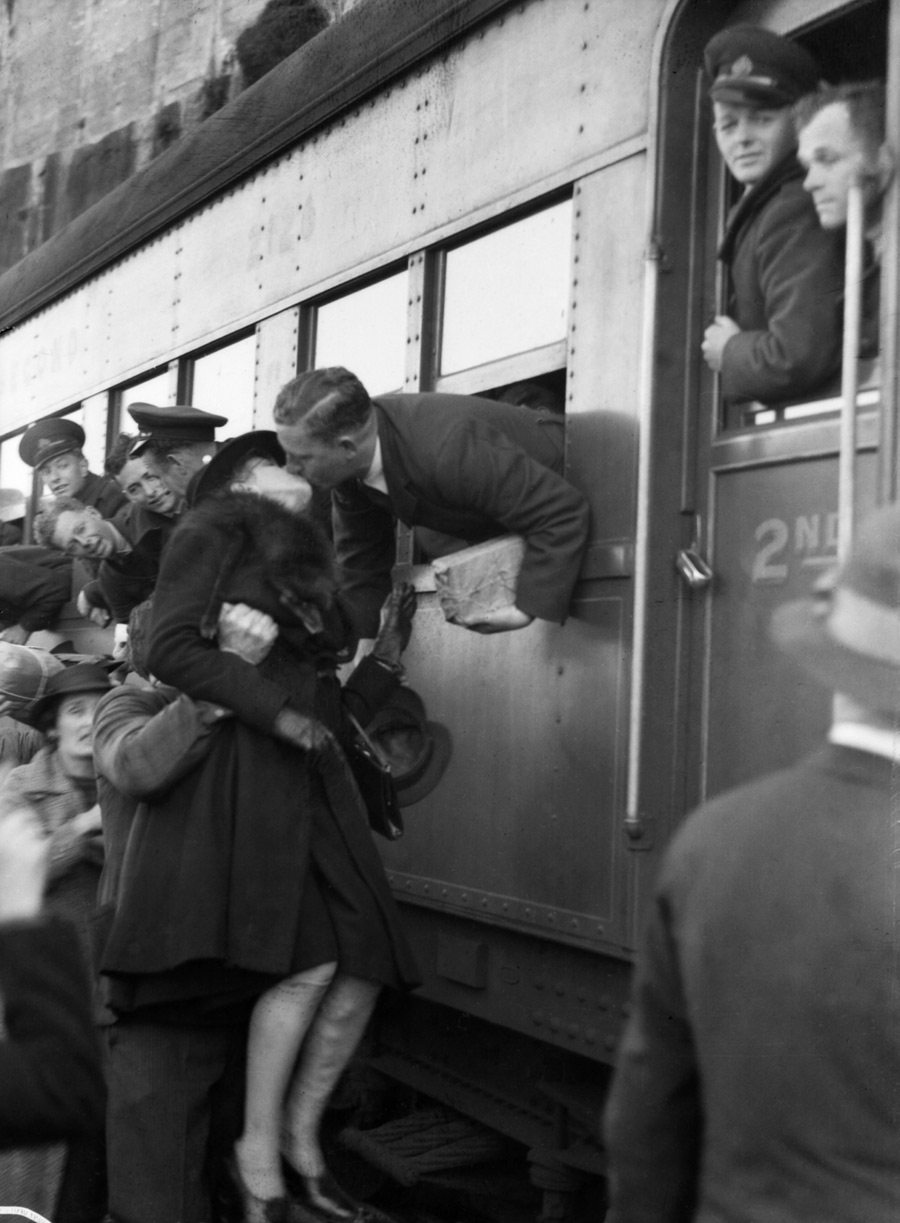
A new display of photographs by legendary Soho figure, Daniel Farson will open at the National Portrait Gallery on 19 March. Famous in the Fifties: Photographs by Daniel Farson will celebrate the multi-faceted career of Farson who worked as a Picture Post photographer, television presenter, and writer.

The sixteen portraits on display include artist Lucian Freud and writer Brendan Behan in Dublin, Cyril Connolly and Lady Caroline Blackwood on Old Compton Street in Soho, artist and illustrator Nina Hamnett, actress Barbara Windsor, artist Graham Sutherland and actor Richard Burton. Writer Anthony Carson, critic John Davenport, photographer John Deakin and poet David Wright are all photographed opposite the French pub in Soho where Farson was a regular. An unpublished photograph of Kingsley Amis and his family is included along with a copy of Panorama, the magazine established by Farson at the University of Cambridge. The jackets of five books written by Farson will be displayed alongside his portraits of their subjects including Graham Sutherland and Gilbert and George. A portrait of Adam Faith inscribed by Farson, ‘I put him on TV first’, illustrates his impact as a pioneering television interviewer. The last exhibition of Farson’s work was in 1997, the year of his death, organised by Robin Muir for Roy Miles. This will be the first solo display of photographs by Farson at the National Portrait Gallery.

Born in Kensington in 1927, Farson was the only child of American-born journalist and adventurer, Negley Farson, and his wife, Enid Eveleen a niece of the author Bram Stoker. He became a political correspondent for the Central Press Agency in Fleet Street at the age of just seventeen and in 1947 he enlisted in the American Army Air Corps gaining experience on the army’s Stars and Stripes magazine supplement. Whilst attending Cambridge University in 1949, Farson established the magazine Panorama which in turn helped him secure a job as a staff photographer for Picture Post in 1951. In the early 1950s he began his affiliation with Soho, where he found acceptance of his homosexuality and later struggled with alcoholism. In 1956 Farson joined commercial television in its infancy, presented his own series and became a television personality. He was under contract with Associated-Rediffusion for eight years, which he described as, ‘one of the busiest and happiest times of my life’. In 1962 Farson bought a pub, the Waterman’s Arms, on the Isle of Dogs where he successfully revived music hall acts. However, this did not prevent bankruptcy and in 1964 Farson moved to his parents’ former home in north Devon. It was here and later in Appledore, Devon, that Farson wrote twenty-seven books, including biographies of his great uncle, Bram Stoker, and his autobiography Never a Normal Man (1997), published in the year in which he died.

Press release from the National Portrait Gallery website


Daniel Farson (British, 1927-1997) 'Richard Burton' 1954


Daniel Farson (British, 1927-1997)
Richard Burton
1954
Silver gelatin photograph
© National Portrait Gallery, London


Daniel Farson’s multifaceted career as a Picture Post photographer, television presenter, writer and legendary Soho figure is celebrated with this showcase display.

The son of an English mother and the renowned American foreign correspondent, Negley Farson, Daniel Farson first became interested in photography working for the US Army’s Stars and Stripes magazine supplement. On display is an issue of Panorama, the magazine he established at Cambridge University, which helped Farson secure a job as a staff photographer for Picture Post.

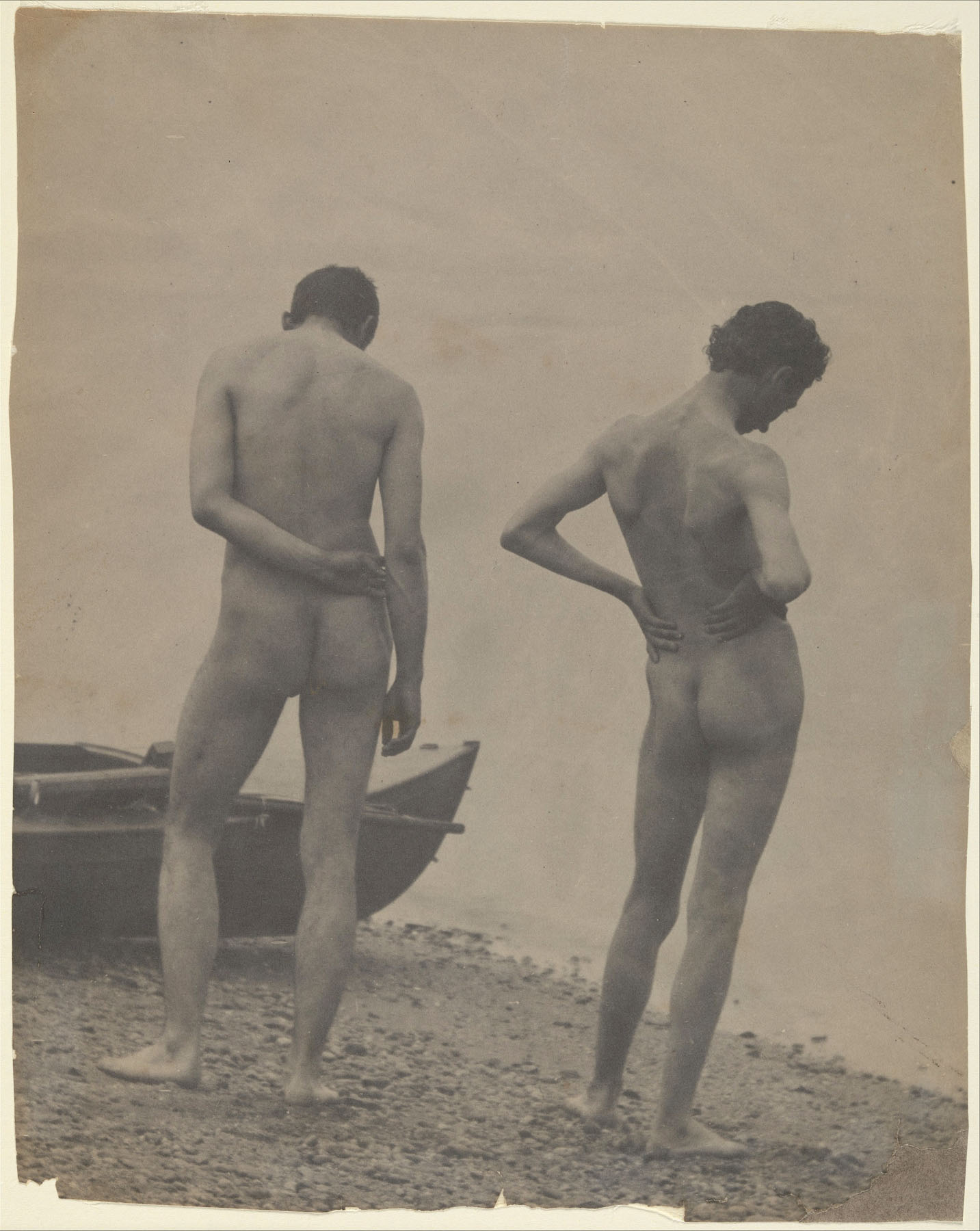
Farson’s association with bohemia is demonstrated by intimate portraits of Lucian Freud and Brendan Behan and a group of writers shown with lifelong friend John Deakin, photographed in Soho, Farson’s haunt of many years.

A portrait of Adam Faith inscribed by Farson, ‘I put him on TV first’, illustrates Farson’s impact on television, presenting programmes including Out of Step (series, 1957) and Living for Kicks (1960). His portrait of Joan Littlewood is one of a group that relates to the theatre. In 1967 Littlewood produced Farson’s play about Marie Lloyd, a venture which followed his revival of music hall acts as the landlord of The Waterman’s Arms on the Isle of Dogs.

From 1964 Farson lived in Devon and became the author of 27 books. Four book jackets are shown alongside his portraits of those he wrote about including Graham Sutherland and Gilbert and George.

Text from the National Portrait Gallery website


Daniel Farson (British, 1927-1997) 'Joan Littlewood' 1963


Daniel Farson (British, 1927-1997)
Joan Littlewood
1963
Silver gelatin photograph
© National Portrait Gallery, London


Joan Maud Littlewood (6 October 1914 – 20 September 2002) was an English theatre director, noted for her work in developing the left-wing Theatre Workshop. She has been called “The Mother of Modern Theatre.” Littlewood and her company lived and slept in the Theatre Royal while it was restored. Productions of The Alchemist and Richard II, the latter of which starred Harry H. Corbett as the King, established the reputation of the company. The works for which she is now best remembered are probably Shelagh Delaney’s A Taste of Honey (1958), which gained critical acclaim, and the satirical musical Oh, What a Lovely War! (1965), her stage adaptation of a work for radio by Charles Chilton. Both were subsequently made into films. Theatre Workshop also championed the work of Irish playwright Brendan Behan, and Littlewood is often rumoured to have a significant role in his work. She also conceived and developed along with architect Cedric Price the Fun Palace, an experimental model of participatory social environment that, although never realized, has become an important influence in Architecture of the 20th and 21st Centuries.

Text from the Wikipedia website


Daniel Farson (British, 1927-1997) 'Barbara Windsor' 1963


Daniel Farson (British, 1927-1997)
Barbara Windsor
1963
Silver gelatin photograph
© National Portrait Gallery, London


Daniel Farson (British, 1927-1997) 'Shelagh Delaney' 1959


Daniel Farson (British, 1927-1997)
Shelagh Delaney
1959
Silver gelatin photograph
© Estate of Daniel Farson


Shelagh Delaney (25 November 1938 – 20 November 2011) was an English dramatist and screenwriter, best known for her debut work, A Taste of Honey (1958). A Taste of Honey, first performed on 27 May 1958, is set in her native Salford. “I had strong ideas about what I wanted to see in the theatre. We used to object to plays where the factory workers came cap in hand and call the boss ‘sir’. Usually North Country people are shown as gormless, whereas in actual fact, they are very alive and cynical.”

Reuniting the original cast, the play subsequently enjoyed a run of 368 performances in the West End from January 1959; it was also seen on Broadway, with Joan Plowright as Jo and Angela Lansbury as her mother. It is “probably the most performed play by a post-war British woman playwright.” Breaking new ground in touching on issues like homosexuality “this earthily realistic, moving story of a reluctant teenage mother-to-be … raises issues which were later to become prime concerns of feminist writers.”

Text from the Wikipedia website


Daniel Farson (British, 1927-1997) 'Gilbert & George' 1990


Daniel Farson (British, 1927-1997)
Gilbert & George
1990
Silver gelatin photograph
© Estate of Daniel Farson


National Portrait Gallery
St Martin’s Place
London, WC2H 0HE

Opening hours:
Closed until 2023

National Portrait Gallery website

LIKE ART BLART ON FACEBOOK

Back to top

Review: ‘Light Works’ at NGV International, Melbourne

Exhibition dates: 23rd March – 16th September 2012


David Stephenson (Australian, b. 1955) 'Star Drawing 1996/402' 1996


David Stephenson (Australian, b. 1955)
Star Drawing 1996/402
1996
40 x 40″
Cibachrome Print
National Gallery of Victoria, Melbourne
Purchased, 1997
© Courtesy of the artist


This is an intimate and stimulating photographic exhibition at the NGV International featuring the work of artists Mike and Doug Starn, David Stephenson, Hiroshi Sugimoto, Bill Henson, Adam Fuss, Simone Douglas, Park Hong-Chun, Eugenia Raskopoulos, Sam Shmith, Christoph Dahlhausen and Patrick Bailly-Maitre-Grand. It is fantastic to see an exhibition of solely contemporary photographs at the National Gallery of Victoria taken from their collection (with nary a vintage silver gelatin photograph in sight!), one which examines the orchestration of light from which all photography emanates – used by different photographers in the creation, and there is the key word, of their work. Collectively, the works seem to ooze a mysterious inner light, a facing towards the transcendent divine – both comforting, astonishing and terrifying in part measure.

Works included range from photograms (camera-less images), large scale installations and photographs produced using digital light-based technologies. Every one of the fifteen works on display is worthy of inclusion, worthy of study at significant length so that the viewer may obtain insight into this element and its capture (by the camera, or not) on photographic paper, orthographic film and by the retina of the eye. What afterimage does this light leave, in the mind’s eye, in our subconscious thought?

The two Bill Henson photographs are evocative of the Romantic ideals of the nineteenth century where twilight possesses a luminescence that reveals shifting forms and meaning only through contemplation. As with all Henson the “mood” of the photographs is constructed as much by the artist as the thing being photographed. It is his understanding of the reflection of light from that object and the meaning of that reflection that creates the narrative “reality,” that allows the viewer the space for contemplation. In Sam Shmith’s photograph Untitled (In spates 2) (2011, below), Shimth turns day into night, creating his own reality by digitally compositing “30-40 photographs per pictorial narrative” taken during the day and then digitally darkened to form one single photographic instance. As a spectral ‘body’ the photograph works to create a new form of hallucination, one that haunts and perturbs the mind, like a disturbing psychological thriller. The viewer is (not really) flying, (not really) floating above the clouds contemplating the narrative, creating a visual memory of things. Spectral luminescences, not-quite-right perspectives, the photograph as temporal / temporary hallucination. The image takes me to other spaces and memories, opening up new vistas in my imagination (see more of my thoughts on Shmith’s work and the digital punctum).

Beginning in 1988, Adam Fuss began to explore studies of abstracted light and colour which “involved placing the paper in a tray of water and recording the concentric circles caused by disturbing the water or dripping droplets of water into the trays. These pieces, done between 1988-1990, have an eerie, spatial quality. Infused with bright, vibrant colours and blinding white light, they resemble some hitherto unknown solar system. [Here] Fuss is concerned with the metaphorical qualities of light.

In an interview with Ross Bleckner conducted in 1992, Fuss explained the role of light in his imagery: “Light is a physical sensation. If you look at it with purely scientific eyes, its a particle that behaves like a wave or a wave that behaves like a particle. No one knows exactly what it is. It travels very fast. It has something to do with our perception of time… When one works with the idea of light, one’s working with a metaphor that’s endless and huge and unspecific. because you’re talking about something that’s almost just an idea, we can think about it but we can never grasp it. The light of the sun represents life on Earth. Light represents the fuel that is behind our existence… It’s a mystery.”1

Another beautiful photograph is Eugenia Raskopoulos’ elegiac requiem to the dis/appearance of language and the body, Diglossia #8 (2009, below). Diglossic is defined as a situation in which two languages (or two varieties of the same language) are used under different conditions within a community, often by the same speakers, with one variety of speech being more prestigious or formal and the other more suited to informal conversation or taken as a mark of lower social status or less education. As Victoria Lynn states of the series, “Each of these images carries within it a letter from the Greek alphabet. There is a word in there somewhere, but the order has been disrupted. This word, or name, has been cut, and its pieces are now before us as fragments that refuse to re-collect themselves into meaning. As such, the relationship between the letters also becomes temporal, fluid, and heterogeneous opening up the question of translation between one language to another, and one culture to another.

The images have been created using the gesture of a hand writing on a steamed up mirror. The photograph is taken very quickly, before the image, the letter and the mark of the artist disappears. We have to ask, what is disappearing here? Is it the language, the name, the aura of the photograph (in the Benjaminian sense) or indeed the body? For behind each letter we can detect a human presence – the artists’ naked body as she makes the photograph. The apparatus of photography is revealed, undressed and made naked.”2

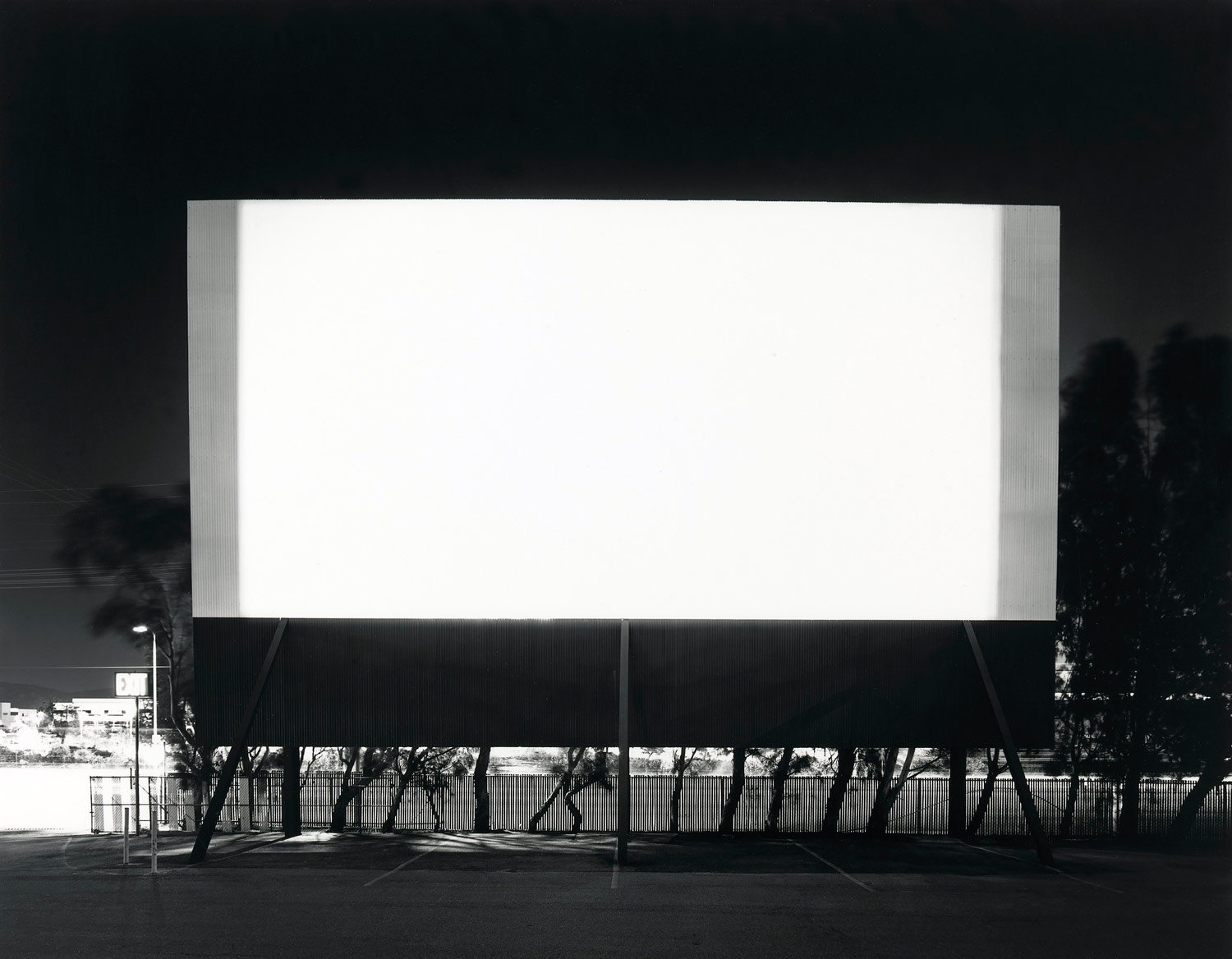
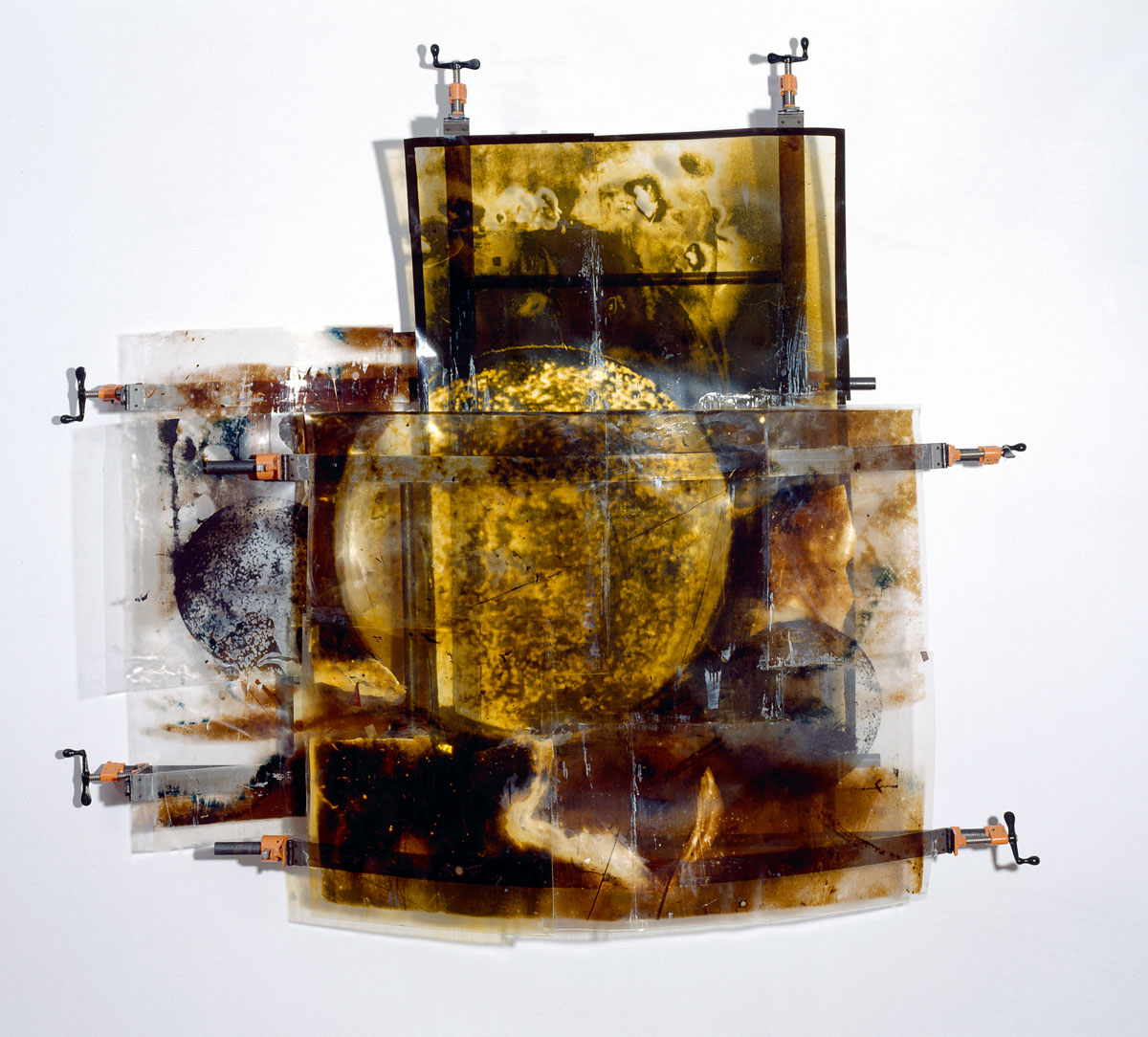
Sol Invictus (1992, below) by the Starn Twins overwhelms in the brute force of the installation, something that cannot really be captured in the two-dimensional representation posted here (go and see the real thing!). The layering and curving of orthographic film relates to the curvature of the sun, the film held in place by screw clamps as though the artist’s were trying to contain, to fix, to regulate the radiation of the sun. Sol Invictus (here is the paradox, it means “unconquered sun” even as the Starn Twins seek to tie it down) explores the metaphorical, scientific and religious properties that gives life to this Earth. A very powerful installation that had me transfixed. Hiroshi Sugimoto’s famous series Theaters is represented in the exhibition by the work Winnetka Drive-In, Paramount (1993, below) where  Sugimoto “photographs auditoriums of American movie theaters, and drive-in movies, during showings. The exposure time used for the photograph corresponds with the projection time of the film. This allows him to save the duration of the entire film in a single shot. What remains visible of the film’s time-compressed, individual images is the bright screen of the movie theater, which illuminates the architecture of the space. That its content retreats into the background makes the actual film a piece of information, manifesting itself in the (movie theater) space. As a result, instead of a content-related event, film presents itself here as the relationship between time and spatial perception.”3

If we think of the camera lens as being fully open, like an eye without blinking, for the duration of the length of the film then the shutter of the lens has to be set on “B” for Bulb which allows for long exposure times under the direct control of the photographer. “The term bulb is a reference to old-style pneumatically actuated shutters; squeezing an air bulb would open the shutter and releasing the bulb would close it… It appears that when instantaneous shutters were introduced, they included a B setting so that the familiar bulb behaviour could be duplicated with a cable release.”4 In other words light waves, reflecting from the surface of objects, are controlled by the photographer over an indefinite period (not the short “snap” of the freeze frame / the decisive moment), accumulating light from thousands of years in the past through the lens of the camera onto the focal plane, coalescing into a single image, controlled and constructed by the photographer.

My favourite works in the exhibition are David Stephenson’s two Star Drawings (1996, below) which use the same Bulb technique to capture star trails travelling across the night sky. Stephenson says that drawing the stars at night by long time exposures, “are a contemporary expression of the sublime – a transcendental experience of awe with the vast space and time of existence” (DS, 1998). The photographs map our position and help us understand our space in the world, that we are all made of stars, every last one of us. As far as being expressions of the sublime, these almost Abstract Expressionist, geometric light drawings are only achieved through the tilting of the camera at certain points doing the exposure and the opening and closing of the shutter, to make the intricate patterns. Man and stars combine to create a spiritual force that emanates from everything and everyone. Stephenson tilts the axis of meaning. When we look at these photographs the light that has emanated from these stars may no longer exist. It had travelled thousands of light years from the past to the present to be embedded in the film at the time of exposure and is then projected into the future so that the viewer may acknowledge it a hundred years from now.


Emanation > recognition > existence . . . . . . . . . . ∞
. . . . . . . . . . . . . . . . . . . . . .  . .. .  . . . . .  . .. . . . . . . . . . death


How Light Works

In a truly inspired piece of writing, artist and author Pablo Helguera muses on the nature of light falling on a landscape in his piece How to Understand the light on a Landscape (2005). In the text he examines qualities of light such as experiential light, home light, ghost light, the light of the deathbed (think Emmet Gowin’s photograph of Rennie Booher in her casket, “dead now and committed to mystery,” as Gowin puts it), rain light, protective light, artificial light, the light of the truly blind, the light of adolescence, sunday light, hotel light, used light, narrated light, transparent light, the light of the last day and after light.

“The conjunction of a random site, the accumulated data in the body’s memory that is linked to emotion, and the general behaviour of light form experience. Experience is triggered by light, but not exclusively by the visible light of the electromagnetic spectrum. What the human eye is incapable to perceive is absorbed by other sensory parts of the body, which contribute to the perception that light causes an effect that goes beyond the merely visual.”5

This is the crux of the “matter.” As much as photography is a dialogue between the natural and the unnatural, it is also an invocation to the gods (inside each of us and all around us). It is the breaking down of subjective and objective truths so that the myth of origin becomes fluid in this light. It is the light of creation that goes beyond the merely visual, that is an expression of an individualism that rises above the threshold of visibility – to stimulate sensory experience; to prick the imagination and memory; to make us aware and recognise the WAVELENGTH of creation. It is the LIGHT OF EXPERIENCE.

Helguera concludes, “The intersection of our body with the light and the landscape and the coded form of language that we have to construct by ourselves and explain to ourselves is our daily ordeal, and we are free to choose to ignore and live without it, because there is nothing we can do with this language other than talking to ourselves. There is no point in trying to explain it to others because it is not designed to be this way, other than remaining a remote, if equivalent, language.

Some for that reason prefer to construct empty spaces with nondescript imagery, and thus be free of the seductive and nostalgic indecipherability of the landscape and the light. Or we may choose to openly embrace the darkness of light, and thus let ourselves through the great gates of placehood, where we can finally accept the unexplainable concreteness of our moments for what they are.”6


I believe this is the role of artists, to embrace the darkness of light and the trace of experience and to show it to people that may not recognise it or have turned away from the light of experience. So many people walk through life as if in a dream, neither recognising their energy nor the good or bad that emanates from that light. As Helguera notes it causes us to create our own coded form of language to explain the LIGHT OF LIFE to ourselves. We can choose to ignore it (at out peril!) but we can also embrace light in an act of recognition, awareness, forgiveness. We can banish the empty spaces and nondescript imagery in our own lives and make connection to others so that they make gain insight into their own existence and being.

Dr Marcus Bunyan


1/ Halpert, Peter. “Adam Fuss: Light and Darkness,” in Art Press International, July/August 1993 on the Peter Hay Halpert Fine Art website. Nd. [Online] Cited 08/09/2012 No longer available online

2/ Lynn, Victoria. “Writing Towards Disappearance,” on the Eugenia Raskopoulos website. Nd. [Online] Cited 08/09/2012 No longer available online

3/ Kellein, Thomas Sugimoto, Hiroshi. Time Exposed. Thames & Hudson, First edition, 1995, p. 91, quoted in Heike Helfert. “Hiroshi Sugimoto “Theaters”,” on the the Media Art Net website Nd [Online] Cited 08/09/2012.

4/ Anon. “Bulb (photography),” on the Wikipedia website. Nd. [Online] Cited 08/09/2012

5/ Helguera, Pablo. How to Understand the Light on a Landscape (video, 15 min., 2005) is a work that simulates a scientific documentary about light to discuss the experiential aspects of light as triggered by memory. The images and text, taken from the video, are part of the book by Patt,Lise (ed.). Searching for Sebald: Photography After W.G. Sebald. Institute of Cultural Inquiry, 2007, pp. 110-119

6/ Ibid.,


Many thankx to the National Gallery of Victoria for allowing me to publish the photographs in the posting.  Please click on the photographs for a larger version of the image.


“Light is a scientific fact, a metaphorical construct and even a spiritual force. It is considered an agent of truth, authenticity and revelation just as the absence of light signals mystery, danger and disorder. Light is also fundamental in the creation of photographs.”


Dr Isobel Crombie, Senior Curator, Photography NGV, 2012


“Light is a metaphor: where you have a dark place, and where that place becomes illuminated; where darkness becomes visible and one can see. The darkness is me, is my being. Why am I here? What am I here for? What is this experience I’m having? This is darkness. Light produces understanding.”


Adam Fuss 1990


Hiroshi Sugimoto (Japanese, b. 1948, worked in United States 1972- ) 'Winnetka Drive-In, Paramount' 1993


Hiroshi Sugimoto (Japanese, b. 1948, worked in United States 1972- )
Winnetka Drive-In, Paramount
1993
Gelatin silver photograph
42.3 x 54.1cm
National Gallery of Victoria, Melbourne
Purchased with funds donated by the Bowness Family Fund for Contemporary Photography, 2009
© Hiroshi Sugimoto, courtesy The Pace Gallery, New York


Simone Douglas (Australian) 'Surrender (Collision) III' 1998 (detail)


Simone Douglas (Australian)
Surrender (Collision) III (detail)
1998
Type C photograph
45.9 x 64.0cm
National Gallery of Victoria, Melbourne
© Simone Douglas


Sam Shmith (Australian born London, b. 1980) 'Untitled (In spates 2)' 2011


Sam Shmith (Australian born London, b. 1980)
Untitled (In spates 2)
2011
from the In spates series 2011
Inkjet print
75.0 x 124.8cm
National Gallery of Victoria, Melbourne
Purchased, Victorian Foundation for Living Australian Artists, 2011
© Sam Shmith, courtesy Arc One Gallery, Melbourne


On March 23, the National Gallery of Victoria will open Light Works, a contemporary photography exhibition that explores various artists’ approaches to light – a fundamental element in the creation of photography. Drawn from the NGV’s Collection, the fifteen works on display show how photographers have exploited the creative potentials of natural and artificial light in their artworks.

Dr Isobel Crombie, Senior Curator, Photography NGV said: “Light is a scientific fact, a metaphorical construct and even a spiritual force. It is considered an agent of truth, authenticity and revelation just as the absence of light signals mystery, danger and disorder. Through a careful selection of works by international and Australian artists the emotive potential and scientific capacities of light are explored.”

Dr Gerard Vaughan, Director, NGV said: “Light Works is an exhibition that has broad appeal as it will intrigue those who are artistically, spiritually, technologically or scientifically minded. The works on display demonstrate the diverse and limitless depiction of this vital element. This exhibition also provides visitors with an opportunity to see works by some of the most important contemporary global and local photography artists – a must-see exhibition for 2012.”

Works included range from photograms (camera-less images), large scale installations and photographs produced using digital light-based technologies highlighting the depth of the NGV’s remarkable photography collection. On display are works by Mike and Doug Starn, David Stephenson, Hiroshi Sugimoto, Bill Henson, Adam Fuss, Simone Douglas, Park Hong-Chun, Eugenia Raskopoulos, Sam Shmith, Christoph Dahlhausen and Patrick Bailly-Maitre-Grand.

Text from the NGV website


Eugenia Raskopoulos (Australian, b. 1959) 'Diglossia #8' 2009


Eugenia Raskopoulos (Australian, b. 1959)
Diglossia #8
2009
from the Diglossia series 2009
Inkjet print
139.5 x 93.3cm
National Gallery of Victoria, Melbourne
Purchased, Victorian Foundation for Living Australian Artists, 2009
© Eugenia Raskopoulos


This photograph shows a letter from the Greek alphabet which has been marked by hand onto a foggy mirror.


Mike Starn (American, b. 1961) and Doug Starn (American, b. 1961) 'Sol Invictus' 1992


Mike Starn (American, b. 1961)
Doug Starn (American, b. 1961)
Sol Invictus
1992
Orthographic film, silicon, pipe clamps, steel and adhesive tape
175.0 x 200.0 x 35.0cm
National Gallery of Victoria, Melbourne
Purchased with funds donated by the National Gallery Women’s Association, 1994
© Doug Starn, Mike Starn/ARS, New York. Licensed by VISCOPY, Sydney


Adam Fuss (English, b. 1961, worked in Australia 1962-1982, United States 1982- ) 'Untitled' 1991


Adam Fuss (English, b. 1961, worked in Australia 1962-1982, United States 1982- )
Untitled
1991
Cibachrome photograph
164.3 x 125.0cm
National Gallery of Victoria, Melbourne
Purchased through The Art Foundation of Victoria with the assistance of the Rudy Komon Fund, Governor, 1992
© Adam Fuss. Courtesy Cheim & Read, New York


NGV International
180 St Kilda Road

Opening hours:
Open daily 10am – 5pm

National Gallery of Victoria website
David Stephenson website
Hiroshi Sugimoto website
Starn Studio website
Sam Shmith website

LIKE ART BLART ON FACEBOOK

Back to top

Exhibition: ‘Art of Another Kind: International Abstraction and the Guggenheim, 1949-1960’ at the Guggenheim Museum, New York

Exhibition dates: 8th June – 12th September 2012


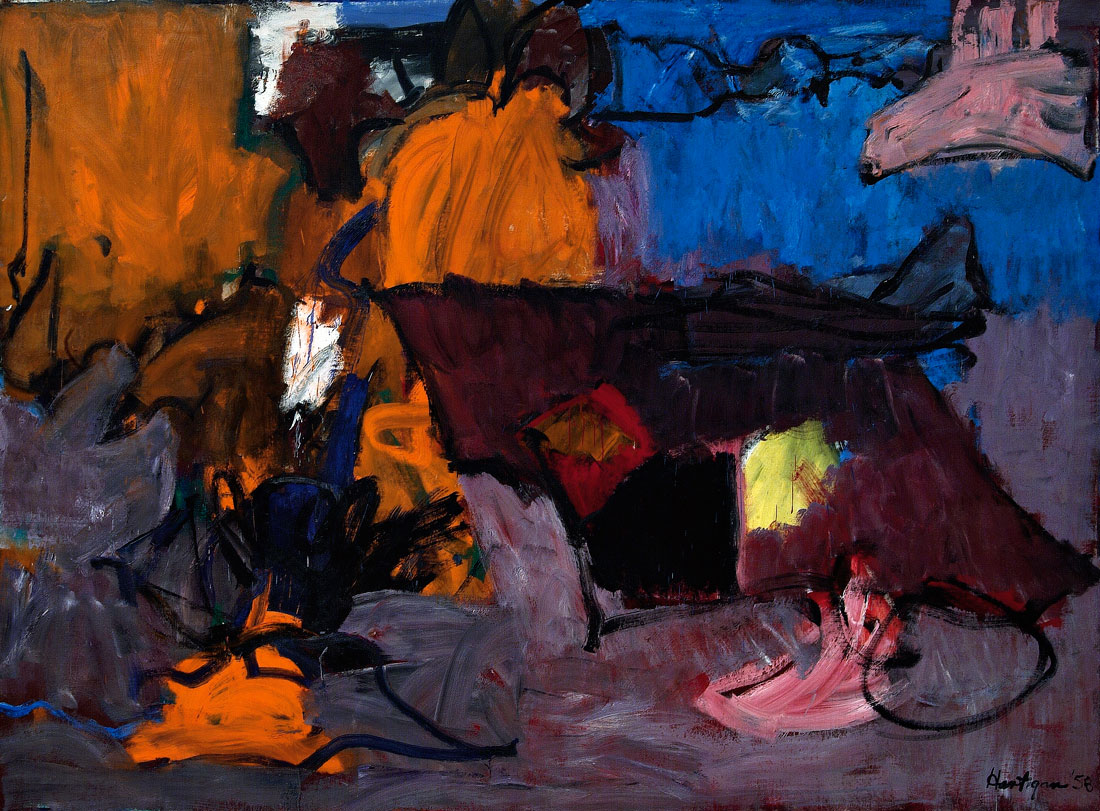
Grace Hartigan
 (American, 1922-2008)
 'Ireland' 1958


Grace Hartigan
 (American, 1922-2008)
Ireland
1958
Oil on canvas
200 x 271cm
The Solomon R. Guggenheim Foundation, Peggy Guggenheim Collection, Venice
© Grace Hartigan Estate


This is pure indulgence. These paintings are so delicious I couldn’t resist a posting. Just imagine having ANY of them (especially the Hartigan, de Kooning or the Soulanges) on your wall at home… oh my!

Marcus


Many thankx to the Guggenheim Museum for allowing me to publish the pictures in the posting. Please click on the pictures to see a larger version of the image.


Art of Another Kind: International Abstraction and the Guggenheim, 1949-1960

Curators Tracey Bashkoff and Megan Fontanella discuss the initial apprehensions toward and eventual return to international exchange and experimentalism that defined the postwar art world.


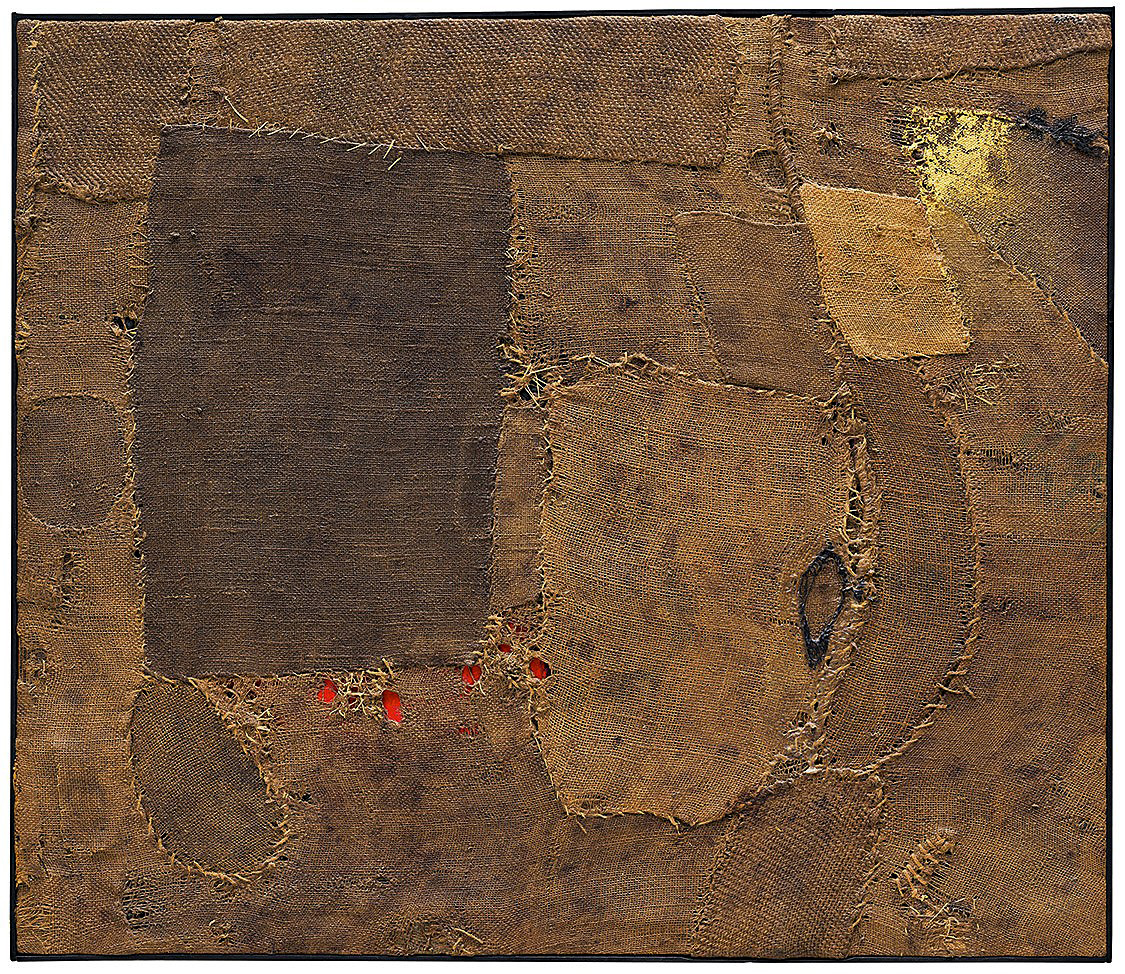
Alberto Burri (Italian, 1915-1995) 'Composition' 1953


Alberto Burri (Italian, 1915-1995)
Composition
1953
Burlap, thread, synthetic polymer paint, gold leaf, and PVA on black fabric
86 x 100.4cm
Solomon R. Guggenheim Museum, New York
© Fondazione Palazzo Albizzini Collezione Burri, Città di Castello/2018 Artist Rights Society (ARS), New York/SIAE, Rome


In 1943 Alberto Burri, a doctor in the Italian army, was captured by the British and sat out the remainder of World War II in a Texas POW camp. He began to paint there, covering his stretchers with burlap when other materials were unavailable. Upon his return to Italy in 1946 Burri renounced his original profession and dedicated himself to making art.

Composition is one of his Sacchi (sacks), a group of collage constructions made from burlap bags mounted on stretchers, which the artist began making in 1949. One of Burri’s first series employing nontraditional mediums, the Sacchi were initially considered assaults against the established aesthetic canon. His use of the humble bags may be seen as a declaration of the inherent beauty of natural, ephemeral materials, in contradistinction to traditional “high” art mediums, which are respected for their ostentation and permanence. Early commentators suggested that the patchwork surfaces of the Sacchi metaphorically signified living flesh violated during warfare – the stitching was linked to the artist’s practice as a physician. Others suggested that the hardships of life in postwar Italy predicated the artist’s redeployment of the sacks in which relief supplies were sent to the country.

Yet Burri maintained that his use of materials was determined purely by the formal demands of his constructions. “If I don’t have one material, I use another. It is all the same,” he said in 1976. “I choose to use poor materials to prove that they could still be useful. The poorness of a medium is not a symbol: it is a device for painting.” The title Composition emphasises the artist’s professed concern with issues of construction, not metaphor. Underlying the work is a rigorous compositional structure that belies the mundane impermanence of his chosen mediums and points to art-historical influences. The Sacchi rely on lessons learned from the Cubist- and Dada-inspired constructions of Kurt Schwitters.

Despite Burri’s cool public stance, the Sacchi are examples of the Expressionism widely practiced in postwar Europe, where such work was called Art Informel (in the U.S. it was called Abstract Expressionism). Artists used powerfully rendered gestures and accommodated chance occurrences to express the existential angst characteristic of the period.

Jennifer Blessing

Text from the Guggenheim website


Antoni Tàpies (Spanish, 1923-2012) 'Great Painting' 1958


Antoni Tàpies (Spanish, 1923-2012)
Great Painting
1958
Oil with marble dust and sand on canvas
79 x 103 1/2 inches (200.7 x 262.9cm)
Solomon R. Guggenheim Museum, New York
© 2018 Fundació Antoni Tàpies/Artists Rights Society (ARS), New York/VEGAP, Madrid


In the years after World War II, both Europe and America saw the rise of predominantly abstract painting concerned with materials and the expression of gesture and marking. New Yorkers dubbed the development in the United States Abstract Expressionism, while the French named the pan-European phenomenon of gestural painting Art Informel. A variety of the latter was Tachisme, from the French word tache, meaning blot or stain. Antoni Tàpies was among the artists to receive the label Tachiste because of the rich texture and pooled colour that seemed to occur accidentally on his canvases.

Tàpies reevaluated humble materials, things of the earth such as sand – which he used in Great Painting (Gran pintura, 1958) – and straw as well as the refuse of humanity such as string and bits of fabric. By calling attention to this seemingly inconsequential matter, he suggested that beauty can be found in unlikely places. Tàpies saw his works as objects of meditation that every viewer will interpret according to personal experience; he sought to inspire a contemplative reaction to reality through the integration of materials unexpected in fine art.

These images often resemble walls that have been scuffed and marred by human intervention and the passage of time. In Great Painting, an ocher skin appears to hang off the surface of the canvas; violence is suggested by the gouge and puncture marks in the dense stratum. These markings recall the scribbling of graffiti, perhaps referring to the public walls covered with slogans and images of protest that the artist saw as a youth in Catalonia – a region in Spain that experienced the harshest repression under dictator Francisco Franco. Tàpies called walls the “witnesses of the martyrdoms and inhuman sufferings inflicted on our people.”1 Great Painting suggests the artist’s poetic memorial to those who have perished and those who have endured.

Jennifer Blessing

1/ Antoni Tàpies, La pratique de l’art (Paris: Gallimard, 1974), p. 59.

Text from the Guggenheim website


Kenzo Okada (Japanese, 1902-1982) 'Decision' 1956


Kenzo Okada (Japanese, 1902-1982)
Decision
1956
Oil on canvas
67 3/4 x 80 inches (172.8 x 203.2cm)
Solomon R. Guggenheim Museum, New York Gift, Susan Morse Hilles, 1981
© Kenzo Okada


After Kenzo Okada relocated from Tokyo to New York in 1950, his work came to represent a melding of Japanese traditions and American abstract trends. Rather than striving for pure abstraction, his work from the 1950s could be called “semi-abstract,” evoking the natural world through carefully composed form and a decidedly muted palette. These works are subtle, quiet, and poetic – more meditative in nature than the energetic gestural abstractions of some of his American-born counterparts. The composition of Decision (1956) is also organised to suggest natural topography. Blocky, softly defined shapes organically arrange the canvas into rough horizontal registers, creating a panoramic quality reminiscent of landscape painting. Meanwhile, small, irregular shapes hover and tumble rhythmically across the stable ground. Okada thus seeks a balance between heavy and delicate, tangible and abstract.

Text from the Guggenheim website


José Guerrero (Spanish, 1914-1991) 'Signs and Portents' 1956


José Guerrero (Spanish, 1914-1991)
Signs and Portents
1956
Oil on canvas
175.9 x 250.2cm
Solomon R. Guggenheim Museum, New York
© 2012 Artists Rights Society (ARS), New York/VEGAP, Madrid
© The Solomon R. Guggenheim Foundation


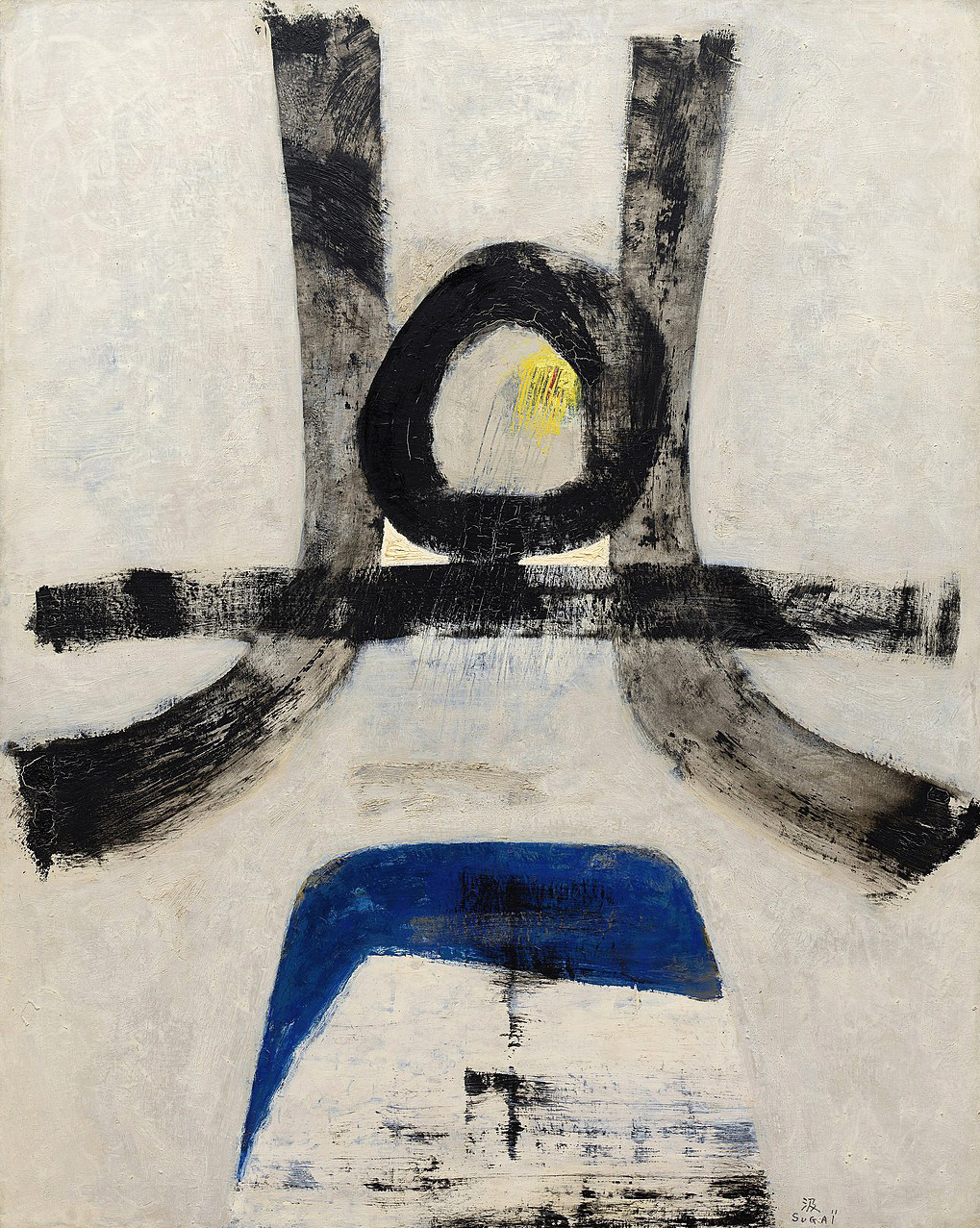
Kumi Sugaï (Japan, 1919-1996) 'Shiro' June 1957


Kumi Sugaï (Japan, 1919-1996)
Shiro
June 1957
Oil on canvas
63 5/8 x 51 inches (161.6 x 129.5 cm)
Solomon R. Guggenheim Museum, New York
© Kumi Sugaï


Kumi Sugaï lived and worked in Paris from 1952 until his death. Revered both in his native Japan and France, he used his early fascination with modern typography and his knowledge of East Asian calligraphy in his work. Combining and reinventing traditional aesthetics and contemporary forms, Sugaï reveals his syncretic approach to abstract painting in Shiro (June 1957). Here, his palette is restricted essentially to black, white, and blue, and the composition is at once spare and dynamic. The painting’s title is a reference to its central black form, the ideogram shiro, which means white. He has enlarged the character to occupy the entire composition and placed this abstract form on a white ground, both evoking and distorting its original calligraphic source.

Text from the Guggenheim website


Giuseppe Capogrossi (Italian, 1900-1972) 'Surface 210' 1957


Giuseppe Capogrossi (Italian, 1900-1972)
Surface 210
1957
Oil on canvas
81 1/4 x 63 inches (206.4 x 160cm)
Solomon R. Guggenheim Museum, New York
© 2018 Artists Rights Society (ARS), New York / SIAE, Rome


A decisive shift in Giuseppe Capogrossi’s career took place in 1949, when he moved away from figurative, tonal painting and experimented with an abstract geometric style that led to the development of a vocabulary of irregular comb- or fork-shaped signs. With no allegorical, psychological, or symbolic meaning, these structural elements could be assembled and connected in countless variations. Intricate and insistent, Capogrossi’s signs determined the construction of the pictorial surface. Similar to mysterious lists or sequences, his paintings were immediate in their appeal yet remained hard to decode, a quality he shared with other Art Informel practitioners. These abstract comb-sign paintings, known simply as Surfaces (Superficies, 1949-1972), were first exhibited at the Galleria del secolo, Rome, in 1950. The comb sign dominated his oeuvre until the end of his career.

Text from the Guggenheim website


Takeo Yamaguchi
 (Japanese, 1902-1983)
 'Work – Yellow (Unstable Square [Fuantei shikaku])' 1958


Takeo Yamaguchi
 (Japanese, 1902-1983)
Work – Yellow (Unstable Square [Fuantei shikaku])
1958
Oil on plywood
182.6 x 182.6cm
Solomon R. Guggenheim Museum, New York
© Takeo Yamaguchi


In his native Japan, Takeo Yamaguchi was a pioneer of modern abstract painting. This focus led him to spend time in France, where he was much influenced by the work of Cubist practitioners in Paris, until he returned to Japan in 1931. In the 1950s, Yamaguchi began executing works consisting of simple, geometric forms – largely yellow, ochre, or russet in color – painted on a black background. His thick pigments added texture to the monochromatic compositions, and as seen in Work – Yellow (Unstable Square [Fuantei shikaku], 1958), Yamaguchi’s abstract shapes increasingly dominated the canvas. It is noteworthy that the painting was prominently displayed on the ground floor of the Guggenheim’s rotunda during the 1959 inaugural exhibition, attesting to then-director James Johnson Sweeney’s keen interest in Yamaguchi’s work.

Text from the Guggenheim website


Pierre Soulages
 (French, b. 1919) 'Painting, November 20, 1956 (Peinture, 20 novembre 1956)' 1956


Pierre Soulages
 (French, b. 1919)
Painting, November 20, 1956 (Peinture, 20 novembre 1956)
1956
Oil on canvas
195 x 130.2cm
Solomon R. Guggenheim Museum, New York
© 2012 Artists Rights Society (ARS), New York/ADAGP, Paris


Pierre Soulages, a leading proponent of Tachisme (from the French word tache, meaning blot or stain), maintained that he decided to become a painter while inside the church of Sainte-Foy in Conques-en-Rouergue, near his birthplace in the South of France. The impressions of monumentality, stability, primitive force, and clearly organised volumes characteristic of the Romanesque style, as well as the mystery and sobriety of dark church interiors, were metaphorically transmitted in his mature style. Early on he was also drawn to the work of Claude Lorraine and Rembrandt van Rijn, whose rendering of light had an impact on his development. In 1938 he moved to Paris to prepare for the entrance exam to the École nationale supérieure des beaux-arts, but he soon abandoned his traditional studies at the school as a result of seeing exhibitions of the work of Paul Cézanne and Pablo Picasso and visiting the Louvre.

In his earliest work Soulages took leafless winter trees as his point of departure. Their essential, reduced network of branches – which Soulages regarded as abstract sculpture – provided him with an ideal vehicle for the exploration of structure and variation. During the German occupation of France, he met Sonia Delaunay, who introduced him to abstract art and set him on a new path. By the mid 1950s, Soulages had switched from a small brush, with which he had painted abstract calligraphic patterns, to palette knives, straightedges, and large house-painting brushes. These tools afforded him a greater range of motion in his wrist, allowing him to produce bold, dynamic strokes that resulted in a more gestural surface. Throughout his career, Soulages painted in a predominately black palette in order to explore the contrasts of light and shade, which endowed his paintings both an architectonic and a sculptural quality. In Painting, November 20, 1956 (Peinture, 20 novembre 1956, 1956), Soulages divided his canvas into three horizontal registers, articulating each with a repetition of slab-like black shapes that reveal a variety of red and brown nuances, as well as a certain luminosity.

Text from the Guggenheim website


From June 8 to September 12, 2012, the Solomon R. Guggenheim Museum presents Art of Another Kind: International Abstraction and the Guggenheim, 1949-1960. Comprising approximately 100 works by nearly 70 artists, the exhibition explores international trends in abstraction in the decade before the Guggenheim’s iconic Frank Lloyd Wright-designed building opened in October 1959, when vanguard artists working in the United States and Europe pioneered such influential art forms as Abstract Expressionism, Cobra, and Art Informel. In the 1950s, many countries ended their postwar isolationism and entered a phase of cultural openness and internationalism. The prominent French art critic Michel Tapié declared the existence of un art autre (art of another kind), a term embracing a mosaic of styles, but essentially signifying an avant-garde art that rejected a connection with any tradition or past idiom. With works by Karel Appel, Louise Bourgeois, Alberto Burri, Eduardo Chillida, Lucio Fontana, Grace Hartigan, Asger Jorn, Yves Klein, Willem de Kooning, Georges Mathieu, Isamu Noguchi, Kenzo Okada, Jackson Pollock, Pierre Soulages, Antoni Tàpies, Maria Helena Vieira da Silva, Takeo Yamaguchi, and Zao Wou-Ki, among others, the exhibition considers the artistic developments of the post-World War II period and draws greater attention to lesser-known artists in the museum?s collection alongside those long since canonised.

Abstract Expressionism encompasses a diverse range of postwar American painting that challenged the tradition of vertical easel painting. Beginning in the late 1940s, Pollock placed his canvases on the floor to pour, drip, and splatter paint onto them. This gestural act, with variations practiced by William Baziotes, De Kooning, Adolph Gottlieb, and others, was termed “Action painting” by American critic Harold Rosenberg, who considered it a product of the artist’s unconscious outpouring or the enactment of some personal drama. The New York school, as these artists were called due to the city’s postwar transformation into an international nexus for vanguard art, expanded in the 1950s with the unique contributions of such painters as James Brooks and Hartigan, as well as energetic collagist-assemblers Conrad Marca-Relli and Robert Rauschenberg. Other painters eliminated the gestural stroke altogether. Mark Rothko used large planes of colour, often to express universal human emotions and inspire a sense of awe for a secular world. Welder-sculptors such as Herbert Ferber and Theodore Roszak are also counted among the decade’s pioneering artists.

The postwar European avant-garde in many ways paralleled the expressive tendencies and untraditional methods of their transatlantic counterparts, though their cultural contexts differed. For artists in Spain, abstract art signified political liberation. Dissenting Italian artists correspondingly turned to abstraction against the renewed popularity of politicised realism. French artist Jean Dubuffet’s spontaneous approach, Art Brut (Raw art), retained figurative elements but radically opposed official culture, instead favouring the spontaneous and direct works of untrained individuals. His work influenced the Cobra group (1948-1951), which was founded by Appel, Jorn, and other artists from Copenhagen, Brussels, and Amsterdam. The Cobra artists preferred thickly painted surfaces that married realism to lively colour and expressive line in a new form of primitivism.

Eventually taking root in France, Germany, Italy, Japan, and Spain, Art Informel refers to the anti-geometric, anti-naturalistic, and nonfigurative formal preoccupations of many European avant-garde artists, and their pursuit of spontaneity, looseness of form, and the irrational. Art Informel is alternatively known by several French terms: Abstraction lyrique (Lyrical Abstraction), Art autre (Art of another kind), matiérisme (matter art), and Tachisme (from tache, meaning blot or stain). The movement includes the work of Burri and Tàpies, who employed unorthodox materials like burlap or sand and focused on the transformative qualities of matter. Asian émigré artists Kumi Sugaï and Zao were likewise central to the postwar École de Paris (School of Paris) and melded their native traditions with modern painting styles. By the end of the 1950s, artists such as Lucio Fontana, Klein, and Piero Manzoni were exploring scientific, objective, and interactive approaches, and introduced pure monochrome surfaces. Other abstractionists engaged viewers’ senses and explored dematerialisation, focusing on optical transformations as opposed to the art object itself, and investigating the effects of motion, light, and colour.

Through the presentation of these varied styles and innovative developments in the post-World War II years, Art of Another Kind especially highlights paintings and sculptures that entered the Guggenheim collection under James Johnson Sweeney, the museum’s second director (1952-1960). Following Solomon R. Guggenheim’s death in 1949 and the end of founding director and curator Hilla Rebay’s tenure in 1952, Sweeney championed emerging avant-garde artists and augmented the museum’s existing modern holdings with new works. Sweeney had stated, “I do not believe in the so-called ‘tastemakers,’ … but in what I would call ‘tastebreakers,’ the people who break open and enlarge our artistic frontiers.” His program of exhibitions and acquisitions considerably broadened the museum’s scope, and his vision included reconsidering the founding collection assembled by Solomon and Irene Guggenheim under Rebay’s guidance by uniting the abstract works by Vasily Kandinsky and other modernists with rarely seen representational works for a more complex perspective of the avant-garde in the first half of the twentieth century. Recently, the Guggenheim Museum highlighted his contributions to the institution in The Sweeney Decade: Acquisitions at the 1959 Inaugural, an exhibition featuring a selection of works that were first unveiled at the 1959 show in the museum’s new Wright building. On view in 2009 as part of the museum’s 50th-anniversary celebrations, The Sweeney Decade featured 24 paintings and sculptures from the 1950s collected under his leadership. Art of Another Kind offers a more comprehensive elaboration of his vision along with works that were added to the collection after his tenure.

Exhibition installation

While the exhibition explores individual styles, diversity within abstraction, and artists often working independently of established groups or affiliations, works are loosely organised according to artists’ locus of activity and stylistic trends: New York school; Art Brut and Cobra; School of Paris; Spanish and Italian Informalism; Kinetic art; and, finally, late 1950s experiments with matiérisme, performance-based painting, and the monochrome. Highlights within the installation include Outburst (Éclatement, 1956) by Judit Reigl, newly acquired in 2012, and Alexander Calder’s Red Lily Pads (Nénuphars rouges, 1956), suspended in the upper ramps and visible from the rotunda floor below. The exhibition also includes the work of 11 living artists.

Visitors will have the opportunity to browse through historic exhibition catalogues produced by the first full-time publications department established during Sweeney’s tenure. Designed by the Swiss-born typographer and designer Herbert Matter, catalogues from the era helped shape the museum’s visual identity and chronicle the development of the art championed by the Guggenheim under Sweeney in the 1950s. Selected books will be available in the museum at iPad stations and online at https://www.guggenheim.org/publications

Extensive content related to the exhibition will be available on the Guggenheim’s website, which features a selection of supporting materials from the museum’s archives, including letters between artists and director James Johnson Sweeney, invitations to exhibitions, and historic photos of Guggenheim exhibitions. In addition, 20 works and several exhibition themes will be explored through short texts. Multimedia content including video footage and interviews with the curators will be added to the site once the exhibition opens to the public.

Press release from the Guggenheim Museum website


Mark Rothko
 (American, 1903-1970)
 'Untitled (Violet, Black, Orange, Yellow on White and Red)' 1949


Mark Rothko
 (American, 1903-1970)
Untitled (Violet, Black, Orange, Yellow on White and Red)
1949
Oil on canvas
207 x 167.6cm
Solomon R. Guggenheim Museum, New York
Gift, Elane and Werner Dannheisser and The Dannheisser Foundation
© 2012 Kate Rothko Prizel & Christopher Rothko/Artists Rights Society (ARS), New York


Jackson Pollock (American, 1912-1956) 'Untitled (Green Silver)' c. 1949


Jackson Pollock (American, 1912-1956)
Untitled (Green Silver)
c. 1949
Enamel and aluminum paint on paper, mounted to canvas
22 3/4 x 30 3/4 inches (57.8 x 78.1cm)
Solomon R. Guggenheim Museum, New York Gift, Sylvia and Joseph Slifka, 2004
© 2018 The Pollock-Krasner Foundation/Artists Rights Society (ARS), New York


In the decades following World War II, a new artistic vanguard emerged, particularly in New York, that introduced radical new directions in art. The war and its aftermath were at the underpinnings of the movement that became known as Abstract Expressionism. These artists, anxiously aware of human irrationality and vulnerability, expressed their concerns in an abstract art that chronicled the ardor and exigencies of modern life. Their heroic aspirations are most evident in Jackson Pollock’s innovative “drip” paintings that forever altered the course of American art.

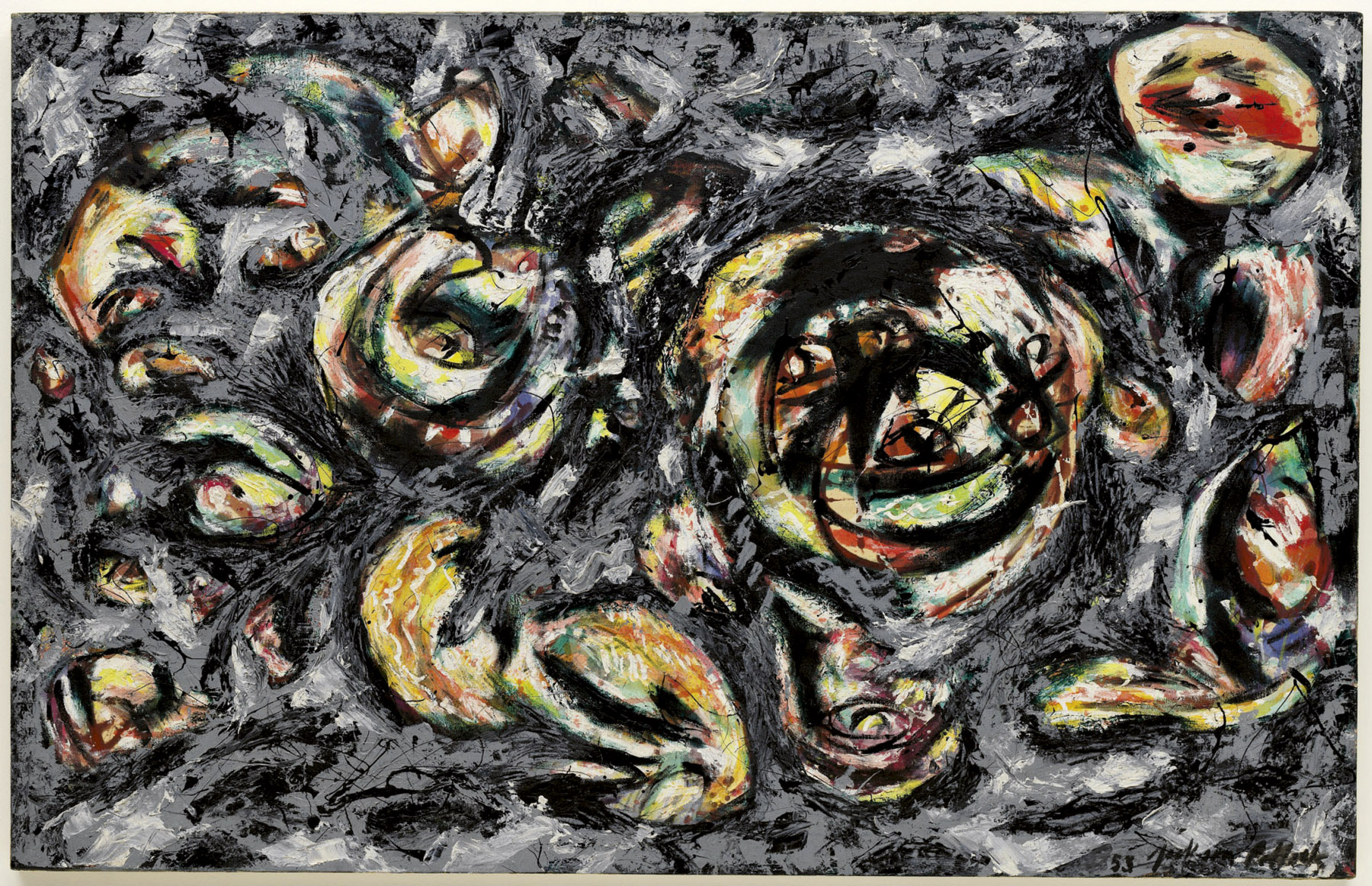
Arriving in New York in 1930 from the West Coast, Pollock began working with figuration of both human and imaginary beings. Most of this imagery was connected to that of American Indian sand painting and the Mexican muralists he saw as a youth and that reemerged through psychoanalysis to treat his lifelong alcoholism. His first fully mature works – dating between 1942 and 1947 – use an idiosyncratic iconography he developed in part as a response to Surrealism, popular in New York with its numerous European exiles from World War II. Employing mythical subject matter, calligraphic markings, and a vibrant and distinctive colour palette, Pollock produced emotionally charged works that retain figurative subject matter yet emphasise abstract qualities. Arising from this confluence of abstraction and figuration are Pollock’s breakthrough works, commonly perceived as pure abstraction and made over the course of an explosive period between late 1947 and 1950 as represented by Untitled (Green Silver). At the time, he also broke free from the standard use of implements, usually abandoning their direct contact with the surface. Working from above the picture plane, he dripped and poured enamel paints on canvases and papers, a method that more precisely controlled the application of line. His preference for the technique of fluid paint spilling from the can or drizzling from the tips of sticks or trowels was heralded by critic Harold Rosenberg as “action painting.” These unconventional working methods and his own physical presence while creating these works have assumed epic proportions. In the last four years of his life – he died in an automobile accident on August 11, 1956 – he produced significantly fewer works, with each further refining his pouring method. Compositionally, they hark back to his earlier style through the reintroduction of figurative elements as in Ocean Greyness, which also addresses his allover abstract technique. Its dramatic, swirling forms set against a dark ground recall Pollock’s Eyes in the Heat (1946).

Text from the Guggenheim website


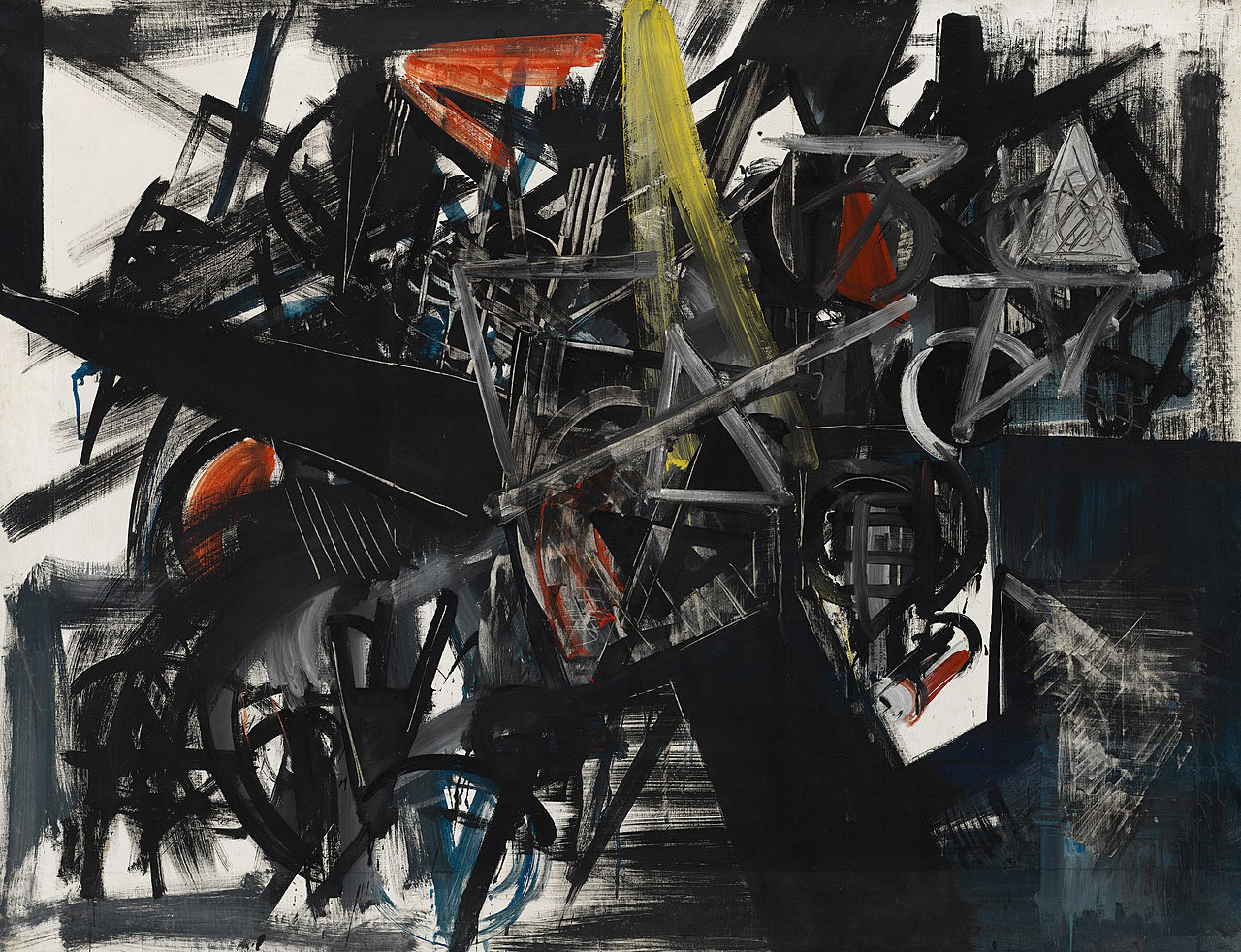
Emilio Vedova (Italian, 1919-2006) 'Image of Time (Barrier)' 1951


Emilio Vedova (Italian, 1919-2006)
Image of Time (Barrier)
1951
Egg tempera on canvas
51 3/8 x 67 1/8 inches (130.5 x 170.4cm)
The Solomon R. Guggenheim Foundation Peggy Guggenheim Collection, Venice, 1976
© Emilio Vedova


Emilio Vedova produced art in response to contemporary social upheavals, however his political position was contrary to that of his early modern counterparts, the Italian Futurists, who coalesced as a group in the years preceding World War I. While the Futurists romantically celebrated the aggressive energies inherent in societal conflict and technological advancement, Vedova’s feverish, violent canvases convey – in abstract terms – his horror and moral protestation in the face of man’s assault on his own kind.

Vedova expressed a political consciousness in his work for the first time during the late 1930s, when his works were inspired by the Spanish Civil War. His continuing commitment to social issues gave rise to series such as Cycle of Protest (Ciclo della protesta, 1956) and Image of Time (Immagine del tempo, 1946-1959). Although the motivation behind Image of Time (Barrier) (Sbarramento) is political, its formal preoccupations parallel those of the American Abstract Expressionists, namely Franz Kline. The drama of the angular, graphic slashes of black on white is heightened with accents of orange-red. Occupying a shallow space, pictorial elements are locked together in formal combat and emotional turmoil.

Text from the Guggenheim website


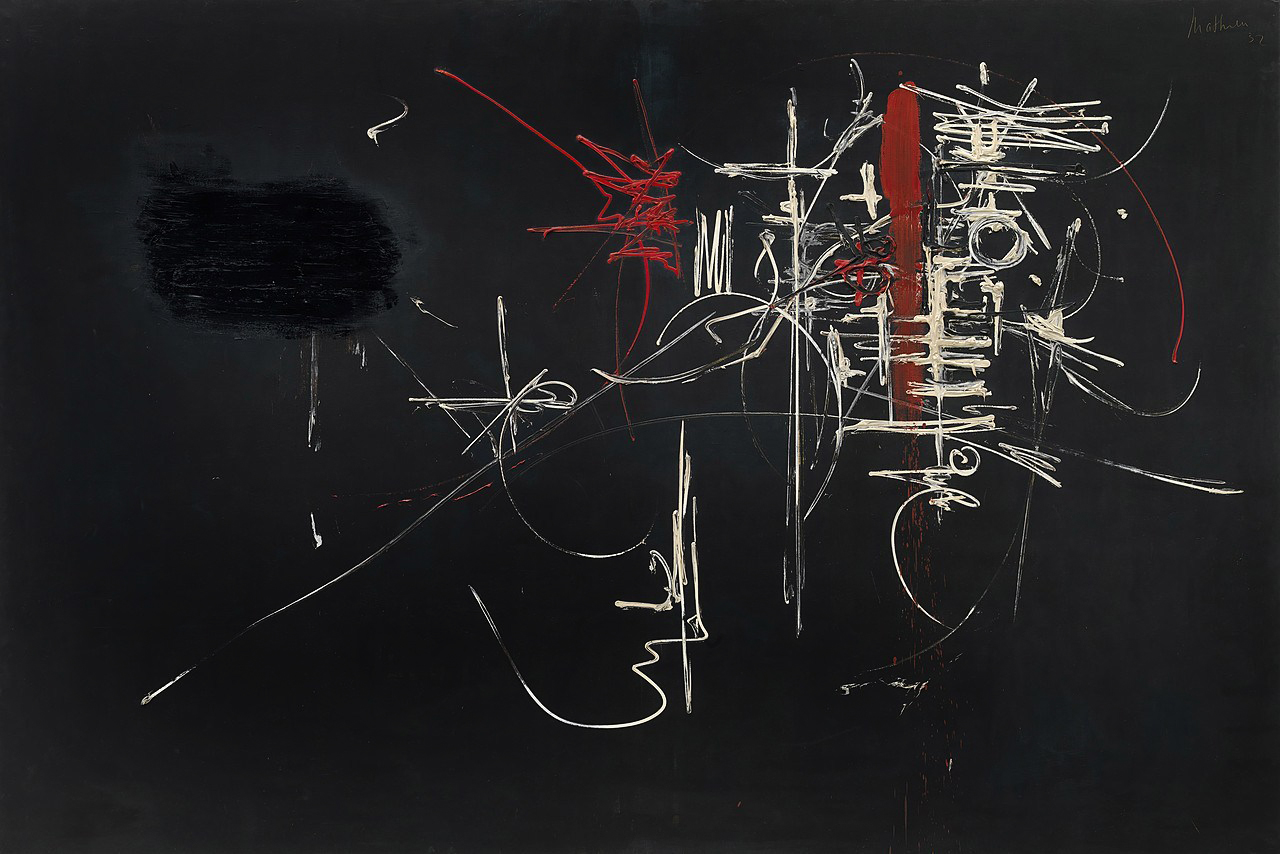
Georges Mathieu (French, 1921-2012) 'Painting' 1952


Georges Mathieu (French, 1921-2012)
Painting
1952
Oil on canvas
78 3/4 x 118 inches (200 x 299.7cm)
Solomon R. Guggenheim Museum, New York
© 2018 Artists Rights Society (ARS), New York / ADAGP, Paris


A key figure of the postwar art scene in Paris as well as a champion – and competitor – of the burgeoning movement of Abstract Expressionist painters in New York, Georges Mathieu practiced a mode of gestural abstraction that was decidedly calligraphic. His paintings were executed with controlled force, resulting in a matrix of lines bursting from a single point and thrusting outward in every direction, as seen in Painting (Peinture, 1952). The artist often squeezed paint directly from tubes onto the canvas and emphasised the necessity of rapid application in order to harness an intuitive expression. Mathieu also occasionally introduced a performative dimension to his painting in the 1950s, executing large canvases before audiences. This merger of painting and performance anticipated the work of Yves Klein and others in the late 1950s and 1960s.

Text from the Guggenheim website


Jackson Pollock (American, 1912-1956) 'Ocean Greyness' 1953


Jackson Pollock (American, 1912-1956)
Ocean Greyness
1953
Oil on canvas
57 3/4 x 90 1/8 inches (146.7 x 229cm)
Solomon R. Guggenheim Museum, New York
© 2016 The Pollock-Krasner Foundation/Artists Rights Society (ARS), New York


The critical debate that surrounded Abstract Expressionism during the late 1940s was embodied in the work of Jackson Pollock. Clement Greenberg, a leading critic and Pollock’s champion, professed that each discrete art form should, above all else, aspire to a demonstration of its own intrinsic properties and not encroach on the domains of other art forms. A successful painting, he believed, affirmed its inherent two-dimensionality and aimed toward complete abstraction. At the same time, however, the critic Harold Rosenberg was extolling the subjective quality of art; fervent brushstrokes were construed as expressions of an artist’s inner self, and the abstract canvas became a gestural theater of private passions. Pollock’s art – from the early, Surrealist-inspired figurative canvases and those invoking “primitive” archetypes to the later labyrinthine webs of poured paint – elicited both readings. Pollock’s reluctance to discuss his subject matter and his emphasis on the immediacy of the visual image contributed to shifting and, ultimately, dialectic views of his work.

In 1951, at the height of the artist’s career, Vogue magazine published fashion photographs by Cecil Beaton of models posing in front of Pollock’s drip paintings. Although this commercial recognition signalled public acceptance – and was symptomatic of mass culture’s inevitable expropriation of the avant-garde – Pollock continuously questioned the direction and reception of his art. His ambivalence about abstract painting, marked by a fear of being considered merely a “decorative” artist, was exacerbated, and it was around this time that he reintroduced to his paintings the quasi-figurative elements that he had abandoned when concentrating on the poured canvases. Ocean Greyness, one of Pollock’s last great works, depicts several disembodied eyes hidden within the swirling coloured fragments that materialise from the dense, scumbled gray ground. “When you are painting out of your unconscious,” he claimed, “figures are bound to emerge.” Manifest in this painting is a dynamic tension between representation and abstraction that, finally, constitutes the core of Pollock’s multileveled oeuvre.

Nancy Spector

Text from the Guggenheim website


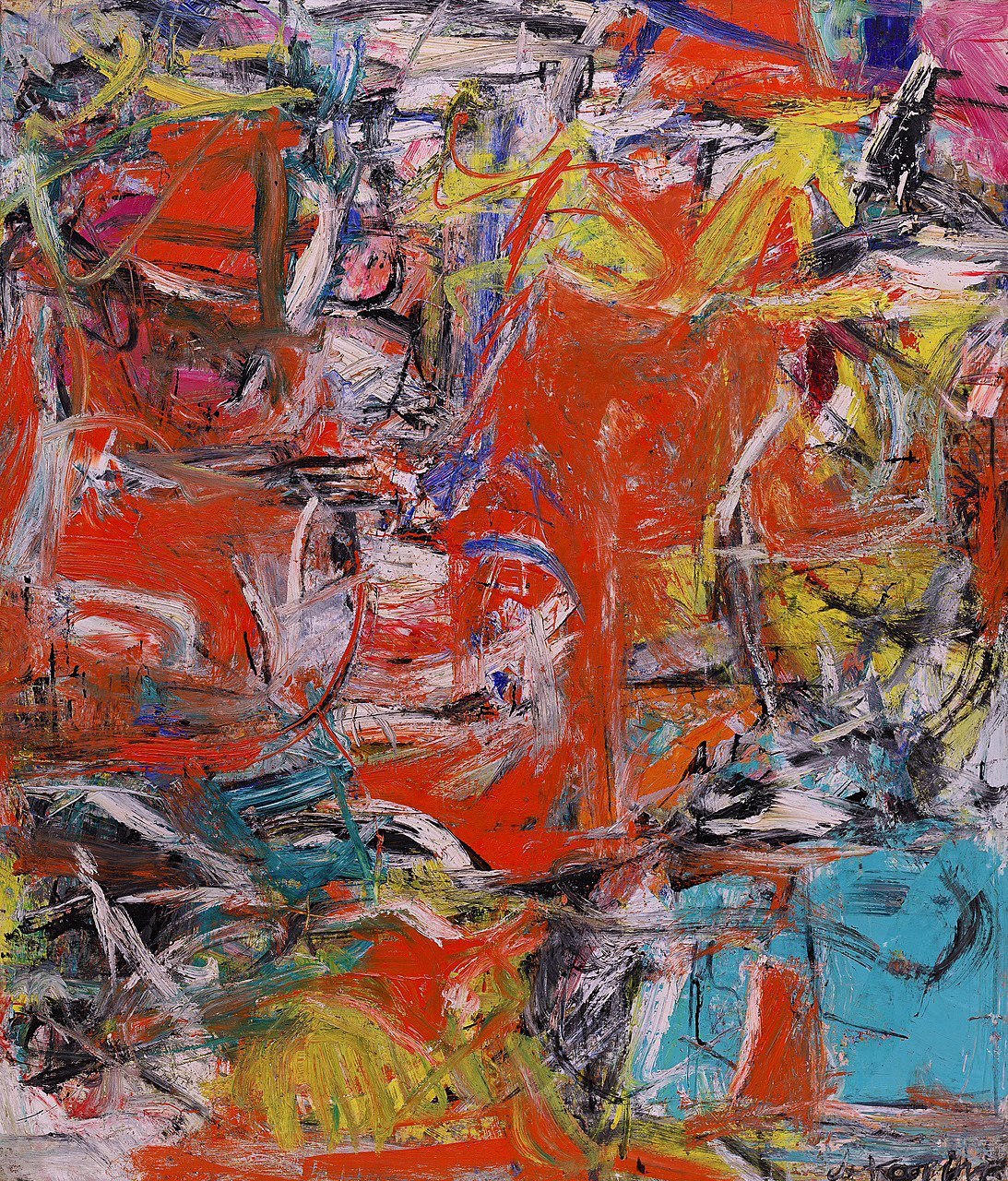
Willem de Kooning (American, 1904-1997) 'Composition' 1955


Willem de Kooning (American, 1904-1997)
Composition
1955
Oil, enamel, and charcoal on canvas
201 x 175.6cm
Solomon R. Guggenheim Museum, New York
© 2012 The Willem de Kooning Foundation/Artists Rights Society (ARS), New York


Although often cited as the originator of Action Painting, an abstract, purely formal and intuitive means of expression, Willem de Kooning most often worked from observable reality, primarily from figures and the landscape. From 1950 to 1955, de Kooning completed his famous Women series, integrating the human form with the aggressive paint application, bold colours, and sweeping strokes of Abstract Expressionism. These female “portraits” provoked not only with their vulgar carnality and garish colours, but also because of their embrace of figural representation, a choice deemed regressive by many of de Kooning’s Abstract Expressionist contemporaries, but one to which he consistently returned for many decades.

Composition serves as a bridge between the Women and de Kooning’s next series of work, classified by critic Thomas Hess as the Abstract Urban Landscapes (1955-1958). According to the artist, “the landscape is in the Woman and there is Woman in the landscapes.” Indeed, Composition reads as a Woman obfuscated by de Kooning’s agitated brushwork, clashing colours, and allover composition with no fixed viewpoint. Completed while the artist had a studio in downtown New York, Composition’s energised dashes of red, turquoise, and chrome yellow suggest the frenetic pace of city life, without representing any identifiable urban inhabitants or forms.

Painted 20 years later, after de Kooning moved to East Hampton, New York, seeking to work in greater peace and isolation, … Whose Name Was Writ in Water takes nature as its theme. Water was a favourite subject of the artist, and he devised a rapid, slippery technique of broad impasto strokes with frayed edges, speckled with drips, to convey its fluidity and breaking movement. The title, taken from an epigraph on Keats’s tomb, which de Kooning had seen on a trip to Rome in 1960, is, according to critic Harold Rosenberg, “the closest de Kooning can come to saluting overtly the impermanence of existence, and things in a state of disappearance.” Always aiming to reinforce the content of his work with his technique, de Kooning reworked his canvases over and over again, making each painting a composite of evanescent visual traces. The scrambled pictorial vocabulary and condensed space of the urban landscapes was gradually diffused in de Kooning’s later work. More open compositions, a less cluttered palette, and looser, liquid brushstrokes reveal a painter relieved of the nervous, claustrophobic atmosphere of city life and newly at peace with his rural surroundings.

Bridget Alsdorf

Text from the Guggenheim website


Pierre Alechinsky (Belgium, b. 1927) 'Vanish' 1959


Pierre Alechinsky (Belgium, b. 1927)
Vanish
1959
Oil on canvas
78 3/4 x 110 1/4 inches (200 x 280cm)
Solomon R. Guggenheim Museum, New York Gift, Julian and Jean Aberbach, 1967
© 2018 Artists Rights Society (ARS), New York / ADAGP, Paris


Pierre Alechinsky was a central figure in Cobra, a European artists’ group that emphasised material and its spontaneous application. The abstract and concrete often merge in his work; in Vanish (Disparaître, 1959), Alechinsky focused on the appearance and disappearance of a female figure in the centre of the canvas. This emergent shape and the background coalesce into a vigorously brushed surface that is distinguished by thickly impastoed white pigment and a network of predominantly blue lines. There are still traces of the allover patterning that characterises the artist’s watercolours and earlier canvases such as The Ant Hill (La fourmilière, 1954). His work likewise exhibits a fluidity and vitality that points to the artist’s fascination with Japanese calligraphy, which he observed during his travels to Japan in 1955.

Text from the Guggenheim website


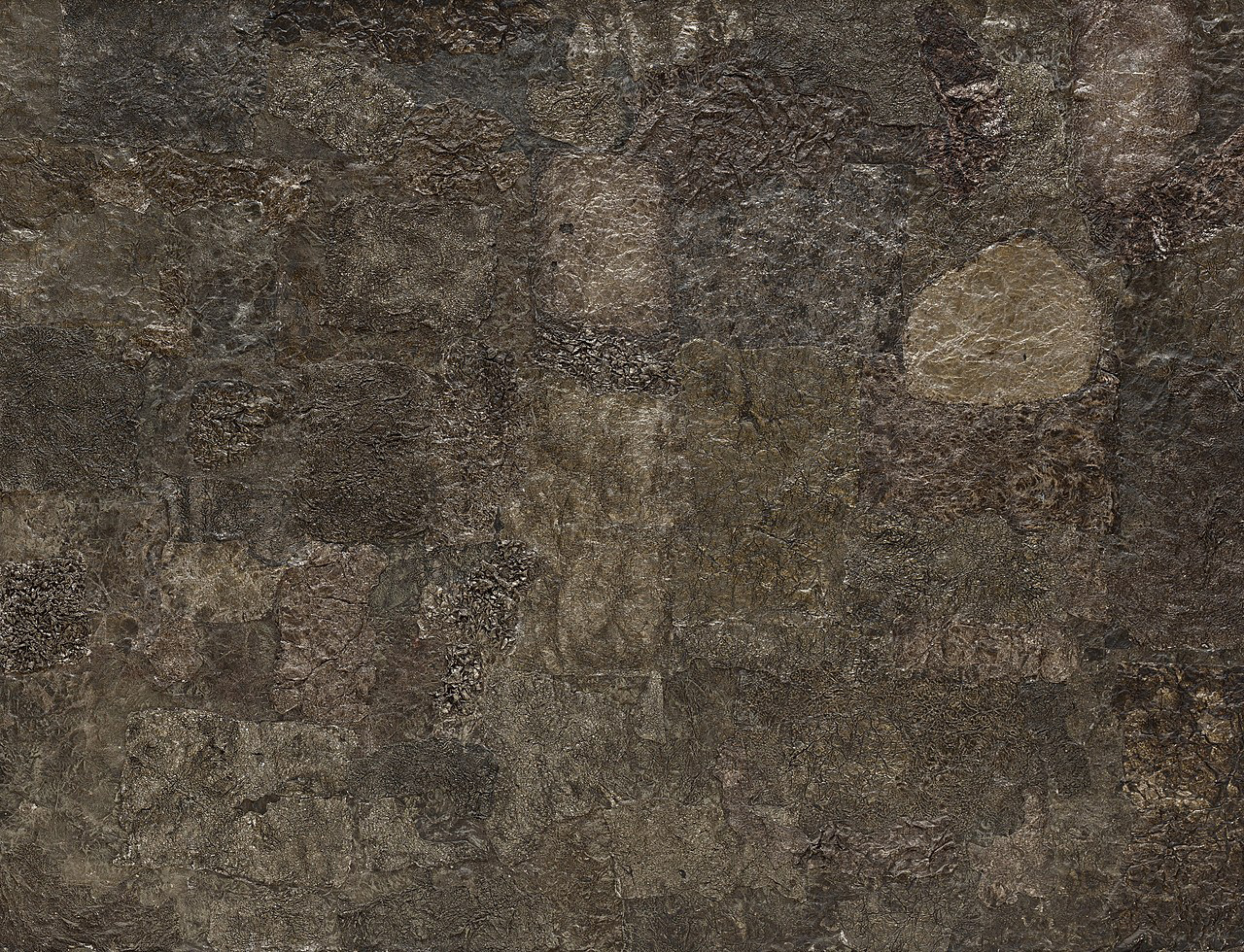
Jean Dubuffet (French, 1901-1985) 'The Substance of Stars' December 1959


Jean Dubuffet (French, 1901-1985)
The Substance of Stars
December 1959
Metal foil on Masonite
59 x 76 3/4 inches (150 x 195cm)
Solomon R. Guggenheim Museum, New York
© 2018 Artists Rights Society (ARS), New York / ADAGP, Paris


In Jean Dubuffet’s Matériologies series (1959-1960), of which The Substance of Stars (Substance d’astre, December 1959) is an example, form is subverted by an emphasis on materials, meant to stimulate mental responses and associations in the viewer. Far from being an abstraction in the usual sense, this and other such works suggest concern with topographical reality – the earth, water and sky, and the stars. These elements are not conveyed through descriptive images or through the use of materials identical with a natural substance, but through evocative effects of their artificial counterparts, here black, gray, and silver metal foil. Nature, although closely observed, is thus rendered through artifice, and reality conjured up through elaborate illusion.

Text from the Guggenheim website


Karel Appel
 (Dutch, 1921-2006) 'The Crying Crocodile Tries to Catch the Sun' 1956


Karel Appel
 (Dutch, 1921-2006)
The Crying Crocodile Tries to Catch the Sun
1956
Oil on canvas
145.5 x 113.1cm
The Solomon R. Guggenheim Foundation, Peggy Guggenheim Collection, Venice, 1976
© 2012 Karel Appel Foundation/Artists Rights Society (ARS), New York


Karel Appel, like Asger Jorn, was a member of the Cobra group, which emphasised material and its spontaneous application. Although the group was short-lived, its concerns have endured in his work. The single standing figures of humans or animals he developed during the 1950s are rendered in a deliberately awkward, naive way, with no attempt at modelling or perspectival illusionism. Thus, the crocodile in this painting is presented as a flat and immobile form, contoured with heavy black lines in the manner of a child’s drawing.

Appel’s paint handling activates a frenzy of rhythmic movement in The Crying Crocodile Tries to Catch the Sun (1956), despite the static monumentality of the subject. Drips and smears are interspersed with veritable stalactites of brilliant, unmodulated colour that buckle, ooze, slash, wither, and thread their way over the surface. The physicality of the impasto and its topographic variety allow it to reflect light and cast shadows dramatically, increasing the emotional intensity of violent colour contrasts. In 1956 Appel summarised the genesis of his work: “I never try to make a painting; it is a howl, it is naked, it is like a child, it is a caged tiger… My tube is like a rocket writing its own space.”1

Lucy Flint

1/ Karel Appel, quoted in Alfred Frankenstein, ed., Karel Appel (New York: Harry N. Abrams, 1980), p. 52.

Text from the Guggenheim website


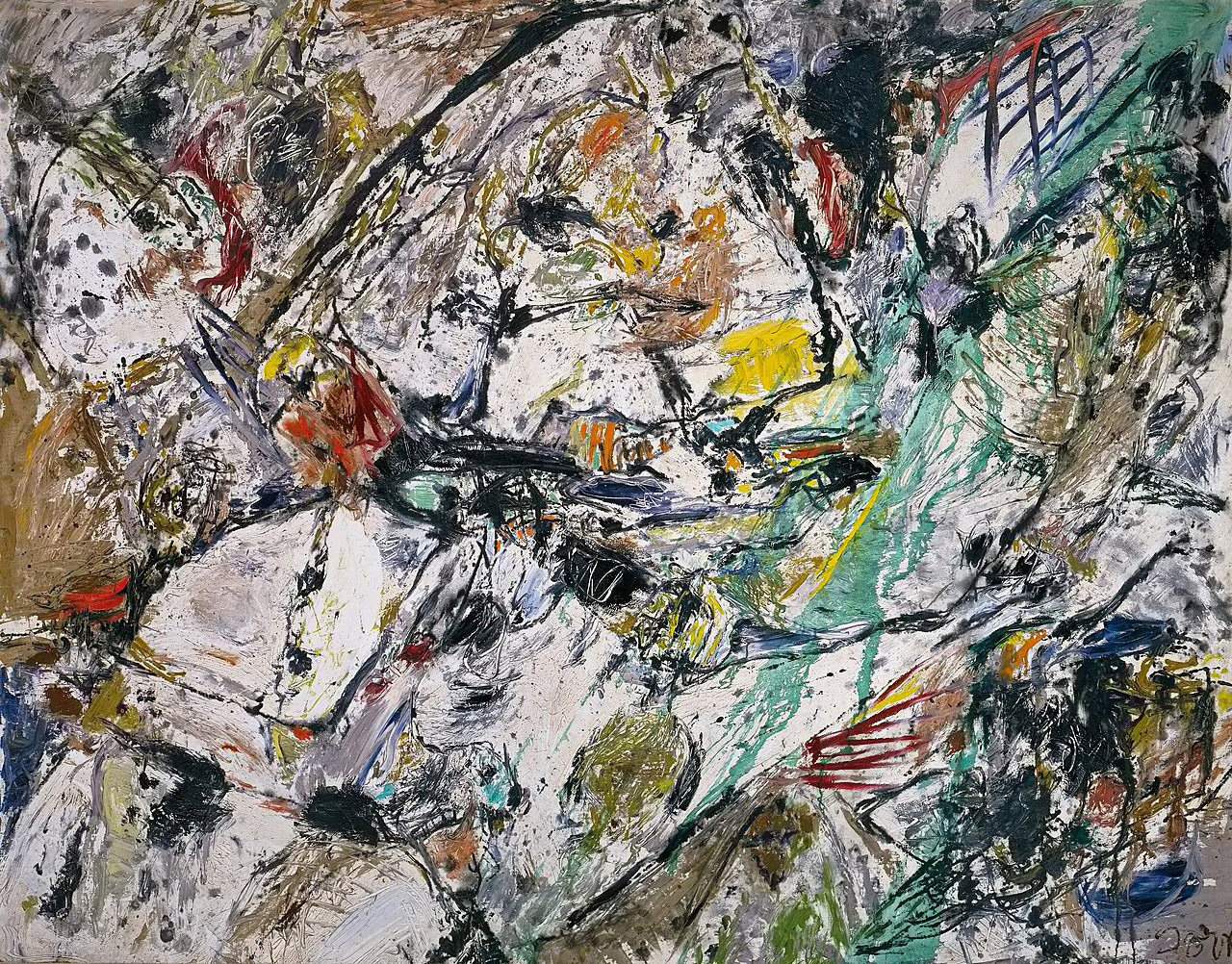
Asger Jorn (Danish, 1914-1973) 'A Soul for Sale (Ausverkauf einer Seele)' 1958-1959


Asger Jorn (Danish, 1914-1973)
A Soul for Sale (Ausverkauf einer Seele)
1958-1959
Oil with sand on canvas
200 x 250cm
Solomon R. Guggenheim Museum, New York
Purchased with funds contributed by the Evelyn Sharp Foundation, 1983
© 2012 Donation Jorn, Silkeborg / Artists Rights Society (ARS), New York/COPY-DAN, Copenhagen


Asger Jorn’s career began in 1936 when he ventured from Copenhagen to Paris with the goal of apprenticing under the legendary painter Vasily Kandinsky. On his arrival, however, Jorn promptly learned that Kandinsky did not operate his own academy. Instead, the young artist enrolled in Fernand Léger’s Académie contemporaine and worked with Le Corbusier on his Pavillon des temps nouveaux at the World Exhibition of 1937, experiencing firsthand the formal restraint and balance that characterised the art and architecture of Le Corbusier’s Purism – a movement dedicated to highly rationalised geometric forms.

But Jorn preferred methods rooted in spontaneity and would ultimately reject the techniques of his teachers in favour of a life of art, writing, and activism that amounted to an assault on rationality in all its guises – painterly, architectural, and social. In 1948 Jorn and others, including Karel Appel, founded Cobra, an international collection of like-minded experimental artists. Indebted to the style of Jorn’s friend Jean Dubuffet – whose Art Brut looked to traditions of art making commonly considered debased or vulgar by the art establishment – Cobra art combined Surrealist automatism with the materiality of gestural mark making. Many of Jorn’s early paintings exist on the boundary between abstraction and figuration, aligning his practice with that of American contemporaries including Willem de Kooning and Jackson Pollock.

In 1957 Jorn merged his anti-Bauhaus group, the Mouvement internationale pour un Bauhaus imaginiste (International movement for an imaginist Bauhaus, founded in 1954), with Guy Debord’s Lettrist International, to form the Internationale Situationiste (Situationist International, SI), a Marxist, activist group of writers, artists, and theorists who sought to destabilise societal practices and structures ranging from urban planning to the art establishment. Jorn continued to exhibit an anarchic spirit even after he left the SI in 1961. As an act of rebellion against the concept of art prizes, for instance, he refused to accept the Guggenheim Museum’s 1964 International Award for his painting Dead Drunk Danes (Døddrukne Danskere, 1960), stating in a telegram that he wanted no part of the museum’s “ridiculous game.”

During his SI period Jorn focused great effort on a series of “modification” paintings, which utilised other paintings as pre-existing supports on which to produce new images or marks, but he also continued to work within his Cobra aesthetic, making paintings such as A Soul for Sale (Ausverkauf einer Seele, 1958-59). In both its use of expressive brushwork and its collapsing of foreground and background, figuration and abstraction, A Soul for Sale articulates some of Jorn’s most significant interrogations of the precepts of geometric abstraction and rationalised art making. Barely discernible amid a field of gestural marks, the work’s central figure – demarcated by fragmented contour lines that seem to merge with the abstract ground even as they define the figure’s form – appears on the verge of disappearing. Jorn seems to deny his subject even as he represents it. In a similar fashion, rational strategies of delineating form or representing depth, seen in the contour drawing or in the crosshatching at the top right of the painting, are overcome by strikingly crude or naive methods of mark making, such as scattered soil or paint smudges – techniques Jorn first developed early on as a Cobra artist.

Text from the Guggenheim website


Yves Klein (French, 1928-1962) 'Large Blue Anthropometry (ANT 105) [La Grande Anthropométrie Bleue (ANT 105)]' c. 1960


Yves Klein (French, 1928-1962)
Large Blue Anthropometry (ANT 105) [La Grande Anthropométrie Bleue (ANT 105)]
c. 1960
Blue pigment and synthetic resin on paper on canvas
280 x 428cm
Guggenheim Museum Bilbao


Yves Klein’s first passion in life was judo. In 1952 he moved to Tokyo and studied at the Ko-do-kan Judo Institute, where he earned a black belt. When he returned to Paris in 1955 and discovered to his dismay that the Fédération Française de Judo did not extol him as a star, he shifted his attentions and pursued a secondary interest – a career in the arts. During the ensuing seven years Klein assembled a multifarious and critically complex body of work ranging from monochrome canvases and wall reliefs to paintings made with fire. He is renowned for his almost exclusive use of a strikingly resonant, powdery ultramarine pigment, which he patented under the name “International Klein Blue,” claiming that it represented the physical manifestation of cosmic energy that, otherwise invisible, floats freely in the air. In addition to monochrome paintings, Klein applied this pigment to sponges, which he attached to canvases as relief elements or positioned on wire stands to create biomorphic or anthropomorphic sculptures. First exhibited in Paris in 1959, the sponge sculptures – all essentially alike, yet ultimately all different – formed a forest of discrete objects surrounding the gallery visitors. About these works Klein explained, “Thanks to the sponges – raw living matter – I was going to be able to make portraits of the observers of my monochromes, who … after having voyaged in the blue of my pictures, return totally impregnated in sensibility, as are the sponges.”1

For his Anthropométries series, Klein famously used nude female models drenched in paint as “brushes.” His system of pressing bodies against the paper support (which was later mounted on canvas) rejected any illusion of a third dimension in the pictorial space. In these works, the subject, object, and medium become confused with one another to produce a trace of the body’s presence. Klein’s unconventional activities also included releasing thousands of blue balloons into the sky, and exhibiting an empty, white-walled room and then selling portions of the interior air, which he called “zones” of “immaterial pictorial sensibility.” His intentions remain perplexing thirty years after his sudden death. Whether Klein truly believed in the mystical capacity of the artist to capture cosmic particles in paint and to create aesthetic experiences out of thin air and then apportion them at whim is difficult to determine. The argument has also been made that he was essentially a parodist who mocked the metaphysical inclinations of many modern painters, while making a travesty of the art market.

Nancy Spector

1/ Yves Klein, “Remarques sur quelques oeuvres exposées chez Colette ‘Allendy’,” 1958, Klein archive, quoted in Nan Rosenthal, “Assisted Levitation: The Art of Yves Klein,” in Yves Klein 1928-1962: A Retrospective, exh. cat. (Houston: Institute for the Arts, Rice University, 1982), p. 111.

Text from the Guggenheim website


Solomon R. Guggenheim Museum
1071 5th Avenue (at 89th Street)
New York

Opening hours:
Sunday – Monday, 11am – 6pm
Wednesday – Friday 11am – 6pm
Saturday 11am – 8pm
Closed Tuesday

Solomon R. Guggenheim Museum website

LIKE ART BLART ON FACEBOOK

Back to top

Exhibition: ‘Irving Penn: Diverse Worlds’ at Moderna Museet Malmö, Sweden

Exhibition dates: 16th June 2012 – 9th September 2012


Many thankx to the Moderna Museet Malmö for allowing me to publish the photographs in the posting. Please click on the photographs for a larger version of the image.


Irving Penn (American, 1917-2009) 'Balenciaga Little Great Coat (Lisa Fonssagrives-Penn), Paris, 1950' 1950


Irving Penn (American, 1917-2009)
Balenciaga Little Great Coat (Lisa Fonssagrives-Penn), Paris, 1950
1950
© Copyright by The Irving Penn Foundation


Irving Penn (American, 1917-2009) 'Truman Capote (1 of 2)' New York, 1965


Irving Penn (American, 1917-2009)
Truman Capote (1 of 2), New York
1965
© Copyright by The Irving Penn Foundation


Irving Penn (American, 1917-2009) 'Ingmar Bergman (1 of 4), Stockholm, 1964' 1964


Irving Penn (American, 1917-2009)
Ingmar Bergman (1 of 4), Stockholm, 1964
1964
© Copyright by The Irving Penn Foundation


“A good photograph is one that communicates a fact, touches the heart, and leaves the viewer a changed person for having seen it; it is in one word, effective.”


Irving Penn


For the first time in the Öresund region, a rich selection of Irving Penn’s photographs from some of his most famous serial photography are being presented. His innovative fashion features, portraits and still-lifes made Irving Penn one of the leading photographers of our time. Spanning more than 60 years, his career is characterised by a cool, minimalist approach to the medium. With a selection of nearly 90 works and samples from his assignments for numerous publications, the exhibition at Moderna Museet Malmö covers a broad spectrum of Irving Penn’s oeuvre.

Irving Penn (1917-2009) is regarded as one of the leading photographers of our time. He was active in both the commercial and artistic fields. In 1985, he won the prestigious Hasselblad Award. In his terse serial works, Irving Penn developed a style that is distinguished by its sharpness, detail, meticulousness and minimalist imagery. The exhibition Diverse Worlds presents photographs from his most famous series and spans more than half a century. Most of these works were donated to Moderna Museet in 1995 by Penn himself, in memory of his wife, Swedish-born Lisa Fonssagrives-Penn.

Diverse Worlds is a broad resumé of Irving Penn’s oeuvre, revealing clearly the consistent style that is characteristic of his photographs. His output is typically imbued with an inquisitive eye and attention to detail, whatever the subject matter. A discussion of the commercial-artistic dichotomy seems rather pointless in the case of Irving Penn, who balanced constantly between the two, allowing one to benefit the other. His experience and background as a painter, for instance, came in handy when he was commissioned by established fashion houses to create their advertisements for publications such as Vogue – a magazine Penn worked for throughout most of his career.

In post-war New York, many cultural celebrities visited Irving Penn’s studio. The turmoil that prevailed after the Second World War was illustrated by portraying these ostensibly immortal icons trapped in a narrow corner. Penn has also related how this corner was created in his studio to counteract his own feelings of inferiority in relation to the celebs he portrayed. The less famed were also captured by Irving Penn’s camera, including small tradesmen in London and Paris, and members of Hell’s Angels in San Francisco. Life’s transience is distinctly visualised in many of the still-lifes Penn made in his career – often commissioned by fashion houses but also as part of his own projects.

Despite the variation in these pictorial series, Irving Penn’s oeuvre, and the presentation in Diverse Worlds, reveals a consistent curiosity and desire, and a wish to depict the divergent subjects in the same sensitive and detailed way. He achieved this by placing them all in the same setting. Different image worlds meet and are literally constructed in the same neutral space – Irving Penn’s studio.

Press release from the Moderna Museet Malmö website


Irving Penn (American, 1917-2009) 'Nude No. 72' 1949-50, printed 1949-1950


Irving Penn (American, 1917-2009)
Nude No. 72
1949-1950, printed 1949-1950
© Copyright by The Irving Penn Foundation


Irving Penn (American, 1917-2009) 'Large Sleeve (Sunny Harnett), New York' 1951, printed 1984


Irving Penn (American, 1917-2009)
Large Sleeve (Sunny Harnett), New York
1951, printed 1984
© Copyright by The Irving Penn Foundation


Irving Penn. 'Fishmonger, London, 1950' 1950


Irving Penn (American, 1917-2009)
Fishmonger, London, 1950
1950
© by Condé Nast Publications Ltd.


Irving Penn (American, 1917-2009) 'Cat Woman, New Guinea, 1970' 1970


Irving Penn (American, 1917-2009)
Cat Woman, New Guinea, 1970
1970
© Copyright by The Irving Penn Foundation


Irving Penn (American, 1917-2009) 'Mud Glove, New York' 1975


Irving Penn (American, 1917-2009)
Mud Glove, New York


Irving Penn (American, 1917-2009) 'Bird Bones, (Sweden)' 1980


Irving Penn (American, 1917-2009)
Bird Bones, (Sweden)
1980


Irving Penn (American, 1917-2009) 'Frozen Foods with String Beans, New York, 1977' 1977


Irving Penn (American, 1917-2009)
Frozen Foods with String Beans, New York, 1977
1977
© Copyright by The Irving Penn


Irving Penn (American, 1917-2009) 'Mouth (for L'Oréal), New York' 1986


Irving Penn (American, 1917-2009)
Mouth (for L’Oréal), New York
1986
© Copyright by The Irving Penn


Moderna Museet Malmö
Gasverksgatan 22 in Malmö

Moderna Museet Malmö is located in the city centre of Malmö. Ten minutes walk from the Central station, five minutes walk from Gustav Adolfs torg and Stortorget.

Opening hours:
Tuesday – Sunday 11 – 17
Mondays closed

Moderna Museet Malmö website

LIKE ART BLART ON FACEBOOK

Back to top

Exhibition: ‘Home Front: Wartime Sydney 1939-45’ at the Museum of Sydney

Exhibition dates: 31st March – 9th September 2012


Sam Hood (Australian, 1872-1953) '6th division AIF troops waving from troop-train carriage, 13 September 1940' 1940


Sam Hood (Australian, 1872-1953)
6th division AIF troops waving from troop-train carriage, 13 September 1940
1940
© Australian War Memorial


Some poignant photographs in this posting of young Australian men setting off to fight in the early stages of the Second World War. The message scrawled in chalk on the side of the train (below, at left) reads, “Berlin first stop. Look out Hitler, we’ll be there soon.” Little did they know it would be five long, hard years of fighting and countless deaths before that aphorism would come true. The 6th division AIF troops first fought in North Africa against the Italians at Tobruk and was then sent to Greece to fight the German advance. About 39 per cent of the Australian troops in Greece on 6 April 1941 were either killed, wounded or became prisoners of war. The division then fought in the Pacific War on the Kokoda Trail campaign in the New Guinea theatre until the end of the war.

I wonder how many of the men, smiling and leaning out of the train carriage or departing on a troop ship, returned to these shores?

The last photograph in the posting is so very eloquent it actually moved me to tears. The women being hoisted aloft to kiss her loved one last time – clutching her handbag, complete with rumpled, lumpy stockings. To the right (and this is what caught my eye), a man looks straight at the camera while another right next to him has this distant melancholy look on his face as though he is not actually there. A portent of things to come. Brave men, fighting in the only war that Australians have had to fight for their own freedom, not at the whim of a colonial power or overseas ally in some far of distant land. Brave men and women – we wouldn’t be here without them.

Dr Marcus Bunyan


Many thankx to the Museum of Sydney for allowing me to publish the photographs in the posting. Please click on the photographs for a larger version of the image.


Installation view of the exhibition 'Home Front: Wartime Sydney 1939-45' at the Museum of Sydney 

Installation view of the exhibition 'Home Front: Wartime Sydney 1939-45' at the Museum of Sydney 

Installation view of the exhibition 'Home Front: Wartime Sydney 1939-45' at the Museum of Sydney 

Installation view of the exhibition 'Home Front: Wartime Sydney 1939-45' at the Museum of Sydney

Installation view of the exhibition 'Home Front: Wartime Sydney 1939-45' at the Museum of Sydney


Installation view of the exhibition Home Front: Wartime Sydney 1939-45 at the Museum of Sydney
Historic Houses Trust of NSW
Photos: Jenni Carter


Anonymous photographer. 'Troops of the 6th Division wave goodbye, Sydney 1940' 1940


Anonymous photographer
Troops of the 6th Division wave goodbye, Sydney 1940
1940
© Australian War Memorial


Anonymous photographer. 'Men of the 6th Division returning from Wewak crowd the deck of HMS Implacable, 18 Dec 1945' 1945


Anonymous photographer
Men of the 6th Division returning from Wewak crowd the deck of HMS Implacable, 18 Dec 1945
1945
© Australian War Memorial


Anonymous photographer. 'An Australian built DAP Bristol Beaufort VIII aircraft, serial no A9-700, in flight over Sydney Harbour near the Bridge' c. 1944


Anonymous photographer
An Australian built DAP Bristol Beaufort VIII aircraft, serial no A9-700, in flight over Sydney Harbour near the Bridge
c. 1944
© Australian War Memorial


Anonymous photographer. 'Partly submerged RAN accommodation ship damaged during the unsuccessful Japanese midget submarine attack 1 June 1942' 1942


Anonymous photographer
Partly submerged RAN accommodation ship damaged during the unsuccessful Japanese midget submarine attack 1 June 1942
1942
© Australian War Memorial


Anonymous photographer. 'Two women donning gas masks as part of an air raid drill' Nd


Anonymous photographer
Two women donning gas masks as part of an air raid drill
Nd
© Argus Newspaper Collection of Photographs, State Library of Victoria


Installation view of the exhibition 'Home Front: Wartime Sydney 1939-45' at the Museum of Sydney showing at centre, a detail of 'Members of the Wardens' Women's Auxiliary making for the scene of an incident' (c. 1943) by an anonymous photographer


Installation view of the exhibition Home Front: Wartime Sydney 1939-45 at the Museum of Sydney showing at centre, a detail of Members of the Wardens’ Women’s Auxiliary making for the scene of an incident (c. 1943, below) by an anonymous photographer
Historic Houses Trust of NSW
Photo: Jenni Carter


Anonymous photographer. 'Members of the Wardens' Women's Auxiliary making for the scene of an incident' c. 1943


Anonymous photographer
Members of the Wardens’ Women’s Auxiliary making for the scene of an incident
c. 1943
© Argus Newspaper Collection of Photographs, State Library of Victoria


In May 1942 three Japanese midget submarines entered Sydney Harbour in an attempt to sink allied ships, bringing the once far away war to the shores of the harbourside city and shaking the country to its core. Coinciding with the 70th anniversary of the Japanese attack on Sydney Harbour, Home Front: Wartime Sydney 1939-45 a new exhibition opening 31 March at the Museum of Sydney, explores the experience of the women, men and children who rallied together to support the war effort from home.

Unprepared for another world war, Australians initially referred to the conflict as ‘the phoney war’, however it wasn’t long before propaganda posters were plastered around Sydney, censorship and food rationing became the norm, and tank traps and barbed wire replaced bronzed bodies on Sydney beaches. For six long years the world seemed to come to Sydney as soldiers, sailors and airmen from many nations called Sydney home, making wartime an exciting and thrilling period for some, while for others it was a long and lonely time interrupted by the occasional letter from a loved one serving overseas.

Almost 40,000 Australians lost their lives with the war leaving a lasting impact at home and transforming the lives of generations of Australians, in particular the lives of women, says Curator Annie Campbell. “As well as having to cope with war related anxieties and stress, many women were ‘manpowered’ to work in wartime industries such as ammunitions factories and aircraft construction. Everyone had to make sacrifices on the home front, however despite wartime shortages and rationing, women were expected and actively encouraged to look smart, which often involved some innovative thinking. One of my favourite objects in the exhibition is a wedding dress made out of parachute silk and mosquito net for a war bride, later worn by her sister and two girlfriends on their special days.

While the troops were busy on the battlefields, Sydneysiders prepared for the possibility of an enemy invasion on home soil. An anti-submarine boom net was installed across Sydney Harbour to keep out attacking forces, bomb shelters were constructed in Hyde Park and protective timbers were placed around landmark buildings. In 1942 blackout restrictions were introduced to limit the effectiveness of air raids, all Sydney lights were switched off and car, train and tram headlights were masked, giving the city a sinister feel. But it wasn’t all doom and gloom, large numbers of people were ready to have fun in Sydney and the Trocadero on George Street became a mecca for white American servicemen, while the Booker T Washington Club in Albion Street Surry Hills serviced the African-American GI’s,” says Campbell.

Highlights of the exhibition include the microphone used by Prime Minister Robert Menzies to announce that Australia was at war, remnants of the Japanese midget submarines that attacked Sydney, over 100 photographs and artworks depicting wartime Sydney, and a short documentary featuring historic footage. Over 200 wartime Sydney mementoes will also feature in the exhibition including propaganda posters, warden’s memorabilia, letters from soldiers serving overseas and a selection of wartime fashions.

Press release from the Museum of Sydney website


Anonymous photographer. 'Sydney kindergarten children wearing air raid headgear designed to muffle sounds and prevent them from biting tongues' Nd


Anonymous photographer
Sydney kindergarten children wearing air raid headgear designed to muffle sounds and prevent them from biting tongues
Nd
© Mitchell Library, State Library of NSW


Anonymous photographer. 'Eve Holliman, Hilda Jamieson and Vera Thurlow converting a car into an ambulance' Nd


Anonymous photographer
Eve Holliman, Hilda Jamieson and Vera Thurlow converting a car into an ambulance
Nd
© Argus Newspaper Collection of Photographs, State Library of Victoria


Anonymous photographer. 'Woman war worker' 1944


Anonymous photographer
Woman war worker
1944
© Mitchell Library, State Library of NSW


Anonymous designer and photographer. 'Change Over to a Victory Job propaganda poster' Nd


Anonymous designer and photographer
Change Over to a Victory Job propaganda poster
Nd
© Australian War Memorial


Anonymous designer and photographer. 'Advertisement for Ponds' 1945


Anonymous designer and photographer
Advertisement for Ponds
1945
© National Library of Australia


Weaver Hawkins (English, 1893-1977) 'Jitterbugs' 1945


Weaver Hawkins (English, 1893-1977)
Jitterbugs
1945
Oil on canvas, Art Gallery of New South Wales
© Estate of H F Weaver Hawkins
Photograph Jenni Carter


Sam Hood (Australian, 1872-1953) 'Sydney embarkation, 13 September 1940' 1940


Sam Hood (Australian, 1872-1953)
Sydney embarkation, 13 September 1940
1940
© Australian War Memorial


Sam Hood (Australian, 1872-1953) 'Sydney embarkation, 13 September 1940' 1940 (detail)


Sam Hood (Australian, 1872-1953)
Sydney embarkation, 13 September 1940 (detail)
1940
© Australian War Memorial


Museum of Sydney
Cnr Bridge and Phillip Streets
Sydney, NSW 2000
Phone: (02) 9251 5988

Opening hours:
Daily 10am – 5pm
Closed Good Friday and Christmas Day

Museum of Sydney website

LIKE ART BLART ON FACEBOOK

Back to top

Exhibition: ‘Naked Before the Camera’ at the Metropolitan Museum of Art, New York

Exhibition dates: 27th March – 9th September 2012

WARNING: this posting contains photographs of nudity. If you do not like please do not look.


Many thankx to the Metropolitan Museum of Art for allowing me to publish the photographs in the posting. Please click on the photographs for a larger version of the image.


Franck-François-Genès Chauvassaignes (French, 1831 - after 1900) 'Untitled [Female Nude in Studio]' 1856-1859


Franck-François-Genès Chauvassaignes (French, 1831 – after 1900)
Untitled [Female Nude in Studio]
1856-1859
Salted paper print from glass negative
19.1 x 15.2cm (7.5 x 6 in.)
Metropolitan Museum of Art
Purchase, The Horace W. Goldsmith Foundation Gift, through Joyce and Robert Menschel, 1998
Public domain


This corner of a painter’s atelier somewhere in France in the middle of the nineteenth century is scarcely tethered to time or place; it could as easily be a loft in New York today or, had photography existed four centuries earlier, a studio in the Italian Renaissance. What is surprising here is the absence of even the thinnest disguise – no swags of drapery, elaborate coiffure, or skeins of beads as are commonly found in the work of other purveyors of “studies for artists.” Here, the model is utterly naked. With her intelligent head and dirty feet, this young woman helped found the matter-of-fact modelling sorority joined a decade later by Édouard Manet’s Olympia.

Text from the Metropolitan Museum of Art website


Félix-Jacques-Antoine Moulin (French, 1800 - after 1875) 'Untitled [Two Standing Female Nudes]' c. 1850


Félix-Jacques-Antoine Moulin (French, 1800 – after 1875)
Untitled [Two Standing Female Nudes]
c. 1850
Daguerreotype
Visible: 14.5 x 11.1cm (5 11/16 x 4 3/8 in.)
Metropolitan Museum of Art
The Rubel Collection, Purchase, Anonymous Gift and Lila Acheson Wallace Gift, 1997
Public domain


Although Moulin was sentenced in 1851 to a month in jail for producing images that, according to court papers, were “so obscene that even to pronounce the titles… would be to commit an indecency,” this daguerreotype seems more allied to art than to erotica. Instead of the boudoir props and provocative poses typical of hand-coloured pornographic daguerreotypes, Moulin depicted these two young women utterly at ease, as unselfconscious in their nudity as Botticelli’s Venus.

Text from the Metropolitan Museum of Art website


Unknown photographer (French) '[Seated Female Nude]' c. 1850


Unknown photographer (French)
[Seated Female Nude]
c. 1850
Daguerreotype
9.1 x 6.9cm (3 9/16 x 2 11/16 in.)
Metropolitan Museum of Art
Credit Line: Gilman Collection, Gift of The Howard Gilman Foundation, 2005
Public domain


This daguerreotype was surely intended to serve artistic purposes, but the odd twist of the body and the strange relationship of the three visible limbs seem to render it inappropriate for artistic emulation. Such tension between an artistic ideal and realistic means – between the classicism of an academic pose and the awkwardness of the camera’s rendering of human movement – seems emblematic of the dilemma faced by the nascent medium striving to be an art.

Text from the Metropolitan Museum of Art website


Julien Vallou de Villeneuve (French, 1795-1866) '[Standing Female Nude]' c. 1853


Julien Vallou de Villeneuve (French, 1795-1866)
[Standing Female Nude]
c. 1853
Salted paper print from paper negative
12 x 16cm (4 3/4 x 6 5/16 in.)
Metropolitan Museum of Art
Purchase, Lila Acheson Wallace Gift, 1993
Public domain


A student of the painter Jean François Millet (1814-1875) and a lithographer of scenes of daily life, costume, and erotica in the 1820s and 1830s, Vallou reportedly took up photography in the early 1840s. Because his early photographs have not been identified, it has been assumed that they depicted naked women, a subject for which it was to improper to acknowledge authorship.

Between 1851 and 1855, Vallou made a series of small-scale paper photographs of female nudes that he marketed (and legally registered) as models for artists. Vallou’s nudes have long been associated with those of Gustave Courbet (1819-1877), who is known to have used photographs in his painting process. Though no absolute one-to-one correspondence can be pointed to, there are some striking similarities in pose, and the heavy, soporific quality of Vallou’s models is very close to Courbet’s concept of the nude.

Text from the Metropolitan Muesum of Art website


Eugène Durieu (French, 1800-1874) 'Untitled [Seated Female Nude]' 1853-1854


Eugène Durieu (French, 1800-1874)
Untitled [Seated Female Nude]
1853-1854
Albumen silver print from glass negative
6 13/16 × 4 11/16 in. (17.3 × 11.9cm)
Metropolitan Museum of Art
Gilman Collection, Purchase, Mr. and Mrs. Henry R. Kravis Gift, 2005
Public domain


Durieu was a lawyer and early advocate and practitioner of photography in France who, in 1853-1854, made a series of photographic studies of nude and costumed figures as models for artists. The French Romantic painter Eugène Delacroix helped him pose the figures and later praised the prints, from which he sketched, as “palpable demonstrations of the free design of nature.” While the painter saw the accurate transcription of reality as a virtue of photography, Durieu knew that a good photograph was not simply the result of the correct use of the medium but, more significantly, an expression of the photographer’s temperament and vision. In an important article he emphasised the interpretative nature of the complex manipulations in photography and explained that the photographer must previsualise his results so as to make a “picture,” not just a “copy.”

This photograph proves Durieu’s point: through the elegant contours of the drapery, the smooth modelling of the flesh, and the grace and restraint of the pose, the picture attains an artistic poise that combines Delacroix’s sensuality with Ingres’s classicism, and rivals both.

Text from the Metropolitan Museum of Art website


Charles Alphonse Marlé (French, 1821 - after 1867) 'Untitled [Standing Male Nude]' c. 1855


Charles Alphonse Marlé (French, 1821 – after 1867)
Untitled [Standing Male Nude]
c. 1855
Salted paper print from paper negative
25.7 x 17.6cm (10 1/8 x 6 15/16 in.)
Metropolitan Museum of Art
Purchase, Ezra Mack Gift and The Horace W. Goldsmith Foundation Gift through Joyce and Robert Menschel, 1991


Marlé’s photograph was probably intended as an aid for painters and sculptors. The jury-rigged arrangement of podium, books, and potted tree, as well as the painting held in the background by a studio assistant, may strike the modern viewer as an incongruous contrast to the heroic gesture of the model. Marlé and those who bought his photograph, however, would have been absorbed by the grand academic pose and likely would have thought the awkward accoutrements of little consequence.

Text from the Metropolitan Museum of Art website


Nadar (French, Paris 1820 - 1910 Paris) '[Standing Female Nude]' 1860-1861


Nadar (French, Paris 1820 – 1910 Paris)
[Standing Female Nude]
1860-1861
20.2 x 13.3cm (7 15/16 x 5 1/4 in.)
Metropolitan Museum of Art
Purchase, The Horace W. Goldsmith Foundation Gift, through Joyce and Robert Menschel, 1991
Public Domain


Famed for his portraits of writers, artists, and left-wing politicians, Nadar is known to have photographed only three female nudes. This one was made at the behest of the painter Jean-Léon Gérôme to assist in the process of painting Phryné before the Areopagus, displayed at the Salon of 1861. Gérôme’s painting depicts the moment when the famous courtesan Phryné, on trial for impiety, is suddenly unveiled by her lawyer; persuaded by Phryné’s divine beauty, the jurors acquit her.

Like Phryné, who is said to have modelled for the ancient Greek painter Apelles and other artists of antiquity, Nadar’s model, Marie-Christine Leroux (1820-1863), was widely sought by artists of her time and was the basis for the character Musette in Henri Murger’s Scènes de la vie de bohème.

Text from the Metropolitan Museum of Art website


Depicting the human body has been among the greatest challenges, preoccupations, and supreme achievements of artists for centuries. The nude – even in generalised or idealised renderings – has triggered impassioned discussions about sin, sexuality, cultural identity, and canons of beauty, especially when the chosen medium is photography, with its inherent accuracy and specificity. Through September 9, 2012, Naked before the Camera, an exhibition of more than 60 photographs selected from the renowned holdings of The Metropolitan Museum of Art, surveys the history of this subject and explores some of the motivations and meanings that underlie photographers’ fascination with the nude.

“In every culture and across time, artists have been captivated by the human figure,” commented Thomas P. Campbell, Director of the Metropolitan. “In Naked before the Camera, we see how photographers have used their medium to explore this age-old subject and create compelling new images.”

The exhibition begins in the 19th century, when photographs often served artists as substitutes for live models. Such “studies for artists” were known to have been used by the French painter Gustave Courbet, whose Woman with a Parrot (1866), for instance, is strikingly similar to photographer Julien Vallou de Villeneuve’s Female Nude of 1853. Even when their stated purpose was to aid artists, however, the best of these 19th-century photographs of the nude were also intended as works of art in their own right. Two recently acquired photographs, made in the mid-1850s by an unknown French artist, are striking examples. Not only are they larger than all other photographic nudes from the time, they stand out due to an extraordinary surface pattern that interrupts the images and suggests a view through gossamer or a photograph printed on finely pleated silk rather than paper. The elegant Female Nude harkens back to an Eve or Venus and is vignetted by the camera lens as if seen through a peephole, while her male counterpart is shown in strict profile in a pose that recalls precedents from antiquity. Each figure draws from the past while being presented in a strikingly modern way, without any equivalent among other 19th-century studies for artists.

Not all photographers of the nude were motivated by artistic desire. The second section of Naked before the Camera includes photographs made for medical and forensic purposes, as ethnographic studies, as tools to analyse anatomy and movement, and – not surprisingly – as erotica. The lines between such categories were not always clearly drawn; some photographers called their images “studies for artists” merely to evade the censors, while viewers of the G. W. Wilson Studio’s Zulu Girls (1892-93) or Paul Wirz’s ethnographic photographs of scantily clad Indonesians from the 1910s and 1920s were undoubtedly titillated by the blending of exoticism and eroticism.

Beginning in the fertile period of modernist experimentation that followed on the heels of World War I, photographers such as Brassaï, Man Ray, Hans Bellmer, André Kertész, and Bill Brandt found in the human body a perfect vehicle for both visual play and psycho-sexual exploration. In Distortion #6 (1932) by André Kertész, a woman’s body is stretched and pulled in the reflections of a fun-house mirror – a figure from a Surrealist dream that stands in stark contrast to the images of perfect feminine beauty by earlier photographers.

In mid-20th-century America, photographers more often communicated an intimate connection with their subjects. Following the example of Alfred Stieglitz’s famed portraits of Georgia O’Keeffe, photographers such as Edward Weston, Harry Callahan, and Emmet Gowin made many nude studies of their wives. Callahan’s photograph of his wife and daughter, Eleanor and Barbara, Chicago (1954), for instance, gives the viewer access to a private, tender moment of intimacy.

In the wake of the sexual revolution of the 1960s and the AIDS crisis that began in the 1980s, artists began to think of the body as a politicised terrain and explored issues of identity, sexuality, and gender. Diane Arbus’s Retired man and his wife at home in a nudist camp one morning, N.J. (1963) and A naked man being a woman, N.Y.C. (1968), Larry Clark’s untitled image (1972-1973) from the series Teenage Lust, and Hannah Wilke’s Snatch Shot with Ray Gun (1978) are among the works featured in the concluding section of the exhibition.

Press release from the Metropolitan Museum of Art website


Unknown photographer (French) '[Nude with Mirror]' c. 1850


Unknown photographer (French)
[Nude with Mirror]
c. 1850
Daguerreotype
Dimensions: visible: 7 x 5.7cm (2 3/4 x 2 1/4 in.)
Metropolitan Museum of Art
The Rubel Collection, Purchase, Lila Acheson Wallace Gift, 1997
Public domain


Julien Vallou de Villeneuve (French, 1795-1866) '[Reclining Female Nude]' c. 1853


Julien Vallou de Villeneuve (French, 1795-1866)
[Reclining Female Nude]
c. 1853
Salted paper print from paper negative
11.8 x 16.0cm (4 5/8 x 6 5/16 in.)
Metropolitan Museum of Art
Purchase, Lila Acheson Wallace Gift, 1993
Public domain


A student of the painter Jean François Millet and a lithographer of scenes of daily life, costume, and erotica in the 1820s and 1830s, Vallou reportedly took up photography in the early 1840s, but his early photographs have not been identified. Perhaps they depicted naked women, a subject for which it was improper to acknowledge authorship.

Between 1851 and 1855, however, Vallou made a series of photographs of female nudes that he marketed (and legally registered) as models for artists. Vallou’s nudes have long been associated with those of Gustave Courbet, who is known to have used photographs in his painting process. Although no absolute one-to-one correspondence can be pointed to, the heavy soporific quality of Vallou’s models is very close to Courbet’s concept of the nude, and the reclining figure displayed here is strikingly similar in pose to the painter’s Woman with a Parrot (1866), on view in the galleries for nineteenth-century painting.

Text from the Metropolitan Museum of Art website


Gustave Le Gray (French, 1820-1884) 'Nu féminin allongé sur un canapé Récamier' (Female nude lying on a Recamier sofa) c. 1856


Gustave Le Gray (French, 1820-1884)
Nu féminin allongé sur un canapé Récamier (Female nude lying on a Recamier sofa)
c. 1856
Albumen silver print from glass negative
21.7 x 32.9cm (8 9/16 x 12 15/16 in.)
Metropolitan Museum of Art
Gilman Collection, Purchase, The Horace W. Goldsmith Foundation Gift, through Joyce and Robert Menschel, 2005
Public domain


The central figure in French photography of the 1850s, Le Gray was a master of many genres including landscape and seascape, architectural photography, and portraiture. Only four nude studies by Le Gray are known, however, each in a single example. In this striking image, the photographer departed from the usual academic treatment of the nude, such as he might have learned from his years in the painting studio of Paul Delaroche, in favor of a more psychologically charged spirit. The daybed’s velvet upholstery, the tassels on the pillow, and the heavy curtain fabric have a reassuring and familiar presence, but the serpentine locks of hair evoke Medusa and hint at strangulation, while the legs and feet cross and tense in the manner of a crucifixion. Withdrawn in sleep – or is it death? – the beautiful young woman reminds one of a drowning victim, an Ophelia freshly recovered from the Seine, a theme favoured by the painters and poets of Paris.

Text from the Metropolitan Museum of Art website


Unknown photographer (French) '[Standing Female Nude]' c. 1856


Unknown photographer (French)
[Standing Female Nude]
c. 1856
Salted paper print from collodion glass negative
43.4 x 28.3cm (17 1/16 x 11 1/8 in.)
Metropolitan Museum of Art
Purchase, Louis V. Bell, Harris Brisbane Dick, Fletcher, and Rogers Funds and Joseph Pulitzer Bequest; Edwynn Houk and Hans P. Kraus Jr., Alfred Stieglitz Society, Robert Mapplethorpe Foundation, Anonymous, Adam R. Rose and Peter R. McQuillan, Joseph M. Cohen, Susan and Thomas Dunn, Kurtz Family Foundation, W. Bruce and Delaney H. Lundberg, Christian Keesee Charitable Trust, and Robert A. Taub Gifts; and Funds from various donors, 2012
Public domain


The original impulse behind these boldly ambitious figure studies may have been to aid a painter or sculptor, but they are nonetheless without parallel in the early history of photography. Enlarged to the size of drawn académies – drawings of the live model that were a standard part of art instruction in France – their scale alone sets them apart from the more modest productions of Vallou de Villeneuve, Durieu, and other artists of the 1850s. More unusually, the images are interrupted by a surface pattern that gives the impression that the photographs are printed on finely pleated silk rather than paper – likely the result of a technical error. Instead of wiping clean his glass-plate negatives and starting over as virtually all other photographers would have done, this artist recognised that the pattern created a veil that, like time or memory, removed the images from their merely utilitarian purpose and elevated them from the mundane to the realm of art.

Just as the eye and mind may be pleasantly torn between bravura brushwork and the ostensible subject of a painting, there is a tension here between the beauty of the subject – the elegant female draped in gossamer; the strict profile and geometric setting of the male – and the visible traces of their creation, such as the flowing surface pattern and the strong vignetting of the female, which suggests a view spied through a peephole.

Text from the Metropolitan Museum of Art website


Unknown photographer (French) '[Standing Male Nude]' c. 1856


Unknown photographer (French)
[Standing Male Nude]
c. 1856
Salted paper print from collodion glass negative
43.4 x 28.4cm (17 1/16 x 11 3/16 in.)
Metropolitan Museum of Art
Purchase, Louis V. Bell, Harris Brisbane Dick, Fletcher, and Rogers Funds and Joseph Pulitzer Bequest; Edwynn Houk and Hans P. Kraus Jr., Alfred Stieglitz Society, Robert Mapplethorpe Foundation, Anonymous, Adam R. Rose and Peter R. McQuillan, Joseph M. Cohen, Susan and Thomas Dunn, Kurtz Family Foundation, W. Bruce and Delaney H. Lundberg, Christian Keesee Charitable Trust, and Robert A. Taub Gifts; and funds from various donors, 2012
Public domain
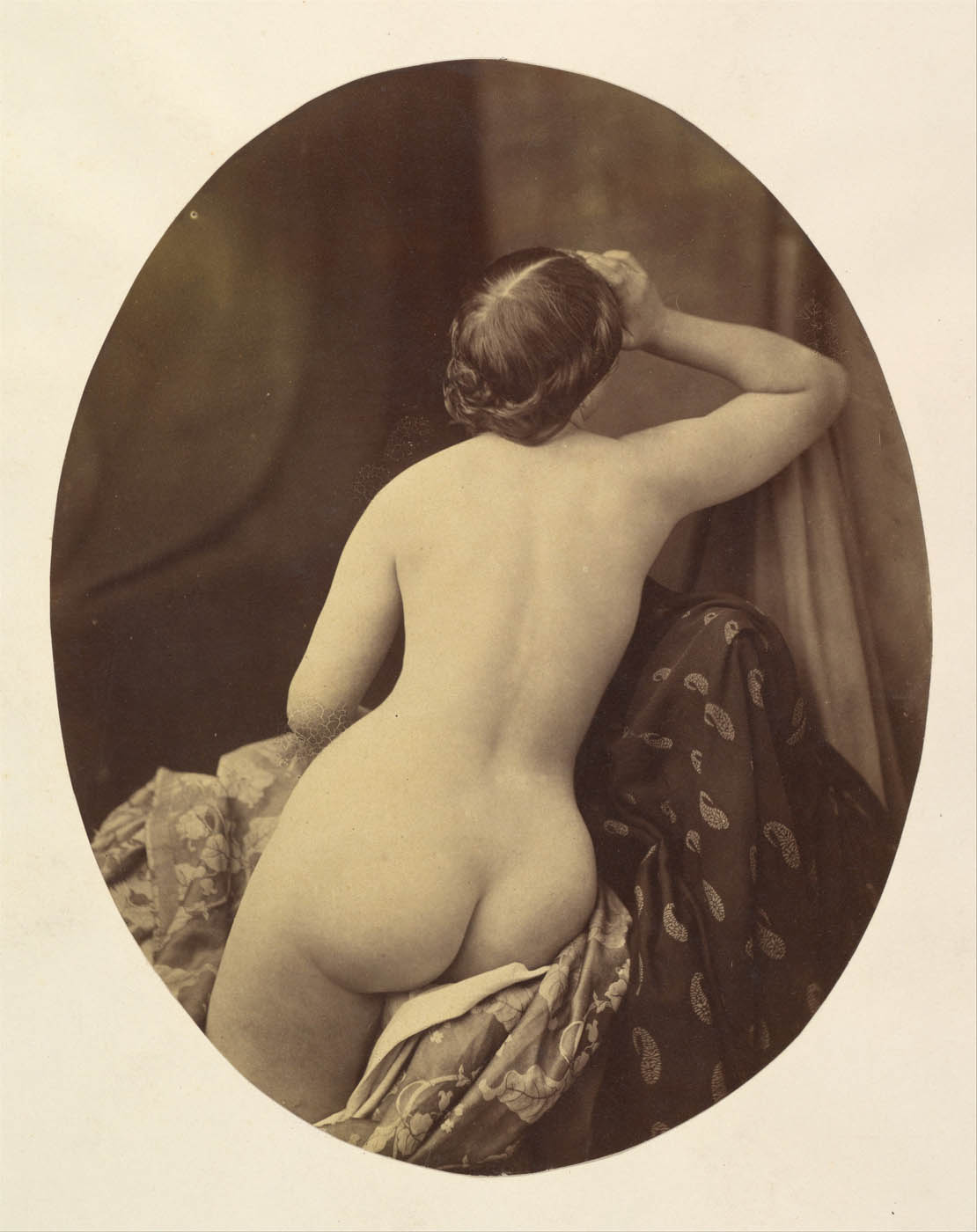
 

Oscar Gustav Rejlander (British born Sweden, 1813-1875) 'Ariadne' 1857


Oscar Gustav Rejlander (British born Sweden, 1813-1875)
Ariadne
1857
Albumen silver print from glass negative
Mount: 16 1/16 in. × 13 1/16 in. (40.8 × 33.2cm)
Image: 8 1/4 × 6 1/2 in. (21 × 16.5cm); oval
Metropolitan Museum of Art
Gilman Collection, Purchase, The Horace W. Goldsmith Foundation Gift, through Joyce and Robert Menschel, 2005
Public domain


Working in a place – Victorian England – where any photographic nude was considered offensive because the process implied not only the “nastiness” of the artist and vendor, but also “the degradation of the person who serves as model on the occasion,” Rejlander sought to ally his work with that of noted painters. This nude study is one of a series based on figures in the work of Raphael, Titian, Correggio, Rubens, Murillo, and Gainsborough; the precedent here is Titian’s Venus and Adonis, and Rejlander’s intention was to show how the painter adhered to or strayed from the ways a real body can twist and turn. Critic A. H. Wall defended the propriety of Rejlander’s Studies from the Nude, saying, “Refined and ennobled by art, real beauty, palpable flesh and blood, speaks of nothing but its own inherent loveliness.”

Such references to painting did not always afford adequate protection, however. Writing of Rejlander’s famous Two Ways of Life, photographer and critic Thomas Sutton wrote, “There is no impropriety in exhibiting such works of art as Etty’s Bathers Surprised by a Swan or the Judgment of Paris but there is impropriety in allowing the public to see photographs of nude prostitutes, in flesh-and-blood truthfulness and minuteness of detail.”

Text from the Metropolitan Museum of Art website


Unknown photographer (French) '[Female Nude with Mask]' c. 1870


Unknown photographer (French)
[Female Nude with Mask]
c. 1870
Albumen silver print from glass negative
26 x 19.1cm (10 1/4 x 7 1/2 in.)
Metropolitan Museum of Art
Gilman Collection, Gift of The Howard Gilman Foundation, 2005
Public domain


Even as she seems to part her tresses to expose her naked body, the model here masks her face in an effort to conceal her identity. While drawing, painting, and sculpture of the human figure commonly involve elements of transformation, idealisation, or the combination of features from various models, photography usually presents a recognisable image of its subject. It was not uncommon, therefore, for models who routinely posed nude for artists in other media to hide their faces when standing naked before the camera. For the viewer – not always an artist looking for help in figure drawing – the mask added an element of erotic frisson.

Text from the Metropolitan Museum of Art website
 

Louis Igout (French, 1837-1881)(Photographer) A. Calavas (French)(Editor) 'Plate from Album d'Études – Poses' c. 1880


Louis Igout (French, 1837-1881)(Photographer)
A. Calavas (French)(Editor)
Plate from Album d’Études – Poses
c. 1880
Albumen silver prints from glass negatives
Metropolitan Museum of Art
Purchase, The Horace W. Goldsmith Foundation Gift, through Joyce and Robert Menschel, 1993
Public domain


This album is an excellent example of the type of photography produced in the nineteenth century as an aid to artists in the study of contour, modelling, and proportion, and as a vocabulary of expression, gesture, and pose sanctioned by the art of antiquity and the Old Masters. Groupings representing Cain and Abel, the Drunken Silenus, Hercules and Antaeus, the Dying Gaul, the Cnidian Aphrodite, and others are recognisable among the photographs. Single prints showing sixteen small images, such as the page shown here, served as a type of stock catalogue, allowing clients to survey a broad range of possible poses and order larger prints of those which best served their needs.

Text from the Metropolitan Museum of Art website
 

Louis Igout (French, 1837-1881)(Photographer) A. Calavas (French)(Editor) 'Plate from Album d'Études – Poses' c. 1880 (detail)

Louis Igout (French, 1837-1881)(Photographer) A. Calavas (French)(Editor) 'Plate from Album d'Études – Poses' c. 1880 (detail)

Louis Igout (French, 1837-1881)(Photographer) A. Calavas (French)(Editor) 'Plate from Album d'Études – Poses' c. 1880 (detail)


Louis Igout (French, 1837-1881)(Photographer)
A. Calavas (French)(Editor)
Plate from Album d’Études – Poses (details)
c. 1880
Albumen silver prints from glass negatives
Metropolitan Museum of Art
Purchase, The Horace W. Goldsmith Foundation Gift, through Joyce and Robert Menschel, 1993
Public domain


Thomas Eakins (American, 1844-1916) '(Thomas Eakins and John Laurie Wallace on a Beach)' c. 1883


Thomas Eakins (American, Philadelphia, Pennsylvania 1844–1916 Philadelphia, Pennsylvania)
[Thomas Eakins and John Laurie Wallace on a Beach]
c. 1883
Platinum print
25.5 x 20.4cm (10 1/16 x 8 1/16 in.), irregular
Metropolitan Museum of Art
David Hunter McAlpin Fund, 1943
Public domain


The great American painter and photographer Thomas Eakins was devoted to the scientific study of the human form and committed to its truthful representation. While he and his students at the Pennsylvania Academy of the Fine Arts were surrounded by casts of classical sculpture, Eakins declared that he did not like “a long study of casts. … At best they are only imitations, and an imitation of imitations cannot have so much life as an imitation of life itself.” Photography provided an obvious solution.

This photograph, in which Eakins and a student affected the elegant contrapposto stances of classical sculpture, was probably taken during an excursion with students to Manasquan Inlet at Point Pleasant, New Jersey, during the summer of 1883. Valuing his photographs not only as studies for paintings but also for their own sake, Eakins carefully printed the best images on platinum paper. In this case, he went to the additional trouble of enlarging the original, horizontally formatted image and cropping it vertically to better contain the perfectly balanced figures.

Text from the Metropolitan Museum of Art website
 

Albert Londe (French, 1858-1917) Paul Marie Louis Pierre Richer (French, 1849-1933) '[Male Musculature Study]' c. 1890


Albert Londe (French, 1858-1917)
Paul Marie Louis Pierre Richer (French, 1849-1933)
[Male Musculature Study]
c. 1890
Albumen silver print
Image: 14.9 x 9.6 cm (5 7/8 x 3 3/4 in.)
Mount: 14.9 x 9.9 cm (5 7/8 x 3 7/8 in.)
Metropolitan Museum of Art
Gift of Charles Isaacs and Carol Nigro, 2012


Author of a treatise on the importance of the camera in medical practice, Albert Londe declared, “the photographic plate is the scientist’s true retina.” In collaboration with a laboratory director and professor of anatomy at the École des Beaux-Arts, Londe found that photographs intended for physiological analysis could also serve artistic applications. Their careful portraits of athletes – whether taken with stop-action cameras specially designed by Londe or in static poses such as the example here – were used in scientific texts on musculature and became templates for illustrations to aid artists in rendering ideally proportioned figures.

Text from the Metropolitan Museum of Art website
 

Guglielmo Plüshow (Italian born Germany, 1852–1930) '[Young Male Nude Seated on Leopard Skin]' 1890s-1900s


Guglielmo Plüshow (Italian born Germany, 1852–1930)
[Young Male Nude Seated on Leopard Skin]
1890s-1900s
Albumen silver print from glass negative
22.2 x 16.2cm (8 3/4 x 6 3/8 in.)
Metropolitan Museum of Art
Museum Accession
Creative Commons CC0 1.0 Universal Public Domain Dedication


Censors have long struggled to keep pace with evolving technology and expanding distribution networks of photographic erotica. In nineteenth-century France, government officials regularly seized thousands of photographs similar to the daguerreotype displayed here, which were deemed lewd.

Male nudity has frequently been subject to stricter control than pornography featuring women. The Arcadian photographs of Plüshow and his cousin and student Wilhelm von Gloeden were avidly collected in the late nineteenth century, but in the 1930s many of their prints and negatives, considered deviant by the Italian Fascist government, were destroyed. For much of the twentieth century, it was illegal in the United States to mail photographs that might be judged prurient, forcing photographers to mask genitalia and pubic hair with strategic props or with overpainting that could be easily removed by purchasers. Sale of erotic male physique magazines and bodybuilder pin-ups, ostensibly circulated to promote fitness, was legalised in a 1962 Supreme Court ruling, which concluded that “portrayals of the male nude cannot fairly be regarded as more objectionable than many portrayals of the female nude that society tolerates.”

Text from the Metropolitan Museum of Art website
 

Attributed to Alphonse Bertillon (French, 1853–1914) 'Assasination of C. Lecomte 711 Rue des Martyrs' 1901-1908 From 'Album of Paris Crime Scenes'


Attributed to Alphonse Bertillon (French, 1853–1914)
Assasination of C. Lecomte 711 Rue des Martyrs
1901-1908
From Album of Paris Crime Scenes
Gelatin silver print
Overall: 24.3 x 31cm (9 9/16 x 12 3/16in.)
Page: 23 x 29cm (9 1/16 x 11 7/16 in.)
Metropolitan Museum of Art
Gilman Collection, Purchase, The Howard Gilman Foundation Gift, 2001
Public domain


Alphonse Bertillon, the chief of criminal identification for the Paris police department, developed the mug shot format and other photographic procedures used by police to register criminals. Although the images in this extraordinary album of forensic photographs were made by or under the direction of Bertillon, it was probably assembled by a private investigator or secretary who worked at the Paris prefecture. Photographs of the pale bodies of murder victims are assembled with views of the rooms where the murders took place, close-ups of objects that served as clues, and mug shots of criminals and suspects. Made as part of an archive rather than as art, these postmortem portraits, recorded in the deadpan style of a police report, nonetheless retain an unsettling potency.

Text from the Metropolitan Museum of Art website
 

Attributed to Alphonse Bertillon (French, 1853–1914) 'Untitled' 1901-1908 From 'Album of Paris Crime Scenes'


Attributed to Alphonse Bertillon (French, 1853–1914)
Untitled
1901-1908
From Album of Paris Crime Scenes
Gelatin silver print
Overall: 24.3 x 31cm (9 9/16 x 12 3/16in.)
Page: 23 x 29cm (9 1/16 x 11 7/16 in.)
Metropolitan Museum of Art
Gilman Collection, Purchase, The Howard Gilman Foundation Gift, 2001
Public domain
 

Attributed to Alphonse Bertillon (French, 1853–1914) 'Untitled' 1901-1908 From 'Album of Paris Crime Scenes'


Attributed to Alphonse Bertillon (French, 1853–1914)
Untitled
1901-1908
From Album of Paris Crime Scenes
Gelatin silver print
Overall: 24.3 x 31cm (9 9/16 x 12 3/16in.)
Page: 23 x 29cm (9 1/16 x 11 7/16 in.)
Metropolitan Museum of Art
Gilman Collection, Purchase, The Howard Gilman Foundation Gift, 2001
Public domain


Lady Ottoline Violet Anne Cavendish-Bentinck Morrell (British, 1873-1938) '[Cavorting by the Pool at Garsington]' c. 1916


Lady Ottoline Violet Anne Cavendish-Bentinck Morrell (British, 1873-1938)
[Cavorting by the Pool at Garsington]
c. 1916
Gelatin silver print
8.8 x 6.3cm (3 7/16 x 2 7/16 in.)
Metropolitan Museum of Art
Gilman Collection, Purchase, The Horace W. Goldsmith Foundation Gift, through Joyce and Robert Menschel, 2005
Creative Commons CC0 1.0 Universal Public Domain Dedication


Rebelling against the narrow values of upper-class Edwardian society, Lady Ottoline Morrell, an eccentric hostess to Bloomsbury, surrounded herself in London and on her estate at Garsington with a large circle of friends including Bertrand Russell, W. B. Yeats, D. H. Lawrence, T. S. Eliot, Virginia Woolf, Aldous Huxley, and E. M. Forster. These images of an improvised dance show Lady Ottoline’s ten-year-old daughter, Julian, and her slightly older companions embroiled in a naked whirl, pagan in its exuberance, that reflects the emancipated attitudes of the photographer’s circle.

Text from the Metropolitan Museum of Art website


Lady Ottoline Violet Anne Cavendish-Bentinck Morrell (British, 1873-1938) '[Cavorting by the Pool at Garsington]' c. 1916


Lady Ottoline Violet Anne Cavendish-Bentinck Morrell (British, 1873-1938)
[Cavorting by the Pool at Garsington]
c. 1916
Gelatin silver print
8.8 x 6.2cm (3 7/16 x 2 7/16 in.)
Metropolitan Museum of Art
Gilman Collection, Purchase, The Horace W. Goldsmith Foundation Gift, through Joyce and Robert Menschel, 2005
Creative Commons CC0 1.0 Universal Public Domain Dedication


Edward Weston (American, Highland Park, Illinois 1886 - 1958 Carmel, California) '[Nude]' 1925


Edward Weston (American, Highland Park, Illinois 1886 – 1958 Carmel, California)
[Nude]
1925
Gelatin silver print
Image: 14.8 x 23.4 cm (5 13/16 x 9 3/16 in.)
Mount: 35.2 x 43.9 cm (13 7/8 x 17 5/16 in.)
Metropolitan Museum of Art
Gilman Collection, Purchase, Ann Tenenbaum and Thomas H. Lee Gift, 2005
© Center for Creative Photography, Arizona Board of Regents
Public domain


In his early attempts to merge the realism of photography with the expressive effect of abstract art, Weston honed in on close-up details of his subjects. That the faces of his models were often cropped or averted served practical as well as aesthetic purposes, enabling the photographs to be read as figure studies rather than as individual portraits while also protecting the privacy of the friends and lovers who served as models.

Text from the Metropolitan Museum of Art website


George Platt Lynes (American, East Orange, New Jersey 1907–1955 New York) '[Male Nude]' 1930s


George Platt Lynes (American, East Orange, New Jersey 1907–1955 New York)
[Male Nude]
1930s
Gelatin silver print
24.5 x 18.9cm (9 5/8 x 7 7/16 in.)
Metropolitan Museum of Art
Ford Motor Company Collection, Gift of Ford Motor Company and John C. Waddell, 1987
© Estate of George Platt Lynes
 

Brassaï (French born Romania, Brasov 1899 - 1984 Côte d'Azur) 'Nude' 1931-1934


Brassaï (French born Romania, Brasov 1899 – 1984 Côte d’Azur)
Nude
1931-1934
Gelatin silver print
14.1 x 23.5cm (5 9/16 x 9 1/4 in.)
Metropolitan Museum of Art
Twentieth-Century Photography Fund, 2007
© The Estate of Brassai


One of the most radically abstract of Brassaï’s nudes, this image was published in 1933 in the inaugural issue of the avant-garde magazine Minotaure. With the figure’s head and legs cut off by the picture’s edges, the twisting, truncated torso seems to float in space like an apparition – an ambiguous, organic form with an uncanny resemblance to a phallus. This transformation of the female figure into a fetish object is a hallmark of Surrealism that reflects the important influence of Freud’s psychoanalytic theory on European art of the early twentieth century.

Text from the Metropolitan Museum of Art website
 

Brassaï (French born Romania, Brasov 1899 - 1984 Côte d'Azur) 'L'Académie Julian' 1931, printed 1950s


Brassaï (French born Romania, Brasov 1899 – 1984 Côte d’Azur)
L’Académie Julian
1931, printed 1950s
Gelatin silver print
29.7 x 23.7cm (11 11/16 x 9 5/16 in.)
Metropolitan Museum of Art
Gilman Collection, Purchase, The Horace W. Goldsmith Foundation Gift, through Joyce and Robert Menschel, 2005
© Estate Brassaï Succession – Paris
 

Brassaï (French born Romania, Brasov 1899 - 1984 Côte d'Azur) 'Introductions at Suzy's' 1932-1933


Brassaï (French born Romania, Brasov 1899 – 1984 Côte d’Azur)
Introductions at Suzy’s
1932-1933, printed later
Gelatin silver print
23.1 x 16.8cm (9 1/16 x 6 5/8 in.)
Metropolitan Museum of Art
Ford Motor Company Collection, Gift of Ford Motor Company and John C. Waddell, 1987
© Estate Brassaï Succession – Paris


Brassaï made his name as a chronicler of the night, with images that ranged from reflections on wet cobblestones to the denizens of bars and brothels. Like so many of his photographs, Introductions at Suzy’s was not an impromptu scene caught by an undetected observer but rather a carefully constructed tableau meant to highlight the dynamic between buttoned-up bourgeois clients and Suzy’s bevy of prostitutes, naked but for their bracelets and high heels. The “client” was actually Brassaï’s friend and bodyguard; the “girls,” however, were not stand-ins.

Text from the Metropolitan Museum of Art website


Brassaï (French, 1899-1984) 'Chez Suzy / Armoire à glace dans un hôtel de passe, rue Quincampoix' (Mirrored cabinet in a brothel, rue Quincampoix) 1932, printed 1950s


Brassaï (French, 1899-1984)
Chez Suzy / Armoire à glace dans un hôtel de passe, rue Quincampoix (Mirrored cabinet in a brothel, rue Quincampoix)
1932, printed 1950s
Gelatin silver print
23.3 x 16.8cm (9 3/16 x 6 5/8 in.)
Metropolitan Museum of Art
Warner Communications Inc. Purchase Fund, 1980
© Estate Brassaï Succession – Paris


A keen observer of Parisian nightlife in the 1930s, Brassaï was drawn to the visual conundrums and optical innuendos of everyday life. The play of reflections and absences in this image, made in a Paris brothel, suggests the materialization of subconscious impulses. Evoking Freud’s definition of desire as the sensation arising from a perceived absence of remembered pleasure, this blatantly sexual scene suggests but withholds a specific narrative.

Text from the Metropolitan Museum of Art website
 

André Kertész (American born Hungary, Budapest 1894 - 1985 New York City) 'Distortion #6' 1932


André Kertész (American born Hungary, Budapest 1894 – 1985 New York City)
Distortion #6
1932
Gelatin silver print
23.4 x 17.3cm (9 3/16 x 6 13/16 in.)
Metropolitan Museum of Art
Ford Motor Company Collection, Gift of Ford Motor Company and John C. Waddell, 1987
© The Estate of André Kertész / Higher Pictures


Although Kertesz had long been interested in mirrors, reflections, and the idea of distorting the human figure, he did not seriously investigate their photographic possibilities until 1933, when the risqué French magazine Le Sourire commissioned him to make a series of figure studies. Using a funhouse mirror from a Parisian amusement park, Kertesz, who had never photographed nudes before, spent four weeks making about two hundred negatives.

Kertész accentuated the narrow ribcage and long waist of the ideal contemporary woman by photographing his model in a carnival mirror. If the top half of this beautiful nude resembles those Modigliani painted, the swell of the haunch recalls Mannerist nudes and their nineteenth-century revivals, especially Ingres’ grande odalisque.

Text from the Metropolitan Museum of Art website
 

Man Ray (American, Philadelphia, Pennsylvania 1890 - 1976 Paris) 'Arm' c. 1935


Man Ray (American, Philadelphia, Pennsylvania 1890 – 1976 Paris)
Arm
c. 1935
Gelatin silver print
29.7 x 23.0cm (11 11/16 x 9 1/16 in.)
Metropolitan Museum of Art
Ford Motor Company Collection, Gift of Ford Motor Company and John C. Waddell, 1987
© 2012 Man Ray Trust / Artists Rights Society (ARS), NY / ADAGP, Paris


Man Ray’s photograph of an arm is cropped so abstractly that it seems to metamorphose into other body parts – a knee, a calf, a thigh – or into some utterly unidentifiable yet heroic form. This image appeared on the cover of Formes Nues (1935), which also included the work of Brassaï, László Moholy-Nagy, Franz Roh, and George Platt Lynes, among others.

In the magazine’s introduction, Man Ray wrote, “were it not for the fact that photography permits me to seize and to possess the human body and face in more than a temporary manner, I should quickly have tired of this medium.”

Text from the Metropolitan Museum of Art website


Paul Outerbridge Jr. (American, New York 1896 - 1959 Laguna Beach, California) 'Nude with Mask and Hat' c. 1936


Paul Outerbridge Jr. (American, New York 1896 – 1959 Laguna Beach, California)
Nude with Mask and Hat
c. 1936
Carbro print
43.3 x 30.0cm (17 1/16 x 11 13/16 in.)
Metropolitan Museum of Art
Warner Communications Inc. Purchase Fund, 1977


Outerbridge was a successful commercial photographer, but although he found such work stimulating, he also made photographs as a means of personal expression throughout his career. Photographing nude models in colour in the 1930s was challenging – not only in the difficulty of correctly capturing skin tones using complicated new processes, but also because finding a venue to publish or exhibit the work was unlikely. Although he began by posing his models in the manner of painted masterpieces, Outerbridge’s compositions became increasingly provocative in the late 1930s. The sexualised charge and commercial palette of works such as this were not in keeping with attitudes of the period and were not shown during the artist’s lifetime.

Text from the Metropolitan Museum of Art website


Hans Bellmer (German born Poland, Katowice 1902–1975 Paris) 'La Poupée' 1936


Hans Bellmer (German born Poland, Katowice 1902–1975 Paris)
La Poupée
1936
Gelatin silver print with applied colour
Mount: 9 5/8 in. × 7 1/2 in. (24.5 × 19cm)
Image: 5 5/16 × 5 9/16 in. (13.5 × 14.1cm)
Metropolitan Museum of Art
Ford Motor Company Collection, Gift of Ford Motor Company and John C. Waddell, 1987
© 2024 Artists Rights Society (ARS), New York


In his nightmarish tableaux of mutilated and reassembled dolls posed in domestic interiors, Bellmer grappled with the base condition of the human body and with the bodily fragment as fetish object. Mannequins and dolls – simultaneously familiar and strange – supplied the material for his primal expressions of terror and awe, which often evoked the innocent violence and latent sexuality of childhood games. Whether they are read as Freudian emblems of the uncanny or as ominous harbingers of Nazi atrocities, Bellmer’s images exemplify the Surrealist view of the female body as the source of simultaneous fascination and revulsion.

Text from the Metropolitan Museum of Art website


Edward Weston (American 1886-1958) 'Nude' 1936, printed c. 1954


Edward Weston (American, Highland Park, Illinois 1886 – 1958 Carmel, California)
Printer: Brett Weston (American, Los Angeles, California 1911-1993 Kona, Hawaii) or Cole Weston (American, 1919-2003)
Nude on Sand, Oceano
1936, printed c. 1954
Gelatin silver print
19.1 x 24.2cm (7 1/2 x 9 1/2 in.)
David Hunter McAlpin Fund, 1957
© Center for Creative Photography, Arizona Board of Regents


Charis Wilson, the model for this series, admitted to being shocked upon seeing Weston’s nudes for the first time, as she had previously known only the romantically retouched photographs of depilated bodies then popular. In studying Weston’s work she found, “I couldn’t get past the simple amazement at how real they were. Then I began to see the rhythmic patterns, the intensely perceived sculptural forms, the subtle modulations of tone, of which these small, perfect images were composed. And I began to appreciate the originality of the viewpoint that had selected just these transitory moments and made them fast against the current of time.”

Text from the Metropolitan Museum of Art website
 

Irving Penn (American, Plainfield, New Jersey 1917 - 2009 New York City) 'Nude No. 57' 1949-1950


Irving Penn (American, Plainfield, New Jersey 1917 – 2009 New York City)
Nude No. 57
1949-1950
Gelatin silver print
39.4 x 37.5cm (15 1/2 x 14 3/4 in.)
Metropolitan Museum of Art
Gift of the artist, 2002
© 1950-2002 Irving Penn


By 1950, Penn was a well-known Vogue portrait and fashion photographer but had already made, privately, a major series of nudes – a personal but lesser-known body of work. During the week, he photographed models wearing fashionable clothes for the magazine, but weekends and evenings he made studies of female nudes. The women were full-bodied and the photographs unorthodox, recalling the form and spirit of archaic fertility idols.

Text from the Metropolitan Museum of Art website


Harry Callahan (American, 1912-1999) 'Eleanor and Barbara' 1954, printed 1970s


Harry Callahan (American, 1912-1999)
Eleanor and Barbara
1954
Gelatin silver print
22.8 x 22.1cm (9 x 8 11/16 in.)
Metropolitan Museum of Art
Gift of Joyce and Robert Menschel, 1993
© The Estate of Harry Callahan; Courtesy Pace/MacGill Gallery, New York


Muses throughout his career, Callahan’s wife and daughter played, posed, and aged before his lens. With their attention to the physicality of light, however, Callahan’s photographs transcend mere family portraiture by calling attention to the simple beauty of life’s fleeting moments. “He just liked to take the pictures of me,” Eleanor recalled in her nineties. “In every pose. Rain or shine. And whatever I was doing. If I was doing the dishes or if I was half asleep. And he knew that I never, never said no. I was always there for him. Because I knew that Harry would only do the right thing.”

Eleanor Callahan died in February 2012 at the age of ninety-five.

Text from the Metropolitan Museum of Art website


Diane Arbus (American, 1923-1971) 'Retired man and his wife at home in a nudist camp one morning, N.J.' 1963


Diane Arbus (American, 1923-1971)
Retired man and his wife at home in a nudist camp one morning, N.J.
1963
Gelatin silver print
39.9 × 37.9cm (15 11/16 × 14 15/16 in.)
Metropolitan Museum of Art
Purchase, Joyce Frank Menschel, and Ann Tenenbaum and Thomas H. Lee Gifts; Louis V. Bell, Harris Brisbane Dick, Fletcher, and Rogers Funds and Joseph Pulitzer Bequest; and Marlene Nathan Meyerson Family Foundation, Twentieth-Century Photography Fund, Diana Barrett and Robert Vila, Elizabeth S. and Robert J. Fisher, Charlotte and Bill Ford, Lita Annenberg Hazen Charitable Trust and Hazen Polsky Foundation Inc., Jennifer and Joseph Duke, Jennifer and Philip Maritz, Saundra B. Lane, The Jerry and Emily Spiegel Family Foundation and Pamela and Arthur Sanders, Anonymous, and The Judith Rothschild Foundation Gifts, 2007
© The Estate of Diane Arbus


Arbus’s interest in the tension between revelation and concealment comes into starkest focus in the portraits she made at Sunshine Park, a family nudist camp in New Jersey. While nudism might be considered the ultimate form of exposure, it often required a different kind of cover-up. As the artist remarked in an unpublished article written for Esquire magazine in 1966: “For many of these people, their presence here is the darkest secret of their lives, unsuspected by relatives, friends, and employers in the outside world, the disclosure of which might bring disgrace.”

Text from the Metropolitan Museum of Art website
 

Diane Arbus (American, 1923-1971) 'A naked man being a woman, N.Y.C.' 1968


Diane Arbus (American, 1923-1971)
A naked man being a woman, N.Y.C.
1968
Gelatin silver print
38.2 x 36.2cm
Metropolitan Museum of Art
Purchase, Joyce Frank Menschel, and Ann Tenenbaum and Thomas H. Lee Gifts; Louis V. Bell, Harris Brisbane Dick, Fletcher, and Rogers Funds and Joseph Pulitzer Bequest; and Marlene Nathan Meyerson Family Foundation, Twentieth-Century Photography Fund, Diana Barrett and Robert Vila, Elizabeth S. and Robert J. Fisher, Charlotte and Bill Ford, Lita Annenberg Hazen Charitable Trust and Hazen Polsky Foundation Inc., Jennifer and Joseph Duke, Jennifer and Philip Maritz, Saundra B. Lane, The Jerry and Emily Spiegel Family Foundation and Pamela and Arthur Sanders, Anonymous, and The Judith Rothschild Foundation Gifts, 2007
© The Estate of Diane Arbus


Mark Morrisroe (American, 1959-1989) 'Untitled [Two Men in Silhouette]' c. 1987


Mark Morrisroe (American, 1959-1989)
Untitled [Two Men in Silhouette]
c. 1987
Gelatin silver print
28.4 x 20.8cm (11 3/16 x 8 3/16 in.)
Metropolitan Museum of Art
Twentieth-Century Photography Fund, 2009
© The Estate of Mark Morrisroe (Ringier Collection) at Fotomuseum Winterthur


Sexuality and mortality – which many would say are central preoccupations of humankind – are key to Morrisroe’s biography and art. The son of a drug-addicted mother, a teenage hustler, and a precocious punk queer, Morrisroe carried a bullet (shot by a disgruntled john) in his chest from the age of eighteen and consequently walked with a limp that added one more element to his outsider self-image. Sex and death were persistent themes in his work, with pronounced poignancy after his 1986 AIDS diagnosis. In this work, Morrisroe has taken a page from a gay S&M magazine, cut out the shapes of two naked men, and used the sheet as a negative to print a unique image in which the figures – literally absent – appear as dark silhouettes against a netherworld of sexual activity.

Text from the Metropolitan Museum of Art website


The Metropolitan Museum of Art
1000 Fifth Avenue at 82nd Street
New York, New York 10028-0198
Phone: 212-535-7710

Opening hours:
Thursday – Tuesday 10am – 5pm
Closed Wednesday

The Metropolitan Museum of Art website

LIKE ART BLART ON FACEBOOK

Back to top