Exhibition: ‘The 80s: Photographing Britain’ at Tate Britain, London

Exhibition dates: 21st November, 2024 – 5th May, 2025

Curators: Yasufumi Nakamori, former Senior Curator of International Art (Photography) Tate Modern, Helen Little, Curator, British Art, Tate Britain and Jasmine Chohan, Assistant Curator, Contemporary British Art, Tate Britain with additional curatorial support from Bilal Akkouche, Assistant Curator, International Art, Tate Modern; Sade Sarumi, Curatorial Assistant, Contemporary British Art, Tate Britain and Bethany Husband, Exhibitions Assistant, Tate Britain

List of artists: Keith Arnatt; Zarina Bhimji; Derek Bishton; Sutapa Biswas; Tessa Boffin; Marc Boothe; Victor Burgin; Vanley Burke; Pogus Caesar; Thomas Joshua Cooper; John Davies; Poulomi Desai; Al-An deSouza; Willie Doherty; Jason Evans; Rotimi Fani-Kayode; Anna Fox; Simon Foxton; Armet Francis; Peter Fraser; Melanie Friend; Paul Graham; Ken Grant; Joy Gregory; Sunil Gupta; John Harris; Lyle Ashton Harris; David Hoffman; Brian Homer; Colin Jones; Mumtaz Karimjee; Roshini Kempadoo; Peter Kennard; Chris Killip; Karen Knorr; Sirkka-Liisa Konttinen; Grace Lau; Dave Lewis; Markéta Luskačová; David Mansell; Jenny Matthews; Don McCullin; Roy Mehta; Peter Mitchell; Dennis Morris; Maggie Murray; Tish Murtha; Joanne O’Brien; Zak Ové; Martin Parr; Ingrid Pollard; Brenda Prince; Samena Rana; John Reardon; Paul Reas; Olivier Richon; Suzanne Roden; Franklyn Rodgers; Paul Seawright; Syd Shelton; Jem Southam; Jo Spence; John Sturrock; Maud Sulter; Homer Sykes; Mitra Tabrizian; Wolfgang Tillmans; Paul Trevor; Maxine Walker; Albert Watson; Tom Wood; Ajamu X.


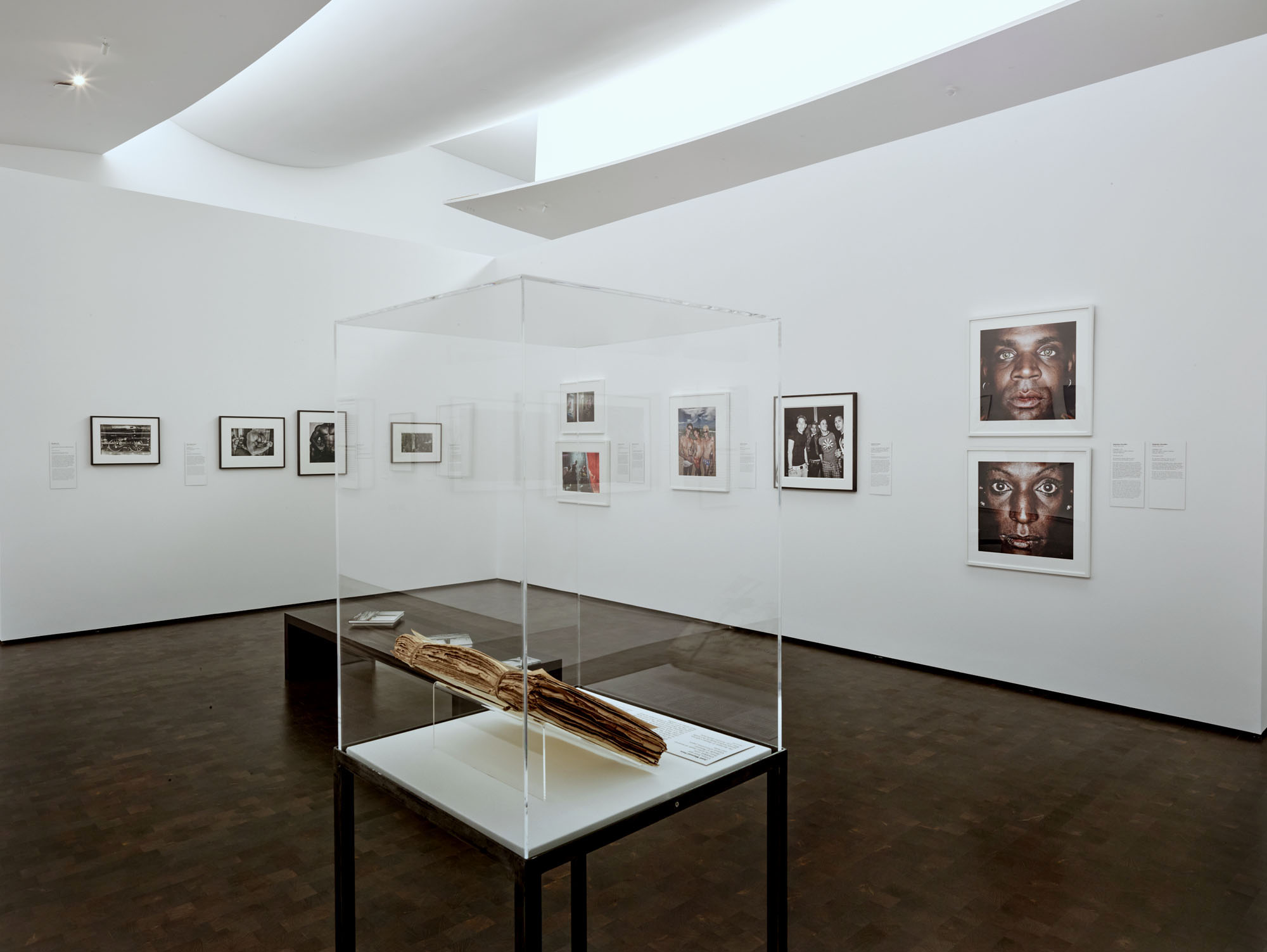
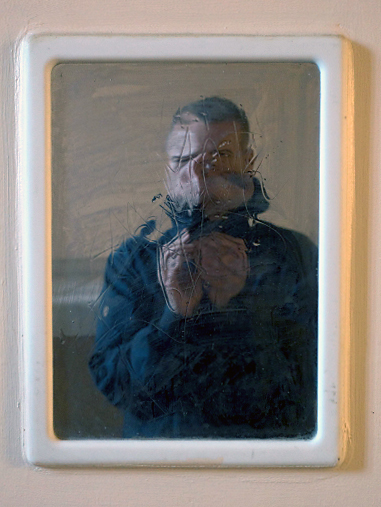
Jason Evans (Welsh, b. 1968) and Simon Foxton (British, b. 1961) 'Untitled' 1991 From the series 'Strictly' from the exhibition 'The 80s: Photographing Britain' at Tate Britain, London, Nov 2024 - May 2025


Jason Evans (Welsh, b. 1968) and Simon Foxton (British, b. 1961)
Untitled
1991
From the series Strictly
Tate
© Jason Evans


A humungous posting that, much like the exhibition itself, cannot do justice to the photographs and issues of an entire decade – the flow on effects of which are still being felt today.

From distant Australia and having not seen the exhibition myself, I cannot do justice – now there is an apposite word for the decade – to the flow of the exhibition, the many included or neglected artists involved or not, the bodies of work displayed or their commentary on the many disparate, competing and complex political, economic and social cataclysms (def: a sudden violent political or social upheaval) of the decade: including but not limited to, race, gender, identity, representation, activism, neoliberalism, Thatcher, The Miners’ Strike, Clause 28, HIV/AIDS, feminism, racism, class, patriarchy, money, greed, hedonism, humanism, subcultures, unemployment, strikes, poverty, luxury, consumer culture, war (Falklands) and riots, for example the Brixton riots of 1981.

I lived those years in the UK before emigrating to Australia in 1986. What I remember is the terrible weather, the cold and the damp, the vile Thatcher, and the poor quality of living. I lived in Stockwell (or Saint Ockwell as we used to call it) near Brixton in the early 80s before moving to Shepherd’s Bush were all the Mods gathered on their scooters on the roundabout as part of the mod revival.

I worked at a fish and chip restaurant called Geales just off Notting Hill Gate working double shifts, 10.30 – 3pm, 5.30 – 12, five days a week. The restaurant served fish and chips with French champagne and wines. The mostly gay floor staff were paid a pittance but we earnt our money off the tips we received from the celebrities that inhabited the place, people such as Bill Connolly, John Cleese, Divine and Kenny Everett. They loved us gay boys.

We worked hard and partied harder, often going out from Friday night to Sunday night to the clubs with a rest day on Monday. We were young. We ran from place to place living at a hundred miles an hour, not realising the ruts in London are very deep and you were spending as much as you made just to pay the rent, to eat at dive cafe (I lived on Mars bars, fish and chips, braised heart, mashed potatoes and bullet peas to name a few and I was as thin as a rake), and to go out partying, to have fun, visiting the alternative clubs in Kings Cross, Vauxhall, Brixton and the East End.

And then there was the spectre of HIV/AIDS raising its ugly head. I had my first HIV test in 1983. I had my blood taken and I went back 2 weeks later for the result. I sat outside the doctor’s room and if they called you in and said you had it, you were dead. To look death in the face at 25. The was no treatment. I survived but many of my friends, both here and in Australia, didn’t. We partied harder.


There are so many perspectives on the 80s that it is an impossible task for one exhibition to cover all of the issues. Reviews have noted that the exhibition is “a meandering look at pomp, protest” (Guardian); “exhaustive and exhausting… [the exhibition] makes for a dogged viewing experience that confuses as much as it enlightens” (Guardian); “a sense of fatigue and depletion as it went on and on … it could have been more engaging, more pleasurable” (1000 Words); and “the critical reception of the show has been rather lukewarm” (The Brooklyn Rail).

Most writer’s observe that the exhibition illuminates the way photography shifts “from monochrome to colour, from photojournalism to a more detached style of documentary” featuring “constructed, studio-based and appropriationist work.” The exhibition distils “the curatorial thrust of this sprawling exhibition, which, as its subtitle suggests, is more about photography’s often conceptually based responses to the 1980s than the turbulent nature of the decade itself.”1

Further, Bartolomeo Sala observes that the meandering view of the 1980s is consistent with the curatorial approach to the exhibition, “that is, to present eighties Britain not as a ossified relic but rather a container of multitudes, a country animated by competing, clashing energies and defying coherent description in a way that feels very reminiscent of today. A neoliberal hellhole, a nightmare of petit bourgeois conformity and cheapness, and at the same time an increasingly tolerant, multicultural, and open society, which finds its motor and pride in diversity and the endless project of self-fashioning.”2

Forty plus years on we are still paying the price for Thatcher’s neoliberal hellhole, with the loss of community, and the lack of compassion and empathy for others. I often think it was a more vibrant, more alive time in the 1980s despite all of its inherent problems. While we may have become a more tolerant, multicultural society, fascism and the right, disenfranchisement and loss of rights lurk ever closer to the surface. While we have pride we also have arrogance and self-aggrandisement, self-entitlement. While then we seemingly had freedom and love we now have surveillance and control. In some ways then I disagree with today being a more “open” society.

What social documentary and conceptual photography pictured so strongly and conscientiously in 1980s Britain was the vibrant madness of the age. The passions and the prejudices. Half your luck that you go and see this exhibition in London, that you have a chance to breathe in these photographs, for in Australia the chance of seeing such an exhibition of photographs from the 1980s by a state or national gallery would be zero.

I wouldn’t complain too much!

Dr Marcus Bunyan


1/ Sean O’Hagan. “The 80s: Photographing Britain review – in your face and to the barricades,” on The Guardian website, Sun 24 Nov 2024 [Online] Cited 02/05/2025

2/ Bartolomeo Sala. “The 80s: Photographing Britain,” on The Brooklyn Rail website March 2025 [Online] Cited 03/04/2025


Many thankx to Tate Britain for allowing me to publish the photographs in the posting. Please click on the photographs for a larger version of the image.


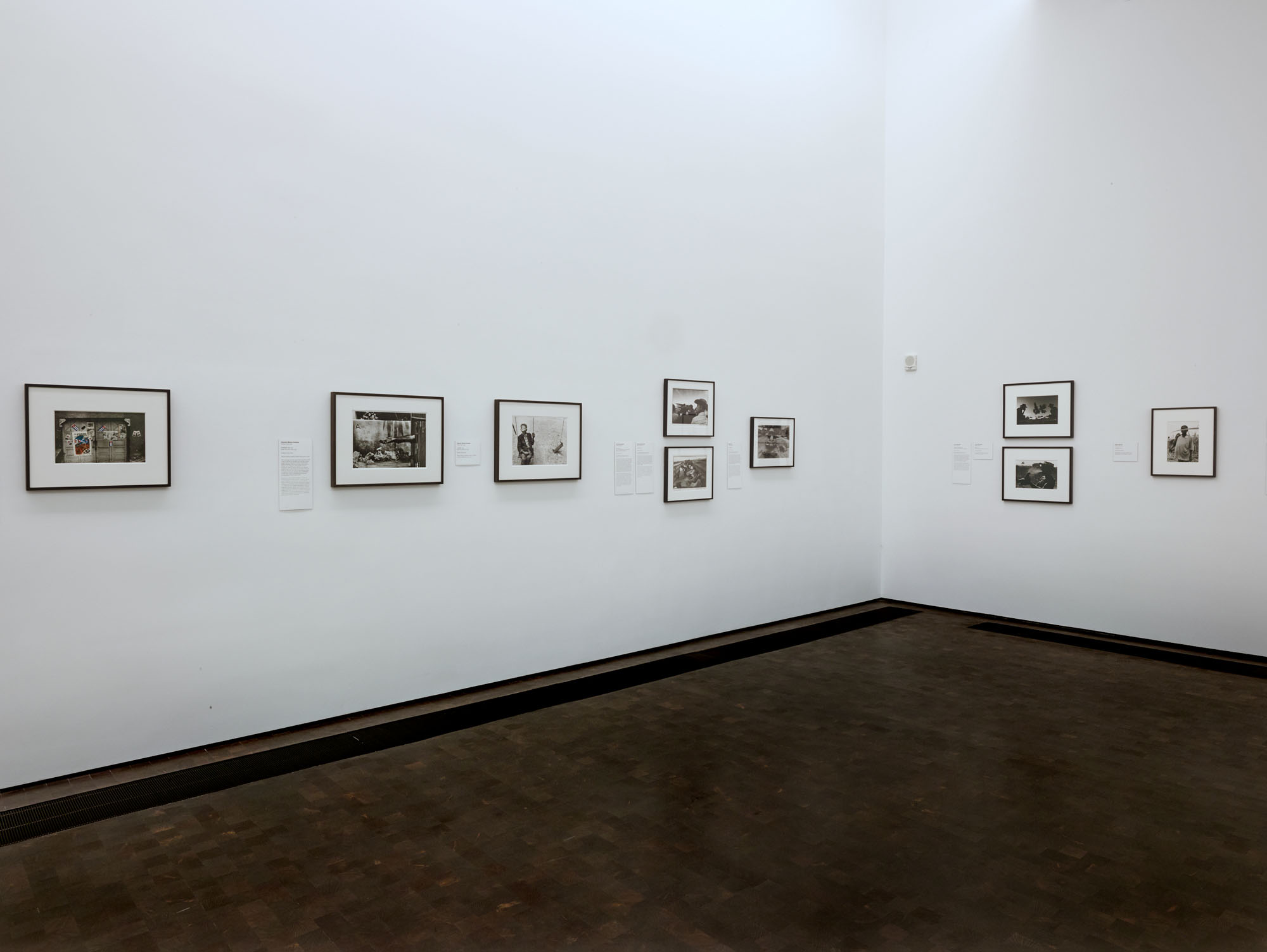
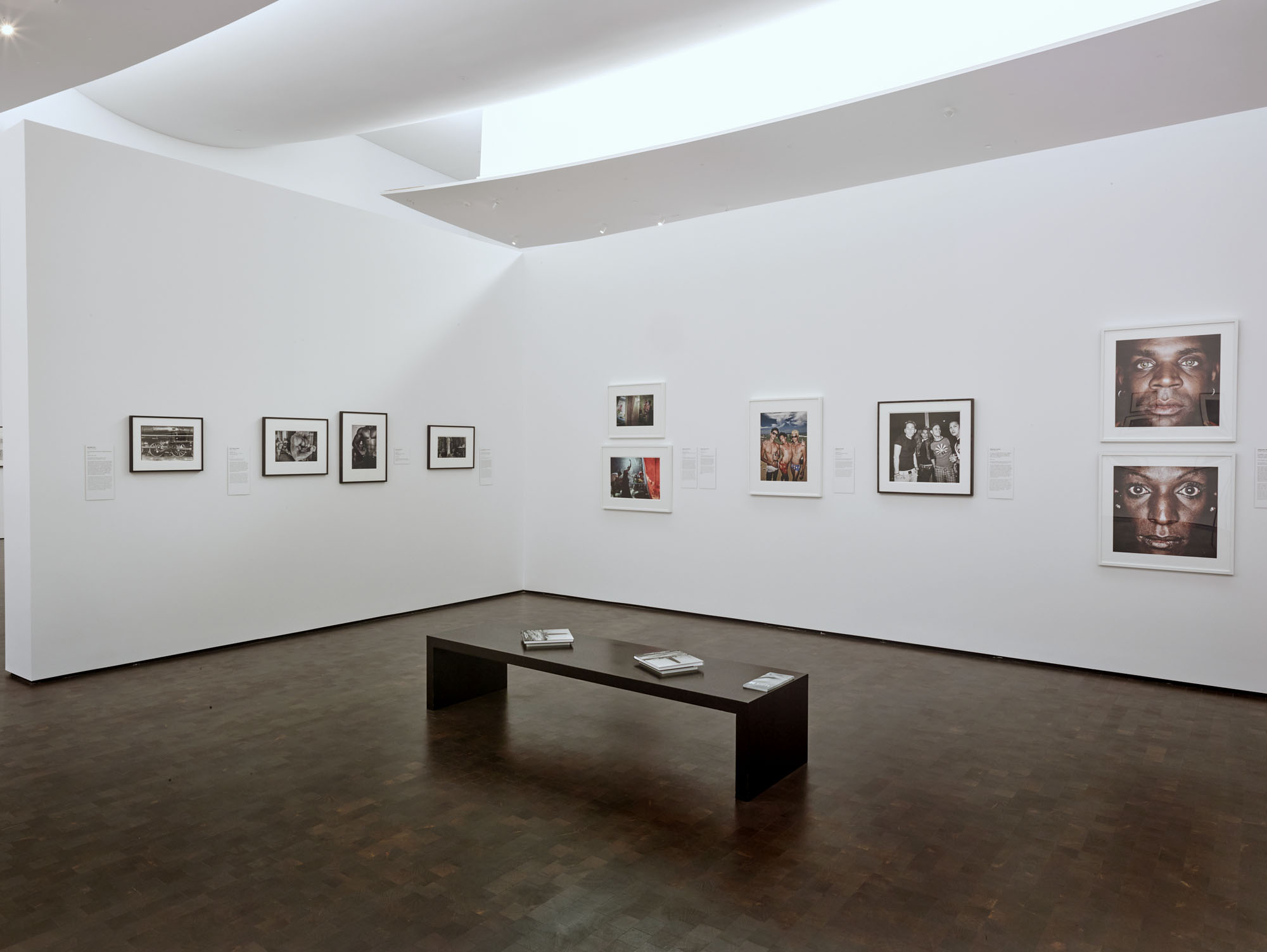
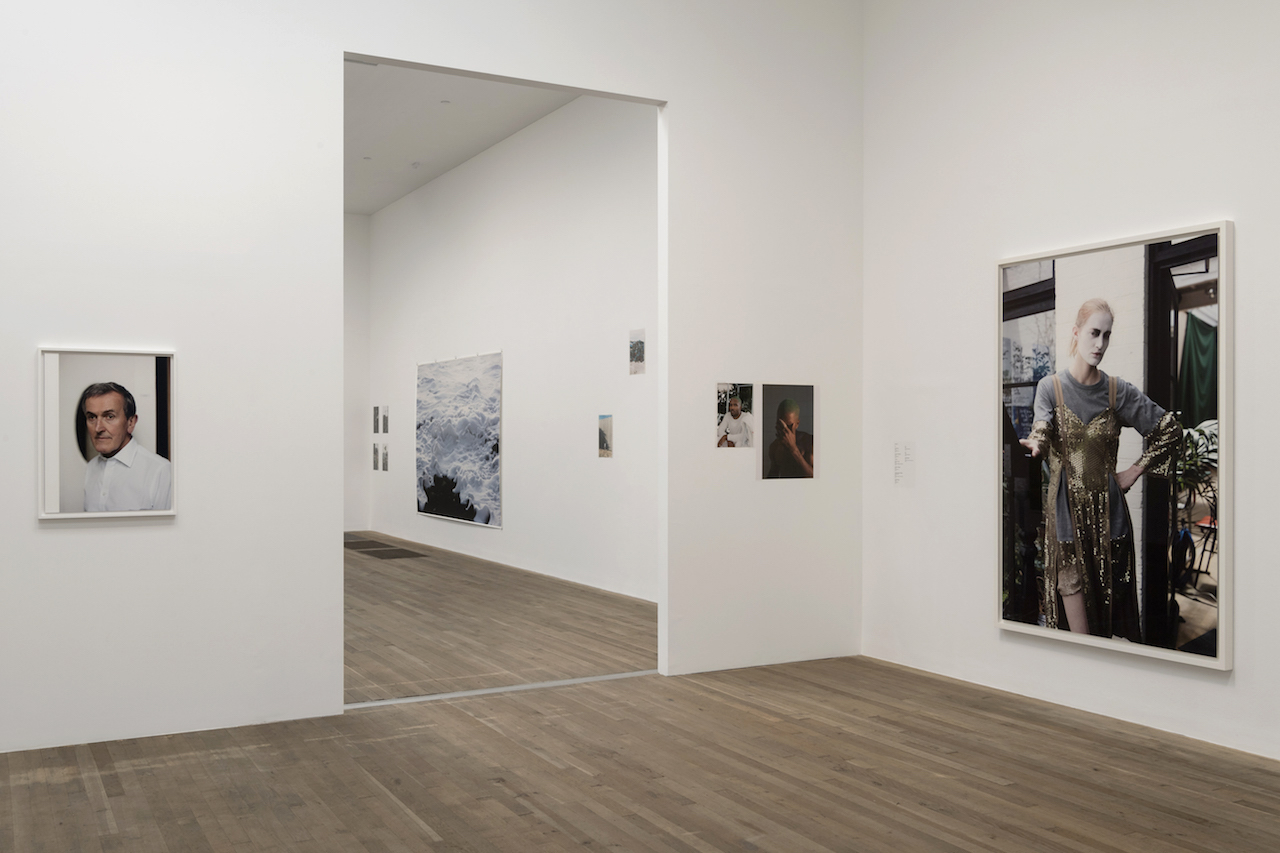
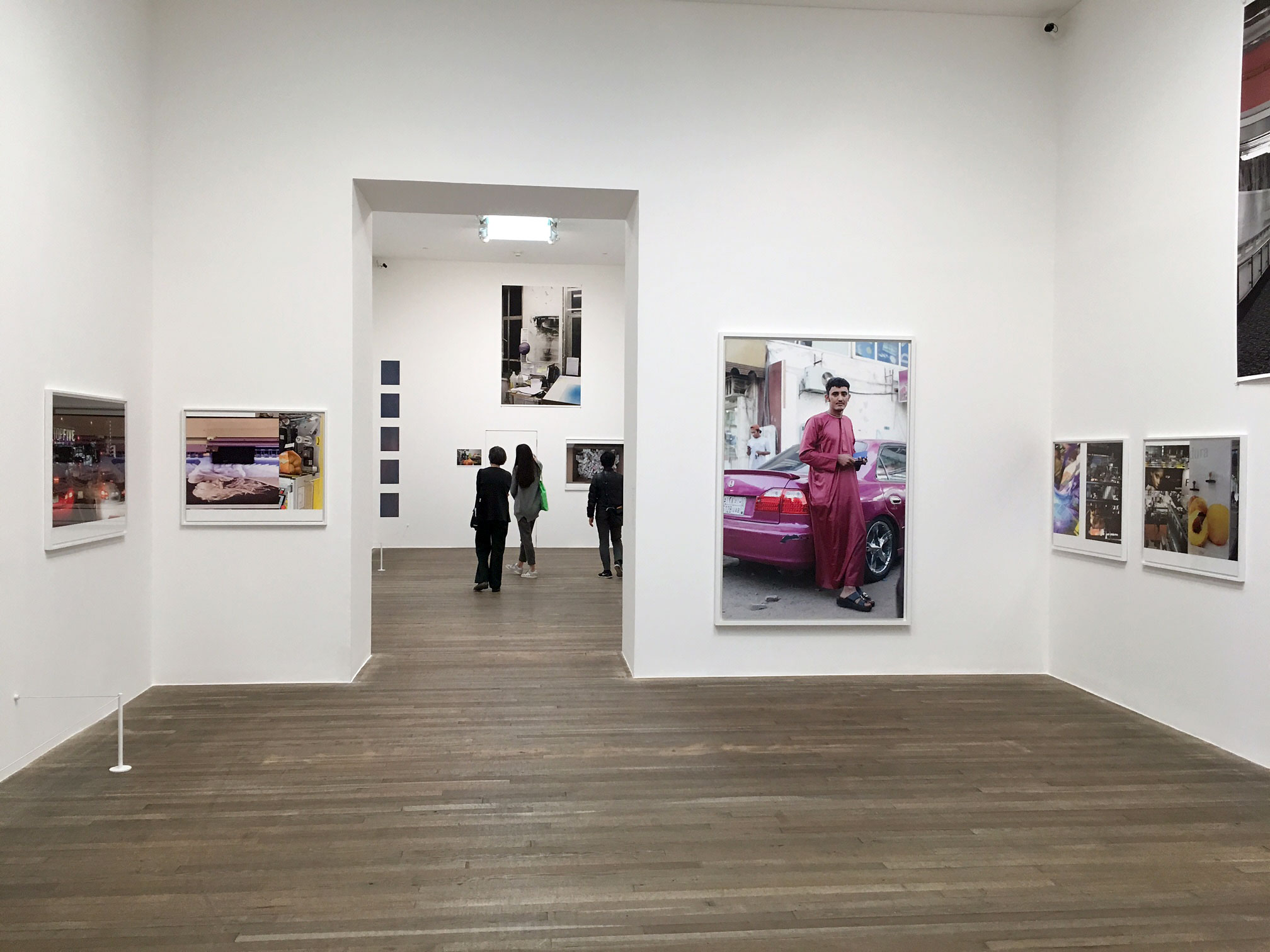
Installation view of the exhibition 'The 80s: Photographing Britain' at Tate Britain, London showing at left, the work of Jason Evans and Simon Foxton from the series 'Strictly' 1991; and at centre left top, Wolfgang Tillmans' 'Love (Hands in Air)' 1989


Installation view of the exhibition The 80s: Photographing Britain at Tate Britain, London showing at left, the work of Jason Evans and Simon Foxton from the series Strictly 1991 (below); and at centre left top, Wolfgang Tillmans’ Love (Hands in Air) 1989 (below)
Courtesy of Tate Britain


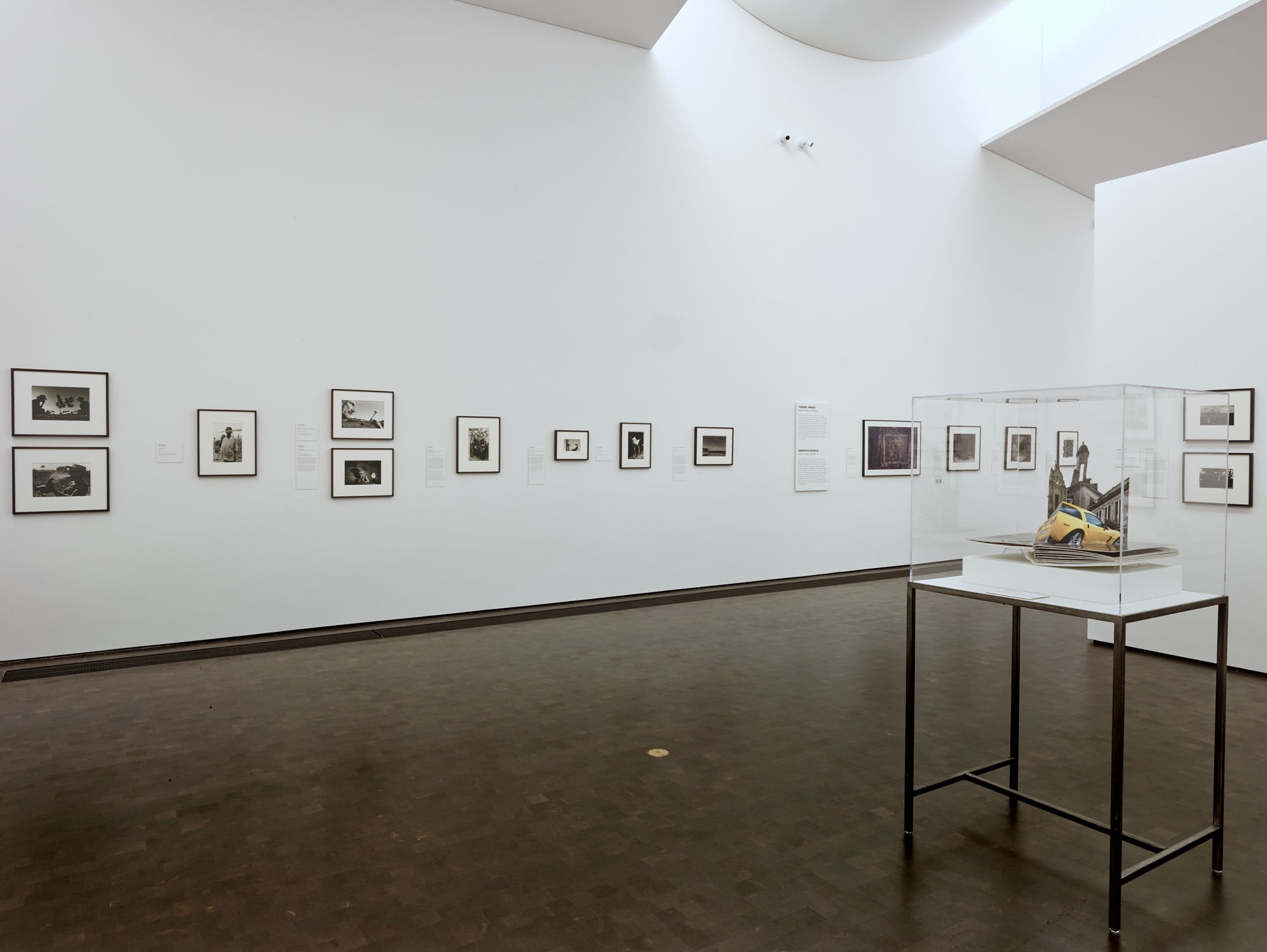
Installation view of the exhibition 'The 80s: Photographing Britain' at Tate Britain, London showing at rear, photographs from Maud Sulter's series 'Zabat' 1989


Installation view of the exhibition The 80s: Photographing Britain at Tate Britain, London showing at rear, photographs from Maud Sulter’s series Zabat 1989
Courtesy of Tate Britain


Maud Sulter produced the Zabat series for Rochdale Art Gallery in 1989, the 150th anniversary of the invention of photography. It was a direct response to the lack of a black presence at other celebratory events and exhibitions. Here we see the conventions of Victorian portrait photography under the command of a black woman photographer. The backdrop, props and pose are all retained but the image is transformed with African clothes, non-European objects and, most importantly, by the resolute black woman at its centre.

The title ‘Zabat’ also signifies Maud Sulter’s call for a repositioning of black women in the history of photography: the word describes an ancient ritual dance performed by women on occasions of power.

Text from the V&A website
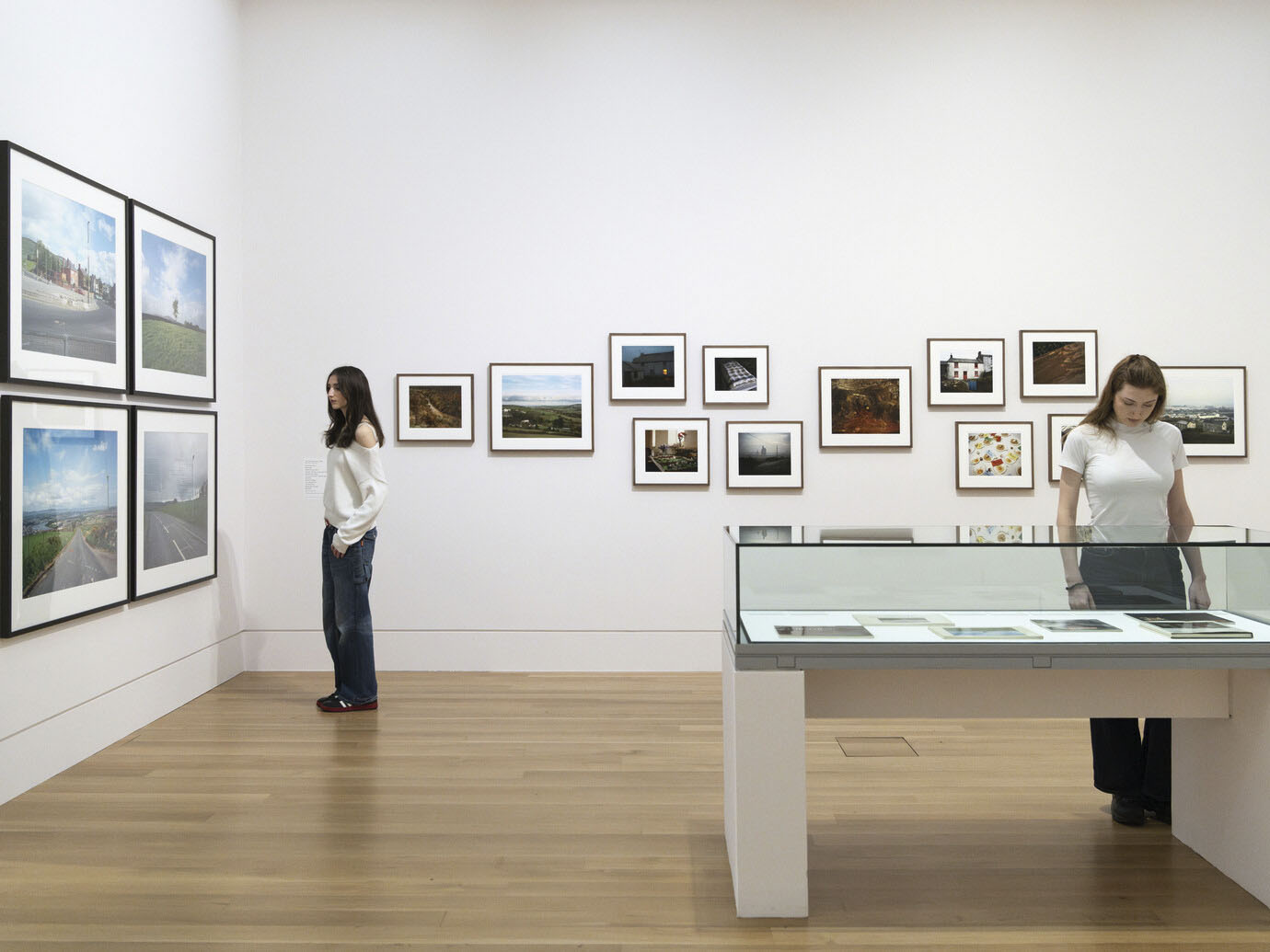
 

Installation view of the exhibition 'The 80s: Photographing Britain' at Tate Britain, London showing at left the work of Paul Graham


Installation view of the exhibition The 80s: Photographing Britain at Tate Britain, London showing at left the work of Paul Graham
Courtesy of Tate Britain


Installation view of the exhibition 'The 80s: Photographing Britain' at Tate Britain, London


Installation view of the exhibition The 80s: Photographing Britain at Tate Britain, London
Courtesy of Tate Britain


Wolfgang Tillmans (German, b. 1968) 'Love (Hands in Air)' 1989


Wolfgang Tillmans (German, b. 1968)
Love (Hands in Air)
1989


“Depending on where you stood in terms of race, gender, or class, the 1980s would seem a time of unprecedented economic expansion, an era defined by the triumph of consumerism and a particularly brass form of hedonism, or else an era of widening disparities, rising unemployment, and generalized economic crisis; a time defined by the booming of the housing market or the return of homelessness; a time of general disaffection and disillusionment toward the prospects of organized politics or an era defined by political activism and struggle, often hyperlocal in nature, as well as successive waves of discontent that at different points rocked the nation. …

In general, the critical reception of the show has been rather lukewarm. Many broadsheet commentators have lamented the meandering nature of the exhibition, while one critic noted the programmatic downplaying of the decade’s heavy-hitters. (Don McCullin and Chris Killip get a handful of photographs each, while virtuoso of political photomontage Peter Kennard is relegated to display cases.) Such assessments feel a little unfair and condescending to the excellent artists who do get a good showing, and in any case this curatorial approach is consistent with the intention of the exhibition – that is, to present eighties Britain not as a ossified relic but rather a container of multitudes, a country animated by competing, clashing energies and defying coherent description in a way that feels very reminiscent of today. A neoliberal hellhole, a nightmare of petit bourgeois conformity and cheapness, and at the same time an increasingly tolerant, multicultural, and open society, which finds its motor and pride in diversity and the endless project of self-fashioning.”


Bartolomeo Sala. “The 80s: Photographing Britain,” on The Brooklyn Rail website March 2025 [Online] Cited 03/04/2025


Derek Bishton, Brian Homer and John Reardon. 'Ting A Ling, Handsworth Self Portraits project' 1979 from the exhibition 'The 80s: Photographing Britain' at Tate Britain, London, Nov 2024 - May 2025


Derek Bishton, Brian Homer and John Reardon
Ting A Ling, Handsworth Self Portraits project
1979
© Derek Bishton, Brian Homer & John Reardon


Syd Shelton (British, b. 1947) 'Skinheads, Petticoat Lane, East London' 1979, printed 2012


Syd Shelton (British, b. 1947)
Skinheads, Petticoat Lane, East London
1979, printed 2012
Gelatin silver print on paper
417 x 281 mm
Tate
Gift Eric and Louise Franck London Collection 2016


Skinheads, known for their shaved heads and heavy boots, emerged as a working-class subculture in the 1960s. Initially non-political, some became associated with extreme nationalism. Others took an anti-racist position aligned with two-tone, a musical movement blending Jamaican ska and British punk. One of Syd Shelton’s photographs shows two members of Skins Against the Nazis proudly displaying a Rock Against Racism badge. The other was taken after an argument about racism. ‘I saw the guy at the front clenching his fists’, notes Shelton, ‘so I took the shot, said thanks and legged it as fast as I could.’

Wall text from the exhibition


Syd Shelton (British, b. 1947) 'Anti-racist Skinheads, Hackney, London' 1979, printed 2012


Syd Shelton (British, b. 1947)
Anti-racist Skinheads, Hackney, London
1979, printed 2012
Gelatin silver print on paper
417 x 282 mm
Tate
Gift Eric and Louise Franck London Collection 2016


In 1977, 500 National Front (NF) members attempted to march through Lewisham, an area in southeast London with a significant Black population. Thousands ignored a police blockade to hold a peaceful counter-demonstration that led to the NF abandoning their march. Protestors clashed with police and were met by riot shields, baton charges and mounted officers. The events became known as the Battle of Lewisham. Shelton’s photographs contrast the chaos of the streets with the resolve of the protestors. ‘Politics was one of the reasons that I became a photographer’, notes Shelton, ‘the idea of the objective photographer is nonsense.’

Wall text from the exhibition


Syd Shelton (British, b. 1947) 'Darcus Howe addressing the anti-racist demonstrators, Lewisham, 13 August 1977' Dated 1977, printed 2020 from the exhibition 'The 80s: Photographing Britain' at Tate Britain, London, Nov 2024 - May 2025


Syd Shelton (British, b. 1947)
Darcus Howe addressing the anti-racist demonstrators, Lewisham, 13 August 1977
Dated 1977, printed 2020
Tate
Presented by the artist 2021
© Syd Shelton


Explore one of the UK’s most critical decades, the 1980s. This exhibition traces the work of a diverse community of photographers, collectives and publications – creating radical responses to the turbulent Thatcher years. Set against the backdrop of race uprisings, the miner strikes, section 28, the AIDS pandemic and gentrification – be inspired by stories of protest and change.

At the time, photography was used as a tool for social change, political activism, and artistic and photographic experiments. See powerful images that gave voice and visibility to underrepresented groups in society. This includes work depicting the Black arts movement, queer experience, South Asian diaspora and the representation of women in photography.

This exhibition examines how photography collectives and publications highlighted these often-unseen stories, featured in innovative photography journals such as Ten.8 and Cameraworks. It will also look at the development of Autograph ABP, Half Moon Photography Workshop, and Hackney Flashers.

Visitors will go behind the lens to trace the remarkable transformation of photography in Britain and its impact on art and the world.

Text from the Tate Britain website


The 80s: Photographing Britain

David Preshaah and Helen Little curator of The 80s: Photographing Britain at Tate Britian discuss the show running 21st November, 2024 – 5th May, 2025. See powerful images that gave voice and visibility to underrepresented groups in society. This includes work depicting the Black arts movement, queer experience, South Asian diaspora and the representation of women in photography
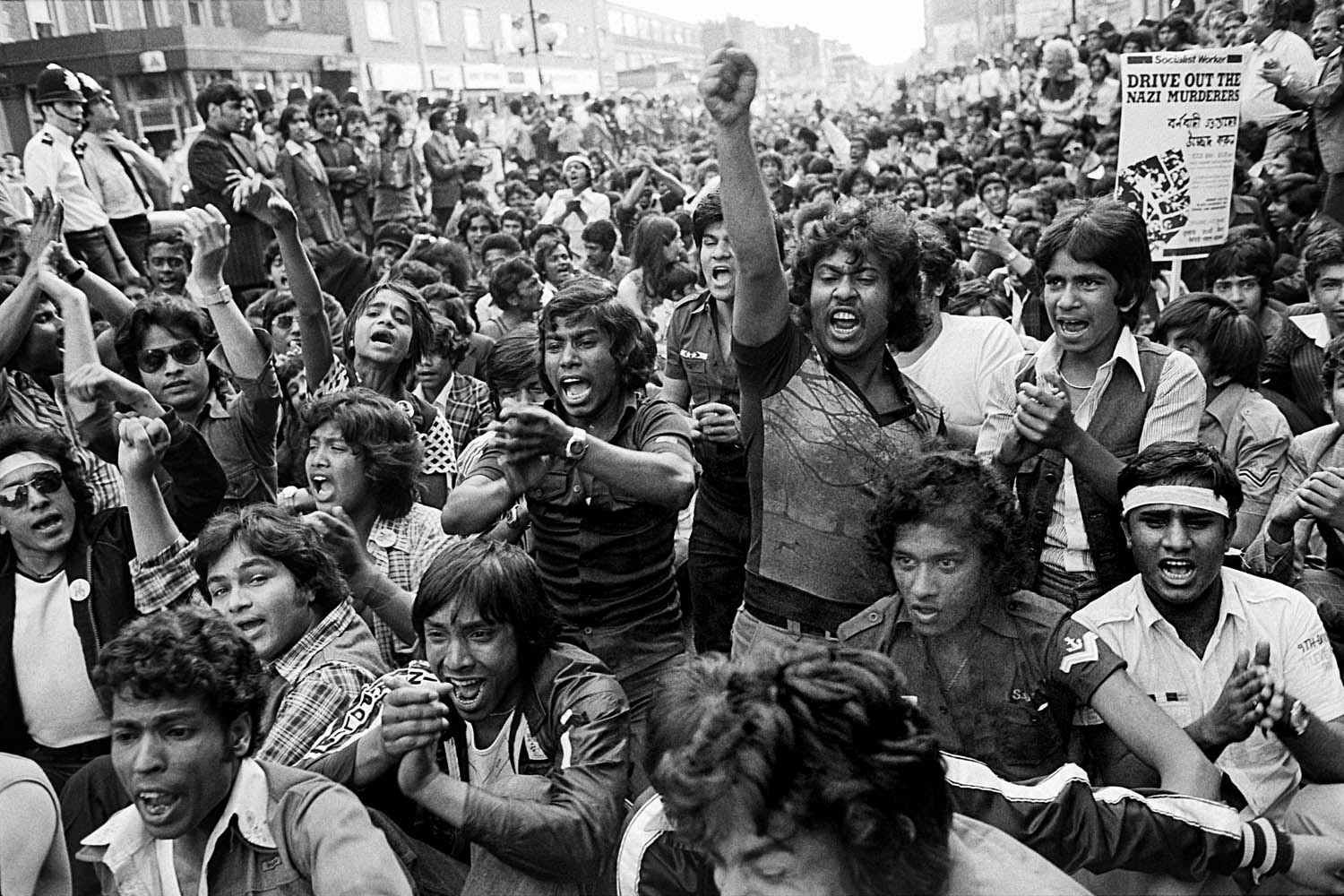
 

Paul Trevor (British, b. 1947) 'Outside police station, Bethnal Green Road, London E2, 17 July 1978. Sit down protest' 1978


Paul Trevor (British, b. 1947)
Outside police station, Bethnal Green Road, London E2, 17 July 1978. Sit down protest
1978

Paul Trevor © 2023


On 4 May 1978, Altab Ali, a 24-year-old Bangladeshi textile worker, was murdered in a racially motivated attack. During police interviews, the three teenagers responsible casually described the regularity of their racist violence. The Bangladeshi community in east London mobilised in response. 7,000 people marched from Bethnal Green’s Brick Lane to Downing Street, following a vehicle carrying Ali’s coffin. Protestors rallied in Hyde Park chanting, ‘Who killed Altab Ali? Racism, racism!’

Paul Trevor was a member of Half Moon Photography Workshop and helped produce Camerawork magazine. He contributed to an issue on the 1978 Battle of Lewisham in southeast London. While photographing the violent clashes between police and anti-fascist protestors, Trevor recalls, ‘A woman – appealing for help – shouted at me in desperation “What are you taking pictures for?” Good question, impossible to answer in that melee.’ The special issue of Camerawork, ‘What are you taking pictures for?’ was devoted to that question.

Wall text from the exhibition


Don McCullin (British, b. 1935) 'Jean, Whitechapel, London' Late 1970s


Don McCullin (British, b. 1935)
Jean, Whitechapel, London
Late 1970s
Gelatin silver print
Tate
Gift Eric and Louise Franck London Collection 2011


Photojournalist and war photographer Don McCullin spent nearly twenty years photographing people living on the streets of Aldgate and Whitechapel in east London. He documented people living at the edge of the city’s wealthy financial centre. In the late 1970s, unprofitable psychiatric institutions in the area had begun to close, leaving many residents homeless. These photographs of Jean show how closely McCullin worked with the people he photographed. Of his British social documentary work, McCullin notes: ‘Many people send me letters in England saying “I want to be a war photographer”, and I say, go out into the community you live in. There’s wars going on out there, you don’t have to go halfway around the world.’

Wall text from the exhibition


This autumn, Tate Britain will present The 80s: Photographing Britain, a landmark survey which will consider the decade as a pivotal moment for the medium of photography. Bringing together nearly 350 images and archive materials from the period, the exhibition will explore how photographers used the camera to respond to the seismic social, political, and economic shifts around them. Through their lenses, the show will consider how the medium became a tool for social representation, cultural celebration and artistic expression throughout this significant and highly creative period for photography.

This exhibition will be the largest to survey photography’s development in the UK in the 1980s to date. Featuring over 70 lens-based artists and collectives, it will spotlight a generation who engaged with new ideas of photographic practice, from well-known names to those whose work is increasingly being recognised, including Maud Sulter, Mumtaz Karimjee and Mitra Tabrizian. It will feature images taken across the UK, from John Davies’ post-industrial Welsh landscape to Tish Murtha’s portraits of youth unemployment in Newcastle. Important developments will be explored, from technical advancements in colour photography to the impact of cultural theory by scholars like Stuart Hall and Victor Burgin, and influential publications like Ten.8 and Camerawork in which new debates about photography emerged.

The 80s will introduce Thatcher’s Britain through documentary photography illustrating some of the tumultuous political events of the decade. History will be brought to life with powerful images of the miners’ strikes by John Harris and Brenda Prince; anti-racism demonstrations by Syd Shelton and Paul Trevor; images of Greenham Common by Format Photographers and projects responding to the conflict in Northern Ireland by Willie Doherty and Paul Seawright. Photography recording a changing Britain and its widening disparities will also be presented through Anna Fox’s images of corporate excess, Paul Graham’s observations of social security offices, and Martin Parr’s absurdist depictions of Middle England, displayed alongside Markéta Luskačová and Don McCullin’s portraits of London’s disappearing East End and Chris Killip’s transient ‘sea-coalers’ in Northumberland.

A series of thematic displays will explore how photography became a compelling tool for representation. For Roy Mehta and Vanley Burke, who portray their multicultural communities, photography offers a voice to the people around them, whilst John Reardon, Derek Bishton and Brian Homer’s Handsworth Self Portrait Project 1979, gives a community a joyous space to express themselves. Many Black and South Asian photographers use portraiture to overcome marginalisation against a backdrop of discrimination. The exhibition will spotlight lens-based artists including Roshini Kempadoo, Sutapa Biswas and Al-An deSouza who experiment with images to think about diasporic identities, and the likes of Joy Gregory and Maxine Walker who employ self-portraiture to celebrate ideas of Black beauty and femininity.

Against the backdrop of Section 28 and the AIDS epidemic, photographers also employ the camera to assert the presence and visibility of the LGBTQ+ community. Tessa Boffin subversively reimagines literary characters as lesbians, whilst Sunil Gupta’s ‘Pretended’ Family Relationships 1988, juxtaposes portraits of queer couples with the legislative wording of Section 28. For some, their work reclaims sex-positivity during a period of fear. The exhibition will spotlight photographers Ajamu X, Lyle Ashton Harris and Rotimi Fani-Kayode who each centre Black queer experiences and contest stereotypes through powerful nude studies and intimate portraits. It will also reveal how photographers from outside the queer community including Grace Lau were invited to portray them. Known for documenting fetishist sub-cultures, Lau’s series Him and Her at Home 1986 and Series Interiors 1986, tenderly records this underground community defiantly continuing to exist.

The exhibition will close with a series of works that celebrate countercultural movements throughout the 80s, such as Ingrid Pollard and Franklyn Rodgers’s energetic documentation of underground performances and club culture. The show will spotlight the emergence of i-D magazine and its impact on a new generation of photographers like Wolfgang Tillmans and Jason Evans, who with stylist Simon Foxton pioneer a cutting-edge style of fashion photography inspired by this alternative and exciting wave of youth culture, reflective of a new vision of Britain at the dawn of the 1990s.

Press release from Tate Britain
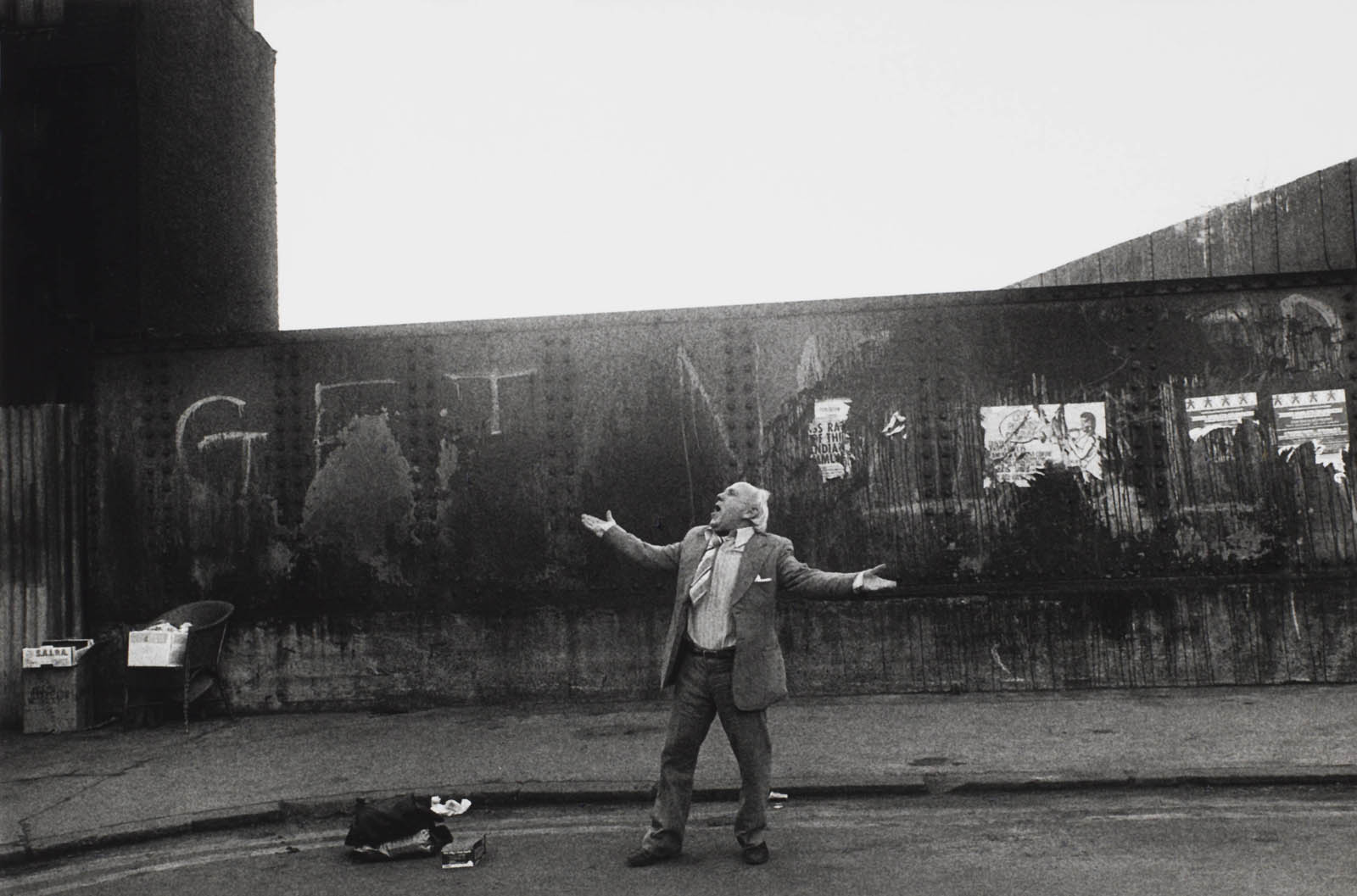
 

Markéta Luskačová (Czech, b. 1944) 'Man singing on Brick Lane, London' 1982


Markéta Luskačová (Czech, b. 1944)
Man singing on Brick Lane, London
1982
Gelatin silver print
Tate
© Markéta Luskačová


Markéta Luskačová’s London Street Musicians series includes photographs taken between 1975 and 1990. They document the lives of street musicians performing at London markets. Her photographs reveal the humanity and resilience of these often-solitary musicians. ‘The street musicians themselves were often quite lonely men, yet their music lessened the loneliness of the street, the people in it and my own loneliness’, she recalls. For Luskačová, photography is ‘a tool for trying to understand life … to remember the people and things that I photograph. I want them to be remembered.’

Wall text from the exhibition


Chris Killip (Manx, 1946-2020) ''Critch' and Sean' 1982


Chris Killip (Manx, 1946-2020)
‘Critch’ and Sean
1982
Tate
© Chris Killip


Chris Killip first visited the seacoaling community at Lynemouth Beach in Northumberland in 1976. ‘The beach beneath me was full of activity with horses and carts backed into the sea’, Killip recalls. ‘Men were standing in the sea next to the carts, using small wire nets attached to poles to fish out the coal from the water beneath them. The place confounded time.’ In 1982, Killip started photographing the community, living alongside them from 1983 to 1984. ‘I wasn’t getting close enough, so I bought a caravan and moved into the place and that made a very big difference.’

Killip used a large format plate camera to capture his subjects. ‘It’s not a casual thing’, he notes. ‘I think it works to your advantage. They know this is going to live after this moment. It’s not ephemeral.’

Wall text from the exhibition


Jo Spence (British, 1934-1992) and Terry Dennett (British, 1938-2018)
'Remodelling Photo History: Revisualization' 1981-1982


Jo Spence (British, 1934-1992) and Terry Dennett (British, 1938-2018)
Remodelling Photo History: Revisualization
1981-1982
Tate
Presented by Tate Patrons 2014
© The Jo Spence Memorial Archive


These images are from Remodelling Photo History, a collaboration between Jo Spence and Terry Dennett. The work was originally published as a sequence of 13 photographs in which Spence and Dennett both act as photographer and photographic subject. The series was devised as a critique of standard histories of photography and particularly the depiction of women in art. It employs a practice Spence called ‘photo-theatre’. Each photograph emphasises its staging and construction in order to challenge and ‘make strange’ the assumed ‘naturalism’ of photography. Spence commented ‘it is obvious that a vast amount of work still needs to be done on the so-called history of photography, and on the practices, institutions and apparatuses of photography itself, and the function they have had in constructing and encouraging particular ways of viewing and telling about the world.’

Wall text from the exhibition


Joy Gregory (British, b. 1969) 'Magenta Dress with Pink Tulips' 1984


Joy Gregory (British, b. 1969)
Magenta Dress with Pink Tulips
1984
Courtesy of the artist
© Joy Gregory. All rights reserved, DACS


Joy Gregory’s early interest in colour photography began as student at Manchester Polytechnic. The university was known for its emphasis on the technical and chemical aspects of photography. Gregory’s education taught her the craft of commercial photography but she set out to use these skills like a painter. Her early experiments informed an ongoing interest in stillness, space and light. This series of colour transparencies presents models and still lifes in a painted studio interior. By using multiple exposures and layering images, Gregory suggests a spectral presence in the works. Her focus on the painterly qualities of colour and light here are typical of her practice. She employs languages of beauty and seduction in small textured prints that invite close inspection.

Wall text from the exhibition


John Harris (British, b. 1958) 'Mounted Policeman attacking Lesley Boulton at the Battle of Orgreave'
1984, printed 2024


John Harris (British, b. 1958)
Mounted Policeman attacking Lesley Boulton at the Battle of Orgreave
1984, printed 2024


John Harris’s photographs from the 1984 Battle of Orgreave challenged government portrayals of miners as aggressors. In 1984, the National Union of Miners identified Orgreave coking plant in South Yorkshire as a key site for picketing. From May to June, strikers attempting to disrupt deliveries were met by growing police presence. Tensions came to a head on 22 June when an estimated 6,000 officers clashed with pickets. One of Harris’s images captures Lesley Boulton cowering beneath the truncheon of a mounted officer. It became an emblem of the strike, appearing on badges, banners and posters.

Wall text from the exhibition


Paul Graham (British, b. 1956) 'Union Jack Flag in Tree, Country Tyrone' 1985


Paul Graham (British, b. 1956)
Union Jack Flag in Tree, Country Tyrone
1985
C-print on paper
Tate
Presented by Tate Members 2007
© Paul Graham


From 1984 to 1986, Paul Graham documented Northern Irish locations featured in news reports of the Troubles. During his first visit, Graham was stopped by a British military patrol suspicious of his camera. As they left, he took a shot with his camera hanging from his neck. The photograph became a ‘gateway’ for Graham’s Troubled Land series. He felt his other images of rioting, murals and destruction, ‘weakly echoed what I saw in the newspapers. This one image did not’. ‘There were people walking to shops and driving cars – simply going about their day, but then there was a soldier in full camouflage, running across the roundabout.’ For Graham, the image ‘reintegrated the conflict into the landscape … it was a conflict photograph masquerading as a landscape photograph.’

Wall text from the exhibition


Pogus Caesar (British born St. Kitts, b. 1953) 'Handsworth Riots: Birmingham, United Kingdom September' 1985, printed 2020


Pogus Caesar (British born St. Kitts, b. 1953)
Handsworth Riots: Birmingham, United Kingdom
September 1985, printed 2020
Gelatin silver print
Martin Parr Foundation Collection


These photographs capture two days of uprisings in Handsworth, Birmingham, following the arrest of a Black man over a parking violation and a police raid on a pub on the Lozells Road. The photographer, Handsworth resident Pogus Caesar, notes: ‘Where possible it was vital to document.’ He explains: ‘The media has a way of portraying these type of events, I needed to document my truth.’ Caesar’s insider perspective allowed him to capture a range of images, such as artist John Akomfrah reading a sensationalist newspaper account of the two days of violence between the police and local communities.

Wall text from the exhibition


Melanie Friend (British, b. 1957)
'Greenham Common, 14 December 1985' 1985, reprinted 2023


Melanie Friend (British, b. 1957)
Greenham Common, 14 December 1985
1985, reprinted 2023
© Melanie Friend, Format Photographers Archive, Bishopsgate Institute


Exhibition guide

The 80s: Photographing Britain explores a critical decade for photography in the UK. It highlights the work of artists who were radically reconsidering the possibilities of the medium and its role in society.

The exhibition traces developments in photographic art from 1976 to 1993. It follows artists working against a backdrop of high unemployment, industrial action and civil rights activism. Many were part of local photographic communities that developed around key photography schools and collectives. Yet, through innovative publications and independent galleries, they reached national and international audiences.

The artists included in the exhibition expanded photographic practice in Britain. They often collaborated, shared ideas and debated theory. Some were inspired by the activism of the period’s protest movements, using their cameras to provide new ways of looking at society. Others embraced technical developments to push the boundaries of fine art photography. Their work highlights the medium’s range, from landscapes to self-portraiture, and social documentary to conceptual photography.

The 80s: Photographing Britain invites us to reflect on photography’s political and artistic potential. It acknowledges that the diversity of contemporary photographic practice is indebted to the groundbreaking photographers of the 1980s.

Room 1

Documenting the decade

This room documents a period of significant social and political upheaval in the UK. It features protests, uprisings and acts of violence photographed through an activist lens. These photographers challenged dominant narratives and amplified marginalised voices. Some photographed their own communities, giving them access an outsider might not be granted. Others, free from the violence and oppression their subjects faced, turned to photography as an act of solidarity.

The exhibition begins in 1976, the year Jayaben Desai walked out of Grunwick Film Processing Laboratories in London, starting a two-year strike for the right to union representation. The Grunwick dispute typifies the events explored in this room. It was led by an activist whose intersecting identities were the root of her cause. When thousands took to the streets in solidarity it revealed the power of collective action. But it is also an example of failed industrial action, hardline policing and racist media coverage.

In 1979, following months of industrial disputes during the so-called ‘Winter of Discontent’, James Callaghan’s Labour government lost the general election. When Conservative prime minister Margaret Thatcher took office, she promised to reverse the country’s ‘decline’. The answer, she argued, was free markets, traditional values and British nationalism. Her political philosophy became known as Thatcherism. It helped UK financial markets thrive but led to growing class division and inequalities.

Within this context, socially engaged photographers joined the fight for change. They documented protests and the hardline police tactics designed to silence them. Their images reveal a range of documentary practices and photography’s ability to uncover events that might otherwise remain hidden.

Anti-racist movements

The 1948 British Nationality Act allowed everyone born in Britain or its Empire to become a ‘Citizen of the United Kingdom and Colonies’. The act encouraged people from Britain’s current and former colonies to move to the UK to address labour shortages, help facilitate post-war reconstruction and build the welfare state. Yet, on arrival, citizens of colour faced hostility and racial discrimination. It marked the beginning of decades of racist rhetoric, rioting and civil rights activism.

In 1968, Conservative MP Enoch Powell delivered his ‘Rivers of Blood’ speech in Birmingham, criticising immigration and emboldening the far-right. That same year, writer Obi Egbuna founded the British Black Panthers to defend Black communities against racism and discrimination. By the mid-1970s, the far-right, anti-immigration National Front was England’s fourth largest political party. They capitalised on the perception that white workers were losing jobs to immigrants rather than government failures to address unemployment levels. Their far-right ideology was opposed by anti-fascist and anti-racist campaign groups whose members vastly outnumbered the National Front. Throughout the 1980s, high-profile uprisings in Bristol, Leeds, London, Manchester, Liverpool and Birmingham revealed the strength of anti-racist feeling across the country.

The Miners’ Strike

Following the First World War, there were 1 million miners in the UK. By the beginning of the 1980s, there were 200,000. In March 1984, the National Coal Board announced plans to close 20 collieries, putting 20,000 jobs at risk. The National Union of Mineworkers, led by Arthur Scargill, responded with a series of year-long strikes. Observed across England, Scotland and Wales, the strikes were a national issue.

Determined to disable labour movements across the UK, Margaret Thatcher took steps to break the miners’ union and limit their power. The government stockpiled coal, mobilised police forces, brought legal challenges, and made media statements heavily criticising the union and striking workers.

Journalists challenged the government’s portrayal of miners as aggressors and agitators. Photographers helped evidence instances of excessive and often unprovoked violence by law enforcement. But the government’s plans to take down miners, one of the strongest unionised workforces in the country, had worked. On 3 March 1985, after 362 days, the National Union of Mineworkers accepted defeat. Union members voted to end the strike. The strike put industrial issues and workers’ rights on the national agenda and had a profound impact on the politics of the period.

Brenda Prince was a member of Format Photographers Agency. Started by Maggie Murray and Val Wilmer in 1983, Format was set up as an agency for women. Prince joined in 1984. ‘We were all documentary photographers’, Prince notes. ‘We would work on our own stories and my miners’ strike images came out of that.’ ‘The miners’ strike gave me the opportunity to document working class people who were really struggling to keep their jobs and keep their communities alive’, Prince explains. She spent eighteen months in Nottinghamshire’s mining communities. Her works highlight the vital role women played in sustaining the strike.

(For more information on the miners’ strike please see the posting on the exhibition ONE YEAR! Photographs from the Miners Strike 1984-85 at Four Corners, London, Sept – October, 2024)

Greenham Common

On 5 September 1981, a group of women marched from Cardiff to the Royal Air Force base at Greenham Common in Berkshire. The site was common land, loaned to the US Air Force by the British Government during the Second World War and never returned. The group called themselves Women for Life on Earth. They were challenging the decision to house 96 nuclear missiles at the site. On arrival, they delivered a letter to the base commander stating: ‘We fear for the future of all our children and for the future of the living world which is the basis of all life.’ When their request for a debate was ignored, they set up camp. Others joined and the site became a women-only space.

Over the next 19 years, Greenham Common Women’s Peace Camp became a site of protest and home to thousands of women. Some stayed for months, others for years, and many visited multiple times. Greenham women saw their anti-nuclear position as a feminist one. They used their identities as mothers and carers to fight for the protection of future generations and inspired protest movements across the world.

In 1987, Soviet President Mikhail Gorbachev and US President Ronald Reagan signed a treaty which paved the way for the removal of cruise missiles from Greenham. Gorbachev has since paid tribute to the role ‘Greenham women and peace movements’ played in this historic agreement. By 1992, all missiles sited at Greenham had been removed and the US Air Force had left the base. The Peace Camp remained until 2000 as a protest against nuclear weapons.

Format Photographers Agency (1983-2003), featuring Maggie Murray, Melanie Friend, Brenda Prince and Jenny Matthews, played a crucial role in documenting social movements. Their photographs of the Greenham Common Women’s Peace Camp capture this landmark protest against nuclear missiles. They record the activism, daily life and personal stories of the women involved, highlighting their strength and creativity. They also reveal contrast between the women’s camp and their non-violent resistance and the militarised environment they were protesting.

The Gay Rights Movement

In 1967, the Sexual Offences Act partially decriminalised sexual acts between two men. It was the result of decades of campaigning but the act did nothing to address the discrimination LGBTQ+ communities faced. In 1970, the first meeting of the Gay Liberation Front took place. They wrote a manifesto outlining how gay people were oppressed and mapped out a route to liberation through activism and consciousness-raising. In the 1980s, the Gay Rights movement continued to grow. Queer communities came together in opposition to homophobia fuelled by Conservative ‘family values’ campaigns and fear of the HIV/ AIDS epidemic.

The first cases of Gay-Related Immune Deficiency (GRID) in the UK were identified in 1981. In 1982, GRID was renamed Acquired Immune Deficiency Syndrome (AIDS) and Britain saw its first deaths from the disease. By 1987, AIDS was a worldwide epidemic, with around 1,000 recorded cases in the UK. The public focus was largely on gay men, who were being infected in much greater numbers, fuelling anti-gay rhetoric in politics and the press.

In 1988, the government passed Section (formerly Clause) 28 of the Local Government Act. The legislation stated local authorities ‘shall not intentionally promote homosexuality’ or ‘promote the teaching in any maintained school of the acceptability of homosexuality as a pretended family relationship’. Section 28 forced many LGBT groups to disband and saw literature depicting gay life removed from schools and libraries. But it also galvanised the Gay Rights movement. People took to the streets in a series of marches and protests, and set up organisations to lobby for change.

Poll Tax

The community charge, commonly known as the ‘poll tax’, was introduced by Margaret Thatcher’s Conservative government in 1989 in Scotland, and 1990 in England and Wales. This flat-rate tax on every adult replaced previous taxation based on property value. The tax was accused of benefitting the rich and unfairly targeting the poor.

The national anti-poll tax movement began on the streets of Glasgow and led to a series of anti-poll tax actions across the UK. Many demonstrations saw clashes between police and protestors, and resulted in rioting. The fallout from the tax triggered leadership challenges against the prime minister and, in 1990, Thatcher resigned. In 1991, following vehement national opposition, John Major’s Conservative government announced the poll tax would be replaced by council tax.

The Troubles

The Troubles was a 30-year conflict in Northern Ireland between Protestant Ulster loyalists, who believe Northern Ireland should remain part of the United Kingdom, and Catholic Irish republicans, who believe in an independent united Ireland. The roots of the conflict date back to the twelfth century, when English settlers displaced Irish landholders and colonised areas of Ireland. In the seventeenth century, in an attempt strengthen British rule over the Catholic population, Britain moved protestants from Scotland and England to the north of Ireland. This caused sectarian divisions that continue to this day.

During the 1920 Irish War of Independence against British rule, a treaty was signed dividing the island into two self-governing areas. The majority Catholic counties, primarily in the south, formed the Irish Free State. The six majority Protestant counties in the north became a region of the United Kingdom. Catholics living in Northern Ireland faced discrimination and police harassment and, in the late 1960s, they organised civil rights marches challenging their treatment. Activists were met by counter-demonstrators and violent suppression by the almost exclusively Protestant police force. Riots ensued and the Troubles began. In 1969, the British Army was deployed to restore order in the region, but instead violence escalated. Paramilitary organisations on both sides took up arms and employed guerrilla tactics. More than 3,500 people had been killed by the time the Good Friday Agreement was signed in 1998, ending 30 years of violence.

Room 2

The cost of living

These photographs spotlight UK class dynamics in the 1980s. Images of social security waiting rooms and people living on the streets, sit alongside office workers, Conservative Party functions and gallery private views.

Margaret Thatcher believed, ‘whatever your background, you have a chance to climb to the top’. She presented social mobility as the reward for those who worked hard enough. The government encouraged people to become part of the property-owning middle classes. The 1980 Housing Act gave 5 million council house tenants the right to buy at discounted prices. But Thatcherism also advocated for limited government controls, privatisation of industry, low taxes and free markets. Conservative economic philosophy made the wealthiest in society richer. While young urban professional ‘yuppies’ in financial centres thrived, the gap between classes increased.

In the 1970s, a global economic recession and increased mechanisation had led to deindustrialisation. By the 1980s, working-class communities centred around heavy industries were greatly affected. Specialised machines replaced workers and manufacturing moved to countries where wages were lower. The government introduced legislation to limit the influence of trade unions and allow employers to sack striking workers. Thousands were left unemployed. The foundations of working-class identity were being eroded while the prospect of middle-class affluence remained out of reach for many.

The photographers in this room produced work that highlights these class dynamics. Some revealed the human stories behind the policies and statistics, others helped cement stereotypes.

Room 3

Landscape

The photographs in this room highlight different political and social narratives embedded in the landscape of the British Isles. They reveal the impact of human endeavour on the land and the effect of the land and its borders on people.

While these photographs depict a particular part of the world, they also explore how landscapes are constructed in our imaginations. As artist Jem Southam notes, ‘When we look at a photograph of a landscape, we’re looking as much at a projection of the cultural, social, historical, literary connections we have with that place, as we are with an actual physical landscape.’ Southam describes his work as ‘a description of a culture, and of a place, but also an investigation of how we carry imagery in our minds’.

Some of the featured photographers drew on the history of British landscape painting to produce nostalgic images of sublime natural vistas. Others parodied or subverted the romantic notion of a green and pleasant land, revealing British landscapes as sites of decay, conflict, deindustrialisation and racism. Several artists produced photographs that immerse us in their chosen scenes, treating industrial ruins with the same careful attention as natural phenomena. Those working with large format cameras and slow exposure times gave their chosen scenes a painterly quality. Others utilised photography’s ability to record the everyday. They embraced a medium some didn’t consider high art to capture landscapes many didn’t consider worthy of documenting.

Room 4

Image and text

Conceptual art prioritises the idea (or concept) behind an artwork. The photographs in this room focus on photography’s ability to carry ideas. They challenge the notion of the photograph as a window on the world and use text to complicate the medium’s relationship with reality.

Artist and academic, Victor Burgin wrote that our most common encounters with photographs – in advertisements, newspapers and magazines – are all mediated by text. Informed by semiotics, the study of signs and symbols, Burgin highlighted our reliance on existing systems of codes and social meanings to ‘read’ photographs. By making work that combines image and text he was ‘turning away from concerns inherited from “art” and towards everyday life and its languages, which are invariably composed of image/text relations’. Burgin used image and text to ‘dismantle existing communication codes’ and ‘generate new pictures of the world.’

Burgin’s art and ideas influenced the photographers in this room, several of whom he taught. They used text borrowed from literature, film, parliamentary speeches and journalism to expose hidden meanings, heighten emotion and confuse. The resulting artworks expanded contemporary photographic practice while offering new ways of viewing the world.

Room 5

Remodelling history

The personal and intimate photographs of Jo Spence and Maud Sulter remodel the history of representation. Their artworks and writings challenge photography’s sexist and colonial past, and its relationship to class politics. Rather than using the camera to stereotype, categorise, objectify or commodify, they used it to reclaim agency.

For both artists, their collaborative approach to image-making was key to the politics of their practice. Sulter and Spence worked closely with other artists and their subjects. Through collaboration, they discovered new ways of seeing and being seen.

For Spence, this meant ‘putting myself in the picture’. She recognised the power of having control over her representation and, together with artist Rosy Martin, developed photo-therapy. Spence noted: ‘I began to use the camera to explore links that I had never approached before, links between myself, my identity, the body, history and memory’. Known for her unflinching gaze and use of satire, Spence challenged social expectations. She questioned common visual representations of beauty, health and womanhood, as well as women’s place in society.

Sulter’s photography explores absence and presence. She was interested in the ways that ‘Black women’s experience and Black women’s contribution to culture is so often erased and marginalised’. Whether rephotographing personal family photographs or producing portraits, Sulter ‘put Black women back in the centre of the frame – both literally within the photographic image, but also within the cultural institutions where our work operates’. Sulter saw her practice as a contribution to ‘archival permanence’. As she noted: ‘Survival is visibility.’

Room 6

Reflections on the Black experience

This room examines the influence of Reflections of the Black Experience, which opened at Brixton Art Gallery in south London in 1986. The exhibition was organised by the Greater London Council’s Race Equality Unit. It invited artists ‘from a diversity of cultural/political backgrounds’ to collectively ‘challenge the existing and inadequate visual histories of the black experience’. In the 1980s, the term ‘political blackness’ was used as an organising tool to encourage people of colour to come together in the fight against racism. Reviews noted the range of practices on display and that the exhibition set ‘a new agenda where black people can begin to trace a history of representation of ourselves by ourselves’. Yet they also warned: ‘If seen as definitive representations / reflections in photographic imagery the exhibition becomes very limited.’

D-MAX: A Photographic Exhibition was a response to this possible containment of Black photographic practice. Three of the photographers featured had exhibited work in Reflections of the Black Experience. The exhibition opened at Watershed in Bristol in 1987 and toured to the Photographers’ Gallery in London and Chapter Arts Centre in Cardiff. It attempted to free Black photographers from the burden of representation and the restrictions of documentary practice.

Both exhibitions played an important role in the development of the Association of Black Photographers, now Autograph ABP. Established in 1988, its mission was to advocate for the inclusion of historically marginalised photographic practices. Working from a small office in Brixton, the agency delivered an ambitious programme of exhibitions, publications and events. Autograph ABP developed alternative models of producing and sharing photography without defining Black photographic practice or the Black experience.

Although the focus of Reflections of the Black Experience was on young photographers, the exhibition also included a tribute to Armet Francis, who was already well-established. Francis’s photographs focus on the areas of Notting Hill and Brent in west London, documenting the lives of people in the African and Caribbean diasporas. His images capture elements of everyday life, like school and church, as well as shining a light on Black community activism. Francis provided a crucial early articulation of Black identity and political presence in British photography.

Room 7

Self-portraiture

Whether putting themselves in the frame or handing the shutter release to their subjects, the photographers in this room understood the importance of people of colour having control over their image.

In the nineteenth century, photography was a valuable tool for colonial powers. Ethnographic images of Indigenous Peoples and landscapes were distributed through postcards and magazines. They ‘othered’ subjects and created racist stereotypes that legitimised the mission of empire. The photographs on display here challenge this colonial gaze. They present nuanced, multi-dimensional representations of Black and Asian British selfhood.

These artists used different photographic and post-production techniques to complicate the idea of representation and identity. The diversity of their images enhances our understanding of what it means to capture the ‘self’. By adding text, highlighting objects and layering images through projection and photomontage, they remind us that identity isn’t a fixed entity.

Three of the photographers shown here took part in Autoportraits, Autograph ABP’s first exhibition, held at Camerawork in east London in 1990. The exhibition took self-portraiture as its theme. Cultural theorist, Stuart Hall, wrote an essay for the catalogue. In ‘Black Narcissus’, he defended the use of ‘self-images’ by contemporary Black photographers. Far from ‘a narcissistic retreat to the safe zone of an already constituted “self”‘, Hall notes that self-portraiture presents a ‘strategy … of putting the self-image, as it were, for the first time, “in the frame”, on the line, up for grabs. This is a significant move in the politics and strategies of black representation.’

Room 8

Community

The photographs in this room are contributions to a people’s history. They focus on communities whose stories were often absent from the visual arts of the period. To tell these stories with integrity, photographers attempted to document communities from within. Some formed collectives, brought together by shared interests and common goals. They encouraged photographers to move to live alongside their subjects and to build relationships with local people to better represent them. Others documented their own lives and those of their local communities. Their images challenged prevailing narratives and aimed to bring about social change.

Here, photographs of everyday life are presented through a different lens. By the 1970s, most people expected to be photographed in colour, using roll film in point-and-shoot cameras. By producing black-and-white prints, these photographers appear to reference fine art and documentary practice. They invite us to view their subjects as part of the history of photography.

These photographers recorded different social pressures: inadequate housing, disproportionate unemployment, aggressive policing and stereotypical framing in the media. They also highlighted the joy, pride and humour within these communities. By working with their subjects and photographing their own experiences, they produced works that provide insight, build connections and encourage empathy.

Room 9

Colour

These photographers challenged the expectation that ‘art’ photography had to be black and white. At a time when the market for colour photography was still young, they subverted and appropriated colour’s associations with the commercial worlds of fashion and snapshot photography. They used burgeoning colour technologies to create a new visual language that became emblematic of the period. Their images offered new ways of seeing British life and culture.

Britain’s first exhibition of photography taken on colour film was Peter Mitchell’s 1979 show at Impressions Gallery in York. By this time, colour had almost entirely replaced black-and-white film in amateur photography. But many professional photographers were looking for greater nuance than the saturated results of commercially available film stock.

Across the decade, small technical leaps allowed for greater creativity in colour image-making. Kodachrome, the first commercially available colour negative film, was the most commonly used of the period. It provided rich and naturalistic colours, remarkable contrast and extraordinary sharpness. New papers such as Cibachrome II allowed artists to produce high-quality colour prints with greater permanence. Around 1984, Fuji introduced a new colour negative film offering even punchier, brighter saturation. Used with new cameras such as the Plaubel Makina 67 and daytime flash, photographers could produce detailed images in vivid colour.

Photographers exploited these technical advances. They used the camera like a painter, highlighted the garish excesses of consumer society and invented new forms of documentary. By December 1985, Creative Camera journal had announced ‘from today, black and white is dead’.

Room 10

Black Bodyscapes

The photographs of Rotimi Fani-KayodeAjamu X and Lyle Ashton Harris explore masculinity, sexuality and Blackness. Their staged portraits highlight the artists’ technical skills while challenging essentialist ideas of identity.

Fani-Kayode was described by Ajamu X as ‘the most visible, out, Black, queer photographer’ of the 1980s. His photographs interrogate a perceived tension between his heritage, spirituality and gay identity. Fani-Kayode commented: ‘On three counts I am an outsider: in terms of sexuality; in terms of geographical and cultural dislocation; and in the sense of not having become the sort of respectably married professional my parents might have hoped for.’ For Fani-Kayode the position of ‘outsider’ produced ‘a sense of freedom’ that he felt opened up ‘areas of creative enquiry which might otherwise have remained forbidden’.

Ajamu X’s desire to document ‘the whole of Black queer Britain’ has been dubbed ‘Pleasure Activism’. ‘There is a reluctance to talk about sex and pleasure’, he notes. ‘To me, the act of pleasure has to … be part of the conversation around making work.’ For Ajamu X, the materiality of his photography is as important as his subject. ‘I still get excited by the magic alchemy of being in the darkroom’, he reflects. ‘Process is key to my practice – in some cases, much more than the photographic image itself.’

Harris, a US photographer, was included in Autograph ABP’s first exhibition, 1990’s Autoportraits. He describes his photographs as a celebration of ‘Black beauty and sensuality’. Harris notes: ‘I think it’s important to understand that my work is not so much about trying to unpack identity as it is about relationally exploring my positionality to what has gone before and to what is unfolding in our present day lives, as a way to imagine a future to come.’

Room 11

Celebrating subculture

By the end of the decade, previous distinctions between commercial and art photography had begun to break down. Launched in 1980, popular magazines like The Face and i-D brought together fashion, art and advertising. They employed cutting-edge photographers to capture the youth movements that set trends and defined contemporary culture.

Many of the photographs in this final room of the exhibition document subcultures. They feature young people resisting dominant values and beliefs, and challenging the policies and rhetoric that informed them. Section 28 of the Local Government Act was one such policy. Passed in 1988, it prohibited local authorities from ‘promoting homosexuality’. Schools and libraries banned literature, plays and films referencing same-sex relationships and arts organisations faced censorship. Yet, in the face of discrimination, gay and lesbian communities mobilised. The government had put queer culture in the spotlight and, with great courage, many gay and lesbian photographers produced work that changed public discourse.

These artists embraced a range of photographic practices. They combined street photography with saturated colour to challenge stereotypes. They produced highly staged portraits exploring social justice issues, and they captured underground club scenes using the principles of community photography.

The photographs in this room offered a new vision of the UK. One that is both politically engaged and celebratory. They highlight the importance of self-expression, give agency to the photographic subject and make overlooked perspectives visible. Across style, format and subject, these artists asserted photography’s role in society: to document, interrogate and celebrate.

Text from the Tate Britain exhibition guide


Martin Parr (British, 1952-2025) 'New Brighton, England, 1983-85' From the series 'The Last Resort'


Martin Parr (British, 1952-2025)
New Brighton, England, 1983-85
From the series The Last Resort
1983-1985
C-type print
© Martin Parr / Magnum Photos


Martin Parr took his first colour photographs as a student at Manchester Polytechnic in 1971 and has worked exclusively in colour since 1982. These photographs are from his series The Last Resort. They document the Merseyside seaside resort of New Brighton at a time of economic decline. The series features Parr’s characteristic use of daytime flash and saturated colour to produce satirical images exploring leisure and consumption. Parr was ‘interested in showing how British society is decaying; how this once great society is falling apart.’ Of the series’ reception, Parr notes, ‘People thought it was exploitation, you know – middle-class guy photographing a working-class community, that sort of stuff. The thing is, it was shown first in Liverpool and no one batted an eyelid … middle-class people [in London] don’t know what the north of England’s like.’

Wall text from the exhibition
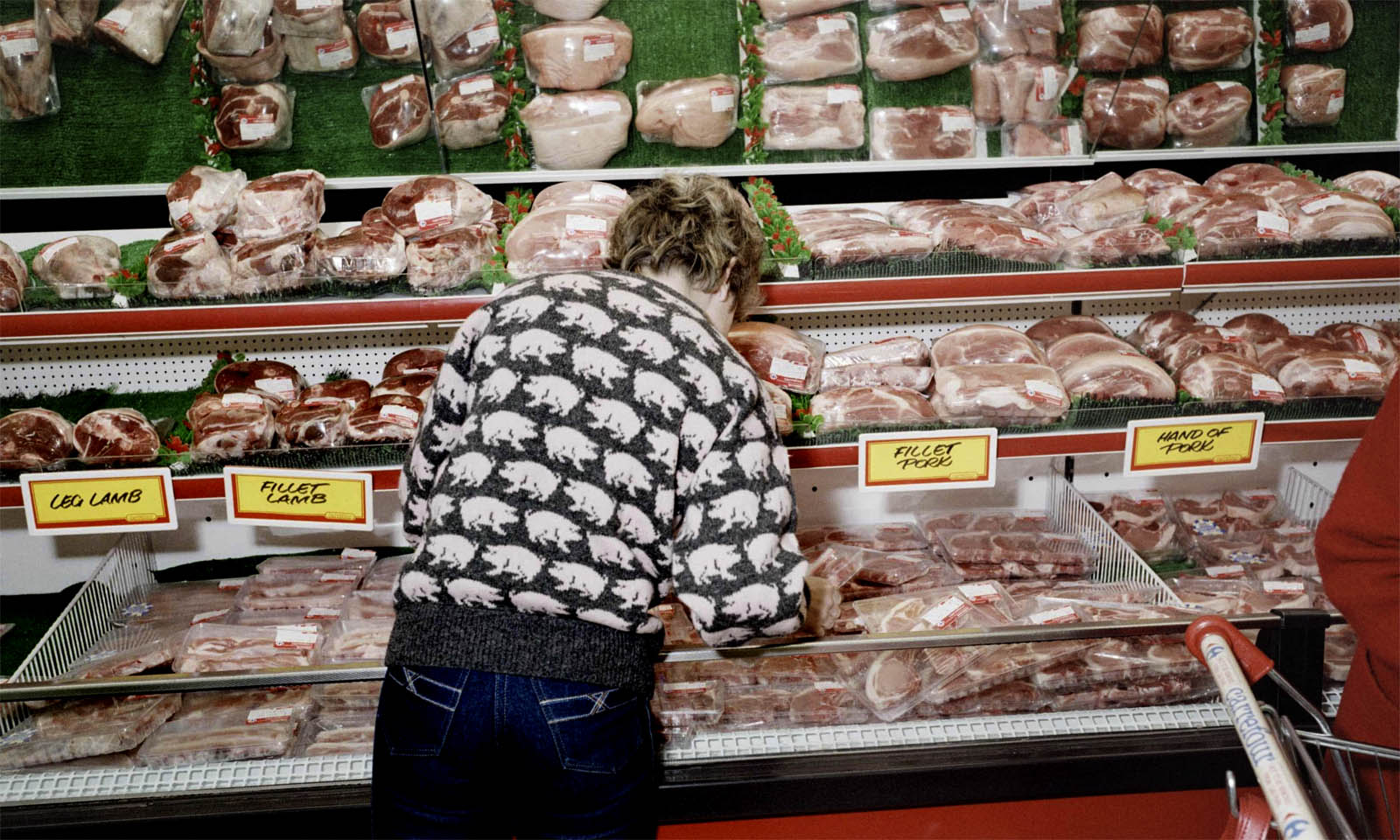
 

Paul Reas (British, b. 1955) 'Hand of Pork, Caerphilly, South Wales' 1985-1988


Paul Reas (British, b. 1955)
Hand of Pork, Caerphilly, South Wales
1985-1988
C-print on paper
© Paul Reas/Martin Parr Foundation


“Deregulation of the banking system meant credit was easy to come by and consumer spending rose fast. Shopping malls were the new cathedrals of consumption and retail parks with supermarkets and furniture stores the parish churches. Shopping became leisure”

~ Paul Reas


Inspired by the use of colour in advertising, Paul Reas dedicated his first series of colour photographs to the post- industrial consumer boom in the UK in the 1980s. These works, taken with a medium-format camera and a large flashgun, present everyday scenes at US-style retail parks, supermarkets and the new housing estates fast becoming a feature of British towns and villages. Reas’s images consider the impact of these ‘new cathedrals of consumption’. Reas has described how Margaret Thatcher’s belief in a free-market economy and individualism moved British society from a ‘we’ to a ‘me’ mentality. As he explains: ‘Although I was photographing people, I never really think about my photographs as being totally about people. They’re about the systems that we’re all subjected to.’

Wall text from the exhibition
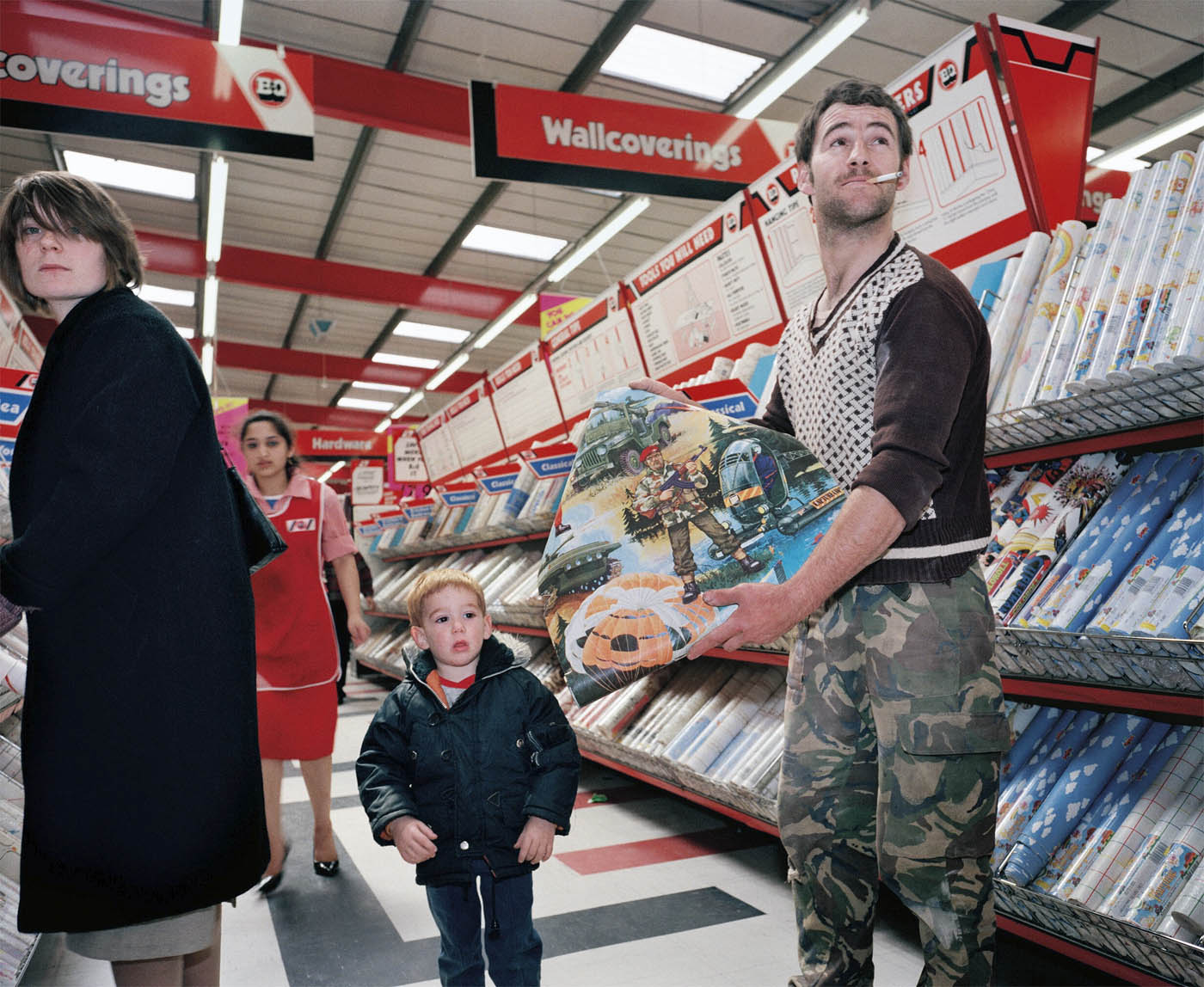
 

Paul Reas (British, b. 1955) 'Army Wallpaper, B&Q Store, Newport South Wales' c. 1987


Paul Reas (British, b. 1955)
Army Wallpaper, B&Q Store, Newport South Wales
c. 1987
C-print on paper
© Paul Reas/Martin Parr Foundation
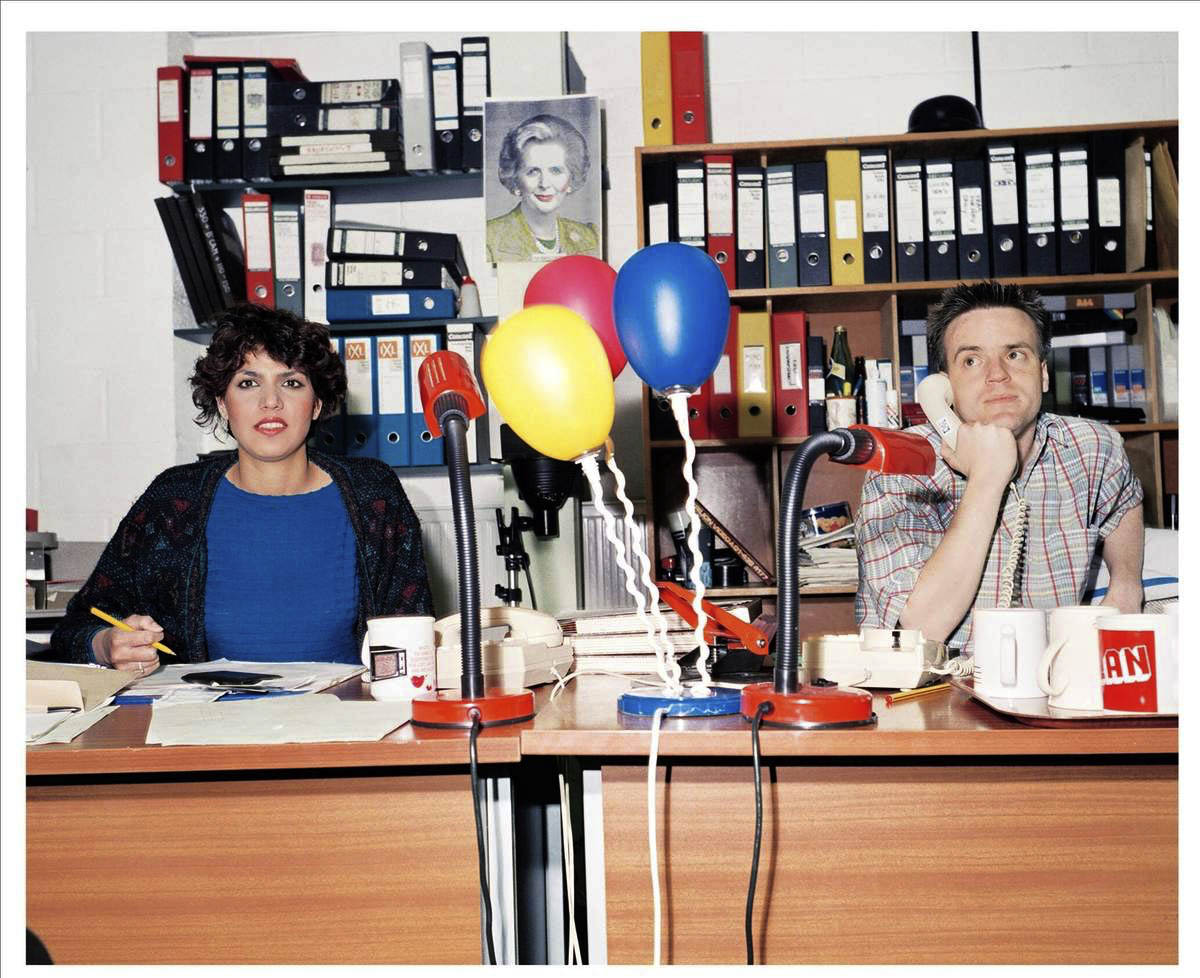
 

Anna Fox (British, b. 1961) 'Independent Video Production Company' 1988 from the series 'Work Stations'


Anna Fox (British, b. 1961)
Independent Video Production Company
1988
From the series Work Stations
The Hyman Collection
Courtesy of the Centre for British Photography
© Anna Fox


“Thatcher was a powermonger and her favourite phrase, ‘there is no such thing as society, just individuals’ saw the end of a culture of community support and a rise in the pursuit of wealth for individuals – primarily white men. Compared to now, things in some ways were more straightforward, and as artists we knew what we were making work about – there was a positive sense that we could change things; we criticised society with hope fueling us…

I made two key bodies of work in this period, including Work Stations – a study of London office life with found texts, creating satirical commentary on a very conservative Britain. I was interested in how consumerism was sweeping the floor with us and how money ruled. There were hardly any documentary images made of office life, it wasn’t considered a valid subject and this interested me. All documentary images change as time passes – design and style become more fascinating as they age – and I am so pleased these images have stayed in people’s imagination. They are a significant record of a particular time and they bring up a lot of memories of what it was like to live and work in it.”

Zoe Whitfield. “The story of 80s Britain, as seen by 7 notable photographers,” on the Dazed website, November 22, 2024 [Online] Cited 03/04/2025


Anna Fox (British, b. 1961) 'Salesperson, Cafe, the City' 1988


Anna Fox (British, b. 1961)
Salesperson, Cafe, the City
1988
From the series Work Stations
Inkjet print on paper
The Hyman Collection
Courtesy of the Centre for British Photography
© Anna Fox


In her Work Stations series, Anna Fox captures London office life in the late 1980s. ‘I was attracted to it because it’s such an ordinary subject and hardly anyone had ever photographed office life’, she says. The photographs combine colour, on-camera flash and snapshot style compositions to create hard shadows and emphasise the immediacy of each scene. The unusual framing and off-kilter camera angles give them a spontaneous and humorous feel. Fox repurposed text from business articles and magazines to loosely pair with each image in the series. They reveal the intense competition, stress and absurdities of corporate culture in Thatcher-era Britain.

Wall text from the exhibition
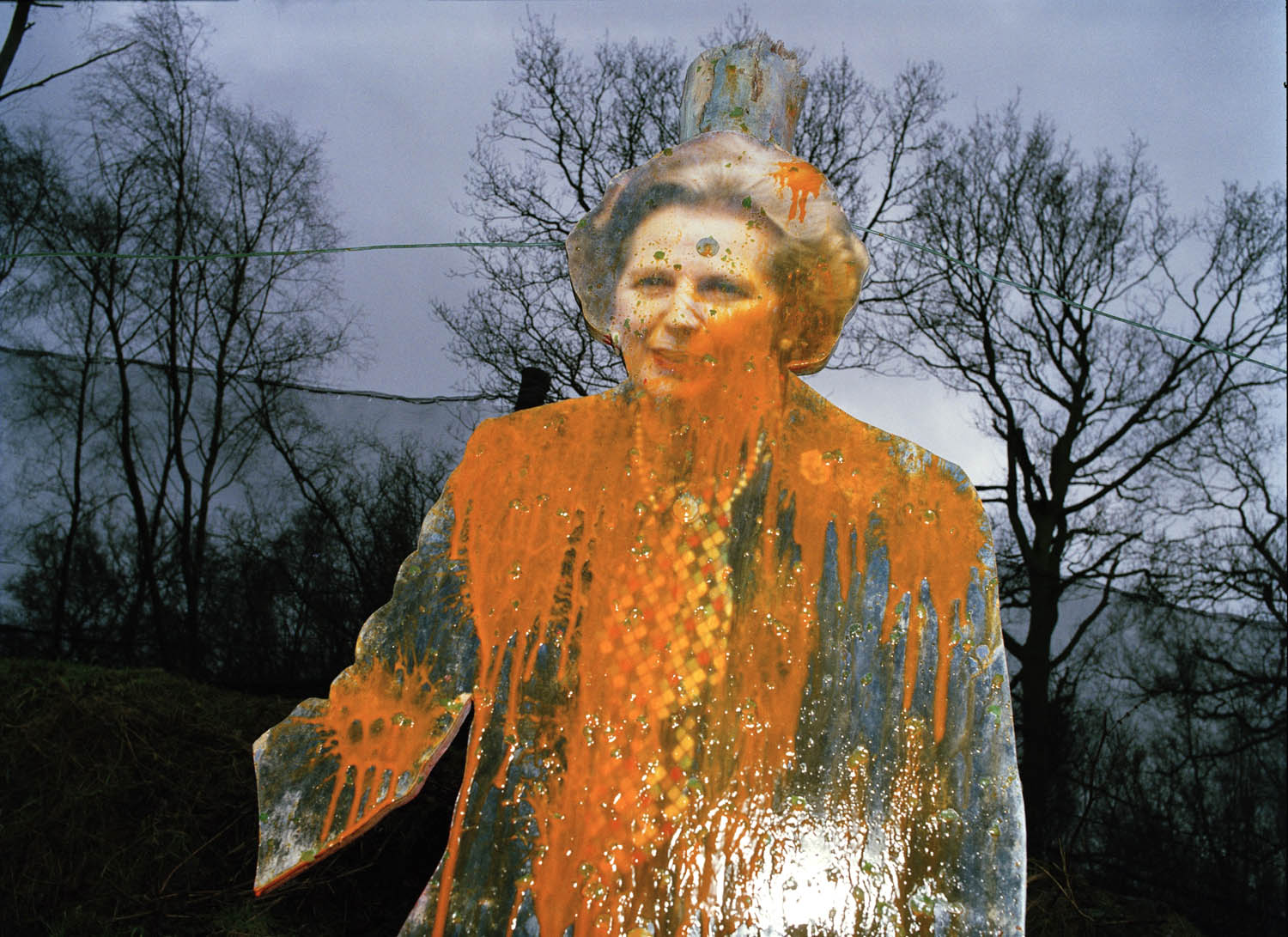
 

Anna Fox (British, b. 1961) 'Friendly Fire, target (Margaret Thatcher) / Margaret Thatcher Target' 1989


Anna Fox (British, b. 1961)
Friendly Fire, target (Margaret Thatcher) / Margaret Thatcher Target
1989
Inkjet print on paper
The Hyman Collection
Courtesy of the Centre for British Photography
© Anna Fox


While working on her 1987-1988 series Work Stations exploring office life, Anna Fox came across the phenomenon of paintballing. Learning that corporate sales teams often took part in outdoor paintball games to encourage team spirit and competitiveness, she wanted to capture these ‘weekend wargames’ in action. In her series Friendly Fire, Fox plays the role of war photographer just as the participants play at being soldiers. This image depicts a paint-splattered cardboard cutout of Margaret Thatcher used for target practice. Taken in the aftermath of the Falklands War, Fox’s work explores the connections and contrasts between these sites of simulated conflict and the experiences of military personnel.

Wall text from the exhibition


Grace Lau (British-Chinese, b. 1939)
'Interiors series' 1986


Grace Lau (British-Chinese, b. 1939)
Interiors series
1986
Colour transparency
Lent by the artist
© Grace Lau 1986


Grace Lau employs colour to explore fetish subcultures from a feminist perspective. This series was produced following an invitation to document a London cross-dressing community. Lau’s portraits are often set in private, domestic spaces where fantasies and alternative lifestyles could be acted out more openly. As the artist explains: ‘When I started making portraits of cross-dressers, many projected their alter-identities with such joyous style that I felt black-and-white could not do justice to their vibrant characters. Colour seemed to express their proud desire to project subliminal identities and these images with their saturated, bright colours, reflect my subjects’ multi-layered personalities; their bright red lipstick, glamorous dresses and jewellery blazing into life in colour transparency film.’

Wall text from the exhibition


Brenda Prince (British, b. 1950)
'Anti-Clause 28 demo in Whitehall, London' 9 June 1988


Brenda Prince (British, b. 1950)
Anti-Clause 28 demo in Whitehall, London
9 June 1988
Format Photographers Archive, Bishopsgate Institute
© Brenda Price


Did the 80s really last from 1976-94? This exhibition thinks it did – resulting in a show replete with gems, but in need of a tight edit…

The exhibition starts out along thematic lines. The opening room is dedicated to protest, from the Grunwick strike led by British/South Asian workers in Brent, through clashes between pickets and the police at the Orgreave coking plant, and marches opposing the homophobic Section 28 legislation. In a gallery dedicated to money and the growing divide between haves and have-nots, Paul Graham’s grimly atmospheric pictures of DHSS waiting rooms face off against Martin Parr’s snarky snaps of garden parties and gallery openings. In the next section, the lens is turned on the landscape, and the transformations wrought both by industry and its removal. …

The closing section Celebrating Subcultures bypasses those usually associated with the 1980s (punks, goths, rude boys, new age travellers) but includes an entire wall of 1990s photographs by Wolfgang Tillmans, most of which were shot in Germany and Greece…

The art world of the 1980s speaks strongly to our own, in particular, the shared interest in identity and representation. In short supply here is the punky irreverence of an era in which taking the piss was practically a national hobby.

Hettie Judah. “The 80s: Photographing Britain review – a meandering look at pomp, protest – and pork,” on The Guardian website Wed 20 Nov 2024 [Online] Cited 02/05/2025


For all that, I left this show feeling slightly beleaguered by the overload of images and attendant theory. The foregrounding of emerging visual strategies, from activist reportage to nascent conceptualism to identity-driven self-portraiture, is brave but often bewildering rather than enlightening. The final room, Celebrating Subculture, is a case in point, being a cursory nod to a decade that saw the emergence of the style-conscious youth culture that echoes through fashion, music and indeed everyday life until this day.

If your image of the 80s is predicated on memories of The Face magazine, or the blossoming of extravagant tribal subcultures such as goths and New Romantics in clubs such as the Batcave and Blitz, you may be as baffled as I was not to encounter a single image by the likes of Juergen Teller, Nigel Shafran or Derek Ridgers. Instead, there are four street portraits of stylish young men by Jason Evans and a recreation of Wolfgang Tillmans’s first photo installation, which mainly comprises images first published in i-D magazine. A portrait of the 80s, then, but one that at times seems determinedly out of focus.

Sean O’Hagan. “The 80s: Photographing Britain review – in your face and to the barricades,” on The Guardian website, Sun 24 Nov 2024 [Online] Cited 02/05/2025


Roy Mehta (British, b. 1968) From the series 'Revival, London' 1989-1993


Roy Mehta (British, b. 1968)
From the series Revival, London
1989-1993
C-print on paper
Courtesy of the artist and LA


Roy Mehta’s Revival, London, series focusses on Caribbean and Irish communities in Brent northwest London, where he lived in the 1980s. Much of Mehta’s practice engages with the complexity of identity and belonging.

Mehta invites us ‘to share in the atmosphere of the subject’s internal world by illustrating the gentle essence of our shared humanity through images of empathy, faith and tenderness’. He notes: ‘I wanted the work to depict compassion and solidarity, along with reflections of the everyday. I felt these were absent from some mainstream representations of diasporic identities at that time in the 1980s.’

Wall text from the exhibition
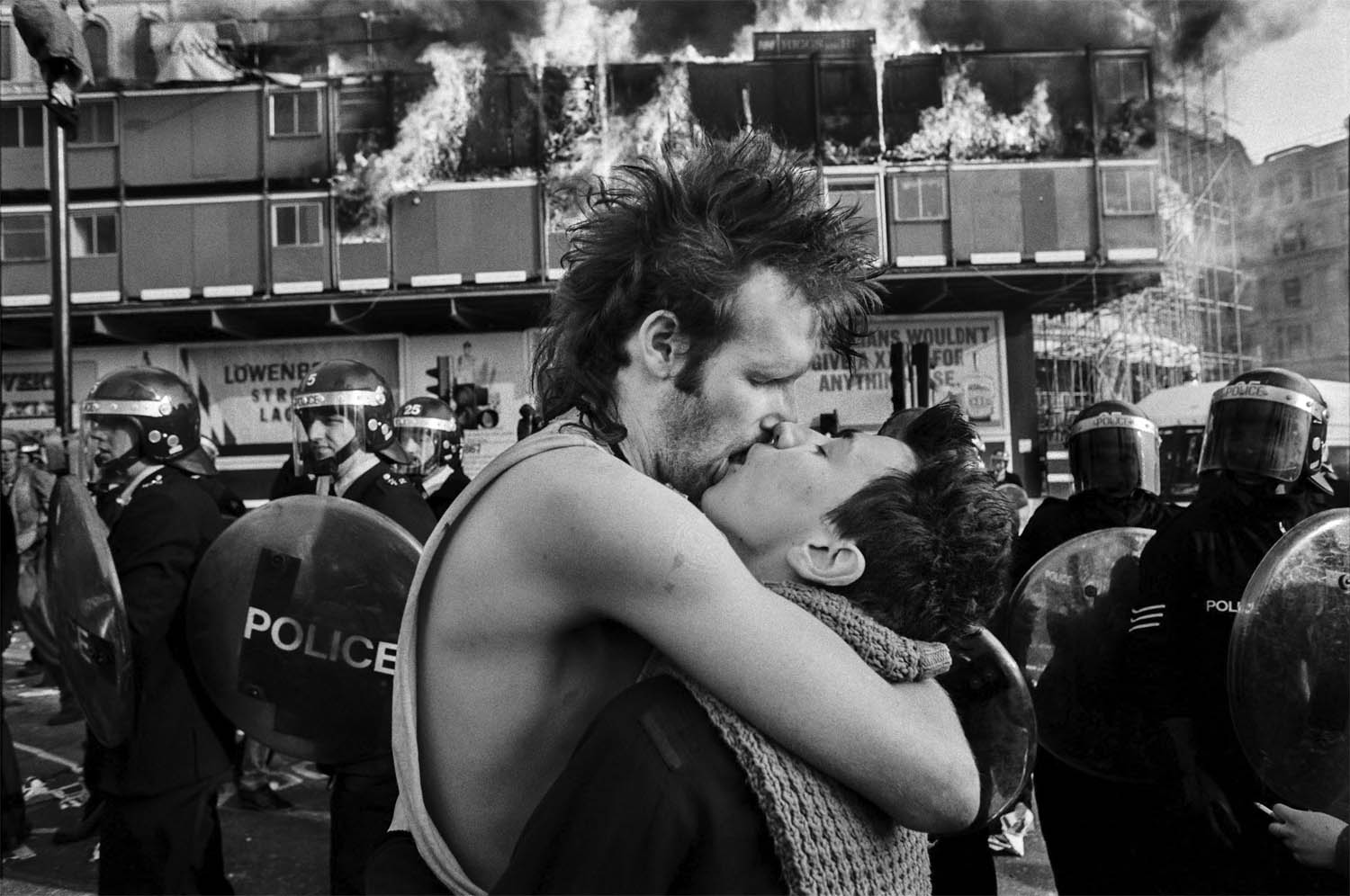
 

David Hoffman (British) 'Nidge & Laurence Kissing, taken at a poll tax protest in London' 1990


David Hoffman (British)
Nidge & Laurence Kissing, taken at a poll tax protest in London
1990
© David Hoffman
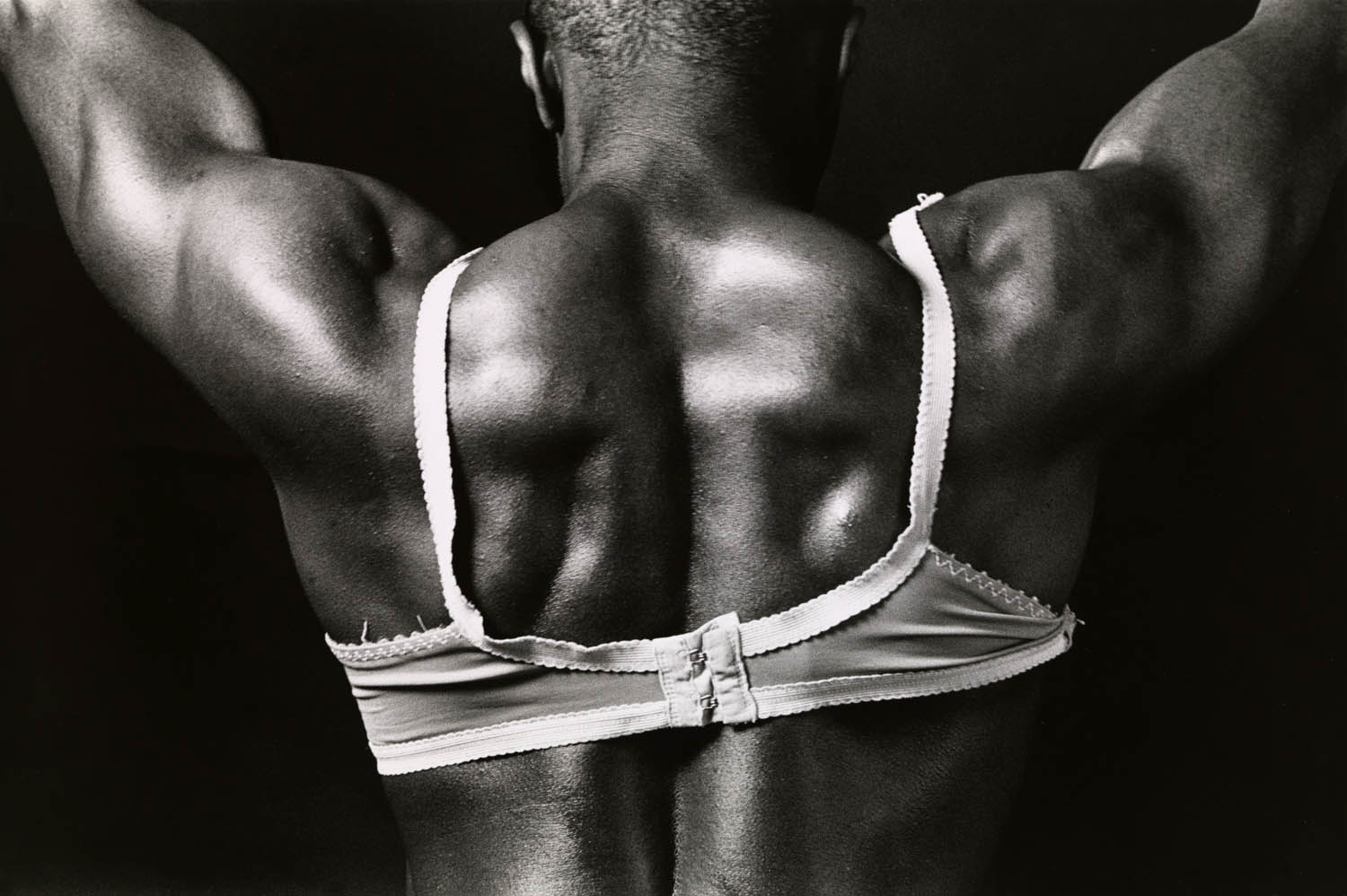
 

Ajamu X (British, b. 1963) 'Body Builder in Bra' 1990


Ajamu X (British, b. 1963)
Body Builder in Bra
1990
Gelatin silver print on paper
Tate
Presented by Tate Members 2020


When asked about the photoshoot for this image, Ajamu said: ‘we went to the local market here in Brixton, bought a bra and played around with it. This was one of the first shots.’ This spontaneity is contrasted with the carefully framed close-up of the sitter’s back. Bodybuilding has long been an area of interest for Ajamu. Although it represents ‘an archetypal image of the male body’, he describes how his practice is ‘a consistent attempt to subvert, re-think, play with these limited modes of representations around particular bodies in a multi-dimensional way.’

Wall text from the exhibition


Jason Evans (Welsh, b. 1968) and Simon Foxton (British, b. 1961) 'Untitled' 1991 From the series 'Strictly'


Jason Evans (Welsh, b. 1968) and Simon Foxton (British, b. 1961)
Untitled
1991
From the series Strictly
Tate
© Jason Evans


“This work was made in collaboration with Simon Foxton. It takes the head-to-toe ‘straight up’ documentary approach to street style as a point of departure, however they’re entirely constructed. We saw fashion photography as a political space where we could create something that pushed back at the media stereotypes of young Black men. This is a Trojan horse exercise, intended to disrupt the white supremacist media project. For many, it may be hard to imagine how racist the UK felt then, which, especially with hindsight, makes today’s politics all the harder to witness.”

Zoe Whitfield. “The story of 80s Britain, as seen by 7 notable photographers,” on the Dazed website, November 22, 2024 [Online] Cited 03/04/2025


Al-An deSouza (Kenyan, b. 1958) 'Junglee, Indian Aphorisms series'
1992/2024


Al-An deSouza (Kenyan, b. 1958)
Junglee, Indian Aphorisms series
1992/2024
Courtesy Al-An deSouza and Talwar Gallery, New York and New Delhi


In Indian Aphorisms, Al-An deSouza combines self-portraits with introspective reflections. Through the series, the artist attempts to reclaim and redefine their identity. Each work portrays the tension between public perception and private reality, illustrating the ways in which personal identity is continually negotiated and reshaped. DeSouza’s photographs reveal their struggle to separate reality from yearning and imagining. ‘I don’t know which of my memories are my own remembrance, which are tales whispered to me secretly as I lay in my bed, or which are ghostly after images, effigies petrified between the tissue leaves of photo albums’, the artist explains.

Wall text from the exhibition


'The 80s: Photographing Britain' book cover


Related publications

The 80s: Photographing Britain

Edited by Yasufumi Nakamori, Helen Little and Jasmine Chohan

Featuring contributions by Bilal Akkouche, Geoffrey Batchen, Derek Bishton, Jasmine Chohan, Taous Dahmani, Helen Little, Yasufumi Nakamori, Mark Sealy, Noni Stacey

Published November 2024, hardback £40

Available on the Amazon website


Tate Britain
Millbank, London
SW1P 4RG

Open daily 10.00 – 18.00

Tate Britain website

LIKE ART BLART ON FACEBOOK

Back to top

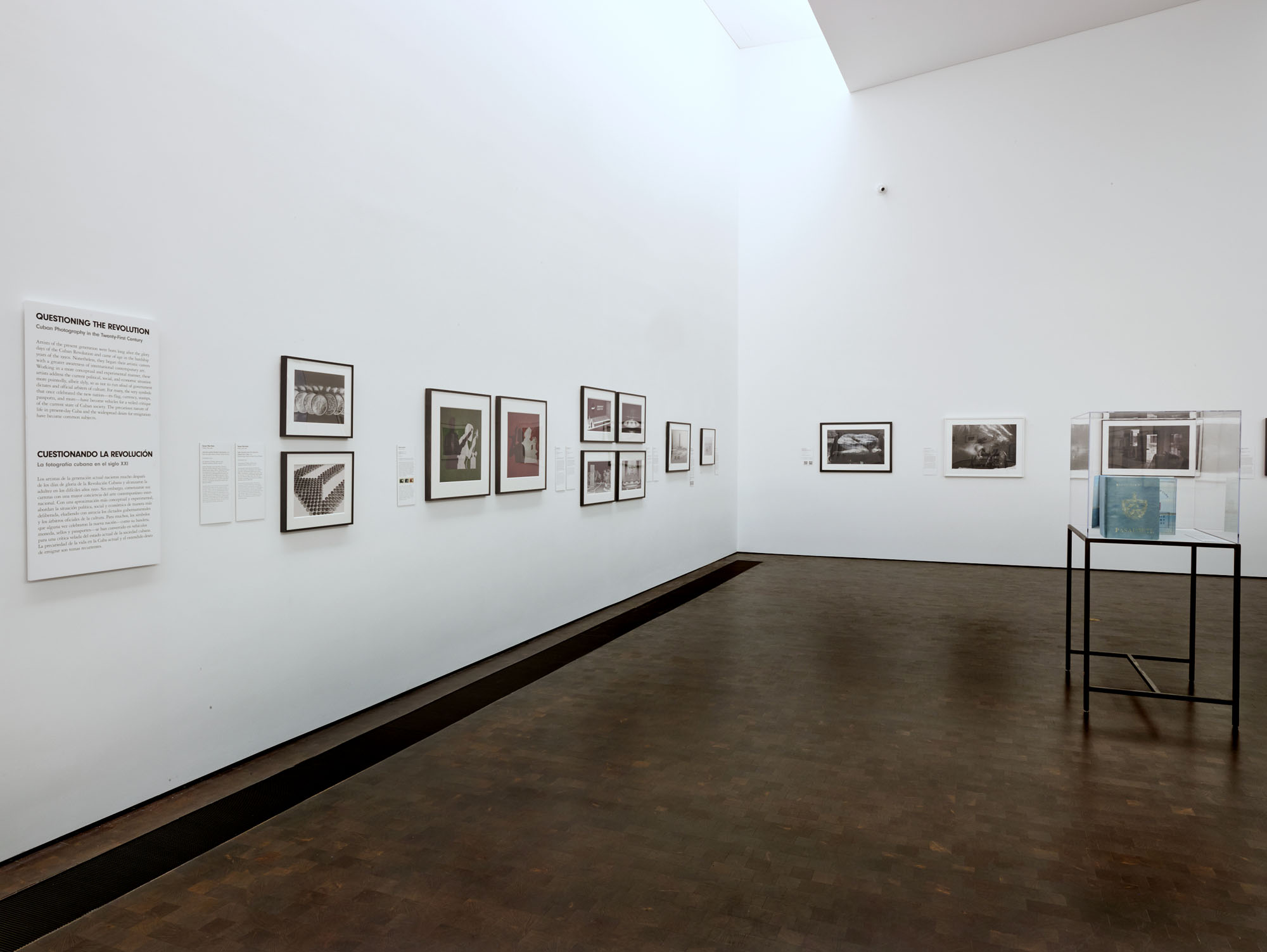
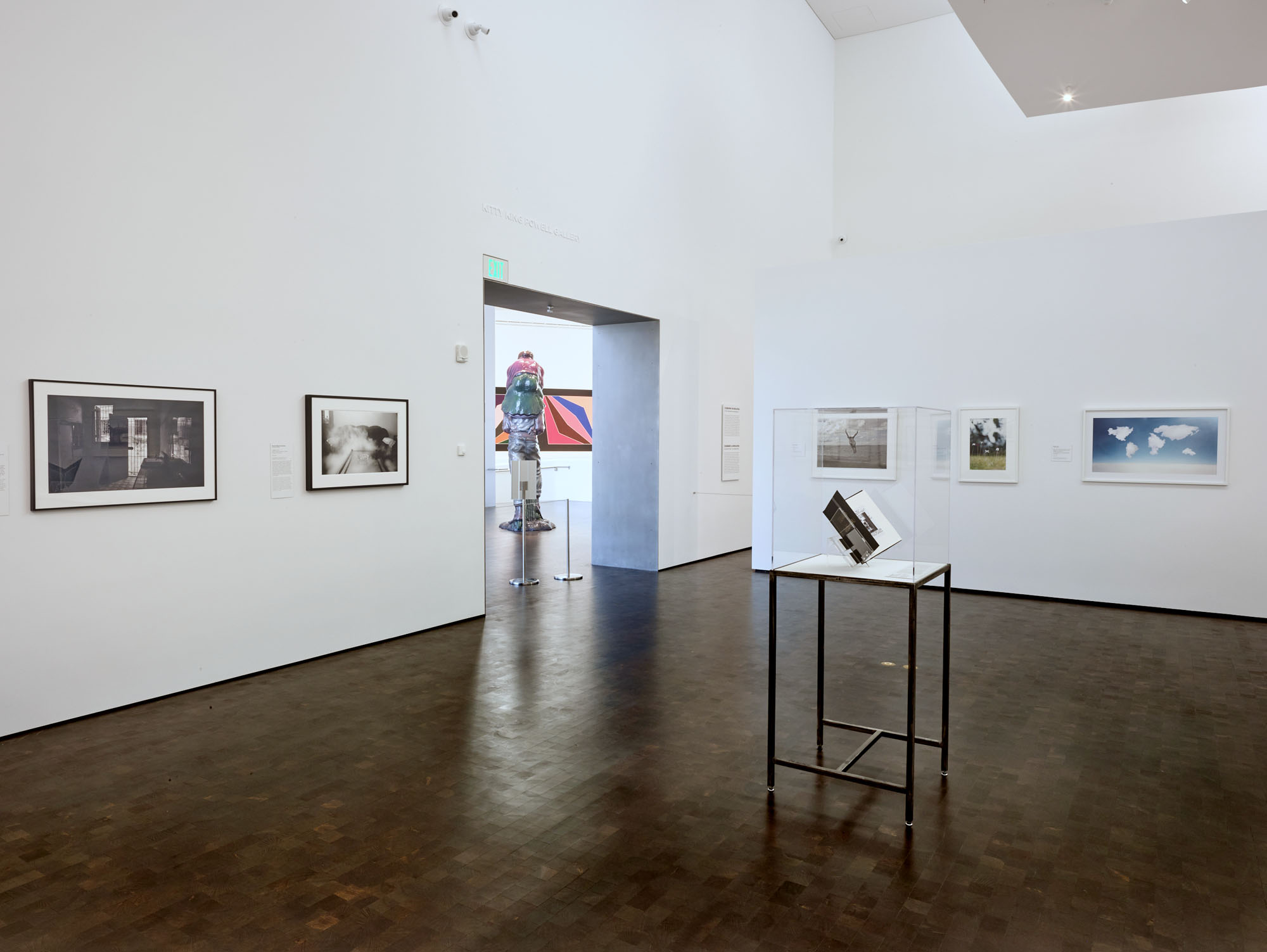
Exhibition: ‘Navigating the Waves: Contemporary Cuban Photography’ at the Museum of Fine Arts, Houston

Exhibition dates: 29th September, 2024 – 16th March, 2025


Raúl Cañibano (Cuban, b. 1961) 'Untitled' 2009 from the series 'Country Land' (Tierra guajira) from the exhibition 'Navigating the Waves: Contemporary Cuban Photography' at the Museum of Fine Arts, Houston, Sept 2024 - March 2025


Raúl Cañibano (Cuban, b. 1961)
Untitled
2009
From the series Country Land (Tierra guajira)
Inkjet print
The Museum of Fine Arts, Houston
The Madeleine P. Plonsker Collection, gift of Madeleine and Harvey Plonsker
© 2009 Raúl Cañibano


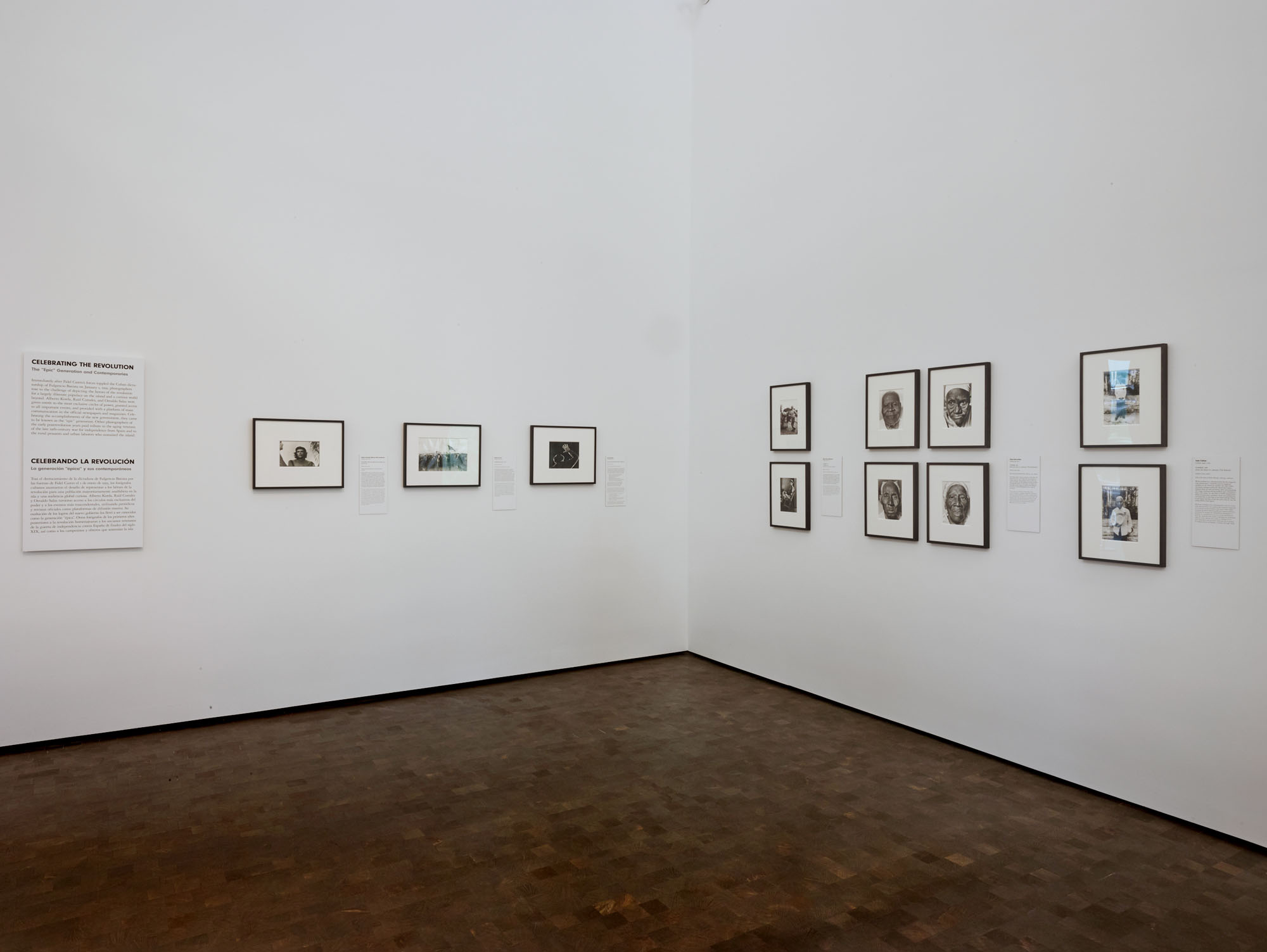
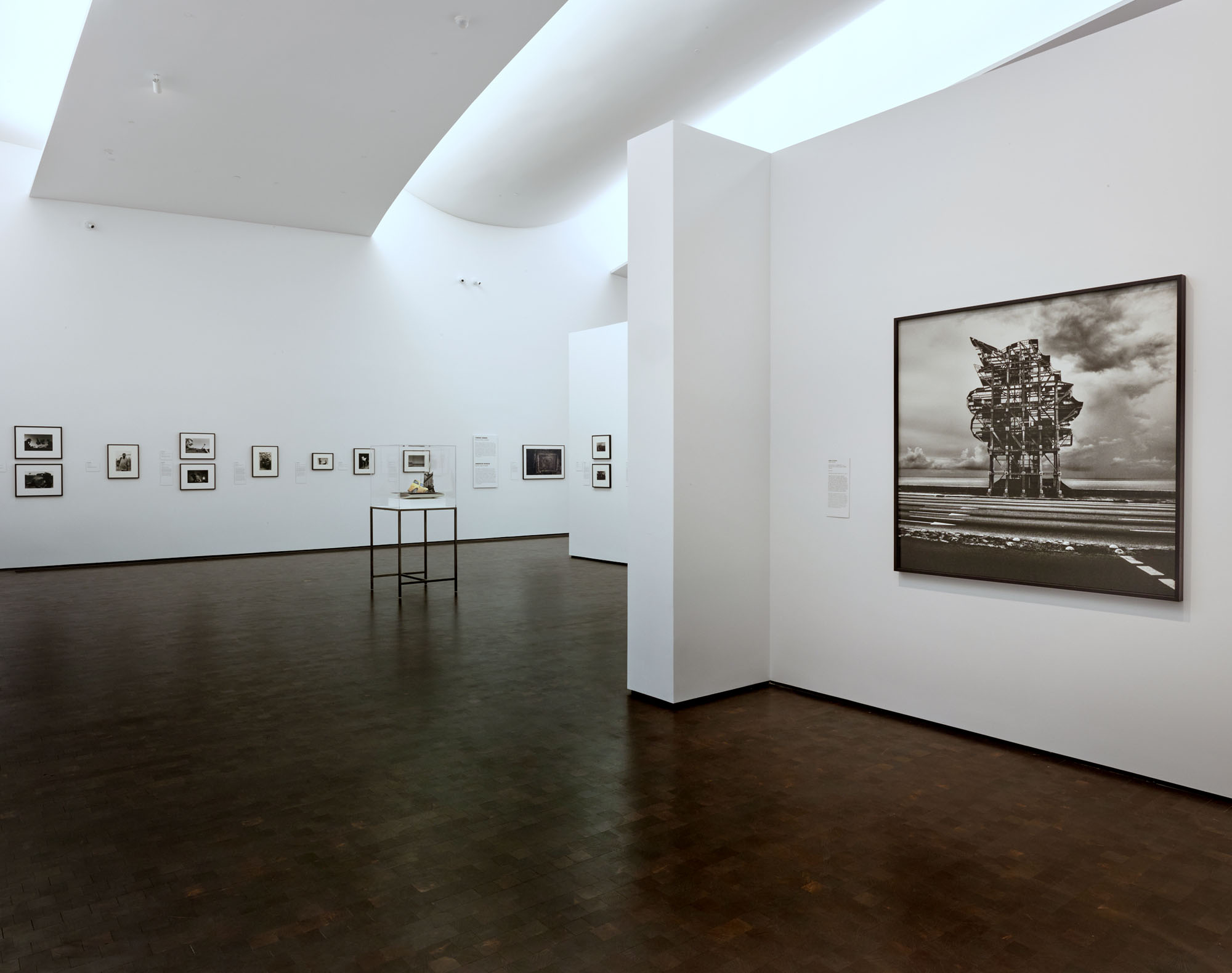
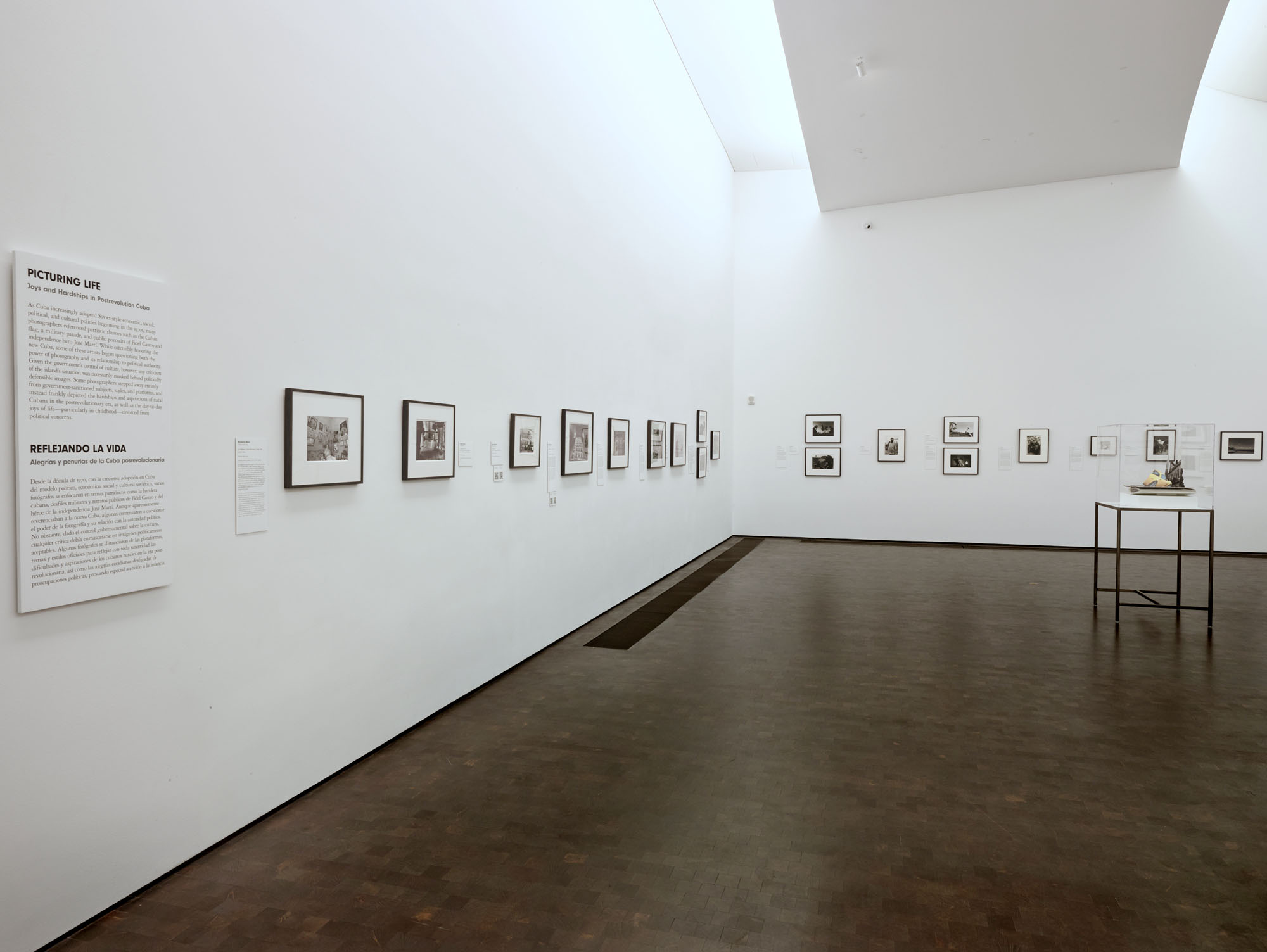
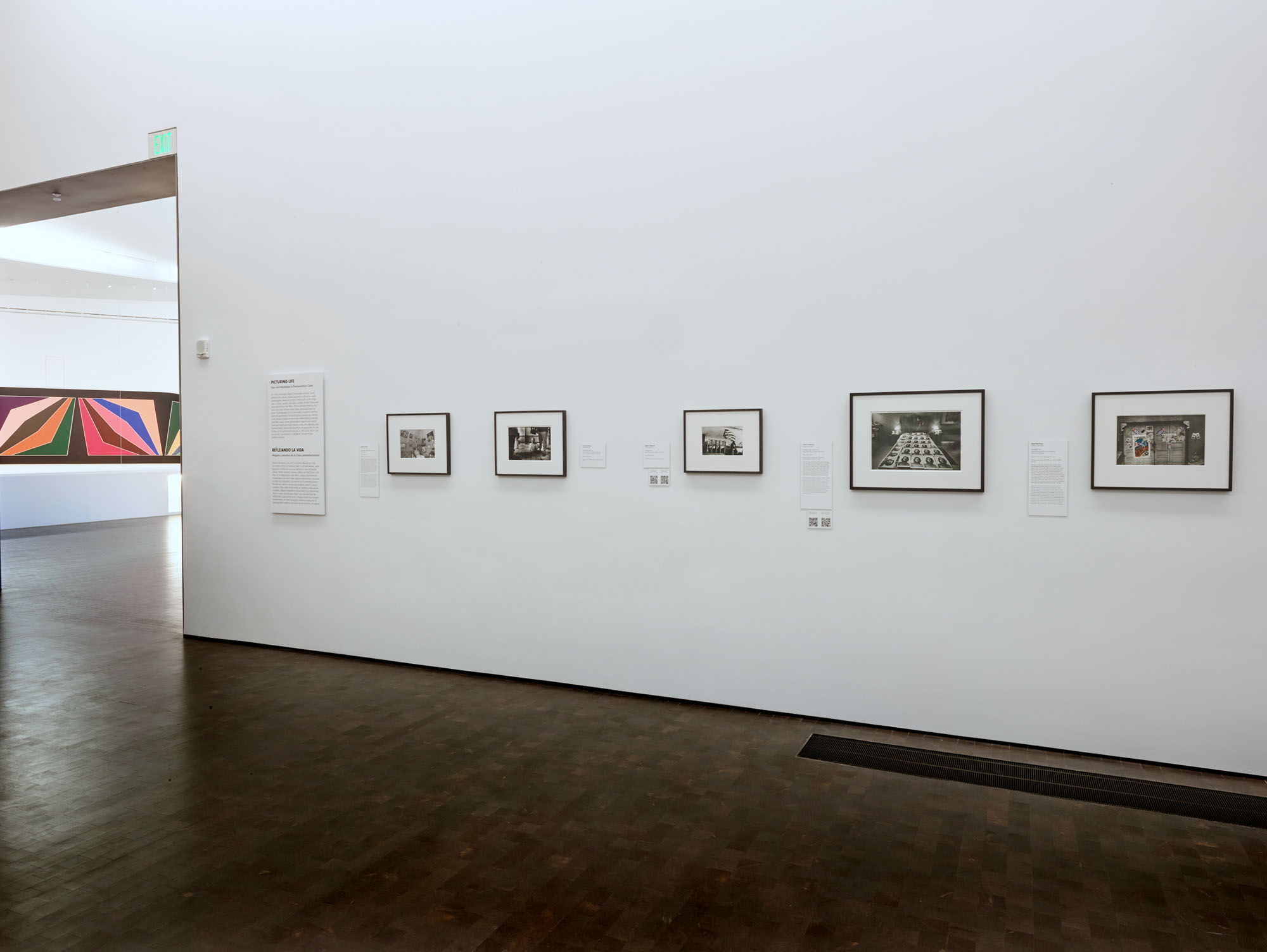
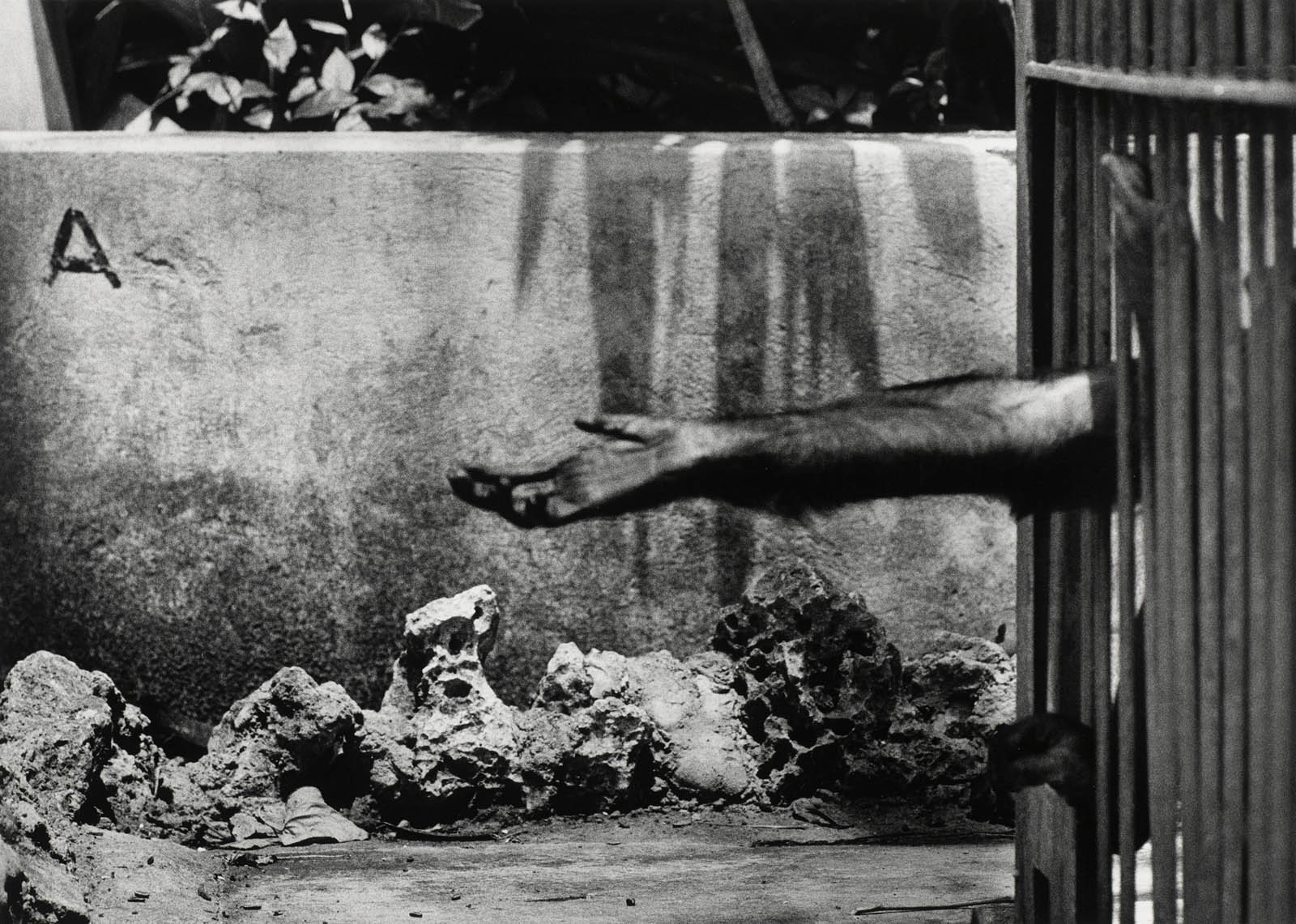
Raúl Cañibano grew up in both Havana and the eastern part of the country, and in 1998 he returned to the east to develop his series Tierra guajira (Country Land), a project strongly linked to his childhood memories. There, rural life and labor remained little changed despite the vast social and political waves that had swept across the nation in the intervening years.


This is an exhibition on a subject that I had little knowledge of before constructing the posting.

Imagine

Being born after the Cuban Revolution in 1953.

Being a child during the Bay of Pigs Invasion in 1961 (a clandestine invasion of Cuba by a brigade of Cuban exiles planned and executed by the CIA, with the support of the US government) and the Cuban Missile Crisis of 1962 (when nuclear missile sites were being built by the Soviet Union on the island of Cuba).

The fear of invasion and nuclear war.

Imagine

Growing up in a nation full of national fervour and revolutionary heroes, a “cult of personality”.

Growing up in country that defied the United States of America to stand on its own two feet but was plagued by shortages of foods, fuel, and other necessities, where “hundreds of thousands of Cubans, especially skilled workers and wealthy investors, emigrated to the United States (principally to Miami, Florida), Spain, and other countries”1 even as the country drew closer to the Soviet Union.

Growing up in a country where prominent dissidents were jailed and repressive laws enacted.

Imagine

Living under a communist regime where, when Soviet troops withdrew in 1991, there was high unemployment, energy conservation and severe internal “shortages of food, medical supplies, raw materials, and fuel which were exacerbated by the ongoing U.S. trade embargo.”1

Imagine

Growing up gay in a country where during The First Period (1965-1979) LGBTQ+ individuals were imprisoned in labor camps called Unidades Militares de Ayuda a la Producción (UMAPs); and during The Second Period (1980-2004) “the homophobia possessed by the government led to more acts of oppression toward LGBTQ+ individuals, but the government also extended more rights to gays.”2

Imagine

Growing up to be an artist, a photographer, living and working under the regime.

Living in a country as a creative person and trying to subversively comment on the precarious nature of life in present-day Cuba (questioning the power of photography and its relationship to political authority) without ending up in prison.

Despite these conditions of becoming, Cuban photographers continue to photograph their own lives and the life and spirit of the people. Through reality, myth and fantasy, through rituals, personal history, queer identity, race and gender they examine Cuban culture and history from a constructive and/or critical perspective.

The light of the artist and the light of the people shines on.

Dr Marcus Bunyan


1/ Sandra H. Levinson and Franklin W. Knight. “National evolution and Soviet influence,” on the Britannica website last updated Mar 11, 2025 [Online] Cited 13/03/2025

2/ Giovanny Bravo. “the cuban government’s treatment of lgbtq+ cubans since the revolution,” on the Cow Latin America website, May 2, 2020 [Online] Cited 13/03/2025


Many thankx for the Museum of Fine Arts, Houston for allowing me to publish the photographs in the posting. Please click on the photographs for a larger version of the image.


Installation view of the exhibition ‘Navigating the Waves: Contemporary Cuban Photography’ at the Museum of Fine Arts, Houston showing at left, Adrián Fernández's 'Untitled No. 1' 2017 from the series 'Pending Memories' (Memorias pendientes); and at right in the banner image a reproduction of Liudmila & Nelson's photograph 'Absolut Revolution - La Isla' (Absolut Revolution - The Island) 2002
Installation view of the exhibition ‘Navigating the Waves: Contemporary Cuban Photography’ at the Museum of Fine Arts, Houston


Installation views of the exhibition Navigating the Waves: Contemporary Cuban Photography at the Museum of Fine Arts, Houston showing at left, Adrián Fernández’s Untitled No. 1 2017 (below) from the series Pending Memories (Memorias pendientes); and at right in the banner image a reproduction of Liudmila & Nelson’s photograph Absolut Revolution – La Isla (Absolut Revolution – The Island) 2002 (below)


Liudmila & Nelson (active Cuba, founded 1994) Liudmila Velazco (Cuban born Russia, b. 1969) Nelson Ramírez de Arellano (Cuban born Germany, b. 1969) 'Absolut Revolution - La Isla' (Absolut Revolution - The Island) 2002


Liudmila & Nelson (active Cuba, founded 1994)
Liudmila Velazco (Cuban born Russia, b. 1969)
Nelson Ramírez de Arellano (Cuban born Germany, b. 1969)
Absolut Revolution – La Isla (Absolut Revolution – The Island)
2002
From the series Absolut Revolution
Gelatin silver print
15 1/2 × 23 in. (39.3 × 58.4cm)
The Museum of Fine Arts, Houston
The Madeleine P. Plonsker Collection, Gift of Madeleine and Harvey Plonsker


The José Martí monument holds a powerful, symbolic place in the history and psyche of the nation. From its base, Fidel Castro routinely addressed vast crowds gathered in the expansive Plaza de la Revolución. Is Liudmila & Nelson’s imagining of a flooded Havana meant to represent the nation, battered by forces beyond its control, still standing strong, or a revolution that has sacrificed the lives of its people for its own survival? Where art and literature are scrutinised by official censors, it pays to retain plausible deniability, even in photography, a medium often thought to be unambiguously truthful.


Installation view of the exhibition ‘Navigating the Waves: Contemporary Cuban Photography’ at the Museum of Fine Arts, Houston


Installation view of the exhibition Navigating the Waves: Contemporary Cuban Photography at the Museum of Fine Arts, Houston


Navigating the Waves: Contemporary Cuban Photography traces the evolution of photography in Cuba over nearly five decades, from the 1960s to early 2000s.

The exhibition looks at contemporary Cuban photography from its role in promoting the Cuban Revolution after Fidel Castro’s 1959 takeover of the Batista government to engaging in social and political critique following the 1991 collapse of the Soviet Union. Over the subsequent years, Cuban photographers created powerful personal expressions by exploring individual identity, the body and spirit, Afro-Cuban heritage, and the margins of society, all while navigating the changing prescriptions and proscriptions of official cultural policy.

Showcasing approximately 100 images, Navigating the Waves: Contemporary Cuban Photography celebrates the acquisition and promised gift to the MFAH of some 300 photographs from Chicago-based collectors Madeleine and Harvey Plonsker.

Text from the Museum of Fine Arts, Houston website


Installation view of the exhibition ‘Navigating the Waves: Contemporary Cuban Photography’ at the Museum of Fine Arts, Houston showing at left, Reynier Leyva Novo's 'Un día feliz FC No. 11' (A Happy Day FC No. 11) 2016; and at right the section "Celebrating the Revolution" including at third right, Alberto Korda's 'Heroic Guerrilla' (Guerillero heroico) 1960; at second right, Raúl Corrales' 'Caballería' (Cavalry) 1960; and at right, Osvaldo Salas' 'Five Points of Fidel' (Cinco puntos de Fidel) 1982


Installation view of the exhibition Navigating the Waves: Contemporary Cuban Photography at the Museum of Fine Arts, Houston showing at left, Reynier Leyva Novo’s Un día feliz FC No. 11 (A Happy Day FC No. 11) 2016 (below); and at right the section “Celebrating the Revolution” including at third right, Alberto Korda’s Heroic Guerrilla (Guerillero heroico) 1960 (below); at second right, Raúl Corrales’ Caballería (Cavalry) 1960 (below); and at right, Osvaldo Salas’ Five Points of Fidel (Cinco puntos de Fidel) 1982 (below)


Reynier Leyva Novo (Cuban, b. 1983) 'Un día feliz FC No. 11' (A Happy Day FC No. 11) 2016, printed 2024 from the exhibition 'Navigating the Waves: Contemporary Cuban Photography' at the Museum of Fine Arts, Houston, Sept 2024 - March 2025


Reynier Leyva Novo (Cuban, b. 1983)
Un día feliz FC No. 11 (A Happy Day FC No. 11)
2016, printed 2024
From the series Un día feliz
From the series A Happy Day
Inkjet print
39 3/4 × 39 3/4 in. (101 × 101cm)
The Museum of Fine Arts, Houston
Museum purchase funded by Joan Morgenstern, Jereann Chaney, and Carl Niendorff


In meticulous digital postproduction, Reynier Leyva Novo removed Fidel Castro from a photograph by Alberto Korda, the photographer most credited with establishing the iconography of the triumphant revolution and its leaders. Here, Castro’s presence is suggested only by the photographers stretching to film and photograph him addressing the crowds gathered below in the Plaza de la Revolución. What would modern-day Cuba look like without the imagery of its charismatic leader that fed a cult of personality for half a century? This is what Leyva Novo asks in his series Un día feliz (A Happy Day), begun in the year of Castro’s death.


Navigating the Waves: Contemporary Cuban Photography

Just 90 miles from one another, Cuba and the United States are uneasy neighbours. For American tourists, Havana was a permissive playground with cabarets, casinos, beaches, and brothels until Fidel Castro’s revolutionary forces overthrew the Cuban dictator Fulgencio Batista on January 1, 1959, asserted the nation’s independent status, and cracked down on organised crime and prostitution. The new government nationalised many foreign-owned sectors of the economy in 1960, prompting the United States to impose a crippling trade embargo that remains in place. The botched invasion by anti-Castro exiles at the Bay of Pigs in 1961, covertly backed by the CIA, and the construction of Soviet nuclear missile sites in Cuba the following year, turned these close neighbours into seemingly permanent adversaries.

Beyond a few iconic images, the rich photographic production of Cuban artists of the past 65 years largely fell out of view for American audiences because of this estrangement. Inspired by an exhibition of work by young Cuban photographers organised by Houston’s FotoFest International in 1994, the Museum has since built a deep and representative collection that reveals the ways photographers have pictured the realities and aspirations of the Cuban people while skirting the prescriptions of their government’s propagandists and the proscriptions of its censors.

This exhibition celebrates the recent acquisition of some 300 Cuban photographs assembled by the Chicago-based collector Madeleine Plonsker during nearly two decades of visits to the island, an acquisition that propels the Museum to the forefront of institutions collecting Cuban photography.

Celebrating the Revolution: The “Epic” Generation and Contemporaries

Immediately after Fidel Castro’s forces toppled the Cuban dictatorship of Fulgencio Batista on January 1, 1959, photographers rose to the challenge of depicting the heroes of the revolution for a largely illiterate populace on the island and a curious world beyond. Alberto Korda, Raúl Corrales, and Osvaldo Salas were given entrée to the most exclusive circles of power, granted access to all important events, and provided with a platform of mass communication in the official newspapers and magazines. Celebrating the accomplishments of the new government, they came to be known as the “epic” generation. Other photographers of the early post-revolution years paid tribute to the aging veterans of the late 19th-century war for independence from Spain and to the rural peasants and urban labourers who sustained the island.

Wall text from the exhibition


Alberto Korda (Cuban, 1928-2001)
'Heroic Guerrilla' (Guerillero heroico) 1960, printed 1995 from the exhibition 'Navigating the Waves: Contemporary Cuban Photography' at the Museum of Fine Arts, Houston, Sept 2024 - March 2025


Alberto Korda (Cuban, 1928-2001)
Heroic Guerrilla (Guerillero heroico)
1960, printed 1995
Gelatin silver print
The Museum of Fine Arts, Houston
Museum purchase funded by Dan and Mary Solomon
© Estate Alberto Korda


Alberto Korda’s portrait of Che Guevara, stoic and implacable at a memorial for victims of an explosion in Havana’s harbour, is undoubtedly the best known of all Cuban photographs. The image sat mostly unused in the artist’s files from 1960 to 1967, when Che was captured and assassinated by government forces in Bolivia while trying to organize a popular revolution. He was lionised in Cuba as the exemplar of revolutionary self-sacrifice, and Korda’s portrait of him came to function like a secular image of a martyred saint, appearing on everything from billboards to refrigerator magnets and tattoos to book covers.


Raúl Corrales (Cuban, 1925-2006)
'Caballería' (Cavalry) 1960


Raúl Corrales (Cuban, 1925-2006)
Caballería (Cavalry)
1960
Gelatin silver print
The Museum of Fine Arts, Houston
Gift of the estate of Esther Parada


Raúl Corrales’s Cavalry records an event at which the nationalisation and expropriation of a plantation owned by the United Fruit Company were celebrated by reenacting a famous scene from Cuba’s late 19th-century war for independence from Spain. With reenactments such as this, the triumph of the revolution was linked to a decades-long struggle to shake off the bonds of colonialism. Corrales’s photograph of smiling guerrillas wearing matching straw hats, riding horses, and waving Cuban flags also conjures associations with heroic 19th-century history paintings.


Osvaldo Salas (Cuban, 1938-2005)
'Five Points of Fidel' (Cinco puntos de Fidel) 1982


Osvaldo Salas (Cuban, 1938-2005)
Five Points of Fidel (Cinco puntos de Fidel)
1982
Gelatin silver print
The Museum of Fine Arts, Houston
Gift of the estate of Esther Parada
© 1982 Osvaldo Salas


The title of this photograph, taken in 1982, links Fidel Castro’s gesture to a crucial speech 20 years earlier aimed at President John F. Kennedy amid the Cuban Missile Crisis. Castro outlined five conditions for Cuba’s consent to the withdrawal of Soviet missiles from its territory:

1/ Ending the economic blockade and other commercial and economic pressures
2/ Ending subversive activities
3/ Ending pirate attacks
4/ Ending violations of Cuban airspace
5/ Withdrawal from the Guantanamo Naval Base and its return to the Cuban government.

At the time, however, Castro was unaware that President Kennedy and Soviet Premier Nikita Khrushchev were already discussing missile withdrawal without Cuba’s participation.


Installation view of the exhibition ‘Navigating the Waves: Contemporary Cuban Photography’ at the Museum of Fine Arts, Houston showing at left the section "Celebrating the Revolution" including at left, Alberto Korda's 'Heroic Guerrilla' (Guerillero heroico) 1960; at second left, Raúl Corrales' 'Caballería' (Cavalry) 1960; and at third right, Osvaldo Salas' 'Five Points of Fidel' (Cinco puntos de Fidel) 1982


Installation view of the exhibition Navigating the Waves: Contemporary Cuban Photography at the Museum of Fine Arts, Houston showing at left the section “Celebrating the Revolution” including at left, Alberto Korda’s Heroic Guerrilla (Guerillero heroico) 1960 (above); at second left, Raúl Corrales’ Caballería (Cavalry) 1960 (above); and at third right, Osvaldo Salas’ Five Points of Fidel (Cinco puntos de Fidel) 1982 (above)


Celebrating the acquisition of some 300 Cuban photographs from the Chicago-based collectors Madeleine and Harvey Plonsker, Navigating the Waves: Contemporary Cuban Photography traces the medium’s evolution in Cuba over nearly six decades – from promoting the Revolution following Fidel Castro’s 1959 overthrow of the Batista government, to engaging in social and political critique in more recent times as the triumph of the Revolution increasingly gave way to economic hardship and political repression. Particularly in the years after the 1991 collapse of the Soviet Union, Cuban photographers created powerful personal expressions by exploring individual identity, the body and spirit, Afro-Cuban heritage, and the margins of society, all while navigating the fluctuating prescriptions and proscriptions of official cultural policy.

The exhibition of some 100 works will be on view September 29, 2024 through March 16, 2025, in the Museum’s Nancy and Rich Kinder Building for modern and contemporary art.

“With the acquisition of the Madeleine P. Plonsker Collection, the Museum of Fine Arts, Houston, now boasts the most complete collection anywhere of post-Revolution Cuban photography, with an emphasis on the years since 1990: nearly 700 works by more than 80 Cuban artists,” commented Gary Tinterow, director and Margaret Alkek Williams Chair of the Museum of Fine Arts, Houston. “We are enormously grateful to Mrs. Plonsker, who assembled the collection through the lasting relationships she forged with artists over many visits to Cuba from 2005 to 2020.”

“The strengths of the Plonsker Collection are unparalleled, in terms of telling the complex and compelling story of post-Revolution Cuban photography,” commented Malcolm Daniel, Gus and Lyndall Wortham Curator of photography at the MFAH. “Combined in this exhibition with works already in the Museum’s holdings, the collection allows us to chronicle that story from the ‘epic generation,’ whose work would define the image of the Cuban Revolution, to the succeeding generations of photographers, who questioned the power of photography and its relationship to political authority and who created highly personal work in the context of a greater awareness of international contemporary art.”

Prologue: The “Epic” Generation

The exhibition begins with a brief prologue featuring works by the so-called “epic” generation of photographers – Alberto Korda, Raul Corrales and Osvaldo Salas among them – who used the medium to further the ideals of the Cuban Revolution, celebrating its heroes and promoting its ambitions. It opens with Korda’s iconic portrait of Che Guevara, Guerrillero Heroico (1960), the most widely reproduced and recognised of all Cuban photographs.

Gallery 1: Life in Post-Revolution Cuba

The first gallery presents images of daily life in Cuba, primarily from the 1990s and early 2000s, beginning with photographs that reference patriotic themes: the Cuban flag, veterans, a military parade and public portraits of 19th-century Independence hero José Martí and Cuban leader Fidel Castro. While ostensibly honoring the new Cuba, many of the images question both the power of photography and its relationship to political authority. An Untitled 1992 photograph by José Figueroa depicts dozens of freshly made prints of Alberto Korda’s iconic portrait of Che laid out on a bed – Figueroa was Korda’s longtime printer – and suggests the ubiquity of that iconic image as both propaganda and commodity. Other photographs in this section of the exhibition depict the hardships and aspirations of rural Cubans in the post-revolutionary era as well as the day-to-day joys of life divorced from political concerns. Photographers in this section include Pedro Abascal, Raúl Cañibano, María Cienfuegos Leiseca, José Julián Martí, Humberto Mayol and Eduardo Muñoz Ordoqui.

Gallery 2: Memory, the Body, and Identity

The second section of the exhibition marks a pivotal shift in Cuban photography. As the nation plunged into economic, social and political crisis following the collapse of the Soviet Union [1991] and the loss of its financial support, a time that Castro dubbed the “Special Period,” many photographers turned from documentation of the public sphere to a more personal and poetic exploration of the private realm. Photographers treated the body, often their own, as the path through which to examine their present situation through the lens of Afro-Cuban rituals, personal history, queer identity, race and gender. This particularly rich section features exceptional work by Juan Carlos Alom, Arien Chang Castán, José Manuel Fors, Alejandro González, Eduardo Hernandez Santos, Cirenaica Moreira, René Peña, and others.

Gallery 3: Myth and Reality

In the final section of the exhibition, composed primarily of work made since 2005, photographers address the current political, social and economic situation more directly than in previous years – but slyly still, in order not to run afoul of government dictates and official arbiters of culture. This most recent generation of photographers, born well after the Revolution, came of age in the depths of the Special Period, and began their artistic careers with a greater awareness of international contemporary art. Again, national symbols appear – the Cuban flag, currency, stamps, historic events – but this time with a knowing nod to their emptiness. The precarious nature of life in present-day Cuba and the widespread desire for emigration are common subjects.

This gallery includes work by Adrián Fernández, Alejandro González, Glenda Léon, Liudmila & Nelson, Yasser Piña Peña, Sandra Ramos, Esterio Segura, Lisette Solórzano, and others.

Press release from the Museum of Fine Arts, Houston


Installation view of the exhibition ‘Navigating the Waves: Contemporary Cuban Photography’ at the Museum of Fine Arts, Houston showing at right, Adrián Fernández's 'Untitled No. 1' 2017 from the series 'Pending Memories' (Memorias pendientes)


Installation view of the exhibition Navigating the Waves: Contemporary Cuban Photography at the Museum of Fine Arts, Houston showing at right, Adrián Fernández’s Untitled No. 1 2017 (below) from the series Pending Memories (Memorias pendientes)


Adrián Fernández (Cuban, b. 1984)
'Untitled No. 1 (Sin título No. 1)' 2017, printed 2020 from the series 'Pending Memories' (Memorias pendientes) from the exhibition 'Navigating the Waves: Contemporary Cuban Photography' at the Museum of Fine Arts, Houston, Sept 2024 - March 2025


Adrián Fernández (Cuban, b. 1984)
Untitled No. 1 (Sin título No. 1)
2017, printed 2020
From the series Pending Memories (Memorias pendientes)
Inkjet print
The Museum of Fine Arts, Houston
Museum purchase funded by Photo Forum 2021
© 2017 Adrián Fernández


Inspired by industrial remnants, unfinished construction projects, propaganda billboards, and carnival decorations, Adrián Fernández collaborated with architects, engineers, and computer specialists to combine a lens-based photograph (the landscape) with a digitally constructed image of the back of a fictional structure. It is easy to imagine this structure, set along the Malecón (Havana’s seaside esplanade), as the remains of a once-grand declaration, facing north like a challenge to the United States and as a greeting to anyone arriving in Havana by sea. Fernández intends this image to be a metaphor for today’s teetering ruins of the Cuban Revolution’s grand ambitions.


Installation view of the exhibition ‘Navigating the Waves: Contemporary Cuban Photography’ at the Museum of Fine Arts, Houston showing at left the wall text for the section "Picturing Life: Joys and Hardships in Postrevolution Cuba"


Installation view of the exhibition Navigating the Waves: Contemporary Cuban Photography at the Museum of Fine Arts, Houston showing at left the wall text for the section “Picturing Life: Joys and Hardships in Postrevolution Cuba”


Picturing Life: Joys and Hardships in Postrevolution Cuba

As Cuba increasingly adopted Soviet-style economic, social, political, and cultural policies beginning in the 1970s, many photographers referenced patriotic themes such as the Cuban flag, a military parade, and public portraits of Fidel Castro and independence hero José Martí. While ostensibly honouring the new Cuba, some of these artists began questioning both the power of photography and its relationship to political authority. Given the government’s control of culture, however, any criticism of the island’s situation was necessarily masked behind politically defensible images. Some photographers stepped away entirely from government-sanctioned subjects, styles, and platforms, and instead frankly depicted the hardships and aspirations of rural Cubans in the post-revolutionary era, as well as the day-to-day joys of life – particularly in childhood – divorced from political concerns.

Wall text from the exhibition


Installation view of the exhibition ‘Navigating the Waves: Contemporary Cuban Photography’ at the Museum of Fine Arts, Houston showing at second right, José A. Figueroa's 'Untitled' 1992 from the series 'The Image'


Installation view of the exhibition Navigating the Waves: Contemporary Cuban Photography at the Museum of Fine Arts, Houston showing at second right, José A. Figueroa’s Untitled 1992 from the series The Image (below)


José A. Figueroa (Cuban, b. 1946)
'Untitled' 1992, printed 2023 From the series 'The Image'


José A. Figueroa (Cuban, b. 1946)
Untitled
1992, printed 2023
From the series The Image
Gelatin silver print
40 x 50cm
The Museum of Fine Arts, Houston
Museum purchase funded by Joan Morgenstern in honor of Raquel Carrera


Over the course of decades, Alberto Korda’s protégé and longtime printer José Figueroa printed thousands of copies of Korda’s iconic portrait of Che Guevara. As he worked to fulfil the never-ending demand for Guerrillero heroico, in 1992, 25 years after Che’s death, Figueroa photographed dozens of fresh prints laid out on his bed to dry, an image that revealed his own awareness of the changing nature and role of photography in Cuba from servant of the socialist revolution to commodity and social commentary.


Installation view of the exhibition ‘Navigating the Waves: Contemporary Cuban Photography’ at the Museum of Fine Arts, Houston showing at second left, Eduardo Muñoz Ordoqui's 'Untitled' 1992 from the series 'Zoo-Logos'; and at third right, Eduardo Muñoz Ordoqui's 'Untitled' 1992 from the series 'Zoo-Logos'


Installation view of the exhibition Navigating the Waves: Contemporary Cuban Photography at the Museum of Fine Arts, Houston showing at second left, Eduardo Muñoz Ordoqui’s Untitled 1992 from the series Zoo-Logos (below); and at third right, Eduardo Muñoz Ordoqui’s Untitled 1992 from the series Zoo-Logos (below)


Eduardo Muñoz Ordoqui (Cuban, b. 1964) 'Untitled' 1992 From the series 'Zoo-Logos'


Eduardo Muñoz Ordoqui (Cuban, b. 1964)
Untitled
1992
From the series Zoo-Logos
Gelatin silver print
The Museum of Fine Arts, Houston
Museum purchase funded by Clinton T. Willour in honor of Mickey Marvins
© 1992 Eduardo Muñoz Oroqui


The challenge for Cuban artists has long been to find a way to portray life candidly and critically without triggering the attention of censors. For Eduardo Muñoz Ordoqui, this process began with trips to Havana’s zoo, where he photographed visitors, employees, caged animals, and even the adjacent slaughterhouse, where horses were killed to feed the large cats. By the 1990s, the zoo had become home to neglected creatures enduring their confinement as best they could, a metaphor for the extreme circumstances of life in 1990s Cuba.


Eduardo Muñoz Ordoqui (Cuban, b. 1964) 'Untitled' 1990-1992
From the series 'Zoo-Logos'


Eduardo Muñoz Ordoqui (Cuban, b. 1964)
Untitled
1990-1992
From the series Zoo-Logos
Gelatin silver print
The Museum of Fine Arts, Houston
Museum purchase funded by Clinton T. Willour in honor of Mickey Marvins
© 1992 Eduardo Muñoz Oroqui


Installation view of the exhibition ‘Navigating the Waves: Contemporary Cuban Photography’ at the Museum of Fine Arts, Houston


Installation views of the exhibition Navigating the Waves: Contemporary Cuban Photography at the Museum of Fine Arts, Houston


Installation view of the exhibition ‘Navigating the Waves: Contemporary Cuban Photography’ at the Museum of Fine Arts, Houston showing at right, María Cienfuegos Leiseca's 'Untitled' 2011 from the series 'La familia se retrata'


Installation view of the exhibition Navigating the Waves: Contemporary Cuban Photography at the Museum of Fine Arts, Houston showing at right, María Cienfuegos Leiseca’s Untitled 2011 from the series La familia se retrata (below)


María Cienfuegos Leiseca (Cuban, b. 1974) 'Untitled' 2011 From the series 'La familia se retrata'


María Cienfuegos Leiseca (Cuban, b. 1974)
Untitled
2011
From the series La familia se retrata
From the series Family Portrayed
Inkjet print
15 11/16 × 23 5/8 in. (39.9 × 60 cm)
The Museum of Fine Arts, Houston
The Madeleine P. Plonsker Collection, museum purchase funded by the Caroline Wiess Law Accessions Endowment


In Cuba, a narrow island spanning just 118 miles at its widest point, beach excursions are common, often bringing together several generations of a family. For her series of family portraits at the beach, María Cienfuegos Leiseca asked her subjects to choose how they wished to be represented. Unlike the solemn, carefully posed formal portraits seen throughout art history, Cienfuegos Leiseca’s photographs capture the spontaneity of a joyous family reunion.


Installation view of the exhibition ‘Navigating the Waves: Contemporary Cuban Photography’ at the Museum of Fine Arts, Houston showing at third right, Alfredo Sarabia Fajardo's 'Untitled' 2017 from the series 'Casa Redonda'


Installation view of the exhibition Navigating the Waves: Contemporary Cuban Photography at the Museum of Fine Arts, Houston showing at third right, Alfredo Sarabia Fajardo’s Untitled 2017 from the series Casa Redonda (below)


Alfredo Sarabia Fajardo (Cuban, b. 1986) 'Untitled'
2017, printed 2021
From the series 'Casa Redonda'


Alfredo Sarabia Fajardo (Cuban, b. 1986)
Untitled
2017, printed 2021
From the series Casa Redonda
From the series Round House
Inkjet print
13 9/16 × 20 1/2 in. (34.5 × 52cm)
The Museum of Fine Arts, Houston
Museum purchase funded by Madeleine Plonsker


The family Volkswagen dating to his childhood has become a playground for Alfredo Sarabia Fajardo’s young children and a way to connect to his father who died when the younger Alfredo was just six. “I frequently travel with my family, just as my father did with me, even using the same or similar objects,” the photographer explained. “As a natural consequence of this, I reactivate the memories of my childhood, refresh the nostalgia, and end up reliving some of those experiences. I like to think of it as a creative legacy that gets renewed, embodying the very spirit of a journey.”


Installation view of the exhibition ‘Navigating the Waves: Contemporary Cuban Photography’ at the Museum of Fine Arts, Houston showing at left the wall text for the section "Turning Inward: Memory, the Body, and Identity"


Installation view of the exhibition Navigating the Waves: Contemporary Cuban Photography at the Museum of Fine Arts, Houston showing at left the wall text for the section “Turning Inward: Memory, the Body, and Identity”


Turning Inward: Memory, the Body, and Identity

With the collapse of the Soviet Union in the early 1990s, Cuba lost its principal political ally, trade partner, and financial supporter. The nation plunged into desperate economic times, which Fidel Castro dubbed a “special period in a time of peace.” Basic necessities such as food and fuel were rationed, if available at all, even as governmental control of social and cultural life eased. Working with expired or improvised materials, many photographers turned from documentation of the public sphere to a more personal and poetic exploration of the private realm, taking Cuban photography into new aesthetic and social territory. Often, photographers used their own bodies as vehicles to examine Afro-Cuban ritual, personal history, sexual identity, race, and gender.


Gory (Rogelio López Marin) (Cuban, b. 1953) From the series 'It's Only Water in the Teardrop of a Stranger' (Es sólo agua en la lágrima de un extraño) 1986, printed 2023


Gory (Rogelio López Marin) (Cuban, b. 1953)
From the series It’s Only Water in the Teardrop of a Stranger (Es sólo agua en la lágrima de un extraño)
1986, printed 2023
Chromogenic print
The Museum of Fine Arts, Houston
Museum purchase funded by the Photography Subcommittee, 2023
© 1986 Rogelio López Marín (Gory)


Gory originally presented this series – perhaps the most prominent example of experimental Cuban photography of the 1980s – as an installation of nine photographs. Eight are photomontages in which a pool ladder in the foreground
gives access to an alternate world in the middle distance; the final image presents the empty pool, with an aura of abandonment. When first shown, each photograph was accompanied by a text fragment from Michael Ende’s The Mirror in the Mirror: A Labyrinth (1984). The first of those phrases began: “Like a swimmer who has gotten lost under a layer of ice, I look for a place to emerge, but there is no place. All life long I swim holding my breath.”


Installation view of the exhibition ‘Navigating the Waves: Contemporary Cuban Photography’ at the Museum of Fine Arts, Houston


Installation views of the exhibition Navigating the Waves: Contemporary Cuban Photography at the Museum of Fine Arts, Houston


Installation view of the exhibition 'Navigating the Waves: Contemporary Cuban Photography' at the Museum of Fine Arts, Houston showing at right top, Alejandro González's 'Untitled' 2008 from the series 'Conducta impropia'; and at second right, Alejandro González's '2:57 am, 24 de dic de 2005, Vedado, La Habana, Cuba' 2005 from the series 'AM-PM'


Installation view of the exhibition Navigating the Waves: Contemporary Cuban Photography at the Museum of Fine Arts, Houston showing at right top, Alejandro González’s Untitled 2008 from the series Conducta impropia (below); and at second right, Alejandro González’s 2:57 am, 24 de dic de 2005, Vedado, La Habana, Cuba 2005 from the series AM-PM (below)


Alejandro González (Cuban, b. 1974) 'Untitled' 2008 From the series 'Conducta impropia'


Alejandro González (Cuban, b. 1974)
Untitled
2008
From the series Conducta impropia
From the seres Improper Behaviour
Chromogenic print
23 × 22 15/16 in. (58.4 × 58.3cm)
The Museum of Fine Arts, Houston
The Madeleine P. Plonsker Collection, Gift of Madeleine and Harvey Plonsker


Not without setbacks, major advances in LGBTQ+ legal rights had occurred in Cuba by the 2000s, and most legal prohibitions against homosexuality had been lifted. Alejandro González was on hand for the second annual event in observance of the International Day Against Homophobia in 2008. There, he carried out the first part of a series titled Improper Behavior – large, extreme close-up portraits of participants, so close that the subjects’ gender becomes hard to identify. Although frontal and straightforward as a mugshot, they are nonetheless assertive of power rather than subservient to it.

The title of Alejandro González’s series Conducta impropia is an intentional reference to the 1984 documentary of the same name by Cuban exiles Néstor Almendros and Orlando Jiménez Leal detailing the Castro government’s oppression of Cuba’s gay population.


Alejandro González (Cuban, b. 1974)
'2:57 am, 24 de dic de 2005, Vedado, La Habana, Cuba'
2005 From the series 'AM-PM'


Alejandro González (Cuban, b. 1974)
2:57 am, 24 de dic de 2005, Vedado, La Habana, Cuba
2005
From the series AM-PM
Inkjet print
21 1/4 × 21 1/4 in. (54 × 54cm)
The Museum of Fine Arts, Houston
The Madeleine P. Plonsker Collection, museum purchase funded by the Caroline Wiess Law Accessions Endowment


“In 2005, I started getting interested in social topics and people,” Alejandro González has said. “I was seeing what was happening in society, and I was feeling that I was not participating.” A night creature himself at age 31, Alejandro González began with a candid look at youth culture in the wee hours of the morning along Havana’s 23rd Street, a hub of nightlife. Using a Rolleiflex camera, with its square format and characteristically low vantage point, his method was straightforward, and his pictures – almost always made with the permission of his subjects – felt undeniably authentic.


Installation view of the exhibition ‘Navigating the Waves: Contemporary Cuban Photography’ at the Museum of Fine Arts, Houston showing at right top, Alejandro González's 'Untitled' 2008 from the series 'Conducta impropia'; and at second right, Alejandro González's '2:57 am, 24 de dic de 2005, Vedado, La Habana, Cuba' 2005 from the series 'AM-PM'; and at third right, Alejandro González's 'Untitled' 2008 from the series 'Conducta impropia'


Installation view of the exhibition Navigating the Waves: Contemporary Cuban Photography at the Museum of Fine Arts, Houston showing at right top, Alejandro González’s Untitled 2008 from the series Conducta impropia (above); and at second right, Alejandro González’s 2:57 am, 24 de dic de 2005, Vedado, La Habana, Cuba 2005 from the series AM-PM (above); and at third right, Alejandro González’s Untitled 2008 from the series Conducta impropia (below)


Alejandro González (Cuban, b. 1974) 'Untitled' 2008 From the series 'Conducta impropia'


Alejandro González (Cuban, b. 1974)
Untitled
2008
From the series Conducta impropia
From the series Improper Behaviour
Chromogenic print
23 3/8 × 17 3/8 in. (59.3 × 44.2cm)
The Museum of Fine Arts, Houston
The Madeleine P. Plonsker Collection, museum purchase funded by the Caroline Wiess Law Accessions Endowment


A month after beginning his series Improper Behaviour with close-up portraits, Alejandro González continued the project by photographing jubilant young people at a gay pride party at Mi Cayito, a popular gay beach east of Havana that little more than a decade earlier had been subject to police raids, arrests, fines, and threats of imprisonment.


Installation view of the exhibition ‘Navigating the Waves: Contemporary Cuban Photography’ at the Museum of Fine Arts, Houston showing at left the wall text from the section "Questioning the Revolution: Cuban Photography in the Twentieth-First Century"


Installation view of the exhibition Navigating the Waves: Contemporary Cuban Photography at the Museum of Fine Arts, Houston showing at left the wall text from the section “Questioning the Revolution: Cuban Photography in the Twentieth-First Century”


Questioning the Revolution: Cuban Photography in the Twentieth-First Century

Artists of the present generation were born long after the glory days of the Cuban Revolution and came of age in the hardship years of the 1990s. Nonetheless, they began their artistic careers with a greater awareness of international contemporary art. Working in a more conceptual and experimental manner, these artists address the current political, social, and economic situation more pointedly, albeit slyly, so as not to run afoul of government dictates and official arbiters of culture. For many, the very symbols that once celebrated the new nation – its flag, currency, stamps, passports, and more – have become vehicles for a veiled critique of the current state of Cuban society. The precarious nature of life in present-day Cuba and the widespread desire for emigration have become common subjects.


Installation view of the exhibition ‘Navigating the Waves: Contemporary Cuban Photography’ at the Museum of Fine Arts, Houston


Installation views of the exhibition Navigating the Waves: Contemporary Cuban Photography at the Museum of Fine Arts, Houston


Installation view of the exhibition ‘Navigating the Waves: Contemporary Cuban Photography’ at the Museum of Fine Arts, Houston showing at left, Houston Liudmila & Nelson's photograph 'Absolut Revolution - La Isla' (Absolut Revolution - The Island) 2002


Installation view of the exhibition Navigating the Waves: Contemporary Cuban Photography at the Museum of Fine Arts showing at left, Houston Liudmila & Nelson’s photograph Absolut Revolution – La Isla (Absolut Revolution – The Island) 2002


Installation view of the exhibition ‘Navigating the Waves: Contemporary Cuban Photography’ at the Museum of Fine Arts, Houston


Installation view of the exhibition Navigating the Waves: Contemporary Cuban Photography at the Museum of Fine Arts


Jorge Luis Álvarez Pupo (Cuban, b. 1970) 'Wandering Paths No. 15' (Caminos errantes No. 15) 2009


Jorge Luis Álvarez Pupo (Cuban, b. 1970)
Wandering Paths No. 15 (Caminos errantes No. 15)
2009
From the series Wandering Paths (Caminos errantes)
Gelatin silver print
The Museum of Fine Arts, Houston
The Madeleine P. Plonsker Collection, gift of Madeleine and Harvey Plonsker
© 2009 Jorge Luis Álvarez Pupo


Born, raised, and schooled in Havana, Jorge Luis Álvarez Pupo continued to think of himself as Cuban even when residing abroad. His series Wandering Paths is a visual reflection on the theme of migration. Now living and working in Belgium, Álvarez Pupo said the series takes “as inspiration the moment I realised that I myself had become an immigrant, even when visiting my own country. It reflects on people who have been forced to leave their environment to face the unknown, which is not always welcoming.”


Museum of Fine Arts, Houston
1001 Bissonnet Street
Houston, TX 77005

Opening hours:
Wednesday 11am – 5pm
Thursday 11am – 9pm
Friday 11am – 6pm
Saturday 11am – 6pm
Sunday 12.30pm – 6pm
Closed Monday and Tuesday, except Monday holidays
Closed Thanksgiving Day and Christmas Day

Museum of Fine Arts, Boston website

LIKE ART BLART ON FACEBOOK

Back to top

Exhibition: ‘Wolfgang Tillmans: 2017’ at Tate Modern, London

Exhibition dates: 15th February – 11th June, 2017

 Co-curators: Chris Dercon and Helen Sainsbury, Head of Programme Realisation, Tate Modern with Emma Lewis, Assistant Curator, Tate Modern


Wolfgang Tillmans (German, b. 1968) 'The State We're In, A' 2015 from the exhibition 'Wolfgang Tillmans: 2017' at Tate Modern, London, Feb - June, 2017


Wolfgang Tillmans (German, b. 1968)
The State We’re In, A (Room 14)
2015
Ink-jet print
Dimensions variable
© Wolfgang Tillmans


Wolfgang Tillmans (German, b. 1968) 'The Cock (Kiss)' 2002 from the exhibition 'Wolfgang Tillmans: 2017' at Tate Modern, London, Feb - June, 2017


Wolfgang Tillmans (German, b. 1968)
The Cock (Kiss)
2002
Ink-jet print
Dimensions variable
© Wolfgang Tillmans


If one thing matters, everything matters (A love letter to Wolfgang Tillmans)

I believe that Wolfgang Tillmans is the number one photo-media artist working today. I know it’s a big call, but that’s how I see it.

His whole body of work is akin to a working archive – of memories, places, contexts, identities, landscapes (both physical and imagined) and people. He experiments, engages, and imagines all different possibilities in and through art. As Adrian Searle observes in his review of the exhibition, “Tillmans’ work is all a kind of evidence – a sifting through material to find meaning.” And that meaning varies depending on the point of view one comes from, or adopts, in relation to the art. The viewer is allowed to make their own mind up, to dis/assemble or deepen relationships between things as they would like, or require, or not as the case may be. Tillmans is not didactic, but guides the viewer on that journey through intersections and nodal points of existence. The nexus of life.

Much as I admire the writing of art critic John McDonald, I disagree with his assessment of the work of Wolfgang Tillmans at Tate Modern (see quotation below). Personally, I find that there are many memorable photographs in this exhibition … as valuable and as valid a way of seeing the world in a contemporary sense, as Eggleston’s photographs are in a historic visualisation. I can recall Tillmans’ images just an intimately as I can Eggleston’s. But they are of a different nature, and this is where McDonald’s analysis is like comparing apples and pears. Eggleston’s classical modernist photographs depend on the centrality of composition where his images are perfectly self-contained, whether he is photographing a woman in a blue dress sitting on a kerb or an all green bathroom. They are of their time. Times have changed, and how we view the world has changed.

For Tillmans no subject matter is trivial (If One Thing Matters, Everything Matters – the title of a 2003 exhibition at Tate Britain), and how he approaches the subject is totally different from Eggleston. As he says of his work, his images are “calls to attentiveness.” What does he mean by this? Influenced by the work of the philosopher Jiddu Krishnamurti whom I have also studied, a call to attentiveness is a way of being open and responsive to the world around you, to its infinite inflections, and to not walk around as if in a dream, letting the world pass you by. To be open and receptive to the energies and connections of the world spirit by seeing clearly.

Krishnamurti insightfully observed that we do not need to make images out of every word, out of every vision and desire. We must be attentive to the clarity of not making images – of desire, of prejudice, of flattery – and then we might become aware of the world that surrounds us, just for what it is and nothing more.1 Then there would be less need for the absenting of self into the technological ether or the day dreams of foreign lands or the desire for a better life. But being aware is not enough, we must be attentive of that awareness and not make images just because we can or must. This is a very contemporary way of looking at the world. As Krishnamurti says,

“Now with that same attention I’m going to see that when you flatter me, or insult me, there is no image, because I’m tremendously attentive … I listen because the mind wants to find out if it is creating an image out of every word, out of every contact. I’m tremendously awake, therefore I find in myself a person who is inattentive, asleep, dull, who makes images and gets hurt – not an intelligent man. Have you understood it at least verbally? Now apply it. Then you are sensitive to every occasion, it brings its own right action. And if anybody says something to you, you are tremendously attentive, not to any prejudices, but you are attentive to your conditioning. Therefore you have established a relationship with him, which is entirely different from his relationship with you. Because if he is prejudiced, you are not; if he is unaware, you are aware. Therefore you will never create an image about him. You see the difference?”2


Then you are sensitive to every occasion, it brings its own right action. You are attentive and tremendously awake.

This is the essence of Tillmans work. He is tremendously attentive to the images he is making (“a representation of an unprivileged gaze or view” as he puts it) and to the associations that are possible between images, that we make as human beings. He is open and receptive to his conditioning and offers that gift to us through his art, if we recognise it and accept it for what it is. If you really look and understand what the artist is doing, these images are music, poetry and beauty – are time, place, belonging, voyeurism, affection, sex. They are archaic and shapeless and fluid and joy and magic and love…

They are the air between everything.

Dr Marcus Bunyan


1/ Krishnamurti. Beginnings of Learning. London: Penguin, 1975, p. 131
2/ Ibid., pp. 130-131


Many thankx to the Tate Modern for allowing me to publish the art work in the posting. Please click on the photographs for a larger version of the image.


“To look at Eggleston alongside those he has inspire [Wolfgang Tillmans and Juergen Teller for example] is to see a surprisingly old-fashioned artist. No matter how instinctive his approach or how trivial his subjects, Eggleston believes in the centrality of composition. His images are perfectly self-contained. They don’t depend on a splashy, messy installation or a political stance. …

In the current survey of Tillmans’s work at Tate Modern photos of every description are plastered across the walls in the most anarchic manner, with hardly a memorable composition. Yet this shapeless stuff is no longer reviled by the critics – it’s the height of fashion.”


John McDonald for The Sydney Morning Herald column. “William Eggleston: Portraits” on the John McDonald website June 1, 2017 [Online] Cited 17/12/2021


“For a long time in Britain, there was a deep suspicion of my work. People saw me as a commercial artist trying to get into the art world, and the work was dismissed as shallow or somehow lightweight. There are still many misconceptions about what I do – that my images are random and everyday, when they are actually neither. They are, in fact, the opposite. They are calls to attentiveness.”


Wolfgang Tillmans quoted in Sean O’Hagan. “Wolfgang Tillmans: ‘I was hit by a realisation – all I believed in was threatened’,” on The Guardian website Monday 13 February 2017 [Online] Cited 17/12/2021


Installation view of room 4 (detail) from the exhibition 'Wolfgang Tillmans: 2017', which includes the latest iteration of the 'truth study centre' project


Installation view of room 4 (detail), which includes the latest iteration of the truth study centre project, with
Image © Tate Modern showing Wolfgang Tillmans: 2017 at Tate Modern 15 February – 11 June


The Tate show includes a room full of his “truth study centres”, which comprise often contradictory newspaper cuttings as well as photographs and pamphlets that aim to show how news is manipulated according to the political loyalties of those who produce it. As activists go, though, Tillmans is defiantly centre ground. “This is about strengthening the centre. I can understand left-wing politics from a passionate, idealistic point of view, but I do not think it is the solution to where we are now. The solution is good governance, moderation, agreement. Post-Brexit, post-Trump, the voices of reason need to be heard more than ever.”

Wolfgang Tillmans quoted in Sean O’Hagan. “Wolfgang Tillmans: ‘I was hit by a realisation – all I believed in was threatened’,” on The Guardian website Monday 13 February 2017 [Online] Cited 17/12/2021


Installation view of room 13 (detail) from the exhibition 'Wolfgang Tillmans: 2017' at Tate Modern


Installation view of room 13 (detail), which focuses in on Tillmans’ portraiture with Eleanor / Lutz, a (2016) at right
Image © Tate Modern showing Wolfgang Tillmans: 2017 at Tate Modern 15 February – 11 June


Wolfgang Tillmans (German, b. 1968) 'Eleanor / Lutz, a' 2016


Wolfgang Tillmans (German, b. 1968)
Eleanor / Lutz, a
2016
Ink-jet print
Dimensions variable
© Wolfgang Tillmans


Portrait of Wolfgang Tillmans, Tate Modern Boiler House, Level 3, 14/02/2017 in front of his works, 'Transient 2', 2015 and 'Tag/Nacht II', 2010


Portrait of Wolfgang Tillmans, Tate Modern Boiler House, Level 3, 14/02/2017 in front of his works, Transient 2, 2015 and Tag/Nacht II, 2010


Wolfgang Tillmans (German, b. 1968) 'Tag/Nacht II' 2010


Wolfgang Tillmans (German, b. 1968)
Tag/Nacht II
2010
Ink-jet print
Dimensions variable
© Wolfgang Tillmans


The State We’re In, A, is part of Neue Welt [New World], the loose family of pictures I began at the end of the last decade. These had two points of departure: “What does the outside world look like to me 20 years after I began photographing?” and “What does it look like in particular with a new photographic medium?”


Wolfgang Tillmans


“This exhibition is not about politics, it’s about poetry, it’s about installation art. It’s about thinking about the world. I’ve never felt that l can be separated, because the political is only the accumulation of many people’s private lives, which constitute the body politics…”

“My work has always been motivated by talking about society, by talking about how we live together, by how we feel in our bodies. Sexuality, like beauty, is never un-political, because they relate to what’s accepted in society. Two men kissing, is that acceptable? These are all questions to do with beauty.”


Wolfgang Tillmans quoted in Lorena Muñoz-Alonso. “Inside Wolfgang Tillmans’s Superb Tate Modern Survey,” on the artnet website February 15, 2017 [Online] Cited 17/12/2021


“There is music. There is dancing. Bewilderment is part of the pleasure, as we move between images and photographic abstractions. Tillmans’ asks us to make connections of all kinds – formal, thematic, spatial, political. He asks what the limits of photography are. There are questions here about time, place, belonging, voyeurism, affection, sex. After a while it all starts to tumble through me.”


Adrian Searle. “Wolfgang Tillmans review – a rollercoaster ride around the world,” on The Guardian website Wednesday 15 February 2017 [Online] Cited 17/12/2021


What are we to make of the world in which we find ourselves today? Contemporary artist Wolfgang Tillmans offers plenty of food for thought.

This is Wolfgang Tillmans’s first ever exhibition at Tate Modern and brings together works in an exciting variety of media – photographs, of course, but also video, digital slide projections, publications, curatorial projects and recorded music – all staged by the artist in characteristically innovative style. Alongside portraiture, landscape and intimate still lifes, Tillmans pushes the boundaries of the photographic form in abstract artworks that range from the sculptural to the immersive.

The year 2003 is the exhibition’s point of departure, representing for Tillmans the moment the world changed, with the invasion of Iraq and anti-war demonstrations. The social and political form a rich vein throughout the artist’s work. German-born, international in outlook and exhibited around the world, Tillmans spent many years in the UK and is currently based in Berlin. In 2000, he was the first photographer and first non-British artist to receive the Turner Prize.

Room one

Static interference typically appears on a television screen when an analogue signal is switched off. This can occur when a station’s official programme finishes for the night or if a broadcast is censored. In Tillmans’s Sendeschluss / End of Broadcast 2014 it represents the coexistence of two different generations of technology. The chaotic analogue static was displayed on a digital television, which allowed Tillmans’s high-resolution digital camera to record the pattern as it really appeared, something that would not have been possible with a traditional cathode ray tube television. This work shows Tillmans’s interest in questioning what we believe to be true: the seemingly black-and-white image turns out to be extremely colourful when viewed very close up.

Other works in this room reflect on digital printmaking and photography today. For example, the technical ability to photograph a nightscape from a moving vehicle without blurring, as in these images of Sunset Boulevard, is unprecedented. Itself the subject of many famous art photographs, this iconic roadway appears here littered with large format inkjet prints in the form of advertising billboards. In Double Exposure 2012-2013 Tillmans juxtaposes images of two trade fairs – one for digital printers, the other for fruit and vegetables. Encounter 2014 shows a different photo-sensitive process. A pot had been left on top of a planter preventing light from reaching the sprouts underneath and leaving them white, while the surrounding growths that caught the daylight turned green.


Wolfgang Tillmans (German, b. 1968) 'Sendeschluss / End of Broadcast I' 2014


Wolfgang Tillmans (German, b. 1968)
Sendeschluss / End of Broadcast I
2014
Pigmented inkjet print
107 1/2 × 161 1/2″ (273.1 × 410.2cm)
© Wolfgang Tillmans


Television white noise that the artist photographed while in Russia. For Tillmans, the image signifies resistance on his part to making clear images, but without the text its ostensibly radical nature would not be known.


Installation view of room 1 (detail), with 'Sendeschluss / End of Broadcast I' 2014, at left


Installation view of room 1 (detail), with Sendeschluss / End of Broadcast I, 2014, at left


Wolfgang Tillmans (German, b. 1968) 'Double Exposure' 2012-2013


Wolfgang Tillmans (German, b. 1968)
Double Exposure
2012-2013
Pigmented inkjet print
© Wolfgang Tillmans


Room two

Tillmans spends much of his time in the studio, yet he only occasionally uses it as a set for taking portraits. Instead, it is where prints are made and exhibitions are planned in architectural models, and where he collects materials and generates ideas. Over the years this environment has become a subject for his photographs, presenting a radically different view of the artist’s studio to the more traditional depictions seen in paintings over the centuries.

These works made around the studio demonstrate Tillmans’s concern with the physical process of making photographs, from chemical darkroom processes and their potential to create abstract pictures without the camera, to digital technology that is vital to the production of contemporary images, and the paper onto which they are printed. Tillmans’s understanding of the material qualities of paper is fundamental to his work, and photographs can take on a sculptural quality in series such as Lighter, 2005-ongoing and paper drop, 2001-ongoing, seen later in the exhibition.

In CLC 800, dismantled 2011 Tillmans uses photography to record a temporary installation, the result of unfastening every single screw in his defunct colour photocopier. He prefers to photograph his three-dimensional staged scenarios rather than actually displaying them as sculptures. He has often described the core of his work as ‘translating the three dimensional world into two dimensional pictures’.


Wolfgang Tillmans (German, b. 1968) 'paper drop' 2014


Wolfgang Tillmans (German, b. 1968)
paper drop Prinzessinnenstrasse
2014
Pigmented inkjet print
© Wolfgang Tillmans


Perhaps as a continuation of his more textural photographs – depicting fabrics and still lifes so close up they become difficult to read – experiments in abstraction followed suit, many of them featuring what is perhaps his favourite motif: the fold, which, as the exhibition’s curator Chris Dercon kindly reminded us, was considered by the philosopher Leibniz as one of the most accurate ways to depict the complexities of the human soul.

Lorena Muñoz-Alonso. “Inside Wolfgang Tillmans’s Superb Tate Modern Survey,” on the artnet website February 15, 2017 [Online] Cited 17/12/2021


Wolfgang Tillmans (German, b. 1968) 'CLC 800, dismantled' 2011


Wolfgang Tillmans (German, b. 1968)
CLC 800, dismantled
2011
Pigmented inkjet print
© Wolfgang Tillmans


Room three

Having spent the preceding decade working largely on conceptual and abstract photographs, in 2009 Tillmans embarked on the four-year project Neue Welt. Looking at the world with fresh eyes, he aimed to depict how it has changed since he first took up the camera in 1988. He travelled to five continents to find places unknown to him and visited familiar places as if experiencing them for the first time. Interested in the surface of things as they appeared in those lucid first days of being in a new environment, he immersed himself in each location for just a brief period. Now using a high resolution digital camera, Tillmans captured images in a depth of detail that is immediately compelling, but also suggests the excess of information that is often described as a condition of contemporary life.

Communal spaces, people, animals, and still-life studies of nature or food are just some of the subjects that feature in Neue Welt. Seen together, these images offer a deliberately fragmented view. Rather than making an overarching statement about the changing character of modern life, Tillmans sought only to record, and to create a more empathetic understanding of the world. Over the course of the project, however, some shrewd observations about contemporary worldviews did emerge. One related to the changing shape of car headlights, which he noted are now very angular in shape, giving them a predatory appearance that might reflect a more competitive climate.


Wolfgang Tillmans (German, b. 1968) 'astro crusto, a' 2012


Wolfgang Tillmans (German, b. 1968)
astro crusto, a
2012
Pigmented inkjet print
© Wolfgang Tillmans


Installation shot of room 3 from the exhibition 'Wolfgang Tillmans: 2017' at Tate Modern showing 'Headlight (f)' 2012, at left; and 'Munuwata sky', 2011 at right


Installation view of room 3 (detail), with Headlight (f) 2012, at left; and Munuwata sky, 2011 at right
Image © Tate Modern showing Wolfgang Tillmans: 2017 at Tate Modern 15 February – 11 June


Wolfgang Tillmans (German, b. 1968) 'Headlight (f)' 2012


Wolfgang Tillmans (German, b. 1968)
Headlight (f)
2012
Pigmented inkjet print
© Wolfgang Tillmans


Wolfgang Tillmans (German, b. 1968) 'Munuwata sky' 2011


Wolfgang Tillmans (German, b. 1968)
Munuwata sky
2011
Pigmented inkjet print
© Wolfgang Tillmans


Room four

In the mid-2000s, prompted by global events, such as the claim that Iraq had weapons of mass destruction, Tillmans became interested in the assertions made by individuals, groups or organisations around the world that their viewpoint represented the absolute truth about a number of political and ethical questions.

He began his wryly-named truth study center project in 2005. Photographs, clippings from newspapers and magazines, objects, drawings, and copies of his own images are laid out in deliberate – and often provocative – juxtapositions. These arrangements reflect the presentation of information by news outlets in print and online. They also draw attention to gaps in knowledge, or areas where there is room for doubt. For each installation, the material presented in the truth study centers is selected according to its topical and geographic context. In 2017, the subject of truth and fake news is at the heart of political discourse across the world. This iteration of the project focuses in particular on how constructions of truth work on a psychological and physiological level.

The Silver 1998-ongoing prints connect to reality in a different way. Made by passing monochromatically exposed photographic paper through a dirty photo-developing machine, they collect particles and residue from the rollers and liquids. This makes them, in effect, a record of the chemical and mechanical process from which they originate.


Wolfgang Tillmans (German, b. 1968) 'truth study center' 2017


Wolfgang Tillmans (German, b. 1968)
truth study center
2017
Pigmented inkjet print
© Wolfgang Tillmans


Room five

Tillmans has described how, as a photographer, he feels increasingly less obligated to reflect solely on the outside world through documentary images. In his abstract works, he looks inwards: exploring the rudiments of photographic processes and their potential to be used as a form of self-expression.

Like the Silver works in the previous room, the abstract Greifbar 2014-2015 images are made without a camera. Working in the darkroom, Tillmans traces light directly onto photographic paper. The vast swathes of colour are a record of the physical gestures involved in their construction, but also suggest aspects of the body such as hair, or pigmentation of the skin. This reference to the figurative is reflected in the title, which translates as ‘tangible’.

Tillmans has observed that even though these works are made by the artist’s hand, they look as though they could be ‘scientific’ evidence of natural processes. For him, this interpretation is important, because it disassociates the works from the traditional gestural technique of painting. That the image is read as a photographic record, and not the result of the artist’s brushstroke, is essential to its conceptual meaning.


Wolfgang Tillmans (German, b. 1968) 'Greifbar 29' 2014


Wolfgang Tillmans (German, b. 1968)
Greifbar 29
2014
Ink-jet print
© Wolfgang Tillmans


Room six

Tillmans is interested in social life in its broadest sense, encompassing our participation in society. His photographs of individuals and groups are underpinned by his conviction that we are all vulnerable, and that our well-being depends upon knowing that we are not alone in the world.

Tillmans has observed that although cultural attitudes towards race, gender and sexuality have become more open over the three decades since he began his artistic practice, there is also greater policing of nightlife, and urban social spaces are closing down. His photographs taken in clubs, for example, testify to the importance of places where people can go today to feel safe, included, and free.

This concern with freedom also extends to the ways in which people organise themselves to make their voices heard. Images of political marches and protests draw attention to the cause for which they are fighting. They also form part of a wider study of what Tillmans describes as the recent ‘re-emergence’ of activism.


Wolfgang Tillmans (German, b. 1968) 'The Blue Oyster Bar, Saint Petersburg' 2014


Wolfgang Tillmans (German, b. 1968)
The Blue Oyster Bar, Saint Petersburg
2014
Ink-jet print
© Wolfgang Tillmans


Wolfgang Tillmans (German, b. 1968) 'NICE HERE but ever been to KRYGYZSTAN free Gender Expression WORLDWIDE' 2006


Wolfgang Tillmans (German, b. 1968)
NICE HERE but ever been to KRYGYZSTAN free Gender Expression WORLDWIDE
2006
Ink-jet print
© Wolfgang Tillmans


Room seven

Playback Room is a space designed for listening to recorded music. The project first ran at Between Bridges, the non-profit exhibition space Tillmans opened in London in 2006 and has since transferred to Berlin. In three exhibition (‘Colourbox’, ‘American Producers’ ‘Bring Your Own’) that took place between September 2014 and February 2015, he invited visitors to come and listen to music at almost the same quality at which it was originally mastered.

Whereas live music can be enjoyed in concert halls and stadiums, and visual art can be enjoyed in museums, no comparable space exists for appreciating studio music. Musicians and producers spend months recording tracks at optimal quality, yet we often listen to the results through audio equipment and personal devices that are not fit for perfect sound reproduction. Playback Room is a response to this. An example of Tillmans’s curatorial practice, he has chosen to include it here to encourage others to think about how recorded music can be given prominence within the museum setting.

The three tracks you hear in this room are by Colourbox, an English band who were active between 1982 and 1987. Tillmans, a long-term fan of the band, chose their music for Playback Room because they never performed live, thus emphasising the importance of the studio recordings.

Room eight

Tillmans began experimenting with abstraction while in high school, using the powerful enlargement function of an early digital photocopier to copy and degrade his own photographs as well as those cut from newspapers. He describes the coexistence of chance and control involved in this process as an essential ingredient in most of his work.

Ever since then, he has found ways to resist the idea that the photograph is solely a direct record of reality. In 2011, this area of his practice was compiled for the first time in his book Abstract Pictures. For a special edition of 176 copies Tillmans manipulated the printing press, for example by running it without plates or pouring ink into the wrong compartments, to create random effects and overprinted pages.

Some of his abstract photographs are made with a camera and others without, through the manipulation of chemicals, light, or the paper itself. Importantly, however, Tillmans does not distinguish between the abstract and the representational. He is more interested in what they have in common. The relationship between photography, sculpture and the body, for example, is expressed in abstract photographs made by crumpling a sheet of photographic paper, but also in close-ups of draped and wrinkled clothing such as Faltenwurf (Pines) a, 2016 in Room 9.


Wolfgang Tillmans (German, b. 1968) 'Concorde L433-11' 1997


Wolfgang Tillmans (German, b. 1968)
Concorde L433-11
1997
Ink-jet print
Tate
© Wolfgang Tillmans, courtesy Maureen Paley, London


Room nine

Artist books, exhibition catalogues, newspaper supplements and magazine spreads, posters and leaflets are an integral part of Tillmans’s output. These various formats and the ways in which they are distributed or made visible in the public space allow him to present work and engage audiences in a completely different manner to exhibitions. For him the printed page is as valid a venue for artistic creation as the walls of a museum. Many such projects are vital platforms on which he can speak out about a political topic, or express his continued interest in subjects such as musicians, or portraiture in general.

Recently, the print layout has enabled Tillmans to share a more personal aspect of his visual archive. Originally designed as a sixty-six page spread for the Winter 2015/Spring 2016 edition of Arena Homme +, this grid of images looks back at Fragile, the name he gave as a teenager to his creative alter-ego. Spanning 1983 to 1989 – the year before he moved to England to study – the photographs and illustrations provide a sensitive insight into a formative period in Tillmans’s life, predating the time when he chose photography as his main medium of expression.

The layout is also an example of the intricate collaging technique that he has employed in printed matter since 2011, deliberately obscuring some images by overlapping others on top of them


Wolfgang Tillmans (German, b. 1968) 'Faltenwurf (Pines), a' 2016


Wolfgang Tillmans (German, b. 1968)
Faltenwurf (Pines), a
2016
Ink-jet print
© Wolfgang Tillmans


Wolfgang Tillmans (German, b. 1968) 'Tukan' 2010


Wolfgang Tillmans (German, b. 1968)
Tukan
2010
Ink-jet print
© Wolfgang Tillmans


Room ten

An acute awareness of fragility endures across Tillmans’s practice in all of its different forms. Often this is expressed in his attentiveness to textures and surfaces. Collum 2011 is taken from Central Nervous System 2008-2013, a group of portraits featuring only one subject, where the focus on intimate details, such as the nape of the neck or the soft skin of the outer ear, both emphasises and celebrates the frailty of the human body.

Weed 2014, a four-metre tall photograph taken in the garden of the artist’s London home, invites us to consider the beauty and complexity of a plant usually seen as a nuisance. The dead leaf of a nearby fig tree appears as both a sculptural form and a memento mori. Dusty Vehicle 2012, photographed in Jeddah, Saudi Arabia, is highly specific in its depiction of texture, yet the reasons leading to this roadside arrangement remain a mystery.

The focus on a very few works in this room serves as an example of Tillmans’s varied approaches to exhibiting his prints. Though best known for installations comprising many pictures, he always places emphasis on the strength of the individual image. By pinning and taping work to the wall, as well as using frames, Tillmans draws attention to the edges of the print, encouraging the viewer to interact with the photograph as an object, rather than a conduit for an image.


Wolfgang Tillmans (German, b. 1968) 'Dusty Vehicle' 2012


Wolfgang Tillmans (German, b. 1968)
Dusty Vehicle
2012
Ink-jet print
© Wolfgang Tillmans


Wolfgang Tillmans (German, b. 1968) 'Collum' 2011


Wolfgang Tillmans (German, b. 1968)
Collum
2011
Ink-jet print
© Wolfgang Tillmans


Wolfgang Tillmans (German, b. 1968) 'Weed' 2014


Wolfgang Tillmans (German, b. 1968)
Weed
2014
Photograph, inkjet print on paper
© Wolfgang Tillmans


Room eleven

In this room Tillmans highlights the coexistence of the personal, private, public, and political spheres in our lives. The simultaneity of a life lived as a sexual being as well as a political being, or in Tillmans’s case as a conceptual artist as well as a visually curious individual, plays out through the installation.

The entirely white view taken from the inside of a cloud, a word charged with multiple meanings, is presented alongside the close-up and matter-of-fact view of male buttocks and testicles. Like nackt, 2 2014, the small photograph The Air Between 2016 is the result of a lifelong interest in visually describing what it feels like to live in our bodies. Here the attention lies in photographing the air, the empty space between our skin and our clothes.

In still life, Calle Real II 2013, a severed agave chunk is placed on a German newspaper article describing the online depiction of atrocities by Islamic State. The image is as startling in its depiction of the finest green hues as it is in capturing how, simultaneously, we take in world events alongside details of our personal environment.

This room, which Tillmans considers as one work or installation in its entirety, is an example of his innovative use of different photographic prints and formats to reflect upon how we experience vastly different aspects of the world at the same time.


Wolfgang Tillmans (German, b. 1968) 'The Air Between' 2016


Wolfgang Tillmans (German, b. 1968)
The Air Between
2016
Ink-jet print
© Wolfgang Tillmans


Wolfgang Tillmans (German, b. 1968) 'Still life, Calle Real II' 2013


Wolfgang Tillmans (German, b. 1968)
Still life, Calle Real II
2013
Ink-jet print
© Wolfgang Tillmans


Wolfgang Tillmans (German, b. 1968) 'Nackt, 2 (nude, 2)' 2014


Wolfgang Tillmans (German, b. 1968)
Nackt, 2 (nude, 2)
2014
Ink-jet print
© Wolfgang Tillmans


Room twelve

Tillmans has always been sensitive to the public side of his role as an artist, acknowledging that putting images out in the public world unavoidably places himself in the picture as well. His participation in activities such as lectures and interviews has been a platform for his voice from the beginning of his career.

Since 2014 he has also allowed performance to become a more prominent strand of his practice. Filmed in a hotel room in Los Angeles and an apartment in Tehran, Instrument 2015 is the first time that Tillmans has put himself in front of the camera for a video piece. Across a split screen, we see two separate occasions on which he has filmed himself dancing. The accompanying soundtrack was created by distorting the sound of his feet hitting the floor. In the absence of any other music, his body becomes an instrument.

On one side of the screen we see his body, on the other only his shadow. Referring to the shadow, New York Times critic Roberta Smith commented that:

“Disconcertingly, this insubstantial body is slightly out of sync with the fleshly one. It is a ghost, a shade, the specter that drives us all. The ease with which we want to believe that the two images are connected, even though they were filmed separately, might also act as a reminder to question what we assume to be true.”

Room thirteen

Portraiture has been central to Tillmans’s practice for three decades. For him, it is a collaborative act that he has described as ‘a good levelling instrument’. No matter who the sitter – a stranger or someone close to him, a public figure, an unknown individual, or even the artist himself – the process is characterised by the same dynamics: of vulnerability, exposure, honesty and always, to some extent, self-consciousness. Tillmans sees every portrait as resulting from the expectations and hopes of both sitter and photographer.

The portrait’s ability to highlight the relationship between appearance and identity is a recurring point of interest. In 2016, at HM Prison Reading, Tillmans took a distorted self-portrait in a damaged mirror once used by inmates. The disfigured result is the artist’s expression of the effects on the soul wrought by physical and psychological confinement and also censorship. Whoever looked into the reflective surface would gain a completely inaccurate impression of what they looked like, and how they are perceived by others.


Wolfgang Tillmans (German, b. 1968) 'Separate System, Reading Prison' 2016


Wolfgang Tillmans (German, b. 1968)
Separate System, Reading Prison
2016
Ink-jet print
© Wolfgang Tillmans


Wolfgang Tillmans (German, b. 1968) 'Anders pulling splinter from his foot' 2004


Wolfgang Tillmans (German, b. 1968)
Anders pulling splinter from his foot
2004
Ink-jet print
© Wolfgang Tillmans


“The image’s reference to both Dorian Gray and Francis Bacon is evident. This catapults a new association: perhaps Bacon was painting Gray all along. Insistently, fearlessly, longingly.

As with much of Bacon’s oeuvre, and the very particular picture of Dorian Gray, a distorted, forward-facing male figure intimidates the viewer with his unmade face. However, Tillsman’s piece is not a picture, it is a photograph. Here, the artist (as was the case with Bacon/Wilde) is not the one dissembling what’s inside the frame, subjecting it with his brush. No. In Tillsman’s image, a piece of thick glass distorts the artist. Here, the artist is no longer the lens that is able to affect his surroundings. Here, the surroundings distort the artist.

The message Tillsman delivers is clear: things have changed. The world disfigures the subject while the artist is trapped, forced to stand there and watch.”

Text by Ana Maria Caballero on The Drugstore Notebook website [Online] Cited 07/06/2017. No longer available online


Room fourteen

Symbol and allegory are artistic strategies Tillmans is usually keen to avoid. The State We’re In, A 2015 is a departure from this stance: the work’s title is a direct reference to current global political tensions. Depicting the Atlantic Ocean, a vast area that crosses time zones and national frontiers, it records the sea energised by opposing forces, but not yet breaking into waves. Differing energies collide, about to erupt into conflict.

The photographs in this room deal with borders and how they seem clear-cut but are actually fluid. In these images, borders are made tangible in the vapour between clouds, the horizon itself or the folds in the two Lighter photo-objects. The shipwreck left behind by refugees on the Italian island of Lampedusa, depicted in this photograph from 2008, is a reminder that borders, represented elsewhere in more poetic delineations, can mean a question of life and death.

The text and tables sculpture Time Mirrored 3 2017 represents Tillmans’s interest in connecting the time in which we live to a broader historical context. He always understands the ‘Now’ as the history of the future. Events perceived as having happened over a vast gulf of time between us and the past, become tangible when ‘mathematically mirrored’ and connected to more recent periods of time in our living memory.

In contrast to the epic themes of sea and time, the pictures of an apple tree outside the artist’s London front door, a subject he has photographed since 2002, suggest a day-to-day positive outlook.


Wolfgang Tillmans (German, b. 1968) 'Italian Coastal Guard Flying Rescue Mission off Lampedusa' 2008


Wolfgang Tillmans (German, b. 1968)
Italian Coastal Guard Flying Rescue Mission off Lampedusa
2008
Ink-jet print
© Wolfgang Tillmans


Wolfgang Tillmans (German, b. 1968) 'Lampedusa' 2008


Wolfgang Tillmans (German, b. 1968)
Lampedusa
2008
Ink-jet print
© Wolfgang Tillmans


Installation view of room 14 (detail), featuring at left, pictures of an apple tree outside the artist's London front door and at right, 'La Palma' 2014


Installation view of room 14 (detail), featuring at left, pictures of an apple tree outside the artist’s London front door and at right, La Palma 2014


Wolfgang Tillmans (German, b. 1968) 'La Palma' 2014


Wolfgang Tillmans (German, b. 1968)
La Palma
2014
Ink-jet print
© Wolfgang Tillmans


Wolfgang Tillmans (German, b. 1968) 'Apple tree' 2007


Wolfgang Tillmans (German, b. 1968)
Apple tree
2007
Ink-jet print
© Wolfgang Tillmans


Wolfgang Tillmans (German, b. 1968) 'Apple tree' Various dates


Wolfgang Tillmans (German, b. 1968)
Apple tree
Various dates
Ink-jet prints
© Wolfgang Tillmans


Book for Architects

Book for Architects 2014 is the culmination of Tillmans’s longstanding fascination with architecture. First presented at Rem Koolhaas’s 14th International Architecture Exhibition, Venice, 2013, it explores the contrast between the rationality and utopianism that inform design and the reality of how buildings and streets come to be constructed and inhabited.

In 450 images taken in 37 countries, across 5 continents, Tillmans hones in on the resourceful and ingenious ways in which people adapt their surroundings to fit their needs. These are individual and uncoordinated decisions that were not anticipated in architects’ plans, but still impact the contemporary built environment.

Across the double projection, we see examples of how buildings come to sit within a city plan, the ad-hoc ways in which they are modified, and the supposed ‘weaknesses’ of a space such as the corners where there are service doors, fire escapes, or alarm systems.


Wolfgang Tillmans (German, b. 1968) 'Shit buildings going up left, right and centre' 2014


Wolfgang Tillmans (German, b. 1968)
Shit buildings going up left, right and centre
2014
Book for Architects Plate 083 2014
© Wolfgang Tillmans


Wolfgang Tillmans (German, b. 1968) 'Untitled' 2012


Wolfgang Tillmans (German, b. 1968)
Untitled
2012
Book for Architects 2014
© Wolfgang Tillmans


“He has said of his photographs that “they are a representation of an unprivileged gaze or view … In photography I like to assume exactly the unprivileged position, the position that everybody can take, that chooses to sit at an airplane window or chooses to climb a tower.”


Wolfgang Tillmans quoted in Peter Halley, Midori Matsui, Jan Verwoert, Wolfgang Tillmans, London 2002, p. 136


Wolfgang Tillmans has earned recognition as one of the most exciting and innovative artists working today. Tate Modern presents an exhibition concentrating on his production across different media since 2003. First rising to prominence in the 1990s for his photographs of everyday life and contemporary culture, Tillmans has gone on to work in an ever greater variety of media and has taken an increasingly innovative approach to staging exhibitions. Tate Modern brings this variety to the fore, offering a new focus on his photographs, video, digital slide projections, publications, curatorial projects and recorded music.

Social and political themes form a rich vein throughout Tillmans’s work. The destabilisation of the world has arisen as a recurring concern for the artist since 2003, an important year when he felt the world changed with the invasion of Iraq and anti-war demonstrations. In 2017, at a moment when the subject of truth and fake news is at the heart of political discourse, Tillmans presents a new configuration of his tabletop installation truth study center 2005-ongoing. This ongoing project uses an assembly of printed matter from pamphlets to newspaper cuttings to his own works on paper to highlight Tillmans’s continued interest in word events and how they are communicated in the media.

Wolfgang Tillmans: 2017 will particularly highlight the artist’s deeper engagement with abstraction, beginning with the important work Sendeschluss / End of Broadcast I 2014. Based on images the artist took of an analogue TV losing signal, this work combines two opposing technologies – the digital and the analogue. Other works such as the series Blushes 2000-ongoing, made without a camera by manipulating the effects of light directly on photographic paper, show how the artist’s work with abstraction continues to push the boundaries and definitions of the photographic form.

The exhibition includes portraiture, landscape and still lives. A nightclub scene might record the joy of a safe social space for people to be themselves, while large-scale images of the sea such as La Palma 2014 or The State We’re In, A 2015 document places where borders intersect and margins are ever shifting. At the same time, intimate portraits like Collum 2011 focus on the delicacy, fragility and beauty of the human body. In 2009, Tillmans began using digital photography and was struck by the expanded opportunities the technology offered him. He began to travel more extensively to capture images of the commonplace and the extraordinary, photographing people and places across the world for the series Neue Welt 2009-2012.

The importance of Tillmans’s interdisciplinary practice is showcased throughout the exhibition. His Playback Room project, first shown at his Berlin exhibition space Between Bridges, provides a space within the museum for visitors to experience popular music by Colourbox at the best possible quality. The video installation Instrument 2015 shows Tillmans dancing to a soundtrack made by manipulating the sound of his own footsteps, while in the Tanks Studio his slide projection Book for Architects 2014 is being shown for the first time in the UK. Featuring thirty-seven countries and five continents, it reveals the tension between architectural form and function. In March, Tillmans will also take over Tate Modern’s south Tank for ten days with a specially-commissioned installation featuring live music events.

Wolfgang Tillmans: 2017 is co-curated by Chris Dercon and Helen Sainsbury, Head of Programme Realisation, Tate Modern with Emma Lewis, Assistant Curator, Tate Modern. The exhibition is accompanied by a catalogue from Tate Publishing designed by Wolfgang Tillmans and a programme of talks and events in the gallery.

Press release from Tate Modern


Images from the exhibition


Installation view of the exhibition 'Wolfgang Tillmans: 2017' with at left, 'Sunset night drive' (2014) and at centre right, 'Young Man, Jeddah' (2012)


Installation view of the exhibition Wolfgang Tillmans: 2017 with at left, Sunset night drive (2014) and at centre right, Young Man, Jeddah (2012)


Wolfgang Tillmans (German, b. 1968) 'Sunset night drive' 2014


Wolfgang Tillmans (German, b. 1968)
Sunset night drive
2014
Ink-jet print
© Wolfgang Tillmans


Wolfgang Tillmans (German, b. 1968) 'Young Man, Jeddah' 2012


Wolfgang Tillmans (German, b. 1968)
Young Man, Jeddah
2012
Ink-jet print
© Wolfgang Tillmans


Wolfgang Tillmans (German, b. 1968) 'Young Man, Jeddah (B)' 2012


Wolfgang Tillmans (German, b. 1968)
Young Man, Jeddah (B)
2012
Ink-jet print
© Wolfgang Tillmans


Wolfgang Tillmans (German, b. 1968) '17 Years Supply' 2014


Wolfgang Tillmans (German, b. 1968)
17 Years Supply
2014
Ink-jet print
© Wolfgang Tillmans


“Now the camera is staring into a big cardboard box, half-filled with pharmacist’s tubs and packages, 17 years’ supply of antiretroviral and other medications to treat HIV/AIDS. I imagine the sound that box would make if you shook it, what that sound might say about a human life, its vulnerability and value.”

Adrian Searle. “Wolfgang Tillmans review – a rollercoaster ride around the world,” on The Guardian website Wednesday 15 February 2017 [Online] Cited 17/12/2021


Wolfgang Tillmans (German, b. 1968) 'Market I' 2012


Wolfgang Tillmans (German, b. 1968)
Market I
2012
Ink-jet print
© Wolfgang Tillmans


Wolfgang Tillmans (German, b. 1968) 'Studio still life, c' 2014


Wolfgang Tillmans (German, b. 1968)
Studio still life, c
2014
Ink-jet print
© Wolfgang Tillmans


Wolfgang Tillmans (German, b. 1968) 'Juan Pablo & Karl Chingaza' 2012


Wolfgang Tillmans (German, b. 1968)
Juan Pablo & Karl Chingaza
2012
Ink-jet print
© Wolfgang Tillmans


Wolfgang Tillmans (German, b. 1968) 'Iguazu' 2010


Wolfgang Tillmans (German, b. 1968)
Iguazu
2010
Ink-jet print
© Wolfgang Tillmans


Wolfgang Tillmans (German, b. 1968) 'Oscar Niemeyer' 2010


Wolfgang Tillmans (German, b. 1968)
Oscar Niemeyer
2010
Ink-jet print
© Wolfgang Tillmans


Wolfgang Tillmans (German, b. 1968) 'Tube escalator joint' 2009


Wolfgang Tillmans (German, b. 1968)
Tube escalator joint
2009
Ink-jet print
© Wolfgang Tillmans


Wolfgang Tillmans (German, b. 1968) 'JAL' 1997


Wolfgang Tillmans (German, b. 1968)
JAL
1997
Ink-jet print
© Wolfgang Tillmans


Wolfgang Tillmans (German, b. 1968) 'Port-au-Prince' 2010


Wolfgang Tillmans (German, b. 1968)
Port-au-Prince
2010
Ink-jet print
© Wolfgang Tillmans


Wolfgang Tillmans (German, b. 1968) 'London Olympics' 2012


Wolfgang Tillmans (German, b. 1968)
London Olympics
2012
Ink-jet print
© Wolfgang Tillmans


Wolfgang Tillmans (German, b. 1968) 'Fespa Car' 2012


Wolfgang Tillmans (German, b. 1968)
Fespa Car
2012
Ink-jet print
© Wolfgang Tillmans


Wolfgang Tillmans (German, b. 1968) 'The Spectrum Dagger' 2016


Wolfgang Tillmans (German, b. 1968)
The Spectrum Dagger
2016
Ink-jet print
© Wolfgang Tillmans


Wolfgang Tillmans (German, b. 1968) 'Gaza Wall' 2009


Wolfgang Tillmans (German, b. 1968)
Gaza Wall
2009
Ink-jet print
© Wolfgang Tillmans


Wolfgang Tillmans (German, b. 1968) 'Simon, Sebastian Street' 2013


Wolfgang Tillmans (German, b. 1968)
Simon, Sebastian Street
2013
Ink-jet print
© Wolfgang Tillmans


Wolfgang Tillmans (German, b. 1968) 'Arms and Legs' 2014


Wolfgang Tillmans (German, b. 1968)
Arms and Legs
2014
Ink-jet print
© Wolfgang Tillmans


Tate Modern
Bankside
London SE1 9TG
United Kingdom

Opening hours:
Daily 10.00 – 18.00
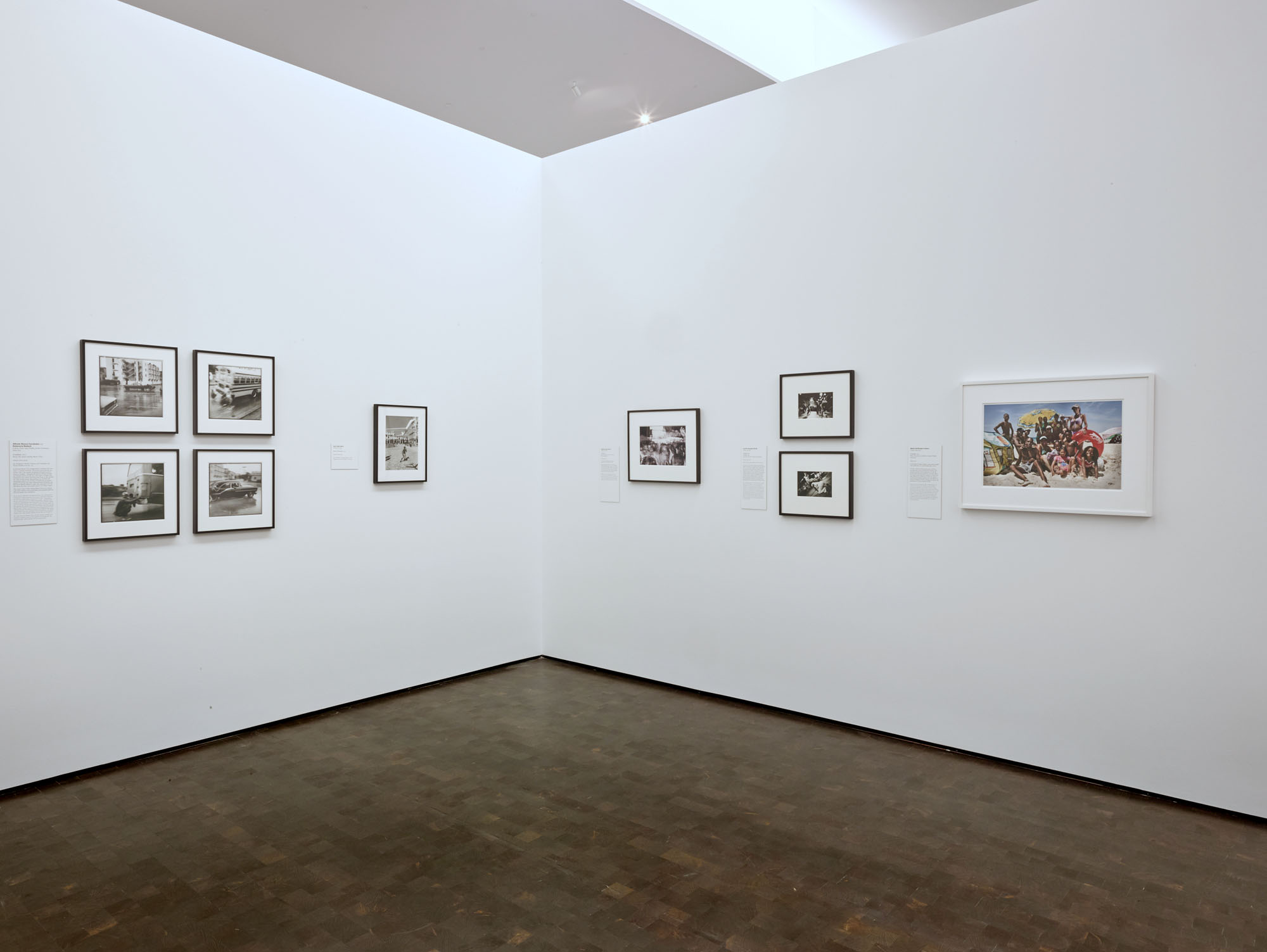
Tate Modern website

LIKE ART BLART ON FACEBOOK

Back to top

Exhibition: ‘Robert Frank in America’ at the Cantor Arts Center, Stanford University Part 1

Exhibition dates: 10th September 2014 – 5th January 2015

Curator: Peter Galassi


Robert Frank (American born Switzerland, 1924-2019) 'En route from New York to Washington, Club Car' 1954


Robert Frank (American born Switzerland, 1924-2019)
En route from New York to Washington, Club Car
1954
Gelatin silver print
Cantor Arts Center Collection, Gift of Raymond B. Gary


The lunatic sublime of America

This is the first part of a bumper two-part posting. View Part 2 of the posting.

Robert Frank (1924-2019) is one of the most important photographic artists of the twentieth century. He was born in Switzerland but he emigrated to American in 1947. He soon gained a job as a fashion photographer for Harper’s Bazaar. He honed his craft as a photographer in England where he took formal, classical images of British life during a trip to Europe and South America in 1947.

He became friends with Edward Steichen and Walker Evans, and it was Evans who supported him in his Guggenheim Fellowship application in 1955 which enabled him “to travel across the United States and photograph all strata of its society. Cities he visited included Detroit and Dearborn, Michigan; Savannah, Georgia; Miami Beach and St. Petersburg, Florida; New Orleans, Louisiana;Houston, Texas; Los Angeles, California; Reno, Nevada; Salt Lake City, Utah; Butte, Montana; and Chicago, Illinois. He took his family along with him for part of his series of road trips over the next two years, during which time he took 28,000 shots. 83 of these were selected by him for publication in The Americans.”1

In The Americans, Frank documents, “the tensions between the optimism of the 1950s and the realities of class and racial differences. The irony that Frank found in the gloss of American culture and wealth over this tension gave his photographs a clear contrast to those of most contemporary American photojournalists, as did his use of unusual focus, low lighting and cropping that deviated from accepted photographic techniques.2

Originally published as Les Américains in 1958 by Robert Delpire in Paris, and finally in 1959 in the United States by Grove Press, reaction in America was initially hostile. They American critics did not like Frank’s shoot from the hip style of photography, nor the mirror that was being held up to their society, especially by a Jewish foreigner. Over time The Americans came to be seen as a seminal work of American photography and social history. Like many artists, Frank only took photographs for a relatively short period of time, before moving on to become a filmmaker.

One cannot forget the era in which Frank took these photographs – that of McCarthyism and “the Second Red Scare, lasting roughly from 1950 to 1956 and characterised by heightened political repression against communists, as well as a campaign spreading fear of their influence on American institutions and of espionage by Soviet agents.”3 Americans were suspicious of foreigners, especially ones with cameras, and this was still the era of racial segregation pre the civil rights movement of the 1960s.

With regard to the structure of the photographs, their origin is based in classicism. This was Frank’s training. It was his skill as an artist, his intuitive and prescient vision of America – how he saw America like no one else before him had – that enabled him to ramp up the intensity, shoot from weird angles, low lighting, cropping, depth of field, unusual focus – and focus on the iconography of America as never seen before: jukeboxes, American flags, cars, highways, death, racial segregation – that was so revolutionary. But he could not have done that without his formal training. You only have to look at the comparison between the photographs of Robert Frank and Walker Evans. Formal and elegant in Evans Church Organ and Pews (1936) and Downtown street, New Orleans (December 1935) with lines vertical and clean… and then Frank, with hardly a straight line or neat angle to be seen. But the one does inform the other, otherwise Frank’s photographs would just become snapshots, vernacular photographs with very little meaning. Which they are not.

This is one of the most powerful, lyrical, humanist photo essays of a country that has ever been taken. Critic Sean O’Hagan, writing in The Guardian in 2014, said The Americans “changed the nature of photography, what it could say and how it could say it. […] it remains perhaps the most influential photography book of the 20th century.”4 As an artist, Frank became the great connector for he is the critical link in the chain that stretches from Lewis Hine through Walker Evans… and on to Lee Friedlander, Garry Winogrand and Joel Meyerowitz.

As an artist you marvel at his intuition and inspiration, to look at the world as no one else had done before, to push the boundaries of medium and message. To photograph people, alone and in groups; politics; religion; race; automobiles and the road; and the media and thrust them into the white, bright, happy world of 1950s consumerist America saying: this is what this country is really like, this is my “impression” of you in all your fleeting madness, “America as an often bleak and lonely place.” You only have to look at the “eye” in U.S. 91, leaving Blackfoot, Idaho (1956, below) or look at the photograph of the grave by the side of the road to know that you are in Blue Velvet territory (David Lynch, director 1986, the title is taken from The Clovers’ 1955 song of the same name).

I am not sure yet how one world pierces the other but believe me they surely do.

Dr Marcus Bunyan


Footnotes

1/ “Robert Frank” on the Wikipedia website

2/ Ibid.,

3/ “McCarthyism,” on the Wikipedia website

4/ Sean O’Hagan. “Robert Frank at 90: the photographer who revealed America won’t look back,” on The Guardian website Sat 8 Nov 2014 [Online] Cited 06/07/2021


Many thankx to the Cantor Arts Center for allowing me to publish the photographs in the posting. Please click on the photographs for a larger version of the image.


“It was the vision that emanated from the book that lead not only me, but my whole generation of photographers out into the American landscape, in a sense, the lunatic sublime of America.”


Joel Meyerowitz


“Like a boxer trains for a fight, a photographer by walking the streets, and watching and taking pictures, and coming home and going out the next day, the same thing again, taking pictures. It doesn’t matter how many he takes, or if he takes any at all, it gets you prepared to know what you should take pictures of, or what is the right thing to do and when.”


Robert Frank


Walker Evans (American, 1903-1975) 'Main St., Ossining, New York' 1932


Walker Evans (American, 1903-1975)
Main St., Ossining, New York
1932
Gelatin silver print


Robert Frank (American born Switzerland, 1924-2019) 'Detroit' 1955


Robert Frank (American born Switzerland, 1924-2019)
Detroit
1955
Gelatin silver print
Cantor Arts Center Collection, Gift of Raymond B. Gary


In 1955 and 1956, Swiss-born photographer Robert Frank (b. 1924) traveled throughout the United States on a Guggenheim Fellowship, photographing ordinary people in their everyday lives. His book The Americans – 83 photographs, mostly from those travels, published in 1959 – repudiated the bland good cheer of the magazines with an image of the country that was starkly at odds with the official optimism of postwar prosperity. The book became a landmark of photographic history; but Frank soon turned to filmmaking, and the rest of his early photographic career was largely forgotten. An important group of unknown or unfamiliar photographs in the Cantor Arts Center’s collection provides the core of the exhibition Robert Frank in America, which sheds new light on the making of The Americans and presents, for the first time, Frank’s American photographs from the 1950s as a coherent body of work.

“We are delighted that the Cantor’s collection has provided the basis for a fresh look at one of the great achievements of 20-century photography,” said Connie Wolf, John and Jill Freidenrich Director of the Cantor Arts Center. “We are also deeply grateful to Robert Frank, who has generously contributed to the project.”

The exhibition Robert Frank in America, on view September 10, 2014 through January 5, 2015, features 130 photographs drawn primarily from the Cantor’s collection as well as from other public and private collections and from Frank himself. Peter Galassi, former chief curator of photography at the Museum of Modern Art, New York, is the exhibition’s guest curator and author of the accompanying publication.

The Exhibition’s Development from the Cantor’s Collection

In the summer of 2012, Wolf invited Galassi to offer his thoughts on one of the museum’s hidden treasures: more than 150 photographs by Robert Frank given to the Cantor in the mid-1980s by Stanford alumnus Bowen H. McCoy and his colleague Raymond B. Gary. This remarkable collection spans the full range of Frank’s photographic career before he turned to filmmaking in the early 1960s. It is especially rich in Frank’s American work of the 1950s, including scores of photographs that are unknown or unfamiliar even to scholars. Wolf and Galassi saw an opportunity to share this work with Stanford students, faculty, scholars at large and the general public.

Research began at the National Gallery of Art, Washington, where more than two decades ago the artist established the archive of his photographic career prior to 1970. Studying more than 1,000 contact sheets enabled Galassi to determine the locations and dates of dozens of previously unidentified photographs in the Cantor collection. He then selected works for the exhibition so as to identify Frank’s major themes and artistic strategies. The compelling sequence of The Americans poetically weaves diverse images into a seamless whole, but Robert Frank in America groups related pictures to explore the pictorial strategies that Frank developed as he worked, and also to highlight important subjects – people, alone and in groups; politics; religion; race; automobiles and the road; and the media.

Frank repeatedly photographed isolated figures so that they seemed trapped by pictorial forces, for example. This powerful metaphor for Frank’s vision of lonely individuals imprisoned by social circumstances is announced in the first picture, The Americans, where the flag obliterates a spectator’s face (Parade – Hoboken, New Jersey, 1955). In Robert Frank in America, that photograph is juxtaposed with another that uses the identical pictorial scheme but a different subject; the interior of a bar (New York City, 1955).

“Although The Americans is famous – partly because it is famous – Robert Frank’s American work of the 1950s has never been considered as a whole,” said Galassi. “The full range of the work shows just how Frank turned the vocabulary of magazine photojournalism on its head and used it to speak in a personal, poetic voice.”

Inviting Galassi to organise the exhibition was part of the museum’s renewed commitment to collecting, studying and presenting photography, Wolf says. The Cantor has been adding to its already strong holdings, presenting innovative exhibitions of work by distinguished artists and providing a valuable opportunity for Stanford students and faculty to work directly with photographs. Leland Stanford’s commission more than a century ago for Eadweard Muybridge’s pioneering work on animal locomotion serves as a foundation for the museum’s extensive collection today.

Exhibition catalogue

The major catalogue accompanying this exhibition is published by the Cantor Arts Center in association with international publisher Steidl, with whom Frank has worked closely on most of his books. All 130 photographs in the exhibition are reproduced as full-page tritone plates. Galassi’s extensive essay traces the evolution of Frank’s work from his arrival in the United States in 1947 until he abandoned his first photographic career in the early 1960s. The text provides a thorough outline of the photographic context in which Frank at first sought success as a magazine photojournalist as well as a detailed analysis of the methods and strategies that lie behind The Americans. The essay features 24 illustrations, including an unprecedented map of Frank’s 1955-56 Guggenheim travels, which locates the sites of nearly all of the photographs in The Americans and in Robert Frank in America. The 200-page book, with a foreword by Connie Wolf, is designed by Katy Homans, New York.

Robert Frank

Robert Frank was born in 1924 in Zürich, Switzerland. The conclusion of World War II ended his vulnerability (his father was a German-born Jew) and enabled him to escape what he regarded as a narrow, antiquated culture. Soon after reaching New York in March 1947, he was hired by Harper’s Bazaar, but his distaste for photographing fashion led him to quit after six months. Over the next five or six years, in Europe and the United States, Frank aimed to establish himself as a freelance photojournalist, with limited success. A Guggenheim Fellowship, awarded in March 1955 and renewed a year later, freed him to pursue his work independently, and he soon began to travel in hopes of making a book. Les Américains was published by Robert Delpire in Paris in 1958 and, as The Americans, by Grove Press in New York in 1959. The latter included an introduction by Jack Kerouac, author of On the Road.

Film and video have formed a central aspect of Frank’s work since 1959, when he collaborated with Allen Ginsberg, Jack Kerouac and Alfred Leslie on Pull My Daisy. In 1972, however, he resumed making photographs, often using Polaroid positive-negative materials and incorporating text and multiple images. That same year he published the first of several editions of The Lines of My Hand, a book that surveyed his career in all mediums and initiated reconsiderations of his early photographic career. The first full-scale retrospective of his photographs was organised at the Museum of Fine Arts, Houston, in 1986. In 1990, a major gift by Frank established the Robert Frank Collection at the National Gallery of Art, Washington, which has since presented two major exhibitions, each accompanied by an important book: Robert Frank: Moving Out (1994) and Looking In: Robert Frank’s “The Americans” (2009).

Press release from the Cantor Arts Center


Robert Frank (American born Switzerland, 1924-2019) 'Beaufort, South Carolina' 1955


Robert Frank (American born Switzerland, 1924-2019)
Beaufort, South Carolina
1955
Gelatin silver print
Cantor Arts Center Collection, Gift of Raymond B. Gary


Guggenheim proposal summary

“To photograph freely throughout the United States, using the miniature camera exclusively. The making of a broad, voluminous picture record of things American, past and present. This project is essentially the visual study of a civilization and will include caption notes; but it is only partly documentary in nature: one of its aims is more artistic than the word documentary implies.”

The full statement

“I am applying for a Fellowship with a very simple intention: I wish to continue, develop and widen the kind of work I already do, and have been doing for some ten years, and apply it to the American nation in general. I am submitting work that will be seen to be documentation - most broadly speaking. Work of this kind is, I believe, to be found carrying its own visual impact without much work explanation. The project I have in mind is one that will shape itself as it proceeds, and is essentially elastic. The material is there: the practice will be in the photographer’s hand, the vision in his mind. One says this with some embarrassment but one cannot do less than claim vision if one is to ask for consideration.

“The photographing of America” is a large order - read at all literally, the phrase would be an absurdity. What I have in mind, then, is observation and record of what one naturalized American finds to see in the United States that signifies the kind of civilization born here and spreading elsewhere. Incidentally, it is fair to assume that when an observant American travels abroad his eye will see freshly; and that the reverse may be true when a European eye looks at the United States. I speak of the things that are there, anywhere and everywhere - easily found, not easily selected and interpreted. A small catalog comes to the mind’s eye: a town at night, a parking lot, a supermarket, a highway, the man who owns three cars and the man who owns none, the farmer and his children, a new house and a warped clapboard house, the dictation of taste, the dream of grandeur, advertising, neon lights, the faces of the leaders and the faces of the followers, gas tanks and post offices and backyards.

The uses of my project would be sociological, historical and aesthetic. My total production will be voluminous, as is usually the case when the photographer works with miniature film. I intend to classify and annotate my work on the spot, as I proceed. Ultimately the file I shall make should be deposited in a collection such as the one in the Library of Congress. A more immediate use I have in mind is both book and magazine publication.”


Robert Frank (American born Switzerland, 1924-2019) 'Florida' 1958


Robert Frank (American born Switzerland, 1924-2019)
Florida
1958
Gelatin silver print
Cantor Arts Center Collection, Gift of Raymond B. Gary


“I am grateful to the Guggenheim Foundation for their confidence and the provisions they made for me to work freely in my medium over a protracted period. When I applied for the Guggenheim Fellowship, I wrote: “To produce an authentic contemporary document, the visual impact should be such as will nullify explanation.”

With these photographs, I have attempted to show a cross-section of the American population. My effort was to express it simply and without confusion. The view is personal and, therefore, various facets of American life and society have been ignored. The photographs were taken during 1955 and 1956; for the most part in large cities such as Detroit, Chicago, Los Angeles, New York and in many other places during my Journey across the country. My book, containing these photographs, will be published in Paris by Robert Delpire, 1958.

I have been frequently accused of deliberately twisting subject matter to my point of view. Above all, I know that life for a photographer cannot be a matter of indifference. Opinion often consists of a kind of criticism. But criticism can come out of love. It is important to see what is invisible to others – perhaps the look of hope or the look of sadness. Also, it is always the instantaneous reaction to oneself that produces a photograph.

My photographs are not planned or composed in advance and I do not anticipate that the on-looker will share my viewpoint. However, I feel that if my photograph leaves an image on his mind – something has been accomplished.

It is a different state of affairs for me to be working on assignment for a magazine. It suggests to me the feeling of a hack writer or a commercial illustrator. Since I sense that my ideas, my mind and my eye are not creating the picture but that the editors’ minds and eyes will finally determine which of my pictures will be reproduced to suit the magazines’ purposes.

I have a genuine distrust and “mefiance” toward all group activities. Mass production of uninspired photojournalism and photography without thought becomes anonymous merchandise. The air becomes infected with the “smell” of photography. If the photographer wants to be an artist, his thoughts cannot be developed overnight at the corner drugstore.

I am not a pessimist, but looking at a contemporary picture magazine makes it difficult for me to speak about the advancement of photography, since photography today is accepted without question, and is also presumed to be understood by all – even children. I feel that only the integrity of the individual photographer can raise its level.

The work of two contemporary photographers, Bill Brandt of England and the American, Walker Evans, have influenced me. When I first looked at Walker Evans’ photographs, I thought of something Malraux wrote: “To transform destiny into awareness.” One is embarrassed to want so much for oneself. But, how else are you going to justify your failure and your effort?”

Robert Frank, U.S. Camera Annual, 1958, p. 115


Robert Frank (American born Switzerland, 1924-2019) 'Lusk, Wyoming' 1956


Robert Frank (American born Switzerland, 1924-2019)
Lusk, Wyoming
1956
Gelatin silver print
Cantor Arts Center Collection, Gift of Raymond B. Gary


Robert Frank (American born Switzerland, 1924-2019) 'Main Street - Savannah, Georgia' 1955


Robert Frank (American born Switzerland, 1924-2019)
Main Street – Savannah, Georgia
1955
Gelatin silver print
Cantor Arts Center Collection, Gift of Raymond B. Gary


Walker Evans (American, 1903-1975) 'Downtown street, New Orleans' December 1935


Walker Evans (American, 1903-1975)
Downtown street, New Orleans
December 1935
Gelatin silver print


Robert Frank (American born Switzerland, 1924-2019) 'New York City' 1949


Robert Frank (American born Switzerland, 1924-2019)
New York City
1949
Gelatin silver print
Lent by Peter Steil


Robert Frank (American born Switzerland, 1924-2019) 'New York City' early 1950s


Robert Frank (American born Switzerland, 1924-2019)
New York City
early 1950s
Gelatin silver print
Cantor Arts Center Collection, Gift of Bowen H. McCoy


Cantor Arts Center at Stanford University
328 Lomita Drive at Museum Way
Stanford, CA 94305-5060
Phone: 650-723-4177

Opening hours:
Wednesday – Sunday 11am – 5pm
Closed Monday and Tuesday

Cantor Arts Center at Stanford University website

LIKE ART BLART ON FACEBOOK

Back to top

Exhibition: ‘Rise and Fall of Apartheid: Photography and the Bureaucracy of Everyday Life’ at Haus der Kunst, Munich

Exhibition dates: 15th February – 26th May 2013


Eli Weinberg (South African born Latvia, 1908-1981) 'Crowd near the Drill Hall on the opening day of the Treason Trial, Johannesburg, 19. December 1956' 1956


Eli Weinberg (South African born Latvia, 1908-1981)
Crowd near the Drill Hall on the opening day of the Treason Trial, Johannesburg, 19. December 1956
1956
Times Media Collection, Museum Africa, Johannesburg


NEVER AGAIN!


Many thankx to Haus der Kunst for allowing me to publish the photographs in the posting. Please click on the photographs for a larger version of the image.


Gille de Vlieg (South African born England, b. 1940) 'Coffins at the mass funeral held in KwaThema, Gauteng, July 23, 1985' 1985


Gille de Vlieg (South African born England, b. 1940)
Coffins at the mass funeral held in KwaThema, Gauteng, July 23, 1985
1985


Gille de Vlieg (born 26 July 1940) is a photographer and anti-apartheid activist. She was born in England and moved to South Africa with her mother when she was 3 years old. During apartheid she was a member of both the Black Sash and one of the few women members of the Afrapix photography collective. Her images have been published in newspapers, magazines and books nationally and internationally. Unlike many of her counterparts, de Vlieg received little public acclaim for her work up until recently. About her work, she says, “I wanted to make a contribution to an alternative view of South Africa, a view not seen on the South African TV screen then.” Her images cover the following topics: land removals, rural lifestyle, township lifestyle, gender lifestyle, United Democratic Front (UDF), anti-harassment campaign, police violence, protests against death penalty, funerals, Black Sash, protests against incorporation into Bophuthatswana; Release Mandela Campaign, End Conscription Campaign (ECC), conscientious objectors, African National Congress (ANC) Welcome Home Rally, Day of the Vow (Geloftedag), street children, and homeless people.

Text from the Wikipedia website


Gille de Vlieg (South African born England, b. 1940) 'Pauline Moloise (mother of Ben), two women & Winnie Madikizela Mandela mourn at the Memorial Service for Benjamin Moloise, who was hanged earlier that morning. Khotso House, Johannesburg, October 18, 1985' 1985


Gille de Vlieg (South African born England, b. 1940)
Pauline Moloise (mother of Ben), two women & Winnie Madikizela Mandela mourn at the Memorial Service for Benjamin Moloise, who was hanged earlier that morning. Khotso House, Johannesburg, October 18, 1985
1985


“All the armies that ever marched, all the parliaments that ever sat, have not affected the life of man on earth as that one solitary life… I am proud of what I am… The storm of oppression will be followed by the rain of my blood. I am proud to give my life, my one solitary life.”


Moloise, Benjamin (18 October 1985). “All the armies that ever marched”. Weekly Mail. p. 1


Malesela Benjamin Moloise (c.  1955 – 18 October 1985) was a South African poet and political activist who came to international attention following his arrest and subsequent execution by the government of South Africa. From Soweto, Moloise worked as an upholsterer before turning to poetry during his time on death row. In 1983, Moloise was arrested for the 1982 murder of Phillipus Selepe, a black security policeman who assisted in capturing three African National Congress (ANC) members. Although he initially confessed to the murder, he later retracted the statement during his trial. Moloise’s death sentence sparked national and international outrage and was seen as emblematic of South Africa’s brutal crackdown on anti-apartheid activists.

Throughout Moloise’s trial, allegations arose about the legitimacy of the evidence against him, the veracity of his confession, and the overall fairness of the process. Following a refusal of clemency or retrial by President P. W. Botha, Moloise was executed in 1985. His execution sparked riots in Johannesburg, protests in major world cities, and a flurry of diplomatic condemnations. The legacy of Moloise’s life, death, and anti-apartheid poems penned during his time on death row transcended South Africa, manifesting in global displays of solidarity and streets named in his honor.

Text from the Wikipedia website


Jodi Bieber (South African, b. 1966) 'Protest against Chris Hani's assassination' 1993


Jodi Bieber (South African, b. 1966)
Protest against Chris Hani’s assassination
1993
© Goodman Gallery Johannesburg


Chris Hani (28 June 1942 – 10 April 1993), born Martin Thembisile Hani SSA, SBS, CLS, DMG, MMS, was the leader of the South African Communist Party and chief of staff of uMkhonto we Sizwe, the armed wing of the African National Congress (ANC). He was a fierce opponent of the apartheid government, and was assassinated by Janusz Waluś, a Polish immigrant and sympathiser of the Conservative opposition on 10 April 1993, during the unrest preceding the transition to democracy.

Text from the Wikipedia website


Complex, vivid, evocative, and dramatic, Rise and Fall of Apartheid: Photography and the Bureaucracy of Everyday Life represents the most comprehensive exhibition of its kind, attempting to formulate an understanding of apartheid’s legacy in South Africa through visual records. These images responded to the procedures and processes of the apartheid state from its beginning in 1948 to the first non-racial democratic elections that attended its demise in 1994. Featuring more than 600 documentary photographs, artworks, films, newsreel footage, books, magazines, and assorted archival documents, the exhibition will fill more than 2,000 square meters of the East Wing of Haus der Kunst. Starting in the entrance gallery (where two film clips are juxtaposed; one from 1948 showing the victorious Afrikaner National Party’s celebration rally, and another of President F. W. De Klerk in February 1990 announcing Nelson Mandela’s release from prison) the exhibition offers an absorbing exploration of one of the twentieth century’s most contentious historical eras.

The exhibition highlights the different strategies adopted by photographers and artists; from social documentary to reportage, photo essays to artistic appropriation of press and archival material. Through these polysemic images, the exhibition embarks on a tour of how photographers and artists think with pictures, the questions these images pose, and the issues of social justice, resistance, civil rights and the actions of opposition to apartheid raise. In so doing, The Rise and Fall of Apartheid brings together many iconic photographs that have rarely been shown before, to propose a fresh historical overview of the photographic and artistic responses to apartheid.

A fundamental argument of the exhibition is that the rise of the Afrikaner National Party to political power and its introduction of apartheid as the legal foundation of governance in 1948 changed the country’s pictorial perception from a “relatively benign colonial space based on racial segregation to a highly contested space in which the majority of the population struggled for equality, democratic representation, and civil rights” (Okwui Enwezor). From the moment apartheid was introduced, photographers in South Africa were immediately aware of how these changes taking place in politics and society accordingly affected photography’s visual language: The medium was transformed from a purely anthropological tool into a social instrument. No one photographed the struggle against apartheid better, more critically, and incisively than South African photographers. For that reason, with the notable exception of a few Western photographers and artists, including Ian Berry, Dan Weiner, Margaret Bourke-White, Hans Haacke, Adrian Piper, and others, the works in the exhibition are overwhelmingly produced by South African photographers.

Resisting the easy dichotomy of victims and oppressors, the photographers’ images present the reading of an evolving dynamic of repression and resistance. Ranging in approach between “engaged” photography of photo essays to the “struggle” photography of social documentary which was aligned with activism, to photojournalistic reportage, the photographers did not only show African citizens as victims, but more importantly as agents of their own emancipation. Included in the exhibition are seminal works by Leon Levson, Eli Weinberg, David Goldblatt and members of Drum magazine, such as Peter Magubane, Jürgen Schadeberg, Alf Kumalo, Bob Gosani, G.R. Naidoo, and others in the 1950s. Also represented are the investigative street photography of Ernest Cole and George Hallett in the 1960s, the reportage of Sam Nzima, Noel Watson, and protest images of the Black Consciousness movement, and student marches in the 1970s to those of the Afrapix Collective in the 1980s, as well as reportages by the members of the so-called Bang Bang Club in the 1990s. The exhibition concludes with works by a younger generation of South African photographers, such as Sabelo Mlangeni and Thabiso Sekgale, and the collective Center for Historical Reenactments, whose projects offer subtle reappraisals of the after effects of apartheid still felt today.

These South African photographers represented a clear political belief. They were opponents of the apartheid regime, and they employed photography as an instrument to overcome it. The independent photo agency Afrapix, founded in 1982 by Omar Badsha and Paul Weinberg, saw itself as a group of “cultural workers”. They believed political convictions came first, and that photography, like writing or acting, was part of the anti-apartheid movement. This attitude was supported by photographers such as Peter McKenzie, who – at a cultural conference organised by the ANC (African National Congress) in Gabarone, Botswana in 1982 – argued that the work of cultural producers is necessarily part of the struggle against apartheid. McKenzie’s argument stood in sharp contrast to that of David Goldblatt, who had the opinion that photographers should report on events with as much inner distance as they can muster.

On the other end of the spectrum, the so-called “struggle” or “frontline photography” is characterised by immediacy, giving the impression of being in the middle of the action. “If you want a picture, you get that picture, under all circumstances” was the leitmotif of one of the leading figures, Peter Magubane.

The photographs’ subjects are different historical events. These include the “Treason Trial” of 1956-1961, which ended with the acquittal of 156 anti-apartheid activists, including Nelson Mandela; the Sharpeville massacre of 1960, in which police shot 69 demonstrators dead; Mandela’s release in 1990 after 27 years in prison; and the civil war between opposing political factions during the 1994 election. Yet this exhibition is not a history of apartheid itself. Instead it aims to critically interrogate the normative symbols and signs of the photographic and visual responses to apartheid. For example, ritualised gestures were also part of the apartheid imagery. The “thumbs up” as a sign of solidarity among activists belonged to the movement’s nonviolent start when civil disobedience and strikes were still regarded as effective agents. After the Sharpeville massacre of 1960, the resistance became militarised. The cherished “thumbs up” was transformed into the upraised fist, the general symbol of black power. Since the burial of the Sharpeville massacre’s victims, black South Africans expressed their sense of community and identity at funerals. Their public mourning thus became a ritualised form of mass mobilisation and defiance.

From the ordinary and mundane to the bureaucratic and institutional, the corrosive effects of the apartheid system on everyday life are explored in the multiplicity of public signage that drew demarcating lines of segregation between whites, Africans, and non-Europeans. For example, Ernest Cole engaged in a sustained study of apartheid signage at train stations, banks, buses, taxi ranks, and throughout the streets of cities like Johannesburg and Pretoria in the early to mid-1960s. Another exemplary image is a photo from 1956 taken by Peter Magubane. It draws attention to the fact that racial segregation restricted movement in both private and public space. The image shows a young white girl sitting on a bench with the inscription “Europeans only” as her black nanny strokes her neck, but must do so from the back bench.

However, the everyday was not limited to the humiliations of policed segregation. “Drum” magazine, one of the most important media outlets for African social life, combined the gritty realism of reportage and the fantasy of normality in the self-constructions of non-European dandies, beauty queens, and the exuberance of township life. Its pages offered images of entertainment, representations of leisure, cultural events, and celebrity portraits. The magazine encompassed a full range of motifs, from relentless documentary photography to fashion shoots, dance revues, and concerts. Through the magazine, photographs found an audience that was politically sensitive and attentive; it also gave South African photographers the opportunity to exchange ideas with colleagues from other African countries, India, and Europe for the first time.

In 1990, the interest of the international press was focused on Mandela’s imminent release. Photographs from South Africa had finally prepared the ground for the participation of world opinion in shaping the country’s future. In this context, the exhibition also asks whether photography can help inform the political face of the world.

Press release from the Haus der Kunst website


Jurgen Schadeberg (South African born Germany, 1931-2020) 'The 29 ANC Women’s League women are being arrested by the police for demonstrating against the permit laws, which prohibited them from entering townships without a permit, 26th August 1952' 1952


Jurgen Schadeberg (South African born Germany, 1931-2020)
The 29 ANC Women’s League women are being arrested by the police for demonstrating against the permit laws, which prohibited them from entering townships without a permit, 26th August 1952
1952
Courtesy the artist


Jurgen Schadeberg (South African born Germany, 1931-2020) '20 defiance campaign Leaders appear in the Johannesburg Magistrates Court on a charge of contravening the Suppression of Communism Act, August 26, 1952' 1952


Jurgen Schadeberg (South African born Germany, 1931-2020)
20 defiance campaign Leaders appear in the Johannesburg Magistrates Court on a charge of contravening the Suppression of Communism Act, August 26, 1952
1952
Courtesy the artist


Jurgen Schadeberg (South African born Germany, 1931-2020) 'Nelson Mandela, Treason Trial' 1958


Jurgen Schadeberg (South African born Germany, 1931-2020)
Nelson Mandela, Treason Trial
1958
Courtesy the artist


Eli Weinberg (South African born Latvia, 1908-1981) 'Nelson Mandela portrait wearing traditional beads and a bed spread. Hiding out from the police during his period as the "black pimpernel," 1961' 1961


Eli Weinberg (South African born Latvia, 1908-1981)
Nelson Mandela portrait wearing traditional beads and a bed spread. Hiding out from the police during his period as the “black pimpernel,” 1961
1961
Courtesy of IDAFSA


Ranjith Kally (South African, 1925-2017) 'Chief Albert Luthuli, former President General of the African National Congress, Rector of Glasgow University and 1960 Nobel Peace Prize Winner, gagged by the government from having any of his words published in his country, confined to small area around his home near Stanger in Natal, April 1964' 1964


Ranjith Kally (South African, 1925-2017)
Chief Albert Luthuli, former President General of the African National Congress, Rector of Glasgow University and 1960 Nobel Peace Prize Winner, gagged by the government from having any of his words published in his country, confined to small area around his home near Stanger in Natal, April 1964
1964
© Bailey’s Archives


Greame Williams (South African, b. 1961) 'Nelson Mandela and Winnie Mandela as he is released from the Victor Vester Prison' 1990


Greame Williams (South African, b. 1961)
Nelson Mandela and Winnie Mandela as he is released from the Victor Vester Prison
1990
Courtesy the artist
© Greame Williams


Haus der Kunst
Prinzregentenstraße 1
80538 Munich
Germany
Phone: +49 89 21127 113

Opening hours:
Monday, Wednesday  -  Sunday 10 am  -  8pm
Thursday 10am  -  10pm
Closed Tuesdays

Haus der Kunst website

LIKE ART BLART ON FACEBOOK

Back to top

Exhibition: ‘Light from the Middle East: New Photography’ at the Victoria and Albert Museum, London

Exhibition dates: 13th November 2012 – 7th April 2013

From the Art Fund Collection of Middle Eastern Photography at the V&A and the British Museum


Newsha Tavakolian (Iranian, b. 1981) From the series 'Mothers of Martyrs' 2006


Newsha Tavakolian (Iranian, b. 1981)
From the series Mothers of Martyrs
2006
Digital C-print
Art Fund Collection of Middle Eastern Photography at the V&A and the British Museum


A massive posting on a fascinating subject. I know little about this area of (sometimes postcolonial) photography. The images are really strong, powerful and laden with symbology – the signifier (photograph) and signified (meaning of the photograph) evidencing signs that interrogate “the creative responses to the social challenges and political upheavals that have shaped the Middle East over the past 20 years.”The three concepts Recording, Reframing and Resisting are critical to understanding the practices of these artists as they investigate the historicity, sacrifice, repression and persecution of their peoples.

Dr Marcus Bunyan


Many thankx to the Victoria and Albert Museum for allowing me to publish the photographs in the posting. Please click on the photographs for a larger version of the image.


Nermine Hammam (Egyptian, b. 1967) 'The Break' 2011 From the series 'Upekkha'


Nermine Hammam (Egyptian, b. 1967)
The Break
2011
From the series Upekkha
Archival inkjet print
The Art Fund Collection of Middle Eastern Photography at the V&A and the British Museum


Light from the Middle East: New Photography is the first major museum exhibition of contemporary photography from and about the Middle East. It features more than 90 works by some of the most exciting artists from the region, spanning North Africa to Central Asia. The exhibition is part of a collaboration between the British Museum and the V&A, which has over the last three years seen the development of a major collection of Middle Eastern photography thanks to substantial funding from the Art Fund. The collection of 95 works has been built in response to a surge of interest in the visual arts in the region and is beginning to remedy the under-representation of Middle Eastern photography in UK collections. Light from the Middle East includes 87 of the works from this shared collection.

The photographs on display show the creative responses to the social challenges and political upheavals that have shaped the Middle East over the past 20 years and include work made following the recent revolution in Egypt. The photographs present multiple viewpoints of a region where collisions between personal, social, religious and political life can be emotive and complex. The exhibition showcases the work of 30 artists from 13 different countries including internationally established practitioners such as Abbas (Iran), Youssef Nabil (Egypt) and Walid Raad (Lebanon) as well as emerging talents such as Taysir Batniji (Palestine), Shadi Ghadirian (Iran) and Abdulnasser Gharem (Saudi Arabia). The work covers a wide range of techniques and subject matter, from photojournalism to staged and digitally manipulated imagery.

Marta Weiss, curator of the exhibition said: “In the past few years contemporary photographic practice from and about the Middle East has been some of the most exciting, innovative and varied art anywhere in the world. The exhibition celebrates the creative and sophisticated ways that contemporary artists use photography to respond to the complexities of the Middle East.”

The exhibition is structured around three key themes; Recording, Reframing and Resisting. Each explores a range of strategies Middle Eastern artists have used to engage with the medium of photography.

The opening section shows how photography can be used as a powerful tool for recording people, places and events. From Newsha Tavakolian’s series Mothers of Martyrs (2006) featuring elderly mothers holding framed pictures of their sons who were killed in the Iran-Iraq war during the 1980s, to Jananne Al-Ani’s disorienting aerial views of the desert in her video Shadow Sites II (2011), this section demonstrates various ways in which the camera has been used to document and record. The work in the second section explores an interest in reframing and reworking preexisting photographs. Shadi Ghadirian’s series Qajar (1998) recreates 19th-century Iranian studio portraits, updating them with contemporary props such as sunglasses and Pepsi cans, while Taysir Batniji applies the modernist style of the German photographers Bernd and Hilla Becher to his series of photographs of Israeli watchtowers in the West Bank.

The final section looks at practitioners who resist the authority of the photograph, questioning the medium’s ability to record factual information. Whether manipulating or digitally altering images, or physically attacking the print surface by scratching and burning, these artists demonstrate a desire to undermine the legibility and reliability of the photograph. In the intimate and poetic series Le Retour Imaginaire (2002), Afghan artist Atiq Rahimi rejects new technology, opting instead to photograph war-ravished Kabul with a primitive box camera. The recent series Uphekka by Nermine Hammam reworks photographs of Egyptian soldiers taken during the protests in Tahrir Square, Cairo in 2011 and transports them to multicoloured fantasy settings that are far removed from the struggles of the Arab Spring.

Press release from the V&A website


Recording

Photography is a seemingly accurate means of recording people, places and events. A photograph can serve a commemorative purpose or document a historic moment. It can reveal something not otherwise visible, such as a place or event the viewer would not have access to, or a particular vantage point available only to the photographer. It can also create a lasting image of a fleeting performance, or of a scene staged only for the camera.

But how reliable is a photograph? Despite the apparent authority of photographic images, they can trick or disorient. They can be ambiguous and difficult to decipher. Their meaning can shift according to context, cropping or captioning. What are the limitations of photography?

The photographers in this section use a range of approaches to exploit and explore the camera’s capacity to record.


Abbas (Iranian, 1944-2018) 'France Rioters burn a portrait of the Shah as a sign of protest against his regime. Tehran, December 1978' 1978-1979


Abbas (Iranian, 1944-2018)
Rioters burn a portrait of the Shah as a sign of protest against his regime. Tehran, December 1978
1978-1979
From the series Iran Diary
Gelatin silver print
Art Fund Collection of Middle Eastern Photography at the V&A and the British Museum
Abbas@Magnum Photos, courtesy Magnum Gallery


Issa Touma (Syrian, b. 1962) From the series 'Sufis: The day of al-Ziyara' 1995-2005


Issa Touma (Syrian, b. 1962)
From the series Sufis: The day of al-Ziyara
1995-2005
Gelatin silver print
Art Fund Collection of Middle Eastern Photography at the V&A and the British Museum


Issa Touma is a prominent figure in the Syrian art scene. Self-taught, he began his career as a photographer in the early 1990s. In 1996 he founded Le Pont Organisation and Gallery, an independent art organisation to promote freedom of expression and stimulate the local art scene through international events.

His series on the day of al-Ziyara documents an annual procession of Sufi pilgrims in northern Syria. Sufism is a mystical path within Islam. Touma photographed the event over the course of ten years, gradually gaining the trust of his subjects. The resulting images convey his sense of immersion in the festival and capture the fervour of the worshippers.


Jananne Al-Ani (Born Kirkuk, Iraq, 1966. Lives London, UK) 'Still from 'Shadow Sites II'' 2011


Jananne Al-Ani (Born Kirkuk, Iraq, 1966. Lives London, UK)
Still from ‘Shadow Sites II’
2011
Single channel digital video. Duration 8 mins 38 secs
Photography by Adrian Warren
Courtesy the Artist and Rose Issa Projects, London


Al-Ani works with photography, film and video, producing bodies of work that explore the power of testimony and interrogate the documentary tradition, often characterised by an interweaving of intimate recollections of loss and trauma with more formal, official accounts of historic events.

This is a still from a video composed of a series of aerial views, which show that the desert is inhabited and not the unoccupied wilderness it is sometimes believed to be. The title draws on a phenomenon familiar to archaeologists: when the sun is at its lowest, shadows make visible the remains of otherwise undetectable settlements. Al-Ani’s images are presented without explanation and the scale of the landscapes is difficult to interpret. They are deliberately ambiguous and point to the limitations of photography.


Shadow Sites II by Jananne Al-Ani 


Extracts from Jananne al Ani’s film Shadow sites II 2011


Waheeda Malullah (Bahrain, b. 1978) From the series 'Light' 2006


Waheeda Malullah (Bahrain, b. 1978)
From the series Light
2006
Inkjet print on rag paper
Art Fund Collection of Middle Eastern Photography at the V&A and the British Museum


Waheeda Malullah uses playfulness and humour to explore social rules, and in particular the roles women play in Islamic society. In the series Light she records a performance staged expressly for the camera. By lying down next to tombs in Bahrain she exaggerates the Shi’i Muslim custom of seeking blessing by touching the tombs of revered people. These stylised compositions are also studies of form, light and shadow.


Ahmed Mater (Saudi Arabian, b. 1979) 'Magnetism II' 2012


Ahmed Mater (Saudi Arabian, b. 1979)
Magnetism II
2012
Photogravure
Acquired thanks to Mr Abdulaziz al-Turki


Ahmed Mater is a Saudi artist and qualified GP. Working in photography, calligraphy, painting, installation and video, Mater reflects his experiences as a doctor and the ways this has challenged his traditional background and beliefs, and explores wider issues about Islamic culture in an era of globalisation. In the series Magnetism, what at first appear to be pilgrims circling the Ka’ba, the sacred building at the heart of the sanctuary at Mecca, are in fact iron filings spiralling around a cube-shaped magnet. Mater refers to the spiritual force that Muslim believers feel during Hajj, the pilgrimage to Mecca. By creating photographs that recall well-known images on a dramatically different scale, Mater also questions the reliability of photography.


Newsha Tavakolian (Iranian, b. 1981) From the series 'Mothers of Martyrs' 2006


Newsha Tavakolian (Iranian, b. 1981)
From the series Mothers of Martyrs
2006
Digital C-print
Art Fund Collection of Middle Eastern Photography at the V&A and the British Museum


Newsha Tavakolian started her career at the age of 16, as a junior photographer for the Iranian women’s daily Zan-e Rooz. She also worked with other reformist newspapers and by the early 1990s had established herself as one of Tehran’s few female photojournalists, working internationally and particularly focussing on women’s issues. She is a founder member of the EVE international collective of women photojournalists, established in 2006 and of Rawiya, a collective of women photographers from the Middle East, founded in 2011. Her series Mothers of Martyrs shows elderly Iranian women holding framed photographs of their sons who died decades earlier in the Iran-Iraq war (1980-1988). The double portraits attest to photography’s emotive power.


Abbas Kowsari (Iranian, b. 1970) 'Halabche' 2003


Abbas Kowsari (Iranian, b. 1970)
Halabche
2003
Digital C-print
Art Fund Collection of Middle Eastern Photography at the V&A and the British Museum


Abbas Kowsari began his career as a photojournalist for the Tehran Times in 1994 and is currently Senior Picture Editor for Shargh, a popular reformist title. This photograph made in nothern Iraq presents a portrait within a portrait. The figure of a peshmerga (a Kurdish combatant) is tightly framed to exclude his face. Instead, the face of rock musician Bryan Adams, on the soldier’s T-shirt, fills a central portion of the composition. The faded black-and-white image is surrounded by saturated colours and brightly gleaming metal. The contrast reinforces the incongruity between warfare in Iraq and western pop culture.


Abdulnasser Gharem (Saudi Arabian, b. 1973) 'The Path (Siraat)' 2009


Abdulnasser Gharem (Saudi Arabian, b. 1973)
The Path (Siraat)
2009
Inkjet print on aluminium
Art Fund Collection of Middle Eastern Photography at the V&A and the British Museum


Abdulnasser Gharem works across a variety of media to explore local Saudi issues. Amongst his best-known works are ‘stamp paintings’, made from industrial paint on rubber stamps, a technique devised to negotiate and comment on censorship. He combines service in the Saudi armed forces (he is currently Lieutenant Colonel) with his activities as an artist.

The subject of this photograph is a bridge in southern Saudi Arabia that was severely damaged in the early 1980s when villagers attempted to take shelter on it during a flash flood. Instead of providing a safe high ground above the floodwaters the bridge collapsed, resulting in the loss of many lives. Gharem spray-painted the word siraat repeatedly on the bridge. The word means path, and in the Qur’an it refers to ‘the path to God’.


Tal Shochat (Israeli, b. 1974) 'Pomegranate (Rimon)' 2010


Tal Shochat (Israeli, b. 1974)
Pomegranate (Rimon)
2010
C-print
Art Fund Collection of Middle Eastern Photography at the V&A and the British Museum


In her photographs Shochat stages both figures and objects to create symbolically-laden images that often question the boundary between nature and artifice. Here she applies the conventions of studio portraiture to photographing trees. The first stage in her meticulous process is to identify the perfect specimen of a particular type of tree. When the fruit is at the height of maturity, she cleans the dust off the branches, leaves and fruit. Finally, Shochat photographs the tree, artificially lit and isolated against a black cloth background. The photographs present a view of nature that would never actually exist in a natural environment. The work highlights the tensions in photography between reality and artifice.


Yto Barrada (French, b. 1971) 'Bricks (Briques)' 2003/2011


Yto Barrada (French, b. 1971)
Bricks (Briques)
2003/2011
C-print
Art Fund Collection of Middle Eastern Photography at the V&A and the British Museum


Yto Barrada grew up in Paris and Tangier and studied in Paris and New York. Since 2006 she has directed the Cinématèque de Tanger, a cultural centre home to an archive of Maghrebi and Arabic film and video. Barrada’s hometown of Tangier is the subject of much of her work. In this view, recently constructed buildings in various states of completion are scattered across the hillsides. The pile of bricks in the foreground seems to parallel the haphazard nature of the surrounding building projects. The untidy man-made heap echoes the form of the natural hills in the background.


Mehraneh Atashi (Iranian, b. 1980) 'Bodiless I' 2004


Mehraneh Atashi (Iranian, b. 1980)
Bodiless I
2004
From the series Zourkhaneh Project (House of Strength)
Digital C-print
Art Fund Collection of Middle Eastern Photography at the V&A and the British Museum


Mehraneh Atashi explores the relationship between photography and power in her ongoing investigation into the possibilities of self-portraiture. Her photographic series reveal lesser-known aspects of Iranian life.

This photograph shows the inside of a zurkhana, a traditional Iranian wrestling gym, in Tehran. The artist has explained that ‘tradition forbids the breath of women’ in the zurkhana. Atashi includes herself in the scene through a reflection in a mirror. This picture within a picture emphasises her incongruous presence in a place from which women are normally excluded.


Reframing

The artists in this section appropriate or imitate images from the past in order to make statements about the present. Their sources range from studio portraiture to fashion photography, from Old Master paintings to Modernist photographs. Using a variety of techniques, they update and interrogate, knowingly combining past and present, East and West, fact and fiction. Whether emulating or critiquing, these artists reframe existing images to new ends.


Raeda Saadeh (Palestinian, b. 1977) 'Who will make me real?' 2003


Raeda Saadeh (Palestinian, b. 1977)
Who will make me real?
2003
Digital C-print
Art Fund Collection of Middle Eastern Photography at the V&A and the British Museum


In her photographs, videos and performances, Raeda Saadeh assumes various roles to explore issues of displacement, gender and identity, with particular reference to the Israeli-Palestinian conflict. Here the artist lies in a pose that recalls 19th-century European paintings of reclining nudes. These often featured non-European women and ‘Orientalist’ costumes and scenery. Saadeh is encased in Palestinian newspapers, which conceal her body from neck to ankle while revealing its contours. The covering is both flimsy and apparently immobilising, resembling a papier-mâché body cast. Any sensuality implied by her pose is disrupted by the harsh realities reported in the newspaper.


Bahman Jalali (Iranian, 1945-2010) 'Image of Imagination' 2003


Bahman Jalali (Iranian, 1945-2010)
Image of Imagination
2003
C-print
Art Fund Collection of Middle Eastern Photography at the V&A and the British Museum
© Rana Javadi


Jalali was a photographer and teacher who played a leading role in collecting and preserving historical photographs in Iran. He was an influential teacher, mentored many of the younger generation of Iranian photographers, and was instrumental in setting up Tehran’s first Museum of Photography (also known as Akskhaneh Shahr).

In this montage he layered Qajar-period (1786-1925) portraits and an enlarged detail of an old photographic studio sign that had been crossed out with red paint. Jalali speculated that this defacement occurred during the Islamic revolution (1978-1979), perhaps as an attack on a studio where unveiled women had been photographed.


Shadi Ghadirian (Iranian, b. 1974) From the series 'Qajar' 1998


Shadi Ghadirian (Iranian, b. 1974)
From the series Qajar
1998
Gelatin silver print
Art Fund Collection of Middle Eastern Photography at the V&A and the British Museum


Shadi Ghadirian was among the first students to graduate in photography from the Azad University, Tehran. Her work addresses concerns of Iranian women of her generation, exploring ideas such as censorship, religion and modernity, often with a wry humour.

The series Qajar is based on a style of photograph made during Iran’s Qajar period (1786-1925). In those portraits, sitters posed with props representing their aspirations. Here, the sitters wear costumes that approximate Qajar fashion, but the objects they pose with are jarringly modern and western – a mountain bike, a stereo or a can of Pepsi. The contrast makes a comment on the tensions between tradition and modernity that women in Iran face today.


Youssef Nabil (Egyptian, b. 1972) 'The Yemeni Sailors of South Shields' 2006 (detail)


Youssef Nabil (Egyptian, b. 1972)
The Yemeni Sailors of South Shields (detail)
2006
Hand-coloured gelatin silver print
Art Fund Collection of Middle Eastern Photography at the V&A and the British Museum


Youssef Nabil’s photographs and films evoke the glamour and melodrama of the golden age of Egyptian cinema in the 1940s and 50s, known as Hollywood on the Nile. This is one of a dozen portraits made as part of a project to document the last surviving Yemeni men to settle as ship-workers in South Shields, in the north of England. The area is home to one of the oldest Muslim communities in the UK. Nabil hand-coloured the black-and-white photographs in the manner of mid 20th-century Egyptian studio portraiture.


Hassan Hajjaj (Moroccan, b. 1961) 'Saida in Green' 2000


Hassan Hajjaj (Moroccan, b. 1961)
Saida in Green
2000
Digital C-print and tyre frame
Art Fund Collection of Middle Eastern Photography at the V&A and the British Museum


Hajjaj is inspired by fashion photography, while also mocking its methods. He creates playful juxtapositions between global brand names and local motifs such as veils and babouches (traditional Moroccan slippers). The result is an exuberant collision of the stereotypical symbols of western consumerism and Middle Eastern tradition. The frames, which Hajjaj constructs from recycled materials, transform the photographs into three-dimensional, sculptural objects.


Resisting

The artists in this section question the idea that a photograph can tell the truth. Some digitally alter images. Some scratch negatives and prints, or even burn them. Other artists reject clarity and detail in favour of processes that rely on chance. The results are murky, atmospheric images that require effort to interpret. These manipulations demonstrate the fragility of the photograph, whether at the hands of artists or censors. They also lay bare the power of photographic imagery to influence and control through propaganda or surveillance. These works resist photography’s claim to accuracy and authority.


Atiq Rahimi (Afghanistan, b. 1962) 'On the threshold of time (Au seuil du temps)' 2002


Atiq Rahimi (Afghanistan, b. 1962)
On the threshold of time (Au seuil du temps)
2002
From the series The Imaginary Return (Le retour imaginaire)
Gelatin silver print
Art Fund Collection of Middle Eastern Photography at the V&A and the British Museum


Atiq Rahimi is a writer, film director and photographer who fled Afghanistan after the Soviet invasion in 1984, seeking political refuge in France, where he is now based. He returned to Afghanistan in 2002, after the fall of the Taliban. Confronted by the ruins of Kabul, he decided not to photograph the city with his digital camera. Instead he chose a primitive box camera normally used to take identity portraits in the streets of Kabul. The unpredictable process resulted in dreamlike photographs. They convey the nostalgia and brutal feelings of loss that Rahimi experienced when revisiting the war-wounded city.


Jowhara AlSaud (Saudi Arabian, b. 1978) 'Airmail' 2008


Jowhara AlSaud (Saudi Arabian, b. 1978)
Airmail
2008
From the series Out of Line
C-print
Art Fund Collection of Middle Eastern Photography at the V&A and the British Museum


Jowhara AlSaud’s photographs explore the language of censorship and the malleability of photography. AlSaud scratches the outlines of figures from her personal photographs into photographic negatives, which she then prints. By reducing the figures to line drawings she renders them anonymous. The embracing figures hint at farewells and longing. The envelopes suggest thwarted attempts at communication. AlSaud’s hybrid technique of drawing and photography critiques the censorship of visual communication in Saudi Arabia.


Şükran Moral (Turkish, b. 1962) 'Despair' 2003


Şükran Moral (Turkish, b. 1962)
Despair
2003
Digital C-print
Art Fund Collection of Middle Eastern Photography at the V&A and the British Museum


Şükran Moral works in photography, sculpture, video and performance, creating bold and often controversial works that critique society and its institutions. Violence against women is a major theme. She has also made work about other groups who lack societal power, including the mentally ill, children, immigrants and prostitutes.

In this image, brightly-coloured birds, what Moral calls ‘digital nightingales’, perch on a group of migrant workers huddled in a boat. According to the artist, in Turkish literature nightingales are a symbol of hope, love and separation. The men and boys are shown in black-and-white, at the mercy of their situation. The birds, however, are free to fly away.


Nermine Hammam (Egyptian, b. 1967) 'Armed Innocence II' 2011


Nermine Hammam (Egyptian, b. 1967)
Armed Innocence II
2011
From the series Upekkha
Archival inkjet print
Art Fund Collection of Middle Eastern Photography at the V&A and the British Museum


Influenced by a background in film and graphic design, Nermine Hammam works in series, making prints that combine elements of painting and photography, often digitally manipulating and layering images to represent subjects in states of abandonment or altered consciousness. When the army was called in to respond to the protests in Cairo’s Tahrir Square in January 2011, Hammam was struck by the vulnerability of the soldiers. They seemed to want to be anywhere but there. In the Uppekkha series she transports these soldiers into vibrant fantasy settings. Reminiscent of postcards, the series likens the events of Tahrir Square to a tourist attraction that drew the world’s attention, but was not fully understood.


Joana Hadjithomas (Lebanon, b. 1969) and Khalil Joreige (Lebanon, b. 1969) 'Wonder Beirut #13, Modern Beirut, International Centre of Water-skiing' 1997-2006 From the series 'Wonder Beirut: The Story of a Pyromaniac Photographer'


Joana Hadjithomas (Lebanon, b. 1969) and Khalil Joreige (Lebanon, b. 1969)
Wonder Beirut #13, Modern Beirut, International Centre of Water-skiing
1997-2006
From the series Wonder Beirut: The Story of a Pyromaniac Photographer
C-print mounted on aluminium with face mounting
Art Fund Collection of Middle Eastern Photography at the V&A and the British Museum
Courtesy of the artists and CRG Gallery, New York and In Situ / Fabienne Leclerc, Paris


Joana Hadjithomas and Khalil Joreige collaborate as filmmakers and artists, producing cinematic and visual art work that intertwine. In the series Wonder Beirut they use photography to blur fact and fiction. The artists noticed that tourist postcards of pre-civil war Beirut were still for sale after the war ended in 1990. They invented a fictional photographer named Abdallah Farrah who, in 1968, was commissioned by the tourist board to make postcard views of Beirut’s attractions. When the civil war broke out in 1975, he began to burn his negatives to reflect the surrounding destruction. The artists present these works as prints from the fictional photographer’s damaged negatives.


John Jurayj (American, b. 1968) 'Untitled (Large Embassy with Red Mirror #1)' 2007


John Jurayj (American, b. 1968)
Untitled (Large Embassy with Red Mirror #1)
2007
Inkjet print on watercolour paper, with burn holes and mirrored Plexiglas
Art Fund Collection of Middle Eastern Photography at the V&A and the British Museum


Using a variety of media, including painting, print-making, sculpture and video, John Jurayj explores the impact of the Lebanese civil war (1975-1990), as both a world conflict and an identity trauma. He often re-works photographs of Lebanon from family albums, press archives and online databases. Here he translates the brutality of war into an attack on the photograph itself. He enlarges to near abstraction a news photograph of the bombed US embassy in Beirut in 1984. The image is further disrupted by the holes burnt into the paper. The holes are then filled in with red, mirrored Plexiglas.


Victoria and Albert Museum
Cromwell Road
London
SW7 2RL
Phone: +44 (0)20 7942 2000

Opening hours:
Daily 10.00 – 17.45

V&A Museum website

V&A Light from the Middle East website

LIKE ART BLART ON FACEBOOK

Back to top

Paper: ‘Traversing the unknown’ by Dr Marcus Bunyan, Faculty of Arts, The University of Melbourne presented at the ‘Travel Ideals’ international conference, July 2012

International conference: Travel Ideals: Engaging with Spaces of Mobility, Faculty of Arts at the University of Melbourne, 18th – 20th July 2012


All cdv and cabinet cards © Joyce Evans collection © Marcus Bunyan.

Installation photographs of the exhibition Traverse by Kim Percy at Stockroom, Kyneton, 10th March – 8th April 2012.

Please click on the photographs for a larger version of the image.

Keywords: refugees, asylum seekers, boat people, spaces of mobility, travel, early colonial photography, cartes de visite, cabinet cards, Second Fleet, John Dell, aborigine, Australia, white Australia, immigration, photography, early Australian photography, Foucault, non-place, Panopticon, inverted Panopticon, (in)visibility, visual parentheses, axis of visibility, symbolic capital, context of reason.


Installation of 'Traverse' by Kim Percy at Stockroom, Kyneton

Installation of 'Traverse' by Kim Percy at Stockroom, Kyneton

Installation of 'Traverse' by Kim Percy at Stockroom, Kyneton


Installation of Traverse by Kim Percy at Stockroom, Kyneton
Installation photographs by Marcus Bunyan
© Kim Percy and Marcus Bunyan


Traversing the unknown

Dr Marcus Bunyan July 2012

What I am about to say, my musings if you like, are inspired by Kim Percy’s exhibition which took place at Stockroom gallery in Kyenton in March – April 2012. The work is the basis of my inquiry. The images that illustrate the paper are installation shots from the exhibition and Victorian cartes de visite, photographic portraits of an emerging nation taken from the 1850s-1890s. Unlike the business cards of today (where identity is represented by the name of the business owner and the printer of the card remains anonymous), in cartes de visite the name of the people or place being photographed is usually unknown and the name of the photographer is (sometimes) recorded. In other words the inverse of contemporary practice. Another point to note is that most of the photographers were immigrants to this country. I use these cards to illustrate the point that the construction of national identity has always been multifarious and, in terms of the representation of identity, unknown and unknowable.


I would like to take you on a journey, at first personal and then physical, metaphorical and maybe even philosophical. I want to asks questions of the world, questions about the journey we all take as human beings. I would like to tell you two personal things.

First, I have nearly drowned three times in my life. Once, aged 12 years, my mother dove into the swimming pool and pulled my out as I was going under for the third time. The second time was in Australia at Squeaky Beach on Wilsons Prom and the third up at Byron Bay. All three times there was shear blind panic as the water tried to consume me, as my feet scrabbled to touch the bottom, seeking any purchase, the minutest toe hold so that I could pull myself to safety, so that I could save myself. Panic. Fear. Nothingness.

Second, I still vividly remember being dumped by my parents at boarding school in England at the age of twelve years. I watched disconsolately as they drove away and promptly burst into tears, terrified of being alone in an alien environment, with a different accent than everyone else (having grown up on a rural farm) and being different from other boys (just discovering that I was gay). Those were horrible years, suffering from depression that crept up on me, isolated with few friends and struggling with my nascent sexuality. Thoughts of suicide and self-harm were constant companions. Fast forward, arriving in Australia in 1986, again with no friends, living in a foreign culture. Even though I was white I felt alienated, isolated, alone. I hated my first years in Australia. Now imagine being an asylum seeker arriving here.


Anonymous photographer. 'Untitled [Borough of Clunes Notice Strike ..rm Rate]' Nd


Anonymous photographer (Australian)
Untitled [Borough of Clunes Notice Strike ..rm Rate]
Nd
Cabinet card
Albumen print
16.5cm x 10.7cm
Blank verso
© Joyce Evans collection


Anonymous photographer. 'Mrs Dean, Dean & Co, Hay, Corn & Produce Merchants, Rea St, North Fitzroy' Nd


Anonymous photographer (Australian)
Mrs Dean, Dean & Co, Hay, Corn & Produce Merchants, Rea St, North Fitzroy
Nd
Cartes de visite
Albumen print
10.4cm x 6.3cm
Blank verso
© Joyce Evans collection


National Photo Company. 'Untitled [Group of bricklayers holding their tools and a baby]' Nd


National Photo Company
Untitled [Group of bricklayers holding their tools and a baby]
Nd
140 Queen Street,
Woollahra,
Sydney
Cartes de visite
Albumen print
10.4cm x 6.3cm
© Joyce Evans collection


Imagine being an asylum seeker living in an (in)between space, living in a refugee camp over there. Marc Augé coined the phrase “non-place” to refer to places of transience that do not hold enough significance to be regarded as “places”.1 These camps are such places. Put yourself in that predicament, seeking a better life, seeking to escape persecution, war, prejudice and death, deliberately placing yourself and your family in a fragile boat, like a seed pod floating upon the waters, taking the dangerous journey to reach Australia. Imagine the emotional and intellectual turmoil that must surround such a decision, the decision to place your life in the hands of the ocean. Important decisions affecting the entire course of one’s life are rarely made without some form of mental distress.

Nurtured in water, some baptised in it, water is the life-blood of the world and the asylum seeker must trust to its benevolence. Marc Auge “argues that we are in transit through non-place for more and more of our time, as if between immense parentheses.”2 This is the journey that the asylum seeker takes over water, a journey through an interstitial space that has no beginning and no end caught between a set of parentheses [insert life here / or not]. And now let us move our line of sight. What about a visual parentheses?

Asylum seekers are almost invisible from Australia living over there. They are over the horizon, out of sight and out of mind. When they journey across the sea – an open ended journey passing through a liminal space, a forgotten space – they suddenly appear as if by magic washed up on the shore, unseen despite surveillance planes, ships and other forms of tracking and reconnaissance. Think, for example, of the sudden and surprising arrival of the boat SIEV-221 when it was washed onto the rocks of Christmas Island in December 2010. The invisible made visible caught in a non-place.

This (in)visibility can be evidenced in other ways. The specks of humanity waving from the deck of the Tampa, the asylum seekers being escorted from arriving boats, seen for a few brief seconds on the evening news and then disappearing from view, almost like being sucked into the depths of the sea. Here and not here; here and there. Halfway between nothingness and being: they walk between one state and another, forward and backward, backward and forward.

Displacement
Diaspora
Disruption


There is much discussion in political circles in relation to the retrieval, processing and housing of detainees, that is, the control of the artefact within space (of Australia) and, consequently, the impact on the citizens of Australia and that of public sentiment. The axis of visibility3 that operates in relation to subject, object, and space is not interrogated as to the representations that are constructed. This is what I am interested in here.

The spectacle of the asylum seekers is despectacularised by and for the viewer. We remove ourselves from the emotion of these people, the presence of these images. They become ordinary as if seen from far away – glimpsed every so often as though viewing the world of another. They become Other. The movement of the ship, the movement of the sky, the movement of vision is a constant decentering through a push/pull with something else – some other order of the world. The journey into the unknown is a journey to submit to the ordering of another: the socially constructed system of classification: “refugee,” “asylum seeker.”

These vital, alive human beings come from one taxonomic system (of ordered death, persecution, injustice), become visible from a brief instance, and are then fed into another taxonomic system of order – that of the detention centre. Through the journey and in the detention centres there is an effacement of specific religious, political or personal symbolic features as the refugees become part of a disciplinary system whereby they can be viewed as symbolic capital (both political and economic tools). This process of effacement and simultaneous self-negation, this neutralisation of original context and content is hidden in the forgotten spaces, of the sea and of the processing centres.

And then the seekers are naturalised, becoming one with the body of Australia, as though they were unnatural before.


Kim Percy (Australian) 'Pale Sea' 2012


Kim Percy (Australian)
Pale Sea
2012
Digital photograph


Kim Percy (Australian) 'Where' 2012


Kim Percy (Australian)
Where
2012
Digital photograph


Kim Percy (Australian) 'Rough Water' 2012 Digital photograph


Kim Percy (Australian)
Rough Water
2012
Digital photograph


Anon. 'Untitled' Nd


Anonymous photographer
Untitled
Nd
Cartes de visite
Albumen print
6.3cm x 10.4cm
Blank verso
© Joyce Evans collection


E. B. Pike. 'Untitled [Older man with moustache and parted beard]' Nd


E. B. Pike
Untitled [Older man with moustache and parted beard]
Nd
Cartes de visite
Verso of card
6.3cm x 10.4cm
© Joyce Evans collection


Otto von Hartitzsch (Australian born Germany. 1838-1910) 'Untitled [Man with quaffed hair and very thin tie]' 1867-1883


Otto von Hartitzsch (Australian born Germany. 1838-1910)
Artist & Photographer
Untitled [Man with quaffed hair and very thin tie]
1867-1883
Verso of card
Established 1867, 127 Rundle Street, Adelaide, South Australia
Cartes de visite
6.3cm x 10.4cm
© Joyce Evans collection


Kim Percy (Australian) 'Traverse' 2012 Digital photograph


Kim Percy  (Australian)
Traverse
2012
Digital photograph


Kim Percy (Australian) 'Red Horizon No.1' 2012 Digital photograph


Kim Percy (Australian)
Red Horizon No.1
2012
Digital photograph


Kim Percy (Australian) 'Red Horizon No.2' 2012 Digital photograph


Kim Percy (Australian)
Red Horizon No.2
2012
Digital photograph


Taking the metaphor of the horizon line further, I would argue that the detention centres are like that of an inverted Panopticon. The Panopticon is a type of institutional building, a prison, designed by English philosopher and social theorist Jeremy Bentham in the late eighteenth century. The concept of the design is to allow an observer to observe all inmates of an institution without them being able to tell whether or not they are being watched.4 The guard sits in a central tower and can observe and inspect all prisoners on the outer 360 degree circle, while the prisoners cannot see the guard and can only presume he is there (an omnipresent God) and hence they behave. Let us invert this concept. Now the asylum seekers sit in the tower looking outwards, seeing the promised land but unable to touch it and the guards (prison officers, government, the Australian people) are all around but most are blind. They look inwards but cannot see / they look outwards and most go about their daily business. The perimeter fence of the detention centre becomes the horizon line of the sea. Over the horizon is out of sight and out of mind.

This regime of acceptability, the common-sense world within which we all live and usually take for granted, this form of rationality has a historical specificity. Think convict for example: such branding appeared at a time of historic specificity. What we take to be rational, the bearer of truth, is rooted in domination and subjugation, and is constituted by the relationship of forces and powers. But, as Foucault observes “what counts as a rational act at one time will not so count at another time, and this is dependent on the context of reason that prevails.”5

Hence no more convicts, in the future one hopes no more refugees.


Profesor Hawkins (Australian, active 1861-1875) 'Untitled [Chinese women with handkerchief]' c. 1858-1875


Profesor Hawkins (Australian, active 1861-1875)
Photographic Artist
Untitled [Chinese women with handkerchief]
c. 1858-1875
20, Queensbury St Et. near Dight’s Mills, Melbourne
Cartes de visite
Albumen print
6.3cm x 10.4cm
© Joyce Evans collection


Jeffrey Hawkins was a professional photographer based in Melbourne.


J. R. Tanner (Australian, active 1866-1899) 'Untitled [Two woman wearing elaborate hats]' 1875


J. R. Tanner (Australian, active 1866-1899)
Untitled [Two woman wearing elaborate hats]
1875
96 Elizabeth Street
“Truth in a Pleasing Form”
Photographer and Photo-Enameler
“Permanent Pictures in Carbon”
“Imperishable Portrais on Enamel”
Cartes de visite
Albumen print
6.3cm x 10.4cm
© Joyce Evans collection


What Kim’s eloquent, minimal, brooding installation does is hold our attention and ask certain questions of us as human beings. If photography is a mode of visually addressing a certain order in the world – be it horror, war, peace, human tragedy, public, private – and then destabilising it, then Kim’s images destabilise the binary sea/sky through fragmentation and isolation. She redlines our experience and asks us to inhabit the non-space, the non-place of the gallery, allowing us to hover between boat and image, between sea and sky, between seeing and sky. Through her work she asks us to become more aware. She asks us to see things more clearly. Above all she asks us to have faith in the compassion of human beings. The asylum seekers have faith: faith to get into a fragile boat to venture upon the sea in search of a better life.

I will finish with a quote from Jeff Brown

“Sometimes we have to surrender to the not knowing. At other times, it is helpful to adventure outward and explore new possibilities. Like swashbucklers of the spirit, we bravely seek out any experience that might inform our path. When we are afraid of something, we live it fully and see what floats to the surface in the doing. We participate in our own revealing. We have faith in the shaping of what we cannot see.”6


The seekers surrender to the not knowing and have faith in the shaping of what they cannot see. These risk takers are the strong ones that are going to make a difference in a new society by the very fact of their strength and determination to survive and live in a free society, for the very fact of the risks undertaken. This exhibition and this paper informs their path as it informs our path. Be aware of the doing, be bold and forthright in the being.

Dr Marcus Bunyan, July 2012


Endnotes

1/ Augé, Marc (trans. John Howe). Non-Places: Introduction to an Anthropology of Supermodernity. London: Verso, 1995

2/ Ibid.,

3/ Hooper-Grenhill, Eilean. Museums and the Shaping of Knowledge. London: Routledge, 2000, p. 7

4/ Anon. “Panopticon,” on Wikipedia. [Online] Cited 09/03/2012 en.wikipedia.org/wiki/Panopticon

5/ Hooper-Grenhill Op cit., p. 8

6/ Brown, Jeff quoted on Stroud, Jeff. The reluctant blogger website. [Online] Cited 09/03/2012 jeffstroud.wordpress.com/2012/02/11/884/


Please click on the photographs for a larger version of the image.


~ ~ ~ ~ ~ ~ ~ ~ ~ ~ ~ ~ ~ ~ ~ ~ ~ ~ ~ ~ ~ ~ ~ ~ ~ ~ ~ ~ ~ ~ ~ ~ ~ ~ ~ ~ ~ ~ ~ ~ ~

Addendum – Australia from settlement to subjugation

The cartes de visite below is one of the most important cards that I have ever held.

Private John Dell (1763-1866) of the The New South Wales Corps. (Rum Corps.) “Renamed 1st /102nd Regiment of Foot” arrived on the ship Surprize of the Second Fleet on the 26 June 1790 (not, as stated in pencil on the verso of the card, in 1788). The Second Fleet has been regarded as being the three convict ships which arrived together at Sydney Cove in June 1790: these ships were the Surprize , Neptune, and Scarborough.

The Surprize weighed 400 tons, she was the smallest ship of the fleet, she proved an unsuitable vessel as for her size and she was a wet vessel even in clam waters. Sailing from England on January 19th 1790 with 254 male convicts. Her master was Nicholas Antis, formerly chief mate on the Lady Penrhyn in the First Fleet. The surgeon was William Waters. 36 convicts died on the voyage. Soldiers of the New South Wales Corps on board may have stayed. Some where convicts who later enlisted.
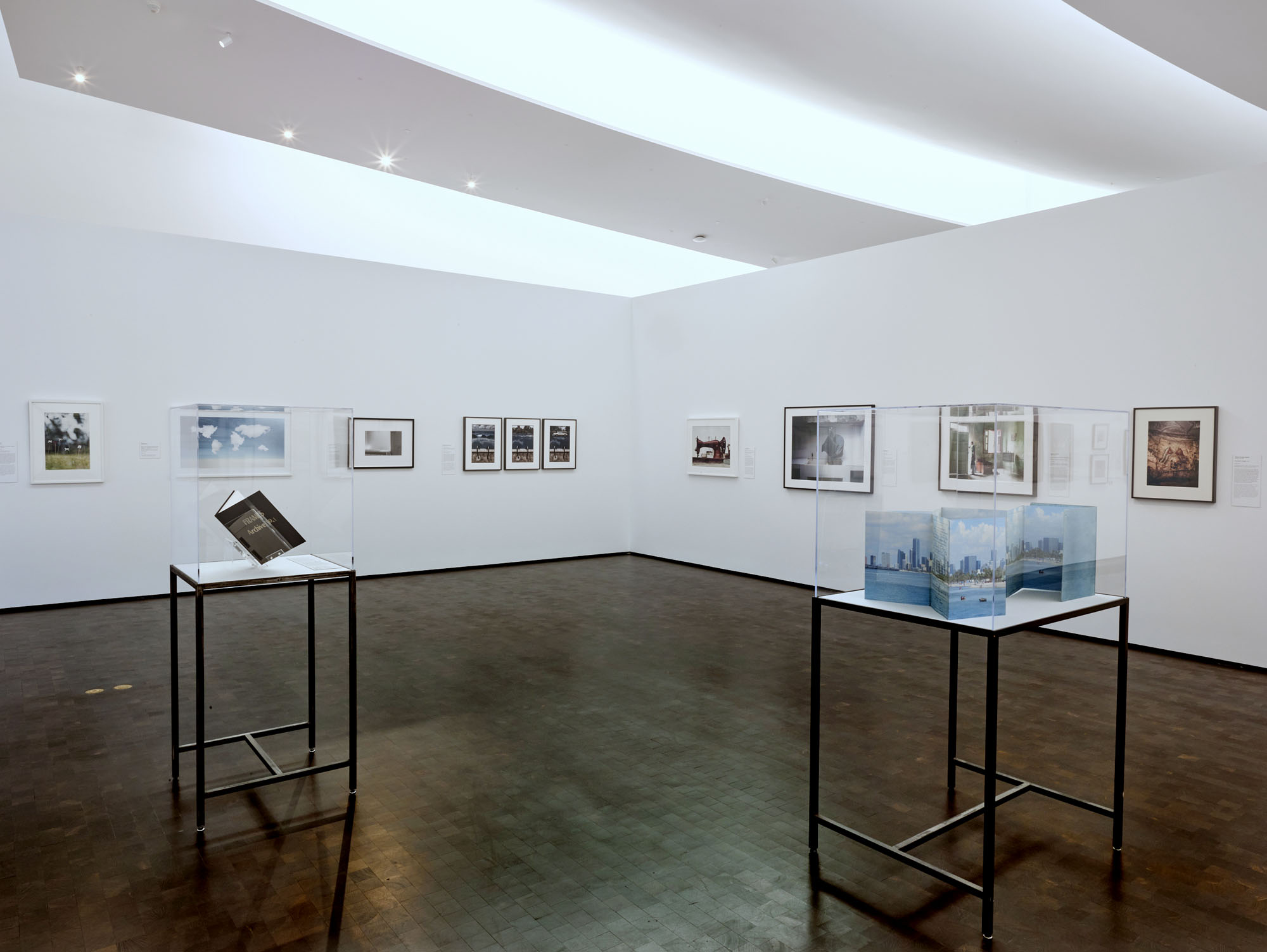
Private John Dell served in 102nd Foot Regiment. He was discharged aged 42 after 21 years 10 months of service. Covering dates give year of enlistment to year of discharge: 1789-1811. He enlisted on 3rd July 1789 and was discharged in May 1810. He married three times and had numerous children, dying in Tasmania on the 2nd March 1866. He was born on 5th of November 1763 so this would make him over the age of 87 when this photograph could have first been taken or, if later, between the age of 96-103. We can date this photograph from the time that W. Paul Dowling worked in Launceston (1851-1852 / 1859-1866).

We are looking at one of the first English migrants to ever settle in Australia during the invasion of the supposed terra nullius. This is an important photograph. The photographer obviously thought it was important to document the appearance of this person, present in the first two years of colonial settlement and later injured by an aborigine spear. For us, the photograph traverses the history of white Australia, from settlement to subjugation, from 1790 to 1866. One can only imagine the agony, the death and destruction that occurred during this man’s lifetime.


THE LATE MR. JOHN DELL (From the Melbourne Spectator)

The following reminiscences of the olden times were furnished to us by a gentleman who took them down as they fell from the lips of John Dell, the Greenwich pensioner, a few months before his, death, which happened at Launceston, in the early part of the present year: He was born, he said, at Reading, in Berkshire, on the 5th of November, 1763. He was one of a family of twenty four children. He remembered the excitement occasioned by the Gordon riots, and how the people gathered round the London coach which brought down the tidings of the tumult, incendiarism, and bloodshed. He was apprenticed with another Reading lad, to a veneer cutter in London; and as he and his fellow-apprentice were one day staring in at a shop window in Fleet-street, and observing to each other that there was nothing like that in Reading, they were accosted by a respectably dressed man, who said his wife was from Reading, and would so like to have a chat with them about the dear old place; would they go home to tea with him? They cheerfully assented; and were taken to a house in an obscure neighbourhood, at the back of the Fleet Prison…

“THE LATE MR. JOHN DELL,” in Launceston Examiner (Tas.: 1842-1899), 25 July 1866, p. 2. [Online] Cited 15 July, 2012 on the Trove website. nla.gov.au/nla.news-article36636642

DEATH OF MR JOHN DELL (From the The Cornwall Chronicle)

It is with feelings of sincere regret that we record tbe death of Mr. John Dell, at the patriarchal age of 102 years and four months. He had been ailing but a very short time, and had the use of his faculties to the last hour of his life. He was reading as usual without the use of spectacles, and out of bed on Thursday night, but be breathed his last yesterday, at the residence of his son-in-law, Mr. William Brean, of Brisbane Street, and his remains are to be interred on Monday.

Mr. Dell was born at Reading, in Berkshire, in 1763, and arrived in New South Wales with the 102nd Regiment of Foot, in 1790, in the ship ‘Surprize,’ the first of the fleet which brought convicts to Botany Bay, and he was present in Sydney during the whole of the period of the government of Governor Phillip, and at the arrest of Governor Bligh, who it will be remembered by those who have read the early history of New South Wales, was arrested by Colonel Johnson, the Colonel of the regiment in which Dell served, the 102nd. This corps was raised specially for service in New South Wales, and Mr. Dell returned with in 1808, and on board the vessel in which Governor Bligh died on the passage to England. He was pensioned in 1815, and has been in life receipt of a pension for more than half a century.

He arrived in this colony in 1818, and was for some time Chief Constable of Launceston, but retired many years ago from office, to a large farm at Norfolk Plains. Mr. Dell was the owner of very valuable property in this colony, though be did not die wealthy, the Court House Square belonged to him at one time, and he fenced it in, but subsequently he returned it to the Government in exchange for a grant of six hundred and forty acres of land in the country. Mr. Dell was a temperate man but not a teetotaller. It is strange that throughout his eventful career, be never learned to smoke, but this may account for the steadiness of his nerves to the latest day of his long life. He had encountered great hardships in New South Wales, having been in the bush there for three day disabled by a spear wound inflicted by an aborigine. He was in a very exhausted state when discovered, but his iron constitution enabled him to rally, and he was soon in as sound a state of health as ever.

For some years past his sight keener and his hair of a darker colour than they had been twenty years previous. He was rather eccentric of late, but no one from his hale appearance would suppose him to be much above seventy years of age. His voice was a good strong firm bass without a quaver in it. Very few men have ever been blessed with such a long period of interrupted sound health as Mr Dell. He will be missed and his death lamented by a wide circle of relatives and friends.

“DEATH OF MR JOHN DELL,” in The Cornwall Chronicle (Launceston, Tas.: 1835-1880) Saturday 3rd March 1866. [Online] Cited 15 July, 2012 on the Trove website. trove.nla.gov.au/ndp/del/article/72358170

See the Rootsweb website for more information on John Dell.


W. Paul Dowling (Australian, 1824-1877) Photographer. 'John Dell' 1851-1852 / 1859-1866


W. Paul Dowling (Australian, 1824-1877)
Photographer
John Dell
1851-1852 / 1859-1866
Launceston, Tasmania
Cartes de visite
Albumen print
6.3cm x 10.4cm
© Joyce Evans collection

John Dell
Born at Reading, Berkshire
5 Nov 1763
came out with his regiment (the 102nd) to Sydney in 1788
Nov 5th 1763

In pencil on verso


William Paul Dowling was a painter, engraver and photographer. In 1849 he was transported to Hobart Town as a political prisoner. Dowling worked in partnership with his photographer brother, Matthew Patrick Dowling until the latter accused William of selling his photographs as his own.


W. Paul Dowling (Australian, 1824-1877) Photographer. 'John Dell' 1851-1852 / 1859-1866


W. Paul Dowling (Australian, 1824-1877)
Photographer
John Dell
1851-1852 / 1859-1866
Launceston, Tasmania
Cartes de visite
Albumen print
6.3cm x 10.4cm
© Joyce Evans collection


LIKE ART BLART ON FACEBOOK

Back to top

Exhibition: ‘Entre Nous: The Art of Claude Cahun’ at the Art Institute of Chicago

Exhibition dates:  25th February – 3rd June 2012


Claude Cahun (French, 1894-1954) 'Autoportrait' 1929


Claude Cahun (French, 1894-1954)
Autoportrait
1929
Gelatin silver print
24 x 19cm
Musée des Beaux-Arts de Nantes
© RMN/Gérard Blot


“In many ways, Cahun’s life was marked by a sense of role reversal, and her public identity became a commentary upon not only her own, but the public’s notions of sexuality, gender, beauty, and logic. Her adoption of a sexually ambiguous name, and her androgynous self-portraits display a revolutionary way of thinking and creating, experimenting with her audience’s understanding of photography as a documentation of reality. Her poetry challenged gender roles and attacked the increasingly modern world’s social and economic boundaries. Also Cahun’s participation in the Parisian Surrealist movement diversified the group’s artwork and ushered in new representations. Where most Surrealist artists were men, and their primary images were of women as isolated symbols of eroticism, Cahun epitomised the chameleonic and multiple possibilities of the female identity. Her photographs, writings, and general life as an artistic and political revolutionary continue to influence countless artists, namely Cindy Sherman, Nan Goldin and Del LaGrace Volcano.”


Text from the Wikipedia website


Cahun was a resistance fighter during the Second World War, was arrested, sentenced to death and survived. She lived with her longtime female partner and collaborator on Jersey from 1937 until 1954, the year of her death. Entre Nous means “Between Us,” such an appropriate title for their collaboration, love and partnership. What a talent, what a woman and gay to boot!

Dr Marcus Bunyan


Many thankx to the Art Institute of Chicago for allowing me to publish the photographs in the posting. Please click on the photographs for a larger version of the image.


Claude Cahun (French, 1894-1954) 'Autoportrait' 1929


Claude Cahun (French, 1894-1954)
Autoportrait
1929
Gelatin silver print
11.5 x 8.5cm
Jersey Heritage Collection
© Jersey Heritage


Claude Cahun (French, 1894-1954) 'Autoportrait' 1928


Claude Cahun (French, 1894-1954)
Autoportrait
1928
Gelatin silver print
13.9 x 9cm
Jersey Heritage Collection
© Jersey Heritage


Claude Cahun (French, 1894-1954) 'Autoportrait' 1927


Claude Cahun (French, 1894-1954)
Autoportrait
1927
Gelatin silver print
10.4 x 7.6cm
Soizic Audouard Collection


Claude Cahun (1894-1954) has something approaching cult status in today’s art world. However, her work was almost unknown until the early 1980s, when it was championed by the research of François Leperlier, after which exhibitions at the Musée des Beaux-Arts in Nantes (1994) and the Musée d’Art Moderne de la Ville de Paris (1995) brought it to public attention. Her life and work (both literary and artistic) bespeak an extraordinary libertarian personality who defied sexual, social and ethical conventions in what was an age of avant-garde and moral upheaval. Among her many photographs, it is undoubtedly her self-portraits that have aroused the greatest interest in recent years. Throughout her life, Cahun used her own image to dismantle the clichés surrounding ideas of identity. She reinvented herself through photography, posing for the lens with a keen sense of performance and role-play, dressed as a woman or a man, as a maverick hero, with her hair long or very short, or even with a shaved head. This approach was extended in innovative ways in her photographs of objects and use of photomontages, which asserted the primacy of the imagination and of metamorphosis.

By exploring the many different analyses made of Cahun’s work since the 1990s, and ranging across its different themes: from the subversive self-portraits that question identity, to her surrealist compositions, erotic metaphors and political forays, this exhibition confirms the modernity of a figure who, as a pioneer of self-representation and the poetry of objects, has been an important influence for many contemporary artists.

Metamorphoses of identity and the subversion of gender (I)

This set of photographs, going from 1913 to the end of the 1920s, includes some of Cahun’s major works, in which she staged her own persona, emphasising disguise and masks, and working through variations on gender: feminine, masculine, androgyne, undifferentiated. Sexual ambiguity is consciously cultivated and calls into question established norms and conventions. In 1928, she even represented herself with her head shaved, wearing a singlet, in profile, or with her hands against her face, or wearing a loose man’s jacket. Some of the mise-en-scènes from this period seem to anticipate contemporary performance.

Poetics of the object

The “assemblages of objects,” which make their appearance in around 1925, inventively explore what at the time was still a rather new form. This work came to wider attention in the Surrealist exhibition at the Charles Ratton gallery, in May 1936, and then with the commissioning of 22 photographic plates to illustrate a book of poems by Lise Deharme, Le Coeur de Pic (1937), prefaced by Paul Eluard. These photographs capture ephemeral set-ups, often in a natural setting (garden, beach). Each “sketch” is a composition of heterogeneous elements, both found and made, such as knickknacks in spun glass, sewing items, twigs, bones, insects, feathers, gloves, pieces of fabric, shoes, tools, etc. This “theatre of objects” has both a visual and symbolic significance, which Cahun explained in her text Prenez garde aux objets domestiques (1936).

Metamorphoses of identity and the subversion of gender (continued)

The 1930s saw Cahun continuing to explore images of the self. However, questions of sexual difference and its social and cultural construction were now less to the fore as she went deeper into the potential of situations and disguises and experimented with duplication in a way that extended the work of the photomontages from the late 1920s.

Metaphors of desire

Eschewing the direct and sometimes reifying display of the female body found in many paintings and photographs, Cahun opted for a more subtle kind of “veiled eroticism” using distance and irony. Here we find some very evocative examples of her calculating games with desire. Whether through the contained display of the body, allegory (the bacchante or faun, surrounded by sensuous vegetation), or anthropomorphic objects (the hermaphroditic “père”), she aimed to capture the essence of desire, to bring out its essential grounding in fantasy.

The two of us. Claude Cahun and Suzanne Malherbe (Marcel Moore)

The photograph Entre nous (1926) clearly establishes the spirit of this section, which evokes various aspects of Claude Cahun’s intimate relationship and artistic collaboration with her partner, Suzanne Malherbe. In fact, a number of the photographs here were taken by Suzanne following Claude’s suggestions. A double portrait from 1921 shows a surprising parallel which could be read as a metaphor of their relationship, a deep closeness and understanding between two strong personalities. The linchpin of this section is constituted by the four photomontages used to illustrate Aveux non avenus (1930), Cahun’s most significant literary work, gathering together all the artist’s main themes and obsessive metaphors. The plates were executed by Moore in collaboration with Claude Cahun.

Elective encounters

This series of portraits, which reflect the importance of friendship in the development of Cahun’s work, gives an idea of the figures who were important to her and influenced her, or to whom she felt close, among them Henri Michaux, Robert Desnos, André Breton, Jacqueline Lamba and Suzanne Malherbe. There are also two photographs from performances at Pierre Albert-Birot’s theatre Le Plateau (1929). They attest Cahun’s keen interest in theatre and acting.

Poetry and politics

In the 1930s Cahun’s positions grew increasingly radical in response to the rise of totalitarianism. She joined the Surrealists and associated with a number of groups on the left and far left. This radicalisation is reflected in her aesthetic. In line with the ideas put forward in her pamphlet Les Paris sont ouverts (1934), she exploited the subversive qualities of “indirect action” in the sphere of symbolic expression, making a number of objects in which poetry and politics are intimately intertwined. This process culminated when she used these pieces for two big series of photographs dominated by a mood of irony, revolt and provocation: “La Poupée” (The Doll), a figure fashioned out of newspaper, and “Le Théâtre” (The Theatre), a wooden mannequin surrounded by various elements and placed under a glass dome.

Beyond the visible. The last self-portraits

Close study of Cahun’s photographs reveals the presence of allusions to non-visible phenomena, pointing the way to other realities – and perhaps, too, beyond death. Her attraction to symbolism, her interest in Eastern doctrines and her closeness to Surrealism only confirmed the primacy of fantasy and metamorphosis evidenced in the intellectual and aesthetic approaches she took throughout her life. The series Le Chemin des chats (The Way of Cats, around 1949 and 1953), suggests a mediation on and questioning of reality and appearance. Cahun was a true cat lover: for her, this animal was the great intercessor, the medium of an intuitive contact between the visible and the invisible, leading to sensorial worlds that are both unfamiliar and yet very near.

Juan Vicente Aliaga and François Leperlier, curators of the exhibition


Claude Cahun (French, 1894-1954) 'Autoportrait' 1939


Claude Cahun (French, 1894-1954)
Autoportrait
1939
Gelatin silver print
10 x 8cm
Jersey Heritage Collection
© Jersey Heritage


Claude Cahun (French, 1894-1954) 'Autoportrait' 1926


Claude Cahun (French, 1894-1954)
Autoportrait
1926
Gelatin silver print
11.1 x 8.6cm
IVAM, Institut Valencià d’Art Modern, Generalitat


Born Lucy Schwob to a family of French intellectuals and writers, Claude Cahun (who adopted the pseudonym at age 22) is best known for the staged self-portraiture, photomontages, and prose texts she made principally between 1920 and 1940. Rediscovered in the late 1980s, her work has not only expanded our understanding of the Surrealist era but also serves as an important touchstone to later feminist explorations of gender and identity politics. In her self-portraits, which she began creating around 1913, Cahun dismantled and questioned preexisting notions of self and sexuality. Posing in costumes and elaborate make-up, Cahun appears masked as various personae: man or woman, hero or doll, both powerful and vulnerable. Almost a century after their making, these innovative photographs and assemblages remain remarkably relevant in their treatment of gender, performance, and identity.

From her university years until her death, Cahun was accompanied by her partner and artistic collaborator, Suzanne Malherbe, a childhood friend and stepsister. They surrounded themselves with members of the Surrealist movement and created work that embraced leftist politics. Cahun, with assistance from Malherbe (under the pseudonym Marcel Moore), produced photographs, assemblages, and publications from the 1920s on. The photograph Entre Nous (Between Us), featuring a pair of masks embedded in sand, gives the title to this show and is emblematic of their multifaceted relationship.

The first retrospective exhibition in the United States of Cahun’s work, Entre Nous: The Art of Claude Cahun brings together over 80 photographs and published material by Cahun and Moore, including several photomontages from their 1930 collaborative publication Aveux non avenus (Disavowals), and the only surviving object by Cahun, which is in the Art Institute’s permanent collection.

Organiser: This exhibition was organised by the Jeu de Paume, Paris, and coproduced with La Virreina Centre de la Imatge, Barcelona.

Press release from the Art Institute of Chicago website


Claude Cahun (French, 1894-1954) 'Combat de pierres' 1931


Claude Cahun (French, 1894-1954)
Combat de pierres
1931
Gelatin silver print
21 x 15.5cm
Private collection
© Béatrice Hatala


Claude Cahun (French, 1894-1954) 'Le Père' 1932


Claude Cahun (French, 1894-1954)
Le Père
1932
Gelatin silver print
23.6 x 17.7cm
LAC


Claude Cahun (French, 1894-1954) Marcel Moore (French, 1892-1972) 'Entre nous' (Between Us) 1926


Claude Cahun (French, 1894-1954) Marcel Moore (French, 1892-1972)
Entre nous (Between Us)
1926
Gelatin silver print
4 11/16 × 4 5/8 in (11.9 × 11.7cm)


While the motivation for these remarkable self-portraits seems rooted in a commitment to leftist politics and subversion of gender norms, I also feel a great sense of intimate domesticity beneath the surface. Cahun and Moore first met in 1909 when they were both teenagers. Eight years later, Cahun’s father married Moore’s mother, which must have given the couple a convenient excuse for their close relationship at a time when such lifestyle choices were less than accepted.

Our curators have surmised that Cahun’s camera did not have a timer on it, so many if not all of these self-portraits must have been created with Moore’s assistance. When the two moved to the Isle of Jersey in the 1930s to escape the political climate developing in France, they began to live in almost total seclusion. Though often taken outside around the grounds of their estate, the photographs from this period seem to the most private and familiar. Beyond the thoughtful self-presentation and artistic experimentation, there is a palpable sense of play, of close friends having fun.

An interesting aside: In July of 1940, the Nazis invaded Jersey where Cahun and Moore were still living. For the next four years, they engaged in active resistance against the Germans, producing and distributing counterpropaganda leaflets to Nazi soldiers on the island. Continuing the kind of dress-up they’d played together for years, the two would dress in disguises to infiltrate German outposts where they would disseminate anti-Nazi leaflets signed as “der Soldat ohne Namen” (the solider with no name). They were eventually arrested in 1944 and sentenced to death. Fortunately, the island was liberated before the executions could be carried out.

Extract from Robby Sexton, “Between You and Me,” on the Art Institute of Chicago website March 15, 2012 [Online] Cited 08/10/2024


Claude Cahun (French, 1894-1954) 'Aveux non avenus, planche III' 1929-1930


Claude Cahun (French, 1894-1954)
Aveux non avenus, planche III
1929-1930
Gelatin silver print photomontage
15 x 10cm
Private collection


The Art Institute of Chicago
111 South Michigan Avenue
Chicago, Illinois 60603-6404
Phone: (312) 443-3600

Opening hours:
Thursday – Monday 11am – 5pm
Closed Tuesdays and Wednesdays

The Art Institute of Chicago website

LIKE ART BLART ON FACEBOOK

Back to top

Exhibition: ‘A New Vision: Modernist Photography’ at the Currier Museum of Art, Manchester, New Hampshire

Exhibition dates: 4th February – 13th May 2012


Minor White (American, 1908-1976) 'Birdlime and Surf, Point Lobos, California' 1951


Minor White (American, 1908-1976)
Bird Lime and Surf, Point Lobos, CA
1951
Gelatin silver print
8 1/4 in. x 10 3/8 in. (20.96 x 26.35cm)
Currier Museum of Art, Manchester, New Hampshire
Gift of Edith Vallarino


The conceptual idea of Modernist photography is “look at this,” look at how photography interprets the world: through light, lens, glass, film, paper, brain and eye. Early Modernist photography occurred in the first two decades of the twentieth century (through the vision of Alfred Steiglitz, Paul Strand, Edward Steichen et al) before it was even named “Modernism” and led to radically different forms of artistic expression that broke the pictorialist conventions of the era. Gritty realism was the order of the day, clean lines, repetition of form, strange viewpoints where the photographers observation of the subject is as important as the subject itself. Look at how I, and the camera, see the world: that is all there is, the indexical relation to the word of truth.

“Artists and photographers began looking at the photographs used in mass culture, to develop an aesthetic true to the intrinsic qualities of photographic materials: the accurate rendition of visible reality; framing that crops into a larger spatial and temporal context; viewpoints and perspectives generated by modern lenses and typically modern spatial organisations (for example, tall buildings); and sharp, black-and-white images. This objective, mechanised vision became art by foregrounding not its subject matter, but its formal structure as an image.”1

Steiglitz and Strand, “often abstracted reality by eliminating social or spatial context; by using viewpoints that flattened pictorial space, acknowledging the flatness of the picture plane; and by emphasising shape and tonal rendition in highlights and shadows as much as in the actual subject matter.”2 Such use of highlights and shadows can be seen in the most famous work by the photographer Helmar Lerski, Transformation Through Light (1937), a photograph of which is presented below. Have a look on Google Images to see the changes wrought on the same face just through the use of light.

It is interesting to note the inclusion of photographers such as Paul Caponigro and Brett Weston in this exhibition as later examples of artists influenced by language of Modernism. While this may be partially true by the mid-1970s the mechanised vision of early Modernism (with its link to the indexicality of the image, its documentary authority and ability to express the individuality of the artist) had dissipated with the advent of the seminal exhibition New Topographics: Photographs of a Man-Altered Landscape (International Museum of Photography at the George Eastman House, 1975). “The pictures were stripped of any artistic frills and reduced to an essentially topographic state, conveying substantial amounts of visual information but eschewing entirely the aspects of beauty, emotion and opinion.” These typologies, often shown in grids, “depicted urban or suburban realities under changes in an allegedly detached approach… casting a somewhat ironic or critical eye on what American society had become.” (Wikipedia) While the photographs by Weston and Caponigro do show some allegiance to Modernist Photography they are of an altogether different order of things, one that is not predicated on what the object is or what the artist says it is (its reality), but also, what else it can be.

Of course, this leads into more critical readings on the meaning of photographs that emerged in the late 1970s-80s. As Patrizia di Bello has insightfully written,

“John Tagg, in The Burden of Representation (1988), argues that the indexical nature of the photograph does not explain its meanings. “What makes the link between the pre-photographic referent and the sign is a discriminatory technical, cultural and historical process in which particular optical and chemical devices are set to work to organise experience and desire and produce a new reality – the paper image which, through further processes, may become meaningful in all sorts of ways.” Rather than being a guarantor of realism, the camera is itself an ideological construct, producing an all-seeing spectator and effacing the means of its production. Analyses of who has possessed the means to represent and who has been represented reveal that photography has been profoundly implicated in issues of political, cultural, and sexual domination. This area of investigation has especially drawn upon Michel Foucault’s (1926-84) reflections on the emergence of forms of knowledge; on the modern notion of the subject; and on practices of power which produce subjects actively participating in the dominant disciplinary order. Particularly influential have been his rejection of the notion of a pre-given self or human nature, and his insistence that every system of power and knowledge also creates possibilities of resistance. The role of critics then becomes the deconstruction of dominant assumptions within and about representations, to identify works embodying the possibility of resistance.”3

The camera as ideological construct. Photography as profoundly implicated in issues of political, cultural, and sexual domination. In other words who is looking, at what, what is being pictured or excluded, who has control over that image (and access to it), who understands the language of that representation and controls its meaning (this picturing of a version of reality), and who resists the dominant assumptions within and about its representations.

Modernist Photography does indeed have a lot to answer for.

Dr Marcus Bunyan


1/ Patrizia di Bello. “Modernsim and Photography,” on Answers.com website [Online] Cited 03/08/2012 no longer available online

2/ Ibid.,

3/ Ibid.,


Many thankx to the Currier Museum of Art for allowing me to publish the photographs in the posting. Please click on the photographs for a larger version of the image.


Paul Caponigro (American, 1932-2024) 'Two Pears, Cushing, ME' 1999


Paul Caponigro (American, 1932-2024)
Two Pears, Cushing, ME
1999
Gelatin silver print
7 9/16 x 9 11/16 in
Currier Museum of Art, Manchester, New Hampshire
Gift of Paul Caponigro, photographer


Captured from above, the still-life Two Pears, Cushing, ME by Paul Caponigro is composed of two pieces of fruit nestled in a wooden bowl. The oval bowl is centrally located in the horizontal composition and is surrounded by a black background. The composition is roughly symmetrical, except for the stems of the pears, which break the central axis and create a diagonal frame. The pears hold a complementary position with relation to each other, reminiscent of a yin-yang symbol.

The pears glow a brilliant white in stark contrast to the black background. The fruit seems impossibly smooth, as though carved from marble, with the subtlest of grays suggesting vaguely corporeal curves. The smooth texture is juxtaposed with the rough natural bark that lines the edge of the wooden bowl. The interior of the bowl shows the subtle patterns, striations and concentric rings, of the tree from which the bowl was carved. …

Context and Analysis

Though primarily known as a landscape photographer, Caponigro also focuses on still-life. One of his favourite subjects is fruit. Caponigro began producing dramatic, black-and-white images of apples and pears in the 1960s. Devoid of their characteristic colour, the close-up images become abstract studies in form and, more important, pattern.

Many of Caponigro’s fruit still-lifes from the 1960s focus on the marks and patterns on the skin of the fruit. This is particularly true in Galaxy Apple, New York (1964), a high-contrast image that highlights the natural white markings on the dark surface of an apple, creating an effect reminiscent of stars in the night sky. Documenting decay in fruit still-life pictures is a tradition dating back hundreds of years, as seen in such works as Balthasar Van der Ast’s 1617 oil painting Still Life with Fruit on a Kraak Porcelain Dish (Currier, 2004.15 ). Still-life compositions are often about the passage of time. In the late-career photograph Two Pears, Cushing, ME, Caponigro instead presents the fruit as near-perfect and timeless.

Connections

Caponigro studied with pioneering photographer Minor White, whose work is also represented in the Currier’s collection. White and Caponigro shared an interest in modernist techniques and in ways of conveying the passage of time by using the natural world as subject matter. White’s 1963 photograph Bird Lime and Surf, Point Lobos, CA (Currier, 1992.15.13, above) shows a rock spotted with bright white bird droppings, traces of the birds gathering and flying along the shoreline.

Jane Seney. “Two Pears, Cushing, ME,” on the Currier Museum of Art website Nd [Online] Cited 17/10/2024


Paul Caponigro (American, 1932-2024) 'San Sebastian, New Mexico' 1980


Paul Caponigro (American, 1932-2024)
San Sebastian, New Mexico
1980
gelatin silver print
9 3/4 in. x 13 11/16 in. (24.77 x 34.77cm)
Currier Museum of Art, Manchester, New Hampshire
Henry Melville Fuller Fund


Brett Weston (American, 1911-1993) '(Untitled) Tide Pool and Kelp' c. 1980


Brett Weston (American, 1911-1993)
(Untitled) Tide Pool and Kelp
c. 1980
Gelatin silver print
10 9/16 x 13 11/16 in
Currier Museum of Art, Manchester, New Hampshire
Gift from the Christian K. Keesee Collection
© The Brett Weston Archive


Brett Weston (American, 1911-1993) '(Untitled) Branches and Snow' c. 1975


Brett Weston (American, 1911-1993)
(Untitled) Branches and Snow
c. 1975
Gelatin silver print
12 3/4 x 10 5/8 in
Currier Museum of Art, Manchester, New Hampshire
Gift from the Christian K. Keesee Collection
© The Brett Weston Archive


Helmar Lerski (Swiss, 1871-1956) 'Metamorphosis through Light #587' 1935-36


Helmar Lerski (Swiss, 1871-1956)
Metamorphosis through Light #587
1935-1936
Vintage gelatin silver print
11 1/2 x 9 1/4 in
Currier Museum of Art, Manchester, New Hampshire


Helmar Lerski (18 February 1871, Strasbourg – 19 September 1956, Zürich) was a photographer who laid some of the important foundations of modern photography. He focused mainly on portraits and the technique of photography with mirrors. Lerski concentrated on archetypal characteristics rather than on individual features, favouring extreme close-ups and tight cropping, and he became renowned for his experiments with multiple light sources.

Lerski was involved concurrently in the two major, emergent mediums of his time: film and photography. Born in Alsace in the then German city of Strausburg, he became involved in the theatre and, in 1896, moved to New York to pursue a career in acting, eventually working at the Irving Place Theater and later the German Pabst Theater. It was in this setting that Lerski first became aware of the unique visual effects achievable with stage lighting. Drawing from his acting experience, he began investigating photography as an artistic medium after meeting his wife, also a photographer. While photographing their colleagues, Lerski experimented with a series of portraits that severely manipulated the lighting effects. The resulting images formed a base for his later success in both commercial and art photography… This body of work upholds the artist’s declaration that “in every human being there is everything; the question is only what the light falls on.”

In 1937 he created his masterpiece, Transformation Through Light, on a rooftop terrace in Tel Aviv, in which he projected 175 different images of a single model, altered using multiple mirrors to direct intense sunlight towards his face at various angles and intensities. Siegfried Kracauer wrote about this series in his Theory of Film (Oxford University Press, 1960, p. 162):

“His model, he [Lerski] told me in Paris, was a young man with a nondescript face who posed on the roof of a house. Lerski took over a hundred pictures of that face from a very short distance, each time subtly changing the light with the aid of screens. Big close-ups, these pictures detailed the texture of the skin so that cheeks and brows turned into a maze of inscrutable runes reminiscent of soil formations, as they appear from an airplane. The result was amazing. None of the photographs recalled the model; and all of them differed from each other…

Out of the original face there arose, evoked by the varying lights, a hundred different faces, among them those of a hero, a prophet, a peasant, a dying soldier, an old woman, a monk. Did these portraits, if portraits they were, anticipate the metamorphoses which the young man would undergo in the future? Or were they just plays of light whimsically projecting on his face dreams and experiences forever alien to him? Proust would have been delighted in Lerski’s experiment with its unfathomable implications.”

Text from Wikipedia, Weimar Blog and Articles and Texticles websites


Margaret Bourke-White (American, 1904-1971) 'Turbine, Niagara Falls Power Co.,' 1928


Margaret Bourke-White (American, 1904-1971)
Turbine, Niagara Falls Power Co.,
1928
Gelatin silver print
13 1/2 x 9 1/2 in
Currier Museum of Art, Manchester, New Hampshire
Photo © Estate of Margaret Bourke-White/Licensed by VAGA, New York, NY


The Currier Museum of Art’s latest special exhibition traces the development of the modernist movement from the 1920s to its impact on artists today. Featuring more than 150 works displayed in three expansive galleries, A New Vision: Modernist Photography reflects the international nature of modernism, and includes American photographers such as Ansel Adams, Edward and Brett Weston, Margaret Bourke-White, Man Ray and Charles Sheeler, as well as European artists including Lotte Jacobi, László Moholy-Nagy, Helmar Lerski and Imre Kinszki…

[Marcus: Imre Kinszki (1901-1944) was a pioneer of modernist photography in Hungary, and a founder member of the group called Modern Hungarian Photographers. His son died in Buchenwald while he died on a death march to Sachsenhausen in 1944. See a moving video on YouTube where his daughter, who survived the ghetto, Judit Kinszki Talks About Her Father. The heartbreaking quotation below comes from the Articles and Texticles website which is no longer available online. It makes me very angry and very sad.

“In the ghetto we didn’t know anything about Auschwitz and what happened to those in forced labor service. It didn’t even occur to us that my father might not be alive. My mother and I went every day to the Keleti railroad station and went up to everybody who got off and asked them. Once my mother found a man who had been in the same group, and he remembered my father. He said that their car had been unhooked and the train went on towards Germany. They got off somewhere and went on foot towards Sachsenhausen – this was a death march. They spent the night on a German farm, in a barn on straw, and the man [who came back] said his legs had been so full of injuries that he couldn’t go on, and had decided that he would take his chances: he wormed himself into the straw. He did it, they didn’t find him, and that’s how he survived. He didn’t know about the others. We never found anyone else but this single man. So it’s clear that somewhere between this farm and Sachsenhausen everyone had been shot. But we interpreted this news in such a way that all we knew about him was that he would arrive sometime soon. We didn’t have news of my brother for a long time, then my mother found a young man who had worked with my brother. He told us that when they arrived in Buchenwald in winter, they were driven out of the wagon, and asked them what kind of qualifications they had. My brother told them that he was a student. This young man told us that the Germans immediately tied him up, it was a December morning, and they hosed him down with water just to watch him freeze to death. Those who didn’t have a trade were stripped of their clothes and hosed with cold water until they froze. I think that at that moment something broke in my mother. She was always waiting for my father, she refused to declare him dead even though she would have been eligible for a widow’s pension. But she waited for my father until the day she died. She couldn’t wait for my brother, because she had to believe what she had heard. Why would that young man have said otherwise?”]


Boris Ignatovich’s 1930s Tramway Handles and Margaret Bourke-White’s 1928 photo Turbine, Niagara Falls Power Co. [see below] showcase modernist images of isolated elements from the manmade world. While close-ups of nature, such as Brett Weston’s 1980 (Untitled) Tide Pool and Kelp, reveal striking abstract compositions that emphasise the repetition of patterns and dramatic contrast of light and shade. This new vision shared by modernist photographers makes form and composition as important as subject matter in their photographs.

“This exhibition illustrates the diversity of the modernist movement and its important contribution to the art of the 20th and 21st centuries,” said Kurt Sundstrom, curator of the exhibition. Adding, “Modernist photographers expanded the visual vocabulary of art – making everyday objects – from grass, drying laundry, machinery and lumber to details of the human body – subjects worthy of artistic interest.”

Contemporary New England photographers are still building upon the artistic language that their predecessors developed. Paul Caponigro, who lives in Cushing, Maine, Carl Hyatt of Portsmouth, New Hampshire and Arno Minkkinen of Andover, MA all clearly connect to modernism and are part of A New Vision.

A New Vision also explores the reciprocal influences among all media that shaped the modern art movement. Artists in the varied media shared a common vision; to illustrate this interconnectedness, paintings by Marsden Hartley, Georgia O’Keeffe, Charles Sheeler and Childe Hassam are paired with photographs in this exhibition.

Press release from the Currier Museum of Art website


Boris Ignatovich (Russian, 1899-1976) 'Tramway Handles' 1930s (printed 1955)


Boris Ignatovich (Russian, 1899-1976)
Tramway Handles
1930s (printed 1955)
Gelatin silver print
9 1/2 x 6 3/8 in
Currier Museum of Art, Manchester, New Hampshire
Art © Estate of Boris Ignatovich/RAO, Moscow/VAGA, New York.


Boris Ignatovich, born in Lutsk, Ukraine in 1899, was a Soviet photographer and a member of the Russian avant-garde movement. Ignatovich began his career in 1918, first working as a journalist and a newspaper editor before taking up photography in 1923. In the early 1920s he worked for a number of publications, most notably, Bednota (Poverty), Krasnaya Niva (Red Field) and Ogonyok. Ignatovich’s first photographic success was a documentary series about villagers in the Ramenskoe’s Workers’ settlement, which coincided with the first 5-year plan after Stalin’s victory. Ignatovich tried to alter the traditional format of documentary photography by using very low and very high unconventional angles, developing new perspectives, and including birds-eye constructions, which rendered the landscape as an abstract composition. In 1926 Ignatovich participated at the exhibition of the Association of Moscow Photo-Correspondents, and later became one of its leaders. In 1927, he photographed power plants and factories for Bednota and developed close association with Alexander Rodchenko, as they photographed for Dajosch together. Ignatovich’s famous photo stories also included the first American tractors in the USSR and aerial photographs of Leningrad and Moscow. In 1928, Ignatovich participated in the exhibition 10 Years of Soviet Photography, in Moscow and Leningrad, which was organized by the State Academy of Artistic Sciences. Due to his companionship with Rodchenko, Ignatovich was greatly influenced by his style and unconventional techniques. Both became members of the distinguished Oktiabr, the October group, which was a union of artists, architects, film directors, and photographers. In February of 1930, a photographic section of the October group was organised. Rodchenko was the head of the section and wrote its program. Other members include Dmitrii Debabov; Boris, Ol’ga, and Elizaveta Ignatovich; Vladimir Griuntal’; Roman Karmen; Eleazar Langman; Moriakin; Abram Shterenberg; and Vitalii Zhemchuzhnyi. The October group, whose styles favored fragmentary techniques and the distortion of images in an avant-garde manner, captured the idea of a world in dynamic form and rhythms.

First general October exhibition opened at Gorky Park, a park of culture and rest named after Gorky in Moscow. The photography section, organised by Rodchenko and Stepanova, includes the magazine Radioslushatel, designed by Stepanova and illustrated with photographs by Griuntal, Ignatovich, and Rodchenko. When Rodchenko was expelled from the October group for his formalist photography, Ignatovich took over as head of the photographic section of the group until the group was dissolved in 1932 by governmental decree.  Apart from October, Ignatovich worked on documentary films from 1930 to 1932. As a movie cameraman, Ignatovich worked on the first sound film, Olympiada of the Arts. After 1932 he began to pioneer ideas such as the theory of collectivism in photojournalism at the Soyuzfoto agency where he developed specific rules and laws of photography, so much so that the photographers working under him were obliged to follow and jointly credit their work to Ignatovich by signing their photographs “Ignatovich Brigade.” Ignatovich participated in 1935 Exhibition of the Work of the Masters of Soviet Photography as well as the All-Union Exhibition of Soviet photography at the State Pushkin Museum in 1937. During the 1930s, Ignatovich also contributed photographs to the USSR In Construction, and in 1941, worked as a war photo correspondent on the front. After the War, Ignatovich concentrated on landscape and portraiture, experimenting with the use of symbols, picture captions, and ideas of collectivism, particularly at the Soyuzfoto agency where he continued to work as a photojournalist until he died in 1976.

Text from the Nailya Alexander Gallery website


Man Ray (American, 1890-1976) 'Mr. and Mrs. Woodman' c. 1930


Man Ray (American, 1890-1976)
Mr. and Mrs. Woodman
c. 1930
Rayograph
Currier Museum of Art, Manchester, New Hampshire


Paul Strand (American, 1890-1976) 'Akeley Motion Picture Camera' 1923, printed 1976


Paul Strand (American, 1890-1976)
Akeley Motion Picture Camera
1923, printed 1976
Gelatin silver print
9 1/2 in. x 7 5/8 in. (24.13 x 19.37cm)
Currier Museum of Art, Manchester, New Hampshire
Gift of Edith Vallarino


The Currier’s Akeley Motion Picture Camera is one of the machine-inspired photographs that distinguished Strand early in his career. In the summer of 1922 Strand purchased an Akeley motion picture camera for the purpose of making freelance newsreel and documentary films. Fascinated by the camera’s complex construction, he made it the subject of a series of close-up photographs. In these works, Strand explored the expressive possibilities of abstract form and composition while simultaneously celebrating the technological achievement of the dawning machine age.

Avoiding anecdotal associations that might arise from showing the motion picture camera within a larger pictorial context, Strand adopts a close-up view that makes it difficult to identify the machine or its purpose. The resulting composition is a nearly abstract presentation that expresses the spirit of all machinery rather than the facts of a particular model of motion picture camera. Here the viewer is presented with an assemblage of interlocking parts, each polished and gleaming. Although it is unclear as to each part’s specific function, one cannot help but admire the precision with which each is made and fitted together. Taking the viewer’s gaze past an array of complex shapes and forms -disks, cylinders, spiral springs, and others more organic in nature- Strand points to the ingenuity of the engineers, draftsmen, and manufacturers behind their making. Like the Precisionist paintings of Strand’s friend Charles Sheeler, the image is one of newness, cleanliness, and logical rigor. Epitomizing the efficiency and purity of the modern machine, Akeley Motion Picture Camera becomes a metaphor for modernism itself, and a key to understanding Strand’s own philosophy as an artist.

Anonymous. “Akeley Motion Picture Camera,” on the Currier Museum of Art website Nd [Online] Cited 17/10/2024


Lotte Jacobi (American, 1896-1990) 'Kaiser Wilhelm Memorial Church, Berlin' 1932


Lotte Jacobi (American, 1896-1990)
Kaiser Wilhelm Memorial Church, Berlin
1932
Gelatin silver print
9 1/2 in. x 7 1/2 in. (24.13 x 19.05cm)
Currier Museum of Art, Manchester, New Hampshire
Gift of Mr. and Mrs. Richard Thorner in honor of Kurt Sundstrom


Emerging out of the enveloping darkness, a large church stands out from the background with a sense of imposing volume. The burned-in whites of the street lamps, the lights of the cars, and the bright reflections on the rain-streaked streets are all emphasised by the photographer’s use of a long exposure. Looking carefully, one can notice the trail of light left by a moving car, which also suggests a long exposure.

Photographer Lotte Jacobi chose to angle her camera slightly downward. In doing so, she enlarged the foreground space and enhanced the scale of the church by lowering the horizon line and emphasising the leading lines of the streetcar tracks. The massive medieval shapes of the church contrast in form and theme with the modernity of the lamps, cars, and streetcar tracks.

Context and Analysis

Jacobi is best known for her expressive portraits and also for her abstract “photogenic” series, but she photographed other subjects as well. Her body of work includes cityscapes of Berlin, Germany, her native city, and photographs documenting her trip to the Soviet Union in 1932-33.

Kaiser Wilhelm Memorial Church, Berlin is a modernist experiment with the expressive power of nighttime photography. Jacobi’s use of dramatic light and shadows recalls Brassaï’s nocturnal photographs of Paris from the same era. Jacobi would later explain: “I am involved in seeing.” In this photograph she created a dramatic record of her vision.

Although its architecture appears to be from the Middle Ages, with stone towers, arches, and stained-glass windows, Kaiser Wilhelm Memorial Church was actually built in the late 1800s in the Romanesque Revival architectural style. Designed by architect Franz Schwechten, it was constructed between 1891 and 1906. The church was dedicated to Kaiser Wilhelm I by his grandson, Kaiser Wilhelm II. Wilhelm I had achieved the unification of Germany, becoming the first German emperor. After Germany’s loss in World War I, Wilhelm II abdicated, and the German Empire was replaced by the Weimar Republic.

Eleven years after Jacobi made this photograph, the church was irreparably damaged by Allied bombing in World War II, one of many culturally significant buildings destroyed in that war. In the early 1960s a modern church was built around the site, preserving the ruins of the old structure.

Martin Fox. “Kaiser Wilhelm Memorial Church, Berlin,” on the Currier Museum of Art website Nd [Online] Cited 17/10/2024


Brett Weston (American, 1911-1993) '(Untitled) Fremont Bridge, Portland' 1971


Brett Weston (American, 1911-1993)
(Untitled) Fremont Bridge, Portland
1971
Gelatin silver print
13 1/4 x 10 1/2 in
Currier Museum of Art, Manchester, New Hampshire. Gift from the Christian K. Keesee Collection
© The Brett Weston Archive


Currier Museum of Art
150 Ash Street, Manchester
New Hampshire 03104
Phone: 603.669.6144

Opening hours:
Wednesday – Sunday 10am – 5pm
Closed Mondays and Tuesdays

The Currier Museum of Art website

LIKE ART BLART ON FACEBOOK

Back to top

Opening: ‘Traverse’ by Kim Percy at Stockroom, Kyneton

Exhibition dates: 10th March – 8th April 2012


Installation of 'Traverse' by Kim Percy at Stockroom, Kyneton


Installation of Traverse by Kim Percy at Stockroom, Kyneton
Installation photograph by Marcus Bunyan
© Kim Percy and Marcus Bunyan


Many thanx to Jason, Magali and Kent for inviting me to the gallery, and Kim for asking me to open the exhibition – it was fun!

I have known Kim since the early 1990s when we both did our Bachelor of Arts in photography at RMIT University so it was wonderful to have opened her show yesterday. Reprinted below is the speech I gave at the opening with its musings on the (in)visibility of asylum seekers arriving by boat in Australia. I hope you enjoy reading the text. Marcus.


Opening speech by Dr Marcus Bunyan, 10th March 2012

Out of Sight, Out of Mind __________________

“What I am about to say, my musings if you like, are inspired by Kim’s wonderful installation. The work before you is the basis of my inquiry. The issues involved are difficult and not to be dealt with lightly but I hope you will follow my drift, my traverse if you like.

I would like to take you on a journey – physical, metaphorical and maybe even philosophical. I want to ask questions of the world, questions about the journey we all take as human beings. These questions are prompted by my personal response to two elements of Kim’s work – water and the journey, specifically the image of asylum seekers arriving here in Australia. Imagine being an asylum seeker making that journey.

Imagine living in an (in)between space, living in a refugee camp over there. Marc Augé coined the phrase “non-place” to refer to places of transience that do not hold enough significance to be regarded as “places.”1 These camps are such places. Put yourself in that predicament, seeking a better life, seeking to escape persecution, war (of which we as a nation are often part), prejudice and death, deliberately placing yourself and your family in a fragile boat, like a seed pod floating upon the waters, taking the dangerous journey to reach Australia. Imagine the emotional and intellectual turmoil that must surround such a decision, the decision to place your life in the hands of the ocean. Important decisions affecting the entire course of one’s life are rarely made without some form of mental distress.

Nurtured in water, some baptised in it, water is the life-blood of the world and the asylum seeker must trust to its benevolence. Marc Augé “argues that we are in transit through non-place for more and more of our time, as if between immense parentheses.”2 This is the journey that the asylum seeker takes over water, a journey through an interstitial space that has no beginning and no end caught between a set of parentheses [insert life here / or not].

Now let us move our line of sight. What about a visual parentheses?


Asylum seekers are almost invisible from Australia living over there. They are over the horizon, out of sight and out of mind. When they journey across the sea – an open ended journey passing through a liminal space, a forgotten space – they suddenly appear as if by magic washed up on the shore, unseen despite surveillance planes, ships and other forms of tracking and reconnaissance. Think, for example, of the sudden and surprising arrival of the boat SIEV-221 when it was washed onto the rocks of Christmas Island in December 2010. The invisible made visible caught in a non-place.

This (in)visibility can be evidenced in other ways. The specks of humanity waving from the deck of the Tampa, the asylum seekers being escorted from arriving boats, seen for a few brief seconds on the evening news and then disappearing from view, almost like being sucked into the depths of the sea. Here and not here; here and there. Halfway between nothingness and being: they walk between one state and another, forward and backward, backward and forward.


Displacement
Diaspora
Disruption


The spectacle of the asylum seekers is despectacularised by and for the viewer. We remove ourselves from the emotion of these people, the presence of these images. They become ordinary as if seen from far away – glimpsed every so often as though viewing the world of another. They become Other.

The movement of the ship, the movement of the sky, the movement of vision is a constant decentering through a push / pull with something else – some other order of the world. Their journey into the unknown is a journey to submit to the ordering of another: the socially constructed system of classification: “refugee,” “asylum seeker.” The axis of visibility3 that operates in relation to subject, object, and space is not interrogated as to the representations that are constructed. This is what I am interested in here. These vital, alive human beings come from one taxonomic system (of ordered death, persecution, injustice), become visible from a brief instance, and are then fed into another taxonomic system of order – that of the detention centre.

Taking the metaphor of the horizon line further, I would argue that detention centres are like an inverted Panopticon. The Panopticon “is a type of institutional building, a prison, designed by English philosopher and social theorist Jeremy Bentham in the late eighteenth century. The concept of the design is to allow an observer to observe all inmates of an institution without them being able to tell whether or not they are being watched.”4 The guard sits in a central tower and can observe and inspect all prisoners on the outer 360 degree circle, while the prisoners cannot see the guard and can only presume he is there (an omnipresent God) and hence they behave.

Let us invert this concept.

Now the asylum seekers sit in the tower looking outwards, seeing the promised land but unable to touch it and the guards (prison officers, government, the Australian people) are all around but most are blind. They look inwards but cannot see / they look outwards and most go about their daily business. The perimeter fence of the detention centre becomes the horizon line of the sea. As in Kim’s red lined horizons, over the horizon is out of sight, out of mind _________________


What Kim’s eloquent, minimal, brooding installation does is hold our attention and ask certain questions of us as human beings. If photography is a mode of visually addressing a certain order in the world – be it horror, war, peace, human tragedy, public, private – and then destabilising it, then Kim destabilises the binary sea / sky through fragmentation and isolation. She redlines our experience and asks us to inhabit the non-space, the non-place of the gallery, allowing us to hover between boat and image, between sea and sky, between seeing and feeling. Through her work she asks us to become more aware. She asks us to see things more clearly. Above all she asks us to have faith in the compassion of human beings.

The asylum seekers have faith: faith to get into a fragile boat to venture upon the sea in search of a better life. If we had more faith in ourselves then we would have less need to rely on the images of the past, a white colonial past.

I will finish with a quote from Jeff Brown.

“Sometimes we have to surrender to the not knowing. At other times, it is helpful to adventure outward and explore new possibilities. Like swashbucklers of the spirit, we bravely seek out any experience that might inform our path. When we are afraid of something, we live it fully and see what floats to the surface in the doing. We participate in our own revealing. We have faith in the shaping of what we cannot see.”5


The seekers surrender to the not knowing and have faith in the shaping of what they cannot see. These risk takers are the strong ones that are going to make a difference in a new society by the very fact of their strength and determination to survive and live in a free society, for the very fact of the risks undertaken. This exhibition informs their path as it informs our path. Be aware of the doing, be bold and forthright in the being. Enjoy.

Thank you

Dr Marcus Bunyan


Footnotes

1/ Augé, Marc (trans. John Howe). Non-Places: Introduction to an Anthropology of Supermodernity. London: Verso, 1995

2/ Ibid.,

3/ Hooper-Grenhill, Eilean. Museums and the Shaping of Knowledge. London: Routledge, 2000, p. 7

4/ Anon. “Panopticon,” on Wikipedia [Online] Cited 09/03/2012

5/ Brown, Jeff. Soulshaping. Berkeley, CA: North Atlantic Books, 2009, np quoted on Stroud, Jeff. The reluctant blogger website. [Online] Cited 09/03/2012


Installation of 'Traverse' by Kim Percy at Stockroom, Kyneton

Installation of 'Traverse' by Kim Percy at Stockroom, Kyneton


Installation of Traverse by Kim Percy at Stockroom, Kyneton
Installation photographs by Marcus Bunyan © Kim Percy and Marcus Bunyan


Kim Percy (Australian) 'Pale Sea' 2012


Kim Percy (Australian)
Pale Sea
2012
Digital photograph


Kim Percy (Australian) 'Where' 2012


Kim Percy (Australian)
Where
2012
Digital photograph


Kim Percy (Australian) 'Rough Water' 2012


Kim Percy (Australian)
Rough Water
2012
Digital photograph


Kim Percy (Australian) 'Traverse' 2012


Kim Percy (Australian)
Traverse
2012
Digital photograph


Kim Percy (Australian) 'Red Horizon No.1' 2012


Kim Percy (Australian)
Red Horizon No.1
2012
Digital photograph


Kim Percy (Australian) 'Red Horizon No.2' 2012


Kim Percy (Australian)
Red Horizon No.2
2012
Digital photograph


Stockroom
98 Piper street, Kyneton
Phone: 03 5422 3215

Opening hours:
Thursday – Saturday 10am – 5pm
Sunday 11am – 3pm
Closed Monday and Tuesday
Wednesday by appointment

Stockroom website

LIKE ART BLART ON FACEBOOK

Back to top