Exhibition: ‘In the Eye of the Storm: Modernism in Ukraine, 1900-1930s’ at the Thyssen-Bornemisza Museum, Madrid

Exhibition dates: 29th November, 2022 – 30th April, 2023

Curators: Konstantin Akinsha, Katia Denysova and Olena Kashuba-Volvach


Davyd Burliuk (Ukrainian, 1882-1967) 'Landscape' 1912 from the exhibition 'In the Eye of the Storm: Modernism in Ukraine, 1900-1930s' at the Thyssen-Bornemisza Museum, Madrid, November, 2022 - April, 2023


Davyd Burliuk (Ukrainian, 1882-1967)
Landscape
1912
Oil on canvas
33 x 46, 3cm
Museo Nacional Thyssen-Bornemisza, Madrid


Revelation and resistance

This exhibition presents ground-breaking art produced in Ukraine in the first decades of the 20th century… in an act of ‘revelatio’, or pulling aside of the curtain to reveal what has been hidden from view in Europe for too many years.

The brief flowering of modern Ukrainian art that took place from roughly 1910s to 1933 was savagely cut short by Stalin’s purges of artists and intellectuals “in the length and breadth of the USSR, but in Ukraine repression started earlier and had a character all its own. In Russia at large, repressed artists and writers were classified as ‘enemies of people’, a broad and generic term. In Ukraine, they were accused of ‘bourgeois nationalism’, an altogether more emotive and destructive appellation. The scene was set, and the destruction of Ukrainian literature and art from 1931 onwards amounted to nothing less than mass cultural genocide.”

Many artists were either sent to the Gulag (labour camps), executed (such as the followers of Mykhalio Boichuk known as Boichukists with most of their public art subsequently destroyed) or had to adapt and tow the party line, their artistic activity cut short by a radical change in the political climate. “Art was increasingly viewed through a prism of ‘class consciousness’ and Soviet subject matter came to dominate all spheres of artistic output. In 1932, Socialist Realism was introduced as the only official artistic style to be practiced in the Soviet Union, with more value subsequently placed on the rally-like qualities in art rather than the merits of modernist experimentation.”

But as history shows us, dictatorships don’t last. As much as Stalin wanted to destroy the expression of a nascent Ukrainian modernism, a true renaissance of creative experimentation, he failed… for Stalin died and the USSR crumbled. This magnificent art remains.

And so a modern day dictator who has invaded a free Ukraine, who suppresses all opposition in his own country so ruthlessly and cruelly, will be washed with the tide of history. His secular power is vain compared to the desire for freedom… and the creativity and imagination needed to express that freedom.

Dr Marcus Bunyan


Many thankx to the Thyssen-Bornemisza Museum for allowing me to publish the art work in the posting. Please click on the photographs for a larger version of the image.


“We wanted to do something in terms of showing Ukrainian art, but also taking Ukrainian art out of Ukraine and bringing it to Europe and to safety.”


Katia Denysova (curator)


Cubo-Futurism


Installation view of the exhibition 'In the Eye of the Storm: Modernism in Ukraine, 1900-1930s' at the Thyssen-Bornemisza Museum, Madrid showing at right, Davyd Burliuk's 'Ukrainian Peasant Woman' 1910-1911


Installation view of the exhibition In the Eye of the Storm: Modernism in Ukraine, 1900-1930s at the Thyssen-Bornemisza Museum, Madrid showing at right, Davyd Burliuk’s Ukrainian Peasant Woman 1910-1911


Davyd Burliuk (Ukrainian, 1882-1967) 'Ukrainian Peasant Woman' 1910-1911 from the exhibition 'In the Eye of the Storm: Modernism in Ukraine, 1900-1930s' at the Thyssen-Bornemisza Museum, Madrid, November, 2022 - April, 2023


Davyd Burliuk (Ukrainian, 1882-1967)
Ukrainian Peasant Woman
1910-1911
Oil on canvas
132 x 70cm
Museo Nacional Thyssen-Bornemisza, Madrid


Installation view of the exhibition 'In the Eye of the Storm: Modernism in Ukraine, 1900-1930s' at the Thyssen-Bornemisza Museum, Madrid showing at left, Wladimir Baranoff-Rossiné's 'Adam and Eve' 1912; and at second right, El Lissitzky's 'Composition' 1918-1920s


Installation view of the exhibition In the Eye of the Storm: Modernism in Ukraine, 1900-1930s at the Thyssen-Bornemisza Museum, Madrid showing at left, Wladimir Baranoff-Rossiné’s Adam and Eve 1912; and at second right, El Lissitzky’s Composition 1918-1920s


Installation view of the exhibition In the 'Eye of the Storm: Modernism in Ukraine, 1900-1930s' at the Thyssen-Bornemisza Museum, Madrid showing three paintings by Alexandra Exter including at left, 'Three Female Figures' (1910) and at right 'Still Life' (1915)

Installation view of the exhibition 'In the Eye of the Storm: Modernism in Ukraine, 1900-1930s' at the Thyssen-Bornemisza Museum, Madrid showing at centre El Lissitzky's 'Composition' 1918-1920s


Installation views of the exhibition In the Eye of the Storm: Modernism in Ukraine, 1900-1930s at the Thyssen-Bornemisza Museum, Madrid showing in the top image, three paintings by Alexandra Exter including at left, Three Female Figures (1910) and at right Still Life (1915); and at centre in the bottom image, El Lissitzky’s Composition 1918-1920s


Wladimir Baranoff-Rossiné (Ukrainian, 1888-1944) 'Adam and Eve' 1912 from the exhibition 'In the Eye of the Storm: Modernism in Ukraine, 1900-1930s' at the Thyssen-Bornemisza Museum, Madrid, November, 2022 - April, 2023


Wladimir Baranoff-Rossiné (Ukrainian, 1888-1944)
Adam and Eve
1912
Oil on canvas
155 x 219.7cm
Colección Carmen Thyssen


Vladimir Davidovich Baranov-Rossiné (Ukrainian: Володимир Давидович Баранов-Росіне, Russian: Владимир Давидович Баранов-Россине) (13 January 1888, Velyka Lepetykha – 1944, Auschwitz) was a Ukrainian painter and sculptor active in France. Baranov-Rossiné was of Jewish origin. His work belonged to the avant-garde movement of Cubo-Futurism. He was also an inventor.


Born in Kherson, Ukraine, in 1888, Wladimir Baranoff-Rossiné spent his life and career between imperial Russia and Paris. After studying in Odesa and St Petersburg, he exhibited in early avant-garde exhibitions held in Moscow and St Petersburg, alongside Mijaíl Lariónov, Natalia Goncharova, Alexandra Exter and the Burliuk brothers, among others. He also participated in an important exhibition in Kyiv in 1908 devoted to the synthesis between painting, sculpture, poetry and music. An intense interest in the idea of a synthesis of the arts, a legacy of Russian Symbolism, would remain with Baranoff-Rossiné all his life.

In 1910, he left for Paris where, aside from frequenting the circles of artists from the Russian empire, he was particularly friendly with Hans Arp and Robert and Sonia Delaunay. His colourful paintings of the period show an assimilation of Cubism, Futurism and Orphism, and he exhibited regularly at the Salon des Indépendants. At the same time, he experimented with sculpture, executing two large openwork assemblage sculptures created from fragments of painted metal, wood and found objects. One of these sculptures, exhibited at the 1914 Salon des Indépendants, provoked such consternation and ridicule that he later threw it into the Seine. Only the French critic Guillaume Apollinaire understood its radical and prescient expressive idiom, comparable to the early ‘sculpto-paintings’ produced by fellow Ukrainian Alexander Archipenko.

At the outbreak of the First World War, Baranoff-Rossiné moved to Norway, where he would remain until 1917, when he went back to Russia. Between 1917 and 1925, his production was prolific; he exhibited alongside Marc Chagall, Nathan Altman, Yurii Annenkov and other representatives of the Soviet avant-garde, and taught painting. At the same time, he explored his earlier interest in a synthesis of the arts, inventing a ‘colour-clavier’ and presenting ‘optophonic’ concerts in Moscow theatres, in which, as the piano’s keys were played, the music was ‘translated’ by coloured disks projected on a screen.

Baranoff-Rossiné returned to settle in Paris in 1925. He continued to paint in a more Surrealist manner, made a few sculptures, and experimented with materials, colours and sounds, exhibiting regularly in the Parisian Salons. His works may be found in many public collections, including those of the Russian Museum in St Petersburg, the Tretiakov Gallery in Moscow, the Musée d’Art Moderne de la Ville de Paris and the Museum of Modern Art in New York.

In 1943 he was arrested in France by the Gestapo and deported. He died in the Auschwitz concentration camp (Poland) in 1944.

Margit Rowell. “Wladimir Baranoff-Rossiné,” on the Museo Nacional Thyssen-Bornemisza website Nd [Online] Cited 23/03/2023


Oleksandr Bohomazov (Ukrainian, 1880-1930) 'Landscape, Locomotive' 1914-1915 from the exhibition 'In the Eye of the Storm: Modernism in Ukraine, 1900-1930s' at the Thyssen-Bornemisza Museum, Madrid, November, 2022 - April, 2023


Oleksandr Bohomazov (Ukrainian, 1880-1930)
Landscape, Locomotive
1914-1915
Oil on canvas
33 x 41cm
European private collection


Alexander Bogomazov or Oleksandr Bohomazov (Ukrainian: Олександр Костянтинович Богомазов; March 27, 1880 – June 3, 1930) was a Ukrainian painter, cubo-futurist, modern art theoretician and is recognised as one of the key figures of the Ukrainian avant-garde scene. In 1914, Oleksandr wrote his treatise The Art of Painting and the Elements. In it he analyzed the interaction between Object, Artist, Picture, and Spectator and sets the theoretical foundation of modern art. During his artistic life Oleksandr Bohomazov mastered several art styles. The most known are Cubo-Futurism (1913-1917) and Spectralism (1920-1930). …


Cubo-Futurism Period, 1913-1915

Years of 1913-14 became a time of the artist’s intense search for ways to develop “new art”. In September 1914, Bohomazov finished the theoretical work “Painting and Its Elements”, which summarised his reflections on the nature of creativity and its components. The works belonging to the year 1913 were created by Bohomazov, when the main provisions included in his theoretical work had not yet been thought out and formulated, but the style and form-creating elements of these works testify that the master was already familiar with various artistic directions of avant-garde art, in particular and with the futuristic concept of displaying the state of the environment through the demonstration of the movement of the objects that made it.

In the works of this time, he intuitively, rather than consciously, uses a number of techniques that enhance the feeling of movement and convey the dynamism of the depicted object. So, for example, he actively uses a bundle of straight lines that converge and, in turn, form certain ray- and fan-like forms that create a powerful effect of movement. At the same time, the artist often uses such a technique as extending straight lines along their entire length and turning them into needle-like guides, as, for example, in the work “Train”.

The alternation of saturated sharp spots with unfilled empty spaces became for him another means of enriching the artistic language of the works. In a number of works, the artist arranges the forms he uses diagonally and at an angle to the borders of the picture plane. This technique is clearly visible in his painting “Train. Boyarka”. This method of constructing the picture plane makes it possible to create the impression of intense dynamic tension and convey the feeling of movement, regardless of whether it is connected to a specific object or insinuates itself. In the works of 1913, the artist pays a lot of attention to a straight line or a group of straight lines, which together create irregular dynamic impulses.

1914 can be considered a turning point in the artist’s work. And not only because the artist finally formulated his ideas about the art of the “New Age” in a theoretical treatise, but also because this year he established himself as an original artist. In 1914, Bohomazov began to consciously use all techniques in the reproduction of nature and its state, which had intuitively matured in previous works. He actively implements the new principles declared in ‘Painting and Its Elements’.

In the works of this year, we observe the artist’s interest in combining simple flat forms into more complex spatial objects. Bohomazov begins to understand: the planes and straight lines that form them limit the possibility of conveying the dynamism of the object – and he introduces new elements into his artistic lexicon, including various arc-shaped lines.

He also resorts to another new technique – mosaic toning of individual components, that is, fragmentary strengthening of forms, and this gives them a stronger sense of dynamism. At the same time, the structure of the picture alternates with forms with a mass of different saturation. Here we can note that this technique reflects the concept of interval formulated by the artist.

In 1914, he organised the exhibition Kiltse (“The Ring”) in Kyiv, where the works of 21 artists were exposed, among others Oleksandra Ekster, Eugène Konopatzky among others. For Bohomazov, this was the first significant exhibition, 88 of his works, mostly graphics, were presented there. Like Kandinsky during the second “Salon”, Bohomazov presented his theoretical work “The Essence of Four Elements”, in which he explained the principle of the new Cubo-Futurist art: the combination of line, colour, form and plane of the picture.

Kiltse was supposed to be the first in a series of exhibitions, but this did not go according to plan. Reviews in the press were positive (indicating the general acceptance of the “new art” in critical circles), but few. In fact, the exhibition was hardly noticed. After the failure of the “Ring”, significant avant-garde exhibitions were no longer held in Kyiv until the 20s.

Text from the Wikipedia website


Alexandra Exter (Russian, Ukrainian, French, 1882-1949) 'Still Life' 1913 from the exhibition 'In the Eye of the Storm: Modernism in Ukraine, 1900-1930s' at the Thyssen-Bornemisza Museum, Madrid, November, 2022 - April, 2023


Alexandra Exter (Russian, Ukrainian, French, 1882-1949)
Still Life
1913
Collage and oil on canvas
68 x 53cm
Museo Nacional Thyssen-Bornemisza, Madrid
© Exter-Lissim Archives, Paris


Alexandra Exter artistic periods

Kiev

Her painting studio in the attic at 27 Funduklievskaya Street, now Khmelnytsky Street, was a rallying stage for Kiev’s intellectual elite. In the attic in her studio there worked future luminaries of world decorative art Vadym Meller, Anatol Petrytsky and P. Tchelitchew. There she was visited by poets and writers, such as Anna Akhmatova, Ilia Ehrenburg, and Osip Mandelstam, choreographer Bronislava Nijinska and dancer Elsa Kruger, as well as many artists Alexander Bogomazov, Wladimir Baranoff-Rossine, and students, such as Grigori Kozintsev, Sergei Yutkevich, Aleksei Kapler and Abraham Mintchine among many others. In 1908, she participated in an exhibition together with members of the group Zveno (Link) organized by David Burliuk, Vladimir Burliuk and others in Kiev.

Paris

In Paris, Aleksandra Ekster became personally acquainted with Pablo Picasso and Georges Braque, who introduced her to Gertrude Stein.

Under the name Alexandra d’Exter she exhibited six works at the Salon de la Section d’Or, Galerie La Boétie, Paris, October 1912, with Jean Metzinger, Albert Gleizes, Marcel Duchamp and others.

In 1914, Exter participated in the Salon des Indépendants exhibitions in Paris, together with Kazimir Malevich, Alexander Archipenko, Vadym Meller, Sonia Delaunay-Terk and other French and Russian artists. In that same year, she participated with the “Russians” Archipenko, Koulbine and Rozanova in the International Futurist Exhibition in Rome. In 1915, she joined the group of avant-garde artists Supremus. Her friend introduced her to the poet Apollinaire, who took her to Picasso’s workshop. According to Moscow Chamber Theatre actress Alice Coonen, “In [Ekster’s] Parisian household there was a conspicuous peculiar combination of European culture with Ukrainian life. On the walls between Picasso and Braque paintings, there was Ukrainian embroidery; on the floor was a Ukrainian carpet, at the table they served clay pots, colorful majolica plates of dumplings.”

Russian avant-garde

Under the avant-garde umbrella, Ekster has been noted to be a suprematist and constructivist painter as well as a major influencer of the Art Deco movement.

While not confined within a particular movement, Ekster was one of the most experimental women of the avant-garde. Ekster absorbed from many sources and cultures in order to develop her own original style. In 1915-1916, she worked in the peasant craft cooperatives in the villages Skoptsi and Verbovka along with Kazimir Malevich, Yevgenia Pribylskaya, Natalia Davidova, Nina Genke, Liubov Popova, Ivan Puni, Olga Rozanova, Nadezhda Udaltsova and others. Ekster later founded a teaching and production workshop (MDI) in Kiev (1918-1920). Alexander Tyshler, Vadym Meller, Anatol Petrytsky, Kliment Red’ko, Tchelitchew, Shifrin, Nikritin worked there. Also during this period she was one of the leading stage designers of Alexander Tairov’s Chamber Theatre.

In 1919, together with other avant-garde artists Kliment Red’ko and Nina Genke-Meller, she decorated the streets and squares of Kiev and Odessa in abstract style for Revolution Festivities. She worked with Vadym Meller as a costume designer in a ballet studio of the dancer Bronislava Nijinska.

In 1921, she became a director of the elementary course Color at the Higher Artistic-Technical Workshop (VKhUTEMAS) in Moscow, a position she held until 1924. Her work was displayed alongside that of other Constructivist artists at the 5×5=25 exhibition held in Moscow in 1921.

In the spring of 1924, Alexandra Exter travelled to Venice to take part in organising the 14th Venice Biennale. Most of the Ekster’s works were not exposed, but were part of the exhiibition catalogue. Yet, she also created a special painting inspired by Venice at the entrance hall on the second floor of the Soviet Pavilion. Several researches for this painting are now in international and private collections.

Revolutionising costume design

In line with her eclectic avant-garde-like style, Ekster’s early paintings strongly influenced her costume design as well as her book illustrations, which are scarcely noted. All of Ekster’s works, no matter the medium, stick to her distinct style. Her works are vibrant, playful, dramatic, and theatrical in composition, subject matter, and color. Ekster constantly stayed true to her composition aesthetic across all mediums. Furthermore, each medium only enhanced and influenced her work in other mediums.

With her assimilation of many different genres her essential futurist and cubist ideas was always in tandem with her attention to colour and rhythm. Ekster uses many elements of geometric compositions, which reinforce the core intentions of dynamism, vibrant contrasts, and free brushwork. Ekster stretched the dynamic intentions of her work across all mediums. Ekster’s theatrical works such as sculptures, costume design, set design, and decorations for the revolutionary festivals, strongly reflect her work with geometric elements and vibrant intentions.

Through her costume work, she experimented with the transparency, movement, and vibrancy of fabrics. Ekster’s movement of her brushstroke in her artwork is reflected in the movement of the fabric in her costumes. Ekster’s theatrical sets used multi-coloured dimensions and experimented with spatial structures. She continued with these experimental tendencies in her later puppet designs. With her experimentation across many mediums, Ekster started to take the concept of her costume designing and integrate it into everyday life. In 1921, Ekster’s work in fashion design began. Though her mass production designs were wearable, most of her fashion design was highly decorative and innovative, usually falling under the category of haute couture.

In 1923, she continued her work in many media in addition to collaborating with Vera Mukhina and Boris Gladkov in Moscow on the decor of the All Russian Exhibition pavilions.

Ukrainian folk influences

Thanks to the connections of her husband, Mykola Ekster, Aleksandra met Natalia Davydova, who had an estate with craftsmanship in Verbivtsi near Cherkasy. It was there that the artist, who is now considered a representative of European Cubism, Futurism, Ukrainian avant-garde, one of the founders of the Art Deco style, discovered Ukrainian folk art, that was one of the influences in her works. According to Georgy Kovalenko, a researcher of Aleksandra Ekster’s work, the time in Verbivka was the determining factor in the artist’s painting, her colourful poem and became a source of imagery: “She conducted real scientific expeditions in search of ancient peasant embroideries, liturgical sewing, and weaving items,” Kovalenko wrote in his monograph.

Ekster and Davydova with other researchers searched for folk motifs, reinterpreted them, modernized them and, together with Kazimir Malevich, Ivan Puni, Ksenia Boguslavska, drew supremacist designs for embroideries on bags, pillows, carpets, and belts. Later, they created the Kiev handicraft society, and also presented embroideries from Verbivtsi at exhibitions in Kiev and European countries. In 1917, more than 400 works were exhibited in Moscow, from where they never returned.

Text from the Wikipedia website
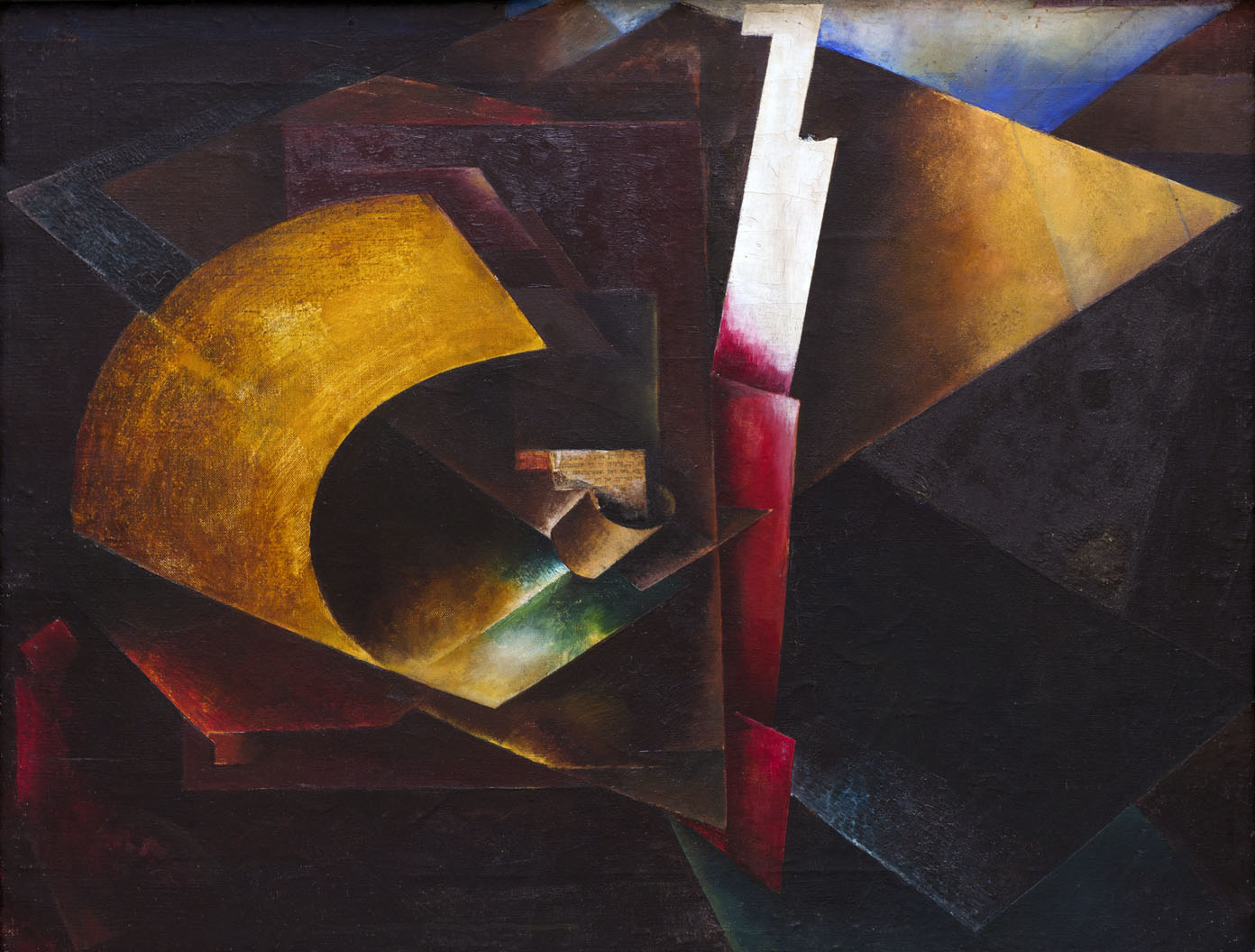
 

El Lissitzky (Russian born Ukraine, 1890-1941) 'Composition' 1918-1920s


El Lissitzky (Russian born Ukraine, 1890-1941)
Composition
1918-1920s
Oil on canvas
71 x 58 cm
National Art Museum of Ukraine


Theatre Design
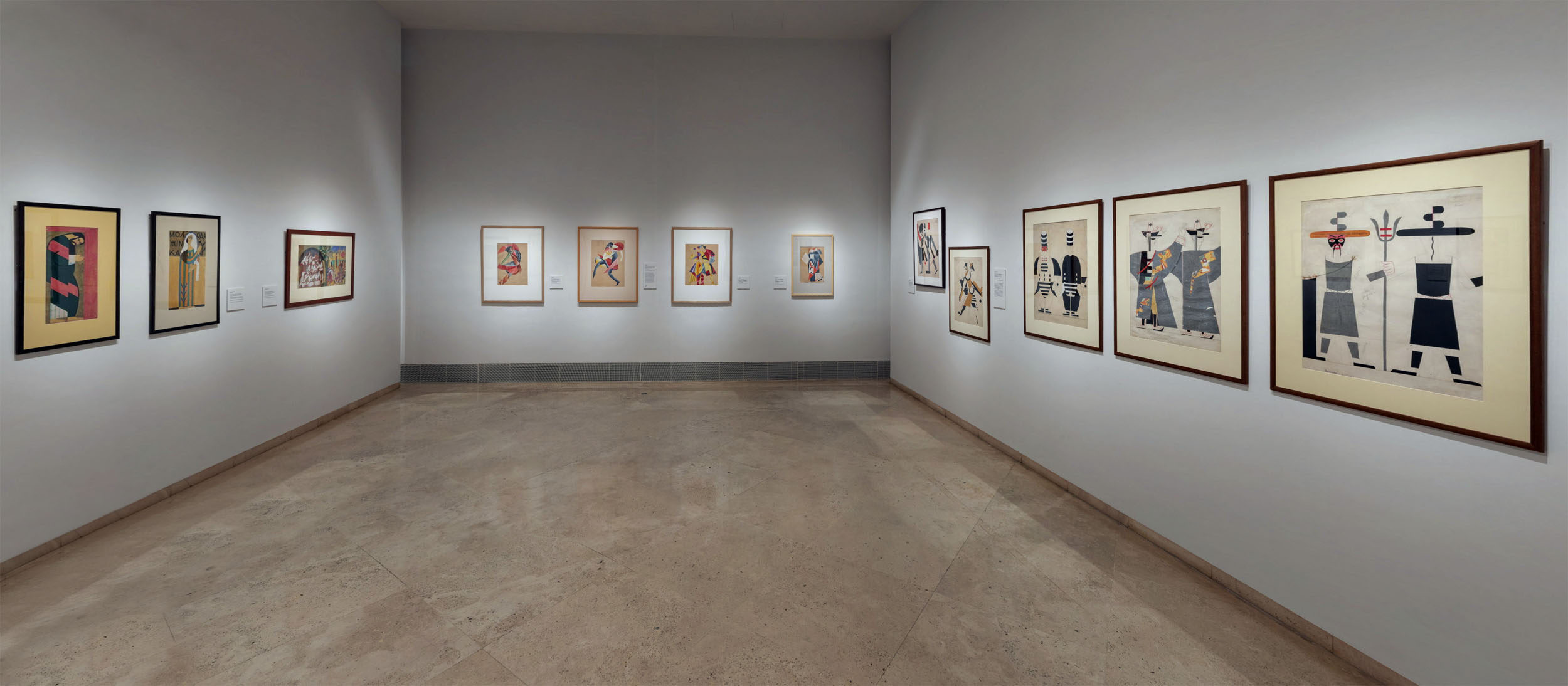
 

Installation view of the exhibition 'In the Eye of the Storm: Modernism in Ukraine, 1900-1930s' at the Thyssen-Bornemisza Museum, Madrid


Installation view of the exhibition In the Eye of the Storm: Modernism in Ukraine, 1900-1930s at the Thyssen-Bornemisza Museum, Madrid


Installation view of the exhibition 'In the Eye of the Storm: Modernism in Ukraine, 1900-1930s' at the Thyssen-Bornemisza Museum, Madrid showing the work of  Vadym Meller


Installation view of the exhibition In the Eye of the Storm: Modernism in Ukraine, 1900-1930s at the Thyssen-Bornemisza Museum, Madrid showing the work of  Vadym Meller


Vadym Meller (Ukrainian, 1884-1962) 'Sketch for choreographic movement "Masks" for Bronislava Nijinska's School of Movements, Kyiv' 1919


Vadym Meller (Ukrainian, 1884-1962)
Sketch for choreographic movement “Masks” for Bronislava Nijinska’s School of Movements, Kyiv
1919
Watercolour on cardboard
60 x 43cm
Museum of Theatre, Music and Cinema of Ukraine


Vadym Meller or Vadim Meller, (Russian: Вадим Георгиевич Меллер; Ukrainian: Вадим Георгійович Меллер, 1884-1962) was a Ukrainian Soviet painter, avant-garde Cubist, Constructivist and Expressionist artist, theatrical designer, book illustrator, and architect. In 1925 he was awarded a gold medal for the scenic design of the Berezil’ theater in the Exposition Internationale des Arts Décoratifs et Industriels Modernes (Art Deco) in Paris. …

V. Meller became the leader of the Constructivism movement in Ukrainian theatre design. He worked in the National theatre as a chief artist until 1945. From 1925 onward, he also taught at the Kyiv Art Institute (KKHI) together with Vladimir Tatlin and Alexander Bogomazov. Also in 1925, V. Meller became a member of the artists union Association of the Revolutionary Masters of Ukraine together with David Burliuk (co-founder), Alexander Bogomazov (co-founder), Vasiliy Yermilov, Victor Palmov, and Khvostenko-Khvostov.

Text from the Wikipedia website


The exhibition In the Eye of the Storm: Modernism in Ukraine, 1900-1930s presents the ground-breaking art produced in Ukraine in the first decades of the 20th century, showcasing trends that range from figurative art to futurism and constructivism. The development of Ukrainian modernism took place against a complicated socio-political backdrop of collapsing empires, the First World War, the revolutions of 1917 with the ensuing Ukrainian War of Independence (1917-1921), and the eventual creation of Soviet Ukraine. The ruthless Stalinist repressions against Ukrainian intelligentsia led to the execution of dozens of writers, theatre directors and artists, while the Holodomor, the man-made famine of 1932-1933, killed millions of Ukrainians.

Despite these tragic circumstances, Ukrainian art of the period lived through a true renaissance of creative experimentation. In the Eye of the Storm reclaims this essential – though little-known in the West – chapter of European modernism, displaying around 70 works in a full range of media, from oil paintings and sketches to collages and theatre designs. Following a strict chronological order, the show presents works by masters of Ukrainian modernism, such as Oleksandr Bohomazov, Vasyl Yermilov, Viktor Palmov, and Anatol Petrytskyi. Exploring the polyphony of styles and identities, the exhibition includes neo-Byzantine paintings by the followers of Mykhailo Boichuk and experimental works by members of the Kultur Lige, who sought to promote their vision of contemporary Ukrainian and Yiddish art, respectively. It features pieces by Kazymyr Malevych and El Lissitzky, quintessential artists of the international avant-garde who worked in Ukraine and left a significant imprint on the development of the national art scene. The exhibition also showcases artworks of internationally renowned artists who were born and started their careers in Ukraine but became famous abroad, among them Alexandra Exter, Wladimir Baranoff-Rossiné, and Sonia Delaunay.

In the most comprehensive survey of Ukrainian modern art to date, with many works on loan from the National Art Museum of Ukraine and the State Museum of Theatre, Music and Cinema of Ukraine, the Museo Nacional Thyssen-Bornemisza celebrates the dynamism and diversity of the artistic scene in Ukraine, while safeguarding the country’s heritage during the inadmissible, present-day occupation of its territory by Russia. After its presentation in Madrid, the exhibition will travel to the Museum Ludwig in Cologne.

Acknowledgements

This exhibition has been made possible by the support of President Zelensky and the Office of the President of Ukraine. Also key is Oleksandr Tkachenko, the Ukrainian Minister of Culture, whose collaboration has enabled us to secure the exceptional loan of these works from a war-torn country.

We extend our gratitude to the National Art Museum of Ukraine and the Museum of Theatre, Music and Cinema of Ukraine for their generous loans, as well as to the private collectors who have collaborated.

Special thanks are due to Baroness Francesca Thyssen-Bornemisza, a member of the Board of Trustees of the Museo Nacional Thyssen-Bornemisza, who has passionately and courageously promoted the project from the outset and facilitated the complex negotiations to bring these works to Spain.

The support of the PinchukArtCentre has also been notable.

Mention should likewise be made of the work and dedication of the curators Konstantin Akinsha, Katia Denysova and Olena Kashuba-Volvach and their revealing essays that appear, together with those of other research scholars, in the magnificent edition published by Thames & Hudson.

This exhibition has been made a reality thanks to the support of Francesca Thyssen-Bornemisza, Museums for Ukraine, the Deputy Directorate-General for State Museums of the Directorate-General for Cultural Heritage and Fine Arts (Spanish Ministry of Culture and Sport), Mastercard, Omega Capital, SITspain and Hammam Al-Andalus, among others.

Text from the Thyssen-Bornemisza Museum website


Spotify playlist In the Eye of the Storm: Modernism in Ukraine, 1900-1930s

Katia Denysova, curator of the exhibition, selects a list of recent hits, contemporary classics and the carol “Carol of the Bells”, inspired by a Ukrainian folk song.
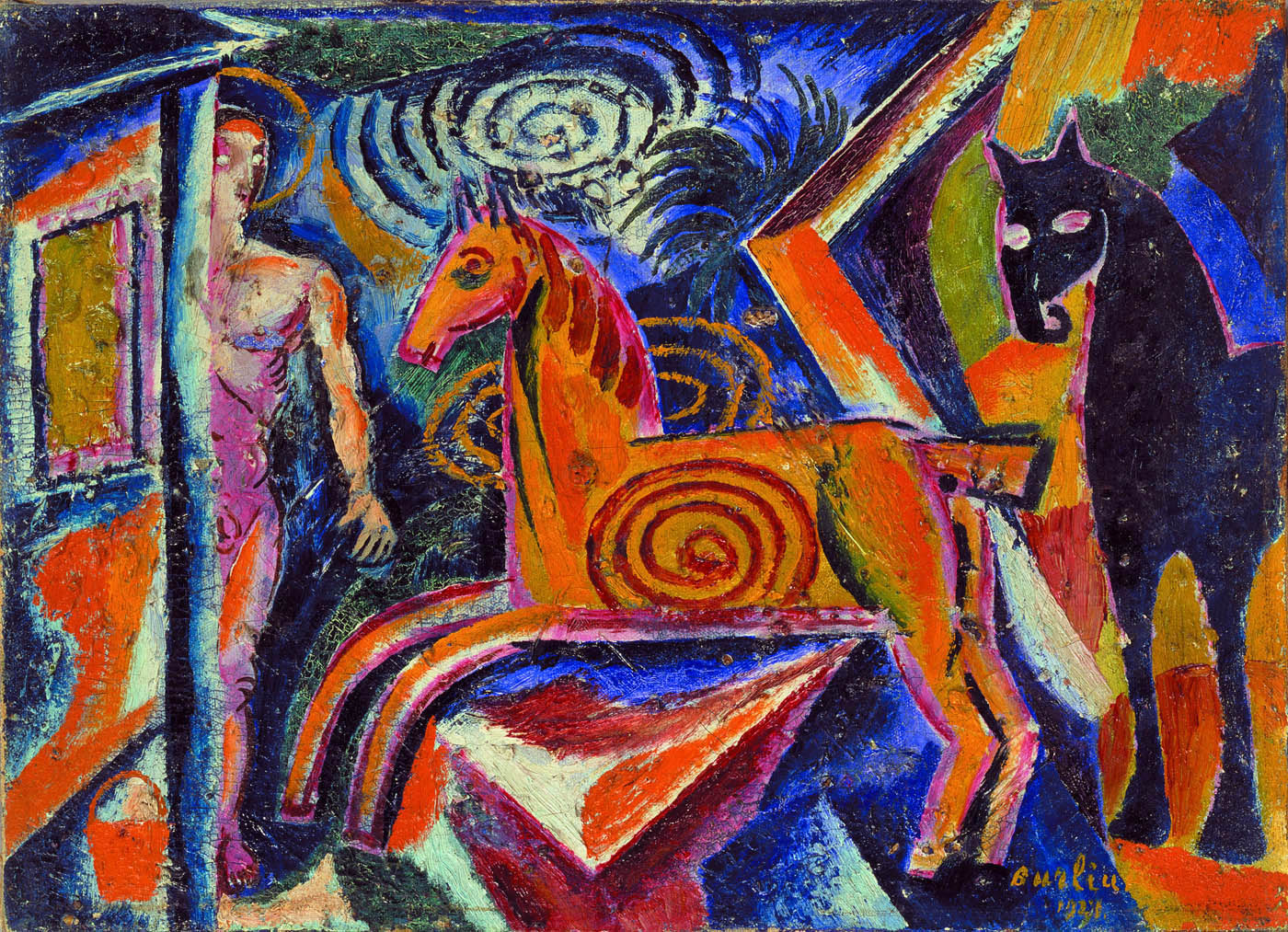
 

Davyd Burliuk (Ukrainian, 1882-1967) 'Carousel' 1921


Davyd Burliuk (Ukrainian, 1882-1967)
Carousel
1921
Oil on canvas
33 x 45.5cm
National Art Museum of Ukraine


David Burliuk devoted his artistic practice – which spanned painting, poetry, drawing, and engraving – to the pursuit of the modern. Using bold typefaces, vibrant colors, and energetic brush strokes, Burliuk turned against the artistic conventions of the past, capturing Russian Futurism’s ideas of dynamism, innovation, and revolution, declared in the 1912 manifesto A Slap in the Face of Public Taste. Burliuk and his Futurist compatriots challenged audiences to question the accepted ideals of aesthetics and beauty in the hope of developing a new and more forward-thinking world.1

Artists, like Burliuk, associated with Russian Futurism sought to both question and analyze – what they called “deconstruct” – established principles of art, including a classical attention to realism, balance, and natural subject matter. Explaining his methods, Burliuk wrote:

“deconstruction is the opposite of construction.
a canon can be constructive.
a canon can be deconstructive.
construction can be shifted or displaced.”2

David Burliuk was born on January 21, 1882, in the Village of Riabushky in the Russian Empire, in what is now Ukraine. He exhibited an early affinity for creative art, beginning independent painting studies at the age of 10. By the end of the 19th century, Burliuk had enrolled in the Royal Academy of Art in Munich, the first of four formal arts programs he would attend throughout his life. It was at the Moscow Academy of Fine Art, an institution in which Burliuk enrolled in 1910, that he began participating in exhibitions and collectives that questioned the conventional standards of beauty in art. During a time of significant industrialization and political change, movements such as the famed Der Blaue Reiter, a group Burliuk associated with in 1912, while he was in Munich, emphasized a shift away from the classical styles of the past, prioritizing the innovations of the future.

Between 1910 and 1913, Burliuk began to assemble artists and poets – including Vladimir Mayakovsky, Benedict Livshits, and Velimir Khlebnikov – to form a group that would become known as Gileia. Initially formed as a modern literary collective and founded on the principles proposed by Filippo Tomasso Marinetti‘s “Manifesto of Futurism,” Gileia and its members would quickly metamorphose into the Cubo-Futurists. Marked by graphic handling of subjects and unconventional editorial displays, the Cubo-Futurists were unwavering in pushing the boundaries of accepted aesthetics.

The Cubo-Futurist movement carved out a space for artists to explore the creative possibilities of the modern future that lay ahead. Unfortunately, by 1916 the First World War had taken its toll on the creative communities of Eastern Europe, and the group dissolved. Following the Russian Revolution in 1917, political conflict forced many to search for safer havens, and in 1922 Burliuk settled in the United States. He continued creating works consistent with the style of Cubo-Futurism, now informed by the trauma and displacement of war.

Distressed by the turmoil in his homeland, Burliuk joined other displaced artists, including Alexander Bogomazov and Vadym Meller, in creating the New York-based Association of Revolutionary Masters of Ukraine in 1925. While continuing his artistic practice, he would spend much of his later life attempting to revisit his homeland, a pursuit that proved successful in 1956, when his petition to visit was granted by the Soviet government. David Burliuk passed away on January 15, 1967. His art is a testament to constant innovation and, as he wrote in a 1912 manifesto, “the new impending beauty of the self-valuable (self-creating) word.”

Emily Olek, Curatorial Assistant, Department of Drawings and Prints, 2022. “Deconstruction is the opposite of construction,” on the MoMA website 2022 [Online] Cited 24/03/2023.

1/ Margit Rowell, Deborah Wye, and Jared Ash. The Russian Avant-Garde Book 1910-1934. (New York: The Museum of Modern Art, distributed by Harry N. Abrams, Inc., 2002), p. 25.

2/ David Burliuk, “Cubism,” in John E. Bowlt, ed., Russian Art of the Avant-Garde: Theory and Criticism, 1902-1934 (New York: Thames and Hudson, 1988), p. 76.


Mykhailo Boichuk (Ukrainian, 1882-1937) 'Dairy Maid' 1922-1923


Mykhailo Boichuk (Ukrainian, 1882-1937)
Dairy Maid
1922-1923
Tempera on canvas
95 x 45cm
National Art Museum of Ukraine


Born in the region of Ternopil in Western Ukraine, Boichuk was educated in Krakiv, Munich, and Paris. It was in Paris that he established his first art school and where his “Neo-Byzantine” style gained critical acclaim. Later, Boichuk became a leading artist and art educator in 1920s Ukraine. However, he and his followers, called “Boichukists,” were brutally persecuted by the Soviet regime. Many of them, including Boichuk himself, were executed by the Soviet police in the 1930s, and most of their artworks were destroyed. In spite of this, the style of Boichukism became very influential in the twentieth-century Ukrainian art.

Anonymous. “‘Eye on Culture’: Mykhailo Boichuk (and Manuil Shekhtman) and the “Boichukist” Tradition in Painting,” on the Ukrainian Jewish Encounter website April 30th, 2020 [Online] Cited 23/03/2023


Boychuk was born in Romanivka, then in Austria-Hungary, and currently in Ternopil Oblast of Ukraine. He studied painting under Yulian Pankevych in Lviv, and subsequently in Kraków, where he graduated from the Krakow Academy of Fine Arts in 1905. He also studied at fine arts academies in Vienna and Munich. In 1905, he had his work exhibited at the Latour Gallery in Lviv and in 1907, his work was exhibited in Munich. Between 1907 and 1910 he lived in Paris where, in 1909, he founded his own studio-school. In this period, he worked with and was influenced by Félix Vallotton, Paul Sérusier and Maurice Denis. He held an exhibition at the Salon des Indépendants in 1910, featuring his and his students’ works on the revival of Byzantine art. The group of Ukrainian artists who studied and worked with him was known as the Boychukists. In 1910, Boychuk returned to Lviv, where he worked as a conservator at the National Museum. In 1911, he travelled to the Russian Empire, but, after World War I started, he was interned there as an Austrian citizen. After the war, Boychuk remained in Kyiv.

In 1917, he became one of the founders of the Ukrainian State Academy of Arts, where he taught fresco and mosaic, and in 1920 was a rector. In 1925, he co-founded the Association of Revolutionary Art of Ukraine. At the time, he already performed a number of high-profile monumental works, and formed a school of monumental painters which existed until his death. The school included renowned artists such as his brother Tymofiy Boychuk and Ivan Padalka.

Due to the Great Purge, the Association of Revolutionary Art of Ukraine was disestablished, and Boychuk was executed. His wife, Sofiia Nalepinska, also an artist, was executed several months after Boychuk.

Many of the works by Boychuk, which mainly involved frescoes and mosaics, were destroyed after he was executed. Even his paintings which were kept in museums of Lviv, were destroyed after World War II. The main projects carried out or coordinated by Boychuk and his school – which included his brother Tymofii Boichuk, Ivan Padalka, Vasyl Sedliar, Sofiia Nalepinska, Mykola Kasperovych, Oksana Pavlenko, Antonina Ivanova, Mykola Rokytsky, Kateryna Borodina, Oleksandr Myzin, Kyrylo Hvozdyk, Pavlo Ivanchenko, Serhii Kolos, Okhrym Kravchenko, Hryhorii Dovzhenko, Onufrii Biziukov, Mariia Kotliarevska, Ivan Lypkivsky, Vira Bura-Matsapura, Yaroslava Muzyka, Oleksandr Ruban, Olena Sakhnovska, Manuil Shekhtman, Mariia Trubetska, Kostiantyn Yeleva, and Mariia Yunak – are an important contribution to Ukrainian and world art.

Text from the Wikipedia website
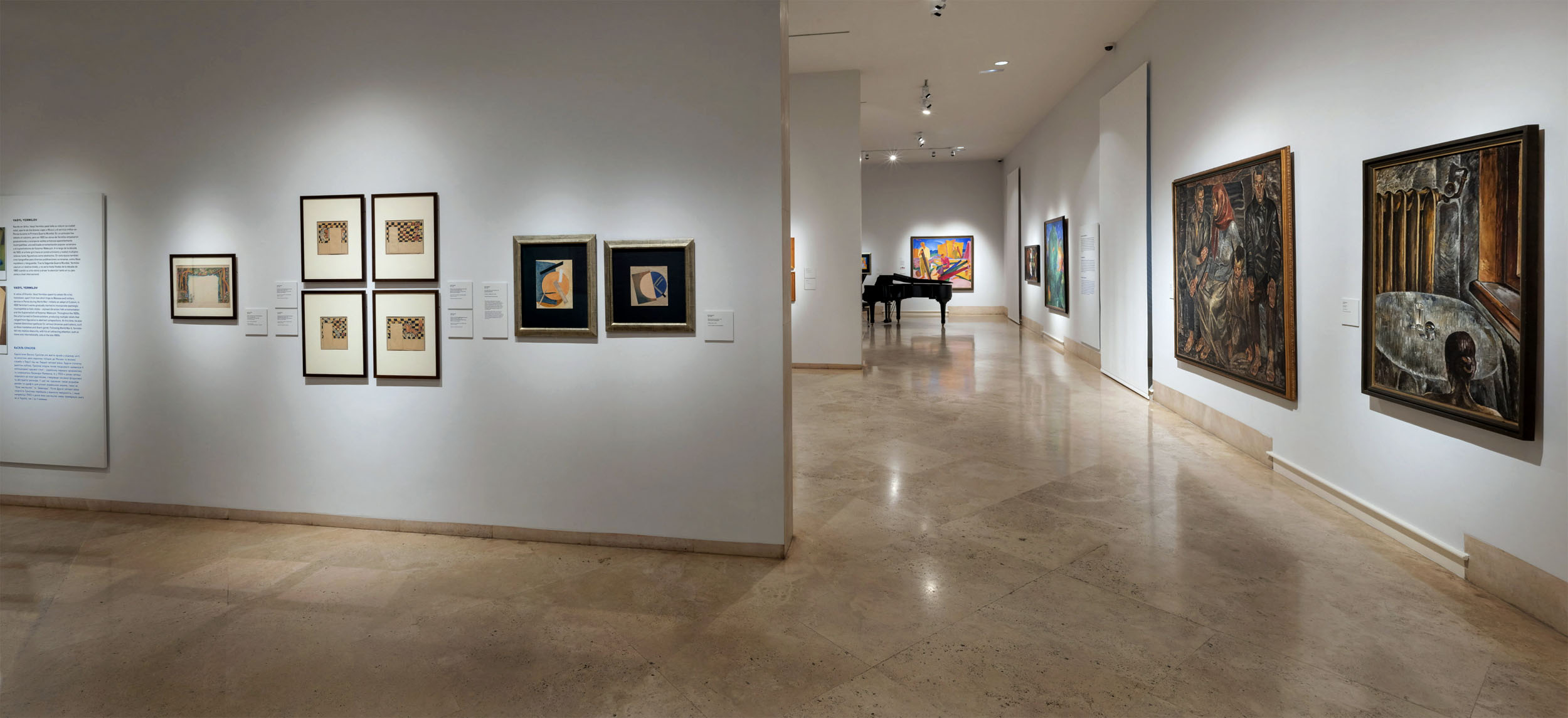
 

Installation view of the exhibition 'In the Eye of the Storm: Modernism in Ukraine, 1900-1930s' at the Thyssen-Bornemisza Museum, Madrid showing at right, the work of Anatol Petrytskyi including the painting 'Disabled' (1924)


Installation view of the exhibition In the Eye of the Storm: Modernism in Ukraine, 1900-1930s at the Thyssen-Bornemisza Museum, Madrid showing at right, the work of Anatol Petrytskyi including the painting Disabled (1924, below)


Ukrainian artists at the Venice Biennale


Installation view of the exhibition 'In the Eye of the Storm: Modernism in Ukraine, 1900-1930s' at the Thyssen-Bornemisza Museum, Madrid showing at left, Anatol Petrytskyi's 'Disabled' (1924)


Installation view of the exhibition In the Eye of the Storm: Modernism in Ukraine, 1900-1930s at the Thyssen-Bornemisza Museum, Madrid showing at left, Anatol Petrytskyi’s Disabled (1924, below)


Anatol Petrytskyi (Ukrainian, 1895-1964) 'Disabled' 1924


Anatol Petrytskyi (Ukrainian, 1895-1964)
Disabled
1924
Oil on canvas


Sonia Delaunay (French born Ukraine, 1885-1979) 'Simultaneous Dresses (Three Women, Forms, Colours)' 1925


Sonia Delaunay (French born Ukraine, 1885-1979)
Simultaneous Dresses (Three Women, Forms, Colours)
1925
Oil on canvas
146 x 114cm
Museo Nacional Thyssen-Bornemisza, Madrid
© Pracusa S.A.


Boichukists

A native of Halychyna in western Ukraine, Mykhalio Boichuk completed his education in art academies of Vienna, Krakow, Munich and Paris. In late 1917, he established a fresco, mosaics and tempera studio at the newly founded Ukrainian Academy of Arts in Kyiv. Advocating for arts as a national treasure and not a mere commodity, Boichuk arrived at a synthesis of styles, drawing on Byzantine art, Italian pre-Renaissance frescoes and Ukrainian folk art. In the earl Soviety period, his studio emerged as a school of monumental art, with its students, henceforth known as Boichukists, completing numerous state commissions for public spaces and buildings. The collaboration proved short-lived, however: labelled ‘bourgeois nationalists’, Boichuk and a close circle of his associates were executed during the Stalinist purge of the 1930s, with most of their public art subsequently destroyed.

Exhibition wall text
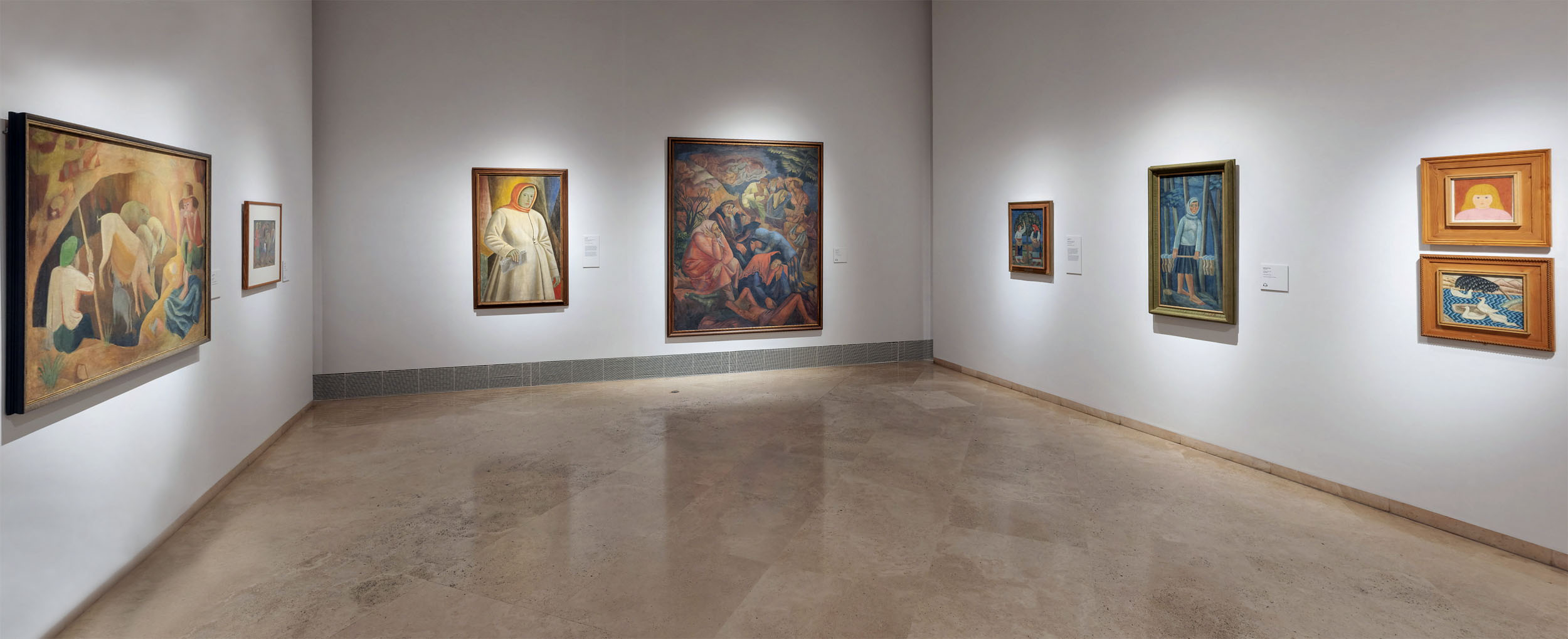
 

Installation view of the exhibition 'In the Eye of the Storm: Modernism in Ukraine, 1900-1930s' at the Thyssen-Bornemisza Museum, Madrid showing at centre Manuil Shekhtman's 'Jewish Pogrom' (1926)

Installation view of the exhibition 'In the Eye of the Storm: Modernism in Ukraine, 1900-1930s' at the Thyssen-Bornemisza Museum, Madrid showing at right Manuil Shekhtman's 'Jewish Pogrom' (1926)


Installation view of the exhibition In the Eye of the Storm: Modernism in Ukraine, 1900-1930s at the Thyssen-Bornemisza Museum, Madrid showing at centre in the top image and at right in the bottom image, Manuil Shekhtman’s Jewish Pogrom 1926 (below)


Manuil Shekhtman (Ukrainian, 1900-1941) 'Jewish Pogrom' 1926


Manuil Shekhtman (Ukrainian, 1900-1941)
Jewish Pogrom
1926
Tempera on canvas
198 x 160cm
National Art Museum of Ukraine


The artist Emmanul Shekhtman was born in 1900 in the village of Lipniki in the Volyn Province (now Zhitomir Region, Ukraine). Manuil spent his childhood with his grandfather in the town of Norinsk, where he studied at a heder (traditional Jewish elementary school). The children of the family grew up in an artistic atmosphere. His sister Malka was a poet who wrote in Hebrew under the pseudonym M. Bat-Khama (“Daughter of the Sun”). She would later work as assistant director at the Kiev State Jewish (i.e. Yiddish) Theater.

In 1913, Shekhtman entered the Kiev Art School, finishing it in 1920. In his youth, Emmanuel was an ardent Zionist and member of a youth movement. During that period, he collaborated with the Kiev branch of the Tarbut organization, while working on stage sets at the Hebrew-language Omanut theater studio. In 1922, Shekhtman entered the Kiev Art Institute to study under the primary ideologue of Ukrainian national art, Mikhail Boichuk. After graduating from the Institute in 1926, Shekhtman continued to actively cooperate with Jewish cultural organisations. From 1925 to 1927, he taught drawing at a Jewish orphanage in Kiev. In 1928, he served as head of the theatrical production of the Kiev State Jewish Theater. In the following year, Shekhtman became head of the artistic division of the Odessa Museum of Jewish Culture. In the early 1930s, there was a campaign of repression against Ukrainian avant-garde artists, which singled out Mikhail Boichuk and his present and past students – including Shekhtman, who was fired from all posts. Those years saw a shift in the country’s official policy, with the authorities beginning to cultivate a sense of Soviet patriotism, with an emphasis of the Russian historical past. In 1934, Shekhtman moved to Moscow. At first, he could find no employment, and was aided by former students who secured one-time commissions for him. Later, he was able to find work at the All-Union Agricultural Exhibition (VSKhV), for which he organized celebrations and served as a landscape architect. Subsequently, he was accepted as a member into the Moscow division of the Union of Soviet Artists.

Jewish themes were central to Shekhtman’s art. Two of his main works, “Those Who Suffered from Pogroms” (1926) and “The Resettlers” (1929), were part of a series entitled “My Biographical Particulars”. Another series of graphics by him, titled “Exile” or “Exodus” (1939-1941), exudes a sense of impending catastrophe for his people.

Following the outbreak of the Soviet-German war in late June 1941, Emmanuil Shekhtman was assigned to camouflaging military targets in Moscow. He later volunteered for frontline duty. In August 1941, he fought with a division of the Moscow People’s Militia. Subsequently, he was transferred to a separate battalion of sappers. In November 1941, he went missing in action in the area of Dmitrov (Moscow Region).

Anonymous. “Emmanul Shekhtman,” on the Yad Vashem website Nd [Online] Cited 24/03/2023


Ivan Padalka (Ukrainian, 1894-1937) 'Photographer' 1927


Ivan Padalka (Ukrainian, 1894-1937)
Photographer
1927
Tempera on paper
33.5 x 45cm
National Art Museum of Ukraine


Ivan Padalka (1894-1937) was a Ukrainian painter, art professor and author who was shot during the Great Terror. Representative of the generation of the Executed Renaissance and the Boychukism movement (a cultural and artistic phenomenon in the history of Ukrainian art between the 1910s and 1930s, distinguished by its artistic monumental-synthetic style. It was an original school of Ukrainian art, formed by a synthesis of Ukrainian folk art and the church art of Byzantium, Proto-Renaissance and Ukraine. The name comes from the name of the founder of the movement: Mykhailo Boychuk.


Ivan Ivanovych Padalka (Ukrainian: Івaн Івaнович Пaдалка: 15 November 1894, Zhornoklyovy, currently Cherkasy Raion – 13 July 1937, Kiev) was a Ukrainian painter, art professor and author who was shot during the Great Terror. …

He was one of eight children born to a farming family of modest means. He began his education at the local parish school, where he first displayed a talent for art. His abilities were noticed by a local nobleman, who helped him to finance studies at the State Ceramics Vocational School in Myrhorod with Opanas Slastion. His work was often held up as a model for the class. He worked there until 1913, when he was excluded for organising revolutionary activities.

He then went to Poltava and found a position at the Ethnographic Museum [uk], where they made copies of Ukrainian carpet designs for a weaving workshop in Kiev owned by Bogdan Khanenko, who was a major patron of the arts. His earnings enabled him to enrol at the short-lived Kiev Art School. His works were regularly exhibited there, and he began to illustrate children’s books.

In 1917, after finishing his studies there, he transferred to the Ukrainian State Academy of Arts, where he became a student in the workshop of Mykhailo Boychuk. While there, he was largely involved in decorative work for buildings, designing posters and creating various revolutionary materials for public display. He also received a commission from the State Publishing House to illustrate a collection of children’s stories called Барвінок (Periwinkles). He worked on that project together with Boychuk’s younger brother Tymofiy.

After graduating in 1920, he returned to Myrhorod and became a teacher at his former ceramics school. Later, he taught the same subject at a technical school in Kiev. His proficiency in his chosen specialty was widely recognised, so he was able to secure a position at the Kharkiv Art and Industrial Institute [uk], where he worked from 1925 to 1934. That year, he returned to Kiev to accept an appointment as a Professor at the State Academy.

In 1936, he was arrested and tortured by the NKVD on charges of counterrevolutionary activities, related to his Ukrainian nationalism. In July, the following year, he was executed by firing squad, together with his former mentor and friend, Boychuk, and the painter Vasily Sedlyar. He was posthomously “rehabilitated” in 1958.

Text from the Wikipedia website


Vasyl Yermilov (Ukrainian, 1894-1967) 'Nove Mystetstvo' ([New Art], magazine cover design) c. 1927


Vasyl Yermilov (Ukrainian, 1894-1967)
Nove Mystetstvo ([New Art], magazine cover design)
c. 1927
Indian ink and gouache on paper
36 x 23.9cm
National Art Museum of Ukraine


Yermilov, Vasyl [Єрмілов, Василь; Jermilov, Vasyl’] (Ermilov, Vasilii), b 22 March 1894 in Kharkiv, d 4 December 1967 in Kharkiv. Painter and graphic designer. He studied at the Art Trade School Workshop of Decorative Painting in Kharkiv (1905-1909), the Kharkiv Art School (1910-1911), and the Moscow School of Painting, Sculpture, and Architecture (1912-1913). In 1918 he joined the avant-garde Union of Seven group in Kharkiv and designed the script for its album Sem’ plius tri (Seven Plus Three, 1918). Under Soviet rule Yermilov designed posters, ‘agit-trains’, street decorations, billboards, the interiors of public buildings (eg, the murals in the foyer of the Kharkiv Circus and the Red Army Club in Kharkiv), theatrical sets, displays, packaging, and journal and book covers; he also directed the art department of the All-Ukrainian Bureau of the Russian Telegraph Agency (1920-1921) and taught at the Kharkiv Art Tekhnikum (1921-1922) and Kharkiv Art Institute (1922-1935). He received several international prizes for his graphic designs, including a gold medal at the 1922 Leipzig International Graphics Exhibition and an award at the 1928 Köln International Press Exhibition. While a member of the Avanhard (Avant-garde) group (1926-1929) he was graphic designer of its newspaper Doba konstruktsiï, its journal Mystets’ki materiialy Avanhardu, and, with Valeriian Polishchuk, the three issues of Biuleten’ Avanhardu. From 1927 he was also a member of the Association of Revolutionary Art of Ukraine. Yermilov’s synthesis of formalist esthetics, folk designs, and traditional painting methods (including egg tempera) was an important contribution to the development of Ukrainian design of the 1920s. His distinctive style of constructivist collage and typographic design, called constructive-dynamism or spiralism, developed distinctly and in parallel with Russian constructivism. Because of his formalist interests Yermilov was forced out of the Soviet art arena in the late 1930s. In the last years of his life he taught at the Kharkiv Industrial Design Institute (1963-1937). A book about him by Z. Fogel was published in Moscow in 1975. A retrospective exhibition of Yermilov’s works was organised in Kyiv in 2011 and a monograph about his life and art, Vasyl Yermilov zhde vesnu (Vasyl Yermilov Awaits the Coming of Spring), by Tetiana Pavlova was published in Kyiv in 2012.

Anonymous. “Yermilov, Vasyl,” on the Internet Encyclopedia of Ukraine website Nd [Online] Cited 24/03/2023
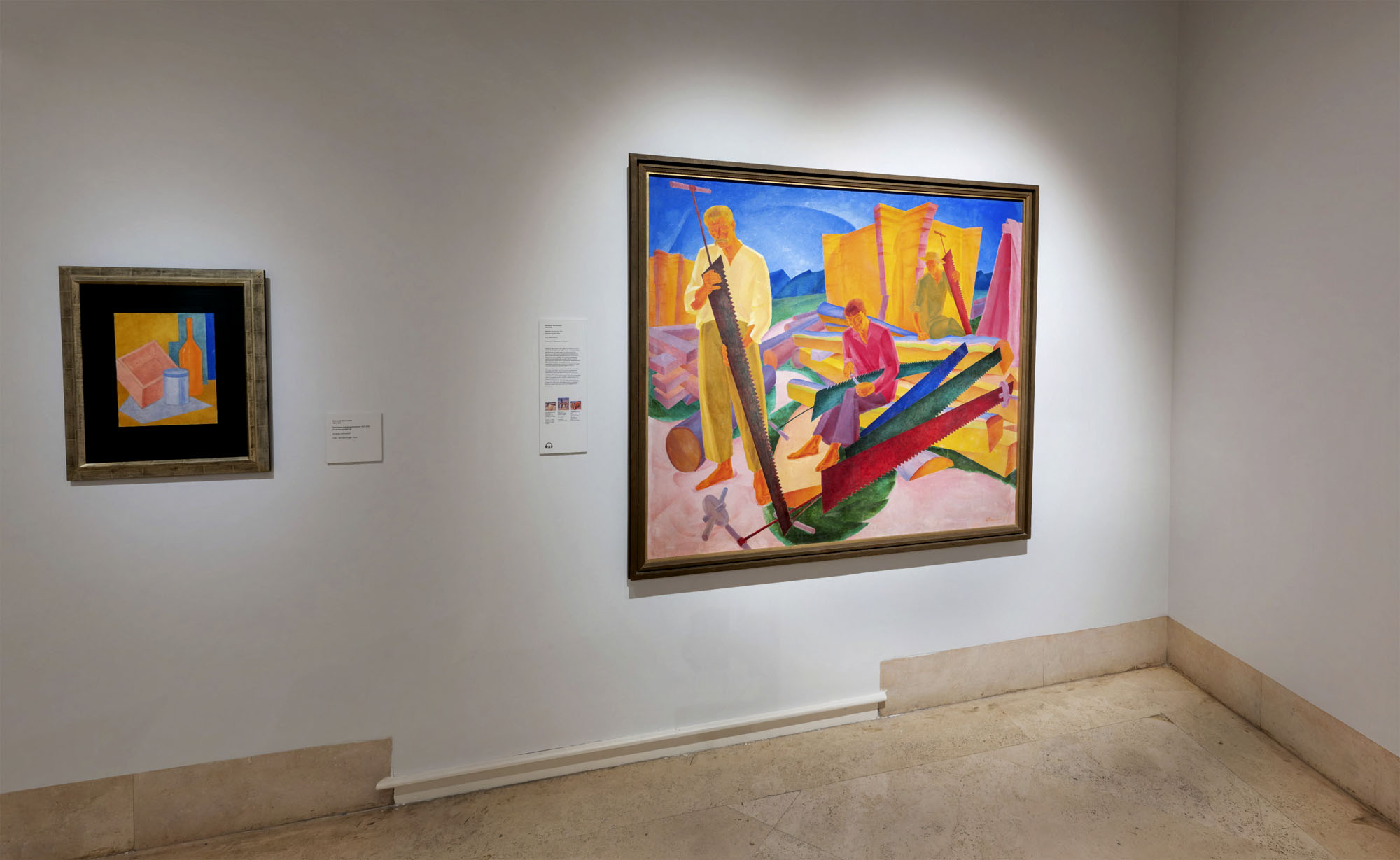
 

Installation view of the exhibition 'In the Eye of the Storm: Modernism in Ukraine, 1900-1930s' at the Thyssen-Bornemisza Museum, Madrid showing at right, Oleksandr Bohomazov's 'Sharpening the Saws' (1927)


Installation view of the exhibition In the Eye of the Storm: Modernism in Ukraine, 1900-1930s at the Thyssen-Bornemisza Museum, Madrid showing at right, Oleksandr Bohomazov’s Sharpening the Saws 1927 (below)


Oleksandr Bohomazov (Ukrainian, 1880-1930) 'Sharpening the Saws' 1927


Oleksandr Bohomazov (Ukrainian, 1880-1930)
Sharpening the Saws
1927
Oil on canvas
138 x 155cm
National Art Museum of Ukraine


In the summer of 1930, Bohomazov’s painting The Woodcutters was exhibited in the Soviet pavilion of the 17th Venice Biennale. At that time, the USSR’s participation in the biennale had become quite politicized: Russian ideologists viewed exhibitions as a vector of propaganda activities. However, young Soviet art was still relatively free from state censorship. So, together with Bohomazov other Ukrainian avant-garde artists saw their artwork make it to Venice – artists like Anatole Petrytsky, Ivan Padalka, Vasyl Sedlyar, and Sofia Nalepynska-Boychuk. The latter three would be executed seven years later under the trumped up charges of “Ukrainian bourgeois nationalism and leading a national-fascist terrorist organization.”

At the time, Bohomazov had already been working as a professor of easel painting at Kyiv Art Institute for eight years (founded as the Ukrainian Academy of Arts in 1917), and participation in the biennale meant his recognition as an artist and a theoretician. Unfortunately, Bohomazov did not live until the biennale opening which had been delayed for five weeks: he died in Kyiv just before it opened.

He created The Work of Woodcutters in 1927-1930 in Boyarka, a dacha condominium. “The clearing was strewn with fresh sawdust, the logs almost rang in the sun, resinous and glistening. The figures of workers on the scaffolding seemed huge against the background of bright blue sky. The high sound of the saw resonated in the air,” remembered Yaroslava, Bohomazov’s daughter. The Work of Woodcutters triptych includes two paintings: The Woodcutters (1929) and Sharpening Saws (1927); the third one to be titled Rolling Logs remained only an idea, reproduced in many sketches and watercolours.

Bohomazov resumed easel painting after a long pause due brought on by his grave emotional state following the death of his father-in-law, revolutionary perturbations, and tuberculosis. Obviously feeling that the end was near, Bohomazov put all his effort into the development of the triptych defined by its dynamic rhythms and gleaming colours (corresponding to his theoretical concept of the artist engaging with four elements of art). “I have joy from work, sun, warmth, and energy. In my painting, I don’t want to show the necessity, complicated nature and adaptation, but the joy and energy, the call – so that the audience is compelled  to work, to feel like a organised part of the whole,” Bohomazov wrote in his notes.

The Woodcutters, a mature masterpiece by Oleksandr Bohomazov, continues to wow audiences all over the world. In 1931, the painting was exhibited in Zurich, and in 1932, in Japan (researchers have yet to uncover in which city the exhibition took place.) The painting was returned to Kyiv damaged. For about 90 years it remained in this state in a closed museum “special fund” where works were sent in late 1930s to be destroyed. At that time, during the fight for pure Soviet art, the avant-garde art was declared to be “formalist”, and work by these artists were banned. Only in 2019 was The Woodcutters exhibited in the National Art Museum of Ukraine – the first time in years at the exhibition “Oleksandr Bohomazov: the creative lab”. Restorers had worked on the painting for three years before releasing it for the exhibit.

For decades it was forbidden to mention the work of world-renowned cubo-futurist artists. Only in late 1960s did Bohomazov’s name resurface from its enforced oblivion. Modest exhibitions were held in Kyiv, and European avant-garde researchers, namely Jean-Claude Marcadé, Jean Chauvelin and Andrei Nakov – turned their attention to Bohomazov. His works became fashionable additions to collections ranging far beyond the Soviet Union. Bohomazov’s works are currently exhibited in the National Art Museum of Ukraine, Guggenheim and MoMA in New York, Ludwig Museums (Germany) as well as in numerous private avant-garde collections.

Anonymous. “Bohomazov Oleksandr,” on the UA View website Nd [Online] Cited 23/03/2023


Installation view of the exhibition 'In the Eye of the Storm: Modernism in Ukraine, 1900-1930s' at the Thyssen-Bornemisza Museum, Madrid showing the work of  Anatol Petrytskyi


Installation view of the exhibition In the Eye of the Storm: Modernism in Ukraine, 1900-1930s at the Thyssen-Bornemisza Museum, Madrid showing the work of  Anatol Petrytskyi


Anatol Petrytskyi (Ukrainian, 1895-1964) 'Costume designs for Minister Pinh in the opera 'Turandot’'at the State Opera Theatre, Kharkiv' 1928


Anatol Petrytskyi (Ukrainian, 1895-1964)
Costume designs for Minister Pinh in the opera ‘Turandot’ at the State Opera Theatre, Kharkiv
1928
Gouache and Indian ink on paper
72 x 54cm
Museum of Theatre, Music and Cinema of Ukraine


Anatol Petrytsky (1895-1964) was a Ukrainian painter, stage and book designer. The fate of Anatol Petrytsky (1895-1965), a first-rank artist of the Ukrainian avant-garde of the first third of the twentieth century, reflects the many twists and turns in twentieth-century Ukrainian art as part of the history of Ukraine, its struggle for independence, its defeats and victories. Like his older predecessors who were born in Ukraine at the end of the nineteenth century (Kazimir Malevich, Aleksandra Exter), he sought to develop his talent in foreign capitals and art centers. He was drawn to the Higher Art and Technical Studios (VKhUTEMAS) in Moscow, where he studied in 1922-1924, and the Bauhaus, whose entrance examination he passed in 1933 but was prevented from attending by the fateful changes in the sociopolitical life of Germany.

However, Petrytsky was already formed as an artist by the 1910s on the solid basis of the then already transformed Kyiv school of painting: the Kyiv Art School, the studios of Aleksandra Exter and Oleksandr Murashko, Mykhailo Boichuk’s monumental painting workshop at the Ukrainian State Academy of Arts, and the strong influence of Vasyl Krychevsky and Danylo Shcherbakivsky. He took part in the process of reviving Ukrainian art from his early years. Together with Mykhailo Semenko he blazed the trail for Futurism. Together with Les Kurbas he reformed Ukrainian stage design: he began working on musical productions (Mykola Lysenko’s Taras Bulba, Aleksandr Borodin’s Prince Igor), exploring new avant-garde forms fused into a single undivided whole with the artistic traditions of the professional and folk art of Ukraine. In the 1920s, Petrytsky gained fame at home and abroad primarily as a brilliant avant-garde scenographer. His high status as an artist was confirmed by his highly successful participation in the 17th Venice Biennale (1930), where his large canvas Disabled (1924, above) became the “highlight of the exhibition,” according to art historian Mykhailo Drahan.

Anonymous. “The Ukrainian Avant-garde painter Anatol Petrytsky, 1920s,” on the Cocosse website Nd [Online] Cited 24/03/2023


Installation view of the exhibition 'In the Eye of the Storm: Modernism in Ukraine, 1900-1930s' at the Thyssen-Bornemisza Museum, Madrid showing at right Viktor Palmov's 'The 1st of May' (1929)


Installation view of the exhibition In the Eye of the Storm: Modernism in Ukraine, 1900-1930s at the Thyssen-Bornemisza Museum, Madrid showing at right Viktor Palmov’s The 1st of May 1929 (below)


Kyiv Art Institute

The development of the visual arts in Ukraine in the 1920s-1930s was intimately linked to the Kyiv Art Institute – the successor to the Ukrainian Academy of Art. It was the first institution of higher art education in Ukraine, founded when the country proclaimed independence in 1917. In 1924, in consonance with the ideological tasks of the Soviet regime, the Academy was transformed into an Institute in order to bring educational methods in line with such trends in contemporary art as production design. To create more dynamic curriculum, the Institute signed on new instructors from across the Soviet Union with many prominent avant-garde artists, such as Kazymyr Malevich and Vladimir Tatlin, joining the Faculty.

Exhibition wall text


Viktor Palmov (Ukrainian born Russia, 1888-1929) 'The 1st of May' 1929


Viktor Palmov (Ukrainian born Russia, 1888-1929)
The 1st of May
1929
Oil on canvas
161 x 161cm
Museo Nacional Thyssen-Bornemisza, Madrid


Victor Nikolaevich Palmov (Ukrainian: Віктор Никандрович Пальмов) (10 October 1888 – 7 June 1929) was a Ukrainian painter of Russian origin and avant-garde artist (Futurist and Neo-primitivist) from the David Burliuk circle.

A famous artist (painter and graphic artist), art theorist, talented teacher, a prominent figure in the cultural process of the first quarter of the 20th century. Viktor Palmov is rightly considered a classic of the Ukrainian avant-garde. The artist developed his theory of “colorization” and was the author of several articles on the problems of the theory of new painting, published in the magazine “New Generation”. The master’s works were among those “arrested” and were banned from showing at galleries and museums on a par with the canvases of A. Bogomazov, D. Burliuk, A. Exter, and “Boychukists”.


Anatol Petrytskyi (Ukrainian, 1895-1964) 'Portrait of Mykhailo Semenko' 1929


Anatol Petrytskyi (Ukrainian, 1895-1964)
Portrait of Mykhailo Semenko
1929
Watercolour, lead pencil and ink on paper
61.5 x 47.5cm
National Art Museum of Ukraine


Mykhail Semenko or Mykhailo Vasyliovich Semenko (Ukrainian, 1892-1937) was a Ukrainian poet, and a prominent representative of Ukrainian futurist poetry of the 1920s. He is considered to be one of the lead figures of the Executed Renaissance.


Kazymyr Malevych (Russian, 1879-1935) 'Sketch of the painting for the conference hall of the All-Ukrainian Academy of Sciences, Kyiv' 1930


Kazymyr Malevych (Russian, 1879-1935)
Sketch of the painting for the conference hall of the All-Ukrainian Academy of Sciences, Kyiv
1930
Pastel and gouache on paper
44 x 31cm
National Art Museum of Ukraine


Kazimir Malevich, in full Kazimir Severinovich Malevich, (born February 23 [February 11, Old Style], 1878, near Kyiv, Russian Empire [now in Ukraine] – died May 15, 1935, Leningrad, Russia, U.S.S.R. [now St. Petersburg, Russia]), avant-garde painter who was the founder of the Suprematist school of abstract painting.

Malevich, who was born to parents of Polish origin, studied drawing in Kyiv and then attended the Stroganov School in Moscow and the Moscow School of Painting, Sculpture, and Architecture. In his early work he followed Impressionism as well as Symbolism and Fauvism, and, after a trip to Paris in 1912, he was influenced by Pablo Picasso and Cubism. As a member of the Jack of Diamonds group, he led the Russian Cubist movement.

In 1913 Malevich began to create abstract geometric patterns in a manner he called Suprematism, a term expressing the notion that colour, line, and shape should reign supreme over subject matter or narrative in art. During this period, he painted a few of his most influential works, including Black Square (1915) and Suprematist Composition: White on White (1918). From 1919 to 1921 he taught painting in Moscow and Petrograd (renamed Leningrad in 1924), where he lived the rest of his life. On a 1927 visit to the Bauhaus in Dessau, Germany, he met Wassily Kandinsky and published a book on his theory under the title Die gegenstandslose Welt (The Non-objective World). Later, when Soviet politicians decided against modern art, Malevich and his art fell out of favour. During his last years, his works show a return to figuration. Malevich died from cancer in poverty and oblivion.

Malevich was the first to exhibit paintings composed of abstract geometric elements. He constantly strove to produce pure cerebral compositions, repudiating all sensuality and representation in art. White on White carries his Suprematist theories to their logical conclusion.

Text from the Brittanica website

The Last Generation

The last generation of Ukrainian modernists matured in the late 1920s and early 1930s. Mainly graduates of the Kyiv Art Institute, these artists were fascinated with the Neue Sachlichkeit (New Objectivity) and Novecento Italiano international movements, but their artistic activity was cut short by a radical change in the political climate. Art was increasingly viewed through a prism of ‘class consciousness’ and Soviet subject matter came to dominate all spheres of artistic output. In 1932, Socialist Realism was introduced as the only official artistic style to be practiced in the Soviet Union, with more value subsequently placed on the rally-like qualities in art rather than the merits of modernist experimentation.


Installation view of the exhibition In the 'Eye of the Storm: Modernism in Ukraine, 1900-1930s' at the Thyssen-Bornemisza Museum, Madrid showing at left, Kostiantyn Yeleva's 'Portrait Late' 1920s - early 1930s; and at right, Semen Yoffe's 'In the Shooting Gallery' 1932


Installation view of the exhibition In the Eye of the Storm: Modernism in Ukraine, 1900-1930s at the Thyssen-Bornemisza Museum, Madrid showing at left, Kostiantyn Yeleva’s Portrait Late 1920s – early 1930s (below); and at right, Semen Yoffe’s In the Shooting Gallery 1932 (below)


Kostiantyn Yeleva (Ukrainian, 1897-1950) 'Portrait' Late 1920s - early 1930s


Kostiantyn Yeleva (Ukrainian, 1897-1950)
Portrait
Late 1920s – early 1930s
Oil on canvas
145 x 100cm
National Art Museum of Ukraine


Drawing, theatrical-decorative painting, and studio artist and teacher. Attended KKhll (1912-1918) and Ukrainian State Academy under Mykhailo Boychuk (1918-1922). Contributed to exhibitions (1917 onwards). Member of ARMU. During the Civil War (1919-1921) and World War II (1943 -1944) worked on political posters. Designer for the First Shevchenko Drama Theater of the Ukrainian SSR, Lesia Ukrainka Theater, the Odesa Ukrainian Drama Theater, and village and army clubs (1919-1926). Taught at KKhU (1926), chaired the Department of Theatrical-Decorative Art and served as Assistant Professor (1930-1932), before becoming Professor in the Drawing Department (1949). Designed patriotic posters for the TASS Windows (1943-1944). Late 1940s onwards also taught graduate courses in drawing at the Academy of Architecture of the Ukrainian SSR. Participated in the Venice Biennale (1928). One-man exhibitions in Kyiv (1940, 1945, 1950).

Text from the Ukrainian Art Library website


Semen Yoffe (Ukranian, 1909-1991) 'In the Shooting Gallery' 1932


Semen Yoffe (Ukranian, 1909-1991)
In the Shooting Gallery
1932
Oil on canvas
200 x 150cm
National Art Museum of Ukraine


Stage designer. Graduated from Kharkiv Art Institute, where he studied under Vasyl Yermylov and Ivan Padalka (1926-1929); collaborated on the journal Nova generatsiia [New Generation], which reproduced some of his surrealistic drawings (1930). Active as an exhibition installationist and stage designer (1940s onwards).

Text from the Ukrainian Art Library website


'In the Eye of the Storm: Modernism in Ukraine, 1900-1930s' book cover


Book overview

How does artistic life flourish during revolution and conflict? Ukraine in the early 1900s endured unimaginable political upheaval, yet this became a period of true renaissance in Ukrainian art, literature, theatre and cinema.

In the Eye of the Storm: Modernism in Ukraine, 1900-1930s presents the ground-breaking art produced in Ukraine in the early 20th century, focusing on the three key cultural centres of Kyiv, Kharkiv and Odesa. Against a complicated socio-political backdrop of collapsing empires, World War I, the revolutions of 1917 with the ensuing Ukrainian War of Independence, and the eventual creation of Soviet Ukraine, several strands of distinctly Ukrainian art emerged.

While émigrés such as Sonia Delaunay and Alexander Archipenko found fame outside their homeland, the followers of Mykhailo Boichuk focused on Byzantine revivalism, and the artists of the Kultur Lige sought to promote the development of contemporary Yiddish culture. The first avant-garde exhibitions in Ukraine featured the radical art of Davyd Burliuk and Alexandra Exter, and the dynamic canvases of the Kyiv-based Cubo-Futurist Oleksandr Bohomazov. In Kharkiv, Vasyl Yermilov championed the industrial art of Constructivism, while Vadym Meller, Anatol Petrytskyi, Oleksandr Khvostenko-Khvostov and Borys Kosarev revolutionized theatre design. The attempt to build a national identity in Ukraine resulted in a polyphony of styles and artistic developments across a full range of media – from oil paintings, sketches and sculpture to collages, cinema posters and theatre designs.

Twelve internationally renowned scholars, including curators from the National Art Museum of Ukraine, bring to life this astonishing period of creativity in Ukraine and all the movements it encompassed.

Text from the Thames & Hudson website

Book extract

This volume is dedicated to the dramatic story of Ukrainian modernism. The radical Ukrainian art formed in the last decade of the Russian Empire was a seismographic indicator of the tectonic changes to come, against the background of the upcoming revolution and subsequent attempts to establish an independent state. The Ukrainian modernists actively participated in nation-building, trying to create a recognizable national style. This is their story.

After nearly five years of the bloody War of Independence (1917-21), the Bolsheviks defeated nationalist Ukrainian forces and established the Ukrainian Socialist Soviet Republic (UkrSSR). However, the initial period of Communist rule created a mere illusion of Soviet-controlled cultural autonomy. The policy of ‘Ukrainization’, initially supported by Moscow for tactical reasons, facilitated the rapid development of a national culture that very much proclaimed its own home-grown identity. The 1920s became a time of bold artistic and literary experimentation, a period of true renaissance in Ukrainian art, literature, theatre and cinema. This cultural autonomy helped Ukraine prolong its period of aesthetic experimentation in comparison with other republics in the Soviet Union. Such pivotal figures of the avantgarde art as Kazymyr Malevych (Russian: Kazimir Malevich, Polish: Kazimierz Malewicz, 1879-1935) and Volodymyr Tatlin (Russian: Vladimir Tatlin, 1885-1953), blacklisted early on in Russia as dangerous ‘formalists’, nonetheless found refuge in Kyiv. In Ukraine, as late as 1930, they still could teach, exhibit and publish freely. However, this was just a short period of calm before the inevitable storm. The policy of Ukrainization was abruptly curtailed in 1931, and there were immediate and ruthless purges of the Ukrainian intellectual elite. Numerous poets, writers and theatre directors, along with many artists, faced summary execution or imprisonment in the Gulag. Manuscripts, books and artworks were incinerated. Murals were overpainted or scraped off walls. Later, the martyrs of Ukrainian culture were referred to as the ‘Executed Renaissance’. After severe waves of repression, Ukrainian modernism was doomed to oblivion. Artworks that were not destroyed were sent to secret, purpose-built repositories.

The Great Purges culled artists and intellectuals in the length and breadth of the USSR, but in Ukraine repression started earlier and had a character all its own. In Russia at large, repressed artists and writers were classified as ‘enemies of people’, a broad and generic term. In Ukraine, they were accused of ‘bourgeois nationalism’, an altogether more emotive and destructive appellation. The scene was set, and the destruction of Ukrainian literature and art from 1931 onwards amounted to nothing less than mass cultural genocide. The period 1932-33 saw a broader form of genocide – the Holodomor, often called the Terror-Famine, an artificially induced famine unleashed on Ukraine by the Soviet regime, which took millions of lives. The double catastrophe had far-reaching effects that still resonate to this day, greatly amplified by the most recent invasion of Ukraine in 2022.

During Khrushchev’s abortive de-Stalinization period, interest in Ukrainian modernism started to renew. Some ‘formalist’ works, taboo for so long, were even reinstated in national museums. However, the process was painful and patchy – and behind it lay the ever-present accusation of ‘nationalism’ that had made the rehabilitation of so many Ukrainian artists nearly impossible. At the same time, though, the West had rediscovered the revolutionary avant-garde art of the early Soviet period. The fashion for ‘the Great Experiment of Russian Art’ led to the appropriation of Ukrainian artists, as they conveniently fell under the umbrella term ‘Russian avant-garde’, adroitly coined by the Western art market. By this market-driven alchemy, artists who had spent all their lives in Ukraine, and whose artistic experimentation was integral to the development of Ukrainian art, unexpectedly became ‘Russian’. Western art dealers and museum curators alike followed the old Russian imperialist agenda. Few, if any, attempts were made to clarify the difference between Russian and Ukrainian culture of the period within the art market. In broader terms, we know that the word ‘Russia’ was (and is) frequently used to describe the Russian Empire, the Soviet Union, and the contemporary Russian Federation – a dangerously misleading if understandable Western generalization.

The real rediscovery of Ukrainian modernism started only after the fall of the Soviet Union and the declaration of Ukraine’s independence in 1991. Despite the publication of important research and the staging of breakthrough exhibitions, the process was not free from mythologizing. To reclaim the legacy of national art, Ukrainian art historians coined the definition ‘Ukrainian avant-garde’. Such a doppelganger of the generalized label, used for marking radical art from the Russian Empire and the Soviet Union, often with complete disregard for its geographic provenance, proved to be no less misleading in the Ukrainian case. Ukrainian artists, like their Russian counterparts of the first half of the 20th century, did not use the word ‘avant-garde’ to describe themselves, preferring instead the labels of different ‘isms’ – Futurism, Suprematism, Constructivism, etc. In the case of Ukrainian art, an attempt at a ‘one size fits all’ approach proved to be especially controversial. A good example is the Boichukist school, the only truly monolithic art group in the history of Ukrainian modernism. It was united by the artistic method and ideology of Byzantine revivalism and a pronounced orientation towards folk culture, so it was retrospective in essence and had nothing in common with radical experimentation. Attempts to classify it as avant-garde seem at best naive. Apart from Mykhailo Boichuk (1882-1937) and his followers, Ukrainian art did not produce any other movements united by a definite aesthetic preference. Polyphony dominated the landscape of national modernism, with artists creating their own personal ‘isms’, such as the ‘colourism’ of Viktor Palmov (1888-1929). Others developed their versions of international trends, often quite different from the source of inspiration, a principal example being the Cubo-Futurism of Oleksandr Bohomazov (1880-1930) or the ‘Constructivism’ propagated by Vasyl Yermilov (1894–1968).

Many representatives of Ukrainian modernism escape straightforward stylistic classification. A case in point is Anatol Petrytskyi (1895-1964), who was influenced by different international movements from Cubism to Constructivism, adopting them in his work in a highly individualised manner. The polyphony of identities supplemented the polyphony of styles, so that many artists born in Ukraine continued their careers in Russia or in other foreign countries but left a strong imprint on the development of Ukrainian art. One considers the mark left by Davyd Burliuk (Russian: David Burliuk, 1882-1967) and Alexandra Exter (Ukrainian: Oleksandra Ekster, 1882-1949) on the development of the local version of Cubo-Futurism, or the influence of Kazymyr Malevych, an ethnic Pole born in Kyiv, on Ukrainian artists. A further voice in this complex polyphony was Viktor Palmov, a Russian who relocated to Kyiv at the beginning of the 1920s and became one of the most active participants in the country’s artistic processes. Bearing all these complexities in mind, one might reasonably conclude that ethnic labelling within the modernist movement in Ukraine, during the time of the Russian Empire or the Soviet Union, can hardly help create an appropriately nuanced and realistic picture of the development of Ukrainian art.

Oleh Ilnytzkyj, the pioneer of research on Ukrainian literary Futurism, wrote about the reassessment of the history of the movement during the period of the Russian Empire: ‘The goal is not to place a new “Ukrainian” straitjacket on cultural activities in the empire, but to find way to do justice to the variety of sources and the myriad of cultural influences that flowed from so many directions. The recognition of Burliuk, Ekster and Malevich as Ukrainians does not diminish their relevance for either the imperial (transnational) avant-garde or for strictly Russian culture, where their impact is undeniable.’ Such an approach is also applicable to many artists of the Soviet period, from Klyment Redko (Russian: Kliment Redko, 1897-1956) to Oleksandr Tyshler (Russian: Aleksandr Thyshler, 1898-1980).

One of the main tasks for Ukrainian artists at the beginning of the 20th century was to create a national style. They were not alone. The age of nationalism, on the rise in Europe since the Napoleonic wars, provoked the nation-building earthquake following the collapse of the empires in 1917-18. Art played an essential role in the seismic shift. Art Nouveau, defined in Germany and Austria as Secession, in Italy as Liberty, and in Russia as Modern, became the last international style to produce a dominant visual language. The paradox was that similar stylistic features were used to visualize different national mythologies from Paris and Berlin to Helsinki and Kyiv. The Ukrainian version of Art Nouveau was no less of an attempt to find a national artistic form of self-expression. The cosmopolitan style of Oleksandr Murashko (1875-1919) was challenged by Mykhailo Zhuk (1883-1964), and especially by the Krychevski brothers, who opted for national topicality and found inspiration in Ukrainian folk art. In addition to folk art, there were other and no less important primary sources of inspiration for the Ukrainian Art Nouveau practitioners. Early medieval mosaics and frescoes, created under strong Byzantine influence, was one such. The Ukrainian Baroque of the 17th and early 18th centuries was another. It is not surprising, given the vigour and eclecticism of the movement, that the visual identity of the short-lived independent Ukrainian state of 1917–20, including the coat of arms and banknotes, created by Heorhii Narbut (1886–1920), was an exquisite example of the national version of Art Nouveau.

Ukrainian advocates of radical modernism were also very interested in co-opting the folk traditions. Ukrainian naïve pictures, embroideries, ornaments and painted eggs all fascinated Exter and Davyd Burliuk, both members of the Kyiv Cubo-Futurist scene. They were the pioneers of the transformation of the folklore elements into ‘radical chic’. The passion for folk art and ornament became an inherent part of ‘Ukrainian-ness’ in the country’s modernism, extending to such unexpected territory as the constructivist designs of Vasyl Yermilov. Despite this happy and inventive immersion in folklore, it is important to remember that the Ukrainian artists’ preoccupation with tradition was very different from that of their Russian counterparts, whose approach to folk art broadly proceeded in two directions. On the one hand, the Russians embraced naive village art, or the kitsch aspects of urban sub-culture, as a kind of shock tactic, a means to épater le bourgeois by glorifying ‘lower’ rather than ‘higher’ elements of culture. On the other, native folklore and folk art were often seen as a viable homegrown alternative to exotic, foreign imports from France and elsewhere – the perfect means by which Russian modernists might take a stance against Western decadence. Such calculated feelings were utterly foreign to Ukrainian artists, whose studious attention to folk art and ornamentation was quite devoid of irony or strategy. However radical Ukrainian modernists were, they felt they had inherited the task of establishing a national visual language from their predecessors, and took it very seriously. Unfortunately, Ukrainian modernism in all its aspects, aside from folklore influences, has been historically analysed predominantly through the lens of comparison with Russian art. Perhaps now is the time to look at it in the context of the development of modernist traditions in such Central European countries as Poland, Hungary and the Czech Republic, where the local schools who sought a national art style were no less influenced by folk tradition than those in Ukraine.

If the Ukrainian art of the 1910s-20s has already been reasonably researched and analysed, the enforced transition to Socialist Realism still requires profound conceptualization. The attempts of leading modernists like Oleksandr Bohomazov and Viktor Palmov to find their place in the new, politically imposed frame of reference, resulted in masterpieces characterized by a new and sometimes uncomfortable hybridity of styles that certainly requires further investigation. In the same vein, the efforts of Boichukists to adjust their art to the changing demands of the time also requires fresh analysis. Their status as martyrs of Ukrainian art often precludes a dispassionate discourse on the transformation of their style, and their participation in the development of Stalinist propaganda and iconography. Whether such a shift was the result of a Faustian pact or sincere political belief remains to be answered, case by case. Fresh territory for research and discussion in Ukrainian art history is being mapped out year after year. The ground-breaking exhibition ‘Spetsfond’ (Special Secret Holding), organized by the National Art Museum of Ukraine in 2015, resulted in the rediscovery of Ukrainian art of the early 1930s. For the first time, numerous paintings, hidden for more than half a century for political reasons, were returned to public display. The show restored to Ukrainian art history the names and reputations of such painters as Kostiantyn Yeleva (1897-1950), Semen Yoffe (1909-1991) and Yurii Sadylenko (1903-1967). This was just a start, and so much more is yet to be done. For example, the influence of such trends as Neue Sachlichkeit (New Objectivity) and Il Novecento Italiano on Ukrainian artists still requires fundamental investigation – and while research into Ukrainian cinema has been greatly stimulated though the activity of the Oleksandr Dovzhenko National Centre, the history of Ukrainian photography from the 1920s and early 1930s remains largely terra incognita. This volume and the exhibition that accompanies it constitute an attempt to introduce the international public to the complicated history of Ukrainian modernism, an essential but little-known part of European culture.

Extracted from In the Eye of the Storm: Modernism in Ukraine, 1900-1930s.


Museo Nacional Thyssen-Bornemisza
Paseo del Prado 8, 28014 Madrid, Spain
Phone: 91 791 13 70

Opening hours:
Monday: 12.00 – 16.00
Tuesday to Sunday: 10.00 – 19.00

Museo Nacional Thyssen-Bornemisza website

LIKE ART BLART ON FACEBOOK

Back to top

Exhibition: ‘Josef Koudelka: Uncertain Nationality’ at Fundación MAPFRE, Madrid

Exhibition dates: 10th September – 28th November 2015

The exhibition is organised by the Art Institute of Chicago and the J. Paul Getty Museum in association with Fundación MAPFRE

Curator: Matthew Witkovsky, Richard and Ellen Sandor Chair and Curator Department of Photography of the Art Institute of Chicago


Entrance view of the exhibition 'Josef Koudelka: Uncertain Nationality' at Fundación MAPFRE, Madrid


Entrance view of the exhibition Josef Koudelka: Uncertain Nationality at Fundación MAPFRE, Madrid


Without reminding myself every so often, you actually forget just what a master of photography Josef Koudelka is.

Looking at the installation photographs below, without knowing the names of the individual images, is instructive. Notice how graphically strong his organisation of the picture plane is. Usually one or two, three at the most, strong vertical or horizontal elements – dark on dark, light on dark; man and hovercraft; figures on pavement; women, tree and building; assemblages of objects and light.

I believe all of his work links back to his sense of the theatre of memory, whether it be the landscapes and sceneries of the outdoors taken in Prague, and on trips to Slovakia, Poland and Italy or the psychological interior of the mind of his theatre characters as he portrays them through photography. From the mystery and exoticism of the Gypsies series, to the recording of history, time and conflict of the Invasion photographs (witness the Hand and wristwatch). From the metaphysical symbols of isolation (lost animals, lonely figures, scattered objects and displaced Gypsies) in Exiles, which is the core of the Koudelka vital experience, to the destruction of ancient archaeological sites and depictions of places that have been mined, swept away or marked by the scars of industrialisation, devastated by wars and altered by time in his panoramic format photographs.

These theatres of the divine, theatres of the mind are ‘Theatres of Memory’ in which the 16th century Italian philosopher Guilio Camillo asks the question: How is the motion of the memory connected with the motion of history? How is the personal political?

Koudleka’s probing of this question is present in every one of his images. Through his inquiry “he maintains a total unity through the photographer’s vision.” The artist forms mental and physical images of the things he wants to remember, that he wants us to remember, using theatrical spaces… and his subjective thoughts bind us, closely, to collective memories.

“History… is a nightmare from which I am trying to awake.” ~ James Joyce, Ulysses

Dr Marcus Bunyan


Many thankx to Fundación MAPFRE for allowing me to publish the photographs in the posting. Please click on the photographs for a larger version of the image.


Installation view of the exhibition 'Josef Koudelka: Uncertain Nationality' at Fundación MAPFRE, Madrid


Installation view of the exhibition Josef Koudelka: Uncertain Nationality at Fundación MAPFRE, Madrid


FUNDACIÓN MAPFRE presents the most complete retrospective exhibit up to this day dedicated to the Czech photographer of French nationality Josef Koudelka (b. 1938), member for the past forty years of Magnum Photos agency.

Engineer by profession, Koudelka became committed to the photographic medium in the middle of the sixties and became one of the most influential authors of his generation. Halfway between the artistic and documentary, Josef Koudelka is now a living legend. He has received prestigious awards in recognition of his work, among others, the Grand Prix National de la Photographie (1989), the Grand prix Cartier-Bresson (1991), and the International Award in Photography of the Hasselblad Foundation (1992).

This exhibition goes through his entire trajectory that covers more than five decades of work. The extensive selection with more than 150 works reflects his first experimental projects produced at the end of the fifties and during the sixties, as well as his historic series Gypsies, Invasion and Exiles and reaching the great panoramic landscapes produced in the last years. In addition the exhibition includes important documental material, the majority unpublished – layouts, pamphlets, magazines of the period among others –, that allows us to delve into the work as well as the creative process of this author.

The title of the exhibition is Uncertain Nationality, which describes the sense of not belonging to a place, a sense of disorientation so present in his work since his exile from Czechoslovakia after the invasion of Prague, and his permanent interest in territories in conflict.

Press release from Fundación MAPFRE


Installation view of the exhibition 'Josef Koudelka: Uncertain Nationality' at Fundación MAPFRE, Madrid

Installation view of the exhibition 'Josef Koudelka: Uncertain Nationality' at Fundación MAPFRE, Madrid


Installation views of the exhibition Josef Koudelka: Uncertain Nationality at Fundación MAPFRE, Madrid


Introduction

In the mid-1950s, when a new youth culture characterised by an open mindset was beginning to emerge in Czechoslovakia following the death of the Soviet leader Joseph Stalin and after two decades of brutal repression, Josef Koudelka (born in Czechoslovakia in 1938 and nationalised French) left his village in Moravia and moved to the capital, Prague. An aeronautical engineer by training, Koudelka became very actively involved in photography in the mid-1960s, contributing to the creative renaissance that took place in his native country.

Koudelka not only immortalised these years with his camera but also embodied them. He spent lengthy periods in gypsy encampments in Slovakia, he compulsively photographed actors during play rehearsals, and he mingled with demonstrators and soldiers in August 1968 in order to capture the invasion of Prague by the Soviet troops. When Koudelka went into exile shortly afterward she acquired the official status of “nationality doubtful”, becoming a stateless person as he was unable to produce documentation proving that he was born in Czechoslovakia. He refused to be intimidated by this situation, however, and continued to travel and take photographs, allowing gypsy communities and traditional and religious festivals to decide his destinations.

Koudelka settled in Paris in the 1980s and after the fall of Communism returned to Prague in 1990 where he now has a second home. Nonetheless, he continues to be a traveller, committed over the past twenty-five years to the creation of panoramic photographs that depict landscapes around the world which have been altered and often devastated by the hand of man.

This exhibition encompasses Josef Koudelka’s entire career, spanning more than five decades of work. The comprehensive selection of images on display includes his first experimental projects of the 1950s and 1960s and his historic series Gypsies, Invasion and Exiles, concluding with the great panoramic landscapes of recent years. In addition, visitors will see important documentary material, most of it previously unpublished and including layouts, leaflets and magazines of the period which contribute to a deeper understanding of this artist’s work and creative process.


Installation view of the Theatre section of the exhibition 'Josef Koudelka: Uncertain Nationality' at Fundación MAPFRE, Madrid

Installation view of the Theatre section of the exhibition 'Josef Koudelka: Uncertain Nationality' at Fundación MAPFRE, Madrid

Installation view of the Theatre section of the exhibition 'Josef Koudelka: Uncertain Nationality' at Fundación MAPFRE, Madrid


Installation view of the Theatre section of the exhibition Josef Koudelka: Uncertain Nationality at Fundación MAPFRE, Madrid


Early years + theatre

Early years and Experiments

Josef Koudelka was immersed in the ambiance of liberalization that occurred in Czechoslovakia after the death of Josef Stalin in 1953 who had subjected the country to a brutal repression for two decades. Koudelka began to photograph professionally in 1958 and create a series of landscapes and sceneries of the outdoors taken in Prague, and on trips to Slovakia, Poland and Italy. Right away, the camera accompanied him on all of his trips, which would herald his impulse to work as an independent photographer and nomad for more than forty years.

Koudelka dates his first serious photographic activity to 1958. Between that date and 1962 he produced a body of work which encompassed landscapes and outdoor views taken in Prague and during trips to Slovakia, Poland and Italy. Travel and its associated discoveries were a permanent stimulus to his creativity as a photographer. During these early years Koudelka assiduously studied the possibilities of giving form to the photographic image before and after the actual shot was taken. Initially, he inclined to manipulation subsequent to exposure, such as cropping and the use of experimental techniques in the dark room.

The Theatre

In the 1960s Koudelka worked free-lance for the most important Czech theatrical companies, Divadloza Branou (Theatre behind the Door) and Divadlona Zábradlí (Theatre on the Balustrade). As such, he evolved a new way of photographing that involved the repetition and prior visualisation of the image. Working rapidly and close to the actors on the stage while they were rehearsing, Koudelka constantly moved around them until he had the desired image in his mind. The harsh, exaggerated theatrical lighting proved difficult to photograph, obliging him to force the development of his films with low exposures. Ultimately, a detail that interested him in an image might only occupy a small part of the negative and thus required significant blowing-up and laborious manipulation during the developing process in order to obtain a legible copy. Koudelka’s images of theatrical performances were used for promotional purposes and often appeared on the front cover and in the pages of the magazine Divadlo (Theatre).

Text from the Fundación MAPFRE Josef Koudelka website [Online] Cited 22/11/2021. No longer available online


Josef Koudelka (Czech-French, b. 1938) 'An Hour of Love by Josef Topol, Divadlo za branou [Theater behind the Door], Prague' 1968


Josef Koudelka (Czech-French, b. 1938)
An Hour of Lov
e by Josef Topol, Divadlo za branou [Theater behind the Door], Prague
1968
© Josef Koudelka/Magnum Photos


Josef Koudelka (Czech-French, b. 1938) 'Theatre on the Balustrade, King Ubu (by playwright Alfred Jarry), Prague' 1964


Josef Koudelka (Czech-French, b. 1938)
Theatre on the Balustrade, King Ubu (by playwright Alfred Jarry), Prague
1964
© Josef Koudelka/Magnum Photos


Josef Koudelka (Czech-French, b. 1938) 'Alfred Jarry's Uburoi, Divadlo na zábradlí, Prague' 1964


Josef Koudelka (Czech-French, b. 1938)
Alfred Jarry’s Uburoi, Divadlo na zábradlí, Prague
1964
Gelatin silver, early print
© Josef Koudelka / Magnum Photos


Josef Koudelka (Czech-French, b. 1938) 'Czechoslovakia' 1960


Josef Koudelka (Czech-French, b. 1938)
Czechoslovakia
1960
Gelatin silver, early print
The Art Institute of Chicago, gift of the artist
© Josef Koudelka / Magnum Photos


Installation view of the Gypsies section of the exhibition 'Josef Koudelka: Uncertain Nationality' at Fundación MAPFRE, Madrid

Installation view of the Gypsies section of the exhibition 'Josef Koudelka: Uncertain Nationality' at Fundación MAPFRE, Madrid

Installation view of the Gypsies section of the exhibition 'Josef Koudelka: Uncertain Nationality' at Fundación MAPFRE, Madrid


Installation views of the Gypsies section of the exhibition Josef Koudelka: Uncertain Nationality at Fundación MAPFRE, Madrid


Gypsies

In 1961 Koudelka started to take photographs in villages and gypsy encampments. He initially continued with his habitual employment as an engineer but this photographic endeavour soon became a project that would define his artistic career and give rise to the series Gypsies. He returned again and again to around eighty different places in Slovakia and the Czech regions of Moravia and Bohemia (now part of the Czech Republic), principally between 1963 and 1970, taking thousands of photographs from which he selected various hundreds and finally a few dozen that he most preferred, entitling them with the name of the place where they were taken. The varied compositions – interiors, individual and group portraits, and landscapes – allow the subjects space to be themselves while maintaining a total unity through the photographer’s vision. These works also constitute views onto a world which seemed very exotic at that time, even for other Czechs and Slovaks, but which was nonetheless quite self-sufficient and as universally accessible as ancient myths.

The first exhibition of this series, held in the lobby of the Divadloza Branou (Theatre behind the Door) in Prague in March 1967, only included twenty-seven photographs. The twenty-two prints that have survived from that event are included in the present exhibition, mounted on their original panels and displayed as a group, as they were almost fifty years ago.

Text from the Fundación MAPFRE Josef Koudelka website [Online] Cited 22/11/2021. No longer available online


Josef Koudelka (Czech-French, b. 1938) 'Bohemia' 1966


Josef Koudelka (Czech-French, b. 1938)
Bohemia
1966
Gelatin silver, print 1967
The Art Institute of Chicago, gift of the artist
© Josef Koudelka / Magnum Photos


Josef Koudelka (Czech-French, b. 1938) 'Moravia (Strážnice)' 1966


Josef Koudelka (Czech-French, b. 1938)
Moravia (Strážnice)
1966
Gelatin silver, print 1967
Art Institute of Chicago, gift of the artist
© Josef Koudelka / Magnum Photos


Josef Koudelka (Czech-French, b. 1938) 'Slovakia' 1963


Josef Koudelka (Czech-French, b. 1938)
Slovakia
1963
Gelatin silver, print 1967
The Art Institute of Chicago, promised gift of the artist
© Josef Koudelka / Magnum Photos


Josef Koudelka (Czech-French, b. 1938) 'Romania' 1968


Josef Koudelka (Czech-French, b. 1938)
Romania
1968
Gelatin silver, print 1980s
The Art Institute of Chicago, promised gift of Robin and Sandy Stuart
© Josef Koudelka / Magnum Photos


Josef Koudelka (Czech-French, b. 1938) 'Slovakia' 1963


Josef Koudelka (Czech-French, b. 1938)
Slovakia
1963
Gelatin silver, print 1967
The Art Institute of Chicago, Amanda TaubVeazie Endowment and Photography Gala Fund
© Josef Koudelka / Magnum Photos


Installation view of the Invasion section of the exhibition 'Josef Koudelka: Uncertain Nationality' at Fundación MAPFRE, Madrid


Installation view of the Invasion section of the exhibition Josef Koudelka: Uncertain Nationality at Fundación MAPFRE, Madrid


Invasion

In August 1968, shortly after returning to Czechoslovakia after a trip to Rumania where he had gone to photograph gypsy encampments, Koudelka woke up early one morning to discover that the Warsaw Pact forces led by the Soviet Union had invaded Prague. He immediately loaded his Exakta Varex camera with East German film and went out onto the street, tirelessly photograph the devastating occupation between 21 and 27 August. Koudelka climbed on tanks, encountered soldiers armed with machine guns (as did the demonstrators alongside him), and photographed the innumerable slogans and posters which appeared every day on the city’s walls and were then removed by the invading forces every evening. Koudelka penetrated into the heart of the resistance. A new era was dawning and his photographs became a powerful reminder of how that change first began.

His images became a document of the conflict and symbol of the spirit of the resistance movement. The rolls of film that he used to photograph the Prague struggle ended up in Western Europe illegally and the Koudelka images appeared in newspapers and magazines around the world. Koudelka spent that winter editing his photographs, selecting just a handful from among thousands of images. Finally, the negatives were smuggled out to the United States and with the help of the Magnum Photos agency were distributed to magazines and newspapers around the world on the occasion of the first anniversary of the invasion in 1969. Prior to 1984, when they were publicly exhibited for the first time in London with Koudelka’s name attached to them, these images were published anonymously and only attributed to “P.P”, standing for “Prague Photographer”, in order to avoid possible reprisals against Koudelka and his family.

Text from the Fundación MAPFRE Josef Koudelka website [Online] Cited 22/11/2021. No longer available online


Josef Koudelka (Czech-French, b. 1938) '(Czech citizen on sidewalk, wearing jacket with target)' 1968


Josef Koudelka (Czech-French, b. 1938)
(Czech citizen on sidewalk, wearing jacket with target)
1968
Gelatin silver print, early print
© Josef Koudelka / Magnum Photos


Josef Koudelka (Czech-French, b. 1938) '(Czech citizen on tank)' 1968


Josef Koudelka (Czech-French, b. 1938)
(Czech citizen on tank)
1968
Gelatin silver print, early print
The Art Institute of Chicago, promised gift of a private collector
© Josef Koudelka / Magnum Photos


Josef Koudelka (Czech-French, b. 1938) 'Hand and wristwatch' 1968


Josef Koudelka (Czech-French, b. 1938)
Hand and wristwatch
1968
Invasion by Warsaw Pact troops. Prague, Czechoslovakia, August 1968
Gelatin silver, print 1990
© Josef Koudelka / Magnum Photos


Josef Koudelka (Czech-French, b. 1938) 'At the Czechoslovak Radio building, Vinohradská Avenue' 1968


Josef Koudelka (Czech-French, b. 1938)
At the Czechoslovak Radio building, Vinohradská Avenue
1968
Invasion by Warsaw Pact troops. Prague, Czechoslovakia, August 1968
Gelatin silver print, early print
© Josef Koudelka / Magnum Photos


Josef Koudelka (Czech-French, b. 1938) '(Two Czech citizens with flag)' 1968


Josef Koudelka (Czech-French, b. 1938)
(Two Czech citizens with flag)
1968
Invasion by Warsaw Pact troops. Near the Radio Headquarters. Prague, Czechoslovakia, August 1968
Gelatin silver print, early print
© Josef Koudelka / Magnum Photos


Installation view of the Exiles section of the exhibition 'Josef Koudelka: Uncertain Nationality' at Fundación MAPFRE, Madrid

Installation view of the Exiles section of the exhibition 'Josef Koudelka: Uncertain Nationality' at Fundación MAPFRE, Madrid

Installation view of the Exiles section of the exhibition 'Josef Koudelka: Uncertain Nationality' at Fundación MAPFRE, Madrid


Installation views of the Exiles section of the exhibition Josef Koudelka: Uncertain Nationality at Fundación MAPFRE, Madrid


Exiles

In 1970 Koudelka left Czechoslovakia for Great Britain, where he lived until he moved to France in 1980, obtaining French citizenship in 1987. During his years of exile he worked tirelessly, travelling during the spring and summer in order to photograph traditional festivals and gypsy events in various countries in Western Europe, principally the UK, Ireland, Italy and Spain, then retiring to his darkroom in the winter. During this period of his life Koudelka made numerous friends on his travels and through his association with Magnum Photos. He remained totally independent, however, refusing to rent an apartment or accept commissions in order to retain control of his artistic output and to be in complete charge of his agenda. His enigmatic photographs of these years evoke his own feelings of isolation through images of animals running free, lone figures, abandoned objects and displaced gypsies, although his work presents these feelings of solitude and distance in very broad terms.

Josef Koudelka left Czechoslovakia in 1970 and petitioned to exile to the United Kingdom. While he was in exile, he continued to work throughout Europe on those routes marked by Gypsy religious festivals and folklore that are held annually. The alienation that he felt for not belonging to a nation is reflected in his Exiles work that shows symbols of isolation (lost animals, lonely figures, scattered objects and displaced Gypsies) which is the core of the Koudelka vital experience. Unclear nationality refers to the legal status that appears in the author’s travel documents each time he returned to the United Kingdom, his home base during the first decade of exile, since he did not have a Czechoslovakian passport and could not prove his birthplace.

The subjects in the series Exiles are not limited to a specific group or period, and while they are based on Koudelka’s own everyday experiences during his stateless period, they are more metaphysical than physical. Here autobiography and reportage maintain a relationship of productive tension.

Text from the Fundación MAPFRE Josef Koudelka website [Online] Cited 22/11/2021. No longer available online


Josef Koudelka (Czech-French, b. 1938) 'France' 1976


Josef Koudelka (Czech-French, b. 1938)
Still Life (Newspaper), France
1976
Gelatin silver, early print
© Josef Koudelka / Magnum Photos


Josef Koudelka (Czech-French, b. 1938) 'Parc de Sceaux, Hauts-de-Seine, France' 1987


Josef Koudelka (Czech-French, b. 1938)
Parc de Sceaux, Hauts-de-Seine, France
1987
Gelatin silver, early print
© Josef Koudelka / Magnum Photos


Josef Koudelka (Czech-French, b. 1938) 'Czechoslovakia' 1968


Josef Koudelka (Czech-French, b. 1938)
Czechoslovakia
1968
Gelatin silver, early print
© Josef Koudelka / Magnum Photos


Josef Koudelka (Czech-French, b. 1938) 'Ireland' 1972


Josef Koudelka (Czech-French, b. 1938)
Ireland
1972
Gelatin silver, early print
© Josef Koudelka / Magnum Photos


Installation view of the Panoramas section of the exhibition 'Josef Koudelka: Uncertain Nationality' at Fundación MAPFRE, Madrid

Installation view of the Panoramas section of the exhibition 'Josef Koudelka: Uncertain Nationality' at Fundación MAPFRE, Madrid


Installation views of the Panoramas section of the exhibition Josef Koudelka: Uncertain Nationality at Fundación MAPFRE, Madrid


Panoramas

Since 1986 Koudelka has been taking photographs with panoramic cameras. His first project, commissioned by the Mission Photographique Transmanche, depicted the landscape of northern France affected by the construction of the Channel Tunnel. Since then he has used the broad panoramic format to depict places that have been mined, swept away or marked by the scars of industrialisation, devastated by wars and altered by time. The artist’s most recent panoramic photographs show important remains of past civilisations discovered on archaeological sites in twenty countries, particularly those bordering the Mediterranean.

Since 1986, Koudelka was using a panoramic camera. He uses this expanded format to show territories devastated by conflicts or altered with the passage of time. These images are the core of his impressive foldout publications such as Black Triangle or Chaos that shows scenery on the edge of ruins.

In 2007 Koudelka was invited along with eleven other photographers to take part in a project to explore the complex situation in Israel and Palestine. Despite his initial doubts, he accepted on the condition that he should be allowed to work as he wished and that he could focus on the wall in the West Bank and the area surrounding it on both sides. Having “grown up in Czechoslovakia, behind a wall”, Koudelka immediately pinpointed this barrier, with its physical, environmental and metaphorical connotations, as the subject that most interested him. This extensive system of concrete walls and barbed-wire fences allowed him to take full advantage of the broad panoramic format that he had been using since the 1980s, while the subject also gave him the opportunity to focus on the region’s landscape.

More recently, Josef Koudelka used this format to document the border of the West Bank and the territories that surround it such as the Negev desert or the Golan Heights. This work, Wall, urges the spectator to see the desolation of vast scenery dominated by walls, barbed-wire fences, access roads and borders. In the exhibition, there is a selection of copies from this work together with the book published in 2014. The panoramics are impressive objects that are between 1.2 and 1.8 m long. In these panoramics we perceive a scenery created by the man that tells his story, as well as the transformations that he has suffered due to human pillage, meaning: through his photographs we see man as creator and destroyer of the world.

Between 1991 and 2015, Josef Koudelka visited twenty countries bordering the Mediterranean, stopping at over two hundred Greek and Roman archaeological sites to create his series Archaeology. This was an unprecedented exploration which has not yet been completed – Koudelka keeps visiting archaeological sites in Greece, Turkey, Tunisia, Algeria, Syria, Jordan, Egypt, Lebanon and other Mediterranean countries – searching not for the documents of the sites, but for the most perfect images of their existence.


Josef Koudelka (Czech-French, b. 1938) 'France (Nord Pas-de-Calais)' From the series 'Chaos', 1989


Josef Koudelka (Czech-French, b. 1938)
France (Nord Pas-de-Calais)
From the series Chaos, 1989
Inkjet, print 2013
© Josef Koudelka / Magnum Photos


Josef Koudelka (Czech-French, b. 1938) 'Lebanon (Beirut)' From the series 'Chaos', 1991


Josef Koudelka (Czech-French, b. 1938)
Lebanon (Beirut)
From the series Chaos, 1991
Gelatin silver, print 1999
© Josef Koudelka / Magnum Photos


Josef Koudelka (Czech-French, b. 1938) 'Jordan (Amman)' from the series 'Archaeology', 2012


Josef Koudelka (Czech-French, b. 1938)
Jordan (Amman)
from the series Archaeology, 2012
Inkjet print, 2013
© Josef Koudelka / Magnum Photos


Josef Koudelka (Czech-French, b. 1938) 'Israel-Palestine (Al 'Eizariya [Bethany])' From the series 'Wall', 2010


Josef Koudelka (Czech-French, b. 1938)
Israel-Palestine (Al ‘Eizariya [Bethany])
From the series Wall, 2010
Inkjet, print 2014
© Josef Koudelka / Magnum Photos


Fundación MAPFRE – Instituto de Cultura
Paseo de Recoletos, 23
28004 Madrid, Spain
Phone: +34 915 81 61 00

Opening hours:
Mondays (except holidays): 2 pm – 8 pm
Tuesday to Saturday: 11 am – 8 pm
Sunday and holidays: 11 am – 7 pm

Fundación MAPFRE website

LIKE ART BLART ON FACEBOOK

Back to top

Exhibition: ‘Nicolás Muller (1913-2000). Traces of exile’ at the Château de Tours

Exhibition dates: 22nd November 2014 – 31st May 2015

Curator: Chema Cones, a freelance curator


Nicolás Muller (Spanish born Hungary, 1913-2000) 'Carénage du navire. Canaries' 1964


Nicolás Muller (Spanish born Hungary, 1913-2000)
Carénage du navire. Canaries [Fairing the ship. Canary Islands]
1964
© Nicolás Muller


Another artist whom I knew very little about before researching for this posting. Another human being who survived the maelstrom of the Second World War by the skin of his teeth – obtaining a visa for Tangiers which, at the time, was the destination for thousands of Jews fleeing from Central Europe.

After seven years in Tangier – “Tangier, in December 1939, was an international city, almost a paradise in the middle of a world war-crazed … My stinging eyes, hands and my whole being to want to walk everywhere taking pictures” – he moved to Madrid, in order to go back to working as a photojournalist, to explore the regions of Spain, and to publish books of his work. This seems a strange country of choice to move to after the freedom of Tangiers, especially with the Fascist dictatorship of General Franco in full swing until 1975. I wonder what were his reasons behind this choice? Muller obviously loved the Spanish landscape and its people and you can track his journeys across the Iberian Peninsula by looking up the places of his photographs on a map of the region. He travelled everywhere, from North to South, from West to East. Apparently, he was an active member of Spain’s underground intelligentsia, but why would you go to a country if you had to be covert about your intelligence? Was he in exile from Hungary or France, or from himself?

The strongest photographs in this posting are the images from Tangiers, although I would love to see more of his portrait work (the image of Susana, 1937, below is a cracker). Unfortunately there are very few of his portrait photographs online. The best of his work has an elegant simplicity with a wonderful control of people, space and light.

Addendum November 2017

I received a wonderful and unexpected email from Dania Muller, whose grandfather was Nicolás Muller. Dania explains the “enigma” of Nicolás settling in Spain:

He was asked by the intellectuals who weren’t dismissed by Franco, Spain’s dictator at the time, to exhibit in Madrid. He was living in Tangier at the time. And so he went to Madrid to expose his work… only to encounter a beautiful lady who he felt a strong attraction too, and told his friend that he would marry her. She was my grandma, they fell in love and eventually he moved to Spain, had four kids and took in the Spanish way of life, where he lived peacefully and happily.”

Dania Muller email to Marcus Bunyan 25/11/2017.


What a joyous, happy ending! Dania is sending me a book on her grandfather’s work and I hope to do another posting in the near future.

Dr Marcus Bunyan


Many thankx to the Château de Tours for allowing me to publish the photographs in the posting. Please click on the photographs for a larger version of the image.


Nicolás Muller (Spanish born Hungary, 1913-2000) 'Country House. Madrid' 1950


Nicolás Muller (Spanish born Hungary, 1913-2000)
Country House, Madrid
1950
© Nicolás Muller


“La fotografía en España en el año 47 ofrecía un aspecto bastante original: por un lado Ortiz Echagüe, el venerado maestro que hacía sus libros y sus fotografías como si fueran pinturas o grabados preciosos y por otra parte … Campúa, el fotógrafo del Caudillo, Jalón Ángel, Kaulak en la calle Alcalá y Geynes que junto Amer Ventosa copaban las fotografías de ata sociedad.

Por lo demás la fotografía no estaba valorada en nada o en casi nada, mostrando una perspectiva desoladora.”


“Photography in Spain in 1947 offered a rather original appearance: first Ortiz Echague, the revered teacher who had his books and his photographs as if they were paintings or beautiful prints and elsewhere … Campúa, photographer of the Caudillo, Jalon Ángel, Kaulak in Alcala Street and Geynes and Amer Ventosa together photographs were permeating society.

Otherwise the picture was not worth anything or almost nothing, showing a bleak outlook.”


Nicolás Muller (Spanish born Hungary, 1913-2000) 'Marché de nattes de paille' Tanger, Maroc, 1944


Nicolás Muller (Spanish born Hungary, 1913-2000)
Marché de nattes de paille [Straw mats at the market]
Tangier, Morocco, 1944
© Nicolás Muller


Nicolás Muller (Spanish born Hungary, 1913-2000) 'Danseuse' Larache, Maroc, 1942


Nicolás Muller (Spanish born Hungary, 1913-2000)
Danseuse [Dancer]
Larache, Maroc, 1942
© Nicolás Muller


Nicolás Muller (Spanish born Hungary, 1913-2000) 'Portrait of Susana' 1937


Nicolás Muller (Spanish born Hungary, 1913-2000)
Portrait of Susana
1937
© Nicolás Muller


“En mis retratos, si hubiera algo de interés, no será por el retratista, sino por parte del retratado. Me gustaba hacer retratos para conocer al personaje.”

“In my portraits, there was something of interest, it is not for the portrait, but for the sitter. I liked doing portraits to know the character.”


Nicolás Muller (Spanish born Hungary, 1913-2000) 'Bajo la Lluvia' Portugal, 1939


Nicolás Muller (Spanish born Hungary, 1913-2000)
Bajo la Lluvia [In the Rain]
Portugal, 1939
© Nicolás Muller


Nicolás Muller (Spanish born Hungary, 1913-2000) 'Descargando sal' Oporto, Portugal, 1939


Nicolás Muller (Spanish born Hungary, 1913-2000)
Descargando sal [Unloading salt]
Oporto, Portugal, 1939
© Nicolás Muller


“In Porto I liked the harbour full of bustle, with its vivid colours … women with heavy downloading caryatids necks baskets of salt and coal. Other women, always with baskets on their heads, downloading large bales of dried cod, and among both men lying or sitting in the sun, watching the clouds, playing cards …”


Nicolás Muller (Spanish born Hungary, 1913-2000) 'Chinchón II' Madrid, 1950


Nicolás Muller (Spanish born Hungary, 1913-2000)
Chinchón II
Madrid, 1950
Chinchón II


Although little known in France, Nicolás Muller (Orosháza, Hungary, 1913 – Andrín, Spain, 2000) was one of the leading exponents of Hungarian social photography. Like many of his compatriots – Eva Besnyö, Brassaï, Robert Capa, André Kertész and Kati Horna – he spent much of his life in exile: born into a bourgeois Jewish family, he left Hungary shortly after the Anschluss in 1938, spending time in Paris, Portugal and Morocco before finally setting in Spain. This experience, and the situations and people he encountered along the way, did much to shape Muller’s work.

Like many of his fellow Hungarian photographers at the time, in the 1930s Muller worked in a humanist, documentary vein, evincing a strong sense of sympathy for the world of labour and the most modest members of society. His interest in the working man’s experience would remain a hallmark of his photographs. As the social and political contexts changed, he photographed agricultural labourers and dockers in the ports of Marseille and Porto, then children and street vendors in Tangiers, and life in the countryside. Later, he photographed cultural and social figures in Madrid.

The exhibition at the Château de Tours – the first show in France dedicated exclusively to this photographer – brings together a hundred images and documents from the archives kept by his daughter Ana Muller. This chronologically presented selection made by curator Chema Conesa follows the career and travels of this alert, curious photographer from 1935 to 1981.

Nicolás Muller was given his first camera at the age of thirteen, and immediately began to explore its capacity to express a certain idea of the world and of human beings. He maintained this passion for photography when studying law and politics at the Szeged University. His camera, and the feeling that he could use it to convey the adventure of living, were the formative constants of his life and art.

“I learned that photography can be a weapon, an authentic document of reality. […] I became an engaged person, an engaged photographer.”

During his four years at university he would also explore the Hungarian plains, whether on foot, by train or by bike, photographing men and women, the interiors of houses, scenes of rural life and the workers building the dykes on the River Tisza.

His early work is dominated by this rural aspect of Hungary – a country that had lost a significant fraction of its territory under the Treaty of Versailles (1920). It is also influenced by the avant-garde aesthetic of the day, with its diagonal perspectives and high- and low-angle shots.

When Nazi Germany annexed Austria in 1938 (the Anschluss), Hungary aligned itself with the fascist regime and Muller decided to continue his photographic career elsewhere. He came to Paris, where he was in touch with other Hungarian photographers such as Brassaï, Robert Capa and André Kertész. He found work with periodicals such as Match, France Magazine and Regards, which published his photographs of working life in Hungary and Marseille. This theme continued to occupy him during his short stay in General Salazar’s Portugal, until he was imprisoned and then expelled.

Through his father, who had stayed in Hungary and had close links with Rotary Club International, Muller managed to obtain a visa for Tangiers – which, at the time, was the destination for thousands of Jews fleeing from Central Europe. The city roused him to a state of almost febrile creativity. “My eyes, my hands and my whole being are itching to go everywhere, to take photographs wherever I can.” His tireless portrayal of Tangiers also shows him learning to deal with a new challenge: intense light.

In Tangiers Muller contributed photographs to a number of books, such as Tanger por el Jalifa and Estampas marroquis, and did reportage work on the towns of the “Spanish Zone” commissioned by the Spanish High Commission in Morocco. After seven years in Tangiers – “the happiest years of my life” – Muller decided to move to Madrid in order to go back to working as a photojournalist, to explore the regions of Spain, and to publish books of his work.

As the reputation of his studio grew, so he frequented the writers, philosophers and poets who met at the legendary Café Gijón and around the Revista d’Occidente. An active member of Spain’s underground intelligentsia, he also made portraits of artist and writer friends, including Pío Baroja, Camilo José Cela, Eugeni d’Ors and Ramón Pérez de Ayala, and of figures such as the pianist Ataúlfo Argenta and the torero Manolete (Muller’s photo captures him not long before his death).

Nicolás Muller retired at the age of 68 and moved to Andrín (Asturias), where he died in 2000.”

Press release from the Château de Tours website


Nicolás Muller (Spanish born Hungary, 1913-2000) 'Castro Urdiales (Santander)' 1968


Nicolás Muller (Spanish born Hungary, 1913-2000)
Castro Urdiales (Santander)
1968
© Nicolás Muller


Nicolás Muller (Spanish born Hungary, 1913-2000) 'Aiguisage de la faux. Hongrie' 1935


Nicolás Muller (Spanish born Hungary, 1913-2000)
Aiguisage de la faux. Hongrie [Sharpening the scythe. Hungary]
1935
© Nicolás Muller


Nicolás Muller (Spanish born Hungary, 1913-2000) 'San Cristóbal de Entreviñas' Zamora, 1957


Nicolás Muller (Spanish born Hungary, 1913-2000)
San Cristóbal de Entreviñas
Zamora, 1957
© Nicolás Muller


Nicolás Muller


Nicolás Muller

And in Spain, Muller, he found the picture of the war, depressed by the legacy of the war and destroyed by repression and losses, a strange climate where lived traditions and religion country, big cities and the inland villages, children and widows of war. In our country, there were few references of the new documentary that took place in the rest of Europe, not to say that they are almost non-existent except in the case of Jose Ortiz Echague. You could say that with Catalá Roca, Muller is one of the most important photographers of the era in which he portrayed the society of Spain…

His social photography is part of this new documentary, from a very specific perspective, where the photographer has to be absent from the picture, it must be maintained as an external agent. Under this premise, Nicolas Muller, is a hunter of moments immortalised through his camera. He observed from the outside, does not seek to intervene in the context, it seeks to be faithful to the situation, the purity of the image and emotions. The artist is absent on the scene and that allows you to create a picture where the main protagonists are the people who participate in the moment. The exhibition held in 1947 for the West Magazine which expresses the new artistic concepts which would give photography in the context of modernity. For this exhibition portrayed famous people of Spanish society, mostly intellectuals and cultural figures as Azorín, Ortega y Gasset, Menendez Pidal, Marañón or John Doe … With this starting point, Nicolas Muller discovers the Spanish geography and unleashes the photographic socialism, traveling through villages and cities. In this series, the photographer welcomes environments, customs and influences of the inhabitants of the places where he spent days or months…

If a photographer wants to be the chronicler of the time in which he lives you have to convey reality and not an image that changes or imagines himself.”

Text translated from “Nicolás Muller, Social Photography in the War,” on the Madriz website, 15th January 2014. No longer available online.


Nicolás Muller (Spanish born Hungary, 1913-2000) 'Séville' 1951


Nicolás Muller (Spanish born Hungary, 1913-2000)
Séville
1951
© Nicolás Muller


Nicolás Muller (Spanish born Hungary, 1913-2000) 'Semana Santa (Cuenca)' 1950


Nicolás Muller (Spanish born Hungary, 1913-2000)
Semana Santa (Cuenca) [Easter (Cuenca)]
1950
© Nicolás Muller


Nicolás Muller (Spanish born Hungary, 1913-2000) 'Tattoo' Bordeaux, France, 1938


Nicolás Muller (Spanish born Hungary, 1913-2000)
Tattoo
Bordeaux, France, 1938
© Nicolás Muller


Nicolás Muller (Spanish born Hungary, 1913-2000) 'Arcos de la Frontera (Cádiz)' 1957


Nicolás Muller (Spanish born Hungary, 1913-2000)
Arcos de la Frontera (Cádiz)
1957
© Nicolás Muller


Nicolás Muller (Spanish born Hungary, 1913-2000) 'Three men' Marseilles, France, 1938


Nicolás Muller (Spanish born Hungary, 1913-2000)
Tres hombres [Three men]
Marseilles, France, 1938
© Nicolás Muller


Nicolás Muller (Spanish born Hungary, 1913-2000) 'Le Lévrier et la modèle' Tanger, Maroc, 1940


Nicolás Muller (Spanish born Hungary, 1913-2000)
Le Lévrier et la modèle [The Greyhound and model]
Tangier, Morocco, 1940
© Nicolás Muller


Nicolás Muller (Spanish born Hungary, 1913-2000) 'Fête du Mouloud I' Tanger, Maroc, 1942


Nicolás Muller (Spanish born Hungary, 1913-2000)
Fête du Mouloud I – Al Mawlid I [Mouloud festival I]
Tangier, Morocco, 1942
© Nicolás Muller


Nicolás Muller (Spanish born Hungary, 1913-2000) 'Fête du Mouloud II' Tanger, Maroc, 1942


Nicolás Muller (Spanish born Hungary, 1913-2000)
Fête du Mouloud II [Mouloud festival II]
Tangier, Morocco, 1942
© Nicolás Muller


Nicolás Muller (Spanish born Hungary, 1913-2000) 'Tangier, Morocco' 1942


Nicolás Muller (Spanish born Hungary, 1913-2000)
Tánger, Marruecos [Tangier, Morocco]
1942
© Nicolás Muller


“Tangier, in December 1939, was an international city, almost a paradise in the middle of a world war-crazed … My stinging eyes, hands and my whole being to want to walk everywhere taking pictures.”


Nicolás Muller (Spanish born Hungary, 1913-2000) 'Casares' Malaga, 1967


Nicolás Muller (Spanish born Hungary, 1913-2000)
Casares
Malaga, 1967
© Nicolás Muller


Château de Tours
25 avenue André Malraux
37000 Tours

Opening hours:
Tuesday to Friday: 2pm – 6pm
Saturday and Sunday: 2.15pm – 6pm

Château de Tours website

LIKE ART BLART ON FACEBOOK

Back to top

Exhibition: ‘photobooks. Spain 1905-1977’ at the Museo Nacional Centro de Art Renia Sofia, Madrid

Exhibition dates: 27th May 2014 – 5th January 2015

Curatorship: Horacio Fernández

Artists: Francesc Català-Roca, Colita (Isabel Steva Hernández), Joan Colom, Salvador Costa, Ramón Masats, Xavier Miserachs, Francisco Ontañón, José Ortiz Echagüe Puertas, Leopoldo Pomés, Alfonso Sánchez Portela


Installation photograph of the exhibition 'photobooks. Spain 1905-1977' at the Museo Nacional Centro de Art Renia Sofia


Installation photograph of the exhibition photobooks. Spain 1905-1977 at the Museo Nacional Centro de Art Renia Sofia


This is one of those eclectic exhibitions that this archive likes to promote. What a fascinating subject, something that I knew nothing about. The posting is especially for my colleague Professor Martinez Alfredo-Exposito, Head of the School of Languages and Linguistics at the University of Melbourne.

Dr Marcus Bunyan


Many thankx to the Museo Nacional Centro de Art Renia Sofia for allowing me to publish the photographs in the posting. Please click on the photographs for a larger version of the image.


Installation photograph of the exhibition 'photobooks. Spain 1905-1977' at the Museo Nacional Centro de Art Renia Sofia

Installation photograph of the exhibition 'photobooks. Spain 1905-1977' at the Museo Nacional Centro de Art Renia Sofia

Installation photographs of the exhibition 'photobooks. Spain 1905-1977' at the Museo Nacional Centro de Art Renia Sofia


Installation photographs of the exhibition photobooks. Spain 1905-1977 at the Museo Nacional Centro de Art Renia Sofia


Álvaro Bartolomé (poems) and Joaquín del Palacio (Spanish, 1905-1989) (photographer) 'Momentos' 1944 Madrid: edición del autor


Álvaro Bartolomé (poems) and Joaquín del Palacio (Spanish, 1905-1989) (photographer)
Momentos
1944
Madrid: edición del autor


Joaquín del Palacio (Kindel) was a Spanish photographer who was born in Madrid in 1905 and died in Madrid in 1989. He changed his name to Kindel to adapt to the foreign names that were starting to work in Spain and so look modern too: KIN came from Joaquín and DEL was for the beginning of his last name.

He did most of his work between 1940 and 1970. He started in 1939, taking pictures of devastated regions of Spain after the Spanish Civil War had finished. Those pictures were social and dramatic scenes according to that period of time.

Later, he began to travel around Spain working for the “Dirección General de Turismo” (General Tourism Office). He took pictures of people and landscapes of Spain in the 1950s. This was a kinder image of the reality.

He was a master of photography that was able to capture the correct natural light for each image.

Text from the Wikipedia website


Enrique Palazuelo. 'Sans Titre. Nuevas escenas matritenses' c. 1957 / posthumous print, 2013


Enrique Palazuelo
Sans Titre. Nuevas escenas matritenses
c. 1957 / posthumous print, 2013
Copia de exposición


Francesc Català-Roca (Valls, Tarragona, Spain, 1922 - Barcelona, Spain, 1998) 'Llegada a Barcelona' (Arriving at Barcelona) 1950 (circa) / posthumous print, 2003


Francesc Català-Roca (Valls, Tarragona, Spain, 1922 – Barcelona, Spain, 1998)
Llegada a Barcelona (Arriving at Barcelona)
1950 (circa) / posthumous print, 2003
Selenium-toned gelatin silver print on paper
34.8 x 47.5cm


Son of Pere Català i Pic, a pioneer of avant-garde photography in Catalonia, Francesc Català Roca is considered the master of Catalan documentary photography. Learning his trade within the family, he opened his own studio in 1947 and began making street photography for editorial assignments. Thereafter, he worked continuously producing photographs for publications such as Destino, Gaceta Ilustrada and La Vanguardia. This was to be accompanied by studio work, illustrating artists’ books in collaboration with renowned architects, sculptors and painters such as Josep M. Sert, Eduardo Chillida and Joan Miró, books about the history of Catalan art and documentary photography on the real Spain. As a neo-realist photographer, Català Roca’s took risks, looking for unusual and unconventional viewpoints, playing with the plastic strength of shadows and contrasts, and always focusing on the human element. His technical skill was matched by a great ability to relate to the people he portrayed. His photography acts as a witness to a time when the country had one foot in the hardest era of the Franco regime and the other in what is known as the period of ‘developmentalism’. Following his first solo exhibition in 1953 at Sala Caralt, Barcelona, Català Roca exhibited extensively in parallel with his activity as a book illustrator, publishing numerous titles. Retrospective exhibitions of his work include those held at the Fundació Joan Miró (2000), La Pedrera, Barcelona (2012) and the Círculo de Bellas Artes, Madrid (2013).

Text from the MACBA Museu d’Art Contemporani de Barcelona website


Francesc Català-Roca (Valls, Tarragona, Spain, 1922 - Barcelona, Spain, 1998) 'La Vía Layetana entre las calles Junqueras y Condal' (The Vía Layetana between Junqueras and Condal streets) 1950 / posthumous print, 2003


Francesc Català-Roca (Valls, Tarragona, Spain, 1922 – Barcelona, Spain, 1998)
La Vía Layetana entre las calles Junqueras y Condal (The Vía Layetana between Junqueras and Condal streets)
1950 / posthumous print, 2003
Selenium-toned gelatin silver print on paper
36.9 x 45.3cm


Francesc Català-Roca (Valls, Tarragona, Spain, 1922 - Barcelona, Spain, 1998) 'La Vía Layetana, Barcelona' (The Via Layetana, Barcelona) 1950 (circa) / posthumous print, 2003


Francesc Català-Roca (Valls, Tarragona, Spain, 1922 – Barcelona, Spain, 1998)
La Vía Layetana, Barcelona (The Via Layetana, Barcelona)
1950 (circa) / posthumous print, 2003
Selenium-toned gelatin silver print on paper


Francesc Català-Roca (Valls, Tarragona, Spain, 1922 - Barcelona, Spain, 1998) 'Monumento a Colón' (Columbus Monument) 1949 / posthumous print, 2003


Francesc Català-Roca (Valls, Tarragona, Spain, 1922 – Barcelona, Spain, 1998)
Monumento a Colón (Columbus Monument)
1949 / posthumous print, 2003
Selenium-toned gelatin silver print on paper
With frame: 114 x 88cm


Francesc Català-Roca. 'Calle Muntaner' (Muntaner Street) 1950 (circa) / Posthumous print, 2003


Francesc Català-Roca (Valls, Tarragona, Spain, 1922 – Barcelona, Spain, 1998)
Calle Muntaner (Muntaner Street)
1950 (circa) / Posthumous print, 2003
Selenium-toned gelatin silver print on paper
47.5 x 32.8cm


Francesc Català-Roca (Valls, Tarragona, Spain, 1922 - Barcelona, Spain, 1998) 'Las Ramblas con lluvia' (The Ramblas in the Rain) 1950 (circa) / posthumous print, 2003


Francesc Català-Roca (Valls, Tarragona, Spain, 1922 – Barcelona, Spain, 1998)
Las Ramblas con lluvia (The Ramblas in the Rain)
1950 (circa) / posthumous print, 2003
Selenium-toned gelatin silver print on paper
47.7 x 37.5cm


Francesc Català-Roca (Valls, Tarragona, Spain, 1922 - Barcelona, Spain, 1998) 'Vestíbulo de la tienda, Barcelona' (Shop Vestibule, Barcelona) 1950 (circa) / posthumous print, 2003


Francesc Català-Roca (Valls, Tarragona, Spain, 1922 – Barcelona, Spain, 1998)
Vestíbulo de la tienda, Barcelona (Shop Vestibule, Barcelona)
1950 (circa) / posthumous print, 2003


Francesc Català-Roca (Valls, Tarragona, Spain, 1922 - Barcelona, Spain, 1998) 'El hombre del saco' (The Bogeyman) 1950 (circa) / posthumous print, 2003


Francesc Català-Roca (Valls, Tarragona, Spain, 1922 – Barcelona, Spain, 1998)
El hombre del saco (The Bogeyman)
1950 (circa) / posthumous print, 2003
Selenium-toned gelatin silver print on paper
47.8 x 35.7cm


The Exhibition photobooks. Spain 1905-1977 presents a journey through the history of the photobook in Spain, setting off at the beginning of the 20th century and ending in the mid seventies, via a selection from the Museo Reina Sofía Collection, contextualised and accompanied by an assortment of complementary material.

For a long time the aesthetic consideration of photography has been limited to individual images that are able to work in a similar way to paintings or etchings, a blueprint developed by historians and museum curators alike to assemble a canon of ‘masterpieces’ for studios or exhibitions. Yet this model is not the only one, and many photographers cannot synthesise their work in a single image, devising it instead in a series. Both models give rise to two coherent histories of photography: one comprised of photos to hang on walls, with a limited number of copies and on sale at art galleries; the other in book form, possibly with a reissue, available in bookstores. By and large, photographers prefer the last option: “pictures on walls and photos in books” (Cartier-Bresson).

A photobook is a publication made up of photographs ordered as a set of images, with plots and complex meanings, and the medium used by some of the most pre-eminent photographers to produce their greatest work; a tried-and-tested model to present, communicate and read photos. Photobooks are becoming more widely recognised as the best medium for presenting series of photographs.

As far as Spain is concerned, the history of photo books is determined by the avatars of its own national history, for instance the Civil War and the transition to democracy, the focus of some of the finest work produced. In addition to propaganda, changes to the image and social role of peasants and, above all, women, are also prominent issues that are explored. The relationship between literature and photography is another characteristic of Spanish photobooks, which also include works in closer proximity to the international history of the format, such as publications on urban matters.

The study of photobooks is leading to a reinterpretation of the history of photography in diverse countries, as well as in Spain. Along with well-known photographers (the likes of José Ortiz Echagüe, Alfonso, Francesc Català-Roca, Ramón Masats, Xavier Miserachs, Francisco Ontañón and Colita), the exhibition features a considerable number of practically unknown frontline artists who in their day actually published first-rate photography collections, as is the case with photographers like Antonio Cánovas, the collective work of Misiones Pedagógicas (Teaching Missions), José Compte, Enrique Palazuelo, Luis Acosta Moro and Salvador Costa.

Curated by Horacio Fernández, the exhibition photobooks. Spain 1905-1977 is in collaboration with Acción Cultural Española (AC/E) to present part of the line of investigation and acquisition carried out by the Museo Reina Sofía concerning photobooks. The exhibition, which coincides with the PHE2014 festival, is concluded with the publication of a catalogue raisonné, jointly published by the Museo Reina Sofía, AC/E and RM.

Text from the Museo Reina Sofía website


Enrique Palazuelo (photographs) and Camilo José Cela (text) 'Nuevas escenas matritenses' Madrid, Alfaguara 1965-1966


Enrique Palazuelo (photographs) and Camilo José Cela (text)
Nuevas escenas matritenses
Madrid, Alfaguara
1965-1966


Colita (photographs) and Maria Aurèlia Capmany (text) 'Antifémina' (Antifemale) Madrid, Editorial Nacional 1977


Colita (Spanish, 1940-2023) (photographs) and Maria Aurèlia Capmany (Spanish, 1918-1991) (text)
Antifémina (Antifemale)
Madrid, Editorial Nacional
1977


Maria Aurelia Capmany i Farnés (3 August 1918, in Barcelona – 2 October 1991) was a Catalan novelist, playwright and essayist. She was also a prominent feminist cultural and anti-Franco activist.

Isabel Steva i Hernández (24 August 1940 – 31 December 2023), whose pseudonym was Colita, was a Spanish photographer. She trained with Xavier Miserachs i Ribalta, and began her professional career in 1961 as a laboratory technician and stylist for Miserachs.

Initially, she demonstrated great interest in dance photography – almost always flamenco music – and later she also specialised in portraits and journalistic photography. She had numerous exhibitions with photographs of Catalan artists and singers from the Nova Cançó era to the present. She published many books. …

Colita’s work in the press was published in magazines such as Siglo XX, Destino, Fotogramas, Interviú, Boccaccio, Primera Plana and Mundo Diario.

Throughout her career, Colita put on more than forty exhibitions and published some fifty books of photographs. Stylistically, she was closer to the ideas of the Barcelona School, although she was considered an all-purpose photographer. Her work is part of the collections of the Museu Nacional d’Art de Catalunya.

Text from the Wikipedia website


Colita (Isabel Steva Hernández) 'Novios gitanos. Barcelona' (Gypsy Couple. Barcelona) 1962 / later print, 2011


Colita (Isabel Steva Hernández) (Spanish, 1940-2023)
Novios gitanos. Barcelona (Gypsy Couple. Barcelona)
1962 / later print, 2011
Gold-toned chlorobromide print on paper
17.9 x 18cm


Joan Colom (Spanish, 1921-2017) 'Raval' 1958 (circa) / vintage print


Joan Colom (Spanish, 1921-2017)
Raval
1958 (circa) / vintage print
Gelatin silver print on paper
23.5 x 11cm


Joan Colom published his series on Barcelona’s Chinatown in the magazine AFAL (1962) with an autobiography: “Age: 40. Profession: Accountant. Hobbies: Apart from photography, obviously, none.” Of his method, Colom said: “I have decided to only work with subjects that I have predetermined.” Oriol Maspons adds the technical details: “Everything was taken using a Leica M2, shot from the hip without framing or focusing. A real photographer’s work. More than a year on the same subject.” The series had been exhibited with some success (and controversy) at the Sala Aixelá in Barcelona the previous year, under the title El carrer (The Street). In 1964 it was finally published by Lumen in one of the finest photo-books in their Palabra e Imagen collection, “Izas, rabizas y colipoterras”, designed by Oscar Tusquets and Cristian Cirici. Camilo José Cela contributed a text based around Colom’s (surreptitious but captionless) photos that was full of broad, cruel humour, pitilessly mocking the women, photographed by Colom and judged by Cela. Somewhat ahead of her time, one of the women actually sued the photographer, the only result of which was the photo-book’s withdrawal from bookshops, and Colom’s retirement from photography for years. From the 1980s onwards public obscurity became public recognition, which has continued to grow.

Horacio Fernández


Joan Colóm was born in Barcelona in 1921. Following his military service, he became accountant in a firm where he stayed until his retirement in 1986. At the age of 36 he developed a passion for photography, joined the Photographic Association of Catalonia where he learnt very fast the technical skills that helped him in his atypical career: “I discovered the Barrio Chino in 1958, I understood that it was my world. I was fascinated by its diversity and its social richness… I literally got sucked in by the human quality of these characters…”

Every week end, for more than two years, Joan Colóm explored the “Raval”* neighbourhood, the “bas-fonds” of Barcelona; by photographing without aiming the camera, he was concerned about staying discreet and breaking with the aesthetised tradition of his elders. He was very aware of what he was doing “images that touch me,” he was an impassioned witness of a social theatre. It is whilst printing that he exactly framed the image, with a constant search for truth.

Today, the “imaginaire” of urban life of the Barrio Chino is rooted in Colóm’s images… His work was praised early on by personalities such as Ramon Massats and Josep Maria Casademont who wrote in 1961: “with Joan Colóm, we are entering a new phase of our history of photography.” In these images the modernist avant garde of the fifties is interwined with the “dark” and pessimist tradition of Spain during the Franco era.

In 1964 part of his work on the Barrio Chino – the prostitutes – was published in a book that is now legendary “Izas, rabizas y colipoterras” published by Lumen in Barcelona with a text by Camilo José Cela, who received the Nobel prize for literature in 1989. The book was a great success but also the subject of a scandal: in this repressive era dominated by Franco’s regime, it was obvious that this zone of unrestrained freedom was not appreciated. In addition one of the women photographed wanted to sue Colóm, this event disgusted him and led him to give up the pursuit of his project: “these women had all my respect and there was nothing exotic about them, they were part of whole, that tried to present a neighbourhood with authenticity.”

His work has been compared to Walker Evans’s New York Subway project: the strait crude vision, the rejection of the Pictorialist aesthetic. This work for sure is close to a search for pure realist photography, comparable to Brassai in its content.

Joan Colóm returned to photography when he retired in 1986: every day he roamed the streets in pursuit of his motto: “Yo hago la calle”– “Je fais le trottoir”– a play on words that Henri Cartier-Bresson liked to use often also. Some memorable images by HCB of the Barrio Chino in the 30’s are present in everyone’s memory. Joan Colóm didn’t know these photographs when he began his project, different but animated with this same desire to show life as it is.

*The “Raval” is the real name for this district of Barcelona which is known today as the “Barrio Chino”.

Anonymous. “Joan Colóm: Les Gens du Raval,” on the Fondation Henri-Cartier Bresson website April 2006 [Online] Cited 01/06/2024


Joan Colom (Spanish, 1921-2017) 'No title' 1958 / vintage print


Joan Colom (Spanish, 1921-2017)
No Title
1958 / vintage print
From the series El carrer (The Street)
Gelatin silver print on paper
27 x 21cm


Joan Colom (Spanish, 1921-2017) 'No Title' 1958 / vintage print From the series 'El carrer' (The Street)


Joan Colom (Spanish, 1921-2017)
No Title
1958 / vintage print
From the series El carrer (The Street)
Gelatin silver print on paper
23.2 x 16.2cm


Joan Colom (Spanish, 1921-2017) 'No Title' 1958 / vintage print From the series 'El carrer' (The Street)


Joan Colom (Barcelona, Spain, 1921)
No Title
1958 / vintage print
From the series El carrer (The Street)
Gelatin silver print on paper
23.2 x 16.2cm


photobooks. Spain 1905-1977 is a history of Spanish photography through a selection of its best photobooks, many of them little known. The exhibition, organised by the Museo Nacional Centro de Arte Reina Sofía and Acción Cultural Española (AC/E), is the result of a line of acquisitions and research undertaken by the Museum’s Department of Collections with the collaboration of Horacio Fernández, curator of the exhibition.

This exhibition offers a new perspective on Spanish photography during its most important period through the work of photographers like Luis Acosta Moro, Alfonso, Jalón Ángel, Antonio Cánovas, Robert Capa, Francesc Català-Roca, Colita, Joan Colom, José Compte, Salvador Costa, Ramón Masats, Xavier Miserachs, Misiones Pedagógicas, Fernando Nuño, Francisco Ontañón, José Ortiz Echagüe, Joaquín del Palacio, Enrique Palazuelo and Leopoldo Pomés.

photobooks. Spain 1905-1977 shows works published in Spain between 1905 and 1977 – in different styles, in limited or mass editions, printed using refined techniques or on inexpensive paper, for all audiences or for minorities. They are about people, things, behaviours, and ideas. Photobooks were few and far between at the start of the twentieth century, increased in number during the war, and reached their height of development in the sixties. They subsequently grew scarce, only to make a triumphal comeback in the new century, represented in the Museum’s Library in the show Books that are Photos, Photos that are Books. Together they make up a specialised collection that is unique in its kind and embodies the Museo Reina Sofia’s commitment to all aspects of photographic images.

The works on display, most of which are little known, provide a fresh insight into Spanish photography. photobooks probes the broad and suggestive relationships between photography, publishing, design and literature, popular art and culture, history and politics, and public and private life. In the pages of these works is a plural history of the profound transformation of Spanish society. Thanks to the collective work of photographers, publishers, designers and writers, the themes presented in photobooks include the image of woman, seen from perspectives as different as the submission to patriarchal culture in the works of Cánovas and Compte and the militant feminism of Colita. Another major topic is the representation of the Spanish Civil War from both sides, with books like Madrid, which deals with the victims of the bombings during the siege of the capital, contrasting with Jalón Ángel’s portraits of soldiers on the side of the uprising. The war is followed by the sadness and harshness of the dictatorship, shown in photobooks by Joaquín del Palacio and Alfonso.

The relationship between photography and literature emerges throughout the exhibition, starting with the book by Cánovas mentioned above. From the period of the Civil War, special attention is merited by the photobooks of Antonio Machado, Miguel Hernández and Arturo Barea. In the sixties, the Lumen publishing house brought out the Palabra e Imagen (Word and Image) collection, designed by Oscar Tusquets, with extraordinary contributions by writers like Aldecoa, Cela, Delibes, Vargas Llosa and Caballero Bonald, and photographers like Masats, Maspons, Miserachs and Colita. One outstanding work in this section is Nuevas escenas matritenses (New Scenes of Madrid), with photos by Enrique Palazuelo.

Urban culture is also present in the photobooks of Alfonso, Català-Roca, Miserachs and Ontañón. Mention should be made too of the books on the end of the dictatorship by Nuño and the Diorama and Foto FAD teams, which show the gradual disappearance of the old identifying features of Spanish society under the influence of tourism and the global economy.

Apart from displaying some photographs autonomously, the show also features systems that allow visitors to view the plural content of each work exhibited, since it is in the work as a whole, as a coherent sequence of images, that the true entity of the photobook resides.

The first Spanish photobooks

“What a history painter would have painted I photographed,” wrote Antonio Cánovas of ¡Quién supiera escribir!… (If Only I Knew How to Write!…), his adaptation of a poem by Ramón de Campoamor about women’s dependence in a patriarchal world. Using actors and sets, Cánovas recreated a group of tableaux vivants or living pictures subtitled like films, which were as novel as photobooks in 1905. The photographic poem came out in two editions: one in postcards, which was a great commercial success; and a limited edition printed using the technique of the finest twentieth-century photobooks, photogravure.

José Ortiz Echagüe’s photobook Spanische Köpfe, later published as España, tipos y trajes (Spain: Types and Costumes), is the first instalment of an extensive photographic project to document folk culture by seeking out tradition. His aim was to preserve ways of life that were dying out; to show situations from the past: “In wandering through the little villages, I talk to the people, select models one by one, start the difficult task of dressing them in the typical garb.” The result was photographs that were chiefly aesthetic, close to the paintings of Sorolla or Zuloaga, but also political, as they visualised concepts (people, race, collective identity…) used by different ideologies.

With the Misiones Pedagógicas (Educational Missions), the Second Republic set out to bring urban life closer to the rural world through culture. The ‘missionaries’ were university students who took the theatre, music, art, and the cinema to villages. Some of them, such as José Val del Omar and Guillermo Fernández, photographed the audiences, capturing shots that are devoid of local character. Instead of seeking references to the past, they hint at a better future represented by the people’s curious gazes: the photographs chosen for the photobook Patronato de Misiones Pedagógicas (Educational Missions Trust) are intended to disseminate democratic values and confidence in progress.

Both sides of the Spanish Civil War

The Spanish Civil War was photogenic. Dozens of photographers engaged in documenting it. Media all over the world published images of the war, which were used by the both sides to convey their own virtues and the atrocities committed by their opponents.

The collective photobook Madrid is a visual account of the consequences of a siege: destruction, homeless people, the exodus of refugees. The effects of the bombings on the civilian population are captured in montages and photographs by Luis Lladó, Robert Capa, Hans Namuth, Chim, and Margaret Michaelis, among others. The faces of the child victims should be stressed – some appalling forensic photographs that were widely used in Republican propaganda and have been mentioned by Arturo Barea, Virginia Woolf, and Susan Sontag, among other writers.

A type of cultural propaganda characteristic of the Republican side was the publication of books combining words and pictures. Several came out during the war, among them Madrid baluarte de nuestra guerra de independencia (Madrid Bulwark of Our War of Independence), with texts by Antonio Machado; Miguel Hernández’s book of poems Viento del pueblo (Winds of the People); and Arturo Barea’s collection of stories titled Valor y miedo (Courage and Fear). All three feature photographs whose authorship is not credited, though we now know that they were taken by photographers such as Walter Reuter or designers such as Mauricio Amster.

The cult of personality was a salient feature of the Nationalist side’s propaganda. In 1939 the rebel military were presented as serious and efficient technicians in Jalón Ángel’s Forjadores de imperio (Empire Builders), a triumphal parade by no means epically portrayed and much less generous with the defeated. This collection of portraits of the men who had won a war was published in a luxury version designed to hang in public offices and in a popular version in postcard form for mass distribution.

The conservative values of the new fascist regime were conveyed in photographs. In Mujeres de la Falange (Women of the Falange, a collection of photographs by José Compte published in luxury magazines and as humble postcards) woman as mother, subordinate to man and an outsider to society and employment, was a compulsory role model, the only exception being that dictated by war itself, which required her to perform “heavy work with feminine grace for when the men return…”

The postwar years

The hardship of the postwar years is conveyed in a few photobooks that managed to slip past the censors. Literature with photos continued to be published in books such as Momentos (Moments), whose poems would be less sad without the ruins, deserted villages, and bare trees found in the photographs of Joaquín del Palacio (Kindel). Rincones del Viejo Madrid (Corners of Old Madrid), a collection of night shots by Alfonso, is an expressionist photobook printed in the opaque tones of the finest photogravure work. Alfonso portrays the capital as yet another victim – a frozen and sinister backdrop as dead as its missing inhabitants.

The book of poems titled Les fenêtres (The Windows) features many closed windows that also resemble abstract paintings in Leopoldo Pomés’s photos, which bring to mind a confined, stifling place. But in spite of everything, life carries on, as shown by the photos in Barcelona, the city of Francesc Català-Roca, who believed that “what words describe photography places on view”: images found in the street, as alive as the people in the photos, in a pleasant urban photobook.

The 60’s: the golden decade of Spanish photography

Palabra e Imagen (Word and Image) was the creation of publisher Esther Tusquets and designer Oscar Tusquets. It was advertised by the Lumen publishing house as “a collection that is different from everything that has been done so far.” Its books “are not art books, they are not photography books, they are not literary works,” but “a new concept.” They all have a theme “and the writers, the photographer and those who plan and produce the book work on it as a team.” The aim was to present “an idea” using different means: “not just words but also the photography, the composition, the type of lettering, and the colour of the paper can be used to express it.”

Palabra e Imagen was Spain’s main contribution to the history of photobooks. For fifteen years it was a laboratory for experimenting with different ways of publishing a collective work produced by writers, designers, photographers, and editors that attached equal importance to visual and textual readings – word and image.

The photographs are by Jaime Buesa, F. Català-Roca, Colita, Joan Colom, Julio Cortázar, Dick Frisell, Antonio Gálvez, Paolo Gasparini, Sergio Larrain, César Malet, Ramón Masats, Oriol Maspons, Xavier Miserachs, Francisco Ontañón, and Julio Ubiña. Prominent among the graphic designers, in addition to the collection’s creator Oscar Tusquets, are Mariona Aguirre, José Bonet, Lluís Clotet, Toni Miserachs, and Enric Satué. Finally, the authors of the texts include writers such as Rafael Alberti, Ignacio Aldecoa, Carlos Barral, Juan Benet, José María Caballero Bonald, Alejo Carpentier, Cavafis, Camilo José Cela, Julio Cortázar, Miguel Delibes, Federico García Lorca, Alfonso Grosso, Ana María Matute, Pablo Neruda, Octavio Paz, Julián Ríos, and Mario Vargas Llosa.

Important photo-essays were published in the sixties, such as Los Sanfermines (The San Fermín Festivities) by Ramón Masats and Barcelona blanc i negre (Barcelona Black and White) by Xavier Miserachs, both of them masters of documentary photography. The first book was hailed as “the most personal photographic work that has been produced in Spain.” It is a “story told in pictures” that shows the expressive possibilities of the photobook and to what extent “a still photograph is not sufficient for a photographer who pursues a narration.” The second is a stroll through the streets of Barcelona in search of its inhabitants, and is more interested in life than in history. It is a “book to look at” that attempts a difficult combination of the subjective humanist photography of the previous decade and the new international urban photography based on the model established by William Klein, a “highly original way of hinting at cities” without succumbing to commonplaces or picturesqueness.

Also by Miserachs is Costa Brava Show, a photobook based on the mass phenomenon of tourism and featuring black-and-white photos on subjects such as young people enjoying themselves, sexual liberation, and the consequences of economic progress: chaotic town planning, corruption, and loss of authenticity. An equally critical intention underlies the photobook Vivir en Madrid (Living in Madrid), which is documentary in content and experimental in form – both the text and the pictures. Francisco Ontañón’s distant, stark photographs are kind to the common folk and critical of the privileged classes, but always humorous.

Nuevas escenas matritenses (New Scenes of Madrid) is a collection of 63 urban tales written by Camilo José Cela based on street photographs by Enrique Palazuelo that show an “incredible Madrid, where time stood still, oblivious and forgotten.” Published in several formats (from low to high culture: popular weekly and literary review; in normal and bibliophile editions), it tells stories invented from documentary photographs – a literary procedure that has been dubbed the ‘Celian picture-story.’ The photos make possible “hearing with new ears, seeing with different eyes what we believed to have been seen and heard forever.”

Luis Acosta Moro believed that the book of the future would be “a poem of short words and great pictures” of the kind embodied by his photobook Cabeza de muñeca (Doll’s Head), a symbolic work that alludes, among other themes, to the Civil War and the image of women. The publisher regarded it as a new type of book, a “film-novel-artistic essay.” The main subject is the model featured in all the pictures, sometimes dancing (or wrestling) with the photobook’s absolute author, who was responsible for everything: photographs, design, and text.

The 70’s: the last auteur photobooks

Los últimos días de Franco (The Last Days of Franco) is a photobook that is unique in both form and content: the funeral rites of the dictator. Live history is fleeting and the propaganda chiefs needed an official history capable of preserving “the living warmth of memories.” To achieve this, Fernando Nuño photographed videos. The result was a photobook consisting of television images that were second-hand but equally or more documentary than the original reports. “As they have been reproduced from video, [the photos] have the quality of a living document,” explains the book, a visual account that is completed with a second volume titled Los primeros días del Rey (The First Days of the King).

The second half of the seventies witnessed the transition to democracy, a highly politicised period in Spain. Two photobooks, Pintadas del referendum (Graffiti on the Referendum) and Pintades Pintadas (Graffiti), compile the propaganda of the day, in this case in the form of street graffiti – a subject also dealt with in French and Portuguese publications. The aim is to preserve the graffiti “as a necessary testament to and document of the vicissitudes of a people in pursuit of their future.” The authors are two short-lived groups of photographers, Equipo Diorama of Madrid and the Barcelona based Foto Fad.

The photobook Punk is pioneering in its portrayal of an international popular culture phenomenon. In Salvador Costa’s photographs taken from “close up and above the subject,” the scene is less important than the audience featured in the shots of ultramodern people, clothing, and rituals captured by the photographer, who was lucky enough to find a publisher capable of discovering more than just another short-lived fad in his photos.

Photographer Colita and writer Maria Aurèlia Capmany, collaborators on the Vindicación feminista magazine, are the authors of Antifémina (Antifemale), a photobook that set out to portray a type of woman “no one wants to look at” but who “is genuine and real, who is not twenty years old, who is not pretty.” To achieve this, Colita selected photos from her archives on themes such as old age, marriage, work, religion, prostitution, the body, marginalisation, advertising, fashion, and the practice of making flirtatious remarks at women. Antifémina is a visual and political essay, a manifesto in favour of women but against ‘femininity,’ which is always “related to the passive role of women.”

Catalogue

A catalogue on this exhibition has been published by the Museo Reina Sofía, Acción Cultural Española (AC/E) and RM. This books includes a text written by the curator and Javier Ortiz-Echagüe, photographies of all the artworks shown and complete and individual information about each photobook by different specialized authors (Horacio Fernández, Javier Ortiz-Echagüe, Concha Calvo, Rocío Robles, Mafalda Rodríguez, Angélica Soleiman and Laura Terré).

Press release from the Museo Nacional Centro de Art Renia Sofia website


José Ortiz Echagüe Puertas (Guadalajara, Spain, 1886 - Madrid, Spain, 1980) 'Sermón en la aldea' (Village Sermon) 1903


José Ortiz Echagüe Puertas (Guadalajara, Spain, 1886 – Madrid, Spain, 1980)
Sermón en la aldea (Village Sermon)
1903
Carbondir on laid paper
40.5 x 38.7cm


One of José Ortiz Echagüe’s objectives is to achieve “the strange feeling of travelling to a different time.” He comes very close in one of his earliest photographs, Sermón en la aldea (Village Sermon), taken at the parish church of Viguera, a village in La Rioja, using a Photosphere 9 x 12 camera. With artistic photographs, what really matters is the quality of the copies, which in this case are numerous and have varying dates. Ortiz Echagüe made them himself in a laboratory using a personal variant on the technique known as direct carbon, developed under the name of “Carbondir”: a fine pigment print method which is complicated, slow and absolutely artisanal, that results in velvety blacks and clouds of pointillist faded half-colours. The specifics of the carbon direct method mean that Ortiz Echagüe’s prints approach the quality of chalcography, one of the aspirations of less imaginative artistic photography. However, these prints get further from photography the closer they get to engravings. As early as 1923 a review was criticising the disappearance of “what there originally may have been of photography” in his prints, and the artist’s excesses as he “scraped, eliminated, rubbed, smudged, lightened and darkened it.”

Horacio Fernández


José Ortiz-Echagüe (2 August 1886 in Guadalajara – 7 September 1980 in Madrid) was a Spanish entrepreneur, industrial and military engineer, pilot and photographer…

Photographic work

Ortiz-Echagüe believed strongly on the one hand that Spain must modernise itself in accordance with the spirit of the times – inter alia by founding industrial companies – but on the other hand was well aware that a broad modernisation could lead to disappearance of traditional clothing, a change in the villages and even a transformation of the landscape. He wanted at least to capture with his camera and hold this cultural heritage, before the change occurred.

Aesthetics

In the field of artistic photography, he is perhaps the most popular photographer in Spain and one of the most well known abroad. In 1935 the magazine ‘American Photography’ named him one of the top three photographers in the world, while some critics have also considered him to be one of the best Spanish photographers to date. This recognition becomes even more meritorious when it is considered that photography was a hobby to which he only devoted his spare time, especially during weekends and his various trips.

From an artistic point of view one might consider him as a representative of the generation of ’98 in photography, but he is also often included within the photographic movement of Pictorialism, being in fact the best known representative of the Spanish photographic Pictorialism, even though this late definition was never liked by Ortiz-Echagüe. His photographic work focuses on portraying the most defining characteristics of a people, their customs and their traditional costumes as well as locations. He managed to project through his pictures a personal expression which is closer to painting, often using effects during photo processing. Echagüe remained faithful throughout his life to the aesthetics and techniques of Pictorialism, including using gum bichromate and coal.

Working technique

Since 1898 when he got his first camera, he took thousands of photographs entirely in black-and-white. He exposed his negatives using a special technique similar to the carbon printing one (‘carbón fresson’) which was the mainstream practice during his youth. Soon its use would become outdated, however he followed that technique throughout his art, giving a special hue and a greater contrast result to his positives, which now makes his work easily recognisable.

Both paper-making as well as the procedure of obtaining photographs required a lot of patience, an extraordinary ability and a perfect management of that particular technique. Therefore, over the years and as photographic processes would become more simplified and automated, the few photographers still using this technique would tend to abandon it.

The sheet had a thin layer of gelatin onto which was added a black pigment and it was sensitised to light. The photographer obtained his copies under a process based on the principle that in the parts of the image receiving less light the gelatin would remain soft whereas in the parts of the image receiving more light the gelatin would become hardened. The treatment of the copy – bathing in water and sawdust – dissolved the unhardened gelatin together with the pigment onto it revealing a white zone underneath, while the hardened gelatin resisted the bathing process, trapping the pigment inside and subsequently producing black areas. In this way the image on paper was exposed. But furthermore this printed image with the paper still wet, could be retouched using brushes and cotton swabs or scrapers, giving a lot of freedom for creativity.

The ability to intervene in the outcome of a photograph, the greater richness of tones given from the pigment and its stability were the main reasons that Jose Ortiz-Echagüe used this technique. Nevertheless, this archaic method is not considered to be the strongest component in his images. Without an intriguing subject, a good composition, well directed lights on models and the correct layout of the scene, the procedure of coal placed directly to Fresson paper would give a vulgar result.

Text from the Wikipedia website


José Ortiz Echagüe Puertas (Guadalajara, Spain, 1886 - Madrid, Spain, 1980) 'Puertas Lagarteranas' (Women of Lagartera) 1920-1923 (circa)


José Ortiz Echagüe Puertas (Guadalajara, Spain, 1886 – Madrid, Spain, 1980)
Puertas Lagarteranas (Women of Lagartera)
1920-1923 (circa)
Carbondir on laid paper
49.8 x 33.1cm


In 1929 José Ortiz Echagüe’s first photo-book came out in Berlin, Spanische Köpfe (Spanish Heads), published in Madrid in 1930 as Tipos y Trajes de España (Characters and Costumes of Spain), a title which, by 1971, would reach twelve editions. The photos needed to be set up, as the author wrote in 1925: “As I walk around the little villages, I talk to the people, I choose the models and then, one by one, I start the job of dressing them in traditional costumes. Having overcome the models’ objections to dressing up in their ancestors’ clothes, I get them together in a setting that I have chosen beforehand, which might be a typical square, the little church or a nearby hillside, from which one can see the village with its majestic castle which is included to create a wonderful backdrop. The sun has just come out, or is about to go down: its rays light the characters perfectly.” Ortiz Echagüe’s references are paintings by Ignacio Zuloaga and Joaquín Sorolla, particularly the Visión de España (Vision of Spain) series from New York’s Hispanic Society of America. Sorolla’s aim was to observe “without symbolisms or literature, the psychology of every region.” Ortiz Echagüe, on the other hand, is content to “perpetuate in graphic documents unalterable by time’s passage, all that Spanish attire has been and continues to be.” Lagartera, a village in the province of Toledo famous for its crafts, was one of his favourite places for photography, particularly with its unusual festival clothing, which the philosopher José Ortega y Gasset does not believe to be native. In the prologue to Tipos y trajes, he writes: “Lagartera attire is common to almost all Europe: with slight differences, it can be found across the whole of the central and Northern part of the continent.”

Horacio Fernández


José Ortiz Echagüe Puertas (Guadalajara, Spain, 1886 - Madrid, Spain, 1980) 'Lagarteranas en misa' (Women of Lagartera at Mass) 1920-1923 (circa)


José Ortiz Echagüe Puertas (Guadalajara, Spain, 1886 – Madrid, Spain, 1980)
Lagarteranas en misa (Women of Lagartera at Mass)
1920-1923 (circa)
Carbondir on laid paper
46.9 x 33.4cm


Xavier Miserachs (Barcelona, Spain, 1937 - Badalona, Barcelona, Spain, 1998) 'No Title' 1964 (circa)


Xavier Miserachs (Barcelona, Spain, 1937 – Badalona, Barcelona, Spain, 1998)
No Title
1964 (circa) / vintage print
From the series Costa Brava Show
Gelatin silver print on paper
21.4 x 30.3cm


Costa Brava Show (1966) is a photo-book by the photographer Xavier Miserachs, also the author of Barcelona. Blanc i negre (1964), another urban photo-book that travels paths opened up by William Klein. Miserachs claims that in Costa Brava Show “the incorporation of Pop Art elements is obvious, because this is an aesthetic movement that absolutely fascinated me.” And it is true that the subject matter really could not be more perfect for Pop Art: firstly, there is what Manuel Vázquez Montalbán describes as “the paradise of leisure”, secondly “the party (that) is the most baroque display of that leisure time” and finally a “peculiar eroticism”, noted by Josep Pla, who wrote introduction and claims that the photographs are “the best ever taken of what is known as the Costa Brava.” Basically, this is mass tourism as experienced and presented by Miserachs with excellent humour in 155 colour and black and white photographs, covering all the clichés and presaging the globalisation awaiting us all.

Horacio Fernández


Xavier Miserachs (Barcelona, Spain, 1937 - Badalona, Barcelona, Spain, 1998) 'No Title' 1965 (circa)


Xavier Miserachs (Barcelona, Spain, 1937 – Badalona, Barcelona, Spain, 1998)
No Title
1965 (circa) / vintage print
From the series Costa Brava Show
Gelatin silver print on paper


Xavier Miserachs i Ribalta (July 12, 1937 – August 14, 1998) was a Spanish photographer. He studied medicine at the University of Barcelona, but left school to be a photographer. He exhibited his work in Barcelona from 1956. His work is reminiscent of neorealism and is representative of the years of Spanish economic recovery, 1950-1960. His photographs show him as a creator of a new image of the city and its people.

Miserachs was born in Barcelona on July 12, 1937, in the middle of the Spanish Civil War. He was the son of a hematologist and a librarian, Manuel Miserachs and Montserrat Ribalta. He discovered photography at the Technical Institute of Santa Eulàlia, in Barcelona, where he met Ramon Fabregat and his brother Antonio. He studied four courses of a career in medicine, but left shortly before the end to embark on a career as a professional photographer.

In 1952, he became a member of the Photographic Association of Catalonia (Agrupació Fotogràfica de Catalunya), where he became friends with Oriol Maspons. He first exhibited at the headquarters of the Photographic Association of Catalonia in 1957, along with Ricard Terré and Ramon Masats. In 1959 they presented work together again in the Sala Aixelà of Barcelona. He began his professional career in 1959, when Xavier Busquets commissioned him to guide Picasso in his drawings of the facade of the College of Architects of Catalonia.

In 1961, after returning from military service, Miserachs wanted independence, and set up his first studio in Casa David at Carrer Tuset in Barcelona. He began photographing on request and for book authors with his work appearing in books such as Barcelona Blanc i Negre (with 400 photographs recounting the war in Barcelona) and Costa Brava Show.

During the 1960s he also served as a news reporter for Spanish magazines. In 1968 he signed an exclusive contract with the Revista Triunfo. He also published several articles in La Vanguardia, Gaceta Ilustrada, Interviú, Bazaar and Magazin. He was thus able to witness such historic events as May 68, Swinging London and Prague Spring. Miserachs engaged mainly in editorial photography but also did work doing reports.

In January 1967 he co-founded the Escola Eina, where he was one of the first professors of photography. He occasionally frequented Boccaccio’s, then the meeting place par excellence of the gauche divine [a movement of left-wing intellectuals, professionals and artists that emerged in Barcelona during the sixties and early seventies]. In 1997 he published his memoir, contact sheets, which won a Gaziel prize.

Text from the Wikipedia website


Xavier Miserachs (Barcelona, Spain, 1937 - Badalona, Barcelona, Spain, 1998) 'No Title' 1964 (circa)


Xavier Miserachs (Barcelona, Spain, 1937 – Badalona, Barcelona, Spain, 1998)
No Title
1964 (circa) / vintage print
From the series Costa Brava Show
Gelatin silver print on paper
17.9 x 21.4cm


Francisco Ontañón (Barcelona, Spain, 1930 - Madrid, Spain, 2008) 'La actual M-30 (Madrid)' (The M-30 Ring Road Today [Madrid]) 1963 (May) / posthumous print, 2013


Francisco Ontañón (Barcelona, Spain, 1930 – Madrid, Spain, 2008)
La actual M-30 (Madrid) (The M-30 Ring Road Today [Madrid])
1963 (May) / posthumous print, 2013
From the series Vivir en Madrid (Living in Madrid)
Selenium-toned chlorobromide print on fibre-based paper
24.7 x 37.1cm


“It has been several years since I discovered photography; Today it is a physiological necessity for me. It was what I intended; It took me a lot to prove to myself that it was an open path, with an indefinite horizon; and without these conditions I would surely have abandoned […] with my work I have discovered everything that I imagined existed in the world; and little by little I have been penetrating into life and its things […] I think I am a little in the middle of it all as a simple spectator; As a photographer I am in a privileged place. […] In addition to all this, I am also one of those who think, with modesty, that I am contributing something to life and history. Having reached this conclusion, it should be added that it is also necessary to say something; that this testimony alone as such is not enough […] photography is also a utilitarian art.”

~ Francisco Ontañón, translated from the Spanish by Google Translate


Francisco Ontañón (Barcelona, Spain, 1930 - Madrid, Spain, 2008) 'Sans Titre (Madrid)' (No Title [Madrid]) 1963 (May) / posthumous print, 2013


Francisco Ontañón (Barcelona, Spain, 1930 – Madrid, Spain, 2008)
Sans Titre (Madrid) (No Title [Madrid])
1963 (May) / posthumous print, 2013
Selenium-toned chlorobromide print on fibre-based paper
25.6 x 38.4cm


Francisco Ontañón (Barcelona, Spain, 1930 - Madrid, Spain, 2008) 'Sans Titre (Madrid)' (No Title [Madrid]) 1964-65 / posthumous print, 2013


Francisco Ontañón (Barcelona, Spain, 1930 – Madrid, Spain, 2008)
Sans Titre (Madrid) (No Title [Madrid])
1964-65 / posthumous print, 2013
From the series Vivir en Madrid (Living in Madrid)
Selenium-toned chlorobromide print on fibre-based paper
25.4 x 38.2cm


Francisco Ontañón (Barcelona, Spain, 1930 - Madrid, Spain, 2008) 'Sans Titre (Madrid)' (No Title [Madrid]) 1964-65 / posthumous print, 2013


Francisco Ontañón (Barcelona, Spain, 1930 – Madrid, Spain, 2008)
Sans Titre (Madrid) (No Title [Madrid])
1964-65 / posthumous print, 2013
From the series Vivir en Madrid (Living in Madrid)
Selenium-toned chlorobromide print on fibre-based paper
25.7 x 38.4cm


Francisco Ontañón (Barcelona, Spain, 1930 - Madrid, Spain, 2008) 'Sans Titre (Madrid)' (No Title [Madrid]) 1964 / posthumous print, 2013


Francisco Ontañón (Barcelona, Spain, 1930 – Madrid, Spain, 2008)
Sans Titre (Madrid) (No Title [Madrid])
1964 / posthumous print, 2013
From the series Vivir en Madrid (Living in Madrid)
Selenium-toned chlorobromide print on fibre-based paper
25.6 x 38.5cm


Francisco Ontañón (Barcelona, Spain, 1930 - Madrid, Spain, 2008) '600 en Casa de Campo con familia (Madrid)' (Outing to Casa de Campo in the 600, with Family [Madrid]) 1963 (May) / posthumous print, 2013


Francisco Ontañón (Barcelona, Spain, 1930 – Madrid, Spain, 2008)
600 en Casa de Campo con familia (Madrid) (Outing to Casa de Campo in the 600, with Family [Madrid])
1964-65 / posthumous print, 2013
From the series Vivir en Madrid (Living in Madrid)
Selenium-toned chlorobromide print on fibre-based paper
25.5 x 37.7cm


Francisco Ontañón (Barcelona, Spain, 1930 - Madrid, Spain, 2008) 'Parque Sindical (Madrid)' (Parque Sindical Sports Area [Madrid]) 1964 / posthumous print, 2013


Francisco Ontañón (Barcelona, Spain, 1930 – Madrid, Spain, 2008)
Parque Sindical (Madrid) (Parque Sindical Sports Area [Madrid])
1964 / posthumous print, 2013
From the series Vivir en Madrid (Living in Madrid)
Selenium-toned chlorobromide print on fibre-based paper
25.5 x 38.1cm


Francisco Ontañón (Barcelona, Spain, 1930 - Madrid, Spain, 2008) 'Entierro (Madrid)' (Burial [Madrid]) 1967 / posthumous print, 2013


Francisco Ontañón (Barcelona, Spain, 1930 – Madrid, Spain, 2008)
Entierro (Madrid) (Burial [Madrid])
1967 / posthumous print, 2013
From the series Vivir en Madrid (Living in Madrid)
Selenium-toned chlorobromide print on fibre-based paper
25.5 x 38.1cm


VV.AA. 'Madrid'. Barcelona, Industries Graphiques Seix i Barral, 1937


VV.AA.
Madrid
Barcelona, Industries Graphiques Seix i Barral
1937


Ramón Masats Tartera (Spanish, 1931-2024) 'Neutral corner' (Esquina neutral) 1962 / vintage print


Ramón Masats Tartera (Spanish, 1931-2024)
Neutral corner / Esquina neutral
1962 / vintage print


“Ramón Masats’ work dovetails with the end of the autarchy of the Franco regime and new policy of openness, which the photographer captured with a dynamic, unflinching language.”

“Masats, a man of few words, phlegmatic and stubborn in his convictions, coherent in his eye-heart connection, created a photographic legacy that is essential to understanding the development of graphic reporting in Spain.”

~ Chema Conesa


Mario Vargas Llosa (Peruvian, b. 1936) (text), Xavier Miserachs (Spanish, 1937-1988) (photographs) 'Los cachorros' Barcelona: Lumen, colección Palabra e Imagen 1967


Mario Vargas Llosa (Peruvian, b. 1936) (text), Xavier Miserachs (Spanish, 1937-1988) (photographs)
Los cachorros
Barcelona: Lumen, colección Palabra e Imagen
1967


Xavier Miserachs (Barcelona, 1937-1998) was one of Catalonia’s leading photographers. His career began when he joined the Agrupació Fotogràfica de Catalunya as a teenager in 1952. It was there that he met Oriol Maspons and began what would become a lifelong friendship. In 1954, aged seventeen, he won the 1st Luis Navarro Trophy at the 2nd National Salon of Modern Photography organised by the Agrupació Fotogràfica de Catalunya. That same year, he began studying medicine, although he dropped out in the last year of his studies in order to concentrate fully on photography. The first of the two now-classic exhibitions with photographs by Xavier Miserachs, Ricard Terré and Ramón Masats was held in 1957 at the Agrupació Fotogràfica de Catalunya in Barcelona, at AFAL in Almeria, and at the Real Sociedad Fotográfica in Madrid. Two years later, in 1959, the second Terré-Miserachs-Masats show was held at Sala Aixelà in Barcelona.

From then on, Miserachs became one of the driving forces behind the renewal of documentary photography in Catalonia, which picked up the thread of a tradition that had been cut short by the Spanish Civil War. Miserachs published books that have, for decades, shaped the imaginary of Barcelona and the Costa Brava. Barcelona. Blanc i negre (Avmà, 1964), Costa Brava Show (Kairós, 1966) and Los cachorros (Lumen, 1967) are two key works from the photographic avant-garde of the time. Miserachs was strongly influenced by the work of the photographer William Klein and his books on cities, particularly the first one dealing with New York, which was published in 1955. The 1955 exhibition The Family of Man also left a deep impression on Miserachs and his contemporaries, and helped to shape the neutralist poetics that showed the working classes moving towards the new urban environment. From the late sixties onwards, Miserachs expanded his professional activities to include advertising, photojournalism and editorial photography. In 1966, be began travelling around the world as correspondent for La Actualidad Española, Gaceta Ilustrada, La Vanguardia, Interviú and Triunfo. In 1969 he co-founded Eina art school and became its first photography teacher, and in 1970 he began his occasional experiments with film: he was producer and director of photography for two underground films directed by Enrique Vila-Matas and Emma Cohen, and directed and produced the short film Amén, historieta muda. In the final years of his life, Miserachs became interested in writing as a way of leaving a written record of his way of conceiving photography, and he wrote books such as Fulls de contactes. Memòries (Edicions 62, 1998) and Criterio fotográfico (Omega, 1998). His photographs are part of some of the most important collections of the photography of the period, including Fotocolectania and MACBA.

Text from the MACBA Museu d’Art Contemporani de Barcelona website


Salvador Costa (Spanish, 1948-2008) and Jordi Valls (Spanish) 'Sans Titre' (from the series 'Punk') 1977


Salvador Costa (Spanish, 1948-2008) and Jordi Valls (Spanish)
Sans Titre (from the series Punk)
1977


Salvador Costa (Barcelona, 1948-2008), photographer and author of one of the seminal photo-books on the international punk phenomenon. In the spring of 1977, called by his cousin Jordi Valls, he was a direct witness to its emergence in London, attending in the span of just a few days numerous concerts held in the British capital in venues such as the Roxy, where he documented with his camera not only the performances of Cherry Vanilla, The Cortinas, Generation X, The Jam, Johnny Mopped, The Lurkers, Models, The Polices, XTC, and The Strangles, but also the audience who became the undisputed protagonists of his shots, including Johnny Rotten of the Sex Pistols as well just hanging out.

Back from his London foray, Costa presented the work to Juan José Fernández, who published it that same year under his label Producciones Editoriales label with the title Punk (below), the eighth publication of his Especial Star Books collection, in which there are only two dedicated to photography (the other, Disparos, bears witness to the hippie movement of the sixties).

Text from the Archivo Lafuente website


Salvador Costa (Spanish, 1948-2008) and Jordi Valls (Spanish) 'Punk' Barcelona: Producciones Editoriales, colección Especial Star Book 1977


Salvador Costa (Spanish, 1948-2008) and Jordi Valls (Spanish)
Punk
Barcelona: Producciones Editoriales, colección Especial Star Book
1977


Museo Nacional Centro de Art Renia Sofia
Calle Santa Isabel, 52
28012 Madrid

Opening hours:
Monday, Wednesday – Saturday 10.00am – 9.00pm
Sunday 10.00am – 2.30pm
Tuesday Closed, including holidays

Museo Nacional Centro de Art Renia Sofia website

LIKE ART BLART ON FACEBOOK

Back to top

Exhibition: ‘Vanessa Winship’ at Fundación Mapfre, Madrid

Exhibition dates: 27th May – 31st August 2014


Vanessa Winship (British, b. 1960) 'Untitled' from the series 'Imagined States and Desires. A Balkan Journey' 1999-2002


Vanessa Winship (British, b. 1960)
Untitled from the series Imagined States and Desires. A Balkan Journey
1999-2002
© Vanessa Winship


“Young heart, old soul.” And then the vulnerability in those eyes… that burn right through you.

Such sensitivity, such presence. Glorious. All of them!

Marcus


Many thankx to Fundación Mapfre for allowing me to publish the photographs in the posting. Please click on the photographs for a larger version of the image.


Vanessa Winship (British, b. 1960) 'Untitled' from the series 'Imagined States and Desires. A Balkan Journey' 1999-2002


Vanessa Winship (British, b. 1960)
Untitled from the series Imagined States and Desires. A Balkan Journey
1999-2002
© Vanessa Winship


Vanessa Winship (British, b. 1960) 'Untitled' from the series 'Imagined States and Desires. A Balkan Journey' 1999-2002


Vanessa Winship (British, b. 1960)
Untitled from the series Imagined States and Desires. A Balkan Journey
1999-2002
© Vanessa Winship


Vanessa Winship (British, b. 1960) 'Untitled' from the series 'Black Sea. Between Chronicle and Fiction' 2002-2010


Vanessa Winship (British, b. 1960)
Untitled from the series Black Sea. Between Chronicle and Fiction
2002-2010
© Vanessa Winship


Vanessa Winship (British, b. 1960) 'Untitled' from the series 'Black Sea. Between Chronicle and Fiction' 2002-2010


Vanessa Winship (British, b. 1960)
Untitled from the series Black Sea. Between Chronicle and Fiction
2002-2010
© Vanessa Winship


Vanessa Winship (British, b. 1960) 'Untitled' from the series 'Black Sea. Between Chronicle and Fiction' 2002-2010


Vanessa Winship (British, b. 1960)
Untitled from the series Black Sea. Between Chronicle and Fiction
2002-2010
© Vanessa Winship


Vanessa Winship (British, b. 1960) 'Untitled' from the series 'she dances on Jackson. United States' 2011-2012


Vanessa Winship (British, b. 1960)
Untitled from the series she dances on Jackson. United States
2011-2012
© Vanessa Winship


Fundación Mapfre opens its new photography gallery at Paseo de Recoletos 27 with the first retrospective exhibition dedicated to the work of British photographer Vanessa Winship. Curated by Carlos Martín García, the show offers visitors a complete overview of Winship’s work, featuring a broad selection of photographs from all of her series, starting with her initial project in the Balkans and ending with her work in Almería this year, produced by Fundación Mapfre and due to receive its first public showing at this exhibition.

Vanessa Winship (Barton-upon-Humber, United Kingdom, 1960) studied at the Polytechnic of Central London during the 1980s at the time when postmodern theory was beginning to permeate the practice of photography and cultural studies. These ideas are reflected in the artist’s deliberate remove of all potential documentary content from her photography in order to concentrate instead on notions more related to identity, vulnerability and the body. Accordingly, since the 1990s Vanessa Winship has worked in regions which, in the collective imaginary, are associated with the instability and darkness of a recent past and with the volatile nature of borders and identities. Her images, in black and white, challenge the perception of photography’s immovable truth. Meanwhile, the formal choice of black and while reflects a deliberate shift from the photograph as narrative and constitutes, in the words of the artist herself, a “marvellous instrument of abstraction that enables us to move between time and memory.”

Vanessa Winship is one of the most renowned photographers on the contemporary international scene. In 2011 she was the first woman to win the prestigious Henri Cartier-Bresson (HCB) award. Her other distinctions include winning first prize in the Stories category of the World Press Photo awards in 1998 and 2008, the Descubrimientos award at PhotoEspaña in 2010, and the Godfrey Argent Prize in 2008, bestowed by the National Portrait Gallery in London.

A tour of the exhibition

“I lived and worked in the region of the Balkans, Turkey and the Caucasus for more than a decade. My work focuses on the junction between chronicle and fiction, exploring ideas around concepts of borders, land, memory, desire, identity and history. I am interested in the telling of history, and in notions around periphery and edge. For me photography is a process of literacy, a journey of understanding.”

Vanessa Winship


The Vanessa Winship exhibition adopts the form of a chronological journey through each of the series that make up her oeuvre, featuring a selection of 188 photographs.

Between 1999 and 2003 Vanessa Winship traveled through the regions of Albania, Serbia, Kosovo and Athens, coinciding with the armed conflict in the former Yugoslavia and resulting in her series Imagined States and Desires. A Balkan Journey. This project was a fundamental step in defining her photographic vision and in her decision to break with contemporary reportage and the traditional concept of the photojournalist. The images that make up this series mostly center on the tragedy of the exodus of Kosovar Albanian refugees from Serbia to neighbouring countries. They are a collection of snapshots that reflect the volatile nature of borders, ethnic groups and creeds while asserting that identity is not bestowed by territory but is ingrained in individuals, wherever they go. The fragmentary nature of the series, its condensation into micro-stories, lays the foundations for her future practice.

In 2002 Vanessa Winship moved to the Black Sea region and over the next eight years traveled through Turkey, Georgia, Russia, Ukraine, Romania and Bulgaria. Her work in this area gave rise to one of her most renowned series, Black Sea: Between Chronicle and Fiction. In this series, she presents her vision of the area and the residents of the regions around the shores of the Black Sea, which she presents as a natural border – challenging all notions of geopolitical or historically established limits – of the vital space of each nation, and even of the distinction between public and private space. Winship’s work therefore focuses on the aspects that endure beyond the action of politics: collective rituals, modes of transportation, recreational spaces, and the movement of human beings up and down the coastlines.

In Black Sea, portraits of Turkish wrestlers and Ukrainian wedding guests allow Winship to elaborate on her reflections and explore the concepts of sexual differentiation governing societies: on one hand, Turkish wrestling, a direct descendant of Greco-Roman wrestling and an icon of masculinity in the country; on the other, participation in a wedding ceremony as a means of self-presentation in society for young Ukrainian women.

In both of these series, the images are accompanied by brief notes written by the artist, either expressing a single thought or a short description, which create a deliberately incomplete narrative. For Winship, these notes are meant to remind us of the power of text to evoke an image.

Sweet Nothings: Schoolgirls of Eastern Anatolia (2007), produced during her travels through Eastern Europe, is a key project in Vanessa Winship’s evolution as a photographer. It is an almost serial collection of portraits of schoolgirls from the rural area of Eastern Anatolia, a region bordering with Georgia, Armenia, Azerbaijan and Iran where the plurality of ethnic groups is silenced by the proliferation of uniforms, of both schoolchildren and military personnel. On a certain level, the school uniforms recall the tools used by states to classify the population, to “mark” their territory and neutralise the plurality of areas, as in Eastern Anatolia where the ethnic and geographic borders are not as clearly defined as they are on maps. This fact – the presence of uniforms – represents a framework for action, a boundary for the project, and allows Winship to further develop her interest in faces, gestures, and the sense of belonging to a group or community.

Georgia, another region on the shores of the Black Sea, is the setting for the series produced by between 2008 and 2010, in which she mostly focuses on portraits. Georgia. Seeds Carried by the Wind is a detailed study of the faces the photographer came across. These are portraits of youths and children, mostly individuals who, when grouped together, appear almost without variation as same-sex pairs. The collection suggests an energetic, survivor country. These images are combined with a series of colored photographs (the only ones in Winship’s entire output) that accompany tombstones in a cemetery. The two collections establish an interesting dialogue between different generations of Georgians and, simultaneously, between the artist herself and the original anonymous photographer. Meanwhile, the landscapes and stones that complete the series evoke a premature death. By combining landscape and portrait as places where the traces of identity, history and present are imprinted, this series is a key project in Winship’s work as it prompts a debate about her practice and the issues posed by the two genres.

In 2011 Vanessa Winship received the prestigious Henri Cartier-Bresson (HCB) photography award. The project for she won the prize led to the series she Dances on Jackson. United States (2011-2012), produced in the United States, a country which she represents as of great uncertainty, where the weight of the recent past is manifested through public works and constructions which are either underused or have fallen into disuse, and where the faces of anonymous individuals and groups reveal their disillusionment with the promises of the American dream. This series also constitutes Winship’s definitive approach to landscape photography, a genre which has gained increasing prominence in her output. Short texts written by the author replace the gradual disappearance of the portrait, operating as narratives of the missing photographs. In she Dances on Jackson. United States the geographic leap to the other side of the Atlantic defines the characters that people Winship’s earlier photography.

Before embarking on her trip to the United States, Winship worked in her home town on the estuary of the Humber river (2010), for which this series is titled. In this project, we again witness the growing preeminence of landscape in her work. This process culminates masterfully in her most recent series, produced in Almería, which represents the reaffirmation of her work as a landscapist and the total absence of the human figure. In January 2014, for the purposes of this exhibition, the artist moved to Almería, a place marked by rootlessness and its border nature and geological diversity, to carry out her latest project. Winship has focused on photographing the geological formations along the coastline of Cabo de Gata and the devastation of the area following the proliferation of intensive agriculture based on greenhouse production. The land of gold, Spaghetti westerns and marble now appears as a land of plastic and, like all other places Winship has photographed, seems to be located in a place suspended in space and time. All of the images in this section of the show reflect the rapid transformation of the region following the introduction of greenhouses, a radical systemic change and altered coexistence brought about by the arrival of communities of immigrants and their access to consumer society customs. Almería, as Winship’s photographs clearly show, continues to be a fragmented landscape in which urban and rural collide and where the “non-place” that is the greenhouse acts as a metaphor for the area’s instability and vulnerability.

Catalogue

The exhibition will be accompanied by a catalogue featuring all the images on display and specially commissioned essays about the work of Vanessa Winship by Neil Ascherson, Stanley Wolukau-Wanambwa and Carlos Martín García. The catalog will also include two excerpts from Campos de Níjar (Níjar Country) and Coto Vedado (Forbidden Territory) by Juan Goytisolo, as well as a biography-timeline, an updated bibliography, and a selection of the texts the photographer uses to complement her series, in the manner of a “travel diary”. To date there are only two monographs on Winship, one devoted to the Black Sea series and one to Sweet Nothings, which means that this catalog will be the first and most incisive historiographical approximation to her entire oeuvre.”

Press release from Fundación Mapfre


Vanessa Winship (British, b. 1960) 'Untitled' from the series 'Almería. Where Gold Was Found' 2014


Vanessa Winship (British, b. 1960)
Untitled from the series Almería. Where Gold Was Found
2014
© Vanessa Winship


Vanessa Winship (British, b. 1960) 'Untitled' from the series 'Almería. Where Gold Was Found' 2014


Vanessa Winship (British, b. 1960)
Untitled from the series Almería. Where Gold Was Found
2014
© Vanessa Winship


Vanessa Winship (British, b. 1960) 'Untitled' from the series 'Black Sea. Between Chronicle and Fiction' 2002-2010 © Vanessa Winship


Vanessa Winship (British, b. 1960)
Untitled from the series Black Sea. Between Chronicle and Fiction
2002-2010
© Vanessa Winship


Vanessa Winship (British, b. 1960) 'Untitled' from the series 'Georgia. Seeds Carried by the Wind' 2008-2010 © Vanessa Winship


Vanessa Winship (British, b. 1960)
Untitled from the series Georgia. Seeds Carried by the Wind
2008-2010
© Vanessa Winship


Vanessa Winship (British, b. 1960) 'Untitled' from the series 'Sweet Nothings: Schoolgirls of Eastern Anatolia' 2007 © Vanessa Winship


Vanessa Winship (British, b. 1960)
Untitled from the series Sweet Nothings: Schoolgirls of Eastern Anatolia
2007
© Vanessa Winship


Vanessa Winship (British, b. 1960) 'Untitled' from the series 'Humber' 2010-2011 © Vanessa Winship


Vanessa Winship (British, b. 1960)
Untitled from the series Humber
2010-2011
© Vanessa Winship


Vanessa Winship (British, b. 1960) 'Untitled' from the series 'she dances on Jackson. United States' 2011-2012 © Vanessa Winship


Vanessa Winship (British, b. 1960)
Untitled from the series she dances on Jackson. United States
2011-2012
© Vanessa Winship


Vanessa Winship (British, b. 1960) 'Untitled' from the series 'Georgia. Seeds Carried by the Wind' 2008-2010 © Vanessa Winship


Vanessa Winship (British, b. 1960)
Untitled from the series Georgia. Seeds Carried by the Wind
2008-2010
© Vanessa Winship


FUNDACIÓN MAPFRE – Instituto de Cultura
Paseo de Recoletos, 23
28004 Madrid, Spain
Phone: +34 915 81 61 00

Opening hours:
Sunday 11.00am – 7.00pm
Monday 2.00 – 8.00pm
Tuesday 10.00am – 8.00pm
Wednesday 10.00am – 8.00pm
Thursday 10.00am – 8.00pm
Friday 10.00am – 8.00pm
Saturday 10.00am – 8.00pm

Fundación Mapfre website

LIKE ART BLART ON FACEBOOK

Back to top

Exhibition: ‘Wols: Cosmos and Street’ at the Museo Nacional Centro de Arte Reina Sofía, Madrid

Exhibition dates: 14th February – 26th May 2014


Wols (German, 1913-1951) 'Untitled' 1932-1941


Wols (German, 1913-1951)
Untitled
1932-1941
Silver gelatin print
14.9 x 18.2cm
Kunsthaus Zurich


How lucky we are!

Two consecutive postings on the German artist Wols (a pseudonym for Alfred Otto Wolfgang Schulze May 27, 1913, Berlin – September 1, 1951, Paris), who is today considered a pioneer of Lyrical Abstraction – a type of abstract painting related to Abstract Expressionism undertaken in the post-war years by mainly French artists. He is also considered to be one of the most influential artists of the Art Informel and Tachisme movements. Both movements were opposed not only to Cubist and Surrealist movements that preceded it, but also to geometric abstraction (or “cold abstraction”).

Lyrical abstraction represented an opening to personal expression: Wols was not only a painter and photographer but he also wrote poems and aphorisms and studied the philosophy of Lao Tzu. This fascinating exhibition connects Wols’s photography, drawing and painting, and argues that his art forms (in)formed each other. The number of artists that have successfully worked in both mediums is limited, but as Wols shows they are not, and never have been, mutually exclusive.

The great sadness is that Wols was another talented artist who died young, at the age of just 38 – collateral damage of the conflagration that was the Second World War. He was an army deserter when he moved to Paris and was interned for 14 months at the start of the war, only to be released to live near Marseilles in 1940. The occupation of Southern France by the Germans in 1942 forced him to flee and he spent most of the rest of the war trying unsuccessfully to escape to America. During this time his alcoholism developed, an addiction that caused poor health and which, along with food poisoning, was ultimately to cost him his life.

His photographs have a chthonic darkness. They inhabit a tenebrous reality, a shadowy underworld. Just look at Untitled (Cobblestone) (1932-1942, below) and observe how the dampness of the water seems to have the viscosity of congealed blood. During his internment he produced, as the press release states, “some of the strangest, most intricate and beautiful drawings of modern times.” They possess a certain, undefinable magic, filled as they are with amorphous animals and plants, filled with amour, a secret love. And finally his paintings – shattering, disturbing, bloody, hairy, earthbound and cerebral, homologous to wiring looms of the mind and/or the molecular structure of atoms – circling and popping and fizzing and scrapping their way into existence… creating an expanded conception of space and time that is both micro (cellular) and macro (celestial).

Wols has to be one of the most interesting artists of the 20th century and, elementally, one of its greatest. Such a pity that he died so young.

Dr Marcus Bunyan


Many thankx to the Museo Nacional Centro de Arte Reina Sofía for allowing me to publish the photographs and art work in the posting. Please click on the photographs for a larger version of the image


Wols (German, 1913-1951) 'Untitled' Nd / 1976


Wols (German, 1913-1951)
Untitled
Nd / 1976
Silver gelatin print
18.7 x 24cm
Institute for Foreign Cultural Relations, Stuttgart


Wols (German, 1913-1951) 'Pepona doll on the cobbles' 1938-1939


Wols (German, 1913-1951)
Pepona doll on the cobbles
1938-1939
Silver gelatin print
23 x 17cm
Acquisition 2004
Centre Pompidou, Paris
National Museum of Modern Art/Centre for Industrial Creation


Wols (German, 1913-1951) 'Untitled (Cobblestone)' 1932-1942 / 1976


Wols (German, 1913-1951)
Untitled (Cobblestone)
1932-1942 / 1976
Gelatin silver print
18.7 x 24 cm
Institute for Foreign Cultural Relations, Stuttgart
© VEGAP, Madrid, 2014


Wols is one of the most intriguing figures in 20th-century art. Born Otto Wolfgang Schulze into an upper middle class family in Berlin, he broke with Germany as the Nazis were coming to power, changed his name to Wols, and lived the rest of his life in France. During the 1930s he was best known as a photographer. The outbreak of the Second World War changed everything. As the citizen of a hostile country, Wols was continuously displaced from one French domicile, prison or internment camp to another. In these precarious conditions he started to draw in earnest, often by candlelight, lying on his bunk. In the harshness of the camps he developed the alcohol-dependency which contributed to his early death in 1951. At the same time he produced some of the strangest, most intricate and beautiful drawings of modern times.

Wols: Cosmos and Street does not attempt a survey of Wols’s work, nor a retrospective with a chronological structure. A significant aspect of Wols’s practice was that he did not title or date his works. Titles, somewhat over-poetic, were added later by his wife Gréty, and by friends such as the writer Henri-Pierre Roché. Instead, the exhibition presents his work in terms of two distinct kinds of ‘graphism’: one of the light (photography) and one of the line (drawing). It is true that in chronological terms photography came earlier in Wols’s life and was adopted partly for contingent reasons of making a living. He was intermittently a professional photographer but remained always a ‘poetic’ photographer with a inimitable eye.

In the exhibition title, “Street” stands for the everyday, earthbound, nitty-gritty human world revealed in Wols’s photographs. “Cosmos” stands for Wols’s exquisite drawings creating a vision of universal energy expressed in fluid constructs of biological and organic forms. The public is invited to come very close to Wols’s pictures, to peer into them and savour the details of their forms, the refined articulation of even the minutest mark.

During and after the Second World War Wols’s graphic work became increasingly abstract. Its difference from the crystalline and geometric end of the spectrum of abstraction, which is often identified with cosmological speculation, and informed much of kinetic art, could hardly be more marked. Wols’s creations are earthbound, biological, hairy and visceral, but they are no less a model of the universe. Tendencies in art which may have been mutually hostile at the time of their inception can now be seen to be two streams which converging in the desire to find a visual language which could encompass the hugely expanded conception of space and time that has come with the discoveries of modern science.

In its immediate context Wols’s work represents the turning of the Parisian surrealism of the 1930s towards the existentialism of the postwar years, towards l’art brut, l’art informel, and to artists like Fautrier, Dubuffet, Giacometti, and eventually Tinguely and Takis. A new conception of space is struggling to be born among those artists, which was in some ways foreseen in Wols’s works of the 1940s, where a gradual transformation takes place of a terrestrial into a cosmic space.

In 1945 the Parisian art dealer, René Drouin, proposed to Wols that he experiment with painting in oils on canvas. Drouin provided the necessary materials, encouraging Wols to work on a larger scale than he could achieve with watercolour on paper. Wols was philosophically and constitutionally against Drouin’s idea. Paintings in oil on canvas, he would say, “involve too much ambition and gymnastics. I am opposed to both.” Nevertheless, he began to produce oil paintings in 1947. It is as if Wols made paintings by attacking painting itself, an intensely individual position that artist Georges Mathieu at the time described as “shattering, disturbing and bloody.”

It is impossible to ignore the impression of ferocity that Wols’s oil paintings produce at their most audacious. Yet it was not through a simplistic ‘attack’ that Wols achieved this intensity since in these oil paintings passages of uncouth daubing alternate with passages of great delicacy.

Taking into account the contingencies that have helped shape it at distinct moments, and its abiding concerns and sensibilities, Wols’s work can be seen as a continuous play between abstraction and figuration. One of its special features is that it encompasses both photography and painting. In one sense, and allowing for the different technical procedures, the degree of abstraction in the ‘figurative’ photographs just about equals the degree of figuration in the ‘abstract’ drawings, watercolours and etchings. They take part in one another while remaining distinct. A fluid area is created, an area of transition conceived as something vast and tiny at the same time. It is in the creation of this uncertain, ‘unnamable’ but energised space that the insight and wit of Wols’s work really lies.

Press release from the Museo Nacional Centro de Arte Reina Sofía website


Installation view of the exhibition 'Wols: Cosmos and Street' at the Museo Nacional Centro de Arte Reina Sofía, Madrid 2014

Installation views of the exhibition 'Wols: Cosmos and Street' at the Museo Nacional Centro de Arte Reina Sofía, Madrid 2014

Installation views of the exhibition 'Wols: Cosmos and Street' at the Museo Nacional Centro de Arte Reina Sofía, Madrid 2014

Installation views of the exhibition 'Wols: Cosmos and Street' at the Museo Nacional Centro de Arte Reina Sofía, Madrid 2014


Installation views of the exhibition Wols: Cosmos and Street at the Museo Nacional Centro de Arte Reina Sofía, Madrid 2014


Wols (German, 1913-1951) 'Untitled (Green Composition)' c. 1942


Wols (German, 1913-1951)
Untitled (Green Composition)

c. 1942
Pen and ink, watercolor, white zinc and scraping on paper
23.3 x 27cm
Karin and Uwe Hollweg Stiftung, Bremen


Wols was the pseudonym of Alfred Otto Wolfgang Schulze (27 May 1913, Berlin – 1 September 1951, Paris), a German painter and photographer predominantly active in France. Though broadly unrecognised in his lifetime, he is considered a pioneer of lyrical abstraction, one of the most influential artists of the Tachisme movement. He is the author of a book on art theory entitled Aphorismes de Wols.

Tachisme (alternative spelling: Tachism, derived from the French word tache, stain) is a French style of abstract painting popular in the 1940s and 1950s. The term is said to have been first used with regards to the movement in 1951. It is often considered to be the European equivalent to abstract expressionism, although there are stylistic differences (American abstract expressionism tended to be more “aggressively raw” than tachisme). It was part of a larger postwar movement known as Art Informel (or Informel), which abandoned geometric abstraction in favour of a more intuitive form of expression, similar to action painting. Another name for Tachism is Abstraction lyrique (related to American Lyrical Abstraction). COBRA is also related to Tachisme, as is Japan’s Gutai group.

Texts from the Wikipedia website


Wols (German, 1913-1951 'Composition' 1941-1942


Wols (German, 1913-1951)
Composition
1941-1942
Pen, coloured ink on paper
20 x 12.8cm
The Menil Collection, Houston


Wols (German, 1913-1951) 'Slice of liver-cello' c. 1944


Wols (German, 1913-1951)
Slice of liver-cello
c. 1944
Pen and ink, watercolour and zinc white
18.3 x 13.2cm
Private collection


Wols (German, 1913-1951) 'Untitle'; also known as 'It's All Over The City' 1946-1947


Wols (German, 1913-1951)
Untitled; also known as It’s All Over The City
1946-47
Oil on canvas
81 x 81cm
The Menil Collection, Houston


Wols (German, 1913-1951) 'The bird' 1949


Wols (German, 1913-1951)
The bird
1949
Oil on canvas
92.1 x 65.1cm
The Menil Collection, Houston


Wols (German, 1913-1951) 'Untitled' 1946-1947


Wols (German, 1913-1951)
Untitled
1946-1947
Oil on canvas


Museo Nacional Centro de Arte Reina Sofía
Sabatini Building
Santa Isabel, 52
Nouvel Building
Ronda de Atocha (with plaza del Emperador Carlos V)
28012 Madrid
Phone: (34) 91 774 10 00

Opening hours:
Monday 10.00am – 9.00pm
Tuesday Closed
Wednesday – Saturday 10.00am – 9.00pm
Sunday 10.00am – 14.30 am

Museo Nacional Centro de Arte Reina Sofía website

LIKE ART BLART ON FACEBOOK

Back to top

Exhibition: ‘Imogen Cunningham’ at Fundación Mapfre, Madrid

Exhibition dates: 18th September 18 2012 – 20th January 2013


Imogen Cunningham exhibition poster


Imogen Cunningham exhibition poster


This is the first posting on one of my favourite photographers of all time: Imogen Cunningham. The sensuality of this artist, from the early Pictorialist studies (including her ground breaking depiction of the male nude, her husband artist Roi Partridge) to the later Modernist nudes, portraits, industrial landscapes and botanical photographs is of the highest order. Cunningham reminds me of a photographic version of Georgia O’Keeffe without the undoubted darkness that inhabits some of O’Keeffe’s work.

The portrait of Frida Kahlo Rivera (1931, below) is a magnificent study of a proud woman with delicate use of natural light framing the face and gently clasped hands. Note the textures within the photograph – the dress, the shawl, the wicker chair and the wall – and also notice the reflective light falling behind the sitter upper left to balance the frontal light coming from bottom right. Masterful. Cunningham’s famous Two Callas (1929, below) is an glorious study of form, light and texture, a sensual symphony for the eyes, the background a kind of mutable black that allows the viewer’s gaze to be immersed in the subject. The viewer’s voyeuristic gaze is further engaged by the voluptuous suggestiveness of the copious hair and out of focus breast of Phoenix Recumbent (1968, below) where, “the object of the gaze is not aware of the current viewer (though they may originally have been aware of being filmed, photographed, painted etc. and may sometimes have been aware that strangers could subsequently gaze at their image).” (Daniel Chandler “Notes on ‘The Gaze'” on the Aberystwyth University website [Online] Cited 12/01/2013 no longer available online)

Finally, the photograph of Imogen Cunningham and Twinka Thiebaud by Judy Dater (1974, below) seems to me to capture the spirit of the human being Imogen Cunningham with indelible grace. Youth, beauty, age, wisdom. A constantly inquisitive mind, wanting to know, wanting to see things more clearly, taking photographs right up until her final years. There she is with her twin-lens Rollei dressed as if from another century, the quizzical nature of her left hand and the look that passes between Imogen and Twinka, the space between them seeming to shimmer with possibility. That space seems to wash away the years of Imogen’s life to when she was young, lying naked near some trees (Self-Portrait (1906, below). It is a truly memorable image. In the sensitivity of this image, Dater embodies everything that I admire in Cunningham’s work: light, texture, sensitivity to subject, an understanding of beauty and an irrepressible, joyous sensuality. A fitting tribute to one of the world’s great photographers.

Dr Marcus Bunyan


Many thankx to the Fundación Mapfre, Madrid for allowing me to publish the photographs in the posting. Please click on the photographs for a a larger version of the image.


Imogen Cunningham (American, 1883-1976) 'Self-Portrait' 1906


Imogen Cunningham (American, 1883-1976)
Self-Portrait
1906
Platinum print
©The Imogen Cunningham Trust, 2012


Imogen Cunningham (American, 1883-1976) 'Roi on the Dipsea trail 3' 1918


Imogen Cunningham (American, 1883-1976)
Roi on the Dipsea trail 3
1918
Gelatin sliver print
© The Imogen Cunningham Trust, 2012


Imogen Cunningham (American, 1883-1976) 'Magnolia Blossom' 1925


Imogen Cunningham (American, 1883-1976)
Magnolia Blossom
1925
Gelatin silver print
© The Imogen Cunningham Trust, 2012


Imogen Cunningham (American, 1883-1976) 'Three Dancers, Mills College' 1929


Imogen Cunningham (American, 1883-1976)
Three Dancers, Mills College
1929
Gelatin silver print
© The Imogen Cunningham Trust, 2012


Imogen Cunningham (American, 1883-1976) 'Five Eggs' 1951


Imogen Cunningham (American, 1883-1976)
Five Eggs
1951
Cibachrome
© The Imogen Cunningham Trust


Imogen Cunningham (American, 1883-1976) 'The Unmade Bed' 1957


Imogen Cunningham (American, 1883-1976)
The Unmade bed
1957
Gelatin silver print
© The Imogen Cunningham Trust, 2012


Imogen Cunningham (American, 1883-1976) 'The dream' 1910


Imogen Cunningham (American, 1883-1976)
The dream
1910
Gelatin silver print
© The Imogen Cunningham Trust, 2011


Imogen Cunningham (American, 1883-1976) 'The Wood Beyond the World' c. 1912


Imogen Cunningham (American, 1883-1976)
The Wood Beyond the World
c. 1912
Gelatin silver print
© The Imogen Cunningham Trust


Imogen Cunningham (American, 1883-1976) 'Agave Design 2' 1920s


Imogen Cunningham (American, 1883-1976)
Agave Design 2
1920s
Gelatin silver print
© The Imogen Cunningham Trust


Imogen Cunningham (American, 1883-1976) 'Edward Weston and Margrethe Mather, Photographers I-II' 1922


Imogen Cunningham (American, 1883-1976)
Edward Weston and Margrethe Mather, Photographers I-II
1922
Gelatin silver print
© The Imogen Cunningham Trust, 2011


Imogen Cunningham (American, 1883-1976) 'Aloe' 1925


Imogen Cunningham (American, 1883-1976)
Aloe
1925
Gelatin silver print
© The Imogen Cunningham Trust, 2012


Imogen Cunningham (American, 1883-1976) 'Two Callas' 1929


Imogen Cunningham (American, 1883-1976)
Two Callas
1929
Gelatin silver print
© The Imogen Cunningham Trust, 2012


Imogen Cunningham (American, 1883-1976) 'Hen and Chickens' 1929


Imogen Cunningham (American, 1883-1976)
Hen and Chickens
1929
Gelatin silver print
© The Imogen Cunningham Trust, 2011


Imogen Cunningham (American, 1883-1976) 'Frida Kahlo Rivera, Painter and Wife of Diego Rivera' 1931


Imogen Cunningham (American, 1883-1976)
Frida Kahlo Rivera, Painter and Wife of Diego Rivera
1931
Gelatin silver print
© The Imogen Cunningham Trust, 2012


Imogen Cunningham (American, 1883-1976) 'Cary Grant, Actor' 1932


Imogen Cunningham (American, 1883-1976)
Cary Grant, Actor
1932
Gelatin silver print
© The Imogen Cunningham Trust, 2012


Imogen Cunningham (American, 1883-1976) 'Nude' 1939


Imogen Cunningham (American, 1883-1976)
Nude
1939
Gelatin silver print
© The Imogen Cunningham Trust, 2012


Imogen Cunningham (American, 1883-1976) 'Phoenix Recumbent' 1968


Imogen Cunningham (American, 1883-1976)
Phoenix Recumbent
1968
Gelatin silver print
Private Collection


Judy Dater (American, b. 1941) 'Imogen Cunningham and Twinka Thiebaud' 1974


Judy Dater (American, b. 1941)
Imogen Cunningham and Twinka Thiebaud
1974


FUNDACIÓN MAPFRE – Instituto de Cultura
Paseo de Recoletos, 23
28004 Madrid, Spain
Phone: +34 915 81 61 00

Opening hours:
Monday (except Holidays): 2pm – 8pm
Tuesday to Saturday: 11am to 8pm
Sundays and Holidays: 11am – 7pm

Fundación Mapfre website

LIKE ART BLART ON FACEBOOK

Back to top

Exhibition: ‘Lisette Model’ at the Instituto de Cultura, Fundación MAPFRE, Madrid

Exhibition dates: 23rd September, 2009 – 10th January, 2010


Lisette Model (American born Austria, 1901-1983) 'Riviera - elderly woman' c. 1934 from the exhibition 'Lisette Model' at the Instituto de Cultura, Fundación MAPFRE, Madrid, Sept 2009 - Jan 2010


Lisette Model (American born Austria, 1901-1983)
Riviera – elderly woman from the series Promenade des Anglais
Nice c. 1934
Gelatin silver print
© The Lisette Model Foundation


An interesting discussion of the life and work of Lisette Model (and her influence on Diane Arbus and vice versa) can be found on the AMERICANSUBURB X: THEORY website in an article by Elsa Dorfman titled “Ann Thomas on Lisette Model”. More photographs by Lisette Model can be found on the Masters of Photography website including some fabulous “Running Legs” images.

Dr Marcus Bunyan


Many thankx to Fundacion MAPFRE for allowing me to publish the photographs in the posting. Please click on the photographs for a larger version of the image.


“New images surround us everywhere. They are invisible only because of sterile routine convention and fear.”

“Photography starts with the projection of the photographer, his understanding of life and himself into the picture.”

“New images surround us everywhere. They are invisible only because of sterile routine convention and fear. To find these images is to dare to see, to be aware of what there is and how it is. The photographer not only gets information, he gives information about life.”


Lisette Model


Lisette Model (American born Austria, 1901-1983) 'Running Legs, NYC, 42nd Street' c. 1940-1941 from the exhibition 'Lisette Model' at the Instituto de Cultura, Fundación MAPFRE, Madrid, Sept 2009 - Jan 2010


Lisette Model (American born Austria, 1901-1983)
Running Legs, NYC, 42nd Street
c. 1940-41
Gelatin silver print
© The Lisette Model Foundation


Lisette Model (American born Austria, 1901-1983) 'Running Legs, 5th Avenue' c. 1940-1941 from the exhibition 'Lisette Model' at the Instituto de Cultura, Fundación MAPFRE, Madrid, Sept 2009 - Jan 2010


Lisette Model (American born Austria, 1901-1983)
Running Legs, 5th Avenue [Jambes de passants, 5e avenue]
New York
c. 1940-1941
Gelatin silver print
National Gallery of Canada, Ottawa
© The Lisette Model Foundation


Lisette Model (American born Austria, 1901-1983) 'Sammy's' 1940-1944


Lisette Model (American born Austria, 1901-1983)
Sammy’s
New York
1940-1944
Gelatin silver print
© The Lisette Model Foundation


Lisette Model (American born Austria, 1901-1983) 'Lower East Side' c. 1942


Lisette Model (American born Austria, 1901-1983)
Lower East Side
c. 1942
Gelatin silver print
Collection Fundación MAPFRE
© The Lisette Model Foundation


Lisette Model (American born Austria, 1901-1983) 'Albert-Alberta, Hubert's 42nd St Flea Circus, New York' c. 1945


Lisette Model (American born Austria, 1901-1983)
Albert-Alberta, Hubert’s Forty-second Street Flea Circus
New York
1945
Gelatin silver print
© The Lisette Model Foundation


Lisette Model (American born Austria, 1901-1983) 'Belmont Park' 1956


Lisette Model (American born Austria, 1901-1983)
Belmont Park
New York
1956
Gelatin silver print
© The Lisette Model Foundation


If Lisette Model took up photography as a way of earning a living, it is also true that she always fought for her own subjects, rather than simply carry out the assignments given by editors. She believed that for a photograph to be successful its subject had to be something that “hits you in the stomach.” This could be something familiar or something unfamiliar. For Model, the camera was an instrument for probing the world, a way of capturing aspects of a permanently changing reality that otherwise we would fail to see.

Model always said that she looked but did not judge. Yes, her photographs of the Promenade des Anglais in Nice were published by the left-wing journal Regards, in 1935, but she was not interested exclusively either in the rich or in the poor, and her images are much more about human relations. Her work evinces empathy, curiosity, compassion and admiration, and reflects the photographer’s attraction to voluminous forms, energy and liveliness, to emphatic gesture and expression: the world as stage. The critic Elizabeth McCausland has described Model’s camerawork as expressing “a subconscious revolt against the rules.”

This exhibition of some 120 of Lisette Model’s most representative photographs illustrates the very bold and direct approach to reality that made her one of the most singular proponents of street photography, the particular form of documentary photography that developed in New York during the 1940s, through the camerawork of such as Helen Levitt, Roy de Carava and Weegee.

Alongside the photographs, archive film and sound recordings of Lisette Model will evoke the photographer’s life, and there will be copies of magazines to which she contributed (Regards, Harper’s Bazaar, etc.).

Exhibition organised by Jeu de Paume and Fundación MAPFRE, Madrid.

Text from the Jeu de Paume website [Online] Cited 01/01/2010 no longer available online


Lisette Model (American born Austria, 1901-1983) 'Promenade des Anglais' Nice c. 1934


Lisette Model (American born Austria, 1901-1983)
Promenade des Anglais
Nice c. 1934
Gelatin silver print
National Gallery of Canada, Ottawa
© The Lisette Model Foundation


Lisette Model (American born Austria, 1901-1983) 'Gambler, French Riviera' 1937


Lisette Model (American born Austria, 1901-1983)
Gambler, French Riviera
1937
Gelatin silver print
Collection Fundación MAPFRE
© The Lisette Model Foundation


Lisette Model (American born Austria, 1901-1983) 'Coney Island Bather, New York' [Baigneuse, Coney Island] c. 1939-1941


Lisette Model (American born Austria, 1901-1983)
Coney Island Bather [Baigneuse, Coney Island]
New York
c. 1939-1941
Gelatin silver print
© The Lisette Model Foundation


Lisette Model (American born Austria, 1901-1983) 'Diana Vreeland, New York' c. 1945


Lisette Model (American born Austria, 1901-1983)
Diana Vreeland, New York
c. 1945
Gelatin silver print
National Gallery of Canada, Ottawa
© The Lisette Model Foundation


Lisette Model (American born Austria, 1901-1983) 'Restaurant, New York' c. 1945


Lisette Model (American born Austria, 1901-1983)
Restaurant, New York
c. 1945
National Gallery of Canada, Ottawa
© The Lisette Model Foundation


Lisette Model (American born Austria, 1901-1983) 'Reflections' [Reflets] c. 1939-1945


Lisette Model (American born Austria, 1901-1983)
Reflections [Reflets]
New York
c. 1939-1945
Gelatin silver print
Collection Fundación MAPFRE
© The Lisette Model Foundation


Lisette Model (American born Austria, 1901-1983) 'Reflection' [Reflet] c. 1939-1945


Lisette Model (American born Austria, 1901-1983)
Reflection [Reflet]
New York
c. 1939-1945
Gelatin silver print
© The Lisette Model Foundation


Lisette Model (American born Austria, 1901-1983) 'Sammy's, New York' 1940-1944


Lisette Model (American born Austria, 1901-1983)
Sammy’s, New York
1940-1944
Gelatin silver print
National Gallery of Canada
© The Lisette Model Foundation


Lisette Model (American born Austria, 1901-1983) 'Las Vegas, on the bar' c. 1945


Lisette Model (American born Austria, 1901-1983)
Las Vegas, on the bar
c. 1945
Gelatin silver print
Collection Fundación MAPFRE
© The Lisette Model Foundation


Lisette Model (American born Austria, 1901-1983) 'Cafe Metropole, New York City' c. 1946


Lisette Model (American born Austria, 1901-1983)
Metropole Cafe
New York
c. 1946
Gelatin silver print
© The Lisette Model Foundation


Lisette Model (American born Austria, 1901-1983) 'Fashion show, Hotel Pierre, New York City' 1940-1946


Lisette Model (American born Austria, 1901-1983)
Fashion show, Hotel Pierre, New York City
1940-1946
Gelatin silver print
Collection Fundación MAPFRE
© The Lisette Model Foundation


Lisette Model (American born Austria, 1901-1983) 'San Francisco' 1949


Lisette Model (American born Austria, 1901-1983)
San Francisco
1949
Gelatin silver print
National Gallery of Canada, Ottawa
© The Lisette Model Foundation


Lisette Model (American born Austria, 1901-1983) 'Woman with Veil, San Francisco' 1949


Lisette Model (American born Austria, 1901-1983)
Woman with Veil, San Francisco
1949
Gelatin silver print
© The Lisette Model Foundation


Lisette Model (American born Austria, 1901-1983) 'Opera, San Francisco' 1949


Lisette Model (American born Austria, 1901-1983)
Opera, San Francisco
1949
Gelatin silver print
National Gallery of Canada, Ottawa
© The Lisette Model Foundation


Lisette Model (American born Austria, 1901-1983) 'Opera, San Francisco' 1949


Lisette Model (American born Austria, 1901-1983)
Opera, San Francisco
1949
Gelatin silver print
National Gallery of Canada, Ottawa
© The Lisette Model Foundation


Fundacion MAPFRE
Avenida General Perón, 40
Madrid 28020
Phone:
91 581 16 28

Opening hours:
Mondays (except holidays): 2pm – 8pm
Tuesday to Saturday: 11am – 5pm
Sunday and holidays: 11am – 7 pm

Fundacion MAPFRE website

LIKE ART BLART ON FACEBOOK

Back to top

Exhibition: ‘Francis Bacon’ at the Museo Nacional del Prado, Madrid

Exhibition dates: 3rd February – 19th April, 2009

Curator: Manuela Mena, co-curator of the exhibition at the Prado


Francis Bacon (British, 1909-1992) 'Triptych inspired by T.S. Eliot's 'Sweeney Agonistes'' 1967 from the exhibition 'Francis Bacon' at the Museo Nacional del Prado, Madrid, Feb - April, 2009


Francis Bacon (British, 1909-1992)
Triptych inspired by T.S. Eliot’s ‘Sweeney Agonistes’
1967
Oil on canvas
198 x 147.5cm (each)
Washington, D.C. Hirshhorn Museum and Sculpture Garden, Smithsonian Institution. Gift of the Joseph H. Hirshhorn Foundation, 1972


Looks like an amazing exhibition of Francis Bacon’s work, one of my favourite artists – I wish I could see it!


Many thankx to the Museo Nacional del Prado for allowing me to publish the art work in the posting. Please click on the photographs for a larger version of the image.


The exhibition is constructed in different sections:

~ Animal
~ Zone
~ Apprehension
~ Crucifixion
~ Crisis
~ Archive
~ Portrait
~ Memorial
~ Epic
~ Late


Bacon’s work demonstrates marked similarities to that of many of the Spanish artists he admired. (Manuela Mena, co-curator of the exhibition at the Prado, has written an excellent essay on this topic that can be found in the exhibition’s catalog.) The retrospective at the Prado provides a rare opportunity to compare Bacon to some of the Spanish masters that influenced him.

Start by meandering through the vast Bacon exhibition. Spread between two floors of the new wing of the Prado, the exhibition has brought together Bacon’s most important works from nearly his entire artistic production. It begins with the work that put Bacon on the map, “Three Studies for Figures at the Foot of a Crucifixion” (1944), and follows his work through the interpretations of Velázquez, crucifixion triptychs, his unique portraits and the late works through the years shortly before his death.

Text from the Prado website


Francis Bacon (British, 1909-1992) 'Three Studies for Figures at the Base of a Crucifixion' c. 1944 from the exhibition 'Francis Bacon' at the Museo Nacional del Prado, Madrid, Feb - April, 2009


Francis Bacon (British, 1909-1992)
Three Studies for Figures at the Base of a Crucifixion
c. 1944
Oil on board
94 x 73.7cm
London, Tate, presented by Eric Hall 1953


Animal

A philosophical attitude to human nature first emerges in Francis Bacon’s works of the 1940s. They reflect his belief that, without God, humans are subject to the same natural urges of violence, lust and fear as any other animal. He showed Figure in a Landscape and Three Studies for Figures at the Base of a Crucifixion in April 1945, and exhibited consistently thereafter. The bestial depiction of the human figure was combined with specific references to recent history and especially the devastating events of the Second World War. Bacon often drew his inspiration from reproductions, acquiring a large collection of books, catalogues and magazines. He repeatedly studied key images in order to probe beneath the surface appearance captured in photographs. Early concerns that would persist throughout his work include the male nude, which reveals the frailty of the human figure, and the scream or cry that expresses repressed and violent anxieties. These works are among the first in which he sought to balance psychological insights with the physical identity of flesh and paint.


Francis Bacon (British, 1909-1992) 'Study after Velázquez’s Portrait of Pope Innocent X' 1953


Francis Bacon (British, 1909-1992)
Study after Velázquez’s Portrait of Pope Innocent X
1953
Oil on canvas
153 x 118cm
Des Moines, Nathan Emory Coffin Collection of the Des Moines Arts Center, purchased with funds from the Coffin Fine Arts Trust


Zone

In his paintings from the early 1950s, Bacon engaged in complex experiments with pictorial space. He started to depict specific details in the backgrounds of these works and created a nuanced interaction between subject and setting. Figures are boxed into cage-like structures, delineated ‘space-frames’ and hexagonal ground planes, confining them within a tense psychological zone. In 1952 he described this as “opening up areas of feeling rather than merely an illustration of an object”. Through his technique of ‘shuttering’ with vertical lines of paint that merge the foreground and background, Bacon held the figure and the setting together within the picture surface, with neither taking precedence in what he called “an attempt to lift the image outside of its natural environment”.

A theme that emerged in the 1950s was the extended series of variants of Velázquez’s Portrait of Pope Innocent X, 1650 (Rome, Galleria Doria Pamphilj), a work Bacon knew only from illustrations. He used this source to expose the insecurities of the powerful – represented most often in the scream of the caged figure. Through the open mouth Bacon exposed the tension between the interior space of the body and the spaces of its location, which is explored more explicitly in the vulnerability of the ape-like nudes.


Francis Bacon (British, 1909-1992) 'Chimpanzee' 1955


Francis Bacon (British, 1909-1992)
Chimpanzee
1955
Oil on canvas
152.5 x 117cm
Stuttgart, Staatsgalerie


Apprehension

Implicit throughout Bacon’s work of the mid 1950s is a sense of dread pervading the brutality of everyday life. Not only a result of Cold War anxiety, this seems to have reflected a sense of menace at a personal level emanating from Bacon’s chaotic affair with Peter Lacy (who was prone to drunken violence) and the wider pressures associated with the continuing illegality of homosexuality. The Man in Blue series captures this atmosphere, concentrating on a single anonymous male figure in a dark suit sitting at a table or bar counter on a deep blue-black ground. Within their simple painted frames, these awkwardly posed figures appear pathetically isolated.

Bacon’s interest in situations that combine banality with acute apprehension was also evident in other contemporary works. From figures of anxious authority, his popes took on malevolent attributes and physical distortions that were directly echoed in the paintings of animals, whose actions are also both sinister and undignified. Some of these images derived from Bacon’s close scrutiny of the sequential photographs of animals and humans taken by Eadweard Muybridge (1830-1904), which he called “a dictionary” of the body in motion.


Francis Bacon (British, 1909-1992) 'Three Studies for a Crucifixion' 1962


Francis Bacon (British, 1909-1992)
Three Studies for a Crucifixion
1962
Oil on canvas
198.2 x 144.8cm
New York, Solomon R. Guggenheim Museum


Crucifixion

Bacon made paintings related to the Crucifixion at pivotal moments in his career, which is why these key works are gathered here. The paradox of an atheist choosing a subject laden with Christian significance was not lost on Bacon, but he claimed, “as a non-believer, it was just an act of man’s behaviour”. Here the instincts of brutality and fear combine with a deep fascination with the ritual of sacrifice. Bacon had already made a very individual crucifixion image in 1933 before returning to the subject with his break-through triptych Three Studies for Figures at the Base of a Crucifixion in 1944. This is a key precursor to later themes and compositions, containing the bestial distortion of human figures within the triptych format. These monstrous creatures displace the traditional saints and Bacon later related them to the Eumenides – the vengeful furies in Greek mythology. In resuming the theme in the 1960s, especially in 1962 as the culmination of his first Tate exhibition, Bacon used references to Cimabue’s 1272-1274 Crucifixion to introduce a more explicitly violent vision. Speaking after completing the third triptych in 1965 he simply stated: “Well, of course, we are meat, we are potential carcasses”.


Francis Bacon (British, 1909-1992) 'Paralytic Child Walking on All Fours (from Muybridge)' 1961


Francis Bacon (British, 1909-1992)
Paralytic Child Walking on All Fours (from Muybridge)
1961
Oil on canvas
198 x 142cm
The Hague, Collection Gemeentemuseum Den Haag


Crisis

Between 1956 and 1961, Bacon travelled widely. He spent time in places marginal to the art world, in Monaco, the South of France and Africa, and particularly with Peter Lacy in the ex-patriot community in Tangier. In this rather unsettled context, he explored new methods of production, shifting to thicker paint, violently applied and so strong in colour as to indicate an engagement with the light of North Africa. This was most extreme in his series based on a self-portrait of Van Gogh, The Painter on the Road to Tarascon (1888, destroyed), which became an emblem of the modern predicament. Despite initial acclaim, Bacon’s Van Gogh works were soon criticised for their “reckless energy” and came to be viewed as an aberration. They can now be recognised as pivotal to Bacon’s further development, however, and allow glimpses into his search for new ways of working. His innovations were perhaps in response to American Abstract Expressionism, of which he was publicly critical. Although he eventually returned to a more controlled approach to painting, the introduction of chance and the new vibrancy of colour at this moment would remain through out his career.


Montage of material from Bacon's Studio (including pictures of Velázquez's Innocent X, The Thinker by Rodin etc.) 7 Cromwell Place, c. 1950


Montage of material from Bacon’s Studio (including pictures of Velázquez’s Innocent X, The Thinker by Rodin etc.)
7 Cromwell Place
c. 1950
© Sam Hunter


Archive

The posthumous investigation of Bacon’s studio confirmed the extent to which he used and manipulated photographic imagery. This practice was already known from montages recorded in 1950 by the critic Sam Hunter. Often united by a theme of violence, the material ranges between images of conflict, big game, athletes, film stills and works of art.

An important revelation that followed the artist’s death was the discovery of lists of potential subjects and preparatory drawings, which Bacon had denied making. Throughout his life, he asserted the spontaneous nature of his work, but these materials reveal that chance was underpinned by planning.

Photography offered Bacon a dictionary of poses. Though he most frequently referred to Eadweard Muybridge’s (1830-1904) survey of human and animal locomotion, images of which he combined with the figures of Michelangelo, he remained alert to photographs of the body in a variety of positions.

A further extension of Bacon’s preparatory practices can be seen in his commissioning of photographs of his circle of friends from the photographer John Deakin (1912-1972). The results – together with self-portraits, photo booth strips, and his own photographs – became important prompts in his shift from generic representations of the human body to portrayals of specific individuals.

A matrix of images

Bacon’s use of photographic sources has been known since 1950 when the critic Sam Hunter took three photographs of material he had selected from a table in Bacon’s studio in Cromwell Place, South Kensington. Hunter observed that the diverse imagery was linked by violence, and this fascination continued throughout Bacon’s life. Images of Nazis and the North African wars of the 1950s were prominent in his large collection of sources. Films stills and reproductions of works of art, including Bacon’s own, were also common. The dismantling of Bacon’s later studio, nearby at Reece Mews, after his death confirmed that the amassing of photographic material had remained an obsession. While some images were used to generate paintings, he also seems to have collected such an archive for its own sake.

The mediated image

From the 1960s, Bacon’s accumulation of chance images began to include a more deliberate strategy of using photographs of his close circle. They became key images for the development of the portraits that dominated his paintings at this time. Snap shots and photo booth strips were augmented by the unflinching photographs taken by his friend John Deakin. Bacon specifically commissioned some of these from Deakin as records of those close to him – notably his partner from 1962, George Dyer – and they served as sources for likenesses and for poses for the rest of his career.

The Physical Body

Bacon drew more from Eadweard Muybridge’s sequential photographs of human and animal locomotion than from any other source. These isolated the naked figure in a way he clearly found stimulating. He also, however, spoke of projecting on to them Michelangelo’s figures which for him had more “ampleness” and “grandeur of form”.

His fascination in photography’s freezing of the body in motion led him to collect sports photographs, particularly boxing, cricket and bullfighting. It was not just movement but the physicality of the body that Bacon scrutinised, using found images to provoke new ways of picturing its strength and vulnerability.


Francis Bacon (British, 1909-1992) 'Portrait of Isabel Rawsthorne Standing in a Street in Soho' 1967


Francis Bacon (British, 1909-1992)
Portrait of Isabel Rawsthorne Standing in a Street in Soho
1967
Oil on canvas
198 x 147.5cm
Berlin, Staatliche Museen zu Berlin, Nationalgalerie


Portrait

During the 1960s, the larger part of Bacon’s work shifted focus to portraits and paintings of his close friends. These works centre on two broad concerns: the portrayal of the human condition and the struggle to reinvent portraiture. Bacon drew upon the lessons of Van Gogh and Velázquez, but attempted to rework their projects for a post-photographic world. His approach was to distort appearance in order to reach a deeper truth about his subjects. To this end, Bacon’s models can be seen performing different roles. In the Lying Figures series, Henrietta Moraes is naked and exposed. This unprecedented raw sexuality reinforces Bacon’s understanding of the human body simply as meat. By contrast Isabel Rawsthorne, a fellow painter, always appears in control of how she is presented. With a mixture of contempt and affection, Bacon depicted George Dyer, his lover and most frequent model, as fragile and pathetic. This is especially evident in Dyer’s first appearance in Bacon’s work, in Three Figures in a Room, in which he represents the absurdities, indignities and pathos of human existence. Everyday objects occasionally feature in these works, hollow props for lonely individuals which reinforce the sense of isolation that Bacon associated with the human condition.


Francis Bacon (British 1909-1992) 'Triptych in Memory of George Dyer' 1971


Francis Bacon (British 1909-1992)
Triptych in Memory of George Dyer
1971
Oil on canvas


Francis Bacon (British, 1909-1992) 'Triptych - August 1972' 1972


Francis Bacon (British, 1909-1992)
Triptych – August 1972
1972
Oil on canvas
198 x 147.5cm
London, Tate


Memorial

This room is dedicated to George Dyer who was Bacon’s most important and constant companion and model from the autumn of 1963. He committed suicide on 24 October 1971, two days before the opening of Bacon’s major exhibition at the Grand Palais in Paris. Influenced by loss and guilt, the painter made a number of pictures in memorial to Dyer. From this period onwards the large-scale triptych was his established means for major statements, having the advantage of simultaneously isolating and juxtaposing the participating figures, as well as guarding against narrative qualities that Bacon strove to avoid. But while evading narrative, Bacon drew more than ever from literary imagery; the first of the sequence, Triptych In Memory of George Dyer 1971, refers to a specific section of T.S. Eliot’s The Waste Land (1922). In addition to his own memory, for Triptych – August 1972 Bacon relied on photographs, taken by John Deakin, of Dyer in various poses on a chair. He confined his dense and energetic application of paint to the figures in these works. The dark openings consciously evoke the abyss of mortality that would become a recurring concern in Bacon’s later works.


Francis Bacon (British, 1909-1992) 'Triptych' 1987


Francis Bacon (British, 1909-1992)
Triptych
1987
Oil on canvas
198 x 147.5cm
London, The Estate of Francis Bacon, courtesy Faggionato Fine Art


Epic

References to poetry and drama became a central element in Bacon’s work from the second half of the 1960s. Alongside images of friends and single figures (often self-portraits), he produced a series of grand works that identified with great literature. Imbued with the inevitability and constant presence of death, the poetry of T.S. Eliot was a particular source of inspiration. The sentiments of the poet’s character Sweeney could be said to echo the painter’s perspective on life:

Birth, and copulation, and death.

That’s all the facts when you come to

brass tacks:

Birth, and copulation, and death.

The works in this room refer to and derive from literature. Some make direct references in their titles, others depict, sometimes abstractly, a certain scene or atmosphere within the narratives themselves. Bacon repeatedly stated that none of his paintings were intended as narratives, so rather than illustrations, these works should perhaps be understood as evoking the experience of reading of Eliot’s poetry or Aeschylus’s tragedies: their violence, threat or erotic charge. Thus, of the triptych created after reading Aeschylus, Bacon explained “I tried to create images of the sensations that some of the episodes created inside me”.


Francis Bacon (British, 1909-1992) 'Portrait of John Edwards' 1988


Francis Bacon (British, 1909-1992)
Portrait of John Edwards
1988
Oil on canvas
198 x 147.5cm
The Estate of Francis Bacon, courtesy of Faggionato Fine Arts, London, and Tony Shafrazi Gallery, New York


Late

When Bacon turned seventy in 1979, more than a decade of work lay ahead of him. Neither his legendarily hedonistic lifestyle nor his work pattern seemed to age him, but he was continually facing up to mortality through the deaths of those around him. This unswerving confrontation, however mitigated by youthful companions such as John Edwards, became the great theme of his late style. Constantly stimulated by new source material – for example the photographs and the poetry of Federico García Lorca which triggered his bullfight paintings – he was able to adapt them to his abiding concerns with the vulnerability of flesh. Exploring new techniques he also extended his fascination with how appropriate oil paint is for rendering the human body’s sensuality and sensitivity. A certain despairing energy may also be felt in the forceful throwing of paint that dominates some of these final works: the controlled chance as a defiant gesture. Ultimately, and appropriately, Bacon’s last triptych of 1991 returns to the key image of sexual struggle that had frequently recurred in his work. He faced death with a defiant concentration on the exquisiteness of the lived moment.


Francis Bacon (British, 1909-1992) 'Three Studies for Self-Portrait' 1979-1980


Francis Bacon (British, 1909-1992)
Three Studies for Self-Portrait
1979-1980
Oil on canvas
37.5 x 31.8cm
Nueva York, The Metropolitan Museum of Art, Jacques and Natasha Gelman collection, 1998


Francis Bacon

Francis Bacon is internationally acknowledged as among the most powerful painters of the twentieth century. His vision of the world was unflinching and entirely individual, encompassing images of sensuality and brutality, both immediate and timeless. When he first emerged to public recognition, in the aftermath of the Second World War, his paintings were greeted with horror. Shock has since been joined by a wide appreciation of Bacon’s ability to expose humanity’s frailties and drives.

This major retrospective gathers many of his most remarkable paintings and is arranged broadly chronologically. Bacon’s vision of the world has had a profound impact. It is born of a direct engagement that his paintings demand of each of us, so that, as he famously claimed, the “paint comes across directly onto the nervous system”.

As an atheist, Bacon sought to express what it was to live in a world without God or afterlife. By setting sensual abandon and physical compulsion against hopelessness and irrationality, he showed the human as simply another animal. As a response to the challenge that photography posed for painting, he developed a unique realism which could convey more about the state of existence than photography’s representation of the perceived world. In an era dominated by abstract art, he amassed and drew upon a vast array of visual imagery, including past art, photography and film. These artistic and philosophical concerns run like a spine through the present exhibition.


Museo Nacional Del Prado
Paseo del Prado, s/n,
28014 Madrid, Spain

Opening hours:
Monday – Saturday 10am – 8pm
Sunday 10am – 7pm

Museo Nacional del Prado website

LIKE ART BLART ON FACEBOOK

Back to top