Exhibition dates: 22nd April 2023 – 4th August 2024
James Elliott (British) ‘A Week after the Derby’
c. 1855-1860
Hand-coloured stereograph (single image)
Chau Chak Wing Museum, The University of Sydney
Donated by Sandra Savides, 2014
A short text this week as I’m not well.
What a delightful exhibition – a clean installation showcasing some beautiful, contemplative, witty and humorous images on an interesting subject.
The pathos of A Week after the Derby (c. 1855-1860, above); the gruesome humour of A Pair of Drawers (c. 1895, below); the Australian humour of The Great Australian Bite (Bight) (c. 1895, below). Staged for the camera, posed for the viewer, possessed of innocence, national pride and the delightful joy of living.
To flesh out the posting I have added bibliographic information for the artists and publishers where possible.
Dr Marcus Bunyan
Many thankx to the Chau Chak Wing Museum for allowing me to publish the photographs in the posting. Please click on the photographs for a larger version of the image.
From costume portraits to comic and sentimental stereographs
This exhibition presents staged photographs taken between the mid-19th and early 20th centuries, illuminating the popular culture of the time.
These photographs were created in the photographic studio, with its painted backgrounds and props, where people came to have fancy dress or special outfits captured. Studio photographers also created tableaux, using posed models to stage scenes to tell stories, sentimental or comic. The most popular format was the stereograph. Even the home backyard became a stage for family portraits, posed in the manner of the studio.
Featuring enlarged reproductions, and original examples of glass negatives and stereographs from the historic photograph collection, The Staged Photograph is a fascinating delve into an unfamiliar photographic history.
Text from the Chau Chak Wing Museum website
Installation views of the exhibition The Staged Photograph at the Chau Chak Wing Museum at The University of Sydney with the exhibition texts in the bottom photograph to be seen below…
The Staged Photograph
Created in the theatrical space of the 19th century photographic studio, a staged photograph used the artifice of painted backgrounds and props against which to pose costumed sitters or models arranged in a tableau.
Sitters often used this studio stage to capture a special fancy dress or other costume worn to be photographed either on the way to, or sometimes after, the ball. From the time of the popular cartes-de-visite of the 1860s into the early 20th century, these private memories, storied in albums or framed on walls, give us rare visuals of the costumes worn.
The studio photographer also found a business line in selling staged fictional scenes, which told a story or posed a humorous moment. The most popular were the genre or narrative stereographs, featuring scenes of everyday life, sentimental or comic. Beginning in the late 1850s, this market changed from a middle-class parlour entertainment to a broader popular entertainment, and the views depicted reflect this change as a new century began.
With the advent of easier amateur photography through the Kodak revolution, rather than visiting the studio, the home photographer found a stage in the backyard. Family members were posed in the manner of the studio, with a suspended curtain on the washing line or a pot plant on a stand, often still capturing a special fancy dress costume.
This exhibition explores a range of these staged photographs, a window into popular culture of the time, revealing cultural and social values.
Costume Portraits
Photographers’ studios were theatrical spaces, with props and backgrounds that could give context to a fancy dress or other costume. In Sydney in 1879, photographer E. Riisfeldt advertised that he had ‘specially painted 12 SCENES by one of the finest scenic artists, suitable for any fancy costume’. (Sydney Morning Herald, 24 February 1879)
Costume balls were a popular feature of Sydney life from the 1830s. Balls were held to raise money for charities, including children’s fancy dress balls and poster balls, popular from 1900 in Australia where costumes featured in advertisements.
While there are long accounts in newspapers of the attendees, with lists of names and costumes worn, photography offered the possibility of capturing what an outfit looked like.
Wall text from the exhibition
James Elliott (British) ‘Broken Vows’
c. 1857
Hand-coloured stereograph (single image)
Chau Chak Wing Museum, The University of Sydney
Donated by Sandra Savides, 2014
James Elliott operated in London from approximately 1856 to 1861 and produced stereocards. According to Michael Pritchard’s Directory of London Photographers 1841-1908 he operated from two London addresses simultaneously: 9, Albany Court Yard and 48, Piccadilly.
Most famous for several hundred outstanding genre, usually beautifully tinted, on SCMs; most were elaborate studio sets, with large casts and complex accessories; several were in sets, such as “The Eve of Waterloo”; “The Wedding”, etc.; made views of England, esp. London on SCMs, which are much rarer and fairly ordinary. Often but not always used label with his name, or blind-stamp; views were extensively pirated both in England and US; he also pub. photos by W.M. Grundy.
Credit: National Stereoscopic Association with corrections and additions by Alan Griffiths and others.
Mark Anthony (Marc Antoine Gaudin) (French, 1804-1880)(attributed) [Staged scene featuring five women, their fingers pointing upwards]
England c. 1855-1865
Half stereograph (single image)
Macleay Collections, Chau Chak Wing Museum
Donated by Alison Skeels, 1982
Freeman Brothers, Sydney (Australian) [Portrait of two girls in fancy dress]
c. 1855-1865
Carte-de-visite
Chau Chak Wing Museum, The University of Sydney
One of the largest and most celebrated Sydney photographic studios was run by the Freeman Brothers, whose skilful portraits were much admired. This pair of entrepreneurial photographers used the latest processes, building a large, well-appointed studio and actively promoting their work through display in international exhibitions. James Freeman was also extremely well versed in the potential uses of the medium, delivering a comprehensive lecture on the topic to a Sydney society in 1858.
Freeman and Co was established by the professional photographers William and James who arrived in Sydney from London in 1853 and 1854 respectively. Trading as Freeman Brothers, the pair opened Freeman’s Sydney Gallery of Photographic Art in 1855, specialising initially in daguerreotype portraits. James Freeman is credited with introducing the ambrotype process to the colony in 1856, and the company adopted this medium after this date. By the 1860s, the studio was busy producing carte de visite portraits, amassing nearly 30,000 negatives by 1870. In 1866 the brothers collaborated with the renowned English photographer Victor Prout, capitalising on his fine reputation in the colony and advertising themselves as ‘photographers to their Royal Highnesses the Prince and Princess of Wales and His Excellency the Governor.’ After William Freeman retired around 1890, the company passed into the hands of employee William Rufus George. Under George’s management in the 1890s the firm targeted a wealthy clientele, producing expensive platinum prints. The company still operates in Sydney, specialising in corporate, wedding, architectural and portrait photography.
G.H. Nicholas, Sydney (Australian) [Portrait of a child holding a stereoscope]
c. 1870
Carte-de-visite
Chau Chak Wing Museum, The University of Sydney
Donated by Judith Mackinolty, 1982
These unique photos offer an intriguing insight into pop culture history
The Chau Chak Wing Museum presents The Staged Photograph, an exhibition exploring images from the mid-19th and early 20th centuries from Australia, Britain and the United States.
Australians embraced photography long before smartphone cameras enabled us to capture and curate every moment of our lives.
A new exhibition of rarely seen images at the Chau Chak Wing Museum transports us to a time when costumes had to be captured in a studio, and when fictional photographs, posing models in a story or comic scene, were sold and bought for home entertainment.
The Staged Photograph presents images taken between the mid-19th and early 20th centuries, by professional and amateur photographers, from Australia, Britain and the United States.
Exhibition curator Jan Brazier said: “The Staged Photograph is a fascinating dive into an unfamiliar photographic history. Its images are a diverse and intriguing insight into the role staged photographs played in our lives and the popular culture of the time.”
Studio: from the ballroom to bath soap
Costume balls were immensely popular from the 1830s. From the 1860s, families in their fancy dress costumes or special outfits could be professionally photographed in a studio complete with props and a painted background.
“These photos were private memories kept in frames or the family album, where undoubtedly many are still to be found,” said Jan Brazier.
Communities held balls to raise money for good causes and from 1900 they included the ‘poster ball’ when businesses would pay fundraisers to have someone wear a costume festooned with advertisements for their products. These balls were as popular in high society as in country towns and suburbs. Costumes for Sunlight Soap, Silver Starch laundry powder, Jelline jelly crystals and Silver Drop self-raising flour can be seen in the exhibition.
Stereograph, mass home entertainment
The ‘online’ experience of the 19th century, the stereograph used two nearly identical photographs to create a 3D image when seen through a viewer called a stereoscope. Originally a middle-class activity, with the family gathering in the parlour to enjoy the images, it became more affordable by the 1890s and the mass home entertainment of its time. Its transformation saw millions of stereographs in use worldwide.
Views of exotic locations were by far the most popular stereographs for ‘armchair travelling’, but commercial photographers also created fictional scenes using actors and props to tell highly theatrical stories. Sentimental and comical scenes were big sellers.
Some of the most popular themes are still familiar – love, courtship, marriage, children and drunkenness – but others are of their time, taken from vaudeville jokes or the prejudices of the age. Both Irish servant women and African American plantation workers were held up to racist ridicule. One popular genre was college girls taking part in dormitory ‘larks and pranks’. Another was financial ruin from horse racing.
“The visual humour revealed in these stereographs provides a way for us to understand and interrogate a previous era’s cultural and social values,” said Jan Brazier.
The Home Studio
Home photography took off when smaller, more portable cameras became available, and the Kodak revolution arrived in the early 20th century. Amateur photographers captured special family moments using the backyard as a set. Family members posed as if in a studio, with a suspended curtain on the washing line or a pot plant on a stand, often still capturing a special costume. There was also a practical reason to work outdoors: better light.
Our photographic collection
All photographs are drawn from the Macleay Collections of the Chau Chak Wing Museum. These photographs are some of the more than 60,000 in the University’s social history photograph collection. The majority were donated and cover the mid-19th to 20th century.
“It doesn’t surprise me the Museum’s historical photographic exhibitions are so popular as people make a direct connection with our past ways of seeing ourselves. Anyone interested in Australia’s photography, history and early pop culture will enjoy this current exhibition,” Jan Brazier said.
Text from the Chau Chak Wing Museum website
Rose Stereograph Company, Melbourne (Australian)(publisher) ‘A Pair of Drawers’
c. 1895
Stereograph (single image)
Chau Chak Wing Museum, The University of Sydney
Donated by Sandra Savides, 2014
Rose Stereograph Company, Melbourne (Australian)(publisher) ‘You Hussy, let my Husband alone’
c. 1895
Stereograph (single image)
Macleay Collections, Chau Chak Wing Museum
donated by Sandra Savides, 2014
The Rose Stereograph Company
The publishing output of this long-lived firm (which operated from about 1880 until it went into liquidation in 2017) was phenomenal, and when the remains of what must have been a vast photographic archive went on sale in June 2021 with Lloyds Auctions…
According to a brief history by postcard collector Leo Fitzgerald, the Rose story began when Cornish sea captain William Rose came to the Victorian Ballarat gold fields from California and married Grace Ash at Ballarat in 1861. The couple’s son, George, was born in 1862 at the town of Clunes. He worked in his father’s shoe shop in Chapel Street, Prahran, between 1877 and 1880 (apparently producing his earliest photos from those premises) and began spending his Sundays selling photos to picnic parties in the Dandenong hills. Finding his niche in photography, he moved to a new address at Armadale and founded his own firm publishing stereographic views. Over the years he travelled to many countries and recorded numerous important historic events with his stereographic camera equipment, opening offices in Sydney, Wellington and London. His images from Korea have become especially celebrated in Korea, where they represent an extremely rare glimpse of the nation in 1904, before the onset of the destruction wrought by the wars of the 20th century. …
Collector and researcher Ron Blum, whose excellent books built on Leo Fitzgerald’s work, wrote that George’s son Walter took over the business sometime before 1931, selling it in that year to long-time employees Edward Gilbert and Herbert Cutts… George’s wife, Elizabeth, died in 1929, and both George’s sons died before him. With no longer any legal interest in the company he had founded, George kept on taking photographs for the old firm, travelling around Australia in a mobile darkroom and camping along the way. He worked almost until his death in 1942, aged 80… The Rose Stereographic Company continued under the stewardship of Herbert “Bert” Cutts, who brought his son Neil into the business in the 1950s.
Rose Stereograph Company, Melbourne (Australian)(publisher) ‘The Great Australian Bite (Bight)’
c. 1895
Stereograph (single image)
Chau Chak Wing Museum, The University of Sydney
Donated by Sandra Savides, 2014
George Rose was born in Clunes, Victoria, in 1861. He did not follow his father into boot-making, but was interested in astronomy and natural history. He was unconventional, of rather eccentric and Bohemian character. After moving to Melbourne in 1876, George developed his skills as a photographer, especially in the stereoscopic field – what is known as 3D photography today. He founded the Rose Stereographic Company in 1880. In 1901 George recorded the celebrations for the visit of the Duke and Duchess of York, and in the following years travelled across Australia and over 35 countries taking three-dimensional photos. By 1907 his business employed six people – two males and four females; at its peak, staff numbered around 20. In 1913 the Rose Stereographic Company began manufacturing “real photo” postcards. George’s son Walter managed the company, allowing his father to concentrate on taking the photographs. In 1931 the business was sold to two long-time employees, Edward Gilbert and Herbert (Bert) Cutts. George Rose died of cancer in 1942, having outlived both his sons, but the business remained in the Cutts family for many years before it finally closed down in March 2017.
Information from the book George Rose – The Postcard Era by Ron Blum.
C.H. Graves, Universal Photo Art Co (American) ‘How Bridget served the POTATOES UNDRESSED. ‘I’ll not take off another STITCH if I lose me JOB’ ‘
c. 1897
Stereograph (single image)
Chau Chak Wing Museum, The University of Sydney
Donated by Sandra Savides, 2014
The Universal Photo Art Company was one of several business titles under which photographer Carlton Harlow Graves sold his photographs late in his career. He was the son of Jesse Albert Graves, an important early worker who was based in the Delaware Water Gap area of Pennsylvania in the 1860-1880 time frame and produced some 500 generally fine scenic views of the western part of the state. Carlton learned the photographic art from his father and moved to Philadelphia to began producing on his own in about 1880. In his early years, he seems to have taken all the views which he published, but he soon began to buy or pirate images from others. Stereoviews issued under his own name are extremely rare.
At its peak, The Universal Photo Art Company seems to have been a rather substantial outfit. In addition to the headquarters offices and production facilities in Philadelphia, there was a western branch in Naperville, Ill., under F. A. Messerschmidt as general manager. There are numbers listed to almost to 5,000, although the number of individual photos actually used is only about 1,300. By the late 1890’s, C. H. Graves company became a major publisher offering “Art Nouveau Stereographs” on light gray curved mounts. His trade list offered excellent views of hunting scenes, Jamaica, Japan, Java, New York City, Palestine and others. To compete with low priced lithographs and copies, Graves offered his “Universal Series” or “Universal Views” on black mounts with no credit to himself. These have the number and the title in the negative and were sold at a reduced price from the regular “Art Nouveau” issues. Graves also offered boxed sets but they were not sold in the quantities of Underwood and Underwood, the Keystone View Company and H. C. White. The company seems to have been active until about 1910 when its stock of negatives were sold to Underwood & Underwood and presumably went from there to the Keystone View Company with the rest of the Underwood photos.
C.H. Graves, Universal Photo Art Co (American) ‘Rocky Mountain telephone line’
1895-1905
Stereograph (single image)
Chau Chak Wing Museum, The University of Sydney
Donated by Sandra Savides, 2014
Keystone View Company (American) ‘Bliss disturbed’
c. 1903
Stereograph
Chau Chak Wing Museum, The University of Sydney
Donated by Sandra Savides, 2014
The Keystone View Company was founded in 1892 in Meadville, Pennsylvania, U.S.A. by amateur photographer B. L. Singley (Benneville Lloyd Singley). The trade list at the end of 1892 consisted of only a hundred titles but by 1940 they had commercially produced more than 40,000 titles. …
The views sold by the company in the U.K. from 1898 to 1906 were distributed under the name ‘The Fine-Art Photographers’ Publishing Co.’ and included instructions on how to view them with a ‘Realistiscope’; the company were manufacturing and selling stereoscopes from 1898 onwards.
There was an increased popularity of stereographs between 1898 and 1906, during which Keystone (like Underwood & Underwood) entered the box-set market. Along with topographical, nature, events and genre-view scenes, Keystone also began an Educational department in 1898 which issued sets illustrating geography, commerce, technology, history and natural studies.
After 1920 the Keystone View Company was the major global publisher of stereoviews, between 1915 and 1921 they had bought the negatives of nearly all of their competitors. With offices all over the world at this time the company was successful, especially from the sales of World War I stereoview sets.
The Keystone View Company maintained regular production right up until 1939 but continued to manufacture views for optometric purposes, with individual orders for stereoviews being filled up until the early 1970s.
Rebecca. “Keystone View Company,” on The Stereoscopy Blog 3rd January 2021 [Online] Cited 07/07/2024
Lorna Studios, Glebe (Australian) [Sunlight Soap Girl]
1905-1915
Cabinet card
Chau Chak Wing Museum, The University of Sydney
Donated from Lydia Bushell, 1983
George Henry Hawkins, Sydney (Australian) [Four children in fancy dress featuring the products, Jelline and Silver Drop Flour]
1910-1930
Glass negative, half-plate
Chau Chak Wing Museum, The University of Sydney
Donated by R. Hawkins, 1988
George Henry Hawkins, Sydney (Australian) [Lily dressed in costume as ‘Victoria’]
1910-1930
Glass negative, quarter-plate
Chau Chak Wing Museum, The University of Sydney
Donated by R. Hawkins, 1988
J.G. Park, Leichhardt (Australian) [Portrait of a young Jean Cunningham and Master Hurlstone in English court costumes]
c. 1914-1920s
Glass negative
Chau Chak Wing Museum, The University of Sydney
Donated by J. Park, 1981
Scottish-born John Gartly Park (1878-1945) established his photographic studio at his home in Francis Street, Leichhardt around 1914. He was active in the local community, a member of the Loyal Orange Lodge, and a choir and orchestra conductor for the lodge and church.
His collection of glass negative portraits includes a small number of sitters in costume. Posed against Park/s decorative studio background during and after the First World War years, we are reminded of the popularity of fancy dress events, of which these images are rare photographic evidence. Surnames of his sitters are scratched into the edge of the negatives providing clues as to the identities.
The Park Collection was donated by his son, John Park in 1981.
Wall text from the exhibition
J.G. Park, Leichhardt (Australian) [Portrait of Miss Orr in fancy dress as Britannia]
c. 1914-1920s
Glass negative
Chau Chak Wing Museum, The University of Sydney
Donated by J Park, 1981
J.G. Park, Leichhardt (Australian) [Portrait of Miss Larsen wearing a Silver Star Starch costume]
c. 1914-1920s
Glass negative Chau Chak Wing Museum, The University of Sydney
Donated by J. Park, 1981
Oliver Emery, Sydney (Australian) [Three boys posed outside against a makeshift backdrop]
c. 1914-1930
Glass negative, half-plate
Chau Chak Wing Museum, The University of Sydney
Donated by O. Emery, 1983
Chau Chak Wing Museum – The University of Sydney
Level 1, University Place, Camperdown, NSW 2006 Phone: 02 9351 2812
Opening hours:
Monday to Friday (until 9pm Thursdays) 9am – 5pm
Saturday and Sunday 12 – 4pm
Closed public holidays
William James Harding (New Zealand, 1826-1899) Businesses of Harding and Richardson, Ridgeway Street, Wanganui c. 1870s Wet collodion glass negative 6.5 x 8.5 inches Negatives of Wanganui district Alexander Turnbull Library, Wellington, New Zealand
Buildings on Ridgeway Street, Wanganui, circa 1870s, including that of W J Harding, photographer, and Mrs Richardson, dressmaker.
William Harding’s studio, Ridgeway St, Whanganui, c. 1870s. He used this studio from 1860 until 1889, when he left for Sydney. His collection of 6,500 glass-plate negatives were nearly dumped by the studio’s new owner but were rescued by a relative of Harding’s and the Whanganui Museum. They were bought by the Turnbull Library in 1948.
Reclaiming the light
A fascinating posting on the portrait photographs of New Zealand photographer William Harding (New Zealand, 1826-1899), which “provide a detailed picture of Whanganui society from the 1850s to the 1880s, and are a rich source of information relating to Māori and Pākehā individuals and their relationships at a formative time in this country’s history… He’d come to New Zealand from England as a coachbuilder in 1855, along with his wife Annie. He tried his hand at cabinet-making, and in 1860 set up a photographic studio in Ridgway St, Whanganui.”1
In the main the photographs are the usual Victorian colonial fare of formal studio portraits of white settlers (Master Percival Thomas Scott), the standing or sitting subjects posed with props on linoleum floors against rolls of plain paper or painted backgrounds staring straight into the camera lens or obliquely off into the distance. Harding’s portraits never flatter to deceive: “Harding’s sitters are also largely unsmiling. But their faces are alight, staring down the camera, eyes aflame. Sometimes they look peevish, bored or exhausted. There seems to be little inclination towards idealisation. Harding refused to retouch his photographs as other commercial photographers did. Faces are weathered and freckled; clothing is often ragged, mended or borrowed, illustrating the hardships of colonial life… The women, men, children, families and other groups who sat for him are shown with sensitivity and honesty.”2
Occasionally the framing is more interesting, as in the negative space which surrounds the profile portrait of [Miss] Scott (Between 1870-1889, below), the placement of the figure within the pictorial frame in Mrs Gillen (1870s, below), or the closeness to the subject so that the strong face fills the frame in Unidentified Maori man, with moko, Whanganui district (1860s, below). Group photographs are also taken outdoors against hanging rug or fabric backdrops which are pinned to the exterior of weatherboard houses, probably as Harding travelled around the district or was commissioned to take the family portrait. As with other colonial portrait photographs from around the world, treasured possessions such as photographs, sewing machines, clocks, birds, bibles, and books are placed on covered tables to signify their importance in the colonists lives.
What is undeniable is the wonderful, casual yet almost crystalline presence that Harding’s sitters possess… no doubt due to his perception as a human being and a photographer, to his association with the community in which he lived, and to the clarity of the glass plate negatives that he produced. In this regard you only have to look at the portrait of Mr Plampin (17 August 1883, below) in all his Dickensian glory to understand what a great photographer William Harding was… in his ability to convey with perspicacity the personality of the sitter, that bright spark that was their life.
Through his portrait textures and tonalities there is a sense of the people who populate that place, but more than that, there is a sense of our own fragility and mortality. A feeling of anOther existence for our life if we had been born into such worlds. It is a little disappointing then that none of Harding’s many photographs of pairs of men are present in the exhibition, such as the photograph with the dog on the front of the book Mates and Lovers: A History of Gay New Zealand by Chris Brickell (2009), which is a Harding image (see photograph below).3 Hidden histories indeed!
As interesting, and just as problematic, are the portraits by a white photographer of the Māori and their artefacts, indigenous Polynesian people of mainland New Zealand (Aotearoa). First of all can I say that I am not an expert in the field of colonial photography of First Nations peoples including the photographs of the Māori of New Zealand. This is a complex and contested terrain requiring specialised knowledge of ancient histories, cultures and memories, where the reclaiming and becoming is being undertaken mostly by scholars and First Nations peoples and artists.
Having said that, what I can observe is that ALL photographic histories of colonised peoples – whether it be for example photographs of Indigenous Australians, indigenous people of the United States or African colonial photographs – are contested terrain which needs to be reclaimed by ancestors: from the posing of “conquered” people; to the gaze of a white male photographer; to the “impartial” gaze of the machine; to the possession of the body and artefacts of the possessed through the physicality of the photograph; to the scripting of a particular un/reality, a story photographers wanted to tell; to the scientific, anthropological measuring of physiognomies (anthropologists were interested in documenting hair styles and scarification marks, as well as tattoos, moko, and facial characteristics); to the representation of many cultural items and ancestors that have been stolen; to the photographs ability to “show us today some things that we may no longer have access to and give us a window into eyes of real human beings who were in the process of losing the lives they had known for centuries.”4 To name just a few terrains and identities that need to be reclaimed.
Very briefly, in the history of New Zealand (and the “new” in the title speaks for itself, despite the fact the Polynesian people of Aotearoa had been on the islands for centuries before the British), in 1841 “representatives of the United Kingdom and Māori chiefs signed the Treaty of Waitangi, which in its English version declared British sovereignty over the islands. In 1841, New Zealand became a colony within the British Empire. Subsequently, a series of conflicts between the colonial government and Māori tribes resulted in the alienation and confiscation of large amounts of Māori land.”5
Although there was only “estimated a scant 1100 Europeans in the North Island in 1839, with 200 of them missionaries, and a total of about 500-600 Europeans in the Bay of Islands” compared with an estimated population of 30-40,000 Māori by 1870, with the arrival of new immigrants and the issue of land-ownership, Justice Minister Henry Sewell (in office 1870-1871) described the aims of the Native Land Court as “to bring the great bulk of the lands in the Northern Island […] within the reach of colonisation” and “the detribalisation of the Māori – to destroy, if it were possible, the principle of communism upon which their social system is based and which stands as a barrier in the way of all attempts to amalgamate the Māori race into our social and political system.” By the end of the 19th century these goals were largely met – to the detriment of Māori culture.”6
There are many complexities around colonial photography – on both sides of the lens – and the decolonisation of collections and museums / galleries in general is a difficult area. “The ‘archival turn’ of the 1990s has brought increased scrutiny to the practices of collecting, collating, and classifying photographs and artefacts – procedures that are now sites of contested histories.”7 Despite the repurposing of the colonial archive and the decolonisation of historical images, we must accept that the Māori people photographed in Harding’s portraits were subjected to the colonial gaze: “Originally photographed and collected to document a so-called primitive race or culture, or as part of tourism and government programmes of protection and assimilation, the colonial archives remained inaccessible to First Nations peoples until recent decades.”8 We must acknowledge the usual myths (for example, that authentic Māori culture was about to be or had been lost through Māori degeneration – the myth of the dying race) and stereotypes presented by colonials who “discovered, created, propagated and romanticised the Maori world at the turn of the century summed up in a popular nickname describing New Zealand; Maoriland [in which] the culture of Maoriland was a colonists creation…”9 but we must also acknowledge (as with Indigenous Australians10) the part Māori played in manipulating colonial myth-making for their own purposes, that “Māori were not merely passive victims: they too had a stake in this process of romanticisation…”11
But as Indigenous Australian artist Brook Andrew observes, “There is an urgent need for First Nations peoples to control their representation, both contemporary and historical, and for Indigenous knowledge to be recognised. For too long, negative or romantic representations of First Nations peoples have proliferated in primitivist discourse and museum displays to naturalise the colonial project and its aftermath…”12 According to a friend who works in a museum in New Zealand, “It would be fair to say that, despite us having the Treaty of Waitangi, there is still a lot of cultural trauma here. There are lots of attempts at redress, and strong work being done by contemporary Māori artists (including photographers) to reinterpret colonial views, give voice to the harm done, and find ways to move forward.”13
She continues, “Outside of the museum/gallery, in local marae (meeting houses), photographs of ancestors are a way to connect with them quite tangibly. This is positive. Most marae display photographic portraits illustrating the whakapapa (geneaology / lineage) of their iwi (tribe) and hapu (sub-tribe). Some have many photos hung along all the walls of the whare, and others are only brought out for tangihanga (funerals). Photographs are often removed from the wall and travel to other marae for big events. So on a vernacular as well as a ritual / spiritual level, they have an important and valued role invoking the presence of people now departed.”
There is never a definitive answer to these complex questions and the ground will forever remain contested terrain, full of the possibilities of re-territorialisation and remembering. But this visual language of race can be reinterpreted with respect, honour and grace, serving “as inspiration for artistic production in New Zealand that centres Indigenous frameworks, concepts, and worldviews” that prioritise storytelling and lived cultural practices which elaborate “the Māori values and principles that should underpin both academic and community research, particularly where photography is concerned.”14 Yes, simply yes!
The photographic portraits by Harding of Māori emphasise the fact that their story is not one of the distant past but is one of “a present-day reality populated by real people with mana, knowledge, history, integrity, and a legitimate grievance against the Crown’.15 “As Christopher Morton and Elizabeth Edwards have demonstrated, the medium [photography] is defined by its incessant ‘recodability’ and, while photographs have been valued for recording a past moment, photographic images also perform in the present, often in unexpected ways. When it comes to legacy images, I can examine the conditions around their making, but I can also consider their contemporary uses and meanings. This is a method of rewriting history to account for Indigenous loss and survival, and also to think through the absences in the photographic record.”16
“In Roland Barthes’s words, it is ‘that someone has seen the reference […] in flesh and blood‘. The relation between metal compounds and light in analogue photography means they are an ’emanation of the referent. From a real body, which was there, proceed radiations which ultimately touch me, who am here’. Ethnographic photographs can reveal trauma, when viewers connect with the bodily presence of those photographed, recognise a life that matters, and implicate themselves in the history of dispossession. However, the trauma includes the violent framing of First Nations peoples.”17
“In sum, for Aboriginal and Māori artists and communities, photographic archives offer a rich source of history, counter silence and exclusion, and provide a means to explore many issues that remain in the present. Archival images are tangible and powerful relics that provide a link with the past and bring it concretely into our time. This is the power of photographs: to address absence, to reconnect relatives with each other and to Country, and to heal. As Wiradjuri scholar Lawrence Bamblett argues, photographs link people in the present, as well as connecting them to places and the past; they ‘fit into the joyful scene of people telling stories’. The history of broken families and the dispossession and control of Aboriginal people remain contested, and often absent, from national stories and visual histories, but these silences are filled by the solidity and presence of photographs.”18
To me, the saddest photograph in the posting is that of an Unidentified young maori girl (Between 1856-1889, below) in which the unknown has a traditional hairstyle yet wears Western clothes (some Māori disdained to wear a Pākehā garment when being photographed) and has a crucifix around her neck. The pensiveness of the hands and the desolate look on her face says it all… they speak of sadness “not because of what she’s doing or where she is, but something ages ago, like there is a long, long deep sadness.”
And yet the strongest photographs of Māori women are two other portraits: in one, Unidentified young Maori woman with clear chin moko (1870-1889, below), the unknown wears Western dress but stares comfortably, defiantly at the camera displaying her clear chin moko (her heritage, her culture) with her hands relaxed on her lap, her presence undeniable / her undeniable ‘presence’; and in the other, Unidentified Māori woman (c.1880, below), the unknown also wears Western dress and stares determinedly at the camera (that stare reaching through the centuries), the white-tipped tail feather of the huia in her long natural hair (these feathers were prized above all others as head adornments, and signified chiefly status) – her ringed hand resting comfortably across her chest, the hand over the heart a gesture emblematic of honesty, she displays her tā moko tattoo, a unique expression of her cultural heritage and identity.
Present, alive, full of energy, an emanation of the referent, a real body, which was there, proceed radiations which ultimately touch me, who am here.
From past into present into future. From past time into present time into future time. From past (representation) into present (reclamation/reconfiguration) into future (change).
4/ Email to the author, 1st June 2018 from Executive Director Shannon Keller O’Loughlin (Choctaw) of the Association on American Indian Affairs (AAIA)
5/ Anonymous. “New Zealand,” on the Wikipedia website [Online] Cited 18/10/2022
6/ Anonymous. “Māori culture,” on the Wikipedia website [Online] Cited 18/10/2022
7/ Elizabeth Edwards and Christopher Morton, ‘Introduction’, in Photography, Anthropology and History: Expanding the Frame, ed. Christopher Morton and Elizabeth Edwards, Farnham: Ashgate 2009, pp. 1-24 footnoted in Jane Lydon and Angela Wanhalla. ‘Editorial’, in History of Photography Volume 42, 2018 – Issue 3: Indigenous Photographies. Guest Editors: Jane Lydon and Angela Wanhalla, pp. 213-216
8/ Michael King. Māori: A Photographic and Social History. Wellington: Reed 1996, p. 2 quoted in Helen Brown (2018) “‘I Depend More on Photographs to Help Me Along’: The Ngāi Tahu Portraits in Lore and History of the South Island Maori,” in History of Photography, Volume 42, 2018 – Issue 3: Indigenous Photographies. Guest Editors: Jane Lydon and Angela Wanhalla, pp. 288-305
9/ See Roger Blackley. Galleries of Maoriland: Artists, Collectors and the Māori World, 1880-1910. Auckland University Press, 2018
10/ See Jane Lydon and her important books Eye Contact: Photographing Indigenous Australians (2005) and Photography, Humanitarianism, Empire (2016) where she unpacks the historical baggage of the colonial portrait photography of Indigenous Australians and notes that the photographs were not solely a tool of colonial exploitation. Lydon articulates an understanding in Eye Contact that the residents of Coranderrk, an Aboriginal settlement near Healsville, Melbourne, “had a sophisticated understanding of how they were portrayed, and they became adept at manipulating their representations.”
11/ Roger Blackley Op cit.,
12/ Brook Andrew & Jessica Neath (2018). “Encounters with Legacy Images: Decolonising and Re-imagining Photographic Evidence from the Colonial Archive,” in History of Photography, Volume 42, 2018 – Issue 3: Indigenous Photographies. Guest Editors: Jane Lydon and Angela Wanhalla, pp. 217-238
13/ “Artists draw upon the archive to retell or transform national histories that have omitted or denigrated Indigenous people.6 In addition, Indigenous photographers have provided a new perspective on past and present by revealing marginal experiences, asserting Indigenous capacity and addressing the losses and fractures of historical processes such as assimilation.” Jane Lydon. ‘Transmuting Australian Aboriginal Photographs’, World Art, 6:1 (2016), pp. 45-60; and Ashley Rawling, ‘Brook Andrew: Archives of the Invisible’, Art Asia Pacific, 68 (May/June 2010), pp. 110-17, footnoted in Jane Lydon and Angela Wanhalla. ‘Editorial’, in History of Photography Volume 42, 2018 – Issue 3: Indigenous Photographies. Guest Editors: Jane Lydon and Angela Wanhalla, pp. 213-216
14/ Elizabeth Edwards and Christopher Morton, ‘Introduction’, in Photography, Anthropology and History: Expanding the Frame, ed. Christopher Morton and Elizabeth Edwards, Farnham: Ashgate 2009, pp. 1-24 footnoted in Jane Lydon and Angela Wanhalla. ‘Editorial’, in History of Photography Volume 42, 2018 – Issue 3: Indigenous Photographies. Guest Editors: Jane Lydon and Angela Wanhalla, pp. 213-216
15/ Ibid.,
16/ Brook Andrew & Jessica Neath (2018). “Encounters with Legacy Images: Decolonising and Re-imagining Photographic Evidence from the Colonial Archive,” in History of Photography, Volume 42, 2018 – Issue 3: Indigenous Photographies. Guest Editors: Jane Lydon and Angela Wanhalla, pp. 217-238
17/ Roland Barthes, Camera Lucida: Reflections on Photography (1981), London: Vintage 2000, pp. 79-80 (original emphasis) quoted in Brook Andrew & Jessica Neath (2018). “Encounters with Legacy Images: Decolonising and Re-imagining Photographic Evidence from the Colonial Archive,” in History of Photography, Volume 42, 2018 – Issue 3: Indigenous Photographies. Guest Editors: Jane Lydon and Angela Wanhalla, pp. 217-238
18/ Elizabeth Edwards and Christopher Morton Op cit.,
Many thankx to the National Library for allowing me to publish the photographs in the posting. Please click on the photographs for a larger version of the image.
William James Harding (New Zealand, 1826-1899) Two unidentified men c. 1888 Glass negative Negatives of Wanganui district Alexander Turnbull Library, Wellington, New Zealand
Please note: photograph not in exhibition.
Installation views of the exhibition Between skin & shirt: The photographic portraits of William Harding at the National Library of New Zealand Gallery, Wellington Photographer: Mark Beatty for Alexander Turnbull Library Imaging Services
Looking at Harding’s portraits
French photographer Henri Cartier-Bresson said that ‘The most difficult thing … is a portrait. You have to try and put your camera between the skin of a person and his shirt’. William Harding achieves just that. Harding diligently applied his art to reveal the person behind the formality of appearances. In the setting of his studio, his subjects are luminous.
The portraits in this exhibition have been selected from the nationally significant Harding collection of over 6,500 glass-plate negatives held by the Alexander Turnbull Library. The photographic portraits William Harding took in his Whanganui studio from the 1850s to the 1880s come to us with such startling immediacy that we find ourselves looking, it seems, at someone we might know.
William James Harding (New Zealand, 1826-1899) Reardon child c. 1870s Glass negative 4.25 x 3.25 inches Negatives of Wanganui district Alexander Turnbull Library, Wellington, New Zealand
William James Harding (New Zealand, 1826-1899) Master Percival Thomas Scott and his sister, of Feilding April 1878 Glass negative 4.25 x 3.25 inches Negatives of Wanganui district Alexander Turnbull Library, Wellington, New Zealand
Photograph taken by the studio of William James Harding, Whanganui. Accession register gives girl’s name as Elizabeth Jane or Annie Scott and her age as 6 years. Percival’s age is given as four years.
Installation view of the exhibition Between skin & shirt: The photographic portraits of William Harding at the National Library of New Zealand Gallery, Wellington showing at left, [Miss] Scott (Between 1870-1889, below); at second left, Woman on left wearing large crinoline dress with black jacket with tassels and belt above the waist, woman on the right wearing crinoline dress with tassels on top part of dress (Between 1870-1880, below); at centre, Lieutenant Herman with his ventriloquist dummy (c. 1877, below); and at second right, Members of the Burne family (Between 1856-1889, below) Photographer: Mark Beatty for Alexander Turnbull Library Imaging Services
William James Harding (New Zealand, 1826-1899) Lieutenant Herman with his ventriloquist dummy c. 1877 Wet collodion glass negative Negatives of Wanganui district Alexander Turnbull Library, Wellington, New Zealand
Lieutenant Herman (b. 1855), whose real name was Thomas Martin Powell, advertised his performances in New Zealand newspapers from 1877-1882, touring here and in Australia alongside William H. Thompson’s American and Zulu war dioramas. He poses in this portrait with his dummy, but also exercised his powers of ventriloquism through the character of a sock with a face drawn on it.
William James Harding (New Zealand, 1826-1899) Unidentified Māori woman c. 1880 Glass negative Negatives of Wanganui district Alexander Turnbull Library, Wellington, New Zealand
Half length portrait of an unidentified Maori woman wearing European clothing and holding her hand to her chest. She wears a white tipped feather in her hair, ear adornments, a tiki around her neck, and a ring on one of her fingers. She has a facial moko.
William James Harding (New Zealand, 1826-1899) Unidentified woman Between 1870-1899 Glass negative 4.25 x 3.25 inches Negatives of Wanganui district Alexander Turnbull Library, Wellington, New Zealand
Many of Harding’s portraits show a directness not associated with Victorian period. Many of his sitters, like this one, show weathered and freckled skin, illustrating the hardships of colonial life.
William Harding: An unconventional eye
Fiona Oliver, Curator of the Between Skin & Shirt exhibition, writes about William Harding and his photographic practice including thoughts on why there was no smiling in formal Victorian portraiture. …
First photographs
The first photographic studios opened in New Zealand in 1848 – J. Polack and J. Newman in Auckland, and H.B. Sealy in Wellington, making daguerreotypes. The collodion wet-plate process was invented in England in 1851 and just five years later, in Whanganui, William Harding set up his studio producing these glass-plate negatives.
An early adopter, he was also a real craftsman; having previously worked as a coach builder and cabinetmaker, he now turned his hand to making his own cameras and grinding his own lenses. His portraits were commissioned and many were intended for cartes de visite (calling cards), which had become popular. The emulsified and peeling edges seen in the Harding negatives would have been cropped out of the finished photograph.
Say ‘prunes’!
Most of Harding’s sitters would never have been photographed before, and having their portrait taken was an act of faith. They hoped to be shown in their best light, for they knew the image would be permanent. Convention dictated what facial expressions were acceptable. Despite not smiling, Harding’s subjects are full of expression.
Smiling was not usually done in formal Victorian portraiture, including Harding’s. Some argue it was because of the state of everyone’s teeth, but the convention came from painting, where only fools and drunks were shown to be grinning. It was Mark Twain who wrote: ‘A photograph is a most important document, and there is nothing more damning to down in posterity than a silly, foolish smile caught and fixed forever’. So instead of saying ‘cheese’, sitters were encouraged to say ‘prunes’, to create the effect of a small, perfect, mouth.
Harding’s sitters are also largely unsmiling. But their faces are alight, staring down the camera, eyes aflame. Sometimes they look peevish, bored or exhausted. There seems to be little inclination towards idealisation. Harding refused to retouch his photographs as other commercial photographers did. Faces are weathered and freckled; clothing is often ragged, mended or borrowed. Wealthier clients look more poised, but even they have been captured in a moment where the mask of formality seems to have slipped. Harding seems to get beyond the rigidity of convention, his faces coming to us with honesty and startling immediacy.
Strike a pose
In Victorian photography, a sitter was usually arranged to highlight their best features and disguise any aspect that might be considered, by the standards of the time, unsightly. Harding didn’t seem to go in for that. There is little idealisation or subterfuge: a crippled child is shown wearing her callipers; a Down’s syndrome child is held on her mother’s lap; a man with a sheen of sweat lies on his deathbed. …
Props
Most props were supplied by the studio, but some sitters brought their own. Such props were used to convey something about the sitter. Some were common conventions; for example, a book held in the hand indicated literacy at a time when not everyone could read. Posing with a small framed photographic portrait indicated a need to remember someone who was otherwise absent. Children often posed with a favourite toy, and men with an object that represented the job they did and their status in society.
This unidentified Māori woman, c. 1870-1889, poses with a vignette of personal, not studio props, including a faux Greek vase, a book, a cameo brooch, a hat with an ostrich feather, and a box. She makes her wedding ring evident to indicate her married status.
In many of Harding’s portraits, we see the same props turn up over and over again, including a rocking horse, a statuette of a child, a stereoscope, a vase, and a side table with barley-twist legs. Men hold flowers – why would this be? Soldiers hold their rifles, or, if they played in a military band, their musical instruments. Perhaps needing something to do with an awkward pair of hands, some hold a hat, bag or clutch at a piece of furniture. The same oversized and overstuffed chaise longue is leaned, climbed or sat on by many of Harding’s subjects.
Painted backdrops
As well as pieces of furniture, the studio offered a selection of painted backdrops in front of which sitters were arranged. In Harding’s studio they depicted, for example, a scene through a window of a church steeple set in bucolic abundance, the interior of a stately home, and an archway beyond which lies Roman columns and trees. These came with the addition of artificial plants, a balustrade, plinths, patterned flooring and heavy drapes.
This might all sound opulent – but there is a shabby look to much of it. In some cases the painted backdrops are on a slight lean, or are crumpled. And because these are uncropped images, we see unused props and other studio paraphernalia cluttered at the edges. The artifice is fascinating, perhaps because it is in such contrast to the authenticity with which Harding depicts his subjects.
Fiona Oliver
Fiona is an Exhibition Advisor at the National Library. She was formerly the Curator of New Zealand and Pacific Publications at the Alexander Turnbull Library.
William James Harding (New Zealand, 1826-1899) Unidentified young man (Mr Aubert?) in military uniform, with cap Between 1870-1899 Glass negative 4.25 x 3.25 inches Negatives of Wanganui district Alexander Turnbull Library, Wellington, New Zealand
William James Harding (New Zealand, 1826-1899) Mr G Willis April 1884 Glass negative 4.25 x 3.25 inches Negatives of Wanganui district Alexander Turnbull Library, Wellington, New Zealand
William James Harding (New Zealand, 1826-1899) Mr Plampin 17 August 1883 Glass negative 4.25 x 3.25 inches Negatives of Wanganui district Alexander Turnbull Library, Wellington, New Zealand
William James Harding (New Zealand, 1826-1899) Reverend Richard Taylor’s chair, with other Māori artefacts Between 1856-1899 Glass negative 4.25 x 3.25 inches Negatives of Wanganui district Alexander Turnbull Library, Wellington, New Zealand
Reverend Richard Taylor’s chair, with other Maori artefacts. Shows a wooden chair carved with Māori motifs. Three staffs are behind it. On the left is a tewhatewha, and on the right, a taiaha. A patu is balanced on the central back panel. On the seat are two waka huia. A gourd is on the floor. Photograph taken between 1856-1889, by William James Harding.
“Curios might be excavated, purchased, even stolen from burial caves, but the usual way in which they moved from Māori to Pākehā hands was through gifting. Gifts forced the basis of the outstanding collections, including those accumulate by Grey and Mair, but this was also how innumerable farmers, lawyers, churchmen and politicians obtained their Māori treasures. In the Māori world, such gifting embodied reciprocal debt and important taonga were expected to be returned at auspicious occasions or in turn gifted on to further recipients, together with their kõrero (provenance). Having arrived in Pākehā ownership, however, tango became commodities – objects with market value – and only rarely returned to the original givers.”
Roger Blackley. ‘Introduction’ in Galleries of Maoriland: Artists, Collectors and the Māori World, 1880-1910. Auckland University Press, 2018
William James Harding (New Zealand, 1826-1899) Fraser [Consump?] Between 1856-1899 Glass negative 4.25 x 3.25 inches Negatives of Wanganui district Alexander Turnbull Library, Wellington, New Zealand
William James Harding (New Zealand, 1826-1899) Unidentified Maori man, with moko, Whanganui district 1860s Glass negative 6.5 x 8.5 inches Negatives of Wanganui district Alexander Turnbull Library, Wellington, New Zealand
William James Harding (New Zealand, 1826-1899) Unidentified man, sick in bed 1870-1889 Glass negative 4.25 x 3.25 inches Negatives of Wanganui district Alexander Turnbull Library, Wellington, New Zealand
Off the record | William Harding, ‘photographist’
For the first time, the photographs of William Harding (1826-1899) are featured in a major exhibition Between skin & shirt: The photographic portraits of William Harding.
Importance of William Harding photographs
The collection of William Harding’s glass-plate negatives – over 6,500 in total – is undoubtedly of national importance. His portraits provide a detailed picture of Whanganui society from the 1850s to the 1880s, and are a rich source of information relating to Māori and Pākehā individuals and their relationships at a formative time in this country’s history. But what really makes the photographs special is not their broader significance, nor their number, but the minutiae of detail evident in each one of them. Every image depicts its subjects with such depth and nuance that we find ourselves looking, it seems, at people we might know.
Portraits immediate and relatable
The faces are immediate and relatable, despite having been photographed over 140 years ago. How did Harding achieve this striking effect? Firstly, the glass plates he used produce a sharper, more stable and detailed negative than paper. In addition, Harding’s work was what his daughter Lydia described as unerringly ‘faithful’. That is to say, he was interested most of all in authenticity.
Unlike other commercial photographers, Harding embellished his studio with only a small repertoire of props and backdrops, and wouldn’t retouch his photographs to flatter his sitters. But in the shabby setting of his studio, his subjects are luminous. The women, men, children, families and other groups who sat for him are shown with sensitivity and honesty. We are drawn to the contemporaneity of their faces and in this way we make a connection with the person.
William Harding ‘photographist’
Harding’s methods may have been unconventional because he refused to compromise his art to make money. He’d come to New Zealand from England as a coachbuilder in 1855, along with his wife Annie. He tried his hand at cabinet-making, and in 1860 set up a photographic studio in Ridgway St, Whanganui. Clever at whatever he turned his hand to – an autodidact with a prodigious memory, he could quote the Bible at will, build telescopes and make his own cameras – his lack of financial motivation meant that the family relied on Annie’s earnings as a teacher to get by. Unlike the landscapes he much preferred to photograph, portraits at least provided some regular income – and we can be thankful they did, or he would not have produced so many.
Up close to a diverse cast of characters
This exhibition of Harding’s portraits, reproduced at much larger scale from the original negatives, gives us chance to get close to a diverse cast of characters. Sometimes it seems that those characters are watching us. In the mutual exchange, time and space appear to dissolve. As photographer Henri Cartier-Bresson has said: ‘The most difficult thing … is a portrait. You have to try and put your camera between the skin of a person and his shirt’ – Harding achieves just that.
William James Harding (New Zealand, 1826-1899) Unidentified woman Between 1856-1889 Glass negative 4.25 x 3.25 inches Negatives of Wanganui district Alexander Turnbull Library, Wellington, New Zealand
William James Harding (New Zealand, 1826-1899) [Mrs?] Keen Between 1870-1889 Glass negative 4.25 x 3.25 inches Negatives of Wanganui district Alexander Turnbull Library, Wellington, New Zealand
William James Harding (New Zealand, 1826-1899) Unidentified young maori girl Between 1856-1889 Glass negative 4.25 x 3.25 inches Negatives of Wanganui district Alexander Turnbull Library, Wellington, New Zealand
William James Harding (New Zealand, 1826-1899) Mrs Gillen 1870s Glass negative 4.25 x 3.25 inches Negatives of Wanganui district Alexander Turnbull Library, Wellington, New Zealand
William James Harding (New Zealand, 1826-1899) [Miss] Scott Between 1870-1889 Glass negative 4.25 x 3.25 inches Negatives of Wanganui district Alexander Turnbull Library, Wellington, New Zealand
William James Harding (New Zealand, 1826-1899) Unidentified young Maori woman with clear chin moko 1870-1889 Glass negative 4.25 x 3.25 inches Negatives of Wanganui district Alexander Turnbull Library, Wellington, New Zealand
William James Harding (New Zealand, 1826-1899) Woman on left wearing large crinoline dress with black jacket with tassels and belt above the waist, woman on the right wearing crinoline dress with tassels on top part of dress Between 1870-1880 Glass negative 4.25 x 3.25 inches Negatives of Wanganui district Alexander Turnbull Library, Wellington, New Zealand
William James Harding (New Zealand, 1826-1899) Unidentified family group 1870-1889 Glass negative 4.25 x 3.25 inches Negatives of Wanganui district Alexander Turnbull Library, Wellington, New Zealand
William James Harding (New Zealand, 1826-1899) Members of the Burne family Between 1856-1889 Glass negative 4.25 x 3.25 inches Negatives of Wanganui district Alexander Turnbull Library, Wellington, New Zealand
William James Harding (New Zealand, 1826-1899) Captain Nathaniel Flowers and wife Margaret, with a dog 1878 Glass negative 4.25 x 3.25 inches Negatives of Wanganui district Alexander Turnbull Library, Wellington, New Zealand
Nathaniel Flowers, a British Army soldier, and Margaret Murch, married on St Helena during his posting there in the 1840s. Margaret was likely a freed slave living on the island. In the 1850s, Nathaniel was sent to New Zealand with his wife and son, eventually leaving the army and settling in Whanganui, where he worked as a labourer and harbour-board signalman – the spyglass he’s holding would have been used to look for ships coming over the horizon, before signalling to them whether it was safe to enter port. The couple’s relationship hit rough seas in the years after this photograph was taken. In 1891 Margaret was arrested for being drunk and disorderly, and later that year Nathaniel applied for an order to prohibit her from buying alcohol before being charged himself with not providing for his wife.
Exhibition label
William James Harding (New Zealand, 1826-1899) Unidentified Maori man and his son 1870-1889 Glass negative 4.25 x 3.25 inches Negatives of Wanganui district Alexander Turnbull Library, Wellington, New Zealand
William James Harding (New Zealand, 1826-1899) Unidentified Wanganui family and their possessions c. 1870s Glass negative 4.25 x 3.25 inches Negatives of Wanganui district Alexander Turnbull Library, Wellington, New Zealand
William James Harding (New Zealand, 1826-1899) Unidentified men and women Between 1856-1889 Glass negative 4.25 x 3.25 inches Negatives of Wanganui district Alexander Turnbull Library, Wellington, New Zealand
National Library of New Zealand, Wellington Corner Molesworth & Aitken St Phone: 0800 474 300
Chicago Photo Co., 389 State Street, Chicago (John B. Wilson, photographer) Ada Zingara (Harriett O. Shipley, 1861-1937) early 1900s Photo-Albumen silver cabinet card 6 1/2 x 4 1/4″
A selection of albumen photographs on cabinet cards and cartes de visite of wonderful human beings. I have added biographical and other information about the photographers and subjects where possible.
Dr Marcus Bunyan
All photographs are used under fair use conditions for the purpose of education and teaching. Please click on the photographs for a larger version of the image.
Obermüller and Kern, 388 Bowery, N.Y. Amy Arlington, snake charmer c. 1880s-1890s Photo-Albumen silver cabinet card 6 1/2 x 4 1/4″
Charles Eisenmann (American, 1855-1927) Amy Arlington, snake charmer c. 1880s-1890s Photo-Albumen silver cabinet card 6 1/2 x 4 1/4″
About Charles Eisenmann
Charles Eisenmann was an American photographer. His work, which dates from the Victorian-era “Gilded Age” (1870-1890), focused almost exclusively on the “freaks” of the circuses, sideshows, and living museums of New York’s Bowery area. The subject matter was profitable enough to provide a living for both Eisenmann and Frank Wendt, his successor in the business.
Eisenmann was born in Germany in 1850 and emigrated to the United States some time before 1870, settling in New York City. At an early age, Eisenmann established a photography studio in the Bowery. A lower class area that was the hub of popular entertainment, the Bowery was known for its cheap photographic galleries and dime museums. Here Eisenmann discovered his clientele. Dime museums were modelled on P.T. Barnum‘s American Museum on Broadway which exhibited various human “curiosities” as well as many unusual and questionable “scientific” exhibits. Similar in many respects to the circus sideshows, these museums featured human “freaks” who displayed their odd physiognomies and performed before gawking visitors. To help these performers market themselves, Eisenmann and his successor Frank Wendt supplied them with small photographs that they could sell or distribute to publicists. Precisely why Eisenmann was drawn to and focused on this peculiar clientele is not known, though there was evidently money to be made.
Among Eisenmann’s subjects were the famous as well as obscure. They included the “father” of the sideshow, P. T. Barnum, and performers like General Tom Thumb, Jo Jo the Dog-faced Boy, the Wild Men of Borneo, Annie Jones the Bearded Lady, and the Skeleton Man. He also photographed Siamese twins, giants, dwarfs, armless and legless “wonders,” albinos, tattoo artists, and even abnormal animals, such as two-headed cows. While many of these “freaks” were genuine, many were not, having been created out of the imagination and costuming talents of sideshow managers.
Eisenmann’s career in New York began to decline around 1890, and in 1899 he relocated to Plainfield, New Jersey. Wendt joined Eisenmann during this period, at first becoming his business partner, and then son-in-law. Around this same time the warm-toned albumen print process began to disappear, and to be replaced by the cooler silver gelatin process. The change in process did not favour Eisenmann’s techniques. …
The verso of many of Eisenmann’s photographs contained his characteristic tagline, “extra inducements to the theatrical profession,” which reflected the emphasis he placed on his primary clientele.
Charles Eisenmann (American, 1855-1927) Amy Arlington, snake charmer c. 1880s-1890s Photo-Albumen silver cabinet card 6 1/2 x 4 1/4″
Serpent Queens
Snake charming was another speciality that moved from being an almost exclusively male occupation to domination by women. In fact, as snake charming and handling moved into the twentieth century it became almost exclusively a female calling.
Large exotic snakes were exhibited in early museums, and the 1876 and 1893 world fairs imported male snake charmers as part of native villages. During the last two decades of the nineteenth century, when demand for freaks was so high, people, especially partially clad and exotic-looking women, handling or “charming” boas, anacondas, rattlers, cobras, and other serpents became common freak show fare.
Snake charmers – or serpent enchantresses, as they were also called – were, like tattooed persons and Circassians, easy to come by. Although there were tricks to make large snakes lethargic and poisonous snakes benign, some acts contained a distinct elements of danger. For the most part, however, snake charming involved little skill and, aside from the ability to master repulsion and fear, few personal qualifications. There was a seemingly unending supply of charmers – more charmers than snakes by far. Indeed, the cost and supply of snakes was a bigger factor in controlling the number of acts than the number of applicants. While charmers became commonplace and never demanded the high salaries of featured attractions, there was always a place for them on the platform. Audiences continued to squirm in delighted disgust year after year, and, as with human art galleries, innovation provided a continuous element of novelty. After Circassians became commonplace, there were Circassian snake-charmers. In search of novelty, one man wrestled pythons in a five-hundred-gallon tank. Although the types and number of snakes the charmer worked with provided some variety as well, the most important element of the exhibit was the presentation.
There were snake charmers and serpent queens who claimed to be from the East, having learned their skill through apprenticeship to mystics. Others claimed to be born with serpent power. Even though a few who practiced the art probably were from India and other far-off places, most were homegrown Americans…
Whether a domestic exotic or an import, one’s story and stage presence were important elements of success. The difference between a fill-in and an attraction was ingenuity and flair. But most snake charmers were minor attractions, and we know very little about the women around whom the snakes wrapped themselves. A few, however, like Amy Arlington who as with Barnum and Bailey in the 1890s, left many photo portraits of themselves entwined by serpents. Some “true life” booklets are preserved, and, although less elaborate and sophisticated than those of featured stars, they do provide a glimpse of their presentation – a presentation in the high exotic mode.
Robert Bogdan. Freak Show: Presenting Human Oddities for Amusement and Profit. Chicago and London: University of Chicago Press, 1988, pp. 256-258
Charles Eisenmann (American, 1855-1927), New York Charles B. Tripp “Armless Wonder” (33 years old) 1888 Photo-Albumen silver cabinet card 6 1/2 x 4 1/4″
Albumen print on original studio mount features the armless Tripp drinking tea with his feet. Notice the date “1888” near Tripp’s right foot.
Charles B. Tripp (Canadian-American, 1855-1930) was an artist and sideshow performer known as the “Armless Wonder”.
A native of Woodstock, Ontario, Tripp was born without arms but learned to use his legs and feet to perform everyday tasks. He was a skilled carpenter and calligrapher and started supporting his mother and sister when he was a teenager. In 1872, Tripp visited P. T. Barnum in New York City and was quickly hired to work for Barnum’s Great Traveling World’s Fair. He worked for Barnum (and later James Anthony Bailey) for twenty-three years, then toured for the Ringling brothers for twelve years.
On stage, Tripp cultivated a gentlemanly persona and exhibited his skills in carpentry and penmanship. He also cut paper, took photographs, shaved, and painted portraits. For extra income, he signed promotional pictures of himself with his feet. Tripp often appeared in photographs with Eli Bowen, a “legless wonder” from Ohio. In the photographs, the two rode a tandem bicycle, with Tripp pedalling and Bowen steering.
By the 1910s, Tripp was no longer drawing large crowds for the major circuses, so he joined the traveling carnival circuit. He was accompanied by his wife, Mae, who sold tickets for midway attractions. Tripp died of pneumonia (or asthma) in Salisbury, North Carolina, where he had been wintering for several years. He was buried in Olney, Illinois.
Charles Eisenmann (October 5, 1855 – December 8, 1927) was a famous New York photographer during the late 1880s who worked in the Bowery district.
Eisenmann’s photography was sold in the form of Cabinet cards, popular in this era, available to the middle class. Eisenmann also supplied Duke Tobacco Company with cheesecake photography to stuff in their tobacco cans. The book Victorian Cartes-de-Visite credits Eisenmann with being the most prolific and well known photographer when it comes to Cabinet cards.
His work was the subject of a 1979 monograph, Monsters of the Gilded Age, focusing on his work on human oddities from the Barnum and Bailey circus, with a notable widely circulated picture of Jojo the Dog-faced Boy. Although a number of his photographs were of obvious fakes (called “gaffed freaks”), many others were genuinely anomalous, including the giant Routh Goshen, the four-legged girl Myrtle Corbin, and the Siamese twins Chang and Eng and Millie and Christine. …
Humbugs
In his book, Secrets of the Sideshows, Joe Nickell points out that Eisenmann used a number of notable humbugs or gaffs. These included his “Circassian beauties”, women with teased, large hairdos who were said to have escaped from Turkish harems. The models were locals from the Bronx with hair made frizzy and wild by washing in beer, who earned money for posing. …
Victorian society and circus freaks
In the late 1880s, A new phenomenon appeared with Victorian society’s fascination and sympathy for people who appeared to have genetic abnormalities. There was much publicity, for example, over Princess Alexandra’s attention to Joseph Merrick, the “Elephant Man.”
Eisenmann saw the golden opportunity in this fascination, and photographed circus people dressed as Victorian society, and conversely Victorian society with circus props. In New York city circus people were quite well received, as evidenced by the proliferation of dime museums and the PT Barnum circus located in New York.
One of Eisenmann’s subjects, Charles Stratton (Major Tom Thumb) was quite well known, and his wedding was quite the affair. “The couple’s elaborate wedding took place in Grace Episcopal Church in New York City. The Astors and the Vanderbilts were said to have attended as Barnum sold tickets for $75.”
Other prestigious clients included Mark Twain, and Annie Oakley. In some ways Eisenmann can be considered a kind of Annie Leibovitz of the Victorian Bowery district. His career suffered a downturn with the introduction of Gelatin silver process photography which made photographs more inexpensive and available for mass consumption. Also, Vaudeville overtook circuses in popularity at this time as well. In 1898 Eisenmann closed his studio and was succeeded by Frank Wendt. Frank was a sort of intern of his. For a few years, he sold photographic equipment and took conventional portraits in Plainfield, New Jersey but by 1907 he had disappeared from the public record, some believing he went to Germany. This was the second time he went off the radar, the first time being when his first wife died. At that time he was believed to have gone to Asia.
Eventually, in the early 1900s, he resurfaced as the head of the photography department for DuPont taking pictures of employees. He died in 1927.
Charles Eisenmann (American, 1855-1927), New York Miss Delina Rossa (age 28) c. 1880s Photo-Albumen silver cartes de visite 4 1/4 x 2 1/2″
Rossa is presumed from Paris, as one photo of her is marked “born in Paris” but nothing much else is known about her.
Unknown photographer (American) Mademoiselle Zana, The only Bearded Russian Lady, 20 years of age c. 1880s Photo-Albumen silver cartes de visite 4 1/4 x 2 1/2″
Unknown photographer (American) “Bearded Girl and her Mother” c. 1880s Photo-Albumen silver cartes de visite 4 1/4 x 2 1/2″
Charles Eisenmann (American, 1855-1927), New York Frank Wendt (American, 1858-1930), New York Waino and Plutano “The Wild Men of Borneo” (60-70 years old) c. 1880s Photo-Albumen silver cabinet cards Image: 5 1/2 x 3 7/8 in. (14 x 9.8cm) Mount: 6 1/2 x 4 1/4 in. (16.5 x 10.8cm)
Wild Men of Borneo
The Wild Men of Borneo, Waino and Plutanor, were a pair of exceptionally strong dwarf brothers who were most famously associated with P. T. Barnum and his freak show exhibitions.
Life
Waino and Plutanor were actually Hiram W. and Barney Davis, two mentally disabled brothers from Pleasant Township, Knox County, Ohio farm, born in 1825 in England and 1827 in Ohio respectively. The 1850 census for them suggests they were born slightly later in 1829 and 1831. Their parents were David Harrison Davis and Catherine Blydenburgh. After their father’s death in 1842, their mother remarried to William Porter. They were each 40 inches tall (100cm) and weighed about 45 pounds (20kg), yet could perform feats of great strength such as lifting heavy weights and wrestling with audience members on stage. Discovered and subsequently promoted by a traveling showman known as Doctor Warner in 1852, Hiram and Barney were given new names, Waino and Plutanor, and a sensational back story – they were said to be from the island of Borneo, where they had been captured after a great struggle with armed sailors. They initially had modest success, but at least one newspaper believed them to be dwarves from the United States. The two soon went on to be exhibited at state fairs across the United States. At the time of the 1860 census they were living in Somerville, Massachusetts in the household of Henry Harvey, a showman. At some point in the next few years management of the pair was transferred to a relative of Doctor Warner, Hanford A. Warner.
In 1874 they were valued at $50,000. In January 1877 they were performing at the New American Museum located in Manhattan. In June 1880 at the time of the federal census, they were touring with William C. Coup’s circus and were enumerated under their assumed identities. By 1882 Waino and Plutanor became involved with P. T. Barnum and his traveling exhibitions. With Barnum’s fabled promotional skill, the careers of the Wild Men of Borneo took off and over the course of the next 25 years, the pair earned approximately $200,000, which was an enormous sum in that era, equivalent to $6,000,000 today. Their exhibitions primarily consisted of performing acts of great strength, such as lifting adult audience members and wrestling with both audience members and each other. They were said to be able to lift up to 300 pounds (140 kg) each. In November 1887 they were performing at Eugene Robinson’s Dime Museum and Theatre. In the 1890s Hanford’s son Ernest took over the management duties of the Davis brothers due to the elder Hanford becoming blind.
In 1903 the brothers were withdrawn from exhibitions by the Warner family. Hiram died in Waltham, Massachusetts on March 16, 1905. Barney stopped working after his brother’s death. Their former manager Hanford Warner died in 1910. Barney died on May 31, 1912 at Waltham, Massachusetts at the Warner family home. The two are buried together in Mount Vernon, Ohio, under a gravestone marked “Little Men.” Newspapers from the time report them being buried in Waltham, Massachusetts. It is unknown when their bodies were moved to Ohio.
Morris Yogg (American, active c. 1885 to 1935, d. 1939), Newark, NJ Sharpshooter Wyoming Jack c. 1890s Photo-Albumen silver cabinet card 6 3/4 x 4 1/4″
The long-haired sharpshooter posing with a revolver at his waist and three rifles at his side.
Stated on the verso of Yogg’s cards: “If you have beauty, come, we’ll take it; if you have none, come, we’ll make it.” Where Yogg was challenged by lack of beauty, he used accessories in an effort to enhance the sitter’s appearance. The photographer was at 162 Springfield Ave. between 1885-1914.
Charles Stacy (American) Corner 9th St. & 5th Ave. Brooklyn Col. W. F. Cody “Buffalo Bill” c. 1900s Photo-Albumen silver cabinet card 6 1/2 x 4 1/4″
Charles Eisenmann (American, 1855-1927), New York Ettie Rogers c. 1880s-1890s Photo-Albumen silver cartes de visite 4 1/4 x 2 1/2″
Unknown photographer (American) Ettie Rogers c. 1880s-1890s Photo-Albumen silver cartes de visite 4 1/4 x 2 1/2″
Ettie Rogers was an albino woman who featured in many traveling shows, notably P. T. Barnum’s travelling museums.
Unknown photographer (American) Ettie Rogers c. 1880s-1890s Photo-Albumen silver cartes de visite 4 1/4 x 2 1/2″
Abraham Bogardus (American, 1822-1908), New York Chang Yu Sing “The Chinese Giant” c. 1880s Photo-Albumen silver cabinet card 5 7/8 in. x 4 in. (150 mm x 101 mm)
Card imprinted with Chang’s height and weight, advertising that he is now appearing with Barnum, Bailey & Hutchinson
Abraham Bogardus
Abraham Bogardus (November 29, 1822 – March 22, 1908) was an American daguerreotypist and photographer who made some 200,000 daguerreotypes during his career. …
Wanting to retire in 1884, Bogardus advertised in the Philadelphia Photographer: “Wishing to retire from the photographic business, I now offer my well-known establishment for sale, after thirty-eight years’ continuous existence in this city. The reputation of the gallery is too well known to require one word of comment. The stock of registered negatives is very valuable, containing a large line of regular customers, and also very many of our prominent men, Presidents, Senators, etc., and for which orders are constantly received. They include Blaine and Logan. Entire apparatus first-class; Dallmeyer lens, etc. For further information, address Abraham Bogardus & Co., 872 Broadway cor. 18th St., New York.”
Bogardus thought extensive retouching of images a kind of representational violence. In national venues he spoke in favour of minimal intervention on the negative – “I retouch but very little, just enough to smooth down the rough parts of the picture, and remove the freckles or spots, or anything we want removed, and soften down the heavy lights.” For Bogardus, altering some defect of a sitter’s appearance for the better violated the verisimilitude of the photographic resemblance, that very thing that made the image true and valuable. This modesty stood at odds with the aesthetic of Sarony, and particularly Mora, who wished to push celebrity images in the direction of the ideal. For this reason, Bogardus enjoyed a particularly high regard among prominent male sitters. He was the only photographer that Cornelius Vanderbilt allowed to sell his image. Politicians, churchmen, plutocrats, and soldiers reckoned him the reliable artist who could fix their characters on paper.
Bogardus had a second talent that rivalled his skill with a camera. He was an excellent writer, with a familiar plain style, and an orderly way of presenting complex subjects. For much of the 1880s he edited an eight-page monthly entitled The Camera, cherished as a fund of wit and common sense. He contributed frequently to the pages of the photographic journals. He retired from active business in 1887, and spent the remainder of his life restoring daguerreotypes, insuring that the first popular vehicle of “light writing” remained in pristine condition for posterity to experience.
Like most of the successful New York celebrity photographers, Bogardus hired a chief camera operator and a good chemist as a head of his print processing department. In the 1880s these assistants, Charles Sherman and A. Joseph McHugh, were granted a credit line on prints, and in 1889 took over the running of the portrait aspect of the business. This partnership ceased in 1895.
Anonymous. “Abraham Bogardus,” on the Broadway Photographs website Nd [Online] Cited 04/03/2022. No longer available online
Abraham Bogardus (American, 1822-1908), New York Chang Yu Sing “The Chinese Giant” c. 1880s Photo-Albumen silver cabinet card 5 7/8 in. x 4 in. (150 mm x 101 mm)
Chang Woo Gow (Chang Yu Sing) (1841-1893), ‘The Chinese Giant’
Born in the Canton Province, China, Gow grew to the height of 7 feet and 8.75 inches (235.5cm) tall. Well-travelled, he was a man of exceptional intelligence, speaking at least 10 languages. Believed to be the tallest man in the world, he earned money through appearances billed as ‘The Chinese Giant’, becoming a popular tourist attraction. In Australia he met his second wife Catherine who bore him two sons, Edwin (born in Beijing) and Ernest (born in Paris). After appearing in Barnum and Bailey’s ‘Greatest Show on Earth’ he tired of 30 years of travelling the world as a marvel and retired. To cure his suspected tuberculosis, the family settled in Bournemouth (1890), establishing an Oriental-bazaar and tea-room business at their home. He became a popular local ‘attraction’ in Bournemouth when he and his wife took walks in the evenings, now known as ‘The Gentle Giant’ he was always kind and friendly, but he sought a quiet life. Heartbroken at the death of his wife, he died 4 months later. Still mourning the loss of his wife, on his deathbed he requested a quiet funeral. His funeral was therefore kept a secret to prevent hundreds of onlookers from attending. He was buried in an unmarked grave alongside his wife in a coffin said to be eight and a half feet long.
Abraham Bogardus (American, 1822-1908), New York Chang Yu Sing “The Chinese Giant” c. 1880s Photo-Albumen silver cabinet cards 5 7/8 in. x 4 in. (150 mm x 101 mm) (each)
Jacob J. Ginther (American, b. 1859), Buffalo, NY Gustavo Arcaris Knife-Thrower c. 1890 Photo-Albumen silver cabinet card 6 1/2 x 4 1/4″
Jacob J. Ginther, born 1859 in NY, and was working into the early 1930’s in Buffalo, is said to have started his Buffalo photography business in 1884.
Sepia-toned albumen print on original studio mount of a knife (and other weapons) thrower, Arcaris, and his female assistant with her body outlined in knives against a board.
Gustavo Arcaris, Father of Modern Knife Throwing
Gustavo Arcaris, better known as “The Great Arcaris”, was discovered by P. T. Barnum in Italy in the late 1880s. Barnum brought him to the US to act as a show man for the Barnum circus. The woman who performed as his assistant was Gustavo’s sister Kate.
Gustavo Arcaris and his wife were born in Italy. He came from Naples and in 1887 he emigrated with his wife Mary to America, first living in Illinois and then settled in Detroit, Michigan. In 1897 he and his wife were naturalised. According to the 1920 census he was living with his wife Mary and their four children in Detroit. The couple is listed with their three sons, Salvatore, Louis, and George, and one daughter, Virginia – who was still with the circus.
Unknown photographer (American) Nettie Littell c. 1885 Photo-Albumen silver cabinet card 6 1/2 x 4 1/4″
Early albumen print of Littell, with pencil inscription on verso reading “Capt. Nettie Littell Champion Long Distant (sic) Rider of America”. Littell was a Colorado long distance rider and shooter.
Frank Wendt (American, 1858-1930), Bowery N.Y. Mille Mojur, Sword Walker c. 1890s Photo-Albumen silver cabinet card 6 1/2 x 4 1/4″
Other than Charles Eisenmann, Frank Wendt was the most well-known freak and dime museum photographer of the 19th century. Wendt was Charles Eisenmann’s protege, successor and son-in-law, taking over his father-in-law’s business in 1875 at 229 Bowery in New York City.
A. Archibald McDonald (Australian born Canada, c. 1831-1873) Untitled (Portrait of a man) (recto) c. 1864-1875 Albumen silver print Cartes-de-visite 11 x 7cm
My friend Terence lent me his family photo album. It contains a lot of wonderful cartes-de-visite from photography salons in central Melbourne and country Victoria all in remarkably good condition. There are some unusual cards: family groups, twins in identical chequered outfits, a Latino woman, casual portraits with the sitter relaxing with their knees crossed and even an outdoor photograph of a dirty young vagabond with a chair. There is also a rare card, not strictly a cartes-de-visite, that lists when Omnibuses leave Hoddle Street (late Punt Road) and Toorak Road for St. Kilda via Chapel, Wellington, and Fitzroy Streets.
Several cartes-de-visite seem to have been taken at the same session but with different props: witness the Benson & Stevenson cards Untitled (Standing boy), Untitled (Seated woman) and Untitled (Seated woman holding book) where the background remains basically the same but the tablecloth has been inverted – probably son, mother and grandmother. Another Benson & Stevenson pairing Untitled (Seated wife and husband) and Untitled (Family group) possibly show the grandparents and their extended family.
Two cards by the Paterson Brothers, Untitled (Standing man holding a hat) and Untitled (Standing man) show the same backdrop but with a different width, height and design of column attached to the end of the colonnaded fence… perhaps to accommodate for the different height of the subjects. Were these two photographs taken in the same photographic session? Did the men know each other, were they brothers, or business partners?
A most beautiful card is that by an unknown photographer of Mr and Mrs Ritchie (1868, below). Against a plain backdrop and standing on a patterned piece of linoleum, the couple stand frontally facing the camera, her body slightly titled to the right while his lanky frame in oversized coat and lanky trousers is positioned to the left of the frame. The most striking thing about the photograph is Mrs Ritchie’s voluminous striped dress which takes up two-thirds of the pictorial frame, encroaching on Mr Ritchie’s space and obscuring his left foot. Her petite hand is nestled in the crook of his arm while his hands seem massive in comparison. He stares resolutely at the camera while she stares wistfully off camera to her right, mimicking the positioning of her body. This, as the back of the card observes, is the “likeness” of Mrs Alex Ritchie and a memory of her. Alex. Alex. Alex. What was your life like? What happiness and sadness did you endure that we remember you now, revisiting your likeness, bringing you into our consciousness, our hearts and thus into our memory – loved as you were by God & highly esteemed by all that knew her.
The more I reflect on these early photographs, the more I consider the moment that these people had their photographs taken – in those days, those several seconds that they had to remain still for the exposure – and the performance that led up to the capturing of their image. The appointment (if they had one), the entry into the gallery, the greeting, the seating, the waiting for the room to be available, the preparation of the attire, the combing of the hair, the direction by the photographer, the posing of the figure(s) and the exposure of the plate.
Some people would have been annoyed at the process, irritated at how long it took and how long they had to keep still for. I suspect others were imbued of the magic and the theatre of the photographic gallery… and that those few seconds of stillness could become like a period of extended time, like a car crash, where time slows down.** A brief abeyance of the laws of physics becomes an extension of the time of the spirit. The “presence” of the man in A. Archibald McDonald’s cartes-de-visite (c. 1864-1875, above) is a case in point: the low depth of field; the casual placement of hands on thigh and back of chair; the high-buttoned coat, chequered shirt, and top pocket handkerchief; the magnificent beard and the coiffed hair; but above all that penetrating gaze, as though he is staring off into the space of immortality.
Everything in balance, in focus, in stillness.
Dr Marcus Bunyan
** What I am encouraging you to think about here is that the time freeze of the photograph, the snap of the shutter, can be defeated in the physicality of the image, and in the space of the exposure – by a distortion of the witness’s felt temporality.
I am using Paul Virilio’s observation:
“‘No’, Rodin replies. ‘It is art that tells the truth and photography that lies. For in reality time does not stand still, and the artist who manages to give the impression that a gesture is being executed over several seconds, their work is certainly much less conventional than the scientific image in which time is abruptly suspended …’ The sharing of duration (between art and witness) is automatically defeated by the innovation of photographic instantaneity, for if the instantaneous image pretends to scientific accuracy in its details, the snap-shot’s image freeze or rather image-time-freeze invariably distorts the witness’s felt temporality …”
Paul Virilio. The Vision Machine (trans. Julie Rose). Bloomington: Indiana University Press, 1994, p. 2.
Please click on the photographs for a larger version of the image.
A. Archibald McDonald (Australian born Canada, c. 1831-1873) Untitled (Portrait of a man) (verso) c. 1864-1875 Albumen silver print Cartes-de-visite 11 x 7cm
Archibald McDonald (Australian born Canada, c. 1831-1873)
Archibald McDonald was a professional photographer, son of Hugh McDonald and Grace née McDougal, was born in Nova Scotia where his father was a planter. He came to Melbourne in about 1847 and was in partnership with Townsend Duryea by 1852. Their daguerreotype portraits and views in the 1854 Melbourne Exhibition were awarded a medal (which McDonald was still citing in advertisements in 1866). At the end of 1854 Duryea and McDonald were in Tasmania announcing that they would open a daguerreotype studio on 11 December at 46 Liverpool Street, Hobart Town. Still enough of a novelty to require promotion and explanation, their daguerreotypes were labelled ‘Curiosities as works of art – puzzles to the uninitiated – studies for the contemplative – pleasing reflections – historical records – pocket editions of the works of nature which “he who runs may read”‘. The partners had gone their separate ways by the following July when ‘Macdonald & Co., late Duryea & Macdonald’ began to advertise from Brisbane Street, Launceston. Archibald visited Launceston in July and again in November, in the interim making short tours to Deloraine (August), Longford (September) and Campbell Town (October).
Afterwards he continued the Melbourne firm of Duryea & McDonald possibly with Sanford Duryea , Townsend having relocated to Adelaide. By 1855 Thomas Adams Hill was the other half of the partnership at 3 Bourke Street, East Melbourne, but Hill soon left the studio to set up on his own. The young Charles Nettleton had joined the firm in 1854 and, according to Cato, then took over the outdoor work while McDonald concentrated on studio portraiture. The business flourished and by 1858 Duryea & McDonald had two Melbourne studios. McDonald set up a studio in his sole name in 1860 at 25 Bourke Street. In 1861 a case of his daguerreotype portraits in the Victorian Exhibition was awarded a first-class certificate and his photograph of the Albion Hotel received an honourable mention in the supplementary awards. Both his untouched and ‘Mezzotinto’ portrait photographs gained honourable mentions at the 1866 Melbourne Intercolonial Exhibition.
Having moved to St George’s Hall at 71 Bourke Street by 1864 McDonald was advertising extensive additions, including a new gallery, in 1866. His studio, he predictably claimed, was now ‘second to none in Europe or America and far surpassing anything in the Colonies’. The fire of March 1872 that destroyed the Theatre Royal, located directly behind his studio, also damaged his premises, but they were soon repaired and McDonald was at this address when he died the following year. His death was reported in the Illustrated Australian News on 4 December 1873…
Staff Writer. “Archibald McDonald,” on the Design & Art Australia Online website Jan 1, 1992 updated Oct 19, 2011 [Online] Cited 04/11/2021.
B. Archibald McDonald (Australian born Canada, c. 1831-1873) Untitled (Portrait of a man) (recto) c. 1864-1875 Albumen silver print Cartes-de-visite 11 x 7cm
B. Archibald McDonald (Australian born Canada, c. 1831-1873) Untitled (Portrait of a man) (verso) c. 1864-1875 Albumen silver print Cartes-de-visite 11 x 7cm
Alfred Bock (Australian, 1835-1920) Untitled (Portrait of a child) (recto) c. 1867-1882 Albumen silver print Cartes-de-visite 11 x 7cm
This could be the sister of the twin boys below. Notice the same backdrop and the same table and cover to the right. In this image a chair has been used as a prop while in the image of the twins it has been removed.
Alfred Bock (Australian, 1835-1920) Untitled (Portrait of a child) (verso) c. 1867-1882 Albumen silver print Cartes-de-visite 11 x 7cm
Alfred Bock (Australian, 1835-1920)
One of the pioneers of early photography in the 19th century along with his stepfather Thomas Bock, Alfred Bock also pursued a number of other interests including botany, painting and engraving. Mostly a resident of Tasmania, Bock also spent time in Victoria and New Zealand. …
With Thomas, Alfred had practiced photography commercially from its beginning in the daguerreotype form and he was concerned in every stage of development of the technique in Australia, undertaking innovative work in connection with the wet-plate process. Davies states that Bock introduced the carte-de-visite to Hobart Town in 1861, its first appearance anywhere in Tasmania. In 1864 he himself claimed to be the only person in the colony using the genuine sennotype process, a technique that gave a rich three-dimensional effect to portraits by overlaying a waxed albumen print on a normal photograph. The claim led to a lengthy controversy with Henry Frith, aired in the press from April to July. In the Mercury of 3 September 1864 Bock advertised that he had ‘succeeded, after a great number of experiments, in producing ALBUMPORTRAITS, by a modification of the SENNOTYPE PROCESS, retaining all the relief, delicacy, and lifelike beauty of the larger pictures’. He became most expert at the process and introduced a variation for cartes-de-visite in 1864. He continued to advertise sennotypes and ‘every description of Photograph from Locket to Life-size, executed in the most perfect manner’ until he left Hobart Town. His repertoire also included oil portraits painted over solar-enlarged photographs. His painted photographs of J. Boyd , civil commandant at Port Arthur, and ‘the late Captain Spring’ were commended in the Mercury of 14 July 1866. …
In 1867 Bock moved to Victoria and settled at Sale where he again conducted a photography business, producing not only the popular cartes-de-visite from his studio in Foster Street but also enlarging hand-coloured photographic portraits of Gippsland notables. At the 1880 Melbourne International Exhibition, Sale Borough Council was exhibiting two Alfred Bock watercolours, Redbank, River Avon, North Gippsland and On the Albert River, South Gippsland , possibly painted earlier. Bock himself showed his work at various exhibitions – the London International Exhibition (1873), the Philadelphia Centennial Exhibition (1876), the Sandhurst (Bendigo) Industrial Exhibition (1879), the Adelaide International Exhibition (1887) and the Paris International Exhibition (1889) – and gained several awards.
In 1882 Bock advertised the sale ‘of the whole of his portrait and landscape negatives as well as those by the late Mr Jones and others, to Mr F. Cornell of Foster Street, Sale’ and went to Auckland, New Zealand. The family was back in Melbourne by 1887 where they remained until about 1906. Then Alfred retired from business and settled near Wynyard, Tasmania. He died there on 19 February 1920, survived by his second wife and a number of his children.
Plomley, N. J. B. and Kerr, Joan. “Alfred Bock,” on the Design & Art Australia Online website 1992 updated 2012 [Online] Cited 04/11/2021.
Alfred Bock (Australian, 1835-1920) Untitled (Portrait of twins) (recto) c. 1867-1882 Albumen silver print Cartes-de-visite 11 x 7cm
Alfred Bock (Australian, 1835-1920) Untitled (Portrait of twins) (verso) c. 1867-1882 Albumen silver print Cartes-de-visite 11 x 7cm
Alfred Bock (Australian, 1835-1920) Untitled (Portrait of a man) (recto) c. 1867-1882 Albumen silver print Cartes-de-visite 11 x 7cm
Alfred Bock (Australian, 1835-1920) Untitled (Portrait of a man) (verso) c. 1867-1882 Albumen silver print Cartes-de-visite 11 x 7cm
Benson & Stevenson (Australian) Untitled (Standing man) c. 1872-1880 Albumen silver print Cartes-de-visite 11 x 7cm
Not dated, but photographers’ flourish dates for Elizabeth St. address: 1872-1880
Benson & Stevenson (Australian) Untitled (Standing boy) c. 1872-1880 Albumen silver print Cartes-de-visite 11 x 7cm
Notice the same floral basket on the table as in the photograph of the seated woman below: same background, inverted covering to the table, perhaps mother and son.
Benson & Stevenson (Australian) Untitled (Seated woman) c. 1872-1880 Albumen silver print with hand colouring Cartes-de-visite 11 x 7cm
Benson & Stevenson (Australian) Untitled (Seated woman holding book) c. 1872-1880 Albumen silver print with hand colouring Cartes-de-visite 11 x 7cm
Again, the same background, table covering and floral basket as the seated woman in the photograph above: this could be the grandmother.
Benson & Stevenson (Australian) Untitled (Standing woman) c. 1872-1880 Albumen silver print with hand colouring Cartes-de-visite 11 x 7cm
Notice the same painted background with the column as the image of the seated woman above, but with different props: one a covered table, the other a colonnade
Benson & Stevenson (Australian) Untitled (Standing woman) c. 1872-1880 Albumen silver print Cartes-de-visite 11 x 7cm
Benson & Stevenson (Australian) Mrs E. Thornton (recto) c. 1872-1880 Albumen silver print with hand colouring Cartes-de-visite 11 x 7cm
Benson & Stevenson (Australian) Mrs E. Thornton (verso) c. 1872-1880 Albumen silver print with hand colouring Cartes-de-visite 11 x 7cm
Benson & Stevenson (Australian) Untitled (Seated man) c. 1872-1880 Albumen silver print Cartes-de-visite 11 x 7cm
Benson & Stevenson (Australian) Untitled (Seated wife and husband) c. 1872-1880 Albumen silver print Cartes-de-visite 11 x 7cm
This could be the grandparents of the family in the cartes-de-visite below.
Benson & Stevenson (Australian) Untitled (Family group) c. 1872-1880 Albumen silver print Cartes-de-visite 11 x 7cm
John Botterill (Australian born England, 1817-1881) Untitled (Standing man) (recto) 1872-1874 Albumen silver print Cartes-de-visite 11 x 7cm
John Botterill (Australian born England, 1817-1881) Untitled (Standing man) (verso) 1872-1874 Albumen silver print Cartes-de-visite 11 x 7cm
John Botterill (Australian born England, 1817-1881)
John Botterill, miniaturist, portrait painter and professional photographer, was born in Britain, son of John Botterill and Mary, née Barker. John junior was working in Melbourne from the early 1850s, advertising in the Argus of 12 April 1853 as a portrait, miniature and animal painter and offering lessons in landscape, fruit and flower painting in oil, watercolour, ‘crayon’ or pencil. …
Botterill appeared in Melbourne directories from 1862 to 1866 as an artist of Caroline Street, South Yarra. Between 1861 and 1865 he was also working at P.M. Batchelder ‘s Photographic Portrait Rooms in Collins Street East, Melbourne, ‘engaged … to paint miniatures and portraits in oil, watercolour or mezzotint – these deserve what they are receiving, a wide reputation’, stated the Argus on 22 November 1865. In 1866 he became one of the proprietors of Batchelder’s with F.A. Dunn and J.N. Wilson, but the partnership lasted only until the end of the following year. For the visit of the Duke of Edinburgh to Melbourne in November 1867 Botterill painted a 4 × 5 foot (121 × 152cm) transparency to decorate Batchelder’s. The Argus described this in detail, noting that it represented four of England’s chief naval heroes (Drake, Blake, Nelson and Collingwood) as well as Prince Alfred, an Elizabethan galleon and the Galatea , with the motto ‘England’s naval heroes and her hope’. Two coloured photographs by Botterill, Portrait of Sir J.H.T. Manners-Sutton and Portrait of Lady Manners-Sutton, were lent by the Governor Manners-Sutton to both the Melbourne Public Library and Ballarat Mechanics Institute exhibitions in 1869. From 1870 to 1879 Botterill operated his own Melbourne photographic studio: at 19 Collins Street East in 1872-74 and at 12 Beehive Chambers, Elizabeth Street in 1875-79. He died on 25 July 1881 and was buried in the St Kilda Cemetery.
Staff Writer. “John Botterill,” on the Design & Art Australia Online website Jan 1, 1992 updated October 19, 2011 [Online] Cited 04/11/2021.
Arthur William Burman (Australian, 1851-1915) (active 1869-1889, photographer) Untitled (shirtless man with arms folded) (recto) 1878-1888 Albumen silver print Cartes-de-visite 11 x 7cm
Arthur William Burman (Australian, 1851-1915) (active 1869-1889, photographer) Untitled (shirtless man with arms folded) (verso) 1878-1888 Albumen silver print Cartes-de-visite 11 x 7cm
Undated but photographer’s flourish dates for this address: 1878-1888
Arthur William Burman was one of the nine children of photographer William Insull Burman (1814-1890), who came to Victoria in 1853. Burman senior worked as a painter and decorator before establishing his own photography business in Carlton around 1863. Arthur and his older brother, Frederick, worked in the family business which, by 1869, operated a number of studios around Melbourne. Arthur is listed as operating businesses under his own name from addresses in East Melbourne, Carlton, Windsor, Fitzroy and Richmond between 1878 and his death in 1890.
F. C. Burman & Co (Australian) Untitled (Standing woman) (recto) Nd Albumen silver print Cartes-de-visite 11 x 7cm
F. C. Burman & Co (Australian) Untitled (Standing woman) (verso) Nd Albumen silver print Cartes-de-visite 11 x 7cm
Frederick Cornell (Australian born England, c. 1833-1890) (active 1865-1890) Untitled (Standing man) (recto) c. 1873 – c. 1890 at Foster Street, Sale, Gippsland, Vic. Albumen silver print Cartes-de-visite 11 x 7cm
Frederick Cornell (Australian born England, c. 1833-1890) (active 1865-1890) Untitled (Standing man) (verso) c. 1873 – c. 1890 at Foster Street, Sale, Gippsland, Vic. Albumen silver print Cartes-de-visite 11 x 7cm
Frederick Cornell arrived in Melbourne in 1854 from England aged 21. He was joined in Melbourne by his brothers, and they ran a number of shops there. By 1865 Cornell was taking and exhibiting photographs, and in 1867 relocated to Sale. He was then variously at Bairnsdale and Beechworth until he finally settled at Sale in 1875. He travelled throughout Gippsland at various times, and set up temporary studios. Frederick Cornell died at Sale in June 1890.
Frederick Cornell (Australian born England, c. 1833-1890) (active 1865-1890) Untitled (Standing woman) (recto) c. 1873 – c. 1890 Foster Street, Sale, Gippsland, Vic. Albumen silver print Cartes-de-visite 11 x 7cm
Frederick Cornell (Australian born England, c. 1833-1890) (active 1865-1890) Untitled (Standing woman) (verso) c. 1873 – c. 1890 Foster Street, Sale, Gippsland, Vic. Albumen silver print Cartes-de-visite 11 x 7cm
Frederick Cornell (Australian born England, c. 1833-1890) (active 1865-1890) Untitled (Portrait of a man) (recto) Nd Albumen silver print Cartes-de-visite 11 x 7cm
Frederick Cornell (Australian born England, c. 1833-1890) (active 1865-1890) Untitled (Portrait of a man) (verso) Nd Albumen silver print Cartes-de-visite 11 x 7cm
William Davies & Co (Australian born England) (active Australia, 1855-1882) Untitled (Standing man) (recto) c. 1862 – 1870 Albumen silver print Cartes-de-visite 11 x 7cm
William Davies & Co (Australian born England) (active Australia, 1855-1882) Untitled (Standing man) (verso) c. 1862 – 1870 Albumen silver print Cartes-de-visite 11 x 7cm
William Davies (Australian born England)
English photographer William Davies had arrived in Melbourne by 1855. He is said to have worked with his friend Walter Woodbury and for the local outpost of the New York firm Meade Brothers before establishing his own business in 1858. By the middle of 1862, ‘Davies & Co’ had rooms at 91 and 94 Bourke Street, from where patrons could procure ‘CARTE de VISITE and ALBUM PORTRAITS, in superior style’. Like several of his contemporaries and competitors, Davies appears to have made the most of his location ‘opposite the Theatre Royal’, subjects of Davies & Co cartes de visite including leading actors such as Barry Sullivan and Gustavus Vaughan Brooke, and comedian Harry Rickards. Examples of the firm’s work – portraits and views – were included in the 1861 Victorian Exhibition and the London International Exhibition of 1862; and at the 1866 Intercolonial Exhibition the firm exhibited ‘Portraits, Plain and Coloured, in Oils and Water Colours’ alongside a selection of views for which they received an honourable mention.
Sandie Barrie’s book Australians under the Camera refers the user to an entry for Davies, William & Co. who operated as a photographer between 1855 and 1882 and then in April 1893 as a travelling photographer.
William Davies was a professional photographer who established a number of studios in Melbourne between the 1858 and 1882. Davies was probably born in Manchester, UK and arrived in Melbourne around 1855. He began his photographic career in Australia in the employ of his friend, Walter Woodbury (inventor of the Woodburytype) and the Meade Brothers. Davies purchased the Meades’ business in 1858 and opened his own studio, William Davies and Co at 98 Bourke St, specialising in albumen photography of individuals and local premises. This address was opposite the Theatre Royal, and Davies took advantage of the proximity by selling cartes de visite of famous actors, actresses and opera singers. In 1861, Davies’s firm showed a number of portraits and images of Melbourne and Fitzroy buildings, often with the proprietors standing outside, at the Victorian Exhibition, and then at the 1862 London International Exhibition, where they received honourable mention. Along with actresses and buildings, the company also specialised in carte de visite portraits of Protestant clergymen posed in the act of writing their sermons. From 1862 to 1870 the firm was located at 94A Bourke St, where they shared the premises with the photographers Cox and Luckin.
St. George’s Hall Photographic Co., William Davies & Co (Australian born England) (active Australia, 1855-1882) Untitled (Standing woman) (recto) c. 1862 – 1870 Albumen silver print Cartes-de-visite 11 x 7cm
St. George’s Hall Photographic Co., William Davies & Co (Australian born England) (active Australia, 1855-1882) Untitled (Standing woman) (verso) c. 1862 – 1870 Albumen silver print Cartes-de-visite 11 x 7cm
Ezra Goulter (Australian born England, 1825-1899) Untitled (Standing woman) (recto) c. 1876 – c. 1893 Albumen silver print Cartes-de-visite 11 x 7cm
Ezra Goulter (1825-1899) was born in England and arrived in Australia with his new wife Sarah in 1860. He had previously visited Australia in 1849. Goulter was a professional photographer who worked in various studios around Melbourne. From 1863-1871 he worked in Emerald Hill (now South Melbourne), then he had a brief period at 57 Collins Street East from 1866-1867, and from 1876-1893 he was based on Chapel Street in Prahran. He focused on portraiture and produced cartes-de-visite in both black-and-white and hand-coloured formats. He exhibited his portraits at the 1866 Melbourne Intercolonial Exhibition where he received an honourable mention.
Text from the Monash Gallery of Art website
Ezra Goulter (Australian born England, 1825-1899) Untitled (Standing woman) (verso) c. 1876 – c. 1893 Albumen silver print Cartes-de-visite 11 x 7cm
Charles Hewitt (Australian, 1837-1912) (active c. 1860 – c. 1899) Untitled (Vignette of a man) (recto) c. 1866-1880 Albumen silver print Cartes-de-visite 11 x 7cm
Charles Hewitt (Australian, 1837-1912) (active c. 1860 – c. 1899) Untitled (Vignette of a man) (verso) c. 1866-1880 Albumen silver print Cartes-de-visite 11 x 7cm
Charles Hewitt was a professional photographer, was a foundation member of the Council of the Photographic Society of Victoria formed at Melbourne in 1860. Ran his own studios in various Melbourne locations until 1899 when he moved to Stawell, Victoria.
Not dated but a Hewitt worked at 95 Swanston Street, Melbourne between 1866-1880. Ref.: Australians behind the camera, directory of early Australian photographers, 1841-1945 / Sandy Barrie, 2002
Charles Hewitt (Australian, 1837-1912) (active c. 1860 – c. 1899) Untitled (Oval of a man) (recto) c. 1866-1880 Albumen silver print Cartes-de-visite 11 x 7cm
Charles Hewitt (Australian, 1837-1912) (active c. 1860 – c. 1899) Untitled (Oval of a man) (verso) c. 1866-1880 Albumen silver print Cartes-de-visite 11 x 7cm
Charles Hewitt (Australian, 1837-1912) (active c. 1860 – c. 1899) Untitled (Oval of a woman) (recto) c. 1866-1880 Albumen silver print Cartes-de-visite 11 x 7cm
Charles Hewitt (Australian, 1837-1912) (active c. 1860 – c. 1899) Untitled (Oval of a woman) (verso) c. 1866-1880 Albumen silver print Cartes-de-visite 11 x 7cm
E. E. Hibling (photographer active c. 1873 – c. 1877) Johnstone O’Shannessy & Co (active 1865-1905) Untitled (family group) (recto) c. 1873 – c. 1877 Albumen silver print Cartes-de-visite 11 x 7cm
E. E. Hibling (photographer active c. 1873 – c. 1877) Johnstone O’Shannessy & Co (active 1865-1905) Untitled (family group) (verso) c. 1873 – c. 1877 Albumen silver print Cartes-de-visite 11 x 7cm
Not dated but a Hibling worked at 7 Collins Street East, Melbourne between between 1873-1877. Ref.: Australians behind the camera, directory of early Australian photographers, 1841-1945 / Sandy Barrie, 2002.
Johnstone, O’Shannessy & Co was founded in Melbourne in 1864 by Henry James Johnstone and a photographer known as ‘Miss O’Shaughnessy’, who had previously been in partnership with her mother in their own photographic business in Carlton. The firm exhibited photographs at the Intercolonial Exhibition in Melbourne in 1866, where the ‘special excellence’ of their work was noted by the judges. By the mid-1880s, when the firm moved from their Bourke Street address to purpose-built premises in the section of Collins Street known as ‘the Block’, Johnstone, O’Shannessy & Co. were arguably Melbourne’s leading portrait photographers, their services sought by governors, visiting royalty, politicians and other prominent members of society. Examples of Johnstone, O’Shannessy & Co.’s portraits were included in the Philadelphia Centennial Exhibition of 1875 and the 1888 Melbourne International Exhibition. They expanded to Sydney during the 1880s, but the firm’s fortunes declined during the economic downturn of the following decade.
Johnstone, O’Shannessy & Co was a leading photographic studio located in Melbourne, Victoria, Australia. It was active from 1865 to 1905.
Henry James Johnstone was born in Birmingham, England, in 1835 and studied art under a number of private teachers and at the Birmingham School of Design before joining his father’s photographic firm. He arrived in Melbourne in 1853 aged 18 and became Melbourne’s leading portrait photographer during the 1870s and 1880s. In 1862 he bought out the Duryea and MacDonald Studio and started work as Johnstone and Co. In 1865 the firm became Johnstone, O’Shannessy and Co. with partner Emily O’Shannessy and co-owner George Hasler.
Johnstone, O’Shannessy & Co. were Melbourne’s leading portrait photographers whose services were sought by governors, visiting royalty, politicians and other prominent members of society. Johnstone impressed the Duke of Edinburgh during his visit to Victoria and was appointed to his staff as Royal Photographer. Examples of Johnstone, O’Shannessy & Co.’s photographic portraits were included in the Philadelphia Centennial Exhibition of 1875 and the 1888 Melbourne International Exhibition where the excellence of their work was noted by the judges.
In 1876 Johnstone left Melbourne for South Australia and then travelled extensively in America, and then in 1880 to London, where he regularly exhibited paintings at the Royal Academy until 1900. He died in London in 1907 aged 72. The firm continued without him and expanded to Sydney during the 1880s and occupied a variety of buildings in Melbourne until the 1890s, but the firm’s fortunes declined during the economic downturn of the following decade. George Hasler, who created a printing process called Neogravure, ran the company till his death in 1897, after which his son-in-law, Rupert De Clare Wilks, took over the company from 1897 until 1905 when he put it into liquidation.
Johnstone, O’Shannessy & Co (active 1865-1905) Untitled (Standing woman) (recto) 1865-1886 Albumen silver print Cartes-de-visite 11 x 7cm
Not dated but Johnstone, O’Shannessy & Co. worked from 3 Bourke St. East, Melbourne, 1865-1886. Ref.: Australians behind the camera, directory of early Australian photographers, 1841-1945 / Sandy Barrie, 2002.
Johnstone, O’Shannessy & Co (active 1865-1905) Untitled (Standing woman) (verso) 1865-1886 Albumen silver print Cartes-de-visite 11 x 7cm
Charles Nettleton (Australian born England, 1826-1902) Untitled (Seated man) (recto) c. 1867 – late 1880s Albumen silver print Cartes-de-visite 11 x 7cm
This could be the same man as in the photograph by A. Archibald McDonald (Australian born Canada, c. 1831-1873) Untitled (Portrait of a man) at the top of the posting. Very similar hair, beard, eyes, countenance and gaze.
Charles Nettleton (Australian born England, 1826-1902) Untitled (Seated man) (verso) c. 1867 – late 1880s Albumen silver print Cartes-de-visite 11 x 7cm
When this portrait was taken, Nettleton’s business address was No. 1, Madeline St. North Melbourne where he remained from 1863 until the late 1880s, although he had three other studios in Melbourne, including an office in the Victoria Arcade, Bourke St (Kerr 1992: 568). This photograph has to be after 1867
Charles Nettleton (Australian born England, 1826-1902)
Charles Nettleton (1826-1902), photographer, was born in north England, son of George Nettleton. He arrived in Victoria in 1854 accompanied by his wife Emma, née Miles. In Melbourne he joined the studio of T. Duryea and Alexander McDonald and specialised in outdoor work. He carried his dark tent and equipment with him everywhere, a necessity in the days of the collodion process when plates had to be developed immediately after exposure. He became special photographer for the government and the Melbourne Corporation and is credited with having photographed the first Australian steam train when the private Melbourne-Sandridge (Port Melbourne) line was opened on 12 September 1854.
Nettleton systematically recorded Melbourne’s growth from a small town to a metropolis. Every major public work was photographed including the water and sewerage system, bridges and viaducts, roads, wharves, diversion of the River Yarra and construction of the Botanical Gardens. His public buildings include the Town Hall, Houses of Parliament, Treasury, Royal Mint, Law Courts and Post Office and he also photographed theatres, churches, schools, banks, hospitals and markets. His collection of ships includes photographs of the Cutty Sark, and the Shenandoah. He photographed the troops sent to the Maori war in 1860, the artillery camp at Sunbury in 1866 as well as contingents for the Sudan campaign and the Boxer rising. The sharp delineation of his pictures taken at six seconds exposure was a credit to his skill.
Nettleton visited the goldfields and country towns, photographed forests and fern glades, and rushed to disaster areas. In 1861 he boarded the Great Britain to take pictures of the first English cricket team to come to Australia. During the Victorian visit of the Duke of Edinburgh in 1867 he was appointed official photographer. He was police photographer for over twenty-five years and his portrait of Ned Kelly, of which one print is still extant, is claimed to be the only genuine photograph of the outlaw. Nettleton had opened his own studio in 1858. His souvenir albums were the first of the type to be offered to the public. However, when the dry-plate came into general use in 1885 he knew that the new process offered opportunities that were beyond his scope. Five years later his studio was closed. His work had won recognition abroad. His first success was at the London Exhibition of 1862 and in 1867 he was honoured in Paris. He was not a great artist but a master technician.
Nettleton was an active member of the Collingwood Lodge of Freemasons and a match-winning player of the West Melbourne Bowling Club. Aged 76 he died on 4 January 1902, survived by his wife, seven daughters and three sons.
Jean Gittins, “Nettleton, Charles (1826-1902),” on the Australian Dictionary of Biography website, National Centre of Biography, Australian National University, published first in hardcopy (Australian Dictionary of Biography, Volume 5, Melbourne University Press, 1974), accessed online 9 November 2021.
Charles Nettleton (Australian born England, 1826-1902) Untitled (Standing man) (recto) c. 1867 – late 1880s Albumen silver print Cartes-de-visite 11 x 7cm
Charles Nettleton (Australian born England, 1826-1902) Untitled (Standing man) (verso) c. 1867 – late 1880s Albumen silver print Cartes-de-visite 11 x 7cm
Unknown photographer (Australian) Untitled (Standing man holding hat) 1860s-1880s Albumen silver print Cartes-de-visite 11 x 7cm
Unknown photographer (Australian) Untitled (Standing man leaning on a pillar) 1860s-1880s Albumen silver print Cartes-de-visite 11 x 7cm
Unknown photographer (Australian) Untitled (Mr and Mrs Ritchie) (recto) 1868 Albumen silver print Cartes-de-visite 11 x 7cm
Unknown photographer (Australian) Untitled (Mr and Mrs Ritchie) (verso) 1868 Albumen silver print Cartes-de-visite 11 x 7cm
“The likeness of Mrs Alex Ritchie.
In memory of Mrs Ritchie who died on Friday January 10th 1868. She was a child of God, loved by God & highly esteemed by all that knew her.
Her end was peace.
Sykes”
Unknown photographer (Australian) Untitled (Standing man with blue sash) 1860s-1880s Albumen silver print with hand colouring Cartes-de-visite 11 x 7cm
Unknown photographer (Australian) Untitled (Standing man in boots and spurs) 1860s-1880s Albumen silver print with hand colouring Cartes-de-visite 11 x 7cm
Omnibuses timetable, Melbourne February 1873 (recto and verso) Cartes-de-visite 11 x 7cm
Paterson Brothers (William and Archibald Paterson) (Australian, active c. 1858 – c. 1893) Untitled (Standing man holding a hat) c. 1866 – c. 1869 at 8 Bourke Street East, Melbourne, Vic Albumen silver print Cartes-de-visite 11 x 7cm
William Paterson was a professional photographer. He worked in Melbourne in partnership with his brother Archibald. At the 1866 Melbourne Intercolonial Exhibition, both of them were awarded an honourable mention for their ‘Untouched and Coloured Portraits and Photographic Views’.
Paterson Brothers (William and Archibald Paterson) (Australian, active c. 1858 – c. 1893) Untitled (Standing man holding a hat) (detail) c. 1866 – c. 1869 at 8 Bourke Street East, Melbourne, Vic Albumen silver print Cartes-de-visite 11 x 7cm
Paterson Brothers (William and Archibald Paterson) (Australian, active c. 1858 – c. 1893) Untitled (Standing man) c. 1866 – c. 1869 at 8 Bourke Street East, Melbourne, Vic Albumen silver print Cartes-de-visite 11 x 7cm
Paterson Brothers (William and Archibald Paterson) (Australian, active c. 1858 – c. 1893) Untitled (Standing man) (detail) c. 1866 – c. 1869 at 8 Bourke Street East, Melbourne, Vic Albumen silver print Cartes-de-visite 11 x 7cm
Paterson Brothers (William and Archibald Paterson) (Australian, active c. 1858 – c. 1893) Untitled (Standing boy) (recto) c. 1866 – c. 1869 at 8 Bourke Street East, Melbourne, Vic Albumen silver print Cartes-de-visite 11 x 7cm
Paterson Brothers (William and Archibald Paterson) (Australian, active c. 1858 – c. 1893) Untitled (Standing boy) (verso) c. 1866 – c. 1869 at 8 Bourke Street East, Melbourne, Vic Albumen silver print Cartes-de-visite 11 x 7cm
Paterson Brothers (William and Archibald Paterson) (Australian, active c. 1858 – c. 1893) Untitled (Vignette of a man) (recto) c. 1866 – c. 1869 at 8 Bourke Street East, Melbourne, Vic Albumen silver print Cartes-de-visite 11 x 7cm
Paterson Brothers (William and Archibald Paterson) (Australian, active c. 1858 – c. 1893) Untitled (Vignette of a man) (verso) c. 1866 – c. 1869 at 8 Bourke Street East, Melbourne, Vic Albumen silver print Cartes-de-visite 11 x 7cm
C. Rudd & Co (Australian) Untitled (Seated man) (recto) c. 1872 Albumen silver print Cartes-de-visite 11 x 7cm
Undated, flourish dates for photographer at Chapel Street, South Yarra: circa 1872.
C. Rudd & Co (Australian) Untitled (Seated man) (verso) c. 1872 Albumen silver print Cartes-de-visite 11 x 7cm
C. Rudd & Co (Australian) Untitled (Standing man) (recto) c. 1872 Albumen silver print Cartes-de-visite 11 x 7cm
C. Rudd & Co (Australian) Untitled (Standing man) (verso) c. 1872 Albumen silver print Cartes-de-visite 11 x 7cm
C. Rudd & Co (Australian) Untitled (Standing woman) (recto) c. 1872 Albumen silver print Cartes-de-visite 11 x 7cm
C. Rudd & Co (Australian) Untitled (Standing woman) (verso) c. 1872 Albumen silver print Cartes-de-visite 11 x 7cm
William H. Bardwell (Australian, 1836-1929) Untitled (Seated man) c. 1880-1888 Albumen silver print Cartes-de-visite 11 x 7cm
William Bardwell was a professional photographer and regular exhibitor who spent most of his working life in Ballarat, Victoria. Bardwell’s studio operated between 1875-1891. Flourish dates for Bardwell at 21 Collins Street East, Melbourne: 1880-1888.
According to Davies & Stanbury (The Mechanical Eye In Australia: Photography 1841-1900. Oxford University Press, 1985), Bardwell was active at his 21 Collins Street address – his first Melbourne studio – only from 1880, but the Design & Art Australia Online website suggests he had already relocated to Melbourne by the end of 1878.
Solomon & Bardwell (Australian, active c. 1859-1866? 1874?) Untitled (Mrs John Keys) (recto) c. 1866 Albumen silver print Cartes-de-visite 11 x 7cm
Saul Solomon (Australian born England, 1836-1929)
Saul Solomon (1836-1929) had a studio in Main Road, Ballarat from 1857 to 1862, and worked in partnership with William Bardwell at 29 Sturt Street, Ballarat until 1874. Solomon and Bardwell also operated in Maryborough and Dunolly. From 1874 to 1891 Solomon operated under the name of the Adelaide School of Photography at 51 Rundle Street, Adelaide.
Saul Solomon was born on 15 January 1836 in Knightbridge, London. He was the son of well known dealer in photographic equipment, Joseph Solomon. He migrated to Victoria in 1852. He was in Ballarat in 1854 and in 1857 he set up a professional photography studio. In 1859 he was joined by William H. Bardwell (active, c.1858 – c.1889). He married Martha Patti at Balalrat on 13 October 1866. Two years later they moved to Adelaide.
William Bardwell (Australian, active c. 1858 – c. 1889)
Bardwell was a professional photographer and regular exhibitor who spent most of his working life in Ballarat, Vic.
He was a professional photographer, was employed in 1858 by Saul Solomon at Ballarat, Victoria providing photographs of the town which were lithographed by Francois Cogne (q.v.) for The Ballarat Album (1859). Solomon and Bardwell were soon partners; they worked in Main Street from 1859, in Sturt Street from 1865 and visited Maryborough and Dunolly (Victoria) in 1865. Together they exhibited photographic portraits at the 1862 Geelong Industrial Exhibition and the 1863 Ballarat Mechanics Institute Exhibition. Their ‘new sennotype process’ was judged ‘highly successful’ by the Illustrated Melbourne Post of 27 December 1862. On 9 February 1863, the Argus reported that Bardwell had photographed the ceremony of the laying of the foundation stone of the Burke and Wills memorial in Sturt Street from a vantage point on the roof of the Ballarat Post Office. By 28 September 1866 the partnership seems to have been dissolved for Bardwell was then advertising his Royal Photographic Studio in the Clunes Gazette: ‘The studio is every way replete with suitable accommodation for the preparation of toilet and rooms are provided for both ladies and gentlemen. Mr Bardwell’s long and practical example will entitle him to the claim to the first position in Ballarat as a photographer.’ He exhibited views and portraits, including Portrait of the Very Rev. Dean Hayes, at the 1869 Ballarat Institute Exhibition and showed photographs of Ballarat at the 1870 Sydney Intercolonial (for sale at £6). Other exhibited photographs included ‘a large panorama of the city of Ballarat, in a semi-circular form’, …
Text from the Trove website [Online] Cited 12/11/2021
William Bardwell was a professional photographer with a successful business in Ballarat and Melbourne. In Ballarat he formed a partnership with Saul Solomon in 1859 and together they exhibited photographic portraits at the 1862 Geelong Industrial Exhibition and the 1863 Ballarat Mechanics Institute Exhibition. It seems Bardwell was fond of using unusual vantage points: in 1863, the ‘Argus’ reported that he had photographed the ceremony of the laying of the foundation stone of the Burke and Wills memorial in Sturt Street from the roof of the Ballarat Post Office. ‘Bardwell established his own studio in 1866, which included rooms for ladies and gentlemen to prepare themselves for the lens’. He showed photographs of Ballarat at the 1870 Sydney Intercolonial exhibition (for sale at £6), and ‘a photographic panorama of the city of Ballarat’ as well as other photographs of its buildings and streets in the Victorian section of the London International Exhibition of 1873.
Solomon & Bardwell (Australian, active c. 1859-1866? 1874?) Untitled (Mrs John Keys) (verso) c. 1866 Albumen silver print Cartes-de-visite 11 x 7cm
“In memory of Mrs John Keys who died in the year 1866. Her end was peace.”
Stewart & Co (Australian) Untitled (Oval of a gentleman) (recto) 1881-1889 Albumen silver print Cartes-de-visite 11 x 7cm
Flourish dates for Stewart & Co. at 217-219 Bourke Street East, Melbourne: 1881-1889
“… the upmarket city studio of Stewart & Co. ‘photographers, miniature and portrait painters’, which was located in the theatre district of Bourke Street east. The owner, Englishman Robert Stewart (1838-1912), was a professional photographer who relocated from Sydney to Melbourne in 1871.”
Stewart & Co (Australian) Untitled (Oval of a gentleman) (verso) 1881-1889 Albumen silver print Cartes-de-visite 11 x 7cm
Joseph Turner (Australian, active 1856-1880s) Untitled (Standing woman) (recto) c. 1866 Albumen silver print Cartes-de-visite 11 x 7cm
Not dated but Turner’s New Portrait Rooms were at Moorabool St., Geelong, Victoria, between 1865-1867. Ref.: Australians behind the camera, directory of early Australian photographers, 1841-1945 / Sandy Barrie, 2002.
The dates for Moorabool St., differ from the entry on Design & Art Australia Online below.
Joseph Turner (Australian)
Joseph Turner was a professional photographer, worked at 24 Great Ryrie Street, Geelong, Victoria, in late 1856. Turner’s New Portrait Rooms were at 60 (later 66) Moorabool Street in 1857-1867, then at Latrobe Terrace until 1869. In June 1856 Turner lectured at the Geelong Mechanics Institute on ‘The Art of Photography’, promoting its superior accuracy to painting. Basing his talk on the quasi-scientific sermons of the Scottish divine Dr Thomas Dick, published as The Practical Astronomer (1855), Turner argued that the minuteness of light particles was a testament to ‘the wisdom and beneficence of the creator’.
The photographs Turner showed at the 1857 Geelong Mechanics Institute Exhibition may have been ambrotypes as his surviving ambrotype of three children (National Gallery of Australia) is thought to date from about 1860. At the Melbourne Intercolonial Exhibition in 1866 he showed albumen paper prints of architectural and landscape views in Geelong, including ‘large sized photographs of the Chamber of Commerce and the Savings Bank, as well as the United Presbyterian Church, the Mechanics Institute, the Telegraphic and Post offices, the London Chartered Bank, the Town Hall, a well arranged view of Malop Street, and the Private residences of the town’s leading citizens’. Aware of the importance of the photographic portrait to his business, he also exhibited four frames of plain and coloured cartes-de-visite, including portraits of women where ‘the pose and the drapery was wonderfully managed’. Cartes of the mayor, alderman, councillors and officials of Geelong were arranged against a crimson background in one frame. His several enlarged portraits included one of Mr Morrison of the Geelong College. He won a medal for his tinted portraits and another for his architectural and landscape views.
Reviewing the photographic views at the exhibition in the Australian Monthly Magazine, ‘Sol’ commended Turner’s method of printing and presentation. ‘Vignetting portraits has long been a favourable occupation’, he noted, ‘and we have sometimes seen it applied to landscapes, but never in this particular way, and we certainly admire the exquisite finish it gives to the picture’. The Geelong press, on the other hand, admired Turner’s ‘business enterprise’ in using these views and portraits for local publicity when he set up ‘a miniature exhibition’ in his New Portrait Rooms before sending the photographs to the Melbourne Intercolonial Exhibition, particularly as he advertised it at precisely the time that J. Norton and L. Ormerod’s commissioned views were on display in the Geelong Town Hall.
His ability to make the most of an opportunity again surfaced the following year, on the occasion of the visit of the Duke of Edinburgh to Geelong. A pair of plates he took, showing the reception for the royal visitor on the Yarra Street wharf with the mayor welcoming the Duke and the town clerk reading the corporation’s address to his Royal Highness, appeared as engravings in the Illustrated London News soon afterwards.
On 9 October 1869 a large fire in Geelong destroyed five buildings in Moorabool Street, including Turner’s premises, and he disappeared from Geelong. [Gael] Newton notes that Joseph Turner, described as ‘an excellent photographer’, was appointed to the Melbourne Observatory on 10 February 1873 and remained there until 1883. Lunar photographs by Turner are held at the Mount Stromlo and Siding Springs Observatory (Australian Capital Territory) and at the Australian National Gallery. Other photographs are in the La Trobe Library and at Melbourne University.
Paul Fox. “Joseph Turner,” on the Design & Art Australia Online website 1992 updated 2011 [Online] Cited 12/11/2021
Joseph Turner (Australian, active 1856- 1880s) Untitled (Standing woman) (verso) c. 1866 Albumen silver print Cartes-de-visite 11 x 7cm
Likely by Antoine-François-Jean Claudet (French, Lyon 1797 – 1867 London) Possibly by Nicolaas Henneman (Dutch, Heemskerk 1813 – 1898 London) The Chess Players (detail) c. 1845 Salted paper print from paper negative Sheet: 9 5/8 × 7 11/16 in. (24.5 × 19.6cm) Image: 7 13/16 × 5 13/16 in. (19.8 × 14.7cm) Bequest of Maurice B. Sendak, 2012 The Metropolitan Museum of Art Public domain
An excellent selection of photographs in this posting. I particularly like the gender-bending, shape-shifting, age-distorting 1850s-60s Carte-de-visite Album of Collaged Portraits by an unknown artist. I’ve never seen anything like it before, especially from such an early date. Someone obviously took a lot of care, had a great sense of humour and definitely had a great deal of fun making the album.
Other fascinating details include the waiting horses and carriages in Fox Talbot’s View of the Boulevards of Paris (1843); the mannequin perched above the awning of the photographic studio in Dowe’s Photograph Rooms, Sycamore, Illinois (1860s); and the chthonic underworld erupting from the tilting ground in Carleton E. Watkins’ California Oak, Santa Clara Valley (c. 1863).
Dr Marcus Bunyan
Many thankx to the Metropolitan Museum of Art for allowing me to publish the photographs in the posting. Please click on the photographs for a larger version of the image.
When The Met first opened its doors in 1870, photography was still relatively new. Yet over the preceding three decades it had already developed into a complex pictorial language of documentation, social and scientific inquiry, self-expression, and artistic endeavour.
These initial years of photography’s history are the focus of this exhibition, which features new and recent gifts to the Museum, many offered in celebration of The Met’s 150th anniversary and presented here for the first time. The works on view, from examples of candid portraiture and picturesque landscape to pioneering travel photography and photojournalism, chart the varied interests and innovations of early practitioners.
The exhibition, which reveals photography as a dynamic medium through which to view the world, is the first of a two-part presentation that plays on the association of “2020” with clarity of vision while at the same time honouring farsighted and generous collectors and patrons. The second part will move forward a century, bringing together works from the 1940s through the 1960s.
Text from the Metropolitan Museum of Art website
Likely by Antoine-François-Jean Claudet (French, Lyon 1797 – 1867 London) Possibly by Nicolaas Henneman (Dutch, Heemskerk 1813 – 1898 London) The Chess Players c. 1845 Salted paper print from paper negative Sheet: 9 5/8 × 7 11/16 in. (24.5 × 19.6cm) Image: 7 13/16 × 5 13/16 in. (19.8 × 14.7cm) Bequest of Maurice B. Sendak, 2012 The Metropolitan Museum of Art Public domain
Lewis Carroll (British, Daresbury, Cheshire 1832 – 1898 Guildford) [Alice Liddell] June 25, 1870 Albumen silver print from glass negative Sheet: 6 1/4 × 5 9/16 in. (15.9 × 14.1cm) Image: 5 7/8 × 4 15/16 in. (15 × 12.6cm) Bequest of Maurice B. Sendak, 2012 The Metropolitan Museum of Art Public domain
Eighteen-year-old Alice Liddell’s slumped pose, clasped hands, and sullen expression invite interpretation. A favoured model of Lewis Carroll, and the namesake of his novel Alice in Wonderland, Liddell had not seen the writer and photographer for seven years when this picture was made; her mother had abruptly ended all contact in 1863. The young woman poses with apparent unease in this portrait intended to announce her eligibility for marriage. The session closed a long and now controversial history with Carroll, whose portraits of children continue to provoke speculation. In what was to be her last sitting with the photographer, Liddell embodies the passing of childhood innocence that Carroll romanticised through the fictional Alice.
Unknown photographer (American) [Surveyor] c. 1854 Daguerreotype Case: 1.6 × 9.2 × 7.9cm (5/8 × 3 5/8 × 3 1/8 in.) Gift of Charles Isaacs and Carol Nigro, in celebration of the Museum’s 150th Anniversary, 2019 The Metropolitan Museum of Art Public domain
This portrait of a surveyor from an unknown daguerreotype studio was made during the heyday of the Daguerreian era in the United States, a time that coincided with an increased need for survey data and maps for the construction of railways, bridges, and roads. The unidentified surveyor, seated in a chair, grasps one leg of the tripod supporting his transit, a type of theodolite or surveying instrument that comprised a compass and rotating telescope. The carefully composed scene, in which the angle of the man’s skyward gaze is aligned with the telescope and echoed by one leg of the tripod, conflates its surveyor subject with an astronomer. As a result, the lands of young America are compared to the vast reaches of space, with both territories full of potential discovery.
Unknown photographer (American) [Surveyor] c. 1854 Daguerreotype Case: 1.6 × 9.2 × 7.9cm (5/8 × 3 5/8 × 3 1/8 in.) Gift of Charles Isaacs and Carol Nigro, in celebration of the Museum’s 150th Anniversary, 2019 The Metropolitan Museum of Art Public domain
Alphonse Delaunay (French, 1827-1906) Patio de los Arrayanes, Alhambra, Granada, Spain 1854 Albumen silver print from paper negative 10 in. × 13 5/8 in. (25.4 × 34.6cm) Gift of W. Bruce and Delaney H. Lundberg, 2017 The Metropolitan Museum of Art Public domain
One of the most talented students of famed French photographer Gustave Le Gray, Delaunay was virtually unknown before a group of his photographs appeared at auction in 2007. Subsequent research led to the identification of several bodies of work, including the documentation of contemporary events through instantaneous views captured on glass negatives. Delaunay also was a particular devotee of the calotype (or paper negative) process, with which he created his best pictures – including this view of the Alhambra. Among a group of pictures he made between 1851 and 1854 in Spain and Algeria, this view of the Patio de los Arrayanes reveals the extent to which Delaunay was able to manipulate the peculiarities of the paper negative. He revels in the graininess of the image, purposefully not masking out the sky before printing the negative, so that the marble tower appears somehow carved out of the very atmosphere that surrounds it. In contrast, the reflecting pool remains almost impossibly limpid, its dark surface offering a cool counterpart to the harsh Spanish sky.
Hippolyte Bayard (French, 1801-1887) [Classical Head] probably 1839 Salted paper print 6 1/2 × 5 7/8 in. (16.5 × 15cm) Purchase, Horace W. Goldsmith Foundation Gift, 2019 The Metropolitan Museum of Art Public domain
This luminous head seems to materialise before our very eyes, as if we are observing the moment in which the latent photographic image becomes visible. Nineteenth-century eyewitnesses to Hippolyte Bayard’s earliest photographs (direct positives on paper) described a similarly enchanting effect, in which hazy outlines coalesced with light and tone to form charmingly faithful, if indistinct, images. These works, which Bayard referred to as essais (tests or trials), often included statues and busts, which he frequently arranged in elaborate tableaux. In this case, he photographed the lone subject (an idealised classical head) from the front and side, as if it were a scientific specimen. The singular object emerges as a relic from photography’s origins and now distant past.
William Henry Fox Talbot (British, Dorset 1800 – 1877 Lacock) Group Taking Tea at Lacock Abbey August 17, 1843 Salted paper print from paper negative Mount: 9 15/16 in. × 13 in. (25.3 × 33cm) Sheet: 7 3/8 × 8 15/16 in. (18.7 × 22.7cm) Image: 5 in. × 7 1/2 in. (12.7 × 19cm) Bequest of Maurice B. Sendak, 2012 The Metropolitan Museum of Art Public domain
Although Talbot’s groundbreaking calotype (paper negative) process allowed for more instantaneous image making, works such as this one nevertheless reflect the technical limitations of early photography. Here, he adapts painterly conventions to the new medium, staging a genre scene on his family estate. The stilted arrangement of figures – rigidly posed to produce a clear image – belies Talbot’s attempt to show action in progress. To achieve sufficient light exposure, he photographed the domestic tableau outdoors, arranging his subjects before a blank backdrop to create the illusion of interior space.
Unknown artist (American or Canadian) [Carte-de-visite Album of Collaged Portraits] 1850s-1860s Albumen silver prints 5 15/16 × 5 1/8 × 2 1/16 in. (15.1 × 13 × 5.3cm) Bequest of Herbert Mitchell, 2008 The Metropolitan Museum of Art Public domain
Beginning in the late 1850s, cartes de visite, or small photographic portrait cards, were produced on a scale that put photography in the hands of the masses. This unusual collection of collages is ahead of its time in spoofing the rigidity of the format. The images play with scale and gender by juxtaposing cutout heads and mismatched sitters, thereby highlighting the difference between social identity – which was communicated in part through the exchange of calling cards – and individuality.
Unknown artist (American) [Studio Photographer at Work] c. 1855 Salted paper print Image: 5 1/8 × 3 13/16 in. (13 × 9.7cm) Sheet: 9 1/2 × 5 5/8 in. (24.1 × 14.3cm) William L. Schaeffer Collection, Promised Gift of Jennifer and Philip Maritz, in celebration of the Museum’s 150th Anniversary The Metropolitan Museum of Art
In this evocative image, picture making takes centre stage. Underneath a canopy of dark cloth, the photographer poses as if to adjust the bellows of a large format camera. The view reflected on its ground glass would appear reversed and upside down. Viewers’ expectations are similarly overturned, because the photographer’s subject remains unseen.
Unknown artist (American) [Boy Holding a Daguerreotype] 1850s Daguerreotype with applied colour Image: 3 1/4 × 2 3/4 in. (8.3 × 7cm) William L. Schaeffer Collection, Promised Gift of Jennifer and Philip Maritz, in celebration of the Museum’s 150th Anniversary The Metropolitan Museum of Art
The boy in this picture clutches a cased image to his chest, as if to illustrate his affection for the subject depicted within. Daguerreotypes were a novel form of handheld picture, portable enough to slip into a pocket or palm. Portraits exchanged between friends and family could be kept close – a practice often mimed by sitters, who would pose for one daguerreotype while holding another.
James Fitzallen Ryder (American, 1826-1904) Locomotive James McHenry (58), Atlantic and Great Western Railway 1862 Albumen silver print Image: 7 3/8 × 9 1/4 in. (18.7 × 23.5cm) Mount: 10 × 13 in. (25.4 × 33cm) William L. Schaeffer Collection, Promised Gift of Jennifer and Philip Maritz, in celebration of the Museum’s 150th Anniversary The Metropolitan Museum of Art
In spring 1862, the chief engineer in charge of building the Atlantic and Great Western Railway – which ran from Salamanca, New York, to Akron, Ohio, and from Meadville to Oil City, Pennsylvania – engaged James Ryder to make photographs that would convince shareholders of the worthiness of the project. Ryder’s assignment was “to photograph all the important points of the work, such as excavations, cuts, bridges, trestles, stations, buildings and general character of the country through which the road ran, the rugged and the picturesque.” In a converted railroad car kitted out with a darkroom, water tank, and developing sink, he processed photographs that make up one of the earliest rail surveys.
Attributed to Josiah Johnson Hawes (American, Wayland, Massachusetts 1808 – 1901 Crawford Notch, New Hampshire) Winter on the Common, Boston 1850s Salted paper print Window: 6 15/16 × 8 15/16 in. (17.6 × 22.7cm) Mat: 16 × 20 in. (40.6 × 50.8cm) William L. Schaeffer Collection, Promised Gift of Jennifer and Philip Maritz, in celebration of the Museum’s 150th Anniversary The Metropolitan Museum of Art
Having originally set his sights on a career as a painter, Josiah Hawes gave up his brushes for a camera upon first seeing a daguerreotype in 1841. Two years later, he joined Albert Sands Southworth in Boston to form the celebrated photographic studio Southworth & Hawes. Turning to paper-based photography in the early 1850s, Hawes frequently depicted local scenery. This surprising picture, which presents Boston Common through a veil of snow-laden branches, shows that Hawes brought his creative ambitions to the nascent art of photography.
Carleton E. Watkins (American, 1829-1916) [California Oak, Santa Clara Valley] c. 1863 Albumen silver print Image: 12 in. × 9 5/8 in. (30.5 × 24.5cm) Mount: 21 1/4 in. × 17 5/8 in. (54 × 44.8cm) William L. Schaeffer Collection, Promised Gift of Jennifer and Philip Maritz, in celebration of the Museum’s 150th Anniversary The Metropolitan Museum of Art
For viewers today, the crown of this majestic oak tree, with its complex network of branches, might evoke the allover paintings of Abstract Expressionism with their layers of dripped paint. As photographed by Carleton Watkins, the dark, flattened silhouette of the tree feathers out across the camera’s field of view. The sloped horizon line, uncommon in Watkins’s output, both echoes the ridge in the distance and grounds the energy of the tree canopy, ably demonstrating his masterful command of pictorial composition.
George Wilson Bridges (British, 1788-1864) Garden of Selvia, Syracuse, Sicily 1846 Salted paper print from paper negative Image: 6 15/16 × 8 9/16 in. (17.7 × 21.7cm) Sheet: 7 5/16 × 8 13/16 in. (18.5 × 22.4cm) Bequest of Maurice B. Sendak, 2012 The Metropolitan Museum of Art Public domain
The monk’s gesture of prayer in this image by George Wilson Bridges is a touchstone of stillness against the impressive landscape and vegetation that rise up behind him. Bridges was an Anglican reverend and friend of William Henry Fox Talbot, the inventor of the calotype (paper negative), who instructed him on the method before it was patented. Bridges was also one of the earliest photographers to embark upon a tour of the Mediterranean region; he wrote to Talbot that he conceived of the excursion both as a technical mission to advance photography and as a pilgrimage to collect imagery of religious sites.
Pietro Dovizielli (Italian, 1804-1885) [Spanish Steps, Rome] c. 1855 Albumen silver print from glass negative Image: 14 11/16 × 11 5/16 in. (37.3 × 28.8cm) Sheet: 24 7/16 × 18 7/8 in. (62 × 48cm) Gift of W. Bruce and Delaney H. Lundberg, in celebration of the Museum’s 150th Anniversary, 2019 The Metropolitan Museum of Art Public domain
Made in late afternoon light, Pietro Dovizielli’s picture shows a long shadow cast onto Rome’s Piazza di Spagna that almost obscures one of the market stalls flanking the base of the famed Spanish Steps. Rising above the sea of stairs is the church of Trinità dei Monti, its facade neatly bisected by the Sallustiano obelisk. In the piazza, a lone figure – the only visible inhabitant of this eerily empty public square – rests against the railing of the Barcaccia fountain. Keenly composed pictures like this led reviewers of Dovizielli’s photographs to proclaim them “the very paragons of architectural photography.”
Edouard Baldus (French (born Prussia), 1813-1889) [Amphitheater, Nîmes] c. 1853 Salted paper print from paper negative Overall: 12 3/8 × 15 3/16 in. (31.5 × 38.5cm) Gift of Joyce F. Menschel, in celebration of the Museum’s 150th Anniversary, 2019 The Metropolitan Museum of Art
Instead of photographing the entire arena in Nîmes, as he had two years earlier, Baldus focusses here on a section of the façade, playing the superimposed arches against the vertical, shadowed pylons in the foreground. The resulting composition manages to isolate and monumentalise the architecture, while creating a rhythmic play of light and dark that energises the picture. The photograph was part of a massive, four-year project, Villes de France photographiées, in which the views from the south of France were said to surpass all of the photographer’s previous work in the region.
William Henry Fox Talbot (British, Dorset 1800 – 1877 Lacock) View of the Boulevards of Paris 1843 Salted paper print from paper negative Mount: 9 in. × 10 1/16 in. (22.8 × 25.6cm) Sheet: 7 3/8 × 10 1/8 in. (18.7 × 25.7cm) Image: 6 5/16 × 8 1/2 in. (16.1 × 21.6cm) Bequest of Maurice B. Sendak, 2012 The Metropolitan Museum of Art Public domain
In May 1843 Talbot traveled to Paris to negotiate a licensing agreement for the French rights to his patented calotype process. His invention used a negative-positive system and a paper base – not a copper support as in a daguerreotype. Although his negotiations were not fruitful, Talbot’s views of the elegant new boulevards of the French capital were highly successful.
Filled with the incidental details of urban life, architectural ornamentation, and the play of spring light, this photograph appears as the second plate in Talbot’s groundbreaking publication The Pencil of Nature (1844). The chimney posts on the roofline of the rue de la Paix, the waiting horses and carriages, and the characteristically French shuttered windows evoke as vivid a notion of mid-nineteenth-century Paris now as they must have 170 years ago.
Lewis Dowe (American, active 1860s-1880s) [Dowe’s Photograph Rooms, Sycamore, Illinois] 1860s Albumen silver print Image: 5 7/8 × 7 5/8 in. (14.9 × 19.3cm) Mount: 8 × 10 in. (20.3 × 25.4cm) William L. Schaeffer Collection, Promised Gift of Jennifer and Philip Maritz, in celebration of the Museum’s 150th Anniversary The Metropolitan Museum of Art
Above a bustling thoroughfare in Sycamore, Illinois, boldface lettering advertises the services of photographer Lewis Dowe, a portraitist who also published postcards and stereoviews. Easier to miss in the image is a mannequin perched above the awning to promote the studio. The flurry of activity below Dowe’s storefront and the prime location of the outfit, poised between a tailor and a saloon, speak to the important role of photography in town life.
E. & H. T. Anthony (American) [Specimens of New York Bill Posting] 1863 Albumen silver prints Mount: 3 1/4 in. × 6 3/4 in. (8.3 × 17.1cm) Image: 2 15/16 in. × 6 in. (7.5 × 15.3cm) William L. Schaeffer Collection, Promised Gift of Jennifer and Philip Maritz, in celebration of the Museum’s 150th Anniversary The Metropolitan Museum of Art
Benefit concerts, minstrel shows, lectures, and horse races all clamour for attention in this graphic field of broadsides posted in the Bowery neighbourhood of Manhattan. The stereograph format lends added depth and dimensionality to the layered fragments of text, transporting viewers to a hectic city sidewalk. Published for a national market, the scene indexes a precise moment in the summer of 1863, offering armchair tourists an inadvertent trend report on downtown cultural life.
Roger Fenton (British, 1819-1869) The Diamond and Wasp, Balaklava Harbour March, 1855 Albumen silver print from glass negative Image: 8 in. × 10 1/8 in. (20.3 × 25.7cm) Mount: 19 5/16 × 24 3/4 in. (49 × 62.9cm) Gift of Thomas Walther Collection, in celebration of the Museum’s 150th Anniversary, 2019 The Metropolitan Museum of Art
Fenton’s view of the Black Sea port of Balaklava, which the British used as a landing point for their siege of Sevastopol during the Crimean War, shows a busy but orderly operation. The British naval ships, HMS Diamond and HMS Wasp, oversaw the management of transports into and out of the harbour, which explains the presence of ships and rowboats, as well as the large stack of crates near the rail track in the foreground. Against claims of “rough-and-tumble” mismanagement of Balaklava in the British press, Fenton (commissioned by a Manchester publisher to record the theatre of war) offers documentation of a well-functioning port.
Roger Fenton (British, 1819-1869) The Mamelon and Malakoff from front of Mortar Battery April, 1855 Salted paper print from glass negative Image: 9 1/8 × 13 1/2 in. (23.1 × 34.3cm) Sheet: 14 3/4 × 17 13/16 in. (37.5 × 45.3cm) Gift of Joyce F. Menschel, in celebration of the Museum’s 150th Anniversary, 2019 The Metropolitan Museum of Art
Fenton’s extensive documentation of the Crimean War – the first use of photography for that purpose – was a commercial endeavour that did not include pictures of battle, the wounded, or the dead. His unprepossessing view of a vast rocky valley instead discloses, in the distance, a site of crucial strategic importance. Fort Malakoff, the general designation of Russian fortifications on two hills (Mamelon and Malakoff) is just perceptible at the horizon line. Malakoff’s capture by the French in September 1855, five months after Fenton made this photograph, ended the eleven-month siege of Sevastopol and was the final episode of the war.
Felice Beato (British (born Italy), Venice 1832-1909 Luxor) and James Robertson (British, 1813-1881) [Dome of the Rock, Jerusalem] 1856-1857 Albumen silver print Image: 9 in. × 11 1/4 in. (22.9 × 28.6cm) Mount: 17 5/8 in. × 22 1/2 in. (44.8 × 57.2cm) Gift of Joyce F. Menschel, 2013 The Metropolitan Museum of Art
This detailed print showing the Dome of the Rock in Jerusalem provides a sense of the structure’s natural and architectural surroundings. Felice Beato depicted the religious site from a pilgrim’s point of view – walls and roads are given visual priority and stand between the viewer and the shrine. Holy sites such as this were the earliest and most common subjects of travel photography. Beato made multiple journeys to the Mediterranean and North Africa, and he is perhaps best known for photographing East Asia in the 1880s.
R.C. Montgomery (American, active 1850s) [Self-Portrait (?)] 1850s Daguerreotype with applied colour Image: 3 1/4 × 4 1/4 in. (8.3 × 10.8cm) William L. Schaeffer Collection, Promised Gift of Jennifer and Philip Maritz, in celebration of the Museum’s 150th Anniversary The Metropolitan Museum of Art
The insouciant subject here may be the daguerreotypist himself, posing in bed for a promotional picture or a private joke. His rumpled suit and haphazard hairstyle affect intimacy, perhaps in an effort to showcase an informal portrait style. Because they required long exposure times, daguerreotypes often captured sitters at their most stilted. With this surprising picture, the maker might have hoped to attract clients who were in search of a more novel or natural likeness.
The Metropolitan Museum of Art 1000 Fifth Avenue at 82nd Street New York, New York 10028-0198 Phone: 212-535-7710
Exhibition dates: 8th November, 2018 – 22nd April, 2019
Curator: Jo Gilmour
The Photographic Society of Victoria, Melbourne Thomas Pearce (age 18 in 1878) c. 1878 Albumen paper carte de visite Support: 10.2 x 6.5cm Image: 9.1 x 5.6cm National Portrait Gallery, Canberra Purchased 2010
A friend of mine is really ill at the moment in hospital. At 87 years old, she is a fiercely independent woman, possessing amazing intelligence and insight, a wicked sense of humour, stubborn, opinionated, passionate… and one of the most incredible human beings I have met during my life. If I had not met her, my life would have been so much poorer. It is a privilege to know her.
These Australian cartes des visite and cabinet cards give small insight into now largely forgotten lives, of both photographer and sitter. If only for a brief instant, we can pull back the curtain of time and enquire into their lives and existence. In a small way, we can reanimate their earthly spirit.
“Each photograph is like a miniature world of its own with an incredible story embedded in it. The poses, the props and the fashions throw an intriguing light onto the world of the nineteenth-century studio, while the stories of the photographers and their subjects combine to create a rich and vivid archive of Australian society at a precise moment in time. Rich or poor, male or female, famous or infamous, powerful or anonymous: everyone was captured in these tiny photographs.”
It is such a pity that we have to loose the knowledge that age brings, the powerful sages full of wisdom that could stop the human race repeating the mistakes of the past over and over again.
Dr Marcus Bunyan
PS. What is unsaid in these stories and images, is that most riches are built on the back of oppression, built on the bones of the Indigenous people of Australia. Rich whites, buying up land, pastoralists, sending their children to school in the Old Country… just because they can.
Many thankx to the National Portrait Gallery for allowing me to publish the photographs in the posting. All text unless otherwise noted from the National Portrait Gallery, Canberra. Please click on the photographs for a larger version of the image.
The Photographic Society of Victoria, Melbourne Thomas Pearce (age 18 in 1878) (detail) c. 1878 Albumen paper carte de visite Support: 10.2 x 6.5cm Image: 9.1 x 5.6cm National Portrait Gallery, Canberra Purchased 2010
Thomas Pearce (c. 1860-1909) was a young apprentice on board the English merchant vessel the Loch Ard, which departed chilly Gravesend, England, for warmer climes in Australia in March 1878. There were 37 crew and sixteen passengers aboard. In stormy weather on 1 June 1878, just days from completing the three-month voyage, the captain of the magnificent iron-hulled clipper mistakenly thought the ship was 50 miles from the coastline when she was dashed by heavy surf onto the rocks of Muttonbird Island. Only two survived the wreckage: eighteen-year-old Pearce and eighteen-year-old Irish emigrant, Eva Carmichael. Supported by the upturned hull of a lifeboat, Pearce was washed ashore in a small cove, now known as Loch Ard Gorge. When he heard Eva Carmichael’s cries and saw her clinging to wreckage, ‘he at once divested himself of his unnecessary clothing, plunged in the sea, swan out to her, and brought her safely to the beach’. Lauded for his brave and gallant act, Pearce was presented with a valuable gold watch and chain by governor George Ferguson Bowen as a ‘slight token of the respect and admiration in which your noble conduct is held by all classes in this colony’. He was also presented with the first gold medal issued by the Royal Humane Society of Victoria. Popular sentiment was for a permanent union; but Eva returned to Ireland having lost her parents and siblings in the wreck. Pearce became a ship’s captain. According to an ‘interview’ published in the Argus in 1934, Carmichael returned Pearce’s favour some years later when, ‘living on the Irish coast’, she and her husband Captain Townsend were called on to help survivors from wrecks and that ‘on one occasion who should fall into her care but Tom Pearce!’.
As sole survivors of the wreck, Tom Pearce and Eva Carmichael experienced a period of celebrity during which the sensational story of the Loch Ard created much fodder for newspapers. The 6 July issue of the Australasian Sketcher featured wood engravings of the scene of the sinking, an engraved portrait of Eva, ‘drawn from life’, and one of Tom based on this carte de visite, which was captioned as being ‘from a photograph by Mr Burman’. There were four photographers named Burman in Melbourne in 1878: brothers Frederick, William and Arthur Burman, and their father, William Insull Burman, all of whom took photographs of Pearce and Carmichael. The Burmans were among the photographers later contracted to produce photographs relating to Ned Kelly’s activities, and many souvenir photos of him, his gang, his captors and the Glenrowan incident bear the Burman stamp. The Photographic Society of Victoria was formed in 1876 to ‘bring photographers together in a friendly spirit, in order to advance the art and science of photography in the colony’. At the time of the first annual meeting on 9 March 1877 there were 61 members, five whom were ladies. Members included well-known Melbourne photographers Charles Hewitt and Charles Nettleton as well as Joseph Turner of Geelong.
The Photographic Society of Victoria was formed in 1876 to ‘bring photographers together in a friendly spirit, in order to advance the art and science of photography in the colony, without any attempt at binding or dictating to members any special trading rules, such as charges for photographs or hours or days for closing or opening their respective establishments.’ At the time of the first annual meeting on 9 March 1877 there were 61 members, five whom were ladies. Members included well-known Melbourne photographers George William Perry, William Hall, Charles Hewitt, Charles Nettleton, and David Wood as well as Joseph Turner of Geelong.
Thomas Pearce (1860-1909)
Thomas Pearce (1860?-1909) was an apprentice on the English merchant vessel the Loch Ard, which embarked for Victoria in March 1878 carrying 37 crew and 16 passengers, many from the Carmichael family. In stormy weather on 1 June 1878, just days from completing the three-month voyage, the Loch Ard wrecked against Muttonbird Island. Supported by an upturned lifeboat, the teenaged Pearce was washed ashore in a small bay, now known as Loch Ard Gorge; but when he spotted eighteen-year-old Eva Carmichael clinging to wreckage in the ocean, he swam out and struggled back to shore with her. As sole survivors of the wreck, Tom Pearce and Eva Carmichael became celebrities and posed for a number of Melbourne photographers after their recuperation. Pearce was presented with the first gold medal of the Royal Humane Society of Victoria. Popular sentiment was for a permanent union; but Eva returned to Ireland, and Pearce became a ship’s captain. Several drowned members of Eva’s family are buried in a clifftop cemetery above Loch Ard Gorge. A porcelain figure of a peacock, made by English pottery Minton, was washed up from the wreck intact. Now on display at Warrnambool’s Flagstaff Hill Maritime Museum, the ‘Loch Ard Peacock’ is Australia’s most valuable shipwreck artefact, valued at $4 million.
Thomas Foster Chuck (Australian born London, 1826-1898) The Burke and Wills Monument 1869 Albumen paper photograph on carte de visite Support: 10.1 x 6.4cm Image: 9.3 x 6.2cm National Portrait Gallery, Canberra Purchased 2001
From its outset, the Victorian Exploring Expedition (later renamed the Burke and Wills Expedition) provided much material for artists. William Strutt, for example, made portraits of expedition members and depictions of its preparations at Royal Park, while Burke and Wills both sat for the Melbourne photographer Thomas Adams Hill shortly before their departure in August 1860. Their deaths less than a year later, however, generated a plethora of portraits in a variety of formats. Sculptor Charles Summers (1825-1878) created waxworks of Burke and Wills soon after news of their lamentable deaths became known and was subsequently awarded the commission to create their official memorial. The monument was installed at the intersection of Collins and Russell Streets in 1865 and was the largest bronze casting carried out in Australia to that date. Thomas Foster Chuck, photographer and entrepreneur, also sought to cash in on the epic failure of the expedition. In early 1862, he and several others – including artist William Pitt, a scene painter for George Selth Coppin’s Theatre Royal – devised a ‘Grand Moving Diorama’ which toured south-eastern Australia in 1862 and 1863. Based on first-hand accounts and sketches by Strutt and others, the diorama consisted of sixteen painted scenes – one of which featured ‘Novel and Dioramic Automaton Effects’ in the form of mechanical camels ‘ and was billed as ‘the most interesting and superior Entertainment ever exhibited in Australia’.
Thomas Foster Chuck had studios in Melbourne and Daylesford from the mid-1860s and exhibited examples of his work at the Intercolonial Exhibition in 1866. In Melbourne, he traded as the ‘London Portrait Gallery’ from this address on Collins Street and later from the Royal Arcade on Bourke Street. In 1870, he commenced work on his mammoth Historical Picture of The Explorers and Early Colonists of Victoria, a photographic mosaic of over 700 individual portraits. It was completed in 1872 and was something of a money-spinner for Chuck, who sold individual cartes de visite of the sitters as well as prints of the composite image. A selection of Chuck’s portraits received an honourable mention in the photographic section of the Victorian Intercolonial Exhibition of 1873, and were awarded a gold medal at the London International Exhibition in 1874. In 1876 he moved to Ballarat where he opened his ‘Gallery of Art’ and continued to produce various types of photographic works, including hand-coloured ‘chromatypes’ (he was one of several photographers who claimed to have invented this process) and his much-admired composite portraits.
Thomas Foster Chuck (Australian, 1826-1898)
Thomas Foster Chuck (1826-1898), photographer and entrepreneur, was born in London and arrived in Victoria in 1861. The following year he produced and toured a ‘Grand Moving Diorama’ of dramatic painted scenes from the Burke and Wills expedition. By 1866 he had established a studio in Daylesford and examples of his work were shown at the Melbourne Intercolonial Exhibition that year. Returning to Melbourne, he occupied a series of studios before opening the ‘London Portrait Gallery’ in rooms in the Royal Arcade on Bourke Street. There, in 1870, he commenced work on his mammoth Historical Picture of The Explorers and Early Colonists of Victoria, a photographic mosaic composed of over 700 individual photographs of prominent citizens. The work was finally completed in 1872 and is said to have been quite a boon for its creator, with Chuck selling individual cartes de visite and enlarged prints of many of the portraits as well as reduced prints of the composite image. Chuck submitted hand-coloured enlargements of his portraits of Justices Redmond Barry and Edward Eyre Williams to the Intercolonial Exhibition; in January 1873, the Argus reported that ‘Photographic portraits, finished in oil, watercolours, and mezzotints’, and an ‘untouched solar enlargement’ by Chuck received an honourable mention in the photographic section of the Victorian Intercolonial Exhibition. Chuck forwarded the same works and a selection of smaller plain and coloured photographs to the London International Exhibition in 1874, winning a gold medal there. In 1872, he was awarded a contract to photograph the National Gallery’s collections; this resulted in eighteen photographs which were issued between 1873 and 1874 and published as Photographs of the Pictures in the National Gallery of Melbourne. In 1876 Chuck sold his Melbourne studio and moved to Ballarat where he opened his ‘Gallery of Art’ and continued to produce various types of photographic works, including hand-coloured ‘chromatypes’ (a process he claimed to have invented) and his much-admired composite portraits.
W & D Downey (William Downey (1829-1915) and Daniel Downey, British photographers) Lillie Langtry (age 32 in 1885) c. 1885 Albumen silver carte de visite Support: 10.3 x 6.2cm Image: 9.8 x 5.1cm National Portrait Gallery, Ca Donated through the Australian Government’s Cultural Gifts Program by Malcolm Robertson inberran memory of William Thomas Robertson 2018
Lillie Langtry (American, 1853-1929)
Lillie Langtry (1853-1929) was born Emilie Charlotte Le Breton in Jersey in 1853. Aged nineteen she married the son of a Belfast shipowner with whom she moved to London. There, she rose to prominence as a professional beauty and style-setter whose acquaintances included various members of the social and cultural elite. She thus came within the orbit of Albert Edward, Prince of Wales (known as Bertie to his family), Queen Victoria’s eldest son and heir to the throne, whose dalliance with the Irish actress Nellie Clifden in 1861 had already created scandal. His liaison with Langtry commenced in 1877 and lasted three years. It was an open secret, generating notoriety and cachet for Langtry in equal measure. Around 1880 she began a relationship with Prince Louis of Battenberg (Louis Mountbatten), with whom she had a daughter. This precipitated the deterioration of her marriage which ended in 1881. Being without a conventional means of support she decided to earn a living as an actress and made her professional stage debut in London in December 1881. Capitalising on her beauty and reputation, she then formed her own theatre company with which she toured to the United States several times between 1882 and 1889. That year, having established independent wealth through investments in racehorses and real estate, she returned permanently to England. In 1899 she married the heir to an English baronetcy who was eighteen years her junior. She retired to Monaco after World War One and published her memoir The days I knew in 1925.
William Downey (1829-1915) and Daniel Downey, British photographers
Brothers William Downey (1829-1915) and Daniel Downey opened their first photographic studio in 1863 in Newcastle-on-Tyne. In 1872 the business expanded to London, William running the new studio in Belgravia while Daniel maintained the business in Newcastle. The firm became known for carte de visite and cabinet card portraits of celebrities and the aristocracy and is said to have been particularly favoured by Queen Victoria, whom they photographed on many occasions from the late 1860s until the 1890s. The Prince of Wales, later King Edward VII, was also a significant patron. W & D Downey’s 1868 carte-de-visite of his wife the Princess of Wales (later Queen Alexandra) piggy-backing her baby daughter Princess Louise was extraordinarily popular, selling some 300,000 copies. William’s son William Edward Downey (1855-1908) also became a photographer.
William H. Bardwell (Australian) Self portrait (age 34 in 1870) 1870 albumen silver carte de visite photograph Support: 10.6 x 6.3cm Image: 9.4 x 6.0cm National Portrait Gallery, Canberra Purchased 2015
William H. Bardwell
Photographer William H. Bardwell (life dates unknown), worked at various studios in Ballarat from 1858 until 1895. In 1859, he was in partnership with Saul Solomon; they specialised in portraiture and providing photographs of the town from unusual vantage points, some of which were lithographed for The Ballarat Album (1859). Together, he and Solomon exhibited portraits at the 1862 Geelong Industrial Exhibition, where they received special commendation for their ‘sennotype’ process, a process consisting of two albumen prints, one waxed and one hand-coloured, mounted with glass plate. The two also exhibited their portraits in the 1863 Ballarat Mechanics’ Institute Exhibition. The same year, the Argus reported that Bardwell had captured the laying of the foundation stone of the Sturt Street Burke and Wills memorial from the roof of the Post Office. In the late 1860s he photographed a visiting troupe of Japanese gymnasts, and in 1871 he took photographs of Chang the Chinese Giant and his entourage. Bardwell exhibited photographs of Ballarat at the Intercolonial Exhibition in Sydney in 1870, offering prints at the substantial price of £6 each, and had a photographic panorama of Ballarat among his views of its buildings and streets in the Victorian section of the London International Exhibition of 1873. From his studio at 11 Royal Arcade, Melbourne, William Bardwell exhibited photographs at the Melbourne Centennial International Exhibition 1888-1889. In this self-portrait we see Bardwell in standing pose, dressed in stately attire, his frock coat with lowered waistline and three-piece suit characteristic of the period. Supported by a chair and his walking cane, Bardwell projects a stately figure with his hat tidily atop his head.
In 1866, William Bardwell established the Royal Photographic Studio independently of Solomon, an advertisement in the Clunes Gazette announcing, ‘The studio is every way replete with suitable accommodation for the preparation of toilet and rooms are provided for both ladies and gentlemen. Mr Bardwell’s long and practical example will entitle him to the claim to the first position in Ballarat as a photographer’. Bardwell took advantage of his studio’s close proximity to the Theatre Royal, producing photographs for visiting theatre groups and operatic companies. Along with actresses and actors coming and going, Bardwell catered for the upper echelons of Ballarat society. Boasting the ‘best appointed Studio in the colonies’, one could imagine Bardwell’s studio was flooded with natural light, his darkroom in complete darkness for the meticulous preparation of plates, paper and photographic chemicals used to render surfaces sensitive to light. Bardwell went into partnership with John Beauchamp at Ballarat for some part of 1878, before relocating to open his studio in Melbourne later that year. Bardwell’s Royal Studios at Ballarat remained active throughout the 1880s under the operation of Mr Williams while William Bardwell remained in Melbourne.
Timothy Noble (Australian, active 1871-1888) Charles Blondin (age 50 in 1874) 1874 Albumen photograph on carte de visite Support: 10.2 x 6.2cm Image: 9.3 x 5.6cm National Portrait Gallery, Canberra Purchased 2018
Charles Blondin (French, 1824-1897)
The famed nineteenth century French tightrope walker and aerial acrobat, Charles Blondin, born Jean Francoix Gravelet (1824-1897), was known for thrilling audiences world-wide with his acrobatic feats. The ‘crazy, bearded little Frenchman’ is said to have crossed Niagara Gorge on over 300 occasions, at first performing simple crossings then amazing onlookers with increasingly bizarre and challenging stunts. Encouraged by Australian entrepreneur and agent Harry (HP) Lyons, ‘The Great Blondin’ followed his North American tour with a visit to Australia in 1874, performing for enthralled onlookers in Brisbane, Sydney and Melbourne. On 25 July he made his first appearance in Australia, thrilling over 3,500 onlookers when he crossed the Brisbane Botanic Gardens on a tightrope measuring 76 metres in length and suspended 24 metres above the ground. He first danced across the tightrope in knight’s armour before performing several acrobatic stunts including balancing on his head for ten seconds, cooking an omelette on a stove while drinking a glass of champagne, balancing on two legs of a wooden chair, and carrying his assistant, Mr Niaud, pick-a’-back from one end to the other. Blondin’s performance captivated the audience for one hour and 45 minutes, during which time he would consistently toy with the crowd, pretending to stumble and fall to heighten the drama. The Maryborough Chronicle reported that Blondin’s appearance ‘produced the curious effect known as bringing the heart into the mouth’. Blondin’s popularity in Australia was such that to ‘blond’ on the back of the fence was the ambition of every kiddie. He inspired at least five Australians to emulate his feats, the most famed being the funambulist and aeronautical balloonist, Henri L’Estrange, commonly known as ‘the Australian Blondin’.
Timothy Noble (Australian, active 1871-1888)
Photographer Timothy Noble worked from a number of addresses in Melbourne between 1871 and 1884 before relocating to Sydney. At the time of Charles Blondin’s visit to Melbourne in 1874, Noble’s studio was at 135 Bourke Street, not far from George Selth Coppin’s Theatre Royal. It was there that Blondin made his inaugural Victorian appearance, the Age advising readers on 20 October 1874 that ‘Chevalier Blondin, The Hero of Niagara’ would be visiting the Theatre the following evening, and advising that ‘Early application should be made for seats and tickets’. In early November the paper reported that ‘We have received from Mr. Noble, photographer, of Bourke-street, a very good likeness of M. Blondin, with all his honours. The medals shown in the photograph have quite a history attached to them. Among them is the order of her Catholic Majesty the Queen of Spain’. Blondin’s pose likewise suggests his courageous spirit, while the pair of binoculars at his side is perhaps an allusion to the means by which some witnessed his thrilling and spectacular performances. The State Library of Victoria has 30 of Noble’s photographs, including portraits of actresses Hattie Shepparde and Maggie Moore, and impresario J.C. Williamson.
About the exhibition
Drawn from the NPG’s burgeoning collection of cartes de visite, Carte-o-mania! celebrates the wit, style and substance of the pocket-sized portraits that were taken and collected like crazy in post-goldrush Australia.
In May 1860 Queen Victoria and Prince Albert and their children sat for the London photographer John Jabez Edwin Mayall. With Her Majesty’s approval, the resultant photographs were made available to the public as a series of cartes de visite titled ‘The Royal Album’. Sales went crazy, netting Mayall £35,000 and propelling the carte de visite from relative obscurity to fervent, widespread popularity.
The diminutive-format albumen photographs, mounted on cards measuring ten by six centimetres, had been conceived of in Paris in 1854. Yet in the English-speaking world it wasn’t until the Queen saw fit to have herself documented in this way – and in relatable semblances and settings – that the populace began to embrace cartes as a novel, affordable way of collecting images, whether of royals and other luminaries or, increasingly, of themselves.
Cartes enabled people from various strata of society to acquire multiple portraits for a matter of shillings, providing ‘the opportunity of distributing yourself among your friends, and letting them see you in your favourite attitude, and with your favourite expression’.
Occupying a mid-point between the invention of the daguerreotype in 1839 and the advent of the Kodak camera in the 1880s, the carte de visite was the first truly democratic form of portraiture. Collections of cartes, and the outputs of their exponents, thus often constitute the most inclusive of portrait galleries and the most comprehensive archives of a nation’s faces.
Text from the National Portrait Gallery website [Online] Cited 20/03/2019
Unknown artist Thomas Wentworth Wills (age 21 in 1857) c.1857 or c.1864 (printed c. 1905-1910) Gelatin silver photograph on grey paper support on card Support: 11 x 9cm Image: 9.6 x 7.4cm National Portrait Gallery, Canberra Gift of T S Wills Cooke 2014 Donated through the Australian Government’s Cultural Gifts Program
Thomas Wentworth (Tom) Wills (Australian, 1836-1880)
Thomas Wentworth (Tom) Wills (1836-1880), is popularly thought of as the ‘inventor’ of Australian Rules football. Born in Sydney and named for his father’s good friend (and lawyer), William Charles Wentworth, Tom was not yet four when he took part in the journey by which his father, Horatio Spencer Wills, relocated from New South Wales to the Port Phillip district in 1839. Tom received some of his schooling in Melbourne before, at fourteen, being sent ‘home’ to be educated at Rugby, where he proved an adept sportsman but not much of a scholar. He then attended Cambridge but did not matriculate, once again earning greater distinction for his on-field prowess, particularly in cricket. He later played for Kent and the Marylebone Cricket Club, continuing his cricket career on returning to Victoria in late 1856. In all, between 1857 and 1876, in addition to playing for Richmond, the Melbourne Cricket Club, and several other teams, he represented Victoria in twelve matches against New South Wales, scoring a total of 319 runs and taking 72 wickets at the impressive average of ten for 23. His significance to Australian sporting history, however, arguably resides primarily in his instigating a local code of football as a means of keeping cricketers fit during winter. In 1858, Wills helped establish the Melbourne Football Club; in 1859, he led the group that set down the code of laws for what became known as Victorian or Australian Rules football – elements of which, some historians have argued, may have their origins in marngrook, a traditional game involving a possum-skin ball played by the Aboriginal people of the Western District, and which Wills may have witnessed and played as a boy.
In 1861, Tom along with at least 25 of his father’s employees (and 10,500 sheep), overlanded from Brisbane to Cullin-la-ringo, a property Horatio Wills had leased near Emerald in Queensland. Sent on an errand to another station soon after the party had arrived, Tom was absent from Cullin-la-ringo when a group of Aboriginal people camped nearby mounted a violent raid on the property, killing nineteen people, his father included. Tom remained at Cullin-la-ringo nevertheless, initially making an attempt to run it while resorting increasingly to alcohol as a method of quelling the demons occasioned by the circumstances of his father’s death. Back in Victoria permanently by 1864, he returned to sport, playing football for both Melbourne and Geelong, representing his state again in inter-colonial cricket, and serving in administrative capacities in both sports. In 1866, he was engaged as the captain-coach of a team of Aboriginal players that subsequently played a number of fixtures in Victoria and New South Wales but which disbanded prior to a planned tour to England in 1867. By the mid-1870s, however, the career of the so-called ‘Grace of Australia’ was unravelling, his performances routinely blighted by drunkenness. In his final years, he lived at Heidelberg with his partner, Sarah Barber (whom his family never recognised). Fearful that he would harm himself, in April 1880 Sarah had Tom admitted to the Melbourne Hospital for restraint. He absconded and died soon afterwards, having stabbed himself with a pair of scissors while in a state of delirium tremens.
William Edward Kilburn (British, 1818-1891) William Robertson 1863 Albumen paper carte de visite Support: 10.2 x 6.5cm Image: 8.6 x 5.5cm National Portrait Gallery, Canberra Donated through the Australian Government’s Cultural Gifts Program by Malcolm Robertson in memory of William Thomas Robertson 2018
William Robertson (Australian, 1839-1892)
William Robertson (1839-1892), lawyer, politician and pastoralist, was the second eldest son and third child of merchant and landowner William Robertson and his wife Margaret. William senior had emigrated to Van Diemen’s Land in the 1820s, building a successful business in Hobart before relocating to Victoria. William junior was educated in Hobart and then at Wadham College, Oxford. While there ‘he entered with zest into the athletics of the place, and he rowed in the Oxford and Cambridge annual boat race on the Thames in 1861’. He graduated in 1862 and the following year, in Tunbridge Wells, he married Martha Mary Murphy (1844-1909). On returning home William and Martha settled initially in Hobart before William was admitted to the bar in Victoria. He his brothers John, George and James each inherited property on their father’s death in 1874, William acquiring The Hill, ‘a stretch of very rich agricultural and grazing land’ near Colac. As Robertson Brothers the four managed the family’s various pastoral concerns, developing a reputation for their shorthorn cattle. William was a member of the Victorian Legislative Assembly in the 1870s and 1880s, ‘but his interest in politics was not very keen’. ‘He was much better fitted to shine in social life’, his obituary said, ‘being a man of amiable disposition and high private character’. He died while undergoing surgery for cancer in 1892.
William Edward Kilburn (British, 1818-1891)
William Edward Kilburn (1818-1891) was one of London’s earliest exponents of the daguerreotype. He opened his first studio on Regent Street, London, in 1847 and in 1848 Prince Albert acquired Kilburn’s daguerreotypes showing a large Chartist gathering at Kennington. This led to Kilburn being appointed ‘Her Majesty’s Daguerreotypist’ and began an association with the Royal Family that resulted in a number of portraits over the next several years. Leading members of society admired Kilburn’s work, which was often finely hand-coloured or engraved for publication in illustrated newspapers. Kilburn adapted easily to the waning popularity of the daguerreotype and the advent of paper photographs, his studio becoming a leading London supplier of cartes de visite in the late 1850s, and sitters such as Florence Nightingale and Benjamin Disraeli had cartes de visite taken by him. He is perhaps of especial interest to historians of Australian photography as the brother of Douglas Kilburn, who is considered Melbourne’s first professional photographer. Douglas’s early advertisements state that ‘Mr Kilburn, having just received materials and the latest information from his brother, in London (Photographic Artist to the Queen), will be ready next week to TAKE LIKENESSES by the Daguerreotype Process’.
S. Milbourn Jnr (Australian, 1863-1897) Adam Lindsay Gordon 1890-1894 Albumen silver photograph on cabinet card Support: 16.5 x 10.7cm Image: 13.1 x 10.6cm National Portrait Gallery, Canberra Purchased 2008
Adam Lindsay Gordon (Australian, 1833-1870)
Adam Lindsay Gordon (1833-1870), poet and horseman, arrived in Adelaide in 1853 and joined the South Australian Mounted Police. After two years he resigned and found work as a horse-breaker and also began establishing himself as a steeplechase rider at country race meetings. On his mother’s death in 1859 he came into a £7,000 inheritance, much of which was later squandered in various imprudent investments. Meanwhile, he’d married, served a term in the South Australian parliament, and started writing. Gordon’s poems began appearing in newspapers in 1864 and in 1867 he published his first two volumes of verse. He then moved to Ballarat and joined the Light Horse but suffered a serious horse-riding accident in early 1868 which compounded other misfortunes: the failure of yet another business venture and the death of his infant daughter. He nevertheless built on his reputation for hunting and horsemanship; and continued to publish and garner praise for his poetry, a third volume of which, Bush Ballads and Galloping Rhymes, appeared in 1870. Very shortly after its publication, however, and having failed to secure another inheritance that would have assuaged some of his financial worries, Gordon committed suicide, shooting himself on the beach at Brighton. ‘The bold resolute man, the accomplished scholar in whose heart burned true poetic fire, and the warm-hearted friend’ was buried in the Brighton cemetery, his grave becoming a site of pilgrimage for his admirers for many years to come.
S. Milbourn Jnr (Australian, 1863-1897)
S. Milbourn Junior is listed as operating as a photographer in Glenelg, South Australia, from 1890 to 1894, though there are scant details of his practice in existing texts on Australian photography. Over the course of the 1890s S. Milbourn Junior wrote various pieces of music, including ‘The Broken Hill Schottische’, ‘Eden-love’, ‘Friends no Longer’, ‘Love’s Guardian’, ‘Love’s Memories’ and the ‘Yacht Club Mazurka’. Milbourn’s music is advertised for sale on the reverse of these photographs, but the music advertised was written many years after the death of the writers depicted. Milbourn is unlikely to have taken the original photographs of Kendall and Gordon, but it is possible that he composed and fabricated the images on offer, using photographs taken many years before.
About the exhibition
The National Portrait Gallery is bringing the Victorian era back to life in a special exhibition exploring the colour and character of post-goldrush Australia.
Opening on Thursday 8 November, Carte-o-mania! celebrates the cute, quirky, intimate medium of the carte de visite – a diminutive style of studio photograph that took portraiture by storm in the 1860s.
Exhibition Curator Jo Gilmour says the National Portrait Gallery has never had an exhibition like this before. ‘When the Portrait Gallery first began, we had very few carte de visite photographs in the collection – but in recent years our collection of them has grown to over 100.
Each photograph is like a miniature world of its own with an incredible story embedded in it. The poses, the props and the fashions throw an intriguing light onto the world of the nineteenth-century studio, while the stories of the photographers and their subjects combine to create a rich and vivid archive of Australian society at a precise moment in time. Rich or poor, male or female, famous or infamous, powerful or anonymous: everyone was captured in these tiny photographs.
What I love about Carte-o-mania! is its wit and its fun factor. All of the portraits in the show will be displayed in showcases and albums, giving viewers the opportunity to get up close and immerse themselves in the photographs, which became part of a widespread collecting fad’.
Text from the National Portrait Gallery website [Online] Cited 20/03/2019
Batchelder and O’Neill (Australian firm active 1857-1863) Lady Anne Maria Barkly (age 25 in 1863) 1863 Albumen silver carte de visite Support: 10.7 x 6.2cm Image: 9.0 x 5.7cm National Portrait Gallery, Canberra Purchased 2014
Anne Maria Barkly (British, c. 1838-1932)
British botanist, Anne Maria Barkly née Pratt (c. 1838-1932) collected and drew plant specimens while accompanying her husband, Sir Henry Barkly, on his governing duties abroad. Following Sir Henry’s time as Governor of Victoria from 1856 to 1863, Lady Barkly accompanied her husband and his daughter by his first wife, Emily, to South Africa to assume the position of Governor of Mauritius (1863-1870). It was here that Lady Barkly corresponded with Sir Joseph Dalton Hooker at Kew Gardens about the plants of the island. In 1870, she journeyed to South Africa to join her husband in his newly appointed position as the Governor of the Cape of Good Hope. During their seven year stay on the Cape, Lady Barkly along with step daughter Emily Blanche Barkly made drawings of the plants that Sir Henry collected. Copies of their drawings of Stapeliae (odoriferous succulents in which her husband was very interested) were sent with Sir Henry’s descriptions of the living plants to Kew Gardens. Lady Barkly also collected plants herself, mainly pteridophyta. In 1875, she compiled and published A Revised List of the Ferns of South Africa. A set of her ferns was arranged at the Albany Museum in 1890. She is listed in the Dictionary of British and Irish Botanists, as is her step-daughter. In 1860, Nicholas Chevalier designed a fancy-dress costume for the new Lady Barkly, trimmed with sheepskin and gemstone nuggets, appliquéd with fern motifs and accessorised with a lyrebird-inspired fan. In this carte de visite, Lady Barkly is depicted in day dress with double-puff bishop sleeves, her small, elegant hat with frill detail perched on top of her head. The detailing of her fur-trimmed shawl is reflected in the mirror behind, while her hands rest gently on a lace shawl with leaf motif.
Batchelder & O’Neill (Australian firm active 1857-1863)
The preeminent Melbourne photographic firm Batchelder & O’Neill had its origins in the studio founded on Collins Street in 1854 by the Massachusetts-born photographer Perez Mann Batchelder (1818-1873), who had come to Victoria after several years in California. Batchelder’s brothers Benjamin (1826-1891), Nathaniel (1827-1860) and Freeman (life dates unknown) joined him in Melbourne in February 1856. The firm promised ‘Portraits taken on Glass and Silver Plates by the Collodion and Daguerreotype Process, in the highest perfection of the art’ and ‘in a style surpassed by none in the colonies’. The studio also offered tuition in photography and ‘supplied [the trade] with apparatus and materials of every description’. Perez Batchelder left Victoria in 1857 and another American, Daniel O’Neill, joined the business. By late 1864, Batchelder & O’Neill – with O’Neill as sole partner – had relocated to Swanston Street. O’Neill later moved to Sydney, where in April 1868 he advertised the availability of his carte de visite of the Duke of Edinburgh’s would-be assassin Henry O’Farrell a week before his execution. Meanwhile, Perez Batchelder had returned to Boston, where he died in 1873. By 1866 the old firm no longer existed, but other photographers traded under the names ‘Batchelder’s Portrait Rooms’ and ‘Batchelder & Co.’ from 1866 to 1895.
Johnstone O’Shannessy & Co (Henry James Johnstone and Emily Florence Kate O’Shaughnessy) (Melbourne, active c. 1865 to 1905) Martha M. Robertson (age 22 in 1866) 1866 Albumen photograph on carte de visite Support: 10.5 x 6.2cm Image: 9.7 x 6.0cm National Portrait Gallery, Canberra Donated through the Australian Government’s Cultural Gifts Program by Malcolm Robertson in memory of William Thomas Robertson 2018
Martha Mary Robertson (née Murphy, Australian, 1844-1909)
Martha Mary Robertson (née Murphy, 1844-1909) married barrister William Robertson (1839-1892) in England in 1863. Like her husband, Martha was from a fabulously successful colonial family. Her father, John Robert Murphy (1806-1891), was your archetypical self-made man, a brewer by profession, who had emigrated to Van Diemen’s Land and then – like William’s father – availed himself of the opportunities presented by expansion to the Port Phillip district in the 1830s. Murphy, according to his obituary, initially took up land at Warrnambool before moving to Melbourne, opening a brewery, and investing ‘in the purchase of city and suburban lands, all of which proved to be investments of the first class’. By 1850 Murphy was in position to take his children to England to be educated, and it was presumably through their Tasmanian / Victorian connections that Martha and William met there, William having graduated from Oxford in 1862. Their first child, a son, was born in England in 1864. Another four children, three girls and one boy, were born after they’d returned to Victoria. In 1874 the family moved to The Hill, near Colac, one of a number of properties William and his brothers inherited on their father’s death and which they managed in partnership until the early 1890s. William was a keen amateur photographer and his images include those of family life at The Hill, where he died in 1892. Martha outlived him by seventeen years, spending the latter part of her life in Armadale.
Johnstone O’Shannessy & Co (Melbourne, active c. 1865 to 1905)
Henry James Johnstone was born in Birmingham in 1835 and studied at the Birmingham School of Design before joining his father’s photographic firm. He arrived in Victoria in 1853 and spent three years on the goldfields before returning to Melbourne and opening a studio in Bourke Street with Emily Florence Kate O’Shaughnessy in 1862. Initially trading as Johnstone & Co, it became Johnstone, O’Shannessy & Co in 1864. They operated in premises next door to the GPO until 1886 and were awarded a medal at the 1866 Intercolonial Exhibition. Johnstone meanwhile continued his art studies, taking lessons from Charles Summers and Louis Buvelot, and later under Thomas Clark at the National Gallery School. According to one historian, Johnstone toured Victoria with HRH Prince Alfred The Duke of Edinburgh during his visit in 1867-1868, by which stage Johnstone, O’Shannessy & Co. was one of Melbourne’s most fashionable photographic studios. O’Shaughnessy – whose name appears always to have been misspelt – is believed to have left the business around 1870, although the studio continued to trade under the Johnstone O’Shannessy name. From 1872 Johnstone exhibited paintings with the Victorian Academy of Arts. He left Melbourne in the late 1870s and was reported to be living in California when four of his paintings were shown at the Victorian Academy of Arts exhibition in 1879. By 1881 he was in England, exhibiting regularly at the Royal Academy until 1900. He died in 1907.
Davies & Co (William Davies, English active Melbourne, 1855-1882) Julia Matthews (age 20 in 1862) c. 1862 Albumen paper carte de visite Support: 10.5 x 6.4 cm Image: 9.0 x 5.7 cm National Portrait Gallery, Canberra Purchased 2010
Julia Matthews (English, 1842-1876)
Legend has it that Julia Matthews (1842-1876) was one of the main reasons why Robert O’Hara Burke signed up for the ill-fated expedition he led to the Gulf of Carpentaria in 1860-1861. An actress and singer twenty-one years his junior, Matthews first encountered Burke in 1858 when she toured to Beechworth, where Burke was police inspector. He reportedly saw all of her performances there and was so enamoured that he asked her to marry him. She refused. Undeterred – and purportedly thinking that the glory he expected to achieve by the expedition would make him an irresistible prospect – he proposed again on evening of the expedition’s departure from Melbourne in August 1860. She declined to give him a definitive answer, but Burke had sufficient inducement to give her a miniature portrait of himself regardless, having two days earlier made her his sole beneficiary in the event of his death. Matthews is said to have urged a search party once rumours of the expedition’s failure began to circulate in Melbourne, and soon after news of her would-be suitor’s demise was confirmed she placed a notice in the newspapers offering a reward to anyone who recovered the portrait of Burke she claimed to have lost while walking in the Botanic Gardens. Whether this was a publicity stunt or arose out of genuine sadness at losing the memento is unclear. Following the end of a six-year marriage to a faithless drunkard husband, Matthews toured the UK and the United States to support her three children. She died in Missouri in May 1876.
Davies & Co (William Davies, English active Melbourne, 1855-1882)
English photographer William Davies had arrived in Melbourne by 1855. He is said to have worked with his friend Walter Woodbury and for the local outpost of the New York firm Meade Brothers before establishing his own business in 1858. By the middle of 1862, ‘Davies & Co’ had rooms at 91 and 94 Bourke Street, from where patrons could procure ‘CARTE de VISITE and ALBUM PORTRAITS, in superior style’. Like several of his contemporaries and competitors, Davies appears to have made the most of his location ‘opposite the Theatre Royal’, subjects of Davies & Co cartes de visite including leading actors such as Barry Sullivan and Gustavus Vaughan Brooke, and comedian Harry Rickards. Examples of the firm’s work – portraits and views – were included in the 1861 Victorian Exhibition and the London International Exhibition of 1862; and at the 1866 Intercolonial Exhibition the firm exhibited ‘Portraits, Plain and Coloured, in Oils and Water Colours’ alongside a selection of views for which they received an honourable mention.
Arthur William Burman (Australian, 1851-1915) Clara Crosbie c. 1885 Albumen photograph on carte de visite Support: 10.1 x 6.1 cm Image: 8.9 x 5.6 cm Courtesy of John McPhee
Clara Harriet Crosbie (Australian, b. 1873)
Clara Harriet Crosbie was twelve years old when she went missing in the bush near Yellingbo in the Yarra Valley in May 1885. ‘The child had been sent on a visit to a neighbour about a mile from her mother’s house’, reported the Argus, but ‘as a town-bred girl, of warm affections and quick impulses … she resolved to find her way home, although she did not know the way’. Faced with the perilous wilds, Clara took shelter in the hollow of a tree for three weeks, crawling to a nearby creek to drink and trying to cooee her way to safety. Her cries for help were eventually heard – by chance – by two men named Cowan and Smith while they were in the vicinity searching for horses. A low sound, ‘like a young blackbird’s whistle’, had caught the acute ear of the two experienced bushmen and they followed the ‘wailing note borne softly on the breeze’ to its source. With the return of each low and piercing cooee, the men at last caught sight of the little girl, frail and woebegone. ‘The little creature was tottering towards us, in her ulster, without shoes or stockings on, but quite sensible’, they recounted. Following her convalescence in the Melbourne Hospital, Clara’s father leased her to Maximilian Kreitmayer, the proprietor of the waxworks on Bourke Street. From August to November 1885, ‘The Latest Attraction, CLARA CROSBIE’, performed to hordes of intrigued onlookers, explaining ‘How To Live For Three Weeks in the Bush Without Food’. In December 1885 she proceeded to Sydney to repeat the spectacle.
Throughout the nineteenth century there were several accounts of young children from settlements around Melbourne wandering off into the bewildering bush, never to be found again. Several painters of the period, including Frederick McCubbin, William Strutt and S.T. Gill, were inspired by these dramatic, melancholic tales of lost children. The theme also resonated deeply with the populace and became something of a mainstay of nineteenth-century Australian culture. McCubbin’s depiction of a young girl enveloped by bush in Lost (1886) is said to have been inspired by Clara’s story of survival, which McCubbin may well have heard first-hand at Kreitmayer’s Waxworks. In Arthur William Burman’s portrait of Clara, the studio is set up to simulate forbidding bushland, with the lost little girl’s bewildered eyes peering towards the lens. Burman was one of four siblings who followed their father into the photography profession. The various Burmans, and the several studios they operated either individually or in partnership, often sought to cash in on persons of ephemeral celebrity. Among the numerous other subjects of Burman cartes are Eva Carmichael and Tom Pearce, the survivors of the 1878 sinking of the Loch Ard, for example, and Dominick Sonsee, ‘the Smallest Man in the World’, who was exhibiting himself at the Eastern Arcade on Bourke Street in 1880.
Arthur William Burman (Australian, 1851-1915)
Arthur William Burman was one of the nine children of photographer William Insull Burman (1814-1890), who came to Victoria in 1853. Burman senior worked as a painter and decorator before establishing his own photography business in Carlton around 1863. Arthur and his older brother, Frederick, worked in the family business which, by 1869, operated a number of studios around Melbourne. Arthur is listed as operating businesses under his own name from addresses in East Melbourne, Carlton, Windsor, Fitzroy and Richmond between 1878 and his death in 1890.
Archibald McDonald (Australian born Nova Scotia, 1831-1873) Chang the Chinese Giant with his wife Kin Foo and manager Edward Parlett c. 1871 Albumen photograph on carte de visite Support: 10.2 x 6.2cm Image: 9.3 x 5.9cm National Portrait Gallery, Canberra Purchased 2010
Chang Woo Gow (Chinese, c. 1846-1893)
Chang Woo Gow (c. 1846-1893), aka ‘Chang the Chinese Giant’, is believed to have been born in either Fuzhou or Beijing and claimed to be from a line of scholarly, similarly proportioned forbears. He first exhibited himself in London in 1865 at the Egyptian Hall, Piccadilly, which functioned as ‘a cluster of speculative showcases for the miscellaneous entertainers who worked the London circuit’. A woman described as his wife, Kin Foo, and a dwarf were part of the spectacle. Hordes of people were reported to have attended Chang’s levées, readily paying for the privilege of looking upon ‘this most splendid specimen of a man’, dressed in his traditional Chinese robes and diverting his audiences with samples of the several languages he spoke fluently. Having fulfilled further engagements in the UK and Paris, Chang travelled to the USA, appearing in New York, Detroit, Boston, Philadelphia, Chicago and San Francisco among other cities before making his way to Melbourne in January 1871. Chang’s inaugural Australian levée was conducted at St. George’s Hall, formerly known as Weston’s Opera House. Like the Egyptian Hall, it was a venue that hosted a diverse assortment of ‘attractions’, such as the mesmerist Madame Sibly, who was ‘manipulating heads’ for packed houses nightly in early March 1871. Chang and his party then proceeded throughout country Victoria. By May they were in Sydney, appearing at the School of Arts with the Australian Tom Thumb, and they subsequently appeared in Maitland, Singleton, Scone, Muswellbrook and Newcastle. In November 1871 Chang married Catherine ‘Kitty’ Santley, a native of Liverpool, England, whom he had met in Geelong. In December it was reported that Chang, his ‘sister’ Kin Foo, and his wife had sailed from Auckland for Shanghai. After a stint with Barnum and Bailey’s ‘Greatest Show on Earth’, Chang retired with his family to Bournemouth, where he opened a tearoom with a sideline in Chinese curios and fabrics.
Portraits had a role to play not just in the marketing but in the performances of those in the live exhibit profession, with accounts of Chang’s receptions indicating that the issuing of cartes de visite was part of the whole experience. In Chang’s case, and in keeping with the civility characterising his ‘levees’, the photographs may have been intended to function equally as a memento of having been in his ‘Celestial presence’ and as a miniature conversation piece or quirky, curious souvenir. Among the St George’s Hall tenants when Chang was appearing there in early 1871 was Archibald McDonald (1831-1873), a Canadian-born photographer who had first come to Australia in the late 1840s, working in Melbourne, Geelong, Tasmania and then Melbourne again, and establishing his gallery and studio in St. George’s Hall around 1864. McDonald was consequently among the various photographers to produce cartes of Chang and his entourage. It seems to have been standard to photograph him in either Chinese or English mode; and alongside those of average or dramatically different proportions so as to throw his own into greater relief. Both methods are in evidence in two photographs of Chang bearing McDonald’s studio stamp: one shows Chang and Kin Foo in traditional robes alongside his manager, Edward Partlett – seated atop a pedestal; and the second sees Chang in European clothes, seated, and flanked by four others including a Chinese boy. In April 1871 the Ballarat photographer William Bardwell created a number of cartes of Chang, one of which depicted him with Partlett tucked comfortably underneath his arm.
Batchelder and O’Neill (Australian firm active 1857-1863) John Pascoe Fawkner (age 75 in 1867) c. 1867 Albumen silver carte de visite Support: 10.5 x 6.3cm National Portrait Gallery, Canberra Purchased 2008
John Pascoe Fawkner (Australian, 1792-1869)
John Pascoe Fawkner (1792-1869), sometimes called the ‘Founder of Melbourne’ was a pioneer and adventurer. The self-educated son of a convict, he spent his early years in Van Diemen’s Land, pursuing a variety of occupations from baker to builder to bush lawyer, often finding himself in trouble with the law largely because of debts but in 1814 for abetting an attempted escape by convicts. He launched the Launceston Advertiser in 1828 and edited it for the next two years, championing the emancipist class and attacking officialdom. In 1835 he organised an expedition to what is now Melbourne. Landing in Hobson’s Bay, Fawkner soon became a man of property and influence, acquired substantial lots of land, running a hotel and establishing the Port Phillip Patriot and Melbourne Advertiser. A member of the Legislative Council from its introduction in 1851 until his death, Fawkner railed in his Port Phillip Patriot against the privileged squattocracy and was known as ‘the tribune of the people’.
Batchelder & O’Neill (Australian firm active 1857-1863)
The American brothers Perez Mann, Benjamin and Nathaniel Batchelder worked in Victoria and New South Wales in the 1850s and 1860s. Perez Batchelder had come to the colony from the Californian goldfields, which he had traversed making daguerreotypes. He and Benjamin Batchelder set up the Melbourne studio of PM Batchelder in 1852; the family also opened short-lived enterprises in Sydney in 1858 and Bendigo in 1866. Perez’s business, Batchelder and O’Neill, not only took photographs, but sold ‘photographic materials of every description’ which were illustrated in their free catalogues. The inaugural meeting of the Photographic Society of Victoria took place in Batchelder and O’Neill’s rooms in 1860.
Batchelder & Co. Photo (active 1854 – 1890s) Richard Henry Horne (age 58 in 1860) mid 1860s Albumen paper carte de visite Support: 10.5 x 6.3cm Image: 9.4 x 6.2cm National Portrait Gallery, Canberra Purchased with funds provided by Graham Smith 2009
Richard Henry Horne (English, 1802-1884)
Poet Richard Henry Horne (1802-1884) arrived in Melbourne in 1852 hoping to make money on the goldfields but ended up instead in a variety of less remunerative prospects. Initially he was appointed to the command of a private gold escort; in 1853 he became assistant gold commissioner for Heathcote and Waranga but by the end of 1854 had been dismissed. In December that year, in the wake of the Eureka rebellion, he published an article defending miners’ grievances with the licensing system and alleging corruption on the part of some goldfields police, ‘especially in relation with sly-grog tents’. Though not exactly a model of propriety in his own life, Horne saw fit to decry colonial society and ‘social evils’ on a number of other occasions. In Australian Facts and Prospects (1859), for instance, he wrote that ‘with regard to drunkenness and prostitution [Melbourne] is far worse than Sydney, or any other city in the world’, citing the bar at the Theatre Royal as a case in point. ‘Between every act it is the custom of the audience to rush out to the bars for a nobbler of brandy, or other drinks. They all think they need it, whatever the weather may be’. Between 1855 and his return to England, disillusioned, in 1869, Horne stood for election to parliament (unsuccessfully); wrote plays, essays, articles and verse; was a member of the Garrick Club; and helped establish the Tahbilk Winery.
Batchelder & Co. (Australian firm active 1854-1890s)
Batchelder & Co. was the last in a series of names applied to a photography business on Collins Street, Melbourne, that had been established in 1854. Its founder, Perez Mann Batchelder, came to Victoria having run a number of studios – including travelling ones – in California with his brother Benjamin. He and another two Batchelder brothers, Nathaniel and Freeman, came to Melbourne in 1856 to work in the business. Nathaniel Batchelder subsequently opened a branch in Sydney. The Melbourne business became Batchelder & O’Neill when Daniel O’Neill became a partner in 1857. By early 1865 John Botterill, Frederick Dunn and John Wilson had acquired the studio along with ‘all the negatives and other portraits, the accumulation of over 11 years of Batchelder and O’Neill’s business’. They traded as ‘Batchelder’s Portrait Rooms’ until 1867, after which it became known as Batchelder & Co. and continued until the mid-1890s.
National Portrait Gallery King Edward Terrace Parkes, Canberra
Nils Strindberg (Swedish, 1872-1897) Örnen efter landningen. Ur serien Ingenjör Andrées luftfärd, 14/7 1897 14/7 1897. The Eagle Balloon after landing From the series The Flight of the Eagle 1897/1930 Gelatin silver print
While there are some outstanding photographs in this posting, the selection seems rather ad hoc. It is always good to see the work of Julia Margaret Cameron and other illuminati of late 19 century photography, but the highlight in this posting are the ethereal and tragic photographs from the Eagle polar expedition.
We can only be grateful that so many negatives have survived, a testament to both the photographer, the developer and the coldness of the ice, leaving us with such transcendent images of human endurance.
Dr Marcus Bunyan
Many thankx to Moderna Museet for allowing me to publish the photographs in the posting. Please click on the photographs for a larger version of the image.
Nils Strindberg (Swedish, 1872-1897) 14/7 1897. After the crash From the series The Flight of the Eagle 1897/1930 Gelatin silver print Some rights reserved by Tekniska museet
Nils Strindberg (Swedish, 1872-1897) Setting up-camp, raising the Swedish flag From the series The Flight of the Eagle 1897/1930 Gelatin silver print Some rights reserved by Tekniska museet
Nils Strindberg (Swedish, 1872-1897) Moving a boat through the icy waters From the series The Flight of the Eagle 1897/1930 Gelatin silver print Some rights reserved by Tekniska museet
Nils Strindberg (Swedish, 1872-1897)
In July 1897, Salomon August Andrée (1854-1897) embarked on his voyage to the North Pole in the balloon Örnen [The Eagle], accompanied by the engineer Knut Frænkel (1870-1897) and the photographer Nils Strindberg. A few days later, the balloon crashed on the ice, and they were forced to continue their journey on foot. The conditions were severe, and the expedition ended in disaster. After a few months, in October, they made up camp on Kvitøya on Svalbard. This is where their bodies were found thirty years later, along with Strindberg’s camera.
The expedition and the events surrounding it, were widely publicised both at the time of the expedition, and later when they were found. Per Olof Sundman’s book The Flight of the Eagle (1967) was turned into a film by Jan Troell in 1982. Although these photographs were taken as scientific observations, and to document the work of the members of the expedition, they now appear as some of the most remarkable and beautiful photographs in polar history.
John Hertzberg (1871-1935) was a photographer and docent at the KTH Royal Institute of Technology. He was commissioned to develop the exposed films, and managed successfully to process ninety-three of Strindberg’s photographs. He made copies of the negatives, which were used to produce the prints on paper that are now at institutions including Moderna Museet, the National Museum of Science and Technology in Stockholm and Grenna Museum – Polarcenter in Gränna.
The original negatives ended up at the Royal Swedish Academy of Sciences in Stockholm. Hertzberg re-touched some of the pictures, and these are primarily the ones that have been published and embody the public perception of the expedition. Moderna Museet has both sets, and the re-touched photographs are shown above the un-retouched versions in this exhibition.
Nils Strindberg (Swedish, 1872-1897) At camp From the series The Flight of the Eagle 1897/1930 Gelatin silver print Some rights reserved by Tekniska museet
Nils Strindberg (Swedish, 1872-1897) Camp on White Island From the series The Flight of the Eagle 1897/1930 Gelatin silver print Some rights reserved by Tekniska museet
William Henry Fox Talbot (English, 1800-1877) Four Shelves of Books 1844 Salted Paper Print
William Henry Fox Talbot (English, 1800-1877)
The Scientist William Henry Fox Talbot in Britain experimented with various silver salt solutions on paper. In the mid-1830s, he succeeded in producing a negative image on photosensitive paper in a camera and had thus ingeniously invented the negative.
In 1844-1846, he published what could be regarded as the first photographically illustrated magazine, The Pencil of Nature, in which he described the technique and how photography could be used in practice. He himself claimed that its most important use was to produce evidence, but he also had artistic ambitions for his photographic images. It was Talbot who eventually launched the term “photography” (writing with light) for his invention. Many different words and metaphors were used to describe this new medium, but photography was soon established as its proper name.
Oscar Gustave Rejlander (British born Sweden, 1813-1875) Lesson 1860 Albumen silver print
Carl Jacob Malmberg (Swedish, 1824-1895) The copper quay and the polishing works at Fiskars bruk, Finland 1872 Albumen silver print
Fiskars (Swedish, Finnish: Fiskari) is a village in the town of Raseborg (Raasepori) in western Uusimaa, Finland. The village is the site of the former Fiskars Bruk, which was founded in 1646 and gave rise to the company Fiskars.
The exhibition Written in Light – The First Photographers explores Moderna Museet’s collection of photography from the second half of the 19th century. It includes the Museum’s unique collection of daguerreotypes and works by a few of the world’s most famous photographers: Julia Margaret Cameron, Oscar Gustave Rejlander, and Carleton E. Watkins.
Since its invention, photography has developed, changed, and been used for many different aims and purposes. With the breakthrough of digital images, and their omnipresence in social media, photography is once again in a period of change. This gives all the more reason to look back and consider the impact of its legacy on contemporary photography. This exhibition highlights the Museum’s collection of daguerreotypes, but also gives examples of other early photographic techniques.
Thanks to two significant acquisitions in the mid-1960s, the Helmut Gernsheim Duplicate Collection, and the Helmer Bäckström Photographic Collection, some of the most internationally famous photographers in history are represented at Moderna Museet.
Before and Behind the Lens
Written in Light and Film Inside an Image are part of the photographic project Before and Behind the Lens, which consists of a series of exhibitions, discussions and guided tours. Before and Behind the Lens examines the role of photographic images in art and the transformation of the medium since the early experiments with new technology in the 19th century, to today’s explorations of the potential of the optical lens. Moderna Museet has one of Europe’s finest collections of photography, ranging from pioneers such as Julia Margaret Cameron to many of the most influential contemporary artists who visualise the world for us with the camera lens.
Press release from Moderna Museet
Robert Adamson and David Octavius Hill Misses Grierson c. 1845 Salted paper print, calotype
Robert Adamson (Scottish, 1821-1848) and David Octavius Hill (Scottish, 1802-1870)
The first prominent calotype practitioners were active in Scotland, which was exempt from Talbot’s patent restrictions. David Octavius Hill was a portrait painter, and Robert Adamson an engineer. In 1843, they began collaborating as photographers, after Hill had been assigned to portray a group of clergymen and laymen who had left the Church of Scotland and founded the Free Church of Scotland. Hill wanted to use photographs to create individual portraits of the several hundred participants in this assembly.
It took them more than a year to produce a calotype of each member, and the painting took another 20 years for Hill to complete. They continued working together for four years, until Adamson’s premature death, producing nearly 3,000 photographs of architecture, landscapes, but especially portraits, which they always signed together. They also documented working women and men in the fishing village of Newhaven near Edinburgh in a natural and personal style that was unusual for that period.
Salted Paper Print, Calotype
Silver in common salt on/in paper 1839 – c. 1870
A paper is first soaked in a saline solution and then brushed on one side with silver nitrate, forming light-sensitive silver chloride. After allowing the paper to dry in the dark, it is exposed in sunlight for hours, in contact with a negative, until the image appears (printing-out). Excess silver chloride is then subjected to fixation in a strong saline solution or in sodium thiosulphate and is rinsed away in water. Subsequent gold toning (after 1849) lent the picture a richer tonal range and greater permanence. After 1850 they were often waxed and/or sometimes coated with a layer of albumen. Salted paper prints have a matte finish, and the paper fibres of the support are clearly visible in magnification. When fixed in salt, the image tone is reddish brown; in sodium sulphate it is a yellowish orange. Permanence is relatively low, and when faded or discoloured the prints turn to a yellowish brown. This technique was the first used to reproduce an image on paper from a negative. Although the term calotype is sometimes used, a calotype is actually a salted paper negative.
Johan Wilhelm Bergström (Swedish, 1812-1881) Self-Portrait c 1850 Daguerreotype
In 1844 Bergström became a photographer, an occupation he would hold for about ten years. As a daguerreotypist he became diligently engaged, and took pictures of the great people of the day. He also took a series of topographic images, which today are of great value. During a visit to Uppsala in 1845, he captured what is today the oldest known photographic image of the city, as well as a stereoscope image.
Daguerreotype
Amalgam on silver-coated copper 1839 – c. 1865
A copper plate is coated with a thin layer of silver, buffed and treated with iodine vapour in a closed container, transforming the silver to light-sensitive silver iodide. After being exposed in the camera for 10-30 minutes, the image is developed in heated mercury vapour. Silver and mercury form a white amalgam and the image is a reverse, low contrast positive. The picture was initially fixed in a saline bath, later in a bath of sodium sulphite. A subsequent toning in gold solution strengthened the sharpness and stability of the image. To protect the image against chemical and physical damage, the plate was tightly sealed with mats and glass and often enclosed in a case. Daguerreotypes are detailed, neutral in tone, sometimes hand-tinted, and are easily distinguishable by their alternately negative and positive impressions, depending on the angle of the light in which they are viewed.
Marcus Selmer (Danish worked Norway, 1819-1900) Bride from Birkeland 1855 Daguerreotype, hand coloured
Marcus Selmer (Danish worked Norway, 1819-1900) Bride from Birkeland (detail) 1855 Daguerreotype, hand coloured
It is not immediately clear what drew Marcus Selmer (1819-1900), a Danish portrait photographer, to spend most of his life working in Norway. He trained as a pharmacist in his native Denmark, and was working in a chemist owned by his uncle when he discovered daguerreotype photography. He experimented with this new technology in his spare time and began sending his pictures in to local exhibitions. In 1852, Selmer travelled to Norway, to visit some of his uncle’s family in the city of Bergen. He never returned.
He soon found work as a photographer in Bergen and, within a year, was able to establish his own studio. This became the first permanent photographic studio in Bergen, as few photographers who visited would stay all year round. Photographers often visited Bergen in the summer, hoping to capture the fjords and mountains that surround the area, but, as they needed good light for their work, the dark and cold weather had driven most of them away by the time winter rolled around. Selmer ingeniously built his studio almost entirely out of glass, allowing enough light into the space, which enabled him to continue working throughout the year.
Selmer’s work quickly became well-known throughout Norway. He sold many books of his photographs, and sold individual images to the press and the burgeoning tourist industry, before eventually being appointed the royal photographer in 1880. Although his career was varied, Selmer is primarily remembered today for his portraits of local people in national folk costume… These photographs depict the customs, traditions and culture of the Norwegian people, and reflect Selmer’s interest in his adopted home.
Carl Jacob Malmberg (Swedish, 1824-1895) Maria Catharina Malmberg with Children c. 1860 Ambrotype
Ambrotype
Silver in collodion on glass 1854 – c. 1880
A glass plate, coated with silver halogens in collodion, is sensitised with silver nitrate and then exposed wet in the camera. After being developed in iron sulphate – occasionally with the addition of silver nitrate – and fixed in potassium cyanide and washed, the plate is allowed to dry. The picture is then lacquered or protected with a sheet of glass, and the back is coated with black lacquer, textile, or cardboard so that the picture – actually a thin negative – is seen as a positive. It is a direct positive which is often tastefully displayed with mats and under glass in cases. Ambrotypes have a neutral tone, but are sometimes hand-tinted. The surface is characterised by a typical “doubleness”, as high-keys can be seen in the negative on the glass surface and low-keys against the dark background lining.
Oscar Gustave Rejlander (British born Sweden, 1813-1875) No title (Shoeless boy playing whistle) c. 1860 Albumen silver print
Oscar Gustave Rejlander (British born Sweden, 1813-1875)
One of few internationally famous Swedish photographers is Oscar Gustave Rejlander, but little is known of his early life in Sweden. He settled in Britain around 1840, where he worked as a photographer until he died. He had probably studied art and was interested in art history. His works show distinct influences from Italian renaissance, Spanish baroque, Dutch 17th-century painting and the British Pre-Raphaelites.
In his studio, he would build and photograph a kind of “tableaux vivants”, or staged scenes. Perhaps the most famous of Rejlander’s works is The Two Ways of Life from 1857, a negative montage consisting of some 30 exposures combined into a composition. Rejlander’s oeuvre also includes a series of pictures of poor children and families. Towards the end of his life, Rejlander met Charles Darwin and was commissioned to illustrate his acclaimed book The Expressions of the Emotions in Man and Animals (1872).
Oscar Gustave Rejlander (British born Sweden, 1813-1875) The Two Ways of Life 1857 Albumen silver print
In 1857 Rejlander made his best-known allegorical work, The Two Ways of Life. This was a seamlessly montaged combination print made of thirty-two images in about six weeks. First exhibited at the Manchester Art Treasures Exhibition of 1857, the work shows two youths being offered guidance by a patriarch. Each youth looks toward a section of a stage-like tableaux vivant – one youth is shown the virtuous pleasures and the other the sinful pleasures. (Wikipedia)
Carleton E. Watkins (American, 1829-1916) Down the Valley, Yosemite 1861 Albumen silver print
Carleton E. Watkins (American, 1829-1916) Tutueamela, El Capitan, 3000ft, Yosemite 1861 Albumen silver print
Carleton E. Watkins (American, 1829-1916)
Voyages of discovery, nature and landscapes were popular motifs for the early photographers. The growing tourism increased demand for pictures from exotic places, making this a source of income for publishers of photographic literature. The American West was one such region, and some of the photographers who began working there also documented the American Civil War. One of the most prominent of these was Carleton E. Watkins, who had travelled and photographed the Yosemite Valley on several occasions in the first half of the 1860s.
In his large-format photographs, so-called mammoth prints, he captured the massive mountain formations, dramatic waterfalls and gigantic trees. His heavy equipment was carried by some ten mules, and it is almost a miracle, considering the difficult conditions, that so many of his photographs survived.
A definite advancement in the process of creating negatives was made by the Brit Frederick Scott Archers (1813-1857), who discovered how to use glass sheets for the negative instead of paper. Collodion was used to bind the necessary silver salt to the glass, but it could only be exposed while wet, hence the term wet plate process. The glass negatives gave sharp details, and a large number of paper prints could be made from one negative.
Julia Margaret Cameron (British, 1815-1879) The Mother of Salome 1870 Albumen silver print
Julia Margaret Cameron (British, 1815-1879) The Angel at the Tomb 1870 Albumen silver print
Julia Margaret Cameron (British born India, 1815-1879)
In Victorian Britain, a small group of photographers were the very first to attempt to create and formulate art photography. Julia Margaret Cameron, who belonged to this group, left behind a fantastic collection of intimate portraits of her family and large circle of friends. She was an amateur photographer who was active mainly in the 1860s and 1870s.
Her staged pictures, inspired by myths, biblical stories and English literature, have a characteristically expressive soft focus. Cameron’s photographs are reminiscent of the Pre-Raphaelites and renaissance painting. The Moderna Museet collection of Julia Margaret Cameron includes portraits of Charles Darwin, Henry Taylor and Alfred Tennyson, along with staged tableaux of The Angel at the Grave and the melodramatic Maud from one of Tennyson’s most famous poems. Cameron’s last major photographic project in the UK, before she and her family moved to Ceylon, present Sri Lanka, was to illustrate Tennyson’s work Idylls of the King (1874-75).
Julia Margaret Cameron (British, 1815-1879) Maud “There has Fallen a splendid Tear From the Passion Flower at the Gate” 1875 Illustration to Tennyson’s Idylls of the King and Other Poems. Sitter is Mary Ann Hillier Albumen silver print
Albumen Silver Print
Silver in albumen on paper 1850 – c. 1900
A paper is brushed with a solution of albumen (egg white) and table salt and is allowed to dry. It is then bathed in silver nitrate and again allowed to dry, this time in darkness. Albumen, salt and silver form an emulsion containing light-sensitive silver salts which are exposed in daylight in direct contact with a negative until the desired image appears (printing-out). Residual light-sensitive silver salts are then removed through fixation, and the picture is washed in water. After 1855, most albumen silver photographs were gold-toned, followed by additional fixation and rinsing. Commercially produced albumen silver paper became available in 1863. Albumen silver prints have a thin paper support and are therefore normally mounted. The surface is usually glossy, and the tone may vary from yellow / red / brown to a violet blue, depending on exposure time and toning. Prints commonly change in tone to yellow / yellow-green in high-keys due to deterioration of the albumen. In magnification characteristic cracks can be seen.
Rosalie Sjöman (Swedish, 1833-1919) Alma Sjöman c. 1875 Albumen silver print, hand coloured
Rosalie Sjöman (Swedish, 1833-1919)
Rosalie Sjöman was one of many prominent women photographers. She opened a studio in 1864 on Drott-ninggatan 42 in Stockholm, after being widowed with three small children. The photographer Carl Jacob Malmberg had had his studio at this address previously, and there are some indications that Sjöman may have been working for him. Her business prospered, and towards the end of the 1870s Rosalie Sjöman had five female employees, and she seems to have chosen to hire women only. R. Sjöman & Comp. later opened studios on Regeringsgatan 6, and in Kalmar, Halmstad and Vaxholm.
Her oeuvre includes numerous carte-de-visite portraits and larger so-called cabinet cards, with a mixture of classic portraits, various staged scenes, people wear-ing local folk costumes, and mosaics. The expertly hand-tinted photographs are especially eye-catching; several of them portray her daughter Alma Sjöman.
In the 1860s, photography progressed from being an exclusive novelty into a more widespread and popular medium. The popular carte-de-visite were introduced in France in the mid-1850s, but became extremely fashionable when Emperor Napoleon III had his portrait made in the new format (6 x 9 cm). This trend spread rapidly, and portrait studios opened in large cities and smaller towns. This cartomania lasted for a decade, and the market stabilised around the mid-1870s, when the photographic medium entered a calmer phase.
Carl Jacob Malmberg (Swedish, 1824-1895) No title From the series Gymnastics c. 1875 Albumen silver print
Carl Jacob Malmberg (Swedish, 1824-1895)
The collection Carl Jacob Malmberg left behind includes most photographic techniques and image types. He is also an example of a photographer’s career development after the first innovative period in the 1840s and up to the 1890s. Malmberg was born in Finland and first studied to be a goldsmith in St Petersburg, where he also learned photography.
He moved to Stockholm, where he opened a studio in 1859 on Drottninggatan 42, and later on Norrtullsgatan 2, and finally on Regeringsgatan 6. Around this period, when cartes-de-visite portraits came into fashion, Malmberg’s practice really took off. On a visit to Finland in 1872, he took a series of photographs at Fiskars iron mill, documenting all the workshops and buildings. A slightly odd portfolio in Malmberg’s collection consists of more than 100 pictures of gymnasts. He had been commissioned by Hjalmar Ling at the Gymnastiska Centralinstitutet in Stockholm to take these pictures to illustrate the book Förkortad Öfversikt af allmän Rörelselära (Short Summary of General Exercise Physiology, 1880).
David Octavius Hill and Robert Adamson William Etty 1844/c. 1880 Carbon Print Reproduction photo: Prallan Allsten/Moderna Museet
Carbon Print
Charcoal (and colour) pigments and potassium bichromate in gelatin on paper 1864 – c. 1930
An emulsion with pigment and potassium dichromate in gelatin on thin paper is exposed in contact with a negative in daylight. The gelatin is hardened in relation to the amount of light during the exposure. The soaked paper is then turned over and pressed against a new support, coated with insoluble gelatin. The original support comes off in a bath of warm water or may be pulled off, and leaves an image with hardened pigmented gelatin. Any unexposed gelatin can then be washed off. The picture is finally subjected to an alum bath to remove the residual light-sensitive dichromate and to further harden the remaining gelatin. The result is a reversed image. It can be corrected by first reversing the negative or by transferring the image to a new support (Autotype).
Bühler and Höchheimer: A direct process on fabricated papers which were sensitised in alcohol, exposed in contact with a negative and developed in water. Carbon prints have a clear relief character with raised and glossy low-key areas. The tone is usually deep brown or black, but may vary with the choice of pigment. In magnification the emulsion gives a “ragged” impression, especially in high-keys.
Carl Curman (Swedish, 1833-1913) Waldemarsudde 1888 1888 Cyanotype
Carl Curman (Swedish, 1833-1913)
The physician Carl Curman had many interests, and studied both medicine and art as a young man. Eventually, he became a famous balneologist, and initiated the plan for public baths in Stockholm and eventually also the Sturebadet swimming baths.
He built a photographic studio at the Karolinska Institute in the early 1860s, and was a pioneer of medical photography, before being appointed a professor of plastic anatomy at the Royal Academy of Fine Arts in 1869. His lectures have been documented, in pictures showing students gathered around Curman for dissections. These photographic studies of the human anatomy were also used in the emerging field of eugenics – a troubling part of Western history.
Curman was never a professional photographer, but is one of the many practitioners who have made their mark on the history of photography. His more private projects include pictures from Lysekil, where he worked as a balneologist, from Stockholm where he lived, and from various travels abroad, together with his wife Calla Curman, co-founder of the women’s society Nya Idun.
Moderna Museet, Stockholm
Moderna Museet is ten minutes away from Kungsträdgården, and twenty minutes from T-Centralen or Gamla Stan. Walk past Grand Hotel and Nationalmuseum on Blasieholmen, opposite the Royal Palace. After crossing the bridge to Skeppsholmen, continue up the hill. The entrance to Moderna Museet and Arkitekturmuseet is on the left-hand side.
“I think this whole conversation can be compressed into one thing. It’s that life is joyous and wonderful and it’s meant for us to grow as individuals, as citizens, as human beings and spirits. The terrible thing is that we have a choice and usually the negative choice is the easy way. That’s what we regret because we know we’ve harmed and we’re not meant to harm. We’re meant to heal and grow and share and if I had a knife at my neck or a gun to my head I’d say the same thing.”
Joel-Peter Witkin
Magical momenti mori
This will be short and sweet because I am on holiday in Europe.
It was a privilege to visit William Mora Galleries to see the first ever exhibition in Australia of the work of the renowned American photographer Joel-Peter Witkin. To be able to spend time with these photographic constructions in such a tranquil space truly was a blessing.
While it is possible to read all sorts of influences into the work – running from Diane Arbus (masks) through Surrealism, collage and homages to still-life “Vanitas” style paintings from the 1600s, the ‘Storyville’ prostitue photos of E.J. Bellocq, carte-de-visite and the conversant arched form of the window cut-outs of Victorian photo albums, mythological themes, ars moriendi (“The Art of Dying”), post-mortem photography, et al – what makes Witkin’s photographs so unique is that they could only, ever, be the work of this artist. When you look at these beautiful photographs they bear his unmistakable signature.
Witkin is able to construct in a performative space placed before the lens, engaging narratives which often have an allusive mystery embedded in them. I for one do not pretend to understand all that is going on within the images in terms of their symbolism – but this is not necessary. What I can feel is the profound love and affection that the artist has towards his subjects and his craft. Witkin is not afraid: of life, of death, of ambiguities of sexuality, identity and disability, that confront each and every one of us throughout life. He is not afraid to make bold moves in his art, scratching into the surface of the negative, bleaching into the print, collaging over the top of the base print, never afraid of high key moments in the mise-en-scène, all to create the affect that he wants in order to tell the story. He directs his imagination through the presence and physicality of the final print.
Witkin’s allegories, his mediations on the universality of death as memento mori, or meme/n/to (a meme is an element of a culture or system of behaviour passed from one individual to another, as in the multiple rituals of death) mori, remind people of the fragility of their lives and how vain are the glories of earthly life. His imaginative renditions posit this: no matter one’s station in life, the Dance of Death unites us all.
A sudden blow: the great wings beating still Above the staggering girl, her thighs caressed By the dark webs, her nape caught in his bill, He holds her helpless breast upon his breast.
How can those terrified vague fingers push The feathered glory from her loosening thighs? And how can body, laid in that white rush, But feel the strange heart beating where it lies?
A shudder in the loins engenders there The broken wall, the burning roof and tower And Agamemnon dead. Being so caught up, So mastered by the brute blood of the air, Did she put on his knowledge with his power Before the indifferent beak could let her drop?
“Trump is a child living in a narcissistic hollow man – with the power to destroy the world…
Trump is not qualified to be President. His election to that office represents the ignorance of the American electorate and the corruption of our political representatives. Ours is not an intellectual culture in which thought and reason are unselfishly presented. It is a “Pop Culture” of materialistic escapism which has elected an autocratic, draft dodging, corrupt business man, who has made this country the laughing stock of the world.
The Great Masturbator And The Country He Rode In On took several months to create. The Trump model was willing to pose nude. In his right hand is the nuclear button. On his extended left arm is written: “The Only Conquest Left Is Ivanka.” On his right arm, he is wearing the symbol of Communism, the secret agenda Russia is promoting today under Putin. And for reasons yet unknown, all of us look forward to know why Trump is Putin’s marionette.
I made this photograph because I am involved in mankind. As a citizen of this formally great country, and as an artist, I made this photograph to help defeat the Republican party in the 2018 elections for its cowardice in putting their party ahead of their country. Where are our elected leaders, the Lincoln’s, the Kennedy’s of today? Where are our citizen’s hero’s, the César Chávez’s, the Martin Luther King’s, the Rosa Parks of today?
What ever happened to morality, courage and integrity?”
Orpheus is a legendary musician, poet, and prophet in ancient Greek religion and myth. The major stories about him are centred on his ability to charm all living things and even stones with his music, his attempt to retrieve his wife, Eurydice, from the underworld, and his death at the hands of those who could not hear his divine music. As an archetype of the inspired singer, Orpheus is one of the most significant figures in the reception of classical mythology in Western culture, portrayed or alluded to in countless forms of art and popular culture including poetry, film, opera, music, and painting.
“It happened on a Sunday when my mother was escorting my twin brother and me down the steps of the tenement where we lived. We were going to church. While walking down the hallway to the entrance of the building, we heard an incredible crash mixed with screaming and cries for help. The accident involved three cars, all with families in them. Somehow, in the confusion, I was no longer holding my mother’s hand. At the place where I stood at the curb, I could see something rolling from one of the overturned cars. It stopped at the curb where I stood. It was the head of a little girl. I bent down to touch the face, to speak to it – but before I could touch it someone carried me away.”
Joel-Peter Witkin
Ars Moriendi
The Ars moriendi (“The Art of Dying”) are two related Latin texts dating from about 1415 and 1450 which offer advice on the protocols and procedures of a good death, explaining how to “die well” according to Christian precepts of the late Middle Ages. It was written within the historical context of the effects of the macabre horrors of the Black Death 60 years earlier and consequent social upheavals of the 15th century. It was very popular, translated into most West European languages, and was the first in a western literary tradition of guides to death and dying. There was originally a “long version” and a later “short version” containing eleven woodcut pictures as instructive images which could be easily explained and memorised. …
Ars moriendi consists of six chapters:
1/ The first chapter explains that dying has a good side, and serves to console the dying man that death is not something to be afraid of
2/ The second chapter outlines the five temptations that beset a dying man, and how to avoid them. These are lack of faith, despair, impatience, spiritual pride and avarice
3/ The third chapter lists the seven questions to ask a dying man, along with consolation available to him through the redemptive powers of Christ’s love
4/ The fourth chapter expresses the need to imitate Christ’s life
5/ The fifth chapter addresses the friends and family, outlining the general rules of behaviour at the deathbed
6/ The sixth chapter includes appropriate prayers to be said for a dying man
…
Allegorically the images depicted the contest between angels and demons over the fate of the dying man. In his dying agony his soul emerges from his mouth to be received by one of a band of angels. Common themes portrayed by illustrators include skeletons, the Last Judgement, corpses, and the forces of good and evil battling over souls.
I was born and grew up with this sexual controversy enduring ridicule and insults and humiliations. My family took advantage of me for being joto. And I’m not to blame for being born so tired of so much reproach I left my house to study and fight against everything. I made my life and I’m happy. I hope you catch me sometime and to Saint Sebastian I thank that I left with the good of this operation that changed my life. Bogota 2008
The symbolism of food and drink [in European painting 1400-1800] has roots in classical literature. Fruits, nuts, herbs, and grain are discussed in treatises on farming and natural history, and appear widely in mythology as attributes of gods and goddesses – grapes for Bacchus, god of wine; a sheaf of corn or wheat for Ceres, the grain goddess – and in metaphors for virtue and vice. Early religious writings such as the Bible and the Apocrypha, and Christian texts of the Middle Ages and Renaissance are also rich in this imagery, often borrowing from pagan symbolism and occasionally supplanting it. The pomegranate, for example, is depicted in mythological paintings as an attribute of Venus and a symbol of desire, fertility – because of its many seeds – and marriage, but appears as frequently in sacred images of the Virgin and Child. There are several legends of the pomegranate’s creation, contributing to its symbolic potency; according to one, it grew out of blood streaming from the wounded genitals of the lustful Acdestis. The pomegranate is perhaps best known, however, for its fateful role in the myth of Proserpina. Ovid tells in the Metamorphoses of Proserpina’s abduction by Pluto, ruler of the Underworld. Proserpina’s mother, Ceres, secured her release from Hades, but, before leaving Proserpina, ate the seeds from a pomegranate and, because she had consumed food in the Underworld, was compelled to spend part of every year there. Proserpina’s cyclical descent to Hades and rise to Earth was believed to bring about the changing of seasons, and the pomegranate was thus seen as a symbol of resurrection and immortality.
Curators: Darcy Grimaldo Grigsby, Richard and Rhoda Goldman Distinguished Professor in the Arts and Humanities at UC Berkeley
Alexander Gardner (American born Scotland, 1821-1882) A group of Contrabands at Haxall’s Mill, Richmond, Virginia, on June 9, 1865 (detail) 1865 Stereo view
‘I Sell the Shadow to Support the Substance’
Former New York slave Sojourner Truth (which literally means “itinerant preacher”) strategically deployed photography as a form of political activism. This deployment is part of a long tradition of photography being used in the African American struggle for political change, from before the Civil War to the Civil Rights Movement.
Standing six feet tall and speaking with a thick Dutch accent (due to her having been born of slave parents owned by a wealthy Dutch patroon in Ulster County, New York) Sojourner Truth (c. 1797-1883), the name she adopted on June 1, 1843, devoted her life to women’s rights and the abolition of slavery. Driven by a deep religious conviction she was a evangelist, feminist and abolitionist who possessed enormous charisma – “Harriet Beecher Stowe attested to Truth’s personal magnetism, saying that she had never “been conversant with anyone who had more of that silent and subtle power which we call personal presence than this woman.” “During the Reconstruction period (1865-1877) after the American Civil War, “Truth barely supported herself by selling a narrative of her life as well as her “shadows,” photographs of herself.” (Sojourner Truth, Black History)
What is interesting, as author Nell Irvin Painter observes in the accompanying video in this posting, is how Truth controlled the dissemination of her own image – her shadow – as a means of self promotion. As the press release states, “Truth could not read or write, but she had her statements repeatedly published in the press, enthusiastically embraced new technologies such as photography, and went to court three times to claim her legal rights. Uniquely among portrait sitters, she had her photographic cartes de visite copyrighted in her own name and added the caption ‘I Sell the Shadow to Support the Substance’. Sojourner Truth, foregrounding her self-selected proper name, her agency, and her possession of self.” As the exhibition brochure observes, “Sojourner Truth’s very terms, “substance” and “shadow,” were economic as well as photographic metaphors in the fierce debates about money: shadow was aligned with the abolition of slavery, substance with proslavery and anti-black sentiment. Sojourner Truth knew this opposition very well.” Her speech, authorship, and recourse to law coexist with her image.
Her possession of self is intimately tied to the photographic depiction of her bodily form. She sells the photograph to support the body and, as her agency, the images become a form of self-actualisation. In this sense the image that she controls becomes her holistic body, for she never displays her injured hand or the scars on her back that she were inflicted on her during slavery. These photographs are how she would like to see herself, how she portrays and promotes herself to others and for this reason they are amazing documents to study. What a human being, to have that perspicacious nature – from Latin perspicax, perspicac- ‘seeing clearly’ – to clearly see her place in the world and to clearly understand how to project her image into the world using new technologies such as photography. For someone who could not read or write this clear seeing in the use of photography at such an early time in the history of photography is almost incomparable.
Dr Marcus Bunyan
Many thankx to the Berkeley Art Museum and Pacific Film Archive for allowing me to publish the photographs in the posting. Please click on the photographs for a larger version of the image.
Truth is powerful and it prevails.
I am not going to die, I’m going home like a shooting star.
Religion without humanity is very poor human stuff.
If women want any rights more than they’s got, why don’t they just take them, and not be talking about it.
It is the mind that makes the body.
Sojourner Truth
Cicely Tyson performs Sojourner Truth’s “Ain’t I a Woman?”, originally delivered extemporaneously in 1851 at the Ohio Women’s Rights Convention.
Unknown photographer (American) Carte de visite of Sojourner Truth with a photograph of her grandson, James Caldwell, on her lap 1863 Albumen print mounted on cardboard 4 x 2 1/2 in. UC Berkeley Art Museum and Pacific Film Archive, gift of Darcy Grimaldo Grigsby
On July 4, 1863, in the National Anti-Slavery Standard, Truth announced her grandson’s enlistment in the famous 54th Massachusetts Regiment, the first all-black volunteer infantry. “Her faith is strong that God’s hand is in this war, and that it will end in the destruction of slavery, which day she hopes to live to see. The enlisting of the coloured people she considers the most hopeful feature of the war.”
Truth was very proud of her grandson James Caldwell, whom she described as “a tall, able-bodied lad” determined to redeem white people from God’s curse and to save the nation. Truth also expressed her frustration that she herself could not lead “the coloured troops”; instead she “can only send you her shadow.” Even at this early date, Sojourner Truth conceived of her “shadows” as the means to raise money. The article ends: “We are sure that many of our readers will thank us for informing them that Sojourner will send her photograph by mail to any one who will write her enclosing 50 cents and a 3-cent stamp. Letters to be directed to Battle Creek, Michigan.”
Sojourner Truth believed in paper and words: the paper currency created by the Federal government to support the war; the newspapers in which she had her letters published; the cartes de visite that she sold to support herself, labeled and copyrighted; the stamps that could send her paper photographs across the country to supporters; the tax stamps that the government required again to raise funds on behalf of the Union cause.
Text from the exhibition brochure
Sojourner Truth Quotes, Speech, Biography, Education, Facts, History
Sojourner Truth (/soʊˈdʒɜːrnər ˈtruːθ/; born Isabella (“Bell”) Baumfree; c. 1797 – November 26, 1883) was an African-American abolitionist and women’s rights activist. Truth was born into slavery in Swartekill, Ulster County, New York, but escaped with her infant daughter to freedom in 1826. After going to court to recover her son, in 1828 she became the first black woman to win such a case against a white man.
She gave herself the name Sojourner Truth in 1843. Her best-known speech was delivered extemporaneously, in 1851, at the Ohio Women’s Rights Convention in Akron, Ohio. The speech became widely known during the Civil War by the title “Ain’t I a Woman?,” a variation of the original speech re-written by someone else using a stereotypical Southern dialect; whereas Sojourner Truth was from New York and grew up speaking Dutch as her first language. During the Civil War, Truth helped recruit black troops for the Union Army; after the war, she tried unsuccessfully to secure land grants from the federal government for former slaves.
In 2014, Truth was included in Smithsonian magazine’s list of the “100 Most Significant Americans of All Time”.
Text from the YouTube website
Synopsis
Born in New York circa 1797, Sojourner Truth was the self-given name, from 1843 onward, of Isabella Baumfree, an African-American abolitionist and women’s rights activist. Truth was born into slavery in Swartekill, New York, but escaped with her infant daughter to freedom in 1826. Her best-known speech on racial inequalities, “Ain’t I a Woman?” was delivered extemporaneously in 1851 at the Ohio Women’s Rights Convention.
Born into slavery
Born Isabella Baumfree circa 1797, Sojourner Truth was one of as many as 12 children born to James and Elizabeth Baumfree in the town of Swartekill, in Ulster County, New York. Truth’s date of birth was not recorded, as was typical of children born into slavery, but historians estimate that she was likely born around 1797. Her father, James Baumfree, was a slave captured in modern-day Ghana; Elizabeth Baumfree, also known as Mau-Mau Bet, was the daughter of slaves from Guinea. The Baumfree family was owned by Colonel Hardenbergh, and lived at the colonel’s estate in Esopus, New York, 95 miles north of New York City. The area had once been under Dutch control, and both the Baumfrees and the Hardenbaughs spoke Dutch in their daily lives.
After the colonel’s death, ownership of the Baumfrees passed to his son, Charles. The Baumfrees were separated after the death of Charles Hardenbergh in 1806. The 9-year-old Truth, known as “Belle” at the time, was sold at an auction with a flock of sheep for $100. Her new owner was a man named John Neely, whom Truth remembered as harsh and violent. She would be sold twice more over the following two years, finally coming to reside on the property of John Dumont at West Park, New York. It was during these years that Truth learned to speak English for the first time…
Fighting for abolition and women’s rights
On June 1, 1843, Isabella Baumfree changed her name to Sojourner Truth, devoting her life to Methodism and the abolition of slavery. In 1844, she joined the Northampton Association of Education and Industry in Northampton, Massachusetts. Founded by abolitionists, the organisation supported a broad reform agenda including women’s rights and pacifism. Members lived together on 500 acres as a self-sufficient community. Truth met a number of leading abolitionists at Northampton, including William Lloyd Garrison, Frederick Douglass and David Ruggles.
Although the Northampton community disbanded in 1846, Sojourner Truth’s career as an activist and reformer was just beginning…
Advocacy during the Civil War
Sojourner Truth put her reputation to work during the Civil War, helping to recruit black troops for the Union Army. She encouraged her grandson, James Caldwell, to enlist in the 54th Massachusetts Regiment. In 1864, Truth was called to Washington, D.C., to contribute to the National Freedman’s Relief Association. On at least one occasion, Truth met and spoke with President Abraham Lincoln about her beliefs and her experience.
True to her broad reform ideals, Truth continued to agitate for change even after Lincoln’s Emancipation Proclamation. In 1865, Truth attempted to force the desegregation of streetcars in Washington by riding in cars designated for whites. A major project of her later life was the movement to secure land grants from the federal government for former slaves. She argued that ownership of private property, and particularly land, would give African Americans self-sufficiency and free them from a kind of indentured servitude to wealthy landowners. Although Truth pursued this goal forcefully for many years, she was unable to sway Congress.
Death and legacy
Sojourner Truth died at her home in Battle Creek, Michigan, on November 26, 1883. She is buried alongside her family at Battle Creek’s Oak Hill Cemetery. Until old age intervened, Truth continued to speak passionately on the subjects of women’s rights, universal suffrage and prison reform. She was also an outspoken opponent of capital punishment, testifying before the Michigan state legislature against the practice. She also championed prison reform in Michigan and across the country. While always controversial, Truth was embraced by a community of reformers including Amy Post, Wendell Phillips, William Lloyd Garrison, Lucretia Mott and Susan B. Anthony – friends with whom she collaborated until the end of her life.
Truth is remembered as one of the foremost leaders of the abolition movement and an early advocate of women’s rights. Although she began her career as an abolitionist, the reform causes she sponsored were broad and varied, including prison reform, property rights and universal suffrage. Abolition was one of the few causes that Truth was able to see realized in her lifetime. Her fear that abolitionism would falter before achieving equality for women proved prophetic.
Text from “Sojourner Truth Biography: Civil Rights Activist, Women’s Rights Activist (c. 1797-1883),” on Biography.com website [Online] Cited 28/09/2016. No longer available online
Unknown photographer (American) Captioned carte de visite of Sojourner Truth (front) 1864 Albumen print mounted on cardboard 4 x 2 1/2 in. UC Berkeley Art Museum and Pacific Film Archive, gift of Darcy Grimaldo Grigsby
In 1864 Truth began to inscribe her cartes de visite with a caption, her name, and a copyright: “I Sell the Shadow to Support the Substance. SOJOURNER TRUTH.” Truth’s use of the first-person present tense “I sell” declares her ownership of her image: to sell it, she must own it. Most significantly, by using this caption Sojourner Truth knowingly aligned her photographs with paper money.
Sojourner Truth’s very terms, “substance” and “shadow,” were economic as well as photographic metaphors in the fierce debates about money: shadow was aligned with the abolition of slavery, substance with proslavery and anti-black sentiment. Sojourner Truth knew this opposition very well. She was making cheap paper notes, printed and reproduced in multiples, featuring her portrait. She had invented her own kind of paper currency, and for the same reasons as the government: in order to produce wealth dependent on a consensus that representation produces material results, to make money where there was none, and to do so partly in order to abolish slavery.
During the Civil War, a ferocious debate raged about whether paper could represent value like coin. Paper greenbacks – the first federally issued banknotes in American history – were attacked by those who believed that money was not a representation but a “substance.” Hard money advocates (naively) believed that gold was value, not its representation… Like paper bills, cartes de visite functioned during these years as currency and as clandestine political tokens.
The photographs of Sojourner Truth register only her appearance, not her commanding presence. They are shadows, and some are more elusive and mute than others. Yet the printed words – name, caption, and copyright – remain forthright: her speech, authorship, and recourse to law coexist with her image. Those printed words force us to acknowledge the illiterate woman’s authorship, as well as her eloquence, her agency, and her legal claim to property, even as we value these humble objects. [The image above and verso below] is one of two known cartes de visite of Sojourner Truth that bear not only the caption, name, and copyright, but also a tax stamp that dates the photograph to 1864. Tax stamps were created to raise money for the Union cause, although they were attached to only a very small percentage of purchased photographs.
In all her seated portraits, Truth carefully chose the items she held in her lap: initially, the photograph of her heroic missing grandson and thereafter, her knitting. We must take her choices seriously. During the Civil War knitting acquired new patriotic connotations. No longer merely a feminine domestic art, knitting had become a public duty; newspapers published pleas for sewing and knitting societies to devote themselves to serving the cause.
During the Civil War, Truth was determined to teach her skills to the emancipated slaves, often Southern field hands, living in Freedmen’s Villages. A Union officer reported that Truth would say, “Be clean, be clean, for cleanliness is a part of godliness.” He paraphrased Truth’s beliefs: “[T]hey must learn to be independent – learn industry and economy – and above all strive to show people that they could be something. She urged them to embrace for their children all opportunities of education and advancement. In fact, she talked to them as a white person could not, for they would have been offended with such plain truths from any other source […] She goes into their cabins with her knitting in her hand, and while she talks with them she knits. Few of them know how to knit, and but few know how to make a loaf of bread, or anything of the kind. She wants to teach the old people how to knit, for they have no employment, and they will be much happier if usefully employed.”
Truth associated knitting with industry and advancement, not gentility. With real savvy, she informally introduced the craft to freed slaves by demonstrating the skill, not just telling her audience to learn it. The many cartes de visite that feature her knitting sustain this demonstration.
Text from the exhibition brochure
Unknown photographer (American) Captioned carte de visite of Sojourner Truth (back) 1864 Albumen print mounted on cardboard 4 x 2 1/2 in. UC Berkeley Art Museum and Pacific Film Archive, gift of Darcy Grimaldo Grigsby
Unknown photographer (American) Captioned carte de visite of Sojourner Truth c. 1864-65 Albumen print mounted on cardboard 4 x 2 1/2 in. UC Berkeley Art Museum and Pacific Film Archive, gift of Darcy Grimaldo Grigsby
The University of California, Berkeley Art Museum and Pacific Film Archive (BAMPFA) presents , on view July 27 through October 23, 2016. The exhibition features a large selection of photographic cartes de visite of the famed former slave, as well as other Civil War era photographs and Federal currency, none of which have been exhibited before.
The exhibition is organised by Darcy Grimaldo Grigsby, Richard and Rhoda Goldman Distinguished Professor in the Arts and Humanities at UC Berkeley and author of “Enduring Truths. Sojourner’s Shadows and Substance” (University of Chicago Press, 2015), the first book to explore how Truth used her image, the press, the postal service, and copyright laws to support her activism and herself. Many of the photographs included in the exhibition were a recent gift from Professor Grigsby to BAMPFA.
Runaway slave Sojourner Truth gained renown in the nineteenth century as an abolitionist, feminist, and orator. This exhibition showcases the photographic carte de visite portraits of Truth that she sold at lectures and by mail as a way of making a living. First invented by French photographer André-Adolphe-Eugène Disdéri in 1854, cartes de visite are similar in size to the calling cards that preceded them, approximately two-and one-half by four inches, and consist of albumen photographs made from glass negatives glued onto cardboard mounts. By the end of the 1850s, the craze for the relatively inexpensive cartes de visite had reached the United States. Americans who could never have afforded a portrait could now have their likeness memorialised. Combined with the emergence of the new US postal system, these cards appealed to a vast nation of dispersed peoples.
Truth could not read or write, but she had her statements repeatedly published in the press, enthusiastically embraced new technologies such as photography, and went to court three times to claim her legal rights. Uniquely among portrait sitters, she had her photographic cartes de visite copyrighted in her own name and added the caption ‘I Sell the Shadow to Support the Substance’. Sojourner Truth, foregrounding her self-selected proper name, her agency, and her possession of self.
This exhibition places Truth’s cartes de visite in context by reconstructing the flood of paper federal banknotes, photographs, letters, autographs, stamps, prints, and newspapers that created political communities across the immense distances of the nation during the Civil War. Like the federal government that resorted to the printing of paper currency to finance the war against slavery, Truth was improvising new ways of turning paper into value in order to finance her activism as an abolitionist and advocate of women’s rights.
Sojourner Truth, Photography, and the Fight Against Slavery is organised by Darcy Grimaldo Grigsby, Richard and Rhoda Goldman Distinguished Professor in the Arts and Humanities at UC Berkeley, with the assistance of UC Berkeley undergraduate Ryan Serpa. The photographs included in the exhibition were a recent gift from Professor Grigsby to BAMPFA.
Press release from the Berkeley Art Museum and Pacific Film Archive
W. Arren (American, photographer/publisher?) Carte de visite of Frederick Douglass c. 1879 Albumen print mounted on cardboard 4 x 2 1/2 in. Courtesy Darcy Grimaldo Grigsby
Frederick Douglass (American, c. 1818 – 1895)
Frederick Douglass (born Frederick Augustus Washington Bailey, c. February 1818 – February 20, 1895) was an African-American social reformer, abolitionist, orator, writer, and statesman. After escaping from slavery in Maryland, he became a national leader of the abolitionist movement from Massachusetts and New York, gaining note for his dazzling oratoryand incisive antislavery writings. In his time he was described by abolitionists as a living counter-example to slaveholders’ arguments that slaves lacked the intellectual capacity to function as independent American citizens.Northerners at the time found it hard to believe that such a great orator had once been a slave.
Douglass wrote several autobiographies. He described his experiences as a slave in his 1845 autobiography, Narrative of the Life of Frederick Douglass, an American Slave, which became a bestseller, and was influential in promoting the cause of abolition, as was his second book, My Bondage and My Freedom (1855). After the Civil War, Douglass remained an active campaigner against slavery and wrote his last autobiography, Life and Times of Frederick Douglass. First published in 1881 and revised in 1892, three years before his death, it covered events during and after the Civil War. Douglass also actively supported women’s suffrage, and held several public offices. Without his approval, Douglass became the first African American nominated for Vice President of the United States as the running mate and Vice Presidential nominee of Victoria Woodhull, on the Equal Rights Party ticket.
Douglass was a firm believer in the equality of all peoples, whether black, female, Native American, or recent immigrant. He was also a believer in dialogue and in making alliances across racial and ideological divides, and in the liberal values of the American Constitution. When radical abolitionists under the motto “No Union With Slaveholders”, criticised Douglass’ willingness to dialogue with slave owners, he famously replied: “I would unite with anybody to do right and with nobody to do wrong.”
Frederick Douglass was also a runaway slave and eloquent abolitionist. Douglass and Truth both believed in the liberatory power of modernisation and both were confident that the new medium of photography would contribute to their society’s redefinition of the status of black men and women. Of all modern inventions, photography, Douglass argued, would have the most far-reaching impact. He devoted two public lectures to photography, in 1861 and 1865, arguing that self-possession requires recognition from others. Douglass had 160 portraits made between 1841 and 1895. Like most sitters and unlike Truth, Douglass allowed the photographer’s name to be printed at the bottom of this carte de visite instead of his own.
Text from the exhibition brochure
Unknown photographer (American) Carte de visite of John Sharper c. 1863 Albumen print mounted on cardboard 4 x 2 1/2 in. UC Berkeley Art Museum and Pacific Film Archive, gift of Darcy Grimaldo Grigsby
John N. Sharper, a printer by trade, enlisted in the 14th Rhode Island Heavy Artillery Regiment (Colored) at Providence, Rhode Island on October 30, 1863. He was listed as being 5-foot8, of “dark complexion,” with black hair and black eyes. He was born in New York State about 1841. He signed his own enlistment papers. The 14th Rhode Island was later re-designated the 11th U.S. Colored Artillery.
Sharper was born at Herkimer, New York (west of Albany) on May 24, 1841. In 1860, at age 18, he was still living in Herkimer with his parents, Samuel and Jane, and working as a printer’s apprentice. Sharper’s unit was assigned to the Department of the Gulf, where its elements were stationed in New Orleans, Port Hudson, Brashear City (now Morgan City), Louisiana and Fort Esperanza on Matagorda Island, Texas. In the winter of 1864-65 Sharper was detached from his unit to work at post headquarters as a printer. Sharper was discharged for disability at New Orleans on September 11, 1865 for phthisis pulmonalis, another term for consumption or tuberculosis. He died on April 5, 1866, and is buried at Oak Hill Cemetery in Herkimer.
His parents, Samuel and Jane, applied for a pension on as dependents of his. There is a page on Ancestry that shows Sharper married to an Esther Thomas (c. 1846 to c. 1929), but cites no documentation.
AndyHall. “Private John N. Sharper, 11th U.S. Colored Artillery,” on the Civil War Talk website May 31, 2014 [Online] Cited 01/10/2016
The Bureau of United States Colored Troops was established as a separate office within the War Department on May 22, 1863. Maj. Charles W. Foster was appointed the bureau chief, with the title assistant adjutant general. African-descent regiments organised before the new bureau was established were not the first regiments mustered into the Bureau of United States Colored Troops. Most would retain their state designation until 1864, when they would be designated United States Colored Troops. In June 1863, the first regiment was officially mustered into the Bureau of United States Colored Troops. Organised in Washington, D.C., the regiment was designated the 1st United States Colored Infantry.
Text from the Civil War Trust website
According to government archives, by the end of the Civil War some 179,000 black men had served in the US Army (constituting 10% of the Union Army) and 19,000 had served in the US Navy. 40,000 died during the war, often from infection and disease. When Sojourner Truth made the photograph in which she displays a framed portrait of her grandson, who had just joined the first all-black regiment, she offered an alternative to images, such as Nast’s, that mocked and emasculated the black men and boys who fought to end slavery. Photographic portraits made counter arguments, showing us alert and serious black men, even boys, who were determined to fix their likenesses as soldiers willing to lose their lives to win the war against slavery.
Portraits can socially elevate but painted portraits were not affordable for the majority of Americans. Nineteenth-century photography, especially cartes de visite and tintypes, brought portraiture within the reach of many more people. African Americans seized the opportunity to have their “likeness” made. Tintypes also made it possible to adorn sitters with precious gold jewellery applied as strokes of paint. Glistening paint ornamented sitters with sparkling accessories – gold rings, necklaces, buttons, military belt buckles – and fancy ornamental enclosures framed persons as worthy.
Text from the exhibition brochure
Unknown photographer (American) Carte de visite of amputee on chair late-19th century Albumen print mounted on cardboard 4 x 2 1/2 in. UC Berkeley Art Museum and Pacific Film Archive, gift of Darcy Grimaldo Grigsby
J. W. Black (American, photographer) Captioned carte de visite of Fannie Virginia Casseopia Lawrence 1863
Several extensive series of cartes de visite were made of rescued slave children, especially those who appeared to be white like this child, Fannie Virginia Casseopia Lawrence.
In the cartes de visite of the “redeemed slave child” Fannie Virginia Casseopia Lawrence, captions make claims to possession of the child and her portrait, claims problematically resembling slavery. If Sojourner Truth boldly filed a copyright in her own name, the 1863 copyright on these photographs is in the name of the child’s “redeemer,” Catherine S. Lawrence, who gave the fair-skinned little girl her surname (and also had her baptised by Harriet Beecher Stowe’s brother, Henry Ward Beecher). Catherine Lawrence had Fannie photographed at least a dozen times in a wide range of costumes and settings. Although most cartes show her lavishly dressed, one unusual example shows the little girl barefoot, as if in transition from her status as poor slave to affluent and “passing” adoptee. Like the word “redeem” itself, this carte de visite combines Christian, economic, and legal claims. Its extremely unusual copyright betrays the financial transaction that redefined the “redeemed” slave child as adoptee.
Text from the exhibition brochure
Unknown photographer (American) Captioned carte de visite of Frank, Frederick, and Alice 1865
On back: “The CHILDREN OF THE BATTLE FIELD. This is a copy of the Ferrotype found in the hands of Sergeant Humiston of the 154th N.Y. Volunteers as he lay dead on the Battle Field of Gettysburg. The copies are sold in furtherance of the National Sabbath School effort to found in Pennsylvania an Asylum for dependent Orphans of Soldiers; in memorial of our Perpetuated Union. Wenderoth, Taylor & Brown, 912-914 Chestnut Street, Philadelphia. This picture is private property, and can not be copied without wronging the Soldier’s Orphans for whom it is published. Philadelphia, Sept. 23, 1865. J. Frances Bourns.
As the text on the back of this card makes clear, this portrait of beloved offspring had initially been found without names on the body of an unidentified fallen soldier. The photograph was reproduced and circulated as a carte de visite in order to determine the soldier’s identity. This early form of mass communication ultimately worked and his family was found. Subsequently, new cartes de visite included the children’s names, Frank, Frederick, and Alice, and were circulated in order to raise money on behalf of a school for orphans.
Text from the exhibition brochure
Unknown photographer (American) Portrait of a Marshall Bachelder and Cornelia (Weatherby) Bachelder c. 1865 Tintype with hand-colouring 6 1/2 x 8 3/8 in. Courtesy Darcy Grimaldo Grigsby
“Marshall Bachelder was born in Holly, Orleans, NY state, August 31, 1835, and died July 30, 1921. He came to Michigan at the age of 17 with his parents and settled on a farm in Greenbush township, Clinton County. He enlisted in the 8th Michigan Infantry in 1861 and served until the end of the war. He was married to Cornelia Weatherby in 1864, who survives him.” (as of 1921).
Cartes de visite were multiples and allowed sitters to share their portraits with others, sometimes sending them by mail. By contrast, tintypes were unique images like daguerreotypes, but far less expensive. This haunting hand-coloured tintype portrait of a couple contrasts a remarkably vivid young woman with a pale ghost-like soldier whose body, hair, and eyes have been drawn in. Whether his image was radically retouched in order to dress him in uniform is unclear from the photograph itself. Tintypes were made by creating a direct positive on a thin sheet of metal covered with a dark lacquer or enamel – they were unique direct images (no negatives were used).
Text from the exhibition brochure
Unknown photographer (American) The Innocent Cause of the War (stereo view detail) c. 1865 Courtesy of Darcy Grimaldo Grigsby Stereo view
A Union soldier looks at a young black boy in tattered clothing leaning on a pole at left. The caption turns the boy into “the innocent cause” for which the Civil War was fought. Stereo views were two photographs made from slightly separated lenses, reproducing the two-and-one-half-inch distance between our eyes; when seen through a viewer, they suggest three-dimensional space. Fairly inexpensive, they were very popular from the Civil War era through the early twentieth century. Stereo views were collected by individuals, and they also served as educational tools in schools and libraries.
Text from the exhibition brochure
Unknown photographer (American) Carte de visite (Donation Cake) late-19th century Albumen print mounted on cardboard 4 x 2 1/2 in. Courtesy Darcy Grimaldo Grigsby
Little is known about this Civil War carte de visite except that it commemorates fundraising, a bake sale from one hundred and fifty years ago.
Sayre and Chase (Newark, Ohio) Pro-Union carte de visite commemorating the 76th Ohio Volunteer Infantry and Generals Charles Robert Woods and William Burnham Woods c. 1865 Albumen print mounted on cardboard 4 x 2 1/2 in. UC Berkeley Art Museum and Pacific Film Archive, gift of Darcy Grimaldo Grigsby
Most cartes de visite were portraits but some represented the war, depicting landscapes, battle sites, military prisons, and still lifes. This carte, made by Sayre and Chase of Newark, Ohio, displays the scarred battle flag of the 76th Ohio Volunteer Infantry as well as a sword, scabbard, and officer’s sash hanging from a line perfunctorily stretched across the studio. Leaning against the floorboards are two large, framed albumen photographs of Union generals, Charles Robert Woods (at right), who organised the 76th Ohio, and his brother William Burnham Woods. Both survived the war, and astonishingly both became Supreme Court justices. Within this scene, the framed photographic portraits are not cartes de visite but larger prints deemed worthy of frames, not merely inclusion in an album. Photography’s registration of “what has been” (its indexicality) serves as a form of evidence: here scarred inanimate objects testify to the violence of war and connote both courage and suffering.
Text from the exhibition brochure
The 76th Regiment, Ohio Volunteer Infantry (or 76th OVI) was an infantry regiment of the Union Army during the American Civil War. The regiment served in the Western Theater, primarily as part of the XV Corps in the Army of the Tennessee.
During its term of service, the 76th Regiment Ohio Volunteer Infantry participated in forty-four battles. While 270 men, including five officers, died from disease or accidents, an additional ninety-one men, including nine officers, received mortal wounds. Beyond these deaths, another 241 men suffered battlefield wounds but survived.
Charles Robert Woods (February 19, 1827 – February 26, 1885) was a career United States Army officer and a Union general during the American Civil War. He is noted for commanding the relief troops that first attempted to resupply Fort Sumter prior to the start of the conflict, and served with distinction during the war.
William Burnham Woods (August 3, 1824 – May 14, 1887) was a United States Circuit Judge and an Associate Justice of the United States Supreme Court as well as an Ohio politician and soldier in the Civil War.
J.P. Soule (American, photographer) John Sowle (publisher) Captioned carte de visite (Emancipation) c. 1863 Albumen print mounted on cardboard 4 x 2 1/2 in. UC Berkeley Art Museum and Pacific Film Archive, gift of Darcy Grimaldo Grigsby
The women abolitionists of Indiana who selected the costume Truth wears in the adjacent photograph (no. 5) may have been inspired by pictures of female personifications carrying flags. For example, this carte de visite, entitled Emancipation, personifies the nation as a white woman who wraps an immense flag around two kneeling slaves.
The printing press
During the Civil War, the printing press itself came to stand for the Republican cause. The printing of money was even represented in a number of cartes de visite. Rightly paranoid that his paper reproduction could be mistaken for a counterfeit bill despite its smaller size, the printer of the “Twenty-Dollar Bill” fills the card’s back with text establishing its credentials as an authorised – and copyrighted – “souvenir.”
In The Northern Star, four photographically reproduced, wrinkled one-dollar bills and one two-dollar bill rotate around the mirroring heads of Salmon Chase – Secretary of the Treasury, Republican, and abolitionist – and Abraham Lincoln. Between the two men’s heads at the centre of the card is a barely comprehensible poem that ends with the line: “And Chase the money makes you know.” In the spatial configuration of the image, Chase is the Northern Star, the moneymaker, yet the inverse is true as well: the money makes you know Chase. Each one-dollar bill spinning around the central axis features his profile portrait. By contrast The Southern Cross mocks the Confederacy for its lack of “change” to “meet their bills.”
Sojourner Truth was making a form of paper currency and her cheap paper notes, printed and reproduced in multiples, featured her portrait. This was no insignificant achievement. Like Chase she had put her face on paper that stood for economic value; like Chase she was publicising her self and her politics with her portrait. Truth had invented her own kind of paper money and for the same reasons as the Republican government: in order to produce wealth dependent on a consensus that representation produces material results, to make money where there was none, and to do so partly in order to abolish slavery.
Text from the exhibition brochure
Unknown photographer (American) Captioned carte de visite (Learning is Wealth. Wilson, Charley, Rebecca & Rosa, Slaves from New Orleans) c. 1864 Albumen print mounted on cardboard 4 x 2 1/2 in. Courtesy Darcy Grimaldo Grigsby
Part of the fundraising series devoted to the freed slaves of New Orleans, this carte de visite poses the formerly enslaved adult Wilson Chinn reading to Charley, Rebecca, and Rosa, freed children. Especially poignant is another paler, most likely later version, in which the caption is misspelled as ‘Lerning is Wealth’. Wealth, the caption proposes, derives from literacy, not slavery. Other cartes de visite of Wilson Chinn emphasize his abuse under slavery, displaying menacing chains at his feet and branded letters on his forehead, his former owner’s initials: “V. B. M.” The letters on Chinn’s forehead turn him into surface on which is inscribed the literacy of others. In this carte Wilson’s head is turned so we do not see that the man who reads from a book is likewise inscribed as a text; none of the children look to the alternative printing on his forehead.
Berkeley Art Museum and Pacific Film Archive
BAMPFA is located at 2155 Center Street between Oxford Street and Shattuck Avenue, in downtown Berkeley Phone: (510) 642-0808
Exhibition dates: 19th June – 20th September, 2015
A project for the Triennial of Photography Hamburg 2015
Curators: Dr des. Esther Ruelfs and Teresa Gruber
Invited artists: Laia Abril, Ai Weiwei, Regula Bochsler, Natalie Bookchin, Heman Chong, Aurélien Froment, David Horvitz, Trevor Paglen, Doug Rickard, Taryn Simon, Jens Sundheim, Penelope Umbrico | From the Photography and New Media Collection of the MKG: Fratelli Alinari, Hanns-Jörg Anders, Nobuyoshi Araki, Francis Bedford, Félix Bonfils, Adolphe Braun, Natascha A. Brunswick, Atelier d’Ora / Benda, Minya Diez-Dührkoop, Rudolf Dührkoop, Harold E. Edgerton, Tsuneo Enari, Andreas Feininger, Lotte Genzsch, Johann Hamann, Theodor und Oscar Hofmeister, Thomas Höpker, Lotte Jacobi, Gertrude Käsebier, Kaku Kurita, Atelier Manassé, Hansi Müller-Schorp, Eardweard Muybridge, Arnold Newman, Terry Richardson, Max Scheler, Hildi Schmidt-Heins, Hiromi Tsuchida, Carl Strüwe, Léon Vidal, and more
A fascinating exhibition about the processes of archiving and transferring images and the associated interaction, combining historic and contemporary images to illuminate various chapters: “Sharing a Portrait,” “Sharing a Group,” “Sharing Memories,” “Sharing a Product,” “Sharing Lust,” “Sharing Evidence,” “Sharing Knowledge,” “Sharing the World,” “Sharing a Collection,” and “Sharing Photographs”.
“The chapters juxtapose historical and contemporary works in order to illuminate how the use and function of photographic images have changed and which aspects have remained the same despite the digital revolution. The exhibition begins with photography used in the service of people: to record a life, create a sense of community, or share memories. The following chapters deal with applied contexts, such as advertising photographs, erotic photography, photojournalism, scientific photography, and travel photos.”
“Conceived in archive format, the exhibition explores the archive’s possible forms and uses. The featured works from the collection were selected from the MKG’s holdings of some 75,000 photographs to show how different photographic practices have been assimilated over the years. The springboard for our reflections was the question of how the digital era of picture sharing has changed the function of a museum collection of photography, seeing as today digital image collections are just a mouse click away on online archives such as Google Images.”
But it could have been so much more, especially with 75,000 photographs to choose from. Looking at the plan for the exhibition and viewing the checklist would suggest that the small amount of work in each of the ten chapters leaves little room for any of the themes to be investigated in depth. Any one of these chapters would have made an excellent exhibition in its own right. What an opportunity missed for a series of major exhibitions that examined each important theme.
Dr Marcus Bunyan
Many thankx to the Museum für Kunst und Gewerbe Hamburg for allowing me to publish the photographs in the posting. Please click on the photographs for a larger version of the image.
Text in the posting is from the booklet When We Share More Than Ever.
Editors: Sabine Schulze, Esther Ruelfs, Teresa Gruber Text editors: Esther Ruelfs, Teresa Gruber Authors: Teresa Gruber (TG), Beate Pittnauer (BP), Esther Ruelfs (ER), Sven Schumacher (SS), Annika Sellmann (AS), Taryn Simon (TS), Johan Simonsen (JS), Emma Stenger (ES) Grafikdesign Graphic design exhibition and booklet: Studio Mahr Translation German-English: Jennifer Taylor
Sharing memories
Creating mementoes is one of the central functions of photography. In David Horvitz’s case, it is the mobile phone camera that gives two people a feeling of togetherness. The bond is created through an action. On two different continents, both people stand at the seaside at the same time, recording and sending images of the sunrise and sunset with their iPhones.
Photography connects us with the subject or the person depicted – even beyond the bounds of the time. The photo is an imprint; it transmits to us something that was once really there. Like a fingerprint or a footprint, it remains closely related to what it captures. This special quality of photography predestined it from the start to be a medium of memory. The daguerreotype of a little girl presented in the exhibition is framed by a braid of the child’s hair. The idea of carrying part of a loved one with us and thus generating a special feeling of closeness is reflected in the practice of making friendship or mourning jewellery out of hair – and in the way we treasure portrait photographs as keepsakes of those we love.
Emotional relationships can also be expressed by a certain photographic motif or by the body language of the sitters. The arms of the sisters in the photo by Gertrude Käsebier are closely intertwined, as are the hands of the couple in the daguerreotype by Carl Ferdinand Stelzner. The relationship between photographer and subject may also be the focus of the work. Natascha Brunswick as well as Rudolf Dührkoop and Käsebier use the camera, for example, to capture and hold onto intimate moments with their own families.
With artworks in the form of books, photographs, installations, and actions, David Horvitz often explores varying conceptions of time and space, as well as interpersonal relationships and the dissemination of images via the internet. His work The Distance of a Day brings together all of these topics. With reference to the linguistic origin of the word “journey,” which defined the distance a traveler could cover in a day, Horvitz looks for two places located at opposite ends of the globe that are exactly one day apart. While his mother watches the sun set on a beach in his native California, the artist observes the sun rising over a Maldives island. Both document their simultaneous impressions with an iPhone, a device that today serves both for temporal and spatial orientation and which, as a communication medium, enables us to overcome the limits of space and time. Because it is a conceptual part of the performance, the iPhone is also used in the exhibition as a playback device.
“Maxime carried portraits of actresses in every pocket. He even had one in his cigarette case. From time to time he cleared them all out and moved the ladies into an album (…) which already contained the portraits of Renee’s friends.”
This scene from Émile Zola’s The Kill testifies to the fad that started in the 1860s for mass-produced photographic calling cards, or “cartes de visite.” Contemporaries spoke of “cartomania” – long before anyone could imagine an artist like Ai Weiwei, who has posted 7,142 photographs on his Instagram profile since 2014. With the “invasion of the new calling card pictures,” photography left the private sphere of the middle-class family and fostered new social relationships. The demand for images of celebrities from politics, art, and literature grew as well.
“Galleries of contemporaries” and artist portraits like those produced by Lotte Jacobi and Arnold Newman responded to an avid interest in the physical and physiognomic appearance of well-known people. The photographers tried to capture not only the person’s likeness but also his character, whether inclose-ups that zero in on individual facial expressions or in staged portraits in which the surroundings give clues to the sitter’s personality.
What has changed since then is above all how we handle such images. The photographs that Minya Diez-Dührkoop took of the upper-class daughter Renate Scholz trace her growth and development in pleasingly composed studio portraits. In today’s Internet communities and on smartphones by contrast we encounter the portrait as a profile picture. This signature image, changeable at any time, may be a selfie or selected from a steadily growing pool of snapshots shared among friends.
The photography pioneer William Henry Fox Talbot (1800-1877) notes in his serialised book The Pencil of Nature, published in six parts between 1844 and 1846: “Groups of figures take no longer time to obtain than single figures would require, since the camera depicts them all at once, however numerous they may be.” For groups such as the middle-class family, colleagues in a profession or company, or leisure-time clubs – all of which took on renewed importance in the 19th century – the new technology provided an affordable way to preserve their feeling of community for posterity. The professional photographer was able to stage for the camera a picture designed to convey the self-image of the group. The Hamburg-based photographer Johann Hamann and the Studio Scholz were active around the turn of the 19th century, when the demand for professional group and family portraits reached a high point.
The classic commissioned group portrait still persists today in the form of class photos. These document each individual’s curriculum vitae while serving both as nostalgic souvenirs and as a basis for building a relationship network that can be maintained via websites such as stayfriends.com. On the Internet and especially on Facebook, new types of groups are being generated whose members share specific interests or traits. The artist Natalie Bookchin delves into the phenomenon of the virtual group in her work Mass Ornament, for which she collected amateur videos from YouTube showing people dancing alone and arranged them into an ensemble. She thus examines the possibilities offered by the World Wide Web to bring together crowds of people who are in reality each alone in front of their own screen.
Natalie Bookchin borrowed the title for her video from the prominent sociologist and film theorist Siegfried Kracauer. In his 1927 essay The Mass Ornament, Kracauer described the American dance troupe known as the Tiller Girls as the embodiment of capitalist production conditions after the First World War. He equated the automaton-like movements of the anonymous, interchangeable dancers with the assembly-line work in the factories. Bookchin’s work can likewise be understood as social commentary. She collects video clips of people dancing in front of webcams set up in their homes, which are posted on YouTube for all the world to see. The montage of such clips into a group choreography with almost synchronous dance moves paints a picture of individuals who share favourite songs, idols, and yearnings.
Instead of using today’s pop songs as soundtrack, Bookchin revives the movie music from Busby Berkeley’s Gold Diggers and Leni Riefenstahl’s Triumph of the Will (both from 1935). She thus generates an alienating effect while also reflecting on both the positive and negative connotations of movement in a group and of mass media.
The Hamburg photographer Johann Hamann opened his first daylight studio in 1889 in Hamburg’s Gängeviertel but is better known for his work outside the studio. By using a magnesium powder flash, he succeeded in portraying individuals and especially groups in a natural environment even in poor lighting conditions. Butchers, cobblers, and gymnasts posed with their props and wearing their specific “uniforms” before his camera. From 1899 to 1906, Hamann produced a complete set of photos of ship captains working for the Hamburg-based shipping line HAPAG, on behalf of which he also photographed the emigration halls on Veddel Island in the Elbe River. His group photographs provide insights into the working life and club activities in the Hanseatic city around the turn of the century, and are often characterised by situational humour.
Teresa Gruber
Sharing knowledge
A droplet whirling off a rotating oil can, the impact of a falling drop of milk, or a bullet in flight are phenomena whose speed makes them imperceptible to the naked eye. With the help of a telescope or microscope, we can look into the distance and observe things that are too far away, or enlarge things that are too small to see, and with the aid of photography these things can then be captured in images that can be shared.
The objects of artist Trevor Paglen’s interest are military spy satellites, which he locates based on information on amateur websites and then captures using elaborate special cameras. His work draws on the aesthetics of scientific photography, inquiring into our faith in the objectivity of such images – a credibility that runs through the entire history of photography.
With the positivist mood pervading the 19th century, photography was associated much more closely with science than with art. Surveying and recording were central functions assigned to the new medium. The photographic work of Eadweard J. Muybrigde, Harold E. Edgerton, and Impulsphysik GmbH Hamburg-Rissen is associated with this applied context.
Already during the 19th century, however, the confidence invested in photography as a medium for capturing reality was being challenged by the exploration of borderline areas verging on the irrational and by metaphysical speculations. Myth and science overlapped here, especially when it came to recording invisible phenomena such as ultraviolet light, heat rays, and X-rays. These trends are evident in Carl Strüwe’s photomicrographs, which in his proclaimed “New Order” combine the aesthetics of scientific photography with esoteric notions of the archetype.
One year after the invention of the daguerreotype in 1839, a photographic image was already made of the moon. The first stereographic photographs were presented by the chemist and amateur astronomer Warren de la Rue in 1858. Stereo images, which enjoyed great popularity in the latter half of the 19th century, consist of two photographs, which display a scene from slightly different perspectives, thus imitating the viewing angle of the human eyes and generating a spatial impression of the subject when viewed through a stereoscope.
Because the moon is too far from the earth to be able to photograph it from two different angles at once, a stereo photograph is only possible by taking into account optical libration, or the apparent “oscillation” of the moon. Due to the earth’s elliptical orbit, the half of the moon visible from earth is not always exactly the same. For a stereo photograph like the one the publisher Griffith & Griffith offered – certainly not as a scientific document – the shots that were combined were taken at an interval of several months.
More pictures are being taken and digitised than ever before, innumerable snapshots pile up on hard disks and in clouds, are shared via the Internet and commented on. But portals such as Facebook and Flickr as well as professional databases only supersede older forms of archiving, transferring material, and interaction. For the Triennial of Photography Hamburg 2015, the Museum für Kunst und Gewerbe Hamburg (MKG) is examining these new collections and forms of usage. The MKG sees the future-oriented motto of the Triennial, “The Day Will Come,” as an opportunity to reflect on the sharing of images, under the title: When We Share More Than Ever. The exhibition shows how today’s rampant exchange of digital photos links in with the history of the analogue medium. In fact, photography has been a means of capturing, storing, and communicating visual impressions ever since its early days in the 19th century. In ten chapters, selected contexts are examined in which collecting and sharing images has played – and still plays – a role. More than 200 historical works from the MKG’s collection are set in counterpoint against twelve contemporary artistic projects. The present-day artists reflect in their works on the ways digital photography is used as well as on the mechanisms and implications of new media. They focus on the Internet as a new picture archive, with collections of images such as Apple Maps or photos on eBay, and on images such as those exchanged via mobile phones. Important aspects are the digital image collection as a research resource and inspiration for contemporary art, and the relevance of the classic analogue collection in relation to today’s often-invoked image overkill.
The exhibition is conceived as a kind of archive in order to explore the archive’s possible forms and uses. The featured works from the collection were selected from the MKG’s holdings of some 75,000 photographs to show how different photographic practices have been assimilated over the years. Rather than being a collection of only art photography, the MKG archive reflects the everyday uses of the medium. It gathers together various photographic applications, whether the scientific photos taken at an institute for impulse physics, the fashion spread created by Terry Richardson for Sisley, or Max Scheler’s report on Liverpool’s club scene for Stern magazine.
The chapters “Sharing a Portrait,” “Sharing a Group,” “Sharing Memories,” “Sharing a Product,” “Sharing Lust,” “Sharing Evidence,” “Sharing Knowledge,” “Sharing the World,” “Sharing a Collection,” and “Sharing Photographs” juxtapose historical and contemporary works in order to illuminate how the use and function of photographic images have changed and which aspects have remained the same despite the digital revolution. The exhibition begins with photography used in the service of people: to record a life, create a sense of community, or share memories. The following chapters deal with applied contexts, such as advertising photographs, erotic photography, photojournalism, scientific photography, and travel photos.
We share memories: While in the old days a manageable number of photographs found their way into albums, which were then taken out and perused on special family occasions, on today’s sharing platforms thousands of images are constantly being shared and “liked” around the clock. The works on view include pictures of Renate Scholz, whose affluent parents had the studio photographer Minya Diez-Dührkoop record each stage of her growth and development for fifteen years in annual portrait sessions. Studio portraits have been replaced today by snapshots, while the family photo album is complemented by the Internet portal Instagram. Ai Weiwei began in 2006 to post his diary photos in a text/image blog, which was taken offline by the Chinese authorities in 2009. Since 2014 he has been publishing daily picture messages on Instagram which are readable across language barriers.
We share the world: Starting in 1860, the Fratelli Alinari produced photographs that brought the art treasures of Italy to living rooms everywhere. As an armchair traveler, the 19th-century burgher could feel like a conqueror of far-off lands. Today, the same kind of cultural appropriation takes place instead on computer screens. Regula Bochsler and Jens Sundheim explore landscapes and cities via webcams and Apple Maps. And instead of traveling like a photojournalist to real-world hotbeds of social ferment, Doug Rickard journeys to the dark reaches of the YouTube universe. He shows us ostensibly private scenes not meant for public consumption – drug abuse, racial and sexual violence. The low-resolution, heavily pixelated stills excerpted from mobile phone videos suggest authenticity and turn us into silent witnesses and voyeurs.
We share knowledge: From its earliest days, photography has been indispensable for storing and sharing the results of scientific research and military expeditions. Trevor Paglen uses powerful precision astronomical telescopes to make “invisible” things visible, for example the American “Misty 2” stealth satellites used for reconnaissance, or a dummy put in place by the military intelligence service. In order to locate these satellites, Paglen actively participates in various networks set up by amateur satellite observers.
We share image collections: Before the invention of Google Image Search, analogue photo collections provided an opportunity to compare images. Museum archive cabinets can be seen as a precursor to today’s digital image databases. The Internet is increasingly taking on the function of a picture library, opening up new possibilities for classification and research. Artists like Taryn Simon investigate image collections to ascertain their ordering systems and their implications. Who controls what images we get to see and which ones vanish in the depths of the archives? Part of this chapter is the project “Sharing Blogs“.
The exhibition is dedicated to the broader question of how the function of a museum collection of photography has changed in the digital era, when vast digital image archives are only a mouse click away thanks to Google Image Search. The exhibits are arranged on a horizontal axis, in keeping with modern notions of how a database is set up. Everything is thus presented on a “neutral” plane, and the visitors are tasked with placing the images in context with the help of a “search aid” in the form of a booklet.”
Press release from Museum für Kunst und Gewerbe Hamburg
Sharing the World
Google Earth and the 3D Flyover feature of the Apple Maps software make the world accessible to all of us through images. The idea of a comprehensive photographic world archive that would be available to the general public began to spread soon after the invention of photography. In parallel with the expansion of the railway network in the mid-19th century, photographic societies were founded in France and the United Kingdom with plans to make, archive, and preserve pictures of cities, cultural heritage, and landscapes. Governments organised expeditions to photograph their dominions, and photographers and companies began specialising in producing picturesque scenes echoing the tradition of painted landscapes and engraved vedutes, developing a successful business model with international sales channels. Views of popular tourist attractions – for example famous buildings in Italy – were offered as an early form of souvenir. At the same time, such pictures allowed the Biedermeier burgher back home in his living room to become an armchair traveler without taking on the exertions and expense of visiting far-off places – just as the Internet surfer is able to do today.
Artistic works such as those by Regula Bochsler confront representations of reality on the World Wide Web that are ostensibly democratic and yet are in fact controlled by corporations. Bochsler has culled subjective images from the liquefied, constantly updated parallel universe and given them a lasting material form.
For her project The Rendering Eye, the historian Regula Bochsler has been traveling through a virtual parallel universe since 2013 using the 3D flyover feature in Apple Maps. Unlike Google Streetview, Apple Maps gives the viewer a volumetric impression of cities and landscapes. In order to create these views, the mapped zones are scanned from an airplane using several cameras aligned at different angles. With the help of vector graphics as well as actual maps and satellite images, the software then automatically merges the countless overlapping photographs into a realistic view. The program was developed for the purpose of steering military rockets by the Swedish defence company Saab, which sold it to Apple in 2011 for around 240 million dollars. Under the pressure of competition from Google, Apple released its app before some major development bugs could be fixed. In her surreal-looking, carefully composed views of American cities, Bochsler preserves for posterity the image errors ( so-called “glitches”) in the program, which are gradually being corrected and disappearing, as well as the still-visible areas where photographs taken at different times are patched together. The result is an apocalyptic vision of a world of technoid artificiality and absolute control.
Catastrophes and events are documented today by eyewitnesses at close range and communicated over the Internet. Mobile phone cameras even enable images to be transmitted directly: people involved in the incidents can share their perspective with a wide audience, the poor quality of the pixelated images often being perceived as a guarantee of their authenticity and credibility. The artist Doug Rickard also relies on this effect when he provides inside glimpses of marginal areas of American society on YouTube, assembling them to create picture stories that can be compared to classic photo reportage. By the early 1900s, photographic images were already established as evidence and information material that could be printed in newspapers. During World War II, the suitability of the medium as a means for objective documentation was then fundamentally called into question as photos were exploited for political propaganda purposes. Nevertheless, photojournalism experienced a heyday in the 1960s and 70s, before serious competition in the form of television posed a threat to print media and many magazines discontinued publication. Photographers such as Thomas Hoepker and Max Scheler supplied personal picture essays to Stern magazine in Hamburg that gave readers a look at different countries and told of the destinies of various individuals. With today’s citizen journalism, the evidential value of the photographic image seems to have once again regained its importance.
In 1859, Charles Baudelaire derided the “thousands of greedy eyes” indulging in the shameless enjoyment of “obscene” photographs. He was referring in particular to stereoscopic images, which convey a realistic corporeal impression of piquant subjects when seen through a special optical device. In parallel with the spread of the photographic medium, the sales of erotic and pornographic pictures grew into a lucrative business. European production centres for such material were located around 1900 in the cities of Paris, Vienna, and Budapest. Illegal pictures could be had from vendors operating near train stations or through discreet mail-order. Two daguerreotypes in the Photography and New Media Collection bear witness to the early days of this pictorial tradition.
Starting in the 1910s, the new vogue for magazines and pin-ups coming out of the USA served to democratise and popularise erotic imagery. Studio Manassé in Vienna, for example, supplied numerous magazines with such photographs. While erotic imagery was increasingly co-opted by advertising, a new industry arose: the pornographic film, which increasingly competed with print media. Today, the spread of pornographic imagery on the Internet has taken on immense proportions, while digital technology has led to a boom in the sharing of amateur photos and films, as well as their commercialisation. Laia Abril shows by-products of this online marketing of private sex in her video work Tediousphilia.
Fragmented through artfully knotted ropes, the nude bodies of young women in Nobuyoshi Araki’s photographs are turned into objects of voyeuristic curiosity. Critical opinions in the literature are divided, with some emphasising the pictorial character of the images and others accusing the photographer of a sexist point of view catering to the exotic tastes of the European public. Araki’s photographs have thus set off a discussion on where to draw the line between pornography and art.
Araki’s photos were exhibited in the West for the first time in 1992. The show featured views of Tokyo, still lifes, and female nudes that dealt with love, loss, and sexuality – all intertwined into a very personal narration. From that point forward, the perception of Araki’s images became very selective, and at the latest with Tokyo Lucky Hole (1997) the obscene aspect came to the fore. In the 1980s, the photographer explored the escalating sex and entertainment boom in Tokyo. Araki himself insists on varied applications for his photographs. He displays them in a wide range of exhibition venues, from soup kitchens to museums, and publishes his images in art books as well as in porn magazines, S&M periodicals, and popular calendars. The images in the collection of the MKG were acquired in the mid-1980s, at a time when Araki was still unknown in Europe. The choices made already anticipate the selective perception of his work in the 1990s.
Laia Abril’s series Tediousphilia shows young couples who set up a webcam in their bedroom in order to earn money by giving customers an intimate peek at their ostensibly private sex lives. This online peepshow concept is a phenomenon of the commercialisation of private sex on the internet. Abril is interested in the moments before the sexual act, taking a look behind the scenes, as it were, where the couples succumb to the lethargy of waiting while the camera is already rolling. The title is thus composed of the word tedious and the Greek term philia, indicating a preference or inclination, referring to the embracing of boredom before the impending performance. These “pre-intimate” moments seem almost more real and personal than what we imagine the pseudo-private performances must be like. The images of the waiting lovers illuminate the voyeuristic relationship between audience and performer, between private and public, focusing, as in other works by Abril, on themes such as sexuality, intimacy, and the media representation of human bodies.
Emma Stenger
Sharing products
Since the 1920s, consumer products have been advertised primarily through photographic images. Fuelled by the rapidly developing field of advertising and by advances in printing techniques, advertising photos began to proliferate in newspapers and magazines and on billboards. Advertisers increasingly relied on the suggestive power of the photographic images rather than on text or drawings as before.
Johannes Grubenbecher had his students take pictures of objects of daily use as a way of preparing them for work in the advertising field. The arrangement of object shots demonstrates the form and materiality of the items and reflect the image language of the 1920s, which focused on functionality and faithfulness to materials. By contrast, the commercial photographs by Hildi Schmidt-Heins and Arthur Benda from the 1930s stylise the objects as consumer fetishes. Benda has draped a silk nightgown as though it had just slipped off a woman’s shoulders and onto the floor in order to whet the observer’s desires, which he should then transfer onto the goods.
Today, nothing has changed in the fetishisation of merchandise through professional product photography. New, however, are the non-professional snapshots on consumer-to-consumer platforms such as eBay. Household items that are no longer needed are photographed by the owners themselves for sale to others. Penelope Umbrico uses this imagery in her work. She has collected photographs of tube televisions – an outdated technique – and presents them as a comment on the changes in our use of images brought about by inexpensive and ubiquitous digital photography, making pictures easy to upload to the appropriate platforms.
The sandwich boards created by Hildi Schmidt-Heins for the Stuhr Coffee Roastery and the Gartmann Chocolate Factory appeared as still images on Hamburg’s movie screens in 1937. She used open packaging so that potential customers could see the food product inside and also recognise it easily in the store. Her few commissions for advertisements came from her photography lecturer Johannes Grubenbecher during her studies at the Hansa Academy for Visual Arts. Schmidt-Heins focused in her studies on typeface design, attending the class conducted by the graphic designer Hugo Meier-Thur. Her silver gelatin prints with tempera lettering present a method of visual communication that fuses typography with product photography. Later, the photographer dedicated herself to the documentation of workspaces, taking pictures of workshops.
In her tableau Signals Still, Penelope Umbrico presents a collection of six sets of eleven photographs each of illuminated, imageless screens. The product photos were taken by the owners of the devices in order to provide proof of their working order to potential buyers. Umbrico scours consumer-to-consumer marketplaces like eBay and Craigslist for such images and groups them into individual types. By transforming the intangible pixel images into C-prints on Kodak paper, Umbrico then distances them from their original function as digital communication media. The artist appropriates the found material and imposes on it a shift in meaning. Minimal deviations in the angle of the shot and variations in the forms and colours of the monochromatic snowy light surfaces combine to form a collective template. The promise of modern technology – progress and mass availability – is juxtaposed with its somber flip side of obsolescence and superfluity. Umbrico’s use of contemporary digital media unites the tired flicker of the television screens into a chorus singing the requiem of an era.
Annika Sellmann
Sharing collections
“According to which criteria should a collection be organised? Perhaps by individual lectures, by masters, chronologically, topographically, or by material?” asked the curator Wilhelm Weimar in 1917. His query was prompted by the production of a slide cabinet holding 7,600 slides. His solution was to furnish each image carrier with a numerical code, so that they could be cross-referenced with a card catalogue in which the objects were filed under various keywords. His search aid was an early form of database.
Like this slide collection, the photographic reproductions created by Léon Vidal and Adolphe Braun to record and disseminate art treasures can also be understood as precursors to digital databases. Today, search engines such as Google Images are available to anyone with an Internet connection, presenting with their infinite number of comparison pictures a plethora of new possibilities for ordering and research, and supplanting the function of the photographic collection as image database. Photographs are no longer bound as physical media to a single storage location but have become immaterial and thus available anytime, anywhere. Images that once slumbered in archives, organised by strict criteria for ease of retrieval, become in Aurélien Froment’s film weightless ephemera. A magician moves them through space with a sweep of his hand, just as the modern user swipes his pictures across the digital interface.
Taryn Simon is also interested in such image ordering systems and how the images in them are accessed. By entering identical search terms in various national image search engines in her Image Atlas and then examining the standardised search results, she inquires into what the new archives remember and what they forget.
In the late 1890s, photography’s triumphant advance also had an impact on the everyday work of the MKG. Under Justus Brinckmann, the museum’s first director, the objects in the collection were regularly recorded for the files with the help of a camera. The self-taught photographer Wilhelm Weimar, initially employed by the museum as a draftsman, thus managed in the course of fifteen years to produce some 1,700 shots of pieces in the collection. The prints were mounted on cardboard and filed according to functional groups. In case of theft or suspected counterfeiting, the object photos also served Brinckmann as evidence hat could be sent by post within a network of museums.
Art history as an academic discipline worked from the outset with photographic reproductions, which made it possible to compare far-flung works and to bring them together in a shared historical context. In his essay Le Musée imaginaire, author André Malraux even makes the claim that the history of art has been tantamount since the 19th century to the “history of the photographable.” The over 7,000 slides the museum has preserved of its own holdings and other objects, together with architectural images and exhibition photographs, were assembled for use in slide presentations, compellingly illustrating this idea of a museum without walls which can be rearranged at will according to prevailing contemporary thinking.
The work Théâtre de Poche (2007) showcases in a seemingly infinite black space a contemporary form of magic with images. A magician in a trance-like state pushes photographs across an invisible surface like an iPhone user swiping through information on his touch screen. His sweeping motions pass through thin air, like those of a player at a Wii station. Froment thus connects these gestures, obviously influenced by contemporary electronic user interfaces, with a centuries old magic technique. The images, consisting of family photos, playing cards, found film stills, reproductions of non-European art, and arts and crafts items, are rearranged in new juxtapositions. They are resorted, lined up, and rethought, recalling Aby Warburg’s panels for his Mnemosyne Atlas. The artist is interested here in the discrepancy between sign and meaning, exploring how it shifts when the images are placed in new contexts and new, weightless archives.
Dr des. Esther Ruelfs
Sharing photographs
At the end of the 19th century, more and more amateur and professional photographers came together in the major cities of Europe to form groups. They shared the conviction that photography should be seen as an independent artistic medium, and they sought a forum in which to present their works. Magazines such as Camera Work, which was distributed internationally, as well as joint exhibitions, encouraged lively exchanges about stylistic developments and technical procedures while serving to expand and strengthen the network. The Pictorialists saw their pictures not as a mere medium for communicating information or as illustrations: they instead shared the photographs themselves as pictures in their own right, with a focus on their composition and the details of their execution.
The Hofmeister brothers put their artworks into circulation as photo postcards. The artist Heman Chong picks up on this popular tradition of collecting and sharing images by reproducing his numerous photographs as cards, taking recourse to the “old” medium of the postcard to highlight the fact that photographs are today mainly immaterial images shared via the Internet.
Platforms like Instagram and Flickr define themselves as global “photo communities” with millions of users and thousands of uploads per second. Image data is archived there, groups founded, albums curated, and an interactive space created through keywording with tags and comment functions. For the exhibition When We Share More Than Ever, examples of such virtual galleries are presented with commentary on the blog http://sharingmorethanever.tumblr.com/.
Theodor and Oscar Hofmeister, one a merchant and the other a judicial employee, discovered their passion for photography in the 1890s. Upon viewing international photography exhibitions at the Hamburger Kunsthalle, they became acquainted with the Viennese Pictorialists and were inspired to adopt similarly picturesque imagery coupled with advanced technical implementation. Starting in 1895, they began to exhibit their work and were soon recognised internationally as specialists in the multicolour gum bichromate printing process. Some of their large-format one-off images are found in the collection of the MKG.
A good idea of the brothers’ prodigious productivity and clever marketing is however supplied by their landscape scenes, which Munich publisher Hermann A. Wiechmann reproduced using the rotogravure process. He published these scenes taken on rambles through the countryside, meant to reflect the “characteristic effect” of various parts of the country and hence the “German soul,” in over twenty “homeland books,” combining them with poems by German authors, as well as in portfolios and as “Hofmeister picture postcards.” The Hofmeister brothers themselves amassed an extensive collection of postcards of their own making – addressed in some cases to family members – as well as copies of postcards by other photographers.
In his conceptual works, the artist, writer, and curator Heman Chong often deals with social practices and different kinds of archives. The installation God Bless Diana presents 550 postcards as if in a museum shop display. The artist is alluding here to the contemporary flood of commercial and private photographs, inviting the viewer to respond and make his own selections. Chong offers viewers scenes evoking ephemeral traces and grotesque situations he has filtered out of the daily big-city jungle in Beijing, London, New York, and Singapore and captured on analogue 35mm film. In contrast to the data in an Internet image archive, the postcards are actual material objects: for one euro, as symbolic antipode to the exorbitant art market prices, the exhibition visitor can purchase his favourites among these works, take them home with him, and use them to curate his own “show” or as the bearer of a written message, thus sharing them with friends.
Teresa Gruber
Museum für Kunst und Gewerbe Hamburg Steintorplatz, 20099 Hamburg


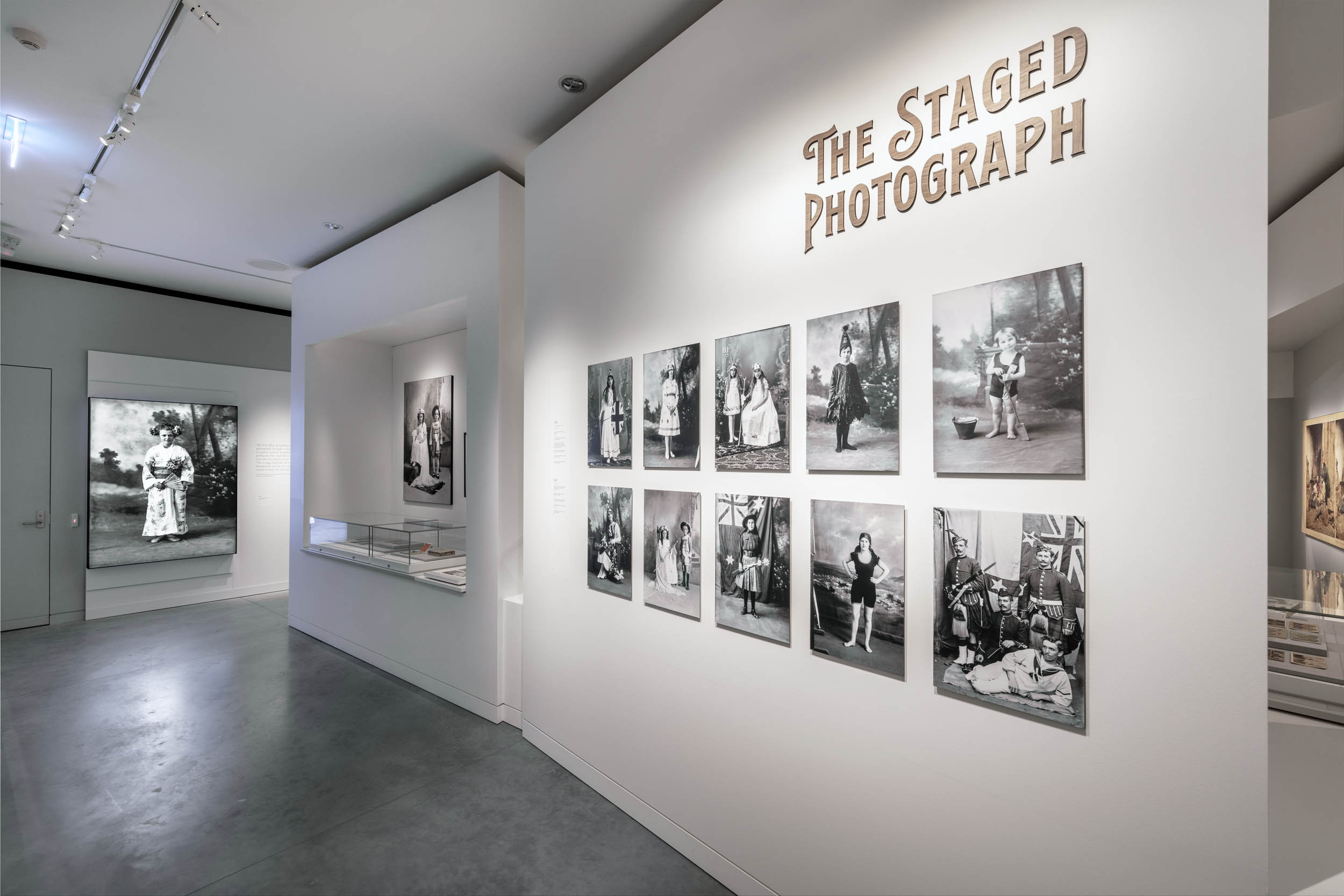


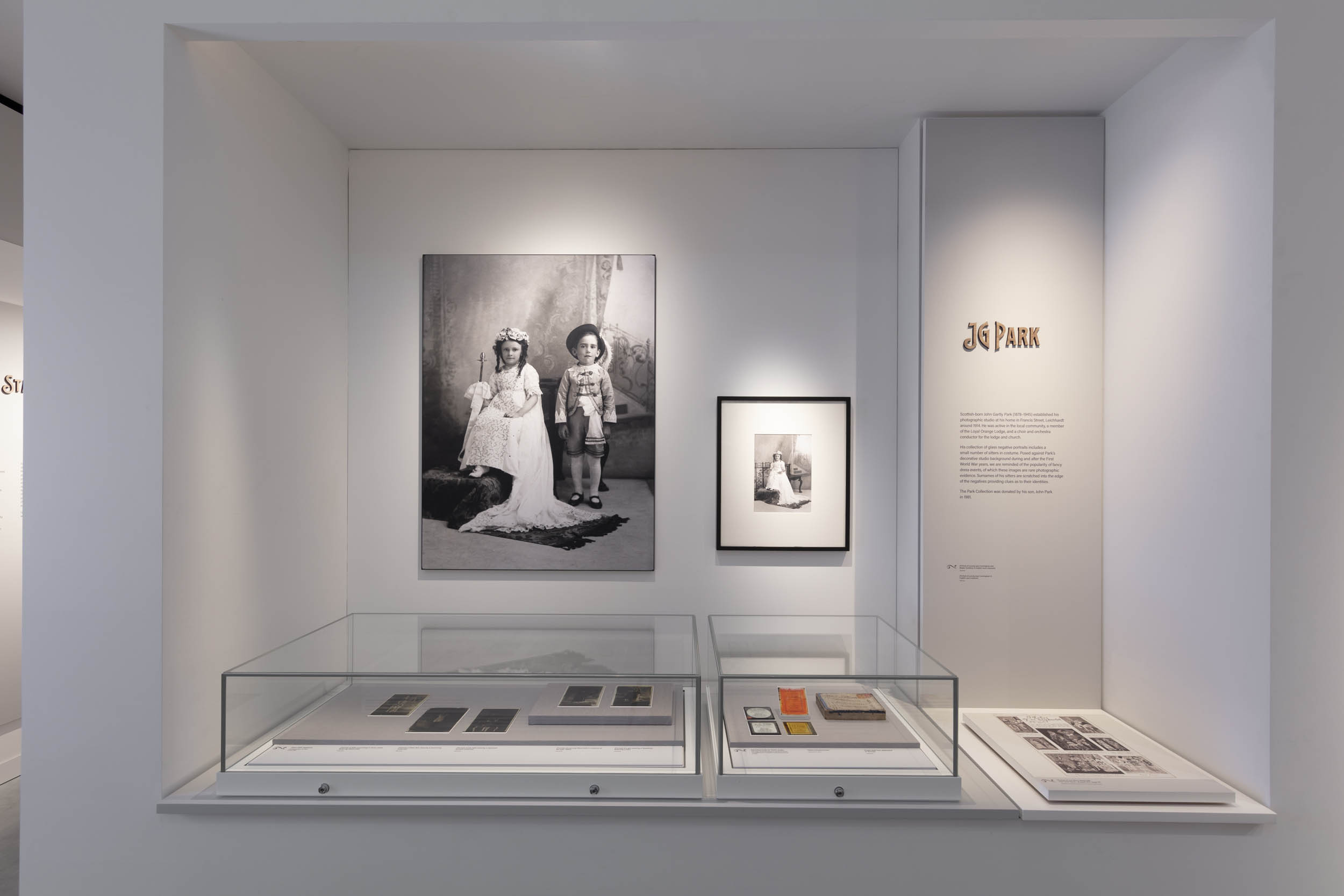

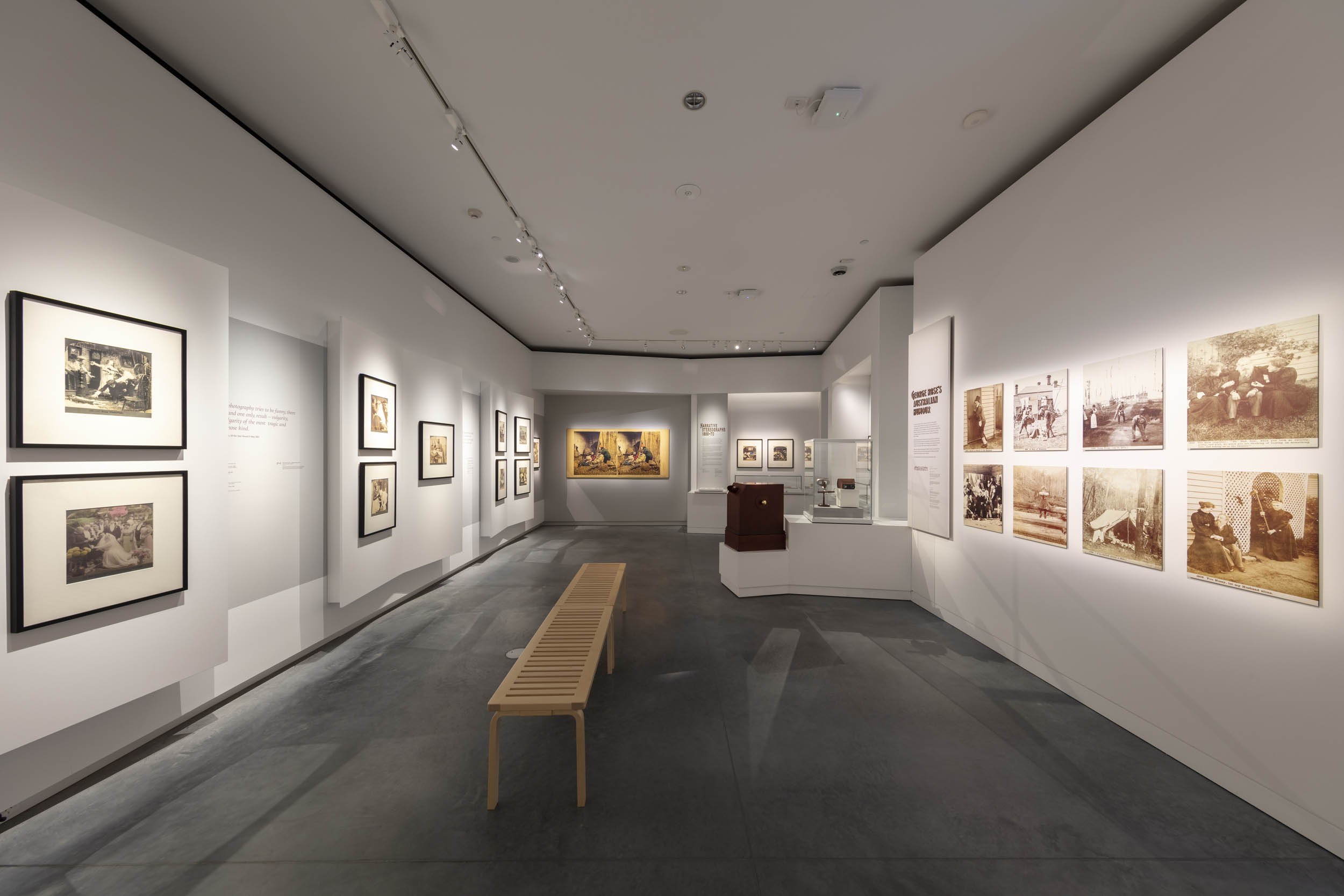

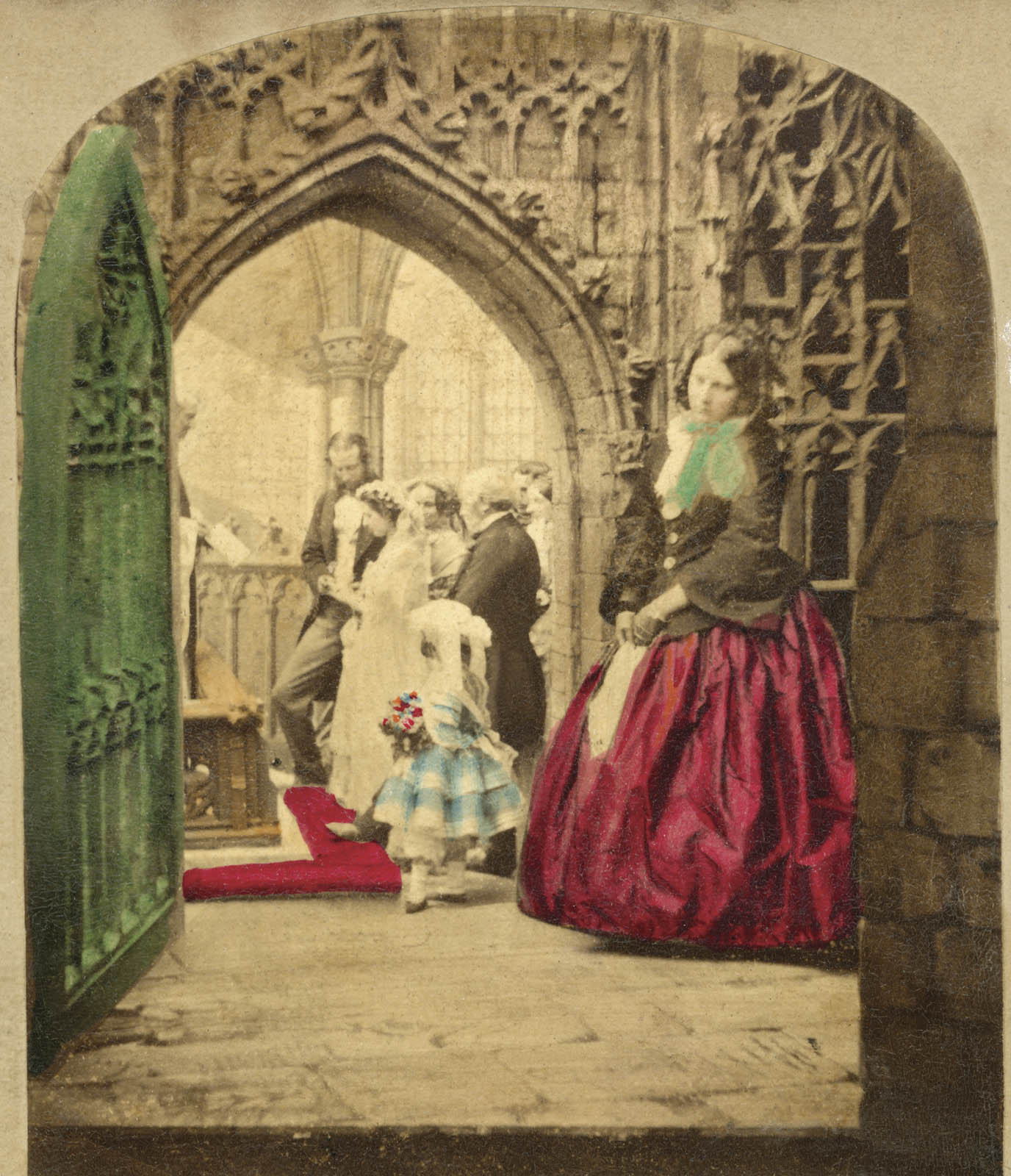
![Mark Anthony (Marc Antoine Gaudin) (French, 1804-1880)(attributed) '[Staged scene featuring five women, their fingers pointing upwards]' England c. 1855-1865](https://artblart.com/wp-content/uploads/2024/07/mark-anthony-staged-scene.jpg "Mark Anthony (Marc Antoine Gaudin) (French, 1804-1880)(attributed) '[Staged scene featuring five women, their fingers pointing upwards]' England c. 1855-1865")
![Freeman Brothers, Sydney (Australian) '[Portrait of two girls in fancy dress]' c. 1855-1865](https://artblart.com/wp-content/uploads/2024/07/hp2012.23.5-web.jpg "Freeman Brothers, Sydney (Australian) '[Portrait of two girls in fancy dress]' c. 1855-1865")
![G.H. Nicholas, Sydney (Australian) '[Portrait of a child holding a stereoscope]' c. 1870](https://artblart.com/wp-content/uploads/2024/07/hp82.17.1-web.jpg "G.H. Nicholas, Sydney (Australian) '[Portrait of a child holding a stereoscope]' c. 1870")
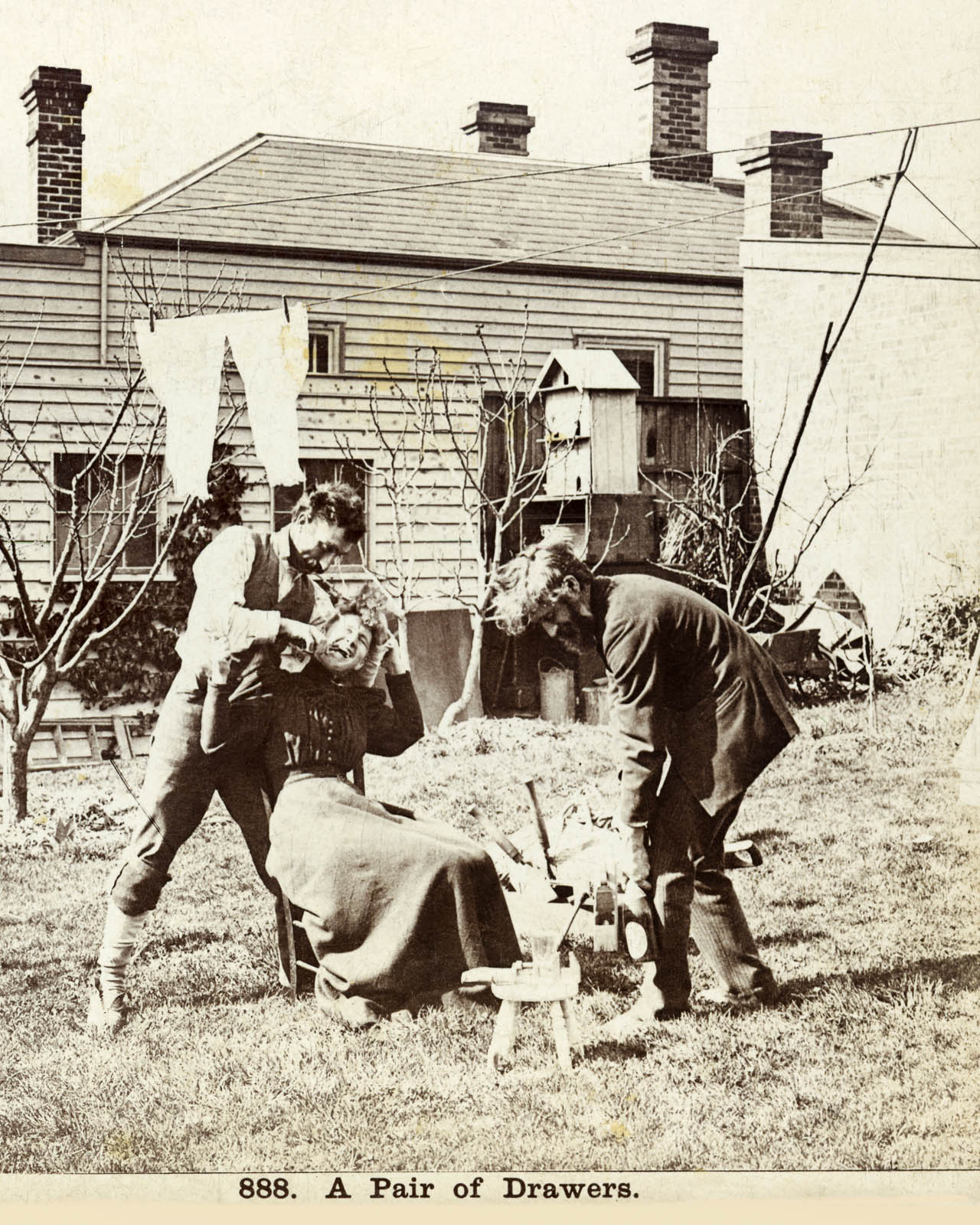
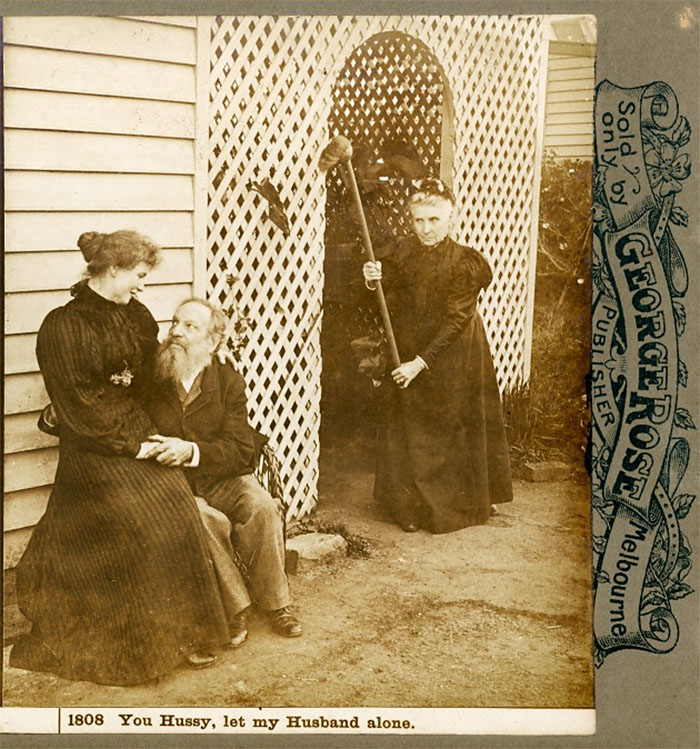


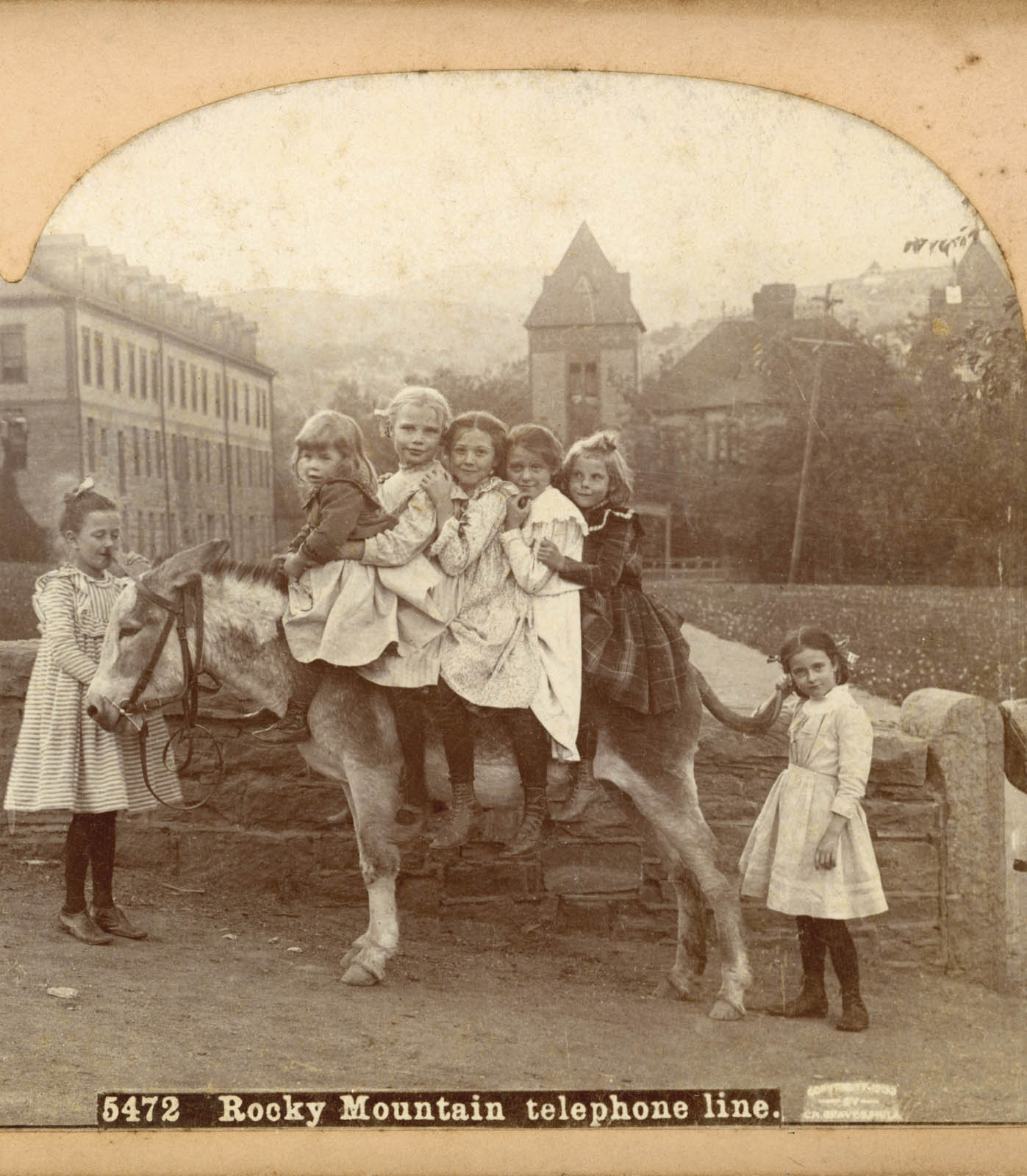
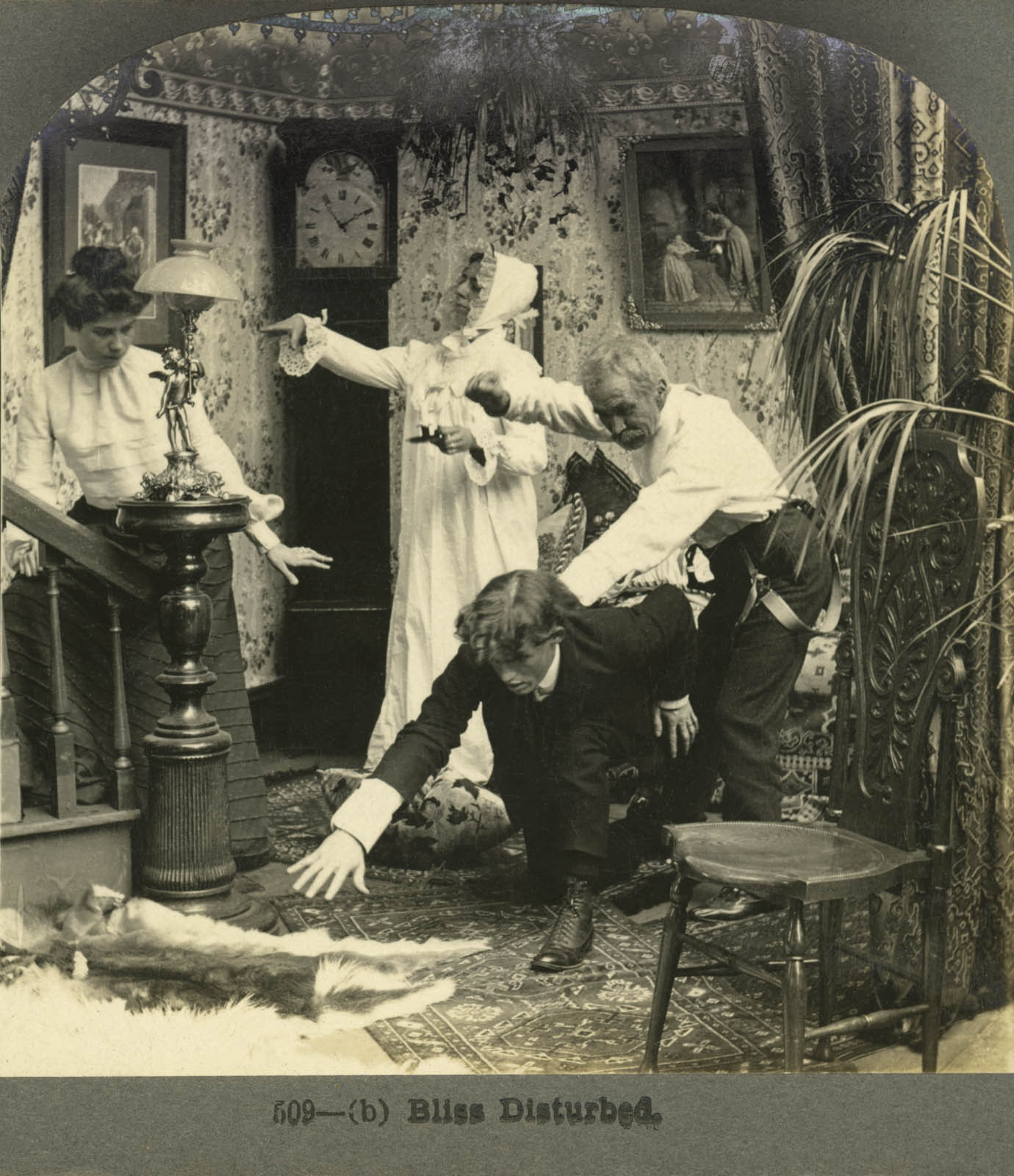
![Lorna Studios, Glebe (Australian) '[Sunlight Soap Girl]' 1905-1915](https://artblart.com/wp-content/uploads/2024/07/hp2023.8.1-web.jpg "Lorna Studios, Glebe (Australian) '[Sunlight Soap Girl]' 1905-1915")
![George Henry Hawkins, Sydney (Australian) '[Four children in fancy dress featuring the products, Jelline and Silver Drop Flour]' 1910-1930](https://artblart.com/wp-content/uploads/2024/07/hp88.21.165-web.jpg "George Henry Hawkins, Sydney (Australian) '[Four children in fancy dress featuring the products, Jelline and Silver Drop Flour]' 1910-1930")
![George Henry Hawkins, Sydney (Australian) '[Lily dressed in costume as 'Victoria']' 1910-1930](https://artblart.com/wp-content/uploads/2024/07/hp88.21.767-web.jpg "George Henry Hawkins, Sydney (Australian) '[Lily dressed in costume as 'Victoria']' 1910-1930")
![J.G. Park, Leichhardt (Australian) '[Portrait of a young Jean Cunningham and Master Hurlstone in English court costumes]' c. 1914-1920s](https://artblart.com/wp-content/uploads/2024/07/hp80.49.319-web.jpg "J.G. Park, Leichhardt (Australian) '[Portrait of a young Jean Cunningham and Master Hurlstone in English court costumes]' c. 1914-1920s")
![J.G. Park, Leichhardt (Australian) '[Portrait of Miss Orr in fancy dress as Britannia]' c. 1914-1920s](https://artblart.com/wp-content/uploads/2024/07/hp80.49.696-web.jpg "J.G. Park, Leichhardt (Australian) '[Portrait of Miss Orr in fancy dress as Britannia]' c. 1914-1920s")
![J.G. Park, Leichhardt (Australian) '[Portrait of Miss Larsen wearing a Silver Star Starch costume]' c. 1914-1920s](https://artblart.com/wp-content/uploads/2024/07/hp80.49.965-web.jpg "J.G. Park, Leichhardt (Australian) '[Portrait of Miss Larsen wearing a Silver Star Starch costume]' c. 1914-1920s")
![Oliver Emery, Sydney (Australian) '[Three boys posed outside against a makeshift backdrop]' c. 1914-1930](https://artblart.com/wp-content/uploads/2024/07/hp83.43.26-web.jpg "Oliver Emery, Sydney (Australian) '[Three boys posed outside against a makeshift backdrop]' c. 1914-1930")
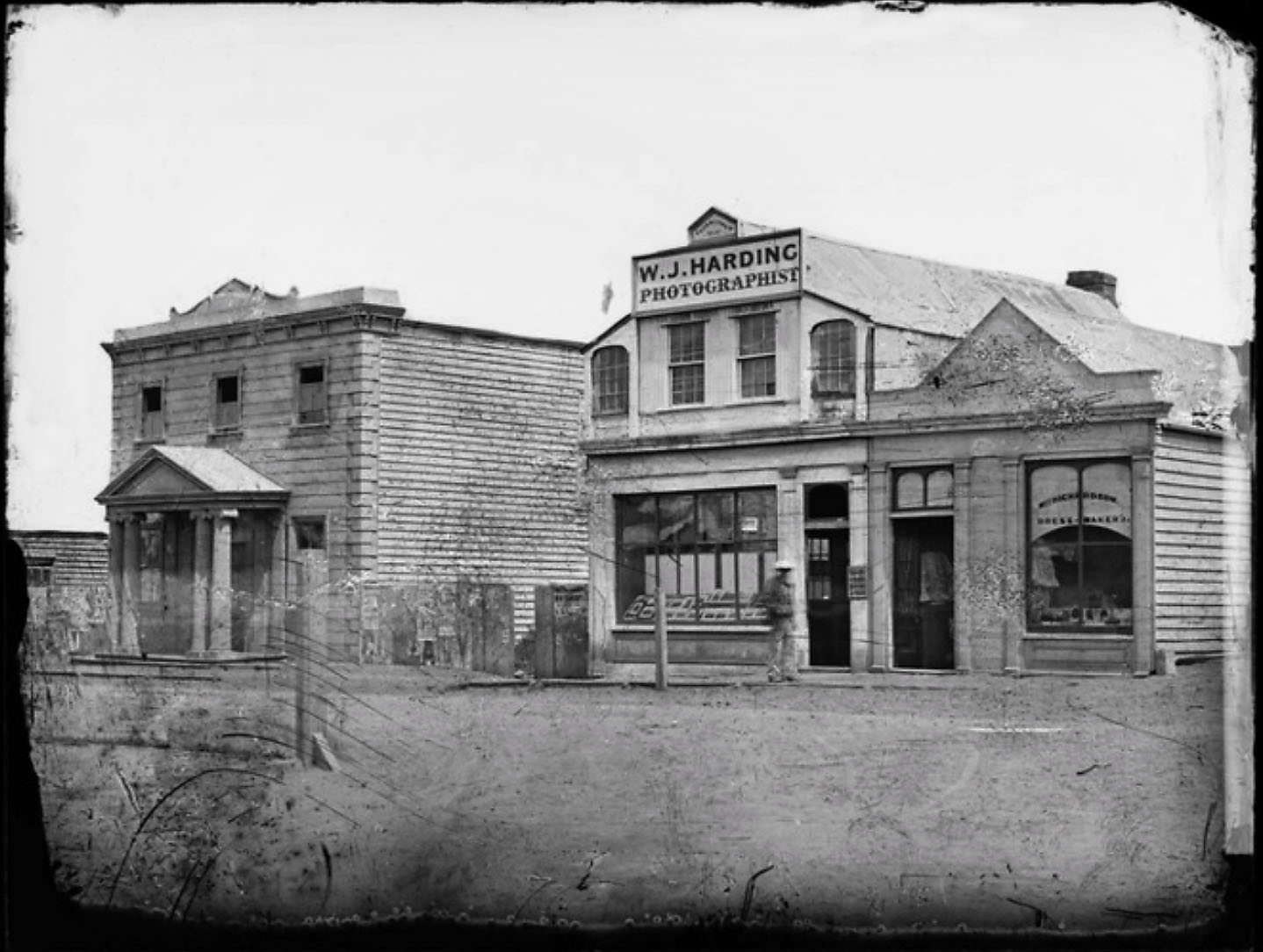
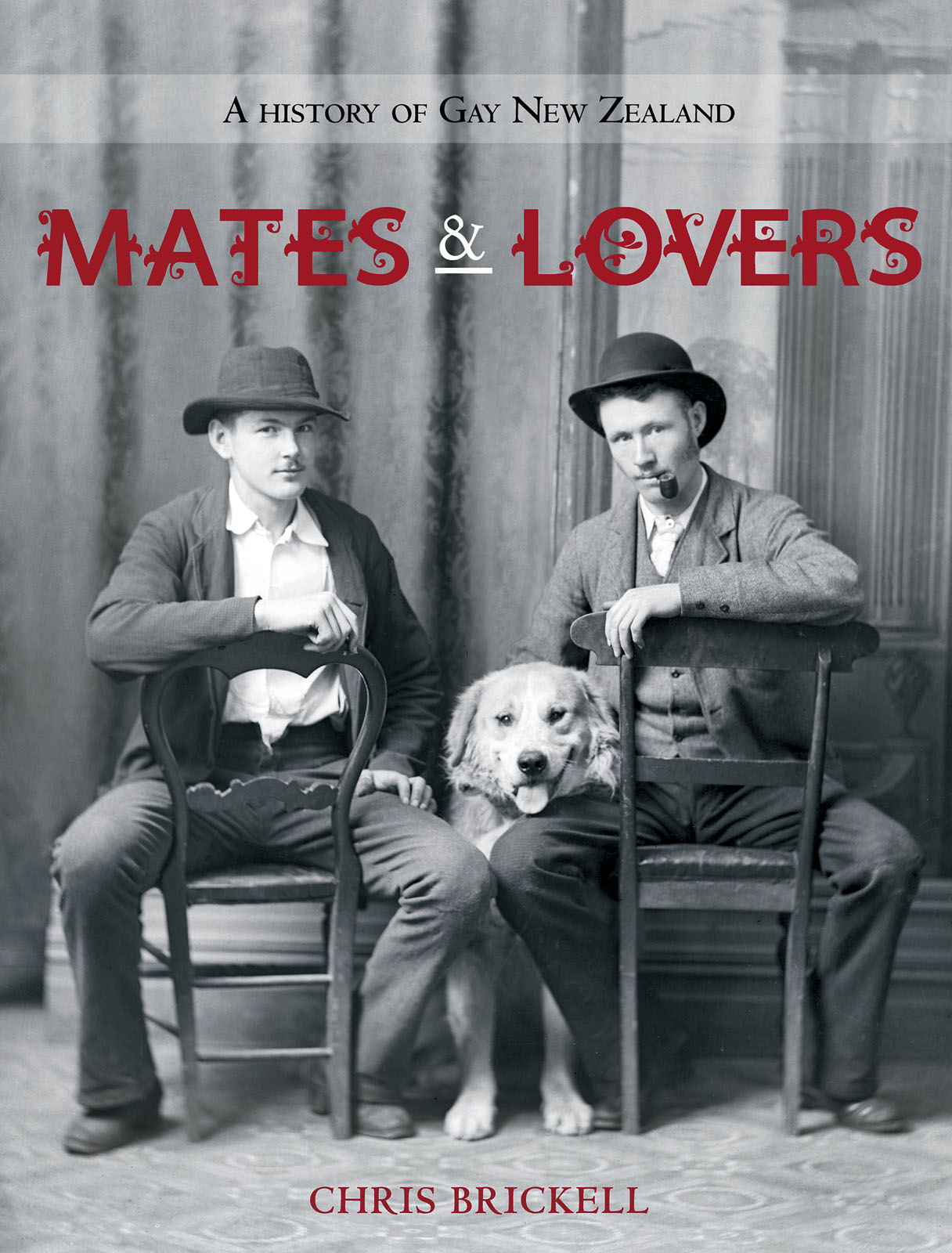
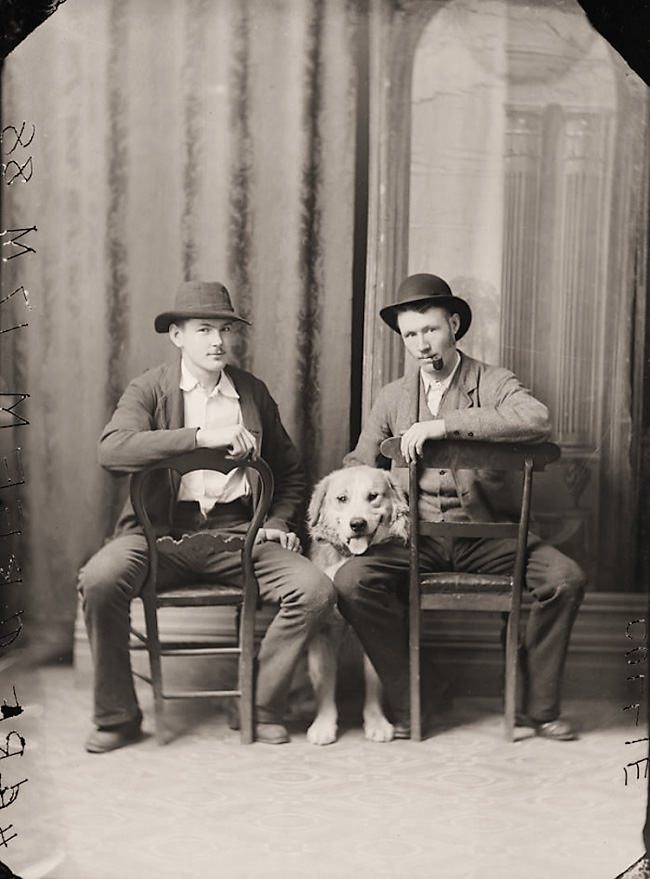
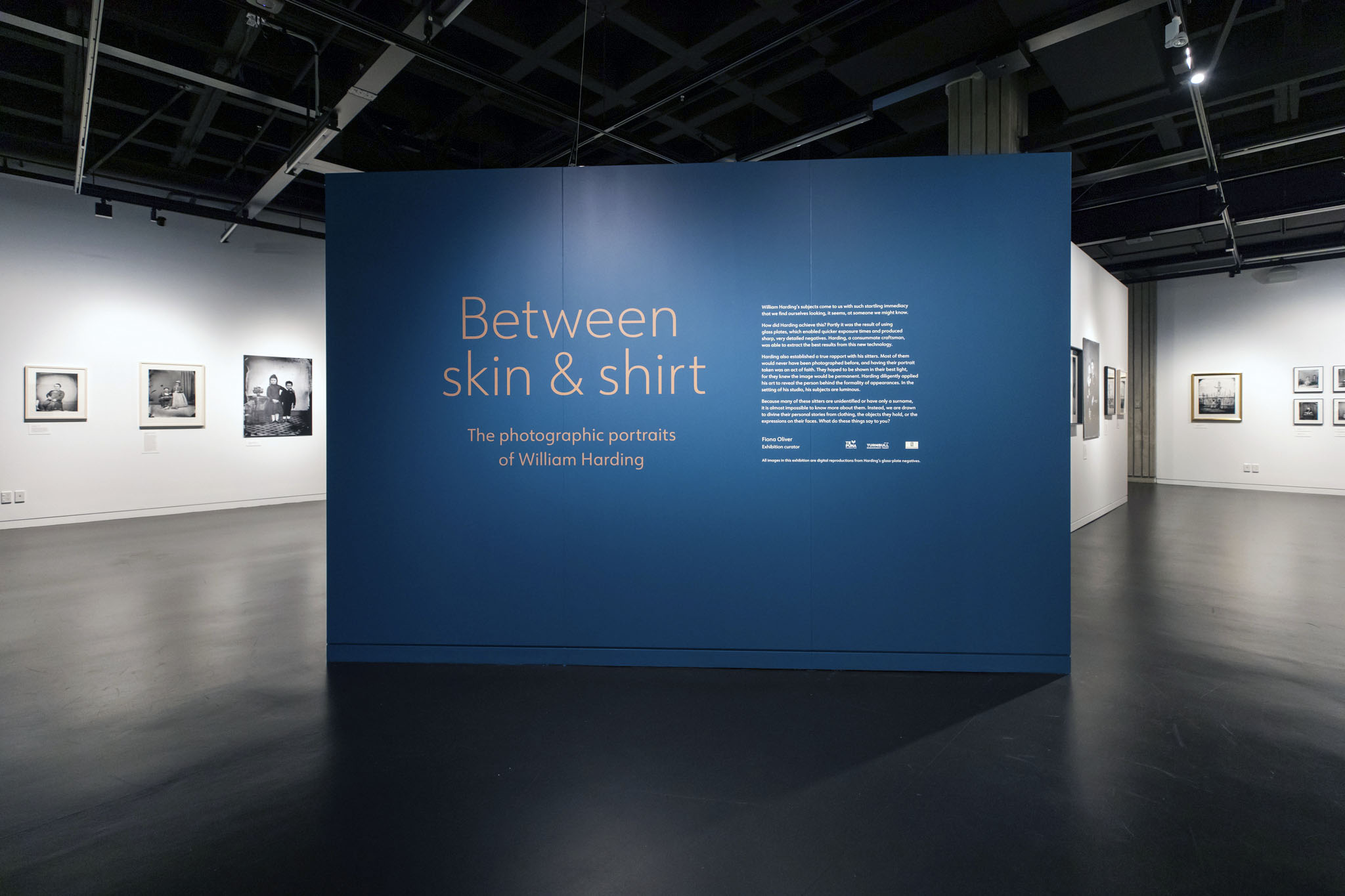
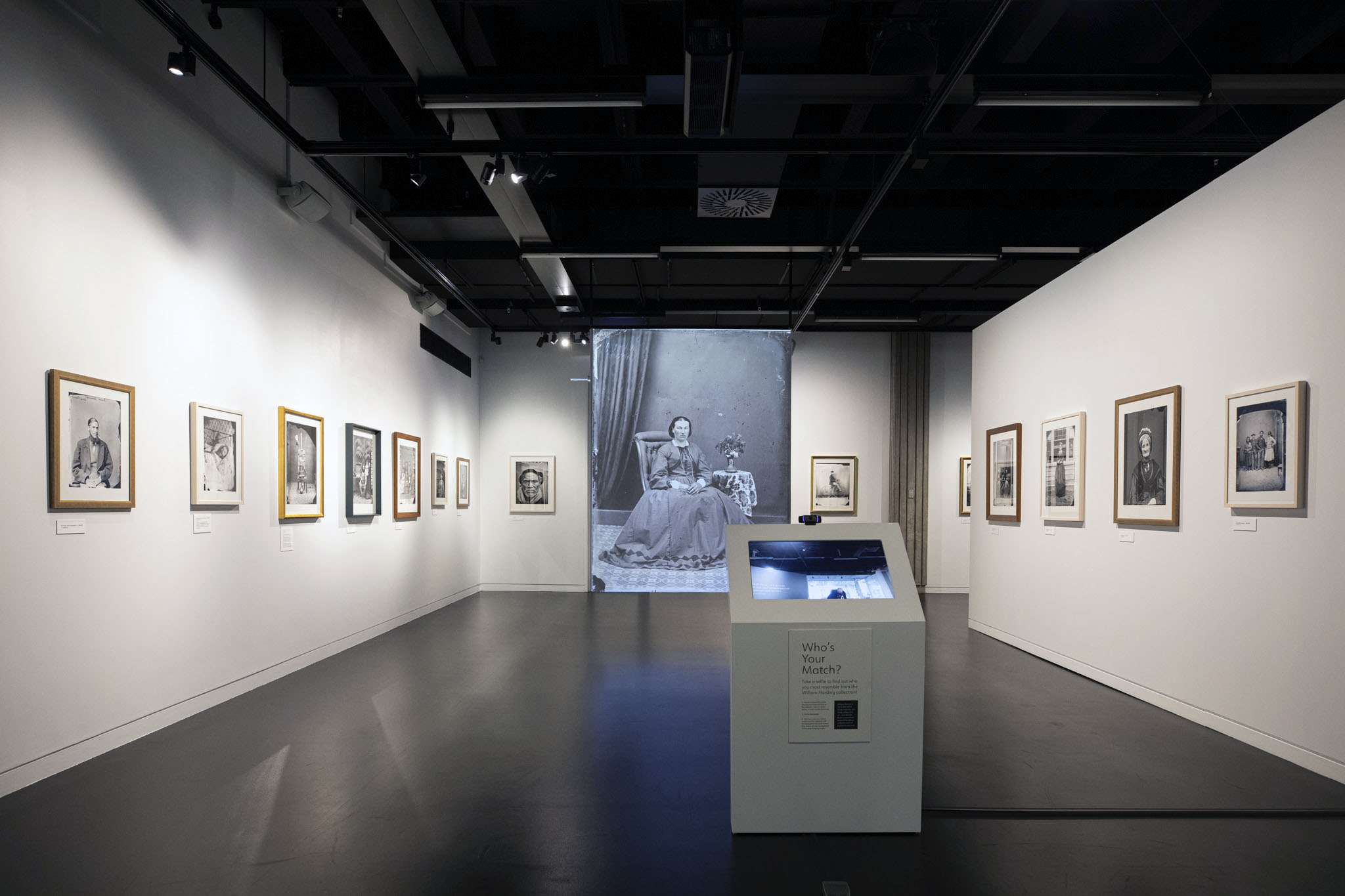
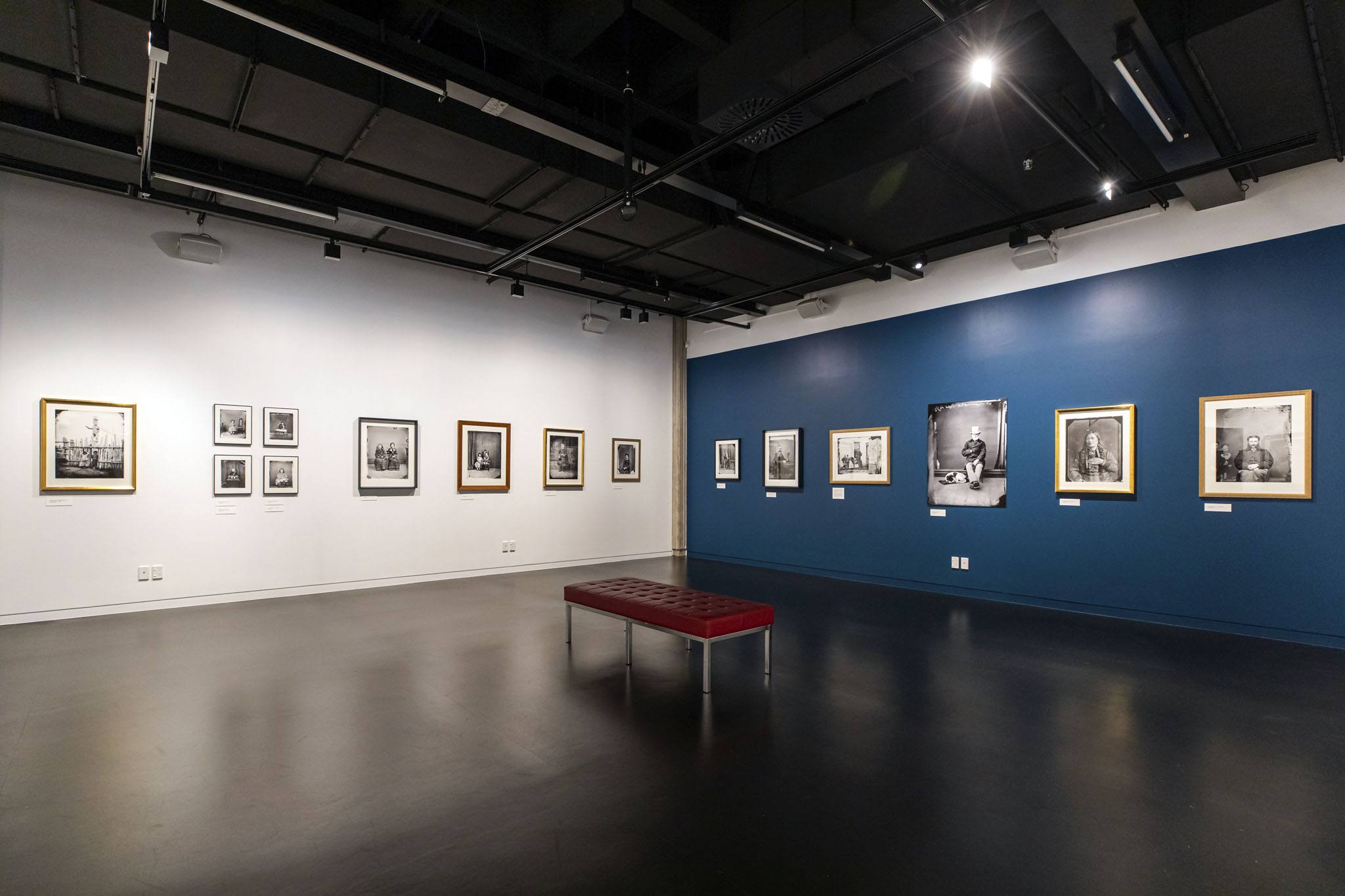
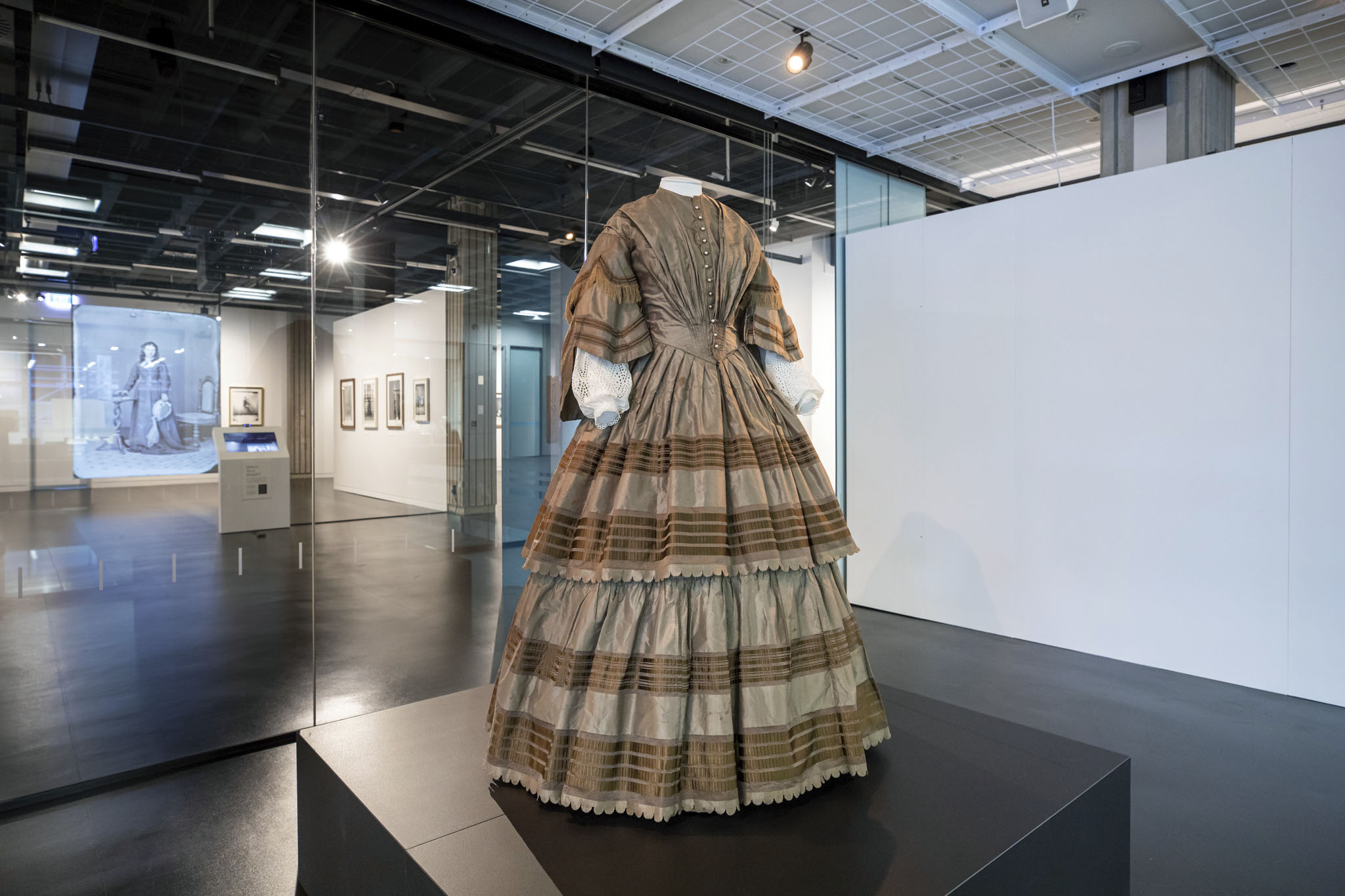
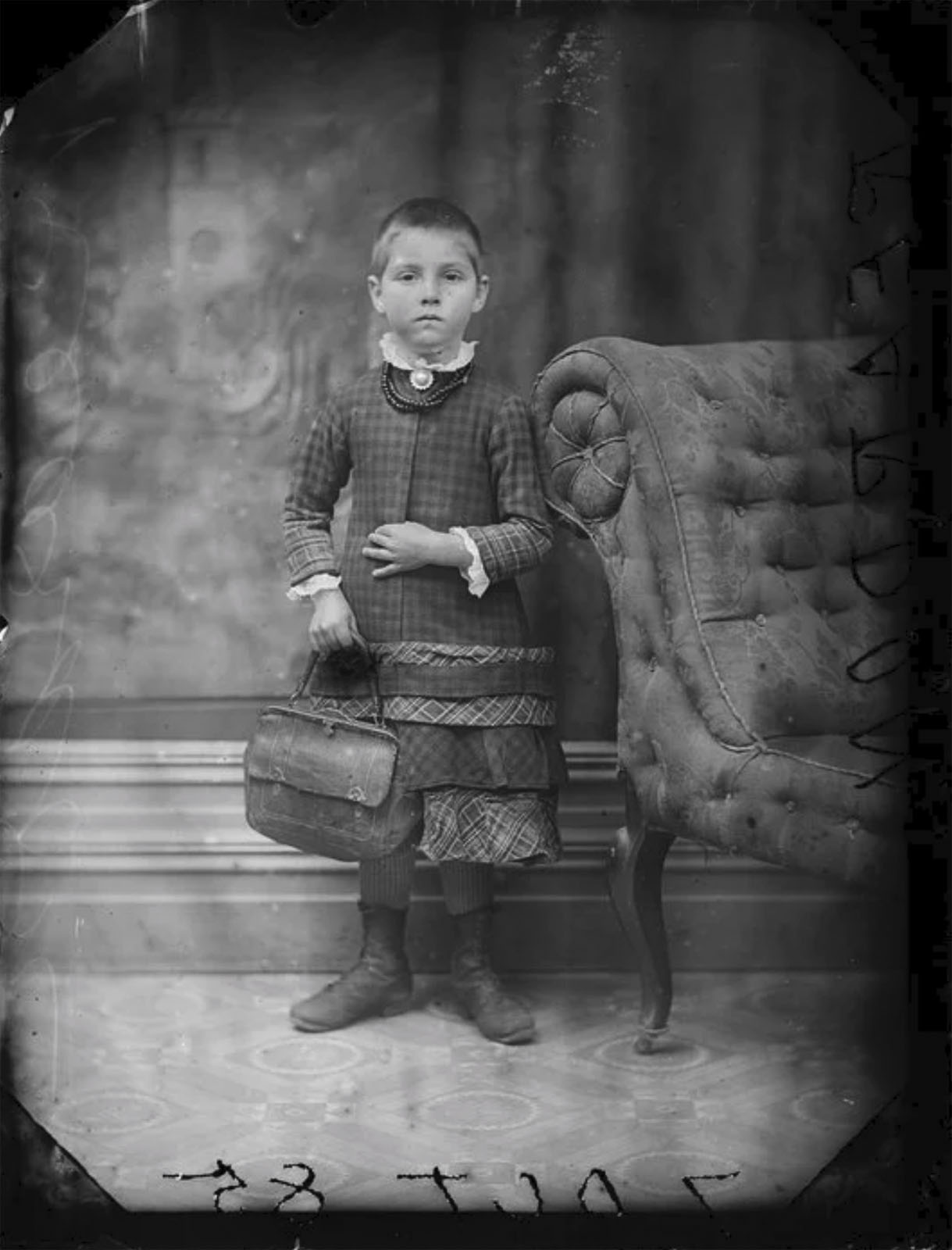
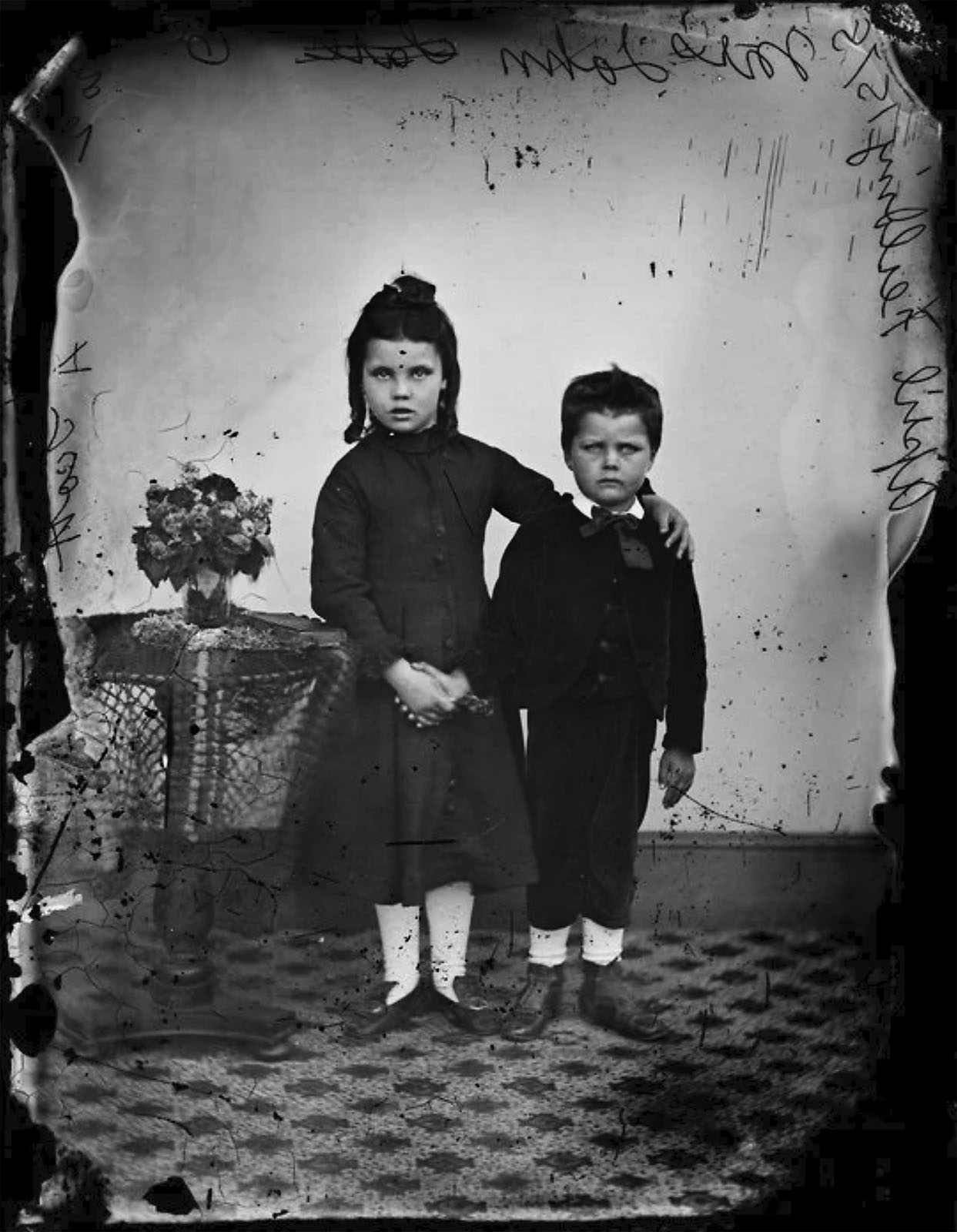
![Installation view of the exhibition 'Between skin & shirt: The photographic portraits of William Harding' at the National Library of New Zealand Gallery, Wellington showing at left, '[Miss] Scott' (between 1870-1889); at second left, 'Woman on left wearing large crinoline dress with black jacket with tassels and belt above the waist, woman on the right wearing crinoline dress with tassels on top part of dress' (between 1870-1880); at centre, 'Lieutenant Herman with his ventriloquist dummy' (c. 1877); and at second right, 'Members of the Burne family' (between 1856-1889)](https://artblart.com/wp-content/uploads/2022/09/20220525_nl_pe_ge_between_skinshirt_opening_003.jpg "Installation view of the exhibition 'Between skin & shirt: The photographic portraits of William Harding' at the National Library of New Zealand Gallery, Wellington showing at left, '[Miss] Scott' (between 1870-1889); at second left, 'Woman on left wearing large crinoline dress with black jacket with tassels and belt above the waist, woman on the right wearing crinoline dress with tassels on top part of dress' (between 1870-1880); at centre, 'Lieutenant Herman with his ventriloquist dummy' (c. 1877); and at second right, 'Members of the Burne family' (between 1856-1889)")
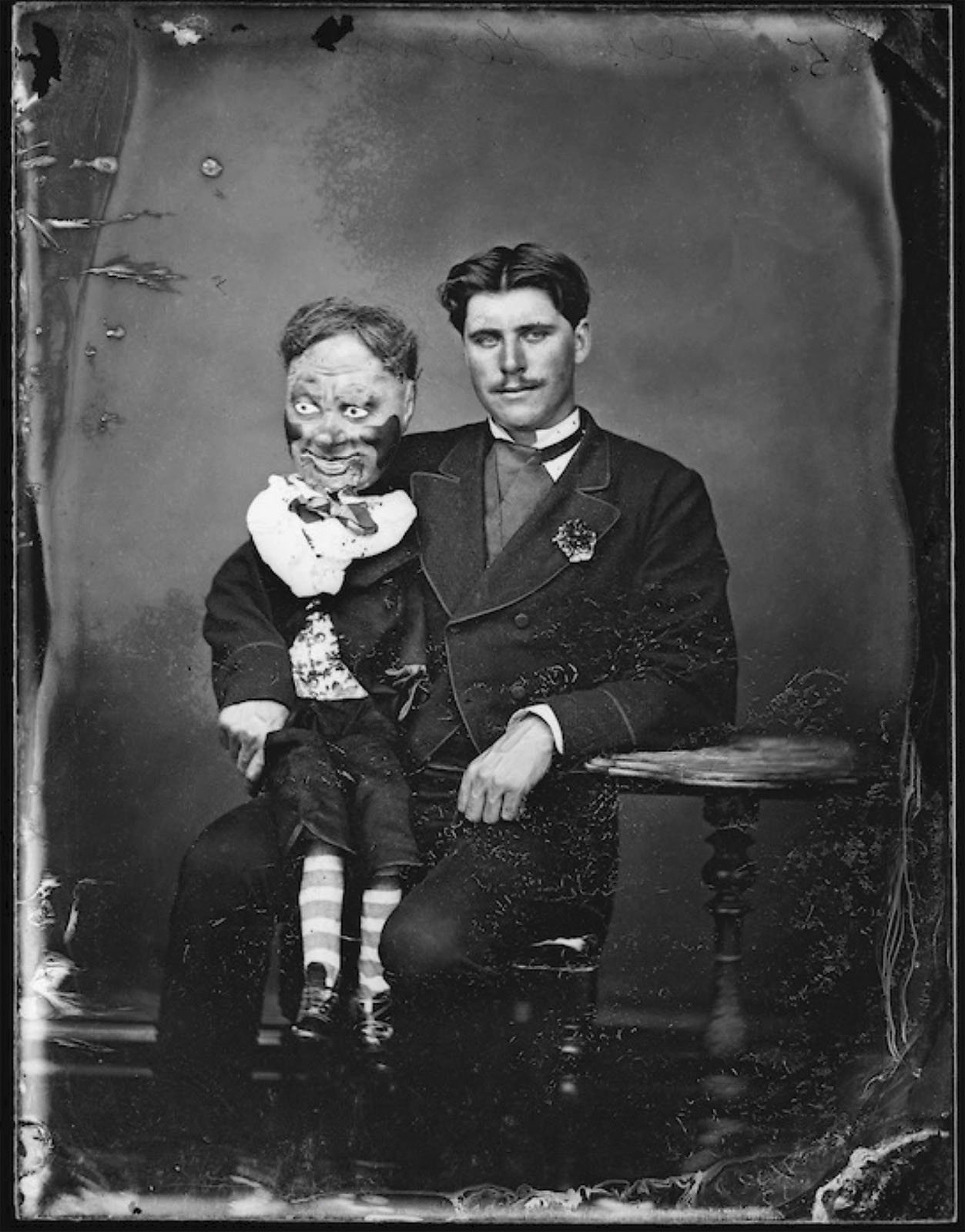
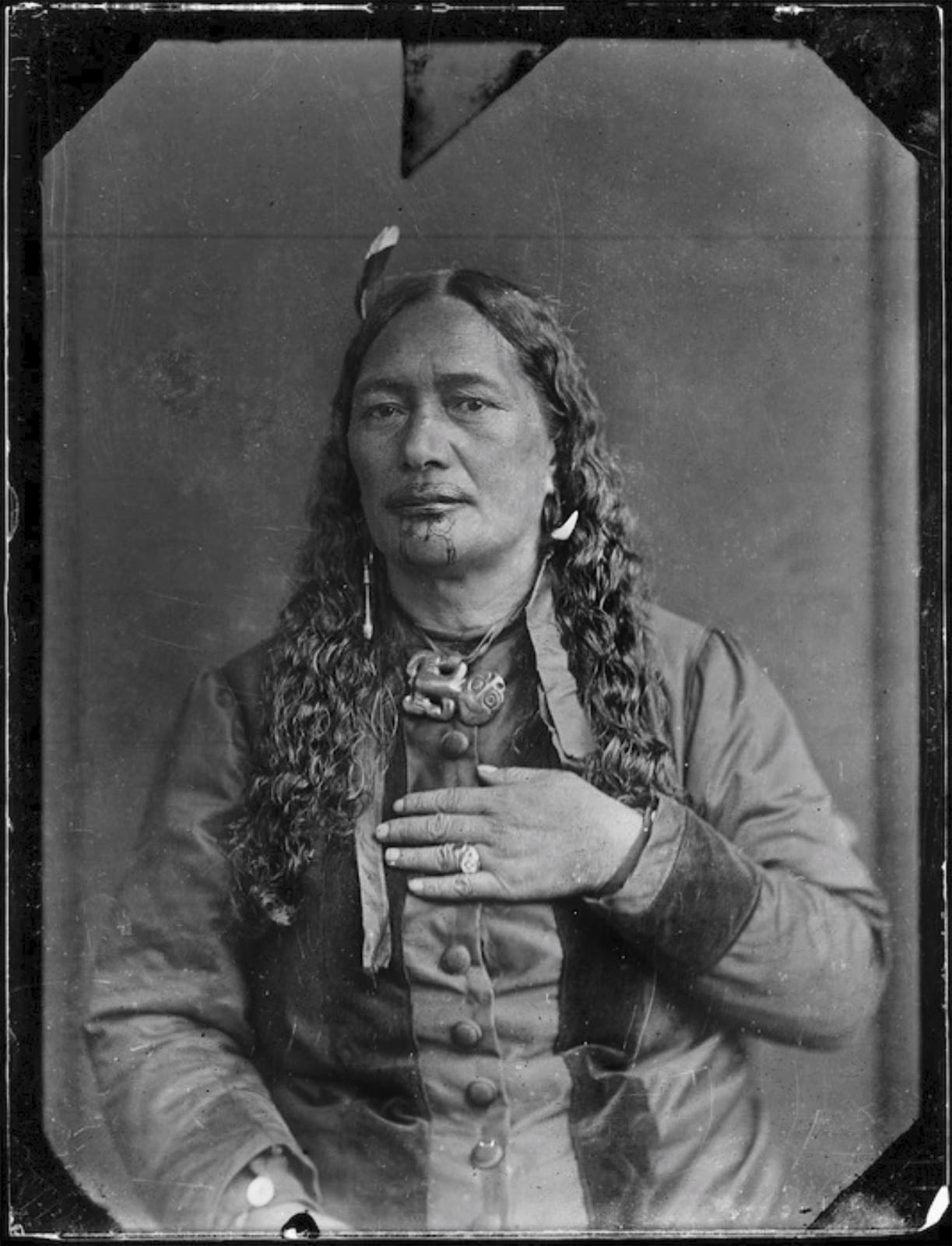
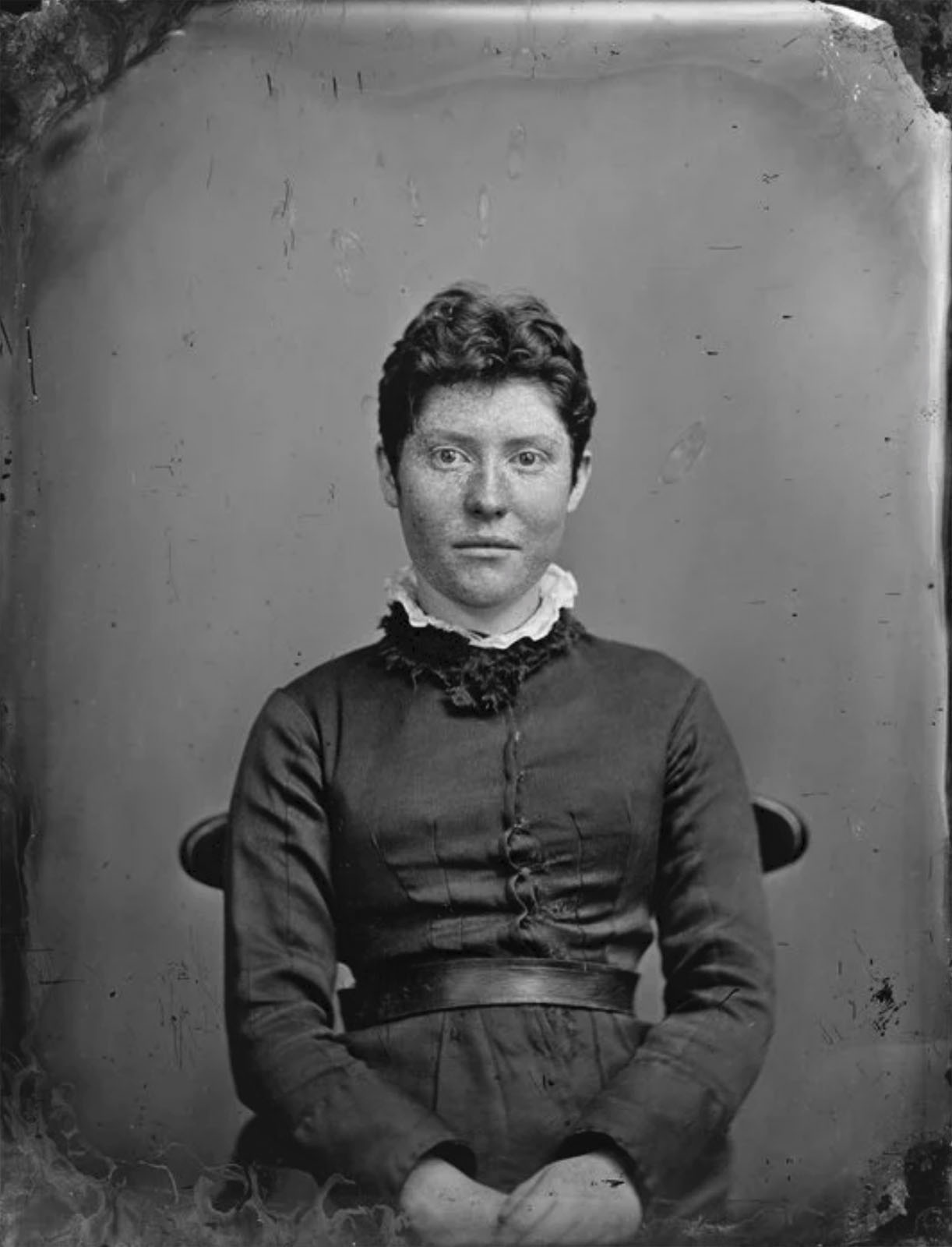
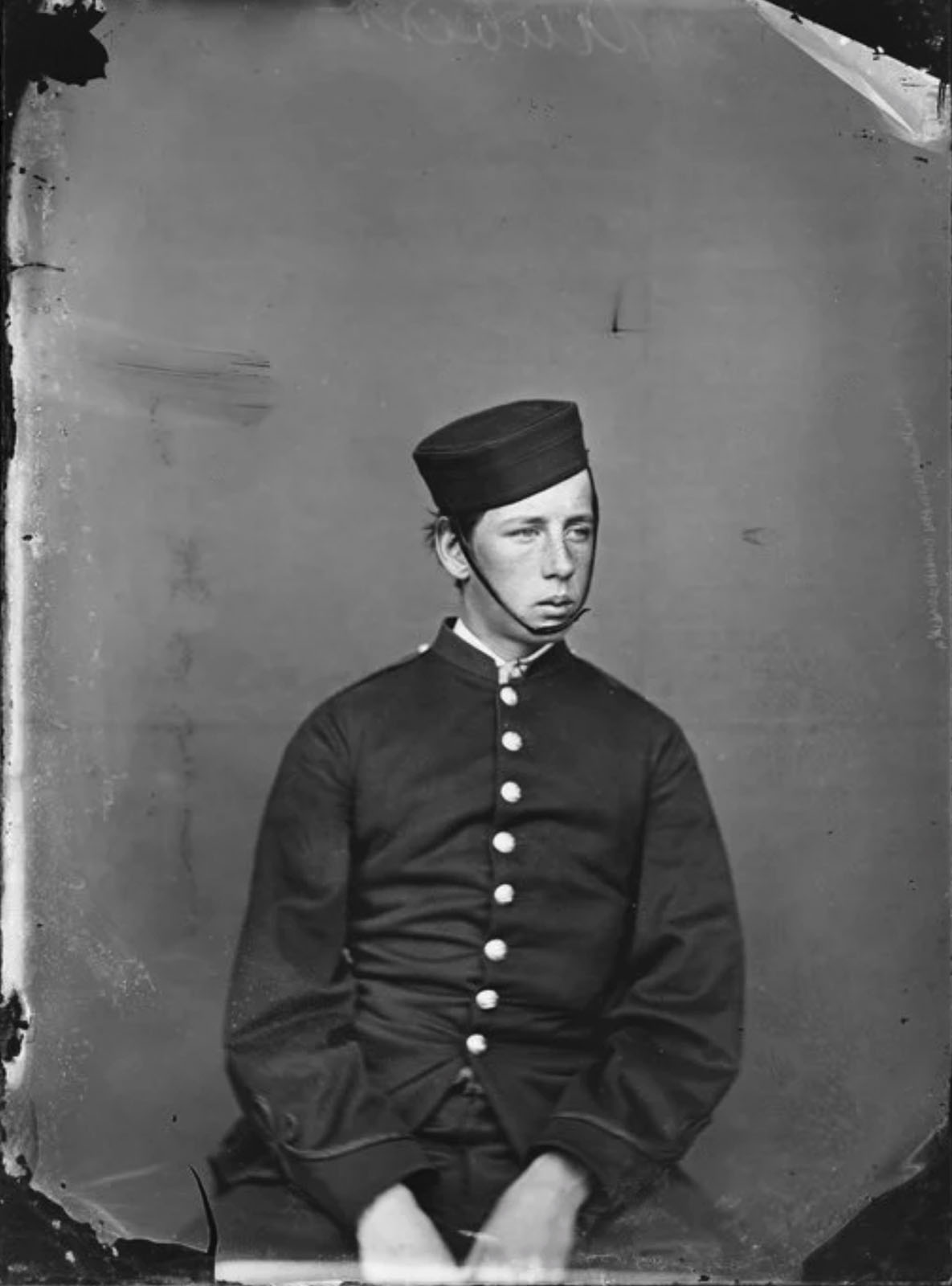
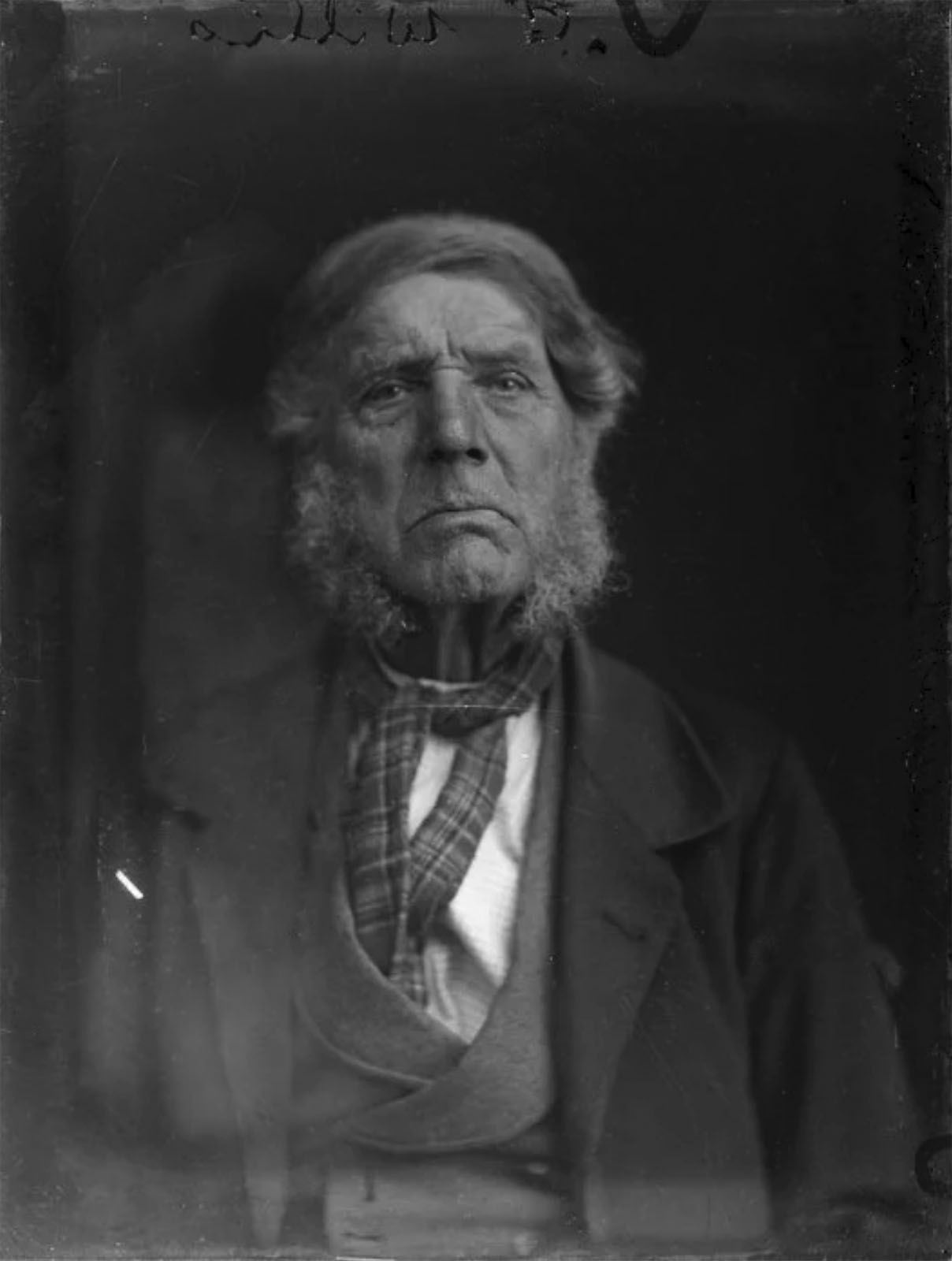
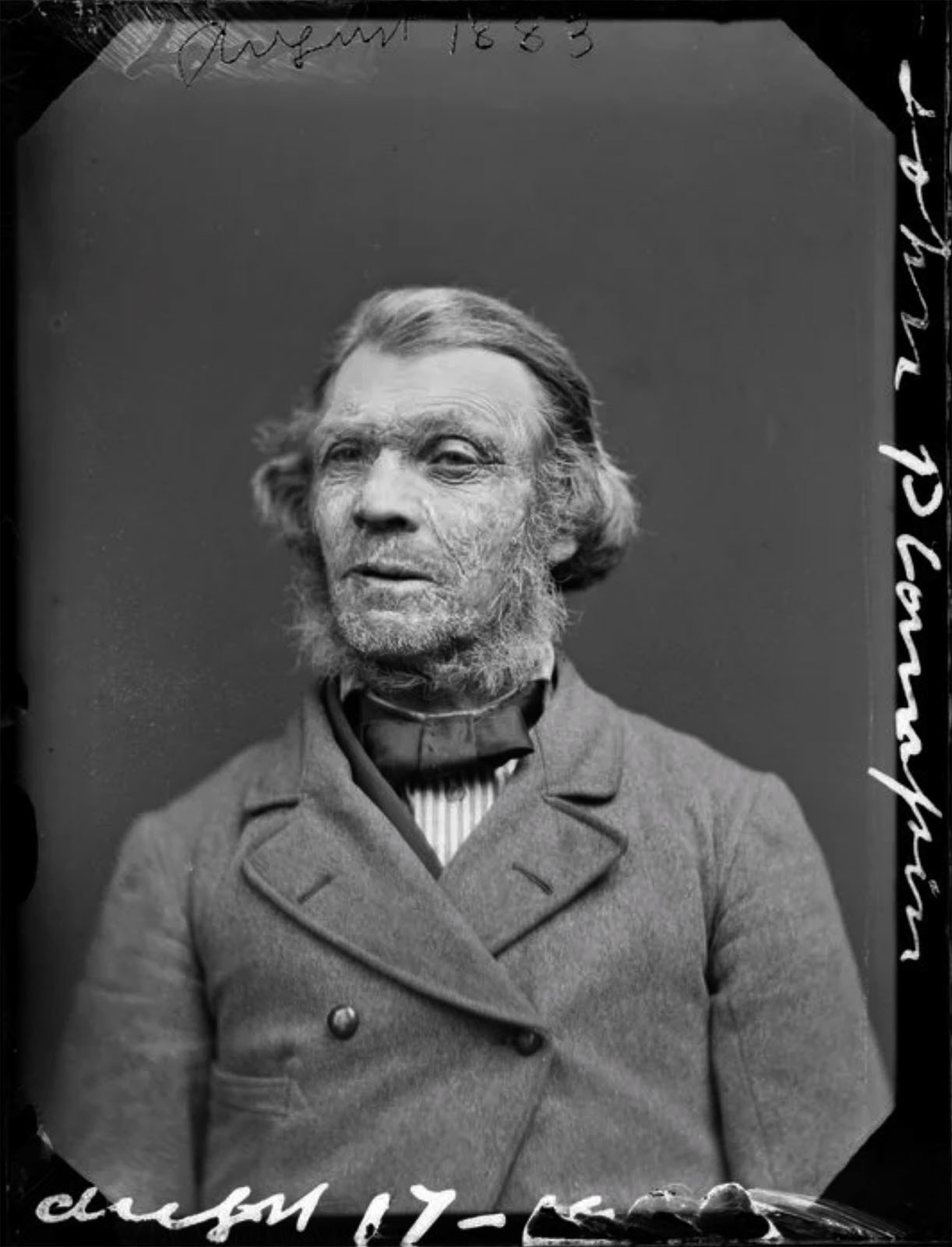
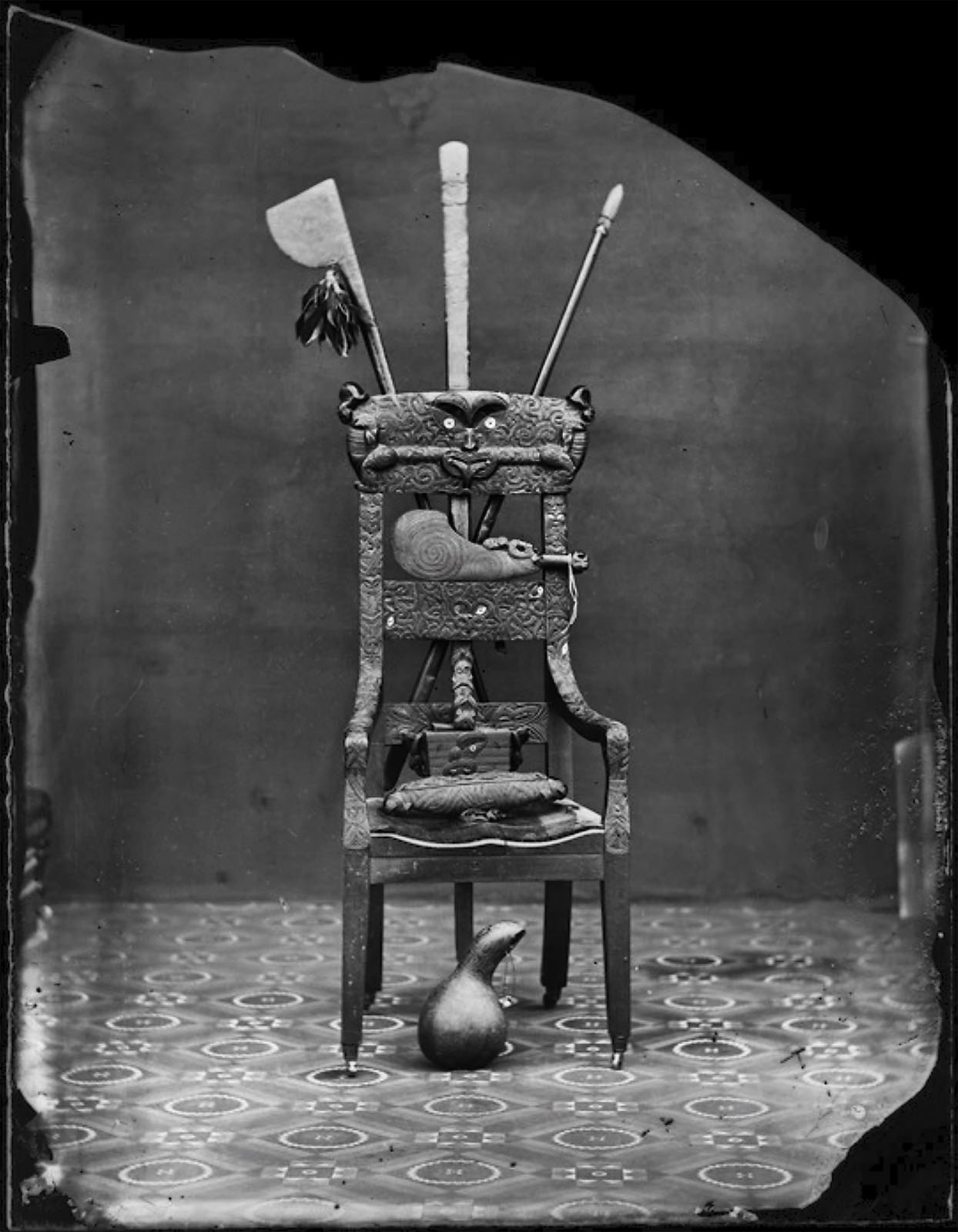
![William James Harding (New Zealand, 1826-1899) 'Fraser' [Consump?] Between 1856-1899](https://artblart.com/wp-content/uploads/2022/08/harding-fraser-consump.jpg "William James Harding (New Zealand, 1826-1899) 'Fraser' [Consump?] Between 1856-1899")
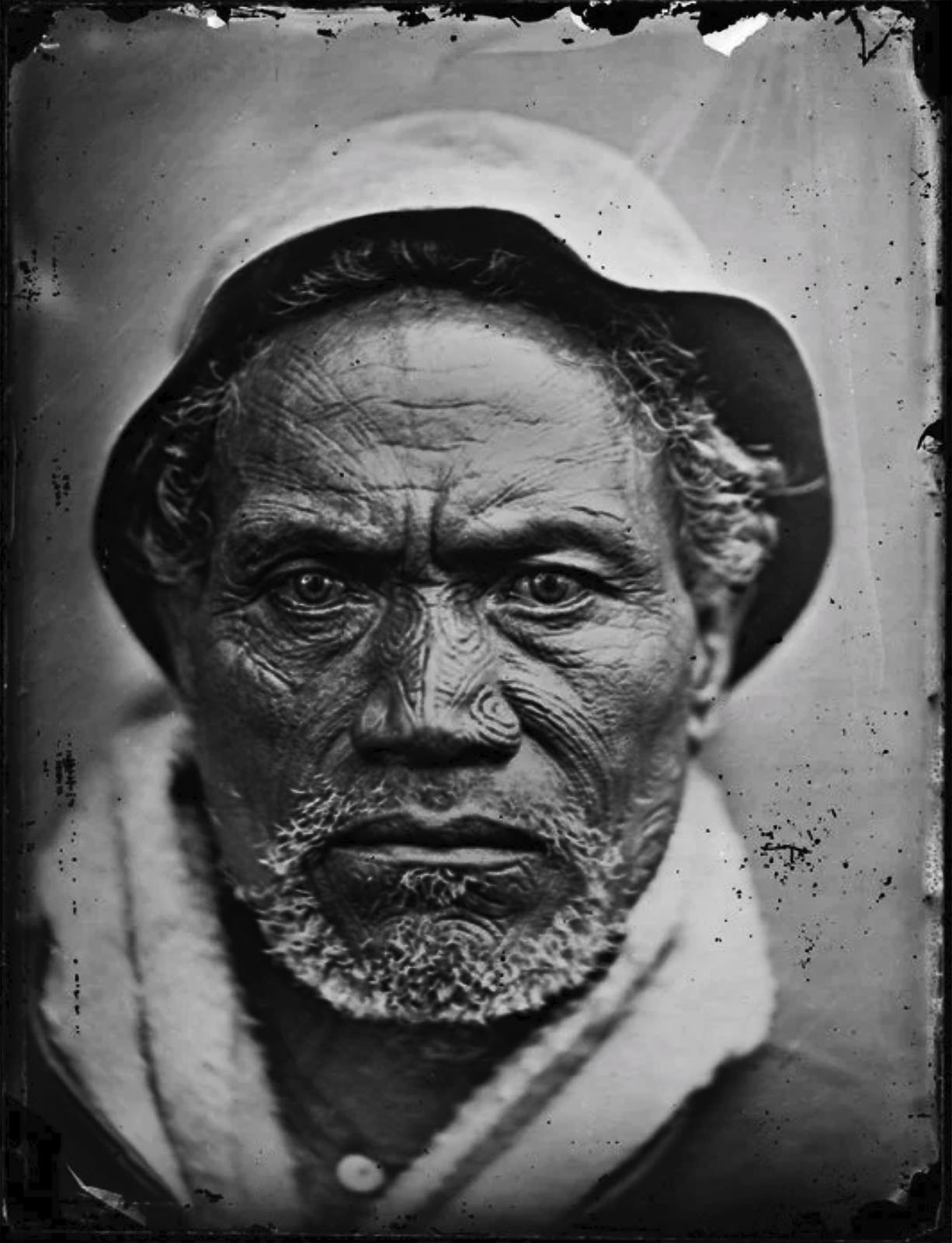
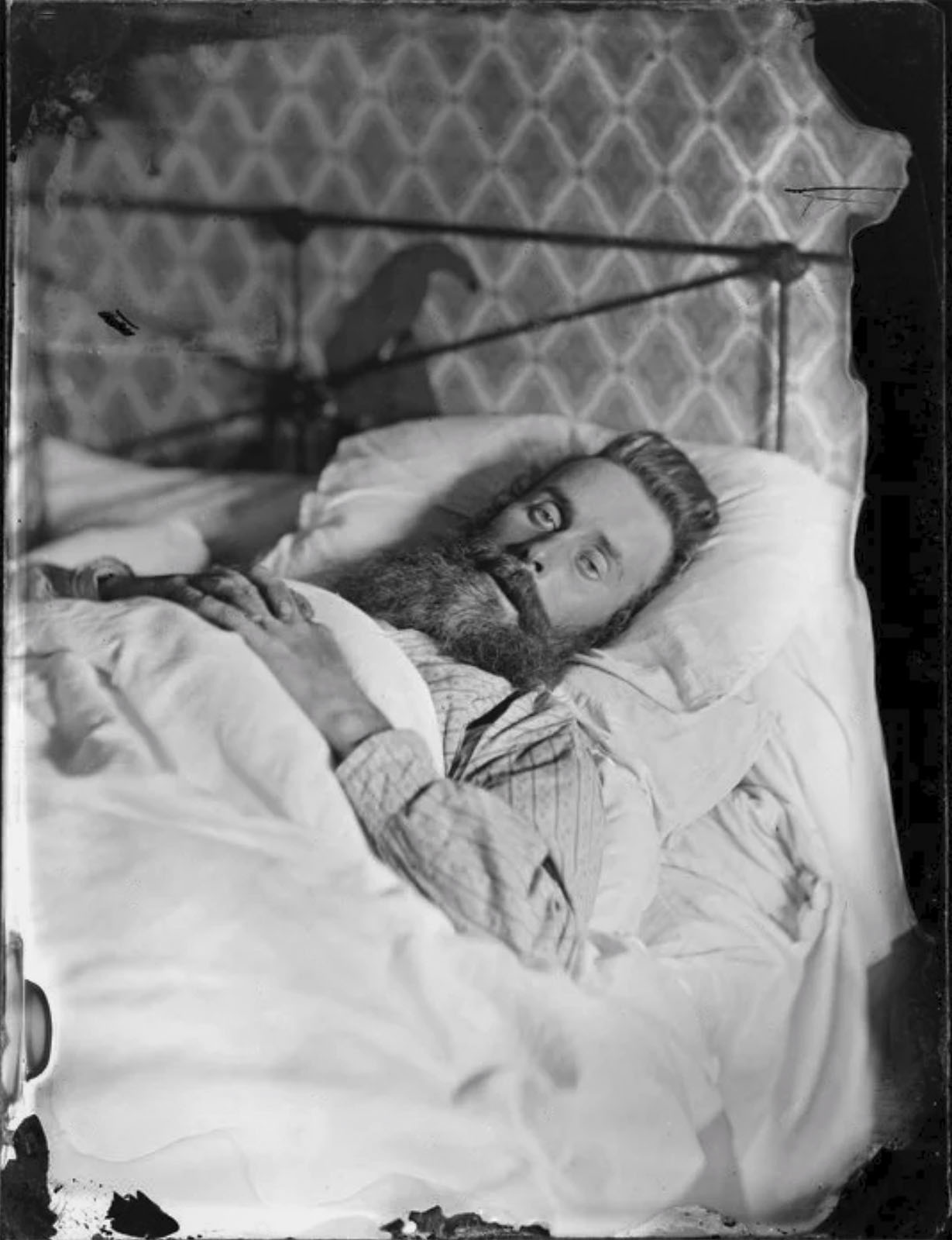
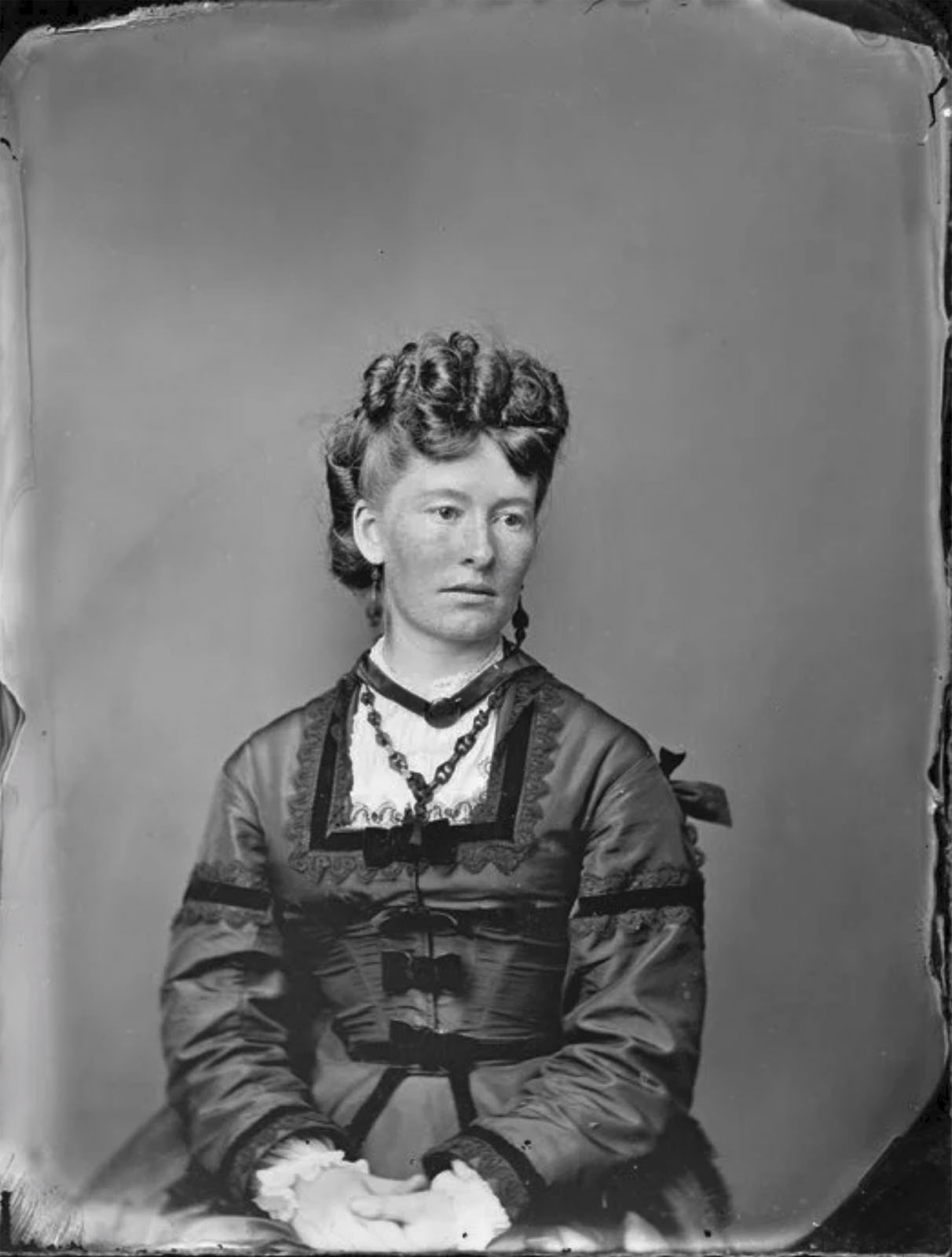
![William James Harding (New Zealand, 1826-1899) '[Mrs?] Keen' Between 1870-1889](https://artblart.com/wp-content/uploads/2022/08/harding-mrs-keen.jpg "William James Harding (New Zealand, 1826-1899) '[Mrs?] Keen' Between 1870-1889")
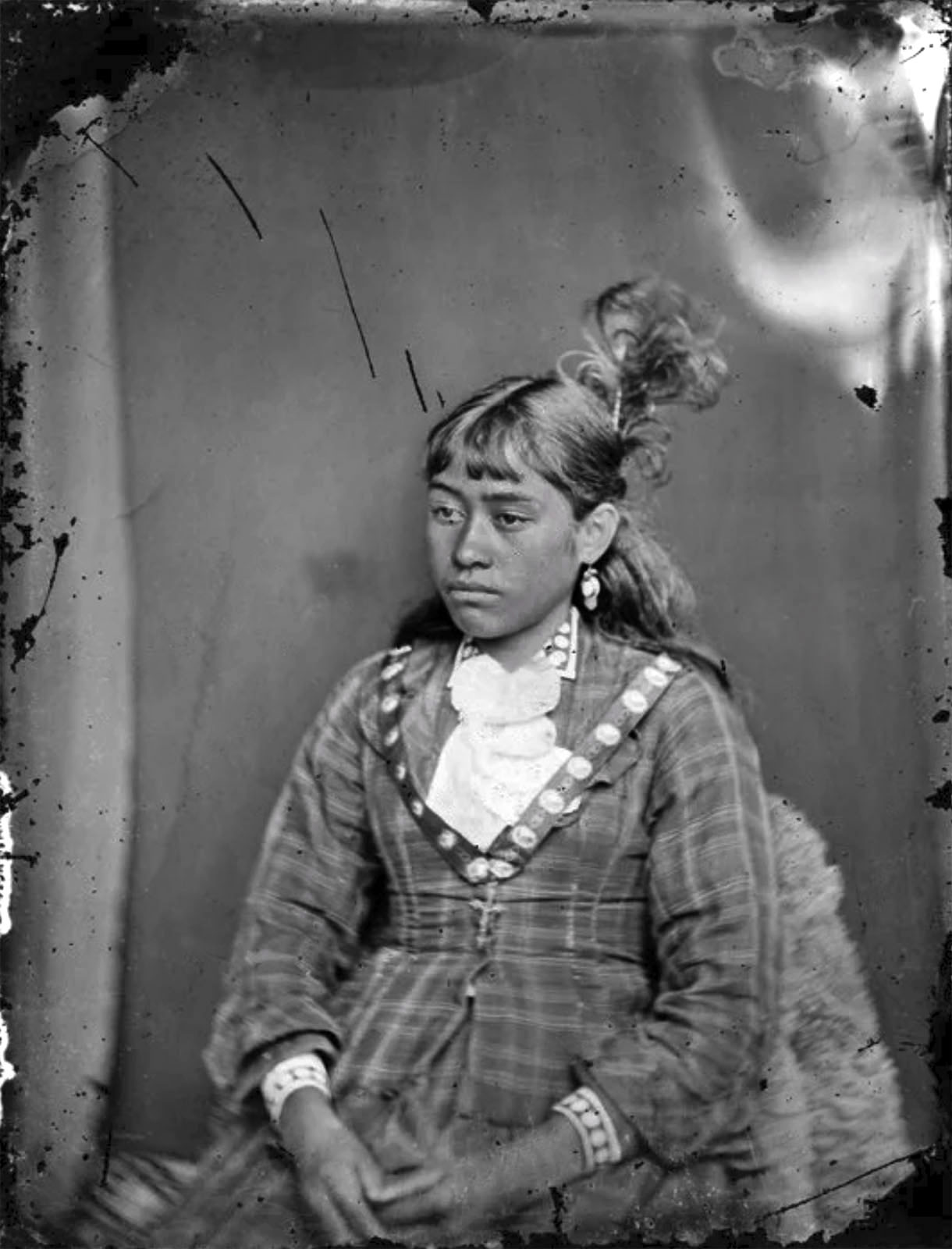
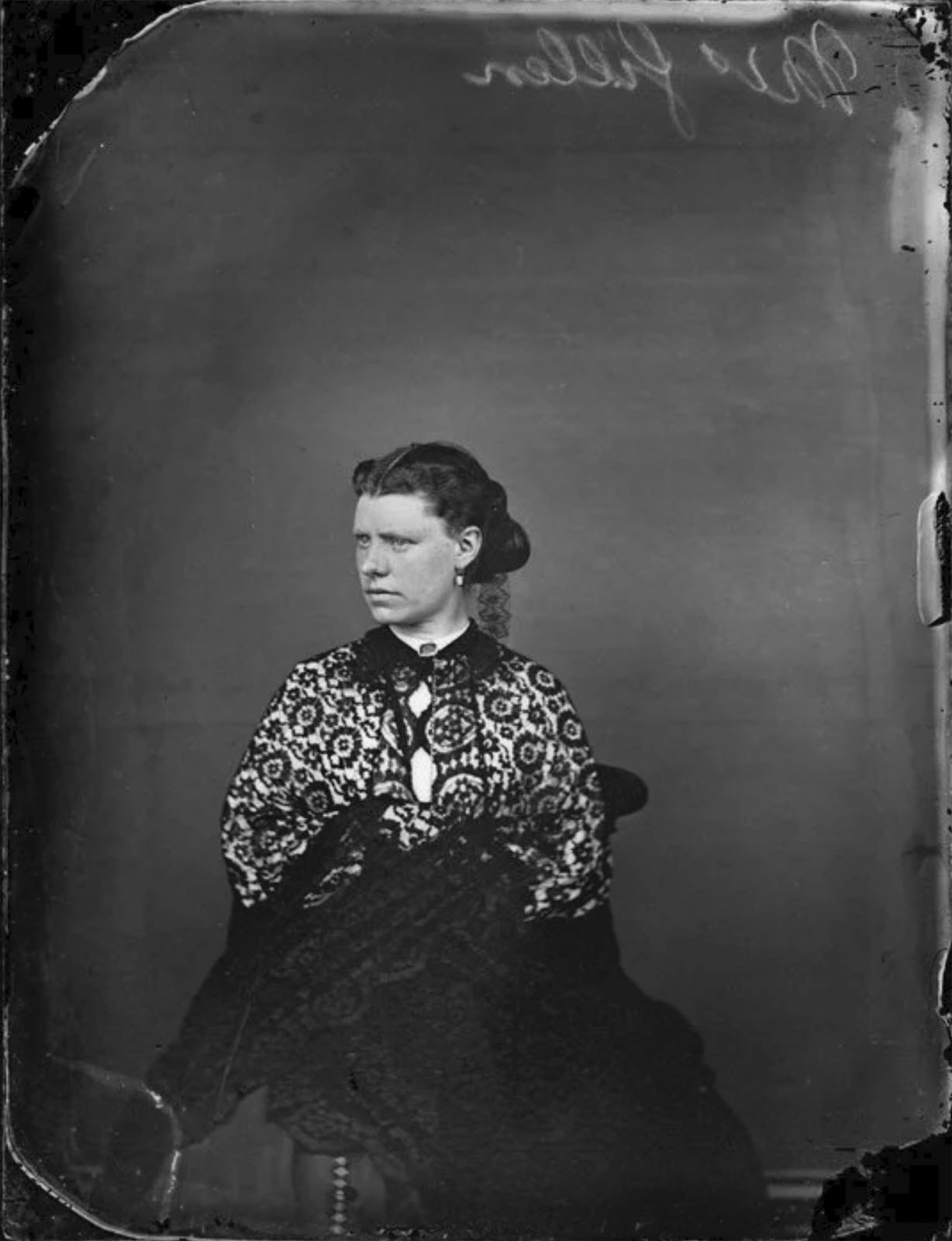
![William James Harding (New Zealand, 1826-1899) '[Miss] Scott' Between 1870-1889](https://artblart.com/wp-content/uploads/2022/08/harding-miss-scott.jpg "William James Harding (New Zealand, 1826-1899) '[Miss] Scott' Between 1870-1889")
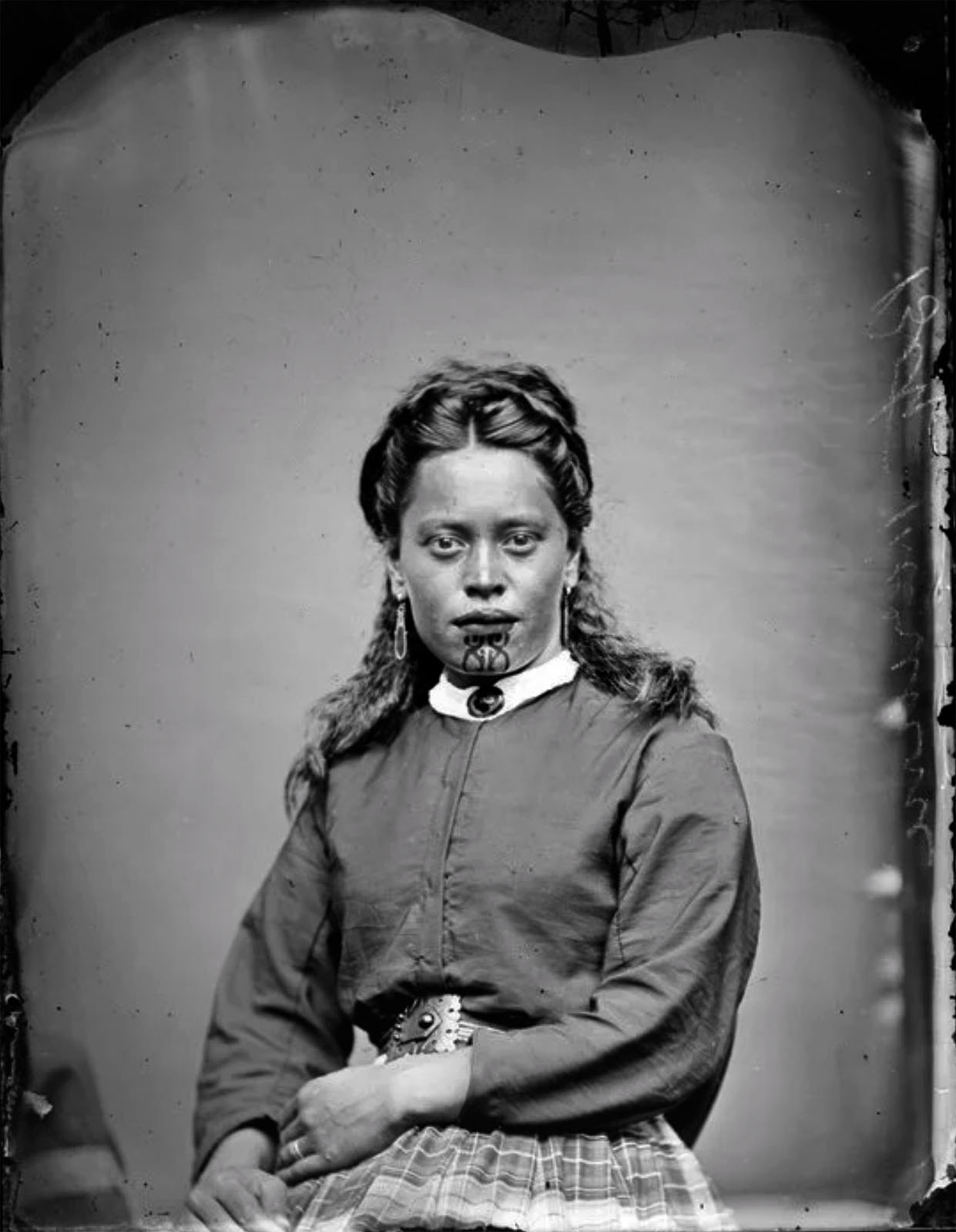
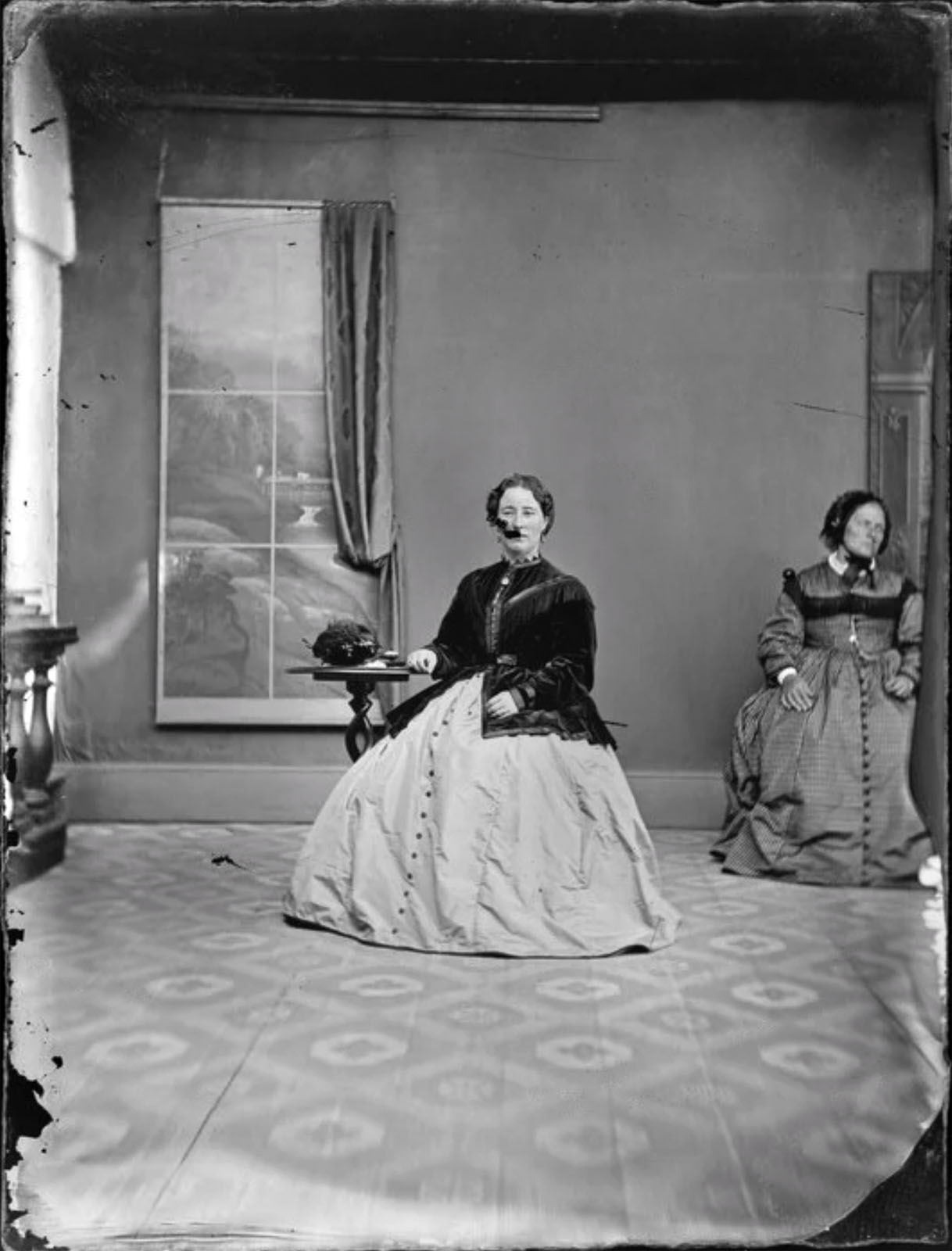
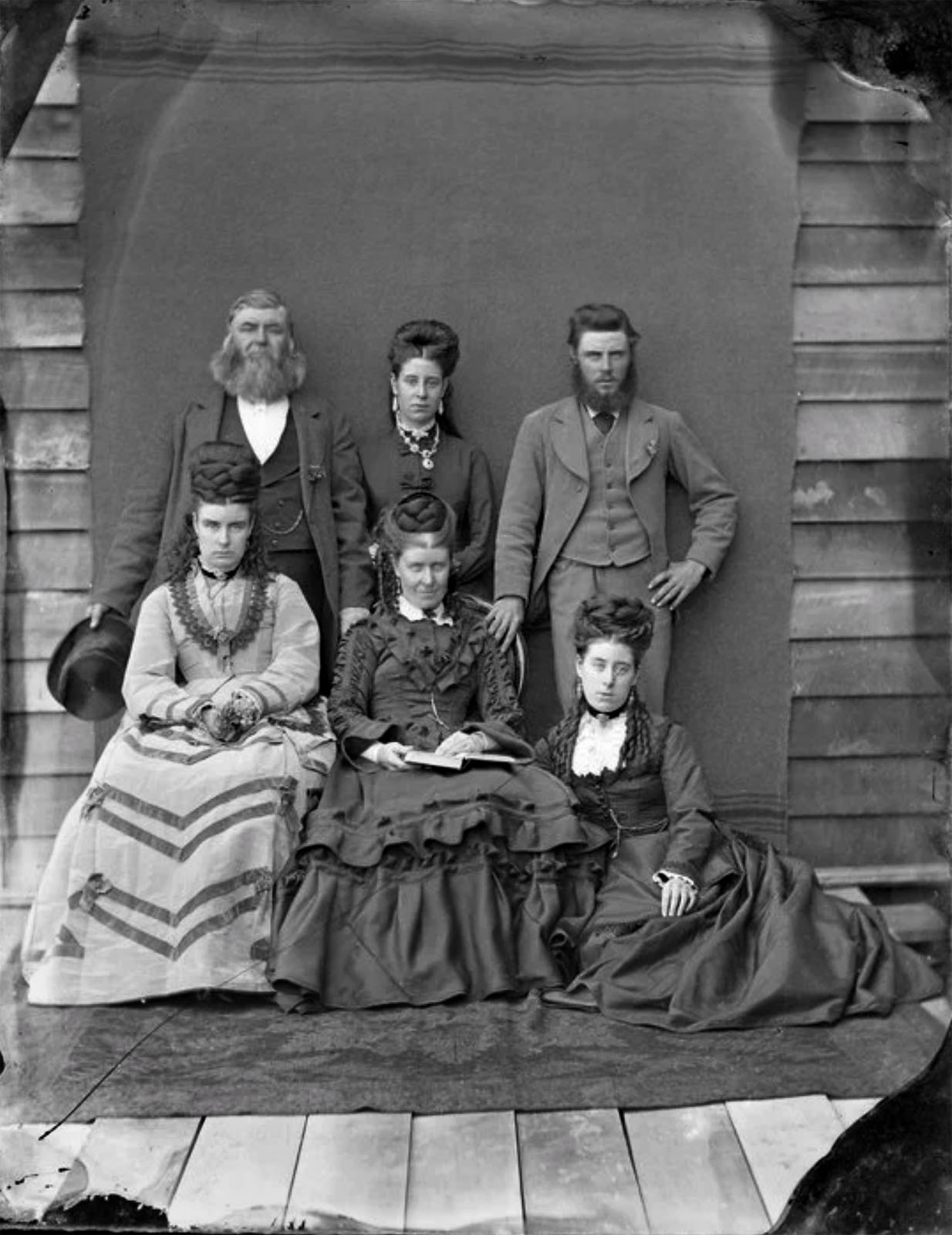
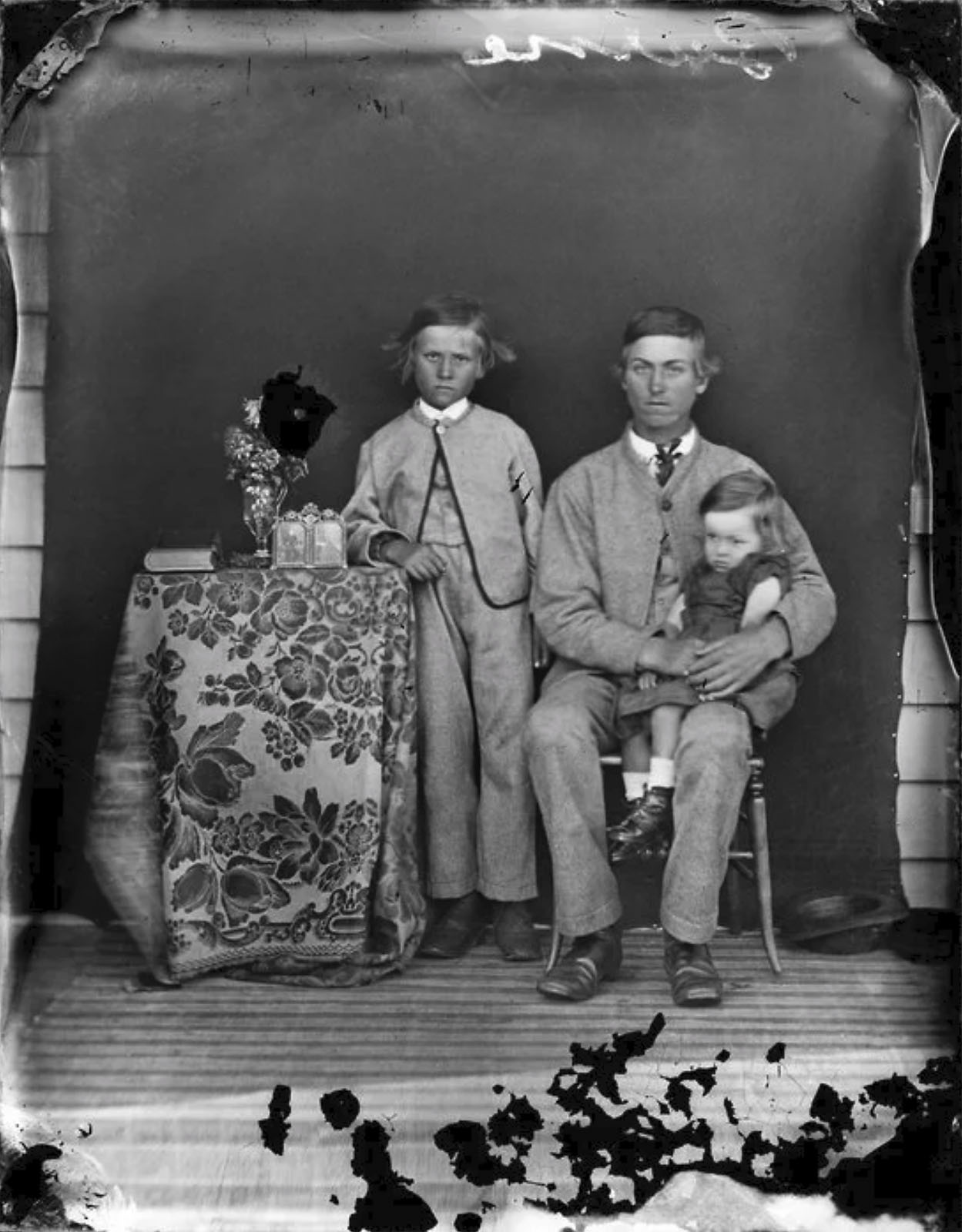
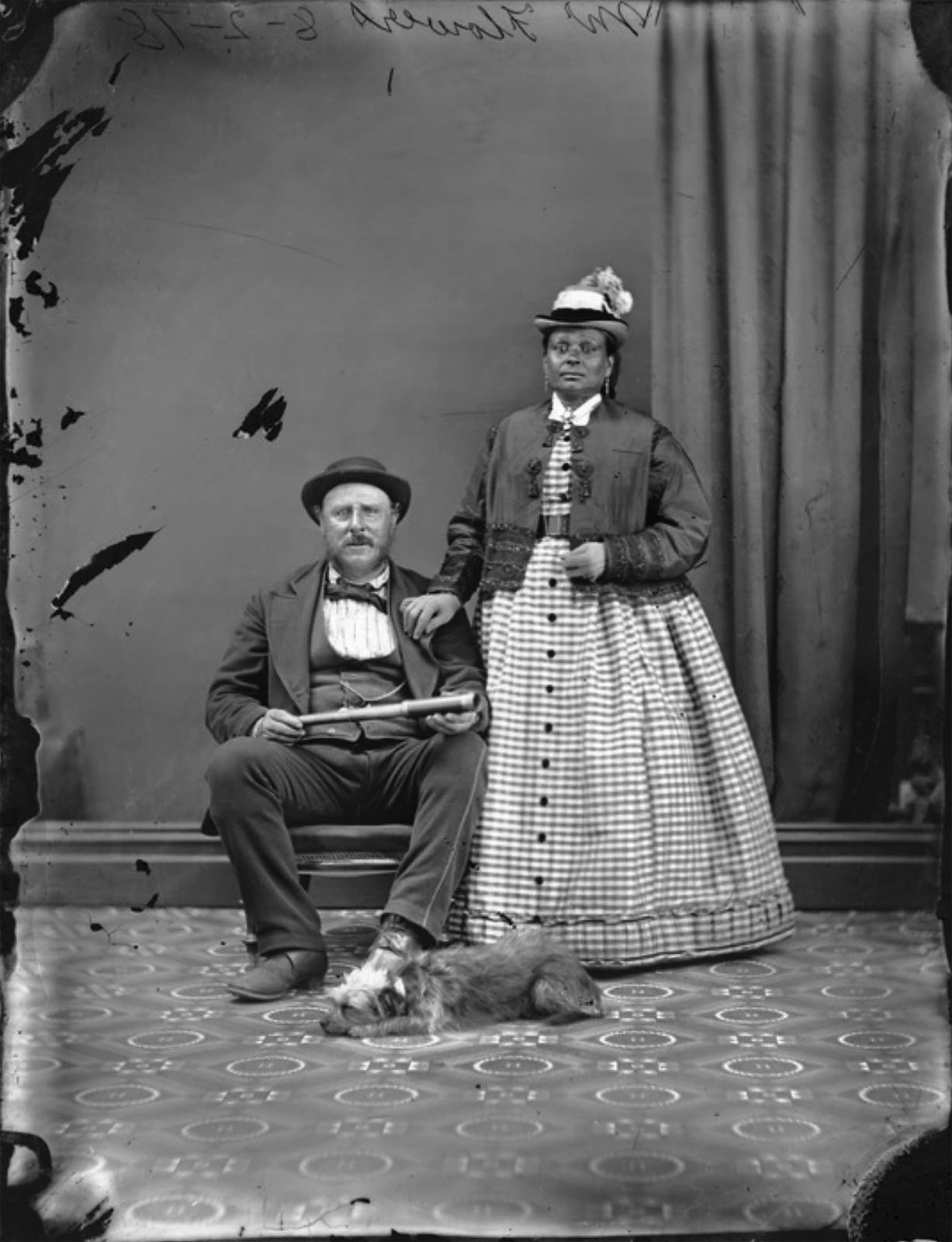
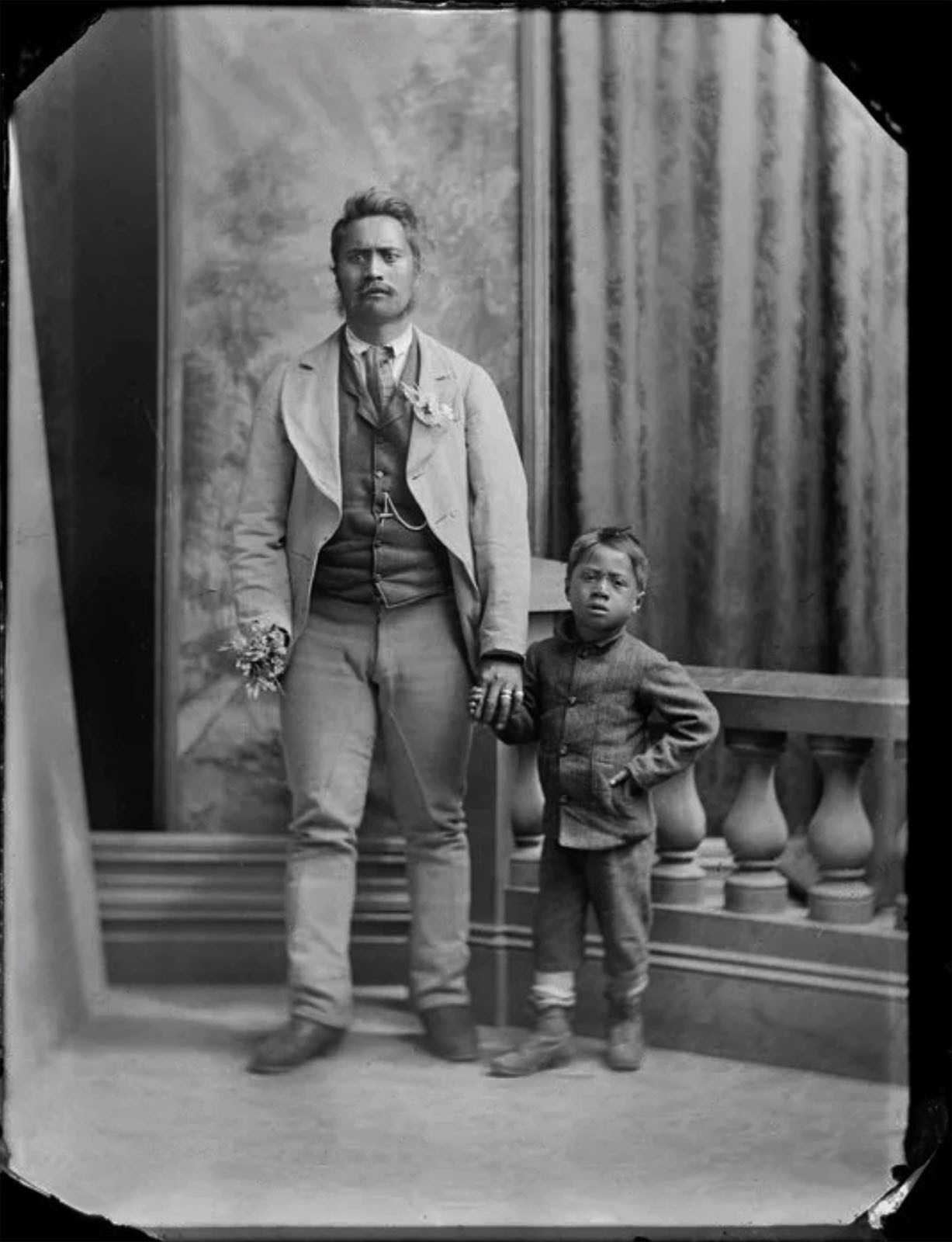
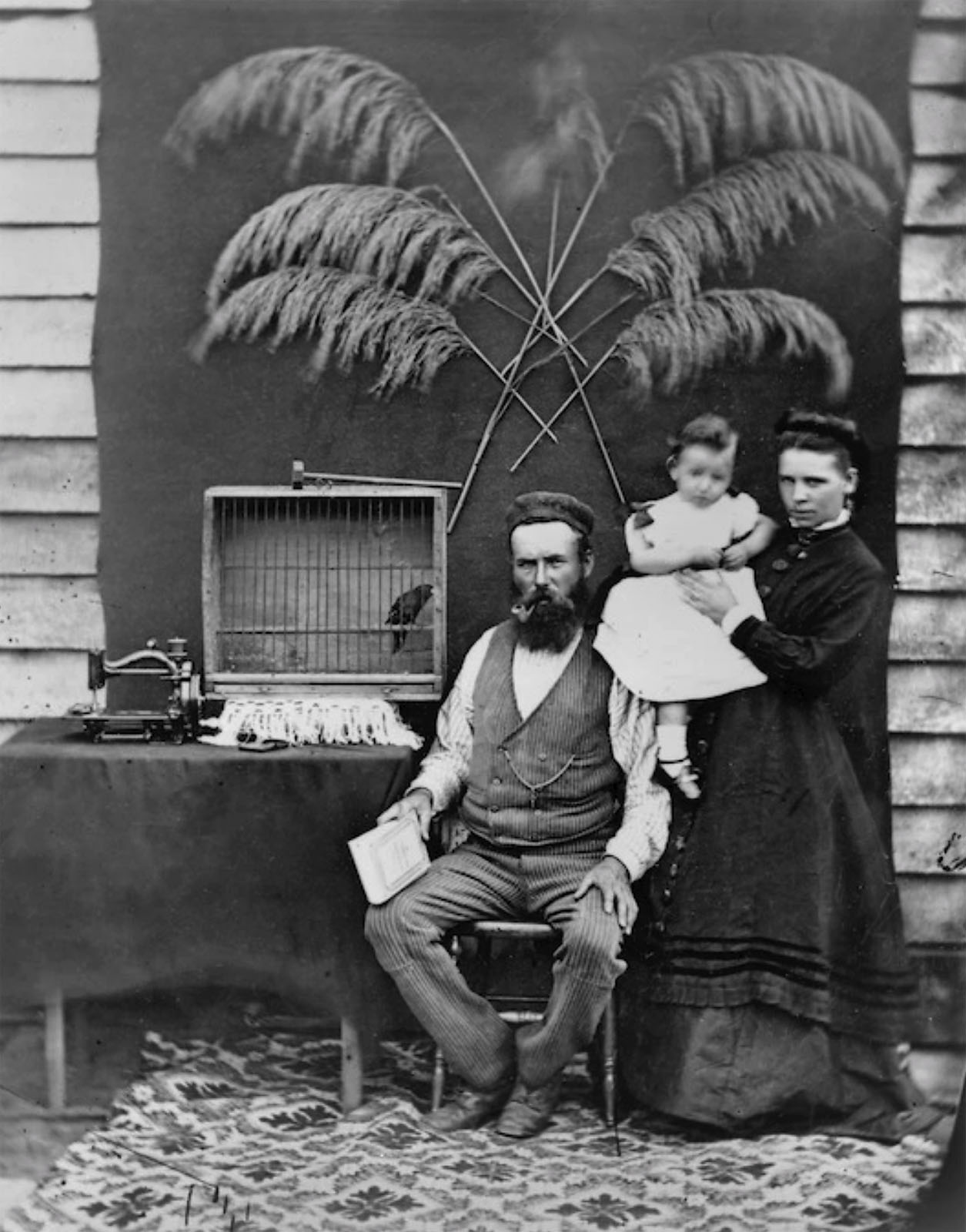
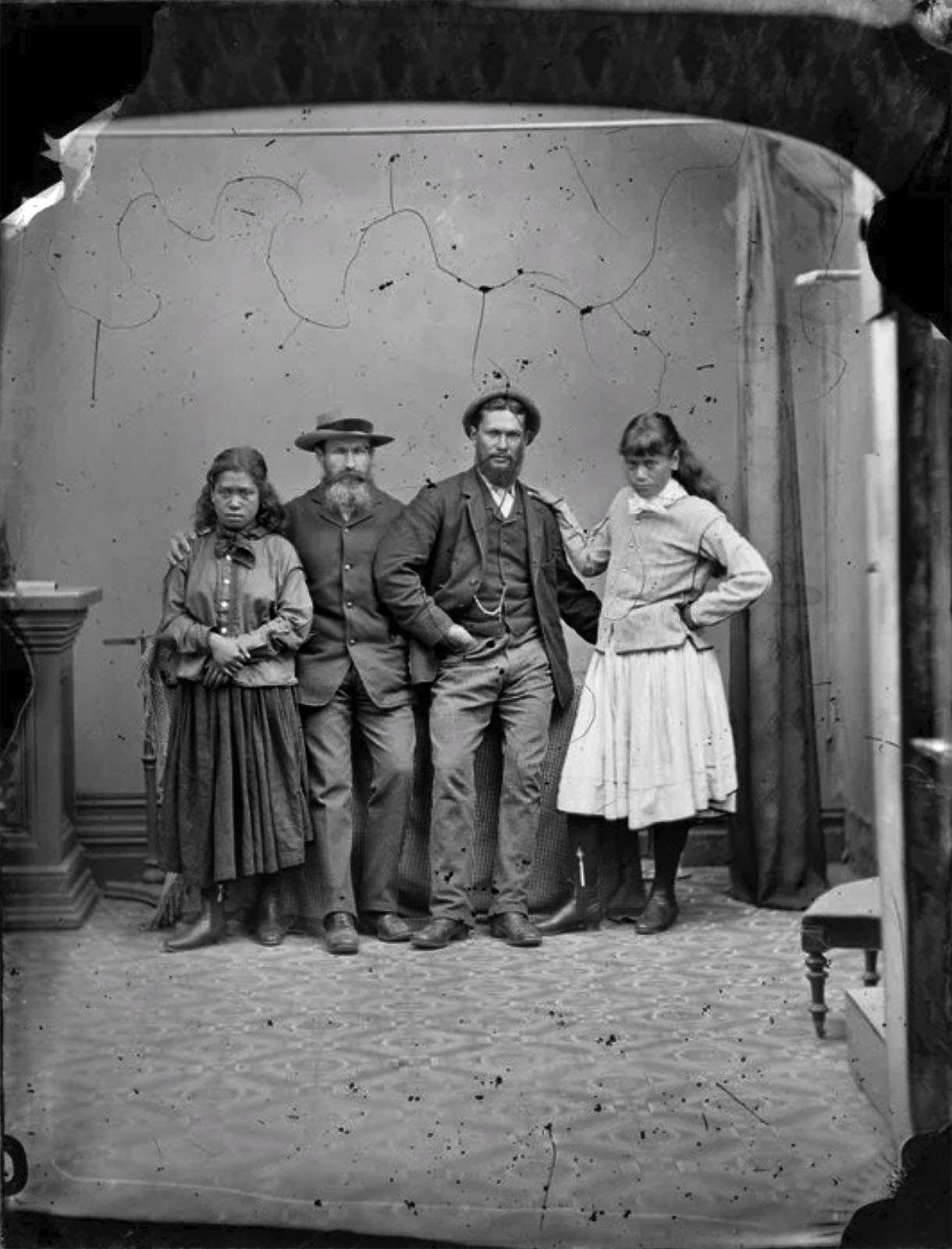

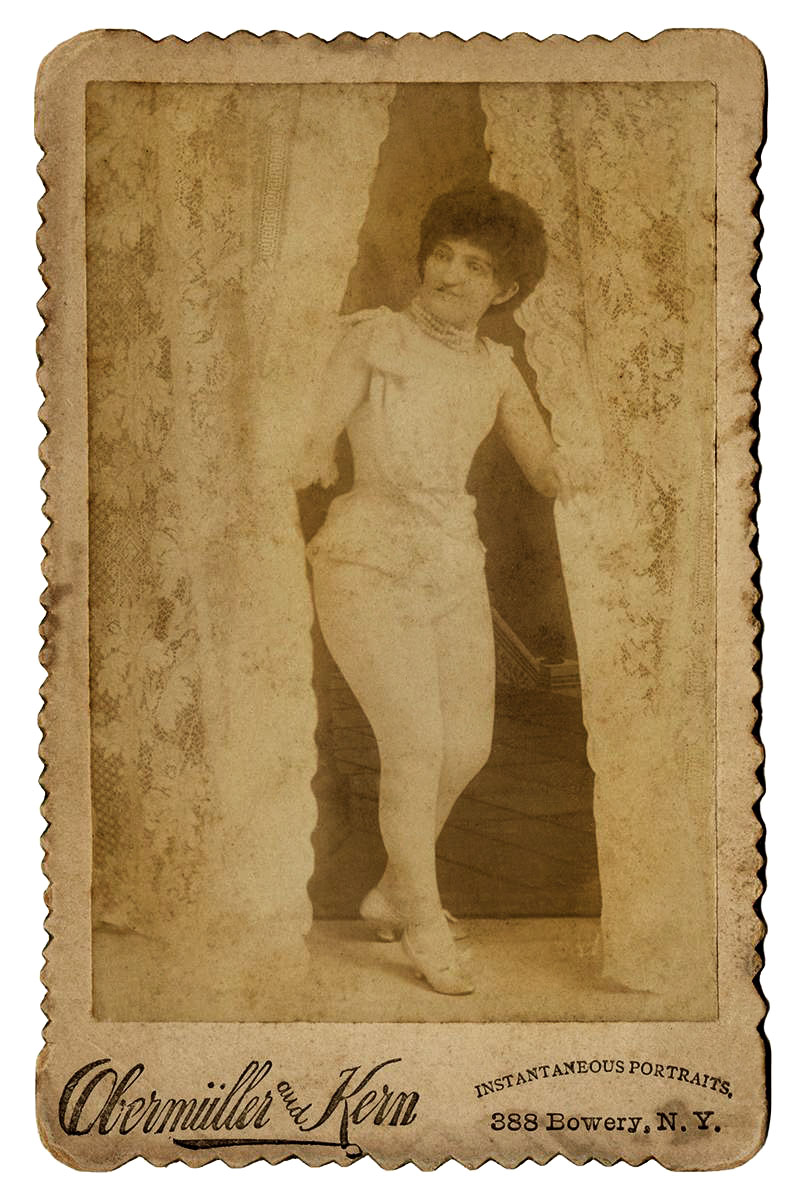
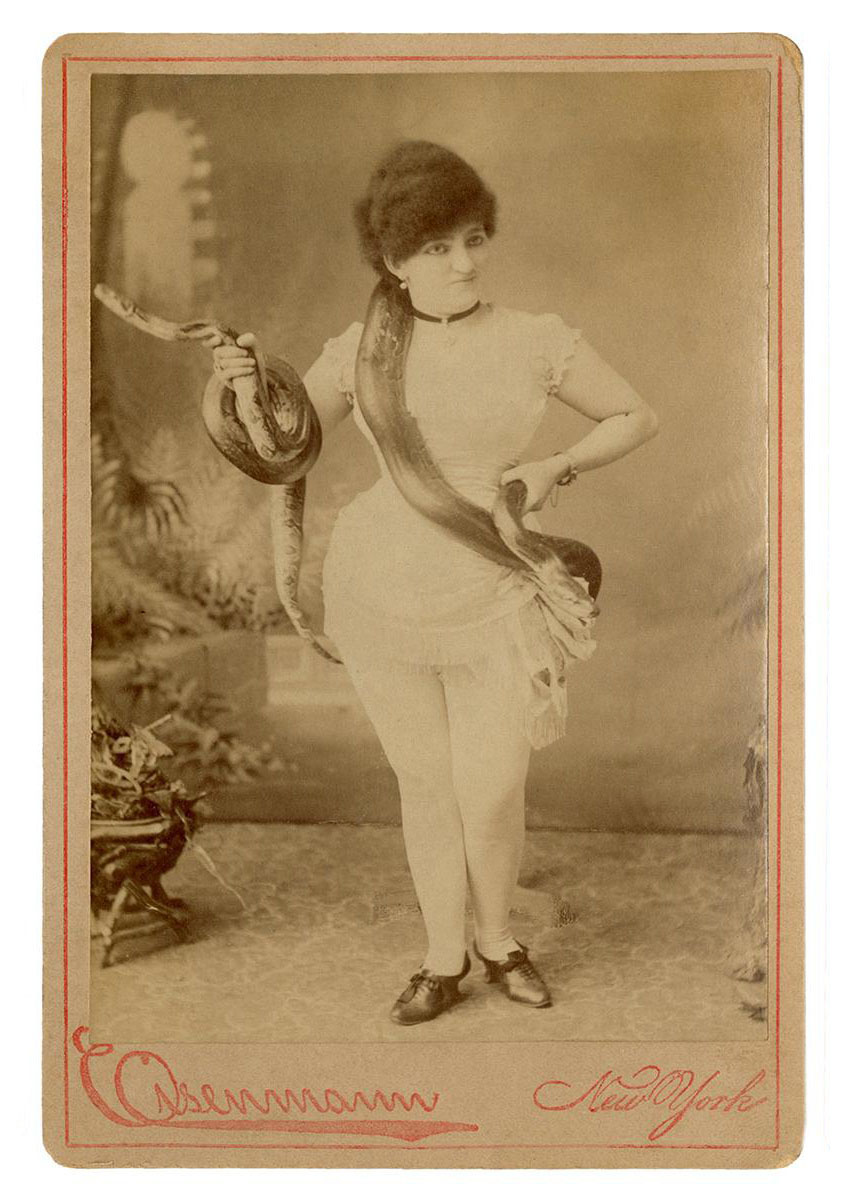


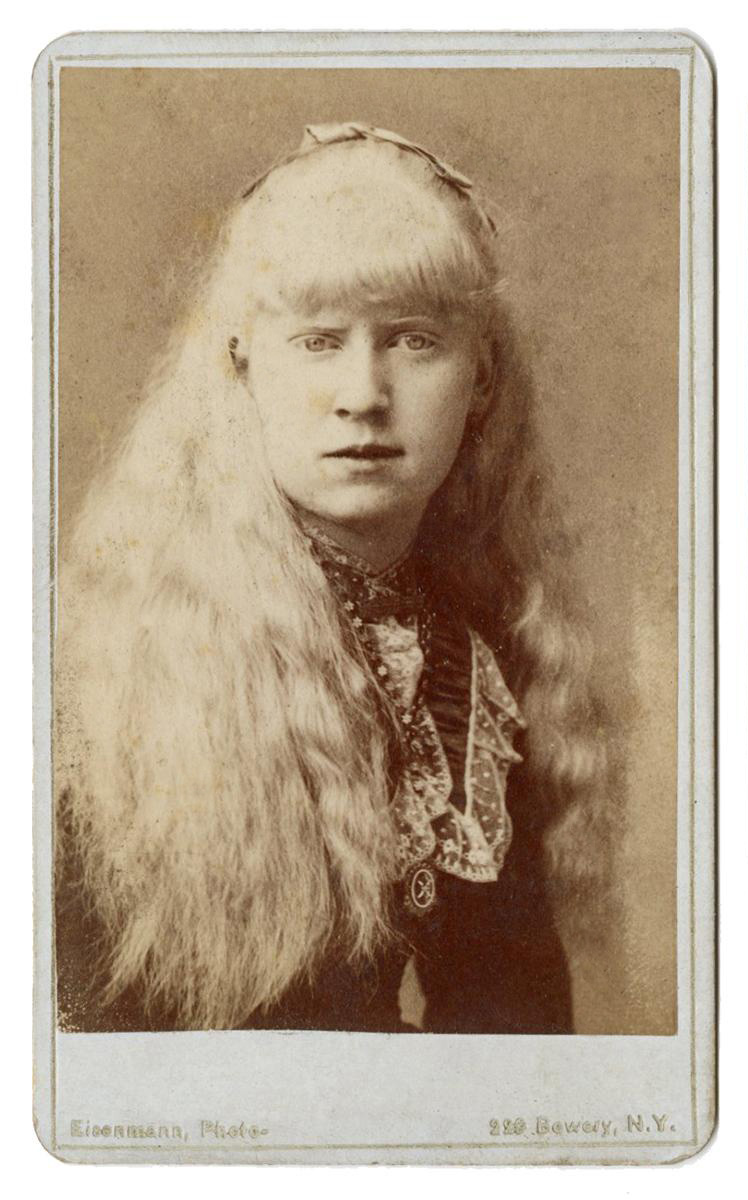


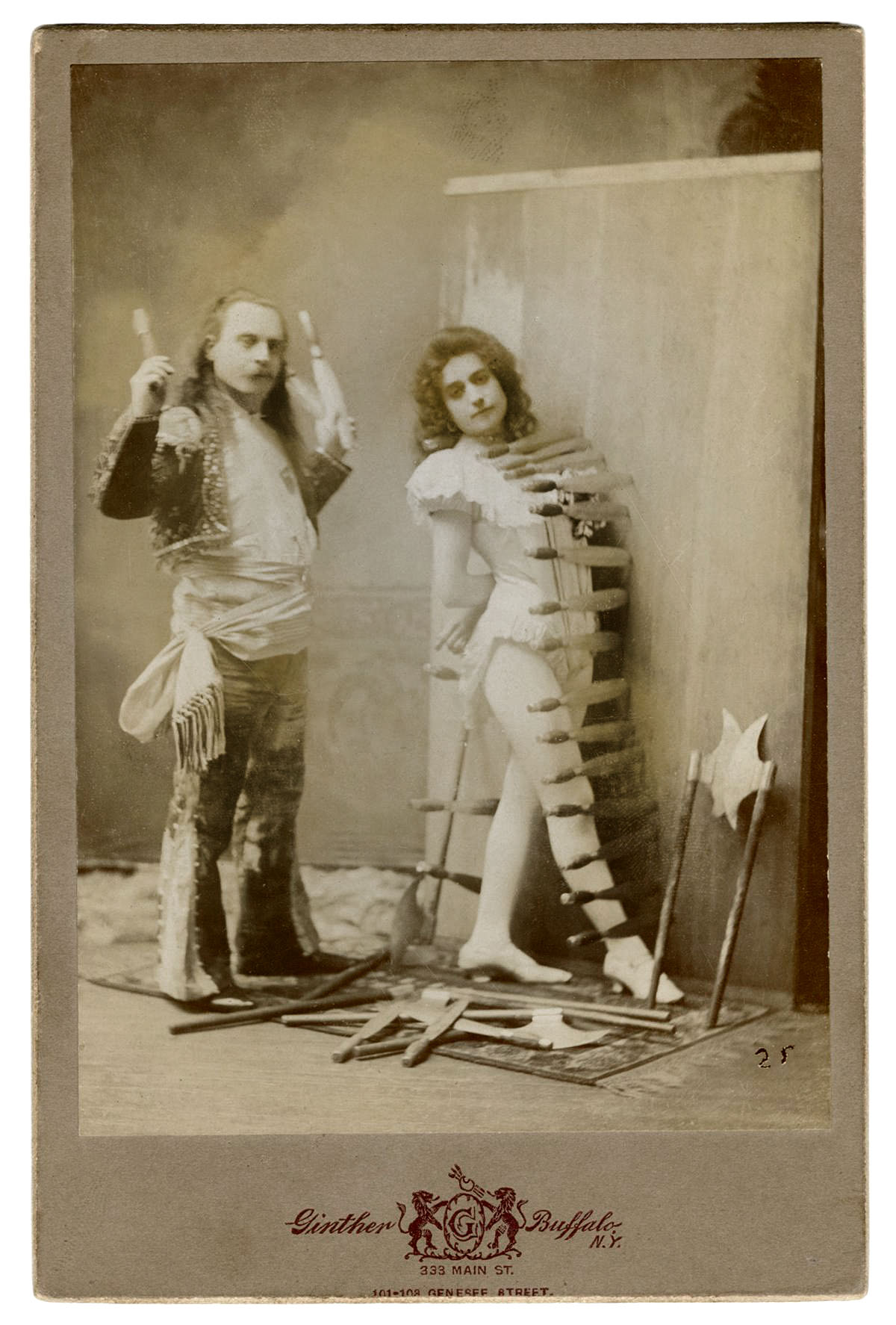


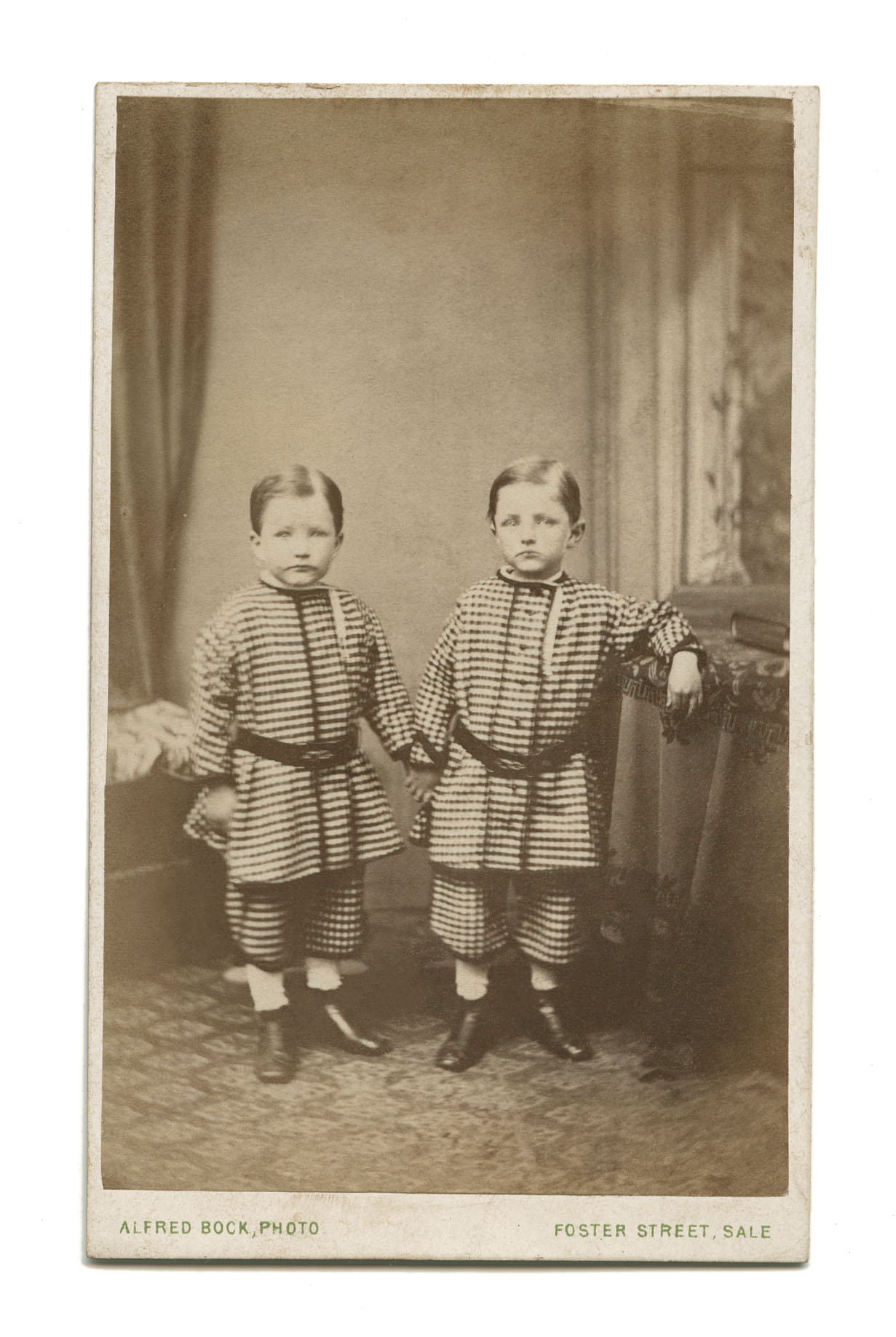



















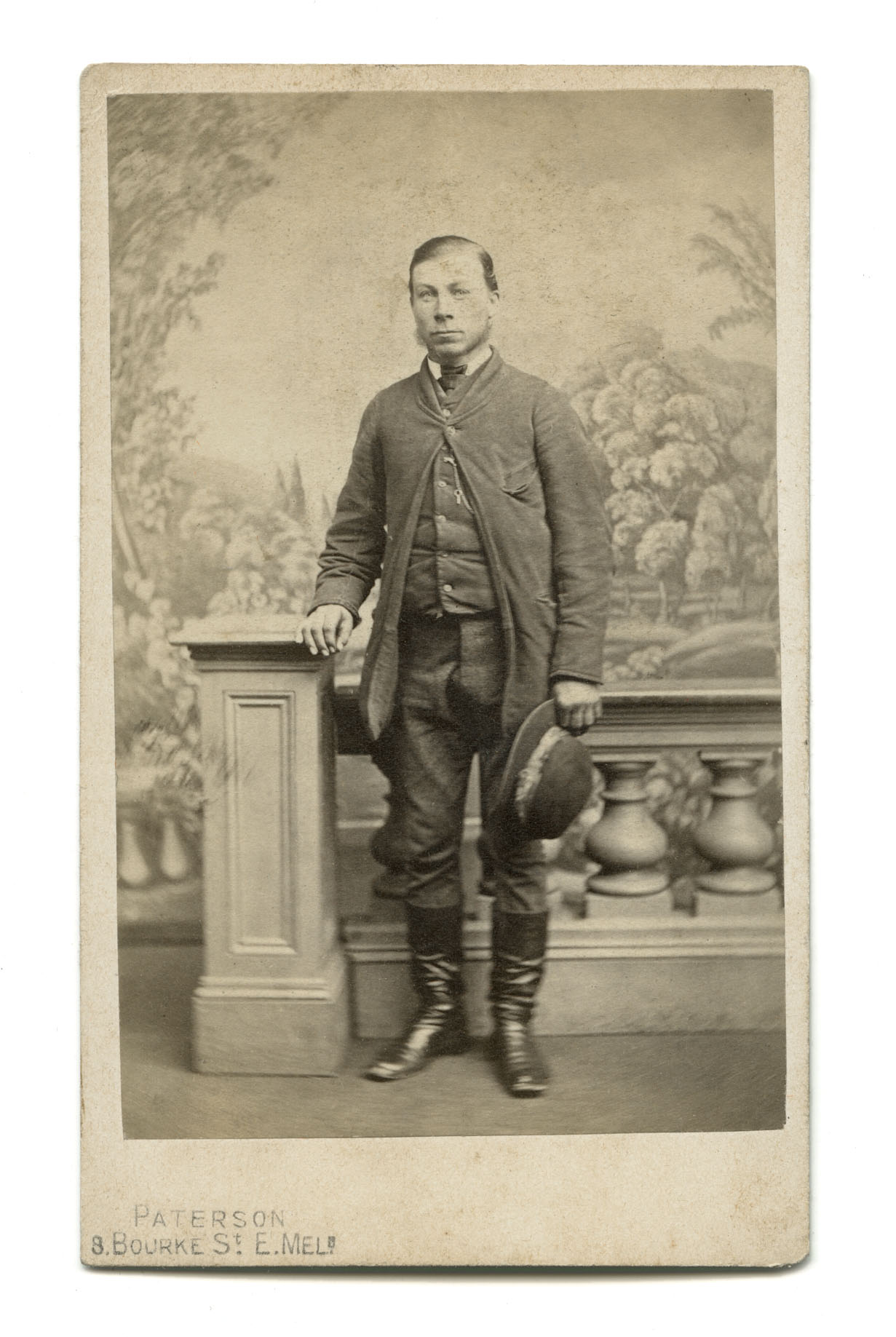

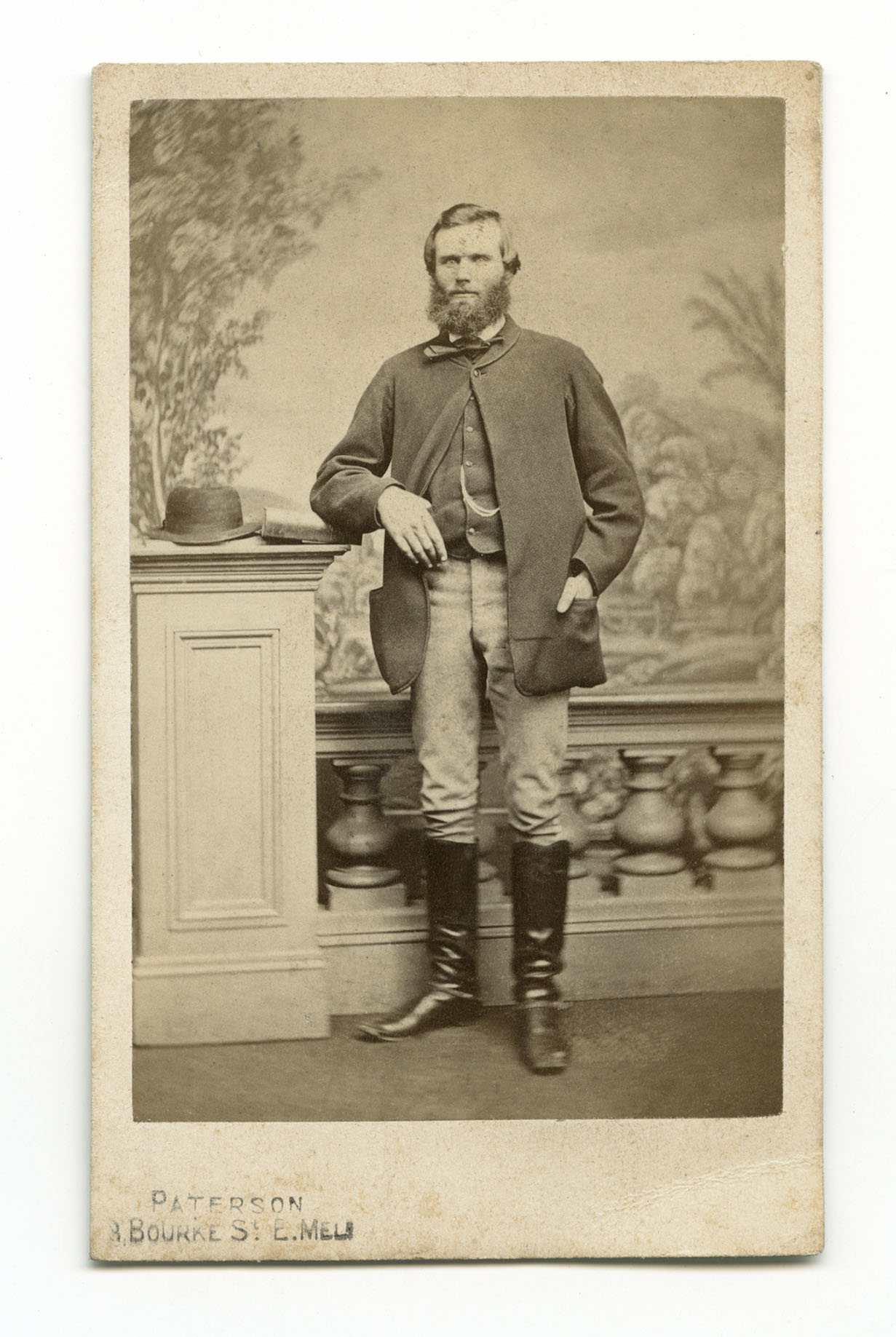


![Lewis Carroll (British, Daresbury, Cheshire 1832 - 1898 Guildford) '[Alice Liddell]' June 25, 1870 from the exhibition '2020 Vision: Photographs, 1840s-1860s' at the Metropolitan Museum of Art, New York, Dec 2019 - Dec 2020](https://artblart.com/wp-content/uploads/2020/07/lewis-carroll-alice-liddell.jpg "Lewis Carroll (British, Daresbury, Cheshire 1832 - 1898 Guildford) '[Alice Liddell]' June 25, 1870 from the exhibition '2020 Vision: Photographs, 1840s-1860s' at the Metropolitan Museum of Art, New York, Dec 2019 - Dec 2020")
![Unknown photographer (American) '[Surveyor]' c. 1854](https://artblart.com/wp-content/uploads/2020/07/anon-surveyor-a.jpg "Unknown photographer (American) '[Surveyor]' c. 1854")
![Unknown photographer (American) '[Surveyor]' c. 1854](https://artblart.com/wp-content/uploads/2020/07/anon-surveyor-b.jpg "Unknown photographer (American) '[Surveyor]' c. 1854")

![Hippolyte Bayard (French, 1801-1887) '[Classical Head]' probably 1839](https://artblart.com/wp-content/uploads/2020/07/bayard-classical-head.jpg "Hippolyte Bayard (French, 1801-1887) '[Classical Head]' probably 1839")
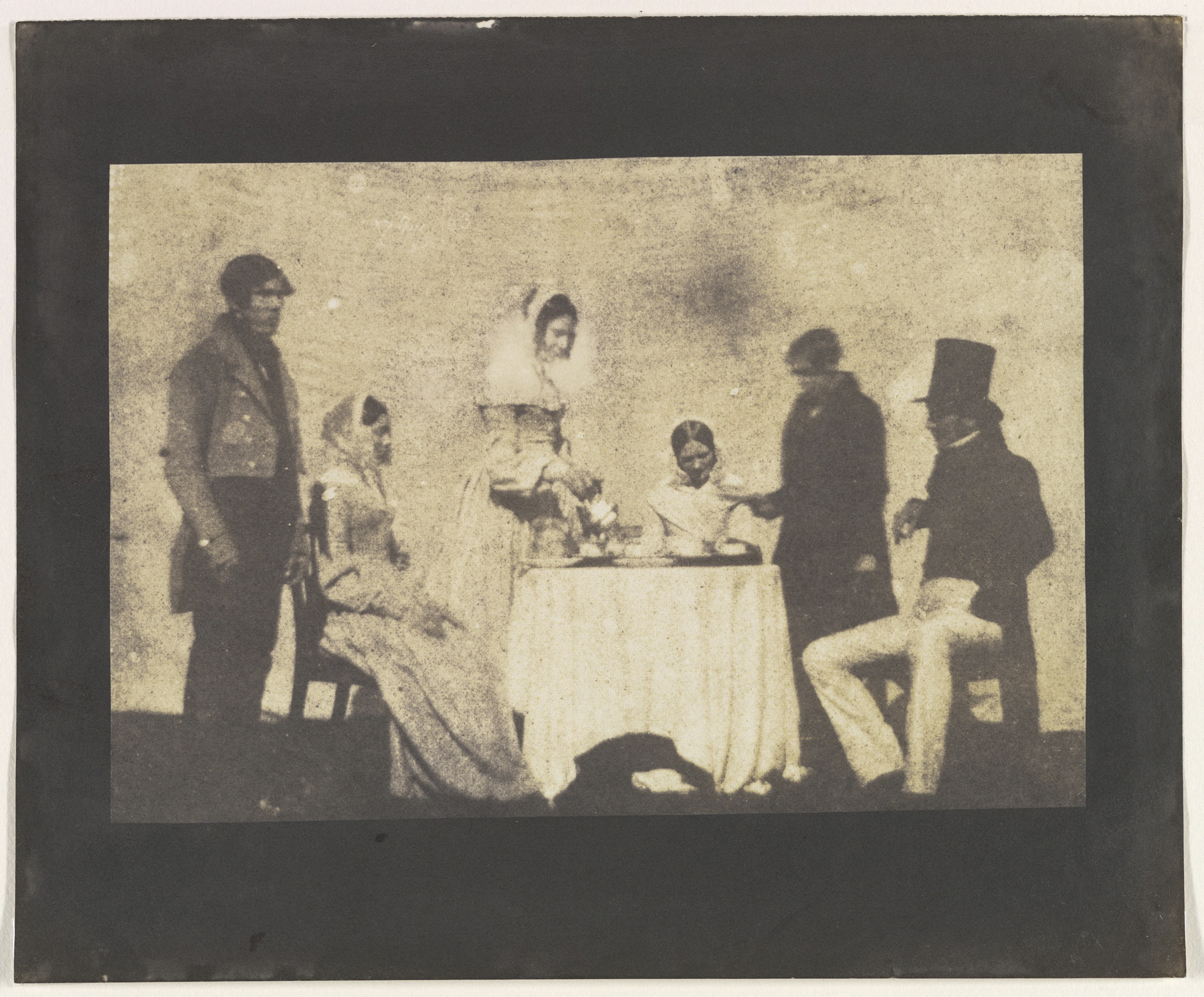
![Unknown artist. '[Carte-de-visite Album of Collaged Portraits]' 1850s-1860s](https://artblart.com/wp-content/uploads/2020/07/anon-collaged-portraits-a.jpg "Unknown artist. '[Carte-de-visite Album of Collaged Portraits]' 1850s-1860s")
![Unknown artist. '[Carte-de-visite Album of Collaged Portraits]' 1850s-1860s](https://artblart.com/wp-content/uploads/2020/07/anon-collaged-portraits-b.jpg "Unknown artist. '[Carte-de-visite Album of Collaged Portraits]' 1850s-1860s")
![Unknown artist. '[Carte-de-visite Album of Collaged Portraits]' 1850s-1860s](https://artblart.com/wp-content/uploads/2020/07/anon-collaged-portraits-c.jpg "Unknown artist. '[Carte-de-visite Album of Collaged Portraits]' 1850s-1860s")
![Unknown artist. '[Carte-de-visite Album of Collaged Portraits]' 1850s-1860s](https://artblart.com/wp-content/uploads/2020/07/anon-collaged-portraits-d.jpg "Unknown artist. '[Carte-de-visite Album of Collaged Portraits]' 1850s-1860s")
![Unknown artist. '[Carte-de-visite Album of Collaged Portraits]' 1850s-1860s](https://artblart.com/wp-content/uploads/2020/07/anon-collaged-portraits-e.jpg "Unknown artist. '[Carte-de-visite Album of Collaged Portraits]' 1850s-1860s")
![Unknown artist. '[Carte-de-visite Album of Collaged Portraits]' 1850s-1860s](https://artblart.com/wp-content/uploads/2020/07/anon-collaged-portraits-f.jpg "Unknown artist. '[Carte-de-visite Album of Collaged Portraits]' 1850s-1860s")
![Unknown artist. '[Carte-de-visite Album of Collaged Portraits]' 1850s-1860s](https://artblart.com/wp-content/uploads/2020/07/anon-collaged-portraits-g.jpg "Unknown artist. '[Carte-de-visite Album of Collaged Portraits]' 1850s-1860s")
![Unknown artist. '[Carte-de-visite Album of Collaged Portraits]' 1850s-1860s](https://artblart.com/wp-content/uploads/2020/07/anon-collaged-portraits-h.jpg "Unknown artist. '[Carte-de-visite Album of Collaged Portraits]' 1850s-1860s")
![Unknown artist (American) '[Studio Photographer at Work]' c. 1855](https://artblart.com/wp-content/uploads/2020/07/unknown-artist-american-studio-photographer-at-work-c-1855.jpg "Unknown artist (American) '[Studio Photographer at Work]' c. 1855")
![Unknown artist (American) '[Boy Holding a Daguerreotype]' 1850s](https://artblart.com/wp-content/uploads/2020/07/unknown-american-active-1850s-boy-holding-a-daguerreotype-1850s.jpg "Unknown artist (American) '[Boy Holding a Daguerreotype]' 1850s")
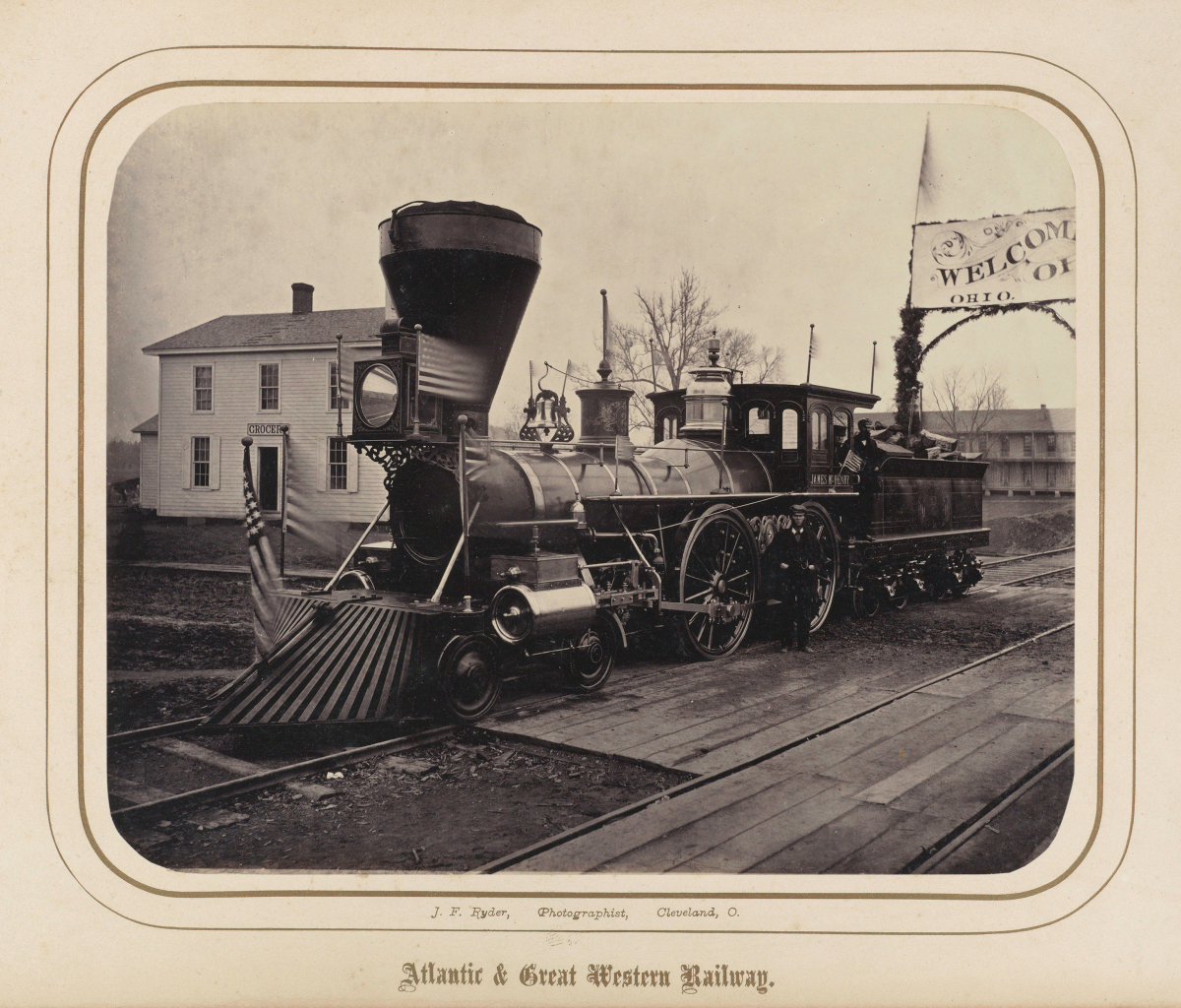

![Carleton E. Watkins (American, 1829-1916) '[California Oak, Santa Clara Valley]' c. 1863](https://artblart.com/wp-content/uploads/2020/07/watkins-california-oak-santa-clara-valley.jpg "Carleton E. Watkins (American, 1829-1916) '[California Oak, Santa Clara Valley]' c. 1863")
![Pietro Dovizielli (Italian, 1804-1885) '[Spanish Steps, Rome]' c. 1855](https://artblart.com/wp-content/uploads/2020/07/dovizielli-spanish-steps.jpg "Pietro Dovizielli (Italian, 1804-1885) '[Spanish Steps, Rome]' c. 1855")
![Edouard Baldus (French (born Prussia), 1813-1889) '[Amphitheater, Nîmes]' c. 1853](https://artblart.com/wp-content/uploads/2020/07/baldus-amphitheater.jpg "Edouard Baldus (French (born Prussia), 1813-1889) '[Amphitheater, Nîmes]' c. 1853")

![Lewis Dowe (American, active 1860s-1880s) '[Dowe's Photograph Rooms, Sycamore, Illinois]' 1860s](https://artblart.com/wp-content/uploads/2020/07/lewis-dowe-dowes-photograph-rooms-sycamore-illinois-1860s.jpg "Lewis Dowe (American, active 1860s-1880s) '[Dowe's Photograph Rooms, Sycamore, Illinois]' 1860s")
![E. & H. T. Anthony (American) '[Specimens of New York Bill Posting]' 1863](https://artblart.com/wp-content/uploads/2020/07/e-h-t-anthony-specimens-of-new-york-bill-posting-1863.jpg "E. & H. T. Anthony (American) '[Specimens of New York Bill Posting]' 1863")

![Felice Beato (British (born Italy), Venice 1832-1909 Luxor) and James Robertson (British, 1813-1881) [Dome of the Rock, Jerusalem] 1856-1857](https://artblart.com/wp-content/uploads/2020/07/beato-dome.jpg "Felice Beato (British (born Italy), Venice 1832-1909 Luxor) and James Robertson (British, 1813-1881) [Dome of the Rock, Jerusalem] 1856-1857")
![R.C. Montgomery (American, active 1850s) '[Self-Portrait (?)]' 1850s](https://artblart.com/wp-content/uploads/2020/07/r.c.-montgomery-self-portrait-1850s.jpg "R.C. Montgomery (American, active 1850s) '[Self-Portrait (?)]' 1850s")





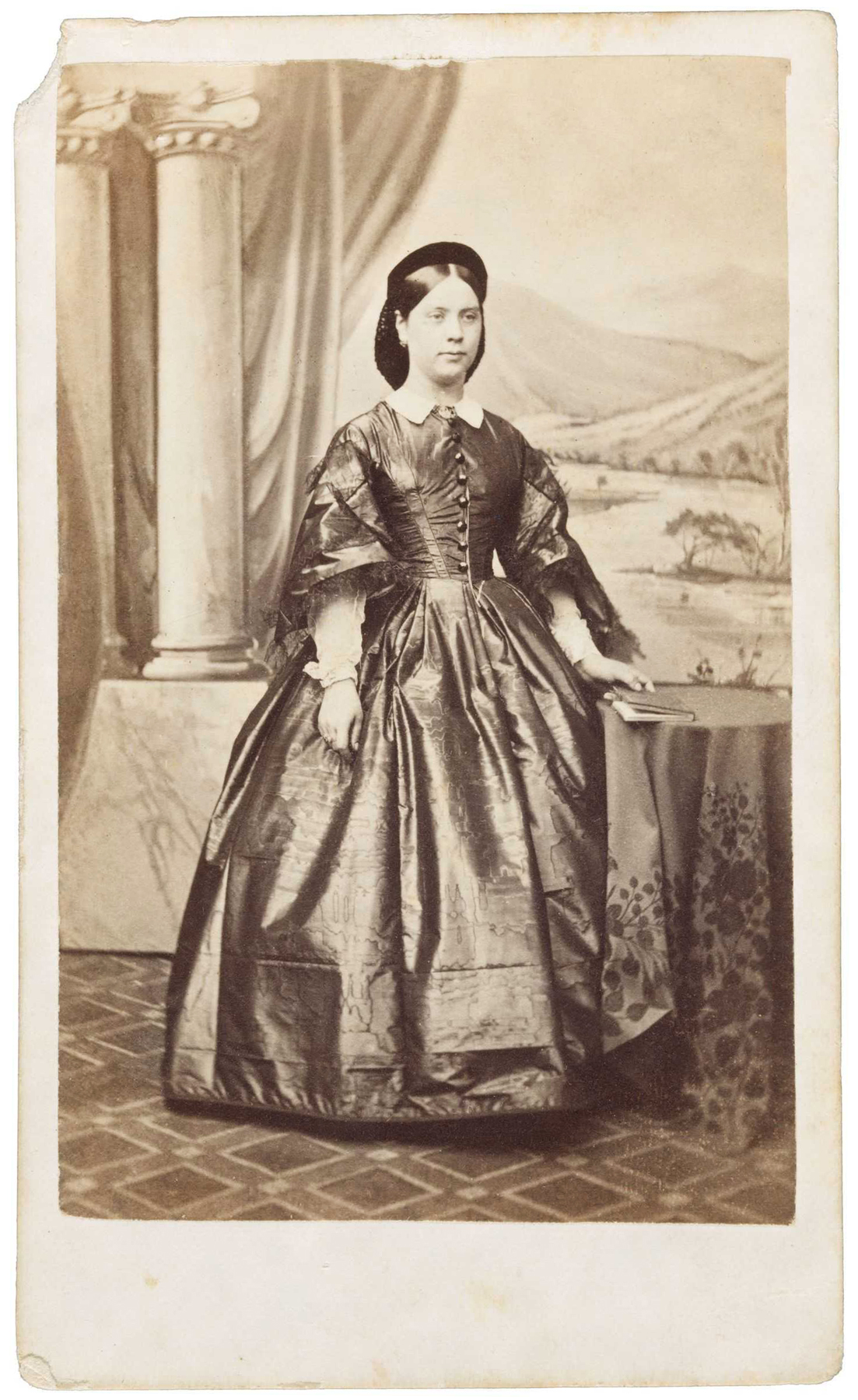


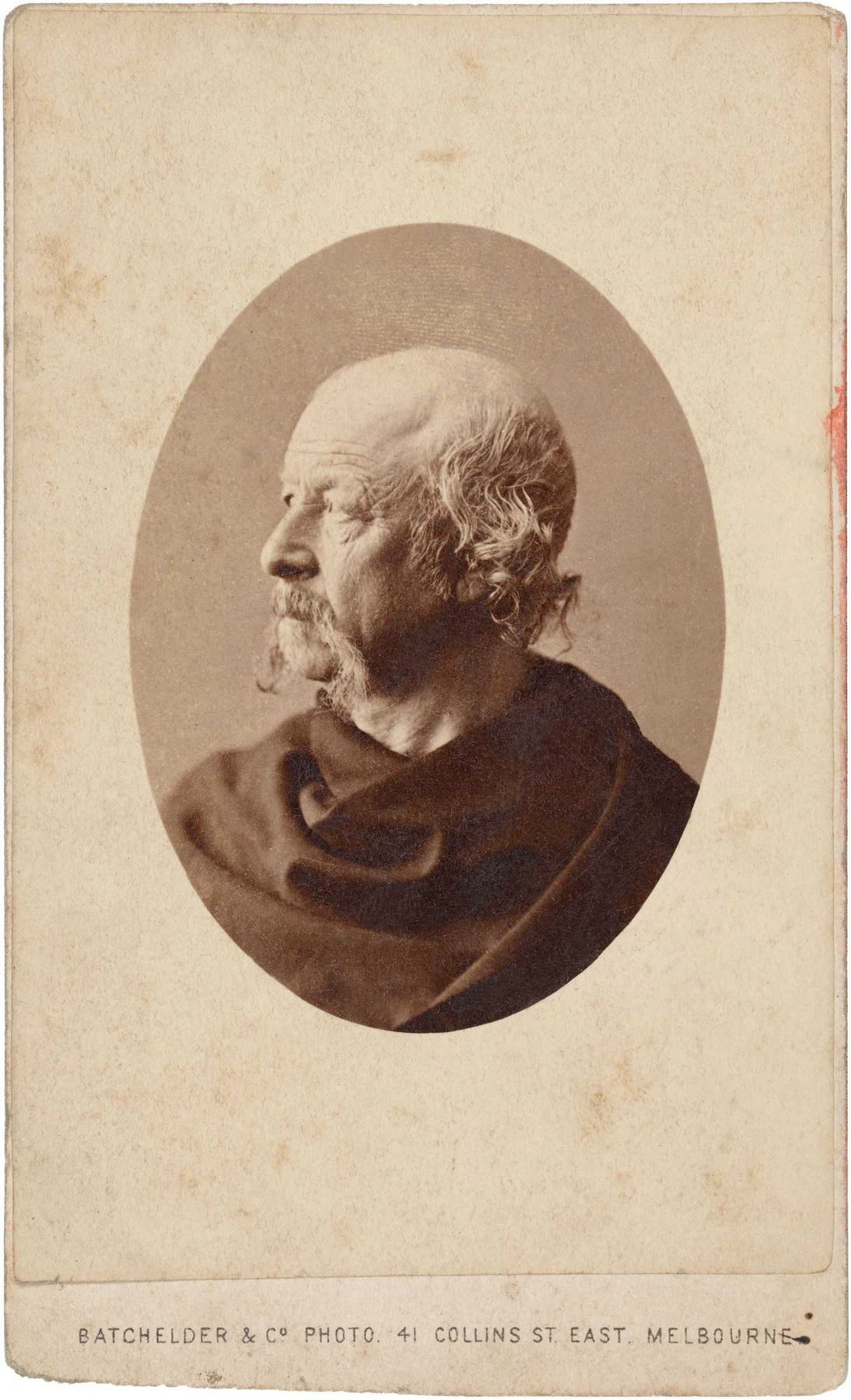


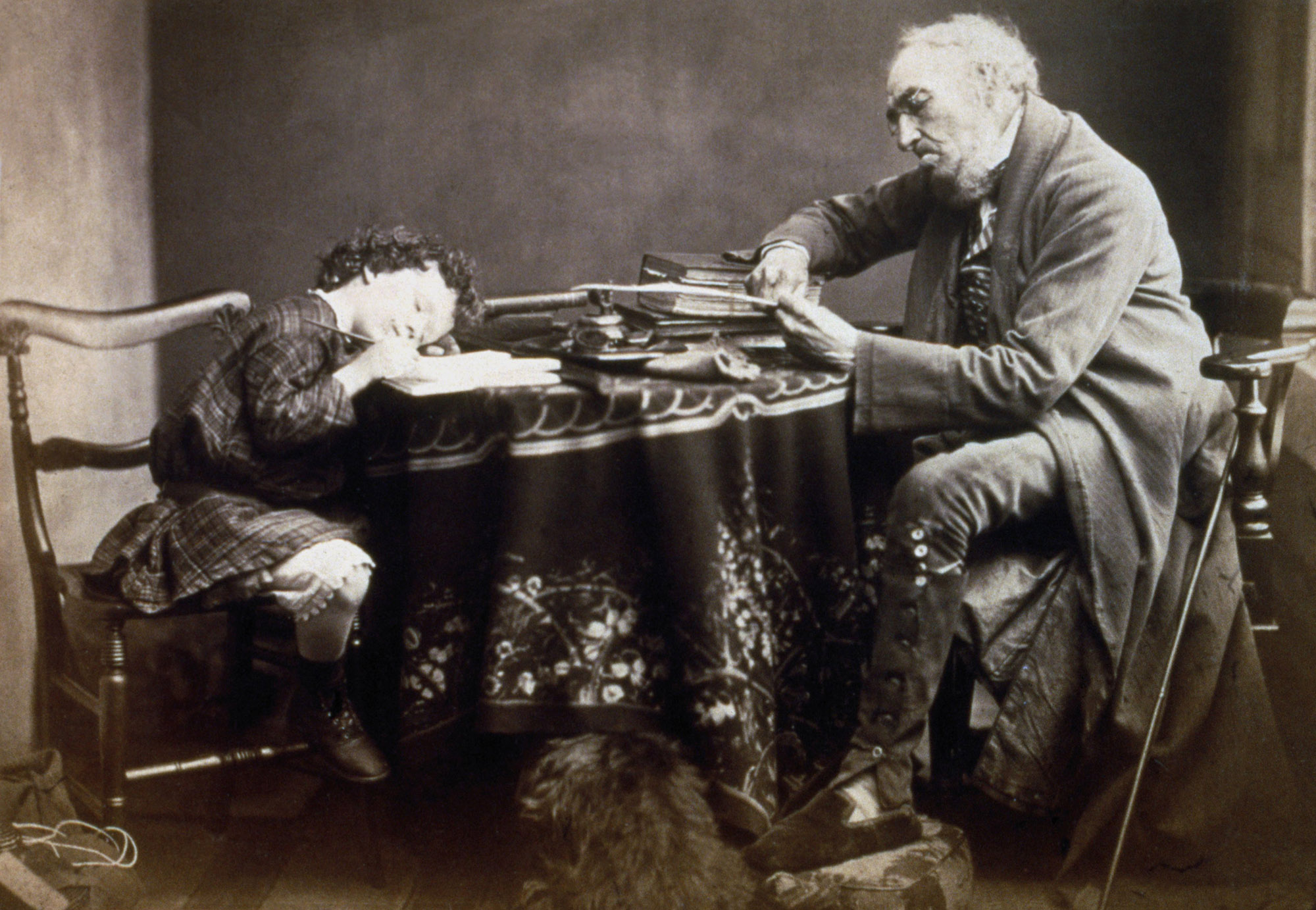




























 Art Blart _ art and cultural memory archive
You must be logged in to post a comment.