Review: ‘On the beach’ at the Mornington Peninsula Regional Art Gallery, Mornington

Exhibition dates: 11th December, 2015 – 28th February, 2016

Curator: Wendy Garden


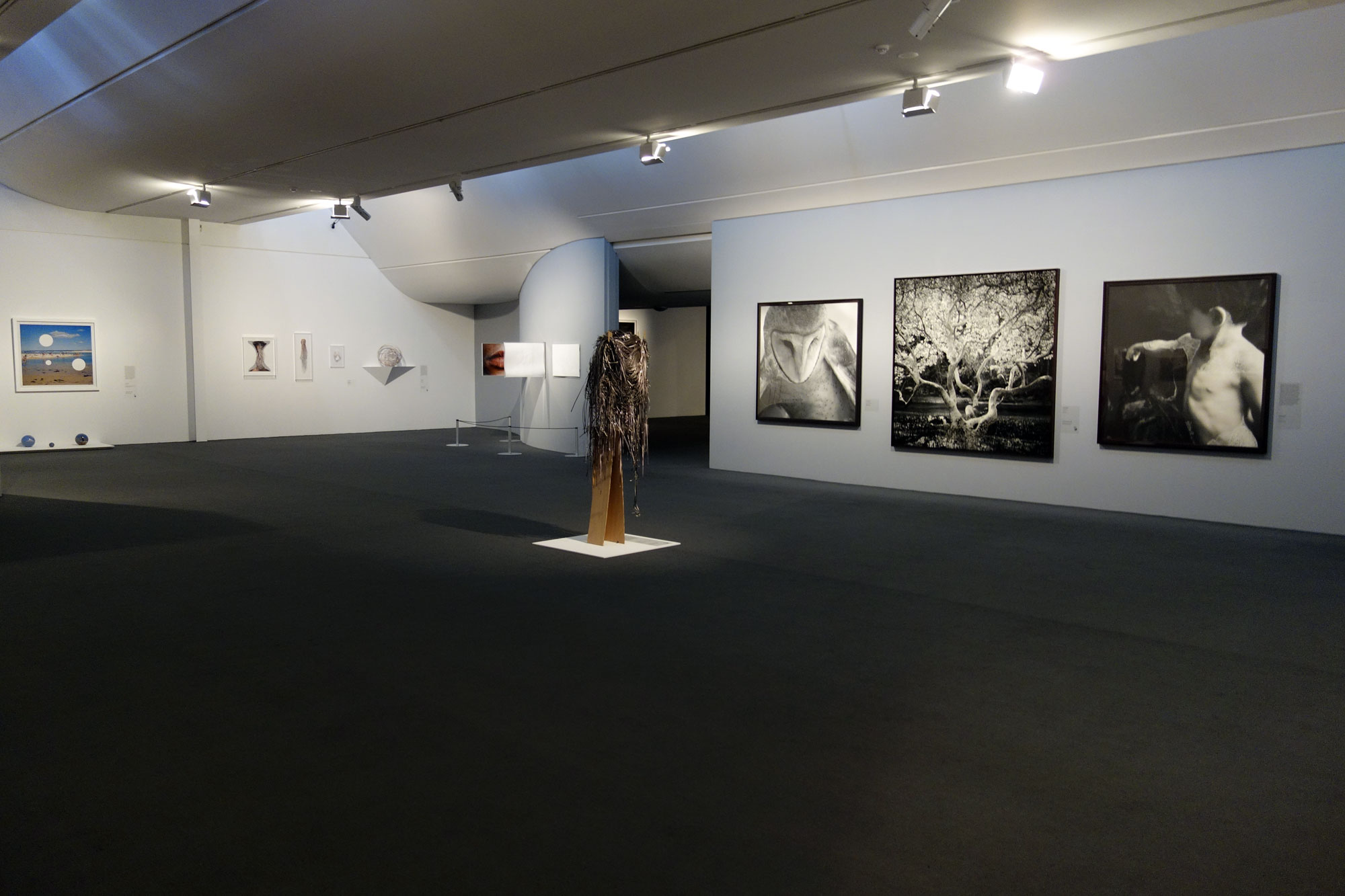
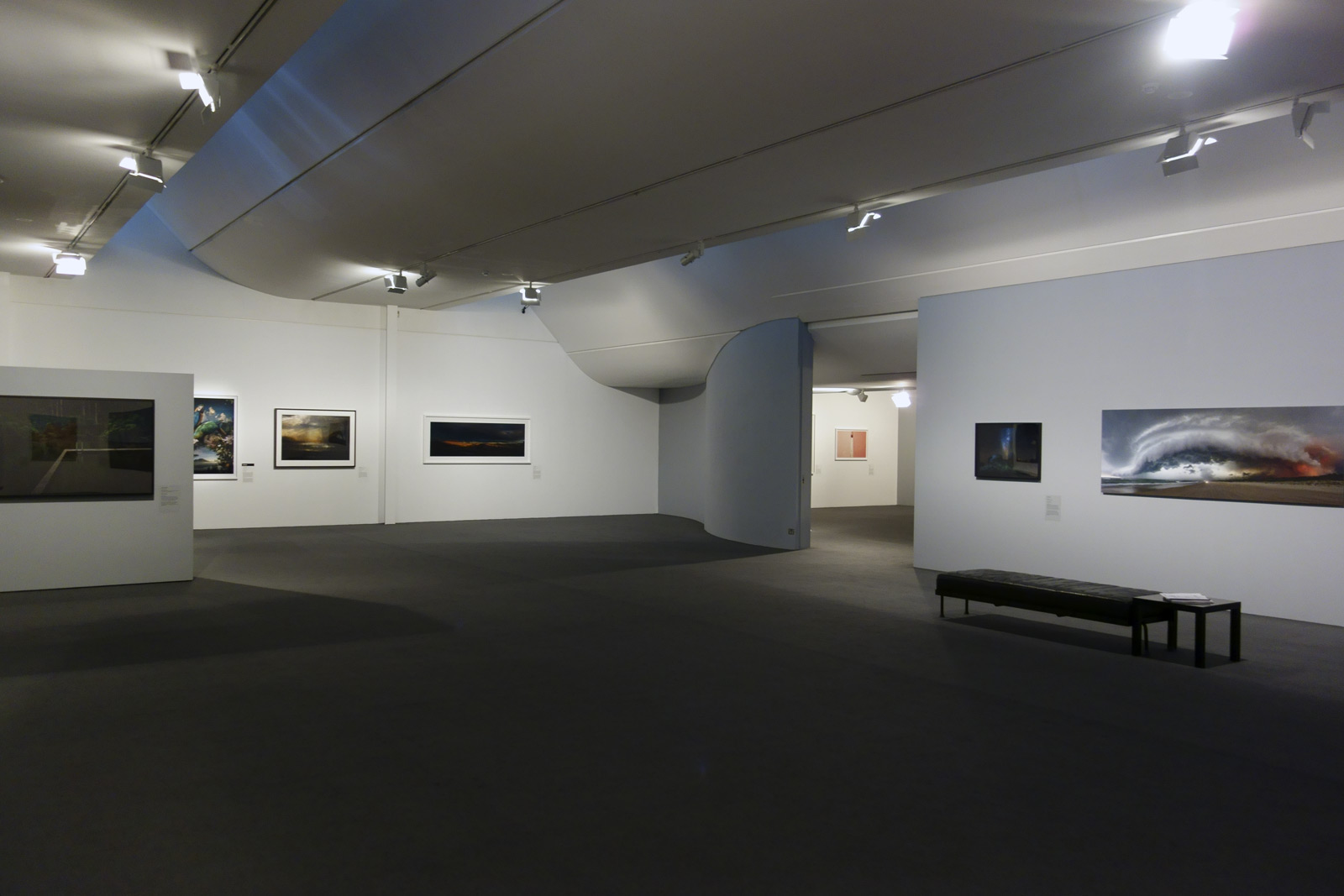
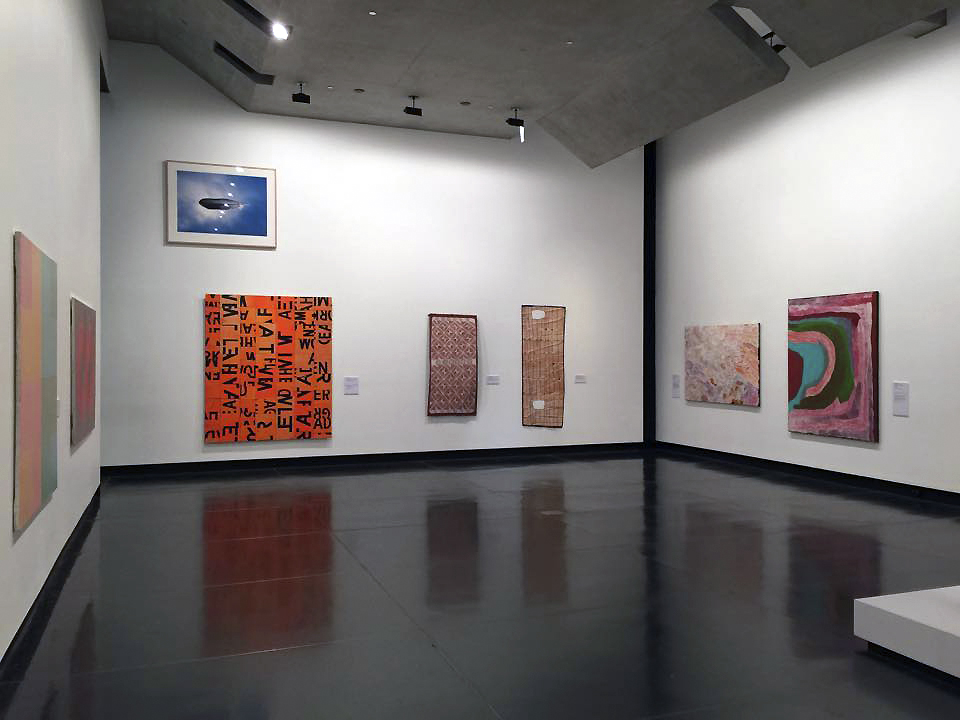
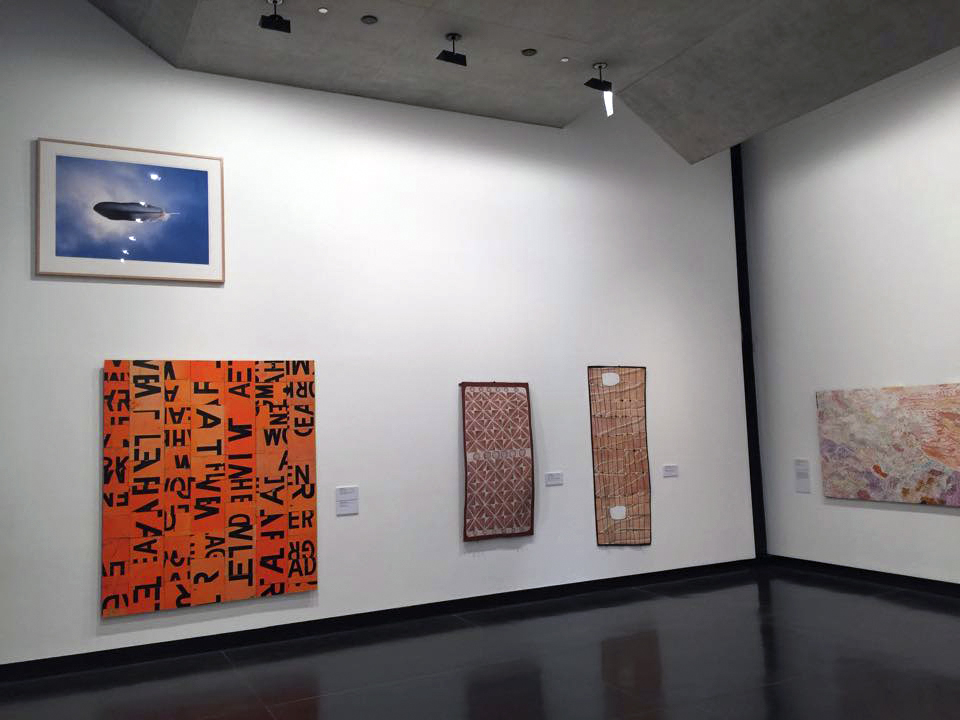
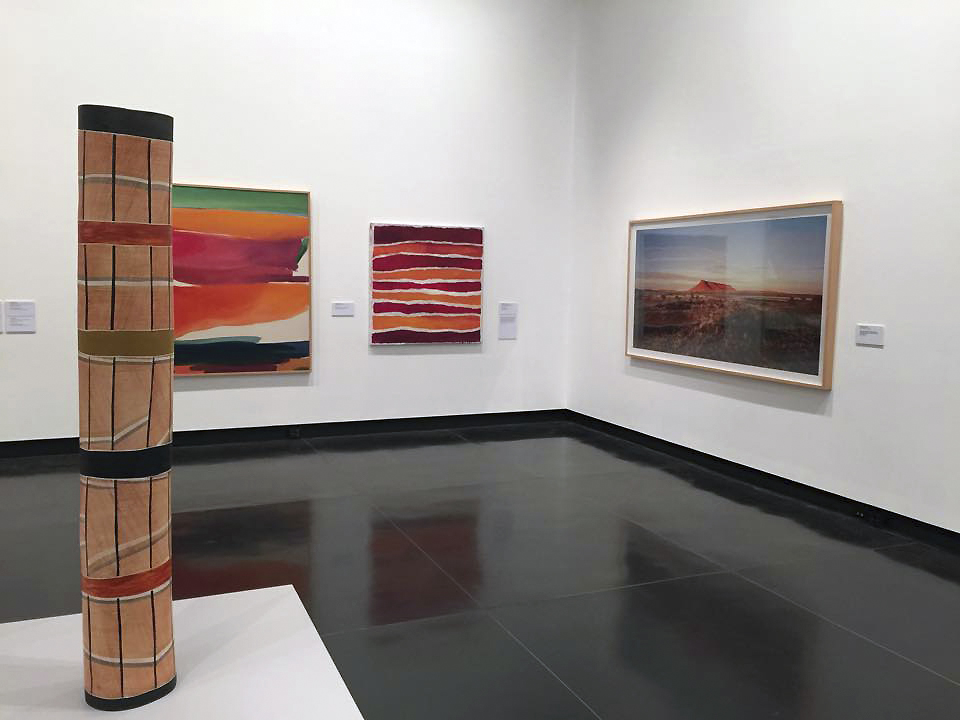
Installation view of the exhibition 'On the beach' at the Mornington Peninsula Regional Art Gallery


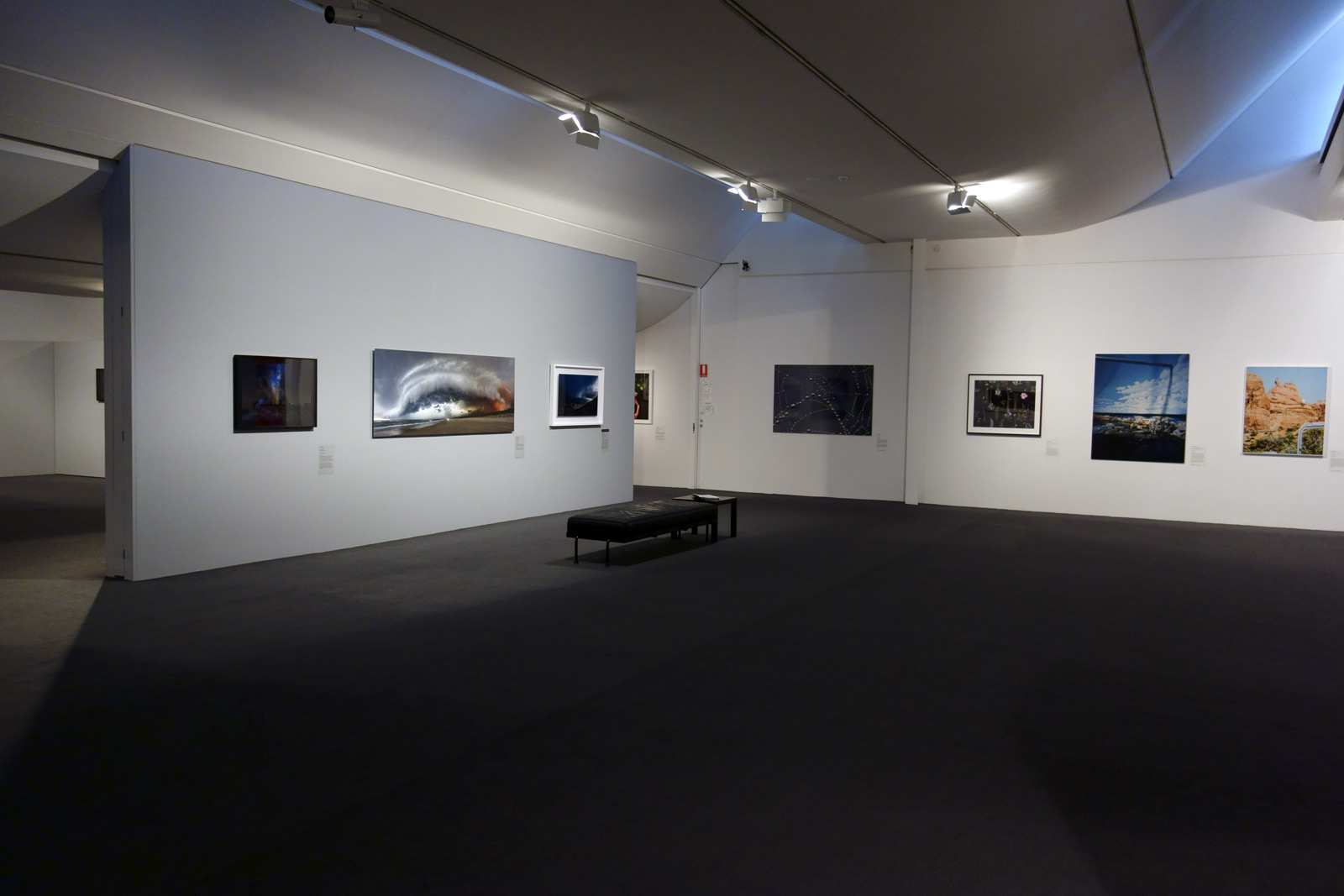
Installation view of the exhibition On the beach at the Mornington Peninsula Regional Art Gallery
Photo: © Marcus Bunyan and the Mornington Peninsula Regional Art Gallery


This is another solid thematic group exhibition at the Mornington Peninsula Regional Art Gallery (curator Wendy Garden), following on from their recent success, Storm in a teacup.

The exhibition is not as successful as Storm in a teacup, mainly because most of the works are based on the monolithic, monosyllabic representation of beach culture, and its figuration, during the early decades of the twentieth century (White Australia policy, Australian stereotypes of the interwar period) and the re-staging of these ideas in the contemporary art presented through a diachronic (through/time), performative discourse.

There is so much re-staging in this exhibition I was left to wonder whether there was any original art work being produced that does not quote sources of history, memory, identity, representation and art from past generations. Daniel Boyd re-stages Captain Cook’s landing at Botany Bay with said hero as a pirate. Stephen Bowers replicates the Minton willow pattern motif and early paintings of kangaroos. Leanne Tobin re-stages Bungaree’s disrobing on the beach during his journey with Matthew Flinders. Diane Jones re-stages Max Dupain’s Sunbaker replacing the anonymous prostrate man with her head looking into the camera, or Dupain’s Form at Bondi with her head turned towards the camera. Worst offender is Anne Zahalka who re-states Dupain’s Sunbaker (again!) as a red-headed white women on the beach; or re-presents Charles Meere’s Australian beach pattern (1940, below) not once but twice – the first time in The bathers (1989) broadening the racial background of people to depict multicultural Australia in the 1980s, the second time in The new bathers (2013) broadening the mix even further. Most successful of these re-stagings is Michael Cook’s series of photographs Undiscovered in which the artist subverts deeply ingrained understandings of settlement, that of terra nullius, by depicting Captain Cook as black and positioning him in high-key, grey photographs of impressive beauty and power, surveying the land he has ‘discovered’ while perched upon an invisibly balanced ladder.

But with all of the works that quote from the past there is a sense that, even as the artists are critiquing the culture, they are also buying into the system of patriarchy, racism and control that they seek to comment on. They do not subvert the situation, merely (and locally) extrapolate from it. The idealised, iconic representation of early 20th century Australia culture in the paintings from the 1920-30s and the photographs from the 1940s-70s – specimens of perfect physical beauty – are simply shifted to a new demographic – that of iconic, individual figures in the same poses as the 1940s but of a different ethnicity. The colour of the figure and the clothing might have changed, but the underlying structure remains the same. And if you disturb one of the foundation elements, such as the base figure in one of George Caddy’s balancing beachobatics photographs, the whole rotten edifice of a racism free, multicultural Australia will come tumbling down, just as it did during the Cronulla Riot.

What I would have liked to have seen in this exhibition was a greater breadth of subject matter. Where are the homeless people living near the beach, the sex (for example, as portrayed in Tracey Moffat’s voyeuristic home video Heaven which shows footage of male surfers changing out of their wetsuits in car parks – “shot by Moffatt and a number of other women as if they were making a birdwatching documentary” – which challenges the masculinity of Australian surf culture and the ability of women to stare at men, instead of the other way around), death (drownings on beaches, the heartbreak of loss), and debauchery (the fluxus of Schoolies, that Neo-Dada performance of noise and movement), the abstract nature of Pictorialist photographs of the beach, not to mention erosion and environmental loss due to global warming. The works presented seem to have a too narrowly defined conceptual base, and a present narrative constructed on a coterie of earlier works representing what it is to be Australian at the beach. The contemporary narrative does not address the fluidity of the landscape in present time (in works such as Narelle Autio’s series Watercolours or The place in between).

The dark underside of the beach, its abstract fluidity, its constant movement is least well represented in this exhibition. Although I felt engaged as a viewer the constant re-quoting and rehashing of familiar forms left me a little bored. I wanted more inventiveness, more insight into the conditions and phenomena of beach culture in contemporary Australia. An interesting exhibition but an opportunity missed.

Dr Marcus Bunyan


Many thankx to the Mornington Peninsula Regional Art Gallery for allowing me to publish most of the photographs in the posting. Other photographs come from Art Blart’s archive and those freely available online. Thankx also go to Manuela Furci, Director of the Rennie Ellis Photographic Archive for allowing me to publish his photographs in the posting. Please click on the photographs for a larger version of the image. All text comes from the wall labels to the exhibition. Images noted © Marcus Bunyan and the Mornington Peninsula Regional Art Gallery.


Installation view of the exhibition 'On the beach' at the Mornington Peninsula Regional Art Gallery with Daniel Boyd's 'We call them pirates out here' (2006)


Installation view of the exhibition On the beach at the Mornington Peninsula Regional Art Gallery with Daniel Boyd’s We call them pirates out here (2006, below)
Photo: © Marcus Bunyan and the Mornington Peninsula Regional Art Gallery


Daniel Boyd (Australian, b. 1982) 'We call them pirates out here' 2006 (installation view)


Daniel Boyd (Australian, b. 1982)
We call them pirates out here (installation view)
2006
Museum of Contemporary Art
Purchased with funds provided by the Coe and Mordant families, 2006
Photo: © Marcus Bunyan and the Mornington Peninsula Regional Art Gallery


“The landing of Captain Cook in Botany Bay, 1770 by E. Phillips Fox is such an iconic and important image relating to the birth of Australia. Shifting the proposed view of Fox’s painting to something that was an indigenous person’s perspective allowed for me to challenge the subjective history that has been created.”

Daniel Boyd, 2008


In this painting Daniel Boyd parodies E. Phillips Fox’s celebrated painting which was commissioned in 1902 by the Trustees of the National Gallery of Victoria to commemorate federation. No longer an image valorising colonial achievement, Boyd recasts the scene as one of theft and invasion. Captain Cook is depicted as a pirate to contest his heroic status in Australia’s foundation narratives. Smoke in the distance is evidence of human occupation and is a direct retort to the declaration that Australia was ‘terra nullius’ – land belonging to no-one, which was used to justify British possession.


Stephen Bowers (Australian, b. 1952) Peter Walker (board maker) (Australian, b. 1961) 'Antipodean willow surfboard' 2012 'Antipodean willow surfboard (Mini Simmons)' 2012 (installation view)


Stephen Bowers (Australian, b. 1952)
Peter Walker (board maker) (Australian, b. 1961)
Antipodean willow surfboard (installation view)
2012
Antipodean willow surfboard (Mini Simmons) (installation view)
2012
Hollow core surfboard, Paulownia wood, fibreglass, synthetic polymer paint
Courtesy of the artist and Lauraine Diggins Fine Art, Caulfield
Photo: © Marcus Bunyan and the Mornington Peninsula Regional Art Gallery
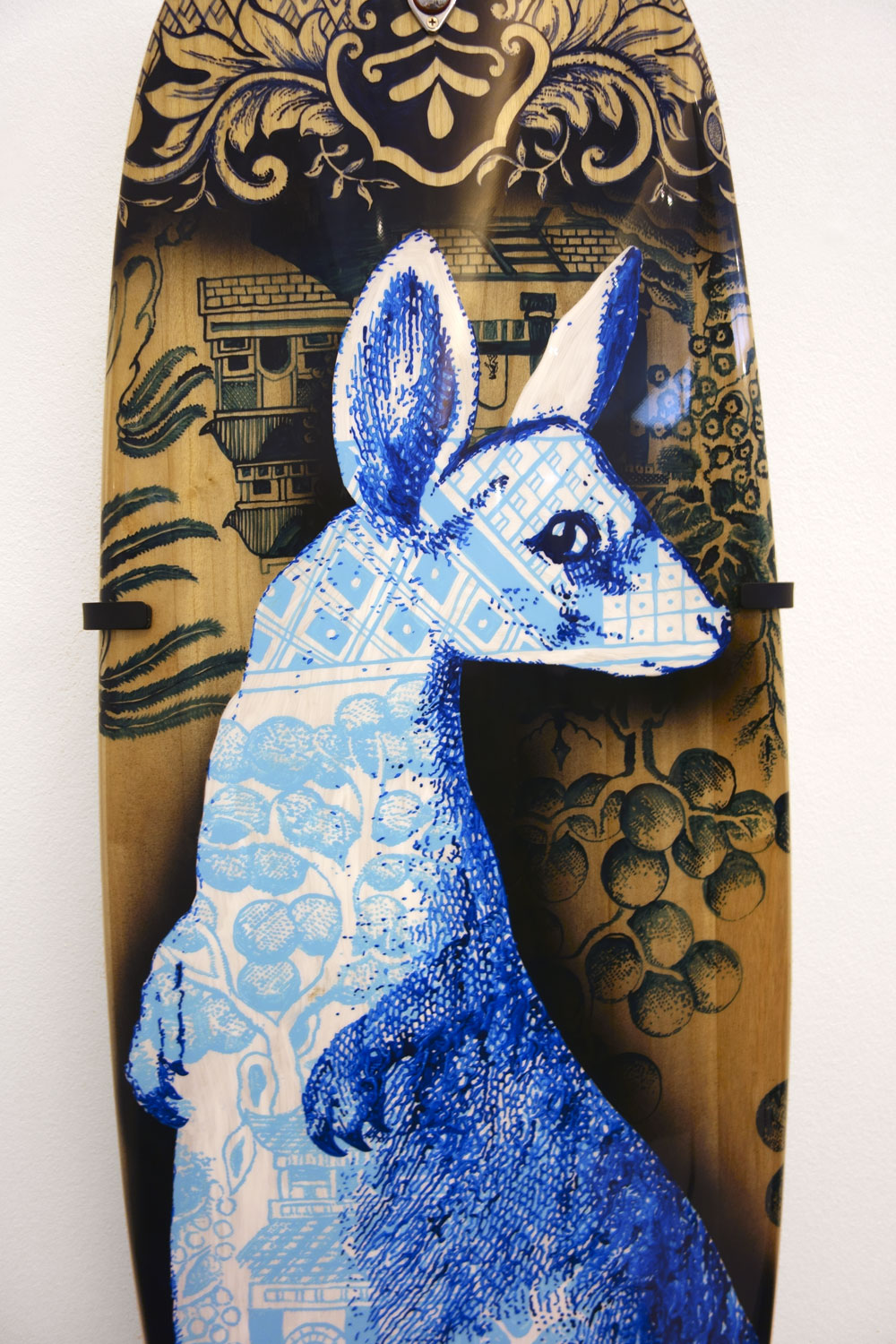
 

Stephen Bowers (Australian, b. 1952) Peter Walker (board maker) (Australian, b. 1961) 'Antipodean willow surfboard (Mini Simmons)' 2012 (installation view detail)


Stephen Bowers (Australian, b. 1952)
Peter Walker (board maker) (Australian, b. 1961)
Antipodean willow surfboard (Mini Simmons) (installation detail)
2012
Hollow core surfboard, Paulownia wood, fibreglass, synthetic polymer paint
Courtesy of the artist and Lauraine Diggins Fine Art, Caulfield
Photo: © Marcus Bunyan and the Mornington Peninsula Regional Art Gallery


In these works Bowers combines the willow pattern motif, a ready-made metaphor of hybridity, with an image of a kangaroo as envisioned by George Stubbs in 1772. The willow pattern as an English invention, created by Thomas Minton in 1790. It is an imaginative geography and, like the first known European painting of a kangaroo, considers other lands as strange, exotic places. In this work the imagery of colonial occupation is visualised as a fusion of cultures underpinned by half-truths, fantasy and desire.
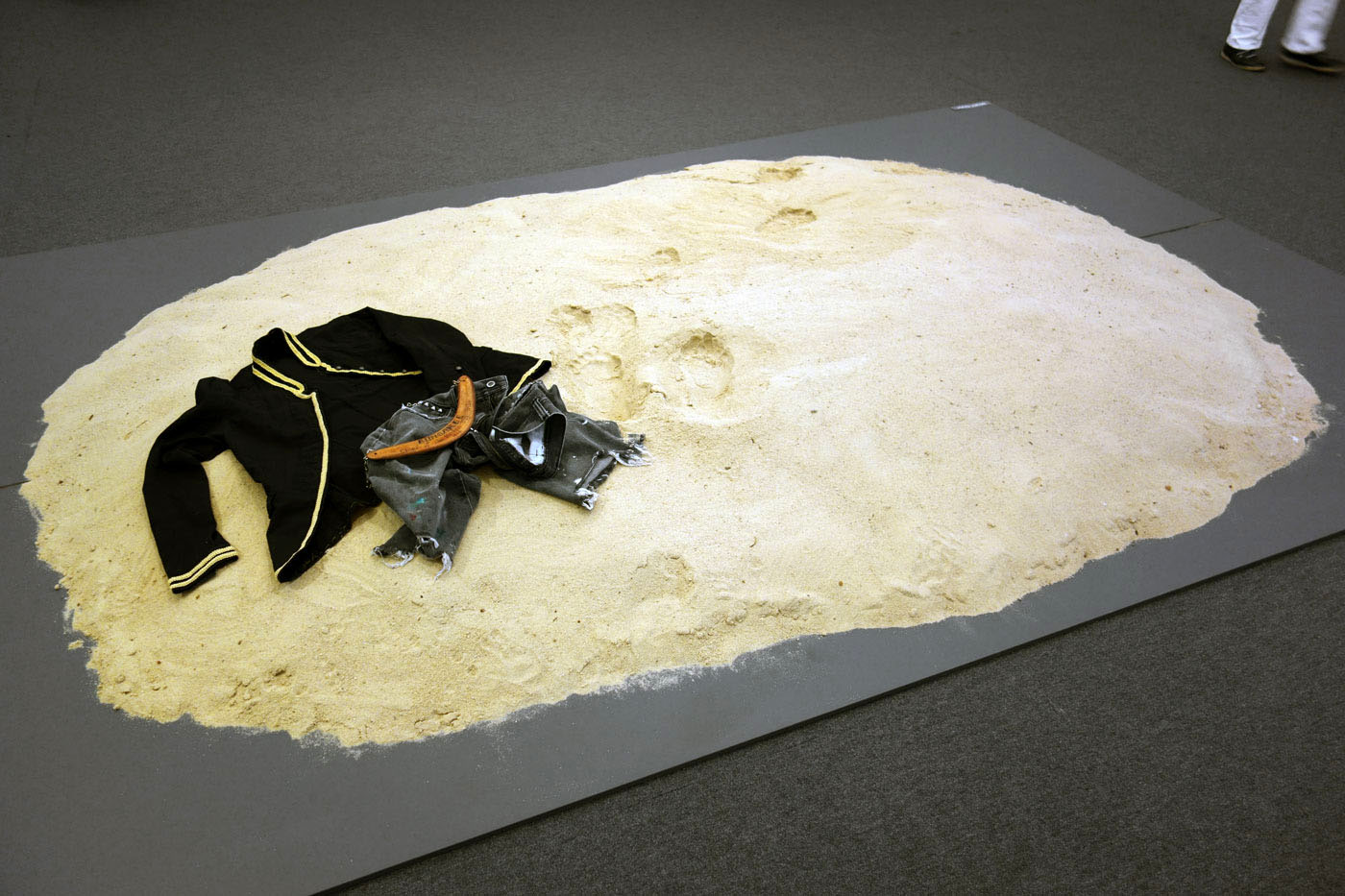
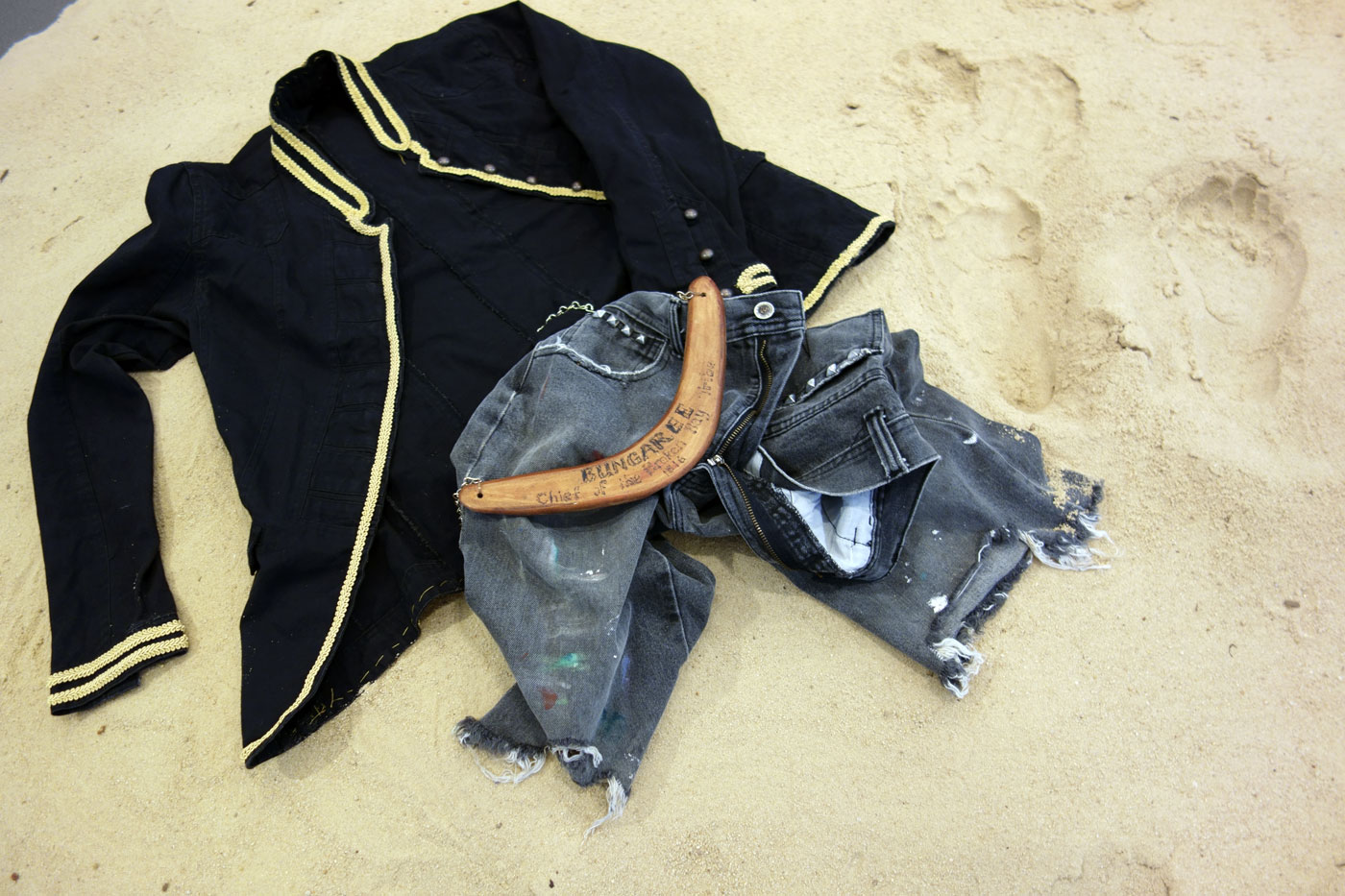
 

Leanne Tobin (Australian, b. 1961) 'Clothes don't always maketh the man' 2012 (installation view)

Leanne Tobin (Australian, b. 1961) 'Clothes don't always maketh the man' 2012 (installation view detail)


Installation views of Leanne Tobin’s Clothes don’t always maketh the man (2012)


Leanne Tobin (Australian, b. 1961)
Clothes don’t always maketh the man (installation details)
2012
Sand, textile, wood
Collection of the artist
Photos: © Marcus Bunyan and the Mornington Peninsula Regional Art Gallery


Bungaree (c. 1755-1830) was a Garigal man who circumnavigated the continent of Australia with Matthew Flinders on the H.M.S. Investigator between 1802-1803. Unlike Bennelong, who attempted to assimilate with British ways and Pemulwuy, who resisted, Bungaree made the decision to navigate a relationship with the British while still maintaining his cultural traditions. He played an important role as an envoy on Flinder’s voyages, negotiating with the different Aboriginal groups they encountered. A skilled mediator, Bungaree was adept at living between both worlds. When coming ashore he would shed his white man’s clothes so that he could conduct protocol relevant to the local elders. In this respect the beach became a zone of transformation and exchange.
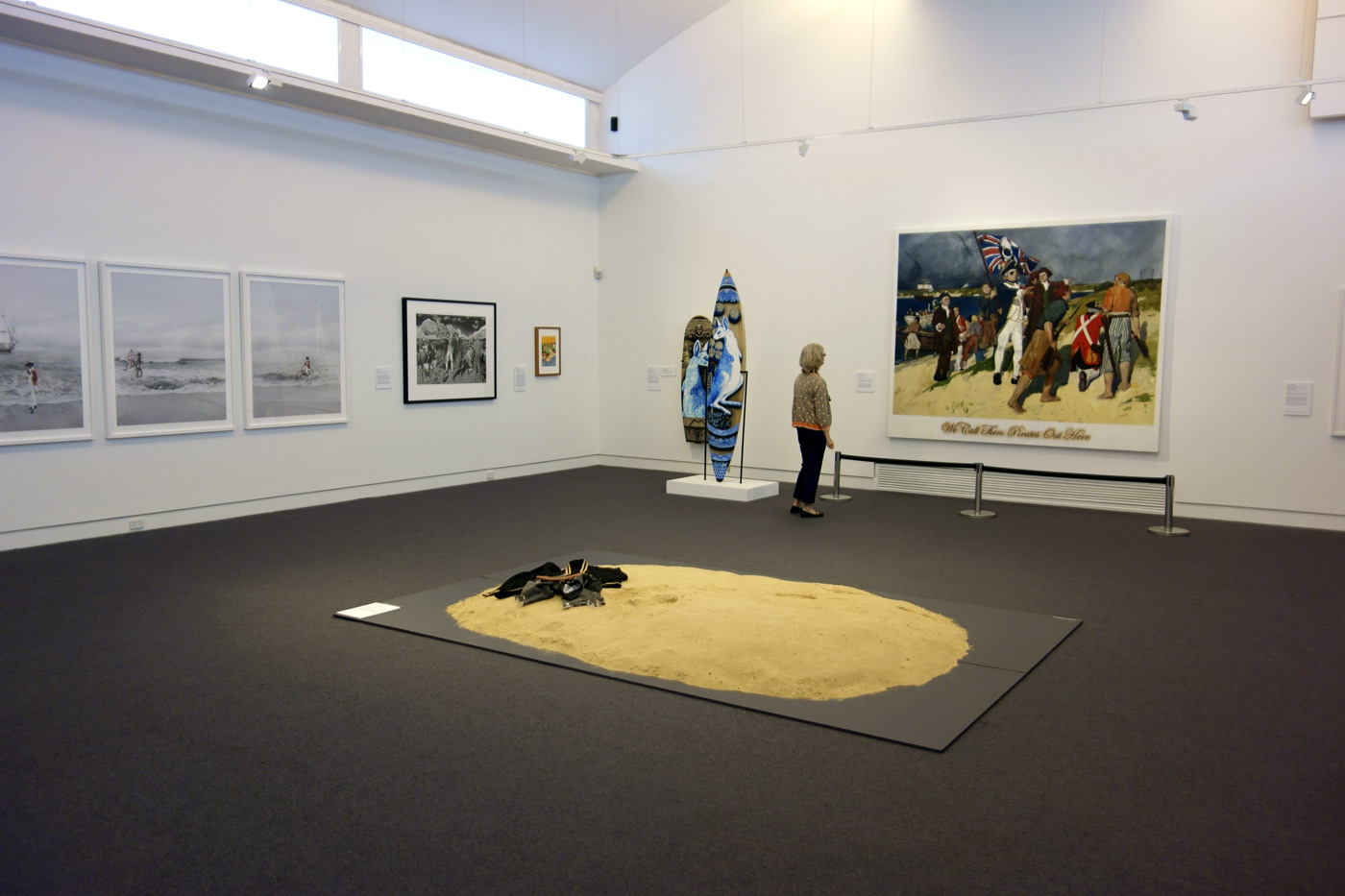
 

Installation view of the exhibition 'On the beach' at the Mornington Peninsula Regional Art Gallery with in the foreground, Leanne Tobin's 'Clothes don't always maketh the man' (2012), and in the background left, photographs from Michael Cook's 'Undiscovered' series (2010)

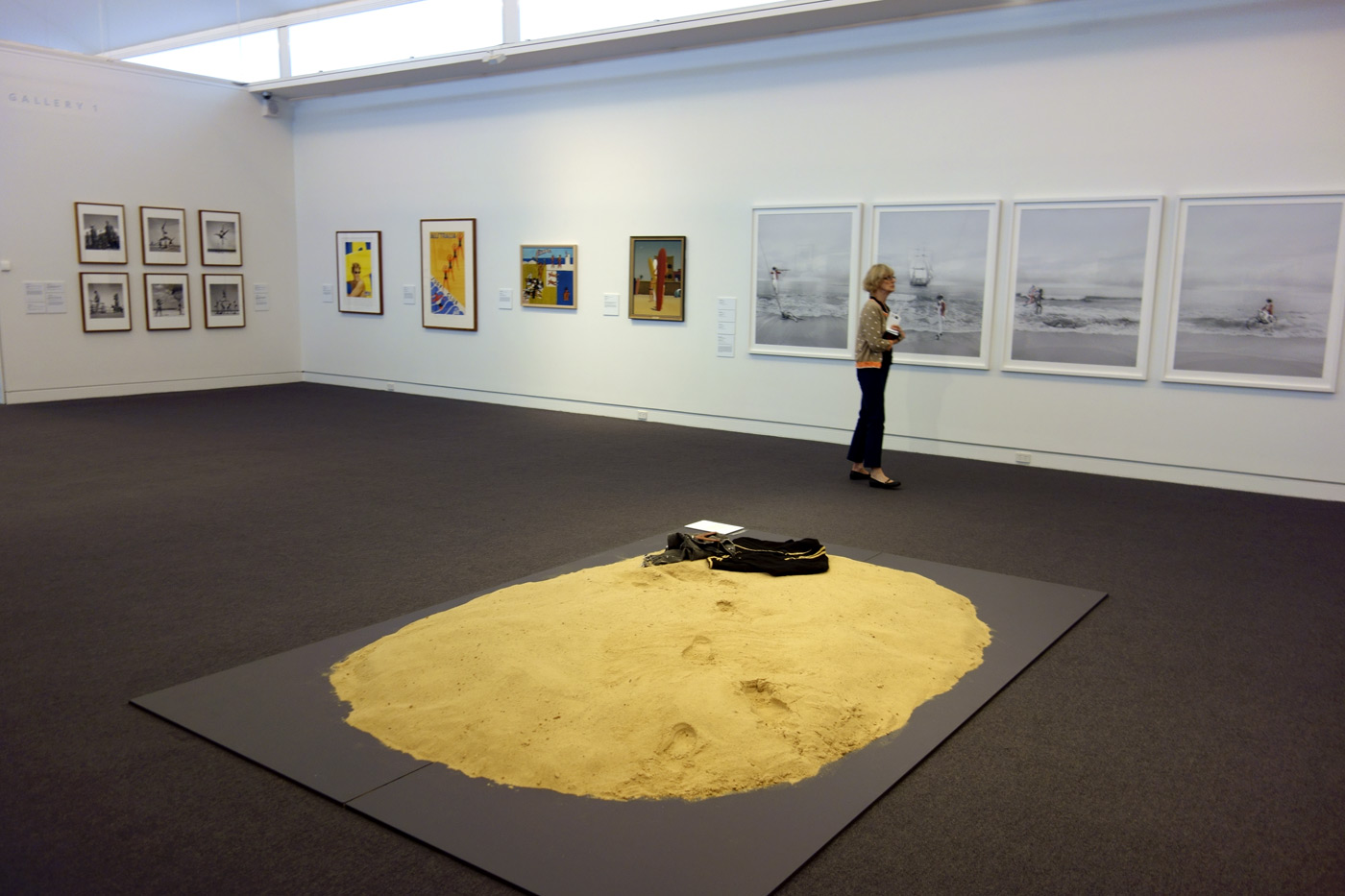
Installation view of the exhibition 'On the beach' at the Mornington Peninsula Regional Art Gallery with in the foreground, Leanne Tobin's 'Clothes don't always maketh the man' (2012), and in the background right, photographs from Michael Cook's 'Undiscovered' series (2010)


Installation views of the exhibition On the beach at the Mornington Peninsula Regional Art Gallery with in the foreground, Leanne Tobin’s Clothes don’t always maketh the man (2012), and in the background photographs from Michael Cook’s Undiscovered series (2010, below)
Photos: © Marcus Bunyan and the Mornington Peninsula Regional Art Gallery
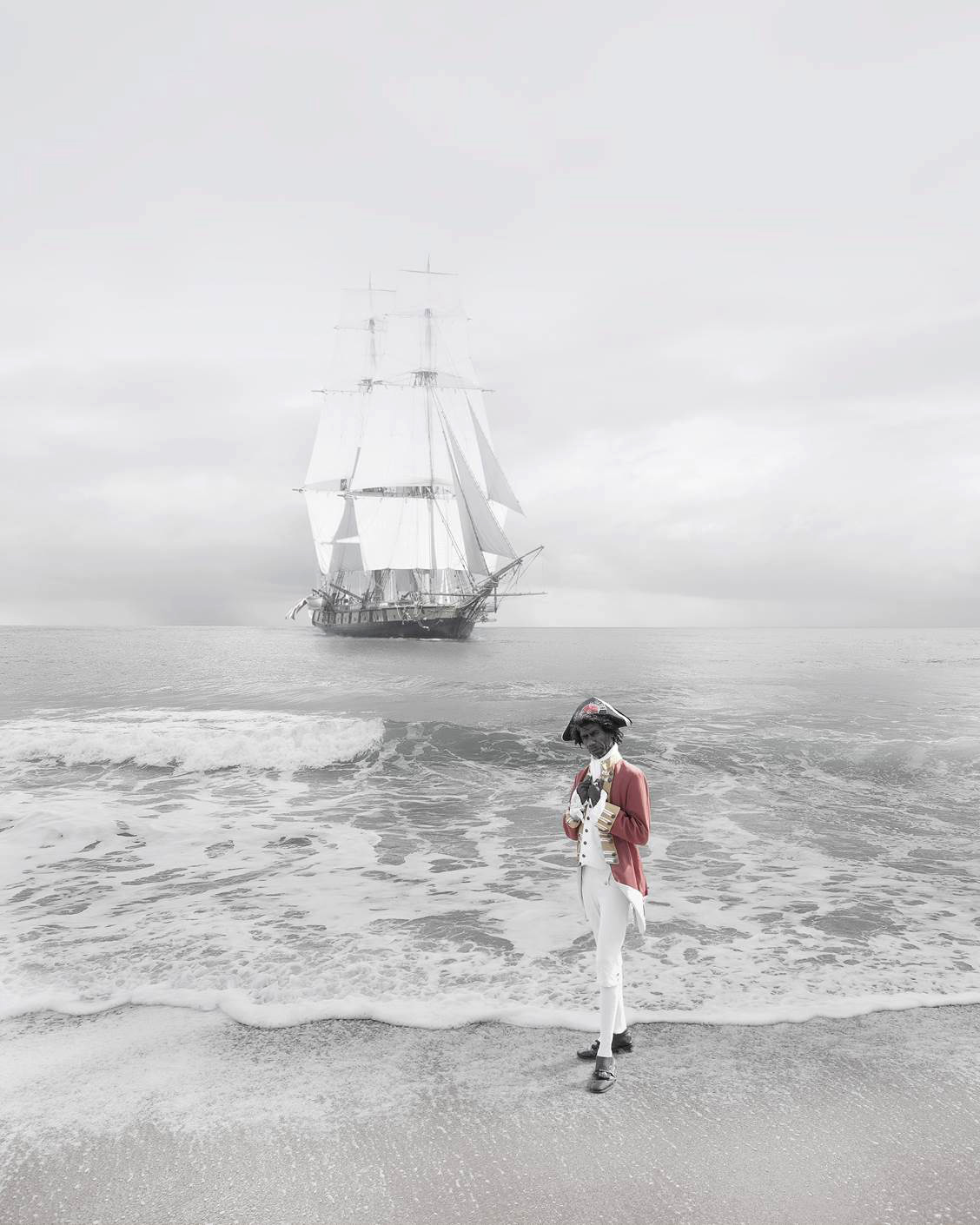
 

Michael Cook (Australian, b. 1968) 'Undiscovered 4' 2010 from the exhibition 'On the beach' at the Mornington Peninsula Regional Art Gallery, Mornington, Dec 2015 - Feb 2016


Michael Cook (Australian, b. 1968)
Undiscovered 4
2010
inkjet print on Hahnemuhle paper
124.0 x 100.0cm
Australian National Maritime Museum


A selection of works from a series of ten photographs in which Michael Cook contests the idea of ‘discovery’ that underpins narratives of the British settlement of Australia… Cook depicts the historic Cook as an Aboriginal man replete in his British naval officers attire. His ship, the famed Endeavour, is anchored in the sea behind him. By mimicking the moment of first discovery Cook subverts deeply ingrained understandings of settlement and asks us to consider what type of national Australia would be if the British had acknowledged Aboriginal people’s prior ownership.
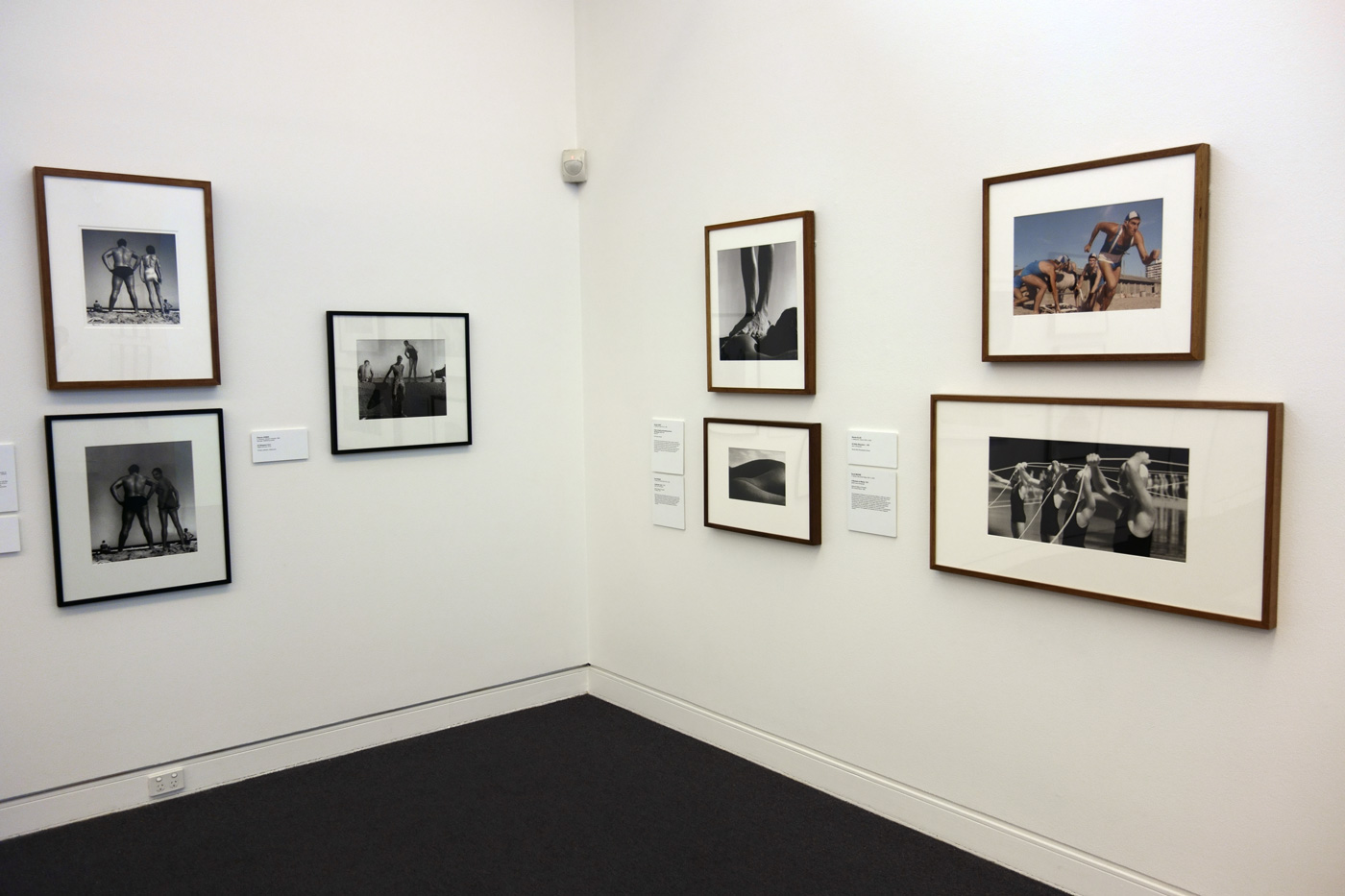
 

Installation view of the exhibition 'On the beach' at the Mornington Peninsula Regional Art Gallery showing, at top left, Max Dupain's 'Form at Bondi' (1939); to the right of that Dupain's 'At Newport' (1952); to the right upper is George Caddy's 'Chest strength and breathing exercise, 20 February 1937'; followed at far right by Rennie Ellis' 'St Kilda Lifesavers' (1968, top) and David Moore's 'Lifesavers at Manly' (1959, bottom)


Installation view of the exhibition On the beach at the Mornington Peninsula Regional Art Gallery showing, at top left, Max Dupain’s Form at Bondi (1939); to the right of that Dupain’s At Newport (1952, below); to the right upper is George Caddy’s Chest strength and breathing exercise, 20 February 1937 (below); followed at far right by Rennie Ellis’ St Kilda Lifesavers (1968, top) and David Moore’s Lifesavers at Manly (1959, bottom)
Photo: © Marcus Bunyan and the Mornington Peninsula Regional Art Gallery


Max Dupain (Australian, 1911-1992) 'At Newport' 1952, Sydney from the exhibition 'On the beach' at the Mornington Peninsula Regional Art Gallery, Mornington, Dec 2015 - Feb 2016


Max Dupain (Australian, 1911-1992)
At Newport
1952, Sydney
Silver gelatin photograph
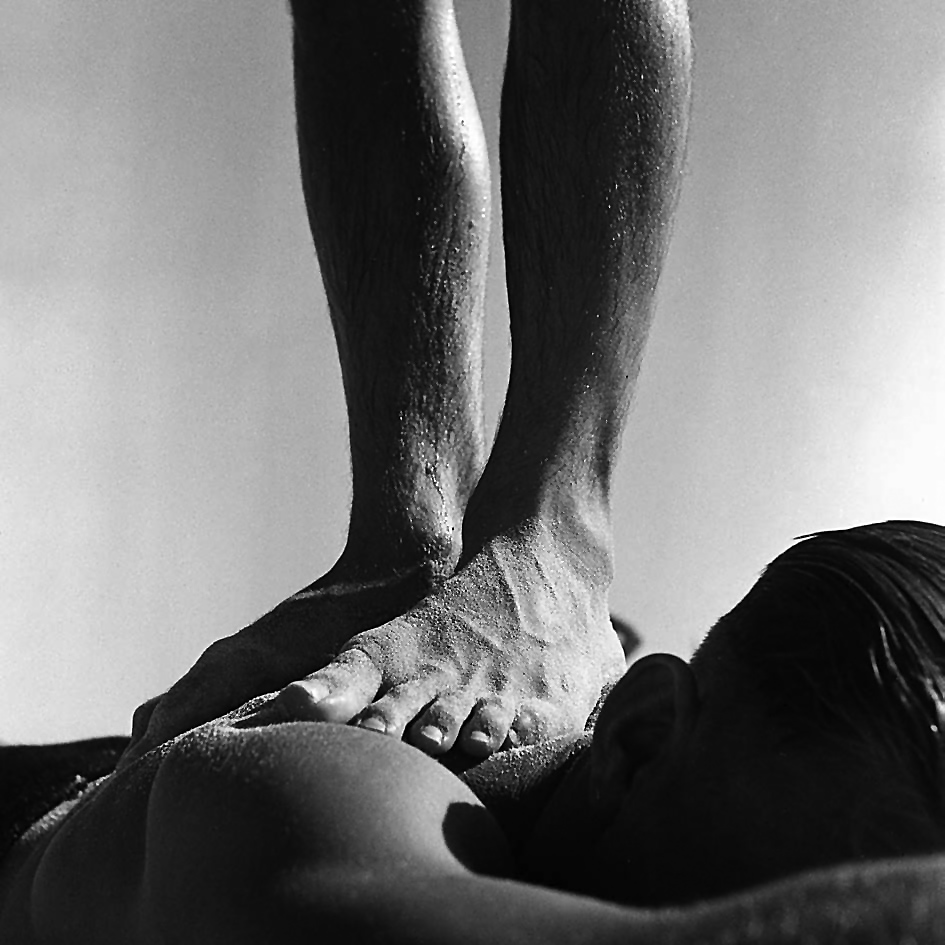
 

George Caddy (Australian, 1914-1983) 'Chest strength and breathing exercise, 20 February 1937' 1937


George Caddy (Australian, 1914-1983)
Chest strength and breathing exercise, 20 February 1937
1937
Digital print on paper
Paul Caddy collection
Courtesy of Paul Caddy


Like Max Dupain, who was three years his senior, Caddy was interested in the new modernist approach to photography. During 1936 he read magazines such as Popular Photography from New York and US Camera rather than Australasian Photo-Review which continued to champion soft-focus pictorialism. This photograph was taken the same year as Dupain’s famous Sunbather photograph. The framing and angle is similar reflecting their common interest in sharp focus, unusual vantage points and cold composition.
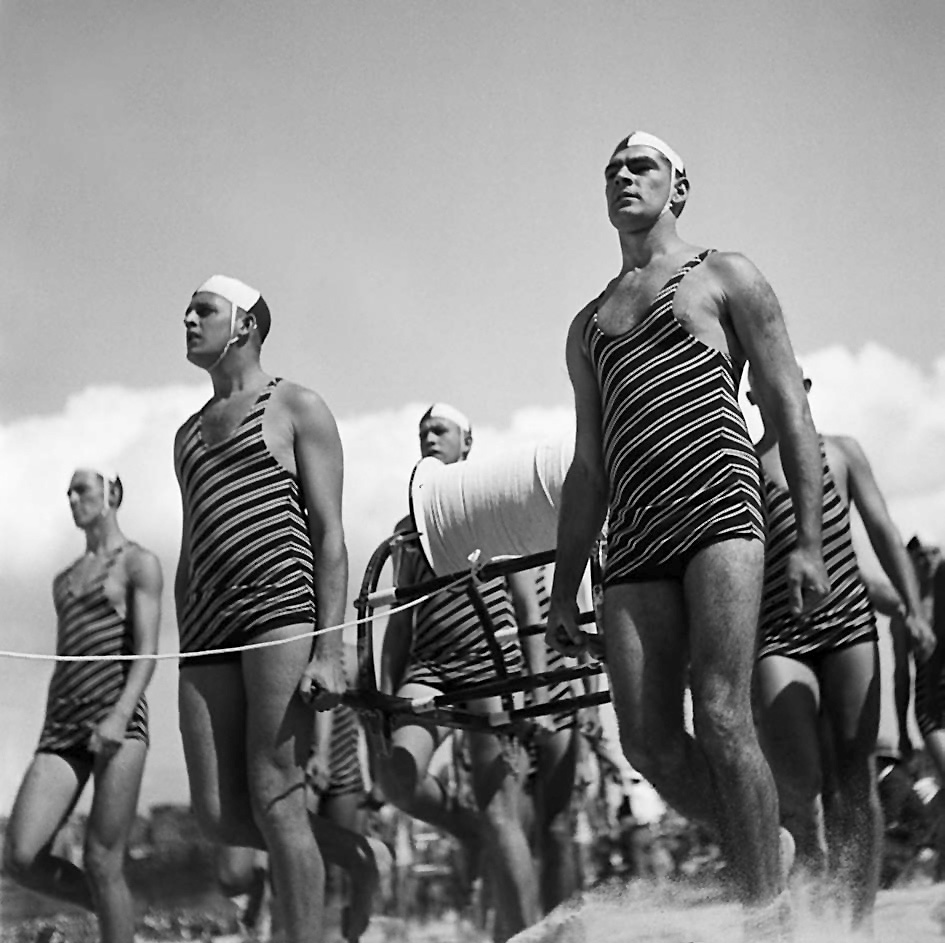
 

George Caddy (Australian, 1914-1983) 'Freshwater Surf Life Saving Club reel team march past, 3 April 1938' 1938


George Caddy (Australian, 1914-1983)
Freshwater Surf Life Saving Club reel team march past, 3 April 1938
1938
Digital print
Collection of the Mitchell Library, State Library of New South Wales
Purchased from Paul Caddy, 2008


This photograph was taken only months after an infamous rescue at Bondi. On 6 February 1938 a sand bar collapsed sweeping two hundred people out to sea. 80 lifesavers rescued all but 5 people in a day subsequently described as Black Sunday. By 1938 the Surf Life Saving Association, which incorporated clubs from around Australia, had rescued 39,149 lives in its 30 year history. In 1938 alone there were 3,442 rescues. Up until the events of Black Sunday no one had drowned while lifesavers were on duty at Australian beaches. In comparison 2,000 people drowned in England each year.1

1/ Alan Davies, Bondi Jitterbug: George Caddy and his amera, Sydney: State Library of New South Wales, p. 13.
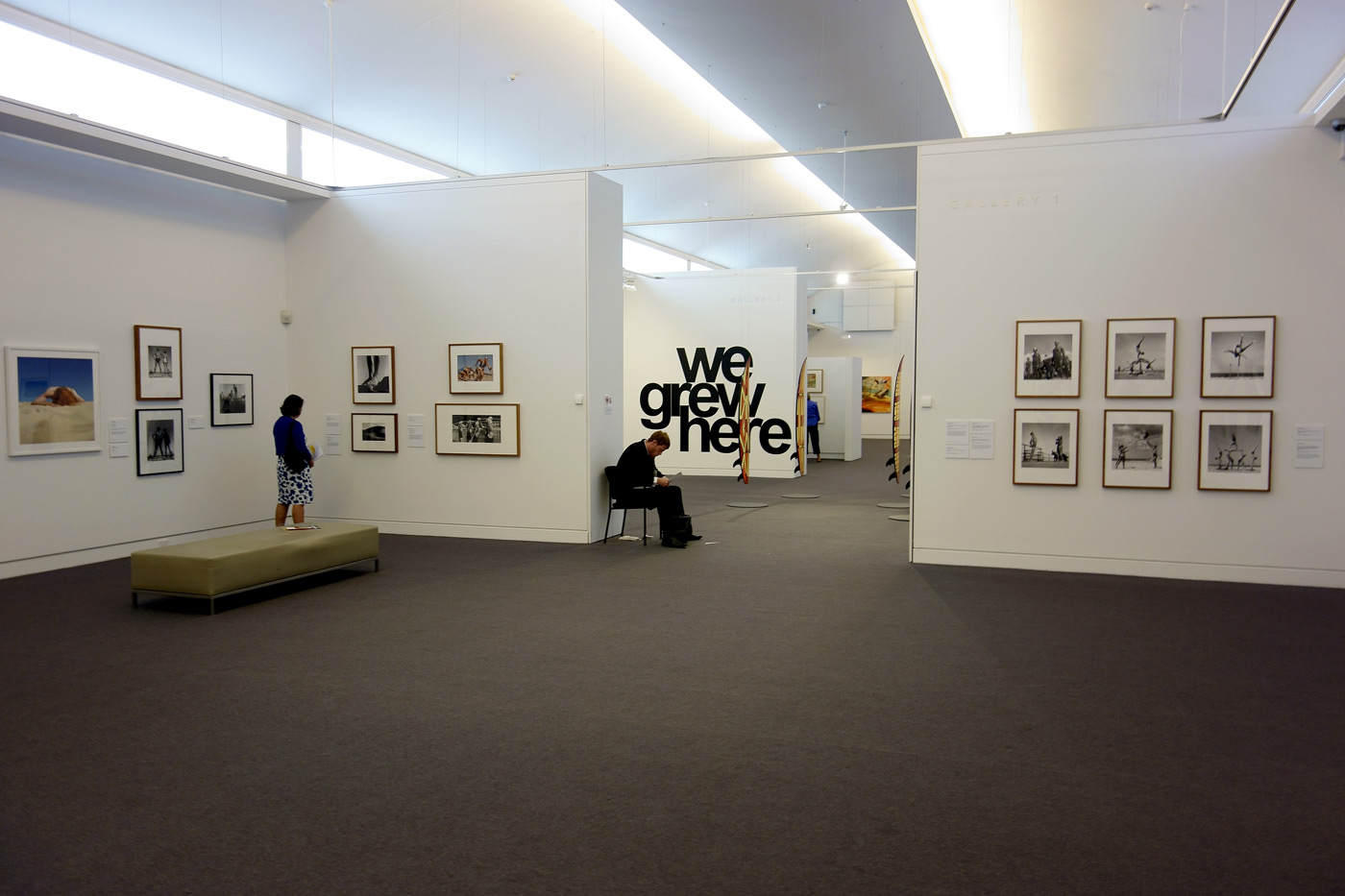
 

Installation view of the exhibition 'On the beach' at the Mornington Peninsula Regional Art Gallery showing at far left, Anne Zahalka's 'The sunbather #2' (1989) and, at right, a selection of George Caddy's beachobatics photographs


Installation view of the exhibition On the beach at the Mornington Peninsula Regional Art Gallery showing at far left, Anne Zahalka’s The sunbather #2 (1989, below) and, at right, a selection of George Caddy’s beachobatics photographs
Photo: © Marcus Bunyan and the Mornington Peninsula Regional Art Gallery


Installation view of the exhibition 'On the beach' at the Mornington Peninsula Regional Art Gallery showing at far left, Max Dupain's 'Sunbaker' (1937, top) with Diane Jones 'Sunbaker' (2003, below); in the centre Anne Zahalka's 'The sunbather #2' (1989); then Max Dupain's 'Form at Bondi' (1939, top) with Diane Jones 'Bondi' (2003) underneath


Installation view of the exhibition On the beach at the Mornington Peninsula Regional Art Gallery showing at far left, Max Dupain’s Sunbaker (1937, top) with Diane Jones Sunbaker (2003, below); in the centre Anne Zahalka’s The sunbather #2 (1989, below); then Max Dupain’s Form at Bondi (1939, top) with Diane Jones Bondi (2003) underneath
Photo: © Marcus Bunyan and the Mornington Peninsula Regional Art Gallery
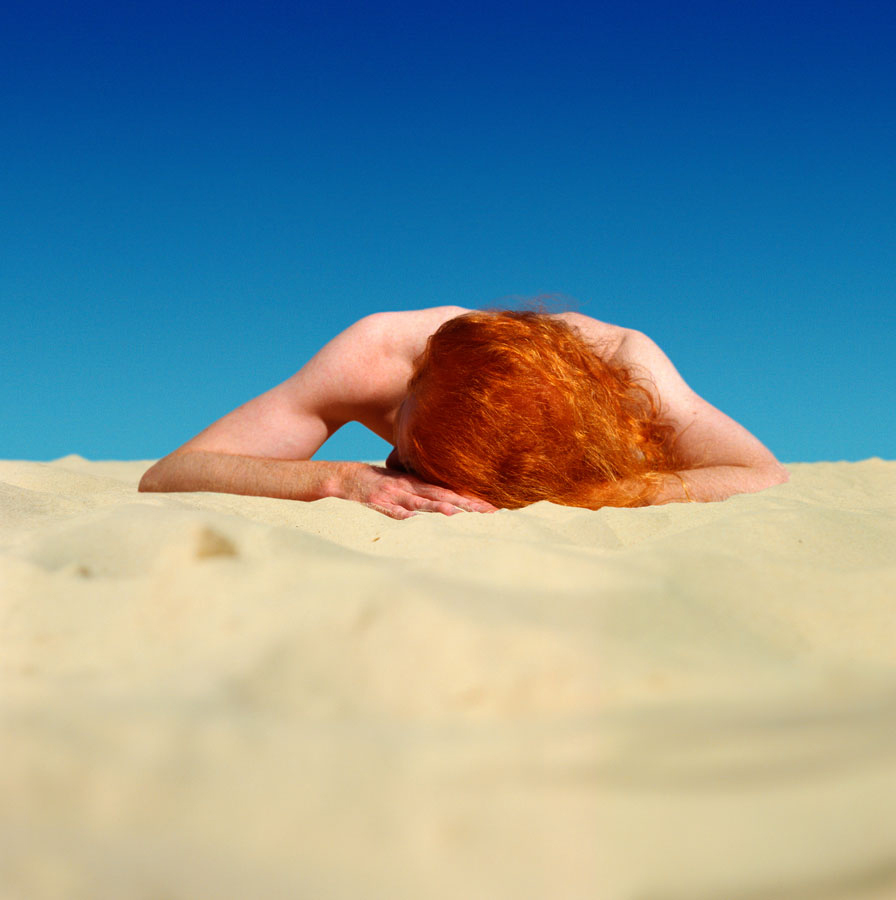
 

Anne Zahalka (Australian, b. 1957) 'The sunbather #2' 1989


Anne Zahalka (Australian, b. 1957)
The sunbather #2
1989
From the series Bondi: playground of the Pacific 1989
Type C photograph
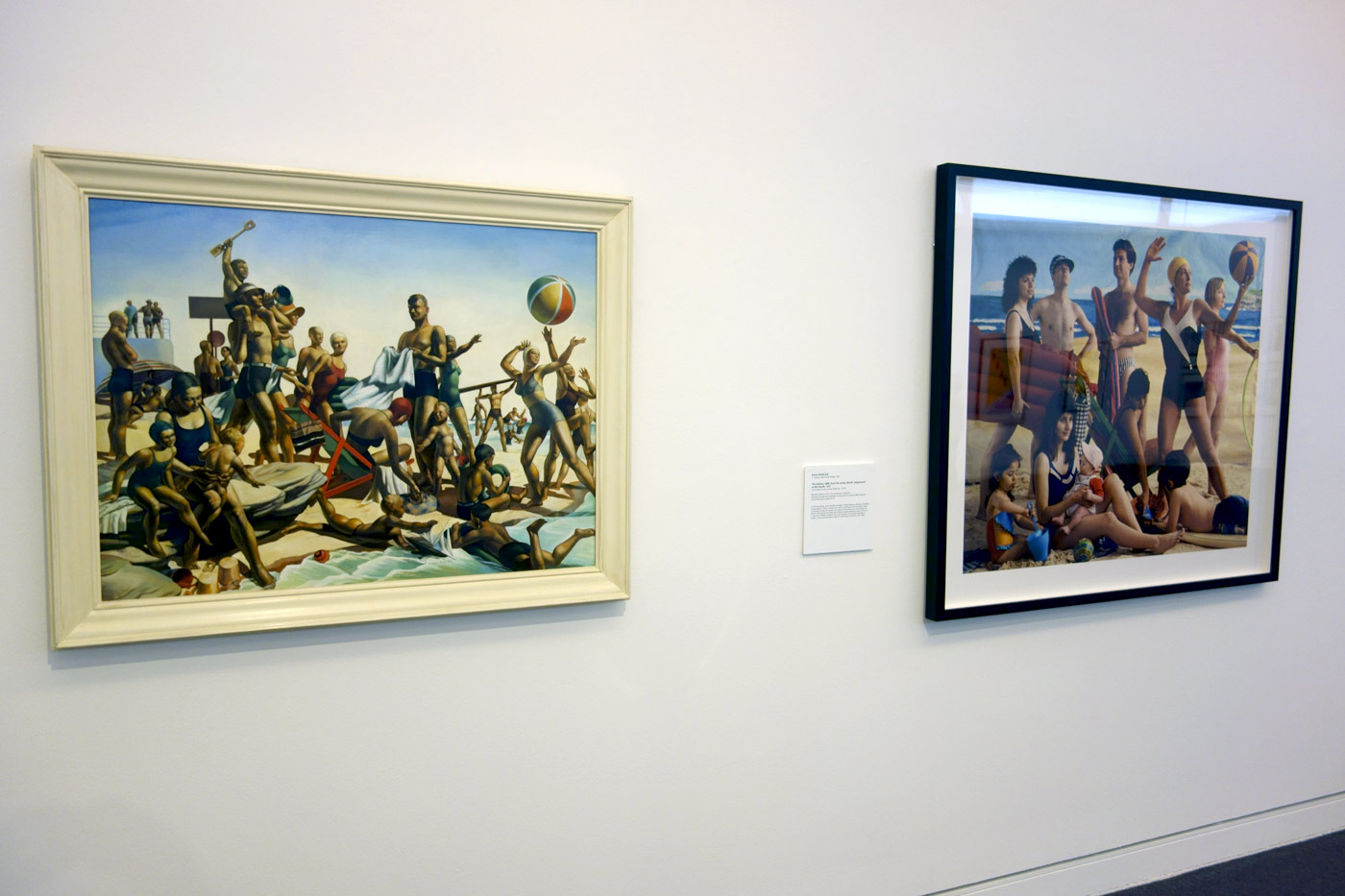
 

Installation photograph of Charles Meere's painting 'Australian beach pattern' (1940) and Anne Zahalka's photograph 'The bathers' (1989) from the series 'Bondi: playground of the Pacific' 1989


Installation photograph of Charles Meere’s painting Australian beach pattern (1940, below) and Anne Zahalka’s photograph The bathers (1989) from the series Bondi: playground of the Pacific 1989
Photo: © Marcus Bunyan and the Mornington Peninsula Regional Art Gallery


Zahalka restates Charles Meere’s painting in order to subvert the narrow stereotype of the Australian ideal… In this work Zahalka broadens the racial background of people depicted to create a more representative image of multicultural Australia in the 1980s
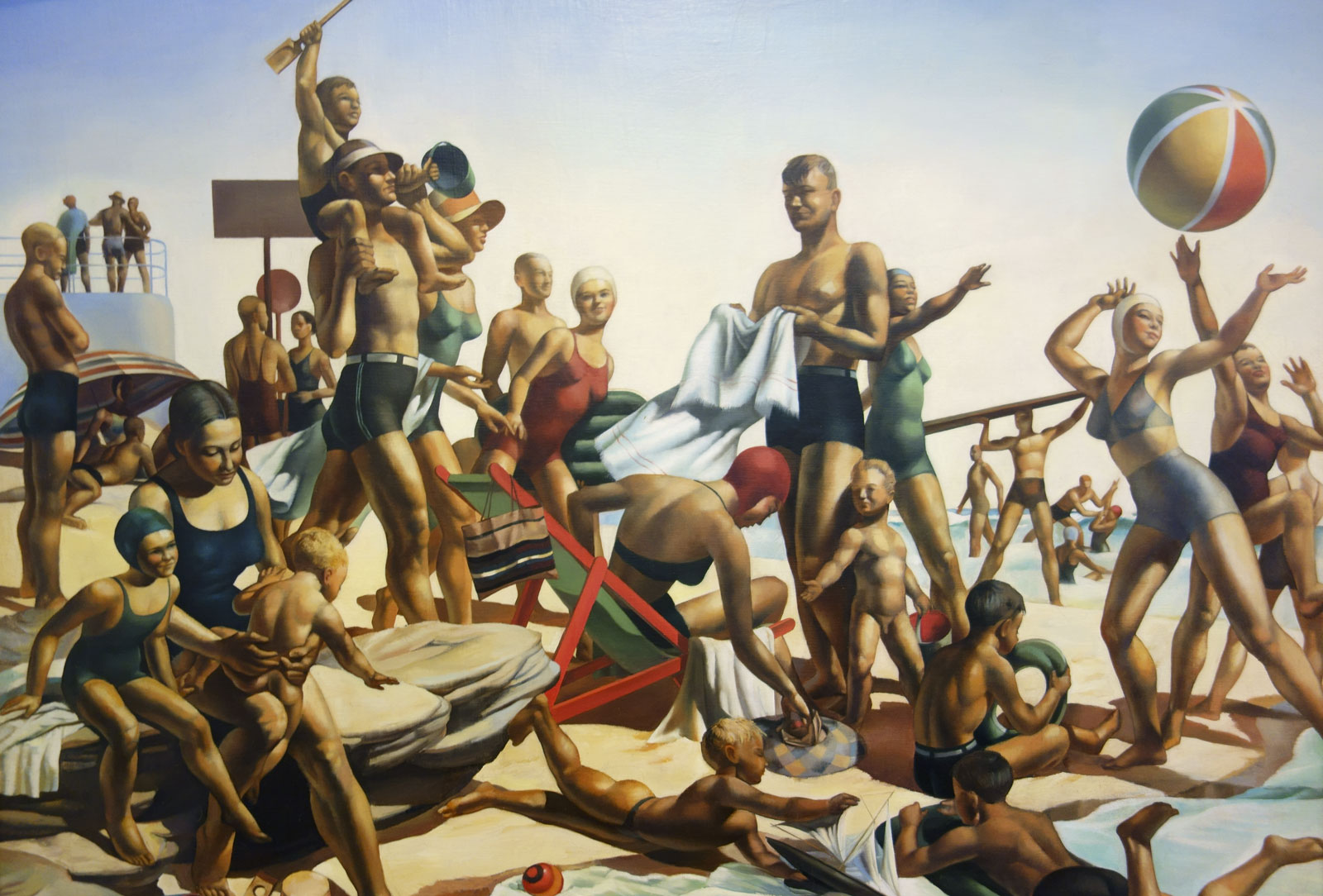
 

Charles Meere (Australian born England, 1890-1961) 'Australian beach pattern' 1940 (installation view detail)


Charles Meere (Australian born England, 1890-1961)
Australian beach pattern (installation view detail)
1940
Oil and wax on canvas
Collection of Joy Chambers-Grundy and Reg Grundy AC OBE
Photo: © Marcus Bunyan and the Mornington Peninsula Regional Art Gallery


A now iconic representation of early 20th century Australia culture… The scene is dominated by a mass of suntanned bodies: muscular, square-jawed white Australians – specimens of perfect physical beauty – enjoying the strenuous physical activities of the beach. A glorification of the strong, healthy, racially pure Australian ideal of the 1930s, it is eerily reminiscent of Nazi German Aryan propaganda between the wars.

Notably, the figures themselves all appear anonymous and disconnected, with indistinct facial features that show no acknowledgement of their fellow beach-goers. Their identities are overwhelmed by Meere’s obsession with arrangement. Rather than reflect real life, the figures are placed to create an idealised work of perfect balance. It is fascinating to consider that this iconic representation of Australian beach culture actually came from the imagination of an Englishman, who had only lived in Australia since the mid-1930s and who, according to his apprentice, ‘never went to the beach’ and ‘made up most of the figures’.1

1/ Freda Robertshaw quoted in Linda Slutzkin, Charles Meere 1890-1961. Sydney: S. H. Ervin Gallery, 1987, p. 6.
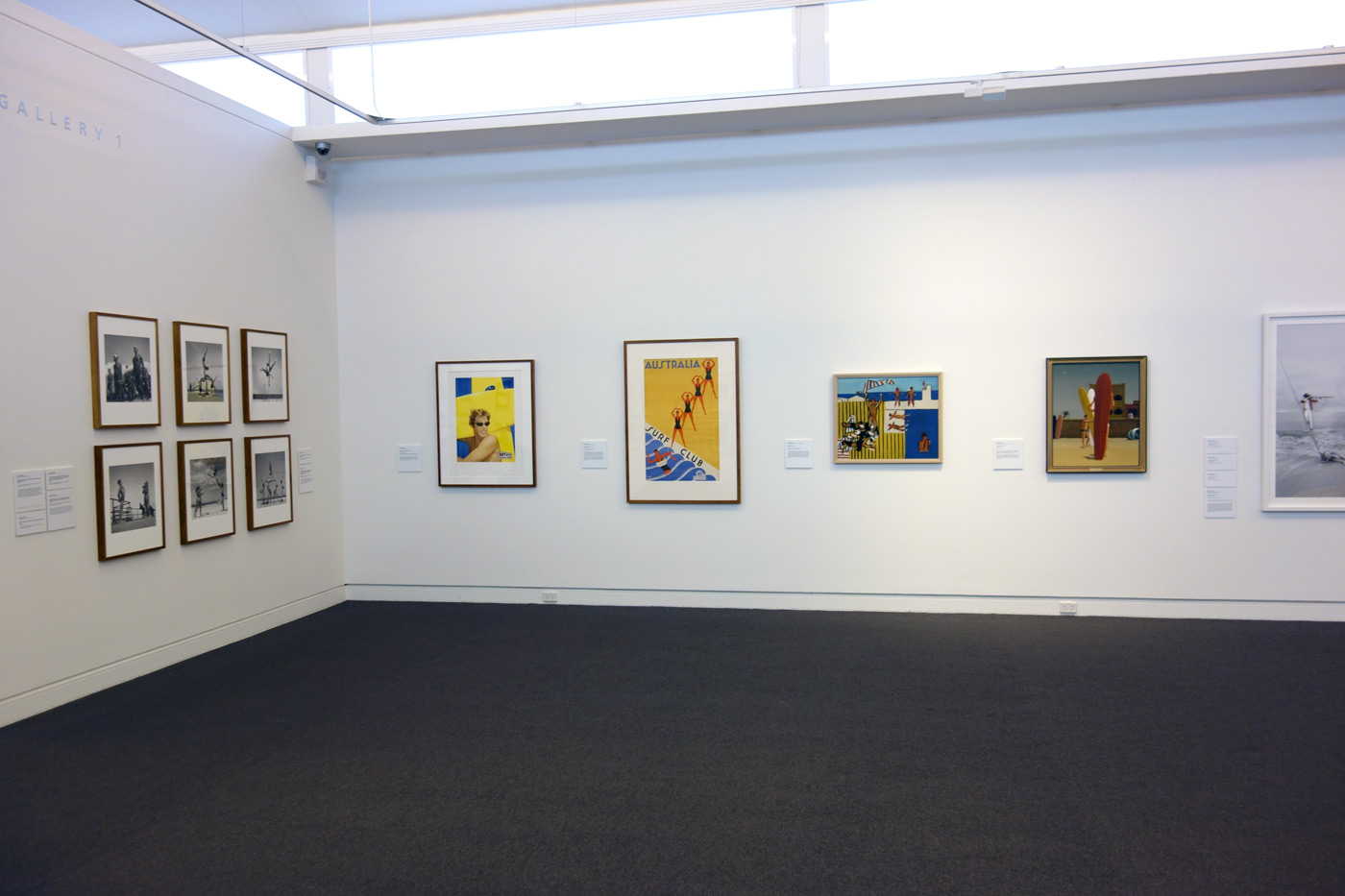
 

Installation view of the exhibition 'On the beach' at the Mornington Peninsula Regional Art Gallery showing at far left, George Caddy's beachobatic photographs, and on the far wall Sidney Nolan's 'Bathers' (1943) and Jeffrey Smart's 'Surfers Bondi' (1963)


Installation view of the exhibition On the beach at the Mornington Peninsula Regional Art Gallery showing at far left, George Caddy’s beachobatic photographs, and on the far wall Sidney Nolan’s Bathers (1943, below) and Jeffrey Smart’s Surfers Bondi (1963, below)
Photo: © Marcus Bunyan and the Mornington Peninsula Regional Art Gallery


Sidney Nolan (Australian, 1917-1992) 'Bathers' 1943 (installation view)


Sidney Nolan (Australian, 1917-1992)
Bathers (installation view)
1943
Ripolin enamel on canvas
Headed Museum of Modern Art, Melbourne
Bequest of John and Sunday Reed, 1982
Photo: © Marcus Bunyan and the Mornington Peninsula Regional Art Gallery
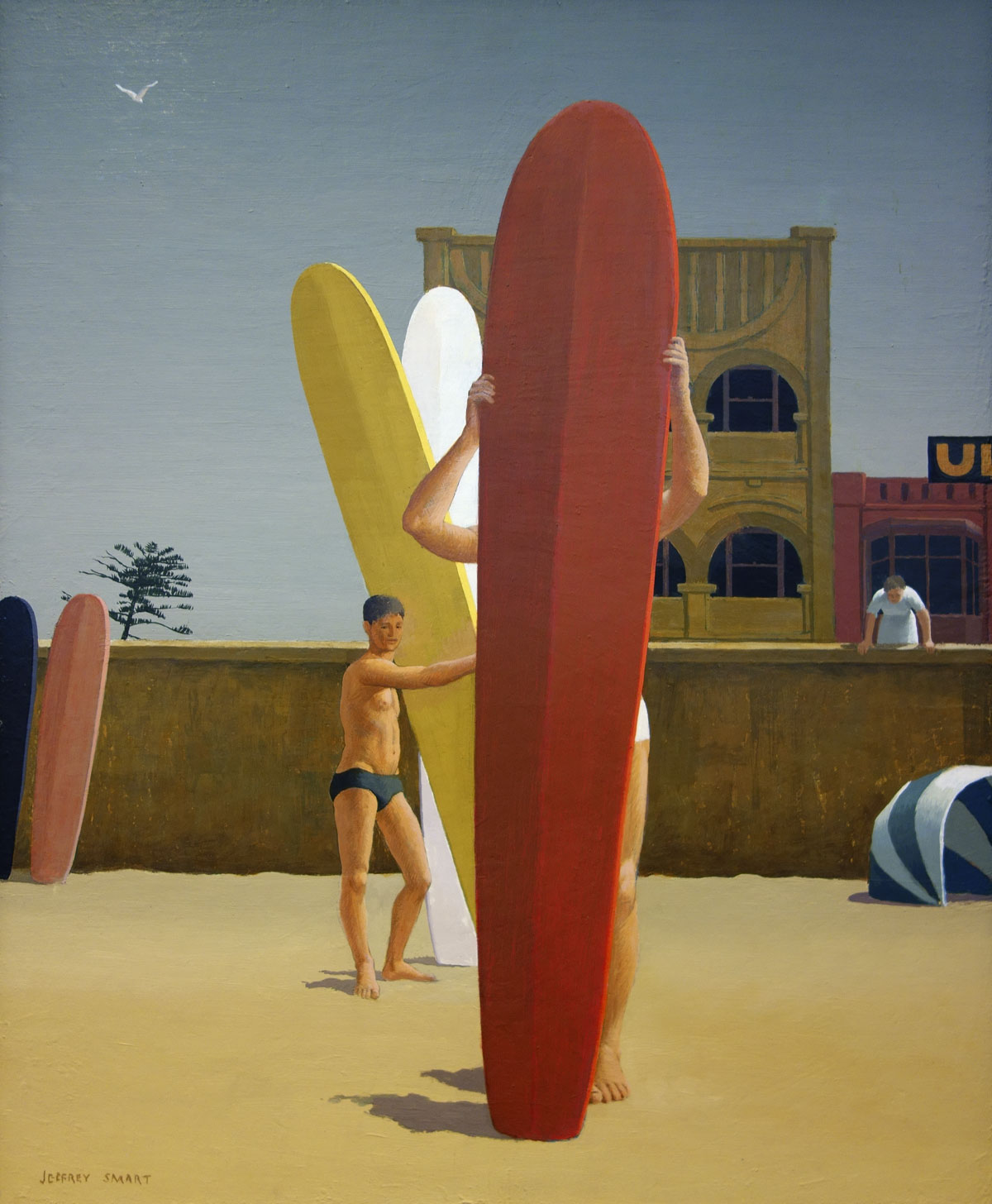
 

Jeffrey Smart (Australian, 1921-2013) 'Surfers Bondi' 1963 (installation view)


Jeffrey Smart (Australian, 1921-2013)
Surfers Bondi
1963
Oil on board
Private collection


When bans on daylight bathing were lifted in 1902, the beach became a prime leisure destination. The beach became not only as a public space of recreation but also as a place where the Australian identity was developing, for many epitomising the liberties of Australia’s society. On the beach brings together 76 outstanding and iconic paintings, photographs and installations to consider the defining relationship we have to the shore.

Works by artists including Vernon Ah Kee, Arthur Boyd, Gordon Bennett, Daniel Boyd, Max Dupain, Charles Meere, Tracey Moffatt, David Moore, Sidney Nolan, Polixeni Papapetrou, John Perceval, Scott Redford, Jeffrey Smart, Albert Tucker, Guan Wei and Anne Zahalka, as well as outstanding recently discovered works by George Caddy (see above). A champion jitterbug dancer, Caddy’s photographs of ‘beachobatics’ were kept undisturbed in a shoebox for 60 years until they were ‘discovered’ by his son after his death. They capture the exuberance and optimism of Australian society between the wars.

The beach first became a prime leisure destination in the early decades of the twentieth century. Up to Federation many artists had looked to the bush to galvanise a fledging nationalism, but during the interwar years this shifted and increasingly the beach became the site of Australian identity. Already by 1908 one Melbourne newspaper commented upon the ‘vast throng of holidaymakers all along the coast.’ In the years following the First World War, against a backdrop of a growing interest in physical fitness, the beach was seen as a place for creating ‘a fine healthy race of men.’ Understandings of the beach as an Australian way of life emerged during this period and increasingly the Australian type was associated with bronzed athletic bodies on the beach.

On the beach looks at artists’ responses to the stereotype of the interwar period and juxtaposes modernist works with contemporary artists’ responses to include a more culturally diverse mix of people. Other artists in the exhibition challenge understandings of the beach as a benign space and consider the history of violence that is latent.

Press release from the Mornington Peninsula Regional Art Gallery
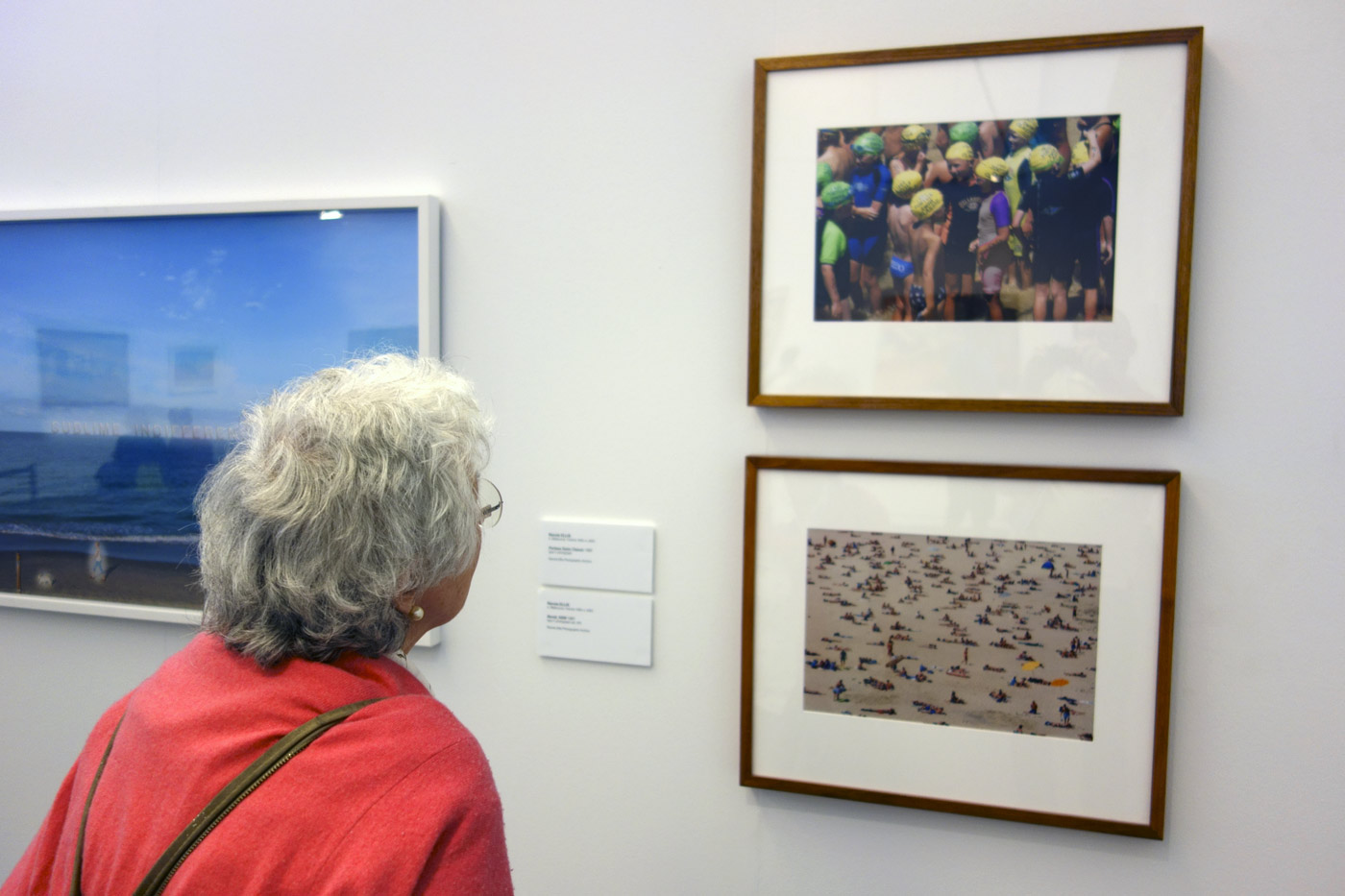
 

Photographer Joyce Evans looking at two colour photographs by Rennie Ellis in the exhibition 'On the beach' at the Mornington Peninsula Regional Art Gallery


Photographer Joyce Evans looking at two colour photographs by Rennie Ellis in the exhibition
Photo: © Marcus Bunyan and the Mornington Peninsula Regional Art Gallery


Installation view of the exhibition 'On the beach' at the Mornington Peninsula Regional Art Gallery showing on the wall left hand side, photographs by Rennie Ellis


Installation view of the exhibition On the beach at the Mornington Peninsula Regional Art Gallery showing on the wall left hand side, photographs by Rennie Ellis
Photo: © Marcus Bunyan and the Mornington Peninsula Regional Art Gallery


Installation view of the exhibition 'On the beach' at the Mornington Peninsula Regional Art Gallery showing on the wall right hand side, photographs by Rennie Ellis; and at right, Fiona Foley's 'Nulla 4 eva IV' (2009)


Installation view of the exhibition On the beach at the Mornington Peninsula Regional Art Gallery showing on the wall right hand side, photographs by Rennie Ellis; and at right, Fiona Foley’s Nulla 4 eva IV (2009)
Photo: © Marcus Bunyan and the Mornington Peninsula Regional Art Gallery
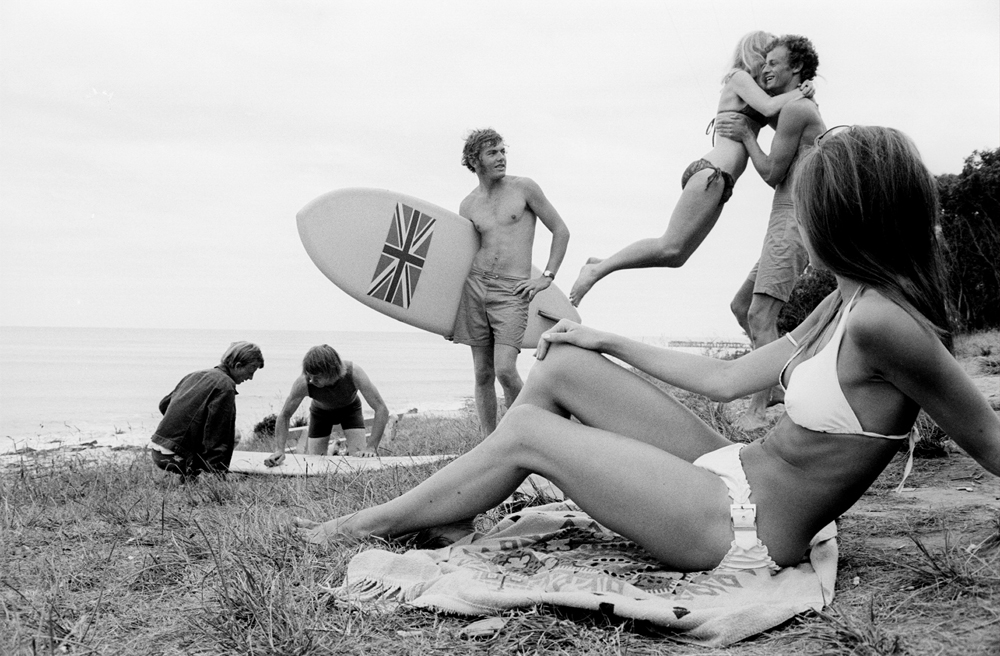
 

Rennie Ellis (Australian, 1940-2003) 'Union Jack, Lorne' c. 1968


Rennie Ellis (Australian, 1940-2003)
Union Jack, Lorne
c. 1968
Silver gelatin selenium toned fibre-based print
Rennie Ellis Photographic Archive
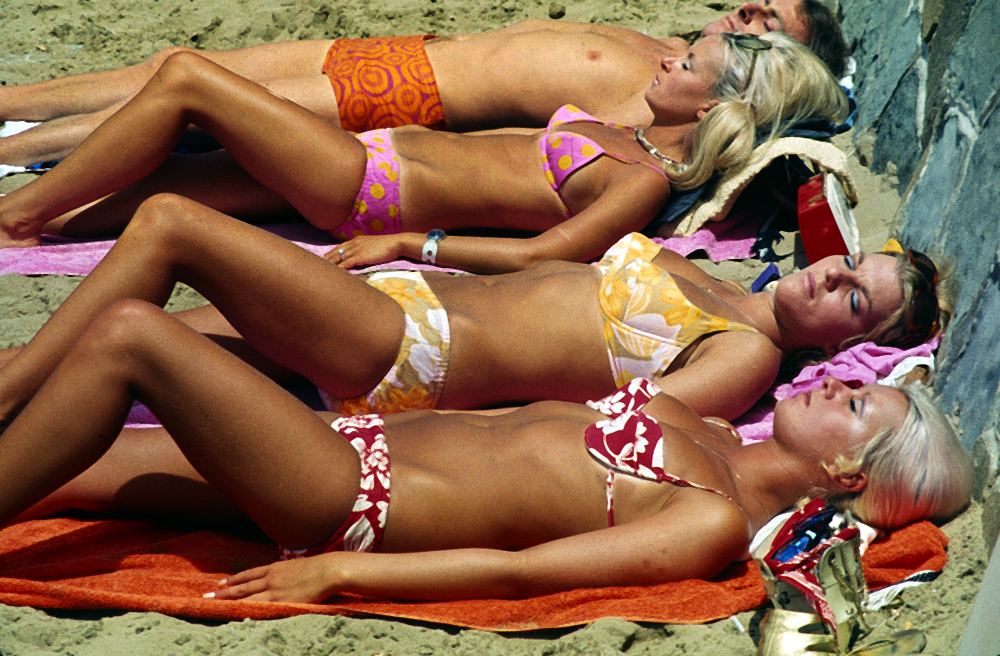
 

Rennie Ellis (Australian, 1940-2003) 'Four Sunbathers, Lorne' c. 1968


Rennie Ellis (Australian, 1940-2003)
Four Sunbathers, Lorne
c. 1968
Type C photograph (ed. AP)
Rennie Ellis Photographic Archive
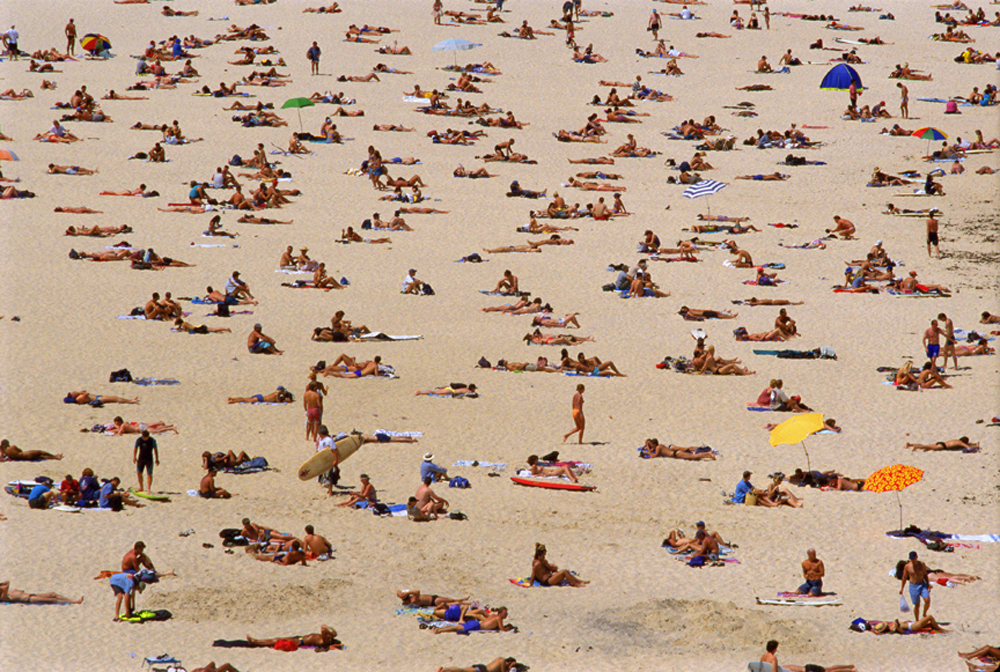
 

Rennie Ellis (Australian, 1940-2003) 'Bondi, New South Wales' 1997


Rennie Ellis (Australian, 1940-2003)
Bondi, New South Wales
1997


“On the beach we chuck away our clothes, our status and our inhibitions and engage in rituals of sun worship and baptism. It’s a retreat to our primal needs.”

Rennie Ellis
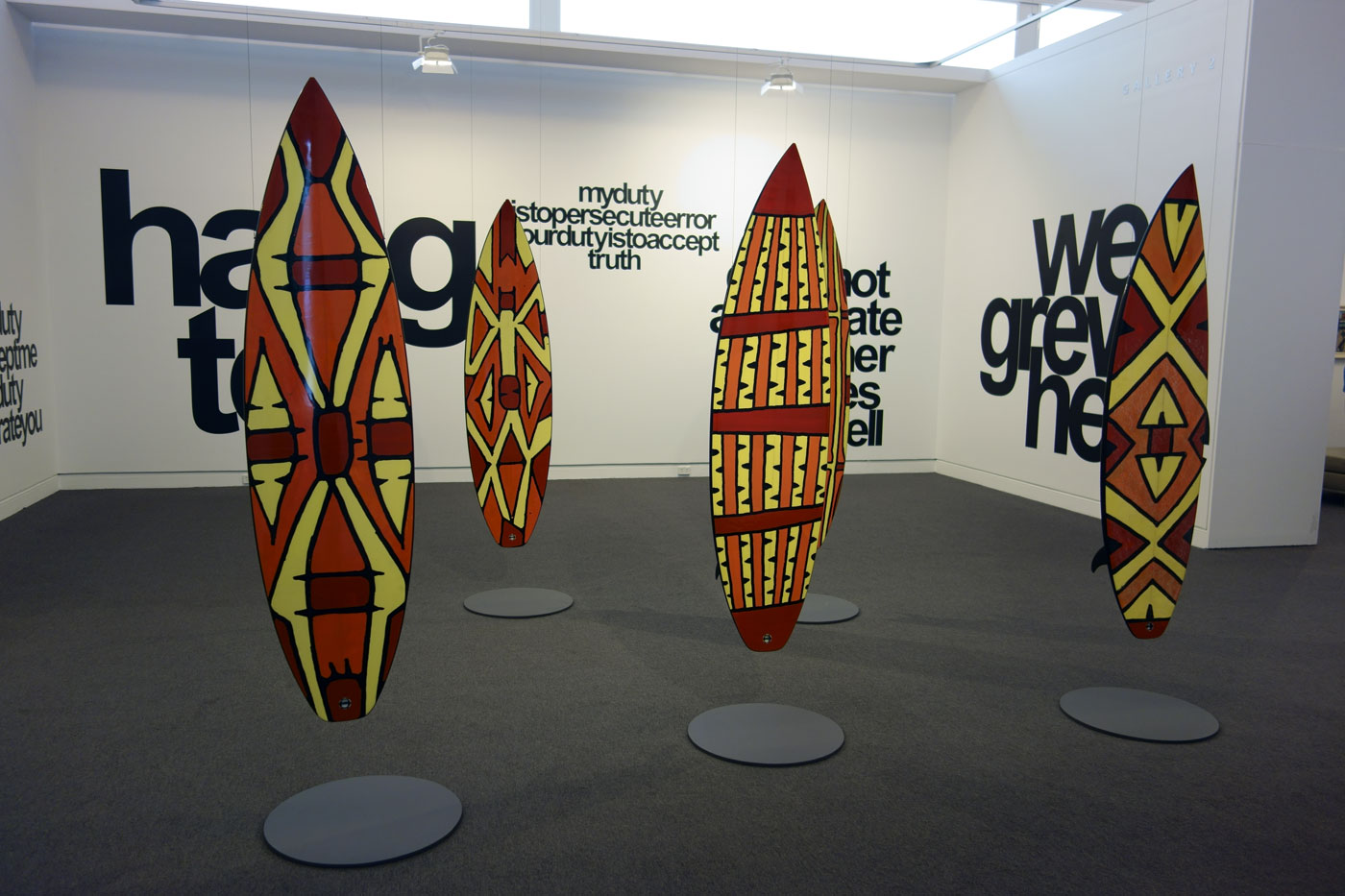
 

Vernon Ah Kee (Australian, b. 1967; Kuku Yalandji, Waanji, Yidinji and Gugu Yimithirr) 'cantchant' 2007-2009 (installation view)

Vernon Ah Kee (Australian, b. 1967; Kuku Yalandji, Waanji, Yidinji and Gugu Yimithirr) 'cantchant' 2007-2009 (installation view detail)

Vernon Ah Kee (Australian, b. 1967; Kuku Yalandji, Waanji, Yidinji and Gugu Yimithirr) 'cantchant' 2007-2009 (installation view detail)

Vernon Ah Kee (Australian, b. 1967; Kuku Yalandji, Waanji, Yidinji and Gugu Yimithirr) 'cantchant' 2007-2009 (installation view detail)

Vernon Ah Kee (Australian, b. 1967; Kuku Yalandji, Waanji, Yidinji and Gugu Yimithirr) 'cantchant' 2007-2009 (installation view detail)

Vernon Ah Kee (Australian, b. 1967; Kuku Yalandji, Waanji, Yidinji and Gugu Yimithirr) 'cantchant' 2007-2009 (installation view detail)

Vernon Ah Kee (Australian, b. 1967; Kuku Yalandji, Waanji, Yidinji and Gugu Yimithirr) 'cantchant' 2007-2009 (installation view detail)

Vernon Ah Kee (Australian, b. 1967; Kuku Yalandji, Waanji, Yidinji and Gugu Yimithirr) 'cantchant' 2007-2009 (installation view detail)

Vernon Ah Kee (Australian, b. 1967; Kuku Yalandji, Waanji, Yidinji and Gugu Yimithirr) 'cantchant' 2007-2009 (installation view detail)


Installation views of Vernon Ah Kee’s cantchant 2007-09


Vernon Ah Kee (Australian, b. 1967; Kuku Yalandji, Waanji, Yidinji and Gugu Yimithirr)
cantchant (installation views)
2007-2009
Synthetic polymer paint and resin over digital print on roamer, vinyl
Courtesy of the artist and Milani Gallery, Brisbane
Photos: © Marcus Bunyan and the Mornington Peninsula Regional Art Gallery


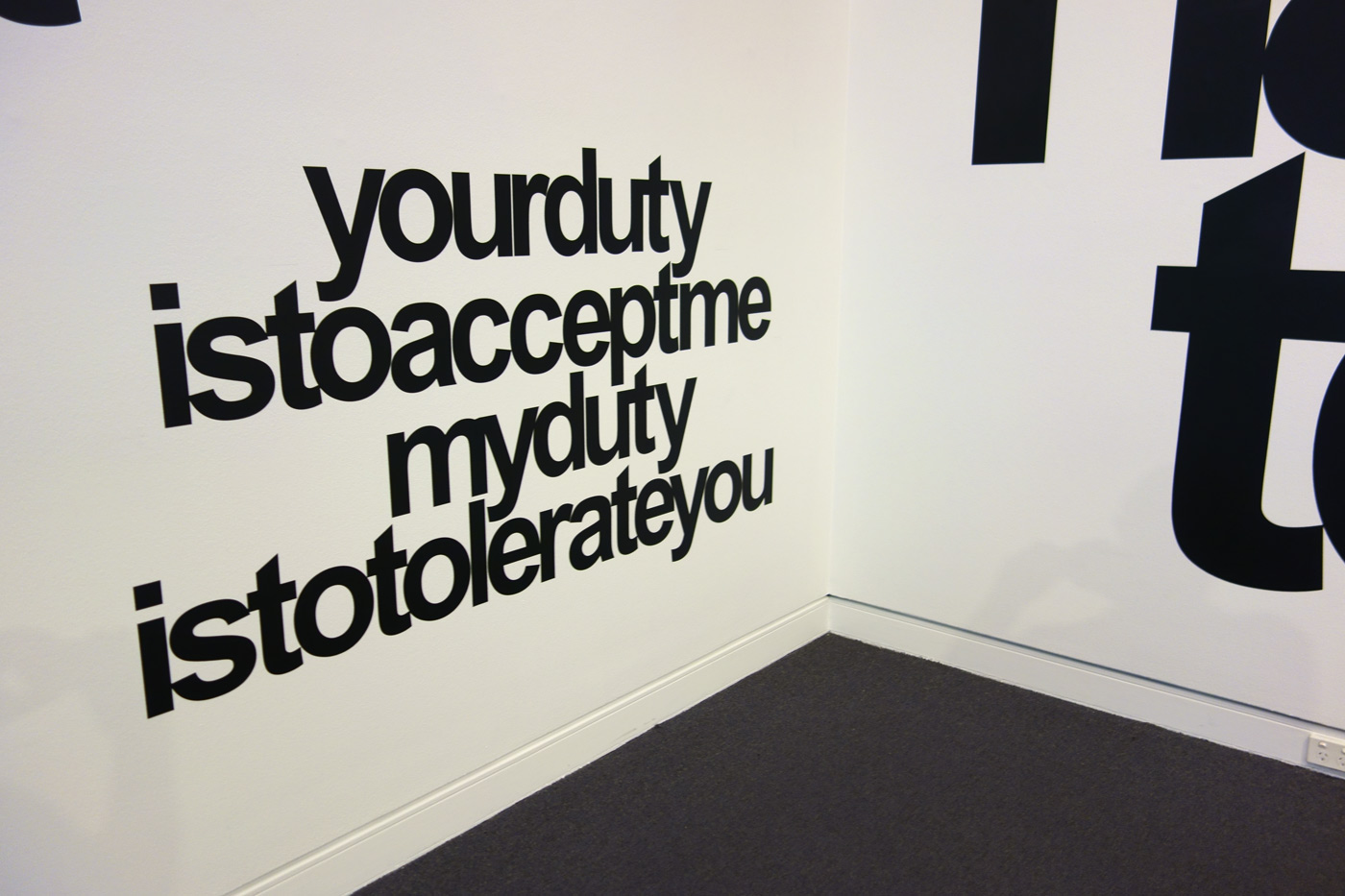
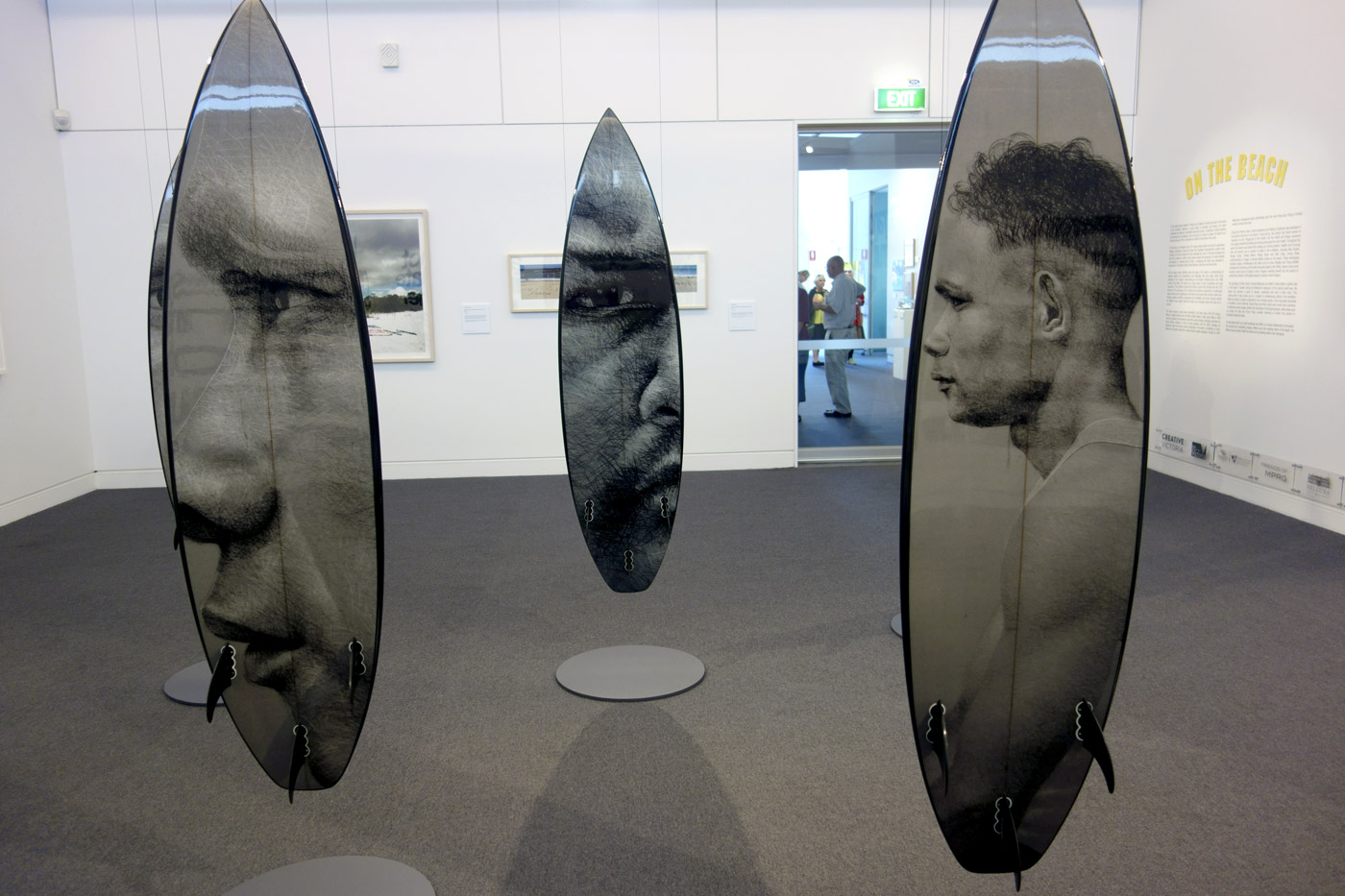
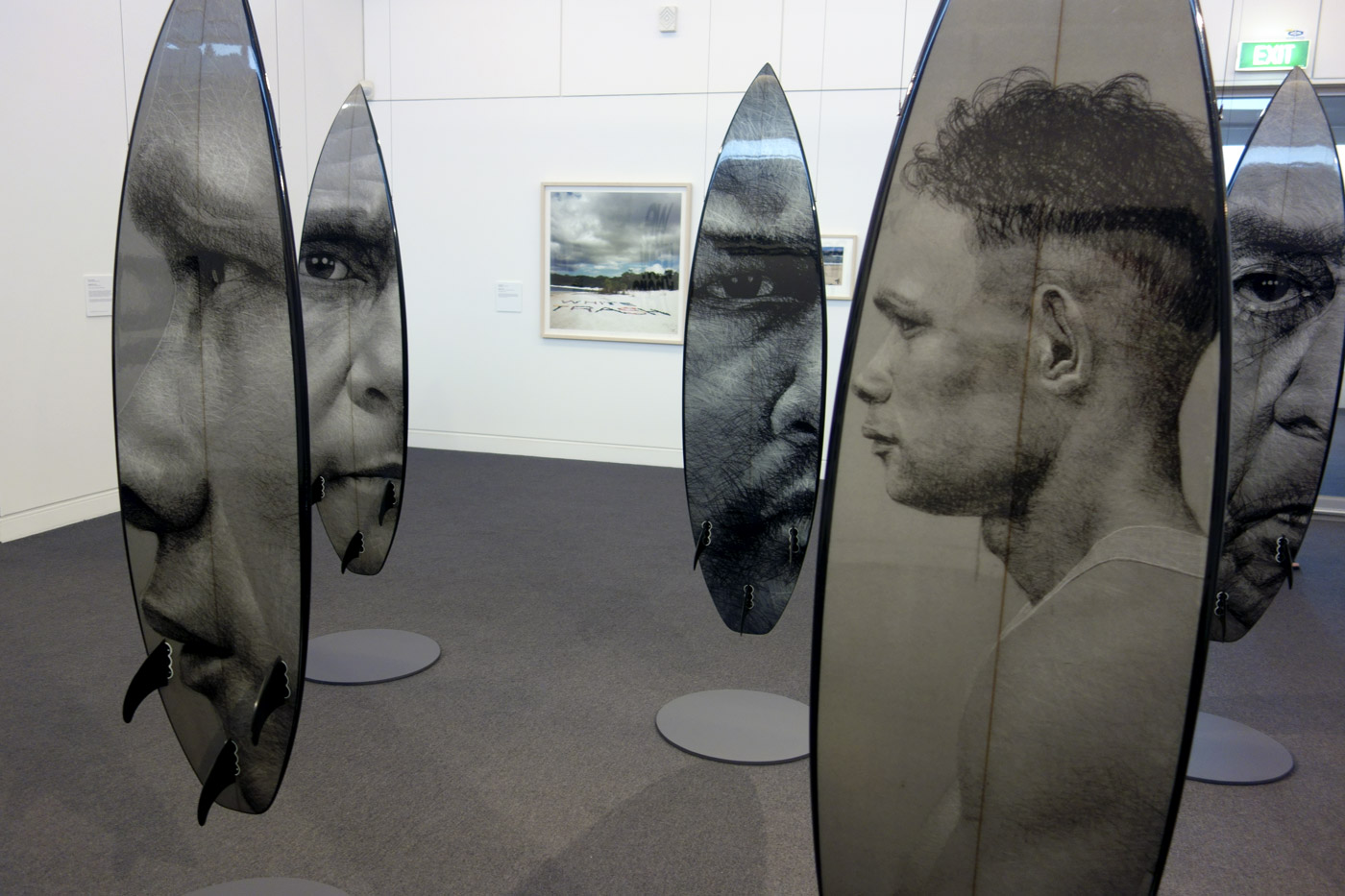
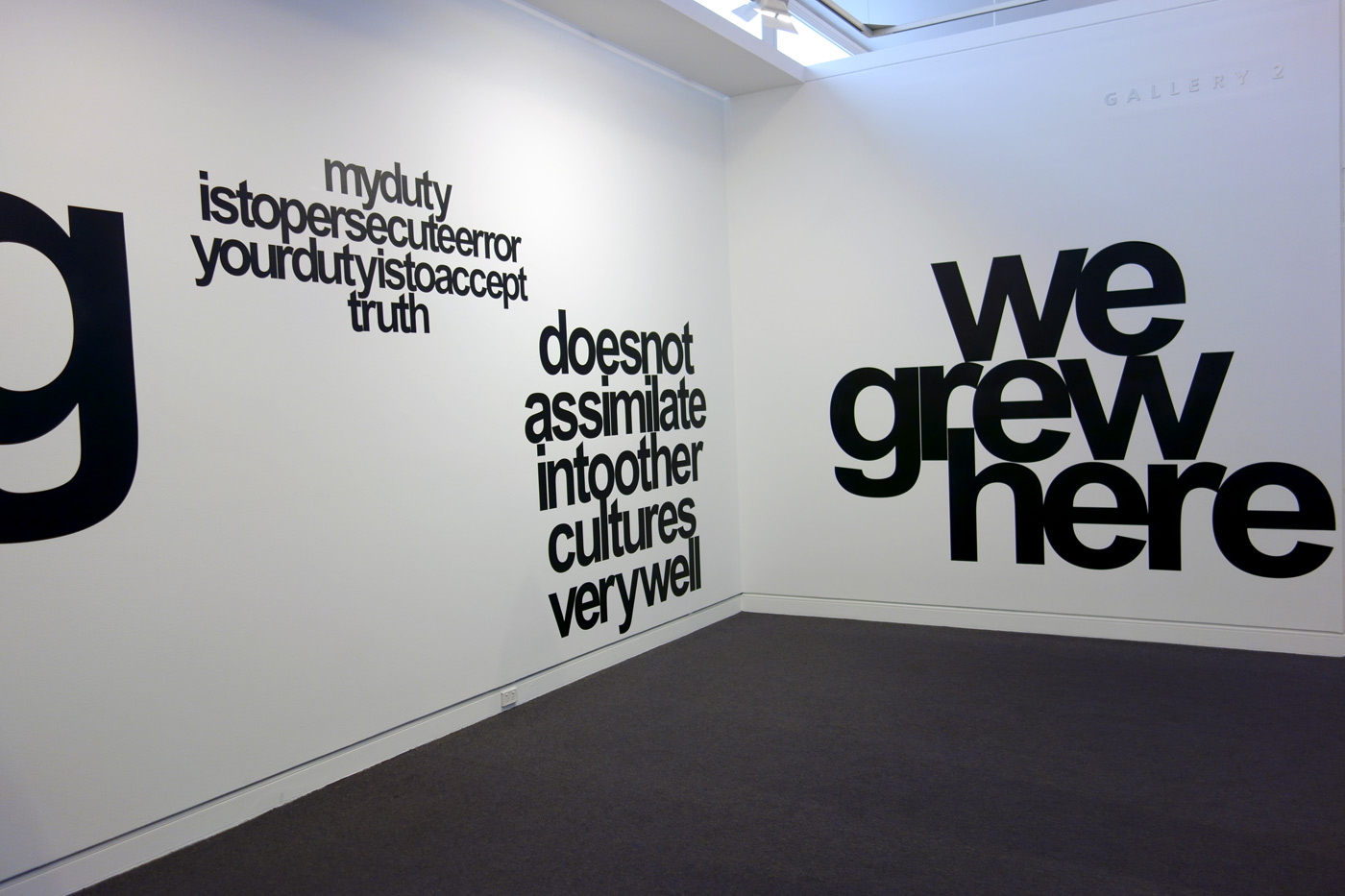
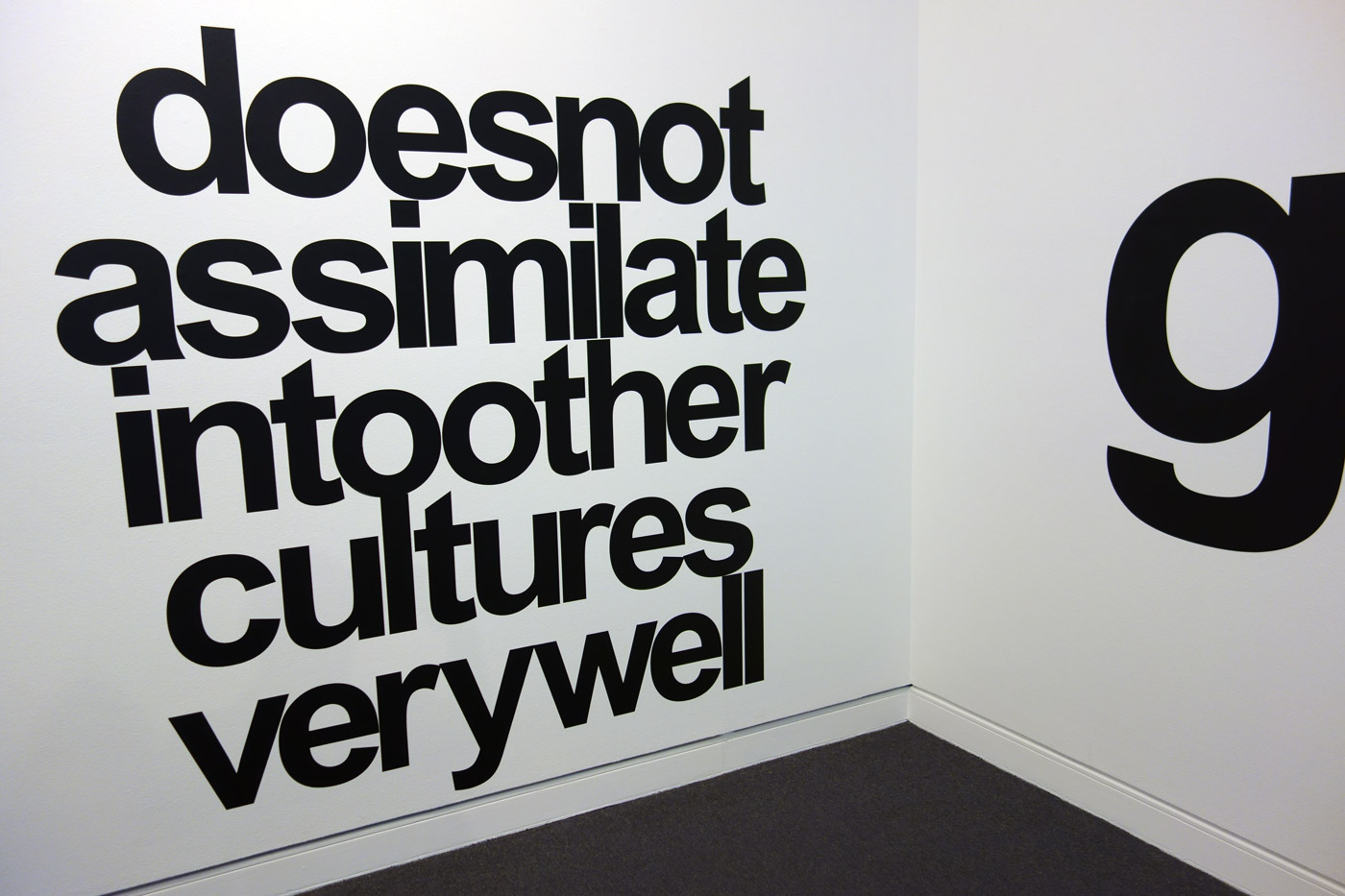
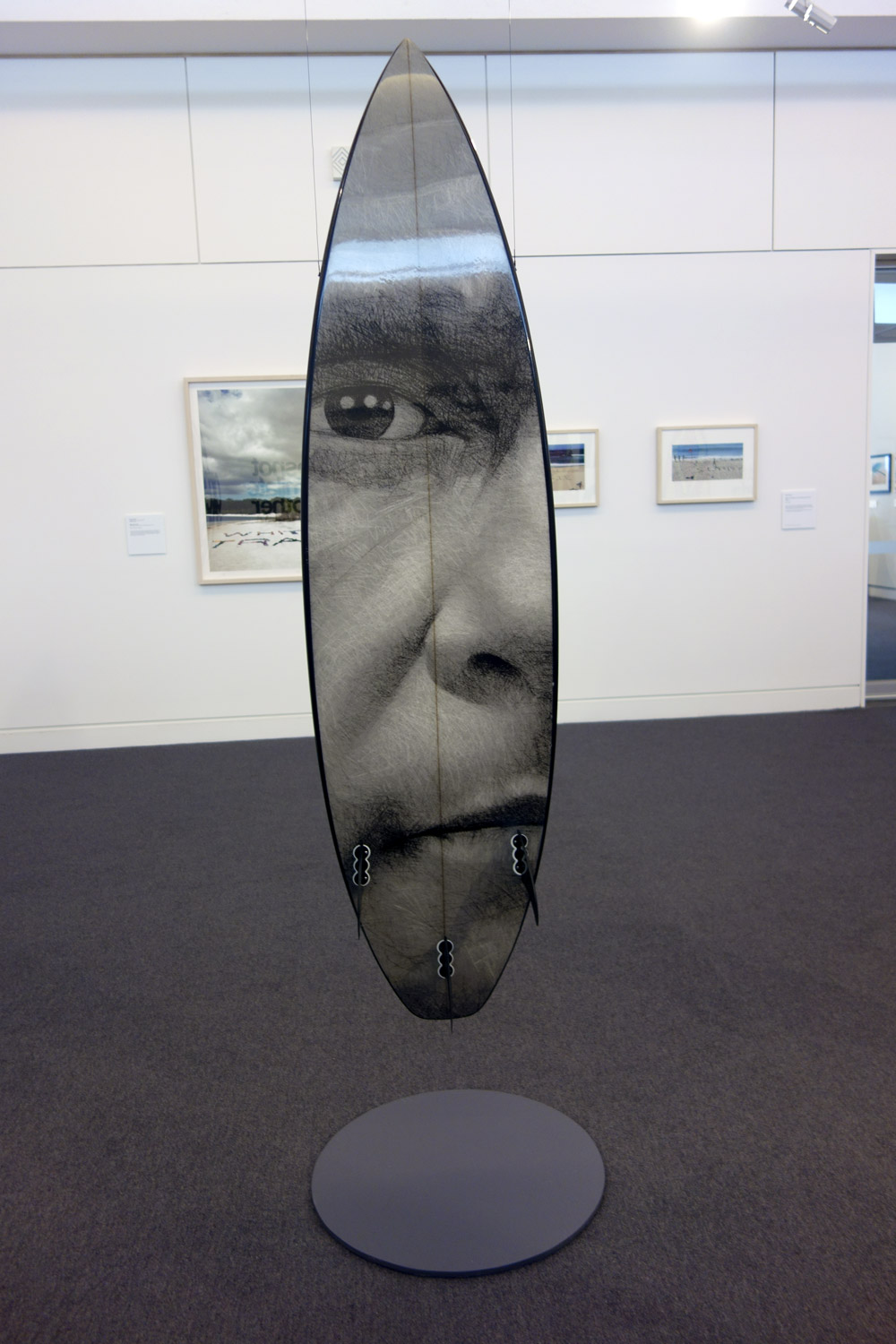
Vernon Ah Kee’s response to the events at Cronulla (the Cronulla Riot) us a powerful retort to the racists and their mantra ‘we grew here, you flew here’ chanted on the beach during the riots. Ah Kee takes issue pointing out the hypocrisy in their statement.

“We grew here, you flew here is an insincere statement and they were chanting it over and over again. It’s a way to exercise racism. I’m like ‘WE’ grew here, say what you want, but we’re the fellas that grew here.”

The surfboards are printed with Yidinji shield designs and the portraits are members of the artists family. The work was exhibited in the Australian Pavilion at the 2009 Venice Biennale.
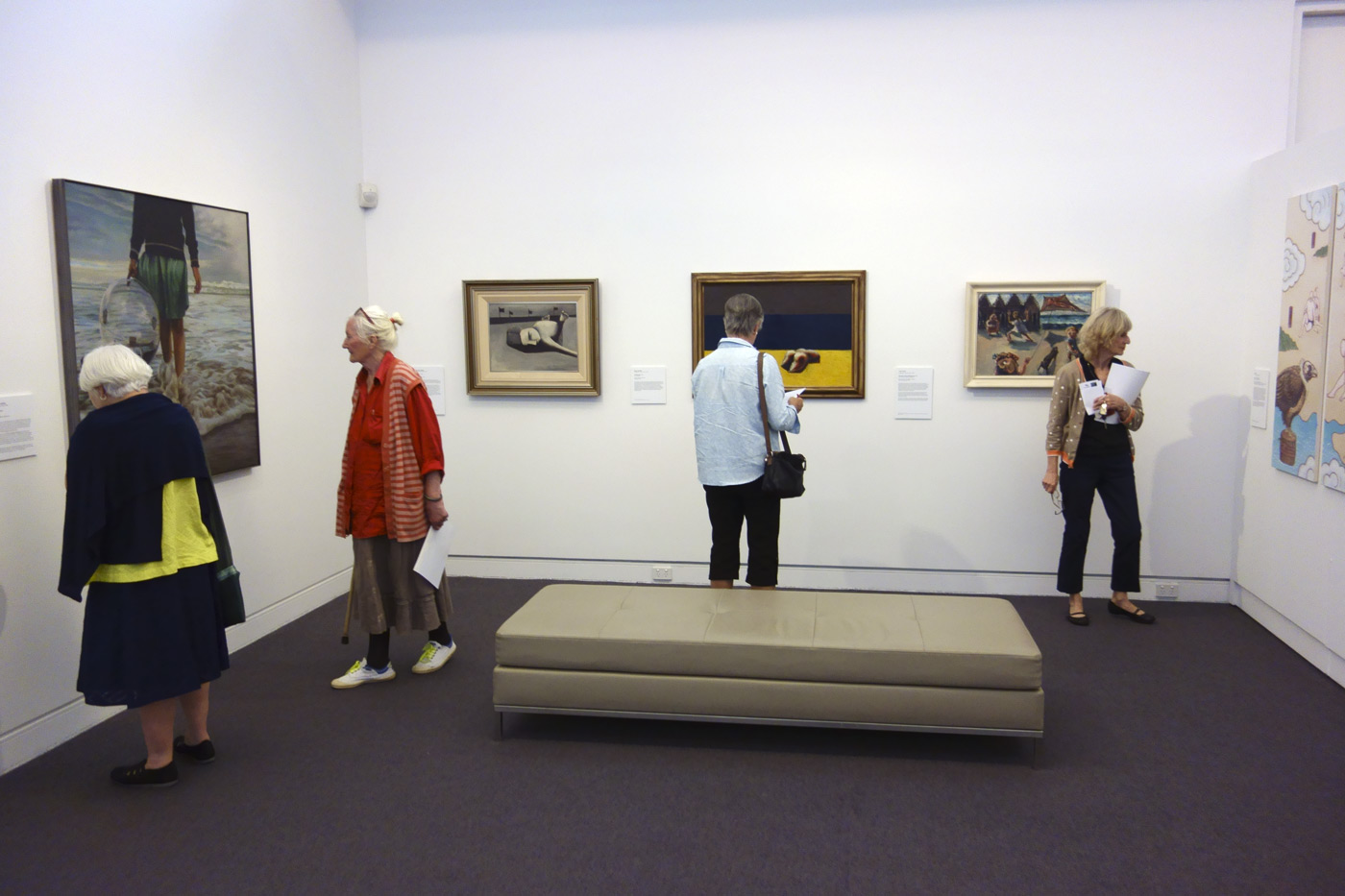
 

Installation view of the exhibition 'On the beach' at the Mornington Peninsula Regional Art Gallery showing on the far wall, Charles Blackman's 'Sunbather' (c. 1954) and Arthur Boyd's 'Kite flyers (South Melbourne)' (1943)


Installation view of the exhibition On the beach at the Mornington Peninsula Regional Art Gallery showing on the far wall, Charles Blackman’s Sunbather (c. 1954, below) and Arthur Boyd’s Kite flyers (South Melbourne) (1943, below)
Photo: © Marcus Bunyan and the Mornington Peninsula Regional Art Gallery


Charles Blackman (Australian, b. 1928) 'Sunbather' c. 1954 (installation view)


Charles Blackman (Australian, b. 1928)
Sunbather (installation view)
c. 1954
Oil on board
Private collection, Melbourne
Photo: © Marcus Bunyan and the Mornington Peninsula Regional Art Gallery


This is one of a number of paintings and drawings made in response to Blackman’s observations of life on Melbourne’s beaches. Blackman moved from Sydney to Melbourne in 1945 to be part of Melbourne’s burgeoning art scene, making friends with John Perceval, Joy Hester and John and Sunday Reed amongst others.

During this period Blackman regularly took the tram to St Kilda beach to swim and paint. Although he enjoyed spending time on the beach, there is a sinister overtone to this painting of a prostrate figure lying on the sand. A bleak, grey palette articulates the pallid lifeless flesh amplifying a sense of death. The hollow slits that substitute for eyes further accentuate the corpse-like appearance. It is a stark contrast to many paintings of the era that emphasise physical vitality and wellbeing. Rather the sense of isolation and heavy treatment of shadows and water creates a painting that is psychologically disturbing. This painting can be seen as a response to his wife, Barbara’s developing blindness. It has been noted that as the ‘darkness grew in her life, his pictures got darker.’1 Blackman stated many years later ‘I was trying to paint pictures which were unseeable.’2

1/ Barry Humphries quoted in Peter Wilmoth. “An artist in wonderland,” in The Age, 21 May 2006
2/ Charles Blackman interviewed by James Gleeson, 28 April 1979
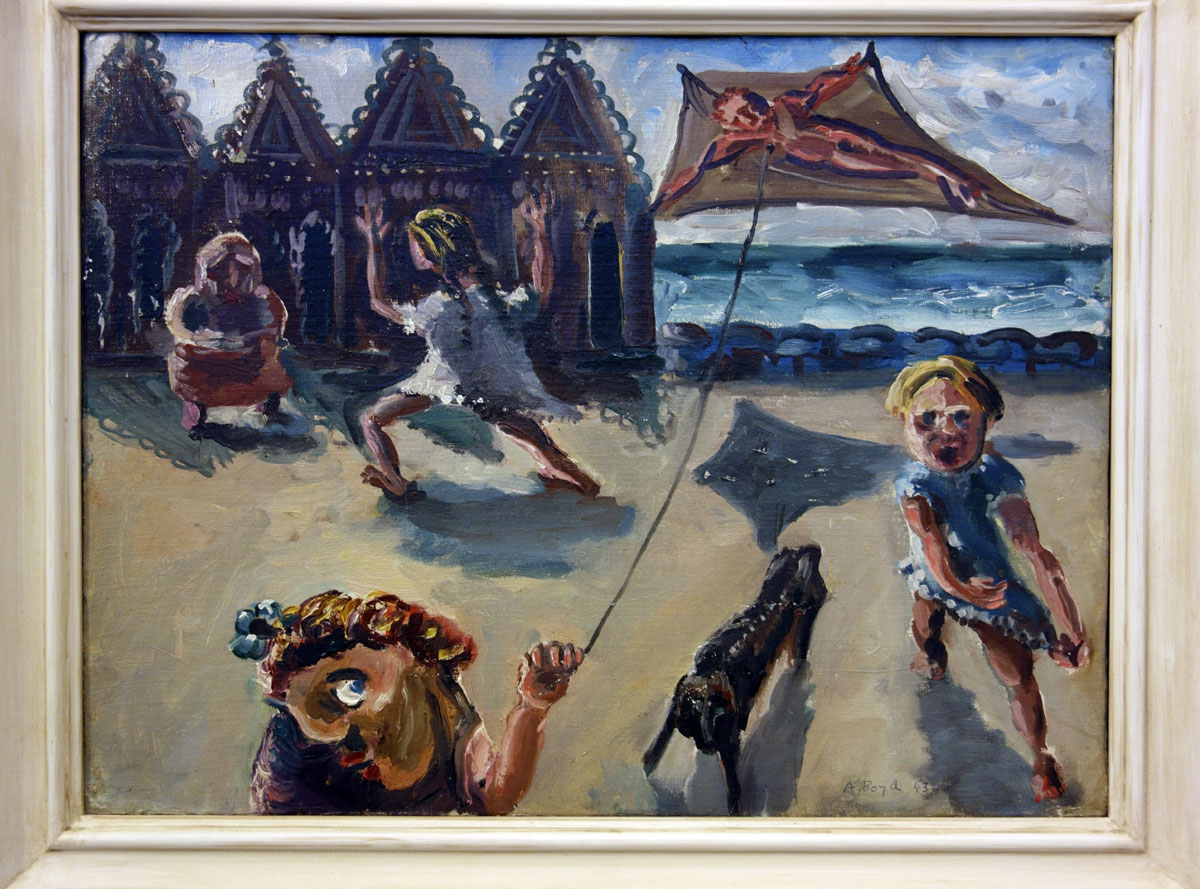
 

Arthur Boyd (Australian, 1920-1999) 'Kite flyers (South Melbourne)' 1943 (installation view)


Arthur Boyd (Australian, 1920-1999)
Kite flyers (South Melbourne) (installation view)
1943
Oil on canvas mounted on cardboard
46.3 x 60.9cm
National Gallery of Victoria
The Arthur Boyd Gift, 1975
Photo: © Marcus Bunyan and the Mornington Peninsula Regional Art Gallery
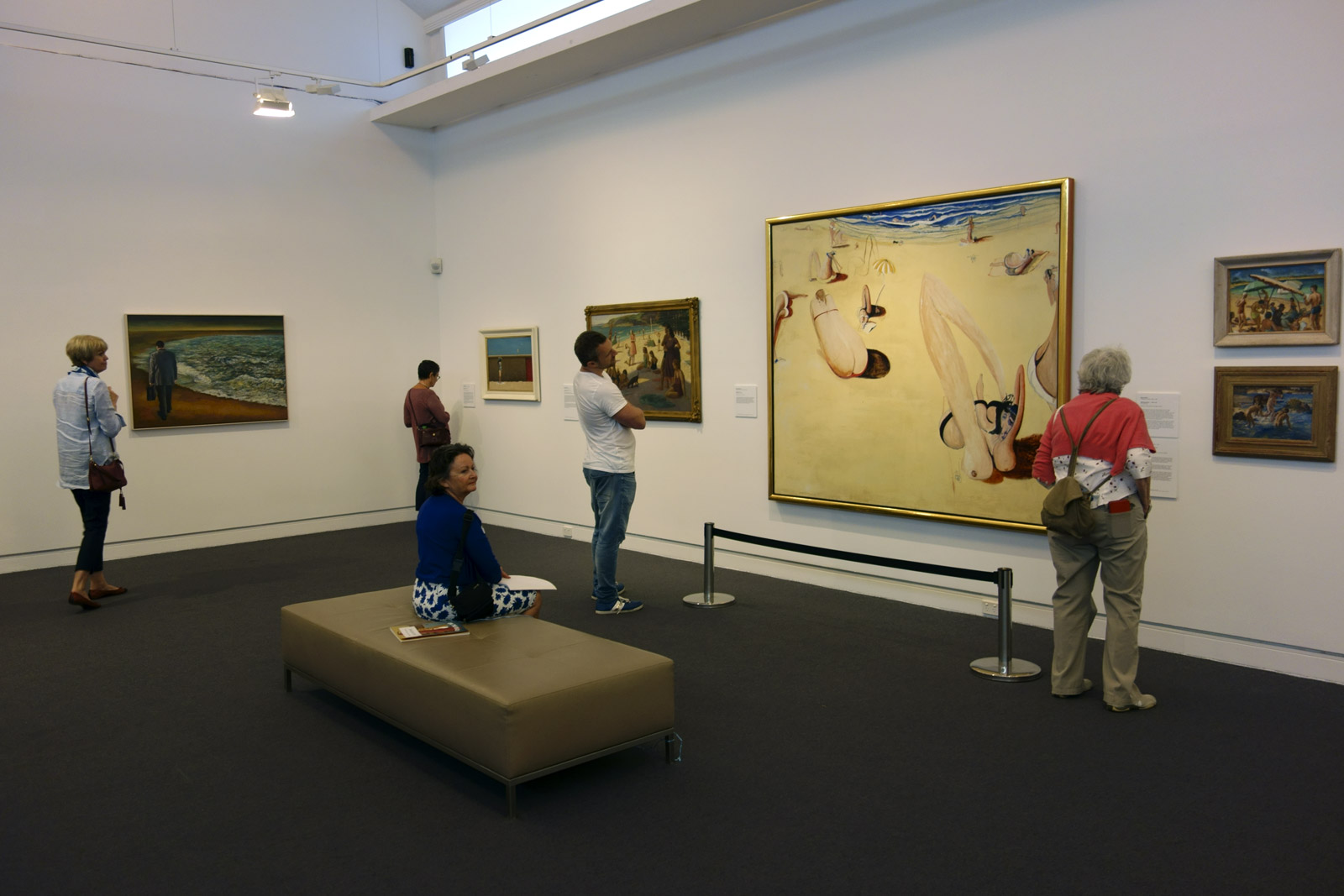
 

Installation view of the exhibition 'On the beach' at the Mornington Peninsula Regional Art Gallery showing in the centre, Brett Whiteley's 'Balmoral' (1975-1978). To the left of this painting is Nancy Kilgour's 'Figures on Manly Beach' (1930) and to the right Norma Bull's 'Bathing Beach' (c. 1950-1960s) with at bottom, George W. Lambert's 'Anzacs bathing in the sea' (1915)
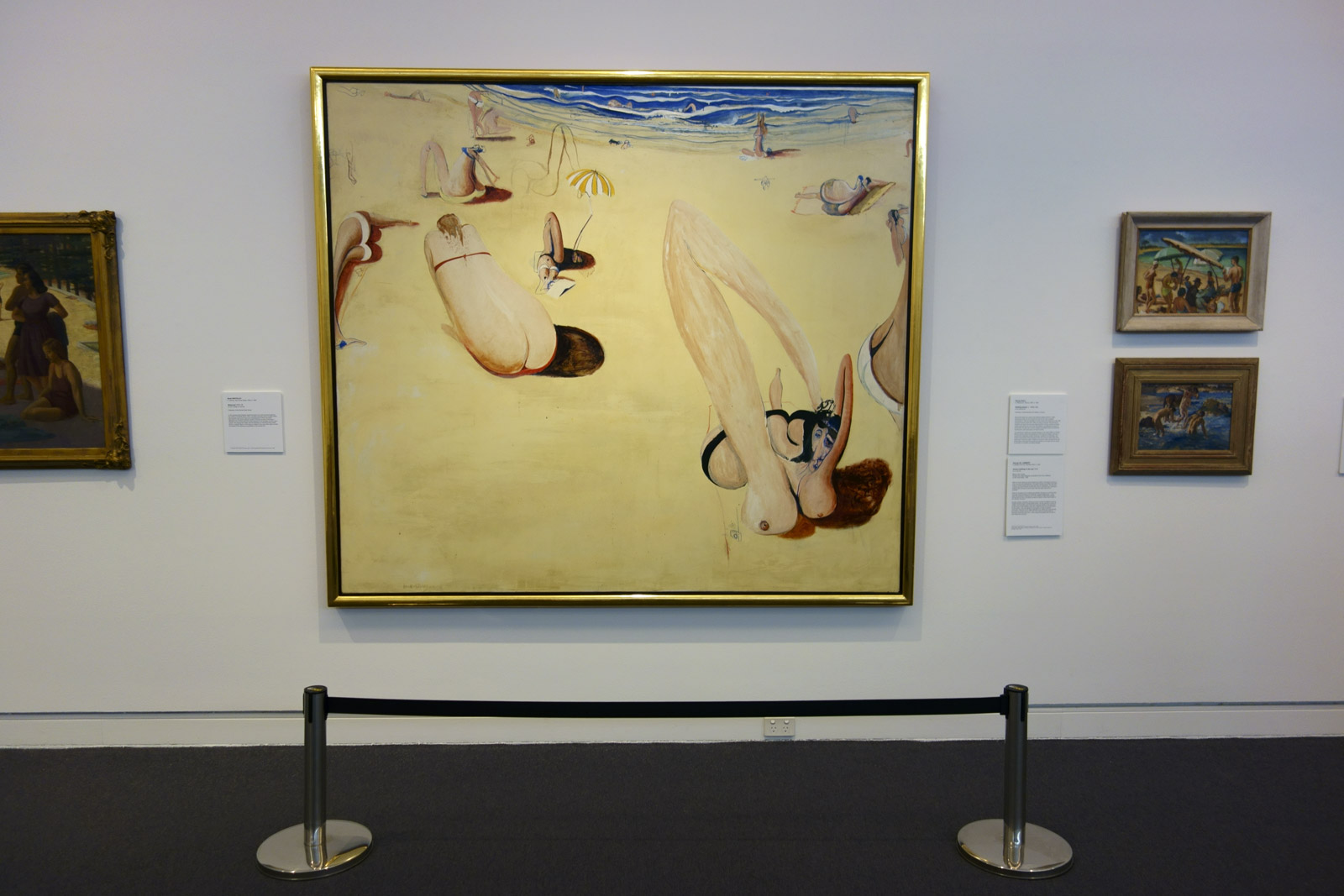
Installation view of the exhibition 'On the beach' at the Mornington Peninsula Regional Art Gallery showing in the centre, Brett Whiteley's 'Balmoral' (1975-1978). To the left of this painting is Nancy Kilgour's 'Figures on Manly Beach' (1930) and to the right Norma Bull's 'Bathing Beach' (c. 1950-1960s) with at bottom, George W. Lambert's 'Anzacs bathing in the sea' (1915)

Installation view of the exhibition 'On the beach' at the Mornington Peninsula Regional Art Gallery showing in the centre, Brett Whiteley's 'Balmoral' (1975-1978). To the left of this painting is Nancy Kilgour's 'Figures on Manly Beach' (1930) and to the right Norma Bull's 'Bathing Beach' (c. 1950-1960s) with at bottom, George W. Lambert's 'Anzacs bathing in the sea' (1915)


Installation views of the exhibition On the beach at the Mornington Peninsula Regional Art Gallery showing in the centre, Brett Whiteley’s Balmoral (1975-1978, below). To the left of this painting is Nancy Kilgour’s Figures on Manly Beach (1930, below) and to the right Norma Bull’s Bathing Beach (c. 1950-1960s, below) with at bottom, George W. Lambert’s Anzacs bathing in the sea (1915, below)
Photos: © Marcus Bunyan and the Mornington Peninsula Regional Art Gallery


Brett Whiteley (Australian, 1939-1992) 'Balmoral' 1975-1978 (installation view detail)


Brett Whiteley (Australian, 1939-1992)
Balmoral (installation detail)
1975-1978
Oil and collage on canvas
180 x 204cm
Collection of the Hunter-Dyer family
Photo: © Marcus Bunyan and the Mornington Peninsula Regional Art Gallery
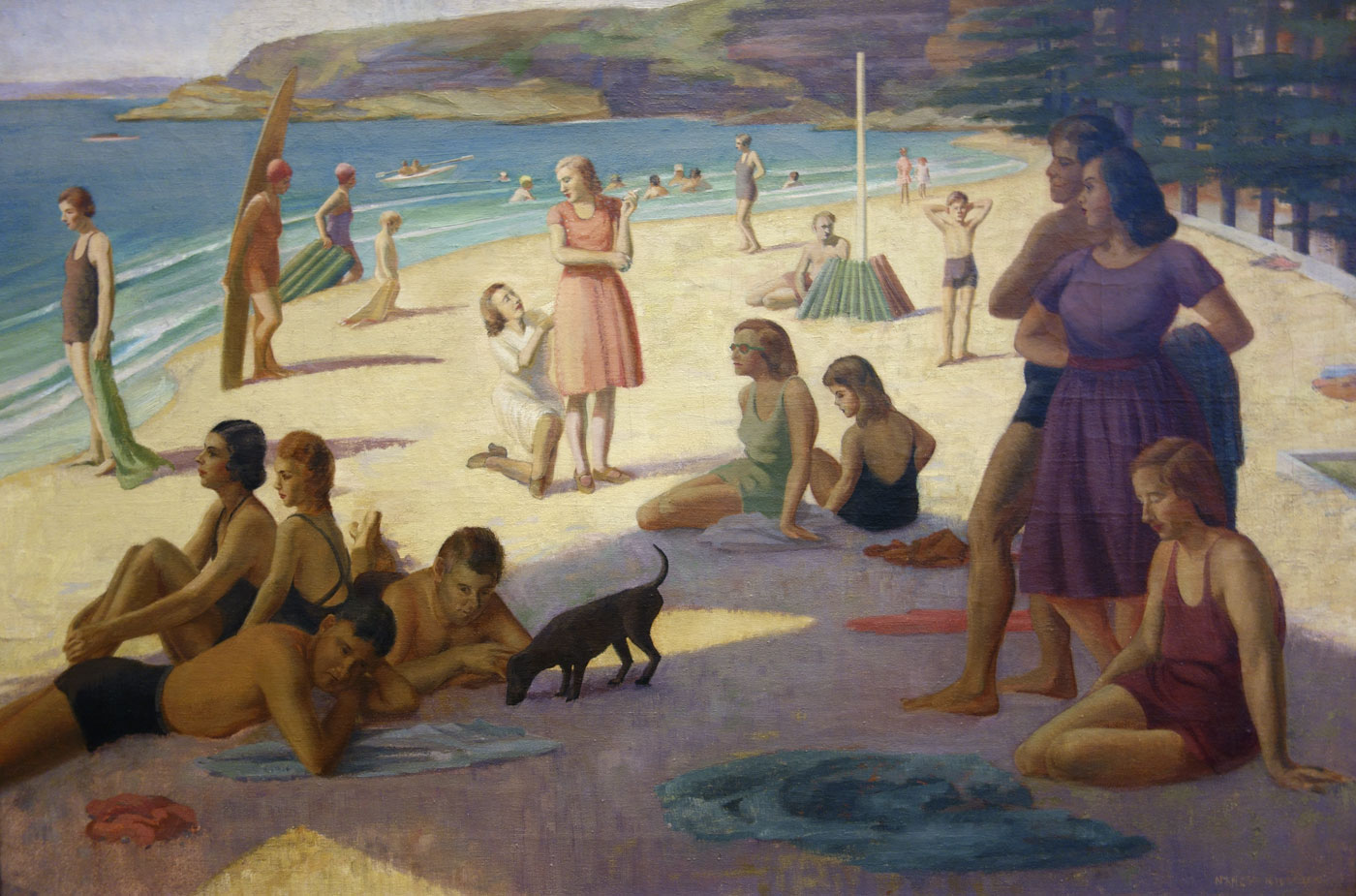
 

Nancy Kilgour (Australian, 1904-1954) 'Figures on Manly Beach' c. 1930


Nancy Kilgour (Australian, 1904-1954)
Figures on Manly Beach
c. 1930
Oil on canvas
76 x 117cm
Manly Art Gallery and Museum, Sydney
Purchase with the assistance of the NSW Ministry for the Arts, 1986


Nancy Kilgour’s artificial arrangement of figures is believed to have been painted in the 1930s before Charles Meere painted his highly contrived composition Australian Beach Pattern, 1940. The staged poses create a tableau of Australians enjoying the freedoms of life on the beach. What is interesting about Kilgour’s painting is that a number of people are depicted fully clothed. so the emphasis is not so much on toned physiques but rather the pleasures of relaxing on the beach. The painting is also unusual because, whereas most beach scenes are cast in brilliant sunshine, the figures in the foreground in this painting are rendered in shadow suggesting the presence of the towering Norfolk Island Pine trees which form a crescent along the Manly foreshore.
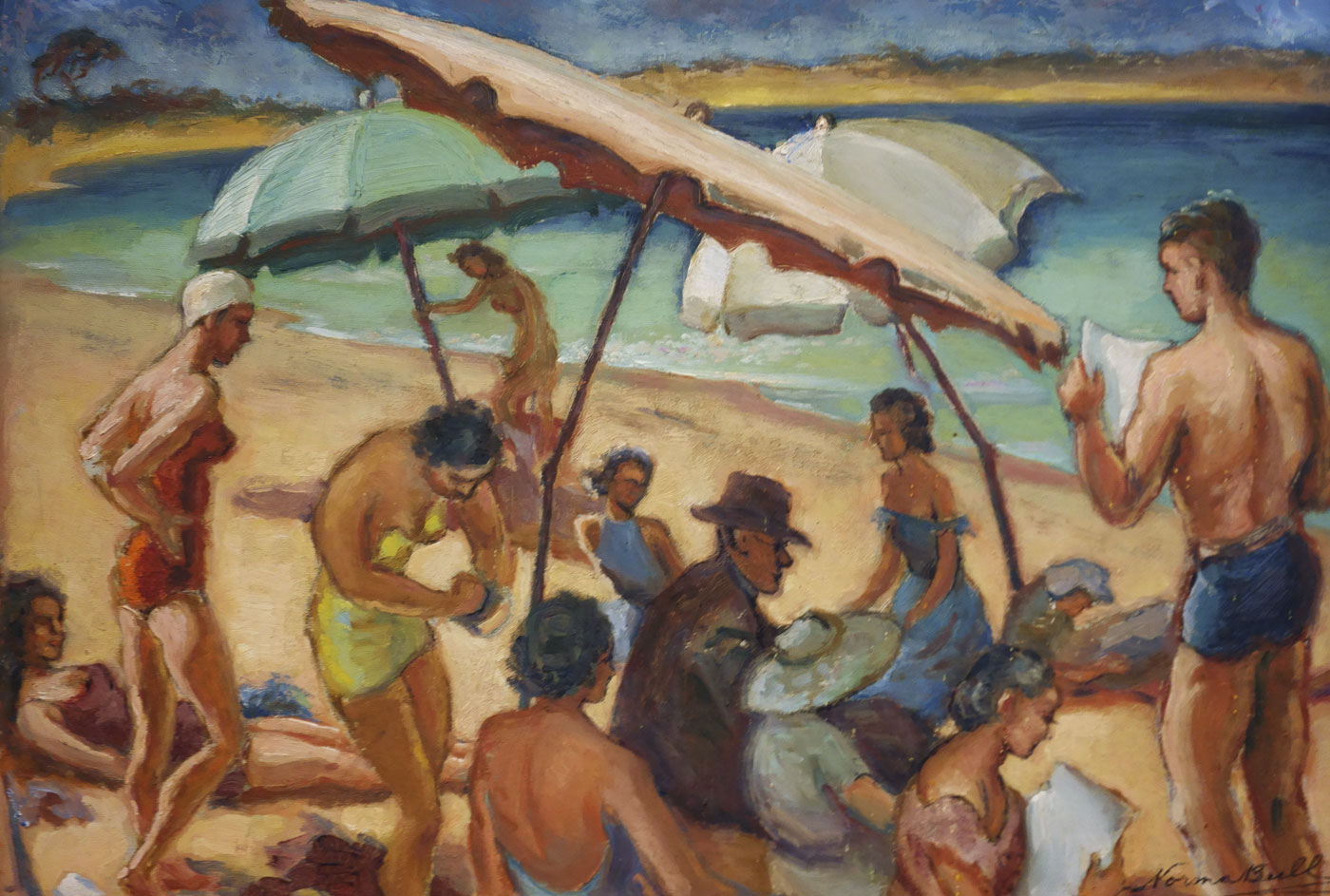
 

Norma Bull (Australian, 1906-1980) 'Bathing Beach' c. 1950-1960s


Norma Bull (Australian, 1906-1980)
Bathing Beach
c. 1950s-60s
Oil on aluminium
30.5 x 40cm
Collection of the Warrnambool Art Gallery, Victoria


Norma Bull began her career at the National Gallery School in 1929, Receiving acclaim for her portraits she won the Sir John Longstaff Scholarship in 1937 and travelled to London where she worked as a war artist during the Second World War. After nine years in Europe, Bull returned to Australia and spent the next year following Wirth’s Circus, painting acrobats, clowns and scenes from circus life. She settled in the Melbourne suburb of Surrey Hills and spent her summer holidays at Anglesea which provided the opportunity to paint seascapes and beach scenes.

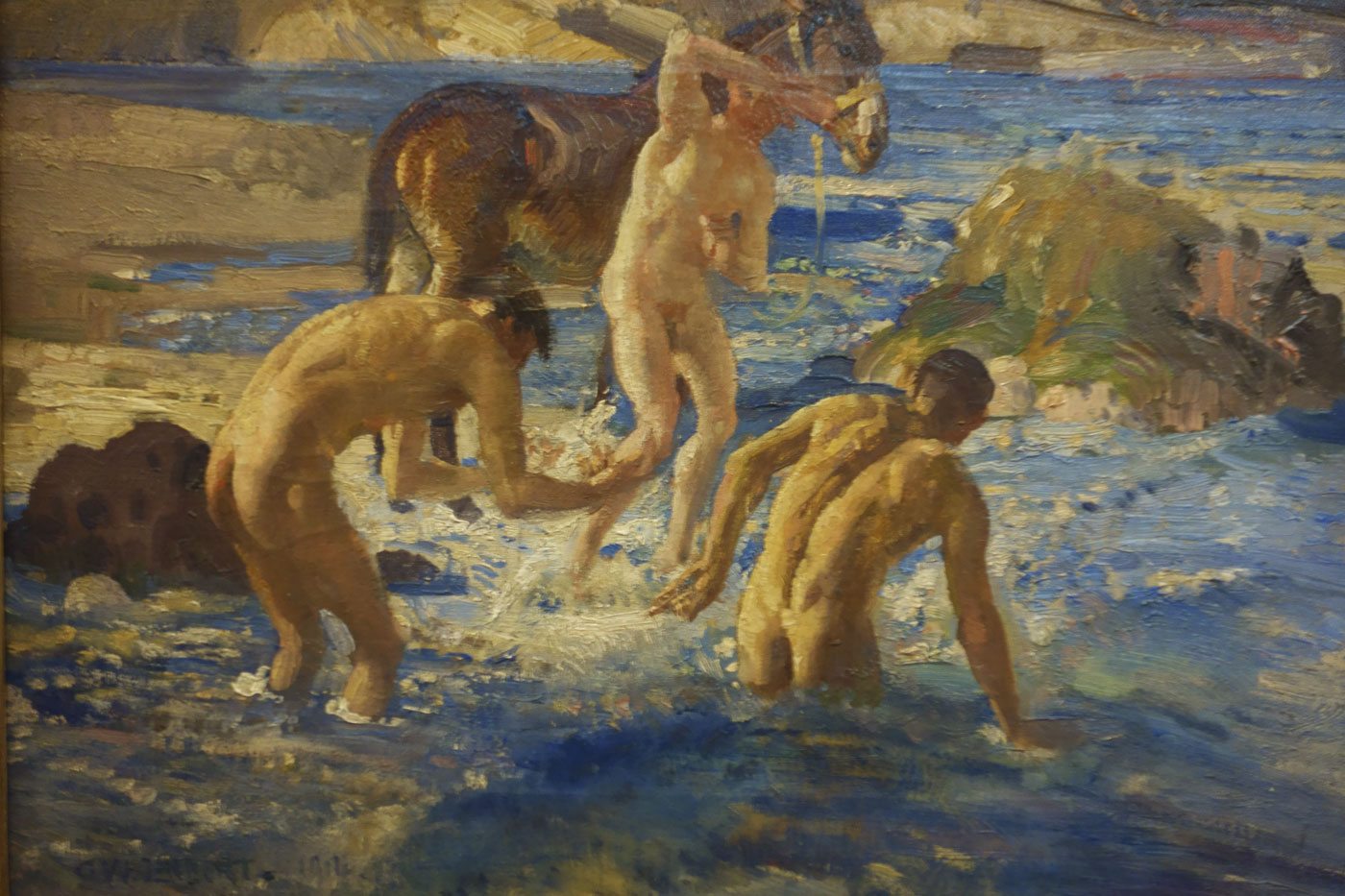
 

George W. Lambert (Australian, 1867-1930) 'Anzacs bathing in the sea' 1915 (installation view)

George W. Lambert (Australian, 1867-1930) 'Anzacs bathing in the sea' 1915 (installation view detail)


George W. Lambert (Australian, 1867-1930)
Anzacs bathing in the sea (installation full and detail)
1915
Oil on canvas
25 x 34cm
Mildura Arts Centre
Senator R.D. Elliott Bequest, presented to the City of Mildura by Mrs Hilda Elliott, 1956
Photos: © Marcus Bunyan and the Mornington Peninsula Regional Art Gallery


George Lambert, Australia’s official war artist, travelled to Gallipoli where he created detailed studies of large battle scenes. He also painted a number of smaller, more intimate works which were execute rapidly on the spot such as this scene of men bathing in the sea. Lambert’s focus is the musculature of their bodies. They are depicted as exemplars of heroic Australian masculinity. Historian C.E.W. Bean reflected in the 1920s that it was through the events on Anzac Cove on 25th April 1915 ‘that the consciousness of Australian nationhood was born.’1 In this respect the painting can be seen to have baptismal overtures.

1/ C.E.W. Bean, Official history of Australia in the War of 1914-1918 Volume 2, Sydney: Angus and Robertson, 1934, p. 346.
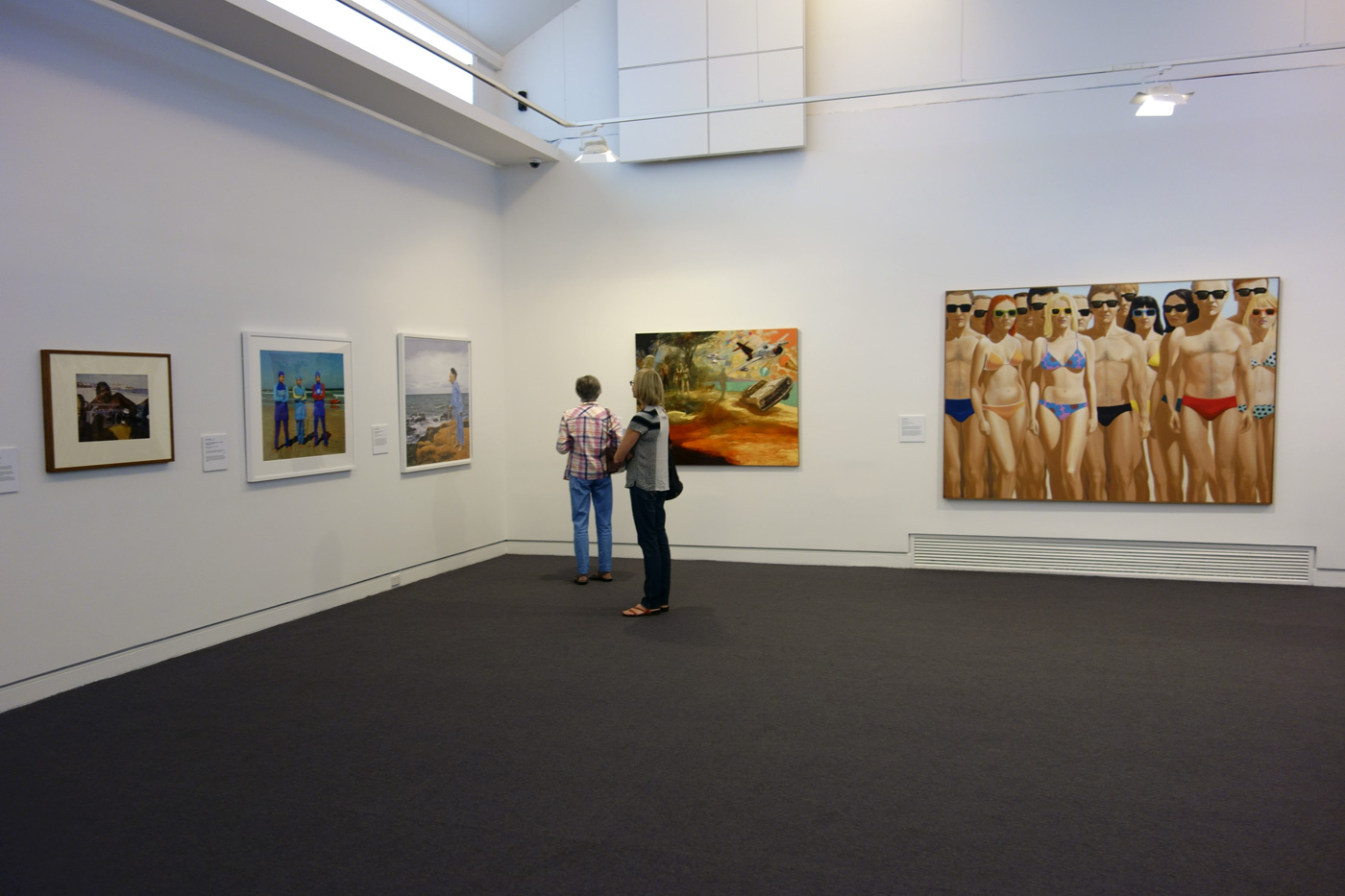
 

Installation view of the exhibition 'On the beach' at the Mornington Peninsula Regional Art Gallery showing at second left, Anne Zahalka's 'The girls #2, Cronulla Beach' (2007); at left on the far wall John Anderson's 'Abundance' (2015) followed by John Hopkins 'The crowd' (1970)


Installation view of the exhibition On the beach at the Mornington Peninsula Regional Art Gallery showing at second left, Anne Zahalka’s The girls #2, Cronulla Beach (2007, below); and at left on the far wall John Anderson’s Abundance (2015, below) followed by John Hopkins The crowd (1970, below)
Photo: © Marcus Bunyan and the Mornington Peninsula Regional Art Gallery


Anne Zahalka (Australian, b. 1957) 'The girls #2, Cronulla Beach' 2007 from the series 'Scenes from the Shire' 2007


Anne Zahalka (Australian, b. 1957)
The girls #2, Cronulla Beach
2007
From the series Scenes from the Shire 2007
Type C photograph
73.3 x 89.2cm
Mornington Peninsula Regional Art Gallery
Gift of the artist, 2012
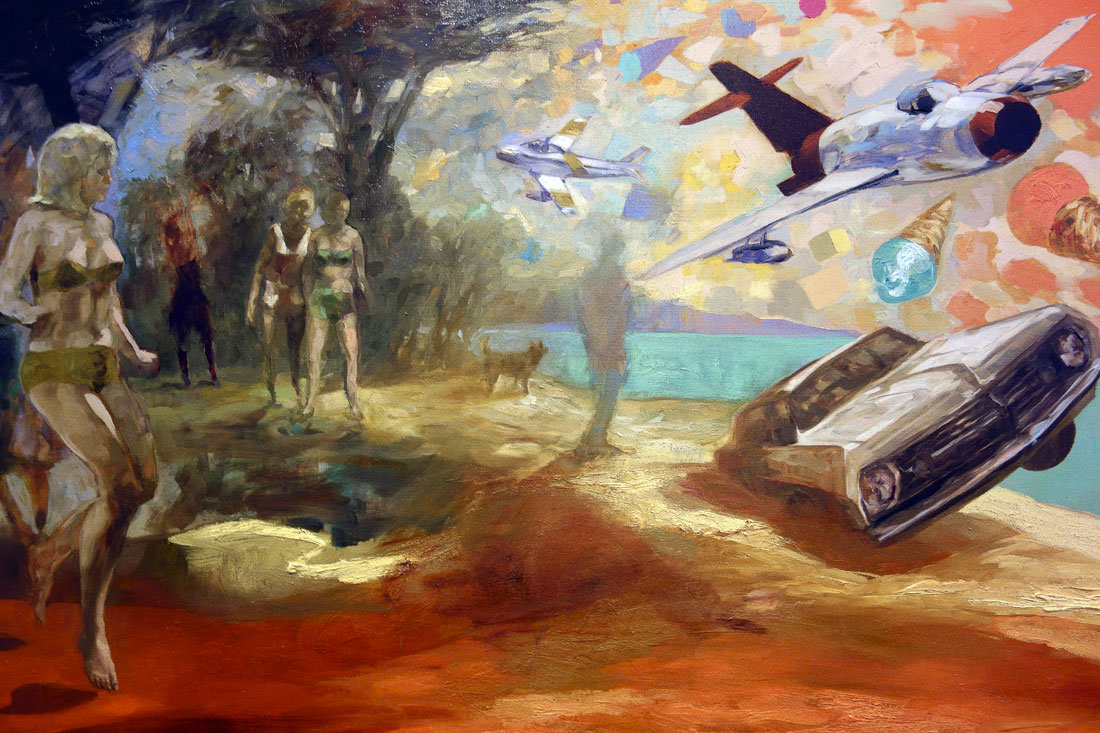
 

John Anderson (Australian, b. 1947) 'Abundance' 2015 (installation view detail)


John Anderson (Australian, b. 1947)
Abundance (installation view detail)
2015
Oil on linen
Courtesy of the artist and Australian Galleries, Melbourne and Sydney
Photo: © Marcus Bunyan and the Mornington Peninsula Regional Art Gallery


John Hopkins (Australian, b. 1943) 'The crowd' 1970


John Hopkins (Australian, b. 1943)
The crowd
1970
Synthetic polymer paint on canvas
172.7 x 245.2cm
Mornington Peninsula Regional Art Gallery
Gift of the artist, 1974


Polixeni Papaetrou (Australian, 1960-2018) 'Ocean Man' 2013


Polixeni Papaetrou (Australian, 1960-2018)
Ocean Man
2013
From the series The Ghillies 2012-13
National Gallery of Victoria, Melbourne
Purchased NGV Foundation, 2013


The ghillie suit is a form of camouflage originally used by hunters and the military. Recently popularised in the video game, Call of duty, the ghillie suit is worn by Papapetrou’s son, Solomon, who poses on the beach at Queenscliff. Appearing neither man nor nature, his indistinct form speaks of transformation and becoming – of prison and absence. By depicting the figure as some sort of monster emerging from the depths of the ocean, Papapetrou creates an image that draws upon Jungian understanding of the sea as a symbol of the collective unconscious – both a source of life and return.


Mornington Peninsula Regional Art Gallery
Civic Reserve, Dunns Road, Mornington

Opening hours:
Tuesday – Sunday 10am – 5pm

Mornington Peninsula Regional Art Gallery website

LIKE ART BLART ON FACEBOOK

Back to top

Exhibition: ‘Cutting edge: 21st-century photography’ at the Monash Gallery of Art, Wheelers Hill, Melbourne

Exhibition dates: 26th November, 2015 – 21st February, 2016

Artists: Danica Chappell, Peta Clancy, Eliza Hutchison, Megan Jenkinson, Justine Khamara, Paul Knight, Derek Kreckler, Luke Parker, Emidio Puglielli, David Rosetzky, Jo Scicluna, Martin Smith, Vivian Cooper Smith, James Tylor and Joshua Yeldham


Installation photograph of the exhibition 'Cutting edge: 21st-century photography' at the Monash Gallery of Art


Installation photograph of the exhibition Cutting edge: 21st-century photography at the Monash Gallery of Art
Photo: © Marcus Bunyan and the Monash Gallery of Art


This is a solid if slightly dour exhibition at the Monash Gallery of Art which examines the phenomena of the deconstruction of the physicality of the photograph. It “features the work of contemporary artists who disrupt the seamless uniformity of screen-based photography by cutting, pinning, folding and puncturing photographic prints. These are photographs that need to be engaged with in physical space, rather than contemplated on a screen; this is an exhibition about making rather than taking photographs.”

Therein lies the rub. If you start such an exercise (the physical deformation of the surface of the print), without caring about the quality of the base image, then you are automatically starting from a bad position. It’s like printing a black and white print from an underexposed negative. Further, much as many of these works are interesting conceptual exercises, most of them lead to emotional dead ends.

A friend of mine, Ian Lobb, has a good analogy: imagine standing on a bridge with a fast running stream flowing underneath, and dropping a pebble off the bridge. And then another, and another. Unless they cluster around each other to form an ongoing enquiry by a group of people – such as Australian women’s hand-coloured photography of the 1970sINTO ONE IDEA (in the 1970s it was feminism and the urban environment), then they will be washed away. And this is the feeling I get from this exhibition: every idea possible is up for grabs (in an earnest kind of way), but nothing sticks memorably in the mind. That is the world in which we live today.

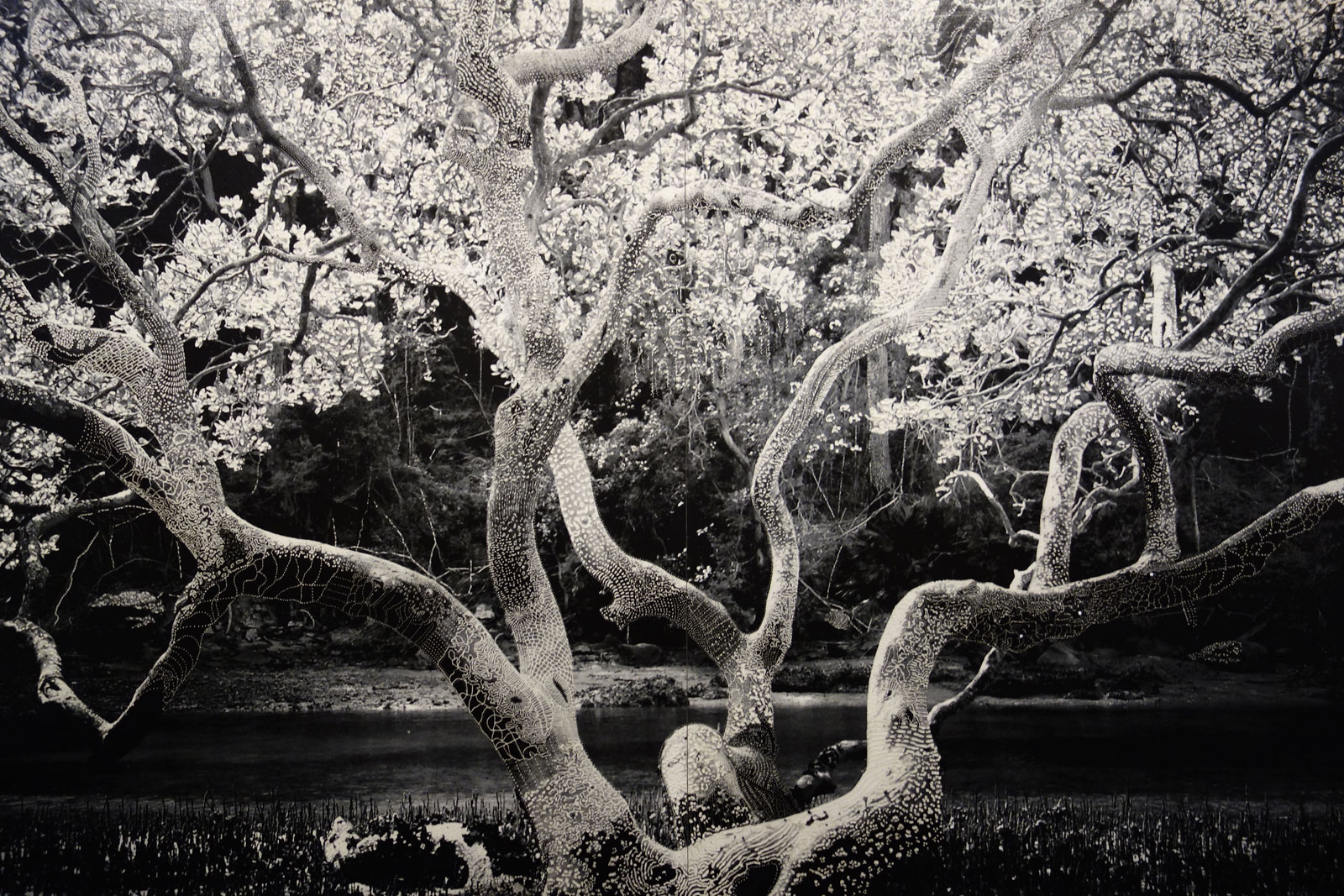
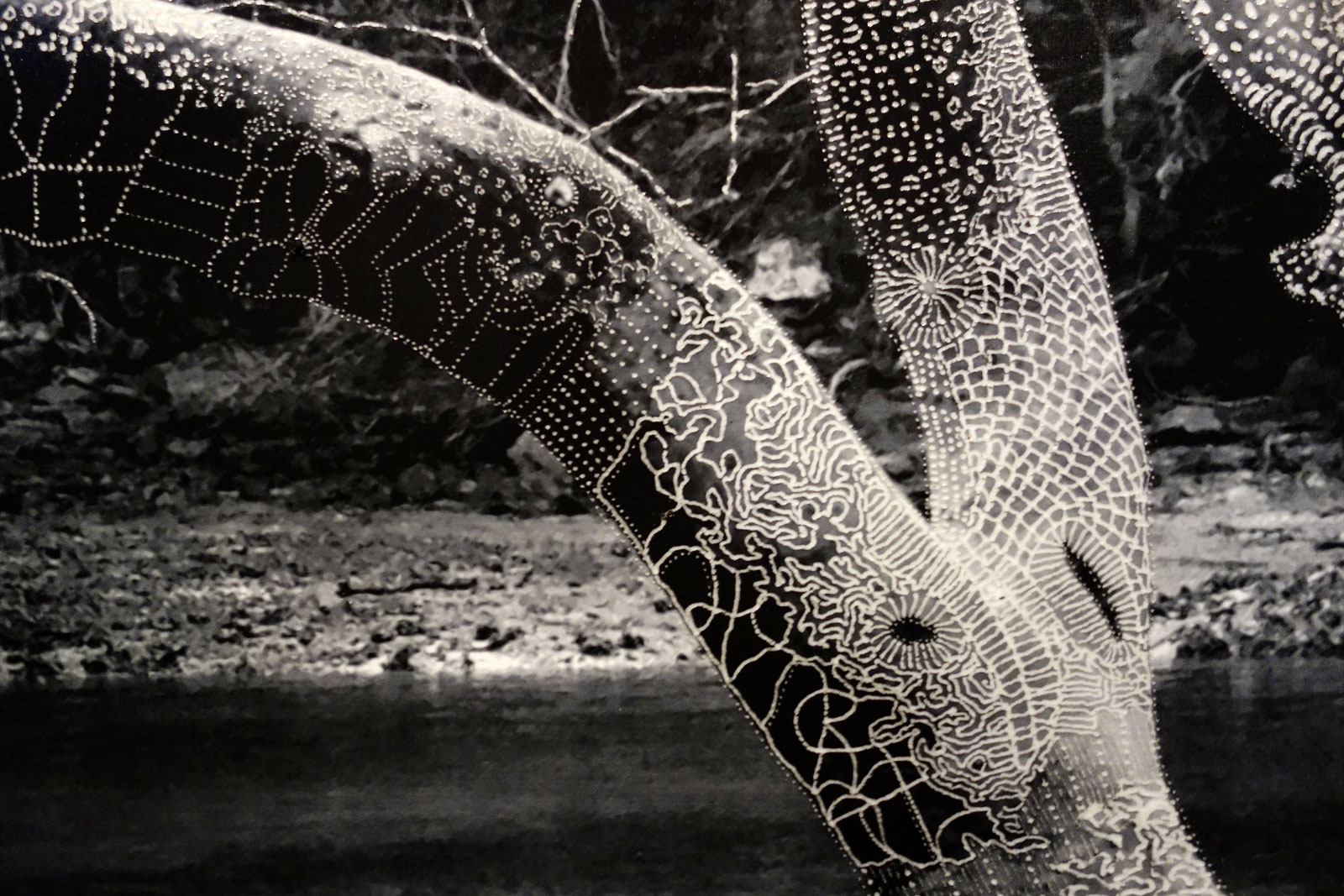
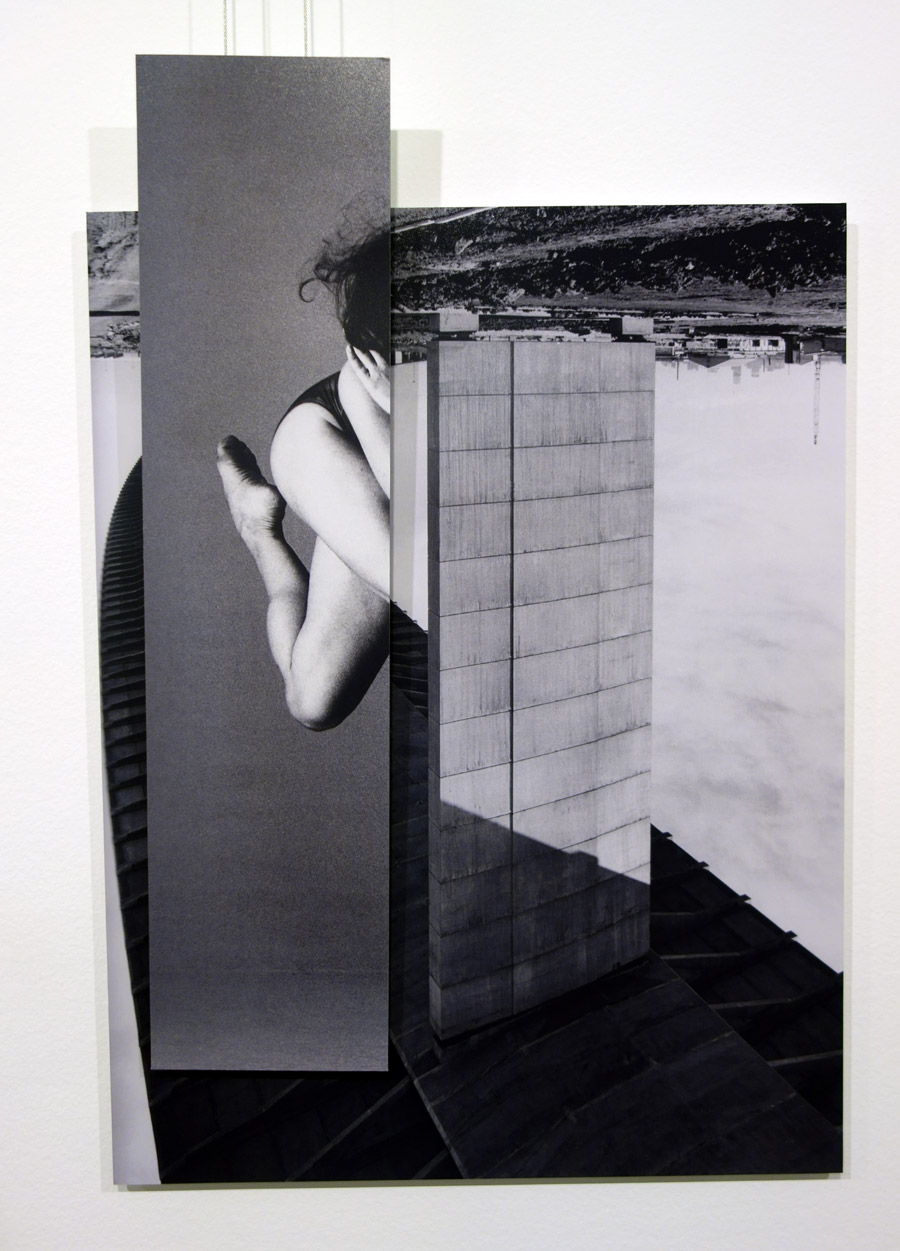
To my mind the best work in the exhibition is the simplest and most eloquent. Out of Joshua Yeldham’s trio of images, it is Owl of tranquillity (2015, below) which is the standout. The base image is beautiful and the careful incision work just adds to the magical resonance of the image. A truly knockout piece that would be a joy in any collection. The other two works suffer from the base image being taken on a mobile phone… the quality of the image is just not there to start with, and to then print and work the image at such great scale (see installation images below) means both images tend to loose cohesiveness. You can get away with it once, but not three times.

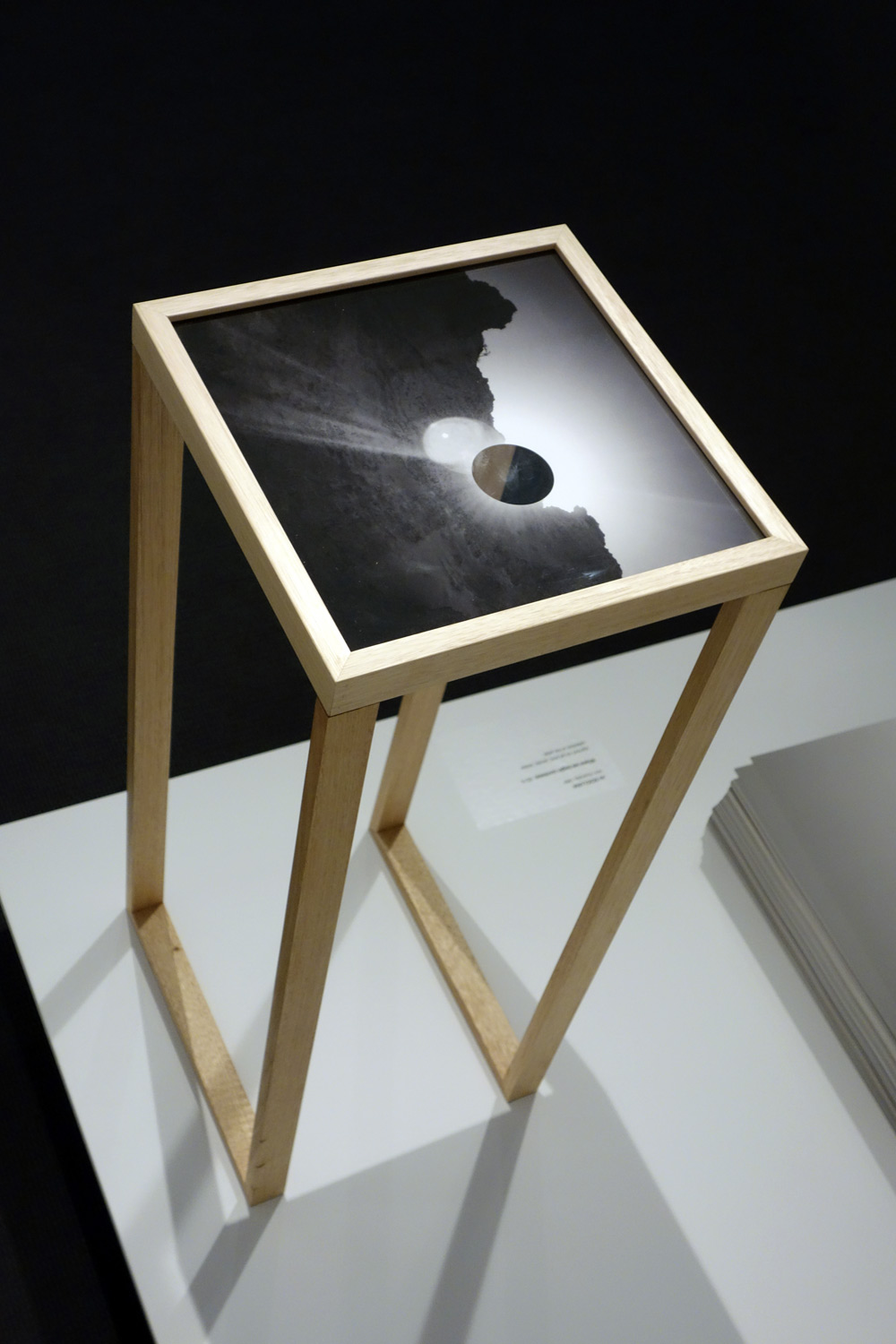
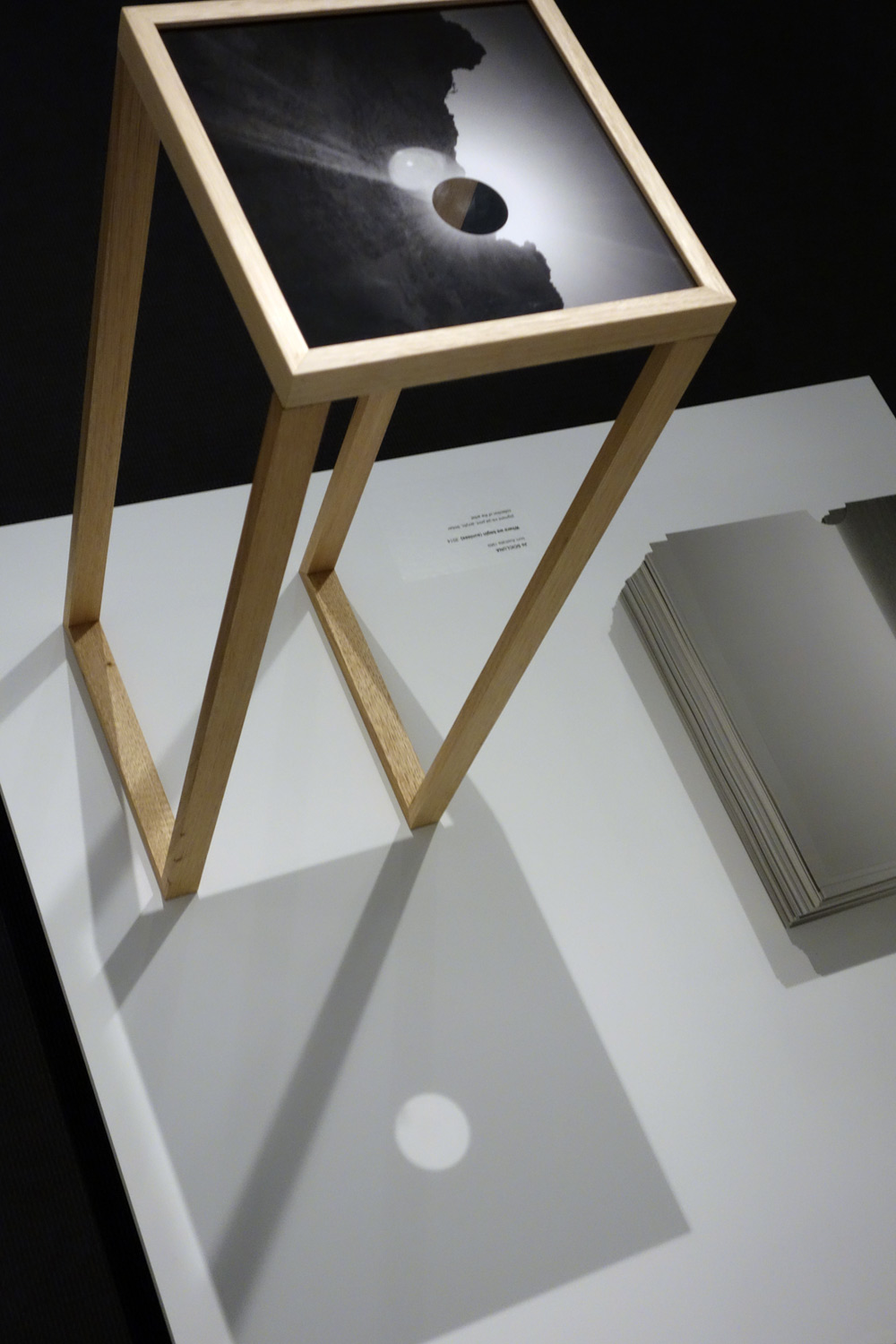
I also very much liked the concept and execution of the installation by Jo Scicluna (below). The photographs were well printed, the alterations intellectually and visually challenging, the framing and construction of the installation effective with the use of wood and shadow, and the whole had a wonderful resonance in the corner of the gallery. Plus you got a free poster of the work to take away with you!

Dr Marcus Bunyan


Many thankx to the Monash Gallery of Art for allowing me to publish the photographs in the posting. Please click on the photographs for a larger version of the image. All text from the Monash Gallery of Art. All installation photographs © Marcus Bunyan and the Monash Gallery of Art


Installation photograph of the exhibition 'Cutting edge: 21st-century photography' at the Monash Gallery of Art

Installation photograph of the exhibition 'Cutting edge: 21st-century photography' at the Monash Gallery of Art

Installation photograph of the exhibition 'Cutting edge: 21st-century photography' at the Monash Gallery of Art


Installation photographs of the exhibition Cutting edge: 21st-century photography at the Monash Gallery of Art
Photos: © Marcus Bunyan and the Monash Gallery of Art


In the early years of the 21st century many cultural commentators were excited by the prospect of photography becoming a truly global art form. With cameras, computers and printers all communicating seamlessly through digital networks, and with the internet providing a worldwide platform for sharing photographs, it looked like the photographic medium might transcend the specificities of both place and materials.

While global digital networks have clearly impacted photography generally, the work of many art photographers has taken a different turn. Instead of embracing the seamless space of digital production, or the expanded horizon of online galleries, artists working with photography have found a range of ways to ground their practices in the material world.

Cutting edge: 21st-century photography features the work of contemporary artists who disrupt the seamless uniformity of screen-based photography by cutting, pinning, folding and puncturing photographic prints. These are photographs that need to be engaged with in physical space, rather than contemplated on a screen; this is an exhibition about making rather than taking photographs.”

Text from the Monash Gallery of Art


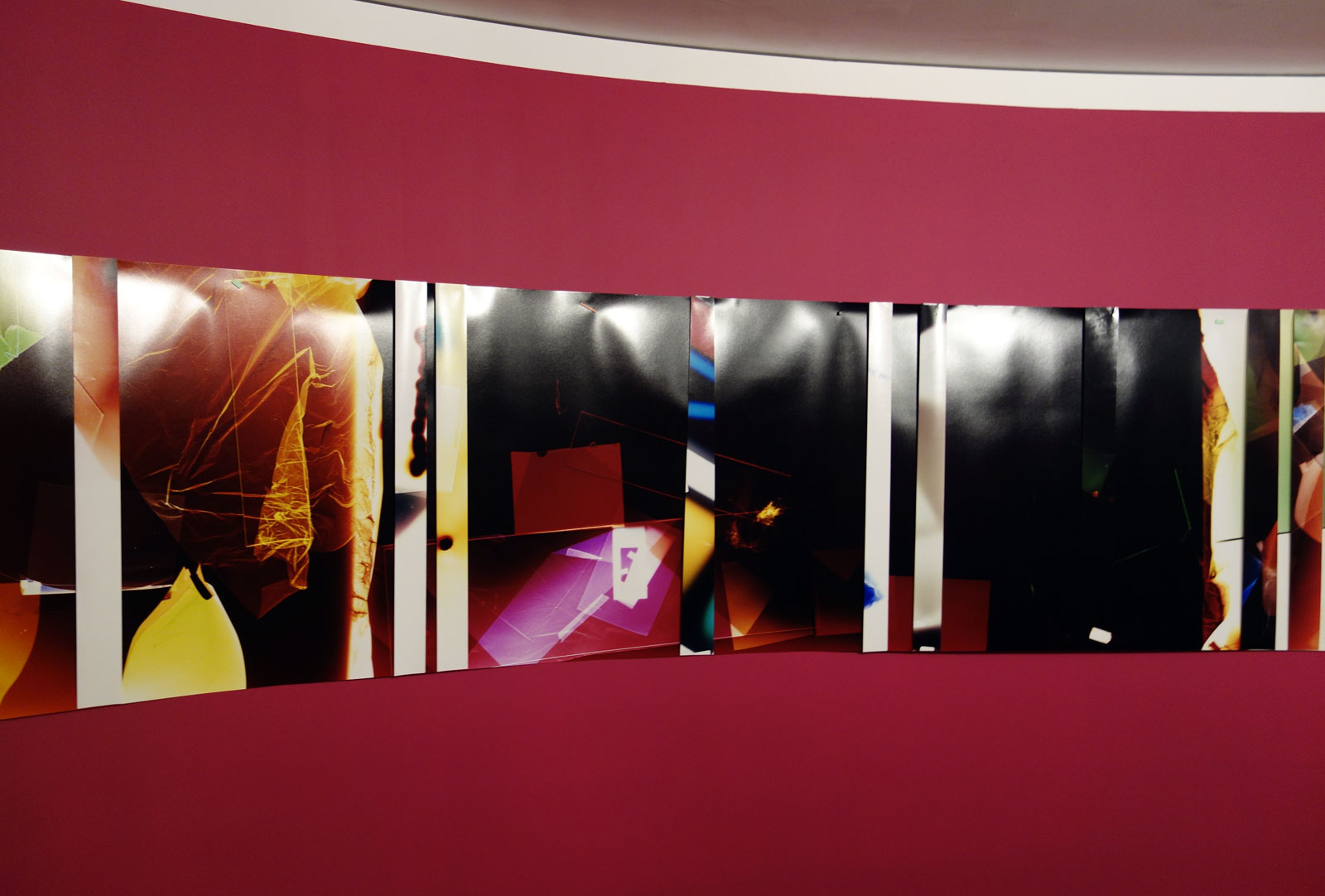
Installation photograph of Danica CHAPPELL. 'Light shadow (5 days + 5 hrs in 8 parts + test strips)' 2012-2015 (detail)


Installation photograph of Danica Chappell. Light shadow (5 days + 5 hrs in 8 parts + test strips) 2012-2015 (detail)
Photo: © Marcus Bunyan and the Monash Gallery of Art


Danica Chappell‘s practice belongs to a long artistic tradition of visual abstraction, which rejects representation in favour of sensual and experimental processes. While this tradition is dominated by painters, Chappell employs the light-sensitive chemistry of traditional photography to generate her images. Even though Chappell’s practice can be described as ‘photographic’, she doesn’t use a camera to produce her work. This helps turn photography into something abstract, rather than representational, but it also allows Chappell to distance herself from the ‘instamatic moment’ and foreground an extended process of creative intuition with colour and form. The work being exhibited here, Light shadow (5 days + 5 hrs in 8 parts + test strips), was created in a colour darkroom over several hours. Approaching this as a type of unseeable performance, Chappell arranged and rearranged scraps of paper and other off-cuts on the light sensitive paper while exposing it to light for different periods of time. Chappell’s final installation of this work incorporates test strips, which have been placed at intervals over the print. The test strips, which were integral in the making of the work, interrupt the fl ow of the underlying print, adding an extra layer of abstraction and temporality.


Danica CHAPPELL. 'Light shadow (5 days + 5 hrs in 8 parts + test strips)' 2012-2015 (detail)

Danica CHAPPELL. 'Light shadow (5 days + 5 hrs in 8 parts + test strips)' 2012-2015 (detail)

Danica CHAPPELL. 'Light shadow (5 days + 5 hrs in 8 parts + test strips)' 2012-2015 (detail)

Danica CHAPPELL. 'Light shadow (5 days + 5 hrs in 8 parts + test strips)' 2012-2015 (detail)


Danica Chappell (Australian, b. 1972)
Light shadow (5 days + 5 hrs in 8 parts + test strips) (details)
2012-2015
Chromogenic prints
Collection of the artist
Photos: © Marcus Bunyan and the Monash Gallery of Art


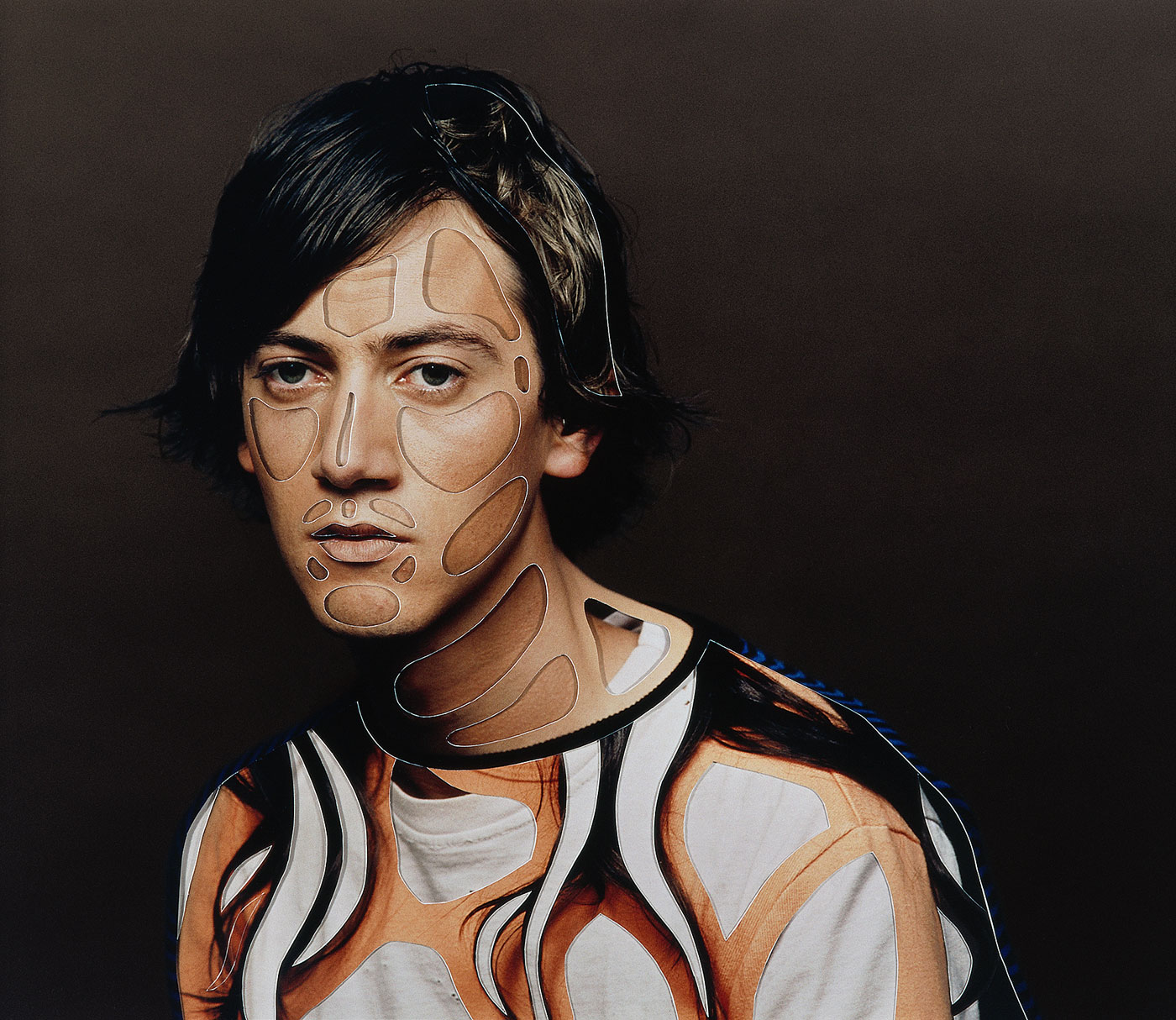
Installation view of David ROSETZKY. 'Aaron I' 2004 'Hamish' 2004


Installation view of David Rosetzky. Aaron I 2004 and Hamish 2004
Photo: © Marcus Bunyan and the Monash Gallery of Art


David Rosetzky (Australian, b. 1970) 'Hamish' 2004


David Rosetzky (Australian, b. 1970)
Hamish
2004
Chromogenic prints
Courtesy of the artist and Sutton Gallery (Melbourne)
Monash Gallery of Art, City of Monash Collection acquired 2005


David Rosetzky‘s practice encompasses a range of media, including video and photography, and typically explores themes of identity and interpersonal relationships. Throughout his career, Rosetzky has created photographic series and has periodically returned to work on photographic cut-out and collaged portraits. To produce these images, Rosetzky creates cool studio portraits of young models, referencing the style of photography found in advertising and fashion magazines. He then layers as many as three photographic portraits on top of each other before hand cutting sections to reveal parts of the underlying prints (above). Through these works Rosetzky represents his subjects as being multi-layered and highlights the idea that identity is fragile, changeable and often concealed. The crumpled paper, represented in his more recent portraits (below), suggests that surfaces are dynamic thresholds rather than superficial masks. Used in a photographic context, the crumpled paper can also be seen as a reference to photography’s power to transform and elaborate a person’s social identity.


David Rosetzky (Australian, b. 1970) 'Pieces #1' 2015 (installation view)


David Rosetzky (Australian, b. 1970)
Pieces #1 (installation view)
2015
Chromogenic prints
Collection of Ten Cubed
Collection of the artist
Photo: © Marcus Bunyan and the Monash Gallery of Art


David Rosetzky (Australian, b. 1970) 'Pieces #2' 2015


David Rosetzky (Australian, b. 1970)
Pieces #2
2015
Chromogenic prints
Courtesy of the artist and Sutton Gallery (Melbourne)
Collection of Ten Cubed
Collection of the artist


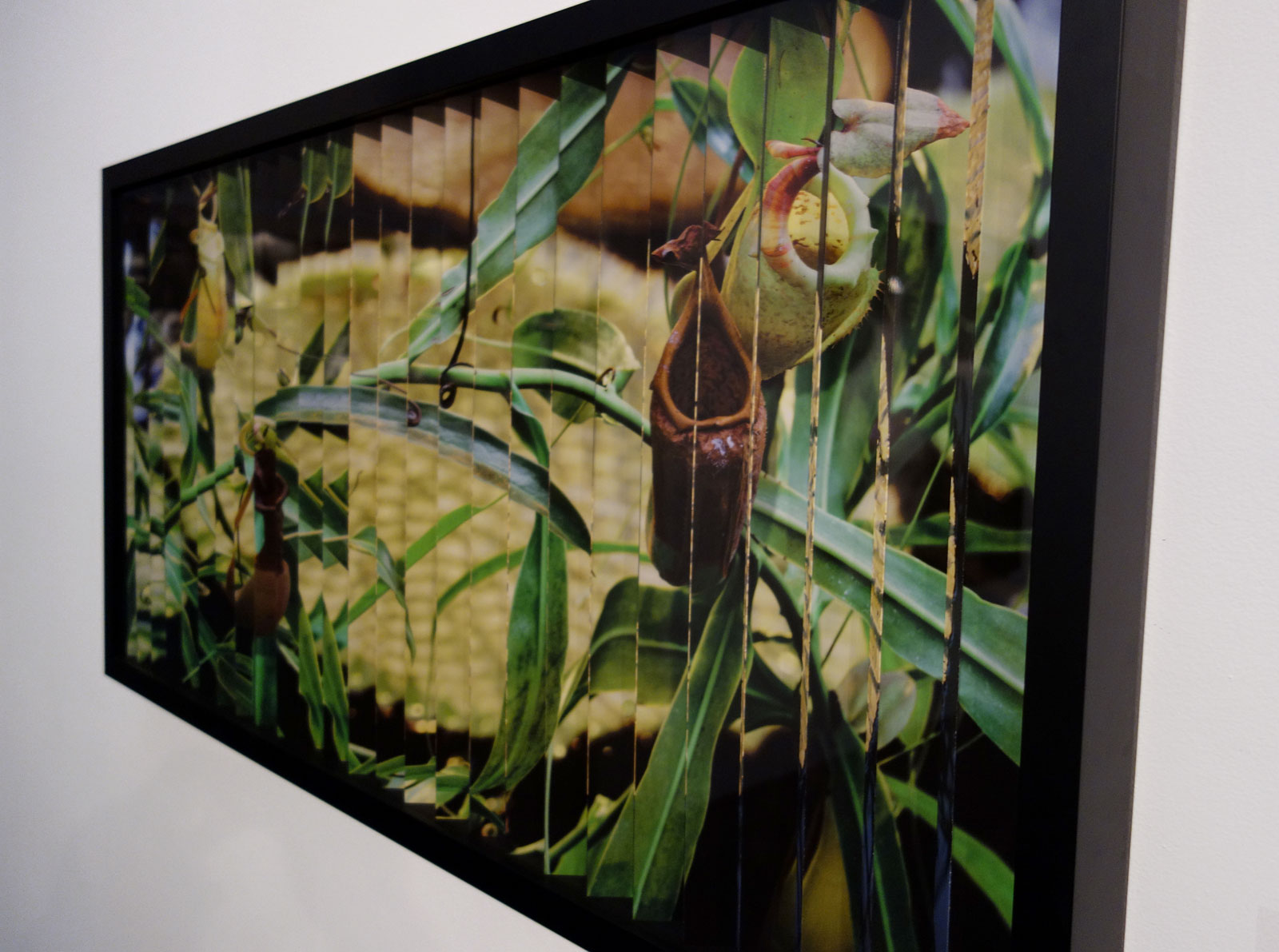
Megan Jenkinson (New Zealand, b. 1958) 'meniscus' 2014 (installation view detail)


Megan Jenkinson (New Zealand, b. 1958)
meniscus (installation view detail)
2014
From the series Transfigurations
Pigment ink-jet print
Collection of the artist
Photo: © Marcus Bunyan and the Monash Gallery of Art


Megan Jenkinson began working with lenticular printing technologies in 2007. Lenticular printing combines multiple still images to give the impression of movement and three-dimensionality. The work on display here is from Jenkinson’s Transfigurations series, which employs a handmade form of lenticular photography to evoke the transience of the natural world. This large-scale image of water foliage is composed of two separate photographs that have been digitally spliced together and printed on a single sheet of paper. The artist has then hand-folded the photograph to create a concertinaed surface that can only be seen in its complete form when viewed from multiple angles. As a consequence, viewers need to physically interact with the photographic object, walking from side-to-side in order to experience the artwork. This form of photography disrupts traditional expectations of two-dimensional photography and introduces a tactile aspect to digital production.


Megan Jenkinson (New Zealand, b. 1958) 'meniscus' 2014 (installation view detail)

Megan Jenkinson (New Zealand, b. 1958) 'meniscus' 2014 (installation view detail)


Megan Jenkinson (New Zealand, b. 1958)
meniscus (installation view details)
2014
From the series Transfigurations
Pigment ink-jet print
Collection of the artist
Photos: © Marcus Bunyan and the Monash Gallery of Art


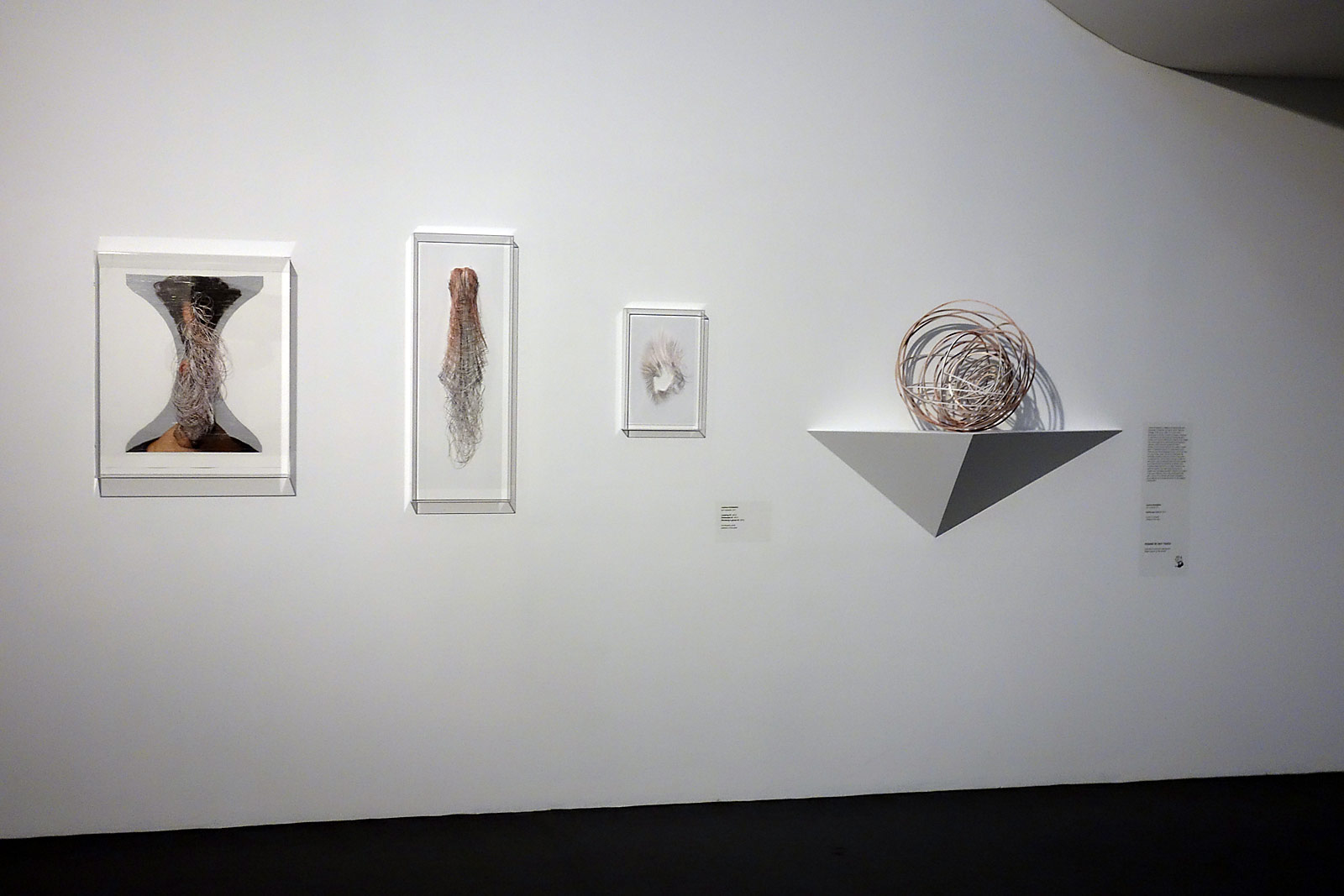
Installation view of works by Justine Khamara. 'Looping #3' 2014; 'Distended #2' 2013; 'Ghosting's ghost #2' 2010; 'Orbital spin trick #2' 2013


Installation view of works by Justine Khamara

Looping #3 2014
Distended #2 2013
Ghosting’s ghost #2 2010
Orbital spin trick #2 2013
Photo: © Marcus Bunyan and the Monash Gallery of Art


In a world where photographs are often viewed on screens, Justine Khamara is interested in the physicality of the photographic surface and how this affects the meaning of an image. Her works begin as two-dimensional photographic portraits, which she then sculpts into three-dimensional forms that protrude from walls or stand alone in exhibition spaces. To create these works, Khamara cuts her photographic prints, either by hand or using a laser cutter. She then manipulates the intricately shredded surfaces by hand to give them a sculptural form. This involves an array of different techniques, such as adhering part of the photograph to a backing board and allowing the filleted paper to hang loosely from the top. In other instances she pulls and weaves the segmented photograph to create more purposeful geometric shapes. By working in this way, Khamara invests the photographic still with a sense of movement and playful elaboration, which effaces the mechanical nature of photographic reproduction.


Justine Khamara (born Australia 1971) 'Orbital spin trick #2' 2013


Justine Khamara (born Australia 1971)
Orbital spin trick #2
2013
UV print on plywood
50.0 x 50.0 x 50.0cm
Reproduction courtesy of the artist and ARC ONE Gallery (Melbourne)
Collection of the artist


Justine Khamara (Australian, b. 1971) 'Orbital spin trick #2' 2013 (installation view detail)

Justine Khamara (Australian, b. 1971) 'Orbital spin trick #2' 2013 (installation view detail)

Justine Khamara (Australian, b. 1971) 'Orbital spin trick #2' 2013 (installation view detail)


Justine Khamara (Australian, b. 1971)
Orbital spin trick #2 (installation view details)
2013
UV print on plywood
Collection of the artist
Photos: © Marcus Bunyan and the Monash Gallery of Art


Justine Khamara (Australian, b. 1971) 'Looping #3' 2014 (installation view detail)

Justine Khamara (Australian, b. 1971) 'Looping #3' 2014 (installation view detail)


Justine Khamara (Australian, b. 1971)
Looping #3 (installation view details)
2014
Chromogenic prints
Collection of the artist
Photos: © Marcus Bunyan and the Monash Gallery of Art


Luke Parker (Australian, b. 1975) 'Screen memory' 2014 (installation view)


Luke Parker (Australian, b. 1975)
Screen memory (installation view)
2014
From the series Screen memory
Mixed media
Collection of Mikala Dwyer and David Corben
Collection of the artist
Photo: © Marcus Bunyan and the Monash Gallery of Art


Luke Parker works across a range of media, his practice is largely concerned with giving a sense of metaphysical weight to everyday events and chance encounters. The works on display here are made up of Parker’s own photographs combined with found images that he has collected over the past 20 years. To create these works, Parker categorised seemingly disparate images according to formal patterns and poetic associations. He then arranged the images onto a unifying background and used a needle and thread to stitch them into a type of artistic circuit board. Parker created this series as a way of making sense of his own image archive as well as the proliferation of images encountered in everyday life.

In a world where images are increasingly set adrift from specific economies of meaning, to circulate freely through digital networks, Parker’s works function as conceptual nets that encourage viewers to think about photographs rather than just watch them pass by.


Martin Smith (born Australia 1972) 'After seeing every episode twice' 2006 (installation view)

Martin Smith (born Australia 1972) 'After seeing every episode twice' 2006 (installation view)


Martin Smith (born Australia 1972)
After seeing every episode twice (installation views)
2006
Chromogenic print
Monash Gallery of Art, City of Monash Collection acquired 2008
Photos: © Marcus Bunyan and the Monash Gallery of Art


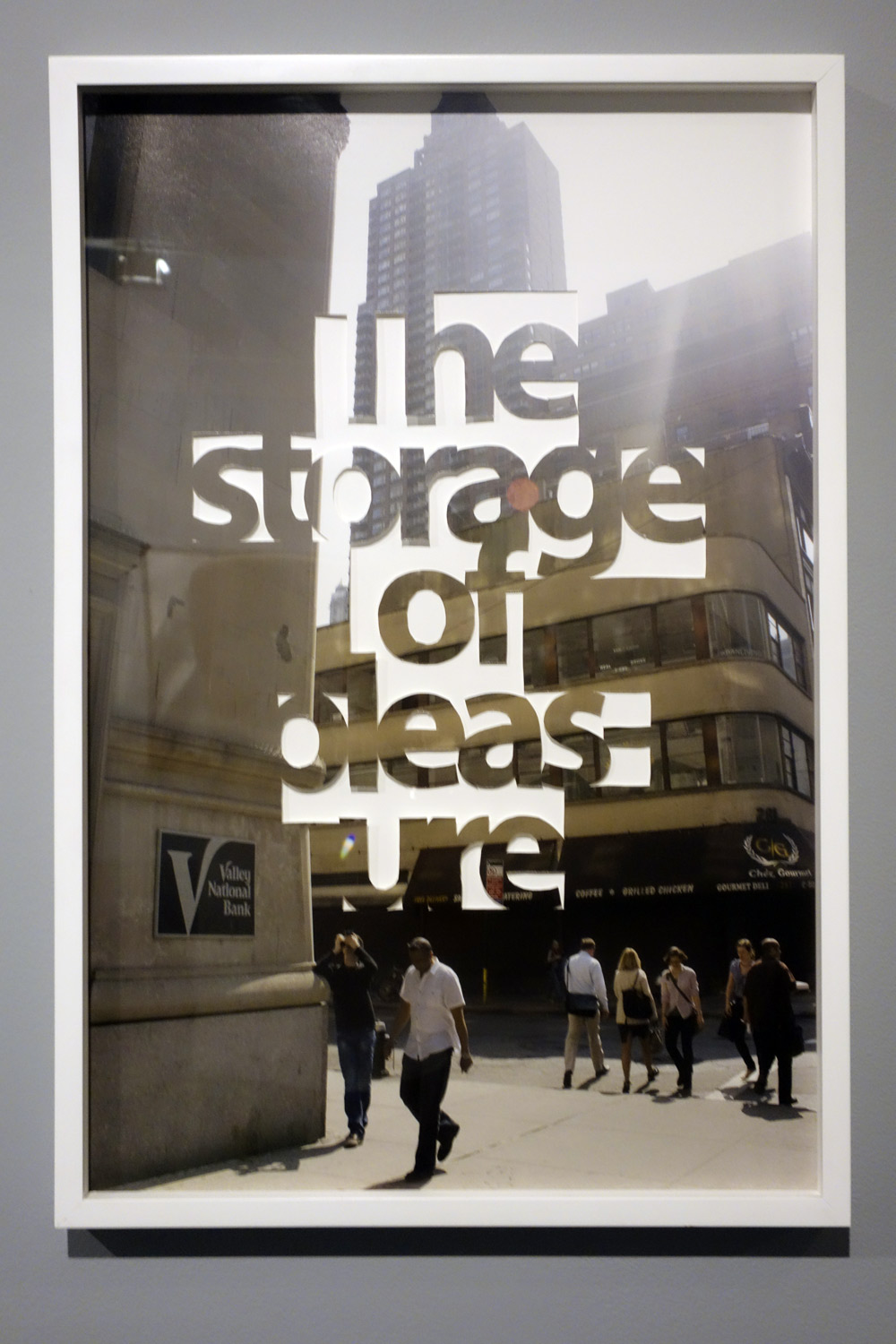
Martin Smith‘s practice revolves around the integration of photography and text. Using photographs that have been recovered from family albums or personal archives, Smith incorporates texts into the visual fi eld of the image. The texts, which have no obvious relationship with the content of the photographs, recall personal memories or lyrics from popular songs. To incorporate the texts, Smith hand-cuts letters out of the photographic prints, often leaving the letters scattered beneath the image. The disconnect between the text and the image is a deliberate attempt to combine two discrete methods of storytelling – image and text – while also emphasising the way memories of an event are usually different from the original experience. By cutting letters out of the photograph, Smith complicates the viewer’s ability to believe in either the text or the image, and opens up a space that encourages new interpretations.


Martin Smith (born Australia 1972) 'pleasure / storage' 2012 (installation view)

Martin Smith (born Australia 1972) 'pleasure / storage' 2012 (installation view)


Martin Smith (born Australia 1972)
pleasure / storage (installation views)
2012
Pigment ink-jet prints
Collection of the artist
Photos: © Marcus Bunyan and the Monash Gallery of Art


Installation view of Paul KNIGHT. 'Untitled (PK_10_05)' 2010 and 'Untitled (PK_10_02)' 2010


Installation view of Paul Knight. Untitled (PK_10_05) 2010 and Untitled (PK_10_02) 2010
Photo: © Marcus Bunyan and the Monash Gallery of Art


Paul Knight‘s style of his photographs is influenced by his background in commercial photography; they are technically proficient and almost illustrative in their documentary clarity. These cool formal qualities, however, are unsettled by the subject matter, which is often about private desires and passions. Knight’s 2010-11 untitled series of folded photographs document couples embracing in bed. The series reflects Knight’s broader interest in photographing moments of candour and intimacy between lovers, which remains a preoccupation of his practice. In this series, however, Knight has folded the photographic prints to frustrate any expectation we might have about a photograph’s capacity to show or reveal its subject. Instead of offering a crude, voyeuristic perspective, the intimacy documented in these images is obscured and concealed in the folds of the print.


Paul Knight (born Australia 1976) 'Untitled (PK_10_02)' 2010 (installation view)


Paul Knight (born Australia 1976)
Untitled (PK_10_02) (installation view)
2010
Chromogenic prints
Monash Gallery of Art, City of Monash Collection acquired 2010
Photo: © Marcus Bunyan and the Monash Gallery of Art


Emidio Puglielli (born Australia 1964) 'Colourful mountain disruption' 2009 (installation view)


Emidio Puglielli (born Australia 1964)
Colourful mountain disruption (installation view)
2009
Chromogenic print, pins
Collection of the artist
Photo: © Marcus Bunyan and the Monash Gallery of Art


Emidio Puglielli‘s work focuses on the relationship between the photograph as a material object and the photograph as an image. He is particularly interested in old photographs and their continued resonance in contemporary society. Puglielli finds and collects vernacular photography to use as the starting point for his works. He then highlights the materiality of the photographs by drawing attention to their surface and structure. To do this he employs strategies such as rubbing off the emulsion or piercing the surface with map pins. Puglielli is interested in the way such interventions alter the meaning of a photograph and offer new readings of images.

By damaging the smooth surface of the print, he is able to disrupt the illusion of the photographic image, but his interventions also embellish the photographs in sympathetic ways. This is particularly evident in Snow disruption, where the pins appear as snowflakes, and Shadow disruption where pins become eyeballs in the shadow of the unknown photographer. Puglielli’s works therefore seek to question the nature of photography and the way in which photographs are viewed and reinterpreted.


Installation view of Vivian Cooper SMITH. 'Timeless' 2013


Installation view of Vivian Cooper Smith. Timeless 2013
Photo: © Marcus Bunyan and the Monash Gallery of Art


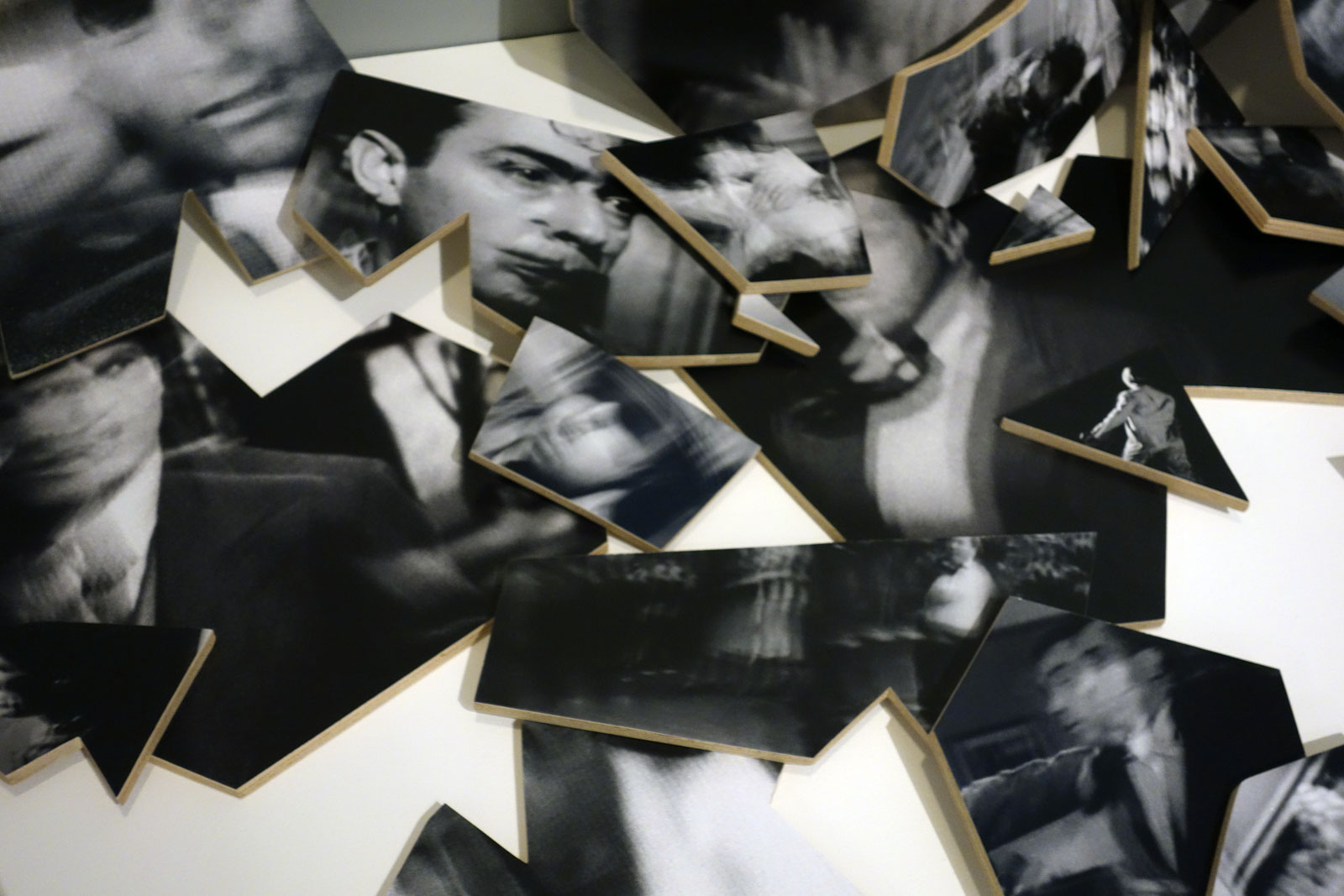
Vivian Cooper Smith‘s artistic practice revolves around photography. Timeless (2013) explores identity and conceptions of self while also reflecting on the nature of photography. To create this work, Smith photographed film noir classics directly from an old television screen. He then printed the images and hand-cut them to fit pieces of irregularly shaped plywood. Smith created this work during a period of personal turmoil and felt that the film noir genre of the post-war period resonated with his own desire to remake himself after a relationship breakdown. As is common to his practice, Smith has interfered with the photograph’s smooth, seamless surface, in this case by dissecting it and creating a three dimensional sculpture. By focussing on the materiality of the photograph, Smith aims to highlight its artificial or constructed nature.


Vivian Cooper Smith (born New Zealand 1974; arrived Australia 1987) 'Timeless' 2013 (installation view detail)

Vivian Cooper Smith (born New Zealand 1974; arrived Australia 1987) 'Timeless' 2013 (installation view detail)


Vivian Cooper Smith (born New Zealand 1974; arrived Australia 1987)
Timeless (installation view details)
2013
Chromogenic prints
Collection of the artist
Photos: © Marcus Bunyan and the Monash Gallery of Art


Installation view of Derek KRECKLER. 'Holey 1' 2003


Installation view of Derek Kreckler. Holey 1 2003
Photo: © Marcus Bunyan and the Monash Gallery of Art


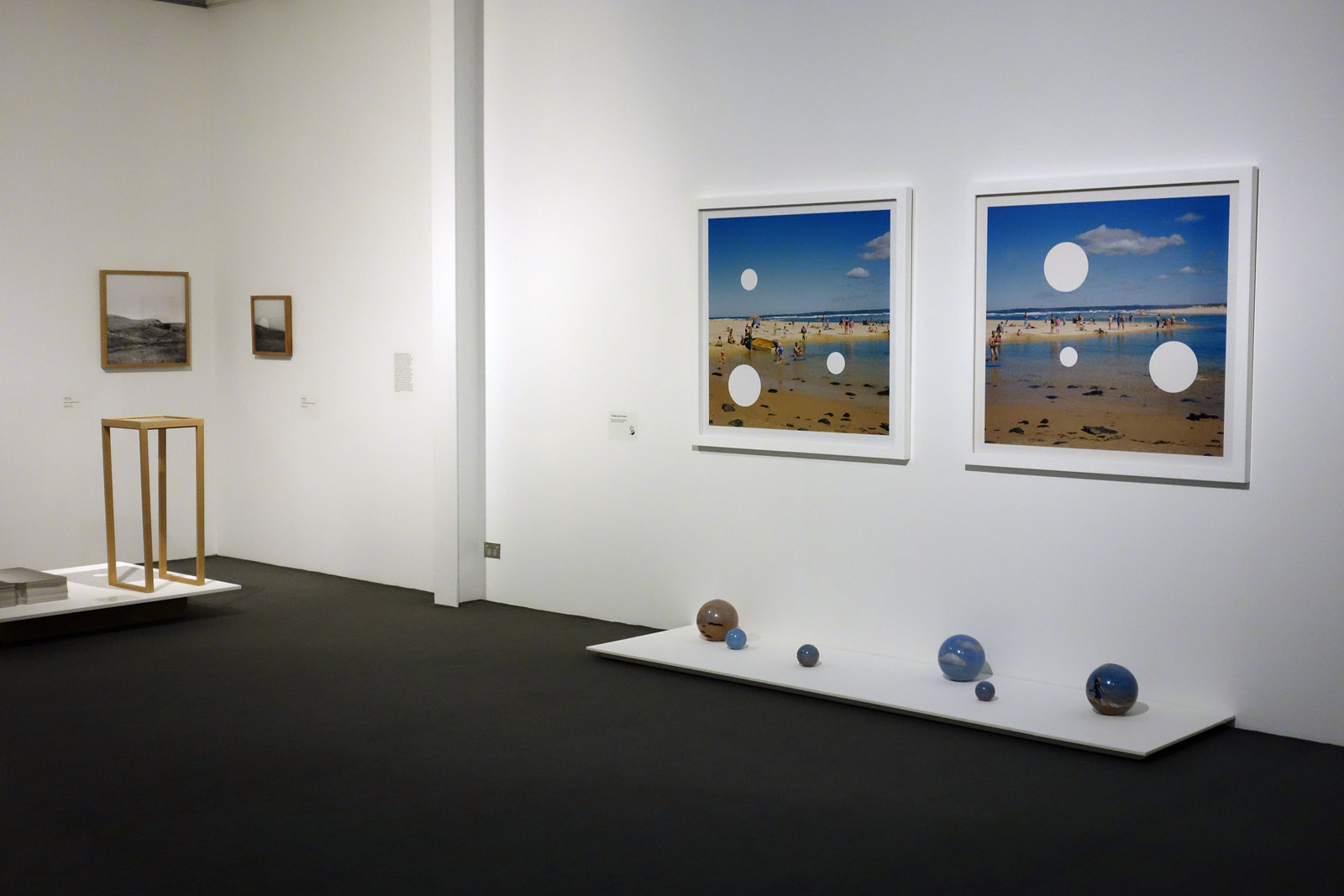
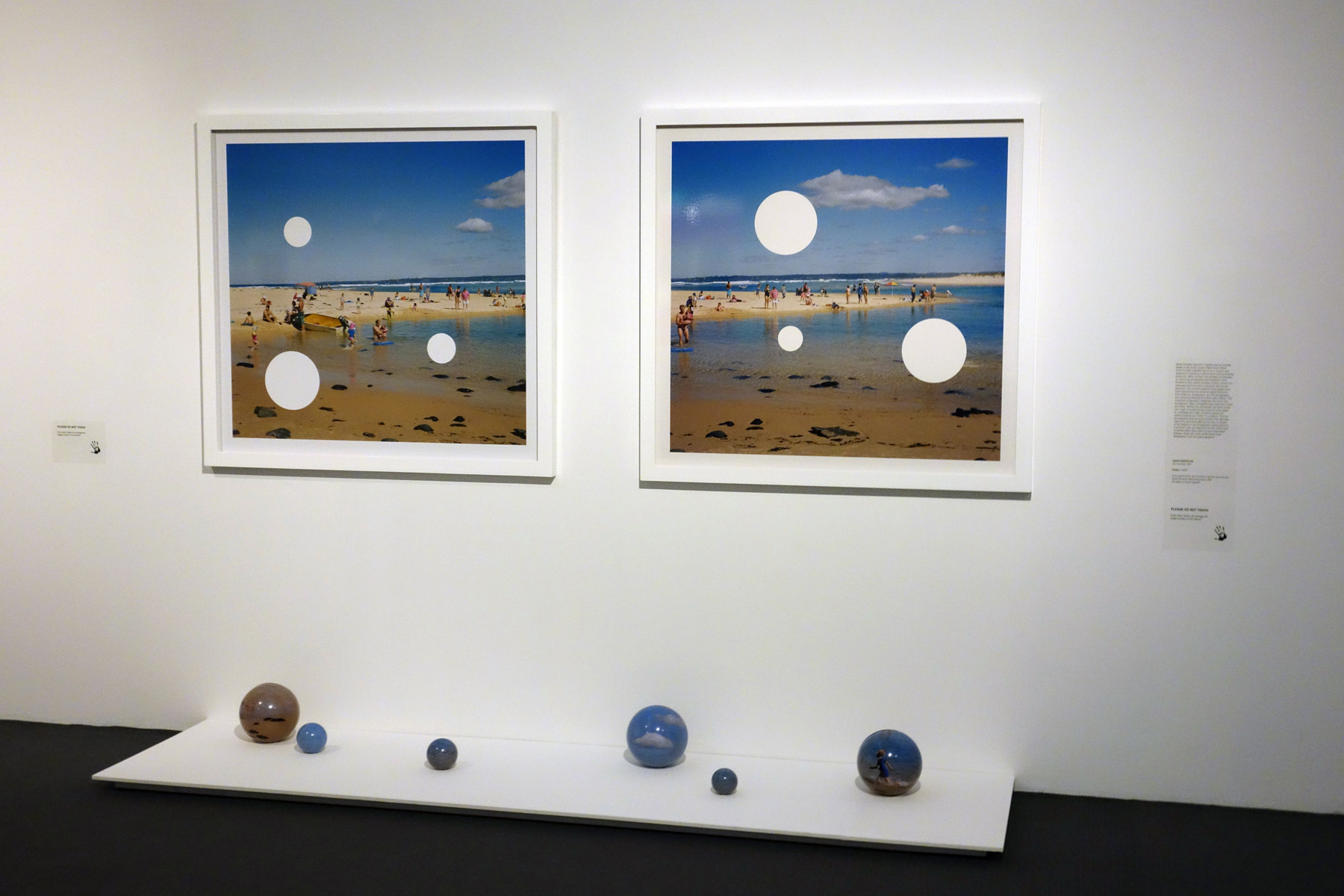
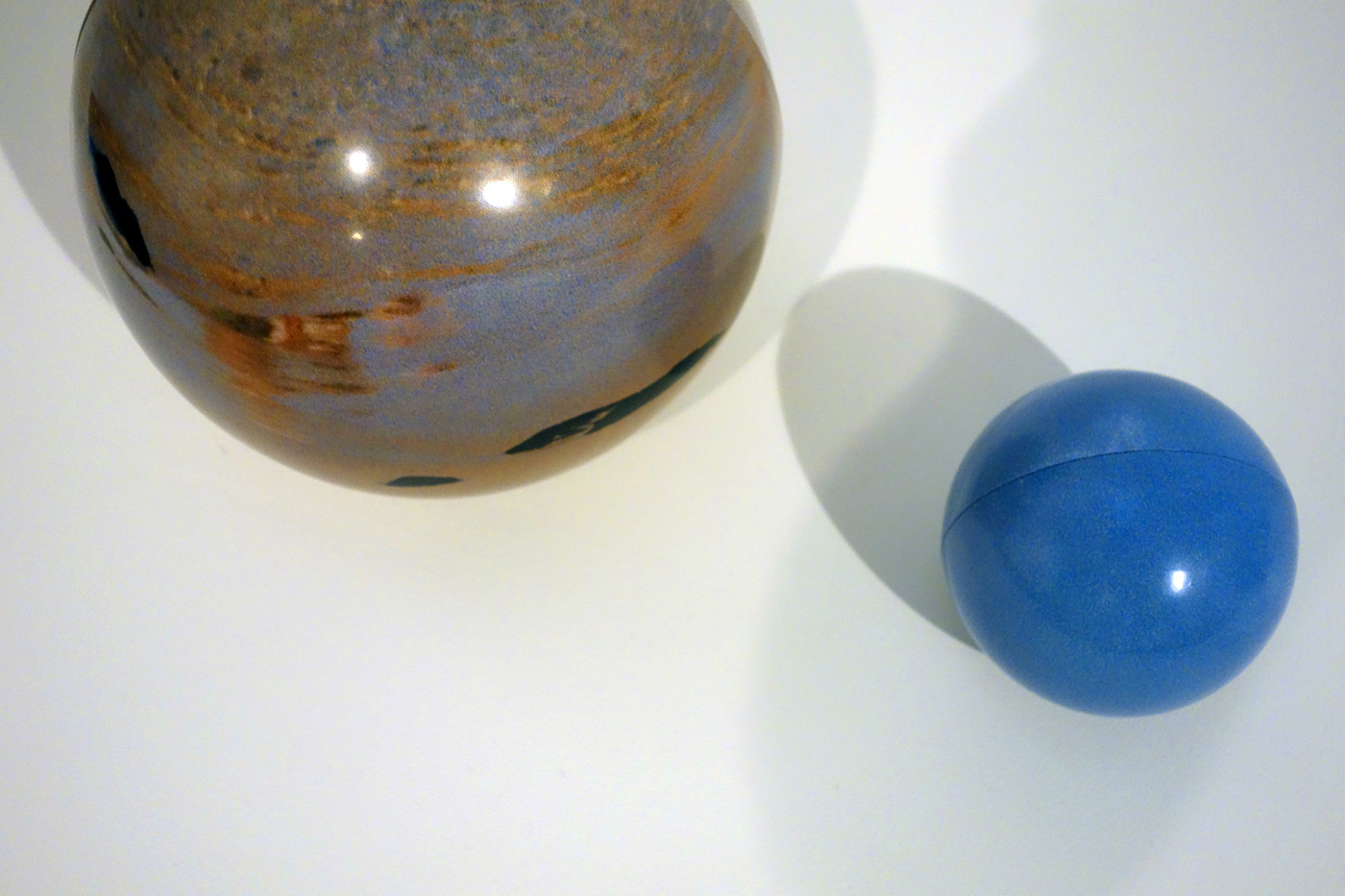
Derek Kreckler originally trained as a sculptor and established himself as a performance and sound artist during the 1990s, he has more recently concentrated on producing photographic and installation work. Kreckler’s Holey series consists of beach scenes and seascapes that have been punctured with circular apertures. The excised sections of the images have been transformed into spherical objects that sit in front of the two photographs, as if the photographs have spawned offspring from their holey orifices. This sculptural configuration challenges the notion that photography offers a straightforward document of time and place. Instead, the photograph has been turned into a type of puzzle that the viewer is encouraged to investigate and solve. To further deepen the viewing experience, Holey 1 is a diptych. The two photographs show the same location; the right side captured a short time after the left side. A number of the subjects in the photographs, beach goers on a summer’s day, are displaced by time. Some have remained static, some seem to have meandered between beach and sand, whilst others have disappeared from the scene altogether.


Derek Kreckler (Australian, b. 1952) 'Holey 1' 2003 (installation view)

Derek Kreckler (Australian, b. 1952) 'Holey 1' 2003 (installation view detail)

Derek Kreckler (Australian, b. 1952) 'Holey 1' 2003 (installation view detail)

Derek Kreckler (Australian, b. 1952) 'Holey 1' 2003 (installation view detail)


Derek Kreckler (Australian, b. 1952)
Holey 1 (installation view details)
2003
Chromogenic prints, spun aluminium spheres and cast vinyl
South Australian Government Grant 2004
Art Gallery of South Australia
Photos: © Marcus Bunyan and the Monash Gallery of Art


Installation view of the work of Jo Scicluna in the exhibition 'Cutting edge: 21st-century photography'


Installation view of the work of Jo Scicluna in the exhibition Cutting edge: 21st-century photography
Photo: © Marcus Bunyan and the Monash Gallery of Art


Jo Scicluna works with a range of media, including photography, video, sculpture and installation, often combining these art forms to bring photography into the space of lived experience. Dissatisfied with the way photography, as a documentary device, is almost always tied to past events, Scicluna encourages viewers to engage with the presence of photographic objects. By cutting into the smooth surface of a photographic print, she disrupts the notion that a photograph is a window into the past. She also elaborates conceptual relationships between different photographic objects in her installations. In doing this, Scicluna activates the space between the photographic print, the sculptural form and the phenomenology of a gallery space. For Scicluna, the experience of being in-between things is related to her personal experience of migration and geographic rupture. Scicluna is not interested in using photography to create documents of specific times and places but uses the medium in a conceptual way to evoke sensations that are not as easy to represent in a literal sense.


Jo Scicluna (born Australia 1969) 'Where I have always been an island #4' 2014 (installation view)


Jo Scicluna (born Australia 1969)
Where I have always been an island #4 (installation view)
2014
Pigment ink-jet prints
Collection of the artist
Photo: © Marcus Bunyan and the Monash Gallery of Art


Jo Scicluna (born Australia 1969) 'When our horizons meet' 2013


Jo Scicluna (born Australia 1969)
When our horizons meet
2013
Pigment ink-jet prints
60 x 60cm
Collection of the artist


Jo Scicluna (born Australia 1969) 'Where we begin (sunless)' 2014 (installation view detail)

Jo Scicluna (born Australia 1969) 'Where we begin (sunless)' 2014 (installation view detail)


Jo Scicluna (born Australia 1969)
Where we begin (sunless) (installation view details)
2014
Pigment ink-jet print, acrylic, timber
Collection of the artist
Photos: © Marcus Bunyan and the Monash Gallery of Art


Installation view of the work of Joshua Yeldham in the exhibition 'Cutting edge: 21st-century photography'

Installation view of the work of Joshua Yeldham in the exhibition 'Cutting edge: 21st-century photography'


Installation views of the work of Joshua Yeldham in the exhibition Cutting edge: 21st-century photography
Photos: © Marcus Bunyan and the Monash Gallery of Art


Joshua Yeldham uses a range of media, his practice is focused on exploring the landscape and elaborating spiritual and symbolic narratives around his engagement with the natural world. He captures photographic images on a smart phone before blowing them up and printing them on cotton paper. He then uses tools to physically carve into the paper, disrupting the smooth surface of the photographic image and adding a personal, handmade effect. It is as if the artist is tattooing his own map or story into the skin of the image. The intricate carving creates a textured pattern of lightness over his otherwise dark and mysterious photographs. The technique allows Yeldham to explore history and mythology in the landscape and imbue his works with elements of both the real and the imagined. It also allows him to reference the passing of time as well as the weather and destruction that the natural environment endures on a daily basis.


Joshua Yeldham (born Australia 1970) 'Owl of tranquillity' 2015 (installation view detail)


Joshua Yeldham (born Australia 1970)
Owl of tranquillity (installation view detail)
2015
Pigment ink-jet print
Collection of the artist
Photo: © Marcus Bunyan and the Monash Gallery of Art


Joshua Yeldham (born Australia 1970) 'Resonance' 2015 (installation view detail)

Joshua Yeldham (born Australia 1970) 'Resonance' 2015 (installation view detail)


Joshua Yeldham (born Australia 1970)
Resonance (installation view details)
2015
Mixed media
Collection of the artist
Photos: © Marcus Bunyan and the Monash Gallery of Art


Monash Gallery of Art
860 Ferntree Gully Road, Wheelers Hill
Victoria 3150 Australia
Phone: + 61 3 8544 0500

Opening hours:
Tue – Fri: 10am – 5pm
Sat – Sun: 10pm – 4pm
Mon/public holidays: closed

Monash Gallery of Art website

LIKE ART BLART ON FACEBOOK

Back to top

Review: ‘Trent Parke: The camera is god’ at the Monash Gallery of Art, Melbourne

Exhibition dates: 26th November, 2015 – 21st February, 2016

Curators: Angela Connor, MAPh Senior Curator working with Stella Loftus-Hills, MAPh Curator


Trent Parke (Australian, b. 1971) 'The camera is god (street portrait series)' 2013 (installation view)


Trent Parke (Australian, b. 1971)
The camera is god (street portrait series) (installation view)
2013
Pigment prints
Collection of the artist
Photo: © Marcus Bunyan and the Monash Gallery of Art


Ghost in the machine

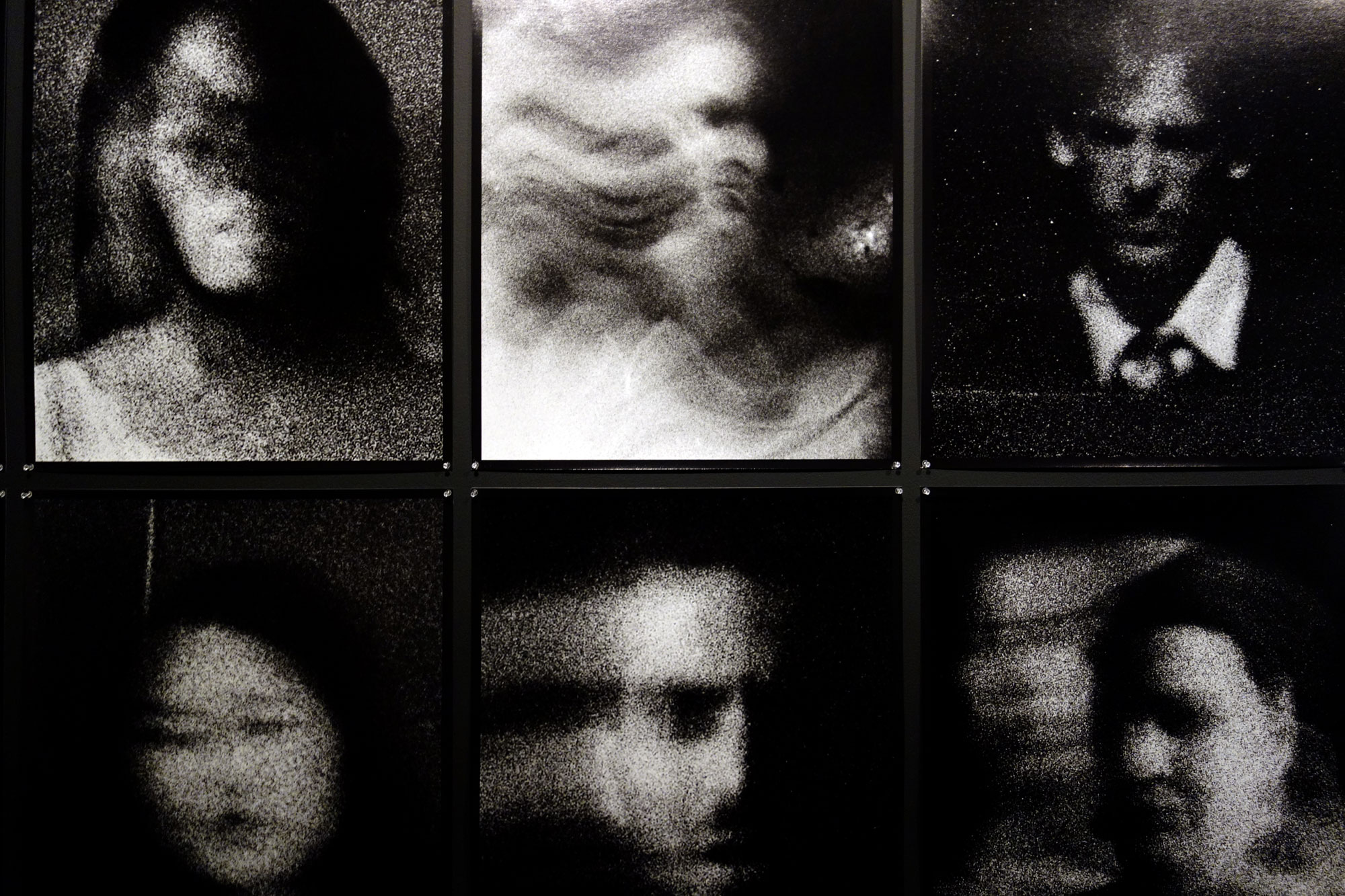
This is a disappointing first solo exhibition in Victoria by internationally renowned Australian photojournalist Trent Parke, the main body of the exhibition made up of his “internationally celebrated series, consisting of anonymous portraits taken on the streets of Adelaide.” (Wall text from the exhibition)

Seriously, who writes this stuff?

Sure, Parke is Australia’s only member of the Magnum photo agency but I have been commenting on photography for many years now, and have never heard of this series before, neither locally and definitely not internationally.

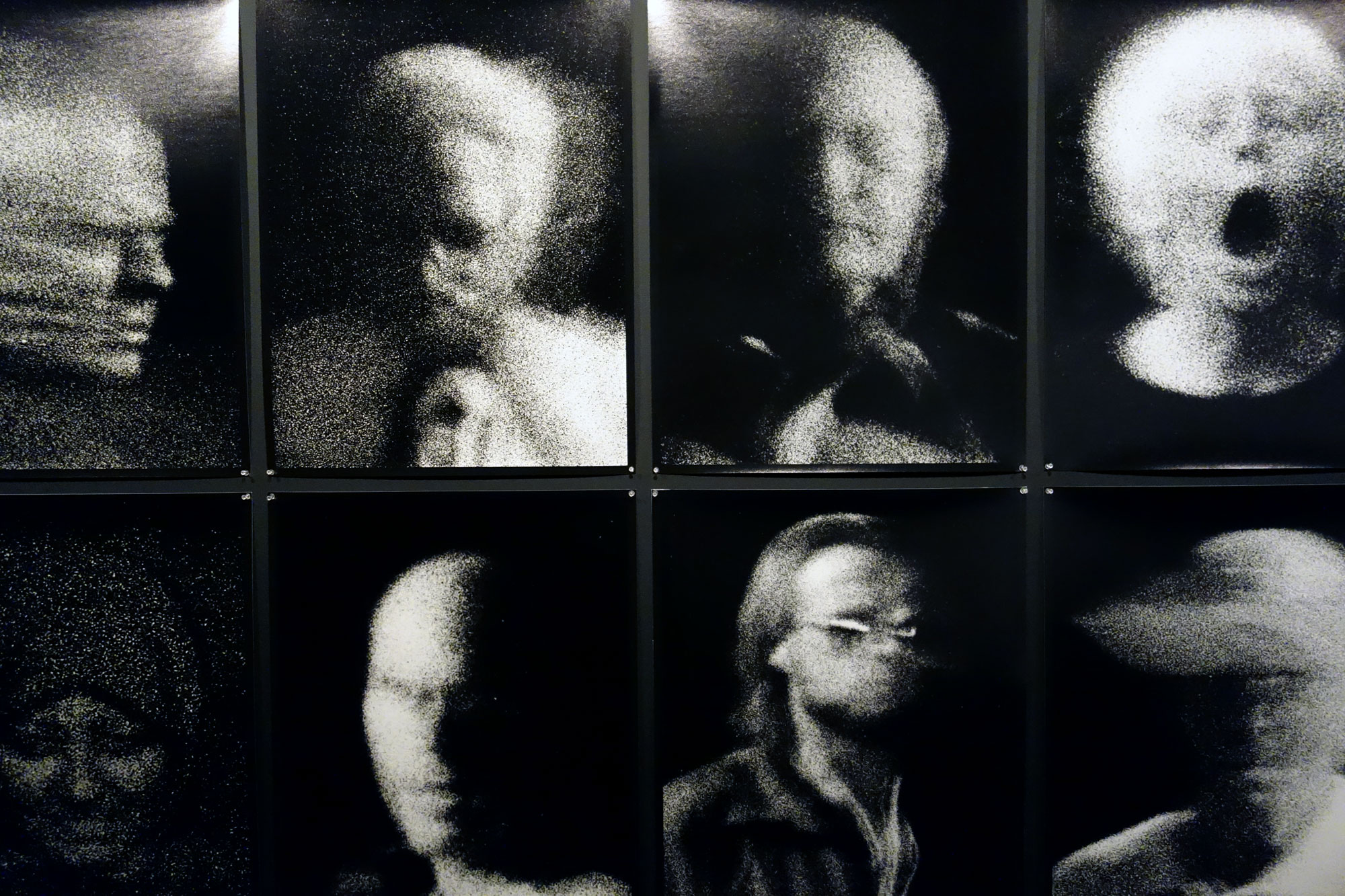
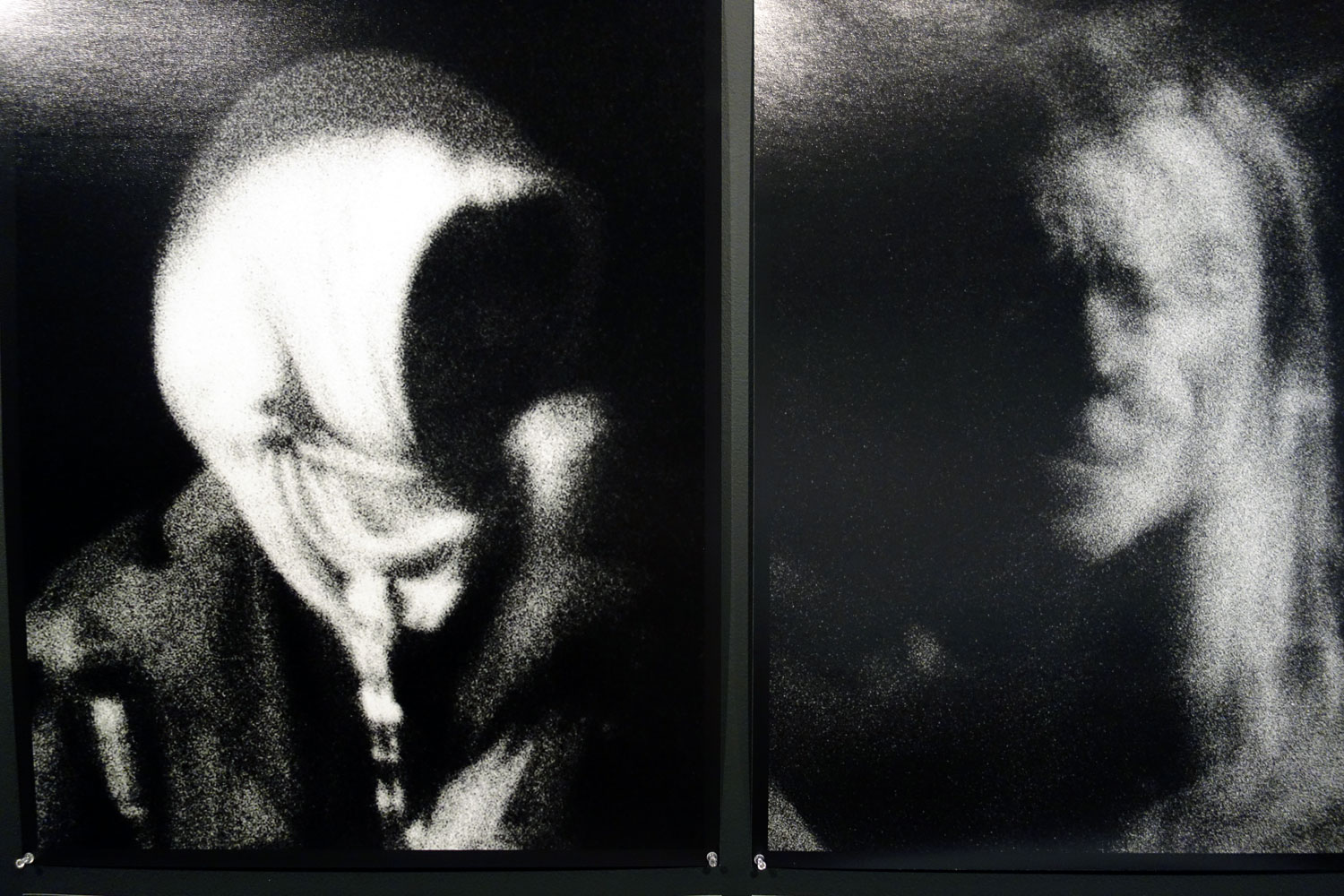
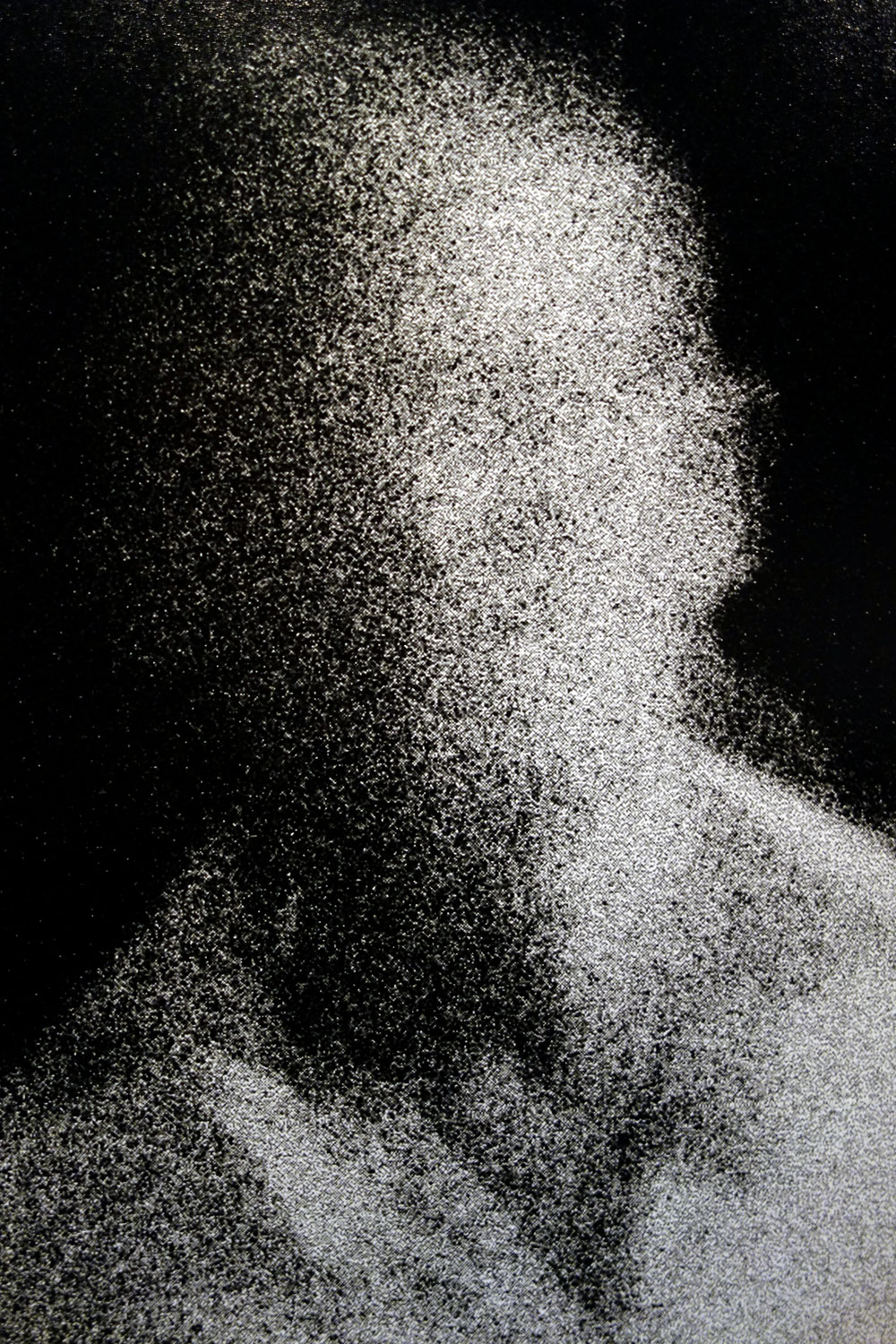
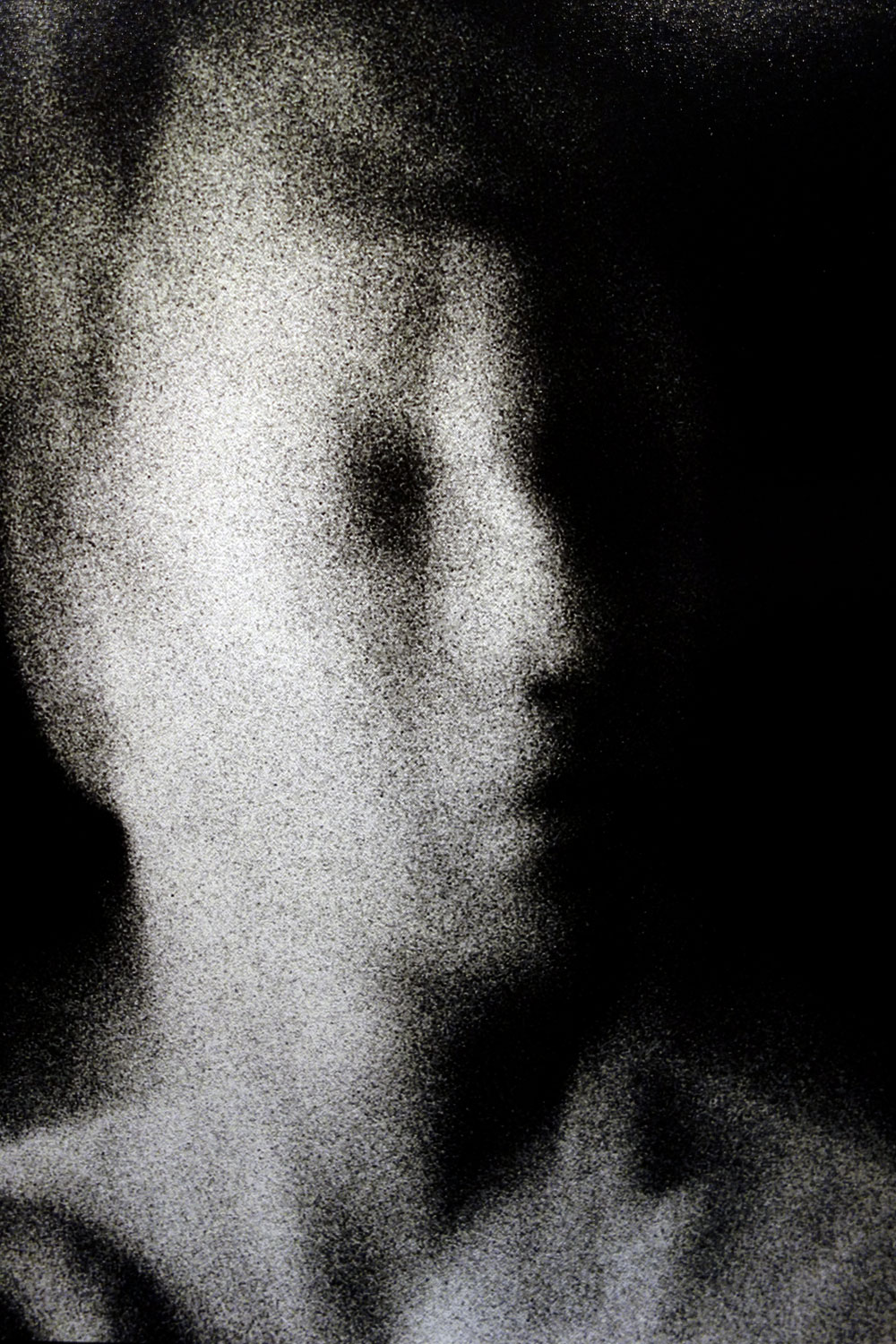
From the ironic title, The camera is god, critiquing the all seeing eye of the camera, to the work itself – a large grid of black and white digital prints from film negatives, the images taken when Parke, “fixed his camera on a tripod and set it to take multiple shots (up to 30 shots in eight-second bursts) when the pedestrian lights changed.” Parke then extracted, “individual portraits from these photographs of street traffic, Parke allowed motion-blur and film grain to obscure the identity of his subjects” – the series feels like a university photography course exercise into the study of motion. While the installation works better from a distance, the gridded layout forming a holistic whole of ambiguous individuals, the closer you get the more the integrity of the images naturally falls apart with golf ball sized grain. Unfortunately, not all the grain is from the film negative. Some of it is digital noise, and the combination of film grain and digital pixellation does not sit well with the images. If you are going to shoot analogue film, why then destroy its characteristics by printing digitally, and introducing an entirely different element into the equation?

Photographs of anonymous people in the city have a long presence in the history of photography. They disavow what is known as the ‘civil contract of photography’1 that is, a relation between formally equal parties (the photographer and the sitter), whose equality lies in their shared participation in the act of being photographed, in what Ariella Azoulay terms, the community of ‘the governed’.2 As Daniel Palmer and Jessica Whyte note, “Photography is one of the ways in which we are able to establish a distance from power and observe its actions from a position that is not already marked as one of subjection.”3 In other words, the photographer can photograph from a position of freedom and not of surveillance and control (by state power). Of course, this does not negate the power of the photographer to choose what to photograph, who to make subjective to their whim and control… with or without permission (to photograph).

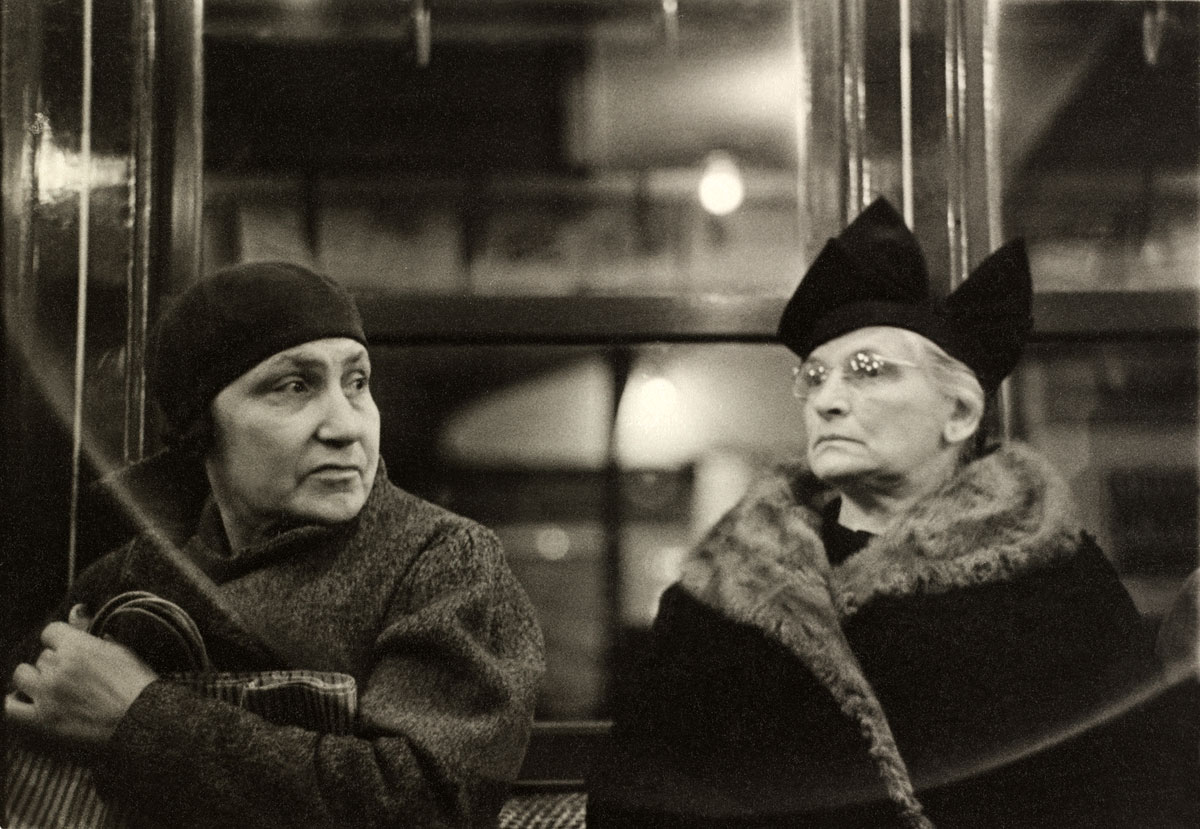
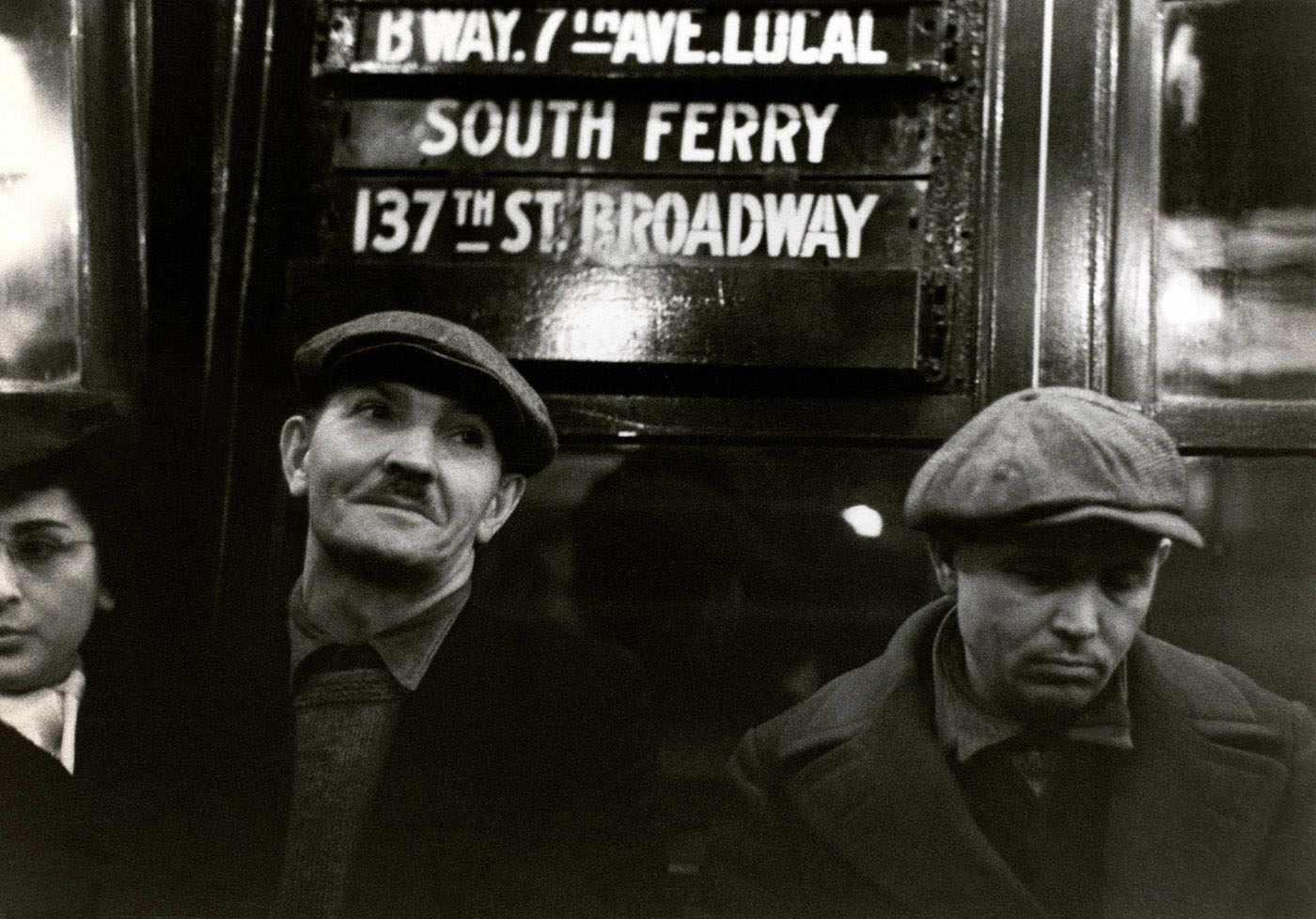
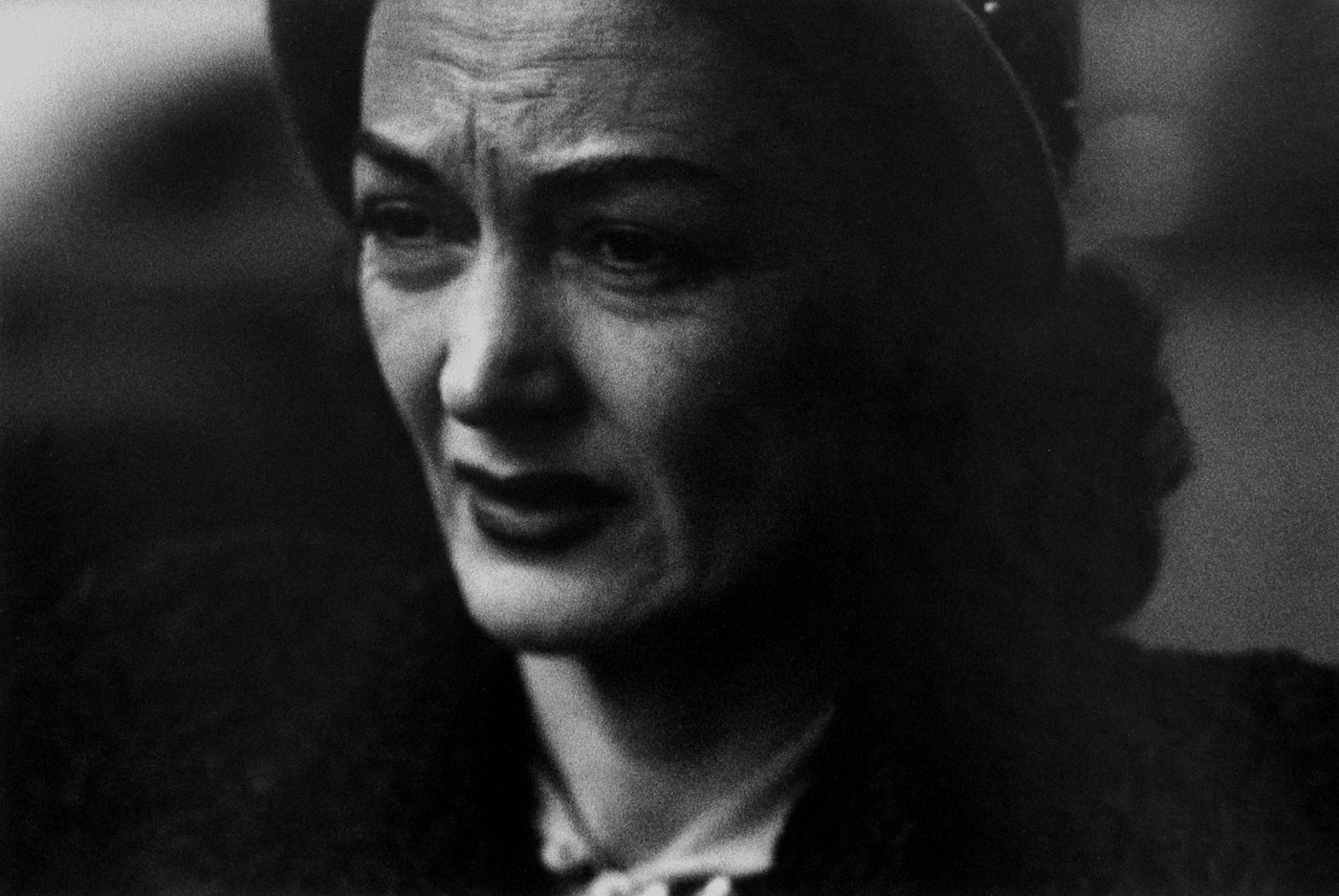
Early examples in this genre are works by Paul Strand taken between 1915-1917, close-up portraits of anonymous urban subjects. Next we have portraits of anonymous New York subway commuters taken by Walker Evans with a hidden camera between 1938-41 (see below). Other photographers include Harry Callahan and his Chicago series of 1950 and, in Australia, Bill Henson’s Untitled 1980/82 series of crowds, taken with a telephoto lens to flatten the pictorial plane.

Commenting on the work of Walker Evans, the author Max Kozloff observes in his highly recommended book, The Theatre of the Face: Portrait Photography Since 1900,

“From around 1938 to 1941 this ‘penitent spy and apologetic voyeur’, as he later styled himself, photographed passengers with a hidden camera, a cable release trailing down his coat sleeve to his itchy hand. This had been a devious, unsavoury thing to do, and he knew it; but the result was spectacular in its disclosure of the miscellaneous, anonymous, quotidian texture of metropolitan life, solemn or comic by turns. It was made up of figures whose collective presence he retroactively implied by experimentally sequencing his pictures, cropped and in grids. Evans did not see what his camera saw, and his subjects were oblivious to his design.”4

Sound familiar? sequencing his pictures, cropped and in grids…

The key here is an annunciation, a spiritual exposition, of the quotidian texture of metropolitan life through the photography of anonymous human beings. Human beings who have not given their permission to be photographed but who are captured anyway in the passions of life, the angst of existence, in a slightly devious way. Let’s get this straight: this series is not about the camera being god, it is about the photographer actively choosing to press the shutter release of the camera, the photographer choosing what to crop out of the image, about the photographer choosing what to print and how to arrange and sequence the work. It is about the photographer as (an absent) god … for he neither looks through the lens of the camera, nor is there at the exhibition. But he is an omnipresent, omni-prescient force, forever surveilling the field of view, dominating the subject and presenting his choice. The photograph is framed by the photographer’s (absent, but controlling) eye. It is about his ego, not the cameras, as to what is represented. Commenting on his own work, Walker Evans observes,

“A distinct point, though, is made in the lifting of these objects from their original settings. The point is that this lifting, is, in the raw, exactly what the photographer is doing with his machine, the camera, anyway, always. The photographer, the artist, “takes” a picture: symbolically he lifts an object or a combination of objects, and in so doing he makes a claim for that object or that composition, and a claim for his act of seeing in the first place. The claim is that he has rendered his object in some way transcendent, and that in each instance his vision has penetrating validity”5

Further, as Annete Kuhn notes, the eye of the camera is neutral, it sees the world as it is:

“Photographs are coded, but usually so as to appear uncoded. The truth / authenticity potential of photography is tied in with the idea that seeing is believing. Photography draws on an ideology of the visible as evidence. The eye of the camera is neutral, it sees the world as it is: we look at a photograph and see a slice of the world. To complete the circuit of recording, visibility and truth set up by the photograph, there has to be someone looking at it …”6 (My italics)

Caroline Blinder suggests that,

“… transcendental ethos is aligned with the camera’s ability to capture the real and the spiritual, the native and the universal simultaneously. Hence, Evans’s images of vernacular America, of regional architecture, objects, signs, and people become representative of a “moment of seeing” in which a secular vision of America is given sacred implications.

“The idea of reinserting a sacred purpose into the photographic project became part of the era’s [1930-40s] attempts to codify photography as a medium with far-reaching metaphoric, aesthetic, and cultural ramifications. In this context, the combination of a self-effacing aspect with a moment of total vision – “I am nothing; I see all” – in itself suggests a constant oscillation between positions behind and in front of a metaphorical camera; positions which, incidentally, also mimic and reflect the role of the critic vis-à-vis the subject of photography.”7

There is no penetrating validity to be seen here, for the series seems to have been codified (in absentia) as a form of post-human conceptualisation, undermining the 1930s attempt to codify the medium with a spiritual dimension. Unlike the photographs of Walker Evans, or Bill Henson, where I am fascinated with the object of the photographers attention (what were they thinking, where were they going, what was their life about?), in this case the object of the artist’s attention – “the transience of street life and the photographer’s own experience of being adrift in the world of light and movement” – does not carry me along for the journey, has not become existential, transcendent. It is not the ghost in the machine of the camera (its ability to capture things that humans cannot see) that is present, but the ghost in the machine of the human that becomes apparent in these images… that of an unresolved idea, a floating bit of code.

Personally, I found the rendered object not worth a second glance. The images did not, and will not, reveal themselves to you over weeks and years. Of much more interest was the single, whole image from which the detail is taken. If I had been surrounded by the light and energy of works such as the only complete image shown (see below) – say 15 of them in a darkened room – then I would have been excited, surprised, challenged and enlightened. Go with he source!

These images remain a promise unfulfilled. They could have been so much more “than the closed-off beings of our own mediations, of our own mirrors, our machines.”8

Dr Marcus Bunyan


Footnotes

1/ Azoulay, Ariella (2008), The Civil Contract of Photography (trans. Rela Mazali and Ruvik Danieli), New York: Zone Books.

2/ Palmer, Daniel and Whyte, Jessica. “‘No Credible Photographic Interest’: Photography restrictions and surveillance in a time of terror,” in Philosophy of Photography Volume 1 Number 2, Intellect Limited 2010, p. 178.

3/ Ibid., p. 179.

4/ Kozloff, Max. The Theatre of the Face: Portrait Photography Since 1900. London: Phaidon Press, 2007, p. 149.

5/ Walker Evans quoted in Thompson, J. L. (ed.,). Walker Evans at Work. London: Thames and Hudson, 1984, p. 229 in Caroline Blinder. “”The Transparent Eyeball”: On Emerson and Walker Evans,” in Mosaic : a Journal for the Interdisciplinary Study of Literature. Winnipeg: Dec 2004. Vol. 37, Iss. 4; pg. 149, 15 pgs.

6/ Kuhn, Annette. The Power of the Image: Essays on Representation and Sexuality. London: Routledge and Kegan Paul, 1985, pp. 27-28.

7/ Blinder, Caroline. “”The Transparent Eyeball”: On Emerson and Walker Evans,” in Mosaic : a Journal for the Interdisciplinary Study of Literature. Winnipeg: Dec 2004. Vol. 37, Iss. 4; pg. 149, 15 pgs.

8/ Kozloff, op. cit. p. 89.


Many thankx to the Monash Gallery of Art for allowing me to publish the photographs in the posting. Please click on the photographs for a larger version of the image. All photographs © Marcus Bunyan and the Monash Gallery of Art


“Walker Evans once wrote a friend: “Stare. It is the way to educate your eye, and more. Stare, pry, listen, eavesdrop. Die knowing something. You are not here long.” Evans’ insistence on staring as the main road to learning included making pictures of subway riders with a hidden camera, but he felt so guilty about being an unobserved observer that he withheld publication for years. This compunction still dogs many photographers but seldom stops them.”


Goldberg, Vicki. “Voyeurism, Exposed,” on the Artnet website [Online] Cited 06/02/2016


MGA provides Victorians with their first opportunity to see a significant exhibition of work by Trent Parke, the internationally renowned Australian photojournalist. Over the past two decades Parke has brought his highly poetic sensibility to traditional documentary photography. Alongside a range of Parke’s work recently purchased for the MGA collection this exhibition features his 2013 series, The camera is god (street portrait series), which puts a metaphysical spin on street photography.


Trent Parke (Australian, b. 1971) 'The camera is god (street portrait series)' 2013 (installation view)

Trent Parke (Australian, b. 1971) 'The camera is god (street portrait series)' 2013 (installation view)

Trent Parke (Australian, b. 1971) 'The camera is god (street portrait series)' 2013 (installation view)


Trent Parke (Australian, b. 1971)
The camera is god (street portrait series) (installation views)
2013
Pigment prints
Collection of the artist
Photos: © Marcus Bunyan and the Monash Gallery of Art


Trent Parke (Australian, b. 1971) 'The camera is god (street portrait series)' 2013 (installation view)


Trent Parke (Australian, b. 1971)
The camera is god (street portrait series)
2013
Pigment prints
Collection of the artist
Photo: © Marcus Bunyan and the Monash Gallery of Art


During the late 1990s Trent Parke turned away from his career as a press photographer to concentrate on using the visual language of documentary photography to explore personal interests. Continuing to work in the manner of a photojournalist – venturing into the world with a 35mm film camera hanging from his neck – Parke’s artistic practice is a type of existential journey.

Trent Parke: the camera is god is the first solo exhibition of Parke’s work in Victoria, and provides an opportunity to appreciate the trajectory of his practice over the last 15 years.

At the heart of this exhibition is Parke’s The camera is god (street portrait series) of 2014. This internationally celebrated series consists of anonymous portraits, taken on the streets of Adelaide. To capture these images Parke fixed his camera on a tripod and set it to take multiple shots (up to 30 shots in eight-second bursts) when the pedestrian lights changed. Extracting individual portraits from these photographs of street traffic, Parke allowed motion-blur and film grain to obscure the identity of his subjects. As such, this series is not really about individuals, but about the transience of street life and the photographer’s own experience of being adrift in the world of light and movement.

Wall text from the exhibition


Walker Evans (American, 1903-1975) 'Subway Passengers, New York' 1938


Walker Evans (American, 1903-1975)
Subway Passenger, New York
1938
Silver gelatin photograph


Walker Evans (American, 1903-1975) 'Subway Passengers, New York' 1938


Walker Evans (American, 1903-1975)
Subway Passenger, New York
1938
Silver gelatin photograph


Walker Evans (American, 1903-1975) 'Subway Passengers, New York' 1938


Walker Evans (American, 1903-1975)
Subway Passenger, New York
1938
Silver gelatin photograph


Walker Evans (American, 1903-1975) 'Subway Passenger, New York' 1938


Walker Evans (American, 1903-1975)
Subway Passenger, New York
1938
Silver gelatin photograph


Walker Evans (American, 1903-1975) 'Subway Passengers, New York' 1938


Walker Evans (American, 1903-1975)
Subway Passenger, New York
1938
Silver gelatin photograph


Walker Evans (American, 1903-1975) 'Subway Passengers, New York' 1938


Walker Evans (American, 1903-1975)
Subway Passenger, New York
1938
Silver gelatin photograph


Harry Callahan (American, 1912-1999) 'Chicago' 1950


Harry Callahan (American, 1912-1999)
Chicago
1950
Gelatin silver print
8 1/16 x 12 15/16 in. (20.48 x 32.86cm)


Harry Callahan (American, 1912-1999) 'Chicago' 1950


Harry Callahan (American, 1912-1999)
Chicago
1950
Gelatin silver print
8 3/8 x 12 3/8 in. (21.27 x 31.43cm)


Harry Callahan (American, 1912-1999) 'Chicago' 1950


Harry Callahan (American, 1912-1999)
Chicago
1950
Gelatin silver print
8 3/8 x 12 1/2 in. (21.27 x 31.75cm)


Harry Callahan (American, 1912-1999) 'Chicago' 1950


Harry Callahan (American, 1912-1999)
Chicago
1950
Gelatin silver print
7 7/8 x 12 3/4 in. (20 x 32.39cm)


Bill Henson (Australian, b. 1955) 'Untitled' 1980/82


Bill Henson (Australian, b. 1955)
Untitled 1980/82
Gelatin silver chlorobromide print
From a series of 220
57.5 × 53.4cm
Courtesy the artist and Roslyn Oxley9 Gallery, Sydney


Bill Henson (Australian, b. 1955) 'Untitled' 1980/82


Bill Henson (Australian, b. 1955)
Untitled 1980/82
Gelatin silver chlorobromide print
From a series of 220
57.5 × 53.4cm
Courtesy the artist and Roslyn Oxley9 Gallery, Sydney


Trent Parke (Australian, b. 1971) 'The camera is god (street portrait series)' 2013 (installation view detail)

Trent Parke (Australian, b. 1971) 'The camera is god (street portrait series)' 2013 (installation view detail)

Trent Parke (Australian, b. 1971) 'The camera is god (street portrait series)' 2013 (installation view detail)

Trent Parke (Australian, b. 1971) 'The camera is god (street portrait series)' 2013 (installation view detail)

Trent Parke (Australian, b. 1971) 'The camera is god (street portrait series)' 2013 (installation view detail)

Trent Parke (Australian, b. 1971) 'The camera is god (street portrait series)' 2013 (installation view detail)

Trent Parke (Australian, b. 1971) 'The camera is god (street portrait series)' 2013 (installation view detail)

Trent Parke (Australian, b. 1971) 'The camera is god (street portrait series)' 2013 (installation view detail)

Trent Parke (Australian, b. 1971) 'The camera is god (street portrait series)' 2013 (installation view detail)

Trent Parke (Australian, b. 1971) 'The camera is god (street portrait series)' 2013 (installation view detail)

Trent Parke (Australian, b. 1971) 'The camera is god (street portrait series)' 2013 (installation view detail)

Trent Parke (Australian, b. 1971) 'The camera is god (street portrait series)' 2013 (installation view detail)

Trent Parke (Australian, b. 1971) 'The camera is god (street portrait series)' 2013 (installation view detail)

Trent Parke (Australian, b. 1971) 'The camera is god (street portrait series)' 2013 (installation view detail)

Trent Parke (Australian, b. 1971) 'The camera is god (street portrait series)' 2013 (installation view detail)

Trent Parke (Australian, b. 1971) 'The camera is god (street portrait series)' 2013 (installation view detail)

Trent Parke (Australian, b. 1971) 'The camera is god (street portrait series)' 2013 (installation view detail)


Trent Parke (Australian, b. 1971)
The camera is god (street portrait series) (installation view details)
2013
Pigment prints
Collection of the artist
Photos: © Marcus Bunyan and the Monash Gallery of Art


Monash Gallery of Art
860 Ferntree Gully Road, Wheelers Hill
Victoria 3150 Australia
Phone: + 61 3 8544 0500

Opening hours:
Tue – Fri: 10am – 5pm
Sat – Sun: 10am – 4pm
Mon/public holidays: closed

Monash Gallery of Art website

LIKE ART BLART ON FACEBOOK

Back to top

Exhibition: ‘Colour my world: handcoloured Australian photography’ at the National Gallery of Australia, Canberra

Exhibition dates: 3rd April – 30th September, 2015

Co-curators: Anne O’Hehir, Curator of Photography and Dr. Shaune Lakin, Senior Curator of Photography at the National Gallery of Australia


Micky Allan (Australian, b. 1944) 'The prime of life no. 7 (man wearing sun glasses)' 1979


Micky Allan (Australian, b. 1944)
The prime of life no.7 (man wearing sun glasses)
1979
From a series of 12 hand coloured photographs Mountain Lagoon, Sydney Blue Mountains, New South Wales 1979
Gelatin silver photograph, hand-coloured in pencil, colour pencils, watercolour and gouache
32.0 x 42.7cm
National Gallery of Australia, Canberra, purchased 1981
© Micky Allan


There has always been a history of hand colouring in photography since its very early days – from daguerreotypes, through ambrotypes, cartes de visite, cabinet cards and on to commercial portrait photography from the 1920s-1960s. But I don’t believe there has ever been, in the history of photography, such a concentration of artists (mainly female) hand colouring photographs as in Australia in the 1970s-80s. If I know my history of photography, I would say that this phenomena is unique in its history. It did not occur in Japan, Europe or America at the same time.

The reasons for this explosion of hand colouring in Australia are many and varied. Most of the artist’s knew each other, or knew of each other’s work on the East coast of Australia, and it was a small, tight circle of artists that produced these beautiful photographs. Not many artists were “doing” traditional colour photography, basically because of the instability of the materials (you only have to look at the faded colour photographs of John Cato in the National Gallery of Victoria’s collection) and the cost of the process. Of course feminism was a big influence in Australia at this time but these photographs, represented in this posting by the work of Micky Allan and Ruth Maddison, are so much more than photographs about female emancipation.

Photography in Australia was moving away from commercial studios such as that of Athol Shmith and into art schools and university courses, where there was a cross-over between different disciplines. Most artists had darkrooms in their bathroom or outhouses, or darkrooms were in basements of university buildings.

Speaking to artist Micky Allan, she said that these were exciting times. Allan had trained as a painter and brought these skills to the processes of photography. She observes, “There was an affinity to what you were doing, an immediacy of engagement. Taking photographs, the physicality of the print, their magnificent tonal range – which painting could not match – and then hand colouring the resultant prints, a hands on process that turned the images into something else, something different.”

There was a cavalier approach to the process but also a learning atmosphere as well. So it was about doing anything that you wanted, you just had to do it.

Sue Ford was a big influence, in that she started working in series of work, not just the monolithic, singular fine art print. Perhaps as a reaction against the Americanisation of photography, these artists used vernacular photographs of people and places to investigate ways of being in the world.

As Micky Allan observes, “My photography of babies and old people were more than being about domesticity, they were about what babies know when they arrive in the world, and how people react to ageing.” (For examples of Allan’s babies and old people photographs please see the exhibition Photography meets Feminism: Australian Women Photographer 1970s-80s).

There was a connection to the print through the physicality of the process of printing and then hand colouring – a double dealing if you like – that emphasised the ordinary can be extraordinary, a process that changed one representation into another. And the results could be subtle (as in the delicate work of Janina Green) or they could be surreal, such as Allan’s The prime of life no.7 (man wearing sun glasses) (1979, below), or they could be both. But they were always stunningly beautiful.

This was a very hands on process, an observation confirmed by artist Ruth Maddison. “The process was like hand watering your garden, an intense exchange and engagement with the object. When I started I was completely untrained, but I loved the process. I just experimented in order to understand what medium does what on what paper surface. There was the beauty of its object and its physicality. I just loved the object.”

Her series Christmas holiday with Bob’s family, Mermaid Beach, Queensland (1977/78, below), photographed over Christmas Day and several days afterwards, evidences this magical transformation. Vernacular photographs of a typical Australia Christmas holiday become something else, transformed into beautiful, atypical representations of family, friendship, celebration and life.

So there we have it: domesticity, family, friends, place, being in the world, feminism, craft, experimentation, surrealism, physicality of the object, beauty, representation, series of work and difference… a communion (is that the right word?) of intimate thoughts and feelings, especially on a spiritual level (although the artists would probably deny it) that changed how the they saw, and we see the world. Can you imagine how fresh and alive these images would have been in 1970s Australia?

That they still retain that wonder is testament to the sensitivity of the artists, the tactility of the process and our responsiveness to that sense of touch.

Dr Marcus Bunyan


Many thankx to the National Gallery of Australia for allowing me to publish the photographs in the posting. Please click on the photographs for a larger version of the image.


Micky Allan (Australian, b. 1944) 'The prime of life no.3 (blond woman wearing sun glasses)' 1979 from the exhibition 'Colour my world: handcoloured Australian photography' at the National Gallery of Australia, Canberra, April - Sept, 2015


Micky Allan (Australian, b. 1944)
The prime of life no.3 (blond woman wearing sun glasses)
1979
From a series of 12 hand coloured photographs Mountain Lagoon, Sydney Blue Mountains, New South Wales 1979
Gelatin silver photograph, hand-coloured in pencil and watercolour
National Gallery of Aus


Ruth Maddison (Australian, b. 1945) 'Christmas holiday with Bob's family, Mermaid Beach, Queensland' 1977/78 from the exhibition 'Colour my world: handcoloured Australian photography' at the National Gallery of Australia, Canberra, April - Sept, 2015


Ruth Maddison (Australian, b. 1945)
Christmas holiday with Bob’s family, Mermaid Beach, Queensland
1977-1978
Gelatin silver photographs, colour dyes, hand-coloured
10.6 x 16.2cm
National Gallery of Australia, Canberra, purchased 1988


Ruth Maddison (Australian, b. 1945) 'Christmas holiday with Bob's family, Mermaid Beach, Queensland' 1977/78
Ruth Maddison (Australian, b. 1945)
'Christmas holiday with Bob's family, Mermaid Beach, Queensland'
1977-1978


Ruth Maddison (Australian, b. 1945)
Christmas holiday with Bob’s family, Mermaid Beach, Queensland
1977-1978
Gelatin silver photographs, colour dyes, hand-coloured
10.6 x 16.2cm
National Gallery of Australia, Canberra, purchased 1988


Ruth Maddison (Australian, b. 1945) 'Christmas holiday with Bob's family, Mermaid Beach, Queensland' 1977/78


Ruth Maddison (Australian, b. 1945)
Christmas holiday with Bob’s family, Mermaid Beach, Queensland
1977-1978
Gelatin silver photograph, colour pencils, fibre-tipped pen
10.6 x 16.2cm
National Gallery of Australia, Canberra, purchased 1988


Ruth Maddison (Australian, b. 1945) 'Christmas holiday with Bob's family, Mermaid Beach, Queensland' 1977/78


Ruth Maddison (Australian, b. 1945)
Christmas holiday with Bob’s family, Mermaid Beach, Queensland
1977-1978
Gelatin silver photographs, colour dyes, hand-coloured
10.6 x 16.2cm
National Gallery of Australia, Canberra, purchased 1988


Ruth Maddison (Australian, b. 1945) 'Jesse and Roger' 1983


Ruth Maddison (Australian, b. 1945)
Jesse and Roger
1983
From the series Some men
Gelatin silver photograph, colour pigments, hand-coloured
National Gallery of Australia, Canberra, purchased 1983


Ruth Maddison (Australian, b. 1945) 'Jim and Gerry' 1983


Ruth Maddison (Australian, b. 1945)
Jim and Gerry
1983
From the series Some men
Gelatin silver photograph, colour pigments, hand-coloured
39.6 x 26.5cm
National Gallery of Australia, Canberra, purchased 1983


Colour my world

Introduction

This is the first exhibition dedicated to a significant aspect of recent Australian art: the handcoloured photograph. It draws together new acquisitions and rarely seen works from the collection by Micky Allan, Ruth Maddison, Warren Breninger, Julie Rrap, Janina Green, Christine Barry, Fiona Hall, Miriam Stannage, Robyn Stacey, Nici Cumpston, Lyndell Brown, Charles Green and Jon Cattapan.

The handcolouring of images has a long history in photography. During the infancy of the medium in the mid nineteenth century, the practice of applying paint, dye or other media to a photograph added both lifelike colour to black-and-white pictures and longevity to images that faded quickly. Throughout the nineteenth and early twentieth centuries, handcolouring added economic value and artistic sensibility or corrected photographic mistakes. But, by the middle of the twentieth century, the practice had gone into decline, as photographers sought to maintain and fortify the virtuosity and technical purity of the modernist photographic print.

The 1970s saw a revival of handcolouring among a number of Australian photographers and it remains a significant aspect of contemporary practice. The artists included in this exhibition seek to create a direct connection between their experience and that of the viewer. They challenge the medium’s technical sameness by personalising the print and imbuing it with individuality and uniqueness as well as an intimacy, warmth and fallibility.

Challenging conventions

During much of the twentieth century, photography tended to engage with the medium’s technical integrity. Rhetoric about black-and-white photography’s very particular, direct relationship to the world, its technological origins and its highly idiosyncratic capacity to see the world in new ways positioned it in a conceptual space distinct from other kinds of pictures. With notable exceptions, those who dominated the scene worked in black and white. Colour photography (which was expensive) tended to belong to and be associated with the commercial realms of advertising and fashion.

In this climate, to bring colour into the image through handcolouring was an act of resistance. Anyone who took to their prints with colour pencils and brushes, in effect, disputed the so-called authority of black-and-white photography. And many did just this. For feminist photographers, handcolouring acknowledged the under-recognised history of women’s photographic work by remembering the women who were historically employed by studios as handcolourists.

Colouring by hand personalised the print, itself the product of technological processes, arcane knowledge and chemistry. The handcoloured photograph also created community: it engaged a direct connection between the photographer and his or her subjects, the sensual surface of the print and the viewer, a set of relationships staged and made manifest in the experience of the work itself.

Aesthetics of handcoloured photography

While the disrupted surface of the handcoloured photograph may well have challenged the conventions of ‘classic’ photography during the 1970s, it became one of a set of tools used by artists during the 1980s to explore the medium as a studio practice and to interrogate the conventions of authorship and photographic transparency that had supported modernist photographic practice.

Artists such as Julie Rrap, Fiona Hall and Robyn Stacey created handmade work that presented highly personalised responses to some of the grand themes of Western art and culture. Hall tackled one of Western mythology’s points of origin, the Garden of Eden, in a series of hand-toned pictures that replaced pathos and grand narrative with irony and, through daubs of sepia, the patina of historical significance. Rrap took on art history’s archetypes of femininity and made them her own, while Stacey handcoloured photographs to modify many of the myths of popular culture and Australian history. Rrap’s and Stacey’s handcoloured originals were then rephotographed and printed in colour. By doing so, the works shifted from being unique prints – with references to the handmade, the artist’s studio and the careful rendering of places and times – to being images that resembled those found in the mass media.

Reconnecting with history and objects

Associated with the rapidly expanding use of digital photography in the 1990s and perhaps in response to the immateriality of photography today (images are now mostly taken, stored and shared electronically), we have seen a reconnection with the medium’s history and a return to the photographic object in contemporary practice. Handcolouring draws our attention to materiality and re-introduces tactility to the photographic experience. It also engages community in a very particular way, establishing social ties between makers and between artists and viewers. Handcolouring demonstrates that even though digitisation has impacted significantly on the accessibility and scale of contemporary practice, many of photography’s rituals, motivations and pleasures remain the same.

For the artists included in this exhibition, handcolouring connects them to the history of photography in strategic ways. Nici Cumpston handcolours large-scale landscapes of the Murray-Darling river system as a way of documenting traces of Indigenous occupation and use and of bringing to our attention the decline of the area’s delicately balanced ecosystems. The handcoloured works of collaborators Charles Green, Lyndell Brown and Jon Cattapan remind us that an essential part of the experience of photography has always been the embodied, social experience of it. For Janina Green, the act of handcolouring prints allows her to engage with and remember the medium’s history of cross-cultural innovation.

Wall text (same text on the website)


Julie Rrap (born Lismore, New South Wales 1950; lives and works Sydney) 'Puberty' 1984


Julie Rrap (born Lismore, New South Wales 1950; lives and works Sydney)
Puberty
1984
From the series Persona and shadow
Direct positive colour photograph
National Gallery of Australia, Canberra
Kodak (Australasia) Pty Ltd Fund 1984


This photograph is from the series of nine works titled Persona and shadow. Julie Rrap produced this series after visiting a major survey of contemporary art in Berlin (Zeitgeist, 1982) which only included one woman among the 45 artists participating in the exhibition. Rrap responded to this curatorial sexism with a series of self-portraits in which she mimics stereotypical images of women painted by the Norwegian artist Edvard Munch (1863-1944). Each pose refers to a female stereotype employed by Munch: the innocent girl, the mother, the whore, the Madonna, the sister, and so on.

Appropriating the work of other artists is one of the strategies that characterises the work of so-called ‘postmodern’ artists active during the 1980s. The practice of borrowing, quoting and mimicking famous artworks was employed as a way of questioning notions of authenticity. Feminist artists tended to use appropriation to specifically question the authenticity of male representations of females. In more straightforward terms, Rrap reclaims Munch’s clichéd images of women and makes them her own. Rrap ultimately becomes an imposter, stealing her way into these masterpieces of art history, but the remarkable thing about these works is the way that the artist foregrounds the process of reappropriation itself. The procedure of restaging, collage, overpainting, and rephotographing becomes part of the final image, testifying to a do-it-herself politic.


Miriam Stannage (Australian, 1939-2016) 'The flood' from the series 'News from the street' 1984


Miriam Stannage (Australian, 1939-2016)
The flood from the series News from the street
1984
Gelatin silver photograph, colour dye
National Gallery of Australia, Canberra, purchased 1990
© Miriam Stannage


Miriam Stannage (Australian, 1939-2016) 'War' from the series 'News from the street' 1984


Miriam Stannage (Australian, 1939-2016)
War from the series News from the street
1984
Gelatin silver photograph, colour dye
40.6 x 50.8cm
National Gallery of Australia, Canberra, purchased 1990
© Miriam Stannage


Miriam Stannage (Australian, 1939-2016)

Miriam Stannage (1939-2016) was an Australian conceptual artist. She was known for her work in painting, printmaking and photography, and participated in many group and solo exhibitions, receiving several awards over her career. Her work was also featured in two Biennales and two major retrospective exhibitions. …

Throughout her almost 50-year career, Stannage produced a varied and eclectic body of work, encompassing collage, photography, print-making, and text-based works. Stannage first rose to prominence through the 1982 Sydney Biennale and the 1992 Adelaide Biennale, as well as her solo shows at the Art Gallery of Western Australia. She was awarded an honorary doctorate from Curtin University, as well as being declared a ‘State Living Treasure’ in Western Australia. Over the course of her career, Stannage received several awards including the Albany Art Prize, the Georges Invitation Art Prize for drawing and the Power Institute residency at Cité Internationale des Arts in Paris. Seven of Stannage’s works have been featured in the Cruthers Collection of Women’s Art.

Stannage favoured simple structure and minimal use of form in her works, opting instead for text and collaged tableaux. She has been described as having ‘minimalist sensibilities.’

Her subject matter was engaged with contemporary events and news reportage, often utilising and subverting the visual language of newspapers and magazines. While her body of work is extensive, Stannage’s works always maintained their collage aesthetic, and were always founded upon her ongoing exploration of existential themes such as mortality, the spiritual and a quest for the meaning of life. Her work often centres the uncomfortable and emotive, in particular the heightened emotional impacts of conflict, destruction and disasters.

In 2001, following the September 11 attacks, Stannage shifted her focus strictly to the event, making works which spoke to the random nature of terrorist attacks and the interplay of monotony and death. In response to the attacks, she produced a collection of postage stamps which centred on concepts of stilled time, such as a clock face frozen at the moment of impact.

Text from the Wikipedia website


Janina Green (Essen, Germany born 1944; Australia from 1949) 'Untitled' 1988


Janina Green (Essen, Germany born 1944; Australia from 1949)
Untitled [Washing in basket]
1988
Gelatin silver photograph, photo oils
National Gallery of Australia, Canberra, purchased 1989


Janina Green (Essen, Germany born 1944; Australia from 1949) 'Untitled' 1988


Janina Green (Essen, Germany born 1944; Australia from 1949)
Untitled [White cup on tray]
1988
Gelatin silver photograph, photo oils
National Gallery of Australia, Canberra, purchased 1989


Nici Cumpston. (Barkindji/Paakintji peoples) 'Scar tree, Fowler's Creek' 2011


Nici Cumpston (Australian, b. 1963)
Barkindji/Paakintji peoples
Scar tree, Fowler’s Creek
2011
From the series having-been-there
Archival inkjet print hand coloured with synthetic polymer paint
98 x 177cm
Collection of the artist/Courtesy of the artist


Nici Cumpston (Barkindji/Paakintji peoples) 'Campsite V, Nookamka Lake' 2008


Nici Cumpston (Australian, b. 1963)
Barkindji/Paakintji peoples
Campsite V, Nookamka Lake
2008
Inkjet print on canvas, hand-coloured with pencil and watercolour
77 x 206cm
National Gallery of Australia, Canberra, purchased 2011


The once rich and thriving environment of the Murray and Darling River system with its clear waterways, lush flora and abundant fauna was home to the Barkindji, Muthi Muthi and Nyampa peoples.

The shallow Nookamka Lake (Lake Bonney), which connects to the Murray River in South Australia, is the subject of Nici Cumpston’s recent photographic series. However, the series is not of a lush utopia but of the degradation and erosion that has consumed the lake since the forced irrigation flooding of the waterways in the early 1900s.

When damming ceased in 2007, the water began to subside, slowly revealing the original landscape and the history of human occupation. Cumpston beautifully documents this stark landscape and the demise that salinisation and destructive water management practices have wrought on the people and their lands. Today, the landscape is desolate, scattered with twisted and broken trees stripped of their foliage like majestic sentinels in deathly poses. The trees still bare the scars – although obscured by dark tidelines – where canoes, containers and shields were cut from their trunks.

Cumpston highlights these clues to the area’s original inhabitants through the delicate and precise hand-watercolouring of the printed black-and-white photographs on canvas. She does not aim to replicate the original colours of the landscape, as a colour photograph would, but to interpret it, re-introducing the Aboriginal presence within the landscape – a subtle reconnection to Country and reminder of past cultural practices and knowledge. As the artist says, “I am finding ways to talk about connections to country and to allow people to understand the ongoing connections that Aboriginal people maintain with their traditional lands.”

Tina Baum
Curator, Aboriginal and Torres Strait Islander Art
Art Gallery of New South Wales


Warren Breninger (Australian, b. 1948) 'Expulsion of Eve [No.3]' 1978


Warren Breninger (Australian, b. 1948)
Expulsion of Eve [No.3]
1978
Gelatin silver photograph, chinagraph, decal lettering gelatin silver photograph
49.7 x 36.7cm
Gift of the Philip Morris Arts Grant 1982


Warren Breninger (Australian, b. 1948) 'Expulsion of Eve [No.12]' 1978


Warren Breninger (Australian, b. 1948)
Expulsion of Eve [No.12]
1978
Type C colour photograph, ink, crayon
49.8 x 37cm
Gift of the Philip Morris Arts Grant 1982


Warren Breninger (Australian, b. 1948) 'Expulsion of Eve [No.15]' 1978


Warren Breninger (Australian, b. 1948)
Expulsion of Eve [No.15]
1978
Photograph, gum arabic print, acrylic paint, crayon, pencil
49.8 x 37cm
Gift of the Philip Morris Arts Grant 1982


The Expulsion of Eve series is in essence a single work which the artist returns to continually to develop and re-work the same image. ‘Number 16’, highly indicative of the series, is a photographic image of a young woman, the print having undergone many transformative processes including being cut out, reapplied, incised, worn back, applied with colour, stripped of colour and re-drawn. Interrogating notions of reality, Breninger expresses his personal and artistic concerns relating to ‘the rift between appearances and what is real’; ideas informed by his deep Christian faith.1

His subject, Eve, is not chosen symbolically as a female archetype; rather, the artist reasons, “because I believe in her historically and all humanity is her descendents”.2 Breninger’s Eve, in her features and expression, suggests a presence caught between the worlds of childhood and adulthood, innocence and intent, the temporal and corporeal. While there is a Christ-like surrender in the pose, Breninger’s Eve also has a strong correlation with Edvard Munch’s ‘Madonna’, both visually and in terms of the obsessive process by which the artist revisits the image.

The artist’s belief that ‘cameras create an appetite for ghosts, for vapour, for beings of steam that we can never embrace, that will elude us like every photo does’,3 explains his intrigue with photography’s abilities and limitations in recording the subjective. He continued to develop the work with series III produced in 1990, followed in 1993-94 by series IV, comprising male and female faces.

1/ Breninger W 1983, ‘Art & fulfilment’, self-published artist’s essay p. 1
2/ Warren Breninger in correspondence with Sue Smith, 24 Feb 1984, collection files, Warren Breninger, Queensland Art Gallery, Brisbane
3/ Breninger W 1983, op cit p. 3

© Art Gallery of New South Wales Photography Collection Handbook, 2007


Christine Barry (Australian, b. 1954) 'Packaged Deal' 1986/96


Christine Barry (Australian, b. 1954)
Packaged Deal
1986/1996
From the series Displaced Objects
Direct positive colour photograph/Type C photographic print
50cm x 50cm/127cm x 127cm
National Gallery of Australia, Canberra


The daughter of Polish immigrants, Barry explores the significance of place in defining identity in the series Displaced objects. She suggests disjunction and the pull of the past into the present: the picture plane is broken up through the use of collaged fragments of old family photographs, newspaper and magazine cuttings, postcards and flags. As Barry explains, ‘The medium of collage’ and ‘the ad-hoc splashes of paint and sharp diagonals, which reoccur spasmodically throughout the series, read like the effacements of graffiti, associated with “clash” and the “confusion of cultures”.’ Collage and over painting suggest reconstruction and the re-presentation of existing elements to tell a new story, and this is something that Barry reinforces through the strategy of rephotographing the original collage and presenting it as a uniform image.

Text © National Gallery of Australia, Canberra


Christine Barry (Australian, b. 1954) 'Untitled (Patricia Marczak)' 1986-1987


Christine Barry (Australian, b. 1954)
Untitled (Patricia Marczak)
1986-1987
From the series Displaced Objects
Direct positive colour photograph/Type C photographic print
51.1 x 50.7cm
National Gallery of Australia, Canberra


Christine Barry (Australian, b. 1954) 'Untitled (Self portrait)' 1986


Christine Barry (Australian, b. 1954)
Untitled (Self portrait)
1986
From the series Displaced Objects
Direct positive colour photograph/Type C photographic print
50.8 x 50.7cm
National Gallery of Australia, Canberra


Janina Green (Essen, Germany born 1944; Australia from 1949) 'Maid in Hong Kong #11' 2008


Janina Green (Essen, Germany born 1944; Australia from 1949)
Maid in Hong Kong #11
2008
From the series Maid in Hong Kong
Gelatin silver photograph, colour dyes gelatin silver photograph
Image and sheet 76 x 60cm
Gift of Wilbow Group PTY LTD Donated through the Australian Government’s Cultural Gifts Program
National Gallery of Australia, Canberra


Robyn Stacey (Australian, b. 1952) 'Catherine and Morgan' 1985-1987


Robyn Stacey (Australian, b. 1952)
Catherine and Morgan
1985-1987
Gelatin silver photograph, colour dye
Collection of the artist
Courtesy of the artist and Stills Gallery, Sydney


Robyn Stacey (Australian, b. 1952) 'Untitled' 1985-1987


Robyn Stacey (Australian, b. 1952)
Untitled
1985-1987
Gelatin silver photograph, colour dye
Collection of the artist
Courtesy of the artist and Stills Gallery, Sydney


Robyn Stacey (Australian, b. 1952) 'Untitled' 1985-1987


Robyn Stacey (Australian, b. 1952)
Untitled
1985-1987
Gelatin silver photograph, colour dye
Collection of the artist
Courtesy of the artist and Stills Gallery, Sydney


Robyn Stacey (Australian, b. 1952) 'Untitled' 1985-1987


Robyn Stacey (Australian, b. 1952)
Untitled
1985-1987
Gelatin silver photograph, colour dye
Collection of the artist
Courtesy of the artist and Stills Gallery, Sydney


National Gallery of Australia
Parkes Place, Canberra
Australian Capital Territory 2600
Phone: (02) 6240 6411

Opening hours:
Open daily 10.00am – 5.00pm
(closed Christmas day)

National Gallery of Australia website

LIKE ART BLART ON FACEBOOK

Back to top

Review: ‘Luminous World: Contemporary Art from the Wesfarmers Collection’ at the Ian Potter Museum of Art, Melbourne

Exhibition dates: 31st March – 5th July, 2015

Curator: Helen Carroll


Gretchen Albrecht (New Zealand, b. 1943) 'Pink and orange sherbet sky' 1975 from the exhibition Review: 'Luminous World: Contemporary Art from the Wesfarmers Collection' at the Ian Potter Museum of Art, Melbourne, March - July, 2015


Gretchen Albrecht (New Zealand, b. 1943)
Pink and orange sherbet sky
1975
Acrylic on canvas
166 x 177cm
© Gretchen Albrecht, reproduced courtesy of the artist and Wesfarmers Collection of Australia


Gorgeous catalogue with luscious plates, insightful text by Bill Henson (below) and evocative poetry by John Kinsella. Stars on the front cover and silver edged pages. No expense spared in production, with money literally thrown at the project, or so it would seem.

The curator, Helen Carroll, talking about ‘wonder’: “It is a capacity for wonder that makes us human”. Henson talking about ‘wonder’ and ‘love’ – about moments that change your life when looking at and breathing in great art.

Then why does this exhibition feel so… well, needless?

Despite some fascinating individual works of art, collectively there is little wonder on show here.

Perhaps it is because this exhibition looks to be a cut down version of the one first shown at the Art Gallery of Western Australia in 2012, with many works missing from what are listed in the catalogue. Or perhaps it is the hang which at the Ian Potter Museum of Art consists of two rooms on the ground floor of the museum, one housing lighter works, the other dark works. Too dichotomous for my tastes. Nothing is ever so cut and dried.

Perhaps it’s the fact that the concept of the exhibition – light in its many guises – seems to have been tagged onto a groups of art works which are anything but about light. Or are about light in a roundabout, merry-go-round kind of way. The wall text states, “Rather than a chronological or stylistically ordered presentation, the exhibition follows a loosely intuitive flow of ideas and imagery, moving through night to day. The artists in this exhibition explore light from the perspective of the optical experience, the connection between the starts and the cycles of life on earth; and from diverse cultural, mythic and spiritual points of departure.” Apparently the works are more about the phenomena of light than about light itself.

While the art works are interesting in their own right they don’t really work together cohesively as a group to investigate the theme of the exhibition. Trying to burden a collection of art bought for investment purposes with a concept not “natural” to the work, or just a curator’s idea of what seems implicit in the work but is just a cerebral construction, simply does not work in this case. As I looked around the exhibition, I felt the works were more about the physicality of time and space (of history and place), about links in the existential chain, than they were about light. For me, this evinced Mikhail Bakhtin’s notion of the ‘chronotype’ – meaning ‘the connectedness of temporal and spatial relationships that are artistically expressed’ (in literature). Perhaps the intuitive flow of ideas and imagery and the multiple points of departure work against the very idea the exhibition seeks to investigate. This is so broadly thematic (the effects of light on the world) that it needed to be more focused in its conceptualisation.

It’s also a real worry when text panels in the exhibition quote Richard Goyder, Managing Director, Wesfarmers Limited, as saying that this is the first time that Wesfarmers has showcased the contemporary art of the collection, “and the works selected for Luminous World illustrate some of the ways in which the collection has grown in recent years. For instance, the inclusion of art from New Zealand, where Wesfarmers has a significant business presence, and the heightened emphasis on representing the great diversity of contemporary Indigenous art.”

The inclusion of New Zealand art because Wesfarmers has a significant business presence – not the quality or wonder of the art work – but a business presence. And only now are they collecting contemporary Indigenous art, after the collection has been in existence for more than three decades, 1977 being the first acquisition date. At least he is being refreshingly honest about why the art work has been added to the collection, but it does not give you confidence in the choice of the art work being displayed here.

Goyder, Carroll and Kinsella also proselytise about the benefits of employee’s living with this art in their daily working lives and that may be the case. But for the casual visitor to the gallery this collection of art left me feeling cold and clammy – like a fish out of water.

As the add for Reflex copy paper says with more humour than any of this work can muster, I didn’t find “enwhitenment”, or wonder, within the gallery walls. Oh, the luminosity of it all.

Dr Marcus Bunyan


Many thankx to The Ian Potter Museum of Art for allowing me to publish the photographs in the posting. All installation photographs © Marcus Bunyan and The Ian Potter Museum of Art. Please click on the photographs for a larger version of the image.


What is the Night?

‘What is the night?’ Macbeth enquires in the banquet scene, once the ghost of Banquo has departed and his wide has dismissed their mystified guests. Deprived of sleep, and half-psychotic, he urgently needs to know the time. But this is also, implicitly, a philosophical question that hints at the ontological meaning of the night…

Macbeth, Shakespeare’s most elaborate meditation on the night, is a sustained, if not obsessive, exploration of the nocturnal as a realm of alternative values – ones that contradict and threaten to undermine those of the diurnal regime that is ostensibly the domain of politics in the early modern period. In this violent, vengeful tragedy, the language and culture of the medieval night, incarnated above all in the witches, irrupts into the more enlightened languages and culture of a purportedly post-medieval epoch. An apocalyptic night, in Macbeth’s barbaric court, is one of the forces that shape realpolitik. In the Renaissance, a period in which daily life encroaches more and more on the night, especially in public settings, in the form of elaborately lit masques at court, Macbeth thus stages the limits of enlightenment.

At a time when more systematic, socially centralized modes of illumination are increasingly disrupting older patterns of rest, including biphasic sleep – so that, for the early modern ruling class at least, night starts to feel like an extension of the day, its observe rather than its inverse – Shakespeare dramatises the tyrannical attraction, the absolutism, of darkness. Macbeth describes a process of nocturnalisation whereby the night irresistibly colonises the day, fatally infiltrating both the state and the protagonist’s consciousness. To use a word that has some currency in the seventeenth century, but has long since fallen out of use, Shakespeare’s drama is a study of ‘benightment’.”

Matthew Beaumont. “What is the Night?” in Matthew Beaumont. Nightwalking: A Nocturnal History of London, Chaucer to Dickens. London and New York: Verso, 2015, pp. 86-87.


Luminous World brings together a selection of contemporary paintings, objects and photographs from the Wesfarmers Collection in a conversation about light. Through works of scale and conceptual invention that chart the range and depth of the collection, this exhibition presents significant contemporary paintings, photographs and objects by leading Australian and New Zealand artists acquired by Wesfarmers over three decades and shared together for the first time with the Australian public.

The Potter is the fifth venue for this touring exhibition which to date has travelled to Charles Darwin University Art Gallery, Darwin; National Library of Australia, Canberra; Samstag Museum of Art, Adelaide; and The Academy Gallery, University of Tasmania.


Brook Andrew (Australian, b. 1970) 'Replicant series: Owl' 2005 from the exhibition Review: 'Luminous World: Contemporary Art from the Wesfarmers Collection' at the Ian Potter Museum of Art, Melbourne, March - July, 2015


Brook Andrew (Australian, b. 1970)
Replicant series: Owl
2005
Ilfochrome print
130 x 195cm
© Brook Andrew, reproduced courtesy of the artist and Wesfarmers Collection of Australian Art


Brook Andrew (1970- ) is a Sydney born / Melbourne based interdisciplinary artist of Wiradjuri and Scottish heritage. Andrew’s conceptual based practice incorporates, sculpture, photography, installation, video and performance. The Replicant 2006 series reflects (literally) upon the act of looking, and consequent interchanges between nature and culture, subject and object, real and represented. These dualities fit broadly within the artist’s addressing of Australian identity, polemics and the politics of difference.

For the Replicant 2006 series Andrew borrowed taxidermied specimens from the education department at the Australian Museum, Sydney. These included native species of indigenous significance such as an owl, possum, flying fox and parrot. He shot each animal – artificially propped in their natural poses – and digitally manipulated each image so as to appear duplicated, a process that evolved out of the Kalar midday 2004 series.


Bill Henson (Australian, b. 1955) 'Untitled' 2009-10 


Bill Henson (Australian, b. 1955)
Untitled
2009-10
Archival inkjet pigment print
127 x 180cm
© Bill Henson, reproduced courtesy of the artist and Wesfarmers Collection of Australian Art


” … And yet certain things – particular experiences that we have are exceptional. They stand apart from the rest of the general activity.

What causes this apprehension of significance – of something in face powerfully apprehended yet not always fully understood?

And why is it that all of us, at some time or other, with have this ‘epiphany’ – Christian or otherwise – in the presence of some work of art, in the experiencing of a performance piece or some unexpected encounter with the true magic of a particular piece of sculpture?

When it happens, I always think of it as being as if one’s life – and everything that it contains – had just been ever so slightly changed, forever. Nothing, if you will, is ever quite the same again.

What happens, I think, is simply that we fall in love – and it’s the apprehension of unexpected beauty that causes us to fall in love.

The sheer force of such beauty can affect us as if it were an act of nature – and of course it is, for despite the arrogance of some theoreticians, culture is never outside nature.

I think that it is this intense, if often quite subtle, love for the subject, and the resultant emotional and intellectual interdependence within that relationship – be it in musical form, something in the visual arts, theatre of dance – that is responsible for – and in fact makes possible at all – these great and fortunate encounters in the arts. …

Stare back into time and all kinds of very ‘personal’ things return your gaze. This has always, to me, seemed to a large extent to be what art is about. Sure, it’s personal, but it’s also millennial. …

The best art always heightens our sense of mortality. This is not morbidity that I am talking about – rather, we feel more alive in the presence of great art and this is because of a profound sense of continuity – our sense of being inside nature – is expanded.

If you like, art suggests the immortal in all of us.

When we listen to Michelangeli – or, say, Jörg Demus playing Kinderszenen – and we sense that simultaneously proximate and intimate yet utterly abstract presence (was that someone? Schumann perhaps?) and at the same time sense the unbridgeable gulf that exists between ourselves and that distant past – we know that we are in the presence of something magical.

In the end I think that it is love that fuels this activity – that animates the speculative capacity in all of us – and heightens this sense of wonder.

Excerpts from Bill Henson’s speech “Reflections,” in Luminous World catalogue. Perth: Wesfarmers Limited, 2012, pp. 23-24.


Installation view of the exhibition 'Luminous World: Contemporary Art from the Wesfarmers Collection' at The Ian Potter Museum of Art, The University of Melbourne

Installation view of the exhibition 'Luminous World: Contemporary Art from the Wesfarmers Collection' at The Ian Potter Museum of Art, The University of Melbourne

Installation view of the exhibition 'Luminous World: Contemporary Art from the Wesfarmers Collection' at The Ian Potter Museum of Art, The University of Melbourne

Installation view of the exhibition 'Luminous World: Contemporary Art from the Wesfarmers Collection' at The Ian Potter Museum of Art, The University of Melbourne


Installation views of the exhibition Luminous World: Contemporary Art from the Wesfarmers Collection at The Ian Potter Museum of Art, The University of Melbourne
Photos: Marcus Bunyan


David Stephenson (Australian, b. 1955) 'Star Drawing 1996/402' 1996


David Stephenson (Australian, b. 1955)
Star Drawing 1996/402
1996
40 x 40″
Cibachrome print
National Gallery of Victoria, Melbourne
Purchased, 1997
© Courtesy of the artist


While the subject of my photographs has shifted from the landscape of the American Southwest and Tasmania, and the minimal horizons of the Southern ocean, and the icy wastes of Antarctica, to sacred architecture and the sky at both day and night, my art has remained essentially spiritual – for more than two decades I have been exploring a contemporary expression of the sublime – a transcendental experience of awe with the vast space and time of existence.

David Stephenson, 1998


Bill Henson (Australian, b. 1955) 'Untitled 39/139' 1990-91


Bill Henson (Australian, b. 1955)
Untitled 39/139
1990-91
Paris Opera Project
Type C photograph
127 × 127cm
Series of 50
Edition of 10 + 2 A/Ps


Stieg Persson (Australian, b. 1959) 'Offret' 1998 


Stieg Persson (Australian, b. 1959)
Offret
1998
Oil on canvas
183 x 167cm
© Stieg Persson, reproduced courtesy of the artist and Wesfarmers Collection of Australian Art


Works focusing on light and darkness, and how light creates and reveals our world, from one of Australia’s pre-eminent corporate art collections compiled by Wesfarmers over the past 30 years, will be exhibited at the Ian Potter Museum of Art at The University of Melbourne.

The exhibition, Luminous World: Contemporary art from the Wesfarmers Collection, presents a diverse selection of contemporary paintings, photography and works of sculpture. The works traverse a diversity of cultural, aesthetic and philosophical perspectives, with the curatorial premise of how contemporary artists explore the phenomenon of light in their work.

Some 50 artists from Australia and New Zealand are featured in the exhibition including: Susan Norrie, Rosemary Laing, Howard Taylor, Dale Frank, Paddy Bedford, Bill Henson, Fiona Pardington (NZ), Brian Blanchflower, Brook Andrew, Timothy Cook and Nyapanyapa Yunupingu. Included alongside the art is a major new body of poetry by John Kinsella, written in response to works in the exhibition. These are published for the first time under the imprint of Fremantle Press in the book Luminous World, with new writing by artist Bill Henson and composer Richard Mills.

Ian Potter Museum of Art Director, Ms Kelly Gellatly said, “Luminous World highlights the strengths of the Wesfarmers Collection, which has generously been shared, through the tour of the exhibition, with the wider community.

“In bringing together works across a range of media by Indigenous and non-Indigenous artists, Luminous World successfully showcases both the depth and continuing resonance of contemporary Australian practice in a rich, open-ended and exploratory conversation about light.

“To know and experience light and its effects however, one must equally understand its other – darkness. Together, these concerns create an exhibition experience that is at once intellectual, emotional and experiential,” Ms Gellatly said.

The Wesfarmers Collection was started in 1977, and is housed in the Wesfarmers offices around Australia and shared with the community through a loan and exhibition program. A Wesfarmers and Art Gallery of Western Australia touring exhibition.

Press release from The Ian Potter Museum of Art website


Installation view of the exhibition 'Luminous World: Contemporary Art from the Wesfarmers Collection' at The Ian Potter Museum of Art, The University of Melbourne

Installation view of the exhibition 'Luminous World: Contemporary Art from the Wesfarmers Collection' at The Ian Potter Museum of Art, The University of Melbourne

Installation view of the exhibition 'Luminous World: Contemporary Art from the Wesfarmers Collection' at The Ian Potter Museum of Art, The University of Melbourne


Installation views of the exhibition Luminous World: Contemporary Art from the Wesfarmers Collection at The Ian Potter Museum of Art, The University of Melbourne
Photos: Marcus Bunyan


“For more than three decades Wesfarmers has been collecting Australian art. From General Manager John Bennison’s first acquisition in 1977 of a pastoral scene by the Australian impressionist Elioth Gruner, Wesfarmers’ purpose was to accentuate the value of art in the workplace and encourage and understanding of the importance to society of supporting creative thinking and artistic vision. The company has always been committed to sharing its collection with the community through exhibitions and loans and by opening our workplaces for groups to view the art in our offices.

This is the first time Wesfarmers has showcased the contemporary art in the collection, and the works selected for Luminous World illustrate some of the ways in which the collection has grown in recent years. For instance, the inclusion of art from New Zealand, where Wesfarmers now has a significant business presence, and the heightened emphasis on representing the great diversity of contemporary indigenous art.

We thank the artists whose resonant and timeless works form part of Australia’s rich cultural heritage and hope that the Australian public will enjoy these works and marvel at the ingenuity and artistic vision they represent, as Wesfarmers does, surround by inspirational art in our daily lives.”

Richard Goyder
Managing Director, Wesfarmers Limited


The visual world is defined by light; everything we see is processed by the eye as patterns of brightness and colour. Monumental formations in the landscape as well as the most subtle nuances of atmosphere are made real to us by the action of light, transmitted in wavelengths as an infinitely varied register of colour that combine within the eye to shape our sense of space and form.

It is the action of light reflecting off, refracting through and being absorbed by the substance of the world that enables the eye to perceive contours, hues, and textures and mark the passing of time from day to night and season to season.

Luminous World presents a diverse selection of contemporary paintings, photography and works of sculpture, acquired by the Wesfarmers Collection over thirty years and considered through the lens of how contemporary artists variously utilise the phenomenon of light in their work.

Rather than a chronological or stylistically ordered presentation, it follows a loosely intuitive flow of ideas and imagery moving through night to day. The artists in this exhibition explore light from the perspective of the optical experience, the connection between the stars and the cycles of life on earth; and from diverse cultural, mythic and spiritual point of departure.

Published for the first time in the Luminous World catalogue are recent poems by John Kinsella, written in response to selected works in the exhibition, together with new writing by artist Bill Henson and composer Richard Mills that extend an artistic dialogue in which all can share.


Rosalie Gascoigne (Australian, 1917-1999) 'Hung fire' 1995


Rosalie Gascoigne (Australian, 1917-1999)
Hung fire
1995
Retro-reflective road-sign on wood
209 x 176cm
© Rosalie Gascoigne, licensed by Viscopy 2012 and Wesfarmers Collection of Australian Art


Elizabeth Nyumi (Australian, born c. 1947) 'Parwalla' 2010 


Elizabeth Nyumi (Australian, born c. 1947)
Parwalla
2010
Acrylic on canvas
120 x 180cm
© Elizabeth Nyumi, licensed by Viscopy 2012 and Wesfarmers Collection of Australian Art


About Parwalla

This painting depicts the country known as Parwalla, which is Nyumi’s father’s country. This country is far to the south of Balgo in the Great Sandy Desert, west of Kiwirrkurra, and is dominated by tali (sand hills). Parwalla is a large swampy area, which fills with water after the wet season rain and consequently produces an abundance of bush foods. The majority of Nyumi’s painting shows the different bush foods, including kantjilyi (bush raisin), pura (bush tomato) and minyili (seed). The whiteish colours, which dominate the painting, represent the spinifex that grows strong and seeds after the wet season rains. These seeds are white in colour, and grow so thickly they obscure the ground and other plants below.

Biography

When Nyumi was only a very young child her mother died at Kanari soakwater close to Jupiter Well. As a young girl, Nyumi lived with her family group in their country. As a teenager she walked along the Canning Stock Route into the old mission with her father and family group. There she was given clothes and taken to Billiluna Station to be trained as a domestic worker and to work for the wives of the station managers around the region.

Nyumi commenced painting in 1987 and emerged as a leading artist in the late 1990s. She is married to the artist Palmer Gordon and has four daughters, three of whom are still living and beginning to paint with strong encouragement from Nyumi. Her elder brothers Brandy Tjungurrayi and Patrick Olodoodi are both senior lawmen and recognised artists. Nyumi is a very strong culture woman and dancer and an enthusiastic teacher of culture to children, ensuring the traditional dances and songs are kept alive.

Nyumi’s paintings are mainly concerned with the abundant bush food in the country belonging to her family. Initially, she worked with a thick brush, covering the canvas with fluent lines in tones of yellow, green and red. She has now developed a strong personal style of thick impasto dotting, to build up fields of texture heavily laden with white, in which motifs of camp sites, coolamons, digging sticks and bush tucker stand out.


Rosemary Laing (Australian, 1959-2024) 'Brumby mound #5' from the series 'One dozen unnatural disasters in the landscape' 2003


Rosemary Laing (Australian, 1959-2024)
Brumby mound #5 from the series One dozen unnatural disasters in the landscape
2003
C Type photograph
110 x 222cm
© Rosemary Laing, reproduced courtesy of the artist and Wesfarmers Collection of Australian Art


Brumby mound #5 2003 is one of a series of photographs by Rosemary Laing that explores the way European culture has often been uncomfortably imposed on an ancient land. Laing chooses a desert-scape that many identify as quintessentially Australian as the setting for her interventions. The location is the Wirrimanu community lands around Balgo in north-east Western Australia. Onto these traditional lands Laing has incongruously placed items of mass-produced furniture painted to mimic the surroundings.

The words ‘brumby mound’ in her title are a reference to the introduced horses (or brumbies) that are feral and roam uncontrolled, much like the spread of furniture. The seductive beauty of these panoramic images shows the vast spectacle of the Australian bush and makes the disjunction of the natural and the unnatural all the more apparent.

Text from the NGV website


Howard Taylor (Australian, 1918-2001) 'Bushfire sun' 1996 


Howard Taylor (Australian, 1918-2001)
Bushfire sun
1996
Oil on canvas
122 x 152cm
© Howard Taylor, courtesy of the artist’s estate and Wesfarmers Collection of Australian Art


Michael Riley (Australian, 1960-2004) 'Untitled' from the series 'Cloud [Feather]' 2000


Michael Riley (Australian, 1960-2004)
Untitled from the series Cloud [Feather]
2000
Inkjet print on banner paper
86 x 120 cm
© Michael Riley Foundation, licensed by Viscopy 2012 and Wesfarmers Collection of Australian Art


“Feathers float – so do clouds – and dreams.

Feather – a Wiradjuri word for feather and wing are the same, Gawuurra. Probably Cowra, the name of a town to the south, comes from this. In contemporary Aboriginal practices of other groups, feather-appendage is extended in meaning to string tassel, sacred string marking a journey, connecting landscapes, people, family lineages, and, importantly, the embryo cord linking child and mother.

A wing of the eagle hawk, Malyan, a skin name, a scary dream-being overhead. Is it guardian angel or assassin? In the south-east, a feather left behind is often evidence of such a spiritual visit.

At the funeral of actor and activist Bob Maza in 2000, his son held his father’s Bible and recollected his words, ‘to dare to dream your dreams’. It’s interesting that Michael Riley chose to avoid the word ‘dream’ in naming his final photographic work cloud (2000), avoiding glib connections to ‘Dreamtime’. What rolls past our eyes and through our senses is the culmination of self-examination. In a series of poetic photographic texts made increasingly poignant through events in his personal life, these are dreams of childhood memories in Dubbo, New South Wales: dreams of floating, of release…

cloud appears as more personal and free. A floating feather; a sweeping wing; a vigilant angel; the cows from ‘the mission’ farm; a single Australian Plague Locust in flight, referring to the cyclical swarms of locusts; a comforting Bible; and a graceful emblematic returning boomerang. The boomerang is really the only overtly Aboriginal image in the series and the locust is one of the few native species left that is visible and cannot be swept aside. It persists…

Through the large, simply superimposed images of cloud, Michael was trying to minimalise things, to distil his ideas about physical reality and spirit. All are dichotomously connected to Dubbo and Riley and are also universal. They are not about a place but a state, the surrealistic cow with mud and manure on its hoofs floating by. In contrast to Empire’s scenes of a decayed, overworked and desolated landscape, there is no physical land in the cloud imagery.

Aboriginal creation stories begin with a sunrise and follow the journeys of an original being across a physical, seasonal and emotional landscape – seeing, experiencing, and naming this and that plant, animal, climatic occurrence and emotional feelings. Religious song cycles follow this progression. Michael’s set of large, single-subject memories can almost be thought of as a Wiradjuri song cycle of his land and his life.”

Extract from Djon Mundine. “Wungguli – Shadow: Photographing the spirit and Michael Riley” on the “Michael Riley: sights unseen” National Gallery of Australia website Nd [Online] Cited 10/08/2021. No longer available online


Paddy Bedford (Australian, 1922-2007) 'Merrmerrji–Queensland creek' 2005 


Paddy Bedford (Australian, 1922-2007)
Merrmerrji-Queensland creek
2005
Ochre and synthetic binder on composition board
80 x 100cm
© Paddy Bedford, reproduced courtesy of the artist’s estate and Wesfarmers Collection of Australian Art


“Paddy Bedford was a senior Gija lawman born at Bedford Downs Station in the East Kimberly region. Like many indigenous artists, he lived a long life as a stockman before he looked upon the Turkey Creek elders – Rover Thomas and Paddy Jiminji – to begin painting. Bedford’s first works were made with the inception of the Jirrawun Aboriginal Art Cooperative in 1997.

The distinctive minimalist style of his work is but a mask to the multifarious layers of meaning. Bedford’s paintings are inspired by the distinctive landscape and stories of his country in the East Kimberly region of Western Australia, as he depicts from an aerial perspective the traditional dreamings of the Cockatoo, Emu and Turkey; the massacres of local Aboriginal people during the colonial period; as well as episodes from his own life as a stockman and as a senior elder of his community.

Merrmerrji-Queensland Creek, 2005 is characteristically sparse in composition with bold forms, a rhythmic application of dotted fluid lines and a powerfully imposing colour palate, which is gained from a wet-on-wet mixture of white and ochre pigments suspended in a fast drying acrylic medium. The effect is a pearly radiant luminosity, an ambience of the sacred.”

Text from the Annette Larkin Fine Art website. No longer available online.


The Ian Potter Museum of Art
The University of Melbourne,
Corner Swanston Street and Masson Road
Parkville, Victoria 3010

Opening hours: Tuesday – Saturday 11am – 5pm

The Ian Potter Museum of Art website

LIKE ART BLART ON FACEBOOK

Back to top

Photographs: Marcus Bunyan. ‘Too Much of the Air’ 2015

April 2015


Marcus Bunyan (Australian, b. 1958) 'Too Much of the Air' 2015


Marcus Bunyan (Australian, b. 1958)
Untitled
2015
Digital photograph
From the series Too Much of the Air 


Too Much of the Air

After 16 months hard work, I have completed a new 52 image sequence.

These images will be printed large to reinforce the disintegration of the image, technology and human being. Tullio Crali‘s painting Before the Parachute Opens (Prima che si apra il paracadute) (1939) was one of a few starting points, inspirations, for the new sequence.

Below is a selection of images from the sequence. Please click on the photographs for a larger version of the image.

To view the whole sequence please visit my website.

Photographs are available from this series for purchase. As a guide, a digital colour 16″ x 20″ costs $1000 plus tracked and insured shipping. For more information please see my Store web page.


“Imagine being in these planes knowing that you only had moments to live, and knowing that you could do nothing about it. What brought you to that point, what decisions did you take as a human being (or were taken for you) that enacted this scenario.

The “greatness” as the event passes is what is being worked with here. It is the inverse aspect of the sublime. Usually the sublime is regarded as beyond time … but not here. Essentially I am sustaining the last moments of a doomed life, outside of time.

We are unusually privileged to experience the sublime in this way. It is usually a lost aspect through the death of the witness.”


Dr Marcus Bunyan


Beginning of the sequence


Marcus Bunyan (Australian, b. 1958) 'Too Much of the Air' 2015


Marcus Bunyan (Australian, b. 1958) 'Too Much of the Air' 2015


Marcus Bunyan (Australian, b. 1958) 'Too Much of the Air' 2015


Marcus Bunyan (Australian, b. 1958) 'Too Much of the Air' 2015


Marcus Bunyan (Australian, b. 1958) 'Too Much of the Air' 2015


Marcus Bunyan (Australian, b. 1958) 'Too Much of the Air' 2015


Marcus Bunyan (Australian, b. 1958) 'Too Much of the Air' 2015


Marcus Bunyan (Australian, b. 1958) 'Too Much of the Air' 2015


Marcus Bunyan (Australian, b. 1958) 'Too Much of the Air' 2015


Marcus Bunyan (Australian, b. 1958) 'Too Much of the Air' 2015


Marcus Bunyan (Australian, b. 1958) 'Too Much of the Air' 2015


End of the sequence


Marcus Bunyan (Australian, b. 1958) 'Too Much of the Air' 2015


Marcus Bunyan (Australian, b. 1958) 'Too Much of the Air' 2015


Marcus Bunyan (Australian, b. 1958) 'Too Much of the Air' 2015


Marcus Bunyan (Australian, b. 1958) 'Too Much of the Air' 2015


Marcus Bunyan (Australian, b. 1958) 'Too Much of the Air' 2015


Marcus Bunyan (Australian, b. 1958) 'Too Much of the Air' 2015


Marcus Bunyan (Australian, b. 1958) 'Too Much of the Air' 2015


Marcus Bunyan (Australian, b. 1958) 'Too Much of the Air' 2015


Marcus Bunyan (Australian, b. 1958) 'Too Much of the Air' 2015


Marcus Bunyan (Australian, b. 1958) 'Too Much of the Air' 2015


Marcus Bunyan (Australian, b. 1958) 'Too Much of the Air' 2015


Marcus Bunyan (Australian, b. 1958) 'Too Much of the Air' 2015


Marcus Bunyan (Australian, b. 1958) 'Too Much of the Air' 2015


Marcus Bunyan (Australian, b. 1958) 'Too Much of the Air' 2015


Marcus Bunyan website

LIKE ART BLART ON FACEBOOK

Back to top

Review: ‘Polixeni Papapetrou: Lost Psyche’ at Stills Gallery, Sydney

Exhibition dates: 29th October – 29th November, 2014


Polixeni Papapetrou (Australian, 1960-2018) 'The Day Dreamer' 2014 from the exhibition 'Polixeni Papapetrou: Lost Psyche' at Stills Gallery, Sydney, October - November, 2014


Polixeni Papapetrou (Australian, 1960-2018)
The Day Dreamer
2014
Pigment print
100 x 150cm


“Art does not reproduce the visible; rather, it makes visible.”


Paul Klee. Creative Credo [Schöpferische Konfession] 1920


When “facing” adversity, it is a measure of a person’s character how they hold themselves, what face they show to the world, and how their art represents them in that world. So it is with Polixeni Papapetrou. The courage of this artist, her consistency of vision and insightful commentary on life even while life itself is in the balance, are inspiring to all those that know her.

Papapetrou has always created her own language, integrating the temporal dissemination of the historical “case” into a two-dimensional space of simultaneity and tabulation (the various archetypes and ancient characters), into an outline against a ground of Cartesian coordinates.1 In her construction, in her observation and under her act of surveillance, Papapetrou moves towards a well-made description of the states of the body in the tables and classification of the psychological landscape. Her tableaux (the French tableau signifies painting and scene (as in tableau vivant), but also table (as in a table used to organise data)) are a classification and tabulation that is an exact “portrait” of “the” illness, the lost psyche of the title. Her images lay out, in a very visible way, the double makeover: of the outer and inner landscape.

These narratives are above all self-portraits. The idea that image, archetype and artist might somehow be one and the same is a potent idea in Papapetrou’s work. What is “rendered” visible in her art is her own spirit, for these visionary works are nothing less than concise, intimate, focused self-portraits. They speak through the mask of the commedia dell’ arte of a face half turned to the world, half immersed in imaginary worlds. The double skin (as though human soul, the psyche, is erupting from within, forcing a face-off) and triple skin (evidenced in the lack of depth of field of the landscape tableaux) propose an opening up, a revealing of self in which the anatomy (anatemnein: to tear, to open a body, to dissect) of the living is revealed. The images become an autopsy on the living and the dead: “a series of images, that would crystallize and memorize for everyone the whole time of an inquiry and, beyond that, the time of a history.”2

Papapetrou’s images become the “true retina” of seeing, close to a scientific description of a character placed on a two dimensional background (notice how the stylised clouds in The Antiquarian, 2014 match the fur hat trim). In the sense of evidence, the artist’s archetypes proffer a Type that is balanced on the edge of longing, poetry, desire and death, one that the objectivity of photography seeks to fix and stabilise. These images serve the fantasy of a memory: of a masked archetype in a made over landscape captured “exact and sincere” by the apparatus of the camera. A faithful memory of a tableau in which Type is condensed into a unique image: the visage fixed to the regime of representation,3 the universal become singular. This Type is named through the incorporated Text, the Legend: I am Day Dreamer, Immigrant, Merchant, Poet, Storyteller.

But even as these photographs seek to fix the Type, “even as the object of knowledge is photographically detained for observation, fixed to objectivity,”4 the paradox is that this kind of knowledge slips away from itself, because photography is always an uncertain technique, unstable and chaotic, as ever the psyche. In the cutting-up of bodies, cutting-up on stage, a staging aimed at knowledge – the facticity of the masked, obscured, erupting face; the corporeal surface of the body, landscape, photograph – the image makes visible something of the movements of the soul. In these heterotopic images, sites that relate to more stable sites, “but in such a way as to suspect, neutralise, or invert the set of relations that they happen to designate, mirror or reflect,”5 Papapetrou’s psyche, “creates the chain of tradition which passes a happening on from generation to generation.”6 In her commedia dell’ arte, an improvised comedy of craft, of artisans (a worker in a skilled trade), the artist fashions the raw material of experience in a unique way.7 We, the audience, intuitively recognise the type of person being represented in the story, through their half masks, their clothing and context and through the skilful dissemination of collective memory and experience.

Through her storytelling Papapetrou moves towards a social and spiritual transformation, one that unhinges the lost psyche. Her landscape narratives are a narrative of a recognisable, challenging, unstable non-linear art, an art practice that embraces “the speculative mystery of ancient roles… They’re all souls with divided emotions, torn between dream and reality, who like us, converge on the collective stage that is the world.” They are archetype as self-portrait: portraits of a searching, erupting, questioning soul, brave and courageous in a time of peril. And the work is for the children (of the world), for without art and family, extinction.

Dr Marcus Bunyan


Footnotes

1/ Adapted from Didi-Huberman, Georges. Invention of Hysteria: Charcot and the Photographic Iconography of the Salpetriere (trans. Alisa Hartz). Cambridge, Mass.: MIT Press, 2003, p. 24-25. I am indebted to the ideas of Georges Didi-Huberman for his analysis of the ‘facies’ and the experiments of Jean-Martin Charcot on hysteria at the Hôpital Salpêtrière in Paris in the 1880s.

2/ Ibid., p. 48

3/ Ibid., p. 49

4/ Ibid., p. 59

5/ Foucault, Michel. “Of Other Spaces,” in Diacritics Spring 1986, p. 24 quoted in Fisher, Jean. “Witness for the Prosecution: The Writings of Coco Fusco,” in Fusco, Coco. The Bodies That Were Not Ours. London: Routledge, 2001, pp. 226-227

6/ Fisher, Ibid., p. 227-228

7/ “One can go on and ask oneself whether the relationship of the storyteller to his material, human life, is not in itself a craftsman’s relationship, whether it is not his very task to fashion the raw material of experience, his own and that of others, in a solid, useful, and unique way.”
Benjamin
, Walter. Illuminations (trans. by Harry Zohn; edited by Hannah Arendt). New York: Schocken Books, 1968 (2007), p. 108

Many thankx to Polixeni Papapetrou and Stills Gallery for allowing me to publish the photographs in the posting. Please click on the photographs for a larger version of the image. All images copyright of the artist.


“For her, history indicates a view of culture that is more congruent with mortality, with the biological swell of great things arising and perishing, brilliant and melancholy, august and yet brittle. Without judgement, she reorients history as phenomenology: it contains a bracing dimension of loss which is congruent with that fatal sentiment lodged in our unconscious, that our very being – our psyche – is ultimately lost…

Lost Psyche is always about lost cultural innocence, where culture gets too smart and ends by messing with an earlier equilibrium. Papapetrou identifies these moments not to promote gloom but to recognise all the parallels that make for redemption. Parts of the psyche are undoubtedly lost; but Papapetrou proposes and proves that they can still be poetically contacted.”


Robert Nelson 2014


Polixeni Papapetrou (Australian, 1960-2018) 'The Immigrant' 2014 from the exhibition 'Polixeni Papapetrou: Lost Psyche' at Stills Gallery, Sydney, October - November, 2014


Polixeni Papapetrou (Australian, 1960-2018)
The Immigrant
2014
Pigment print
100 x 150cm


Polixeni Papapetrou (Australian, 1960-2018) 'The Merchant' 2014


Polixeni Papapetrou (Australian, 1960-2018)
The Merchant
2014
Pigment print
100 x 150cm


Polixeni Papapetrou (Australian, 1960-2018) 'The Orientalist' 2014


Polixeni Papapetrou (Australian, 1960-2018)
The Orientalist
2014
Pigment print
100 x 150cm


Polixeni Papapetrou (Australian, 1960-2018) 'The Poet' 2014


Polixeni Papapetrou (Australian, 1960-2018)
The Poet
2014
Pigment print
100 x 150cm


Polixeni Papapetrou (Australian, 1960-2018) 'The Storyteller' 2014


Polixeni Papapetrou (Australian, 1960-2018)
The Storyteller
2014
Pigment print
100 x 150cm


In Lost Psyche, Polixeni Papapetrou portrays emblematic figures that have come to the end of their tradition, their rationale, their place in the world. These intriguing and charismatic characters – the poet, the tourist, the immigrant, among others – bring to life antique Victorian paper masks. Yet, despite being cast beyond our immediate reality, their costumes harking back to earlier times, their settings to fantastical places, these archetypal figures live on in the cultural imagination.

Internationally celebrated for an oeuvre that has consistently tested the boundaries of performance and photography, reality and fantasy, childhood and adulthood, Lost Psyche marks a significant return for Papapetrou. Having extensively explored the Australian landscape as a stage for her photographic fictions, and working in response to the natural and historical dramas of our country, this series takes us back into her studio and the expansive scope of imaginary worlds.

Expressive, luscious and knowingly naïve, the painted backdrops bring to mind the simple seduction of children’s storybooks. At the same time, they reference the painting heavyweights and photographic forerunners that are celebrated within art history. Papapetrou’s image The Duchess, for instance, echoes Goya’s commanding oil painting of the Duchess of Alba (1797). Yet, in this newly imagined version, the ‘role’ of Duchess is playfully acted not endured, and like the melodrama of theatre, the dark sky and downcast actor are softened to become illustrative and symbolic – a scene in a universal story. So too, The Orientalist evokes Felix Beato’s 19th Century photographic forays in Japan, recalling his hand-colouring techniques and depictions of social ‘types’.

Consciously foregrounding this ever-present potential for art to present stereotyped representations, Papapetrou reminds us how these social roles and ‘masks’ play out within our souls and psyche’s just as they do on the cultural stage. As a metaphor for the loss of childhood, a time in which we openly switch between characters, identities and roles, this work evokes the persistence of that imagination, as it lives on within the adult world.

In Lost Psyche, the speculative mystery of ancient roles enjoys a fantastical and touching afterlife. In the contemporary world we may also entertain the inner poet, the storyteller, the clown, the connoisseur, the courtesan, the day dreamer or the dispossessed. They’re all souls with divided emotions, torn between dream and reality, who like us, converge on the collective stage that is the world.

Polixeni Papapetrou is an internationally acclaimed artist. Her works feature in significant curated exhibitions, including recently the 13th Dong Gang International Photo Festival, Korea, the TarraWarra Biennale, VIC, Remain in Light, Museum of Contemporary Art, and Melbourne Now, National Gallery of Victoria. She exhibits worldwide, including in Paris, New York, Tokyo, Seoul, Athens and Berlin. Recent solo exhibitions include Under My Skin, Northern Centre for Contemporary Art, 2014, Between Worlds in Fotogràfica Bogotá, 2013, and A Performative Paradox, Centre for Contemporary Photography, 2013. Her work is held in numerous institutional collections, including the National Gallery of Australia, National Gallery of Victoria, Museum of Contemporary Art Australia, Monash Gallery of Art, Artbank, Fotomuseo, Colombia, and the Museum of Fine Arts, Florida, USA.

Press release from Stills Gallery


Polixeni Papapetrou (Australian, 1960-2018) 'The Antiquarian' 2014


Polixeni Papapetrou (Australian, 1960-2018)
The Antiquarian
2014
Pigment print
150 x 100cm


Polixeni Papapetrou (Australian, 1960-2018) 'The Duchess' 2014


Polixeni Papapetrou (Australian, 1960-2018)
The Duchess
2014
Pigment print
150 x 100cm


Polixeni Papapetrou (Australian, 1960-2018) 'The Summer Clown' 2014


Polixeni Papapetrou (Australian, 1960-2018)
The Summer Clown
2014
Pigment print
150 x 100cm


Polixeni Papapetrou (Australian, 1960-2018) 'The Troubadour' 2014


Polixeni Papapetrou (Australian, 1960-2018)
The Troubadour
2014
Pigment print
150 x 100cm


Stills Gallery

This gallery has now closed.

Stills Gallery website

LIKE ART BLART ON FACEBOOK

Back to top

Exhibition: ‘The Sievers Project’ at the Centre for Contemporary Photography (CCP), Fitzroy, Melbourne

Exhibition dates: 13th June – 31st August 2014

Artists: Jane Brown, Cameron Clarke, Zoë Croggon, Therese Keogh, Phuong Ngo, Meredith Turnbull, Wolfgang Sievers

Curators: Naomi Cass and Kyla McFarlane


Jane Brown (Australian, b. 1967) 'Triptych. The Paper Mill (former Amcor and APM site), Fairfield' 2014 (installation view)


Jane Brown (Australian, b. 1967)
Triptych. The Paper Mill (former Amcor and APM site), Fairfield
2014
3 panels of 9, 6 and 6 selenium toned, fibre-based, gelatin silver prints


Curated by CCP Director Naomi Cass and Kyla McFarlane, this intelligent exhibition features the work of six early career artists who respond in diverse ways to renowned Australian photographer Wolfgang Sievers (1913-2007). It was a joy to see again the large vintage silver gelatin, almost clinically composed photographs by Sievers. The light, tonality and stillness of the images make them seem mythic, modern and monumental.

Each artist offers a unique “take” on Sievers influence on Australian photography and design, including his interest in refugees and human rights issues and the representation of the dignity of labour (although the machine is more often represented in Sievers work with a distinct lack of human presence and the act of work itself).

My personal favourites were Phuong Ngo’s intimate silver gelatin photographs in four groups of sweat shop workers in Vietnam, people on boats coming to Australia, photographs of textile workers in Australia and photographs of his mother. Phuong Ngo’s shared stories of young Vietnamese refugees and the journeys taken by their mothers told through photographs is very moving, but only after you are told what the four bodies of images are about. Positioned in the small Gallery Four it was also difficult to associate this installation with the rest of the exhibition. Initially I thought it was a separate exhibition until the linkages were told, the light dawned, and the connections were made.

While Cameron Clarke’s photographs of Ford factory workers and machinery are meticulously lit and digitally observed, producing a strong body of work, it is Jane Brown’s gridded analogue triptych which steals the show (see photographs above and below). These are superbly rich and textured photographs, beautifully seen and resolved within the shifting mise-en-scène. Brown’s images kinetically flow from one image to another even as they are self contained within a modernist grid. In some instances the artist has used the same photograph within the triptych but cropped in a different manner, which pushes and pulls the viewer into a different perspective on the subject matter. This is highly intelligent art making that observes the self contained nature and monumentality of Sievers work and reworks it, lucidly commenting on the dis/integration of these spaces and industries in the present day.

This series of work is the best sequence of photographs I have seen this year and any institution worthy of their salt should snap up these works for their collection.

Dr Marcus Bunyan


Many thankx to the Director Naomi Cass and the CCP for allowing me to publish the text and photographs in the posting. Please click on the photographs for a larger version of the image. All installation photographs © Marcus Bunyan 2014


Installation photographs of Jane Brown's 'Triptych. The Paper Mill (former Amcor and APM site), Fairfield' 2014 (installation view details) at the exhibition 'The Sievers Project' at the Centre for Contemporary Photography (CCP)

Installation photographs of Jane Brown's 'Triptych. The Paper Mill (former Amcor and APM site), Fairfield' 2014 (installation view details) at the exhibition 'The Sievers Project' at the Centre for Contemporary Photography (CCP)

Installation photographs of Jane Brown's 'Triptych. The Paper Mill (former Amcor and APM site), Fairfield' 2014 (installation view details) at the exhibition 'The Sievers Project' at the Centre for Contemporary Photography (CCP)

Installation photographs of Jane Brown's 'Triptych. The Paper Mill (former Amcor and APM site), Fairfield' 2014 (installation view details) at the exhibition 'The Sievers Project' at the Centre for Contemporary Photography (CCP)


Installation photographs of Jane Brown Triptych. The Paper Mill (former Amcor and APM site), Fairfield 2014 (details) at the exhibition The Sievers Project at the Centre for Contemporary Photography (CCP)


Jane Brown (Australian, b. 1967) 'Staircase. The Paper Mill (former Amcor and APM site), Fairfield, 2014' 2014


Jane Brown (Australian, b. 1967)
Staircase. The Paper Mill (former Amcor and APM site), Fairfield, 2014
2014
Fibre-based, gelatin silver print


Jane Brown (Australian, b. 1967) 'Mining machinery, Line of Lode Miners Memorial Complex, Broken Hill 2014-06-10' 2014


Jane Brown (Australian, b. 1967)
Mining machinery, Line of Lode Miners Memorial Complex, Broken Hill 2014-06-10
2014
Brown toned, fibre-based, gelatin silver print
Courtesy the artist


Installation photograph of Jane Brown's work at the exhibition 'The Sievers Project' at the Centre for Contemporary Photography (CCP)


Installation photograph of Jane Brown’s work at the exhibition The Sievers Project at the Centre for Contemporary Photography (CCP)


Wolfgang Sievers (Australian born Germany, 1913-2007) 'Gears for the Mining Industry, Vickers Ruwolt, Burnley, Victoria, 1967' 1967


Wolfgang Sievers (Australian born Germany, 1913-2007)
Gears for the Mining Industry, Vickers Ruwolt, Burnley, Victoria, 1967
1967
Gelatin silver photograph
49.6 x 39.3cm
National Library of Australia, Wolfgang Sievers Photographic Archive


Wolfgang Sievers (Australian born Germany, 1913-2007) 'Sulphuric Acid Plant Electrolytic Zinc, Risoon, Tasmania, 1959' 1959


Wolfgang Sievers (Australian born Germany, 1913-2007)
Sulphuric Acid Plant Electrolytic Zinc, Risoon, Tasmania, 1959
1959
Gelatin silver photograph


Installation photograph of the work of Meredith Turnbull (foreground) and Zoë Croggon (rear wall) at the exhibition The Sievers Project at the Centre for Contemporary Photography (CCP)


Installation photograph of the work of Meredith Turnbull (foreground) and Zoë Croggon (rear wall) at the exhibition The Sievers Project at the Centre for Contemporary Photography (CCP)


Zoë Croggon (Australian, b. 1989) 'John Holland Constructions, Ginninderra Bridge (after Wolfgang Sievers)' 2014


Zoë Croggon (Australian, b. 1989)
John Holland Constructions, Ginninderra Bridge (after Wolfgang Sievers)
2014
Photocollage
70 cm x 86cm
Courtesy the artist and Daine Singer, Melbourne


Zoë Croggon (Australian, b. 1989) 'Comalco Aluminium Used in the Construction of the National Gallery of Victoria [7] (after Wolfgang Sievers)' 2014


Zoë Croggon (Australian, b. 1989)
Comalco Aluminium Used in the Construction of the National Gallery of Victoria [7] (after Wolfgang Sievers)
2014
Photocollage
Courtesy the artist and Daine Singer, Melbourne


Zoë Croggon (Australian, b. 1989) 'Comalco Aluminium Used in the Construction of the National Gallery of Victoria [18] (after Wolfgang Sievers)' 2014


Zoë Croggon (Australian, b. 1989)
Comalco Aluminium Used in the Construction of the National Gallery of Victoria [18] (after Wolfgang Sievers)
2014
Photocollage
Courtesy the artist and Daine Singer, Melbourne


Zoë Croggon (Australian, b. 1989) 'Westgate Bridge (after Wolfgang Sievers)' 2014


Zoë Croggon (Australian, b. 1989)
Westgate Bridge (after Wolfgang Sievers)
2014
Photocollage
Courtesy the artist and Daine Singer, Melbourne


“Six early career artists, working in photography through to installation, have responded in diverse ways to renowned Australian photographer Wolfgang Sievers (1913-2007), icon of 20th century Australian photography. Sievers’ commercial practice exemplifies mid-century positivism and modernity, and the myth-making role of photography. As a German Jewish immigrant, he had a strong interest in refugees and human rights issues as well as an expressed commitment to representing the dignity of labour. The Sievers Project presents key historical works as a context for engaging the past through the present.

Photographers Jane Brown and Cameron Clarke have followed in his footsteps to industrial clients Sievers photographed and valorised, finding sites that are visually dynamic within industries now in decline. Through her intrepid, research-based practice, Therese Keogh has developed a materially-rich work from the starting point of a single, anomalous photograph Sievers took at the Roman Forum in 1953. Meredith Turnbull draws on his connections with Melbourne’s design community in the 1950s and 60s, including Gerard Herbst and Frederick Romberg. In Sievers’ photographs of industrial sewing machines and their machinists, Phuong Ngo finds shared stories of young Vietnamese refugees and the journeys taken by their mothers. Zoë Croggon positions fragments of Sievers’ iconic architectural photographs against found photographs of the human body in movement.”

Text from the CCP website


Foreword to the catalogue

The Sievers Project follows a number of exhibitions over the last five years where CCP has opened up a vista on contemporary practice by exhibiting early work by living artists such as Bill Henson, Kohei Yoshiyuki and Robert Rooney, as well as historical photography, alongside contemporary work. As a commissioning exhibition we have titled this a ‘project’ to point towards the year-long research period integral to the exhibition, capturing the curatorial gesture of inviting early career artists to engage with the past.

The Sievers Project represents a significant curatorial endeavour for CCP, the tale of which is recounted in the Introduction. It would simply not have taken place were it not for the willingness and generosity of Julian Burnside AO QC to participate, through allowing the artists research access to his Wolfgang Sievers collection and lending work from it for the exhibition, as well as contributing an essay for this catalogue.

I acknowledge the artists for setting out on this project and for returning with thoughtful and excellent work. It has been a pleasure to both engage with and exhibit the work of Jane Brown, Cameron Clarke, Zoë Croggon, Therese Keogh, Phuong Ngo and Meredith Turnbull.

The Sievers Project has been dignified by contributions by a number of experts and I wish to acknowledge Professor Helen Ennis, Australian National University School of Art who has also contributed a catalogue essay; Madeleine Say, Picture Librarian, Eve Sainsbury, Exhibitions Curator and Clare Williamson, Senior Exhibitions Curator, State Library of Victoria; Maggie Finch, Curator of Photography, National Gallery of Victoria and Professor Harriet Edquist and Kaye Ashton, Senior Coordinator, RMIT Design Archives, who all took time to speak about Sievers and share his work with the artists.

Opportunities to commission artists are relatively rare and funding through the inaugural Early Career Artist Commissions Grant from the Australia Council has enabled the project. CCP is pleased to acknowledge this recognition and support. We are delighted that Lovell Chen Architects & Heritage Consultants have provided further critical support to realise the project, for which we are grateful. We see a germane link between Lovell Chen and the premise of The Sievers Project.

The Besen Family Foundation are champions for enabling CCP to produce catalogues for selected exhibitions. I acknowledge the Foundation for their long-standing and generous engagement with CCP. We thank the National Library of Australia for providing permission to reproduce Sievers’ work in this catalogue.

The Sievers Project has provided a welcome opportunity for CCP to engage with colleagues in the fi eld of architecture and we are delighted to acknowledge a partnership with the Robin Boyd Foundation to present public programs. We are grateful to Tony Lee from the Foundation for his interest in the project.

Without doubt CCP’s ability to both present contemporary art well and look after artists is greatly enhanced through the longstanding and generous support of Tint Design and Sofi tel Melbourne on Collins. CCP is pleased to present a parallel exhibition of The Sievers Project at the 2014 Melbourne Art Fair and we thank the Melbourne Art Foundation for enabling CCP to bring the exhibition to broad new audiences. For the Art Fair exhibition we are also indebted to Christine Downer, previous CCP Board member and current supporter, for the loan of a major Sievers work.

The Sievers Project has been ably assisted by Philippa Brumby, curatorial intern. Co-curator Dr Kyla McFarlane and I thank Philippa for her wide-ranging skills over a substantial period of time. Lastly, I acknowledge Kyla for her excellent curatorial work and for the pleasure of collaborating with such a playful, dedicated and steely intellect.

Naomi Cass, Director, CCP


And what about his Legacy?

A response to this necessarily combines elements of certitude and speculation. Sievers himself was totally committed to ensuring his legacy as a photographer. He spent years meticulously cataloguing and documenting his work and was assiduous in placing as much of it as he could in major photography collections around the country – art galleries and libraries. The bulk of his archive, a staggering 65,000 negatives and prints, was acquired by the National Library where it has been digitised and is available online to users in perpetuity. But there is another aspect to his preoccupation with legacy that has troubled me over the years – his desire to control the readings of his work, to ensure that he ‘owned’ the contextualisation and interpretation of it. As I see it, some of the framing narratives he constructed were retrospective and are misleading because they are not borne out by the evidence, that is, by the photographs themselves. This is especially apparent in his insistence that the relationship between ‘man and machine’ was central to his industrial photography. In my assessment of his enormous archive, images that extol this interaction are actually relatively few in number. They are outweighed by thousands and thousands of other industrial scenes in which the worker is locked into the dreary, repetitive tasks associated with mass production, or is not present at all having been displaced by machines that are far more efficient than humans will ever be. In other words, the bulk of Sievers’ own photographs contradict his central tenet of the dignity of labour in the modern machine era. The most important aspect of his legacy is undoubtedly his photographs and the astonishingly vast, high quality body of architectural and industrial work he produced between 1938 and the early 1970s. My view is that his black and white photography is the best although he did not agree with me, arguing that his colour photography, with its expressive and dramatic qualities, was equally fine. For me, it is his black and white images that are visionary, their precision, clarity and drama embodying the belief in progress that underpinned modernity. I would also suggest Sievers’ legacy isn’t confined to his photography. As a man he cared deeply about the world and wanted it to be better. He was closely involved in the restoration of Karl Friedrich Schinkel’s buildings in Berlin in the 1990s and in the re-evaluation of his own father’s reputation (Professor Johannes Sievers was an expert on Schinkel and had used his young son’s photographs in his books on the architect in the 1930s). Wolfgang donated his photographs to fund-raising campaigns for human rights and remained a passionate antiwar activist until his death.

What would he have thought about this project?

I suspect that he would have been thrilled to know that his contribution to Australian life and photography is the touchstone for the six photographers involved in the project and that his work continues to be appreciated.

Professor Helen Ennis is Director of the Centre for Art History and Art Theory at ANU School of Art, Canberra.


Installation photographs of the exhibition 'The Sievers Project' at the Centre for Contemporary Photography (CCP)

Installation photographs of the exhibition 'The Sievers Project' at the Centre for Contemporary Photography (CCP)

Installation photographs of the exhibition 'The Sievers Project' at the Centre for Contemporary Photography (CCP)

Installation photographs of the exhibition 'The Sievers Project' at the Centre for Contemporary Photography (CCP)

Installation photographs of the exhibition 'The Sievers Project' at the Centre for Contemporary Photography (CCP)


Installation photographs of the exhibition The Sievers Project at the Centre for Contemporary Photography (CCP)


Installation photograph of the work of Therese Keogh (detail) in the exhibition 'The Sievers Project' at the Centre for Contemporary Photography (CCP)


Installation photograph of the work of Therese Keogh (detail) in the exhibition The Sievers Project at the Centre for Contemporary Photography (CCP)


Installation photograph of the work of Meredith Turnbull (detail) in the exhibition 'The Sievers Project' at the Centre for Contemporary Photography (CCP)


Installation photograph of the work of Meredith Turnbull (detail) in the exhibition The Sievers Project at the Centre for Contemporary Photography (CCP)


Therese Keogh. 'In the Forum Romanum (after Sievers)' 2013 (installation view)


Therese Keogh
In the Forum Romanum (after Sievers) (installation view)
2013
Graphite on paper
Courtesy the artist


Cameron Clarke. 'Loui Nedeski, Ford Motor Company, Geelong' 2014


Cameron Clarke
Loui Nedeski, Ford Motor Company, Geelong
2014
Archival inkjet print
50 x 63 cm
Courtesy the artist


Cameron Clarke. 'Küsters Washer, Bruck Textiles, Wangaratta' 2014


Cameron Clarke
Küsters Washer, Bruck Textiles, Wangaratta (detail)
2014
Archival inkjet print


Cameron Clarke. 'Theis Dye Jets, Bruck Textiles, Wangaratta' 2014


Cameron Clarke
Theis Dye Jets, Bruck Textiles, Wangaratta (detail)
2014
Archival inkjet print


Phuong Ngo (Australian, b. 1983) 'Untitled' 2014


Phuong Ngo (Australian, b. 1983)
Untitled
2014
from the Mother Vietnam series
Inkjet print
Courtesy the artist


Centre for Contemporary Photography

No permanent exhibition space at the moment

Centre for Contemporary Photography website

LIKE ART BLART ON FACEBOOK

Back to top

Review: ‘The road: Photographers on the move 1970-1975’ at the Monash Gallery of Art, Wheelers Hill, Melbourne

Exhibition dates: 13th June – 31st August 2014

Artists: Micky Allan, Virginia Coventry, Gerrit Fokkema, John Gollings, Tim Handfield, Ian North, Robert Rooney, Wes Stacey


Virginia Coventry (Australian, b. 1942) 'Service road' 1976-1978


Virginia Coventry (Australian, b. 1942)
Service road
1976-1978
1 of 34 gelatin silver prints and two text panels
26.5 x 32.5cm (each)
Collection: Powerhouse Museum, Sydney
Courtesy of the artist and Liverpool Street Gallery (Sydney)


This is another stimulating exhibition at the Monash Gallery of Art, a gallery that consistently puts on some of the best photography exhibitions in Melbourne each year. Kudos to them.

Each of the eight artists in this exhibition present mainly conceptually based work. Each body of work is individually strong but in the context of the exhibition they come together seamlessly to form a kind of giant jigsaw puzzle of images, a series of impressions of Australia and the road: work that responds to the experience of automotive travel in Australia, announcing “the road-trip as the quintessential Australian journey, highlighting the challenges to life and culture that accompanied suburban expansion and the ways that Australians embraced the road during the 1970s and ‘80s.”

It is a pleasure to finally see Ian North’s colour series Canberra suite (1980-1981, below). Having seen but a few images online, to see the whole body of work in the flesh was illuminating. While lacking the formal rigour and structure of some of the other work in the exhibition, I enjoyed the natural simplicity of the photographs, their planned naïveté, which perfectly captures the suburbs of Canberra at that time. I also delighted in the intimacy of the small silver gelatin prints of Micky Allan’s Mock-up for ‘My trip’ 1976 (1976, below) with their pithy aphorisms such as “Need help?” when the car is bogged.

Another great series is Wes Stacey’s spunky The road (1974-1975, below) – small automated chemist shop prints with their 1970s colours and rounded corners all housed in cheap plastic sleeves pinned to board. This series is beautifully resolved which today allows for a sensually self-indulgent nostalgia to form for the time in which they were taken. The cars, the colours, the travel, people and places so evocatively captured on an Instamatic camera form a captivating narrative of “the sense of movement and adventure that underpins a road trip in a relatively cheap and expedient way.” Another strong series of photographs are by Tim Handfield who I have always thought is an excellent photographer with a good eye. As can be seen by the four images in this posting, Handfield is a master at handling form, structure and colour in the image field. In these photographs he almost seems to compress the space inside the photograph so that they have a vaguely threatening presence.

Finally, there is the wonderful Surfers Paradise Boulevard (1973, below) by John Gollings. The artist’s riff on the American artist Ed Ruscha’s book Every building on the Sunset Strip (1966) – which presented composite black and white panoramas of each side of Los Angeles’s Sunset Strip – Gollings vision is in glorious Ektacolour film which highlights the sensuality of what can, at that time, be seen as a sleepy surf coast town. The shock comes on seeing the main strip of the town and envisioning in your mind what a monster it has become today… how human beings almost always despoil the very thing that is beautiful and valuable in a spiritual sense (such as my favourite place in Australia, Byron Bay). This fragmented, Hockney-esque view of the vernacular forms of cultural expression perfectly captures the insouciance of a town that doesn’t yet know what’s going to hit ’em – through an ideal representation of contemporary urban space and the automotive experience of it.

Dr Marcus Bunyan


Many thankx to the Monash Gallery of Art for allowing me to publish the text and photographs in the posting. Please click on the photographs for a larger version of the image. All installation photographs © Marcus Bunyan and Monash Gallery of Art


Installation view of the exhibition 'The road: Photographers on the move 1970-1975' at the Monash Gallery of Art

Installation view of Ian North's series 'Canberra suite' 1980-81 at the exhibition 'The road: Photographers on the move 1970-1975' at the Monash Gallery of Art

Installation view of Ian North's series 'Canberra suite' 1980-81 at the exhibition 'The road: Photographers on the move 1970-1975' at the Monash Gallery of Art

Installation view of Ian North's series 'Canberra suite' 1980-81 at the exhibition 'The road: Photographers on the move 1970-1975' at the Monash Gallery of Art


Installation view of Ian North’s series Canberra suite 1980-1981 at the exhibition The road: Photographers on the move 1970-1975 at the Monash Gallery of Art


Installation view of Wesley Stacey's series 'The road' 1974-75 at the exhibition 'The road: Photographers on the move 1970-1975' at the Monash Gallery of Art

Installation view of Wesley Stacey's series 'The road' 1974-75 at the exhibition 'The road: Photographers on the move 1970-1975' at the Monash Gallery of Art


Installation views of Wesley Stacey’s series The road 1974-1975 at the exhibition The road: Photographers on the move 1970-1975 at the Monash Gallery of Art


This exhibition brings together a range of photographic projects that responded to the experience of automotive travel in Australia during the 1970s and ’80s. The work in this exhibition shows that there was a strong relationship between photography and the road in Australian culture at this time. Photography helped to make sense of the particular experience of movement made possible by faster cars and better roads; at the same time, it helped to demonstrate the challenges to life and culture that accompanied suburban expansion and the rise of the road in Australia.

The road is one of the great subjects in Australian visual culture. In many of our greatest films, books and works of art, the road is a place where personal identity is negotiated, where the national story unfolds, and where culture, technology and nature come together at times in extraordinary ways. MGA’s latest exhibition The road: Photographers on the move 1970-1975 brings together a range of photographic projects that explore the road as experienced by many Australians in the 1970s and ’80s.

Presenting the work of eight prominent Australian artists, The road: Photographers on the move 1970-1975 announces the road-trip as the quintessential Australian journey, highlighting the challenges to life and culture that accompanied suburban expansion and the ways that Australians embraced the road during the 1970s and ‘80s. Using a range of strategies – from Instamatic cameras and chemist-shop printing, to expansive composite panoramas and photographic grids that replicate the experience of the modern city – these photographers helped to make sense of the particular experience of movement and landscape made possible by faster cars and better roads, in a way only photography could.

The exhibition features some of the most significant photographic projects produced by Australian photographers during this period. Wes Stacey’s mythic series of over 300 photographs The road presents an epic travelogue of road trips made by the artist in his Kombi Van during 1973 and 1974. The exhibition also features John Gollings’s monumental, ten-metre long streetscapes of Surfers Paradise Boulevard from 1973, as well as Robert Rooney’s iconic Holden park, featuring the artist’s Holden car parked in 20 different locations across Melbourne. The road also features work by two of Australia’s most important feminist photographers, Micky Allan and Virginia Coventry, who both challenged many of the gendered assumptions about the road, automotive travel and Australian life during the ’70s and ’80s.

As MGA Curator Stephen Zagala notes, “The road has often provided Australian photographers with a means to an end, whether a landscape or a picturesque community in some distant part of the country. But as this important exhibition shows, during the 1970s, the road took on a whole new meaning for Australian photographers. It provided a space for innovation and experimentation, and also a photographic reconsideration of Australian life.”

Gallery Director Shaune Lakin states, “The history of MGA – with its genesis in the late 1970s – is intricately linked to The road, one of our most important exhibitions of the year. Relatively cheap and accessible petrol, increased private car ownership, and a vastly improved network of roads encouraged the suburban expansion of Melbourne, and MGA is one of the many legacies of this expansion. We are proud to present this exhibition, which provides an as-yet untold account of Australian photography and has such a close historical association with our gallery.”

Press release from the MGA website


Installation view of Micky Allan's 'Mock-up for 'My trip' 1976' (1976) at the exhibition 'The road: Photographers on the move 1970-1975' at the Monash Gallery of Art

Installation view of Micky Allan's 'Mock-up for 'My trip' 1976' (1976) at the exhibition 'The road: Photographers on the move 1970-1975' at the Monash Gallery of Art

Installation view of Micky Allan's 'Mock-up for 'My trip' 1976' (1976) at the exhibition 'The road: Photographers on the move 1970-1975' at the Monash Gallery of Art


Installation views of Micky Allan’s Mock-up for ‘My trip’ 1976 (1976) at the exhibition The road: Photographers on the move 1970-1975 at the Monash Gallery of Art


Micky Allan (Australia, b. 1944)

Micky Allan’s My trip is a conceptual art project based on a road trip that she made through country Victoria in 1976. Allan’s conceptual premise was to photograph everyone who spoke to her and then invite these people to use her camera to photograph whatever they chose. Allan also recorded the conversations that transpired in these encounters, and subsequently compiled all these elements as a photographic essay that was printed and distributed as a broadsheet. Like many road trip narratives, Allan’s My trip conceptualises travel as a trajectory of chance encounters that illuminate social differences.

Micky Allan completed a Bachelor of Fine Arts at the University of Melbourne in 1967 and a Diploma of Painting at the National Gallery School in 1968. Allan began taking photographs in 1974 after joining the loosely formed feminist collective at Melbourne’s experimental arts and theatre space the Pram Factory. In this context Allan was part of a vibrant community of feminist artists that included Sue Ford, Ruth Maddison, Ponch Hawkes and Virginia Coventry, who taught her how to take and print photographs. Allan is well-known for reclaiming the antiquated practice of hand-colouring monotone photographs, as a way of investing the photo-mechanical process with subjective qualities. She has often used the theme of travel to embed her practice in a personal journey of discovery.


Installation view of Virginia Coventry's series 'Service road' 1976-78 (detail) at the exhibition 'The road: Photographers on the move 1970-1975' at the Monash Gallery of Art


Installation view of Virginia Coventry’s series Service road 1976-1978 (detail) at the exhibition The road: Photographers on the move 1970-1975 at the Monash Gallery of Art


Virginia Coventry (Australian, b. 1942) 'Service road' 1976-1978


Virginia Coventry (Australian, b. 1942)
Service road
1976-1978
1 of 34 gelatin silver prints and two text panels
26.5 x 32.5cm (each)
Collection: Powerhouse Museum, Sydney
Courtesy of the artist and Liverpool Street Gallery (Sydney)


Virginia Coventry (Australian, b. 1942) 'Service road' 1976-1978


Virginia Coventry (Australian, b. 1942)
Service road
1976-1978
1 of 34 gelatin silver prints and two text panels
26.5 x 32.5cm (each)
Collection: Powerhouse Museum, Sydney
Courtesy of the artist and Liverpool Street Gallery (Sydney)


Virginia Coventry (Australian, b. 1942) 'Service road' 1976-1978


Virginia Coventry (Australian, b. 1942)
Service road
1976-1978
1 of 34 gelatin silver prints and two text panels
26.5 x 32.5cm (each)
Collection: Powerhouse Museum, Sydney
Courtesy of the artist and Liverpool Street Gallery (Sydney)


Virginia Coventry (b. Melb 1942)

Virginia Coventry’s Service road continued the artist’s interest in reflecting social and emotional experiences that differed from dominant, particularly masculine positions and experiences. The series presents two rows of reverse-angle photographs of houses and empty blocks that line a service road near the recently-completed Princes Freeway at Moe, Victoria. The weatherboard houses and the scene no doubt reflect the experience of many Australians living in postwar suburban developments who commuted between home and work, in this case the thousands of men who worked at the nearby Yallourn and Morewell power stations. Coventry photographed these homes and empty blocks as if viewed from a car passing by. Coventry has also included a number of views of the road, seen from inside the homes. The dark interiors take on a particular psychological and emotional countenance, one that contrasts starkly with the brightly lit outside. In this way, the series illuminates the experience of many women for whom the service road was a place of loneliness and dislocation.

Virginia Coventry studied painting at the Royal Melbourne Institute of Technology during the early 1960s, before undertaking postgraduate studies at the Slade School of Fine Art, University College, London. While painting and drawing have remained a constant part of Coventry’s practice, she started taking photographs during the mid-1960s and developed a significant reputation during the 1970s for her photographs and installations. Her photographic work often comprised sequences of images combined with text and other fragments, and examined the relationship of landscape, place and power – particularly in relation to the experience of women. Her photographs were included in a number of key exhibitions of the period, including Three women photographers at George Paton Gallery, the Sydney Biennales of 1976 and 1979, Ten viewpoints (Australian Centre for Photography, 1976), and Self portrait/self image (Victorian College of the Arts, 1980).


Gerrit Fokkema (b. 1954, Papua New Guinea; Australia since 1958)

During the 1970s Gerrit Fokkema used the spacious streetscapes of Canberra to compose surreal photographs of contemporary urban life. In Exit Canberra and Ligertwood Street, the infrastructure of new suburbs has become overgrown with grass while waiting to be populated. The road itself doesn’t appear in these photographs, but its presence is alluded to with street signs and a lamp post. In this way, Fokkema suggests that these places exist at the ‘end of the road’ or on a ‘road to nowhere’. The optimistic skies that feature in these photographs seem to mock the aspirations of Canberra’s town planners.

Gerrit Fokkema studied photography at Canberra Technical College (1974-1977) while working as a press photographer. In 1980 he moved to Sydney to work for the Sydney Morning Herald, and in 1986 he left the paper to pursue a freelance commercial career. Throughout his professional life Fokkema has maintained a personal photographic practice and exhibited his work on numerous occasions. He held his first solo exhibition at the Australian Centre for Photography in 1975, where he exhibited regularly throughout the late 1970s. His photographs are executed in a social-documentary mode, with a particular interest in urban landscapes and situated portraits of ‘everyday’ Australians.


John Gollings (Australian, b. 1944) 'Surfers Paradise Boulevard' 1973 (installation view)

John Gollings (Australian, b. 1944) 'Surfers Paradise Boulevard' 1973 (installation view detail)

John Gollings (Australian, b. 1944) 'Surfers Paradise Boulevard' 1973 (installation view detail)

John Gollings (Australian, b. 1944) 'Surfers Paradise Boulevard' 1973 (installation view detail)


Installation and detail views of John Gollings’ work Surfers Paradise Boulevard 1973 (details) at the exhibition The road: Photographers on the move 1970-1975 at the Monash Gallery of Art


John Gollings (Australian, b. Melb 1944)

John Gollings is best known for his architectural photography, and has over the last four decades photographed most of Australia’s and Asia’s most significant architectural projects. In 1973, Gollings travelled to Surfers Paradise to photograph its buildings, streetscape and signage. He had recently read influential architects Robert Venturi, Denise Scott-Brown and Steven Izenour’s book Learning from Las Vegas (1972), which asked architects to pay closer attention to vernacular forms of cultural expression in favour of heroic or monumental architecture of the past. Gollings was also familiar with the work of the Californian artist Ed Ruscha, notably his book Every building on the Sunset Strip (1966), which presented composite panoramas of each side of Los Angeles’s Sunset Strip. For many urbanists at the time – including the authors of Learning from Las Vegas – Ruscha’s book realised an ideal representation of contemporary urban space and the automotive experience of it.

Gollings undertook a depiction of Surfers Paradise Boulevard that drew on Ruscha’s composite panorama of Sunset Strip. Sitting on the bonnet of a V8 Valiant station wagon, Gollings drove up and down Surfers Paradise Boulevard on a quiet Sunday morning, progressively photographing each side of the strip with his Nikon camera using Ektacolour film. The resulting composite panorama has become a remarkable historical record of an urban setting that has undergone radical transformation in the time since 1973.


Installation view of Tim Handfield's work 'Babinda' 1981 at the exhibition 'The road: Photographers on the move 1970-1975' at the Monash Gallery of Art


Installation view of Tim Handfield’s work Babinda 1981 at the exhibition The road: Photographers on the move 1970-1975 at the Monash Gallery of Art


Installation view of Tim Handfield's work 'Gordonvale' 1981 at the exhibition 'The road: Photographers on the move 1970-1975' at the Monash Gallery of Art


Installation view of Tim Handfield’s work Gordonvale 1981 at the exhibition The road: Photographers on the move 1970-1975 at the Monash Gallery of Art


Tim Handfield (Australian, b. 1952) 'Promenade' 1985


Tim Handfield (Australian, b. 1952)
Promenade
1985
Silver dye bleach print
51 x 67cm
Collection of the artist
Courtesy of the artist and M. 33 (Melbourne)


Tim Handfield (Australian, b. 1952) 'Bayview Heights, Cairns' 1980


Tim Handfield (Australian, b. 1952)
Bayview Heights, Cairns
1980
Silver dye bleach print
51 x 67cm
Collection of the artist
Courtesy of the artist and M. 33 (Melbourne)


Tim Handfield (Australian, b. Melb 1952)

These photographs come from an extended series of pictures taken by Tim Handfield on the road. The series features images of the roadside landscape of places Handfield travelled through and visited along Australia’s eastern seaboard during the 1980s. The photographs relate to a broad body of often diaristic postwar literature, cinema and visual arts that considered the particular experience of the world made possible by the road (at least in the West). In this way, the pictures reflect the dominance of American culture at this time, when earlier assumptions about the road as a place of quest and opportunity were giving way to accounts of the road as a place of boredom, sameness and danger. The series is also about the particular experience of travel and landscape in Australia, at a time when the impending bicentennial of European settlement led many to reconsider the assumptions upon which Australian life was based.

Tim Handfield has been working at the forefront in Australia of new colour photographic processes since the mid-1970s. Spending extended periods of time in the United States during the early to mid-1970s, Handfield became interested in the work of American photographers such as William Eggleston and Stephen Shore, who found deadpan beauty in the banality of American suburban life. After returning to Australia, Handfield sought out non-dramatic urban sites, which he photographed in highly formal ways. These images were ideally served by the Cibachrome printing process, a dye destruction positive-to-positive photographic process noted for the purity of its colour, clarity of image and archival stability.


Ian North (born New Zealand 1945; arrived Australia 1971) 'Canberra suite' 1980-1981


Ian North (born New Zealand 1945; arrived Australia 1971)
Canberra suite
1980-1981
1 of 24 chromogenic prints, printed 1984
37 x 46cm (each)
National Gallery of Victoria, Melbourne
Purchased through the NGV Foundation with the assistance of David Symen & Co. Limited, 2001
Courtesy of the artist


Ian North (born New Zealand 1945; arrived Australia 1971) 'Canberra suite' 1980-1981


Ian North (born New Zealand 1945; arrived Australia 1971)
Canberra suite
1980-1981
1 of 24 chromogenic prints, printed 1984
37 x 46cm (each)
National Gallery of Victoria, Melbourne
Purchased through the NGV Foundation with the assistance of David Symen & Co. Limited, 2001
Courtesy of the artist


Ian North (b. 1945, New Zealand; Australia from 1971)

Ian North developed his Canberra suite while living in Canberra during 1980-1984. The suite reflects North’s experience of the particular suburban interface that is so intrinsic to Walter Burley-Griffin’s vision of Canberra. Having grown up in New Zealand, making artwork about the sublime urban spaces of Wellington, North brought a particularly soulful sensibility to Australia’s suburban capital. Canberra suite also reflects North’s professional experience of the city. He moved to Canberra in 1980 as the first Curator of Photography at the National Gallery of Australia. A key feature of NGA’s collection development at the time was the acquisition of work by contemporary American photographers, including prints by William Eggleston and Stephen Shore and books by Ed Ruscha. After work hours, North made a pastime of wandering the streets of Canberra and taking photographs in a similar vein. Like his American contemporaries, North embraced the roadside as an uncanny threshold between public and private space, systematically documenting the everyday in order to imbue it with a sense of mystery.

Ian North initially studied art history and spent most of his professional life working as a curator and an academic. Alongside his career as a curator, North developed a substantial artistic practice which flourished when he moved away from museum-based work. Working with photography and painting, North’s art practice focuses on the representation of the landscape.


Installation view of Robert Rooney's series 'Holden Park 1 & 2, May 1970' at the exhibition 'The road: Photographers on the move 1970-1975' at the Monash Gallery of Art

Installation view of Robert Rooney's series 'Holden Park 1 & 2, May 1970' (detail) at the exhibition 'The road: Photographers on the move 1970-1975' at the Monash Gallery of Art


Installation views of Robert Rooney’s series Holden Park 1 & 2, May 1970 at the exhibition The road: Photographers on the move 1970-1975 at the Monash Gallery of Art


Robert Rooney (Australian, b. Melb 1937-2017)

Robert Rooney’s Holden Park 1 & 2, May 1970 is one of the key works of postwar Australian photography. The work comprises a grid of photographs depicting Rooney’s Holden car parked at 19 different sites around the artist’s East Hawthorn home, locations which Rooney chose at random from a street directory. Holden Park draws on a range of influences that include the photographic books of American conceptualist Ed Ruscha, the absurd topographies of the Swiss conceptualist Daniel Spoerri, and the American composer John Cage’s interest in chance as a creative principle. However, and while the work is very ‘literate’ in relation to these influences, Holden Park is very much a product of postwar Melbourne. Rooney has always maintained a strong interest in the suburban experience and the way that Melbourne has developed around this experience. While it would be disingenuous to say that Holden Park is a product of social history, it was certainly informed by and reflects the sensation of driving around Melbourne’s suburbs on a Sunday afternoon.

Robert Rooney is one of Australia’s best-known artists. Rooney studied art and design at Swinburne Technical College and quickly developed a significant reputation for his abstract painting and art criticism. Rooney gave up painting during the early 1970s and for over a decade focussed largely on photographic work. Using an Instamatic and later a 35 mm camera, Rooney photographed in great detail his suburban life, organising his pictures according to gridded frameworks that seemed to distil the rigour of European and American conceptualism and performance art, the humour of Pop Art, and the particular countenance of Australian suburban life during the 1970s. Examples include AM/PM of 1974, for which Rooney photographed his bed each morning and night for 107 days, and Garments 1972-1973, for which he photographed the clothes he would wear each day for 107 days.


Installation view of Wesley Stacey's series 'The road' 1974-75 (detail) at the exhibition 'The road: Photographers on the move 1970-1975' at the Monash Gallery of Art

Installation view of Wesley Stacey's series 'The road' 1974-75 (detail) at the exhibition 'The road: Photographers on the move 1970-1975' at the Monash Gallery of Art


Installation views of Wesley Stacey’s series The road 1974-1975 (detail) at the exhibition The road: Photographers on the move 1970-1975 at the Monash Gallery of Art


Installation view of Wesley Stacey's series 'The road' 1974-75 (detail) at the exhibition 'The road: Photographers on the move 1970-1975' at the Monash Gallery of Art

Installation view of Wesley Stacey's series 'The road' 1974-75 (detail) at the exhibition 'The road: Photographers on the move 1970-1975' at the Monash Gallery of Art

Installation view of Wesley Stacey's series 'The road' 1974-75 (detail) at the exhibition 'The road: Photographers on the move 1970-1975' at the Monash Gallery of Art

Installation view of Wesley Stacey's series 'The road' 1974-75 (detail) at the exhibition 'The road: Photographers on the move 1970-1975' at the Monash Gallery of Art

Installation view of Wesley Stacey's series 'The road' 1974-75 (detail) at the exhibition 'The road: Photographers on the move 1970-1975' at the Monash Gallery of Art


Wesley Stacey (Australian, b. 1941)
The road (details)
1974-1975
304 chromogenic prints
9.0 x 12.7cm (each)
Monash Gallery of Art, City of Monash Collection
Courtesy of the artist


Wesley Stacey (Australian, b. 1941)

Wesley Stacey’s The road is an epic travelogue that documents a series of specific road trips made by the artist in his Kombi Van during 1973 and 1974. This project grew out of Stacey’s interest in Instamatic cameras and automated colour printing, which became readily available during the early 1970s. Remote Australian landscapes are a persistent theme in Stacey’s photography, but these new technologies allowed him to document the sense of movement and adventure that underpins a road trip in a relatively cheap and expedient way. The road was initially exhibited as a series of sequential panels at the Australian Centre for Photography in 1975, and then re-configured as a series of photobooks containing 305 prints. A second version containing 280 photographs was printed for the National Gallery of Australia in 1984.

Wesley Stacey studied drawing and design at East Sydney Technical College (1960-1962) before working as a graphic designer and photographer for the ABC in Sydney and the BBC in London through the 1960s. In the late 1960s he worked as a magazine photographer in Sydney and from 1969-1975 worked as a freelance commercial photographer. In 1973 Stacey helped establish the Australian Centre for Photography and was a member of its inaugural board of management. In 1976 Stacey moved to the Bermagui area of the NSW South Coast, where he purchased land and established a rudimentary bush camp where he continues to live.

Text © Monash Gallery of Art 2014


Monash Gallery of Art
860 Ferntree Gully Road, Wheelers Hill
Victoria 3150 Australia
Phone: + 61 3 8544 0500

Opening hours:
Tue – Fri: 10am – 5pm
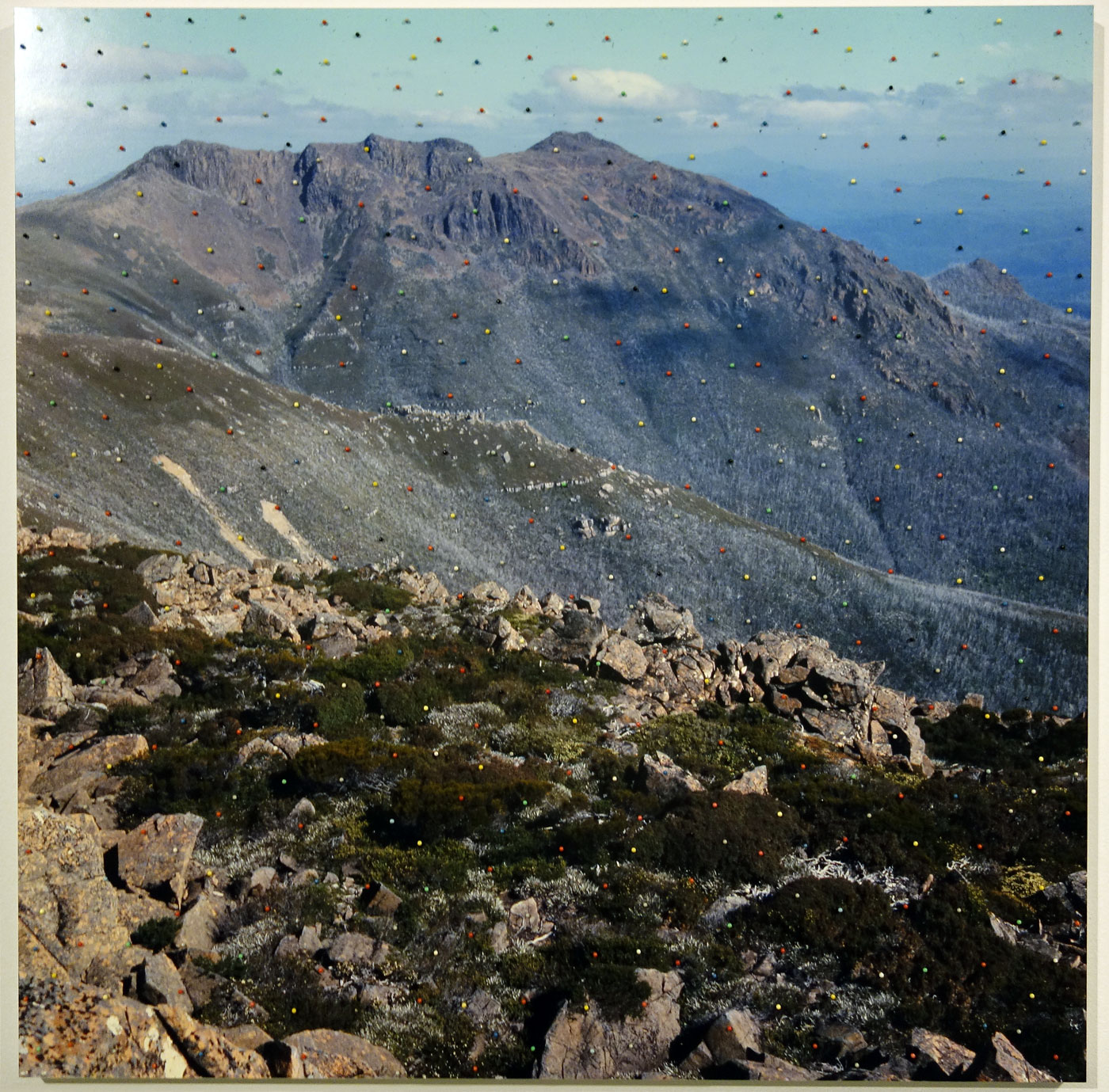
Sat – Sun: 10pm – 4pm
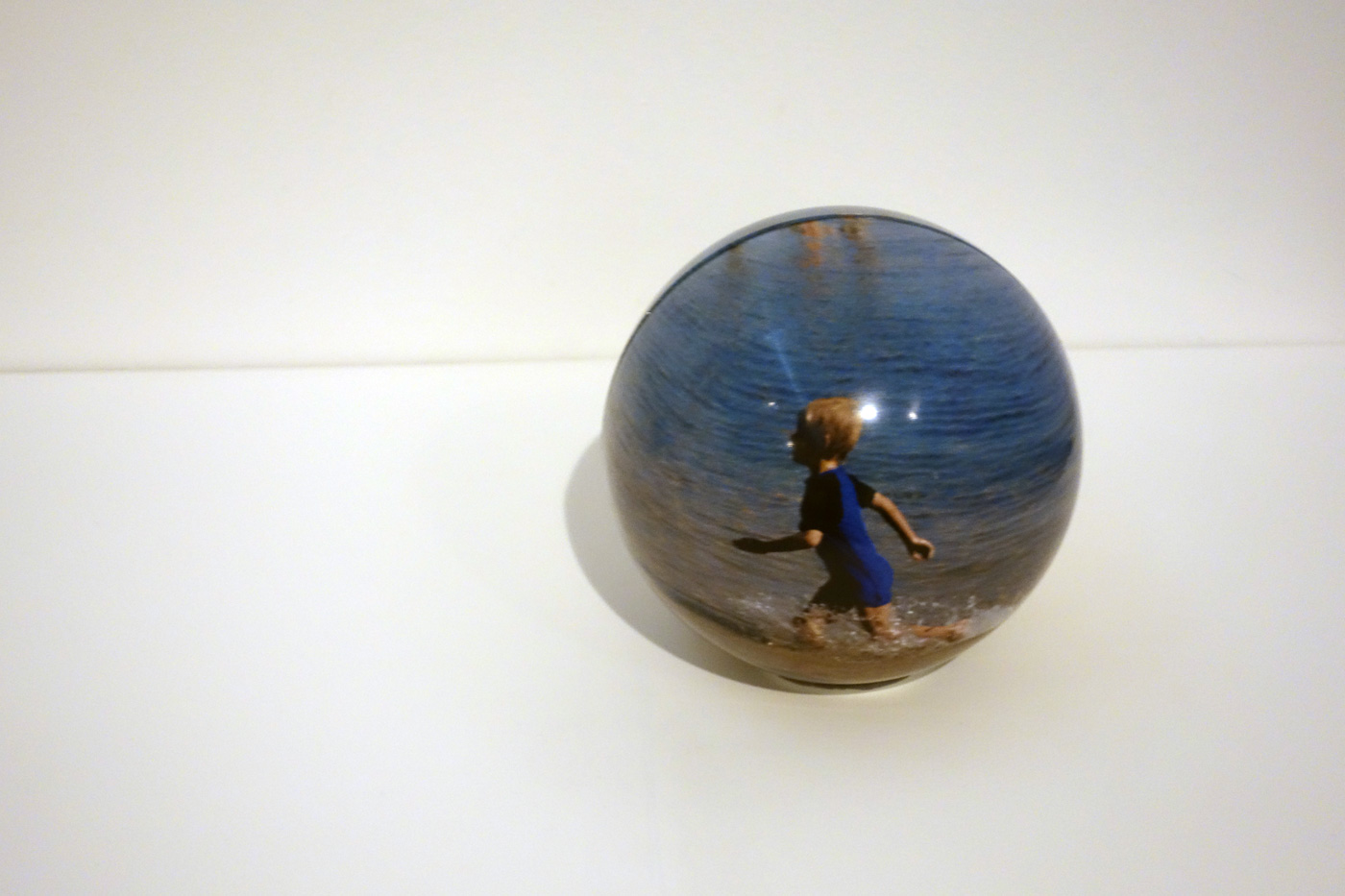
Mon/public holidays: closed

Monash Gallery of Art website

LIKE ART BLART ON FACEBOOK

Back to top