Exhibition: ‘Face to Face: Portraits of Artists’ at the Philadelphia Museum of Art

Exhibition dates: 26th June – 14th October, 2018

Curator: Peter Barberie, The Brodsky Curator of Photographs, Alfred Stieglitz Center


Arnold Newman (American, 1918-2006) 'Isamu Noguchi' c. 1941-1945 from the exhibition 'Face to Face: Portraits of Artists' at the Philadelphia Museum of Art, June - Oct, 2025


Arnold Newman (American, 1918-2006)
Isamu Noguchi
c. 1941-1945
Gelatin silver print
Image: 7 7/16 × 9 1/2 inches
Sheet: 7 15/16 × 10 inches
Mount (primary): 9 × 11 inches
Mount (secondary): 16 15/16 × 13 7/8 inches
Philadelphia Museum of Art: Gift of R. Sturgis and Marion B. F. Ingersoll, 1945


Arnold Newman (American, 1918-2006)

Isamu Noguchi (野口 勇 Noguchi Isamu, November 17, 1904-December 30, 1988) was a Japanese American artist and landscape architect whose artistic career spanned six decades, from the 1920s onward. Known for his sculpture and public works, Noguchi also designed stage sets for various Martha Graham productions, and several mass-produced lamps and furniture pieces, some of which are still manufactured and sold.

In 1947, Noguchi began a collaboration with the Herman Miller company, when he joined with George Nelson, Paul László and Charles Eames to produce a catalog containing what is often considered to be the most influential body of modern furniture ever produced, including the iconic Noguchi table which remains in production today. His work lives on around the world and at the Noguchi Museum in New York City. …

Upon his return to New York, Noguchi took a new studio in Greenwich Village. Throughout the 1940s, Noguchi’s sculpture drew from the ongoing surrealist movement; these works include not only various mixed-media constructions and landscape reliefs, but lunars – self-illuminating reliefs – and a series of biomorphic sculptures made of interlocking slabs. The most famous of these assembled-slab works, Kouros, was first shown in a September 1946 exhibition, helping to cement his place in the New York art scene.

Text from the Wikipedia website


No much to see here. A couple of interesting images but other than that the images are stylised and static, offering little insight into the “public personas of their creative subjects.” I have added biographical information to the posting to add some context to the photographs.

Dr Marcus Bunyan


Many thankx to the Philadelphia Museum of Art for allowing me to publish the photographs in the posting. Please click on the photographs for a larger version of the image.


Billie Holiday with her pit bull. Jacob Lawrence in his Coast Guard uniform. Georgia O’Keeffe with her Model A Ford. See how photographers helped craft the public personas of their creative subjects in this stunning collection of rare photographs from the Museum’s collection. The exhibition features works by Dorothy Norman, Man Ray, Richard Avedon, Alice O’Malley, and many others who captured some of the most fascinating artists and performers of the past 150 years.


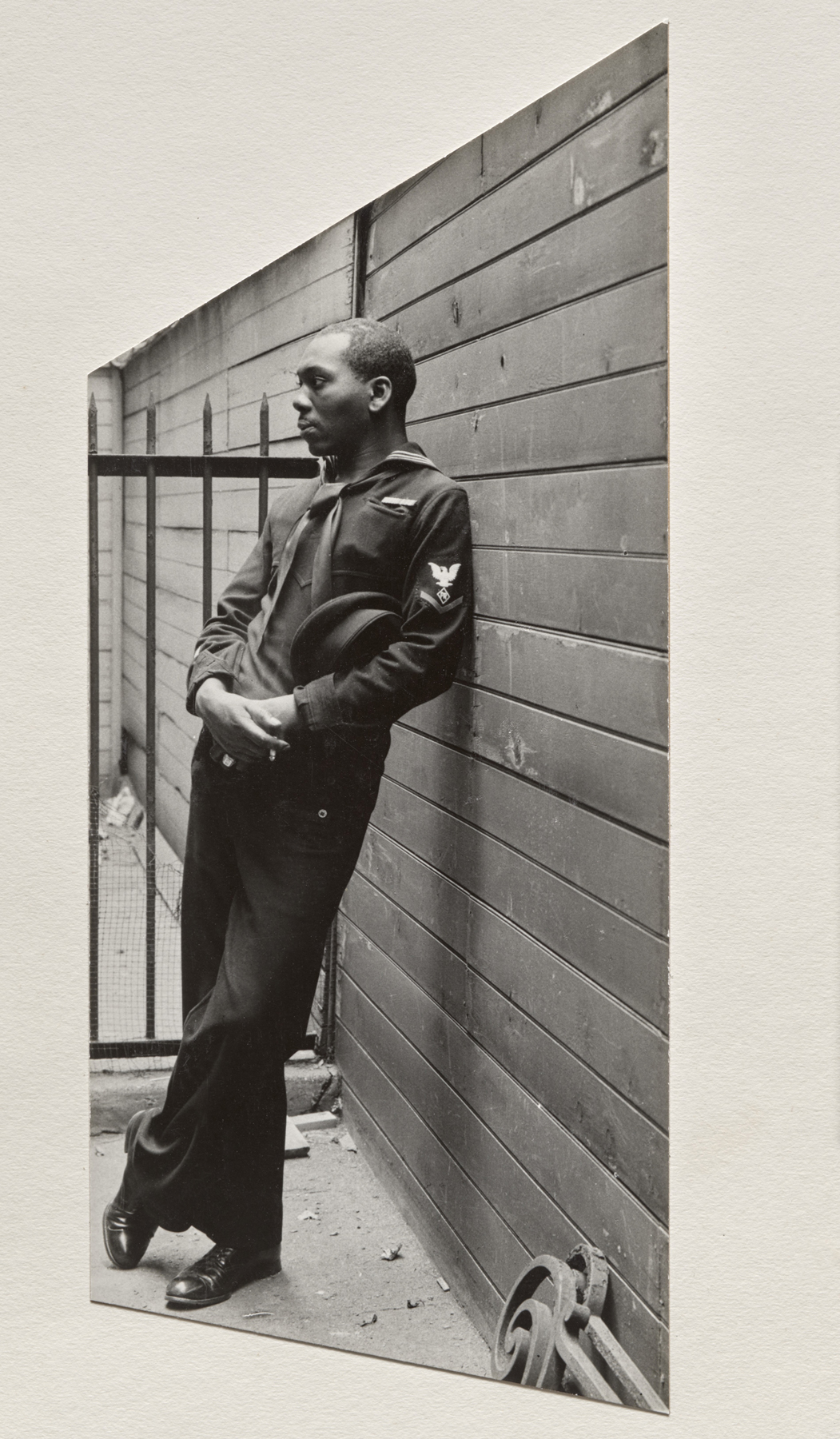
Arnold Newman (American, 1918-2006) 'Jacob Lawrence' 1944


Arnold Newman (American, 1918-2006)
Jacob Lawrence
1944
Gelatin silver print
Image and sheet: 9 1/2 × 4 inches
Sheet: 16 9/16 × 13 11/16 inches
Philadelphia Museum of Art: Gift of R. Sturgis and Marion B. F. Ingersoll, 1945


Jacob Lawrence (American, 1917-2000)

Jacob Lawrence (September 7, 1917 – June 9, 2000) was an African-American painter known for his portrayal of African-American life. As well as a painter, storyteller, and interpreter, he was an educator. Lawrence referred to his style as “dynamic cubism”, though by his own account the primary influence was not so much French art as the shapes and colours of Harlem. He brought the African-American experience to life using blacks and browns juxtaposed with vivid colours. He also taught and spent 15 years as a professor at the University of Washington.

Lawrence is among the best-known 20th-century African-American painters. He was 25 years old when he gained national recognition with his 60-panel Migration Series, painted on cardboard. The series depicted the Great Migration of African-Americans from the rural South to the urban North. A part of this series was featured in a 1941 issue of Fortune. The collection is now held by two museums: the odd-numbered paintings are on exhibit in the Phillips Collection in Washington, D.C., and the even-numbered are on display at MoMA in New York. Lawrence’s works are in the permanent collections of numerous museums, including the Philadelphia Museum of Art, the Museum of Modern Art, the Whitney Museum, the Phillips Collection, Metropolitan Museum of Art, the Brooklyn Museum, and Reynolda House Museum of American Art. He is widely known for his modernist illustrations of everyday life as well as epic narratives of African American history and historical figures

Text from the Wikipedia website


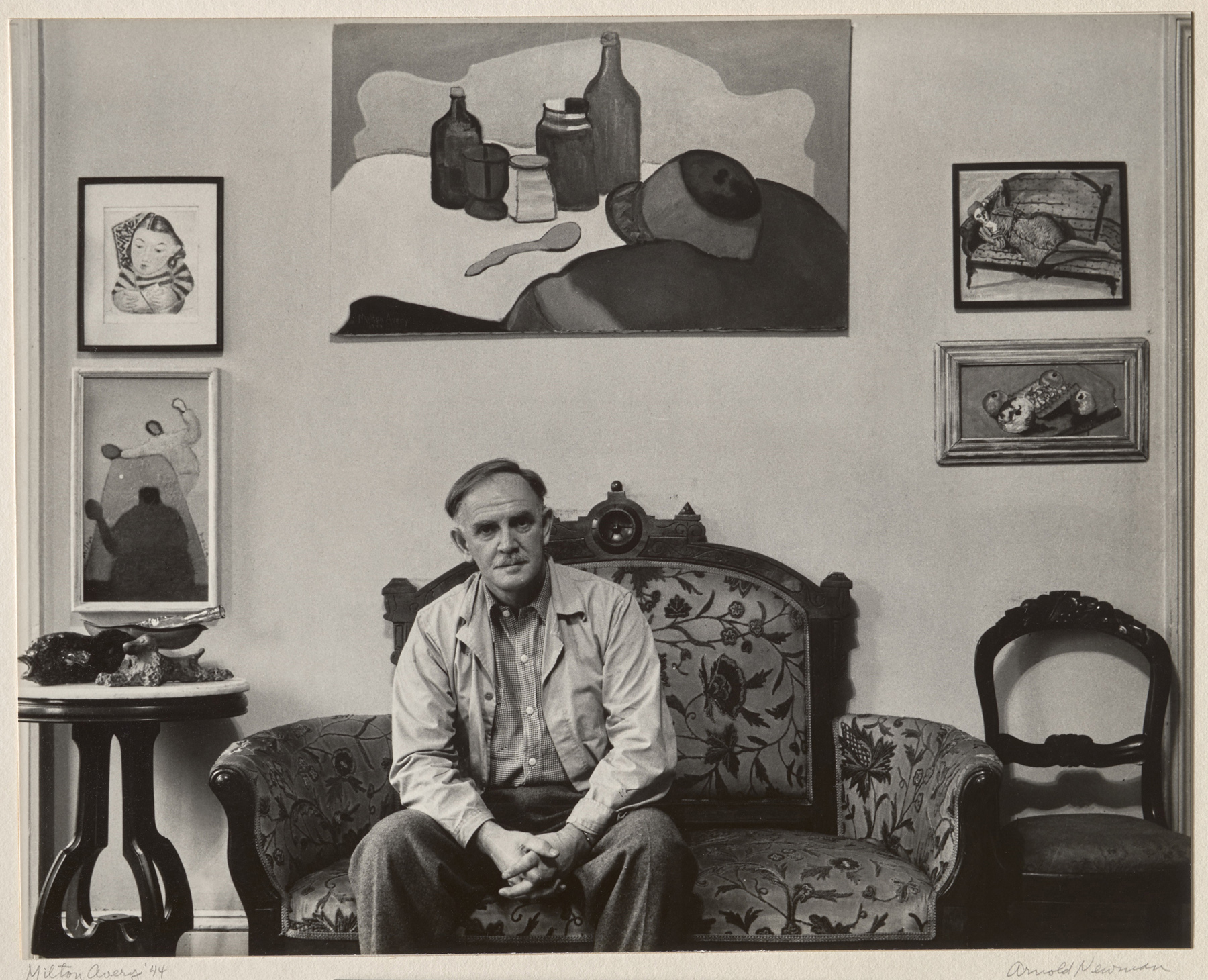
Arnold Newman (1918-2006) 'Milton Avery' 1944


Arnold Newman (American, 1918-2006)
Milton Avery
1944
Gelatin silver print
Image and sheet: 7 11/16 × 9 11/16 inches
Mount: 16 15/16 × 14 inches
Philadelphia Museum of Art: Gift of R. Sturgis and Marion B. F. Ingersoll, 1945


Milton Avery (American, 1885-1865)

Milton Clark Avery (March 7, 1885 – January 3, 1965) was an American modern painter. Born in Altmar, New York, he moved to Connecticut in 1898 and later to New York City. According to painter Mark Rothko,

“What was Avery’s repertoire? His living room, Central Park, his wife Sally, his daughter March, the beaches and mountains where they summered; cows, fish heads, the flight of birds; his friends and whatever world strayed through his studio: a domestic, unheroic cast. But from these there have been fashioned great canvases, that far from the casual and transitory implications of the subjects, have always a gripping lyricism, and often achieve the permanence and monumentality of Egypt.”

Art critic Hilton Kramer said, “He was, without question, our greatest colourist… Among his European contemporaries, only Matisse – to whose art he owed much, of course – produced a greater achievement in this respect.”

Text from the Wikipedia website

Arnold Newman (American, 1918-2006)

Arnold Abner Newman (3 March 1918 – June 6, 2006) was an American photographer, noted for his “environmental portraits” of artists and politicians. He was also known for his carefully composed abstract still life images. …

Newman found his vision in the empathy he felt for artists and their work. Although he photographed many personalities – Marlene Dietrich, John F. Kennedy, Harry S. Truman, Piet Mondrian, Pablo Picasso, Arthur Miller, Marilyn Monroe, Ronald Reagan, Mickey Mantle, and Audrey Hepburn – he maintained that even if the subject is not known, or is already forgotten, the photograph itself must still excite and interest the viewer.

Newman is often credited with being the first photographer to use so-called environmental portraiture, in which the photographer places the subject in a carefully controlled setting to capture the essence of the individual’s life and work. Newman normally captured his subjects in their most familiar surroundings with representative visual elements showing their professions and personalities. A musician for instance might be photographed in their recording studio or on stage, a Senator or other politician in their office or a representative building. Using a large-format camera and tripod, he worked to record every detail of a scene.

“I didn’t just want to make a photograph with some things in the background,” Newman told American Photo magazine in an interview. “The surroundings had to add to the composition and the understanding of the person. No matter who the subject was, it had to be an interesting photograph. Just to simply do a portrait of a famous person doesn’t mean a thing.”

Text from the Wikipedia website


This summer, the Philadelphia Museum of Art presents a unique selection of photographic portraits of artists, from the French painter Henri Matisse to American writer Eudora Welty and the great jazz singer Ella Fitzgerald as well as many other figures in the world of the visual, literary, performing arts. Ranging in date from the late nineteenth century to the present, the compelling images in Face to Face reveal the expressive ways in which artists have used photography not only to portray their subjects but also to promote or shape their own celebrity. Many of the photographs in this exhibition represent artists whose work can be seen in Modern Times: American Art 1910-1950, on view concurrently at the Museum. Among these are portraits of Berenice Abbott, George Biddle, Arthur B. Carles, Jacob Lawrence, Georgia O’Keeffe, and Alfred Stieglitz.

Of special note are several groups of pictures of artists, such as Marcel Duchamp, Thomas Eakins, Frida Kahlo, O’Keeffe and Stieglitz, who skilfully crafted their public personae through photography. Stieglitz and O’Keeffe realised the power of photographs to shape their public reputation, and over time were the subjects of many portraits. By contrast, most of the images of Kahlo in the Museum’s collection are from a single session with her art dealer and friend Julien Levy, who produced what appears to be a collaborative and intimate exploration of her artistic identity. Another photograph from this same session, recently discovered, shows Levy’s future wife, Muriel Streeter, wearing some of Kahlo’s clothes, adding another dimension to this intriguing series.

Consisting of over one hundred works, the exhibition is centred around two groups of portraits by Arnold Newman and Carl Van Vechten that are foundational to the Museum’s photography collection. Newman’s portraits were featured in the Museum’s inaugural photography exhibition in 1945, titled Artists Look Like This. Among the subjects depicted are such well-known figures as cartoonist Saul Steinberg and painter Piet Mondrian, as well as illustrator Peggy Bacon and painter Robert Gwathmey. The sitters captured by Van Vechten – a novelist and artistic patron who photographed those he knew well – include Ella Fitzgerald and Zora Neale Hurston, Bessie Smith and Ethel Waters. Writer James Baldwin, sculptor Richmond Barthé and painter Aaron Douglas are also highlights of this group.

Peter Barberie, The Brodsky Curator of Photographs, Alfred Stieglitz Center, said: “We are delighted to share these portraits of some of the most creative people of the past century and to take this opportunity to explore an important aspect of our collection.”

Press release from the Philadelphia Museum of Art website


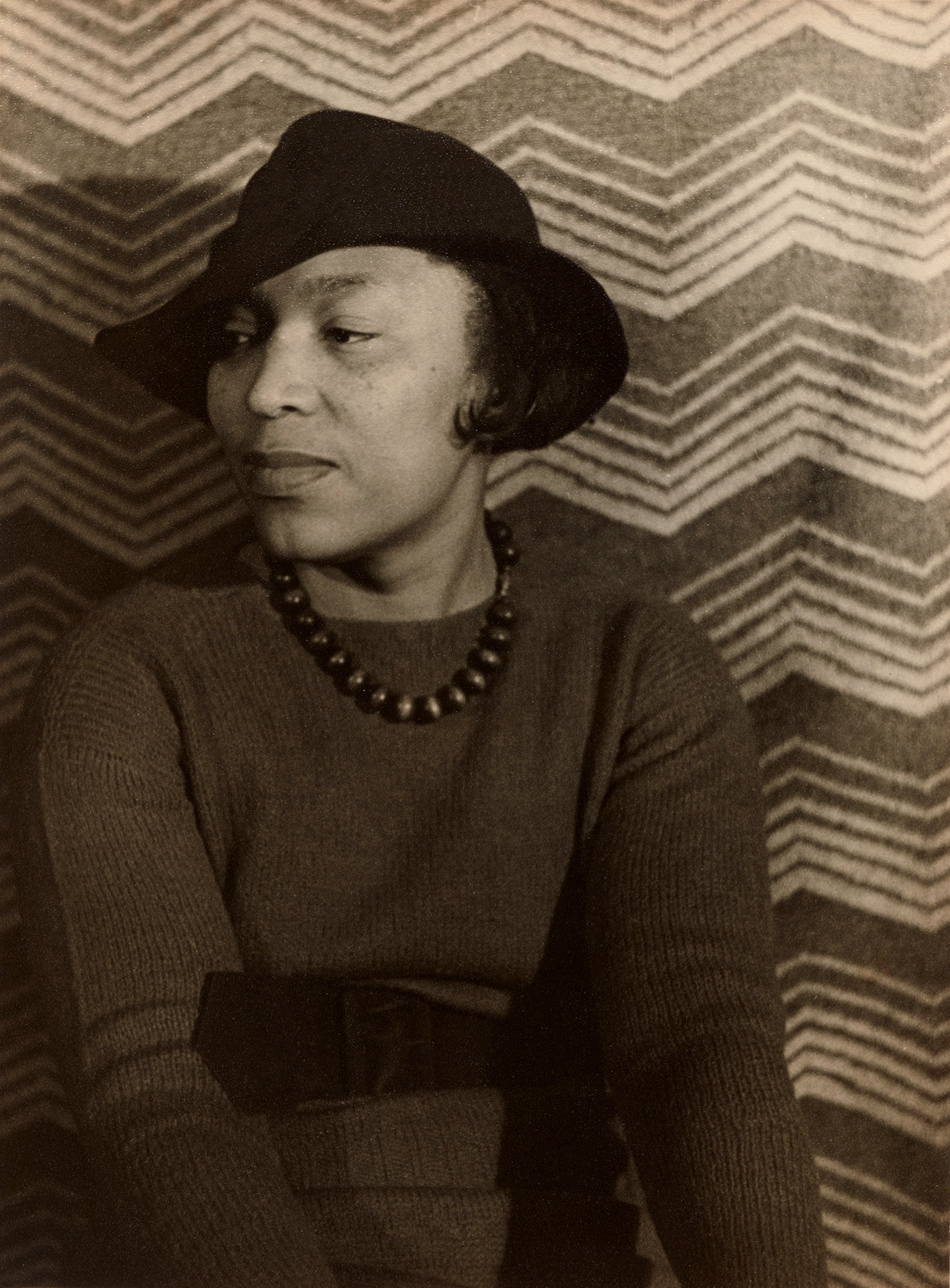
Carl Van Vechten (American, 1880-1964) 'Zora Neale Hurston' April 3, 1935 from the exhibition 'Face to Face: Portraits of Artists' at the Philadelphia Museum of Art, June - Oct, 2025


Carl Van Vechten (American, 1880-1964)
Zora Neale Hurston
April 3, 1935
Gelatin silver print
Image and sheet: 9 5/8 × 7 1/8 inches
Philadelphia Museum of Art: Gift of John Mark Lutz, 1965


Zora Neale Hurston (American, 1891-1960)

Zora Neale Hurston (January 7, 1891 – January 28, 1960) was an influential author of African-American literature and anthropologist, who portrayed racial struggles in the early 20th century American South, and published research on Haitian voodoo. Of Hurston’s four novels and more than 50 published short stories, plays, and essays, her most popular is the 1937 novel Their Eyes Were Watching God.

Hurston was born in Notasulga, Alabama, and moved to Eatonville, Florida, with her family in 1894. Eatonville would become the setting for many of her stories and is now the site of the Zora! Festival, held each year in Hurston’s honour. In her early career, Hurston conducted anthropological and ethnographic research while attending Barnard College. While in New York she became a central figure of the Harlem Renaissance. Her short satires, drawing from the African-American experience and racial division, were published in anthologies such as The New Negro and Fire!! After moving back to Florida, Hurston published her literary anthropology on African-American folklore in North Florida, Mules and Men (1935) and her first three novels: Jonah’s Gourd Vine (1934); Their Eyes Were Watching God (1937); and Moses, Man of the Mountain (1939). Also published during this time was Tell My Horse: Voodoo and Life in Haiti and Jamaica (1938), documenting her research on rituals in Jamaica and Haiti.

Hurston’s works touched on the African-American experience and her struggles as an African-American woman. Her novels went relatively unrecognised by the literary world for decades, but interest revived after author Alice Walker published “In Search of Zora Neale Hurston” in the March 1975 issue of Ms. Magazine. Hurston’s manuscript Every Tongue Got to Confess (2001), a collection of folktales gathered in the 1920s, was published posthumously after being discovered in the Smithsonian archives. Her nonfiction book Barracoon was published posthumously in 2018.

Text from the Wikipedia website


Carl Van Vechten (American, 1880-1964) 'Ella Fitzgerald' January 19, 1940


Carl Van Vechten (American, 1880-1964)
Ella Fitzgerald
January 19, 1940
Gelatin silver print
Image and sheet: 9 15/16 × 7 15/16 inches
Philadelphia Museum of Art: Gift of John Mark Lutz, 1965


Carl Van Vechten (American, 1880-1964)

Carl Van Vechten (June 17, 1880 – December 21, 1964) was an American writer and artistic photographer who was a patron of the Harlem Renaissance and the literary executor of Gertrude Stein. He gained fame as a writer, and notoriety as well, for his novel Nigger Heaven. In his later years, he took up photography and took many portraits of notable people. Although he was married to women for most of his adult life, Van Vechten engaged in numerous homosexual affairs over his lifetime.

By the start of the 1930s and at age 50, Van Vechten was finished with writing and took up photography, using his apartment at 150 West 55th Street as a studio, where he photographed many notable persons.

Text from the Wikipedia website


Alfred Stieglitz (American, 1864-1946) 'Georgia O'Keeffe - After Return from New Mexico' 1929


Alfred Stieglitz (American, 1864-1946)
Georgia O’Keeffe – After Return from New Mexico
1929
Gelatin silver print
Image/Sheet/Mount: 3 1/16 × 4 11/16 inches
Mount (secondary): 13 1/2 × 10 11/16 inches
125th Anniversary Acquisition
The Alfred Stieglitz Collection, purchased with the gift (by exchange) of Dr. and Mrs. Paul Todd Makler, the Lynne and Harold Honickman Fund for Photography, the Alice Newton Osborn Fund, and the Lola Downin Peck Fund, with funds contributed by Mr. and Mrs. John J. F. Sherrerd, Lynne and Harold Honickman, John J. Medveckis, and M. Todd Cooke, and gift of The Georgia O’Keeffe Foundation, 1997


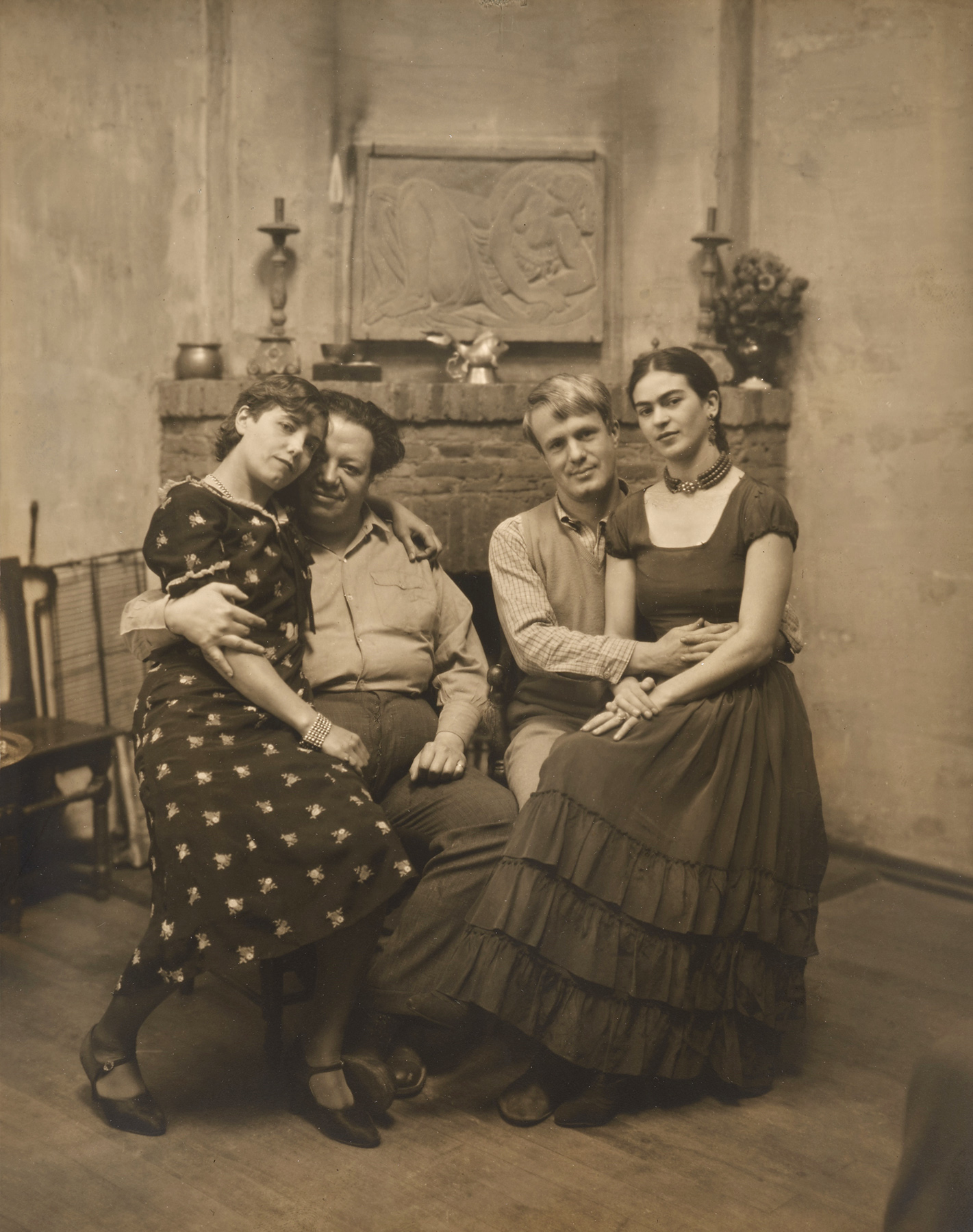
Peter A. Juley & Son (American) 'Diego Rivera and Frida Kahlo with Lucile and Arnold Blanch at Coyoacán' c. 1930


Peter A. Juley & Son (American)
Diego Rivera and Frida Kahlo with Lucile and Arnold Blanch at Coyoacán
c. 1930
Gelatin silver print
Image and sheet: 9 1/2 x 7 1/2 inches
Philadelphia Museum of Art: Gift of Carl Zigrosser, 1975


Peter A. Juley & Son collection at The Smithsonian

The Juleys photographed the work of turn-of-the-century painters such as Childe Hassam, Thomas Eakins, and Albert Pinkham Ryder; ash can school artists such as Robert Henri and John Sloan; the avant-garde group associated with Alfred Stieglitz; regionalists of the 1930 and 1940s such as Thomas Hart Benton and Grant Wood; abstract expressionists such as Hans Hoffman and Robert Motherwell; and sculptors such as Daniel Chester French and William Zorach.

The Juley collection also holds some 4,700 photographic portraits of artists. These images capture some of the best-known artists of the twentieth century, including Thomas Hart Benton, Alexander Calder, Stuart Davis, Edward Hopper, Frida Kahlo, Jacob Lawrence, Barnett Newman, Diego Rivera, and Grant Wood. Many of the portraits depict artists at work in their studios or at home with their families and offer glimpses into the artistic and social climate of the period.

Group photography by the Juley firm records the histories of the National Academy of Design and Art Students League and documents important summer art colonies at Provincetown, Massachusetts; Woodstock, New York; Old Lyme, Connecticut; and Ogunquit, Maine. In addition to the negatives produced by the Juley’s, the firm also acquired valuable negatives from other fine arts photographers, including Myra Albert, A. B. Bogart, George C. Cox, Walter Russell, A. E. Sproul, and De Witt Ward, to broaden its holdings.

Text from The Smithsonian Institution website


Man Ray (American, 1890-1976) 'George Biddle Painting a Portrait of Man Ray' 1941


Man Ray (American, 1890-1976)
George Biddle Painting a Portrait of Man Ray
1941
Gelatin silver print
Philadelphia Museum of Art
Gift of C. K. Williams, II, 2003
© Man Ray Trust / Arts Rights Society (ARS), New York / ADAGP, Paris


George Biddle (American, 1885-1973)

George Biddle (January 24, 1885 – November 6, 1973) was an American painter, muralist and lithographer, best known for his social realism and combat art. A childhood friend of President Franklin D. Roosevelt, he played a major role in establishing the Federal Art Project (1935-1943), which employed artists under the Works Progress Administration. …

Some factors that contributed to Biddle’s artwork are the many art movements that he was involved in. Biddle was involved in “French Impressionism; the American Ashcan School; the School of Paris and Cubism during those early and exciting days when it first exploded on the world; Regionalism, the Mexican Mural Movement, and the New Deal Subsidy of Art”. He also was involved in the “post war currents of contemporary art”. Many of his works of art were contemporary. Another factor that contributed to Biddle’s artwork were his friendships with many great “painters, sculptors, and critics of the past generation and his life-long activity in behalf of fellow artists”. He borrowed many of the other artists’ styles and turned them into his own by using different techniques and images to get a different effect. Biddle believed that everyone’s life should be influenced by every “fact with which one comes in contact, until one ceases to grow or is, actually dead”. This is the reason why Biddle became such a successful American artist; he had his own style, and expressed real actual events.

Text from the Wikipedia website


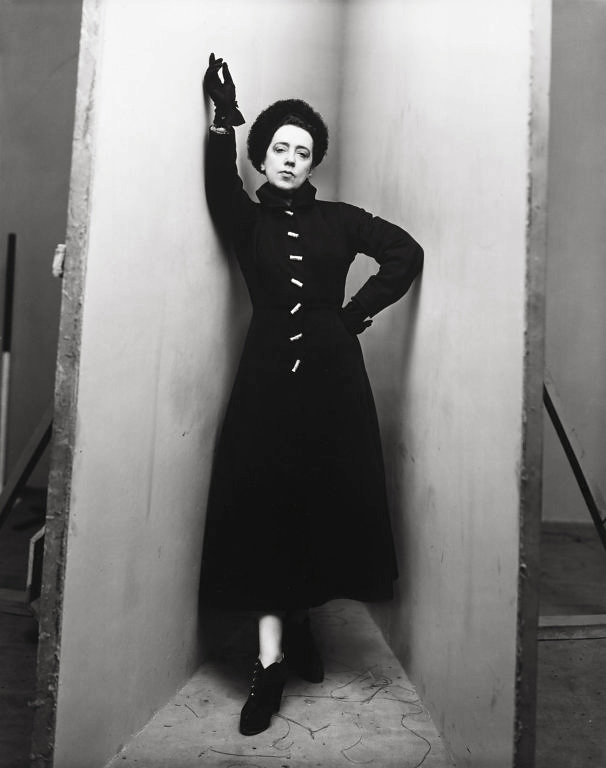
Irving Penn (American, 1917-2009) 'Elsa Schiaparelli' 1948 (negative), c. 1948 (print)


Irving Penn (American, 1917-2009)
Elsa Schiaparelli
1948 (negative), c. 1948 (print)
Gelatin silver print
Image and sheet: 10 1/8 × 8 1/8 inches
Philadelphia Museum of Art: Gift of the artist, 2005


Elsa Schiaparelli (Italian, 1890-1873)

Elsa Schiaparelli (1890-1973) was an Italian fashion designer. Along with Coco Chanel, her greatest rival, she is regarded as one of the most prominent figures in fashion between the two World Wars. Starting with knitwear, Schiaparelli’s designs were heavily influenced by Surrealists like her collaborators Salvador Dalí and Jean Cocteau. Her clients included the heiress Daisy Fellowes and actress Mae West. Schiaparelli did not adapt to the changes in fashion following World War II and her couture house closed in 1954.

Text from the Wikipedia website


Sonia Katchian (American, born Lebanon, 1947) 'Muhammed Ali' 1974


Sonia Katchian (American born Lebanon, b. 1947)
Muhammed Ali
1974
Gelatin silver print
Image: 11 7/8 x 8 inches
Sheet: 13 15/16 x 11 inches
Philadelphia Museum of Art: 125th Anniversary Acquisition. The Lynne and Harold Honickman Gift of the Julien Levy Collection, 2001


Sonia Katchian immigrated to the U.S. from Beirut, Lebanon, where she was born to Armenian parents. She is a Barnard College graduate. A New Yorker for 23 years, she was the first woman photographer hired by The N.Y. Post, was affiliated with Black Star photo agency, and was a founding member of the Soho Photo Gallery. She worked for W. Eugene Smith. In 1982 she established Photo Shuttle: Japan, moving her photo business to Tokyo, where she shuttled between NY and Tokyo for 12 years. She is currently based outside Chapel Hill, NC, where she produces fine-art portfolios, consults and shoots documentary and commercial projects – both still and video.


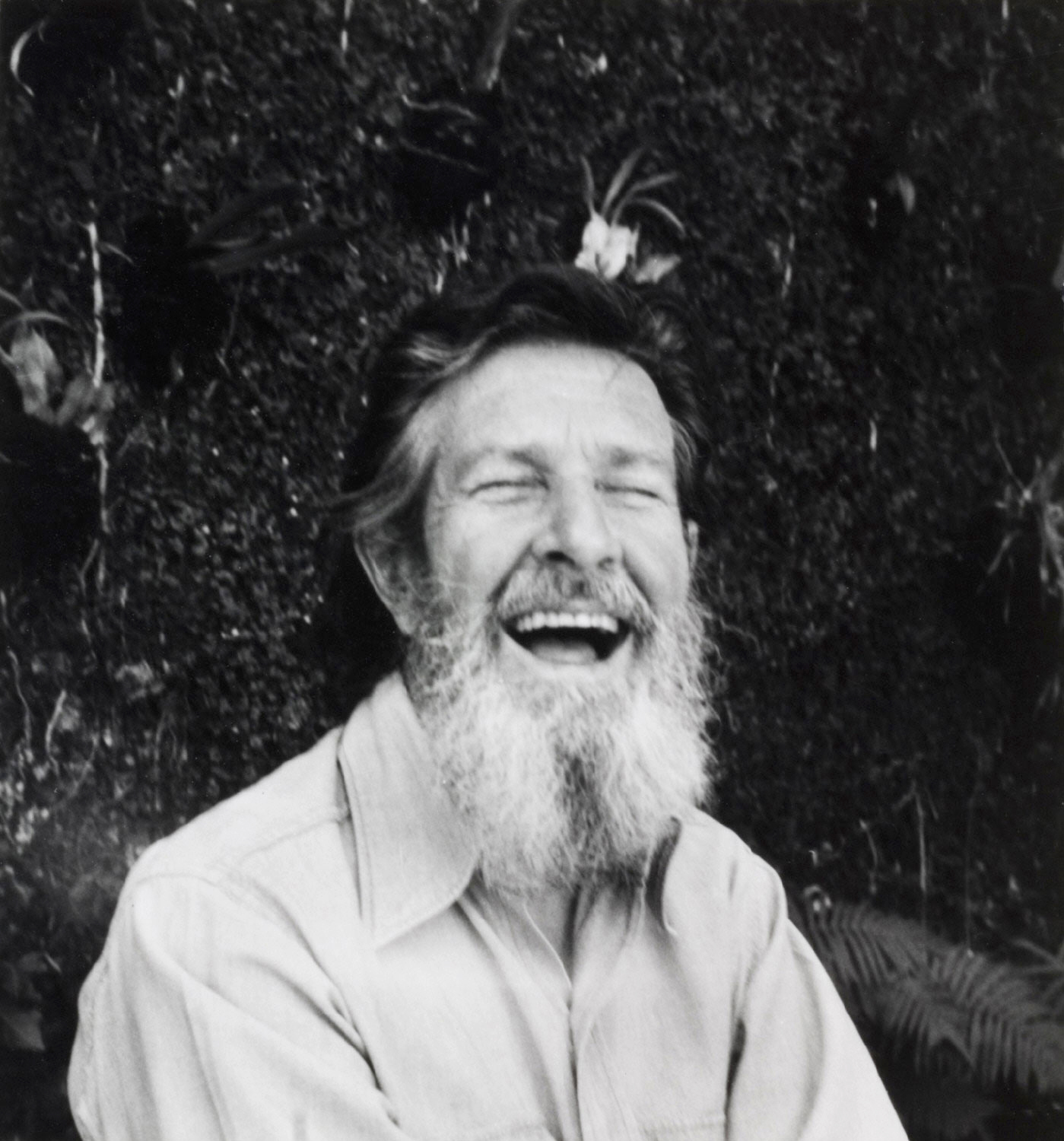
Dorothy Norman (American, 1905-1997) 'John Cage' 1970s


Dorothy Norman (American, 1905-1997)
John Cage
1970s
Gelatin silver print
2 15/16 × 2 3/4 inches (7.4 × 7cm)
Philadelphia Museum of Art
From the Collection of Dorothy Norman, 1984


Dorothy Norman (American, 1905-1997)

Dorothy Norman (28 March 1905 – 12 April 1997) was an American photographer, writer, editor, arts patron and advocate for social change. …

Norman never worked as a professional photographer, instead capturing images of friends, loved ones and prominent figures in the arts and in politics. People she photographed include Jawaharlal Nehru, Indira Gandhi, Thomas Mann (with his wife Katia, or Katy), John Cage, Marcel Duchamp, Bernard Berenson, Albert Einstein, Theodore Dreiser, Elia Kazan, Lewis Mumford and Sherwood Anderson. She also photographed special sites, special trees, special harbours, special churches and buildings. She detailed the interior of An American Place, Stieglitz’s last gallery. She created an extended portrait study of Stieglitz (he returned the favour by creating a similar study of Norman).

Norman’s photographic work is noted for its clarity of vision, masterful mix of light and shading, and professional-quality printing techniques. Norman chose provocative aphorisms by contemporary and historical writers, male and female, and from various cultures, to accompany the thematic groups of photographs in sections of MoMA’s world-touring exhibition The Family of Man for its curator Edward Steichen, a long-term associate of Alfred Stieglitz.

Text from the Wikipedia website

 John Cage (American, 1912-1992)

John Milton Cage Jr. (September 5, 1912 – August 12, 1992) was an American composer and music theorist. A pioneer of indeterminacy in music, electroacoustic music, and non-standard use of musical instruments, Cage was one of the leading figures of the post-war avant-garde. Critics have lauded him as one of the most influential composers of the 20th century. He was also instrumental in the development of modern dance, mostly through his association with choreographer Merce Cunningham, who was also Cage’s romantic partner for most of their lives.

Cage is perhaps best known for his 1952 composition 4’33”, which is performed in the absence of deliberate sound; musicians who present the work do nothing aside from being present for the duration specified by the title. The content of the composition is not “four minutes and 33 seconds of silence,” as is often assumed, but rather the sounds of the environment heard by the audience during performance. The work’s challenge to assumed definitions about musicianship and musical experience made it a popular and controversial topic both in musicology and the broader aesthetics of art and performance. Cage was also a pioneer of the prepared piano (a piano with its sound altered by objects placed between or on its strings or hammers), for which he wrote numerous dance-related works and a few concert pieces. The best known of these is Sonatas and Interludes (1946-1948).

Text from the Wikipedia website


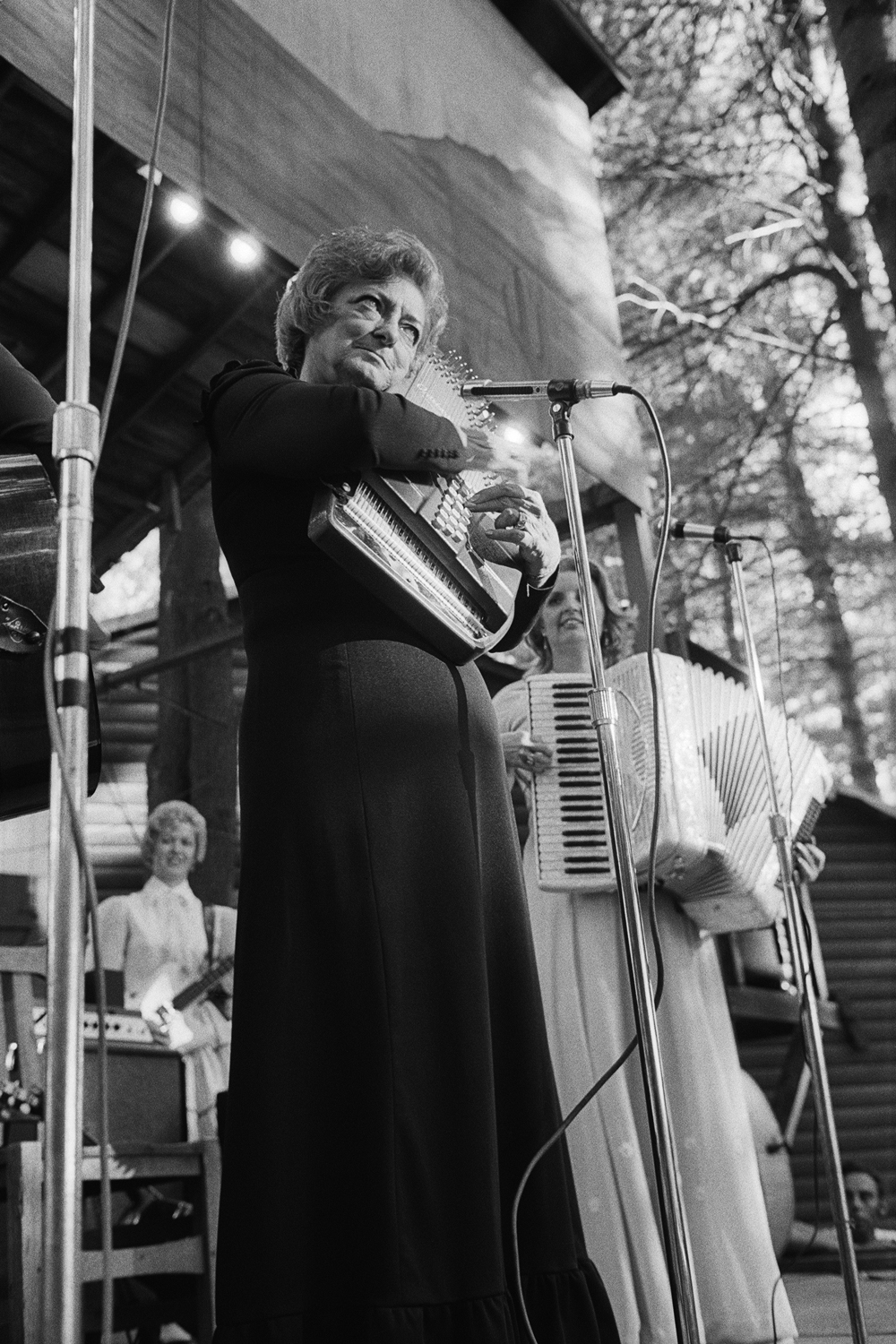
Henry Horenstein (American, b. 1947) 'Mother Maybelle Carter, Lone Star Ranch, Reeds Ferry, NH' 1973


Henry Horenstein (American, b. 1947)
Mother Maybelle Carter, Lone Star Ranch, Reeds Ferry, NH
1973
Gelatin silver print
9 × 5 15/16 inches (22.9 × 15.1cm)
Philadelphia Museum of Art
Purchased with funds contributed in memory of Judith Taylor, 2013


Henry Horenstein (born 1947, New Bedford, Massachusetts) is an American artist / photographer. He studied history at the University of Chicago and earned his BFA and MFA at Rhode Island School of Design (RISD), where he is now professor of photography. He has worked as a professional photographer, teacher, and author since the early 1970s. A student of photographers / teachers Harry Callahan, Aaron Siskind, and Minor White, Horenstein is the author of over 30 books, including a series of instructional textbooks that have been used by hundreds of thousands of photography students over the past 40 years.

“Mother” Maybelle Carter (born Maybelle Addington; May 10, 1909 – October 23, 1978) was an American country musician. She is best known as a member of the historic Carter Family act in the 1920s and 1930s and also as a member of Mother Maybelle and the Carter Sisters.

Texts from the Wikipedia website


Philadelphia Museum of Art
26th Street and the Benjamin Franklin Parkway
Philadelphia, PA 19130

Opening hours:
Tuesday – Sunday: 10am – 5pm

Philadelphia Museum of Art website

LIKE ART BLART ON FACEBOOK

Back to top

Exhibition: ‘African American Portraits: Photographs from the 1940s and 1950s’ at the Metropolitan Museum of Art, New York Part 2

Exhibition dates: 26th June – 8th October, 2018

Curator: Jeff L. Rosenheim, Joyce Frank Menschel Curator in Charge of the Department of Photographs at The Met


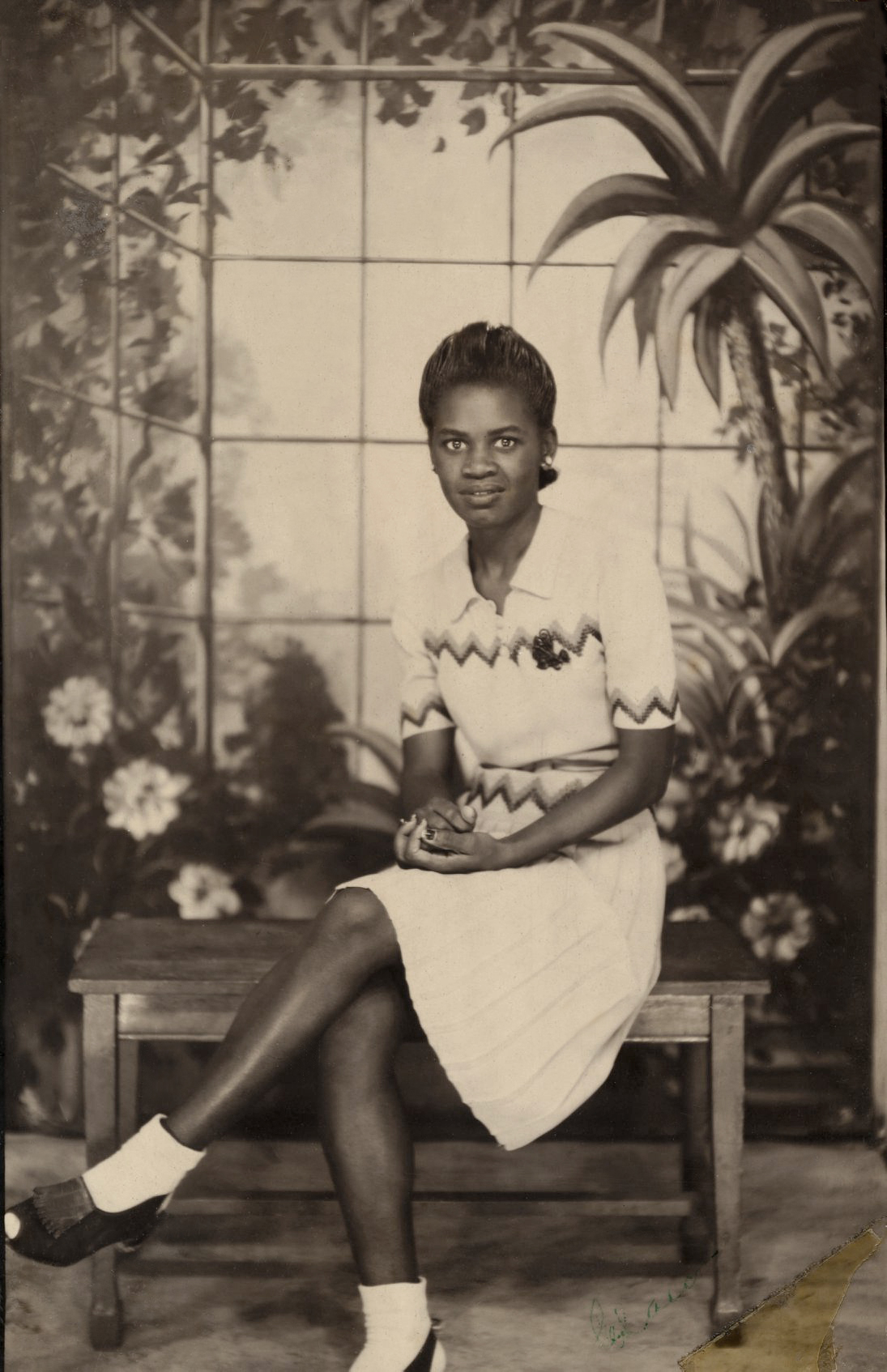
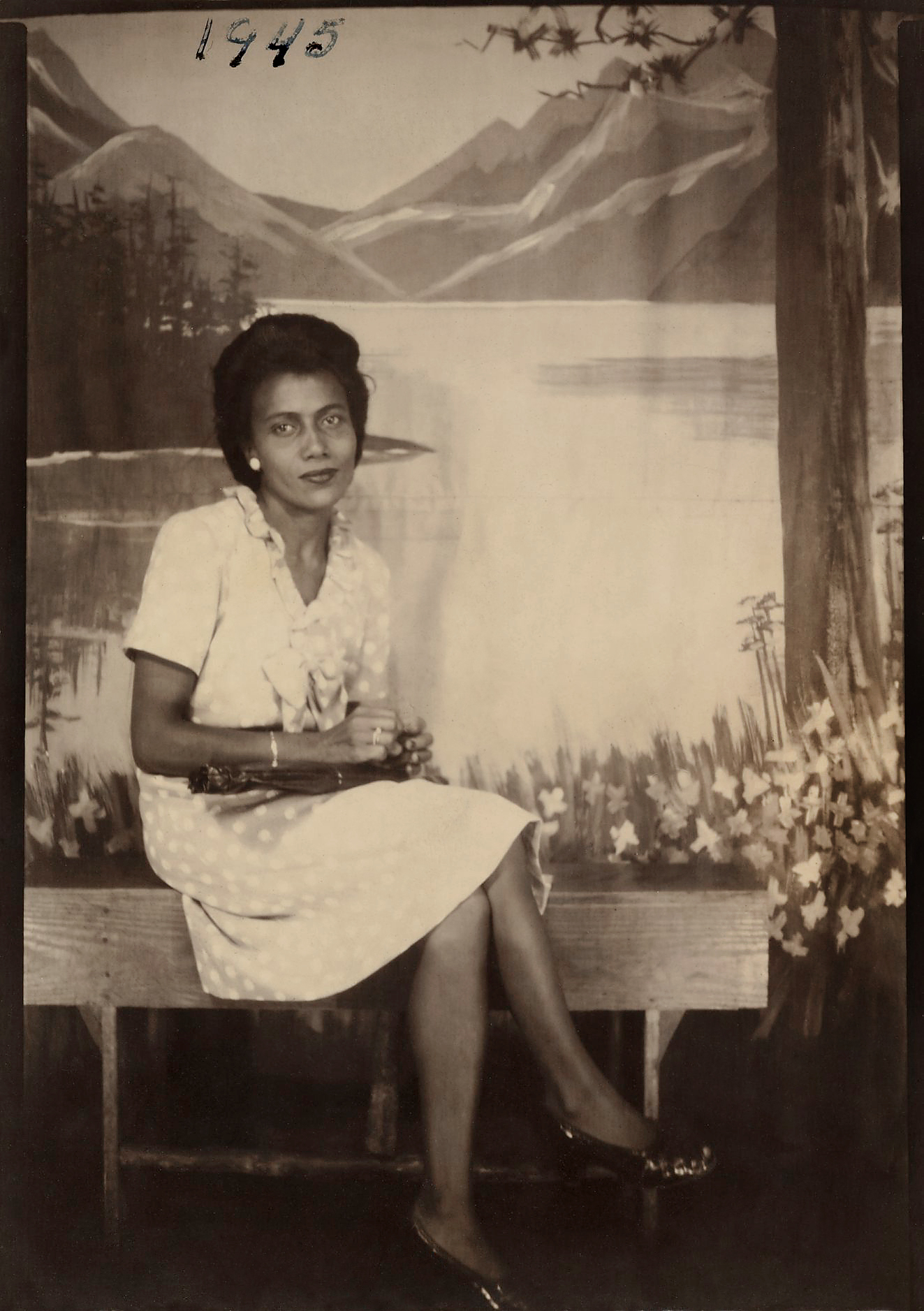
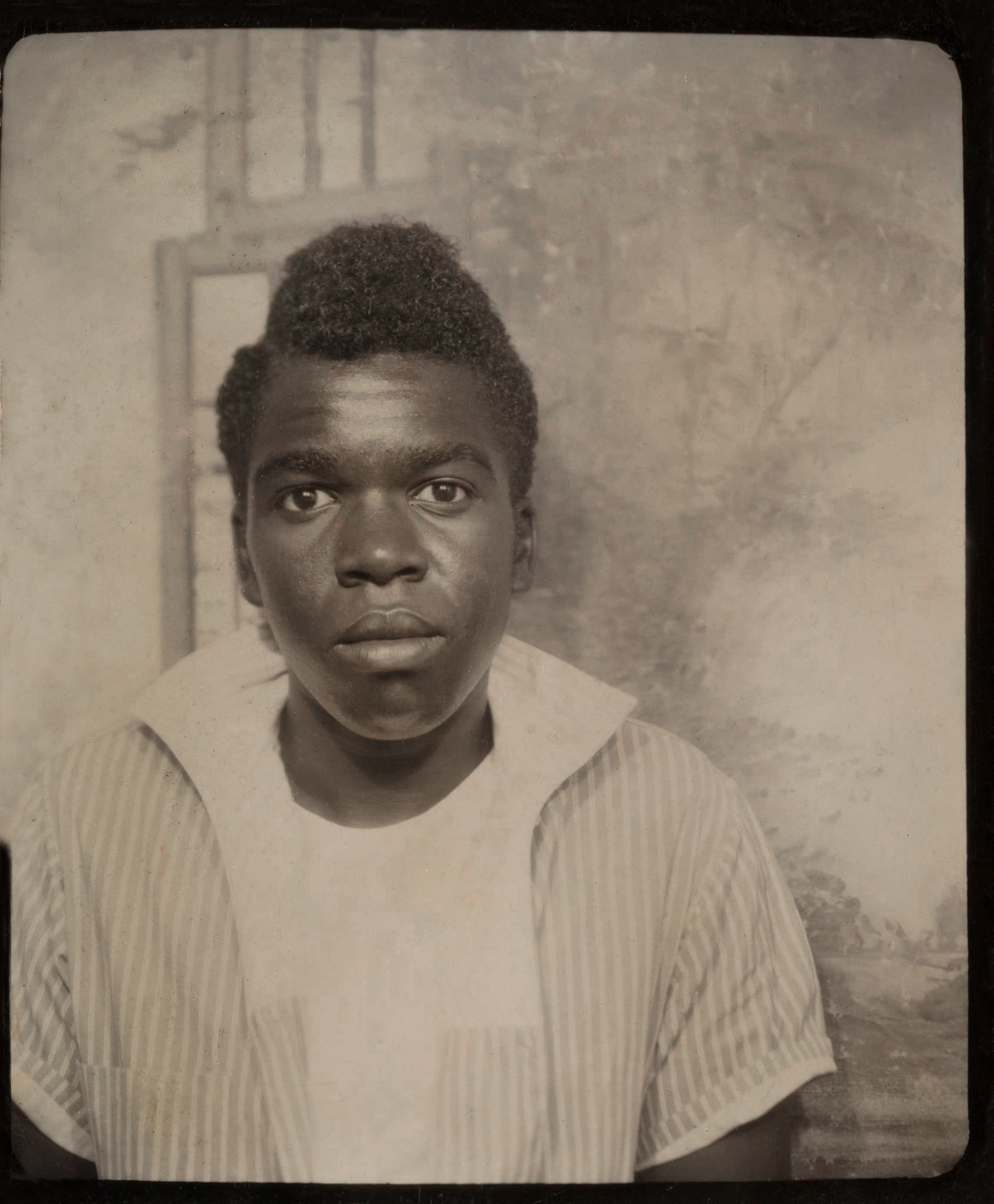
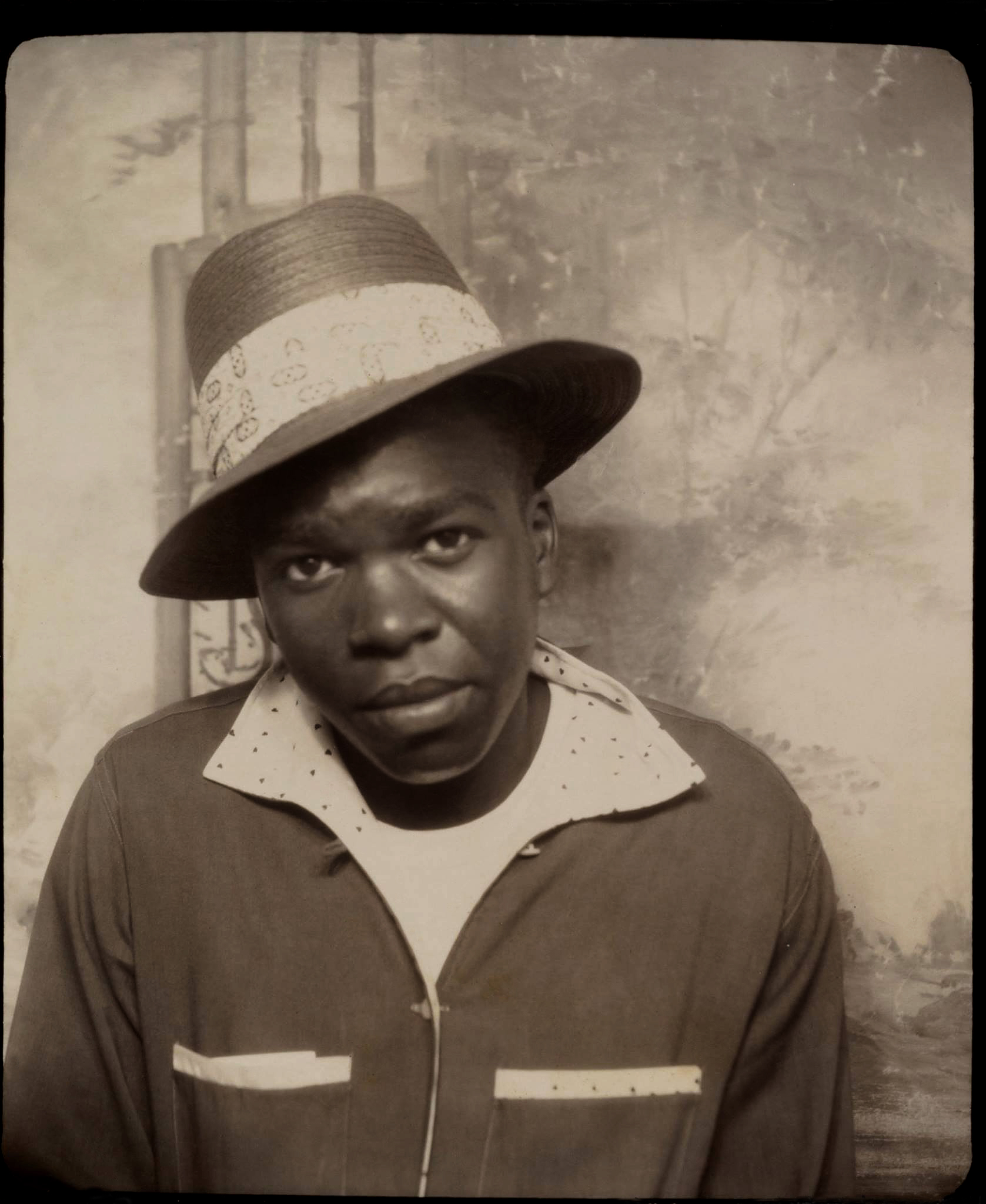
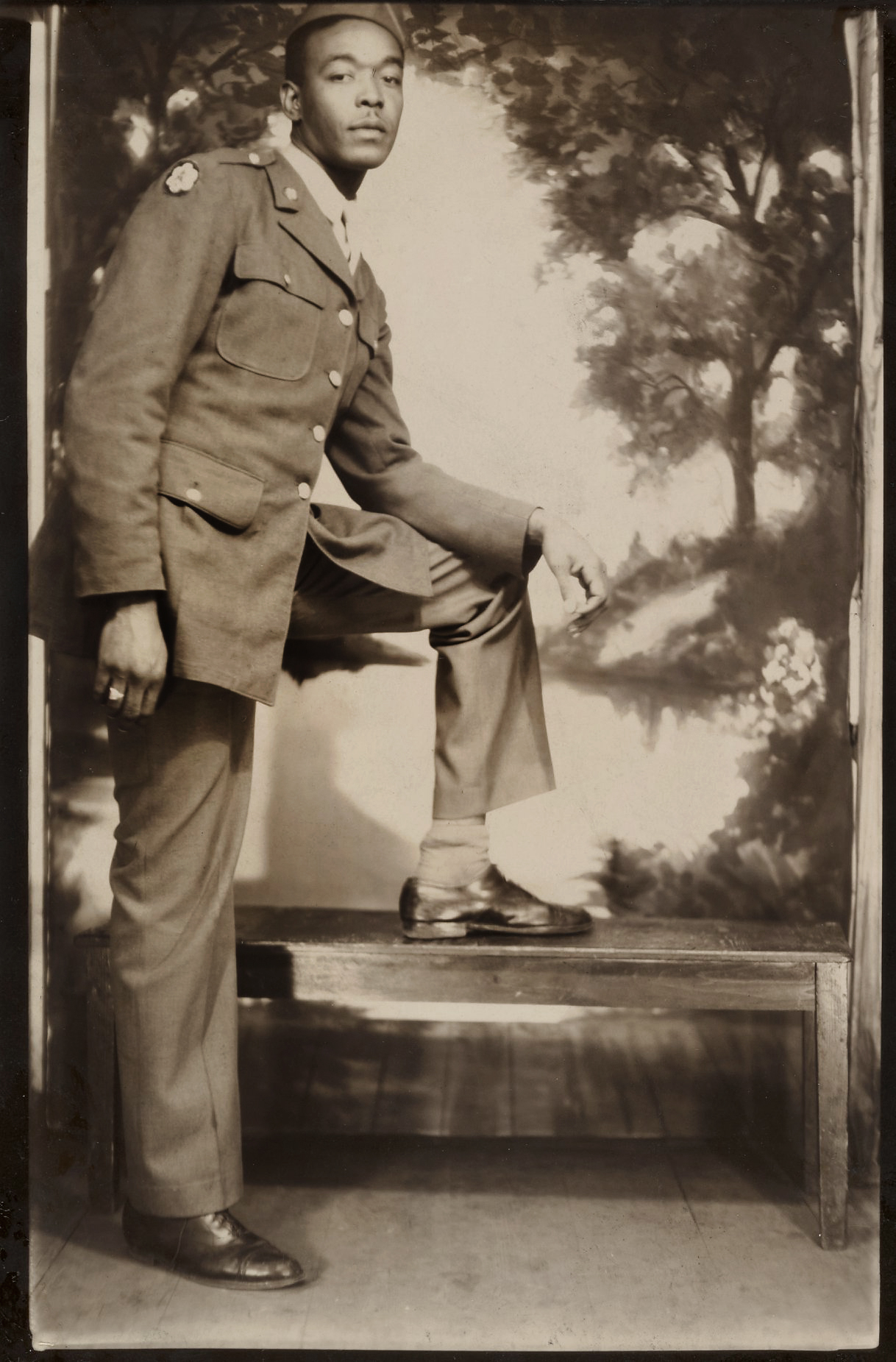
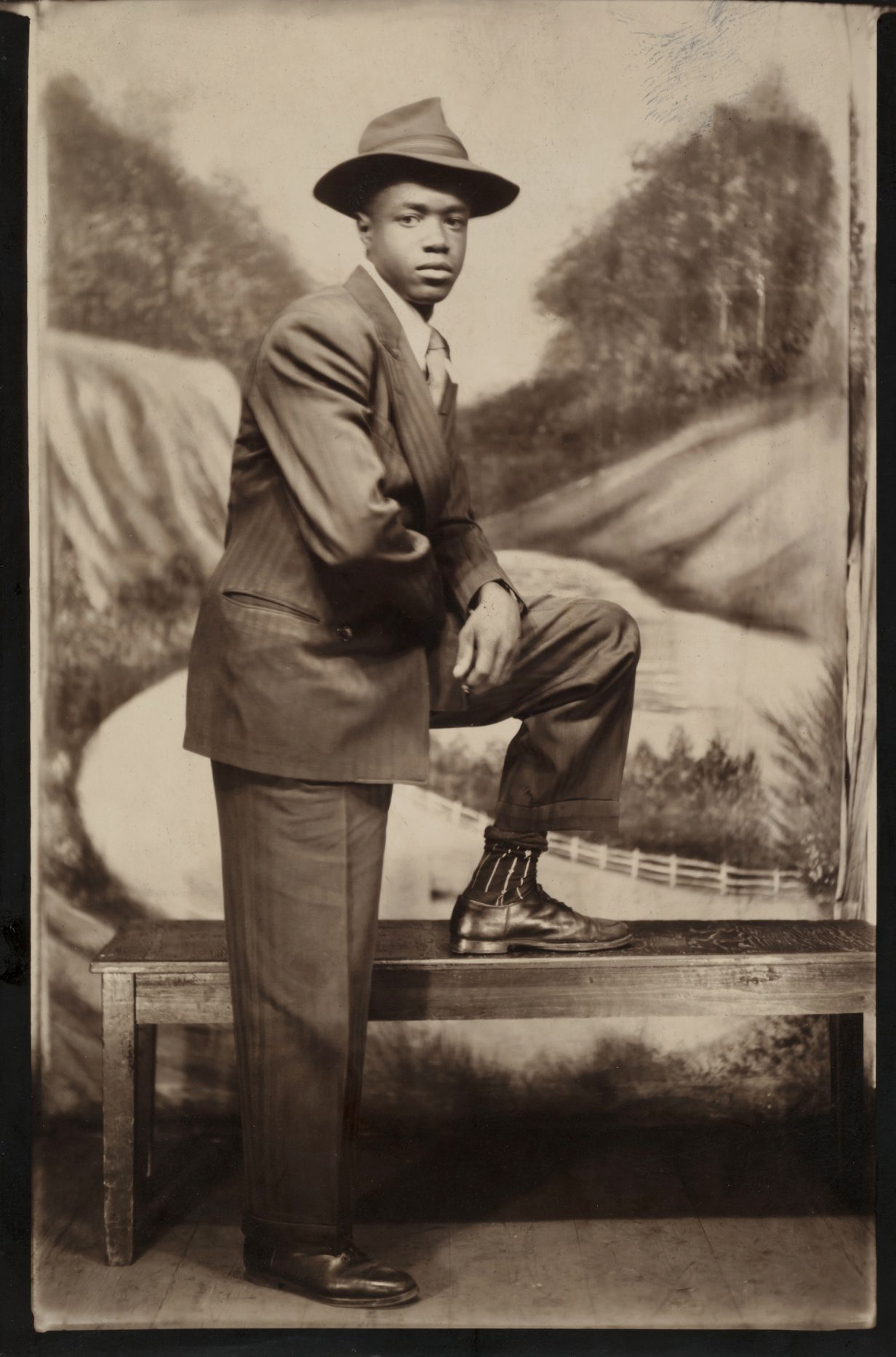
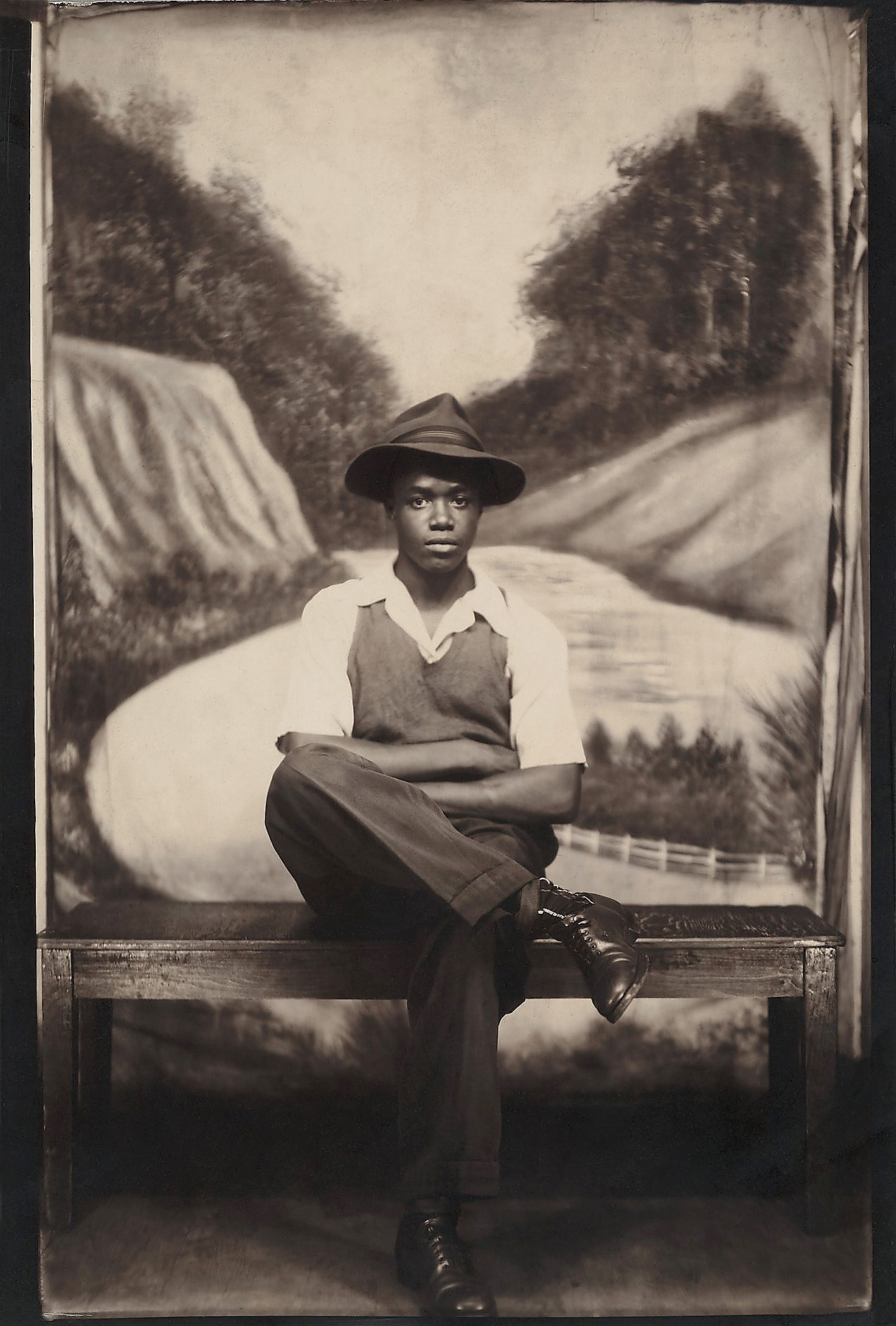
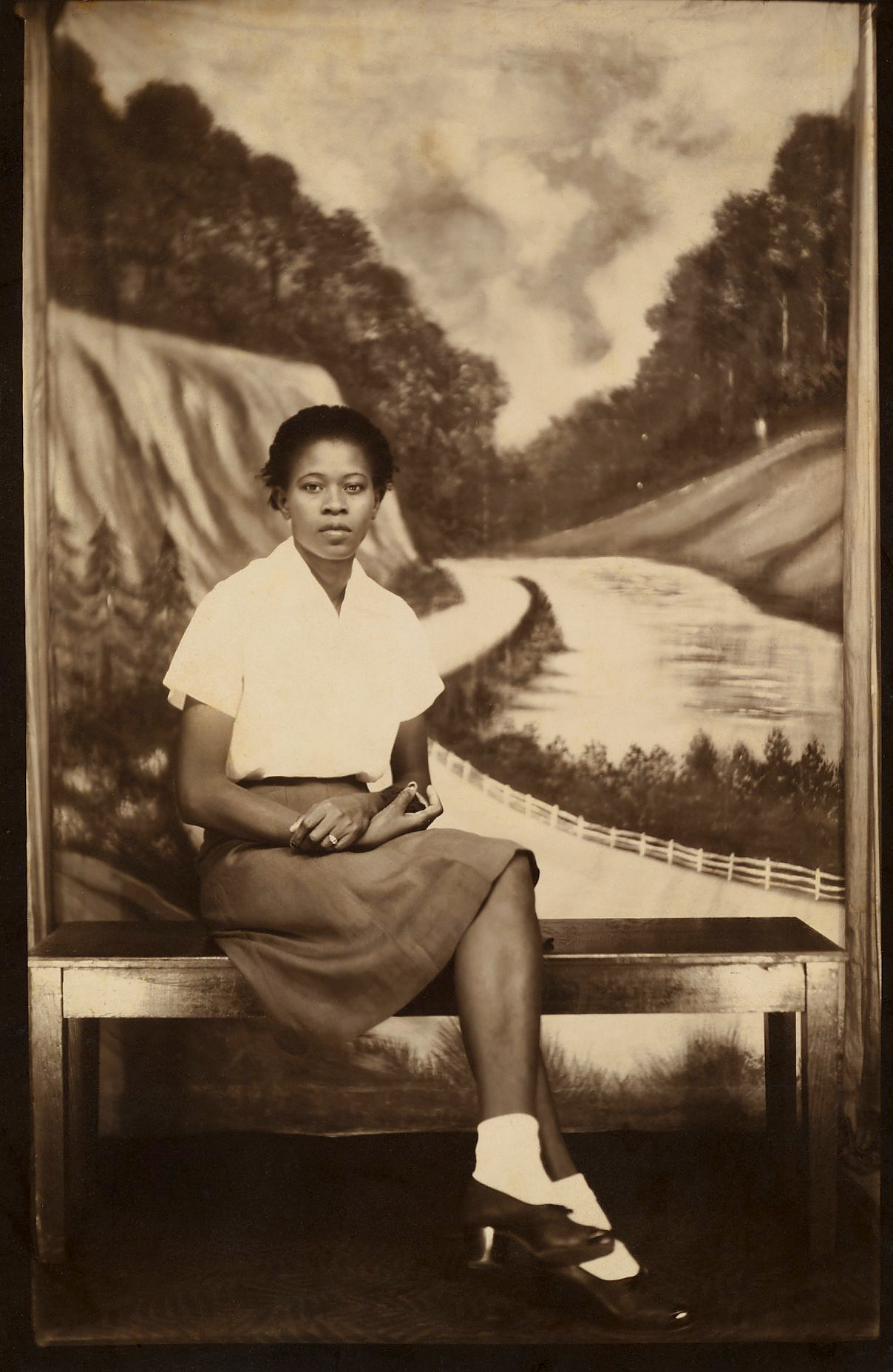
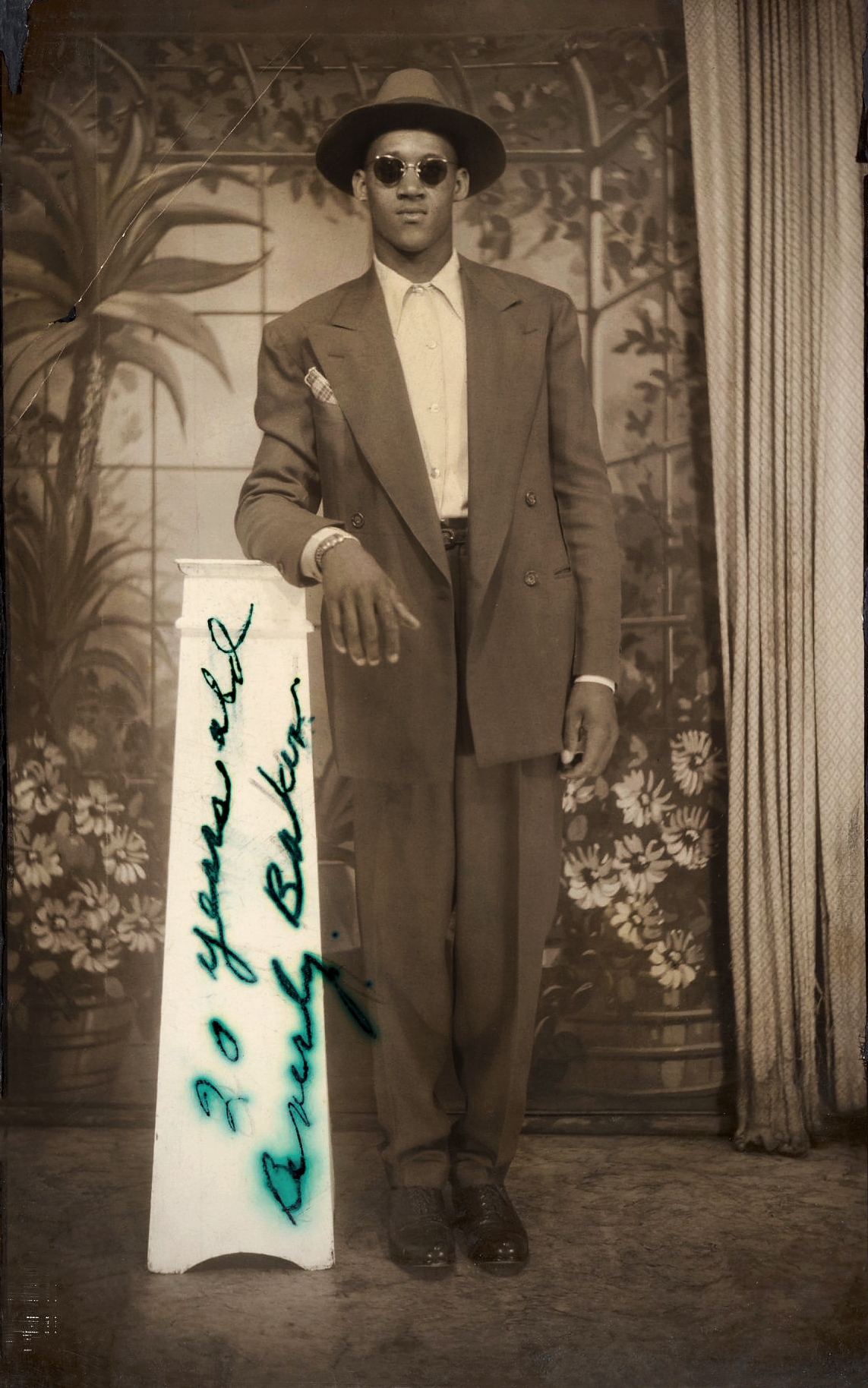
Unknown American photographer. 'Studio Portrait' 1940s-1950s from the exhibition 'African American Portraits: Photographs from the 1940s and 1950s' at the Metropolitan Museum of Art, New York, June - Oct, 2018


Unknown American photographer
Studio Portrait
1940s-1950s
Gelatin silver print
The Metropolitan Museum of Art, New York, Twentieth-Century Photography Fund, 2015, 2017
Image courtesy The Metropolitan Museum of Art


“To the eye and spirit, pictures are just what poetry and music are to the ear and heart.”

“With the clear perception of things as they are, must stand the faithful rendering of things as they seem. The dead fact is nothing without the living expression.”


Frederick Douglass. “Pictures and Progress”


“True art, when it happens to us, challenges the ‘I’ that we are.”


Jeanette Winterson. “Art Objects,” in Art Objects: Essays on Ecstasy and Effrontery, 1996


Without worry … here ‘I am’

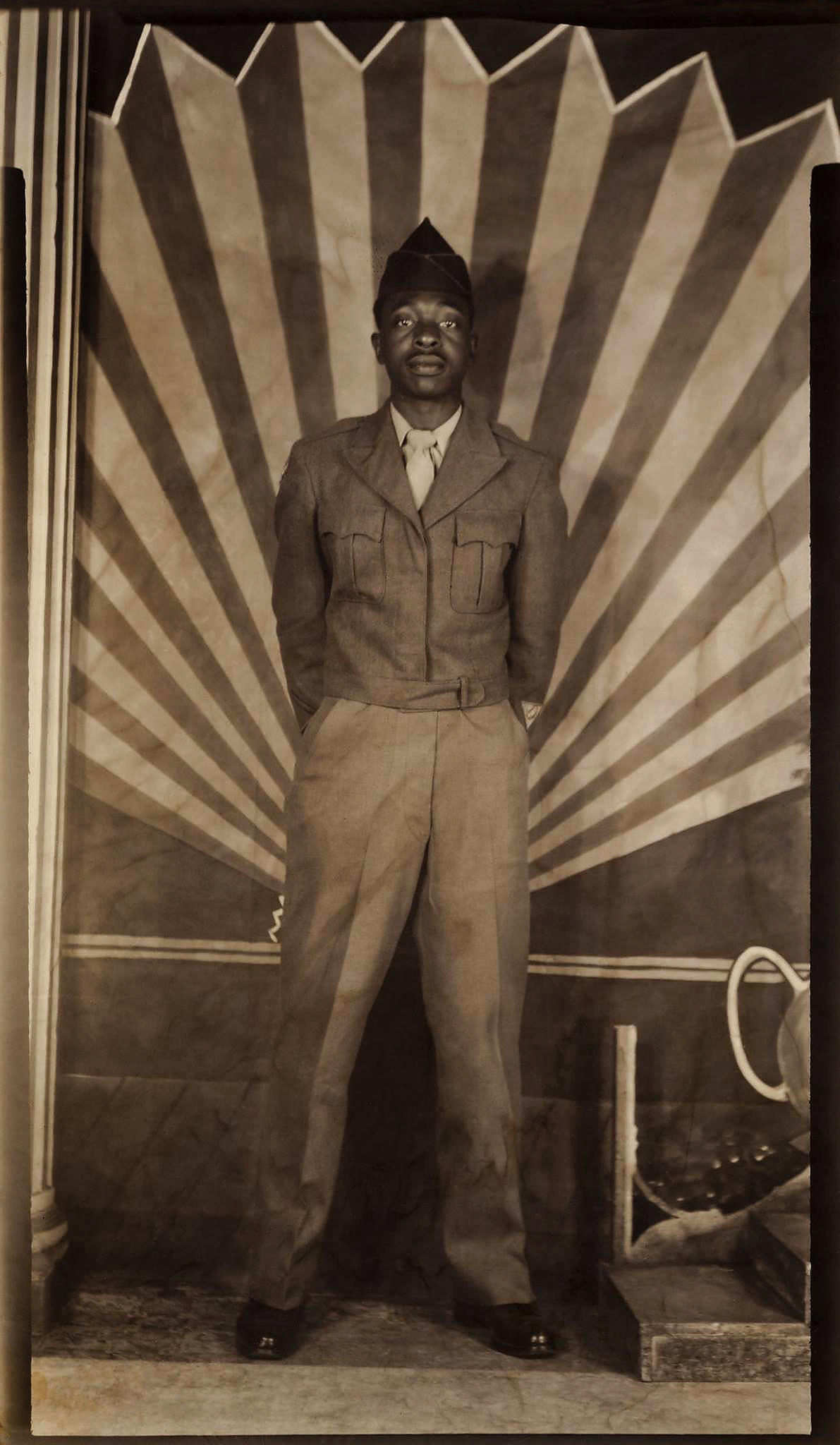
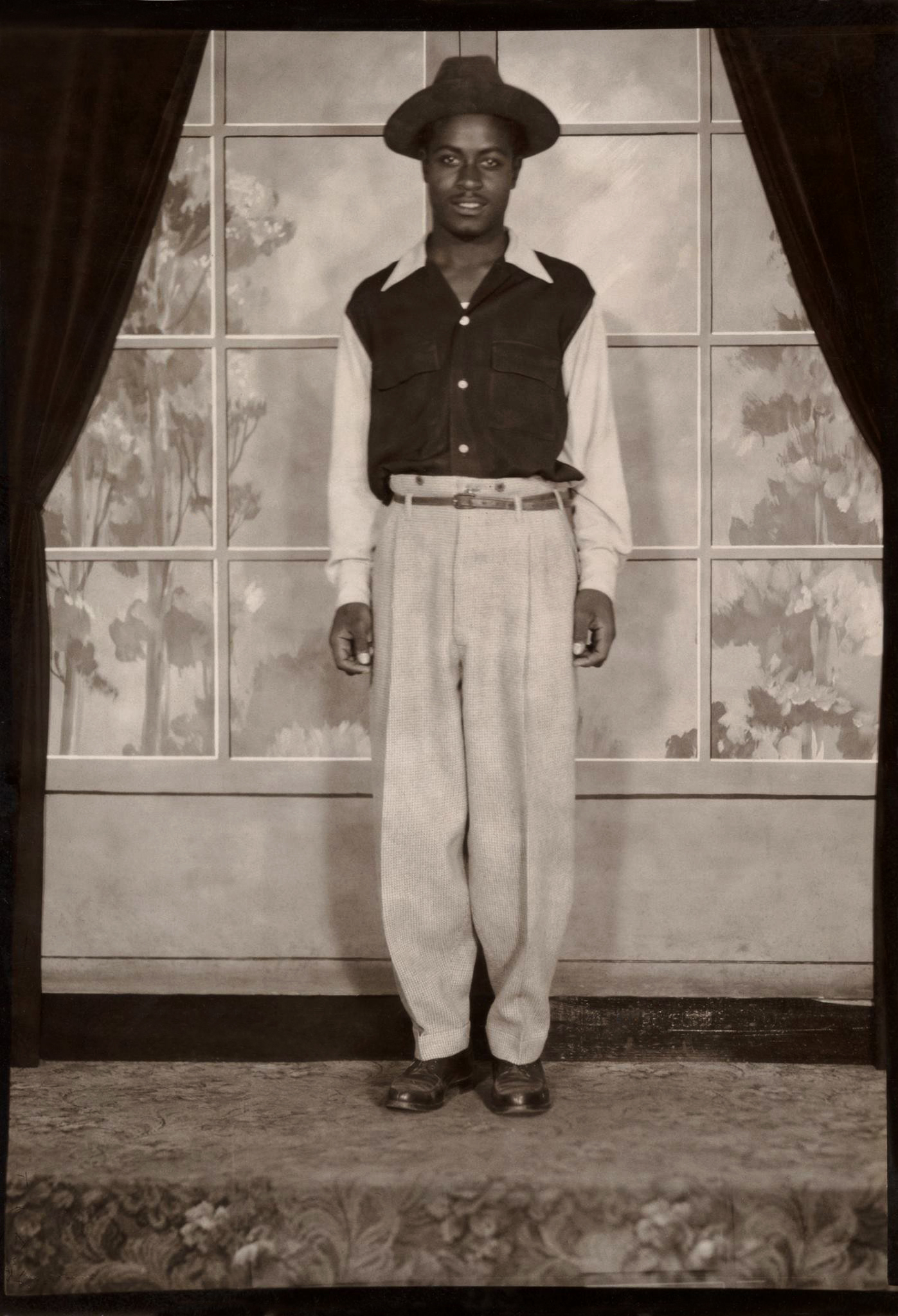
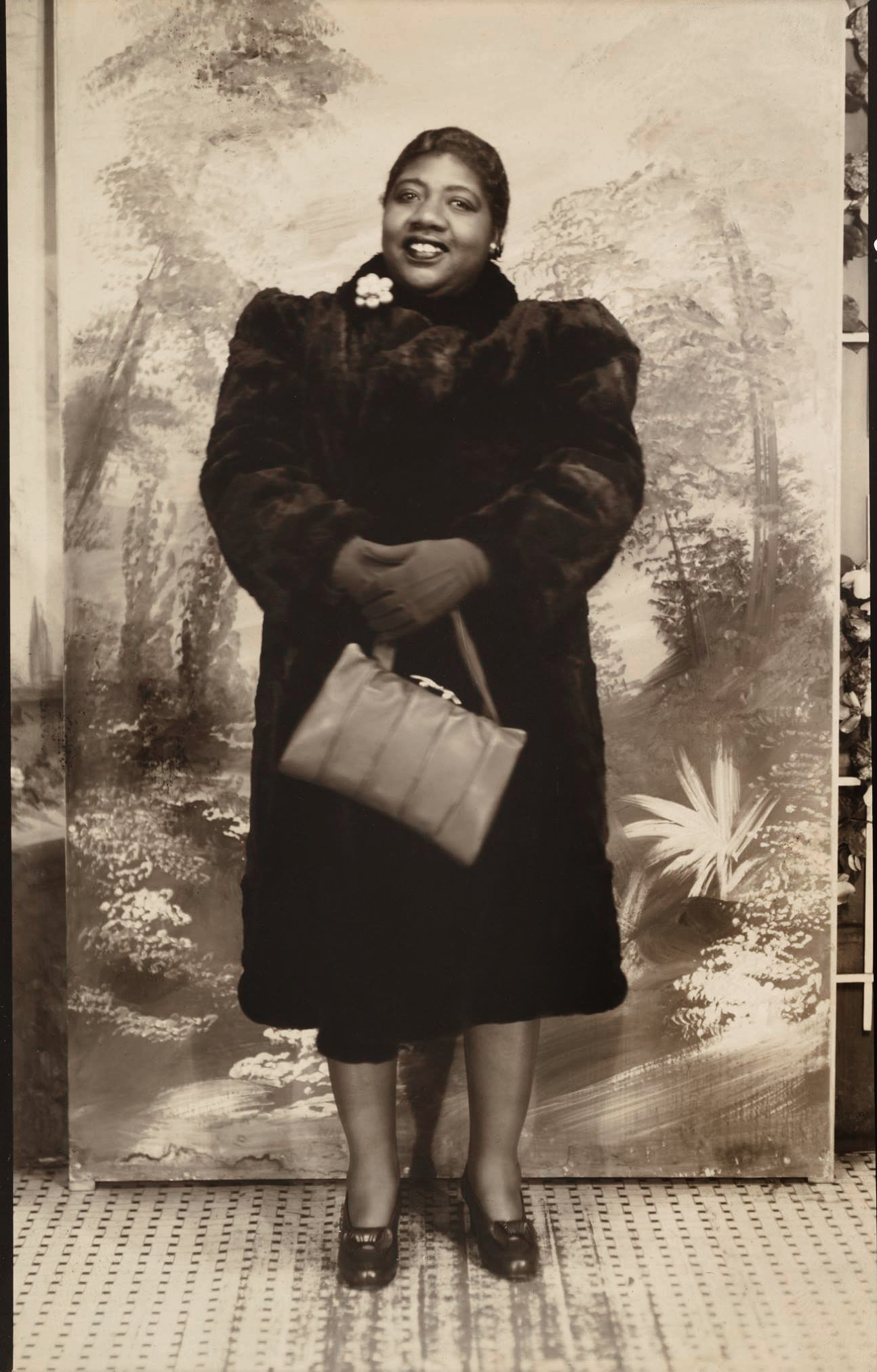
Part 2 of this glorious posting: mainly 1940s, African American “studio” portrait photography. Lets see what we can garner about these “studio” spaces by looking at the photographs. View Part 1 of the posting.

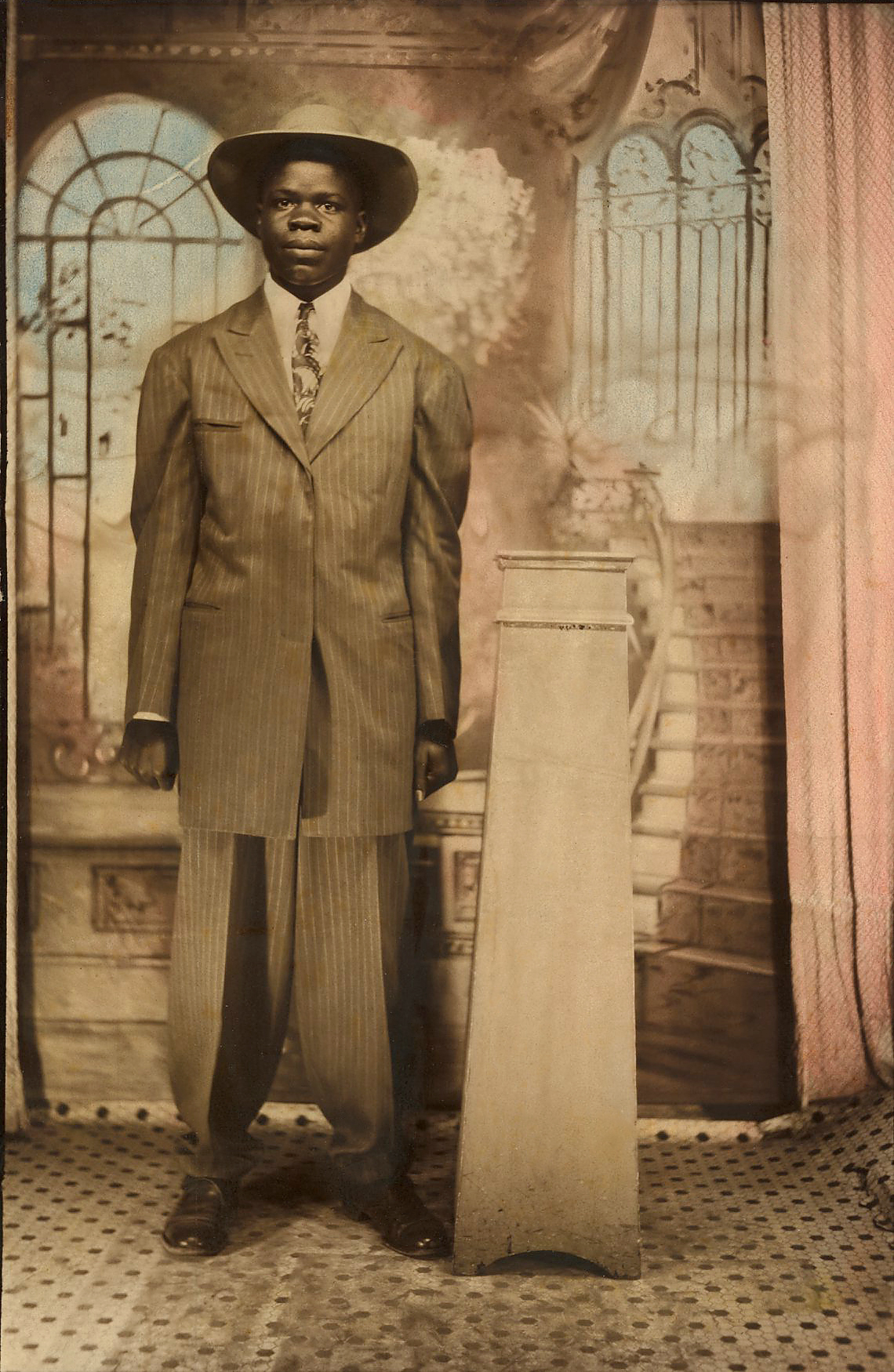
Firstly, they are very small, usually with bare floorboards, carpet or linoleum on the floor. Some (such as the photography of the man holding his child) are literally just big enough to pose and light the subject. As can be seen in the photograph of the lady holding a large handbag, the painted backdrops can be changed in and out, in this instance the scrim placed in front of another painted background. Notice also the worn lino in this photograph, where so many people have walked in an posed in this studio, in this very spot. Historically, painted backdrops have been used since the earliest days of photography, appearing in ambrotypes and tintypes of American Civil War soldiers. It would not surprise me is some of the studios from that time were still going in the 1940s.

Secondly, we can observe the lighting and depth of field. The lighting seems to be either by one or two lights (probably not moved between clients) that sit on axis, meaning there is a horizontal line between the light, the camera and the subject – a nearly horizontal light source. The depth of field is low, the camera probably pre-focused on the table, chair or pedestal within the studio space. Because of the small studio space, the subject placed up tight against the painted backdrop, and the low depth of field… there is a consequent flattening of the subject within the image plane. The photographs are either full figure standing, sitting or cropped closer at the waist.

While the idyllic painted backdrops add context to these studio portraits, it is the pose of the sitters that is so mesmerising in the photographs. These people were living in anxious, dangerous times – the Second World War, the Cold War, and the ever present racism against African Americans were some of the issues that they had to deal with – and yet they pose quite confidently for the camera, seemingly with no hidden agenda or deception. They are choosing to pose for their own reasons. As Jeff Rosenheim, the Met’s photography curator observes, “In these pictures, we see them in reflection of where they are and what their conditions are.”

I think there are a few things happening at once here. These studios give the impression that they are really joyous places. Is it the staff, or the need to document an important occasion like the birth of a child, a marriage, a graduation, or sisters, or is it something more intangible? The studios seem a great place to be. There is this JOY that seems to radiate off of the sitters and then there is a pride that is not referencing being accepted in a white community, but has layers of self containment / their own self, their friends, and something else.  

“You live the life you’ve got.” So says a character from one of my favourite British TV series Vera. And that is what these photographs picture – the life they are living, the life they have got. In these photographs there is a direct vision, direct seeing… and looking, which is what makes them so powerful and effective. Unlike contemporary popular portraits, blasted over the airwaves on Instagram, Snapchat, Facebook, etc. there is a direct connection to the lives of these people. While they lived in anxious times, their representation by the camera is clear and focused. Today our anxiety is more prescient, more at the forefront of out consciousness, our identity formation, the way we interact with the world. Who is looking and who is watching, and what is our image. Selfies on sticks or images in front of mirrors step to the front.

When looking at these photographs I have to ask, is there something here that is gone? Something we can remember yet has been sneakily stolen from us?

In contemporary portrait photography what has been stolen from us is the sense of joy, happiness, and intimacy in our own self, and how devolved we have become from the essence of our own being. The “dead pan” looks on people’s faces, the anxiety to get the right shot, the hands in the air with mobile phones to capture anything that is seen as worthwhile (just because you can) has become ubiquitous the world over. We have gone through a recent period of devolution and may need to regain lost ground, for what makes these photographs special – magical in the truest sense sense of the word – is that they just are. No ego from subject or photographer, no prejudice encroaching from the outside world, these people and their photographic trace just capture the essence of their being. Without worry… here ‘I am’.

Dr Marcus Bunyan


Many thankx to the Metropolitan Museum of Art for allowing me to publish the photographs in the posting. Please click on the photographs for a larger version of the image.


This exhibition will present more than one hundred and fifty studio portraits of African Americans from the mid-twentieth century, part of an important recent acquisition by The Met. Produced by mostly unidentified makers, the photographs are a poignant, collective self portrait of the African American experience during the 1940s and 1950s – a time of war, middle-class growth, and seismic cultural change.


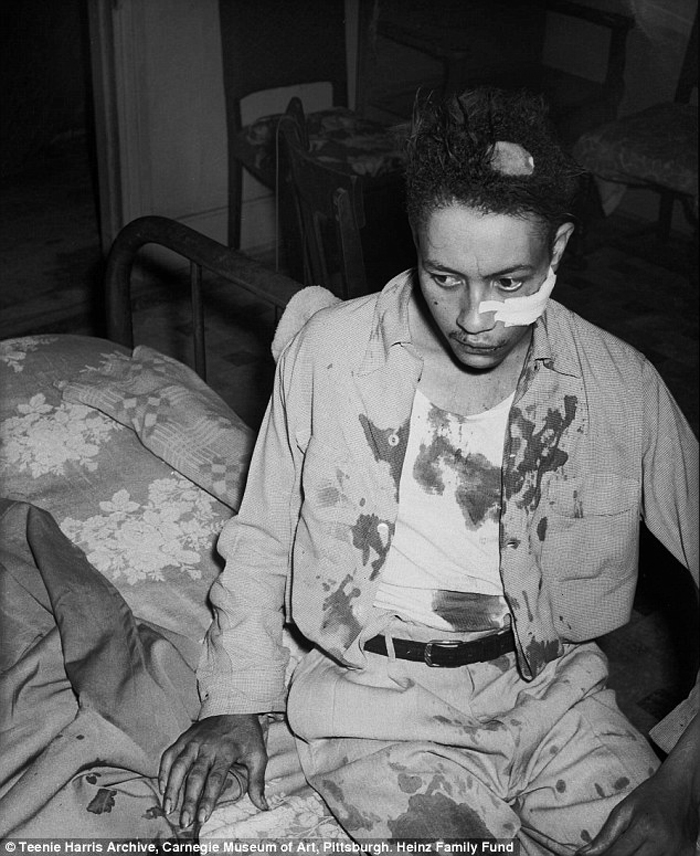
Charles "Teenie" Harris (American, 1908-1998) 'John Davis after being beaten by police officer Dan McTague, in his home at 1303 Wylie Avenue, Hill District, August 1951' 1951 from the exhibition 'African American Portraits: Photographs from the 1940s and 1950s' at the Metropolitan Museum of Art, New York, June - Oct, 2018


Charles “Teenie” Harris (American, 1908-1998)
John Davis after being beaten by police officer Dan McTague, in his home at 1303 Wylie Avenue, Hill District, August 1951
1951
Gelatin silver print


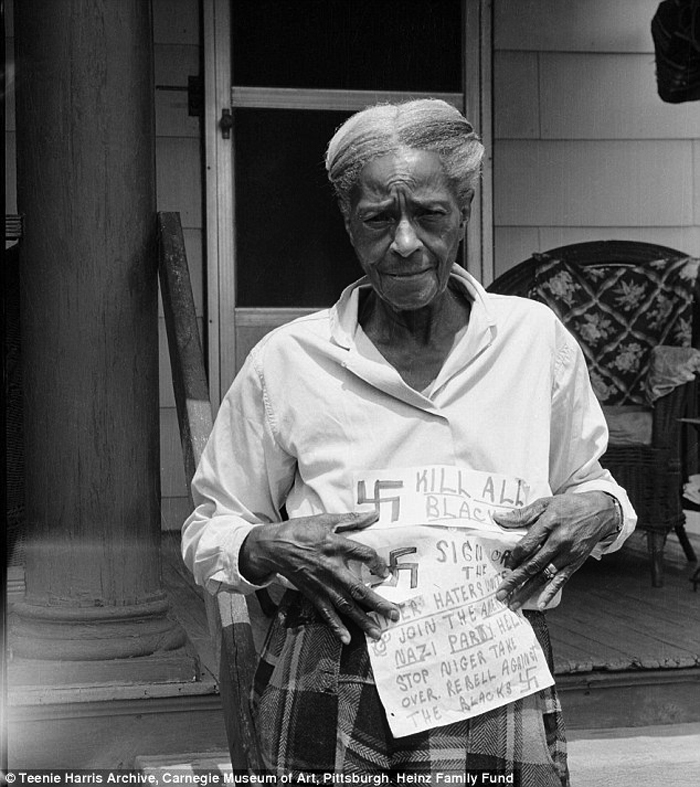
Charles "Teenie" Harris (American, 1908-1998) 'Mary Reid holding threatening notes with swastikas and American Nazi Party propaganda, in July 1964' 1964


Charles “Teenie” Harris (American, 1908-1998)
Mary Reid holding threatening notes with swastikas and American Nazi Party propaganda, in July 1964
1964
Gelatin silver print


Unknown American photographer. 'Studio Portrait' 1940s-1950s


Unknown American photographer
Studio Portrait
1940s-1950s
Gelatin silver print
The Metropolitan Museum of Art, New York, Twentieth-Century Photography Fund, 2015, 2017
Image courtesy The Metropolitan Museum of Art


Unknown American photographer. 'Studio Portrait' 1940s-1950s


Unknown American photographer
Studio Portrait
1940s-1950s
Gelatin silver print
The Metropolitan Museum of Art, New York, Twentieth-Century Photography Fund, 2015, 2017
Image courtesy The Metropolitan Museum of Art


Unknown American photographer. 'Studio Portrait' 1940s-1950s


Unknown American photographer
Studio Portrait
1940s-1950s
Gelatin silver print
The Metropolitan Museum of Art, New York, Twentieth-Century Photography Fund, 2015, 2017
Image courtesy The Metropolitan Museum of Art


Unknown American photographer. 'Studio Portrait' 1940s-1950s


Unknown American photographer
Studio Portrait
1940s-1950s
Gelatin silver print
The Metropolitan Museum of Art, New York, Twentieth-Century Photography Fund, 2015, 2017
Image courtesy The Metropolitan Museum of Art


Unknown American photographer. 'Studio Portrait' 1940s-1950s


Unknown American photographer
Studio Portrait
1940s-1950s
Gelatin silver print
The Metropolitan Museum of Art, New York, Twentieth-Century Photography Fund, 2015, 2017
Image courtesy The Metropolitan Museum of Art


Unknown American photographer. 'Studio Portrait' 1940s-1950s


Unknown American photographer
Studio Portrait
1940s-1950s
Gelatin silver print
The Metropolitan Museum of Art, New York, Twentieth-Century Photography Fund, 2015, 2017
Image courtesy The Metropolitan Museum of Art


Unknown American photographer. 'Studio Portrait' 1940s-1950s


Unknown American photographer
Studio Portrait
1940s-1950s
Gelatin silver print
The Metropolitan Museum of Art, New York, Twentieth-Century Photography Fund, 2015, 2017
Image courtesy The Metropolitan Museum of Art


Unknown American photographer. 'Studio Portrait' 1940s-1950s


Unknown American photographer
Studio Portrait
1940s-1950s
Gelatin silver print
The Metropolitan Museum of Art, New York, Twentieth-Century Photography Fund, 2015, 2017
Image courtesy The Metropolitan Museum of Art


Unknown American photographer. 'Studio Portrait' 1940s-1950s


Unknown American photographer
Studio Portrait
1940s-1950s
Gelatin silver print
The Metropolitan Museum of Art, New York, Twentieth-Century Photography Fund, 2015, 2017
Image courtesy The Metropolitan Museum of Art


Unknown American photographer. 'Studio Portrait' 1940s-1950s


Unknown American photographer
Studio Portrait
1940s-1950s
Gelatin silver print
The Metropolitan Museum of Art, New York, Twentieth-Century Photography Fund, 2015, 2017
Image courtesy The Metropolitan Museum of Art


Unknown American photographer. 'Studio Portrait' 1940s-1950s


Unknown American photographer
Studio Portrait
1940s-1950s
Gelatin silver print
The Metropolitan Museum of Art, New York, Twentieth-Century Photography Fund, 2015, 2017
Image courtesy The Metropolitan Museum of Art


African American Portraits: Photographs from the 1940s and 1950s, on view June 26 through October 8, 2018, will present more than 150 studio portraits from the mid-20th century. The exhibition offers a seldom seen view of the African American experience in the United States during World War II and the following decade – a time of war, middle-class growth, and seismic cultural change. Part of an important acquisition made by The Met in 2015 and 2017, these photographs build on and expand the Museum’s strong holdings in portraiture from the beginning of photography in the 1840s to the present. The exhibition is made possible by the Alfred Stieglitz Society.

The portraits on view generally feature sitters in a frontal pose against a painted backdrop – soldiers and sailors model their uniforms, graduates wear their caps and gowns, lovers embrace, and new parents cradle their infants. Both photographers and subjects remain mostly unidentified.

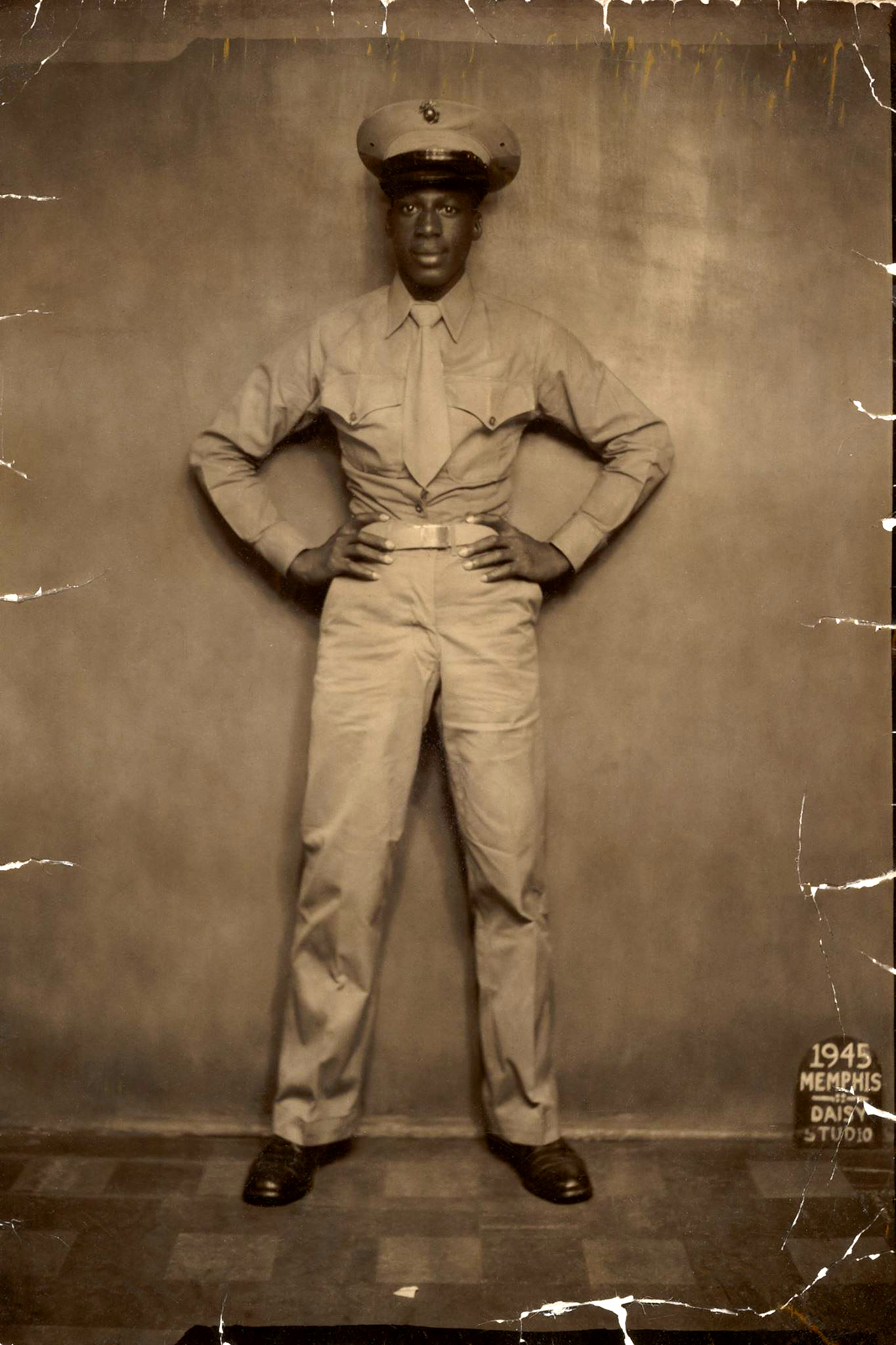
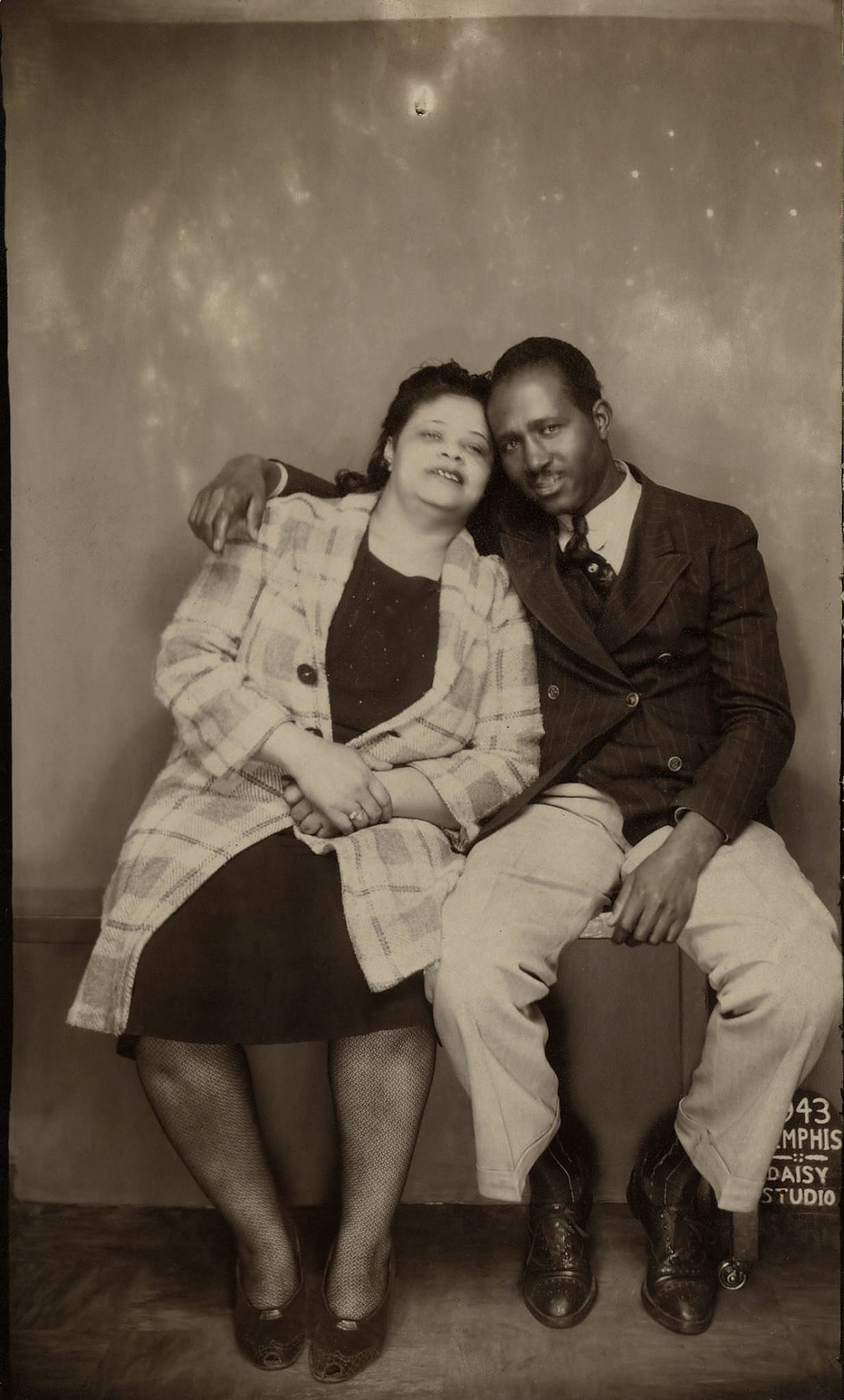
In the wartime economy, photographic studios became hubs of activity for local and regional communities. Some studios were small and transient, others more established and identifiable, such as the Daisy Studio in Memphis, Tennessee. Using waterproof direct positive paper rather than film, the studios were able to offer their clientele high quality, inexpensive portraits in a matter of minutes. The poignancy of these small photographs lies in the essential respect the camera offers its subjects, who sit for their portraits as an act of self-expression.

African American Portraits: Photographs from the 1940s and 1950s is organised by Jeff L. Rosenheim, Joyce Frank Menschel Curator in Charge of the Department of Photographs at The Met.

Press release from the Metropolitan Museum of Art


SAME STUDIO AND PERSON


Unknown American photographer. 'Studio Portrait' 1940s-1950s


Unknown American photographer
Studio Portrait
1940s-1950s
Gelatin silver print
The Metropolitan Museum of Art, New York, Twentieth-Century Photography Fund, 2015, 2017
Image courtesy The Metropolitan Museum of Art


Unknown American photographer. 'Studio Portrait' 1940s-1950s


Unknown American photographer
Studio Portrait
1940s-1950s
Gelatin silver print
The Metropolitan Museum of Art, New York, Twentieth-Century Photography Fund, 2015, 2017
Image courtesy The Metropolitan Museum of Art


SAME STUDIO, SAME AND DIFFERENT BACKDROPS

You can tell by the legs of the seat.


Unknown American photographer. 'Studio Portrait' 1940s-1950s


Unknown American photographer
Studio Portrait
1940s-1950s
Gelatin silver print
The Metropolitan Museum of Art, New York, Twentieth-Century Photography Fund, 2015, 2017
Image courtesy The Metropolitan Museum of Art


Unknown American photographer. 'Studio Portrait' 1940s-1950s


Unknown American photographer
Studio Portrait
1940s-1950s
Gelatin silver print
The Metropolitan Museum of Art, New York, Twentieth-Century Photography Fund, 2015, 2017
Image courtesy The Metropolitan Museum of Art


Unknown American photographer. 'Studio Portrait' 1940s-1950s


Unknown American photographer
Studio Portrait
1940s-1950s
Gelatin silver print
The Metropolitan Museum of Art, New York, Twentieth-Century Photography Fund, 2015, 2017
Image courtesy The Metropolitan Museum of Art


Unknown American photographer. 'Studio Portrait' 1940s-1950s


Unknown American photographer
Studio Portrait
1940s-1950s
Gelatin silver print
The Metropolitan Museum of Art, New York, Twentieth-Century Photography Fund, 2015, 2017
Image courtesy The Metropolitan Museum of Art


Unknown American photographer. 'Studio Portrait' 1940s-1950s


Unknown American photographer
Studio Portrait
1940s-1950s
Gelatin silver print
The Metropolitan Museum of Art, New York, Twentieth-Century Photography Fund, 2015, 2017
Image courtesy The Metropolitan Museum of Art


SAME STUDIO DIFFERENT BACKDROP

You can tell by the curtain at right, and the pedestal.


Unknown American photographer. 'Studio Portrait' 1940s-1950s


Unknown American photographer
Studio Portrait
1940s-1950s
Gelatin silver print
The Metropolitan Museum of Art, New York, Twentieth-Century Photography Fund, 2015, 2017
Image courtesy The Metropolitan Museum of Art


Unknown American photographer. 'Studio Portrait' 1940s-1950s


Unknown American photographer
Studio Portrait
1940s-1950s
Gelatin silver print with hand colouring
The Metropolitan Museum of Art, New York, Twentieth-Century Photography Fund, 2015, 2017
Image courtesy The Metropolitan Museum of Art


SAME STUDIO DIFFERENT BACKDROP

You can tell by the style of the painting, the positioning of the flowers, and the decoration on the carpet of the stairs.


Unknown American photographer. 'Studio Portrait' 1940s-1950s


Unknown American photographer
Studio Portrait
1940s-1950s
Gelatin silver print
The Metropolitan Museum of Art, New York, Twentieth-Century Photography Fund, 2015, 2017
Image courtesy The Metropolitan Museum of Art


Unknown American photographer. 'Studio Portrait' 1940s-1950s


Unknown American photographer
Studio Portrait
1940s-1950s
Gelatin silver print with hand colouring
The Metropolitan Museum of Art, New York, Twentieth-Century Photography Fund, 2015, 2017
Image courtesy The Metropolitan Museum of Art


DAISY STUDIO


Daisy Studio (American, active 1940s) 'Studio Portrait' 1940s-1950s from the exhibition 'African American Portraits: Photographs from the 1940s and 1950s' at the Metropolitan Museum of Art, New York, June - Oct, 2018


Daisy Studio (American, active 1940s)
Studio Portrait
1940s-1950s
Gelatin silver print
The Metropolitan Museum of Art, New York, Twentieth-Century Photography Fund, 2015, 2017
Image courtesy The Metropolitan Museum of Art


Daisy Studio (American, active 1940s) 'Studio Portrait' 1940s-1950s


Daisy Studio (American, active 1940s)
Studio Portrait
1940s-1950s
Gelatin silver print
The Metropolitan Museum of Art, New York, Twentieth-Century Photography Fund, 2015, 2017
Image courtesy The Metropolitan Museum of Art


Daisy Studio (American, active 1940s) 'Studio Portrait' 1940s-1950s


Daisy Studio (American, active 1940s)
Studio Portrait
1940s-1950s
Gelatin silver print
The Metropolitan Museum of Art, New York, Twentieth-Century Photography Fund, 2015, 2017
Image courtesy The Metropolitan Museum of Art


Daisy Studio (American, active 1940s) 'Studio Portrait' 1940s-1950s


Daisy Studio (American, active 1940s)
Studio Portrait
1940s-1950s
Gelatin silver print
The Metropolitan Museum of Art, New York, Twentieth-Century Photography Fund, 2015, 2017
Image courtesy The Metropolitan Museum of Art


The Metropolitan Museum of Art
1000 Fifth Avenue at 82nd Street
New York, New York 10028-0198
Phone: 212-535-7710

Opening hours:
Sunday – Tuesday and Thursday: 10am – 5pm
Friday and Saturday: 10am – 9pm
Closed Wednesday

The Metropolitan Museum of Art website

LIKE ART BLART ON FACEBOOK

Back to top

Exhibition: ‘In Focus: Expressions’ at the J. Paul Getty Museum, Getty Center, Los Angeles

Exhibition dates: 22nd May – 7th October, 2018


Erich Salomon (German, 1886-1944) '[Portrait of Madame Vacarescu, Romanian Author and Deputy to the League of Nations, Geneva]' 1928 from the exhibition 'In Focus: Expressions' at the J. Paul Getty Museum, Getty Center, Los Angeles, May - Oct, 2018


Erich Salomon (German, 1886-1944)
(Portrait of Madame Vacarescu, Romanian Author and Deputy to the League of Nations, Geneva)
1928
Gelatin silver print
29.7 × 39.7cm (11 11/16 × 15 5/8 in.)
The J. Paul Getty Museum, Los Angeles


In 1928, pioneering photojournalist, Erich Salomon photographed global leaders and delegates to a conference at the League for the German picture magazine Berliner Illustrirte Zeitung. In a typically frank image, Salomon has shown Vacarescu with her head thrown back passionately pleading before the international assembly.

Elena Văcărescu or Hélène Vacaresco (September 21, 1864 in Bucharest – February 17, 1947 in Paris) was a Romanian-French aristocrat writer, twice a laureate of the Académie française. Văcărescu was the Substitute Delegate to the League of Nations from 1922 to 1924. She was a permanent delegate from 1925 to 1926. She was again a Substitute Delegate to the League of Nations from 1926 to 1938. She was the only woman to serve with the rank of ambassador (permanent delegate) in the history of the League of Nations.

Text from the Wikipedia website


From a distance…

For such an engaging subject, this presentation looks to be a bit of a lucky dip / ho hum / filler exhibition. You can’t make a definitive judgement from a few media images but looking at the exhibition checklist gives you a good idea of the overall organisation of the exhibition and its content. Even the press release seems unsure of itself, littered as it is with words like posits, probes, perhaps (3 times) and problematic.

Elements such as physiognomy are briefly mentioned (with no mention of its link to eugenics), as is the idea of the mask – but again no mention of how the pose is an affective mask, nor how the mask is linked to the carnivalesque. Or how photographs portray us as we would like to be seen (the ideal self) rather than the real self, and how this incongruence forms part of the formation of our identity as human beings.

The investigation could have been so deep in so many areas (for example the representation of women, children and others in a patriarchal social system through facial expression; the self-portrait as an expression of inner being; the photograph as evidence of the mirror stage of identity formation; and the photographs of “hysterical” women of the Pitié-Salpêtrière Hospital, Paris; and on and on…) but in 45 works, I think not. The subject deserved, even cried out for (as facial expressions go), a fuller, more in depth investigation.

For more reading please see my 2014 text Facile, Facies, Facticity which comments on the state of contemporary portrait photography and offers a possible way forward: a description of the states of the body and the air of the face through a subtle and constant art of the recovering of surfaces.

Dr Marcus Bunyan


Many thanks to the J. Paul Getty Museum for allowing me to publish the photographs in the posting. Please click on the photographs for a larger version of the image.


The human face has been the subject of fascination for photographers since the medium’s inception. This exhibition includes posed portraits, physiognomic studies, anonymous snapshots, and unsuspecting countenances caught by the camera’s eye, offering a close-up look at the range of human stories that facial expressions – and photographs – can tell.


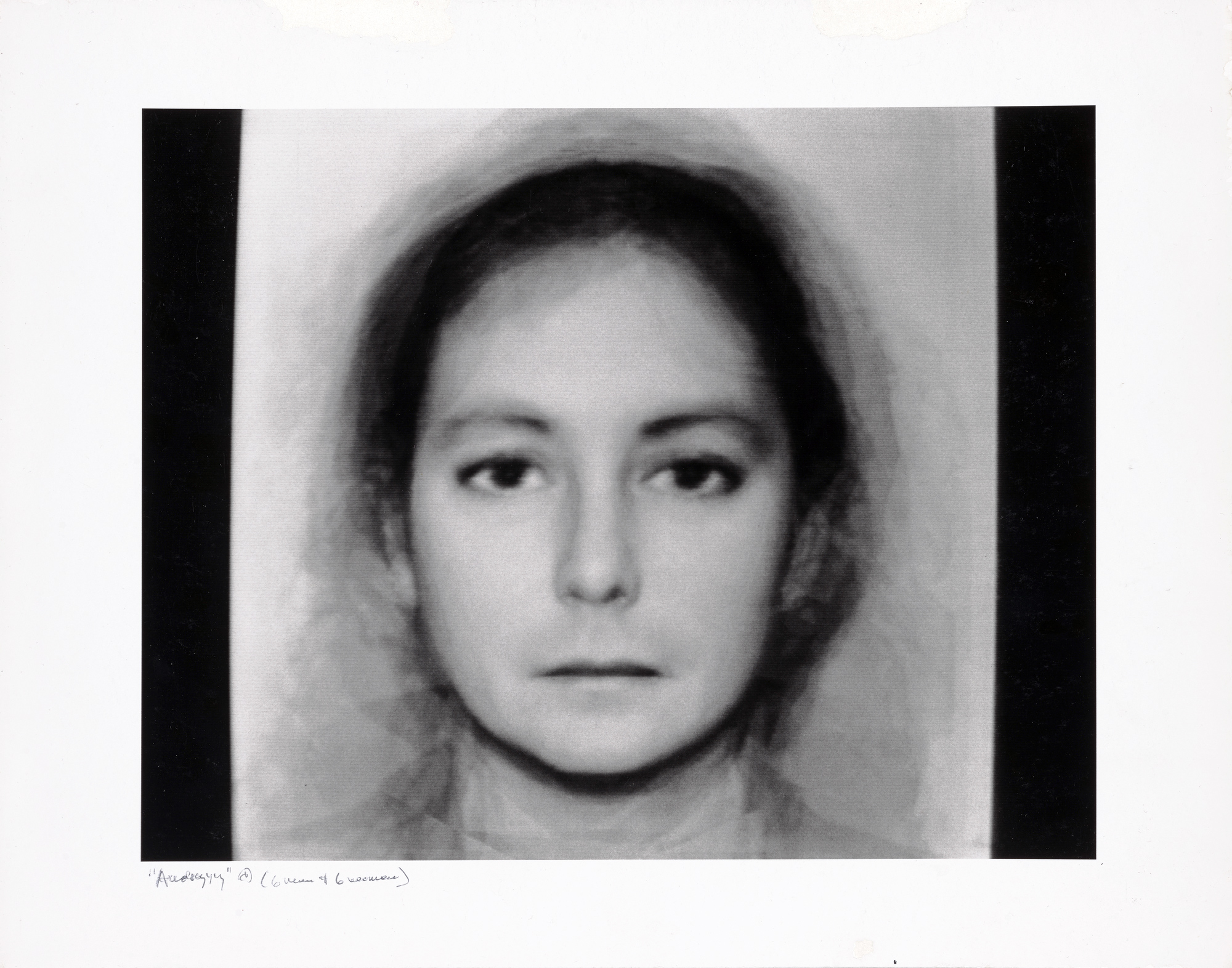
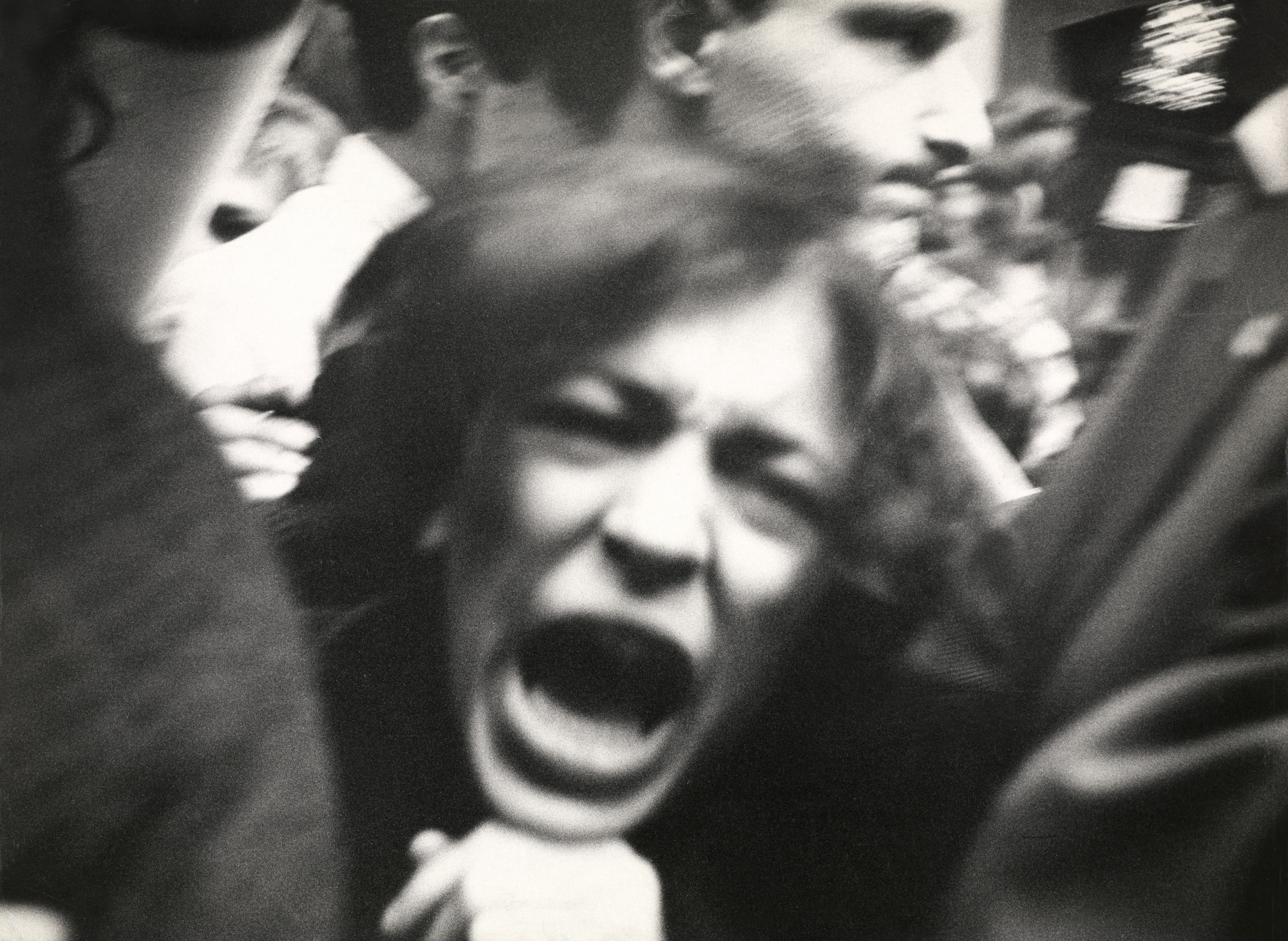
Nancy Burson (American, born 1948) 'Androgyny' 1982 from the exhibition 'In Focus: Expressions' at the J. Paul Getty Museum, Getty Center, Los Angeles, May - Oct, 2018


Nancy Burson (American, b. 1948)
Androgyny
1982
Gelatin silver print
21.6 × 27.7cm (8 1/2 × 10 7/8 in.)
© Nancy Burson
The J. Paul Getty Museum, Los Angeles


Composite image of portraits of six men and six women


Leonard Freed (American, 1929-2006) 'Demonstration, New York City' 1963


Leonard Freed (American, 1929-2006)
Demonstration, New York City
1963
Gelatin silver print
25.9 × 35.4cm (10 3/16 × 13 15/16 in.)
© Leonard Freed / Magnum Photos, Inc.
The J. Paul Getty Museum, Los Angeles
Gift of Brigitte and Elke Susannah Freed


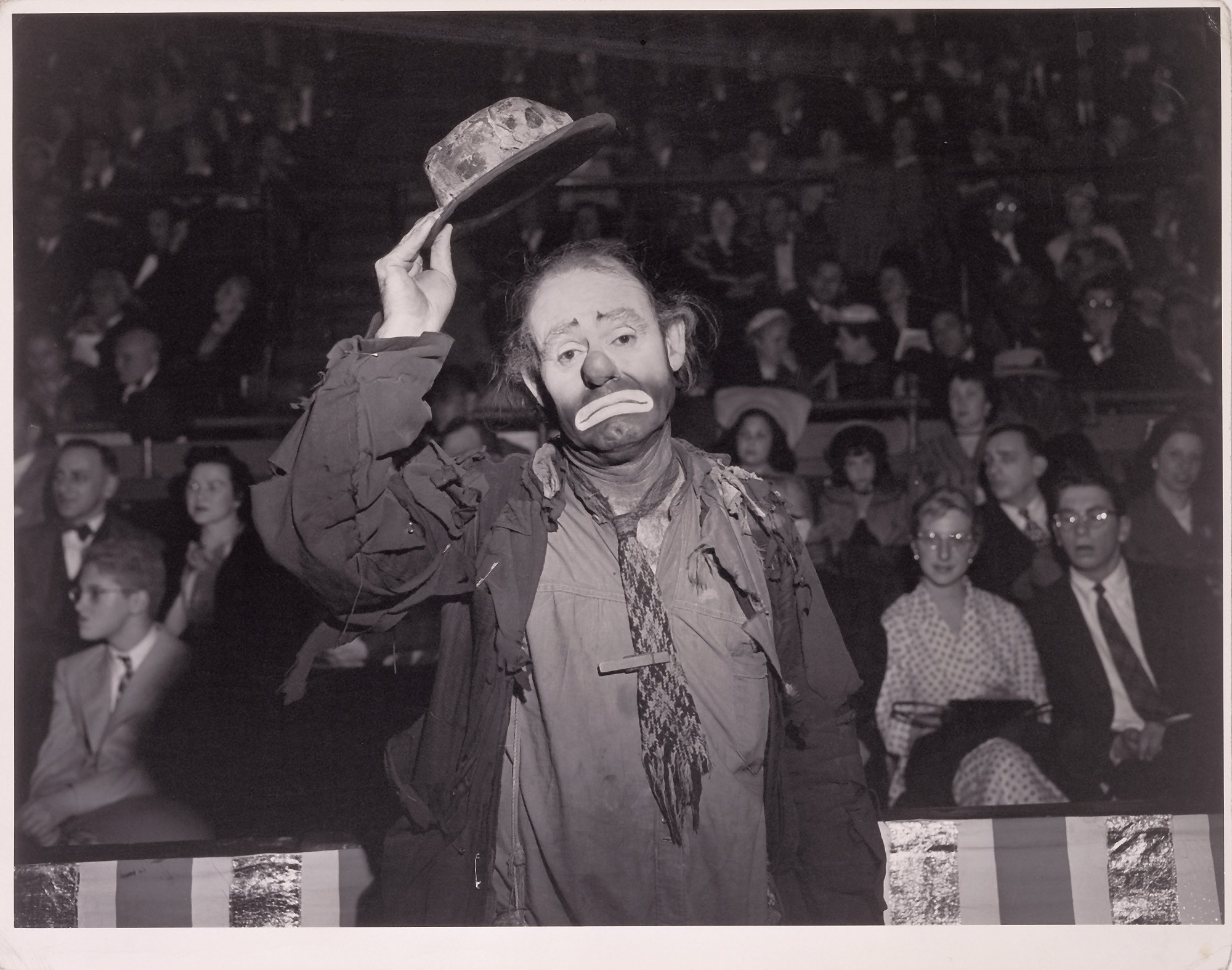
Weegee (Arthur Fellig) (American, born Austria, 1899-1968) 'Emmett Kelly, Ringling Brothers and Barnum & Bailey Circus' Negative May 1943; print about 1950


Weegee (Arthur Fellig) (American born Austria, 1899-1968)
Emmett Kelly, Ringling Brothers and Barnum & Bailey Circus
Negative May 1943; print about 1950
Gelatin silver print
26 × 34.4cm (10 1/4 × 13 9/16 in.)
© International Center of Photography
The J. Paul Getty Museum, Los Angeles


Emmett Kelly (American, 1898-1979)

Emmett Leo Kelly (December 9, 1898 – March 28, 1979) was an American circus performer, who created the memorable clown figure “Weary Willie”, based on the hobos of the Depression era.

Kelly began his career as a trapeze artist. By 1923, Emmett Kelly was working his trapeze act with John Robinson’s circus when he met and married Eva Moore, another circus trapeze artist. They later performed together as the “Aerial Kellys” with Emmett still performing occasionally as a whiteface clown.

He started working as a clown full-time in 1931, and it was only after years of attempting to persuade the management that he was able to switch from a white face clown to the hobo clown that he had sketched ten years earlier while working as a cartoonist.

“Weary Willie” was a tragic figure: a clown, who could usually be seen sweeping up the circus rings after the other performers. He tried but failed to sweep up the pool of light of a spotlight. His routine was revolutionary at the time: traditionally, clowns wore white face and performed slapstick stunts intended to make people laugh. Kelly did perform stunts too – one of his most famous acts was trying to crack a peanut with a sledgehammer – but as a tramp, he also appealed to the sympathy of his audience.

From 1942-1956 Kelly performed with the Ringling Brothers and Barnum & Bailey Circus, where he was a major attraction, though he took the 1956 season off to perform as the mascot for the Brooklyn Dodgers baseball team. He also landed a number of Broadway and film roles, including appearing as himself in his “Willie” persona in Cecil B. DeMille’s The Greatest Show on Earth (1952). He also appeared in the Bertram Mills Circus.

Text from the Wikipedia website


Hill & Adamson (Scottish, active 1843-1848) 'Mrs Grace Ramsay and four unknown women' 1843


Hill & Adamson (David Octavius Hill, Scottish 1802-1870 and Robert Adamson, Scottish 1821-1848) (Scottish, active 1843-1848)
Mrs Grace Ramsay and four unknown women
1843
Salter paper print from Calotype negative
15.2 x 20.3cm (6 x 8 in.)
The J. Paul Getty Museum, Los Angeles


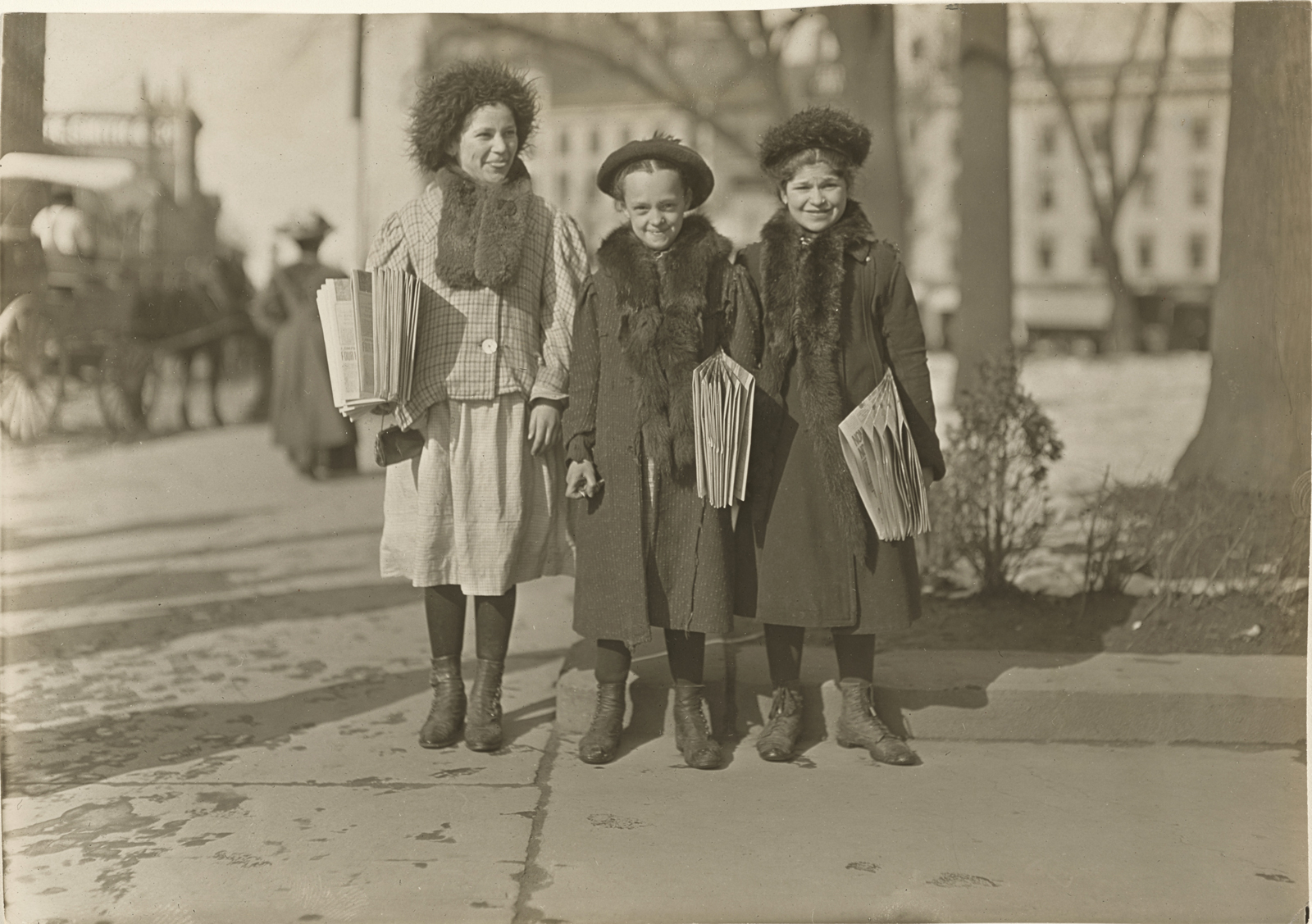
Lewis W. Hine (American, 1874-1940) 'Connecticut Newsgirls' c. 1912-1913


Lewis W. Hine (American, 1874-1940)
Connecticut Newsgirls
c. 1912-1913
Gelatin silver print
11.8 × 16.8cm (4 11/16 × 6 5/8 in.)
The J. Paul Getty Museum, Los Angeles


Nadar [Gaspard Félix Tournachon] (French, 1820-1910) '[Mme Ernestine Nadar]' 1880-1883


Nadar (Gaspard Félix Tournachon) (French, 1820-1910)
(Mme Ernestine Nadar)
1880-1883
Albumen silver print
Image (irregular): 8.7 × 21cm (3 7/16 × 8 1/4 in.)
The J. Paul Getty Museum, Los Angeles


Nadar [Gaspard Félix Tournachon] (French, 1820-1910) '[Mme Ernestine Nadar]' 1880-1883 (detail)


Nadar (Gaspard Félix Tournachon) (French, 1820-1910)
(Mme Ernestine Nadar)
(detail)
1880-1883
Albumen silver print
Image (irregular): 8.7 × 21cm (3 7/16 × 8 1/4 in.)
The J. Paul Getty Museum, Los Angeles


Julia Margaret Cameron (British, 1815-1879) 'Ophelia' Negative 1875; print, 1900


Julia Margaret Cameron (British born India, 1815-1879)
Ophelia
Negative 1875; print, 1900
Carbon print
35.2 x 27.6cm (13 7/8 x 19 7/8 in.)
The J. Paul Getty Museum, Los Angeles


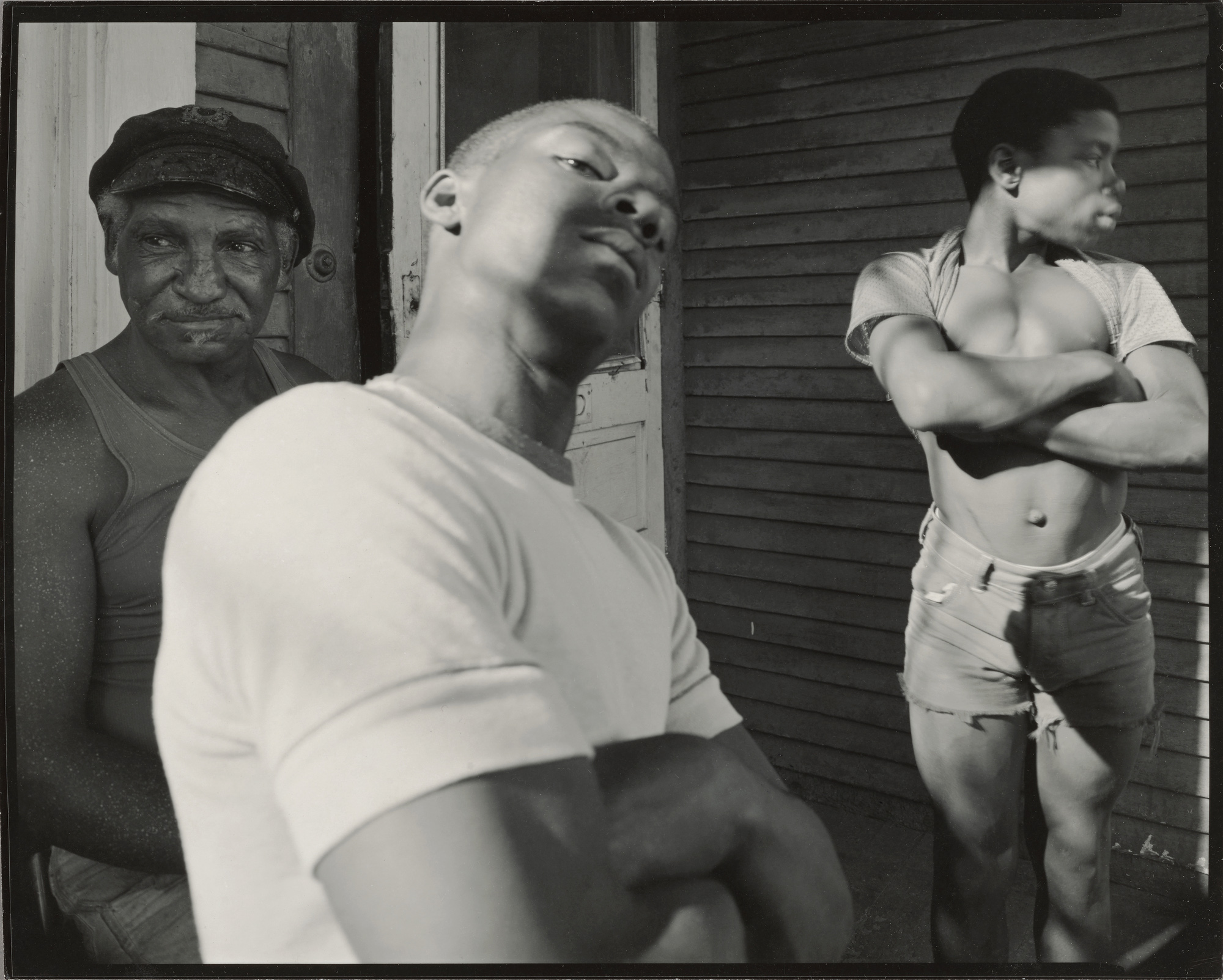
Nicholas Nixon (American, b. 1947) 'W. Canfield Ave., Detroit' 1982


Nicholas Nixon (American, b. 1947)
W. Canfield Ave., Detroit
1982
Gelatin silver print
Image (irregular): 19.7 × 24.6cm (7 3/4 × 9 11/16 in.)
© Nicholas Nixon
The J. Paul Getty Museum, Los Angeles


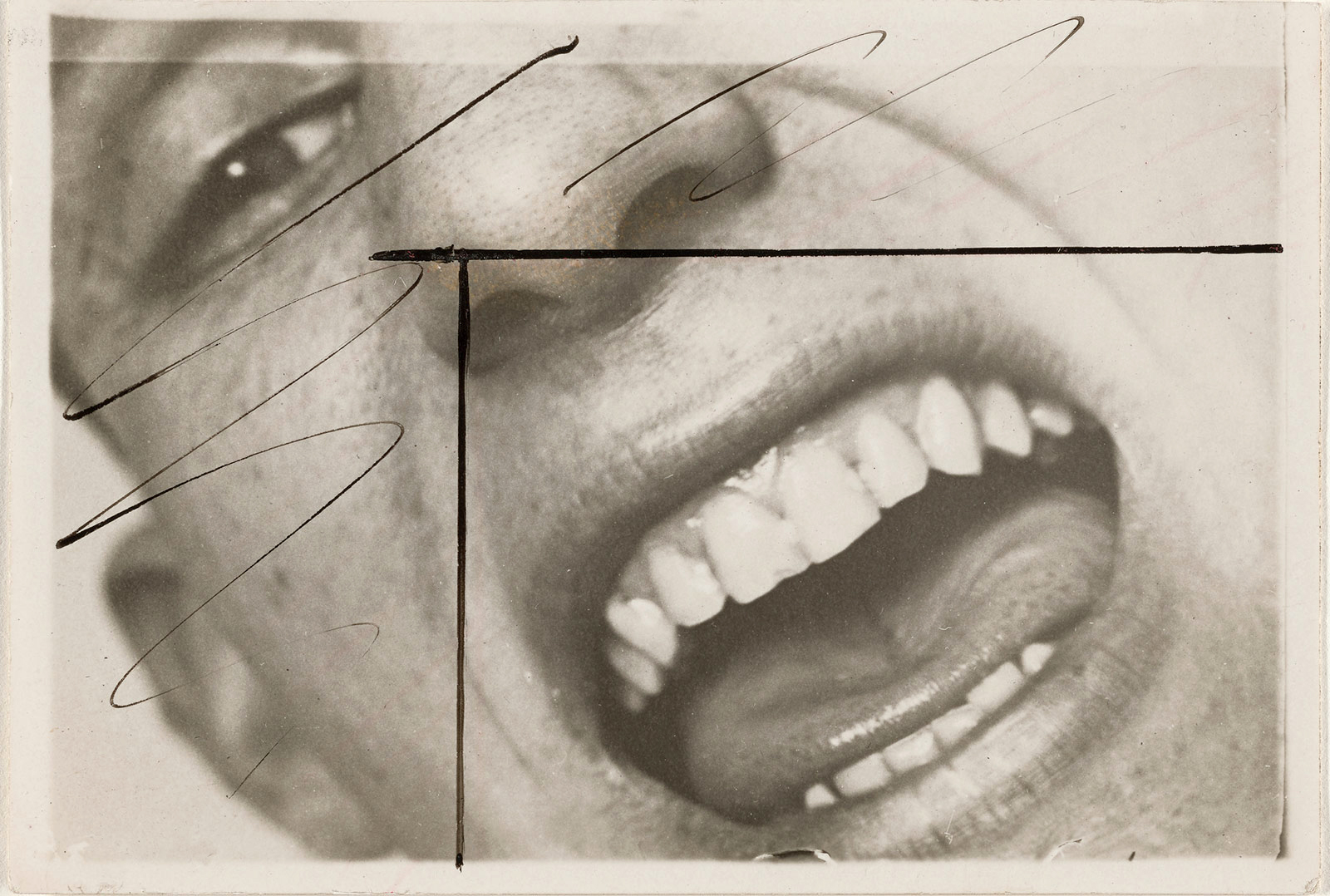
Unknown maker (German) 'Close-up of Open Mouth of Male Student' c. 1927


Unknown maker (German)
Close-up of Open Mouth of Male Student
c. 1927
Gelatin silver print
5.7 x 8.4cm (2 1/4 x 3 5/16 in.)
The J. Paul Getty Museum, Los Angeles


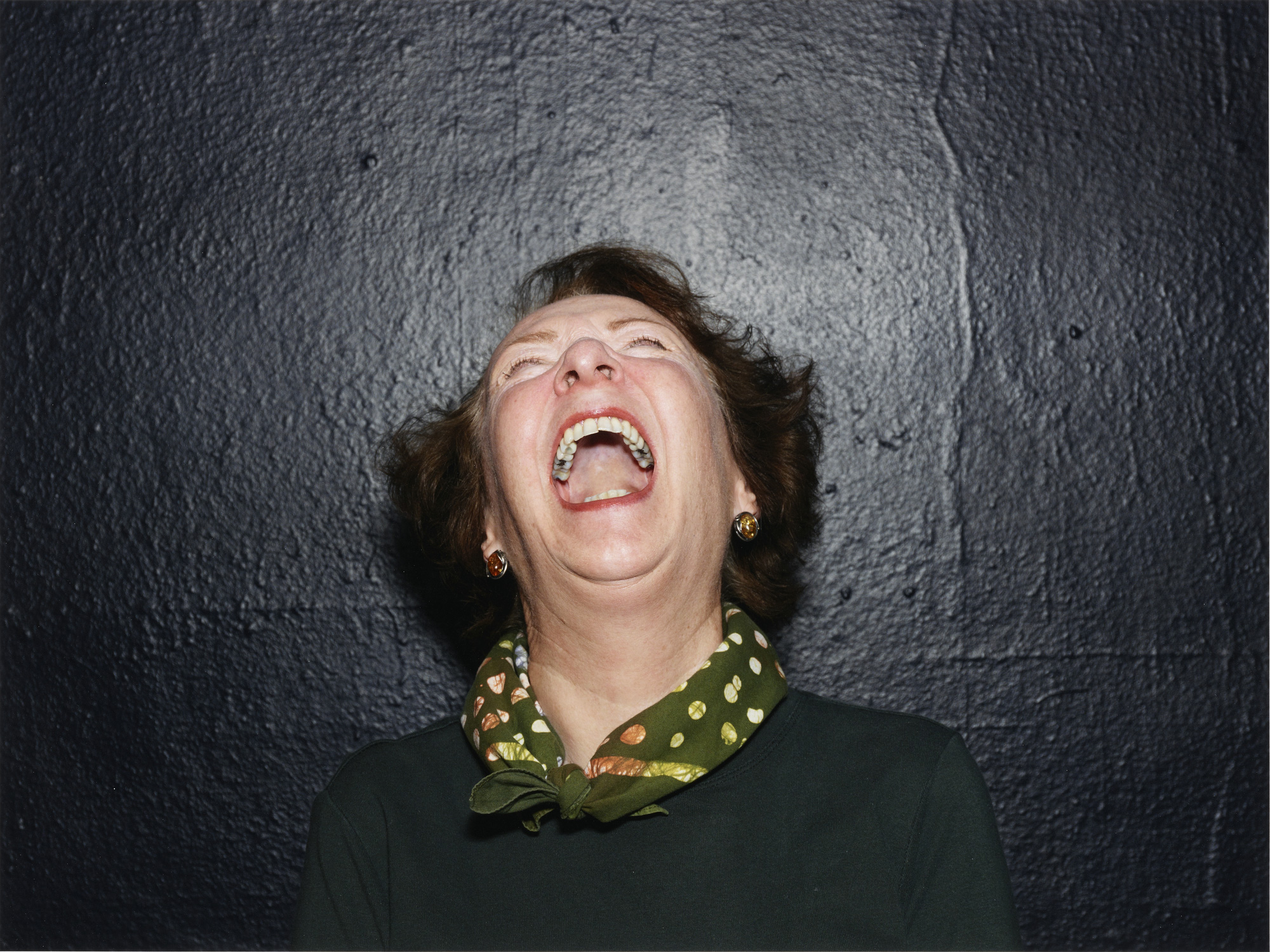
Alec Soth (American, b. 1969) 'Mary, Milwaukee, WI' 2014


Alec Soth (American, b. 1969)
Mary, Milwaukee, WI
2014
Inkjet print
40.1 × 53.5cm (15 13/16 × 21 1/16 in.)
© Alec Soth/Magnum Photos
The J. Paul Getty Museum, Los Angeles
Gift of Richard Lovett


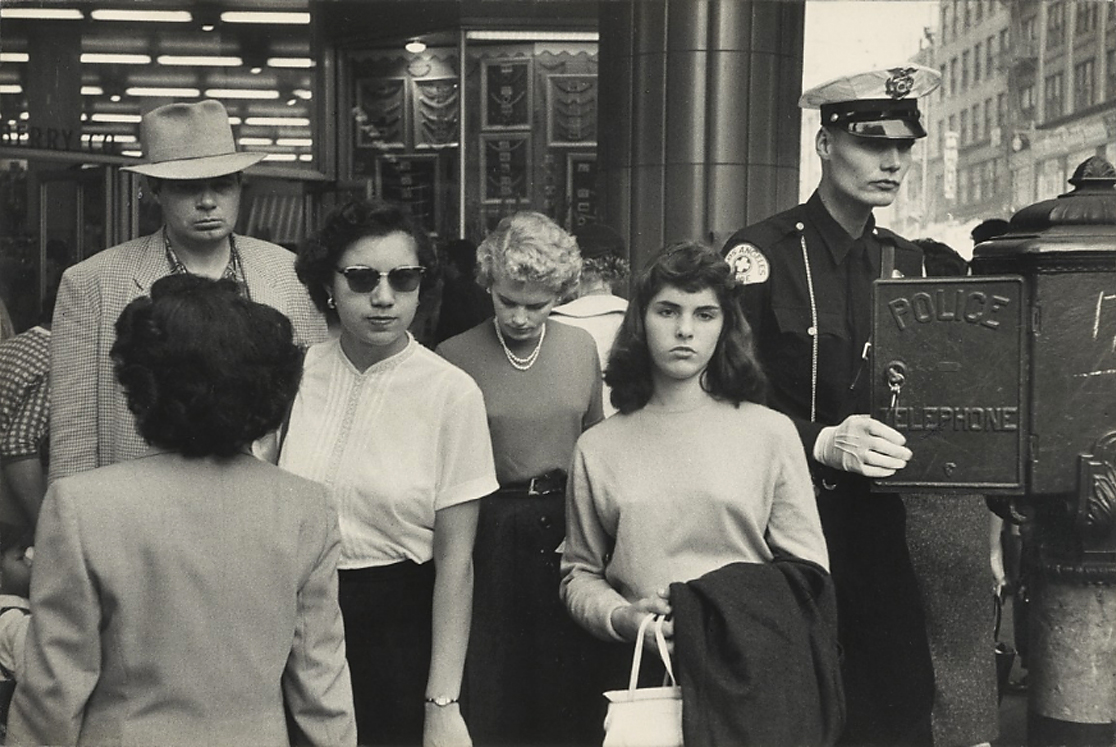
Garry Winogrand (American, 1928-1984) 'Los Angeles' January 1960


Garry Winogrand (American, 1928-1984)
Los Angeles
January 1960
Gelatin silver print
22.6 × 33.9cm (8 7/8 × 13 3/8 in.)
© 1984 The Estate of Garry Winogrand
The J. Paul Getty Museum, Los Angeles


From Leonardo da Vinci’s Mona Lisa, to Edvard Munch’s The Scream, to Dorothea Lange’s Migrant Mother, the human face has been a crucial, if often enigmatic, element of portraiture. Featuring 45 works drawn from the Museum’s permanent collection, In Focus: Expressions, on view May 22 to October 7, 2018 at the J. Paul Getty Museum, addresses the enduring fascination with the human face and the range of countenances that photographers have captured from the birth of the medium to the present day.

The exhibition begins with the most universal and ubiquitous expression: the smile. Although today it is taken for granted that we should smile when posing for the camera, smiling was not the standard photographic expression until the 1880s with the availability of faster film and hand-held cameras. Smiling subjects began to appear more frequently as the advertising industry also reinforced the image of happy customers to an ever-widening audience who would purchase the products of a growing industrial economy. The smile became “the face of the brand,” gracing magazines, billboards, and today, digital and social platforms.

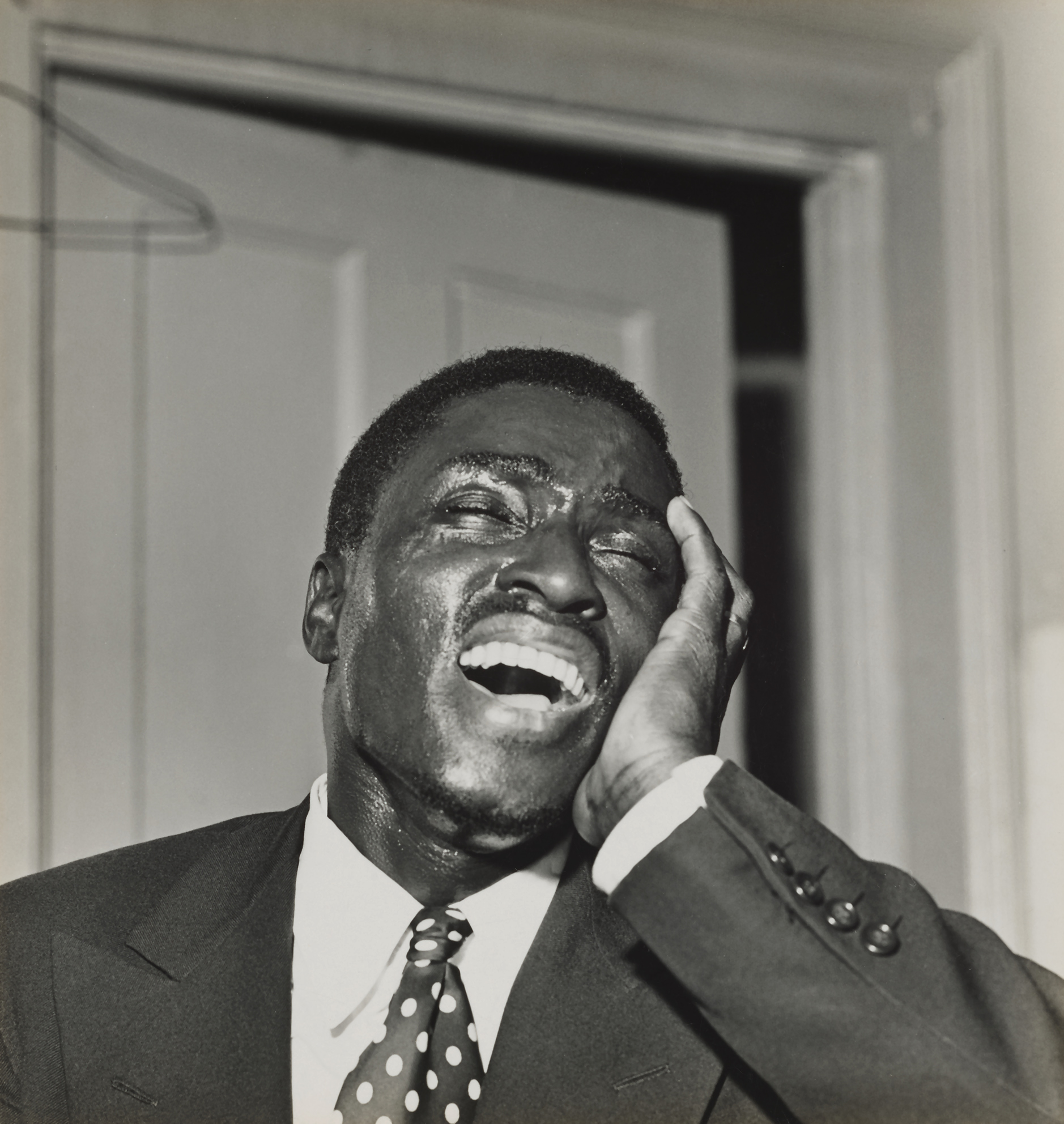
As is evident in the exhibition, the smile comes in all variations – the genuine, the smirk, the polite, the ironic – expressing a full spectrum of emotions that include benevolence, sarcasm, joy, malice, and sometimes even an intersection of two or more of these. In Milton Rogovin’s (American, 1909-2011) Storefront Churches, Buffalo (1958-1961), the expression of the preacher does not immediately register as a smile because the camera has captured a moment where his features – the opened mouth, exposed teeth, and raised face – could represent a number of activities: he could be in the middle of a song, preaching, or immersed in prayer. His corporeal gestures convey the message of his spirit, imbuing the black-and-white photograph with emotional colour. Like the other works included in this exhibition, this image posits the notion that facial expressions can elicit a myriad of sentiments and denote a range of inner emotions that transcend the capacity of words.

In Focus: Expressions also probes the role of the camera in capturing un-posed moments and expressions that would otherwise go unnoticed. In Alec Soth’s (American, born 1969) Mary, Milwaukee, WI (2014), a fleeting expression of laughter is materialised in such a way – head leaning back, mouth open – that could perhaps be misconstrued as a scream. The photograph provides a frank moment, one that confronts the viewer with its candidness and calls to mind today’s proliferation and brevity of memes, a contemporary, Internet-sustained visual phenomena in which images are deliberately parodied and altered at the same rate as they are spread.

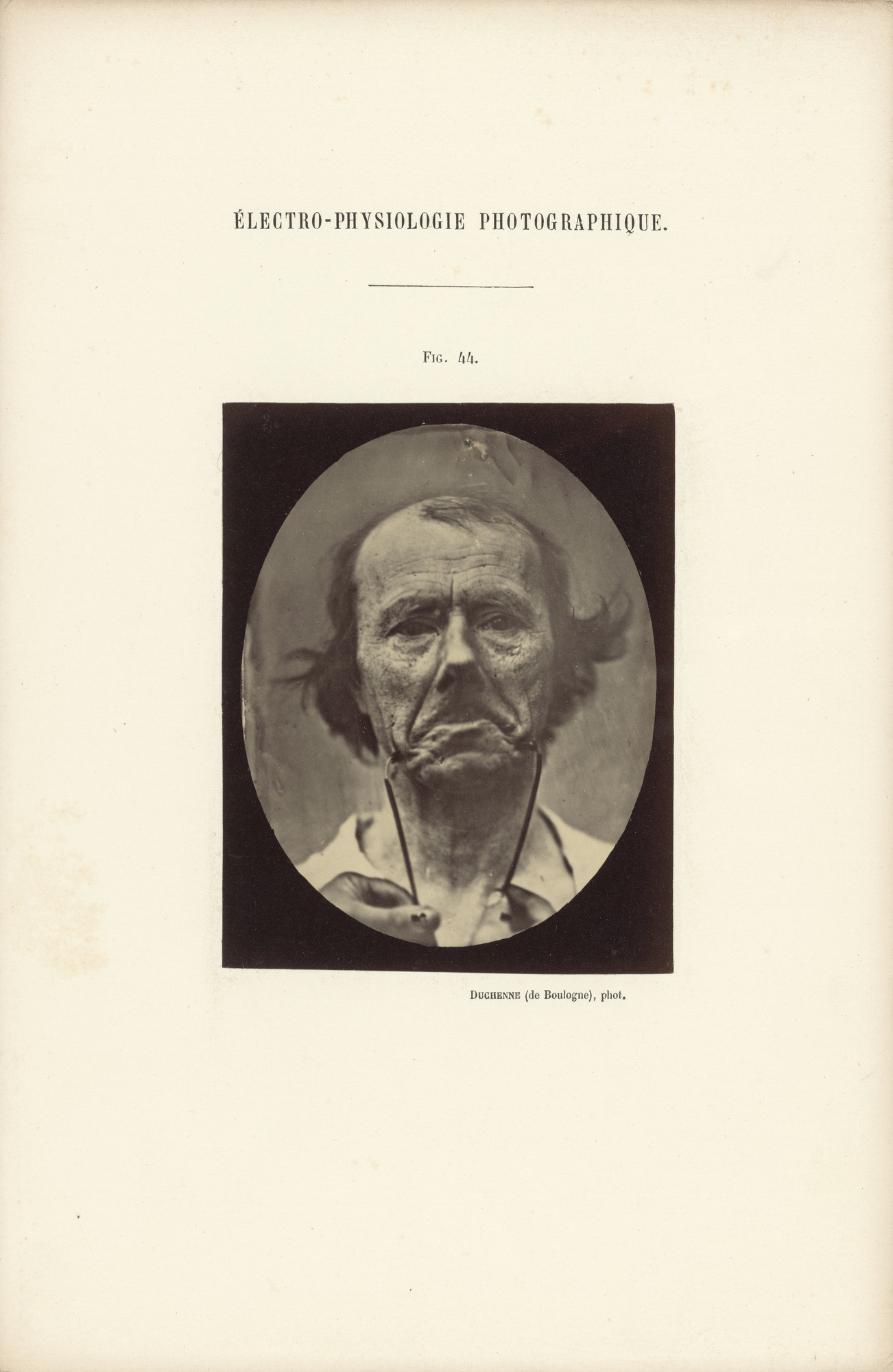
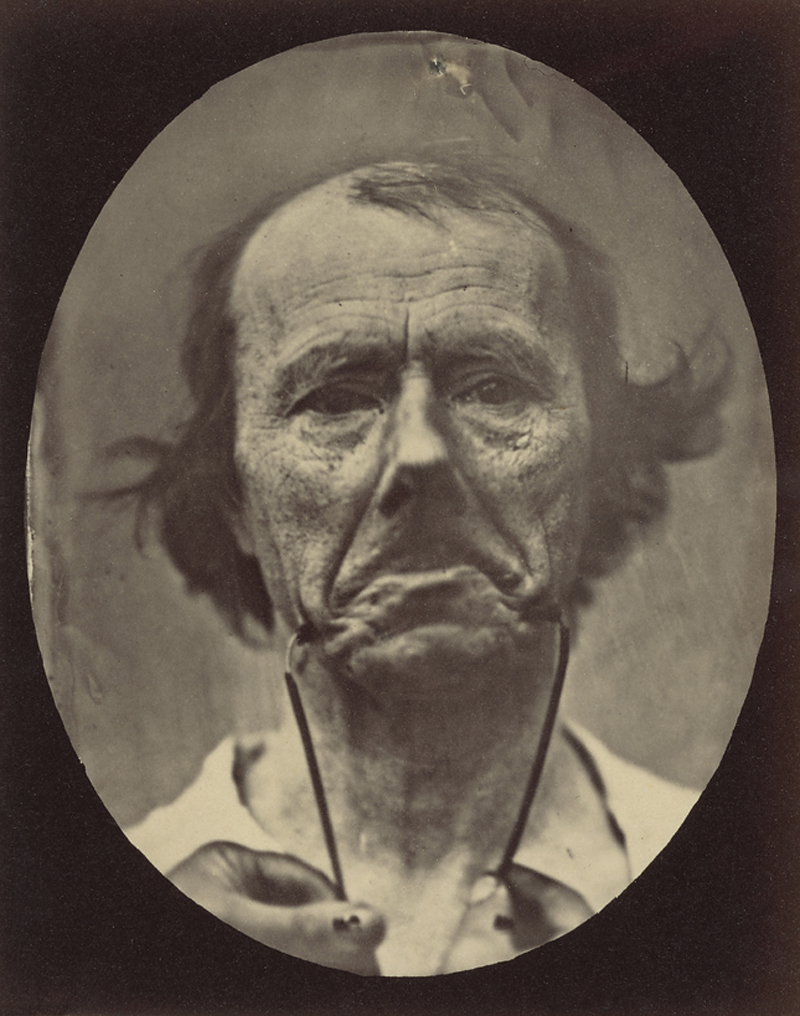
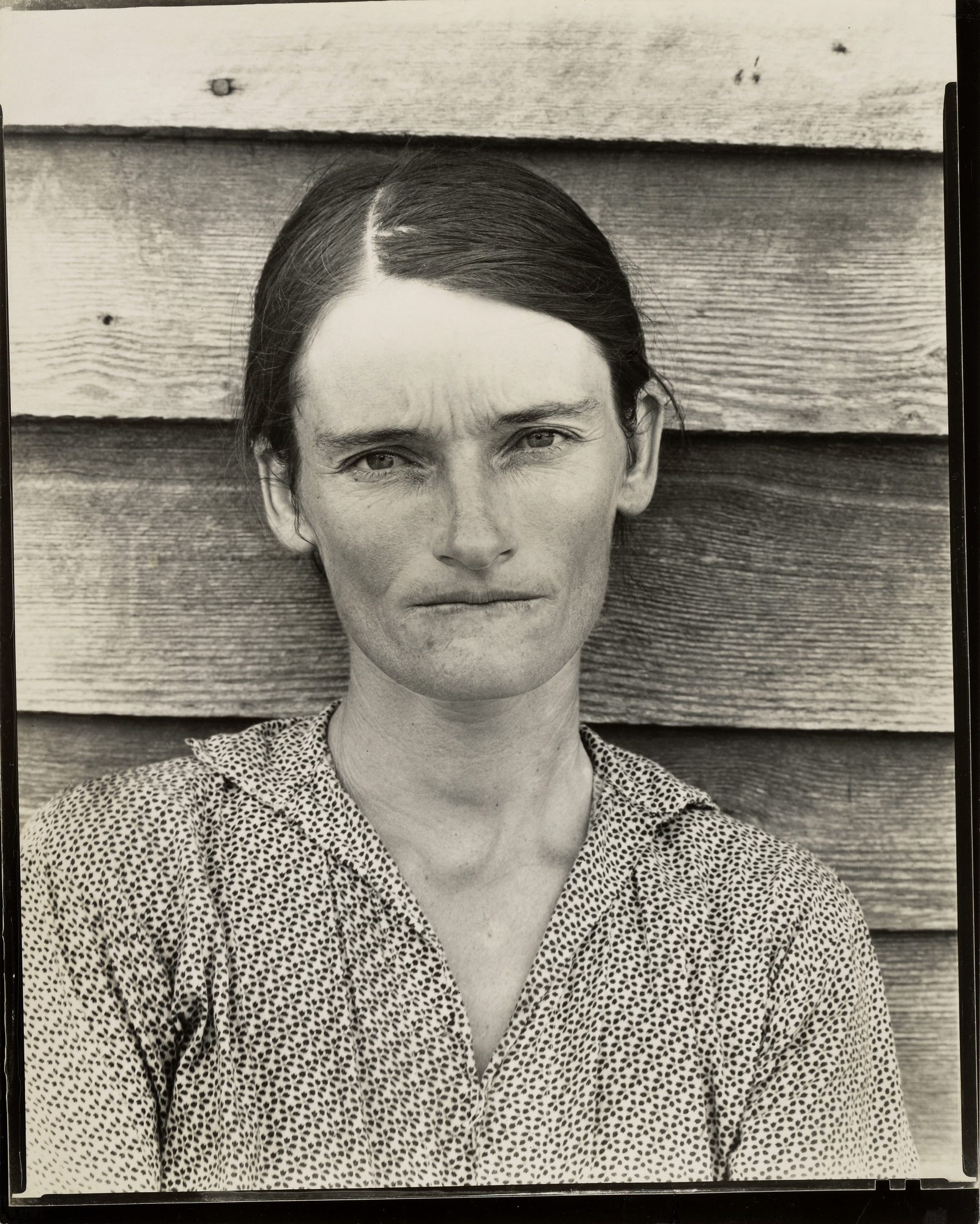
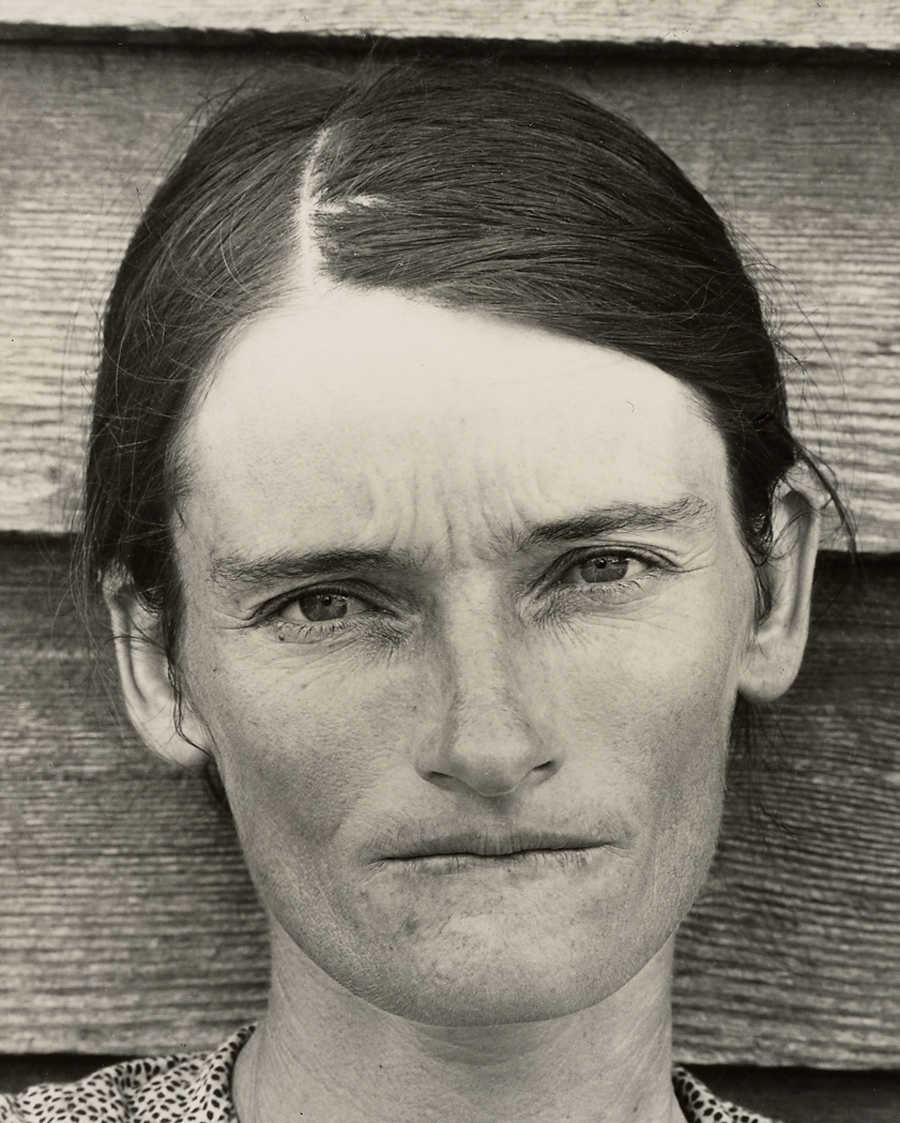
Perhaps equally radical as the introduction of candid photography is the problematic association of photography with facial expression and its adoption of physiognomy, a concept that was introduced in the 19th century. Physiognomy, the study of the link between the face and human psyche, resulted in the belief that different types of people could be classified by their visage. The exhibition includes some of the earliest uses of photography to record facial expression, as in Duchenne de Boulogne’s (French, 1806-1875) Figure 44: The Muscle of Sadness (negative, 1850s). This also resonates in the 20th-century photographs by Walker Evans (American, 1903-1975) of Allie Mae Burroughs, Hale County Alabama (negative 1936) in that the subject’s expression could be deemed as suggestive of the current state of her mind. In this frame (in others she is viewed as smiling) she stares intently at the camera slightly biting her lip, perhaps alluding to uncertainty of what is to come for her and her family.

The subject of facial expression is also resonant with current developments in facial recognition technology. Nancy Burson (American, born 1948) created works such as Androgyny (6 Men + 6 Women) (1982), in which portraits of six men and six women were morphed together to convey the work’s title. Experimental and illustrative of the medium’s technological advancement, Burson’s photograph is pertinent to several features of today’s social media platforms, including the example in which a phone’s front camera scans a user’s face and facial filters are applied upon detection. Today, mobile phones and social media applications even support portrait mode options, offering an apprehension of the human face and highlighting its countenances with exceptional quality.

In addition to photography’s engagement with human expression, In Focus: Expressions examines the literal and figurative concept of the mask. Contrary to a candid photograph, the mask is the face we choose to present to the world. Weegee’s (Arthur Fellig’s) (American, born Austria, 1899-1968) Emmett Kelly, Ringling Brothers and Barnum & Bailey Circus (about 1950) demonstrates this concept, projecting the character of a sad clown in place of his real identity as Emmett Kelly.

The mask also suggests guises, obscurity, and the freedom to pick and create a separate identity. W. Canfield Ave., Detroit (1982) by Nicholas Nixon (American, born 1947) demonstrates this redirection. Aware that he is being photographed, the subject seizes the opportunity to create a hardened expression that conveys him as distant, challenging, and fortified, highlighted by the opposing sentiments of the men who flank him. In return, the audience could be led to believe that this devised pose is a façade behind which a concealed and genuine identity exists.

Press release from the J. Paul Getty Museum


Guillaume-Benjamin Duchenne (French, 1806-1875) 'Figure 44, The Muscle of Sadness' Negative 1854-1856; print 1876


Guillaume-Benjamin Duchenne (French, 1806-1875)
Figure 44, The Muscle of Sadness
Negative 1854-1856; print 1876
From the book Mecanisme de la Physionomie Humaine ou Analyse Electro-Physiologique de l’Expression des Passions
Albumen silver print
11 x 9cm
The J. Paul Getty Museum, Los Angeles


Duchenne de Boulogne (French, 1806-1875)

Guillaume-Benjamin-Amand Duchenne (de Boulogne) (September 17, 1806 in Boulogne-sur-Mer – September 15, 1875 in Paris) was a French neurologist who revived Galvani’s research and greatly advanced the science of electrophysiology. The era of modern neurology developed from Duchenne’s understanding of neural pathways and his diagnostic innovations including deep tissue biopsy, nerve conduction tests (NCS), and clinical photography. This extraordinary range of activities (mostly in the Salpêtrière) was achieved against the background of a troubled personal life and a generally indifferent medical and scientific establishment.

Neurology did not exist in France before Duchenne and although many medical historians regard Jean-Martin Charcot as the father of the discipline, Charcot owed much to Duchenne, often acknowledging him as “mon maître en neurologie” (my teacher in neurology). … Duchenne’s monograph, the Mécanisme de la physionomie humaine – also illustrated prominently by his photographs – was the first study on the physiology of emotion and was highly influential on Darwin’s work on human evolution and emotional expression.

In 1835, Duchenne began experimenting with therapeutic “électropuncture” (a technique recently invented by François Magendie and Jean-Baptiste Sarlandière by which electric shock was administered beneath the skin with sharp electrodes to stimulate the muscles). After a brief and unhappy second marriage, Duchenne returned to Paris in 1842 in order to continue his medical research. Here, he did not achieve a senior hospital appointment, but supported himself with a small private medical practice, while daily visiting a number of teaching hospitals, including the Salpêtrière psychiatric centre. He developed a non-invasive technique of muscle stimulation that used faradic shock on the surface of the skin, which he called “électrisation localisée” and he published these experiments in his work, On Localized Electrization and its Application to Pathology and Therapy, first published in 1855. A pictorial supplement to the second edition, Album of Pathological Photographs (Album de Photographies Pathologiques) was published in 1862. A few months later, the first edition of his now much-discussed work, The Mechanism of Human Physiognomy, was published. Were it not for this small, but remarkable, work, his next publication, the result of nearly 20 years of study, Duchenne’s Physiology of Movements, his most important contribution to medical science, might well have gone unnoticed.
The Mechanism of Human Facial Expression

Influenced by the fashionable beliefs of physiognomy of the 19th century, Duchenne wanted to determine how the muscles in the human face produce facial expressions which he believed to be directly linked to the soul of man. He is known, in particular, for the way he triggered muscular contractions with electrical probes, recording the resulting distorted and often grotesque expressions with the recently invented camera. He published his findings in 1862, together with extraordinary photographs of the induced expressions, in the book Mecanisme de la physionomie Humaine (The Mechanism of Human Facial Expression, also known as The Mechanism of Human Physiognomy).

Duchenne believed that the human face was a kind of map, the features of which could be codified into universal taxonomies of mental states; he was convinced that the expressions of the human face were a gateway to the soul of man. Unlike Lavater and other physiognomists of the era, Duchenne was skeptical of the face’s ability to express moral character; rather he was convinced that it was through a reading of the expressions alone (known as pathognomy) which could reveal an “accurate rendering of the soul’s emotions”. He believed that he could observe and capture an “idealized naturalism” in a similar (and even improved) way to that observed in Greek art. It is these notions that he sought conclusively and scientifically to chart by his experiments and photography and it led to the publishing of The Mechanism of Human Physiognomy in 1862 (also entitled, The Electro-Physiological Analysis of the Expression of the Passions, Applicable to the Practice of the Plastic Arts. in French: Mécanisme de la physionomie humaine, ou Analyse électro-physiologique de l’expression des passions applicable à la pratique des arts plastiques), now generally rendered as The Mechanism of Human Facial Expression. The work compromises a volume of text divided into three parts:

1/ General Considerations,
2/ A Scientific Section, and
3/ An Aesthetic Section.

These sections were accompanied by an atlas of photographic plates. …

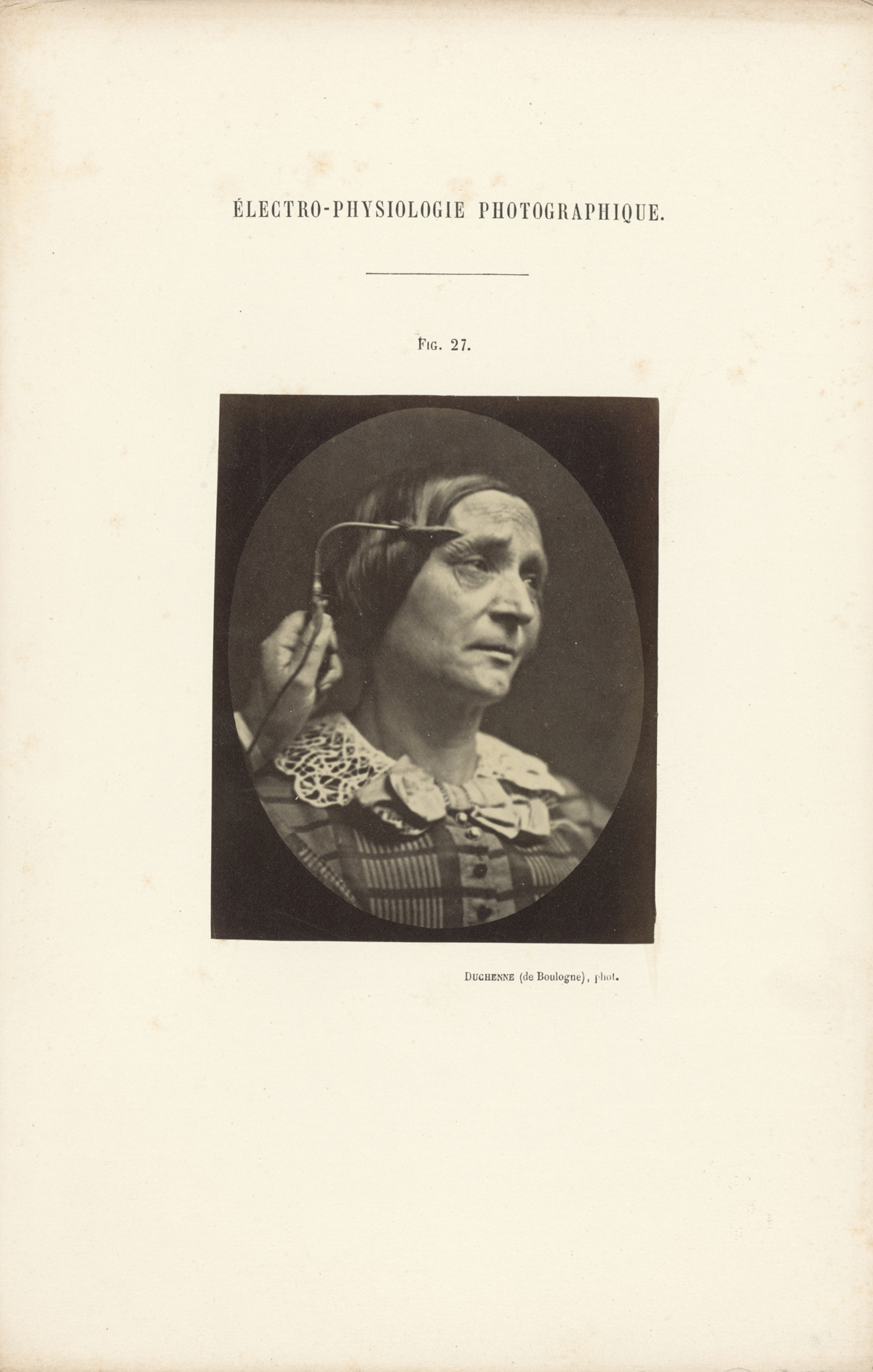
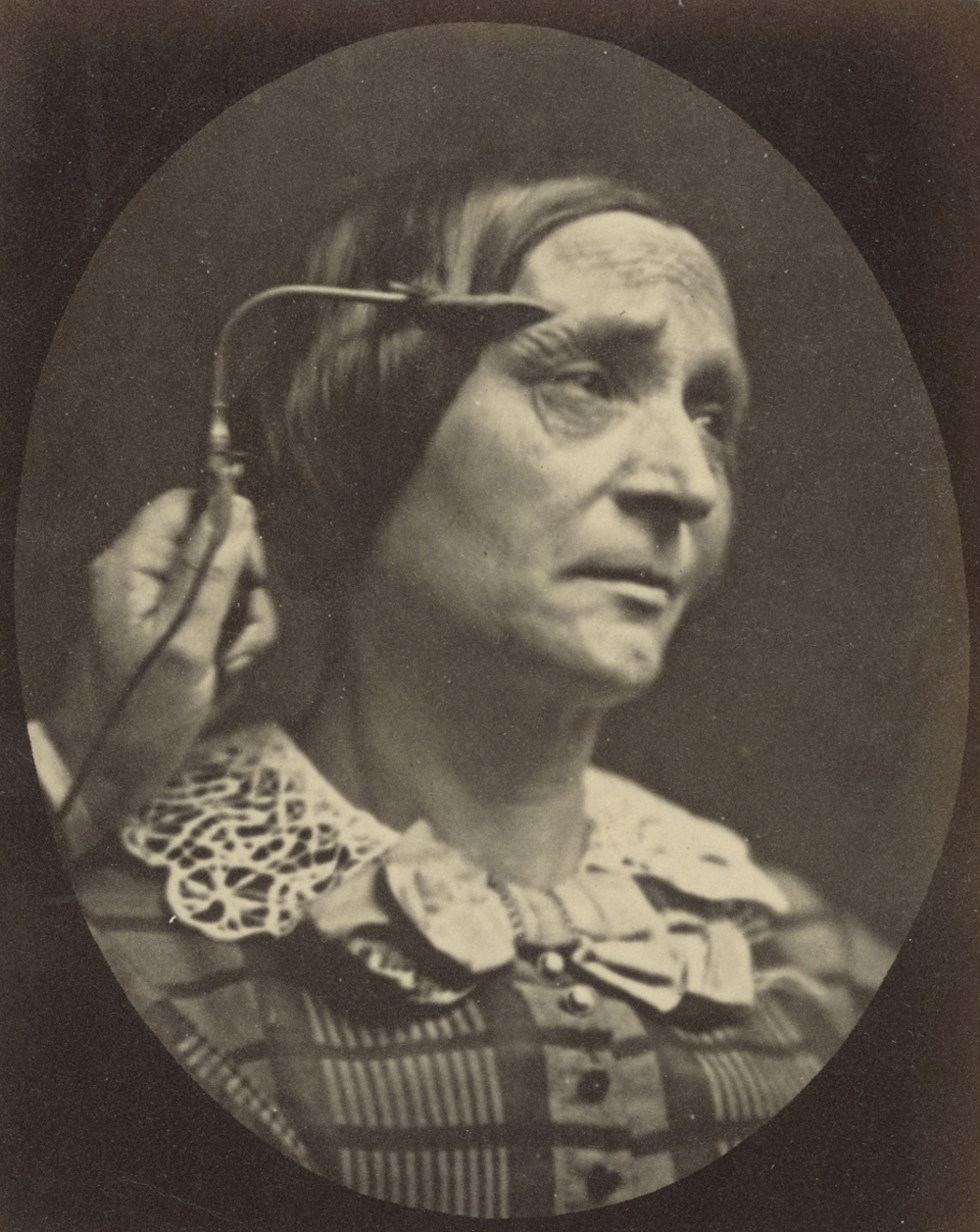
Duchenne defines the fundamental expressive gestures of the human face and associates each with a specific facial muscle or muscle group. He identifies thirteen primary emotions the expression of which is controlled by one or two muscles. He also isolates the precise contractions that result in each expression and separates them into two categories: partial and combined. To stimulate the facial muscles and capture these “idealized” expressions of his patients, Duchenne applied faradic shock through electrified metal probes pressed upon the surface of the various muscles of the face.

Duchenne was convinced that the “truth” of his pathognomic experiments could only be effectively rendered by photography, the subject’s expressions being too fleeting to be drawn or painted. “Only photography,” he writes, “as truthful as a mirror, could attain such desirable perfection.” He worked with a talented, young photographer, Adrien Tournachon, (the brother of Felix Nadar), and also taught himself the art in order to document his experiments. From an art-historical point of view, the Mechanism of Human Physiognomy was the first publication on the expression of human emotions to be illustrated with actual photographs. Photography had only recently been invented, and there was a widespread belief that this was a medium that could capture the “truth” of any situation in a way that other mediums were unable to do.

Duchenne used six living models in the scientific section, all but one of whom were his patients. His primary model, however, was an “old toothless man, with a thin face, whose features, without being absolutely ugly, approached ordinary triviality.” Through his experiments, Duchenne sought to capture the very “conditions that aesthetically constitute beauty.” He reiterated this in the aesthetic section of the book where he spoke of his desire to portray the “conditions of beauty: beauty of form associated with the exactness of the facial expression, pose and gesture.” Duchenne referred to these facial expressions as the “gymnastics of the soul”. He replied to criticisms of his use of the old man by arguing that “every face could become spiritually beautiful through the accurate rendering of his or her emotions”, and furthermore said that because the patient was suffering from an anesthetic condition of the face, he could experiment upon the muscles of his face without causing him pain.

Text from the Wikipedia website


Guillaume-Benjamin Duchenne (French, 1806-1875) 'Figure 44, The Muscle of Sadness' Negative 1854-1856; print 1876 (detail)


Guillaume-Benjamin Duchenne (French, 1806-1875)
Figure 44, The Muscle of Sadness (detail)
Negative 1854-1856; print 1876
From the book Mecanisme de la Physionomie Humaine ou Analyse Electro-Physiologique de l’Expression des Passions
Albumen silver print
11 x 9cm
The J. Paul Getty Museum, Los Angeles


Duchenne and his patient, an “old toothless man, with a thin face, whose features, without being absolutely ugly, approached ordinary triviality.” Duchenne faradize’s the mimetic muscles of “The Old Man.” The farad (symbol: F) is the SI derived unit of electrical capacitance, the ability of a body to store an electrical charge. It is named after the English physicist Michael Faraday


Guillaume-Benjamin Duchenne (French, 1806-1875) 'Figure 27, The Muscle of Pain' Negative 1854-1856; print 1876


Guillaume-Benjamin Duchenne (French, 1806-1875)
Figure 27, The Muscle of Pain
Negative 1854-1856; print 1876
From the book Mecanisme de la Physionomie Humaine ou Analyse Electro-Physiologique de l’Expression des Passions
Albumen silver print
11 x 9cm
The J. Paul Getty Museum, Los Angeles


Guillaume-Benjamin Duchenne (French, 1806-1875) 'Figure 27, The Muscle of Pain' Negative 1854-1856; print 1876 (detail)


Guillaume-Benjamin Duchenne (French, 1806-1875)
Figure 27, The Muscle of Pain (detail)
Negative 1854-1856; print 1876
From the book Mecanisme de la Physionomie Humaine ou Analyse Electro-Physiologique de l’Expression des Passions
Albumen silver print
11 x 9cm
The J. Paul Getty Museum, Los Angeles


Milton Rogovin (American, 1909-2011) 'Storefront Churches, Buffalo, preacher head in hand, eyes closed' 1958-1961


Milton Rogovin (American, 1909-2011)
Storefront Churches, Buffalo, preacher head in hand, eyes closed
1958-1961
Gelatin silver print
11 × 10.5cm (4 5/16 × 4 1/8 in.)
The J. Paul Getty Museum, Los Angeles
Gift of Dr. John V. and Laura M. Knaus
© Milton Rogovin


Walker Evans (American, 1903-1975) 'Allie Mae Burroughs, Hale County, Alabama' Negative 1936; print 1950s


Walker Evans (American, 1903-1975)
Allie Mae Burroughs, Hale County, Alabama
Negative 1936; print 1950s
Gelatin silver print
24.3 × 19.2cm (9 9/16 × 7 9/16 in.)
The J. Paul Getty Museum, Los Angeles


Walker Evans (American, 1903-1975) 'Allie Mae Burroughs, Hale County, Alabama' Negative 1936; print 1950s (detail)


Walker Evans (American, 1903-1975)
Allie Mae Burroughs, Hale County, Alabama (detail)
Negative 1936; print 1950s
Gelatin silver print
24.3 × 19.2cm (9 9/16 × 7 9/16 in.)
The J. Paul Getty Museum, Los Angeles


Depression-era photography

In 1935, Evans spent two months at first on a fixed-term photographic campaign for the Resettlement Administration (RA) in West Virginia and Pennsylvania. From October on, he continued to do photographic work for the RA and later the Farm Security Administration (FSA), primarily in the Southern United States.

In the summer of 1936, while on leave from the FSA, he and writer James Agee were sent by Fortune magazine on assignment to Hale County, Alabama, for a story the magazine subsequently opted not to run. In 1941, Evans’s photographs and Agee’s text detailing the duo’s stay with three white tenant families in southern Alabama during the Great Depression were published as the groundbreaking book Let Us Now Praise Famous Men. Its detailed account of three farming families paints a deeply moving portrait of rural poverty. The critic Janet Malcolm notes that as in the earlier Beals’ book there was a contradiction between a kind of anguished dissonance in Agee’s prose and the quiet, magisterial beauty of Evans’s photographs of sharecroppers.

The three families headed by Bud Fields, Floyd Burroughs and Frank Tingle, lived in the Hale County town of Akron, Alabama, and the owners of the land on which the families worked told them that Evans and Agee were “Soviet agents,” although Allie Mae Burroughs, Floyd’s wife, recalled during later interviews her discounting that information. Evans’s photographs of the families made them icons of Depression-Era misery and poverty. In September 2005, Fortune revisited Hale County and the descendants of the three families for its 75th anniversary issue. Charles Burroughs, who was four years old when Evans and Agee visited the family, was “still angry” at them for not even sending the family a copy of the book; the son of Floyd Burroughs was also reportedly angry because the family was “cast in a light that they couldn’t do any better, that they were doomed, ignorant.”

Text from the Wikipedia website


Lisette Model (American born Austria, 1901-1983) '[War Rally]' 1942


Lisette Model (American born Austria, 1901-1983)
(War Rally)
1942
Gelatin silver print
34.4 × 27.6cm (13 9/16 × 10 7/8 in.)
© Estate of Lisette Model
Courtesy Baudoin Lebon/Keitelman
The J. Paul Getty Museum, Los Angeles


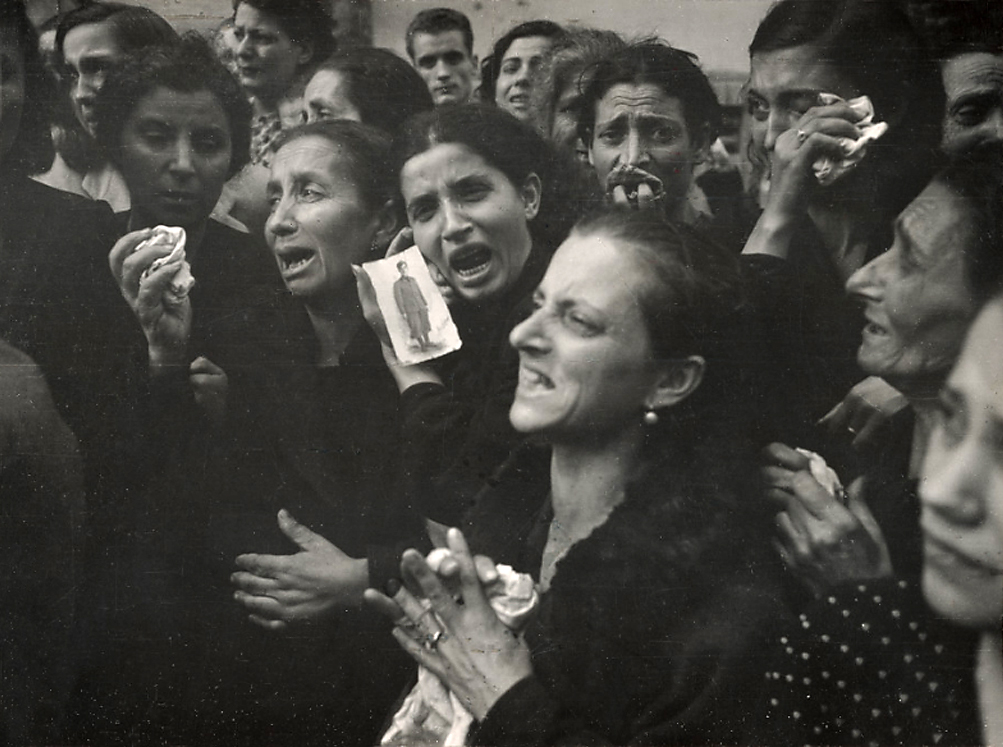
Robert Capa (American born Hungary, 1913-1954) 'Second World War, Naples' October 2, 1943


Robert Capa (American born Hungary, 1913-1954)
Second World War, Naples
October 2, 1943
Gelatin silver print
17.6 × 23.8cm (6 15/16 × 9 3/8 in.)
© International Center of Photography / Magnum Photos
The J. Paul Getty Museum, Los Angeles


View of a group of woman with pained expressions on their faces with several holding handkerchiefs and one holding a card photograph of a young man.


Unknown maker (American) '[Smiling Man]' 1860


Unknown maker (American)
(Smiling Man)
1860
Ambrotype
8.9 x 6.5cm
The J. Paul Getty Museum, Los Angeles


Baron Adolf de Meyer (American born France, 1868-1946) '[Ruth St. Denis]' c. 1918


Baron Adolf de Meyer (American born France, 1868-1946)
(Ruth St. Denis)
c. 1918
Platinum print
23.3 × 18.7cm (9 3/16 × 7 3/8 in.)
The J. Paul Getty Museum, Los Angeles


Woodbury & Page (British, active 1857-1908) '[Javanese woman seated with legs crossed, basket at side]' c. 1870


Woodbury & Page (British, active 1857-1908)
(Javanese woman seated with legs crossed, basket at side)
c. 1870
Albumen silver print
8.9 × 6cm (3 1/2 × 2 3/8 in.)
The J. Paul Getty Museum, Los Angeles


Photography in Australia, the Far East, Java and London

In 1851 Woodbury, who had already become a professional photographer, went to Australia and soon found work in the engineering department of the Melbourne waterworks. He photographed the construction of ducts and other waterworks as well as various buildings in Melbourne. He received a medal for his photography in 1854.

At some point in the mid-1850s Woodbury met expatriate British photographer James Page. In 1857 the two left Melbourne and moved to Batavia (now Jakarta), Dutch East Indies, arriving 18 May 1857, and established the partnership of Woodbury & Page that same year.

During most of 1858 Woodbury & Page photographed in Central and East Java, producing large views of the ruined temples near Surakarta, amongst other subjects, before 1 September of that year. After their tour of Java, by 8 December 1858 Woodbury and Page had returned to Batavia.

In 1859 Woodbury returned to England to arrange a regular supplier of photographic materials for his photographic studio and he contracted the London firm Negretti and Zambra to market Woodbury & Page photographs in England.

Woodbury returned to Java in 1860 and during most of that year travelled with Page through Central and West Java along with Walter’s brother, Henry James Woodbury (born 1836 – died 1873), who had arrived in Batavia in April 1859.

On 18 March 1861 Woodbury & Page moved to new premises, also in Batavia, and the studio was renamed Photographisch Atelier van Walter Woodbury, also known as Atelier Woodbury. The firm sold portraits, views of Java, stereographs, cameras, lenses, photographic chemicals and other photographic supplies. These premises continued to be used until 1908, when the firm was dissolved.

In his career Woodbury produced topographic, ethnographic and especially portrait photographs. He photographed in Australia, Java, Sumatra, Borneo and London. Although individual photographers were rarely identified on Woodbury & Page photographs, between 1861 and 1862 Walter B. Woodbury occasionally stamped the mounts of his photographs: “Photographed by Walter Woodbury, Java.”

Text from the Wikipedia website


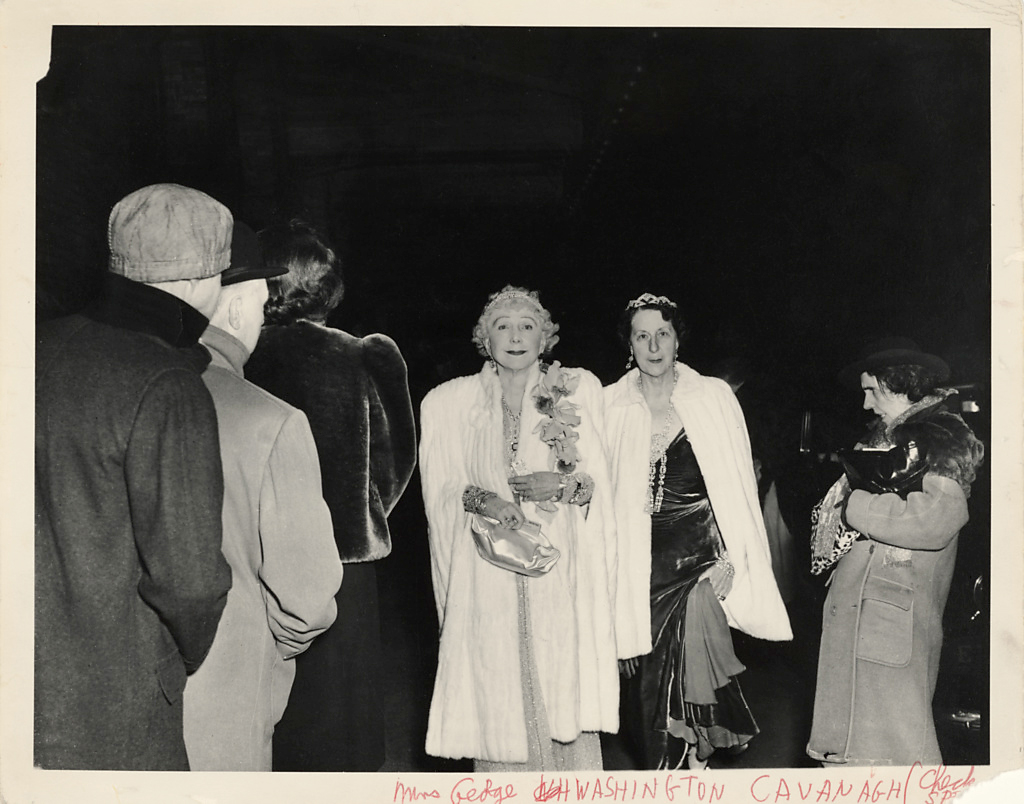
Weegee (Arthur Fellig) (American, 1899-1968) 'The Critic' November 1943


Weegee (Arthur Fellig) (American, 1899-1968)
The Critic
November 1943
Gelatin silver print
25.7 x 32.9cm (10 1/8 x 12 15/16 in.)
The J. Paul Getty Museum, Los Angeles


“I go around wearing rose-colored glasses. In other words, we have beauty. We have ugliness. Everybody likes beauty. But there is an ugliness…” ~ Weegee, in a July 11, 1945 interview for WEAF radio, New York City

While Weegee’s work appeared in many American newspapers and magazines, his methods would sometimes be considered ethically questionable by today’s journalistic standards. In this image, a drunk woman confronts two High Society women who are attending the opera. Mrs. George Washington Kavanaugh and Lady Decies appear nonplussed to be in close proximity to the disheveled woman. Weegee’s flash illuminates their fur wraps and tiaras, drawing them into the foreground. The drunk woman emerges from the shadows on the right side, her mouth tense and open as if she were saying something, hair tousled, her face considerably less sharp than those of her rich counterparts.

The Critic is the second name Weegee gave this photograph. He originally called it, The Fashionable People. In an interview, Weegee’s assistant, Louie Liotta later revealed that the picture was entirely set up. Weegee had asked Liotta to bring a regular from a bar in the Bowery section of Manhattan to the season’s opening of the Metropolitan Opera. Liotta complied. After getting the woman drunk, they positioned her near the red carpet, where Weegee readied his camera to capture the moment seen here.

Anonymous text. “The Critic,” on the J. Paul Getty Museum website [Online] Cited 24/02/2022


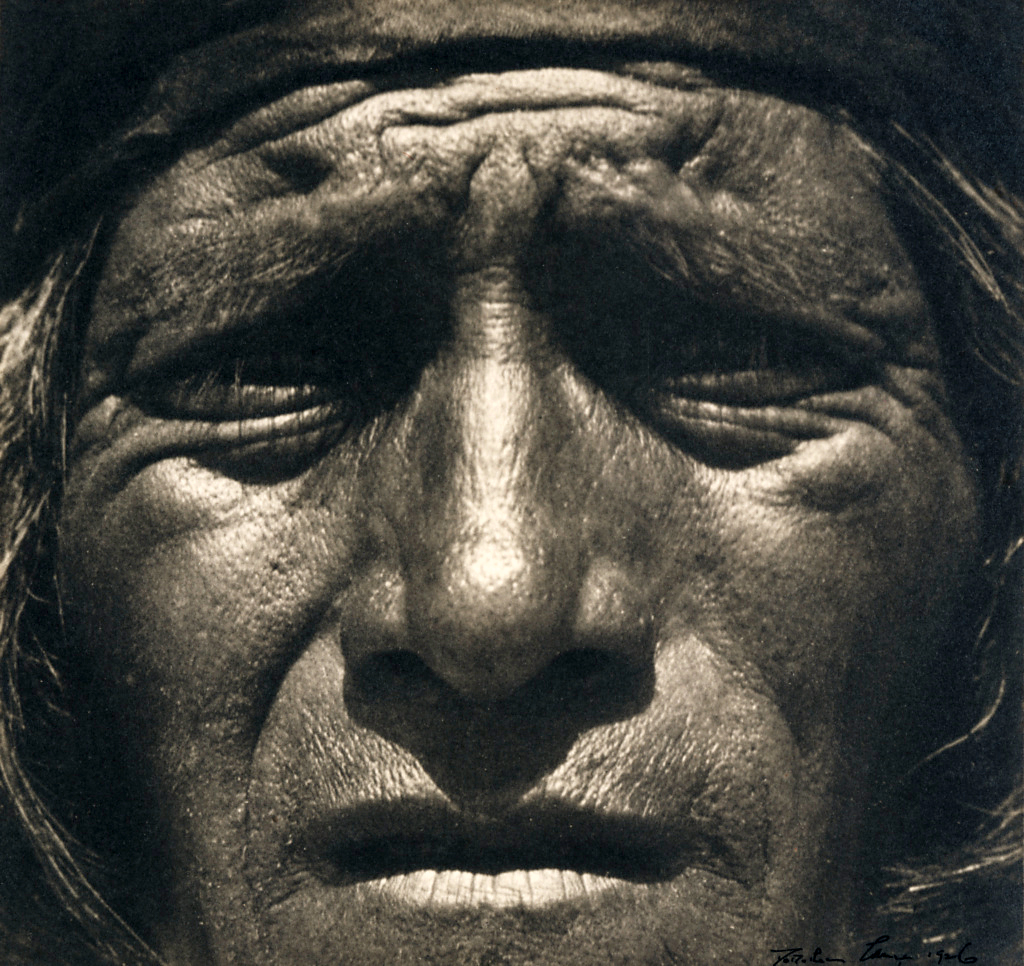
Dorothea Lange (United States, 1895-1965) 'Hopi Indian, New Mexico' Negative, c. 1923; print, 1926


Dorothea Lange (American, 1895-1965)
Hopi Indian, New Mexico
Negative, c. 1923; print, 1926
Gelatin silver print
18.4 x 19.7cm (7 1/4 x 7 3/4 in.)
The J. Paul Getty Museum, Los Angeles
© Oakland Museum of California, the City of Oakland


Dorothea Lange made this portrait study not as a social document but rather as a Pictorialist experiment in light and shadow, transforming a character-filled face into an art-for-art’s-sake abstraction. This image bridges the two distinct phases of Lange’s work: her early, soft-focus portraiture and her better-known documentary work of the 1930s.

Text from the J. Paul Getty Museum website


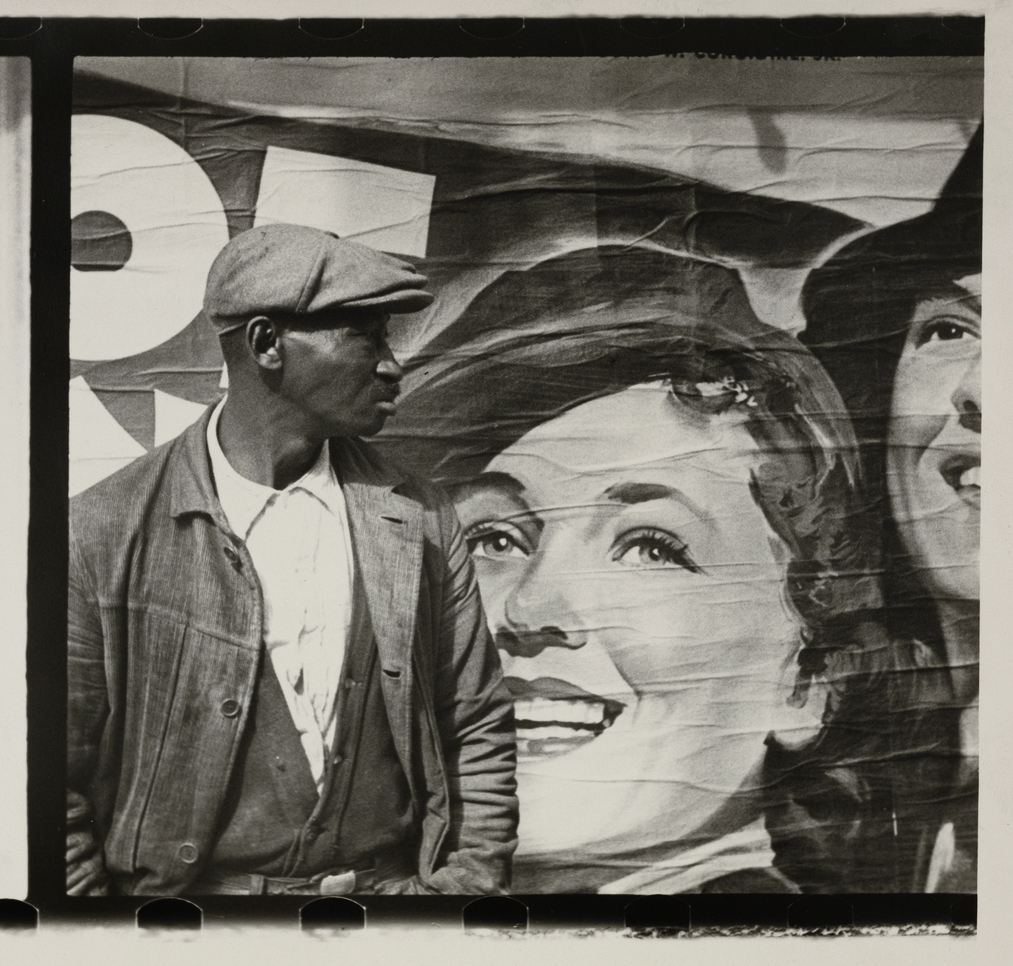
Walker Evans (American, 1903-1975) 'Street Scene, New Orleans' 1936


Walker Evans (American, 1903-1975)
Street Scene, New Orleans
1936
Gelatin silver print
15.6 x 16.8cm (1 1/8 x 6 5/8 in.)
The J. Paul Getty Museum, Los Angeles
© Walker Evans Archive, The Metropolitan Museum of Art


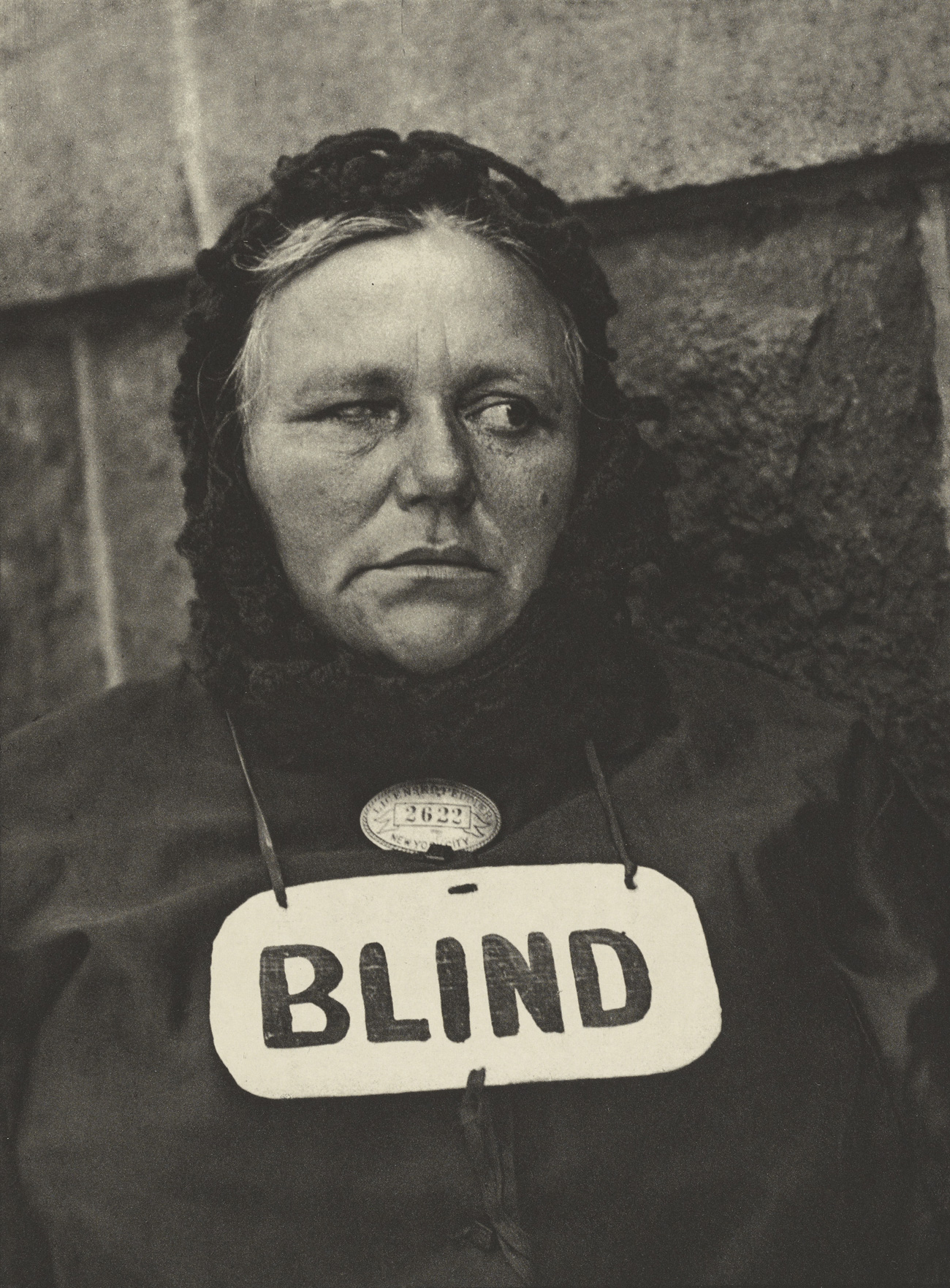
Paul Strand (American, 1890 - 1976) 'Photograph - New York' Negative 1916; print June 1917


Paul Strand (American, 1890-1976)
Photograph – New York
Negative 1916; print June 1917
Photogravure
22.4 × 16.7cm (8 13/16 × 6 9/16 in.)
The J. Paul Getty Museum, Los Angeles


“I remember coming across Paul Strand’s ‘Blind Woman’ when I was very young, and that really bowled me over … It’s a very powerful picture. I saw it in the New York Public Library file of Camera Work, and I remember going out of there over stimulated: That’s the stuff, that’s the thing to do. It charged me up.” ~ Walker Evans

The impact of seeing this striking image for the first time is evident in Walker Evans’s vivid recollection. At the time, most photographers were choosing “pretty” subjects and creating fanciful atmospheric effects in the style of the Impressionists. Paul Strand’s unconventional subject and direct approach challenged assumptions about the medium.

At once depicting misery and endurance, struggle and degradation, Strand’s portrait of a blind woman sets up a complex confrontation. “The whole concept of blindness,” as one historian has noted, “is aimed like a weapon at those whose privilege of sight permits them to experience the picture. …”

Anonymous text. “New York [Blind Woman],” on the J. Paul Getty Museum website [Online] Cited 24/02/2022


Walker Evans (American, 1903-1975) 'Subway Portrait' 1938-1941


Walker Evans (American, 1903-1975)
Subway Portrait
1938-1941
Gelatin silver print
13.2 x 16cm (5 3/16 x 6 5/16 in.)
The J. Paul Getty Museum, Los Angeles
© Walker Evans Archive, The Metropolitan Museum of Art


Camille Silvy (French, 1834-1910) '[Madame Camille Silvy]' c. 1863


Camille Silvy (French, 1834-1910)
(Madame Camille Silvy)
c. 1863
Albumen silver print
8.9 × 6cm (3 1/2 × 2 3/8 in.)
Gift in memory of Madame Camille Silvy born Alice Monnier from the Monnier Family
The J. Paul Getty Museum, Los Angeles


Mikiko Hara (Japanese, b. 1967) '[Untitled (Making a Void)]' Negative 2001; print about 2007


Mikiko Hara (Japanese, b. 1967)
Untitled (Making a Void)
Negative 2001; print about 2007
Chromogenic print
© Mikiko Hara
The J. Paul Getty Museum, Los Angeles
Purchased with funds provided by the Photographs Council


Lauren Greenfield (American, b. 1966) 'Sisters Violeta, 21, and Massiel, 15, at the Limited in a mall, San Francisco, California' Negative 1999; print 2008


Lauren Greenfield (American, b. 1966)
Sisters Violeta, 21, and Massiel, 15, at the Limited in a mall, San Francisco, California
Negative 1999; print 2008
48.9 × 32.5cm (19 1/4 × 12 13/16 in.)
© Lauren Greenfield/INSTITUTE
The J. Paul Getty Museum, Los Angeles


Daido Moriyama (Japanese, b. 1938) 'Self-portrait' 1997


Daido Moriyama (Japanese, b. 1938)
Self-portrait
1997
Gelatin silver print
13.2 x 16cm (5 3/16 x 6 5/16 in.)
The J. Paul Getty Museum, Los Angeles
Purchase with funds provided by the Photographs Council
© Daido Moriyama


The J. Paul Getty Museum
1200 Getty Center Drive
Los Angeles, California 90049

Opening hours:
Daily 10am – 5.30pm
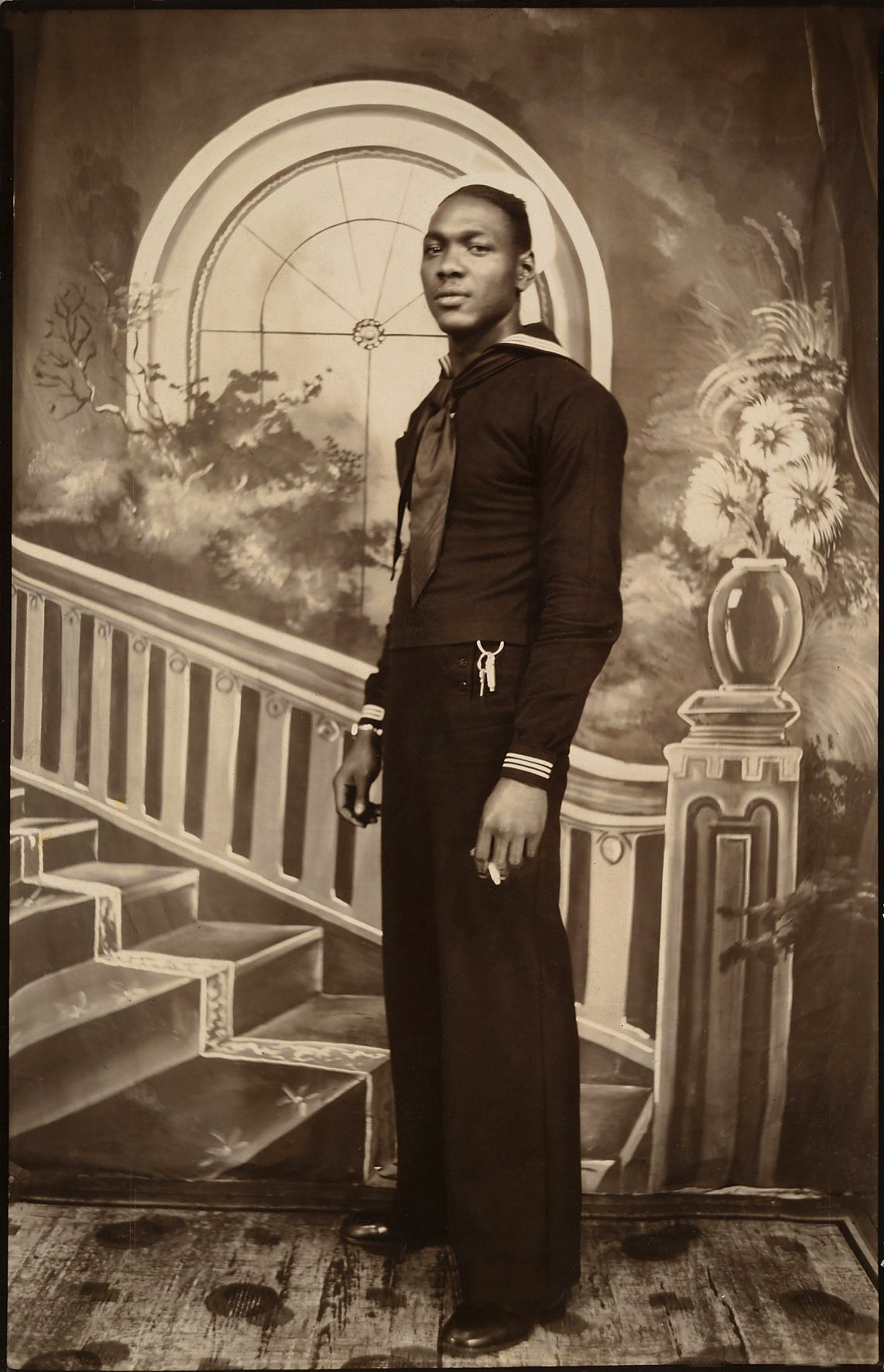
The J. Paul Getty Museum website

LIKE ART BLACK ON FACEBOOK

Back to top

Exhibition: ‘Irving Penn: Centennial’ at the Metropolitan Museum of Art, New York Part 2

Exhibition dates: 24th April – 30th July, 2017

Curators: Jeff Rosenheim, Curator in Charge, Photographs, The Metropolitan Museum of Art and Maria Morris Hambourg, Independent Curator and Former Curator in Charge, Photographs, The Metropolitan Museum of Art


'Irving Penn: Centennial' at the Metropolitan Museum of Art


Irving Penn. The high priest of high modernist photography.

I know a lot of people adore his photography but I am not an acolyte quietly accepting his elevation to sainthood in the high temple of art museums.

I find Penn’s aesthetic aesthetic, his performing photography if you like, unappealing. To me his work is more about the photographer than it is about the subject. His photographs, in whatever style – portraiture, nude, still life – seem cold and lifeless. Like a dead fish. There is little pleasure to be gained from looking at his photographs or the people in them. I find little celebration of photography in his work, as in, this is what the camera does at its best, a dialogue between photographer and subject.

Penn was a commercial photographer who had aspirations of being an artist. As Mark L. Power observes, “One of the characteristics of the Penn style was the expressive silhouette or outline around the figure, a sculptural delineation of form, at once beautiful and austere, whether his subject was a still life, a fashion model or a portrait.” My god did he love silhouette and shadow, usually played off against a plain backdrop.

There is that key word, play. There is no sense of spontaneity in his photographs, no sense of fun, no sense of an understanding of the aura of the subject.

I think of the portraits of August Sander or Richard Avedon’s series In the American West (the latter using a plain backdrop), both with their depth of vision and feeling for the people they were photographing … and then I look at the Cuzco portraits of Penn. I get nothing back about the lives of these people in Penn’s photographs. I think of the distorted nudes of Bill Brandt with their sensuality and sublime angles … and then I look at the nudes of Penn. They just don’t stack up, they feel clumsy, trite. I look at his colour still life, and I imagine the colour work of Paul Outerbridge, the absolute intensity of feeling that I can recall from Outerbridge’s still life in my mind’s eye. No such feeling exists in Penn’s still life.

If you watch the video of Penn at work in Morocco in 1971 (below), everything is controlled to within an inch of its life. A tilt of the head here, a raise of the chin there. This is a commercial studio photographer at work. As I said earlier, the work is not a celebration of photography but about the control of the photographer through the pose of the subject. Jammed into a wedge of scenery the sitters perform for his camera – Schiaparelli, Capote, Charles James et al – flaccid characters, almost caricatures in their positioning. Other than variants such as the intense eye of Pablo Picasso, or the blindness of Ingmar Bergman, I don’t believe that Penn was ever, will ever be, a great portraitist. He has no feeling for his sitters.

Of course, there is “the relationship of content to form – a relationship that underpins all art” at which Penn excels, but he is no Atget, Evans or Eggleston, where we are constantly surprised at where the photographer places the camera, how they place the frame, how they “form the starting point of the image’s visual structure,” how we wonder at the results, how we day dream the narrative. As Victor Burgin observes, “… what the world ‘is’ depends extensively upon how it is described: in a culture where the expression ‘old bag’ is in circulation to describe an ageing woman that is precisely what she is in perpetual danger of ‘being’.”

In Penn’s work the photograph and its representation is never in any danger of “becoming”, it already is. Penn’s “old bag” never changes. By repeating the same trope over and over – the formalist aesthetic, the silhouette, the plain back drop, the controlled pose – his work never evolves, never moves with an illusive quality to a place that the viewer does not feel they already know. The world of murky imperfection, uncertainty and ephemeral juxtapositions to which our mortal senses have access is replaced by a world of perfection and light in which everything has its predestined place.

Perhaps I just long for the fundamental contradictions of life in art, antinomies, options for now and the future.

Dr Marcus Bunyan

See Part 1 of the posting


Many thankx to the Metropolitan Museum of Art for allowing me to publish the photographs in the posting. Please click on the photographs for a larger version of the image.


Irving Penn on Location in Morocco, 1971

This 8mm film footage, shot by Lisa Fonssagrives-Penn in 1971, shows Irving Penn at work in his portable studio on location in Morocco. Presented in conjunction with the exhibition “Irving Penn: Centennial,” on view at The Met Fifth Avenue from April 24 through July 30, 2017.


Irving Penn Centennial

A preview of the exhibition Irving Penn Centennial April 24 – July 30, 2017 at The Met, featuring Jeff Rosenheim, Curator in Charge, Photographs, The Metropolitan Museum of Art and Maria Morris Hambourg, Independent Curator and Former Curator in Charge, Photographs, The Metropolitan Museum of Art.


“As a way of beginning, one might compare the art of photography to the act of pointing. All of us, even the best-mannered of us, occasionally point, and it must be true that some of us point to more interesting facts, events, circumstances, and configurations than others. It is not difficult to imagine a person – a mute Virgil of the corporeal world – who might elevate the act of pointing to a creative plane, a person who would lead us through the fields and streets and indicate a sequence of phenomena and aspects that would be beautiful, humorous, morally instructive, cleverly ordered, mysterious, or astonishing, once brought to our attention, but that had been unseen before, or seen dumbly, without comprehension. This talented practitioner of the new discipline (the discipline a cross between theater and criticism) would perform with a special grace, sense of timing, narrative sweep, and wit, thus endowing the act not merely with intelligence, but with that quality of formal rigor that identifies a work of art, so that we would be uncertain, when remembering the adventure of the tour, how much of our pleasure and sense of enlargement had come from the things pointed to and how much from a pattern created by the pointer.”


John Szarkowski. “Atget, Pointing”


“The word classic is often used about Penn’s work; it entails a certain gravitas characterised by rigour almost to the point of aloofness, an awareness of beauty throughout many genres, a graphic elegance of line and contour that is uniquely his, and a relationship of his work to artists of the past, usually painters rather than photographers. Although it could be said his photography was an advertisement for a haut monde world, his work was sometimes a subtle and somewhat sly subversion of the values of that lifestyle.”


Mark L. Power. “Irving Penn: Beyond Beauty,” at the Smithsonian Museum of American Art, Washington, DC.


The most comprehensive retrospective to date of the work of the great American photographer Irving Penn (1917-2009), this exhibition will mark the centennial of the artist’s birth. Over the course of his nearly 70-year career, Penn mastered a pared-down aesthetic of studio photography that is distinguished for its meticulous attention to composition, nuance, and detail.

The exhibition follows the 2015 announcement of the landmark promised gift from The Irving Penn Foundation to The Met of more than 150 photographs by Penn, representing every period of the artist’s dynamic career with the camera. The gift will form the core of the exhibition, which will feature more than 200 photographs by Penn, including iconic fashion studies of Lisa Fonssagrives-Penn, the artist’s wife; exquisite still lifes; Quechua children in Cuzco, Peru; portraits of urban labourers; female nudes; tribesmen in New Guinea; and colour flower studies. The artist’s beloved portraits of cultural figures from Truman Capote, Picasso, and Colette to Ingmar Bergman and Issey Miyake will also be featured. Rounding out the exhibition will be photographs by Penn that entered The Met collection prior to the promised gift.


Irving Penn (American, Plainfield, New Jersey 1917-2009 New York) 'Young Quechuan Man, Cuzco' December 1948, printed 1949 from the exhibition 'Irving Penn: Centennial' at the Metropolitan Museum of Art, New York Part 2, April - July, 2017


Irving Penn (American, Plainfield, New Jersey 1917-2009 New York)
Young Quechuan Man, Cuzco
December 1948, printed 1949
Gelatin silver print
7 15/16 x 7 3/16 in. (20.1 x 18.2cm)
Promised Gift of The Irving Penn Foundation
© The Irving Penn Foundation


In Cuzco, Penn photographed both residents and visitors who came to the city from nearby villages with goods to sell or barter at the Christmastime fiestas. Many arrived at the studio to sit for their annual family portraits. Penn later recalled that they “found me instead of him [the local photographer] waiting for them, and instead of paying me for the pictures it was I who paid them for posing.”
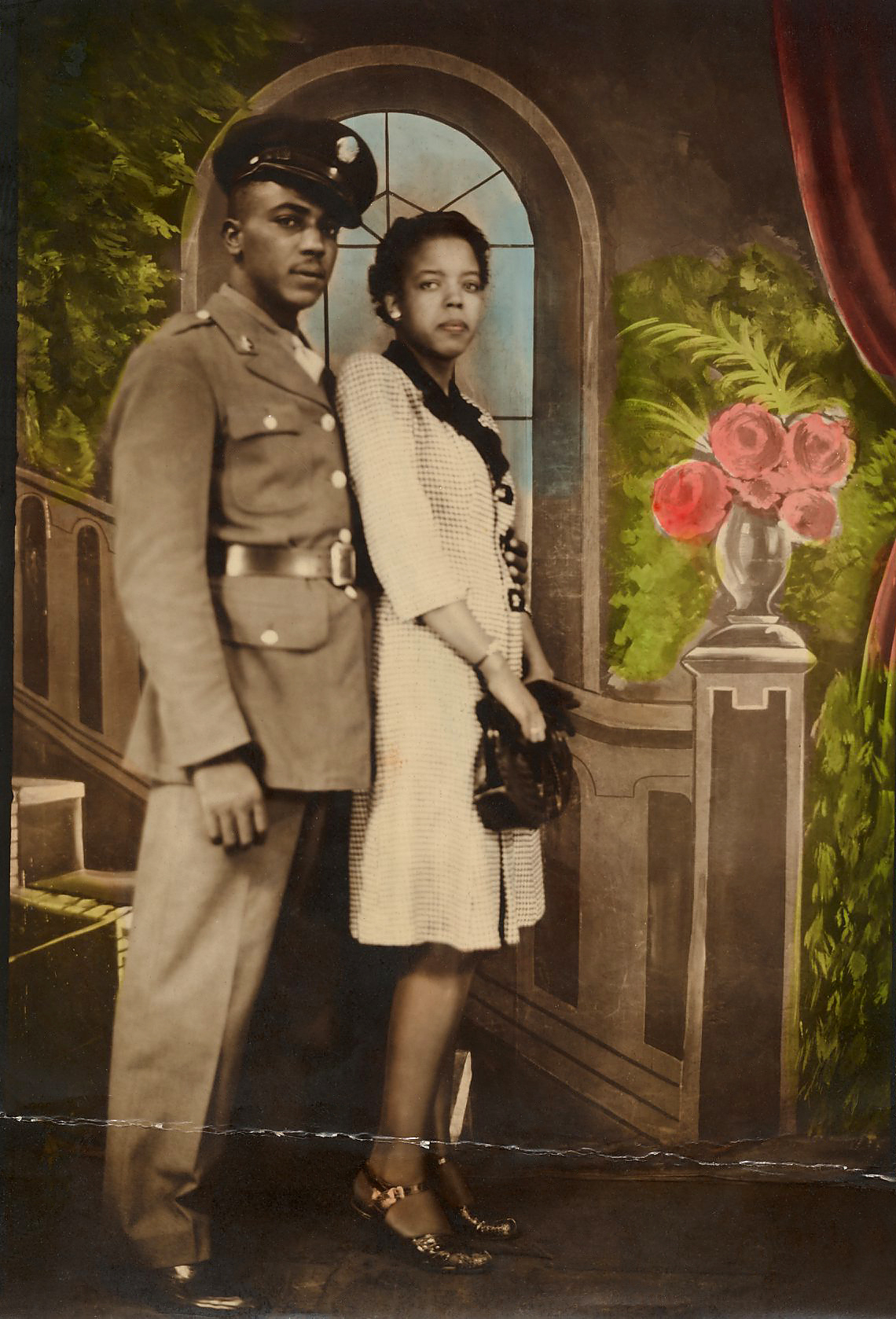
 

Irving Penn (American, Plainfield, New Jersey 1917-2009 New York) 'Cuzco Children' December 1948, printed 1968 from the exhibition 'Irving Penn: Centennial' at the Metropolitan Museum of Art, New York Part 2, April - July, 2017


Irving Penn (American, Plainfield, New Jersey 1917-2009 New York)
Cuzco Children
December 1948, printed 1968
Platinum-palladium print
19 1/2 x 19 7/8 in. (49.5 x 50.5cm)
Promised Gift of The Irving Penn Foundation
© Condé Nast


Irving Penn (American, Plainfield, New Jersey 1917-2009 New York) 'Two Men in White Masks, Cuzco' December 1948, printed 1984


Irving Penn (American, Plainfield, New Jersey 1917-2009 New York)
Two Men in White Masks, Cuzco
December 1948, printed 1984
Gelatin silver print
10 9/16 x 10 7/16 in. (26.8 x 26.5cm)
Promised Gift of The Irving Penn Foundation
© The Irving Penn Foundation


Irving Penn (American, Plainfield, New Jersey 1917-2009 New York) 'Cuzco Father and Son with Eggs' December 1948, printed January 1982


Irving Penn (American, Plainfield, New Jersey 1917-2009 New York)
Cuzco Father and Son with Eggs
December 1948, printed January 1982
Platinum-palladium print
11 3/4 x 11 5/16 in. (29.8 x 28.7cm)
Promised Gift of The Irving Penn Foundation
© Condé Nast


Irving Penn (American, Plainfield, New Jersey 1917-2009 New York) 'Nude No. 18' 1949-1950, printed 1949-1950


Irving Penn (American, Plainfield, New Jersey 1917-2009 New York)
Nude No. 18
1949-1950, printed 1949-1950
Gelatin silver print
41 x 38.4cm (16 1/8 x 15 1/8 in.)
Gift of the artist, 2002
© The Irving Penn Foundation


Irving Penn (American, Plainfield, New Jersey 1917-2009 New York) 'Nude No. 42' 1949-1950, printed 1949-1950


Irving Penn (American, Plainfield, New Jersey 1917-2009 New York)
Nude No. 42
1949-1950, printed 1949-1950
Gelatin silver print
39.1 x 37.5cm (15 3/8 x 14 3/4 in.)
Gift of the artist, 2002
© The Irving Penn Foundation


Irving Penn (American, Plainfield, New Jersey 1917-2009 New York) 'Nude No. 57' 1949-1950, printed 1949-1950


Irving Penn (American, Plainfield, New Jersey 1917-2009 New York)
Nude No. 57
1949-1950, printed 1949-1950
Gelatin silver print
39.4 x 37.5cm (15 1/2 x 14 3/4 in.)
Gift of the artist, 2002
© The Irving Penn Foundation


Irving Penn (American, Plainfield, New Jersey 1917-2009 New York) 'Nude No. 72' 1949-1950, printed 1949-1950


Irving Penn (American, Plainfield, New Jersey 1917-2009 New York)
Nude No. 72, New York
1949-1950, printed 1949-1950
Gelatin silver print
39.7 x 37.5cm (15 5/8 x 14 3/4 in.)
Gift of the artist, 2002
© The Irving Penn Foundation


Irving Penn (American, Plainfield, New Jersey 1917-2009 New York) 'Nude No. 130' 1949-1950, printed 1949-1950


Irving Penn (American, Plainfield, New Jersey 1917-2009 New York)
Nude No. 130
1949-1950, printed 1949-1950
Gelatin silver print
40 x 38.1cm (15 3/4 x 15 in.)
Gift of the artist, 2002
© The Irving Penn Foundation


Irving Penn (American, Plainfield, New Jersey 1917-2009 New York) 'Kerchief Glove (Dior), Paris' 1950, printed 1984


Irving Penn (American, Plainfield, New Jersey 1917-2009 New York)
Kerchief Glove (Dior), Paris
1950, printed 1984
Gelatin silver print
15 3/8 x 15 5/16 in. (39.1 x 38.9cm)
Promised Gift of The Irving Penn Foundation
© Condé Nast


Irving Penn (American, Plainfield, New Jersey 1917-2009 New York) 'Balenciaga Sleeve (Régine Debrise), Paris' 1950


Irving Penn (American, Plainfield, New Jersey 1917-2009 New York)
Balenciaga Sleeve (Régine Debrise), Paris
1950
Gelatin silver print
10 3/16 x 10 7/16 in. (25.9 x 26.5cm)
Promised Gift of The Irving Penn Foundation
© Condé Nast


In general, daughters from nice families were not encouraged to be in-house models. “Being a studio model was viewed as preferable,” said Régine Debrise, who posed for the photographers Irving Penn and Henry Clarke before becoming an editor at French Vogue, “because the hours were contained and the conditions were better. Being in-house meant sharing the cabine, often a cramped room, with 10 other girls, and it lacked any kind of privacy.”

Anonymous. “Cabine fever: inside Dior’s fitting room,” on The Telegraph website [Online] Cited 14/07/2017. No longer available online


Irving Penn (American, Plainfield, New Jersey 1917-2009 New York) 'Balenciaga Mantle Coat (Lisa Fonssagrives-Penn), Paris' 1950, printed 1988


Irving Penn (American, Plainfield, New Jersey 1917-2009 New York)
Balenciaga Mantle Coat (Lisa Fonssagrives-Penn), Paris
1950, printed 1988
Platinum-palladium print
21 15/16 x 17 5/8 in. (55.7 x 44.7cm)
Promised Gift of The Irving Penn Foundation
© Condé Nast


Lisa Fonssagrives (May 17, 1911 – February 4, 1992), born Lisa Birgitta Bernstone was a Swedish fashion model widely credited as the first supermodel.
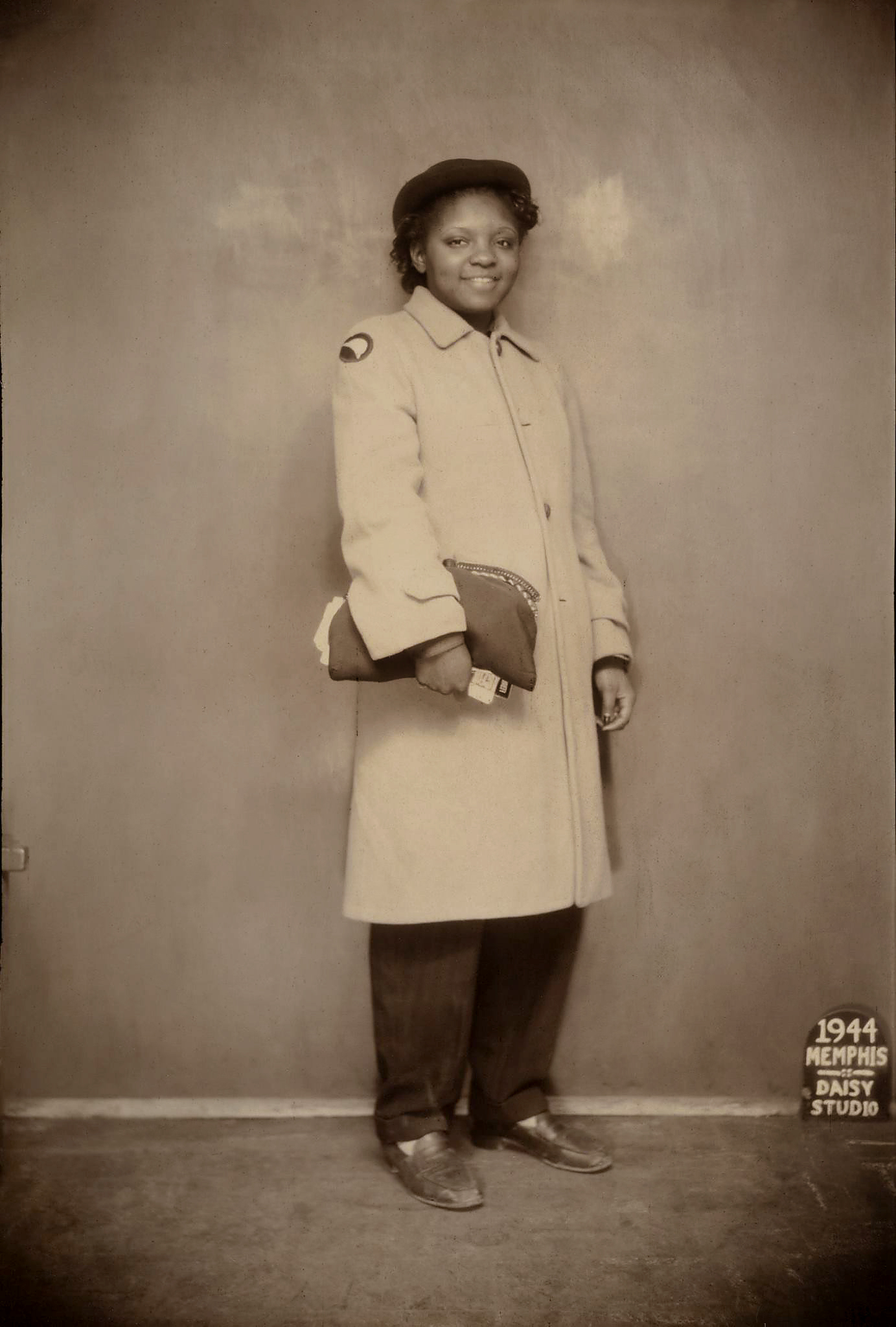
Before Fonssagrives came to the United States in 1939, she was already a top model. Her image appeared on the cover of many magazines during the 1930s, 1940s and 1950s, including Town & Country, Life, Time, Vogue, and the original Vanity Fair. She was reported as “the highest paid, highest praised, high fashion model in the business”. Fonssagrives once described herself as a “good clothes hanger”.
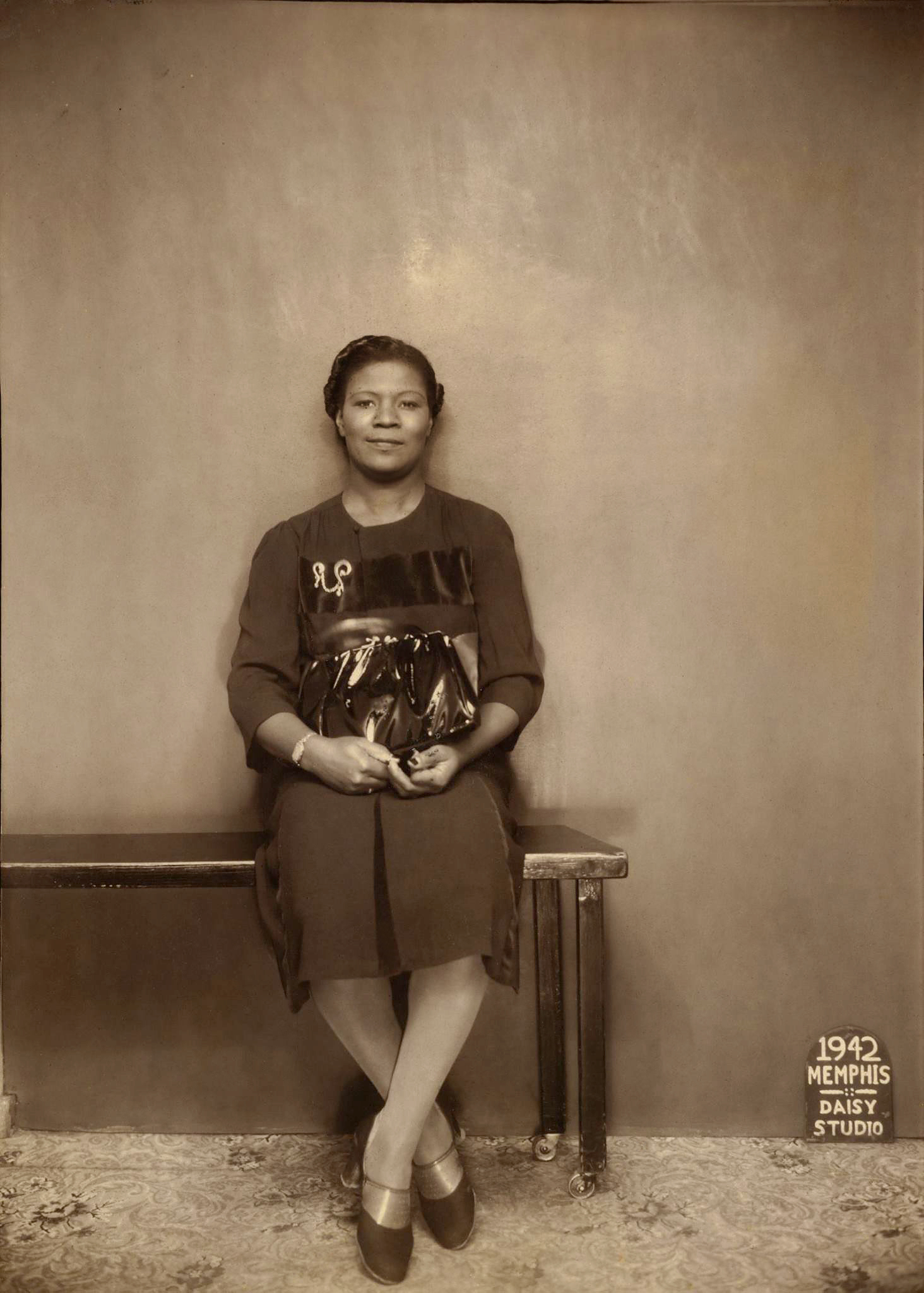
She worked with fashion photographers including George Hoyningen-Huene, Man Ray, Horst, Erwin Blumenfeld, George Platt Lynes, Richard Avedon, and Edgar de Evia. She married Parisian photographer Fernand Fonssagrives in 1935; they divorced and she later married another photographer, Irving Penn, in 1950. She went on to become a sculptor in the 1960s and was represented by the Marlborough Gallery in Manhattan.

Text from the Wikipedia website


Irving Penn (American, Plainfield, New Jersey 1917-2009 New York) 'Woman with Roses (Lisa Fonssagrives-Penn in Lafaurie Dress), Paris' 1950, printed 1968


Irving Penn (American, Plainfield, New Jersey 1917-2009 New York)
Woman with Roses (Lisa Fonssagrives-Penn in Lafaurie Dress), Paris
1950, printed 1968
Platinum-palladium print
22 x 15 11/16 in. (55.9 x 39.9cm)
Promised Gift of The Irving Penn Foundation
© Condé Nast (Fr.)


Jeanne LaFaurie was a Paris couturiere working from 1925 until 1958. The house was known for dependable, if not spectacular, clothing and fine draping. Courreges worked there as a draftsman in 1947. Michel Goma became the house designer 1950-1958, when he bought the house and renamed it. It closed in 1963.

pastperfectvintage.com. “La Faurie, Jeanne,” on the Vintage Fashion Guild website Jul 17, 2010 [Online] Cited 21/12/2021


Irving Penn (American, Plainfield, New Jersey 1917-2009 New York) 'Rochas Mermaid Dress (Lisa Fonssagrives-Penn), Paris' 1950


Irving Penn (American, Plainfield, New Jersey 1917-2009 New York)
Rochas Mermaid Dress (Lisa Fonssagrives-Penn), Paris
1950
Platinum-palladium print
Image
19 7/8 x 19 11/16 in. (50.5 x 50cm)
Promised Gift of The Irving Penn Foundation
© Condé Nast


Rochas is a fashion, beauty, and perfume house founded in 1925 by French designer Marcel Rochas (born 1902, died 1955) the first designer of 2/3-length coats and skirts with pockets. “His designs could be seen as the polar opposite of Chanel’s simplicity. Dresses were proper gowns and came with the optimum amount of frills, with lace, wide shoulders and nipped-in waists.”


Irving Penn (American, Plainfield, New Jersey 1917-2009 New York) 'Large Sleeve (Sunny Harnett), New York' 1951, printed 1984


Irving Penn (American, Plainfield, New Jersey 1917-2009 New York)
Large Sleeve (Sunny Harnett), New York
1951, printed 1984
Gelatin silver print
14 3/4 x 14 3/4 in. (37.5 x 37.5cm)
Promised Gift of The Irving Penn Foundation
© Condé Nast


Annemarie Margot “Sunny” Harnett (1924 – May 1987) was an American model in the 1950s and actress. She can be found in fashion magazines throughout that era – including frequently on the cover of Vogue – and was often a model of choice by photographer Edgar de Evia. Harper’s Bazaar ranks her as one of the 26 greatest models of all time.


Irving Penn (American, Plainfield, New Jersey 1917-2009 New York) 'Marchand de Concombres [Cucumber Seller]' 1950, printed 1976


Irving Penn (American, Plainfield, New Jersey 1917-2009 New York)
Marchand de Concombres [Cucumber Seller]
1950, printed 1976
Platinum-palladium print
Purchase, The Lauder Foundation and The Irving Penn Foundation Gifts, 2014
© The Irving Penn Foundation


Irving Penn (American, Plainfield, New Jersey 1917-2009 New York) 'Marchande de Ballons, Paris' 1950, printed 1976


Irving Penn (American, Plainfield, New Jersey 1917-2009 New York)
Marchande de Ballons, Paris
1950, printed 1976
Platinum-palladium print
15 3/4 × 12 9/16 in. (40 × 31.9cm)
Purchase, The Lauder Foundation and The Irving Penn Foundation Gifts, 2014
© Les Editions Condé Nast S. A.


Irving Penn (American, Plainfield, New Jersey 1917-2009 New York) 'Window Washer' 1950, printed 1967


Irving Penn (American, Plainfield, New Jersey 1917-2009 New York)
Window Washer
1950, printed 1967
Platinum-palladium print
19 7/8 × 14 13/16 in. (50.5 × 37.6cm)
Purchase, The Lauder Foundation and The Irving Penn Foundation Gifts, 2014
© The Irving Penn Foundation


Irving Penn (American, Plainfield, New Jersey 1917-2009 New York) 'Fishmonger, London' 1950, printed 1976


Irving Penn (American, Plainfield, New Jersey 1917-2009 New York)
Fishmonger, London
1950, printed 1976
Platinum-palladium print
19 11/16 × 14 13/16 in. (50 × 37.6cm)
Purchase, The Lauder Foundation and The Irving Penn Foundation Gifts, 2014
© Condé Nast Publications Ltd.


Irving Penn (American, Plainfield, New Jersey 1917-2009 New York) 'Pablo Picasso at La Californie, Cannes' 1957, printed February 1985


Irving Penn (American, Plainfield, New Jersey 1917-2009 New York)
Pablo Picasso at La Californie, Cannes
1957, printed February 1985
Platinum-palladium print
18 5/8 x 18 5/8 in. (47.3 x 47.3cm)
Promised Gift of The Irving Penn Foundation
© The Irving Penn Foundation


When Penn arrived at Picasso’s house in the south of France, the artist pretended not to be home. But after Penn’s assistant climbed over the locked gate, Picasso granted the photographer ten minutes. Covering his sweat-shirt with a Spanish cape, Picasso tried to playfully deflect him. Variants of this image show how Penn patiently worked the pose, allowing the artist his costume play while progressively boring in to isolate the riveting gaze of his left eye.


Irving Penn (American, Plainfield, New Jersey 1917-2009 New York) 'Ingmar Bergman, Stockholm, 1964' 1964, printed 1992


Irving Penn (American, Plainfield, New Jersey 1917-2009 New York)
Ingmar Bergman, Stockholm, 1964
1964, printed 1992
Gelatin silver print
15 1/16 x 14 15/16 in. (38.3 x 37.9cm)
Promised Gift of The Irving Penn Foundation
© The Irving Penn Foundation


Irving Penn (American, Plainfield, New Jersey 1917-2009 New York) 'Single Oriental Poppy, New York' 1968, printed 1989


Irving Penn (American, Plainfield, New Jersey 1917-2009 New York)
Single Oriental Poppy, New York
1968, printed 1989
Dye transfer print
21 7/8 x 17 1/8 in. (55.5 x 43.5cm)
Promised Gift of The Irving Penn Foundation
© The Irving Penn Foundation


Irving Penn (American, Plainfield, New Jersey 1917-2009 New York) 'Naomi Sims in Scarf, New York, c. 1969' c. 1969, printed 1985


Irving Penn (American, Plainfield, New Jersey 1917-2009 New York)
Naomi Sims in Scarf, New York, c. 1969
c. 1969, printed 1985
Gelatin silver print
10 1/2 x 10 3/8 in. (26.6 x 26.3cm)
Promised Gift of The Irving Penn Foundation
© The Irving Penn Foundation


Naomi Ruth Sims (American, 1948-2009)

Naomi Ruth Sims (March 30, 1948 – August 1, 2009) was an American model, businesswoman and author. She was the first African-American model to appear on the cover of Ladies’ Home Journal, and is widely credited as being the first African-American supermodel. …

She became one of the first successful black models while still in her teens, and achieved worldwide recognition from the late 1960s into the early 1970s, appearing on the covers of prestigious fashion and popular magazines. The New York Times wrote that (her) “appearance as the first black model on the cover of Ladies’ Home Journal in November 1968 was a consummate moment of the Black is Beautiful movement”. She also appeared on the cover of the October 17, 1969 issue of Life magazine. This made her the first African-American model on the cover of the magazine. The images from the 1967 New York Times fashion magazine cover and the 1969 Life magazine cover were exhibited at the Metropolitan Museum of Art in an exhibition entitled The Model as Muse.

Irving Penn (American, Plainfield, New Jersey 1917-2009 New York) 'Ungaro Bride Body Sculpture (Marisa Berenson), Paris, 1969' 1969, printed 1985


Irving Penn (American, Plainfield, New Jersey 1917-2009 New York)
Ungaro Bride Body Sculpture (Marisa Berenson), Paris, 1969
1969, printed 1985
Gelatin silver print
11 15/16 x 9 5/16 in. (30.3 x 23.7cm)
Promised Gift of The Irving Penn Foundation
© Condé Nast


Emanuel (Maffeolit) Ungaro (1933-2019) was a French fashion designer, who founded the fashion house called the House of Emanuel Ungaro in 1965. At the age of 22, he moved to Paris. Three years later he began designing for the House of Cristobal Balenciaga for three years before quitting to work for Courrèges. Four years later, in 1965 with the assistance of Swiss artist Sonja Knapp and Elena Bruna Fassio, Emanuel Ungaro opened his own fashion house in Paris.

Vittoria Marisa Schiaparelli Berenson (born February 15, 1947) is an American actress and model. A fashion model who came to prominence in the 1960s – “I once was one of the highest paid models in the world”, she told The New York Times – Berenson appeared on the cover of the July 1970 issue of Vogue as well as the cover of Time on December 15, 1975. She appeared in numerous fashion layouts in Vogue in the early 1970s and her sister Berry was a photographer for the magazine as well. She was known as “The Queen of the Scene” for her frequent appearances at nightclubs and other social venues in her youth, and Yves Saint Laurent dubbed her “the girl of the Seventies”.

Eventually, she was cast in several prominent film roles, including Gustav von Aschenbach’s wife in Luchino Visconti’s 1971 film Death in Venice, the Jewish department store heiress Natalia Landauer in the 1972 film Cabaret, for which she received acclaim (including two Golden Globe nominations, a BAFTA nomination and an award from the National Board of Review), and the tragic beauty Lady Lyndon in the Stanley Kubrick film Barry Lyndon (1975).

Texts from the Wikipedia website


Irving Penn (American, Plainfield, New Jersey 1917-2009 New York) 'Three Asaro Mud Men, New Guinea, 1970' 1970, printed 1976


Irving Penn (American, Plainfield, New Jersey 1917-2009 New York)
Three Asaro Mud Men, New Guinea, 1970
1970, printed 1976
Platinum-palladium print
20 1/8 x 19 1/2 in. (51.1 x 49.6cm)
Promised Gift of The Irving Penn Foundation
© The Irving Penn Foundation


Irving Penn (American, Plainfield, New Jersey 1917-2009 New York) 'Three Dahomey Girls, One Reclining, 1967' 1967, printed 1980


Irving Penn (American, Plainfield, New Jersey 1917-2009 New York)
Three Dahomey Girls, One Reclining, 1967
1967, printed 1980
Platinum-palladium print
19 11/16 x 19 11/16 in. (50 x 50cm)
Promised Gift of The Irving Penn Foundation
© The Irving Penn Foundation


Irving Penn (American, Plainfield, New Jersey 1917-2009 New York) 'Tribesman with Nose Disc, New Guinea, 1970' 1970, printed 2002


Irving Penn (American, Plainfield, New Jersey 1917-2009 New York)
Tribesman with Nose Disc, New Guinea, 1970
1970, printed 2002
Gelatin silver print
Image: 15 1/2 x 15 3/8 in. (39.4 x 39.1 cm.)
Promised Gift of The Irving Penn Foundation
© The Irving Penn Foundation


Irving Penn (American, Plainfield, New Jersey 1917-2009 New York) 'Cigarette No. 52, New York' 1972, printed April 1974


Irving Penn (American, Plainfield, New Jersey 1917-2009 New York)
Cigarette No. 52, New York
1972, printed April 1974
Platinum-palladium print
23 1/2 x 18 1/2 in. (59.7 x 47cm)
Promised Gift of The Irving Penn Foundation
© The Irving Penn Foundation


Irving Penn (American, Plainfield, New Jersey 1917-2009 New York) 'Cigarette No. 85, New York' 1972, printed Fall 1975


Irving Penn (American, Plainfield, New Jersey 1917-2009 New York)
Cigarette No. 85, New York
1972, printed Fall 1975
Platinum-palladium print
18 1/8 x 23 1/16 in. (46.0 x 58.5cm)
Promised Gift of The Irving Penn Foundation
© The Irving Penn Foundation


Irving Penn (American, Plainfield, New Jersey 1917-2009 New York) 'Cigarette No. 98, New York' 1972, printed June 1974


Irving Penn (American, Plainfield, New Jersey 1917-2009 New York)
Cigarette No. 98, New York
1972, printed June 1974
Platinum-palladium print
23 3/16 x 17 1/16 in. (58.9 x 43.3cm)
Promised Gift of The Irving Penn Foundation
© The Irving Penn Foundation


Irving Penn (American, Plainfield, New Jersey 1917-2009 New York) 'Deli Package, New York' 1975, printed March 1976


Irving Penn (American, Plainfield, New Jersey 1917-2009 New York)
Deli Package, New York
1975, printed March 1976
Platinum-palladium print
15 7/8 x 20 11/16 in. (40.3 x 52.5cm)
Promised Gift of The Irving Penn Foundation
© The Irving Penn Foundation


Irving Penn (American, Plainfield, New Jersey 1917-2009 New York) 'Two Miyake Warriors, New York, 1998' June 3, 1998, printed January-February, 1999


Irving Penn (American, Plainfield, New Jersey 1917-2009 New York)
Two Miyake Warriors, New York, 1998
June 3, 1998, printed January-February, 1999
Platinum-palladium print
21 x 19 5/8 in. (53.4 x 49.8cm)
Promised Gift of The Irving Penn Foundation
© The Irving Penn Foundation


Issey Miyake (born 22 April 1938) is a Japanese fashion designer. He is known for his technology-driven clothing designs, exhibitions and fragrances…

In the late 1980s, he began to experiment with new methods of pleating that would allow both flexibility of movement for the wearer as well as ease of care and production. In which the garments are cut and sewn first, then sandwiched between layers of paper and fed into a heat press, where they are pleated. The fabric’s ‘memory’ holds the pleats and when the garments are liberated from their paper cocoon, they are ready-to wear. He did the costume for Ballett Frankfurt with pleats in a piece named “the Loss of Small Detail” choreographed by William Forsythe and also work on ballet “Garden in the setting”.

Text from the Wikipedia website


The Metropolitan Museum of Art
1000 Fifth Avenue at 82nd Street
New York, New York 10028-0198
Phone: 212-535-7710

Opening hours:
Thursday – Tuesday 10am – 5pm
Closed Wednesday

The Metropolitan Museum of Art website

LIKE ART BLART ON FACEBOOK

Back to top

Exhibition: ‘Irving Penn: Centennial’ at the Metropolitan Museum of Art, New York Part 1

Exhibition dates: 24th April – 30th July, 2017

 Curators: Jeff Rosenheim, Curator in Charge, Photographs, The Metropolitan Museum of Art and Maria Morris Hambourg, Independent Curator and Former Curator in Charge, Photographs, The Metropolitan Museum of Art


'Irving Penn: Centennial' at the Metropolitan Museum of Art


Part 1 of this bumper posting, with some biographical information on the lesser known sitters.

See Part 2 of the posting with my commentary

Dr Marcus Bunyan


Many thankx to the Metropolitan Museum of Art for allowing me to publish the photographs in the posting. Please click on the photographs for a larger version of the image.


The most comprehensive retrospective to date of the work of the great American photographer Irving Penn (1917-2009), this exhibition will mark the centennial of the artist’s birth. Over the course of his nearly 70-year career, Penn mastered a pared-down aesthetic of studio photography that is distinguished for its meticulous attention to composition, nuance, and detail.

The exhibition follows the 2015 announcement of the landmark promised gift from The Irving Penn Foundation to The Met of more than 150 photographs by Penn, representing every period of the artist’s dynamic career with the camera. The gift will form the core of the exhibition, which will feature more than 200 photographs by Penn, including iconic fashion studies of Lisa Fonssagrives-Penn, the artist’s wife; exquisite still lifes; Quechua children in Cuzco, Peru; portraits of urban labourers; female nudes; tribesmen in New Guinea; and colour flower studies. The artist’s beloved portraits of cultural figures from Truman Capote, Picasso, and Colette to Ingmar Bergman and Issey Miyake will also be featured. Rounding out the exhibition will be photographs by Penn that entered The Met collection prior to the promised gift.

Text from the Metropolitan Museum of Art website


Irving Penn (American, Plainfield, New Jersey 1917-2009 New York) 'Union Bar Window, American South' 1941, printed c. 1941-1942 from the exhibition 'Irving Penn: Centennial' at the Metropolitan Museum of Art, New York, April - July, 2017


Irving Penn (American, Plainfield, New Jersey 1917-2009 New York)
Union Bar Window, American South
1941, printed c. 1941-42
Gelatin silver print
7 3/16 x 8 3/4 in. (18.2 x 22.3cm)
Promised Gift of The Irving Penn Foundation
© The Irving Penn Foundation


Irving Penn (American, Plainfield, New Jersey 1917-2009 New York) 'O'Sullivan's Heels, New York' c. 1939


Irving Penn (American, Plainfield, New Jersey 1917-2009 New York)
O’Sullivan’s Heels, New York
c. 1939
Gelatin silver print
9 x 9 3/8 in. (22.9 x 23.8cm)
Promised Gift of The Irving Penn Foundation
© The Irving Penn Foundation


Irving Penn (American, Plainfield, New Jersey 1917-2009 New York) 'Pulquería Decoration, Mexico' 1942


Irving Penn (American, Plainfield, New Jersey 1917-2009 New York)
Pulquería Decoration, Mexico
1942
Gelatin silver print
11 7/8 x 10 9/16 in. (30.2 x 26.8cm)
Promised Gift of The Irving Penn Foundation
© The Irving Penn Foundation


Irving Penn (American, Plainfield, New Jersey 1917-2009 New York) 'Le Corbusier, New York' 1947


Irving Penn (American, Plainfield, New Jersey 1917-2009 New York)
Le Corbusier, New York
1947
Gelatin silver print
9 15/16 x 7 15/16 in. (25.3 x 20.2cm)
Promised Gift of The Irving Penn Foundation
© Condé Nast


Irving Penn (American, Plainfield, New Jersey 1917–2009 New York) 'Elsa Schiaparelli, New York' March 29, 1948, printed c. 1948


Irving Penn (American, Plainfield, New Jersey 1917-2009 New York)
Elsa Schiaparelli, New York
March 29, 1948, printed c. 1948
Gelatin silver print
9 7/8 x 7 7/8 in. (25.1 x 20cm)
Promised Gift of The Irving Penn Foundation
© The Irving Penn Foundation


Irving Penn (American, Plainfield, New Jersey 1917-2009 New York) 'Charles James, New York' February 28, 1948, printed June 2002


Irving Penn (American, Plainfield, New Jersey 1917-2009 New York)
Charles James, New York
February 28, 1948, printed June 2002
Gelatin silver print
9 15/16 x 7 15/16 in. (25.3 x 20.1cm)
Promised Gift of The Irving Penn Foundation
© The Irving Penn Foundation


Charles Wilson Brega James (18 July 1906 – 23 September 1978) was a British-born fashion designer known as “America’s First Couturier”. He is widely considered to have been a master of cutting and is known for his highly structured aesthetic. …

James looked upon his dresses as works of art, as did many of his customers. Year after year, he reworked original designs, ignoring the sacrosanct schedule of seasons. The components of the precisely constructed designs were interchangeable, so that James had a never-ending fund of ideas on which to draw. He is most famous for his sculpted ball gowns made of lavish fabrics and to exacting tailoring standards, but is also remembered for his capes and coats, often trimmed with fur and embroidery, and his spiral zipped dresses. He is also famed for a unique, one of a kind white satin quilted jacket made in 1938 and now in the Victoria and Albert Museum, described as the starting point for “anoraks, space man and even fur jackets”.

Text from the Wikipedia website


Irving Penn (American, Plainfield, New Jersey 1917-2009 New York) 'Ballet Society, New York [Tanaquil Le Clercq with Corrado Cagli, Vittorio Rieti, and George Balanchine]' March 5, 1948, printed November 1976


Irving Penn (American, Plainfield, New Jersey 1917-2009 New York)
Ballet Society, New York [Tanaquil Le Clercq with Corrado Cagli, Vittorio Rieti, and George Balanchine]
March 5, 1948, printed November 1976
Platinum-palladium print
22 3/4 x 18 3/8 in. (57.8 x 46.7cm)
Promised Gift of The Irving Penn Foundation
© Condé Nast


Tanaquil Le Clercq (October 2, 1929 – December 31, 2000) was a principal dancer with the New York City Ballet. Her dancing career ended abruptly when she was stricken with polio in Copenhagen during the company’s European tour in 1956. Eventually regaining most of the use of her arms and torso, she remained paralysed from the waist down for the rest of her life. …

When she was fifteen years old, George Balanchine asked her to perform with him in a dance he choreographed for a polio charity benefit. In an eerie portent of things to come, he played a character named Polio, and Le Clercq was his victim who became paralysed and fell to the floor. Then, children tossed dimes at her character, prompting her to get up and dance again.

Corrado Cagli (Ancona, 1910 – Rome, 1976) was an Italian painter of Jewish heritage, who lived in the United States during World War II. …

He enlisted in the U.S. Army and was involved in the 1944 Normandy landings, and fought in Belgium and Germany. He was with the forces that liberated the Buchenwald concentration camp, and made a series of dramatic drawings on that subject. In 1948, Cagli returned to Rome to take up permanent residence there. From that time forward, he experimented in various abstract and non-figurative techniques (neo-metaphysical, neo-cubist, informal). He was awarded the Guggenheim prize (1946) and the Marzotto prize (1954).

Vittorio Rieti (January 28, 1898 – February 19, 1994) was a Jewish-Italian composer. Born in Alexandria, Egypt, Rieti moved to Milan to study economics. He subsequently studied in Rome under Respighi and Casella, and lived there until 1940. … He emigrated to the United States in 1940, becoming a naturalised American citizen on the 1st of June 1944. He taught at the Peabody Conservatory of Music in Baltimore (1948-49), Chicago Musical College (1950-54), Queens College, New York (1958-60), and New York College of Music (1960-64).

George Balanchine (January 22 [O.S. January 9] 1904 – April 30, 1983) was a choreographer. Styled as the father of American ballet, he co-founded the New York City Ballet and remained its Artistic Director for more than 35 years.

Balanchine took the standards and technique from his time at the Imperial Ballet School and fused it with other schools of movement that he had adopted during his tenure on Broadway and in Hollywood, creating his signature “neoclassical style”. He was a choreographer known for his musicality; he expressed music with dance and worked extensively with leading composers of his time like Igor Stravinsky. Balanchine was invited to America in 1933 by a young arts patron named Lincoln Kirstein, and together they founded the School of American Ballet. Along with Kirstein, Balanchine also co-founded the New York City Ballet (NYCB).

All texts from the Wikipedia website


Irving Penn (American, Plainfield, New Jersey 1917-2009 New York) 'Truman Capote, New York' March 5, 1948


Irving Penn (American, Plainfield, New Jersey 1917-2009 New York)
Truman Capote, New York
March 5, 1948
Gelatin silver print
10 1/16 x 8 3/16 in. (25.5 x 20.8cm)
Promised Gift of The Irving Penn Foundation
© The Irving Penn Foundation


The Metropolitan Museum of Art will present a major retrospective of the photographs of Irving Penn to mark the centennial of the artist’s birth. Over the course of his nearly 70-year career, Irving Penn (1917-2009) mastered a pared-down aesthetic of studio photography that is distinguished for its meticulous attention to composition, nuance, detail, and printmaking. Irving Penn: Centennial, opening April 24, 2017, will be the most comprehensive exhibition of the great American photographer’s work to date and will include both masterpieces and hitherto unknown prints from all his major series.

Long celebrated for more than six decades of influential work at Vogue magazine, Penn was first and foremost a fashion photographer. His early photographs of couture are masterpieces that established a new standard for photographic renderings of style at mid-century, and he continued to record the cycles of fashions year after year in exquisite images characterised by striking shapes and formal brilliance. His rigorous modern compositions, minimal backgrounds, and diffused lighting were innovative and immensely influential. Yet Penn’s photographs of fashion are merely the most salient of his specialties. He was a peerless portraitist, whose perceptions extended beyond the human face and figure to take in more complete codes of demeanour, adornment, and artefact. He was also blessed with an acute graphic intelligence and a sculptor’s sensitivity to volumes in light, talents that served his superb nude studies and life-long explorations of still life.

Penn dealt with so many subjects throughout his long career that he is conventionally seen either with a single lens – as the portraitist, fashion photographer, or still life virtuoso – or as the master of all trades, the jeweller of journalists who could fine-tool anything. The exhibition at The Met will chart a different course, mapping the overall geography of the work and the relative importance of the subjects and campaigns the artist explored most creatively. Its organisation largely follows the pattern of his development so that the structure of the work, its internal coherence, and the tenor of the times of the artist’s experience all become evident.

The exhibition will most thoroughly explore the following series: street signs, including examples of early work in New York, the American South, and Mexico; fashion and style, with many classic photographs of Lisa Fonssagrives-Penn, the former dancer who became the first supermodel as well as the artist’s wife; portraits of indigenous people in Cuzco, Peru; the Small Trades portraits of urban labourers; portraits of beloved cultural figures from Truman Capote, Joe Louis, Picasso, and Colette to Alvin Ailey, Ingmar Bergman, and Joan Didion; the infamous cigarette still lifes; portraits of the fabulously dressed citizens of Dahomey (Benin), New Guinea, and Morocco; the late “Morandi” still lifes; voluptuous nudes; and glorious colour studies of flowers. These subjects chart the artist’s path through the demands of the cultural journal, the changes in fashion itself and in editorial approach, the fortunes of the picture press in the age of television, the requirements of an artistic inner voice in a commercial world, the moral condition of the American conscience during the Vietnam War era, the growth of photography as a fine art in the 1970s and 1980s, and personal intimations of mortality. All these strands of meaning are embedded in the images – a web of deep and complex ideas belied by the seeming forthrightness of what is represented.

Penn generally worked in a studio or in a traveling tent that served the same purpose, and favoured a simple background of white or light grey tones. His preferred backdrop was made from an old theatre curtain found in Paris that had been softly painted with diffused grey clouds. This backdrop followed Penn from studio to studio; a companion of over 60 years, it will be displayed in one of the Museum’s galleries among celebrated portraits it helped create. Other highlights of the exhibition include newly unearthed footage of the photographer at work in his tent in Morocco; issues of Vogue magazine illustrating the original use of the photographs and, in some cases, to demonstrate the difference between those brilliantly coloured, journalistic presentations and Penn’s later reconsidered reuse of the imagery; and several of Penn’s drawings shown near similar still life photographs.

Exhibition credits

Irving Penn: Centennial is co-curated by Maria Morris Hambourg, independent curator and the founding curator of The Met’s Department of Photographs, and Jeff L. Rosenheim, Joyce Frank Menschel Curator in Charge of the Department of Photographs at The Met.

Press release from the Metropolitan Museum of Art


Irving Penn (American, Plainfield, New Jersey 1917-2009 New York) 'Glove and Shoe, New York' July 7, 1947


Irving Penn (American, Plainfield, New Jersey 1917-2009 New York)
Glove and Shoe, New York
July 7, 1947
Gelatin silver print
9 9/16 x 7 3/4 in. (24.3 x 19.7cm)
Promised Gift of The Irving Penn Foundation
© Condé Nast


Irving Penn (American, Plainfield, New Jersey 1917-2009 New York) The 'Tarot Reader (Bridget Tichenor and Jean Patchett), New York' 1949, printed 1984


Irving Penn (American, Plainfield, New Jersey 1917-2009 New York)
The Tarot Reader (Bridget Tichenor and Jean Patchett), New York
1949, printed 1984
Gelatin silver print
19 5/16 x 18 1/2 in. (49 x 47cm)
Promised Gift of The Irving Penn Foundation
© Condé Nast


Bridget Bate Tichenor (born Bridget Pamela Arkwright Bate on November 22, 1917 – died on October 20, 1990), also known as Bridget Tichenor or B.B.T., was a Mexican surrealist painter of fantastic art in the school of magic realism and a fashion editor. Born in Paris and of British descent, she later embraced Mexico as her home. …

Bate Tichenor’s painting technique was based upon 16th-century Italian tempera formulas that artist Paul Cadmus taught her in New York in 1945, where she would prepare an eggshell-finished gesso ground on masonite board and apply (instead of tempera) multiple transparent oil glazes defined through chiaroscuro with sometimes one hair of a #00 sable brush. Bate Tichenor considered her work to be of a spiritual nature, reflecting ancient occult religions, magic, alchemy, and Mesoamerican mythology in her Italian Renaissance style of painting.

The cultures of Mesoamerica and her international background would influence the style and themes of Bate Tichenor’s work as a magic realist painter in Mexico. She was among a group of surrealist and magic realist female artists who came to live in Mexico in the late 1940s and early 1950s.

Jean Patchett (February 16, 1926 – January 22, 2002) was a leading fashion model of the late 1940s, 1950s and early 1960s. She was among the best known models of that era, which included Dovima, Dorian Leigh, Suzy Parker, Evelyn Tripp and Lisa Fonssagrives. Patchett was the subject of two of Vogue Magazine’s most famous covers, both shot in 1950 by Erwin Blumenfeld and Irving Penn. She was famous for being one of the first high-fashion models to appear remote; previously, models had appeared warm and friendly. Irving Penn described her as “a young American goddess in Paris couture”.

Texts from the Wikipedia website


Irving Penn (American, Plainfield, New Jersey 1917-2009 New York) 'The Twelve Most Photographed Models, New York' 1947


Irving Penn (American, Plainfield, New Jersey 1917-2009 New York)
The Twelve Most Photographed Models, New York
1947
Gelatin silver print
13 3/8 x 16 15/16 in. (34 x 43cm)
Promised Gift of The Irving Penn Foundation
© Condé Nast


Irving Penn (American, Plainfield, New Jersey 1917-2009 New York) 'Girl Drinking (Mary Jane Russell), New York' 1949, printed December 1977


Irving Penn (American, Plainfield, New Jersey 1917-2009 New York)
Girl Drinking (Mary Jane Russell), New York
1949, printed December 1977
Platinum-palladium print
20 1/2 x 19 1/4 in. (52.1 x 48.9cm)
Loan from The Irving Penn Foundation
© Condé Nast


Mary Jane Russell (10 July 1926 – 2003) was a successful New York-based American photographic fashion model between 1948 and 1961. She often worked with Louise Dahl-Wolfe and Irving Penn, and appeared on many covers for Vogue and Harper’s Bazaar during the course of her modelling career. …

Russell was … a favourite model of Irving Penn, who remembered her qualities of concentration and tenderness. Two of Penn’s better known images of her were Girl Drinking, published in Vogue in 1949, and the 1951 photograph Girl with Tobacco on Tongue. As Russell did not smoke, the process of taking the latter photograph made her physically sick.

Text from the Wikipedia website


Irving Penn (American, Plainfield, New Jersey 1917-2009 New York) 'Marlene Dietrich, New York' November 3, 1948, printed April 2000


Irving Penn (American, Plainfield, New Jersey 1917-2009 New York)
Marlene Dietrich, New York
November 3, 1948, printed April 2000
Gelatin silver print
10 x 8 1/16 in. (25.4 x 20.4cm)
Promised Gift of The Irving Penn Foundation
© The Irving Penn Foundation


Irving Penn (American, Plainfield, New Jersey 1917-2009 New York) 'Theatre Accident, New York' 1947, printed 1984


Irving Penn (American, Plainfield, New Jersey 1917-2009 New York)
Theatre Accident, New York
1947, printed 1984
Dye transfer print
19 1/2 x 15 1/4 in. (49.6 x 38.8cm)
Promised Gift of The Irving Penn Foundation
© Condé Nast


Irving Penn (American, Plainfield, New Jersey 1917-2009 New York) 'Still Life with Watermelon, New York' 1947, printed 1985


Irving Penn (American, Plainfield, New Jersey 1917-2009 New York)
Still Life with Watermelon, New York
1947, printed 1985
Dye transfer print
22 x 17 1/2 in. (55.9 x 44.5cm)
Promised Gift of The Irving Penn Foundation
© Condé Nast


Irving Penn (American, Plainfield, New Jersey 1917-2009 New York) 'Salad Ingredients, New York' 1947, printed 1984


Irving Penn (American, Plainfield, New Jersey 1917-2009 New York)
Salad Ingredients, New York
1947, printed 1984
Dye transfer print
19 7/16 x 15 3/16 in. (49.3 x 38.6cm)
Promised Gift of The Irving Penn Foundation
© Condé Nast


Irving Penn (American, Plainfield, New Jersey 1917-2009 New York) 'After-Dinner Games, New York' 1947, printed 1985


Irving Penn (American, Plainfield, New Jersey 1917-2009 New York)
After-Dinner Games, New York
1947, printed 1985
Dye transfer print
22 3/16 x 18 1/16 in. (56.4 x 45.8cm)
Promised Gift of The Irving Penn Foundation
© Condé Nast


The Metropolitan Museum of Art
1000 Fifth Avenue at 82nd Street
New York, New York 10028-0198
Phone: 212-535-7710

Opening hours:
Thursday – Tuesday 10am – 5pm
Closed Wednesday

The Metropolitan Museum of Art website

LIKE ART BLART ON FACEBOOK

Back to top

Exhibition: ‘Teller on Mapplethorpe’ at Alison Jacques Gallery, London

Exhibition dates: 18th November, 2016 – 7th January, 2017

Curator: Juergen Teller

PLEASE NOTE: SINCE THIS POSTING, I ACKNOWLEDGE THAT THE ALISON JACQUES GALLERY, LONDON HAS UPDATED THEIR WEBSITE TO INCLUDE A MORE REPRESENTATIVE SELECTION OF MAPPLETHORPE’S IMAGES – INCLUDING SOME OF MAPPLETHORPE’S PHOTOGRAPHIC INVESTIGATION INTO THE SEXUAL BODY AND MORE WORKS FROM THE EXHIBITION – IN ALL THEIR GLORY! PLEASE SEE THE IMAGES ON THEIR WEBSITE AND REMEMBER, IF YOU DON’T LIKE, DON’T LOOK.


Robert Mapplethorpe (American, 1946-1989) 'Pods' 1985 from the exhibition 'Teller on Mapplethorpe' at Alison Jacques Gallery, London, Nov 2016 - Jan 2017


Robert Mapplethorpe (American, 1946-1989)
Pods
1985
© Robert Mapplethorpe Foundation
Used by permission Courtesy Alison Jacques Gallery, London


Nothing SALACIOUS

to see here


According to a tartly written denigration of Mapplethorpe in particular and more generally of photography as art by Guardian critic Jonathan Jones, “Cocks abound. Huge ones. Right at the centre of the main room, just so you don’t miss this basic Mapplethorpian theme, is a giant blow up of a man whose penis would be impressive even in a much smaller print. “Hey, don’t you get it?” Teller in effect is yelling. “This guy was all about cocks!””


Cocks. Cocks. Cocks. Cocks. Cocks. Cocks. Cocks. Cocks. Cocks. Cocks. Cocks.


There, I’ve said it… because I can’t show it.


I’d really LOVE to refute this man’s drivel about Mapplethorpe’s work: “Teller succeeds brilliantly in making Mapplethorpe raw and immediate. Yet he also exposes him as very silly. For if Mapplethorpe was just wildly and naughtily picturing everything in life, willy nilly (but mostly willy), why the heavy monochrome aesthetic?”

But I can’t.

Why not?

Because of the

un/solicitous

(caring in a discriminatory way, as though to protect an image or reputation)

and

innocuous


set of press images that I can officially use to illustrate such a daring and radical rethinking of Mapplethorpe’s work by Juergen Teller.

Not the fault of the gallery at all, they have been marvellous sending me the images.


But they were authorised by The Robert Mapplethorpe Foundation for press sharing.

And there’s the rub.

LIKE RUBBING TWO COCKS TOGETHER.

The paradox of Mapplethorpe’s work: erect genitalia, orifices and violent sex acts teamed with corn, kittens and frogs can be seen in the flesh – but oh, NO!

We can’t have them being seen online

Cocks forbidden


How can you then judge, from a distance, what the effect of Teller’s pairings are; what delightful nuances of meaning are elicited, are illicit, in those very pairings, if we can’t see them? We can’t. Jones observes that, “Teller strips away that respectability and restores the shock to Robert Mapplethorpe … [revealing] hilarious double entendres in the way Mapplethorpe photographed nature.”

How can we understand the exhibition and the shock of these images … and then critique negative reviews like Jones’ if The Robert Mapplethorpe Foundation continues the sanitisation of his work online.

No comment is possible.

Dr Marcus Bunyan


Many thankx to Alison Jacques Gallery for allowing me to publish the photographs in the posting. Please click on the photographs for a larger version of the image.


“Every picture is so strongly composed, and you feel that he really wanted to make that photograph. Not everything is erotic, but he has an interest in life, people, animals and landscapes, and his interest always comes through. I think life is what life is. It has day and night, sunny and grey, and he sees similar characteristics in different things. He cared enormously about how things looked. It all has this same intensity. Within all of that there’s a lot of sensitivity and romanticism in his work too, and a lot of clarity.”


Juergen Teller


Robert Mapplethorpe (American, 1946-1989) 'Madeline Stowe' 1982 from the exhibition 'Teller on Mapplethorpe' at Alison Jacques Gallery, London, Nov 2016 - Jan 2017


Robert Mapplethorpe (American, 1946-1989)
Madeline Stowe
1982
© Robert Mapplethorpe Foundation. Used by permission
Courtesy Alison Jacques Gallery, London


Robert Mapplethorpe (American, 1946-1989) 'Apartment Window' 1977


Robert Mapplethorpe (American, 1946-1989)
Apartment Window
1977
© Robert Mapplethorpe Foundation
Used by permission Courtesy Alison Jacques Gallery, London


Robert Mapplethorpe (American, 1946-1989) 'Frogs' 1984


Robert Mapplethorpe (American, 1946-1989)
Frogs
1984
© Robert Mapplethorpe Foundation
Used by permission Courtesy Alison Jacques Gallery, London


To coincide with what would have been the 70th birthday of the iconic American photographer Robert Mapplethorpe, Alison Jacques has invited acclaimed UK-based, German-born photographer Juergen Teller to curate an exhibition of Mapplethorpe’s work. Teller worked in collaboration with The Robert Mapplethorpe Foundation in New York to make his selection.

Considered one of the most important photographers of the 20th century, Robert Mapplethorpe is currently the subject of a major touring retrospective The Perfect Medium, which opened at the J. Paul Getty Museum and Los Angeles County Museum of Art (LACMA), Los Angeles in 2016. The exhibition is currently on view at the Montreal Museum of Fine Arts, Canada (until 22 January 2017) and will travel to the Art Gallery of New South Wales, Sydney, Australia (October 2017 – February 2018). Mapplethorpe is also the subject of a recently released, Emmy nominated, HBO documentary Look at the Pictures (2016).

Juergen Teller is one of a few artists who, since Mapplethorpe, has been able to operate successfully both in the art world and the world of commercial fashion photography. Alison Jacques, who has represented Robert Mapplethorpe in the UK since 1999, said: “Provocative and subversive, making images which are the antithesis of conventional fashion photography, Juergen Teller was the only choice to curate this special exhibition of Robert’s work. There are obvious parallels between these two artists and I believe Juergen’s eye will bring a new reading of Robert’s work.”

With the permission of The Robert Mapplethorpe Foundation, Teller has enlarged two images, each over 4 metres in scale, which, pasted directly onto the gallery’s walls will provide a backdrop to the entire show. One wall will show Mapplethorpe’s first partner David Croland wearing a gag and the other features the model Marty Gibson from Mapplethorpe’s later work posing nude on a beach. Teller’s selection of 48 images exposes works within Mapplethorpe’s archive that have rarely been exhibited before and span Mapplethorpe’s entire career, ranging from the unique Polaroids of the early 1970s to his iconic medium of silver gelatin photographs from the mid-70s through to the late 80s.

Still life features as a prominent theme with unusual subjects including a spoon full of coffee, a set of antique silverware, two coconuts, a television set, and prickly unopened seedpods on a plate. Teller has also chosen a number of images depicting animals, a subject matter that Mapplethorpe is not famously associated with, including a hanging bat, plate of frogs, reclining dog, kitten on a sofa, and horses. Human subjects include some of Mapplethorpe’s key female muses such as Lisa Lyon, but also lesser-known personalities including Cookie Mueller, Lisa Marie Smith and Susan Sarandon’s daughter, Eva Amurri, as a small child. Well-known people in Mapplethorpe’s life are represented including Patti Smith, David Croland and Sam Wagstaff. Teller has also responded to his own German heritage and selected lesser-known portraits of German figures of the time, such as Hans Gert and the photojournalist Gisele Freund. The image of Gert was the first that Tom Baril worked on for Mapplethorpe from his Bond Street Darkroom. Baril continued to be Mapplethorpe’s exclusive printer for over 15 years.

Sexually-explicit images also feature in the exhibition but by interrelating these to a more romantic view of Mapplethorpe’s work, Teller has brought out the essential mission of Mapplethorpe’s work: a life-long quest for perfection of form whatever the subject matter may be.

Short biographies

Robert Mapplethorpe (b. New York, USA, 1946; d. Boston, USA, 1989) mounted over 50 solo exhibitions during his lifetime, including numerous museum shows in the USA, Europe and Japan. Since his death he has continued to be the subject of major institutional exhibitions. In recent years the Tate, in conjunction with other UK museums, acquired 64 works by Mapplethorpe through the Artists Rooms Art Fund and The d’Offay Donation, which culminated in an exhibition at Tate Modern in 2014.

Juergen Teller (b. 1964, Erlangen, Germany) moved to London in 1986, two years after graduating from Munich’s Bayerische Staatslehranstalt für Photographie. Since the late 1980s, his photographic works have gained critical acclaim and been featured in an array of influential international publications such as Vogue, W Magazine, I-D and Purple. With his unique photographic sensibility, Teller manages to strike a rare balance between creativity and commercialism, blurring the boundaries of art and advertising, and creating world-class images for collaborators such as Marc Jacobs, Céline, Yves Saint Laurent and Vivienne Westwood. Teller’s solo exhibition Woo! at the ICA in London in 2013 was the most well-attended exhibition in the ICA’s history, and in 2016 he had a major solo museum exhibition in Germany, Enjoy Your Life at Kunsthalle Bonn.

Press release from Alison Jacques Gallery


Robert Mapplethorpe (American, 1946-1989) 'Arthur Diovanni' 1982


Robert Mapplethorpe (American, 1946-1989)
Arthur Diovanni
1982
© Robert Mapplethorpe Foundation
Used by permission Courtesy Alison Jacques Gallery, London


Robert Mapplethorpe (American, 1946-1989) 'Cookie Mueller' 1978


Robert Mapplethorpe (American, 1946-1989)
Cookie Mueller
1978
© Robert Mapplethorpe Foundation
Used by permission Courtesy Alison Jacques Gallery, London


Robert Mapplethorpe (American, 1946-1989) 'Paris Fashion Dovanna' 1984


Robert Mapplethorpe (American, 1946-1989)
Paris Fashion Dovanna
1984
© Robert Mapplethorpe Foundation
Used by permission Courtesy Alison Jacques Gallery, London


Robert Mapplethorpe (American, 1946-1989) 'Tattoo Artists' Son' 1984


Robert Mapplethorpe (American, 1946-1989)
Tattoo Artists’ Son
1984
© Robert Mapplethorpe Foundation
Used by permission Courtesy Alison Jacques Gallery, London


Robert Mapplethorpe (American, 1946-1989) 'Michael Reed' 1987


Robert Mapplethorpe (American, 1946-1989)
Michael Reed
1987
© Robert Mapplethorpe Foundation
Used by permission Courtesy Alison Jacques Gallery, London


Robert Mapplethorpe (American, 1946-1989) 'Shoes on Plates' 1984


Robert Mapplethorpe (American, 1946-1989)
Shoes on Plates
1984
© Robert Mapplethorpe Foundation
Used by permission Courtesy Alison Jacques Gallery, London


Alison Jacques Gallery
Orwell House, 16-18 Berners Street
London W1T 3LN
Phone: +44 (0)20 7631 4720

Opening hours:
Tuesday – Saturday 11am – 6pm
Closed Sunday and Monday

Alison Jacques Gallery website

LIKE ART BLART ON FACEBOOK

Back to top

Exhibition: ‘Robert Mapplethorpe: The Perfect Medium’ at the J. Paul Getty Museum, Los Angeles

Exhibition dates: 15th March – 31st July, 2016

Curator: Paul Martineau, associate curator of photographs at the J. Paul Getty Museum


Robert Mapplethorpe (American, 1946-1989) 'Self-portrait of Robert Mapplethorpe with trip cable in hand' 1974  from the exhibition 'Robert Mapplethorpe: The Perfect Medium' at the J. Paul Getty Museum, Los Angeles, March - July, 2016


Robert Mapplethorpe (American, 1946-1989)
Self-portrait of Robert Mapplethorpe with trip cable in hand
1974
Gelatin silver print
Sheet (each): 9.3 x 11.6cm (3 11/16 x 4 9/16 in.)
Gift of The Robert Mapplethorpe Foundation to the J. Paul Getty Trust and the Los Angeles County Museum of Art
© Robert Mapplethorpe Foundation


The Perfect Moment, The Perfect Medium and … Mapplethorpe, that seminal exhibition for Australia that I saw at the Museum of Contemporary Art (MCA) in Sydney in 1995.

The technical brilliance, ravishing platinum prints (even though he never printed them himself), formalism, beauty, sensuality and, dare I say it –  morality of his work fair bowled me over. His was an eye with a innate sensibility: “a quick sense of the right and wrong, in all human actions. And other objects considered in every view of morality and taste.”

I have never forgotten that exhibition, yet until recently there was hardly a sentence online about Mapplethorpe at the MCA. Now, thankfully, there are a some installation photographs and four paragraphs of text up on the MCA website.

The lack of information about this exhibition was one of the driving forces behind the setting up of Art Blart. Museums spend inordinate amounts of money putting on these exhibitions and after they are finished and the art work packed up, the catalogue shelved in a bookcase, that’s it. I wanted this website to be a form of cultural memory where I could record the exhibition objects, installation photos and my thoughts about them so that they could live on, online.

I had great fun sequencing these images from the Getty (part of a double exhibition with the Los Angeles County Museum of Art (LACMA) second posting to follow): self-portraits in chronological order; portraits of the body as flesh and stone spliced by sculptural grapes; Lily and Lisa Lyon’s leg; the cross-over between tulips and white curtain; the sinuousness of Poppy and fabric of Lisa Lyon’s gown; Hermes / Moody / Sherman; and the blindness of all three men – the perfect Ken Moody, the darker (in both psychological and bodily sense) Ajitto, and the roughest, Jim, Sausalito.

I doubt that Mapplethorpe would have ever have sequenced them thus, but I hope it gives insight and a different perspective into his work.

Dr Marcus Bunyan


Many thankx to the J. Paul Getty Museum for allowing me to publish the photographs in the posting. Please click on the photographs for a larger version of the image.


“I don’t understand the way my pictures are. It’s all about the relationship I have with the subject that’s unique to me. Taking a picture and sexuality are parallels. They’re both unknowns. And that’s what excites me most.”


Robert Mapplethorpe


Robert Mapplethorpe (American, 1946-1989) 'Self-Portrait' 1975 from the exhibition 'Robert Mapplethorpe: The Perfect Medium' at the J. Paul Getty Museum, Los Angeles, March - July, 2016


Robert Mapplethorpe (American, 1946-1989)
Self-Portrait
1975
Gelatin silver print
35.4 x 35.7cm (13 15/16 x 14 1/16 in.)
Jointly acquired by the J. Paul Getty Trust and the Los Angeles County Museum of Art, with funds provided by the J. Paul Getty Trust and the David Geffen Foundation
© Robert Mapplethorpe Foundation


Robert Mapplethorpe (American, 1946-1989) 'Self-Portrait' 1980


Robert Mapplethorpe (American, 1946-1989)
Self-Portrait
1980
Gelatin silver print
35.6 x 35.6cm (14 x 14 in.)
Jointly acquired by the J. Paul Getty Trust and the Los Angeles County Museum of Art; partial gift of The Robert Mapplethorpe Foundation; partial purchase with funds provided by the J. Paul Getty Trust and the David Geffen Foundation
© Robert Mapplethorpe Foundation


Robert Mapplethorpe (American, 1946-1989) 'Self-Portrait' 1985


Robert Mapplethorpe (American, 1946-1989)
Self-Portrait
1985
Gelatin silver print
38.7 x 38.6cm (15 1/4 x 15 3/16 in.)
Jointly acquired by the J. Paul Getty Trust and the Los Angeles County Museum of Art, with funds provided by the J. Paul Getty Trust and the David Geffen Foundation
© Robert Mapplethorpe Foundation


Robert Mapplethorpe (American, 1946-1989) 'Self-Portrait' 1988


Robert Mapplethorpe (American, 1946-1989)
Self-Portrait
1988
Platinum print
58.7 x 48.3cm (23 1/8 x 19 in.)
Jointly acquired by the J. Paul Getty Trust and the Los Angeles County Museum of Art; partial gift of The Robert Mapplethorpe Foundation; partial purchase with funds provided by the J. Paul Getty Trust and the David Geffen Foundation
© Robert Mapplethorpe Foundation


Robert Mapplethorpe (American, 1946-1989) 'Sam Wagstaff' 1977


Robert Mapplethorpe (American, 1946-1989)
Sam Wagstaff
1977
Gelatin silver print
35.2 x 35.3cm (13 7/8 x 13 7/8 in.)
Promised Gift of The Robert Mapplethorpe Foundation to the J. Paul Getty Trust and the Los Angeles County Museum of Art
© Robert Mapplethorpe Foundation


Robert Mapplethorpe (American, 1946-1989) 'Andy Warhol' 1983


Robert Mapplethorpe (American, 1946-1989)
Andy Warhol
1983
Gelatin silver print
39.1 x 38.5cm (15 3/8 x 15 3/16 in.)
Promised Gift of The Robert Mapplethorpe Foundation to the J. Paul Getty Trust and the Los Angeles County Museum of Art
© Robert Mapplethorpe Foundation


Robert Mapplethorpe (American, 1946-1989) 'Wrestler' 1988


Robert Mapplethorpe (American, 1946-1989)
Wrestler
1988
Gelatin silver print
49 x 49cm (19 5/16 x 19 5/16 in.)
Jointly acquired by the J. Paul Getty Trust and the Los Angeles County Museum of Art; partial gift of The Robert Mapplethorpe Foundation; partial purchase with funds provided by the J. Paul Getty Trust and the David Geffen Foundation
© Robert Mapplethorpe Foundation


Robert Mapplethorpe (American, 1946-1989) 'Derrick Cross' 1983


Robert Mapplethorpe (American, 1946-1989)
Derrick Cross
1983
Gelatin silver print
48.5 x 38.2cm (19 1/8 x 15 1/16 in.)
Promised Gift of The Robert Mapplethorpe Foundation to the J. Paul Getty Trust and the Los Angeles County Museum of Art
© Robert Mapplethorpe Foundation


Robert Mapplethorpe (American, 1946-1989) 'Grapes' 1985


Robert Mapplethorpe (American, 1946-1989)
Grapes
1985
Gelatin silver print
38.5 x 38cm (15 3/16 x 14 15/16 in.)
Jointly acquired by the J. Paul Getty Trust and the Los Angeles County Museum of Art, with funds provided by the J. Paul Getty Trust and the David Geffen Foundation
© Robert Mapplethorpe Foundation


Robert Mapplethorpe (American, 1946-1989) 'Lydia Cheng' 1987


Robert Mapplethorpe (American, 1946-1989)
Lydia Cheng
1987
Gelatin silver print
59 x 49.1cm (23 1/4 x 19 5/16 in.)
Promised Gift of The Robert Mapplethorpe Foundation to the J. Paul Getty Trust and the Los Angeles County Museum of Art
© Robert Mapplethorpe Foundation


Robert Mapplethorpe (American, 1946-1989) 'Melody (Shoe)' 1987


Robert Mapplethorpe (American, 1946-1989)
Melody (Shoe)
1987
Gelatin silver print
48.9 x 49.2cm (19 1/4 x 19 3/8 in.)
Gift of The Robert Mapplethorpe Foundation to the J. Paul Getty Trust and the Los Angeles County Museum of Art
© Robert Mapplethorpe Foundation


Since his death in 1989, Robert Mapplethorpe (American, 1946-1989) has become recognised as one of the most significant artists of the late 20th century. He is best known for his perfectly composed photographs that explore gender, race, and sexuality, which became hallmarks of the period and exerted a powerful influence on his contemporaries. The J. Paul Getty Museum will present one half of Robert Mapplethorpe: The Perfect Medium, a major retrospective exhibition of Mapplethorpe’s work, on view March 15-July 31, 2016 at the Getty Center. The Los Angeles County Museum of Art (LACMA) will host the other half of the exhibition March 20-July 31, 2016. The two exhibitions are drawn from the landmark joint acquisition and gift of art and archival materials made in 2011 by the J. Paul Getty Trust and LACMA from the Robert Mapplethorpe Foundation.

“The historic acquisition of Mapplethorpe’s art and archival materials in 2011 has enabled our institutions’ curators and other scholars to study and assess Mapplethorpe’s achievement in greater depth than ever before,” says Timothy Potts, director of the J. Paul Getty Museum. “The rich photographic holdings in the Getty Museum and LACMA, together with the artist’s archive housed at the Getty Research Institute, make Los Angeles an essential destination for anyone with a serious interest in the late 20th-century photography scene in New York. These exhibitions will provide the most comprehensive and intimate survey of Mapplethorpe’s work ever seen.”

The Getty’s exhibition features the full range of Mapplethorpe’s photographs from his portraits, self-portraits, and figure studies to his floral still lifes. It includes some of Mapplethorpe’s best-known images alongside work that has been seldom exhibited. Key themes include Mapplethorpe’s studio practice, the controversy provoked by the inclusion of his sexually explicit pictures in the 1988-90 retrospective exhibition The Perfect Moment, and the legacy he left behind after his death from AIDS-related complications in 1989.

The exhibition begins with a survey of some of Mapplethorpe’s most familiar portraits, including those of his long-time benefactor and lover Samuel J. Wagstaff Jr., poet-musician Patti Smith, and fashion designer Carolina Herrera, among others. It also includes a number of intimate self-portraits, images of artists, and a rarely exhibited series of portraits of the eleven dealers who dominated the downtown New York City art scene during the late 1970s.

Mapplethorpe searched for well-proportioned models and underscored their powerful physical presence through obsessive attention to detail, the precision of their statuesque poses, and sophisticated lighting. This interest becomes evident in examples of the sculptural bodies he enlisted as subjects through the years. In particular, Mapplethorpe was attracted to the colour of black skin (he liked to refer to it as “bronze”), and the exhibition includes a number of photographs of African-American models such as Ajitto and Thomas, whom he frequently used to evoke classical themes.

Mapplethorpe’s Ken and Lydia and Tyler (1985) suggests the ancient trope of the Three Graces through three models of different racial backgrounds, while select photographs of model Lydia Cheng were further idealised through the application of a shimmering bronze powder on her skin.

One of Mapplethorpe’s frequent subjects was Lisa Lyon, a bodybuilding champion who considered herself a performance artist or sculptor whose body was her medium. After meeting Lyon at a party in 1979, Mapplethorpe and his new model embarked on a six-year collaboration that resulted in 184 editioned portraits. A selection of these images in the exhibition shows her dressed, undressed, and in various guises, ranging from ingénue to dominatrix. In his art Mapplethorpe was a perfectionist who preferred to make photographs in the highly controlled environment of his New York City studio loft. His style was predominately directorial – during a shoot he used short verbal commands and gestures to communicate the poses he wanted his models to strike. Afterwards, he would spend hours reviewing his contact sheets and hired master printer Tom Baril to make finely crafted gelatin silver prints.

“Mapplethorpe was more sophisticated than most people realise,” says Paul Martineau, associate curator of photographs at the J. Paul Getty Museum and curator of the exhibition. “He was an artist who understood the value of his own intuition and eye, who taught himself the history of photography, how to network, how to run a studio, and how to keep the public interested in him.”

The exhibition includes a selection of Mapplethorpe’s floral still lifes, which further demonstrate his skill in the studio. In these photographs he imbued orchids, calla lilies, poppies, and irises with an erotic charge through carefully orchestrated compositions and meticulous lighting. The Getty’s installation also features Mapplethorpe’s X Portfolio, which depicts the gay s&m community of which he was not just an observer, but a participant. It comprises 13 photographs of sex acts that Mapplethorpe staged for the camera with particular attention to the harmonious arrangement of forms. The careful selection, sizing, sequencing, and packaging of these prints in a luxurious portfolio case wrapped in black silk help to blur the line between fine art and pornography.

The exhibition directly addresses Robert Mapplethorpe: The Perfect Moment, a retrospective exhibition that opened in 1988 at the Institute of Contemporary Art at the University of Pennsylvania in Philadelphia before beginning an eight-venue tour. After the exhibition caught the attention of conservative politicians, it was canceled at the Corcoran Gallery of Art in Washington, D.C., two weeks before its scheduled opening. When it was later shown at the Contemporary Arts Center in Cincinnati, director Dennis Barrie was arrested and charged with pandering obscenity – a charge of which he was acquitted. The exhibition also traveled to the Washington Project for the Arts (WPA), where it had record-breaking attendance. The Getty exhibition documents the media uproar surrounding The Perfect Moment through items that include a 1989 cover of ArtForum International featuring a protest that took place outside the Corcoran, exhibition catalogues that include images that were considered “obscene,” by some and Mapplethorpe’s photograph of an American flag.

“When planning this exhibition, I wanted the focus to be on Mapplethorpe’s work and not on the sensationalism that accompanied The Perfect Moment. I’ve included it in a small way because that exhibition not only represents a highpoint in Mapplethorpe’s career, but the controversy it engendered puts his sex pictures in a historical context,” says Paul Martineau. “I’m afraid that the first thing that comes to people’s minds when they think of Mapplethorpe is that controversy. There is so much more to discover about Mapplethorpe and his work than that. He continues to have an enormous impact on the photographic scene.”

The exhibition also emphasises the care that Mapplethorpe took to craft his legacy. After being diagnosed with AIDS in 1986, Mapplethorpe continued to work more ardently than ever. In 1988 he established the Robert Mapplethorpe Foundation to steward his own work into the future, provide support for photography at the institutional level, and help fund AIDS research. A 1988 self-portrait on view shows Mapplethorpe’s face revealing signs of illness, his hand gripping a skull-topped cane, a symbol of his impending death. The simple composition and brutal honesty combine to make this photograph one of his most visually and psychologically powerful images.

The two complementary presentations at the Getty and LACMA highlight different aspects of the artist’s complex personality. LACMA’s exhibition underscores the artist’s relationship to New York’s underground, as well as his experimentation with a variety of media. Following its Los Angeles debut, the exhibition will go on an international tour, traveling to the Montreal Museum of Fine Arts in Montreal, Canada (8/29/16 – 1/22/17), the Art Gallery of New South Wales in Sydney, Australia (10/28/17 – 2/4/18), and another international venue. The Getty and LACMA will be the exhibition’s sole U.S. venues, and the exhibitions will be combined and toured as one for the international locations. The LACMA exhibition is curated by Britt Salvesen, Department Head and Curator, Wallis Annenberg Photography Department and the Department of Prints and Drawings at LACMA.

Two books will be published in conjunction with the Mapplethorpe exhibition: Robert Mapplethorpe: The Photographs by Paul Martineau and Britt Salvesen with an essay by Eugenia Parry and an introduction by Weston Naef, and Robert Mapplethorpe: The Archive by Frances Terpak and Michelle Brunnick, with essays by Patti Smith and Jonathan Weinberg.

Press release from the J. Paul Getty Museum


Robert Mapplethorpe (American, 1946-1989) 'Orchid' 1987


Robert Mapplethorpe (American, 1946-1989)
Orchid
1987
Gelatin silver print
49.1 x 49.2cm (19 5/16 x 19 3/8 in.)
Gift of The Robert Mapplethorpe Foundation to the J. Paul Getty Trust and the Los Angeles County Museum of Art
© Robert Mapplethorpe Foundation


Robert Mapplethorpe (American, 1946-1989) 'Calla Lily' 1988


Robert Mapplethorpe (American, 1946-1989)
Calla Lily
1988
Gelatin silver print
49 x 49cm (19 5/16 x 19 5/16 in.)
Jointly acquired by the J. Paul Getty Trust and the Los Angeles County Museum of Art; partial gift of The Robert Mapplethorpe Foundation; partial purchase with funds provided by the J. Paul Getty Trust and the David Geffen Foundation
© Robert Mapplethorpe Foundation


Robert Mapplethorpe (American, 1946-1989) 'Lisa Lyon' 1981


Robert Mapplethorpe (American, 1946-1989)
Lisa Lyon
1981
Gelatin silver print
45.1 x 35cm (17 3/4 x 13 3/4 in.)
Promised Gift of The Robert Mapplethorpe Foundation to the J. Paul Getty Trust and the Los Angeles County Museum of Art
© Robert Mapplethorpe Foundation


Robert Mapplethorpe (American, 1946-1989) 'Tulips' 1988


Robert Mapplethorpe (American, 1946-1989)
Tulips
1988
Gelatin silver print
49.1 x 49cm (19 5/16 x 19 5/16 in.)
Gift of The Robert Mapplethorpe Foundation to the J. Paul Getty Trust and the Los Angeles County Museum of Art
© Robert Mapplethorpe Foundation


Robert Mapplethorpe (American, 1946-1989) 'Phillip Prioleau' 1982


Robert Mapplethorpe (American, 1946-1989)
Phillip Prioleau
1982
Gelatin silver print
38.8 x 38.8cm (15 1/4 x 15 1/4 in.)
Promised Gift of The Robert Mapplethorpe Foundation to the J. Paul Getty Trust and the Los Angeles County Museum of Art
© Robert Mapplethorpe Foundation


Robert Mapplethorpe (American, 1946-1989) 'Tulips' 1978


Robert Mapplethorpe (American, 1946-1989)
Tulips
1978
Gelatin silver print
35.4 x 35.4cm (13 15/16 x 13 15/16 in.)
Jointly acquired by the J. Paul Getty Trust and the Los Angeles County Museum of Art, with funds provided by the J. Paul Getty Trust and the David Geffen Foundation
© Robert Mapplethorpe Foundation


Robert Mapplethorpe (American, 1946-1989) 'Flower Arrangement' 1986


Robert Mapplethorpe (American, 1946-1989)
Flower Arrangement
1986
Gelatin silver print
49 x 49cm (19 5/16 x 19 5/16 in.)
Promised Gift of The Robert Mapplethorpe Foundation to the J. Paul Getty Trust and the Los Angeles County Museum of Art
© Robert Mapplethorpe Foundation


Robert Mapplethorpe (American, 1946-1989) 'Flower With Knife' 1985


Robert Mapplethorpe (American, 1946-1989)
Flower With Knife
1985
Platinum print
49.2 x 49.5cm (19 3/8 x 19 1/2 in.)
Jointly acquired by the J. Paul Getty Trust and the Los Angeles County Museum of Art, with funds provided by the J. Paul Getty Trust and the David Geffen Foundation
© Robert Mapplethorpe Foundation


Robert Mapplethorpe (American, 1946-1989) 'Poppy' 1988


Robert Mapplethorpe (American, 1946-1989)
Poppy
1988
Gelatin silver print
49.1 x 49.2cm (19 5/16 x 19 3/8 in.)
Promised Gift of The Robert Mapplethorpe Foundation to the J. Paul Getty Trust and the Los Angeles County Museum of Art
© Robert Mapplethorpe Foundation


Robert Mapplethorpe (American, 1946-1989) 'Lisa Lyon' 1982


Robert Mapplethorpe (American, 1946-1989)
Lisa Lyon
1982
Gelatin silver print
38.4 x 38.4cm (15 1/8 x 15 1/8 in.)
Promised Gift of The Robert Mapplethorpe Foundation to the J. Paul Getty Trust and the Los Angeles County Museum of Art
© Robert Mapplethorpe Foundation


Robert Mapplethorpe (American, 1946-1989) 'Lisa Lyon' 1982


Robert Mapplethorpe (American, 1946-1989)
Lisa Lyon
1982
Gelatin silver print
40 x 38.5cm (15 3/4 x 15 3/16 in.)
Promised Gift of The Robert Mapplethorpe Foundation to the J. Paul Getty Trust and the Los Angeles County Museum of Art
© Robert Mapplethorpe Foundation


Robert Mapplethorpe (American, 1946-1989) 'Calla Lily' 1986


Robert Mapplethorpe (American, 1946-1989)
Calla Lily
1986
Gelatin silver print
48.6 x 48.6cm (19 1/8 x 19 1/8 in.)
Promised Gift of The Robert Mapplethorpe Foundation to the J. Paul Getty Trust and the Los Angeles County Museum of Art
© Robert Mapplethorpe Foundation


Robert Mapplethorpe (American, 1946-1989) 'Thomas' 1987


Robert Mapplethorpe (American, 1946-1989)
Thomas
1987
Gelatin silver print
48.8 x 48.8cm (19 3/16 x 19 3/16 in.)
Jointly acquired by the J. Paul Getty Trust and the Los Angeles County Museum of Art, with funds provided by the J. Paul Getty Trust and the David Geffen Foundation
© Robert Mapplethorpe Foundation


Robert Mapplethorpe (American, 1946-1989) 'Ken and Lydia and Tyler' 1985


Robert Mapplethorpe (American, 1946-1989)
Ken and Lydia and Tyler
1985
Gelatin silver print
38.4 x 38.2cm (15 1/8 x 15 1/16 in.)
Jointly acquired by the J. Paul Getty Trust and the Los Angeles County Museum of Art, with funds provided by the J. Paul Getty Trust and the David Geffen Foundation
© Robert Mapplethorpe Foundation


Robert Mapplethorpe (American, 1946-1989) 'Ken Moody and Robert Sherman' 1984


Robert Mapplethorpe (American, 1946-1989)
Ken Moody and Robert Sherman
1984
Platinum print
49.4 x 50.2cm (19 7/16 x 19 3/4 in.)
Jointly acquired by the J. Paul Getty Trust and the Los Angeles County Museum of Art, with funds provided by the J. Paul Getty Trust and the David Geffen Foundation
© Robert Mapplethorpe Foundation


Robert Mapplethorpe (American, 1946-1989) 'Hermes' 1988


Robert Mapplethorpe (American, 1946-1989)
Hermes
1988
Gelatin silver print
49 x 49cm (19 5/16 x 19 5/16 in.)
Jointly acquired by the J. Paul Getty Trust and the Los Angeles County Museum of Art; partial gift of The Robert Mapplethorpe Foundation; partial purchase with funds provided by the J. Paul Getty Trust and the David Geffen Foundation
© Robert Mapplethorpe Foundation


Robert Mapplethorpe (American, 1946-1989) 'Ken Moody' 1983


Robert Mapplethorpe (American, 1946-1989)
Ken Moody
1983
Gelatin silver print
38.5 x 38.7cm (15 3/16 x 15 1/4 in.)
Jointly acquired by the J. Paul Getty Trust and the Los Angeles County Museum of Art, with funds provided by the J. Paul Getty Trust and the David Geffen Foundation
© Robert Mapplethorpe Foundation


Robert Mapplethorpe (American, 1946-1989) 'Ajitto' 1981


Robert Mapplethorpe (American, 1946-1989)
Ajitto
1981
Gelatin silver print
45.4 x 35.5cm (17 7/8 x 14 in.)
Jointly acquired by the J. Paul Getty Trust and the Los Angeles County Museum of Art, with funds provided by the J. Paul Getty Trust and the David Geffen Foundation
© Robert Mapplethorpe Foundation


Robert Mapplethorpe (American, 1946-1989) 'Jim, Sausalito' 1977


Robert Mapplethorpe (American, 1946-1989)
Jim, Sausalito
1977
from The X Portfolio
Selenium toned gelatin silver print mounted on black board
19.5 x 19.5cm (7 11/16 x 7 11/16 in.)
Jointly acquired by the J. Paul Getty Trust and the Los Angeles County Museum of Art; partial gift of The Robert Mapplethorpe Foundation; partial purchase with funds provided by the J. Paul Getty Trust and the David Geffen Foundation
© Robert Mapplethorpe Foundation


Robert Mapplethorpe (American, 1946-1989) 'Patrice, N.Y.C.' 1977


Robert Mapplethorpe (American, 1946-1989)
Patrice, N.Y.C.
1977
from The X Portfolio
Selenium toned gelatin silver print mounted on black board
19.5 x 19.5cm (7 11/16 x 7 11/16 in.)
Jointly acquired by the J. Paul Getty Trust and the Los Angeles County Museum of Art; partial gift of The Robert Mapplethorpe Foundation; partial purchase with funds provided by the J. Paul Getty Trust and the David Geffen Foundation
Robert Mapplethorpe Foundation


The J. Paul Getty Museum
1200 Getty Center Drive
Los Angeles, California 90049

Opening hours:
Daily 10am – 5pm

The J. Paul Getty Museum website

LIKE ART BLART ON FACEBOOK

Back to top

Exhibition: ‘Herb Ritts’ at the Museum of Fine Arts, Boston

Exhibition dates: 14th March – 8th November, 2015


Herb Ritts (American, 1952-2002) 'Stephanie, Cindy, Christy, Tatjana, Naomi, Hollywood' 1989


Herb Ritts (American, 1952-2002)
Stephanie, Cindy, Christy, Tatjana, Naomi, Hollywood, 1989
1989
Gelatin silver print
Museum of Fine Arts, Boston
Gift of Herb Ritts Foundation
© Herb Ritts Foundation
Photograph © Museum of Fine Arts, Boston


Another artist lost too soon to HIV/AIDS. At least we have these fine classics to remember him by. The portrait of Nelson Mandela is especially powerful – tightly cropped, the photographer portrays a man of immense strength and intensity through the hand and the finger, but above all the single eye which contains ageless wisdom.

Marcus


Many thankx to the Museum of Fine Arts Boston for allowing me to publish the photographs in the posting. Please click on the photographs for a larger version of the image.


Herb Ritts (American, 1952-2002) 'Sylvester Stallone and Brigitte Nielsen, Long Island' 1987


Herb Ritts (American, 1952-2002)
Sylvester Stallone and Brigitte Nielsen, Long Island
1987
Gelatin silver print
Museum of Fine Arts, Boston
Gift of Herb Ritts Foundation in honor of Malcolm Rogers
© Herb Ritts Foundation
Photograph © Museum of Fine Arts, Boston


Herb Ritts (American, 1952-2002) 'Madonna, Tokyo' 1987


Herb Ritts (American, 1952-2002)
Madonna, Tokyo
1987
Gelatin silver print
Museum of Fine Arts, Boston
Gift of Herb Ritts
© Herb Ritts Foundation
Photograph © Museum of Fine Arts, Boston


Herb Ritts (American, 1952-2002) 'Versace Veiled Dress, El Mirage' 1990


Herb Ritts (American, 1952-2002)
Versace Veiled Dress, El Mirage
1990
Gelatin silver print
Museum of Fine Arts, Boston
Gift of Herb Ritts
© Herb Ritts Foundation
Photograph © Museum of Fine Arts, Boston


Herb Ritts (American, 1952-2002) 'Versace Dress, Back View, El Mirage' 1990


Herb Ritts (American, 1952-2002)
Versace Dress, Back View, El Mirage
1990
Gelatin silver print
Museum of Fine Arts, Boston
Gift of Herb Ritts
© Herb Ritts Foundation
Photograph © Museum of Fine Arts, Boston


Herb Ritts (American, 1952-2002) 'Tatjana Veiled Head, Tight View, Joshua Tree' 1988


Herb Ritts (American, 1952-2002)
Tatjana Veiled Head, Tight View, Joshua Tree
1988
Gelatin silver print
Museum of Fine Arts, Boston
Gift of Herb Ritts
© Herb Ritts Foundation
Photograph © Museum of Fine Arts, Boston


Herb Ritts (American, 1952-2002) 'Backflip, Paradise Cove' 1987


Herb Ritts (American, 1952-2002)
Backflip, Paradise Cove
1987
Gelatin silver print
Museum of Fine Arts, Boston
Gift of Herb Ritts Foundation
© Herb Ritts Foundation
Photograph © Museum of Fine Arts, Boston


Herb Ritts (American, 1952-2002) 'Pants (Back View), Los Angeles' 1988


Herb Ritts (American, 1952-2002)
Pants (Back View), Los Angeles
1988
Gelatin silver print
Museum of Fine Arts, Boston
Gift of Herb Ritts Foundation
© Herb Ritts Foundation
Photograph © Museum of Fine Arts, Boston


Herb Ritts (American, 1952-2002) 'Richard Gere, San Bernardino' 1987


Herb Ritts (American, 1952-2002)
Richard Gere, San Bernardino
1978
Gelatin silver print
Museum of Fine Arts, Boston
Gift of Herb Ritts Foundation in honor of Malcolm Rogers
© Herb Ritts Foundation
Photograph © Museum of Fine Arts, Boston


The Museum of Fine Arts, Boston (MFA), flashes back to the ’90s this spring with an evocative exhibition dedicated to the photography of Herb Ritts (1952-2002). Known for his beautifully printed, formally bold and sensual black-and-white images of celebrities and supermodels such as Cindy Crawford and Naomi Campbell, his works often blurred the line between art and commerce. Throughout the ’90s, his photography was inescapable in popular culture – appearing everywhere from magazine covers to music videos and commercials. This exhibition revisits the artist, whose groundbreaking 1996 retrospective at the MFA, Herb Ritts: WORK, remains one of the most highly attended exhibitions in Museum history. Nearly 20 years later, the MFA is taking a second look at his career, which was cut short in 2002 with his death from complications related to AIDS. Along with a selection of music videos and commercials, the exhibition features 52 black-and-white photographs that celebrate the sculpted body and the variable beauty of the human face. Ritts’ expert use of natural light results in dramatic images full of high-contrast lights and darks, as well as softer effects, such as light reflecting off water. Of the works on view, 15 are from a recent gift from the Herb Ritts Foundation – acquired by the MFA in December in honor of Malcolm Rogers, Ann and Graham Gund Director at the MFA. This, and previous gifts from Ritts and the Foundation dating back to 2000, allow the Museum to tell the full story of Ritts’ career, and comprise the largest museum holdings of Ritts photographs in the world (248 in total). The exhibition is on view in the MFA gallery named in honour of a gift from the Ritts Foundation – the Museum’s first dedicated solely to photography – and the adjacent Clementine Brown Gallery…

The exhibition explores every aspect of the photographer’s career, and is divided into two sections: one dedicated to the human body and one dedicated to his photographs of celebrity personalities. His approach to the nude pushed the confines of convention. Ritts captured not only beautiful bodies, but also the environment and elements surrounding his set: the Pacific Ocean, desert landscapes, and mountains. Whether photographing a Versace dress, a basketball star, or interpreting classical sculpture through dried, cracked clay on skin – as in Tony with Black Face, Profile, Los Angeles (1986) – Ritts and his photography embody the era. The predominant aesthetic in Ritts’s images is one of strong lines, bold contours and striking shadows. Today, his work appears in museum exhibitions around the globe.

Preferring to shoot during the golden hours of the day – when the sun is at a low angle – Ritts created works that demonstrate not only an expert use of natural light, but the ability to immortalise the subjects in front of his camera. In addition to photography, he also directed 13 music videos and more than 50 commercials throughout his career.  Exploration of the human figure in its idealised form is a recurring theme in his video work, a selection of which is also included in the exhibition on three video screens. Lent by the Herb Ritts Foundation are videos of Madonna’s Cherish (1989), Chris Isaak’s Wicked Game (1991) and commercials dating from 1990-2002. A special MFA playlist on Spotify allows visitors to listen to music as they explore the gallery, and a case of archival materials includes a marked-up contact sheet and magazine spread that shed light on Ritts’ process.

During his career, Ritts forged strong connections with his subjects, many of whom became close friends. Throughout the exhibition visitors can find quotes from some of his sitters, including Cindy Crawford, who said of the artist: “There was something magical about when you stepped in front of his camera and what happened then. This give-and-take, and that’s what makes it fun. I’ve had the opportunity to work with Helmut Newton to Avedon to Penn but probably the images that are the most timeless of me, most of them, were shot by Herb and are some of my favourite images of myself.”

Crawford appears in one of Ritts’ most famous images, Stephanie, Cindy, Christy, Tatjana, Naomi, Hollywood (1989). Taken at the end of a long day photographing a fashion editorial assignment for Rolling Stone, the image also includes Stephanie Seymour, Tatjana Patitz, Naomi Campbell and Christy Turlington. Ritts also worked with Turlington on a Gianni Versace advertising campaign, which took them to the dry Mojave Desert lakebed known as El Mirage, where the vast open space gave him a sense of creative freedom. He used the gusts of a rising storm to coax a swath of fabric into an arch over the model’s head in Versace Dress, Back View, El Mirage (1990). Ritts’ photographs of celebrities and models appeared on magazine covers including Vanity Fair, Vogue, Interview, Playboy, TIME, Rolling Stone, and Allure.

Ritts had a particular affinity for photographing actors, musicians and cultural icons. The artist that he collaborated with most frequently was Madonna, whose whimsical Madonna, Tokyo (1987) was taken in her hotel when the Who’s That Girl World Tour opened in Japan. Generally, Ritts preferred to capture his subjects in spontaneous, playful moments such as these. “I think that with her, and with other people as well, the big word is trust,” Ritts said. “A person feels they can trust you because they know your reputation and what you’re about. Or they can feel it because over the years a tight relationship develops, as it did with Madonna. You work together and it clicks; you evolve.

Press release from the Museum of Fine Arts Boston website


Herb Ritts (American, 1952-2002) 'Michael Jordan, Chicago' 1993


Herb Ritts (American, 1952-2002)
Michael Jordan, Chicago
1993
Gelatin silver print
Museum of Fine Arts, Boston
Gift of Herb Ritts
© Herb Ritts Foundation
Photograph © Museum of Fine Arts, Boston


Herb Ritts (American, 1952-2002) 'Tony with Black Face, Profile, Los Angeles' 1986


Herb Ritts (American, 1952-2002)
Tony with Black Face, Profile, Los Angeles 
1986
Gelatin silver print
Museum of Fine Arts, Boston
Gift of Herb Ritts
© Herb Ritts Foundation
Photograph © Museum of Fine Arts, Boston


Herb Ritts (American, 1952-2002) 'Claudia Schiffer, Palmdale' 1992


Herb Ritts (American, 1952-2002)
Claudia Schiffer, Palmdale
1992
Gelatin silver print
Museum of Fine Arts, Boston
Gift of Herb Ritts Foundation
© Herb Ritts Foundation
Photograph © Museum of Fine Arts, Boston


Herb Ritts (American, 1952-2002) 'Christy Turlington, Hollywood' 1988


Herb Ritts (American, 1952-2002)
Christy Turlington, Hollywood
1988
Gelatin silver print
Museum of Fine Arts, Boston
Gift of Herb Ritts Foundation
© Herb Ritts Foundation
Photograph © Museum of Fine Arts, Boston


Herb Ritts (American, 1952-2002) 'Mick Jagger, London' 1987


Herb Ritts (American, 1952-2002)
Mick Jagger, London
1987
Gelatin silver print
Museum of Fine Arts, Boston
Gift of Herb Ritts Foundation
© Herb Ritts Foundation
Photograph © Museum of Fine Arts, Boston


Herb Ritts (American, 1952-2002) 'Wrapped Torso, Los Angeles' 1989


Herb Ritts (American, 1952-2002)
Wrapped Torso, Los Angeles 
1989
Platinum print
Museum of Fine Arts, Boston
Gift of Herb Ritts
© Herb Ritts Foundation
Photograph © Museum of Fine Arts, Boston


Herb Ritts (American, 1952-2002) 'Naomi Campbell, Face in Hand, Hollywood' 1990


Herb Ritts (American, 1952-2002)
Naomi Campbell, Face in Hand, Hollywood
1990
Gelatin silver print
Museum of Fine Arts, Boston
Gift of Herb Ritts Foundation in honor of Malcolm Rogers
© Herb Ritts Foundation
Photograph © Museum of Fine Arts, Boston


Herb Ritts (American, 1952-2002) 'Dizzy Gillespie, Paris' 1989


Herb Ritts (American, 1952-2002)
Dizzy Gillespie, Paris 
1989
Gelatin silver print
Museum of Fine Arts, Boston
Gift of Herb Ritts
© Herb Ritts Foundation
Photograph © Museum of Fine Arts, Boston


Herb Ritts (American, 1952-2002) 'Nelson Mandela, Johannesburg' 1994


Herb Ritts (American, 1952-2002)
Nelson Mandela, Johannesburg 
1994
Gelatin silver print
Museum of Fine Arts, Boston
Gift of Herb Ritts Foundation
© Herb Ritts Foundation
Photograph © Museum of Fine Arts, Boston


Herb Ritts (American, 1952-2002) 'Bruce Springsteen (Detail II), New York' 1992


Herb Ritts (American, 1952-2002)
Bruce Springsteen (Detail II), New York 
1992
Gelatin silver print
Museum of Fine Arts, Boston
Gift of Herb Ritts Foundation
© Herb Ritts Foundation
Photograph © Museum of Fine Arts, Boston


Museum of Fine Arts, Boston
Avenue of the Arts
465 Huntington Avenue
Boston, Massachusetts

Opening hours:
Wednesday – Sunday 10am – 5pm

Museum of Fine Arts, Boston website

LIKE ART BLART ON FACEBOOK

Back to top

Exhibition: ‘Robert Mapplethorpe’ at the Museum of Contemporary Art Kiasma, Helsinki

Exhibition dates: 13th March – 13th September 2015

Curators: The exhibition is curated by Jérôme Neutres from Paris with Director Pirkko Siitari and Chief Curator Marja Sakari from Kiasma.


Robert Mapplethorpe (American, 1946-1989) 'Ken Moody and Robert Sherman' 1984


Robert Mapplethorpe (American, 1946-1989)
Ken Moody and Robert Sherman
1984
Gelatin silver print
© Robert Mapplethorpe Foundation


These images are good to see… but not really what I want to see.

I want to see some of the early work, and some of the S/M photographs. You never get to see these online. It’s almost as though the Robert Mapplethorpe Foundation is too scared to authorise the online publication of these works, for fear of – heaven forbid – letting people understand all the facets of Mapplethorpe’s work.

Its the origin story and the picturing of his sexual proclivities that are some of his most powerful work… and we never get to see them. Eros (denied).

Dr Marcus Bunyan


Many thankx to the Museum of Contemporary Art Kiasma for allowing me to publish the photographs in the posting. Please click on the photographs for a larger version of the image.


Robert Mapplethorpe @ Kiasma 13.3. – 13.9.2015


Robert Mapplethorpe (American, 1946-1989) 'Self-Portrait' 1980


Robert Mapplethorpe (American, 1946-1989)
Self-Portrait
1980
Gelatin silver print
© Robert Mapplethorpe Foundation


Robert Mapplethorpe (American, 1946-1989) 'Leather Crotch' 1980


Robert Mapplethorpe (American, 1946-1989)
Leather Crotch
1980
Gelatin silver print
© Robert Mapplethorpe Foundation


The American photographer Robert Mapplethorpe (1946-1989) lived a life of passion in the New York underground and rock scenes in the 1970s and ’80s. That passion also made its way into his art.

Consisting of more than 250 works, the retrospective exhibition in the Museum of Contemporary Art Kiasma offers a broad overview of the key periods of Mapplethorpe’s career. In their aspiration for perfection, Mapplethorpe’s pictures blend beauty and eroticism with pain, pleasure and death. Mapplethorpe also photographed his celebrity friends such as Patti Smith, Andy Warhol and Richard Gere. Although solidly anchored in their time, his photographs are also universal and topical even today.

Arriving from Paris to Helsinki, the high-profile exhibition is a unique opportunity to learn about the art and life of one of the most important photographic artists of our time. The exhibition is curated by Jérôme Neutres from Paris with Director Pirkko Siitari and Chief Curator Marja Sakari from Kiasma.

This exhibition is organised by The Finnish National Gallery – Museum of Contemporary Art Kiasma and the Réunion des Musées Nationaux – Grand Palais, with the collaboration of the Robert Mapplethorpe Foundation New York.


Exhibition themes

Body sculpture

“If I had been born one hundred or two hundred years ago, I might have been a sculptor, but photography is a very quick way to see, to make sculpture.” ~ Robert Mapplethorpe

Mapplethorpe became interested in photographing sculpture during his first trip to Paris in the early 1970s. He also began taking pictures of people in poses that imitated classical sculptures. Lisa Lyon, the first World Women’s Bodybuilding Champion, was the subject in many of the pictures.

Body and geometry

Mapplethorpe prized order and purity of form in his art. He was also particular about the frames of his pictures, which he often designed himself. He had great respect for the long history of art. Some of his nude studies echo Leonardo da Vinci’s Vitruvian Man which shows an idealised human body inside a circle and a square

Still lifes and body details

“I am looking for perfection in form. I do that with portraits. I do it with cocks. I do it with flowers.” ~ Robert Mapplethorpe

Mapplethorpe’s still lifes and pictures of body parts play with stormy associations. They are distinctly corporeal and vitalistic, whether the subject is an exposed penis or an aubergine on a table. Mapplethorpe said he looked at all objects in precisely the same way. According to Patti Smith, “Robert infused objects, whether for art or life, with his creative impulse, his sacred sexual power. He transformed a ring of keys, a kitchen knife, or a simple wooden frame into art.”

Chapel and Colour bracket

“I was a Catholic boy, I went to church every Sunday. A church has a certain magic and mystery for a child.” ~ Robert Mapplethorpe

Mapplethorpe came from a Roman Catholic family, but his interest in the church was primarily aesthetic. He said he wanted his pictures to be viewed like altars. The figure of a crucified Christ appears in some of his works, as does the human skull, a traditional reminder of death. Instead of suffering, however, the images convey a sense of sinful pleasure. Mapplethorpe worked with colour film starting in the late 1970s, but did not routinely exhibit his colour photos until the end of the 1980s.

Mapplethorpe and women

“Lisa Lyon reminded me of Michelangelo’s subjects, because he did muscular women.” ~ Robert Mapplethorpe

Poet and musician Patti Smith was Mapplethorpe’s first and last model and muse. Mapplethorpe photographed covers for Smith’s albums and books of poems. Another important model was the body builder Lisa Lyon, who is the subject of Mapplethorpe’s book Lady: Lisa Lyon. Both women could be described as androgynous. Locating himself in the same intermediate space between femininity and masculinity, Mapplethorpe photographed himself in drag.

Portraits

New York and the Chelsea Hotel in particular were places where the American cultural intelligentsia used to gather in the 1970s. There Mapplethorpe met writers, musicians and artists such as William Burroughs, Iggy Pop and David Hockney, and enjoyed the attention lavished on him. He became the court photographer of certain cultural circles, his camera capturing friends, celebrities and famous figures in the art world.

Eros

“I don’t think anyone understands sexuality. It’s about an unknown, which is why it’s so exciting.” ~ Robert Mapplethorpe

Sadomasochism, S&M, was both sex and magic for Mapplethorpe. Like the French writer Jean Genet, he too wanted to elevate things into art that were not yet considered art. Mapplethorpe’s depiction of fetishes in his photographs was deliberately formal. He documented spontaneous acts only very infrequently. The sex he captured in his pictures was neither malicious nor repugnant. S&M is about desire and pleasure, and above all about trust.

Polaroids

“I’m trying to record the moment I’m living in and where I’m living, which happens to be in New York. These pictures could not have been done at any other time.” ~ Robert Mapplethorpe

Mapplethorpe got his first Polaroid camera in 1970 and fell in love with its simplicity: there were few adjustments to make and you could see the results instantly. Because the film was expensive, Mapplethorpe felt that every picture had to be perfect. Precision and economy became a habit that endured throughout his career. In 1975, he switched over to the more versatile Hasselblad 500.

Still moving

“We were like two children playing together, like the brother and sister in Cocteau’s ‘Enfants Terribles’.” ~ Patti Smith

Robert Mapplethorpe and Patti Smith began their creative careers together. Frequently they would not plan their projects in advance. The experimental short Still Moving had no script, and Smith improvised her movements and lines. The camera operator was Lisa Rinzler. “He wordlessly guided me. I was an oar in the water and his the steady hand,” Smith has said.

Robert Mapplethorpe – Portraits

New York was home to America’s cultural intelligentsia in the 1970s. Mapplethorpe was the court photographer of the cultural elite. His portraits feature his friends, celebrities and influential figures on the art scene.


Robert Mapplethorpe (American, 1946-1989) 'Self-Portrait' 1975


Robert Mapplethorpe (American, 1946-1989)
Self-Portrait
1975
Gelatin silver print
© Robert Mapplethorpe Foundation


Robert Mapplethorpe (American, 1946-1989) 'Patti Smith' 1979


Robert Mapplethorpe (American, 1946-1989)
Patti Smith
1979
Gelatin silver print
© Robert Mapplethorpe Foundation


Robert Mapplethorpe (American, 1946-1989) 'Poppy' 1988


Robert Mapplethorpe (American, 1946-1989)
Poppy
1988
Unique dye transfer
© Robert Mapplethorpe Foundation


Installation view of the exhibition 'Robert Mapplethorpe' at the Museum of Contemporary Art Kiasma, Helsinki

Installation view of the exhibition 'Robert Mapplethorpe' at the Museum of Contemporary Art Kiasma, Helsinki

Installation view of the exhibition 'Robert Mapplethorpe' at the Museum of Contemporary Art Kiasma, Helsinki

Installation view of the exhibition 'Robert Mapplethorpe' at the Museum of Contemporary Art Kiasma, Helsinki

Installation view of the exhibition 'Robert Mapplethorpe' at the Museum of Contemporary Art Kiasma, Helsinki


Installation view of the exhibition 'Robert Mapplethorpe' at the Museum of Contemporary Art Kiasma, Helsinki

Installation view of the exhibition 'Robert Mapplethorpe' at the Museum of Contemporary Art Kiasma, Helsinki

Installation view of the exhibition 'Robert Mapplethorpe' at the Museum of Contemporary Art Kiasma, Helsinki


Installation views of the exhibition Robert Mapplethorpe at the Museum of Contemporary Art Kiasma, Helsinki
Finnish National Gallery / Pirje Mykkänen


Who’s who?

~ Princesse Diane de Beauvau
French aristocrat, model and fashion muse

~ Bruno Bischofberger
Swiss gallerist and art dealer known for bringing American Pop Art to Europe, long-term associate of Andy Warhol

~ Louise Bourgeois
French-born sculptor known for her gigantic spider sculptures

~ Miep Brons
Dutch porn dealer

~ William Burroughs
Writer and primary figure of the Beat Generation

~ Alistair Butler
New York dancer

~ Patrice Calmettes
French photographer

~ Truman Capote
American author and journalist whose best known titles include Breakfast at Tiffany’s and In Cold Blood

~ Leo Castelli
American-Italian gallerist, influential promoter of contemporary art in New York

~ Katherine Cebrian
San Francisco socialite

~ Francesco Clemente
Italian-born contemporary artist

~ Ed and Melody
Mapplethorpe’s brother Edward and his girlfriend at the time, Melody, a friend of Mapplethorpe’s

~ Richard Gere
American actor, idolised at the time of this portrait following his performance in American Gigolo

~ Philip Glass and Robert Wilson
Glass is a contemporary composer, Wilson a director and playwright. At the time of this portrait, they had worked together on their opera Einstein on the Beach

~ Keith Haring
American Pop and graffiti artist

~ Deborah Harry
Singer and actress, best known as lead singer of Blondie

~ David Hockney and Henry Geldzahler
Hockney is a British artist and Pop Art pioneer. Belgian-born Geldzahler was a curator, critic and art historian

~ Grace Jones
Jamaican-born singer, producer, actress and model

~ Amanda Lear
French singer, performer, painter and author, friend of celebrities such as David Bowie, Salvador Dalí and Brian Jones

~ Annie Leibovitz
American photographer whose work featured on the cover Rolling Stone and Vanity Fair

~ Roy Lichtenstein
American painter, sculptor and leading Pop artist

~ Lisa and Robert
Mapplethorpe and his long-term muse, bodybuilder Lisa Lyon

~ John McKendry
Curator of prints and photographs at the Metropolitan Museum of Art and personal friend who first introduced Mapplethorpe to the MET’s fine art photography collection

~ Louise Nevelson
American sculptor

~ Yoko Ono
Japanese-born artist and musician

~ Philippe
French socialite

~ Iggy Pop
Singer, songwriter and actor known for his energetic stage presence as lead singer of The Stooges

~ Robert Rauschenberg
American artist who inspired later generations of artists including Andy Warhol and Roy Lichtenstein, regarded as a major figure in the transition from Abstract Expressionism to Pop Art

~ Isabella Rossellini
Italian-born actress, model, filmmaker, author, and philanthropist

~ Giorgio di Sant’Angelo
Italian-born fashion designer

~ Arnold Schwarzenegger
Budding actor and award-winning bodybuilder at the time of this portrait, he later achieved world renown as a Hollywood star and Governor of California

~ Cindy Sherman
American contemporary artist, known for photographs analysing women’s roles and place in society

~ Holly Solomon
A self-anointed ‘Pop princess’, Solomon was a prominent collector and subsequent dealer of contemporary art. She was famously immortalised by other artists such as Andy Warhol and Roy Lichtenstein

~ Susan Sontag
American writer and essayist

~ Tom of Finland
Finnish artist and illustrator. His drawings had a major influence on gay culture from the 1970s onwards. Mapplethorpe and Andy Warhol were among his admirers

~ Sam Wagstaff
Curator, collector, Mapplethorpe’s lifetime companion and artistic mentor

~ Andy Warhol
Pop Art pioneer and filmmaker, greatly admired by Mapplethorpe

~ Edmund White
American author, known for his work on gay themes


Robert Mapplethorpe (American, 1946-1989) 'Ajitto' 1981


Robert Mapplethorpe (American, 1946-1989)
Ajitto
1981
Gelatin silver print
© Robert Mapplethorpe Foundation


Robert Mapplethorpe (American, 1946-1989) 'Lisa Lyon' 1982


Robert Mapplethorpe (American, 1946-1989)
Lisa Lyon
1982
Gelatin silver print
© Robert Mapplethorpe Foundation


Robert Mapplethorpe (American, 1946-1989) 'Self-Portrait' 1988


Robert Mapplethorpe (American, 1946-1989)
Self-Portrait
1988
Gelatin silver print
© Robert Mapplethorpe Foundation


Museum of Contemporary Art Kiasma
Mannerheiminaukio 2, FIN-00100
Helsinki, Finland
Phone:+358 (0)294 500 501

Opening hours:
Tuesday – Friday 10 – 20.30
Saturday 10 – 18
Sunday 10 – 17
Monday closed

Museum of Contemporary Art Kiasma website

LIKE ART BLART ON FACEBOOK

Back to top

Exhibition: ‘Nicholas Nixon: Forty Years of The Brown Sisters’ at the Museum of Modern Art (MoMA), New York

Exhibition dates: 22nd November 2014 – 4th January 2015

Organised by Sarah Hermanson Meister, Curator, Department of Photography


Nicholas Nixon (American, b. 1947) 'The Brown Sisters, New Canaan, Connecticut' 1975


Nicholas Nixon (American, b. 1947)
The Brown Sisters, New Canaan, Connecticut
1975
The Museum of Modern Art, New York. John Parkinson III Fund
© 2014 Nicholas Nixon


This is the most successful, long running group portrait series in the history of photography. I have always liked the images because of their stunning clarity, delicate tonality and wonderful arrangement of the figures. Much as they shield their privacy, as a viewer I feel like I have grown up with these women, the sisters I never had. Some images are more successful than others, but as a body of work that focuses on the “face” we present to the world, they are without peer.

Just imagine being these women (and being the photographer), taking on this project and not knowing where it would lead, still not knowing where it will lead. There is a fascinating period in the photographs between 1986 and 1990, as we see the flush of youth waning, transitioning towards the beginning of middle age. As they grow older and closer I feel that I know their characters. I look for that inflection and nuance of presentation that make them more than just faces, more than just photographic representation. The lines on their faces are the handwriting of their travails and I love them all for that.

In each photograph they are as beautiful as the next, not in a Western sense, but in the sense of archetypal beauty, the Platonic form of all beauty – the beauty of women separated from the individuality of the object and considered by itself. In each of these images you can contemplate that form through the faces of these women – they are transcendent and pure. It is as if they live beyond space and time, that the photographs capture this sense of the sublime. Usually the sublime is regarded as beyond time… but not here. A simply magnificent series.

Dr Marcus Bunyan

PS. Let’s hope that there are more images from the series that we can eventually see and that there are some platinum prints being produced. The images deserve such a printing.


Many thankx to MoMA for allowing me to publish the photographs in the posting. Please click on the photographs for a larger version of the image.


“Throughout this series, we watch these women age, undergoing life’s most humbling experience. While many of us can, when pressed, name things we are grateful to Time for bestowing upon us, the lines bracketing our mouths and the loosening of our skin are not among them. So while a part of the spirit sinks at the slow appearance of these women’s jowls, another part is lifted: They are not undone by it. We detect more sorrow, perhaps, in the eyes, more weight in the once-fresh brows. But the more we study the images, the more we see that ageing does not define these women. Even as the images tell us, in no uncertain terms, that this is what it looks like to grow old, this is the irrefutable truth, we also learn: This is what endurance looks like. …

These subjects are not after attention, a rare quality in this age when everyone is not only a photographer but often his own favourite subject. In this, Nixon has pulled off a paradox: The creation of photographs in which privacy is also the subject. The sisters’ privacy has remained of utmost concern to the artist, and it shows in the work. Year after year, up to the last stunning shot with its triumphant shadowy mood, their faces and stances say, Yes, we will give you our image, but nothing else.”


Susan Minot. “Forty Portraits in Forty Years: Photographs by Nicholas Nixon,” on the ‘New York Times’ website, October 2014 [Online] Cited 01/01/2015. No longer available online


Nicholas Nixon (American, b. 1947) 'The Brown Sisters, Harwich Port, Massachusetts' 1978


Nicholas Nixon (American, b. 1947)
The Brown Sisters, Harwich Port, Massachusetts
1978
The Museum of Modern Art, New York. John Parkinson III Fund
© 2014 Nicholas Nixon


Nicholas Nixon (American, b. 1947) 'The Brown Sisters, East Greenwich, R.I.' 1980


Nicholas Nixon (American, b. 1947)
The Brown Sisters, East Greenwich, R.I.
1980
The Museum of Modern Art, New York. John Parkinson III Fund
© 2014 Nicholas Nixon


Nicholas Nixon (American, b. 1947) 'The Brown Sisters, Allston, Mass' 1983


Nicholas Nixon (American, b. 1947)
The Brown Sisters, Allston, Mass.
1983
The Museum of Modern Art, New York. John Parkinson III Fund
© 2014 Nicholas Nixon


Nicholas Nixon (American, b. 1947) 'The Brown Sisters, Cambridge, Mass.' 1986


Nicholas Nixon (American, b. 1947)
The Brown Sisters, Cambridge, Mass.
1986
The Museum of Modern Art, New York. John Parkinson III Fund
© 2014 Nicholas Nixon


Nicholas Nixon (American, b. 1947) 'The Brown Sisters, Wellesley, Massachusetts.' 1988


Nicholas Nixon (American, b. 1947)
The Brown Sisters, Wellesley, Massachusetts
1988
The Museum of Modern Art, New York. John Parkinson III Fund
© 2014 Nicholas Nixon


Nicholas Nixon (American, b. 1947) 'The Brown Sisters, Woodstock, Vt.' 1990


Nicholas Nixon (American, b. 1947)
The Brown Sisters, Woodstock, Vt.
1990
The Museum of Modern Art, New York. John Parkinson III Fund
© 2014 Nicholas Nixon


Nicholas Nixon (American, b. 1947) 'The Brown Sisters, Grantham, N.H.' 1994


Nicholas Nixon (American, b. 1947)
The Brown Sisters, Grantham, N.H.
1994
The Museum of Modern Art, New York. John Parkinson III Fund
© 2014 Nicholas Nixon


In August 1974, Nicholas Nixon made a photograph of his wife, Bebe, and her three sisters. He wasn’t pleased with the result and discarded the negative. In July 1975 he made one that seemed promising enough to keep. At the time, the Brown sisters were 15 (Mimi), 21 (Laurie), 23 (Heather), and 25 (Bebe). The following June, Laurie Brown graduated from college, and Nick made another picture of the four sisters. It was after this second successful picture that the group agreed to gather annually for a portrait, and settled on the series’ two constants: the sisters would always appear in the same order – from left to right, Heather, Mimi, Bebe, and Laurie – and they would jointly agree on a single image to represent a given year. Also significant, and unchanging, is the fact that each portrait is made with an 8 x 10″ view camera on a tripod and is captured on a black-and-white film negative.

The Museum has exhibited and collected the Brown Sisters from the beginning; since 2006, acquiring the series both as lusciously tactile contact prints and as striking 20 x 24″ enlargements (a new scale for Nixon). This installation – featuring all 40 images – marks the first time the Museum has displayed these larger prints.

In his first published statement about photography, written the year he made the first of the Brown Sisters portraits, Nixon remarked, “The world is infinitely more interesting than any of my opinions about it.” If he was modest about his opinions, though, his photographs clearly show how the camera can capture that infinitely interesting world. And to the attentive viewer, these silent records, with their countless shades of visual and emotional grey, can promote a new appreciation of an intangible part of it: the world of time and age, of commitment and love.

Text from the MoMA website


Nicholas Nixon (American, b. 1947) 'The Brown Sisters, Marblehead, Mass.' 1995


Nicholas Nixon (American, b. 1947)
The Brown Sisters, Marblehead, Mass.
1995
The Museum of Modern Art, New York. John Parkinson III Fund
© 2014 Nicholas Nixon


Nicholas Nixon (American, b. 1947) 'The Brown Sisters, Brookline, Massachusetts' 1999


Nicholas Nixon (American, b. 1947)
The Brown Sisters, Brookline, Massachusetts
1999
The Museum of Modern Art, New York. John Parkinson III Fund
© 2014 Nicholas Nixon


Nicholas Nixon (American, b. 1947) 'The Brown Sisters, Eastham, Mass.' 2000


Nicholas Nixon (American, b. 1947)
The Brown Sisters, Eastham, Mass.
2000
The Museum of Modern Art, New York. John Parkinson III Fund
© 2014 Nicholas Nixon


Nicholas Nixon (American, b. 1947) 'The Brown Sisters, Cataumet, Mass.' 2004


Nicholas Nixon (American, b. 1947)
The Brown Sisters, Cataumet, Mass.
2004
The Museum of Modern Art, New York. John Parkinson III Fund
© 2014 Nicholas Nixon


Nicholas Nixon (American, b. 1947) 'The Brown Sisters, Dallas' 2008


Nicholas Nixon (American, b. 1947)
The Brown Sisters, Dallas
2008
The Museum of Modern Art, New York. John Parkinson III Fund
© 2014 Nicholas Nixon


Nicholas Nixon (American, b. 1947) 'The Brown Sisters, Truro, Mass.' 2010


Nicholas Nixon (American, b. 1947)
The Brown Sisters, Truro, Mass.
2010
The Museum of Modern Art, New York. John Parkinson III Fund
© 2014 Nicholas Nixon


Nicholas Nixon (American, b. 1947) 'The Brown Sisters, Truro, Mass.' 2011


Nicholas Nixon (American, b. 1947)
The Brown Sisters, Truro, Mass.
2011
The Museum of Modern Art, New York. John Parkinson III Fund
© 2014 Nicholas Nixon


Nicholas Nixon (American, b. 1947) 'The Brown Sisters, Boston' 2012


Nicholas Nixon (American, b. 1947)
The Brown Sisters, Boston
2012
The Museum of Modern Art, New York. John Parkinson III Fund
© 2014 Nicholas Nixon


Nicholas Nixon (American, b. 1947) 'The Brown Sisters, Wellfleet, Massachusetts' 2014


Nicholas Nixon (American, b. 1947)
The Brown Sisters, Wellfleet, Massachusetts
2014
The Museum of Modern Art, New York. John Parkinson III Fund
© 2014 Nicholas Nixon


The Museum of Modern Art
11 West 53 Street
New York, NY 10019
Phone: (212) 708-9400

Opening hours:
10.30am – 5.30pm
Open seven days a week

MoMA website

LIKE ART BLART ON FACEBOOK

Back to top