Exhibition: ‘Harry Callahan at 100’ at the National Gallery of Art, Washington

Exhibition dates:  2nd October 2011 – 4th March 2012


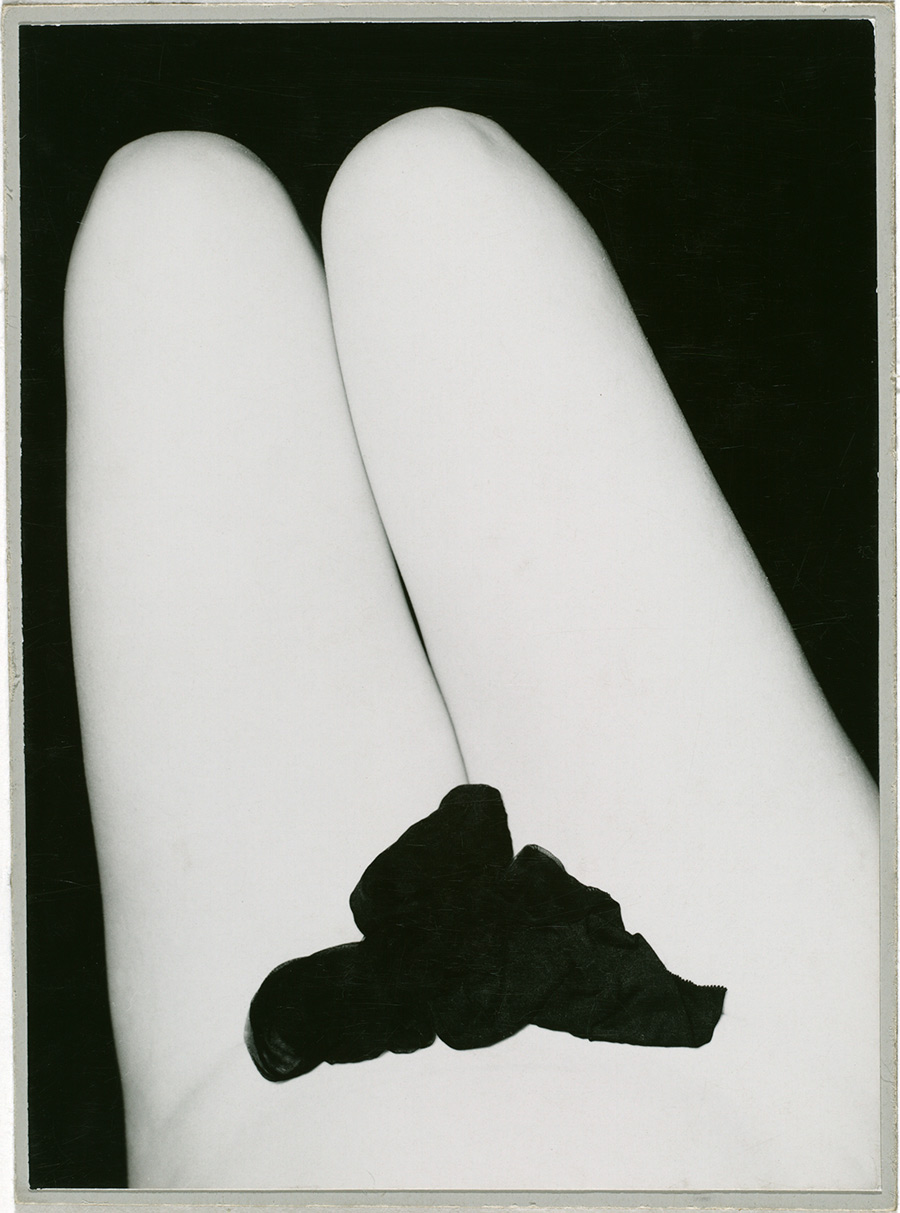
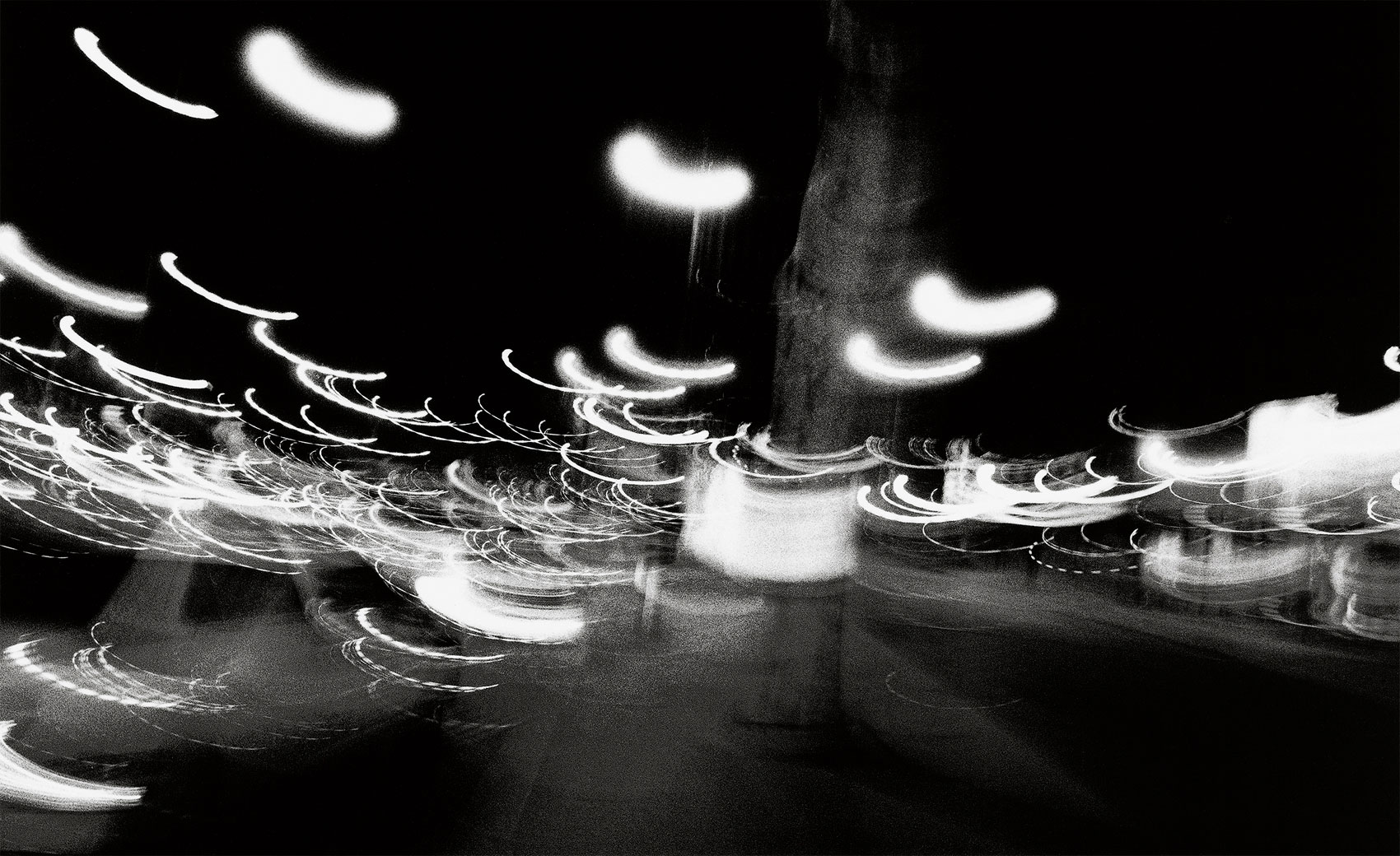
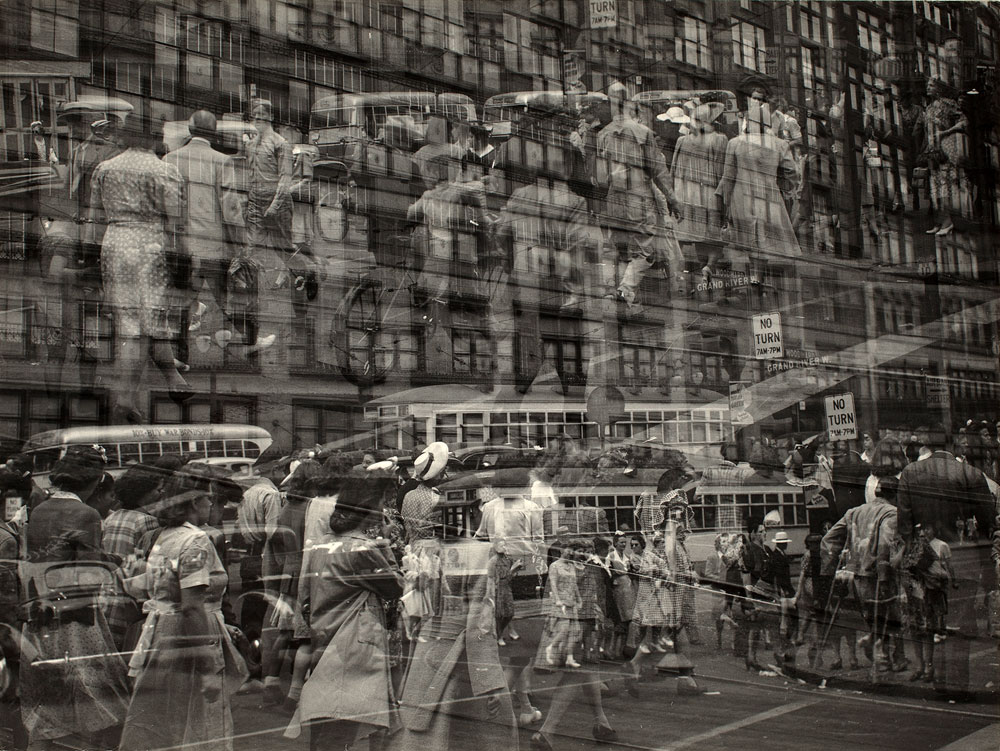
Harry Callahan (American, 1912-1999) 'Detroit' 1943


Harry Callahan (American, 1912-1999)
Detroit
1943
Gelatin silver print
Overall (sheet, trimmed to image): 8.3 x 11cm (3 1/4 x 4 5/16 in)
National Gallery of Art, Washington
Gift of the Callahan Family
© Estate of Harry Callahan, courtesy Pace/MacGill Gallery, New York


For me, the early photographs of his wife Eleanor and Eleanor with their child Barbara and the most poignant, intimate and beautiful of Callahan’s work while the later modernist Cape Cod photographs presage the spirit and aesthetics of the New Topographics: Photographs of a Man-Altered Landscape of 1975. Mario Cutajar observes

“These pictures of strangely vacant, light haunted intersections of sky, land, and ocean are confrontations with the limits of both the ego and photography itself as the ego’s instrument. They are oriented toward death rather than life, intimating in a cold, unsentimental way passage to another world or, perhaps, the engulfing oblivion at the horizon.”

Dr Marcus Bunyan


Many thankx to the National Gallery of Art for allowing me to publish the photographs in the posting. Please click on the photographs for a larger version of the image.


Harry Callahan (American, 1912-1999) 'Chicago' 1950


Harry Callahan (American, 1912-1999)
Chicago
1950
Gelatin silver print
Sheet (trimmed to image): 19 x 24.2 cm (7 1/2 x 9 1/2 in.)
National Gallery of Art, Washington
© Estate of Harry Callahan, Collection of Pace/MacGill Gallery, New York


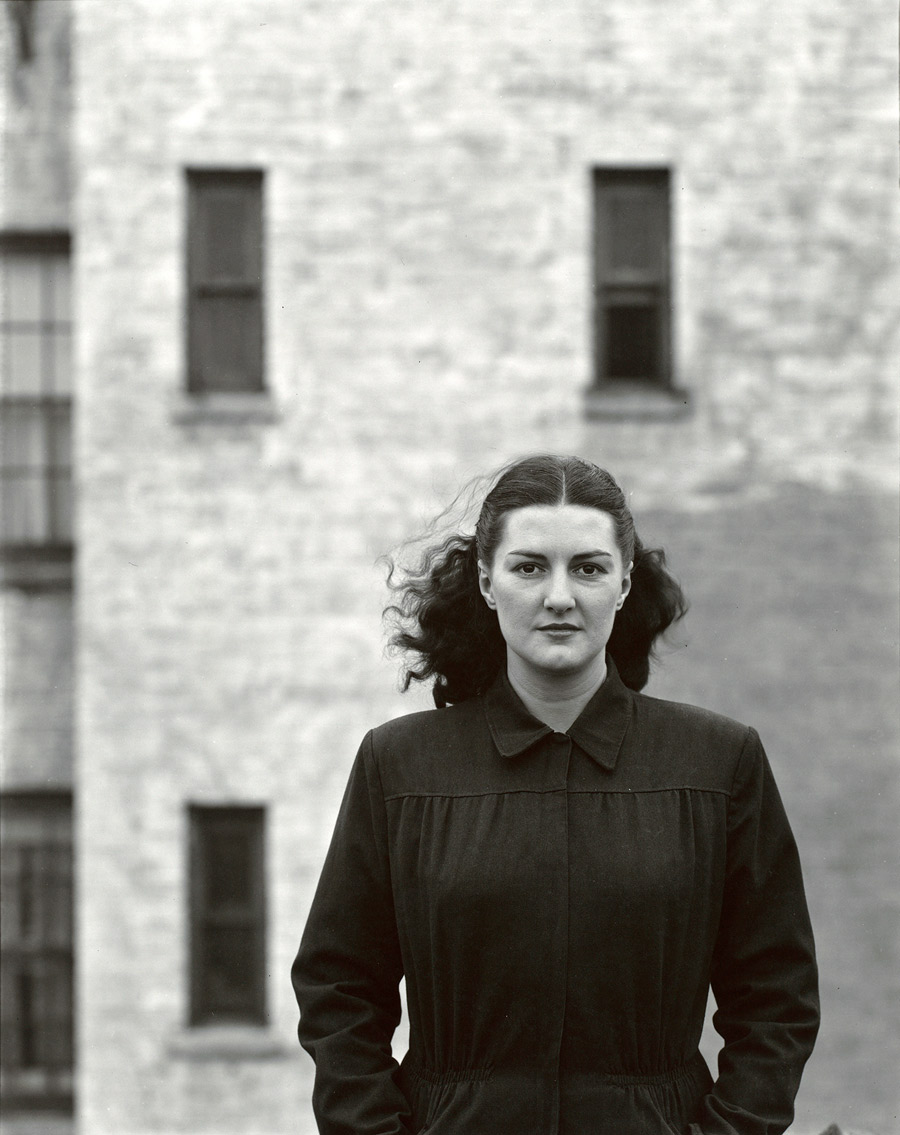
Harry Callahan (American, 1912-1999) 'Eleanor, Chicago' 1952


Harry Callahan (American, 1912-1999)
Eleanor, Chicago
1952
Gelatin silver print
National Gallery of Art, Washington
© Estate of Harry Callahan, Collection of Pace/MacGill Gallery, New York


Harry Callahan (American, 1912-1999) 'Ivy Tentacles on Glass, Chicago' c. 1952


Harry Callahan (American, 1912-1999)
Ivy Tentacles on Glass, Chicago
c. 1952
Gelatin silver print
Image (can’t tell sheet size due to matting): 19.21 x 24.13cm (7 9/16 x 9 1/2 in.)
National Gallery of Art, Washington
Gift of Susan and Peter MacGill
© Estate of Harry Callahan, Collection of Pace/MacGill Gallery, New York


Harry Callahan (American, 1912-1999) 'Eleanor and Barbara, Chicago' 1953


Harry Callahan (American, 1912-1999)
Eleanor and Barbara, Chicago
1953
Gelatin silver print
Overall (image): 19.5 x 24.45cm (7 11/16 x 9 5/8 in)
National Gallery of Art, Washington
Promised Gift of Susan and Peter MacGill
© Estate of Harry Callahan, courtesy Pace/MacGill Gallery, New York


Harry Callahan (American, 1912-1999) 'Cape Cod' 1972


Harry Callahan (American, 1912-1999)
Cape Cod
1972
Gelatin silver print
Overall (image): 23.7 x 23.9cm (9 5/16 x 9 7/16 in)
National Gallery of Art, Washington
Gift of Joyce and Robert Menschel
© Estate of Harry Callahan, courtesy Pace/MacGill Gallery, New York


Harry Callahan (American, 1912-1999) 'Cape Cod' 1974


Harry Callahan (American, 1912-1999)
Cape Cod
1974
Gelatin silver print
Overall (image): 21.8 x 22.6cm (8 9/16 x 8 7/8 in.)
National Gallery of Art, Washington
Gift of Joyce and Robert Menschel
© Estate of Harry Callahan, courtesy Pace/MacGill Gallery, New York


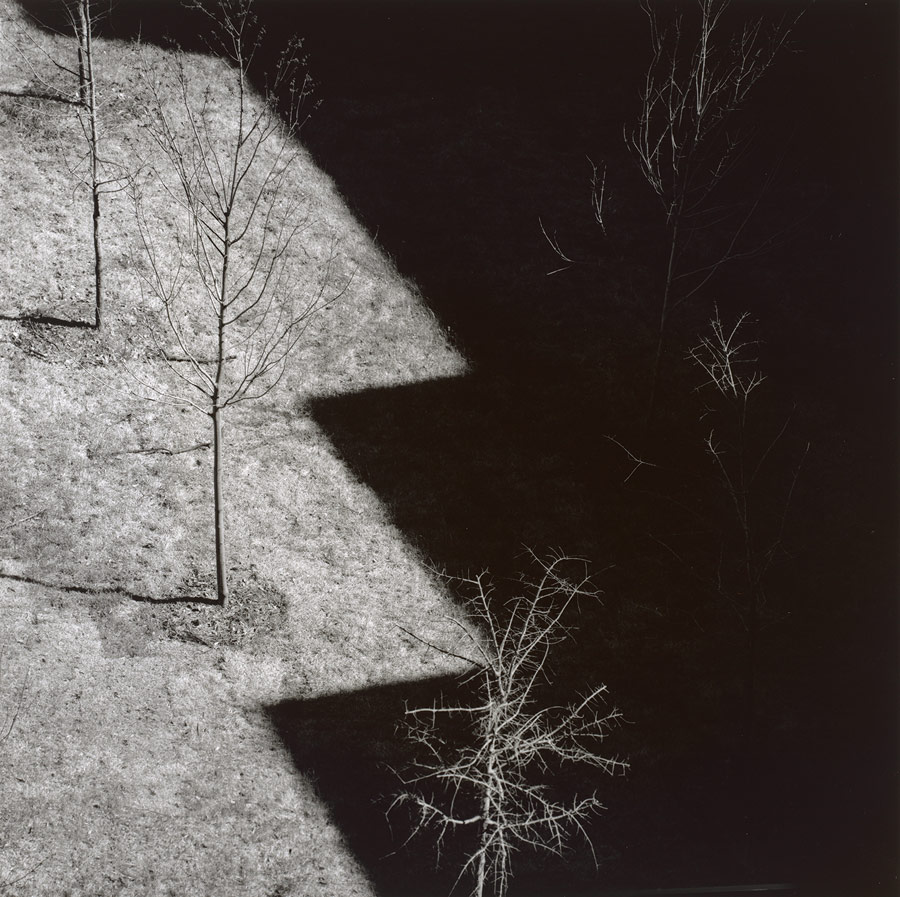
Harry Callahan (American, 1912-1999) 'Ansley Park, Atlanta' 1992


Harry Callahan (American, 1912-1999)
Ansley Park, Atlanta
1992
Gelatin silver print
Overall (image): 15.72 x 15.72cm (6 3/16 x 6 3/16 in)
National Gallery of Art, Washington
Gift of Susan and Peter MacGill
© Estate of Harry Callahan, courtesy Pace/MacGill Gallery, New York


The year 2012 marks the centenary of the birth of Harry Callahan (1912-1999), whose highly experimental, visually daring, and elegant photographs made him one of the most innovative artists of the 20th century.

On view in the West Building of the National Gallery of Art from October 2, 2011, through March 4, 2012, Harry Callahan at 100 explores all facets of his work in some 100 photographs, from its genesis in the early 1940s Detroit to its flowering in Chicago in the late 1940s and 1950s, and finally to its maturation in Providence and Atlanta from the 1960s through the 1990s. In 1996, the Gallery organised the exhibition Harry Callahan, which traveled to Philadelphia, Atlanta, Detroit, and Chicago, and included numerous works on loan from the artist.

“Using the rich holdings of the Gallery’s own collection of Callahan’s work, as well as a large collection of photographs on long-term loan from the artist’s widow, the exhibition will reveal the remarkable consistency of his vision and will demonstrate how his strong, inventive formal language repeatedly enriched his art,” said Earl A. Powell III, director, National Gallery of Art.

The Exhibition

Organised thematically and chronologically, Harry Callahan at 100 examines Callahan’s work in relation to the places where he lived and to his family, unveiling his unparalleled devotion to both his subjects and the medium of photography.

In his earliest photographs made in and around Detroit, Callahan explored the limits of the camera, constructing photographs of multiple exposures in both black-and-white and colour. In works such as Twig in Snow (c. 1942) and Store Front and Reflections (c. 1943), he sought to capture simultaneously the simplicity and complexity of nature and the theatre of urban life.

Callahan continued his aesthetic and technical experiments through photographs of his wife, Eleanor. His nudes play with dramatic contrasts of light and dark: his layered multiple exposures reveal Eleanor’s body against landscapes and frosted glass windows (Eleanor, Chicago, 1948). His photographs of his wife and their daughter, Barbara, in the lake, the city, and the woods (Eleanor and Barbara, Lake Michigan, c. 1953) exploit the spontaneity and intimacy of snapshots – yet, paradoxically, were made with a large, cumbersome 8- x 10-inch view camera.

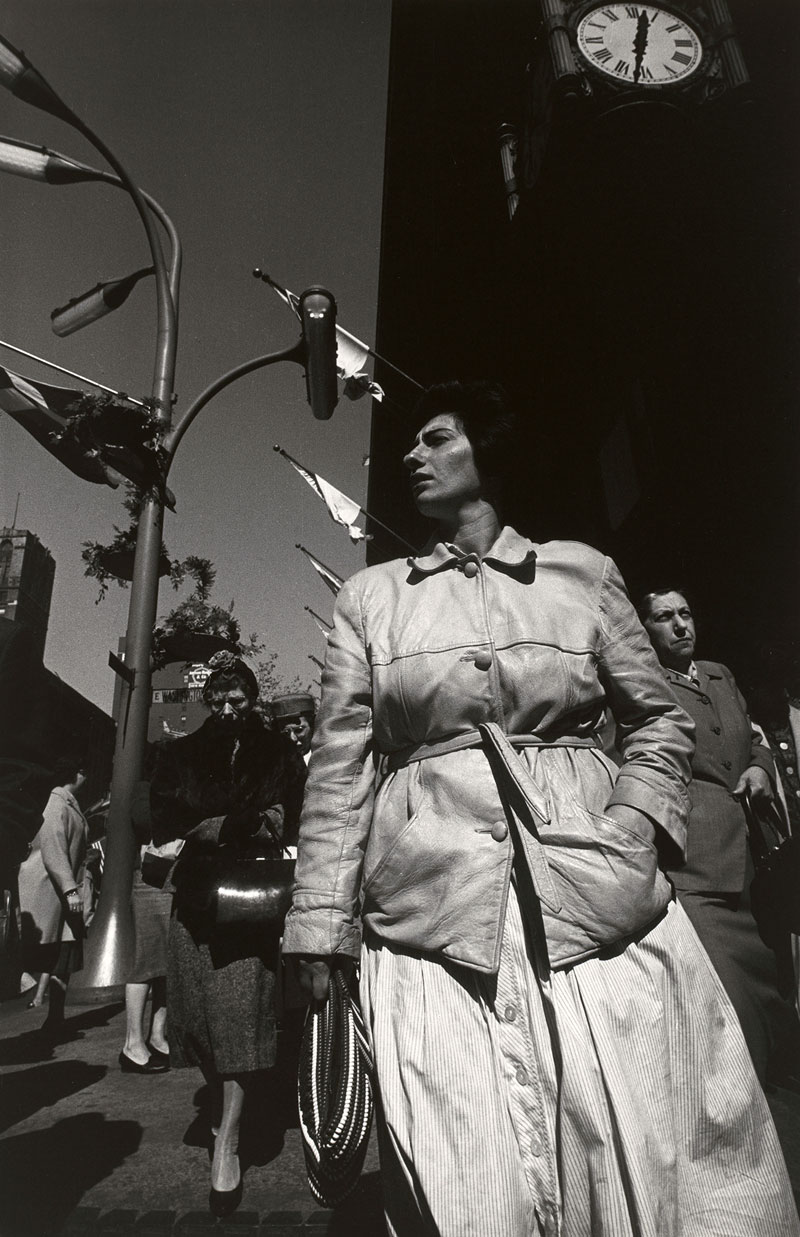
Callahan’s twin interests in the city and the land expanded during his years in Chicago and Providence, where he created both spare and evocative photographs of the natural landscape and complex compositions of urban architecture and pedestrians. He began to document anonymous women on the streets of Chicago, first in close shots of squinting eyes, open mouths, and downcast faces seen in Chicago (1950), then in full-figure shots from a low angle that feature the women against backgrounds of skyscrapers and flagpoles, as in Chicago (1961).

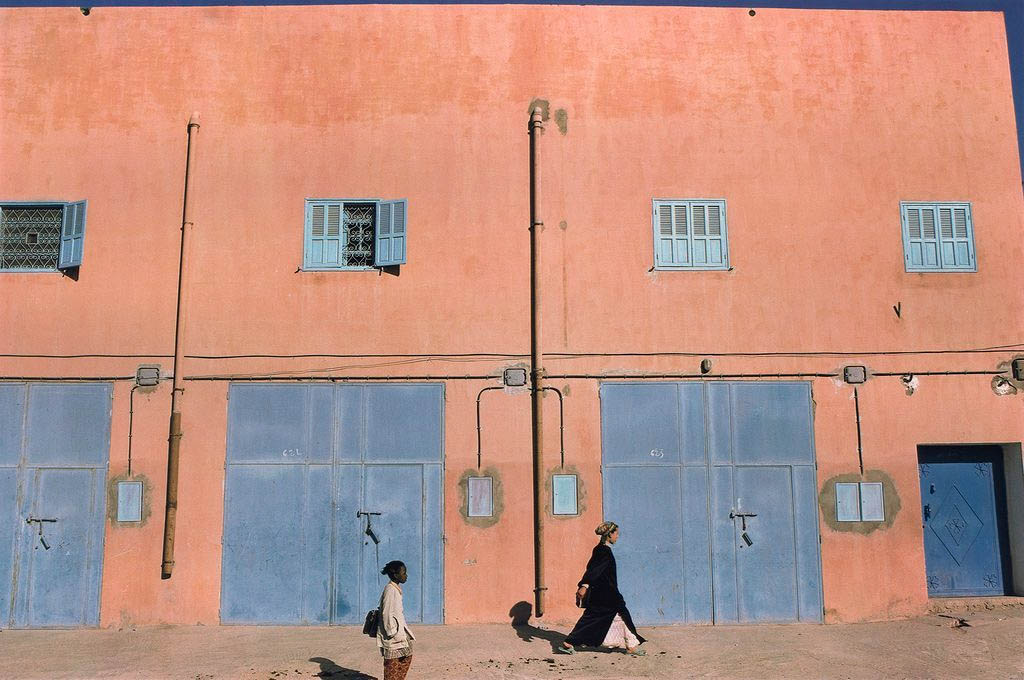
In the 1970s Callahan returned to colour photography, continuing to push the boundaries of the medium, seen in the well-known Providence (1977). Taken in Atlanta and during travels abroad, his late photographs emphasised vibrant colours, long shadows, and the complex humanity of urban life, seen in Morocco (1981) and Atlanta (1985).

Harry Callahan (1912-1999)

Born in Detroit in 1912, Callahan began to photograph in 1938. Although he received no formal training in the medium, his exceptional talent was immediately recognised. In 1946 László Moholy-Nagy hired him to teach at the Institute of Design in Chicago. There and at the Rhode Island School of Design (he moved to Providence in 1961) he taught generations of younger photographers, inspiring them both with the creativity of his vision and his steadfast commitment to the medium. In a career that spanned nearly six decades, he repeatedly explored a few select themes – his wife Eleanor and daughter Barbara, nature, and the urban environment. Yet each time he returned to a familiar subject, he reinvented it, endowing each photograph with both a personal and symbolic significance.

Press release from the National Gallery of Art website


Harry Callahan (American, 1912-1999) 'Eleanor, New York' 1945


Harry Callahan (American, 1912-1999)
Eleanor, New York
1945
Gelatin silver print
Overall (image): 21.2 x 16.83cm (8 3/8 x 6 5/8 in)
National Gallery of Art, Washington
Gift of the Callahan Family
© Estate of Harry Callahan, courtesy Pace/MacGill Gallery, New York


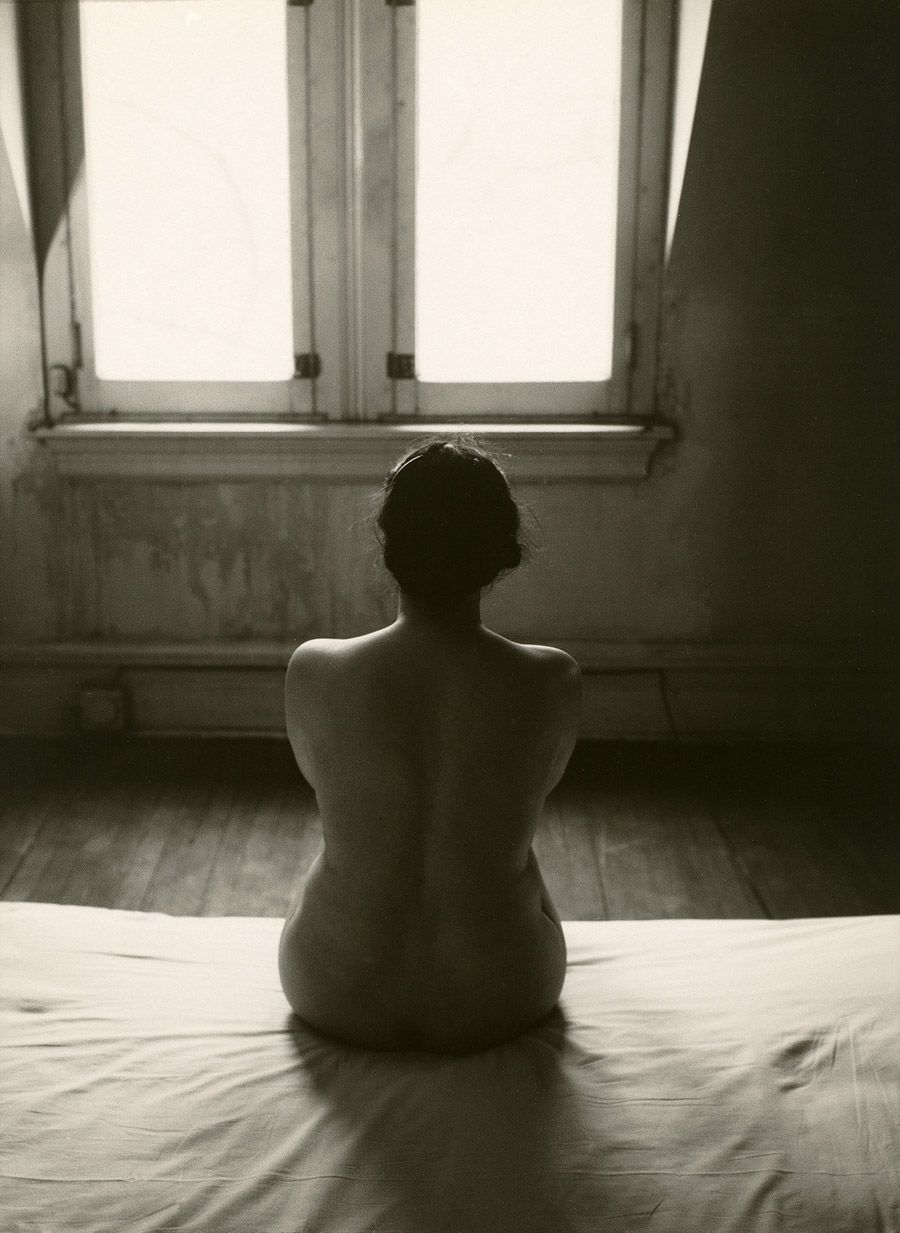
Harry Callahan (American, 1912-1999) 'Eleanor' about 1947


Harry Callahan (American, 1912-1999)
Eleanor
Chicago, 1947
Gelatin silver print
National Gallery of Art, Washington
The Herbert and Nannette Rothschild Memorial Fund in memory of Judith Rothschild
© Estate of Harry Callahan, courtesy Pace/MacGill Gallery, New York


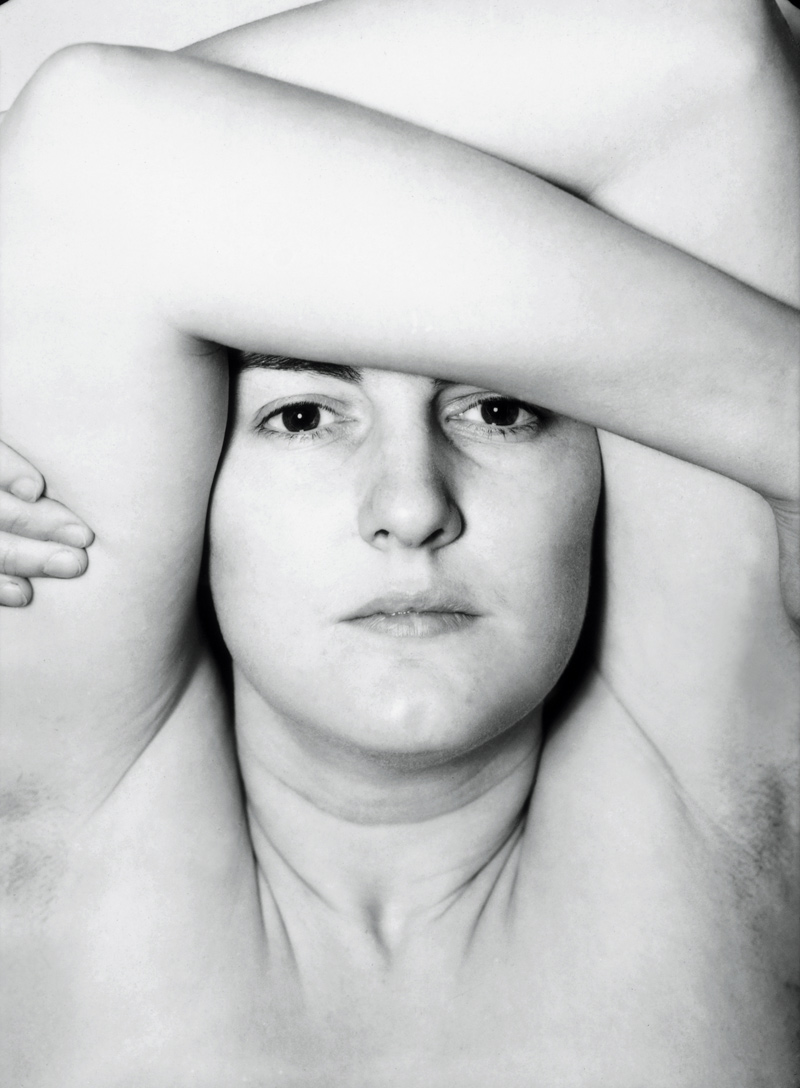
Harry Callahan (American, 1912-1999) 'Eleanor, Chicago' 1948


Harry Callahan (American, 1912-1999)
Eleanor, Chicago
1948
Gelatin silver print
Overall (image): 11.59 x 8.5cm (4 9/16 x 3 3/8 in)
National Gallery of Art, Washington
The Joyce and Robert Menschel Fund
© Estate of Harry Callahan, courtesy Pace/MacGill Gallery, New York


During the 1940s and ’50s, Callahan’s work was deeply affected by the resolutely humanizing presence of his wife, Eleanor, and daughter, Barbara. Frequent subjects, though consistently inscrutable, Eleanor and Barbara are the shadow puppets of his career, a direct testament to his family life, but always seen as if behind some kind of veil or scrim. They are markers of an intimacy that Callahan never violates by direct exposure.

Eleanor, in particular, is photographed down to the very last details of anatomy. She remembers that during these years, she might be cooking or cleaning, and suddenly Harry would announce: “‘Take off your clothes.’ And that would be that.”

The results are sometimes staggering. A 1947 image of what appears to be the lines created by Eleanor’s legs and buttocks looks like a Cycladic statue, relentlessly rectilinear but soft around the edges, freakishly modern and ancient at the same time. An 1953 image of Eleanor and Barbara bathing in Lake Michigan dissolves the horizon, fusing lake and sky into a field of shimmering gray. The two figures seem suspended in space, dematerialized, like characters in a dream.

It’s a small miracle that no matter how much Callahan’s camera dissects the world, the photographs never seem clinical. He divorces things from context, pulls out small vignettes from the larger city, but without violence, and without the gamesmanship of a photographer inclined to the cheap surreal.

Philip Kennicott. “Review: Harry Callahan photography exhibit at the National Gallery of Art,” on The Washington Post website October 4, 2011 [Online] Cited 22/02/2012


Harry Callahan (American, 1912-1999) 'Eleanor, Chicago' c. 1947


Harry Callahan (American, 1912-1999)
Eleanor, Chicago
c. 1947
Gelatin silver print
Overall (sheet, trimmed to image): 11.91 x 8.6cm (4 11/16 x 3 3/8 in)
National Gallery of Art, Washington
Promised Gift of Susan and Peter MacGill
© Estate of Harry Callahan, courtesy Pace/MacGill Gallery, New York


Harry Callahan (American, 1912-1999) 'Chicago' 1961


Harry Callahan (American, 1912-1999)
Chicago
1961
Gelatin silver print
Overall (image):
40.6 x 27.1cm (16 x 10 11/16 in)
National Gallery of Art, Washington
Gift of the Callahan Family
© Estate of Harry Callahan, courtesy Pace/MacGill Gallery, New York


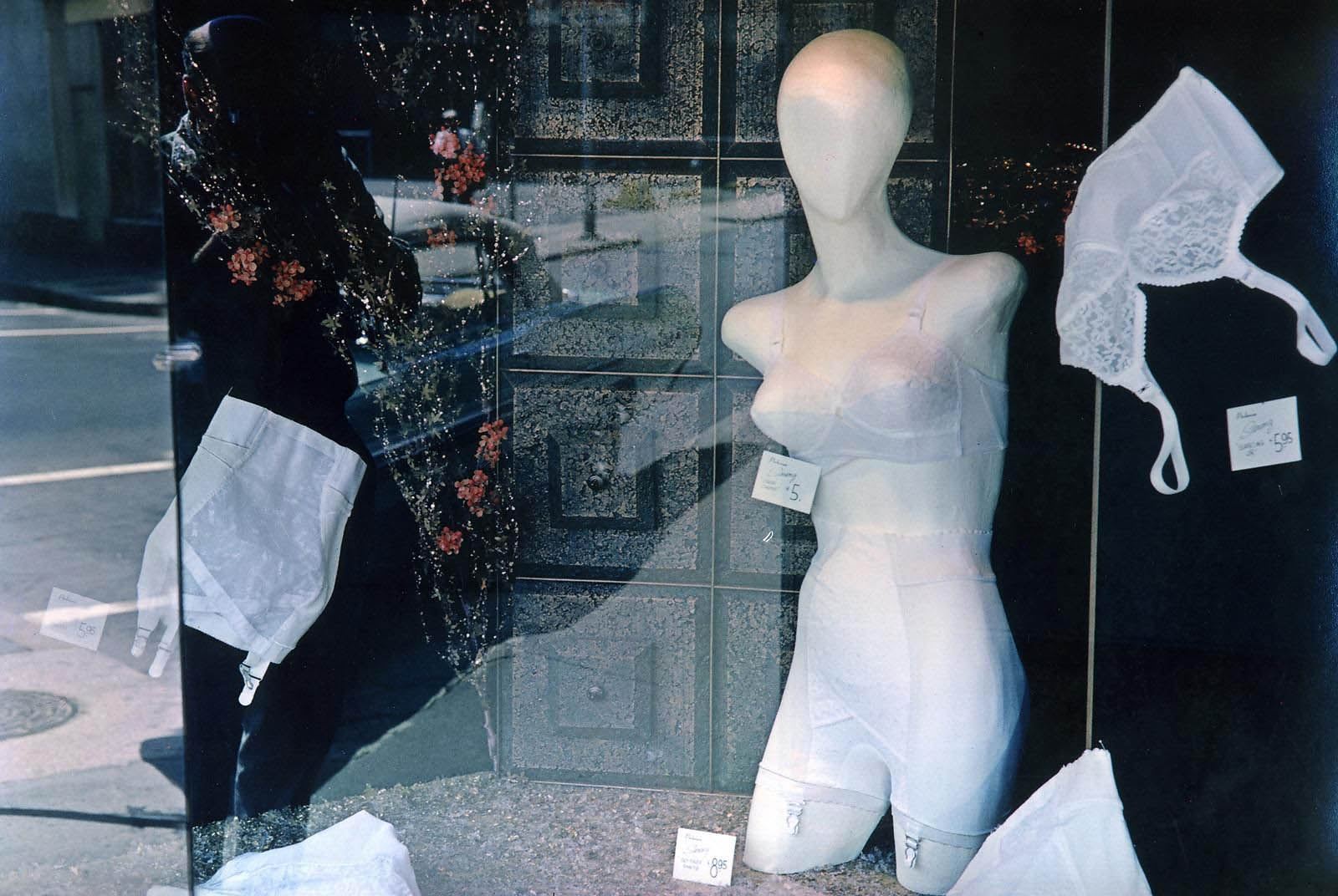
Harry Callahan (American, 1912-1999) 'Store Window with Mannequin with Lingerie, Providence' 1962


Harry Callahan (American, 1912-1999)
Store Window with Mannequin with Lingerie, Providence
1962
Dye imbibition print
22.4 x 34.1cm (8 13/16 x 13 7/16 in.)
National Gallery of Art, Washington
Gift of Mary and Dan Solomon and Patrons’ Permanent Fund
© Estate of Harry Callahan, courtesy Pace/MacGill Gallery, New York


Harry Callahan (American, 1912-1999) 'Kansas City' 1981


Harry Callahan (American, 1912-1999)
Kansas City
1981
Dye imbibition print
Overall (image): 24.3 x 36.7cm (9 9/16 x 14 7/16 in.)
National Gallery of Art, Washington
Gift of The Very Reverend and Mrs. Charles U. Harris
© Estate of Harry Callahan, courtesy Pace/MacGill Gallery, New York


Harry Callahan (American, 1912-1999) 'Morocco' 1981


Harry Callahan (American, 1912-1999)
Morocco
1981
Dye imbibition print
Overall (image): 24.2 x 36.7cm (9 1/2 x 14 7/16 in.)
National Gallery of Art, Washington
Gift of the Collectors Committee
© Estate of Harry Callahan, courtesy Pace/MacGill Gallery, New York


Harry Callahan (American, 1912-1999) 'Atlanta' 1985


Harry Callahan (American, 1912-1999)
Atlanta
1985
Dye imbibition print
Overall (image): 24.4 x 36.7cm (9 5/8 x 14 7/16 in.)
National Gallery of Art, Washington
Gift of the Callahan Family
© Estate of Harry Callahan, courtesy Pace/MacGill Gallery, New York


National Gallery of Art
National Mall between 3rd and 7th Streets
Constitution Avenue NW, Washington

Opening hours:
Daily 10.00am – 5.00pm

National Gallery of Art website

LIKE ART BLART ON FACEBOOK

Back to top

Text/Exhibition: “George Platt Lynes, Minor White and ‘The Temptation of Saint Anthony Is Mirrors’ ” on the exhibition ‘HIDE/SEEK: Difference and Desire in American Portraiture’ at the Brooklyn Museum, New York

Exhibition dates: 18th November 2011 – 12th February 2012


Minor White (American, 1908-1976) 'Tom Murphy (San Francisco)' 1948


Minor White (American, 1908-1976)
Tom Murphy (San Francisco)
1948
from The Temptation of St Anthony is Mirrors 1948
Gelatin silver print
4 5/8 x 3 5/8 in. (11.7 x 9.2cm)
The Minor White Archive, Princeton University Art Museum Bequest of Minor White, MWA 48-136
© Trustees of Princeton University


“The possibility of using our bodies as a possible source of very numerous pleasures is something that is very important. For instance, if you look at the traditional construction of pleasure, you see that bodily pleasure, or pleasures of the flesh, are always drinking, eating and fucking. And that seems to be the limit of the understanding of our bodies, our pleasures ….

It is very interesting to note, for instance, that for centuries people generally, as well as doctors, psychiatrists, and even liberation movements, have always spoken about desire, and never about pleasure. “We have to liberate our desire,” they say. No! We have to create new pleasure. And then maybe desire will follow.” (My bold)


Michel Foucault 1


George Platt Lynes, Minor White and The Temptation of Saint Anthony Is Mirrors

I had the great privilege of visiting The Minor White Archive at Princeton University while I was researching for my PhD. While there I studied the work cards and classic prints of the great photographer, paying particular attention to his photography of the male. What was a great surprise and delight to me were the presence of photographs of explicit sexual acts, men photographed with erections – images that have, to my knowledge, never been published. I don’t think that many people would even know that Minor White took such photographs. Although these images would have never been for public consumption it is still very unusual to find a classical photographer with such a public profile taking photographs of erect penises, especially in the 1940s!

Disturbed by having been in battle in the Second World War and seeing some of his best male friends killed, White’s early photographs of men (in their uniforms) depict the suffering and anguish that the mental and physical stress of war can cause. He was even more upset than most because he was battling his own inner sexual demons at the same time, his shame and disgust at being a homosexual and attracted to men, a difficulty compounded by his religious upbringing. In his photographs White both denied his attraction to men and expressed it. His photographs of the male body are suffused with both sexual mystery and a celebration of his sexuality despite his bouts of guilt. After the war he started to use the normal everyday bodies of his friends to form sequences of photographs, sometimes using the body as a metaphor for the landscape and vice versa. In the above photograph (Tom Murphy, left), based on a religious theme, we see a dismembered hairy body front on, the hands clutching and caressing the body, the lower hand hovering near the exposed genitalia, the upper hand cupping the breast. We see the agony and ecstasy of a homoerotic desire cloaked in a religious theme.

The image comes from the The Temptation of St Anthony is Mirrors (1948), four pages of which can be seen below. While at The Minor White Archive I looked at the only complete, undamaged book in existence. What an experience!

The book has a powerful and intense presence. It was beautifully sequenced as you would expect from Minor White and features photographs of Tom Murphy. There is a series of his hands over the back of a chair in different positions: hanging, curled, splayed, held slightly upwards, and these are paired with photographs of bare feet and turned up jeans, bare feet and rocks, and three other photographs of Tom Murphy. In an excellent paper Cruising and Transcendence in the Photographs of Minor White (Nd. Later published as an online-only feature accompanying Aperture magazine’s Spring 2015 issue, “Queer”), author Kevin Moore observes that the hand-bound volume with images paired on facing pages – “mirrors” to both one another and the artist – is a personal account as well as a meditation on the sins of the flesh.

“Temptation (which was never published or exhibited) begins with a sort of prologue, comprising a single full-length nude of Tom Murphy, White’s student and the model most commonly associated with his work. The pose is similar to those found in the beefcake pictures White was producing at this time: Murphy adopts a classical contrapposto stance and is entirely nude, his pale, wiry body positioned against a dark backdrop. A piece of driftwood at the model’s feet proposes a theme of innocence – man in his natural state. The sequence then moves to pairings of images describing man in his civilised state, featuring several loving close-ups of Murphy’s gesturing hands, a shot of his bare feet, and a single shoulder-length portrait, in which he wears a buttoned shirt and looks intently off to the side. Next, there is an interlude suggesting growing dissolution: an image of Murphy’s feet and a petrified stone is paired with a shot of Murphy in full dress slouched on a mass of rocks and staring vacantly off into the distance. The next pairing (images 9 and 10 below) accelerates the descent into temptation. Here, the pose in a second picture of Murphy’s feet suggests agitation, while a three-quarter length portrait of Murphy, crouched in the bushes and looking back over his shoulder, is as emblematic an image of cruising as White ever produced. The photographs that follow descend further into lust and self-recrimination, conveyed through photographs in which Murphy’s naked body alternates between expressions of pain and pleasure. The sequence ends with a series of beatific nudes (images 27 and 28 below), which express redemption through nonsexual treatments of the body and in the body’s juxtaposition with natural forms – a return to nature.

White may have thought at first that the sequence format would help him transcend the limits of personal biography, that he could use the breadth and fluidity of the sequence to emphasize a universal narrative while exercising control over the potentially explosive and revealing content of individual images. This proved to be overly optimistic, at least in his earliest uses of the form. White’s colleagues, for example, immediately understood Temptation for what it really was: an agonized portrayal of White’s love for his male student.”


Moore goes on to conclude that White obsfucated his sexuality, displacing gay ‘cruising’ “by a universalised mystical searching – sexual longing setting in motion a heroic search” using photography as his medium, and that his photographs became a dreamscape, perhaps even a dream(e)scape: “in which meanings are obscured, not clarified; signs are effaced, not illuminated; beauty is closeted, not set out for all to see. White was attracted to the ambiguity of the dream because it offered cover and protection but also freedom to maneuver. The dream supported the irrational, maintained a sense of mystery, and beautified frustration.”

I have to disagree with Kevin Moore. Anyone who has seen The Temptation of Saint Anthony Is Mirrors in the flesh (so to speak) can feel the absolute presence of these images, their reality, the connection between image and viewer. Maybe White was a Romantic but he was realistically romantic; his images are not dreamscapes, they offer multiple readings and contexts, insights into the human condition. Even though there was anguish and guilt present about his sexuality, channelled through his photography, anyone bold enough to take photographs of erections in 1940 has some ticker. It takes a clear eye and a courageous heart to do this, knowing what was at stake in this era of sexual repression. Beauty is not closeted here, unless I am looking at different images from Kevin Moore. In fact the magic of the photography of Minor White is his ability to modulate space, to modulate bodies so that they are beautiful, ambiguous and mystical whatever their context. Not everything in this world has to be in your face. Like a Glen Gould playing the Goldberg Variations revelation of beauty takes time, concentration and meditation.

Also, an overriding feeling when viewing the images was one of loneliness, sadness and anguish, for the bodies seemed to be observed and not partaken of, to be unavailable both physically and in a strange way, photographically. For a photographer who prided himself on revealing the spirit within, through photography, these are paradoxical photographs, visually accessible and mysteriously (un)revealing, photographs of a strange and wonderful ambivalence. Two great words: obsfucation, ambivalence. Clouded with mixed feelings and emotions, not necessarily anything to do with sexuality. Not everything has to be about sexuality. It is the difference between imbibing Freud or Jung – personally I prefer the more holistic, more inclusive, more spiritual Jung.


And so to the image of George Platt Lynes that I have paired with the nude of Tom Murphy (below).

Platt Lynes was another artist who struggled with is sexuality, but seemingly not to such an extent as Minor White did. GPL worked as a fashion photographer and had his own studio in New York where he photographed dancers, artists and celebrities among others. He undertook a series of mythological photographs on classical themes (which are amazing in composition and feature Surrealist motifs). Privately he photographed male nudes but was reluctant to show them in public for fear of the harm that they could do to his reputation and business with the fashion magazines. Generally his earlier male nude photographs concentrate on the idealised youthful body or ephebe.

As Lynes became more despondent with his career as a fashion photographer his private photographs of male nudes tended to take on a darker and sharper edge. After a period of residence in Hollywood he returned to New York nearly penniless. His style of photographing the male nude underwent a revision. While the photographs of his European colleagues still relied on the sun drenched bodies of young adolescent males evoking memories of classical beauty and the mythology of Ancient Greece the later nudes of Platt Lynes feature a mixture of youthful ephebes and heavier set bodies which appear to be more sexually knowing. The compositional style of dramatically lit photographs of muscular torsos of older men shot in close up (see photograph below for example) were possibly influenced by a number of things – his time in Hollywood with its images of handsome, swash-buckling movie stars with broad chests and magnificent physiques; the images of bodybuilders by physique photographers that George Platt Lynes visited; the fact that his lover George Tichenor had been killed during WWII; and the knowledge that he was penniless and had cancer. There is, I believe, a certain sadness but much inner strength in his later photographs of the male nude that harnesses the inherent sexual power embedded within their subject matter.

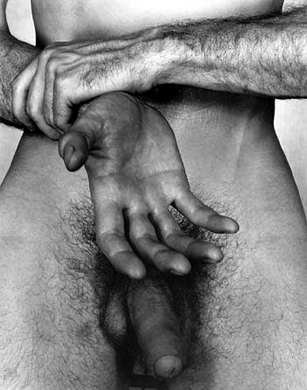
When undertaking research into GPL’s photographs at The Kinsey Institute as part of my PhD I noted that most of the photographs had annotations in code on the back of them giving details of age, sexual proclivities of models and what they are prepared to do and where they were found. This information gives a vital social context to GPL’s nude photographs of men and positions them within the moral and ethical framework of the era in which they were made. The strong image (below) is always quoted as an example of GPL’s more direct way of photographing the male nude in the last years of his life. The male is solid, imposing, lit from above, heavy set, powerful, massive. The eyes are almost totally in shadow. Later photos have more chiaroscuro than earlier work, more use of contrasting light (especially down lit or uplit figures) but are they more direct? Yes. The men look straight into camera.

This monumentality of body and form was matched by a new openness in the representation of sexuality. There are intimate photographs of men in what seem to be post-coital revere, in unmade beds, genitalia showing or face down showing their butts off. Some of the faces in these later photographs remain hidden, as though disclosure of identity would be detrimental for fear of persecution. The photograph above is very ‘in your face’ for the conservative time from which it emerges, remembering it was the era of witch hunts against communists and subversives (including homosexuals). Conversely, this photograph is quite restrained compared to the most striking series of GPL’s photographs that I saw at The Kinsey Institute which involves an exploration the male anal area (a photograph from the 1951 series can be found in the book titled George Platt Lynes: Photographs from The Kinsey Institute). This explicit series features other photographs of the same model – in particular one that depicts the male with his buttocks in the air pulling his arse cheeks apart. After Lynes found out he had cancer he started to send his photographs to the German homoerotic magazine Der Kries under the pseudonym Roberto Rolf, and in the last years of his life he experimented with paper negatives, which made his images of the male body even more grainy and mysterious.

I believe that Lynes understood, intimately, the different physical body types that gay men find desirable and used them in his photographs. He visited Lon of New York (a photographer of beefcake men) in his studio and purchased photographs of bodybuilders for himself, as did the German photographer George Hoyningen-Huene. It is likely that these images of bodybuilders did influence his later compositional style of images of men; it is also possible that he detected the emergence of this iconic male body type as a potent sexual symbol, one that that was becoming more visible and sexually available to gay men.


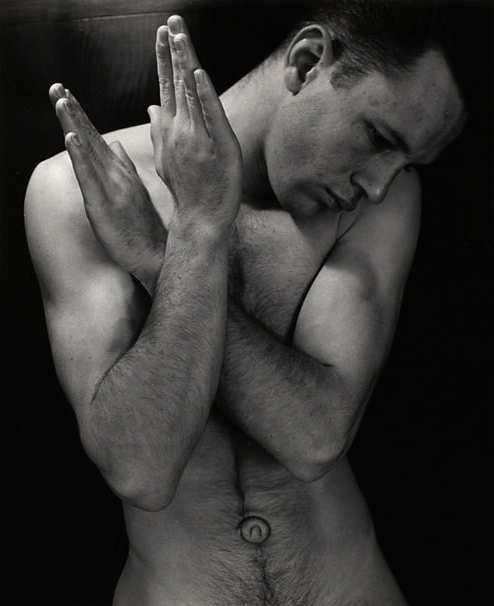
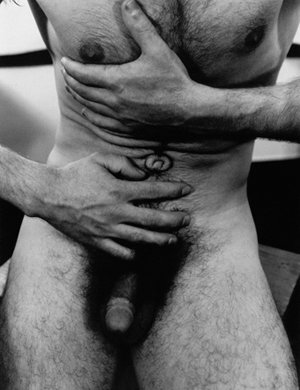
The differences between the White and GPL nudes is instructive. White: introspective, haunted, religious with an unrequited sense of longing – hands clutching self, inward pointing; GPL: more closely cropped, more open, one hand firmly grasping but the other hand open, receptive, presented to the viewer above the available phallic organ. It reminds me for some unknown reason, some quirk of my brain association, of the shell of Botticelli’s Birth of Venus (1486) inverted. There is difference between the two artists – one struggling with his sexuality, being realistically romantic, the other physically doing something about it – posting his photographs to one of the first gay magazines in the world. But both were taking photographs of intimate sexual acts that could never have been published in their lifetimes – that are still are hidden from view today. When, oh when, will someone have the courage to publish this work?

Dr Marcus Bunyan


My notes on Minor White’s photographs and notes on George Platt Lynes photographs from my Phd thesis Pressing the Flesh: Sex, Body Image and the Gay Male (2001) can be found below.


Many thankx to the Brooklyn Museum for allowing me to publish the photographs in the posting. Please click on the photographs for a larger version of the image.

1/ Gallagher, Bob and Wilson, Alexander. “Sex and the Politics of Identity: An Interview with Michel Foucault,” in Thompson, Mark. Gay Spirit: Myth and Meaning. New York: St. Martin’s Press, 1987, p.31.


Research notes on photographs from the Minor White Archive, Princeton University, New Jersey 06/08/1999

Download the Minor White research notes (85kb pdf)

Research at The Kinsey Institute , Bloomington, Indiana 16/08/1999 – 19/08/1999. George Platt Lynes photographs from the Collection at The Kinsey Institute

Download the George Platt Lynes research notes (55kb pdf)


Minor White (American, 1908-1976) 'The Temptation of Saint Anthony Is Mirrors' 1948


(top)
Minor White (American, 1908-1976)
Images 9 and 10 in the bound sequence The Temptation of Saint Anthony Is Mirrors
1948
9.3 x 11.8cm; 11.2 x 9.1cm

(bottom)
Minor White (American, 1908-1976)
Images 27 and 28 in the bound sequence The Temptation of Saint Anthony Is Mirrors
1948. 5.3 x 11.6cm; 10.6 x 8.9cm


 Minor White (American, 1908-1976) 'Tom Murphy (San Francisco)' 1948  George Platt Lynes (American, 1907-1955) 'Untitled' Nd


(left)
Minor White (American, 1908-1976)
Tom Murphy (San Francisco)
1948
from The Temptation of St Anthony is Mirrors 1948
Gelatin silver print
4 5/8 x 3 5/8 in. (11.7 x 9.2 cm)

(right)
George Platt Lynes 
(American, 1907-1955)
Untitled
Nd
Gelatin silver print
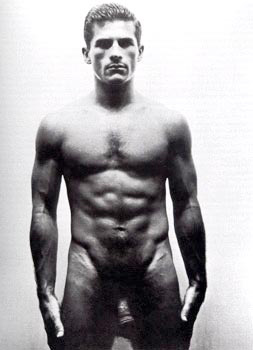
 

George Platt Lynes (American, 1907-1955) 'Untitled (Frontal Male Nude)' Nd (early 1950s)


George Platt Lynes (American, 1907-1955)
Untitled (Frontal Male Nude)
Nd (early 1950s)
Gelatin silver print
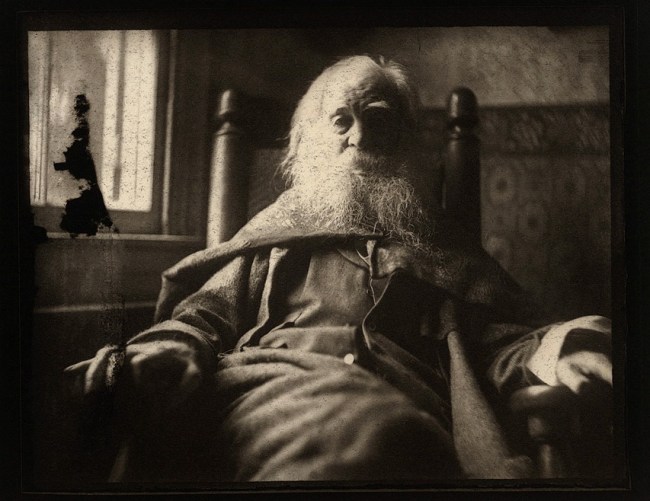
 

Thomas Eakins (American, 1844-1916) 'Walt Whitman' (American, 1818-1892) 1891


Thomas Eakins (American, 1844-1916)
Walt Whitman (American, 1818-1892)
1891
10.3 x 12.2cm
National Portrait Gallery, Smithsonian Institute
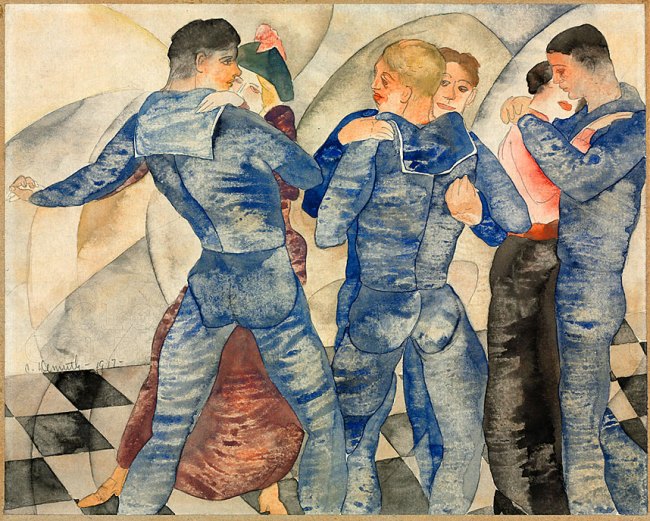
 

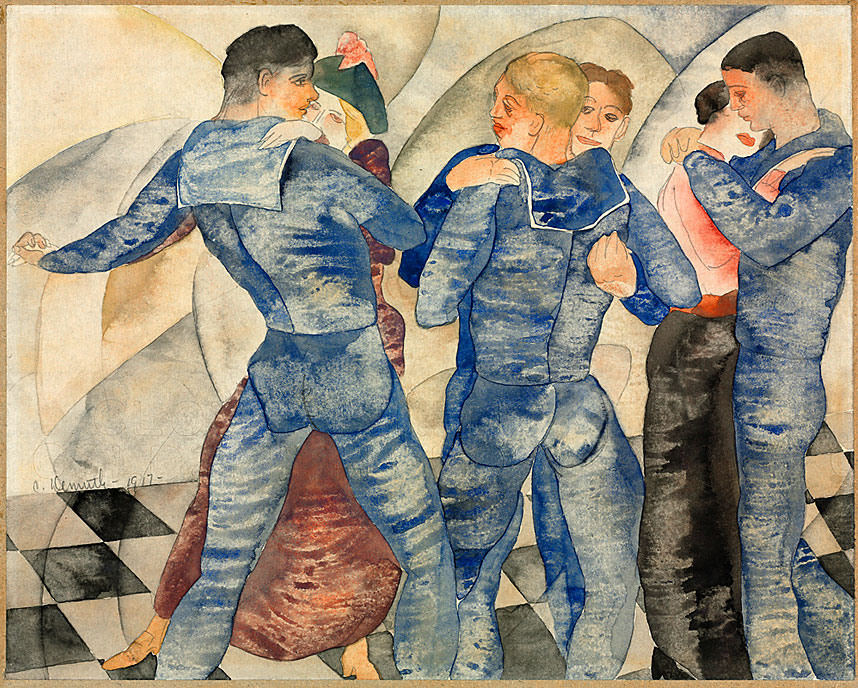
Charles Demuth (American, 1883-1935) 'Dancing Sailors' 1917


Charles Demuth (American, 1883-1935)
Dancing Sailors
1917
Watercolour and pencil on paper
20.3 x 25.4cm
Cleveland Museum of Art, Ohio; Mr and Mrs William H Marlatt Fund


George Wesley Bellows (American, 1882-1925) 'Riverfront No.1' 1915


George Wesley Bellows (American, 1882-1925)
Riverfront No.1
1915
Oil on canvas
115.3 x 160.3cm
Columbus Museum of Art, Ohio: Howald Fund Purchase


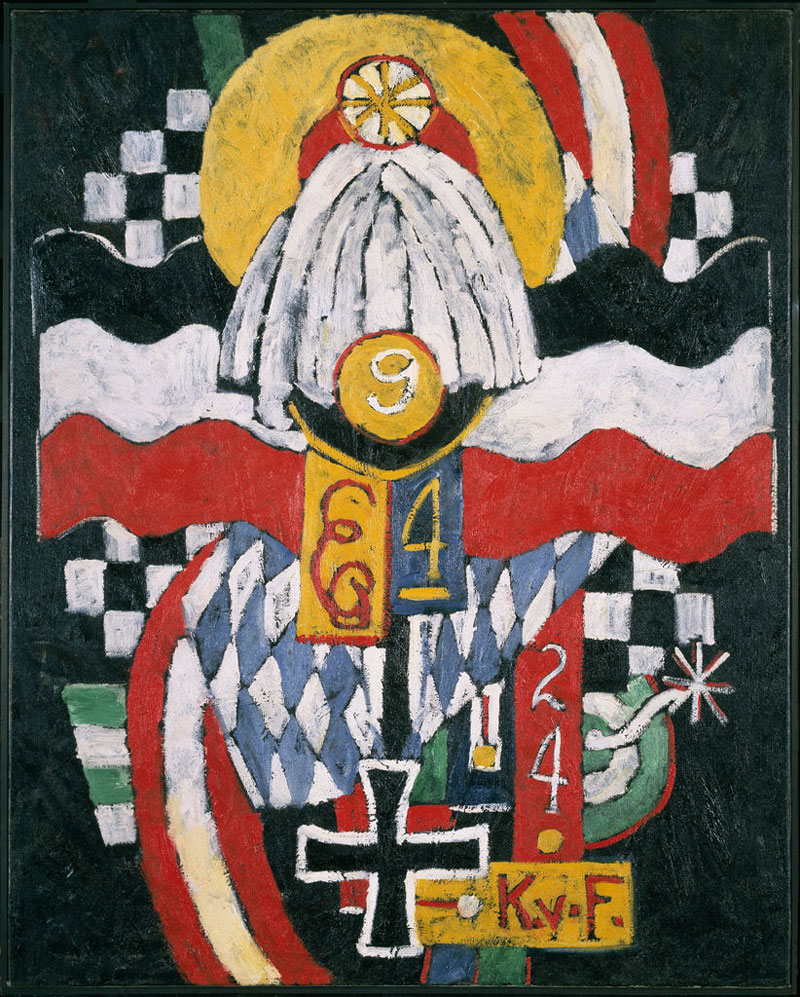
Marsden Hartley (American, 1877-1943) 'Eight Bells Folly: Memorial to Hart Crane' 1933


Marsden Hartley (American, 1877-1943)
Eight Bells Folly: Memorial to Hart Crane
1933
Oil on canvas
Gift of Ione and Hudson D. Walker
Frederick R. Weisman Art Museum, University of Minnesota


Harold Hart Crane (July 21, 1899 – April 27, 1932) was an American poet. Finding both inspiration and provocation in the poetry of T. S. Eliot, Crane wrote modernist poetry that is difficult, highly stylised, and very ambitious in its scope. In his most ambitious work, The Bridge, Crane sought to write an epic poem in the vein of The Waste Land that expressed something more sincere and optimistic than the ironic despair that Crane found in Eliot’s poetry. In the years following his suicide at the age of 32, Crane has come to be seen as one of the most influential poets of his generation…

Crane visited Mexico in 1931-32 on a Guggenheim Fellowship and his drinking continued as he suffered from bouts of alternating depression and elation … While on board the steamship SS Orizaba enroute to New York, he was beaten after making sexual advances to a male crew member, seeming to confirm his own idea that one could not be happy as a homosexual. Just before noon on April 27, 1932, Hart Crane jumped overboard into the Gulf of Mexico. Although he had been drinking heavily and left no suicide note, witnesses believed his intentions to be suicidal, as several reported that he exclaimed “Goodbye, everybody!” before throwing himself overboard. (The legend among poets is: He walked to the fantail, took off his coat quietly, and jumped.) His body was never recovered.

Text from the Wikipedia website
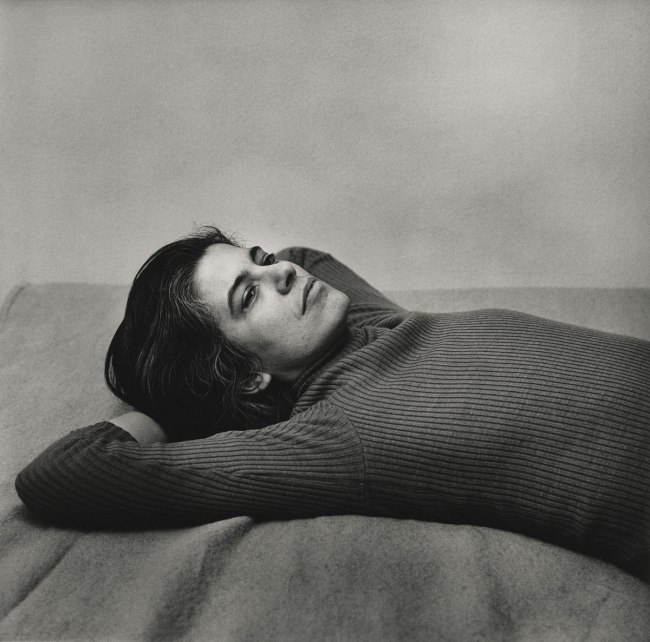
 

Peter Hujar (1937-1987) 'Susan Sontag' (1933-2004) 1975


Peter Hujar (American, 1937-1987)
Susan Sontag (American, 1933-2004)
1975
Gelatin silver print
National Portrait Gallery, Smithsonian Institute
© Estate of Peter Hujar
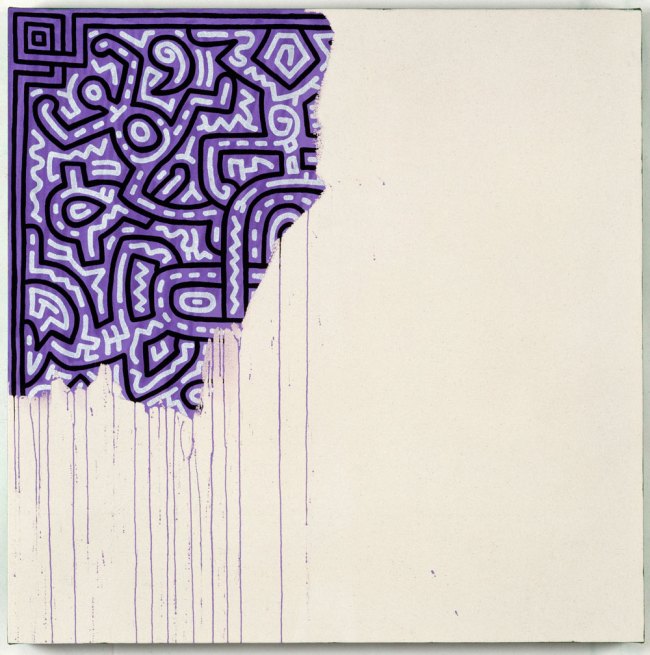
 

Keith Haring (American, 1958-1990). 'Unfinished Painting' 1989


Keith Haring (American, 1958-1990)
Unfinished Painting
1989
Acrylic on canvas
100 x 100cm
Courtesy of Katia Perlstein, Brussels, Belgium
© Keith Haring Foundation


David Wojnarowicz (American, 1954-1992) 'A Fire In My Belly' (Film In Progress) (film still), 1986-87


David Wojnarowicz (American, 1954-1992)
A Fire In My Belly (Film In Progress) (film still)
1986-1987
Super 8mm film
black and white & color (transferred to video)
Courtesy of The Estate of David Wojnarowicz and P.P.O.W Gallery, New York and The Fales Library and Special Collection


One day before World AIDS Day, the renown painter, photographer, writer, filmmaker, performance artist and activist David Wojnarowicz, who died in 1992 at the age of 37 from AIDS-related complications, has had one of his most important works, A Fire In My Belly, pulled from The Smithsonian Institution’s National Portrait Gallery’s HIDE / SEEK exhibit because of pressure from conservative politicians and the Catholic League.”


HIDE/SEEK: Difference and Desire in American Portraiture, the first major museum exhibition to explore how gender and sexual identity have shaped the creation of American portraiture, organised by and presented at the National Portrait Gallery last fall, will be on view at the Brooklyn Museum from November 18, 2011, through February 12, 2012. With the cooperation of the National Portrait Gallery, the Brooklyn Museum has reconstituted the exhibition in concert with the Tacoma Art Museum, where it will be on view from March 17 through June 10, 2012.

HIDE/SEEK includes approximately a hundred works in a wide range of media created over the course of one hundred years that reflect a variety of sexual identities and the stories of several generations. Highlighting the influence of gay and lesbian artists, many of whom developed new visual strategies to code and disguise their subjects’ sexual identities as well as their own, HIDE/ SEEK considers such themes as the role of sexual difference in depicting modern Americans, how artists have explored the definition of sexuality and gender, how major themes in modern art – especially abstraction – have been influenced by marginalisation, and how art has reflected society’s changing attitudes.

Announcing the Brooklyn presentation, Museum Director Arnold L. Lehman states, “From the moment I first learned about this extraordinary exhibition in its planning stages, presenting it in Brooklyn has been a priority. It is an important chronicle of a neglected dimension of American art and a brilliant complement and counterpoint to ‘Youth and Beauty: Art of the American Twenties’, a touring exhibition organised by the Brooklyn Museum, also on view this fall.”

In addition to its commentary on a marginalised cultural history, HIDE/ SEEK offers an unprecedented survey of more than a century of American art. Beginning with late nineteenth-century portraits by Thomas Eakins and John Singer Sargent, it includes works from the first half of the 1900s by such masters as Romaine Brooks, George Bellows, Marsden Hartley, and Georgia O’Keeffe; the exhibition continues through the postwar period with works by Jasper Johns, Robert Rauschenberg, Agnes Martin, and Andy Warhol, and concludes with major works by late twentieth-century artists such as Keith Haring, Glenn Ligon, Nan Goldin, Felix Gonzalez-Torres, and Catherine Opie.

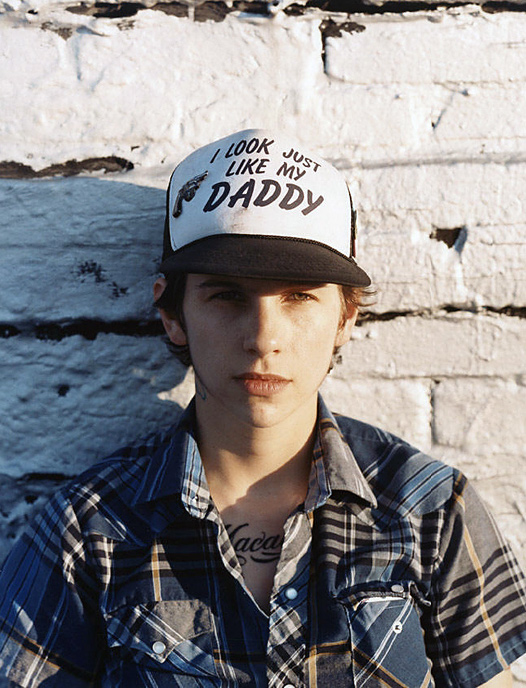
The Brooklyn presentation will feature nearly all of the works included in the National Portrait Gallery exhibition. Among them are rarely seen paintings by Charles Demuth, whose better-known industrialised landscapes are on view in the Brooklyn Museum exhibition Youth and Beauty; a poignant portrait of New Yorker writer Janet Flanner wearing two masks, taken by photographer Bernice Abbott; Andrew Wyeth’s painting of a young neighbour standing nude in a wheat field, much like Botticelli’s Venus emerging from her shell; Robert Mapplethorpe’s photograph riffing on the classic family portrait, in which a leather-clad Brian Ridley is seated on a wingback chair shackled to his whip-wielding partner, Lyle Heeter; and Cass Bird’s photographic portrait of a friend staring out from under a cap emblazoned with the words “I look Just Like My Daddy.” The exhibition will also include David Wojnarowicz’s A Fire in My Belly, an unfinished film the artist created between 1986 and 1987.

Press release from the Brooklyn Museum website
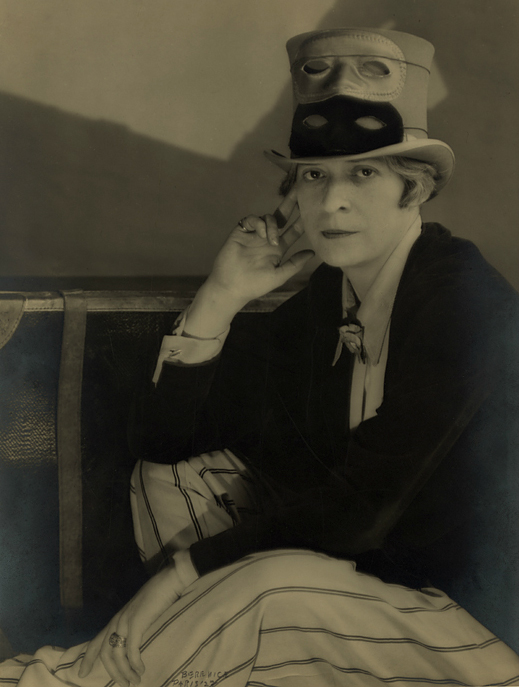
 

Berenice Abbott (American, 1898-1991) 'Janet Flanner' (1892-1978) 1927


Berenice Abbott (American, 1898-1991)
Janet Flanner (American, 1892-1978)
1927
Photographic print
23 x 17.3cm
Prints and Photographs Division, Library of Congress, Washington, D.C
C Berenice Abbott / Commerce Graphics Ltd., Inc.
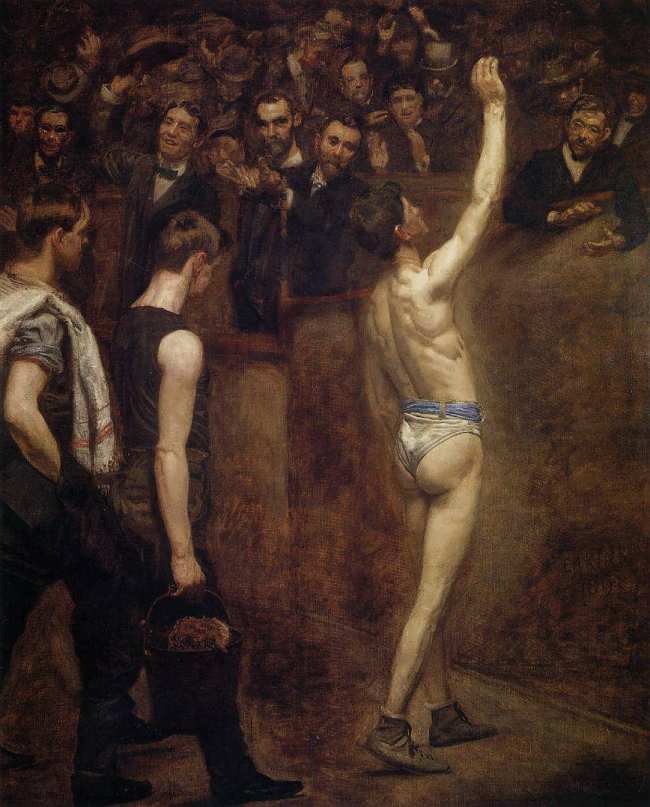
 

Thomas Eakins (American, 1844 -1916) 'Salutat' 1898


Thomas Eakins (American, 1844-1916)
Salutat
1898
Oil on canvas
127.0 x 101.6cm
Addison Gallery of American Art, Phillips Academy, Andover, Massachusetts
Gift of anonymous donor


Walker Evans (American, 1903-1975) 'Lincoln Kirstein' 1930


Walker Evans (American, 1903-1975)
Lincoln Kirstein (American, 1907-1996)
1930
Gelatin silver print
16.1cm x 11.4cm
The Metropolitan Msuem of Art, Ford Motor Company Collection
© Walker Evans Archive, The Metropolitan Museum of Art


Lincoln Edward Kirstein (May 4, 1907 – January 5, 1996) was an American writer, impresario, art connoisseur, philanthropist, and cultural figure in New York City, noted especially as co-founder of the New York City Ballet. He developed and sustained the company with his organising ability and fundraising for more than four decades, serving as the company’s general director from 1946 to 1989. According to the New York Times, he was “an expert in many fields,” organising art exhibits and lecture tours in the same years.
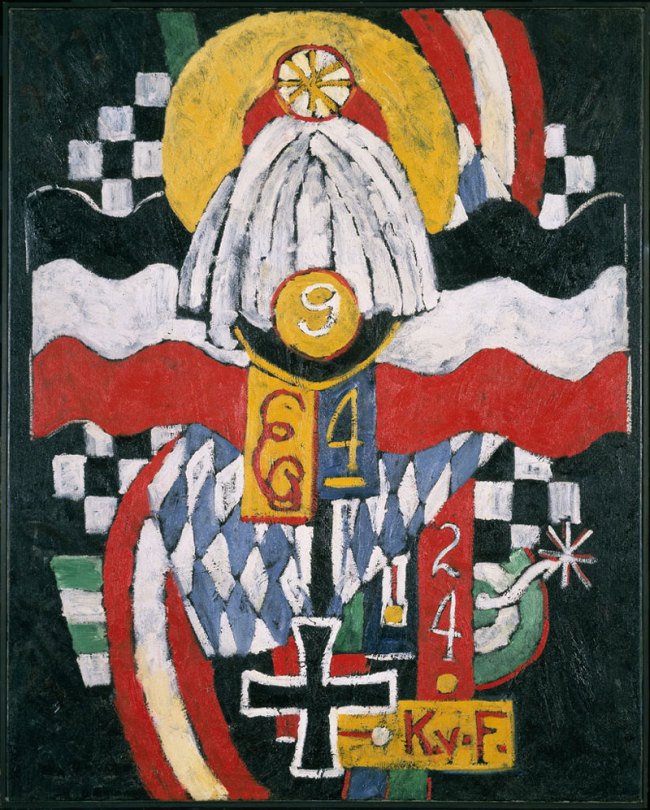
 

Marsden Hartley (American, 1877-1943) 'Painting No. 47, Berlin' 1915


Marsden Hartley (American, 1877-1943)
Painting No. 47, Berlin
1915
Oil on canvas
39 7/16 x 32 in (100.1 x 81.3cm)
Hirshhorn Museum and Sculpture Garden, Smithsonian Institution, Washington, D.C.
Gift of Joseph H. Hirshhorn, 1972


George Platt Lynes (American, 1907-1955) 'Marsden Hartley' 1942


George Platt Lynes (American, 1907-1955)
Marsden Hartley
1942
Gelatin silver print
23.5 x 19.1cm
Bates College Museum of Art, Lewiston, ME, Marsden Hartley Memorial Collection
© Estate of George Platt Lynes
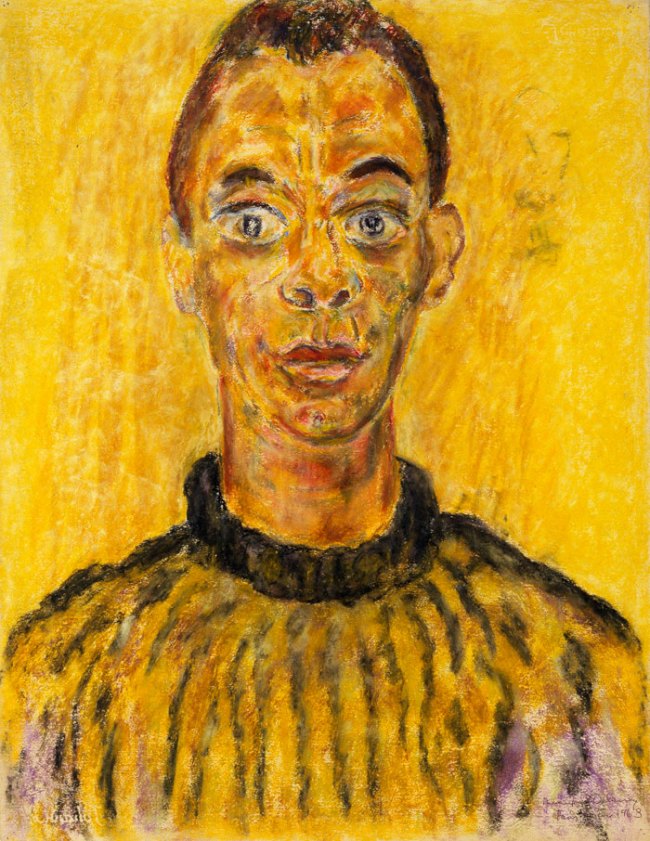
 

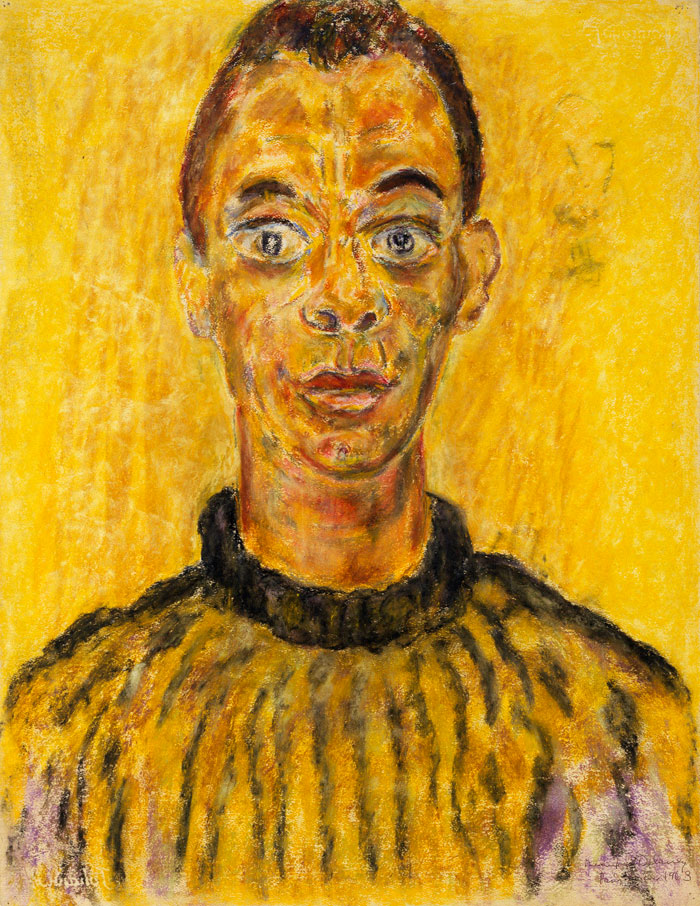
Beauford Delaney (American, 1901-1979) 'James Baldwin' 1963


Beauford Delaney (American, 1901-1979)
James Baldwin
1963
Pastel on paper
64.8 x 49.8cm
National Portrait Gallery, Smithsonian Institution


Cass Bird (American, b. 1974) 'I Look Just Like My Daddy' 2003


Cass Bird (American, b. 1974)
I Look Just Like My Daddy
2003
C-type print
72.6 x 101.6cm
Collection of the artist, New York
© Cass Bird


Brooklyn Museum
200 Eastern Parkway
Brooklyn, NY 11238-6052
Phone: (718) 638-5000

Opening hours:
Wednesday – Sunday 11am – 6pm
Monday and Tuesday closed

Brooklyn Museum website

LIKE ART BLART ON FACEBOOK

Back to top

Exhibition: ‘Stanley Greene – Black Passport’ at Foam, Amsterdam

Exhibition dates: 16th December 2011 – 5th February 2012


Many thankx to FOAM for allowing me to publish the photographs in the posting. Please click on the photographs for a larger version of the image. All photographs: Black Passport © Stanley Greene / NOOR


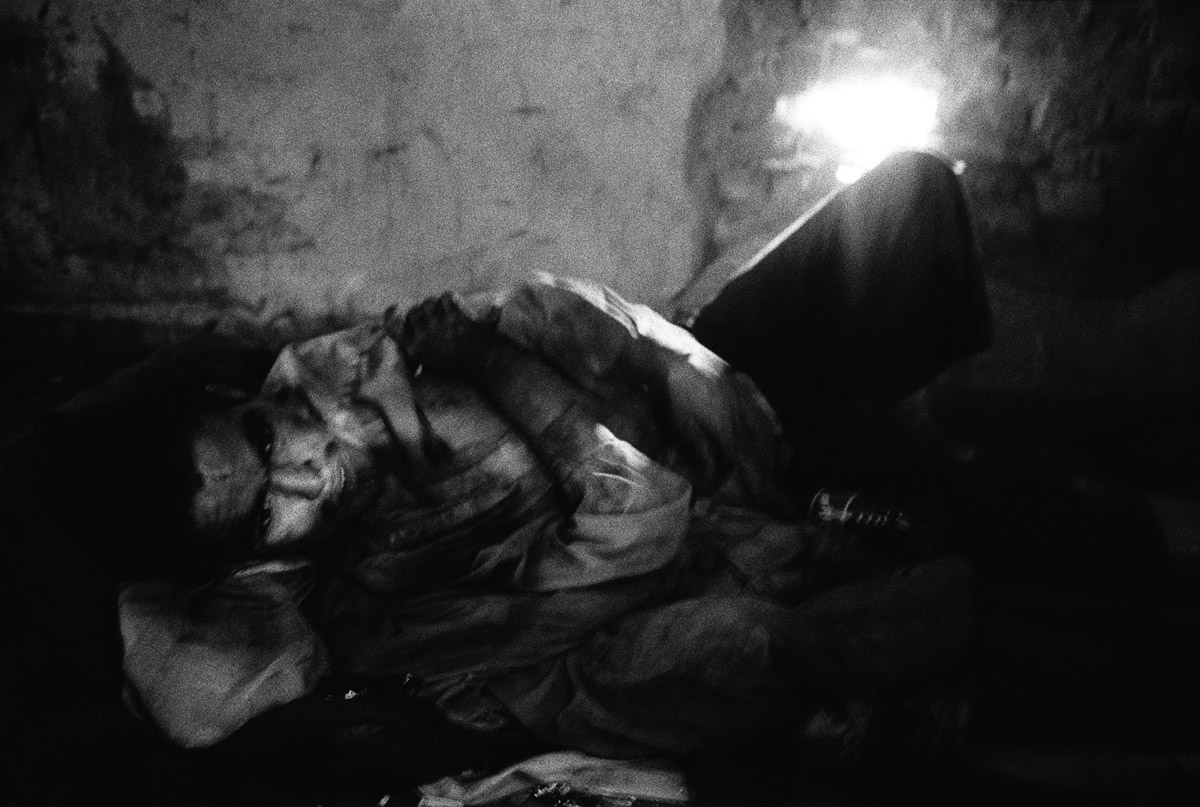
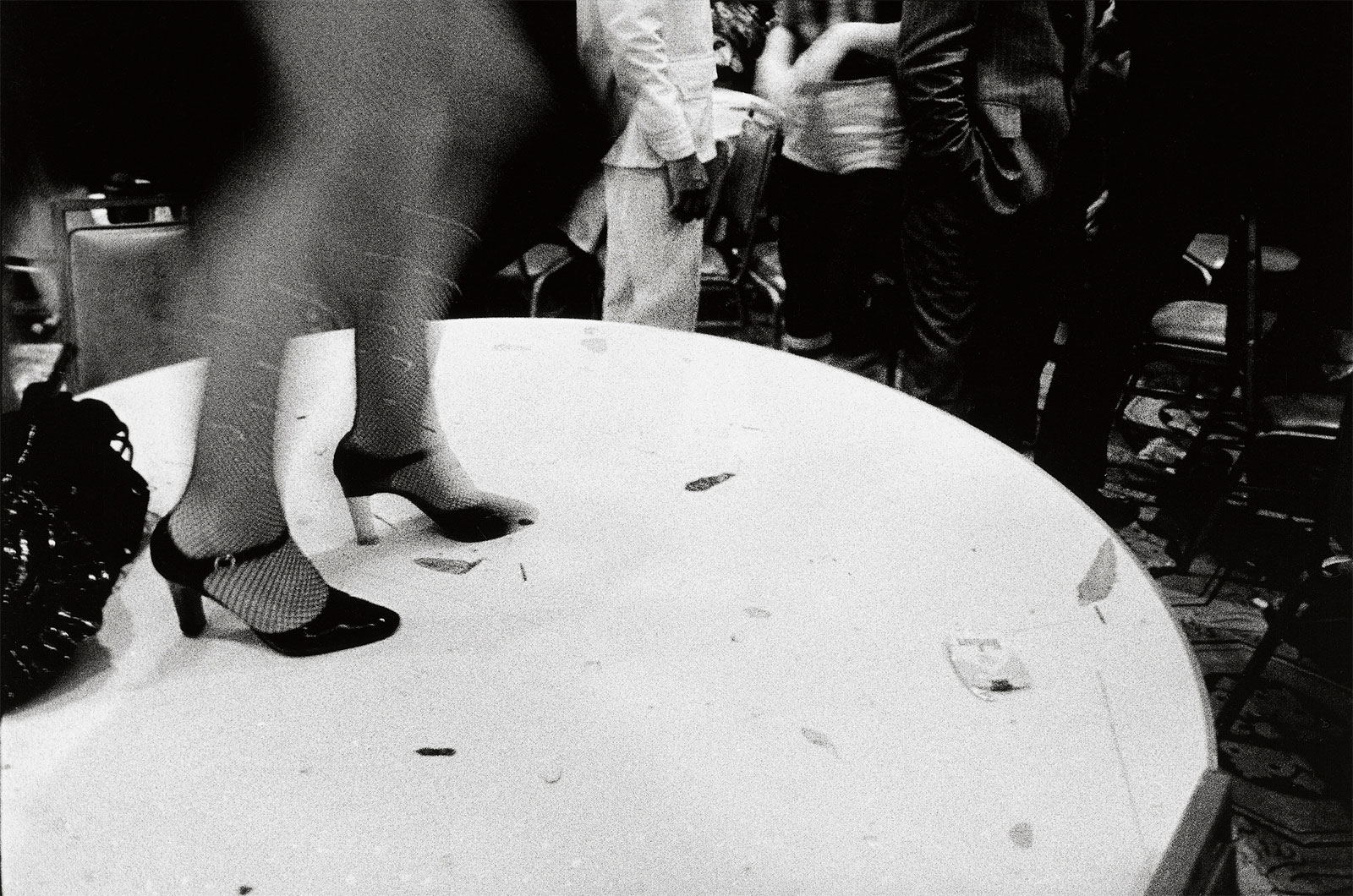
Stanley Greene (American, 1949-2017) 'Madman, Afghanistan' 2008


Stanley Greene (American, 1949-2017)
Madman, Afghanistan
2008
Black Passport © Stanley Greene / NOOR


Black Passport © Stanley Greene / NOOR

Black Passport © Stanley Greene / NOOR


Foam presents Black Passport, a project by and about the American conflict photographer Stanley Greene (New York, 1949-2017). Black Passport shows photos of conflicts and disasters combined with photos of Greene’s  private life. The result is a revealing portrait of a photographer who is addicted to the adrenaline rush of being on the move, but at the same time realises the sacrifices he makes in his personal life. Stanley Greene has photographed in regions such as Chechnya, Iraq, Rwanda and Sudan and is one of the founders of the international photo agency NOOR.

Every day, newspapers and magazines are filled with photos of war, oppression and violence. The photographer that enables us to watch what is happening in the rest of the world from the safety of our own homes, however, usually remains invisible. This is not the case in Black Passport, the biography of war photographer Stanley Greene, which appeared in book form in 2009 and will be exhibited in Foam starting on 16 December. Photos of conflict and disaster regions such as Rwanda, Sudan, Chechnya and Iraq are alternated with photos from the private life of Stanley Greene: photos of Paris and many women. Slide shows will also be presented, interspersed with texts from the book. Greene’s voice resounds through the exhibition space – he is disconcertingly frank: ‘I think you can only keep positive for eight years. If you stay at it longer than that, you turn. And not into a beautiful butterfly.’

Just as Stanley Greene, visitors to the exhibition are poised between the safety of Western life and the horrors of foreign wars. And it is precisely this juxtaposition that causes these photos to stir us more than the stream of bad-news images that inundate us daily. In addition, Black Passport is a fascinating story about what it is like to be a war photographer. Why does someone choose to be continually confronted with death and misery? Is it an escape from everyday reality and a craving for adventure?

Short Biography

Stanley Greene has photographed in the former Soviet Union, Central America, Asia and the Middle East. His work has appeared in publications including Newsweek, The New York Times Magazine, Stern and Paris Match. He has won various World Press Awards and in 2004 the W. Eugene Smith Award. Open Wound: Chechnya 1994-2003 was published in 2004 and his book Black Passport in 2009. Greene is one of the founders of the Amsterdam-based international photo agency NOOR.

Press release from the Foam website


Black Passport © Stanley Greene / NOOR


Stanley Greene (American, 1949-2017)
Iraq, 2004, Road side explosion, Northern Iraq
2004
Black Passport © Stanley Greene / NOOR


“I think you can only do this for eight years. For eight years you can still keep the positive. If you stay at it longer than eight years, you turn. And not into a beautiful butterfly. You really turn. I see it in myself, I see it in all my friends and colleagues. I mean they are all victims of post trauma. We’re not the beautiful butterflies anymore. We become moths. We’re like moths flying to the flame.You know, sometimes your wings get singed or you just burn up. Get killed. Or you burn up inside.The drugs and the alcohol and the party and all of this is to push it away, push it away.”

“I’m an observer, I’m not an objective observer though, but I’m an observer. I feel it’s very important for journalists to go to these hell holes and photograph or write or do radio or whatever because I still believe that the public wants to know.”


Stanley Greene


Stanley Greene (February 14, 1949 – May 19, 2017) was an American photojournalist.

Greene was born to middle class parents in Brooklyn. Both his parents were actors. His father, who was born in Harlem, was a union organiser, one of the first African Americans elected as an officer in the Screen Actors Guild,and belonged to the Harlem Renaissance movement. Greene’s father was blacklisted as a Communist in the 1950s and forced to take uncredited parts in movies. Greene’s parents gave him his first camera when he was eleven years old.

Greene began his art career as a painter, but started taking photos as a means of cataloging material for his paintings. In 1971, when Greene was a member of the anti-Vietnam War movement and the Black Panther Party, his friend photographer W. Eugene Smith offered him space in his studio and encouraged him to study photography at the School of Visual Arts in New York and the San Francisco Art Institute.

Greene held various jobs as a photographer, including taking pictures of rock bands and working at Newsday. In 1986, he shot fashion photographs in Paris. He called himself a “dilettante, sitting in cafes, taking pictures of girls and doing heroin”. After a friend died of AIDS, Greene kicked his drug habit and began to seriously pursue a photography career.

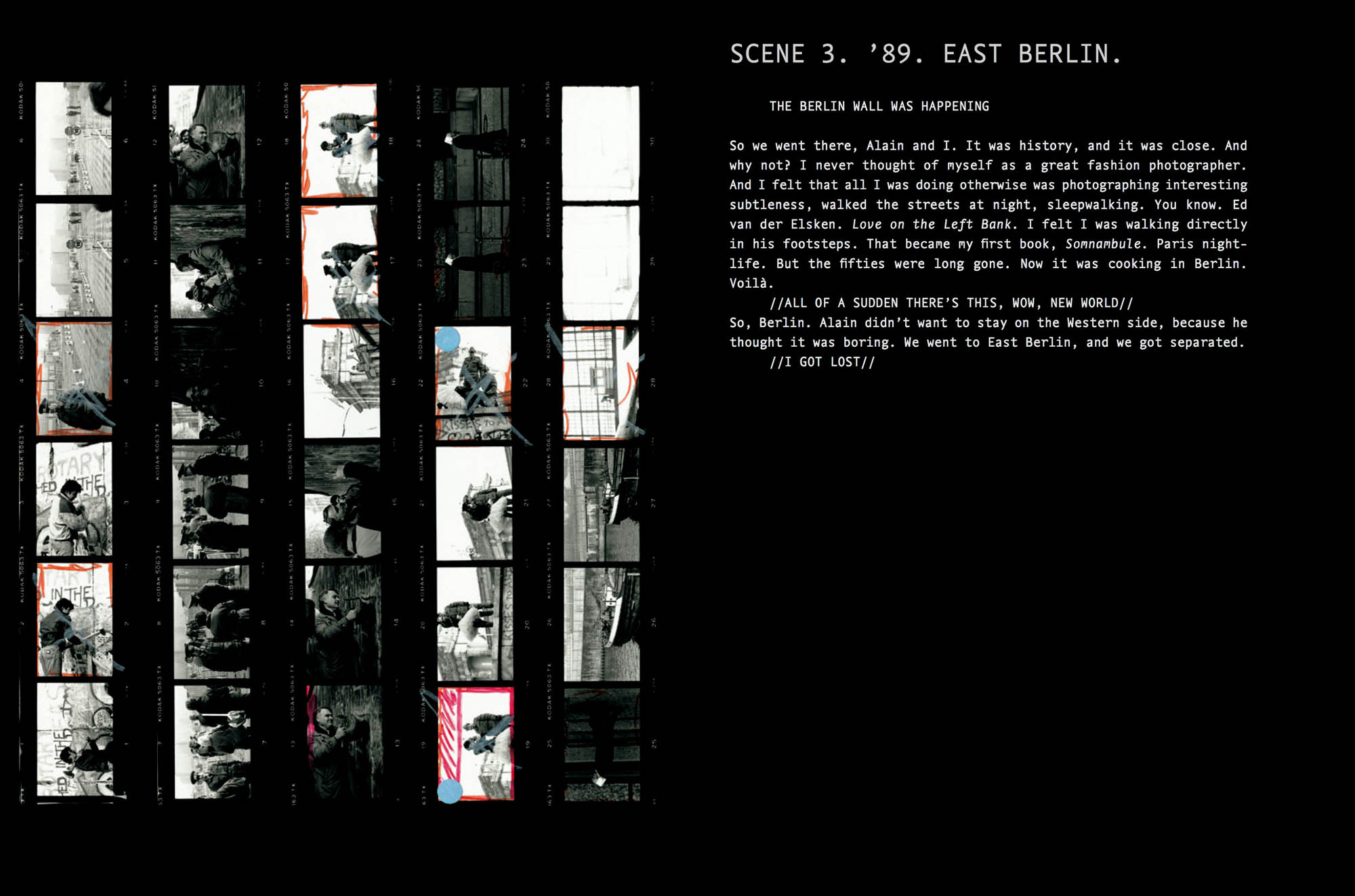
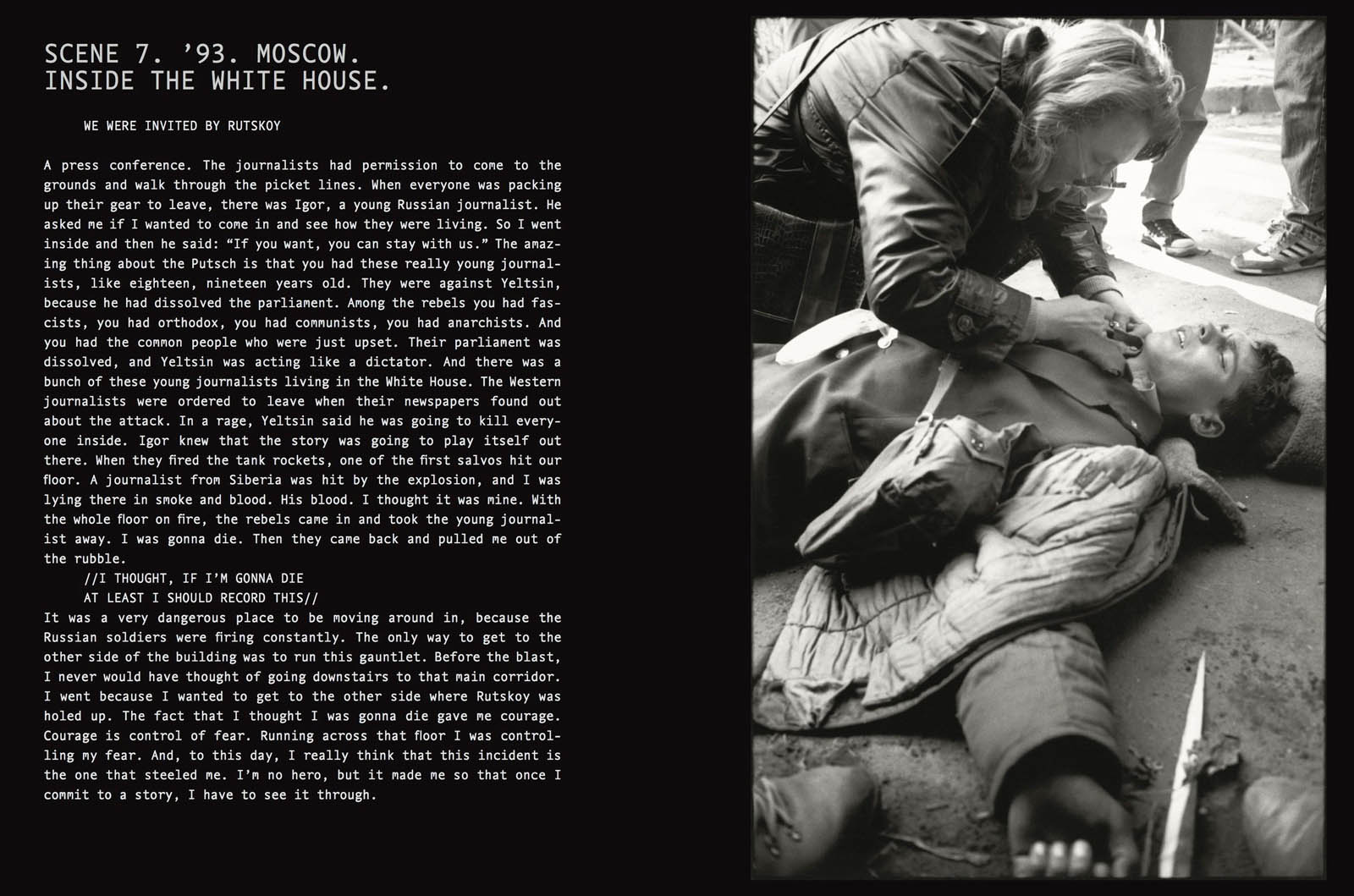
He began photojournalism in 1989, when his image (“Kisses to All, Berlin Wall”) of a tutu-clad girl with a champagne bottle became a symbol of the fall of the Berlin Wall. While working for the Paris-based photo agency Agence Vu in October 1993, Greene was trapped and almost killed in the White House in Moscow during a stand-off between President Boris Yeltsin and the parliament. He covered the war-torn countries Azerbaijan, Bosnia and Herzegovina, Georgia, Iraq, Somalia, Croatia, Kashmir, and Lebanon. He took pictures of the genocide in Rwanda in 1994 and the US Gulf Coast in the aftermath of Hurricane Katrina in 2005.

After 1994, Greene was best known for his documentation of the conflict in Chechnya, between rebels and the Russian Armed Forces, which was compiled in his 2004 book, Open Wound. These photos drew attention to the “suffering that has marked the latest surge in Chechnya’s centuries-long struggle for independence from Russia”.

In 2008, Greene revealed that he had hepatitis C, which he believed he had contracted from a contaminated razor while working in Chad in 2007. After controlling the disease with medication, he traveled to Afghanistan and photographed a story about “the crisis of drug abuse and infectious disease”.

Stanley Greene co-founded NOOR Agency with Kadir van Lohuizen in 2007. They launched their agency with their colleagues on the 7th of September 2007 at Visa Pour L’Image. Greene died in Paris, at the age of 68. He had been undergoing treatment for liver cancer.

Text from the Wikipedia website


Black Passport is the biography of war photographer Stanley Greene, compiled out of hours of interviews by Teun van der Heijden. It shows Stanley’s war images alternated with private images.

Teun van der Heijden:Black Passport started as any other photo book project. At the beginning Stanley did let me know that he was up for ‘something completely different’. While working on the project we had a lot of conversations in which I discovered that there were a lot of similarities between Stanley and me. What is it then that one person becomes a designer, living happily with the same woman for 25 years, being a father of two daughters and the other person becomes a war photographer. This question was the beginning of a series of interviews. Out of the interviews came Black Passport. Black Passport is nominated several times. Some people believe it is the most important photo book of 2010.

Text from the YouTube website


Stanley Greene (American, 1949-2017) 'Fireflies, Paris, France' 2006


Stanley Greene (American, 1949-2017)
Fireflies, Paris, France
2006
Black Passport © Stanley Greene / NOOR


Stanley Greene (American, 1949-2017) 'Black & White Ball, Paris, France' 2006


Stanley Greene (American, 1949-2017)
Black & White Ball, Paris, France
2006
Black Passport © Stanley Greene / NOOR


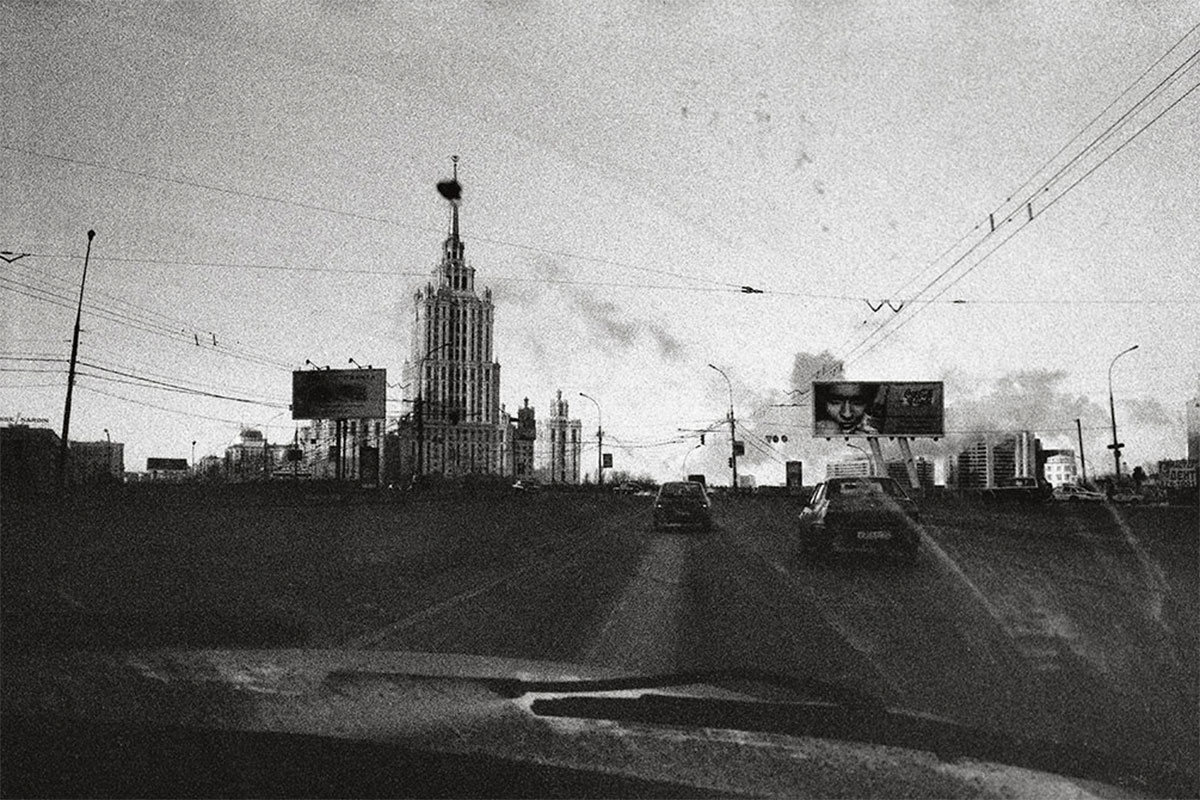
Stanley Greene (American, 1949-2017) 'On the MKAD, on the way to the airport, Moscow, Russia' 2003


Stanley Greene (American, 1949-2017)
On the MKAD, on the way to the airport, Moscow, Russia
2003
Gelatin silver print
Black Passport © Stanley Greene / NOOR


Stanley Greene (American, 1949-2017) 'Kaboul, Afghanistan' 2008


Stanley Greene (American, 1949-2017)
Kaboul, Afghanistan
2008
Gelatin silver print
Black Passport © Stanley Greene / NOOR


Stanley Greene (American, 1949-2017) 'Scene 3. '89. East Berlin'


Stanley Greene (American, 1949-2017)
Scene 3. ’89. East Berlin
From Black Passport © Stanley Greene / NOOR


Stanley Greene (American, 1949-2017) 'Scene 7. '93. Moscow. Inside the White House'


Stanley Greene (American, 1949-2017)
Scene 7. ’93. Moscow. Inside the White House
From Black Passport © Stanley Greene / NOOR


Black Passport © Stanley Greene / NOOR


All photographs: Black Passport © Stanley Greene / NOOR


Foam
Keizersgracht 609
1017 DS Amsterdam
The Netherlands
Phone: + 31 20 5516500

Opening hours:
Mon – Wed 10.00 – 18.00 hrs
Thu – Fri 10.00 – 21.00 hrs
Sat – Sun 10.00 – 18.00 hrs

Foam website

LIKE ART BLART ON FACEBOOK

Back to top
Exhibition: ‘Diane Arbus’ at Jeu de Paume, Paris

Exhibition dates: 18th October, 2011 – 5th February, 2012


Diane Arbus, 'Child with a toy hand grenade in Central Park, N.Y.C. 1962' 1962 from the exhibition 'Diane Arbus' at Jeu de Paume, Paris, Oct 2011 - Feb 2012


Diane Arbus (American, 1923-1971)
Child with a toy hand grenade in Central Park, N.Y.C. 1962
1962
Gelatin silver print
© The Estate of Diane Arbus


A fabulous posting, with memorable thoughts and photographs!

These archetypal images have become deeply embedded in the collective conscience where conscience is pre-eminently the organ of sentiments and representations. The snap, snap, snap of the shutter evinces the flaws of human nature, reveals the presence of a quality or feeling to which we can all relate. As Arbus states, the subject of the picture is always more important than the picture. And more complicated. That is why these photographs always capture our attention – because we become, we inhabit, we are the subject.

Dr Marcus Bunyan


Many thankx to Jeu de Paume for allowing me to publish the photographs in the posting. Please click on the photographs for a larger version of the image.


“There are and have been and will be an infinite number of things on earth. Individuals all different, all wanting different things, all knowing different things, all loving different things, all looking different. Everything that has been on earth has been different from any other thing. That is what I love: the differentness, the uniqueness of all things and the importance of life… I see something that seems wonderful; I see the divineness in ordinary things.”


Diane Arbus. Paper on Plato, senior English seminar, Fieldston School, November 28, 1939


“I want to photograph the considerable ceremonies of our present because we tend while living here and now to perceive only what is random and barren and formless about it. While we regret that the present is not like the past and despair of its ever becoming the future, its innumerable inscrutable habits lie in wait for their meaning. I want to gather them, like somebody’s grandmother putting up preserves, because they will have been so beautiful.

There are the Ceremonies of Celebration (the Pageants, the Festivals, the Feasts, the Conventions) and the Ceremonies of Competition (Contests, Games, Sports), the Ceremonies of Buying and Selling, of Gambling, of the Law and the Show; the Ceremonies of Fame in which the Winners Win and the Lucky are Chosen or Family Ceremonies or Gatherings (the Schools, the Clubs, the Meetings). Then they are Ceremonial Places (The Beauty Parlor, The Funeral Parlor or, simply The Parlor) and Ceremonial Costumes (what waitresses wear, or Wrestlers), Ceremonies of the Rich, like the Dog Show, and of the Middle Class, like the Bridge Game. Or, for example: the Dancing Lesson, the Graduation, the Testimonial Dinner, the Séance, the Gymnasium and the Picnic, and perhaps the Waiting Room, the Factory, the Masquerade, the Rehearsal, the Initiation, the Hotel Lobby and the Birthday Party. The etcetera.

I will write whatever is necessary for the further description and elucidation of these Rites and I will go wherever I can to find them.

These are our symptoms and our monuments. I want simply to save them, for what is ceremonious and curious and commonplace will be legendary.”


Diane Arbus. “American Rites, Manners and Customs,” Plan for a Photographic Project, Guggenheim proposal


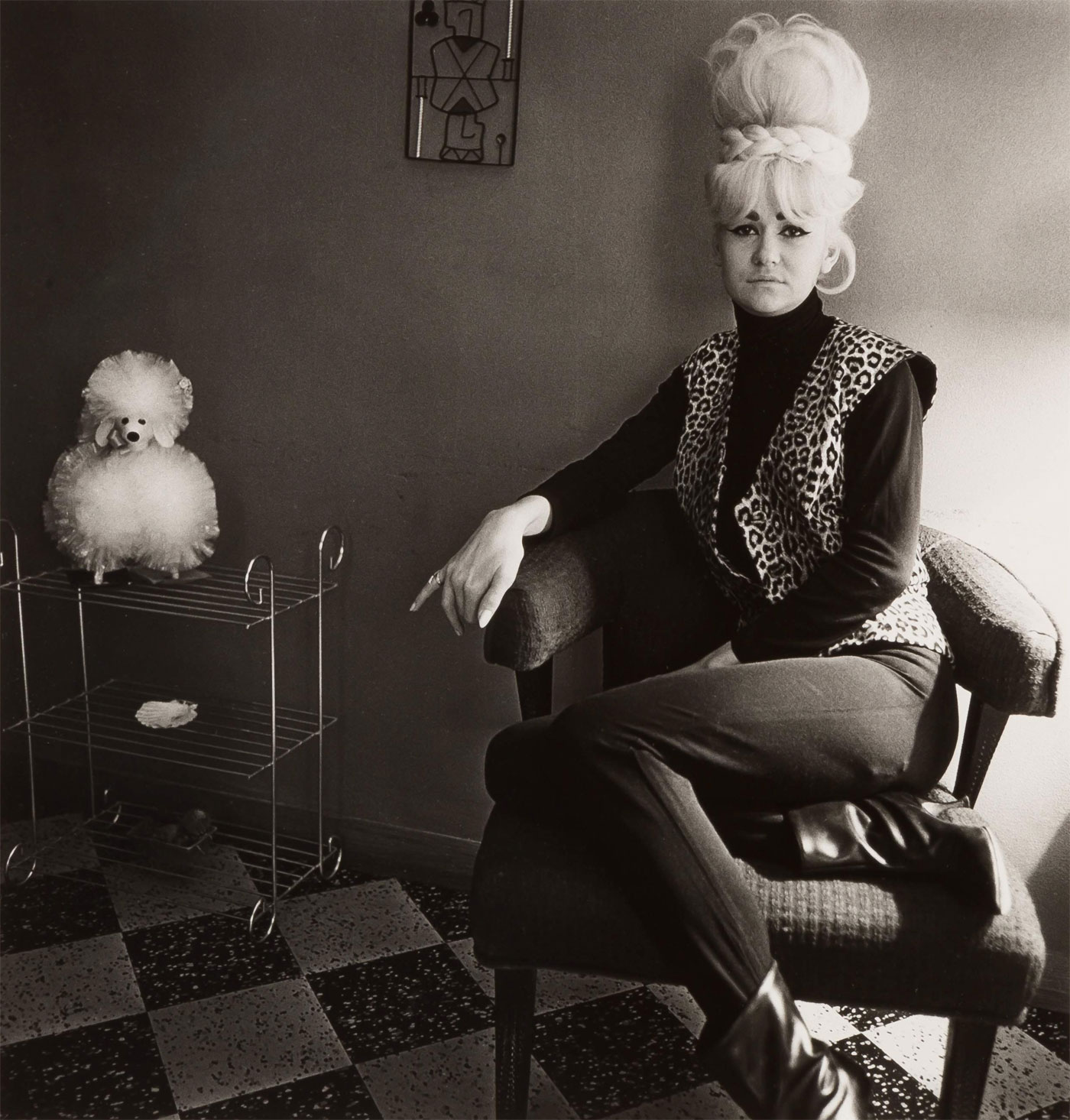
Diane Arbus (American, 1923-1971) 'Lady Bartender at Home with a Souvenir Dog, New Orleans, La.' 1964 from the exhibition 'Diane Arbus' at Jeu de Paume, Paris, Oct 2011 - Feb 2012


Diane Arbus (American, 1923-1971)
Lady Bartender at Home with a Souvenir Dog, New Orleans, La.
1964
Gelatin silver print
© The Estate of Diane Arbus


Diane Arbus (American, 1923-1971) 'A young Brooklyn family going for a Sunday outing, NYC., 1966' 1966


Diane Arbus (American, 1923-1971)
A young Brooklyn family going for a Sunday outing, NYC., 1966
1966
Gelatin silver print
© The Estate of Diane Arbus


Diane Arbus (American, 1923-1971) 'Two Ladies at the Automat, New York City' 1966


Diane Arbus (American, 1923-1971)
Two Ladies at the Automat, New York City
1966
Gelatin silver print
© The Estate of Diane Arbus


Diane Arbus. 'Identical twins, Roselle, N.J. 1967' 1967


Diane Arbus (American, 1923-1971)
Identical twins, Roselle, N.J. 1967
1967
Gelatin silver print
© The Estate of Diane Arbus


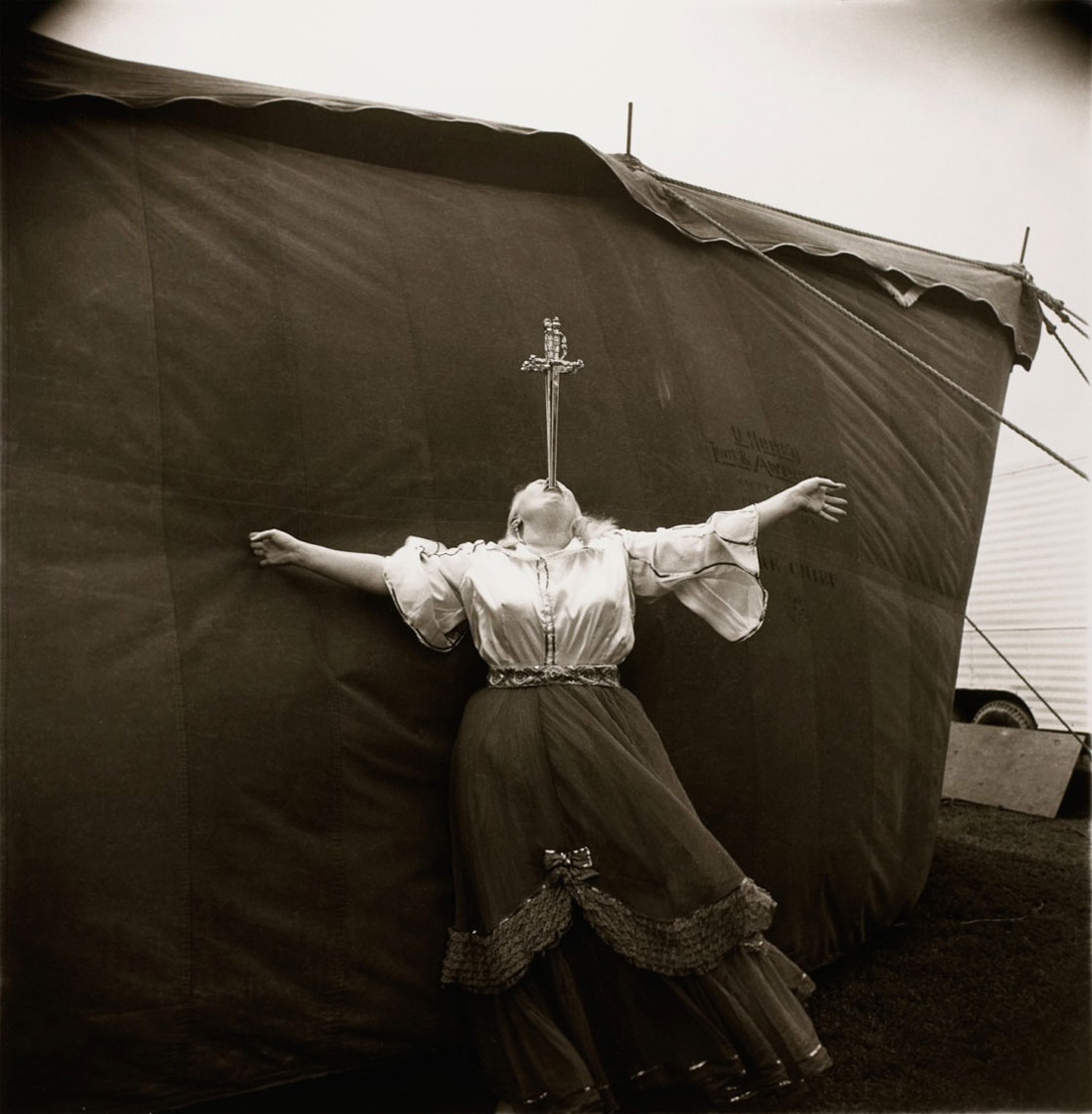
Diane Arbus (American, 1923-1971) 'Albino sword swallower at a carnival, Md' 1970


Diane Arbus (American, 1923-1971)
Albino sword swallower at a carnival, Md
1970
Gelatin silver print
© The Estate of Diane Arbus


On Photographs

“They are the proof that something was there and no longer is. Like a stain. And the stillness of them is boggling. You can turn away but when you come back they’ll still be there looking at you.”


Diane Arbus in response to request for a brief statement about photographs, March 15, 1971


Diane Arbus (New York, 1923-1971) revolutionised the art she practiced. Her bold subject matter and photographic approach produced a body of work that is often shocking in its purity, in its steadfast celebration of things as they are. Her gift for rendering strange those things we consider most familiar, and for uncovering the familiar within the exotic, enlarges our understanding of ourselves.

Arbus found most of her subjects in New York City, a place that she explored as both a known geography and as a foreign land, photographing people she discovered during the 1950s and 1960s. She was committed to photography as a medium that tangles with the facts. Her contemporary anthropology – portraits of couples, children, carnival performers, nudists, middle-class families, transvestites, zealots, eccentrics, and celebrities – stands as an allegory of the human experience, an exploration of the relationship between appearance and identity, illusion and belief, theatre and reality.

In this first major retrospective in France, Jeu de Paume presents a selection of two hundred photographs that affords an opportunity to explore the origins, scope, and aspirations of a wholly original force in photography. It includes all of the artist’s iconic photographs as well as many that have never been publicly exhibited. Even the earliest examples of her work demonstrate Arbus’s distinctive sensibility through the expression on a face, someone’s posture, the character of the light, and the personal implications of objects in a room or landscape. These elements, animated by the singular relationship between the photographer and her subject, conspire to implicate the viewer with the force of a personal encounter.

Biography

Diane Arbus was born in New York City on March 14, 1923, and attended the Ethical Culture and Fieldston Schools. At the age of eighteen she married Allan Arbus. Although she first started taking pictures in the early 1940s and studied photography with Alexey Brodovitch in 1954, it was not until 1955-1957, while enrolled in courses taught by Lisette Model, that she began to seriously pursue the work for which she has come to be known.

Her first published photographs appeared in Esquire in 1960 under the title The Vertical Journey. From that point on she continued to work intermittently as a free-lance photographer for Esquire, Harper’s Bazaar, Show, The London Sunday Times, and a number of other magazines, doing portraits on assignment as well as photographic essays, for several of which she wrote accompanying articles.

During the 1950s, like most of her contemporaries, she had been using a 35mm camera, but in 1962 she began working with a 6×6 Rolleiflex. She once said, in accounting for the shift, that she had grown impatient with the grain and wanted to be able to decipher in her pictures the actual texture of things. The 6×6 format contributed to the refinement of a deceptively simple, formal, classical style that has since been recognised as one of the distinctive features of her work.

She received Guggenheim Fellowships in 1963 and 1966 for projects on “American Rites, Manners and Customs” and spent several summers during that period traveling across the United States, photographing contests, festivals, public and private gatherings, people in the costumes of their professions or avocations, the hotel lobbies, dressing rooms and living rooms she had described as part of “the considerable ceremonies of our present.” “These are our symptoms and our monuments,” she wrote in her original application. “I want simply to save them, for what is ceremonious and curious and commonplace will be legendary.”

The photographs she produced in those years attracted a great deal of attention when a selected group of them were exhibited, along with the work of two other photographers, in the 1967 “New Documents” show at the Museum of Modern Art. Nonetheless, although several institutions subsequently purchased examples of her work for their permanent collections, her photographs appeared in only two other major exhibitions during her lifetime, both of them group shows.

In the late 1960s she taught photography courses at Parsons School of Design, the Rhode Island School of Design and Cooper Union and in 1971 gave a master class at Westbeth, the artists cooperative in New York City where she then lived. During the same period she initiated the concept and did the basic research for the Museum of Modern Art’s 1973 exhibition on news photography, “From the Picture Press.”

She made a portfolio of ten photographs in 1970, printed, signed and annotated by her, which was to be the first of a series of limited editions of her work. She committed suicide on July 26, 1971 at the age of forty-eight. The following year the ten photographs in her portfolio became the first work of an American photographer to be exhibited at the Venice Biennale.

In the course of a career that may be said to have lasted little more than fifteen years, she produced a body of work whose style and content have secured her a place as one of the most significant and influential photographers of our time. The major retrospective mounted by the Museum of Modern Art in 1972 was attended by more than a quarter of a million people in New York before it began its tour of the United States and Canada. The Aperture monograph Diane Arbus, published in conjunction with the show has sold over 300,000 copies. Beginning in 2003, Diane Arbus Revelations, an international retrospective organised by The San Francisco Museum of Modern Art travelled to museums throughout the United States and Europe between 2003 and 2006. Major exhibitions devoted exclusively to her work have toured much of the world including, Australia, Germany, Italy, Japan, the Netherlands, New Zealand, Spain, and the United Kingdom.

Press release from the Jeu de Paume website


Diane Arbus (American, 1923-1971) 'Retired man and his wife at home in a nudist camp one morning, N.J.' 1963


Diane Arbus (American, 1923-1971)
Retired man and his wife at home in a nudist camp one morning, N.J.
1963
Gelatin silver print
© The Estate of Diane Arbus


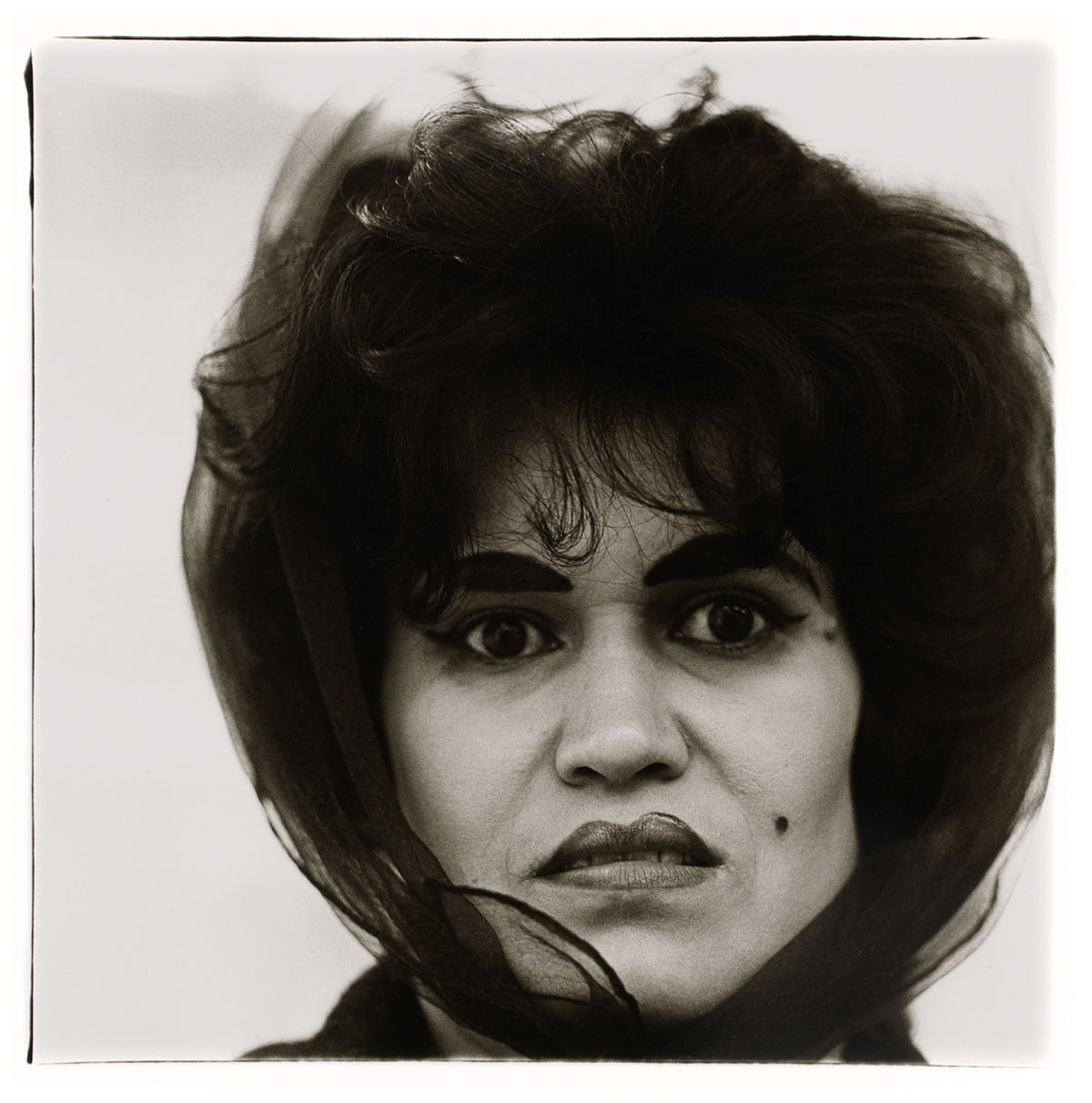
Diane Arbus (American, 1923-1971) 'Puerto Rican Woman with a Beauty Mark' 1965


Diane Arbus (American, 1923-1971)
Puerto Rican Woman with a Beauty Mark
1965
Gelatin silver print
© The Estate of Diane Arbus


Diane Arbus. 'Boy with a straw hat waiting to march in a pro-war parade, N.Y.C. 1967' 1967


Diane Arbus (American, 1923-1971)
Boy with a straw hat waiting to march in a pro-war parade, N.Y.C. 1967
1967
Gelatin silver print
© The Estate of Diane Arbus


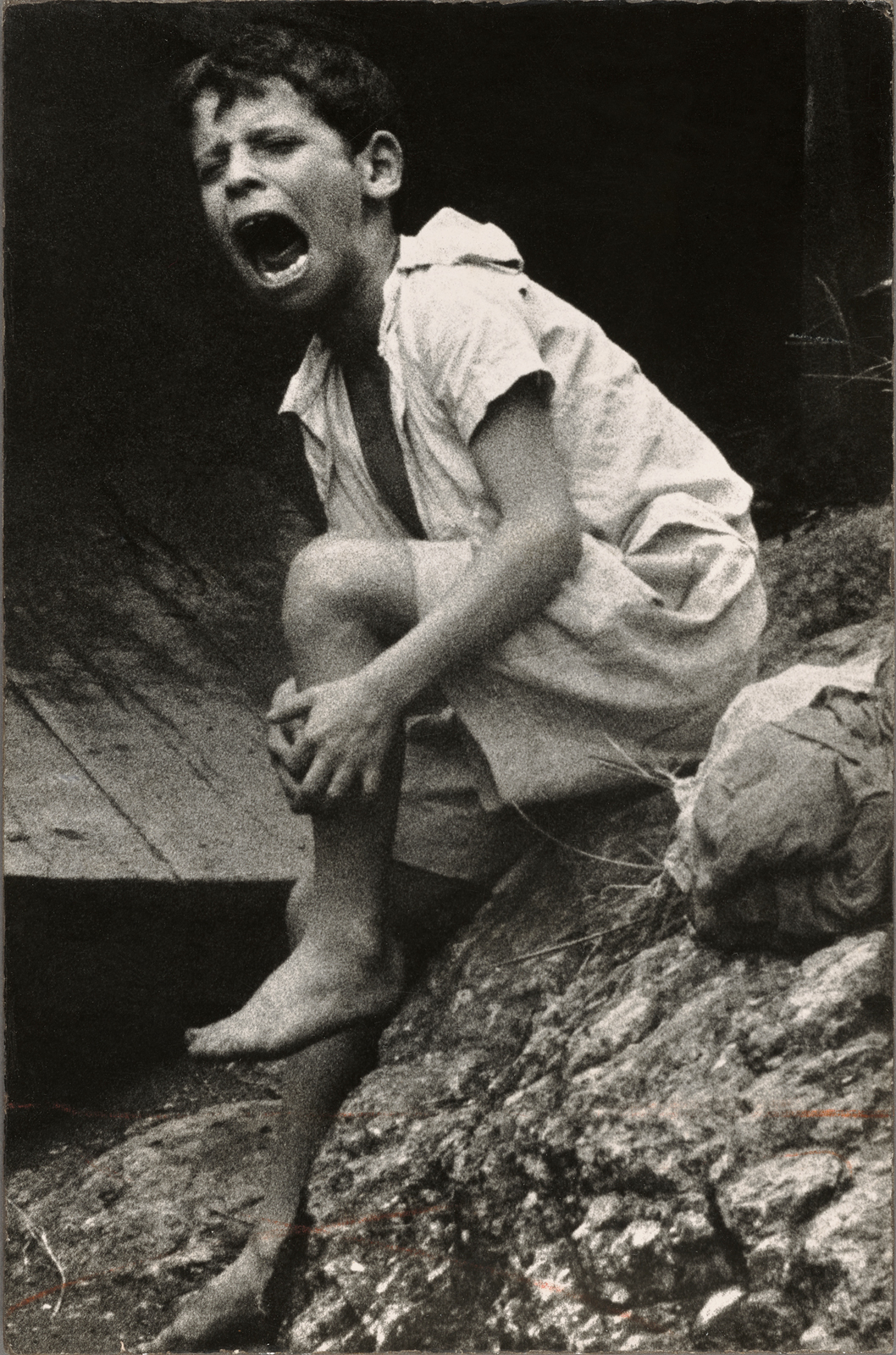
Diane Arbus (American, 1923-1971) 'A child crying, N.J.' 1967


Diane Arbus (American, 1923-1971)
A child crying, N.J.
1967
Gelatin silver print
© The Estate of Diane Arbus


Diane Arbus (American, 1923-1971) 'A Jewish giant at home with his parents in the Bronx, N.Y., 1970' 1970


Diane Arbus (American, 1923-1971)
A Jewish giant at home with his parents in the Bronx, N.Y., 1970
1970
Gelatin silver print
© The Estate of Diane Arbus


Diane Arbus. 'Untitled (6) 1970-71'


Diane Arbus (American, 1923-1971)
Untitled (6) 1970-71
1970-1971
Gelatin silver print
© The Estate of Diane Arbus


On Freaks

“There’s a quality of legend about freaks. Like a person in a fairy tale who stops you and demands that you answer a riddle. Most people go through life dreading they’ll go through a traumatic experience. Freaks were born with their trauma. They’ve already passed their test in life. They’re aristocrats.”

“If you’ve ever talked to somebody with two heads you know they know something you don’t.”

The Gap between Attention and Affect

“You see someone on the street and essentially what you notice about them is the flaw. It’s just extraordinary that we should have been given these peculiarities. And, not content with what we were given, we create a whole other set. Our whole guise is like giving a sign to the world to think of us in a certain way but there’s a point between what you want people to know about you and what you can’t help people knowing about you. And that has to do with what I’ve always called the gap between intention and effect. I mean if you scrutinise reality closely enough, if in some way you really, really get to it, it becomes fantastic.”

Other Thoughts

“The thing that’s important to know is that you never know. You’re always sort of feeling your way.”

“Nothing is ever the same as they said it was. It’s what I’ve never seen before that I recognise.”

“A photograph is a secret about a secret. The more it tells you the less you know.”

“For me the subject of the picture is always more important than the picture. And more complicated. I do have a feeling for the print but I don’t have a holy feeling for it. I really think what it is, is what it’s about. I mean it has to be of something. And what it’s of it always more remarkable than what it is.”

“I really believe there are things which nobody would see unless I photographed them.”


Diane Arbus


Diane Arbus (American, 1923-1971) 'Teenage couple on Hudson Street, N.Y.C. 1963' 1963


Diane Arbus (American, 1923-1971)
Teenage couple on Hudson Street, N.Y.C. 1963
1963
Gelatin silver print
© The Estate of Diane Arbus


Diane Arbus (American, 1923-1971) 'Xmas tree in a living room in Levittown, L.I. 1963' 1963


Diane Arbus (American, 1923-1971)
Xmas tree in a living room in Levittown, L.I. 1963
1963
Gelatin silver print
© The Estate of Diane Arbus


Diane Arbus (American, 1923-1971) 'A young man in curlers at home on West 20th Street, N.Y.C. 1966' 1966


Diane Arbus (American, 1923-1971)
A young man in curlers at home on West 20th Street, N.Y.C. 1966
1966
Gelatin silver print
© The Estate of Diane Arbus


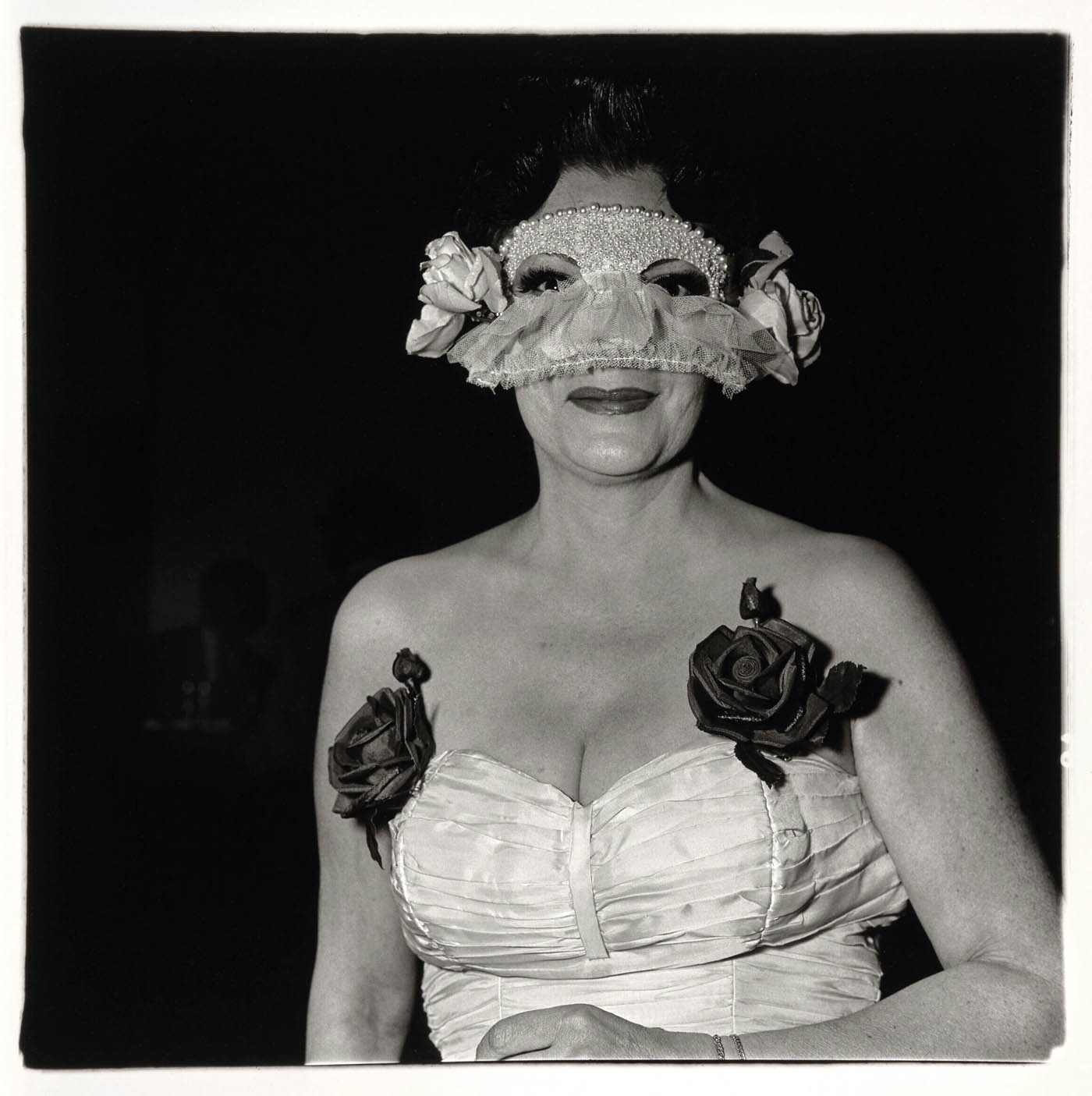
Diane Arbus (American, 1923-1971) 'Lady at a Masked Ball with Two Roses on Her Dress, NYC' 1967


Diane Arbus (American, 1923-1971)
Lady at a Masked Ball with Two Roses on Her Dress, NYC
1967
Gelatin silver print
© The Estate of Diane Arbus


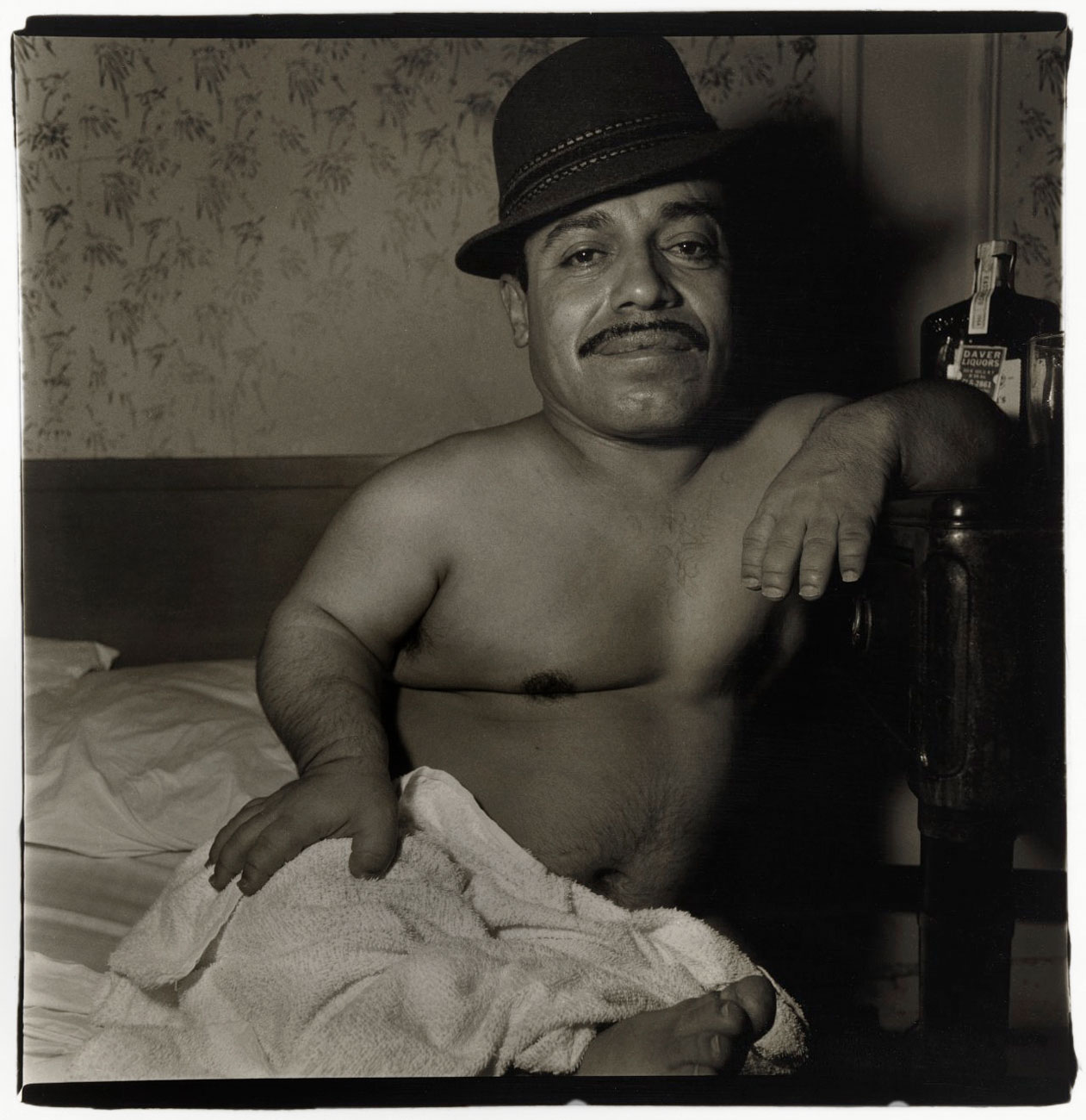
Diane Arbus (American, 1923-1971) 'Mexican Dwarf in his hotel room, NYC' 1970


Diane Arbus (American, 1923-1971)
Mexican Dwarf in his hotel room, NYC
1970
Gelatin silver print
© The Estate of Diane Arbus


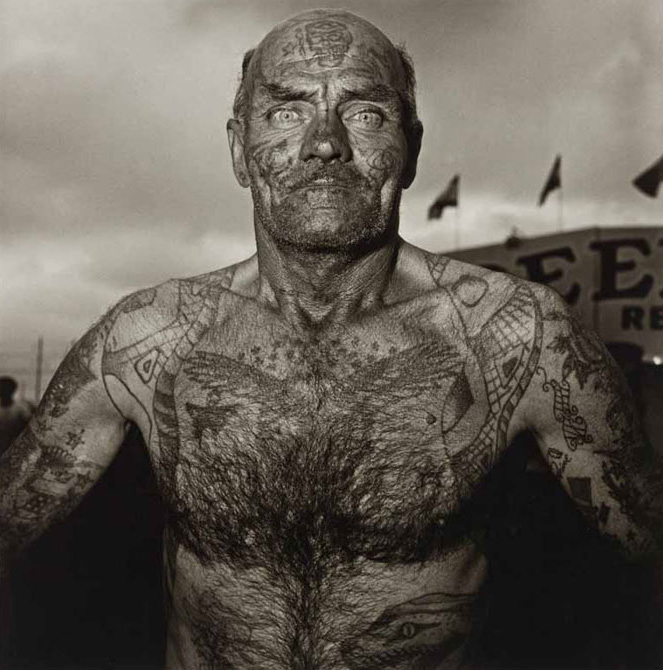
Diane Arbus (American, 1923-1971) 'Tattooed Man at a Carnival, Md.' 1970


Diane Arbus (American, 1923-1971)
Tattooed Man at a Carnival, Md.
1970
Gelatin silver print
© The Estate of Diane Arbus


Jeu de Paume
1, place de la Concorde
75008 Paris
métro Concorde
Phone: 01 47 03 12 50

Opening hours:
Tuesday – Friday 12am – 8pm
Saturday and Sunday 11am – 7pm
Closed Monday

Jeu de Paume website

LIKE ART BLART ON FACEBOOK

Back to top

Exhibition: ‘Vivian Maier: Photographs from the Maloof Collection’ at the Howard Greenberg Gallery, New York

Exhibition dates:  15th December 2011 – 26th January 2012


Vivian Maier (American, 1926-2009) 'Untitled (portrait of a woman)' date unknown


Vivian Maier (American, 1926-2009)
Untitled (portrait of a woman)
Date unknown
© Vivian Maier/Maloof Collection, Courtesy Howard Greenberg Gallery


Another photographer who is getting more recognition. Out of the work I have seen the portraits are the strongest. Some of them feel like precursors to the confronting portraits of women made by Diane Arbus while others offer a more reflective, contemplative examination of human presence.

Dr Marcus Bunyan


Many thankx to Alicia Colen for her help and to the Howard Greenberg Gallery for allowing me to publish the photographs in the posting.


Vivian Maier (American, 1926-2009) 'Untitled' c. 1950's


Vivian Maier (American, 1926-2009)
Untitled
c. 1950’s
© Vivian Maier/Maloof Collection, Courtesy Howard Greenberg Gallery


Vivian Maier (American, 1926-2009) 'Untitled' c. 1950's


Vivian Maier (American, 1926-2009)
Untitled
c. 1950’s
© Vivian Maier/Maloof Collection, Courtesy Howard Greenberg Gallery


Vivian Maier (American, 1926-2009) 'Untitled' c. 1950's


Vivian Maier (American, 1926-2009)
Untitled
c. 1950’s
© Vivian Maier/Maloof Collection, Courtesy Howard Greenberg Gallery


Vivian Maier (American, 1926-2009) 'Untitled' 1954


Vivian Maier (American, 1926-2009)
Untitled
1954
Gelatin silver print, printed later
© Vivian Maier/Maloof Collection, Courtesy Howard Greenberg Gallery


Vivian Maier (American, 1926-2009) 'Florida' 1957


Vivian Maier (American, 1926-2009)
Florida
1957
Gelatin silver print, later print
© Vivian Maier/Maloof Collection, Courtesy Howard Greenberg Gallery


Vivian Maier (American, 1926-2009) 'New York, New York City' Nd


Vivian Maier (American, 1926-2009)
New York, New York City
Nd
Gelatin silver print, later print
© Vivian Maier/Maloof Collection, Courtesy Howard Greenberg Gallery


Vivian Maier (American, 1926-2009) 'Untitled' Nd


Vivian Maier (American, 1926-2009)
Untitled
Nd
Gelatin silver print, later print
© Vivian Maier/Maloof Collection, Courtesy Howard Greenberg Gallery


Howard Greenberg Gallery is proud to present the recently discovered work of street photographer, Vivian Maier (1926-2009), from the Maloof Collection.

A nanny by trade, Vivian Maier’s street and travel photography was discovered by John Maloof in 2007 at a local auction house in Chicago. Always with a Rolleiflex around her neck, she managed to amass more than 2,000 rolls of films, 3,000 prints and more than 100,000 negative which were shared with virtually no one in her lifetime. Her black and white photographs-mostly from the 50s and 60s-are indelible images of the architecture and street life of Chicago and New York. She rarely took more than one frame of each image and concentrated on children, women, the elderly, and indigent. The breadth of Maier’s work also reveals a series of striking self-portraits as well as prints from her travels to Egypt, Bangkok, Italy, and the American Southwest, among dozens of other international cities.

“My fascination with her story has only grown, as has my involvement with her photographs. It is such an unusual story with no resolution. At first her images are extremely well seen, quality photographs of life on the street, in New York City and Chicago. But as one looks at the body of her work, she reveals her deeper interests. Then one tries to imagine who she was, what motivated her, her personality. It is not everyday that one becomes so involved and even obsessed with a particular photographer,” comments Howard Greenberg.

What little is known about Maier’s life is the result of John Maloof’s extensive research. He discovered her obituary on line in 2009 which was just the beginning of his investigative work. An American of French and Austro-Hungarian extraction, Maier split her time between Europe and the US, returning to NY in 1951. In 1956, she ultimately settled in Chicago where she worked as nanny for more than forty years. For a brief period in the 1970s she worked as a nanny to journalist, Phil Donahue’s children. Towards the end of her life, Maier was supported by the children she had cared for in the early 50s. Unbeknownst to them, one of Maier’s storage lockers (containing her massive group of negatives) was auctioned off due to delinquent payments.

After purchasing the first collection of Maier photographs in 2007, Maloof acquired more from another buyer at the same auction. He has since established the Maloof Collection to promote the work of Vivian Maier and to safeguard the archive for future generations. The archive consists of approximately 100,000 to 150,000 negatives; over 3,000 prints; hundreds of rolls of film; home movies; audio tape interviews, and other items representing roughly 90% of Maier’s work. Through Maloof’s efforts, Vivian Maier’s photographs have been exhibited internationally and have received significant critical attention. In November, Powerhouse Books will publish Vivian Maier: Street Photographer, edited by Maloof with a foreword by Geoff Dyer. John Maloof is also co-producing a documentary about Vivian Maier.

Press release from the Howard Greenberg Gallery


Vivian Maier (American, 1926-2009) 'Untitled' c. 1950's


Vivian Maier (American, 1926-2009)
Untitled
c. 1950’s
© Vivian Maier/Maloof Collection, Courtesy Howard Greenberg Gallery


Vivian Maier (American, 1926-2009) 'Uptown West, New York, NY, January 26, 1955' 1955


Vivian Maier (American, 1926-2009)
Uptown West, New York, NY, January 26, 1955
1955
© Vivian Maier/Maloof Collection, Courtesy Howard Greenberg Gallery


Vivian Maier (American, 1926-2009) 'New York, New York City' 1954


Vivian Maier (American, 1926-2009)
New York, New York City
1954
Gelatin silver print, printed later
© Vivian Maier/Maloof Collection, Courtesy Howard Greenberg Gallery


Vivian Maier (American, 1926-2009) 'Untitled' 1956


Vivian Maier (American, 1926-2009)
Untitled
1956
Gelatin silver print, printed later
© Vivian Maier/Maloof Collection, Courtesy Howard Greenberg Gallery


Vivian Maier (American, 1926-2009) 'Untitled, Chicago, May 16, 1957' 1957


Vivian Maier (American, 1926-2009)
Untitled, Chicago, May 16, 1957
1957
© Vivian Maier/Maloof Collection, Courtesy Howard Greenberg Gallery


Vivian Maier (American, 1926-2009) 'Florida' 1960


Vivian Maier (American, 1926-2009)
Florida
1960
Gelatin silver print, printed later
© Vivian Maier/Maloof Collection, Courtesy Howard Greenberg Gallery


Vivian Maier (American, 1926-2009) 'Untitled' Nd


Vivian Maier (American, 1926-2009)
Untitled
Nd
Gelatin silver print, printed later
© Vivian Maier/Maloof Collection, Courtesy Howard Greenberg Gallery


Vivian Maier (American, 1926-2009) 'New York City' 1955


Vivian Maier (American, 1926-2009)
New York City
1955
Gelatin silver print, printed later
© Vivian Maier/Maloof Collection, Courtesy Howard Greenberg Gallery


Vivian Maier (American, 1926-2009) 'New York City, Self-Portrait, September 10th, 1955' 1955


Vivian Maier (American, 1926-2009)
New York City, Self-Portrait, September 10th, 1955
1955
© Vivian Maier/Maloof Collection, Courtesy Howard Greenberg Gallery


Howard Greenberg Gallery
The Fuller Building
41 East 57 Street
Suite 1406
New York, NY 10022
Phone: 212.334.0010

Gallery hours:
Tuesday – Friday 10.00am – 5.00pm

Howard Greenberg Gallery website

LIKE ART BLART ON FACEBOOK

Back to top

Exhibition: ‘After the Gold Rush: Contemporary Photographs from the Collection’ at The Metropolitan Museum of Art, New York

Exhibition dates: 22nd March, 2011 – 2nd January, 2012


Many thankx to The Metropolitan Museum of Art, New York for allowing me to publish the photographs in the posting. Please click on the photographs for a larger version of the image.


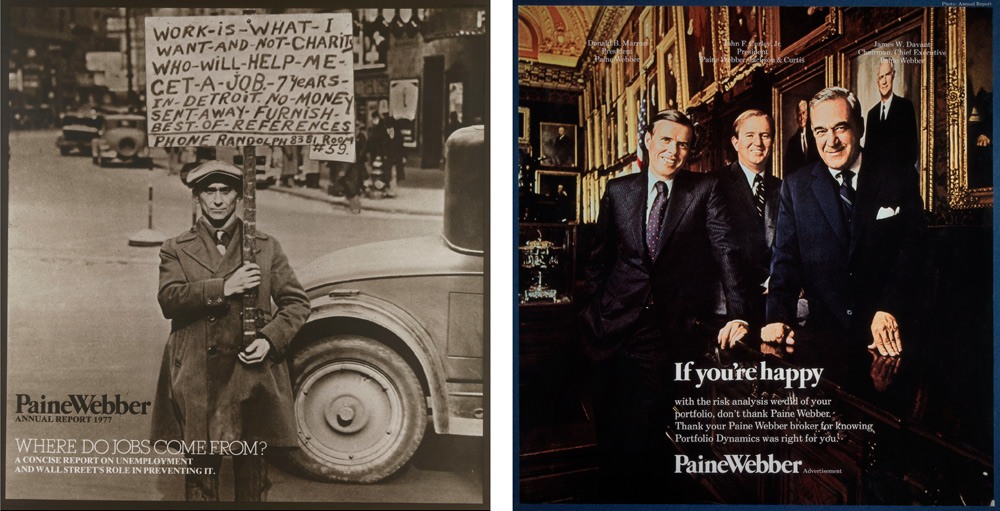
Hans Haacke (German, born 1936). 'Thank You, Paine Webber' 1979


Hans Haacke (German, b. 1936)
Thank You, Paine Webber
1979
Gelatin silver print and chromogenic print
The Metropolitan Museum of Art
Purchase, Vital Projects Fund Inc. Gift, through Joyce and Robert Menschel, 2010
© Hans Haacke


Since the early 1970s Haacke has taken on the intertwined political and corporate forces that use cultural patronage as a smokescreen to advance interests that are often antithetical to the vitality of free speech and expression in democracies. Haacke made this work just as the strategy of appropriation – lifting an image out of its original context and re-presenting it in critical fashion – began to make waves in the New York art world of the late 1970s. Like all effective appropriation, it exposes a prior instance of borrowing – in this case, how the investment firm Paine Webber used a documentary photograph to give its annual report the veneer of social concern. The artist then pointedly contrasted it with an image from the same annual report of a beaming trio of executives in a painting-lined gallery. As a counterpoint to the protestor’s signboard, Haacke dropped in text from a different Paine Webber ad campaign to show on whose backs the “risk management” is taking place – a biting indictment, the relevance of which has only increased since the recent economic downturn.

Wall text


Jeff Wall (Canadian, born 1946). 'The Storyteller' 1986


Jeff Wall (Canadian, b. 1946)
The Storyteller
1986
Silver dye bleach transparency in light box
The Metropolitan Museum of Art
Purchase, Charlene and David Howe, Henry Nias Foundation Inc., Jennifer and Robert Yaffa, Harriet Ames Charitable Trust, and Gary and Sarah Wolkowitz Gifts, 2006
Image courtesy of the artist
© Jeff Wall


Wall’s staged tableaux straddle the worlds of the museum and the street. His subjects are scenes of urban and suburban disarray that he witnessed firsthand – the kinds of things anyone might see while wandering around a city and its outskirts. Working like a movie director, he restages the scene using nonprofessionals as actors and presents his photographs as colour transparencies in light boxes such as those of large-scale public advertisements found at airports and bus stops. The scale and ambition of his pictures – scenes of everyday life shot through with larger intimations of political struggle – equally evoke the Salon paintings of nineteenth century French painters such as Gustave Courbet and Édouard Manet, which were themselves brazen combinations of canonical and contemporary subjects.

The Storyteller is set in a barren, leftover slice of land next to a highway overpass in Vancouver, where the artist lives. Various groupings of modern urban castaways – perhaps descendants of the Native Americans who occupied the land before the arrival of Europeans – are dispersed around the hillside, a mini-catalogue of art-historical reference. Like the upside-down, half-submerged figure of Icarus in the background of Brueghel’s Landscape with the Fall of Icarus, the woman speaking and gesticulating to the two men listening at the lower left becomes the key to unifying the fractured and alienating environment from which Wall’s picture is constructed.

Wall text


Laurie Simmons (American, b. 1949). 'Walking Gun' 1991


Laurie Simmons (American, b. 1949)
Walking Gun
1991
Gelatin silver print
The Metropolitan Museum of Art
Purchase, Anonymous Gift, 1998
© Laurie Simmons


The early 1990s marked the last moment when a wide swath of women artists responded to the sexism they saw as pervasive in the culture – from the rape trial of William Kennedy Smith to the Supreme Court nomination hearings for Clarence Thomas. A pioneer of set-up photography, Simmons dramatically expanded the scale of her constructed tableaux for a series of spotlighted puppet-like objects perched atop doll legs: revolvers, houses, cameras, and cakes. This armed and dangerous example refers to the old-movie cliché where a man carrying a gun is shown in shadow profile. Here, Simmons offers instead the death-dealing seductress – also familiar from film noir – in monumental miniature, a doll capable of turning on its master at a moment’s notice.

Wall text


Philip-Lorca diCorcia (American, b. 1953). 'Todd M. Brooks, 22 Years Old, from Denver, Colorado, $40' 1991


Philip-Lorca diCorcia (American, b. 1953)
Todd M. Brooks, 22 Years Old, from Denver, Colorado, $40
1991
Chromogenic print
The Metropolitan Museum of Art
Purchase, The Horace W. Goldsmith Foundation Gift, through Joyce and Robert Menschel, 1991
Image courtesy the artist and David Zwirner, New York
© Philip-Lorca diCorcia


In the middle of the 1990’s, diCorcia gained international recognition for his large color photographs of street scenes and passersby. For an earlier series, he traveled to Los Angeles on a fellowship from the National Endowment for the Arts, and worked on a part of Santa Monica Boulevard frequented by male prostitutes and drug addicts. For each picture he made there, he carefully composed his setting, then asked young men to pose for him, giving them a small fee (from twenty to fifty dollars) that was negotiated each time.

At that time, NEA support of artists such as Robert Mapplethorpe was highly controversial, and diCorcia had to sign a document stating that he would not produce any “obscene” work while on his fellowship. He set up the whole negotiating procedure as a symbolic way of sharing his grant with people whose behavior would surely have been condemned by the censors. The titles always mention the name, the age and the origin of the model, as well as the amount paid. The staged situation interacts with the raw reality of the exchange of money, blurring the boundaries between documentary and fiction, yet preserving an authentic emotional charge.

Text from The Metropolitan Museum of Art website


Philip-Lorca diCorcia (American, b. 1953) 'Eddie Anderson, 21 Years Old, from Houston, Texas, $20' 1991


Philip-Lorca diCorcia (American, b. 1953)
Eddie Anderson, 21 Years Old, from Houston, Texas, $20
1991
Chromogenic print
Image: 39.2 x 57.8 cm (15 7/16 x 22 3/4 in.)
The Metropolitan Museum of Art
Purchase, The Horace W. Goldsmith Foundation Gift, through Joyce and Robert Menschel, 1991
Image courtesy the artist and David Zwirner, New York
© Philip-Lorca diCorcia


The Metropolitan Museum of Art will present After the Gold Rush: Contemporary Photographs from the Collection from March 22, 2011, through January 2, 2012, in the Joyce and Robert Menschel Hall for Modern Photography. Drawn entirely from the Museum’s permanent collection, the exhibition features 25 photographs dating from 1979 to the present by 15 contemporary artists.

The exhibition’s title, After the Gold Rush, is taken from a classic 1970 song by Neil Young, whose verses contrast a romanticised past with a present of squandered plenty and an uncertain future. Inspired by the recent political and economic upheavals in America and abroad, this selection juxtaposes new photographs that take the long view of the world’s current condition with prescient works from the 1980s and 1990s that remain startlingly relevant today.

This is the first occasion for the Museum to present recently acquired works by: Gretchen Bender, James Casebere, Moyra Davey, Katy Grannan, Hans Haacke, An-My Lê, Curtis Mann, Trevor Paglen, and Wolfgang Tillmans. Also featured are photographs by: Philip-Lorca diCorcia, Robert Gober, Adrian Piper, Laurie Simmons, Jeff Wall, and Christopher Williams.

After the Gold Rush begins with Hans Haacke’s Thank You, Paine Webber (1979) – the first work by this legendary provocateur of Conceptual art to enter the Metropolitan’s collection. Haacke’s biting photo-diptych is so pertinent to the recent economic downturn that it seems as if it could have been made yesterday. In this work, the artist appropriated images from the investment firm’s annual report to convey his viewpoint that big business provides a veneer of social concern to mask the brutal effects of the “risk management” they offer their clients.

Other works in After the Gold Rush use varying degrees of artifice and photographic realism to reflect on marginalised and repressed voices. Measuring over 14 feet long and presented as a backlit transparency in a light box, The Storyteller (1986) is Jeff Wall’s signature image and is typical of his method. Working from memory, the artist uses nonprofessional actors and real locations to meticulously restage a scene of urban blight that he witnessed in his native Vancouver. Wall plays this photographic verisimilitude against compositions and figural poses indebted to French painters such as Gustave Courbet, Edouard Manet, and Georges Seurat. A comparison of Wall’s Storyteller with Courbet’s Young Ladies of the Village (1852), on view in the Museum’s galleries for Nineteenth and Early Twentieth-Century European Paintings and Sculpture, reveals parallels: in both, a keenly observed moment of telling social interaction taking place on a sloping landscape. Each artist has combined a daringly modern subject with references to earlier art.

Philip-Lorca diCorcia is another key figure in the development of staged photography. In the early 1990s, the artist created a series of works in response to the political attacks on gays and federal funding of the arts in the U.S. DiCorcia hired male hustlers to pose for their portraits out on the streets – and paid them with grant money he received from the National Endowment for the Arts. At the same moment, a wide swath of women artists addressed issues of sexism and racism: examples of this politically pointed art are represented by Laurie Simmons’ Walking Gun (1991) – a spotlighted puppet of doll legs and a revolver that seems capable of turning on its master at a moment’s notice – and Adrian Piper’s 1992 work Decide Who You Are #24 (A Moving Target), which includes a childhood image of Anita Hill as part of a blistering meditation in word and image on racial politics. Such works are missives from a time not so long ago when artists regularly commented on present-day politics and culture through their art. (Because of light sensitivity, this work by Adrian Piper will be on view through Sunday, September 26.)

Although the recently made photographs in After the Gold Rush seem at first glance to be less overtly political than their predecessors, they nevertheless address vital issues about contemporary society. James Casebere’s epic vision of America, Landscape with Houses (Dutchess County, NY) #1, (2009), is based on a tabletop model that the artist spent 18 months building. The photograph shows a suburban subdivision of the kind recently ravaged by the foreclosure crisis, and its sunny sense of “Morning in America” comments ironically on the country’s future prospects. An-My Lê’s similarly sweeping five-part photographic piece Suez Canal Transit, USS Dwight Eisenhower, Egypt (2009) will also be featured. Lê is interested in the way in which U.S. armed forces come into contact with the rest of the world. This major new work – which seems at first to be a straightforward panorama of military might overseas – subtly undercuts the viewer’s expectations to question the current position of the U.S. on the global stage.

Trevor Paglen is a young artist whose works plot the “black world” of covert military operations, from telephoto images of predator drones taken from miles away, to software that follows planes used for the extraordinary rendition of suspected terrorists. Paglen’s 2008 photograph KEYHOLE IMPROVED CRYSTAL from Glacier Point (Optical Reconnaissance Satellite; USA 186) shows the ghostly white streak of an American reconnaissance satellite bisecting star trails above Yosemite’s Half Dome, a rock formation photographed in the 1860s by artists including Carleton Watkins. To make these and other photographs, Paglen collaborated with amateur astronomers who were originally trained by the U.S. government to look out for Soviet satellites during the Cold War, but turned their attention to American surveillance in recent years.

The final piece in After the Gold Rush is a suite of five recently acquired photographs from 2007-2009 by the celebrated photographer Wolfgang Tillmans. The grouping shifts focus from macro to micro: from expansive aerial views of Shanghai and Dubai to close ups that suggest the smallest increments of sustenance and regeneration. Taken together, they evoke the interconnectedness of all things and a grounding of the political in the personal as a way for an engaged yet expressive art.

Press release from The Metropolitan Museum of Art website


Moyra Davey (American born Canada, b. 1958) 'Copperhead Grid' 1990 (detail)


Moyra Davey (American born Canada, b. 1958)
Copperhead Grid (detail)
1990
Chromogenic prints
Image: 8 3/4 in. × 6 in. (22.3 × 15.3cm) each
Sheet: 10 × 8 in. (25.4 × 20.3cm) each
The Metropolitan Museum of Art
Purchase, Vital Projects Fund Inc. Gift, through Joyce and Robert Menschel, 2011
© Moyra Davey


It was in 1990 – at the height of a worldwide economic recession that also marked the end of the 1980s art bubble – that Davey began photographing the scratched, worn-away surfaces of pennies, the most devalued and lowest form of currency. Her accumulation of one hundred micro-photographic specimens is constructed around the readymade patterns of decay that countless anonymous owners have unconsciously wrought upon their surfaces; their base materiality is incisively contrasted with the most elevated of national symbols. As with all of Davey’s work, there is a melancholic sense of loss that connects subject and form: like pennies, photographs are objects of exchange imprinted by contact with the world around them.

Text from The Metropolitan Museum of Art website


Adrian Piper (American, born 1948). 'Decide Who You Are #24: A Moving Target' 1992


Adrian Piper (American, b. 1948)
Decide Who You Are #24: A Moving Target
1992
Photo-mechanical processes on three panels
The Metropolitan Museum of Art
Gift of Peter Norton Family Foundation, 1994
© Adrian Piper


Piper is an artist and a philosophy professor who works in a variety of media, including performance, video, sound pieces, photography, drawing, and writing. She often explores issues of autobiography, racism, and stereotyping. For her 1992 series Decide Who You Are, the artist used a triptych format in which a different appropriated photograph is flanked by an image of the “three wise monkeys” maxim advocating “See No Evil, Speak No Evil, Hear No Evil” at left, and at right a photograph of a young girl who, though not identified, is Anita Hill – who had recently been thrust into the spotlight for accusing then-nominee for Supreme Court Justice Clarence Thomas of sexual harassment. The verse in the left panel changes in each individual work in the series, while that on the right is unchanging – what the artist once described as “a comprehensive, textbook compendium of commonly invoked litanies of denial and intimidation, from the bland to the vaguely menacing” and “a must for novices and aspiring leaders in business, politics, and culture.”

Wall text


Christopher Williams (American, b. 1956). '3 White (DG's Mr. Postman) Fourth Race, Phoenix Greyhound Park, Phoenix, Arizona, August 22, 1994' 1994


Christopher Williams (American, b. 1956)
3 White (DG’s Mr. Postman) Fourth Race, Phoenix Greyhound Park, Phoenix, Arizona, August 22, 1994
1994
Gelatin silver print
The Metropolitan Museum of Art
Purchase, Charina Foundation Inc. and Jennifer and Joseph Duke Gifts, 2003
© Christopher Williams


Robert Gober (American, b. 1954) 'Page 12 / Untitled (Detail from 1978-2000)' 1978-2000


Robert Gober (American, b. 1954)
Page 12 / Untitled (Detail from 1978-2000)
1978-2000
Gelatin silver print
40.6 x 50.8cm (16 x 20 in.)
The Metropolitan Museum of Art
Purchase, Charina Foundation Inc. Gift, 2002
© Robert Gober


Robert Gober works primarily in sculpture, installations, and photography. He is perhaps best known for his delicate, ghostly hand crafted versions of domestic fixtures, such as drains, beds, doors, and sinks. Through these uncanny replicas, Gober invests mass produced objects with personal meaning – the private, unruly desires and memories of the individual. This image appeared in the book (his first in the genre) that Gober created to accompany his installation representing the United States at the 2000 Venice Biennale. In it, the artist interweaves his own journey to New York in 1978 as a young gay man with the toxic fallout of homophobic recrimination that accompanied the murder of the Wyoming college student Matthew Shepard twenty years later.

Text from The Metropolitan Museum of Art website


Robert Gober superimposes a man’s hand between two newspaper articles, clipped neatly and placed on a shell-strewn beach. Below his hand, the article refers to Matthew Shepard’s death. Above it, a letter to the editor argues that “Orthodox Jews, conservative Christians and others have a right to speak out against homosexuality without being placed in the category of thuggery.” While the piece obviously precedes Jonathan Rauch’s provocative and important piece in the December issue of the Advocate arguing that gay people should tolerate a certain amount of anti-gay sentiment as a sign that they’re legally and socially secure enough to practice tolerance, it’s a useful encapsulation of the dilemma behind that argument. It’s hard to cast off past threats if you’re not entirely sure they’re past.

Alyssa Rosenberg. “Gay Americans, Censorship, And ‘After The Gold Rush’ At The Metropolitan Museum Of Art,” on the Think Progress website November 28, 2011 [Online] Cited 11/12/2024


Robert Gober (American, b. 1954). 'Untitled (Detail from "1978-2000")' 2000


Robert Gober (American, b. 1954)
Untitled (Detail from “1978-2000”)
2000
Gelatin silver print
The Metropolitan Museum of Art
Purchase, Jennifer and Joseph Duke Gift, 2002
© Robert Gober


James Casebere (American, b. 1953). 'Landscape with Houses (Dutchess County, NY) #1' 2009


James Casebere (American, b. 1953)
Landscape with Houses (Dutchess County, NY) #1
2009
Chromogenic print
The Metropolitan Museum of Art
Purchase, Alfred Stieglitz Society Gifts, 2011
© James Casebere


Trevor Paglen (American, b. 1974) 'KEYHOLE IMPROVED CRYSTAL from Glacier Point (Optical Reconnaissance Satelltte; USA 186)' 2008


Trevor Paglen (American, b. 1974)
KEYHOLE IMPROVED CRYSTAL from Glacier Point (Optical Reconnaissance Satelltte; USA 186)
2008
Chromogenic print
Image: 95.3 x 76.2cm (37 1/2 x 30 in.)
Frame: 96.5 × 77.5cm (38 × 30 1/2 in.)
The Metropolitan Museum of Art
Purchase, Vital Projects Fund Inc. Gift, through Joyce and Robert Menschel, 2011
© Trevor Paglen


Trained as a geographer, Paglen is an artist who plots the topography of a new global and celestial space – the “black world” of covert military operations. Examples of his subjects include the supposed sites used for the extraordinary rendition of prisoners, which he shoots with specially designed cameras from up to forty miles away, and the network of private planes used to transport them under the radar. This image shows the ghostly white streak of an American reconnaissance satellite bisecting star trails above Yosemite’s Half Dome, a rock formation photographed in the 1860s by the photographer Carleton Watkins when the West was still being explored. In order to track such spacecraft, Paglen uses a database created by amateur astronomers who were trained by the U.S. government to search the skies for Soviet sputniks but continued their hobby after the end of the Cold War by tracking our own satellites. In this work, the artist brings into one composition two historically disparate moments in geographic and celestial colonisation.

Text from The Metropolitan Museum of Art website


Wolfgang Tillmans (German, b. 1968).' Oriental Pearl' 2009


Wolfgang Tillmans (German, b. 1968)
Oriental Pearl
2009
Inkjet print
The Metropolitan Museum of Art
Purchase, Vital Projects Fund Inc. Gift, through Joyce and Robert Menschel, 2010
Image courtesy the artist and Andrea Rosen Gallery, New York
© Wolfgang Tillmans


The Metropolitan Museum of Art
1000 Fifth Avenue at 82nd Street
New York, New York 10028-0198
Phone: 212-535-7710

Opening hours:
Sunday – Tuesday and Thursday: 10am – 5pm
Friday and Saturday: 10am – 9pm
Closed Wednesday

The Metropolitan Museum of Art website

LIKE ART BLART ON FACEBOOK

Back to top
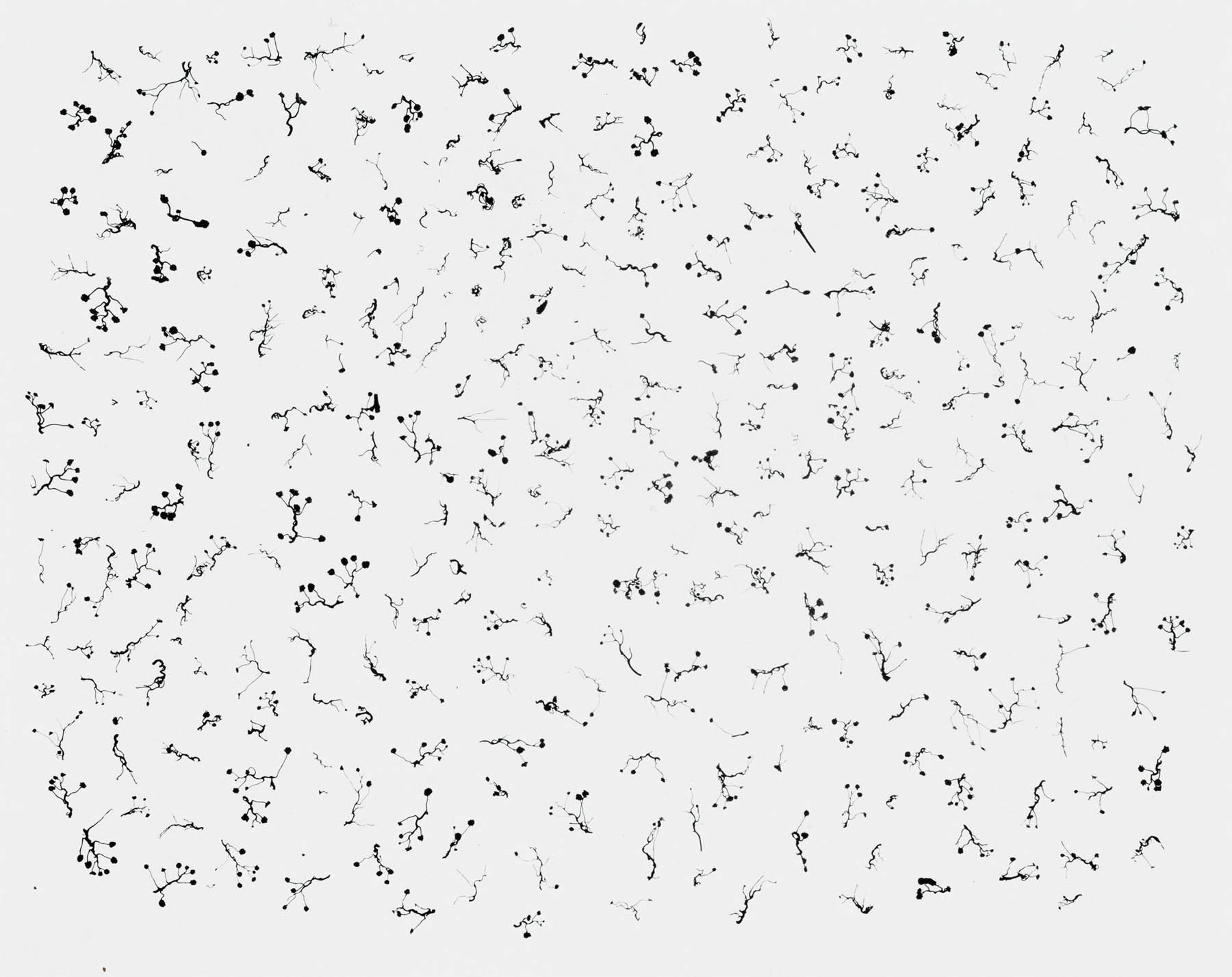
Exhibition: ‘Robert Adams: The Place We Live, A Retrospective Selection of Photographs’ at the The Denver Art Museum (DAM)

Exhibition dates:  25th September 2011 – 1st January 2012


Many thankx to The Denver Art Museum for allowing me to publish the photographs in the posting. Please click on the photographs for a larger version of the image.


Robert Adams (American, b. 1937) 'Burning oil sludge, north of Denver, Colorado' 1973-1974


Robert Adams (American, b. 1937)
Burning oil sludge, north of Denver, Colorado
1973-1974
Gelatin silver print
Yale University Art Gallery, purchased with a gift from Saundra B. Lane, a grant from the Trellis Fund and the Janet and Simeon Braguin Fund


Robert Adams (American, b. 1937) 'North of Keota, Colorado' 1973


Robert Adams (American, b. 1937)
North of Keota, Colorado
1973 printed 1989
Gelatin silver print
Yale University Art Gallery, purchased with a gift from Saundra B. Lane, a grant from the Trellis Fund and the Janet and Simeon Braguin Fund


Robert Adams (American, b. 1937) 'Mobile home park, north edge of Denver, Colorado' 1973-1974


Robert Adams (American, b. 1937)
Mobile home park, north edge of Denver, Colorado
1973-1974
Gelatin silver print
Yale University Art Gallery, purchased with a gift from Saundra B. Lane, a grant from the Trellis Fund and the Janet and Simeon Braguin Fund


The Denver Art Museum (DAM) is the first U.S. venue for Robert Adams: The Place We Live, A Retrospective Selection of Photographs. The exhibition features more than 200 black-and-white photos spanning Adams’s 45-year career, showcasing the artistic legacy of the American photographer and his longstanding engagement with the contemporary Western landscape. Adams lived and worked in Colorado for nearly 30 years. Many of his most acclaimed images were taken in the Rocky Mountain region and will strike a familiar chord with visitors. The exhibition, organised by the Yale University Art Gallery, will be on view September 25, 2011 – January 1, 2012 in the museum’s Gallagher Family Gallery.

“We’re excited to host the work of one of the foremost photographers of our time,” said Eric Paddock, the DAM’s curator of photography. “Robert Adams’s striking yet quiet photos provoke thought about current economic, political and environmental issues Westerners confront every day. We think visitors will see something very familiar in his work.”

Since becoming a photographer in the mid-1960s, Adams has been widely regarded as one of the most significant and influential chroniclers of the American West. Adams’s photographs and writing insist that the realities of everyday landscapes are as beautiful as idealised scenes from nature. They ask questions about the ways people change and interact with nature, and what it means to live simply and quietly in today’s world. This commitment earned Adams prominence in photography’s “New Topographics” movement of the late 20th century and lends authority to his ongoing work. His photographs of Colorado suburban growth and clear cut forests in the Pacific Northwest, for example, express shock at mainstream social and economic values.

“The Denver Art Museum is pleased to be the first U.S. venue for The Place We Live, showcasing our continued commitment to our photography program,” said Christoph Heinrich, Frederick and Jan Mayer Director of the DAM. “Colorado has a rich photography history and we’re excited to have visitors engage with these artworks that provide a narrative to the American experience and take a fresh look at their surroundings.”

Featuring more than 200 gelatin silver prints, The Place We Live weaves together four decades of Adam’s work into a cohesive, epic narrative of American experience in the late 20th and early 21st centuries. Each of the photographer’s major projects is represented, from early pictures of quiet buildings and monuments erected by prior settlers of his native Colorado to his most recent images of forests and migratory birds in the Pacific Northwest.

Biography

Born in Orange, N.J., in 1937, Robert Adams moved with his family from Madison, Wis., to Denver, Colo., at the age of 15. He earned a doctorate degree from the University of Southern California and, intent on pursuing an academic career, returned to Colorado in 1962 as an assistant professor of English at Colorado College. Disturbed by the rapid transformation of the Colorado Springs and Denver areas, Adams began photographing a landscape transformed by tract housing, highways, strip malls and gas stations. “The pictures record what we purchased, what we paid and what we could not buy,” Adams wrote. “They document a separation from ourselves, and in turn from the natural world that we professed to love.” Since 1997, he has lived and worked in Oregon.”

Press release from The Denver Art Museum


Robert Adams (American, b. 1937) 'Lakewood, Colorado' 1968-1971


Robert Adams (American, b. 1937)
Lakewood, Colorado
1968-1971
Gelatin silver print
Yale University Art Gallery, purchased with a gift from Saundra B. Lane, a grant from the Trellis Fund and the Janet and Simeon Braguin Fund


Robert Adams (American, b. 1937) 'In a New Subdivision, Colorado Springs, Colorado' 1969


Robert Adams (American, b. 1937)
In a New Subdivision, Colorado Springs, Colorado
1969
Gelatin silver print
Yale University Art Gallery, purchased with a gift from Saundra B. Lane, a grant from the Trellis Fund and the Janet and Simeon Braguin Fund


Robert Adams (American, b. 1937) 'Frame for a Tract House, Colorado Springs, Colorado' 1969


Robert Adams (American, b. 1937)
Frame for a Tract House, Colorado Springs, Colorado
1969
Gelatin silver print
Yale University Art Gallery, purchased with a gift from Saundra B. Lane, a grant from the Trellis Fund and the Janet and Simeon Braguin Fund


Robert Adams (American, b. 1937) 'Pikes Peak, Colorado Springs, Colorado' 1969


Robert Adams (American, b. 1937)
Pikes Peak, Colorado Springs, Colorado
1969
Gelatin silver print
Yale University Art Gallery, purchased with a gift from Saundra B. Lane, a grant from the Trellis Fund and the Janet and Simeon Braguin Fund


Robert Adams (American, b. 1937) 'Denver, Colorado' c. 1970


Robert Adams (American, b. 1937)
Denver, Colorado
c. 1970
Gelatin silver print
Yale University Art Gallery, purchased with a gift from Saundra B. Lane, a grant from the Trellis Fund and the Janet and Simeon Braguin Fund


Robert Adams (American, b. 1937) 'Longmont, Colorado' 1973-1974, printed 2007


Robert Adams (American, b. 1937)
Longmont, Colorado
1973-1974, printed 2007
Gelatin silver print
Yale University Art Gallery, purchased with a gift from Saundra B. Lane, a grant from the Trellis Fund and the Janet and Simeon Braguin Fund


Robert Adams (American, b. 1937) 'Eden, Colorado' 1968


Robert Adams (American, b. 1937)
Eden, Colorado
1968
Gelatin silver print
Yale University Art Gallery
Purchased with a gift from Saundra B. Lane, a grant from the Trellis Fund and the Janet and Simeon Braguin Fund


Robert Adams (American, b. 1937) 'Colorado Springs, Colorado' 1974


Robert Adams (American, b. 1937)
Colorado Springs, Colorado
1968
Gelatin silver print
Yale University Art Gallery
Purchased with a gift from Saundra B. Lane, a grant from Trellis Fund, and the Janet and Simeon Braguin Fund


Robert Adams (American, b. 1937) 'Edge of San Timoteo Canyon, Redlands, California' 1978


Robert Adams (American, b. 1937)
Edge of San Timoteo Canyon, looking toward Los Angeles, Redlands, California
1978
Gelatin silver print
Yale University Art Gallery
Purchased with a gift from Saundra B. Lane, a grant from the Trellis Fund and the Janet and Simeon Braguin Fund


Robert Adams (American, b. 1937) 'Quarried Mesa Top, Pueblo County, Colorado' 1978


Robert Adams (American, b. 1937)
Quarried Mesa Top, Pueblo County, Colorado
1978
Gelatin silver print
Yale University Art Gallery
Purchased with a gift from Saundra B. Lane, a grant from Trellis Fund, and the Janet and Simeon Braguin Fund


Robert Adams (American, b. 1937) 'Longmont, Colorado' 1979, printed 1985


Robert Adams (American, b. 1937)
Longmont, Colorado
1979, printed 1985
Gelatin silver print
Yale University Art Gallery, purchased with a gift from Saundra B. Lane, a grant from the Trellis Fund and the Janet and Simeon Braguin Fund


Robert Adams (American, b. 1937) 'Santa Ana Wash, Redlands, California' 1982


Robert Adams (American, b. 1937)
Santa Ana Wash, Redlands, California
1983, printed 1991
Gelatin silver print
Yale University Art Gallery, purchased with a gift from Saundra B. Lane, a grant from the Trellis Fund and the Janet and Simeon Braguin Fund


Robert Adams (American, b. 1937) 'Sitka spruce, Cape Blanco State Park, Curry County, Oregon' 1999-2000


Robert Adams (American, b. 1937)
Sitka spruce, Cape Blanco State Park, Curry County, Oregon
1999-2000
Gelatin silver print
Yale University Art Gallery, purchased with a gift from Saundra B. Lane, a grant from the Trellis Fund and the Janet and Simeon Braguin Fund


The Denver Art Museum
Civic Center Cultural Complex
located on 13th Avenue between Broadway and Bannock in downtown Denver

Opening hours:
Daily 10am – 5pm

The Denver Art Museum website

LIKE ART BLART ON FACEBOOK

Back to top
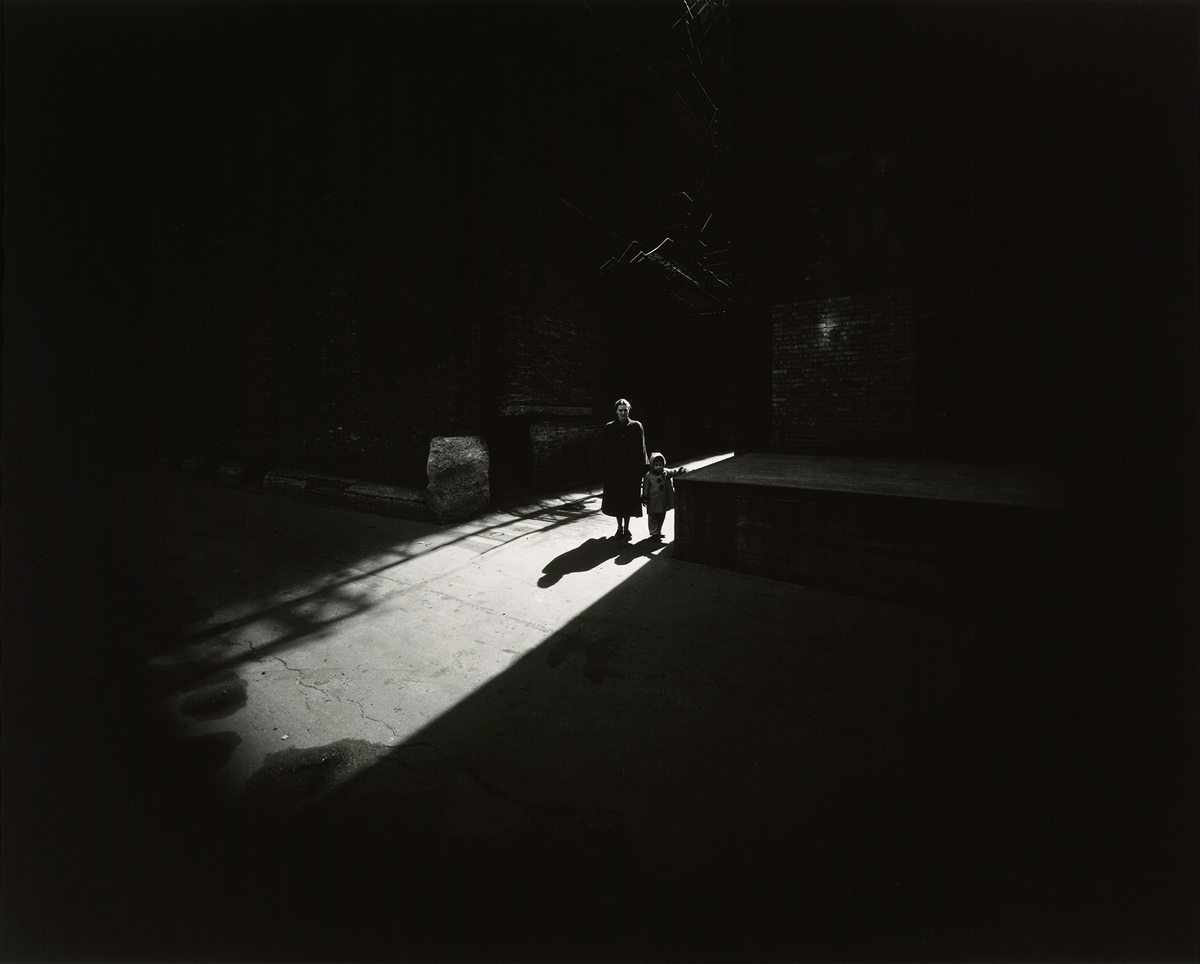
Exhibition: ‘Bare Witness: Photographs by Gordon Parks’ at the Phoenix Art Museum

Exhibition dates: 20th August – 6th November 2011


Many thankx to the Phoenix Art Museum for allowing me to publish the photographs in the posting. Please click on the photographs for a larger version of the image.


Gordon Parks (American, 1912-2006) 'Children with Doll (Ella Watson’s Grandchildren)' 1942


Gordon Parks (American, 1912-2006)
Children with Doll (Ella Watson’s Grandchildren)
1942
Gelatin silver print
11 x 14 inches
Lent by The Capitol Group Foundation
© 2006 The Gordon Parks Foundation


Gordon Parks (American, 1912-2006) 'Ingrid Bergman at Stromboli' 1949


Gordon Parks (American, 1912-2006)
Ingrid Bergman at Stromboli
1949
Gelatin silver print
16 x 20 inches
Lent by The Capitol Group Foundation
© 2006 The Gordon Parks Foundation


Gordon Parks (American, 1912-2006) 'Black Muslim Rally' New York, 1963


Gordon Parks (American, 1912-2006)
Black Muslim Rally
New York, 1963
Gelatin silver print
16 x 20 inches
Lent by The Capitol Group Foundation
© 2006 The Gordon Parks Foundation


Gordon Parks (American, 1912-2006) 'Alberto Giacometti, Paris' 1951


Gordon Parks (American, 1912-2006)
Alberto Giacometti, Paris
1951
Gelatin silver print
16 x 20 inches
Lent by The Capitol Group Foundation
© 2006 The Gordon Parks Foundation


Gordon Parks spent the majority of his professional career at the crossroads of the glamorous and the ghetto – two extremes the noted photographer knew well.  Perhaps best recognised for his works chronicling the African-American experience, Parks was also an accomplished fashion photographer. Bare Witness: Photographs by Gordon Parks provides a revealing look at the diversity and breadth of Parks’s most potent imagery. Featuring 73 works specifically selected by Parks for the photographic collection of the Los Angeles-based Capital Group, Bare Witness divulges heart wrenching images, iconic moments, celebrities and slices of everyday life.

Born in 1912 in Fort Scott, Kansas, Parks, who died in 2006 at age 93, was an African American photographer who began working professionally in the 1930’s. Parks tackled the harsh truth and dignity of the black urban and rural poor in the United States. He photographed aspects of the Civil Rights movements and individuals associated with the Black Panthers and Black Muslims. For nearly 25 years, from 1948 to 1972, he served as staff photographer for Life magazine. He also established himself as a foremost fashion photographer, providing spreads for respected magazines such as Vogue.

Bare Witness features many of Parks’s most memorable images such as “American Gothic.” Taken during Parks’s brief time with the Farm Security Agency, the photograph depicts a black cleaning woman named Ella Watson standing stiffly in front of an American flag, a mop in one hand and a broom in the other. Also included in the exhibition is a series of photos from Parks’s most famous Life magazine essay about Flavio da Silva, a malnourished and asthmatic boy living in a Rio de Janerio slum. Portraits of Muhammad Ali, Duke Ellington, Alexander Calder, Ingrid Bergman, Langston Hughes and Malcolm X among others will also be on view.

“Whether photographing celebrities or common folk, children or the elderly, Harlem gang leaders or fellow artists, Parks brought his straightforward, sympathetic ear and mind to bear witness to late 20th century civilisation,” commented Hilarie Faberman, the Robert M. and Ruth L. Halperin Curator of Modern and Contemporary Art at Cantor Arts Center and organiser of the exhibition. “His photographs balance the dichotomies of black and white, rich and poor, revealing his strengths and struggles as an artist and a man.”

In addition to his documentary and fashion photography, Parks was a filmmaker, author, musician and publisher. He was the first black artist to produce and direct a major Hollywood film, “The Learning Tree” in 1969, which was based on his early life experiences. He subsequently directed the popular action films “Shaft” and “Shaft’s Big Score.” He was a founder and editorial director of Essence magazine and wrote several autobiographies, novels and poems. In 1988, he received the National Medal of Arts award and throughout his lifetime was the recipient of 40 honorary doctorates from colleges and universities in the United States and England.

“Parks was a renaissance man whose career embodied the American ideal of equality and whose art was deeply personal. This exhibition is an exciting opportunity for Museum visitors to experience the poignant images he made over five decades,” commented Rebecca Senf, Norton Curator of Photography, Phoenix Art Museum.

The exhibition includes an illustrated catalogue with an essay by photography scholar Maren Stange who writes frequently on modern American culture. This exhibition has already enjoyed a five-venue tour, where the photographs were received with great excitement. The exhibition has been revived for a final showing at the Phoenix Art Museum. Bare Witness: Photographs by Gordon Parks was organised by the Iris & B. Gerald Cantor Center for Visual Arts at Stanford University. The exhibition and its accompanying catalogue are made possible by generous support from The Capital Group Foundation, the Cantor Arts Center’s Hohbach Family Fund, and Cantor Arts Center’s Members.

Press release from the Phoenix Museum of Art website


Gordon Parks (American, 1912-2006) 'American Gothic' 1942


Gordon Parks (American, 1912-2006)
American Gothic
1942
Gelatin silver print
24 x 20 inches
Lent by The Capitol Group Foundation
© 2006 The Gordon Parks Foundation


Gordon Parks (American, 1912-2006) 'Red Jackson, Harlem' 1948


Gordon Parks (American, 1912-2006)
Red Jackson, Harlem
1948
Gelatin silver print
Lent by The Capitol Group Foundation
© 2006 The Gordon Parks Foundation


Gordon Parks (American, 1912-2006) 'Mrs. Jefferson, Fort Scott' 1949


Gordon Parks (American, 1912-2006)
Mrs. Jefferson, Fort Scott
1949
Gelatin silver print
20 x 16 inches
Lent by The Capitol Group Foundation
© 2006 The Gordon Parks Foundation


Gordon Parks (American, 1912-2006) 'A Gambling Woman, Caribe Hilton Hotel, San Juan, Puerto Rico' December 1949


Gordon Parks (American, 1912-2006)
A Gambling Woman, Caribe Hilton Hotel, San Juan, Puerto Rico
December 1949
Gelatin silver print
20 x 16 inches
Lent by The Capitol Group Foundation
© 2006 The Gordon Parks Foundation


Gordon Parks (American, 1912-2006) 'Mário da Silva, Crying after Being Bitten by Dog, Rio de Janeiro, Brazil' 1961


Gordon Parks (American, 1912-2006)
Mário da Silva, Crying after Being Bitten by Dog, Rio de Janeiro, Brazil
1961
Gelatin silver print
14 x 11 inches
Lent by The Capitol Group Foundation
© 2006 The Gordon Parks Foundation


Gordon Parks (American, 1912-2006) 'Malcolm X at Rally, Chicago, Illinois' 1963


Gordon Parks (American, 1912-2006)
Malcolm X at Rally, Chicago, Illinois
1963
From the series Chicago Muslim Story (1963)
Gelatin silver print
Lent by The Capitol Group Foundation
© 2006 The Gordon Parks Foundation


Gordon Parks relocated from Minnesota to Chicago’s South Side in 1940, immersing himself in the local art community while operating a portrait studio out of the South Side Community Art Center. In 1941 he was awarded a Rosenwald Fellowship for a portfolio of photographs he created on the South Side; the award gave him the means to move east to Washington, DC. By 1948 Life magazine hired him as its first African American staff photographer.

In 1963 Parks returned to Chicago on assignment for Life to report on the Nation of Islam, newly headquartered in the city. Parks gained unprecedented access to this radical civil rights movement through his friendship with Malcolm X, who arranged a meeting with Elijah Muhammad, the group’s leader, so that Parks could obtain permission to proceed with the story. Parks spent weeks with the Black Muslim community, documenting a range of its activities – from self-defense training to religious services led by Malcolm X.

Parks’s photo-essay ran in the May 31, 1963, issue of Life, along with an essay by Parks that reflects on his dual status as insider and outsider. The text begins with his return to Chicago after nearly a decade and his memories of “the hopelessness that seeped into the black souls of that jungle.” Parks goes on to describe his current position: “I was a Black Man in White Man’s clothing, sent by the very ‘devils’ [Elijah Muhammad] criticized so much… . I wondered whether or not my achievements in the white world had cost me a certain objectivity.” He concludes, “I sympathize with much of what they say, but I also disagree with much of what they say… . Nevertheless, I acknowledge that the circumstance of common struggle has willed us brothers.”

Text from the Art Institute of Chicago website 


Gordon Parks (American, 1912-2006) 'Muhammad Ali' c. 1970


Gordon Parks (American, 1912-2006)
Muhammad Ali
c. 1970
Gelatin silver print
24 x 20 inches
Lent by The Capitol Group Foundation
© 2006 The Gordon Parks Foundation


Gordon Parks (American, 1912-2006) 'Muhammad Ali' 1970


Gordon Parks (American, 1912-2006)
Muhammad Ali
1970
Cibachrome
20 x 16 inches
Lent by The Capitol Group Foundation
© 2006 The Gordon Parks Foundation


Phoenix Art Museum
McDowell Road & Central Avenue
1625 N. Central Avenue
Phoenix, AZ 85004

Opening hours:
Monday Closed
Tuesday Closed
Wednesday 10am – 9pm
Thursday – Sunday 10am – 5pm

Phoenix Art Museum website

LIKE ART BLART ON FACEBOOK

Back to top
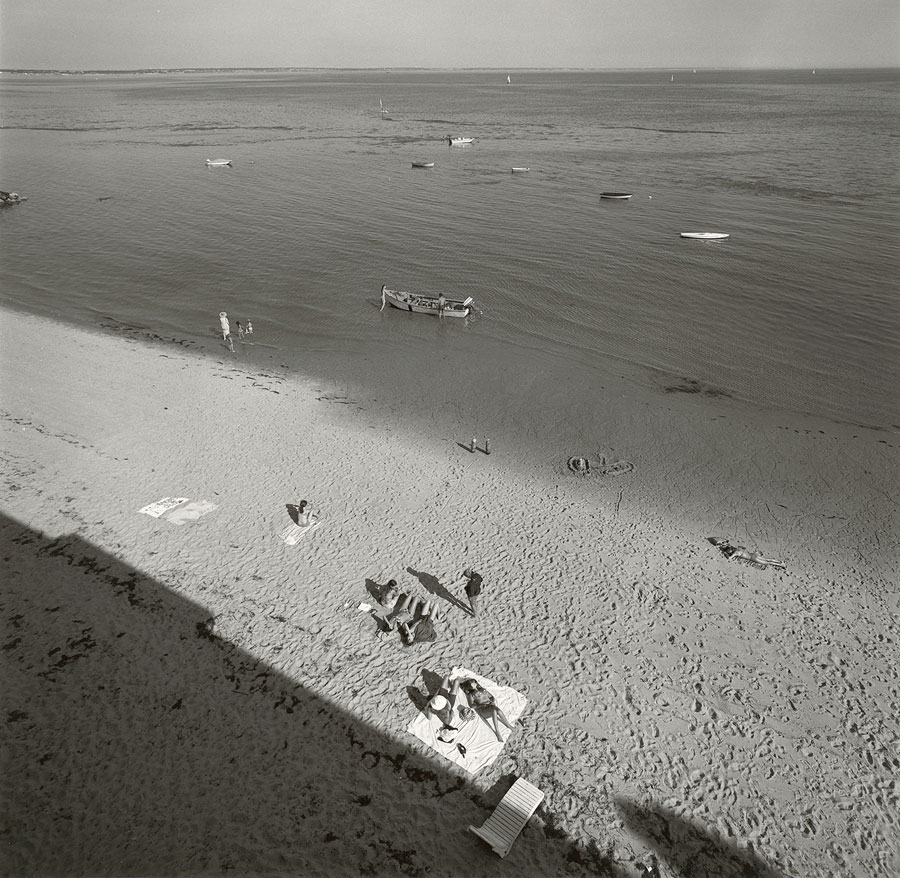
Exhibition: ‘A Turbulent Lens: The Photographic Art of Virna Haffer’ at Tacoma Art Museum

Exhibition dates: 2nd July – 16th October 2011


Virna Haffer (American, 1899-1974) 'Eleventh Street Bridge' c. 1930s


Virna Haffer (American, 1899-1974)
Eleventh Street Bridge
c. 1930s
Woodblock print
Tacoma Art Museum, Gift of Carolyn Schneider


It is such a joy constructing this blog. I get to educate myself on these wonderful, half-forgotten photographers and then bring their photographs to you. What a life Haffer must have had: she found success as a photographer, printmaker, painter, musician, sculptor, and published writer. Independent-minded and self-sufficient, as most artists are, this is an artist I would have liked to have met!

Dr Marcus Bunyan


Many thankx to the Tacoma Art Museum for allowing me to publish the photographs in the posting. Please click on the photographs for a larger version of the image.


Virna Haffer (American, 1899-1974) 'Abstract #2' c. 1960s


Virna Haffer (American, 1899-1974)
Abstract #2
c. 1960s
Photogram
Collection of the Washington State Historical Society, gift of the estate of Virna Haffer


Virna Haffer (American, 1899-1974) 'Untitled [tree and chair]' c. 1962


Virna Haffer (American, 1899-1974)
Untitled [tree and chair]
c. 1962
From the series Aftermath
Photogram
50.8 x 40.6cm
National Gallery of Australia
Gift of the Estate of Virna Haffer 2011


Virna Haffer (American, 1899-1974) 'Swirl' c. 1940


Virna Haffer (American, 1899-1974)
Swirl
c. 1940
Gelatin silver print
39.4 x 31.8cm
National Gallery of Australia
Gift of the Estate of Virna Haffer 2011


Virna Haffer (American, 1899-1974) 'Aftermath' c. 1962


Virna Haffer (American, 1899-1974)
Aftermath
c. 1962
Photogram
Collection of the Washington State Historical Society, gift of the estate of Virna Haffer


One of the most inventive Northwest artists of her time, Virna Haffer was an internationally recognised and respected Tacoma photographer who has slipped from both regional and national art history books. This summer, Tacoma Art Museum uncovers her innovative artwork.

In a career spanning more than six decades, Haffer found success as a photographer, printmaker, painter, musician, sculptor, and published writer, though she is known first and foremost as a photographer. Self-taught, she began her ambitious career in the early 1920s, both running a successful portrait studio (where she photographed the likes of the Weyerhaeuser and Chihuly families) and also exhibiting her unique artistic images around the world.

The curatorial team of Margaret Bullock, Christina Henderson, and David Martin searched through more than 30,000 of Virna Haffer’s photographic negatives, prints, and woodblocks at the Washington State Historical Society and Tacoma Public Library’s Special Collections to create this exhibition and its accompanying catalogue.

“It is an amazing opportunity to be able to bring the life and work of Virna Haffer to light once again,” said Margaret Bullock, Tacoma Art Museum’s Curator of Collections and Special Exhibitions, and a co-curator of the Haffer exhibition. “Her artistic curiosity is palpable in her work, which in itself is staggering in its volume, diversity, and range. Her role in and impact on the Northwest photographic community is just beginning to be uncovered and understood as we explore her unrivalled photographic legacy.”

Raised in the utopian community of Home Colony in South Puget Sound in the early 1900s, Haffer’s love of photography was sparked when she was just ten years old. Raised to be independent-minded and self-sufficient, she left school at the age of 15 to become a professional photographer. In 1914 she apprenticed herself to Tacoma photographer Harriette H. Ihrig where she absorbed the necessary technical skills along with the business know-how to run a commercial studio. She started exhibiting her fine art photographs in 1924.

Haffer tirelessly experimented with techniques and evolved her own rules, pushing beyond the boundaries of her medium to methodically master a variety of photographic styles and techniques. Her body of work includes images that can be classified as Pictoralist, surrealist, documentary, and modernist. She experimented with a wide range of imagery, such as multiple overlapping exposures, eccentric viewpoints, composite images, and a non-mechanical photographic process called the photogram.

“Virna Haffer has been an all too well kept Tacoma secret,” said Stephanie A. Stebich, Director of Tacoma Art Museum. “Her work has been quietly appreciated for decades awaiting reconsideration. Given her Tacoma roots, pivotal role in Tacoma’s art community throughout her career, and diverse and stunning body of work, Virna Haffer is a perfect subject for the museum’s Northwest Perspective Series, which celebrates the work of regional artists.”

Haffer’s passion for photography not only brought her success in business with her own portrait photography studio, but also international recognition. Her commercial portrait work can be found in homes all over Tacoma, while her fine art photographs can be found in the permanent collections of institutions as prestigious as the Metropolitan Museum of Art in New York City.

Text from the Tacoma Museum of Art website


Virna Haffer (American, 1899-1974) 'Mina Quevli' c. 1930


Virna Haffer (American, 1899-1974)
Mina Quevli
c. 1930
Gelatin silver print
Collection of the Washington State Historical Society, gift of the estate of Virna Haffer


Virna Haffer (American, 1899-1974) 'Franz Brasz, The Artist' c. 1937


Virna Haffer (American, 1899-1974)
Franz Brasz, The Artist
c. 1937
Gelatin silver print
Collection of the Washington State Historical Society, gift of the estate of Virna Haffer


Franz Brasz

Arnold Franz Brasz (July 19, 1888 – April 1, 1966) was an American painter, sculptor, and printmaker who was born in Polk County, Wisconsin on July 19, 1888. He studied at the Minneapolis School of Fine Arts and also with Robert Henri in New York. By the early 1920s, he was dividing his time between southern California and Wisconsin. He is considered a member of the Ashcan School, and his public commissions include Fruit Pickers, a 1940 mural in the city hall of Redlands, California showing four Native American farm workers. Brasz died at his home in Glendale, California on April 1, 1966.

Virna Haffer

Virna Haffer (1899-1974) was an American photographer, printmaker, painter, musician, and published author.

Born in 1899 in Aurora, Illinois, Haffer and her family moved to the utopian community of Home in South Puget Sound in Washington State in 1907. When she was 15 years old Haffer became the apprentice of the photographer Harriette H. Ihrig. She opened her own portrait photography studio in Tacoma, Washington and began publishing her photographs in 1924. Haffer was known for experimenting with unusual, quirky techniques and created her own artistic style that stretched the boundaries of artistic classifications in the early twentieth century. Haffer’s work was eccentric; she produced Pictorialist, modern, surreal, and documentary style work.

Haffer was married three times, the second time to socialist and labor advocate Paul Raymond Haffer, with whom she had one son, Jean Paul Haffer. One of her works as a commercial photographic portraitist was a childhood picture of future glass artist Dale Chihuly.

Haffer’s work was first exhibited in 1924 in the Fifth Annual F&N Salon of Pictorial Photography, and in 1928 at the Seattle Camera Club’s Fourth International Exhibition. By 1930 her work was internationally recognised, and often appeared in publications such as the American Annual of Photography. In addition, she won recognition and prizes in photographic competitions in the United States in the 1930s. In the 1960s she took an interest in producing photograms, and in 1969 she published a book about the process called Making Photograms: The Creative Process of Painting With Light. Haffer’s work was also the subject of several solo exhibitions at locations including the Massachusetts Institute of Technology, 1960; California Museum of Science and Industry, Los Angeles, 1964; New York Camera Club, 1967 and the Museum of Contemporary Crafts, NYC, 1968. A posthumous retrospective of her work, A Turbulent Lens: The Photographic Art of Virna Haffer, was produced at the Tacoma Art Museum in 2011.

Text from the Wikipedia website


Virna Haffer (American, 1899-1974) 'Old Tacoma Hotel Fire' c. 1935


Virna Haffer (American, 1899-1974)
Old Tacoma Hotel Fire
c. 1935
Gelatin silver print
Collection of the Washington State Historical Society, gift of the estate of Virna Haffer


Virna Haffer (American, 1899-1974) 'The Family' 1929


Virna Haffer (American, 1899-1974)
The Family
1929
Woodblock print
Collection of the Washington State Historical Society, gift of the estate of Virna Haffer


Virna Haffer (American, 1899-1974) 'Hooverville' c. 1936


Virna Haffer (American, 1899-1974)
Hooverville
c. 1936
Gelatin silver print
Collection of the Washington State Historical Society, gift of the estate of Virna Haffer


Virna Haffer (American, 1899-1974) 'Self Portrait' 1929


Virna Haffer (American, 1899-1974)
Self Portrait
1929
Gelatin silver print with added pigmentation
Private collection


'A Turbulent Lens: The Photographic Art of Virna Haffer' catalogue cover

'A Turbulent Lens: The Photographic Art of Virna Haffer' catalogue pages

'A Turbulent Lens: The Photographic Art of Virna Haffer' catalogue pages

'A Turbulent Lens: The Photographic Art of Virna Haffer' catalogue pages

'A Turbulent Lens: The Photographic Art of Virna Haffer' catalogue pages


A Turbulent Lens: The Photographic Art of Virna Haffer catalogue cover and pages


Tacoma Art Museum
1701 Pacific Avenue
Tacoma, WA 98402

Opening hours:
Wednesday – Sunday 10am – 5pm

Tacoma Art Museum website

LIKE ART BLART ON FACEBOOK

Back to top

Exhibition: ‘A Revolutionary Project: Cuba from Walker Evans to Now’ at the J. Paul Getty Museum, Los Angeles

Exhibition dates: 17th May – 2nd October 2011


Many thankx to the J. Paul Getty Museum for allowing me to publish the photographs in the posting. Please click on the photographs for a larger version of the image.


Walker Evans (American, 1903-1975) 'Mule, Wagon and Two Men, Havana' 1933


Walker Evans (American, 1903-1975)
Mule, Wagon and Two Men, Havana
1933
Gelatin silver print
13.8 x 21cm (5 7/16 x 8 1/4 in.)
The J. Paul Getty Museum, Los Angeles
© Walker Evans Archive, The Metropolitan Museum of Art


Walker Evans (American, 1903-1975) 'Spectacle, Capital Steps, Possibly Independence Day' May 20, 1933


Walker Evans (American, 1903-1975)
Spectacle, Capital Steps, Possibly Independence Day
May 20, 1933
Gelatin silver print
19.7 x 25.3cm (7 3/4 x 9 15/16 in.)
The J. Paul Getty Museum, Los Angeles
© Walker Evans Archive, The Metropolitan Museum of Art


Walker Evans (American, 1903-1975) 'Old Havana Housefronts' 1933


Walker Evans (American, 1903-1975)
Old Havana Housefronts
1933
Gelatin silver print
17.6 x 22.7cm (6 15/16 x 8 15/16 in.)
The J. Paul Getty Museum, Los Angeles
© Walker Evans Archive, The Metropolitan Museum of Art


Walker Evans (American, 1903-1975) 'Balcony Spectators' 1933


Walker Evans (American, 1903-1975)
Balcony Spectators
1933
Gelatin silver print
19.8 x 25.2cm (7 13/16 x 9 15/16 in.)
The J. Paul Getty Museum, Los Angeles
© Walker Evans Archive, The Metropolitan Museum of Art


Exhibition Marks First Showing of Getty’s Walker Evan’s Cuban Photographs; Also on view are Cuban Revolutionary Photographs and Contemporary Work by Virginia Beahan, Alex Harris, and Alexey Titarenko

Cuba’s attempt to forge an independent state with an ambitious set of social goals, all the while moored to powerful political and economic interests, has been a source of fascination for nations, intellectuals, and artists alike. On display at the J. Paul Getty Museum, the Getty Center, May 17 – October 2, 2011, A Revolutionary Project: Cuba from Walker Evans to Now, looks at three critical periods in the island nation’s history as witnessed by photographers before, during, and after the country’s 1959 Revolution.

A Revolutionary Project juxtaposes Walker Evans’s 1933 images from the end of the Gerardo Machado dictatorship with views by contemporary foreign photographers Virginia Beahan (American, b. 1946), Alex Harris (American, b. 1949), and Alexey Titarenko (Russian, b. 1962), who have explored Cuba since the withdrawal of Soviet support in the 1990s. A third section bridging these two eras presents pictures by Cuban photographers who participated in the country’s 1959 Revolution, including Alberto Korda, Perfecto Romero, and Osvaldo Salas.
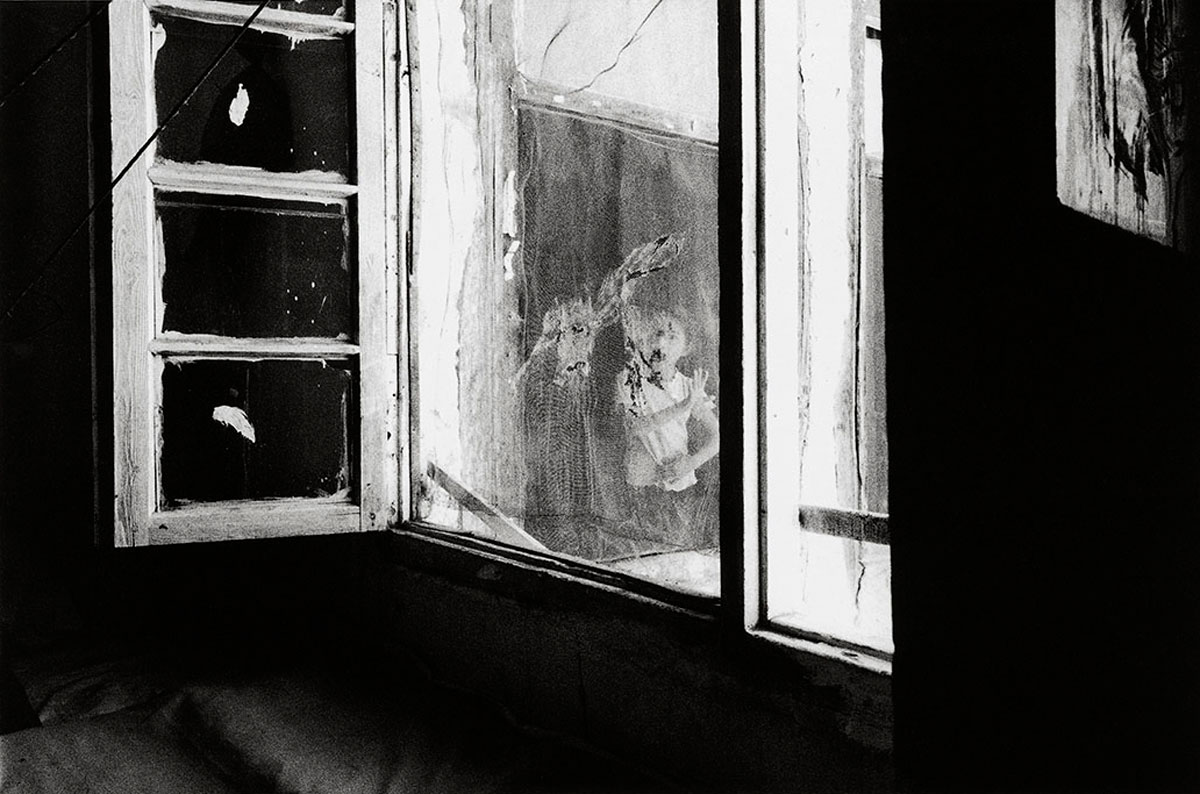
“The Museum’s collection of Walker Evans prints is the largest in the U.S., but until now, we have not shown his photographs of Cuba,” explains Judith Keller, senior curator of photographs. “This exhibition allows us the opportunity to showcase this body of work, alongside newer work in the collection.”

1933: Evans in Havana

Walker Evans (1903-1975) is one of the photographers most responsible for the way we now imagine American life in the 1930s. His distinctive photographic style, which he declared “transcendent documentary,” was nurtured in New York in the late 1920s and fully formed by his experience in Cuba in 1933. In the spring of that year, Walker Evans was asked by publisher J. B. Lippincott to produce a body of work about Cuba to accompany a book by the radical journalist Carleton Beals (1893-1979). This book, The Crime of Cuba, would be a scathing indictment of the then-current regime of Cuban President Gerardo Machado. Leaving the country less than two months before Machado was forced out of office, Evans was able to capture Cuba at the start of the revolutionary movement but almost 30 years before the 1959 Revolution.

During Evans’s time in Cuba, he made substantial strides in his photographic practice. There he worked with different format cameras, large and small, one more deliberate and descriptive, the other more spontaneous and agile. He created both close-up and wide, inclusive compositions that he could then combine in intense sequences to best communicate his response to the poverty, the ferment, and the beauty of his environment. While in Havana, Evans met the American writer, Ernest Hemingway (1899-1961), whose acclaimed avant-garde work he knew and admired. Hemingway’s terse narrative style, which he was then applying to his own Harry Morgan stories set in Havana and Key West, no doubt influenced Evans’s approach to the subject of Cuba’s current political and economic struggles. Evans’s photographs also reflect the inspiration of French photographer Eugène Atget’s Parisian pictures that Evans critiqued for an arts journal in 1931. The series that comprised Atget’s thorough study of “Old Paris” seem to have provided additional motivation for Evans’s selection of Havana subjects: the signage of urban storefronts, the abundant street offerings of fresh produce, the decorative balconies of old houses, the many studies of archaic horse-drawn wagons and carriages, and the portraits of women, some of whom appear to be prostitutes.

1958-1966: Revolution

Machado’s fall from rule in 1933 resulted in a long power struggle that culminated in the country’s 1959 socialist revolution to overthrow dictator Fulgencio Batista, anchoring Cuba to the Soviet bloc for the next thirty years and defining a relationship with the United States that still exists today. Fidel Castro, Ernesto “Che” Guevara, and their new government harnessed photography as a means of keeping the project of the Revolution at the forefront of Cuba’s collective consciousness. As both genuine records of popular insurrection and propagandistic documents used for political purposes, pictures of the Revolution and its aftermath have shaped how both Cubans and Americans understand the significance of that revolutionary moment. Photographs in the second section of the exhibition are drawn from the work of nine Cuban photographers who participated in recording the political context and triumphs of the emerging state in the years surrounding 1959.

Included in the exhibition is an iconic image of the revolutionary hero Che Guevara by Alberto Korda titled Guerrillero Heroico (March 5, 1960). One of the world’s most reproduced images, it has been adopted for political causes, appearing on countless numbers of t-shirts, banners, and street art around the globe. The print on view in the exhibition is among the earliest versions of the photograph known to exist. Made as a press print, it was used as a source to reproduce the image in media outlets a year after Korda photographed Guevara at a rally in Havana.

Also on display in the exhibition is the well-known revolutionary photograph Patria o Muerte, Cuba (Negative, January 1959; print, 1984) by Osvaldo Salas, one of Cuba’s most important photographers. Salas effectively captures and conveys the populist fervour in Cuba shortly after the movement’s triumph with an image of a patriotic sign framed by a celebratory crowd.

The photographs included in this section of the exhibition are culled from the extensive holdings of Cuban photography assembled by the Austrian collector, Christian Skrein, including a number of recent acquisitions by the Museum.

Since 1991: The Special Period

After Soviet troops began to withdraw from Cuba in September of 1991, the troubled Cuban economy suffered severe internal shortages, and Fidel Castro declared what is known as the “Special Period” (período especial), marked by food rationing, energy conservation, and a decline of public services. In the nearly twenty years since the Soviet withdrawal, Cubans have managed to survive through perseverance, the forging of new political relationships, and the easing of socialist systems. This period of transition, which continues today with the recent transfer of power from Fidel Castro to his brother Raúl, has attracted the attention of photographers from around the world who are interested in exploring the relationship between Cuba’s revolutionary past and its uncertain future. The final section of the exhibition looks specifically at the work of three contemporary photographers with diverse approaches to documenting the island in recent decades: Virginia Beahan, Alex Harris, and Alexey Titarenko.

Virginia Beahan’s work concentrates on the landscape’s relationship to history and culture. In 2001, she began a multiyear project on Cuba, photographing its topography in search of remnants of the island’s diverse past. The work resulted in a publication in 2009 called Cuba: Singing with Bright Tears. Beahan’s Cuba is a land of contradictions, full of disappointments and hope, decay and rejuvenating beauty, simultaneously anchored to the past while looking beyond the present. Born and raised in Leningrad (now Saint Petersburg), Russia, Alexey Titarenko became fascinated with Cuba in 2003, when he made his first trip to Havana. Titarenko’s goal was to represent the soul of the Cuban capital. In the artist’s photographs, the city is shown with little overt reference to its politics. Instead, Titarenko describes the conditions of life in the communist country, depicting people persevering amid varying states of ruin. Venturing out of the tourist zones of Havana into the network of dilapidated avenues beyond the old city walls, his images depict a grey metropolis whose inhabitants congregate on the streets to collect food rations, fix long-outmoded cars, and play baseball.

A former student of Walker Evans, Alex Harris made several trips to Cuba following the collapse of the eastern bloc and the dissolution of the Soviet Union, developing a powerful body of colour work that addresses the country’s cultural fabric during a period of difficult economic circumstances. His photographs focus on portraits of women whose lives are affected by the tourist-fuelled sex trade, landscapes made through the windshields of refurbished 1950s American cars, and monuments to the Cuban national hero José Martí. His study was published in the form of a book, The Idea of Cuba, in 2007. Through these distinct vantage points, Harris probed the country’s propensity for ingenuity as it underwent great transition.

Press release from the J. Paul Getty Museum website


Walker Evans (American, 1903-1975) 'Citizen in Downtown Havana' 1933


Walker Evans (American, 1903-1975)
Citizen in Downtown Havana
1933
Gelatin silver print
22.2 x 11.7cm (8 3/4 x 4 5/8 in.)
The J. Paul Getty Museum, Los Angeles


Walker Evans (American, 1903-1975) 'Woman on the Street, Havana' 1933


Walker Evans (American, 1903-1975)
Woman on the Street, Havana
1933
Gelatin silver print
24.6 x 14.6cm (9 11/16 x 5 3/4 in.)
The J. Paul Getty Museum, Los Angeles
© Walker Evans Archive, The Metropolitan Museum of Art


Walker Evans (American, 1903-1975) 'Woman in a Courtyard' 1933


Walker Evans (American, 1903-1975)
Woman in a Courtyard
1933
Gelatin silver print
25.3 x 16.2cm (9 15/16 x 6 3/8 in.)
The J. Paul Getty Museum, Los Angeles
© Walker Evans Archive, The Metropolitan Museum of Art


Walker Evans (American, 1903-1975) 'Coal Dockworkers, Havana' 1933


Walker Evans (American, 1903-1975)
Coal Dockworkers, Havana
1933
Gelatin silver print
15.6 × 21.1cm (6 1/8 × 8 5/16 in.)
The J. Paul Getty Museum, Los Angeles
© Walker Evans Archive, The Metropolitan Museum of Art


Walker Evans (American, 1903-1975) 'Coal Dockworkers, Havana' 1933


Walker Evans (American, 1903-1975)
Coal Dockworkers, Havana
1933
Gelatin silver print
12.7 × 17.7cm (5 × 6 15/16 in.)
The J. Paul Getty Museum, Los Angeles
© Walker Evans Archive, The Metropolitan Museum of Art


Walker Evans (American, 1903-1975) 'Coal Dockworker, Havana' 1933


Walker Evans (American, 1903-1975)
Coal Dockworker, Havana
1933
Gelatin silver print
9.7 × 13.7cm (3 13/16 × 5 3/8 in.)
The J. Paul Getty Museum, Los Angeles
© Walker Evans Archive, The Metropolitan Museum of Art


Walker Evans (American, 1903-1975) 'Coal Loader, Havana' 1933


Walker Evans (American, 1903-1975)
Coal Loader, Havana
1933
Gelatin silver print
17.1 × 12.2cm (6 3/4 × 4 13/16 in.)
The J. Paul Getty Museum, Los Angeles
© Walker Evans Archive, The Metropolitan Museum of Art


Walker Evans (American, 1903-1975) 'Coal Stevedore, Havana' 1933


Walker Evans (American, 1903-1975)
Coal Stevedore, Havana
1933
Gelatin silver print
20.2 x 15.2cm (7 15/16 x 6 in.)
The J. Paul Getty Museum, Los Angeles
© Walker Evans Archive, The Metropolitan Museum of Art


Walker Evans (American, 1903-1975) 'Stevedore' 1933


Walker Evans (American, 1903-1975)
Stevedore
1933
Gelatin silver print
20.1 x 15.1cm (7 15/16 x 5 15/16 in.)
The J. Paul Getty Museum, Los Angeles
© Walker Evans Archive, The Metropolitan Museum


Walker Evans (American, 1903-1975) 'Negro Child, Havana' 1933


Walker Evans (American, 1903-1975)
Negro Child, Havana
1933
Gelatin silver print
19.5 x 14.8cm (7 11/16 x 5 13/16 in.)
The J. Paul Getty Museum, Los Angeles
© Walker Evans Archive, The Metropolitan Museum


Walker Evans (American, 1903-1975) 'Negro Child, Havana' 1933


Walker Evans (American, 1903-1975)
Negro Child, Havana
1933
Gelatin silver print
19.8 x 13.2cm (7 13/16 × 5 3/16 in.)
The J. Paul Getty Museum, Los Angeles
© Walker Evans Archive, The Metropolitan Museum


The J. Paul Getty Museum
1200 Getty Center Drive
Los Angeles, California 90049

Opening hours:
Tuesday – Friday, Sunday 10am – 5.30pm
Saturday 10am – 8pm
Monday Closed

The J. Paul Getty Museum website

LIKE ART BLART ON FACEBOOK

Back to top