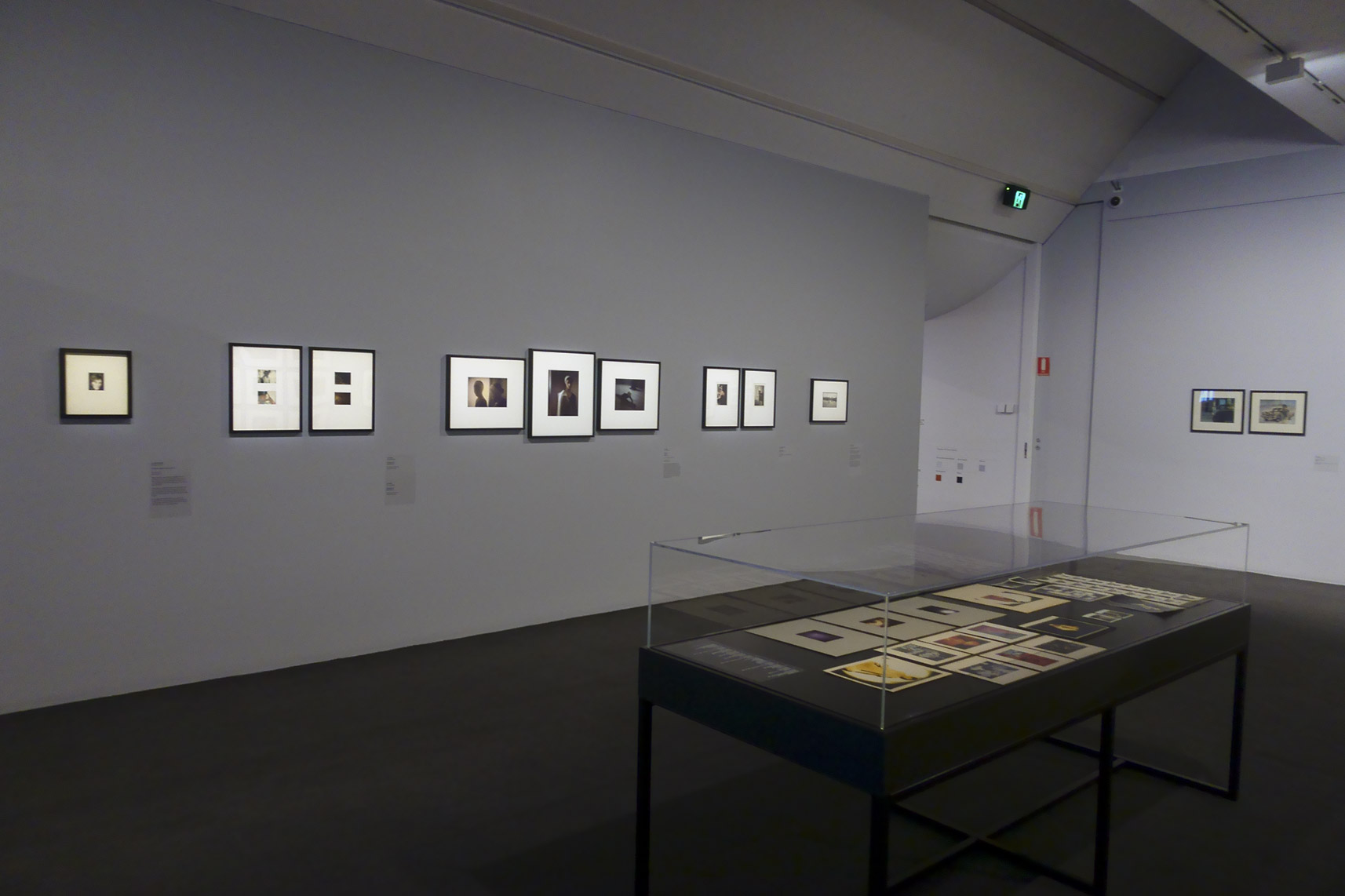
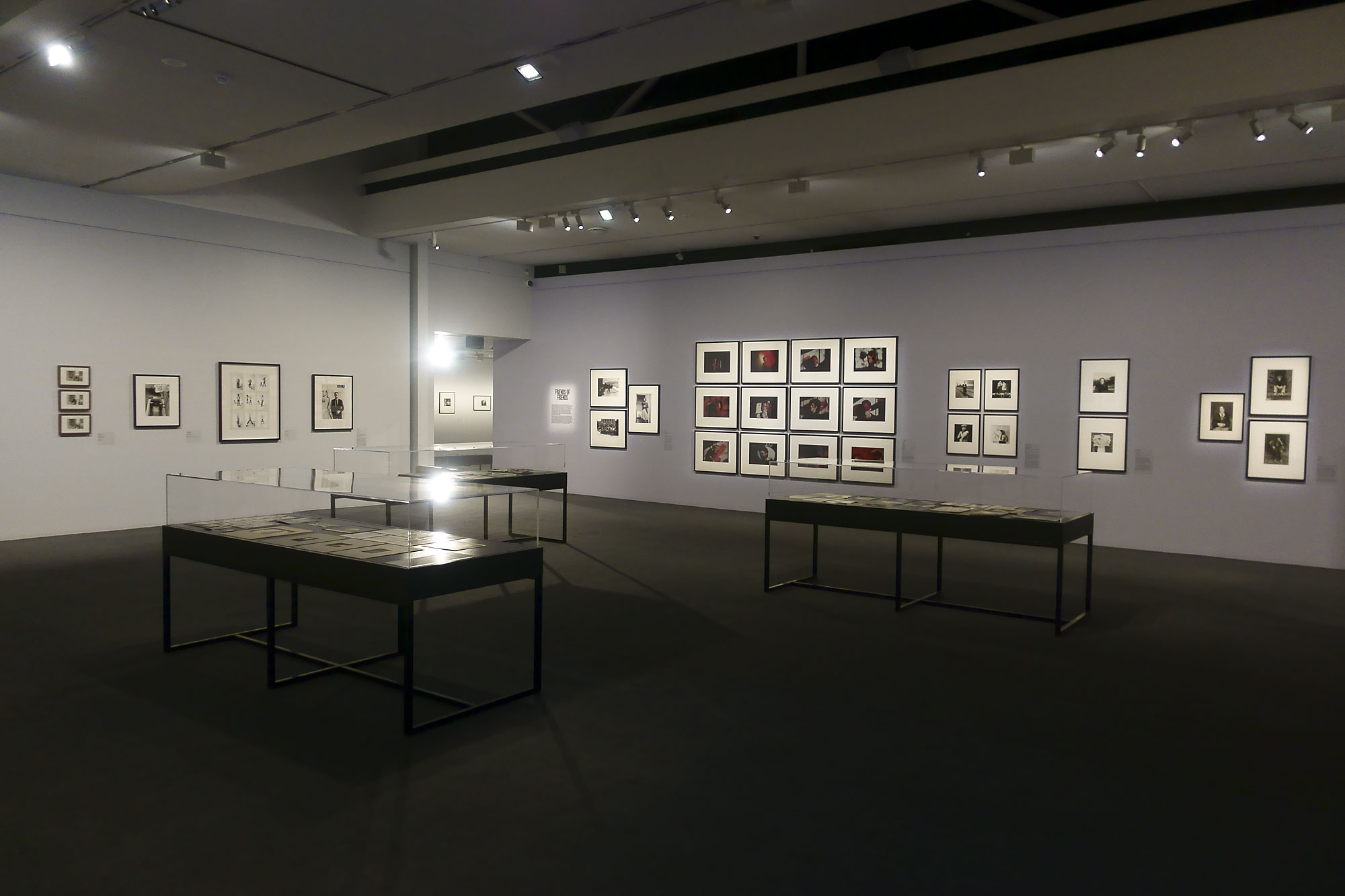
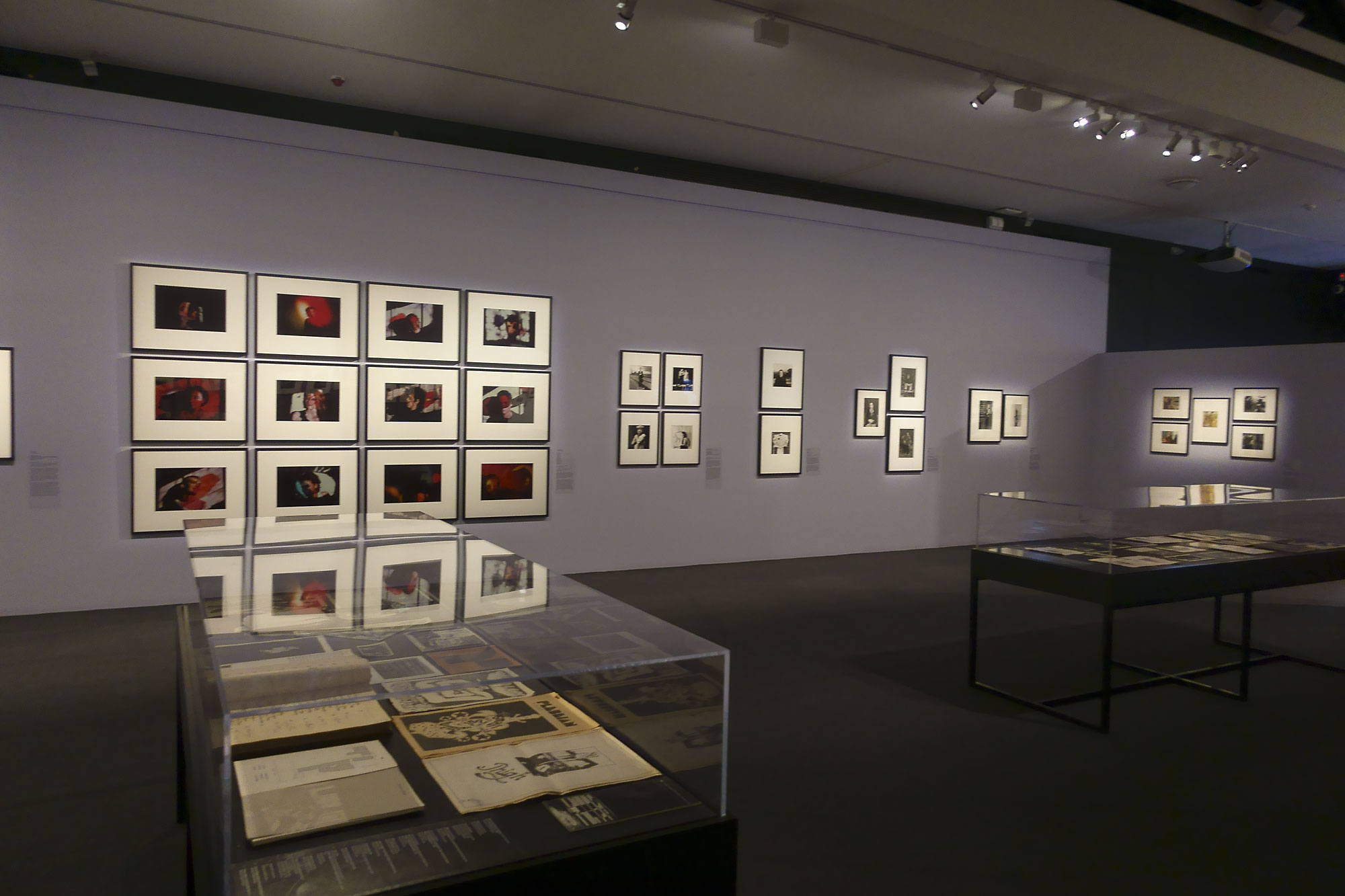
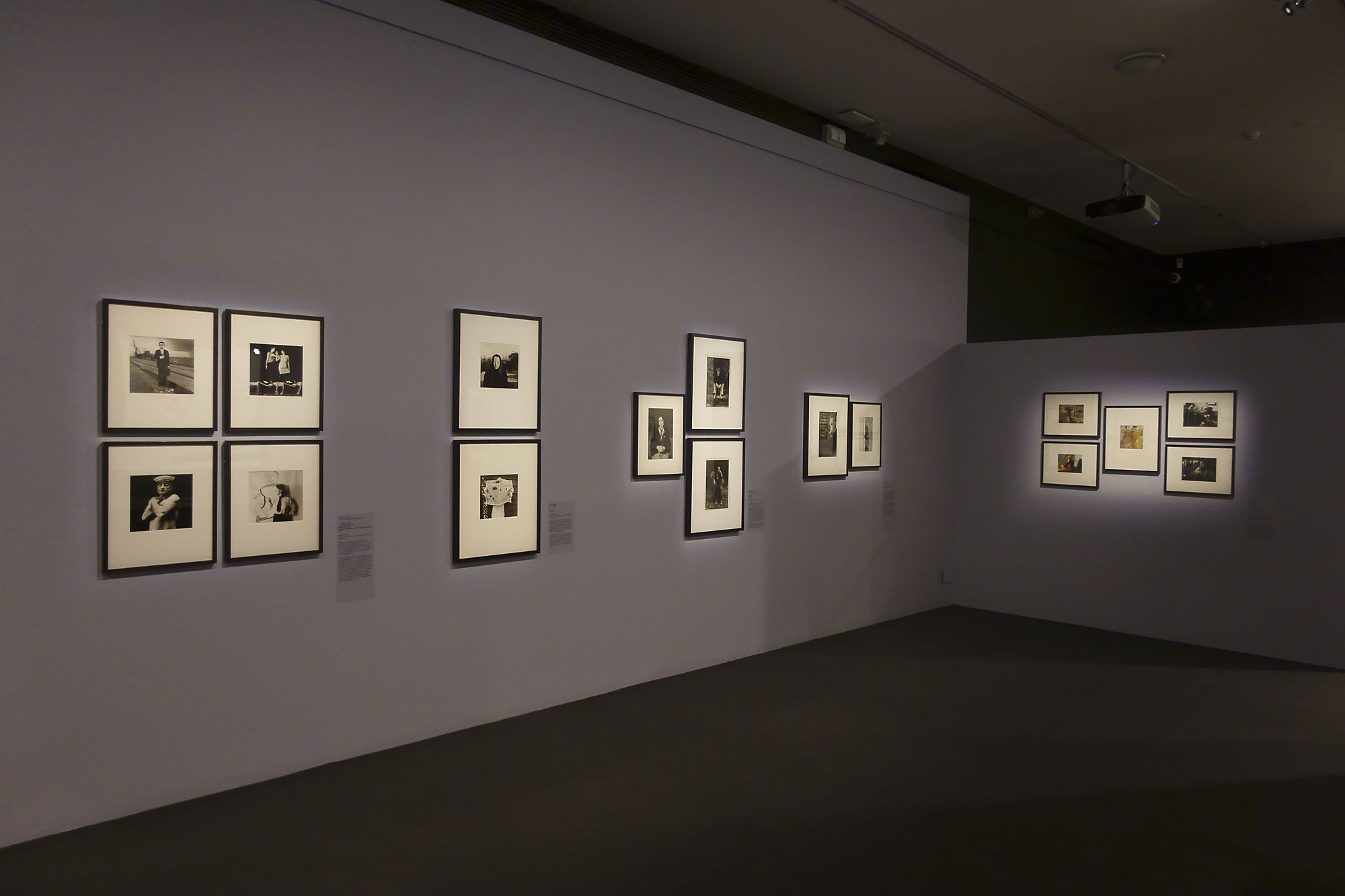
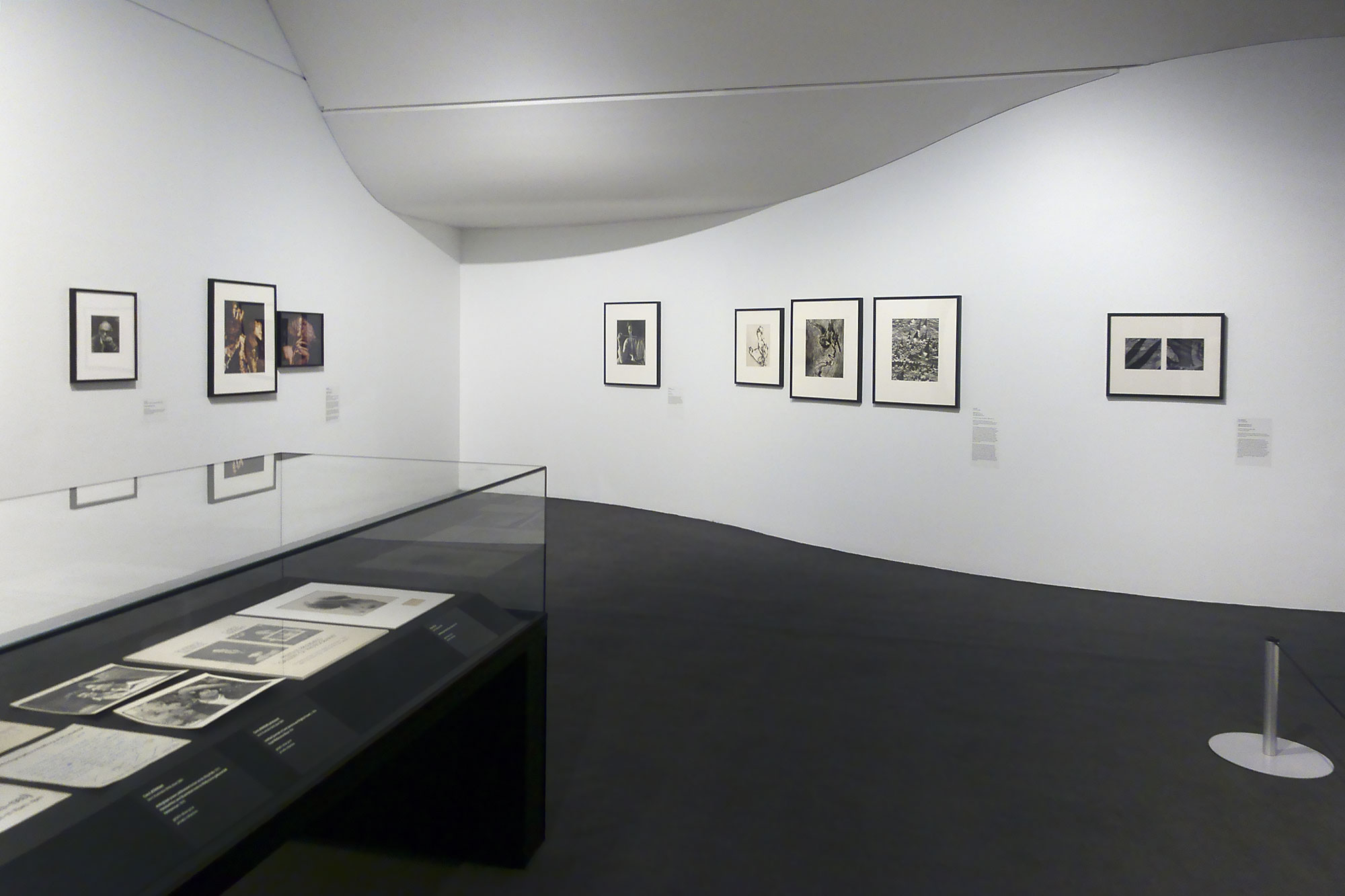
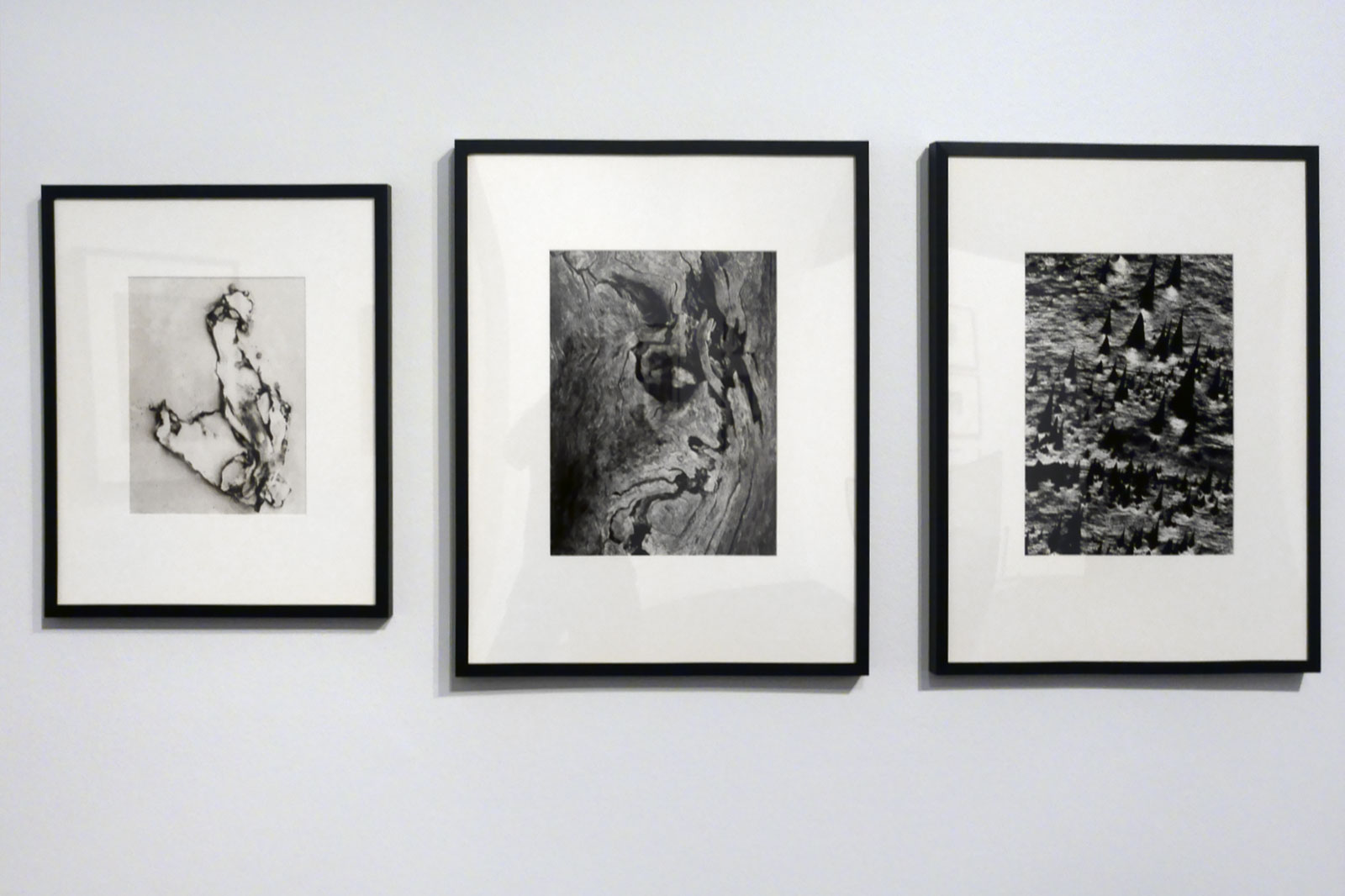
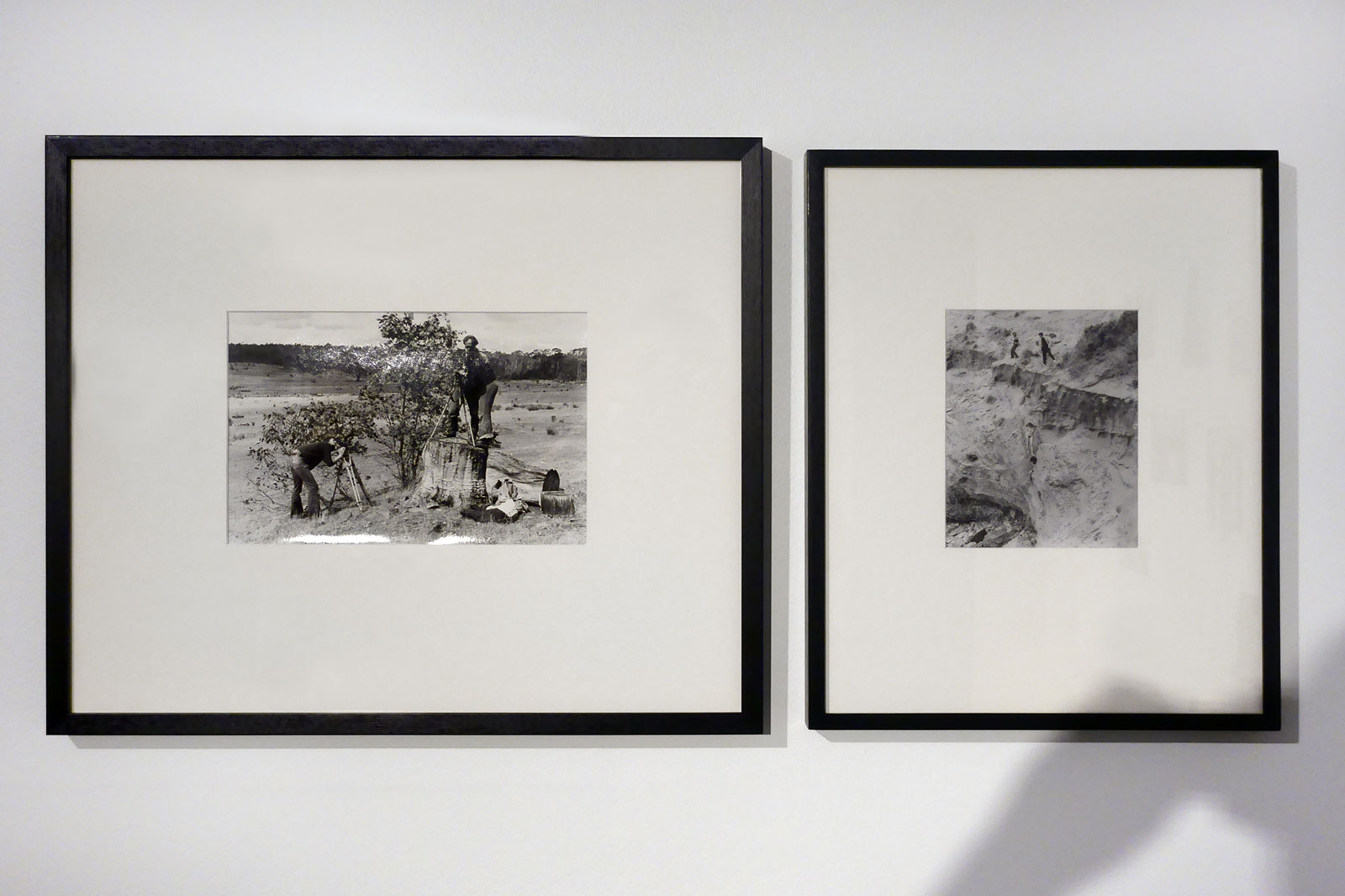
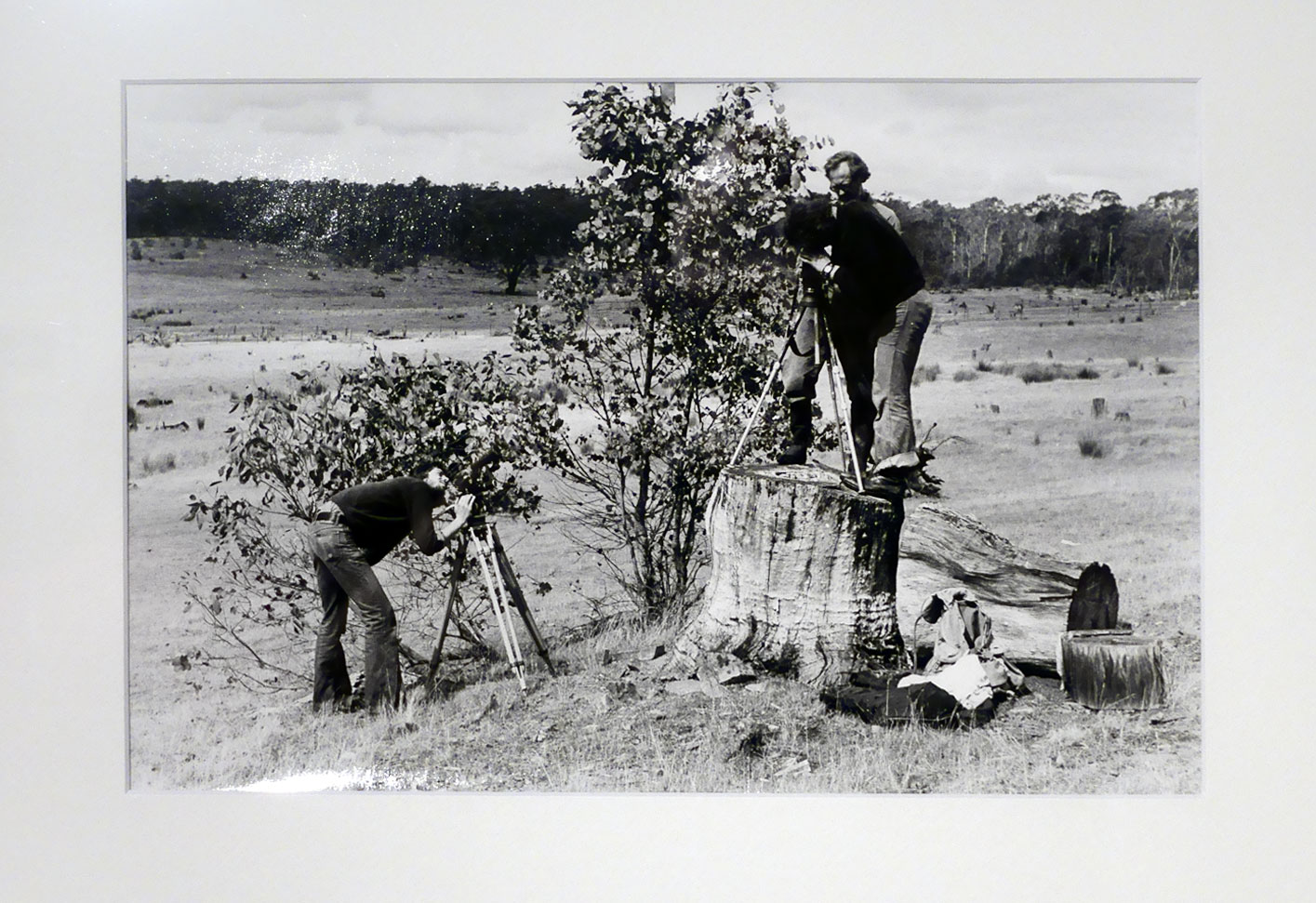
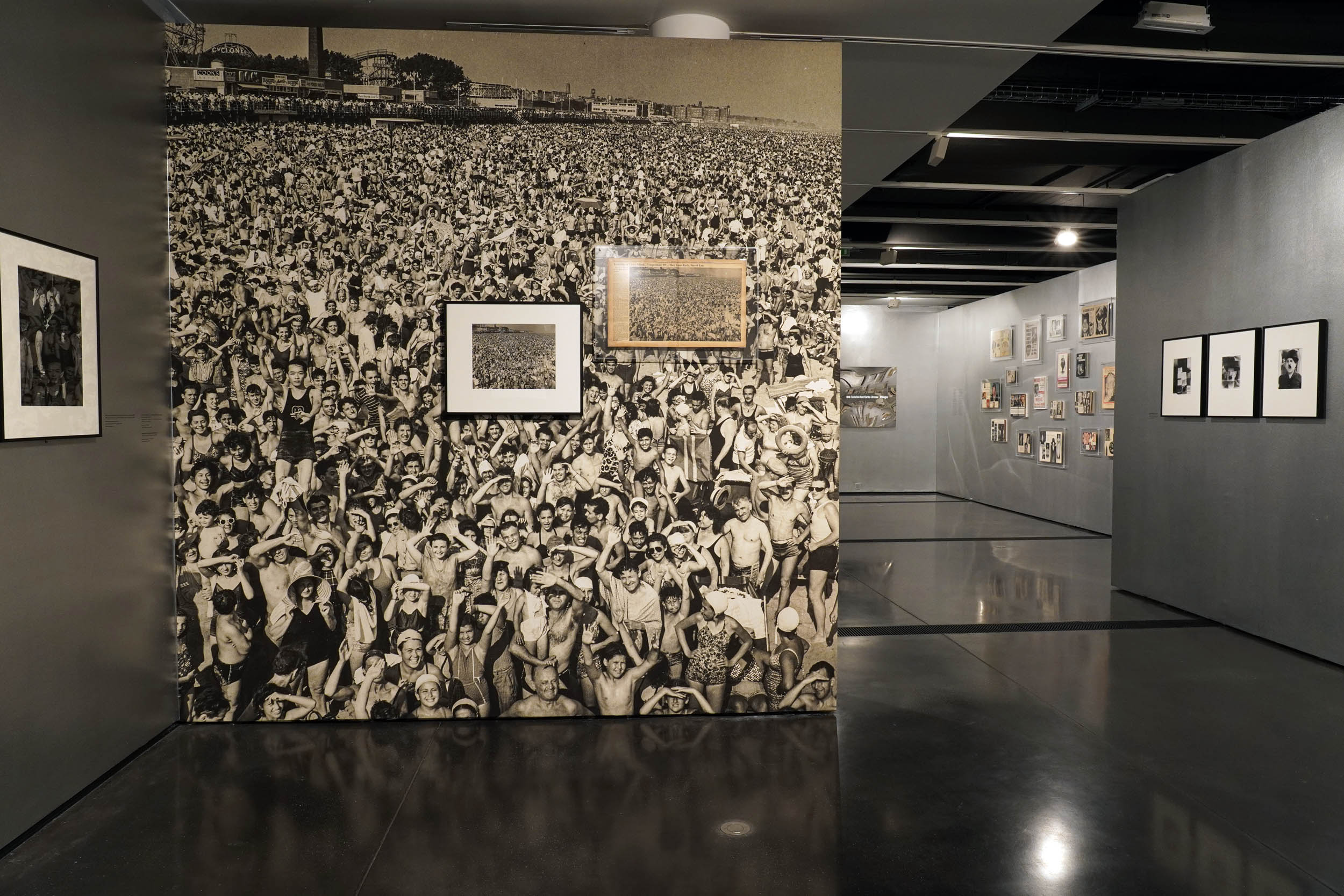
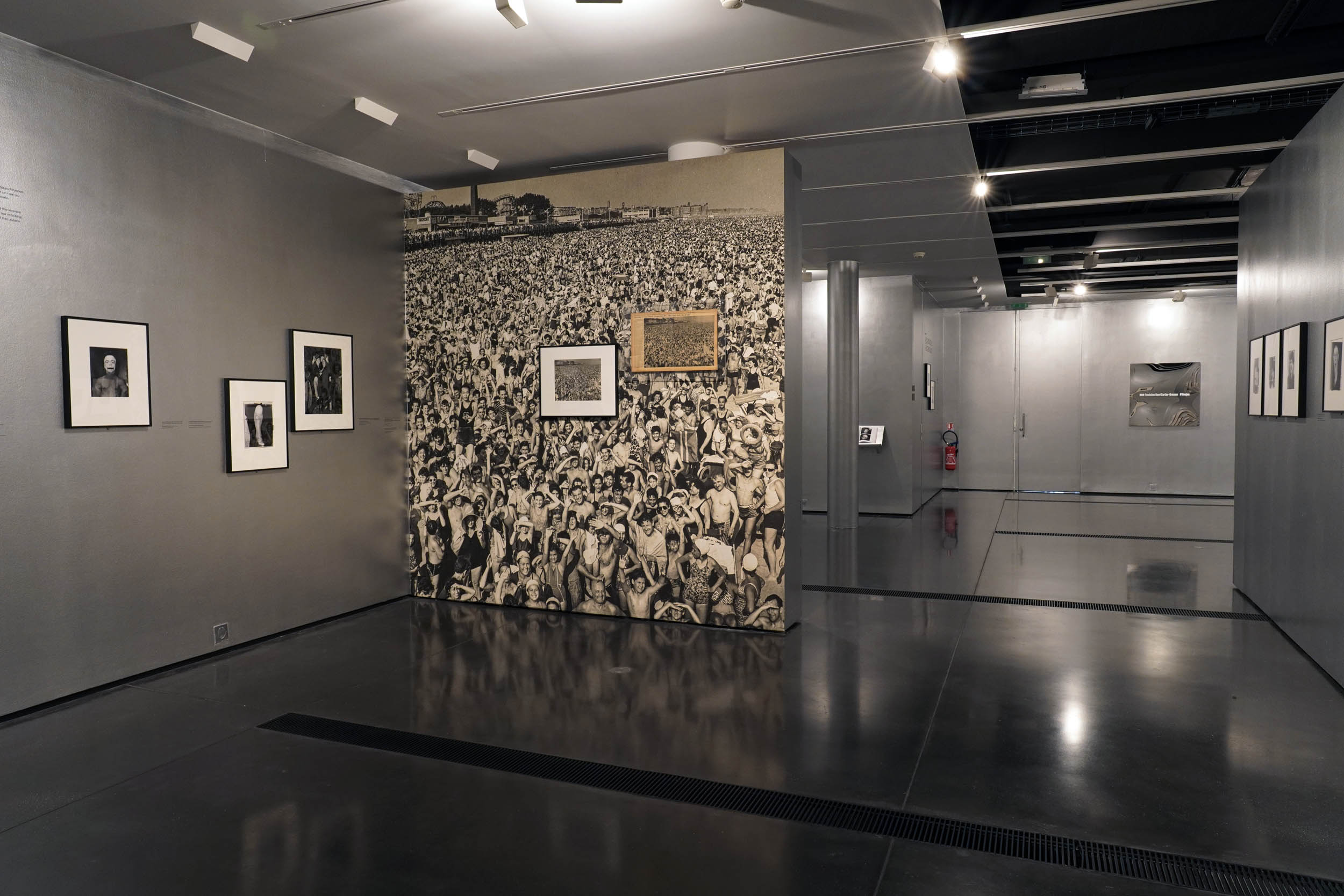
Exhibition: ‘The basement: photography from Prahran College (1968-1981)’ at the Museum of Australian Photography, Wheelers Hill, Melbourne

Exhibition dates: 1st March – 25th May, 2025

Curators: Angela Connor, MAPh Senior Curator, and Stella Loftus-Hills, MAPh Curator

Exhibiting artists: Colin Abbott, Robert Ashton, Con Aslanis, Polly Borland, Peter Bowes, John Brash, Peter Burgess, Nanette Carter, John Cato, Andrew Chapman, Lyn Cheong, Jon Conte, Kim Corbel, Paul Cox, Mimmo Cozzolino, Christina de Water, Duncan Frost, Rob Gale, Sandra Graham, Bill Henson, Julie Higginbotham, Graham Howe, Carol Jerrems, Moira Joseph, Peter Kelly, Christopher Köller, Johann Krix, Paul Lambeth, Derrick Lee, Peter Leiss, Carolyn Lewens, Steven Lojewski, Ian Macrae, James McArdle, Jim McFarlane, Rod McNicol, Julie Millowick, Peter Milne, Jacqueline Mitelman, Richard Muggleton, Martin Munz, Nicholas Nedelkopoulos, Greg Neville, Glen O’Malley, Viki Petherbridge, Ross Powell, Philip Quirk, Leonie Reisberg, Susan Russell, Stella Sallman, Athol Shmith, Geoff Strong, Ian Tippett, George Volakos, Stephen Wickham, Andrew Wittner, Ken Wright, Lynette Zeeng
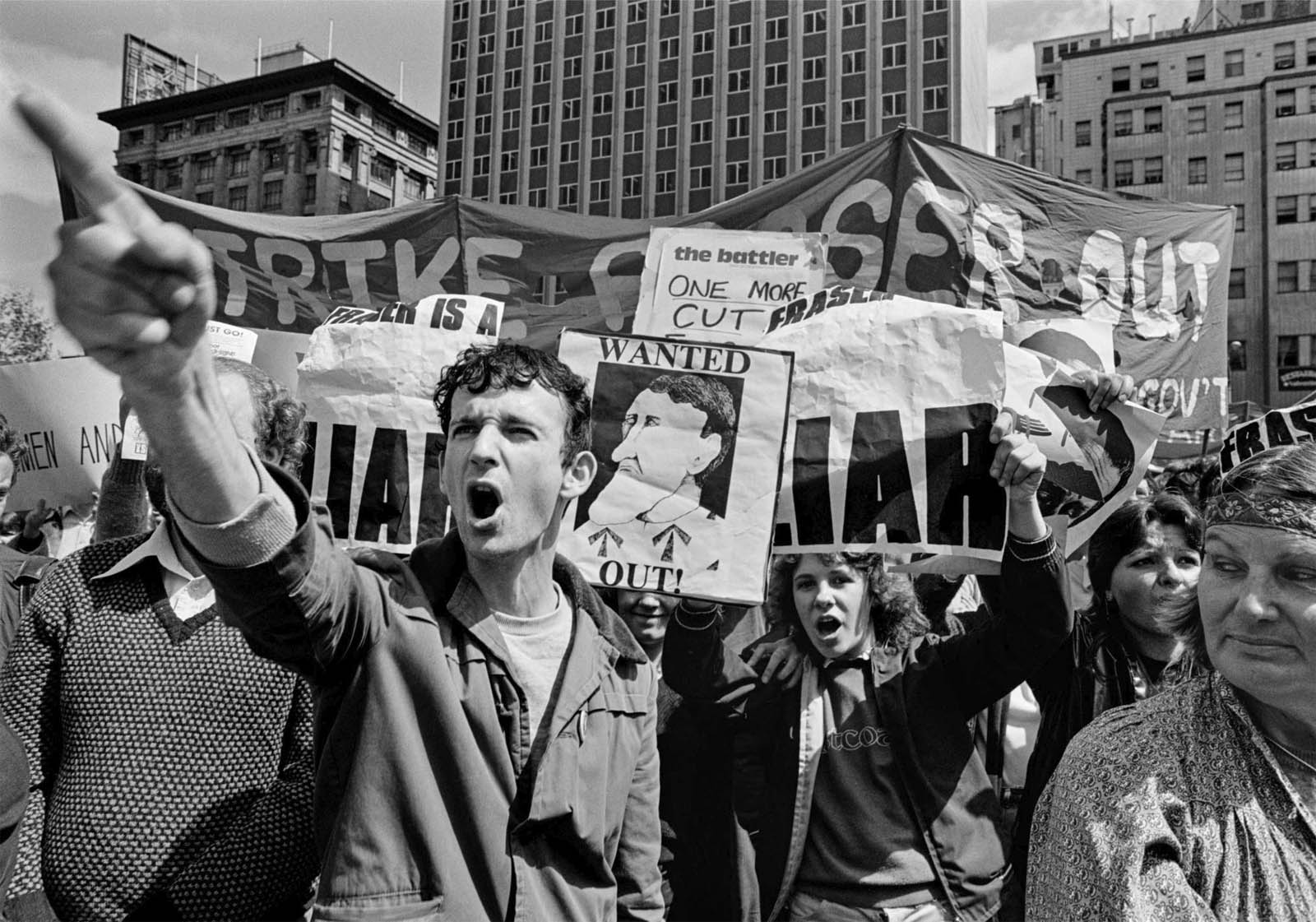
 

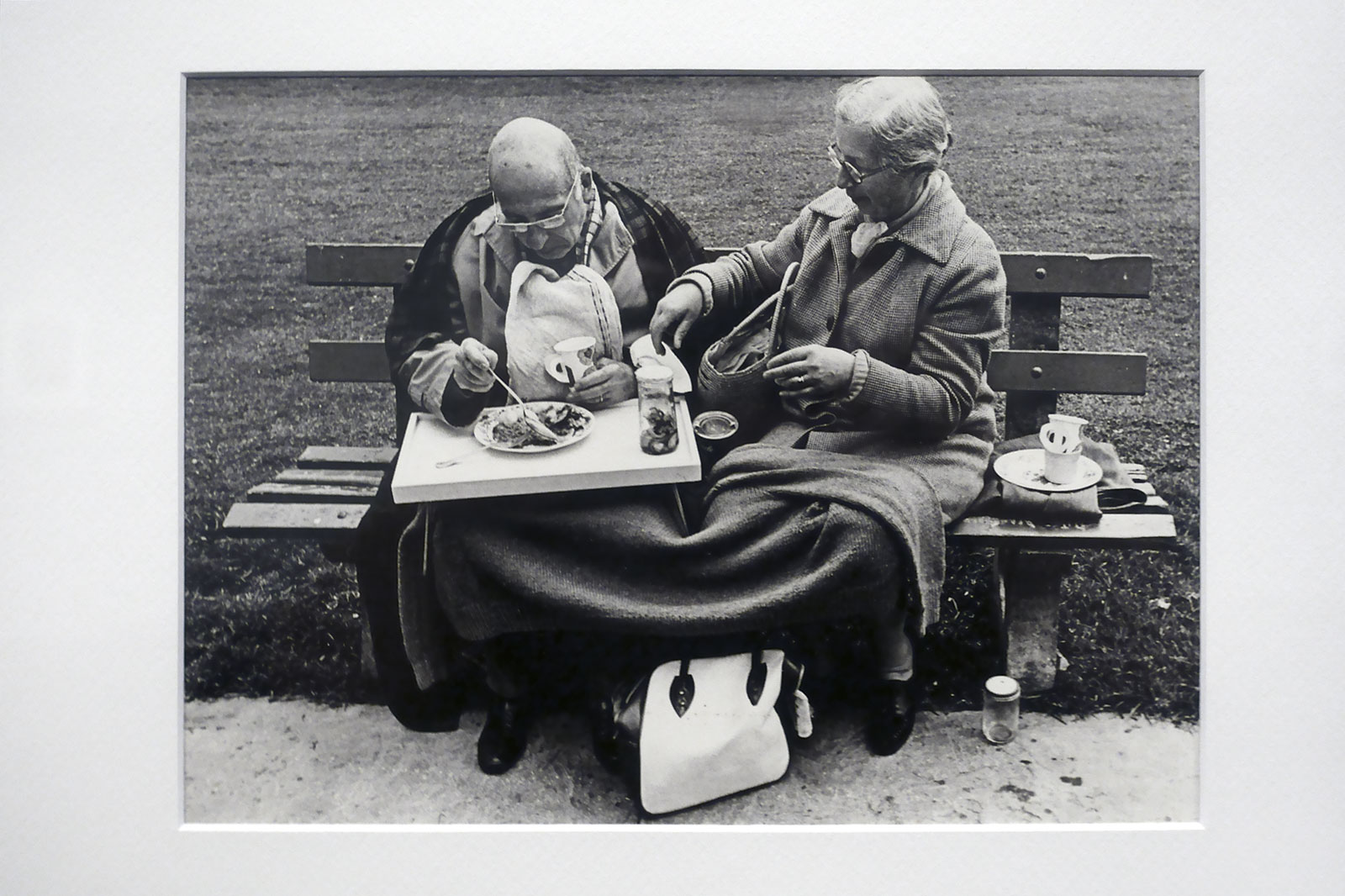
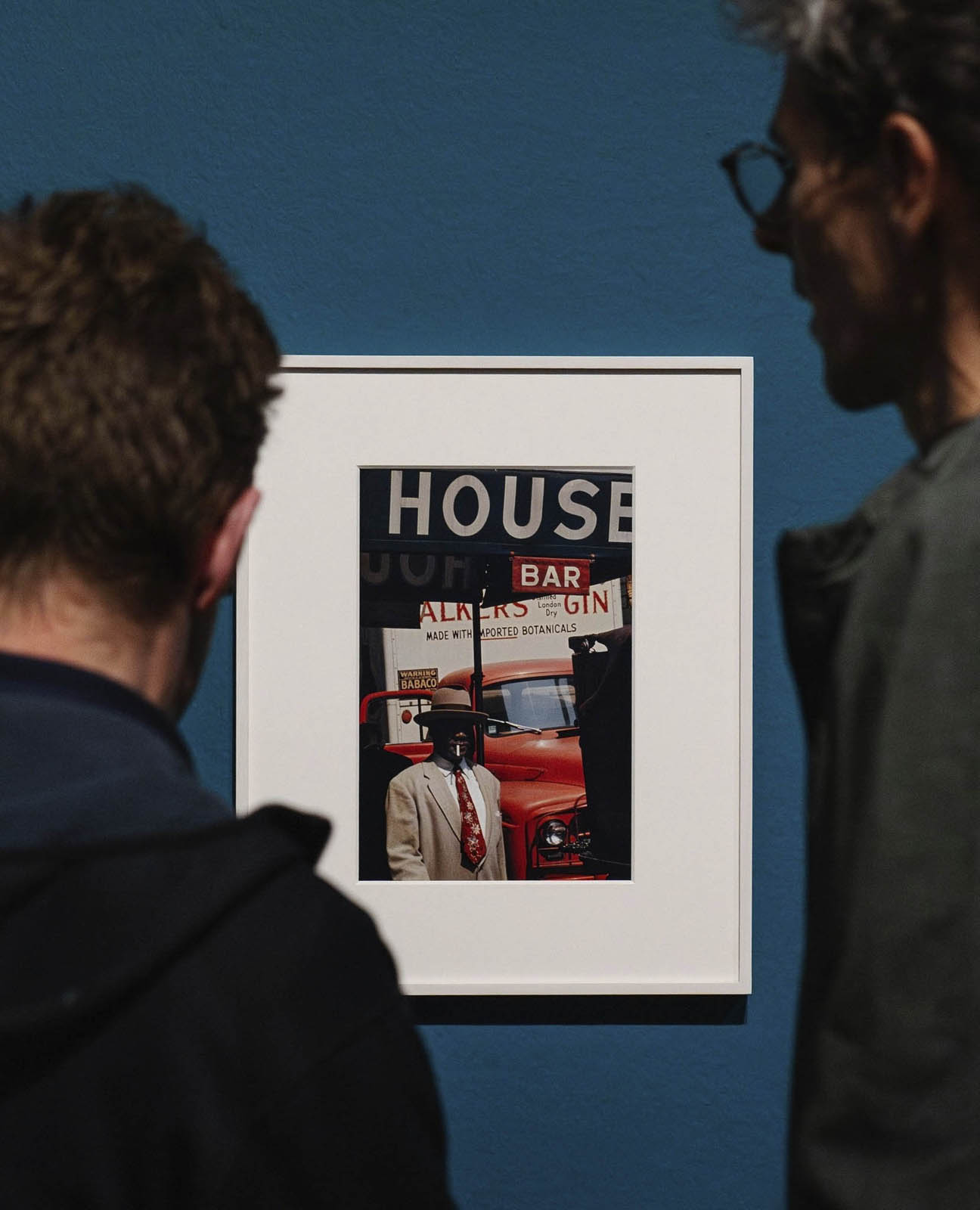
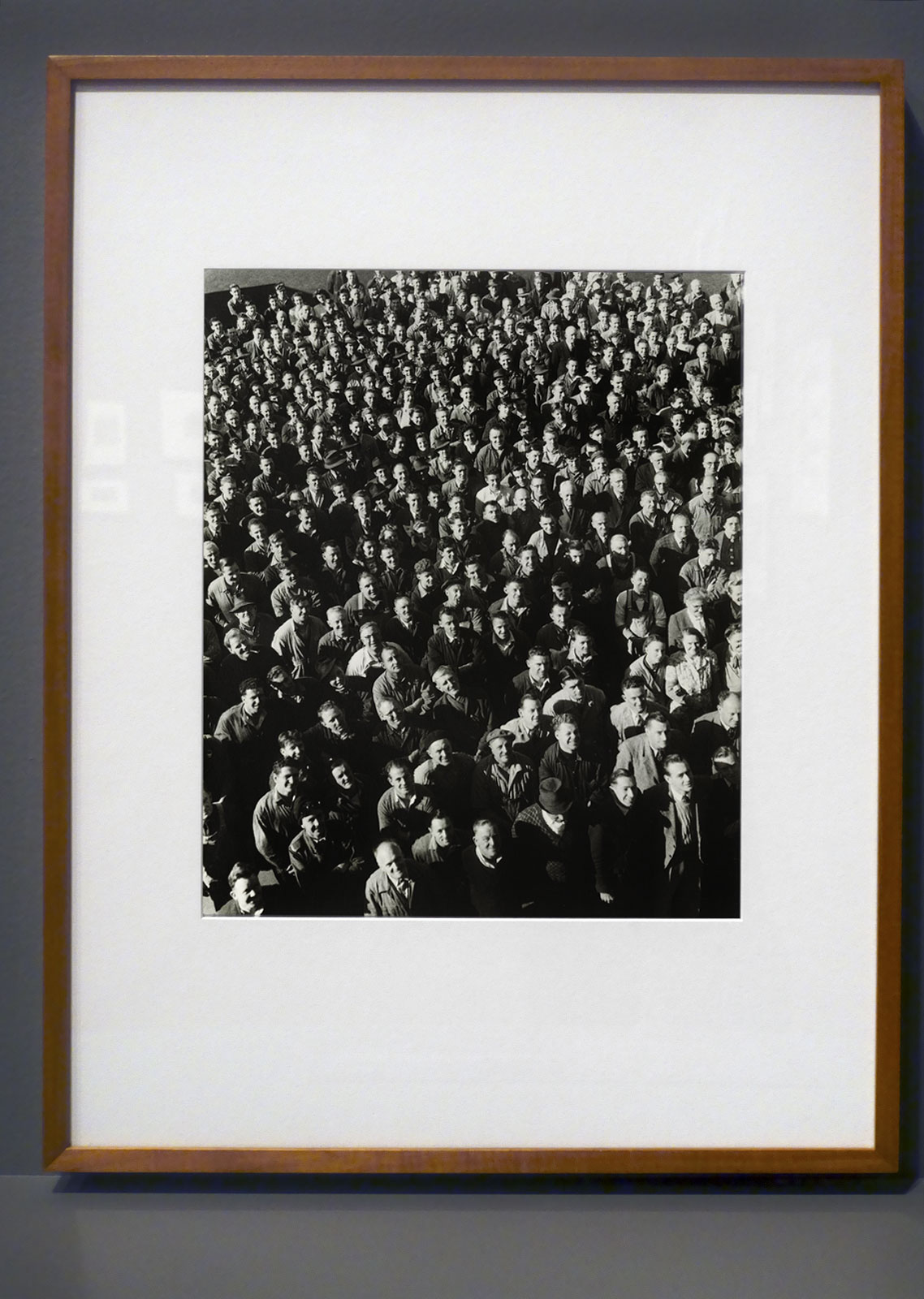
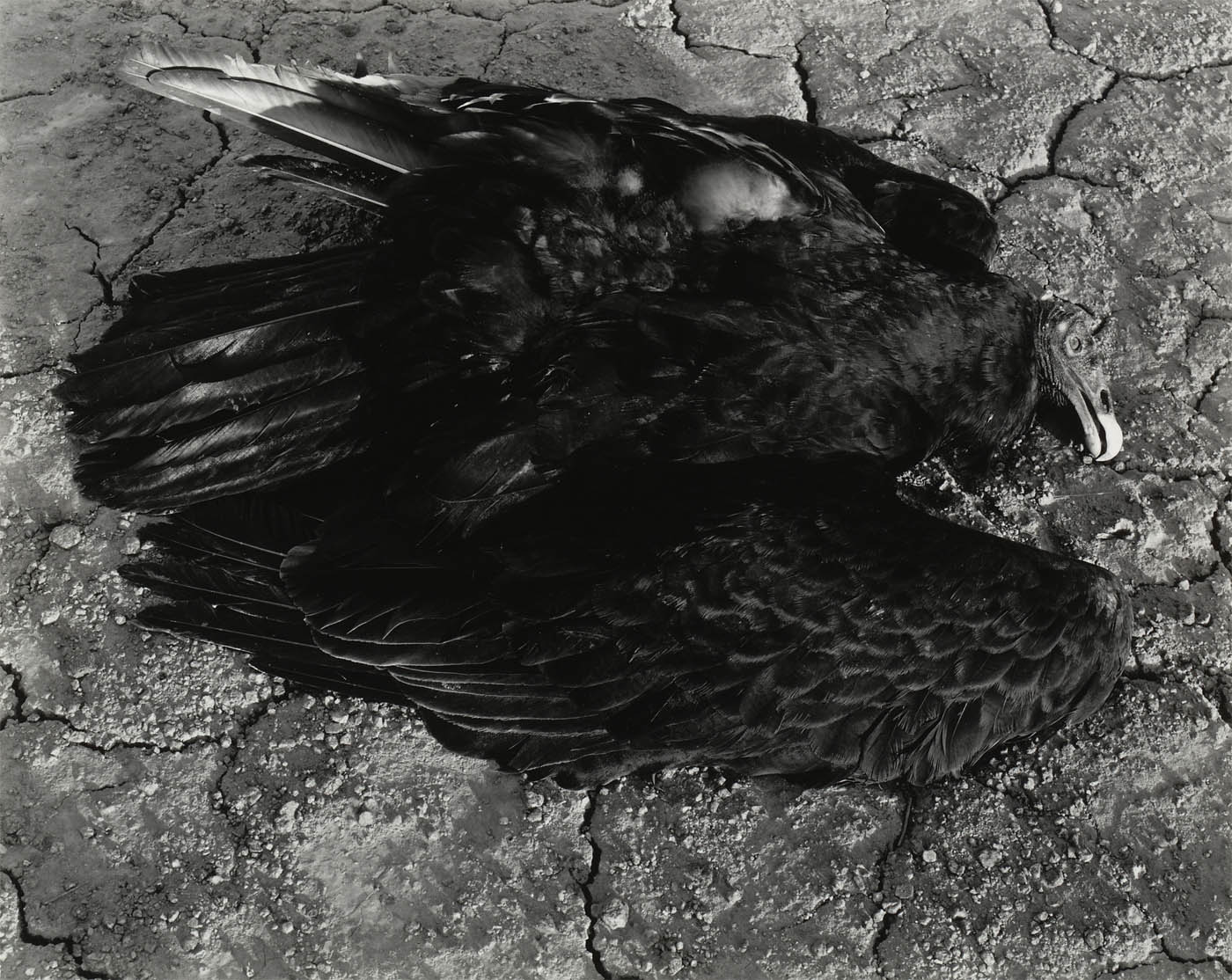
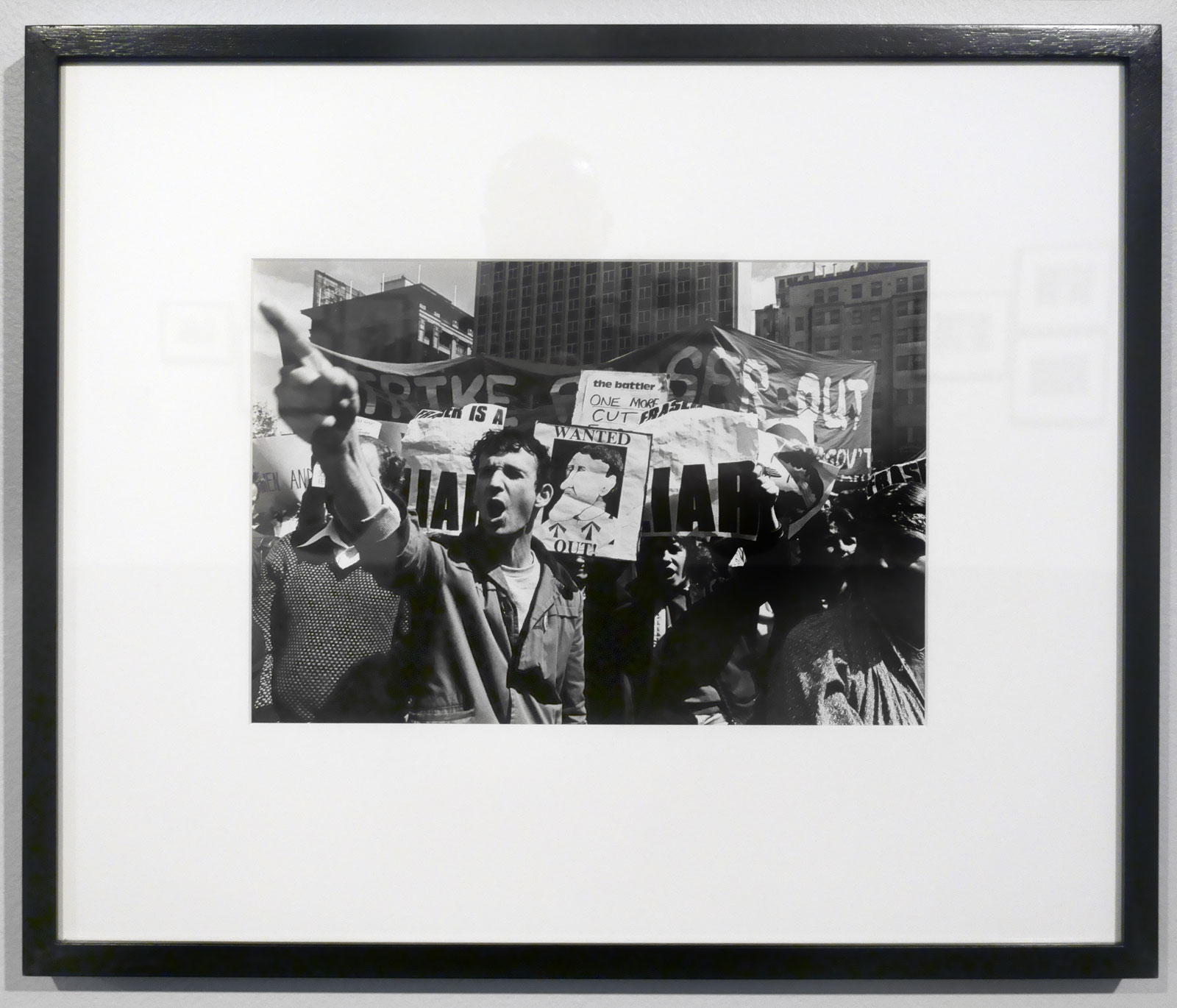
Andrew Chapman (Australian, b. 1954) 'Lest we forget' 1980 from the exhibition 'The basement: photography from Prahran College (1968-1981)' at the Museum of Australian Photography, Wheelers Hill, Melbourne, March - May 2025


Andrew Chapman (Australian, b. 1954)
Lest we forget
1980
Gelatin silver print
Museum of Australian Photography, City of Monash Collection donated 2024


Nurture

A world of creativity and transformation

This is a magnificent exhibition at the Museum of Australian Photography which showcases the work of students and teachers at Prahran College between 1958-1981.

People more eminent than myself have commented on the exhibition.

Gael Newton AM – formerly curator of photography at the Art Gallery of New South Wales, and the Senior Curator of Australian and International Photography at the National Gallery of Australia (NGA) in Canberra – “highlights the diverse and passionate nature of the Prahran College community, where an unstructured curriculum and open debates encouraged multiple approaches – from documentary and still life to collage and staged tableau – while the influence of European cinematic sensibilities and the local film and music scenes added depth to the artistic expression.”1

Daniel Palmer – Professor in the School of Art at RMIT University, his research and professional practice focuses on contemporary art and cultural theory, with a particular emphasis on photography and digital media – commenting on the era “frames the 1970s as a transformative era for Australian society and photography, characterised by social activism.”1

Helen Ennis – formerly Curator of Photography at the National Gallery of Australia and outstanding writer on Australian photography and photographers – emphasises “productive intergenerational exchanges between students and their older educators Prahran represented a space of creative possibility and hope” while acknowledging Prahran’s limitations including gender imbalance, “noting examination records from 1974 showing only five of twenty students were female, with the first woman (Julie Millowick) not appointed to teach until 1983.”1

“Ennis’s address brings to light from The Basement a critical reassessment of how we understand and present 1970s Australian photography. She advocated for approaches that preserve the complexity, contradictions, and energy of this formative period rather than imposing retrospective order that might simplify or misrepresent it. Her reflections bridge historical understanding with contemporary curatorial practice, suggesting ways to engage more authentically with photography’s rich past.”2

Bill Henson AO – former student and internationally acclaimed photographer – acknowledges that “that political movements such as feminism were present among Prahran’s students in the 1970s – “there were the feminists; there were little groups doing their social diligence” – he noted that these stances did not overshadow the college’s overarching emphasis on beauty and creative exploration. “There wasn’t this righteousness, this indignation, this kind of territorial thing about issues,” he said. In contrast there was an openness and enthusiasm that defined Prahran during his time there – a place where beauty and creativity were paramount.”3

On reflection

What struck me most about this exhibition was the creative strength of the STUDENT work … and that is something nobody mentions. This was student work.

These were artists finding their personal voice, exploring the world, being creative, learning how to envision the world in their photographs – through social documentary or conceptual, experimental photographs that challenged how Australian viewed itself. As Assoc. Professor James McArdle, a former student and one of the many driving forces behind this exhibition, insightfully observes:

“Prahran, at this time, was a nexus for the ‘New Photography’ movement in Australia, bringing to our country international developments from the 1960s, the candid, loosely structured photographic language that contrasted sharply with the rigid narratives of photojournalism and the increasingly commercial aesthetics of colour photography.

Prahran College itself played a critical role in the legitimisation of photography as an art form within Australia. It spearheaded the integration of art photography into tertiary education curricula, fostering an environment where young artists … could experiment formally and conceptually.”4

Indeed, Melbourne in the late 1960s and early 1970s could be seen as the nurturing centre of photography in Australia.

As my friend Ian Lobb said to me before he died, “In 1970 where did you go to see a fine art photograph on exhibition in a non-institutional gallery in Melbourne? The only place was the doorway to the John Cato / Athol Shmith / Peter Barr studio in Collins Street. You would never know which of the three photographers would have a print placed in that doorway.”5

But then things changed.

Variously, Melbourne had Jenny Boddington appointed curator of photography in 1972 at the National Gallery of Victoria, becoming the first such curator in Australia and perhaps only the third in the world.

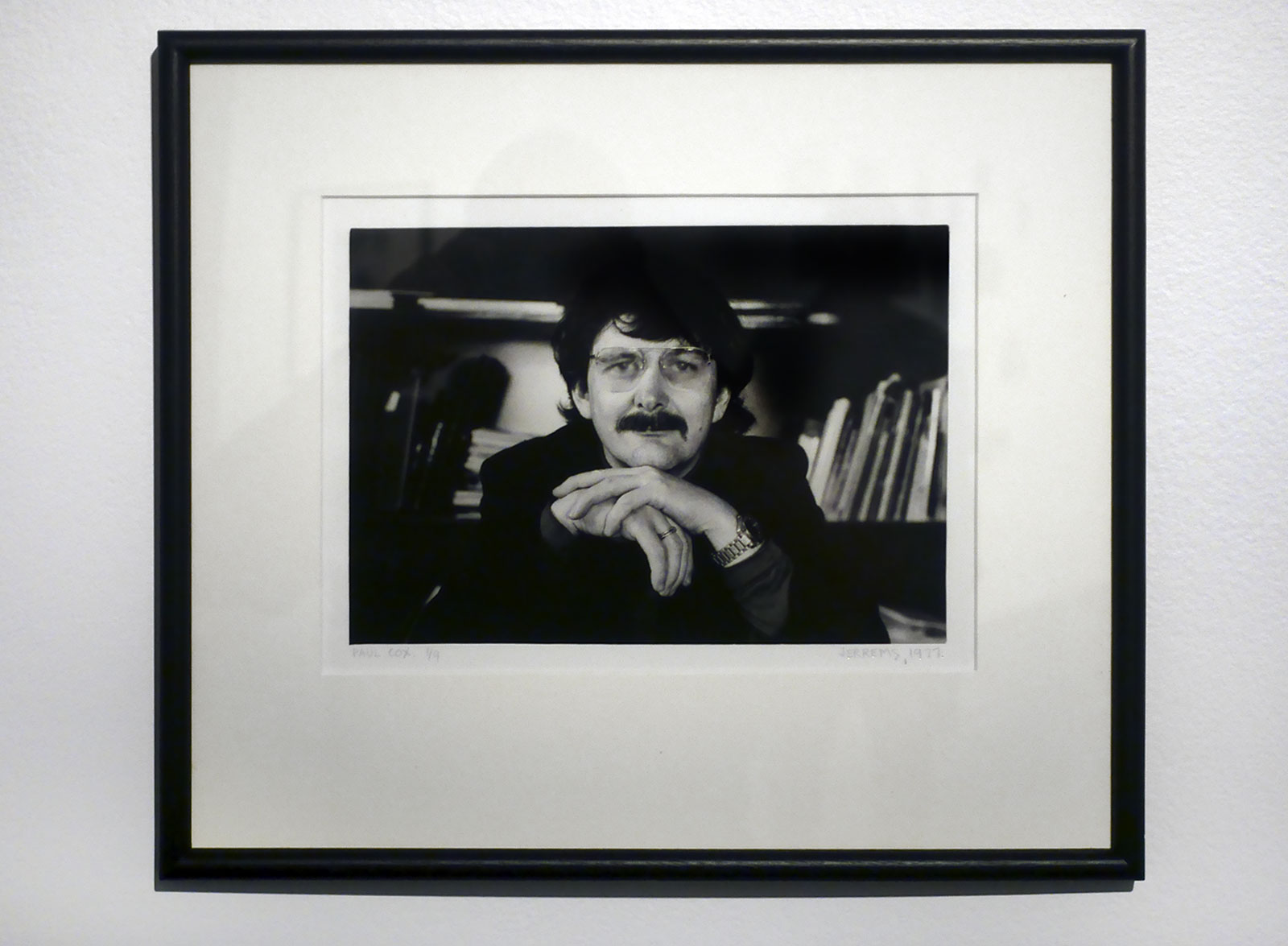
Melbourne also had three commercial art photography galleries that supported local and international exhibitions, exposing major international photographers to local artists. These included Brummels Gallery of Photography reopened in the early 1970s by that wonderful photographer Rennie Ellis and deputy director Robert Ashton (Prahran), the first privately run art gallery in the country to be devoted specifically to photography; The Photographers’ Gallery and Workshop founded in 1973 by Paul Cox (Prahran), Ingeborg Tyssen, John F. Williams and Rod McNicol (Prahran), taken over by Ian Lobb in 1974 and joined by co-director Bill Heimerman in 1976 showcasing mostly American and some European original fine prints from major artists which were influential on Australian audiences and practitioners; and Church Street Photographic Centre opened by Joyce Evans OAM in 1976, the third commercial photographic gallery in 1970s Melbourne which exhibited international 19th and 20th Century photography

Prahran College was closely followed by Phillip Institute of Technology (PIT) which was a tertiary college in Bundoora which had an art photography course run by Ian Lobb and Les Walkling, from 6 January 1982 to 30 June 1992 at which time the school integrated as part of RMIT University. I attended PIT in 1991 and then RMIT University where I completed by doctorate, after having undertaken two years at Brighton Technical College completing two years on the basics of photography, a grounding for many budding photographers in those years under the direction of Peter Barker.

I remember at RMIT fine art photography course we would have reviews of student work every 4 weeks, where over 2 days students put up new work and we all sat together with the lecturers and discussed the ideas contained in the work. The atmosphere was electric, the disparate work, the in-depth conversations, the passion. Look at Greg Neville’s photograph Tutorial: lecturers and students [back row L–R Derrick Lee, Bryan Gracey, Athol Shmith, Paul Cox, Elizabeth Tainsh] (c. 1971, below) and you can feel a similar energy…

So Melbourne has been particularly blessed – I dislike that word but there is no other that really conveys what I mean – by this confluence of events, people and places that supported the rigorous investigation of photography and life that Prahran College was a part of. At Prahran there was optimism, social conscience, and an engagement with the street and with life, there was “creative rebellion and intellectual engagement”. I asked James McArdle at an artist’s talk about this: how exciting this would have been, the bouncing of ideas one off another, the sense of community and camaraderie, and yes they were all there … encouraging an “atmosphere” of creativity which has produced a generation of outstanding photographers who will leave a lasting legacy in the history of Australian photography.

As an artist who arrived as a “second generation” photographer after Prahran College I have a great affection for the people and the work produced in the exhibition.

I knew John Cato and his delightful wife Dawn Cato well and went down to their house for afternoon tea to discuss photography and life; together with Bill Heimerman I co-curated his retrospective at The Photographers’ Galley and Workshop in 2002, the text ‘and his forms were without number’ used in the book accompanying the exhibition John Cato Retrospective at the Ballarat International Foto Biennale in 2013 where Paul Cox and I made opening speeches. Both were good friends.

Joyce Evans was my substitute mother in Australia. What a wonderful, bohemian, creative, intelligent woman she was. I wrote “Nothing emerges from nothing,” foreword to her book We Had Such High Hopes: Student Activism and the Peace Movement 1949-1952, A Photographic Memoir by Joyce Evans 2019 published before she died, a book that instils the social conscience ethos emerging in postwar Australia which leads into the work of the Prahran College photographers. I still her miss greatly.

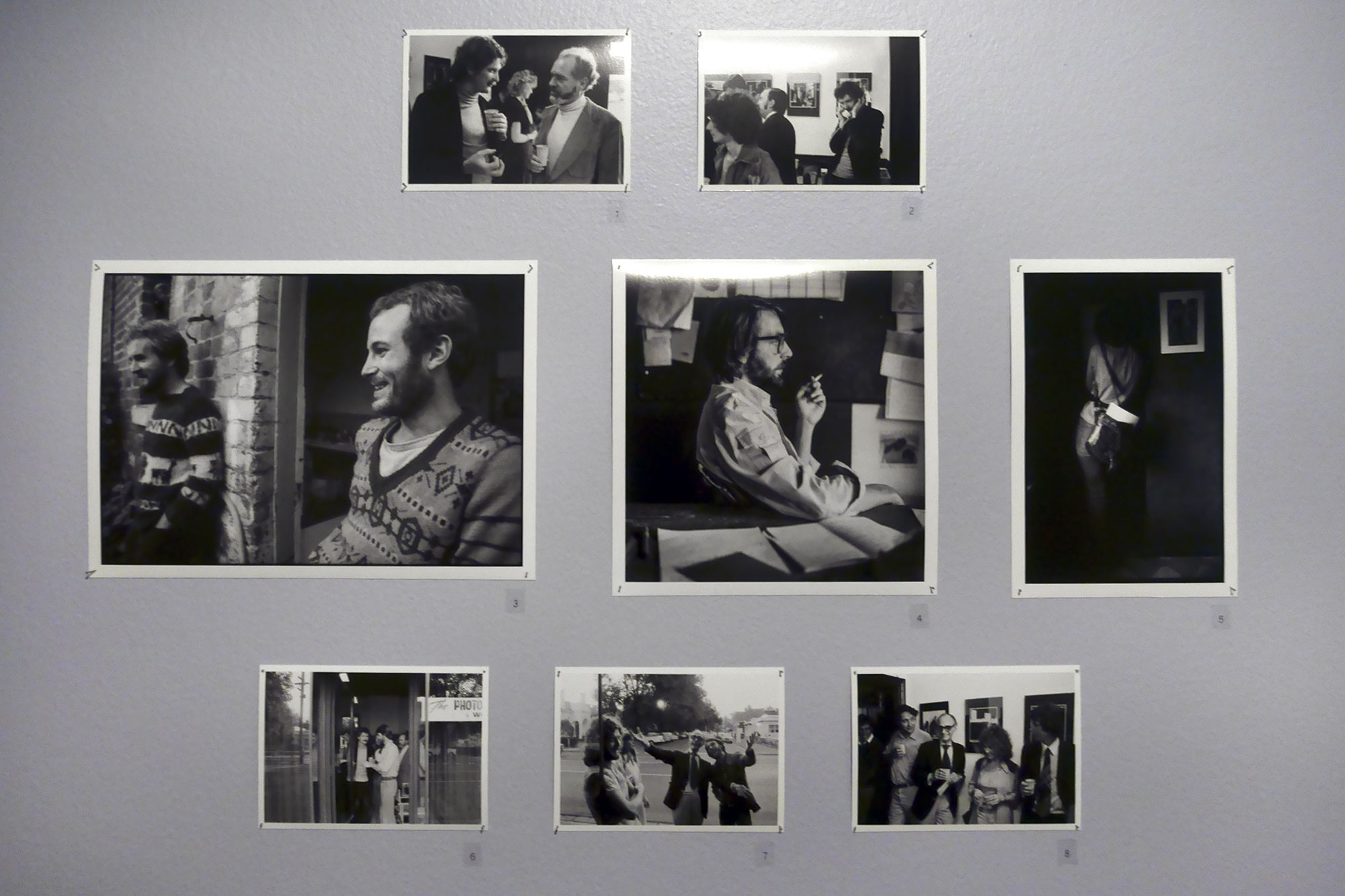
As I do both Ian Lobb and Bill Heimerman (pictured below in Peter Leiss’ Untitled [Bill Heimerman (right) and Ian Lobb (left) at the rear of The Photographers’ Gallery] c. 1975-1980), both good friends. Ian Lobb was my first photography lecturer at PIT and became my mentor and friend for over 30 years; Bill gave me three solo exhibitions at The Photographer’s Gallery and Workshop in my early days as an artist, and much excellent advice, for which I am forever grateful.

James McArdle and Gael Newton remain valued friends, both amazing fonts of knowledge in all aspects of photography and photographic research.


In conclusion, congratulations to all who have been involved in bringing this exhibition to fruition: artists, writers and curators. It is a magnificent achievement and a testament to the creativity and passion of the times, both theatre and document reflecting an era that sadly can no longer be repeated.

Prahran College photographers followed their heart and their eye, they possessed a curiosity which “evokes the care one takes for what exists or could exist; an acute sense of the real which, however, never becomes fixed; a readiness to find our surroundings strange and singular; a certain restlessness in ridding ourselves of our familiarities and looking at things otherwise; a passion for seizing what is happening now and what is passing away; a lack of respect for traditional hierarchies of the important and the essential.”6

However long I live, it has always been a privilege to be part of this community, to be part of the Melbourne photographic community.

Dr Marcus Bunyan


1/ James McArdle. “Launched!,” on the On This Date in Photography website, 6th April 2025 [Online] Cited 06/04/2025

2/ Helen Ennis quoted in James McArdle. “Unfixing,” on the On This Date in Photography website, 29th March 2025 [Online] Cited 06/04/2025

3/ Bill Henson opening speech summarised in James McArdle. “Opening!” on the On This Date in Photography website, 1st March, 2025 [Online] Cited 18/04/2025

4/ James McArdle. “Epoch,” on the On This Date in Photography website, 25th April, 2025 [Online] Cited 28/04/2025

5/ “Steve Lojewski [in the year ahead of me at PCAE] and I job shared at Shmith / Cato / Barr. A fantastic opportunity to work mainly in the darkroom, occasionally assisting in the studio and as they gained confidence in me sent out on [mickey mouse] jobs when they were double booked. A HUGE break and when Peter Barr bought out John and Athol and established Peter Barr & Associates he invited me to freelance out of his new studio. That offer would not have happened without the prior experience of the darkroom & studio work. My first job on the Monday morning of my 2 week trial for Athol, John and Peter was 250 prints [on fibre paper] of Malcom Fraser by 11.00 am [ie the wet deadline was 11.00. Dry and out the door was, from memory, 12.noon].”

Julie Millowick in conversation with Marcus Bunyan via Facebook, 20th May 2025

6/ Michel Foucault, “The Masked Philosopher” in Politics, philosophy, culture: interviews and other writings, 1977-1984. London: Routledge, 1988, p. 328


All installation photographs © Marcus Bunyan. Please click on the photographs for a larger version of the image.

Apologies if a couple of the photographs are slightly out of focus, these were digital RAW files shot on a Sony rx100 handheld at 1000ASA with low depth of field.

For more information please see The Prahran Photography website which upholds the legacy of Prahran College 1970s photography through posts on profiles of the alumni and lecturers (an ongoing project).


“Curiosity is a vice that has been stigmatized in turn by Christianity, by philosophy and even by a certain conception of science. Curiosity, futility. I like the word however. To me it suggests something all together different: it evokes concern; it evokes the care one takes for what exists or could exist; an acute sense of the real which, however, never becomes fixed; a readiness to find our surroundings strange and singular; a certain restlessness in ridding ourselves of our familiarities and looking at things otherwise; a passion for seizing what is happening now and what is passing away; a lack of respect for traditional hierarchies of the important and the essential.”


Michel Foucault, “The Masked Philosopher” in Politics, philosophy, culture: interviews and other writings, 1977-1984. London: Routledge, 1988, p. 328


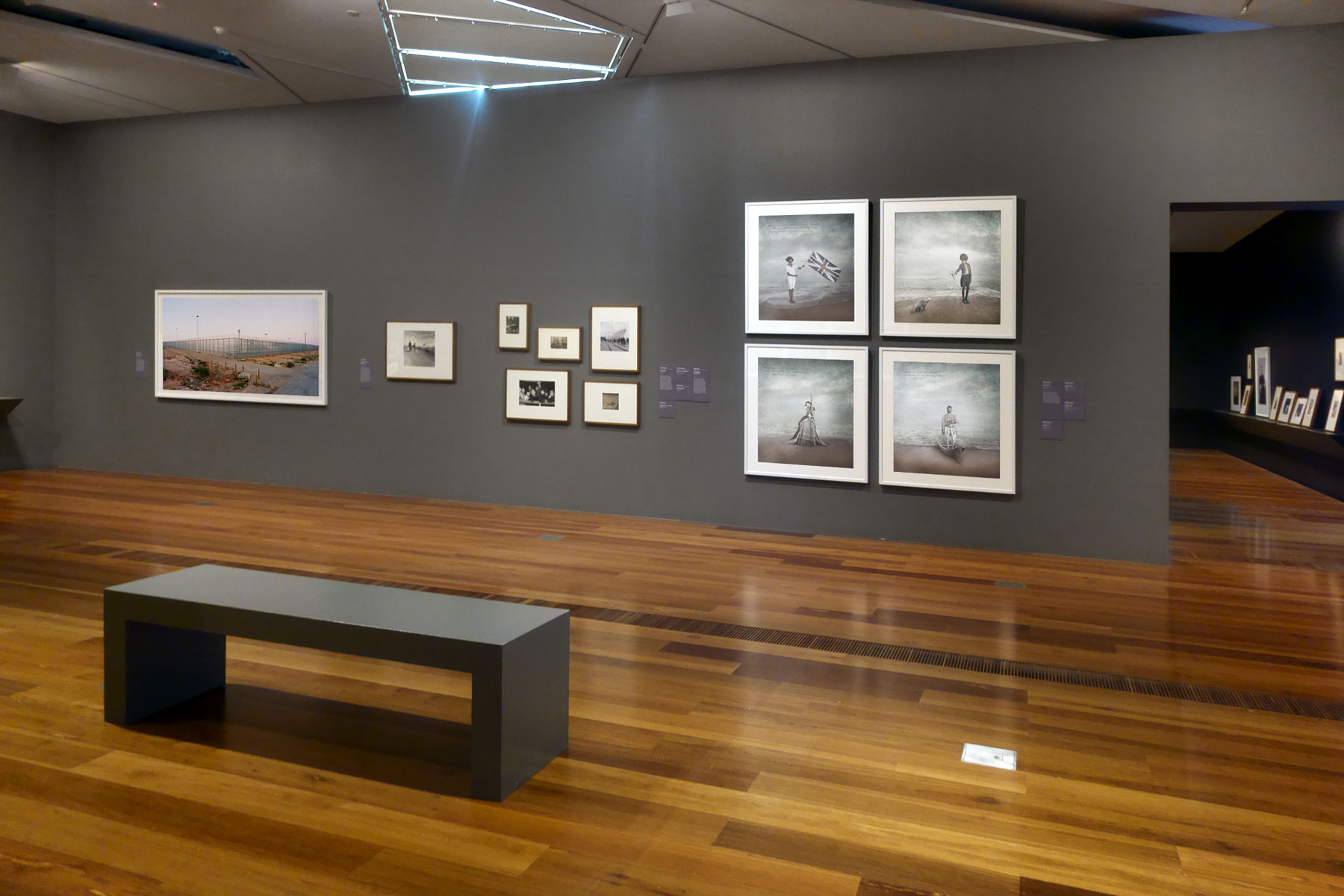
Gallery One (clockwise)


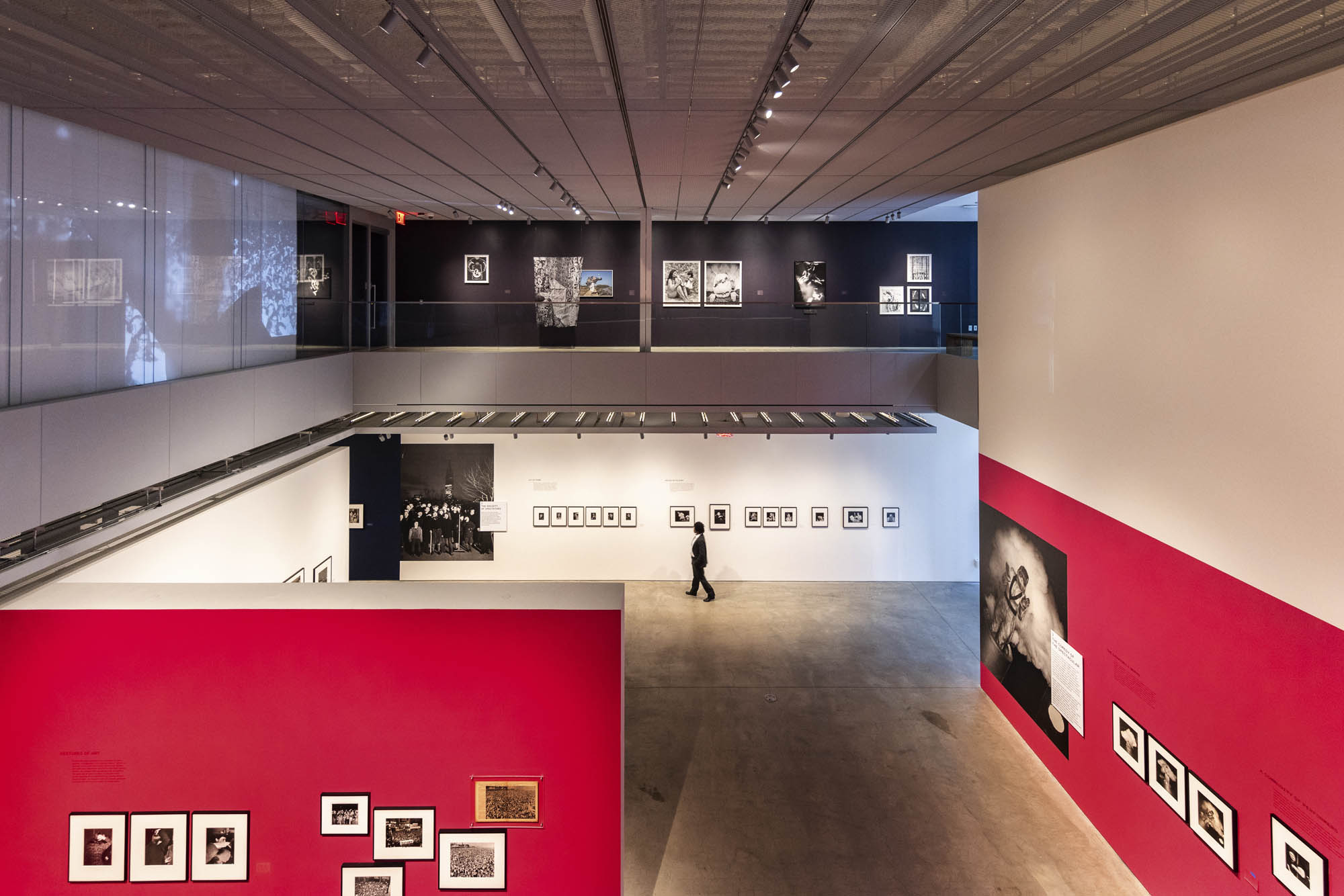
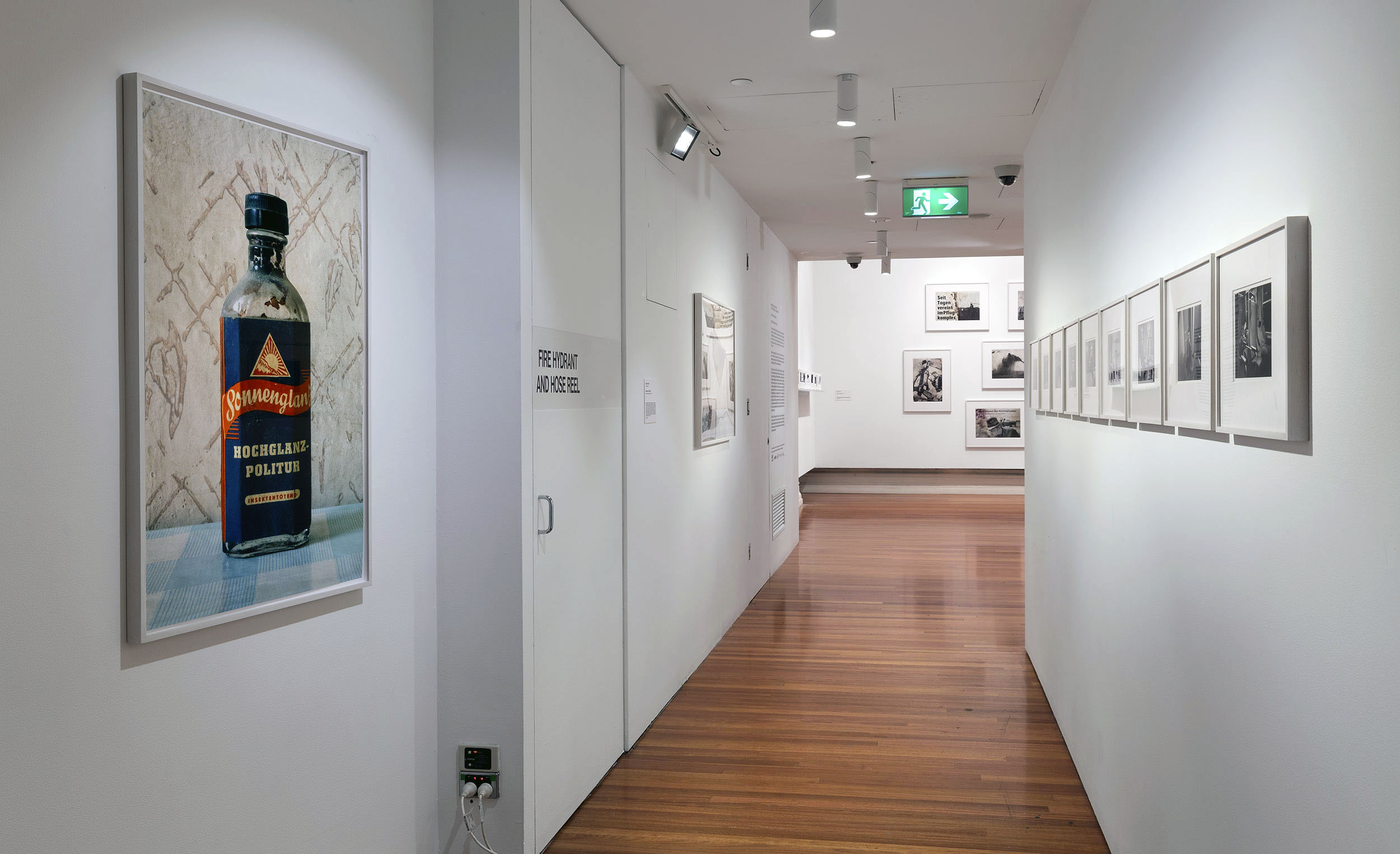
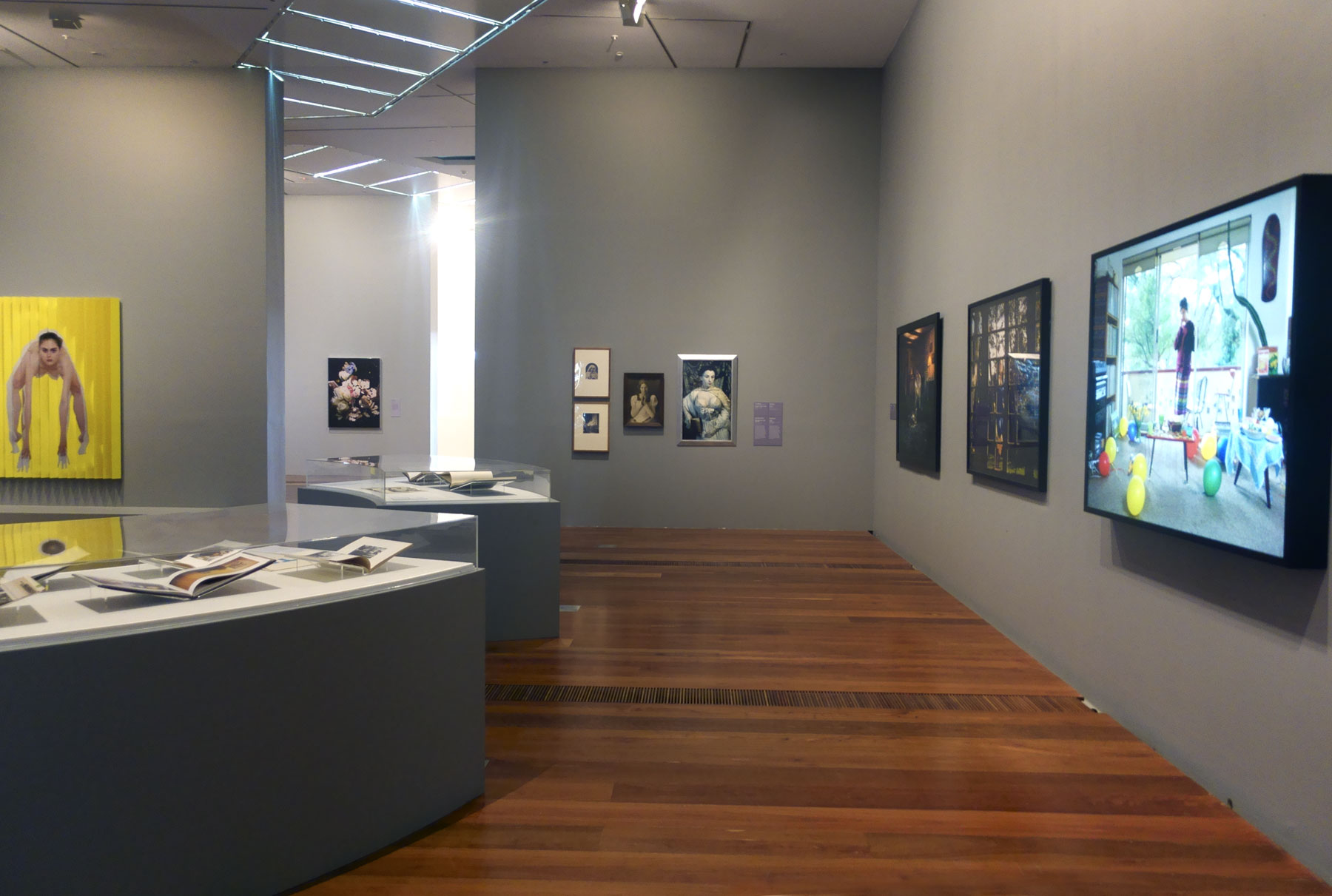
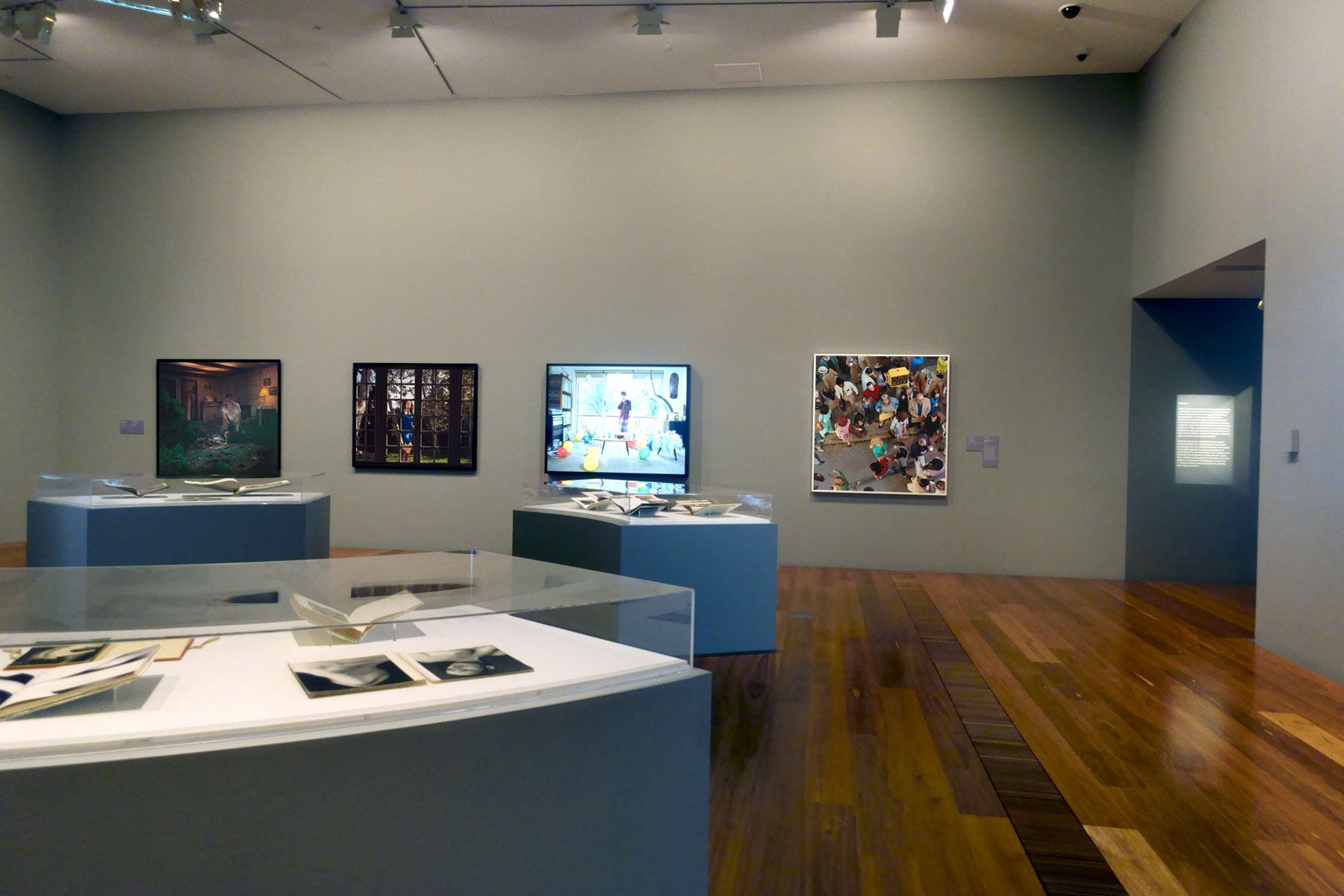
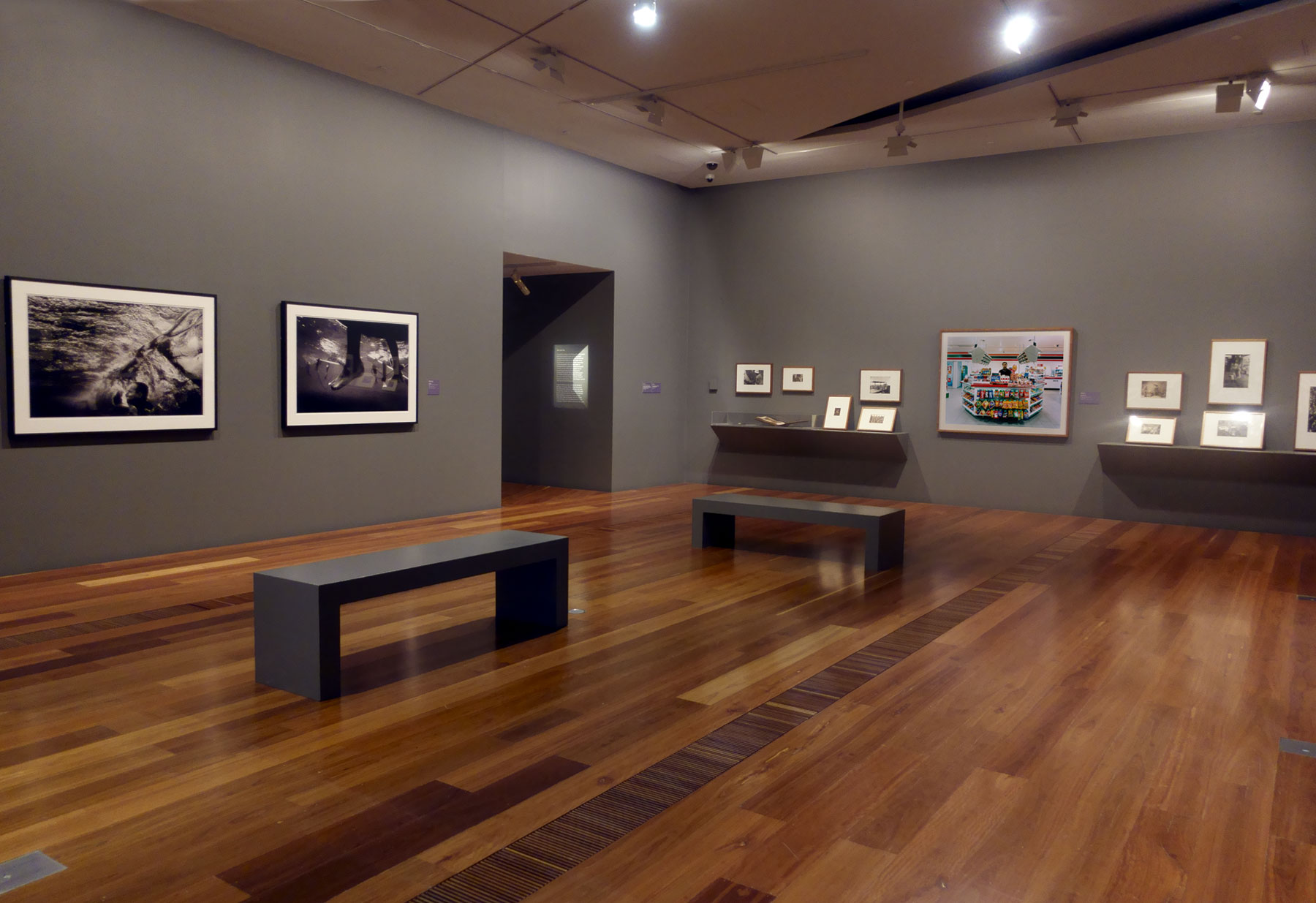
Installation view of the exhibition 'The basement: photography from Prahran College (1968-1981)' at the Museum of Australian Photography, Wheelers Hill, Melbourne
Wall text from the exhibition 'The basement: photography from Prahran College (1968-1981)' at the Museum of Australian Photography, Wheelers Hill, Melbourne, March - May, 2025
Installation view of the exhibition 'The basement: photography from Prahran College (1968-1981)' at the Museum of Australian Photography, Wheelers Hill, Melbourne, March - May, 2025


Installation views of the exhibition The basement: photography from Prahran College (1968-1981) at the Museum of Australian Photography, Wheelers Hill, Melbourne
Photos: Marcus Bunyan


In May 1968 the newly formed photography department of Prahran Technical School (known as Prahran College of Advanced Education (PCAE) from 1973) moved into the basement of a freshly completed art and design building on the corner of High Street and Thomas Street in Melbourne’s inner southeastern suburb of Prahran. Here, for the first time in Australia, photography was taught as an artform.

Featuring the work of approximately 60 artists, The basement brings to light rare vintage prints from the 1960s through to the early 1980s, key archival ephemera and folio work – from students and teachers of the College’s Diploma of Art & Design (Photography). It was a period where new discussions developed quickly around the possibilities of what photography could be. These students and teachers were part of a progressive, edgy wave of image-makers excited about the medium’s potential.

Under the vanguard of influential photographers such as John Cato, Paul Cox and Athol Shmith, the school became a breeding ground for some of this country’s most important art photographers: Carol Jerrems, Bill Henson, Nanette Carter, Rod McNicol, Polly Borland, Peter Milne, Robert Ashton, Philip Quirk, Peter Leiss, Jacqueline Mitelman, Mimmo Cozzolino, Graham Howe and Julie Millowick, among many others.

The exhibition’s accompanying publication elucidates the experience from several perspectives. As we hear from the curators, students, colleagues and academics, it’s clear that this course, in this time, was of great consequence to our photographic ecosystem and its development.

Curated by Angela Connor, MAPh Senior Curator, and Stella Loftus-Hills, MAPh Curator, The basement gathers works from close to 60 artists, traversing over 13 years of image-making and adjacent subcultures in music, protest, fashion and art criticism. This landmark exhibition will deliver new research into the canon of Australia’s cultural history through its assembled works and attendant publication.

Text from the Museum of Australian Photography website
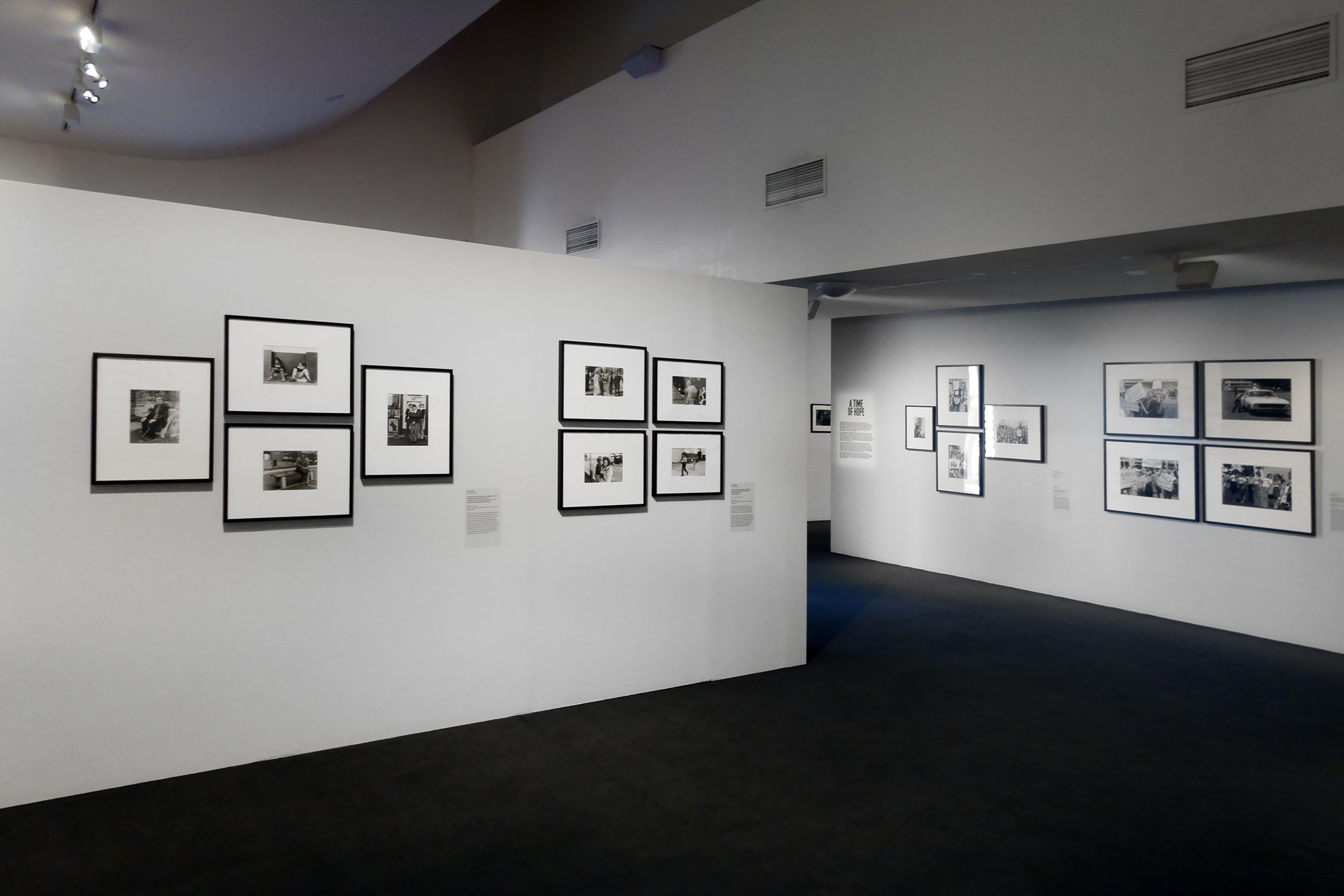
 

Installation view of the reverse of the opening wall of the exhibition 'The basement: photography from Prahran College (1968-1981)' at the Museum of Australian Photography, Wheelers Hill, Melbourne


Installation view of the reverse of the opening wall of the exhibition The basement: photography from Prahran College (1968-1981) at the Museum of Australian Photography, Wheelers Hill, Melbourne
Photo: Marcus Bunyan


Moira Joseph (Australian, b. 1955)
'Jack with a cigarette sitting in the church garden, St Kilda'  1974 (installation view) from the exhibition 'The basement: photography from Prahran College (1968-1981)' at the Museum of Australian Photography, March - May, 2025


Moira Joseph (Australian, b. 1955)
Jack with a cigarette sitting in the church garden, St Kilda (installation view)
1974
Gelatin silver print
Museum of Australian Photography, City of Monash Collection
Acquired 2024
Photo: Marcus Bunyan


Moira Joseph (Australian, b. 1955)
'Herald boys, Fitzroy Street, St Kilda' 1975 (installation view)


Moira Joseph (Australian, b. 1955)
Herald boys, Fitzroy Street, St Kilda (installation view)
1975
Gelatin silver print
Museum of Australian Photography, City of Monash Collection
Acquired 2024
Photo: Marcus Bunyan


Moira Joseph is a Melbourne-based professional photographer, filmmaker and teacher. She studied photography at Prahran College from 1974 to 1977. Joseph created the works on display here while she was a student. Armed with her Mamiya 220 medium-format camera, Joesph often walked between the College and her home in St Kilda, affectionately documenting the characters she regularly encountered. Jack with a cigarette sitting in the church garden, St Kilda (1974), for example, shows an elderly gentleman from a nearby men’s refuge sitting alone in Acland Street’s church square. Children regularly feature in Joseph’s student work, and she spent time photographing at luna park, as well as Prahran Primary School.

Wall text from the exhibition

Moira Joseph alumni profile on the Prahran Legacy website


Moira Joseph (Australian, b. 1955)
'Three Herald boys, Acland Street, St Kilda' 1975 (installation view)


Moira Joseph (Australian, b. 1955)
Three Herald boys, Acland Street, St Kilda (installation view)
1975
Gelatin silver print
Museum of Australian Photography, City of Monash Collection
Acquired 2024
Photo: Marcus Bunyan
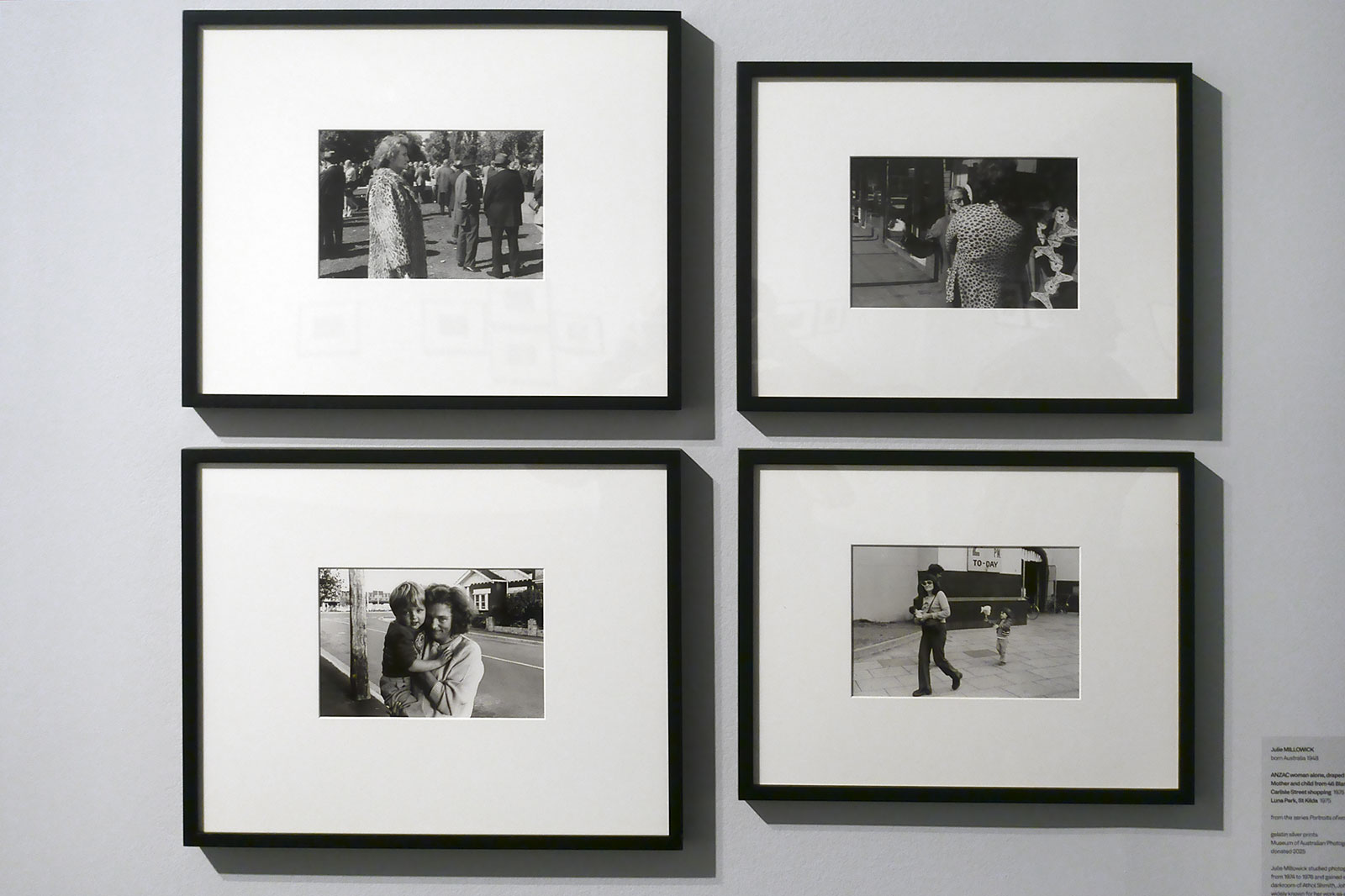
 

Installation view of the exhibition 'The basement: photography from Prahran College (1968-1981)' at the Museum of Australian Photography, Wheelers Hill, Melbourne showing Julie Millowick 's photographs


Installation view of the first gallery of the exhibition The basement: photography from Prahran College (1968-1981) at the Museum of Australian Photography, Wheelers Hill, Melbourne showing Julie Millowick ‘s photographs from clockwise: ANZAC woman alone, draped in leopard skin coat, 1975; Carlisle Street shopping, 1975; Luna Park, St Kilda, 1975; Mother and child from 46 Blanche Street, St Kilda, 1977 from the series Portraits of women
Photo: Marcus Bunyan


Julie Millowick studied photography at Prahran College from 1974 to 1976 and gained early experience working in the darkroom of Athol Shmith, John Cato and Peter Bart. She is widely known for her work as a commercial photographer and photojournalist as well as her personal documentary projects.

1975 was Millowick’s second year at Prahran College, and also International Women’s Year, as designated by the United Nations. With the spotlight set firmly on women’s rights, Millowick made an extensive series of photographs entitled Portraits of women, which she continued in subsequent years. This human-centred series with feminist undertones, sympathetically captured women in a variety of locations and depicted moments of motherhood, friendship, loneliness, old-age and youth.

Wall text from the exhibition

Read my review “Down with Earth,” on the exhibition Julie Millowick: Surrounding at the Castlemaine Art Museum, June 2024

Julie Millowick Alumni profile on the Prahran Legacy website


Julie Millowick (Australian, b. 1948)
'Mother and child from 46 Blanche Street, St Kilda' 1977 from the exhibition 'The basement: photography from Prahran College (1968-1981)' at the Museum of Australian Photography, Wheelers Hill, Melbourne, March - May 2025


Julie Millowick (Australian, b. 1948)
Mother and child from 46 Blanche Street, St Kilda
1977
Gelatin silver print
15.9 x 23.7cm
Museum of Australian Photography, City of Monash Collection donated by Julie Millowick 2024


Wall text from the exhibition 'The basement: photography from Prahran College (1968-1981)' at the Museum of Australian Photography, Wheelers Hill, Melbourne


Wall text from the exhibition The basement: photography from Prahran College (1968-1981) at the Museum of Australian Photography, Wheelers Hill, Melbourne
Photo: Marcus Bunyan
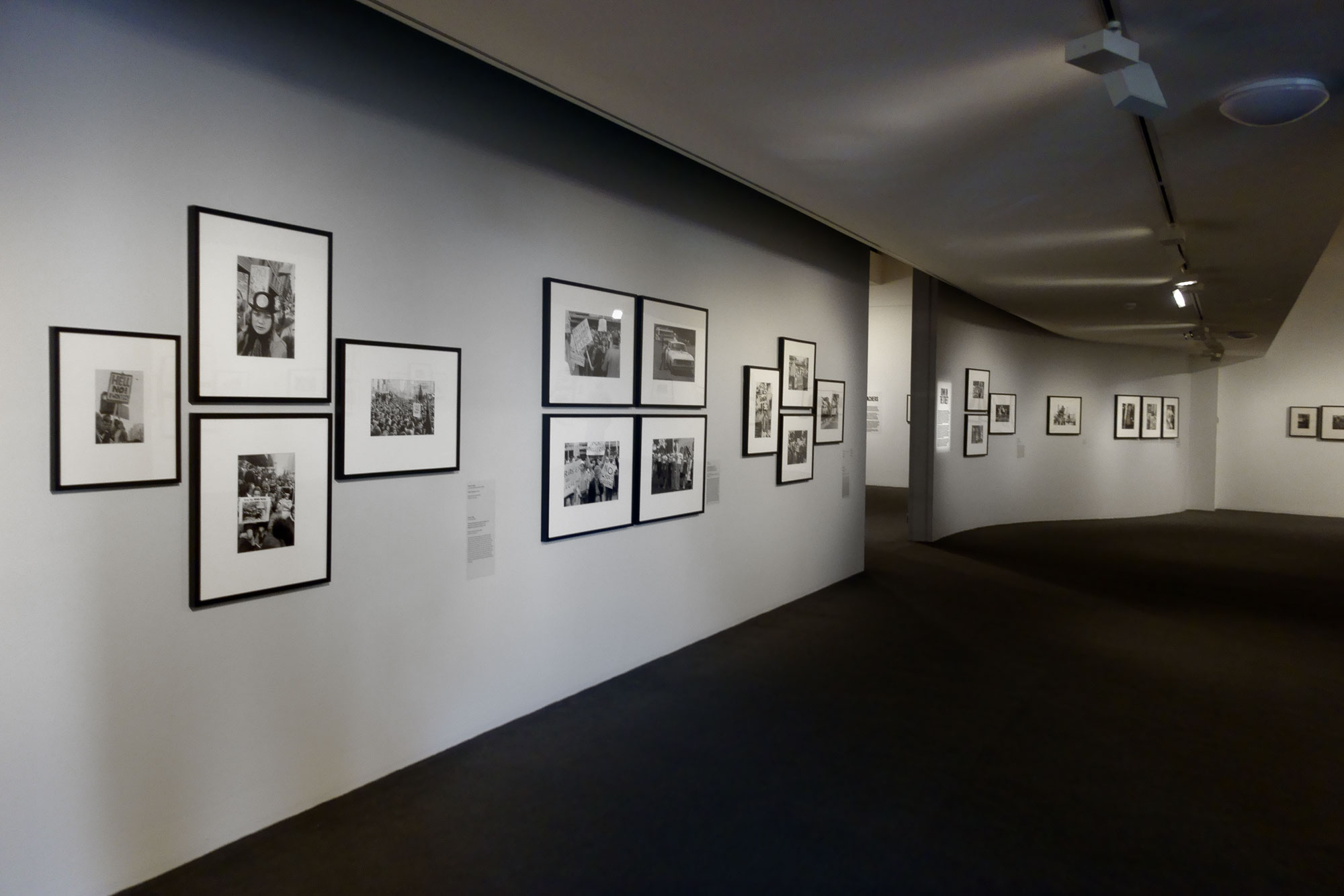
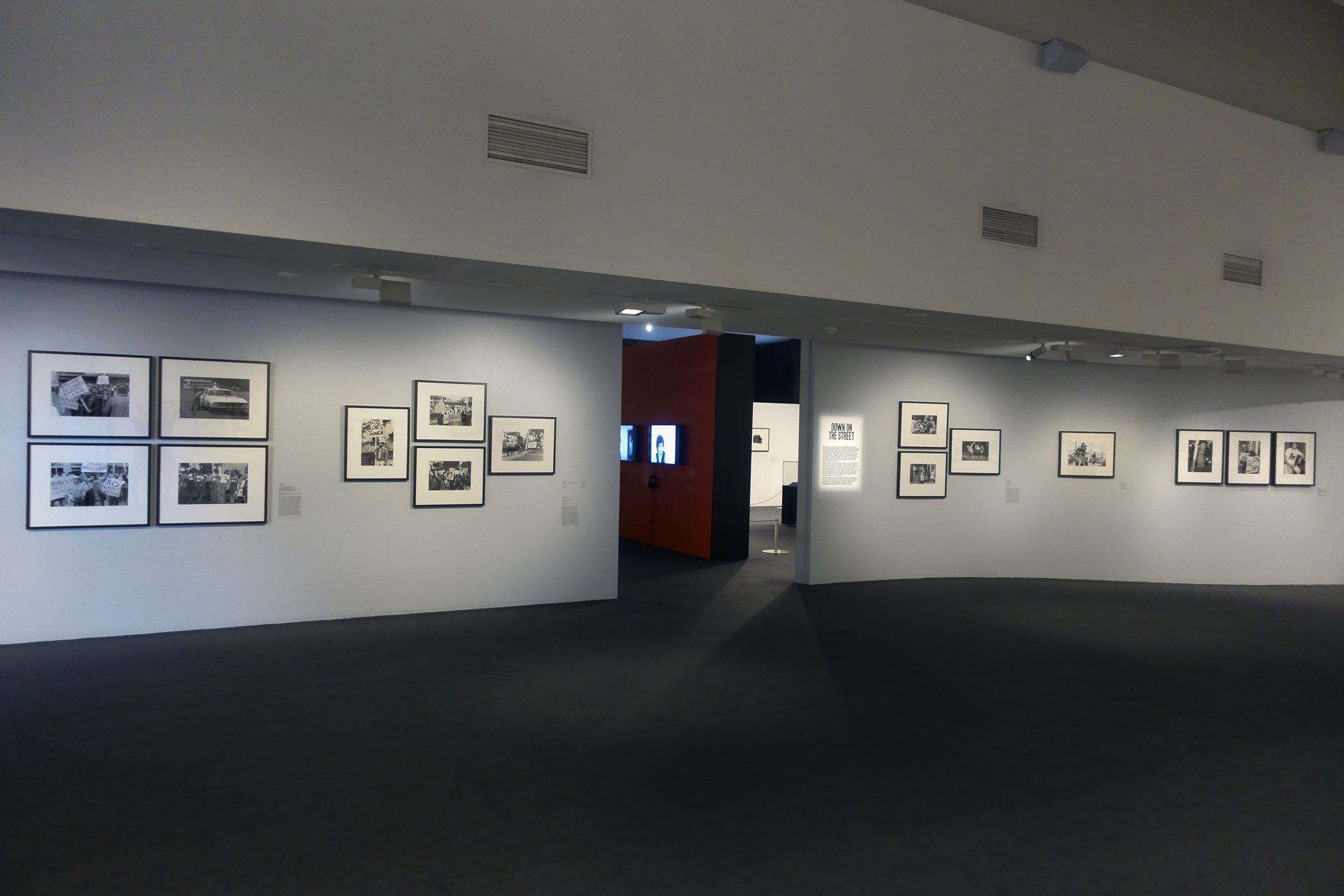
 

Installation view of the exhibition 'The basement: photography from Prahran College (1968-1981)' at the Museum of Australian Photography, Wheelers Hill, Melbourne
Installation view of the first gallery of the exhibition 'The basement: photography from Prahran College (1968-1981)' at the Museum of Australian Photography, Wheelers Hill, Melbourne


Installation views of the first gallery of the exhibition The basement: photography from Prahran College (1968-1981) at the Museum of Australian Photography, Wheelers Hill, Melbourne
Photos: Marcus Bunyan


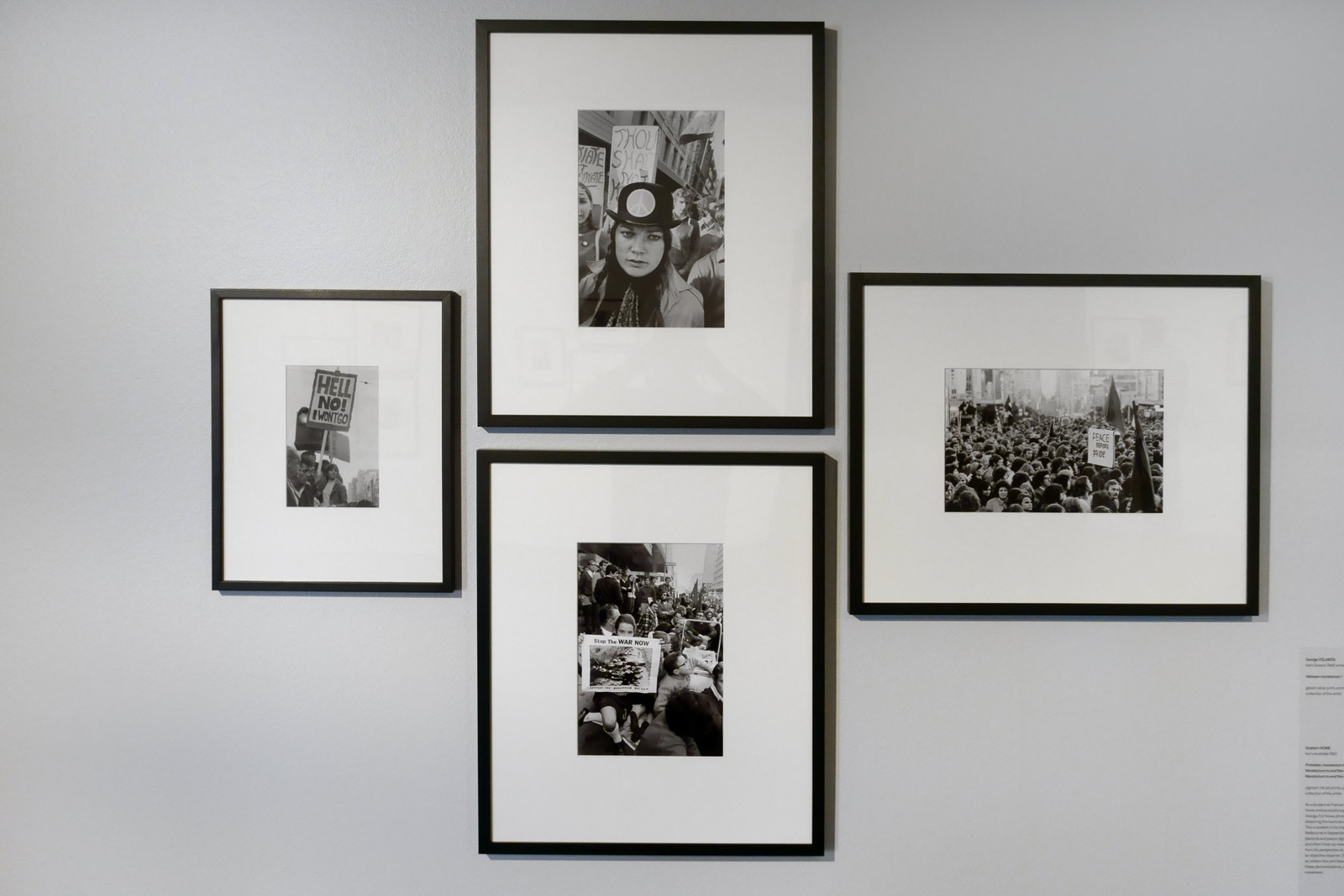
Installation view of the exhibition 'The basement: photography from Prahran College (1968-1981)' at the Museum of Australian Photography, Wheelers Hill, Melbourne showing photography by George Volakos and Graham Howe


Installation view of the first gallery of the exhibition The basement: photography from Prahran College (1968-1981) at the Museum of Australian Photography, Wheelers Hill, Melbourne showing at left, George Volakos’ photograph Vietnam moratorium 1 1970; at top centre, Graham Howe’s photograph Protester, moratorium to end the war in Vietnam 1970 followed by two photographs Moratorium to end the war in Vietnam 1970 (below)
Photo: Marcus Bunyan


As a student at Prahran College in the early 1970s, Graham Howe embraced photography’s ability to document social change. For Howe, photography was the perfect medium for observing the world around him and expressing a point of view. This is evident in his images of a Vietnam War moratorium in Melbourne in September 1970. Immersed in a sea of people, placards and peace signs, Howe made a series of tightly framed and often close-up views of the protesters, showing the event from his perspective as an impassioned participant rather than an objective observer. Other Prahran College students, such as Johann Kris and George Volvos, also took photographs at these demonstrations, documenting the intensity of the activist movement

Wall text from the exhibition

Graham Howe alumni profile on the Prahran Legacy website


Graham Howe (Australian, b. 1950)
'Moratorium to end the war in Vietnam' 1970, printed 2024  (installation view)


Graham Howe (Australian, b. 1950)
Moratorium to end the war in Vietnam (installation view)
1970, printed 2024
Pigment inkjet print
Collection of the artist
Photo: Marcus Bunyan


Graham Howe (Australian, b. 1950)
'Moratorium to end the war in Vietnam' 1970, printed 2024  (installation view) from the exhibition 'The basement: photography from Prahran College (1968-1981)' at the Museum of Australian Photography, March - May, 2025


Graham Howe (Australian, b. 1950)
Moratorium to end the war in Vietnam (installation view)
1970, printed 2024
Pigment inkjet print
Collection of the artist
Photo: Marcus Bunyan


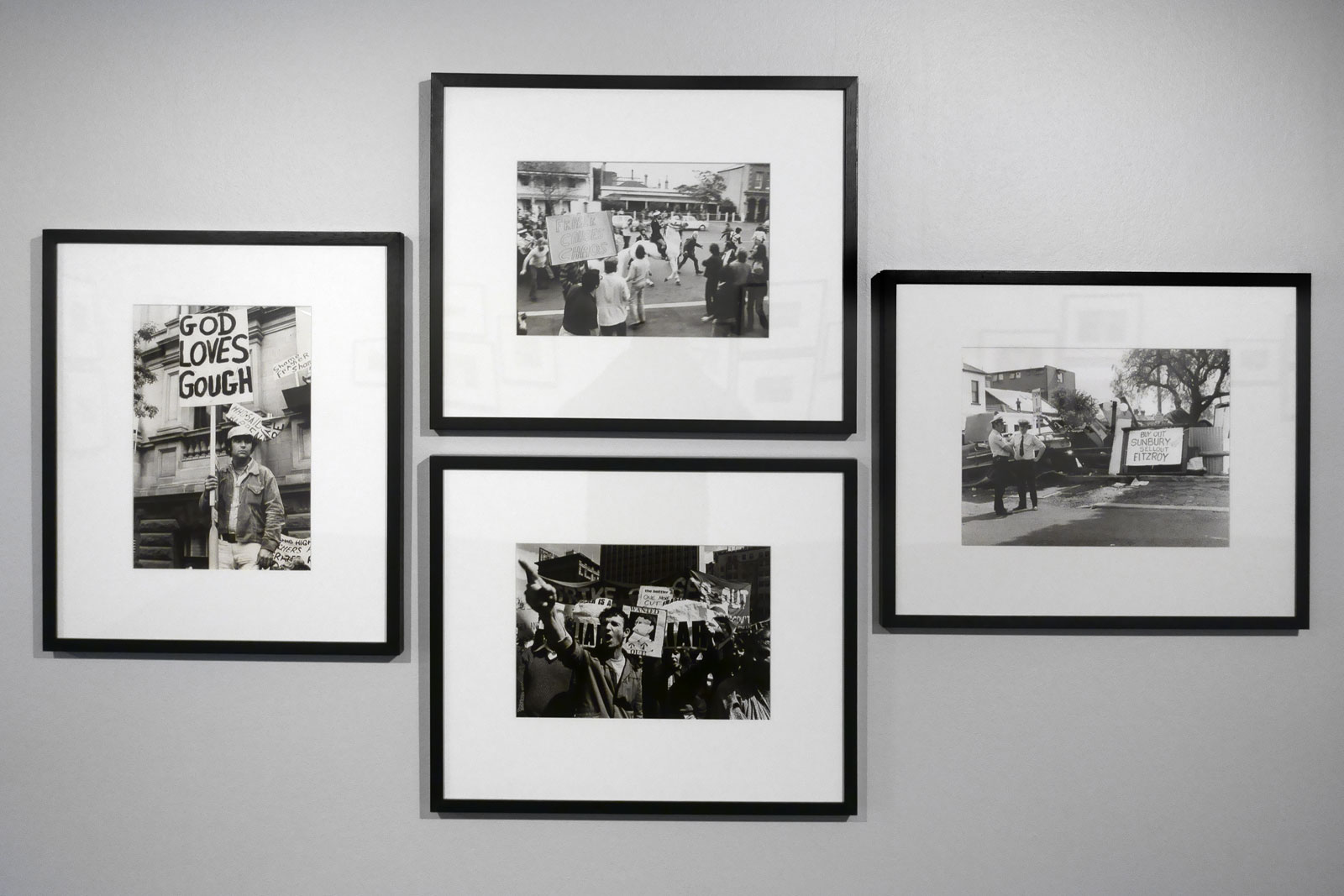
Installation view of the exhibition 'The basement: photography from Prahran College (1968-1981)' at the Museum of Australian Photography, Wheelers Hill, Melbourne showing from left clockwise, Ken Wright's 'Rally for Gough' 1975; Andrew Chapman's 'Street protest, November 11th' 1975; Richard Muggleton's 'Untitled (F19 protest)' c. 1977; and Andrew Chapman's 'Lest we forget' 1980


Installation view of the first gallery of the exhibition The basement: photography from Prahran College (1968-1981) at the Museum of Australian Photography, Wheelers Hill, Melbourne showing from left clockwise, Ken Wright’s Rally for Gough 1975; Andrew Chapman’s Street protest, November 11th 1975; Richard Muggleton’s Untitled (F19 protest) c. 1977; and Andrew Chapman’s Lest we forget 1980
Photo: Marcus Bunyan


Ken Wright (Australian / New Zealand, 1948-1998)
'Rally for Gough' 1975 (installation view)


Ken Wright (Australian/New Zealand, 1948-1998)
Rally for Gough (installation view)
1975
Gelatin silver print
Private collection
Photo: Marcus Bunyan


Andrew Chapman (Australian, b. 1954) 'Lest we forget' 1980 (installation view)


Andrew Chapman (Australian, b. 1954)
Lest we forget (installation view)
1980
Gelatin silver print
Museum of Australian Photography, City of Monash Collection donated 2024
Photo: Marcus Bunyan


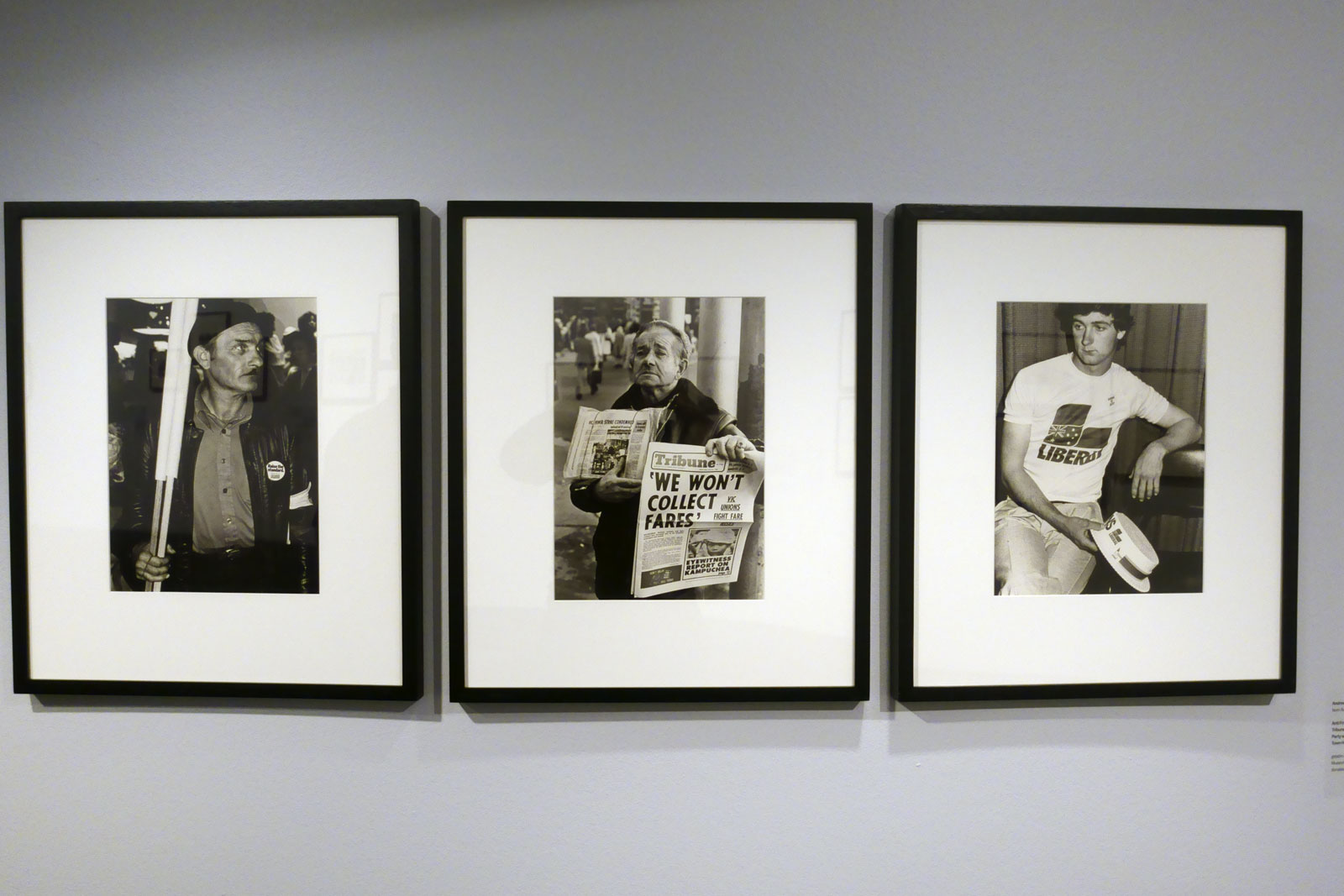
Andrew Chapman studied photography at Prahran College from 1974 to 1976 and then again in 1980. His Street protest, November 11th (1975) documents a politically motivated rally. It was taken on the corner of Albert Street and moray Street in South Melbourne. Chapman was in his second year at Prahran College and had been listening to parliament on the radio in the office of the then photography technician Murray White. When the news broke of the Whitlam Government’s dismissal, Chapman was quick to join the rallies that broke out in the streets. Later, in 1980, the streets were still politically charged when Chapman returned to Prahran to complete his course. His image, Lest we forget (1980) was made in City Square on Swanston Street at an anti-Fraser demonstration in the lead-up to the 1980 federal election. Described by Julie Millowick as the student who never stopped photographing, even during class, Chapman always has his Leica camera ready. Throughout his career Chapman has photographed much of Australia’s social and political landscape, working both personally and for clients, including as a photojournalist for major Australian newspapers and magazines.

Wall text from the exhibition

Andrew Chapman alumni profile on the Prahran Legacy website


Wall text from the exhibition 'The basement: photography from Prahran College (1968-1981)' at the Museum of Australian Photography, Wheelers Hill, Melbourne


Wall text from the exhibition The basement: photography from Prahran College (1968-1981) at the Museum of Australian Photography, Wheelers Hill, Melbourne
Photo: Marcus Bunyan
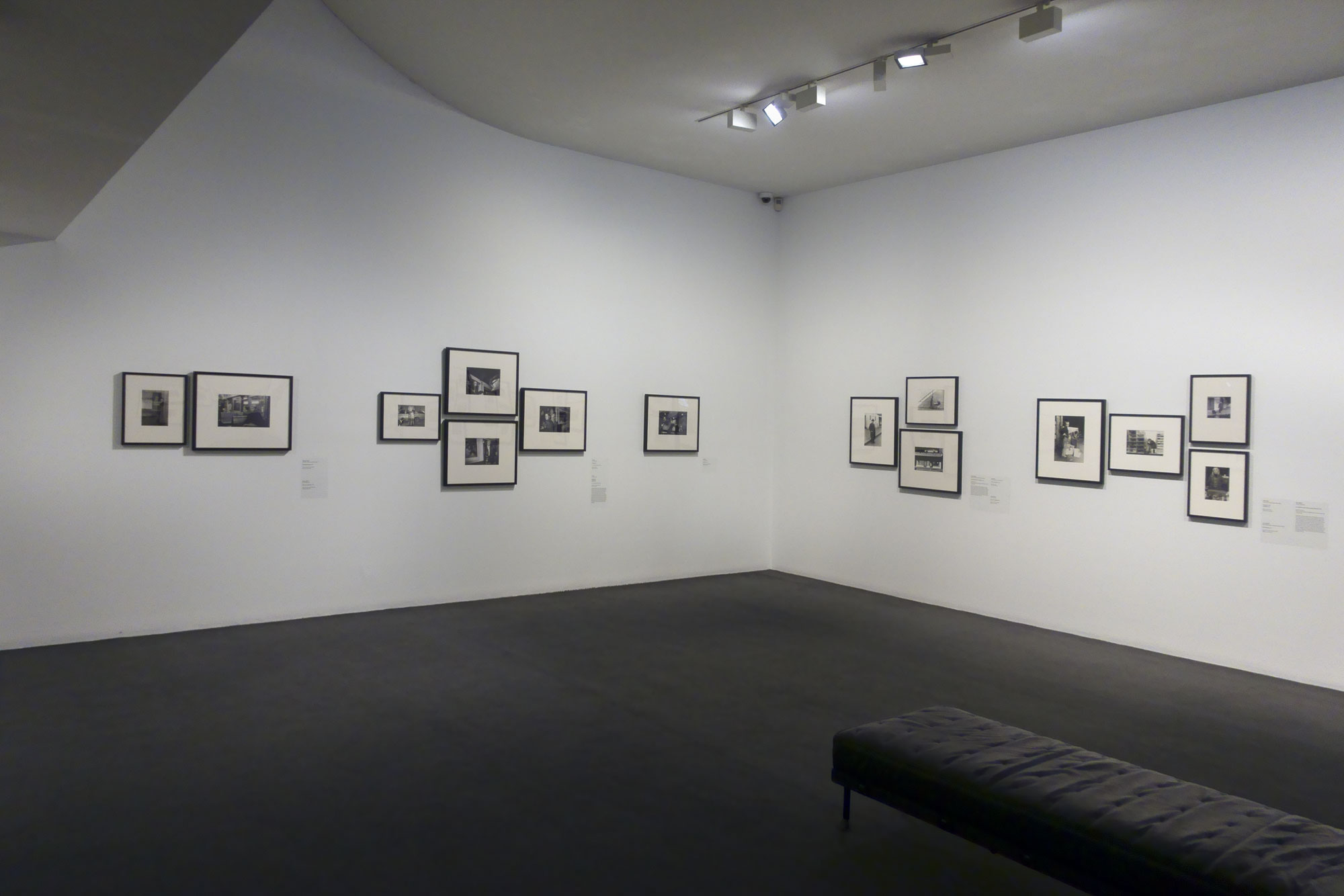
 

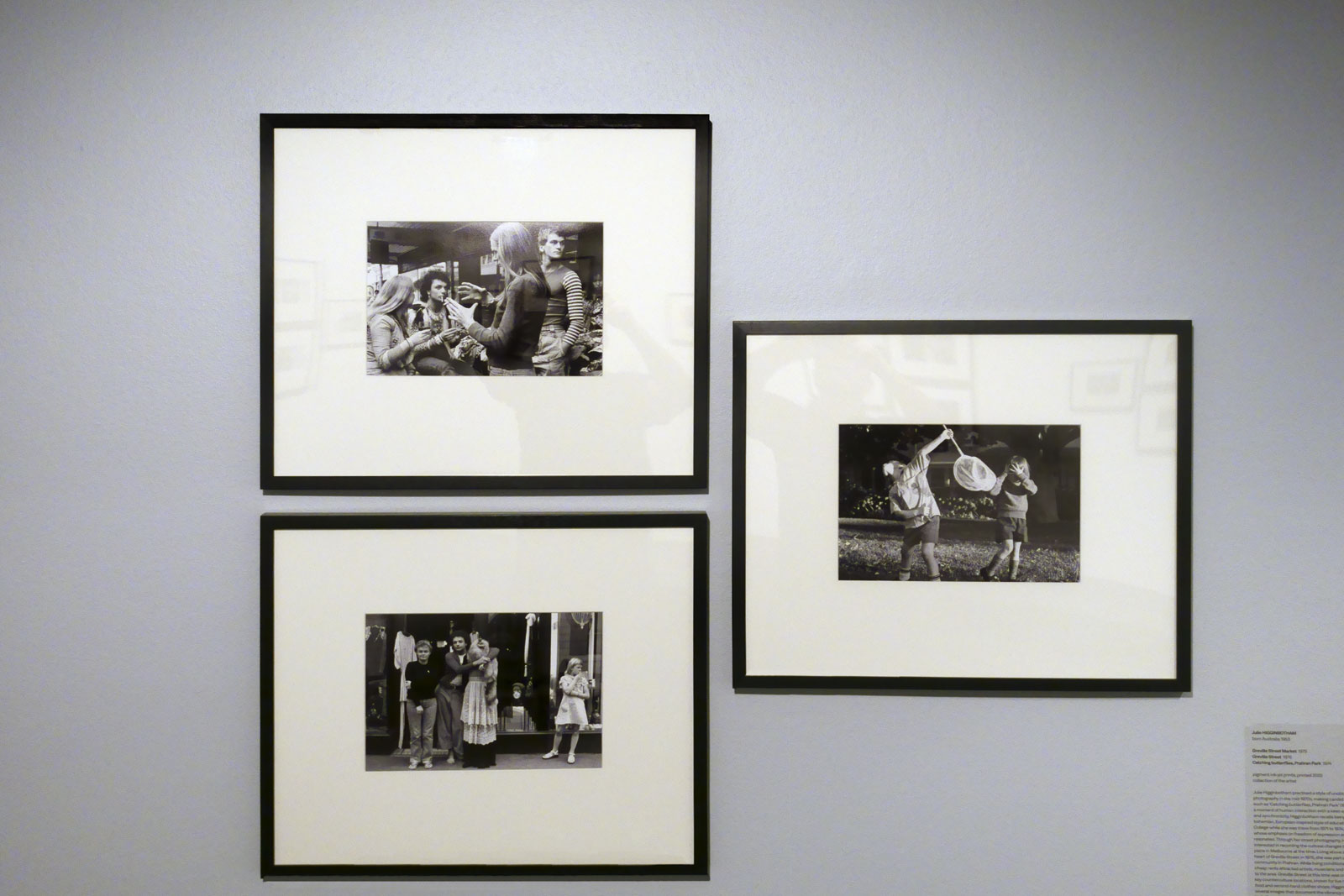
Installation view of the exhibition 'The basement: photography from Prahran College (1968-1981)' at the Museum of Australian Photography, Wheelers Hill, Melbourne showing from top left clockwise photographs by Julie Higginbotham: 'Greville Street Market', 1975; 'Catching butterflies, Prahran Park', 1974; and 'Greville Street', 1976


Installation view of the first gallery of the exhibition The basement: photography from Prahran College (1968-1981) at the Museum of Australian Photography, Wheelers Hill, Melbourne showing from top left clockwise photographs by Julie Higginbotham: Greville Street Market, 1975; Catching butterflies, Prahran Park, 1974; and Greville Street, 1976
Photo: Marcus Bunyan


Julie Higginbotham practiced a style of unobtrusive street photography in the mid-1970s, making candid expressive images such as ‘Catching butterflies, Prahran Park’ (1974), which records a moment of human interaction with a keen eye for composition and synchronicity. Higginbotham recalls being offered a bohemian, European-inspired style of education at Prahran College while she was there from 1971 to 1974, particularly by Cox whose emphasis on freedom of expression and personal choice resonated. Through her street photography, Higginbotham was interested in recording the cultural changes that were taking place in Melbourne at the time. Living above a shop in the heart of Greville Street in 1975, she was part of a lively hippie community in Prahran. While living conditions were squalid, the cheap rents attracted artists, musicians and alternative thinkers to the area. Greville Street at this time was one of Melbourne’s key counterculture locations, known for live music, organic food and second-hand clothes shops. Higginbotham produced several images that document the vibrancy of this movement, including a series of street photographs she made at the Greville Street Market on Saturday in 1975.

Wall text from the exhibition

Julie Higginbotham alumni profile on the Prahran Legacy website


Julie Higginbotham interview Prahran CAE 1971 – 74 Photography


Installation view of the exhibition 'The basement: photography from Prahran College (1968-1981)' at the Museum of Australian Photography, Wheelers Hill, Melbourne showing from left, Andrew Chapman's photographs 'Anti Fraser demonstrator, Collins Street Melbourne' 1979; 'Tribune newspaper seller, Melbourne' 1980; 'Party supporter, Liberal Party campaign launch, Moorabbin Town Hall' 1980


Installation view of the first gallery of the exhibition The basement: photography from Prahran College (1968-1981) at the Museum of Australian Photography, Wheelers Hill, Melbourne showing from left, Andrew Chapman’s photographs Anti Fraser demonstrator, Collins Street Melbourne 1979; Tribune newspaper seller, Melbourne 1980; Party supporter, Liberal Party campaign launch, Moorabbin Town Hall 1980
Photo: Marcus Bunyan


Andrew Chapman (Australian, b. 1954) 'Tribune newspaper seller, Melbourne' 1980 (installation view)


Andrew Chapman (Australian, b. 1954)
Tribune newspaper seller, Melbourne (installation view)
1980
Gelatin silver print
Museum of Australian Photography, City of Monash Collection donated 2024
Photo: Marcus Bunyan


Andrew Chapman (Australian, b. 1954) 'Tribune newspaper seller, Melbourne' 1980 from the exhibition 'The basement: photography from Prahran College (1968-1981)' at the Museum of Australian Photography, Wheelers Hill, Melbourne, March - May 2025


Andrew Chapman (Australian, b. 1954)
Tribune newspaper seller, Melbourne (installation view)
1980
Gelatin silver print
Museum of Australian Photography, City of Monash Collection donated 2024


Andrew Chapman (Australian, b. 1954) 'Party supporter, Liberal Party campaign launch, Moorabbin Town Hall' 1980 (installation view)


Andrew Chapman (Australian, b. 1954)
Party supporter, Liberal Party campaign launch, Moorabbin Town Hall (installation view)
1980
Gelatin silver print
Museum of Australian Photography, City of Monash Collection donated 2024
Photo: Marcus Bunyan


Installation view of the exhibition 'The basement: photography from Prahran College (1968-1981)' at the Museum of Australian Photography, Wheelers Hill, Melbourne showing at left, George Volakos' 'Flinders Street Station' 1972; and at right, Graham Howe's 'Man on tram, Melbourne' 1970


Installation view of the exhibition The basement: photography from Prahran College (1968-1981) at the Museum of Australian Photography, Wheelers Hill, Melbourne showing at left, George Volakos’ Flinders Street Station 1972; and at right, Graham Howe’s Man on tram, Melbourne 1970
Photo: Marcus Bunyan


Installation view of the exhibition 'The basement: photography from Prahran College (1968-1981)' at the Museum of Australian Photography, Wheelers Hill, Melbourne


Installation view of the exhibition The basement: photography from Prahran College (1968-1981) at the Museum of Australian Photography, Wheelers Hill, Melbourne showing photographs by Rob Gale from his Dogs and their humans (1978) and Swanston Street 5pm (1978) series
Photo: Marcus Bunyan


Rob Gale (Australian, b. 1953) 'Untitled 01' 1978 (installation view)


Rob Gale (Australian, b. 1953)
Untitled 01 (installation view)
1978
From the series Swanston Street 5pm
Pigment ink-jet print, printed 2024
Collection of the artist
Photo: Marcus Bunyan


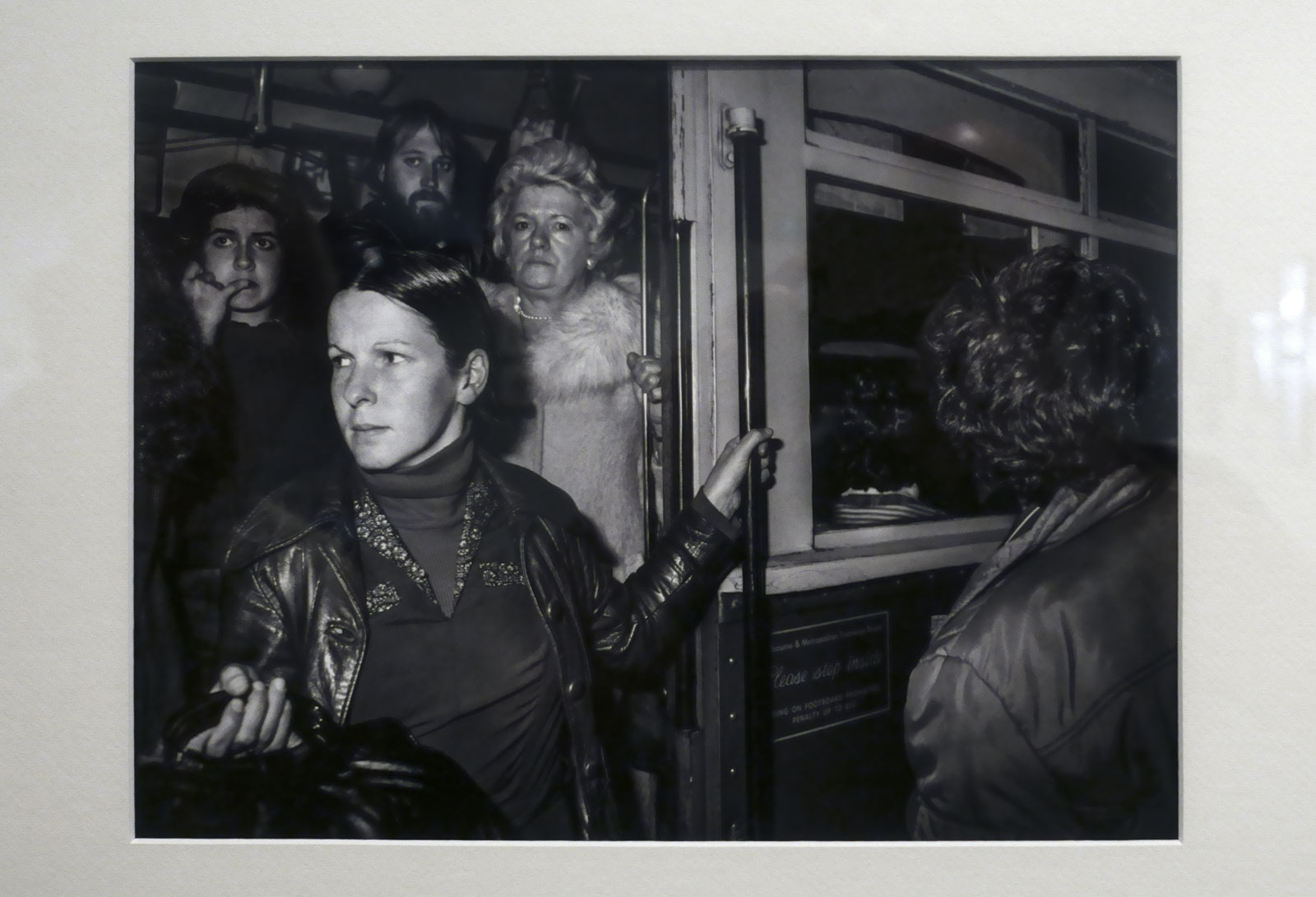
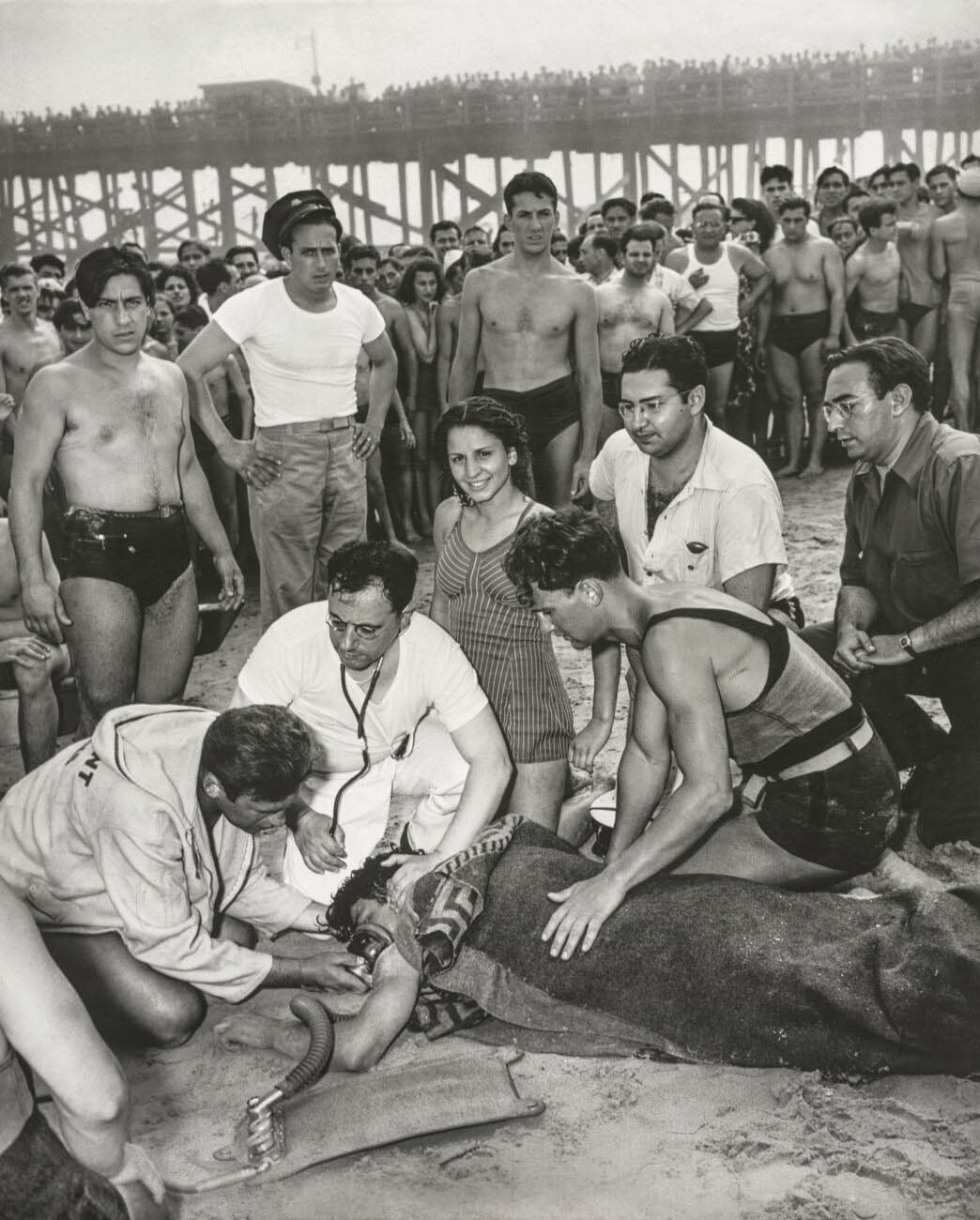
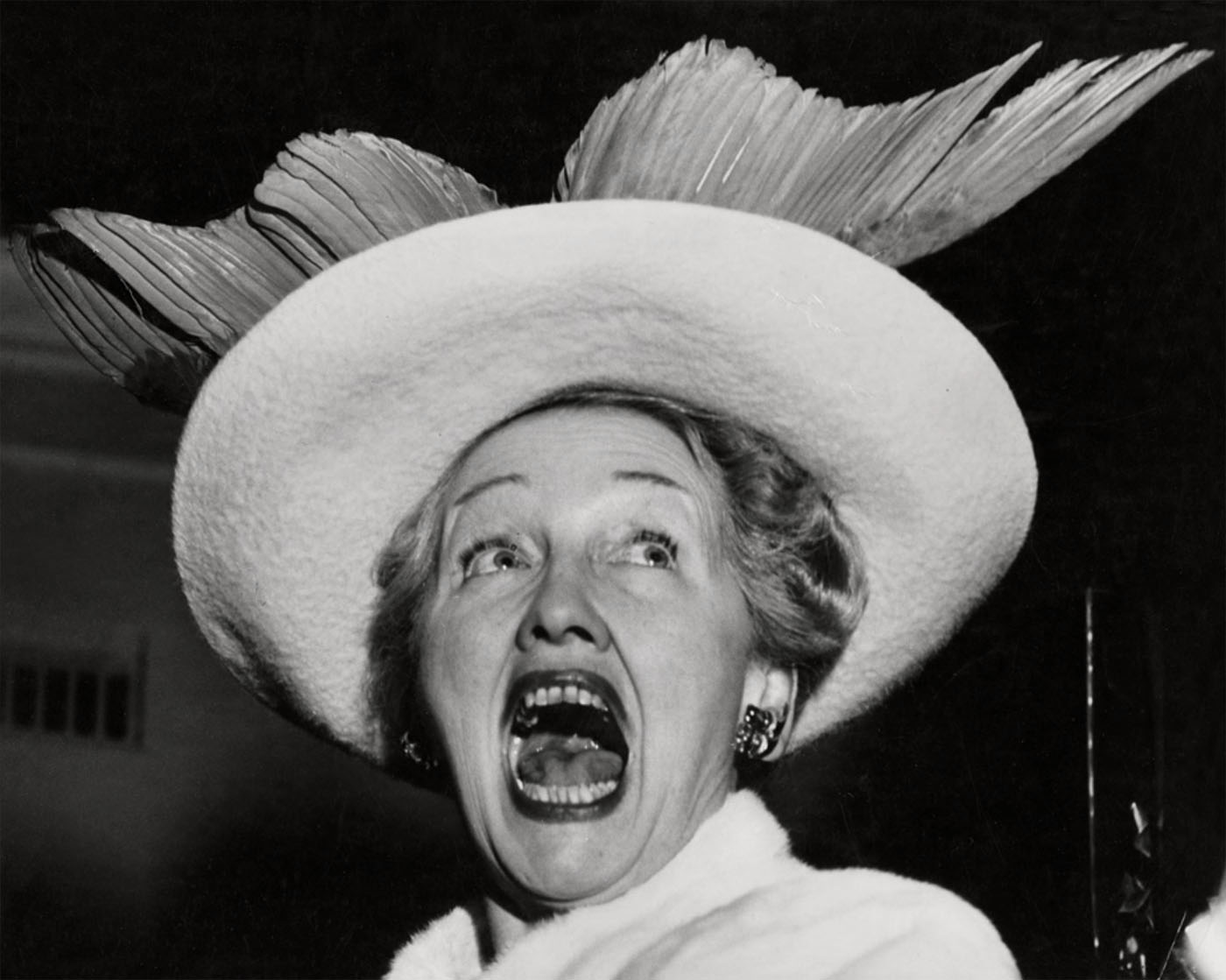
Rob Gale studied photography at Prahran Collect from 1976 to 1978. For his series, Swanston Street, 5pm (1978), Gale took inspiration from an iconic painting by the Australian artist John Brack, Collins Street, 5pm (1955). Gale’s photographic exploration of Brack’s stylised view of Melbourne’s office workers was made during peak hour at a busy tram stop near Flinders Street Station. Influenced by American street photographers such as Bruce Golden and Weegee, Gale used a hand-held flash to illuminate his subjects. In a nod to Brack’s painting, this technique allowed Gale to create harsh, stylised views of impatient commuters. The flash also seems to have induced grimaces and sideways stares which, along with the harsh lighting, shadows and unusual camera angles, served to accentuate the strange and surreal atmosphere in the photographs.

Wall text from the exhibition

Rob Gale alumni profile on the Prahran Legacy website


Rob Gale (Australian, b. 1953)
'Untitled 12' 1978 from the series 'Swanston Street 5pm' from the exhibition 'The basement: photography from Prahran College (1968-1981)' at the Museum of Australian Photography, Wheelers Hill, Melbourne, March - May 2025


Rob Gale (Australian, b. 1953)
Untitled 12
1978
From the series Swanston Street 5pm
Pigment ink-jet print, printed 2024
Collection of the artist


Installation view of the exhibition 'The basement: photography from Prahran College (1968-1981)' at the Museum of Australian Photography, Wheelers Hill, Melbourne showing photographs from left clockwise, Steven Lojewsi's 'Man with umbrella near curb, Melbourne' 1975; Johann Krix's 'Proud moment, Moomba' c. 1971; and Andrew Wittner's 'Where's my car, Melbourne' 1973


Installation view of the exhibition The basement: photography from Prahran College (1968-1981) at the Museum of Australian Photography, Wheelers Hill, Melbourne showing photographs from left clockwise, Steven Lojewsi’s Man with umbrella near curb, Melbourne 1975; Johann Krix’s Proud moment, Moomba c. 1971; and Andrew Wittner’s Where’s my car, Melbourne 1973
Photo: Marcus Bunyan


Andrew Wittner (Australian, b. 1955) 'Where's My Car?' 1973, printed 2024


Andrew Wittner (Australian, b. 1955)
Where’s My Car?
1973, printed 2024
Gelatin silver print
Collection of the artist

Andrew Wittner alumni profile on the Prahran Legacy website


Steven Lojewsi (Australian born England, b. 1952) 'Man with umbrella near curb, Melbourne' 1975 (installation view)


Steven Lojewsi (Australian born England, b. 1952)
Man with umbrella near curb, Melbourne (installation view)
1975
Gelatin silver print
Museum of Australian Photography, City of Monash Collection donated 2025
Photo: Marcus Bunyan


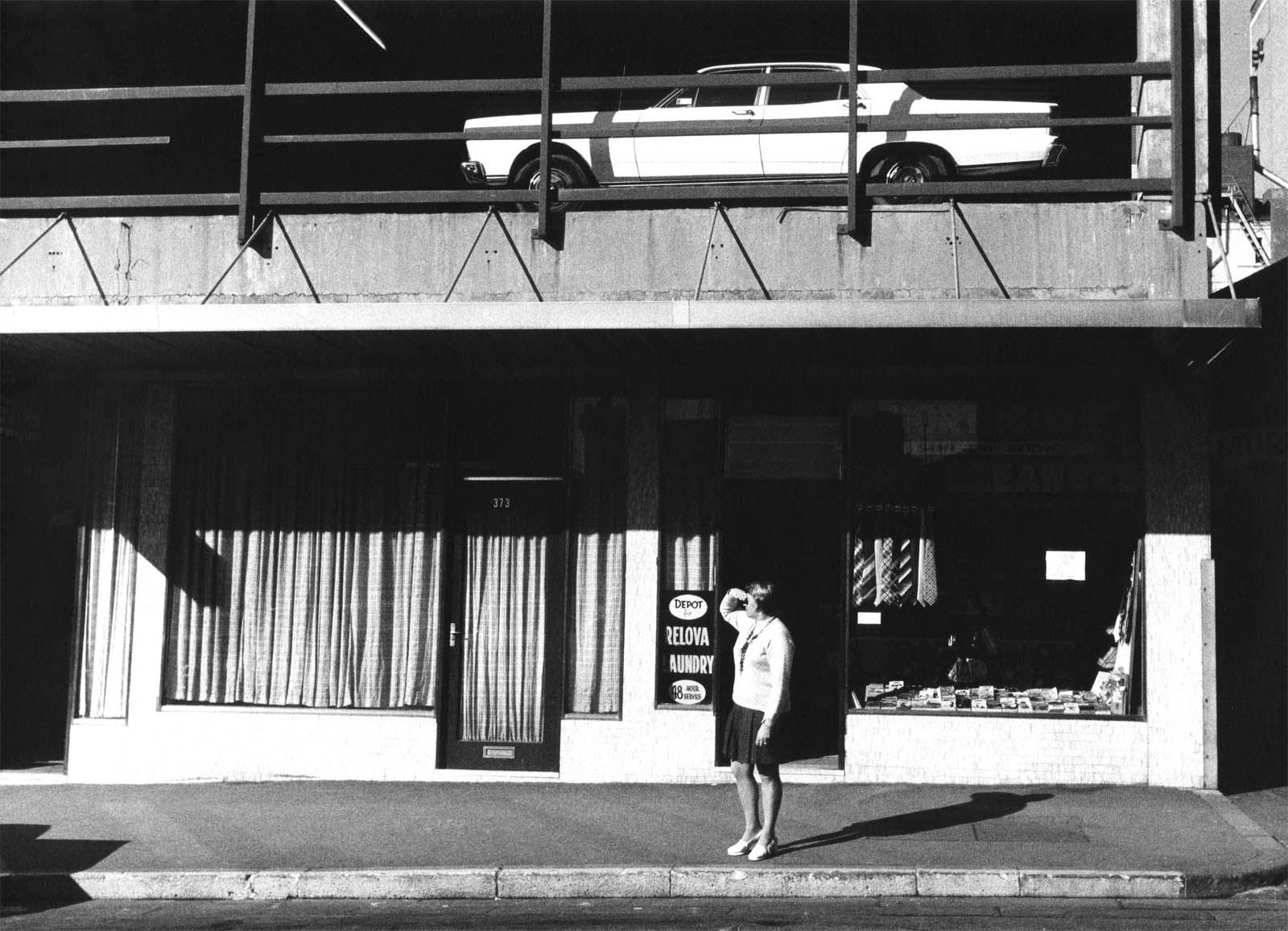
Steven Lojewski was born in London and grea up in Canada before arriving in Australian in 1969. He studied photography at Prahran College from 1974 to 1976 and later at Sydney College of the Arts. While studying at Prahran, Lojewski made a number of photographs on the streets of Melbourne. Sparsely populated, these early-career vintage prints demonstrate Lojewski’s highly defined, formal approach to documenting the urban landscape and illustrate his ability to produce a subtle range of silvery mid-tones and carefully styled compositions.

Wall text from the exhibition

Steven Lojewski alumni profile on the Prahran Legacy website


Steven Lojewsi (Australian born England, b. 1952) 'Man with umbrella near curb, Melbourne' 1975


Steven Lojewsi (Australian born England, b. 1952)
Man with umbrella near curb, Melbourne
1975
Gelatin silver print
Museum of Australian Photography, City of Monash Collection donated 2025


Installation view of the exhibition 'The basement: photography from Prahran College (1968-1981)' at the Museum of Australian Photography, Wheelers Hill, Melbourne showing at left, John Conte's 'Telephone, Prahran' 1971; at centre top, Philip Quirk's 'Lone ranger (Prahran resident with Royal Show souvenirs)' 1973; at centre bottom, Philip Quirk's 'The headmistress, sports day, Como Park' 1975; and at right, Johann Krix's 'Toorak Road, South Yarra' 1972


Installation view of the exhibition The basement: photography from Prahran College (1968-1981) at the Museum of Australian Photography, Wheelers Hill, Melbourne showing at left, John Conte’s Telephone, Prahran 1971; at centre top, Philip Quirk’s Lone ranger (Prahran resident with Royal Show souvenirs) 1973; at centre bottom, Philip Quirk’s The headmistress, sports day, Como Park 1975; and at right, Johann Krix’s Toorak Road, South Yarra 1972
Photo: Marcus Bunyan


Philip Quirk (Australian, b. 1948)
'Lone ranger (Prahran resident with Royal Show souvenirs)' 1973 (installation view)


Philip Quirk (Australian, b. 1948)
Lone ranger (Prahran resident with Royal Show souvenirs) (installation view)
1973
Gelatin silver print
15.9 x 23.8cm
Museum of Australian Photography, City of Monash Collection acquired 2024
Photo: Marcus Bunyan


Based in Sydney, Philip Quirk has been a practising documentary photographer since the 1970s. He studied photography at Prahran College from 1971 to 1973 and has frequently used his camera to capture endearing images of humanity. Influenced by international photographers such as Henri Cartier-Bresson and Diane Arbus, Quirk’s images feature unusual characters and situations, often incorporating humour and incongruity. His work, Lone ranger (Prahran resident with Royal Show souvenirs) (1973) formed part of his final portfolio assessment at Prahran College. Walking through the streets of Prahran, Quirk stopped to talk to this elderly resident and photographed him in the afternoon sunlight. With its emphasis on light and composition combined with an interest in Australian culture, this photograph is a precursor to the street and social documentary work Quirk produced in the years immediately following his time at Prahran College.

Wall text from the exhibition

Phil Quirk alumni profile on the Prahran Legacy website


Johann Krix (Australian born Austria, b. 1948) 'Toorak Road, South Yarra' 1972 (installation view)


Johann Krix (Australian born Austria, b. 1948)
Toorak Road, South Yarra (installation view)
1972
Gelatin silver print
Collection of the artist
Photo: Marcus Bunyan


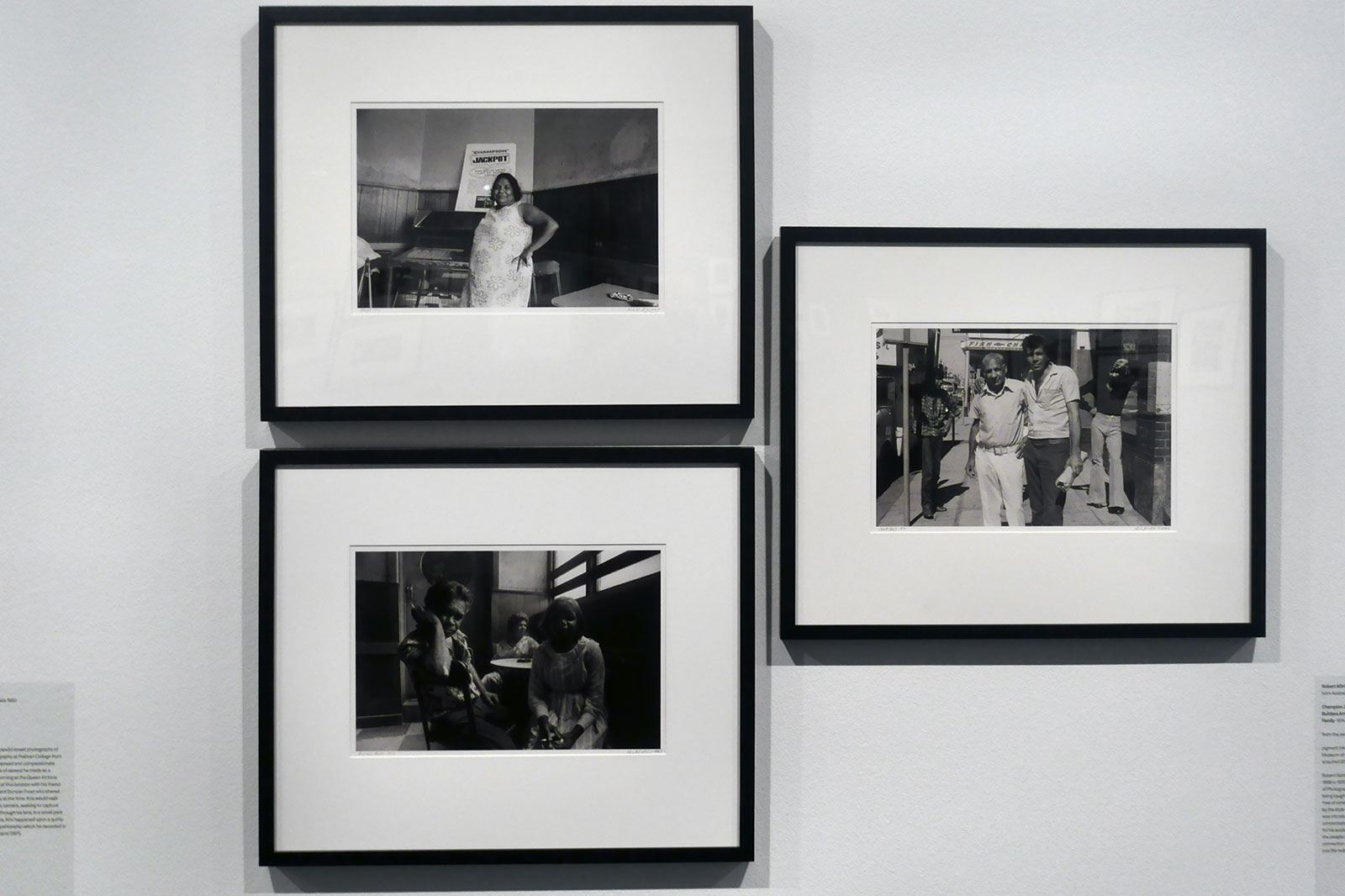
Installation view of the exhibition 'The basement: photography from Prahran College (1968-1981)' at the Museum of Australian Photography, Wheelers Hill, Melbourne showing Robert Ashton's photographs, 'Champion Jackpot' 1974; 'Builders Arms Hotel' 1974; 'Family' 1974 from the series 'Fitzroy'


Installation view of the exhibition The basement: photography from Prahran College (1968-1981) at the Museum of Australian Photography, Wheelers Hill, Melbourne showing Robert Ashton’s photographs, Champion Jackpot 1974; Builders Arms Hotel 1974; Family 1974 from the series Fitzroy
Photo: Marcus Bunyan


Robert Ashton (Australian, b. 1950)
'Champion Jackpot' 1974, printed 2008 (installation view)


Robert Ashton (Australian, b. 1950)
Champion Jackpot (installation view)
1974, printed 2008
Pigment inkjet print
Museum of Australian Photography, City of Monash Collection acquired 2010
Photo: Marcus Bunyan


Robert Ashton studied photography at Prahran college from 1968 to 1970 and first exhibited his work at Brummels Gallery of Photography in 1973. As a student at Prahran, Ashton recalls being taught to follow his heart and his eye in a way that was free of constraints, developing a visual language influenced by the style of European black-and-white photography that he was introduced to by Paul Cox. His early documentary work concentrated on inner-city subjects, and he is widely known for his acclaimed series Fitzroy, which warmly documents the people of Fitzroy, focusing on human life and community connection. This series was originally published as a photobook, Into the hollow mountains a portrait of Fitzroy, in 1974.

Wall text from the exhibition

Robert Ashton alumni profile on the Prahran Legacy website


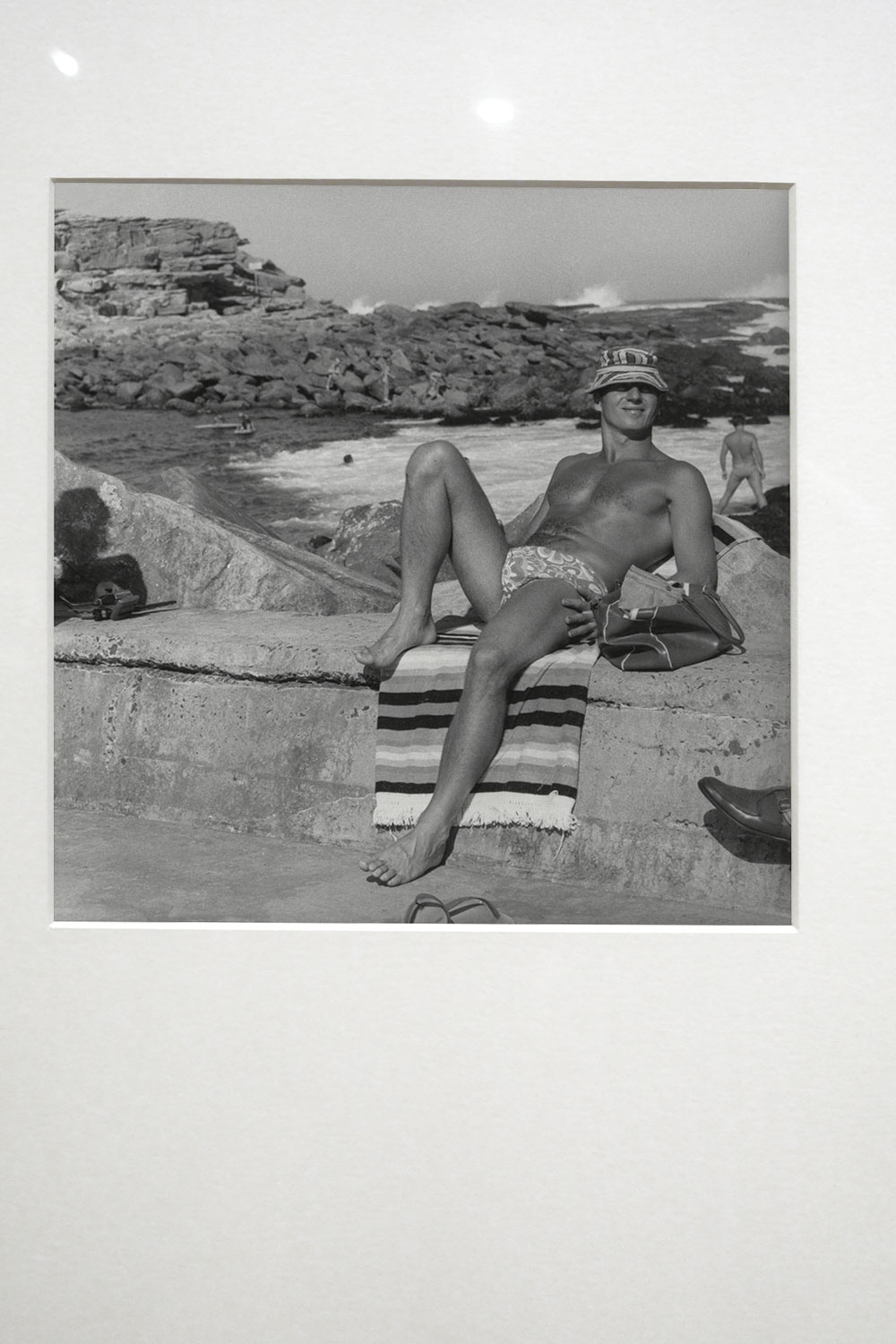
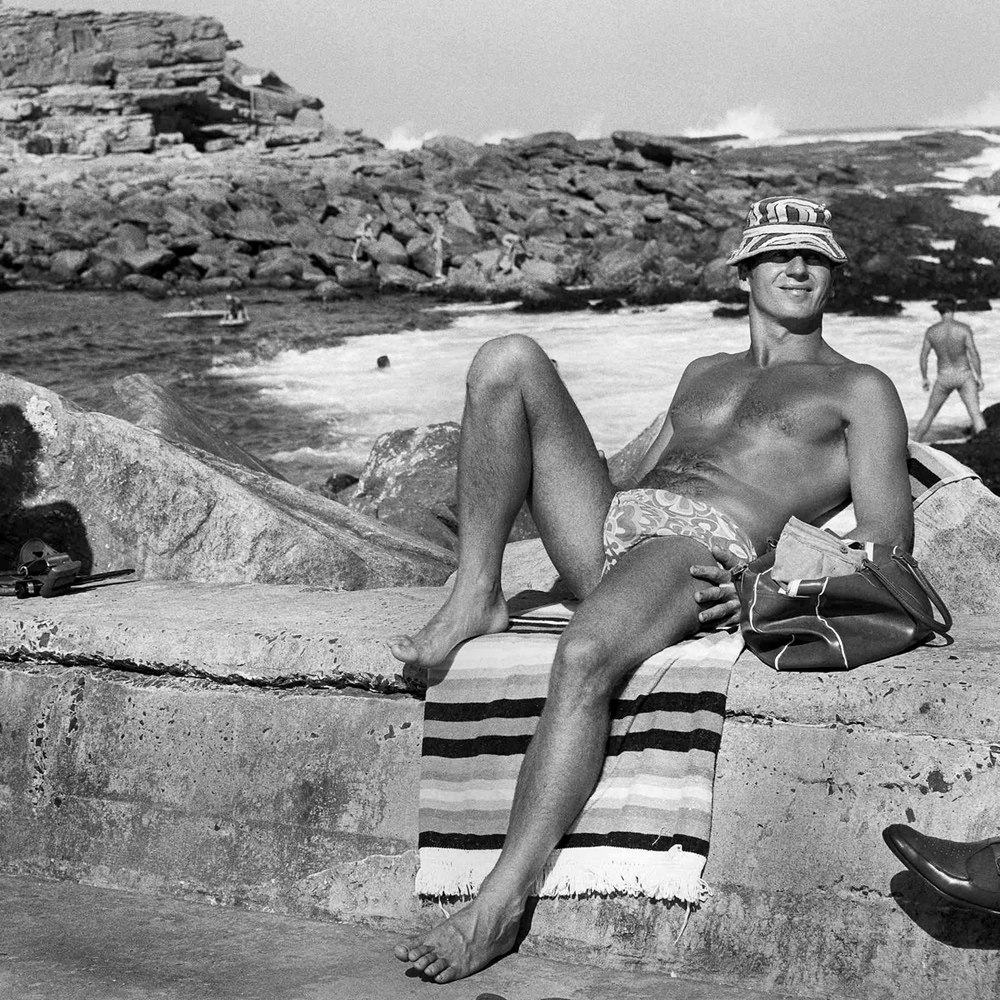
Installation view of the exhibition 'The basement: photography from Prahran College (1968-1981)' at the Museum of Australian Photography, Wheelers Hill, Melbourne  showing from left clockwise, Geoff Strong's 'Bald man enjoying the sun, St Kilda' 1975; Steven Lojewski's 'Man with hat and lighthouse, St Kilda' 1975; Glen O'Malley's 'St Kilda' 1973; and Steven Lojewski's 'Man on bench, Stardust St Kilda' 1975


Installation view of the exhibition The basement: photography from Prahran College (1968-1981) at the Museum of Australian Photography, Wheelers Hill, Melbourne showing from left clockwise, Geoff Strong’s Bald man enjoying the sun, St Kilda 1975; Steven Lojewski’s Man with hat and lighthouse, St Kilda 1975; Glen O’Malley’s St Kilda 1973; and Steven Lojewski’s Man on bench, Stardust St Kilda 1975
Photo: Marcus Bunyan


Geoff Strong (Australian, b. 1950) 'Bald man enjoying the sun, St Kilda'
1975


Geoff Strong (Australian, b. 1950)
Bald man enjoying the sun, St Kilda
1975
Gelatin silver print
19.1 x 26.3cm
Museum of Australian Photography, City of Monash Collection donated 2025


Geoff Strong moved to Melbourne from Brisbane for the photography course at Prahran College, which he began in 1975 after already having established himself as a political journalist. Strong’s image, Bald man enjoying the sun, St Kilda (1975) showcases his acute interest in the qualities of Melbourne’s sunlight. The human element, a man’s bald head, becomes a formal, compositional device, which appears more like a bronze ball than a human form. Strong’s depiction of harsh light in this sparse composition accentuates the photograph’s formal elements and calls to mind the surreal paintings of Georgio de Chirico.

Text from the Museum of Australian Photography website

Geoff Strong alumni profile on the Prahran Legacy website


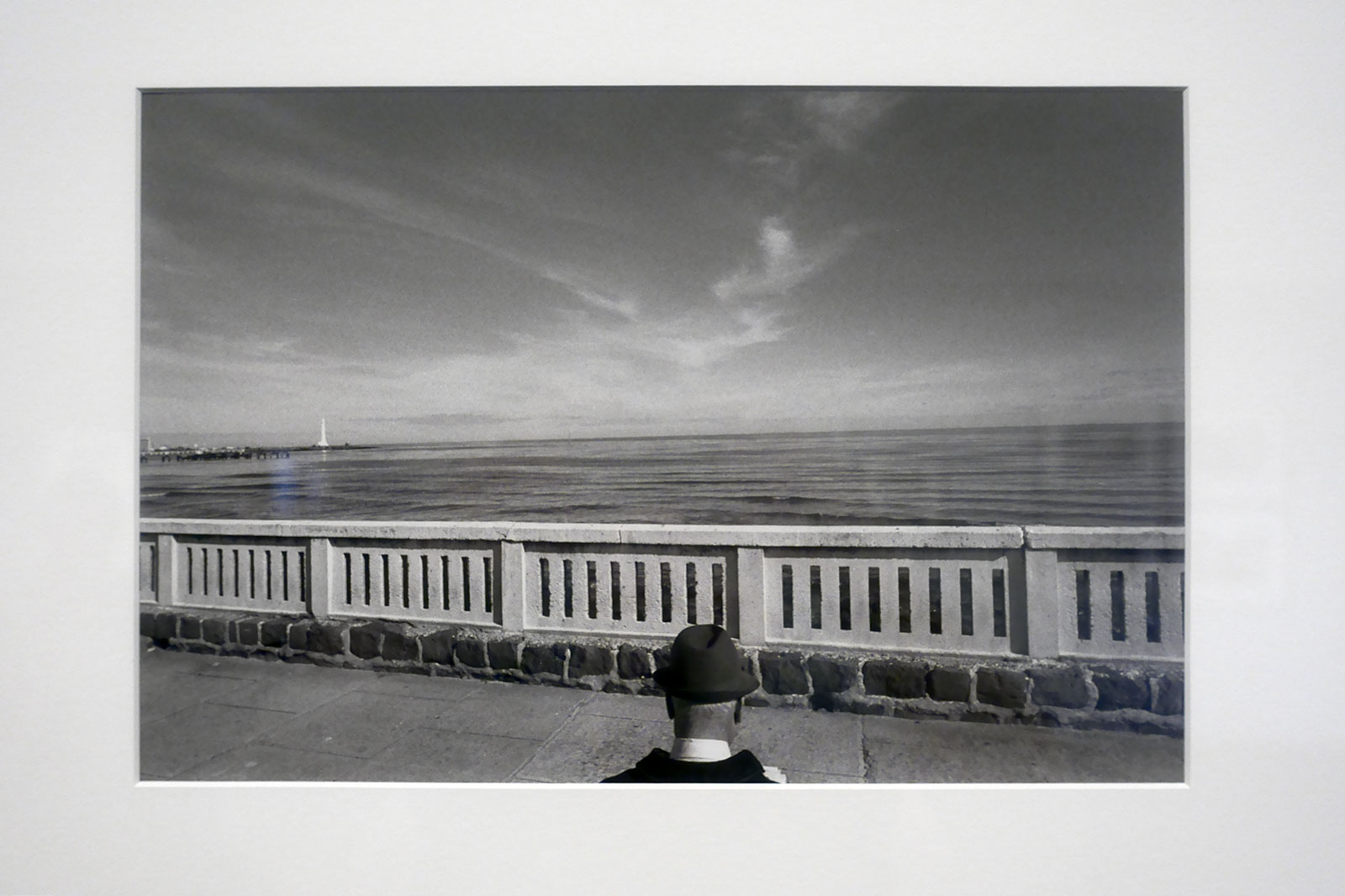
Steven Lojewsi (Australian born England, b. 1952) 'Man with hat and lighthouse, St Kilda' 1975 (installation view)


Steven Lojewsi (Australian born England, b. 1952)
Man with hat and lighthouse, St Kilda (installation view)
1975
Gelatin silver print
Museum of Australian Photography, City of Monash Collection donated 2025
Photo: Marcus Bunyan


James McArdle (Australian, b. 1950)
'Couple, Luna Park' 1976 (installation view)


James McArdle (Australian, b. 1950)
Couple, Luna Park (installation view)
1976
Gelatin silver print
Museum of Australian Photography, City of Monash Collection donated 2025
Photo: Marcus Bunyan


James McArdle (Australian, b. 1950)
'Conscript, Luna Park' 1976 (installation view)


James McArdle (Australian, b. 1950)
Conscript, Luna Park (installation view)
1976
Gelatin silver print
Museum of Australian Photography, City of Monash Collection donated 2025
Photo: Marcus Bunyan


James McArdle is a photographic artist, curator, writer and educator based in Castlemaine, Victoria. While studying photography at Prahran College from 1974 to 1976, McArdle took his camera out onto the streets of Melbourne. He made several social documentary images as well as more playful, abstract compositions, which highlight his interest in shadow and form. The vintage silver gelatin prints on display here come mostly from McArdle’s first-and second-year street photography folios. They were made during long walks around St Kilda and Elwood. Conscript, Luna Park (1976) formed part of McArdle’s third-year major project on Luna Park, which included portraits taken in the Penny Arcade. Created using a Linhof 4 x 5 inch press camera and flash, this folio was assessed by Wolfgang Sievers.

Wall text from the exhibition

Dr James McArdle profile on the Academia website


Installation view of the exhibition 'The basement: photography from Prahran College (1968-1981)' at the Museum of Australian Photography, Wheelers Hill, Melbourne


Installation view of the exhibition The basement: photography from Prahran College (1968-1981) at the Museum of Australian Photography, Wheelers Hill, Melbourne
Photo: Marcus Bunyan
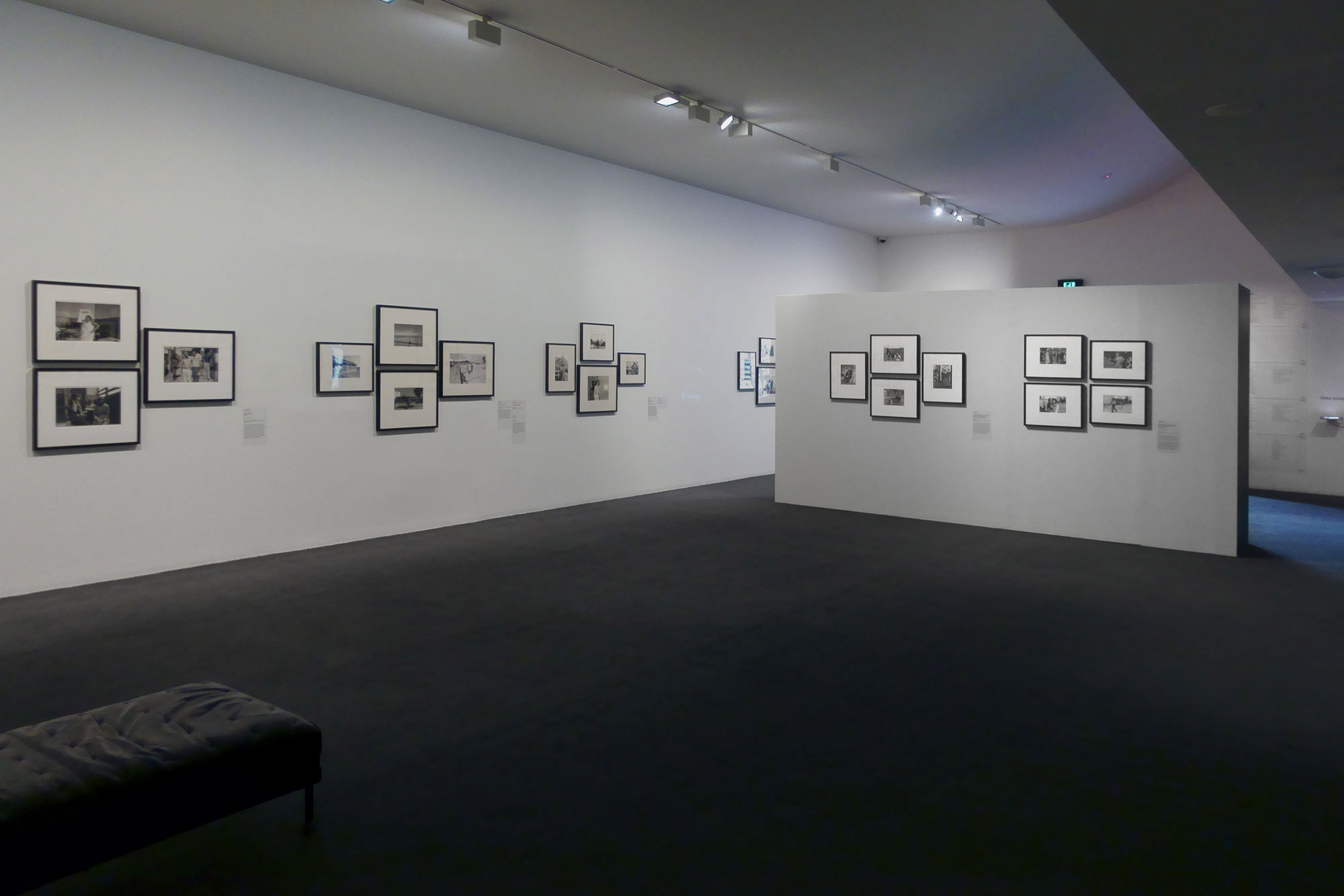
 

Installation view of the exhibition 'The basement: photography from Prahran College (1968-1981)' at the Museum of Australian Photography, Wheelers Hill, Melbourne showing from left clockwise, James McArdle's 'Hungry puddle, Elwood' 1975 and 'St Kilda Courthouse' 1974; Martin Munz's 'Man at crossing, Lower Esplanade St Kilda' 1979; and Greg Neville's 'Man and shadow' 1971


Installation view of the exhibition The basement: photography from Prahran College (1968-1981) at the Museum of Australian Photography, Wheelers Hill, Melbourne showing from left clockwise, James McArdle’s Hungry puddle, Elwood 1975 and St Kilda Courthouse 1974; Martin Munz’s Man at crossing, Lower Esplanade St Kilda 1979; and Greg Neville’s Man and shadow 1971
Photo: Marcus Bunyan


James McArdle (Australian, b. 1950)
'Hungry puddle, Elwood' 1975


James McArdle (Australian, b. 1950)
Hungry puddle, Elwood
1975
Gelatin silver print
27.0 x 18.5cm
Museum of Australian Photography, City of Monash Collection donated by James McArdle in honour of John Cato 2025


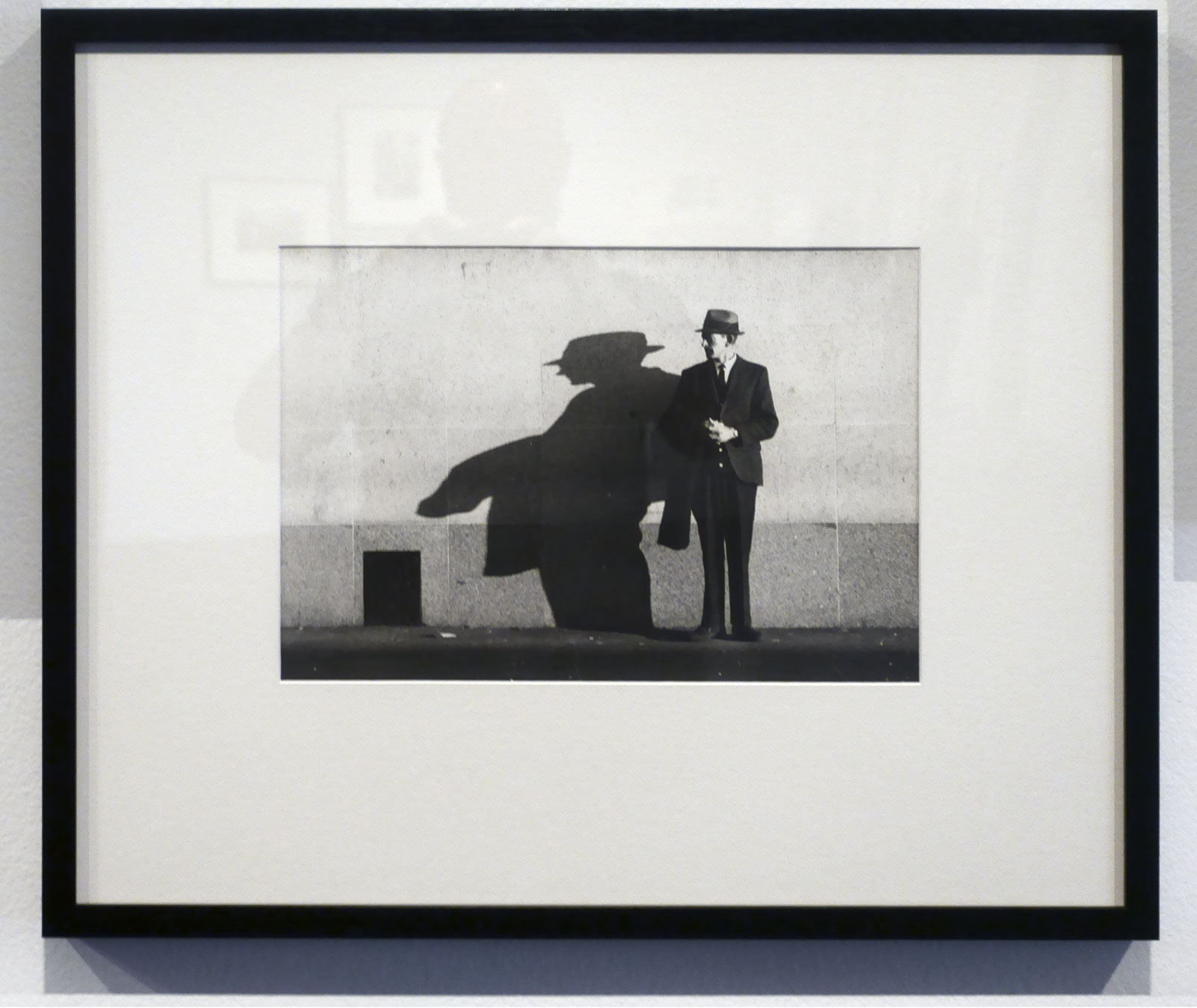
Greg Neville (Australian, b. 1950) 'Man and shadow' 1971 (installation view)


Greg Neville (Australian, b. 1950)
Man and shadow (installation view)
1971
Gelatin silver print
Collection of the artist
Photo: Marcus Bunyan


Installation view of the exhibition 'The basement: photography from Prahran College (1968-1981)' at the Museum of Australian Photography, Wheelers Hill, Melbourne showing Sandra Graham's photographs 'Walls 3 (Joseph)' and 'Walls 2 (cloak 1)' 1976 from the series 'Walls' (left); and 'Backstage, Chapel street bridge, Prahran' 1976 (right)


Installation view of the exhibition The basement: photography from Prahran College (1968-1981) at the Museum of Australian Photography, Wheelers Hill, Melbourne showing Sandra Graham’s photographs Walls 3 (Joseph) and Walls 2 (cloak 1) 1976 from the series Walls (left); and Backstage, Chapel street bridge, Prahran 1976 (right)
Photo: Marcus Bunyan


Sandra Graham (Australian, b. 1947)
'Walls 3 (Joseph)' 1976 (installation view)


Sandra Graham (Australian, b. 1947)
Walls 3 (Joseph) (installation view)
1976
Gelatin silver print
Collection of the artist
Photo: Marcus Bunyan


Formal concerns permeate the street portraits by Sandra Graham who studied photography at Prahran college fromollege from 1974-1975. In her series Walls, Graham relates the human forms of her subjects to the textured walls behind them. For instance, in Walls 3 (Joseph) (1976), the weathered face and stained clothes of a painter are shown in front of a mottled wall that he is about to paint white. Graham blends figure and ground in this image, playing with tonal relationships in black and white. She creates a painterly style of flatness through this series, which was made on streets around St Kilda and Albert Park.

Wall text from the exhibition

Sandra Graham alumni profile on the Prahran Legacy website


Sandra Graham (Australian, b. 1947)
'Walls 3 (Joseph)' 1976


Sandra Graham (Australian, b. 1947)
Walls 3 (Joseph)
1976
Gelatin silver print
Collection of the artist


Gallery two section one (clockwise)


Installation view of the exhibition 'The basement: photography from Prahran College (1968-1981)' at the Museum of Australian Photography, Wheelers Hill, Melbourne


Installation views of the second gallery part A of the exhibition The basement: photography from Prahran College (1968-1981) at the Museum of Australian Photography, Wheelers Hill, Melbourne
Photos: Marcus Bunyan
 

Wall text from the exhibition 'The basement: photography from Prahran College (1968-1981)' at the Museum of Australian Photography, Wheelers Hill, Melbourne


Wall text from the exhibition The basement: photography from Prahran College (1968-1981) at the Museum of Australian Photography, Wheelers Hill, Melbourne
Photo: Marcus Bunyan


Lyn Cheong (Australian, b. 1954)
'Self-portrait' 1977; 'Self-portrait' 1977 (installation view)


Lyn Cheong (Australian, b. 1954)
Self-portrait (installation view)
1977
Self-portrait (installation view)
1977
Dye diffusion transfer prints
Collection of the artist
Photo: Marcus Bunyan


Nicholas Nedelkopoulos (Australian, b. 1955)
'Shrunken head' 1978-1991; 'Dark wedding' 1978-1990 (installation view)


Nicholas Nedelkopoulos (Australian, b. 1955)
Shrunken head (installation view)
1978-1991
Dark wedding (installation view)
1978-1990
Chromogenic prints
Museum of Australian Photography, City of Monash Collection acquired 1992
Photo: Marcus Bunyan


Nicholas Nedelkopoulos (Australian, b. 1955) 'Shrunken head' 1978-1991 (installation view)


Nicholas Nedelkopoulos (Australian, b. 1955)
Shrunken head (installation view)
1978-1991
Chromogenic print
Museum of Australian Photography, City of Monash Collection acquired 1992
Photo: Marcus Bunyan


Leonie Reisberg (Australian, b. 1955) 'Portrait of Peggy Silinski, Merimbula, NSW' 1974 (installation view)


Leonie Reisberg (Australian, b. 1955)
Portrait of Peggy Silinski, Merimbula, NSW (installation view)
1974
Gelatin silver print
Museum of Australian Photography, City of Monash Collection donated by Janice Hinderaker through the Australian Government’s Cultural Gifts Program 2023
Photo: Marcus Bunyan


Leonie Reisberg attended Prahran College between 1974 and 1975, where she developed her photographic practice. Her work from this period is often associated with a growing interest in experimental and documentary photography that emerged in Melbourne during the 1970s.

Reisberg’s approach blends real-life moments with a more composed and conceptual style, often exploring themes of intimacy, femininity and social dynamics. She is part of a cohort of photographers that helped shape the trajectory of contemporary Australian photography, particularly within the context feminist and documentary practices.

Wall text from the exhibition

Leonie Reisberg alumni profile on the Prahran Legacy website


Leonie Reisberg (Australian, b. 1955)
'Portrait of Peggy Silinski, Merimbula, NSW' 1974


Leonie Reisberg (Australian, b. 1955)
Portrait of Peggy Silinski, Merimbula, NSW
1974
Gelatin silver print
Museum of Australian Photography, City of Monash Collection donated by Janice Hinderaker through the Australian Government’s Cultural Gifts Program 2023


Installation view of the exhibition 'The basement: photography from Prahran College (1968-1981)' at the Museum of Australian Photography, Wheelers Hill, Melbourne


Installation view of the exhibition The basement: photography from Prahran College (1968-1981) at the Museum of Australian Photography, Wheelers Hill, Melbourne showing at centre, Andrew Chapman’s Self-portrait in bath 1975; and at right, Viki Petherbridge’s Frames 10-18 1975 from the series Frames
Photo: Marcus Bunyan


Viki Petherbridge (Australian, b. 1954) 'Frames 10-18' 1975 (installation view)


Viki Petherbridge (Australian, b. 1954)
Frames 10-18 (installation view)
1975
from the series Frames
Gelatin silver print
Collection of the artist
Photo: Marcus Bunyan


Wall text from the exhibition 'The basement: photography from Prahran College (1968-1981)' at the Museum of Australian Photography, Wheelers Hill, Melbourne


Wall text from the exhibition The basement: photography from Prahran College (1968-1981) at the Museum of Australian Photography, Wheelers Hill, Melbourne
Photo: Marcus Bunyan


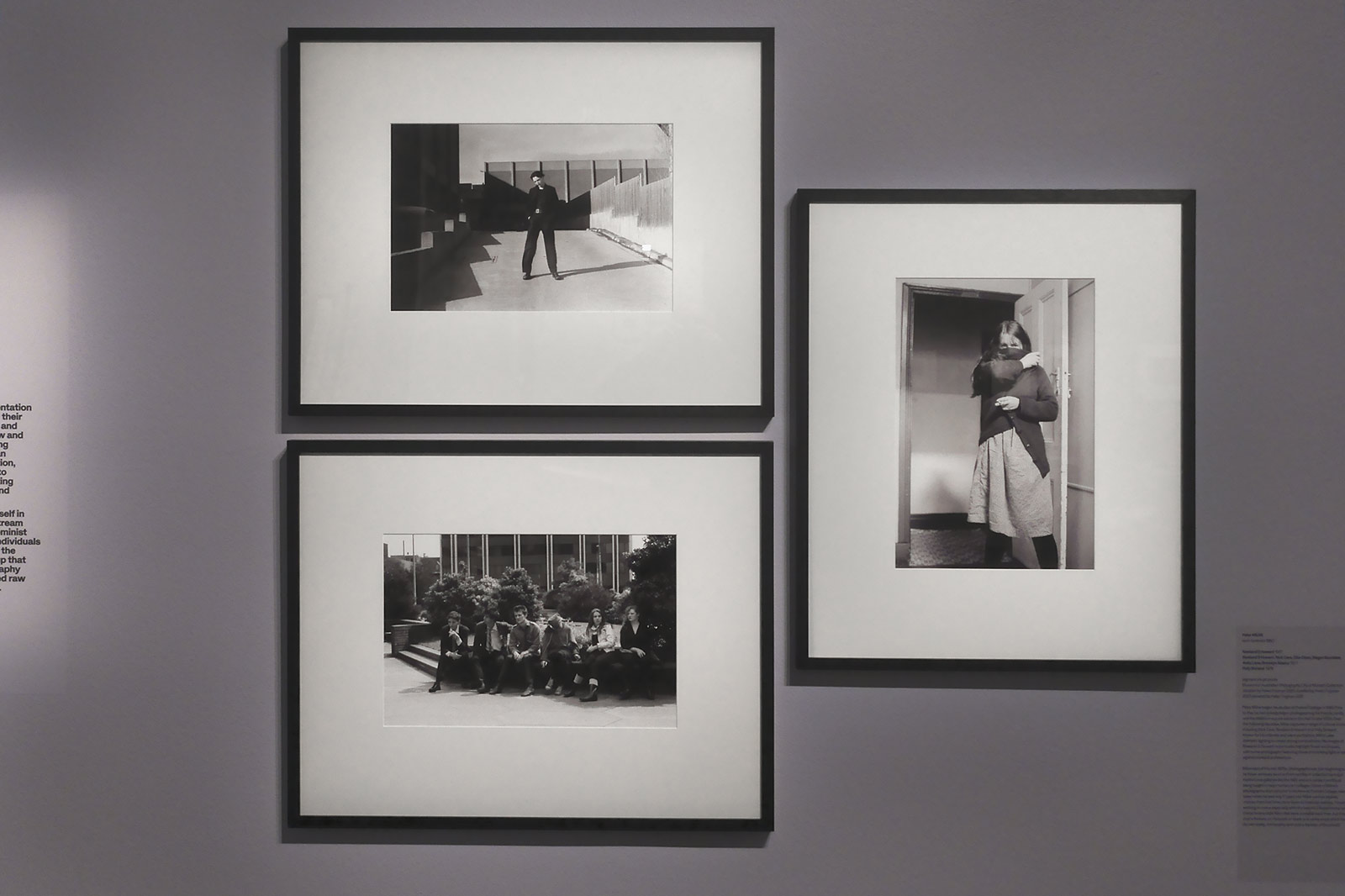
Installation view of the exhibition 'The basement: photography from Prahran College (1968-1981)' at the Museum of Australian Photography, Wheelers Hill, Melbourne showing Peter Milne's photographs from top clockwise, 'Rowland S Howard' 1977; 'Polly Borland' 1979; and 'Rowland S Howard, Nick Cave, Ollie Olsen, Megan Bannister, Anita Lane, Bronwyn Adams' 1977


Installation view of the exhibition The basement: photography from Prahran College (1968-1981) at the Museum of Australian Photography, Wheelers Hill, Melbourne showing Peter Milne’s photographs from top clockwise, Rowland S Howard 1977; Polly Borland 1979; and Rowland S Howard, Nick Cave, Ollie Olsen, Megan Bannister, Anita Lane, Bronwyn Adams 1977
Photo: Marcus Bunyan


Peter Milne (Australian, b. 1960)
'Rowland S Howard' 1977 (installation view)


Peter Milne (Australian, b. 1960)
Rowland S Howard (installation view)
1977
Pigment inkjet print
Museum of Australian Photography, City of Monash Collection donated by Helen Frajman 2023
Photo: Marcus Bunyan


Peter Milne began his studies at Prahran College in 1980. Prior to this, he had already begun photographing his friends, family, and the Melbourne punk scene in the mid-to late 1970s. Over the following decades, Milne captured a range of cultural icons, including Nick Cave, Rowland S Howard and Polly Borland. Known for his intimate and warm portraiture, Milne uses dramatic lighting to create strong compositions. His images of Rowland S Howard, in particular, highlight these techniques, with some photographs featuring Howard in striking light or set against brutalist architecture.

Wall text from the exhibition

See the exhibition Juvenilia: Peter Milne at Strange Neighbour, Fitzroy, Melbourne February – March 2015


Peter Milne (Australian, b. 1960)
'Polly Borland' 1979


Peter Milne (Australian, b. 1960)
Polly Borland
1979
Pigment ink-jet print
48 x 32cm
Museum of Australian Photography, City of Monash Collection donated by Helen Frajman 2021


Installation view of the exhibition 'The basement: photography from Prahran College (1968-1981)' at the Museum of Australian Photography, Wheelers Hill, Melbourne showing portraits by Polly Borland from 1983


Installation view of the exhibition The basement: photography from Prahran College (1968-1981) at the Museum of Australian Photography, Wheelers Hill, Melbourne showing portraits by Polly Borland from 1983
Photo: Marcus Bunyan


Polly Borland (Australian, b. 1959)
'Dave' 1983, printed 2025 (installation view)


Polly Borland (Australian, b. 1959)
Dave (installation view)
1983, printed 2025
Silver dye bleach print
Collection of the artist
Photo: Marcus Bunyan
 

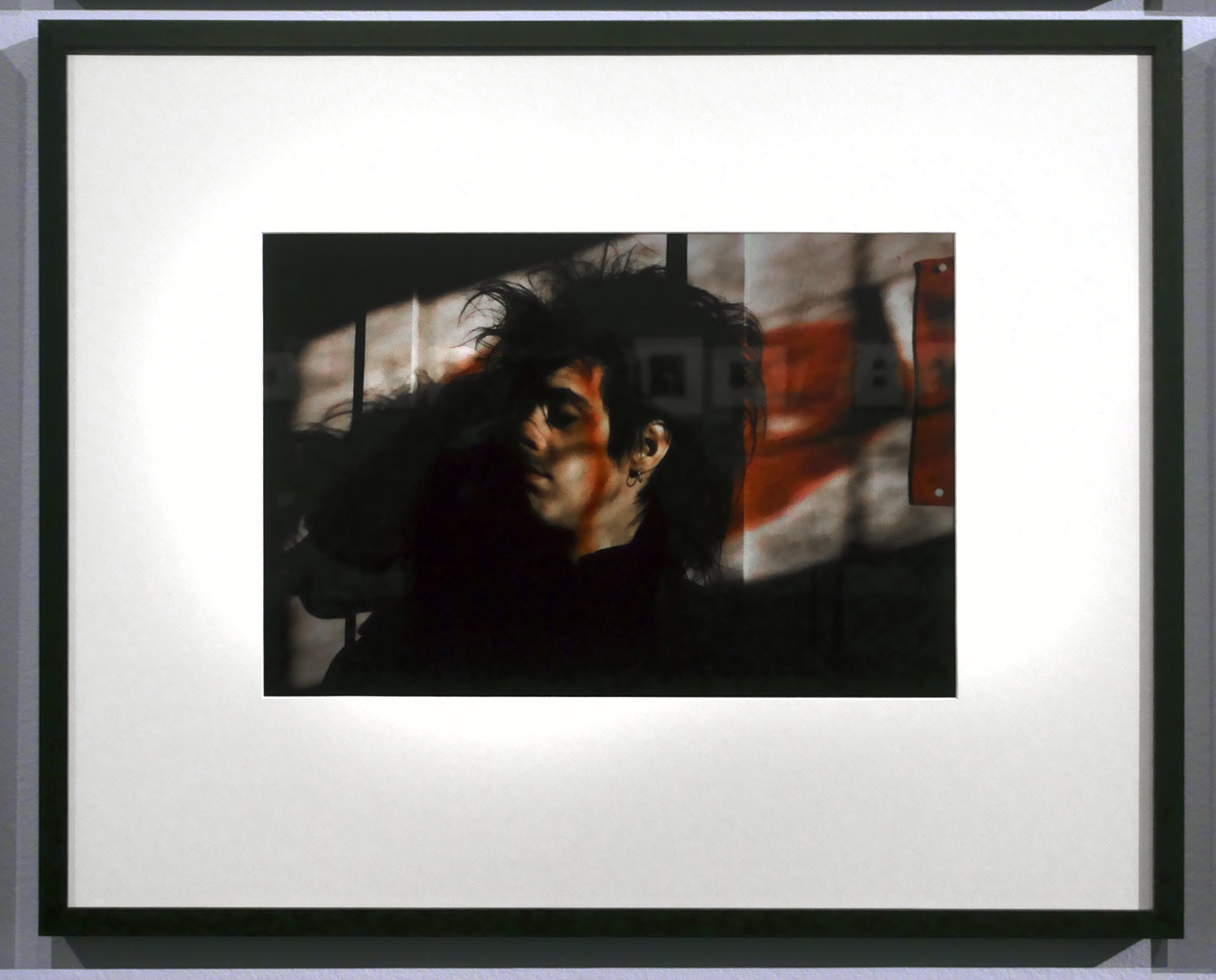
Polly Borland attended Prahran College between 1980 and 1983. Borland shot most of her student work, featured here, on Kodachrome. She shot the works in her Camberwell apartment with direct sunlight pouring through the window. Pieces of carefully placed cellophane on the window created coloured shadows across the subjects’ faces. …

Borland and Cave first began working together in the early 1980s after they met at a party in St Kilda in 1979. The image of Borland at the St Kilda party is documented by fellow friend Peter Milne. Borland’s formative photographs in the early 1980s were part of a new wave of experimental images that departed from renderings of ordinary life.

Wall text from the exhibition


Polly Borland (Australian, b. 1959) 'Nick' 1983, printed 2025 (installation view)


Polly Borland (Australian, b. 1959)
Nick (installation view)
1983, printed 2025
Silver dye bleach print
Museum of Australian Photography, City of Monash Collection acquired 2025
Photo: Marcus Bunyan


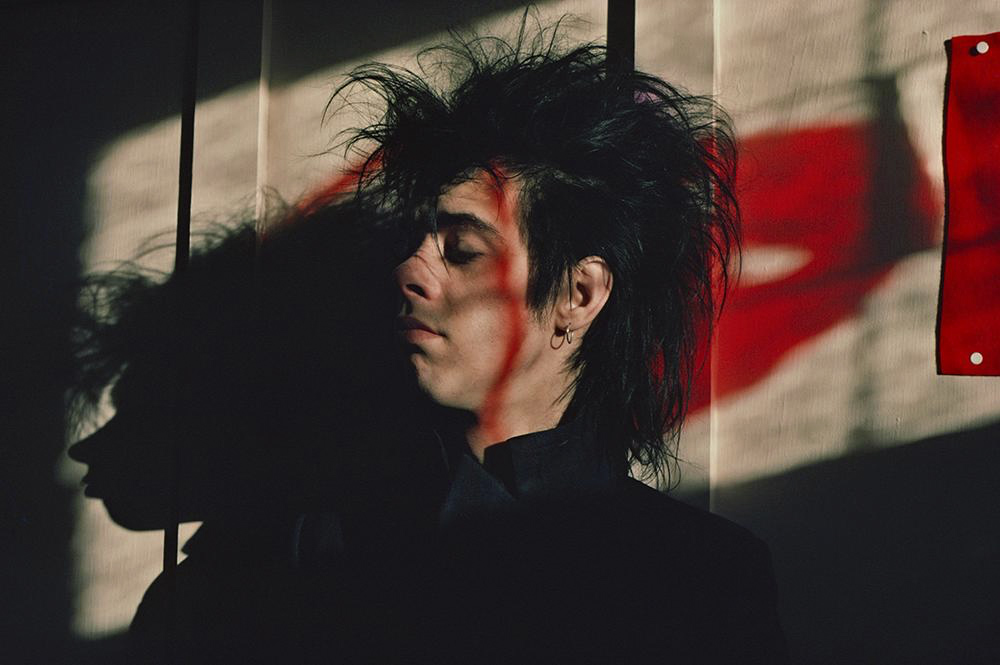
Polly Borland (Australian, b. 1959) 'Nick' 1983, printed 2025


Polly Borland (Australian, b. 1959)
Nick
1983, printed 2025
Silver dye bleach print
Museum of Australian Photography, City of Monash Collection acquired 2025


Polly Borland made this work during her student days at Prahran College where she studied between 1980 and 1983. Borland shot most of her student work on Kodachrome. Shot on Kodachrome, this work forms part of a series of portraits Borland made in her Camberwell apartment with direct sunlight pouring through the window. Pieces of carefully placed cellophane on the window created coloured shadows across the subjects’ faces. 

Borland’s images of Nick Cave from the 1980s and 1990s have become legendary. Often described as raw and intense, these images highlight the tension between the public persona of the famous musician and the more vulnerable, human side of the singer and artist. Borland and Cave first began working together in the early 1980s after they met at a party in St Kilda in 1979.

Text from the Museum of Australian Photography website


Installation view of the exhibition 'The basement: photography from Prahran College (1968-1981)' at the Museum of Australian Photography, Wheelers Hill, Melbourne showing from top left clockwise, Christopher Köller's photographs 'Past self portrait' 1980; 'Philip and Maria' 1981; 'Joe as a Russian soldier' 1980; and 'Bauhausler (homage to Oscar Schlemmer and August Sander)' 1980


Installation view of the exhibition The basement: photography from Prahran College (1968-1981) at the Museum of Australian Photography, Wheelers Hill, Melbourne showing from top left clockwise, Christopher Köller’s photographs Past self portrait 1980; Philip and Maria 1981; Joe as a Russian soldier 1980; and Bauhausler (homage to Oscar Schlemmer and August Sander) 1980
Photo: Marcus Bunyan


Christopher Köller (Australian born England, b. 1943) 'Past self-portrait' 1980


Christopher Köller (Australian born England, b. 1943)
Past self-portrait
1980
Gelatin silver print
23.0 x 24.0cm
Museum of Australian Photography, City of Monash Collection acquired 2024


Christopher Köller trained as a silk-screen printer before travelling extensively throughout the late 1960s and 1970s. Upon his return to Australia, Köller studied photography at Prahran college fromollege, graduating in 1980. Köller enrolled in Prahran with the intention of doing an expose on the conditions experienced by the miners of Bolivia as he had learnt about their plight while travelling in South America.

In his second year Köller stopped looking at photography books and started poring over the pages of art book, influenced by his now partner and historian Nanette Carter and lecturer Norbert Loeffler. Inspired by these teachings, Köller started to set up his images. His first self-portrait titled Past self portrait (1980) is an image of a young artist arriving at Station Pier, Melbourne with his passport in hand. It was part of a series of self-portraits that were shown at The Photographers’ Gallery and Workshop. Other works in this period were influenced by Russian Constructivism – particularly Vladimir Mayakovsky – and 1930s German avant-garde art. In another image, Köller’s subject, dressed in a shirt and tie, stand in front of an Oskar Schlemmer drawing, made by the artist.

Wall text from the exhibition

Christopher Köller alumni profile on the Prahran Legacy website


Christopher Köller (Australian born England, b. 1943) 'Joe as a Russian soldier' 1980 (installation view)


Christopher Köller (Australian born England, b. 1943)
Joe as a Russian soldier (installation view)
1980
Gelatin silver print
Museum of Australian Photography, City of Monash Collection acquired 2024
Photo: Marcus Bunyan


Christopher Köller (Australian born England, b. 1943) 'Joe as a Russian soldier' 1980


Christopher Köller (Australian born England, b. 1943)
Joe as a Russian soldier
1980
Gelatin silver print
Museum of Australian Photography, City of Monash Collection acquired 2024


Installation view of the exhibition 'The basement: photography from Prahran College (1968-1981)' at the Museum of Australian Photography, Wheelers Hill, Melbourne showing Nanette Carter's photographs 'Proof' 1979 and 'Newspaper' 1980


Installation view of the exhibition The basement: photography from Prahran College (1968-1981) at the Museum of Australian Photography, Wheelers Hill, Melbourne showing Nanette Carter’s photographs Proof 1979 and Newspaper 1980
Photo: Marcus Bunyan


Nanette Carter (Australian, b. 1954) 'Proof' 1979 (installation view)


Nanette Carter (Australian, b. 1954)
Proof (installation view)
1979
Gelatin silver print
Museum of Australian Photography, City of Monash Collection acquired 1981
Photo: Marcus Bunyan


Nanette Carter studied first-year photography at Prahran College in 1974 and then completed a diploma (1977) and post graduate diploma (1980) in fine art at the Phillip Institute of Technology, majoring in photography. Her practice explored feminist issues with autobiographical overtones, and she exhibited her work widely between 1981 and 1995. She ceased practising as a Photographer in the early 1990s to pursue her career as a lecturer in design history.

Carter’s image Proof (1979) is a striking self-portrait that reflects on the concept of identity and addresses the idea of photographic ‘proof’ in a multifaceted way. The word written across her face explores the proof of identity and the assertion of existence that photography claims. Newspaper (1980) utilities her partner Christopher Köller as subject. From early on in their relationship, Carter and Köller used each other as models.

Wall text from the exhibition

Nanette Carter alumni profile on the Prahran Legacy website


Nanette Carter (Australian, b. 1954)
'Proof' 1979


Nanette Carter (Australian, b. 1954)
Proof
1979
Gelatin silver print
Museum of Australian Photography, City of Monash Collection acquired 1981


Installation view of the exhibition 'The basement: photography from Prahran College (1968-1981)' at the Museum of Australian Photography, Wheelers Hill, Melbourne showing from left clockwise, Rod McNicol's photographs 'Nanette' 1978; 'Stewart' 1978; and 'Kent' 1978 from the series 'Permanent mirrors'


Installation view of the exhibition The basement: photography from Prahran College (1968-1981) at the Museum of Australian Photography, Wheelers Hill, Melbourne showing from left clockwise, Rod McNicol’s photographs Nanette 1978; Stewart 1978; and Kent 1978 from the series Permanent mirrors
Photo: Marcus Bunyan


Rod McNicol (Australian, b. 1946)
'Nanette' 1978 (installation view)


Rod McNicol (Australian, b. 1946)
Nanette (installation view)
1978
From the series Permanent mirrors
Gelatin silver print
Museum of Australian Photography, City of Monash Collection donated 2024
Photo: Marcus Bunyan


Rod McNicol (Australian, b. 1946) 'Nanette' 1978 from the series 'Permanent mirrors'


Rod McNicol (Australian, b. 1946)
Nanette
1978
From the series Permanent mirrors
Gelatin silver print
Museum of Australian Photography, City of Monash Collection donated 2024


Rod McNicol has been drawn to portraiture ever since he attended Prahran College in 1974. His fellow classmates included Nanette Carter and Bill Henson, and he formed a close connection with Athol Shmith, who would become, in McNicol’s words, ‘a lifelong mentor and friend’. McNicol held his first exhibition and Brummels Gallery of Photography with Carol Jerrems, where he exhibited works from his Permanent mirrors series. This exhibition marked a transition to what McNicol would call his structured approach to portraiture. In the image Nanette, McNicol made a makeshift studio on Paul Cox’s front veranda and placed Carter against a neutral backdrop.

In late 1978, McNicol moved into his warehouse apartment on Smith Street, Fitzroy. Since this move, he has incorporated this space into his work and it has become an important component, both as a location and as an aesthetic context.

Wall text from the exhibition

Rod McNicol alumni profile on the Prahran Legacy website


Rod McNicol (Australian, b. 1946)
'Kent' 1978 (installation view)


Rod McNicol (Australian, b. 1946)
Kent (installation view)
1978
From the series Permanent mirrors
Gelatin silver print
Museum of Australian Photography, City of Monash Collection acquired 2013
Photo: Marcus Bunyan


Rod McNicol’s series of portraits Permanent mirrors grew out of his interest in nineteenth-century photographic portraiture, whereby the slow exposure times necessitated what he calls a ‘gauche, self-conscious, fatalist stare’. For McNicol, these portraits carried the ‘spectre of mortality itself’. The environmental portraits that make up his Permanent mirrors series embody many of the formal attributes of nineteenth-century portraiture that appealed to him, insofar as the sitters are seated in highly static poses, staring directly and blankly at the camera. Soon after, McNicol introduced a range of highly significant formal changes to his portraits, whereby sitters were photographed on a kitchen chair against a plain, neutral background in the artist’s Fitzroy studio. McNicol continues to photograph people from his neighbourhood in this way.

Text from the Museum of Australian Photography website


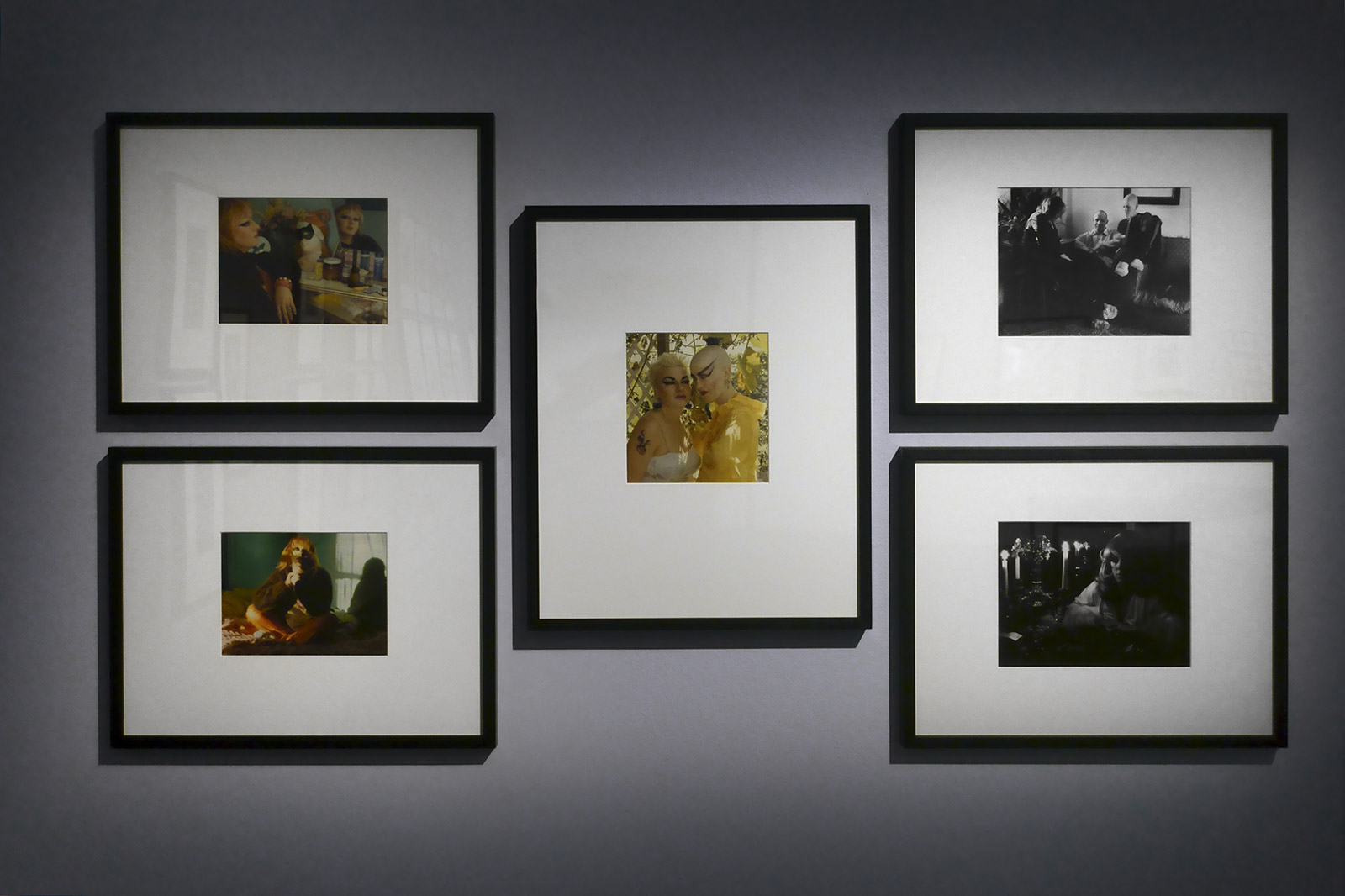
Installation view of the exhibition 'The basement: photography from Prahran College (1968-1981)' at the Museum of Australian Photography, Wheelers Hill, Melbourne showing from left top to bottom, Stella Sallman's photographs 'Sue at the mirror' 1977; 'Sue on the bed' 1977; 'Sue and Carmen' 1978; 'Sue, Simon and Carmen' 1977; 'Beautiful transvestite' 1975


Installation view of the exhibition The basement: photography from Prahran College (1968-1981) at the Museum of Australian Photography, Wheelers Hill, Melbourne showing from left top to bottom, Stella Sallman’s photographs Sue at the mirror 1977; Sue on the bed 1977; Sue and Carmen 1978; Sue, Simon and Carmen 1977; Beautiful transvestite 1975
Photo: Marcus Bunyan


Stella Sallman (Australian, b. 1956)
'Sue and Carmen' 1978 (installation view)


Stella Sallman (Australian, b. 1956)
Sue and Carmen (installation view)
1978
Chromogenic print
Museum of Australian Photography, City of Monash Collection acquired 2025
Photo: Marcus Bunyan


Stella Sallman attended Prahran College from 1976 to 1978. She had originally planned to study fashion design at RMIT, but she was unable pursue the course because she didn’t have a folio. Instead, after completing the preliminary year in Art and Design at Prahran College, she discovered a deep fascination with photography.

Sallman was invited by Rennie Ellis to exhibit her series of glam punks, which she started in her second year, at Brummels Gallery of Photography in 1978, as a support for fellow photographer Jon Rhodes. She said, ‘Rennie came and did some lectures at Prahran. I found him very inspiring because he wasn’t about things looking technically correct.’ He was also brimming with ‘exuberant enthusiastic positive energy.’ The 13 works exhibited at Brummels were portraits of people that Sallman had encountered. Sallman had seen Sue whilst travelling on a train and asked if she could take her portrait. ‘I was very curious about people that didn’t conform.’ In Sallman’s images, she uses colour to emphasise the personality and mood of her subjects, challenging the more traditional, formal portraiture that had prevailed at the time.

Wall text from the exhibition

Stella Sallman alumni profile on the Prahran Legacy website


Gallery two section two (clockwise)


Installation view of the exhibition 'The basement: photography from Prahran College (1968-1981)' at the Museum of Australian Photography, Wheelers Hill, Melbourne
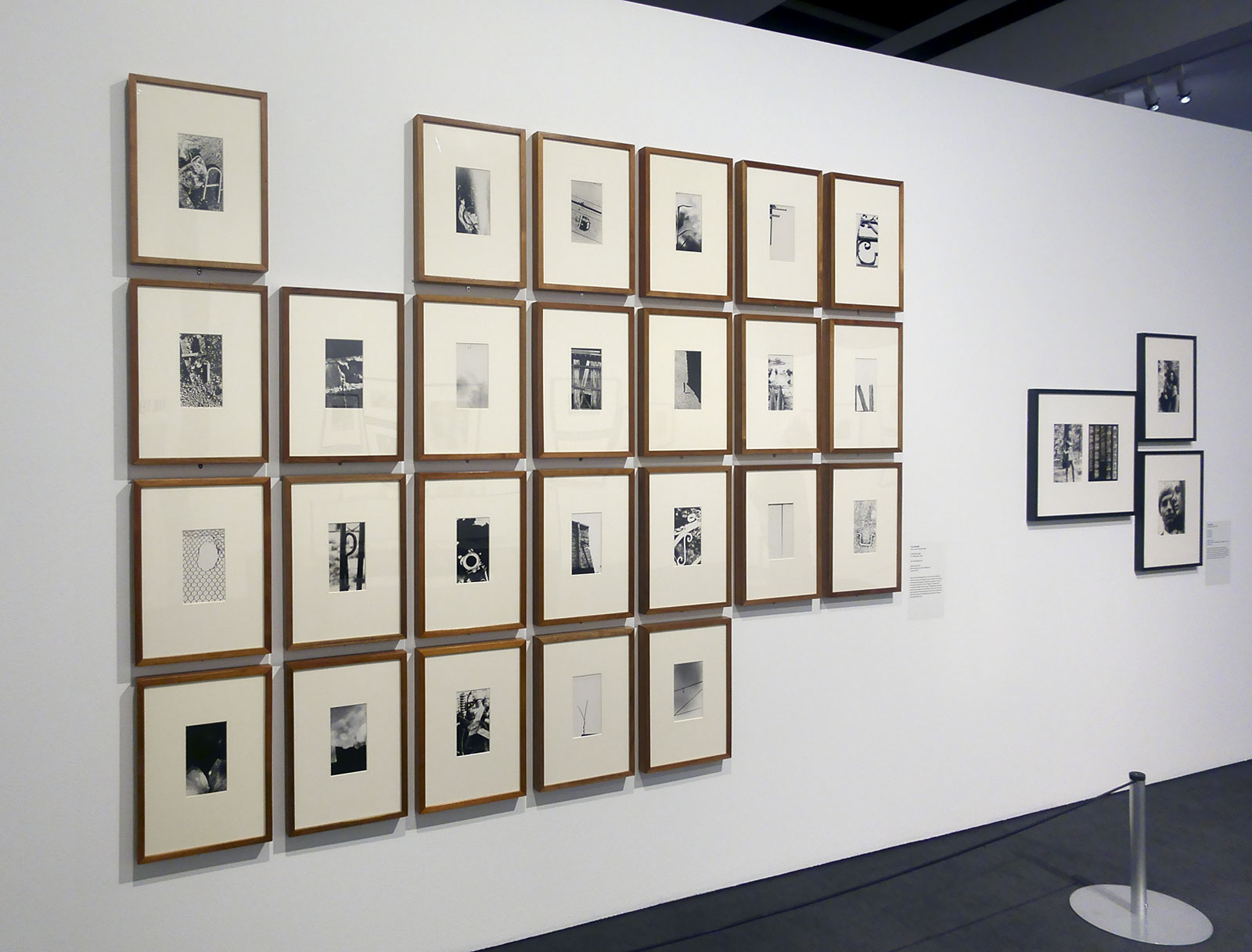
Installation view of the exhibition 'The basement: photography from Prahran College (1968-1981)' at the Museum of Australian Photography, Wheelers Hill, Melbourne showing at left, Carol Jerrems 'Alphabet folio' 1968 dated 1969


Installation view of the exhibition The basement: photography from Prahran College (1968-1981) at the Museum of Australian Photography, Wheelers Hill, Melbourne showing at left, Carol Jerrems Alphabet folio 1968 dated 1969
Photos: Marcus Bunyan


Carol Jerrems (Australian, 1949-1980) Letter from the 'Alphabet folio' 1968 dated 1969 (installation view)


Carol Jerrems (Australian, 1949-1980)
Letters from the Alphabet folio (installation views)
1968 dated 1969
Gelatin silver print
National Gallery of Victoria, Melbourne
Purchased 1971
Photos: Marcus Bunyan


Carol Jerrem’s Alphabet folio is one of her most celebrated and iconic works, and it holds an important place in the history of Australian photography, Created as an assignment during her time as a student at Prahran College, the Alphabet folio consists of 25 letters, with the letter ‘S’ deliberately omitted by Jerrems. The assignment left a lasting impression on Jerrems, as she regularly set this assignment for her own students when she was teaching at the Heidelberg Technical School and the Tasmania School of Art.

Wall text from the exhibition

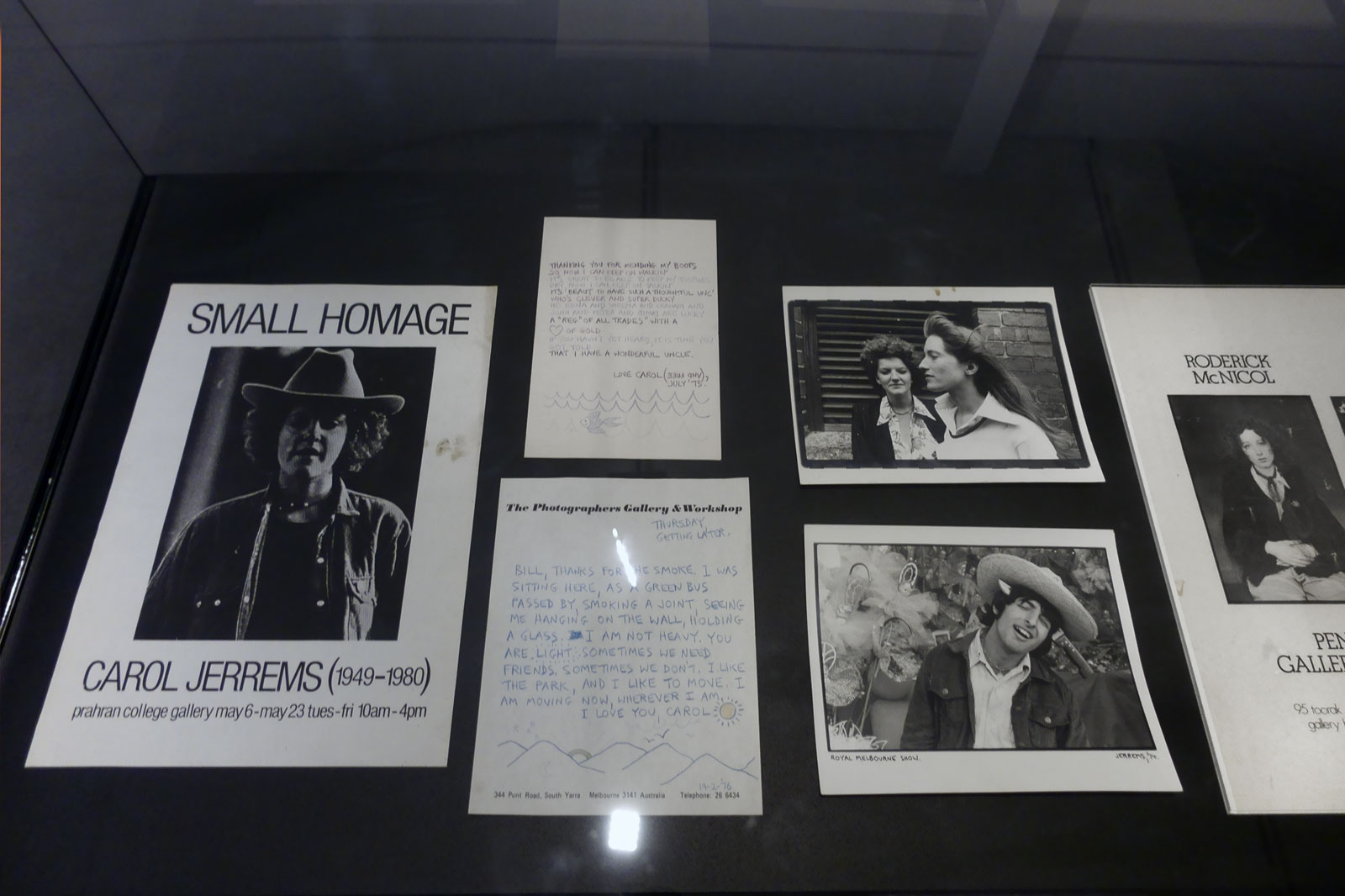
Carol Jerrems studied at Prahran College between 1967-1969 and graduated in 1970, studying under lecturers McKenzie, Cox, and Lee.

Carol Jerrems alumni profile on the Prahran Legacy website


Installation view of the exhibition 'The basement: photography from Prahran College (1968-1981)' at the Museum of Australian Photography, Wheelers Hill, Melbourne


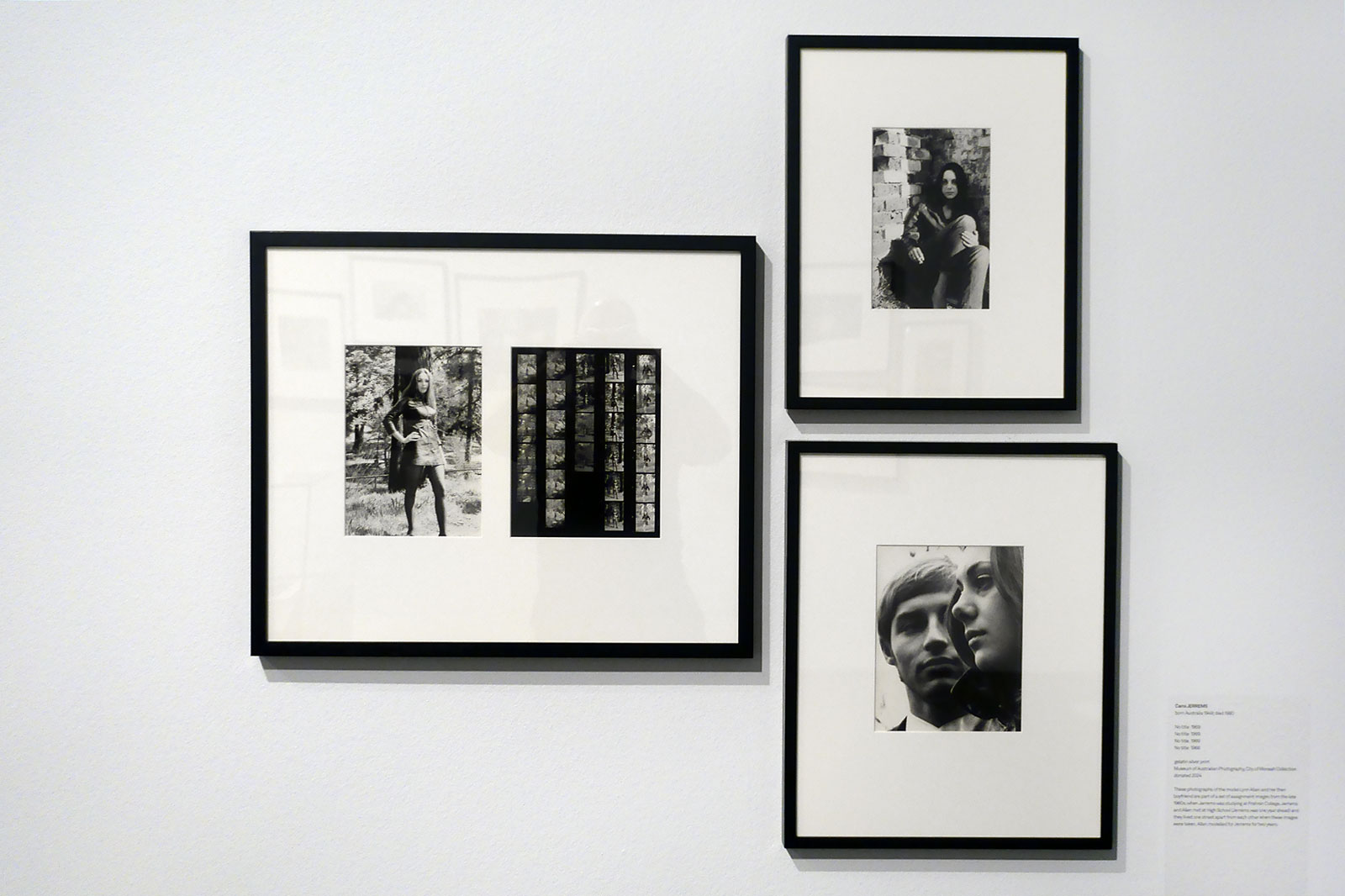
Installation view of the exhibition The basement: photography from Prahran College (1968-1981) at the Museum of Australian Photography, Wheelers Hill, Melbourne showing Carol Jerrems’ No title photographs 1968/1969
Photos: Marcus Bunyan


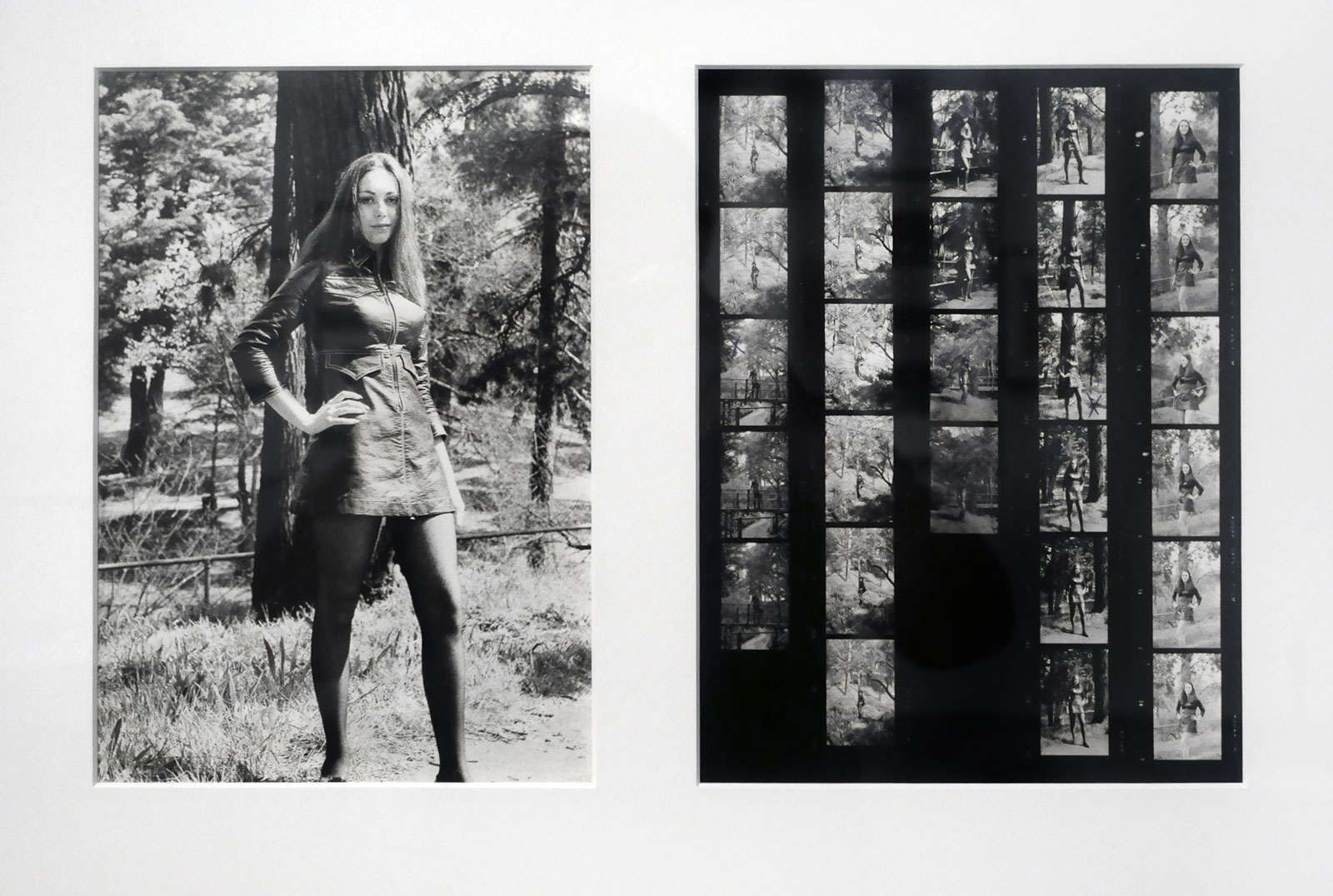
These photographs of the model Lynn Allen and her then boyfriend are part of a set of assignment images from the late 1960s, when Jerrems was studying at Prahran College. Jerrems and Allen met at High School (Jerrems was one year ahead) and they lived one street apart from each other when these images were taken. Allen modelled for Jerrems for two years.

Wall text from the exhibition


Carol Jerrems (Australian, 1949-1980) 'No title' 1969; 'No title' 1969 (installation view)


Carol Jerrems (Australian, 1949-1980)
No title (installation view)
1969
No title (installation view)
1969
Gelatin silver print
Museum of Australian Photography, City of Monash Collection donated 2024
Photo: Marcus Bunyan


Carol Jerrems (Australian, 1949-1980) 'No title' 1969 (installation view)


Carol Jerrems (Australian, 1949-1980)
No title (installation view)
1969
Gelatin silver print
Museum of Australian Photography, City of Monash Collection donated 2024
Photo: Marcus Bunyan


Installation view of the exhibition 'The basement: photography from Prahran College (1968-1981)' at the Museum of Australian Photography, Wheelers Hill, Melbourne showing photographs by Carol Jerrems


Installation view of the exhibition The basement: photography from Prahran College (1968-1981) at the Museum of Australian Photography, Wheelers Hill, Melbourne showing photographs by Carol Jerrems
Photo: Marcus Bunyan


Installation view of the exhibition 'The basement: photography from Prahran College (1968-1981)' at the Museum of Australian Photography, Wheelers Hill, Melbourne


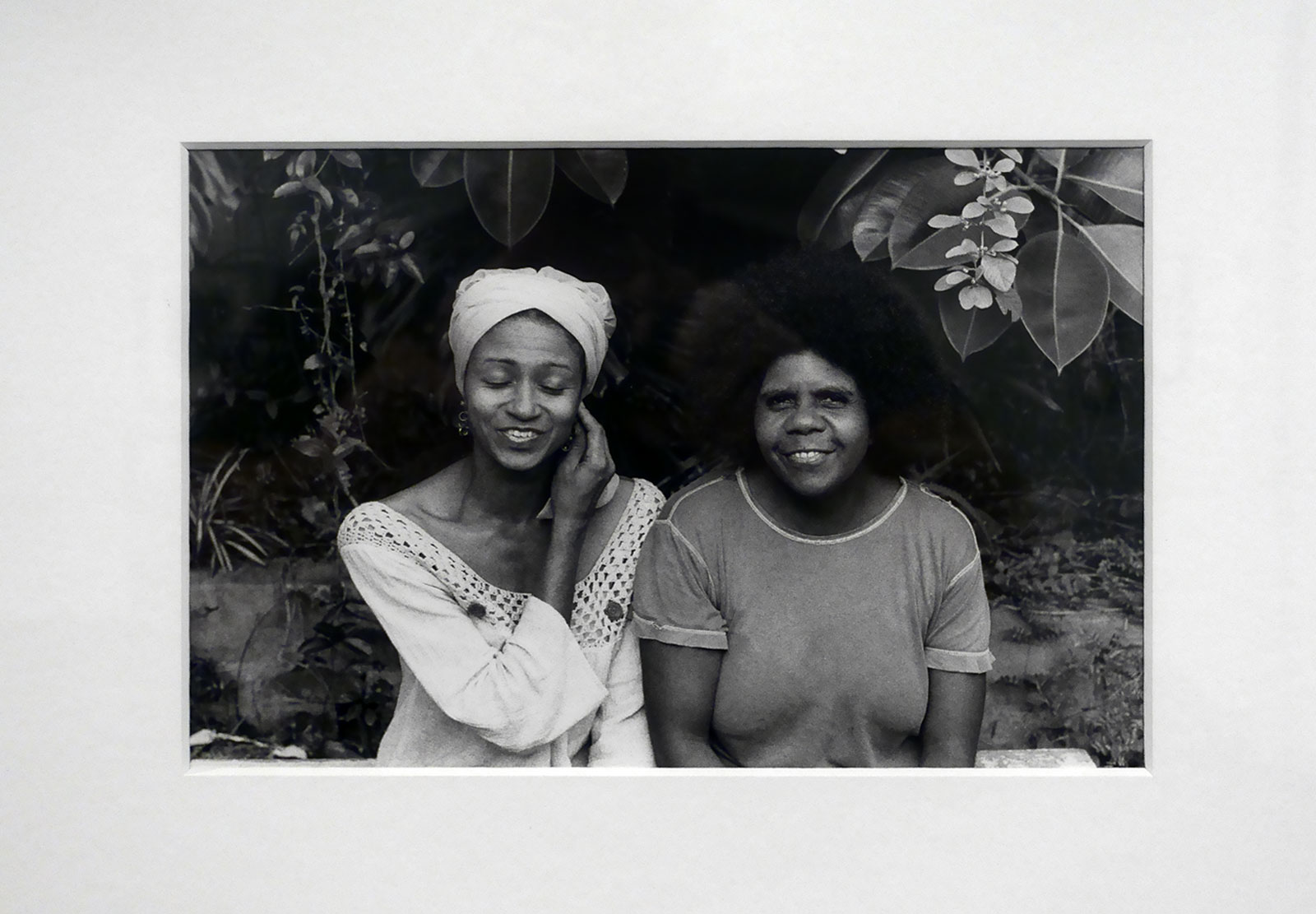
Installation view of the exhibition The basement: photography from Prahran College (1968-1981) at the Museum of Australian Photography, Wheelers Hill, Melbourne showing Carol Jerrems’ photographs at left top, Kath Walker 1974; at bottom left, Thancouple (Gloria Fletcher) and Carole Johnson 1974; and at right, Ron Johnson 1974
Photo: Marcus Bunyan


Carol Jerrems (Australian, 1949-1980) 'Thancouple (Gloria Fletcher) and Carole Johnson' 1974 (installation view)


Carol Jerrems (Australian, 1949-1980)
Thancouple (Gloria Fletcher) and Carole Johnson (installation view)
1974
Gelatin silver print
National Gallery of Australia, Canberra
Gift of Mrs Joy Jerrems 1981
Photo: Marcus Bunyan


Carol Jerrems (Australian, 1949-1980) 'Ron Johnson' 1974


Carol Jerrems (Australian, 1949-1980)
Ron Johnson
1974
Gelatin silver print
Museum of Australia Photography, City of Monash Collection donated through the Australian Government’s Cultural Gifts Program 2015
Photo: Marcus Bunyan


Installation view of the exhibition 'The basement: photography from Prahran College (1968-1981)' at the Museum of Australian Photography, Wheelers Hill, Melbourne


Installation view of the exhibition The basement: photography from Prahran College (1968-1981) at the Museum of Australian Photography, Wheelers Hill, Melbourne showing Carol Jerrem’s photographs at left, Esoteric personal (mini) recent exhibition 1976; at top right, Vale Street 1975; at bottom right, Juliet holding ‘Vale Street’ at Murray Road 1976
Photo: Marcus Bunyan


Carol Jerrems (Australian, 1949-1980) 'Esoteric personal (mini) recent exhibition' 1976 (installation view)


Carol Jerrems (Australian, 1949-1980)
Esoteric personal (mini) recent exhibition (installation view)
1976
Gelatin silver prints
Private collection
Photo: Marcus Bunyan
 

Carol Jerrems (Australian, 1949-1980) 'Vale Street' 1975 (installation view)


Carol Jerrems (Australian, 1949-1980)
Vale Street (installation view)
1975
Gelatin silver print
Museum of Australia Photography, City of Monash Collection donated through the Australian Government’s Cultural Gifts Program by Susan Hesse 2012
Photo: Marcus Bunyan


Carol Jerrems (Australian, 1949-1980) 'Vale Street' 1975


Carol Jerrems (Australian, 1949-1980)
Vale Street
1975
Gelatin silver print
Museum of Australia Photography, City of Monash Collection donated through the Australian Government’s Cultural Gifts Program by Susan Hesse 2012


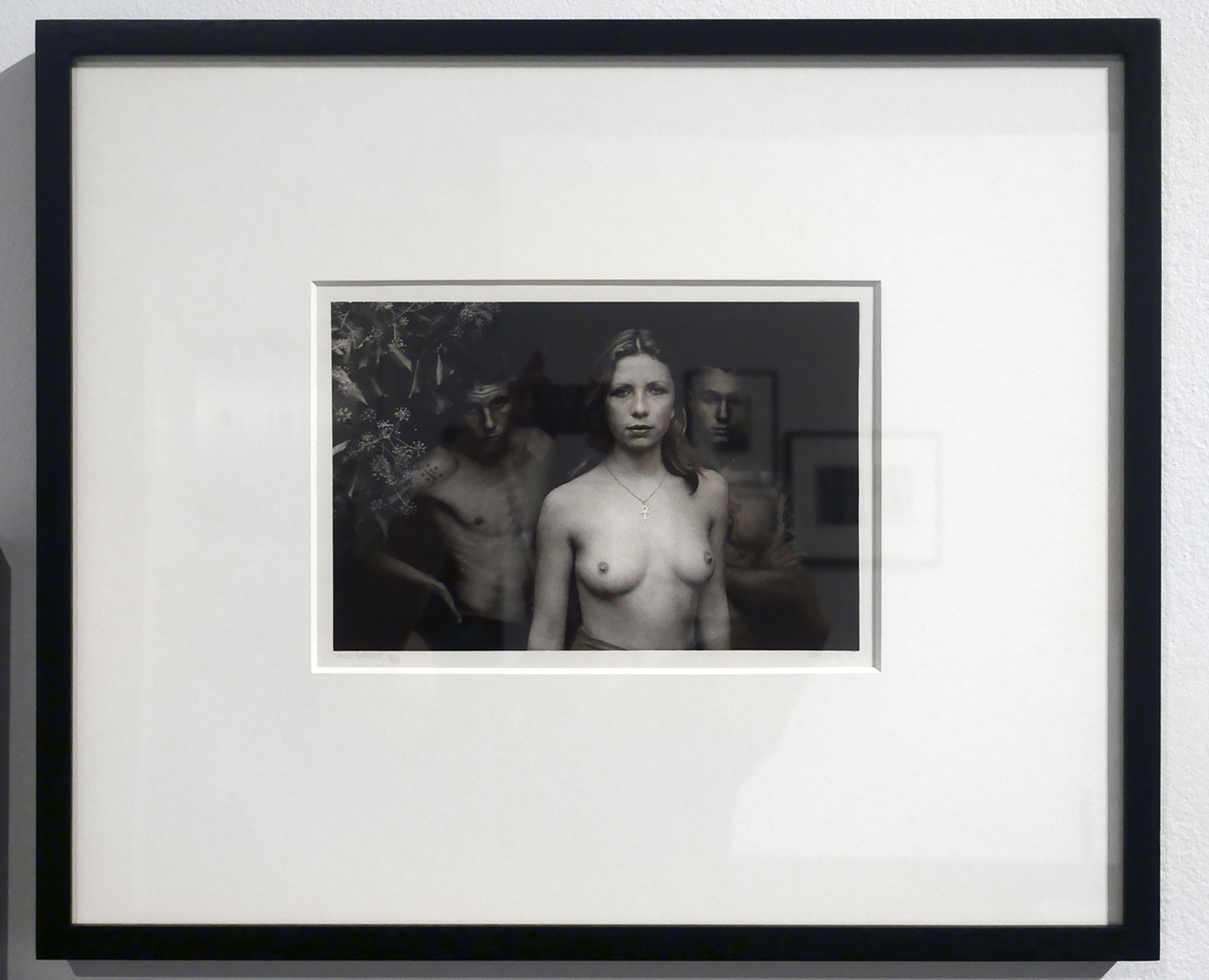
In 1975, Carol Jerrems made what would become her most famous photograph. Vale Street shows Jerrem’s friend Catriona Brown standing in front of Mark Lean and Jon Bourke, teenage boys from Heidelberg Technical School where Jerrems was teaching at the time. The photograph, taken in the back yard of a house at 52 Vale Street, St Kilda, comes from a series of pictures that show the three subjects socialising, smoking and, under the direction of Jerrems, gradually disrobing. Jerrems carefully set up and managed this no-iconic image, which quickly came to personify the optimism and ambitions of countercultural and feminist politics at the time

Wall text from the exhibition


Installation view of the exhibition 'The basement: photography from Prahran College (1968-1981)' at the Museum of Australian Photography, Wheelers Hill, Melbourne showing photographs by Carol Jerrems (left) and Paul Cox (centre)


Installation view of the exhibition The basement: photography from Prahran College (1968-1981) at the Museum of Australian Photography, Wheelers Hill, Melbourne showing photographs by Carol Jerrems (left) and Paul Cox (centre)
Photo: Marcus Bunyan


Installation view of the exhibition 'The basement: photography from Prahran College (1968-1981)' at the Museum of Australian Photography, Wheelers Hill, Melbourne


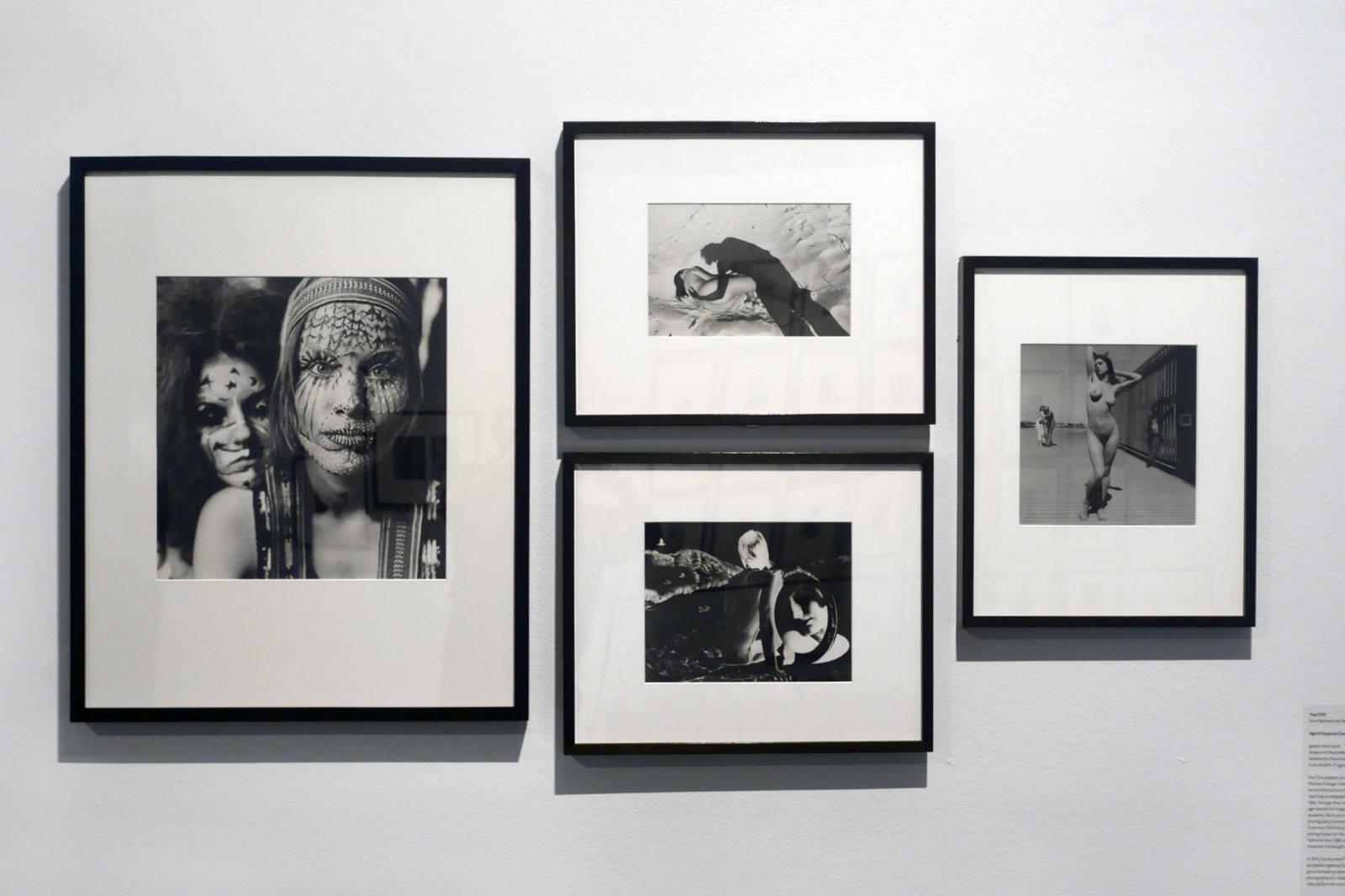
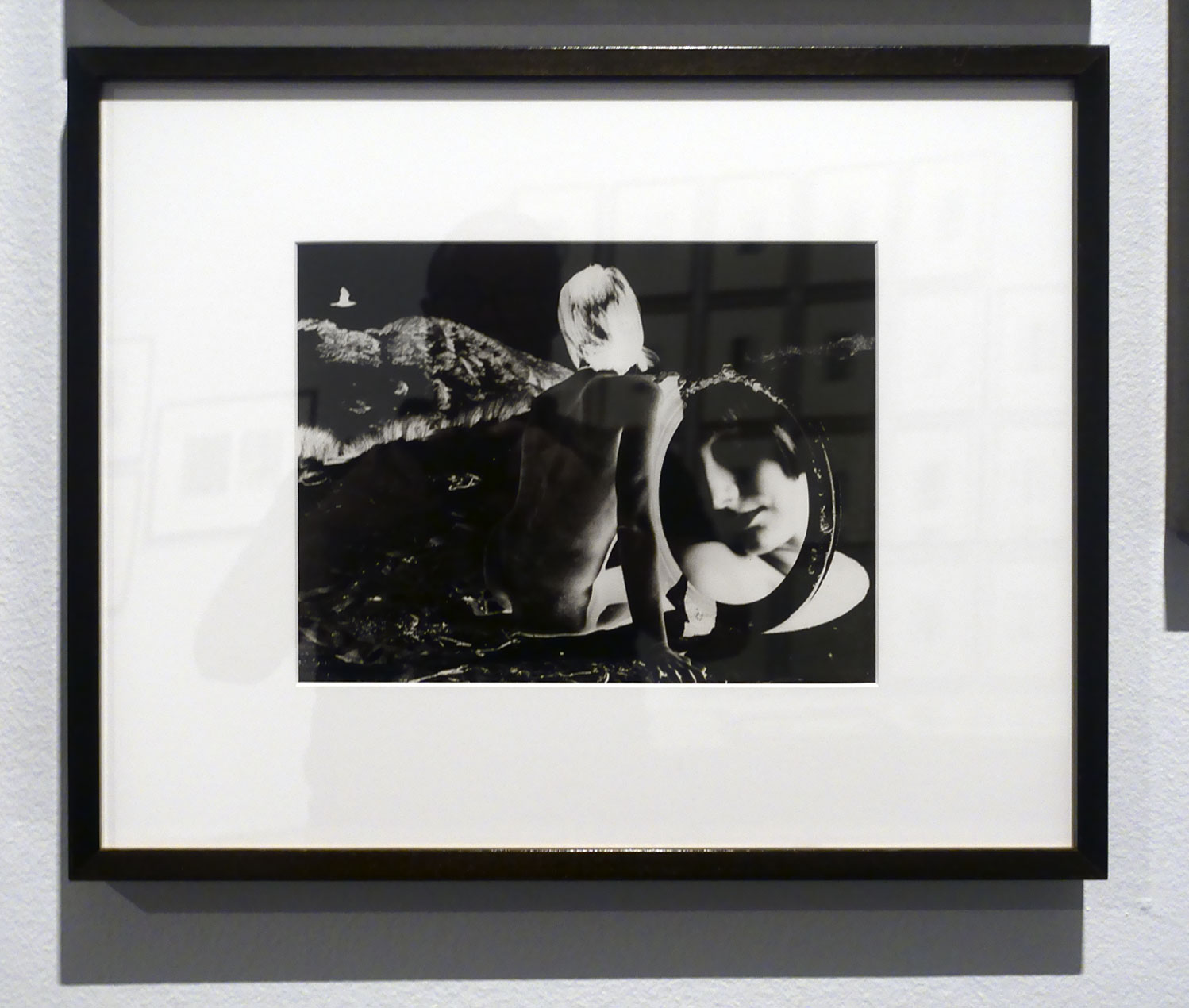
Installation view of the exhibition The basement: photography from Prahran College (1968-1981) at the Museum of Australian Photography, Wheelers Hill, Melbourne showing Paul Cox’s photographs with at left, Age of Aquarius (Carol Jerrems, Jan Hurrell) 1970; at centre top, Elizabeth 1 1972; at centre bottom, Fantasy of divine illusion 1972; and at right, Prahran 2 1974
Photo: Marcus Bunyan


Paul Cox (Australian born Netherlands, 1940-2016) 'Age of Aquarius (Carol Jerrems, Jan Hurrell)' 1970 (installation view)


Paul Cox (Australian born Netherlands, 1940-2016)
Age of Aquarius (Carol Jerrems, Jan Hurrell)
1970
Gelatin silver print
Museum of Australia Photography, City of Monash Collection donated by the artist through the Australian Government’s Cultural Gifts Program
Photo: Marcus Bunyan


Paul Cox played a pivotal role in the Photography Department at Prharan College, initially appointed part-time in February 1968, he transitioned to full-time position in 1970 and continued teaching photography and filmmaking until his departure in 1982. Younger than colleagues such as Cato and Shmith, Cox’s age helped him forge strong, personal connections with his students. Many alumni attribute their exposure to international photography luminaries to Cox’s influence. However, it was Cox’s own distinctive approach to photography that left a lasting impact on his students. Cox moved to Australia from the Netherlands in 1965 and although he was not formally trained as a teacher, he brought with him a European sensibility.

In 1973, Cox founded The Photographers’ Gallery and Workshop, alongside Ingeborg Tyssen, John F William and Rod McNicol, a groundbreaking space that played a crucial role in establishing photography as a respected art form in Australia and provided a vital platform for contemporary photographers.

Wall text from the exhibition

Paul Cox on the Prahran Legacy website


Paul Cox (Australian born Netherlands, 1940-2016) 'Age of Aquarius (Carol Jerrems, Jan Hurrell)' 1970


Paul Cox (Australian born Netherlands, 1940-2016)
Age of Aquarius (Carol Jerrems, Jan Hurrell)
1970
Gelatin silver print
Museum of Australia Photography, City of Monash Collection donated by the artist through the Australian Government’s Cultural Gifts Program


Paul Cox (Australian born Netherlands, 1940-2016) 'Fantasy of divine illusion' 1972 (installation view)


Paul Cox (Australian born Netherlands, 1940-2016)
Fantasy of divine illusion (installation view)
1972
Gelatin silver print
Museum of Australia Photography, City of Monash Collection donated by the artist through the Australian Government’s Cultural Gifts Program
Photo: Marcus Bunyan


Paul Cox (Australian born Netherlands, 1940-2016) 'Prahran 2' 1974 (installation view)


Paul Cox (Australian born Netherlands, 1940-2016)
Prahran 2 (installation view)
1974
Gelatin silver print
Museum of Australia Photography, City of Monash Collection donated by the artist through the Australian Government’s Cultural Gifts Program
Photo: Marcus Bunyan


Wall text from the exhibition 'The basement: photography from Prahran College (1968-1981)' at the Museum of Australian Photography, Wheelers Hill, Melbourne


Wall text from the exhibition The basement: photography from Prahran College (1968-1981) at the Museum of Australian Photography, Wheelers Hill, Melbourne
Photo: Marcus Bunyan


Installation view of the exhibition 'The basement: photography from Prahran College (1968-1981)' at the Museum of Australian Photography, Wheelers Hill, Melbourne showing a poster for an exhibition by Tod McNicol and Carol Jerrems at Brummels Gallery of Photography, August - September 1978
Installation view of the exhibition 'The basement: photography from Prahran College (1968-1981)' at the Museum of Australian Photography, Wheelers Hill, Melbourne two letters from Carol Jerrems including at bottom a letter to William (Bill) Heimerman (1950-2017) co-director at the time of The Photographers' Gallery and Workshop
Installation view of the exhibition 'The basement: photography from Prahran College (1968-1981)' at the Museum of Australian Photography, Wheelers Hill, Melbourne


Installation views of the exhibition The basement: photography from Prahran College (1968-1981) at the Museum of Australian Photography, Wheelers Hill, Melbourne with artefacts in a vitrine, showing a poster for an exhibition by Tod McNicol and Carol Jerrems at Brummels Gallery of Photography, August – September 1978; two letters from Carol Jerrems including at bottom a letter to William (Bill) Heimerman (1950-2017) co-director at the time of The Photographers’ Gallery and Workshop; and two gelatin silver prints by Carol Jerrems
Photos: Marcus Bunyan


Installation view of the exhibition 'The basement: photography from Prahran College (1968-1981)' at the Museum of Australian Photography, Wheelers Hill, Melbourne showing at centre, work by John Cato


Installation view of the exhibition The basement: photography from Prahran College (1968-1981) at the Museum of Australian Photography, Wheelers Hill, Melbourne showing at far left a photograph by Paul Cox, at second and third left photographs by Athol Shmith and at centre, photographs by John Cato
Photo: Marcus Bunyan


Installation view of the exhibition 'The basement: photography from Prahran College (1968-1981)' at the Museum of Australian Photography, Wheelers Hill, Melbourne


Installation view of the exhibition The basement: photography from Prahran College (1968-1981) at the Museum of Australian Photography, Wheelers Hill, Melbourne showing at left, Paul Cox’s Portrait of Athol Shmith 2 1983; and at right, Athol Shmith’s Anamorphic image No. 17 and Anamorphic image No. 1 both 1973
Photo: Marcus Bunyan


Athol Shmith is widely known for his commercial portraiture and fashion photography. His style became emblematic of an era that was transitioning from the more formal rigid photographic style of the early 20th century to something more dramatic. His portraits are highly polished, sophisticated and capture the essence of the post-war era’s glamour.

Shmith’s sale was characterised by a strong focus on lighting and composition, often using dramatic lighting setups to create bold, striking images. As Head of the Photography Department from 1972 to 1979 Art Prahran College, Shmith brought a high level of technical expertise.

Shmith created his Anamorphic series while teaching at Prahran College, and exhibited the series at Realities Gallery in 1973. Student Suzanne Budds recalls being a model for one of the images in this series.

Wall text from the exhibition

Athol Shmith Lecturer profile on the Prahran Legacy website


Paul Cox (Australian born Netherlands, 1940-2016) 'Portrait of Athol Shmith 2' 1983 (installation view)


Paul Cox (Australian born Netherlands, 1940-2016)
Portrait of Athol Shmith 2 (installation view)
1983
Gelatin silver print
Museum of Australia Photography, City of Monash Collection donated by the artist through the Australian Government’s Cultural Gifts Program 2000
Photo: Marcus Bunyan


Installation view of the exhibition 'The basement: photography from Prahran College (1968-1981)' at the Museum of Australian Photography, Wheelers Hill, Melbourne showing from left, John Cato's photographs 'Seawind' 1871-1975; 'Tree - a journey' 1971-1973; and 'Tree - a journey #13' 1971-1973 from the series 'Essay I: landscape in a figure' 1971-1979


Installation view of the exhibition The basement: photography from Prahran College (1968-1981) at the Museum of Australian Photography, Wheelers Hill, Melbourne showing from left, John Cato’s photographs Seawind 1871-1975; Tree – a journey 1971-1973; and Tree – a journey #13 1971-1973 from the series Essay I: landscape in a figure 1971-1979
Photo: Marcus Bunyan


John Cato (Australian, 1926-2011) 'Tree - a journey' 1971-1973 (installation view)


John Cato (Australian, 1926-2011)
Tree – a journey (installation views)
1971-1973
Gelatin silver print
Museum of Australian Photography, City of Monash Collection donated by the Cato Estate 2021


John Cato (Australian, 1926-2011) 'Tree - a journey' 1971-1973


John Cato (Australian, 1926-2011)
Tree – a journey
1971-1973
Gelatin silver print
Museum of Australian Photography, City of Monash Collection donated by the Cato Estate 2021


John Cato began his informal studies in photography with his father, the photographer Jack Cato, in 1938. He worked as a commercial photographer from 1947 to 1974, including a notable stint as a press photographer for The Argus from 1947 to 1950. Over the course of his career, Cato collaborated with Athol Shmith for more than two decades, before shifting away from commercial photography in 1974 to focus on his own fine art practice. That same year, Cato also embarked on his career as a photography educator, taking a teaching position at Prahran College, eventually succeeding Shmith as Head of the Photography Department in 1980.

Cato was known for his mystical and spiritual approach to photography, a philosophy that deeply influenced both his teaching style and his own photographic work. His method was unconventional, emphasising not just technical skill, but the creation of images with a deeper, almost transcendent resonance. Many of Cato’s works are minimalist, capturing quiet, still moments in nature, where form and texture take precedence over literal representation. These images often have an abstract quality, inviting the viewer to engage with the landscape on a more introspective, emotional level. Cato’s photography was not just about capturing a scene, it was about evoking a deeper connection to the transformative power of the natural world.

Wall text from the exhibition

Read my Vale to Dr John Cato (1926-2011)

John Cato on the Prahran Legacy website


John Cato (Australian, 1926-2011) 'Tree - a journey #13' 1971-1973 (installation view)


John Cato (Australian, 1926-2011)
Tree – a journey #13 (installation views)
1971-1973
Gelatin silver print
Museum of Australian Photography, City of Monash Collection donated by the artist
Acquired 1981


John Cato (Australian, 1926-2011) 'Tree - a journey #13' 1971-1973


John Cato (Australian, 1926-2011)
Tree – a journey #13
1971-1973
Gelatin silver print
Museum of Australian Photography, City of Monash Collection donated by the artist
Acquired 1981


“Thanks are due to…. Phil Quirk, Peter Leiss, and the now deceased Jon Conte, who started finding alumni (starting with those of 1968-1972) in 2012; Colin Abbott who encouraged Photonet gallery (now MAGNET) in 2014 to put on a show of 1 sample each of student-era and contemporary work of most of the 1974-1976 cohort; Colin has generously part-funded the book that MAPh has produced; designer and archivist Mimmo Cozzolino has contributed beautifully preserved ephemera from his College years, as well as donating his design skills to the ongoing project. Peter Leiss, assisted by Nicholas Nedelkopoulos, produced fine video interviews with alumni… a labour of love!

James McArdle joined the project in 2017. Merle Hathaway, who accepted an invitation to work with the team in 2021, has been an invaluable and key driver of the project in getting this exhibition (and future showings). Merle has secured upcoming shows of contemporary work by 1968-1991 alumni for MAGNET (through May 2025),  the BIFB (August 2025) and elsewhere…

Above all, MAPh curators, Angela Connor and Stella-Loftus-Hills, have been extraordinary in their enthusiasm for the concept, and their realisation of it through their expertise and hard work and is beyond our wildest expectations.  To have contributing writers of the calibre of Gael Newton, Helen Ennis, Daniel Palmer, Adrian Danks et al. is an honour and a further tribute to MAPh organisation and thoroughness.”

Associate Professor James McArdle


For more information please see The Prahran Photography website which upholds the legacy of Prahran College 1970s photography through posts on profiles of the alumni (an ongoing project). The site was initiated by James McArdle, who graduated in 1977 with a Diploma of Art and Design from Prahran College and Merle Hathaway, who coined the title, and who joins James in writing some of the posts.


Making film

Required to collaborate on a class film or create one of their own, photography students often took on multiple roles in each other’s projects. Paul Cox frequently cast his students as actors in his films, forging relationships that continued long after they graduated from college. In Cox’s productions, students also filled essential technical roles such as stills photographer and cinematographer. As well as developing their skills, this collaborative environment fostered a sense of community among aspiring filmmakers.

Paul Cox is known for his distinctive, often introspective films that explore human relationships, emotions, and existential themes. His work, while not always mainstream, is highly regarded in the Australian film industry and internationally for its emotional depth and unique storytelling style.

Mirka is a short film that features French-Australian visual artist Mirka Mora, a key figure in the Melbourne art scene. Mora gained recognition for her distinctive and colourful works, and her blend of surrealism, fantasy and personal experiences. The film explores her journey as an artist and her personal life, showcasing her experiences and her unique approach to art. The film offers a personal perspective into her world and is a rare glimpse into the life of one of Australia’s most beloved and influential artists.

Mirka was a collaborative project, directed by Paul Cox with the assistance of several Prahran students.

Student life

The students at Prahran College were part of a vibrant and dynamic environment that nurtured creativity, experimentation and community. Many drew inspiration from their immediate circles – friends and acquaintances – for their class assignments. They actively participated in exhibitions, showcasing their work to the public and their peers. Students presented their works in critique sessions that played a vital role in the learning process, providing a forum for discussion, debate and critical feedback.

Assignments often revolved around chosen topics such as fashion, portraiture or family, and sometimes involved field trips out into the landscape or excursions to places like hospitals, factories and the beach. Taking advantage of a ‘free assignment’ in 1976 a group of rebellious students got together to produce images of themselves dressed as revolutionaries, wearing clothes sourced from local opportunity shops and carrying real guns.

The images of students from Prahran College in the 1970s serve as visual documents of the bohemian spirit and encapsulate the idealism of the time. The way students were photographed, often in unposed and relaxed settings, captures the free-spirited nature of the College, with the camera becoming a tool for exploring vulnerability and personal expression, rather than just recording events or situations.

The legacy of the bohemian spirit that was cultivated at Prahran College during the 1970s is still evident in the work of contemporary Australian artists today, many of whom continue to embrace self-expression, individuality and alternative narratives.

Text from the Museum of Australian Photography website


Gallery three


Installation view of the exhibition 'The basement: photography from Prahran College (1968-1981)' at the Museum of Australian Photography, Wheelers Hill, Melbourne


Installation view of the exhibition The basement: photography from Prahran College (1968-1981) at the Museum of Australian Photography, Wheelers Hill, Melbourne
Photo: Marcus Bunyan


Installation view of the exhibition 'The basement: photography from Prahran College (1968-1981)' at the Museum of Australian Photography, Wheelers Hill, Melbourne showing Andrew Wittner's photograph 'John Cato leading a group on a photographic expedition, Steve Lojewski using a film camera' 1975; and George Volakos' 'Rye back beach 1' 1972


Installation view of the exhibition The basement: photography from Prahran College (1968-1981) at the Museum of Australian Photography, Wheelers Hill, Melbourne showing at left, Andrew Wittner’s photograph John Cato leading a group on a photographic expedition, Steve Lojewski using a film camera 1975; and at right, George Volakos’ Rye back beach 1 1972
Photo: Marcus Bunyan


Andrew Wittner (Australian, b. 1955) 'John Cato leading a group on a photographic expedition, Steve Lojewski using a film camera' 1975, printed 2024 (installation view)


Andrew Wittner (Australian, b. 1955)
John Cato leading a group on a photographic expedition, Steve Lojewski using a film camera (installation view)
1975, printed 2024
Gelatin silver print
Collection of the artist
Photo: Marcus Bunyan


George Volakos (Australian born Greece, b. 1948) 'Rye back beach 1' 1972, printed 2024 (installation view)


George Volakos (Australian born Greece, b. 1948)
Rye back beach 1 (installation view)
1972, printed 2024
Gelatin silver print
Collection of the artist
Photo: Marcus Bunyan


Installation view of the exhibition 'The basement: photography from Prahran College (1968-1981)' at the Museum of Australian Photography, Wheelers Hill, Melbourne showing photographs by Richard Muggleton, George Volakos, Colin Abbott, Graham Howe, Philip Quirk, Jim McFarlane, Greg Neville, Andrew Wittner, Peter Bowes, and an unknown photographer


Installation view of the exhibition The basement: photography from Prahran College (1968-1981) at the Museum of Australian Photography, Wheelers Hill, Melbourne showing photographs by Richard Muggleton, George Volakos, Colin Abbott, Graham Howe, Philip Quirk, Jim McFarlane, Greg Neville, Andrew Wittner, Peter Bowes, and an unknown photographer
Photo: Marcus Bunyan


Installation view of the exhibition 'The basement: photography from Prahran College (1968-1981)' at the Museum of Australian Photography, Wheelers Hill, Melbourne showing photographs by Philip Quirk, Jim McFarlane, Peter Bowes, and Peter Leiss


Installation view of the exhibition The basement: photography from Prahran College (1968-1981) at the Museum of Australian Photography, Wheelers Hill, Melbourne showing photographs by Philip Quirk, Jim McFarlane, Peter Bowes, and Peter Leiss
Photo: Marcus Bunyan


Installation view of the exhibition 'The basement: photography from Prahran College (1968-1981)' at the Museum of Australian Photography, Wheelers Hill, Melbourne showing photographs by Julie Higginbotham, Andrew Wittner, and Colin Abbott


Installation view of the exhibition The basement: photography from Prahran College (1968-1981) at the Museum of Australian Photography, Wheelers Hill, Melbourne showing photographs by Julie Higginbotham, Andrew Wittner, and Colin Abbott
Photo: Marcus Bunyan


Julie Higginbotham (Australian, b. 1953) 'Mirka film' 1973


Julie Higginbotham (Australian, b. 1953)
Mirka film
1973
Pigment ink-jet print
Courtesy of the artist


Installation view of the exhibition 'The basement: photography from Prahran College (1968-1981)' at the Museum of Australian Photography, Wheelers Hill, Melbourne


Installation view of the exhibition The basement: photography from Prahran College (1968-1981) at the Museum of Australian Photography, Wheelers Hill, Melbourne showing photographs by Philip Quirk, Peter Leiss, and Peter Bowes including at centre left, Peter Leiss’ Untitled [Bill Heimerman (right) and Ian Lobb (left) at the rear of The Photographers’ Gallery] c. 1975-1980 (below); and at centre Peter Leiss’ Jean-Marc Le Pechoux 1976
Photo: Marcus Bunyan


Ian Lobb was co-director of The Photographers’ Gallery and Workshop with Bill Heimerman. Jean-Marc Le Pechoux was editor of the important Light Vision: Australia’s international photography magazine launched in September 1977.

Read my Vale Ian Lobb (1948-2023), photographer
Read my Vale William Heimerman (1950-2017)


Peter Leiss (Australian born England, b. 1951) 'Untitled [Bill Heimerman and Ian Lobb at the rear of the Photographers' Gallery]' c. 1975-1980


Peter Leiss (Australian born England, b. 1951)
Untitled [Bill Heimerman and Ian Lobb at the rear of the Photographers’ Gallery]
c. 1975-1980
Silver gelatin print


Greg Neville (Australian, b. 1950)
'Tutorial: lecturers and students [back row L–R Derrick Lee, Bryan Gracey, Athol Shmith, Paul Cox, Elizabeth Tainsh]' c. 1971 (installation view)


Greg Neville (Australian, b. 1950)
Tutorial: lecturers and students [back row L–R Derrick Lee, Bryan Gracey, Athol Shmith, Paul Cox, Elizabeth Tainsh] (installation view)
c. 1971
Pigment ink-jet print
Collection of the artist
Photo: Marcus Bunyan

Greg Neville alumni profile on the Prahran Legacy website


Greg Neville (Australian, b. 1950)
'Tutorial: lecturers and students [back row L–R Derrick Lee, Bryan Gracey, Athol Shmith, Paul Cox, Elizabeth Tainsh]' c. 1971


Greg Neville (Australian, b. 1950)
Tutorial: lecturers and students [back row L–R Derrick Lee, Bryan Gracey, Athol Shmith, Paul Cox, Elizabeth Tainsh]
c. 1971
Pigment ink-jet print
Collection of the artist

Unidentified students with lecturers editing 35mm transparencies on a light box.


Summary of Bill Henson’s opening speech for The basement exhibition, 1st March, 2025

Internationally acclaimed photographer Bill Henson delivered a characteristically personal, challenging and reflective speech to mark the opening of The Basement.

He began his address by reminiscing about his time at Prahran in the mid-1970s – a period he remembered as unconventional and formative, despite his own intermittent attendance. “The only catch in my experience there is that I never went,” he quipped to rising laughter from the audience. Henson recalled how his interactions with lecturers such as John Cato and Athol Shmith shaped his artistic philosophy more than technical instruction ever could. “They were setting a moral example, an ethical example, an example of empathy,” he said, emphasising the profound impact their mentorship had on him.

Henson fondly and colourfully described Shmith, a glamorous portraitist who photographed Hollywood stars, and Cato, a figure of quiet wisdom, conjuring their style as an “imperious insouciance” – a blend of grandeur and carefree independence. He emphasised that, unlike today’s art educators who have to navigate academic formalities, these lecturers were practicing artists who brought hard-won experience into the classroom.

“They hadn’t gone through a professional teaching career,” Henson explained. “They weren’t like the kind of lecturer that I seem to see in art schools now, who have to go and get a ‘doctorate of painting’ to keep their job,” but were decidedly “outlandish” and unorthodox.

Their focus was not on rigid curricula but on fostering creativity and curiosity. “They were very generous with their comments,” Henson noted, recalling how they encouraged him to pursue his own path. He would disappear for months at a time, working on his own projects before returning with a bundle of photographs to share with his lecturers; “John would turn around and say, ‘Fuck, we thought you’d left!'” Despite his absences, they were formative in shaping his artistic independence, Shmith advised him to “just piss off and do your own work.”

Henson also shared anecdotes that highlighted the camaraderie and spontaneity of those years. One memorable moment was when Shmith surprised Henson by arranging for his work to be shown at the National Gallery of Victoria – a gesture that underscored his pride in his students’ potential. “That was as big a shock for me as anyone else,” Henson admitted.

Henson advised aspiring young artists to “try to be true to yourself, and don’t… stop… working!” Also important was intergenerational dialogue in art; he urged young people to seek wisdom from older artists before their insights are lost. Drawing on his own friendships with figures like Barry Humphries, Leo Schofield and Marc Newson, he highlighted how such exchanges enrich both parties through shared experiences and perspectives.

Beyond personal anecdotes, Henson used his speech to reflect on broader themes in art education and practice. He lamented what he sees as the increasing politicisation of contemporary art, which he believes has shifted focus away from aesthetics toward “box-ticking exercises” driven by ideology. While acknowledging that political movements such as feminism were present among Prahran’s students in the 1970s – “there were the feminists; there were little groups doing their social diligence” – he noted that these stances did not overshadow the college’s overarching emphasis on beauty and creative exploration. “There wasn’t this righteousness, this indignation, this kind of territorial thing about issues,” he said. In contrast was an openness and enthusiasm that defined Prahran during his time there – a place where beauty and creativity were paramount. Quoting Plato, he remarked, “Beauty is the splendour of truth,” positioning this ideal as central to artistic endeavour.

In opening The Basement exhibition Henson’s speech served not only as a tribute to Prahran College’s legacy – the enduring influence of its educators and alumni on Australia’s photographic landscape – but also as a call to preserve the values of curiosity, independence, and beauty in art.

Bill Henson opening speech summarised in James McArdle. “Opening!” on the On This Date in Photography website, 1st March, 2025 [Online] Cited 18/04/2025

Many thankx to James McArdle for allowing me to reproduce this text.


 Julie Millowick (Australian, b. 1948)
'John Cato, PCAE basement, Prahran' 1976 (installation view)


Julie Millowick (Australian, b. 1948)
John Cato, PCAE basement, Prahran (installation view)
1976
Gelatin silver print
Museum of Australian Photography, City of Monash Collection donated by Julie Millowick 2024
Photo: Marcus Bunyan


Julie Millowick (Australian, b. 1948)
'John Cato, PCAE basement, Prahran'
1976


Julie Millowick (Australian, b. 1948)
John Cato, PCAE basement, Prahran
1976
Gelatin silver print
Museum of Australian Photography, City of Monash Collection donated by Julie Millowick 2024
Photo: Marcus Bunyan


Peter Leiss (Australian born United Kingdom, b. 1951) 'Robert Besanko and Nanette Carter at The Photographers' Gallery, Punt Road' 1976 (installation view)


Peter Leiss (Australian born United Kingdom, b. 1951)
Robert Besanko and Nanette Carter at The Photographers’ Gallery, Punt Road (installation view)
1976
Gelatin silver print
Collection of the artist
Photo: Marcus Bunyan

Peter Leiss alumni profile on the Prahran Legacy website


Stella Sallman (Australian, b. 1956)
'Peter Leiss' 1976 (installation view)


Stella Sallman (Australian, b. 1956)
Peter Leiss (installation view)
1976
Gelatin silver print
Private collection
Photo: Marcus Bunyan


Carol Jerrems (Australian, 1949-1980) 'Rennie Ellis and Robert Ashton'
1976 (installation view)


Carol Jerrems (Australian, 1949-1980)
Rennie Ellis and Robert Ashton (installation view)
1976
Gelatin silver print
Private collection
Photo: Marcus Bunyan


In the early 1970s, advertising photographer and photojournalist Rennie Ellis with deputy director Robert Ashton reopened the space as Brummels Gallery of Photography. Assisted with two Arts Council grants, it was non-profit, and the first privately run art gallery in the country to be devoted specifically to photography…

The gallery closed in January 1980, the month before the premature death of its inaugural exhibitor, Carol Jerrems. Having run for eight years, the gallery had advanced the standing of photography as art and the careers of many Australian photographers including Warren Breninger, Godwin BradbeerPonch HawkesDavid Moore, Gerard Groeneveld, Peter Leiss, Steven Lojewski, Rod McNicol, Wesley Stacey, Robert Ashton, Ian Dodd, Sue FordGeorge Gittoes, Ashe Venn, John Williams, Jon Rhodes, Geoff Strong, Jean-Marc Le Pechoux and Henry Talbot.

“Brummels Gallery,” on the Wikipedia website


Carol Jerrems (Australian, 1949-1980) 'Paul Cox' 1977 (installation view)


Carol Jerrems (Australian, 1949-1980)
Paul Cox (installation view)
1977
Gelatin silver print
Private collection
Photo: Marcus Bunyan


Museum of Australian Photography
860 Ferntree Gully Road, Wheelers Hill
Victoria 3150 Australia
Phone: + 61 3 8544 0500

Opening hours:
Tue – Fri: 10am – 5pm
Sat – Sun: 10pm – 5pm
Mon/public holidays: closed

Museum of Australian Photography website

LIKE ART BLART ON FACEBOOK

Back to top

Exhibition: ‘Weegee: Society of the Spectacle’ at the International Center of Photography, New York

Exhibition dates: 23rd January – 5th May, 2025

Curator: Clément Chéroux, Director of the Fondation Henri Cartier-Bresson (FHCB), Paris, in collaboration with the Weegee Archive at the International Center of Photography (ICP), New York


Installation view of the exhibition 'Weegee: Society of the Spectacle' at the International Center of Photography, New York


Installation view of the exhibition Weegee: Society of the Spectacle at the International Center of Photography, New York


I have so many current photography exhibitions that there will be mid-week postings for the next two weeks.

I have posted on this exhibition before when it was presented at the Foundation Henri Cartier-Bresson, Paris, January – May 2024 (“To see ourselves as others see us”) and Fundación MAPFRE, Madrid, September 2024 – January 2025 (“Self Seen”) – with a slightly different title but the same exhibition – but it is always interesting to imbibe the creativity and culture photography of Weegee’s work.

While there are the famous photographs as seen in previous postings, there are also new photographs to examine, one’s that you hardly ever see: for example [Clothing salesman, Easter Sunday, Harlem, New York] (c. 1940, below); [Mrs. Bernice Lythcott and son looking through window shattered by rock-throwing hoodlums, Harlem, New York] (October 18, 1943, below); the infrared photograph [Lovers at the movies, New York] (c. 1943, below); Ladies keep their money in their stockings… (1944, below); and Night… a black velvet curtain has dropped over the white sky… (March 2, 1944, below) – all taken during the Second World War.

Dr Marcus Bunyan


Many thankx to the ICP for allowing me to publish the photographs in the posting. Please click on the photographs for a larger version of the image.


Weegee (Arthur Fellig) (American born Ukraine, 1899-1968) 'On the Spot' December 9, 1939 from the exhibition 'Weegee: Society of the Spectacle' at the International Center of Photography, New York, Jan - May 2025


Weegee (Arthur Fellig) (American born Ukraine, 1899-1968)
On the Spot
December 9, 1939
International Center of Photography
Purchase, with funds provided by Lois and Bruce Zenkel Purchase Fund, 1982
© International Center of Photography/Getty Images


Weegee (Arthur Fellig) (American born Ukraine, 1899-1968) '[Clothing salesman, Easter Sunday, Harlem, New York]' c. 1940 from the exhibition 'Weegee: Society of the Spectacle' at the International Center of Photography, New York, Jan - May 2025


Weegee (Arthur Fellig) (American born Ukraine, 1899-1968)
[Clothing salesman, Easter Sunday, Harlem, New York]
c. 1940
International Center of Photography
Purchase, with funds provided by the Lois and Bruce Zenkel Purchase Fund, 1982
© International Center of Photography/Getty Images


Weegee (Arthur Fellig) (American born Ukraine, 1899-1968) [Afternoon crowd at Coney Island, Brooklyn] July 21st, 1940 from the exhibition 'Weegee: Society of the Spectacle' at the International Center of Photography, New York, Jan - May 2025


Weegee (Arthur Fellig) (American born Ukraine, 1899-1968)
[Afternoon crowd at Coney Island, Brooklyn]
July 21, 1940
International Center of Photography
Bequest of Wilma Wilcox, 1993
© International Center of Photography/Getty Images


Weegee (Arthur Fellig) (American born Ukraine, 1899-1968)
'[Anthony Esposito, booked on suspicion of killing a policeman, New York]' January 16, 1941 from the exhibition 'Weegee: Society of the Spectacle' at the International Center of Photography, New York, Jan - May 2025


Weegee (Arthur Fellig) (American born Ukraine, 1899-1968)
[Anthony Esposito, booked on suspicion of killing a policeman, New York]
January 16, 1941
International Center of Photography
Purchase, with funds provided by the Lois and Bruce Zenkel
Purchase Fund, 1982
© International Center of Photography/Getty Images


The career of photographer Weegee (born Arthur Fellig, 1899-1968) is often divided into two distinct phases, one gritty, the other glamorous. Celebrated for his sensationalist images of crime scenes, fires, car crashes, and the onlookers who witnessed these harrowing events across New York City in the 1930s and ’40s, Weegee also spent time in his career documenting the joyful crowds, premieres, and celebrities of Hollywood. His documentary images on both coasts gave way to experimental portraits late in his life, which were distorted using a kaleidoscope and other tricks from his technical toolbox. Weegee: Society of the Spectacle aims to reconcile these two sides of Weegee through an investigation of his focus, throughout his career, on a critique of 20th century popular culture and its insatiable appetite for spectacle.

Weegee: Society of the Spectacle is curated by Clément Chéroux, Director of the Fondation Henri Cartier-Bresson (FHCB), Paris, in collaboration with the Weegee Archive at the International Center of Photography (ICP), New York. The exhibition opens at ICP after a run at the FHCB and the Fundación MAPFRE, Madrid. The exhibition will be accompanied by the publication Weegee: Society of the Spectacle (Thames & Hudson).

Text from the ICP website


Installation view of the exhibition 'Weegee: Society of the Spectacle' at the International Center of Photography, New York


Installation views of the exhibition Weegee: Society of the Spectacle at the International Center of Photography, New York


Weegee (Arthur Fellig) (American born Ukraine, 1899-1968) '[Circus performer Miss Victory (Eglie Zacchini) shot out of a cannon at the speed of 360 feet a second, New York]' June 28, 1943


Weegee (Arthur Fellig) (American born Ukraine, 1899-1968)
[Circus performer Miss Victory (Eglie Zacchini) shot out of a cannon at the speed of 360 feet a second, New York]
June 28, 1943
Gelatin silver print
13 1/2 x 10 3/4 in. (34.3 x 27.3cm)
Gift of Lee C. Sievan, 1984
© International Center of Photography


Weegee (Arthur Fellig) (American born Ukraine, 1899-1968) '[Mrs. Bernice Lythcott and son looking through window shattered by rock-throwing hoodlums, Harlem, New York]' October 18, 1943


Weegee (Arthur Fellig) (American born Ukraine, 1899-1968)
[Mrs. Bernice Lythcott and son looking through window shattered by rock-throwing hoodlums, Harlem, New York]
October 18, 1943
International Center of Photography. Bequest of Wilma Wilcox, 1993
© International Center of Photography/Getty Images


Weegee (Arthur Fellig) (American born Ukraine, 1899-1968) 'Simply adding boiling water' 1943


Weegee (Arthur Fellig) (American born Ukraine, 1899-1968)
Simply Add Boiling Water
December 18, 1943
International Center of Photography
Purchase, with funds provided by Lois and Bruce Zenkel Purchase Fund, 1982
© International Center of Photography/Getty Images


Weegee (Arthur Fellig) (American born Ukraine, 1899-1968) '[Lovers at the movies, New York]' c. 1943


Weegee (Arthur Fellig) (American born Ukraine, 1899-1968)
[Lovers at the movies, New York]
c. 1943
International Center of Photography
Bequest of Wilma Wilcox, 1993
© International Center of Photography/Getty Images


Weegee (American, 1899-1968) 'Ladies keep their money in their stockings...' 1944


Weegee (Arthur Fellig) (American born Ukraine, 1899-1968)
Ladies keep their money in their stockings…
1944
International Center of Photography
© International Center of Photography/Getty Images


Weegee (Arthur Fellig) (American born Ukraine, 1899-1968) 'Night… a black velvet curtain has dropped over the white sky… a few mothers went looking for their kids… found them here… dragged them home for supper… but they are back again… but that's the same Empire State Building in the Background….' March 2, 1944


Weegee (Arthur Fellig) (American born Ukraine, 1899-1968)
Night… a black velvet curtain has dropped over the white sky… a few mothers went looking for their kids… found them here… dragged them home for supper… but they are back again… but that’s the same Empire State Building in the Background….
March 2, 1944
International Center of Photography
Bequest of Wilma Wilcox, 1993
© International Center of Photography/Getty Images


The International Center of Photography (ICP) is pleased to announce Weegee:
Society of the Spectacle,
an exhibition presented in partnership with Fondation
Henri Cartier-Bresson, Paris and curated by Clément Chéroux, Director of the
Fondation Henri Cartier-Bresson.

This exhibition revisits Weegee’s bold, boundary-pushing perspective and
celebrates his pioneering role in documenting spectacle, from crime and tragedy on New York City’s streets to distorted portraits of iconic Hollywood celebrities. The exhibition will be accompanied by a new publication created by the Fondation and Thames & Hudson that explores the impact of Weegee’s art and his critical view of urban spectacle. ICP is excited to present the new English-language edition of this important study of Weegee’s work.

Weegee: Society of the Spectacle marks the sixth major presentation of Weegee’s work at ICP and the first since it relocated to Manhattan’s Lower East Side neighbourhood, the very same one that Weegee transformed into an urban stage in his photographs. The exhibition arrives at a time when his commentary on the blurred lines between reality and performance and news and entertainment feel newly relevant and urgent in the age of smartphones and viral media where every individual has become both a voyeur and a consumer of spectacle.

Drawn largely from ICP’s Weegee collection, itself comprised of his entire studio archive and also the most comprehensive holdings of the photographer’s work in the world, Weegee: Society of the Spectacle is a re-examination of the photographer’s visual commentary on the society of his time, connecting his early career documenting New York City streets to his later work in Hollywood’s
glamorised world of celebrity and working with experimental image distortions. Long regarded as two distinct periods in his career, the works in Weegee: Society of the Spectacle challenge this division by underscoring how Weegee’s exploration of spectacle persisted across different contexts – from crime scenes and fires to red carpet premieres. Weegee’s masterful depiction of the ‘society of spectators’ captures both the unfiltered, everyday urban experience and the glossy allure of fame.

“While he may never have imagined the centrality of images to contemporary life, Weegee’s provocative and prescient perspective on urban life forces us to reflect on how we now exist simultaneously as both consumers and the consumed,” Elisabeth Sherman, Senior Curator and Director of Exhibitions and Collections at ICP, said. “In an age where technology and constant image sharing shape our reality, Weegee’s work challenges us to reconsider the camera’s role not only as a witness but as an active participant in the creation of spectacle.”

Clément Chéroux, Director at Fondation Henri Cartier-Bresson, stated,
“Weegee’s works highlight his ability to capture life’s extremes, from high society to the underworld. Often working at night, Weegee’s images of crime, fire and urban unrest reveal the harsh realities of 1930s and 1940s New York. His later shift to Hollywood did not distance him from this focus on spectacle but rather amplified his satirical approach, as he created playful distortions of celebrities that critiqued the American obsession with fame.”

The exhibition will highlight three recurring themes in Weegee’s work. The
Spectacle of the News
focuses on his nighttime photos of crime scenes, car
accidents and fires, where the onlookers are as important as the events
themselves. The Society of Spectators shows Weegee’s lens turned towards the
people on the fringes of the main action – from high-society parties to street
scenes – emphasising that spectatorship is part of the spectacle. Hollywood
Distortions
highlights Weegee’s later years, which saw him experiment with
techniques that satirised Hollywood stars and the world of celebrity through
exaggerated photo-caricatures, offering a pointed critique of the culture of fame.

The publication accompanying the exhibition, Weegee: Society of the Spectacle,
further explores these themes, presenting essays by leading photography scholars including Clément Chéroux, Isabelle Bonnet, David Campany and Cynthia Young alongside rare archival material that deepens the viewer’s understanding of Weegee’s complex legacy. The book, published by Fondation Henri Cartier-Bresson and Thames & Hudson, will be available for purchase at ICP’s bookstore and through select retailers.

Press release from ICP


Weegee (Arthur Fellig) (American born Ukraine, 1899-1968) '[St. Louis Gag Shot]' c. 1950


Weegee (Arthur Fellig) (American born Ukraine, 1899-1968)
[St. Louis Gag Shot]
c. 1950
International Center of Photography
Bequest of Wilma
Wilcox, 1993
© International Center of Photography/Getty Images


Weegee (Arthur Fellig) (American born Ukraine, 1899-1968) 'Photographers at Premiere' c. 1951


Weegee (Arthur Fellig) (American born Ukraine, 1899-1968)
Photographers at Premiere
c. 1951
International Center of Photography
Bequest of Wilma Wilcox, 1993
© International Center of Photography/Getty Images


Weegee (Arthur Fellig) (American born Ukraine, 1899-1968) 'Weegee' c. 1958


Weegee (Arthur Fellig) (American born Ukraine, 1899-1968)
Weegee
c. 1958
International Center of Photography
Bequest of Wilma Wilcox, 1993
© International Center of Photography/Getty Images


Weegee (Arthur Fellig) (American born Ukraine, 1899-1968) '[Mona Lisa distortion]' c. 1958


Weegee (Arthur Fellig) (American born Ukraine, 1899-1968)
[Mona Lisa distortion]
c. 1958
International Center of Photography
Bequest of Wilma Wilcox, 1993
© International Center of Photography/Getty Images


Weegee (Arthur Fellig) (American born Ukraine, 1899-1968) 'President John F. Kennedy (distortion)' December 2, 1962


Weegee (Arthur Fellig) (American born Ukraine, 1899-1968)
President John F. Kennedy (distortion)
December 2, 1962
International Center of Photography
Bequest of Wilma Wilcox, 1993
© International Center of Photography/Getty Images


'Weegee: Society of the Spectacle' book cover


Weegee: Society of the Spectacle book cover


International Center of Photography
84 Ludlow Street, New York, NY 10002
between Delancey Street and Broome Street

Opening hours:
Monday 10.30am – 6.30pm
Tuesday CLOSED
Wednesday 10.30am – 6.30pm
Thursday 10.30am – 8pm
Friday 10.30am – 6.30pm
Saturday 10.30am – 6.30pm
Sunday 10.30am – 6.30pm

International Center of Photography website

LIKE ART BLART ON FACEBOOK

Back to top

Exhibition: ‘FOTOGAGA: Max Ernst and Photography. A Visit from the Würth Collection’ at Museum für Fotografie, Staatliche Museen zu Berlin

Exhibition dates: 18th October, 2024 – 27th May, 2025

Curators: Katja Böhlau and Ludger Derenthal, Kunstbibliothek – Staatliche Museen zu Berlin


Max Ernst (German, 1891-1976) 'Frontispiece' 1921 From 'Paul Éluard: Répétitions' from the exhibition 'FOTOGAGA: Max Ernst and Photography. A Visit from the Würth Collection' at Museum für Fotografie, Oct 2024 - May 2025


Max Ernst (German, 1891-1976)
Frontispiece
1921
From Paul Éluard: Répétitions
Print from collage
5.5 x 10.3cm
Sammlung Würth
© VG Bild-Kunst, Bonn 2024


“Although these artists were explicitly not dealing with mundane reality but instead with what lies beneath, behind and in-between, the still relatively new medium of photography was of great importance for many. Last but not least, they also used it to make visible what remains hidden to the naked eye without technical means: the distant, the tiny, the moving.” (Press release)

Expressing the unconscious mind through illogical, dreamlike imagery and ideas, exploring the irrational, challenging notions of reality through a technical instrument – the camera – to create “a rich and multifarious cosmos of idiosyncratic realities that radically transcended traditional aesthetics.”

In the dream of the mind and the camera’s eye. Over and above the real.

Dr Marcus Bunyan


Many thankx to the Museum für Fotografie for allowing me to publish the photographs in the posting. Please click on the photographs for a larger version of the image.


“The invention of modern photomontage in the early twentieth century by Max Ernst with his Dada colleagues Hannah Höch, John Heartfield, George Grosz and Raoul Hausmann established new history in a variety of ways. Expanding modern art with multimedia as well as placing found photographs into art cut from printed magazines, rather than chemical made prints from the darkroom. Redefining final works of art without the paint brush or canvas. Ernst freed imagery into the unconscious by self-made combinations of drawing with torn and pasted photographic fragments, evoking memories and other responses by viewers that continue today.”


Steve Yates, Fulbright scholar, photographic artist, author and curator


Max Ernst (German, 1891-1976)
Die chinesische Nachtigall / Le rossignol chinois / The Chinese Nightingale 1920 from the exhibition 'FOTOGAGA: Max Ernst and Photography. A Visit from the Würth Collection' at Museum für Fotografie, Oct 2024 - May 2025


Max Ernst (German, 1891-1976)
Die chinesische Nachtigall / Le rossignol chinois / The Chinese Nightingale
1920
Collage and ink on paper
15.5 x 9cm
Musée de Grenoble
© VG Bild-Kunst, Bonn 2024


Max Ernst (German, 1891-1976) Lichtrad / la roue de la lumière / The wheel of light 1926 from the exhibition 'FOTOGAGA: Max Ernst and Photography. A Visit from the Würth Collection' at Museum für Fotografie, Oct 2024 - May 2025


Max Ernst (German, 1891-1976)
Lichtrad / la roue de la lumière / The wheel of light
1926
From Histoire Naturelle, sheet 29
Photogravure after frottage
32.5 x 50cm
Sammlung Würth
© VG Bild-Kunst, Bonn 2024


Max Ernst (German, 1891-1976) Max Ernst, Marie-Berthe Aurenche und Jean Aurenche / Max Ernst, Marie-Berthe Aurenche and Jean Aurenche, Photomaton c. 1929


Max Ernst (German, 1891-1976)
Max Ernst, Marie-Berthe Aurenche und Jean Aurenche / Max Ernst, Marie-Berthe Aurenche and Jean Aurenche, Photomaton
c. 1929
Silver gelatin paper
20.9 x 3.7cm
Sammlung Würth
© VG Bild-Kunst, Bonn 2024


Max Ernst (German, 1891-1976) "…unter meinem weißen Gewand, in meinem Taubenhaus, werdet ihr nicht mehr arm sein, ihr tonsurierten Tauben. Ich werde euch zwölf Tonnen Zucker bringen. Aber berührt nicht mein Haar“ / "…sous mon blanc vêtement, dans mon colombodrôme, vous ne serez plus pauvres, pigeons tonsurés. Je vous apporterai douze tonnes de sucre. Mais ne touchez pas à mes cheveux!" / "…you won't be poor anymore, head-shaven pigeons, under my white dress, in my columbarium. I'll bring you a dozen tons of sugar. But don't you touch my hair!" 1930


Max Ernst (German, 1891-1976)
“…unter meinem weißen Gewand, in meinem Taubenhaus, werdet ihr nicht mehr arm sein, ihr tonsurierten Tauben. Ich werde euch zwölf Tonnen Zucker bringen. Aber berührt nicht mein Haar“ / “…sous mon blanc vêtement, dans mon colombodrôme, vous ne serez plus pauvres, pigeons tonsurés. Je vous apporterai douze tonnes de sucre. Mais ne touchez pas à mes cheveux!” / “…you won’t be poor anymore, head-shaven pigeons, under my white dress, in my columbarium. I’ll bring you a dozen tons of sugar. But don’t you touch my hair!”
1930
From Das Karmelienmädchen. Ein Traum / Rêve d’une petite fille qui voulut entrer au Carmel / Dream of a little girl who wanted to enter Carmel
Print from collage
7.7 x 11.3cm
Sammlung Würth
© VG Bild-Kunst, Bonn 2024


Max Ernst (German, 1891-1976) Das Innere der Sicht 3 / A l'intérieur de la vue 3 / Inside View 3 1931/1947


Max Ernst (German, 1891-1976)
Das Innere der Sicht 3 / A l’intérieur de la vue 3 / Inside View 3
1931/1947
From Paul Éluard : A l’intérieur de la vue. 8 Poèmes visibles
Collage
22.3 x 15.5cm
Sammlung Würth
© VG Bild-Kunst, Bonn 2024


Max Ernst (German, 1891–1976) …des vollständig auf sie beschränkten, des vom Rest der Welt isolierten / … d'absolument limité à eux, d'isolant du reste du monde / of the one who is completely confined to them, isolated from the rest of the world 1936


Max Ernst (German, 1891–1976)
…des vollständig auf sie beschränkten, des vom Rest der Welt isolierten / … d’absolument limité à eux, d’isolant du reste du monde / of the one who is completely confined to them, isolated from the rest of the world
1936
From André Breton: Le château étoilé
Photogram after frottage
25 x 20cm
Sammlung Würt
© VG Bild-Kunst, Bonn 2024


Max Ernst (German, 1891-1976) Eine weitere Laune der Venus / Un autre caprice de Venus / Another whim of Venus 1961


Max Ernst (German, 1891-1976)
Eine weitere Laune der Venus / Un autre caprice de Venus / Another whim of Venus
1961
Oil on canvas
27 x 22cm
Sammlung Würth
© VG Bild-Kunst, Bonn 2024


Max Ernst holds a prominent position within Dada and Surrealist Art. His name stands for genre-bending works that combine dream and reality. The exhibition FOTOGAGA: Max Ernst and Photography. A Visit from the Würth Collection is the first to search for points of intersection between his work and photography. Commemorating Surrealism’s centenary, the Museum für Fotografie (Museum of Photography) is showing a representative overview of Max Ernst’s artworks from the Würth Collection. These are complemented by works from the Kunstbibliothek, Kupferstichkabinett, Sammlung Scharf-Gerstenberg and the Staatsbibliothek zu Berlin, and other exceptional loans from museums and private collections in France and Germany.

Max Ernst and Photography – A Special Connection

The art of Max Ernst (1891-1976) was created at a time characterised by a new, creative approach to photography. Snapshots, scientific photographs and images of war machinery inspired him and served as working materials, especially for his collages. Technical and artistic developments in the medium of photography significantly influenced his work. He used photographic reproduction techniques to increase the visual impact of his works: enlargements allowed his small-format collages to hold their own alongside paintings in exhibitions; the production of photo postcards of the collages ensured that the works could be distributed quickly and easily; and the inversion of the tonal values in a photogram enhanced the effect of his frottages.

Max Ernst himself never used a camera for his art, but he liked to pose for the camera, whether for images taken by well-known photographers or made in photo booths. At times serious, at times a little “gaga”, the portraits illustrate not just the artist’s love for playfulness but also an occasionally strategic use of photography to promote his artistic agenda. The title of the exhibition – “FOTOGAGA” – is derived from a group of works by Hans Arp and Max Ernst, which they called “FATAGAGA”: the “FAbrication de TAbleaux GAsométriques Garantis (Fabrication of Guaranteed Gasometric Images)”. One of these photocollages, in which the two artists address their relationship as friends, can be seen in the exhibition.

A Century of Surrealism

Some 270 works will be exhibited, primarily works on paper but also paintings by Max Ernst and photographs, photograms, collages, and illustrated books by his Surrealist contemporaries. Although these artists were explicitly not dealing with mundane reality but instead with what lies beneath, behind and in-between, the still relatively new medium of photography was of great importance for many. Last but not least, they also used it to make visible what remains hidden to the naked eye without technical means: the distant, the tiny, the moving.

Max Ernst’s works are framed within the context of both contemporary and historical references. There are numerous and surprising parallels to photographs by other artists. An avid delight in experimentation and a creative game played with chance characterise the works selected for the exhibition. Their originators reflected on forgotten photographic processes from the 19th century and developed new techniques using light-sensitive materials. Semi-automatic methods, working with found objects, unusual combinations, and the blurring of traces have equally shaped the work of Max Ernst and the photographic oeuvres of many of his contemporaries and other artists that followed. Even a century after André Breton published the first Surrealist Manifesto on 15 October 1924, they have not lost any of their fascination.

A cooperation with tradition

The Staatliche Museen zu Berlin look back on a longstanding cooperation with the Würth Collection. FOTOGAGA: Max Ernst and Photography is the fourth exhibition in a series that began in 2019‒2020 with Anthony Caro: The Last Judgement Sculpture from the Würth Collection at the Gemä-ldegalerie. It was followed in 2021‒2022 by Illustrious Guests: Treasures from the Kunstkammer Würth in the Kunstgewerbemuseum and David Hockney – Landscapes in Dialogue. “The Four Seasons” from the Würth Collection in 2022, also shown at the Gemäldegalerie. The exhibition at the Museum für Fotografie draws on the Würth Collection’s extensive holdings, especially of Max Ernst’s graphic works, which are now being shown in Berlin for the first time.

Press release from the Museum für Fotografie


Max Ernst (German, 1891-1976) 'Above the Clouds Midnight Passes' 1920


Max Ernst (German, 1891-1976)
Above the Clouds Midnight Passes
1920
Photographic enlargement of a collage and ink, facsimile, 2024
73 x 55cm
Kunsthaus Zürich
Public domain


László Moholy-Nagy (Hungarian, 1895-1946) 'The broken marriage' 1925


László Moholy-Nagy (Hungarian, 1895-1946)
The broken marriage
1925
Photomontage
16.5 x 12.2cm
Sammlung Siegert, München
Public domain


Max Ernst (German, 1891-1976) 'The Stall of the Sphinx' 1925


Max Ernst (German, 1891-1976)
The Stall of the Sphinx
1925
Pencil on paper
16.4 x 15.2cm
Sammlung Ulla und Heiner Pietzsch, Berlin


Max Ernst (German, 1891-1976) 'Little Tables around the Earth' (Petites tables autour de la terre) 1926


Max Ernst (German, 1891-1976)
Little Tables around the Earth (Petites tables autour de la terre)
1926
From Natural History (Histoire naturelle)
Collotype of a frottage
50 x 32.5 cm (sheet)
Paris: Éditions Jeanne Bucher
Portfolio with 34 collotypes of frottages
51.7 x 35 x 1cm


Jean Painlevé (French, 1902-1989)
Hummerschere / Pince d'homard, Port-Blanc, Bretagne / Lobster claw, Port-Blanc, Brittany 1929


Jean Painlevé (French, 1902-1989)
Hummerschere / Pince d’homard, Port-Blanc, Bretagne / Lobster claw, Port-Blanc, Brittany
1929
Silver gelatin paper
23 x 16.7cm
Sammlung Dietmar Siegert
© Archives Jean Painlevé/Les Documents cinématographiques, Paris
Repro: Christian Schmieder


Aenne Biermann (German, 1898-1933) 'Cactus' 1929


Aenne Biermann (German, 1898-1933)
Cactus
1929
Silver gelatin paper
12.4 x 17.3cm


“The object, which, in its surroundings, is never seen other than in its most mundane aspect, is given new life when isolated in the lens of the viewfinder. […] It seemed to me that the clarity of a constructed form, when removed from its overly distracting surroundings, could be depicted convincingly through the use of photography.”

~ Aenne Biermann


Max Ernst (German, 1891–1976) 'Quiétude' from 'The Hundred-Headless Woman' 1929


Max Ernst (1891–1976)
Quiétude from The Hundred-Headless Woman
1929
Collage novel with 147 reproductions of collages
Paris: Éditions du Carrefour
25 x 19cm


The Hundred Headless Woman is Ernst’s first collage novel. It features a loosely narrative sequence of uncanny Surrealist collages, made by cutting up and reassembling nineteenth-century illustrations, accompanied by Ernst’s equally strange captions. Ernst’s French title, La Femme 100 têtes, is a double entendre; when read aloud it can be understood as either “the hundred-headed woman” or “the headless woman.” Along with this enigmatic title character, the book marks the introduction of Ernst’s favourite alter ego, Loplop, “the Bird Superior.” Ernst was deeply engaged with illustrated books during the 1930s; in addition to collage novels, he created many etchings and lithographs to complement the poems and stories of Surrealist writers with whom he was closely associated.

Gallery label from Max Ernst: Beyond Painting, September 23, 2017-January 1, 2018 on the MoMA website Nd [online] Cited 31/03/2025


Max Ernst (German, 1891-1976) 'Loplop presents the members of the Surrealist group' 1931


Max Ernst (German, 1891-1976)
Loplop presents the members of the Surrealist group
1931
Reproduction of a collage in Le Surréalisme au service de la revolution, No. 4
27.4 x 19.9cm


Claude Cahun (French, 1894-1954) / Marcel Moore (French, 1892-1972)
'Aveux non avenus' / Disavowals (frontispiece) 1930 Paris: Éditions du Carrefour


Claude Cahun (French, 1894-1954) / Marcel Moore (French, 1892-1972)
Aveux non avenus / Disavowals (frontispiece)
1930
Paris: Éditions du Carrefour
Book with 11 heliogravures of collages
22 x 17 x 2.8cm
Sammlung Siegert, München


Man Ray (American, 1890-1976) 'Untitled'
1931 from 'Électricité. Dix rayogrammes de Man Ray et un texte de Pierre'


Man Ray (American, 1890-1976)
Untitled
1931
From Électricité. Dix rayogrammes de Man Ray et un texte de Pierre
Bost, Paris: La Compagnie Parisienne de Distribution d’Électricité
Heliogravure after photogram
Collotype
38.8 x 29.3cm
Kunstbibliothek – Staatliche Museen zu Berlin
© Man Ray Trust / VG Bild-Kunst, Bonn 2024
Repro: Dietmar Katz


Hans Bellmer (German, 1902-1975) 'The Doll' 1935


Hans Bellmer (German, 1902-1975)
The Doll
1935
Silver gelatin paper
17.5 x 16 cm
Sammlung Siegert, München


Brassaï (British born Germany, 1899-1984) 'Night Moth' 1935


Brassaï (British born Germany, 1899-1984)
Night Moth
1935
Reproduction in Minotaure No. 7
31.6 x 24.8cm
Kunstbibliothek


Joseph Breitenbach (German, 1896-1984) 'Max Ernst, Paris' 1936


Joseph Breitenbach (German, 1896-1984)
Max Ernst, Paris
1936
Silver gelatin paper
35.3 x 27.8cm
Sammlung Würth
© The Josef and Yaye Breitenbach Charitable Foundation


Raoul Ubac (Belgian, 1910-1985) 'The Battle of the Penthesilea II' 1937


Raoul Ubac (Belgian, 1910-1985)
The Battle of the Penthesilea II
1937
Photomontage, silver gelatin paper
18 x 24.2cm
Sammlung Siegert, München


Max Ernst (1891-1976) is one of the most important representatives of Dadaism and Surrealism, two artistic movements that turned traditional norms on their head from the 1920s onwards. His boundary-crossing works combine dream and reality. His art also was created at a time characterized by a new, creative approach to photography. Snapshots, scientific photographs and images of war machinery inspired him and served as working materials, especially for his collages. Although he never used a camera for his art himself, technical and artistic developments in the medium of photography significantly influenced his work. Last but not least, Max Ernst liked to pose for the camera, whether for images taken by well-known photographers or made in photo booths. 

Some 270 works will be exhibited, primarily works on paper but also paintings by Max Ernst and photographs, photograms, collages, and illustrated books by his Surrealist contemporaries. Although these artists were explicitly not dealing with mundane reality but instead with what lies beneath, behind and in-between, the still relatively new medium of photography was of great importance for many. Last but not least, they also used it to make visible what remains hidden to the naked eye without technical means: the distant, the tiny, the moving. 

Max Ernst’s works are framed within the context of both contemporary and historical references. There are numerous and surprising parallels to photographs by other artists. Semi-automatic methods, working with found objects, unusual combinations, and the blurring of traces have equally shaped the work of Max Ernst and the photographic oeuvres of many of his contemporaries and other artists that followed. Even a century after André Breton published the first Surrealist Manifesto on 15 October 1924, they have not lost any of their fascination.

Gazes and Visions 

The Motif of the Eye as a Surrealist Symbol

For the Surrealists, free, wild seeing opened up perspectives on an untamed world beyond reality – provided that the eyes were used in the right way or equipped with appropriate devices. Thus the motif of the eye symbolizes the translation of visions into perceptible images. Max Ernst’s frottages show radically enlarged, wide-open eyes hovering over a flat horizon. Visionary seeing can also be assisted by various instruments. In a coloured collage for Les malheurs des immortels, a young man gazes through two pipes, cheeks flushed with excitement: what might he be looking at? 

The focus on inner vision becomes the theme of a 1929 collage, in which the portrait photos of the Surrealists, all shown with eyes closed, are arranged around the reproduction of a nude painting by René Magritte. In so doing, a very masculinely connoted group activity is simulated in which sexual desire makes possible the liberation of thought. A violent variation – a blinding, likewise understood as liberation – appears in the famous eyeball-slicing scene in the prologue of the 1928 film Un chien andalou by Luis Buñuel and Salvador Dalí. 

Flora, fauna, firmament 

Frottage, Nature Printing, and Plant Photography

Plantlike animals, seashell flowers, fishbone forests, crocheted stars – the visual world of Max Ernst is full of fantastic forms. For him, nature served as both inspiration and material. In his frottages, he used wood, leaves and much more for rubbings on paper. This is how the portfolio Histoire naturelle (Natural History) was created in 1926. The frottages were reproduced as collotype prints, photomechanically produced prints using an exposed glass plate as a printing block. 

With Histoire Naturelle, Max Ernst drew on natural history encyclopaedias, but reworked the originals to create his own natural history. In so doing he dissected nature, showed the tiny and the distant, and created planar structures rather than views. This interest in the formal language of nature also resonates in the photography of the New Objectivity from around the same time, which reveal the aesthetic power of natural forms. That also made them interesting to the Surrealist movement. 

In his artist’s book Maximiliana or the Illegal Practice of Astronomy from 1964, Max Ernst devoted himself entirely to celestial phenomena. As in photograms, Ernst used objects here like spirals or gears as stencils to evoke comets and nebulas.

Between Positive and Negative 

Photogram, Cliché Verre, and Other Darkroom Experiments

The play of positive and negative effects is a recurring theme in Max Ernst’s oeuvre. Early works created using fine lines incised on a black ground show motifs that appear fragile and vague. He also used photographic techniques for some of his works and transformed his frottages into negative forms in Man Ray’s studio. In 1931, for example, he created dark photograms as illustrations for René Crevel’s text Mr. Knife, Miss Fork

Max Ernst’s use of manually produced prototypes relates to a technique borrowed from the early days of photography: cliché verre, or glass printing. In this hybrid process, an etching is created on a glass plate coated with paint or ink, which then serves as a negative for the print. The twentieth century witnessed a rediscovery of cliché verre and the further amalgamation of photographic and drawing processes. The growing interest in camera-less photography led to a wide range of experiments using light and unconventional materials in various avant-garde circles.

Invisible Cuts 

(Photo-) Collages, Collage Novels, and Surrealist Photography

For Max Ernst, collage is the fundamental mode of artistic production. It encompasses a colorful variety of methods for combining materials of all kinds, initiating an open-ended artistic process. Max Ernst had already experimented with collages of printed photographs during his Dada years. The combination of the most diverse illustrations and their fusion into a new image by painting and drawing over them all took place within the working process. 

For his wood engraving collages, Max Ernst made use of old-fashioned illustrations from popular scientific magazines of the nineteenth century. Many of these images were also based on photographs; at that time, however, photos could not yet be reproduced and thus had to be rendered as wood engravings. His three collage novels featured visions and hallucinations alongside blasphemy, the critique of bourgeois morals, and the glorification of free love and revolution. 

Photographers of the Surrealist movement from Claude Cahun to Karel Teige, from Georges Hugnet to Emila Medková created with the help of camera and darkroom as well as scissors and glue, a rich and multifarious cosmos of idiosyncratic realities that radically transcended traditional aesthetics. 

Max Ernst in Front of the Camera 

From Studio Portrait to Photo Booth

Max Ernst is one of the most frequently photographed artists of the twentieth century. He posed for the cameras of important photographers such as Berenice Abbott, Arnold Newman, Lee Miller, Irving Penn, and Man Ray. Their portraits demonstrate just how individual the view of a person can be. A whole series of photographs shows the artist at work, with his art, or in the studio. Whether in focused concentration wearing his painter’s smock, in the midst of creative chaos, or in intimate relation to his sculptures – such photographs reinforce or even create the iconic conception of the artist. 

Another group of images shows Max Ernst with female companions such as the artists Leonora Carrington or Dorothea Tanning, which convey the intensity of their relations. As a member of the Surrealists Max Ernst frequently appears in group portraits. These images bear witness to the various stations of the movement – its beginnings in Paris or exile in America – as well as to constellations of fashion and gender. Whether individually or in a group, pensive, playful, joyful or serious, the photographs tell of Max Ernst’s delight in self-representation and in theatrical play.

Text from the Museum für Fotografie


George Platt Lynes (American, 1907-1955) 'Max Ernst, New York' 1941


George Platt Lynes (American, 1907-1955)
Max Ernst, New York
1941
Silver gelatin paper, new print
25.1 x 20.1cm


Josef Breitenbach (German, 1896-1984) 'Max Ernst and the seahorse, New York' 1942


Josef Breitenbach (German, 1896-1984)
Max Ernst and the seahorse, New York
1942
Silver gelatin paper
24 x 19cm


Arnold Newman (American, 1918-2006) 'Max Ernst, New York' 1942


Arnold Newman (American, 1918-2006)
Max Ernst, New York
1942
Silver gelatin paper
24.2 x 18.6cm


Frederick Sommer (American, 1905-1999) 'Max Ernst' 1946


Frederick Sommer (American, 1905-1999)
Max Ernst
1946
Gelatin silver print

A reproduction of this image on postcard for the Max Ernst retrospective: 30 Years of his Work – A Survey, Copley Galleries, Beverly Hills 1949 is included in the exhibition.


John Kasnetzis. 'Dorothea Tanning and Max Ernst with the sculpture Capricorne, Arizona' 1948


John Kasnetzis
Dorothea Tanning and Max Ernst with the sculpture Capricorne, Arizona
1948
Silver gelatin print, later print
23.6 x 18.8cm


In the summer of 1947, Max Ernst, exuberant and inspired by the arrival of water piped to our house (up to then we had hauled it daily from a well 5 miles away), began playing with cement and scrap iron with assists from box tops, eggshells, car springs, milk cartons and other detritus, The result: Capricorn, a monumental sculpture of regal but benign deities that consecrated our “garden” and watched over its inhabitants. Years later, when we had gone, a sculptor friend made molds and sent them to their creator in Huismes, France where he reassembled his Capricorn for casting in bronze. The above photo is a one-shot, spur-of-the-moment caper made after taking a people-less documentary photo.

Dorothea Tanning from Birthday, Santa Monica: The Lapis Press, 1986


Emila Medková (Czech, 1928-1985)
Schwarz / Black 1949


Emila Medková (Czech, 1928-1985)
Schwarz / Black
1949
Silver gelatin paper
17.7 x 23cm
Sammlung Dietmar Siegert
© Eva Kosakova Medkova
Repro: Christian Schmieder


Denise Colomb (French, 1902-2004) 'Max Ernst on the roof terrace on the Quai Saint-Michel in Paris' 1953


Denise Colomb (French, 1902-2004)
Max Ernst on the roof terrace on the Quai Saint-Michel in Paris
1953
Silver gelatin paper, later print
28 x 22cm


Fritz Kempe (German, 1909-1988) 'Max Ernst, Hamburg' 1964


Fritz Kempe (German, 1909-1988)
Max Ernst, Hamburg
1964
Silver gelatin print
12.8 x 17.7cm


Max Ernst (German, 1891-1976) 'Seen at the Neuilly fair' 1971


Max Ernst (German, 1891-1976)
Seen at the Neuilly fair
1971
Colour reproduction of a collage, sheet 3 from the portfolio: Commonplaces. Eleven Poems and Twelve Collages
49 x 34.5cm


Museum für Fotografie
Jebensstraße 2, 10623 Berlin

Opening hours:
Tuesday + Wednesday 11am – 7pm
Thursday 11am – 8pm
Friday – Sunday 11am – 7pm

Museum für Fotografie website

LIKE ART BLART ON FACEBOOK

Back to top

Exhibition: ‘Saul Leiter – An Unfinished World’ at Foam, Amsterdam

Exhibition dates: 24th January – 23rd April, 2025

Curator: Anne Morin of diChroma Photography in collaboration with Les Rencontres d’Arles and diChroma Photography


Saul Leiter (American, 1923-2013) 'Jean Pearson' c. 1948 from the exhibition 'Saul Leiter - An Unfinished World' at Foam, Amsterdam, Jan - April 2025


Saul Leiter (American, 1923-2013)
Jean Pearson
c. 1948
From the series In My Room
Gelatin silver print
© Saul Leiter Foundation


Words, words, words, words, words, words, words, words, words, words, words, words, words, words, words, words, words, words, words, words, words, words, words, words, words, words, words, words, words, words.

So many words, so much verbiage about the work of American artist Saul Leiter (1923-2013).

I’d rather not add to that noise.

It is well to reinforce the meaning of an image with text but it is not necessary.

Just be aware …. of the beauty of the image and your feelings towards it.

Lucidly, appreciate the integrity of the image.

Nothing more but certainly nothing less.

Dr Marcus Bunyan

PS. It’s wonderful to see the earlier black and white work, breadcrumb trail of the colour work to come.


Many thankx to Foam for allowing me to publish the photographs in the posting. Please click on the photographs for a larger version of the image.


“Photographs are often treated as important moments, but really they are fragments and souvenirs of an unfinished world.”


Saul Leiter


“I may be old-fashioned. But I believe there is such a thing as a search for beauty – a delight in the nice things in the world. And I don’t think one should have to apologise for it.”


Saul Leiter, In No Great Hurry, 2013


“His photos feel – as Akiko Atake puts it – like “quiet stolen glimpses”; moments plucked from the everyday and preserved in the eye of Leiter’s camera.”


Sophie Mulgrew. “Feb 9 Book Review: Forever Saul Leiter,” on the Musee Magazine website Nd [Online] Cited 18/03/2025


“I’ve always felt a closeness to Japan in Leiter’s work; the photographs in the snow; the women under their umbrellas; the improbable perspectives and revolutionary compositions reminiscent of Japanese woodblocks, ukiyo-e; the presence of the seasons and the verticality of the compositions evoking Japanese scroll paintings, kakajiku; the beauty he found in cracks and broken surfaces, in the unfinished, the worn out, the imperfect – the endurance of the elements and the effects of time. There is a “mono no aware”* beauty to his photographs, in the color work especially – an acute awareness of the beauty of the transient, of the ephemeral, which might explain, in part, their magical and poetic essence.”


Paul Vermare. “Saul Leiter, the New York Nabi,” on the Blind Magazine website, July 3, 2023 [Online] Cited 08/04/2025


“Leiter was destined to become a rabbi like his father, but moved to New York to be a painter, then choosing photography – which appalled his father. Beginning in 1948, Leiter using an Argus C3 camera, then a Leica and a Rolleiflex

In the 2012 documentary, In No Great Hurry, Saul Leiter said: “There are the things that are out in the open, and there are the things that are hidden, and life has more to do, the real world has more to do with what is hidden.” These tender and graceful depictions of “the things that are hidden” – images that Leiter rarely showed – retain their essential mystery, defying interpretation.”


Anonymous. “Saul Leiter’s nude friends and lovers – in pictures,” on The Guardian website 15th August 2018 [Online] Cited 18/03/2025


* mono no aware = a Japanese concept that describes a poignant awareness of the transient nature of existence, a sensitivity to the beauty of things that are fleeting, and a gentle sadness at their passing


Leiter’s love of beauty, Bonnard, Japan, Buddhism, Ukiyo-e prints, Japanese scroll paintings, “ma” (space), kyūdō, haiku.

“The unorthodox and seemingly disproportionate compositions… the emphasis on shapes; the presence of calligraphy; unusual viewpoints and perspectives, everyday subject matter; the ubiquity of women; and a fondness for the ordinary and the ephemeral”

Paul Vermare. “Saul Leiter, the New York Nabi,” on the Blind Magazine website, July 3, 2023 [Online] Cited 08/04/2025


~ Leiter’s complex and impressionistic photographs are as much about evoking an atmosphere as nailing the decisive moment.

~ Leiter was a keen observer as life unfolded before him, somehow finding a way to reliably pluck a sublime split-second out of a mundane moment. ‘I like to take things that are very common and to find something in them,’ he once said.

~ Photographs are often considered important moments, but according to Leiter they are tiny fragments of an unfinished world. Such is his own world: little fragments of images juxtaposed and conjoined, amassing and forming vast, ever-expanding fields.

~ He photographed that which obstructs, hides, encloses, and thus reveals new depths of reality.

~ Everything is a matter of balance, exactitude and humility in the works of this man, who nonetheless accorded great importance to imperfection.

Anonymous. “‘There’s nothing quite like them’: Saul Leiter’s photos and paintings – in pictures,” on The Guardian website Wed 9 Aug 2023 [Online] Cited 08/04/2025


Saul Leiter (American, 1923-2013) 'Exacta' 1948


Saul Leiter (American, 1923-2013)
Exacta
1948
Gelatin silver print
© Saul Leiter Foundation


He photographed that which obstructs, hides, encloses, and thus reveals new depths of reality.


Saul Leiter (American, 1923-2013) 'Selfportrait' 1950s from the exhibition 'Saul Leiter - An Unfinished World' at Foam, Amsterdam, Jan - April 2025


Saul Leiter (American, 1923-2013)
Selfportrait
1950s
Gelatin silver print
© Saul Leiter Foundation


Saul Leiter (American, 1923-2013) 'Ana' 1950s


Saul Leiter (American, 1923-2013)
Ana
1950s
Gelatin silver print
© Saul Leiter Foundation


Saul Leiter (American, 1923-2013) 'Sidewalk' 1954


Saul Leiter (American, 1923-2013)
Sidewalk
1954
Gelatin silver print
© Saul Leiter Foundation


Saul Leiter (American, 1923-2013) 'Hats' c. 1948 from the exhibition 'Saul Leiter - An Unfinished World' at Foam, Amsterdam, Jan - April 2025


Saul Leiter (American, 1923-2013)
Hats
c. 1948
Gelatin silver print
© Saul Leiter Foundation


Installation view of the exhibition 'Saul Leiter - An Unfinished World' at Foam, Amsterdam


Installation view of the exhibition Saul Leiter – An Unfinished World at Foam, Amsterdam


Saul Leiter (American, 1923-2013) 'Untitled' Nd


Saul Leiter (American, 1923-2013)
Untitled
Nd
Gelatin silver print
© Saul Leiter Foundation


Foam is proud to present a major retrospective exhibition of the celebrated American artist Saul Leiter (1923-2013). Leiter is seen as one of the most important photographers of the 1950’s in the United States and a pioneer of colour photography. This exhibition brings together over 200 works, consisting of photography, both black-and-white and colour, as well as his abstract paintings. His eclectic oeuvre reveals a practice using shadow, light, and reflections to craft layered compositions.

About the artist

Saul Leiter (1923-2013) began painting and photographing in his teenage years, gaining an early recognition for his paintings. After moving to New York in 1946, he turned to photography as a profession while continuing to paint. His abstract forms and groundbreaking compositions possess a painterly quality that distinguishes them from the works of other photographers of that era. His work significantly contributed to the emergence of what is now known as the New York School of photography.

In 1957, he began working for major publications like Esquire and Harper’s Bazaar, balancing his commercial success with his personal passion for street photography in his Manhattan neighbourhood. Leiter’s groundbreaking work in colour photography gained widespread acclaim with the release of his first book, Early Colour (2006). By the time of his death in 2013, Leiter had achieved international recognition, with his work featured in numerous museum exhibitions and publications worldwide.

Text from the Foam website


Installation view of the exhibition 'Saul Leiter - An Unfinished World' at Foam, Amsterdam


Installation views of the exhibition Saul Leiter – An Unfinished World at Foam, Amsterdam


Saul Leiter remained dedicated to painting throughout his career, producing many gouaches (opaque watercolours), which were essential to his artistic expression. While most of his works are abstract, with large areas of colour, some feature playful lines that suggest landscapes or figures. His expressive use of colour is distinctive, often favouring muted tones like soft violets, mauves, and faded ochres or yellows. Although Leiter is best known for his photography, his paintings reflect a similarly poetic and intimate vision of the world.⁠

Text from the Foam Facebook page


Installation view of the exhibition 'Saul Leiter - An Unfinished World' at Foam, Amsterdam


Installation view of the exhibition Saul Leiter – An Unfinished World at Foam, Amsterdam showing Leiter’s photograph The Pull (c. 1960, below)


Saul Leiter (American, 1923-2013) 'Pull' c. 1960


Saul Leiter (American, 1923-2013)
Pull
c. 1960
Chromogenic print
© Saul Leiter Foundation


Leiter was a keen observer as life unfolded before him, somehow finding a way to reliably pluck a sublime split-second out of a mundane moment. ‘I like to take things that are very common and to find something in them,’ he once said.


Installation view of the exhibition 'Saul Leiter - An Unfinished World' at Foam, Amsterdam


Installation view of the exhibition Saul Leiter – An Unfinished World at Foam, Amsterdam showing Leiter’s photograph


Saul Leiter (American, 1923-2013) 'Harlem' 1960 from the exhibition 'Saul Leiter - An Unfinished World' at Foam, Amsterdam, Jan - April 2025


Saul Leiter (American, 1923-2013)
Harlem
1960
Chromogenic print
© Saul Leiter Foundation


Foam is proud to present a major retrospective exhibition of the celebrated American artist Saul Leiter (1923-2013). Leiter is seen as one of the most important photographers of the 1950’s in the United States, and a pioneer of colour photography. This exhibition brings together over 200 works, consisting of photography, both black-and-white and colour, as well as his abstract paintings. His eclectic oeuvre reveals a practice using shadow, light, and reflections to craft layered compositions.

For nearly sixty years, Leiter photographed daily, capturing everyday moments of New York City life. With various techniques and mediums, and the use of telephoto lenses, Leiter would enhance the painterly quality of his images and transform seemingly mundane street scenes into visual poetry. New York, a symbol of modernity in the 1950s, became the backdrop for Leiter’s aesthetic discoveries.

By shooting in the rain and snow, and using windows and other reflective surfaces, he created abstract images. A red umbrella, a green traffic light, or the yellow flash of a passing taxi add an unexpected play of colour to his photographs. In the 1940s and 1950s, Leiter was virtually the only non-commercial photographer to work in colour. The use of aged or damaged film allowed him to include surprising compositions with shifts in light and colour. Once lost to obscurity, his work was rediscovered in the mid 2010s for its ground-breaking role in the emergence of colour photography.

By shooting in the rain and snow, and using windows and other reflective surfaces, he created abstract images. A red umbrella, a green traffic light, or the yellow flash of a passing taxi add an unexpected play of colour to his photographs. In the 1940s and 1950s, Leiter was virtually the only non-commercial photographer to work in colour. The use of aged or damaged film allowed him to include surprising compositions with shifts in light and colour. Once lost to obscurity, his work was rediscovered in the mid 2010s for its ground-breaking role in the emergence of colour photography.

Leiter was a self-taught photographer whose strong sense of curiosity made him a lifelong student. He maintained his experimental and spontaneous approach throughout his career, which is evident in both his street photography and fashion work.

Upon his death in 2013, Leiter left behind a remarkable collection of approximately 15,000 black-and-white prints, at least 40,000 colour slides, a similar number of black-and-white negatives and over 4000 paintings, only a handful of which have been seen publicly. The exhibition An Unfinished World offers visitors the chance to admire the endless poetry of Saul Leiter’s artistic practice through his paintings, photography and unique view on the world around him.

Press release from Foam


Saul Leiter (American, 1923-2013) 'Footprints' c. 1950 from the exhibition 'Saul Leiter - An Unfinished World' at Foam, Amsterdam, Jan - April 2025


Saul Leiter (American, 1923-2013)
Footprints
c. 1950
Chromogenic print
© Saul Leiter Foundation


Saul Leiter (American, 1923-2013) 'Untitled' Nd from the exhibition 'Saul Leiter - An Unfinished World' at Foam, Amsterdam, Jan - April 2025


Saul Leiter (American, 1923-2013)
Untitled
Nd
Chromogenic print
© Saul Leiter Foundation


Saul Leiter (American, 1923-2013) 'Untitled' Nd


Saul Leiter (American, 1923-2013)
Untitled
Nd
Chromogenic print
© Saul Leiter Foundation


Saul Leiter (American, 1923-2013) 'Untitled' Nd


Saul Leiter (American, 1923-2013)
Untitled
Nd
Chromogenic print
© Saul Leiter Foundation


Saul Leiter (American, 1923-2013) 'Untitled' Nd


Saul Leiter (American, 1923-2013)
Untitled
Nd
Chromogenic print
© Saul Leiter Foundation


Everything is a matter of balance, exactitude and humility in the works of this man, who nonetheless accorded great importance to imperfection.


Saul Leiter (American, 1923-2013) 'Untitled' Nd


Saul Leiter (American, 1923-2013)
Untitled
Nd
Chromogenic print
© Saul Leiter Foundation


“This ambidextrous painter and photographer recognised no limits. If, in the silence of his studio, his movement inscribed on paper imperceptible little rhythmic abbreviations, like an everyday exercise, his gaze penetrated the tumult of the city, challenging what draws the eye and scrutinising what is not seen.”

“If only we give them just a little more attention, these voices also tell us that the images are fragments containing enigmas, and that they journey through time and endure, intact, despite the darkness that may prevail in the world.”


Anne Morin


Saul Leiter (American, 1923-2013) 'Taxi' 1957


Saul Leiter (American, 1923-2013)
Taxi
1957
Chromogenic print
© Saul Leiter Foundation


Leiter’s complex and impressionistic photographs are as much about evoking an atmosphere as nailing the decisive moment.


Saul Leiter (American, 1923-2013) 'Untitled' Nd


Saul Leiter (American, 1923-2013)
Untitled
Nd
Chromogenic print
© Saul Leiter Foundation


Saul Leiter (American, 1923-2013) 'Red Curtain' 1956


Saul Leiter (American, 1923-2013)
Red Curtain
1956
Chromogenic print
© Saul Leiter Foundation


“For nearly sixty years, Leiter photographed daily, capturing everyday moments of New York City life. With various techniques and mediums, and the use of telephoto lenses, Leiter would enhance the painterly quality of his images and transform seemingly mundane street scenes into visual poetry. New York, a symbol of modernity in the 1950s, became the backdrop for Leiter’s aesthetic discoveries. By shooting in the rain and snow, and using windows and other reflective surfaces, he created abstract images. A red umbrella, a green traffic light, or the yellow flash of a passing taxi add an unexpected play of color to his photographs. In the 1940s and 1950s, Leiter was virtually the only non-commercial photographer to work in color. The use of aged or damaged film allowed him to include surprising compositions with shifts in light and color.”

Dimitris Lempesis. “PHOTO: Saul Leiter – An Unfinished World,” on the Dream Idea Machine website Nd [Online] Cited 15/03/2025


Saul Leiter (American, 1923-2013) 'Lanesville' 1958


Saul Leiter (American, 1923-2013)
Lanesville
1958
Chromogenic print
© Saul Leiter Foundation


Saul Leiter (American, 1923-2013) 'Cap' c. 1960


Saul Leiter (American, 1923-2013)
Cap
c. 1960
Chromogenic print
© Saul Leiter Foundation


Foam
Keizersgracht 609
1017 DS Amsterdam
The Netherlands
Phone: + 31 20 5516500

Opening hours:
Monday – Wednesday 10am – 6pm
Thursday – Friday 10am – 9pm
Sat – Sun 10am – 6pm

Foam website

LIKE ART BLART ON FACEBOOK

Back to top

Exhibition: ‘Francesca Woodman and Julia Margaret Cameron: Portraits to Dream In’ at the National Portrait Gallery, London

Exhibition dates: 21st March – 16th June 2024

Curator: Magdalene Keaney


Julia Margaret Cameron (British born India, 1815-1879) 'The Dream (Mary Hillier)' 1869


Julia Margaret Cameron (British born India, 1815-1879)
The Dream (Mary Hillier)
1869
Albumen silver print
Wilson Centre for Photography


Mary Ann Hilliar was born on the Isle of Wight, and as well as being Julia Margaret Cameron’s favourite model was employed by her as a house maid. She often poised in religious themed photos looking noble and melancholy. As well as modelling for Mrs Cameron she was painted by G F Watts.

She married Thomas Gilbert and had 8 children, descendants of whom still live on the Isle of Wight. Mary Ann lived to the age of 88, although in her later years she suffered badly from rheumatism and was almost blind due to cataracts. She is buried just a few feet away from the Tennyson grave.

Text from the National Portrait Gallery website


Otherworldy beings: the materialisations and transformations of Francesca Woodman and Julia Margaret Cameron

To pair these two artists together is curatorial inspiration from the gods!

In both artist’s work the notion of materialisation (the process of coming into being) and transformation is a powerful creative tool.

Cameron‘s photographs are exterior to the artist, outward facing creations which capture in the sitter an emanation of spirit. These ethereal creatures mainly based on biblical, mythological, or literary figures … these beautiful apparitions who seem to hover before us were, at the time, seen as radical photographs. Their striking presences and emotive sensibility create a psychological connection with the viewer, photographs imaged / imagined as if they were seen in a dream.

“Cameron’s portraits are famously a pictorialist stagecraft: a pantomime of Christian archetypes, Pre-Raphaelite aesthetics, and the influence of contemporary poets such as Shelley, Keats and Tennyson. What would be considered as potential subject matter for this nascent thirty-year-old medium was formative and cautious, and the conventions of beauty and gender, static” opines Stephen Frailey in an article commenting on the exhibition on the Aperture website (see below). Nothing could be further from the truth.

The artist envisions CHIMERICAL CREATURES. At the time of their production, Cameron’s shimmering portraits were seen as anything but cautious, they were seen as radical and ephemeral: a unique vision, different from everyone else: “directed light, soft focus, and long exposures that allowed the sitters’ slight movement to register in her pictures, instilling them with a sense of breath and life.”1 And, despite their soft focus, I believe that they are never “Pictorialist” photographs – they are “modern” photographs of a radical nature which may have later influenced the Pictorialist aesthetic. As I have commented before,

“She has, of course, been seen as a precursor to Pictorialism, but personally I do not get that feeling from her photographs, even though the artists are using many of the same techniques. Her work is based on the reality of seeing beauty, whereas the Pictorialists were trying to make photography into art by emulating the techniques of etching and painting. While the form of her images owes a lot to the history of classical sculpture and painting, to Romanticism and the Pre-Raphaelites, she thought her’s was already art of the highest order. She did not have to mask its content in order to imitate another medium. Others, such as the curator of the exhibition Marta Weiss, see her as a proto-modernist, precursor to the photographs of Stieglitz and Sander and I would agree. There is certainly a fundamental presence to JMC’s photographs, so that when you are looking at them, they tend to touch your soul, the eyes of some of the portraits burning right through you; while others, others have this ambiguity of meaning, of feeling, as if removed from the everyday life.”2

Contemporary commentators condemned Cameron’s photographs for sloppy craftsmanship (they were out of focus, the plates contained fingerprints, dust, debris, streak marks and swirls of collodion on her negatives). Others mocked her for claiming to have photographed a historical figure ‘from the life’. The kinds of images being made at the time did not interest Cameron. The artist would focus her lens until she thought the subject was beautiful “instead of screwing on the lens to the more definite focus which all other photographers insist upon.” (JMC) “Her photographic vision was a rejection of ‘mere conventional topographic photography – map-making and skeleton rendering of feature and form’ in favour of a less precise but more emotionally penetrating form of portraiture.”3

Woodman‘s photographs are interior to the artist, inward facing creations which capture her/self and the female form in space as a flux or metamorphosis of spirit.

“Francesca Woodman’s photographs explore issues of gender and self, looking at the representation of the body in relation to its surroundings. She puts herself in the frame most often, although these are not conventional self-portraits as she is either partially hidden, or concealed by slow exposures that blur her moving figure into a ghostly presence.”4

They promote in the attentive viewer a ghostly insistence that you could be her – in vulnerability, in presence, in fear of suffering, for our death. Who are we that is represented, what is our place in this lonely world, how do we interact with our shadow? They offer glimpses of another, dream-like world, the microcosm of a life focusing a lens on (her) infinite spirit.

“The artist is a CHIMERICAL CREATURE. Imaginary, visionary. Woodman’s transformations, her interior elements, become part of the wall or the house. She vanishes “from the room, out of the picture, at any given second.”5 A preoccupation with the body / her own body, and the dichotomy of subject-object, also adds multiple meanings and complexity to Woodman’s work. Her many angel images (and also images of umbrellas – Mary Poppins was released in 1964 when Woodman was growing up) suggest movement and the ability to fly, a fascination that found its ultimate expression when she jumped off a building in lower Manhattan at the age of 22.”6

Both Cameron, a woman taking photographs for just fifteen years within the first twenty five years of the birth of commercial photography, using rudimentary technology and chemicals – and Woodman, a woman taking photographs for just eight years, whose practice of staging her body and her face in interior spaces so influenced a later generation of female artists – have left an indelible mark on the history of photography and identity formation.

Working “at times when women were marginal in the history of art and photography” both women are now regarded as important artists, in the upper echelons of photographers who have ever lived. The unique quality of their work shines through, each materialising a distinctive handwriting  which could only ever be a Cameron or  a Woodman (the atmospheric radiance of the one and a sense of vulnerability in the other). In their photographs I feel the transformative potential of that vision (it rumbles through my body, it impinges on my consciousness). Their ability to see things not as others see them, away from the too-rough fingers of the world.

Oh how I would like to see this exhibition in the flesh, to observe the synergies and differences between both artist’s works, to listen to the conversations across time and space through centuries of art practice. I will just have to buy the catalogue instead, but that is no substitute  for physically standing in front of their “beautiful, subtle, intricate, and beguiling” prints.

To feel the vibrations of energy from these otherworldy beings…

Dr Marcus Bunyan


1/ Press release from the exhibition Julia Margaret Cameron at The Metropolitan Museum of Art, New York, August 2013 – January 2014

2/ Marcus Bunyan. “The road less travelled,” on the exhibition ‘Julia Margaret Cameron: from the Victoria and Albert Museum, London’ at the Art Gallery of New South Wales (AGNSW), Sydney on the Art Blart website 24th October 2015 [Online] Cited 11/06/2024

3/ Anonymous. “A Study of the Cenci,” on the V&A website Nd [Online] Cited 11/06/2024

4/ Text from the Scottish National Gallery of Modern Art website [Online] Cited 25/06/2009. No longer available online

5/ Anna Tellgren. Francesca Woodman: On Being an Angel (50kb pdf). 2015, p. 11

6/ Marcus Bunyan. “The artist as chimerical creature,” on the exhibition ‘Francesca Woodman. On Being an Angel’ at Moderna Museet, Stockholm on the Art Blart website 4th December 2015 [Online] Cited 11/06/2024

Other exhibitions on Julia Margaret Cameron and Francesca Woodman on Art Blart


Many thankx to the National Portrait Gallery for allowing me to publish the photographs in the posting. Please click on the photographs for a larger version of the image.


The Dream Keeper

Bring me all of your dreams,
You dreamers,
Bring me all of your
Heart melodies
That I may wrap them
In a blue cloud-cloth
Away from the too-rough fingers
Of the world


Langston Hughes


Major exhibition at the National Portrait Gallery to showcase rare vintage prints by two of art history’s most influential photographers – Francesca Woodman and Julia Margaret Cameron

More than 160 rare vintage prints will be exhibited as part of Francesca Woodman and Julia Margaret Cameron: Portraits to Dream In, as the two photographers – who worked 100 years apart – are presented in parallel for the first time.

The exhibition will present a thematic exploration of the photographic work produced throughout both artists’ entire careers, including their best known and less familiar work. Artist’s books by Francesca Woodman, which have never been exhibited in the UK, will be on display.


Julia Margaret Cameron. 'The Dream' 1869


Julia Margaret Cameron (British born India, 1815-1879)
The Dream
1869
Albumen print from wet collodion glass negative
Given by Alan S. Cole, 19 April 1913
© Victoria and Albert Museum, London


John Milton’s poem On his deceased Wife (about 1658) tells of a fleeting vision of his beloved returning to life in a dream.


L-R: 'The Dream (Mary Hillier)' by Julia Margaret Cameron, 1869; 'Untitled', 1979 by Francesca Woodman; 'Annie (My very first success in Photography)', by Julia Margaret Cameron, 1864; 'Self Portrait' at Thirteen by Francesca Woodman, 1972


L-R: The Dream (Mary Hillier) by Julia Margaret Cameron, 1869. Wilson Centre for Photography; Untitled, 1979 by Francesca Woodman. Courtesy Woodman Family Foundation © Woodman Family Foundation / DACS, London; Annie (My very first success in Photography), by Julia Margaret Cameron, 1864. The J. Paul Getty Museum, Los Angeles; Self Portrait at Thirteen by Francesca Woodman, 1972. Courtesy Woodman Family Foundation © Woodman Family Foundation / DACS, London


This spring, the National Portrait Gallery in London has staged an unexpected pairing of Francesca Woodman and Julia Margaret Cameron, whose bodies of photographic work were made a hundred years apart. The lushly titled Portraits to Dream In, the result of a thoughtful and imaginative curatorial inquiry, provides a compelling guide to their posthumous resemblances and describes a cultural arc of Romanticism from the mid-nineteenth-century to the turn of the twentieth, from luminous and pastoral to haunted and opaque. Both artists were engaged with the past, and the exhibition places them in a shared classicism of figuration and myth – a revelatory insight for Woodman. Both practiced photography for less than fifteen years. Both of their biographies often eclipse their critical reception. At times their congruence feels magnetic; at times their differences are as illuminating as their similarities.

The exhibition is organised by curator Magda Keaney in tidy themes that support affinities between the two women, among them “Angels and Otherworldly Beings,” “Mythology,” “Doubling,” and “Nature and Femininity.” Much of this is informative and, indeed, suggests a universal lexicon beyond this survey of dual sensibilities. Some of the rhymes are less plausible: a section entitled “Men” fails to persuade that Cameron’s depictions of eminent male political and cultural figures mirror Woodman’s male portraits. Unclothed men make rare appearances in Woodman’s photographs, where they do little to diminish the images as self-portraits. Festooned with a seashell, egg, pomegranate, or dead bird, the men serve as playful surrogates for the photographer herself.

Portraits to Dream In is an occasion to revel in the sumptuous texture of the photographic print, born from technologies decades apart. For both photographers, darkroom manipulation and tactility contribute to the pictures’ emotional mood, however diametric. For Cameron, the shallow depth of field and long shutter speed of the glass plate negative and wet collodion process renders a picture that flutters as if provisional, a vision subject to light glinting off an immaterial surface. They are as ethereal and transparent as Woodman’s are submersed in shadow; a moth bounding away from flame. One body of work, despite its soft patina, feels rooted in a sense of presence, the other by absence: fraught and confessional without evident disclosure.

Extract from Stephen Frailey. “An Unexpected Pairing of Francesca Woodman and Julia Margaret Cameron,” on the Aperture website May 16, 2024 [Online] Cited 03/06/2024


L-R: 'The Dream (Mary Hillier)' by Julia Margaret Cameron, 1869; 'Untitled', 1979 by Francesca Woodman


L-R: The Dream (Mary Hillier) by Julia Margaret Cameron, 1869. Wilson Centre for Photography; Untitled, 1979 by Francesca Woodman. Courtesy Woodman Family Foundation © Woodman Family Foundation / DACS, London


L-R: 'Annie (My very first success in Photography)', by Julia Margaret Cameron, 1864; 'Self Portrait at Thirteen' by Francesca Woodman, 1972


L-R: Annie (My very first success in Photography), by Julia Margaret Cameron, 1864. The J. Paul Getty Museum, Los Angeles; Self Portrait at Thirteen by Francesca Woodman, 1972. Courtesy Woodman Family Foundation © Woodman Family Foundation / DACS, London


Francesca Woodman (American, 1958-1981) 'Untitled' 1979


Francesca Woodman (American, 1958-1981)
Untitled
1979
Courtesy Woodman Family Foundation
© Woodman Family Foundation/DACS London


Julia Margaret Cameron (British born India, 1815-1879) 'Annie (My very first success in Photography)' 1864


Julia Margaret Cameron (British born India, 1815-1879)
Annie (My very first success in Photography)
1864
Albumen silver print
A photographic portrait of Annie Wilhemina Philpot (1857-1936)
The J. Paul Getty Museum, Los Angeles


A photographic portrait of Annie Wilhemina Philpot (1857-1936), taken by Julia Margaret Cameron (1815-1879) in 1864. This albumen print forms part of the Herschel Album, created by Cameron for her friend Sir John Herschel (1792-1871). Annie was the daughter of Rev. William Benamin Philpot, a poet and friend of Alfred Tennyson (1809-1892).

Julia Margaret Cameron is one of the most significant figures in nineteenth century photography. Born in Calcutta, she moved to Britain where she lived at Freshwater on the Isle of Wight. In 1863, aged forty-eight, she was given a camera by her daughter as a gift. From then on she took portraits of her family, friends and servants, as well as many eminent Victorians. Cameron was strongly influenced by classical art and many of her portraits are pictorial allegories based on religious or literary themes. In 1875 Cameron moved to Sri Lanka (Ceylon), where she died.

Text from the V&A website


Francesca Woodman (American, 1958-1981) 'Self Portrait at Thirteen' 1972


Francesca Woodman (American, 1958-1981)
Self Portrait at Thirteen
1972
Courtesy Woodman Family Foundation
© Woodman Family Foundation / DACS, London


L-R: 'Untitled', from the 'Caryatid' series by Francesca Woodman, 1980; 'House #3' by Francesca Woodman, 1976; 'Untitled' by Francesca Woodman, 1977-1978


L-R: Untitled, from the Caryatid series by Francesca Woodman, 1980. Courtesy Woodman Family Foundation © Woodman Family Foundation / DACS, London; House #3 by Francesca Woodman, 1976. Courtesy Woodman Family Foundation © Woodman Family Foundation / DACS, London; Untitled by Francesca Woodman, 1977-1978 Courtesy Woodman Family Foundation © Woodman Family Foundation / DACS, London


Francesca Woodman (American, 1958-1981) 'Untitled' 1980 From the 'Caryatid' series


Francesca Woodman (American, 1958-1981)
Untitled
1980
From the Caryatid series
Courtesy Woodman Family Foundation
© Woodman Family Foundation / DACS, London


Francesca Woodman (American, 1958-1981) 'House #3' 1976


Francesca Woodman (American, 1958-1981)
House #3
1976
Courtesy Woodman Family Foundation
© Woodman Family Foundation / DACS, London


Francesca Woodman (American, 1958-1981) 'Untitled' 1977-1978


Francesca Woodman (American, 1958-1981)
Untitled
1977-1978
Courtesy Woodman Family Foundation
© Woodman Family Foundation / DACS, London


From 21 March to 16 June 2024, the National Portrait Gallery will display a major retrospective exhibition of work by two of the most significant photographers in the history of the medium – Julia Margaret Cameron (1815-1879) and Francesca Woodman (1958-1981). Bringing their work together for the first time in an exhibition of this scale, it will showcase more than 160 rare vintage prints from galleries, museums and private collections, including 96 works by Woodman and 71 by Cameron, spanning the entire careers of both photographers – who worked 100 years apart.

Francesca Woodman and Julia Margaret Cameron: Portraits to Dream In will offer a new way to consider these two artists, by moving away from the biographical emphasis that has often been the focus of how their work is understood. The exhibition challenges this approach in its insistence on experiencing the physical print, taking the picture making of Woodman and Cameron as a starting point for consideration of their work. While neither artist aimed for technical perfection in their printing, for each it was a dynamic and essential aspect of their creative process used to explore and extend the possibilities of photographic image making.

After an extensive curatorial research period, works by Julia Margaret Cameron have been selected for loan from major museums internationally including the Getty, Los Angeles; the Metropolitan Museum, New York City; the Victoria and Albert Museum, London; the National Science and Media Museum, Bradford; the Ashmolean Museum, Oxford; and the National Portrait Gallery’s own Collection. Prints made by Francesca Woodman in her lifetime, nearly 20 of which have not been previously published or exhibited, have been loaned primarily from the Woodman Family Foundation in New York, who have collaborated closely on the making of the exhibition and accompanying publication, with further loans from Tate and the Rhode Island School of Design

The exhibition’s title, Portraits to Dream In, suggests that when seen side by side, both artists conjure a dream state within their work as part of their shared exploration of appearance, identity, the muse, gender and archetypes. The title of the exhibition comes from an observation made by Woodman that photographs could be ‘places for the viewer to dream in’. Both Woodman and Cameron produced work that was deeply rooted in mythology and storytelling and each made portraits of those close to them to represent these narratives. Further, both women explored portraiture beyond its ability to record appearance.

Following a thematic approach, visitors will experience the work of Woodman and Cameron moving forward and back in time between the nineteenth and twentieth century; and also within the relatively short span of years that each artist was active – neither worked for more than fifteen years. Themes on display will comprise: Declaring intentions & claiming space; Angels & Otherworldly Beings; Mythology; Doubling; Nature & femininity; Caryatids & the classical form; Men and Models & Muses.

Key works on display will include the first forays both artists made into the medium of photography, as they began to portray their unique perspectives and carve out distinctive styles. These include Cameron’s self-declared ‘first success’, a portrait of Annie Wilhemina Philpot in 1864, accompanied by Woodman’s ‘Self-portrait at thirteen’, taken during a summer holiday in Antella, Italy in 1972. Photographs depicting angelic and otherworldly figures will be presented in a dense constellation with pieces from Woodman’s evocative and often abstracted Angels series contrasted against Cameron’s more direct representations of cherubic beings and winged cupids. Not to be missed images by Francesca Woodman will include Polka Dots #5 and House #3 both made in 1976, seen alongside ethereal portraits of the British actress Ellen Terry made by Julia Margaret Cameron in 1864.

Other defining works by Woodman include Caryatid pieces from a major photographic project developed in the last year of her life in which she experimented with large scale diazotype prints, including depictions of herself and other models as caryatids – carved female figures which take the place of columns in ancient Greek temples. The exhibition will be the first to draw significant attention to Woodman’s portraits of men as well as exploring the importance of her ongoing photographs of friends. Providing additional insight into her practice, contact sheets and examples of Woodman’s artist’s books will be on display, exhibited in the UK for the first time.

The exhibition will include many of Julia Margaret Cameron’s most famous and much loved portraits, including those of her niece and favourite model, Julia Jackson, who would later be the mother to Bloomsbury artists Virginia Wolf and Vanessa Bell; her striking depiction of Alice Liddell as the goddess Pomona; her portraits of prominent Victorian men including John Frederick William Herschel who she captured as he posed dramatically in The Astronomer (1867); and her frequent muses, May Prinsep and Mary Ann Hillier.

“It is a great pleasure to bring together the work of Francesca Woodman and Julia Margaret Cameron for the first time in this innovative and imaginative exhibition at the National Portrait Gallery. Though, of course, Cameron could not have known Woodman, and Woodman did not explicitly reference Cameron, they shared thematic and formal interests uncovered through the exhibition. Paired in this way, we see their work – individually and together – in a new light; one that feels contemporary and timeless. We are immensely grateful to our lead curator Magdalene Keaney for conceptualising this exhibition with great expertise and for the team at the Woodman Family Foundation in New York who have been wonderfully collaborative partners.”

Dr. Nicholas Cullinan OBE
Director, National Portrait Gallery

“Both Francesca Woodman and Julia Margaret Cameron were utterly committed to the practice of photography and to their practice as artists without reservation. They both worked incredibly hard at times when women were marginal in the history of art and photography. I hope that visitors relish the physical experience of seeing such a large collection of prints that each artist made. They are beautiful, subtle, intricate, and beguiling. Then of course to come away knowing more about these two women artists who have defined the history of photography. I hope it poses questions about how we might think in new ways about relationships between 19th and 20th century photographic practice and what a portrait is and can be.”

Magdalene Keaney
Curator, Francesca Woodman and Julia Margaret Cameron: Portraits to Dream In

The exhibition will be accompanied by the publication, Francesca Woodman and Julia Margaret Cameron: Portraits to Dream In by curator Magdalene Keaney, which will include essays and contributions from the collections curator of the Woodman Family Foundation, Katarina Jerinic, and leading photography historian, Helen Ennis.

Press release from the National Portrait Gallery

All images National Portrait Gallery, London and © National Portrait Gallery, London unless otherwise stated


Julia Margaret Cameron (British born India, 1815-1879) 'I Wait (Rachel Gurney)' 1872


Julia Margaret Cameron (British born India, 1815-1879)
I Wait (Rachel Gurney)
1872
Albumen silver print
32.7 × 25.4cm (12 7/8 × 10 in.)
The J. Paul Getty Museum, Los Angeles


Francesca Woodman (American, 1958-1981) 'Untitled' 1977 From the 'Angels' series


Francesca Woodman (American, 1958-1981)
Untitled
1977
From the Angels series
Courtesy Woodman Family Foundation
© Woodman Family Foundation / DACS, London


Throughout her career, the young American photographer Francesca
Woodman revisited the theme of angels. In On Being an Angel (1976), she is
seen bending backward as light falls on her white body. A black umbrella is
in the distance. The following year she made a new version – an image with
a darker mood in which she shows her face. Woodman developed the angel
motif during a visit to Rome, where she photographed herself in a large,
abandoned building. In these images, she is wearing a white petticoat, but
her chest is bare. White pieces of cloth in the background are like wings. She
called these photographs From Angel series (1977) and From a series on
Angels (1977). There are also a number of pictures simply called Angels
(1977-1978), and among them is one where again she is bending backward, but this time in front of a graffitied wall. These angels are but a few examples of Francesca Woodman’s practice of staging her body and her face.

Anna Tellgren. Francesca Woodman: On Being an Angel (50kb pdf). 2015, p. 9


Julia Margaret Cameron (British born India, 1815-1879) 'Cherub and Seraph' 1866


Julia Margaret Cameron (British born India, 1815-1879)
Cherub and Seraph
1866
Albumen silver print
A photographic study of William Frederick ‘Freddy’ Gould (born 1861) and Elizabeth ‘Topsy’ Keown (born 1859)
National Science and Media Museum


A photographic study of William Frederick ‘Freddy’ Gould (born 1861) and Elizabeth ‘Topsy’ Keown (born 1859), taken by Julia Margaret Cameron (1815-1879) in 1866. This albumen print forms part of the Herschel Album, created by Cameron for her friend Sir John Herschel (1792-1871).


Julia Margaret Cameron (British born India, 1815-1879) 'Sadness (Ellen Terry)' 1864


Julia Margaret Cameron (British born India, 1815-1879)
Sadness (Ellen Terry)
1864
Albumen silver print
22.2 x 17.6cm (8 3/4 x 6 15/16 in.)
Albumen silver print
The J. Paul Getty Museum, Los Angeles


Dame Alice Ellen Terry GBE (27 February 1847 – 21 July 1928) was a leading English actress of the late 19th and early 20th centuries.

Born into a family of actors, Terry began performing as a child, acting in Shakespeare plays in London, and toured throughout the British provinces in her teens. At 16, she married the 46-year-old artist George Frederic Watts, but they separated within a year. She soon returned to the stage but began a relationship with the architect Edward William Godwin and retired from the stage for six years. She resumed acting in 1874 and was immediately acclaimed for her portrayal of roles in Shakespeare and other classics.

In 1878 she joined Henry Irving’s company as his leading lady, and for more than the next two decades she was considered the leading Shakespearean and comic actress in Britain. Two of her most famous roles were Portia in The Merchant of Venice and Beatrice in Much Ado About Nothing. She and Irving also toured with great success in America and Britain.

In 1903 Terry took over management of London’s Imperial Theatre, focusing on the plays of George Bernard Shaw and Henrik Ibsen. The venture was a financial failure, and Terry turned to touring and lecturing. She continued to find success on stage until 1920, while also appearing in films from 1916 to 1922. Her career lasted nearly seven decades.

Text from the Wikipedia website


Francesca Woodman (American, 1958-1981) 'Polka Dots #5' 1976


Francesca Woodman (American, 1958-1981)
Polka Dots #5
1976
Courtesy Woodman Family Foundation
© Woodman Family Foundation / DACS, London


Julia Margaret Cameron (British born India, 1815-1879) 'Julia Prinsep Stephen (née Jackson, formerly Mrs Duckworth)' 1867


Julia Margaret Cameron (British born India, 1815-1879)
Julia Prinsep Stephen (née Jackson, formerly Mrs Duckworth)
1867
Albumen silver print
National Portrait Gallery, London


Julia Prinsep Stephen (née Jackson; formerly Duckworth; 7 February 1846 – 5 May 1895) was an English Pre-Raphaelite model and philanthropist. She was the wife of the biographer Leslie Stephen and mother of Virginia Woolf and Vanessa Bell, members of the Bloomsbury Group.

Julia Prinsep Jackson was born in Calcutta to an Anglo-Indian family, and when she was two her mother and her two sisters moved back to England. She became the favourite model of her aunt, the celebrated photographer Julia Margaret Cameron, who made more than 50 portraits of her. Through another maternal aunt, she became a frequent visitor at Little Holland House, then home to an important literary and artistic circle, and came to the attention of a number of Pre-Raphaelite painters who portrayed her in their work.

Married to Herbert Duckworth, a barrister, in 1867 she was soon widowed with three infant children. Devastated, she turned to nursing, philanthropy and agnosticism, and found herself attracted to the writing and life of Leslie Stephen, with whom she shared a friend in Anny Thackeray, his sister-in-law.

After Leslie Stephen’s wife died in 1875 he became close friends with Julia and they married in 1878. Julia and Leslie Stephen had four further children, living at 22 Hyde Park Gate, South Kensington, together with his seven-year-old mentally disabled daughter, Laura Makepeace Stephen. Many of her seven children and their descendants became notable. In addition to her family duties and modelling, she wrote a book based on her nursing experiences, Notes from Sick Rooms, in 1883.

She also wrote children’s stories for her family, eventually published posthumously as Stories for Children and became involved in social justice advocacy. Julia Stephen had firm views on the role of women, namely that their work was of equal value to that of men, but in different spheres, and she opposed the suffrage movement for votes for women. The Stephens entertained many visitors at their London home and their summer residence at St Ives, Cornwall. Eventually the demands on her both at home and outside the home started to take their toll. Julia Stephen died at her home following an episode of rheumatic fever in 1895, at the age of 49, when her youngest child was only 11. The writer Virginia Woolf provides a number of insights into the domestic life of the Stephens in both her autobiographical and fictional work.

Text from the Wikipedia website


Julia Margaret Cameron (British born India, 1815-1879) 'The Astronomer (Sir John Frederick William Herschel)' 1867


Julia Margaret Cameron (British born India, 1815-1879)
The Astronomer (Sir John Frederick William Herschel)
1867
Albumen silver print
Courtesy of the RISD Museum, Providence, RI


Sir John Frederick William Herschel, 1st Baronet KH FRS (7 March 1792 – 11 May 1871) was an English polymath active as a mathematician, astronomer, chemist, inventor, and experimental photographer who invented the blueprint and did botanical work.

Herschel originated the use of the Julian day system in astronomy. He named seven moons of Saturn and four moons of Uranus – the seventh planet, discovered by his father Sir William Herschel. He made many contributions to the science of photography, and investigated colour blindness and the chemical power of ultraviolet rays. His Preliminary Discourse (1831), which advocated an inductive approach to scientific experiment and theory-building, was an important contribution to the philosophy of science. …

Photography

Herschel made numerous important contributions to photography. He made improvements in photographic processes, particularly in inventing the cyanotype process, which became known as blueprints, and variations, such as the chrysotype. In 1839, he made a photograph on glass, which still exists, and experimented with some colour reproduction, noting that rays of different parts of the spectrum tended to impart their own colour to a photographic paper. Herschel made experiments using photosensitive emulsions of vegetable juices, called phytotypes, also known as anthotypes, and published his discoveries in the Philosophical Transactions of the Royal Society of London in 1842. He collaborated in the early 1840s with Henry Collen, portrait painter to Queen Victoria. Herschel originally discovered the platinum process on the basis of the light sensitivity of platinum salts, later developed by William Willis.

Herschel coined the term photography in 1839. Herschel was also the first to apply the terms negative and positive to photography.

Herschel discovered sodium thiosulfate to be a solvent of silver halides in 1819, and informed Talbot and Daguerre of his discovery that this “hyposulphite of soda” (“hypo”) could be used as a photographic fixer, to “fix” pictures and make them permanent, after experimentally applying it thus in early 1839.

Herschel’s ground-breaking research on the subject was read at the Royal Society in London in March 1839 and January 1840.

Text from the Wikipedia website


Julia Margaret Cameron (British born India, 1815-1879) 'Pomona (Alice Liddell)' 1872


Julia Margaret Cameron (British born India, 1815-1879)
Pomona (Alice Liddell)
1872
Albumen silver print
The Metropolitan Museum of Art., New York
David Hunter McAlpin Fund, 1963


Pomona was the goddess of fruit trees, gardens, and orchards. Unlike many other Roman goddesses and gods, she does not have a Greek counterpart, though she is commonly associated with Demeter. She watches over and protects fruit trees and cares for their cultivation.

Symbolically, Pomona and her fruit garden represent abundance, nurture and the simple pleasure derived from nature. She is often depicted in a garden full of life, colour and opulence, with her milky soft flesh on display and a cornucopia of fruit and flowers on her lap.


Julia Margaret Cameron (British born India, 1815-1879) 'The Gardener's Daughter' 1867


Julia Margaret Cameron (British born India, 1815-1879)
The Gardener’s Daughter
1867
Albumen silver print
A photographic study of Mary Ryan (1848-1914)
National Science and Media Museum


A photographic study of Mary Ryan (1848-1914), taken by Julia Margaret Cameron (1815-1879) in 1867. This albumen print forms part of the Herschel Album, created by Cameron for her friend Sir John Herschel (1792-1871).

‘The Gardener’s Daughter’ was the title of a poem by Alfred Tennyson (1809-1892). Cameron’s photograph was inspired by the lines: ‘Gown’d in pure white, that fitted to the shape, Holding the bush, to fix it back, she stood.’


Julia Margaret Cameron (British born India, 1815-1879) 'Iago – study from an Italian' 1867


Julia Margaret Cameron (British born India, 1815-1879)
Iago – study from an Italian
1867
Albumen silver print
A photographic portrait of the artist’s model, Angelo Colarossi (born about 1839)
National Science and Media Museum


A photographic portrait of the artist’s model, Angelo Colarossi (born about 1839), taken by Julia Margaret Cameron (1815-1879) in 1867. The print forms part of the Herschel Album, created by Cameron for her friend Sir John Herschel (1792-1871).

This is the only existing print known of ‘Iago’. The negative may have been destroyed intentionally by Cameron, and it is believed that the print was taken for George Frederic Watts (1817-1904) to work from for a painting.

Iago was the villain of Shakespeare’s play ‘Othello’.


'Francesca Woodman and Julia Margaret Cameron: Portraits to Dream In' book front cover


Francesca Woodman and Julia Margaret Cameron: Portraits to Dream In book front cover


'Francesca Woodman and Julia Margaret Cameron: Portraits to Dream In' book back cover


Francesca Woodman and Julia Margaret Cameron: Portraits to Dream In book back cover


'Francesca Woodman and Julia Margaret Cameron: Portraits to Dream In' book


Francesca Woodman and Julia Margaret Cameron: Portraits to Dream In book p. 11


'Francesca Woodman and Julia Margaret Cameron: Portraits to Dream In' book


Francesca Woodman and Julia Margaret Cameron: Portraits to Dream In book back cover pp. 70-71


Francesca Woodman and Julia Margaret Cameron: Portraits to Dream In

Magdalene Keaney (Editor), Katarina Jerinic (Contributor), Helen Ennis (Contributor)

Hardcover – 26 June 2024


Francesca Woodman and Julia Margaret Cameron: Portraits to Dream In draws parallels between two of the most significant practitioners in the history of photography, presenting fresh research, rare vintage prints, and previously unseen archival works.

‘I feel that photographs can either document and record reality or they can offer images as an alternative to everyday life: places for the viewer to dream in.’
~ Francesca Woodman, 1980

Living and working over a century apart, Julia Margaret Cameron (1815-1879) and Francesca Woodman (1958-1981) experienced very different ways of making and understanding photographs. Francesca Woodman and Julia Margaret Cameron: Portraits to Dream In accompanies the exhibition of the same name opening at the National Portrait Gallery, London, in March 2024. Spanning the careers of both artists, the beautifully illustrated catalogue includes their best-known photographs as well as less familiar images. The exhibition works are arranged into eight thematic sections with feature essays, offering an accessible, engaging opportunity to consider both artists in a new light.

This publication presents the artists’ exploration of portraiture as a ‘dream space’. It makes new connections between their work, which pushed the boundaries of the photographic medium and experimented with ideas of beauty, symbolism, transformation and storytelling to produce some of art history’s most compelling and admired photographs.

National Portrait Gallery Publications
208 pages

Text from the Amazon Australia website


National Portrait Gallery
St Martin’s Place
London, WC2H 0HE

Opening hours:
Open daily: 10.30 – 18.00
Friday and Saturday: 10.30 – 21.00

National Portrait Gallery website

LIKE ART BLART ON FACEBOOK

Back to top

Exhibition: ‘Weegee, Autopsy of the Spectacle’ at the Foundation Henri Cartier-Bresson, Paris

Exhibition dates: 30th January – 19th May, 2024

Exhibition curator: Clément Chéroux, director, Fondation Henri Cartier-Bresson


Weegee (American, 1899-1968) 'Self-Portrait, Weegee with Speed Graphic Camera' 1950


Weegee (American, 1899-1968)
Self-Portrait, Weegee with Speed Graphic Camera
1950
Gelatin silver print
© International Center of Photography. Collection Friedsam


To see ourselves as others see us

This exhibition attempts to reconcile the two sides of the work of American photographer Weegee (Arthur Felig, 1899-1968) – “First are his stories for the New York press from 1935-1945. Then, photo-caricatures of public personalities developed during his Hollywood period, between 1948-1951, which he continued to produce for the rest of his life” – by showing that, beyond formal differences, the photographer’s approach is a critically coherent investigation into the omnipresence of the spectacle in modern society.

The spectacle is a central notion in the Situationist theory, developed by Guy Debord in his 1967 book The Society of the Spectacle:

“Debord traces the development of a modern society in which authentic social life has been replaced with its representation… The spectacle is the inverted image of society in which relations between commodities have supplanted relations between people, in which “passive identification with the spectacle supplants genuine activity”. “The spectacle is not a collection of images,” Debord writes, “rather, it is a social relation among people, mediated by images.””1


While both halves of Weegee’s photographic work picture the spectacle, I believe that they are a different but connected order of being. Like yin and yang, Weegee’s scenes of chaos “Murder is my business” and “photo-caricatures” emerge from the same psyche but image equal opposites which both repel, attract and complement each other.

Weegee’s photographs which tell stories for the New York press are external representations or emanations captured from the world around us, whereas his later photo-caricatures of public personalities feel to me to be internalised, dream-like representations of his own feelings towards the celebrity people he observed and photographed as much as they are offer insights into their personality.2 Thus, Weegee’s photographs are an examination of a body (an autopsy) both external and internal.

Personally I don’t think that it is necessary to reconcile both halves of Weegee’s work. The bodies exist for what they are: perceptive insights into the existence and spirit of the world and the human race, spec(tac)ular images that mirror a social relation among people which don’t necessarily have to be conflated one with the other.

Dr Marcus Bunyan


1/ Debord, Guy (1994)[1967] The Society of the Spectacle, translation by Donald Nicholson-Smith (New York: Zone Books), p. 4 quoted in “The Society of the Spectacle,” on the Wikipedia website [Online] Cited 10/05/2024

2/ “external exaggeration high-lights internal character and distortion offers surprising insights into personality”
“How your TV heroes look to Weegee’s magic camera” in Look magazine


Many thank to the Foundation Henri Cartier-Bresson for allowing me to publish the photographs in the posting. Please click on the photographs for a larger version of the image.


“The curious […], they’re always in a hurry […], but they still find the time to stop and look.


Weegee


“Crime was my oyster,” Weegee wrote in his 1961 memoir, Weegee by Weegee. “I was friend and confidant to them all. The bookies, madams, gamblers, call girls, pimps, con men, burglars and jewel fencers.” … Weegee’s photos from the 1930s and ’40s defined Manhattan as a film noir nightscape of gangsters, bums, slumming swells and tenement dwellers.”


John Strausbaugh. “Crime Was Weegee’s Oyster,” on The New York Times website June 20, 2008 [Online] Cited 13/04/2024


“Weegee is not the first nor the only person to have taken interest in people watching. Not long before him, in 1937, Henri Cartier-Bresson photographed spectators at the Coronation of George VI for Ce Soir. And a quarter century prior, in 1912, Eugène Atget photographed passers-by observing a solar eclipse at Place de la Bastille. But Weegee took the idea even further. He systematised it. He made it a principle he never shied from applying at the first opportunity. It’s a way of placing things at a distance, pushing the viewers to ask themselves about the manner in which they look, making them aware of the fact that they themselves, like the people watching in the photo, are in a voyeuristic position. It’s also a critique of how American society transforms news into spectacle.”


Clément Chéroux


The specular image, then, is accompanied by anxiety-anxiety that it will “soon dissolve like a cloud.” It is the nature of visions (apparitions) to dissolve before our very eyes without disclosing their secrets, just as dream-images are quickly forgotten upon awakening.


Craig Owens. “Posing,” in Difference: On Representation and Sexuality. New York: The New Museum of Contemporary Art, 1985, p. 12


There’s still a mystery to Weegee. The American photographer’s career seems to be split in two. First are his stories for the New York press from 1935-1945. Then, photo-caricatures of public personalities developed during his Hollywood period, between 1948-1951, which he continued to produce for the rest of his life. How can these diametrically opposed bodies of work coexist? Critics have enjoyed highlighting the opposition between the two periods, praising the former and disparaging the latter. This project seeks to reconcile the two parts of Weegee by showing that, beyond formal differences, the photographer’s approach is critically coherent.

The spectacle is omnipresent in Weegee’s work. In the first part of his career, coinciding with the rise of the tabloid press, he was an active participant in transforming news into spectacle. To show this, he often included spectators or other photographers in the foreground of his images. In the second half of his career, Weegee mocked the Hollywood spectacular, its ephemeral glory, adoring crowds, and social scenes. Some years before the Situationist International, his photography presented an incisive critique of the Society of the Spectacle.

Curator Clément Chéroux

Wall text from the exhibition


Installation view of the exhibition 'Weegee, Autopsy of the Spectacle' at the Foundation Henri Cartier-Bresson, Paris


Installation view of the exhibition Weegee, Autopsy of the Spectacle at the Foundation Henri Cartier-Bresson, Paris showing at left, Self-Portrait, Weegee with Speed Graphic Camera (1950, above); at second left, “Chevrolet”. Weegee in front of his typewriter, installed in the trunk of a 1938 Chevrolet, New York (c. 1943, below); at third left bottom, Weegee covering the morning line-up at police headquarters, New York (c.  1939, below); at fourth left, Self-portrait (1950,below); at fifth left, Frank Pape, Arrested for Homicide (1944, below); at sixth left, Charles Sodokoff and Arthur Webber Use Their Top Hats to Hide Their Faces (1942, below); and at eighth left, Man Arrested for Cross-Dressing, New York (Gay Deceiver) (1939, below)


Weegee (American, 1899-1968) '"Chevrolet". Weegee in front of his typewriter, installed in the trunk of a 1938 Chevrolet, New York' c. 1943


Weegee (American, 1899-1968)
“Chevrolet”. Weegee in front of his typewriter, installed in the trunk of a 1938 Chevrolet, New York
c. 1943
Gelatin silver print
© Weegee Archive / International Center of Photography, New York / Collection Galerie Berinson, Berlin


Weegee Himself: “I have always been a doer and not a thinker.” Weegee enjoyed putting himself in front of the camera, re-enacting circumstances he was confronted with in his daily work. In the name of pedagogy, and probably a little out of narcissism and self-advertisement, he took pictures of himself writing captions for his photographs in the back of his car, in police wagons and behind bars, never without his camera.

Wall text from the exhibition


Unidentified photographer. 'Untitled [Weegee covering the morning line-up at police headquarters, New York]' c. 1939


Unidentified photographer
Untitled [Weegee covering the morning line-up at police headquarters, New York]
c.  1939
Gelatin silver print
© International Center of Photography


Weegee (American, 1899-1968) 'Self-portrait' 1950


Weegee (American, 1899-1968)
Self-portrait
1950
Gelatin silver print
© International Center of Photography


Weegee Tells How

Arthur Fellig, better known as Weegee, was a New York city freelance news photographer from the 1930s to the 1950s. Here he talks about his career and gives advice to those wanting to become news photographers.


Weegee (American, born Ukraine (Austria), Złoczów (Zolochiv) 1899 - 1968 New York) 'Frank Pape, Arrested for Homicide' 1944


Weegee (American, 1899-1968)
Frank Pape, Arrested for Homicide
1944
Gelatin silver print
© International Center of Photography


Weegee (American, 1899-1968) 'Charles Sodokoff and Arthur Webber Use Their Top Hats to Hide Their Faces' 1942


Weegee (American, 1899-1968)
Charles Sodokoff and Arthur Webber Use Their Top Hats to Hide Their Faces
1942
Gelatin silver print
© International Center of Photography. Louis Stettner Archives, Paris


Weegee (American, 1899-1968) 'Man Arrested for Cross-Dressing, New York (Gay Deceiver)' 1939


Weegee (American, 1899-1968)
Man Arrested for Cross-Dressing, New York (Gay Deceiver)
1939
Gelatin silver print
© International Center of Photography. Louis Stettner Archives, Paris


Installation view of the exhibition 'Weegee, Autopsy of the Spectacle' at the Foundation Henri Cartier-Bresson, Paris showing at second left, Weegee's 'Man Arrested for Cross-Dressing, New York (Gay Deceiver)' (1939); and at top right, a magazine print of his photograph 'Untitled [Young man smoking cigarette in crashed car while waiting for ambulance, New York]' (1941)


Installation view of the exhibition Weegee, Autopsy of the Spectacle at the Foundation Henri Cartier-Bresson, Paris showing at second left, Weegee’s Man Arrested for Cross-Dressing, New York (Gay Deceiver) (1939, above); and at top right, a magazine print of his photograph Untitled [Young man smoking cigarette in crashed car while waiting for ambulance, New York] (1941, below)


Off Road: “Sudden death for one… sudden shock for the other.” American culture is fascinated by twisted metal. In the 19th century, a railroad company staged public collisions between locomotives destined for the junkyard. Weegee photographed many traffic accidents introducing the “car crash” genre, later adopted by other figures, such as Andy Warhol, J.G. Ballard, David Cronenberg, etc.

Wall text from the exhibition


Weegee (American, 1899-1968) 'Untitled [Young man smoking cigarette in crashed car while waiting for ambulance, New York]' 1941


Weegee (American, 1899-1968)
Untitled [Young man smoking cigarette in crashed car while waiting for ambulance, New York]
1941
Gelatin silver print
© Photo Weegee/ICP New York


Installation view of the exhibition Weegee, Autopsy of the Spectacle at the Foundation Henri Cartier-Bresson, Paris showing at right, Weegee's photograph 'Henry Rosen (left) and Harvey Stemmer (centre) cover their faces with handkerchiefs after their arrest for bribery and conspiracy to fix a US college basketball match' (25 January 1945)


Installation view of the exhibition Weegee, Autopsy of the Spectacle at the Foundation Henri Cartier-Bresson, Paris showing at right, Weegee’s photograph Henry Rosen (left) and Harvey Stemmer (centre) cover their faces with handkerchiefs after their arrest for bribery and conspiracy to fix a US college basketball match (25 January 1945)


Weegee (American, 1899-1968) 'Holiday Accident in the Bronx' 1941


Weegee (American, 1899-1968)
Holiday Accident in the Bronx
1941
Gelatin silver print
© International Center of Photography


Exhibition

There’s a mystery to Weegee. The American photographer’s career seems to be split in two. One side includes his sensational photography printed in North American tabloids: corpses of gangsters lying in pools of their own blood, bodies trapped in battered vehicles, kingpins looking sinister behind the bars of prison wagons, dilapidated slums consumed by fire, and other harrowing documents on the lives of the underprivileged in New York from 1935 to 1945. Then come the festive photographs – glamorous parties, performances by entertainers, jubilant crowds, openings and premieres – to which we must add a vast array of portraits of public figures that Weegee delighted in distorting using a rich palette of tricks between 1948 and 1951, a practice he pursued until the end of his life.

How can these diametrically opposed bodies of work coexist? Critics have enjoyed highlighting the opposition between the two periods, praising the former and disparaging the latter. The exhibition Autopsy of the Spectacle seeks to reconcile the two parts of Weegee by showing that, beyond formal differences, the photographer’s approach is critically coherent.

The spectacle is omnipresent in Weegee’s work. In the first part of his career, which coincides with the rise of the tabloid press, he was an active participant in transforming news into spectacle. To show this, he often included spectators, or other photographers, in the foreground of his images. In the second half of his career, Weegee mocked the Hollywood spectacular: its ephemeral glory, adoring crowds and social scenes. Some years before the Situationist International, his photography presented an incisive critique of the Society of the Spectacle.

With a new perspective on Weegee’s oeuvre, Autopsy of the Spectacle presents the photographer’s iconic images beside lesser-known works, including images not-yet-exhibited in France.

Biography

Weegee was born Usher Fellig on June 12, 1899, to a Jewish family in Zolochiv, a small town in Galicia, then part of the Austro-Hungarian Empire, today in western Ukraine. At 11 years old, he joined his father who’d emigrated to the United States. At the immigration station Ellis Island, he became Arthur Fellig. Living in the slums of the Lower East Side, he left school at 14 to earn money to support his family. After working in different professions, he became a traveling photographer, worked for photographers Duckett & Adler, then in the lab of ACME Newspictures agency.

Starting in 1935, he was self-employed as photo-reporter. Towards 1937, he began using the pseudonym Weegee, and around 1941, started marking the backs of his prints with a stamp in the form of a self-fulfilling prophecy: “Weegee the Famous.” For 10 years, connected to Police radio, he took photographs, mainly at night, of crime, arrests, fires, accidents and other news items. Though the photographer most certainly had connections within the Police, without whom his work would not have been possible, he also frequented left-wing circles. He was very close to the Photo League, a group of independent photographers who firmly believed in emancipation through the image and fought for social justice. In 1945, he published his best photographs in a book entitled Naked City, which met with great success both in its reception and sales.

In the spring of 1948, he moved to Hollywood to work in cinema as a technical advisor, sometimes as an actor. He photographed the endless party and developed different photographic techniques used to create his caricatures of celebrities. In December of 1951, after four years on the West Coast, he returned to New York with no intention of resuming his former practice. Up until his death on December 26, 1968, the majority of his work involved taking advantage of his notoriety to publish other books, go on tour, and promote his photo-caricatures in newspapers.

Text from the Foundation Henri Cartier-Bresson website


Installation view of the exhibition 'Weegee, Autopsy of the Spectacle' at the Foundation Henri Cartier-Bresson, Paris showing at centre, 'Afternoon Crowd at Coney Island, Brooklyn' (1940)

Installation view of the exhibition 'Weegee, Autopsy of the Spectacle' at the Foundation Henri Cartier-Bresson, Paris


Installation view of the exhibition Weegee, Autopsy of the Spectacle at the Foundation Henri Cartier-Bresson, Paris showing at left, Performer Jimmy Armstrong (c. 1943, below); at second left, Ladies keep their money in their stockings… (1944, below); and at centre, Afternoon Crowd at Coney Island, Brooklyn (1940, below)


Weegee (American, 1899-1968) 'Performer Jimmy Armstrong' c. 1943


Weegee (American, 1899-1968)
Performer Jimmy Armstrong
c. 1943
Gelatin silver print
© International Center of Photography


Weegee (American, 1899-1968) 'Ladies keep their money in their stockings...' 1944


Weegee (American, 1899-1968)
Ladies keep their money in their stockings…
1944
Gelatin silver print
© International Center of Photography


“There is no cover charge nor cigarette girl, and a vending machine dispenses cigarettes. Neither is there a hat check girl. Patrons prefer to dance with their hats and coats on. But there is a lively floor show… the only saloon in the Bowery with a cabaret license.”

Weegee


Weegee (American, 1899-1968) 'Afternoon Crowd at Coney Island, Brooklyn' 1940


Weegee (American, 1899-1968)
Afternoon Crowd at Coney Island, Brooklyn
1940
Gelatin silver print
© International Center of Photography. Courtesy Galerie Berinson, Berlin


Weegee (American, 1899-1968) 'Sleeping at the Circus, Madison Square Garden, New York' 1943


Weegee (American, 1899-1968)
Sleeping at the Circus, Madison Square Garden, New York
1943
Gelatin silver print
© International Center of Photography


Installation view of the exhibition 'Weegee, Autopsy of the Spectacle' at the Foundation Henri Cartier-Bresson, Paris


Installation view of the exhibition Weegee, Autopsy of the Spectacle at the Foundation Henri Cartier-Bresson, Paris showing at centre left, Opening night at the Metropolitan Opera (1943); In the Lobby at the Metropolitan Opera, Opening Night (1943); and at centre right, The Critic (1943, below)


Weegee (American, 1899-1968) 'The Critic' November 22, 1942


Weegee (American, 1899-1968)
The Critic
November 22, 1942
Gelatin silver print
© International Center of Photography. Collection Friedsam


Even his most popular photograph was a set-up, says Wallis: “The Critic, which was taken in 1943, was surely staged and shows the wealthy Mrs George Washington Cavanaugh and Lady Decies arriving at the opera, greeted by a staggering drunk who seems to be mocking them and who Weegee reportedly rounded up at Sammy’s bar on the Bowery.

“This picture is a good example of how Weegee previsualized a scene, developed a punchy satirical narrative, and staged the picture. The Critic was widely reproduced at the time, and even shown at the Museum of Modern Art.”

Boo Paterson. “Big guns to big top: Weegee at circus,” on the Boo York City website [Online] Cited 13/04/2024


In Weegee’s day similar culture clashes happened at Sammy’s Bowery Follies (267 Bowery, between East Houston and Stanton Streets), which from 1934 to 1970 attracted what The New York Times once described as a mixed crowd of “drunks and swells, drifters and celebrities, the rich and the forgotten.” …

Among the regulars, he wrote in his 1945 book, “Naked City,” was a woman they called Pruneface and a midget who walked the streets dressed as a penguin to promote cigarettes. When the midget got drunk, Weegee wrote, he “offered to fight any man his size in the house.”

Weegee held two book parties there. At the photography center Mr. George showed me silent-film footage taken in 1946 at the party for Weegee’s second book, “Weegee’s People.” Pretty uptown blondes and dowagers in pearls mingle with toothless crones and panhandlers, as models parade in their foundation garments, and a man with a flea circus puts his tiny performers through their paces.

John Strausbaugh. “Crime Was Weegee’s Oyster,” on The New York Times website June 20, 2008 [Online] Cited 13/04/2024


Installation view of the exhibition 'Weegee, Autopsy of the Spectacle' at the Foundation Henri Cartier-Bresson, Paris showing Weegee's photographs in magazine layouts


Installation view of the exhibition Weegee, Autopsy of the Spectacle at the Foundation Henri Cartier-Bresson, Paris showing his photographs in magazine layouts


"Il Fotografo cattivo", Epoca, Vol. XIII, No. 636, December 1962


“Il Fotografo cattivo”, Epoca, Vol. XIII, No. 636, December 1962
© International Center of Photography. Collection privée Paris


"Weegee Looks At Dali"


Weegee Looks At Dali


Weegee spoofs the new spring hats 1957


Weegee spoofs
the
new spring hats

Custom milliners often go to extremes. This spring, the have outdone themselves by creating 1957 version of the most exaggerated hats of the last fifty years. Here again are the flapper cloche, the slouch had Garbo wore in the ’30’s, the heavy veiling of the early 1900’s, the turban of the World War I era, the perennial mad profusion of fruit and flowers. Look had Michael A. Vaccaro photograph examples of these hats as they really are. Then camera artist Weegee turned out satirical prints, with these startling results.

Look magazine 1957


"How your TV heroes look to Weegee's magic camera" in Look magazine


WAIT. Don’t reach for a drink. Don’t reach for your glasses. And don’t – please don’t – write us an indignant letter. What you think you see on these pages is there, all right. It’s the work of a zany photographer named Weegee (few know his first name) who has a wicked sense of caricature and an outrageous sense of humor.

The subjects were not photographed under water. Wedge simply prints his negatives through bubbles glass, wire screens, press, kaleidoscopes or whatever gives him the characterization he is after. It’s a sort of three-way-stretch technique in which Weegee is assisted by photographic color expert Mike Lavelle.

The results of Weegee’s impudent manipulation of reality are both perceptive and astonishing: Faces take on a certain ga-ga verity; external exaggeration high-lights internal character and distortion offers surprising insights into personality. Weegee calls this “Photo-Caricature.” There was a man who might have enjoyed revelations like these. His name was Bobbie Burns and he wrote in one of his poems: “O wad some Pow’r the giftie gie us to see oursels as others see us.”

“How your TV heroes look to Weegee’s magic camera” in Look magazine


Weegee Modern Women Aren't Human!


“”Modern Women Aren’t Human!’ … If You Don’t Believe It … This Man Tells Why” in the National Enquirer, 1967


There’s a mystery to Weegee. The American photographer’s career seems to be split in two. One side includes his sensational photography printed in North American tabloids: corpses of gangsters lying in pools of their own blood, bodies trapped in battered vehicles, kingpins looking sinister behind the bars of prison wagons, dilapidated slums consumed by fire, and other harrowing documents on the lives of the underprivileged in New York from 1935 to 1945. Then come the festive photographs – glamorous parties, performances by entertainers, jubilant crowds, openings and premieres – to which we must add a vast array of portraits of public figures that Weegee delighted in distorting using a rich palette of tricks between 1948 and 1951, a practice he pursued until the end of his life. How can these diametrically opposed bodies of work coexist? Critics have enjoyed highlighting the opposition between the two periods, praising the former and disparaging the latter. The exhibition Autopsy of the Spectacle seeks to reconcile the two parts of Weegee by showing that, beyond formal differences, the photographer’s approach is critically coherent.

The spectacle is omnipresent in Weegee’s work. In the first part of his career, which coincides with the rise of the tabloid press, he was an active participant in transforming news into spectacle. To show this, he often included spectators, or other photographers, in the foreground of his images. In the second half of his career, Weegee mocked the Hollywood spectacular: its ephemeral glory, adoring crowds and social scenes. Some years before the Situationist International, his photography presented an incisive critique of the Society of the Spectacle.

With a new perspective on Weegee’s oeuvre, Autopsy of the Spectacle presents the photographer’s iconic images beside lesser-known works, including images not-yet-exhibited in France.

Curator Clément Chéroux

Press release from the Henri Cartier-Bresson Foundation


Weegee (American, 1899-1968) 'Their First Murder' c. 1936


Weegee (American, 1899-1968)
Their First Murder
c. 1936
Gelatin silver print
© Weegee Archive / International Center of Photography


Weegee (American, 1899-1968) 'Drowning victim, Coney Island' c. 1940


Weegee (American, 1899-1968)
Drowning victim, Coney Island
c. 1940
Gelatin silver print
© Weegee Archive / International Center of Photography, New York / Collection Galerie Berinson, Berlin


Weegee (American, 1899-1968) 'Mrs Bernice Lythcott and her son Leonard looking through a window broken by stones thrown by thugs, Harlem, New York' October 18, 1943


Weegee (American, 1899-1968)
Mrs Bernice Lythcott and her son Leonard looking through a window broken by stones thrown by thugs, Harlem, New York
October 18, 1943
Gelatin silver print
© Photo Weegee/ICP New York


Weegee (American, 1899-1968) 'Untitled [Tenement sleeping during heat spell, Lower East Side, New York]' May 23, 1941


Weegee (American, 1899-1968)
Untitled [Tenement sleeping during heat spell, Lower East Side, New York]
May 23, 1941
Gelatin silver print
© Photo Weegee/ICP New York


Son of a Jewish immigrant from Ukraine, Weegee knew the slums, like those children seeking coolness on the fire escape ladder. He produced “real social documents” on the living conditions of the poor.


“In Central Park the lawns were crowded before darkness with family groups,” reported the July 10, 1936 New York Times; the temperature had reached an astounding 106 degrees the day before. “On the Lower East Side traffic was seriously impeded as small armies of persons emerged from tenement houses with chairs, boxes and even beds which they set up in the streets.”

And from the Times on August 4, 1938, when the mercury hit 93 degrees:

“More than 3,000 persons slept on the sand at Coney Island and Brighton Beach to escape the heat last night, the police estimated. Ten additional patrolmen were assigned to the area to prevent molestation of the sleepers, many of whom brought blankets and sheets.”

Anonymous. “How New Yorkers survived hot summer nights,” on the Ephemeral New York website Nd [Online] Cited 14/04/2024


Weegee (American, 1899-1968) 'Untitled [Fire in loft building, New York]' 1947


Weegee (American, 1899-1968)
Untitled [Fire in loft building, New York]
1947
Gelatin silver print
© Photo Weegee/ICP New York


Weegee (American, 1899-1968) 'Simply adding boiling water' 1943


Weegee (American, 1899-1968)
Simply adding boiling water
1943
Gelatin silver print
© Photo Weegee/ICP New York


Weegee (American, 1899-1968) 'Lovers at the Palace Theater' c. 1953


Weegee (American, 1899-1968)
Lovers at the Palace Theater
c. 1953
Gelatin silver print
© Photo Weegee/ICP New York


Weegee (American, 1899-1968) 'Anthony Esposito, Booked on Suspicion of Killing a Policeman' 1941


Weegee (American, 1899-1968)
Anthony Esposito, Booked on Suspicion of Killing a Policeman
1941
Gelatin silver print
© International Center of Photography. Louis Stettner Archives, Paris


At noon Fifth Avenue was crowded. Alfred Klausman, middle-aged office manager of a linen firm, walked across the street from his office to the bank on the corner and drew the weekly pay roll: $649.

As the genial, round-faced Klausman walked back, two men silently threaded through the crowd behind him, two strange, grey-coated creatures washed up from the depths of New York City’s criminal world. One was Anthony Esposito, 35, a long-nosed, horse-faced hoodlum who had been in & out of New York’s prisons and reformatories for 16 years, had once been deported to Italy and sneaked back in. His brother William, 29, had robbed drunks, snatched pocketbooks, done a seven-year stretch in Sing Sing. Their father had served time for forgery. Their brother was in Clinton Prison, Dannemora, N. Y. for parole violation. Their lives had been spent in squalor, petty crime, prison and torpid, hard-eyed loafing.

Klausman entered the elevator to his office. The Esposito brothers stepped in after him. Between the second and third floors they drew revolvers from their overcoat pockets, ordered the operator to stop, face the door. He heard Klausman cry “No! No! No!” – then one of the gunmen put his revolver to Klausman’s head and pulled the trigger.

They ordered the operator to take the elevator down, ducked out into the street, disappeared into B. Altman’s big department store.

Out into the street the operator yelled “Holdup! Murder!” The cry spread. Two patrolmen raced from the corner, into the store, a long way behind.

Down the crowded aisles of the store darted the Espositos, through the block-long building. At the far entrance they climbed into a cab, put a gun at the driver’s head. But Madison Avenue was jammed with traffic; they were trapped. “Get going. Make it fast. Get moving or we’ll kill you.” Back in the store panic was spreading as police with drawn revolvers moved down the aisles shouting, “Get down!” The cab stalled behind a bus. Like men leaping over a cliff, the brothers jumped out into the traffic. At sight of the two running men, waving revolvers, people flattened themselves against the buildings or ducked to the sidewalk. A taxi driver ran to Patrolman Edward Maher, directing traffic on the corner, yelled “Stick-up!” and pointed at the fleeing men. Maher raced after them, only 20 feet behind, afraid to shoot into the crowd. Motorists left their cars and joined the chase. Maher saw a clear space, shot twice, and William Esposito staggered sideways, fell face downward, one arm outstretched, one twisted under him, apparently dead.

A little crowd collected around him. Patrolman Maher held the gunman by the overcoat, started to turn him over, turned to warn the crowd away. “Back up, please,” he said, “someone’s liable to get hurt.” As he rolled William over, the gunman’s .38 came up. William Esposito pulled the trigger and Patrolman Maher slumped over, dead.

The crowd surged back, then forward. A taxi driver named Leonard Weisberg leaped on the prone gunman. He grabbed for the revolver, missed. Esposito jerked it back a few inches, fired again. Weisberg, clutching his throat, gasping for breath, fell to the sidewalk.

Esposito, still lying down, drew another gun from his overcoat pocket. Two men leaped on him. Then the crowd closed in, kicking and beating.

Anthony ran on when his brother fell. Behind him the police fired into the air. He shot a few times, wildly, apparently to clear crowds out of his way on Fifth Avenue. He ducked into Woolworth’s, bowling over the women shoppers. He plunged to the basement, put away his guns, walked up again to hide in the crowd – and met six policemen at the head of the stairs, went down with revolver butts thudding on his skull.

The Espositos went to the hospital, to the lineup, to indictment for murder. Leonard Weisberg, recovering from his throat wound, was promised a new cab of his own, and won a hero’s praise. The Nazi press gleefully played up the crime as evidence of democratic depravity.

Anonymous. “National Affairs: SLAUGHTER ON FIFTH AVENUE,” in TIME Monday, Jan. 27, 1941 on the TIME website [Online] Cited 14/04/2024


Weegee (American, born Ukraine (Austria), Złoczów (Zolochiv) 1899 - 1968 New York) '[Outline of a Murder Victim]' 1942


Weegee (Arthur Fellig) (American born Ukraine (Austria), Złoczów (Zolochiv) 1899 – 1968 New York)
[Outline of a Murder Victim]
1942
Gelatin silver print
33.9 x 27.4cm (13 3/6 x 10 13/16 in.)
Gift of Bruce A. Kirstein, in memory of Marc S. Kirstein, 1978
© Weegee / International Center of Photography


Weegee (American, 1899-1968) 'Harry Maxwell shot in a car' 1941


Weegee (American, 1899-1968)
Harry Maxwell shot in a car
1941
Gelatin silver print
© Photo Weegee/ICP New York


Weegee (American, 1899-1968) '"Hopper's Topper" Hedda Hopper Hollywood' c. 1948


Weegee (American, 1899-1968)
“Hopper’s Topper” Hedda Hopper Hollywood
c. 1948
Gelatin silver print
© Photo Weegee/ICP New York


Weegee (American, 1899-1968) 'Marilyn Monroe, Distortion' c. 1955


Weegee (American, 1899-1968)
Marilyn Monroe, Distortion
c. 1955
Gelatin silver print
© Weegee Archive / International Center of Photography, New York / Friedsam Collection, Frankfurt am Main


Weegee (American, 1899-1968) 'Charlie Chaplin, Distortion' 1950


Weegee (American, 1899-1968)
Charlie Chaplin, Distortion
1950
© International Center of Photography


Weegee (American, 1899-1968) 'Self-Portrait' 1963


Weegee (American, 1899-1968)
Self-Portrait
1963
Gelatin silver print
© International Center of Photography


This book accompanies the exhibition 'Weegee, Autopsie du Spectacle' presented from January 30, 2024 to May 19, 2024 at the Henri Cartier-Bresson Foundation


Weegee (author)
Textual, Henri Cartier-Bresson Foundation (editor)
January, 2024 (release)
ISBN 9782845979901
208 pages
55 euros

This book accompanies the exhibition Weegee, Autopsie du Spectacle presented from January 30, 2024 to May 19, 2024 at the Henri Cartier-Bresson Foundation.

There is a Weegee conundrum. His photographs fall into two distinct categories. On the one hand, there are his images of news items taken in New York during the 1940s, in a documentary, direct and raw approach. And on the other, photographs of starlets, politicians and other socialites taken in Hollywood in the following decade, for which he willingly resorted with special effects. Declaring himself “bewitched by the mystery of the murders,” Weegee stood out for his ability to arrive promptly at the crime scene or to wait for the salad baskets to arrive on the steps of the police stations to capture the defendants on the spot. Nevertheless, he strives to bring onlookers, often from the working classes, into his framework, or even to be interested only in them. Made up of around a hundred photographs – the best known, but also many images never highlighted – this book shows the coherence of Weegee’s work based on a radical and incisive critique of the Society of the Spectacle, borrowing from an unexpected empathy towards the disadvantaged.

Weegee (1899-1968) was an American photojournalist known for his images of a New York marked by crime. In 1941, New York’s Photo League dedicated an exhibition to him which was followed by that of MoMA in 1943. He published his first book Naked City in 1945 and his autobiography Weegee by Weegee in 1961.

Hardcover
20 x 26cm
Texts by Isabelle Bonnet, David Campany,
Clément Chéroux and Cynthia Young.
Texts in French

Translated from the French by Google Translate from the Foundation Henri Cartier-Bresson website


Fondation Henri Cartier-Bresson
79 rue des Archives
75003 Paris

Opening hours:
Tuesday – Sunday 11am – 7pm
Closed Mondays

Henri Cartier-Bresson Foundation website

LIKE ART BLART ON FACEBOOK

Back to top

Review: ‘Wanderings About History. The Photography of Ulrich Wüst’ at the RMIT Gallery, Melbourne

Exhibition dates: 1st March – 20th April, 2024

Curator: Matthias Flügge


Ulrich Wüst (German, b. 1949) 'Dodendorfer Straße' 1998 From the series 'Morgenstraße. Magdeburg 1998-2000'


Ulrich Wüst (German, b. 1949)
Dodendorfer Straße
1998
Aus der Serie: Morgenstraße. Magdeburg 1998-2000
From the series: Morgenstraße. Magdeburg 1998-2000
B/w archival pigment print
18 x 27cm
© Ulrich Wüst; ifa


Wondering through history


Wonder noun. a feeling of amazement and admiration, caused by something beautiful, remarkable, or unfamiliar.


As enunciated by Jake Wilson in The Age newspaper in a review of the film La Chimera, “ultimately, the problem dramatised here is the same one faced by any modern artist: how do you retain a meaningful link to your predecessors while shaping something new?”1

Further, my mentor and friend Ian Lobb would often challenge me to define what I was adding to the artistic dialogue of photography instead of repeating the language of a previous era, and I would spar with him asking him was it really necessary to constantly reinvent the wheel, was it not enough to see and feel with clarity and humour those precious moments that surround us, and insightfully photograph them. These are the questions that enliven life: is it always necessary to shape something new, or is it enough to be attentive to the moment – of your mind, heart and vision – to create spellbinding photographs that carry your own interpretation of a certain reality.

Such is the case with the stimulating, two-room exhibition of the German photographer Ulrich Wüst at RMIT Gallery, Melbourne.

Wüst’s photography shows great affinity with the work of Bernd and Hiller Becher and the Becher and Dusseldorf Schools of photography which would have been known in East Germany by the time Wüst shot the 1980s series Stadtbilder. 1979-1985 (Cityscapes. 1979-1985) that first brought Wüst to international attention (the border was very permeable to artistic ideas from the West reaching East Germany).2 Indeed, most of Wüst’s oeuvre has direct links to the aesthetic of the Bechers (with their attention to detail and “devotion to the 1920s German tradition of Neue Sachlichkeit (New Objectivity”) and photographers such as Thomas Ruff (with their surreal enlargement of scale and “fundamentally sceptical attitude towards photography’s claim to truth and documentation”).

I believe that referencing and riffing off that aesthetic as Wüst does is no bad thing … for it forms the basis for the photographer’s further take on reality. But there are plenty of other forces at play in his photographs. I observe traces of August Sander, Berenice Abbott, Robert Frank, Michael Schmidt and Eugène Atget among others, especially with the latter in the positioning of Wüst’s camera.

As he observes, “When shooting I often find that if I move just fraction away from the more customary perspective a subtle heightening of tension with take place within the image. It’s no accident that I and my camera frequently get suspicious looks when the angle of the lens shifts away from the perspective found in souvenirs and postcards.” (Wall text from the exhibition)

And this is exactly what Atget did, he moved his camera from the “normal” point of view ever so slightly so that there immediately becomes this tension within the image plane coupled to the possibility of a magical revelation of space, an ironic comment on construction, or a grotesque play of opposites. As Wüst says, his vision, his observation, contains “plenty that is comic, grotesque, ironic” which many people do not see.


If we think about the supposedly objective work of the Bechers, which they insisted was all about documenting the object and not about any type of emotion, we fail to consider, as Julia Curl opines, “that this “objectivity” is only surface-level – that the work is deeply personal, even if its apparent uniformity claims otherwise.”3 Personally, I have never bought into the cool objectification of the Becher’s work for the photographers made defined choices as to how they depicted their constructed realities, each iteration of a water tower, gravel plant or cooling tower different from the other (fragments of a whole). This was deeply personal vision of how the world is perceived.

The same can be said of the photographs of Ulrich Wüst. His photographs are entirely personal, fragmentary excavations of history. In Wüst’s works by series, his photographs – surreal, sculptural scenes absent of people, full of elemental beauty – are not just the flawed humanity of our creation / the creation of our flawed humanity … but the creation and imagination of the human mind captured by the eye of the camera. Wüst’s photographs challenge us to look closer at the reality around us not accepting the status quo, the postcard view, not walking the city as if unaware of the vistas around us, feeling the “traces, injuries, missing and empty spaces in the image, so that things begin to speak of themselves…”4

As the art historian Matthias Flügge states, Wüst’s photographs are “images of intellectual-spatial situations,” wholly a creation, an accretion, on existing forms of photography. Not something new, which is ultimately unnecessary, but a growth in “wondering” – not wandering – achieved through the gradual accumulation of additional layers of beauty, feeling, knowledge so that we are informed and fully aware of our (un)familiar surroundings.

The photographs tell a powerful story of Germany before and after the fall of communism whilst instilling in the viewer a wondering, an accumulation and visual nourishment for the senses.

Such is the photography of Ulrich Wüst.

Dr Marcus Bunyan

PS. The only down side to this exhibition is that all the black and white photographs are modern archival ink jet prints. Call me old fashioned but these pigment prints have no real “presence”. It’s like the difference between an LP and a CD, or a movie in Technicolor or 5K. One has “atmosphere”, one has mood and aura and the other just sits there in all its perfection like a dog with a bone waiting for you to go “oooh, ahhh”. There are people that say you can’t tell the difference between the two. Rubbish. Give me gelatin silver prints any day of the week.


1/ Jake Wilson. “Lost and Found while digging up the cinematic past,” in The Age newspaper, 11 April 2024, p. 24.

2/”Huyssen reveals the complexity of artistic development on both sides of the Wall and notes that “the borders between East and West became porous during the 1970s as a result of treaties between the GDR and the FRG.” His focus in this regard, however, is on those artists who left the East for the West and made an impact there, such as Georg Baselitz and Gerhard Richter; he does not acknowledge the extent to which ideas and influences went in both directions. … While it is true that West German artists showed little interest in exhibiting in the East or in the art that was created there, East German artists tended to be well informed about Western artistic developments…” p. 598

April A. Eisman. “East German Art and the Permeability of the Berlin Wall,” in German Studies Review, Vol. 38, No. 3 (October 2015), pp. 597-616. Published by The Johns Hopkins University Press on behalf of the German Studies Association

3/ Julia Curl. “Bernd and Hilla Becher’s Misunderstood Oeuvre,” on the Hyperallergic website November 2, 2022 [Online] Cited 11/04/2024

4/ Jacek Slaski. “Ulrich Wüst – Stadtbilder 1979–1985: Zwischen Kunst und Dokumentation,” on the tipBerlin website 03/02/2022 [Online] Cited 08/04/2024. Translated from the German by Google Translate


Many thankx to the RMIT Gallery and the ifa for allowing me to publish the photographs in the posting. Please click on the photographs for a larger version of the image.

An exhibition by ifa – Institut für Auslandsbeziehungen e.V., Stuttgart – in partnership with the Goethe-Institut. This project is an official exhibition of PHOTO 2024 International Festival of Photography.


“Most viewers, unfortunately, are so dreadfully serious when they look at the pictures. I have to “hammer it home” incredibly hard before anyone will allow themselves to laugh. In my works there is simply – perhaps a bit hidden – plenty that is comic, grotesque, ironic.”


~ Ulrich Wüst, wall text from the exhibition


“I’m sure I do give those power symbols the aesthetic treatment, otherwise it’s unlikely that I would have any desire or energy to photograph them. But it would also be unfair to say that these objects do not hold their own innate aesthetic fascination. All I can do is try to describe how I am torn between spontaneous fascination and rational rejection, aiming to convey that experience and make it understandable. When shooting I often find that if I move just fraction away from the more customary perspective a subtle heightening of tension with take place within the image. It’s no accident that I and my camera frequently get suspicious looks when the angle of the lens shifts away from the perspective found in souvenirs and postcards. People are very attuned to that sort of shift.”


~ Ulrich Wüst, wall text from the exhibition


Installation view, Ulrich Wüst, 'Flatland. Schönhof', 2013 (centre), 'The Pomp of Power', 1983-1990 (left) and 'Red October', 2018 (right) from the exhibition 'Wanderings About History. The Photography of Ulrich Wüst', RMIT Gallery, Melbourne, 2024


Installation view, Ulrich Wüst, Flatland. Schönhof, 2013 (centre), The Pomp of Power, 1983-1990 (left) and Red October, 2018 (right) from the exhibition Wanderings About History. The Photography of Ulrich Wüst, RMIT Gallery, Melbourne, 2024
Photo: Christian Capurro


Ulrich Wüst’s photographic work captures his wanderings through German history, portraying the social and urban transformations from the GDR and its disintegration, through the German reunification to the present day. Wüst revives the German history in a new static way, where the past and present clash in a dynamic and ever-changing environment.

Wanderings About History. The Photography of Ulrich Wüst shows a selection of nine suites taken between 1978 and 2019. Ulrich Wüst’s photographic work can be contemplated from different perspectives. While the observations captured here are rooted in Germany’s division and its mending, at the same time they always relate to universal phenomena of social change and its material manifestations. The seemingly terse images, extremely precise in their composition, are the fruits of lengthy visual wanderings through present sites of recent history.

Ulrich Wüst’s photographic œuvre, which explores Eastern Germany in the broader sense, is not confined to the sunken GDR. It might be described as a pictorial archaeology of our present day. These pictures reveal the finds from his “excavations” and are at the same time tools of their conservation. Wüst has an infallible feel for the graphic quality of everyday situations, objects and materials, but also for the deeper layers of significance associated with found images. Examples are the enlarged details from East German press products that demonstrate a manipulative use of photography.

Ulrich Wüst’s photographic work can be contemplated from different perspectives. While the observations captured here are essentially rooted in Germany’s division and its mending, at the same time they always relate to universal phenomena of social change and its material manifestations. The seemingly terse images, extremely precise in their composition, are the fruits of lengthy visual wanderings through present sites of recent history.


Installation view, Ulrich Wüst, 'Flatland. Schönhof', 2013, from the exhibition 'Wanderings About History. The Photography of Ulrich Wüst', RMIT Gallery, Melbourne, 2024


Installation view, Ulrich Wüst, Flatland. Schönhof, 2013, from the exhibition Wanderings About History. The Photography of Ulrich Wüst, RMIT Gallery, Melbourne, 2024
Photo: Christian Capurro


Ulrich Wüst (German, b. 1949) From the series 'Flatland. Schönhof' 2013


Ulrich Wüst (German, b. 1949)
Aus der Serie: Flatland. Schönhof
From the series: Flatland. Schönhof
2013
Colour photograph, archival pigment print
57 × 38cm
© Ulrich Wüst; ifa


Ulrich Wüst (German, b. 1949) From the series 'Flatland. Schönhof' 2013 (installation view)

Ulrich Wüst (German, b. 1949) From the series 'Flatland. Schönhof' 2013 (installation view)


Ulrich Wüst (German, b. 1949)
Aus der Serie: Flatland. Schönhof
From the series: Flatland. Schönhof (installation views)
2013
Colour photograph, archival pigment print
57 × 38cm
© Ulrich Wüst; ifa
Photos: Marcus Bunyan


“These photographs of newspapers and magazines were taken in the countryside, things that I found within a very small radius. Previously I had always done that urban stuff but then I would go looking for contrasts, because after a while your eye becomes tired.”


~ Ulrich Wüst, wall text from the exhibition


Installation view, Ulrich Wüst, 'Cityscapes, 1979-1985' (left) and 'Wiegmann Legacy. Bülowssiege, 1991-1992' (right) from the exhibition 'Wanderings About History. The Photography of Ulrich Wüst', RMIT Gallery, Melbourne, 2024


Installation view, Ulrich Wüst, Cityscapes 1979-1985 (left) and Wiegmann Legacy. Bülowssiege 1991-1992 (right) from the exhibition Wanderings About History. The Photography of Ulrich Wüst, RMIT Gallery, Melbourne, 2024
Photo: Christian Capurro


Ulrich Wüst’s photos are “images of mental-spatial situations”

In every city there are places that have been photographed thousands of times. From tourists, amateurs and professionals. Always captured on paper or the digital matrix. Big Ben, Eiffel Tower, Alexanderplatz in the heart of Berlin. Thousands, even millions of looks at the striking symbols of a metropolis that want to capture the essence of the city. Ulrich Wüst was far away from such direct concepts. His view of Alexanderplatz is almost shy, more of a cautious approach, and yet he gets a grip on the place. But it’s not primarily about Berlin. Wüst’s city images are less studies of specific cities than “images of intellectual-spatial situations,” as the art historian and rector of the Dresden University of Fine Arts Matthias Flügge states in his insightful text for the photo book Ulrich Wüst – Stadtbilder 1979-1985 (Ulrich Wüst – City Images 1979-1985).

If you read Flügge’s text, it becomes clear once again that a picture is not just a picture and that it requires more than a fleeting observation, especially with a subject like the cityscape. Because you could easily come to the conclusion that you immediately understand the motif at hand, after all, you yourself are a city dweller and are aware of your habitat. But a photograph is also a starting point for deeper reflections. Wüst’s photographs of prefabricated buildings in East Berlin, vacancies in Magdeburg, and the central square in Karl-Marx-Stadt are not unseen motifs. Rather, they are all too well known. Such urban constellations should not be foreign to anyone who lived in the GDR in the 1970s and 1980s, or even those born later or socialised in the West. …

“Determining the status quo of the constructed, shaped, printed or otherwise produced objective world with all its traces, injuries, missing and empty spaces in the image, so that things begin to speak of themselves,” is what Wüst does, writes Flügge.

Jacek Slaski. “Ulrich Wüst – Stadtbilder 1979–1985: Zwischen Kunst und Dokumentation,” on the tipBerlin website 03/02/2022 [Online] Cited 08/04/2024. Translated from the German by Google Translate


Ulrich Wüst (German, b. 1949) 'Berlin' 1982 From the series 'Cityscapes. 1979-1985'


Ulrich Wüst (German, b. 1949)
Berlin
1982
Aus der Serie: Stadtbilder. 1979-1985
From the series: Cityscapes. 1979-1985
B/w archival pigment print
16 x 24cm
© Ulrich Wüst; ifa


“For me it had always been about the built environment. […] And then I started on those rather dry Cityscapes, which always seems so objective, even though they never were and never tried to be. I wanted to take a concentrated, analytical look at the city. Back then I had a strong sense of mission; I really did want to achieve something. And the things I wanted to say about the city as space I also wanted to tell people who weren’t at all interested in photography or urban space. In some respects it was definitely intended to enlighten. Ultimately I wanted to provoke a debate about what we imagine a “city” to be and what this environment does to us.”


~ Ulrich Wüst, wall text from the exhibition


Axel Hütte (b. 1951) 'James Hammett House' 1982-1984


Axel Hütte (German, b. 1951)
James Hammett House
1982-1984
Silver gelatin print on baryte paper
66 x 80cm
Loan of the artist


Ulrich Wüst (German, b. 1949) From the series 'Cityscapes. 1979-1985' (installation view)

Ulrich Wüst (German, b. 1949) From the series 'Cityscapes. 1979-1985' (installation view)

Ulrich Wüst (German, b. 1949) From the series 'Cityscapes. 1979-1985' (installation view)


Ulrich Wüst (German, b. 1949)
Aus der Serie: Stadtbilder. 1979-1985
From the series: Cityscapes. 1979-1985 (installation views)
B/w archival pigment print
16 x 24cm
© Ulrich Wüst; ifa
Photos: Marcus Bunyan


The work of Ulrich Wüst might best be described as a pictorial archaeology of recent German history. With an unsentimental precision these photographic ‘excavations’ pivot around moments of social change; those points in history when the old and the new collide, when the seemingly endless cycle of destruction and construction can so easily relegate the present to the oblivion of the past.

Initially photographing life in the former East Germany, Wüst’s oeuvre grew to include the documentation of everyday situations, objects and materials; expanding further with the addition of found images, cropped and rephotographed by Wüst to reveal alternative readings.

In his sparse black and white Cityscapes, the 1980s series that first brought Wust to international attention, we find images of East German cities and towns still carrying scars from the Second World War – an environment formed through the combination of unchecked decay and Soviet-era reconstruction. With an interest in the absurd – those visual anomalies that arrive through accident or misguided intent – Wüst has forged a unique, non-ideological representation of that time. In a similar manner but on a different scale, Wüst’s Wiegmann Legacy. Bülowssiege (1991-1992) – a photo inventory of objects left behind by the former owner of his house – engages us with the incidental nature of history. Intimate and fragile, these ordinary objects are made monumental through Wüst’s lens, yet these discarded possessions have the same precariousness as the hastily built architecture of cities in perpetual change.

Ulrich Wüst’s photographic work exists as a registry of everyday images. It could be considered akin to the personal archive of a once divided country mending itself, wandering through time, settling upon moments and fragments that also speak to the wider, universal phenomena of social change and its material manifestations.

Wall text from the exhibition


Installation view, Ulrich Wüst, 'Cityscapes, 1979-1985' (right), 'Morgenstraße. Magdeburg, 1998-2000' (second right), 'Wiegmann Legacy. Bülowssiege, 1991-1992' (third right) and 'Red October', 2018 (left) from the exhibition 'Wanderings About History. The Photography of Ulrich Wüst', RMIT Gallery, Melbourne, 2024


Installation view, Ulrich Wüst, Cityscapes, 1979-1985 (right), Morgenstraße. Magdeburg, 1998-2000 (second right), Wiegmann Legacy. Bülowssiege, 1991-1992 (third right) and Red October, 2018 (left) from the exhibition Wanderings About History. The Photography of Ulrich Wüst, RMIT Gallery, Melbourne, 2024
Photo: Christian Capurro


Installation view, Ulrich Wüst, 'Morgenstraße. Magdeburg, 1998-2000' (right), 'Wiegmann Legacy. Bülowssiege, 1991-1992' (centre left) from the exhibition 'Wanderings About History. The Photography of Ulrich Wüst', RMIT Gallery, Melbourne, 2024


Installation view, Ulrich Wüst, Morgenstraße. Magdeburg, 1998-2000 (right), Wiegmann Legacy. Bülowssiege, 1991-1992 (centre left) from the exhibition Wanderings About History. The Photography of Ulrich Wüst, RMIT Gallery, Melbourne, 2024
Photo: Christian Capurro


Ulrich Wüst (German, b. 1949) From the series 'Morgenstraße. Magdeburg' 1998-2000 (installation view)

Ulrich Wüst (German, b. 1949) From the series 'Morgenstraße. Magdeburg' 1998-2000 (installation view)


Ulrich Wüst (German, b. 1949)
Aus der Serie: Morgenstraße. Magdeburg 1998-2000
From the series: Morgenstraße. Magdeburg 1998-2000 (installation views)
B/w archival pigment print
18 x 27cm
© Ulrich Wüst; ifa
Photos: Marcus Bunyan


“As soon as we see people in pictures, we focus on those people. We seem to be fixated on that somehow and we stare at the figures depicted, however small they may be. But as I wanted to steer attention to the built environment, to what we have built for ourselves, I quite simply decided to leave the people out. If there a no people in sight in the pictures, then for one thing nobody can look at them and for another the effect is disconcerting. Disconcertion is a good opening gambit.”


~ Ulrich Wüst, wall text from the exhibition


Berenice Abbott (American, 1898-1991) 'Fifth Avenue, Nos. 4, 6, 8, Manhattan' March 20, 1936


Berenice Abbott (American, 1898-1991)
Fifth Avenue, Nos. 4, 6, 8, Manhattan
March 20, 1936
Gelatin silver print


Ulrich Wüst (German, b. 1949) 'Kaffemühle' (Coffee grinder) From the series 'Wiegmann Legacy. Bülowssiege 1991-1992'


Ulrich Wüst (German, b. 1949)
Kaffemühle (Coffee grinder) 
Aus der Serie: Nachlass Wiegmann. Bülowssiege 1991-1992
From the series: Wiegmann Legacy. Bülowssiege 1991-1992
Colour photograph, archival pigment print
105 cm x 70cm
© Ulrich Wüst; ifa


“I make a point of calling myself a photographer, because then the art question usually no longer arises. But if others still want to see me as an artist, I can (happily) live with that. Personally I don’t want to think about that question. The only thing I do want to stress is that my work is not documentary. I use documentary technique as a form, as a means, and in certain works I am also looking for documentary precision.”


~ Ulrich Wüst, wall text from the exhibition


Installation view, Ulrich Wüst, 'Wiegmann Legacy. Bülowssiege, 1991-1992' from the exhibition 'Wanderings About History. The Photography of Ulrich Wüst', RMIT Gallery, Melbourne, 2024


Installation view, Ulrich Wüst, Wiegmann Legacy. Bülowssiege, 1991-1992 from the exhibition Wanderings About History. The Photography of Ulrich Wüst, RMIT Gallery, Melbourne, 2024
Photo: Christian Capurro


Ulrich Wüst (German, b. 1949) From the series 'Wiegmann Legacy. Bülowssiege 1991-1992' (installation view)


Ulrich Wüst (German, b. 1949)
Aus der Serie: Nachlass Wiegmann. Bülowssiege 1991-1992
From the series: Wiegmann Legacy. Bülowssiege 1991-1992 (installation view)
Colour photograph, archival pigment print
105 cm x 70cm
© Ulrich Wüst; ifa
Photo: Marcus Bunyan


Installation view, Ulrich Wüst, 'Cityscapes, 1979-1985' (left) and 'Wiegmann Legacy. Bülowssiege, 1991-1992' (right) from the exhibition 'Wanderings About History. The Photography of Ulrich Wüst', RMIT Gallery, Melbourne, 2024


Installation view, Ulrich Wüst, Cityscapes, 1979-1985 (left) and Wiegmann Legacy. Bülowssiege, 1991-1992 (right) from the exhibition Wanderings About History. The Photography of Ulrich Wüst, RMIT Gallery, Melbourne, 2024
Photo: Christian Capurro


Installation view, Ulrich Wüst, 'Wiegmann Legacy. Bülowssiege, 1991-1992' (left) and 'Notations 1984-1986' (right) from the exhibition 'Wanderings About History. The Photography of Ulrich Wüst', RMIT Gallery, Melbourne, 2024


Installation view, Ulrich Wüst, Wiegmann Legacy. Bülowssiege, 1991-1992 (left) and Notations 1984-1986 (right) from the exhibition Wanderings About History. The Photography of Ulrich Wüst, RMIT Gallery, Melbourne, 2024
Photo: Christian Capurro


Ulrich Wüst (German, b. 1949) 'Berlin, Pappelallee' September 1984 From the series 'Notations. 1984-1986'


Ulrich Wüst (German, b. 1949)
Berlin, Pappelallee
September 1984
Aus der Serie: Notizen. 1984-1986
From the series: Notations. 1984-1986
B/w archival pigment print
14 x 21cm
© Ulrich Wüst; ifa


Ulrich Wüst (German, b. 1949) From the series 'Notations. 1984-1986' (installation view)

Ulrich Wüst (German, b. 1949) From the series 'Notations. 1984-1986' (installation view)

Ulrich Wüst (German, b. 1949) From the series 'Notations. 1984-1986' (installation view)


Ulrich Wüst (German, b. 1949)
Aus der Serie: Notizen. 1984-1986
From the series: Notations. 1984-1986 (installation views)
B/w archival pigment print
14 x 21cm
© Ulrich Wüst; ifa
Photos: Marcus Bunyan


“While I was still busy fine-tuning my technical skills for Cityscapes, over in West Germany very small automatic rangefinders were coming onto the market. That was in the early 1980s. […] I got hold of one of those and suddenly I could carry a camera with me all the time, take it anywhere, and I started using it like an “extended eye”. The little camera allowed me to take more intimate, more “personal” works. For me that meant talking about my own life. That was the beginning of the series Notations, as I later called it. I focused on my circle of friends and my immediate environment. And so the Notations came about and that was what I wanted to achieve, as a conscious antithesis to other series like the Cityscapes.”


~ Ulrich Wüst, wall text from the exhibition


Installation view, Ulrich Wüst, 'Red October' 2018, from the exhibition Wanderings About History – The Photography of Ulrich Wüst, RMIT Gallery, Melbourne, 2024


Installation view, Ulrich Wüst, Red October 2018, from the exhibition Wanderings About History. The Photography of Ulrich Wüst, RMIT Gallery, Melbourne, 2024
Photo: Christian Capurro


Ulrich Wüst (German, b. 1949) 'Roter Oktober' (Red October) 2018


Ulrich Wüst (German, b. 1949)
Roter Oktober (Red October)
2018
Leporello with 45 b/w and colour photographs mounted on cardboard
14.8 × 21.0 × 2.0cm
© Ulrich Wüst; ifa


Michael Schmidt (German, 1945-2014) 'Müller-Ecke Seestrasse, Berlin-Wedding' (Berlin-Wedding) 1976-1978


Michael Schmidt (German, 1945-2014)
Müller-Ecke Seestrasse, Berlin-Wedding (Berlin-Wedding)
1976-1978
© Michael Schmidt, Foundation for Photography and Media Art with the Michael Schmidt Archive


Tata Ronkholz (1940-1997) 'Dusseldorf, Sankt-Franziskusstraße 107' 1977


Tata Ronkholz (German, 1940-1997)
Dusseldorf, Sankt-Franziskusstraße 107
1977
Silver gelatin print on baryta paper
41.2 × 51.2cm
Courtesy The Photographische Sammlung / SK Stiftung Kultur, Cologne / Permanent Loan of the Sparkasse KölnBonn


Ulrich Wüst (German, b. 1949) 'Roter Oktober' (Red October) 2018 (installation view)

Ulrich Wüst (German, b. 1949) 'Roter Oktober' (Red October) 2018 (installation view)


Ulrich Wüst (German, b. 1949)
Roter Oktober (Red October) (installation views)
2018
Leporello with 45 b/w and colour photographs mounted on cardboard
14.8 × 21.0 × 2.0cm
© Ulrich Wüst; ifa
Photos: Marcus Bunyan


“Photographers love to complain about the chaos they work in and how that prevents them from keeping tabs on what they do. At some point I realised that the concertinas were a fantastic tool for tracing and recoding the progress of my work. Above all, they enabled me to locate my negatives, because I used very simple but precise captions with the place and date of the picture. I always liked the versatility of the concertina. Now, whenever I need to find a negative, I take one of these booklets of the shelf and look for the photograph. They have become a means to communicate with myself about my work and I miss them when they are being exhibition and I haven’t got them at home.”


~ Ulrich Wüst, wall text from the exhibition


Installation view, Ulrich Wüst, 'The Pomp of Power. 1983-1990' from the exhibition 'Wanderings About History. The Photography of Ulrich Wüst', RMIT Gallery, Melbourne, 2024


Installation view, Ulrich Wüst, The Pomp of Power. 1983-1990, from the exhibition Wanderings About History. The Photography of Ulrich Wüst, RMIT Gallery, Melbourne, 2024
Photo by Christian Capurro


Ulrich Wüst (German, b. 1949) 'The Pomp of Power. 1983-1990'


Ulrich Wüst (German, b. 1949)
Die Pracht der Macht. 1983-1990
The Pomp of Power. 1983-1990
Leporello with 30 b/w photographs mounted on cardboard
14.8 × 21.0 × 1.5cm
© Ulrich Wüst; ifa


Ulrich Wüst (German, b. 1949) 'The Pomp of Power. 1983-1990' (installation view)

Ulrich Wüst (German, b. 1949) 'The Pomp of Power. 1983-1990' (installation view)


Ulrich Wüst (German, b. 1949)
Die Pracht der Macht. 1983-1990
The Pomp of Power. 1983-1990 (installation views)
Concertina booklet with 30 b/w photographs mounted on cardboard
14.8 × 21.0 × 1.5cm
© Ulrich Wüst; ifa
Photos: Marcus Bunyan


Clarity and compositional elegance

It may also have been his professional disposition that led him to pay particular attention to the GDR city. After all, he was an expert. Wüst was an expert in the field of urban development; he knew exactly what he was photographing. In the midst of the “leaden times” of the GDR, an era shortly before the collapse in which hardly anything seemed to be moving. Mid-1970s to mid-1980s. Urban and housing construction has long since said goodbye to the promising ideals of a better, because socialist, promise. The reality was pragmatic and merciless. Dilapidated old building and decaying substance on one side and serial prefabricated building on the other.

Wüst’s pictures, which sometimes develop a peculiar irony in their clarity and compositional elegance, can also be understood as political statements. “They searched for clues in a way that was unusual in the GDR as a way of ascertaining the real perceived state of the present,” writes Flügge about the photographer, who knew exactly what he wanted to find and capture. Even the depiction of reality could be considered subversive in the workers’ and farmers’ state. It wasn’t appropriate to show things as they were. Rather, you should show things as they should be. …

By “limiting the image section, he forces reality to formulate its own,” summarizes Flügge.

Jacek Slaski. “Ulrich Wüst – Stadtbilder 1979–1985: Zwischen Kunst und Dokumentation,” on the tipBerlin website 03/02/2022 [Online] Cited 08/04/2024. Translated from the German by Google Translate


Installation view, Ulrich Wüst, 'Village Edge. The Municipality of Nordwestuckermark, 2014-2019' from the exhibition 'Wanderings About History. The Photography of Ulrich Wüst', RMIT Gallery, Melbourne, 2024


Installation view, Ulrich Wüst, Village Edge. The Municipality of Nordwestuckermark, 2014-2019 from the exhibition Wanderings About History. The Photography of Ulrich Wüst, RMIT Gallery, Melbourne, 2024
Photo: Christian Capurro


Installation view, Ulrich Wüst, 'Book of the Years. 1978-2008' (right) and 'Mitte. Berlin 1994-1997' (left) from the exhibition 'Wanderings About History. The Photography of Ulrich Wüst', RMIT Gallery, Melbourne, 2024


Installation view, Ulrich Wüst, Book of the Years. 1978-2008 (right) and Mitte. Berlin, 1994-1997 (left) from the exhibition Wanderings About History. The Photography of Ulrich Wüst, RMIT Gallery, Melbourne, 2024
Photo: Christian Capurro


Ulrich Wüst (German, b. 1949) 'Schützenstraße / Jerusalemer Straße' 1996 From the series: 'Mitte. Berlin 1995-1997'


Ulrich Wüst (German, b. 1949)
Schützenstraße / Jerusalemer Straße
1996
Aus der Serie: Mitte. Berlin 1995-1997
From the series: Mitte. Berlin 1995-1997
B/w archival pigment print
18 x 27cm
© Ulrich Wüst; ifa


The different historical eras come together in his pictures. Relics from the pre-war period, often ruins, alongside the proud examples of Eastern Modernism from the post-war period, and finally the cheap and quickly built architecture of the present day. These photos are still important today, and not just for architectural historians and photography connoisseurs. Wüst’s pictures of the GDR city are visual findings about the condition of its residents, even if the people in them are absent. In his text, Flügge quotes from Alexander Mitscherlich’s book Die Unwirtlichkeit unserer Städte. Anstiftung zum Unfrieden (The inhospitability of our cities. Incitement to Discord), in which the doctor, psychoanalyst and writer examined the West German city as early as 1965: “This city shape is regressively shaping the character of its residents.” In his book, Mitscherlich hoped that the city would one day become a “biotope for free people”. It didn’t quite turn out that way, but in a certain sense Mitscherlich wasn’t entirely wrong either. The GDR would soon disappear and with it the GDR city.

Jacek Slaski. “Ulrich Wüst – Stadtbilder 1979–1985: Zwischen Kunst und Dokumentation,” on the tipBerlin website 03/02/2022 [Online] Cited 08/04/2024. Translated from the German by Google Translate


Ulrich Wüst (German, b. 1949) From the series 'Mitte. Berlin 1995-1997' (installation view)

Ulrich Wüst (German, b. 1949) From the series 'Mitte. Berlin 1995-1997' (installation view)

Ulrich Wüst (German, b. 1949) From the series 'Mitte. Berlin 1995-1997' (installation view)

Ulrich Wüst (German, b. 1949) From the series 'Mitte. Berlin 1995-1997' (installation view)

Ulrich Wüst (German, b. 1949) From the series 'Mitte. Berlin 1995-1997' (installation view)


Ulrich Wüst (German, b. 1949)
Aus der Serie: Mitte. Berlin 1995-1997
From the series: Mitte. Berlin 1995-1997 (installation views)
B/w archival pigment print
18 x 27cm
© Ulrich Wüst; ifa
Photos: Marcus Bunyan


I am well aware of how ambivalent photography is. And just because photographs have a documentary air about them, I find it to some extent dubious to slap a documentary label on them. If, ten centimetres from the edge of my picture, the whole content is counteracted by something completely different, then I can no longer claim to be doing serious documentary work. Documentation as a form, in my view, is just a way to explore a theme – a means. I only want to photograph and not distort things. It’s true that there is a documentary background, but what I do with it is always something of my own and totally subjective.


Ulrich Wüst, wall text from the exhibition


Installation view, Ulrich Wüst, 'Mitte. Berlin 1994-1997' (right) and 'Prentzlow. Prenzlau', 2018 (left) from the exhibition 'Wanderings About History. The Photography of Ulrich Wüst', RMIT Gallery, Melbourne, 2024


Installation view, Ulrich Wüst, Mitte. Berlin 1994-1997 (right) and Prenzlau, 2018 (left) from the exhibition Wanderings About History. The Photography of Ulrich Wüst, RMIT Gallery, Melbourne, 2024
Photo: Christian Capurro


Installation view, Ulrich Wüst, 'Prenzlau', 2018, from the exhibition 'Wanderings About History. The Photography of Ulrich Wüst', RMIT Gallery, Melbourne, 2024


Installation view, Ulrich Wüst, Prenzlau, 2018, from the exhibition Wanderings About History. The Photography of Ulrich Wüst, RMIT Gallery, Melbourne, 2024
Photo: Christian Capurro


Ulrich Wüst (German, b. 1949) From the series ‘Prenzlau’ 2018


Ulrich Wüst (German, b. 1949)
Aus der Serie: Prenzlau
From the series: Prenzlau
2018
Colour photograph, archival pigment print
45 × 30cm
© Ulrich Wüst; ifa


Ulrich Wüst (German, b. 1949) From the series 'Prenzlau' 2018 (installation view)

Ulrich Wüst (German, b. 1949) From the series 'Prenzlau' 2018 (installation view)

Ulrich Wüst (German, b. 1949) From the series 'Prenzlau' 2018 (installation view)


Ulrich Wüst (German, b. 1949)
Aus der Serie: Prenzlau
From the series: Prenzlau (installation views)
2018
Colour photograph, archival pigment print
45 × 30cm
© Ulrich Wüst; ifa
Photos: Marcus Bunyan


Installation view, Ulrich Wüst, 'Wiegmann Legacy. Bülowssiege 1991-1992' (right) and 'Book of the Years. 1978-2008' (left), from the exhibition 'Wanderings About History. The Photography of Ulrich Wüst', RMIT Gallery, Melbourne, 2024


Installation view, Ulrich Wüst, Wiegmann Legacy. Bülowssiege, 1991-1992 (right) and Book of the Years. 1978-2008 (left), from the exhibition Wanderings About History. The Photography of Ulrich Wüst, RMIT Gallery, Melbourne, 2024
Photo: Christian Capurro


Ulrich Wüst (German, b. 1949) 'Kreta' (Crete) 1997 From the series 'Book of the Years. 1978-2008'


Ulrich Wüst (German, b. 1949)
Kreta (Crete)
1997
Aus der Serie: Jahrebuch. 1978-2008
From the series: Book of the Years. 1978-2008
B/w archival pigment print
18 x 27cm
© Ulrich Wüst; ifa


Ulrich Wüst (German, b. 1949) From the series 'Book of the Years. 1978-2008' (installation view)

Ulrich Wüst (German, b. 1949) From the series 'Book of the Years. 1978-2008' (installation view)


Ulrich Wüst (German, b. 1949)
Aus der Serie: Jahrebuch. 1978-2008
From the series: Book of the Years. 1978-2008 (installation views)
B/w archival pigment print
18 x 27cm
© Ulrich Wüst; ifa
Photos: Marcus Bunyan


Robert Frank (Swiss-American, 1924-2019) 'London' 1951


Robert Frank (Swiss-American, 1924-2019)
London
1951
Gelatin silver print


Ulrich Wüst (German, b. 1949) From the series 'Book of the Years. 1978-2008' (installation view)


Ulrich Wüst (German, b. 1949)
Aus der Serie: Jahrebuch. 1978-2008
From the series: Book of the Years. 1978-2008 (installation view)
B/w archival pigment print
18 x 27cm
© Ulrich Wüst; ifa
Photo: Marcus Bunyan


August Sander (German, 1876-1964) 'Das Siebengebirge von der unteren Terrasse hin zur Löwenburg' 1922


August Sander (German, 1876-1964)
Das Siebengebirge von der unteren Terrasse hin zur Löwenburg
The Siebengebirge from the lower terrace towards the Löwenburg castle

1922
Gelatin silver print
© Die Photographische Sammlung/SK Sitftung Kultur – August Sander Archiv, Köln; VG Bild-Kunst, Bonn, 2022


Ulrich Wüst (German, b. 1949) From the series 'Book of the Years. 1978-2008' (installation view)


Ulrich Wüst (German, b. 1949)
Aus der Serie: Jahrebuch. 1978-2008
From the series: Book of the Years. 1978-2008 (installation view)
B/w archival pigment print
18 x 27cm
© Ulrich Wüst; ifa
Photo: Marcus Bunyan


A collection/compilation. A great deal of chance and responding to mood. The urban excursions, by contrast, followed a strict pattern. There it was about the grey cityscapes, grey “Mitte” and grey “Morgenstraße”. And yet all of them were taken in bright sunlight! Without the weather forecast promising a safe sunny day, I would probably never have been brave enough to set out on wanderings that did not augur much solace.

Most of the pictures in the book of the Years, on the other hand, really were taken in grey weather. They were done over a period of thirty years, mostly without any particular intention, straight from the experience. Later I gathered them into a kind of melancholy section through times and places. The pictures say: I was here. And I was in this or that mood. They are mood! And sometimes they flirt with the mood as well. That can happen.

~ Ulrich Wüst, wall text from the exhibition


Installation view, Ulrich Wüst, 'Mitte. Berlin 1994-1997' (right), 'Village Edge. The Municipality of Nordwestuckermark, 2014-2019' (left) and 'Prentzlow. Prenzlau', 2018 (centre) from the exhibition 'Wanderings About History. The Photography of Ulrich Wüst', RMIT Gallery, Melbourne, 2024


Installation view, Ulrich Wüst, Mitte. Berlin 1994-1997 (right), Village Edge. The Municipality of Nordwestuckermark, 2014-2019 (left) and Prentzlow. Prenzlau, 2018 (centre) from the exhibition Wanderings About History. The Photography of Ulrich Wüst, RMIT Gallery, Melbourne, 2024
Photo: Christian Capurro


Ulrich Wüst’s photographic work captures his wanderings through German history, portraying the social and urban transformations from the GDR and its disintegration, through the German reunification to the present day. Wüst revives the German history in a new static way, where the past and present clash in a dynamic and ever-changing environment.

Wanderings About History. The Photography of Ulrich Wüst shows a selection of nine suites taken between 1978 and 2019. Ulrich Wüst’s photographic work can be contemplated from different perspectives. While the observations captured here are rooted in Germany’s division and its mending, at the same time they always relate to universal phenomena of social change and its material manifestations. The seemingly terse images, extremely precise in their composition, are the fruits of lengthy visual wanderings through present sites of recent history.

An exhibition by ifa – Institut für Auslandsbeziehungen e.V., Stuttgart – in partnership with the Goethe-Institut. This project is an official exhibition of PHOTO 2024 International Festival of Photography.

Text from the RMIT Gallery website


Installation view, Ulrich Wüst, 'Wiegmann Legacy. Bülowssiege, 1991-1992' (left) and 'Village Edge. The Municipality of Nordwestuckermark, 2014-2019' (right) from the exhibition 'Wanderings About History. The Photography of Ulrich Wüst', RMIT Gallery, Melbourne, 2024


Installation view, Ulrich Wüst, Wiegmann Legacy. Bülowssiege, 1991-1992 (left) and Village Edge. The Municipality of Nordwestuckermark, 2014-2019 (right) from the exhibition Wanderings About History. The Photography of Ulrich Wüst, RMIT Gallery, Melbourne, 2024
Photo: Christian Capurro


Ulrich Wüst (German, b. 1949) From the series 'Village Edge. The Municipality of Nordwestuckermark 2014-2019' (installation view)


Ulrich Wüst (German, b. 1949)
Aus der Serie: Randlage. Die Gemeinde Nordwestuckermark 2014-2019
From the series: Village Edge. The Municipality of Nordwestuckermark 2014-2019 (installation view)
B/w archival pigment print
26 x 39cm
© Ulrich Wüst; ifa
Photo: Marcus Bunyan


Ulrich Wüst (German, b. 1949) 'Parmen' 2016 From the series 'Village Edge. The Municipality of Nordwestuckermark 2014-2019'


Ulrich Wüst (German, b. 1949)
Parmen
2016
Aus der Serie: Randlage. Die Gemeinde Nordwestuckermark 2014-2019
From the series: Village Edge. The Municipality of Nordwestuckermark 2014-2019
B/w archival pigment print
26 x 39cm
© Ulrich Wüst; ifa


“In the last few years I started taking pictures in the countryside again. The idea was to have photographs of villages and landscapes that were just as “dry” as my cityscape series, like Berlin, or Magdeburg. The resulting work is far removed from any sort of rural idyll, but equally as far removed from the affection I have from these landscapes. I chose not to give too much away.”


~ Ulrich Wüst, wall text from the exhibition


Ulrich Wüst (German, b. 1949) From the series 'Village Edge. The Municipality of Nordwestuckermark 2014-2019' (installation view)

Ulrich Wüst (German, b. 1949) From the series 'Village Edge. The Municipality of Nordwestuckermark 2014-2019' (installation view)


Ulrich Wüst (German, b. 1949)
Aus der Serie: Randlage. Die Gemeinde Nordwestuckermark 2014-2019
From the series: Village Edge. The Municipality of Nordwestuckermark 2014-2019 (installation views)
B/w archival pigment print
26 x 39cm
© Ulrich Wüst; ifa
Photos: Marcus Bunyan


RMIT Gallery
344 Swanston Street, Melbourne

Opening hours:
Tuesday to Friday 11am – 5pm
Saturday 12.30pm – 5pm

RMIT Gallery website

LIKE ART BLART ON FACEBOOK

Back to top

Exhibition: ‘Photography: Real & Imagined’ at The Ian Potter Centre: NGV Australia, Melbourne Part 1

Exhibition dates: 13th October 2023 – 4th February 2024

Warning: Aboriginal and Torres Strait Islander readers should be aware that this posting contains images and names of people who may have since passed away.


O. G. Rejlander (British born Sweden, 1813-1875) No title (The Virgin in prayer) c. 1858-1860


O. G. Rejlander (British born Sweden, 1813-1875)
No title (The Virgin in prayer)
c. 1858-1860
Albumen silver photograph
20.2 × 15.4cm irreg. (image and sheet)
National Gallery of Victoria, Melbourne
Purchased, 2002
Public domain


This is an ambitious, complex but flawed exhibition of photographic works from the NGV Collection. Further comment in Part 2 of the posting…

Dr Marcus Bunyan


Many thankx to the NGV for allowing me to publish the media images in the posting. Other photographs in the posting are public domain. All installation images are by Marcus Bunyan.


Photography: Real and Imagined examines two perspectives on photography; photography grounded in the real world, as a record, a document, a reflection of the world around us; and photography as the product of imagination, storytelling and illusion. On occasion, photography operates in both realms of the real and the imagined.

Highlighting major photographic works from the NGV Collection, including recent acquisitions on display for the very first time, Photography: Real and Imagined examines the complex, engaging and sometimes contradictory nature, of all things photographic. The NGV’s largest survey of the photography collection, the exhibition includes more than 300 works by Australian and international photographers and artists working with photo-media from the nineteenth, twentieth and twenty-first centuries.

Text from the NGV website


Installation view of the entrance to the exhibition 'Photography: Real & Imagined' at The Ian Potter Centre: NGV Australia, Melbourne


Installation view of the entrance to the exhibition Photography: Real & Imagined at The Ian Potter Centre: NGV Australia, Melbourne with introduction wall text to the right
Photo: Marcus Bunyan


Introduction

Photography was once described by writer and critic Lucy Lippard as having ‘a toe in the chilly waters of verisimilitude’. Photographs, Lippard posits, may be a close – rather than exact – reflection of truth. This proposition raises a raft of questions. Is reality so uncomfortable that we only engage with it partially, or out of necessity? Can a photograph show the truth, and if it does, whose truth is it showing – the photographer’s, the subject’s or the viewer’s? If truth is the end game, what does this mean for creative practice and other types of photography? The suggestion that photography is only partially, and somewhat uncomfortably, engaged with the notion of truth highlights the complexity encountered when trying to nearly encapsulate any selection of photographs.

Through works from the NGV Collection, Photography: Real and Imagined teases out connections between iconic and lesser known photographs, putting them in a dialogue with one another that both explores and transcends the time in which they were made. It dos not set out to be a history of photography, but historical context does inform the content, leading to nuanced discussions of past and present, real and imagined.

Introductory wall text from the exhibition


Installation view of the exhibition 'Photography: Real & Imagined' at The Ian Potter Centre: NGV Australia, Melbourne showing at right, Mike and Doug Starn's 'Invictus' (1992)


Installation view of the exhibition Photography: Real & Imagined at The Ian Potter Centre: NGV Australia, Melbourne showing at right, Mike and Doug Starn’s Invictus (1992); and at left works by John Kauffmann, Norman Deck and Edward Steichen (see below)
Photo: Marcus Bunyan


The sun was the light source that enabled the earliest photographs to be made in the 1830s. More than 150 years later the sun is the subject of this photographic sculpture by Mike and Doug Starn that embraces the possibilities of light and its potential effects on photography, in terms of both producing an image and as a force contributing to its irreparable damage. In the centre of their installation, the circular form of a sun seems to pulse and leach out of the layers of exposed orthographic film, which is stretched and layered across steel beams and held with pipe clamps and tape.

Wall text from the exhibition


Installation view of the exhibition 'Photography: Real & Imagined' at The Ian Potter Centre: NGV Australia, Melbourne


Installation view of the exhibition Photography: Real & Imagined at The Ian Potter Centre: NGV Australia, Melbourne showing at top left, John Kauffmann’s The Cloud (c. 1905, below); at bottom left, Kauffmann’s The grey veil c. 1919; at top right, Norman Deck’s Sunset, Parramatta River (1909); and a bottom right, Edward Steichen’s Moonrise (1904)
Photo: Marcus Bunyan


John Kauffmann (Australian, 1864-1942) 'The cloud' c. 1905


John Kauffmann (Australian, 1864-1942)
The cloud
c. 1905
Gelatin silver photograph
28.2 × 37.2cm
National Gallery of Victoria, Melbourne
Gift of Mr John Bilney, 1976
Public domain


John Kauffmann (Australian, 1864–1942) 'The grey veil' c. 1919


John Kauffmann (Australian, 1864-1942)
The grey veil
c. 1919
Gelatin silver photograph
National Gallery of Victoria, Melbourne
Purchased through The Art Foundation of Victoria with the assistance of the Herald & Weekly Times Limited, Fellow, 1990
Public domain


The Yarra River, the Princes Bridge and the Melbourne city skyline beyond shimmer in this photograph by John Kauffmann. And yet, they are not the image’s subject. Using a highly refined Pictorialist treatment, a reduced tonal range and luminous mid tones, the artist has manipulated light to the extent that the feeling and atmospheric qualities become the focus of the image – it is the impression that is paramount. With the choice of title, too, the photograph moves away from a specific documentation of place or time.

Wall text from the exhibition


Norman Deck (Australian 1882-1980) 'Sunset, Parramatta River' 1909


Norman Deck (Australian 1882-1980)
Sunset, Parramatta River
1909
Gelatin silver photograph
30.5 × 24.9cm
National Gallery of Victoria, Melbourne
Gift of Joyce Evans, 1993
Public domain


Installation view of the exhibition 'Photography: Real & Imagined' at The Ian Potter Centre: NGV Australia, Melbourne showing at centre, David Thomas' 'The Movement of Colour (White), Taking a Monochrome for a Walk (London)' (2010-2011)


Installation view of the exhibition Photography: Real & Imagined at The Ian Potter Centre: NGV Australia, Melbourne showing at centre, David Thomas’ The Movement of Colour (White), Taking a Monochrome for a Walk (London) (2010-2011), with at right works by David Noonan, Hiroshi Sugimoto, László Moholy-Nagy and Susan Fereday (see below)
Photo: Marcus Bunyan


David Thomas (British, b. 1951, Australia 1958- ) 'The Movement of Colour (White), Taking a Monochrome for a Walk (London)' 2010-2011 (installation view)


David Thomas (British, b. 1951, Australia 1958- )
The Movement of Colour (White), Taking a Monochrome for a Walk (London) (installation view)
2010-2011
National Gallery of Victoria, Melbourne
Gift of an anonymous donor through the Australian Government’s Cultural Gifts Program 2015
Photo: Marcus Bunyan


“It was made during a residency at the Centre for Drawing Research at Wimbledon School of Art University of the Arts London… and plays on Paul Klee’s definition of drawing as taking a line for a walk on a page… this is taking a monochrome for a walk in the world where the monochrome becomes a key for seeing other colours… an interval in the world. It also suggests the ideas of movement in time and feelings of impermanence.”

~ David Thomas


Installation view of the exhibition 'Photography: Real & Imagined' at The Ian Potter Centre: NGV Australia, Melbourne showing works by David Noonan, Hiroshi Sugimoto, Laslo Moholy-Nagy and Susan Fereday


Installation view of the exhibition Photography: Real & Imagined at The Ian Potter Centre: NGV Australia, Melbourne showing at top right, David Noonan’s Untitled (1992); at bottom left, Hiroshi Sugimoto’s Winnetka Drive-In, Paramount (1993); at top right, László Moholy-Nagy’s Fotogram, 1925 (1925); and at bottom right, Susan Fereday’s Untitled (2001)
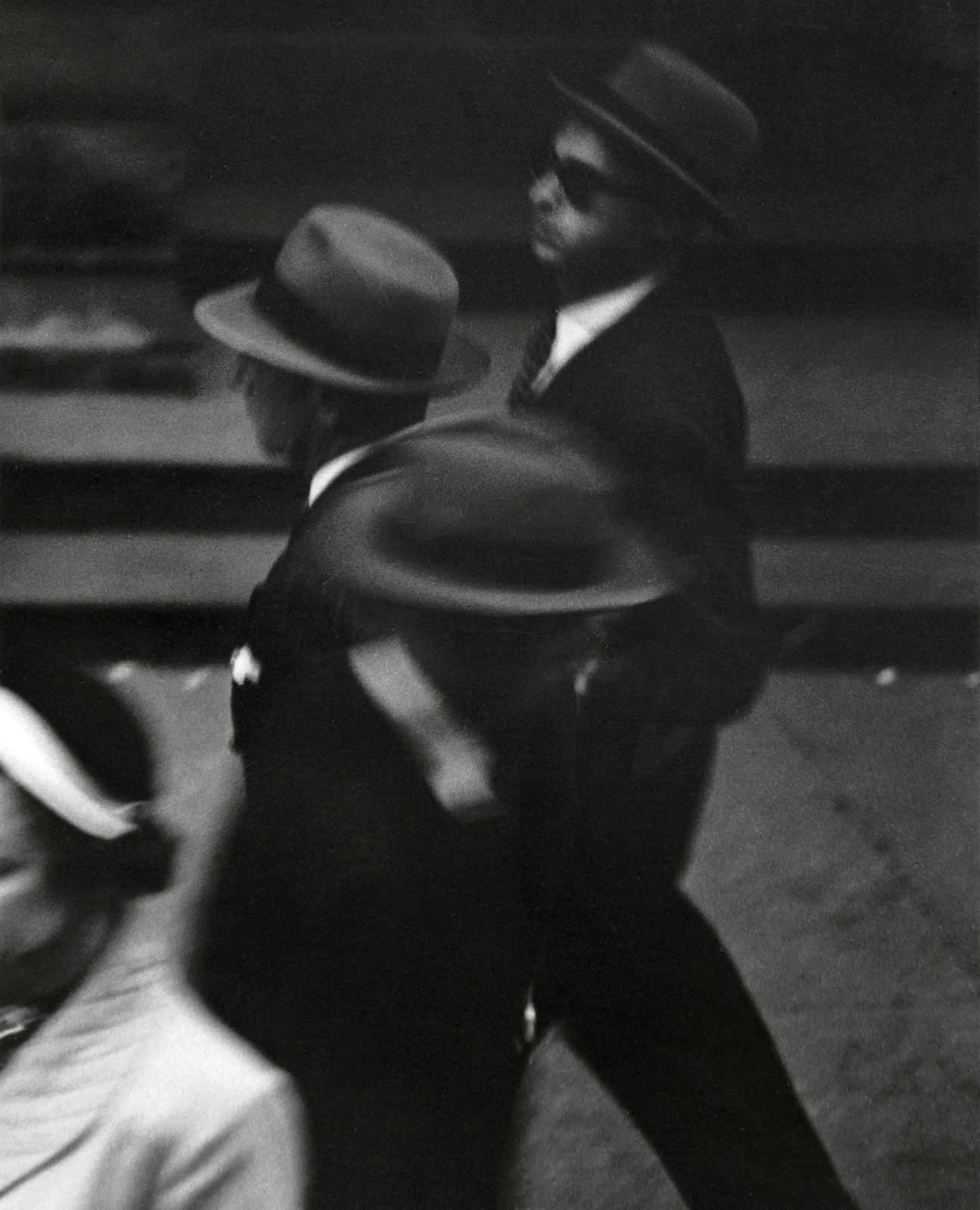
Photo: Marcus Bunyan


Light and time are both the means and subject of Hiroshi Sugimoto’s Drive-In Theaters series. To produce the images, the artist directs his camera at the movie screen. Once the film starts, Sugimoto opens the lens shutter of his large-format camera and shuts it the moment the movie ends. The result is a visual condensation of the moving images and projected light of the film for its duration into a vivid, hovering rectangle of virtually pulsating light and, in the case of this drive-in cinema, the surrounding human-made and astronomical light, too.

Wall text from the exhibition


Installation view of the exhibition 'Photography: Real & Imagined' at The Ian Potter Centre: NGV Australia, Melbourne showing David Noonan's 'Untitled' (1992)


Installation view of the exhibition Photography: Real & Imagined at The Ian Potter Centre: NGV Australia, Melbourne showing David Noonan’s Untitled (1992)
Photo: Marcus Bunyan


László Moholy-Nagy (Hungarian 1895-1946, Germany 1920-1934, England 1935-1937, United States 1937-1946) 'Fotogram, 1925' 1925


László Moholy-Nagy (Hungarian 1895-1946, Germany 1920-1934, England 1935-1937, United States 1937-1946)
Fotogram, 1925
1925
Gelatin silver photograph
National Gallery of Victoria, Melbourne
Presented by the National Gallery Society of Victoria, 1985
Public domain


From 1922 to 1943 László Moholy-Nagy experimented extensively with the photogram process – he was passionate about the optical effects and inherent properties of these camera-less images freed from a purely representational mode. In this work a pale shape, an organic swathe, streams across a page while curved shapes dance at the base. A halo above emits small geometric patterns. The work is a celebration of abstraction of the image – of the effects of playing with light, objects and photographic paper in a darkroom.

Wall text from the exhibition


Installation view of the exhibition Photography: Real & Imagined at The Ian Potter Centre: NGV Australia, Melbourne showing at left, Barbara Kasten's Composition 8T (2018); and at right, Lydia Wegner's Purple square (2017)


Installation view of the exhibition Photography: Real & Imagined at The Ian Potter Centre: NGV Australia, Melbourne showing at left, Barbara Kasten’s Composition 8T (2018, below); and at right, Lydia Wegner’s Purple square (2017, below)
Photo: Marcus Bunyan


Barbara Kasten (American, b. 1936) 'Composition 8T' 2018


Barbara Kasten (American, b. 1936)
Composition 8T
2018
Digital type C print
160.0 x 121.9cm (image and sheet)
ed. 1/1
National Gallery of Victoria, Melbourne
Purchased NGV Foundation, 2018
© Barbara Kasten, courtesy Kadel Willborn, Düsseldorf


This photograph from Barbara Kasten’s Collisions/Compositions series continues her practice of creating architectural spaces in the studio using a range of materials, such as plexiglas and mirrors, which she lights and photographs at close range. Influenced by Constructivism and the teachings of the Bauhaus, specifically the work of László Moholy-Nagy, Kasten has experimented with the parameters of abstract photography for around five decades. She has written of her ongoing fascination with light in the creation and conceptual development of her photographs, saying, ‘The interdependency of shadow and light is the essence of photographic exploration and an inescapable part of the photographic process’.

Wall text from the exhibition


Installation view of the exhibition Photography: Real & Imagined at The Ian Potter Centre: NGV Australia, Melbourne showing Lydia Wegner's 'Purple square' (2017)


Installation view of the exhibition Photography: Real & Imagined at The Ian Potter Centre: NGV Australia, Melbourne showing Lydia Wegner’s Purple square (2017)
Photo: Marcus Bunyan


Installation view of the exhibition 'Photography: Real & Imagined' at The Ian Potter Centre: NGV Australia, Melbourne showing at left, Todd McMillan's 'Equivalent VIII' (2014); and at right, Sue Pedley's 'Sound of lotus 1' (2000)


Installation view of the exhibition Photography: Real & Imagined at The Ian Potter Centre: NGV Australia, Melbourne showing at left, Todd McMillan’s Equivalent VIII (2014); and at right, Sue Pedley’s Sound of lotus 1 (2000)
Photo: Marcus Bunyan


Installation view of the exhibition 'Photography: Real & Imagined' at The Ian Potter Centre: NGV Australia, Melbourne


Installation view of the exhibition Photography: Real & Imagined at The Ian Potter Centre: NGV Australia, Melbourne showing at back left, Thomas Ruff’s Portrait (V. Liebermann D) (1999); and at back second left, Ruff’s Portrait (A. Koschkarow) (2000)
Photo: Marcus Bunyan


Installation view of the exhibition Photography: Real & Imagined at The Ian Potter Centre: NGV Australia, Melbourne showing at left, Thomas Ruff’s 'Portrait (V. Liebermann D)' (1999); and at right, Ruff's 'Portrait (A. Koschkarow)' (2000)


Installation view of the exhibition Photography: Real & Imagined at The Ian Potter Centre: NGV Australia, Melbourne showing at left, Thomas Ruff’s Portrait (V. Liebermann D) (1999); and at right, Ruff’s Portrait (A. Koschkarow) (2000)
Photo: Marcus Bunyan


The earnest gazes of the man and woman in these two monumental photographs by Thomas Ruff are so calm and serene that they bely the intense experience of viewing their enlarged faces. Applying a standardised approach – similar to a generic passport photograph – these portraits have a timeless quality that invites you to attempt to ‘read’ their faces and to search for clues as to the inner state of the person. Ruff, however, lets nothing slip. The faces are known to the artist but remain anonymous to the viewer.

Wall text from the exhibition


Installation view of the exhibition 'Photography: Real & Imagined' at The Ian Potter Centre: NGV Australia, Melbourne showing Robert Rooney's 'AM-PM: 2 Dec 1973-28 Feb 1974' (1973-1974) (detail)


Installation view of the exhibition Photography: Real & Imagined at The Ian Potter Centre: NGV Australia, Melbourne showing Robert Rooney’s AM-PM: 2 Dec 1973-28 Feb 1974 (1973-1974) (detail)
Photo: Marcus Bunyan


Featuring some of the most iconic photographs ever created alongside contemporary approaches to the photographic medium, Photography: Real & Imagined is the largest survey of the NGV’s Photography collection in the institution’s history and features more than 270 photographs by Australian and international practitioners.

Four years in the making, this landmark exhibition features photographs from across the 200-year period since the invention of photography in the 19th century, including work by leading international photographers including Man Ray, Cindy Sherman, Wolfgang Tillmans, Gilbert & George and Nan Goldin, alongside Australian photographers Max Dupain, Olive Cotton, Mervyn Bishop, Polly Borland, Destiny Deacon and Darren Sylvester.

Through twenty-one thematic sections, this large-scale exhibition explores the proposition that a photograph can be grounded in the real world, recording, documenting and reflecting the world around us; or be the product of imagination, storytelling and illusion; and on occasion operate in both realms. The thematic sections explore subject matter such as light, place and environment, consumption, conflict, community, and death.

Exhibition highlights include Mervyn Bishop’s important photograph of former Prime Minister of Australia, Gough Whitlam, pouring sand into the open palm of Gurindji Elder Vincent Lingiari. The 1975 image captures the historic meeting between these two figures where Lingiari received the crown lease of his ancestral lands. Also on display is Joe Rosenthal’s World War II photograph Raising the flag on Iwo Jima, 1945, in which American marines raise their country’s flag over the Japanese Island. Both Bishop and Rosenthal’s photographs were staged, or re-constructed for better pictorial effect, illustrating the fluid space between the real and imagined.

The exhibition also presents fashion and advertising photography, including key examples by Lilian Bassman, Athol Smith, Horst P. Horst and Dora Maar. These images showcase a world of designer fashion and high-end products, which set a standard in advertising that continues today. Ilse Bing’s Surrealist inspired photograph commissioned by Elsa Schiaparelli to launch her new perfume Salut in 1934 is a highlight of the exhibition.

Highlighting an area of focused collecting for the NGV, the exhibition recognises the work of women practicing in the early 20th century, including Barbara Morgan whose acclaimed photo montage City shell, 1938, shows an unexpected view of the then recently completed Empire State Building.

Through to the current day, Photography: Real & Imagined presents contemporary photographers of the 21st century including Zanele Muholi, Richard Mosse and Alex Prager. Highlights include Cindy Sherman’s celebrated self-portrait in the guise of Renaissance aristocrat. Also on display will be the oldest photographic work in the NGV Collection, an early 19th century portrait by Englishman William Henry Fox Talbot, one of the inventors of the medium, as well as examples of daguerreotypes, unique images on silver plated copper sheets that are amongst the earliest forms of photography.

The exhibition is accompanied by a major publication – the most ambitious book published on the NGV Photography Collection, generously supported by the Bowness Family Foundation. The publication comprises essays from NGV Senior Curator of Photography, Susan van Wyk, Susan Bright and David Campany; alongside texts by Curator of Photography, Maggie Finch and external authors from Australia, Europe, North America and Southeast Asia.

Regular introductory talks for students are held on weekdays during term times, and free drop-by guided tours each Thursday and Sunday at 10.30am during the exhibition period.

Tony Ellwood AM, Director, NGV, said: ‘This exhibition celebrates the collections and achievements of the NGV’s photography department, which has presented more than 180 exhibitions in its 55-year history. The exhibition is a testament to the strength of the NGV Collection, with so many key examples of the history of photography represented, from the earliest examples from the 19th century, through to contemporary images being produced right now in the twenty-first century. We are grateful for the support of the many donors and philanthropists, such as the Bowness Family Foundation, who have helped to grow and strengthen the NGV’s photography collection.’

Press release from the NGV


Installation view of the exhibition 'Photography: Real & Imagined' at The Ian Potter Centre: NGV Australia, Melbourne at top left, O. G. Rejlander's 'The Virgin in prayer' (c. 1858-1860); at bottom left, Henry Peach Robinson's 'Elaine watching the shield of Lancelot' (1859); at centre, Ruth Hollick's 'Thought' (1921); and at right Cindy Sherman's 'Untitled' (1988) from the 'History Portraits' series (1988-1990)


Installation view of the exhibition Photography: Real & Imagined at The Ian Potter Centre: NGV Australia, Melbourne at top left, O. G. Rejlander’s The Virgin in prayer (c. 1858-1860, below); at bottom left, Henry Peach Robinson’s Elaine watching the shield of Lancelot (1859); at centre, Ruth Hollick’s Thought (1921); and at right Cindy Sherman’s Untitled (1988) from the History Portraits series 1988-1990
Photo: Marcus Bunyan


Describing the complex conundrum presented by Cindy Sherman in this photograph, photographer and curator Patrick Pound once wrote: ‘Fake chested and with a face like a mask, here Cindy Sherman is costumed to the max. She stares out like a disapproving Renaissance figure who has just walked off set from a Peter Greenaway extravaganza. Here we have a photographer looking like a painting that walked out of a film. Sherman’s photographs speak of the fragilities of the visage in an image-saturated world where information and construction slip into foreplay. In Sherman’s photographic world gender and identity is a compilation album. There is a toughness to the excess that is all her own’.

Wall text from the exhibition


Installation view of the exhibition Photography: Real & Imagined at The Ian Potter Centre: NGV Australia, Melbourne showing O. G. Rejlander's 'The Virgin in prayer' (c. 1858-1860)


Installation view of the exhibition Photography: Real & Imagined at The Ian Potter Centre: NGV Australia, Melbourne showing O. G. Rejlander’s The Virgin in prayer (c. 1858-1860, below)
Photo: Marcus Bunyan


Henry Peach Robinson (English, 1830-1901) 'Elaine watching the shield of Lancelot' 1859


Henry Peach Robinson (English, 1830-1901)
Elaine watching the shield of Lancelot
1859
Albumen silver photograph
24.3 × 19.3cm (image and sheet)
National Gallery of Victoria, Melbourne
Purchased from Admission Funds, 1988
Public domain


In the 1850s Henry Peach Robinson was renowned for producing elaborately staged narrative images based on scenes from popular literary sources. He was particularly interested in Arthurian legends and drew upon these stories as inspiration for some of his most admired photographs. Elaine watching the shield of Lancelot is based on Alfred Tennyson’s version of the story of Lancelot and Elaine. Peach Robinson has recreated the scene in which the lovelorn Elaine gazes dreamily at the shield of Lancelot. She is shown as a woman who has shunned reason and propriety and abandoned herself to the intensity of her emotions, making this photograph both a tragic love story and a cautionary narrative.

Wall text from the exhibition


Ruth Hollick (Australian, 1883-1977) 'Thought' 1921


Ruth Hollick (Australian, 1883-1977)
Thought
1921
Gelatin silver photograph
37.4 × 25.3cm
National Gallery of Victoria, Melbourne
Presented through The Art Foundation of Victoria by Mrs Lucy Crosbie Morrison, Member, 1993
Public domain


Installation view of the exhibition 'Photography: Real & Imagined' at The Ian Potter Centre: NGV Australia, Melbourne


Installation view of the exhibition Photography: Real & Imagined at The Ian Potter Centre: NGV Australia, Melbourne
Photo: Marcus Bunyan


Installation view of the exhibition 'Photography: Real & Imagined' at The Ian Potter Centre: NGV Australia, Melbourne


Installation view of the exhibition Photography: Real & Imagined at The Ian Potter Centre: NGV Australia, Melbourne showing Bernd and Hilla Becher’s Coal tipple, Goodspring, Pennsylvania 1975 from the Artists and Photographs folio 1975
Photo: Marcus Bunyan


In 1959, German-born artists Bernd and Hilla Becher began travelling throughout Europe to create photographic typologies of vanishing industrial architecture (a practice they continued for more than four decades). While predominantly documenting German structures and landscapes, they occasionally worked overseas. This image, four views of a coal tipple, was taken on their first trip to North America in the mid 1970s. The Bechers constructed a system for comparing structures: photographed from a consistent angle, with virtually identical lighting conditions, printed at the same size and often displayed in grids.

Wall text from the exhibition


Edward Ruscha (American, b. 1937) 'Twentysix Gasoline Stations' 1963, published 1967 (installation view)

Edward Ruscha (American, b. 1937) 'Twentysix Gasoline Stations' 1963, published 1967 (installation view)


Edward Ruscha (American, b. 1937)
Twentysix Gasoline Stations (installation view)
1963, published 1967
Artist’s book: photo-offset lithograph and printed text, 48 pages, printed cover, glued binding
National Gallery of Victoria, Melbourne
Gift of Robert Rooney through the Australian Government’s Cultural Gifts Program, 2009
Photos: Marcus Bunyan


With the first publication of Twentysix Gasoline Stations, and his subsequent artist books, Edward Ruscha’s work was influential in initiating the widespread interest in photographic book publishing that continues today. Ruscha’s use of photographs as a means of recording – a seemingly unemotional, detached cataloguing of the world – and simply as a ‘device to complete the idea’ influenced the interest in serial imaging adopted by many conceptual artists. Ruscha’s use of the book format was also crucial, providing a transportable way of presenting art in varied contexts that existed as a type of ‘map’ to be read and interpreted, with the subject matter becoming less important than the documentation as a whole.

Wall text from the exhibition


John Baldessari (American 1931-2020) ‘Fable: A Sentence of Thirteen Parts (with Twelve Alternate Verbs) Ending in a Fable’ 1977 (installation view)

John Baldessari (American 1931-2020) ‘Fable: A Sentence of Thirteen Parts (with Twelve Alternate Verbs) Ending in a Fable’ 1977 (installation view)


John Baldessari (American 1931-2020)
Fable: A Sentence of Thirteen Parts (with Twelve Alternate Verbs) Ending in a Fable (installation views)
1977
Artist’s book: photo-offset lithography on concertina fold-out in cross formation, folded paper cover
9.8 × 14.0 × 1.8cm (closed) 70.0 × 126.5cm approx. (overall, opened)
National Gallery of Victoria, Melbourne
Purchased, Friends of the Gallery Library, 2017
Photos: Marcus Bunyan


Conceptual artist John Baldessari, is renowned for his often-playful investigations into ideas of language, image and authenticity, once said: ‘I was always interested in language. I thought, why not? … And then I also had a parallel interest in photography … I could never figure out why photography and art had separate histories. So I decided to explore both’. Taking art off the walls and requiring someone to unfold and activate it is a central idea of this artist’s book. A visual puzzle, it invites an interaction between looking and reading, creating your own fables as you jump from image to word to image again.

Wall text from the exhibition


Eve Sonneman (American, b. 1946) 'Real time' 1968-1974 (installation view)

Eve Sonneman (American, b. 1946) 'Real time' 1968-1974 (installation view)


Eve Sonneman (American, b. 1946)
Real time (installation view)
1968-1974, published 1976
Artist’s book: photo-offset lithograph and printed text, 46 folios, printed paper cover, glued binding
National Gallery of Victoria, Melbourne
Purchased NGV Supporters of Photography, 2021
Photos: Marcus Bunyan


Eve Sonneman’s photobook Real time includes paired photographs, each separated by a black line border. The diptychs allow for the occurrence of movement and gestures and changes between the artist’s camera clicks. The ordered presentation, however, takes the images away from a straight documentary reading and to a consideration of their ‘objectness’. After first showing the photographs at MoMA, New York, then photography curator, John Szarkowski, set up a mentorship for Sonneman with the photographer Diane Arbus. As Sonneman recalled: ‘[Arbus] loved my pictures and we got along great. For two years she helped me edit’. Sonneman then published the images through the newly established Printed Matter in New York in 1976.

Wall text from the exhibition


Installation view of the exhibition 'Photography: Real & Imagined' at The Ian Potter Centre: NGV Australia, Melbourne showing at top left, Carol Jerrems and Virginia Fraser's book 'A Book About Australian Women' (1974);  at top centre, Nan Goldin's book 'The Ballad of Sexual Dependency' (1986); and at bottom left, Tracey Emin's 'Exploration of the Soul' (1994) 


Installation view of the exhibition Photography: Real & Imagined at The Ian Potter Centre: NGV Australia, Melbourne showing at top left, Carol Jerrems and Virginia Fraser’s book A Book About Australian Women (published 1974);  at top centre, Nan Goldin’s book The Ballad of Sexual Dependency (published 1986); and at bottom left, Tracey Emin’s Exploration of the Soul (published 1994)
Photo: Marcus Bunyan


Installation view of the exhibition 'Photography: Real & Imagined' at The Ian Potter Centre: NGV Australia, Melbourne showing at bottom left, Harold Cazneaux's book 'The Bridge Book' (published 1930); and at top right, Lee Friedlander's 'The American Monument' (published 1976)


Installation view of the exhibition Photography: Real & Imagined at The Ian Potter Centre: NGV Australia, Melbourne showing at bottom left, Harold Cazneaux’s book The Bridge Book (published 1930); and at top right, Lee Friedlander’s book The American Monument (published 1976)
Photo: Marcus Bunyan


Lee Friedlander (American, b. 1934) 'The American Monument' Published by The Eakins Press Foundation, New York, 1976 (installation view)


Lee Friedlander (American, b. 1934)
The American Monument (installation view)
Published by The Eakins Press Foundation, New York, 1976
Half-tone plate
Shaw Research Library, National Gallery of Victoria
Photo: Marcus Bunyan


Berenice Abbott (American 1898-1991, worked in France 1921-1929) 'Changing New York' Published by E. P. Dutton & Co, New York, 1939 (installation view)


Berenice Abbott (American 1898-1991, worked in France 1921-1929)
Changing New York (installation view)
Published by E. P. Dutton & Co, New York, 1939
Half-tone plate and letterpress text
National Gallery of Victoria, Melbourne
Purchased NGV Foundation, 2022
Photo: Marcus Bunyan


Installation view of the exhibition 'Photography: Real & Imagined' at The Ian Potter Centre: NGV Australia, Melbourne showing at top left, Man Ray's book 'Photographs by Man Ray Paris 1920-1934' (published 1934); at bottom left, Claude Cahun and Marcel Moore's book 'Aveux non Avenus' (Disavowals or Cancelled Confessions) (published 1930); at top right, Bill Brandt's book 'Perspective of Nudes' (published 1961); and at bottom right, Germaine Krull's book 'Nude studies' (Études de nu) (published 1930)


Installation view of the exhibition Photography: Real & Imagined at The Ian Potter Centre: NGV Australia, Melbourne showing at top left, Man Ray’s book Photographs by Man Ray Paris 1920-1934 (published 1934); at bottom left, Claude Cahun and Marcel Moore’s book Aveux non Avenus (Disavowals or Cancelled Confessions) (published 1930); at top right, Bill Brandt’s book Perspective of Nudes (published 1961); and at bottom right, Germaine Krull’s book Nude studies (Études de nu) (published 1930)
Photo: Marcus Bunyan


Photographs today are often viewed in galleries in frames, hung on walls. Many photographs, however, were originally created for display in combination with text and graphic design; to be laid out on a page and reproduced in different formats; to be held, worn on the body, published, and shared.

With recognition of these expanded histories of photography, and the contemporary resurgence in publishing, this exhibition includes artist books, magazines and photobooks that use the photographic image in print, publishing and design. These two cases include examples that show the influence of Surrealism, the New Objectivity and Constructivist graphic design in dynamic modern publications.

Artist and author Martin Parr has described the photobook as the ‘supreme platform’ for photographers to share the work with a broad audience. The 1920s to the 1970s were arguably the most important period for the publication of photobooks. These two cases include examples that show the influence of modernist, humanist and documentary photography traditions in innovative publications from this time. These include exhibition catalogues, examples of first edition books, publications published in larger un-editioned print runs and coveted collectable limited-edition books and portfolios.

Wall text from the exhibition


Installation view of the exhibition 'Photography: Real & Imagined' at The Ian Potter Centre: NGV Australia, Melbourne showing Man Ray’s book 'Photographs by Man Ray Paris 1920-1934' published 1934


Installation view of the exhibition Photography: Real & Imagined at The Ian Potter Centre: NGV Australia, Melbourne showing Man Ray’s book Photographs by Man Ray Paris 1920-1934 (published 1934) with at right, Man Ray’s Anatomies (1930, below)
Photo: Marcus Bunyan


Man Ray (1890-1976) 'Anatomies' 1930


Man Ray (Emmanuel Radnitzky) (American, 1890-1976)
Anatomies
1930
Gelatin silver photograph

Please note: this photograph is not in the exhibition


Claude Cahun (French, 1894-1954) Marcel Moore (French, 1892-1972) 'Aveux non Avenus' (Disavowals or Cancelled Confessions) Published by Éditions du Carrefour, Paris, 1930 (installation view)

Claude Cahun (French, 1894-1954) Marcel Moore (French, 1892-1972) 'Aveux non Avenus' (Disavowals or Cancelled Confessions) Published by Éditions du Carrefour, Paris, 1930 (installation view)


Claude Cahun (French, 1894-1954) Marcel Moore (French, 1892-1972)
Aveux non Avenus (Disavowals or Cancelled Confessions) (installation view)
Published by Éditions du Carrefour, Paris, 1930
Illustrated book: photogravure, letterpress text, 237 pages, 10 leaves of plates, paper cover, stitched binding
National Gallery of Victoria, Melbourne
Shaw Research Library, acquired through the Friends of the Gallery Library endowment, 2017
Photos: Marcus Bunyan


Aveux non Avenus, by the celebrated poet, writer, sculptor and photographer Claude Cahun, was published in 1930 by Éditions du Carrefour, Paris, in an edition of five hundred. The book comprises a series of texts in French: poems, literary aphorisms, recollections of dream sequences and philosophical thoughts, ideas and meanderings. Pierre Mac Orlan, a French novelist who wrote the preface to the book, described Mademoiselle Claude Cahun’s text as ‘de poèmes-essais et d’essais-poèmes’, or ‘poem-essays and essay-poems’, and said that overall ‘the book is virtually entirely dedicated to the word adventure’

The alliterative title presents a conundrum for English translation – ‘aveux’ meaning ‘avowals’ or ‘confessions’, and ‘non avenus’ meaning ‘voided’ – and is variously translated as Disavowals, Denials, and Unavowed confessions, among other things. Curator Jennifer Mundy has written that the title suggests ‘an affirmative expression immediately followed by some form of negation or retraction’.

Ambiguities around the title aside, there is a strong visual aspect to the book too. The texts are each demarcated with a complex and fantastical photogravure created by Cahun’s partner, Marcel Moore. These photogravure (where an image from the negative of a photograph is etched into a metal plate, similar to printmaking) are collages made up of photographic images of, and by, Cahun. Throughout the book, graphic devices of stars, eyes and lips are also used to separate sections of text. Aveux non Avenus, which has been described as an anti-realist or surrealist-autobiography of the multi-disciplinary Cahun, exists as a potential critique of the autobiography format altogether, is wonderfully irreducible.

Maggie Finch and Isobel Crombie. “Claude Cahun,” in the 2019 July/August edition of NGV Magazine on the NGV website 9th April 2020 [Online] Cited 28/01/2024


Claude Cahun (French, 1894-1954) and Marcel Moore (French, 1892-1972) 'Untitled' 1930


Claude Cahun (French, 1894-1954) and Marcel Moore (French, 1892-1972)
Untitled
1930
In Aveux non avenus 1930
published by Éditions du Carrefour, Paris
illustrated book: heliographs
National Gallery of Victoria, Melbourne
Shaw Research Library, acquired through the Friends of the Gallery Library endowment, 2017


Germaine Krull (German, 1897-1985) 'Nude Studies' (Études de Nu) Published by Librarie des arts décoratifs, Paris, 1930 (installation view)


Germaine Krull (German, 1897-1985)
Nude Studies (Études de Nu) (installation view)
Published by Librarie des arts décoratifs, Paris, 1930
24 photogravures, letterpress on paper, white cloth-backed orange paper-covered board portfolio with ribbons
National Gallery of Victoria
Purchased, NGV Foundation, 2022
Photo: Marcus Bunyan


Bill Brandt (English born Germany, 1904-1983) 'Perspective of Nudes' Published Bodley Head, London, 1961 (installation view)


Bill Brandt (English born Germany, 1904-1983)
Perspective of Nudes (installation view)
Published Bodley Head, London, 1961
Half-tone plate
Shaw Research Library, National Gallery of Victoria
Photo: Marcus Bunyan


Karl Blossfeldt (German, 1865-1932) 'Art Forms in Nature: Examples from the Plant World Photographed Direct from Nature' Published by A. Zwemmer, London, 1929 (installation view)


Karl Blossfeldt (German, 1865-1932)
Art Forms in Nature: Examples from the Plant World Photographed Direct from Nature (installation view)
Published by A. Zwemmer, London, 1929
Half-tone plate
Shaw Research Library, National Gallery of Victoria
Photo: Marcus Bunyan


Karel Teige typographer (Czechoslovakia 1900-1951) Karel Paspa photographer (Czechoslovakia 1862-1936) 'ABECEDA (Alphabet)' Published by J. Otto, Prague, 1926 (installation view)


Karel Teige typographer (Czechoslovakia 1900-1951)
Karel Paspa photographer (Czechoslovakia 1862-1936)
ABECEDA (Alphabet) (installation view)
Published by J. Otto, Prague, 1926
Photomontage
National Gallery of Victoria
Shaw Research Library, acquired through the Friends of the Gallery Library endowment, 2017
Photo: Marcus Bunyan


Aleksandr Rodchenko (Russian, 1891-1958) Varvara Stepanova (Russian, 1894-1958) 'USSR in Construction, no. 12 (Parachute issue)' (URSS en Construction) 1935


Aleksandr Rodchenko (Russian, 1891-1958) and Varvara Stepanova (Russian, 1894-1958)
USSR in Construction, no. 12 (Parachute issue) (URSS en Construction) (installation view)
1935
Illustrated journal: colour rotogravure, 22 pages with fold-out inserts, lithographic cover
National Gallery of Victoria
Purchased, NGV Supporters of Prints and Drawings, 2019
Photo: Marcus Bunyan


Installation view of the exhibition 'Photography: Real & Imagined' at The Ian Potter Centre: NGV Australia, Melbourne showing at top left, Eliza Hutchinson's 'No. 9' (2010); at bottom left, Ewa Narkiewicz's 'Copper flax #4' (1999); at centre top, Harry Nankin's 'The first wave: fragment 2' (1996); at centre bottom, Peter Peryer's 'Seeing' (1989); and at right, Aaron Siskind's 'New York' (1950)


Installation view of the exhibition Photography: Real & Imagined at The Ian Potter Centre: NGV Australia, Melbourne showing at top left, Eliza Hutchinson’s No. 9 (2010); at bottom left, Ewa Narkiewicz’s Copper flax #4 (1999); at centre top, Harry Nankin’s The first wave: fragment 2 (1996); at centre bottom, Peter Peryer’s Seeing (1989); and at right, Aaron Siskind’s New York (1950)
Photo: Marcus Bunyan


In much the same way that tactile writing systems such as braille are impenetrable to those with vision, a photograph printed in two dimensions can be incomprehensible for people with vision impairment. Each system presents a conversion – of letters, texts and illustration – into raised dots on a page; of visible wavelengths of light into an image on a light-sensitive surface. Each relies on an irreversible alteration of the surface. Seeing, the title of this Peter Peryer photograph, infers an action – seeing something. Yet the conversion into a photographic image draws attention to the impenetrability of both acts.

Wall text from the exhibition


Installation view of the exhibition 'Photography: Real & Imagined' at The Ian Potter Centre: NGV Australia, Melbourne showing at left, Gregory Crewdson's 'Untitled' (1999) from the Twilight series (1998-2002); at centre, Malerie Marder's 'Untitled' (2001); and at right, Anne Zahalka's 'Sunday, 2:09pm' (1995) 


Installation view of the exhibition Photography: Real & Imagined at The Ian Potter Centre: NGV Australia, Melbourne showing at left, Gregory Crewdson’s Untitled (1999) from the Twilight series (1998-2002); at centre, Malerie Marder’s Untitled (2001); and at right, Anne Zahalka’s Sunday, 2:09pm (1995)
Photo: Marcus Bunyan


Gregory Crewdson (American, b. 1962) 'Untitled' 1999 (installation view)


Gregory Crewdson (American, b. 1962)
Untitled (installation view)
1999
From the Twilight series 1998-2002
Type C photograph
121.9 × 152.4cm
National Gallery of Victoria, Melbourne
Kaiser Bequest, 2000
Photo: Marcus Bunyan


Anne Zahalka (Australian, b. 1957) 'Sunday, 2:09pm' 1995, printed 2019 (installation view)


Anne Zahalka (Australian, b. 1957)
Sunday, 2:09pm
1995, printed 2019
From the Open House series 1995
Colour cibachrome transparency, light box
121.7 × 161.4cm
National Gallery of Victoria, Melbourne
Purchased, Victorian Foundation for Living Australian Artists, 2019
Photo: Marcus Bunyan


Installation view of the exhibition 'Photography: Real & Imagined' at The Ian Potter Centre: NGV Australia, Melbourne showing at left, Polly Borland's 'Untitled' (2018); and at right, Anne Zahalka's 'Sunday, 2:09pm' (1995)


Installation view of the exhibition Photography: Real & Imagined at The Ian Potter Centre: NGV Australia, Melbourne showing at left, Polly Borland’s Untitled (2018); and at right, Anne Zahalka’s Sunday, 2:09pm (1995)
Photo: Marcus Bunyan


Installation view of the exhibition 'Photography: Real & Imagined' at The Ian Potter Centre: NGV Australia, Melbourne showing at rear from left to right, Gregory Crewdson's 'Untitled' (1999) from the 'Twilight' series (1998-2002); at second left, Malerie Marder's 'Untitled' (2001); and centre, Anne Zahalka's 'Sunday, 2:09pm' (1995); and at right, Alex Prager's 'Crowd #11 (Cedar and Broad Street)' (2013)


Installation view of the exhibition Photography: Real & Imagined at The Ian Potter Centre: NGV Australia, Melbourne showing at rear from left to right, Gregory Crewdson’s Untitled (1999) from the Twilight series (1998-2002); at second left, Malerie Marder’s Untitled (2001); and centre, Anne Zahalka’s Sunday, 2:09pm (1995); and at right, Alex Prager’s Crowd #11 (Cedar and Broad Street) (2013, below)
Photo: Marcus Bunyan


Installation view of the exhibition Photography: Real & Imagined at The Ian Potter Centre: NGV Australia, Melbourne showing Alex Prager's 'Crowd #11 (Cedar and Broad Street)' (2013)


Installation view of the exhibition Photography: Real & Imagined at The Ian Potter Centre: NGV Australia, Melbourne showing Alex Prager’s Crowd #11 (Cedar and Broad Street) (2013, below)
Photos: Marcus Bunyan


Alex Prager (American, b. 1979) 'Crowd #11 (Cedar and Broad Street)' 2013


Alex Prager (American, b. 1979)
Crowd #11 (Cedar and Broad Street)
2013
Inkjet print
149.7 × 142.0cm (image and sheet)
National Gallery of Victoria, Melbourne
Bowness Family Fund for Contemporary Photography, 2014


Alex Prager’s staged photographs openly reference the aesthetics of mid-twentieth century American cinema, fashion photography and the photographs of Cindy Sherman. Her images resemble film stills and are packed with emotion and human melodrama. Working with actors, directing their placement and interaction to create a hyperreal dramatisation of crowd behaviour, Prager’s narrative tableaux pair the banal and fantastic, the everyday and the theatrical, real life and cinematic representation. In this image we have a bird’s eye view of a mass of people crossing the road. We can see the patterns of movement, contact and avoidance and a suggestion of the narrative possibilities of the interacting crowd.

Wall text from the exhibition


Installation view of the exhibition 'Photography: Real & Imagined' at The Ian Potter Centre: NGV Australia, Melbourne showing at second right, Pat Brassington's 'Rosa' (2014); and at right, Yvonne Todd's 'Werta' (2005)


Installation view of the exhibition Photography: Real & Imagined at The Ian Potter Centre: NGV Australia, Melbourne showing at second right, Pat Brassington’s Rosa (2014); and at right, Yvonne Todd’s Werta (2005)
Photo: Marcus Bunyan


Zoë Croggon (Australian, b. 1989) 'Fonteyn' 2012 (installation view)


Zoë Croggon (Australian, b. 1989)
Fonteyn (installation view)
2012
Digital type C print
102.8 × 99.9cm
Purchased with funds arranged by Loti Smorgon for Contemporary Australian Photography, 2013
Photo: Marcus Bunyan


Installation view of the exhibition 'Photography: Real & Imagined' at The Ian Potter Centre: NGV Australia, Melbourne showing Loretta Lux's 'The Drummer' (2004)


Installation view of the exhibition Photography: Real & Imagined at The Ian Potter Centre: NGV Australia, Melbourne showing Loretta Lux’s The Drummer (2004, below)
Photo: Marcus Bunyan


Loretta Lux (German, b. 1969) 'The drummer' 2004


Loretta Lux (German, b. 1969)
The drummer
2004
Cibachrome photograph
45.0 x 37.7cm
National Gallery of Victoria, Melbourne
Purchased, NGV Foundation, 2006
© Loretta Lux. VG Bild-Kunst/Copyright Agency, 2023


Loretta Lux is known for her eerie, hyperreal photographs of children. The luminous pallor of the boy’s skin and the subtle tonal range throughout the photograph is achieved through Lux’s delicate use of digital manipulation to reduce the palette in her image. Lux’s history as a painter informs photographs such as this, which seem to owe as much of a debt to Old Master paintings as modern technology. Her skilful combination of photographic reality and painterly effect gives the image a profoundly disconcerting quality that is reminiscent of the fantastical (and disturbing) character of Oskar, the little drummer boy, in the Günter Grass novel The Tin Drum (1959).
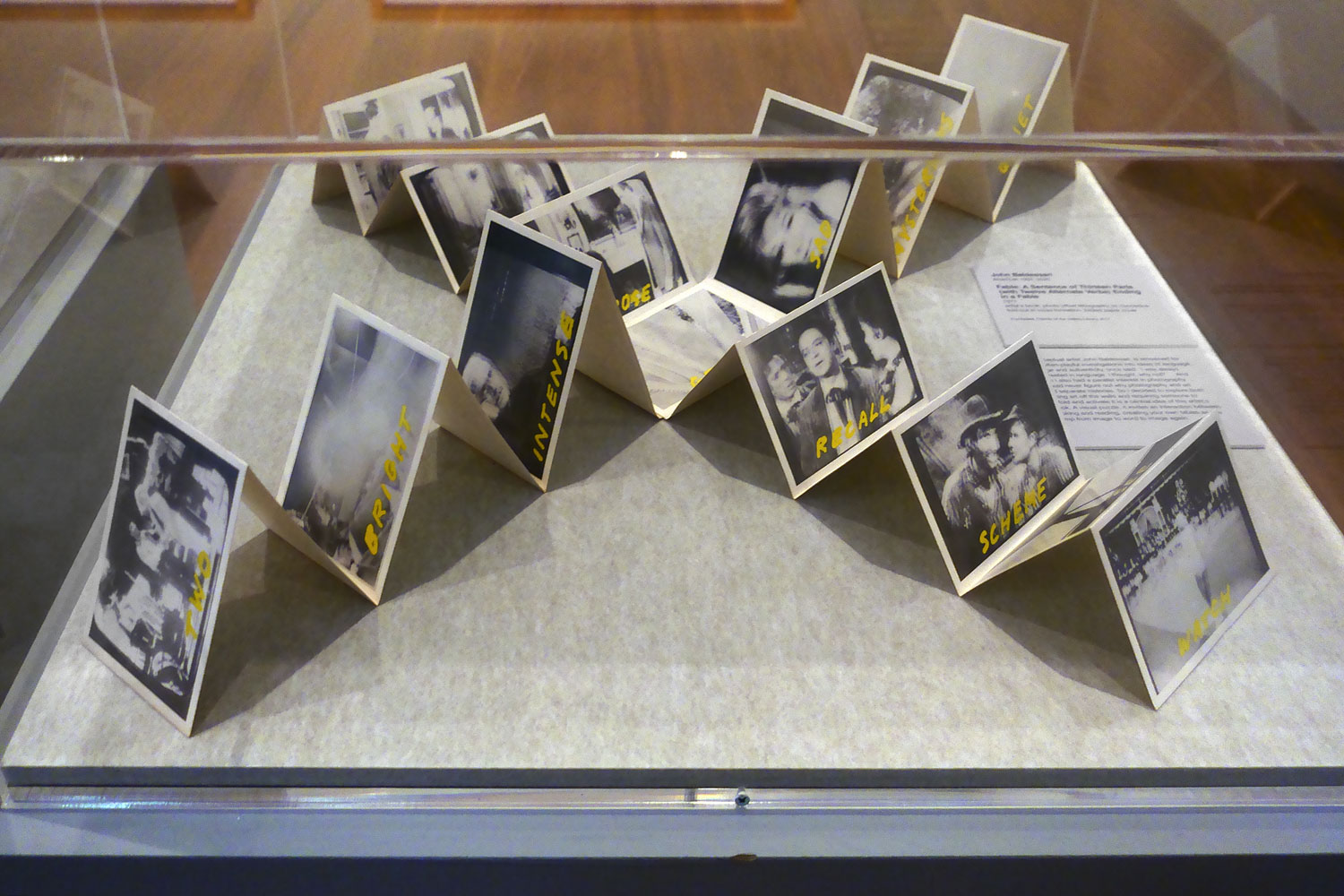
Wall text from the exhibition


Installation view of the exhibition 'Photography: Real & Imagined' at The Ian Potter Centre: NGV Australia, Melbourne showing at bottom left, Raoul Ubac's 'Penthésilée' (c. 1938, below); at top centre, André Kertész's Satiric Dancer, Paris (1926, below); and at right, Max Dupain's 'Impassioned clay' (1936, below)


Installation view of the exhibition Photography: Real & Imagined at The Ian Potter Centre: NGV Australia, Melbourne showing at bottom left, Raoul Ubac’s Penthésilée (c. 1938, below); at top centre, André Kertész’s Satiric Dancer, Paris (1926, below); and at right, Max Dupain’s Impassioned clay (1936, below)
Photo: Marcus Bunyan


Raoul Ubac (Belgian, 1909-1985) 'Penthésilée' c. 1938


Raoul Ubac (Belgian, 1909-1985)
Penthésilée
c. 1938
Gelatin silver photograph
31.0 × 41.5cm
National Gallery of Victoria, Melbourne
Purchased NGV Foundation, 2013


From the mid 1930s onwards Surrealist photographer Raoul Ubac experimented with collage, photomontage and solarisation. These processes disrupted the surface of his photographs, enabling him to create new and fantastic realities and introducing an element of chance into his image making. Penthésilée is from his most important series of photographs. The image is based on the story of Penthesilea, queen of the Amazons, who was killed by Achilles while fighting alongside the Trojans. To represent this mythic battle Ubac created this complex photomontage by cutting up, collaging, rephotographing and solarising photographs of nude female figures. The resulting image has an uncanny sense of movement suggesting the height of battle.

Wall text from the exhibition


André Kertész. 'Satiric Dancer' 1926


André Kertész (Hungarian 1894-1985, France 1925-1936, United States 1936-1985)
Satiric Dancer, Paris
1926, printed c. 1972
Gelatin silver photograph
Purchased, 1973


Installation view of the exhibition 'Photography: Real & Imagined' at The Ian Potter Centre: NGV Australia, Melbourne showing Max Dupain's 'Impassioned clay' (1936)


Installation view of the exhibition Photography: Real & Imagined at The Ian Potter Centre: NGV Australia, Melbourne showing Max Dupain’s Impassioned clay (1936, below)
Photo: Marcus Bunyan


Max Dupain (Australian 1911-1992) 'Impassioned clay' 1936


Max Dupain (Australian 1911-1992)
Impassioned clay
1936
Gelatin silver photograph
50.4 × 36.7cm irreg.
National Gallery of Victoria, Melbourne
William Kimpton Bequest, 2016
Public domain


Installation view of the exhibition 'Photography: Real & Imagined' at The Ian Potter Centre: NGV Australia, Melbourne showing at left, Pat Brassington's 'Rosa' (2014); and at right, Yvonne Todd's 'Werta' (2005)


Installation view of the exhibition Photography: Real & Imagined at The Ian Potter Centre: NGV Australia, Melbourne showing at left, Pat Brassington’s Rosa (2014); and at right, Yvonne Todd’s Werta (2005)
Photo: Marcus Bunyan


Yvonne Todd selects her subjects, most often young women, from ‘call outs’ seeking certain types, people encountered on the street, or modelling agencies where she invariably chooses those with little or no industry experience. In her studio Todd uses costumes, heavy make-up and wigs to style her models. Costuming is an important aspect of Todd’s practice; her interest lies in in what she describes as, ‘the way they carry character and narrative connotations’. Todd’s finished photographs are heavily reworked using Photoshop so that they appear obviously artificial. This overt use of artifice shifts her images from simply being nostalgic recreations to being strangely familiar and undeniably creepy.

Wall text from the exhibition


Installation view of the exhibition 'Photography: Real & Imagined' at The Ian Potter Centre: NGV Australia, Melbourne showing at back left, Robyn Stacey's 'Nothing to see here' (2019) and at back centre, Polly Borland's 'Untitled' (2018)


Installation view of the exhibition Photography: Real & Imagined at The Ian Potter Centre: NGV Australia, Melbourne showing at back left, Robyn Stacey’s Nothing to see here (2019) and at back centre, Polly Borland’s Untitled (2018)
Photo: Marcus Bunyan


Robyn Stacey (Australian, b. 1952) 'Nothing to see here' 2019


Robyn Stacey (Australian, b. 1952)
Nothing to see here
2019
From the Nothing to See Here series 2019
Lenticular image
155.5 × 119cm
National Gallery of Victoria, Melbourne
Purchased, Victorian Foundation for Living Australian Artists, 2020


This large-scale lenticular photograph shows the face of a woman projected onto a curtain. The curtain suggests a hidden cinema screen; however, Robyn Stacey’s curtains cannot be pulled back. From one viewpoint a beautiful face with eyes softly closed as if in sleep appears, but as you move past the image you can only see the curtain. The curtain becomes what the artist described as ‘a membrane between reality and allegory’ and acts as the screen as the portrait appears and disappears.

Wall text from the exhibition


Installation view of the exhibition 'Photography: Real & Imagined' at The Ian Potter Centre: NGV Australia, Melbourne showing Polly Borland's lenticular photograph 'Untitled' (2018)

Installation view of the exhibition 'Photography: Real & Imagined' at The Ian Potter Centre: NGV Australia, Melbourne showing Polly Borland's lenticular photograph 'Untitled' (2018)

Installation view of the exhibition 'Photography: Real & Imagined' at The Ian Potter Centre: NGV Australia, Melbourne showing Polly Borland's lenticular photograph 'Untitled' (2018)


Installation views of the exhibition Photography: Real & Imagined at The Ian Potter Centre: NGV Australia, Melbourne showing Polly Borland’s lenticular photograph Untitled (2018) from the MORPH series
Photos: Marcus Bunyan


Polly Borland (Australia, b. 1959) 'Untitled' 2018


Polly Borland (Australia, b. 1959)
Untitled
2018
From MORPH series 2018
Inkjet print on rice paper on lenticular cardboard
216.0 × 172.7 × 13.0cm
National Gallery of Victoria, Melbourne
Purchased, Victorian Foundation for Living Australian Artists, 2019
© Polly Borland


Installation view of the exhibition Photography: Real & Imagined at The Ian Potter Centre: NGV Australia, Melbourne showing at left, Narelle Autio's two photographs 'Untitled' from 'The Seventh Wave' series (1999-2000); and at right, Selina Ou's 'Convenience' (2001)


Installation view of the exhibition Photography: Real & Imagined at The Ian Potter Centre: NGV Australia, Melbourne showing at left, Narelle Autio’s two photographs Untitled from The Seventh Wave series (1999-2000); and at centre right, Selina Ou’s Convenience (2001)
Photo: Marcus Bunyan


Installation view of the exhibition Photography: Real & Imagined at The Ian Potter Centre: NGV Australia, Melbourne showing Narelle Autio's two photographs 'Untitled' from 'The Seventh Wave' series (1999-2000)


Installation view of the exhibition Photography: Real & Imagined at The Ian Potter Centre: NGV Australia, Melbourne showing Narelle Autio’s two photographs Untitled from The Seventh Wave series (1999-2000)
Photo: Marcus Bunyan


Narelle Autio (Australian, b. 1969) 'Untitled' 2000 (installation view)


Narelle Autio (Australian, b. 1969)
Untitled (installation view)
2000
From The Seventh Wave series 1999-2000
Gelatin silver photograph
90.0 × 134.1cm
National Gallery of Victoria, Melbourne
Purchased with funds arranged by Loti Smorgon for Contemporary Australian Photography, 2001
Photo: Marcus Bunyan


Installation view of the exhibition Photography: Real & Imagined at The Ian Potter Centre: NGV Australia, Melbourne showing at back centre, Selina Ou’s Convenience (2001); and at right, Rosemary Laing’s welcome to Australia (2004)
Photo: Marcus Bunyan


Installation view of the exhibition 'Photography: Real & Imagined' at The Ian Potter Centre: NGV Australia, Melbourne showing at back left, Ben Shahn's 'Young cotton picker, Pulaski County, Arkansas. Schools for coloured children do not open until January 1st so as not to interfere with cotton picking' 1935; and back right, Lewis Hine's 'Finishing garments, 10 Hanover Ave., Boston, Massachusetts' 1912; and at right in the cabinet, Kusakabe Kimbei's album '(Landscape and portraits)' (1880s-1910s) 


Installation view of the exhibition Photography: Real & Imagined at The Ian Potter Centre: NGV Australia, Melbourne showing at back left, Ben Shahn’s Young cotton picker, Pulaski County, Arkansas. Schools for coloured children do not open until January 1st so as not to interfere with cotton picking 1935; and back right, Lewis Hine’s Finishing garments, 10 Hanover Ave., Boston, Massachusetts 1912; and at right in the cabinet, Kusakabe Kimbei’s album (Landscape and portraits) (1880s-1910s)
Photo: Marcus Bunyan


Ben Shahn (Lithuanian 1898-1969, United States c. 1925-1969) 'Young cotton picker, Pulaski County, Arkansas. Schools for coloured children do not open until January 1st so as not to interfere with cotton picking' 1935, printed c. 1975 (installation view)


Ben Shahn (Lithuanian 1898-1969, United States c. 1925-1969)
Young cotton picker, Pulaski County, Arkansas. Schools for coloured children do not open until January 1st so as not to interfere with cotton picking (installation view)
1935, printed c. 1975
Gelatin silver photograph
21.7 × 32.8cm
National Gallery of Victoria, Melbourne
Purchased, 1975
Photo: Marcus Bunyan


Lewis Hine (American, 1874-1940) 'Finishing garments, 10 Hanover Ave., Boston, Massachusetts' 1912


Lewis Hine (American, 1874-1940)
Finishing garments, 10 Hanover Ave., Boston, Massachusetts
1912
Gelatin silver photograph
11.4 × 16.4cm
National Gallery of Victoria, Melbourne
Purchased, 1980
Public domain


Installation view of the exhibition Photography: Real & Imagined at The Ian Potter Centre: NGV Australia, Melbourne showing Kusakabe Kimbei's album '(Landscape and portraits)' (1880s-1910s) 


Installation view of the exhibition Photography: Real & Imagined at The Ian Potter Centre: NGV Australia, Melbourne showing Kusakabe Kimbei’s album (Landscape and portraits) (1880s-1910s)
Photo: Marcus Bunyan


Installation view of the exhibition 'Photography: Real & Imagined' at The Ian Potter Centre: NGV Australia, Melbourne showing  at left, John Thomson's 'The crawlers' (1876-1877, below); at top right, Heather George's 'Stockyards, stockmen in distance. Wave Hill Station, Northern Territory' (1952); and at bottom right, Fred Kruger's 'Group of Aborigines in hop gardens, Coranderrk' (1876, below)


Installation view of the exhibition Photography: Real & Imagined at The Ian Potter Centre: NGV Australia, Melbourne showing  at left, John Thomson’s The crawlers (1876-1877, below); at top right, Heather George’s Stockyards, stockmen in distance. Wave Hill Station, Northern Territory (1952); and at bottom right, Fred Kruger’s Group of Aborigines in hop gardens, Coranderrk (1876, below)
Photo: Marcus Bunyan


Installation view of the exhibition 'Photography: Real & Imagined' at The Ian Potter Centre: NGV Australia, Melbourne showing John Thomson's 'The crawlers' (1876-1877)


Installation view of the exhibition Photography: Real & Imagined at The Ian Potter Centre: NGV Australia, Melbourne showing John Thomson’s The crawlers (1876-1877, below)
Photo: Marcus Bunyan


John Thomson (Scottish 1837-1921) 'The crawlers' 1876-1877


John Thomson (Scottish 1837-1921)
The crawlers
1876-1877
From the Street Life in London series 1877
Woodbury type
11.5 × 8.7cm (image and sheet)
National Gallery of Victoria, Melbourne
Felton Bequest, 1977
Public Domain


Heather George (Australian 1907-1983) 'Stockyards, stockmen in distance. Wave Hill Station, Northern Territory' 1952, printed 1978 (installation view)


Heather George (Australian 1907-1983)
Stockyards, stockmen in distance. Wave Hill Station, Northern Territory (installation view)
1952, printed 1978
From the Northern Territory series 1952
Gelatin silver photograph
Purchased, 1980
Photo: Marcus Bunyan


In 1952 the Australian magazine Walkabout included a series of images made by photojournalist Heather George at Wave Hill Station in the Northern Territory. The vast pastoral lease on the lands of the dispossessed Gurindji people would later become famous as a turning point in the recognition of land rights for Australia’s First Nations peoples, but when George visited, it was a place of entrenched, officially sanctioned discrimination. In George’s photograph, the Gurindji stockmen appear overshadowed by the stockyards in the foreground, perhaps reflecting the attitude of pastoralists who, having been granted leases, took advantage of people living on Country, exploiting them as an unpaid workforce.

Wall text from the exhibition


Fred Kruger (German 1831-1888, Australia 1860-1888) 'Group of Aborigines in hop gardens, Coranderrk' 1876


Fred Kruger (German 1831-1888, Australia 1860-1888)
Group of Aborigines in hop gardens, Coranderrk
1876
Albumen silver photograph
13.3 × 20.2cm
National Gallery of Victoria, Melbourne
Gift of Mrs Beryl M. Curl, 1979
Public domain


In 1876 Fred Kruger was commissioned to produce two series of photographs at Coranderrk, a settlement and working farm established to rehouse dispossessed people of the Kulin Nation. One of the many subjects he photographed was the productive farmland and the activities of the community working the land. Kruger’s photograph shows a multigenerational group of people in the lush Arcadian setting of the hop garden, but what it obscures is the reality of exploitation and poverty that afflicted First Nations people in this place. Kruger’s photographs met a brief to promote the so-called ‘civilising’ work of colonial authorities but in doing so represented a largely imagined reality and created an effective form of propaganda.

Wall text from the exhibition


Selina Ou (Australian, b. 1977) 'Convenience' 2001 (installation view)


Selina Ou (Australian, b. 1977)
Convenience (installation view)
2001
From the Serving You Better series 2001
Type C photograph
National Gallery of Victoria, Melbourne
Purchased with funds arranged by Loti Smorgon for Contemporary Australian Photography, 2005
Photo: Marcus Bunyan


Installation view of the exhibition 'Photography: Real & Imagined' at The Ian Potter Centre: NGV Australia, Melbourne showing at top left, Kusakabe Kimbei's 'Vegetable peddler' (1880s, below); at bottom left, David Wadelton's 'Richmond hairdresser' (1979, below); at top centre, Rennie Ellis' 'Between strips, Kings Cross' (1970-1971, below); at bottom centre, Brassai's 'Washing up in a brothel, Rue Quincampoix (La Toilette, rue Quincampoix (Bidet))' (1932, below); and at right, Wolfgang Sievers' 'Shiftchange at Kelly and Lewis engineering works, Springvale, Melbourne' (1949, below)


Installation view of the exhibition Photography: Real & Imagined at The Ian Potter Centre: NGV Australia, Melbourne showing at top left, Kusakabe Kimbei’s Vegetable peddler (1880s, below); at bottom left, David Wadelton’s Richmond hairdresser (1979, below); at top centre, Rennie Ellis’ Between strips, Kings Cross (1970-1971, below); at bottom centre, Brassai’s Washing up in a brothel, Rue Quincampoix (La Toilette, rue Quincampoix (Bidet)) (1932, below); and at right, Wolfgang Sievers’ Shiftchange at Kelly and Lewis engineering works, Springvale, Melbourne (1949, below)
Photo: Marcus Bunyan


Kusakabe Kimbei (Japanese, 1841-1934) 'Vegetable peddler' 1880s


Kusakabe Kimbei (Japanese, 1841-1934)
Vegetable peddler
1880s
Albumen silver photograph, colour dyes
20.6 × 26.3cm (image and sheet)
National Gallery of Victoria, Melbourne
Gerstl Bequest, 2000
Public domain


Japanese photographer Kusakabe Kimbei established his studio in 1881, making photographs for the domestic and tourist markets. Most of the photographs in this elaborate album are conventional, staged domestic scenes; picturesque views of popular tourist attractions; and street scenes. This image, however, stands alone in the album as an unusual view of contemporary life. Despite the women weavers wearing traditional dress and working hand-operated looms, the factory in which they are working is lit by electric lights and they are supervised by men wearing European-style dress. Unlike its companion works in Kimbei’s album, this photograph speaks to the industrialisation that was part of the Meiji-era modernisation in Japan.

Wall text from the exhibition


Kusakabe Kimbei (Japanese, 1841-1934)

Kusakabe Kimbei (日下部 金兵衛; 1841-1934) was a Japanese photographer. He usually went by his given name, Kimbei, because his clientele, mostly non-Japanese-speaking foreign residents and visitors, found it easier to pronounce than his family name

Kusakabe Kimbei worked with Felice Beato and Baron Raimund von Stillfried as a photographic colourist and assistant. In 1881, Kimbei opened his own workshop in Yokohama, in the Benten-dōri quarter. From 1889, the studio operated in the Honmachi quarter. By 1893, his was one of the leading Japanese studios supplying art to Western customers. Many of the photographs in the studio’s catalogue featured depictions of Japanese women, which were popular with tourists of the time.  Kimbei preferred to portray female subjects in a traditional bijinga style, and hired geisha to pose for the photographs. Many of his albums are mounted in accordion fashion.

Around 1885, Kimbei acquired the negatives of Felice Beato and of Stillfried, as well as those of Uchida Kuichi. Kusakabe also acquired some of Ueno Hikoma’s negatives of Nagasaki. Kimbei retired as a photographer in 1914.

Text from the Wikipedia website


Installation view of the exhibition Photography: Real & Imagined at The Ian Potter Centre: NGV Australia, Melbourne showing David Wadelton's 'Richmond hairdresser' (1979) (installation view)


Installation view of the exhibition Photography: Real & Imagined at The Ian Potter Centre: NGV Australia, Melbourne showing David Wadelton’s Richmond hairdresser (1979, below)
Photo: Marcus Bunyan


David Wadelton (Australian, b. 1955) 'Richmond hairdresser' 1979


David Wadelton (Australian, b. 1955)
Richmond hairdresser
1979
Gelatin silver photograph
13.4 × 20.2cm
National Gallery of Victoria, Melbourne
Gift of David Wadelton through the Australian Government’s Cultural Gifts Program, 2015
© David Wadelton


Rennie Ellis (Australian, 1940-2003) 'Between strips, Kings Cross' 1970-1971


Rennie Ellis (Australian, 1940-2003)
Between strips, Kings Cross
1970-1971; 2000 {printed}
from the Kings Cross series 1971
gelatin silver photograph
37.1 x 24.1 cm (image) 40.3 x 30.4 cm (sheet)
National Gallery of Victoria, Melbourne
Purchased, 2005
© Rennie Ellis Photographic Archive


Installation view of the exhibition 'Photography: Real & Imagined' at The Ian Potter Centre: NGV Australia, Melbourne showing Brassaï's 'Washing up in a brothel, Rue Quincampoix (La Toilette, rue Quincampoix (Bidet))' (1932)


Installation view of the exhibition Photography: Real & Imagined at The Ian Potter Centre: NGV Australia, Melbourne showing Brassaï’s Washing up in a brothel, Rue Quincampoix (La Toilette, rue Quincampoix (Bidet)) (1932, below)
Photo: Marcus Bunyan


Brassaï (Hungarian-French, 1899-1984) 'Washing up in a brothel, Rue Quincampoix' (La Toilette, rue Quincampoix (Bidet)) 1932; printed c. 1979


Brassaï (Hungarian-French, 1899-1984)
Washing up in a brothel, Rue Quincampoix
(La Toilette, rue Quincampoix (Bidet))
1932; printed c. 1979
from The secret of Paris in the 30s series 1931–1935
Gelatin silver photograph
20.5 × 29.2cm (image and sheet)
National Gallery of Victoria, Melbourne
Purchased, 1980
Public Domain


In the 1930s Brassaï became well-known for his photographs of the nightlife of Paris, but it was the sex workers, along with other characters of the city’s underbelly, who excited his imagination. Reflecting on this time, he wrote, ‘Rightly or wrongly, I felt at that time that this underground world represented Paris at its least cosmopolitan, at its most alive, its most authentic, that in these colourful faces of its underworld there had been preserved, from age to age, almost without alteration, the folklore of its remote past’. This photograph presents a matter-of-fact view – there is nothing exotic or erotic about the woman washing herself as her client ties his shoes and prepares to leave.

Wall text from the exhibition


Installation view of the exhibition Photography: Real & Imagined at The Ian Potter Centre: NGV Australia, Melbourne showing Wolfgang Sievers' 'Shiftchange at Kelly and Lewis engineering works, Springvale, Melbourne' (1949)


Installation view of the exhibition Photography: Real & Imagined at The Ian Potter Centre: NGV Australia, Melbourne showing Wolfgang Sievers’ Shiftchange at Kelly and Lewis engineering works, Springvale, Melbourne (1949, below)
Photo: Marcus Bunyan


Wolfgang Sievers (Australian born Germany, 1913-2007) 'Shiftchange at Kelly and Lewis engineering works, Springvale, Melbourne' 1949; printed 1986


Wolfgang Sievers (Australian born Germany, 1913-2007)
Shiftchange at Kelly and Lewis engineering works, Springvale, Melbourne
1949; printed 1986
Gelatin silver photograph
49.4 × 40.5cm
National Gallery of Victoria, Melbourne
Purchased, 1986
© National Library of Australia


Wolfgang Sievers arrived in Australia in 1938, bringing photographic equipment, rigorous training in modernist photography, a firmly held belief in the union of art and industry, left-leaning political views, and the self-declared desire to ‘assist this country through my knowledge as thanks for the freedom I can enjoy here’. The human face of industrial Australia is captured in Sievers’s celebrated photograph of the change of shift at a Melbourne engineering works, showing a sea of men and women surging into work. The upturned, smiling faces of the masses speaking to Sievers’s firmly held belief in the dignity of work.

Wall text from the exhibition


Rosemary Laing (Australian, 1959-2024) 'welcome to Australia' 2004 (installation view)


Rosemary Laing (Australian, 1959-2024)
welcome to Australia (installation view)
2004
Type C photograph
110.8 × 224.4cm
National Gallery of Victoria, Melbourne
Purchased with funds from the Victorian Foundation for Living Australian Artists, 2005
Photo: Marcus Bunyan


This photograph by Rosemary Laing makes an obviously ironic statement, as curator Kyla MacFarlane notes: ‘The title and compositional beauty of this photograph … purposefully jar against its subject matter – the remote Woomera Immigration Detention and Processing Centre in South Australia. Photographing the site while the sun sits low in the sky, Laing observes the Centre’s mechanisms of containment and surveillance – a violent presence on the red dirt and gravel road, and sun-tinged, cloudless sky of its remote location’. The photograph’s formal emptiness reflects the lack of freedom imposed on those seeking asylum and the loss of their civil liberties once detained.

Wall text from the exhibition


Installation view of the exhibition 'Photography: Real & Imagined' at The Ian Potter Centre: NGV Australia, Melbourne showing at left, Rosemary Laing's 'welcome to Australia' (2004, above); and at right, four photographs from Michael Cook's 'Civilised' series (2012)


Installation view of the exhibition Photography: Real & Imagined at The Ian Potter Centre: NGV Australia, Melbourne showing at left, Rosemary Laing’s welcome to Australia (2004, above); and at right, four photographs from Michael Cook’s Civilised series (2012)
Photo: Marcus Bunyan


Installation view of the exhibition 'Photography: Real & Imagined' at The Ian Potter Centre: NGV Australia, Melbourne showing Dorothea Lange's 'Towards Los Angeles, California' (1936)


Installation view of the exhibition Photography: Real & Imagined at The Ian Potter Centre: NGV Australia, Melbourne showing Dorothea Lange’s Towards Los Angeles, California (1936, below)
Photo: Marcus Bunyan


Dorothea Lange (United States 1895-1965) 'Towards Los Angeles, California' 1936, printed c. 1975


Dorothea Lange (United States 1895-1965)
Towards Los Angeles, California
1936; c. 1975 {printed}
Gelatin silver photograph
39.6 x 39.1cm
National Gallery of Victoria, Melbourne
Purchased, 1975


In this photograph Dorothea Lange has ironically juxtaposed the aspiration of clean, comfortable train travel with the exhausting reality of the unemployed traversing America in search of work in the 1930s. Renowned for making photographs that combine empathy and clear-eyed observation, Lange also believed that photographs and text should be presented together to amplify the messages carried in both mediums. She understood that captions ‘fortified’ her photographs and that they should ‘not only (carry) factual information, but also add clues to attitudes, relationships and meanings’. Although it doesn’t have a caption, the opportunistic combination of image and text in this image highlights the gulf between the haves and have nots.

Wall text from the exhibition


Installation view of the exhibition 'Photography: Real & Imagined' at The Ian Potter Centre: NGV Australia, Melbourne showing at top left, Alfred Stiegliz's 'The steerage' (1907); at bottom left, David Moore's 'Migrants arriving in Sydney' (1966); at centre, Charles Nettleton's 'Hobsons Bay railway pier' (1870s); at top right, Maggie Diaz's 'The Canberra, Port Melbourne' (1961-1967); and at bottom right, Paul Haviland's 'Passing steamer' (1910)


Installation view of the exhibition Photography: Real & Imagined at The Ian Potter Centre: NGV Australia, Melbourne showing at top left, Alfred Stiegliz’s The steerage (1907, below); at bottom left, David Moore’s Migrants arriving in Sydney (1966, below); at centre, Charles Nettleton’s Hobsons Bay railway pier (1870s, below); at top right, Maggie Diaz’s The Canberra, Port Melbourne (1961-1967); and at bottom right, Paul Haviland’s Passing steamer (1910)
Photo: Marcus Bunyan


Alfred Stiegitz (American, 1864-1946) 'The Steerage' 1907


Alfred Stieglitz (American 1864-1946, Germany 1881-1990)
The steerage
1907, printed 1911
Photogravure
National Gallery of Victoria, Melbourne
Purchased, 1979
Public domain


Alfred Stieglitz was a pioneering photographer, publisher and gallery director. The steerage, arguably his most important photograph, is regarded as his first great modernist work. The composition, with its compressed space, apparent lack of horizon and striking diagonal lines, is suggestive of avant-garde painting of the time. Showing the densely packed lower decks of the of the transatlantic steamer Kaiser Wilhelm II, Stieglitz’s oblique reference to the return movement of unsuccessful immigrants to America offers an insight into the social outcomes and complexities of mass global migration in the early twentieth century.

Wall text from the exhibition


David Moore (Australia, 1927-2003) 'Migrants arriving in Sydney' 1966


David Moore (Australia, 1927-2003)
Migrants arriving in Sydney
1966
Gelatin silver photograph
26.7 × 40.4cm
National Gallery of Victoria, Melbourne
Purchased, 1991
© Estate of David Moore


David Moore was Australia’s pre-eminent photojournalist of the 1960s. His work was regularly seen in leading local and international magazines. Moore’s Migrants arriving in Sydney, was commissioned and published by National Geographic in 1966. This now iconic image shows the climactic moment when a ship carrying migrants to Australia docks at Sydney harbour. The tightly framed photograph reveals a range of emotions on the faces of a group of people about to disembark and begin a new life. “We must do more than record the sensational, the bizarre, and the tragic. The lens of the camera must probe, with absolute sincerity, deep into the lives of ordinary men and women and show how we work and play.” David Moore, 1953

Text from the National Gallery of Victoria website

THIS IS NOT CORRECT NGV!

In 2015, Judy Annear [Head of Photography at the Art Gallery of New South Wales] said of this famous photograph: “It’s great to consider that it’s not actually what it seems.” Years after the photo was published, it emerged that four of the passengers in it were not migrants but Sydneysiders returning home from holiday.


Charles Nettleton (English 1825-1902, Australia 1854-1902) 'Hobsons Bay railway pier' 1870s


Charles Nettleton (English 1825-1902, Australia 1854-1902)
Hobsons Bay railway pier
1870s
Albumen silver photograph
12.8 × 19.2cm
National Gallery of Victoria, Melbourne
Purchased, 1992
Public domain


Maggie Diaz (American, 1925-2016, Australia 1961-2016) 'The Canberra, Port Melbourne' 1961-1967, printed 2014


Maggie Diaz (American, 1925-2016, Australia 1961-2016)
The Canberra, Port Melbourne
1961-1967, printed 2014
Pigment print
National Gallery of Victoria, Melbourne
Purchased, Victorian Foundation for Living Australian Artists, 2015


As a young woman, Maggie Diaz had been fascinated by the work of French photographer Henri Cartier-Bresson. Her photographs are a ‘slice of life’ offering similar insights into the everyday experiences of people wherever she encountered them. The ship she photographed at Melbourne’s Station Pier in the 1960s was The Canberra, the largest of the passenger ships sailing between Britain and Australia at that time. Often bringing British migrants on assisted passages, the ship also held personal significance for Diaz: as a migrant from the United States, she travelled one-way from the US to Australia on The Canberra’s maiden voyage in 1961.

Wall text from the exhibition


Installation view of the exhibition 'Photography: Real & Imagined' at The Ian Potter Centre: NGV Australia, Melbourne showing four photographs from Michael Cook's 'Civilised' series (2012)


Installation view of the exhibition Photography: Real & Imagined at The Ian Potter Centre: NGV Australia, Melbourne showing four photographs from Michael Cook’s Civilised series (2012)
Photo: Marcus Bunyan


Michael Cook (Australian / Bidjara, b. 1968) 'Civilised #11' 2012


Michael Cook (Australian / Bidjara, b. 1968)
Civilised #11
2012
From the Civilised series 2012
Inkjet print
100.0 x 87.5cm
ed. 3/8
National Gallery of Victoria, Melbourne
Purchased NGV Foundation, 2013
© Michael Cook and Michael Reid Sydney + Berlin


Bidjara artist Michael Cook poses a question in his Civilised series: ‘What makes a person civilised?’ In these photographs he represents the ways Europeans – English, French, Portuguese and Spanish colonists – responded to First Nations people when they arrived on these shores. The artist asserts that his Civilised series ‘suggests how different history might have been if those Europeans had realised that the Aborigines were indeed civilised’.

Wall text from the exhibition


Installation view of the exhibition 'Photography: Real & Imagined' at The Ian Potter Centre: NGV Australia, Melbourne showing at right, Narelle Autio's two photographs 'Untitled' from 'The Seventh Wave' series (1999-2000)


Installation view of the exhibition Photography: Real & Imagined at The Ian Potter Centre: NGV Australia, Melbourne showing at right, Narelle Autio’s two photographs Untitled from The Seventh Wave series (1999-2000)
Photo: Marcus Bunyan


Installation view of the exhibition 'Photography: Real & Imagined' at The Ian Potter Centre: NGV Australia, Melbourne showing at third left bottom, Henri Cartier-Bresson's 'Sunday on the banks of the Marne' (1938, below); at fourth left top, Gabriel de Rumine’s 'Caryatid porch of Erechtheum, Acropolis, Athens' (1859, below); at fourth left bottom, Lee Friedlander's 'Mount Rushmore' (1969, below); at centre top, John Williams' 'Clovelly Beach, Sydney' (1969, below); at top right, Eugène Atget's 'The roller coaster, Invalides funfair (Montagnes russes, fête des Invalides)' (1898, below); and at bottom right, Roger Scott's 'Ghost train, Sydney Royal Easter Show' (1972? 1975? below)


Installation view of the exhibition Photography: Real & Imagined at The Ian Potter Centre: NGV Australia, Melbourne showing at third left bottom, Henri Cartier-Bresson’s Sunday on the banks of the Marne (1938, below); at fourth left top, Gabriel de Rumine’s Caryatid porch of Erechtheum, Acropolis, Athens (1859, below); at fourth left bottom, Lee Friedlander’s Mount Rushmore (1969, below); at centre top, John Williams’ Clovelly Beach, Sydney (1969, below); at top right, Eugène Atget’s The roller coaster, Invalides funfair (Montagnes russes, fête des Invalides) (1898, below); and at bottom right, Roger Scott’s Ghost train, Sydney Royal Easter Show (1972? 1975? below)
Photo: Marcus Bunyan


Installation view of the exhibition 'Photography: Real & Imagined' at The Ian Potter Centre: NGV Australia, Melbourne showing David Goldblatt's 'The playing fields of Tladi, Soweto, Johannesburg, August 1972'


Installation view of the exhibition Photography: Real & Imagined at The Ian Potter Centre: NGV Australia, Melbourne showing David Goldblatt’s The playing fields of Tladi, Soweto, Johannesburg, August 1972
Photo: Marcus Bunyan


Harold Cazneaux (Australian born New Zealand, 1878-1953) 'Fairy Lane steps' 1910


Harold Cazneaux (Australian born New Zealand, 1878-1953)
Fairy Lane steps
1910
Bromoil print
24.8 × 18.5cm
National Gallery of Victoria, Melbourne
Purchased, 1979
© The Cazneaux family


Harold Cazneaux was one of the most important and influential Australian photographers of the early twentieth century. He had a great love of the natural world but early in his career also found a rich subject in the inner-city streets of Sydney. Cazneaux made photographs that appear lively and spontaneous, although given the limitations of the equipment at the time they are almost certain to have been staged to a degree. His charming studies of children at play in city streets transformed the bleak, impoverished urban environments of inner-city Sydney into a wonderful playground.

Wall text from the exhibition


Installation view of the exhibition 'Photography: Real & Imagined' at The Ian Potter Centre: NGV Australia, Melbourne showing Helen Levitt's 'New York (Boys fighting on a pediment)' c. 1940


Installation view of the exhibition Photography: Real & Imagined at The Ian Potter Centre: NGV Australia, Melbourne showing Helen Levitt’s New York (Boys fighting on a pediment) c. 1940
Photo: Marcus Bunyan


Helen Levitt (American, 1913-2009) 'New York (Boys fighting on a pediment)' c. 1940


Helen Levitt (American, 1913-2009)
New York (Boys fighting on a pediment)
c. 1940
Gelatin silver print
31.8 × 21.1cm
National Gallery of Victoria, Melbourne
Bowness Family Fund for Photography, 2022
Public domain


Francis Bedford (attributed to) (English, 1815-1894) 'Fairy Glen, Betws-y-Coed' (Ffos Noddyn, Betws-y-Coed) c. 1860


Francis Bedford (attributed to) (English, 1815-1894)
Fairy Glen, Betws-y-Coed
(Ffos Noddyn, Betws-y-Coed)
c. 1860
from the No title (Stephen Thompson album) (1859 – c. 1868)
Albumen silver photograph
13.7 × 17.8cm (image and sheet)
National Gallery of Victoria, Melbourne
Purchased from Admission Funds, 1988
Public domain


Henri Cartier-Bresson (French, 1908-2004) 'Sunday on the banks of the Marne, Juvisy, France' 1938


Henri Cartier-Bresson (French, 1908-2004)
Sunday on the banks of the Marne, Juvisy, France
1938; (1990s) {printed}
Gelatin silver photograph
29.1 x 43.9 cm (image)
National Gallery of Victoria, Melbourne
Purchased NGV Foundation, 2015
2015.566
© Fondation Henri Cartier-Bresson/Magnum Photos


In 1938 Henri Cartier-Bresson photographed a group of people picnicking on the banks of the river Marne. It is a celebratory image showing a quintessential aspect of everyday life in France: long Sunday lunches. But it also reveals something of the revolutionary politics of the period and their profound influence on Cartier-Bresson in the 1930s. In 1938 the left-wing Popular Front swept into power in France and the newly elected government mandated two weeks paid leave for all workers. At the time, Cartier-Bresson worked for the Paris-based communist press and was commissioned by Regards magazine to photograph an extended series that looked at the social impact of this initiative.

Wall text from the exhibition


Gabriel de Rumine (European, 1841-1871) 'No title (Caryatid porch of Erechtheum, Acropolis, Athens)' 1859


Gabriel de Rumine (European, 1841-1871)
No title (Caryatid porch of Erechtheum, Acropolis, Athens)
1859
Albumen silver photograph
25.7 × 35.8cm irreg. (image and sheet)
National Gallery of Victoria, Melbourne
Presented by the National Gallery Women’s Association, 1995
Public domain


Installation view of the exhibition 'Photography: Real & Imagined' at The Ian Potter Centre: NGV Australia, Melbourne showing Lee Friedlander's 'Mount Rushmore' (1969)


Installation view of the exhibition Photography: Real & Imagined at The Ian Potter Centre: NGV Australia, Melbourne showing Lee Friedlander’s Mount Rushmore (1969, below)
Photo: Marcus Bunyan


Lee Friedlander (United States, b.  1934) 'Mount Rushmore' 1969, printed c. 1977


Lee Friedlander (United States, b.  1934)
Mount Rushmore
1969; printed c. 1977
Gelatin silver print
18.3 × 27.5cm
National Gallery of Victoria, Melbourne
Purchased, 1977
© Lee Friedlander, courtesy Fraenkel Gallery, San Francisco and Luhring Augustine, New York


Installation view of the exhibition 'Photography: Real & Imagined' at The Ian Potter Centre: NGV Australia, Melbourne showing John Williams' 'Clovelly Beach, Sydney' (1969)

Installation view of the exhibition 'Photography: Real & Imagined' at The Ian Potter Centre: NGV Australia, Melbourne showing John Williams' 'Clovelly Beach, Sydney' (1969)


Installation views of the exhibition Photography: Real & Imagined at The Ian Potter Centre: NGV Australia, Melbourne showing John Williams’ Clovelly Beach, Sydney (1969, below)
Photos: Marcus Bunyan


John Williams (1933- 2016) 'Clovelly Beach' 1964


John Williams (Australian, 1933-2016)
Clovelly Beach, Sydney
1969; printed 1988
Gelatin silver photograph
25.6 × 25.4cm
National Gallery of Victoria, Melbourne
Purchased, 1989
© John Williams


Eugène Atget (French, 1857-1927) 'The roller coaster, Invalides funfair (Montagnes russes, fête des Invalides)' 1898


Eugène Atget (French, 1857-1927)
The roller coaster, Invalides funfair (Montagnes russes, fête des Invalides)
1898
From the Festivals and Fairs series in the Art in Old Paris series 1898-1927
Albumen silver photograph
National Gallery of Victoria, Melbourne
Gift of Patrick Pound through the Australian Government’s Cultural Gifts Program, 2020
Public domain


Roger Scott. 'Ghost train, Sydney Royal Easter Show' 1972? 1975?


Roger Scott (Australian, b. 1944)
Ghost train, Sydney Royal Easter Show
1972? 1975?
Gelatin silver print
30.4 × 45.6cm
National Gallery of Victoria, Melbourne
Gift of Mr James Mollison, 1994
© Roger Scott


The Ian Potter Centre: NGV Australia
Federation Square
Corner of Russell and 
Flinders Streets, Melbourne

Opening hours:
Daily 10am – 5pm

National Gallery of Victoria website

LIKE ART BLART ON FACEBOOK

Back to top

Exhibition: ‘Tina Modotti’ at Fundación MAPFRE Photography Center (Barcelona)

Exhibition dates: 8th June – 3rd September 2023

Curator: Isabel Tejeda


Johan Hagemeyer (Dutch, 1884-1962) 'Tina Modotti in the role of María de la Guarda in the film 'The Tiger's Coat', Hollywood' 1920 from the exhibition 'Tina Modotti' at Fundación MAPFRE Photography Center (Barcelona), June - Sept 2023


Johan Hagemeyer (Dutch, 1884-1962)
Tina Modotti in the role of María de la Guarda in the film The Tiger’s Coat, Hollywood
1920
Gelatin silver print
© Johan Hagemeyer
Courtesy: Galerie Bilderwelt, Reinhard Schultz


Tina Modotti’s first contact with the performing arts came upon her arrival in San Francisco in 1913, at just 16 years old.

After performing theatre works, in 1920 she will participate in three films: The Tiger’s Coat (1920) by Roy Clements, in which she interpreted the role of the Mexican Jean Ogilvie; Riding with Death (1921) by Jacques Jaccard, in the personage of Rosa Carilla; and I Can Explain (1922) by George D. Baker, with Carmencita Gárdez.


The I of the world

Strong fierce compassionate women! Intelligent, class-conscious human beings who embrace social and political change, with photography being the agent for that change. I would embrace Tina Modotti as this type of artist – her photography a “reflection of her way of seeing life, social sensitivity and revolutionary fervour.”

She was a surrealist/feminist artist who represented the lives and “conditions of workers, women and their role within the community” through both the forms and symbols of working class emancipation and through “honest photography” – eloquent photographs of everyday Mexican life that have a biting directness linked to a surreal reality. Surrealism does not always involve the strange and absurd.

Much as Eugène Atget’s photography “which focussed on seemingly ordinary sights on the streets of Paris – a door knocker, a mannequin, a window rail – is seen as a forerunner of Surrealist and modern approaches to photography…”1 so both Atget and Modotti’s rejection of artistic self-consciousness and “artistic effects” in favour of in Atget’s case, “simple documents”, and in Modotti’s case, “honest photography”, lead to photographs that examine the fleeting nature of material objects and reality itself.

Modotti inserts her/self into these honest photographs through an embodiment of spirit. She brings to her photography how she feels about the world, what she feels passionately about in that world, what she cares deeply about… and in the process of “capturing time, light and memory shapes new states of beings and opens possibilities where by the improbable and the impossible are envisioned as an embodiment of the photographers past, present and future imaginings.”

Through a melding of the artist’s political, social, and aesthetic ideals and through her sur/reality, she becomes the I of the world.

Dr Marcus Bunyan


1/ “Surrealism did not always involve the strange and absurd. For example, the photography of Eugène Atget (1857-1927), which focussed on seemingly ordinary sights on the streets of Paris – a door knocker, a mannequin, a window rail – is seen as a forerunner of Surrealist and modern approaches to photography… Only a year before his death, in 1926, Atget was approached by Man Ray for approval to use his photograph, L’Eclipse – Avril 1912 for the front cover of the publication La Révolution Surréaliste. Despite protestations that, “these are simply documents I make,” Atget’s rejection of artistic self-consciousness combined with his pictures of an old, often hauntingly deserted Paris, appealed to Surrealists.”

Anonymous. “Surrealist photography,” on the V&A website [Online] Cited 07/08/2020


Many thankx to Fundación MAPFRE for allowing me to publish the photographs in the posting. Please click on the photographs for a larger version of the image.


“In reality, what I try to produce is not art, but honest photography, without tricks or manipulations, while most photographers still look for “artistic effects” or the imitation of other means of graphic expression, which results a hybrid product and one that fails to impart to the work that they produce the most valuable trait that it should have: PHOTOGRAPHIC QUALITY.”


Tina Modotti quoted in “On Photography,” Mexican Folkways, Vol. 5, No. 4, 1929, reprinted in Robert Miller, Tina Modotti, and Spencer Throckmorton, Tina Modotti : Photographs (New York: Robert Miller Gallery, 1997)


Pure your gentle name, pure your fragile life,
bees, shadows, fire, snow, silence and foam,
combined with steel and wire and
pollen to make up your firm
and delicate being.


Part of the epitaph for Tina Modotti on her tomb by Chilean poet Pablo Neruda


The life of Tina Modotti (Udine, Italy, 1896 – Mexico City, 1942) was marked by some of the most important historical events of the 1920s and 1930s. Born in northern Italy, she soon emigrated to the United States, where she met Edward Weston in 1923, who will significantly influence her career. In that same year they moved together to Mexico where she developed photographic work for almost a decade that started from modernist aesthetics to immediately give way to a very personal look, a reflection of her way of seeing life. Her social sensitivity developed in parallel to her political militancy and her activism within the Communist Party, within which she will treat David Alfaro Siqueiros, Diego Rivera or Frida Kahlo. With her desire to awaken consciences, Modotti made images that denounce injustices and honour the dispossessed. Some of them, with a strong propaganda sense, were made for periodicals and magazines.

After intense research work due to the limited production of the photographer, this exhibition will bring together around 200 photographs, mostly vintage copies, and relevant documentary material. The show will also include works by photographers around her, such as Edward Weston, and one of the films that Modotti starred in in Hollywood.

Text from the Fundación MAPFRE website


'The Tiger's Coat' movie poster 1920 from the exhibition 'Tina Modotti' at Fundación MAPFRE Photography Center (Barcelona), June - Sept 2023


The Tiger’s Coat movie poster
1920
From The Moving Picture World 1920


The Tiger’s Coat is a 1920 American silent drama film directed by Roy Clements and starring Lawson Butt, Tina Modotti and Myrtle Stedman.


Tina Modotti (Udine, 1896 – Mexico City, 1942) lived in the eye of the storm throughout her life. Her interesting life and artistic career were framed by some of the most important historical events of the 1920s and 1930s and by her constant double commitment: artist-photographer and revolutionary-anti-fascist militant.

Born into a working-class family in Udine, in northern Italy, she emigrated and grew up in the United States, where she became a film actress in Hollywood in the 1920s and met Edward Weston, who introduced her to photography and with whom she moved to Mexico in 1923.

Almost all his photographic work was produced between that date and 1930. During these Mexican years, and following her apprenticeship with Weston, Modotti evolved from an interest in abstract forms to a gaze centred on the human being and on denouncing inequality and injustice. The precarious conditions of workers, urban poverty, and the role of women in the community became, among other similar issues, the main themes of a photography conceived as political propaganda.

This exhibition, Tina Modotti’s most extensive to date, is the result of extensive research, which has made it possible to bring together many vintage prints by Modotti. In addition to the nearly 250 photographs on display, grouped chronologically into four sections, the exhibition includes documentary material, one of the films that Modotti starred in in Hollywood and some works by Edward Weston.

Text from the Fundación MAPFRE website


Tina Modotti

Tina Modotti’s life was marked by some of the most important historical events of the 1920s and 1930s. The nomadic life she led and the turbulent political militancy caused Modotti to suddenly leave many of the countries where she lived, which, as the curator of the exhibition, Isabel Tejeda points out, “decontextualizes and disarranges her production from the start, so that it is impossible to accurately date many of her images”, although it can be stated that almost all of his photographic work was produced between 1923 and 1930.

During these Mexican years, and after his apprenticeship with Weston, the artist evolved from the perfection of formalism to a different and personal perspective conditioned by his way of seeing life, as an emigrant, woman and political activist in which his attraction to the human being and social injustices stands out.

He then portrayed the precarious conditions of workers, inequalities and misery in urban areas. It also focused on women and their role within the community, and on the forms and symbols of the emancipation of the working class. In his desire to raise awareness, Modotti made images that denounce injustices and honour the dispossessed, some of which were for propaganda purposes and intended to be printed in magazines and other publications.

The exhibition presented by Fundación MAPFRE is made up of approximately 240 photographs, mostly period copies, which are grouped into four sections: Early years: from Udine to Los Angeles, Mexico on the other side of the camera, Photography and political commitment and The move to political action: Spain at war.

In addition to emphasising her relationship with Spain, the exhibition reconstructs the figure of Modotti, both as an artist / photographer and as a revolutionary / anti-fascist militant. In addition, there is an extensive amount of documentary material and one of the films that Modotti starred in in Hollywood. The tour is completed with works by photographers from his immediate surroundings, such as Edward Weston.

Text from the Fundación MAPFRE website


Tina Modotti (Italian, 1896-1942) 'Circus tent' Mexico, 1924 from the exhibition 'Tina Modotti' at Fundación MAPFRE Photography Center (Barcelona), June - Sept 2023


Tina Modotti (Italian, 1896-1942)
Circus tent
Mexico, 1924
Platinotype
Collection Center for Creative Photography, University of Arizona
Acquisition


Tina Modotti (Italian, 1896-1942) 'Roses' Mexico, 1924


Tina Modotti (Italian, 1896-1942)
Roses
Mexico, 1924
Paladiotype, period or vintage impression
Fundación Televisa Collection and Archive, Mexico City


Roses, Mexico, is an extreme close-up of four roses. Cropped to fill the frame from edge to edge, this is not a traditional still-life photograph of roses arranged in a vase. Here, the roses lay prone and slightly wilted, just beyond their prime, thus reflecting the passage of time and the ephemerality of delicate blooms. Much like a traditional vanitas still life that asked the viewer to contemplate mortality by reflecting on the fleeting nature of material objects, Roses brings this subject to modern photography. As photography historian Carol Armstrong notes, Roses “calls on the line of figural abstraction identified, not with [Alfred] Stieglitz, [Paul] Strand and the ‘straight’ photograph, but with Georgia O’Keeffe and her blown-up genital flowers, which like [Edward] Weston’s single-object photographs reduced the flora still-life that had been the traditional purview of the female painter to one (or two or four) item(s), expanded to fill the entire field of the image.”

The theme of the still-life preoccupied Modotti throughout much of her brief photography career. A relative newcomer to photography, she made use of the still-life photograph as a means to work through various formal issues including composition, framing, light, pattern, and tone. At this time, she was working with a large-format camera, which was unwieldy, not easy to transport, and forced the photographer to carefully compose the image, rather than creating images on the move with a handheld camera. The still-life, which was easy to set up and did not alter, was the perfect vehicle for mastering the myriad technical complexities of a photograph.

Karen Barber. “Tina Modotti Artist Overview and Analysis,” on The Art Story website 12 Nov 2018 updated 2023 [Online] Cited 06/08/2023


Edward Weston (1886-1958) 'Portrait of Tina Modotti' 1924


Edward Weston (1886-1958)
Portrait of Tina Modotti
1924
Gelatin silver print
Fundación Televisa Collection and Archive, Mexico City


Tina Modotti (Italian, 1896-1942) 'Elisa' 1924


Tina Modotti (Italian, 1896-1942)
Elisa
1924
Palladium print
The Museum of Modern Art, New York
Donation of Edward Weston


Tina Modotti (Italian, 1896-1942) 'Telegraph cables' c. 1924-1925


Tina Modotti (Italian, 1896-1942)
Telegraph cables
c. 1924-1925
Gelatin silver print
Fundación Televisa Collection and Archive, Mexico City


Tina Modotti (Italian, 1896-1942) 'Post with Cables' Mexico City, c. 1925


Tina Modotti (Italian, 1896-1942)
Post with Cables
Mexico City, c. 1925
Gelatin silver print
Fundación Televisa Collection and Archive, Mexico City


In this 1925 photograph of isolated telephone wires, Modotti shifts the perspective, removing any reference to the ground that holds the telephone poles in place. Instead, the carefully composed image focuses on the angles and patterns produced by the wires and clouds, to create a work that mingles modernism and social concerns. During this period Mexico was undergoing increased modernization and industrialization, which Modotti symbolizes in her photograph of telephone wires. Modotti thus presents an optimistic view of Mexico’s modernization and the promise of instant communication brought about by the installation of telephone systems that seemed to open up Mexico to the rest of the world.

Lauded by the Mexican avant-garde group, Estridentistas, who aligned their work with the Mexican Revolution and sought to modernize Mexico, Modotti’s photograph was included in their journal Horizonte because it represented dynamism, technology, and progress. The photograph’s framing and its use of oblique angles and unusual perspective, brought it into alignment with other modernist painters and photographers, including Paul Strand, Charles Sheeler, and Charles Demuth, but also with European avant-garde photographers like László Moholy-Nagy, Man Ray, and Albert Renger-Patzsch. Although the tendency to focus on the subject / object was characteristic of her former mentor Edward Weston’s work, Diego Rivera praised Modotti’s work as “more abstract, more ethereal, and even more intellectual” than Weston’s.

Karen Barber. “Tina Modotti Artist Overview and Analysis,” on The Art Story website 12 Nov 2018 updated 2023 [Online] Cited 06/08/2023


Tina Modotti (Italian, 1896-1942) 'Zapotec peasant woman with a jug on her shoulder' 1926


Tina Modotti (Italian, 1896-1942)
Zapotec peasant woman with a jug on her shoulder
1926
Platinotype
Fundación Televisa Collection and Archive, Mexico City


Tina Modotti (Italian, 1896-1942) 'Untitled (Indians carrying loads of corn husks for the making of "tamales")' 1926-1929


Tina Modotti (Italian, 1896-1942)
Untitled (Indians carrying loads of corn husks for the making of “tamales”)
1926-1929
Gelatin silver print
San Francisco Museum of Modern Art, San Francisco
Art Supporting Foundation donation, John “Launny” Steffens, Sandra Lloyd, Shawn and Brook Byers, Mr. and Mrs. George F. Jewett, Jr., and anonymous donors


Tina Modotti (Italian, 1896-1942) 'Untitled' c. 1926-1929


Tina Modotti (Italian, 1896-1942)
Untitled
c. 1926-1929
Gelatin silver print
San Francisco Museum of Modern Art, San Francisco
Art Supporting Foundation donation, John “Launny” Steffens, Sandra Lloyd, Shawn and Brook Byers, Mr. and Mrs. George F. Jewett, Jr., and anonymous donors


Tina Modotti (Italian, 1896-1942) 'Tank Nr. 1' 1927


Tina Modotti (Italian, 1896-1942)
Tank Nr. 1
1927
Gelatin silver print


Tina Modotti. 'Campesinos (Workers' Parade)' 1926


Tina Modotti (Italian, 1896-1942)
Workers’ Parade
1926
Gelatin silver print
Fundación Televisa Collection and Archive, Mexico City


Workers Parade

A closely cropped image of a sea of sombreros, Workers Parade, much like her earlier photograph Roses, focuses in on the subject by eliminating all extraneous information. The politically charged subject matter, along with the unusual camera angle, attention to light and dark, and the texture and pattern produced by photographing the scene from above recalls the slightly later work of Alexander Rodchenko, and in particular, his Gathering for a Demonstration (1928). The ubiquitous sombrero would have been immediately recognizable to the Mexican viewer for its connection to the campesinos and trabajadores, the Mexican workers, who were gathered for the annual May Day parade in Mexico City. May Day, traditionally celebrated on the first of May, commemorates International Workers’ Day, often with large parades and gatherings as a demonstration of solidarity among workers. This was a calendar event that Modotti had been familiar with since childhood due to her father’s involvement in these very same parades.

Among Modotti’s earliest politically motivated photographs, Workers Parade brings together her formal concerns with her interest in using art to express her political beliefs and her desire to make her photography socially relevant. On a symbolic level, as noted by Sarah Lowe, Workers Parade conveys the power of unity by “suggesting that the source of power to make political changes lies with the peasants.” This photograph signaled a turning point in Modotti’s work toward a new modern form of photography that addressed contemporary issues and events in order to instigate and effect change.

Karen Barber. “Tina Modotti Artist Overview and Analysis,” on The Art Story website 12 Nov 2018 updated 2023 [Online] Cited 06/08/2023


Tina Modotti (Italian, 1896-1942) 'Men reading "El Machete"' c. 1927


Tina Modotti (Italian, 1896-1942)
Men reading “El Machete”
c. 1927
Gelatin silver print
Fundación Televisa Collection and Archive, Mexico City


In this photograph of a peasant reading El Machete, the newspaper of the Mexican Communist Party, Modotti brings her careful attention surrounding composition, cropping, light and dark, and texture, to a subject with great social and political significance. Modotti had joined the Communist Party of Mexico this same year after learning that Italy had fallen to fascism. She brought her revolutionary zeal to her photographs of the late 1920s, many of which she published in Communist newspaper El Machete, a newspaper for workers and peasants. Whilst many photographers of this period, including Edward Weston and Paul Strand, were focused on a romanticized view of a timeless Mexico, Modotti turned to her camera to its people and to the real effects of its ongoing changes. She often collaborated with workers to produce photographs that were intended to raise class-consciousness and depict their daily lives.

At a moment when new governmental education reforms sought to educate the lower and working classes in Mexico, a seemingly straightforward image of a man reading a newspaper also had subversive undertones, particularly to the middle class. As Sarah Lowe notes: “The young obrero reading El Machete is a reminder that the Revolution’s promise of universal literacy would only be fulfilled by the activism of the people.” Although she viewed photography through the lens of modernism, she also believed that photography was a form of mass communication and an important means of enhancing visual literacy.

Karen Barber. “Tina Modotti Artist Overview and Analysis,” on The Art Story website 12 Nov 2018 updated 2023 [Online] Cited 06/08/2023


Tina Modotti (Italian, 1896-1942) 'Bandolier, Corn, Sickle' 1927


Tina Modotti (Italian, 1896-1942)
Bandolier, Corn, Sickle
1927
Gelatin silver print
Fundación Televisa Collection and Archive, Mexico City


A carefully composed photograph of a bandolier, an ear of corn, and a sickle, married Modotti’s interest in the photographic still life with objects symbolic of Mexico and the revolution – the sickle, a popular Communist symbol, corn, a symbol of Mexico and its rural farmers, and the bandolier (a pocketed belt for holding ammunition), the symbol of the Mexican Revolution. Politically active after 1925, Modotti joined the Communist Party of Mexico (CPM) in 1927. Due to her Communist-inflected worldview, her photographs from the late 1920s took a decided turn toward Communist symbolism, in lieu of overt propaganda.

As Sarah Lowe has stated, “her eloquent arrangements – founded on a stringent formal control – relocates the commonplace into the realm of the symbolic. They become potent revolutionary icons, offering a metaphorical union of artista [artist], campesino [farm laborer], and soldado [soldier], thus functioning as both formal still life and propaganda.” Lowe further suggests that in so doing, Modotti created a new kind of political picture. In this respect, Modotti’s relationship with Frida Kahlo becomes more than a shared friendship, and also incorporates shared artistic practice. Kahlo also infused still-lives with political objects and slogans, and as such transforms a seemingly domestic process of making art into a highly charged political statement.

Karen Barber. “Tina Modotti Artist Overview and Analysis,” on The Art Story website 12 Nov 2018 updated 2023 [Online] Cited 06/08/2023


Tina Modotti (Italian, 1896-1942) 'Canana, sickle and guitar' 1927


Tina Modotti (Italian, 1896-1942)
Canana, sickle and guitar
1927
Gelatin silver print
Fundación Televisa Collection and Archive, Mexico City


Tina Modotti (Italian, 1896-1942) 'Hat, hammer and sickle México' 1927


Tina Modotti (Italian, 1896-1942)
Hat, hammer and sickle
México 1927
Gelatin silver print
Fundación Televisa Collection and Archive, Mexico City


Tina Modotti (Italian, 1896-1942) 'Committee of the Organisation of the Pioneers of the Communist Party of Mexico' Mexico City, 1928


Tina Modotti (Italian, 1896-1942)
Committee of the Organisation of the Pioneers of the Communist Party of Mexico
Mexico City, 1928
Gelatin silver print


Tina Modotti (Italian, 1896-1942) 'Woman with flag' México City, c. 1928


Tina Modotti (Italian, 1896-1942)
Woman with flag
México City, c. 1928
Gelatin silver print
Fundación Televisa Collection and Archive, Mexico City


The life of Tina Modotti (Udine, August 16th 1896 – Mexico City, January 5th 1942) was influenced by some of the most important historical events of the 1920s and 30s. A citizen of the world – as many have considered her – Modotti’s work and her life have been surrounded by uncertainties that have only been resolved after in depth study, although some gaps still remain.

Modotti lived in several countries, among them Spain, which coupled with her agitated political militancy led to the dispersion of her work. Consequently, as pointed out by the show’s curator Isabel Tejeda, this “decontextualizes and disorients her production, making it impossible to date many of her images with precision.” Nevertheless, one could argue that most of her photographic work was produced between 1923 and 1930 while she was in Mexico. During those years, after her apprenticeship with Edward Weston, Modotti evolved from the perfection of abstract forms to a different and more personal gaze that was conditioned by her outlook on life and her notable attraction to human beings and social injustice. She went on to portray the precarious conditions of workers, inequalities, and misery in urban areas. Likewise, she focused on women and their role within the community as well as the forms and symbols of working class emancipation. In her eagerness to promote awareness, Modotti produced images denouncing injustice, while honouring the dispossessed; some had propagandistic purposes and were intended for publications and magazines.

The exhibition being presented at Fundación MAPFRE is the most comprehensive show dedicated to Tina Modotti to date. Thanks to the work of Isabel Tejeda, we are able to contemplate a large number of the artist’s originals that have been assembled through the curator’s research. Nearly 200 photographs (predominantly vintage prints) have been grouped chronologically into four sections. Furthermore, a wide range of documentary materials will be on display along with the projection of one of the Hollywood films Modotti featured in. The exhibition is completed with works by photographers that were closely related to her, such as Edward Weston. This exhibition reconstructs Modotti’s figure without fissures for the first time, both in terms of her facets as an artist / photographer and as a revolutionary / antifascist militant.

KEYS

Tina Modotti and film

Tina Modotti’s first contact with the performing arts took place in San Francisco, in 1913, when she was only 16 years old. In 1920, after participating in a few plays, she made her way into the world of film. At the time, actresses were sought out to embody heroines, adventurers, or femme fatales. With her dark hair and complexion, Tina seemed to fit the prototype of an exotic woman; a cliché that she would try to distance herself from shortly after. Modotti was cast in three films: Tiger’s Coat (1920) by Roy Clemens, in the role of Jean Ogilvie; Riding with Death (1921) by Jacques Jaccard, as Rosa Carilla; and I Can Explain (1922) by George D. Baker, as Carmencita Gárdez.

Ideal of beauty, social ideal, political ideal

After her instruction with Edward Weston (it should be noted that she did not receive a formal education in photography) Tina Modotti’s work developed within the group that dominated artistic life in Mexico in the 1920s. Between 1926 and 1929 Modotti dissected popular Mexican life; not only were individuals worthy of her attention, but also water tanks, houses, the corn peasants ate and the hats they wore, sickles symbolising communism, machetes, or the woman (appearing like a sculpture) who carried a flag and personified the commitment to the revolutionary struggle. All of her images possess great clarity and substance. They leave no room for rhetoric, while allowing for the artist’s political, social, and aesthetic ideals to fuse into one.

Mexican social landscape

Some authors have pointed to Tina Modotti’s proletariat origins as the basis for her way of confronting social motifs and human figures. If some have defined this part of her work as “reportage photography”, one must point out that the artist’s curiosity and will to capture a person’s life in one image separates her from simple illustrative intent. One could argue that her portrayals of indigenous Mexican people, women, babies, and children are ethnographic photographs, albeit produced in a spontaneous way without an anthropological purpose. Therefore, despite being her point of departure, Modotti distances herself from the travellers who ventured into Mexican lands with a manner of curiosity that lay between science and romanticism.

International Red Aid

The Spanish section of the MOPR (International Red Aid) was established clandestinely in 1923 with the objective of disseminating political propaganda amid the climate of Primo de Rivera’s (1923-1930) dictatorship and had as another of its objectives to defend the Spanish Republic and its anti-fascist ideals. The MOPR spread throughout the entire world after its founding in the Soviet Union in 1922. Politically, the organisation had to follow the directives of the Communist Party, but in its facet dedicated to solidarity it played a key role in humanitarian aid. In Spain, after the October Revolution in Asturias in 1934, it became the main organisation dedicated to helping and aiding political detainees and their families. However, during the Spanish Civil War, the MOPR would constitute the true basis for the medical system of the Republican military.

The exhibition

Tina Modotti’s life was marked by some of the most important historical events decades of the 1920s and 1930s. Citizen of the world, as many have considered her, both her life like her work are surrounded by gaps that only after an in-depth study have could be completed, although not entirely.

The nomadic life that she led and the agitated political militancy caused Modotti to leave with  sudden departure from many of the countries where she lived, which, as the curator of the exhibition points out, Isabel Tejeda, “decontextualizes and messes up her production from the start, so it is impossible to accurately date many of her images”, although it can be said that almost all her photographic work was produced between 1923 and 1930. During these Mexican years, and after her apprenticeship with Weston, the artist evolved from the perfection of the abstract forms to a different and personal perspective conditioned by her way of
seeing life, in which her attraction to human beings and social injustices stand out. She then portrayed the precarious conditions of workers, inequalities and misery in urban areas. She also focused on women and their role within the community, and on forms and symbols of the emancipation of the working class. In her eagerness to raise awareness, Modotti goes on to make images that denounce injustices and honour the dispossessed, some of which have a propaganda purpose and are intended to be printed in magazines and other publications.

The exhibition that Fundación MAPFRE is presenting is the most extensive that has been made of Tina Modotti until today. Thanks to the work of Isabel Tejeda, today we can see in our exhibition halls a great number of period prints (vintage copies) by the author, gathered after a deep work of research. There are about two hundred and forty photographs that are grouped together chronologically in four sections. In addition, an extensive amount of documentary material is shown and one of the films Modotti starred in in Hollywood. The selection is completed with works by photographers from her immediate environment, such as Edward Weston.

Text from Fundación MAPFRE


Tina Modotti (Italian, 1896-1942) 'Man with log' 1928


Tina Modotti (Italian, 1896-1942)
Man with log
1928
Gelatin silver print
Fundación Televisa Collection and Archive, Mexico City


Tina Modotti (Italian, 1896-1942) 'Woman's hands washing clothes' 1928


Tina Modotti (Italian, 1896-1942)
Woman’s hands washing clothes
1928
Gelatin silver print. Later print, printed by Manuel Álvarez Bravo
Fundación Televisa Collection and Archive, Mexico City


Tina Modotti (Italian, 1896-1942) 'Baby Nursing' 1926-1927


Tina Modotti (Italian, 1896-1942)
Baby Nursing
1926-1927
Gelatin silver print
Fundación Televisa Collection and Archive, Mexico City


Tina Modotti (Italian, 1896-1942) 'Mujer con Jicara en la cabeza' (Woman with Jicara on her head) Juchitán, Oaxaca, 1929


Tina Modotti (Italian, 1896-1942)
Mujer con Jicara en la cabeza (Woman with Jicara on her head)
Juchitán, Oaxaca, 1929
Gelatin silver print
Fundación Televisa Collection and Archive, Mexico City


In this iconic black and white photograph, a woman dominates the picture frame. Standing with arm raised holding a large gourd on her head, she gazes off to the right, somewhere out of the picture frame. She wears a circular pendant and earrings, and a traditional Tehuana dress with geometric patterns, the costume that has been so well made visible by the work of Modotti’s friend, Frida Kahlo. The careful framing, cropping, and pose emphasize the image’s angular forms. Shot from below to emphasize the woman’s noble and heroic stature, the photograph was taken during a trip to Tehuantepec in Southern Mexico. Unlike Modotti’s earlier photographs, the photographs taken in Tehuantepec were largely unposed, typically street photographs that captured the daily lives of the women that lived there.

Like other artists and writers in Mexico, Modotti was influenced by Mexicanidad, which embraced native cultures and indigenous subjects as part of the larger renewal in Mexican art and culture in the 1920s. This interest is evident in Woman from Tehuantepec. One of Modotti’s most iconic images, it became a potent symbol of Mexicanidad and an exercise in photographic modernism. As Sarah Lowe has noted, “the image function[s] like still life, precisely because Modotti chose not just any woman, but a well-known Mexican type – the Tehuana – to photograph. As pictured by Modotti, these women of Tehuantepec were an ideal subject, and provided her with an already-given meaning since Tehuantepec is a matriarchal society, there women have a significant voice in the running of the local economy and politics. Modotti uses the Tehuana to make a powerful political point: that women were capable of independent political action.”

Karen Barber. “Tina Modotti Artist Overview and Analysis,” on The Art Story website 12 Nov 2018 updated 2023 [Online] Cited 06/08/2023


Tina Modotti (Italian, 1896-1942) 'Tehuantepec woman with jicalpextle' 1929


Tina Modotti (Italian, 1896-1942)
Tehuantepec woman with jicalpextle
1929
Gelatin silver print
Fundación Televisa Collection and Archive, Mexico City


Tina Modotti (Udine, 1896 – Mexico City, 1942) took part in some of the most relevant historical events of the first half of the 20th century, such as the economic migration of Europeans to America at the turn of the century, the birth of silent film in the West Coast of the United States, post-revolutionary agrarianism in Mexico, political muralism, the vindication of indigenous Mexican culture, the incorporation of women into the public sphere, the battle between Stalinists and Trotskyists after the revolution of 1917, International Red Aid, and the Spanish Civil War. To some degree, despite the abundance of biographies written about her, certain biographical gaps still exist that are slowly being filled. She was one of the pioneers of women’s photography during the 1920s and although nearly 400 images can be attributed to Modotti today, the number continues to rise with each new discovery; this exhibition being one example. Likewise, Tina Modotti exerted a great influence on later Mexican photography, from Manuel Álvarez Bravo to Graciela Iturbide.

Modotti took up photography through Edward Weston, although she exceeded the North American artist’s formalist teachings through the immediate construction of her own autonomous compositions that possess a unique and personal vision.

Modotti arrived in Mexico after spending her teenage years in San Francisco and Los Angeles and was part of the “Mexican Renaissance”; a time of post-revolutionary cultural splendour. Integrated within the circle of Mexican artists and muralists, her work incorporated a type of embodied photography into Weston’s formalism. Her gaze was influenced by her modest upbringing, being an economic immigrant and a woman, and by her sensibility toward social injustice. A member of the Mexican Communist Party since 1927, she denounced the situation of dispossessed people with her camera, focusing on the construction of a new imaginary for Mexican women.

After being expelled from Mexico in 1930 for being a communist, her photographic militancy soon became full-fledged activism. Apparently, Modotti abandoned photography in the 1930s to dedicate herself to political militancy. Mid-way through the decade, she was sent to Spain by the Communist Party where she would have a key role throughout the Civil War. Taking on the coordination of International Red Aid (MOPR), she organised the escape from Spain of the so-called “children of the war”, coordinated the management of military hospitals – where she also worked as a nurse – and carried out propagandistic and political tasks. At the end of the conflict she crossed the Pyrenees along with thousands of political exiles.

She died in Mexico City in 1942.

Early Years: From Udine to Los Angeles

Tina Modotti was born in 1896 into a modest family from Udine. In 1906 her father migrated to the United States in hopes of reuniting the family later. She arrived to San Francisco on her own in 1913, a city that was home to nearly twenty thousand Italians at the time. She worked in the textile industry, but also took part in the amateur theatre scene. In 1915 she met Roubaix de l’Abrie Richey (Robo) who she moved to Los Angeles with. There she met Edward Weston, modelling for him from 1920 onward. She also wrote and published her first poems and tried her luck in film, taking part in three movies. In The Tiger’s Coat, Modotti played the role of a Mexican Woman. Her physical appearance, dark hair, and Mediterranean skin typecast her into the stereotypical roles U.S. audiences associated with the exotic, romantic, and wicked myth of Latina women. Likewise, as can be observed in her family albums, she played with her ability to shift identities through clothing and costume (she posed dressed up as a ballerina in a pair of pants symbolising the empowerment of modern women and as a character from the Arabian Nights).

Mexico: On the Other Side of the Camera

In 1923 Tina Modotti moved to Mexico City with Edward Weston where they opened a portrait studio. The pair explored and took photographs of the country; this can be observed in Convent of Tepotzotlán and in Zuno’s house, the courtyard (whose exact authorship is unknown, as is the case with other photographs in this exhibition). At the time, the nation was experiencing what became known as the “Mexican Renaissance”. Modotti allowed herself to be influenced by this cultural splendour, soon becoming one of its prominent figures and transforming Mexican photography.

Her work evolved rapidly in Mexico. Modotti incorporated a personal gaze into the formalist perfection she learned from Weston that was influenced by her outlook on life and her attraction to human beings and the denouncement of social injustice (for example, in this section one can compare the photographers’ different approaches when depicting the circus tent or portraying the anthropologist Anita Brenner and the champion of the Náhuatl language Luz Jiménez).

During these early years Modotti worked on several still lives composed mainly of flowers, such as lilies, geraniums, roses, and cacti. Nevertheless, the artist also produced portraits in which she captured the powerful bond between a mother and her daughter (An aztec baby or Luz and baby) that went beyond the mere commodification of female bodies. Some of these images were later used in illustrated magazines of the time as examples of a Mexican identity whose origin was grounded in indigenous culture.

She also documented the work of Mexican muralists, such as Diego Rivera and José Clemente Orozco, among others. Modotti’s photographs were featured in some of the most important publications of the time, including Idols Behind Altars by Anita Brenner and the monograph by Ernestine Evans on muralism in Mexican Folkways magazine.

In late 1926 Weston returned to the United States. Earlier that year Modotti had acquired a new Graflex camera in San Francisco that was lighter than the Corona she previously used. With renewed energy, she set off to photograph Mexico, which for her was embodied in its people.

Photography and Political Commitment. Mexico Is Its People

After becoming affiliated to the Communist Party in 1927, Modotti’s political commitment became more accentuated. She was part of International Red Aid and also collaborated as a translator and a photographer with the newspaper El Machete, whose audience was mainly peasants. Similarly, she attended and photographed demonstrations and participated in political associations such as Manos Fuera de Nicaragua (Hands Off Nicaragua).

She avoided poses and portrayed individuals in real situations, both in the city and in countryside villages; a line of citizens at Monte de Piedad Nacional to pawn their belongings, peasants at agrarian schools, tortilla, cabbage, and hat sellers, corn porters, washerwomen, mothers carrying their children, children at Colonia de la Bolsa living in poverty, popular festivities, etc. Some of them were published in newspapers, such as El Machete, and subsequently in foreign magazines, such as AIZ, Der Arbeiter-fotograf, New Masses, and Put’ Mopr.

Modotti contemplated the dilemma of representation. How to find a visual language that was accessible to the people without betraying her aesthetic principles? She found a formula in symbolic photography. For example, Woman with flag is not merely an image about communism; instead, it expresses the ability of human beings to become empowered through willpower and political ideals. Modotti also produced still lives whose juxtaposed elements represent basic abstract concepts that speak of the people as an emancipated entity and of a communist vision of the future born from the land itself (Sickle, canana and corn cob and Guitar neck, canana and corn cob). In her photographic manifesto of 1929, coinciding with her solo exhibition at the Biblioteca Nacional, Modotti declared that she did not consider herself an “artist”, but rather a “photographer”; a trade she conceived as any other, in consonance with her proletariat ideas.

Toward Political Action: Spain at War

In 1930 Tina Modotti was expelled from Mexico and returned to Europe after having been falsely accused of taking part in an attack against Mexican president Pascual Ortiz Rubio. She spent a short time in Berlin, trying to continue her photographic pursuit unsuccessfully. However, Modotti would soon move to the Soviet Union where she focused on her activities as a member of International Red Aid (MOPR).

The Communist Party sent Modotti to Spain during the Spanish Republic. When the Civil War broke out, she coordinated MOPR under different aliases, reorganizing the Cuatro Caminos Worker’s Hospital (whose purpose was tending to injured militants), supervising, reporting, and writing articles under the names María, Carmen Ruiz, and Vera Martini for MOPR’s newspaper Ayuda. Semanario de la solidaridad [Help. Weekly of Solidarity], and supervising propaganda (in other words, the dissemination of the organisation’s activities). Politically dependent on the Communist Party, MOPR played a major role in humanitarian aid during the war, becoming the main organisation geared toward helping and aiding political detainees and their families, as well as being an important part of the Republican military health system.

In 1937 Modotti participated in the organisation of the Second International Congress for the Defense of Culture in Madrid, Valencia, and Barcelona. Among the participants were André Malraux, Anna Seghers, Ernest Hemingway, Aleksey Tolstoy, Octavio Paz, Elena Garro, Rafael Alberti, María Teresa León, Robert Capa, and Gerda Taro.

There is no trace of the photographs Modotti produced in Spain, although some authors suspect that three of the 17 images found in Viento del pueblo, poesía en la guerra [Wind of the People, Poetry in War] by Miguel Hernández might be hers. What seems to be clear is that the publication of the book of poems as a photobook was Modotti’s idea.

She returned to Mexico with Vittorio Vidali, her partner at the time, and died prematurely in 1942 due to a heart attack. After Modotti’s passing, her Mexican friends and Spanish republican exiles honoured her in Mexico City. The last photograph she produced, which will be on display for the first time in this exhibition, was of her dog Suzi.

Her work was progressively forgotten until the 1970s when it began to be exhibited and studied.

Text from Fundación MAPFRE


Anonymous photographer. 'Italian photographer, actress and political activist Tina Modotti (1896-1942) at an exhibition of her work at the National Library in Mexico City in December 1929'


Anonymous photographer
Italian photographer, actress and political activist Tina Modotti (1896-1942) at an exhibition of her work at the National Library in Mexico City in December 1929
1929
Gelatin silver print


Tina Modotti (Italian, 1896-1942) 'Portrait of a Pregnant Woman' Berlin, Germany, 1930


Tina Modotti (Italian, 1896-1942)
Portrait of a Pregnant Woman
Berlin, Germany, 1930
Gelatin silver print
Fundación Televisa Collection and Archive, Mexico City


Her extensive political activism and bohemian lifestyle earned her enemies. When on January 10, 1929, Julio Antonio Mella was assassinated, and shortly thereafter an assassination attempt was made on Mexican President Pascual Ortiz Rubio, the press suspected Modotti as the perpetrator. Called “the fierce and bloody Tina Modotti,” she was expelled from the country in 1930.

First, she moved to Weimar Berlin, then, after the rise to power of Hitler, she moved to Moscow, Warsaw, Paris, and Madrid, always finding friends in Communist circles. From 1936 she participated in the Spanish Civil War using the pseudonym Maria. She stayed in Spain until the collapse of the Republican government in 1939 when she returned to Mexico. In 1942 she died in a taxi from heart failure which many described as suspicious. Diego Rivera believed that it was her lover Vittorio Vidali who orchestrated her death because Tina Modotti “knew too much.”

Magda Michalska. “Tina Modotti: Photographer Made Revolutionary,” on the Daily Art website 2 October 2022 [Online] Cited 06/08/2023


'Tina Modotti' exhibition at Fundación MAPFRE catalogue cover


Tina Modotti exhibition at Fundación MAPFRE catalogue cover


The Legacy of Tina Modotti

Her work was largely unknown until the 1990s, when a cache of her remarkable photographs was discovered in an Oregon farmhouse. Long overshadowed by her extraordinary life and her relationship with Edward Weston, she was viewed as his muse, rather than as a gifted photographer in her right. Despite a remarkably short career in photography – just seven years – she created a body of iconic images that confirmed her place in history. By fusing rigorous formalism with a desire to effect social change, she reconceived revolutionary photography through the language of modernism. Her work is now a touchstone in the history of photography, reflecting equally the tenets of modernist photography and the experience of post-revolutionary Mexico. Modotti’s photographs continue to inspire many, including many women and activists interested in making a socially and politically relevant art.

In the realms of Straight Photography, Modotti’s work is interesting to consider in comparison to that of Dorothea Lange and Imogen Cunningham, three women known to have had a dialogue in 1925 when Modotti returned to San Francisco for a short while. Like Cunningham and Lange, Modotti excelled in formal technique and as such influenced the next generation of highly skilled photographers. In subject matter and energy however, there is also a strong Surrealist and feminist edge to the work of Modotti extending her field of influence even wider. She is one of many European artists, including Leonora Carrington and Leonor Fini, who found freedom of expression in Mexico City; in this respect Modotti’s oeuvre adds to the history of a place as cultural and artistic capital for a time.

Karen Barber. “Tina Modotti Artist Overview and Analysis,” on The Art Story website 12 Nov 2018 updated 2023 [Online] Cited 06/08/2023


KBr Fundación MAPFRE
Av. del Litoral, 30 08005 Barcelona
Phone: +34 932 723 180

Opening hours:
Tuesdays – Sundays (and public holidays) 11am – 8pm

Fundación MAPFRE website

LIKE ART BLART ON FACEBOOK

Back to top

Exhibition: ‘Reality Makes Them Dream: American Photography, 1929-1941’ at the Cantor Arts Center at Stanford University, California

Exhibition dates: 29th March – 30th July 2023

Curator: Dr. Josie R. Johnson, Capital Group Foundation Curatorial Fellow for Photography at the Cantor Arts Center


Edward Weston (American, 1886-1958) 'Cypress Root and Rock, Seventeen Mile Drive' 1929 from the exhibition 'Reality Makes Them Dream: American Photography, 1929-1941' at the Cantor Arts Center at Stanford University, March - July, 2023


Edward Weston (American, 1886-1958)
Cypress Root and Rock, Seventeen Mile Drive
1929
Gelatin silver print
The Capital Group Foundation Photography Collection at Stanford University
Cantor Arts Center Collection


On November 18, 1929, Edward Weston drove north from his home in Carmel to traverse the scenic coastal route of Seventeen Mile Drive. He made nine photographs of cypress roots and rocks that day, including this image. Less than three weeks earlier, the stock market had crashed, setting off a panic that plunged the United States into the Great Depression. Money troubles plagued Weston throughout his life, but on this November day, he was completely enthralled with the landscape. He wrote in his daybooks soon after that these photographs were “among the best seen and most brilliant technically I have yet done.”

Wall label from the exhibition


Transcending reality

While I admire the clever recontextualisation of the work of American photographers from the 1930s in this exhibition – into the sections Natural Wonders, Divine Figures, Everyday Splendors, Living Relics, The World of Tomorrow, Street Theater and Surreal Encounters – I am unsure that those photographers would ultimately see their work as a fusion of reality and dream, their documentary photographs “being both real and dream-like” that the concept of this exhibition proposes.

While all photographers use their imagination to visualise and take their photographs, to then extrapolate that these images are both reality-dream is, to my mind, a theoretical fancy that takes a kernel of the truth and views the images through a contemporary lens. Nothing wrong with that I hear you say and as the photographer Richard Misrach observes, “Photographs, when they’re made, can shift meaning with time, and often do.” And I agree that the meaning of photographs changes over time, is an ever fluid and shifting feast.

But can you imagine any of the Farm Security Administration (FSA) photographers out in the field saying to themselves, “Oh! let’s take a dreamscape of these poor travelling people trying to survive the deprivations of hunger, poverty and joblessness”. It just wouldn’t happen. They didn’t think like that because it was a different era. They were concerned with representing with clarity and focus, with compassion and imagination not the melding of reality and dream, but the visceral feeling of the life being lived under the most trying of circumstances.

Following on from thoughts on the stunning landscape photographs of Ansel Adams in the last posting, one has to agree with Dr Isobel Crombie, Senior Curator of Photography at the National Gallery of Victoria, Melbourne when she says that,

“The term “landscape” can be ambiguous and is often used to describe a creative interpretation of the land by an artist and the terrain itself. But there is a clear distinction: the land is shaped by natural forces while the artist’s act of framing a piece of external reality involves exerting creative control. The terms of this ‘control’ have be theorised since the Renaissance and, while representations of nature have changed over the centuries, a landscape is essentially a mediated view of nature.”1


All photographs are a mediated view of reality, captured through the imagination of the artist and (usually) the gaze of the camera lens… but that does not necessarily mean that they are a melding of reality and dream: of course they can be – but in the context of 1930s American photography what is more likely is that the artists where attempting to create something that transcends the moment. As that fantastic American landscape photographer Robert Adams observes,

“At our best and most fortunate we make pictures because of what stands in front of the camera, to honor what is greater and more interesting than we are. We never accomplish this perfectly, though in return we are given something perfect – a sense of inclusion. Our subject thus redefines us, and is part of the biography by which we want to be known.”2


To my mind American photographers of the 1930s took photographs not only to document but also to honor what was greater and more interesting than they were. Not as a melding of reality-dream as this exhibition proposes, but as an exploration of what is possible through the interface of the image and imagination, the interface as Ansel Adams put it “between the reality of the world and the reality of yourself.”

Finally, the unknown to me photographs of Wright Morris are superb because of their very capricious fidelity.

Dr Marcus Bunyan


1/ Isobel Crombie. Stormy Weather. Contemporary Landscape Photography (exhibition catalogue). Melbourne: National Gallery of Victoria, 2010, p. 15
2/ Robert Adams. Why People Photograph. New York: Aperture Foundation, 1994, p. 179


Many thankx to the Cantor Arts Center for allowing me to publish the photographs in the posting. Please click on the photographs for a larger version of the image.


In the fall of 1930, Stanford biology professor Laurence Bass-Becking used a curious phrase to describe the photography of his friend Edward Weston: “Reality makes him dream.” Few people today would associate dreaminess with the Great Depression, yet Bass-Becking penned this statement one year into the economic turmoil that would last until the nation’s entry into World War II. This exhibition of over 100 photographs, periodicals, and photobooks offers an alternative understanding of 1930s photography in the US by taking Bass-Becking’s phrase as its point of departure.

The work of five photographers featured in the Capital Group Foundation Photography Collection at the Cantor Arts Center – Ansel Adams, John Gutmann, Helen Levitt, Wright Morris, and Edward Weston – comprises the core of the exhibition. Woven into this display is a diverse selection of photographs by their contemporaries that present new narratives about artists and images, from the iconic to the overlooked. Against the typical history of 1930s photography that views the work of this period as primarily documentary, this exhibition contends that a key goal for artists of this period was to use photography to ignite the imagination.


“If you have a conscious determination to see certain things in the world you are a potential propagandist; if you trust your intuition as the vital communicative spark between the reality of the world and the reality of yourself, what you tell in the super-reality of your art will have greater impact and verity. … without the elements of imaginative vision and taste the most perfect technical photograph is a vacuous shell.”


Ansel Adams. “Exhibition of Photographs” (1936), reproduced in Andrea Gray. Ansel Adams: An American Place, 1936. Tucson: Center for Creative Photography, University of Arizona, 1982, p. 38 quoted in Josie R. Johnson. “Reality Makes Them Dream: American Photography, 1929-1941,” in Josie R. Johnson. Reality Makes Them Dream: American Photography, 1929-1941. Iris & B. Gerald Cantor Center for Visual Arts at Stanford University, 2023, p. 17.


The present exhibition [exhibition of contemporary photography in November 1930 at Harvard University] attempts to prove that the mechanism of the photograph is worthy and capable of producing creative work entirely outside the limits of reproduction or imitation. … Photography exists in the contemporary consciousness of time, surprising the passing moment out of its context in flux, and holding it up to be regarded in the magic of its arrest. It has the curious vividness and unreality of street accidents, things seen from a passing train, and personal situations overheard or seen by chance – as one looks from the window of one skyscraper into the lighted room of another forty stories high and only across the street.


Lincoln Kirstein, introductory note, Photography 1930. Cambridge, MA: Harvard Society for Contemporary Art, 1930, n.p. quoted in Josie R. Johnson. “Reality Makes Them Dream: American Photography, 1929-1941,” in Josie R. Johnson. Reality Makes Them Dream: American Photography, 1929-1941. Iris & B. Gerald Cantor Center for Visual Arts at Stanford University, 2023, p. 26.


Dorothea Lange (American, 1895-1965) 'Migrant Mother, Nipomo, California' March 1936 from the exhibition 'Reality Makes Them Dream: American Photography, 1929-1941' at the Cantor Arts Center at Stanford University, March - July, 2023


Dorothea Lange (American, 1895-1965)
Migrant Mother, California
1936
Gelatin silver print
Gift from the Alinder Collection
Cantor Arts Center Collection


The Cantor Arts Center is pleased to present Reality Makes Them Dream: American Photography, 1929-1941, an exhibition featuring over 100 photographs, periodicals, and photobooks. This material collectively pushes against the typical history of 1930s photography that views the work of this period as primarily documentary, and instead illustrates that artists of this era frequently used photography to ignite the imagination. The exhibition and the expansive art historical narratives it illuminates result from Dr. Josie R. Johnson’s study over the past three years of the Cantor’s Capital Group Foundation (CGF) Photography Collection – a major gift of over 1,000 twentieth-century American photographs.

Currently serving as the museum’s CGF Curatorial Fellow for Photography, Johnson comments: “The Cantor’s holdings of American photography from the 1930s are especially rich, and the generous terms of the Capital Group Foundation Fellowship enabled me to delve deeply into this fascinating chapter of photo history. Sifting through these prints allowed me to set aside what I thought I knew about this material and take a fresh look, giving me a new appreciation for the novel approaches these artists developed in the midst of a profoundly difficult historical moment.”

The work of five photographers from the CGF Collection – Ansel Adams, John Gutmann, Helen Levitt, Wright Morris, and Edward Weston – comprises the core of the exhibition. Its conceit draws from a curious phrase by Stanford biology professor Laurence Bass-Becking about the photography of his friend Edward Weston: “Reality makes him dream.” Though few people today would associate dreaminess with the Great Depression, Bass-Becking penned this statement in the fall of 1930, one year into the economic turmoil that would last until the nation’s entry into World War II. Reality Makes Them Dream exemplifies the spirit of experimentation that Bass-Becking describes by highlighting an undercurrent of artistic practices in the United States that were sometimes more akin to those of Surrealism taking place concurrently in Europe.

To tease out these under-examined connections, and de-emphasise the association of American photography of the 1930s with the unbiased documentation of real people and events, works by the five core CGF artists are interwoven with a diverse selection of photographs by their contemporaries, both iconic and overlooked, such as Walker Evans, Hiromu Kira, and Dorothea Lange. Edward Weston’s bold experimentation with forms both natural and man-made – exemplified by highly evocative works such as Pepper No. 35 (1930) and Egg Slicer (1930) that inspired Bass-Becking’s comment – blends harmoniously with contemporary prints from the community of Japanese-American photographers in Los Angeles that often supported Weston’s work. Examples of fashion and editorial photography, including colour images by Toni Frissell and Paul Outerbridge, draw connections across the galleries with photographs of airplanes, household items, and tourist sites made by seasoned artists and amateur hobbyists alike. Helen Levitt’s surreal tableaux on the streets of New York echo Berenice Abbott‘s studies of the metropolis with multiple layers of history jumbled into the same block. Ansel Adams’s pristine images of the Sierra Nevada hang alongside little-known photographs by Seema Weatherwax, his darkroom assistant in the late 1930s who was similarly enchanted with nature but developed a vision all her own. Despite gaining the respect of not only Adams, but also Weston, Lange, and Imogen Cunningham, Weatherwax shared her own work publicly for the first time in 2000 at the age of 95. Her photographs evidence her technical abilities and, not unlike her peers on view in this exhibition, find beauty in the everyday. Altogether, these photographs effectively illustrate Johnson’s three year exploration of the collection which revealed that despite the very real financial, political, and cultural challenges of the Great Depression, certain photographers chose not to focus on the camera’s cold mechanical precision, but rather used it as a medium to spark their imaginations – fusing reality and dream into one. …

The first exhibition curated by a CGF fellow, Reality Makes Them Dream is accompanied by a fully-illustrated catalogue. It features an essay by Johnson and contributions from the community of photography scholars at Stanford University – Kim Beil, associate director of the ITALIC arts program for undergraduates; Yechen Zhao (PhD in art history ’22); Anna Lee, photography curator for special collections at the Stanford Libraries; Rachel Heise Bolten (PhD in English ’22); Altair Brandon-Salmon (PhD candidate in art history); Marco Antonio Flores (PhD candidate in art history); and Maggie Dethloff, PhD, assistant curator of photography and new media at the Cantor.

Press release from the Cantor Arts Center


Wright Morris (American, 1910-1998) 'Gano Grain Elevator, Western Kansas' 1940, printed 1979-1981 from the exhibition 'Reality Makes Them Dream: American Photography, 1929-1941' at the Cantor Arts Center at Stanford University, March - July, 2023


Wright Morris (American, 1910-1998)
Gano Grain Elevator, Western Kansas
1940, printed 1979-1981
Gelatin silver print
The Capital Group Foundation Photography Collection at Stanford University
Cantor Arts Center Collection


In Dr. Josie R. Johnson’s exhibition … Johnson interweaves the Capital Group Foundation Collection images with additional works by other artists, building narratives that nuance our understanding of American photography in the 1930s. Her essay pushes against longstanding narratives that overemphasise the purity of straight photography and the veracity of documentary photography in this decade. Her research reveals instead that many artists used the medium of photography to fuse reality and dream into one.

Johnson divides Reality Makes Them Dream into seven sections exploring subjects commonly photographed in the 1930s as being both real and dream-like. Looking beyond well-traveled approaches to photographs captured in the decade defined by the Great Depression, “Natural Wonders” features awe inspiring organic forms from still life and nature photography. “Divine Figures” presents methods of elevating the human figure to the status of a god-like being in portraiture, nude studies, dance photography, and photographs of modern labourers. “Everyday Splendors” explores the transformation of commonplace scenes and objects into vibrant masses of shapes and textures. The portraits, architectural photographs, and still life images in “Living Relics” exemplify the tendency of these photographers to depict emblems of a purer and more noble past that they hoped to reclaim. “The World of Tomorrow” considers the opposite end of the temporal spectrum, where photographers captured glimpses of a futuristic, machine-driven utopia in urban or industrial scenes. “Street Theater” encompasses street photography and urban architectural studies that approach their subjects as if they are actors and stage sets in their own make-believe world. Finally, “Surreal Encounters” highlights Surrealist strands in the work of American photographers as they emphasised the uncanny and fantastical in the physical world around them.

Veronica Roberts, Director of the Cantor Arts Center


Ansel Adams (American, 1902-1984) 'Sculptor's Tools, San Francisco, California' 1930


Ansel Adams (American, 1902-1984)
Sculptor’s Tools, San Francisco, California
1930, printed c. 1974
Gelatin silver print
Gift from the Alinder Collection
Cantor Arts Center Collection


In 1930, a meeting with the photographer Paul Strand inspired Ansel Adams to abandon the use of soft-focus camera settings and textured printing papers in pursuit of “absolute realism.” However, Adams did not renounce the photograph’s capacity to convey an artist’s imaginative vision; instead, he launched a crusade for photography to be recognised as a “pure art form.” This image of the tools belonging to the San Francisco sculptor Ralph Stackpole stages Adams’s main argument at the time: Photography is no less a form of art than sculpture, so long as the artist’s tools (a camera or a hammer and chisel) are employed directly, without imitating another medium.

Wall label from the exhibition


Berenice Abbott (American, 1898-1991) 'Sumner Healy Antique Shop' 1936


Berenice Abbott (American, 1898-1991)
Sumner Healy Antique Shop
1936
Gelatin silver print
Gift of Judge Leonard Edwards
Cantor Arts Center Collection


Helen Levitt (American, 1913-2009) 'New York' c. 1938


Helen Levitt (American, 1913-2009)
New York
c. 1938
Gelatin silver print
The Capital Group Foundation Photography Collection at Stanford University
Cantor Arts Center Collection


Woven into this exhibition is a diverse selection of photographs by their contemporaries, adding breadth to this survey of American photography of the 1930s and presenting new narratives about artists and images, from the iconic to the overlooked. This project interprets the term “American” loosely, encompassing photographers who lived in the United States for extended periods but who did not necessarily hold citizenship, as well as locations including Alaska and Hawaii, which were then still US territories. Thirteen of the forty-two photographers featured in this catalogue were born outside the United States, reflecting diasporic patterns that brought Japanese immigrants in the early 1900s and European immigrants – especially Jews fleeing antisemitism – in the 1910s and mid-1930s.7 Many turned to photography as a way to earn a living, and their photographs often expressed their enchantment with the dramatic natural landscapes or unfamiliar cultural practices they encountered in their newly adopted nation.

Together, this material demonstrates that Bass-Becking’s idea [Bass-Becking used a curious phrase to describe the photography of his friend Edward Weston: “Reality makes him dream”] offers an interpretive lens for a much wider swath of photography than either he or Weston might have realized. Against the typical history of 1930s photography that views the work of this period as primarily documentary in style and purpose , this project contends that a key goal for artists of this period was to use photography to ignite the imagination, even while pursuing an increasingly transparent approach that mirrored the world as they saw it. From the delicate curve of a seashell to the jostle of a crowded city street, reality made the photographers and their audiences dream.

Footnote 7. Another ten were second- and/or third-generation immigrants.

Josie R. Johnson. “Reality Makes Them Dream: American Photography, 1929-1941,” in Josie R. Johnson. Reality Makes Them Dream: American Photography, 1929-1941. Iris & B. Gerald Cantor Center for Visual Arts at Stanford University, 2023, p. 11.


Natural Wonders


Ansel Adams (American, 1902-1984) 'Dogwood, Yosemite National Park, California' 1938


Ansel Adams (American, 1902-1984)
Dogwood, Yosemite National Park, California
1938
Gelatin silver print
The Capital Group Foundation Photography Collection at Stanford University
Cantor Arts Center Collection


Ansel Adams is best known today for the majestic landscape photographs he made throughout his life, but in the 1930s he gravitated toward tightly framed images of a more intimate scale. This photograph of dogwood blossoms exemplifies Adams’s close looking at nature from this period. Even among the grand vistas of Yosemite, he often turned his lens to humbler sights while retaining the same density of detail across the picture plane, illuminating multitudes in a patch of moss or a pile of pine needles. Adams explained at the time: “Honest simplicity and maximum emotional statement suggests the basis of a critical definition of photography as an Art Form – that is, as a means of more than factual statement.”

Wall label from the exhibition


Cedric Wright (American, 1889-1959) 'Wildflowers' 1930s-1940s


Cedric Wright (American, 1889-1959)
Wildflowers
1930s-1940s
Gelatin silver print
Gift from the Alinder Collection
Cantor Arts Center Collection


George Cedric Wright (April 13, 1889 – 1959) was an American violinist and a wilderness photographer of the High Sierra. He was Ansel Adams’s mentor and best friend for decades, and accompanied Adams when three of his most famous photographs were taken. He was a longtime participant in the annual wilderness High Trips sponsored by the Sierra Club. …

In an article published in 1957, which included eight full-page photographs, Wright described his thoughts about how high mountain beauty resembles great music: “Beauty haunts the high country like a majestic hymn, sings in cold sunny air, the brilliant mountain air – makes of sunlight a living thing – floats in cloud forms – filters changing floods of light ever clothing the mountains anew. Beauty arrives in deep voice of river and wind through forest, swelling the chorus, giving sonority universal proportions.”[Wright, Cedric. “Trail Song: An Artist’s Profession of Faith” Sierra Club Bulletin. San Francisco: Sierra Club. 42 (6): 50-53]. He dedicated these words to Sierra Club leader William Edward Colby, and they became part of the introduction to Wright’s posthumous book, Words of the Earth.

Text from the Wikipedia website


Bradford Washburn (American, 1910-2007) 'Mount La Perouse' c. 1933


Bradford Washburn (American, 1910-2007)
Mount La Perouse
c. 1933
Gelatin silver print
Courtesy of Department of Special Collections, Stanford Libraries


Bradford Washburn became a well-known mountaineer and aerial photographer while still in college. In the early 1930s, he climbed and surveyed multiple peaks in the Fairweather Range of southeastern Alaska, including Mount La Perouse. Although Washburn’s photographs functioned as topographical records and route maps, he also displayed them in artistic contexts, where they elicited deeply poetic and emotional responses from viewers. In the 1940 issue of U.S. Camera Magazine, an editor wrote of Washburn’s Alaskan photography: “Sea and mountain and plain, join island and cape and bay in a beauty that is the true setting for the fantasy of northern lights and midnight sun. … Here is an America that is no more a last frontier or hinterland, but a fruitful part of America, present – a glowing promise to America, future.”

Wall label from the exhibition


Henry Bradford Washburn Jr. (June 7, 1910 – January 10, 2007) was an American explorer, mountaineer, photographer, and cartographer. He established the Boston Museum of Science, served as its director from 1939-1980, and from 1985 until his death served as its Honorary Director (a lifetime appointment). Bradford married Barbara Polk in 1940, they honeymooned in Alaska making the first ascent of Mount Bertha together.

Washburn is especially noted for exploits in four areas.

1/ He was one of the leading American mountaineers in the 1920s through the 1950s, putting up first ascents and new routes on many major Alaskan peaks, often with his wife, Barbara Washburn, one of the pioneers among female mountaineers and the first woman to summit Denali (Mount McKinley).

2/ He pioneered the use of aerial photography in the analysis of mountains and in planning mountaineering expeditions. His thousands of striking black-and-white photos, mostly of Alaskan peaks and glaciers, are known for their wealth of informative detail and their artistry. They are the reference standard for route photos of Alaskan climbs.

3/ He was responsible for creating maps of various mountain ranges, including Denali, Mount Everest, and the Presidential Range in New Hampshire.

4/ His stewardship of the Boston Museum of Science.

Text from the Wikipedia website


Hy Hirsh (American, 1911-1961) 'Untitled' Late 1930s


Hy Hirsh (American, 1911-1961)
Untitled
Late 1930s
Gelatin silver print
Dennis and Annie Reed Collection


Hyman Hirsh (October 11, 1911, Philadelphia, Pennsylvania – November 1961, Paris, France), was an American photographer and experimental filmmaker. He is regarded as a visual music filmmaker, as well as one of the first filmmakers to use electronic imagery (filmed oscilloscope patterns) in a film. …

Photography style

Hirsh’s early photographs were influenced by California photography movement Group f/64, who had first exhibited in 1932 at the de Young Museum where Hirsh later worked. In 1932. Hirsh’s photo work from that period used sharply focused black and white renderings and little manipulation in their process. Hirsh was then influenced by the social documentary of the Farm Security Administration [FSA] photographers who recorded the impact of the Great Depression on displaced workers and their families. Hirsh followed suit, exploring social issues through visages of vacant lots, rusted machinery, and other images of urban decay. Recognition for these photographs led to seven exhibitions in Los Angeles and San Francisco from 1935 to 1955. A 1936 group show entitled “Seven Photographers” at L.A.’s Stanley Rose Gallery put him alongside the leading figures of West Coast photography, including Ansel Adams, Edward Weston and Brett Weston. Hirsh also appeared in the publication U.S. Camera in 1936, 1937 and 1939.

In 1943 San Francisco Museum of Art featured Hirsh in a solo exhibition. By now Hirsh had moved away from the straight-ahead aesthetic of Ansel Adams and Group f64, and his artistic photography took more cues from the world of experimental film. He made surrealist self-portraits by superimposing negatives of himself with broken sheets of glass. Later in Paris, as a study for one of his films, he shot colour slides of old wall posters that were peeling, exposing layers of posters underneath.

Text from the Wikipedia website


Edward Weston (American, 1886-1958) 'Bananas' 1930


Edward Weston (American, 1886-1958)
Bananas
1930
Gelatin silver print
Dennis and Annie Reed Collection


Despite his many accolades, Edward Weston struggled to support himself throughout his career as a photographer. He found an important group of patrons in Los Angeles’s Little Tokyo, where several artist groups sustained a lively community of photographers in the 1920s and ’30s. The play of light, movement, and space in Shinsaku Izumi’s The Shadow (below) exemplifies their experimental ethos. In this context, the photographer Toyo Miyatake (1895-1979) organised three exhibitions of Weston’s photography between 1925 and 1931. At the final exhibition, he purchased this print (above) from Weston, perhaps because he shared Weston’s excitement for the pictorial possibilities of the rhythms and textures in a bunch of bananas.

Wall label from the exhibition


Marion Post Wolcott (American, 1910-1990) 'Cornshocks and fences on farm near Marion, Virginia' 1940


Marion Post Wolcott (American, 1910-1990)
Cornshocks and fences on farm near Marion, Virginia
1940
Gelatin silver print
Gift of Michael and Sheila Wolcott
Cantor Arts Center Collection


Marion Post Wolcott (June 7, 1910 – November 24, 1990) was an American photographer who worked for the Farm Security Administration during the Great Depression documenting poverty, the Jim Crow South, and deprivation. …

Post trained as a teacher, and went to work in a small town in Massachusetts. Here she saw the reality of the Depression and the problems of the poor. When the school closed she went to Europe to study with her sister Helen. Helen was studying with Trude Fleischmann, a Viennese photographer. Marion Post showed Fleischmann some of her photographs and was told to stick to photography.

Career

While in Vienna she saw some of the Nazi attacks on the Jewish population and was horrified. Soon she and her sister had to return to America for safety. She went back to teaching but also continued her photography and became involved in the anti-fascist movement. At the New York Photo League she met Ralph Steiner and Paul Strand who encouraged her. When she found that the Philadelphia Evening Bulletin kept sending her to do “ladies’ stories”, Ralph Steiner took her portfolio to show Roy Stryker, head of the photography division of the Farm Security Administration, and Paul Strand wrote a letter of recommendation. Stryker was impressed by her work and hired her immediately.

Post’s photographs for the FSA often explore the political aspects of poverty and deprivation. They also often find humour in the situations she encountered.

In 1941 she met Leon Oliver Wolcott, deputy director of war relations for the U. S. Department of Agriculture under Franklin Roosevelt. They married, and Marion Post Wolcott continued her assignments for the FSA, but resigned shortly thereafter in February 1942. Wolcott found it difficult to fit in her photography around raising a family and a great deal of traveling and living overseas.

In the 1970s, a renewed interest in Post Wolcott’s images among scholars rekindled her own interest in photography. In 1978, Wolcott mounted her first solo exhibition in California, and by the 1980s the Smithsonian and the Metropolitan Museum of Art began to collect her photographs. The first monograph on Marion Post Wolcott’s work was published in 1983. Wolcott was an advocate for women’s rights; in 1986, Wolcott said: “Women have come a long way, but not far enough. … Speak with your images from your heart and soul” (Women in Photography Conference, Syracuse, N.Y.).

Text from the Wikipedia website


Edward Weston (American, 1886-1958) 'Pepper No. 35' 1930, printed 1952-1955 by Brett Weston


Edward Weston (American, 1886-1958)
Pepper No. 35
1930, printed 1952-1955 by Brett Weston
Gelatin silver print
The Capital Group Foundation Photography Collection at Stanford University
Cantor Arts Center Collection


Ansel Adams (American, 1902-1984) 'High Country Crags and Moon, Sunrise, Kings Canyon National Park, California' c. 1935, printed 1979


Ansel Adams (American, 1902-1984)
High Country Crags and Moon, Sunrise, Kings Canyon National Park, California
c. 1935, printed 1979
Gelatin silver print
The Capital Group Foundation Photography Collection at Stanford University
Cantor Arts Center Collection


Divine Figures


Peter Stackpole (American, 1913-1997) 'Overview of the City' 1935


Peter Stackpole (American, 1913-1997)
Overview of the City
1935
Gelatin silver print
Gift of Ayleen Ito Lee
Cantor Arts Center Collection


In 1935, 25 of Stackpole’s bridge photographs were shown at the San Francisco Museum of Art.

Peter Stackpole (1913-1997) was an American photographer. Along with Alfred Eisenstaedt, Margaret Bourke-White, and Thomas McAvoy, he was one of Life Magazine‘s first staff photographers and remained with the publication until 1960. He won a George Polk Award in 1954 for a photograph taken 100 feet underwater, and taught photography at the Academy of Art University. He also wrote a column in U.S. Camera for fifteen years. He was the son of sculptor Ralph Stackpole.

Text from the Wikipedia website


Peter Stackpole (American, 1913-1997) 'Mother and Daughter' 1934


Peter Stackpole (American, 1913-1997)
Mother and Daughter
1934
Gelatin silver print
Cantor Arts Center Collection


Gordon Parks (American, 1912-2006) 'Langston Hughes, Chicago, Illinois, 1941' 1941, printed 2002-2003


Gordon Parks (American, 1912-2006)
Langston Hughes, Chicago, Illinois, 1941
1941, printed 2002-2003
Gelatin silver print
The Capital Group Foundation Photography Collection at Stanford University
Cantor Arts Center Collection


Barbara Morgan (American, 1900-1992) 'Martha Graham – Ekstasis (Torso)' 1935


Barbara Morgan (American, 1900-1992)
Martha Graham – Ekstasis (Torso)
1935
Gelatin silver print
Given in memory of Belva Kibler by Barbara Morgan
Cantor Arts Center Collection


Barbara Morgan first attended a performance by Martha Graham’s modern dance company in 1935. The experience so deeply impressed her that she began photographing Graham and her fellow dancers regularly, becoming a recognised expert in the genre within a few years. Morgan typically captured a dancer’s entire body, but for Graham’s solo in Ekstasis, she explained: “When by moving a light which cast a certain shadow I suddenly felt a heroic scale evoked. … The torso expressed it all, and I felt as if I were on a lonely shore between Egypt and archaic Greece discovering a forgotten Venus.”

Wall label from the exhibition


John Gutmann (American born Germany, 1905-1998) 'Classe (Marjorie Gestring, championne olympique 1936 de plongeon de haut vol)' 1935


John Gutmann (American born Germany, 1905-1998)
Class, Olympic High Diving Champion, Marjorie Gestring
1937
Gelatin silver print
The Capital Group Foundation Photography Collection at Stanford University
Cantor Arts Center Collection


Marjorie Gestring, a future Stanford undergraduate from Los Angeles, won the 1936 Olympic gold medal in women’s springboard diving at age 13. John Gutmann photographed Gestring the following spring at a diving exhibition held as part of the weeklong festivities for the opening of the Golden Gate Bridge. For Gutmann, the “rigid geometry” of her dives struck him as an “absolutely modern machine style.” More broadly, his image of Gestring soaring through the air captures the ethos of a moment when, having just completed the longest suspension bridge in the world, humans seemed capable of any accomplishment.

Wall label from the exhibition


Edward Weston (American, 1886-1958) 'Nude (Charis) Floating' 1939, printed 1952-1955 by Brett Weston


Edward Weston (American, 1886-1958)
Nude (Charis) Floating
1939, printed 1952-1955 by Brett Weston
Gelatin silver print
The Capital Group Foundation Photography Collection at Stanford University
Cantor Arts Center Collection


Herbert Matter (American born Switzerland, 1907-1984) 'Untitled' 1940


Herbert Matter (American born Switzerland, 1907-1984)
Untitled
1940
Gelatin silver print
Courtesy of Department of Special Collections, Stanford Libraries


Herbert Matter (April 25, 1907 – May 8, 1984) was a Swiss-born American photographer and graphic designer known for his pioneering use of photomontage in commercial art. Matter’s innovative and experimental work helped shape the vocabulary of 20th-century graphic design. …

As a photographer, Matter won acclaim for his purely visual approach. A master technician, he used every method available to achieve his vision of light, form and texture. Manipulation of the negative, retouching, cropping, enlarging and light drawing are some of the techniques he used to achieve the fresh form he sought in his still lifes, landscapes, nudes and portraits. As a filmmaker, he directed two films on his friend Alexander Calder: “Sculptures and Constructions” in 1944 and “Works of Calder” (with music by John Cage) for the Museum of Modern Art in 1950.

Text from the Wikipedia website


Russell Lee (American, 1903–1986) 'Jim Norris and wife, homesteaders, Pie Town, New Mexico' 1940


Russell Lee (American, 1903–1986)
Jim Norris and wife, homesteaders, Pie Town, New Mexico
1940
Dye transfer print
Committee for Art Acquisitions Fund
Cantor Arts Center Collection


Chao-Chen Yang (Chinese-American, 1910-1969) 'Chief Owasippe' 1939


Chao-Chen Yang (Chinese-American, 1910-1969)
Chief Owasippe
1939
Gelatin silver print
The Michael Donald Brown Collection, made possible by the William Alden Campbell and Martha Campbell Art Acquisition Fund and the Asian American Art Initiative Acquisitions Fund
Cantor Arts Center Collection


Chao-Chen Yang came to the United States in 1934 to work at the Chinese Consulate in Chicago. He photographed in his spare time, regularly submitting prints like this one to the national circuit of photography salons. At first glance, this photograph might appear to be a portrait of the man named in the title. In fact, “Owasippe” references a legend about a Potawatomi chief who died waiting for his sons to return from a journey. The story originated in Michigan around the turn of the 20th century; by the 1930s, it had been popularised around the Midwest by the Boy Scouts of America. Yang likely heard the tale in Chicago and photographed a model whose true identity remains unknown. Although the headdress was familiar to settler audiences as a shorthand for “Native,” the one in this photograph references different cultural traditions than those of the Potawatomi. Reality thus became fodder for a fantasy that captured the interest of many viewers in the late 1930s, when Yang’s photograph won multiple awards from camera club juries across the country.

Wall label from the exhibition


Chao-Chen Yang (1910-1969) was a Chinese American photographer based in Seattle, Washington. Born Hangchow, China, Yang received degrees in foreign relations and art education from the University of Hwin-Hwa, Shanghai, and became the director of the Department of Art at the Government Institute in Nanking. Coming to the United States in 1934 to work at the Chinese Consulate in Chicago, he took night courses in art at the Art Institute of Chicago from 1935 to 1939. He was transferred to Seattle as Deputy Consul and founded the Seattle Photographic Society in 1941. He served as director of the Northwest Institute of Photography and concentrated in colour photo printing processes.

Text from the Smithsonian website


Lit dramatically from above, the face of the “chief” emerges stoically from beneath a feathered headdress, the sartorial signifier of “Indianness” lifted by white Americans from the Oceti Sakowin Oyate of the Northern Plains (plate 27 [here above]). Concentrating on some distant point beyond the frame, he squints as if staring into the sun, but the nondescript background suggests that the photograph was likely made in a studio setting. All the better to decontextualize and generalize its subject, because the aim is not to reproduce the specificity of an Indigenous person, but to practice the visual shorthand popularized decades earlier by the photographer Edward S. Curtis and his North American Indian portfolios (fig. 2).1 The stereotyping function of this picture is reinforced by its title: “Chief Owasippe” is not Oceti Sakowin Oyate, but an invented leader of the Potawatomi, whose name continues to adorn the oldest Boy Scout camp in the United States, founded in 1911 in Michigan by a group of businessmen from Chicago.

Yet this reductive representation of the “vanishing Indian” – whose authenticity and natural purity came from his exteriority to the temporal and societal boundaries of modernity – was produced by a recent arrival to the United States with no personal connection to the politics of Indigenous assimilation, domination, and expropriation that underpinned this representational type. Chao-Chen Yang, employee at the Chinese consulate in Chicago, made this picture while enrolled in night classes at the Art Institute of Chicago. The photograph is his attempt to speak a foreign language: not English per se but the dialect of American identity, which is so filled with fantasy and contradiction that it feels right, with the theme of this exhibition in mind, to call it a language of dreams. What fluencies must the photographer possess to move freely within another person’s dream?

By the time Yang took this photograph, American artists’ fetishistic valorization of Indigenous culture had turned away from the Plains tribes from which the chief’s feather headdress originates and toward the southwestern tribes in New Mexico. In the 1920s, writers and artists including D. H. Lawrence, Mabel Dodge Luhan, John Sloan, and Marsden Hartley projected an “authenticity” onto Pueblo visual culture, which justified their appropriation of its subject matter and form to create a native modernist aesthetic.2 Many photographers did the same, including Ansel Adams and Wright Morris (plates 47 and 48). For its time, Yang’s photograph spoke a dated form of Indigenous appropriation, but the numerous exhibition stamps on the version of the print held by his estate reveal that this image was widely received by photography clubs across America – New York, Denver, all the way to Seattle, where Yang would become deputy consul in 1941.

Vexingly, the racist exoticization and flattening of Indigenous identity performed by the photograph also demonstrate its creator’s fluency with the visual language of artistic-minded amateur photographers in America…

Yechen Zhao. “Photographic Fluency (Its Pleasures and Pains): Kyo Koike and Chao-Chen Yang,” in Josie R. Johnson. Reality Makes Them Dream: American Photography, 1929-1941. Iris & B. Gerald Cantor Center for Visual Arts at Stanford University, 2023, p. 55.


Everyday Splendors


Shinsaku Izumi (Japanese-American, 1880-1941) 'The Shadow' c. 1931


Shinsaku Izumi (Japanese-American, 1880-1941)
The Shadow
c. 1931
Gelatin silver print
Dennis and Annie Reed Collection


In The Shadow (c. 1931, above), Izumi plays with the late-afternoon light, picturing a man riding a bike. In the upper-right-hand corner of the image, we see part of the front wheel; the entire rear wheel; the bicycle seat; and the cyclist’s feet, perfectly balanced and planted on pedals, riding past our line of vision. The rest of the image shows the bike traveling past a rectangular manhole cover, on the left side; and, on the right, the front wheel appears prominently as it casts a long shadow, with the individual spokes disappearing with each rotation. Against the brushed surface of the street, hard and soft patterns of gray emerge diagonally across the image…

The Shadow [is] a study of motion, light, and shadow, and, on another level, a metaphysical commentary on “the fugitive, fleeting beauty of present-day life.”

Susette Min. “Speculative Frameworks: Approaching the Interwar Years Work of Shinsaku Izumi and Nakaji Yasuim,” in Trans-Asia Photography Volume 5, Issue 1: Photography and Diaspora, Guest Edited by Anthony W. Lee, Fall 2014


Marion Post Wolcott (American, 1910-1990) 'One of the Wilkins family making biscuits for dinner on cornshucking day at Mrs. Fred Wilkins’ home near Tallyho, Granville County. North Carolina' 1939


Marion Post Wolcott (American, 1910-1990)
One of the Wilkins family making biscuits for dinner on cornshucking day at Mrs. Fred Wilkins’ home near Tallyho, Granville County. North Carolina
1939
Gelatin silver print
Gift of Judith Hochberg and Michael Mattis
Cantor Arts Center Collection


Sonya Noskowiak (American, 1900-1975) 'Washing, San Francisco, California' 1937


Sonya Noskowiak (American, 1900-1975)
Washing, San Francisco, California
1937
Gelatin silver print
San Francisco Museum of Modern Art, The United States General Services Administration, formerly Federal Works Agency, Works Projects Administration (WPA), allocation to the San Francisco Museum of Modern Art


Sonya Noskowiak (25 November 1900 – 28 April 1975) was a 20th-century German-American photographer and member of the San Francisco photography collective Group f/64 that included Ansel Adams and Edward Weston. She is considered an important figure in one of the great photographic movements of the twentieth century. Throughout her career, Noskowiak photographed landscapes, still lifes, and portraits. Her most well-known, though unacknowledged, portraits are of the author John Steinbeck. In 1936, Noskowiak was awarded a prize at the annual exhibition of the San Francisco Society of Women Artists. She was also represented in the San Francisco Museum of Art’s “Scenes from San Francisco” exhibit in 1939. Ten years before her death, Noskowiak’s work was included in a WPA exhibition at the Oakland Museum in Oakland, California.

Photography

Noskowiak primarily focused on landscapes and portraits between the 1930s and 1940s. Noskowiak embraced straight photography and used it as a tool to give newer meaning to her photographs. She emphasized the forms, patterns, and textures of her subject, to enrich the documentation of it.

Her earliest works reflect the work of photographers of her period and their thoughts on Pictorialism. In her earliest works, such as City Rooftops, Mountains in Distance (the 1930s), there is a graphic quality to how she abstracted the piece. There is the dark, strong industrial structure that contrasts with the light sky. There are almost no logs seen on the buildings, as if they are they are blurred beyond readability. This is an example of the ‘New Objectivity’ movement, which focused on a harder, documentary approach to photography.

Noskowiak often composed her photographs to intersect her subjects, which gave a more dynamic feel to her photographs. Examples of these are provided by her works Kelp (1930) and Calla Lily (1932). The composition crops the boundaries of the kelp plant and flower and draws the viewer’s eye to the texture of the plants. The kelp is so abstracted that if not for the title it would be unrecognisable. In Calla Lily, her use of chiaroscuro gives a luminous, almost floating feeling to the photograph.

Her photograph Agave (1933) is an intimate viewing of the cactus plant – another example of a composition separating the object from what is made visible shown and emphasising the plant’s beautiful pattern.

Noskowiak utilised the same technique of straight photography in her pictorial portraits and commercial works. The same intimacy shown in Agave can be seen in portrait works such as John Steinbeck (1935) and Barbara (1941). In both, she creates an intimate atmosphere, in which the viewer feels as though they are there interacting with the subjects. Even in her more commercial works, Noskowiak’s style and technique still remained important. In her untitled 1930s photograph, you have a model with a broad-brimmed hat that conceals her face. The composition of the piece relieves viewers from thinking about the photograph as an advertisement. The cropping and position of the model offers closeness, and viewers get the feeling of being in the moment with the model more than simply responding to the photo as an advertisement.

Text from the Wikipedia website


Edward Weston (American, 1886-1958) 'Cement Worker's Glove' 1936


Edward Weston (American, 1886-1958)
Cement Worker’s Glove
1936, printed 1952-1955 by Brett Weston
Gelatin silver print
The Capital Group Foundation Photography Collection at Stanford University
Cantor Arts Center Collection


Imogen Cunningham (American, 1883-1976) 'Junk' 1934


Imogen Cunningham (American, 1883-1976)
Junk
1934
Gelatin silver print
Gift of Florence Alston Swift
San Francisco Museum of Modern Art, The Henry Swift Collection


Seema Weatherwax (Jewish-American, 1905-2006) 'Yosemite' 1940


Seema Weatherwax (Jewish-American, 1905-2006)
Yosemite
1940
Gelatin silver print
Courtesy of Department of Special Collections, Stanford Libraries


Seema Aissen Weatherwax was a photographer and social activist who was part of the Film and Photo League, worked with Ansel Adams in Yosemite, and shot Woody Guthrie and migrant workers at a California FSA camp. …

Emigrating from Tsarist Russia with her parents in 1913 to escape persecution and the conscription act, Seema Aissen graduated from high school and began studying science courses in Leeds, England. A few years after her father’s death, her mother took the three daughters to Boston to join relatives, and Seema became involved in photography. She moved to Southern California in 1929, lived in Tahiti for a year, and upon returning to Los Angeles joined the Film and Photo League in 1934. Ansel Adams asked her to run his darkroom in Yosemite in 1938. The following year she assisted Adams with the first Camera Workshop in Yosemite. In 1941 Seema met the writer Jack Weatherwax, and together with folk singer Woody Guthrie visited the Shafter Farm Security Administration Camp, managed by noted civil rights advocate Fred Ross. At Shafter she photographed Dust Bowl refugees and their surroundings. The Weatherwaxes moved to Santa Cruz, California in 1984. Following the death of her husband, Seema continued her activism, including working with the NAACP and the Women’s International League for Peace and Freedom, and at the age of 95 organized the first exhibition of her work. She passed away in 2006, two months shy of her 101st birthday.

Text from the Online Archive of California website


Prints made by Seema at Yosemite reveal a photographer whose confidence in her technical abilities allows her to pursue photography in daunting weather conditions7 and to render transcendent beauty through everyday forms, both natural and man-made. Her work from this period focuses not only on postcard-ready vistas but also on the physical structures that locate and organise human experiences within these natural surroundings: like a slush-covered road impressed by tire tracks, or a fawn viewed through a gridded windowpane. 8 In one winter scene from 1940, titled simply Yosemite, tall wooden utility poles with triple cross-arms anchor a dozen snow-coated cables (plate 38 [above]). Set amidst dark tree trunks laced with white boughs, these power lines are resplendent in the snow. They stream down the vertical axis of the scene, indelible reminders of a Yosemite modernised for tourism – reminders that Adams typically left out of his artistic work. Seema’s prints from the 1940s are variously signed “Seema,” “Seema Aissen,” and later “Seema Weatherwax,” reflecting the surname she adopts upon marrying writer and political activist Jack Weatherwax in 1942.

Anna Lee. “Seema (Sophie) Aissen Weatherwax: Photographer,” in Josie R. Johnson. Reality Makes Them Dream: American Photography, 1929-1941. Iris & B. Gerald Cantor Center for Visual Arts at Stanford University, 2023, p. 72.


Living Relics


Wright Morris (American, 1910-1998) 'Meeting House, Southbury, Connecticut' 1940


Wright Morris (American, 1910-1998)
Meeting House, Southbury, Connecticut
1940
Gelatin silver print
Gift from the Alinder Collection
Cantor Arts Center Collection


Wright Morris developed a personal practice of pairing his photographs with texts, publishing the first of many of these combination projects in 1940. The page-long text paired with a variation of this photograph does not describe an observed scene but rather a scene imagined by the narrator, who sits “like a man caught in a spell” seeing “what nobody’d seen before.” By presenting this text with his photograph of an unidentified, weather-worn wooden building, Morris vaguely evokes a moment from the past, but leaves its meaning open to interpretation. As with memories and daydreams, the viewer’s impressions are subjective and imprecise, if not total figments of the imagination.

Wall label from the exhibition


Wright Morris (1910-1998) was a renowned writer and affective photographer. Pairing photographs with his own writing, Morris pioneered a new tradition of “photo-texts” in the 1940s that proved highly influential to future photographers. Devoid of figures, his photographs depict everyday objects and atmosphere. Morris’s poetic images exist in a fictional narrative, but reference documentary style.

Born in Nebraska, Morris attended Pomona College in Claremont, California. After graduation he traveled throughout Europe, purchasing his first camera in Vienna. Morris returned to California in 1934 determined to become a writer, but also continued to photograph. In 1935, he bought a Rolleiflex camera and began photographing extensively. Morris first exhibited his photo-texts in 1940, at the New School for Social Research in New York. This same year the Museum of Modern Art purchased prints for their collection and New Directions published images that would become his first book.

In 1942, Morris received the first of his three Guggenheim Fellowships, funding the completion of The Inhabitants. Published by Scribners, The Inhabitants (1946) documented domestic scenes of the South, Midwest, and Southwest and although visually influential enjoyed little financial success. His second photo-text book, The Home Place (1948) was a visual novel, with short fictional prose accompanying each photograph. Although groundbreaking, it remained unmarketable and after its publication Morris invested in his more successful career as a writer. In 1956, Morris won the National Book Award for his tenth book, the unillustrated A Field of Vision. Morris continued to write and publish while teaching English and creative writing from 1962-1974 at San Francisco State University, San Francisco, California. Morris’s acclaimed novel, Plains Song won American Book Award for Fiction 1981.

The Museum of Modern Art proved supportive of Morris throughout his career, both exhibiting and purchasing his work. MoMA curator John Szarkowski prompted a reconsideration of Wright Morris with the publication of God’s Country and My People (1968), widely considered Morris’s most successful photo-text book. Morris’s exhibition career burgeoned in his later years with many shows including Wright Morris: Origin of a Species, a 1992 retrospective at the San Francisco Museum of Modern Art, and following his death, Distinctly American: The Photography of Wright Morris at Stanford’s Cantor Center of Art in 2002.

Anonymous. “Wright Morris,” on the Center for Creative Photography website Nd [Online] Cited 04/07/2023


Wright Morris (American, 1910-1998) 'House in Winter, near Lincoln, Nebraska' 1941, printed 1979-1981


Wright Morris (American, 1910-1998)
House in Winter, near Lincoln, Nebraska
1941, printed 1979-1981
Gelatin silver print
The Capital Group Foundation Photography Collection at Stanford University
Cantor Arts Center Collection


Edward Weston (American, 1886-1958) 'Wedding Cake House, Kennebunkport, Maine' 1941, printed 1952-1955 by Brett Weston


Edward Weston (American, 1886-1958)
Wedding Cake House, Kennebunkport, Maine
1941, printed 1952-1955 by Brett Weston
Gelatin silver print
The Capital Group Foundation Photography Collection at Stanford University
Cantor Arts Center Collection


Edward Weston (American, 1886-1958) 'Eroded Plank from Barley Sifter' 1931, printed 1952-1955 by Brett Weston


Edward Weston (American, 1886-1958)
Eroded Plank from Barley Sifter
1931, printed 1952-1955 by Brett Weston
Gelatin silver print
The Capital Group Foundation Photography Collection at Stanford University
Cantor Arts Center Collection


Alma Lavenson (American, 1897-1989) 'Eucalyptus Leaves' 1933


Alma Lavenson (American, 1897-1989)
Eucalyptus Leaves
1933
Gelatin silver print
Gift from the Alinder Collection
Cantor Arts Center Collection


The next year Lavenson made her own picture specimen, titled Eucalyptus Leaves, a forking branch against white ground (plate 49 [above]). The leaves are rounded, almost gingko-like, the stems slender and bending, a young plant or newer shoot, likely blue or silver dollar gum. It is hard to make sense of the light, which comes from the left, above, and the right – which is to say that there is an unnatural quality to the photograph. This looks like a studio picture, though Lavenson rarely worked indoors. But there are ways the photograph is in conversation with others made during this period, after she met Weston in 1930. It is a graceful picture, attentive to form and surface. Almost a decade later Lavenson would write, “In all my work – whether shacks or flowers or landscapes – I aim for perfection of texture and fineness of detail.”2 Up close the silver gelatin print has a lithographic quality, in its etched shadows and shining branch, the velvet opacity of the leaves.

Footnote 2. Alma R. Lavenson. “Virginia City: Photographing a ‘Ghost Town,'” in U.S. Camera Magazine 10 (June-July 1940), 66, quoted in Audrey Goodman. A Planetary Lens: The Photo-Poetics of Western Women’s Writing. Lincoln: University of Nebraska Press, 2021, p. 75.

Rachel Heise Bolten. “Eucalyptus Leaves,” in Josie R. Johnson. Reality Makes Them Dream: American Photography, 1929-1941. Iris & B. Gerald Cantor Center for Visual Arts at Stanford University, 2023, p. 87.


The World of Tomorrow


Akira Furukawa (American born Japan, 1890-1968) 'Cargo' 1929


Akira Furukawa (American born Japan, 1890-1968)
Cargo
1929
Bromoil
Dennis and Annie Reed Collection


Edward Weston (American, 1886-1958) 'Egg Slicer' 1930, printed 1952-1955 by Brett Weston


Edward Weston (American, 1886-1958)
Egg Slicer
1930, printed 1952-1955 by Brett Weston
Gelatin silver print
The Capital Group Foundation Photography Collection at Stanford University
Cantor Arts Center Collection


Ruth Bernhard (American born Germany, 1905-2006) 'Kitchen Music' 1930-1933


Ruth Bernhard (American born Germany, 1905-2006)
Kitchen Music
1930-1933
Gelatin silver print
Gift from the Alinder Collection
Cantor Arts Center Collection


Hiromu Kira (American, 1898-1991) 'The Thinker' about 1930


Hiromu Kira (American, 1898-1991)
The Thinker
c. 1930
Gelatin silver print
Dennis and Annie Reed Collection


Margaret Bourke-White (American, 1904-1971) 'Drilling Rig, The Texas Co.' 1937


Margaret Bourke-White (American, 1904-1971)
Drilling Rig, The Texas Co.
1937
Gelatin silver print
Elizabeth K. Raymond Fund
Cantor Arts Center Collection


Lou Stoumen (American, 1917-1991) 'Times Square in the Rain' 1940


Lou Stoumen (American, 1917-1991)
Times Square in the Rain
1940
Gelatin silver print
Gift from the Alinder Collection
Cantor Arts Center Collection


Lou Stoumen began photographing Times Square when he first moved to New York City at age 21. Decades later, he still recalled the day he made this photograph, when he rode an elevator to the top of the Times Building, then waited to snap the shutter until the rain “turned the great X of Broadway and Seventh Avenue into silvery rivers.” Stoumen continued photographing this famed stretch of the city for nearly half a century, but he remembered the years around 1940 as special: “Those days Manhattan was the center of the world, and Times Square was its heart.”

Wall label from the exhibition


It was raining in New York. Streets slick as oil, people hurrying past the trams and buses in Times Square with their umbrellas up. September 1940: the penultimate year of peace for America. An ocean away, bombs were falling on London, nightly. But here, for now, people could still think of it as a European war.

Some of the crowds in Lou Stoumen’s photograph Times Square (plate 59 [above]) might have come to catch Gone with the Wind, Wallace Beery’s new western Wyoming, or Busby Berkeley’s latest musical spectacular Strike Up the Band, starring Judy Garland and Mickey Rooney. Times Square: Here are the cinemas and the burning neon lights and the billboards for cigarettes and automobiles and cold, fizzy drinks. All the things you can buy and see during an autumn in New York.

Lou Stoumen was 23 when he made the photograph: The elevator at 1475 Broadway took him up the first 19 stories and then he took the stairs up the final six flights, to the top, and walked out onto the roof ledge.1 From there he pointed his camera out at 46th Street and Broadway capturing the TIMES sign from behind. The building had once been the home of the New York Times, but the newspaper had departed in 1913 and now the sign stood as an announcement of a location, a cry too, an exclamation of the times. …

Margaret Bourke-White photographed Drilling Rig, The Texas Co. (1937) (plate 56) within the oil well’s tower, looking up at the vertiginous pipes that pumped petroleum from beneath the ground. The cutting shadows cast by the latticework of the rig patterns the image with a rigorous geometry, all forms reduced to a series of rectangles and triangles. Humanity has disappeared from view, to be replaced by science and engineering, unchallengeable, mathematically correct.

Bourke-White had begun working for the newly established Life magazine a year earlier, already one of America’s most prominent news photographers.5 Yet she had been fascinated with shooting machinery since the late 1920s, claiming that “the beauty of industry lies in its truth and simplicity; every line is essential therefore beautiful.”6 The drilling rig is undoubtedly elegant; shorn of context, it becomes impossible to establish its scale or relationship to its environment. It stands as an autonomous creation, a pure distillation of form as function. Irresistibly, its towering pipes and metal superstructure, disappearing into the distance at the top of the photograph, recall the skyscrapers of Stoumen’s New York. Their symbiosis is more than coincidence: It is the drilling rig that enables the tower block. This is the stuff that the World of Tomorrow is built upon.

1/ William A. Ewing. Ordinary Miracles: The Photography of Lou Stoumen. Los Angeles: Hand Press, 1981, p. 22.
5/ Stephen Bennett Phillips. Margaret Bourke-White: The Photography of Design, 1927-1936. Washington, DC: Phillips Collection, in association with Rizzoli, New York, 2002, p. 83.
6/ Margaret Bourke-White in 1930, quoted in Theodore M. Brown. Margaret Bourke-White: Photojournalist. Ithaca, NY: Andrew Dickson White Museum of Art, Cornell University, 1972, p. 31.

Altair Brandon-Salmon. “Sign of the Times,” in Josie R. Johnson. Reality Makes Them Dream: American Photography, 1929-1941. Iris & B. Gerald Cantor Center for Visual Arts at Stanford University, 2023, pp. 101-102.


John Gutmann (American born Germany, 1905-1998) '"Switch to Dodge," An American Altar, Detroit' 1936


John Gutmann (American born Germany, 1905-1998)
“Switch to Dodge,” An American Altar, Detroit
1936
Gelatin silver print
The Capital Group Foundation Photography Collection at Stanford University
Cantor Arts Center Collection


Street Theater


Walker Evans (American, 1903-1975) 'Corrugated Tin Façade' 1936


Walker Evans (American, 1903-1975)
Corrugated Tin Façade
1936
Gelatin silver print
Gift of Dr. J. Patrick and Patricia A. Kennedy
Cantor Arts Center Collection


Berenice Abbott (American, 1898-1991) 'Warehouse, Water and Dock Streets' 1936


Berenice Abbott (American, 1898-1991)
Warehouse, Water and Dock Streets
1936
Gelatin silver print
Gift of Daniel Mattis
Cantor Arts Center Collection


Wright Morris (American, 1910-1998) 'Powerhouse and Palm Tree, near Lordsburg, New Mexico' 1940, printed 1979-1981


Wright Morris (American, 1910-1998)
Powerhouse and Palm Tree, near Lordsburg, New Mexico
1940, printed 1979-1981
Gelatin silver print
The Capital Group Foundation Photography Collection at Stanford University
Cantor Arts Center Collection


Marion Post Wolcott (American, 1910-1990) 'Center of town. Woodstock, Vermont. "Snowy night"' 1940


Marion Post Wolcott (American, 1910-1990)
Center of town. Woodstock, Vermont. “Snowy night”
1940
Gelatin silver print
Gift of Michael and Sheila Wolcott
Cantor Arts Center Collection


Marion Post Wolcott made this photograph halfway through her three-year appointment as a photographer for the Farm Security Administration. Though most of her work (and that of the FSA overall) was understood at the time as “documentary” or factual in nature, this is one of several photographs by Post that tended to stir the imagination. For instance, Sherwood Anderson reproduced this photograph in his 1940 book on rural America, Home Town, to illustrate his metaphor for New England winters as times of peaceful slumber.

Wall label from the exhibition


Aaron Siskind (American, 1903-1991) 'Untitled' c. 1938


Aaron Siskind (American, 1903-1991)
Untitled from St. Joseph’s House
c. 1938
Gelatin silver print
Vincent Bressi Fund
Cantor Arts Center Collection


Robert Disraeli (American born Germany, 1905-1988) 'Sunday – After Church' 1933


Robert Disraeli (American born Germany, 1905-1988)
Sunday – After Church
1933
Gelatin silver print
Cantor Arts Center Collection
Committee for Art Acquisitions Fund


Wright Morris (American, 1910-1998) 'Untitled' 1940


Wright Morris (American, 1910-1998)
Untitled
1940
Gelatin silver print
Gift from the Alinder Collection
Cantor Arts Center Collection


Helen Levitt (American, 1913-2009) 'New York' c. 1940


Helen Levitt (American, 1913-2009)
New York
c. 1940
Gelatin silver print
The Capital Group Foundation Photography Collection at Stanford University
Cantor Arts Center Collection


Helen Levitt avoided the descriptive or symbolic titles favoured by the previous generation of photographers, preferring instead to leave her photographs untethered to specific people or locations within New York. The viewer is thus given free rein to make associations or compose narratives from the streetscapes in each photograph, just as the shoe shiner in this image may have conjured his own daydream from the action unfolding on the street.

Wall label from the exhibition


Surreal Encounters


John Gutmann (American born Germany, 1905-1998) 'Monster on Broadway, New York City' 1936


John Gutmann (American born Germany, 1905-1998)
Monster on Broadway, New York City
1936
Gelatin silver print
The Capital Group Foundation Photography Collection at Stanford University
Cantor Arts Center Collection


John Vachon (American, 1914–1975) 'Girl on Lobster, Washington, D.C.' 1938


John Vachon (American, 1914–1975)
Girl on Lobster, Washington, D.C.
1938
Gelatin silver print
Gift of R. Joseph and Elaine R. Monsen
Cantor Arts Center Collection


By the early 1930s, discussions about Surrealism had spread from the art world into the mainstream, even if few Americans subscribed to, or even understood, its main tenets. Not long after, Americans began to use the words “surreal” and “surrealistic” to describe anything bizarre or dreamlike. Each of these three photographs could have fit this unofficial classification; by locating the extraordinary among the ordinary – a monster in the city, a woman riding a lobster, and another woman enacting the text on the magazine in her hands – each image is thoroughly uncanny.

Wall label from the exhibition


John Gutmann (American born Germany, 1905-1998) 'Monument to the Chicken Center of the World, Petaluma, California' 1936


John Gutmann (American born Germany, 1905-1998)
Monument to the Chicken Center of the World, Petaluma, California
1936
Gelatin silver print
The Capital Group Foundation Photography Collection at Stanford University
Cantor Arts Center Collection


After photographing the town of Petaluma, north of San Francisco, John Gutmann sent dozens of prints to his agent in New York. He explained: “This little town of 9,000 inhabitants and its surrounding ranches is today one of the greatest, if not the greatest poultry center in the world. … Thousands and thousands of little chicken houses, covering the country, the low built hatcheries, the many signs and symbols, trucks fully loaded with poultry or eggs give a very unique character to this district.” Gutmann photographed this roadside monument several times, likely noticing the traces of past vandalism visible in this image.

Wall label from the exhibition


Edward Weston (American, 1886-1958) 'Hot Coffee, Mojave Desert' 1937, printed 1977 by Cole Weston


Edward Weston (American, 1886-1958)
Hot Coffee, Mojave Desert
1937, printed 1977 by Cole Weston
Gelatin silver print
Gift from the Alinder Collection
Cantor Arts Center Collection


Although Edward Weston regarded his photography with the utmost seriousness, his writings and accounts from friends reveal a spirited sense of humour. This photograph offers a rare example of this playful side. According to Charis Wilson, Weston’s travel companion at the time, they were struck by the absurdity of the hot coffee advertisement in the middle of the desert; the fact that the location bore the name “Siberia” added a second layer of irony.

Wall label from the exhibition


Clarence John Laughlin (American, 1905-1985) 'The Repulsive Bed' 1941


Clarence John Laughlin (American, 1905-1985)
The Repulsive Bed
1941
Gelatin silver print
Gift from the Alinder Collection
Cantor Arts Center Collection


In the summer of 1941, Edward Weston visited Louisiana with Clarence John Laughlin as his guide. Before driving to the same building that Walker Evans had photographed six years earlier, they visited another antebellum plantation house where Laughlin photographed a friend among the ruins. Weston shared Laughlin’s fascination with the ornate architecture, laden with history as it slowly deteriorated back into swampy earth. Yet Laughlin understood these forces as an embodiment of Surrealism. For him, New Orleans was a place “unparalleled in its violence of decay” but also where “the human spirit reached a singular flowering” in the face of this destruction.

Wall label from the exhibition


Dubbed “The Father of American Surrealism,” Clarence John Laughlin (American, 1905-1985) was the most important Southern photographer of his time and a singular figure within the burgeoning American school of photography. Known primarily for his atmospheric depictions of decaying antebellum architecture that proliferated his hometown of New Orleans, Laughlin approached photography with a romantic, experimental eye that diverged heavily from his peers who championed realism and social documentary.

Referring to his own fraught relationships with women, Laughlin described this ethereal photograph of a woman lounging atop a collapsed, tattered bed in a decaying house as an “Image of those who endure marriage, without love, because of convention. [The] marriage bed becomes repulsive, and part of it turns into a monster head.” The veil across the woman’s face gives her a haunting look, as if she is fading away along with the house around her. The cracks in the wall reinforce the idea of a fractured, failing marriage, while the shadows envelop her in darkness.

Text from the High Museum of Art website


Walker Evans (American, 1903-1975) 'Breakfast Room at Belle Grove Plantation, White Chapel, Louisiana' 1935, printed 1974


Walker Evans (American, 1903-1975)
Breakfast Room at Belle Grove Plantation, White Chapel, Louisiana
1935, printed 1974
Gelatin silver print
Gift of Dr. J. Patrick and Patricia A. Kennedy
Cantor Arts Center Collection


Walker Evans admired the photography of Eugène Atget (1857-1927), a French photographer whose images of Paris caught the interest of a new generation of photographers shortly before his death. Though neither photographer self-affiliated with Surrealism, Evans recognised that “in some of his work [Atget] places himself in a position to be pounced upon by the most orthodox of surrealists.” Evans occasionally emulated Atget’s style, as in this image of an empty Louisiana plantation house, leading some American critics to describe Evans’s photography in a manner befitting a Surrealist. One 1938 review stated, “In some miraculous way [Evans’s] objects or persons acquire a super-reality, the implications of which echo across the years to startle and haunt, to jolt and to enchant.”

Wall label from the exhibition


Nathan Lerner (American, 1913-1997) 'Uncommon Man' 1936, printed 1983


Nathan Lerner (American, 1913-1997)
Uncommon Man
1936, printed 1983
From Nathan Lerner – Fifteen Photographs: 1935-1978
Gelatin silver print
Gift of the Mattis Family
Cantor Arts Center Collection


Frederick Sommer (American, 1905-1999) 'Jack Rabbit' 1939


Frederick Sommer (American, 1905-1999)
Jack Rabbit
1939
Gelatin silver print
Gift of Lisa and John Pritzker
San Francisco Museum of Modern Art


Sommer’s Jack Rabbit (1939) was one of the first 100 negatives the artist made with his new 8 x 10 inch view camera recommended by his friend Edward Weston.1 Living in the arid climate of Arizona to protect his lungs against the recurrence of tuberculosis, the casualties of the desert – rabbits, horses, coyotes – became some of Sommer’s signature photographic subjects.2 Weston, too, had a penchant for photographing dead things. Weston’s preference was for the corpses of birds, often those of shore birds near his coastal California home.3 Photo historian Robin Kelsey has made an excellent comparison of the two artists’ “rival” treatments of deceased animals, grounded in their diametrically opposed aesthetic concerns. As in Jack Rabbit, Sommer used evenly dispersed light to create a visual field that privileged no one thing above the rest,4 reflecting both an aesthetic and a philosophical orientation concerned with the essential oneness of the world.5 On the other hand, Weston treated his dead birds in the same manner as his nudes or his peppers, expressing what he termed “the universality of basic form.”6 Using light to emphatically trace the contours of the birds’ forms, Weston visually separated them from their backgrounds and transformed them into abstract objects. Aligned with their concerns, the two artists typically chose different moments of death and decay to capture: For Sommer it was desiccated or decaying bodies and for Weston it was stripped bones or newly deceased bodies.

Although Weston’s Dead Man, Colorado Desert (1937) similarly focuses on the clearly defined form of a newly deceased body,7 there are crucial distinctions in its composition. Whereas Weston’s birds are photographed from above, aiding in their abstraction, the dead man is photographed from an angle to the side, which emphasizes both his human features and the bramble-filled space that he occupies (plate 83 [below]). His waist, legs, and one arm continue outside the frame to the top right. This makes Dead Man fundamentally different from Weston’s birds, because the man exists not as an abstract form, but as a body in space, a space that we can imagine Weston and his wife and collaborator Charis Wilson sharing and a space that we can imagine inhabiting ourselves.

Maggie Dethloff. “Violable Edges: Frederick Sommer’s and Edward Weston’s Photographs of Death in the Desert,” in Josie R. Johnson. Reality Makes Them Dream: American Photography, 1929-1941. Iris & B. Gerald Cantor Center for Visual Arts at Stanford University, 2023, p. 131.


Edward Weston (American, 1886-1958) 'Dead Vulture, Mojave Desert' 1937


Edward Weston (American, 1886-1958)
Dead Vulture, Mojave Desert
1937


Edward Weston (American, 1886-1958) 'Dead Man, Colorado Desert' 1937


Edward Weston (American, 1886-1958)
Dead Man, Colorado Desert
1937
Gelatin silver print
The Capital Group Foundation Photography Collection at Stanford University
Cantor Arts Center Collection


While traveling through the Colorado Desert on a photography excursion for his Guggenheim Fellowship, Edward Weston came across the corpse of a recently deceased man. He had apparently become ill and stranded while traversing the harsh landscape. Despite the unexpected, and certainly disturbing, nature of this encounter, Weston seamlessly fit the subject into his photography practice. He made two photographs, one of which Life magazine published alongside a short narrative by Weston titled “Desert Tragedy.” In the text Weston explained: “He must have died that day. But whatever aid he got came too late, hunger and privation had wasted his body and the merciless sun had dried him up. But he was quite beautiful in death.”

Wall label from the exhibition


Cantor Arts Center
328 Lomita Drive at Museum Way
Stanford, CA
Phone: 650-723-4177

Opening hours:
Wednesday – Sunday, 11.00am – 5.00pm

Cantor Arts Center website

LIKE ART BLART ON FACEBOOK

Back to top