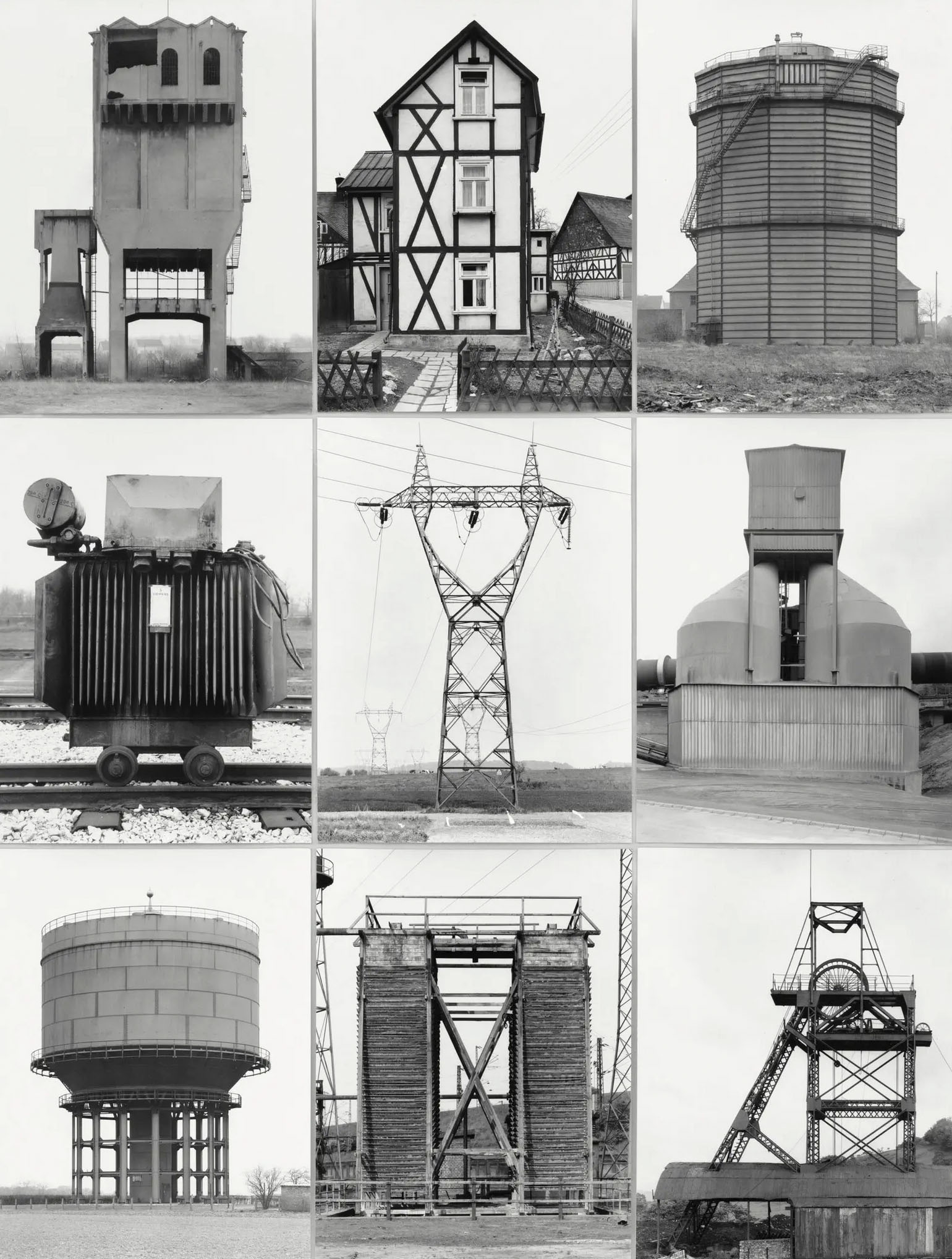
Exhibition: ‘Bernd and Hilla Becher’ at the Metropolitan Museum of Art, New York

Exhibition dates: 15th July – 6th November, 2022

Curators: Jeff L. Rosenheim, Joyce Frank Menschel Curator, Department of Photographs, assisted by Virginia McBride, Research Associate, Department of Photographs, Metropolitan Museum of Art, New York.


Bernd & Hiller Becher exhibition banner


Bernd & Hiller Becher exhibition banner


Ghosts in the machine

In a way that Plato would recognise with his perfect forms (abstract yet perfect, unchanging concepts or ideals that transcend time and space and live on a spiritual plane behind the representation of a physical reality), I feel as though Neue Sachlichkeit (New Objectivity) has existed outside of time – a model of directness that was always there – in a timeless way, before the actual concept emerged into consciousness in the 1920s German art tradition.

German photographers Bernd & Hiller Becher (1931-2007; 1934-2015) were devoted to the ideals of Neue Sachlichkeit (New Objectivity) and their work evolved from these older traditions of objective photography as practiced by artists such as August Sander (German, 1876-1964) and Karl Blossfeldt (German, 1865-1932) during the 1920s. The typologies that the Bechers collected – their beautiful, multiple, conceptual, objective, documentary fine art ‘record photographs’ – made them among the most important figures in postwar German photography.

Their teaching at the Kunstakademie Dusseldorf in the mid 1970s lead to the formation of the Dusseldorf School of Photography which refers to a group of photographers who studied under the artist duo who also shared (and then modified) their aesthetic – a commitment to controlled objectivity and a documentary orientation. These important next generation artists included people such as Andreas Gursky, Candida Höfer, Axel Hütte, Thomas Ruff and Thomas Struth. The Bechers influence on contemporary documentary fine art photography continues today.

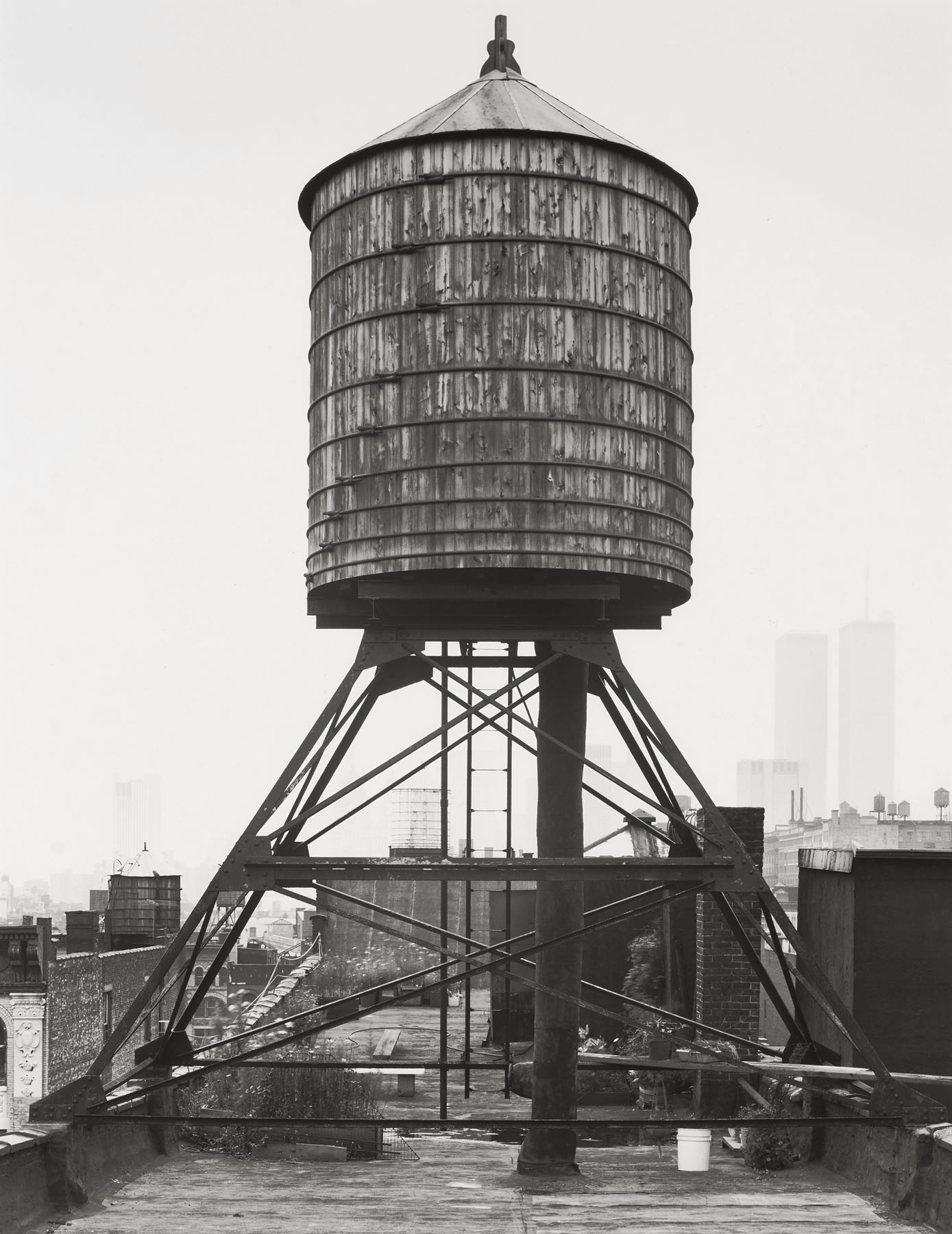
“The Bechers specialized in the photography of anonymous industrial sites and structures, methodically employing the same neutral perspective in each image, as in Water Towers. The nine nineteenth-century metal water towers are displayed in a grid as a single work, the black-and-white images revealing the differences between objects that had an identical function, and so bestowing an aesthetic value on them.”1

Here a definition of typology may be useful. ‘Typology’ is the study and interpretation of types and symbols, a classification according to a general type, especially in archaeology, psychology, or the social sciences. In this sense, the Becher’s photographs of industrial archetypes displayed in grids are excavations of historical types, representations of both pattern (type, grid) and randomness (interpretation, aesthetics). What does this mean? According to Katherine Hayles, pattern (in this case grids of photographs of the same archetype) cannot exist without its opposite, randomness, enacted through mutation of the code.

“Although mutation disrupts pattern, it also presupposes a morphological standard against which it can be measured and understood as mutation. We have seen that in electronic textuality, the possibility for mutation within the text are enhanced and heightened by long coding chains. We can now understand mutation in more fundamental terms. Mutation is critical because it names the bifurcation point at which the interplay between pattern and randomness causes the system to evolve in a new direction…

Mutation is the catastrophe in the pattern/randomness dialectic… It marks a rupture of pattern so extreme that the expectation of continuous replication can no longer be sustained… The randomness to which mutation testifies is implicit in the very idea of pattern, for only against the background of nonpattern can pattern emerge. Randomness is the contrasting term that allows pattern to be understood as such.”2

The pattern of the Bechers photographs are the grids, the randomness evidenced as we move in to observe individual images within the grid, for every water tower is different and its own form… and then we pull back to compare one image with another, one mutation with another. As we move closer the individual image becomes whole in its own right, but contains within the pictorial frame evidence of the subjects mutation through decay, evidence of an industrial revolution and means of production that is now archaic and arcane. It is as though we are looking at a fractal in which similar patterns recur at progressively smaller scales, but which in fact describe partly random or chaotic phenomena, the seeds of their own mutation. And the possibility for mutation within the text is enhanced and heightened by long coding chains, such as large typologies of objects and large grids of images.

As much as the Bechers objective photographs seek a cool sameness, they undermine their own project by their photographs inherent subversiveness. It’s as though the beauty of their object of desire is being played off against a rage against the machine, a critique of what industrialisation is doing to the divine landscape of the earth.

Of course images are always seen in context which, together with their formal characteristics and conditions, limits the meanings available from them at any one moment. As Annette Kuhn observes, “Meanings do not reside in images, then: they are circulated between representation, spectator and social function.”3 We understand the Bechers images then, through a representation of reality which always and necessarily entails, “the use of the codes and conventions of the available cultural forms of presentation. Such forms restrict and shape what can be said by and / or about any aspect of reality in a given place in a given society at a given time, but if that seems like a limitation on saying, it is also what makes saying possible at all.”4 Richard Dyer continues,

“I accept that one apprehends reality only through representations of reality, through texts, discourse, images; there is no such thing as unmediated access to reality. But because one can see reality only through representation, it does not follow that one does not see reality at all. Partial – selective, incomplete, from a point of view – vision of something is not no vision of it whatsoever.”4

Despite the Bechers attempt to catalogue vast typologies, there is no order without disorder. Their vision, and our vision, is only ever selective, incomplete and from a point of view. Much as they desire an enchantment of the subject so that the object of desire falls under their spell in order to validate its presence, so there is no single determinate meaning to any presentation of their work, for people make sense of images in different ways, according to the cultural codes available to them. “What is re-presented in representation is not directly reality itself but other representations. The analysis of images always needs to see how any given instance is embedded in a network of other instances…”4

The ghosts in the machine of the Bechers networks, those random bits of code that lurk behind a not so perfect representation, group together to form unexpected protocols seen from different points of view. “Unanticipated, these free radicals engender questions of free will, creativity, and even the nature of what we might call the soul.” (Asimov)

Dr Marcus Bunyan


Footnotes

1/ Anonymous. “A Movement in a Moment: The Düsseldorf School,” on the Phaidon website [Online] Cited 01/11/2022

2/ Katherine Hayles. How We Became Posthuman: Virtual Bodies in Cybernetics, Literature, and Informatics. Chicago: University of Chicago Press, 1999, p. 33.

3/ Annette Kuhn. The Power of the Image: Essays on Representation and Sexuality. London: Routledge and Kegan Paul, 1985, p. 6.

4/ Richard Dyer. The Matter of Images: Essays on Representations. London: Routledge, 1993, pp. 2-3.


Many thankx to the Metropolitan Museum of Art for allowing me to publish the photographs in the posting. Please click on the photographs for a larger version of the image.


“I think it’s best to imagine that they cast a doubting eye on earlier aspirations to scientific and technical order. After all, the Bechers hit their stride as artists in the 1960s and early ’70s, at just the moment when any aspiring intellectual was reading Thomas Kuhn’s “The Structure of Scientific Revolutions,” which pointed to how the sociology of science (who holds power in labs and who doesn’t) shapes what science tells us. The French philosopher Roland Barthes had killed off the all-powerful author and let the rest of us be the true makers of meaning, even if that left it unstable. European societies were in turmoil as they faced the terrors of the Red Brigades and Baader-Meinhof gang, so brilliantly captured in the streaks and smears of Gerhard Richter, that other German giant of postwar art. The Bechers were working in that world of unsettled and unsettling ideas. By parroting the grammar of technical imagery, without actually achieving any technical goals, their photos seem to loosen technology’s moorings. By collecting water towers the way someone else might collect cookie jars, they cut industry down to size… To get the full meaning and impact of the Bechers’ Machine Age black-and-whites, they should really be viewed through the windows of their Information Age orange van.”


Blake Gopnik. “Photography’s Delightful Obsessives,” on The New York Times website July 28, 2022 [Online] Cited 20/10/2022


Installation view of the exhibition 'Bernd & Hilla Becher' at The Metropolitan Museum of Art showing at centre, 'Water Tower, Verviers, Belgium' 1983


Installation view of the exhibition Bernd & Hilla Becher at The Metropolitan Museum of Art showing at centre, Water Tower, Verviers, Belgium 1983, below
Photo: Anna-Marie Kellen/The Met

00 Basic Forms
01 Framework Houses
02 Early Work
03 Industrial Landscapes
04 Zeche Concordia
05 Art and Evolution
06 Typologies


Bernd and Hilla Becher (German, active 1959-2007) 'Water Tower, Verviers, Belgium' 1983 from the exhibition 'Bernd and Hilla Becher' at the Metropolitan Museum of Art, New York, July - Nov, 2022


Bernd and Hilla Becher (German, active 1959-2007)
Bernd Becher (German, 1931-2007)
Hilla Becher (German, 1934-2015)
Water Tower, Verviers, Belgium
1983
Gelatin silver print
Image: 23 7/8 × 19 13/16 in. (60.6 × 50.4cm)
Purchase, The Horace W. Goldsmith Foundation Gift, through Joyce and Robert Menschel, 1992


Both as artists and teachers, Bernhard and Hilla Becher are among the most important figures in postwar German photography. For the last thirty years, the artists have examined the dilapidated industrial architecture of Europe and North America, from water towers and blast furnaces to the surrounding workers’ houses. Photographing against a blank sky and without any pictorial tricks or effects, the artists treat these forgotten structures as the exotic specimens of a long-dead species.


The renowned German artists Bernd and Hilla Becher (1931-2007; 1934-2015) changed the course of late twentieth-century photography. Working as a rare artist couple, they focused on a single subject: the disappearing industrial architecture of Western Europe and North America that fuelled the modern era. Their seemingly objective style recalled nineteenth- and early twentieth-century precedents but also resonated with the serial approach of contemporary Minimalism and Conceptual art. Equally significant, it challenged the perceived gap between documentary and fine-art photography.

Using a large-format view camera, the Bechers methodically recorded blast furnaces, winding towers, grain silos, cooling towers, and gas tanks with precision, elegance, and passion. Their rigorous, standardised practice allowed for comparative analyses of structures that they exhibited in grids of between four and thirty photographs. They described these formal arrangements as “typologies” and the buildings themselves as “anonymous sculpture.”

This posthumous retrospective celebrates the Bechers’ remarkable achievement and is the first ever organised with full access to the artists’ personal collection of working materials and their comprehensive archive.

Text from the Metropolitan Museum of Art website


Bernd Becher (German, 1931-2007) 'Eisernhardter Tiefbau Mine, Eisern, Germany' 1955-1956 from the exhibition 'Bernd and Hilla Becher' at the Metropolitan Museum of Art, New York, July - Nov, 2022


Bernd Becher (German, 1931-2007)
Eisernhardter Tiefbau Mine, Eisern, Germany
1955-1956
Graphite and watercolour on paper
16 5/16 × 16 5/16 in. (41.5 × 41.5cm)
Estate Bernd & Hilla Becher, represented by Max Becher, courtesy Die Photographische Sammlung/SK Stiftung Kultur – Bernd & Hilla Becher Archive, Cologne


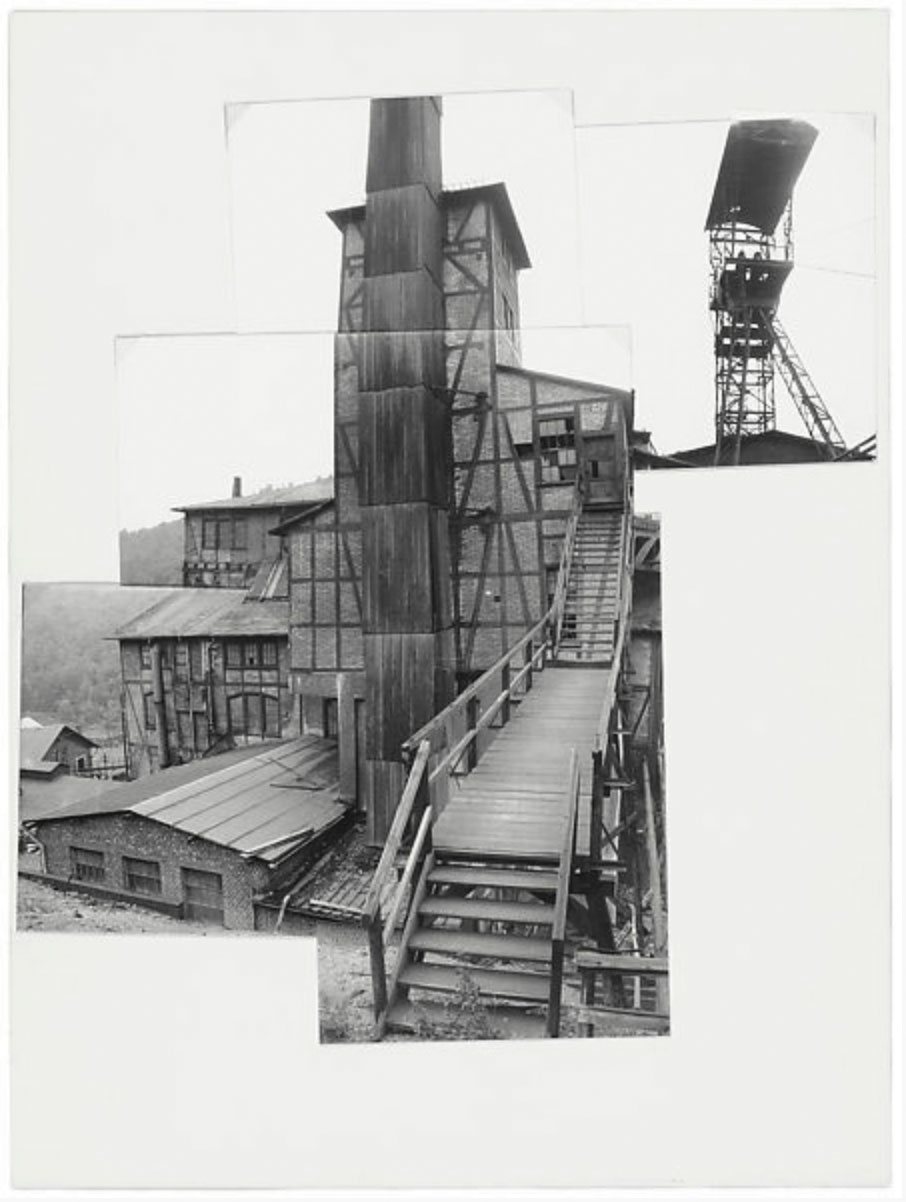
The earliest surviving independent works by Bernd Becher are several rare drawings and photocollages of the Eisernhardter Tiefbau Mine, made before the formation of his artistic partnership with Hilla Wobeser in 1959. These include the works presented on this wall and directly opposite. They reveal the artist’s lifelong interest in the accurate description of mining and manufacturing structures familiar to him from his childhood. Here, Bernd takes special care to focus on the mine’s wooden framework features and its idiosyncratic winding tower, which rises above the buildings like an enormous windblown flag.


Bernd Becher (German, 1931-2007) 'Eisernhardter Tiefbau Mine, Eisern, Germany' 1957 from the exhibition 'Bernd and Hilla Becher' at the Metropolitan Museum of Art, New York, July - Nov, 2022


Bernd Becher (German, 1931-2007)
Eisernhardter Tiefbau Mine, Eisern, Germany
1957
Collage of five gelatin silver prints
Sheet: 15 3/4 × 11 3/4 in. (40 × 29.9cm)
Estate Bernd & Hilla Becher, represented by Max Becher, courtesy Die Photographische Sammlung/SK Stiftung Kultur – Bernd & Hilla Becher Archive, Cologne


Bernd Becher (German, 1931-2007) '[Assemblage of Pipes]' 1964 or later


Bernd Becher (German, 1931-2007)
[Assemblage of Pipes]
1964 or later
Gelatin silver prints with graphite
Sheet: 14 3/8 × 13 1/16 in. (36.5 × 33.2cm)
Estate Bernd & Hilla Becher, represented by Max Becher, courtesy Die Photographische Sammlung/SK Stiftung Kultur – Bernd & Hilla Becher Archive, Cologne


This exceptional assemblage includes three razor-cut photographs of blast-furnace pipes braided together into a handsome knot. Part Giorgio de Chirico (one of the artist’s favourite painters), part pretzel, the metaphysical work shows Bernd Becher’s playful sense of humour and appreciation for the complexity and visual wonderment of industrial forms.


Hilla Becher (German, 1934-2015) '[Mountain Elm Leaf]' 1965


Hilla Becher (German, 1934-2015)
[Mountain Elm Leaf]
1965
Gelatin silver print
9 5/16 × 6 15/16 in. (23.7 × 17.7cm)
Estate Bernd & Hilla Becher, represented by Max Becher, courtesy Die Photographische Sammlung/SK Stiftung Kultur – Bernd & Hilla Becher Archive, Cologne


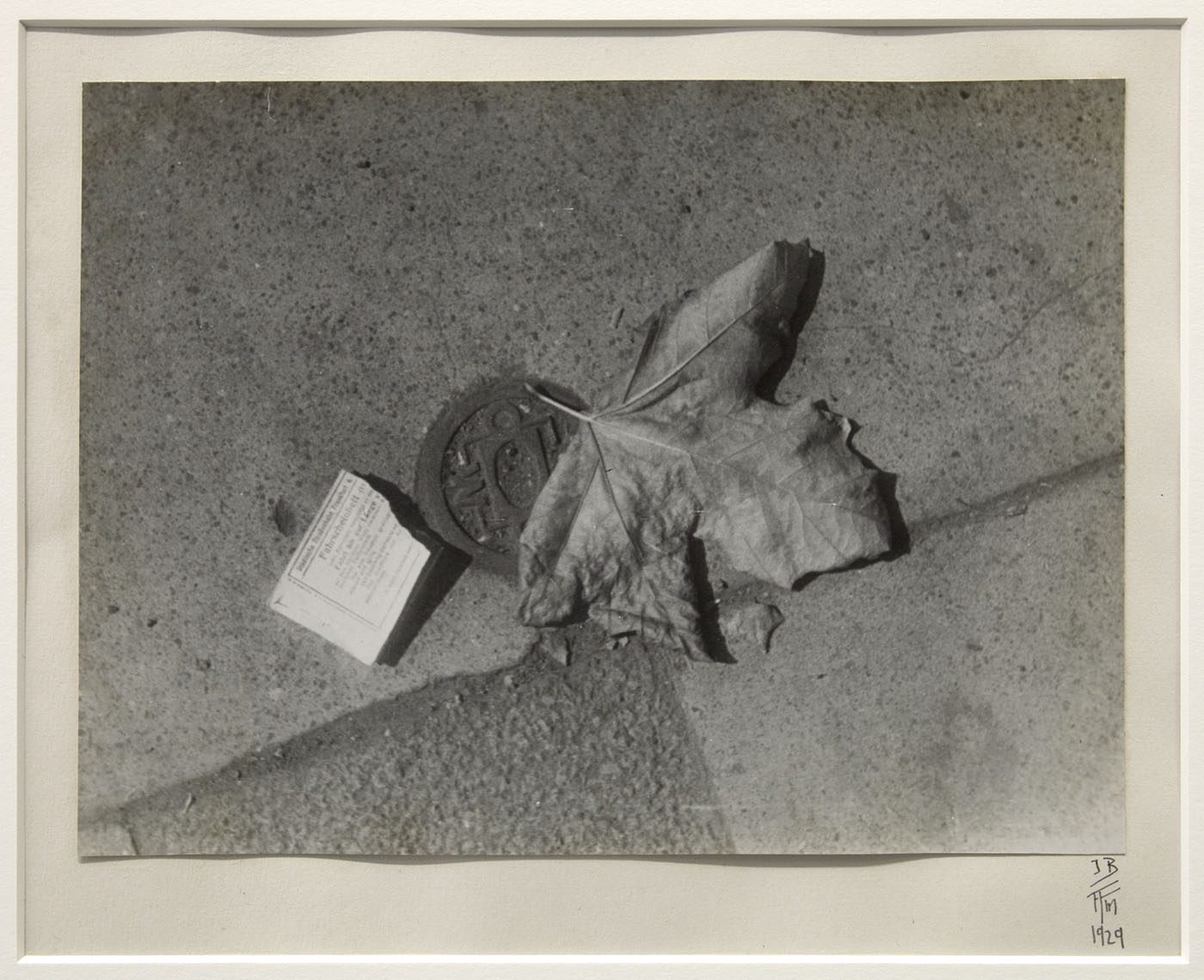
In these studies of tree leaves, Hilla Becher is operating in a long tradition of natural realism that connects her work to that of many earlier German artists, including the photographs of Karl Blossfeldt and the printed botanical and zoological studies of Ernst Haeckel (see display case). What was important to Blossfeldt, Haeckel, and the Bechers was not simple exactitude but a particular type of graphic description and presentation that could reveal the unique, often quirky, and at times humorous structure of any form.


Hilla Becher (German, 1934-2015) '[Spruce Branch]' 1965


Hilla Becher (German, 1934-2015)
[Spruce Branch]
1965
Gelatin silver print
9 7/16 × 7 1/16 in. (24 × 17.9cm)
Estate Bernd & Hilla Becher, represented by Max Becher, courtesy Die Photographische Sammlung/SK Stiftung Kultur – Bernd & Hilla Becher Archive, Cologne.


Hilla Becher (German, 1934-2015) '[Shell, for the German Industrial Exhibition, Khartoum, Sudan]' 1961


Hilla Becher (German, 1934–2015)
[Shell, for the German Industrial Exhibition, Khartoum, Sudan]
1961
Gelatin silver print
15 3/8 × 11 7/8 in. (39 × 30.1cm)
Estate Bernd & Hilla Becher, represented by Max Becher, courtesy Die Photographische Sammlung/SK Stiftung Kultur – Bernd & Hilla Becher Archive, Cologne.


Even after the establishment of the Bechers’ professional partnership in 1959, Hilla continued to accept commission work. She produced this study of the inner architecture of a seashell as a graphic for a display of industrial design at a German trade fair in Khartoum. This vintage photograph was copied and used by the pavilion designer as oversize enlargements. Hilla also documented the interior and exterior of the innovative prefabricated shed pavilion with its lively metal banding.


Ernst Haeckel (German, 1834-1919) "Echinidea. – Igelsterne" 'Kunstformen der Natur' (Leipzig and Vienna: Verlag des Bibliographischen Instituts, 1904)


Ernst Haeckel (German, 1834-1919)
“Echinidea. – Igelsterne”
Kunstformen der Natur (Leipzig and Vienna: Verlag des Bibliographischen Instituts, 1904)
1904
Lithograph
Sheet: 13 5/8 × 10 1/4 in. (34.6 × 26cm)
Joyce Frank Menschel Library, Department of Photographs, The Metropolitan Museum of Art


For both research purposes and aesthetic pleasure, Hilla Becher assembled a collection of illustrated books dedicated to scientific classification. None on the theme of biological order was more important to the artists’ development than Ernst Haeckel’s 1904 Kunstformen der Natur. The plate from a disbound volume presented here shows a typological comparison of sea urchins and sand dollars.


From July 15 to November 6, 2022, the renowned American museum is showing a retrospective of the important artist couple in cooperation with Studio Bernd & Hilla Becher, Dusseldorf, and Die Photographische Sammlung/SK Stiftung Kultur, Cologne.

Bernd and Hilla Becher (1931-2007, 1934-2015) are among the most important artists of the second half of the 20th century. Since the 1960s, their works have provided decisive impetus for photography, art and also generally for dealing with our culture, economy, science and society. For more than 50 years, the artist couple has devoted themselves to the subject of the industrial landscape, the functional buildings and constructions of the mining industry in Western Europe and North America. They created countless black-and-white photographs, which they took with their large-format cameras, of winding towers, blast furnaces, water and cooling towers, coal bunkers, gas tanks, half-timbered houses, entire industrial plants and landscapes. The photographs show precise, at the same time analytical views and individual forms, which Bernd and Hilla Becher subjected to a comparative analysis. So-called typologies, unfolding photographic sets or also large-format typologically conceived individual photographs were the results of their collaboration, which they exhibited internationally and published in monographs. Works that received a special appreciation under the term “Anonymous Sculptures” and attained top-class awards.

The method used by the Bechers can be regarded as style-defining. It transformed the descriptive, objective view of photography of the 19th and early 20th century, which the artist couple highly valued, into a new era, integrating it into clearly sequenced series of images and thus at the same time pointing to perspectives of minimal and conceptual art, which further underscores the innovative power of their work.

Between 1976 and 1996 Bernd Becher taught at the Art Academy in Dusseldorf. Numerous well-known photographers and artists emerged from his photography class. As of the 1960s Bernd and Hilla Becher had their studio in Dusseldorf. Today the studio is being continued as the Bernd & Hilla Becher Studio by their son, estate administrator and artist Max Becher. From 1995 until their death, the artist couple worked together with Die Photographische Sammlung / SK Stiftung Kultur in Cologne, from which the Bernd & Hilla Becher Archive emerged. The majority of the exhibition is furnished from this collection, including numerous previously little-shown and unknown materials by Bernd and Hilla Becher. Overall, the retrospective, which will be on view in a second venue at the SFMoMA between December 17, 2022 and April 2, 2023, introduces all of the artist couple’s areas of work.

The exhibition was curated by Jeff L. Rosenheim, Joyce Frank Menschel Curator, Department of Photographs, assisted by Virginia McBride, Research Associate, Department of Photographs, Metropolitan Museum of Art, New York.

Text from the Metropolitan Museum of Art website


Unknown photographer. 'Bernd and Max Becher, Kintzel Coal Company, Big Lick Mountains, Schuylkill County, Pennsylvania' 1978


Unknown photographer
Bernd and Max Becher, Kintzel Coal Company, Big Lick Mountains, Schuylkill County, Pennsylvania
1978
Chromogenic print
4 3/8 × 3 7/16 in. (11.1 × 8.8cm)
Estate Bernd & Hilla Becher, represented by Max Becher, courtesy Die Photographische Sammlung/SK Stiftung Kultur – Bernd & Hilla Becher Archive, Cologne


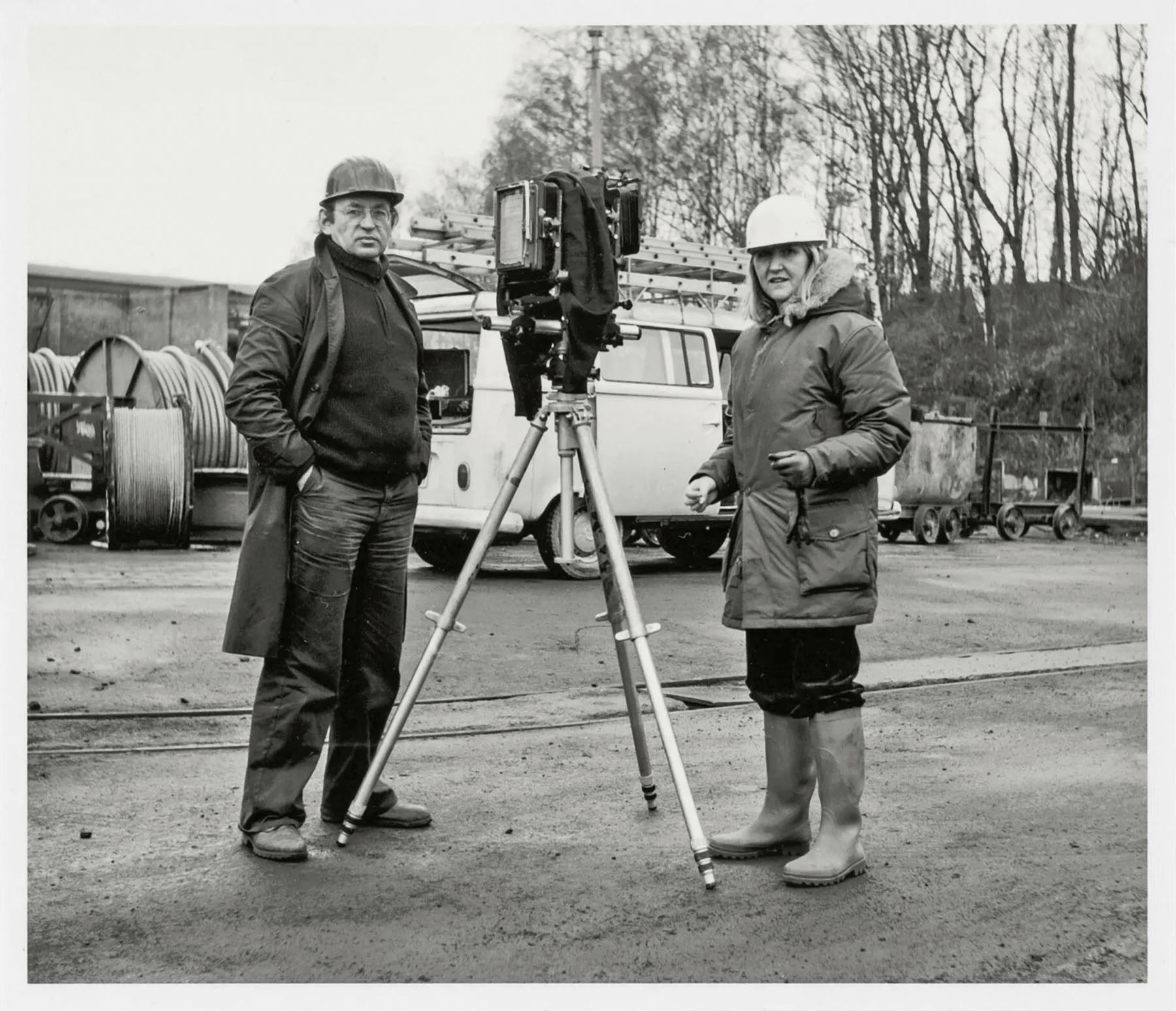
Unknown photographer. 'Bernd and Hilla Becher, Ensdorf Mine, Saarland, Germany' 1979


Unknown photographer
Bernd and Hilla Becher, Ensdorf Mine, Saarland, Germany
1979
Gelatin silver print
4 3/4 × 5 9/16 in. (12 × 14.1cm)
Estate Bernd & Hilla Becher, represented by Max Becher, courtesy Die Photographische Sammlung/SK Stiftung Kultur – Bernd & Hilla Becher Archive, Cologne


Their camera’s lens, facing Hilla, has been raised higher than the film plane that’s facing Bernd, a trick that lets them capture the tops of tall structures.


Unknown photographer. 'Hilla Becher, Youngstown, Ohio, United States' 1981


Unknown photographer
Hilla Becher, Youngstown, Ohio, United States
1981
Instant diffusion transfer print (Polaroid)
2 7/8 × 3 3/4 in. (7.3 × 9.5cm)
Estate Bernd & Hilla Becher, represented by Max Becher, courtesy Die Photographische Sammlung/SK Stiftung Kultur – Bernd & Hilla Becher Archive, Cologne


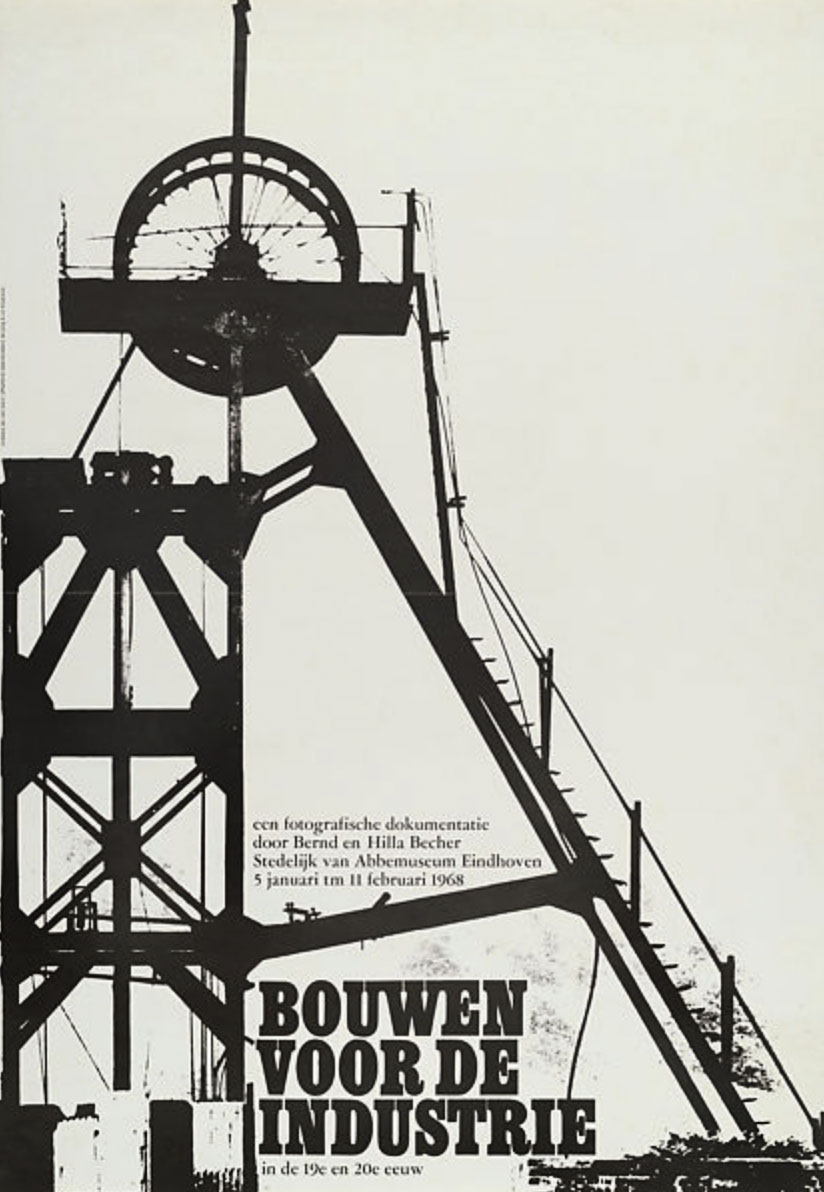
Bouwen voor de Industrie in de 19e en 20e eeuw, een fotografische dokumentatie door Bernd en Hilla Becher, Stedelijk van Abbemuseum, Eindhoven, The Netherlands 1968


Bouwen voor de Industrie in de 19e en 20e eeuw, een fotografische dokumentatie door Bernd en Hilla Becher, Stedelijk van Abbemuseum, Eindhoven, The Netherlands
1968
Photomechanical reproduction
Sheet: 34 5/8 × 24 3/16 in. (88 × 61.5cm)
Frame: 36 15/16 × 26 7/16 in. (93.8 × 67.2cm)
Estate Bernd & Hilla Becher, represented by Max Becher, courtesy Die Photographische Sammlung/SK Stiftung Kultur – Bernd & Hilla Becher Archive, Cologne


Bernd and Hilla Becher were notoriously exacting about how their photographs were constructed in the camera, printed in the darkroom, and sequenced and reproduced in their many publications. Interestingly, they were rather generous with how and where their photographs were used in other printed materials, such as promotional leaflets, invitations, and exhibition posters. The posters gathered in this exhibition display a variety of typographic treatments and arrangements.


Bernd och Hilla Becher, Form genom Funktion, Moderna Museet, Stockholm, Sweden 1970


Bernd och Hilla Becher, Form genom Funktion, Moderna Museet, Stockholm, Sweden
1970
Photomechanical reproduction
Sheet: 39 5/16 × 27 1/2 in. (99.8 × 69.8cm)
Frame: 41 9/16 × 29 3/4 in. (105.6 × 75.6cm)
Estate Bernd & Hilla Becher, represented by Max Becher, courtesy Die Photographische Sammlung/SK Stiftung Kultur – Bernd & Hilla Becher Archive, Cologne


Bernd und Hilla Becher, Typologien industrieller Bauten, Museum für Fotografie im Hamburger Bahnhof, Museum für Gegenwart, Berlin, Germany 2005


Bernd und Hilla Becher, Typologien industrieller Bauten, Museum für Fotografie im Hamburger Bahnhof, Museum für Gegenwart, Berlin, Germany
2005
Photomechanical reproduction
Sheet: 46 7/8 × 33 1/16 in. (119 × 84cm)
Frame: 49 1/16 × 35 5/16 in. (124.6 × 89.7cm)
Estate Bernd & Hilla Becher, represented by Max Becher, courtesy Die Photographische Sammlung/SK Stiftung Kultur – Bernd & Hilla Becher Archive, Cologne


Bernd & Hilla Becher, First Posthumous Retrospective of the Highly Influential Photographers to Open at The Met July 15

Bernd and Hilla Becher (1931-2007; 1934-2015) are widely considered the most influential German photographers of the postwar period. Working as a rare artist couple, they developed a rigorous practice focused on a single subject: the disappearing industrial architecture of Western Europe and North America that fuelled the modern era. Opening at The Metropolitan Museum of Art on July 15, 2022, Bernd & Hilla Becher features some 200 works of art and is the artists’ first posthumous retrospective of their 50-year career. It is organised with full access to the Becher’s comprehensive archive and personal collection of working materials and is the first American retrospective since 1974 (when their mature style was still evolving).

The exhibition is made possible by Joyce Frank Menschel, the Barrie A. and Deedee Wigmore Foundation, the Edward John & Patricia Rosenwald Foundation, and Linda Macklowe. It is organised by The Metropolitan Museum of Art, in association with Studio Bernd & Hilla Becher and Die Photographische Sammlung / SK Stiftung Kultur.

“Bernd and Hilla Becher changed the course of late 20th-century photography, and their groundbreaking work continues to influence artists to this day,” said Max Hollein, Marina Kellen French Director of The Met. “It is a privilege to present this first posthumous retrospective and to celebrate their legacy and remarkable artistic achievement.”

Exhibition overview

The Bechers seemingly objective aesthetic looked back to 19th- and early 20th-century precedents but also resonated with the serial, premeditated progressions of contemporary Minimalism and Conceptual art. Equally significant, their aesthetic challenged the perceived gap between documentary and fine-art photography. The artists used a large-format view camera – similar to those used by 19th-century photographers such as the Bisson Frères in France and Carleton Watkins in the American West – and spurned the handheld, 35 mm roll-film cameras of the type preferred by journalists and pre- and postwar artists such as Henri Cartier-Bresson and Robert Frank. They worked exclusively with black-and-white photographic materials, intentionally avoiding the medium’s inevitable move to colour that took place during the 1960s and 1970s, and methodically recorded blast furnaces, winding towers, grain silos, cooling towers, and gas tanks with precision, elegance, and passion. Their standardised approach allowed for comparative analyses of structures that they exhibited in grids of between 4 and 30 photographs. They described these formal arrangements as “typologies” and the buildings themselves as “anonymous sculpture.”

The Bechers had a direct and profound influence on several generations of students at the renowned art academy Kunstakademie Düsseldorf, where Bernd was appointed the first professor of photography in 1976. Among the members of the so-called Becher School or Düsseldorf School of Photography are some of the most recognised German artists of the past 40 years, such as Thomas Struth, Andreas Gursky, Candida Höfer, and Thomas Ruff.

Featured in the exhibition alongside the individual and grids of photographs for which the Bechers are best known are extraordinary works in photography and other media executed by them before and after the formation of their creative partnership in 1959. These rarely seen lithographs, collages, photographs, ink and pencil sketches, Polaroids, and personal snapshots offer a deep understanding of the artists’ working methods and intellectual processes.

Following its debut at The Met, the exhibition will travel to the San Francisco Museum of Modern Art (SFMOMA), where it will be on view from December 17, 2022 through April 2, 2023. Bernd & Hilla Becher is curated by Jeff L. Rosenheim, Joyce Frank Menschel Curator in Charge of the Department of Photographs, with assistance from Virginia McBride, Research Assistant in the Department of Photographs, both at The Met. The Met developed the exhibition with Max Becher, the artists’ son, and with Gabriele Conrath-Scholl, director of the Photographische Sammlung / SK Stiftung Kultur in Cologne, where the artists’ vast photographic print archive is preserved.

The exhibition is accompanied by a scholarly publication, the first posthumous monograph published on the Bechers. It features essays by Gabriele Conrath-Scholl; Dr. Virginia Heckert, curator of photographs at the J. Paul Getty Museum and an expert on the Bechers; and Lucy Sante, arts critic, essayist, artist, and visiting professor of writing and photography at Bard College. The publication also includes an extensive interview with Max Becher that, together with the essays, introduces and surveys the Bechers’ photographs and the significance of their achievement over a remarkably productive half-century career. The catalogues is made possible by the Mary C. and James W. Fosburgh Publications Fund.

Press release from the Metropolitan Museum of Art


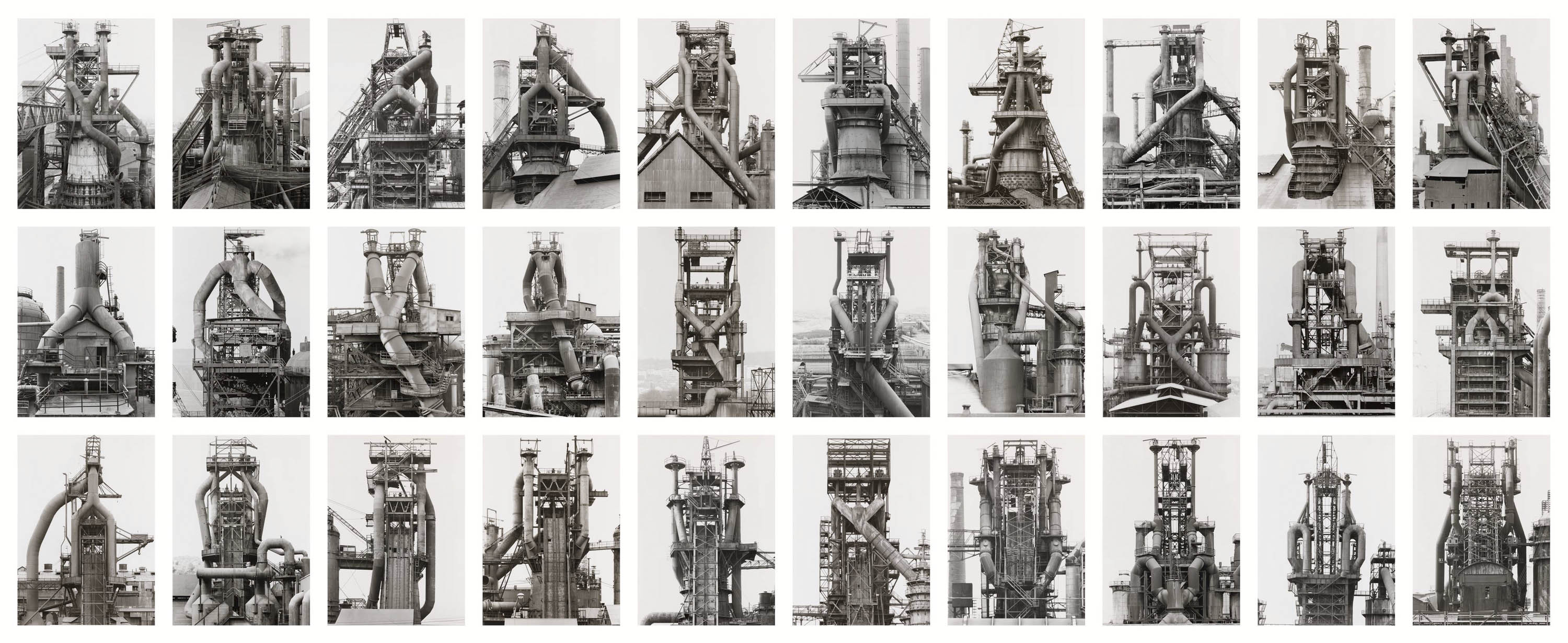
Bernd and Hilla Becher (German, active 1959-2007) 'Blast Furnaces (United States, Germany, Luxembourg, France, and Belgium)' 1968-1993


Bernd and Hilla Becher (German, active 1959-2007)
Bernd Becher (German, 1931-2007)
Hilla Becher (German, 1934-2015)
Blast Furnaces (United States, Germany, Luxembourg, France, and Belgium)
1968-1993
Gelatin silver prints
Estate Bernd & Hilla Becher, represented by Max Becher


Such series may have been less about the glories of heavy industry than its approaching demise in the West.


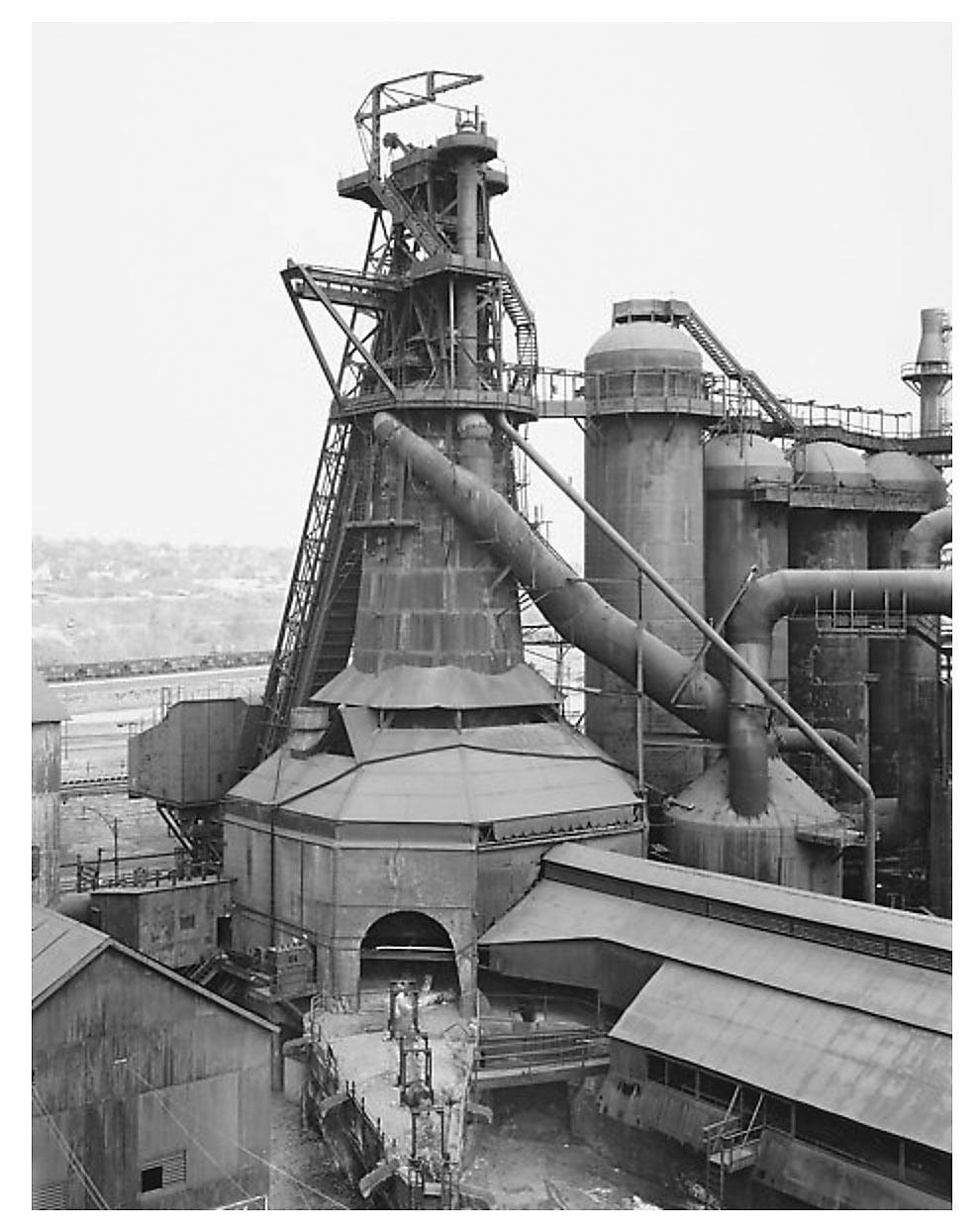
Bernd and Hilla Becher (German, active 1959-2007) 'Blast Furnace, Youngstown, Ohio, United States' 1983


Bernd and Hilla Becher (German, active 1959-2007)
Bernd Becher (German, 1931-2007)
Hilla Becher (German, 1934-2015)
Blast Furnace, Youngstown, Ohio, United States
1983
Gelatin silver print
23 1/8 × 18 1/4 in. (58.8 × 46.4cm)
Estate Bernd & Hilla Becher, represented by Max Becher, courtesy Die Photographische Sammlung/SK Stiftung Kultur – Bernd & Hilla Becher Archive, Cologne


The buildings Bernd and Hilla Becher chose to photograph were meant to be altered or demolished when superseded technologically. Given the planned obsolescence of their subjects, the artists’ timing played an important role in the success of their practice. In one of their last books, Industrial Landscapes (2002), they commented: “Once we were in northern France, where we found a wonderful headgear [the top of a blast furnace] – a veritable Eiffel Tower. When we arrived the weather was hazy and not ideal for our work so we decided to postpone taking the photos for a day. When we arrived the next day, it had already been torn down, the dust was in the air.”


Bernd and Hilla Becher (German, active 1959-2007) Bernd Becher (German, 1931-2007) Hilla Becher (German, 1934-2015) 'Gravel Plants' 1988-2001


Bernd and Hilla Becher (German, active 1959-2007)
Bernd Becher (German, 1931-2007)
Hilla Becher (German, 1934-2015)
Gravel Plants
1988-2001
Gelatin silver prints


Bernd and Hilla Becher (German, active 1959-2007) 'Gravel Plant, Günzburg, Germany' 1989


Bernd and Hilla Becher (German, active 1959-2007)
Bernd Becher (German, 1931-2007)
Hilla Becher (German, 1934-2015)
Gravel Plant, Günzburg, Germany
1989
Gelatin silver print
24 3/16 × 19 3/16 in. (61.4 × 48.7cm)
Estate Bernd & Hilla Becher, represented by Max Becher, courtesy Die Photographische Sammlung/SK Stiftung Kultur – Bernd & Hilla Becher Archive, Cologne


In the late 1980s and early 1990s, Bernd and Hilla Becher completed a thorough documentation of the many gravel plants in and near Günzburg, a small city on the Danube River in Bavaria. This oddly shaped yet functional building was used as a stone breaker to produce gravel, the still-lucrative industrial material required for making roads and high-quality concrete. The asymmetrical facade delights the eye, recalling the Bechers’ frequently stated agenda: “We were fascinated above all by the shape of technical architecture, and hardly by its history.”


Bernd and Hilla Becher (German, active 1959-2007) 'Cooling Tower, Zeche Mont Cenis, Herne, Ruhr Region, Germany' 1965


Bernd and Hilla Becher (German, active 1959-2007)
Bernd Becher (German, 1931-2007)
Hilla Becher (German, 1934-2015)
Cooling Tower, Zeche Mont Cenis, Herne, Ruhr Region, Germany
1965
Gelatin silver print
23 5/8 x 18 1/4 in. (60.5 x 46.4cm)
Collection of James Kieth Brown and Eric Diefenbach


Influenced by the formal rigour and conceptual methods of pre-World War II artists, such as August Sander and Walker Evans, Bernd and Hilla Becher were considered equals and fellow travellers by Minimalist sculptors, such as Carl Andre and Sol LeWitt. They treated their subject matter – the disappearing industrial architecture of the West – as “anonymous sculpture.” Here, a fabulous tower used to cool water at the Mont Cenis colliery rises from the ground like a modernist top hat made for a wooden giant. In 1978, just thirteen years after the Bechers visited the busy complex, it closed permanently, ending more than one hundred years of coal extraction on the site.

The Bechers photographed against a blank sky and without any pictorial tricks or effects, using an old-fashioned tripod-mounted view camera of the kind used by Eugène Atget and Walker Evans. They treated their subjects as “anonymous sculpture” (the name of their first monograph) that could only be fully rendered through either multiple views from different perspectives or more often, through the typological accumulation and serial presentation of multiple specimens. Although they were artists not scientists, the Bechers used an almost Linnean system of classification – another important 19th century precedent which they made resolutely modern.


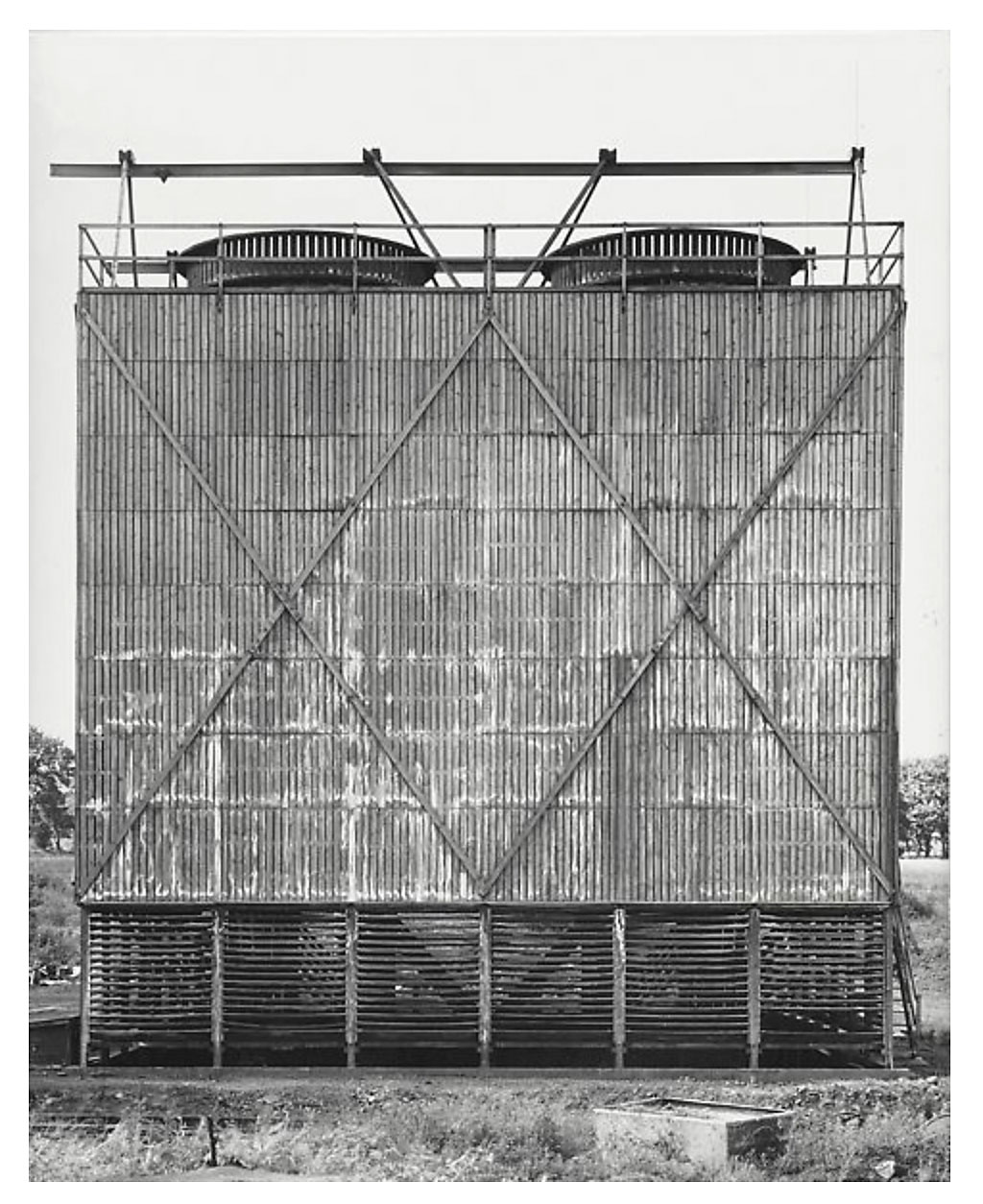
Bernd and Hilla Becher (German, active 1959-2007) 'Cooling Tower, Caerphilly, South Wales, Great Britain' 1966


Bernd and Hilla Becher (German, active 1959-2007)
Bernd Becher (German, 1931-2007)
Hilla Becher (German, 1934-2015)
Cooling Tower, Caerphilly, South Wales, Great Britain
1966
Gelatin silver print
Image: 14 5/8 × 11 3/4 in. (37.1 × 29.9cm)
Gift of the LeWitt Family, in memory of Bernd and Hilla Becher, 2018


As both artists and professors at the Kunstakademie in Düsseldorf, the husband-and-wife team of Bernd and Hilla Becher have influenced an entire generation of German photographers with their typological approach to the medium, in which a single archetypal subject is described through an accumulation of diverse examples. For more than three decades, they have systematically examined the dilapidated industrial architecture of Europe and North America, from water towers and blast furnaces to the surrounding workers’ houses, all recorded against a blank sky and without expressive effects. As it developed in the 1960s, the Bechers’ project chimed with Conceptual Art in its emphasis on impersonal series as well as with older traditions of objective photography as practiced by such artists such as August Sander and Karl Blossfeldt.


Bernd and Hilla Becher (German, active 1959-2007) Bernd Becher (German, 1931-2007) Hilla Becher (German, 1934-2015) 'Cooling Towers (Wood)' 1976


Bernd and Hilla Becher (German, active 1959-2007)
Bernd Becher (German, 1931-2007)
Hilla Becher (German, 1934-2015)
Cooling Towers (Wood)
1976
Gelatin silver prints
16 × 12 in. (40.6 × 30.5cm), each
Fraenkel Gallery, San Francisco


Bernd and Hilla Becher (German, active 1959-2007) Bernd Becher (German, 1931-2007) Hilla Becher (German, 1934-2015) 'Cooling Towers (Wood)' 1976 (detail)


Bernd and Hilla Becher (German, active 1959-2007)
Bernd Becher (German, 1931-2007)
Hilla Becher (German, 1934-2015)
Cooling Towers (Wood) (detail)
1976
Gelatin silver prints
16 × 12 in. (40.6 × 30.5cm), each
Fraenkel Gallery, San Francisco


Bernd and Hilla Becher (German, active 1959-2007) 'Cooling Towers (Wood)' 1976 (detail)


Bernd and Hilla Becher (German, active 1959-2007)
Bernd Becher (German, 1931-2007)
Hilla Becher (German, 1934-2015)
Cooling Towers (Wood) (detail)
1976
Gelatin silver prints
16 × 12 in. (40.6 × 30.5cm), each
Fraenkel Gallery, San Francisco


The Bechers’ purpose has always been to make the clearest possible photographs of industrial structures. They are not interested in making euphemistic, socio-romantic pictures glorifying industry, nor doom-laden spectacles showing its costs and dangers. Equally, they have nothing in common with photographers who seek to make pleasing modernist abstractions, treating the structures as decorative shapes divorced from their function.

The Bechers’ goal is to create photographs that are concentrated on the structures themselves and not qualified by subjective interpretations. To them, these structures are the ‘architecture of engineers’ and their pictures should be seen as the photography of engineers – that is, record pictures. …

[Record photographers are the unsung heroes of the history of photography. They are the anonymous commercial photographers who were commissioned to record both great and everyday industrial and civic projects, from the construction of canals to the blooming of floral clocks.]

The Bechers are fascinated by the idiosyncratic appearance of each structure. The mass-produced, design-conscious assemblies devised by architects with an eye on appearance do not appeal as much as those with a mindfulness of function. What interests the Bechers are constructions made by engineers whose plans are pragmatic, where function dictates the form, rather than, as is increasingly the case, the other way round. In the words of Bernd: ‘There is a form of architecture that consists in essence of apparatus, that has nothing to do with design, and nothing to do with architecture either. They are engineering constructions with their own aesthetic.’

Their fascination is rooted in an understanding of the structures. The Bechers are the first to acknowledge the primarily functional role of the constructions, that their existence is justified solely by their industrial performance, and that once this has been superseded the structures will be modified or demolished. They liken the way a blast furnace develops over time, as furnaces and pipework are added, to the organic but apparently chaotic growth of a medieval city. This purpose-led rationale is what attracts them. They refer to some of the structures as ‘nomadic architecture’. Once they photographed a blast furnace that was being dismantled by Chinese workers in Luxembourg, who then had to reassemble it in China.

By placing photographs of similar subjects alongside each other, the individual differences emerge, making the fine details in each picture more noticeable, more distinct. Drawing on this, they began exhibiting the pictures as typologies; by the early 1960s they showed their work only in typological groups. Typically, a piece of work would comprise four small prints of, for example, water towers, adjacent to a larger print of one of the four. They would not supply prints of individual pictures; the typology was the work. Later, their typologies contained prints of equal size, measuring 30 cm by 40 cm. It could be three rows of five prints, a grid of nine or, in one case, 28 blast furnaces in three rows; a symphony of industrial structures.

The Bechers’ pictures do not have to be viewed in typologies in order to make sense, as they have validity as individual images. The typology has been developed for two reasons. First, by amassing such a detailed survey of industrial structures they are revealing sets and subsets, much like 19th-century zoologists did. With water towers, for example, there are round steel ones with conical tops, like hats, and semi-circular ones. Others are circular with sloping roofs, or without roofs, or on steel derricks, or brick towers, and so on. The more fine the differences, the better they are illustrated by the typology.

Second, the typology used by the Bechers emphasises the rewards of close scrutiny, and it is this that makes each and every one of their pictures fascinating. By presenting 15 water towers in a grid, the first effect is an imposing mass of industrial structures. You must stand back in order to take them all in as a group, but to look closer at an individual picture it is necessary to draw nearer.

Up close, only one tower is visible at a time. Isolated in pristine, black-and-white definition, this everyday object is revealed as an ‘anonymous sculpture’, an unostentatious but fabulous creation by mankind. To compare it with the others is to stand back again, and from here the impulse is to step up and examine another. Just as the beauty of the individual structure (for that is what they are) is there to see, so together as a typology they are a thrilling spectacle. …

There is a wisdom and honour in the Bechers’ work which frees them from imposing a conditional reading upon the viewer. The wisdom is the methodology they recognise in the ‘neutral’ depiction of record photography. The honour stems from a principle about not imposing their ideas on other people.

Hilla and Bernd both grew up under Adolf Hitler. They saw how he corrupted German art to promote his propaganda. This was particularly pertinent to photography, and it remained tainted after the war; witness the grim examples of Leni Riefensthal’s glorifying images of Nazis and the pseudo-scientific eugenic portrait studies that were published to defend anti-semitism and supremacism. This is why the legacy of August Sander (1876-1964), whose neutral approach to portraiture was damned by the Nazis, is so precious in Germany. It is also why the Bechers’ continuing example is extremely important. …

Because photography has, for so long, been used for commercial reasons, notably in advertising, people are accustomed to absorbing manipulative images, and have come to expect – or even rely on – a conditional presentation. Take away this interpretative control and the viewer is left free, which is unnerving if one is not used to it. This is why some regard the Bechers’ photographs as ‘cold’. There is no editorial, no soundtrack, no suggestions nor judgments. You are left to your own devices.

Of course, their motivations are not invisible, nor their presence unfelt. What does it mean when something ‘rings true’? How is it that one can sense the sincerity in another’s words? Perhaps this lies in the realm of intuition, not explanation. To analyse art is not necessarily to experience it. Sometimes, by focusing on a deliberation of it, one limits the engagement to a cerebral encounter. In the West particularly, we use explanations to try to control the unknown, to make uncertainties certain. Maybe there is a wisdom we have that is not learnt but is within us. Far better to look rather than puzzle, and to open one’s senses to what is there.

Here lies the wonder in the Bechers’ photographs. They are like rounding a hill and seeing a view spread out before you. In Cwmcynon Colliery, Mountain Ash, South Wales, 1966, a minehead stands above lines of terraced houses in the village. The giant pair of wheels on top of the single-tier steel headframe is an engineer’s structure. A device to do a job, not to win design awards. You could not dream up such structures, neither could you invent, say, your grandparents’ kitchen. These things arise from the conditions in which they are used.

They are the lines on the face of the world. The photographs are portraits of our history. And when the structures have been demolished and grassed over, as though they were never there, the pictures remain.

Michael Collins, “The long look,” Tate Research Publication, 2002 originally published in Tate Magazine issue 1 on the Tate website [Online] Cited 01/11/2022


Bernd and Hilla Becher (German, active 1959-2007) 'Winding Towers (Belgium and France)' 1967-1988


Bernd and Hilla Becher (German, active 1959-2007)
Bernd Becher (German, 1931-2007)
Hilla Becher (German, 1934-2015)
Winding Towers (Belgium and France)
1967-1988
Gelatin silver prints
15 15/16 × 12 3/8 in. (40.5 × 31.5cm), each
The Doris and Donald Fisher Collection at the San Francisco Museum of Modern Art


Bernd and Hilla Becher (German, active 1959-2007) 'Winding Tower, Cwm Cynon Colliery, Mountain Ash, South Wales, Great Britain' 1966


Bernd and Hilla Becher (German, active 1959-2007)
Bernd Becher (German, 1931-2007)
Hilla Becher (German, 1934-2015)
Winding Tower, Cwm Cynon Colliery, Mountain Ash, South Wales, Great Britain
1966
Gelatin silver print
Image: 15 9/16 × 11 13/16 in. (39.6 × 30cm)
Purchase, Vital Projects Fund Inc. Gift, through Joyce and Robert Menschel, Denise and Andrew Saul Fund, Louis V. Bell, Harris Brisbane Dick, Fletcher, and Rogers Funds and Joseph Pulitzer Bequest, and Jade Lau Gift, 2018


Bernd and Hilla Becher (German, active 1959-2007) 'Winding Tower, Zeche Neu-Iserlohn, Bochum, Germany' 1963


Bernd and Hilla Becher (German, active 1959-2007)
Bernd Becher (German, 1931-2007)
Hilla Becher (German, 1934-2015)
Winding Tower, Zeche Neu-Iserlohn, Bochum, Germany
1963
Gelatin silver print
Image: 15 9/16 × 11 1/4 in. (39.5 × 28.5cm)
Purchase, Vital Projects Fund Inc. Gift, through Joyce and Robert Menschel, Denise and Andrew Saul Fund, Louis V. Bell, Harris Brisbane Dick, Fletcher, and Rogers Funds and Joseph Pulitzer Bequest, and Jade Lau Gift, 2018


Bernd and Hilla Becher (German, active 1959-2007) 'Water Towers (Germany, France, Belgium, United States, and Great Britain)' 1963-1980


Bernd and Hilla Becher (German, active 1959-2007)
Bernd Becher (German, 1931-2007)
Hilla Becher (German, 1934-2015)
Water Towers (Germany, France, Belgium, United States, and Great Britain)
1963-1980
Gelatin silver prints
Estate Bernd & Hilla Becher, represented by Max Becher


Is there some quiet comedy in revealing all the ways industry has managed the single job of storing water?


Bernd and Hilla Becher (German, active 1959-2007) 'Water Towers (New York, United States)' 1978-1979


Bernd and Hilla Becher (German, active 1959-2007)
Bernd Becher (German, 1931-2007)
Hilla Becher (German, 1934-2015)
Water Towers (New York, United States)
1978-1979
Gelatin silver prints
15 15/16 × 12 3/8 in. (40.5 × 31.5cm), each
Estate Bernd & Hilla Becher, represented by Max Becher, courtesy Die Photographische Sammlung/SK Stiftung Kultur – Bernd & Hilla Becher Archive, Cologne


Bernd and Hilla Becher (German, active 1959-2007) 'Water Towers (New York, United States)' 1978–1979 (detail)


Bernd and Hilla Becher (German, active 1959-2007)
Bernd Becher (German, 1931-2007)
Hilla Becher (German, 1934-2015)
Water Towers (New York, United States)(detail)
1978-1979
Gelatin silver prints
15 15/16 × 12 3/8 in. (40.5 × 31.5cm), each
Estate Bernd & Hilla Becher, represented by Max Becher, courtesy Die Photographische Sammlung/SK Stiftung Kultur – Bernd & Hilla Becher Archive, Cologne


One wall is gridded up with photos of industrial cooling towers, portrayed in wildly detailed black-and-white.

Another gives us 30 different views of blast furnaces, at plants across Western Europe and the United States. You can just about make out each bolt in their twisting pipework.

An entire gallery surveys the vast Concordia coal plant in Oberhausen, Germany: Teeming photos present its gas-storage tanks, its “lean gas generator,” its “quenching tower,” its “coke pushers.”

These and something like another 450 images fill “Bernd & Hilla Becher,” a fascinating, frankly gorgeous show at the Metropolitan Museum of Art. The Met’s curator of photography, Jeff Rosenheim, has organized a thorough retrospective for the Bechers, a German couple who made some of the most influential art photos of the past half-century. Bernd (1931-2007) and Hilla (1934-2015) mentored generations of students at Düsseldorf’s great Kunstakademie, whose alumni include major photographic artists such as Andreas Gursky and Candida Höfer.

But for all the heft of the heavy industry on view in the Met show – it’s easy to imagine the stink and smoke and racket that pressed in on the Bechers as they worked – you come away with an overall impression of lightness, of delightful order, even sometimes of gentle comedy.

Wall after wall of gridded grays soothe the eye and calm the soul, like the orderly, light-filled abstractions of Agnes Martin or Sol LeWitt. The very fact of gathering 16 different water towers, from both sides of the Atlantic, onto a single museum wall helps to domesticate them, removing their industrial angst and original functions and turning them into something like curios, or collectibles. A catalog essay refers to the Bechers’ “rigorous documentation of thousands of industrial structures,” which is right – but it’s the rigour of a trainspotter, not an engineer. Despite their concrete grandeur, the assorted water towers come off as faintly ridiculous: Whether you’re collecting cookie jars or vintage wines – or shots of water towers – it’s as much about our human instinct to amass and organise as it is about the actual things you collect.

Consider the 32 Campbell’s Soup Cans (1962) that launched Andy Warhol’s pop career, which are a vital precedent for the Bechers’ ordered seriality. You can read the Soup Cans as a critical portrayal of American consumerism, but a catalog of canned soups also reads as a quiet joke, at least when it’s presented for the sake of art, not shopping. Ditto, I think, for the Bechers’ famous “typologies” of industrial buildings, presented without anything like an industrial goal.

Indeed, the one thing you don’t come away with from the Becher show is real knowledge of mechanical engineering, or coal processing, or steel making. In long-ago student days, I cut out and framed a wallful of images from the Bechers’ glorious book of blast-furnace photos. (Their art has always existed as much in their books as in exhibitions.) After living with my furnaces for a decade or so, I can’t say I could have passed a quiz from Smelting 101.

Early coverage referred to the Bechers as “photographer-archaeologists” and the Met’s catalog talks about how they revealed the “functional characteristics of industrial structures.” There are certainly parallels between the preternatural clarity and unmediated “objectivity” of their images and earlier, purely technical and scientific photos meant to teach about the constructions and processes of industry. The Bechers admired such pictures. But however systematic their own project might seem, its goal was art, which means it was always bound to let function and meaning float free.

I think it’s best to imagine that they cast a doubting eye on earlier aspirations to scientific and technical order. After all, the Bechers hit their stride as artists in the 1960s and early ’70s, at just the moment when any aspiring intellectual was reading Thomas Kuhn’s “The Structure of Scientific Revolutions,” which pointed to how the sociology of science (who holds power in labs and who doesn’t) shapes what science tells us. French philosopher Roland Barthes had killed off the all-powerful author and let the rest of us be the true makers of meaning, even if that left it unstable. European societies were in turmoil as they faced the terrors of the Red Brigades and Baader-Meinhof gang, so brilliantly captured in the streaks and smears of Gerhard Richter, that other German giant of postwar art. The Bechers were working in that world of unsettled and unsettling ideas. By parroting the grammar of technical imagery, without actually achieving any technical goals, their photos seem to loosen technology’s moorings. By collecting water towers the way someone else might collect cookie jars, they cut industry down to size.

The Bechers weren’t the only artists working that seam. Their era’s conceptualists also played games with science and industry. When John Baldessari had himself photographed throwing three balls into the air so they’d form a straight line, he was simulating experimentation, not aiming for any real experimental result: The repeated throwing and its failure was the point, not the straight line that could never get formed, anyway. When the Bechers’ friend Robert Smithson poured oceans of glue down a hillside or bulldozed dirt onto a shed until its roof cracked, he was mimicking the moves of heroic construction, not aiming to build anything.

What made the Bechers different from their peers is that they did their mimicking from the inside: They used the language of advanced photographic technology to inhabit the technophilic world they portrayed. Their photos are almost as constructed as any “lean gas generator” they might depict. The just-the-facts-ma’am objectivity of their images is only achieved through serious photographic artifice.

Take the Bechers’ four-square photos of four-square workers’ houses. Several houses are photographed from so close that, standing right in front of them, you’d never take in their entire facades at one glance, as the Bechers do in their images. It takes a wide-angle lens to allow that trick, and only if it’s installed on the kind of technical view camera whose bellows lets lens and film slide in opposite directions. That’s how the Bechers manage to line up our eyes with the top step on a stoop (we see it edge-on) while also catching the home’s gables, high above.

The preternatural level of detail on view and its glorious range of grays and blacks require negatives the size of a man’s hand, a tripod as big as a sapling, lens filters and an advanced darkroom technique. And the couple were relying on such labour-intensive technology at just the moment when most of their photographic peers, and millions of average people, had moved on to cameras and film that let them shoot on the fly, in lab-processed colour. With the Bechers, the “decisive moment” of 35 mm photography gets replaced by a gray-on-gray stasis that feels as though it could last forever – as though it’s as immovable as the steel girders it depicts.

But, in fact, those steel girders were more time-bound than the Bechers’ photos let on. “Just as Medieval thinking manifested itself in Gothic cathedrals, our era reveals itself in technological equipment and buildings,” the Bechers once declared, yet the era they revealed wasn’t really the one they were working in. In many cases, their factories and plants and mines were about to close when the Bechers shot them – a few had already been abandoned – as Western economies made the switch to services and design and computing. The outdatedness of the Bechers’ technique matches up with their subjects. Both represent a last-gasp moment in the “industrial” revolution, which is why there’s something almost poignant about this show.

One of its most revealing moments involves a film, not a photo, and it’s not even by the power couple. The Bechers’ young son, Max, who has since become a noted artist in his own right, once captured his parents in moving colour as they set out to document silos in the American Midwest. Max filmed Bernd and Hilla unloading their heavy-duty equipment, still much as it was in Victorian times, from a classic Volkswagen camper of the 1960s. It was an absurdly underpowered machine, but who could resist its colourful paint job or its mod lines and stylings?

To get the full meaning and impact of the Bechers’ Machine Age black-and-whites, they should really be viewed through the windows of their Information Age orange van.

Blake Gopnik. “Photography’s Delightful Obsessives,” on The New York Times website July 28, 2022 [Online] Cited 30/07/2022


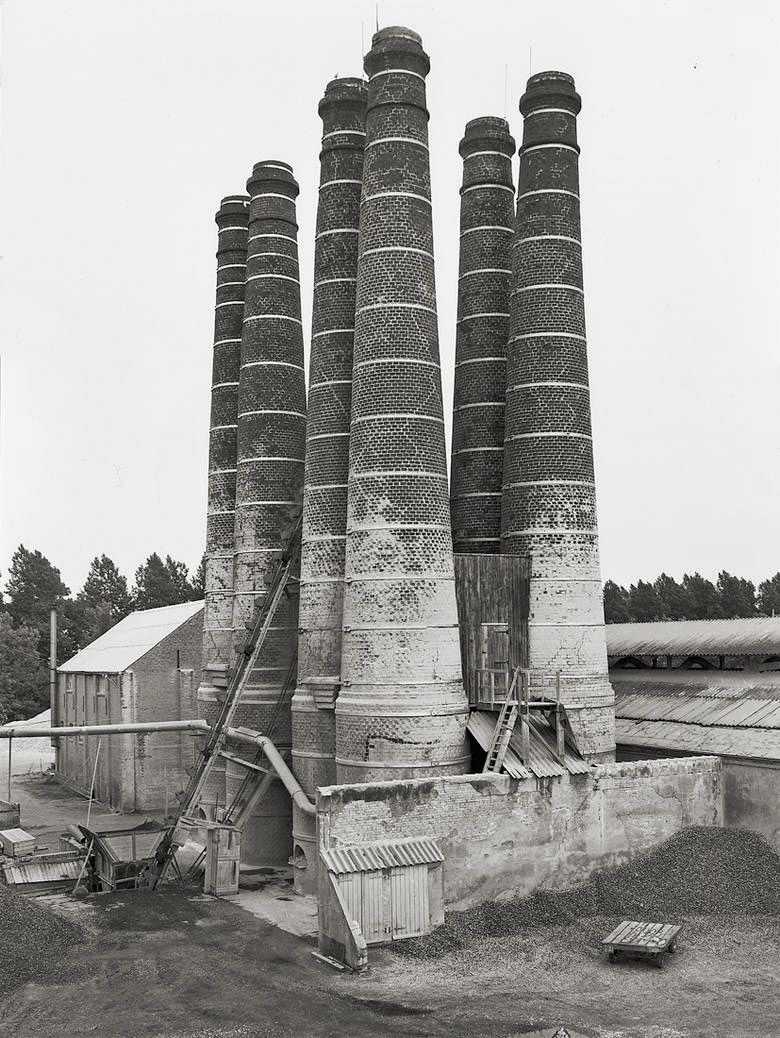
Bernd and Hilla Becher (German, active 1959-2007) 'Lime Kiln, Brielle, Netherlands' 1968


Bernd and Hilla Becher (German, active 1959-2007)
Bernd Becher (German, 1931-2007)
Hilla Becher (German, 1934-2015)
Lime Kiln, Brielle, Netherlands
1968
Gelatin silver print
24 in. × 19 1/2 in. (61 × 49.5cm)
Estate Bernd & Hilla Becher, represented by Max Becher, courtesy Die Photographische Sammlung/SK Stiftung Kultur – Bernd & Hilla Becher Archive, Cologne


Lime, an important building material since ancient times, is used in the production of mortar and cement. Here, the Bechers focused their attention on six towering brick chimneys that look as much like sprouting asparagus as utilitarian structures. The artists chose a similar view of lime kilns for the cover image of Anonyme Skulpturen (1970), their ambitious first publication. The book presents comparative sequences of different industrial forms, from kilns and gasometers to cooling towers, blast furnaces, and winding towers.


Bernd and Hilla Becher (German, active 1959-2007) 'Gas Tank, Wesseling / Cologne, Germany' 1983


Bernd and Hilla Becher (German, active 1959-2007)
Bernd Becher (German, 1931-2007)
Hilla Becher (German, 1934-2015)
Gas Tank, Wesseling / Cologne, Germany
1983
24 in. × 19 13/16 in. (60.9 × 50.3cm)
Estate Bernd & Hilla Becher, represented by Max Becher, courtesy Die Photographische Sammlung/SK Stiftung Kultur – Bernd & Hilla Becher Archive, Cologne


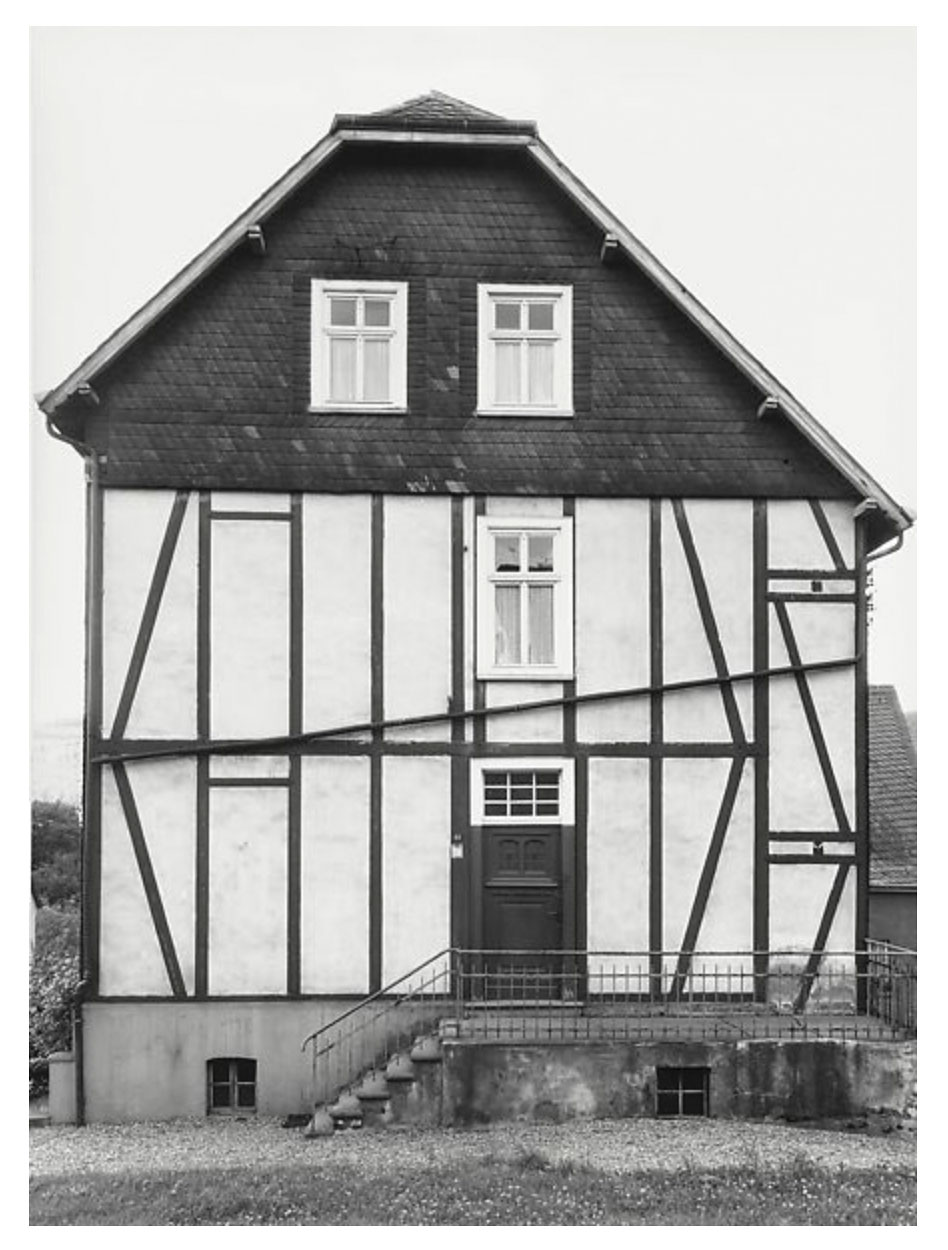
Bernd and Hilla Becher (German, active 1959-2007) 'Framework House, Schloßblick 17, Kaan-Marienborn, Siegen, Germany' 1962


Bernd and Hilla Becher (German, active 1959-2007)
Bernd Becher (German, 1931-2007)
Hilla Becher (German, 1934-2015)
Framework House, Schloßblick 17, Kaan-Marienborn, Siegen, Germany
1962
Gelatin silver print
Image: 15 7/8 × 11 5/8 in. (40.3 × 29.6cm)
Purchase, Vital Projects Fund Inc. Gift, through Joyce and Robert Menschel, Denise and Andrew Saul Fund, Louis V. Bell, Harris Brisbane Dick, Fletcher, and Rogers Funds and Joseph Pulitzer Bequest, and Jade Lau Gift, 2018


Both as artists and teachers, Bernd and Hilla Becher are the most important figures in European photography since 1950. Influenced by the formal rigour and typological method of prewar artists such as August Sander and Walker Evans, they were considered equals and fellow travellers by Minimalist sculptors such as Carl Andre and Sol LeWitt and paved the way for the medium’s integration into the broader arena of contemporary art. As professors at the Kunstakademie Düsseldorf, their influence was paramount on the celebrated generation of photographers known as the “Düsseldorf School” such as Thomas Struth, Andreas Gursky, Thomas Ruff, and Candida Höfer.


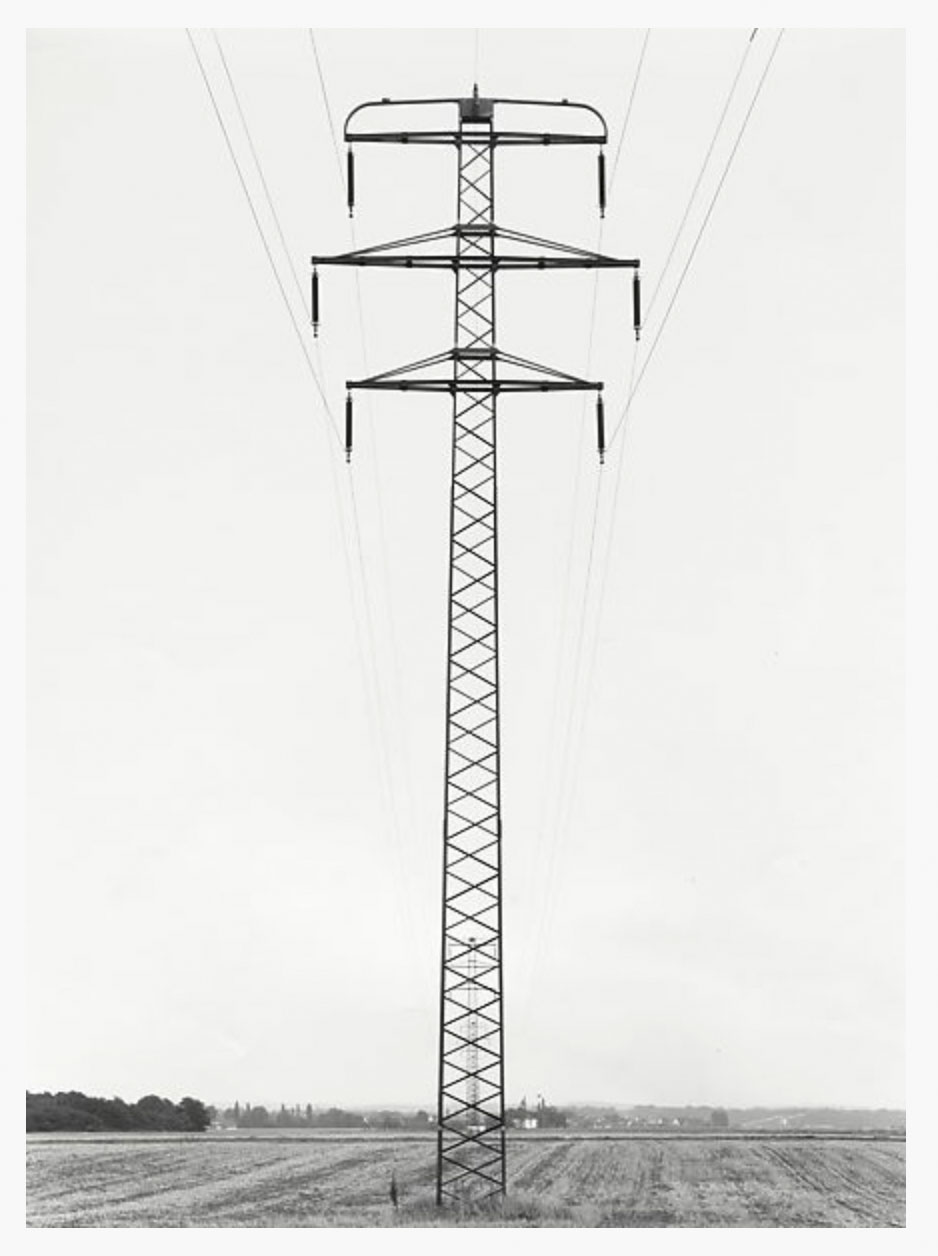
Bernd and Hilla Becher (German, active 1959-2007) 'High Tension Pylon near Düsseldorf, Germany' 1969


Bernd and Hilla Becher (German, active 1959-2007)
Bernd Becher (German, 1931-2007)
Hilla Becher (German, 1934-2015)
High Tension Pylon near Düsseldorf, Germany
1969
Gelatin silver print
Image: 15 13/16 × 11 11/16 in. (40.2 × 29.7cm)
Purchase, Vital Projects Fund Inc. Gift, through Joyce and Robert Menschel, Denise and Andrew Saul Fund, Louis V. Bell, Harris Brisbane Dick, Fletcher, and Rogers Funds and Joseph Pulitzer Bequest, and Jade Lau Gift, 2018


Bernd and Hilla Becher (German, active 1959-2007) 'High Tension Pylon near Düsseldorf, Germany' 1969


Bernd and Hilla Becher (German, active 1959-2007)
Bernd Becher (German, 1931-2007)
Hilla Becher (German, 1934-2015)
High Tension Pylon near Düsseldorf, Germany
1969
Gelatin silver print
Image: 15 3/4 x 11 1/2 in. (40 x 29.2cm)
Purchase, Vital Projects Fund Inc. Gift, through Joyce and Robert Menschel, Denise and Andrew Saul Fund, Louis V. Bell, Harris Brisbane Dick, Fletcher, and Rogers Funds and Joseph Pulitzer Bequest, and Jade Lau Gift, 2018


Bernd and Hilla Becher (German, active 1959-2007) 'Comparative Juxtaposition, Nine Objects, Each with a Different Function' 1961-1972


Bernd and Hilla Becher (German, active 1959-2007)
Bernd Becher (German, 1931-2007)
Hilla Becher (German, 1934-2015)
Comparative Juxtaposition, Nine Objects, Each with a Different Function
1961-1972
Gelatin silver prints
Estate Bernd & Hilla Becher, represented by Max Becher


These photographs show that the photographers Bernd and Hilla Becher were sometimes more interested in aesthetic form than in what industry actually does.

Bernd and Hilla Becher found artistic inspiration in the under appreciated beauty of the built environment, specifically, commonplace industrial and residential architecture. The Bechers’ use of typological ordering, as seen here in a grid of fifteen framework-house studies, can be traced to Hilla’s interest in the concepts of taxonomy and morphology, which are systems of biological classification based on shape and function. They called their assemblages “typologies” and used this effective graphic structure to compare similar and different forms, as would a researcher studying a collection of fossils or butterflies.


Bernd and Hilla Becher (German, active 1959-2007) 'Terre Rouge, Esch-sur-Alzette, Luxembourg' 1979


Bernd and Hilla Becher (German, active 1959-2007)
Bernd Becher (German, 1931-2007)
Hilla Becher (German, 1934-2015)
Terre Rouge, Esch-sur-Alzette, Luxembourg
1979
Gelatin silver print
17 5/8 × 23 1/2 in. (44.8 × 59.7cm)
Estate Bernd & Hilla Becher, represented by Max Becher, courtesy Die Photographische Sammlung/SK Stiftung Kultur – Bernd & Hilla Becher Archive, Cologne


Bernd and Hilla Becher (German, active 1959-2007) 'Charleroi-Montignies, Belgium' 1971


Bernd and Hilla Becher (German, active 1959-2007)
Bernd Becher (German, 1931-2007)
Hilla Becher (German, 1934-2015)
Charleroi-Montignies, Belgium
1971
Gelatin silver print
19 in. × 23 1/4 in. (48.2 × 59cm)
Estate Bernd & Hilla Becher, represented by Max Becher, courtesy Die Photographische Sammlung/SK Stiftung Kultur – Bernd & Hilla Becher Archive, Cologne


Bernd and Hilla Becher (German, active 1959-2007) 'Duisburg-Bruckhausen, Ruhr Region, Germany' 1999


Bernd and Hilla Becher (German, active 1959-2007)
Bernd Becher (German, 1931-2007)
Hilla Becher (German, 1934-2015)
Duisburg-Bruckhausen, Ruhr Region, Germany
1999
19 3/8 × 23 7/8 in. (49.2 × 60.6cm)
Estate Bernd & Hilla Becher, represented by Max Becher, courtesy Die Photographische Sammlung/SK Stiftung Kultur – Bernd & Hilla Becher Archive, Cologne


The Metropolitan Museum of Art
1000 Fifth Avenue at 82nd Street
New York, New York 10028-0198
Phone: 212-535-7710

Opening hours:
Thursday – Tuesday 10am – 5pm
Closed Wednesday

The Metropolitan Museum of Art website

LIKE ART BLART ON FACEBOOK

Back to top

Exhibition: ‘Mining Photography. The Ecological Footprint of Image Production’ at Museum für Kunst und Gewerbe Hamburg

Exhibition dates: 15th July – 31st October, 2022

Curators: The exhibition is curated by artist, author and curator Boaz Levin and Dr. Esther Ruelfs, Head of the Photography and New Media Collection at MK&G.

Artists: Ignacio Acosta, Lisa Barnard, F& D Cartier, Optics Division of the Metabolic Studio (Lauren Bon, Tristan Duke und Richard Nielsen), Susanne Kriemann, Mary Mattingly, Daphné Nan Le Sergent, Lisa Rave, Alison Rossiter, Robert Smithson, Simon Starling, Anaïs Tondeur, James Welling, Noa Yafe, Tobias Zielony


Mary Mattingly (American, b. 1979) 'Mineral Seep' 2016 from the exhibition 'Mining Photography. The Ecological Footprint of Image Production' at Museum für Kunst und Gewerbe Hamburg, July - Oct, 2022


Mary Mattingly (American, b. 1979)
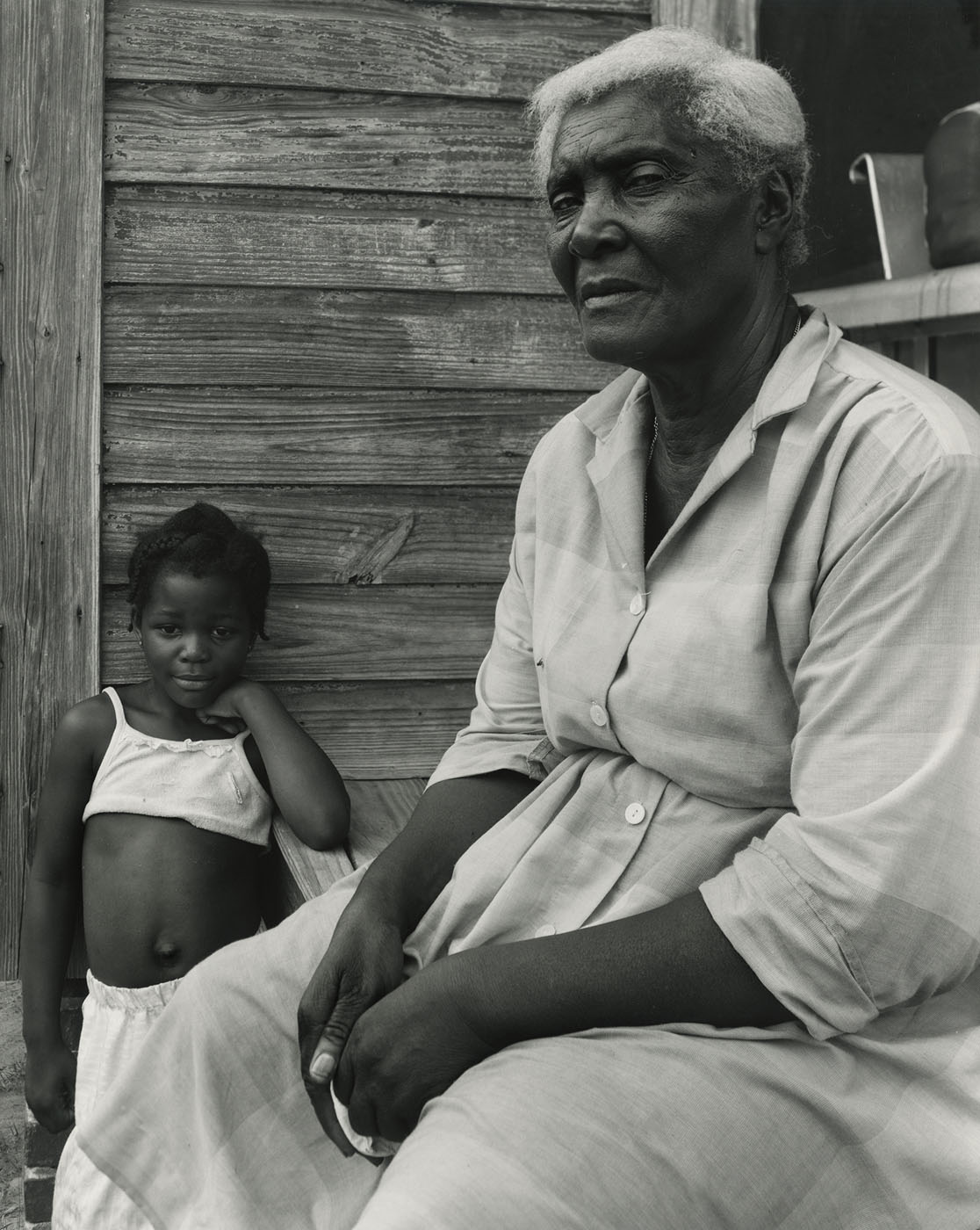
Mineral Seep
2016
C-print
© Mary Mattingly


A worthy subject I had never really thought about. Kudos to the curators for digging into (pardon the pun) and conceptualising the “five chapters following the different materials used for photographic production: Copper for the daguerreotypes, fossil fuels and their derivatives such as coal and bitumen for the printing processes, silver for the widely used silver gelatin prints of the 20th century, Paper as a carrier material, and, today, rare earths and metals for our ever-shrinking cameras and smartphones, and the energy required for the so-called “cloud”.”

Something has to change very quickly because almost everything the human race produces seems to add to the burden of this earth. Consumerism, capitalism, money, power, greed. I despair of the human race saving the earth. We might end up with ‘being’ only to be confronted by ‘nothingness’.

Dr Marcus Bunyan


Many thankx to the Museum fur Kunst und Gewerbe Hamburg for allowing me to publish the photographs in the posting. Please click on the photographs for a larger version of the image.


Installation view of the exhibition 'Mining Photography. The Ecological Footprint of Image Production' at the Museum für Kunst und Gewerbe Hamburg


Installation view of the exhibition Mining Photography. The Ecological Footprint of Image Production at the Museum für Kunst und Gewerbe Hamburg showing at left, work from Anaïs Tondeur’s series Carbon Black


Installation view of the exhibition 'Mining Photography. The Ecological Footprint of Image Production' at the Museum für Kunst und Gewerbe Hamburg


Installation view of the exhibition Mining Photography. The Ecological Footprint of Image Production at the Museum für Kunst und Gewerbe Hamburg showing on the table the work of Ignacio Acosta; and at far right, a contemporary enlargement of G.H. Johnson’s Outdoor view of a large mining operation on the North Fork American River 1852 Daguerreotype enhanced with gold


The exhibition Mining Photography: The Ecological Footprint of Image Production is dedicated to the material history of key resources used for image production, addressing the social and political context of their extraction and waste and its relation to climate change. Using historical photographs and contemporary artistic positions as well as interviews with restorers, geologists, and climate researchers, the exhibition tells the story of photography as one of industrial production, showing the extent to which the medium has been deeply intertwined with human change of the environment. By focusing on the ways by which industrial image production has been materially and ideologically implicated in climate change, rather merely using it to depict its consequences, the exhibition employs a radically new perspective towards this subject.

Ever since its invention, photography has depended on the global extraction and exploitation of so-called natural resources. In the early 19th century, these were salt, fossil fuels such as bitumen and carbon, as well as copper and silver, which were all used for the first images on copper plates and for salt paper prints. By the late 20th century, the photographic industry was one of the most important consumers of silver, responsible, at its peak, for about a quarter of the metal’s global consumption. Today, with the advent of digital photography and the ubiquity of mobile devices, image production is contingent on rare earths and metals such as coltan, cobalt, and europium. Image storage and distribution also consume immense amounts of energy. One scholar recently observed that Americans produce more photographs every two minutes than were made in the entire nineteenth century. Mining Photography: The Ecological Footprint of Image Production is dedicated to the material history of key resources used for image production, addressing the social and political context of their extraction and waste and its relation to climate change. Using historical photographs and contemporary artistic positions as well as interviews with restorers, geologists, and climate researchers, the exhibition tells the story of photography as one of industrial production, showing the extent to which the medium has been deeply intertwined with human change of the environment. By focusing on the ways by which industrial image production has been materially and ideologically implicated in climate change, rather merely using it to depict its consequences, the exhibition employs a radically new perspective towards this subject.

The exhibition is divided into five chapters following the different materials used for photographic production: Copper for the daguerreotypes, fossil fuels and their derivatives such as coal and bitumen for the printing processes, silver for the widely used silver gelatin prints of the 20th century, Paper as a carrier material, and, today, rare earths and metals for our ever-shrinking cameras and smartphones, and the energy required for the so-called “cloud”.

Interviews with conservators, climate scientists, and geologists highlight various aspects of the production process in relation to its ecological footprint. The exhibition thus consists of historical materials used during different image production techniques, historical artefacts, contemporary works, as well as information conveyed by the interviews.

“Mining Photography” traces exemplary individual supply chains, and analyses how photography’s materiality – which remains invisible to naked eye – has changed over the years. For instance, it will ask where the copper and silver used for Hermann Biow’s daguerreotype of the polymath, explorer and mining officer Alexander von Humboldt came from?

The “Copper, Gold, and the Daguerreotype” section looks at the copperplates that were photography’s first image supports in the 1840s and 1850s. The plates were produced on an industrial scale, primarily in Paris, and sold around the world. Copper was refined in Wales, in the area of Swansea, powered by the burgeoning fossil fuel industry. Ores were shipped to England from all over the world and smelted there to be traded worldwide. Photography was dependent on the copper trade, and the rapid proliferation of the medium would have been inconceivable without fossil fuels, colonial expansion, and the exploitative extraction of minerals.

The photographs from the time of the gold rush give a clear indication of the impact of the extractive mining industry, providing a documentary record of both the destruction of the landscape and the self-enactment of the gold miners, who proudly present themselves to the camera as entrepreneurs. Their female counterparts, the “Pit Brow Women” from Wigan represent the invisible labor that accompanies an industrialised product like photography. Specially created for the exhibition, Ignacio Acosta’s Hygieia Watches Over Us links the copper sculpture depicting the personification of health and hygiene with the copper-producing company Aurubis in Hamburg. It is part of the artist’s “Copper Geographies” project (ongoing since 2010), which traces the international trade routes followed by copper originating from his native Chile.

In “Fossil Fuels, Coal, and Bitumen”, we focus on the use of soot or coal as a pigment that is mixed in with photographic dyes, as can be seen, for example, in works by Anaïs Tondeur, Oscar and Theodor Hofmeister, Eduard Arning, and Susanne Kriemann. The motifs that are shown present us with moor landscapes in which coal is mined. An authentic “material unconscious” is laid down here as picture content in the photographs. Another fossil fuel is light-sensitive bitumen, a naturally occurring asphalt that was used in photographic production. For the exhibition, Noa Yafe created a work that shows the Dead Sea landscapes in which this raw material naturally occurs.

“Paper and Its Coating” focuses on the materials cotton, cellulose, gelatin, and celluloid. Europe was the centre of paper production in the 19th century, with cotton or flax rags initially used to make it. In the period around 1860, cotton was planted and harvested in the southern states of the US using slave labor. It was then shipped to Europe, where it was processed into fabrics, which served, in the form of rags, as the basis for most of the paper that was produced. It was not until the 20th century that cellulose derived from wood was first used in paper production. The photographers Alison Rossiter and F&D Cartier explore the different materiality of historical photographic papers in “discovered” images with an abstract poetic quality. Animal products were a vital ingredient used for coating the papers. In the 19th century, it was eggs, followed in the 20th century by gelatin, most of which was obtained from the bones of cows. In their pictures, which centre in different ways on the materials used in photographic coating, Madame d’Ora and James Welling document and reflect upon the brutal reality of industrialised meat production. Another work, especially created for the exhibition by Tobias Zielony and based on research he conducted at the former Agfa Filmfabrik Wolfen, focuses on the aspects of labor and ecology in the photographic industry.

The precious metal silver forms the basis of the photographic image, which still relies on it today. Of all the raw materials dealt with in the exhibition, silver is absolutely key to the global photographic industry, which, at least for now, is at present its largest consumer. It is here that we get the clearest indication of the sheer quantity of material that is required. The works of Daphné Nan Le Sergent, Simon Starling, and Metabolic Studio’s Optics Division allude to the connections between silver mining’s colonial background, the extraction of the raw material, and the process of refining it. Sergent also shows how the metals’ market value has been a the influence of the market value of metals, a driving force behind photographic technical innovations, which it has made that has made them more lucrative. Rather than being brilliant individual success stories, inventions are only possible and fruitful at a particular time and under particular conditions: witness the work of Hercule Florence, whose parallel development of a photographic process in South America remained unknown.

Lastly, “The Weight of the Cloud: Rare Earths, Metals, Energy, and Waste” looks at the resources that are needed to produce, display, and store digital images. Mining rare earths requires considerable amounts of energy: together with the “conflict minerals”, they are built into our smartphones and data storage devices used in the distribution of images. The rare earths ultimately end up in the burgeoning mountains of e-waste in the Global South, which are constantly growing to keep pace with our hunger for new devices. Lisa Barnard’s research-based work The Canary and the Hammer looks at the aspect of recycling with a focus on the precious metal gold. Mary Mattingly tracks cobalt’s complex and often opaque supply chains, mapping their course and constantly updating her rendering of them in response to market events. Lisa Rave’s video essay centres on the rare-earth metal europium. The app developed by Christoph Knoth and Konrad Renner together with their students at the University of Fine Arts Hamburg (HFBK) allows visitors to look at their phones in terms of their durability and recyclability, enabling them to probe into their own energy consumption.

Historical Material and Loans

The exhibition shows historical works by Eduard Christian Arning, Hermann Biow and Oscar and Theodor Hofmeister, Jürgen Friedrich Mahrt and Hermann Reichling. Together with historical photographic material from the Agfa Fotohistorama Leverkusen, photographic material from the Eastman Kodak Archive, Rochester, the FOMU Antwerpen and mineral samples collected by Alexander von Humboldt from the collection of the Museum für Naturkunde, Berlin, they represent the wealth of photographic products and processes whose raw materials the exhibition focuses on.

The exhibition is curated by artist, author and curator Boaz Levin and Dr. Esther Ruelfs, Head of the Photography and New Media Collection at MK&G.

Catalogue

The exhibition will be accompanied by a publication (German/English) with contributions by Siobhan Angus, Nadia Bozak, Boaz Levin, Brett Neilson, Esther Ruelfs, Christoph Ribbat, Karen Soli, 174 pages, Spector Verlag, Leipzig

Press release from the Museum für Kunst und Gewerbe Hamburg


Tobias Zielony (German, b. 1973) 'Dunkelraum' 2022 from the exhibition 'Mining Photography. The Ecological Footprint of Image Production' at Museum für Kunst und Gewerbe Hamburg, July - Oct, 2022


Tobias Zielony (German, b. 1973)
Dunkelraum (Darkroom)
2022
Slide installation
© Tobias Zielony


Ever since its invention, photography has depended on the global extraction and exploitation of so called natural resources. In the early 19th century, these were salt, fossil fuels such as bitumen and carbon, and copper and silver, which were all used for the first images on copper plates and for salt paper prints. By the late 20th century, the photographic industry was one of the most important consumers of silver, responsible, at its peak, for over half of the metal’s global consumption. Today, with the advent of digital photography and the ubiquity of mobile devices, image production is contingent on rare earths and metals such as coltan, cobalt, and europium. The storage and distribution of images also generate immense amounts of CO2.

The exhibition is dedicated to the material history of the key resources used for photography. It traces the social and political context of their extraction and disposal and how this relates to climate change. Using historical photographs and contemporary artistic positions as well as interviews with a chemist, an activist, a restorer, a mineralogist, and a biologist, the exhibition tells the story of photography as one of industrial production, showing the extent to which the medium is implicated in climate change.

Copper and the Daguerreotype

In 1802, Alexander von Humboldt collected mineral samples containing copper and silver on his research trip through South and Central America. A good forty years later, the use of such materials made it possible for Humboldt to be photographed. Silver-coated copper plates were the first image supports to enjoy widespread usage in photography.  The silver layer of these daguerreotypes, made light sensitive by iodine, was applied to a base of copper, which resulted in plates that were both more robust and less expensive. In 1839, when the daguerreotype was invented, such silver-coated copper sheets, produced using the so-called Sheffield Plate technique, were an inexpensive material employed for a whole range of silver household items, from trays to candlesticks. In Paris alone, the production of daguerreotypes required 100 tons of copper a year, producing in 1851 almost a million whole plates. Photography thus benefited decisively from the upswing in copper processing.

Beginning in the early 18th century in Swansea, Wales, coal was used to smelt copper ore on an industrial scale far away from the site where it was found. By the 1840s, ores from Cuba, Mexico, Colombia, Chile, Peru, Australia, and New Zealand were being processed in Swansea smelting works, which now produced more than a third of the copper that was traded worldwide – not without consequences for people and the environment. A look at Swansea reveals that photography’s global success would have been inconceivable without the use of fossil fuels, colonial expansion, and the world-wide extraction of metal deposits.

Hermann Biow and Alexander von Humboldt

Photographic pioneer Hermann Biow’s clear, unfussy visual language quickly made him a sought-after portraitist in prominent circles. In 1850, his Deutsche Zeitgenossen (German Contemporaries) portfolio was published with copperplate engravings from his photographs of artists, scientists, and politicians. In 1847, Biow had also photographed the famous naturalist Alexander von Humboldt in Berlin for the project. Humboldt, whose goal it was to depict the entire physical world in one work, was employed as a mining official for the Prussian authorities before setting out in 1799 on his first major research trip through South, Central, and North America. He brought back from there samples of the metals that would be the key elements in Biow’s daguerreotypes half a century later. The silver- and copper-bearing minerals that he collected give a sense of how these raw materials occur in nature and how, after the complex processing steps, their materiality is ultimately concealed by the finished photograph. Humboldt also recorded the way these precious metals circulated between the continents – a requirement for the industrial-scale production of daguerreotype plates – in a map in his Geographical and Physical Atlas of the Kingdom of New Spain, published in 1811. There is still some dispute, however, as to whether Humboldt was the first to warn of the dangers of anthropogenic climate change when, in 1843, he raised the question in his publication Central-Asien of the extent to which humans were influencing the climate “by felling the forests, altering the arrangement of bodies of water, and developing large masses of steam and gas at the epicenters of industry.”

Hermann Biow (b. 1804 in Breslau, d. 1850 in Dresden) was a portrait painter and lithographer and an important pioneer of photography in Germany. His documentation of the devastation of Hamburg after the fire of 1842 was the first photo reportage in history. The natural scientist Alexander von Humboldt (b. 1769 in Berlin, d. 1859 in Berlin) was an early fan of photography and saw it as “one of the most delightful and wondrous discoveries” of his time, even if he never operated a camera himself.

Daguerreotypes of the Californian Gold Rush

When, in 1848, it became known that gold had been discovered in the bed of the American River, people headed west to California in their hundreds of thousands to seek their fortune, together with traders, merchants, and photographers. Every gold prospector was also a potential customer wanting to send home a photo after a successful dig. The gold rush led to a boom in early photography and became the first event in US history to be comprehensively documented in photographs. Many daguerreotypists travelled straight to the mines as itinerant photographers. They portrayed gold diggers in threadbare clothing with tools and weapons, thereby presenting the Californian adventurers as the antithesis of the sophisticated denizens of the big cities. At the same time, they recorded the ongoing evolution of the techniques used in gold prospecting. The prospectors started out manually washing the precious metal from the river sediment using pans. But in the 1850s companies began extracting gold on an industrial scale. Watercourses were diverted so that gold could be retrieved from the drained riverbeds; “hydraulic” mining applied high pressure jets of water to detach gold-bearing sediments from hillsides and cliffs; and explosives and heavy equipment were used to dig veins of gold from underground. The gold rush daguerreotypes are thus the first documentation too of environmentally destructive mining practices. Here, it is easy to miss the fact that the images also record the mining of a material that was necessary for their own production: gold chloride had been in constant use as a fixative for daguerreotypes since 1841. Mercury represents another link between mining and photography. While photographers’ use of it as a developing agent jeopardised their own health primarily, its accessory role in gold washing caused the contamination of entire rivers in the area around the mines.

Cartes de visite of pit brow women

The photographs show the women who, from the early 17th century on, worked unseen in Britain’s coal mines, first below ground, and later, following the passage of the Mines and Collieries Act (1842), carrying out the lower-paid jobs on the surface. As mine workers, they moved lumps of coal with shovels and carts and separated them from the gangue using large sieve pans. Their work was a major economic contributor to Britain’s industrial success. Coal was a key element underpinning many production sectors, and it was crucial for the processing of copper, which was used in manufacturing daguerreotype plates. The British poet Arthur J. Munby collected photographs of working-class women, which catered to his interest in sociology. He bought photographs of women workers distributed as cartes de visite and also had studio photographs taken that depicted the women in their work clothes and pit gear. Unlike the Californian prospectors, who presented themselves in daguerreotypes as gold rush entrepreneurs and adventurers, the women seen in these images had little in common with the classical notions of the Victorian era. The view they showed of women in dirty work clothes (including trousers) turned the pictures into collectible motifs. We see the women sitting with legs apart and hands on hips – self-reliant poses with strong male connotations – photographed in a studio setting, where the furnishings were at odds with their class affinities.

Ignacio Acosta

Created for the exhibition, Ignacio Acosta’s multimedia installation centres on forty photographs arranged in a four-row grid structure. They combine three motifs linked together in a visually associative network, straddling copper production and water consumption. In the topmost rank, we see a smokestack belonging to the Hamburg copper producer Aurubis AG rising aloft, paralleled by the sculpture of Hygieia, which is mounted on a fountain with her back turned on Hamburg’s city hall, looking towards the Chamber of Commerce. Acosta makes a connection between the resource-intensive and, above all, water intensive industry – a major source of pollution for the Elbe River – and the politically charged sculpture commemorating the dreadful cholera epidemic of 1892, which was caused by contaminated water. In the rows below, close-up views of the fountain are interlaced with stained rubber suits worn by Aurubis AG’s workers to protect themselves from sulfuric acid. Visual and material analogies arise, linking the copper parts of the bronze sculpture, which have been oxidised to a green patina, with the tokens of “dirty” work in the copper plant – a thematic examination of the relationships between industry, politics, and society in terms of water and resource consumption. Acosta delves deeper into these themes in a video interview with Klaus Baumgardt from the Hamburg-based environmental protection initiative “Save the Elbe.” This new installation thus expands on his work Copper Geographies, an investigation into the global mobility of mined copper that he began in 2010.

Text from the Museum für Kunst und Gewerbe Hamburg


John Cooper (British) 'Woman miner' 1860s from the exhibition 'Mining Photography. The Ecological Footprint of Image Production' at Museum für Kunst und Gewerbe Hamburg, July - Oct, 2022


John Cooper (British)
Woman miner
1860s
Carte de visite Trinity College Library, Cambridge


Installation view of the exhibition 'Mining Photography. The Ecological Footprint of Image Production' at the Museum für Kunst und Gewerbe Hamburg


Installation view of the exhibition Mining Photography. The Ecological Footprint of Image Production at the Museum für Kunst und Gewerbe Hamburg showing the work of Ignacio Acosta


Ignacio Acosta (Chilean, b. 1971) 'Computer Aid' 2015


Ignacio Acosta (Chilean, b. 1971)
Computer Aid
2015
© Ignacio Acosta


Ignacio Acosta (Chilean, b. 1971) 'Hygieia Watches Over Us' 2022 (detail)


Ignacio Acosta (Chilean, b. 1971)
Hygieia Watches Over Us (detail)
2022
Installation comprising 40 pigment prints and video
© Ignacio Acosta


Coal and Bitumen: Fossil Fuels and Moorland

The majority of photographic processes popular around 1900, such as pigment printing, rubber printing, and heliogravure, did not require silver. In pigment or carbon printing, charcoal powder or lampblack, which consists of nearly pure carbon, replaces the silver grains. The heliogravure technique uses plates coated with bitumen and pigments, which lend the images their colour. This section of the exhibition deals with different perceptions of the landscapes in which the raw materials were found and extracted: peat bogs and moors in northern Germany, bitumen in the area around the Dead Sea in Jordan.

The pictures produced by Reichling and Mahrt – natural scientist and farmer, respectively – document the transformation of the moors and the shift from peasant labour to turf cutting and industrialised peat extraction. At the turn of the 20th century, when the work of draining, reclaiming, and burning the moorland began on a large scale, the landscape, which had been transformed by human intervention, was also consciously aestheticised and presented as an artistic ideal.

The raw materials used to produce these images originated in the moors too. The coal dust used as a pigment is created from dead trees, enriched with solar energy, that over the course of millennia have been pressed first into peat and then into coal. The photographs by Louis Vignes, and Charles Nègre’s prints of these images, depict the landscape of the Dead Sea, an area where bitumen, a form of petroleum, occurs naturally. Nègre used this material to coat the plates for their production of Vignes’s photos. This knowledge makes evident the connection between the motif, the landscape from which the raw material is extracted, and bitumen. Although invisible at first, this material relation inscribes in the image a kind of second, unconscious history.

Theodor and Oscar Hofmeister

The Hofmeister brothers present the moorlands around Hamburg as an area imbued with longing. The white blooms of the cottongrass accentuate the charming, painterly qualities of the idealised landscape, which is rendered in vertical format in the style of Japanese woodblock prints. The Hofmeisters do not show the furrowed ground, marked by the incipient signs of systematic peat extraction, or the geometrical lines of the drainage ditches. Instead, our eye is drawn in by a walkway projecting into the picture at an angle. The technique of multicolour gum bichromate printing, which came into vogue in the 1890s, uses pigments to render the photographic masters as prints that are made more durable by the admixture of soot.

Theodor Hofmeister (b. 1868 in Hamburg, d. 1943 in Hamburg) and Oscar Hofmeister (b. 1871 in Hamburg, d. 1937 in Ichenhausen) were amateur photographers alongside their professional work (as businessman and legal clerk, respectively). Exponents of the Pictorialist approach, they began exhibiting their work internationally in 1895. They specialised in multicolour gum bichromate printing.

Jürgen Friedrich Mahrt and Hermann Reichling

Moorlands contain the organic commodity peat. Once it has been drained, dug, and dried, it can be burned as a source of energy. This usage has a long history and was of great importance until the emergence of the coal industry. As naturalists, Jürgen Friedrich Mahrt and Hermann Reichling recorded how peat cutting infringed on nature and documented the massive impact it had. While Mahrt’s hand-coloured photographs are illustrative of the arduous manual labor involved, Reichling’s work gives a palpable sense of the industrial scale of this undertaking. He often seeks out compositions that set up a contrast between the supposedly pristine moor – which represents such an important habitat – and the drastic impact of human agency. In this way, he clearly shows how the natural vegetation is inscribed with an industrial grid of furrows, which gives structure to the photographs’ pictorial space as a graphical raster. It becomes evident here how nature is turned into a commodity, how with every cut that is dug, whether with a spade or an excavator, sods of peat are removed from the earth as a monetisable product. The shots showing the edges of the peat in cross section – as documented by both photographers – also allude to the temporal dimension of the resource: in the right conditions, it takes a thousand years to produce 1 meter of peat from organic material. However, the climate is being damaged not only by the commercial exploitation of the moorlands but also by the process of draining them, which releases huge amounts of CO2.

Jürgen Friedrich Mahrt (b. 1881 in Elsdorf, d. 1940 in Rendsburg) was a farmer and Hermann Reichling (b. 1890 in Heiligenstadt, d. 1948 in Münster) a biologist. As self-taught photographers, they made a record of their cultural and natural surroundings. In the 1920s, Mahrt founded a private museum in Elsdorf in which he exhibited natural history dioramas and photographs. Reichling was director of Münster’s museum of natural history, Provinzialmuseum für Naturkunde, from 1921 to 1948.

Eduard Arning

If you look closely at Eduard Arning’s large-format gum bichromate print of an iron and steel works, it has a leathery look that resembles skin. The print’s surface structure contains the pigments that give it its murkily indistinct visual effect. This is produced in large part by a blue-black colour produced when larger amounts of soot were mixed into the pigments. The surface of the paper, which has been treated with pigments and a binding agent, is exposed: these areas become fixed, while less exposed parts are rinsed away and remain lighter. In this case, the result is a nocturnal view of an iron and steel works, whose chimneys spout fire and belch smoke. The leaping flames and brightly lit windows were added after the fact by Arning and convey a Romantic idea of industrial production at the turn of the 20th century. To the right of the picture, a shadowy heap of ore looms large in the foreground, while on the left a somewhat brighter swath leads the eye into the depths of the picture and the glowing entrance to the factory. Towering next to it is the monumental chimney from which soot rises – a symbol of industrial progress. This returns in material form as blue-black pigment, extending right to the frontmost plane of the picture and giving the dark pile of ore its shape.

Anaïs Tondeur

Anaïs Tondeur’s work Carbon Black sees her delving into soot particles, which were an essential component used in photographic methods at the turn of the 20th century. A product of industrial combustion processes, consisting almost exclusively of carbon, soot is carried by wind and air currents and does not usually fall to the ground until it is hundreds of kilometres from the site of emission. The black particles of carbon absorb the sun’s rays, warming the atmosphere and thus contributing to the melting of the ice caps. Soot enters the human body through the lungs as a fine dust measuring less than 2.5 micrometers – breathed into the alveoli, it is transported into the bloodstream and finds its way into the internal organs. Working together with two climate researchers, the artist set out on a fifteen-day expedition traversing the UK. Using airflow analyses, the team determined the trajectory of soot particles, a trail that led from Fair Isle in Scotland to the port of Folkestone in the south of England. At each stop on their journey, they took photographs of the horizon using a helmet camera, measured the concentration of particulate matter, and recovered soot particles from the air. Inserted into printer cartridges as pigment, these particles were then used to produce a landscape photograph whose colour characteristics are specific to the site where the picture was taken. The severity of the air pollution is thus given expression in the dramatic grey and black tones of the cloud constellations depicted.

Anaïs Tondeur (b. 1985 in France) studied at Central Saint Martins and at the Royal College of Arts in London. Her research-based work explores the dynamic realm connecting the natural sciences, anthropology, and mythic narratives.

Susanne Kriemann

The artist works with heliogravure, a manual printing technique that is now no longer used in practice: the copper plate is dusted with asphalt powder and printed using a highly pigmented paint mixed with soot. In 2017, Susanne Kriemann began accompanying scientists from the University of Jena on their research trips to investigate the renaturation of the uranium mining area formerly operated by SDAG Wismut in the Ore Mountains (Erzgebirge). Uranium ore, a highly radioactive substance, was mined there between 1949 and 1990. Today, its soil is severely contaminated with heavy metals. Kriemann uses photography for her artistic research on the project – her logging of contaminated plants stretches the medium to the very limits of what it can depict, as the radiation measured by the researchers cannot be seen in the photograph. Notwithstanding, Kriemann has devised a method that allows her to inscribe the radioactivity in the image: she harvests individual plants that she has previously photographed and processes them to produce different-coloured pigments, which she mixes with soot and uses to print her heliogravures. This technique allows her to include the plants directly in the work she creates. In this way, the radioactivity becomes a physical element in her images.

Susanne Kriemann (b. 1972 in Erlangen) studied at the Stuttgart State Academy of Art and Design (ABK Stuttgart) and the École nationale supérieure des Beaux-Arts in Paris. Her research-based work is concerned with the technical requirements and historical conditions of photographic production.

Robert Smithson

In his 1969 work Asphalt Rundown, Robert Smithson abandoned the gallery space completely to realise his first outdoor earthwork. In a stone quarry south of Rome, he had a truckload of hot, liquid asphalt tipped down an eroding slope. In choosing the quarry, he opted for a landscape that bore the marks of human intervention, the first link in a variety of industrial supply chains. Smithson’s Asphalt Lump from 1968 had already demonstrated his interest in industrial composites and nature as shaped by humanity: it was at this point that he was invited by the Konrad Fischer Galerie to conduct research on the slag heaps in the Ruhr, together with the photographer couple Bernd and Hilla Becher. In the work in Rome, the inky black mass covers the barren earth in next to no time, causing the ground to disappear beneath it as it pushes its way down the slope like a natural river, cooling and congealing.

Smithson conceived the sculpture as a symbol of frozen time. In his view, time does not simply pass – rather, it is deposited in an ongoing process like layers of sediment in the soil. As a language construct, Asphalt Rundown links into the idea of photographic images as frozen moments. On the material level, meanwhile, Smithson’s use of asphalt also alludes to Nicéphore Niépce’s heliographic experiments, where the hardening of asphalt on a tin plate under the action of light was used to record fleeting images and was thus a means to freeze time. The natural asphalt used by Niépce can be found as bitumen judaicum in the area around the Dead Sea, where the visual scenery bears a striking resemblance to Smithson’s artificially created volcanic landscape.

Robert Smithson (b. 1938 in Passaic, New Jersey, d. 1973 in Texas) gained a reputation as an early exponent of land art. He applied his conceptual approaches to a study of the relationships between humans and nature, drawing parallels between industrial and geological processes.

Honoré d’Albert de Luynes, Louis Vignes, Charles Nègre

The atlas Voyage d’exploration à la mer Morte is a documentary account of the 1864 scientific, archaeological, and artistic expedition to the Dead Sea basin and the interior of Jordan. Financed by Honoré d’Albert, duc de Luynes, an archaeologist, scientist, and art connoisseur, the expedition was accompanied by, among others, the geologist Louis Lartet and the photographer Louis Vignes. D’Albert subsequently commissioned Charles Nègre – who was one of France’s best-known photographers and had developed a photomechanical reproduction process – to translate Vignes’s photographs into an official report on the expedition using photogravure plates. The publication that came out of this process can still be termed a handmade book. Nègre was not merely an accomplished technician, he also had the eye of an art photographer and created intermediate tonalities and shadows for Vignes’s images, which turned out to have too much contrast. His prints, which are rich in detail and the play of light and shadow, were on occasion composed of several negatives, and, in some cases, the clouds were superimposed. The atlas shows, among other things, the sites where the natural deposits of bitumen were found: this was the basis, in turn, for the gravure printing process that Nègre refined.

Honoré Théodoric Paul Joseph d’Albert de Luynes (b. 1802 in Paris, d. 1867 in Rome) was a numismatist, archaeologist, collector, scholar, and art lover. Born into an aristocratic family, he was endowed with a considerable fortune and financed the research trip to Jordan, in which he also took part. Louis Vignes (b. 1831 in Bordeaux, d. 1896 in Paris) was an admiral in the French navy and an amateur photographer. Charles Nègre (b. 1820 in Grasse, d. 1880 in Grasse) was a painter and photographer as well as a technician and inventor of his own photogravure method.

Noa Yafe

At first glance, we see a two-dimensional image, and it is only when we get closer to what is apparently a photograph mounted in the exhibition space that we register the three-dimensional sculpture let into the wall surface, which opens up like a diorama into the space behind it. Noa Yafe’s sculptures are based on photographs: these are used as templates. It is often scientific images that capture her imagination. The artist deals with the verity of photography and the moment of illusion; at the same time, by turning photographs into objects, she also addresses materiality in an age in which images have become immaterial. The master for the work she made for the exhibition is the black-and-white photograph Vue Prise au dessus de Mar Saba (View over Mar Saba) of the Jordanian hillscape around the Dead Sea. The picture was taken by Louis Vignes and reproduced by Charles Nègre using the photogravure technique: it appeared in the atlas Voyage d’exploration à la mer Morte (Expedition to the Dead Sea, 1868-1874). The artist uses real materials for the “photograph” she constructs.

Noa Yafe (b. 1978 in Israel) studied at the HaMidrasha School of Art at Beit Berl College and at the School of Visual Arts in New York City. She works in the medium of photography and sculpture.

Text from the Museum für Kunst und Gewerbe Hamburg


Jürgen Friedrich Mahrt (German, 1882-1940) 'Making baked peat on Hartshoper Moor' c. 1930


Jürgen Friedrich Mahrt (German, 1882-1940)
Making baked peat on Hartshoper Moor
c. 1930
Gelatine silver paper, hand coloured
Collection Mahrt/Storm, Rendsburg/Berlin


Installation view of the exhibition 'Mining Photography. The Ecological Footprint of Image Production' at the Museum für Kunst und Gewerbe Hamburg


Installation view of the exhibition Mining Photography. The Ecological Footprint of Image Production at the Museum für Kunst und Gewerbe Hamburg showing the work of Robert Smithson


Robert Smithson (American, 1938-1973) 'Asphalt Rundown' 1969


Robert Smithson (American, 1938-1973)
Asphalt Rundown
1969
Documentary photograph
© Holt/Smithson Foundation VG Bild-Kunst, Bonn 2022


When the Bechers’ friend Robert Smithson poured oceans of glue down a hillside, or bulldozed dirt onto a shed until its roof cracked, he was mimicking the moves of heroic construction, not aiming to build anything.

Blake Gopnik. “Photography’s Delightful Obsessives,” on The New York Times website July 28, 2022 [Online] Cited 20/10/2022


Installation view of the exhibition 'Mining Photography. The Ecological Footprint of Image Production' at the Museum für Kunst und Gewerbe Hamburg


Installation view of the exhibition Mining Photography. The Ecological Footprint of Image Production at the Museum für Kunst und Gewerbe Hamburg showing work from Anaïs Tondeur’s series Carbon Black


Anaïs Tondeur (French, b. 1985) 'North Sea, 27.05.2017, Carbon Black Level (PM2.5): 13,8 µg/m' 2017-2018


Anaïs Tondeur (French, b. 1985)
North Sea, 27.05.2017, Carbon Black Level (PM2.5): 13,8 µg/m
2017-2018
From the series Carbon Black
15 Carbon ink prints photographs, carbon black particles, cartography
100 x 150cm


Despite the absence of industries, the inhabitants of the isle of Fair suffer from suffocation. As Anaïs Tondeur reached the island she sent her geographic coordinates to climate modellers Rita van Dingenen and Jean-Philippe Putaud (JRC, European Commission) who retraced the itinerary of the particulate matters meeting her. By means of atmospheric backward trajectory models and the analyses of anthropogenic emission of air pollutants, they could define the site of emission of the particles. This abstract trajectory line lead the artist to an expedition of 837 miles by foot, ferry, fishing boat and car unravelling the journey of the anthropic meteors.

She crystallised each day in a photograph of the sky as well as filtering black carbon particles she encountered through breathing masks. The particles were later extracted by scientist J.P Putaud and turned into ink. In point of fact, black carbon is a collateral form of soot, used for centuries as the primary component of Indian ink. The photographs are thus printed with some ink composed from the particles captured in the sky where they were shot.

Text from the Anaïs Tondeur website [Online] Cited 16/10/2022


Anaïs Tondeur (French, b. 1985) 'Edinburg, 30.05.2017, Carbon Black Level (PM2.5): 8,18 µg/m³' 2017-2018


Anaïs Tondeur (French, b. 1985)
Edinburg, 30.05.2017, Carbon Black Level (PM2.5): 8,18 µg/m³
2017-2018
From the series Carbon Black
15 Carbon ink prints photographs, carbon black particles, cartography
100 x 150cm


Installation view of the exhibition 'Mining Photography. The Ecological Footprint of Image Production' at the Museum für Kunst und Gewerbe Hamburg

Installation view of the exhibition 'Mining Photography. The Ecological Footprint of Image Production' at the Museum für Kunst und Gewerbe Hamburg

Installation view of the exhibition 'Mining Photography. The Ecological Footprint of Image Production' at the Museum für Kunst und Gewerbe Hamburg showing at left, heliogravures by Susanne Kriemann


Installation view of the exhibition Mining Photography. The Ecological Footprint of Image Production at the Museum für Kunst und Gewerbe Hamburg showing at left in the bottom photograph, heliogravures by Susanne Kriemann


Susanne Kriemann (German, b. 1972) 'Bitterkraut aus: Falsche Kamille, Wilde Möhre, Bitterkraut (Zyklus 2)' 2017


Susanne Kriemann (German, b. 1972)
Bitterkraut aus: Falsche Kamille, Wilde Möhre, Bitterkraut (Zyklus 2)
Bitterweed from: false chamomile, wild carrot, bitterweed (Cycle 2)
2017
Photogravure with ox-tongue pigment, 0.6 g soot on paper
80 x 60cm
© Susanne Kriemann


Paper and Its Coating: Cotton, Pulp, Gelatin, and Celluloid

The development of photography as a mass product, first made possible using paper as a material substrate, came at a cost. For most of the 19th century, photographic paper consisted primarily of rag made of cotton and flax. European manufacturers dominated the markets for textiles and paper throughout the century, but much of the raw material they used was sourced from the United States, which became cotton’s leading cultivator through its utilisation of slave labour and, after the Civil War, of share croppers and tenant farmers.

The cultivation of cotton was closely intertwined with the often-violent emergence of capitalism, precipitating the drainage of wetlands – whose ecosystems play a crucial role in carbon storage – and thus accelerating climate change. This cotton was then exported to Europe, where it was spun into clothes, which, when worn out, were collected by ragpickers – predominantly working-class children and women – and sold back to European paper mills, where women prepared them for pulping, removing buttons and bleaching them white using newly discovered toxic chlorine compounds.

The ever-increasing demand eventually led producers to seek an alternative to cotton. Perfected in Germany, wood pulping in entails the boiling of wood in sulfuric acid so as to separate it into individual cellulose fibres. The photo-paper industry’s use of animal-derived substances, such as albumin and gelatin, relied on industrialised farming and slaughter houses. A single photographic paper producer in Dresden used six million eggs a year for albumen coating, and as late as 1999 Kodak was still processing over thirty million kilos of cow skeletons every year.

Gevaert Photographic Paper

The 1964 merger of the German corporation Agfa AG and the Belgian company Gevaert Photo-Producten NV led to the creation of the Agfa- Gevaert Group. These two enterprises, each with a long tradition, combined to form one of the world’s leading producers of photographic goods, whose line extended from cameras to X-ray film. If we take, for example, black-and-white gelatin silver paper – one of Agfa-Gevaert’s core products and a staple of the photographic industry in general – it is still manufactured according to the same principles today. The paper substrate is coated with a layer of barium sulfate (also known as baryte), which covers the paper fibres and ensures that the emulsion of gelatin and light-sensitive silver halide grains applied at the end adheres to the base. The pictures from the Agfa archive offer an insight into this process. Although the layers were always built up in the same way, there was considerable variety in the photographic paper that was produced. The possible surfaces might be white or cream coloured, glossy or matte, smooth or textured and were available in up to six variants to allow the motif to be rendered with different degrees of contrast, from extra soft to ultra hard. Systematic research into photographic papers and their material properties did not start until a few years ago. One such example is the documentation of Gevaert papers by the FOMU Photo Museum in Antwerp, which should provide a better understanding of these products and facilitate their processing in both artistic and technical terms. A study of the packaging reveals that successful product lines were offered over a period of decades, even if their outer form changed with the times in line with contemporary tastes.

Alison Rossiter

Alison Rossiter’s photographic work is created without a camera or a lens, using expired photographic paper. Since 2007, the artist has collected approximately fifteen hundred packages of old photographic paper, starting from the late 19th century and representing every decade of the 20th. Rossiter mines what she describes as a “cross section of the history of photographic print materials” for their latent images – created by the effect on the paper over time of oxidation, light leaks, pollutants, or physical damage and then developed by the artist in the darkroom to reveal “found photograms.” At times, the artist marks the surface intentionally by pouring or pooling photographic developer directly onto the paper, or else limiting its contact with it, deftly combining chance and skill. The results are abstract images, fields of texture, spilled marks, and monochromes, in a subtle array of blacks, greys, and whites reminiscent of mid-century modernist painting. Each work’s title contains three facts: the manufacturer and type of paper, its expiration date as stated on its package, and the date that Rossiter processed the material. As indicated by its title, a work consisting of six prints included in the exhibition was produced using Gevaert Gevaluxe Velours paper, but their exact expiration date is unknown. First produced by Gevaert in 1933, Gevaluxe Velours was advertised by the company as the “most beautiful paper ever made” and is considered to this day to have been one the best commercially available papers due to its matte surface and intensely deep black shadows. A second work comprises of two images printed using an unnamed photographic paper produced by The Haloid Company, Rochester, for the US military. The abstract geometrical compositions’ material provenance reveals their connection to what could be called the military-photo-industrial-complex, but also hints at the origins of digital technologies within the photographic industries: in 1961 Haloid changed its name to Xerox Corporation, and would go on to invent some of the key technologies in personal computing.

F & D Cartier, Wait and See – The Never Taken Images

In 1998, F & D Cartier began investigating the materiality of photographic paper in a work group entitled Wait and See. For them, the work is an exploration of the rudiments of the medium and a way of engaging with the flood of photographic images produced in the digital age. In their installations, the artists use expired photographic papers dating from the years 1890 to 2000, which have lost some of their sensitivity but still respond to light. Their exposure in the exhibition space triggers an ongoing process of slow change as their appearance constantly alters. Without any recourse to a camera or photochemistry, the duo thus brings to life images that were never taken and examines their potential. At the same time, their radically simplified experiment, designed to record light and time, connects back to the early days of the medium, when developing photographic paper was still unusual and daylight exposure was the principal means of blackening the silver salts. The surprising colours produced by the undeveloped gelatin silver emulsions reveal another invisible aspect of analog photography: in this way, F & D Cartier’s experiment conveys a profound sense of the complexity of a material that was ubiquitous in the 20th century.

Françoise Cartier (b. 1952 in Tavannes) studied sculpture at École des Arts Appliqués in Bern; Daniel Cartier (b. 1950 in Biel/Bienne) studied photography at Zurich University of the Arts (ZHdK). Their experiments with photographic materials, which they embarked on together in 1995, have been devoted to themes relating to remembering, forgetting, and the passing of time.

James Welling

Throughout his career, James Welling has reflected on photography’s history and nature by examining the medium’s materiality through the lens of its most common components. Used as a binding layer for gelatin silver prints, gelatin’s prevalence in photographic images normally remains invisible to the naked eye. In this series, produced in 1984, Welling chose to portray the substance in a style reminiscent of product photography. Infused with black ink and then cooled, the sculpted chunks of gelatin were placed against a seamless white background, creating semi-abstract compositions with the appearance of shining coal or black glass. Welling’s work highlights photography’s artifice: reflecting on the way it is consciously and explicitly staged, its choice of subject, and its referential indeterminacy. This is accentuated by the fact that it is difficult at first to tell what exactly it is we are looking at. In his work, Welling often creates a delay between the moment an image is seen and the time viewers understand what it depicts. Here, what the image is of is exactly what it is made of: as if by sleight of hand, Welling reveals image and substrate to be one and the same, reflecting on all that is normally left out of the frame or taken for granted – or all that is hidden by it – when we normally think of what photography is, and what it does to the world.

James Welling (b. 1951, Connecticut, US) studied at Carnegie Mellon University and the University of Pittsburgh and later at the California Institute of the Arts in Valencia. Throughout his career, Welling has experimented with different photographic media, exploring the tensions within and between representation and abstraction and challenging the medium’s conventions.

Madame d’Ora

Between 1949 and 1953, Madame d’Ora produced an unsparing photographic study of two Parisian slaughterhouses, which she would go on to describe as her “great final work.” Built during the 19th century under Napoleonic decree and in keeping with Baron Haussmann’s vision, slaughterhouses such as the Abattoir Ivry Les Halles and Abattoir de Vaugirard signalled the emergence in France of industrialised meat production governed by capitalist imperatives. It was in such abattoirs that the repetitive, procedural, and rationalised mode of the factory was first introduced into the realm of animal slaughter, a practice that was later perfected in the US with the introduction of the assembly line. Enabled by such developments, the exponential growth of the cattle industry during the 19th century contributed to the dramatic acceleration in carbon emissions that began in those years. To this day, cattle are considered the number one agricultural source of greenhouse gases worldwide (responsible for about 14 percent of total human-induced emissions). Madame d’Ora’s images seem to dissect her subjects, portraying them with a sense of tactility and precision and, at times, of the absurd. In some images, skin is stretched across the picture plane, resulting in near abstraction, while, in others, pools of blood and rows of clipped and flayed corpses fill the frame to capacity, creating a mood of excess and serialised death. Evoking a mixture of detachment and brutality, distance and cruelty, reminiscent of the horrors of the 20th century, the series has often been read as an implicit response to the Holocaust, during which many of d’Ora’s family members, including her sister Anna, were killed. By documenting the unpleasant reality behind industrial meat production, an essential component in many everyday commodities – including the gelatin-silver paper used for these prints – d’Ora sheds light on a dark and often ignored aspect of modernity.

Madame d’Ora (née Dora Philippine Kallmus, b. 1881 in Vienna, d. 1963 in Frohnleiten, Austria) was an Austrian Jewish photographer and one of the most acclaimed portraitists of fin-de-siècle Vienna. After the war, d’Ora was commissioned to produce a series representing refugees and displaced persons by the United Nations. It was at that time too that she started working on her slaughterhouse series.

Tobias Zielony

For Blackbox Wolfen, Tobias Zielony has created a fictional archive of the AGFA-ORWO film factory in Wolfen, combining still images and interviews with former employees who worked in the factory’s darkrooms. Predominantly women, the workers had to perform their tasks in near pitch darkness, in extreme cold or heat, exposed to various toxic chemicals. For the GDR, filmstock represented a valuable commodity that could be traded with the Soviet Union in exchange for silver, oil, and gas. ORWO also supplied cinematographic material to other socialist countries, as well as non-socialist economies such as Egypt and Brazil. One of the biggest export markets for ORWO film was India, which needed stock for its burgeoning movie industry and provided sun-bleached cow bones, used for high-quality film gelatin, in exchange. Today, only a single small company exists in Wolfen, primarily producing a highly specialised black-and-white archival film. Used by the German Federal Archive, the film is said to survive for up to a thousand years once exposed if it is stored in dark and cold environments, such as Germany’s National archive, which is located deep underground in the decommissioned silver mine of

Tobias Zielony (b. 1973 in Wuppertal, Germany) studied photography at the University of Wales, Newport, and later at the Academy of Fine Arts (HGB) Leipzig. He is known for his photographic and filmic depictions of youth and subcultures, which employ a critical approach to documentary photography.

Text from the Museum für Kunst und Gewerbe Hamburg


Madame d'Ora (Dora Kallmus) (Austrian, 1881-1963) 'Severed cows legs in a Parisian abattoir' c. 1953-1954


Madame d’Ora (Dora Kallmus) (Austrian, 1881-1963)
Severed cows legs in a Parisian abattoir
c. 1953-1954
Gelatin silver print
Museum für Kunst und Gewerbe Hamburg


Madame d'Ora (Dora Kallmus) (Austrian, 1881-1963) 'Severed calf's head in a Parisian slaughterhouse' c. 1953-1954


Madame d’Ora (Dora Kallmus) (Austrian, 1881-1963)
Severed calf’s head in a Parisian slaughterhouse
c. 1953-1954
Gelatin silver print
31.7 × 24.5cm
Museum für Kunst und Gewerbe Hamburg


Unknown photographer. 'Raw paper storage, Agfa AG, Leverkusen' 1956


Unknown photographer
Raw paper storage, Agfa AG, Leverkusen
1956
C-print, mounted on cardboard
Agfa Collection, Museum Ludwig, Cologne
© Museum Ludwig


James Welling (American, b. 1951) 'Gelatin Photograph 45' 1984


James Welling (American, b. 1951)
Gelatin Photograph 45
1984
Inkjet print
50.8 × 40.6cm


F&D Cartier. 'Wait and See' 1998 - today


F&D Cartier
Wait and See
1998 – today
Exposure tests, untreated gelatin silver photographic papers from Leonar, Illingworth & Co., Hans Mahn & Co., Wephota
©F&D Cartier


Tobias Zielony (German, b. 1973) 'Dunkelraum' 2022


Tobias Zielony (German, b. 1973)
Dunkelraum (Darkroom)
2022
Slide installation
© Tobias Zielony


Silver

Since the advent of the medium, silver has been the basis of the photographic image and the most important raw material used in the photochemical industry. In the popular gelatin silver process, it is embedded in the gelatin layer of the photographic paper, and the light-sensitive material then registers the image. The final image consists of small particles of metallic silver that turn black when exposed to light, while the unexposed silver halide crystals are washed away.

It was only the automation of production and commercial film development services that enabled photography to become a veritable mass medium. The growing number of amateur photographers caused the industry’s  silver consumption to explode. Photography remained the largest consumer of silver worldwide, even after 1979, when a massive rise in the price of silver led to the development of smaller photographic formats such as 110 film as well as research into digital photography. Photography is interwoven with global trade, the extraction of raw materials, and colonialism. The exploitation of Cerro Rico (“Rich Mountain”) in the Potosí region of Bolivia started back in the 15th century, and until the mid-20th century most silver was sourced in North and South America.

The production of film and photographic paper and its development has always been accompanied by significant environmental pollution, through both its high levels of water consumption and the contamination of waste water with alkalis, acids, and traces of silver. The impact of such pollution is to this day clearly visible in the areas around Eastman Kodak’s headquarters in Rochester (USA) and the ORW Ofactories in Bitterfeld-Wolfen.

The recovery of silver from photographic waste was first developed for economic reasons during the 19th century but was only established as standard practice in photographic production in the 1960s. Today such recycling processes are important – and not just with regard to a single finite raw material.

Simon Starling

In his sculptural work, Starling zooms in on the materiality of the photograph, using an electron microscope to single out two silver particles in the emulsion of a historical photo and then rendering them, with the help of a computer program, at a magnification of 1:1,000,000. This rendering is converted into a stainless-steel three-dimensional sculpture that is larger than a person, its seemingly fluid polished surface creating a virtual effect. Starling has described the photograph as a “deposit of matter”, an image produced by an agglomeration of silver particles. His rendering has its origins in the materiality and documentary function of a stereo-photograph showing Chinese migrant workers who had been brought to Massachusetts in 1870 to break a strike in a shoe factory. Made in China because of lower production costs, the sculptures reverse the trajectory in this story of labour migration. The Nanjing Particles can also be regarded, therefore, as a work about the development of systems of global production. Starling treats photographs as material objects that need to be produced and preserved. In the process, photographs activate memory and knowledge, at times revealing stories that have been suppressed.

Simon Starling (b. 1967 in Epsom) studied art and photography at various institutions, including the Glasgow School of Art. He works in the area of conceptual art. Starling’s work draws on models of sustainability and wasteful extravagance to focus on the historical trajectories of exploitation.

Optics Division of the Metabolic Studio (Lauren Bon, Tristan Duke, and Richard Nielsen)

The dry expanse of Owens Lake in the California desert is not only the subject of the work by the artists’ collective, it also supplies the material for it. Liminal Prints Buried in Owens Lake shows two large format photographs buried in the mud of the lake, where they are being “developed.” These images are on show in the exhibition along with the utensils used for the purpose. The silver nugget on display is the silver from two years of photographic work – including the exposures from the AgH2O series – that has been recovered from the fixer by a process of electrolysis.

The group of works originated with the artists’ attempt to produce their own photographic materials. The members of Metabolic Studio collected silver from the disused Cerro Gordo mine, harvested halide salts from the bottom of the lake, and processed gelatin from cattle from the region. The darkroom was replaced by the nighttime darkness, and the chemicals by brine from the lakebed, which contains large quantities of sodium thiosulfate, a fixing agent employed since the invention of photography. This rarely occurring element is produced by the microorganisms present there – archaea – which metabolise sulfur. The lakebed develops the images and fixes them at the same time.

To create the photographs in the AgH2O series, the collective used its “Liminal Camera,” a shipping container that has been converted into a large-format camera. The container symbolises the global trade in silver and water and the overexploitation of these resources: the silver from the Owens Valley was mostly used by Eastman Kodak to produce film (the company also supplied Hollywood), while, from 1913 on, the water slaked the increasing thirst of Los Angeles’s expanding metropolis. By 1924, the lake was all but dry. The landscape in the photographs is itself a quotation: we are familiar with the steppe valley from Hollywood westerns and Ansel Adams’s landscape images.

Lauren Bon (b. 1962 in New Haven), Tristan Duke (b. 1981 in Campaign), and Richard Nielsen (b. 1966 in Vancouver) started Optics Division of the Metabolic Studio in 2010: the artists’ collective examines the relationship between Los Angeles and Owens Valley as part of an ongoing process.

Daphné Nan Le Sergent

The film L’image extractive (The Extractive Image) intercuts macro photography of a silver surface with black-and-white landscape shots showing silver and gold mining in the Americas. This takes us on a journey to Mexico’s mining regions. The video essay weaves together fact and fiction. It tells the story of how photography was invented: the artist does not begin her account in 1839 but rather starts with the discovery and mining of silver in South America. The film tells of the legendary El Dorado and recounts an alternative story of the medium’s invention set in Brazil, where photographic pioneer Hercule Florence secretly discovered a gold-based process at the same time as French inventors Daguerre and Arago made their own discoveries. This is followed by images of die stamping, of silver’s stock price, and of miners. On the soundtrack, the artist speaks of the photographic industry’s late 19th-century boom, which she associates with the introduction of the gold standard around 1870 and the devaluation of silver. She recalls how the vertiginous rise in the price of silver led to the invention of digital photography in 1985. She also suggests a link between the P. G. Morgan company’s interests in silver speculation and its promotional work in the field of art photography. Her narrative arc ranges from the gold rush to data mining. She uses haunting music to underscore the repetitive loop of images showing gold and silver prospecting and the landscape being scoured in search of gold nuggets. The textual layer of the film uses a staccato verse sequence to tell a hypothetical and speculative story, drawing on a plethora of historical facts from Le Sergent’s artistic research.

Daphné Le Sergent (b. 1975 in Seoul) grew up in Paris. Her work deals with geopolitical issues and the way they inscribe themselves in the bodies of individuals.

Text from the Museum für Kunst und Gewerbe Hamburg


Unknown photographer. 'Silver bars in the Kodak vault' 1945


Unknown photographer
Silver bars in the Kodak vault
1945
Gelatine silver paper
Kodak Historical Collection #003, Rare Books, Special Collections, and Preservation, University of Rochester
Used with permission from Eastman Kodak Company


Optics Division of the Metabolic Studio (Lauren Bon, Tristan Duke und Richard Nielsen) 'Lake Bed Developing Process' 2013


Optics Division of the Metabolic Studio (Lauren Bon, Tristan Duke und Richard Nielsen)
Lake Bed Developing Process
2013
© Optics Division of the Metabolic Studio


On moonless nights on the Owens Valley dry lakebed, to the soundtrack of KPPG Live on the radio, Lauren Bon and Optics Division’s Rich Nielsen and Tristan Duke use the valley as their photographic darkroom. They take light-sensitive photographic paper and bury it for the night in the concentrated salt brine. The lakebed’s bio- and geo-chemistry works on the paper with unconventional developing and fixing properties, yielding unique renderings of and by the lakebed. These unique photographs are developed and fixed by the chemicals in the lakebed, creating warm, earthy, and metallic tones.


Optics Division of the Metabolic Studio (Lauren Bon, Tristan Duke und Richard Nielsen) 'Owens Lake Panorama 1' Nd


Optics Division of the Metabolic Studio (Lauren Bon, Tristan Duke und Richard Nielsen)
Owens Lake Panorama 1
Nd
Silver gelatin print processed in Owens Dry Lakebed
© Optics Division of the Metabolic Studio


Daphné Nan Le Sergent (South Korean, b. 1975) 'L'image extractive' (The extractive image) 2021 (film still)


Daphné Nan Le Sergent (South Korean, b. 1975)
L’image extractive (The extractive image) (film still)
2021
Video, b/w and colour, sound, 20′
© Daphné Nan Le Sergent


Simon Starling (English, b. 1967) 'The Nanjing Particles' 2008


Simon Starling (English, b. 1967)
The Nanjing Particles
2008
Forged stainless steel
200 x 420 x 150cm and 200 x 450 x 170cm
Courtesy of the artist and Casey Kaplan, New York


The Weight of the Cloud: Rare Earths, Metals, Energy, and Waste

Digital photography’s materiality is even less visible than its analog predecessor. In 2021, it was estimated that over ninety percent of all images were taken using phones, with more than a trillion images produced that year alone. Most digital images are archived digitally or shared using “social media” platforms, which have developed in parallel with the rise of smart phones and their cameras and are fuelled by their visual content. User data, stored on the so-called cloud, is “mined” by tech companies for targeted advertising. Yet it’s not only data that is mined. The cloud – though advertised as ephemeral and virtual – is heavy with metals and waste. Digital photography relies on a vast material network: from the mining of metals and rare earths used for electronic circuitry to elaborate supply chains operating on a global scale, data storage facilities with ever-growing carbon emissions, and, ultimately, vast amounts of electronic waste. Fifty-four million tons of e-waste were generated in 2019 alone, with Northern Europe being responsible for the highest per capita waste globally. Most of it is exported to lower-income countries, causing environmental damage and increasing health risks. A single smart phone can require up to 75 elements for its production (out of the 118 elements in the periodic table), many of which – such as gold, tin, cobalt, coltan, and tungsten – are considered “conflict minerals,” whose trade involves forced labour and finances armed militias. Even small quantities of metal necessitate large amounts of mining: it has been estimated that 34 kilograms of ore would have to be mined to produce the metals that make up a single 129-gram iPhone.

Lisa Rave

Structured like a nautilus shell, with layers of narrative gradually unfolding and echoing each other in the process, Lisa Rave’s Europium makes visible connections between Papua New Guinea’s colonial past and the planned excavation of the rare earth element Europium from the Bismarck Sea. Using a combination of historical found footage, interviews, and performative sequences, the essay film revolves around the rare earth Europium, whose fluorescent qualities are used to validate European banknotes and to ensure the brilliance of colours on flat-screen surfaces. Pointing to the human and ecological violence inherent in the extraction of so-called resources and their transformation into monetary value, Rave directs her anthropological gaze back toward our own society, exposing the ghosts of the past as they appear in the technologies and screens that surround us.

Lisa Rave (b. 1979, London) is a Berlin-based artist and filmmaker. Rave studied experimental film at the University of Arts Berlin and photography at Bard College, New York. In her work, Rave connects the histories of colonial domination with current forms of extraction and ecological violence.

Mary Mattingly

Combining chalk-drawn maps of global supply chains, satellite imagery, staged photographs of sculptural assemblages, and documentary images, Mary Mattingly’s series Cobalt – a selection of which is shown in the exhibition – is an attempt to comprehend a system of immense scale, scope, and complexity that remains hidden in plain sight. Over 60 percent of the world cobalt extraction, the “blood diamond of batteries,” takes place in the Democratic Republic of Congo in dangerously precarious conditions. The extracted metal, mined predominantly as a by-product of copper or nickel, is purchased by Chinese manufacturers, who process and then retail it to clients in the consumer market. Cobalt is then used in our phone’s sensor components and lithium-ion batteries of all kinds (from laptops to vacuum cleaners to electric cars). Capable of withstanding extreme heat, the mineral is also used in weapons and alloyed steel and has been classified as a “strategic mineral” by the US, in an attempt to encourage its local mining and production. In Mattingly’s work, we can see different stages in cobalt’s life cycle: mineral seepage visible in an exposed cliff face; a recently opened mine in Michigan, whose manmade structures protrude from the natural landscape; an ore transportation station. Weaving them all together is an elaborate map, tracing its supply chain across its different stages. Mattingly’s work seeks to address the ways in which we are inevitably entangled in the violent and extractive logic of neoliberalism and its ecological toll. Through her attentive mapping, we see how even forms of critical representation are dialectically bound to a mode of production wrought by ecological devastation and radical inequality. It is only by recognising these conditions, Mattingly suggests, that we can begin to work toward changing them.

Mary Mattingly (b. 1979, Connecticut) studied at Parsons School of Design, New York, and the Pacific Northwest College of Art in Portland, Oregon. Mattingly creates photographs, sculptures, and large-scale public art projects that address climate change, thereby tracing connections between the social and economic forces behind the current political ecology impacting our environment.

Lisa Barnard

In the “The Fox and the Rooster” section of her extensive project The Canary and the Hammer, Lisa Barnard uses documentary photography to examine the economy of waste surrounding the precious metal gold. One of the most expensive materials on earth, gold is used in making our smartphones, cameras, and televisions, turning worn-out devices into a precious commodity. However, e-waste contains not only precious substances but also some that are extremely poisonous – metals such as lead, mercury, and cadmium, which are highly toxic for both humans and the environment. China, which is responsible for 10 million tons of toxic substances every year, is one of the world’s largest sources of e-waste as well as its biggest importer. In her research, the artist looks at China’s trade in illegal e-waste, in which gold is extracted from old devices using aqua regia, a highly explosive mixture of hydrochloric acid and nitric acid, whose name is derived from its ability to dissolve the precious metals gold and platinum. An illustration of this reaction can be found in alchemist Basilius Valentinus’s treatise “The Twelve Keys,” which was published in 1599. The work contains a woodcut showing a rooster (symbolising gold) eating a fox, which in turn is eating a rooster. The gold is dissolved not by the acid itself but rather by the products it creates when it reacts with the precious metal. Barnard’s choice of title thus makes reference to the potential dangers involved in recovering gold as well as to the mysterious aura that still surrounds it, even in the recycling loop that is a feature of the modern tech economy.

Lisa Barnard (b. 1967) studied photography at the University of Brighton and critical theory at the University of South Wales. Her documentary practice is concerned with current debates about materiality and global capitalism.

Mari Lebanidze, Cleo Miao, Leon Schweer, Marco Wesche with the mentoring of Prof. Christoph Knoth and Prof. Konrad Renner of the University of Fine Arts (HFBK) Hamburg – Digital Graphics class

Using the same sort of facial recognition technologies employed by tech companies to mine behavioural data for speculative value, Terraformed Self tracks exhibition visitors’ behaviour. Having identified people using their smartphone, the interactive installation informs visitors about their own contribution to the ecological footprint of digital image production using a playful game-like animation. How many selfies have been taken in front of this screen? How much carbon dioxide are they responsible for? What is the equivalent of a minute of scrolling on Instagram? While the work seems to invite visitors to take the obligatory exhibition selfie in front of the large, mirrored structure, it offers a sobering reflection on how our daily smartphone habits are implicated in a planetary system of resource extraction. The work is accompanied by an Instagram face filter – using the platform to reflect on its own footprint.

Digital Graphics class. Against the backdrop of omnipresent digital forms that mingle with artefacts from the past, the class, led by Prof. Christoph Knoth and Prof. Konrad Renner of the University of Fine Arts (HFBK) Hamburg, explores the integrity of modern technologies and conceives visual models in the context of culture and digital possibilities.

Text from the Museum für Kunst und Gewerbe Hamburg


Installation view of the exhibition 'Mining Photography. The Ecological Footprint of Image Production' at the Museum für Kunst und Gewerbe Hamburg


Installation view of the exhibition Mining Photography. The Ecological Footprint of Image Production at the Museum für Kunst und Gewerbe Hamburg showing the work of Mary Mattingly


Mary Mattingly (American, b. 1979) 'Eagle Mine' 2016


Mary Mattingly (American, b. 1979)
Eagle Mine
2016
© Mary Mattingly


Mary Mattingly (American, b. 1979) 'Ore Transport Station' 2016


Mary Mattingly (American, b. 1979)
Ore Transport Station
2016
© Mary Mattingly


Lisa Barnard (British, b. 1967) 'Broken mobile phone screen, Shenzhen, China' 2018


Lisa Barnard (British, b. 1967)
Broken mobile phone screen, Shenzhen, China
2018
© Lisa Barnard


Events in the history of capitalism, ecology, and photography

With excerpts from the time line compiled by Lukas Egger and Nils Güttler for the exhibition “Nach uns die Sintflut (After Us, the flood)” at Kunst Haus Wien

1492 Columbus arrives in the Americas, setting in motion a process described as the “Columbian exchange”: the movement of diseases, ideas, food, crops, and populations between the New World and the Old World brought about by European colonisation.

1556 Dere Metallica (On the Nature of Metals) by Georgius Agricola (Georg Bauer), is published. Illustrated with over 270 woodcuts, the treatise quickly became the authoritative text of its day on mining and helped popularise technical knowledge in the field.

1717 The German polymath Johann Heinrich Schulze (1687-1744) is the first to demonstrate the photosensitivity of silver salts.

1776 James Watt’s steam engine, originally invented and perfected to be used in mines, is introduced. Signalling the advent of the first industrial revolution, steam power allows for previously labour-intensive forms of production to become mechanised, especially in the textile industry. Coal is now an increasingly important energy source.

1800 While traveling in Venezuela, Alexander von Humboldt is one of the first scientists to describe the harmful effects of Human-induced climate change and its relation to colonialism, observing the adverse effects of the deforestation brought about by Europeans on the local soil quality and the moisture levels in the atmosphere.

1807 Claude and Nicéphore Niépce obtain a patent for the Pyréolophore (from Greek: pyr = fire, aeolos = the keeper of wind, and phore = carrier) one of the earliest internal combustion engines, fuelled by coal mixed with resin.

1827 Joseph Nicéphore Niépce produces the first Heliograph (Greek for “writing with sun”), by dissolving light-sensitive “bitumen of Judea,” a semi-solid form of petroleum, in oil of lavender, and applying a thin coating over a polished pewter plate.

1838 The first steam-powered crossing of the Atlantic ocean.

1839 Louis Daguerre presents the Daguerreotype before the French Académie des Sciences.

1840 William Henry Fox Talbot submits his first patent for an internal combustion engine titled “Obtaining Motive Power”. By 1852, he had registered four additional engine patents.

1844-1846 Wiliam Henry Fox Talbot publishes “The Pencil of Nature”, widely considered to be the first commercially published photo-illustrated book.

1846 Nitrocellulose (also known as “gun cotton”) is patented. It is used as an explosive in mines, as well as for the production of early – infamously flammable – cellulose film. It led to the invention of thermoplastic.

1851 A staggering 893,000 daguerreotype plates are produced in Paris alone in only one year. Converted to the standard portrait size of a quarter or eighth plates, 3-8 million portrait images could betaken.

1859 British glaciologist John Tyndall begins a series of laboratory experiments to demonstrate the significance of atmosphere gasses – including CO2 – for global warming.

1862 Writing for the US magazine Atlantic Monthly, Oliver Wendell Holmes estimates the annual consumption of precious metals for photography at ten tons of silver and half a ton of gold.

1870 Start of the Second Industrial Revolution, the electrification of production processes and of spheres of private life begins. Crude oil becomes increasingly important as a fuel for powering combustion engines.

1872 The correspondent of the English journal The Year-Book of Photography describes various methods of silver recovery from the developer fluids of photochemistry – for example, by reducing silver nitrate with the help of charcoal or by burning the papers and dissolving the ash with nitric acid and water.

1877 Founding of the Moorversuchsstation (Moor Experiment Station) in Bremen, the first NGO to campaign against moor burning. The first provisions pertaining to air pollution control are issued in a number of countries.

1888 The Eastman Kodak Company introduces the Kodak No.1 camera model, marking the beginning of the industrial processing of photographs in the laboratory. Advertised with the slogan “You press the button – we do the rest!,” the new camera and the company’s service relieved photographers of the chemical processing of their photos, introducing photography to a popular audience.

1901 The discovery of the Spindletop oilfield in Texas marks the dawn of the age of crude oil in the United States, which soon takes on a global dimension with the discovery of large oilfields in the Middle East and Venezuela.

1913 Henry Ford introduces a continual assembly line for the first time in automobile production, boosting productivity eightfold.

1945 The United States drops atomic bombs on Hiroshima and Nagasaki, heralding the beginning of the “nuclear age.” In the 1950s, the first commercially used nuclear power plants are introduced.

1947 Physicist Edwin Land introduces the firs tPolaroid camera in the USA.

1948 In their books Road to Survival and Our Plundered Planet, ornithologist William Vogt and palaeontologist Henry Fairfield Osborn warn of the devastating ecological consequences of global industrial capitalism.

1958 At the Mauna Loa Observatory in Hawaii, atmospheric scientist Charles David Keeling begins to take regular measurements of the CO2 concentrations in the Earth’s atmosphere. The data provides the basis for the Keeling Curve, which is now regarded as the measurement-based evidence of anthropogenic contribution to global warming.

1970 In the United States, some 20 million people take part in the first-ever “Earth Day”, an international day of environmental campaigning. The following year, the Greenpeace environmental organisation is founded in Vancouver.

1975 The first digital still camera is developed by Eastman Kodak’s engineer Steven Sasson.

1980 In what came to be known as “Silver Thursday,” silver prices reach an all-time high and immediately crash. Following a decade-long surge, which leads manufacturers to search for ways to reduce their dependency on the precious metal, a speculative frenzy sends the price up 713% within a year.

1992 The United Nations Conference on Environment and Development is held in Rio de Janeiro. Along with the 1972 Stockholm Conference, it is considered a milestone in the political implementation of global environmental and development efforts.

1993 The US office of industries lists photography as the principal application for silver in its yearly report, accounting for over 50 percent of U.S. silver fabrication demand that year.

1999 Toshiba launched the Camesse, the first cell phone with an integrated camera, which paved the way for much faster and broader communication based on pictures.

2000 Nobel laureate chemist Paul Crutzen and biologist Eugene F. Stoermer describe the effects of humans on the global environment as constituting a new human-dominated geological epoch: the Anthropocene. According to Crutzen and Stoermer, the Anthropocene started in the latter part of the eighteenth century, which marks the beginning of growing global concentrations of carbon dioxide and methane in the atmosphere. As they write, this date also happens to coincide with the commercial introduction of James Watt’s steam engine in 1786.

2010 Instagram is launched.

2011 Economist David Ruccio first publishes the term Capitalocene, describing capitalism as the driving force behind climate change.

2013 For the first time, a majority of the digital images produced are taken on phones.

2017 According to a report by the United Nations Environment Programme (UNEP), 12.6 million people die each year worldwide as a result of industrial pollution. The worst affected regions are South-East Asia, the Western Pacific, and Africa.

2018 In Sweden, schoolgirl and environmental activist Greta Thunberg initiates the “Skolstrejk för klimatet”, which soon resonates world wide and leads to the global “Fridays for Future” movement.

2020 It is estimated that 1.4 trillion digital images have been taken during 2020 alone, over 90% of which are taken on phones.

2030 In order to limit global warming to 1.5°C – a target meant to stave off severe climate disruptions that could exacerbate hunger, conflict, and drought worldwide – global greenhouse gas emissions must peak before 2025, at the latest, and be reduced by 43 percent by 2030.

Text from the Museum für Kunst und Gewerbe Hamburg


Museum für Kunst und Gewerbe Hamburg
Steintorplatz, 20099 Hamburg

Opening hours:
Tuesday to Sunday 10am – 6pm
Thursday 10am – 9pm
Closed Mondays

Museum fur Kunst und Gewerbe Hamburg website

LIKE ART BLART ON FACEBOOK

Back to top

Exhibition: ‘Between skin & shirt: The photographic portraits of William Harding’ at the National Library of New Zealand Gallery, Wellington

Exhibition dates: 26th May – 29th October, 2022

Curator: Fiona Oliver


William James Harding (New Zealand, 1826-1899) 'Businesses of Harding and Richardson, Ridgeway Street, Wanganui' c. 1870s from the exhibition 'Between skin & shirt: The photographic portraits of William Harding' at the National Library of New Zealand Gallery, Wellington, May - Oct, 2022


William James Harding (New Zealand, 1826-1899)
Businesses of Harding and Richardson, Ridgeway Street, Wanganui
c. 1870s
Wet collodion glass negative
6.5 x 8.5 inches
Negatives of Wanganui district
Alexander Turnbull Library, Wellington, New Zealand


Buildings on Ridgeway Street, Wanganui, circa 1870s, including that of W J Harding, photographer, and Mrs Richardson, dressmaker.

William Harding’s studio, Ridgeway St, Whanganui, c. 1870s. He used this studio from 1860 until 1889, when he left for Sydney. His collection of 6,500 glass-plate negatives were nearly dumped by the studio’s new owner but were rescued by a relative of Harding’s and the Whanganui Museum. They were bought by the Turnbull Library in 1948.


Reclaiming the light

A fascinating posting on the portrait photographs of New Zealand photographer William Harding (New Zealand, 1826-1899), which “provide a detailed picture of Whanganui society from the 1850s to the 1880s, and are a rich source of information relating to Māori and Pākehā individuals and their relationships at a formative time in this country’s history… He’d come to New Zealand from England as a coachbuilder in 1855, along with his wife Annie. He tried his hand at cabinet-making, and in 1860 set up a photographic studio in Ridgway St, Whanganui.”1

In the main the photographs are the usual Victorian colonial fare of formal studio portraits of white settlers (Master Percival Thomas Scott), the standing or sitting subjects posed with props on linoleum floors against rolls of plain paper or painted backgrounds staring straight into the camera lens or obliquely off into the distance. Harding’s portraits never flatter to deceive: “Harding’s sitters are also largely unsmiling. But their faces are alight, staring down the camera, eyes aflame. Sometimes they look peevish, bored or exhausted. There seems to be little inclination towards idealisation. Harding refused to retouch his photographs as other commercial photographers did. Faces are weathered and freckled; clothing is often ragged, mended or borrowed, illustrating the hardships of colonial life… The women, men, children, families and other groups who sat for him are shown with sensitivity and honesty.”2

Occasionally the framing is more interesting, as in the negative space which surrounds the profile portrait of [Miss] Scott (Between 1870-1889, below), the placement of the figure within the pictorial frame in Mrs Gillen (1870s, below), or the closeness to the subject so that the strong face fills the frame in Unidentified Maori man, with moko, Whanganui district (1860s, below). Group photographs are also taken outdoors against hanging rug or fabric backdrops which are pinned to the exterior of weatherboard houses, probably as Harding travelled around the district or was commissioned to take the family portrait. As with other colonial portrait photographs from around the world, treasured possessions such as photographs, sewing machines, clocks, birds, bibles, and books are placed on covered tables to signify their importance in the colonists lives.

What is undeniable is the wonderful, casual yet almost crystalline presence that Harding’s sitters possess… no doubt due to his perception as a human being and a photographer, to his association with the community in which he lived, and to the clarity of the glass plate negatives that he produced. In this regard you only have to look at the portrait of Mr Plampin (17 August 1883, below) in all his Dickensian glory to understand what a great photographer William Harding was… in his ability to convey with perspicacity the personality of the sitter, that bright spark that was their life.

Through his portrait textures and tonalities there is a sense of the people who populate that place, but more than that, there is a sense of our own fragility and mortality. A feeling of anOther existence for our life if we had been born into such worlds. It is a little disappointing then that none of Harding’s many photographs of pairs of men are present in the exhibition, such as the photograph with the dog on the front of the book Mates and Lovers: A History of Gay New Zealand by Chris Brickell (2009), which is a Harding image (see photograph below).3 Hidden histories indeed!

As interesting, and just as problematic, are the portraits by a white photographer of the Māori and their artefacts, indigenous Polynesian people of mainland New Zealand (Aotearoa). First of all can I say that I am not an expert in the field of colonial photography of First Nations peoples including the photographs of the Māori of New Zealand. This is a complex and contested terrain requiring specialised knowledge of ancient histories, cultures and memories, where the reclaiming and becoming is being undertaken mostly by scholars and First Nations peoples and artists.

Having said that, what I can observe is that ALL photographic histories of colonised peoples – whether it be for example photographs of Indigenous Australians, indigenous people of the United States or African colonial photographs – are contested terrain which needs to be reclaimed by ancestors: from the posing of “conquered” people; to the gaze of a white male photographer; to the “impartial” gaze of the machine; to the possession of the body and artefacts of the possessed through the physicality of the photograph; to the scripting of a particular un/reality, a story photographers wanted to tell; to the scientific, anthropological measuring of physiognomies (anthropologists were interested in documenting hair styles and scarification marks, as well as tattoos, moko, and facial characteristics); to the representation of many cultural items and ancestors that have been stolen; to the photographs ability to “show us today some things that we may no longer have access to and give us a window into eyes of real human beings who were in the process of losing the lives they had known for centuries.”4 To name just a few terrains and identities that need to be reclaimed.

Very briefly, in the history of New Zealand (and the “new” in the title speaks for itself, despite the fact the Polynesian people of Aotearoa had been on the islands for centuries before the British), in 1841 “representatives of the United Kingdom and Māori chiefs signed the Treaty of Waitangi, which in its English version declared British sovereignty over the islands. In 1841, New Zealand became a colony within the British Empire. Subsequently, a series of conflicts between the colonial government and Māori tribes resulted in the alienation and confiscation of large amounts of Māori land.”5

Although there was only “estimated a scant 1100 Europeans in the North Island in 1839, with 200 of them missionaries, and a total of about 500-600 Europeans in the Bay of Islands” compared with an estimated population of 30-40,000 Māori by 1870, with the arrival of new immigrants and the issue of land-ownership, Justice Minister Henry Sewell (in office 1870-1871) described the aims of the Native Land Court as “to bring the great bulk of the lands in the Northern Island […] within the reach of colonisation” and “the detribalisation of the Māori – to destroy, if it were possible, the principle of communism upon which their social system is based and which stands as a barrier in the way of all attempts to amalgamate the Māori race into our social and political system.” By the end of the 19th century these goals were largely met – to the detriment of Māori culture.”6

There are many complexities around colonial photography – on both sides of the lens – and the decolonisation of collections and museums / galleries in general is a difficult area. “The ‘archival turn’ of the 1990s has brought increased scrutiny to the practices of collecting, collating, and classifying photographs and artefacts – procedures that are now sites of contested histories.”7 Despite the repurposing of the colonial archive and the decolonisation of historical images, we must accept that the Māori people photographed in Harding’s portraits were subjected to the colonial gaze: “Originally photographed and collected to document a so-called primitive race or culture, or as part of tourism and government programmes of protection and assimilation, the colonial archives remained inaccessible to First Nations peoples until recent decades.”8  We must acknowledge the usual myths (for example, that authentic Māori culture was about to be or had been lost through Māori degeneration – the myth of the dying race) and stereotypes presented by colonials who “discovered, created, propagated and romanticised the Maori world at the turn of the century summed up in a popular nickname describing New Zealand; Maoriland [in which] the culture of Maoriland was a colonists creation…”9 but we must also acknowledge (as with Indigenous Australians10) the part Māori played in manipulating colonial myth-making for their own purposes, that “Māori were not merely passive victims: they too had a stake in this process of romanticisation…”11

But as Indigenous Australian artist Brook Andrew observes, “There is an urgent need for First Nations peoples to control their representation, both contemporary and historical, and for Indigenous knowledge to be recognised. For too long, negative or romantic representations of First Nations peoples have proliferated in primitivist discourse and museum displays to naturalise the colonial project and its aftermath…”12 According to a friend who works in a museum in New Zealand, “It would be fair to say that, despite us having the Treaty of Waitangi, there is still a lot of cultural trauma here. There are lots of attempts at redress, and strong work being done by contemporary Māori artists (including photographers) to reinterpret colonial views, give voice to the harm done, and find ways to move forward.”13

She continues, “Outside of the museum/gallery, in local marae (meeting houses), photographs of ancestors are a way to connect with them quite tangibly. This is positive. Most marae display photographic portraits illustrating the whakapapa (geneaology / lineage) of their iwi (tribe) and hapu (sub-tribe). Some have many photos hung along all the walls of the whare, and others are only brought out for tangihanga (funerals). Photographs are often removed from the wall and travel to other marae for big events. So on a vernacular as well as a ritual / spiritual level, they have an important and valued role invoking the presence of people now departed.”

There is never a definitive answer to these complex questions and the ground will forever remain contested terrain, full of the possibilities of re-territorialisation and remembering. But this visual language of race can be reinterpreted with respect, honour and grace, serving “as inspiration for artistic production in New Zealand that centres Indigenous frameworks, concepts, and worldviews” that prioritise storytelling and lived cultural practices which elaborate “the Māori values and principles that should underpin both academic and community research, particularly where photography is concerned.”14 Yes, simply yes!

The photographic portraits by Harding of Māori emphasise the fact that their story is not one of the distant past but is one of “a present-day reality populated by real people with mana, knowledge, history, integrity, and a legitimate grievance against the Crown’.15 “As Christopher Morton and Elizabeth Edwards have demonstrated, the medium [photography] is defined by its incessant ‘recodability’ and, while photographs have been valued for recording a past moment, photographic images also perform in the present, often in unexpected ways. When it comes to legacy images, I can examine the conditions around their making, but I can also consider their contemporary uses and meanings. This is a method of rewriting history to account for Indigenous loss and survival, and also to think through the absences in the photographic record.”16

“In Roland Barthes’s words, it is ‘that someone has seen the reference […] in flesh and blood‘. The relation between metal compounds and light in analogue photography means they are an ’emanation of the referent. From a real body, which was there, proceed radiations which ultimately touch me, who am here’. Ethnographic photographs can reveal trauma, when viewers connect with the bodily presence of those photographed, recognise a life that matters, and implicate themselves in the history of dispossession. However, the trauma includes the violent framing of First Nations peoples.”17

“In sum, for Aboriginal and Māori artists and communities, photographic archives offer a rich source of history, counter silence and exclusion, and provide a means to explore many issues that remain in the present. Archival images are tangible and powerful relics that provide a link with the past and bring it concretely into our time. This is the power of photographs: to address absence, to reconnect relatives with each other and to Country, and to heal. As Wiradjuri scholar Lawrence Bamblett argues, photographs link people in the present, as well as connecting them to places and the past; they ‘fit into the joyful scene of people telling stories’. The history of broken families and the dispossession and control of Aboriginal people remain contested, and often absent, from national stories and visual histories, but these silences are filled by the solidity and presence of photographs.”18

To me, the saddest photograph in the posting is that of an Unidentified young maori girl (Between 1856-1889, below) in which the unknown has a traditional hairstyle yet wears Western clothes (some Māori disdained to wear a Pākehā garment when being photographed) and has a crucifix around her neck. The pensiveness of the hands and the desolate look on her face says it all… they speak of sadness “not because of what she’s doing or where she is, but something ages ago, like there is a long, long deep sadness.”

And yet the strongest photographs of Māori women are two other portraits: in one, Unidentified young Maori woman with clear chin moko (1870-1889, below), the unknown wears Western dress but stares comfortably, defiantly at the camera displaying her clear chin moko (her heritage, her culture) with her hands relaxed on her lap, her presence undeniable / her undeniable ‘presence’; and in the other, Unidentified Māori woman (c.1880, below), the unknown also wears Western dress and stares determinedly at the camera (that stare reaching through the centuries), the white-tipped tail feather of the huia in her long natural hair (these feathers were prized above all others as head adornments, and signified chiefly status) – her ringed hand resting comfortably across her chest, the hand over the heart a gesture emblematic of honesty, she displays her tā moko tattoo, a unique expression of her cultural heritage and identity.

Present, alive, full of energy, an emanation of the referent, a real body, which was there, proceed radiations which ultimately touch me, who am here.

From past into present into future.
From past time into present time into future time.
From past (representation) into present (reclamation/reconfiguration) into future (change).

Dr Marcus Bunyan


Footnotes

1/ Fiona Oliver. “Off the record | William Harding, ‘photographist’,” on the National Library website July 28th, 2022 [Online] Cited 23/08/2022

2/ Ibid.,

3/ For more photographs of men and pairs of men by William Harding please see Stephen O’Donnell. “Young gentlemen of Whanganui – photographs from the studio of William James Harding, New Zealand, circa 1856-1889,” on the Gods and Foolish Grandeur blog, Sunday, May 30, 2021 [Online] Cited 20/10/2022

4/ Email to the author, 1st June 2018 from Executive Director Shannon Keller O’Loughlin (Choctaw) of the Association on American Indian Affairs (AAIA)

5/ Anonymous. “New Zealand,” on the Wikipedia website [Online] Cited 18/10/2022

6/ Anonymous. “Māori culture,” on the Wikipedia website [Online] Cited 18/10/2022

7/ Elizabeth Edwards and Christopher Morton, ‘Introduction’, in Photography, Anthropology and History: Expanding the Frame, ed. Christopher Morton and Elizabeth Edwards, Farnham: Ashgate 2009, pp. 1-24 footnoted in Jane Lydon and Angela Wanhalla. ‘Editorial’, in History of Photography Volume 42, 2018 – Issue 3: Indigenous Photographies. Guest Editors: Jane Lydon and Angela Wanhalla, pp. 213-216

8/ Michael King. Māori: A Photographic and Social History. Wellington: Reed 1996, p. 2 quoted in Helen Brown (2018) “‘I Depend More on Photographs to Help Me Along’: The Ngāi Tahu Portraits in Lore and History of the South Island Maori,” in History of Photography, Volume 42, 2018 – Issue 3: Indigenous Photographies. Guest Editors: Jane Lydon and Angela Wanhalla, pp. 288-305

9/ See Roger Blackley. Galleries of Maoriland: Artists, Collectors and the Māori World, 1880-1910. Auckland University Press, 2018

10/ See Jane Lydon and her important books Eye Contact: Photographing Indigenous Australians (2005) and Photography, Humanitarianism, Empire (2016) where she unpacks the historical baggage of the colonial portrait photography of Indigenous Australians and notes that the photographs were not solely a tool of colonial exploitation. Lydon articulates an understanding in Eye Contact that the residents of Coranderrk, an Aboriginal settlement near Healsville, Melbourne, “had a sophisticated understanding of how they were portrayed, and they became adept at manipulating their representations.”

11/ Roger Blackley Op cit.,

12/ Brook Andrew & Jessica Neath (2018). “Encounters with Legacy Images: Decolonising and Re-imagining Photographic Evidence from the Colonial Archive,” in History of Photography, Volume 42, 2018 – Issue 3: Indigenous Photographies. Guest Editors: Jane Lydon and Angela Wanhalla, pp. 217-238

13/ “Artists draw upon the archive to retell or transform national histories that have omitted or denigrated Indigenous people.6 In addition, Indigenous photographers have provided a new perspective on past and present by revealing marginal experiences, asserting Indigenous capacity and addressing the losses and fractures of historical processes such as assimilation.”
Jane Lydon. ‘Transmuting Australian Aboriginal Photographs’, World Art, 6:1 (2016), pp. 45-60; and Ashley Rawling, ‘Brook Andrew: Archives of the Invisible’, Art Asia Pacific, 68 (May/June 2010), pp. 110-17, footnoted in Jane Lydon and Angela Wanhalla. ‘Editorial’, in History of Photography Volume 42, 2018 – Issue 3: Indigenous Photographies. Guest Editors: Jane Lydon and Angela Wanhalla, pp. 213-216

14/ Elizabeth Edwards and Christopher Morton, ‘Introduction’, in Photography, Anthropology and History: Expanding the Frame, ed. Christopher Morton and Elizabeth Edwards, Farnham: Ashgate 2009, pp. 1-24 footnoted in Jane Lydon and Angela Wanhalla. ‘Editorial’, in History of Photography Volume 42, 2018 – Issue 3: Indigenous Photographies. Guest Editors: Jane Lydon and Angela Wanhalla, pp. 213-216

15/ Ibid.,

16/ Brook Andrew & Jessica Neath (2018). “Encounters with Legacy Images: Decolonising and Re-imagining Photographic Evidence from the Colonial Archive,” in History of Photography, Volume 42, 2018 – Issue 3: Indigenous Photographies. Guest Editors: Jane Lydon and Angela Wanhalla, pp. 217-238

17/ Roland Barthes, Camera Lucida: Reflections on Photography (1981), London: Vintage 2000, pp. 79-80 (original emphasis) quoted in Brook Andrew & Jessica Neath (2018). “Encounters with Legacy Images: Decolonising and Re-imagining Photographic Evidence from the Colonial Archive,” in History of Photography, Volume 42, 2018 – Issue 3: Indigenous Photographies. Guest Editors: Jane Lydon and Angela Wanhalla, pp. 217-238

18/ Elizabeth Edwards and Christopher Morton Op cit.,


Many thankx to the National Library for allowing me to publish the photographs in the posting. Please click on the photographs for a larger version of the image.


Book cover of 'Mates and Lovers: A History of Gay New Zealand' by Chris Brickell


Book cover of Mates and Lovers: A History of Gay New Zealand by Chris Brickell which is a Harding image.


William James Harding (New Zealand, 1826-1899) 'Two unidentified men' c. 1888


William James Harding (New Zealand, 1826-1899)
Two unidentified men
c. 1888
Glass negative
Negatives of Wanganui district
Alexander Turnbull Library, Wellington, New Zealand


Please note: photograph not in exhibition.


Installation view of the exhibition 'Between skin & shirt: The photographic portraits of William Harding' at the National Library of New Zealand Gallery, Wellington

Installation view of the exhibition 'Between skin & shirt: The photographic portraits of William Harding' at the National Library of New Zealand Gallery, Wellington

Installation view of the exhibition 'Between skin & shirt: The photographic portraits of William Harding' at the National Library of New Zealand Gallery, Wellington

Installation view of the exhibition 'Between skin & shirt: The photographic portraits of William Harding' at the National Library of New Zealand Gallery, Wellington


Installation views of the exhibition Between skin & shirt: The photographic portraits of William Harding at the National Library of New Zealand Gallery, Wellington
Photographer: Mark Beatty for Alexander Turnbull Library Imaging Services


Looking at Harding’s portraits

French photographer Henri Cartier-Bresson said that ‘The most difficult thing … is a portrait. You have to try and put your camera between the skin of a person and his shirt’. William Harding achieves just that. Harding diligently applied his art to reveal the person behind the formality of appearances. In the setting of his studio, his subjects are luminous.

The portraits in this exhibition have been selected from the nationally significant Harding collection of over 6,500 glass-plate negatives held by the Alexander Turnbull Library. The photographic portraits William Harding took in his Whanganui studio from the 1850s to the 1880s come to us with such startling immediacy that we find ourselves looking, it seems, at someone we might know.


William James Harding (New Zealand, 1826-1899) 'Reardon child' c. 1870s from the exhibition 'Between skin & shirt: The photographic portraits of William Harding' at the National Library of New Zealand Gallery, Wellington, May - Oct, 2022


William James Harding (New Zealand, 1826-1899)
Reardon child
c. 1870s
Glass negative
4.25 x 3.25 inches
Negatives of Wanganui district
Alexander Turnbull Library, Wellington, New Zealand


William James Harding (New Zealand, 1826-1899) 'Master Percival Thomas Scott and his sister, of Feilding' April 1878 from the exhibition 'Between skin & shirt: The photographic portraits of William Harding' at the National Library of New Zealand Gallery, Wellington, May - Oct, 2022


William James Harding (New Zealand, 1826-1899)
Master Percival Thomas Scott and his sister, of Feilding
April 1878
Glass negative
4.25 x 3.25 inches
Negatives of Wanganui district
Alexander Turnbull Library, Wellington, New Zealand


Photograph taken by the studio of William James Harding, Whanganui. Accession register gives girl’s name as Elizabeth Jane or Annie Scott and her age as 6 years. Percival’s age is given as four years.


Installation view of the exhibition 'Between skin & shirt: The photographic portraits of William Harding' at the National Library of New Zealand Gallery, Wellington showing at left, '[Miss] Scott' (between 1870-1889); at second left, 'Woman on left wearing large crinoline dress with black jacket with tassels and belt above the waist, woman on the right wearing crinoline dress with tassels on top part of dress' (between 1870-1880); at centre, 'Lieutenant Herman with his ventriloquist dummy' (c. 1877); and at second right, 'Members of the Burne family' (between 1856-1889)


Installation view of the exhibition Between skin & shirt: The photographic portraits of William Harding at the National Library of New Zealand Gallery, Wellington showing at left, [Miss] Scott (Between 1870-1889, below); at second left, Woman on left wearing large crinoline dress with black jacket with tassels and belt above the waist, woman on the right wearing crinoline dress with tassels on top part of dress (Between 1870-1880, below); at centre, Lieutenant Herman with his ventriloquist dummy (c. 1877, below); and at second right, Members of the Burne family (Between 1856-1889, below)
Photographer: Mark Beatty for Alexander Turnbull Library Imaging Services


William James Harding (New Zealand, 1826-1899) 'Lieutenant Herman with his ventriloquist dummy' c. 1877


William James Harding (New Zealand, 1826-1899)
Lieutenant Herman with his ventriloquist dummy
c. 1877
Wet collodion glass negative
Negatives of Wanganui district
Alexander Turnbull Library, Wellington, New Zealand


Lieutenant Herman (b. 1855), whose real name was Thomas Martin Powell, advertised his performances in New Zealand newspapers from 1877-1882, touring here and in Australia alongside William H. Thompson’s American and Zulu war dioramas. He poses in this portrait with his dummy, but also exercised his powers of ventriloquism through the character of a sock with a face drawn on it.


William James Harding (New Zealand, 1826-1899) 'Unidentified Māori woman' c. 1880


William James Harding (New Zealand, 1826-1899)
Unidentified Māori woman
c. 1880
Glass negative
Negatives of Wanganui district
Alexander Turnbull Library, Wellington, New Zealand


Half length portrait of an unidentified Maori woman wearing European clothing and holding her hand to her chest. She wears a white tipped feather in her hair, ear adornments, a tiki around her neck, and a ring on one of her fingers. She has a facial moko.


William James Harding (New Zealand, 1826-1899) 'Unidentified woman' 1870-1899


William James Harding (New Zealand, 1826-1899)
Unidentified woman
Between 1870-1899
Glass negative
4.25 x 3.25 inches
Negatives of Wanganui district
Alexander Turnbull Library, Wellington, New Zealand


Many of Harding’s portraits show a directness not associated with Victorian period. Many of his sitters, like this one, show weathered and freckled skin, illustrating the hardships of colonial life.


William Harding: An unconventional eye

Fiona Oliver, Curator of the Between Skin & Shirt exhibition, writes about William Harding and his photographic practice including thoughts on why there was no smiling in formal Victorian portraiture. …

First photographs

The first photographic studios opened in New Zealand in 1848 – J. Polack and J. Newman in Auckland, and H.B. Sealy in Wellington, making daguerreotypes. The collodion wet-plate process was invented in England in 1851 and just five years later, in Whanganui, William Harding set up his studio producing these glass-plate negatives.

An early adopter, he was also a real craftsman; having previously worked as a coach builder and cabinetmaker, he now turned his hand to making his own cameras and grinding his own lenses. His portraits were commissioned and many were intended for cartes de visite (calling cards), which had become popular. The emulsified and peeling edges seen in the Harding negatives would have been cropped out of the finished photograph.

Say ‘prunes’!

Most of Harding’s sitters would never have been photographed before, and having their portrait taken was an act of faith. They hoped to be shown in their best light, for they knew the image would be permanent. Convention dictated what facial expressions were acceptable. Despite not smiling, Harding’s subjects are full of expression.

Smiling was not usually done in formal Victorian portraiture, including Harding’s. Some argue it was because of the state of everyone’s teeth, but the convention came from painting, where only fools and drunks were shown to be grinning. It was Mark Twain who wrote: ‘A photograph is a most important document, and there is nothing more damning to down in posterity than a silly, foolish smile caught and fixed forever’. So instead of saying ‘cheese’, sitters were encouraged to say ‘prunes’, to create the effect of a small, perfect, mouth.

Harding’s sitters are also largely unsmiling. But their faces are alight, staring down the camera, eyes aflame. Sometimes they look peevish, bored or exhausted. There seems to be little inclination towards idealisation. Harding refused to retouch his photographs as other commercial photographers did. Faces are weathered and freckled; clothing is often ragged, mended or borrowed. Wealthier clients look more poised, but even they have been captured in a moment where the mask of formality seems to have slipped. Harding seems to get beyond the rigidity of convention, his faces coming to us with honesty and startling immediacy.

Strike a pose

In Victorian photography, a sitter was usually arranged to highlight their best features and disguise any aspect that might be considered, by the standards of the time, unsightly. Harding didn’t seem to go in for that. There is little idealisation or subterfuge: a crippled child is shown wearing her callipers; a Down’s syndrome child is held on her mother’s lap; a man with a sheen of sweat lies on his deathbed. …

Props

Most props were supplied by the studio, but some sitters brought their own. Such props were used to convey something about the sitter. Some were common conventions; for example, a book held in the hand indicated literacy at a time when not everyone could read. Posing with a small framed photographic portrait indicated a need to remember someone who was otherwise absent. Children often posed with a favourite toy, and men with an object that represented the job they did and their status in society.

This unidentified Māori woman, c. 1870-1889, poses with a vignette of personal, not studio props, including a faux Greek vase, a book, a cameo brooch, a hat with an ostrich feather, and a box. She makes her wedding ring evident to indicate her married status.

In many of Harding’s portraits, we see the same props turn up over and over again, including a rocking horse, a statuette of a child, a stereoscope, a vase, and a side table with barley-twist legs. Men hold flowers – why would this be? Soldiers hold their rifles, or, if they played in a military band, their musical instruments. Perhaps needing something to do with an awkward pair of hands, some hold a hat, bag or clutch at a piece of furniture. The same oversized and overstuffed chaise longue is leaned, climbed or sat on by many of Harding’s subjects.

Painted backdrops

As well as pieces of furniture, the studio offered a selection of painted backdrops in front of which sitters were arranged. In Harding’s studio they depicted, for example, a scene through a window of a church steeple set in bucolic abundance, the interior of a stately home, and an archway beyond which lies Roman columns and trees. These came with the addition of artificial plants, a balustrade, plinths, patterned flooring and heavy drapes.

This might all sound opulent – but there is a shabby look to much of it. In some cases the painted backdrops are on a slight lean, or are crumpled. And because these are uncropped images, we see unused props and other studio paraphernalia cluttered at the edges. The artifice is fascinating, perhaps because it is in such contrast to the authenticity with which Harding depicts his subjects.

Fiona Oliver

Fiona is an Exhibition Advisor at the National Library. She was formerly the Curator of New Zealand and Pacific Publications at the Alexander Turnbull Library.

Fiona Oliver. “William Harding: An unconventional eye,” on the National Library website August 17th, 2022 [Online] Cited 23/08/2022


William James Harding (New Zealand, 1826-1899) 'Unidentified young man (Mr Aubert?) in military uniform, with cap' 1870-1899


William James Harding (New Zealand, 1826-1899)
Unidentified young man (Mr Aubert?) in military uniform, with cap
Between 1870-1899
Glass negative
4.25 x 3.25 inches
Negatives of Wanganui district
Alexander Turnbull Library, Wellington, New Zealand


William James Harding (New Zealand, 1826-1899) 'Mr G Willis' April 1884


William James Harding (New Zealand, 1826-1899)
Mr G Willis
April 1884
Glass negative
4.25 x 3.25 inches
Negatives of Wanganui district
Alexander Turnbull Library, Wellington, New Zealand


William James Harding (New Zealand, 1826-1899) 'Mr Plampin' 17 August 1883


William James Harding (New Zealand, 1826-1899)
Mr Plampin
17 August 1883
Glass negative
4.25 x 3.25 inches
Negatives of Wanganui district
Alexander Turnbull Library, Wellington, New Zealand


William James Harding (New Zealand, 1826-1899) 'Reverend Richard Taylor's chair, with other Maori artifacts' Between 1856-1899


William James Harding (New Zealand, 1826-1899)
Reverend Richard Taylor’s chair, with other Māori artefacts
Between 1856-1899
Glass negative
4.25 x 3.25 inches
Negatives of Wanganui district
Alexander Turnbull Library, Wellington, New Zealand


Reverend Richard Taylor’s chair, with other Maori artefacts. Shows a wooden chair carved with Māori motifs. Three staffs are behind it. On the left is a tewhatewha, and on the right, a taiaha. A patu is balanced on the central back panel. On the seat are two waka huia. A gourd is on the floor. Photograph taken between 1856-1889, by William James Harding.

“Curios might be excavated, purchased, even stolen from burial caves, but the usual way in which they moved from Māori to Pākehā hands was through gifting. Gifts forced the basis of the outstanding collections, including those accumulate by Grey and Mair, but this was also how innumerable farmers, lawyers, churchmen and politicians obtained their Māori treasures. In the Māori world, such gifting embodied reciprocal debt and important taonga were expected to be returned at auspicious occasions or in turn gifted on to further recipients, together with their kõrero (provenance). Having arrived in Pākehā ownership, however, tango became commodities – objects with market value – and only rarely returned to the original givers.”

Roger Blackley. ‘Introduction’ in Galleries of Maoriland: Artists, Collectors and the Māori World, 1880-1910. Auckland University Press, 2018


William James Harding (New Zealand, 1826-1899) 'Fraser' [Consump?] Between 1856-1899


William James Harding (New Zealand, 1826-1899)
Fraser [Consump?]
Between 1856-1899
Glass negative
4.25 x 3.25 inches
Negatives of Wanganui district
Alexander Turnbull Library, Wellington, New Zealand


William James Harding (New Zealand, 1826-1899) 'Unidentified Maori man, with moko, Whanganui district' 1860s


William James Harding (New Zealand, 1826-1899)
Unidentified Maori man, with moko, Whanganui district
1860s
Glass negative
6.5 x 8.5 inches
Negatives of Wanganui district
Alexander Turnbull Library, Wellington, New Zealand


William James Harding (New Zealand, 1826-1899) 'Unidentified man, sick in bed' 1870-1889


William James Harding (New Zealand, 1826-1899)
Unidentified man, sick in bed
1870-1889
Glass negative
4.25 x 3.25 inches
Negatives of Wanganui district
Alexander Turnbull Library, Wellington, New Zealand


Off the record | William Harding, ‘photographist’

For the first time, the photographs of William Harding (1826-1899) are featured in a major exhibition Between skin & shirt: The photographic portraits of William Harding.

Importance of William Harding photographs

The collection of William Harding’s glass-plate negatives – over 6,500 in total – is undoubtedly of national importance. His portraits provide a detailed picture of Whanganui society from the 1850s to the 1880s, and are a rich source of information relating to Māori and Pākehā individuals and their relationships at a formative time in this country’s history. But what really makes the photographs special is not their broader significance, nor their number, but the minutiae of detail evident in each one of them. Every image depicts its subjects with such depth and nuance that we find ourselves looking, it seems, at people we might know.

Portraits immediate and relatable

The faces are immediate and relatable, despite having been photographed over 140 years ago. How did Harding achieve this striking effect? Firstly, the glass plates he used produce a sharper, more stable and detailed negative than paper. In addition, Harding’s work was what his daughter Lydia described as unerringly ‘faithful’. That is to say, he was interested most of all in authenticity.

Unlike other commercial photographers, Harding embellished his studio with only a small repertoire of props and backdrops, and wouldn’t retouch his photographs to flatter his sitters. But in the shabby setting of his studio, his subjects are luminous. The women, men, children, families and other groups who sat for him are shown with sensitivity and honesty. We are drawn to the contemporaneity of their faces and in this way we make a connection with the person.

William Harding ‘photographist’

Harding’s methods may have been unconventional because he refused to compromise his art to make money. He’d come to New Zealand from England as a coachbuilder in 1855, along with his wife Annie. He tried his hand at cabinet-making, and in 1860 set up a photographic studio in Ridgway St, Whanganui. Clever at whatever he turned his hand to – an autodidact with a prodigious memory, he could quote the Bible at will, build telescopes and make his own cameras – his lack of financial motivation meant that the family relied on Annie’s earnings as a teacher to get by. Unlike the landscapes he much preferred to photograph, portraits at least provided some regular income – and we can be thankful they did, or he would not have produced so many.

Up close to a diverse cast of characters

This exhibition of Harding’s portraits, reproduced at much larger scale from the original negatives, gives us chance to get close to a diverse cast of characters. Sometimes it seems that those characters are watching us. In the mutual exchange, time and space appear to dissolve. As photographer Henri Cartier-Bresson has said: ‘The most difficult thing … is a portrait. You have to try and put your camera between the skin of a person and his shirt’ – Harding achieves just that.

Fiona Oliver. “Off the record | William Harding, ‘photographist’,” on the National Library website July 28th, 2022 [Online] Cited 23/08/2022


William James Harding (New Zealand, 1826-1899) 'Unidentified woman' Between 1856-1889


William James Harding (New Zealand, 1826-1899)
Unidentified woman
Between 1856-1889
Glass negative
4.25 x 3.25 inches
Negatives of Wanganui district
Alexander Turnbull Library, Wellington, New Zealand


William James Harding (New Zealand, 1826-1899) '[Mrs?] Keen' Between 1870-1889


William James Harding (New Zealand, 1826-1899)
[Mrs?] Keen
Between 1870-1889
Glass negative
4.25 x 3.25 inches
Negatives of Wanganui district
Alexander Turnbull Library, Wellington, New Zealand


William James Harding (New Zealand, 1826-1899) 'Unidentified young maori girl' Between 1856-1889


William James Harding (New Zealand, 1826-1899)
Unidentified young maori girl
Between 1856-1889
Glass negative
4.25 x 3.25 inches
Negatives of Wanganui district
Alexander Turnbull Library, Wellington, New Zealand


William James Harding (New Zealand, 1826-1899) 'Mrs Gillen' 1870s


William James Harding (New Zealand, 1826-1899)
Mrs Gillen
1870s
Glass negative
4.25 x 3.25 inches
Negatives of Wanganui district
Alexander Turnbull Library, Wellington, New Zealand


William James Harding (New Zealand, 1826-1899) '[Miss] Scott' Between 1870-1889


William James Harding (New Zealand, 1826-1899)
[Miss] Scott
Between 1870-1889
Glass negative
4.25 x 3.25 inches
Negatives of Wanganui district
Alexander Turnbull Library, Wellington, New Zealand


William James Harding (New Zealand, 1826-1899) 'Unidentified young Maori woman with clear chin moko' 1870-1889


William James Harding (New Zealand, 1826-1899)
Unidentified young Maori woman with clear chin moko
1870-1889
Glass negative
4.25 x 3.25 inches
Negatives of Wanganui district
Alexander Turnbull Library, Wellington, New Zealand


William James Harding (New Zealand, 1826-1899) 'Woman on left wearing large crinoline dress with black jacket with tassels and belt above the waist, woman on the right wearing crinoline dress with tassels on top part of dress' Between 1870-1880


William James Harding (New Zealand, 1826-1899)
Woman on left wearing large crinoline dress with black jacket with tassels and belt above the waist, woman on the right wearing crinoline dress with tassels on top part of dress
Between 1870-1880
Glass negative
4.25 x 3.25 inches
Negatives of Wanganui district
Alexander Turnbull Library, Wellington, New Zealand


William James Harding (New Zealand, 1826-1899) 'Unidentified family group' 1870-1889


William James Harding (New Zealand, 1826-1899)
Unidentified family group
1870-1889
Glass negative
4.25 x 3.25 inches
Negatives of Wanganui district
Alexander Turnbull Library, Wellington, New Zealand


William James Harding (New Zealand, 1826-1899) 'Members of the Burne family' Between 1856-1889


William James Harding (New Zealand, 1826-1899)
Members of the Burne family
Between 1856-1889
Glass negative
4.25 x 3.25 inches
Negatives of Wanganui district
Alexander Turnbull Library, Wellington, New Zealand


William James Harding (New Zealand, 1826-1899) 'Captain Nathaniel Flowers and wife Margaret, with a dog' 1878


William James Harding (New Zealand, 1826-1899)
Captain Nathaniel Flowers and wife Margaret, with a dog
1878
Glass negative
4.25 x 3.25 inches
Negatives of Wanganui district
Alexander Turnbull Library, Wellington, New Zealand


Nathaniel Flowers, a British Army soldier, and Margaret Murch, married on St Helena during his posting there in the 1840s. Margaret was likely a freed slave living on the island. In the 1850s, Nathaniel was sent to New Zealand with his wife and son, eventually leaving the army and settling in Whanganui, where he worked as a labourer and harbour-board signalman – the spyglass he’s holding would have been used to look for ships coming over the horizon, before signalling to them whether it was safe to enter port. The couple’s relationship hit rough seas in the years after this photograph was taken. In 1891 Margaret was arrested for being drunk and disorderly, and later that year Nathaniel applied for an order to prohibit her from buying alcohol before being charged himself with not providing for his wife.

Exhibition label


William James Harding (New Zealand, 1826-1899) 'Unidentified Maori man and his son' 1870-1889


William James Harding (New Zealand, 1826-1899)
Unidentified Maori man and his son
1870-1889
Glass negative
4.25 x 3.25 inches
Negatives of Wanganui district
Alexander Turnbull Library, Wellington, New Zealand


William James Harding (New Zealand, 1826-1899) 'Unidentified Wanganui family and their possessions' c. 1870s


William James Harding (New Zealand, 1826-1899)
Unidentified Wanganui family and their possessions
c. 1870s
Glass negative
4.25 x 3.25 inches
Negatives of Wanganui district
Alexander Turnbull Library, Wellington, New Zealand


William James Harding (New Zealand, 1826-1899) 'Unidentified men and women' Between 1856-1889


William James Harding (New Zealand, 1826-1899)
Unidentified men and women
Between 1856-1889
Glass negative
4.25 x 3.25 inches
Negatives of Wanganui district
Alexander Turnbull Library, Wellington, New Zealand


National Library of New Zealand, Wellington
Corner Molesworth & Aitken St
Phone: 0800 474 300

Opening hours:
Monday – Friday: 9am – 5pm
Saturday: 9am – 1pm

National Library of New Zealand website

LIKE ART BLART ON FACEBOOK

Back to top

Exhibition: ‘Frank Horvat. 50-65’ at Jeu de Paume, Château de Tours

Exhibition dates: 17th June – 30th October, 2022

Curator: Virginia Chardin


Frank Horvat (Italian, 1928-2020) 'Muslim wedding, fiancé discovering his fiancée's face in a mirror, Pakistan' 1952 from the exhibition 'Frank Horvat. 50-65' at Jeu de Paume, Château de Tours, June - Oct, 2025


Frank Horvat (Italian, 1928-2020)
Muslim wedding, fiancé discovering his fiancée’s face in a mirror, Pakistan
1952
Modern silver print
© Studio Frank Horvat, Boulogne-Billancourt


Another male photographer, this time one who underlines the commonalities between his work as a photo-reporter and his work for fashion. But other than a few transcendent images (the Givenchy Hat duo in particular) I find his work to be very stylised, of the 1950s era, and not particularly memorable.

Can you imagine the artist Susan Meiselas in her work Carnival Strippers (1972-1975) taking an image of a naked female and then naming the work for themselves, “self-portrait”, Self-portrait with stripper, The Sphinx, Paris (1956, below) even as the photographer is obscured with the camera machine up to his face recording with the male gaze and the gaze of the camera the body of a anonymous woman? Just a stripper?

I know Meiselas’ work is from a later generation when feminism was rising but the objectification of the female body in Horvat’s work is unsavoury, even as the press release says he ensured the “complicit, amused and moving participation of the young women.” (To be complicit means to be involved with others in an activity that is unlawful or morally wrong)

From the look on the woman’s face, I don’t think so…

Dr Marcus Bunyan


Many thankx to the Jeu de Paume for allowing me to publish the photographs in the posting. Please click on the photographs for a larger version of the image.


“Thus, putting aside the notions of truth or deception in the representation of women, and in leaning instead on this concept that Griselda Pollock called the woman-as-image, it becomes possible to analyze the mechanisms of fetishism, voyeurism and objectification who form and inform the representation of women.”


Abigail Solomon-Godeau, “Representing Women: The Politics of representation of the self,” in Chair à canons. Photography, discourse, feminism, Paris, Textual, coll. “Photographic writing,” 2016, p. 234.


The Jeu de Paume pays tribute to the photographer Frank Horvat, who died on October 21, 2020 at the age of ninety-two, with an exhibition presented at the Château de Tours from June 17 to October 30, 2022. Accompanied by a monograph, it brings a renewed vision of the fiery activity of the photographer during his first fifteen years of career, from 1950 to 1965, a period during which he affirmed an extraordinary personality as author-reporter and fashion photographer.

Made from the archives kept by the author in his home-studio in Boulogne-Billancourt, the exhibition is based on period documents: vintage, publications, writings, in order to follow and explain the photographer’s approach, in the context of the evolution of the illustrated press at the time. He strives to discern the deep driving forces of the work and to bring out its strength and points of tension. He underlines the commonalities between his work as a photoreporter and his work for fashion. Fascination with beauty, the motif of the viewer-voyeur, attention to physical or amorous disorder, are some of the recurring themes of Frank Horvat, who appears above all as a photographer of the body and the intimate. It also reveals the melancholy facet of an independent and sometimes solitary author, living as an outsider despite his success as a fashion photographer.


The Jeu de Paume pays tribute to the photographer Frank Horvat, who died on October 21, 2020 at the age of ninety-two, with an exhibition presented at the Château de Tours from June 17 to October 30, 2022. Accompanied by a monograph, it brings a renewed vision of the fiery activity of the photographer during his first fifteen years of career, from 1950 to 1965, a period during which he asserted an extraordinary personality as author-reporter and fashion photographer.


Frank Horvat (Italian, 1928-2020) 'Howrah Bridge, Kolkata, India' 1953-1954 from the exhibition 'Frank Horvat. 50-65' at Jeu de Paume, Château de Tours, June - Oct, 2025


Frank Horvat (Italian, 1928-2020)
Howrah Bridge, Kolkata, India
1953-1954
vintage contact sheet


Frank Horvat (Italian, 1928-2020) 'Boxing fight between children, Cockney Borough of Lambeth, London, England' 1955 from the exhibition 'Frank Horvat. 50-65' at Jeu de Paume, Château de Tours, June - Oct, 2025


Frank Horvat (Italian, 1928-2020)
Boxing fight between children, Cockney Borough of Lambeth, London, England
1955
Modern silver print
© Studio Frank Horvat, Boulogne-Billancourt


Frank Horvat (Italian, 1928-2020) 'Prostitutes in the Bois de Boulogne, Paris' 1955


Frank Horvat (Italian, 1928-2020)
Prostitutes in the Bois de Boulogne, Paris
1955
Modern silver print
© Studio Frank Horvat, Boulogne-Billancourt


1/ The beginnings of a photo-reporter 1928-1954

Francesco Horvat was born on April 28, 1928 in Abbazia, Italy (today Opatija in Croatia). Around 1951, he decided to become photo-reporter, meets Henri Cartier-Bresson, buys a Leica then embarks on a trip to Pakistan and India from 1952 to 1954. His subjects earned him publications in the international press and one of his images is selected for the exhibition “The Family of Man”, presented at Museum of Modern Art (MoMA) in New York in 1955.

2/ London and Realities 1954-1959

In 1954, he moved to London for a few months, where the English inspire him with humorous images, even frankly ironic. Initiating new formal experiences,he crops his images for close-up effects, hardens his prints by accentuating the grain of the image and works his layouts. Settled in Paris at the end of 1955, Francesco, who now signs Frank Horvat, establishes ongoing relationships with the French monthly Réalités, for which he produced a report on pimping, then in 1959 social subjects on the Parisian suburbs, London or the Borinage.

3/ Telephoto Paris 1956

His wanderings in Paris led Frank Horvat to acquire a telephoto lens that he tests on the urban landscape. Intrigued by the effects he obtained from it, he experimented with high views, overlooking monuments and crossroads where crowds and vehicles intermingle. He is interested in graphic games drawn by the signs, the urban furniture, the roofs and the ubiquitous typography of the town. These images earned him significant recognition by international photography journals.

4/ Shows and spectators 1956-1958

In 1956, the author manages to get behind the scenes the Sphinx striptease cabaret, place Pigalle, and ensures the complicit, amused and moving participation of the young women. This series earned him orders from Jours de France for an “Evenings in Paris” section. The book I like striptease, published in 1962 by Rencontre à Lausanne with an amazing layout by the graphic designer Jacques Plancherel, initiator of the magazine Die Woche, brings together images from these series.

5/ Fashion on the street 1957-1961

In 1957, William Klein introduced Frank Horvat to Jacques Moutin, the artistic director of the magazine Jardin desModes, who offers to transpose the style of his views Parisians in fashion images. Taken with a Leica, without artificial light, the freshness of his images is a sensation, and other magazines appeal to him for his free and natural way to pose his models. He becomes the representative of a “reportage style” in fashion.

6/ Successful fashion photographer and muses 1960-1964

This room brings together some of the iconic images and sophisticated shots made by the photographer for British Vogue and Harper’s Bazaar. Most models represented are exceptional women who have experienced an unusual fate. Maggi Eckardt, Judy Dent, Simone d’Aillencourt, Benedetta Barzini, Deborah Dixon, Carol Lobravico, Vera Valdez, Iris Bianchi or China Machado are the heroines of this room. So many portraits of women only fashion images, these photographs demonstrate a collaborative complicity between the photographer and his models.

7/ A photographer’s world tour 1962-1963

In 1962, the German magazine Revue asked Frank Horvat to produce a report on large non-European cities. Staring games between men and women, fleeting intimacy between watched and watchers, the melancholy and solitude of bodies make this photographic essay one of the most personal of Frank Horvat. The gist of this report having never been published, the vintage prints presented in this room are therefore largely unpublished. Over there following years, Frank Horvat will hardly carry out any more reporting, apart from a few colour subjects for Réalités. This series thus ends his career as a photo-reporter for the press.


Frank Horvat (Italian, 1928-2020) 'Telephoto Paris, Strasbourg-Saint-Denis metro station, Paris' 1956


Frank Horvat (Italian, 1928-2020)
Telephoto Paris, Strasbourg-Saint-Denis metro station, Paris
1956
Vintage silver print
© Studio Frank Horvat, Boulogne-Billancourt


Frank Horvat (Italian, 1928-2020) 'Telephoto Paris, traffic in front of Saint-Lazare station, Paris' 1956


Frank Horvat (Italian, 1928-2020)
Telephoto Paris, traffic in front of Saint-Lazare station, Paris
1956
Vintage silver print
© Studio Frank Horvat, Boulogne-Billancourt


Frank Horvat (Italian, 1928-2020) 'Telephoto Paris, bus, Paris' 1956


Frank Horvat (Italian, 1928-2020)
Telephoto Paris, bus, Paris
1956
Modern silver print
© Studio Frank Horvat, Boulogne-Billancourt


Frank Horvat (Italian, 1928-2020) 'Telephoto Paris, Christmas at Galeries Lafayette' 1956


Frank Horvat (Italian, 1928-2020)
Telephoto Paris, Christmas at Galeries Lafayette
1956
Modern silver print
© Studio Frank Horvat, Boulogne-Billancourt


Frank Horvat (Italian, 1928-2020) 'Telephoto Paris, Christmas at Galeries Lafayette' 1956


Frank Horvat (Italian, 1928-2020)
Telephoto Paris, Christmas at Galeries Lafayette
1956
Modern silver print
© Studio Frank Horvat, Boulogne-Billancourt


Frank Horvat (Italian, 1928-2020) 'The Sphinx, Paris' 1956


Frank Horvat (Italian, 1928-2020)
The Sphinx, Paris
1956
Gelatin silver print
© Studio Frank Horvat, Boulogne-Billancourt


Frank Horvat (Italian, 1928-2020) 'Self-portrait with stripper, The Sphinx, Paris' 1956


Frank Horvat (Italian, 1928-2020)
Self-portrait with stripper, The Sphinx, Paris
1956
Gelatin silver print
© Studio Frank Horvat, Boulogne-Billancourt


Frank Horvat (Italian, 1928-2020) 'The Lido, Paris' 1956


Frank Horvat (Italian, 1928-2020)
The Lido, Paris
1956
Gelatin silver print
© Studio Frank Horvat, Boulogne-Billancourt


“If Horvat is a part, along with a few others, of a generation that has indeed renewed photography of fashion by desecrating the mannequin and mixing systematically life to artifice, he no doubt owes it to his training and his work as a photojournalist. This exhibition and this book, with largely unpublished content, focusing for the first time on its first fifteen years as a professional photographer who saw him go from fashionable reportage, precisely intend to reconcile the two sides of his work. On the one hand, his first works for the post-war European and then American press, in the lineage of its elders, Cartier-Bresson at the head, a time of trips that he himself called “the happiest period of his life”; on the other hand, fashion works and the intrusion of colour, which sometimes left him dissatisfied. However, in one case as in the other, the same attention, made of restraint, of empathy and a certain disenchanted sweetness, is brought to the world and, more particularly, to women and relations between the sexes, which are constants in his work – to which we will add, for fashion, a good dose of distance and humour.”

Quentin Bajac, “Foreword,” in Frank Horvat 50-65, Paris, Jeu de Paume / La Martiniere, 2022, p. 3.


The Jeu de Paume and the Château de Tours pay tribute to Frank Horvat who died on October 21, 2020. The exhibition focuses over his first fifteen years of work, during which he affirms an extraordinary personality of author-reporter and of a fashion photographer. Born in Italy in 1928, he started 1951 in Milan a career as a photojournalist which he pursues in Pakistan, India and England in the following years. His first images earned him numerous publications in the international press as well as participation in the famous “The Family of Man” exhibition presented at the Museum of Modern Art (MoMA) in New York in 1955.

Settled in Paris in 1955, he was quickly noticed by his telephoto photographs and his subjects on the Paris by night. Managing to capture close-up scenes of a rare intensity, he reveals himself as a photographer of the body and the intimate. This fascination will be found later in his images of fashion for Jardin des Modes, British Vogue or Harper’s Bazaar and in the hallucinatory vibrations of a world tour which he performed in 1962-1963, remained largely unknown. Game of glances, night shows, fragility of masks, complicity with the models, melancholy of the bodies and scintillation love troubles draw an introspective cartography of this photographer moved throughout his life by a inexhaustible quest for new experience.

Produced from the archives left by Horvat in his house-workshop in Boulogne-Billancourt, the exhibition includes over 170 vintage and modern prints. Accompanied publications and original documents, it provides a new light on the work of this major player in French and European photography and present, alongside emblematic images, sets of photographs less known or new. Are thus revealed the wealth and the singularity of a complex and multifaceted work, replaced in the context of the history of photography and the press illustrated post-war.

Exhibition curator: Virginia Chardin


“Photography, for me, was photo-reportage. My photos had to tell stories, like those that the editors of the Berliner Illustrierte, refugees in New York during the war, had taught editors to tell of Life, and that now all the magazines were trying to imitate. With a beginning, a middle, an end and a legend under each photo, so that readers still unaccustomed to this visual language can represent the world, whether magazines are sold and that their collaborators are adequately remunerated.”

Frank Horvat, “Autobiography,” undated manuscript, Boulogne-Billancourt, Studio Frank Horvat archives.


“When I first set foot there, Paris was for me the capital of the world. From fashion of course, but also those of painting, letters, shows and especially – from my perspective – photojournalism, because it was Magnum headquarters. I remember this month of July 1951 as of a triumphal progression: I attended the first Givenchy collection, at Fath’s ball (Dior’s rival), I was received in the editorial offices of Paris-Match and Réalités (which even kept some of my photos), I made the portrait of Maxime de la Falaise, muse of the Parisian intelligentsia, in her boudoir Île Saint-Louis. I told myself that this escalation could only end up at the office on Place Saint-Philippe du Roule, where Cartier-Bresson, every Wednesday at 10 a.m., received young photographers, and where he would certainly have invited me to join his pleiad.

It was a cold shower. “Do you work in 6 × 6? The good God didn’t put your eyes on your stomach! And use flash? This is an arbitrary intervention! And in colour? I would do, if I could have my own palette, but I will never use the Kodak one!” He turned over the pile of my prints, the top of the photos down, so that the expressions of the faces do not distract him from the analysis of the compositions, examined them one after the other, pointed out their faults and concludes: “You have understood nothing. Go to the Louvre and study the compositions of Poussin”.”

Frank Horvat, “Autobiography,” undated manuscript, Boulogne-Billancourt, Studio Frank Horvat archives.


“Following the advice of Henri Cartier-Bresson, Franco Horvat bought a Leica in Munich. He embarked in Trieste on a freighter bound for Karachi in the spring of 1952. This trip to Pakistan, which he will extend to India for two years following, allows him for the first time to give free rein to his imagination by looking for subjects to propose.

Most newspapers and agencies ask photographers to bring them complete reports, that is to say, successions of captioned images telling a story likely to be published on several pages. “The mould of the picture story imposed itself on all those who wanted to work for magazines, they could take advantage of it, a bit like the great filmmakers of Hollywood took advantage of box office constraints, or the Great Century playwrights of the rule of three units”. In Lahore, his intuition or his personal attractions lead him to the “red light district” of Hira Mandi (“market with diamonds”, in Urdu), place of prostitution but also of a annual party where exceptionally unveiled young girls and adorned dance and are exposed to the gaze of men, the latter obtaining at auction the right to converse with the families for a meeting or a marriage – a custom century against which the government is trying to fight. He also photographs opium and hashish smokers, a particular Muslim religious ceremony spectacular, and a wedding during which the fiancé discovers in a mirror the face of his bride. Formally, his images do not deviate from the framework imposed by the codes of the photojournalism of the time, but the choice of subjects reveals a intense fascination for the body and the intimate. The observed woman by men, the viewers themselves captured in their bewilderment, the play of looks between the two are motives that we will find in all of Horvat’s work. […]

Initially, Réalités commissioned a subject from him which going to fascinate him, on pimping in Paris. Remote or hidden behind the wheel of his car, he explores by night or day the streets and cafés of Pigalle, rue Saint-Denis, as well as the alleys of the Bois de Boulogne, in a sort of long tracking shot which is reminiscent of the world of cinema or the novel policeman. The magazine announces on the cover: “A document exceptional. Réalités denounces one of the biggest scandals in our time”. Frank Horvat’s archives keep period prints that he had made by Georges Fèvre, one of of the main printers of the Pictorial Service laboratory (Picto) created by Pierre Gassmann. The latter then has the exclusive Magnum prints and gathers around him many French and international authors. This report, which Anne by Mondenard and Michel Guerrin, authors of a book on this magazine, consider it “one of the most strong of Realities” testifying to the “tragic realism of Horvat”, is amazing. The theme of voyeurism captivates the photographer whom he follows for several weeks the thread of Paris by night: the Folies-Bergère, a premiere of the Lido to which assist Charlie Chaplin, Brigitte Bardot and Jean Cocteau, fairground booths for light shows, several boxes of striptease. In a masterful series on the Sphinx at Pigalle, the photographer manages to ensure, behind the scenes, the participation accomplice and moving strippers while leaving to their pathetic loneliness the spectators-voyeurs.”

Virginie Chardin, “Frank Horvat, the inner journey,” in Frank Horvat 50-65, Paris, Jeu de Paume / La Martinière, 2022, p. 13 and 17.


Frank Horvat (Italian, 1928-2020) 'Tan Arnold at The Smoking Dog, Paris, for Jardin des Modes' 1957


Frank Horvat (Italian, 1928-2020)
Tan Arnold at The Smoking Dog, Paris, for Jardin des Modes
1957
Modern silver print
© Studio Frank Horvat, Boulogne-Billancour


Frank Horvat (Italian, 1928-2020) 'Fashion at Les Invalides, Paris, pour Jardin des Modes' 1958


Frank Horvat (Italian, 1928-2020)
Fashion at Les Invalides, Paris, pour Jardin des Modes
1958
Gelatin silver print
© Studio Frank Horvat, Boulogne-Billancourt


Frank Horvat (Italian, 1928-2020) 'Givenchy Hat, Paris, for Jardin des Modes' 1958


Frank Horvat (Italian, 1928-2020)
Givenchy Hat, Paris, for Jardin des Modes
1958
Modern inkjet print
© Studio Frank Horvat, Boulogne-Billancourt


Frank Horvat. 'Givenchy Hat For Jardin des Modes' 1958


Frank Horvat (Italian, 1928-2020)
Givenchy Hat For Jardin des Modes
1958
Modern inkjet print
© Studio Frank Horvat, Boulogne-Billancourt


Frank Horvat (Italian, 1928-2020) 'Mode à Longchamp, Givenchy hat, Paris For Jardin des Modes' 1958


Frank Horvat (Italian, 1928-2020)
Mode à Longchamp, Givenchy hat, Paris For Jardin des Modes
1958
Vintage silver print
© Studio Frank Horvat, Boulogne-Billancourt


Frank Horvat (Italian, 1928-2020) 'Monique Dutto at the Metro exit, Paris, for Jours de France' 1959


Frank Horvat (Italian, 1928-2020)
Monique Dutto at the Metro exit, Paris, for Jours de France
1959
Modern silver print
© Studio Frank Horvat, Boulogne-Billancourt


Frank Horvat (Italian, 1928-2020) 'Commuter train hall, Saint-Lazare station, for Réalités, Femina-Illustration' 1959


Frank Horvat (Italian, 1928-2020)
Commuter train hall, Saint-Lazare station, for Réalités, Femina-Illustration
1959
Gelatin silver print
© Studio Frank Horvat, Boulogne-Billancourt


Frank Horvat (Italian, 1928-2020) 'City, London, England, for Realities' 1959


Frank Horvat (Italian, 1928-2020)
City, London, England, for Realities
1959
Modern silver print
© Studio Frank Horvat, Boulogne-Billancourt


“As far as I am concerned, I had not yet realized that I lived “in the century of the body” – as it was to be called, forty years later, an exhibition of photographs, where one of the present images was going to be in the right place – and I had no intention of investigating this theme. But I had just moved to Paris, the orders were not legion and it was difficult for me to refuse that of a “men’s magazine” of New York, which offered two hundred dollars for a report on “Parisian life”.

On the sidewalks of Pigalle, the braided doormen addressed me expressions of welcome, quickly transformed into pouts disdainful as soon as I expressed the wish to photograph behind the scenes. At two o’clock in the morning, having wiped the refusals of all the establishments of the square and the alleys neighbours, I decided to go to great lengths. I slipped a five thousand franc note – of the time – in the hand of the doorman of the Sphynx, although the neon lights of this place were a slightly bald and the man’s uniform not brand new. That has been perhaps these imperfections that decided him to pocket the money and to let me enter, without further ceremony, into the sanctuary for strippers.

These young ladies gave me a rather warm welcome, perhaps because that the audience that night was so gloomy that the mere fact that a paparazzo takes care of them gave them a little feeling important. For my part, I machine-gunned hastily, as sensing that my luck would not last. Effectively, at after four or five spools, one of them said to me: “What are you paying for?” The demand was not unjustified, but I I couldn’t satisfy her. I turned a deaf ear and, without waiting for the others to join in, beat a retreat. The next day, while going through the contacts, I realized that “I had a story” […].”

Frank Horvat, Strip-tease, Paris, Galerie Nina Verny, 2001, n. p.


“[…] for now, his work is leading him to acquire a telephoto lens, which he tests on the urban landscape. Intrigued by the effects he obtains from it, he then abandons the motif of cabarets and of the night to experience many views taken in height, on foot, and overlooking monuments and crossroads where crowds and vehicles intermingle. He is interested in games graphics drawn by the signs, the signage, the street furniture, rooftops and the ubiquitous typography in the city. Positioning himself in the middle of the crowd, he captures close-ups of faces or bends down to child’s height. The objectives of long focal length put on the market are then the subject of a real infatuation. Frank Horvat shows a selection of his images to Romeo Martinez, the editor-in-chief of Camera magazine who, enthusiastic, decides to devote an important article to them and to exhibit them at the first Biennale of photography in Venice. This recognition will be crucial for the rest of his career, although the technique and use the telephoto lens only interested him for a short time. It earned him interviews and portfolios in magazines international photography exhibitions and to be exhibited alongside authors like Peter Keetman or William Klein. The same moment, as the exhibition “The Family of Man” arrives at Paris and that Frank Horvat surveys the city with his telephoto lens, published by Editions du Seuil, the book on New York by William Klein, who won the Nadar Prize the following year. It’s a real stylistic revolution in the world of photography, which coincides with the end of the golden age of humanist photography and the decline of photojournalism, and which marks the beginning of a new era of the press, in close correlation with the explosion of the society of consumption.”

Virginie Chardin, “Frank Horvat, the inner journey,” in Frank Horvat 50-65, Paris, Jeu de Paume / La Martinière, 2022, p. 18-21.


“Models who take stereotypical expressions bore me. I forced them to become what I call naively “real women”. It was a war against a lot of people; I went against the preconceived image of editors, models, makeup artists and hairstylists… and even against the necessity of having to represent a illusion. Certainly, I understand the desire for idealization that exists in fashion photography. But I wanted to realize my ideal and not that of an era. I wish that the models do not look like models. I had at first introduces passers-by, dogs, characters into the street. And then I tried to find the same truth in the studio, using white backgrounds. Sometimes I was wrong. This form of democratization of fashion has been favored by political actions. But I arrived at the right time.”

Frank Horvat, “Photographing the relationship”, interview by Muriel Berthou Crestey, October 19, 2013 [Online] Cited 17/10/2022


“The greatest models of Horvat possess a beauty nonconformist, and their personality shines through the pages magazines. However, the woman in his photograph most famous remains an enigma. She stares at the lens, one eye visible under one flawless brow bone, the other obscured by the cascade of white silk flowers from her Givenchy hat. Unusually, it is not she who concentrates the attention of the other protagonists: around her, the men in top hats point their binoculars in the distance, to a horse race.”

Susanna Brown, “A beautiful chimera: Frank Horvat and fashion,” in Frank Horvat 50-65, Paris, Jeu de Paume / La Martinière, 2022, p. 38.


Frank Horvat (Italian, 1928-2020) 'Simone d'Aillencourt with designer Hardy Friends drinking tea, British high fashion, London, England, for British Vogue' 1961


Frank Horvat (Italian, 1928-2020)
Simone d’Aillencourt with designer Hardy Friends drinking tea, British high fashion, London, England, for British Vogue
1961
Gelatin silver print
© Studio Frank Horvat, Boulogne-Billancourt


Frank Horvat (Italian, 1928-2020) 'Deborah Dixon and Federico Fellini, Italian haute couture, for Harper's Bazaar, Rome, Italy' 1962


Frank Horvat (Italian, 1928-2020)
Deborah Dixon and Federico Fellini, Italian haute couture, for Harper’s Bazaar, Rome, Italy
1962
Modern silver print
© Studio Frank Horvat, Boulogne-Billancourt


Frank Horvat (Italian, 1928-2020) 'Iris Bianchi and Agnès Varda, Paris, French haute couture, for Harper's Bazaar' 1962


Frank Horvat (Italian, 1928-2020)
Iris Bianchi and Agnès Varda, Paris, French haute couture, for Harper’s Bazaar
1962
Modern inkjet print
© Studio Frank Horvat, Boulogne-Billancourt


Frank Horvat (Italian, 1928-2020) 'Deborah Dixon on the steps of Piazza di Spagna, Italian haute couture, Rome, Italy, for Harper's Bazaar' 1962


Frank Horvat (Italian, 1928-2020)
Deborah Dixon on the steps of Piazza di Spagna, Italian haute couture, Rome, Italy, for Harper’s Bazaar
1962
Modern silver print
© Studio Frank Horvat, Boulogne-Billancourt


Frank Horvat (Italian, 1928-2020) 'Deborah Dixon eating spaghetti with writer Antero Piletti, Italian haute couture, Rome, Italy, for Harper's Bazaar' 1962


Frank Horvat (Italian, 1928-2020)
Deborah Dixon eating spaghetti with writer Antero Piletti, Italian haute couture, Rome, Italy, for Harper’s Bazaar
1962
Gelatin silver print
© Studio Frank Horvat, Boulogne-Billancourt


Frank Horvat (Italian, 1928-2020) 'Carol Lobravico au café de Flore, haute couture française, Paris, pour Harper's Bazaar' 1962


Frank Horvat (Italian, 1928-2020)
Carol Lobravico au café de Flore, haute couture française, Paris, pour Harper’s Bazaar
1962
Gelatin silver print
© Studio Frank Horvat, Boulogne-Billancourt


Frank Horvat (Italian, 1928-2020) 'Carol Lobravico et Iris Bianchi au café de Flore, haute couture française, Paris, for Harper's Bazaar' 1962


Frank Horvat (Italian, 1928-2020)
Carol Lobravico et Iris Bianchi au café de Flore, haute couture française, Paris, for Harper’s Bazaar
1962
Gelatin silver print
© Studio Frank Horvat, Boulogne-Billancourt


“This photo [“Hat Givenchy, Paris, for Jardin des Modes,” 1958] would become my [most] iconic image, that is to say the one most often associated with my name. Maybe that’s why she’s not among the ones I prefer, to the point that I’m almost annoyed when it’s designate as my masterpiece. Another reason for my reluctance is that it was not really my idea, but the one of the artistic director, who even made, before the session, a sketch, which I was supposed to get as close as I could. I have never liked being directed, to the point that the concept of an “artistic direction” seems to me a contradiction in the terms: can we direct art? On the other hand, I have to admit that Jacques Moutin did not lack good ideas, and that this one was excellent. I owe him a big part of the success of this image and the benefits it has earned me.”

Frank Horvat, A look at the 60s, Paris, Loft Publications, Cyel editions, 2012, ill. 37.


“Thus, putting aside the notions of truth or deception in the representation of women, and in leaning instead on this concept that Griselda Pollock called the woman-as-image, it becomes possible to analyze the mechanisms of fetishism, voyeurism and objectification who form and inform the representation of women.”

Abigail Solomon-Godeau, “Representing Women: The Politics of representation of the self,” in Chair à canons. Photography, discourse, feminism, Paris, Textual, coll. “Photographic writing,” 2016, p. 234.


Life had finally arrived on newsstands, imitated in everything the “free world” by magazines of the same format, such as Match in Paris, Stern in Hamburg and Epoca in Milan. We admired the Magnum photographers – Cartier-Bresson, Capa, Seymour and Bischof – both artists and adventurers. Far from a stopgap measure, photojournalism appeared to me as a way to reach my ideal from a creative activity to my desire to travel the world.”

Frank Horvat, “Pre-history,” in Frank Horvat. Please don’t smile, Berlin, Hatje Cantz Verlag, 2015, p. 232.


“If I had to sum up the photogenicity of Paris in a few words, I would would say that it comes from its facets. We can realize that on any street corner, looking in any direction through a viewfinder: details accumulate in the frame and repeat themselves as in a game of mirrors, disparate but always granted between them […]. The effect can be enhanced by a focal length of telephoto lens, which crushes perspectives and tightens distances.”

Frank Horvat, “Cities and Languages,” in Frank Horvat, Paris-Londres, London-Paris, 1952-1962, Paris, Paris Museums, Carnavalet Museum, 1996, p. 6-7.


“The spectator is a recurring presence in the work of Frank Horvat, and we could interpret this male figure anonymous as a representation of the photographer himself. In his exploration of the dichotomy between manifest gaze and hidden gaze, he often uses reflective surfaces, exploiting the properties of the mirror which induce a disturbance of three-dimensional space and a fragmentation of the picture plane.”

Susanna Brown, “A beautiful chimera: Frank Horvat and fashion,” in Frank Horvat 50-65, Paris, Jeu de Paume / La Martiniere, p. 33.


“For the “continental” that I was, England in the 1950s was as exotic as India – my teenage dreams in less. Immigration and globalization not yet on the agenda, the male population was divided into two classes: those who wore a cap and who in the métro – the tube – read the Daily Mirror, and those who wore the bowler hat and read the Times (whose titles were inside, the first page being reserved for small advertisement). The social class of women was recognized less easily: most looked like faded flowers, wore little hats and knitted. The light of a sky of lead suited me almost better than that of the sheer sun, but I know my London pictures stayed closer caricature than miracle: I had neither the knowledge nor the imagination to superimpose on this universe another grid than that of an ironic look.

In Paris, where I transferred myself the following year, it was all contrary: the references jostled, to the point of seeming sometimes too easy. Montmartre stairs, children brandishing chopsticks, the street lamps in the fog and the fairgrounds inevitably reminded me of the movies of the 1930s, but also the so-called humanist photographers who were inspired by it and of which I did not share some tenderness. Other associations of ideas, however, were irresistible. The gaze of a passer-by as in The Flowers of Evil: “O you whom I had loved, oh you who knew it”. The ghosts of demolished houses, like in Malta Laurids Brigge: “…it wasn’t, so to speak, the first wall of the remaining houses, but the last wall of the old. We saw the inside. We could see on the different floors the walls where hangings had remained pasted, here and there the beginning of a floor or a ceiling…” And of course the Mirabeau d’Apollinaire bridge, the grand boulevards of novels by Balzac, the Quai des Orfèvres by Edgar Poe, coffee Flore de Sartre… To literary memories were added the seductions of shop windows, restaurant menus, posters theater, and of course and above all women, interviews and unapproachable behind car windows or disturbing by their availability on the sidewalks of rue Saint-Denis.

For me, these were not so much reporting themes, as I had found in India and England, only entries in the diary of my wonders, my desires, of my fears and my mistakes. As were, on other registers, the subjects of the images on the run from Cartier-Bresson and Boubat, for whom photojournalism was, in the end, only a pretext for their own quests – or simply a livelihood.”

Frank Horvat, “Autobiography,” undated manuscript, Boulogne-Billancourt, archives from Studio Frank Horvat.


Frank Horvat (Italian, 1928-2020) 'Christmas night, couple dancing in sailor bar, Calcutta, India' 1962


Frank Horvat (Italian, 1928-2020)
Christmas night, couple dancing in sailor bar, Calcutta, India
1962
Vintage silver print
© Studio Frank Horvat, Boulogne-Billancourt


Frank Horvat (Italian, 1928-2020) 'Department store, Tokyo, Japan' 1963


Frank Horvat (Italian, 1928-2020)
Department store, Tokyo, Japan
1963
Vintage silver print
© Studio Frank Horvat, Boulogne-Billancourt


Frank Horvat (Italian, 1928-2020) 'Couple dancing in a gafeira (popular ball), Rio de Janeiro, Brazil' 1963


Frank Horvat (Italian, 1928-2020)
Couple dancing in a gafeira (popular ball), Rio de Janeiro, Brazil
1963
Modern silver print
© Studio Frank Horvat, Boulogne-Billancourt


Frank Horvat (Italian, 1928-2020) '15th anniversary celebration, Rio de Janeiro, Brazil' 1963


Frank Horvat (Italian, 1928-2020)
15th anniversary celebration, Rio de Janeiro, Brazil
1963
Silver print
© Studio Frank Horvat, Boulogne-Billancourt


Frank Horvat (Italian, 1928-2020) 'Entrance to Luna Park, Sydney, Australia' 1963


Frank Horvat (Italian, 1928-2020)
Entrance to Luna Park, Sydney, Australia
1963
Vintage silver print
© Studio Frank Horvat, Boulogne-Billancourt


Frank Horvat (Italian, 1928-2020) 'Lovers, Sydney, Australia' 1963


Frank Horvat (Italian, 1928-2020)
Lovers, Sydney, Australia
1963
Vintage silver print
© Studio Frank Horvat, Boulogne-Billancourt


Frank Horvat Photography, 1955

Frank Horvat Photography, 1955

Frank Horvat Photography, 1955


Frank Horvat Photography, 1955


Frank Horvat Jardin des Modes, France, 1958

Frank Horvat Jardin des Modes, France, 1958


Frank Horvat Jardin des Modes, France, 1958


Jeu de Paume at the Château de Tours
25 avenue André Malraux, 37000 Tours
Phone: 02 47 70 88 46

Opening hours:
Tuesday – Sunday 2pm – 6pm
Closed on Monday

Jeu de Paume website

LIKE ART BLART ON FACEBOOK

Back to top

Exhibition: ‘Instantly! Vienna Street Photography’ at the Wien Museum, Vienna

Exhibition dates: 19th May – 23rd October, 2022


Michael Frankenstein & Comp. 'Währinger Straße' 1880's from the exhibition 'Instantly! Vienna Street Photography' at the Wien Museum, Vienna, May - Oct, 2022


Michael Frankenstein & Comp. (Austrian, 1843-1918)
Währinger Straße
1880’s
Wien Museum Collection


It is so good to post a diverse range of photography exhibitions on Art Blart. Here we have some interesting early street photographs of Vienna, images that I have never seen before.

No bibliographic information was included with the media press kit, not even the nationality of the photographers, so I have added as much information as I could find online about the artists.

Dr Marcus Bunyan


Many thankx to the Wien Museum for allowing me to publish the photographs in the posting. Please click on the photographs for a larger version of the image.


Instantly! Vienna Street Photography, exhibition poster


Instantly! Vienna Street Photography, exhibition poster
Graphics: Schienerl D/AD


'Instantly! Vienna Street Photography', exhibition view, 2022, Wien Museum MUSA


Instantly! Vienna Street Photography, exhibition view, 2022, Wien Museum MUSA
Photo: timtom


Moriz Nähr (Austrian, 1859-1945) 'At the old Naschmarkt, Vienna' 1885 from the exhibition 'Instantly! Vienna Street Photography' at the Wien Museum, Vienna, May - Oct, 2022


Moriz Nähr (Austrian, 1859-1945)
At the old Naschmarkt, Vienna
1885
Wien Museum Collection


Moriz Nähr (Austrian, 1859-1945)

Moriz Nähr was an Austrian photographer. Nähr was a friend of the members of the Vienna Secession art group. He is best known for his portraits of Gustav Klimt, Gustav Mahler, and Ludwig Wittgenstein.

Moriz Nähr (1859-1945) is one of the most important innovators of photography in “Vienna around 1900”. His photographic oeuvre is mentioned today in the same breath as that of the famous Parisian photographer Eugène Atget. Nähr enjoyed a life-long artist’s friendship with Gustav Klimt and was connected with the artist through a special network of eminent personalities from the arts, culture and philosophy. Numerous portrait photographs of Klimt emphatically document the two artists’ bond. Klimt was also inspired by Nähr’s photographic motifs, as illustrated by the conformities in the photographer’s pictures and Klimt’s painting Beech Forest I created in 1902. The legends surrounding Moriz Nähr are based on the one hand on his close ties with Gustav Klimt and the Vienna Secession and on the other hand on his connections with the family of Ludwig Wittgenstein and the imperial Habsburg family, especially with the heir to the throne Archduke Franz Ferdinand, who appointed him court photographer in 1908. Owing to his work as a freelance photographer as well as to his various commissions, he has left behind a multi-faceted oeuvre comprising not only landscape-, architecture-, and portrait photography but also street photography (Scenes from the Naschmarkt, 1918) as well as photographs documenting exhibitions (Vienna Secession).

Anonymous. “Moriz Nähr: Photographer of Viennese Modernism,” on the Leopold Museum website 2018 [Online] Cited 16/10/2022


'Instantly! Vienna Street Photography', exhibition view, 2022, Wien Museum MUSA


Instantly! Vienna Street Photography, exhibition view, 2022, Wien Museum MUSA
Photo: timtom


August Stauda (Austrian, 1861-1928) 'Kaserngasse (today Otto-Bauer-Gasse), Vienna' c. 1902 from the exhibition 'Instantly! Vienna Street Photography' at the Wien Museum, Vienna, May - Oct, 2022


August Stauda (Austrian, 1861-1928)
Kaserngasse (today Otto-Bauer-Gasse), Vienna
c. 1902
Wien Museum Collection


August Stauda (Austrian, 1861-1928)

August Stauda (b. July 19, 1861 in Schurz , Bohemia ; d. July 8, 1928 in Vienna) was one of the leading Viennese architectural photographers who made a name for himself as a city photographer and documentarist of “old Vienna”.

Stauda first completed an apprenticeship as a clerk in Trautenau, worked as such in Pilsen and came to Vienna in 1882 to do military service. Here he learned the craft of photography from his uncle, the city and portrait photographer Johann Evangelista Stauda and opened his own studio in 1885 at Schleifmühlgasse 5 in the 4th district of Vienna, Wieden (at the current address of the Kargl Gallery). From 1913 he was a sworn expert. During the First World War he had to file for bankruptcy. Stauda was married but had no children.

In addition to landscape shots, he captured the “old Vienna” in more than 3,000 photographs – inspired by the commission of the monument and homeland protector Count Karl Lanckoronski-Brzezie. He was particularly interested in those parts of the city that underwent significant urban planning changes around the turn of the century, especially parts of the 2nd, 3rd and 9th districts. While the appearance of the city centre at that time is still recognisable today, the contemporary pictures of Mariahilfer Strasse or Neulerchenfelder Strasse show how the passage of time has also changed the city.

Almost three thousand negatives and prints of his pictures of Vienna are now in the Austrian National Library in Vienna. The collection of prints in the possession of the Wien Museum is almost as large.

Other large holdings of Stauda are in the graphic collection of the Albertina, in the archive of the Federal Police Headquarters in Vienna and in the Historical Museum of the City of Kraków.

Text from the German Wikipedia website translated by Google Translate


August Stauda (Austrian, 1861-1928) '9., Nußdorfer Straße 24 / Alserbachstraße 1' 1899


August Stauda (Austrian, 1861-1928)
9., Nußdorfer Straße 24 / Alserbachstraße 1
1899
Albumen print
Image: 22.4 × 27.6cm
© Wien Museum


August Stauda (Austrian, 1861-1928) '4., Margaretenstraße 45 / Große Neugasse 37' 1899


August Stauda (Austrian, 1861-1928)
4., Margaretenstraße 45 / Große Neugasse 37
1899
Albumen print
© Wien Museum


'Instantly! Vienna Street Photography', exhibition view, 2022, Wien Museum MUSA


Instantly! Vienna Street Photography, exhibition view, 2022, Wien Museum MUSA
Photo: timtom


Vienna’s street life in fascinating, never-before-seen photos: The exhibition traverses the city’s pictorial history from the 1860s until today. Most of the works come from the photo collection of the Wien Museum, which show-cases its vast holdings like never before.

The focus of the exhibit is the developing gaze on big city life, from the 1860s to the present. In addition to iconic images of Vienna that capture decisive moments in urban life, the show presents numerous never-before exhibited or published photographs that bring the city’s everyday life as well as the lives of
its inhabitants to the fore: impressive street scenes, intimate snapshots, and fleeting glimpses of urban life.

Iconic images by prominent photographers like Franz Hubmann, August Stauda, Elfriede Mejchar, Robert Haas, Erich Lessing, Edith Suschitzky, Ernst Haas, Harry Weber, and Barbara Pflaum are presented alongside countless new discoveries and previously unpublished works. They capture everyday life in Vienna in enduring snapshots.

The exhibit paints a new portrait of the metropolis on the Danube, inviting visitors on an exciting pictorial journey from early urban photography to the Instagram aesthetics of the present.

Text from the Wien Museum website


Emil Mayer (Austrian, 1871-1938) 'On the way with the tram' 1905-1912


Emil Mayer (Austrian, 1871-1938)
On the way with the tram
1905-1912
Wien Museum Collection

Digitally cleaned and balanced by Marcus Bunyan


Emil Mayer (Austrian, 1871-1938)

Dr. Emil Mayer FRPS (October 3, 1871 – June 8, 1938) was an Austrian photographer, lawyer, inventor, and businessperson.

After Mayer completed his studies at the University of Vienna, he established a law practice at Salvatorgasse 10 in Vienna.

Mayer’s first experience in photography was as an amateur and he was a member of several Viennese photographer associations that focused on artistic photography. His artistic photos include documentary images of Wienerstraße.

Mayer was an honorary member of many domestic and foreign photographers’ clubs. He also authored a textbook and was awarded several patents for photographic devices.

Finally, Mayer left his law firm and founded a photographic technology company DREM-Zentrale with Nikolaus Benedik. The company’s name was an abbreviation of DR. E. Mayer. International branches of the company included, DREM Products Corporation in New York and DREM Products Ltd. in London, England.

On June 6, 1903, he married Elisabeth Deutsch (March 18, 1882 – June 8, 1938).

To escape persecution from the Nazi regime after the annexation of Austria in March 1938, Mayer and his wife died by suicide in their home (BöcklinStraße 12) in Vienna on June 8, 1938.

Text from the Wikipedia website

See more photographs by Emil Mayer on the Vintage Everyday website


Emil Mayer was a Viennese photographer who did most of his work with a hand-camera on the streets of Vienna around the 1910s. Although he was a lawyer by profession, his greatest passion was for photography: he was the long-time president of one of Vienna’s most prominent camera clubs, and by the time of his death was internationally known for his work in photography.

Mayer’s photographs document a short-lived period of stability and prosperity in Austria’s history. The Viennese writer Stefan Zweig recalled this time in his autobiography: “Everything had its norm, its definite measure and weight. … Every family had its fixed budget, and knew how much could be spent for rent and food, for vacations and entertainment… In this vast empire everything stood firmly and immovably in its appointed place, and at its head was the aged emperor; and were he to die, one knew (or believed) another would come to take his place, and nothing would change in the well-regulated order.”

Mayer died in June, 1938 – he committed suicide along with his wife, soon after the Nazi occupation of Vienna – and we know that the Gestapo entered his apartment soon afterwards, with the result that his entire personal collection of photographs was almost certainly destroyed.

Anonymous. “Extraordinary Candid Vintage Photographs That Capture Street Scenes of Vienna, Austria From the 1900s and 1910s,” on the Vintage Everyday website January 18th 2016 [Online] Cited 16/10/2022


Unknown photographer. 'At the Ferdinandsbrücke, Vienna' c. 1911


Unknown photographer
At the Ferdinandsbrücke, Vienna
c. 1911
Wien Museum Collection


'Instantly! Vienna Street Photography', exhibition view, 2022, Wien Museum MUSA


Instantly! Vienna Street Photography, exhibition view, 2022, Wien Museum MUSA
Photo: timtom


Franz Holluber. 'In the Schottengasse' 1931


Franz Holluber
In the Schottengasse
1931
Wien Museum Collection


Martin Gerlach jun. (Austrian, 1879-1944) 'Tiefer Graben 36' c. 1935


Martin Gerlach jun. (Austrian, 1879-1944)
Tiefer Graben 36
c. 1935
Wien Museum Collection


Martin Gerlach junior (Austrian, 1879-1944)

Martin Gerlach junior (April 2, 1879 in Vienna – July 18, 1944 in Vienna) was an Austrian photographer.

Martin Gerlach, son of Martin Gerlach senior, first learned the photography trade from his father, attended the Imperial and Royal Graphic Teaching and Research Institute from 1896-1899 and later perfected his knowledge with Josef Löwy and Hermann Clemens Kosel.

In 1906 he founded his own photo studio and after the First World War became the house photographer for the collector Camillo Castiglioni. After the death of Albert Wiedling, he continued to run the Gerlach & Wiedling publishing house from 1923 together with his son Walter Wiedling.

Martin Gerlach junior became famous through his architectural photographs of the interwar period (municipal buildings of the First Republic, construction of the Wiener Höhenstraße, etc.) as well as through his work on the RAVAG program magazine and through publications in collaboration with the artists Josef Hoffmann and Adolf Loos.

His photo archive of Viennese architecture, industry and the interwar period, which his son continued and supplemented with images from the period after 1945, came into the possession of the City of Vienna in 1989 and is now managed by the photo archive of the Austrian National Library.

On March 1, 1940, Gerlach applied for membership in the NSDAP and was accepted on April 1 (membership number 9,017,291). After his death, his widow, Anna (née Mohl), continued the studio, which was then taken over by his son Kurt Gerlach (1919-2003) in 1947. His son donated the famous Loos archive with 200 glass negatives to the Albertina collections in the 1990s .

Alongside Bruno Reiffenstein (1868-1951), Martin Gerlach is today regarded as one of the most important photographers of the Austrian monarchy.

Text from the German Wikipedia website translated by Google Translate


Franz Hubmann (Austrian, 1914-2007) 'Unusual Plant Transport, Wien' 1954


Franz Hubmann (Austrian, 1914-2007)
Unusual Plant Transport, Wien
1954
Wien Museum Collection
© Franz Hubmann / Imagno / picturedesk.com


Franz Hubmann (Austrian, 1914-2007)

Franz Hubmann (born October 2, 1914 in Ebreichsdorf, Lower Austria; died June 9, 2007 in Vienna) was an Austrian photographer and photojournalist.

Hubmann initially embarked on a career as a textile technician, from 1936 to 1938 he ran a hat factory. It was only after the Second World War that he decided to turn his hobby into a career. In 1946, as a 32-year-old father, Hubmann began a three-year apprenticeship at the Graphic Teaching and Research Institute in Vienna.

In 1951, when he was the head of the Austrian tourism advertising agency, he met Karl Pawek , who was the publisher of the Austria International magazine at the time – a long-term collaboration began. In 1954 they founded magnum together – the magazine for modern life. The aim of the magazine was to gently guide people into the new world of modernity. Hubmann’s photo series, such as those about the Café Hawelka, were his breakthrough as a photographer and photojournalist. He was the lead photographer until the magazine closed in 1964.

Over the decades he has published around 80 illustrated books, in particular on contemporary, historical and folklore themes. In addition, he produced 17 television films for ORF in the 1960s and early 1970s, including the 5-part series Die Hohe Schule der Fotografie (The high school of photography).

In professional circles, Hubmann was considered the doyen of Austrian photography, the “Austrian Cartier-Bresson”. He was a photographer who captured what was specifically Austrian and especially Viennese in photographic stories and narratives like no other.

Text from the German Wikipedia website translated by Google Translate


Heinrich Steinfest. 'Spectators at horse race' 1956


Heinrich Steinfest
Spectators at horse race
1956
Gelatin silver print


Leo Jahn-Dietrichstein (Austrian, 1911-1984) 'In the Prater' 1957


Leo Jahn-Dietrichstein (Austrian, 1911-1984)
In the Prater
1957
Wien Museum Collection
© Leo Jahn-Dietrichstein, Wien Museum


Leopold Jahn (Austrian, 1911-1984)

Leopold Jahn, stage name Leo Jahn-Dietrichstein (born March 30, 1911 in Vienna ; † November 1, 1984 in Vienna) was an Austrian artist (photography, painting and graphic artist).

He attended the teacher training college with a focus on mathematics, physics, chemistry and art education. In 1939 he was drafted into the Wehrmacht and assigned to Russia. In the Crimea he was wounded and sent back home. Photos from this period can be found in the Military History Museum in Vienna. After the end of the war he walked from his posting in Yugoslavia to East Tyrol, where his family had been relocated during the war. His sons were born in 1942 (Klaus Leopold) and 1946 (Kurt Georg).

He worked as a photographer, painter (classic modern) and graphic artist and published a photo book about East Tyrol, took part in various exhibitions and also had several solo exhibitions. In 1951 he returned to Vienna with his family. He was reinstated in the teaching profession, but continued to work as a photographer. He photographed post-war Vienna. From this time there are, among other things, spectacular photos of the renovation of St. Stephen’s Cathedral. A selection of these photos is owned by the Vienna Museum and the Vienna Office for the Protection of Monuments.

As an artist, he also photographed his artist friends, such as the New York fashion photographer Roland Pleterski, the sculptor Wander Bertoni, and the painter and sculptor Leherb. A selection of these photos are owned by the Vienna Museum. He also made photo reports on the Balkans and Italy.

In 1957 he published a book on Portugal. He worked for the Österreich Illustrierte, the Oberösterreichische Nachrichten, the Österreichischer Verlag, Radio Österreich, for the Magnum agency and for the Süddeutscher Verlag. In 1973 he published a book about Ludwig Boltzmann in the publishing house Jugend und Volk.

Until his retirement he remained in the school service of the city of Vienna. After that he mainly dealt with macro photography. He was particularly interested in the crystal formation of chemical substances. In this context, he worked with large industrial companies such as Schoeller-Bleckmann and Waagner Biro.

Text from the German Wikipedia website translated from the German by Google Translate


'Instantly! Vienna Street Photography', exhibition view, 2022, Wien Museum MUSA


Instantly! Vienna Street Photography, exhibition view, 2022, Wien Museum MUSA
Photo: timtom


Leo Jahn-Dietrichstein (Austrian, 1911-1984) 'In the Kärntner Straße' 1950-1965


Leo Jahn-Dietrichstein (Austrian, 1911-1984)
In the Kärntner Straße
1950-1965
Wien Museum Collection
© Leo Jahn-Dietrichstein, Wien Museum


Vienna’s street life in fascinating, never-before-seen photos: The exhibition “Instantly! Vienna Street Photography” traverses the city’s pictorial history. Most of the works come from the photo collection of the Wien Museum, which showcases its vast holdings like never before.

The focus of the exhibit is the developing gaze on big city life, from the 1860s to the present. In addition to iconic images of Vienna that capture decisive moments in urban life, the show presents numerous never-before-exhibited or published photographs that bring the city’s everyday life as well as the lives of its inhabitants to the fore: impressive street scenes, intimate snapshots, and fleeting glimpses of urban life.

The exhibit shows how the medium of photography functioned in the creation and dissemination of new urban vistas. In this way, the images also tell the story of a rapidly changing metropolis. They capture the hustle and bustle on streets, squares, and markets, uncover unexpected encounters, and document moments of indolence and pleasure. All in all, the exhibition paints a new portrait of the metropolis on the Danube, inviting visitors on an exciting pictorial journey from early urban photography to the Instagram aesthetics of the present.­

Text from the Wien Museum website


'Instantly! Vienna Street Photography', exhibition view, 2022, Wien Museum MUSA


Instantly! Vienna Street Photography, exhibition view, 2022, Wien Museum MUSA
Photo: timtom


The photographs show Vienna to be a slower, sleepier, and until recently greyer city in contrast to larger metropolises like New York, Paris, and London. In the earliest photographs taken in the latter half of the nineteenth and early decades of the twentieth centuries, the dynamism of modern forms of transportation like the tram and the automobile contrast starkly with the leisurely pace at which people move about the urban landscape.

Not only unhurried in the sense of movement, Vienna is presented as a city which has changed at a slower pace both architecturally and in terms of the manner in which people use it. The photographs capture views and angles down streets or across squares that are largely recognizable and assimilable to the contemporary viewer. Institutions like the Naschmarkt, meanwhile, remain important hubs of commerce just as they were over 100 years ago, as a photograph by Moriz Nähr taken of an elderly fruits and vegetables seller in 1885 shows all too clearly.

Nightlife and Vienna after dark are unimportant subjects in Viennese street photography. It is not that Vienna had or has no nightlife – the theater, the cabaret, and so on – but rather that nightlife was not seen by photographers as important to the city’s understanding of itself. Vienna is not a city of sin but a city of leisure. Photographers turn their lens on the coffeehouse, where patrons read the newspaper, play chess, or hold court. The Viennese are captured swimming in the Danube, sunbathing, playing cards, or going to the funfair. These street photographs perpetuate the idea of a certain Viennese Gemütlichkeit, a feeling of warmth, friendless, and good cheer.

Liam Hoare. “Instantly!” on The Vienna Briefing website Jun 1, 2022 [Online] Cited 08/10/2022


Elfriede Mejchar (Austrian, 1924-2020) From the series 'Simmeringer Haide, Erdberger Mais' 1967-1976


Elfriede Mejchar (Austrian, 1924-2020)
From the series Simmeringer Haide, Erdberger Mais
1967-1976
Wien Museum Collection
© Elfriede Mejchar


Elfriede Mejchar (Austrian, 1924-2020)

Elfriede Mejchar (May 10, 1924 in Vienna – October 11, 2020) was an Austrian photographer.

Elfriede Mejchar grew up in Lower Austria. From 1939 she attended school in Germany, where she then began an apprenticeship as a photographer. When the war ended in 1945, Mejchar lived in Lower Austria again. In 1961 Mejchar passed the master’s examination at the Graphic Teaching and Research Institute in Vienna. From 1952 to 1984, Mejchar worked as a photographer at the Federal Monuments Office in Vienna and then as a freelancer. She was buried at the Vienna Central Cemetery.

Text from the German Wikipedia website translated by Google Translate


Andreas Baumann (Austrian, b. 1968) From the series 'Wiener Autofahrer unterwegs' (Viennese motorists on the road) 1998


Andreas Baumann (Austrian, b. 1968)
From the series Wiener Autofahrer unterwegs (Viennese motorists on the road)
1998
Wien Museum Collection
© Andreas Baumann


'Instantly! Vienna Street Photography', exhibition view, 2022, Wien Museum MUSA


Instantly! Vienna Street Photography, exhibition view, 2022, Wien Museum MUSA showing at right, photographs from Andreas Baumann’s series Wiener Autofahrer unterwegs (Viennese motorists on the road)
Photo: timtom


Reinhard Mandl (Austrian, b. 1960) 'At Franz-Josefs-Kai' 2000


Reinhard Mandl (Austrian, b. 1960)
At Franz-Josefs-Kai
2000
Wien Museum Collection
© Reinhard Mandl


Didi Sattmann (Austrian, b. 1951) 'Seestadt Aspern' 2014


Didi Sattmann (Austrian, b. 1951)
Seestadt Aspern
2014
Wien Museum Collection
© Didi Sattmann

Young people illegally bathing in the lake


'Instantly! Vienna Street Photography', exhibition view, 2022, Wien Museum MUSA


Instantly! Vienna Street Photography, exhibition view, 2022, Wien Museum MUSA
Photo: timtom


Wien Museum
1040 Vienna, Karlsplatz 8
Phone: +43 (0)1 505 87 47 0

Opening hours:
Tuesday – Sunday and public holidays 10am – 6pm

Wien Museum website

LIKE ART BLART ON FACEBOOK

Back to top

Exhibition: ‘Spowers & Syme’ at the Geelong Art Gallery, Victoria

Exhibition dates: 16th July – 16th October, 2022

A National Gallery Touring Exhibition

Curator: Dr Sarina Noordhuis-Fairfax, Curator of Australian Prints and Drawings at the National Gallery of Australia, Kamberri/Canberra


Installation view of the exhibition 'Spowers & Syme' at the Geelong Art Gallery showing photographs of both Ethel Spowers and Eveline Syme


Installation view of the exhibition Spowers & Syme at the Geelong Art Gallery showing photographs of both Ethel Spowers and Eveline Syme (below)
Photo: Marcus Bunyan


My friend and I travelled down the highway from Melbourne to Geelong especially to see this National Gallery of Australia touring exhibition – and my god, was it worth the journey!

I have always loved woodcuts and the Art Deco era so it was a great pleasure to see the work of two very talented artists from this period, who were “enthusiastic exponents of modern art in Melbourne during the 1930s and ’40s.” Modern art that would have challenged the conservative (male) art conventions of the day, much as modernist photographs by Max Dupain challenged the ongoing power of Pictorialist photography in 1930s Australia.

From viewing the exhibition it would seem to me that Eveline Syme has the sparer, more ascetic aesthetic. Her forms are more graphic, her lines more severe, her spaces more “blocky” (if I can use that word – in other words, more positive and negative space), her colour palette more restrained than in the work of Ethel Spowers. But her work possesses its own charm: a wonderful Japanese inspired landscape such as The factory (1933, below), with its mix of modernism and naturalism; silhouetted blue figures full of dynamism, movement in a swirling circular motif in Skating (1929, below); or the flattened perspective and 3 colour palette of Sydney tram line (1936, below) – all offer their own delicious enjoyment of the urban landscape.

But the star of the show is the work of the astonishing Ethel Spowers. Her work is luminous… containing such romanticism, fun, humour, movement, play, intricate design, bold colours, lyrical graphics… and emotion – that I literally went weak at the knees when viewing these stunningly beautiful art works. There is somethings so joyful about Spowers designs that instantly draws you in, that makes you smile, that made me cry! They really touched my heart…

Even now writing about them, they seem to me like stills from a dream, scenes out of a fairy tale: the pattern of the white gulls obscuring the plough; the rays of sunlight striking the ground behind The lonely farm; the mysterious stillness of The island of the dead; the arching leap over the rope in Fox and geese; the pyramid construction of Football; the delicacy of movement and line in Swings; and the butterfly-like canopies in Wet afternoon. I could go on and on about the joy these works brought me when looking at them, their vivaciousness, their intense, effervescent spirit. If you get a chance before the exhibition closes next weekend in Geelong please go to see them.

As you may have gathered I am totally in love with the work of Ethel Spowers. Thank you, thank you to the artist for making them, and thank you to the energy of the cosmos for allowing me to see them in person!

Dr Marcus Bunyan


Many thankx to Geelong Art Gallery for allowing me to publish the photographs in the posting. Please click on the photographs for a larger version of the image. All installation images © Marcus Bunyan, Geelong Art Gallery and the National Gallery of Australia.


“Is it too great a truism to repeat that the best art is always the child of its own age?”


Eveline Syme


Celebrating the artistic friendship of Melbourne artists Ethel Spowers and Eveline Syme, the National Gallery Touring Exhibition Spowers and Syme will present the changing face of interwar Australia through the perspective of two pioneering modern women artists.

The exhibition offers rare insight into the unlikely collaboration between the daughters of rival media families. Studying together in Paris and later with avant-garde printmaker Claude Flight in London, Ethel Spowers and Eveline Syme returned to the conservative art world of Australia – where they became enthusiastic exponents of modern art in Melbourne during the 1930s and ’40s.

Much-loved for their innovative approach to lino and woodcut techniques, Spowers and Syme showcases their dynamic approach through prints and drawings whose rhythmic patterns reflect the fast pace of the modern world through everyday observations of childhood themes, overseas travel and urban life.

Text from the Geelong Gallery website


Installation view of the exhibition 'Spowers & Syme' at the Geelong Art Gallery

Installation view of the exhibition 'Spowers & Syme' at the Geelong Art Gallery

Installation view of the exhibition 'Spowers & Syme' at the Geelong Art Gallery

Installation view of the exhibition 'Spowers & Syme' at the Geelong Art Gallery

Installation view of the exhibition 'Spowers & Syme' at the Geelong Art Gallery

Installation view of the exhibition 'Spowers & Syme' at the Geelong Art Gallery


Installation views of the exhibition Spowers & Syme at the Geelong Art Gallery
Photos: Marcus Bunyan


Photographer unknown. 'Portrait of Miss EL Spowers, a passenger on board the 'Orama'' 19 March 1935 (installation view)


Photographer unknown
Portrait of Miss EL Spowers, a passenger on board the ‘Orama’ (installation view)
19 March 1935
Fremantle
Reproduction courtesy of The West Australian, Perth
Photo: Marcus Bunyan


Photographer unknown. 'Miss Eveline W. Syme, who is in charge of the library section of the Australian Red Cross Society, is seen displaying a typical parcel of books as sent out to hospitals, convalescent depots etc. This parcel contains about forty units, covering a wide range of literature' 13 May 1943 (installation view)


Photographer unknown
Miss Eveline W. Syme, who is in charge of the library section of the Australian Red Cross Society, is seen displaying a typical parcel of books as sent out to hospitals, convalescent depots etc. This parcel contains about forty units, covering a wide range of literature (installation view)
13 May 1943
Melbourne
Reproduction courtesy of the Australian War Memorial, Canberra
Photo: Marcus Bunyan


Ethel Spowers (Australian, 1890-1947) 'The gust of wind' 1931 (installation view)


Ethel Spowers (Australian, 1890-1947)
The gust of wind (installation view)
1931
Melbourne
Linocut, printed in colour inks, from four blocks
National Gallery of Australia, Kamberri/Canberra
Purchased 1976
Photo: Marcus Bunyan


Ethel Spowers (Australian, 1890-1947) 'The gust of wind' 1931 from the exhibition 'Spowers & Syme' at the Geelong Art Gallery, Victoria, July - Oct, 2022


Ethel Spowers (Australian, 1890-1947)
The gust of wind
1931
National Gallery of Australia, Kamberri/Canberra
Purchased 1976


Ethel Spowers (Australian, 1890-1947) 'Special edition' 1936 (installation view)


Ethel Spowers (Australian, 1890-1947)
Special edition (installation view)
1936
Melbourne
Linocut, printed in colour inks, from four blocks
National Gallery of Australia, Kamberri/Canberra
Purchased 1976
Photo: Marcus Bunyan


Raised in Toorak society, Ethel Spowers was the second daughter of William Spewers, an Aotearoa New Zealand-born journalist and proprietor of The Argus and The Australasian newspapers. The Spowers family lived at Toorak House in St Georges Road. Eveline Syme was the first-born daughter of company director and pastoralist Joseph Syme, who was a partner in competing newspaper The Age until 1891. The Syme family lived at Rotherfield (now Sherwood Hall) in St Kilda. Eveline moved to Toorak in around 1927.

Wall text


Ethel Spowers (Australian, 1890-1947) 'Special edition' 1936 (installation view)


Ethel Spowers (Australian, 1890-1947)
Special edition (installation view)
1936
Melbourne
Linocut, printed in colour inks, from four blocks
National Gallery of Australia, Kamberri/Canberra
Purchased 1976
Photo: Marcus Bunyan


Ethel Spowers (Australian, 1890-1947) 'Melbourne from the river' c. 1924 (installation view)


Ethel Spowers (Australian, 1890-1947)
Melbourne from the river (installation view)
c. 1924
Melbourne
Woodcut, printed in colour inks in the Japanese manner, from five blocks
National Gallery of Australia, Kamberri/Canberra
Purchased 1976
Photo: Marcus Bunyan


A sense of place is important to all of us. For Spowers and Syme, Melbourne (Naarm) was their home and held a special place in their hearts. In the 1920s, Melbourne was an important city. Lively and busy, it was also very accessible to the river and beautiful landmarks. The Yarra River (Birrarung) winding gently through the city and the industrial landscape at Yallourn were worthy subjects to focus on. Spowers’ earlier work Melbourne from the river c 1924 (below) was created looking at the river and is framed by spindly trees.

Text from the National Gallery of Australia website


Ethel Spowers (Australian, 1890-1947) 'Melbourne from the river' c. 1924 (installation view)


Ethel Spowers (Australian, 1890-1947)
Melbourne from the river (installation view)
c. 1924
Melbourne
Woodcut, printed in colour inks in the Japanese manner, from five blocks
National Gallery of Australia, Kamberri/Canberra
Purchased 1976
Photo: Marcus Bunyan


Ethel Spowers (Australian, 1890-1947) 'Melbourne from the river' c. 1924 from the exhibition 'Spowers & Syme' at the Geelong Art Gallery, Victoria, July - Oct, 2022


Ethel Spowers (Australian, 1890-1947)
Melbourne from the river
c. 1924
Melbourne
Woodcut, printed in colour inks in the Japanese manner, from five blocks
National Gallery of Australia, Kamberri/Canberra
Purchased 1976


Eveline Syme (Australian, 1888-1961) 'Banks of the Yarra' 1935 (installation view)


Eveline Syme (Australian, 1888-1961)
Banks of the Yarra (installation view)
1935
Melbourne
Linocut, printed in colour inks, from three blocks
National Gallery of Australia, Kamberri/Canberra
Photo: Marcus Bunyan


Eveline Syme (Australian, 1888-1961) 'Banks of the Yarra' 1935


Eveline Syme (Australian, 1888-1961)
Banks of the Yarra
1935
Melbourne
Linocut, printed in colour inks, from three blocks
National Gallery of Australia, Kamberri/Canberra


Eveline Syme (Australian, 1888-1961) 'The bay' 1932 (installation view)

Eveline Syme (Australian, 1888-1961) 'The bay' 1932 (installation view)


Eveline Syme (Australian, 1888-1961)
The bay (installation views)
1932
Melbourne
Linocut, printed in colour inks, from four blocks
National Gallery of Australia, Kamberri/Canberra
Purchased 1977
Photos: Marcus Bunyan


Eveline Syme (Australian, 1888-1961) 'The bay' 1932 from the exhibition 'Spowers & Syme' at the Geelong Art Gallery, Victoria, July - Oct, 2022


Eveline Syme (Australian, 1888-1961)
The bay
1932
Melbourne
Linocut, printed in colour inks, from four blocks
National Gallery of Australia, Kamberri/Canberra
Purchased 1977


Geelong Gallery is delighted to present National Gallery of Australia Touring Exhibition, Spowers & Syme opening on Saturday 16 July 2022.

Celebrating the artistic friendship of Melbourne artists Ethel Spowers and Eveline Syme, the Know My Name touring exhibition presents the changing
face of interwar Australia through the perspective of two pioneering women artists.

The National Gallery’s Curator of Australian Prints and Drawings, Dr Sarina Noordhuis-Fairfax hopes that Geelong and Victorian audiences will add the
names Spowers and Syme to their knowledge of ground-breaking women artists from the era including Margaret Preston, Thea Proctor, Dorrit Black and Grace Cossington Smith.

‘Spowers and Syme are often overlooked in Australian art history, yet during the 1930s they were recognised by peers as being among the most progressive artists working in Melbourne.’

‘Exhibiting in Australia and England, they championed key ideas from European modernism such as contemporary art reflecting the pace and vitality of life,’ said Noordhuis-Fairfax.

Much-loved for their dynamic approach to lino and woodcut prints, Spowers & Syme offers rare insights into the creative alliance between the daughters of rival media families from Melbourne-based newspapers The Argus and The Age. After studying art together in Paris and London, Spowers and Syme returned to the conservative art world of Australia where they became enthusiastic exponents of modern art during the 1930s and 1940s.

Geelong Galley Director & CEO, Jason Smith says ‘We look forward to sharing the important works of Spowers and Syme and exploring their contributions further through a number of public and education programs. Spowers & Syme will be further contextualised by modernist works by women artists in our Geelong permanent collection including a major survey of printmaker, Barbara Brash.

Press release from the Geelong Art Gallery


Ethel Spowers (Australian, 1890-1947) 'Balloons' c. 1920


Ethel Spowers (Australian, 1890-1947)
Balloons
c. 1920
National Gallery of Australia, Kamberri/Canberra
Gift of Chris Montgomery 1993


Eveline Syme (Australian, 1888-1961) 'The factory' 1933 (installation view)


Eveline Syme (Australian, 1888-1961)
The factory (installation view)
1933
Melbourne
Linocut, printed in colour inks, from four blocks
National Gallery of Australia, Kamberri/Canberra
Purchased 1979
Photo: Marcus Bunyan


Eveline Syme (Australian, 1888-1961) 'The factory' 1933


Eveline Syme (Australian, 1888-1961)
The factory
1933
National Gallery of Australia, Kamberri/Canberra
Purchased 1979


Eveline Syme (Australian, 1888-1961) 'Beginners' class' 1956


Eveline Syme (Australian, 1888-1961)
Beginners’ class
1956
National Gallery of Australia, Kamberri/Canberra
Purchased 1992


Ethel Spowers (Australian, 1890-1947) 'Drawing for the linocut 'School is out'' 1936 (installation view)


Ethel Spowers (Australian, 1890-1947)
Drawing for the linocut ‘School is out’ (installation view)
1936
Melbourne
Drawing in pen and black ink over pencil
National Gallery of Australia, Kamberri/Canberra
Gift of Chris Montgomery 1993
Photo: Marcus Bunyan


At the end of 1936 Spowers held her sixth and final solo exhibition. It was a survey of old favourites and new works, spanning a decade of imagination and experimentation. Among the twenty prints and six watercolours shown at Grosvenor Galleries in Sydney were five fresh linocuts: Kites, Football, School is out, Children’s hoops and Special edition. These works were a return to her most treasured themes: children and family.

Wall text


Ethel Spowers (Australian, 1890-1947) 'School is out' 1936


Ethel Spowers (Australian, 1890-1947)
School is out
1936
National Gallery of Australia, Kamberri/Canberra
Purchased 1976


Ethel Spowers and Eveline Syme captured the joy and dynamism of movement in sport and play. Through colour, pattern and intersecting lines we see the speed and energy of children skipping, running, reaching to catch a ball and the pace of skaters circling the rink in the icy coldness. Who could forget the wonderful feeling of swinging as high as possible, looking down at the world?

Spowers’ images of children playing are reminiscent of her own childhood and have a whimsical charm about them. They capture the sense of wonder and curiosity seen in young children.

Linoleum (lino) was a floor covering that was invented in 1860. Imaginative artists discovered how effective it was for creating prints. With the right tools, it was easy to carve an image into it and make prints using coloured inks on the exposed surface.

Anonymous text. “Play and Games – Spowers & Syme: Primary School Learning Resource,” on the National Gallery of Australia website Nd [Online] Cited 29/08/2022


Ethel Spowers (Australian, 1890-1947) 'The bamboo blind' 1926


Ethel Spowers (Australian, 1890-1947)
The bamboo blind
1926
National Gallery of Australia, Kamberri/Canberra
Purchased 1976


Ethel Louise Spowers (1890-1947), painter and printmaker, was born on 11 July 1890 at South Yarra, Melbourne, second of six children of William George Lucas Spowers, a newspaper proprietor from New Zealand, and his London-born wife Annie Christina, née Westgarth. Allan Spowers was her only brother. She was educated at the Church of England Girls’ Grammar School, Melbourne, and was a prefect in 1908. Wealthy and cultured, her family owned a mansion in St Georges Road, Toorak. Ethel continued to live there as an adult and maintained a studio above the stables.

After briefly attending art school in Paris, Miss Spowers undertook (1911-1917) the full course in drawing and painting at Melbourne’s National Gallery schools. Her first solo exhibition, held in 1920 at the Decoration Galleries in the city, showed fairy-tale drawings influenced by the work of Ida Outhwaite. In 1921-1924 Spowers worked and studied abroad, at the Regent Street Polytechnic, London, and the Académie Ranson, Paris. She exhibited (1921) with fellow Australian artist Mary Reynolds at the Macrae Gallery, London. Two further solo shows (1925 and 1927) at the New Gallery, Melbourne, confirmed her reputation as an illustrator of fairy tales, though by then she was also producing woodcuts and linocuts inspired by Japanese art and covering a broader range of subjects.

A dramatic change in Spowers’ style occurred in 1929 when she studied under Claude Flight (the leading exponent of the modernist linocut) at the Grosvenor School of Modern Art, London. Her close friend Eveline Syme joined her there. Following further classes in 1931, during which Spowers absorbed modernist ideas of rhythmic design and composition from the principal Iain Macnab, she published an account of the Grosvenor School in the Recorder (Melbourne, 1932). In the 1930s her linocuts attracted critical attention for their bold, simplified forms, rhythmic sense of movement, distinctive use of colour and humorous observation of everyday life, particularly the world of children. They were regularly shown at the Redfern Gallery, London. The British Museum and the Victoria and Albert Museum purchased a number of her linocuts.

Stimulated by Flight’s proselytising zeal for the medium, Spowers organised in 1930 an exhibition of linocuts by Australian artists, among them Syme and Dorrit Black, at Everyman’s Library and Bookshop, Melbourne. A founding member (1932-1938) of George Bell‘s Contemporary Group, Spowers defended the modernist movement against its detractors. In an article in the Australasian on 26 April 1930 she called on ‘all lovers of art to be tolerant to new ideas, and not to condemn without understanding’.

Frances Derham remembered Spowers as being ‘tall, slender and graceful’, with ‘a small head, dark hair and grey eyes’. A rare photograph of Spowers, published in the Bulletin (3 September 1925), revealed her fashionable appearance and reflective character. In the late 1930s she stopped practising as an artist due to ill health, but continued her voluntary work at the Children’s Hospital. She died of cancer on 5 May 1947 in East Melbourne and was buried with Anglican rites in Fawkner cemetery. Although she had destroyed many of her paintings in a bonfire, a memorial exhibition of her watercolours, line-drawings, wood-engravings and colour linocuts was held at George’s Gallery, Melbourne, in 1948. Her prints are held by the National Gallery of Australia, Canberra, State galleries in Melbourne and Sydney, and the Ballarat Fine Art Gallery, Victoria.

Stephen Coppel. “Spowers, Ethel Louise (1890-1947),” in the Australian Dictionary of Biography, Volume 16 , 2002, online in 2006 [Online] Cited 26/08/2022


Eveline Syme (Australian, 1888-1961) 'The Yarra at Warrandyte' 1931 (installation view)

Eveline Syme (Australian, 1888-1961) 'The Yarra at Warrandyte' 1931 (installation view)


Eveline Syme (Australian, 1888-1961)
The Yarra at Warrandyte (installation views)
1931
National Gallery of Australia, Kamberri/Canberra
Purchased 1977
Photos: Marcus Bunyan


Eveline Syme (Australian, 1888-1961) 'The Yarra at Warrandyte' 1931


Eveline Syme (Australian, 1888-1961)
The Yarra at Warrandyte
1931
Melbourne
Linocut, printed in colour inks, from four blocks
National Gallery of Australia, Kamberri/Canberra
Purchased 1977


Eveline Winifred Syme (1888-1961), painter and printmaker, was born on 26 October 1888 at Thames Ditton, Surrey, England, daughter of Joseph Cowen Syme, newspaper proprietor, and his wife Laura, née Blair. Ebenezer Syme was her grandfather. Eveline was raised in the family mansion at St Kilda, Melbourne. After leaving the Church of England Girls’ Grammar School, Melbourne, she voyaged to England and studied classics in 1907-1910 at Newnham College, Cambridge (B.A., M.A., 1930). Because the University of Cambridge did not then award degrees to women, she applied to the University of Melbourne for accreditation, but was only granted admission to third-year classics. She chose instead to complete a diploma of education (1914).

Syme’s artistic career was enhanced by her close friendship with Ethel Spowers. She studied painting at art schools in Paris in the early 1920s, notably under Maurice Denis and André Lhote, and held a solo exhibition, mainly of watercolours, at Queen’s Hall, Melbourne, in 1925. Her one-woman shows, at the Athenaeum Gallery (1928) and Everyman’s Library and Bookshop (1931), included linocuts and wood-engravings. While many of her watercolours and prints drew on her travels through England, Provence, France, and Tuscany, Italy, she also responded to the Australian landscape, particularly the countryside around Melbourne and Sydney, and at Port Arthur, Tasmania. Syme’s chance discovery of Claude Flight’s textbook, Lino-Cuts (London, 1927), inspired her to enrol (with Spowers) in his classes at the Grosvenor School of Modern Art, London, in January 1929. In keeping with Flight’s modernist conception of the linocut, she began to produce prints incorporating bold colour and rhythmic design.

Returning to Melbourne in 1929 with an exhibition of contemporary wood-engravings from the Redfern Gallery, London, Syme became a cautious advocate of modern art. She published a perceptive account of Flight and his teaching in the Recorder (1929) and spoke on the radio about wood-engraving; she also wrote a pioneering essay on women artists in Victoria from 1857, which was published in the Centenary Gift Book (1934), edited by Frances Fraser and Nettie Palmer. Syme was a founding member (1932-1938) of George Bell‘s Contemporary Group. She regularly exhibited with the Melbourne Society of Women Painters and Sculptors and with the Independent Group of Artists. Her linocuts, perhaps her most significant achievement, owed much to her collaboration with Spowers.

During the mid-1930s Syme was prominent in moves to establish a women’s residential college at the University of Melbourne. In 1936, as vice-president of the appeal committee, she donated the proceeds of her print retrospective (held at the gallery of the Arts and Crafts Society of Victoria) to the building fund. A foundation member (1936-1961) of the council of University Women’s College, she served as its president (1940-1947) and as a member of its finance committee. She was appointed to the first council of the National Gallery Society of Victoria in 1947 and sat on its executive-committee in 1948-1953. In addition, she was a member (1919) and president (1950-1951) of the Lyceum Club.

A tall, elegant and reserved woman, Syme had a ‘crisp, quick voice’ and a ‘rather abrupt manner’. She died on 6 June 1961 at Richmond and was buried with Presbyterian forms in Brighton cemetery. In her will she left her books and £5000 to University Women’s College. Edith Alsop’s portrait (1932) of Syme is held by University College. Syme’s work is represented in the National Gallery of Australia, Canberra, State galleries in Melbourne, Sydney and Adelaide, and the Ballarat Fine Art Gallery, Victoria.

Stephen Coppel. “Syme, Eveline Winifred (1888-1961),” in the Australian Dictionary of Biography, Volume 16 , 2002, online in 2006 [Online] Cited 26/08/2022


Installation view of the exhibition 'Spowers & Syme' at the Geelong Art Gallery


Installation view of the exhibition Spowers & Syme at the Geelong Art Gallery showing at top left, Spowers The timber crane (1926, below); at top right, Spowers The plough (1928, below); at bottom left, Spowers The works, Yallourn (1933, below); and at bottom right, Spowers The lonely farm (1933, below)
Photo: Marcus Bunyan


Ethel Spowers (Australian, 1890-1947) 'The timber crane' 1926 (installation view)


Ethel Spowers (Australian, 1890-1947)
The timber crane (installation view)
1926
Melbourne
Linocut, printed in colour inks in the Japanese manner, from five blocks
National Gallery of Australia, Kamberri/Canberra
Purchased 1976
Photo: Marcus Bunyan


Ethel Spowers (Australian, 1890-1947) 'The plough' 1928 (installation view)


Ethel Spowers (Australian, 1890-1947)
The plough (installation view)
1928
London
Linocut, printed in colour inks, from three blocks
National Gallery of Australia, Kamberri/Canberra
Purchased 1978
Photo: Marcus Bunyan


Ethel Spowers (Australian, 1890-1947) 'The plough' 1928


Ethel Spowers (Australian, 1890-1947)
The plough
1928
London
Linocut, printed in colour inks, from three blocks
National Gallery of Australia, Kamberri/Canberra
Purchased 1978


Ethel Spowers (Australian, 1890-1947) 'The works, Yallourn' 1933


Ethel Spowers (Australian, 1890-1947)
The works, Yallourn
1933
Linocut
15.7 x 34.8cm (printed image)
National Gallery of Australia, Kamberri/Canberra
Purchased 1976


Eveline Syme (Australian, 1888-1961) 'Bulla Bridge' 1934


Eveline Syme (Australian, 1888-1961)
Bulla Bridge
1934
Wood engraving
10.1 x 14.7cm (printed image)
National Gallery of Australia, Kamberri/Canberra
Purchased 1977


Ethel Spowers (Australian, 1890-1947) 'The lonely farm' 1933 (installation view)

Ethel Spowers (Australian, 1890-1947) 'The lonely farm' 1933 (installation view)


Ethel Spowers (Australian, 1890-1947)
The lonely farm (installation views)
1933
Melbourne
Linocut, printed in colour inks, from five blocks
National Gallery of Australia, Kamberri/Canberra
Purchased 1976
Photos: Marcus Bunyan


Ethel Spowers (Australian, 1890-1947) 'Harvest' 1932 (installation view)


Ethel Spowers (Australian, 1890-1947)
Harvest (installation view)
1932
Melbourne
Linocut, printed in colour inks, from five blocks
National Gallery of Australia, Kamberri/Canberra
Purchased 1976
Photo: Marcus Bunyan


Ethel Spowers (Australian, 1890-1947) 'Harvest' 1932


Ethel Spowers (Australian, 1890-1947)
Harvest
1932
Melbourne
Linocut, printed in colour inks, from five blocks
National Gallery of Australia, Kamberri/Canberra
Purchased 1976


Ethel Spowers (Australian, 1890-1947) 'The joke' 1932 (installation view)

Ethel Spowers (Australian, 1890-1947) 'The joke' 1932 (installation view)


Ethel Spowers (Australian, 1890-1947)
The joke (installation views)
1932
Melbourne
Linocut, printed in colour inks, from four blocks
National Gallery of Australia, Kamberri/Canberra
Purchased 1976
Photos: Marcus Bunyan


Ethel Spowers (Australian, 1890-1947) 'The joke' 1932


Ethel Spowers (Australian, 1890-1947)
The joke
1932
Melbourne
Linocut, printed in colour inks, from four blocks
National Gallery of Australia, Kamberri/Canberra
Purchased 1976


Ethel Spowers (Australian, 1890-1947) 'The island of the dead' 1927 (installation view)


Ethel Spowers (Australian, 1890-1947)
The island of the dead (installation view)
1927
Melbourne
Linocut, printed in colour inks in the Japanese manner, from seven blocks
National Gallery of Australia, Kamberri/Canberra
Purchased 1995
Photo: Marcus Bunyan


In January 1927 Spowers and Syme holidayed in Iutruwita / Tasmania. After they visited the penal settlement at Port Arthur, Spowers produced this view of the nearby cemetery of Point Puer. Following this trip, Syme made a monochrome wood-engraving, The ruins, Port Arthur c. 1927

Wall text


Ethel Spowers (Australian, 1890-1947) 'The island of the dead' 1927


Ethel Spowers (Australian, 1890-1947)
The island of the dead
1927
Melbourne
Linocut, printed in colour inks in the Japanese manner, from seven blocks
National Gallery of Australia, Kamberri/Canberra
Purchased 1995


Eveline Syme (Australian, 1888-1961) 'Skating' 1929 (installation view)


Eveline Syme (Australian, 1888-1961)
Skating (installation view)
1929
London
Linocut, printed in colour inks, from two blocks
National Gallery of Australia, Kamberri/Canberra
Purchased 1979
Photo: Marcus Bunyan


When Syme joined Spowers at the Grosvenor School of Modern Art in January 1929 she made the two-block linocut Skating, which summarises Claude Flight’s teachings on how a composition ‘builds into a geometrical pattern of opposing rhythms’. Her design is simplified, using the repetition of intersecting lines and curves to suggest action. Although the skaters are frozen mid-turn, the print is filled with light and movement, with Syme’s humorous suggestion of novice efforts captured in awkwardly angled arms and legs.

Wall text


Eveline Syme (Australian, 1888-1961) 'Skating' 1929


Eveline Syme (Australian, 1888-1961)
Skating
1929
London
Linocut, printed in colour inks, from two blocks
National Gallery of Australia, Kamberri/Canberra
Purchased 1979


Ethel Spowers (Australian, 1890-1947) 'Fox and geese' 1933 (installation view)


Ethel Spowers (Australian, 1890-1947)
Fox and geese (installation view)
1933
Melbourne
Linocut, printed in colour inks, from five blocks
National Gallery of Australia, Kamberri/Canberra
Purchased 1978
Photo: Marcus Bunyan


Ethel Spowers (Australian, 1890-1947) 'Fox and geese' 1933


Ethel Spowers (Australian, 1890-1947)
Fox and geese
1933
Melbourne
Linocut, printed in colour inks, from five blocks
National Gallery of Australia, Kamberri/Canberra
Purchased 1978


Ethel Spowers (Australian, 1890-1947) 'Football' 1936 (installation view)


Ethel Spowers (Australian, 1890-1947)
Football (installation view)
1936
Melbourne
Linocut, printed in colour inks, from four blocks
National Gallery of Australia, Kamberri/Canberra
Purchased 1982
Photo: Marcus Bunyan


Ethel Spowers (Australian, 1890-1947) 'Tug of war' 1933 (installation view)


Ethel Spowers (Australian, 1890-1947)
Tug of war (installation view)
1933
Melbourne
Linocut, printed in colour inks, from four blocks
National Gallery of Australia, Kamberri/Canberra
Purchased 1976
Photo: Marcus Bunyan


Ethel Spowers (Australian, 1890-1947) 'Tug of war' 1933


Ethel Spowers (Australian, 1890-1947)
Tug of war
1933
Melbourne
Linocut, printed in colour inks, from four blocks
National Gallery of Australia, Kamberri/Canberra
Purchased 1976


Ethel Spowers and Eveline Syme were lifelong friends who inspired and encouraged each another in their artistic pursuits. They were pioneers in printmaking and modern art and their careers reflected the changing circumstances of women after World War 1. Spowers and Syme were among a core group of progressive Australian artists who travelled widely and studied with avant-garde artists. They were at the forefront of Modernism in Australia.

Both women grew up in Melbourne in very comfortable circumstances. Their fathers ran rival newspapers, so their families had many common interests. Spowers’ father was involved with The Argus and The Australasian, while Syme’s father helped run The Age. Both families were dedicated to many causes and generous in their efforts to help others. They also supported war efforts and the Red Cross.

Spowers was the second child of six siblings and her home life was filled with rich and varied creative experiences. Her family lived in a large home in inner Melbourne called Toorak House, a graceful mansion with large gardens to play in and explore. Syme was also one of six siblings and lived nearby in a large house in St Kilda called Rotherfield.

Spowers and Syme studied and travelled together in Australia and overseas. Both were inspired by the artist Claude Flight who taught them at the Grosvenor School in London. He encouraged his students to capture the joy of movement through colour and rhythmic line and the new method of colour linocut printing. Spowers and Syme became strong supporters of being brave as artists, prepared to experiment and promote new ways of doing and seeing.

Throughout their lives the two friends advocated for important causes. Spowers’ focus was always on the welfare of children through her involvement in kindergarten education and volunteering at the local children’s hospital. Syme was particularly dedicated to the advancement of women’s university education.

Anonymous text. “About the Artists – Spowers & Syme: Primary School Learning Resource,” on the National Gallery of Australia website Nd [Online] Cited 29/09/2022


Eveline Syme (Australian, 1888-1961) 'San Domenico, Siena' 1931 (installation view)

Eveline Syme (Australian, 1888-1961) 'San Domenico, Siena' 1931 (installation view)


Eveline Syme (Australian, 1888-1961)
San Domenico, Siena (installation view)
1931
Melbourne
Linocut, printed in colour inks, from four blocks
National Gallery of Australia, Kamberri/Canberra
Purchased 1977
Photos: Marcus Bunyan


An inveterate traveller, Syme produced drawings and watercolours of landscape views from her trips around Victoria, her voyages to England via Colombo, and her travels through Europe, Japan, Hong Kong and the United States of America. In addition to exhibiting her watercolours, Syme often used these compositions as the basis for subsequent prints and oil paintings.

Wall text


Eveline Syme (Australian, 1888-1961) 'Hong Kong harbour' 1934 (installation view)

Eveline Syme (Australian, 1888-1961) 'Hong Kong harbour' 1934 (installation view)


Eveline Syme (Australian, 1888-1961)
Hong Kong harbour (installation views)
1934
Melbourne
Linocut, printed in colour inks, from four blocks
National Gallery of Australia, Kamberri/Canberra
Purchased 1976
Photos: Marcus Bunyan


Ethel Spowers (Australian, 1890-1947) 'Swings' 1932 (installation view)


Ethel Spowers (Australian, 1890-1947)
Swings (installation view)
1932
Melbourne
Linocut, printed in colour inks, from four blocks
National Gallery of Australia, Kamberri/Canberra
Purchased 1976
Photo: Marcus Bunyan


Ethel Spowers (Australian, 1890-1947) 'Swings' 1932


Ethel Spowers (Australian, 1890-1947)
Swings
1932
Melbourne
Linocut, printed in colour inks, from four blocks
National Gallery of Australia, Kamberri/Canberra
Purchased 1976


Eveline Syme (Australian, 1888-1961) 'Sydney tram line' 1936 (installation view)

Eveline Syme (Australian, 1888-1961) 'Sydney tram line' 1936 (installation view)


Eveline Syme (Australian, 1888-1961)
Sydney tram line (installation views)
1936
Melbourne
Linocut, printed in colour inks, from three blocks
National Gallery of Australia, Kamberri/Canberra
Purchased 1979
Photos: Marcus Bunyan


Powers and Syme were associated with numerous art and social group, which established intersecting circles of connection and opportunity in Melbourne and Sydney. During the 1930s they both exhibited in Sydney with other progressive artists at Dorrit Black’s Modern Art Centre and with the Contemporary Group co-founded by Thea Proctor. This print is based on an earlier watercolour by Syme, drawn after staying with Spowers’ sister at Double Bay in 1932.

Wall text


Eveline Syme (Australian, 1888-1961) 'Sydney tram line' 1936


Eveline Syme (Australian, 1888-1961)
Sydney tram line
1936
National Gallery of Australia, Kamberri/Canberra
Purchased 1979
© Estate of Eveline Syme


Ethel Spowers (Australian, 1890-1947) 'Still life' 1925 (installation view)


Ethel Spowers (Australian, 1890-1947)
Still life (installation view)
1925
Melbourne
Wood-engraving, printed in black ink, from one block
National Gallery of Australia, Kamberri/Canberra
Purchased 1981
Photo: Marcus Bunyan


Ethel Spowers (Australian, 1890-1947) 'The noisy parrot' 1926 (installation view)


Ethel Spowers (Australian, 1890-1947)
The noisy parrot (installation view)
1926
Melbourne
Woodcut, printed in colour inks in the Japanese manner, from five blocks
National Gallery of Australia, Kamberri/Canberra
Purchased 2015
Photo: Marcus Bunyan


Ethel Spowers (Australian, 1890-1947) 'The noisy parrot' 1926


Ethel Spowers (Australian, 1890-1947)
The noisy parrot
1926
Melbourne
Woodcut, printed in colour inks in the Japanese manner, from five blocks
National Gallery of Australia, Kamberri/Canberra
Purchased 2015


Ethel Spowers (Australian, 1890-1947) 'Wet afternoon' 1930 (installation view)


Ethel Spowers (Australian, 1890-1947)
Wet afternoon (installation view)
1930
Melbourne
Linocut, printed in colour inks, from four blocks
National Gallery of Australia, Kamberri/Canberra
Purchased 1983
Photo: Marcus Bunyan


In July 1930 Claude Flight included this print in British lino-cuts, the second annual exhibition held at the Redfern Gallery in London. Impressions were acquired by the Victoria & Albert museum and the British Museum. Wet afternoon was exhibited again in September at the annual exhibition of the Arts and Crafts Society of Victoria at Melbourne Town Hall and in the first exhibition of linocuts in Australia held in December at Everyman’s Lending Library in the centre of avant-garde Melbourne.

Wall text


Ethel Spowers (Australian, 1890-1947) 'Wet afternoon' 1930


Ethel Spowers (Australian, 1890-1947)
Wet afternoon
1930
Melbourne
Linocut, printed in colour inks, from four blocks
National Gallery of Australia, Kamberri/Canberra
Purchased 1983


Prints, pigments & poison

The vibrant works by Ethel Spowers and Eveline Syme, printed on smooth Japanese gampi papers from 1927 to 1950, demanded special consideration during conservation preparation from the Spowers & Syme exhibition. Andrea Wise, Senior Conservator, Paper, explains the process and details the green pigment with the toxic backstory. …

The typical palette in Spowers & Syme works feature carbon black, yellow and brown ochres, ultramarine, cobalt and cerulean blues, emerald green and two organic lake pigments – alizarin crimson and a distinct lilac. Lake pigments are made by attaching a dye to a base material such as alumina, making a dyestuff into a workable particulate pigment. This process can also extend more expensive dyestuffs, making them cheaper to use. Bound with oil to create printer’s inks, this limited palette was then overprinted to achieve a wider range of colours.

Emerald green commonly recurs throughout the works. A highly toxic vivid green, invented in the 19th century, it was still commercially available until the early 1960s. Many historical pigments are toxic, based on arsenic, mercury and lead.

Today we are increasingly aware of the health and safety issues related to work of art, but this was not always the case. Emerald green belongs to a group of copper acetoarsenate pigments that were extensively used for many household goods including furniture and wallpapers. A similar pigment, Scheele’s green, was used on the wallpaper in Napoleon’s apartments on St Helena and has been suggested as the cause of his death. Large amounts of arsenic (100 times that of a living person) were found on Napoleon’s hair and scalp after he had died. While poisoning theories still abound, it has been confirmed through other medical cases from the period that arsenic dust and fumes would be circulated in damp Victorian rooms sealed tight against the drafts that were thought to promote ill health.

Anonymous text. “Prints, pigments & poison,” on the National Gallery of Australia website Nov 18, 2021 [Online] Cited 30/08/2022


Ethel Spowers (Australian, 1890-1947) 'Children's Hoops' 1935


Ethel Spowers (Australian, 1890-1947)
Children’s Hoops
1935
Melbourne
Linocut, printed in colour inks, from five blocks
National Gallery of Australia, Kamberri/Canberra


Ethel Spowers (Australian, 1890-1947) 'Bank holiday' 1935 (installation view)


Ethel Spowers (Australian, 1890-1947)
Bank holiday (installation view)
1935
Melbourne
Linocut, printed in colour inks, from six blocks
National Gallery of Australia, Kamberri/Canberra
Purchased 1976
Photo: Marcus Bunyan


Ethel Spowers (Australian, 1890-1947) 'Bank holiday' 1935


Ethel Spowers (Australian, 1890-1947)
Bank holiday
1935
National Gallery of Australia, Kamberri/Canberra
Purchased 1976


Ethel Spowers (Australian, 1890-1947) 'The Junior Red Cross works in every land' 1941 (installation view)


Ethel Spowers (Australian, 1890-1947)
The Junior Red Cross works in every land (installation view)
Linocut, printed in colour, from six blocks
Reproduced in Joan and Daryl Lindsay
The story of the Red Cross Melbourne, 1941
National Gallery of Australia Research Library
Photo: Marcus Bunyan


Powers made one final linocut print around 1941 for inclusion in a published history of the Australian Red Cross Society compiled by Joan and Daryl Lindsay. The Spowers family had a long philanthropic connection with this cause, and Eveline Syme became the first chairperson of the Red Cross Society Picture Library. Reproduced as a lithographic illustration, the long narrow composition is based on the picnicking families in Spowers’ earlier linocut Bank holiday 1935 (see above).

Wall text


Ethel Spowers (Australian, 1890-1947) 'Cuthbert and the dogs' c. 1947 (installation view)


Ethel Spowers (Australian, 1890-1947)
Cuthbert and the dogs (installation view)
c. 1947
Digest Juvenile Productions, Melbourne
National Gallery of Australia Research Library
Photo: Marcus Bunyan


After being diagnosed with breast cancer in the mid-1930s, Spowers stopped printmaking and began a series of short stories for children. During the last decade of her life, she wrote and illustrated at least seven books. Their charm drew on stories the Spowers siblings wrote together as children, yet these were cautionary tales in which youthful characters were often reformed by the results of their actions. Of these, only Cuthbert and the dogs was published.

Wall text


Grosvenor School of Modern Art

This progressive private school was established in 1925 by Scottish wood-engraver Iain Macnab at 33 Warwick Square in Pimlico. Formerly the London studio and house of Scottish portraitist James Rannie Swinton, the ground-floor interior was repurposed into studios for tuition in drawing, painting and composition, with the basement set up for lithography, etching and block printing. With no entrance examinations or fixed terms, students could attend classes at any time by purchasing a book of fifteen tickets, with each ticket permitting entry to a two-hour session.

Merchant hand-selected a small team of similarly anti-academic staff, including Claude Flight. For five years Flight taught weekly afternoon classes on colour linocuts. He emphasised that art must capture the vitality of the machine age and taught his students a new way of seeing that analysed the activities of urban life and condensed these into dynamic compositions bursting with rhythm and energy.


Frank Weitzel (New Zealand, 1905 - England 1932) 'Slum street' c. 1929 (installation view)


Frank Weitzel (New Zealand, 1905 – England 1932)
Slum street (installation view)
c. 1929
Sydney
Linocut, printed in black ink, from one block
National Gallery of Australia, Kamberri/Canberra
Purchased 1993
Photo: Marcus Bunyan


The son of German immigrants, Weitzel has a volatile upbringing in Aotearoa New Zealand where his father interned as an enemy alien. At the age of 16, Wentzel emigrated with his mother to the united States of America, where he studied sculpture in California. After travels through Europe, he relocated to Sydney in 1928 were he produced a series of linocuts in response to the city and was invited by Dorrit Black to exhibit with the Group of Seven. Black arranged for Wentzel to meet Claude Flight in London in 1930; Flight included his prints in the annual linocut exhibitions at Redfern Gallery in 1930 and 1931.

Wall text


Frank Weitzel was known mainly as a sculptor but in his studio over Grubb’s butcher shop at Circular Quay, he worked in the tradition of the artist-craftsman, producing linocut batik shawls and wall-hangings, lamp shades, book-ends etc. He also played violin in the Conservatorium Orchestra and designed a modern room (with Henry Pynor) at the Burdekin House Exhibition in 1929. In 1931, looking for work in London he sought out David Garnett, a publisher and member of the Bloomsbury Group of artist-craftsman. While Garnett was not interested in Weitzel’s drawings for publication, he became an admirer of his sculpture and invited Weitzel to care-take his property ‘Hilton Hall’ and commissioned him to do heads of children. Weitzel came to be praised also by Jacob Epstein, Roger Fry, Paul Nash and Duncan Grant. Garnett describes Weitzel in his autobiography as “small, thin, with frizzy hair which stood piled up on his head, blue-eyed, with a beaky nose. I guessed he was not eating enough… He was proletarian, rather helpless, very eager about art and also about communism”. At around this time Weitzel wrote to Colin Simpson back in Australia, “Now I am working on a show of my own which is being arranged for me by some terrific money bags”. The exhibition was never held. Weitzel contracted tetanus apparently from minerals which got under his finger nails while digging for clay for his sculptures. He died on the 22 February 1932 at the age of 26. A posthumous exhibition was organised by Dorrit Black at the Modern Art Centre, 56 Margaret Street, Sydney, on the 7 June 1933- opened by another supporter of modernism, the artist John D. Moore. The works had been brought back to Sydney by Weitzel’s sister Mary, who had travelled to England to collect them. This small show (41 works) included illustrations to a poem by Weitzel, poster designs for the Empire Marketing Board, Underground Railways, Shell Motor Spirit, Barclay’s Lager and the Predential Insurance Company, as well as sculpture, drawings and linocuts which had been exhibited with Grosvenor School artists in London.

Anonymous text. “Frank Weitzel (1905-1932),” on the Christie’s website Nd [Online] Cited 28/08/2022


Lill Tschudi (Swiss, 1911-2004) 'Fixing the wires' 1932 (installation view)


Lill Tschudi (Swiss, 1911-2004)
Fixing the wires (installation view)
1932
London
Linocut, printed in colour inks, from two blocks
National Gallery of Australia, Kamberri/Canberra
Gift of the artist 1990
Photo: Marcus Bunyan


In December 1929, at the age of 18, Tschudi enrolled at the Grosvenor School of Modern Art where she studied under Claude Flight for six months. She also studied in Paris with progressive teachers including André Lhote. Flight was a lifelong supporter of Tschudi and using Fixing the wires as an empale in his 1934 textbook on linocut techniques nothing that ‘the most important point to consider … is the arrangement whereby each colour block is considered as a space-filling whole, as well as part of the final composition made up of the superimposition of all the colour harmonies’.

Wall text


Lill Tschudi (Swiss, 1911-2004) 'Fixing the wires' 1932


Lill Tschudi (Swiss, 1911-2004)
Fixing the wires
1932
London
Linocut, printed in colour inks, from two blocks
National Gallery of Australia, Kamberri/Canberra
Gift of the artist 1990


Claude Flight (English, 1881-1955) 'Brooklands' c. 1929 (installation view)


Claude Flight (English, 1881-1955)
Brooklands (installation view)
c. 1929
London
Linocut, printed in colour inks, from four blocks
National Gallery of Australia, Kamberri/Canberra
Purchased 1978
Photo: Marcus Bunyan


At the Grosvenor School of Modern Art in London, Claude Flight taught his students the art of the modern colour linocut. He emphasised the importance of composition, building his images of urban life out of simplified form and pattern. Flight’s own practice drew on an exciting mix of avant-garde ideas: from the abstraction of British Vorticism to the dynamism of Italian Futurism to the bold geometric energy of Art Deco and the Arts and Crafts Movement’s emphasis on the handmade.

Wall text


Claude Flight (English, 1881-1955) 'Brooklands' c. 1929


Claude Flight (English, 1881-1955)
Brooklands
c. 1929
London
Linocut, printed in colour inks, from four blocks
National Gallery of Australia, Kamberri/Canberra
Purchased 1978


Sybil Andrews (English-Canadian, 1898-1992) 'Speedway' 1934 (installation view)


Sybil Andrews (English-Canadian, 1898-1992)
Speedway (installation view)
1934
London
Linocut, printed in colour inks, from four blocks
National Gallery of Australia, Kamberri/Canberra
Purchased 1978
Photo: Marcus Bunyan


Andrews first studied art by correspondence while working as a welder at an airbase in bristol during the First World War. After meeting her mentor Cyril Power in Bury St Edmonds, they moved to London to study art before Andrews joined the Grosvenor School of Modern Art as a school secretary. Like Flight, Andrews and Power believed that art should reflect the spirit of the time. Andrews showed her work in joint exhibitions with Power at Redfern Gallery, and often explored the them of manual about. She left London in 1938 and emigrated to Canada with her husband Walter Morgan in 1947, where she eventually established a practice as artist and teacher.

Wall text


Sybil Andrews (English-Canadian, 1898-1992) 'Speedway' 1934


Sybil Andrews (English-Canadian, 1898-1992)
Speedway
1934
London
Linocut, printed in colour inks, from four blocks
National Gallery of Australia, Kamberri/Canberra
Purchased 1978


Cyril E Power (English, 1872-1951) 'Skaters' c. 1932 and Sybil Andrews (English-Canadian, 1898-1992) 'The winch' 1930 (installation view)


Cyril E Power (English, 1872-1951)
Skaters (installation view)
c. 1932
London
Linocut, printed in colour inks, from three blocks
National Gallery of Australia, Kamberri/Canberra
Purchased 1978

Sybil Andrews (English-Canadian, 1898-1992)
The winch (installation view)
1930
London
Linocut, printed in colour inks, from three blocks
National Gallery of Australia, Kamberri/Canberra
Purchased 1978
Photo: Marcus Bunyan


Sybil Andrews (English-Canadian, 1898-1992) 'The winch' 1930 (installation view)


Sybil Andrews (English-Canadian, 1898-1992)
The winch (installation view)
1930
London
Linocut, printed in colour inks, from three blocks
National Gallery of Australia, Kamberri/Canberra
Purchased 1978
Photo: Marcus Bunyan


Sybil Andrews (English-Canadian, 1898-1992) 'The winch' 1930


Sybil Andrews (English-Canadian, 1898-1992)
The winch
1930
London
Linocut, printed in colour inks, from three blocks
National Gallery of Australia, Kamberri/Canberra
Purchased 1978


George Bell (Australian, 1876-1966) 'The departure' 1931 (installation view)


George Bell (Australian, 1876-1966)
The departure (installation view)
1931
Melbourne
Linocut, printed in colour inks, from three blocks
National Gallery of Australia, Kamberri/Canberra
Gift of Mrs B Niven 1988
Photo: Marcus Bunyan


Geelong Art Gallery
Little Malop Street
Geelong, Victoria
Australia 3220
Phone: +61 3 5229 3645

Opening hours:
Daily 10am – 5pm

Geelong Art Gallery website

LIKE ART BLART ON FACEBOOK

Back to top

Exhibition: ‘Sheroes of Photography Part IV: Sibylle Bergemann’ at Kicken Berlin

Exhibition dates: 24th June – 7th October, 2022


Sibylle Bergemann (German, 1941-2010) 'Schöneweide, Berlin' 1972, printed c. 1972 from the exhibition 'Sheroes of Photography Part IV: Sibylle Bergemann' at Kicken Berlin, June - Oct, 2022


Sibylle Bergemann (German, 1941-2010)
Schöneweide, Berlin
1972, printed c. 1972
Gelatin silver print
22.8 x 34cm
© Nachlass Sibylle Bergemann; Ostkreuz / Courtesy Kicken Berlin


This exhibition finishes tomorrow, Friday 7th October 2022.

I adore the small intimacies and dark German noir of the early 1970s – 1980s photographs of East Berlin and New York – papier-mâché models dancing, shop windows, desolate buildings, bound statues, ballroom encounters and alienated human beings. The photographs have a very pared back aesthetic, a very cool hands off, socialist feel to them.

Masks upon masks upon masks and hostile glances. People lonely, unhappy and isolated, rushing for work with nary a thought for each other. And then the ecstasy and fear of Mauerpark, Berlin (1996, below).

Taking the position of a slightly aloof observer, Bergemann’s urban landscapes and street scenes bare melancholy and beauty. The poetics of the everyday.

Dr Marcus Bunyan


Many thankx to Kicken Berlin for allowing me to publish the photographs in this post. Please click on the photographs for a larger version of the image.


Sibylle Bergemann (German, 1941-2010) 'Untitled (Mitte)' 1968, printed c. 1968 from the exhibition 'Sheroes of Photography Part IV: Sibylle Bergemann' at Kicken Berlin, June - Oct, 2022


Sibylle Bergemann (German, 1941-2010)
Untitled (Mitte)
1968, printed c. 1968
Gelatin silver print
26.5 x 17.8 cm
© Nachlass Sibylle Bergemann; Ostkreuz / Courtesy Kicken Berlin


Sibylle Bergemann (German, 1941-2010) 'Katharina Thalbach, Berlin' 1973, early print from the exhibition 'Sheroes of Photography Part IV: Sibylle Bergemann' at Kicken Berlin, June - Oct, 2022


Sibylle Bergemann (German, 1941-2010)
Katharina Thalbach, Berlin
1973, early print
Gelatin silver print
38.6 x 26cm
© Nachlass Sibylle Bergemann; Ostkreuz / Courtesy Kicken Berlin


Katharina Thalbach (German, actually Katharina Joachim genannt Thalbach, born 19 January 1954) is a German actress and stage director. She played theatre at the Berliner Ensemble and at the Volksbühne Berlin, and was actress in the film The Tin Drum. She worked as a theatre and opera director.


Sibylle Bergemann (German, 1941-2010) 'Berlin' 1975, printed c. 1975


Sibylle Bergemann (German, 1941-2010)
Berlin
1975, printed c. 1975
Gelatin silver print
29.1 x 20cm
© Nachlass Sibylle Bergemann; Ostkreuz / Courtesy Kicken Berlin


Installation view of the exhibition 'Sheroes of Photography Part IV: Sibylle Bergemann' at Kicken Berlin


Installation view of the exhibition Sheroes of Photography Part IV: Sibylle Bergemann at Kicken Berlin showing at left, Bergemann’s Kirsten, Hoppenrade (1975, below)


Sibylle Bergemann (German, 1941-2010) 'Kirsten, Hoppenrade' 1975, posthumous print 2016


Sibylle Bergemann (German, 1941-2010)
Kirsten, Hoppenrade
1975, posthumous print 2016
Gelatin silver print
29.1 x 43.3cm
© Nachlass Sibylle Bergemann; Ostkreuz / Courtesy Kicken Berlin


Installation view of the exhibition 'Sheroes of Photography Part IV: Sibylle Bergemann' at Kicken Berlin showing photographs from Sibylle Bergemann's 'Clärchens Ballhaus' (1976)


Installation view of the exhibition Sheroes of Photography Part IV: Sibylle Bergemann at Kicken Berlin showing photographs from Sibylle Bergemann’s Clärchens Ballhaus (1976, some photographs below)


Sibylle Bergemann (German, 1941-2010) 'Untitled' 1976, early print From the series 'Clärchens Ballhaus'


Sibylle Bergemann (German, 1941-2010)
Untitled
1976, early print
From the series Clärchens Ballhaus
Gelatin silver print
17 x 23.4cm
© Nachlass Sibylle Bergemann; Ostkreuz / Courtesy Kicken Berlin


Sibylle Bergemann (German, 1941-2010) 'Untitled' 1976, early print From the series 'Clärchens Ballhaus'


Sibylle Bergemann (German, 1941-2010)
Untitled
1976, early print
From the series Clärchens Ballhaus
Gelatin silver print
17.4 x 25.9cm
© Nachlass Sibylle Bergemann; Ostkreuz / Courtesy Kicken Berlin


Sibylle Bergemann (German, 1941-2010) 'Untitled' 1976, early print From the series 'Clärchens Ballhaus'


Sibylle Bergemann (German, 1941-2010)
Untitled
1976, early print
From the series Clärchens Ballhaus
Gelatin silver print
26.1 x 17.6cm
© Nachlass Sibylle Bergemann; Ostkreuz / Courtesy Kicken Berlin


Sibylle Bergemann (German, 1941-2010) 'Untitled' 1976, early print From the series 'Clärchens Ballhaus'


Sibylle Bergemann (German, 1941-2010)
Untitled
1976, early print
From the series Clärchens Ballhaus
Gelatin silver print
17.9 x 25.6cm
© Nachlass Sibylle Bergemann; Ostkreuz / Courtesy Kicken Berlin


Sibylle Bergemann (German, 1941-2010) 'Untitled' 1976, early print From the series 'Clärchens Ballhaus'


Sibylle Bergemann (German, 1941-2010)
Untitled
1976, early print
From the series Clärchens Ballhaus
Gelatin silver print
24.3 x 16.5cm
© Nachlass Sibylle Bergemann; Ostkreuz / Courtesy Kicken Berlin


Sibylle Bergemann (German, 1941-2010) 'Untitled' 1976, early print From the series 'Clärchens Ballhaus'


Sibylle Bergemann (German, 1941-2010)
Untitled
1976, early print
From the series Clärchens Ballhaus
Gelatin silver print
16.4 x 24.2cm
© Nachlass Sibylle Bergemann; Ostkreuz / Courtesy Kicken Berlin


Sibylle Bergemann (German, 1941-2010) 'Untitled' 1976, early print From the series 'Clärchens Ballhaus'


Sibylle Bergemann (German, 1941-2010)
Untitled
1976, early print
From the series Clärchens Ballhaus
Gelatin silver print
25.6 x 17.5cm
© Nachlass Sibylle Bergemann; Ostkreuz / Courtesy Kicken Berlin


Sibylle Bergemann (German, 1941-2010) 'Untitled' 1976, early print From the series 'Clärchens Ballhaus'


Sibylle Bergemann (German, 1941-2010)
Untitled
1976, early print
From the series Clärchens Ballhaus
Gelatin silver print
16.5 x 24.2cm
© Nachlass Sibylle Bergemann; Ostkreuz / Courtesy Kicken Berlin


Sibylle Bergemann (German, 1941-2010) 'Untitled' 1976, early print From the series 'Clärchens Ballhaus'


Sibylle Bergemann (German, 1941-2010)
Untitled
1976, early print
From the series Clärchens Ballhaus
Gelatin silver print
24.3 x 16.5cm
© Nachlass Sibylle Bergemann; Ostkreuz / Courtesy Kicken Berlin


Sibylle Bergemann (German, 1941-2010) 'Untitled' 1976, early print From the series 'Clärchens Ballhaus'


Sibylle Bergemann (German, 1941-2010)
Untitled
1976, early print
From the series Clärchens Ballhaus
Gelatin silver print
16.6 x 24.2cm
© Nachlass Sibylle Bergemann; Ostkreuz / Courtesy Kicken Berlin


Sibylle Bergemann (German, 1941-2010) 'Buchholz, Berlin' 1977, printed c. 1977-1979


Sibylle Bergemann (German, 1941-2010)
Buchholz, Berlin
1977, printed c. 1977-1979
Gelatin silver print
22.6 x 33.8cm
© Nachlass Sibylle Bergemann; Ostkreuz / Courtesy Kicken Berlin


Clärchens Ballroom

History

Fritz Bühler (1862-1929) and his wife Clara Bühler (1886-1971) opened Bühler’s Ballhaus on September 13, 1913, in the rear building at Auguststrasse 24/25. The house was built around 1895 with two halls: the dance hall on the ground floor and the hall of mirrors on the upper floor. After Fritz Bühler’s death, Clara initially continued to run the dance hall, popularly known as Clärchens Ballhaus after its owner, on her own. In 1932 she married Arthur Habermann (1885-1967), who supported her in her work. The front building was in World War IIdestroyed, but operations resumed after the end of the war. Clärchens Ballhaus always remained a private company during the GDR era. In 1965, after much pressure, the ruins of the former front building were removed, the area is still undeveloped today. From 1967 to 1989 the management of the ballroom went to Clärchen’s stepdaughter Elfriede Wolff (daughter of Arthur Habermann). Then their son Stefan took over the business. After German reunification, Clara Habermann’s biological daughter was granted the property, whose son in turn sold the building in 2003 as the next heir. The new owner, Hans-Joachim Sander, left the family business, which then ceased operations after 91 years.

After the previous operators left the Ballhaus on New Year’s Eve 2004, Christian Schulz and David Regehr took over the location and left it largely unchanged. Since then, the space in front of the Ballhaus has also been managed, where the front building stood before the Second World War. The hall of mirrors on the upper floor, which was only used as a storage room for years, has since been used as an event room.

In the summer of 2018 the house was bought by Yoram Roth. He chose the Berlin catering company Berlin Cuisine Jensen GmbH as a partner for the construction of a new restaurant and as the operator of the location, with which Clärchens Ballhaus reopened in July 2020.

Importance

Clärchen’s ball house is one of the last remaining ball houses from around 1900 in Berlin. During the GDR era, it was known to both East and West Germans as a meeting place. In the media it was repeatedly represented in reports, for example in the film by Wilma Pradetto about the cloakroom operator Günter Schmidtke, in the documentary Edith bei Clärchen ( Andreas Kleinert 1985) or on ZDF . It also served as a filming location for movies Stauffenberg (2004), Inglourious Basterds (2009) and We Do It For Money (2014). In 2019 Max Raabe’s MTV Unplugged concert was recorded in the Ballhaus .

In addition to evening events, dance courses also take place in the Ballhaus.

Text from the Wikipedia website


Sibylle Bergemann (German, 1941-2010) 'Volkspark Prenzlauer Berg, Berlin' 1978, printed c. 1989


Sibylle Bergemann (German, 1941-2010)
Volkspark Prenzlauer Berg, Berlin
1978, printed c. 1989
Gelatin silver print
22.8 x 34cm
© Nachlass Sibylle Bergemann; Ostkreuz / Courtesy Kicken Berlin


Installation view of the exhibition 'Sheroes of Photography Part IV: Sibylle Bergemann' at Kicken Berlin


Installation view of the exhibition Sheroes of Photography Part IV: Sibylle Bergemann at Kicken Berlin showing Bergemann’s Das Denkmal, Gummlin, Usedom, Dezember 1980 (1980, below)


Sibylle Bergemann (German, 1941-2010) 'Das Denkmal, Gummlin, Usedom, Dezember 1980' / 'The Monument, Gummlin, Usedom, December 1980' 1980, printed later


Sibylle Bergemann (German, 1941-2010)
Das Denkmal, Gummlin, Usedom, Dezember 1980 / The Monument, Gummlin, Usedom, December 1980
1980, printed later
Gelatin silver print
36.2 x 53.9cm
© Nachlass Sibylle Bergemann; Ostkreuz / Courtesy Kicken Berlin


Installation view of the exhibition 'Sheroes of Photography Part IV: Sibylle Bergemann' at Kicken Berlin showing at right, Bergemann's 'Berlin (Frieda)' (1982)


Installation view of the exhibition Sheroes of Photography Part IV: Sibylle Bergemann at Kicken Berlin showing at right, Bergemann’s Berlin (Frieda) (1982, below)


Sibylle Bergemann (German, 1941-2010) 'Berlin (Frieda)' 1982, printed c. 1982


Sibylle Bergemann (German, 1941-2010)
Berlin (Frieda)
1982, printed c. 1982
Gelatin silver print
25.3 x 38cm
© Nachlass Sibylle Bergemann; Ostkreuz / Courtesy Kicken Berlin


Installation view of the exhibition 'Sheroes of Photography Part IV: Sibylle Bergemann' at Kicken Berlin showing photographs from Bergemann's 'New York' series (1984)


Installation view of the exhibition Sheroes of Photography Part IV: Sibylle Bergemann at Kicken Berlin showing photographs from Bergemann’s New York series (1984, some photographs from the series below)


Sibylle Bergemann (German, 1941-2010) 'Untitled' 1984, early print From the series 'New York'


Sibylle Bergemann (German, 1941-2010)
Untitled
1984, early print
From the series New York
Gelatin silver print
25.7 x 38cm
© Nachlass Sibylle Bergemann; Ostkreuz / Courtesy Kicken Berlin


Installation view of the exhibition 'Sheroes of Photography Part IV: Sibylle Bergemann' at Kicken Berlin showing photographs from Bergemann's 'New York' series (1984)


Installation view of the exhibition Sheroes of Photography Part IV: Sibylle Bergemann at Kicken Berlin showing photographs from Bergemann’s New York series (1984, some photographs from the series below)


Sibylle Bergemann (German, 1941-2010) 'Untitled' 1984 From the series 'New York'


Sibylle Bergemann (German, 1941-2010)
Untitled
1984
From the series New York
Gelatin silver print, early print
29.2 x 44cm
© Nachlass Sibylle Bergemann; Ostkreuz / Courtesy Kicken Berlin


Sibylle Bergemann (German, 1941-2010) 'Untitled' 1984, early print From the series 'New York'


Sibylle Bergemann (German, 1941-2010)
Untitled
1984, early print
From the series New York
Gelatin silver print
25.7 x 38.5cm
© Nachlass Sibylle Bergemann; Ostkreuz / Courtesy Kicken Berlin


Sibylle Bergemann (German, 1941-2010) 'Untitled' 1984, early print From the series 'New York'


Sibylle Bergemann (German, 1941-2010)
Untitled
1984, early print
From the series New York
Gelatin silver print
30.5 x 45.6cm
© Nachlass Sibylle Bergemann; Ostkreuz / Courtesy Kicken Berlin


Sibylle Bergemann (German, 1941-2010) 'Untitled' 1984, early print from the series 'New York'


Sibylle Bergemann (German, 1941-2010)
Untitled
1984, early print
From the series New York
Gelatin silver print
29.7 x 44.5cm
© Nachlass Sibylle Bergemann; Ostkreuz / Courtesy Kicken Berlin


Sibylle Bergemann (German, 1941-2010) 'Union Square' 1984, early print From the series 'New York'


Sibylle Bergemann (German, 1941-2010)
Union Square
1984, early print
From the series New York
Gelatin silver print
24.1 x 36.1cm
© Nachlass Sibylle Bergemann; Ostkreuz / Courtesy Kicken Berlin


Sibylle Bergemann (German, 1941-2010) 'Untitled' 1984, early print From the series 'New York'


Sibylle Bergemann (German, 1941-2010)
Untitled
1984, early print
From the series New York
Gelatin silver print
23.9 x 36.4cm
© Nachlass Sibylle Bergemann; Ostkreuz / Courtesy Kicken Berlin


Sibylle Bergemann (German, 1941-2010) 'Untitled' 1984, early print From the series 'New York'


Sibylle Bergemann (German, 1941-2010)
Untitled
1984, early print
From the series New York
Gelatin silver print
19.2 x 29cm
© Nachlass Sibylle Bergemann; Ostkreuz / Courtesy Kicken Berlin


Sibylle Bergemann (German, 1941-2010) 'Untitled' 1984, early print From the series 'New York'


Sibylle Bergemann (German, 1941-2010)
Untitled
1984, early print
From the series New York
Gelatin silver print
30.1 x 44.5cm
© Nachlass Sibylle Bergemann; Ostkreuz / Courtesy Kicken Berlin


Sibylle Bergemann (German, 1941-2010) 'Untitled' 1984, early print From the series 'New York'


Sibylle Bergemann (German, 1941-2010)
Untitled
1984, early print
From the series New York
Gelatin silver print
39.4 x 26.4cm
© Nachlass Sibylle Bergemann; Ostkreuz / Courtesy Kicken Berlin


Sibylle Bergemann (German, 1941-2010) 'Untitled' 1984, early print From the series 'New York'


Sibylle Bergemann (German, 1941-2010)
Untitled
1984, early print
From the series New York
Gelatin silver print
23.3 x 34.7cm
© Nachlass Sibylle Bergemann; Ostkreuz / Courtesy Kicken Berlin


Sibylle Bergemann (German, 1941-2010) 'Untitled' 1984, early print From the series 'New York'


Sibylle Bergemann (German, 1941-2010)
Untitled
1984, early print
From the series New York
Gelatin silver print
28.2 x 18.8cm
© Nachlass Sibylle Bergemann; Ostkreuz / Courtesy Kicken Berlin


Installation view of the exhibition 'Sheroes of Photography Part IV: Sibylle Bergemann' at Kicken Berlin showing a photograph from Bergemann's 'New York' series (1984)


Installation view of the exhibition Sheroes of Photography Part IV: Sibylle Bergemann at Kicken Berlin showing a photograph from Bergemann’s New York series (1984, below)


Sibylle Bergemann (German, 1941-2010) 'Untitled' 1984, early print From the series 'New York'


Sibylle Bergemann (German, 1941-2010)
Untitled
1984, early print
From the series New York
Gelatin silver print
29 x 19.2cm
© Nachlass Sibylle Bergemann; Ostkreuz / Courtesy Kicken Berlin


As the fourth part of the exhibition series ‘Sheroes of Photography’ started last year and on the occasion of the artist’s comprehensive exhibition this summer at the Berlinische Galerie, Kicken Berlin will be showing a selection of rarely seen series from Sibylle Bergemann’s extensive oeuvre in a cooperation with her estate.

Sibylle Bergemann is considered one of the most important German photographers since the 1970s. Together with her husband, Arno Fischer, she assumed a key position in the GDR’s photo scene and published her works in renowned art and culture journals such as Sibylle, Sonntag and Das Magazin and in book publications. After reunification, she extended her radius to include West German and international commissions. A cofounder of Agentur Ostkreuz in 1990, she helped shape a responsible form of visual journalism. Her photographic essays reflected societal reality without whitewashing it and often moved symbolically beyond. Fashion and portrait photography were on equal footing among her central themes alongside urban landscapes and situative street scenes, just as was the poetics of the everyday. Sibylle Bergemann’s works are held by international museums and collections, including the Museum of Modern Art, New York; Tate Modern, London; Pinakothek der Moderne, Munich; and the Berlinische Galerie.

People and places significantly influenced and inspired Bergemann’s work. In Berlin, her home base, the photographer sought out the quiet places on the city’s edge, rather than the representative center, for both private and commissioned works. Travels to “non-socialist places abroad” were strictly regimented and nearly impossible. “I always had Fernweh,” or a longing for the faraway, Bergemann said reminiscing during a conversation with the Deutsche Börse Photography Foundation. Already in 1984, however, long before the fall of the Wall, she was able to travel to New York and Los Angeles as a member of the Verband Bildender Künstler (Association of Fine Artists).

From the early 1970s, Sibylle Bergemann assumed a position of observer in Berlin, participating in the situation, yet reserved. She had an eye for particular places and people, for unexpected encounters, for the particularities of foreign quotidian scenes, for melancholy and beauty. The transformations and transitory moments of the everyday never failed to draw the photographer’s attention, be it in the GDR, during the transition of reunification, or thereafter. She exposed a poetic and even visionary potential, such as in the series Das Denkmal (The Monument) about the Marx-Engels monument by sculptor Ludwig Engelhardt.

Her sense of nuance within a milieu, a social microcosm, is made visible in the series Clärchens Ballhaus from the 1970s. Another series about women in the working world in the early 1990s will be shown with several select examples for the first time publicly in Kicken Berlin’s exhibition. Women in a large variety of fields – offices, businesses, workshops, in both urban and rural settings, in primary and secondary sectors – stand before the camera to state their position, quite literally. They retain their own space and their own dignity, even when possibly in a state of upheaval.

Observing her foreign and uncertain but also intriguing and new surroundings, Bergemann moved first through the US and later Western Europe and Africa. In Manhattan she adopted a flaneur’s perspective, drifting through the concrete canyons, falling in step with the flow of people. Her images show her affinity to American masters of street photography like Walker Evans and Garry Winogrand and yet retain their own identity. The photographer turns her marvelling, roaming gaze to this Verwunderte Wirklichkeit (Astonished Reality, the title of a book by Bergemann from 1992).

With the faraway travels in the 1990s and new commissions, colour entered Bergemann’s work as a foundational element. In West Africa and on the edges of Western Europe, in Portugal, the photographer explored the feel and shape of local colours, eventually making them into a constitutive feature of her fashion photography. Strong contrasts were as crucial as finely graduated colour scales, both of which sensitively conveyed the genius loci of each place.

Text from the Kicken Berlin website


Biography

Sibylle Bergmann (German, 1941-2010) received a clerical training in East Berlin between 1958 and 1960. She subsequently held a white-collar job. From 1965 to 1967 she worked on the editorial staff of the monthly Das Magazin (The Magazine), where she developed an interest in photography. At this job she first met photographer Arno Fischer in 1966, with whom she lived until her death. He influenced her eventual decision to be an independent photographer, commencing her photographic training with Fischer in 1966. The apartment they shared in Berlin became an intellectual center for the alternative photography community in the GDR. From 1967 on, she worked as a freelance photographer for various magazines, such as for legendary fashion magazine Sibylle, and she became a member of the DIREKT group. In 1990 she became a founding member of Ostkreuz – Agentur der Fotografen (Agency of Photographers) in Berlin, and in 1994 a member of the Academy of the Arts in Berlin. In the 1990s she traveled extensively around the globe to take photos for internationally renowned magazines. Bergemann’s photographs focus on quiet, atmospheric moments, not on strong symbols or grand gestures. She sidestepped the prohibited ideas by opting for fashion photography and everyday shots of her immediate surroundings.

Press release from the Kicken Berlin website


Sibylle Bergemann (German, 1941-2010) 'Marisa and Liane, Sellin, Isle of Rügen' 1981


Sibylle Bergemann (German, 1941-2010)
Marisa and Liane, Sellin, Isle of Rügen
1981
Gelatin silver print, printed 1981
33.7 x 22.6cm
© Nachlass Sibylle Bergemann; Ostkreuz / Courtesy Kicken Berlin


Sibylle Bergemann (German, 1941-2010) 'Annette and Angela, Lustgarten, Berlin' 1982


Sibylle Bergemann (German, 1941-2010)
Annette and Angela, Lustgarten, Berlin
1982
Gelatin silver print
42.3 x 28.3 cm
© Nachlass Sibylle Bergemann; Ostkreuz / Courtesy Kicken Berlin


Installation view of the exhibition 'Sheroes of Photography Part IV: Sibylle Bergemann' at Kicken Berlin showing Bergemann's 'Das Denkmal (Berlin, Februar 1986)' (1986)


Installation view of the exhibition Sheroes of Photography Part IV: Sibylle Bergemann at Kicken Berlin showing Bergemann’s Das Denkmal (Berlin, Februar 1986) (1986, below)


Sibylle Bergemann (German, 1941-2010) 'Das Denkmal (Berlin, Februar 1986)' / 'The Monument (Berlin, February 1986)' 1986, early print


Sibylle Bergemann (German, 1941-2010)
Das Denkmal (Berlin, Februar 1986) / The Monument (Berlin, February 1986)
1986, early print
Gelatin silver print
38.1 x 53.9cm
© Nachlass Sibylle Bergemann; Ostkreuz / Courtesy Kicken Berlin


Installation view of the exhibition 'Sheroes of Photography Part IV: Sibylle Bergemann' at Kicken Berlin


Installation view of the exhibition Sheroes of Photography Part IV: Sibylle Bergemann at Kicken Berlin showing at left, photographs from Bergemann’s Workplace series (various dates, see below); and at right, Bergemann’s Berlin (Frieda) (1982, above)


Installation view of the exhibition 'Sheroes of Photography Part IV: Sibylle Bergemann' at Kicken Berlin showing photographs from Bergemann's 'Workplace' series (various dates)


Installation view of the exhibition Sheroes of Photography Part IV: Sibylle Bergemann at Kicken Berlin showing photographs from Bergemann’s Workplace series (various dates, see below)


Sibylle Bergemann (German, 1941-2010) 'Untitled' 1990, early print From the series 'Workplace'


Sibylle Bergemann (German, 1941-2010)
Untitled
1990, early print
From the series Workplace
Gelatin silver print
37 x 25cm
© Nachlass Sibylle Bergemann; Ostkreuz / Courtesy Kicken Berlin


Sibylle Bergemann (German, 1941-2010) 'Benedite Leuwarda, Hamburg' 1994, printed c. 1994


Sibylle Bergemann (German, 1941-2010)
Benedite Leuwarda, Hamburg
1994, printed c. 1994
From the series Workplace
Gelatin silver print
38 x 25.6cm
© Nachlass Sibylle Bergemann; Ostkreuz / Courtesy Kicken Berlin


Sibylle Bergemann (German, 1941-2010) 'Telekom, Dortmund' 1990, early print From the series 'Workplace'


Sibylle Bergemann (German, 1941-2010)
Telekom, Dortmund
1990, early print
From the series Workplace
Gelatin silver print
37 x 24.5cm
© Nachlass Sibylle Bergemann; Ostkreuz / Courtesy Kicken Berlin


Sibylle Bergemann (German, 1941-2010) 'Oderberger Straße, Berlin' 1990, printed c. 1990


Sibylle Bergemann (German, 1941-2010)
Oderberger Straße, Berlin
1990, printed c. 1990
Gelatin silver print
25.1 x 16.2cm
© Nachlass Sibylle Bergemann; Ostkreuz / Courtesy Kick


Installation view of the exhibition 'Sheroes of Photography Part IV: Sibylle Bergemann' at Kicken Berlin showing Bergemann's 'Frieda, New York' (1991)


Installation view of the exhibition Sheroes of Photography Part IV: Sibylle Bergemann at Kicken Berlin showing Bergemann’s Frieda, New York (1991, below)


Sibylle Bergemann (German, 1941-2010) 'Frieda, New York' 1991, printed c. 1991


Sibylle Bergemann (German, 1941-2010)
Frieda, New York
1991, printed c. 1991
Gelatin silver print
24.7 x 38cm
© Nachlass Sibylle Bergemann; Ostkreuz / Courtesy Kicken Berlin


Installation view of the exhibition 'Sheroes of Photography Part IV: Sibylle Bergemann' at Kicken Berlin showing Bergemann's 'Lily, Berlin' (1996)


Installation view of the exhibition Sheroes of Photography Part IV: Sibylle Bergemann at Kicken Berlin showing Bergemann’s Lily, Berlin (1996, below)


Sibylle Bergemann (German, 1941-2010) 'Lily, Berlin' 1996, printed c. 1996


Sibylle Bergemann (German, 1941-2010)
Lily, Berlin
1996, printed c. 1996
Gelatin silver print
27.9 x 41.2cm
© Nachlass Sibylle Bergemann; Ostkreuz / Courtesy Kicken Berlin


Sibylle Bergemann (German, 1941-2010) 'Mauerpark, Berlin' 1996


Sibylle Bergemann (German, 1941-2010)
Mauerpark, Berlin
1996
Gelatin silver print
© Nachlass Sibylle Bergemann; Ostkreuz / Courtesy Kicken Berlin


Installation view of the exhibition 'Sheroes of Photography Part IV: Sibylle Bergemann' at Kicken Berlin showing at left, Bergemann's 'Dakar' (2001); at centre, Bergemann's 'Raky, Dakar' (2001); and at right, Bergemann's 'Shibam, Jemen' (1999)


Installation view of the exhibition Sheroes of Photography Part IV: Sibylle Bergemann at Kicken Berlin showing at left, Bergemann’s Dakar (2001, below); at centre, Bergemann’s Raky, Dakar (2001, below); and at right, Bergemann’s Shibam, Jemen (1999, below)


Sibylle Bergemann (German, 1941-2010) 'Dakar' 2001, printed c. 2001


Sibylle Bergemann (German, 1941-2010)
Dakar
2001, printed c. 2001
C-print
43.9 x 32.1cm
© Nachlass Sibylle Bergemann; Ostkreuz / Courtesy Kicken Berlin


Sibylle Bergemann (German, 1941-2010) 'Raky, Dakar' 2001, printed c. 2001


Sibylle Bergemann (German, 1941-2010)
Raky, Dakar
2001, printed c. 2001
C-print
43.7 x 32cm
© Nachlass Sibylle Bergemann; Ostkreuz / Courtesy Kicken Berlin


Sibylle Bergemann (German, 1941-2010) 'Shibam, Jemen' 1999, printed c. 1999


Sibylle Bergemann (German, 1941-2010)
Shibam, Jemen
1999, printed c. 1999
C-print
44 x 32cm
© Nachlass Sibylle Bergemann; Ostkreuz / Courtesy Kicken Berlin


Sibylle Bergemann (German, 1941-2010) 'Seynabou, Dakar' 2001, printed c. 2001


Sibylle Bergemann (German, 1941-2010)
Seynabou, Dakar
2001, printed c. 2001
C-print
32,1 x 43.8cm
© Nachlass Sibylle Bergemann; Ostkreuz / Courtesy Kicken Berlin


Sibylle Bergemann (German, 1941-2010) 'Dakar' 2001, printed c. 2001


Sibylle Bergemann (German, 1941-2010)
Dakar
2001, printed c. 2001
C-print
© Nachlass Sibylle Bergemann; Ostkreuz / Courtesy Kicken Berlin


Sibylle Bergemann (German, 1941-2010) 'Cheick, Dakar' 2001, printed c. 2001


Sibylle Bergemann (German, 1941-2010)
Cheick, Dakar
2001, printed c. 2001
C-print
43.8 x 31.8cm
© Nachlass Sibylle Bergemann; Ostkreuz / Courtesy Kicken Berlin


Sibylle Bergemann (German, 1941-2010) 'Mad, Dakar' 2001, printed c. 2001


Sibylle Bergemann (German, 1941-2010)
Mad, Dakar
2001, printed c. 2001
C-print
43.9 x 32.1cm
© Nachlass Sibylle Bergemann; Ostkreuz / Courtesy Kicken Berlin


Sibylle Bergemann (German, 1941-2010) 'Raky, Dakar' 2001, printed c. 2001


Sibylle Bergemann (German, 1941-2010)
Raky, Dakar
2001, printed c. 2001
C-print
43.7 x 32.2cm
© Nachlass Sibylle Bergemann; Ostkreuz / Courtesy Kicken Berlin


Kicken Berlin
Kaiserdamm 118
14057 Berlin

Tuesday – Friday 2 – 6pm & by appointment

Kicken Berlin website

LIKE ART BLART ON FACEBOOK

Back to top

Exhibition: ‘PLEASE SEND TO REAL LIFE: Ray Johnson Photographs’ at the Morgan Library & Museum, New York

Exhibition dates: 17th June – 2nd October, 2022


Ray Johnson (American, 1927-1995) 'Untitled (Eight photo booth self-portraits)' Nd from the exhibition 'PLEASE SEND TO REAL LIFE: Ray Johnson Photographs' at the Morgan Library & Museum, New York, June - Oct, 2022


Ray Johnson (American, 1927-1995)
Untitled (Eight photo booth self-portraits)
Nd
Gelatin silver prints on whiteboard
Sheet: 8 × 9 1/2 in. (20.32 × 24.13 cm)
Courtesy of the Ray Johnson Estate


Ray Johnson was an American artist “known primarily as a collagist and correspondence artist, he was a seminal figure in the history of Neo-Dada and early Pop art…” He absorbed from his teachers Josef Albers, Alvin Lustig, and Robert Motherwell and “entered into Zen kinship with two teachers, John Cage and Merce Cunningham, and into romantic partnership with another, the sculptor Richard Lippold.” And then he burnt all the early paintings in his possession and took the path less trodden. He developed his own artistic language “through the creation of slight, irregular-shaped, frame-resistant (but mailable) collages he called “moticos”.” (The name was an anagram of the word “osmotic”)

After moving from New York to Locust Valley, Long Island in 1968, Johnson continued to make art but only had two more solo exhibitions, the last one in 1991. “Johnson was forever constructing miniature sets for his own delirious theatre of the absurd: puzzles within puzzles. The sensibility is not unlike Joseph Cornell’s [whose work was a major influence], minus the romance and period nostalgia. Johnson worked in another sort of outsider vernacular – at once banal, vulgar, campy, and deeply sophisticated.”1 The curator Joel Smith refers to “the low-key but constant thrum of odd motivation” behind all of the artist’s work.

Towards the end of his life Johnson took up photography and became a master of the throwaway camera, using the machine to create intimate, staged actions “which served the artist as a form of citation: as a way to “reference,” rather than “represent,” his subjects. The hands-off nature of the medium gave Johnson a way to bring topics up yet keep his viewer (his recipient, his reader) focused on something he cared about more: the messaging process itself.”

Each person, each artist has a different reason to communicate. But what are they communicating? In Johnson’s case I think he was expressing his inner alternate reality, a different point of view of the world communicated through a new and fantastical visual language. Inhabited by bunnies and pop stars, Johnson’s work was a collage of the unclassifiable, bizarre, wired, wonderful, pop, performance, licked, action, nothings, dreams, concept, sexual, stamped, eccentric and enigmatic moticos… osmotic and fluidly subversive observational images, staged interventions, obsessive, witty and weird constructions. As Loring Knoblauch observes, “these pictures find new pathways of physical intervention, creating staged installations that combine Johnson’s restless collage combinations and the quirks of photographic vision into something cleverly unexpected.”2

Revelling in his insider-outsider status, Johnson was a naive draftsman / Navy draftsman (he loved a good play on words). There is a “distinctive wit – and the evident delight of discovery – that runs through these photographs.” But it is a dark witticism, as dark one of my favourite movies, Donnie Darko (full of bunnies). His is art as performance… of nothings, of everything, moving everything, setting everything in motion. We follow his in/actions whether it be documenting a flopped stranger wearing a bunny cutout, six Movie Stars in the back of a car, or his prescient undated Eight photo booth self-portraits (above) in which he acts out and obscures different personas.

In his last performance this creative man of nothing (real life) “was seen jumping from a bridge in Sag Harbor… [and] appeared to be doing a backstroke toward the open Atlantic.” He could not swim. As he said of one of his early performances, it (he) “went off into the void in some marvellous fashion…”

Dr Marcus Bunyan


1/ Vince Aletti. “A Trove of Snapshots from a Sly Master of Collage,” on The New Yorker website July 22, 2022 [Online] Cited 26/09/2022

2/ Loring Knoblauch. “PLEASE SEND TO REAL LIFE: Ray Johnson Photographs @Morgan Library,” on the Collector Daily website September 7, 2022 [Online] Cited 26/09/2022


Many thankx to the Morgan Library & Museum for allowing me to publish the photographs in the posting. Please click on the photographs for a larger version of the image.


Johnson, however, was a prankster. Like the bunny head he adopted as his trademark – a cartoonish line drawing that appeared in much of his work, often bearing the name of a key figure in 20th-century art – he hopped lightly, merrily across this playing field. Revelling in puns and irreverence (an untitled 1973 collage known as “Jackson Pollock Fillets” includes cut-out recipes for Pollock Fillets Amandine and Barbecued Pollock Burgers), conducting his life as a nonstop performance, he revived the Dada tradition embodied by his hero Marcel Duchamp. In contrast to the grandiosity of Minimal art, land art, Pop Art and other macho midcentury movements, he offered something much humbler: collages or drawings of portable size and wry wit. … Johnson created some of the earliest works of Pop Art and was an early influence on conceptual art. …

The contents of Johnson’s pictures fall into several categories. At times, he chopped up the photos and used them to form a collage. Usually, though, and more interestingly, he found or created a collage-like pattern within the photographic frame. He made corrugated cardboard pieces that he called movie stars, and carried them to places where he could photograph them. Sometimes they incorporated images of celebrities: Marilyn Monroe, Jack Kerouac, Johns. Often they were renditions of his signature creation, a bunny with long, erect ears and a pendulous nose that, like a “Kilroy was here” graffiti drawing from World War II, feels both childlike and sexualized. He would inscribe a bunny with a name, thereby transforming it into a standardized personal portrait. And then he would drive his movie stars to a picturesque setting and shoot them with his camera.


Arthur Lubow. “An Elusive Artist’s Trove of Never-Before-Seen Images,” on The New York Times website March 23, 2021 [Online] Cited 26/09/2022


As a body of work, these photographs by Johnson absolutely feel unfinished, in an open-ended and unwieldy way, as though he was grasping for new ways to communicate. Seen together, there is both dogged teach-yourself inventiveness and a hint of loneliness on display, with a nostalgia for stars of the past and his own younger face percolating through his iterative reworkings. At their best, these pictures find new pathways of physical intervention, creating staged installations that combine Johnson’s restless collage combinations and the quirks of photographic vision into something cleverly unexpected. At the end of his life, Johnson was actually becoming an interesting photographer, and these unearthed leavings provide tantalizing glimpses of what might have been.


Loring Knoblauch. “PLEASE SEND TO REAL LIFE: Ray Johnson Photographs @Morgan Library,” on the Collector Daily website September 7, 2022 [Online] Cited 26/09/2022


Overview

Dubbed “New York’s most famous unknown artist” by the New York Times, Ray Johnson (1927-1995) was a widely connected downtown figure, Pop art innovator, and pioneer of collage and mail art. After moving from Manhattan to suburban Long Island in 1968, Johnson selectively distanced himself from the mainstream art world, holding only two exhibitions after 1978. Yet even after his last show, in 1991, he remained a prolific and unpredictable artist.

Johnson used photographs in his work for decades, but it was only with his purchase of a single-use, point-and-shoot camera in January 1992 that he embarked on his own “career as a photographer.” By the end of December 1994 he had used 137 disposable cameras. His most frequent subjects were what he called his Movie Stars: meter-high collages on cardboard, often featuring the bunny head that served as his artistic signature. They became ensemble players in the curious tableaux he staged in everyday locales near his Locust Valley home.

At his death by suicide in January 1995, Johnson left a vast archive of art in boxes stacked throughout his house, including over five thousand colour photographs, still in the envelopes from the developer’s shop. This body of work, virtually unseen until now, comprised his final major art project, the last act in a romance with photography that had begun some forty years earlier.


PLEASE SEND TO REAL LIFE: Ray Johnson Photographs

A widely connected pioneer of Pop and mail art, Ray Johnson (1927-1995) was described as “New York’s most famous unknown artist.” Best known for his multimedia collages, he stopped exhibiting in 1991, but his output did not diminish. In 1992-1994, he used 137 disposable cameras to create a large body of work that is coming to light only now. Staging his collages in settings near his home in Locust Valley, Long Island – parking lots, sidewalks, beaches, cemeteries – he made photographs that pull the world of everyday “real life” into his art. In his “new career as a photographer,” Johnson began making collages in a new, larger format that made them more effective players in his camera tableaux. The vast archive he left behind at his death included over three thousand of the late photographs. Now, his final project makes its debut alongside earlier photo-based collages and works of mail art: fruits of a romance with the camera that spans the four decades of the artist’s career.


Hazel Larsen Archer (American, 1921-2001) 'Ray Johnson at Black Mountain College' 1948 from the exhibition 'PLEASE SEND TO REAL LIFE: Ray Johnson Photographs' at the Morgan Library & Museum, New York, June - Oct, 2022


Hazel Larsen Archer (American, 1921-2001)
Ray Johnson at Black Mountain College
1948
Gelatin silver print
13 3/4 × 9 7/8 inches
The Morgan Library & Museum
Purchased as the gift of David Dechman and Michel Mercure
© Estate of Hazel Larsen Archer


As a student at North Carolina’s Black Mountain College from 1945 to 1948, Johnson thrived under the rigorous tutelage of his foundation-course teacher Josef Albers (1888-1976). Johnson also modelled for Archer, a fellow student who would go on to teach photography at the school. This portrait – lush, faceless, and sexually ambiguous – foreshadows the complexity of Johnson’s use of photography throughout his career. Though attracted by the camera’s peerless ability to bestow glamour, he often tried to undercut its role as a transparent conveyor of facts.


Ray Johnson (American, 1927-1995) 'RJ silhouette and wood, Stehli Beach' Autumn 1992 from the exhibition 'PLEASE SEND TO REAL LIFE: Ray Johnson Photographs' at the Morgan Library & Museum, New York, June - Oct, 2022


Ray Johnson (American, 1927-1995)
RJ silhouette and wood, Stehli Beach
Autumn 1992
Commercially processed chromogenic print
4 × 6 inches
The Morgan Library & Museum
Gift of the Ray Johnson Estate, courtesy of Frances Beatty
© Ray Johnson / Artists Rights Society (ARS), New York


As an artist, Johnson was a master hunter-recycler, constantly revisiting and reinterpreting images from his past. On a visit to the beach at nearby Oyster Bay in 1992, he brought along a camera and a cardboard cutout of his head. Propping the board against a piece of driftwood log, he created a visual pun: the log’s central rings evoke the swirl of hair that Hazel Archer had once photographed on his (now long-bald) head.


Ray Johnson (American, 1927-1995) 'Untitled (Moticos with KAFKAYLLA)' c. 1953-1954


Ray Johnson (American, 1927-1995)
Untitled (Moticos with KAFKAYLLA)
c. 1953-1954
Collage on illustration board
13 × 5 in. (33.02 × 12.7cm)
The Ray Johnson Estate
© Ray Johnson / Artists Rights Society (ARS), New York


Johnson applied one all-purpose noun, “moticos” (both singular and plural), to his short writings, his collages, and the glyph-like shapes he drew. He and his friend Norman Solomon coined the term by reshuffling the word “osmotic,” chosen out of the dictionary. On this moticos made from a flattened box, Johnson paired a photograph of a pigeon with its strange twin: a sort of photo-bird, composed of cookie cutters and a checkerboard. Johnson proposes a second unlikely duo by combining the names of the author Franz Kafka (1883-1924) and the photographer Ylla (Camilla Koffler, 1911-1955), known for her images of animals.


Moticos

In the autumn of 1955, artist Ray Johnson walked through the streets of New York City with a slip of paper, asking strangers if they could define the word he’d written on it: “motico.” People gamely racked their brains: “‘Gee, I wish to hell I knew,’ said one. A nun asked, ‘Isn’t it a kind of colour?'” Johnson recalled these encounters in a story that ran that year in the very first issue of The Village Voice, when he was 27 years old and living in Manhattan, and working primarily in painting and collage.

The word was one Johnson had invented. An anagram of osmotic (a word allegedly chosen at random from a book), “moticos” could refer to several different things. Johnson called the small collage panels he made “moticos” but he also used the word to refer to textual representations too. Johnson would paint and transform the cardboard pieces that came with his laundry into parts of his collages, transforming them into silhouettes and then glyphs, new moticos.

Rebecca Bengal. “Photo Dump: Digging into the 5,000 Photographs Ray Johnson Left Behind,” on the Elephant Art website 20 Jul 2022 [Online] Cited 25/09/2022


Ray Johnson (American, 1927-1995) 'Untitled (James Dean in the Rain)' c. 1953-1959


Ray Johnson (American, 1927-1995)
Untitled (James Dean in the Rain)
c. 1953-1959
Collage on illustration board
15 1/2 × 11 3/4 in. (39.37 × 29.85cm)
The Ray Johnson Estate
© Ray Johnson / Artists Rights Society (ARS), New York


From the early 1950s, Johnson embraced photocollage as a way to inject Hollywood glamour into the cloistered world of avant-garde art. He was appropriating mass-media imagery years before Andy Warhol began populating monumental canvases with celebrity portraits. Here Johnson worked directly upon Dennis Stock’s iconic Life magazine photograph of James Dean walking alone through Times Square, which was published a few months before Dean died in a 1955 car crash. Whether Johnson made this work before or after Dean’s death is unknown. In the 1990s, he would again incorporate the actor’s silhouette in collages and photographs.


Elisabeth Novick. 'Untitled (Moticos on floor)' c. 1955


Elisabeth Novick
Untitled (Moticos on floor)
c. 1955
Gelatin silver print
8 3/4 × 13 1/4 inches
The Morgan Library & Museum
Gift of the Ray Johnson Estate, courtesy of Frances Beatty
Elisabeth Loewenstein / ArenaPAL
© Elisabeth Loewenstein


For a short feature in the first issue of the Village Voice (26 October 1955), a reporter walked with Johnson as he approached strangers in Grand Central Terminal and asked them whether they knew what a “moticos” was. As seen here, Johnson also literally took moticos to the streets, staging crowds of them for the camera in disused spaces in downtown Manhattan. Few early moticos have survived intact: over the next several decades, in a practice he called Chop art, Johnson continually disassembled his work and used the fragments to create new pieces.


Elisabeth Novick. 'Untitled (Ray Johnson and Suzi Gablik)' 1955

Ray Johnson (American, 1927-1995) '1955 moticos photographs from ladder' January 1992


Elisabeth Novick
Untitled (Ray Johnson and Suzi Gablik)
1955
Gelatin silver print
11 × 14 inches
The Morgan Library & Museum
Gift of the Ray Johnson Estate, courtesy of Frances Beatty
Elisabeth Loewenstein / ArenaPAL
© Elisabeth Loewenstein

Ray Johnson (American, 1927-1995)
1955 moticos photographs from ladder
January 1992
Commercially processed chromogenic print
4 × 6 inches
The Morgan Library & Museum
Gift of the Ray Johnson Estate, courtesy of Frances Beatty
© Ray Johnson / Artists Rights Society (ARS), New York


In 1955 Johnson asked his friend Elisabeth Loewenstein (later Novick) to bring a camera along on a walk with their mutual friend Suzi Gablik (1934-2022). Novick’s photographs record the impromptu performance that ensued, in which Johnson draped moticos on Gablik’s face and body. A fellow Black Mountain College alum, Gablik would become an influential critic; in her 1969 book on Pop art, she described improvised actions such as this one as the first “informal happenings” – ephemeral events conceived as works of art – in the postwar era.

Johnson preserved the photographs Novick made that day. Nearly forty years later, in one of his earliest experiments with a “throwaway camera,” he laid out the prints in a grid on his driveway and photographed them from atop a ladder.


Ray Johnson (American, 1927-1995) 'Correspondence to Frances X. Profumo' Undated


Ray Johnson (American, 1927-1995)
Correspondence to Frances X. Profumo
Undated
Typewritten text on paper, newspaper clippings
The Ray Johnson Estate
© Ray Johnson / Artists Rights Society (ARS), New York


In the mid-1950s, Johnson simultaneously shifted from oil painting to small-scale collage and from gallery exhibitions to the mail as a way of putting his art before an individual viewer. An envelope from Johnson often contained enigmatic clippings from books and magazines, including photographic illustrations drawn from the same stockpile that fuelled his collages. These are items Johnson sent in the 1950s to Frances X. Profumo, whom he befriended when he was a student and she an employee at Black Mountain College. The many visual and textual Xs invoke both Profumo’s distinctive middle initial and the convention of signing a fond letter “with kisses” (XXX).


Ray Johnson (American, 1927-1995) 'Untitled (Nothing with Brancusi)' Undated

Ray Johnson (American, 1927-1995) 'Untitled (Mapplethorpe with moticos)' Undated

Ray Johnson (American, 1927-1995) 'Untitled (book page with umbrella as splint)' Undated


Ray Johnson (American, 1927-1995)
Untitled (Nothing with Brancusi)
Undated
Ink on book page
9 1/2 × 7 1/2 in. (24.13 × 19.05cm)
The Ray Johnson Estate
© Ray Johnson / Artists Rights Society (ARS), New York

Ray Johnson (American, 1927-1995)
Untitled (Mapplethorpe with moticos)
Undated
Ink on magazine page
Image: 7 × 7 in. (17.78 × 17.78cm)
The Ray Johnson Estate
The Morgan Library & Museum. Gift of the Ray Johnson Estate, courtesy of Frances Beatty.

Ray Johnson (American, 1927-1995)
Untitled (book page with umbrella as splint)
Undated
Ink on paper
Image: 9 1/2 × 7 in. (24.13 × 17.78cm)
The Ray Johnson Estate
© Ray Johnson / Artists Rights Society (ARS), New York


Over the years, Johnson inducted hundreds or thousands of recipients into what he called the New York Correspondence School by mailing them oblique yet personalised messages. These altered book and magazine pages were among the unmailed works found in his house after his death.


Ray Johnson (American, 1927-1995) 'Offset printing plate (Ara Ignatius portrait)' c. 1964

Ray Johnson (American, 1927-1995) 'Untitled (Ara Ignatius portrait with a photograph of lips)' Undated

Ray Johnson (American, 1927-1995) 'Untitled (Ara Ignatius portrait with bunnyheads)' Undated


Ray Johnson (American, 1927-1995)
Offset printing plate (Ara Ignatius portrait)
c. 1964
Metal
Image: 15 1/2 × 10 in. (39.37 × 25.4cm)
The Ray Johnson Estate
© Ray Johnson / Artists Rights Society (ARS), New York

Ray Johnson (American, 1927-1995)
Untitled (Ara Ignatius portrait with a photograph of lips)
Undated
Cut paper on paper
Image: 11 × 8 1/2 in. (27.94 × 21.59cm)
The Ray Johnson Estate
© Ray Johnson / Artists Rights Society (ARS), New York

Ray Johnson (American, 1927-1995)
Untitled (Ara Ignatius portrait with bunnyheads)
Undated
Ink on paper
Image: 11 × 8 1/2 in. (27.94 × 21.59cm)
The Ray Johnson Estate
© Ray Johnson / Artists Rights Society (ARS), New York


Johnson favoured likenesses that masked as much about him as they revealed. He repeatedly used a headshot that his friend Ara Ignatius made around 1963. It is an unnerving image, lacking the conceit of intimacy that characterises most formal portraits; instead it “stands for” Johnson, in the artless manner of a government-issued ID.

Many pieces of mail art that look like photocopies are in fact products of offset printing – a means of transferring photographs and other images to the page from reusable metal plates. The medium allowed Johnson to return to an image repeatedly, imposing variations that reflected his ever-changing purposes.


Ray Johnson (American, 1927-1995) 'Untitled ("I shot an arrow into the air..." with Shirley Temple and Vikki Dougan)' c. 1970-1972


Ray Johnson (American, 1927-1995)
Untitled (“I shot an arrow into the air…” with Shirley Temple and Vikki Dougan)
c. 1970-1972
Ink, wash, collage, vintage photograph on illustration board
18 × 15 in. (45.72 × 38.1cm)
The Ray Johnson Estate
© Ray Johnson / Artists Rights Society (ARS), New York


In this photocollage, two movie actors meet: Vikki Dougan (b. 1929), who became a sex symbol in the 1950s by publicly appearing in backless dresses, and the quintessentially innocent child star Shirley Temple (1928-2014). Temple’s rendering as a blacked-out, moticos-like figure may allude to her adult married name, Shirley Temple Black. Across the bottom of the image, a line from Henry Wadsworth Longfellow’s 1845 poem “The Arrow and the Song” is altered to refer to Johnson’s forerunner in collage and assemblage art, Joseph Cornell (1903-1972), who lived in Flushing, Queens.


Ray Johnson (American, 1927-1995) 'David Hockney's Mother's Potato Masher' 1972-80-88-94


Ray Johnson (American, 1927-1995)
David Hockney’s Mother’s Potato Masher
1972-80-88-94
Collage on cardboard panel
20 3/8 × 15 1/4 in. (51.75 × 38.74cm)
The Morgan Library & Museum
Gift of Frances Beatty, Alexander Adler, and the Ray Johnson Estate
© Ray Johnson / Artists Rights Society (ARS), New York


The title of each collage in the Potato Masher series begins with a notable artist’s or celebrity’s name. The titles then take an abrupt turn away from stardom by alluding first to the famed figure’s mother, and then to her potato masher. Here, Johnson included his own likeness in the form of a headshot, made around 1963 by the photographer Ara Ignatius. His face is covered by black moticos and cut-up fragments of his earlier artworks. Johnson created his collages over a span of weeks, months, or even years, dating each element in pencil as it joined the composition.


The Morgan Library & Museum presents PLEASE SEND TO REAL LIFE: Ray Johnson Photographs, opening June 17 and running through October 2, 2022. This exhibition explores the previously unknown camera work of the widely connected downtown New York figure, Pop art innovator, and pioneer of collage and mail art. At his death on 13 January 1995, Ray Johnson (1927-1995) left behind a vast archive of art in his house, including over five thousand colour photographs made in his last three years. Small prints, neatly stored in their envelopes from the developer’s shop, the photographs remained virtually unexamined for three decades. Now they can be seen as the last act in a romance with photography that had begun in Johnson’s art some forty years earlier. After retracing the story of Johnson’s use of photography throughout his career, PLEASE SEND TO REAL LIFE offers an in-depth look at the late work the artist called “my career in photography.”

After moving from Manhattan to suburban Long Island in 1968, Johnson selectively distanced himself from the mainstream art world, holding only two exhibitions after 1978. Yet even after his last show, in 1991, he remained a prolific and unpredictable artist. With his purchase of a single-use, point-and-shoot camera in January 1992, he embarked on an entirely fresh creative enterprise. By the end of December 1994, he had used 137 disposable cameras. His most frequent subjects were what he referred to as his Movie Stars: meter-high collages on cardboard, often featuring the bunny head that served as his artistic signature. They became ensemble players in the curious tableaux he staged in everyday locales near his Locust Valley home.

As an artist, Johnson was a master hunter-recycler, constantly revisiting and reinterpreting images from his past. He appears to have first used a disposable camera for a practical purpose: documenting his enormous backlog of unused collage fragments. He performed that work in his driveway and on the back steps of his house, but soon he was carrying a pocket-size camera on daily outings to nearby beaches, parks, and cemeteries. Johnson’s photographs exhibit a collagist’s instinct for insertion, layering, and surprise: most of them are centred on objects that he placed between himself and a scene as he found it. In his photographs as in his pun-filled writing and his densely worked collages, Johnson used juxtaposition to suggest that everything finds correspondence in something else. The point-and-shoot habit gave him a way to create an image almost as quickly as he could think of it. As curator Joel Smith writes in the book that accompanies the exhibition, “Nowhere in Johnson’s art does he look more intensely engaged by the present tense, more thrilled to be immersed in real life, than in the inventions of his throwaway camera.”

PLEASE SEND TO REAL LIFE offers a rare chance to examine photographs taken by Ray Johnson, an artist known primarily for his brilliant work in collage,” said Colin B. Bailey, Director of the Morgan Library & Museum. “The images, most of which have gone unexplored until now, are truly innovative and ahead of their time. The exhibition also celebrates a significant gift of Johnson’s work, generously made by Ray Johnson estate, courtesy of Frances Beatty.”

“These photographs show that in his last years, Ray Johnson remained irrepressibly, explosively creative,” said Smith, the Richard L. Menschel Curator of Photography at the Morgan. “It’s his last great body of work, and its very casualness is prophetic: ten years later, smart phones and social media turned daily life into a constant exchange of personal photographs and commentary. Johnson was still making collages right up to the end – but now he made them in a camera, and the ‘real life’ all around him was his medium.”

PLEASE SEND TO REAL LIFE: Ray Johnson Photographs is accompanied by a book with the same title published by Mack Books, which includes an essay by the exhibition’s curator, Joel Smith.

Press release from the Morgan Library & Museum


Ray Johnson (American, 1927-1995) 'Untitled (Photo Booth Collage)' 1972


Ray Johnson (American, 1927-1995)
Untitled (Photo Booth Collage)
1972
Collage on illustration board
12 7/8 × 19 in. (32.7 × 48.26cm)
The Morgan Library & Museum
Gift of Frances Beatty, Alexander Adler, and the Ray Johnson Estate
© Ray Johnson / Artists Rights Society (ARS), New York


Here, Johnson (visible at top left) employs a booth as an affordable studio for documenting works from his Potato Masher series. Sitting in the photo booth, he simply held up one collage after another for the automatic camera. The resulting sequence of vertical photo strips combines the qualities of a crude performance document and an art gallery’s inventory sheet. David Hockney’s Mother’s Potato Masher appears, not yet finished, fourth from the left in the bottom row.


Ray Johnson (American, 1927-1995) 'Untitled (Tab Hunter William Burroughs)' c. 1976-1981

Ray Johnson (American, 1927-1995) 'William S. Burroughs silhouette and kingfisher' Winter 1992


Ray Johnson (American, 1927-1995)
William S. Burroughs silhouette and kingfisher
Winter 1992
Commercially processed chromogenic print
4 × 6 in.
The Morgan Library & Museum
Gifts of the Ray Johnson Estate, courtesy of Frances Beatty
© Ray Johnson / Artists Rights Society (ARS), New York

Ray Johnson (American, 1927-1995)
Untitled (Tab Hunter William Burroughs)
c. 1976-1981
Collage on cardboard panel
12 × 12 1/2 in. (30.48 × 31.75cm)
The Morgan Library & Museum
Gift of Frances Beatty, Allen Adler, Alexander Adler, and the Ray Johnson Estate
© Ray Johnson / Artists Rights Society (ARS), New York


In 1976 Johnson began asking friends, art-world figures, and celebrities to sit and have their silhouettes traced onto paper. He thus built a library of nearly three hundred profile templates he could use and reuse. As a portrait form, the silhouette reduces its subject to a graphic shape, identifiable but resistant to psychological interpretation. In this example, Johnson overlapped the profiles of 1950s movie heartthrob Tab Hunter (1931-2018) and avant-garde writer William S. Burroughs (1914-1997).

In the 1990s Johnson photographed one of his stock props, a stuffed kingfisher, in combination with Burroughs’s silhouette. The beak of the bird extends the author’s prominent nose: a bill replacing the bill of a Bill.


Even when Johnson avoided direct self-portraiture, his quirky fixations were always evident. (In an essay for the exhibition catalogue, the curator Joel Smith refers to “the low-key but constant thrum of odd motivation” behind all of the artist’s work.) In one of the collages on display, William Burroughs’s profile nearly eclipses that of the nineteen-fifties movie star turned gay icon Tab Hunter, and both are all but obscured by a swarm of pebble-like fragments and bits of collage. Johnson was forever constructing miniature sets for his own delirious theatre of the absurd: puzzles within puzzles. The sensibility is not unlike Joseph Cornell’s, minus the romance and period nostalgia. Johnson worked in another sort of outsider vernacular – at once banal, vulgar, campy, and deeply sophisticated. Like John Baldessari, he favored artless lettering and crisp graphic design. The cardboard slats, especially, might be mistaken for portable Baldessaris.

Vince Aletti. “A Trove of Snapshots from a Sly Master of Collage,” on The New Yorker website July 22, 2022 [Online] Cited 26/09/2022


Ray Johnson (American, 1927-1995) 'Untitled (Elvis with Bunny Ears)' 1987


Ray Johnson (American, 1927-1995)
Untitled (Elvis with Bunny Ears)
1987
Collage with acrylic and ink on canvasboard
16 × 8 in. (40.64 × 20.32cm)
The Morgan Library & Museum
Gift of the Ray Johnson Estate, courtesy of Frances Beatty.
© Ray Johnson / Artists Rights Society (ARS), New York


Beginning in the 1950s, Johnson made artistic use of photographs of the twentieth-century cultural icon Elvis Presley (1935-1977). Johnson’s most emblematic motif, a stylised bunny face, first appeared beside the artist’s name in 1964. Bunny ears would serve both as a kind of trademark and as a way of turning anyone – Elvis, in this case – into a Ray Johnson character. The enlarged halftone dots that compose Elvis’s image confirm its status as a mass-market photographic reproduction.


Ray Johnson (American, 1927-1995) 'Rubble and photo credit' Summer 1992

Ray Johnson (American, 1927-1995) 'Andy Warhol life dates on flowers' July 1992

Ray Johnson (American, 1927-1995) 'Shadow and manhole' Spring 1992


Ray Johnson (American, 1927-1995)
Rubble and photo credit
Summer 1992
Commercially processed chromogenic print
4 × 6 in.
The Morgan Library & Museum
Gift of the Ray Johnson Estate, courtesy of Frances Beatty
© Ray Johnson / Artists Rights Society (ARS), New York

Ray Johnson (American, 1927-1995)
Andy Warhol life dates on flowers
July 1992
Commercially processed chromogenic print
4 × 6 in.
The Morgan Library & Museum
Gift of the Ray Johnson Estate, courtesy of Frances Beatty
© Ray Johnson / Artists Rights Society (ARS), New York

Ray Johnson (American, 1927-1995)
Shadow and manhole
Spring 1992
Commercially processed chromogenic print
4 × 6 in.
The Morgan Library & Museum
Gift of the Ray Johnson Estate, courtesy of Frances Beatty
© Ray Johnson / Artists Rights Society (ARS), New York


Johnson appears to have first used a disposable camera for a practical purpose: documenting his backlog of unused collage fragments. But in January 1992, he told curator Clive Phillpot, “I’m pursuing my career as a photographer,” and in March he added, “I’m having fun with my throw-away camera.” Always faithful to the rapidity of his own thinking, Johnson found in the “throwaway” Fuji Quicksnap a way to give graphic form to ideas as they occurred to him.


Ray Johnson (American, 1927-1995) 'Path of headshots and back steps' Spring 1992

Ray Johnson (American, 1927-1995) 'Joseph Cornell silhouette and payphone' Spring 1992

Ray Johnson (American, 1927-1995) 'Bills, Stehli Beach' Summer 1992


Ray Johnson (American, 1927-1995)
Path of headshots and back steps
Spring 1992
Commercially processed chromogenic print
4 × 6 in.
The Morgan Library & Museum
Gift of the Ray Johnson Estate, courtesy of Frances Beatty
© Ray Johnson / Artists Rights Society (ARS), New York

Ray Johnson (American, 1927-1995)
Joseph Cornell silhouette and payphone
Spring 1992
Commercially processed chromogenic print
4 × 6 in.
The Morgan Library & Museum
Gift of the Ray Johnson Estate, courtesy of Frances Beatty
© Ray Johnson / Artists Rights Society (ARS), New York

Ray Johnson (American, 1927-1995)
Bills, Stehli Beach
Summer 1992
Commercially processed chromogenic print
4 × 6
The Morgan Library & Museum. Gift of the Ray Johnson Estate, courtesy of Frances Beatty; 2022.2:11
© Ray Johnson / Artists Rights Society (ARS), New York


Johnson’s first photography studios were the driveway and back steps of his house, but soon he was carrying a pocket-size camera on his daily outings to nearby beaches, parks, and cemeteries. In spring 1992, he threaded a cutout silhouette of Joseph Cornell over the cord of a payphone, then photographed it with one hand while holding the receiver with the other – acting as operator of a hotline to the collage-art pioneer.


Ray Johnson (American, 1927-1995) 'One-legged figure beside back steps' Spring 1992


Ray Johnson (American, 1927-1995)
One-legged figure beside back steps
Spring 1992
Commercially processed chromogenic print
4 × 6 in.
The Morgan Library & Museum
Gift of the Ray Johnson Estate, courtesy of Frances Beatty
© Ray Johnson / Artists Rights Society (ARS), New York


Ray Johnson (American, 1927-1995) 'Mondrian's grave and playing card, Mount Lebanon Cemetery, Queens' spring 1992

Ray Johnson (American, 1927-1995) 'Billboard' Summer 1992


Ray Johnson (American, 1927-1995)
Mondrian’s grave and playing card, Mount Lebanon Cemetery, Queens
spring 1992
Commercially processed chromogenic print
4 × 6 in.
The Morgan Library & Museum
Gift of the Ray Johnson Estate, courtesy of Frances Beatty
© Ray Johnson / Artists Rights Society (ARS), New York

Ray Johnson (American, 1927-1995)
Billboard
Summer 1992
Commercially processed chromogenic print
4 × 6 in.
The Morgan Library & Museum
Gift of the Ray Johnson Estate, courtesy of Frances Beatty
© Ray Johnson / Artists Rights Society (ARS), New York


Even in his photography, Johnson exhibits a collagist’s instinct for insertion and layering. Most of his photographs are centred on objects that he placed between himself and a scene as he found it. On occasion, though, he used the camera in a conventional way, simply collecting views of sights that drew his interest, such as a billboard advertising nothing or the word HELP on the underside of a boat. Photographs such as these are the field notes of a minutely attentive observer.


PLEASE SEND TO REAL LIFE

Joel Smith

In January 1992, a few weeks after his last lifetime exhibition closed at Moore College in Philadelphia, the artist Ray Johnson began photographing in and around his house in Locust Valley, Long Island, using what he called “my throwaway camera”: a single-use point-and-shoot, preloaded with daylight color film. Thirty-five months and 137 throwaways later, he photographed views through the storefront window of an even-more-final exhibition called Ray Johnson: Nothing. It was up during the Christmas week lull of 1994 in a gallery on the main street of Sea Cliff, a few minutes’ drive from Johnson’s house, and around the corner from that of his friend and frequent mail-art partner, Sheila Sporer. Then, one Friday a couple of weeks into 1995, a man was seen jumping from a bridge in Sag Harbor, an hour and a half’s drive east. Witnesses reported that Johnson – the body, when recovered, proved to be his – appeared to be doing a backstroke toward the open Atlantic. (He could not swim.) Johnson’s presumed suicide is often described as the final work of a career in which art and life had long been inseparable.

In his last three years Johnson made and mailed art incessantly, went out for a drive most days, and ran through about one camera a week. When he finished a twenty-four-frame roll, he would drop off the camera – he used a couple of Kodaks at first and then, consistently, Fujicolor Quicksnaps – at Living Color, a shop in Glen Cove, for developing and printing. After turning sixty-five in October 1992, he often took advantage of a senior discount and ordered duplicate prints. For some forty years his art practice had consisted mainly of collage, relief assemblages, and correspondence art. Though photographs had figured in all three channels of work, they were not photographs made by Johnson himself, but portraits of him by others, or images he cut out of books or magazines. Now, in what he called his new “career as a photographer,” Johnson incorporated a few of his own photographs in modest little collages. He also mailed his photographs to correspondents, usually in the form of photocopies. But in the season after his death, among the dozens of boxes of art and effects Johnson left packed up in every room of his house, over five thousand of the color photos were found, still filed with their negatives and receipts in Living Color envelopes. To say the photographs were found needs qualifying: their existence was recorded, but years would pass before photography registered as a central creative pursuit of his final years.

It is not surprising that this work evaded scrutiny. Physically, these are plain, consumer-grade four-by-six-inch color snapshots, indistinguishable from those anyone would take home from the processor’s – whereas Johnson’s art more often took the form of distinctly, peculiarly altered public imagery. After the rise and canonization of Pop art in the 1960s, his work of a few years earlier, notably his addition of dripping red tears to a fan-magazine photo of Elvis Presley (1956-1957), looked prescient. Johnson, like Andy Warhol and Roy Lichtenstein, took mass-market imagery for his muse – but, instead of enlarging it to grandiose scale, his instinct was to bestow the status of an artistic “original” upon ordinary, available-to-everyone printed matter itself. His collages, in that sense, define an antipode to Pop painting’s monumentalised appropriations. His prototype, you could say, was the sardonic teenager he had been not long before, scribbling mustaches onto Marilyns in magazines.

Spend time with the color photographs, and Johnson’s playful, punky persona becomes evident – not in anything he did to the pictures, but in their contents. The straight-men in these images are the streets, beachfronts, and parking lots of bucolic, smalltown northern Long Island: Locust Valley, Sea Cliff, Roslyn, Lattingtown, Glen Cove, Bayville. The scribbled mustaches are the dramatis personae Johnson introduces to those spaces. Within a few months of starting his photo-work, he began making, and photographing, collages on what were, for him, large (thirty-two-by-eight-inch) pieces of corrugated cardboard (62). (The cardboard often bears Fuji brand info; it, too, comes from the camera shop, or out of its dumpster.) In a letter to art critic David Bourdon in summer 1993, Johnson introduces ninety-three of these collages by name (Bobby Short, Greta Garbo …) and calls them his Movie Stars (or Move Stars). Indeed, despite their rectilinear format, they read as figures: paper-doll play-actors for his photo-tableaux. They have faces – most frequently Johnson’s signature pop-eyed, schlong-nosed bunny, inscribed with a name or phrase. (Many of those are rendered in mirror letters, correctly sequenced but laterally FLOPPED, as if in a misbegotten effort to address a reader on the other side of a steamy window.) As he did with his collages generally, Johnson would glue new elements onto these figures over time, dating each newly added bit in pencil. As the weeks of photo-shoots roll by, you can watch as a figure that starts as mostly naked cardboard fills up with information. I picture Johnson exiting his little grey house (he described its color as “grey with an e,” but named it The Pink House) with a freshly worked batch of Movie Stars under his arm, loading them into the back of his Volkswagen Golf, and taking them out on a drive, camera in pocket.

About a decade after these photographs were made, smart phones came into use, and everyone began having a camera on their person all the time. In 1992, making a photograph still required deciding and preparing to do so, and not simply asking oneself (or not even asking), “Why don’t I?” Buying the camera, noting how close to frame zero it was getting, dropping it off, returning to pick up the prints: making these pictures called for effort, on a par with the effort of crafting the Movie Stars. The whole enterprise reflects the low-key but constant thrum of odd motivation that drives all of Johnson’s work. The art he made was irreducibly personal, if gnomic, and he went to lengths to maintain control over how his collages, punning defacements, paradoxes, and near-nothings would make their way into the world. Johnson’s New York Correspondence School – the vast network he invented for circulating mail art – existed mainly in his head, but this, from his angle, made it no less real than the art world.

In the art-historical fairy tale of postwar New York City, young Ray Johnson must have looked, for a few years, like an avant-garde heir apparent. Born in 1927, the only child of loving working-class parents, he grew up in Detroit and, from 1945 to 1948, attended North Carolina’s Black Mountain College, crucible of every far-seeing artistic impulse of that moment. He was shy and hard-working and he devoured all he could from instructors who included Josef Albers, Alvin Lustig, and Robert Motherwell. He left BMC having entered into Zen kinship with two teachers, John Cage and Merce Cunningham, and into romantic partnership with another, the sculptor Richard Lippold. The four of them took up residence in a building in the deep reaches of downtown Manhattan. Johnson earned money working in Ad Reinhardt’s studio and at the Orientalia bookstore. He showed his Albers-sized, minutely rendered geometric paintings as a member of the American Abstract Artists group. In short, he seemed destined for middling highbrow success.

Instead, he became Ray Johnson. Between 1954 and 1956, he ditched his qualifications by burning all the early paintings still in his possession and redirecting his creative effort onto the slight, irregular-shaped, frame-resistant (but mailable) collages he called “moticos.” His move to print-media-based figural collage came at an historical moment far too late to boast a Dada-Surrealist pedigree and too early to get swept neatly up into Pop. The concerted wrongness of this switch makes it, in retrospect, quietly brilliant, and it points to the singularity that doomed Johnson’s crown-prince prospects. (Two of his successors and friends at BMC, Jasper Johns and Robert Rauschenberg, picked up those prospects and put them to good use.)

Johnson hung onto a number of photographs that documented his fateful conversion. At age sixty-four he arranged twenty of them in a grid on the drive behind his house, then scaled a ladder to re-photograph them (26). In most of these old photographs, moticos in profusion can be seen arrayed in two real-world sites, a pallet on a sidewalk and a large industrial interior. In others – which were made in the street by a friend of Ray’s, the future fashion photographer Elisabeth Novick (then Loewenstein) – you can see Johnson draping moticos all over another friend (and fellow BMC alum), Suzi Gablik. These are, in effect, performance records; Gablik even came to describe Johnson’s moticos-stagings as perhaps the first Happenings in art—a notion that arguably proceeds from their having been photographed. Interviewed in 2015, Novick emphasized how casually this came about. Not long before, she had been given her first camera, and one day, Ray simply asked her to bring it along on a walk. “Suzi just sat there,” Novick said, “and he just threw the things on top of her.” She explains: “He was a very lighthearted sort of whimsical person. […] He wasn’t intense. It was the opposite of intense. If I could look up the opposite word of intense, I would say that was him.”

The “opposite-of-intense” mode of hardly-work Johnson was auditioning that day led him to an art based on play, exchange, and movement; on remaining light-footed enough to follow any association that came to mind, be it ever so slight, silly, or hermetic. Perhaps for just that reason, Johnson’s art found its ideal helpmate in the camera, with its knack for lending graphic form to the ephemeral. In any event, the 1955 documents turn up repeatedly in his color photographs of forty years later (44, 102).

Even more prevalent in these images is the infinitely malleable bunny head (64) that Johnson described as “a sort of self-portrait.” Its partner, equally ever-present, is a headshot of Johnson made by Ara Ignatius around 1963. (Johnson kept on hand an offset plate of this image, from which he could order new printings by the hundreds whenever he needed them.) In one early-1992 photograph, nineteen headshots are laid down in a path leading to Johnson’s backdoor stairs, where he would be staging many more photographs (20). In the summer of 1993, four headshots stare in through the windshield of his car, like a posse of avid fans (126). The headshot rides shotgun with Elvis (108) and, reduced to a pair of eyes, lends consciousness to a mob of moticos on camelback (98).

Johnson’s longtime collector, advocate, and chief interpreter, William Wilson, observed that photographs served the artist as a form of citation: as a way to “reference,” rather than “represent,” his subjects. The hands-off nature of the medium gave Johnson a way to bring topics up yet keep his viewer (his recipient, his reader) focused on something he cared about more: the messaging process itself. Using another photography adjacent tool, the silhouette, Johnson could convert the people he knew into references-to-themselves. Starting in 1976, he used pencil and paper to trace the profile shadows of some 284 sitters. He filed these in two big template binders, ready for use in the studio. Most of his profile subjects were writers, artists, and actors, whose shared characteristic is their publicly traded names.

Some of the silhouettes appear in the colour photographs, as do various celebrity portraits – but many more people show up as bunny faces inscribed with their names. Johnson wrote to Bourdon that seventy-two of his Movie Stars were going to appear in a “RAY JOHNSON OUTDOOR MOVIE SHOW” (see 110, 122, and 124 for variant stagings) that would stand “45 feet in length if ever actually placed next to each other and the wind didn’t blow them down.” In the meantime, he posed individual Movie Stars in the company of obliging strangers (54) or leaned them against the occasional dog (222).

The photographs include some one-offs, such as the shadow cast by Johnson’s mailbox (2) and a tar seam in a parking lot (176). Many of the subjects, though, are ones he revisited dozens of times, such as local beaches, cemeteries, and storefronts, a bathtub he found in a field (106, 107), and himself as a shadow, encountering a manhole cover (4).

Most of the photographs work in a collage-like way: they record Johnson’s alteration of a real-world setting through the addition of some flat thing he has made or chosen, such as one of his grimly cartoony black-on-white graphic characters, hiding amid spiky succulents (18), or an ace of clubs, leaning against Piet Mondrian’s grave marker (42).

At other times he works like a conventional photographer, observing but not intervening, as when he captures the horizon across Long Island Sound (230), a faceless billboard (41), the snapped arrow of a rooftop weathervane (16), or a palm frond splayed on beach sand (92).

Still other images define a mode between these two options, as Johnson finds some noteworthy thing to photograph (dragon’s teeth icicles [6], a mortuary angel [8]), then props up beside it a sign that emblazons the view like a maker’s logo or a graffitist’s tag: “PHOTO BY RAY JOHNSON”; “RAY JOHNSON THE PARIS CORRESPONDENCE SCHOOL.”

Here are a few of the subjects that kept Johnson and his 137 cameras coming back most often:

Inside. When Johnson photographed inside his house, the daylight-exposure film in his pre-loaded cameras restricted his work area to patches of direct sunlight. In late afternoon, the window in his front door cast a scalloped picture frame, or spotlight, around whatever he photographed on the floor (132, 168). The window’s shape in turn became a player, alone or in tandem with its mirror image (45).

Telephones. Johnson was as tireless a phone-caller as he was a mailer. Once, while at home, he held the phone for a bunny labeled EAR MUFS, posing between a 1955 photo and a clutch of moticos glyphs (28). Out driving around, he staged momentary installations in payphone boxes (65, 232). He unhooked one phone’s receiver and threaded over its cord a cardboard cutout silhouette of the artist Joseph Cornell, whom he used to visit in Flushing, Queens (12). The cutout void of Cornell’s head frames the telephone’s number-pad, turning Johnson into the operator of a Cornell-box hotline: camera in one hand, receiver in the other, plugged into the head of the master collagist.

Doubles. In Johnson’s universe, doubleness – correspondence – is the norm. No surprise, then, that he should photograph twins, replicas (48, 50), and those spellbinding autocopies, twin-initialed celebrities (Marilyn Monroe, Mickey Mouse [160]). He gives dualism a distinctly photographic turn by pairing things with their reflections or shadows. When photographed, these light-borne modes of doubling assume a concrete presence: they make reality look Johnsonian. A reflection echoes its original, but the two are non-identical. The reflection – being laterally flopped, like Johnson’s mirror letters – is the original’s opposite (52, 172). As for the shadow, it is a flat, graphic version of its original (70), an incorporeal counterpart to reality (136).

Recycling. A collagist traffics in the reincarnation of materials and images. The beginnings of Johnson’s photographs look like an effort to document his vast inventory of “chop art” – his term for the densely-reworked chunks of assemblage he had been building up and cutting apart again for decades (30-33). He abandoned this cataloguing, but his photographs remain as full of junk (130, 131) as his house (228); “WHAT A DUMP.” His movie-reel memory encompassed everything from Bette Davis films to a porn video made famous in the confirmation hearings of Supreme Court nominee Clarence Thomas [150]). He created a deadpan cardboard memorial to his old associate, arch-recycler Andy Warhol, and laid it atop a raked pile of cemetery flowers (142), and, two years later, atop a scattering of donated clothes (144).

Bills. Scavenged out of those clothing drops, most likely, were the many baseball cap visors Johnson photographed. He held them up before the camera, always in C formation, with deep spaces behind them: the sky, or receding railway tracks (34, 78). He arrayed them on Stehli Beach like a school of migrating horseshoe crabs (94). He cut the bill’s crescent-moon shape out of his headshot (33). If they stand for a name, “Bill,” perhaps he is William Wilson. Or the writer William S. Burroughs, who sat for his silhouette in 1976. Johnson laid a cutout of Burroughs down on cardboard, then extended Bill’s prominent nose with the bill of a kingfisher (96).

Photographers. The photographs feature many images drawn from photography’s historical canon, making Johnson-collaborators of, among others, Walker Evans (via Sherrie Levine) (136), Dennis Stock (158), and Félix González-Torres (186). Some Movie Star bunnies are given the names of photographers, including Horst, Duane Michals (154, 170), and Lord Snowdon (snowed-in / snowed-N [236]). The crane in Bill Brandt’s famous photograph of Kew Gardens provides the top half of an awkward composite figure (159, 174). Johnson perched Michals’s book of portraits on the front bumper of his car, making a third headlight of its cyclopean eye (138). He turned Richard Avedon’s An Autobiography face-down to reveal its author photo and dressed the portraitist in a hat (163) that channels Marianne Moore, who is portrayed in that book wearing her signature tricorn (a moticos-like garment that fascinated Johnson). Late one dusk, Johnson photographed the legs of his shadow spanning a copy of Lee Friedlander’s book Like a One-Eyed Cat, laid down open to its frontispiece, one of Friedlander’s many self-portraits in shadow (80).

Please Send. Between July and December 1994, over twenty wrapped packages appear in Johnson’s photographs. They are addressed to or from his mail-art correspondents, most frequently his local friend Sheila Sporer (158, 242). (The ones Sheila opened – those not marked “DO NOT OPEN” – turned out to be stuffed with plain craft paper.) Often the packages are pictured in the midst of what look like obscure rituals. One stands in Johnson’s driveway, tethered to a helium bunny balloon, ready to begin its physically impossible ascent (206). Others he positioned inside the gallery show-window of his late December 1994 un-show, Ray Johnson: Nothing, and then photographed them from out on the sidewalk (169). (He never ventured inside.) A few days later, he posed two packages, tourist-like, at the end of a pier at sunset (214); distressingly, one of them is next seen drifting in the water below (216).

In late December 1994, Johnson photographed himself in a shop window mirror, holding up a bunny inscribed PLEASE SEND TO REAL LIFE (246). (On the collage, this bunny bears the date December 21; below it, on December 30, Johnson added ONLY YOU [244].) REAL LIFE refers, at one level, to the New York-based art magazine REALLIFE (1979-1994): since late November, Johnson had been urging Sporer to pitch its editor, Thomas Lawson, an article about their three years of collaborative correspondence art.

But the message can mean something else, too – something like: “Here, Life, take this thing I’ve made; I’m going to the other place.” For decades death had been a resolute presence in Johnson’s work, taking such forms as Nothing, pitch-black humor, and a fixation on life dates. Is death palpably present in the photographs of his last three years? It would be silly to deny that it is. And yet it would be trivial to hunt through this large, complex, often comical, always personal body of work for nothing more than a rebus suicide note. Ray Johnson never made himself that easily readable. And nowhere in his art does he look more intensely engaged by the present tense, more thrilled to be immersed in Real Life, than in the inventions of his throwaway camera.

Joel Smith. “PLEASE SEND TO REAL LIFE,” in PLEASE SEND TO REAL LIFE: Ray Johnson Photographs. Mack Books, 2022, pp. 188-195


Ray Johnson (American, 1927-1995) 'Outdoor Movie Show on RJ's car' February 1993

Ray Johnson (American, 1927-1995) 'Outdoor Movie Show in RJ's backyard' 1 June 1993


Ray Johnson (American, 1927-1995)
Outdoor Movie Show on RJ’s car
February 1993
Commercially processed chromogenic print
4 × 6 in.
The Morgan Library & Museum
Gift of the Ray Johnson Estate, courtesy of Frances Beatty
© Ray Johnson / Artists Rights Society (ARS), New York

Ray Johnson (American, 1927-1995)
Outdoor Movie Show in RJ’s backyard
1 June 1993
Commercially processed chromogenic print
4 × 6 in.
The Morgan Library & Museum
Gift of the Ray Johnson Estate, courtesy of Frances Beatty
© Ray Johnson / Artists Rights Society (ARS), New York


The photographs Johnson made between January 1992 and December 1994 feature several dozen collages in a large, vertical format he had never used before. He referred to these works as Movie Stars (or Move Stars), writing that “if the wind didn’t knock them down,” he planned to cast them in a “Ray Johnson Outdoor Movie Show,” lined up like dancers in a musical revue. In the end, still photography was the nearest he came to filmmaking.


In the same way that Johnson burned his early paintings, renouncing the most reliable route to a successful art career in mid-20th-century New York, he exited the fray of Manhattan. In 1968 he moved to Locust Valley, Long Island, and after 1978 he had only two solo exhibitions – the last one in 1991. He continued to make art, though, and looked to artists like Joseph Cornell, famous for his box assemblages, who lived on Utopia Parkway in Queens. Many of Johnson’s works take Cornell’s idea of the display box filled with quirky objects and expands it to tableaus staged for the camera, using the suburban environment, the woods or the seashore as found theatrical sets. …

Johnson’s presence in many of the photos could be called self-portraiture – but the photos also feel very much like ancestors to the ubiquitous cellphone selfie. The photo “RJ with Please Send to Real Life and camera in mirror” (1994) is an obvious selfie precursor. It includes a number of conceptual twists, however: Johnson appears in a mirror, holding a disposable camera and one of his cardboard signs with an alter-ego bunny and the words “Please Send to Real Life” partially printed in reverse – a reminder of how the camera doesn’t merely document reality, but shapes and potentially distorts it. (This photo might also be a reference to his mail-art practice or the New York art magazine Real Life, published from 1979 to 1994.) …

What is art? What is real? Does the image document reality or create it? “Please Send to Real Life” raises some of these questions and shows how Johnson predicted the growing fuzziness between the realms of photography and IRL (in real life) – from snapshots to social media – suggesting that the relationship between them is porous but also ripe for creative intervention.

Anonymous. “Ray Johnson’s Camera Was Disposable. The Photos Are Unforgettable,” on The New York Times website 24th August 2022 [Online] Cited 28/08/2022


Ray Johnson (American, 1927-1995) 'Untitled (JOSEF ALBERS with cat)' 1993


Ray Johnson (American, 1927-1995) 'Untitled (six blue Rays in Rolls)' Undated


Ray Johnson (American, 1927-1995)
Untitled (yellow DUANE MICHALS bunny)
1993
Collage on corrugated cardboard
13 3/4 × 4 1/2 in. (34.93 × 11.43cm)
The Morgan Library & Museum
Gift of the Ray Johnson Estate, courtesy of Frances Beatty
© Ray Johnson / Artists Rights Society (ARS), New York

Ray Johnson (American, 1927-1995)
Untitled (JOSEF ALBERS with cat)
1993
Collage on corrugated cardboard
17 3/8 × 7 1/2 in. (44.13 × 19.05cm)
© Ray Johnson / Artists Rights Society (ARS), New York

Ray Johnson (American, 1927-1995)
Untitled (six blue Rays in Rolls)
Undated
Collage on corrugated cardboard
21 × 8 1/2 in. (53.34 × 21.59cm)
© Ray Johnson / Artists Rights Society (ARS), New York


Movie Stars

Overhead are some of the several dozen collages that appear in photographs Johnson made between January 1992 and December 1994. He referred to these large, vertical pieces as Movie Stars (or Move Stars), writing that “if the wind didn’t knock them down,” he planned to cast them in a “Ray Johnson Outdoor Movie Show,” lined up like dancers in a musical revue. In the end, still photography was the nearest he came to filmmaking. Were the Movie Stars made to be photographed? Or are the photographs mere documents of the Movie Stars? Perhaps the two bodies of work are best understood as complementary parts of a continuous creative cycle. Many of the Movie Stars are made on cardboard that bears photographic product information, suggesting that it was scavenged from the dumpster of the shop where Johnson bought his cameras and turned them in for developing.


Ray Johnson (American, 1927-1995) 'Cage and Satie with Orpheus and Eurydice, Planting Fields Arboretum' February 1993

Ray Johnson (American, 1927-1995) 'Jasper John' February 1993

Ray Johnson (American, 1927-1995) 'WIGART grave and Movie Star of RJ between David Bs' April 1993


Ray Johnson (American, 1927-1995)
Cage and Satie with Orpheus and Eurydice, Planting Fields Arboretum
February 1993
Commercially processed chromogenic print
4 × 6 in.
The Morgan Library & Museum
Gift of the Ray Johnson Estate, courtesy of Frances Beatty
© Ray Johnson / Artists Rights Society (ARS), New York

Ray Johnson (American, 1927-1995)
Jasper John
February 1993
Commercially processed chromogenic print
4 × 6 in.
The Morgan Library & Museum
Gift of the Ray Johnson Estate, courtesy of Frances Beatty
© Ray Johnson / Artists Rights Society (ARS), New York

Ray Johnson (American, 1927-1995)
WIGART grave and Movie Star of RJ between David Bs
April 1993
Commercially processed chromogenic print
4 × 6 in.
The Morgan Library & Museum
Gift of the Ray Johnson Estate, courtesy of Frances Beatty
© Ray Johnson / Artists Rights Society (ARS), New York


The Movie Stars feature a roll call of celebrity faces and names that is, in composite, unique to Johnson’s imagination. By photographing the collages, Johnson animated his personal pantheon in the familiar settings of his daily life. Composers Erik Satie and John Cage rest in the arms of a statue of Orpheus, the prophetic music-maker of Greek myth. Artist Jasper Johns punningly marks the door of an outhouse-like wooden structure. Johnson himself rides shotgun in his Volkswagen Golf while Elvis takes the wheel. And art critic David Bourdon and rock star David Bowie (embodiments, in different ways, of Pop’s legacy) join Johnson at the grave of “Wig art.” Once Johnson even photographed the Movie Stars in their staging area at home, ready to be loaded into the car and taken out for a day’s work.


Ray Johnson (American, 1927-1995) 'Headshot and Elvises in RJ's car' February 1993

Ray Johnson (American, 1927-1995) 'Outdoor Movie Show on dumpster' 18 May 1993

Ray Johnson (American, 1927-1995) 'Four Movie Stars, Locust Valley Cemetery' 31 March 1993


Ray Johnson (American, 1927-1995)
Headshot and Elvises in RJ’s car
February 1993
Commercially processed chromogenic print
4 × 6 in.
The Morgan Library & Museum
Gift of the Ray Johnson Estate, courtesy of Frances Beatty
© Ray Johnson / Artists Rights Society (ARS), New York

Ray Johnson (American, 1927-1995)
Outdoor Movie Show on dumpster
18 May 1993
Commercially processed chromogenic print
4 × 6 in.
The Morgan Library & Museum
Gift of the Ray Johnson Estate, courtesy of Frances Beatty
© Ray Johnson / Artists Rights Society (ARS), New York

Ray Johnson (American, 1927-1995)
Four Movie Stars, Locust Valley Cemetery
31 March 1993
Commercially processed chromogenic print
4 × 6 in.
The Morgan Library & Museum
Gift of the Ray Johnson Estate, courtesy of Frances Beatty
© Ray Johnson / Artists Rights Society (ARS), New York


Ray Johnson (American, 1927-1995) 'Silhouette version of RJ portrait by Joan Harrison, Lattingtown Beach' Autumn 1992


Ray Johnson (American, 1927-1995)
Silhouette version of RJ portrait by Joan Harrison, Lattingtown Beach
Autumn 1992
Commercially processed chromogenic print
4 × 6 in.
The Morgan Library & Museum
Gift of the Ray Johnson Estate, courtesy of Frances Beatty
© Ray Johnson / Artists Rights Society (ARS), New York


To create this picture-within-a-picture, Johnson returned to the site of a much-reproduced portrait of him that photographer Joan Harrison made in the early 1980s. In the spot where he once sat, knees raised and arms outstretched, Johnson leaned a card that features a black silhouette of his symmetrical pose. As so often occurs in his photographs, Johnson here strikes an unsettling balance between absence and presence, erasure and memorialisation.


Ray Johnson (American, 1927-1995) 'Untitled (Bill and Railroad Tracks)' Spring 1992)

Ray Johnson (American, 1927-1995) 'Bill and Long Island Sound' Winter 1992


Ray Johnson (American, 1927-1995)
Untitled (Bill and Railroad Tracks)
Spring 1992)
Commercially processed chromogenic print
4 × 6 in.
The Morgan Library & Museum
Gift of the Ray Johnson Estate, courtesy of Frances Beatty
© Ray Johnson / Artists Rights Society (ARS), New York

Ray Johnson (American, 1927-1995)
Bill and Long Island Sound
Winter 1992
Commercially processed chromogenic print
4 × 6 in.
The Morgan Library & Museum
Gift of the Ray Johnson Estate, courtesy of Frances Beatty
© Ray Johnson / Artists Rights Society (ARS), New York


Johnson held up the sky-blue bill of a baseball cap over a railroad crossing and photographed it. When he holds it over the ocean in another image, it resembles a crescent moon. With his “throwaway” camera he photographed arrangements of photographs and photobooks by Walker Evans, Lord Snowden, Richard Avedon, Bill Brandt, and Lee Friedlander. Friedlander-like, Johnson photographed his own shadow, interacting with the places of his solitary visits.

He photographed his own works in infinite arrangements and continuous correspondence: two bunnyheads sitting up conversationally in tall chairs. He photographed his headshot, affixed to the passenger seat of a car, next to a double photo of Elvis, in the driver’s seat. He photographed a blank billboard in a field; he photographed a pier; he photographed the ocean. He photographed a picture of himself in his shadow cast across a mailbox, a bunny head peeking out. The unearthed photographs become the last note sent.

Rrebecca Bengal. “Photo Dump: Digging into the 5,000 Photographs Ray Johnson Left Behind,” on the Elephant Art website 20 Jul 2022 [Online] Cited 25/09/2022


Ray Johnson (American, 1927-1995) 'RJ reflected in ice truck and split Duane Michals Movie Star' 11 May 1993

Ray Johnson (American, 1927-1995) 'Back steps and moticos' Spring 1992


Ray Johnson (American, 1927-1995)
RJ reflected in ice truck and split Duane Michals Movie Star
11 May 1993
Commercially processed chromogenic print
4 × 6 in.
The Morgan Library & Museum
Gift of the Ray Johnson Estate, courtesy of Frances Beatty
© Ray Johnson / Artists Rights Society (ARS), New York

Ray Johnson (American, 1927-1995)
Back steps and moticos
Spring 1992
Commercially processed chromogenic print
4 × 6 in.
The Morgan Library & Museum
Gift of the Ray Johnson Estate, courtesy of Frances Beatty
© Ray Johnson / Artists Rights Society (ARS), New York


Twins

In his writing and visual art, Johnson used juxtapositions and puns to suggest that nothing stands alone: everything finds correspondence in something else. Photography’s optical literalness gave him new ways to explore reality’s doubleness. Twins – and photocopied photographs – are nearly alike yet insistently distinct. Mirrors give back a faithful, yet laterally reversed, image of nature. The shadow of a thing echoes its original, but (like a moticos) it is flat and empty of internal detail.


Ray Johnson (American, 1927-1995) 'Bunny drawn on Felix Gonzalez-Torres's "Untitled"' 2 January 1994

Ray Johnson (American, 1927-1995) 'Long Dong Silver, Lattingtown Beach' 16 November 1993

Ray Johnson (American, 1927-1995) 'Six Movie Stars in RJ's car' April 1993


Ray Johnson (American, 1927-1995)
Bunny drawn on Felix Gonzalez-Torres’s “Untitled”
2 January 1994
Commercially processed chromogenic print
4 × 6 in.
The Morgan Library & Museum
Gift of the Ray Johnson Estate, courtesy of Frances Beatty
© Ray Johnson / Artists Rights Society (ARS), New York

Ray Johnson (American, 1927-1995)
Long Dong Silver, Lattingtown Beach
16 November 1993
Commercially processed chromogenic print
4 × 6 in.
The Morgan Library & Museum
Gift of the Ray Johnson Estate, courtesy of Frances Beatty
© Ray Johnson / Artists Rights Society (ARS), New York

Ray Johnson (American, 1927-1995)
Six Movie Stars in RJ’s car
April 1993
Commercially processed chromogenic print
4 × 6 in.
The Morgan Library & Museum
Gift of the Ray Johnson Estate, courtesy of Frances Beatty
© Ray Johnson / Artists Rights Society (ARS), New York


Bunnies

A round-eyed, long-nosed bunny head functioned as Johnson’s signature and, as he said, “a kind of self-portrait.” Despite the bunny’s blank expression, context can render it comical, hapless, sinister, or obscene. Johnson altered Felix Gonzalez-Torres’s photograph of a rumpled empty bed – an iconic image of gay mourning during the AIDS crisis – by resting a lone bunny’s head on one of the two pillows. Johnson cut a face-sized hole out of one bunny, then photographed the view outside his front window through the gap. He gave the same bunny to passersby to wear and, once, laid it suggestively atop his toilet bowl. When a large old tree next door was being chainsawed apart, Johnson found in its branching form a gaunt, eyeless bunny’s face.


Ray Johnson (American, 1927-1995) 'Harpo Marx bunny, headshot, and payphone' February 1994

Ray Johnson (American, 1927-1995) 'Bunny tree in backyard' 17 April 1993

Ray Johnson (American, 1927-1995) 'Untitled (red bunny NOTHING)' 1993

Ray Johnson (American, 1927-1995) 'Untitled (Ad Rein Hardt Bunny)' 1993

Ray Johnson (American, 1927-1995) 'Flopped stranger wearing cutout bunny' Spring 1992


Ray Johnson (American, 1927-1995)
Harpo Marx bunny, headshot, and payphone
February 1994
Commercially processed chromogenic print
The Morgan Library & Museum
Gift of the Ray Johnson Estate, courtesy of Frances Beatty
© Ray Johnson / Artists Rights Society (ARS), New York

Ray Johnson (American, 1927-1995)
Bunny tree in backyard
17 April 1993
Commercially processed chromogenic print
The Morgan Library & Museum
Gift of the Ray Johnson Estate, courtesy of Frances Beatty
© Ray Johnson / Artists Rights Society (ARS), New York

Ray Johnson (American, 1927-1995)
Untitled (red bunny NOTHING)
1993
Collage on corrugated cardboard
12 1/2 × 7 1/2 in. (31.75 × 19.05cm)
The Morgan Library & Museum
Gift of the Ray Johnson Estate, courtesy of Frances Beatty
© Ray Johnson / Artists Rights Society (ARS), New York

Ray Johnson (American, 1927-1995)
Untitled (Ad Rein Hardt Bunny)
1993
Collage on corrugated cardboard
12 1/2 × 7 5/8 in. (31.75 × 19.37cm)
The Morgan Library & Museum
Gift of the Ray Johnson Estate, courtesy of Frances Beatty
© Ray Johnson / Artists Rights Society (ARS), New York

Ray Johnson (American, 1927-1995)
Flopped stranger wearing cutout bunny
Spring 1992
The Morgan Library & Museum
Gift of the Ray Johnson Estate, courtesy of Frances Beatty
© Ray Johnson / Artists Rights Society (ARS), New York


What did Johnson intend to do with the thousands of photographs he made between 1992 and 1994? There are few solid indications. He mailed some to correspondents, either in the form of original prints or as photocopies. He also incorporated a handful of his photographs into collages that differ markedly in scale and sensibility from the larger, contemporaneous Movie Stars. In one collage, a photograph of five Movie Stars – arranged like sequential ads beside a road – is punningly combined with a bunny head bearing the name of abstract painter Ad Reinhardt (1913-1967), a friend and employer of Johnson’s in his early New York years.


Ray Johnson (American, 1927-1995) 'Shadow of RJ's mailbox' March 1994

Ray Johnson (American, 1927-1995) 'RJ with PLEASE SEND TO REAL LIFE and camera in mirror' 23 December 1994


Ray Johnson (American, 1927-1995)
Shadow of RJ’s mailbox
March 1994
Commercially processed chromogenic print
The Morgan Library & Museum
Gift of the Ray Johnson Estate, courtesy of Frances Beatty
© Ray Johnson / Artists Rights Society (ARS), New York

Ray Johnson (American, 1927-1995)
RJ with PLEASE SEND TO REAL LIFE and camera in mirror
23 December 1994
Commercially processed chromogenic print
4 × 6 in.
The Morgan Library & Museum
Gift of the Ray Johnson Estate, courtesy of Frances Beatty
© Ray Johnson / Artists Rights Society (ARS), New York


This self-portrait appears on a roll of film Johnson turned in for developing about three weeks before his suicide by drowning on 13 January 1995. The flopped lettering on the Movie Star in his hand undergoes a further reversal in the mirror. On a literal level, the words “REAL LIFE” refer to the New York-based art magazine REALLIFE (1979-1994), which Johnson hoped would soon publish an article about his years-long collaboration with a friend, Sheila Sporer. But the message unmistakably announces, too, that the artist was soon to venture beyond the reach of “real life.”


The Morgan Library & Museum
225 Madison Avenue at 36th Street, New York, NY
Phone: (212) 685-0008

Opening hours:
Tuesday – Thursday, Saturday – Sunday: 10.30am – 5pm
Friday: 10.30am – 7pm
Closed Mondays

The Morgan Library & Museum website

LIKE ART BLART ON FACEBOOK

Back to top

Exhibition: ‘American Silence: The Photographs of Robert Adams’ at the National Gallery of Art, Washington

Exhibition dates: 29th May – 2nd October, 2022

Curator: Sarah Greenough, senior curator and head of the department of photographs, National Gallery of Art


Robert Adams (American, b. 1937) 'Summer, Early Morning, Immigrant Cemetery, North of Bethune, Colorado' 1965 from the exhibition 'American Silence: The Photographs of Robert Adams' at the National Gallery of Art, Washington, May - Oct, 2022


Robert Adams (American, b. 1937)
Summer, Early Morning, Immigrant Cemetery, North of Bethune, Colorado
1965
Gelatin silver print
Image: 10.4 x 15.2 cm (4 1/8 x 6 in.)
National Gallery of Art, Washington, Pepita Milmore Memorial Fund and Gift of Robert and Kerstin Adams
© Robert Adams, Courtesy Fraenkel Gallery, San Francisco


The quiet of the great beyond

With gratitude, I admire the photographs of Robert Adams. I admire their perspicuous (“clear, lucid”, able to be seen through) and perspicacious (“keen, astute,” able to see through) nature.

They imbibe (“absorb, assimilate,” ideas or knowledge) in us “the wonder and fragility of the American landscape, its inherent beauty, and the inadequacy of our response to it… [they] capture the sense of peace and harmony that the beauty of nature can instill in us – “the silence of light,” as he calls it… [and they] question our silent complicity in the desecration of that beauty by consumerism, industrialisation, and lack of environmental stewardship… While these photographs lament the ravages that have been inflicted on the land, they also pay homage to what remains.”

Like so many photographers of the American landscape, Adams’ debt to the vision of Walker Evans can be seen in his early work, in images such as Movie Theater, Otis, Colorado (1965, below) and Catholic Church, Summer, Ramah, Colorado (1965, below) – but even in images such as Wheat Stubble, South of Thurman, Colorado (1965, below) we can begin to see the beginnings of Adams personal artistic signature, the quiet of “the great beyond” (both physically and spiritually).

In modernist photographs that step off from Walker Evans’ legacy, Adams quiet, still photographs require of the viewer contemplation and reflection… reflection on the isolation of tract housing seemingly dropped into the vast American landscape. In these photographs (such as the two photographs Newly Occupied Tract Houses, Colorado Springs, 1968 below) Adams’ use of near/far is exemplary, with the nearness of the new excavation, the new scarring of the earth, contrasting with the sublime majesty of the mountains beyond. Other more personal psychological scarring can be seen in the two photographs Colorado Springs (1968-1971, below) where single, isolated, anonymous human beings are occluded in silhouette or shadow, damned by the hot sun.

In other photographs houses become like fossilised dinosaur skeletons, their graves marked by ironic street names such as Darwin Pl. (Frame for a Tract House, Colorado Springs, 1969 below), or multiply across the landscape, breeding like some genetically identical sequence (Pikes Peak Park, Colorado Springs, 1969, below). Even petrol stations blare out the name “Frontier” as though to irrevocably define that here we live on the edge of nowhere. And so it goes in Adams’ work… isolated people living in a barren landscape being colonised and inhabited without much thought for the beauty or the destruction of the landscape.

From the mid-1970s onwards, Adams’ landscape photographs begin to eschew all but the smallest pointers to human habitation, but this makes these human marks on the landscape all the more intrusive because of it. For example, in the photograph of the vast landscape South of the Rocky Flats Nuclear Weapons Plant, Jefferson County, Colorado (1976, below) the only markings of human activity are the tyre marks in the foreground and the telegraph poles, road and cars at far right… and then the title hits you with a double-whammy, “Rocky Flats Nuclear Weapons Plant”, not present in the photograph but present in our consciousness (of the landscape). Even less evidence of human existence is signalled in the photograph Missouri River, Clay County, South Dakota (1977, below), but then we notice at bottom left a discarded tin can, just a discarded tin can, but this one tin can says so much about our use and abuse of our only habitable planet, earth.

In image after image, roads scar the landscape, planes fly overhead, industry and housing colonise the sublime, and human beings hug and are alienated amongst concrete jungles and car parks. New development erodes the earth leaving behind the detritus of human existence. Old growth trees are slaughtered in clearcut operations in which every tree has been cut down and removed. A dead albatross rots on an expanse of beach (The Sea Beach, Albatross, 2015 below) while in the distance the photographer picks out 4 ghosts of human beings (The Sea Beach, 2015 below).

Adams’ photographic vision is extra ordinary and I cannot fault his individual photographs. I become engrossed in them. I breathe their atmosphere. He has a resolution, both in terms of large format aesthetic, the aesthetic of beauty and of using materials, light and composition… that seems exactly right. He possesses that superlative skill of few great photographers, and by that I mean: sometimes he has true compassion** / parallel to a religious compassion, but not based on something higher / just perfect human. In some of his photographs (such as East from Flagstaff Mountain, Boulder County, Colorado 1975, below) he possesses real forgiveness, in others there is the perfection of cruel, the perfection of de/composition.

** achieved by Arbus, Atget and sometimes by Clift, Gowin.

And then, each image holds small clues vital to the overall conversation that is the accumulation of his work and it is in their collective accumulation of meaning that Adams’ photographs grow and build to shatter not just the American silence on environmental issues, but the deafening silence of the whole industrialised world. In their holistic nature, Adams’ body of work becomes punctum and because of this his work produces other “things”, things as great as anything the French literary theorist, essayist, philosopher, critic, and semiotician Roland Barthes wrote about. As in Barthes’ seminal work Camera Lucida, Adams’ work reminds us that the “photograph is evidence of ‘what has ceased to be’. Instead of making reality solid, it reminds us of the world’s ever changing nature.”1

Human beings can never leave anything as they find it, they always have to possess and change whatever they see in a form of desecration (the action of damaging or showing no respect toward something holy or very much respected). Except human beings do not respect the only place that have to live on, this earth. When will it change?

As Alain de Botton observes on the importance of the sublime places to the human psyche,

“If the world is unfair or beyond our understanding, sublime places suggest it is not surprising things should be thus. We are the playthings of the forces that laid out the oceans and chiselled the mountains. Sublime places acknowledge limitations that we might otherwise encounter with anxiety or anger in the ordinary flow of events. It is not just nature that defies us. Human life is as overwhelming, but it is the vast spaces of nature that perhaps provide us with the finest, the most respectful reminder of all that exceeds us. If we spend time with them, they may help us to accept more graciously the great unfathomable events that molest our lives and will inevitably return us to dust.”2


We loose these places at our peril and the peril of the entire human race.

Dr Marcus Bunyan


1/ Anonymous. “Roland Barthes,” on the Wikipedia website Nd [Online] Cited 23/09/2022

2/ Alain de Botton. The Art of Travel. London: Penguin, 2002, pp. 178-179.


Many thankx to the National Gallery of Art for allowing me to publish the photographs in the posting. Please click on the photographs for a larger version of the image.


“Robert Adams’s photographs often seem to demand that viewers do a double-take. Seemingly ordinary subjects like tree stumps, tract housing or the moon seen from a parking lot “require very careful looking and careful consideration,” says curator Sarah Greenough, before they reveal the photographer’s deeply personal visions of nature – and, sometimes, his despair at what humans have done with it.”


Peter Saenger. “Robert Adams Takes Photos That Face Facts,” on The Wall Street Journal website May 13, 2022 [Online] Cited 23/06/2022


Robert Adams (American, b. 1937) 'Wheat Stubble, South of Thurman, Colorado' 1965, printed 1988 from the exhibition 'American Silence: The Photographs of Robert Adams' at the National Gallery of Art, Washington, May - Oct, 2022


Robert Adams (American, b. 1937)
Wheat Stubble, South of Thurman, Colorado
1965, printed 1988
Gelatin silver print
Image: 22.9 x 27.9cm (9 x 11 in.)
Collection of Jeffrey Fraenkel and Alan Mark
© Robert Adams, Courtesy Fraenkel Gallery, San Francisco


For 50 years, Robert Adams (b. 1937) has made compelling, provocative, and highly influential photographs that show us the wonder and fragility of the American landscape, its inherent beauty, and the inadequacy of our response to it. This exhibition explores the reverential way he looks at the world around him and the almost palpable silence of his work.

Many of these photographs of the American West capture the sense of peace and harmony that the beauty of nature can instill in us – “the silence of light,” as he calls it, that he sees on the prairie, in the woods, and by the ocean. Other pictures question our silent complicity in the desecration of that beauty by consumerism, industrialisation, and lack of environmental stewardship. Divided into three sections – The Gift, Our Response, and Tenancy – the exhibition features some 175 works from the artist’s most important projects and includes pictures of suburban sprawl, strip malls, highways, homes, and stores, as well as rivers, skies, the prairie, and the ocean.

While these photographs lament the ravages that have been inflicted on the land, they also pay homage to what remains.


Robert Adams (American, b. 1937) 'Movie Theater, Otis, Colorado' 1965, printed c. 1977 from the exhibition 'American Silence: The Photographs of Robert Adams' at the National Gallery of Art, Washington, May - Oct, 2022


Robert Adams (American, b. 1937)
Movie Theater, Otis, Colorado
1965, printed c. 1977
Gelatin silver print
Image: 16.3 x 20.3cm (6 7/16 x 8 in.)
National Gallery of Art, Washington, Pepita Milmore Memorial Fund and Gift of Robert and Kerstin Adams
© Robert Adams, Courtesy Fraenkel Gallery, San Francisco


Robert Adams (American, b. 1937) 'Catholic Church, Winter, Ramah, Colorado' 1965, printed 1982


Robert Adams (American, b. 1937)
Catholic Church, Winter, Ramah, Colorado
1965, printed 1982
Gelatin silver print
Image: 22.3 x 16.4cm (8 3/4 x 6 7/16 in.)
National Gallery of Art, Washington, Pepita Milmore Memorial Fund and Gift of Robert and Kerstin Adams
© Robert Adams, Courtesy Fraenkel Gallery, San Francisco


Robert Adams (American, b. 1937) 'Catholic Church, Summer, Ramah, Colorado' 1965, printed 1981


Robert Adams (American, b. 1937)
Catholic Church, Summer, Ramah, Colorado
1965, printed 1981
Gelatin silver print
Image: 21.5 x 16.4cm (8 7/16 x 6 7/16 in.)
National Gallery of Art, Washington, Pepita Milmore Memorial Fund and Gift of Robert and Kerstin Adams
© Robert Adams, Courtesy Fraenkel Gallery, San Francisco


Robert Adams (American, b. 1937) 'Store, Elizabeth, Colorado' 1965, printed 1988


Robert Adams (American, b. 1937)
Store, Elizabeth, Colorado
1965, printed 1988
Gelatin silver print
Image: 26.9 x 22.8cm (10 9/16 x 9 in.)
National Gallery of Art, Washington, Pepita Milmore Memorial Fund and Gift of Robert and Kerstin Adams
© Robert Adams, Courtesy Fraenkel Gallery, San Francisco


Robert Adams (American, b. 1937) 'Arriba, Colorado' 1966, printed 1981


Robert Adams (American, b. 1937)
Arriba, Colorado
1966, printed 1981
Gelatin silver print
Image: 28.4 x 22.7cm (11 3/16 x 8 15/16 in.)
National Gallery of Art, Washington, Pepita Milmore Memorial Fund and Gift of Robert and Kerstin Adams
© Robert Adams, Courtesy Fraenkel Gallery, San Francisco


Robert Adams (American, b. 1937) 'Schoolyard, Ramah, Colorado' 1968


Robert Adams (American, b. 1937)
Schoolyard, Ramah, Colorado
1968
Gelatin silver print
Image: 15.2 x 15.2 cm (6 x 6 in.)
Private collection, San Francisco
© Robert Adams, Courtesy Fraenkel Gallery, San Francisco


Robert Adams (American, b. 1937) 'Newly Occupied Tract Houses, Colorado Springs' 1968


Robert Adams (American, b. 1937)
Newly Occupied Tract Houses, Colorado Springs
1968
Gelatin silver print
Image: 12.7 x 13.3cm (5 x 5 1/4 in.)
Private collection, San Francisco
© Robert Adams, Courtesy Fraenkel Gallery, San Francisco


Robert Adams (American, b. 1937) 'New Tract Housing, Colorado Springs' 1968, printed 1981


Robert Adams (American, b. 1937)
New Tract Housing, Colorado Springs
1968, printed 1981
Gelatin silver print
Image: 14.4 x 15cm (5 11/16 x 5 7/8 in.)
Philadelphia Museum of Art, Purchased with the Alice Newton Osborn Fund, 1982
Courtesy of the Philadelphia Museum of Art
© Robert Adams, Courtesy Fraenkel Gallery, San Francisco


Robert Adams (American, b. 1937) 'Colorado Springs' 1968, printed 1983


Robert Adams (American, b. 1937)
Colorado Springs
1968, printed 1983
Gelatin silver print
Image: 15.2 x 15.2cm (6 x 6 in.)
National Gallery of Art, Washington, Gift of Mary and Dan Solomon and Patrons’ Permanent Fund
© Robert Adams, Courtesy Fraenkel Gallery, San Francisco


Robert Adams (American, b. 1937) 'Colorado Springs' 1968-1971


Robert Adams (American, b. 1937)
Colorado Springs
1968-1971
Gelatin silver print
Image: 15.2 x 15.2cm (6 x 6 in.)
Private collection, San Francisco
© Robert Adams, Courtesy Fraenkel Gallery, San Francisco


Robert Adams (American, b. 1937) 'Alameda Avenue, Denver' 1968-1971


Robert Adams (American, b. 1937)
Alameda Avenue, Denver
1968-1971
Gelatin silver print
Image: 15.2 x 15.2cm (6 x 6 in.)
Private collection, San Francisco
© Robert Adams, Courtesy Fraenkel Gallery, San Francisco


Robert Adams (American, b. 1937) 'Northeast of Keota, Colorado' 1969, printed 1981


Robert Adams (American, b. 1937)
Northeast of Keota, Colorado
1969, printed 1981
Gelatin silver print
Image: 39.2 x 47.8cm (15 7/16 x 18 13/16 in.)
National Gallery of Art, Washington, Pepita Milmore Memorial Fund and Gift of Robert and Kerstin Adams
© Robert Adams, Courtesy Fraenkel Gallery, San Francisco


Robert Adams (American, b. 1937) 'Frame for a Tract House, Colorado Springs' 1969, printed 1984


Robert Adams (American, b. 1937)
Frame for a Tract House, Colorado Springs
1969, printed 1984
Gelatin silver print
Image: 15.1 x 15cm (5 15/16 x 5 7/8 in.)
National Gallery of Art, Washington, Gift of Mary and David Robinson
© Robert Adams, Courtesy Fraenkel Gallery, San Francisco


Robert Adams (American, b. 1937) 'Basement for a Tract House, Colorado Springs' 1969


Robert Adams (American, b. 1937)
Basement for a Tract House, Colorado Springs
1969
Gelatin silver print
Image: 26.6 x 27.6cm (10 1/2 x 10 7/8 in.)
National Gallery of Art, Washington, Gift of Robert and Kerstin Adams
© Robert Adams, Courtesy Fraenkel Gallery, San Francisco


Robert Adams (American, b. 1937) 'Colorado Springs' 1969


Robert Adams (American, b. 1937)
Colorado Springs
1969
Gelatin silver print
Image: 15.6 x 15.2cm (6 1/8 x 6 in.)
Private collection, San Francisco
© Robert Adams, Courtesy Fraenkel Gallery, San Francisco


Robert Adams (American, b. 1937) 'Pikes Peak Park, Colorado Springs' 1969


Robert Adams (American, b. 1937)
Pikes Peak Park, Colorado Springs
1969
Gelatin silver print
Image: 15.1 x 15.2cm (5 15/16 x 6 in.)
Yale University Art Gallery, Purchased with a gift from Saundra B. Lane, a grant from the Trellis Fund, and the Janet and Simeon Braguin Fund
© Robert Adams, Courtesy Fraenkel Gallery, San Francisco


Robert Adams (American, b. 1937) 'New Housing, Colorado Springs' 1969, printed 2005


Robert Adams (American, b. 1937)
New Housing, Colorado Springs
1969, printed 2005
Gelatin silver print
Image: 17.5 x 15.1cm (6 7/8 x 5 15/16 in.)
National Gallery of Art, Washington, Pepita Milmore Memorial Fund and Gift of Robert and Kerstin Adams
© Robert Adams, Courtesy Fraenkel Gallery, San Francisco


Robert Adams (American, b. 1937) 'Pikes Peak, Colorado Springs' 1969


Robert Adams (American, b. 1937)
Pikes Peak, Colorado Springs
1969
Gelatin silver print
Image: 14 x 14.9cm (5 1/2 x 5 7/8 in.)
Private collection, San Francisco
© Robert Adams, Courtesy Fraenkel Gallery, San Francisco


For 50 years, Robert Adams (b. 1937) has made compelling, provocative, and highly influential photographs that show the wonder and fragility of the American landscape, its inherent beauty, and the inadequacy of our response to it. American Silence: The Photographs of Robert Adams celebrates the art of this seminal American photographer and explores the reverential way he looks at the world around him and the almost palpable silence of his work. Organised in cooperation with the artist, the exhibition is accompanied by a fully illustrated catalog. American Silence: The Photographs of Robert Adams is on view from May 29 through October 2, 2022, in the West Building of the National Gallery of Art.

Capturing the sense of peace and harmony created through what Adams calls “the silence of light” that can be seen on the prairie, in the woods, and by the ocean, American Silence features some 175 pictures from 1965 to 2015. Other images on view question our moral silence to the desecration of that beauty by consumerism, industrialisation, and lack of environmental stewardship. Divided into three sections – The Gift, Our Response, and Tenancy – the exhibition includes works from not only the artist’s most important projects but also lesser-known ones that depict suburban sprawl, strip malls, highways, homes, and stores, as well as rivers, skies, the prairie, and the ocean. While these photographs lament the ravages that have been inflicted on the land, they also pay homage to what remains.

“The photographs in this exhibition encourage us to experience the sense of silence that the beauty of nature can inspire while asking us to question our own silent complicity in the face of its desecration,” said Kaywin Feldman, director of the National Gallery of Art. “We are deeply grateful to Robert Adams and his wife, Kerstin, for their steadfast commitment to this endeavour and for their many donations to the National Gallery. I would like to extend our thanks to the Trellis Fund, Jane P. Watkins, The Shared Earth Foundation, Randi and Bob Fisher, Wes and Kate Mitchell, Nion McEvoy, Greg and Aline Gooding, and the James D. and Kathryn K. Steele Fund for Photography whose generous support has made this exhibition possible as well as to all our lenders for their willingness to share their treasured works of art with our public.”

About the exhibition

The exhibition begins with The Gift, which presents selected works that reveal the silence, beauty, peace, and spiritual harmony found in the landscape itself. Spanning three decades, this section includes photographs from Prairie (1978), Perfect Times, Perfect Places (1988), Listening to the River (1994), Pine Valley (2005), and This Day (2011). These pictures demonstrate the artist’s exceptional ability to find the sublime in the vast vistas and quiet, often overlooked, corners of the sparse and fragile American West, particularly in Colorado and Oregon, two areas of the country that Adams knows intimately. Infused with a deep understanding of the way light articulates forms, these photographs illuminate the natural world and demonstrate how Adams seeks to illustrate, in his own words, “a quiet so absolute that it allows one to begin again, to love the future.”

The largest section of the exhibition, Our Response examines how Americans have dealt with both the potential and the vulnerability of the West. Divided into six thematic subjects arranged chronologically, this section begins with “Early Hispanic and Plains Communities,” including work from some of the artist’s earliest publications: White Churches of the Plains (1970), The Architecture and Art of Early Hispanic Colorado (1974), and Prairie (1978). These pictures portray the respectful nature of older settlements in the West and acknowledge the importance of the gravel roads, farmhouses, furrowed fields, stores, and churches. They also demonstrate how early settlers attempted to achieve a unity with nature, rather than dominate over it.

“Our Imprint on the Land” and “A New West” feature works from seminal early publications by Adams: The New West: Landscapes along the Colorado Front Range (1974), denver: A Photographic Survey of the Metropolitan Area (1977), From the Missouri West (1980), and What We Bought: The New World, Scenes from the Denver Metropolitan Area, 1970-1974 (1995). “Our Imprint on the Land” includes pictures made along the Missouri River around the time of the 1976 bicentennial of the United States, a moment of national reflection on the past and assessment of the present. The photographs in “A New West” address the construction of a new kind of American environment. Dominated by cars, highways, cheaply fabricated homes, and commercial developments, these pictures emphasise the lack of community and the great isolation that grew in these new suburban communities.

“Our Lives and Our Children” depicts the area near Rocky Flats, a nuclear weapons plant northwest of Denver, where Adams photographed the simple dignity of everyday people to illustrate what would be lost in a nuclear disaster. Our Response ends with “Southern California” and “A Mythic Forest,” drawing works from two of his sharpest critiques: Los Angeles Spring (1986), depicting the destruction of the fragile landscape around Los Angeles in the early 1980s, and Turning Back: A Photographic Journal of Re-exploration (2005), illustrating the American timber industry’s exploitation of the North­west forests.

American Silence concludes with a selection of works from one of the artist’s recent books, Tenancy: Between the River and the Sea; The Nehalem Spit, the Coast of Oregon (2017). Divided into three parts, this series of photographs was made between 2013 and 2015 along a two-mile promontory on the Oregon coast, the Nehalem Spit. The first examines the eastern edge of the spit where massive tree stumps washed up on the shore reveal the brutality of the clearcutting done farther up the Nehalem River. The second part looks at the spit itself, a sanctuary of small trees, meadows, and dunes resting near a large geologic fault, and the third depicts the ever-changing beauty and wonder of the ocean to the west, as well as the people who seek “to escape illusion and to be reconciled,” as Adams noted. Tenancy illustrates his belief that we are only temporary occupants of the land that nourishes and sustains us, and it reveals the strength of his convictions, his deep spirituality, and the eloquent power of his vision.

Exhibition Catalog

Published by the National Gallery of Art and Aperture, New York, American Silence: The Photographs of Robert Adams traces the evolution of his work, highlighting the importance of faith to his art and – through his elegant visual reckonings – how “what was” has become “what is.” It is richly illustrated, with over 200 compelling photographs that explore the profound questions of our responsibility to the land and the moral dilemmas of progress. This extensive 332-page monograph includes award-winning curator Sarah Greenough’s in-depth examination of the evolution of his art as well as personal reflections by the celebrated nonfiction author Terry Tempest Williams and writings by Adams himself, along with a timeline of the artist’s life.

Press release from the National Gallery of Art, Washington


Robert Adams (American, b. 1937) 'Genoa, Colorado' 1970


Robert Adams (American, b. 1937)
Genoa, Colorado
1970
Gelatin silver print
Image: 19.1 x 19.1cm (7 1/2 x 7 1/2 in.)
Private collection, San Francisco
© Robert Adams, Courtesy Fraenkel Gallery, San Francisco


Robert Adams (American, b. 1937) 'Boys in a Pickup, Simla, Colorado' 1970, printed 1991


Robert Adams (American, b. 1937)
Boys in a Pickup, Simla, Colorado
1970, printed 1991
Gelatin silver print
Image: 15.1 x 14.2cm (5 15/16 x 5 9/16 in.)
National Gallery of Art, Washington, Pepita Milmore Memorial Fund and Gift of Robert and Kerstin Adams
© Robert Adams, Courtesy Fraenkel Gallery, San Francisco


Robert Adams (American, b. 1937) 'Lakewood, Colorado' 1970, printed 1981


Robert Adams (American, b. 1937)
Lakewood, Colorado
1970, printed 1981
Gelatin silver print
Image: 15.1 x 15cm (5 15/16 x 5 7/8 in.)
Philadelphia Museum of Art, Purchased with the Alice Newton Osborn Fund, 1982
Courtesy of the Philadelphia Museum of Art
© Robert Adams, Courtesy Fraenkel Gallery, San Francisco


Robert Adams (American, b. 1937) 'Walking to a Shopping Center, North Edge of Denver' 1970-1974


Robert Adams (American, b. 1937)
Walking to a Shopping Center, North Edge of Denver
1970-1974
Gelatin silver print
Image: 15.1 x 19.2cm (5 15/16 x 7 9/16 in.)
Philadelphia Museum of Art, Purchased with the Alice Newton Osborn Fund, 1982
Courtesy of the Philadelphia Museum of Art
© Robert Adams, Courtesy Fraenkel Gallery, San Francisco


Robert Adams (American, b. 1937) 'Sandstone Grave Marker, Walsenburg, Colorado' 1972


Robert Adams (American, b. 1937)
Sandstone Grave Marker, Walsenburg, Colorado
1972
Gelatin silver print
Image: 15.2 x 15.2cm (6 x 6 in.)
National Gallery of Art, Washington, Pepita Milmore Memorial Fund and Gift of Robert and Kerstin Adams
© Robert Adams, Courtesy Fraenkel Gallery, San Francisco


Robert Adams (American, b. 1937) 'Clarkville, Colorado' 1972


Robert Adams (American, b. 1937)
Clarkville, Colorado
1972
Gelatin silver print
Image: 18.4 x 16.5cm (7 1/4 x 6 1/2 in.)
Private collection, San Francisco
© Robert Adams, Courtesy Fraenkel Gallery, San Francisco


Robert Adams (American, b. 1937) 'North of Keota, Colorado' 1973


Robert Adams (American, b. 1937)
North of Keota, Colorado
1973
Gelatin silver print
Image: 15.2 x 19cm (6 x 7 1/2 in.)
Private collection, San Francisco
© Robert Adams, Courtesy Fraenkel Gallery, San Francisco


Robert Adams (American, b. 1937) 'Longmont, Colorado' 1973, printed 1988


Robert Adams (American, b. 1937)
Longmont, Colorado
1973, printed 1988
Gelatin silver print
Image: 15.1 x 19.3cm (5 15/16 x 7 5/8 in.)
National Gallery of Art, Washington, Pepita Milmore Memorial Fund and Gift of Robert and Kerstin Adams
© Robert Adams, Courtesy Fraenkel Gallery, San Francisco


Robert Adams (American, b. 1937) 'Tract House, Longmont, Colorado' 1973


Robert Adams (American, b. 1937)
Tract House, Longmont, Colorado
1973
Gelatin silver print
Image: 15.6 x 19.4cm (6 1/8 x 7 5/8 in.)
Collection of Frish Brandt and August Fischer
© Robert Adams, Courtesy Fraenkel Gallery, San Francisco


Robert Adams (American, b. 1937) 'Longmont, Colorado' 1973, printed 1981


Robert Adams (American, b. 1937)
Longmont, Colorado
1973, printed 1981
Gelatin silver print
Image: 15.2 x 19.4cm (6 x 7 5/8 in.)
Philadelphia Museum of Art, Purchased with the Alice Newton Osborn Fund, 1982
Courtesy of the Philadelphia Museum of Art
© Robert Adams, Courtesy Fraenkel Gallery, San Francisco


Robert Adams (American, b. 1937) 'Lakewood, Colorado' 1973-1974, printed 2008


Robert Adams (American, b. 1937)
Lakewood, Colorado
1973-1974, printed 2008
Gelatin silver print
Image: 15.2 x 15.1cm (6 x 5 15/16 in.)
National Gallery of Art, Washington, Pepita Milmore Memorial Fund and Gift of Robert and Kerstin Adams
© Robert Adams, Courtesy Fraenkel Gallery, San Francisco


Robert Adams (American, b. 1937) 'From Interstate 25, North Edge of Denver' 1973


Robert Adams (American, b. 1937)
From Interstate 25, North Edge of Denver
1973
Gelatin silver print
Image: 15.2 x 19.1cm (6 x 7 1/2 in.)
National Gallery of Art, Washington, Pepita Milmore Memorial Fund and Gift of Robert and Kerstin Adams
© Robert Adams, Courtesy Fraenkel Gallery, San Francisco


Robert Adams (American, b. 1937) 'Mobile Home Park, North Edge of Denver' 1973, printed 2005


Robert Adams (American, b. 1937)
Mobile Home Park, North Edge of Denver
1973, printed 2005
Gelatin silver print
Image: 15.2 x 19.8cm (6 x 7 13/16 in.)
National Gallery of Art, Washington, Gift of Mary and Dan Solomon and Patrons’ Permanent Fund
© Robert Adams, Courtesy Fraenkel Gallery, San Francisco


Robert Adams (American, b. 1937) 'North Edge of Denver' 1973-1974, printed 2008


Robert Adams (American, b. 1937)
North Edge of Denver
1973-1974, printed 2008
Gelatin silver print
Image: 15.2 x 19.2cm (6 x 7 9/16 in.)
National Gallery of Art, Washington, Gift of Robert and Kerstin Adams
© Robert Adams, Courtesy Fraenkel Gallery, San Francisco


Robert Adams (American, b. 1937) 'Next to Interstate 25, Denver' 1973, printed 1991


Robert Adams (American, b. 1937)
Next to Interstate 25, Denver
1973, printed 1991
Gelatin silver print
Image: 15.2 x 19.3cm (6 x 7 5/8 in.)
National Gallery of Art, Washington, The Ahmanson Foundation and Gift of Robert and Kerstin Adams
© Robert Adams, Courtesy Fraenkel Gallery, San Francisco


Robert Adams (American, b. 1937) 'Outdoor Theater, North Edge of Denver' 1973-1974


Robert Adams (American, b. 1937)
Outdoor Theater, North Edge of Denver
1973-1974
Gelatin silver print
Image: 15.6 x 19.7cm (6 1/8 x 7 3/4 in.)
National Gallery of Art, Washington, Gift of Robert and Kerstin Adams
© Robert Adams, Courtesy Fraenkel Gallery, San Francisco


Robert Adams (American, b. 1937) 'Highway, Northeast Denver' 1973


Robert Adams (American, b. 1937)
Highway, Northeast Denver
1973
Gelatin silver print
Image: 15.1 x 19.1cm (5 15/16 x 7 1/2 in.)
Stephen G. Stein Employee Benefit Trust
© Robert Adams, Courtesy Fraenkel Gallery, San Francisco


Robert Adams (American, b. 1937) 'Longmont, Colorado' 1973-1974, printed 2001


Robert Adams (American, b. 1937)
Longmont, Colorado
1973-1974, printed 2001
gelatin silver print
Image: 16.8 x 17.2cm (6 5/8 x 6 3/4 in.)
Private collection
© Robert Adams, Courtesy Fraenkel Gallery, San Francisco


Robert Adams (American, b. 1937) 'Lakewood, Colorado' 1973


Robert Adams (American, b. 1937)
Lakewood, Colorado
1973
Gelatin silver print
Image: 14.3 x 15.1cm (5 5/8 x 5 15/16 in.)
National Gallery of Art, Washington, Pepita Milmore Memorial Fund and Gift of Robert and Kerstin Adams
© Robert Adams, Courtesy Fraenkel Gallery, San Francisco


Robert Adams (American, b. 1937) 'Lakewood, Colorado' 1973, printed 1979


Robert Adams (American, b. 1937)
Lakewood, Colorado
1973, printed 1979
gelatin silver print
Image: 15.2 x 15.2cm (6 x 6 in.)
National Gallery of Art, Washington, Pepita Milmore Memorial Fund and Gift of Robert and Kerstin Adams
© Robert Adams, Courtesy Fraenkel Gallery, San Francisco


Robert Adams (American, b. 1937) 'Longmont, Colorado' 1973


Robert Adams (American, b. 1937)
Longmont, Colorado
1973
Gelatin silver print
Image: 17.2 x 15.2cm (6 3/4 x 6 in.)
National Gallery of Art, Washington, Pepita Milmore Memorial Fund and Gift of Robert and Kerstin Adams
© Robert Adams, Courtesy Fraenkel Gallery, San Francisco


Robert Adams (American, b. 1937) 'Boulder County, Colorado' 1974


Robert Adams (American, b. 1937)
Boulder County, Colorado
1974
Gelatin silver print
Image and sheet: 15.2 x 19.2cm (6 x 7 9/16 in.)
Philadelphia Museum of Art, Purchased with the Alice Newton Osborn Fund, 1982
Courtesy of the Philadelphia Museum of Art
© Robert Adams, Courtesy Fraenkel Gallery, San Francisco


Robert Adams (American, b. 1937) 'Lakewood, Colorado' 1974, printed 1981


Robert Adams (American, b. 1937)
Lakewood, Colorado
1974, printed 1981
Gelatin silver print
Image: 22.8 x 29.2cm (9 x 11 1/2 in.)
Philadelphia Museum of Art, Purchased with the Alice Newton Osborn Fund, 1982
Courtesy of the Philadelphia Museum of Art
© Robert Adams, Courtesy Fraenkel Gallery, San Francisco


Robert Adams (American, b. 1937) 'Arvada, Colorado' 1974


Robert Adams (American, b. 1937)
Arvada, Colorado
1974
Gelatin silver print
Image: 15.2 x 19.7cm (6 x 7 3/4 in.)
National Gallery of Art, Washington, The Ahmanson Foundation and Gift of Robert and Kerstin Adams
© Robert Adams, Courtesy Fraenkel Gallery, San Francisco


Robert Adams (American, b. 1937) 'Shopping Mall and Parking Lot, Denver' 1974, printed 1980s


Robert Adams (American, b. 1937)
Shopping Mall and Parking Lot, Denver
1974, printed 1980s
Gelatin silver print
Image: 15.2 x 19.4cm (6 x 7 5/8 in.)
National Gallery of Art, Washington, Gift of Robert and Kerstin Adams
© Robert Adams, Courtesy Fraenkel Gallery, San Francisco


Robert Adams (American, b. 1937) 'Northeast from Flagstaff Mountain, Boulder County, Colorado' 1975


Robert Adams (American, b. 1937)
Northeast from Flagstaff Mountain, Boulder County, Colorado
1975
Gelatin silver print
Image: 38.1 x 47.9cm (15 x 18 7/8 in.)
National Gallery of Art, Washington, Gift of Robert and Kerstin Adams
© Robert Adams, Courtesy Fraenkel Gallery, San Francisco


Robert Adams (American, b. 1937) 'East from Flagstaff Mountain, Boulder County, Colorado' 1975


Robert Adams (American, b. 1937)
East from Flagstaff Mountain, Boulder County, Colorado
1975
Gelatin silver print
Image: 22.9 x 28.6cm (9 x 11 1/4 in.)
Fraenkel Gallery, San Francisco
© Robert Adams, Courtesy Fraenkel Gallery, San Francisco


Robert Adams (American, b. 1937) 'Garden of the Gods, El Paso County, Colorado' 1976


Robert Adams (American, b. 1937)
Garden of the Gods, El Paso County, Colorado
1976
Gelatin silver print
Image: 22.9 x 28.3cm (9 x 11 1/8 in.)
National Gallery of Art, Washington, Pepita Milmore Memorial Fund and Gift of Robert and Kerstin Adams
© Robert Adams, Courtesy Fraenkel Gallery, San Francisco


Robert Adams (American, b. 1937) 'South of the Rocky Flats Nuclear Weapons Plant, Jefferson County, Colorado' 1976


Robert Adams (American, b. 1937)
South of the Rocky Flats Nuclear Weapons Plant, Jefferson County, Colorado
1976
Gelatin silver print
Image: 17.4 x 21.8cm (6 7/8 x 8 9/16 in.)
National Gallery of Art, Washington, Pepita Milmore Memorial Fund and Gift of Robert and Kerstin Adams
© Robert Adams, Courtesy Fraenkel Gallery, San Francisco


Robert Adams (American, b. 1937) 'Lakewood, Jefferson County, Colorado' 1976


Robert Adams (American, b. 1937)
Lakewood, Jefferson County, Colorado
1976
Gelatin silver print
Image: 22.9 x 28.6cm (9 x 11 1/4 in.)
National Gallery of Art, Washington, Gift of Robert and Kerstin Adams
© Robert Adams, Courtesy Fraenkel Gallery, San Francisco


Robert Adams (American, b. 1937) 'Longmont, Colorado' 1976


Robert Adams (American, b. 1937)
Longmont, Colorado
1976
Gelatin silver print
Image: 17.8 x 17.8cm (7 x 7 in.)
Private collection, San Francisco
© Robert Adams, Courtesy Fraenkel Gallery, San Francisco


Robert Adams (American, b. 1937) 'Berthoud, Colorado' 1976


Robert Adams (American, b. 1937)
Berthoud, Colorado
1976
Gelatin silver print
Image: 12.7 x 12.7 cm (5 x 5 in.)
Philadelphia Museum of Art, Purchased with funds contributed by Marilyn L. Steinbright, 1985
Courtesy of the Philadelphia Museum of Art
© Robert Adams, Courtesy Fraenkel Gallery, San Francisco


Robert Adams (American, b. 1937) 'Missouri River, Clay County, South Dakota' 1977


Robert Adams (American, b. 1937)
Missouri River, Clay County, South Dakota
1977
Gelatin silver print
Image: 22.7 x 28.1cm (8 15/16 x 11 1/16 in.)
National Gallery of Art, Washington, Gift of Mary and Dan Solomon and Patrons’ Permanent Fund
© Robert Adams, Courtesy Fraenkel Gallery, San Francisco


Robert Adams (American, b. 1937) 'Concrete and Ice, Missouri River, Clay County, South Dakota' 1977


Robert Adams (American, b. 1937)
Concrete and Ice, Missouri River, Clay County, South Dakota
1977
Gelatin silver print
Image: 18 x 22.2cm (7 1/16 x 8 3/4 in.)
National Gallery of Art, Washington, Pepita Milmore Memorial Fund and Gift of Robert and Kerstin Adams
© Robert Adams, Courtesy Fraenkel Gallery, San Francisco


Robert Adams (American, b. 1937) 'Larimer County, Colorado' 1977


Robert Adams (American, b. 1937)
Larimer County, Colorado
1977
Gelatin silver print
Image: 22.5 x 28.1cm (8 7/8 x 11 1/16 in.)
National Gallery of Art, Washington, Gift of Jeffrey Fraenkel and Alan Mark
© Robert Adams, Courtesy Fraenkel Gallery, San Francisco


Robert Adams (American, b. 1937) 'Abandoned Car, Carbon County, Wyoming' 1977


Robert Adams (American, b. 1937)
Abandoned Car, Carbon County, Wyoming
1977
Gelatin silver print
Image: 22.8 x 28.5cm (9 x 11 1/4 in.)
National Gallery of Art, Washington, Pepita Milmore Memorial Fund and Gift of Robert and Kerstin Adams
© Robert Adams, Courtesy Fraenkel Gallery, San Francisco


Robert Adams (American, b. 1937) 'Arkansas River Canyon, Colorado' 1977


Robert Adams (American, b. 1937)
Arkansas River Canyon, Colorado
1977
Gelatin silver print
Image: 22.7 x 28.5cm (8 15/16 x 11 1/4 in.)
National Gallery of Art, Washington, Gift of Lou and Di Stovall
© Robert Adams, Courtesy Fraenkel Gallery, San Francisco


Robert Adams (American, b. 1937) 'Highway 287, Larimer County, Colorado' 1977


Robert Adams (American, b. 1937)
Highway 287, Larimer County, Colorado
1977
Gelatin silver print
Image: 22.3 x 28.5cm (8 3/4 x 11 1/4 in.)
National Gallery of Art, Washington, Pepita Milmore Memorial Fund and Gift of Robert and Kerstin Adams
© Robert Adams, Courtesy Fraenkel Gallery, San Francisco


Robert Adams (American, b. 1937) 'Longmont, Colorado' 1977


Robert Adams (American, b. 1937)
Longmont, Colorado
1977
Gelatin silver print
Image: 12.7 x 12.7cm (5 x 5 in.)
Philadelphia Museum of Art, Purchased with the Alice Newton Osborn Fund, 1982
Courtesy of the Philadelphia Museum of Art
© Robert Adams, Courtesy Fraenkel Gallery, San Francisco


Robert Adams (American, b. 1937) 'Fort Collins, Colorado' 1977, printed 1985


Robert Adams (American, b. 1937)
Fort Collins, Colorado
1977, printed 1985
Gelatin silver print
Image: 12.7 x 12.7cm (5 x 5 in.)
Philadelphia Museum of Art, Purchased with funds contributed by Marilyn L. Steinbright, 1985
Courtesy of the Philadelphia Museum of Art
© Robert Adams, Courtesy Fraenkel Gallery, San Francisco


Robert Adams (American, b. 1937) 'Development Road, San Timoteo Canyon, Redlands, California' 1977


Robert Adams (American, b. 1937)
Development Road, San Timoteo Canyon, Redlands, California
1977
Gelatin silver print
Image: 17.8 x 22.2cm (7 x 8 3/4 in.)
Philadelphia Museum of Art, Purchased with a grant from the National Endowment for the Arts and with matching funds contributed by Mr. and Mrs. Robert A. Hauslohner and Harvey S. Shipley Miller, 1980
Courtesy of the Philadelphia Museum of Art
© Robert Adams, Courtesy Fraenkel Gallery, San Francisco


Robert Adams (American, b. 1937) 'Edge of San Timoteo Canyon, Redlands, California' 1977-1978


Robert Adams (American, b. 1937)
Edge of San Timoteo Canyon, Redlands, California
1977-1978
Gelatin silver print
Image: 17.8 x 22.5cm (7 x 8 7/8 in.)
Philadelphia Museum of Art, Purchased with a grant from the National Endowment for the Arts and with matching funds contributed by Mr. and Mrs. Robert A. Hauslohner and Harvey S. Shipley Miller, 1980
Courtesy of the Philadelphia Museum of Art
© Robert Adams, Courtesy Fraenkel Gallery, San Francisco


Robert Adams (American, b. 1937) 'Santa Ana Wash, Norton Air Force Base, San Bernardino County, California' 1977-1978


Robert Adams (American, b. 1937)
Santa Ana Wash, Norton Air Force Base, San Bernardino County, California
1977-1978
Gelatin silver print
Image: 17.8 x 22.2cm (7 x 8 3/4 in.)
Philadelphia Museum of Art, Purchased with a grant from the National Endowment for the Arts and with matching funds contributed by Mr. and Mrs. Robert A. Hauslohner and Harvey S. Shipley Miller, 1980
Courtesy of the Philadelphia Museum of Art
© Robert Adams, Courtesy Fraenkel Gallery, San Francisco


Robert Adams (American, b. 1937) 'Nebraska State Highway 2, Box Butte County, Nebraska' 1978, printed 1991


Robert Adams (American, b. 1937)
Nebraska State Highway 2, Box Butte County, Nebraska
1978, printed 1991
Gelatin silver print
Image: 22.2 x 27.8cm (8 3/4 x 10 15/16 in.)
National Gallery of Art, Washington, The Ahmanson Foundation and Gift of Robert and Kerstin Adams
© Robert Adams, Courtesy Fraenkel Gallery, San Francisco


Robert Adams (American, b. 1937) 'Umatilla County, Oregon' 1978


Robert Adams (American, b. 1937)
Umatilla County, Oregon
1978
Gelatin silver print
Image: 38.2 x 47.6cm (15 1/16 x 18 3/4 in.)
National Gallery of Art, Washington, Patrons’ Permanent Fund
© Robert Adams, Courtesy Fraenkel Gallery, San Francisco


Robert Adams (American, b. 1937) 'Quarried Mesa Top, Pueblo County, Colorado' 1978


Robert Adams (American, b. 1937)
Quarried Mesa Top, Pueblo County, Colorado
1978
Gelatin silver print
Image: 38 x 47cm (14 15/16 x 18 1/2 in.)
National Gallery of Art, Washington, Patrons’ Permanent Fund
© Robert Adams, Courtesy Fraenkel Gallery, San Francisco


Robert Adams (American, b. 1937) 'Edge of San Timoteo Canyon, Redlands, California' 1978


Robert Adams (American, b. 1937)
Edge of San Timoteo Canyon, Redlands, California
1978
Gelatin silver print
Image: 22.7 x 28.3cm (8 15/16 x 11 1/8 in.)
National Gallery of Art, Washington, Gift of Mary and Dan Solomon and Patrons’ Permanent Fund
© Robert Adams, Courtesy Fraenkel Gallery, San Francisco


Robert Adams (American, b. 1937) 'Eucalyptus along Interstate 10, Redlands, California' 1978


Robert Adams (American, b. 1937)
Eucalyptus along Interstate 10, Redlands, California
1978
Gelatin silver print
Image: 22.9 x 28.3cm (9 x 11 1/8 in.)
Collection of Frish Brandt and August Fischer
© Robert Adams, Courtesy Fraenkel Gallery, San Francisco


Robert Adams (American, b. 1937) 'Longmont, Colorado' 1979, printed 1985


Robert Adams (American, b. 1937)
Longmont, Colorado
1979, printed 1985
Gelatin silver print
Image: 12.7 x 12.7cm (5 x 5 in.)
National Gallery of Art, Washington, Gift of Mary and David Robinson
© Robert Adams, Courtesy Fraenkel Gallery, San Francisco


Robert Adams (American, b. 1937) 'Longmont, Colorado' 1979


Robert Adams (American, b. 1937)
Longmont, Colorado
1979
Gelatin silver print
Image: 22.9 x 22.5cm (9 x 8 7/8 in.)
Robert and Kerstin Adams, Courtesy Fraenkel Gallery, San Francisco
© Robert Adams, Courtesy Fraenkel Gallery, San Francisco


Robert Adams is a man who walks with silences. I feel the pace of his stride in the quiet, acute considerations of his photographs of the American West. That he is drawn to sources of light in darkness, be it the moon, the shimmering light on poplar leaves, or the lonely lamp radiating on to the streets from a house in the suburbs, inspires me to pursue my own night walks in summer. In the embrace of the night, my own darkness is absorbed into an uncommon stillness that does not frighten me. I see the eye-shine of other creatures and it is a comfort to know we are not alone.

The stillness married to loneliness in Adams work is something I understand as a westerner born in the suburbs of 1955. Though we have never met, he photographed my mother on one of his walks in Colorado Springs (1968) even though she was sitting in a different living room on Moor Mont Drive in Salt Lake City, Utah. …

The silhouette of the woman I see in the window, facing the door that is closed, in a red brick house, with a putting-green lawn, where a gentle curve of concrete leads to the entrance, is the home I was raised in as a child. I write this long sentence intentionally, because those were the days of my childhood that felt languid and secure.

This was the New West that Robert Adams captured in the middle of construction. We lived inside the green square houses used in the game Monopoly. But what we always knew was that beyond the dust of development and the play money that became real, wildness awaited us – even if it was the empty lot next door or the dirt road nearby that led to the creek shaded by cottonwoods.

Cottonwoods were the guardians of our childhood. They were deemed safe by our parents. They sheltered us from the heat of summer and the claustrophobia of winter. We knew their secrets. Inside their tangled skirts of lower branches families of house wrens lived and in the upper branches, great horned owls could be heard. The cottonwoods’ massive fluted trunks were our hide-and-seek. And if we gave our siblings a hand-stirrup up, we could climb into the large embrace of the trees. Once in the cottonwood’s arms, we were camouflaged in its rustling leaves – we would simply listen. It’s where I learned to trust other species more than my own. My love of solitude was nurtured inside these cathedral groves of cottonwoods.

The cottonwoods that appear in Weld County, Colorado (1992) and reappear throughout Adams’ work are emblematic of his intimacy and understanding of the American West. Cottonwoods root themselves near water. They are the wanderer’s hope in arid country. Water is the difference between living and dying in the West. And when Adams speaks of his affection toward one particular cottonwood in a field in Colorado, photographing it over many years, only to return one day to see it cut down – he faced what remained of the beloved tree as grieving kin. The body of a man, the body of a tree, there is no separation in the shared reach of a relationship. …

Robert Adams has been led by Beauty on what could be seen as the spiritual path of the artist as he followed forms of light again and again through the depths of darkness, even his own. Never easy, but often, glorious. We are the beneficiaries of his focus. He is a trustworthy companion. I choose to walk with him. Perhaps, he learned something about tenacious love as a form of being on those solitary summer nights as he walked in moonlight with an eye toward stillness.

Terry Tempest Williams. “Terry Tempest Williams on Walking with Robert Adams,” on the National Gallery of Art website May 19, 2022 [Online] Cited 31/05/2022, excerpted from the afterword by Terry Tempest Williams in the book American Silence: The Photographs of Robert Adams.


Robert Adams (American, b. 1937) 'Denver' 1980


Robert Adams (American, b. 1937)
Denver
1980
Gelatin silver print
Image: 16.8 x 17.2cm (6 5/8 x 6 3/4 in.)
Robert and Kerstin Adams, Courtesy Fraenkel Gallery, San Francisco
© Robert Adams, Courtesy Fraenkel Gallery, San Francisco


Robert Adams (American, b. 1937) 'Denver' 1980


Robert Adams (American, b. 1937)
Denver
1980
Gelatin silver print
Image: 20.3 x 15.9cm (8 x 6 1/4 in.)
Robert and Kerstin Adams, Courtesy Fraenkel Gallery, San Francisco
© Robert Adams, Courtesy Fraenkel Gallery, San Francisco


Robert Adams (American, b. 1937) 'Denver' 1980


Robert Adams (American, b. 1937)
Denver
1980
Gelatin silver print
Image: 24.6 x 22.7cm (9 11/16 x 8 15/16 in.)
National Gallery of Art, Washington, Pepita Milmore Memorial Fund and Gift of Robert and Kerstin Adams
© Robert Adams, Courtesy Fraenkel Gallery, San Francisco


Robert Adams (American, b. 1937) 'Denver' 1980


Robert Adams (American, b. 1937)
Denver
1980
Gelatin silver print
Image: 26 x 22.6cm (10 1/4 x 8 7/8 in.)
National Gallery of Art, Washington, Pepita Milmore Memorial Fund and Gift of Robert and Kerstin Adams
© Robert Adams, Courtesy Fraenkel Gallery, San Francisco


Robert Adams (American, b. 1937) 'Longmont, Colorado' 1980


Robert Adams (American, b. 1937)
Longmont, Colorado
1980
Gelatin silver print
Image: 18.1 x 15.6cm (7 1/8 x 6 1/8 in.)
Robert and Kerstin Adams, Courtesy Fraenkel Gallery, San Francisco
© Robert Adams, Courtesy Fraenkel Gallery, San Francisco


Robert Adams (American, b. 1937) 'Denver' 1980


Robert Adams (American, b. 1937)
Denver
1980
Gelatin silver print
Image: 27.9 x 22.5cm (11 x 8 7/8 in.)
Robert and Kerstin Adams, Courtesy Fraenkel Gallery, San Francisco
© Robert Adams, Courtesy Fraenkel Gallery, San Francisco


Robert Adams (American, b. 1937) 'Weld County, Colorado' 1981, printed 1987


Robert Adams (American, b. 1937)
Weld County, Colorado
1981, printed 1987
Gelatin silver print
Image: 38 x 47.6cm (14 15/16 x 18 3/4 in.)
National Gallery of Art, Washington, Pepita Milmore Memorial Fund and Gift of Robert and Kerstin Adams
© Robert Adams, Courtesy Fraenkel Gallery, San Francisco


Robert Adams (American, b. 1937) 'Weld County, Colorado' 1981, printed 1988


Robert Adams (American, b. 1937)
Weld County, Colorado
1981, printed 1988
Gelatin silver print
Image: 37.8 x 47cm (14 7/8 x 18 1/2 in.)
National Gallery of Art, Washington, Pepita Milmore Memorial Fund and Gift of Robert and Kerstin Adams
© Robert Adams, Courtesy Fraenkel Gallery, San Francisco


Robert Adams (American, b. 1937) 'Denver' 1981


Robert Adams (American, b. 1937)
Denver
1981
Gelatin silver print
Image: 14.6 x 15.2cm (5 3/4 x 6 in.)
Robert and Kerstin Adams, Courtesy Fraenkel Gallery, San Francisco
© Robert Adams, Courtesy Fraenkel Gallery, San Francisco


Robert Adams (American, b. 1937) 'Denver' 1981


Robert Adams (American, b. 1937)
Denver
1981
Gelatin silver print
Image: 17.15 x 16.83cm (6 3/4 x 6 5/8 in.)
Robert and Kerstin Adams, Courtesy Fraenkel Gallery, San Francisco
© Robert Adams, Courtesy Fraenkel Gallery, San Francisco


Robert Adams (American, b. 1937) 'Denver' 1981


Robert Adams (American, b. 1937)
Denver
1981
Gelatin silver print
Image: 17.2 x 17.2cm (6 3/4 x 6 3/4 in.)
Robert and Kerstin Adams, Courtesy Fraenkel Gallery, San Francisco
© Robert Adams, Courtesy Fraenkel Gallery, San Francisco


Robert Adams (American, b. 1937) 'Denver' 1981


Robert Adams (American, b. 1937)
Denver
1981
Gelatin silver print
Image: 18.4 x 15.7cm (7 1/4 x 6 3/16 in.)
Yale University Art Gallery, Purchased with a gift from Saundra B. Lane, a grant from the Trellis Fund, and the Janet and Simeon Braguin Fund
© Robert Adams, Courtesy Fraenkel Gallery, San Francisco


Robert Adams (American, b. 1937) 'Denver' 1981


Robert Adams (American, b. 1937)
Denver
1981
Gelatin silver print
Image: 20.6 x 15.9cm (8 1/8 x 6 1/4 in.)
Robert and Kerstin Adams, Courtesy Fraenkel Gallery, San Francisco
© Robert Adams, Courtesy Fraenkel Gallery, San Francisco


Robert Adams (American, b. 1937) 'Denver' 1981


Robert Adams (American, b. 1937)
Denver
1981
Gelatin silver print
Image: 17.8 x 15.9cm (7 x 6 1/4 in.)
Fraenkel Gallery, San Francisco
© Robert Adams, Courtesy Fraenkel Gallery, San Francisco


Robert Adams (American, b. 1937) 'Remains of a Eucalyptus Windbreak, Redlands, California' 1982, printed 1990


Robert Adams (American, b. 1937)
Remains of a Eucalyptus Windbreak, Redlands, California
1982, printed 1990
Gelatin silver print
Image: 38.1 x 47.5cm (15 x 18 11/16 in.)
National Gallery of Art, Washington, Pepita Milmore Memorial Fund and Gift of Robert and Kerstin Adams
© Robert Adams, Courtesy Fraenkel Gallery, San Francisco


Robert Adams (American, b. 1937) 'Firebreak, above East Highland, California' 1982


Robert Adams (American, b. 1937)
Firebreak, above East Highland, California
1982
Gelatin silver print
Image: 27.4 x 22.8cm (10 13/16 x 9 in.)
National Gallery of Art, Washington, The Ahmanson Foundation and Gift of Robert and Kerstin Adams
© Robert Adams, Courtesy Fraenkel Gallery, San Francisco


Robert Adams (American, b. 1937) 'Santa Ana Wash, Redlands, California' 1982


Robert Adams (American, b. 1937)
Santa Ana Wash, Redlands, California
1982
Gelatin silver print
Image: 38 x 47.1cm (14 15/16 x 18 9/16 in.)
National Gallery of Art, Washington, Pepita Milmore Memorial Fund and Gift of Robert and Kerstin Adams
© Robert Adams, Courtesy Fraenkel Gallery, San Francisco


Robert Adams (American, b. 1937) 'Rialto, California' 1982


Robert Adams (American, b. 1937)
Rialto, California
1982
Gelatin silver print
Image: 22.8 x 28.6cm (9 x 11 1/4 in.)
National Gallery of Art, Washington, The Ahmanson Foundation and Gift of Robert and Kerstin Adams
© Robert Adams, Courtesy Fraenkel Gallery, San Francisco


Robert Adams (American, b. 1937) 'Looking toward the Mountains in Smog, Weld County, Colorado' 1983


Robert Adams (American, b. 1937)
Looking toward the Mountains in Smog, Weld County, Colorado
1983
Gelatin silver print
Image: 37.8 x 47cm (14 7/8 x 18 1/2 in.)
National Gallery of Art, Washington, Gift of Robert and Kerstin Adams
© Robert Adams, Courtesy Fraenkel Gallery, San Francisco


Robert Adams (American, b. 1937) 'Boulder County, Colorado' 1983


Robert Adams (American, b. 1937)
Boulder County, Colorado
1983
Gelatin silver print
Image: 37.8 x 47.5cm (14 7/8 x 18 11/16 in.)
National Gallery of Art, Washington, Pepita Milmore Memorial Fund and Gift of Robert and Kerstin Adams
© Robert Adams, Courtesy Fraenkel Gallery, San Francisco


Robert Adams (American, b. 1937) 'Old Estate Road, Redlands, California' 1983


Robert Adams (American, b. 1937)
Old Estate Road, Redlands, California
1983
Gelatin silver print
Image: 22.9 x 28.6cm (9 x 11 1/4 in.)
National Gallery of Art, Washington, Gift of Robert and Kerstin Adams
© Robert Adams, Courtesy Fraenkel Gallery, San Francisco


Robert Adams (American, b. 1937) 'Eucalyptus Branch, Redlands, California' 1983


Robert Adams (American, b. 1937)
Eucalyptus Branch, Redlands, California
1983
Gelatin silver print
Image: 37.9 x 47.1cm (14 15/16 x 18 9/16 in.)
Philadelphia Museum of Art, Gift of the Friends of the Philadelphia Museum of Art, 1986
Courtesy of the Philadelphia Museum of Art
© Robert Adams, Courtesy Fraenkel Gallery, San Francisco


Robert Adams (American, b. 1937) 'On Signal Hill, Overlooking Long Beach, California' 1983, printed 1990


Robert Adams (American, b. 1937)
On Signal Hill, Overlooking Long Beach, California
1983, printed 1990
Gelatin silver print
Image: 22.9 x 28.5cm (9 x 11 1/4 in.)
National Gallery of Art, Washington, Gift of Mary and Dan Solomon and Patrons’ Permanent Fund
© Robert Adams, Courtesy Fraenkel Gallery, San Francisco


Robert Adams (American, b. 1937) 'Broken Trees, East of Riverside, California' 1983


Robert Adams (American, b. 1937)
Broken Trees, East of Riverside, California
1983
Gelatin silver print
Image: 37.6 x 46.7cm (14 13/16 x 18 3/8 in.)
Philadelphia Museum of Art, Purchased with the Alice Newton Osborn Fund, 1986
Courtesy of the Philadelphia Museum of Art
© Robert Adams, Courtesy Fraenkel Gallery, San Francisco


Robert Adams (American, b. 1937) 'Eroding Edge of a Former Citrus-Growing Estate, Highland, California' 1983


Robert Adams (American, b. 1937)
Eroding Edge of a Former Citrus-Growing Estate, Highland, California
1983
Gelatin silver print
Image: 38 x 46.7cm (14 15/16 x 18 3/8 in.)
Philadelphia Museum of Art, Purchased with the Alice Newton Osborn Fund, 1986
Courtesy of the Philadelphia Museum of Art
© Robert Adams, Courtesy Fraenkel Gallery, San Francisco


Robert Adams (American, b. 1937) 'On Top of the La Loma Hills, Colton, California' 1983


Robert Adams (American, b. 1937)
On Top of the La Loma Hills, Colton, California
1983
Gelatin silver print
Image: 38 x 47cm (14 15/16 x 18 1/2 in.)
Philadelphia Museum of Art, Purchased with the Alice Newton Osborn Fund, 1986
Courtesy of the Philadelphia Museum of Art
© Robert Adams, Courtesy Fraenkel Gallery, San Francisco


Robert Adams (American, b. 1937) 'New Development on a Former Citrus-Growing Estate, Highland, California' 1983


Robert Adams (American, b. 1937)
New Development on a Former Citrus-Growing Estate, Highland, California
1983
Gelatin silver print
Image: 38.1 x 47cm (15 x 18 1/2 in.)
Andrew Szegedy-Maszak and Elizabeth Bobrick
© Robert Adams, Courtesy Fraenkel Gallery, San Francisco


Robert Adams (American, b. 1937) 'New Housing, Reche Canyon, San Bernardino County, California' 1983


Robert Adams (American, b. 1937)
New Housing, Reche Canyon, San Bernardino County, California
1983
Gelatin silver print
Image: 37.9 x 47.8cm (14 15/16 x 18 13/16 in.)
Philadelphia Museum of Art, Purchased with funds contributed by Ann and Donald W. McPhail and the Atlantic Richfield Foundation, 1986
Courtesy of the Philadelphia Museum of Art
© Robert Adams, Courtesy Fraenkel Gallery, San Francisco


Robert Adams (American, b. 1937) 'Interstate 10, West Edge of Redlands, California' 1983


Robert Adams (American, b. 1937)
Interstate 10, West Edge of Redlands, California
1983
Gelatin silver print
Image: 37.5 x 45.7cm (14 3/4 x 18 in.)
Christine and Michael J. Murray
© Robert Adams, Courtesy Fraenkel Gallery, San Francisco


Robert Adams (American, b. 1937) 'Fontana, California' 1983


Robert Adams (American, b. 1937)
Fontana, California
1983
Gelatin silver print
Image: 22.9 x 28.6cm (9 x 11 1/4 in.)
National Gallery of Art, Washington, Gift of Robert and Kerstin Adams
© Robert Adams, Courtesy Fraenkel Gallery, San Francisco


Robert Adams (American, b. 1937) 'Weld County, Colorado' 1984


Robert Adams (American, b. 1937)
Weld County, Colorado
1984
Gelatin silver print
Image: 38 x 47.7cm (14 15/16 x 18 3/4 in.)
National Gallery of Art, Washington, The Ahmanson Foundation and Gift of Robert and Kerstin Adams
© Robert Adams, Courtesy Fraenkel Gallery, San Francisco


Robert Adams (American, b. 1937) 'Weld County, Colorado' 1984


Robert Adams (American, b. 1937)
Weld County, Colorado
1984
Gelatin silver print
Image: 37.9 x 46.8cm (14 15/16 x 18 7/16 in.)
National Gallery of Art, Washington, The Ahmanson Foundation and Gift of Robert and Kerstin Adams
© Robert Adams, Courtesy Fraenkel Gallery, San Francisco


Robert Adams (American, b. 1937) 'Weld County, Colorado' 1984


Robert Adams (American, b. 1937)
Weld County, Colorado
1984
Gelatin silver print
Image: 38.1 x 47.3cm (15 x 18 5/8 in.)
National Gallery of Art, Washington, Gift of Robert and Kerstin Adams
© Robert Adams, Courtesy Fraenkel Gallery, San Francisco


Robert Adams (American, b. 1937) 'Sally, Weld County, Colorado' 1984, printed 1990


Robert Adams (American, b. 1937)
Sally, Weld County, Colorado
1984, printed 1990
Gelatin silver print
Image: 22.7 x 28.2cm (8 15/16 x 11 1/8 in.)
National Gallery of Art, Washington, Gift of Mary and David Robinson
© Robert Adams, Courtesy Fraenkel Gallery, San Francisco


Robert Adams (American, b. 1937) 'Weld County, Colorado' 1992


Robert Adams (American, b. 1937)
Weld County, Colorado
1992
Gelatin silver print
Image: 37 x 46cm (14 9/16 x 18 1/8 in.)
National Gallery of Art, Washington, Pepita Milmore Memorial Fund and Gift of Robert and Kerstin Adams
© Robert Adams, Courtesy Fraenkel Gallery, San Francisco


Robert Adams (American, b. 1937) 'Irrigation Canal, Larimer County, Colorado' 1995


Robert Adams (American, b. 1937)
Irrigation Canal, Larimer County, Colorado
1995
Gelatin silver print
Image: 29 x 22.8cm (11 7/16 x 9 in.)
National Gallery of Art, Washington, Pepita Milmore Memorial Fund and Gift of Robert and Kerstin Adams
© Robert Adams, Courtesy Fraenkel Gallery, San Francisco


Robert Adams (American, b. 1937) 'Poplars, Harney County, Oregon' 1999


Robert Adams (American, b. 1937)
Poplars, Harney County, Oregon
1999
Photogravure
Image: 50.5 x 40cm (19 7/8 x 15 3/4 in.)
National Gallery of Art, Washington, Linda Hackett and Russell Munson Fund and Alfred H. Moses and Fern M. Schad Fund
© Robert Adams, Courtesy Fraenkel Gallery, San Francisco


Robert Adams (American, b. 1937) 'Poplars, Harney County, Oregon' 1999


Robert Adams (American, b. 1937)
Poplars, Harney County, Oregon
1999
Photogravure
Image: 49.3 x 40cm (19 7/16 x 15 3/4 in.)
National Gallery of Art, Washington, Linda Hackett and Russell Munson Fund and Alfred H. Moses and Fern M. Schad Fund
© Robert Adams, Courtesy Fraenkel Gallery, San Francisco


Robert Adams (American, b. 1937) 'Poplars, Harney County, Oregon' 1999


Robert Adams (American, b. 1937)
Poplars, Harney County, Oregon
1999
Photogravure
Image: 50.5 x 40cm (19 7/8 x 15 3/4 in.)
National Gallery of Art, Washington, Linda Hackett and Russell Munson Fund and Alfred H. Moses and Fern M. Schad Fund
© Robert Adams, Courtesy Fraenkel Gallery, San Francisco


Robert Adams (American, b. 1937) 'Poplars, Harney County, Oregon' 1999


Robert Adams (American, b. 1937)
Poplars, Harney County, Oregon
1999
Photogravure
Image: 50 x 40cm (19 11/16 x 15 3/4 in.)
National Gallery of Art, Washington, Linda Hackett and Russell Munson Fund and Alfred H. Moses and Fern M. Schad Fund
© Robert Adams, Courtesy Fraenkel Gallery, San Francisco


Robert Adams (American, b. 1937) 'Clearcut, Coos County, Oregon' 1999


Robert Adams (American, b. 1937)
Clearcut, Coos County, Oregon
1999
Gelatin silver print
Image: 28.2 x 22.7cm (11 1/8 x 8 15/16 in.)
National Gallery of Art, Washington, Pepita Milmore Memorial Fund and Gift of Robert and Kerstin Adams
© Robert Adams, Courtesy Fraenkel Gallery, San Francisco


Robert Adams (American, b. 1937) 'Kerstin next to an Old-Growth Stump, Coos County, Oregon' 1999


Robert Adams (American, b. 1937)
Kerstin next to an Old-Growth Stump, Coos County, Oregon
1999
Gelatin silver print
Image: 27.9 x 22.9cm (11 x 9 in.)
San Francisco Museum of Modern Art, Gift of Daniel Greenberg and Susan Steinhauser
© Robert Adams, Courtesy Fraenkel Gallery, San Francisco
Photograph: Don Ross


Robert Adams (American, b. 1937) 'Clearcut, Coos County, Oregon' 1999


Robert Adams (American, b. 1937)
Clearcut, Coos County, Oregon
1999
Gelatin silver print
Image: 22.7 x 28.2cm (8 15/16 x 11 1/8 in.)
National Gallery of Art, Washington, Pepita Milmore Memorial Fund and Gift of Robert and Kerstin Adams
© Robert Adams, Courtesy Fraenkel Gallery, San Francisco


Robert Adams (American, b. 1937) 'Columbia County, Oregon' 1999-2001


Robert Adams (American, b. 1937)
Columbia County, Oregon
1999-2001
Gelatin silver print
Image: 31.3 x 39.7cm (12 5/16 x 15 5/8 in.)
San Francisco Museum of Modern Art, Purchase through a gift of an anonymous donor
© Robert Adams, Courtesy Fraenkel Gallery, San Francisco
Photograph: Don Ross


Robert Adams (American, b. 1937) 'Baker County, Oregon' 2000


Robert Adams (American, b. 1937)
Baker County, Oregon
2000
Gelatin silver print
Image: 20.6 x 26.1cm (8 1/8 x 10 1/4 in.)
National Gallery of Art, Washington, Gift of Robert and Kerstin Adams
© Robert Adams, Courtesy Fraenkel Gallery, San Francisco


Robert Adams (American, b. 1937) 'Clearcut, Coos County, Oregon' c. 2000


Robert Adams (American, b. 1937)
Clearcut, Coos County, Oregon
c. 2000
Gelatin silver print
Image: 39.4 x 31.3cm (15 1/2 x 12 5/16 in.)
San Francisco Museum of Modern Art, Gift of Daniel Greenberg and Susan Steinhauser
© Robert Adams, Courtesy Fraenkel Gallery, San Francisco
Photograph: Don Ross


Robert Adams (American, b. 1937) 'Clearcut, Clatsop County, Oregon' c. 2000


Robert Adams (American, b. 1937)
Clearcut, Clatsop County, Oregon
c. 2000
Gelatin silver print
Image: 22.8 x 28.6cm (9 x 11 1/4 in.)
National Gallery of Art, Washington, Gift of Robert and Kerstin Adams
© Robert Adams, Courtesy Fraenkel Gallery, San Francisco


Robert Adams (American, b. 1937) 'Clearcut, Clatsop County, Oregon' c. 2000


Robert Adams (American, b. 1937)
Clearcut, Clatsop County, Oregon
c. 2000
Gelatin silver print
Image: 22.5 x 28.6cm (8 7/8 x 11 1/4 in.)
San Francisco Museum of Modern Art, Purchase through a gift of an anonymous donor
© Robert Adams, Courtesy Fraenkel Gallery, San Francisco
Photograph: Don Ross


Robert Adams (American, b. 1937) 'Clearcut, Clatsop County, Oregon' 2001


Robert Adams (American, b. 1937)
Clearcut, Clatsop County, Oregon
2001
Gelatin silver print
Image: 22.8 x 28.9cm (9 x 11 3/8 in.)
National Gallery of Art, Washington, Pepita Milmore Memorial Fund and Gift of Robert and Kerstin Adams
© Robert Adams, Courtesy Fraenkel Gallery, San Francisco


Robert Adams (American, b. 1937) 'Kerstin, Old-Growth Stump, the Last Evidence of the Original Forest, Clatsop County, Oregon' c. 2001


Robert Adams (American, b. 1937)
Kerstin, Old-Growth Stump, the Last Evidence of the Original Forest, Clatsop County, Oregon
c. 2001
Gelatin silver print
Image: 22.8 x 28.7cm (9 x 11 5/16 in.)
National Gallery of Art, Washington, Pepita Milmore Memorial Fund and Gift of Robert and Kerstin Adams
© Robert Adams, Courtesy Fraenkel Gallery, San Francisco


These views of the American West evoke a wide range of memories, myths, and regrets associated with America’s final frontier. In the nineteenth century, that frontier began at the Missouri River. Beyond it lay a landscape of natural grandeur and purity, challenging the spirit and promising redemption. At the time the pictures were made, the hand of man had not so much disfigured as domesticated that paradise, leaving its mark of intrusion almost casually, with the assurance of absolute triumph. Adams recorded this intrusion with neither judgment nor irony; the land he shows has simply been changed, reduced, made ordinary. Yet a second look makes it apparent that the hand of man has, after all, its limitations. The simple natural facts imposed upon by civilization still exert a mysterious counterforce: they abide, in a kind of triumph of resignation. That counterforce is present in all of Adams’s images, recognizable as the same silence and stillness that once summoned pioneers into a wilderness, and now summon their descendants to remember.

~ from the book Robert Adams: From the Missouri West

9.5 x 11.5 in, Hardcover
First edition, 46 b&w photographs
Aperture
1980


denver and What We Bought, together with The New West, form a loose trilogy of Robert Adams’s work exploring the rapidly developing landscape of the Denver metropolitan area from 1968 through 1974. In the former two books, Adams created a comprehensive document that was resolute in its avoidance of romantic notions of the American West and dispassionately honest about man’s despoliation of the land. Both books demonstrate the artist at the height of his powers as a documentary photographer and a poetic sequencer of images.

The photographs featured in denver and What We Bought show tract housing with mountain ranges in the distance, trailer lots devoid of people, suburban streets through generic windows, shopping mall interiors, and parking lots: subjects distinctly unspectacular, familiar, and banal. Adams’s compositions are straightforward and democratic, and it is this precise turn from sentimentality that has made Adams one of the most influential figures in the history of American photography.

~ the publisher

8 x 9.25 in., Hardbound
136 pages, 117 tritone illustrations
Yale University Press
2009


Listening to the River is a celebration of anonymous places where we can still find nature’s beauty. Robert Adams first visited these particular locations as a boy, when the West seemed unchanging. Now in his fifties, he returns to them with the affection of a longtime acquaintance. The book records hushed walks when irrelevancies are forgotten, when sunlight makes the fields, hills, and roads new. Adams has chosen twelve poems by William Stafford to accompany the pictures. Both photographer and poet observe a practice of quiet in the out-of-doors, and both discover there a promise.

This is an optimistic book, though not a sentimental one: a number of the photographs record views of the suburban West. “Any tree in the path of development appears to have an uncertain future,” Adams observes. Listening to the River affirms, however, that trees and other elements of nature are ultimately protected. “Part of what their beauty means,” says the photographer, “is that they are safe.”

In 1989 Adams spoke at the Philadelphia Museum of Art about his enjoyment of the landscape, citing as an example his experiences at rural crossroads on the plains: “Sometimes there doesn’t seem to be anything there at all – just two roads, four fields, and sky. Small things, however, can become important – a lark or a mailbox or sunflowers. And if I wait I may see the architecture – the roads and the fields and the sky. Were you and I to drive the prairie together, and the day turned out to be a good one, we might not say much. We might get out of the truck at a crossroads, stretch, walk a little ways, and then walk back. Maybe the lark would sing. Maybe we would stand for a while, all views to the horizon, all roads interesting. We might find there a balance of form and openness, even of community and freedom. It would be the world as we had hoped, and we would recognize it together.”

~ the publisher

10 x 13 in, Hardcover
Featuring poems by William Stafford; 176 plates
Aperture
1994


Robert Adams (American, b. 1937) 'The River's Edge' 2015


Robert Adams (American, b. 1937)
The River’s Edge
2015
Gelatin silver print
Image: 19.8 x 29.9cm (7 13/16 x 11 3/4 in.)
National Gallery of Art, Washington, Gift of Stephen G. Stein
© Robert Adams, Courtesy Fraenkel Gallery, San Francisco


Robert Adams (American, b. 1937) 'The River's Edge' 2015


Robert Adams (American, b. 1937)
The River’s Edge
2015
Gelatin silver print
Image: 19.7 x 29.8cm (7 3/4 x 11 3/4 in.)
National Gallery of Art, Washington, Gift of Stephen G. Stein
© Robert Adams, Courtesy Fraenkel Gallery, San Francisco


Robert Adams (American, b. 1937) 'The River's Edge' 2015


Robert Adams (American, b. 1937)
The River’s Edge
2015
Gelatin silver print
Image: 19.9 x 29.9cm (7 13/16 x 11 3/4 in.)
National Gallery of Art, Washington, Gift of Stephen G. Stein
© Robert Adams, Courtesy Fraenkel Gallery, San Francisco


Robert Adams (American, b. 1937) 'The River's Edge' 2015


Robert Adams (American, b. 1937)
The River’s Edge
2015
Gelatin silver print
Image: 19.8 x 30cm (7 13/16 x 11 13/16 in.)
National Gallery of Art, Washington, Gift of Stephen G. Stein
© Robert Adams, Courtesy Fraenkel Gallery, San Francisco


Robert Adams (American, b. 1937) 'The River's Edge' 2015


Robert Adams (American, b. 1937)
The River’s Edge
2015
Gelatin silver print
Image: 19.8 x 29.8cm (7 13/16 x 11 3/4 in.)
National Gallery of Art, Washington, Gift of Stephen G. Stein
© Robert Adams, Courtesy Fraenkel Gallery, San Francisco


Robert Adams (American, b. 1937) 'The Interior of the Spit' 2015


Robert Adams (American, b. 1937)
The Interior of the Spit
2015
Gelatin silver print
Image: 22.5 x 28.7cm (8 7/8 x 11 5/16 in.)
National Gallery of Art, Washington, Gift of Stephen G. Stein
© Robert Adams, Courtesy Fraenkel Gallery, San Francisco


Robert Adams (American, b. 1937) 'The Interior of the Spit' 2015


Robert Adams (American, b. 1937)
The Interior of the Spit
2015
Gelatin silver print
Image: 22.6 x 28.8cm (8 7/8 x 11 5/16 in.)
National Gallery of Art, Washington, Gift of Stephen G. Stein
© Robert Adams, Courtesy Fraenkel Gallery, San Francisco


Robert Adams (American, b. 1937) 'The Interior of the Spit' 2015


Robert Adams (American, b. 1937)
The Interior of the Spit
2015
Gelatin silver print
Image: 22.6 x 28.8cm (8 7/8 x 11 5/16 in.)
National Gallery of Art, Washington, Gift of Stephen G. Stein
© Robert Adams, Courtesy Fraenkel Gallery, San Francisco


Robert Adams (American, b. 1937) 'The Sea Beach' 2015


Robert Adams (American, b. 1937)
The Sea Beach
2015
Gelatin silver print
Image: 22.6 x 28.2cm (8 7/8 x 11 1/8 in.)
National Gallery of Art, Washington, Gift of Stephen G. Stein
© Robert Adams, Courtesy Fraenkel Gallery, San Francisco


Robert Adams (American, b. 1937) 'The Sea Beach' 2015


Robert Adams (American, b. 1937)
The Sea Beach
2015
Gelatin silver print
Image: 22.7 x 28.8cm (8 15/16 x 11 5/16 in.)
National Gallery of Art, Washington, Gift of Stephen G. Stein
© Robert Adams, Courtesy Fraenkel Gallery, San Francisco


Robert Adams (American, b. 1937) 'The Sea Beach' 2015


Robert Adams (American, b. 1937)
The Sea Beach
2015
Gelatin silver print
Image: 22.5 x 28.5cm (8 7/8 x 11 1/4 in.)
National Gallery of Art, Washington, Gift of Stephen G. Stein
© Robert Adams, Courtesy Fraenkel Gallery, San Francisco


Robert Adams (American, b. 1937) 'The Sea Beach' 2015


Robert Adams (American, b. 1937)
The Sea Beach
2015
Gelatin silver print
Image: 22.5 x 28.3cm (8 7/8 x 11 1/8 in.)
National Gallery of Art, Washington, Gift of Stephen G. Stein
© Robert Adams, Courtesy Fraenkel Gallery, San Francisco


Robert Adams (American, b. 1937) 'The Sea Beach' 2015


Robert Adams (American, b. 1937)
The Sea Beach
2015
Gelatin silver print
Image: 22.6 x 28.2cm (8 7/8 x 11 1/8 in.)
National Gallery of Art, Washington, Gift of Stephen G. Stein
© Robert Adams, Courtesy Fraenkel Gallery, San Francisco


Robert Adams (American, b. 1937) 'The Sea Beach, Albatross' 2015


Robert Adams (American, b. 1937)
The Sea Beach, Albatross
2015
Gelatin silver print
Image: 22.5 x 28.2cm (8 7/8 x 11 1/8 in.)
National Gallery of Art, Washington, Gift of Stephen G. Stein
© Robert Adams, Courtesy Fraenkel Gallery, San Francisco


Robert Adams (American, b. 1937) 'The Sea Beach' 2015


Robert Adams (American, b. 1937)
The Sea Beach
2015
Gelatin silver print
Image: 22.5 x 28.5cm (8 7/8 x 11 1/4 in.)
National Gallery of Art, Washington, Gift of Stephen G. Stein
© Robert Adams, Courtesy Fraenkel Gallery, San Francisco


Robert Adams (American, b. 1937) 'The Sea Beach' 2015


Robert Adams (American, b. 1937)
The Sea Beach
2015
Gelatin silver print
Image: 22.8 x 28.8cm (9 x 11 5/16 in.)
National Gallery of Art, Washington, Gift of Stephen G. Stein
© Robert Adams, Courtesy Fraenkel Gallery, San Francisco


Robert Adams (American, b. 1937) 'The Sea Beach' 2015


Robert Adams (American, b. 1937)
The Sea Beach
2015
Gelatin silver print
Image: 22.5 x 28.4cm (8 7/8 x 11 3/16 in.)
National Gallery of Art, Washington, Gift of Stephen G. Stein
© Robert Adams, Courtesy Fraenkel Gallery, San Francisco


Robert Adams (American, b. 1937) 'The Sea Beach' 2015


Robert Adams (American, b. 1937)
The Sea Beach
2015
Gelatin silver print
Image: 22.7 x 28.9cm (8 15/16 x 11 3/8 in.)
National Gallery of Art, Washington, Gift of Stephen G. Stein
© Robert Adams, Courtesy Fraenkel Gallery, San Francisco


Robert Adams (American, b. 1937) 'The Sea Beach' 2015


Robert Adams (American, b. 1937)
The Sea Beach
2015
Gelatin silver print
Image: 22.5 x 28cm (8 7/8 x 11 in.)
National Gallery of Art, Washington, Gift of Stephen G. Stein
© Robert Adams, Courtesy Fraenkel Gallery, San Francisco


Robert Adams (American, b. 1937) 'The Sea Beach' 2015


Robert Adams (American, b. 1937)
The Sea Beach
2015
Gelatin silver print
Image: 22.8 x 28.9cm (9 x 11 3/8 in.)
National Gallery of Art, Washington, Gift of Stephen G. Stein
© Robert Adams, Courtesy Fraenkel Gallery, San Francisco


Robert Adams (American, b. 1937) 'The Sea Beach' 2015


Robert Adams (American, b. 1937)
The Sea Beach
2015
Gelatin silver print
Image: 22.7 x 28.9cm (8 15/16 x 11 3/8 in.)
National Gallery of Art, Washington, Gift of Stephen G. Stein
© Robert Adams, Courtesy Fraenkel Gallery, San Francisco


Robert Adams (American, b. 1937) 'The Sea Beach' 2015


Robert Adams (American, b. 1937)
The Sea Beach
2015
Gelatin silver print
Image: 22.6 x 28.3cm (8 7/8 x 11 1/8 in.)
National Gallery of Art, Washington, Gift of Stephen G. Stein
© Robert Adams, Courtesy Fraenkel Gallery, San Francisco


National Gallery of Art
National Mall between 3rd and 7th Streets
Constitution Avenue NW, Washington

Opening hours:
Daily 10am – 5pm

National Gallery of Art website

LIKE ART BLART ON FACEBOOK

Back to top

Exhibition: ‘Working Together: The Photographers of the Kamoinge Workshop’ at the J. Paul Getty Museum, Los Angeles

Exhibition dates: 19th July – 9th October, 2022

Curators: Mazie Harris, assistant curator, J. Paul Getty Museum, in consultation with Sarah L. Eckhardt, associate curator, Virginia Museum of Fine Arts


Anthony Barboza (American, b. 1944) 'Pensacola, Florida' 1966 from the exhibition 'Working Together: The Photographers of the Kamoinge Workshop' at the J. Paul Getty Museum, Los Angeles, July - Oct, 2022


Anthony Barboza (American, b. 1944)
Pensacola, Florida
1966
Gelatin silver print
22.5 × 34cm (8 7/8 × 13 3/8 in.)
Virginia Museum of Fine Arts, Richmond
Adolph D. and Wilkins C. Williams Fund
© Anthony Barboza


LIBERTY!

Even though I know the history of photography reasonably well(!) I had never heard of the Kamoinge Workshop (a collective of Black photographers formed in New York in 1963) before I started to assemble this posting. This “group of people acting together… produced powerful images, sensitively registering Black life in the mid-20th century.” Their work “reminds us of the power of both individual creativity and collective action.”

What is notable about the work of Kamoinge artists as evidenced by the vibrant, graphic photographs of high contrast and chiaroscuro presented here is the mainly abstract nature of their representation of Black life.

Through images such as Anthony Barboza’s broken liberty in Pensacola, Florida (1966) and fragmented Street Self-portrait (1970s), Adger Cowans’ distorted Three Shadows (1966), C. Daniel Dawson’s Backscape #1 (1967), Louis Draper’s Untitled (Swing and Shadow) (1967) and Boy and H, Harlem (1961), James Mannas’ desperate No Way Out, Harlem, NYC (1964) and Peeping Sea Wall Beach Boy, Georgetown, Guyana (1972), Herbert Randall’s melancholy Untitled (Hattiesburg, Mississippi, Freedom Summer) (1964), Herb Robinson’s Brother and Sister (1973) and Central Park, Kids (1961), Beuford Smith’s, hanging, Boy on Swing, Lower East Side (1970), Ming Smith’s decaying Untitled (Harlem, NY) (c. 1973) and Shawn Walker’s barricaded Harlem, 117th Street (c. 1960) … the viewer can begin to picture, begin to feel and empathise with – the life of displacement and deprivation, poverty and protest, strength and joy – that was at the centre of Black experiences. The work of the Kamoinge artists offered “an alternative to the mainstream media of the time, which often overlooked Black culture or portrayed it negatively.”

“Through careful cropping, framing, and printing techniques, Kamoinge artists defamiliarised everyday sights such as puddles and clouds, asphalt, and weathered walls. Their images encourage greater attention to commonplace subjects – the reflective glass of shop windows, worn advertisements on city streets, a dirtied pile of salt – that might otherwise be overlooked. Much of their work with shadows and reflections centers Black bodies seeking a place for themselves amid the ebb and flow of daily life.” (Exhibition text)

For me what is so important about this group of artists (or any individual or group of people that represent through art: difference, diversity and the fight for equality and liberty) is that they represent themselves and historically archive their continuing struggle against oppression – so that, as the definition of the word “liberty” states – we can all attain “the state of being free within society from oppressive restrictions imposed by authority on one’s way of life, behaviour, or political views.”

Usually the fight comes not from the top down, but from the grass roots up… from community, from culture and how these begin to influence wider social attitudes and prejudices. Fighting against any injustice, whether it be racism, sexism, ism ism ism, is a fight against ignorance and bigotry. It is a fight against people being unaware of what is going on, what affect their actions have on others, it is a fight against misinformation and misrepresentation, and it is a fight against power residing in the hands of the few. As such, the photographs of the Kamoinge Workshop artists are a vital reflection on the process of change and acceptance, of progress (or the lack of it) and the constant need to be vigilant, to keep fighting against any force that seeks to subjugate us. Their photographs heighten our aesthetic awareness, one of the defining qualities of being human, connecting us to our ability to reflect on and appreciate the world around us in all its mysterious spirit and joyful difference.

Dr Marcus Bunyan


Many thankx to the J. Paul Getty Museum for allowing me to publish the photographs in the posting. Please click on the photographs for a larger version of the image.


This is the first major exhibition about the Kamoinge Workshop, a collective of Black photographers formed in New York in 1963. Members of the group produced powerful images, sensitively registering Black life in the mid-20th century. The exhibition explores Kamoinge’s photographic artistry in the 1960s and 1970s, celebrating the group’s collaborative ethos, commitment to community, and centering of Black experiences.


Installation view of the exhibition 'Working Together: The Photographers of the Kamoinge Workshop' at the J. Paul Getty Museum, Los Angeles


Installation view of the exhibition Working Together: The Photographers of the Kamoinge Workshop at the J. Paul Getty Museum, Los Angeles showing at centre, the work of Louis Draper.


Anthony Barboza (American, b. 1944) 'Kamoinge Members' 1973, printed 2019 from the exhibition 'Working Together: The Photographers of the Kamoinge Workshop' at the J. Paul Getty Museum, Los Angeles, July - Oct, 2022


Anthony Barboza (American, b. 1944)
Kamoinge Members
1973, printed 2019
Inkjet print
45.7 × 50.8cm (18 × 20 in)
Virginia Museum of Fine Arts, Richmond
Eric and Jeanette Lipman Fund
© Anthony Barboza


Anthony Barboza (American, b. 1944) 'Editors Working on the First Volume of The Black Photographers Annual' 1973 from the exhibition 'Working Together: The Photographers of the Kamoinge Workshop' at the J. Paul Getty Museum, Los Angeles, July - Oct, 2022


Anthony Barboza (American, b. 1944)
Editors Working on the First Volume of The Black Photographers Annual
1973
Pictured: Beuford Smith, Joe Crawford, Ray Francis
Gelatin silver print
12.1 × 17.9cm (4 3/4 × 7 1/16 in.)
Virginia Museum of Fine Arts, Richmond
Adolph D. and Wilkins C. Williams Fund
© Anthony Barboza


Anthony Barboza (American, b. 1944) '1st Annual International Black Photographers Dinner Honoring Roy DeCarava and James Van Der Zee, NYC' 1979


Anthony Barboza (American, b. 1944)
1st Annual International Black Photographers Dinner Honoring Roy DeCarava and James Van Der Zee, NYC
1979
Gelatin silver print
18.9 × 24.9cm (7 7/16 × 9 13/16 in.)
Virginia Museum of Fine Arts, Richmond
Arthur and Margaret Glasgow Endowment
© Anthony Barboza


Anthony Barboza (American, b. 1944) 'Easter Sunday in Harlem' 1974


Anthony Barboza (American, b. 1944)
Easter Sunday in Harlem
1974
Gelatin silver print
15.4 x 22.6cm
The J. Paul Getty Museum, Los Angeles


Anthony Barboza (American, b. 1944) 'Street Self-portrait' 1970s


Anthony Barboza (American, b. 1944)
Street Self-portrait
1970s
Gelatin silver print
19.9 x 15.1cm
The J. Paul Getty Museum, Los Angeles


In 1963 a group of Black photographers based in New York formed the Kamoinge Workshop.

Committed to photography’s power as an art form, Kamoinge members depicted Black life as they saw and experienced it. They hoped to offer an alternative to the mainstream media of the time, which often overlooked Black culture or portrayed it negatively.

Working Together: The Photographers of the Kamoinge Workshop, on view at the Getty Museum at the Getty Center July 19 – October 9, is the first major retrospective presenting photographs from the collective during the 1960s and 1970s. Highlighting each photographer’s individual artistry as well as the Workshop’s shared concerns, this exhibition celebrates the group’s self-organising, commitment to community, and centering of Black experiences.

“The work in this exhibition highlights Black Americans behind and in front of the camera. The Museum regularly features individual artists in monographic exhibitions, but it is important also to document and celebrate the importance of collaborative groups such as the Kamoinge Workshop,” says Timothy Potts, Maria Hummer-Tuttle and Robert Tuttle Director of the J. Paul Getty Museum. “Working Together reflects Getty’s continuing efforts to diversify our collection, and thereby represent a more expansive history of photography. To that end, several of the works shown in the exhibition were recently acquired for the Museum’s collection.”

Within their first year as a group, the members of the Kamoinge Workshop (pronounced “kuh-moyn-gay” by the members of the group) made a commitment to portray the communities around them. They chose the name – which means “a group of people acting together” in the Kikuyu language of Kenya – to reflect the collective model they wished to follow as well as their interest in Black communities not just at home but also outside the United States.

The exhibition will focus on the first two decades of the collective, from the founding of the group in 1963 through the various activities of the International Black Photographers association in the early 1980s, and includes photographs by 15 of the organisation’s early members. The artists included in the exhibition are Anthony Barboza, Adger Cowans, Daniel Dawson, Louis Draper, Al Fennar, Ray Francis, Herman Howard, Jimmie Mannas, Herb Randall, Herb Robinson, Beuford Smith, Ming Smith, Shawn Walker, and Calvin Wilson. Also included are several photographs by Roy DeCarava, the first director of the Workshop.

Images in the exhibition capture the experience of urban life at mid-century, the civil rights movement, intimate portraiture, experimental abstraction, jazz musicians, and the Black experience abroad. Though the photographers included in the exhibition produced diverse bodies of work, many of their photographs are printed with dark tones that compellingly evoke the unsettling era in which they were made.

“The Kamoinge vision remains resonant today,” notes Mazie Harris, curator of the installation of Working Together in the Getty Museum’s Center for Photographs. “The photographs in this exhibition offer a glimpse into the artistry and ambition of the workshop members, reminding us of the power of both individual creativity and collective action.”

Working Together: The Photographs of the Kamoinge Workshop is organised by the Virginia Museum of Fine Arts and curated by Mazie Harris, assistant curator, J. Paul Getty Museum, in consultation with Sarah L. Eckhardt, associate curator, Virginia Museum of Fine Arts.

Press release from the J. Paul Getty Museum


Adger Cowans (American, b. 1936) 'Three Shadows' 1966, printed 1968


Adger Cowans (American, b. 1936)
Three Shadows
1966, printed 1968
Gelatin silver print
26.6 × 15.7cm (10 1/2 × 6 3/16 in.)
Getty Museum
© Adger Cowans, courtesy Bruce Silverstein Gallery


Adger Cowans (American, b. 1936) 'Footsteps' 1960


Adger Cowans (American, b. 1936)
Footsteps
1960
Gelatin silver print
21 × 33.8cm (8 1/4 × 13 5/16 in.)
Virginia Museum of Fine Arts, Richmond.
Aldine S. Hartman Endowment Fund
© Adger Cowans


C. Daniel Dawson (American, b. 1943) 'Backscape #1' 1967


C. Daniel Dawson (American, b. 1943)
Backscape #1
1967
Gelatin silver print
15.2 × 22.9cm (6 × 9 in.)
Collection of C. Daniel Dawson
© C. Daniel Dawson


C. Daniel Dawson (American, b. 1943) 'Olaifa and Egypt' 1978


C. Daniel Dawson (American, b. 1943)
Olaifa and Egypt
1978
Gelatin silver print
16.5 × 24.1cm (6 1/2 × 9 1/2 in.)
Collection of C. Daniel Dawson
© C. Daniel Dawson


Louis Draper (American, 1935-2002) 'Fannie Lou Hamer' 1971


Louis Draper (American, 1935-2002)
Fannie Lou Hamer
1971
Gelatin silver print
18.1 × 13.3cm (7 1/8 × 5 1/4 in.)
Getty Museum
© Louis H. Draper Preservation Trust, courtesy Bruce Silverstein Gallery


Louis Draper (American, 1935-2002)

Fannie Lou Hamer (née Townsend; October 6, 1917 – March 14, 1977) was an American voting and women’s rights activist, community organiser, and a leader in the civil rights movement. She was the co-founder and vice-chair of the Freedom Democratic Party, which she represented at the 1964 Democratic National Convention. Hamer also organised Mississippi’s Freedom Summer along with the Student Nonviolent Coordinating Committee (SNCC). She was also a co-founder of the National Women’s Political Caucus, an organisation created to recruit, train, and support women of all races who wish to seek election to government office.

Hamer began civil rights activism in 1962, continuing until her health declined nine years later. She was known for her use of spiritual hymnals and quotes and her resilience in leading the civil rights movement for black women in Mississippi. She was extorted, threatened, harassed, shot at, and assaulted by racists, including members of the police, while trying to register for and exercise her right to vote. She later helped and encouraged thousands of African-Americans in Mississippi to become registered voters and helped hundreds of disenfranchised people in her area through her work in programs like the Freedom Farm Cooperative. She unsuccessfully ran for the U.S. Senate in 1964 and the Mississippi State Senate in 1971. In 1970, she led legal action against the government of Sunflower County, Mississippi for continued illegal segregation.

Hamer died on March 14, 1977, aged 59, in Mound Bayou, Mississippi. Her memorial service was widely attended and her eulogy was delivered by U.S. Ambassador to the United Nations Andrew Young. She was posthumously inducted into the National Women’s Hall of Fame in 1993.

Text from the Wikipedia website


Louis Draper (American, 1935-2002) 'Congressional Gathering' 1959, printed later


Louis Draper (American, 1935-2002)
Congressional Gathering
1959, printed later
Gelatin silver print
23.4 × 16.9 cm (9 3/16 × 6 5/8 in.)
Getty Museum
© Louis H. Draper Preservation Trust, courtesy Bruce Silverstein Gallery


Louis Draper (American, 1935-2002) 'Untitled (Swing and Shadow)' 1967


Louis Draper (American, 1935-2002)
Untitled (Swing and Shadow)
1967
Gelatin silver print
22.9 × 15.2cm (9 × 6 in.)
Getty Museum
© Louis H. Draper Preservation Trust, courtesy Bruce Silverstein Gallery


Louis Draper (American, 1935-2002) 'Untitled (Billy)' About 1966-1972


Louis Draper (American, 1935-2002)
Untitled (Billy)
About 1966-1972
Gelatin silver print
24.1 × 33.3cm (9 1/2 × 13 1/8 in.)
Virginia Museum of Fine Arts, Richmond
Arthur and Margaret Glasgow Endowment
© Courtesy of the Louis H. Draper Preservation Trust, Nell D. Winston, Trustee


Louis Draper (American, 1935-2002) 'Boy and H, Harlem' 1961


Louis Draper (American, 1935-2002)
Boy and H, Harlem
1961
Gelatin silver print
21.3 × 32.2 cm (8 3/8 × 12 11/16 in.)
Virginia Museum of Fine Arts, Richmond
Arthur and Margaret Glasgow Endowment
© Courtesy of the Louis H. Draper Preservation Trust, Nell D. Winston, Trustee


Louis Draper (American, 1935-2002) 'Untitled' 1960s


Louis Draper (American, 1935-2002)
Untitled
1960s
Gelatin silver print
23.3 × 17.3cm (9 3/16 × 6 13/16 in.)
Virginia Museum of Fine Arts, Richmond
Arthur and Margaret Glasgow Endowment
© Courtesy of the Louis H. Draper Preservation Trust, Nell D. Winston, Trustee


Louis Draper (American, 1935-2002) 'Reward MLK Poster, New York' 1971


Louis Draper (American, 1935-2002)
Reward MLK Poster, New York
1971
Gelatin silver print
18.1 x 13.3cm
The J. Paul Getty Museum, Los Angeles


Community

The Kamoinge Workshop began as a community of photographers who supported and encouraged one another. Within their first year, they also made a commitment to portray the communities around them. They introduced one of their early projects by explaining, “The Kamoinge Workshop represents black photographers whose creative objectives reflect a concern for truth about the world, about the Society, and about themselves.” Years later, member Louis Draper expanded: “Cognizant of the forces for change revolving around Kamoinge, we dedicated ourselves to speak of our lives as only we can. This was our story to tell and we set out to create the kind of images of our communities that spoke of the truth we’d witnessed, and that countered the untruths we’d all seen in mainline publications.”

Mentorship

Kamoinge members taught photography in programs across New York City, from Brooklyn and Harlem to the Bronx, equipping a younger generation with the technical and philosophical knowledge they needed to portray their communities. Louis Draper noted that they were eager for “a sense of purpose other than individual acclaim; we wanted to serve.” In the late 1960s, Draper and Daniel Dawson taught a photography course for teens every summer, and Draper led a youth mentorship program in the Bronx. The photographs in this section of the exhibition document some of their students.

Civil Rights

Although most Kamoinge members resisted being labeled civil rights photographers – a term they felt conjured images of firehoses and attack dogs – oral and written histories of the group emphasise that the collective formed in the midst of the civil rights movement. As Louis Draper described: “Many of the group had been a part of the March on Washington with Reverend King. Others had witnessed southern law brutality brought on by voting rights activity and sit-in demonstrations. Within a year’s time, these same volatile forces would propel many of us into engaged and enraged resistance.” Part of their resistance was to make images of Black Americans that were absent from the national conversation. Some members photographed leading figures and pivotal events of the civil rights movement but not necessarily to provide a journalistic record. Many created images reflected the theme of civil rights on a symbolic level instead.

“Like Jazz”

Music played an enormous role in the art of the Kamoinge Workshop. Jazz was a near-constant soundtrack for the group’s meetings, and musicians and live performances were the subjects of many of their photographs. Jazz also served as a metaphor for photography itself. Rhythm, timing, and improvisation are key elements in street photography as well as experimental abstraction. Innovative musicians such as Miles Davis and John Coltrane inspired Kamoinge artists, as did attending rehearsals and performances by figures as diverse as Mahalia Jackson and Sun Ra. These musicians moved the photographers to experiment and above all to hone their craft. Ming Smith characterised photography as “making something out of nothing,” adding, “I think that’s like jazz.”

A Global Perspective

A significant factor leading to the formation of the Kamoinge Workshop was, as Louis Draper put it, “the emerging African consciousness exploding within us.” Even before most of the members began traveling internationally, their choice of a name from the Kikuyu people of Kenya emphasised their interest in Black experiences outside the United States. Kenya, which gained independence from colonial rule in 1963, the same year Kamoinge was founded, was frequently in the press during the group’s earliest meetings. The decolonisation movement swept across the African continent from the mid-1950s through the 1960s, the same years that the US civil rights movement intensified. Many Kamoinge members traveled to African countries that had recently gained independence, and also to regions with significant diasporic communities. Some worked outside the United States on film projects or on assignments for magazines and in their off-hours made time for their own art. These travels expanded their sense of belonging to a global Black fellowship, however widely dispersed.

Shadows, Reflections, and Abstractions

Kamoinge has often been associated with street photography, but abstraction was also a crucial part of their work. By the time they joined the group, Louis Draper, Al Fennar, and Adger Cowans were already making abstract images in addition to more recognisably documentary pictures. In the late 1960s and into the early 1970s, many of the other members began to follow suit. Workshop photographers pushed themselves and the medium by experimenting with new forms and ideas. Through careful cropping, framing, and printing techniques, Kamoinge artists defamiliarised everyday sights such as puddles and clouds, asphalt, and weathered walls. Their images encourage greater attention to commonplace subjects – the reflective glass of shop windows, worn advertisements on city streets, a dirtied pile of salt – that might otherwise be overlooked. Much of their work with shadows and reflections centers Black bodies seeking a place for themselves amid the ebb and flow of daily life.

Kamoinge’s Legacy

Kamoinge Workshop members supported not just one another but also the broader community of Black photographers. In 1973 Beuford Smith founded the Black Photographers Annual, a publication that helped bring attention to artists outside the Kamoinge circle. In 1978, other members started a group called International Black Photographers, which honoured the work of photography elders and encouraged younger generations. Neither endeavour was part of the workshop’s official activities, but each grew out of the members’ ambition to serve and promote Black artists. Following their exhibitions in the mid-1970s, the Kamoinge Workshop neither organised exhibitions nor produced publications again until the mid-1990s. The group never disbanded, however, and the members remained close. They resumed formal meetings in 1992, applied for nonprofit status, and renamed themselves Kamoinge, Inc. A subsequent influx of new members energised the group as they continued the work that began in 1963.

Exhibition texts adapted from the Virginia Museum of Fine Arts publication Working Together: Louis Draper and the Kamoinge Workshop published as “Working Together: The Photographers of the Kamoinge Workshop” on the J. Paul Getty Museum website [Online] Cited 31/08/2022


Albert Fennar (American, 1938-2018) 'Salt Pile' 1971


Albert Fennar (American, 1938-2018)
Salt Pile
1971
Gelatin silver print
Framed [outer dim]: 52.1 × 41.9cm (20 1/2 × 16 1/2 in.)
Virginia Museum of Fine Arts, Richmond
Gift of Mrs. Alfred duPont, by exchange
© Miya Fennar and the Albert R. Fennar Archive


Albert Fennar (American, 1938-2018) 'Sphere' 1974


Albert Fennar (American, 1938-2018)
Sphere
1974
Gelatin silver print
Framed [outer dim]: 52.1 × 41.9cm (20 1/2 × 16 1/2 in.)
Virginia Museum of Fine Arts, Richmond
Gift of Mrs. Alfred duPont, by exchange
© Miya Fennar and The Albert R. Fennar Archive


Herman Howard (American, 1942-1980) 'March on Washington' 1963


Herman Howard (American, 1942-1980)
March on Washington
1963
Gelatin silver print
14.8 × 23.8cm (5 13/16 × 9 3/8 in.)
Collection of Herb Robinson
Digital image courtesy Virginia Museum of Fine Arts


Herman Howard (American, 1942-1980) 'New York' 1960s


Herman Howard (American, 1942-1980)
New York
1960s
Gelatin silver print 16 × 23.3cm (6 5/16 × 9 3/16 in.)
Collection of Herb Robinson
Digital image courtesy Virginia Museum of Fine Arts


James Mannas (American, b. 1941) 'No Way Out, Harlem, NYC' 1964


James Mannas (American, b. 1941)
No Way Out, Harlem, NYC
1964
Gelatin silver print
22.7 × 16.2cm (8 15/16 × 6 3/8 in.)
Virginia Museum of Fine Arts, Richmond
Arthur and Margaret Glasgow Endowment
© James Mannas


James Mannas (American, b. 1941) 'Peeping Sea Wall Beach Boy, Georgetown, Guyana' 1972


James Mannas (American, b. 1941)
Peeping Sea Wall Beach Boy, Georgetown, Guyana
1972
Gelatin silver print
23.8 × 15.9cm (9 3/8 × 6 1/4 in.)
Virginia Museum of Fine Arts, Richmond
Arthur and Margaret Glasgow Endowment
© James Mannas


Herbert Randall (American, born 1936) 'Untitled (Hattiesburg, Mississippi, Freedom Summer)' 1964


Herbert Randall (American, born 1936)
Untitled (Hattiesburg, Mississippi, Freedom Summer)
1964
Gelatin silver print
34.3 × 22.9cm (13 1/2 × 9 in.)
Virginia Museum of Fine Arts, Richmond
Arthur and Margaret Glasgow Endowment
© Herbert Randall


Herbert Randall (American, born 1936) 'Untitled (Bed-Stuy, New York)' 1960s


Herbert Randall (American, born 1936)
Untitled (Bed-Stuy, New York)
1960s
Gelatin silver print
33.7 × 23.3cm (13 1/4 × 9 3/16 in.)
Virginia Museum of Fine Arts, Richmond
Arthur and Margaret Glasgow Endowment
© Herbert Randall


Herb Robinson (American, active since 1960s) 'Miles Davis at the Vanguard' 1961, printed later


Herb Robinson (American, active since 1960s)
Miles Davis at the Vanguard
1961, printed later
Gelatin silver print
35.3 × 25cm (13 7/8 × 9 13/16 in.)
Getty Museum
© Herb Robinson, courtesy Bruce Silverstein Gallery


Herb Robinson (American, active since 1960s) 'Brother and Sister' 1973


Herb Robinson (American, active since 1960s)
Brother and Sister
1973
Gelatin silver print
16.5 × 22.9cm (6 1/2 × 9 in.)
Virginia Museum of Fine Arts, Richmond
Arthur and Margaret Glasgow Endowment
© Herb Robinson


Herb Robinson (American, active since 1960s) 'Central Park, Kids' 1961


Herb Robinson (American, active since 1960s)
Central Park, Kids
1961
Gelatin silver print
33.8 × 23.5cm (13 5/16 × 9 1/4 in.)
Collection of Herb Robinson
© Herb Robinson


Herb Robinson (American, active since 1960s) 'The Girls' 1969


Herb Robinson (American, active since 1960s)
The Girls
1969
Gelatin silver print
8.6 × 21.3cm (3 3/8 × 8 3/8 in.)
Virginia Museum of Fine Arts, Richmond
Arthur and Margaret Glasgow Endowment
© Herb Robinson


Beuford Smith (American, b. 1941) 'Two Bass Hit, Lower East Side' 1972


Beuford Smith (American, b. 1941)
Two Bass Hit, Lower East Side
1972
Gelatin silver print
23.8 × 34.3cm (9 3/8 × 13 1/2 in.)
Virginia Museum of Fine Arts, Richmond
Arthur and Margaret Glasgow Endowment
© Beuford Smith/Césaire


Beuford Smith (American, b. 1941) 'Boy on Swing, Lower East Side' 1970


Beuford Smith (American, b. 1941)
Boy on Swing, Lower East Side
1970
Gelatin silver print
17.3 × 25.1cm (6 13/16 × 9 7/8 in.)
Virginia Museum of Fine Arts, Richmond
Arthur and Margaret Glasgow Endowment
© Beuford Smith


Interviews with Kamoinge Artists

Interviewed by video during the pandemic, Kamoinge artists reflect on their experience with the group and the ongoing significance of their work together.

Video includes subtitles/closed captions in English and Spanish. Footage courtesy of the artists and the Whitney Museum of American Art. Adapted by the J. Paul Getty Museum


Ming Smith (American, active since 1970s) 'America Seen through Stars and Stripes, New York City, New York' About 1976


Ming Smith (American, active since 1970s)
America Seen through Stars and Stripes, New York City, New York
About 1976
Gelatin silver print
31.8 × 47cm (12 1/2 × 18 1/2 in.)
Virginia Museum of Fine Arts, Richmond
Adolph D. and Wilkins C. Williams Fund
© Ming Smith


Ming Smith (American, active since 1970s) 'Untitled (Harlem, NY)' About 1973


Ming Smith (American, active since 1970s)
Untitled (Harlem, NY)
About 1973
Gelatin silver print
31.8 × 22.2cm (12 1/2 × 8 3/4 in.)
Virginia Museum of Fine Arts, Richmond
Adolph D. and Wilkins C. Williams Fund
© Ming Smith


Ming Smith (American, active since 1970s) 'Love Barber Shop Jazz, Pittsburgh, PA' 1992


Ming Smith (American, active since 1970s)
Love Barber Shop Jazz, Pittsburgh, PA
1992
Gelatin silver print
46.2 x 31.8cm
The J. Paul Getty Museum, Los Angeles
Purchased with funds provided by the Photographs Council
© Ming Smith


Shawn Walker (American, b. 1940) 'Harlem, 117th Street' About 1960


Shawn Walker (American, b. 1940)
Harlem, 117th Street
About 1960
Gelatin silver print
18.4 × 12.7cm (7 1/4 × 5 in.)
Virginia Museum of Fine Arts, Richmond
Aldine S. Hartman Endowment Fund
© Shawn Walker PhotoArts Studio


Shawn Walker (American, b. 1940) 'Family on Easter, Harlem, NY' 1975


Shawn Walker (American, b. 1940)
Family on Easter, Harlem, NY
1975
Gelatin silver print
11 × 15.9cm (4 5/16 × 6 1/4 in.)
Virginia Museum of Fine Arts, Richmond
Kathleen Boone Samuels Memorial Fund
© Shawn Walker


Shawn Walker (American, b. 1940) 'Women in the Field, Cuba' 1968


Shawn Walker (American, b. 1940)
Women in the Field, Cuba
1968
Gelatin silver print
Virginia Museum of Fine Arts, Richmond
Arthur and Margaret Glasgow Endowment
© Shawn Walker


The J. Paul Getty Museum
1200 Getty Center Drive
Los Angeles, California 90049

Opening hours:
Daily 10am – 5pm

The J. Paul Getty Museum website

LIKE ART BLACK ON FACEBOOK

Back to top