Book review: ‘The Lumen Seed’ by Judith Crispin (2016)

January 2018

Publisher: Daylight Books

Warning: Aboriginal and Torres Strait Islander readers should be aware that the posting on this book contains images and names of people who may have since passed away.


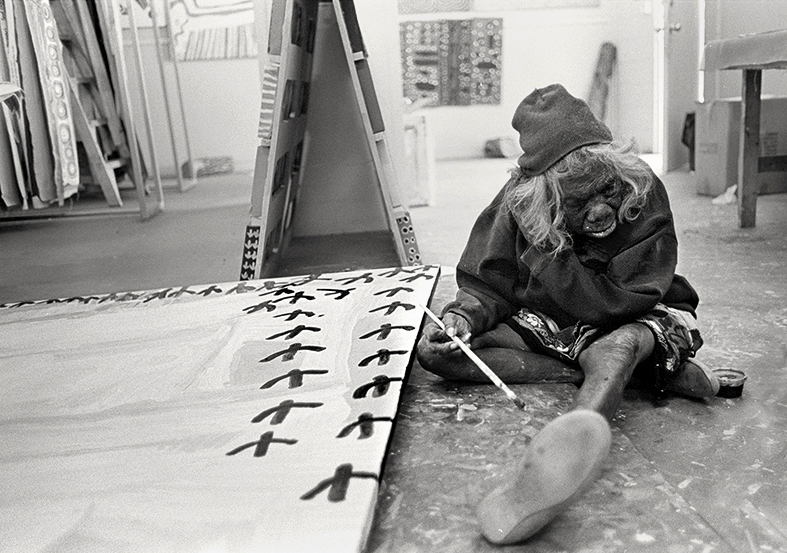
Judith Crispin (Australian / Bpangerang, b. 1970) 'Sonya Napaljarri Cook Painting' 2015 from the book 'The Lumen Seed' by Judith Crispin (2016)


Judith Crispin (Australian / Bpangerang, b. 1970)
Sonya Napaljarri Cook Painting
Warnayaka Arts Centre, Lajamanu Community NT, December 2015


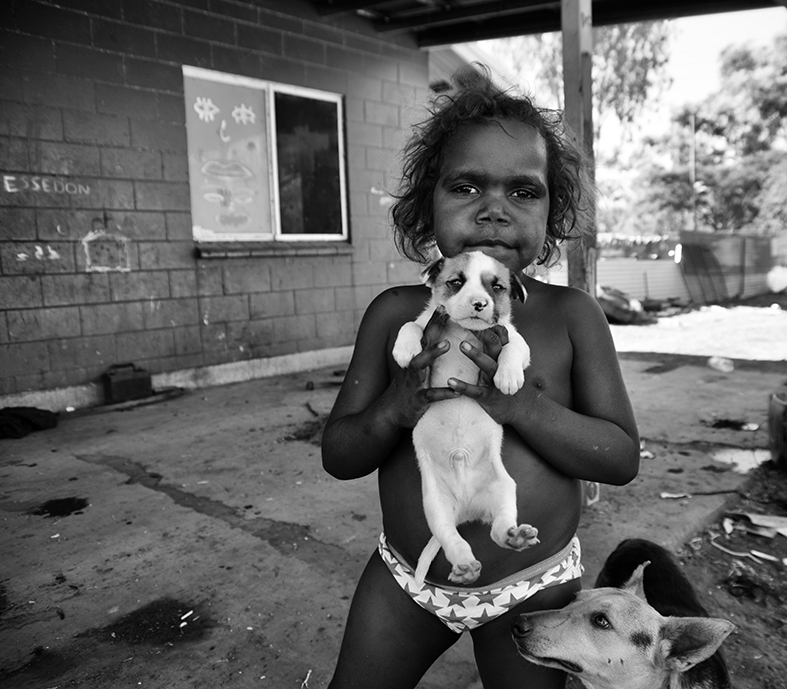
Judith Crispin (Australian / Bpangerang, b. 1970) 'Tabra Nakamarra's Puppy' 2015 'The Lumen Seed' by Judith Crispin (2016)


Judith Crispin (Australian / Bpangerang, b. 1970)
Tabra Nakamarra’s Puppy
Lajamanu Community NT, June 2015


Truth and consequence in red dirt country

Australia has a long tradition of social documentary photography, dating back to the late nineteenth century. From Fred Kruger’s photographs of the Aboriginal community at Coranderrk in the 1870-80s through, variously but not exclusively:

Frank Hurley‘s photographs of the First World War, Antarctic exploration, Aboriginal communities and Australian industry

F. Oswald Barnett and his photographs of the slums of Melbourne in the 1930s

Charles P. Mountford (1890-1976) was an ethnographer and photographer, working from the 1930s-1960s who “showed a keen interest in and respect for Aboriginal culture, a fact that is evident in his archive. Although peppered with the vernacular and attitudes of the times, Mountford’s writing, and more tellingly his photographs, are indicative of his belief that Aboriginal life was richer and more complex than most white Australians conceded.” (State Library of South Australia)

Mervyn Bishop (born 1945), followed in 1974, an Australian news and documentary photographer whose work combines journalistic and art photography. Joining The Sydney Morning Herald as a cadet in 1962 or 1963, he was the first Aboriginal Australian to work on a metropolitan daily newspaper and one of the first Aboriginal Australians to become a professional photographer. Focusing on Indigenous self-determination, Bishop’s work “covered the major developments in Aboriginal communities throughout Australia, including the historical moment in 1975 when the (then) Prime Minister, Gough Whitlam, poured a handful of earth back into the hand of Vincent Lingiari, Gurindji elder and traditional land owner. This image – representing the Australian government’s recognition of Aboriginal land rights – became an icon of the land rights movement and Australian photography.” (Art Gallery of New South Wales)
See more of Mervyn Bishop’s photographs

Harold Cazneaux and Max Dupain‘s photographs of Australian life from the 1920-1980s

Jim Fitzpatrick and his Drouin series from WW2

Rennie Ellis‘ photographs of celebrity and Melbourne life

William Yang‘s photographs exploring issues of cultural and sexual identity

Female photographers of the 1960s-90s, such as Micky Allan, Sue Ford and Carol Jerrems who all crossed over into art photography

Robert McFarlane (1960s onwards) who specialises in social issues

John F. Williams who photographed Sydney in the 1970s

Jeff Carter who photographed all around Australia from the 1950s onwards

Ian North and Gerrit Fokkema who photographed Canberra in the 1980s

Joyce Evans (1980s onwards) who took important portraits of a diverse cross-section of Australian intelligentsia and personalities and documented Australian country towns and events for the National Library of Australia

Glenn Sloggett who photographed Australian suburbia with a startling mix of warmth and melancholy from the 1990s onwards

More recently, the war photographs of °SOUTH members such as Tim Page, Stephen Dupont, David Dare Parker, Jack Picone and Michael Coyne

Trent Parke who is the only Australian member of the Magnum Photo Agency, whose work moves beyond the strictly documentary to sit between fiction and reality, offering an emotional and psychological portrait of family life and Australia that is poetic and often darkly humorous

And Juno Gemes Indigenous social documentary photography, who documents the changing social landscape of Australia


Unlike America, where social documentary photographers are well known, hardly a name from the above list (save perhaps Max Dupain and possibly Frank Hurley) would be recognised by a wider Australian public and there is little evidence or acknowledgement of their work in Australia. I believe that this is because social documentary photography has never been heavily promoted in this country and that this type of photography is a slice of many people’s work without becoming the driving force behind their oeuvre.

As my friend and curator Nick Henderson observes, “Perhaps the lack of visibility is in part due to many of the social documentary photographers undertaking work for the various state libraries, who regularly commission work documenting place – sometimes external, but also staff photographers – whose work is then not exhibited: many of the institutional galleries haven’t devoted much time to displaying and promoting that work.” While there may have been social documentary photographers in each country town and embedded within federal and state institutions, their work never seems to reach the audience it deserves.

And that is the true

Into this amorphous arena comes a brilliant book Sydney based poet, photographer and composer Judith Crispin titled The Lumen Seed (Daylight Books 2016), a book of that addresses the stories of the Warlpiri people of Lajamanu through conversation, poetry, drawings and photographs, a book that should be compulsory reading for all Australians.

This smallish book (in size, 23.5cm wide by 15cm high) of 120 pages has good strong boards, excellent typography, nicely weighted paper and feels solid in the hand. The book is well printed, although some of the highlights of the photographs have gone missing in action. The layout of the images and text is engaging, challenging the reader to comprehend, contemplate and consider what is being shown and spoken to them. Use of negative space, as can be seen in the example pages below, is excellent. The reader does not feel overwhelmed by comatose verbiage, but empowered when listening to the stories, proposed: “This book is about magic. Not the magic of Kabbalists, Theosophists, or conjurers, not Crowley’s magick with a k, not the magic of the New Age or Western religion – but magic that describes the world hidden inside this world, a world seen only by Aboriginal elders and the dying.” (Judith Crispin, Introduction, p. 12)

As Crispin states, this book is not a book of photojournalism and is the most subjective it can be, the photographs growing out of her love for this community. The multi-dimensional photo essay, for that is what it is in more traditional terms, represents some of the views and customs of the Warlpiri people and for Crispin, her journey started in the centre of Australia’s Anglophile government, Canberra, and ended at Wolfe Creek Crater, birthplace of the rainbow snakes, the Warnayarra, which underpin all Australian Aboriginal cultures. The peoples of this ancient culture speak to the earth, they tend it and understand it; they believe in the deep magic of the landscape, and strengthen the land through gardening and the trees through song. They speak to the spirits of the waterholes and have a deep respect for the spirit of the animals that inhabit the land. “The deep love that Warlpiri people have for the landscape, its mountains and waterholes, is almost incomprehensible for white people.” (Juno Gemes, Foreword, p. 9)

I’m British and I have been here in Australia since 1986 and I have never understood the non-relationship Australia has with its Indigenous people. Growing up on a farm for the first twelve years of my life in England gives me some understanding of a life lived well on the land. We were working class poor, my mother having to boil water on a stove so us kids could have a bath in a copper on the kitchen room floor; and we lived on what we could shoot from the land – pigeons, pheasants, rabbits and hares – and we were acutely aware of the providence and blessings of nature for our sustenance. A totally different connection to land than an Aboriginal one, but a connection none the less, as I found out when I visited the old farm on a recent visit to the UK in August. Walking up the cart path where I had played as a kid brought all the magic rushing back… the flowers, the forest, the trees, the animals and the earth.

Therefore, when I read of the white man’s abuse of the traditional lands of the Aboriginal people I am appalled. If you read the extract from Five Threnodies for Maralinga printed below, you begin to understand the pain and anguish of these people, killed by the atomic cloud of over 7 major tests and 700 minor trials involving plutonium, uranium, and beryllium at the Maralinga site which occurred between 1956 and 1963, part of the Woomera Prohibited Area in South Australia and about 800 kilometres north-west of Adelaide. “In 1948, Warlpiri people were forcibly relocated almost 600 kilometers from their spiritual homeland to Hooker Creek, now Lajamanu, in Gurindji country. Old people, afraid to live among Gurindji ancestors and spirits, tried to walk back to Yuendumu but were rounded up and returned.” (p. 45)

This beautiful, powerful and deeply personal book tells some of their stories. It saddens me beyond belief that these wonderful people have been estranged and displaced from their traditional lands; decimated, killed, and abused; have been exposed to nuclear radiation, poverty, and untold harm and deprivation, both physical and mental. That they endure is a testament to their courage and culture. Juno Gemes observes that, “Crispin’s images are filled with compassion and tenderness. This is not an easy work… The Lumen Seed is a tough and powerful work in photographs, narrative texts, drawings, and poems it sings stories off the Warlpiri at Lajamuna at five minutes to midnight.” (p. 9)

The book needs to be tough to tell the true. But through poetry, love and light a new cosmology emerges that brings hope for a better future. Truth and consequence in red dirt country.

Dr Marcus Bunyan


Many thankx to Myrtille Beauvert, Daylight Books and the artist for allowing me to publish the photographs in the posting. Please click on the photographs for a larger version of the image.


The Lumen Seed by Judith Crispin (Daylight Books), a cultural dialogue that is taking place before a backdrop of offences against the Australian continent, as well as a history of systematic discrimination against Indigenous peoples on the part of the country’s white population.


“Yeah, it make me real sad and cry for my country. Because God bin put me there, God put my people there. Why someone could move us, because of his power, because of his idea? Cutting off God’s power, God’s idea here. God’s word, God’s light… and that is the true. Cut off like this electric wire, if you cut him off, like that.”


Jerry Jangala, senior Warlpiri elder and Law man from Lajamanu in the Tanami Desert


“The Lumen Seed is a tough and powerful work. In photographs, narrative texts, drawings, and poems it sings stories of the Warlpiri at Lajamanu at five minutes to midnight. Who will hear, who will see, who will act?

Judith Crispin’s experience echoes mine 40 years earlier, although I could not always get back to the same teachers. We belong to a long photographic tradition. It is the tradition of Tina Modotti and Josef Koudelka – a generation of documentary photographers who believe fervently that if you show people what is actually happening in the world, they will understand and be moved to demand change. Activist social documentary photography has always been defined by this passionate subjective belief in democracy and action.”


Juno Gemes, Introduction to The Lumen Seed, 2016


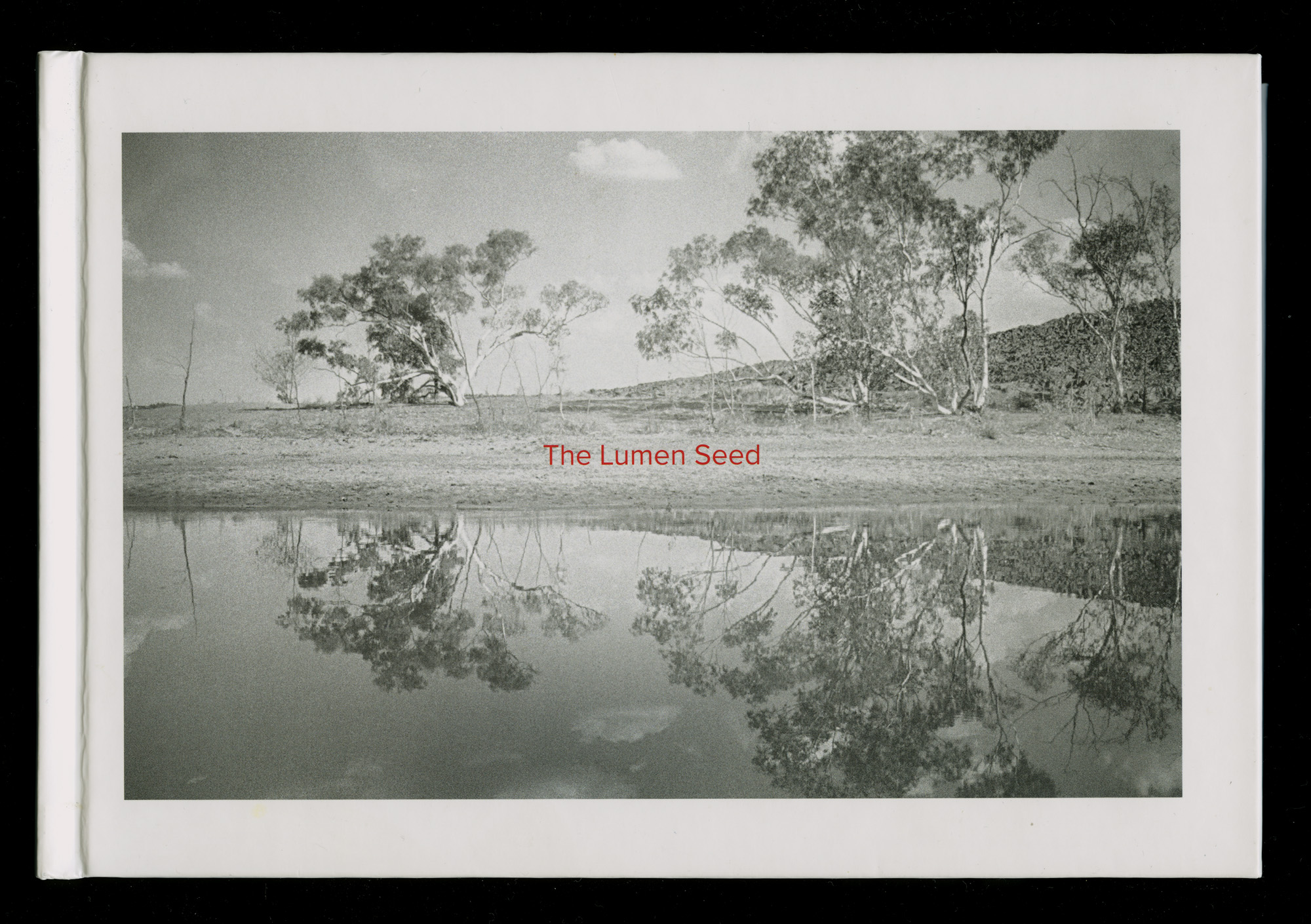
Judith Crispin (Australian / Bpangerang, b. 1970) 'The Lumen Seed' book cover

Judith Crispin. The Lumen Seed book cover
Judith Crispin (Australian / Bpangerang, b. 1970) 'The Lumen Seed' p. 29

Judith Crispin. The Lumen Seed p. 29
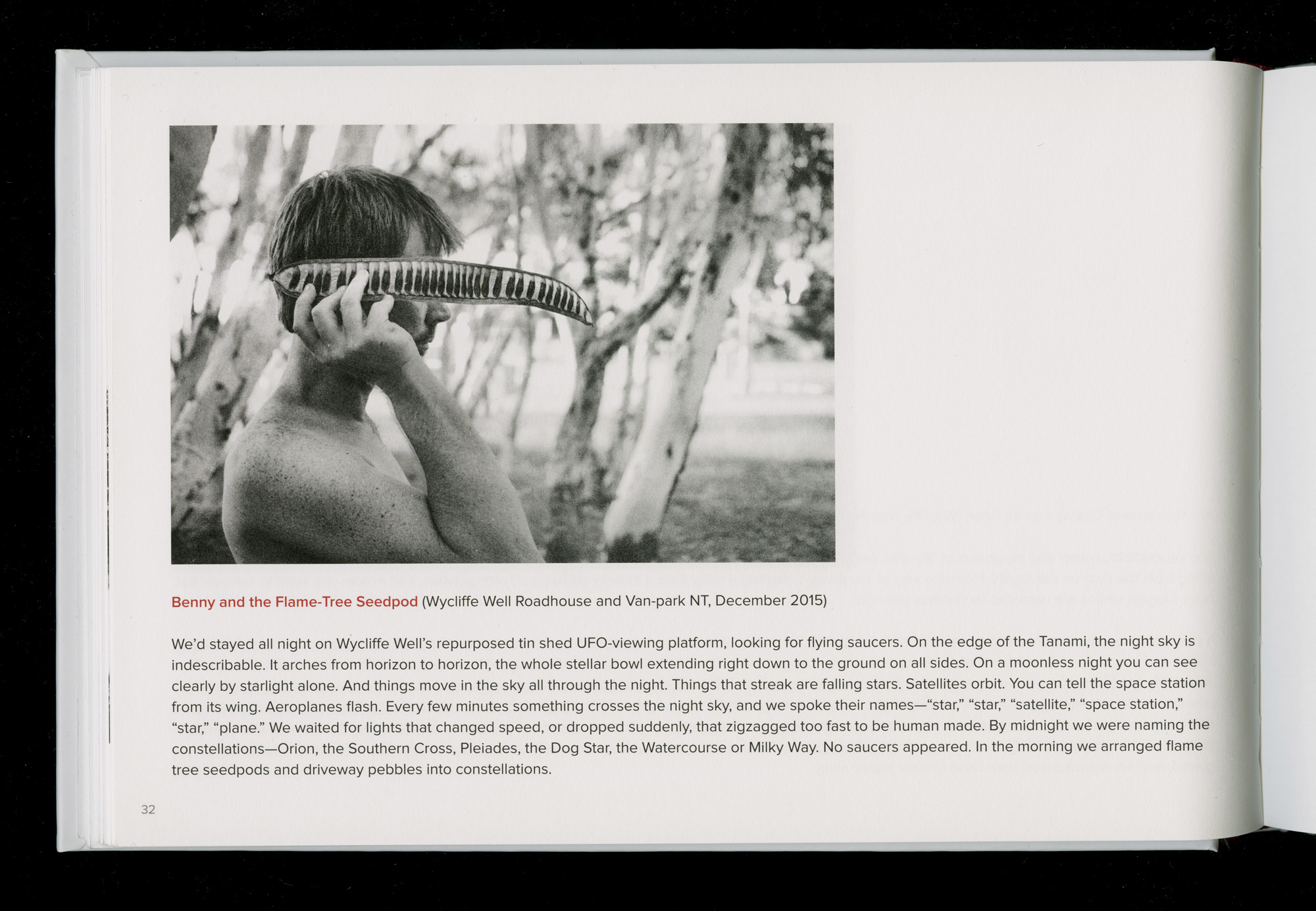
Judith Crispin (Australian / Bpangerang, b. 1970) 'The Lumen Seed' p. 32

Judith Crispin. The Lumen Seed p. 32
Judith Crispin (Australian / Bpangerang, b. 1970) 'The Lumen Seed' p. 46

Judith Crispin. The Lumen Seed p. 46
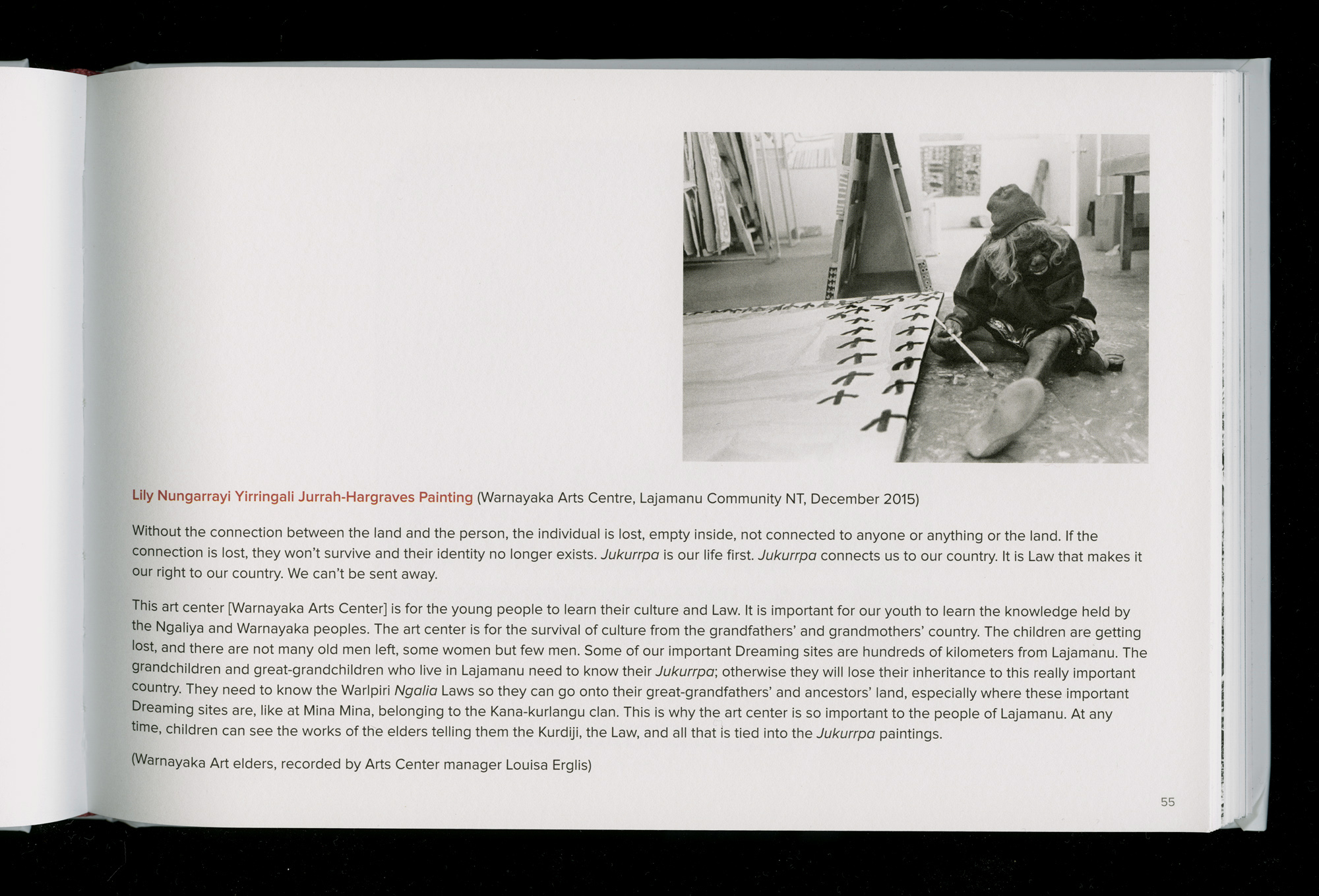
Judith Crispin (Australian / Bpangerang, b. 1970) 'The Lumen Seed' p. 55

Judith Crispin. The Lumen Seed p. 55
Judith Crispin (Australian / Bpangerang, b. 1970) 'The Lumen Seed' p. 74

Judith Crispin. The Lumen Seed p. 74


Foreword: Five Minutes to Midnight

There is nothing like twilight in red dirt country – the soft crackling of fire warming your billycan as the Seven Sisters begin their dance across the night sky. Or the camaraderie around a campfire as people speak in their indigenous languages – the women making jokes about the day’s goings-on or about mistakes made in the intricate protocols of a Law you are learning, day by day. Everything that lives has meaning here. Upholding knowledge is a lifelong obligation for First Nation Custodians – not only in the present but into the future. How can we Australians know this land or our place in it, if not through relationship with our hosts, the Aboriginal people?

When inviting me to write this foreword, Judith Crispin explained her choice, saying, “You are uniquely positioned, as Australia’s premier and longest-serving photographer who has worked collaboratively with Aboriginal people in communities around the country making their culture and struggle for justice visible.” Truly, in both a professional and a practical way, I know the difficulties and the deep satisfactions of working in community. I understand the privileges of learning about the Law, the reciprocity of gratitude, and the obligation to stay true to the received teaching over a lifetime.

As a photographer of long experience, with friendships in Aboriginal communities, I know how everything depends on one’s openness to experience, on the give and take inside relationships that informs how one sees and feels. Photographers in this tradition work in slow time. You learn to move with the people, move within the rhythm of their days, within their country, their wind and sky. What is learned through these relationships can change how one sees forever. By invitation, we become messengers from the frontier of interpersonal experience, conveying urgent messages from our teachers and hosts.

Into this collaborative tradition of relational interpersonal documentary photography – which began with the work of committed photographers in Australia during the 1970s – now steps Judith Crispin with her important book about magic, knowledge, and history. She relates teachings of the Law men who adopted her, who gave her the skin name Nangala, a name that defines her relationship to everyone in the community. In this way, she is being “growed up,” learning how to see the universe according to Warlpiri Law.

“There is a particularly miraculous vision of the world that comes only with the diagnosis of serious illness. … Something is different now – because I know there is a secret world nested inside this one. I’ve seen it.”


The Lumen Seed
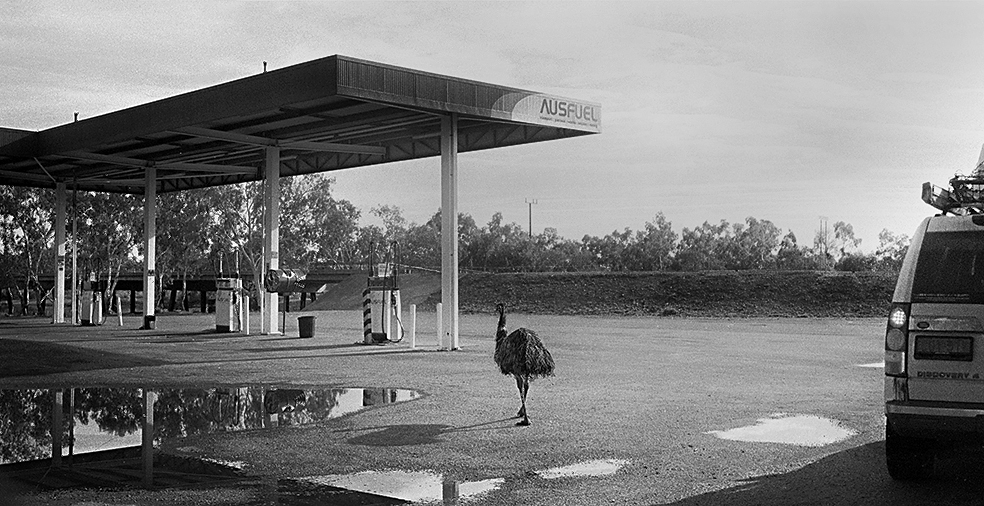
opens onto an apocalyptic scene. A hardwood mulga tree, reaching for the sky, holds a placard: “The Lord’s Return is Near.” In Coober Pedy, a curved handmade house rendered in warm mid-tones is edged with the sign “Welcome to Nowhere.” Dusty desert roadscapes unfold into the giant sacred stones of Karlu Karlu. An emu wanders nonchalantly into a gas station. We’re in Emu Dreaming Country now, meeting Crispin’s traveling friends.

A UFO mural at the gas station resonates later in the book with stories of Wolfe Creek Crater, where the meteorite landed. In the Jukurrpa we are told two rainbow snakes created that country, way back at the beginning. UFOs “zipping around the trees” form part of our desert lore. Funky and surreal, these images are imbued with humour. The images that follow lead us onward into a country of visual narratives – foretelling beginnings and endings. Intuitions manifest unpredictably. We enter a thousand kilometres of “bull dust and bone-jarring track, into the Tanami Desert,” which is as nothing compared with the howling grief of Crispin’s first poem…

Foreword extract by Juno Gemes, Hawkesbury River, April 11, 2016, pp. 6-7.


Introduction

In late 2015 I was diagnosed with cancer. Before then, I’d not understood how five words could change everything. “I’m sorry, Judith,” my doctor told me, “it’s cancer.” It’s a cliché that you only learn to value life when death is walking beside you, but it was absolutely true for me. I remember driving over Clyde Mountain to bring the word cancer to my parents’ home. Every tree on the range seemed invested with vital force. Every leaf was vibrant, iridescent. Gray mountain gums, in headlights, seemed to manifest ancient intelligence – bearing witness to the fleeting existence of human beings. The threat of death reminds you how precious people are – your oldest friends, children, lovers, parents – you wonder how you’ll bear to leave them. There is a particularly miraculous vision of the world that comes only with the diagnosis of serious illness.

The interval between diagnosis and surgery is an eternity. The surgeon showed me a chart – “If the cancer falls into this range,” he said, “you’ll live; this range and you’ll die.” I felt like Schrödinger’s cat, neither living nor dying. People who see their own death live in two worlds, one mundane and one miraculous. Later, when the cancer had been removed and my death sentence lifted, I watched that other world diminish day by day. No matter how I clung to that miraculous vision, it faded – just as the certain knowledge of my death faded. But something remained. Something is different now – because I know there is a secret world nested inside this one. I’ve seen it. …

The earliest photographs in this book were taken in 2013, when I still believed the Warlpiri needed my help – to promote literacy and health, to outline positive pathways toward reconciliation, and so on. The later photographs were taken in December 2015, when I knew, without a shadow of doubt, that I was the drowning woman and the Warlpiri were the lifeboat. Lajamanu’s elders, especially Wanta Jampijinpa, Henry Jackamarra, and Jerry Jangala, were kind to me. They gave me a skin name1 and showed me how to be a “policewoman” for Jdbrille Waterhole. They seemed genuinely delighted by my interest in Warlpiri cosmology, which they illustrated with stories and drawings – some of which are reproduced in this book. The older women took me “hunting” for wattle seed and bush potato. They told me stories of covenants entered into with ancient star-beings and showed me places along the Tanami Track where min-min lights had chased travellers. Fairy tales and mysteries take on new importance when your life feels precarious.

Lajamanu in 2016 is a meeting of two universes. Elders check their Facebook status on iPhones while explaining, in matter-of-fact tones, about a landscape that will hold you or kill you, depending on your scent – where spirit snakes live in the waterways and the dead walk side by side with the living. In Lajamanu I lost my fear of dying, and more importantly, I lost my fear of living. This is a book about magic. Not the magic of Kabbalists, Theosophists, or conjurers, not Crowley’s magick with a k, nor the magic of the New Age or Western religion – but magic that describes the world hidden inside this world, a world seen only by Aboriginal elders and the dying.

This is not a book of photojournalism and makes no attempt to be objective. Quite the contrary, in fact, I wanted this book to be as subjective as possible. These photographs, especially the portraits, have grown out of my love for this community – the poetry of these often physically fragile people, whose unshakable belief in the deep magic of the landscape gives them a strength rarely evident in the city. Warlpiri culture is gentle; it leaves no tracks on the earth. The history of Aboriginal Australia is largely a record of gardening – “cleaning up country” with firestick farming and ceremonies to strengthen trees through song. When Warlpiri people move through the landscape, they introduce themselves. They apologise to that country for breaking twigs. They ask permission to take water from the creeks. If humanity ever transcends its selfish and murderous nature, it will be because of people like the Warlpiri.

Introduction extract by Judith Crispin pp. 11-13.


You shall not trap me in this fish-trap of yours in which you trap the dead,

because I know it, and I know its name,

I know the name in which it came into being.


(Coffin Texts)


Judith Crispin (Australian / Bpangerang, b. 1970) 'The Lord's Return is Near' 2014


Judith Crispin (Australian / Bpangerang, b. 1970)
The Lord’s Return is Near
Coober Pedy SA, November 2014


The Stuart Highway is a bisecting line in a thousand kilometres of nothing. The sheer scale of the landscape is overwhelming. I’d driven for two days with only Leonard Cohen and David Bowie for company, and had never felt more isolated. I don’t know why I stopped, leaving the Land Rover idling in the middle of the highway, and walked over to the tree. Perhaps its tallness startled me – its length so exposed above the desert floor. I wanted to lay my palm against its bark. At first I didn’t notice the sign nailed high on its trunk: “The Lord’s Return is Near.”

This stretch of highway lies south of the rocket range at Woomera. There are oceans of blood on this land. The Woomera immigration detention centre continued a legacy of suffering that began years earlier, in the 1950s, when Maralinga’s radioactive clouds blew over Woomera, a military township, and killed all the children.

Between 1952 and 1963, British forces dropped nine nuclear weapons and nine thermonuclear weapons between Woomera and the Western Australian border, within contamination distance of urban centres. The Menzies-led Australian government of that time was wholly complicit and lied about the known dangers of nuclear tests. Between these bombings, Britain conducted continuous “minor trials,” which, according to the Royal Commission into British Nuclear Tests in Australia, additionally detonated 99.35 kg of beryllium, 23.979 kg of plutonium, and 7968.88 kg of depleted uranium. By contrast, Little Boy, dropped on Hiroshima in 1945 by the United States, contained only 64 kg of uranium-235, and Fat Man, dropped on Nagasaki in 1945 by the United States, contained only 6.4 kg of plutonium. Anyone who wishes to immediately lose faith in the human race should read the short transcript of the Royal Commission, which is freely available online. (pp. 16-18)


Judith Crispin (Australian / Bpangerang, b. 1970) 'Welcome to Nowhere' 2014


Judith Crispin (Australian / Bpangerang, b. 1970)
Welcome to Nowhere
Coober Pedy SA, November 2014


I arrived in Coober Pedy the same week that dust storms tore the roof off the pub. This dugout, borrowed from friends in Alice Springs, was built from a disused shaft. I slept near the door separating their home from the remaining length of shaft, extending far into the rock. Strange sounds echoed behind that door – sounds of wind, or dogs howling. The door was nailed closed. When I first visited Coober Pedy, it was the farthest into the desert that I had ever ventured. Beyond it stretched the expanse of the Great Victoria Desert, Simpson Desert, Strzelecki Desert, Pedirka Desert, Tirari Desert, and Sturt Stony Desert. I was at the start of a journey that would follow Stuart Highway into nothingness and emerge in the huge Tanami Desert of the Northern Territory and Western Australia. Leaving the dugout, I stopped to photograph the words painted on its roof: “Welcome to Nowhere.” (pp. 22-23)


Judith Crispin (Australian / Bpangerang, b. 1970) 'Karlu Karlu I' 2014


Judith Crispin (Australian / Bpangerang, b. 1970)
Karlu Karlu I
Near Ayleparrarntenhe NT, November 2014


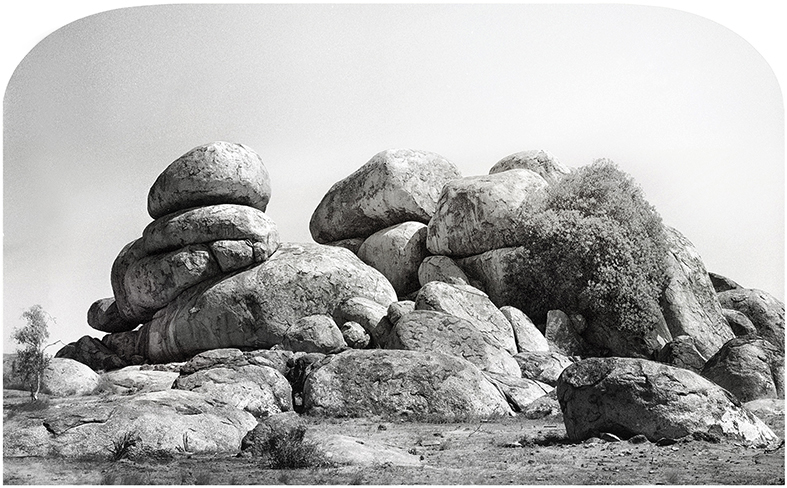
Karlu Karlu, nicknamed “The Devil’s Marbles” by white people, was long considered too spiritually dangerous for anyone but Warumungu elders conducting ceremony. Between these giant stones, on a 48-degree day, the radiant heat is almost unimaginable. Near the skeleton of a burned office chair, I found patches of black glass. A Warumungu friend explained that the heat has, in recent years, become so intense at Karlu Karlu that the air itself ignites, fusing desert sand to glass. In Australia’s deserts the evidence of climate change is irrefutable. (p. 24)


Judith Crispin (Australian / Bpangerang, b. 1970) 'Eemie at the UFO Roadhouse' 2015


Judith Crispin (Australian / Bpangerang, b. 1970)
Eemie at the UFO Roadhouse
Wycliffe Well Roadhouse and Van-park NT, December 2015


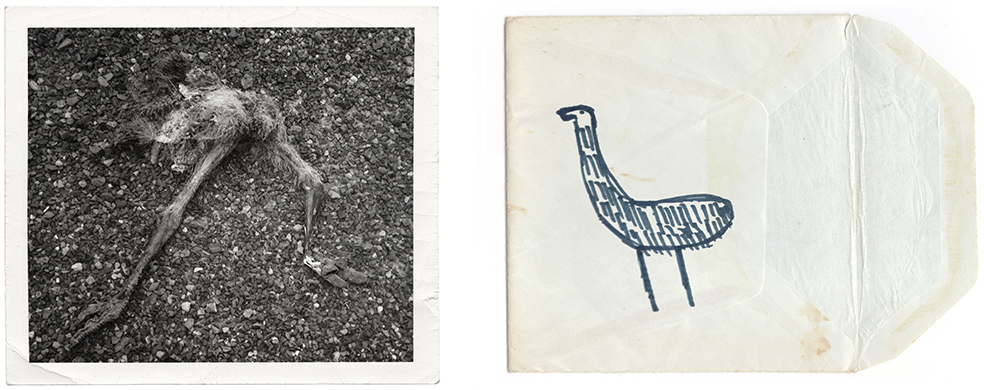
UFO enthusiast Arc Vanderzalm moved to the desert in 2004 to establish a UFO-themed van park. In the van park’s early years, Arc rescued an abandoned emu chick and raised him by hand. He named him Eemie. Travellers stopping for fuel at Wycliffe Well roadhouse are sometimes surprised by an adult emu staring in at them through the window. While a guest of the van park, I once startled Eemie by walking into the ladies’ shower block. He peered out at me through the shower curtain with an air of embarrassment, as though I’d intruded at a delicate moment. Later, as I drove toward Tennant Creek, I spotted Eemie chasing a farm dog down the highway, legs akimbo. (p. 29)


Judith Crispin (Australian / Bpangerang, b. 1970) 'Sexy John' 2014


Judith Crispin (Australian / Bpangerang, b. 1970)
Sexy John
Alice Springs NT, November 2014


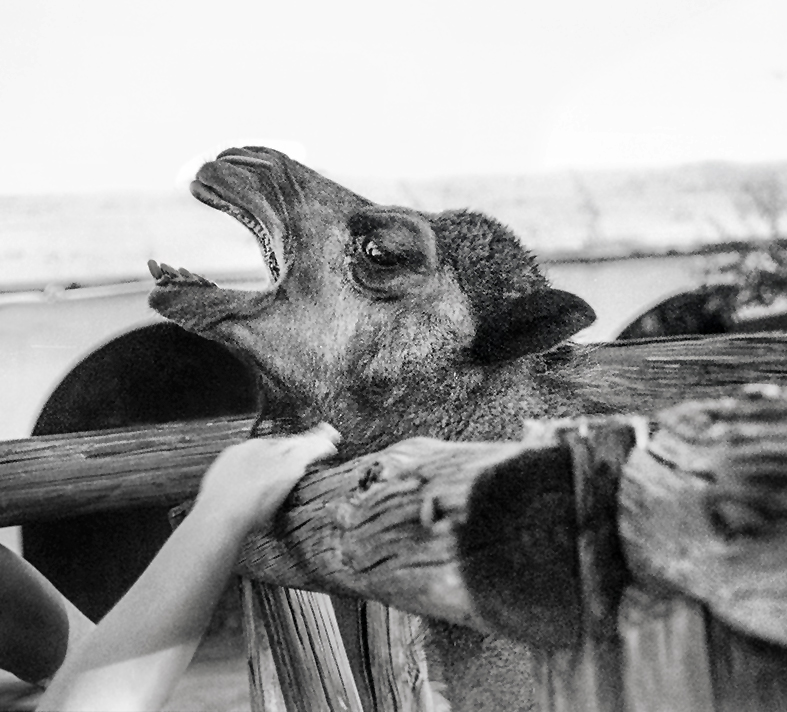
Sexy John was rescued as a small calf after his mother was culled as part of a government program to reduce feral camels. He was raised by artists in a collective on the outskirts of Alice Springs and befriended a wild blond-haired boy. More than 160 thousand camels were culled between 2009 and 2013, approximately one-fifth of the camel population of the central deserts. (p. 35)


Extract from Five Threnodies for Maralinga

V

At Woomera,
seventy-five identical graves
remember babies lost to the predation
of atomic clouds.


Their epitaphs are brief-

Michael Clarke Jones
died 24 August 1952,
aged eight and a half hours.


No one has been here for a long time.


Weeds struggle.
A military vehicle passes,
heading east toward the rocket range.


In the west, Woomera township
is a grid of air force housing.
Land Cruisers fill neat driveways,
lawns are trimmed,
blinds closed.


And no one ever steps out for milk,
no one walks a dog.


I photograph each headstone,
stooping sometimes to straighten a plastic posy,
a tilted ceramic bear.


Wind presses a faded greeting card
to the metal fence.
A matchbox car beside a small boy’s grave
is blue.


There are nineteen stones without toys or flowers,
for stillborns named only “baby”-

Baby Spencer,
Baby Dowling,
Baby Stone.


Don’t look at me

Baby Gower
Baby Roads

from a soldier’s gunny bag
with your eyes too white, too open
like the eyes of poisoned fish
tumbling
in the Pilbara’s poisoned surf.


Judith Crispin (Australian / Bpangerang, b. 1970) 'Warlpiri Family' 2015


Judith Crispin (Australian / Bpangerang, b. 1970)
Warlpiri Family
Lajamanu Community NT, December 2015


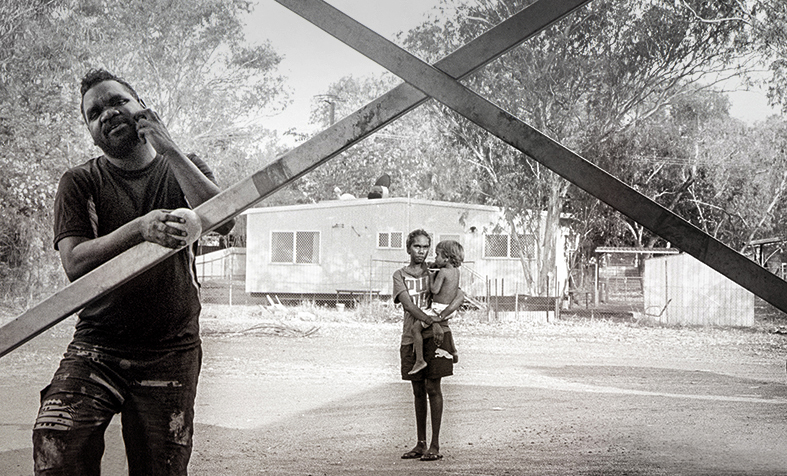
In 1948, Warlpiri people were forcibly relocated almost 600 kilometers from their spiritual homeland to Hooker Creek, now Lajamanu, in Gurindji country. Old people, afraid to live among Gurindji ancestors and spirits, tried to walk back to Yuendumu but were rounded up and returned. In the 1970s, Gurindji people held a series of unique ceremonies to hand over the area and its Wampana and Spectacled Hare Wallaby Dreaming stories to the residents of Lajamanu. While this gesture brought some relief to Warlpiri people, who viewed their involuntary occupation of Gurindji land as a breach of traditional Law, they continue to struggle with their relationship to the country. (p. 45)


Judith Crispin (Australian / Bpangerang, b. 1970) 'Four Kurdu-kurdu [Kids] with Trampoline' 2015


Judith Crispin (Australian / Bpangerang, b. 1970)
Four Kurdu-kurdu [Kids] with Trampoline
Lajamanu Community NT, December 2015


Country [Gurindji country], hills… well, I put country first… hills, tree, don’t like you – even that water – and that is true. If you drink water from that, or if you not talking to that country because you don’t know, you got no songs with that area… and in the night, or during the day too, you got no language for to try to talk to that country.

When God bin put you there, in your country, that’s it. You got a right to live on there. You can get sick alright, but not too much. Yuwayi [yes], you know God? He say, “Yeah you get sick but you’ll be alright,” you know? “I’m with you there,” that God talking. And same thing for our ceremony too. You’re right to use your ceremony. You’re right to sing your own Dreaming song and talking to your country … and tell it true – real true.

Jerry Jangala (pp. 50-51)


Judith Crispin (Australian / Bpangerang, b. 1970) 'Emu Roadkill and Portrait by Shemaiah Matthews' 2015


Judith Crispin (Australian / Bpangerang, b. 1970)
Emu Roadkill and Portrait by Shemaiah Matthews
Lajamanu Community NT, December 2015


Judith Crispin (Australian / Bpangerang, b. 1970) 'Lily Nungarrayi Yirringali Jurrah-Hargraves Painting' 2015


Judith Crispin (Australian / Bpangerang, b. 1970)
Lily Nungarrayi Yirringali Jurrah-Hargraves Painting
Warnayaka Arts Centre, Lajamanu Community NT, December 2015


Without the connection between the land and the person, the individual is lost, empty inside, not connected to anyone or anything or the land. If the connection is lost, they won’t survive and their identity no longer exists. Jukurrpa is our life first. Jukurrpa connects us to our country. It is Law that makes it our right to our country. We can’t be sent away.

This art center [Warnayaka Arts Center] is for the young people to learn their culture and Law. It is important for our youth to learn the knowledge held by the Ngaliya and Warnayaka peoples. The art center is for the survival of culture from the grandfathers’ and grandmothers’ country. The children are getting lost, and there are not many old men left, some women but few men. Some of our important Dreaming sites are hundreds of kilometers from Lajamanu. The grandchildren and great-grandchildren who live in Lajamanu need to know their Jukurrpa; otherwise they will lose their inheritance to this really important country. They need to know the Warlpiri Ngalia Laws so they can go onto their great-grandfathers’ and ancestors’ land, especially where these important Dreaming sites are, like at Mina Mina, belonging to the Kana-kurlangu clan. This is why the art center is so important to the people of Lajamanu. At any time, children can see the works of the elders telling them the Kurdiji, the Law, and all that is tied into the Jukurrpa paintings.

Warnayaka Art elders, recorded by Arts Center manager Louisa Erglis (p. 55)


Judith Crispin (Australian / Bpangerang, b. 1970) 'Sacred Object #1' Nd


Judith Crispin (Australian / Bpangerang, b. 1970)
Sacred Object #1
Nd
Muffler painted by Warlpiri artists


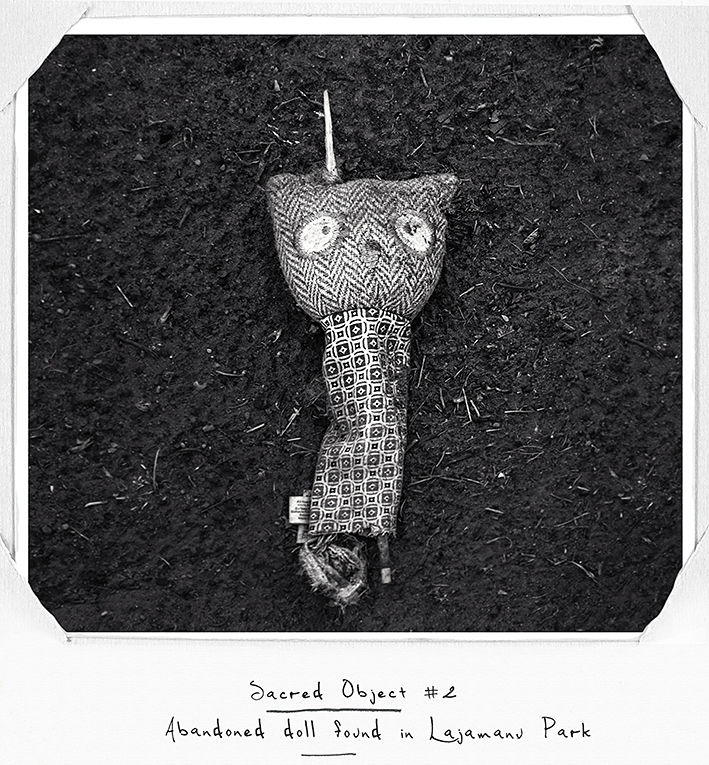
Judith Crispin (Australian / Bpangerang, b. 1970) 'Sacred Object #2' Nd


Judith Crispin (Australian / Bpangerang, b. 1970)
Sacred Object #2
Nd
Abandoned doll found in Lajamanu Park


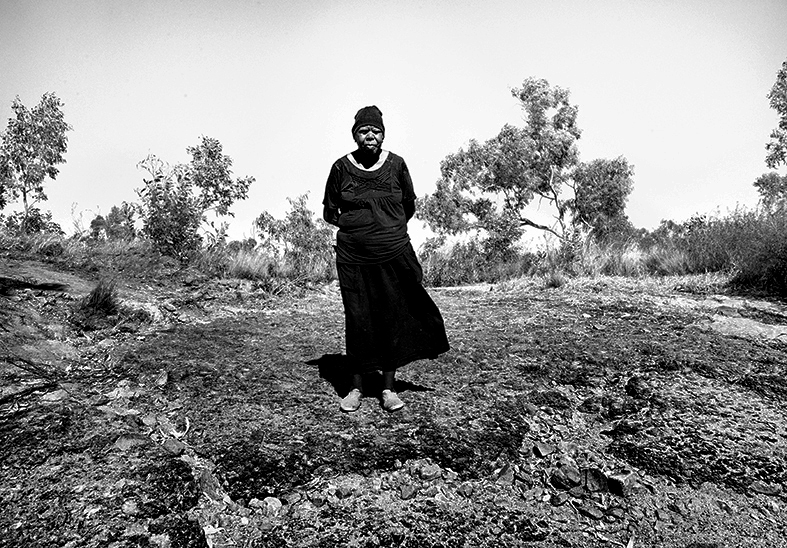
Judith Crispin (Australian / Bpangerang, b. 1970) 'Beth Nungarrayi at Jdbrille Waterhole' 2015


Judith Crispin (Australian / Bpangerang, b. 1970)
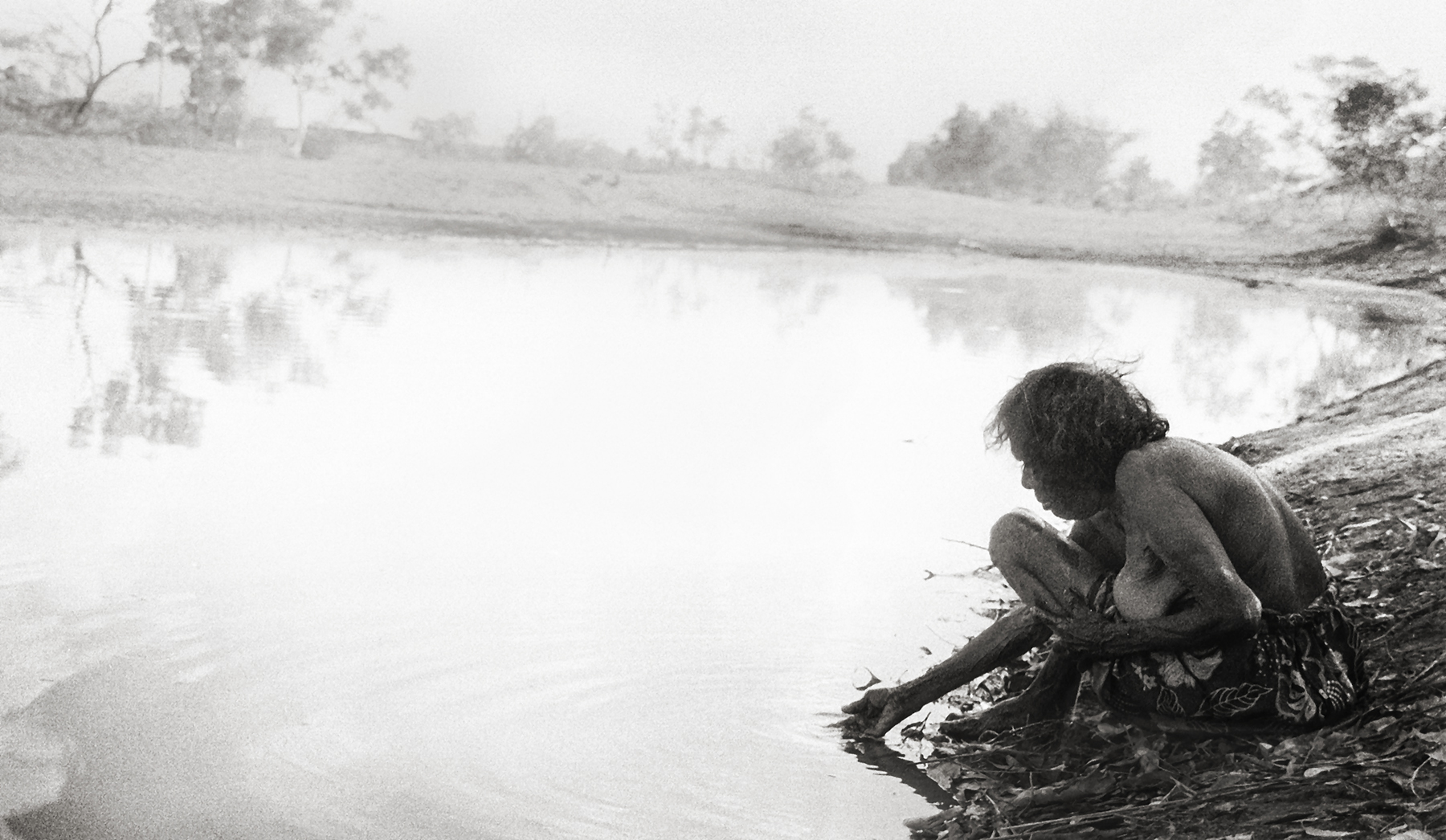
Beth Nungarrayi at Jdbrille Waterhole
Jdbrille Waterhole, Tanami Desert NT, June 2015


This area here, no river. It’s the same deal in this country, and so – what do you call it? Soak? [A soakage, or soak, also called a native well, is a source of water in the Australian desert.] You know … I’m trying to get that word there. Soak, yeah, you take all right down to find that water, that water make. Sometimes no water, like this time when it’s dry. Look for the water tree. That’s what my father, my grandpa, my great-grandpa, grandmother, they all look for that water tree. Rock holes down. That’s in our country. We can say it today in a Kardiya way, you know? We can say “Lajamanu is my country.” But that not true. It’s not true … yuwayi, Nangala. My country is back there … my area is back there.

Jerry Jangala (pp. 68-69)


Judith Crispin (Australian / Bpangerang, b. 1970) 'Wirntali-Jarra [Friends]' 2015


Judith Crispin (Australian / Bpangerang, b. 1970)
Wirntali-Jarra [Friends]
near Emu waterhole, Tanami Desert NT, December 2015


Henry Jackamarra and Jerry Jangala have known each other since they were small children. More than a decade his senior, Henry treats Jerry like a little brother – still lecturing him on what he eats and wears, although both men are now respected elders. (p. 72)


Judith Crispin (Australian / Bpangerang, b. 1970) 'Jerry Jangala Oversees Kangaroo Ceremony' 2014


Judith Crispin (Australian / Bpangerang, b. 1970)
Jerry Jangala Oversees Kangaroo Ceremony
Tanami Desert Outpost NT, November 2014


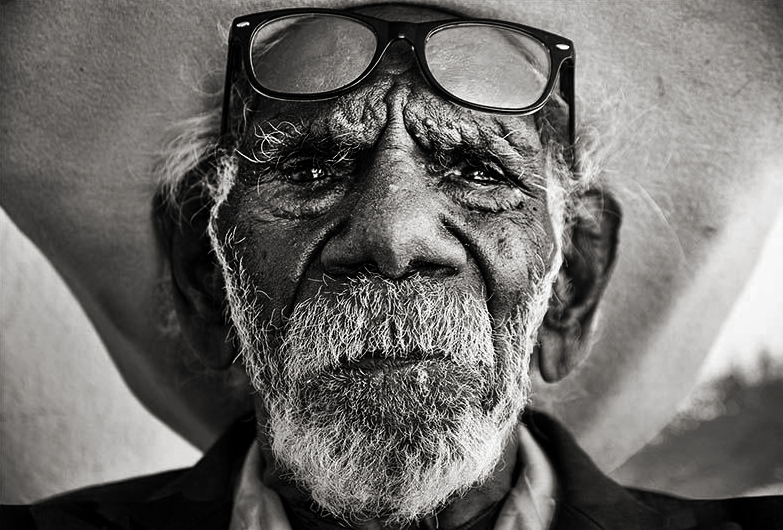
The animal is honoured by sprinkling handfuls of dirt over its fur before it is prepared for cooking in the traditional way. Jerry explains that in the old days the punishment for getting this ceremony wrong was death. In modern times, the penalty for making mistakes in this ceremony is exile. Wanta Jampijinpa, Jerry’s son, reassured me that exile did not necessarily mean death in the Tanami desert. A person could earn his or her place back in the community by accomplishing a special task. The exile must find the way to catch a wedge-tailed eagle and bring its soft underbelly feathers back to Lajamanu as proof. Wanta explained to me how such a seemingly impossible task could be accomplished, but I do not have permission to reproduce that here. (p. 78)


Judith Crispin (Australian / Bpangerang, b. 1970) 'Henry Jackamarra Cook, Last Kangaroo Dancer' 2015


Judith Crispin (Australian / Bpangerang, b. 1970)
Henry Jackamarra Cook, Last Kangaroo Dancer
Lajamanu Community NT, December 2015


Light Trails of Henry Jackamarra Cook

Law is a gray kangaroo dancing
the thin landscape of Henry Cook into being,
somewhere in the Tanami,
where knucklebone winds scrape bare rock
and Henry stands marsupial
in firelight’s weird.

In Lajamanu, tin houses edge the street.
No one is outside,
no one.

In the arts center, old ladies paint seed-dreaming.
Breeze lifts the hem of a curtain,
then stillness.
It is still.

Henry doesn’t paint anymore. He sits alone,
watching ceremony from the 1970s.
Everyone in the videos is dead now, except him.
And the dead are in the desert,
faceless as the desert is,
and as remote.

Ten years ago it seemed nothing to walk
three days to his sacred country,
granite country,
where great salt lakes exhale their thirst
over spinifex and sand,
the rattling sun.

But arthritis and cataracts have caged him.
Inside the arts center,
the lights are switched off.

We drag chairs across a concrete porch
to watch the Tanami darken, shelf clouds
seal the crater at Wolfe Creek.

Rain wakens on his tongue
the angular syllables of displacement.

And home is the desert breathing over itself by night,
erasing tracks of all who walk there –
night’s emu rising savage in the Milky Way,
and eyes, eyes in the granite mines.

One day, he tells me, I’ll walk out
to my country and never come back.

At town’s edge, a kangaroo left by poachers.
Red dust thickens its pelt, as the red dust lies thick
on Henry’s Ray-Bans, stiffening his white hair to wires.

I photograph him disemboweling the buck,
its intestines knotted to ritual marks –
Henry and his flayed brother, backlit
against chained ridges,
and the last sun rearing.

Law is an old man dancing
the gray kangaroo into being,
sewing him back into the desert’s body,
into his own body, ochre and growl,
a hunting boomerang beaten on the ground.

Night erases this landscape –
slow trees, sand,
the saltbush has gone.

Just Henry’s heels rising and falling
along a wind-scored track,
utterances of a language which belongs to him
and to which he belongs.

Tomorrow, the Catfish Waterhole
will stretch his white hair out elastic,
as telephone wires vanishing into the Tanami.

Mud returns to him,
the cool slow memories of country
before the missions, before diabetes and grog
shrank his ancestors down so small
he holds them in a single cupped hand
like fireflies, tiny comets
crossing in the black.

Tomorrow he’ll thread gumleaves
through the hole in his nose,
and say, photo me like this Nangala
I am a beautiful man.


Judith Crispin (pp. 81-83)


Judith Crispin (Australian / Bpangerang, b. 1970) 'Lily Nungarrayi Yirringali' 2014


Judith Crispin (Australian / Bpangerang, b. 1970)
Lily Nungarrayi Yirringali
Tanami Desert NT, November 2014


I was told Lily, when she was young, was in love with a Karadji man but couldn’t be with him because she didn’t want to leave her community. Her arms reveal the parallel ritual marks of someone on a “sacred path.” Now, despite caring relationships with her family, friends, and fourteen adopted dogs, somehow Lily is always alone. When, together with Molly and Rosie, Lily took me to see Catfish Waterhole, she explained that we were going to see her “mother.” I carried Lily, too frail to descend the bank, to the edge of the water. There she turned water over her palms, the traditional way of greeting the waterhole and avoiding surprising any Warnayarra who might be there. The deep love that Warlpiri people have for the landscape, its mountains and waterholes, is almost incomprehensible for white people. Here Lily sings quietly to Catfish Waterhole – not for any ceremonial or traditional reason, I’m told, but just because it makes the waterhole feel loved. (p. 95)


Judith Crispin (Australian / Bpangerang, b. 1970) 'Molly's Flame-Tree Seed-pods' 2014


Judith Crispin (Australian / Bpangerang, b. 1970)
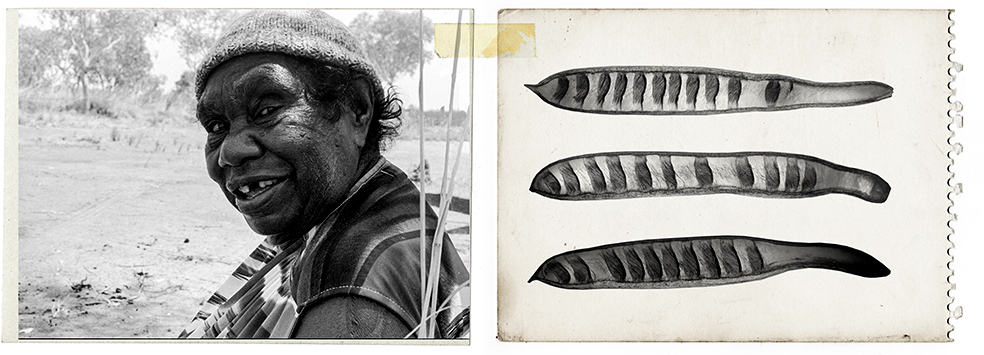
Molly’s Flame-Tree Seed-pods
Tanami Desert NT, November 2014


Judith Crispin (Australian / Bpangerang, b. 1970) 'Molly Napurrula Sifts Wattleseed' 2014


Judith Crispin (Australian / Bpangerang, b. 1970)
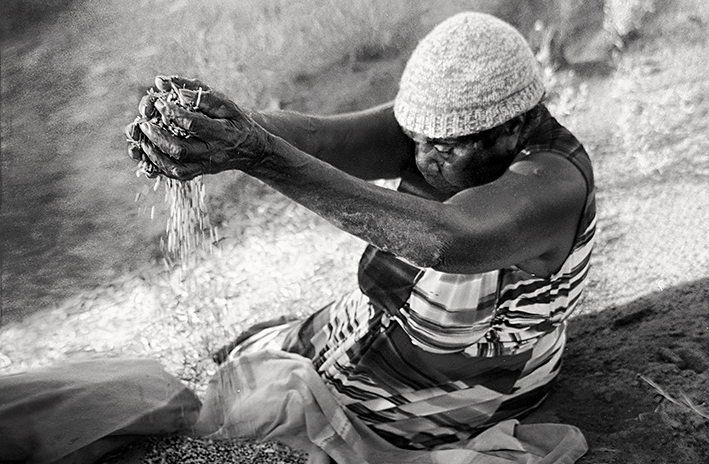
Molly Napurrula Sifts Wattleseed
Tanami Desert NT, November 2014


Warlpiri people still supplement their diet with bush food. Ground wattleseed is mixed with oil and baked into a kind of flat bread. The older ladies took me out “hunting” for wattleseed and kurrajong seedpods. In a township with only one shop, where a head of broccoli costs more than a takeaway meal for a family, it is vitally important to supplement the community’s diet with “bush food.” White Australians have almost no idea of the variety of native fruits and vegetables that grow in the apparent desert – bush potatoes, bush tomatoes, bush bananas, honey ants, land crabs, wattleseeds, etc., can be gathered throughout the Tanami. (p. 104)


Buy Judith Crispin’s The Lumen Seed on the Daylight Books website

LIKE ART BLART ON FACEBOOK

Back to top

Exhibition: ‘Albert Renger-Patzsch: Things’ at Jeu de Paume, Paris

Exhibition dates: 17th October, 2017 – 21st January, 2018

Curator: Sérgio Mah, Universidade NOVA, Lisboa


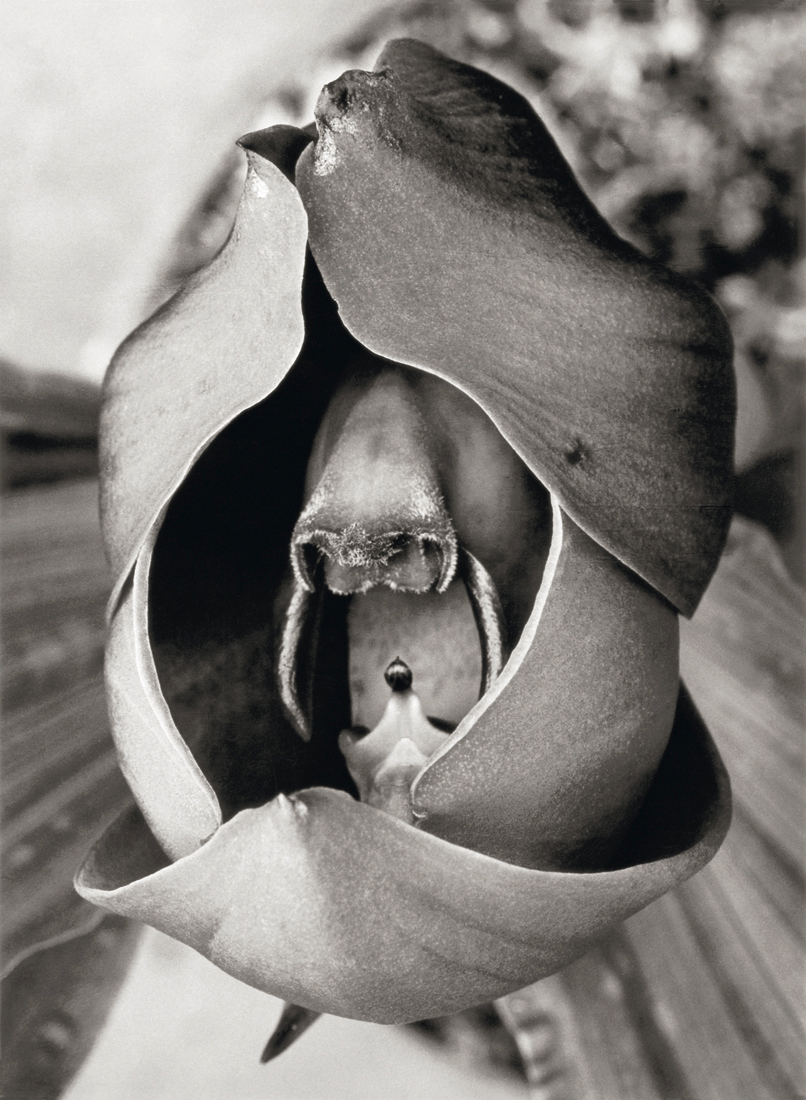
Albert Renger-Patzsch (German, 1897-1966) 'Stapelia variegata, Asclepiadaceae' 1923 from the exhibition Exhibition: 'Albert Renger-Patzsch: Things' at Jeu de Paume, Paris, Oct 2017 - Jan 2018


Albert Renger-Patzsch (German, 1897-1966)
Stapelia variegata, Asclepiadaceae
1923
Albert Renger-Patzsch Archiv / Stiftung Ann und Jürgen Wilde. Pinakothek der Moderne, Munich
© Albert Renger-Patzsch / Archiv Ann und Jürgen Wilde, Zülpich / ADAGP, Paris 2017


Experiencing the image

“[Walter Isaacson] describes the photographs, of which 7200 … miraculously survive today, as the greatest record of curiosity, because his “cross-disciplinary brilliance whirls across every page, providing a delightful display of a mind dancing with nature”. Renger-Patzsch delighted in seeing patterns in nature, so he would juxtapose a photograph of the branching arteries of the heart with the roots of a sprouting tree.”1


A mind dancing with nature.

Of course, the original quote (which I have altered) was talking about Leonardo da Vinci… but the same enquiring mind, the same display can be seen in the work of Albert Renger-Patzsch. His was a mind entranced by the nature of technology, and the technology, the structure of nature. However, he is ambivalent about the benefits of industrialisation even as he photographed it in ‘New Objectivity’ style – that is, supposedly free from emotion and subjectivity.

No writing about his work can put it better than this quote from when this exhibition was at Fundación MAPFRE in Madrid:

“Technical precision and exact representation of the subject; psychological contention and rejection of pictorial stylisation and expressionism; a keen sense of composition with attention to details, structures and forms; a sharp and clear construction of the image: these were some of the fundamental premises of a tendency that understands photography as a privileged medium to promote an artistic and simultaneously perceptive shift.

Renger-Patzsch’s work amalgamates a great number of photographic subjects, typologies and genres. In a historical period marked by deep political tension and significant social and economic change, his work allows the viewer to envision a unique worldview, a platform of intersections and re-appreciations between the domains of nature and technology.”


The only point I would not support in this quotation are these words, “psychological contention and rejection of pictorial stylisation and expressionism.”

Of course, “through the disconcerting simplicity of the photographs Renger-Patzsch highlights the phenomenological and psychological aspects that are part of experiencing the image,” but he does so not through a REJECTION of pictorial stylisation and expressionism (and all the baggage that those words embody), but through an INTENSIFICATION of a different form of pictorial style which forces? the image to emit a new form of expression. That is, the object is just its surface and is captured, instantly, by the camera in this perceptive shift.

Can you imagine seeing these photographs in the 1920s, having never seen anything like them before? They would have been revolutionary, in their rendering of the surface of the object and nothing more. Placing the camera directly before the object which requires nothing else but itself… the eye of the snake, the darkness of a tree trunk, the ordering of shoemakers’ irons. But then he finishes his ode to life, Die Welt ist schön (The World is Beautiful), with his version of Albrecht Dürer’s Praying Hands (c. 1508). I suspect that the idea the Renger-Patzsch was working with is that beauty is truth, and truth is beauty.

In contemporary society, have we lost the ability to see these photographs as he intended, with a child-like innocence? Was he saying, this is objective, do you agree? Or does the poetic intensity in the life of things refuse to be stilled?

For me, these photographs are not e/motion-less, they are the very essence of a reality rendered wonderful in my eyes.

Dr Marcus Bunyan


1/ Paraphrase of Tina Allen. “Prophetic Polymath,” on Leonardo da Vinci by Walter Isaacson in Weekend Australian Review January 6-7 2018, p. 14


Many thankx to Jeu de Paume for allowing me to publish the photographs in the posting. Please click on the photographs for a larger version of the image.


Albert Renger Patzsch / Trailer

Independently of the role he played in New Objectivity – an artistic movement that appeared in Germany at the beginning of the 1920s – Albert Renger-Patzsch (1897-1966) is today considered one of the most important and most important figures / influences in the history of 20th century photography.

The exhibition pays tribute to this extraordinary photographer and allows us to rediscover the posterity of a work that invites us to reflect on the nature of photography and on its artistic and speculative potential in the context of contemporary art and culture.


Albert Renger-Patzsch (German, 1897-1966)

Albert Renger-Patzsch (1897-1966), who produced a huge body of work spanning four and half decades, was one of the most influential photographers of the New Objectivity movement that emerged in Germany in the mid 1920s. His work helped to establish photography as a unique and important medium within modern art. Renger-Patzsch revived realism in photography, adopting an approach that was characterised by formal and technical rigour and a rejection of expressionism and pictorial stylisation. He had a highly developed sense of composition, and his attention to detail, structure and form resulted in images with sharp, clear compositions. For Renger-Patzsch, photography was a medium that made possible new forms of artistic imagery, while being perfectly in step with a period marked by industrialisation and the spread of technology. By highlighting the medium’s unique properties and the creative possibilities of documentary photography, Renger-Patzsch forged a unique role for photography within the arts of his time.

His original, simple images combine extraordinary realism and documentary value with poetic and phenomenological resonance, giving them great power. Renger-Patzsch was a highly prolific photographer who explored a wide range of subjects and genres. This exhibition highlights the invaluable legacy of this extraordinary photographer, whose work provides an ideal context for reflecting on the specificities and relevance of photography within the field of contemporary art and culture.

– The Design of Nature
– From Vernacular Landscape to the Modern City
– The vision of things
– Landscapes of the Ruhr: the Topography of a Transformation
– Industrial Objects and Architecture: Geometry and Series
– The Destiny of Nature

Sérgio Mah


The Design of Nature

During the initial phase of his career, Albert Renger-Patzsch produced a series of photographs depicting plants and flowers for the collection Die Welt der Pflanze (The World of Plants), coordinated by Ernst Fuhrmann as part of his biosophical studies.

The first two volumes in the series, both published in 1924, were Orchideen (Orchids) and Crassula. Renger-Patzsch worked within the general parameters of the book, reproducing fragments of nature with as much objectivity and clarity as possible. He produced a large number of photographs distinguished by their great technical and compositional rigour, including systematic close-ups of plants and flowers. In 1923, Renger-Patzsch wrote his first text, “Pflanzenaufnahmen” (Plant photographs), setting out his views on photography and its extraordinary capacity for capturing nature. Among the images and arguments in the text he outlines some of the key principles that would underpin his photography: attention to detail and emphasis on the formal, structural and material aspects of nature, as well as, correspondingly, a reiterative affirmation of the intrinsic qualities of photography – realism, objectivity, neutrality – and its unique role in expanding our perception of reality.


Albert Renger-Patzsch (German, 1897-1966) 'Catasetum trindentatum, Orchidaceae' 1922-1923 from the exhibition Exhibition: 'Albert Renger-Patzsch: Things' at Jeu de Paume, Paris, Oct 2017 - Jan 2018


Albert Renger-Patzsch (German, 1897-1966)
Catasetum trindentatum, Orchidaceae
1922-1923
Albert Renger-Patzsch Archiv / Stiftung Ann und Jürgen Wilde, Pinakothek der Moderne, Munich
© Albert Renger-Patzsch / Archiv Ann und Jürgen Wilde, Zülpich / ADAGP, Paris 2017


Albert Renger-Patzsch (German, 1897-1966) 'Brasilianischer Melonenbaum von unten gesehen [Brazilian melon tree seen from below]' 1923


Albert Renger-Patzsch (German, 1897-1966)
Brasilianischer Melonenbaum von unten gesehen (Brazilian melon tree seen from below)
1923
Galerie Berinson, Berlin
© Albert Renger-Patzsch / Archiv Ann und Jürgen Wilde, Zülpich / ADAGP, Paris 2017


From Vernacular Landscape to the Modern City

In 1927, Albert Renger-Patzsch published his most ambitious book to date, Die Halligen (The Halligen Islands), with images of the islands in the Wadden Sea, on the northern coast of Germany.

His photographs featured a number of subjects: landscapes, portraits, architectural motifs and everyday activities. These subjects encapsulated the relationship between local ways of life (genuine, deep-rooted, traditional) and the physical and symbolic characteristics of this peculiar area. This vernacular reality contrasted with the rampant industrialisation that was transforming many of the great urban centres in Germany.

Over the ensuing years, Renger-Patzsch published Lübeck (1928) and Hamburg (1930), books that highlight the emerging characteristics of the modern city, the coexistence of different historic periods and the intersection between historical culture and the impact of industrialisation. In these photographs the photographer’s interest in combining documentary objectives with the creative potential of a modern vision is evident in his use of close-cropped, asymmetrical compositions and innovative perspectives, alternating between general shots and a focus on details. He displays sensitivity to the formal and structural aspects of reality, rejecting the atavistic influence of painting in order to embrace the possibilities of a “new vision” governed by photography.


Albert Renger-Patzsch (German, 1897-1966) 'Krabbenfischerin [Shrimp fisherwoman]' 1927


Albert Renger-Patzsch (German, 1897-1966)
Krabbenfischerin (Shrimp fisherwoman)
1927
Centre Pompidou, Musée national d’art moderne – Centre de création industrielle, Paris. Acquisition en 1979
© Albert Renger-Patzsch / Archiv Ann und Jürgen Wilde, Zülpich / ADAGP, Paris 2017


The vision of things

In 1928, Albert Renger-Patzsch’s best-known book was published, Die Welt ist schön (The World is Beautiful), although the photographer would have preferred the title Die Dinge (Things).

It exemplifies the principles and characteristics of the photographer’s work: a desire to represent the immanent substance of an object/subject while demonstrating photography’s capacity for recording reality. In this respect, representing the unique character of a particular thing was also a way of affirming the unique character of photography.

The book encompasses a wide range of subjects and elements from the photographer’s world. It is an anthology of photographs taken since the beginning of his career, including several images produced for the books Die Welt der Pflanze, Die Halligen and Lübeck. Photographic genres are equally diverse, spanning portrait, landscape, still life and architectural images. The subjects are presented in an evolving thematic and conceptual sequence: first nature, plants, animals, people and landscapes; next, the manmade world of objects, architecture, the city, machines, and industrial structures and spaces. In this way a worldview is organised, a context of intersections and reappraisals, between nature and technology, between the sacred and the profane, between historical heritage and modernity.


Albert Renger-Patzsch (German, 1897-1966) 'Ritzel and Zahnräder, Lindener Eisen-und Stahlwerke [Sprockets and gears, Lindener Eisen-und Stahlwerke factory]' 1927


Albert Renger-Patzsch (German, 1897-1966)
Ritzel and Zahnräder, Lindener Eisen-und Stahlwerke (Sprockets and gears, Lindener Eisen-und Stahlwerke factory)
1927
Albert Renger-Patzsch. Albert Renger-Patzsch Archiv / Stiftung Ann und Jürgen Wilde, Pinakothek der Moderne, Munich
© Albert Renger-Patzsch / Archiv Ann and Jürgen Wilde, Zülpich / ADAGP, Paris 2017


Albert Renger-Patzsch (German, 1897-1966) 'Bügeleisen für Schuhfabrikation, Faguswerk Alfeld [Shoemakers' irons, Fagus factory, Alfeld]' 1928


Albert Renger-Patzsch (German, 1897-1966)
Bügeleisen für Schuhfabrikation, Faguswerk Alfeld (Shoemakers’ irons, Fagus factory, Alfeld)
1928
Albert Renger-Patzsch Archiv / Stiftung Ann und Jürgen Wilde, Pinakothek der Moderne, Munich
© Albert Renger-Patzsch / Archiv Ann und Jürgen Wilde, Zülpich / ADAGP, Paris 2017


Focus on the book Die Welt ist schön (The World is Beautiful)

Like other artists of his time, Renger-Patzsch was especially keen on exploring the formal analogies between the things of nature and industrial things. Industry led to mass production and the manufacture of standardised objects, exemplified in this image. This contrasts with other images from Die Welt ist schön (The World is Beautiful), such as Gebirgsforst im Winter (Mountain forest in winter) (below), which capture repetition in nature.

Renger-Patzsch identifies a coherence, a parity, between nature and culture as non-antagonistic doHands. He suggests a measure of naturalness in technology, and a measure of rationality in nature. For the photographer the emphasis on industrial seriality also allowed him to underscore the seriality of photography itself (as a means of technical reproduction), thus demonstrating the unique, mediating condition of this medium for visual reproduction in the connection between the natural world and the world of modern industry.


Albert Renger-Patzsch (German, 1897-1966) 'Gebirgsforst im Winter (Fichtenwald im Winter)' [Mountain forest in winter (spruce forest in winter)] 1926


Albert Renger-Patzsch (German, 1897-1966)
Gebirgsforst im Winter (Fichtenwald im Winter)
(Mountain forest in winter (spruce forest in winter))
1926
Galerie Berinson, Berlin
© Albert Renger-Patzsch / Archiv Ann und Jürgen Wilde, Zülpich / ADAGP, Paris 2017


Albert Renger-Patzsch (German, 1897-1966) 'Natterkopf [Head of an adder]' 1925


Albert Renger-Patzsch (German, 1897-1966)
Natterkopf (Head of an adder)
1925
Galerie Berinson, Berlin
© Albert Renger-Patzsch / Archiv Ann und Jürgen Wilde, Zülpich / ADAGP, Paris 2017


Focus on the book Die Welt ist schön (The World is Beautiful)

Painstaking attention to detail is a central feature of Renger-Patzsch’s photography, as demonstrated by several images in Die Welt ist schön (The World is Beautiful). Resorting to pronounced close-ups or subsequent reframing, the photographer breaks down and isolates the vision of certain things, thereby providing a fresh perspective: in this case, the image of a serpent’s head surrounded by a section of its body.

The close-up framing allows him to accentuate the two-dimensionality of the image, the part being more suggestive than the whole. This is a realistic, objective vision, but one aimed at creating a tension between the concrete nature of the motif and its abstract character.


Albert Renger-Patzsch (German, 1897-1966) 'Hände [Hands]' 1926-1927


Albert Renger-Patzsch (German, 1897-1966)
Hände (Hands)
1926-1927
Collection Ann und Jürgen Wilde
© Albert Renger-Patzsch / Archiv Ann und Jürgen Wilde, Zülpich / ADAGP, Paris 2017


Focus on the book Die Welt ist schön (The World is Beautiful)

This is the hundredth and last image of Die Welt ist schön (The World is Beautiful). It shows a pair of hands joined together, isolated from the rest of the body, rising over a black background in a gesture heavy with symbolic, meditative and spiritual fervour.

Aware that photography was increasingly becoming mundane and banal, and that the experience of attention was crumbling in the face of the accelerating transformation of reality, in Die Welt ist schön Renger-Patzsch offers an imaginary world where modern subjects can be reconnected with the things surrounding them via the mediation of a diffuse and calm temporality, the temporality of tradition and myth. A symptom of this vision is precisely the closing image of the book.


“To do justice to modern technology’s rigid linear structure, to the lofty gridwork of cranes and bridges, to the dynamism of machines operating at one thousand horsepower – only photography can do that. […] The absolutely correct rendering of form, the subtlety of tonal gradation from the brightest light to the darkest shadow, impart to a technically expert photograph the magic of experience.”


Albert Renger-Patzsch, “Ziele”, ‘Das Deutsche Lichtbild’, Berlin, 1927


“There is an urgent need to examine old opinions and look at things from a new viewpoint. There must be an increase in the joy one takes in an object, and the photographer should become fully conscious of the splendid fidelity of reproduction made possible by this technique.”


Albert Renger-Patzsch, “Die Freude am Gegenstand,” ‘Das Kunstblatt’, Berlin, 1928


“[…] the eye is subjective; it views with pleasure the essential things and completely overlooks what is unimportant. The camera, on the other hand, has to reproduce the entire image in focus and in a particular size. It will see the essential and the inessential with equal clarity.”


Albert Renger-Patzsch, in ‘Meister der Kamera erzählen wie sie wurden und wie sie arbeiten’, Halle (Saale), 1937


“[…] the eye is not isolated in its perception of the world. Rather its connections to the brain and the support of our senses in experience heat, cold wind, noise, smells and so on create an extraordinarily compact image of the world, whose plasticity and density are perhaps intensified by a particularly appropriate emotional state. Photography reduces this colourful world into a black-and-white rectangle. It is obvious that this most unpretentious of art forms requires the greatest reliability of taste, ability for abstraction, fantasy and concentration.”


Albert Renger-Patzsch, in ‘Meister der Kamera erzählen wie sie wurden und wie sie arbeiten’, Halle (Saale), 1937


The aim of this exhibition is to rediscover and pay tribute to the legacy of this unique photographer in the conviction that his work offers a context for encouraging reflection on the nature and artistic and speculative potential of photography within the framework of contemporary art and culture.

Of enormous simplicity and originality, Renger-Patzsch’s photography is notable for being based on a documentary style that prioritised realist sobriety and frankness as fundamental characteristics of photographic representation. In other words, his work offers a rigorous approach in technical and formal terms, in which the camera is only used to intensify our vision and aware of things. For Renger-Patzsch, this not only explained his photographic procedures but above all the potential for an aesthetic and conceptual identity for photography that visibly distanced itself from the Pictorialist legacy and from the hybrid experimentalism characteristic of the early 20th-century avant-gardes.

Both Renger-Patzsch’s photography and the various texts in which he set out his ideas reveal his determination to exploit the qualities inherent in the photographic medium. He stated that his aim was: “to use photographic means to create a photography that could exist through its own photographic nature.” In another text Renger-Patzsch wrote that,

“the eyes are not isolated from their perception of the world.

On the contrary, they are part of our senses and, by being connected to the brain, allow us to experience heat, cold, wind, noise, smell, and to rapidly construct a remarkably compacted image of the world, the plasticity and density of which also depend on our emotional states.

Photography reduces the world in colour to a rectangle in black and white. And logically, given that it is the least pretentious form of art, it requires rigorous taste, a capacity for abstraction, imagination and concentration.”


Such statements reveal that the exceptional quality of Renger-Patzsch’s work and thought is also notable for the way it conceives and expands the horizon and scope of the idea of documentary photography. As a result, the descriptive and objective qualities of photography are combined with and articulated by its aesthetic, poetic and phenomenological powers.

This retrospective aims to encompass the principal themes, periods and genres that define Renger-Patzsch’s photographic output through the identification of three moments that are fundamental for an understanding of his career: firstly, his early years, from his photographs of plants taken for Folkwang / Auriga publishers, to the profusion of themes and photographic eclecticism which would be decisive for the creation of his book Die Welt ist schön (The World is Beautiful) of 1928. The period that began after his move to Essen was one of intense photographic creation on the Ruhr area, principally involving subjects associated with places, buildings and industrial objects. Finally, the years after World War II reveal a new interest in the themes of nature and landscape particularly trees and rocks.

Including around 154 photographs, this is one of the largest retrospectives on the artist to date and undoubtedly the one to bring together the largest number of works by Renger-Patzsch from institutional and private collections: the Stiftung Ann und Jürgen Wilde / Pinakothek der Moderne München (Munich), the Museum Folkwang (Essen), the Ludwig Museum (Cologne), the Galerie Berinson (Berlin), the Centre Georges Pompidou (Paris).

Press release from Jeu de Paume


Highlights of the exhibition

Author of a monumental oeuvre created over four and a half decades, Albert Renger-Patzsch (1897-1966) was the leading photographer of the New Objectivity movement that appeared in German art in the mid 1920s.

Renger-Patzsch was a prolific photographer and his oeuvre encompasses a variety of themes, types and genres. This exhibition covers the most important stages in Renger-Patzsch’s career, from his first photographs of plant details, urban scenes and industrial subjects to his later landscape work. In total the exhibition features more than 150 photographs, mostly vintage prints from the most important collections in Germany.

Renger-Patzsch devoted himself to creating a new photographic realism, characterised by an extreme simplicity and originality. He created a modern visual language that was imbued with a poetic resonance and helped to redefine the photographic image. For Renger-Patzsch, photography was the most appropriate medium for carrying out a change that was simultaneously artistic and perceptual, i.e., the possibility of a new kind of image that reflected the changes of the 1920s and 1930s, a period marked by industrialisation and the spread of technology.

Albert Renger-Patzsch is the author of one of the seminal books in the history of photography, Die Welt ist schön (The World is Beautiful), which was published in 1928. This work reveals the full scope of Renger-Patzsch’s approach, which was to capture the unique character of each concrete thing in order to affirm also the unique character of photography.

Renger-Patzsch produced an exceptional body of work on the theme of industrial architecture, which he helped to turn into a genre in itself. He exerted a decisive influence on generations of photographers, not least Bernd and Hilla Becher. This exhibition sets out to highlight the vital legacy of this extraordinary photographer. In so doing, it sheds light on the important role of photography within the context of contemporary art and culture.


Albert Renger-Patzsch (German, 1897-1966) 'Landstraße bei Essen [Country road near Essen]' 1929


Albert Renger-Patzsch (German, 1897-1966)
Landstraße bei Essen (Country road near Essen)
1929
Albert Renger-Patzsch Archiv / Stiftung Ann und Jürgen Wilde, Pinakothek der Moderne, Munich
© Albert Renger-Patzsch / Archiv Ann und Jürgen Wilde, Zülpich / ADAGP, Paris 2017


Landscapes of the Ruhr: the Topography of a Transformation

In 1929, Renger-Patzsch relocated to Essen, in the Ruhr, Germany’s leading industrial region and one the photographer was familiar with.

Two years earlier, he had produced the first images in an ambitious project focusing on the landscapes of the Ruhr, which he would work on until 1935. In this realm of contrasts, he became particularly interested in spaces that were between cities, between the urban and the rural, landscapes that displayed the process of change that the region was undergoing due to industrialisation and the development of public infrastructure.

The works reflect a change in Renger-Patzsch’s photographic vision: the compositions are widened, in some cases into large panoramic views. The images now focus on a multiplicity of elements and explore interpretative relationships and associations. His preference for more open images that include the surroundings of objects, rather than just close-ups, reflects a more inclusive objectivity. Some images include people, usually seen from afar. These figures are set in particular socio-spatial contexts and help to highlight the enormous disparity in scale between the human figure and the new industrial complexes. Vertical and horizontal elements, close up and in the distance, are combined and juxtaposed. The relationship between different planes, between foreground and background, is intensified in order to show how industry has shaped the landscape, turning it into a heterogeneous and paradoxical landscape (in historical and social terms).


Albert Renger-Patzsch (German, 1897-1966) 'Landschaft bei Essen und Zeche "Rosenblumendelle" [Landscape near Essen with the Rosenblumendelle colliery]' 1928


Albert Renger-Patzsch (German, 1897-1966)
Landschaft bei Essen und Zeche “Rosenblumendelle” (Landscape near Essen with the Rosenblumendelle colliery)
1928
Albert Renger-Patzsch Archiv / Stiftung Ann und Jürgen Wilde, Pinakothek der Moderne, Munich
© Albert Renger-Patzsch / Archiv Ann und Jürgen Wilde, Zülpich / ADAGP, Paris 2017


Albert Renger-Patzsch (German, 1897-1966) 'Zeche "Victoria Mathias" in Essen [Colliery "Victoria Mathias" in Essen]' 1929


Albert Renger-Patzsch (German, 1897-1966)
Zeche “Victoria Mathias” in Essen (Colliery “Victoria Mathias” in Essen)
1929
Albert Renger-Patzsch Archiv / Stiftung Ann und Jürgen Wilde, Pinakothek der Moderne, Munich. © Albert Renger-Patzsch / Archiv Ann und Jürgen Wilde, Zülpich / ADAGP, Paris 2017


Focus on the Ruhr

In the photographs of the Ruhr, the landscape emerges as a genre in which disparate elements are combined and contrasted, a way of exploring the boundaries between the rural and industrial worlds, the city and the periphery.

One of the most extraordinary examples from this period is the 1928 image Landschaft bei Essen und Zeche “Rosenblumendelle” (Landscape near Essen with the Rosenblumendelle colliery) (above). This photograph that seems to result from the collage of two layers (two regions, two realities), bringing together the idyllic serenity of the rural world, in the foreground, and the massive and disproportionate character of the new industrial complexes in the background, as the fatal destiny of the modern world.

At the centre is a road, a metaphor for history, mediating two different realities and suggesting the dilemma between tradition and modernity – a dilemma that highlights Renger-Paztsch’s ambivalent and paradoxical stance towards industrialisation.


Albert Renger-Patzsch (German, 1897-1966) 'Kauper, Hochofenwerk Herrenwyk, Lübeck [Cowper, blast furnace Herrenwyk, Lübeck]' 1927


Albert Renger-Patzsch (German, 1897-1966)
Kauper, Hochofenwerk Herrenwyk, Lübeck (Cowper, blast furnace Herrenwyk, Lübeck)
1927
Albert Renger-Patzsch Archiv / Stiftung Ann und Jürgen Wilde, Pinakothek der Moderne, Munich. © Albert Renger-Patzsch / Archiv Ann und Jürgen Wilde, Zülpich / ADAGP, Paris 2017


Industrial Objects and Architecture: Geometry and Series

From the late 1920s onwards, Renger-Patzsch produced numerous works following commissions from architects and industrial companies.

At this time, the expansion of the press and advertising, boosted by industry, was having a big impact on art, providing an abundance of work opportunities for artists and photographers.

Photographs of industrial objects and buildings lent themselves to rigorous, carefully calculated compositions. In many cases, the viewer’s perception is guided by planimetric compositions, which are sometimes orthogonal, sometimes diagonal. His architectural photographs combine structural and formal aspects with a desire to record the functional reality of industrial complexes. His images of objects are characterised by their attention to detail and a desire to give aesthetic meaning to each of the objects photographed through meticulous graphic composition.

However, Renger-Patzsch emphasises the repetitive, standardised nature of the objects – aspects inherent to mass production. For him, the theme of technology was further confirmation of how photography differed from painting and provided the most suitable medium for representing the new reality – technical, material and spatial – of modern industrialisation.


Albert Renger-Patzsch (German, 1897-1966) 'Ein Knotenpunkt der Fachwerkbrücke Duisburg-Hochfeld [A node from the latticework bridge in Duisburg-Hochfeld]' 1928


Albert Renger-Patzsch (German, 1897-1966)
Ein Knotenpunkt der Fachwerkbrücke Duisburg-Hochfeld (A node from the latticework bridge in Duisburg-Hochfeld)
1928
Vintage gelatin silver print
Albert Renger-Patzsch Archiv / Stiftung Ann und Jürgen Wilde, Pinakothek der Moderne, Munich
© Albert Renger-Patzsch / Archiv Ann und Jürgen Wilde, Zülpich / VEGAP, Madrid 2017


Albert Renger-Patzsch (German, 1897-1966) 'Zeche "Heinrich-Robert", Turmförderung, Pelkum bei Hamm [Headframe at the Heinrich-Robert colliery in Pelkum, near Hamm]' 1951


Albert Renger-Patzsch (German, 1897-1966)
Zeche “Heinrich-Robert”, Turmförderung, Pelkum bei Hamm (Headframe at the Heinrich-Robert colliery in Pelkum, near Hamm)
1951
Albert Renger-Patzsch Archiv / Stiftung Ann und Jürgen Wilde, Pinakothek der Moderne, Munich
© Albert Renger-Patzsch / Archiv Ann und Jürgen Wilde, Zülpich / ADAGP, Paris 2017


Albert Renger-Patzsch (German, 1897-1966) 'Zeche "Graf Moltke", Gelsenkirchen-Gladbeck [Graf Moltke colliery, in the Gladbeck district of Gelsenkirchen]' 1952-1953


Albert Renger-Patzsch (German, 1897-1966)
Zeche “Graf Moltke”, Gelsenkirchen-Gladbeck (Graf Moltke colliery, in the Gladbeck district of Gelsenkirchen)
1952-1953
Albert Renger-Patzsch Archiv / Stiftung Ann und Jürgen Wilde, Pinakothek der Moderne, Munich
© Albert Renger-Patzsch / Archiv Ann und Jürgen Wilde, Zülpich / ADAGP, Paris 2017


Albert Renger-Patzsch (German, 1897-1966) 'Zeche "Katharina", Schacht Ernst Tengelmann, Essen-Kray [Katharina colliery, Ernst Tengelmann well, in the Kray district of Essen]' 1955-1956


Albert Renger-Patzsch (German, 1897-1966)
Zeche “Katharina”, Schacht Ernst Tengelmann, Essen-Kray (Katharina colliery, Ernst Tengelmann well, in the Kray district of Essen)
1955-1956
Albert Renger-Patzsch Archiv / Stiftung Ann und Jürgen Wilde, Pinakothek der Moderne, Munich. © Albert Renger-Patzsch / Archiv Ann und Jürgen Wilde, Zülpich / ADAGP, Paris 2017


Focus on architecture

Throughout his career, Renger-Patzsch created a huge number of photographs of industrial architecture. Its emergence as an artistic genre owes much to him, and his legacy exerted a decisive influence on generations of future photographers, including Bernd and Hilla Becher.

The perspective and the composition accentuate the geometry of the vertical, horizontal and diagonal lines. The photographer seeks to highlight the significance of a building designed according to strict functional and rational principles. In doing so, Renger-Patzsch reveals a correspondence between method and object in the sense that precision, objectivity and the documentary value of photography were in harmony with the rationality, coherence and functionality of the new industrial and modern architecture.


Albert Renger-Patzsch (German, 1897-1966) 'Jenaer Glas (Zylindrische Gläser) [Jena glass (cylinders)]' 1934


Albert Renger-Patzsch (German, 1897-1966)
Jenaer Glas (Zylindrische Gläser) (Jena glass (cylinders))
1934
Museum Folkwang, Essen
© Albert Renger-Patzsch / Archiv Ann und Jürgen Wilde, Zülpich / ADAGP, Paris 2017


Focus on series

For Renger-Patzsch commercial commissions also provided opportunities for a personal and creative approach to photography. This image is part of a commission from the Jenaer Glaswerke Schott company, for whom he photographed several sets of laboratory objects in glass (recipients, flasks, tubes, jars). In this particular image Renger-Patzsch arranges eight glass beakers, all with the same cylindrical shape but of differing dimensions, on a reflecting surface and photographs them from a slightly elevated angle. The larger items are placed to the rear. The objects overlap with each other. The mirroring effect of the base creates the impression that the glassware is floating, especially at the centre of the image where the smaller cylinder (on which the manufacturer’s logo can be read) is the focal point. In their simple, standardised shape, and their transparency, the objects create a choreography of light, shadows and reflections, an experiment with the possibilities of looking at objects and reconfiguring their shapes.

The Destiny of Nature

In 1944, a large part of his archives at the Folkwang Museum were destroyed in an Allied bombing raid. With his family, Renger-Patzsch moved to the rural area of Wamel, close to Soest. He began to work on a new theme, returning to natural subjects, although now with an emphasis on landscape.

The photographer seemed to find among the trees, forests, rocks and craggy scenes a vital energy. These images suggest a diffuse sense of time contrasting with the linear nature of history and immune to the contingencies of modernity and the devastating consequences of war. In this final phase of his life, Renger-Patzsch published Baüme (Trees) in 1962 and Gestein (Rocks) in 1966, two volumes that exemplify the conceptual and aesthetic bases of this renewed, revitalised view of nature. Both books include essays by the writer and philosopher Ernst Jünger, with whom the photographer maintained an intense and regular correspondence for over twenty years.

The photographs in Baüme and Gestein are the logical corollary to Renger-Patzsch’s extraordinary trajectory. The images are less graphic, in part due to the fact that they depict forms that are apparently disordered, uncontrollable and unpredictable. Nevertheless, through the disconcerting simplicity and sobriety of these photographs, Renger-Patzsch also highlights the phenomenological and psychological aspects that are part of experiencing the image.

Nature can thus be seen as a subject that allows the viewer to experience a primal gaze. This is the condition for a vision simultaneously concrete, poetic and metaphysical that leads to a rediscovery of nature, its destiny, its silence, its rhythms, forms and forces.


Albert Renger-Patzsch (German, 1897-1966) 'Buchenwald [Beech forest]' 1936


Albert Renger-Patzsch (German, 1897-1966)
Buchenwald (Beech forest)
1936
Albert Renger-Patzsch Archiv / Stiftung Ann und Jürgen Wilde, Pinakothek der Moderne, Munich
© Albert Renger-Patzsch / Archiv Ann und Jürgen Wilde, Zülpich / ADAGP, Paris 2017


Albert Renger-Patzsch (German, 1897-1966) 'Das Bäumchen [The little tree]' 1928


Albert Renger-Patzsch (German, 1897-1966)
Das Bäumchen (The little tree)
1928
Galerie Berinson, Berlin
© Albert Renger-Patzsch / Archiv Ann und Jürgen Wilde, Zülpich / ADAGP, Paris 2017


Focus on vertical landscape

This is one of Renger-Patzsch’s best-known and most outstanding photographs. This landscape with a tree in the middle heralds his later work. Because of its links to the history of painting, landscape was not a central theme of New Objectivity. In this image Renger-Patzsch chose a vertical landscape, a less usual format than the horizontal landscape. It is a hybrid image in the sense that it combines the tree as the central motif (leafless and reduced to its branch structure) with a panoramic view of a vast landscape. Of particular note is the way the photographer explores the different planes within the image, playing with depth and distance, with the foreground, where the tree stands and the background of the endless landscape. The differences between near and far are diluted on the two-dimensional surface of the image.


Albert Renger-Patzsch (German, 1897-1966) 'Mechanismus der Faltung [Fold mechanism]' 1962


Albert Renger-Patzsch (German, 1897-1966)
Mechanismus der Faltung (Fold mechanism)
1962
Albert Renger-Patzsch Archiv / Stiftung Ann und Jürgen Wilde, Pinakothek der Moderne, Munich
© Albert Renger-Patzsch / Archiv Ann und Jürgen Wilde, Zülpich / ADAGP, Paris 2017


Focus on geology

Rocks and geological phenomena became of great interest to Renger-Patzsch in the latter phase of his career as a photographer, during which he travelled to France, Norway, Northern Ireland, Italy, Sweden and several parts of Germany to take the photographs published in Gestein (Rocks). In the book, the images are strategically interspersed with text by geologist and palaeontologist Max Richter and an essay by writer and philosopher Ernst Jünger.

Renger-Patzsch photographed the rocks and layers of rock as evidence of the slower phenomena of nature, but also as metaphors for time and history. This image, taken on the coast of Brittany, shows a series of geological folds, a phenomenon that occurs when different forces cause the planar rock sheets to curve or fold. The photographic precision and objectivity of the image, along with the stunning (peculiar, expressive, pictorial) appearance generated by tectonic forces on the surface of the rock, create a vision that combines figuration and abstraction.


Jeu de Paume
1, Place de la Concorde
75008 Paris
métro Concorde
Phone: 01 47 03 12 50

Opening hours:
Tuesday: 11.00 – 21.00
Wednesday – Sunday: 11.00 – 19.00
Closed Monday

Jeu de Paume website

LIKE ART BLART ON FACEBOOK

Back to top

Photographs: Historical Australia Part 1

December 2017

WARNING: Aboriginal and Torres Strait Islander readers are warned that the following posting may contain images of deceased persons.


Unknown photographer. 'George St. from King St., Sydney' Nd


Unknown photographer
George St. from King St., Sydney
Nd


The last posting of the year, because I am feeling rather exhausted!

Down the rabbit hole we go… into the world of Australian historical photography.

In photographs that were taken around the same time, the contrast could not be more evident: horse and trap travelling down fashionable George Street, Sydney while donkey and cart in Outback Australia fetch water; Nicholas Caire’s King Billy’s camp in McCree’s Paddock, Maloga, Victoria – King Billy ‘The Last of His Tribe’, the final remnant of a dying race and J. W. Lindt’s Untitled (Two men in rural Victoria), old men with beards and hats, swag and billy, possibly itinerant travelling workers.

And so I have sequenced these images as best I could.

The white men stand implacably outside the courthouses while the Indigenous feet touch the earth. They fight for their country, win the Military Medal and can’t even vote. The courthouses of the colonial white, those massive edifices of the law, jurisdiction and punishment tied with Australian Aborigines in chains and Aboriginal youth Dylan Voller, 17, shackled to a metal chair by his hands, feet and neck and wearing a spithood at Don Dale Youth Detention Centre in 2015.

And so it goes…

Although there can be many contexts and interpretations within the photographic labyrinthine abyss, and even though these photographs were taken by colonial masters, the materiality of photography (as act of creation and as final printed product) and its relationship to the real is what is important here. These are beautiful photographs of peoples from the First Nations, people that all have their own specific names, and in many instances, speak / spoke their own specific language.

You only have to look at the boy standing at the back of the photograph Aboriginal family group to recognise how his direct looking transcends the fixed gaze of the camera, the male gaze, the white gaze and the colonial gaze. His gaze, his return of serve if you like, speaks to us through time – of an individual, valuable and empowered human being assured in his own self. No colour, jurisdiction nor race is necessary for us recognise him as such.

Dr Marcus Bunyan


Many thankx to Dennis Joachim for allowing me to publish the photographs in the posting. Please click on the photographs for a larger version of the image.


“Think carefully: there can be no redundancy in photography, for a photograph, whatever it is, already speaks twice of time, once to seize it and another to say that it has passed; And there can be no trompe-l’oeil in it either; it is and will always be the mise en abyme par excellence; It is the mind that looks at the abyss, it is a piece of the abyss cut clear, with four right angles cut terribly sharp.”


Denis Roche


Trompe-l’oeil

Trompe-l’œil (French for “deceive the eye”) is an art technique that uses realistic imagery to create the optical illusion that the depicted objects exist in three dimensions. It refers to perspectival illusionism.

Mise en abyme

Mise en abyme is a French term derived from heraldry, and literally means “placed into abyss”. A common sense of the phrase is the visual experience of standing between two mirrors, then seeing as a result an infinite reproduction of one’s image. Another is the Droste effect, in which a picture appears within itself, in a place where a similar picture would realistically be expected to appear… In Western art history, “mise en abyme” is a formal technique in which an image contains a smaller copy of itself, in a sequence appearing to recur infinitely; “recursive” is another term for this.


Unknown photographer. 'Richmond Courthouse, Courthouses of New South Wales' c. 1870-1880s


Unknown photographer
Richmond Courthouse, Courthouses of New South Wales
c. 1870-1880s
Date built: 1877


Richmond is a town in New South Wales, in the local government area of the City of Hawkesbury. It is located on the alluvial Hawkesbury River flats, at the foot of the Blue Mountains. It is about 65 km by road from Sydney.

Richmond Court House and Police Station is located at 288 Windsor Street, Richmond NSW. The present building was designed by Colonial Architect, James Barnet in 1877 as a court house with associated police station. The front entrance is via an attractive arched colonnade with feature brickwork and the roof is supported by bracketed eaves. The raised roof of the court room may be seen in the centre of the structure. Note the similarity in style with the adjacent former post office, also the work of James Barnet. It replaced the watch-house built by William Cox in 1827. The watch-house was a four roomed structure with a detached kitchen. One of the rooms was barred and secure for the custody of prisoners. The other rooms were for the policeman on duty. The rear of the site was set aside for the first stock pound in the town. The court house is still in use but the Police Local Area Command is located in the nearby town of Windsor.

Text from the Hawkesbury.org website Nd [Online] Cited 19/12/2017


Alphonse Chargois (French, 1860-1936) 'Cumjam Murdered Ferguson at Mentana March 1894' 1894


Alphonse Chargois (French, 1860-1936)
Cumjam Murdered Ferguson at Mentana March 1894
1894
Albumen print
16 x 10 inches


Chargois, Alphonse. (father of Herbert Chargois. died Nov 1936)
Townsville, Qld 1879
Croydon, Qld 1892-1896
Normanton, Qld 1896-1897
Townsville, Qld 1897
McArthur St, Croydon Qld (base) 1898-1913
Georgetown, Qld (trav) 1900
Torres Strait Islands, Qld (trav) Oct 1913
“Touring the South” 1913-1915
(owned Bicycle Business, Warwick, Qld, 1915, advertised for sale Feb 1915)
“Royal Studio”
“late Lyne Brown, McTaggart and Dobson”
Lake St, Cairns, Qld July 1915-1936
(bought McTaggart & Dobson’s studio, July 1915)
Mareeba, Qld (trav) Oct 1915
(estate publicly Auctioned up Oct 1947)


Cumjam standing in front of a government issue tent. Cumjam was arrested for the murder of Mr Ferguson (aged 60) who worked for Donald Mclntyre at Mentana Station. Ferguson’s murder and the capture of Cumjam were reported widely in the Norman Chronicle, The North Queensland Register and The Brisbane Courier between 1894-1895. Records detailing the outcome of his arrest have not been located.


“An Aboriginal Desperado”

The “Norman Chronicle” says: “By the last mail we received from Mr. Chargois, who is at present at Delta, two photos of the blackboy “Cumjam.” who is supposed to have murdered Ferguson at Mentana in March, 1894. The details of the capture as given by Mr. Chargois are as follows: ‘Mr Jack Adford, who has been managing Loch-na-gar for Mr. McInytre, had received instructions to move cattle to Daigonally, and wishing to bring over with him some of the native curios, he told the blacks, ‘Me go away by-and-by take away altogether bullock, you fetch ’em up spear, shell, boomerang, me give you tumbac. Me come back one moon.’ One moon goes by and the blacks were there to the number of about 50, eager to exchange their native gear for tobacco. All were up at the station except one, who stayed at the camp, and Jack Alford, wishing to know why he do so, asked the others, ‘What name boy sit down longa camp?’ ‘That fellow name ‘Cumjam’; he sick long a cobra.’ Alford at once recognised the murdered of Ferguson, although he gave no sign of his discovery, but said to the other, ‘Poor fellow, you go fetch em up, me give him medicine make him alright.’ ‘Cumjam’ was accordingly conducted up. ‘What name belongs you?’ said Alford. ‘Cumjam,’ replied the black. Alford decided at once upon his plan of action, told the other blacks to step back and site down, then taking Cumjam aside he seized him and with the help of his own boys bound him up. The other blacks, not liking the look of things, began to get uneasy, and slipped away one by one down to the creek, leaving Cumjam captured. It was no easy task to bring him along. He ate through one strap, and when that was replaced by a chain and padlock he managed somehow to pick the latter to pieces.’ The photo which we have on view shows the prisoner to be securely bound.”

The North Queensland Register 16 October 1895

Text from the Thagaalbi: History of Australia’s Indigenous people Facebook page [Online] Cited 19/12/2017


The presence of Europeans along the gulf coast and south-western areas of the Peninsula was met with Aboriginal resistance. When J.T. Embley surveyed the Mitchell River in 1886-1887 he counted “skirmishes with the blacks” to have been the cause of delays in the completion of his work.136 The death of Ferguson, an elderly white stockman, in March 1894 followed his spearing on Mentana station by the Aboriginal, Cumjam.137 Only a few months before Ferguson’s death one party of survivors of the steamship, Kanahooka, after its capsize off the Mitchell River in January 1894, were able to make their way through the Kokobera country through to safety at Mentana station.138 This was despite popular fears that they would be exposed to the “hostility of the blacks”.139

Philip L. Freier. Living with the ‘Munpitch’: The history of Mitchell River Mission, 1905-1967. James Cook University, Doctor of Philosophy Thesis, 1999, pp. 86-87 [Online] Cited 19/12/2017


Unknown photographer. 'Windsor Courthouse, Courthouses of New South Wales' c. 1870-1880s


Unknown photographer
Windsor Courthouse, Courthouses of New South Wales
c. 1870-1880s
Date built: 1821


Windsor is a town lying North-West of Sydney, New South Wales, Australia. Windsor is located in the local government area of the City of Hawkesbury. It sits on the Hawkesbury River, on the north-western outskirts of the Sydney metropolitan area.

Windsor Courthouse is a rare surviving Colonial Georgian public building that originally dates from the early nineteenth century. The building has a fine and impressive form which uses an adapted Palladian plan to suit the Australian climate. It is of considerable historical, social and aesthetic significance as one of the earliest surviving courthouse buildings in Australia. The courthouse now [1967] ranks as Greenway’s best preserved building. The Building and Maintenance Branch of the NSW Department of Public Works carried out restoration work in 1961 to remove unsympathetic rendering of the external brickwork which was an attempt to reduce the problem of damp. The building now stands in its original and unspoiled form in Windsor, the most prosperous and successful of the towns then founded by Governor Macquarie. The courthouse was insisted upon by Governor Macquarie, designed by Greenway (himself originally a convict) and built for A₤1,800 by William Cox, using convict labour. It is a combination and the result of all the forces directly at play during the Australia’s early development. The oldest existing local court in New South Wales. Cox later served at Windsor as a magistrate.

Text from the Wikipedia website


Unknown photographer. 'Pitt St. looking S. from Bridge St., Sydney' 1895


Unknown photographer
Pitt St. looking S. from Bridge St., Sydney
1895
Albumen print


Unknown photographer. 'Getting Water' 1892

Unknown photographer. 'Getting Water' 1892


Unknown photographer
Getting Water
1892
Albumen prints


Unknown photographer. '"At the well" Station Hands' 1892


Unknown photographer
“At the well” Station Hands
1892
Albumen print


Unknown photographer. 'Untitled [Aboriginal ceremony]' c. 1892


Unknown photographer
Untitled [Aboriginal ceremony]
c. 1892
Albumen print


Unknown photographer. 'Court House Bathurst N S Wales, Courthouses of New South Wales' c. 1870-1880s


Unknown photographer
Court House Bathurst N S Wales, Courthouses of New South Wales
c. 1870-1880s
Date built: 1880


Bathurst is a regional city in the Central Tablelands of New South Wales, Australia. It is about 200 kilometres north-west of Sydney.

Bathurst Courthouse is one of the finest Victorian Court House buildings in New South Wales. Built as part of a precinct of Victorian public buildings, it is a landmark building prominently sited in the town centre of Bathurst. The building has a lengthy association with the provision of justice in the district. The wings, built as the postal and telegraph offices, were opened in 1877. The entire structure is 81 metres (266 ft) long and 45 metres (148 ft) wide. The west wing is now occupied by the Central Western Music Centre. The east wing is now the Historical Society Museum.

Text from the Wikipedia website


Unknown photographer. 'King Billy Maloga' Nd


Nicholas Caire (Australian, 1837-1918)
King Billy Maloga (King Billy’s camp in McCree’s Paddock, Maloga, Victoria)
1891


Photograph of four Aboriginal Australians, two men and two women, seated on ground in front of a shelter. Older man on left holds wooden sticks or spears, and a dog sits next to him. The three main local tribes were named after their “country” (or district), being “Burrumbeet” from Lakes Burrumbeet and Learmonth, “Keyeet” from Mt Buninyong and “Tooloora” from Mt Warrenheip and Lal Lal Creek. The last well recognised leader of the district, was “King Billy” from Burrumbeet, whose death surprisingly made the newspapers in mining areas and big cities right round the country.

Ballarat’s Mullawallah (also known as King Billy or Frank Wilson), was buried in 1896 to considerable civic interest as a result of being nominated as ‘The Last of His Tribe’.


J. W. Lindt. 'Untitled [Two men in rural Victoria]' c. 1880s


J. W. Lindt (John William, Australian 1845-1926, Melbourne, photographer)
Untitled [Two men in rural Victoria]
c. 1880s
Cabinet card
Albumen print


John William Lindt (1845-1926), photographer, was born at Frankfurt on Main, Germany, son of Peter Joseph Lindt, excise officer, and his wife Justine, née Rambach. At 17 he ran away to sea and joined a Dutch sailing ship. He deserted at Brisbane; by 1863 he was at Grafton as a piano-tuner and then worked in a photographic studio. He visited Germany in 1867 and on his return bought the business. Using the wet-plate process he photographed the Clarence River district and its Aboriginals, producing albums in 1875 and 1876. He then sold out and went to Melbourne where he opened a studio in Collins Street. He soon won repute for his society, theatre and landscape photographs. In 1880 he photographed the capture of the Kelly gang at Glenrowan. When the first commercial dry plates arrived in Melbourne he went to Europe to seek agencies for the latest photographic equipment. On his return he worked in the studio and the Victorian countryside; many of his photographs were used in the railways. He also designed and modified cameras as well as ‘advising in matters photographic’.

Read the full biography on the Australian Dictionary of Biography website


Unknown photographer. 'Darlinghurst Gaol & Court House, Sydney Oct. 1870' 1870


Unknown photographer
Darlinghurst Gaol & Court House, Sydney Oct. 1870
1870
Date built: 1844


The Darlinghurst Court House and residence is the finest, and only erudite Old Colonial Grecian public building complex surviving in Australia. Commenced in the 1830s, it has a long and continual association with the provision of law and order along with the neighbouring Darlinghurst Gaol complex. The imposing sandstone building is prominently sited at Taylor Square. The Court House, designed by Lewis and built between 1837 and 1844, is the first purpose designed court house to be built in NSW. The pavilions on either side were designed by Barnet around 1886. The extension facing Victoria Street was designed by the Government Architect’s Office and completed c. 1963. The central block was adapted from an 1823 design in Peter Nicholson’s ‘The New Practical Builder’.

Text from the Wikipedia website


Unknown photographer. 'Untitled [Australian Aborigines in chains]' Nd


Unknown photographer
Untitled [Australian Aborigines in chains]
Nd
Albumen print


Dylan Voller


Aboriginal youth Dylan Voller, 17, shackled to a metal chair by his hands, feet and neck and wearing a spithood at Don Dale Youth Detention Centre in 2015


Unknown artist. 'Unknown Courthouse, Courthouses of New South Wales' c. 1870s


Unknown photographer
Unknown Courthouse, Courthouses of New South Wales
c. 1870-1880s


Unknown photographer. 'Untitled [Aboriginal man smoking a pipe]' Nd


Unknown photographer
Untitled [Aboriginal man smoking a pipe]
Nd


Unknown photographer. 'Untitled [Aboriginal making fire]' Nd


Unknown photographer
Untitled [Aboriginal making fire]
Nd


Anonymous photographer. 'Untitled [Aboriginal with spear]' Nd


Anonymous photographer
Untitled [Aboriginal with spear]
Nd


Edwards & Errington (Adelaide, South Australia) 'Studio portrait of 2597 Private (Pte) Frederick Prentice, 12th Battalion, and later 1st Australian Pioneer Battalion' (detail) c. 1914-1918


Edwards & Errington (Adelaide, South Australia)
Studio portrait of 2597 Private (Pte) Frederick Prentice, 12th Battalion, and later 1st Australian Pioneer Battalion (detail)
c. 1914-1918
Gelatin silver print on postcard


Northern Territory born WWI veteran Frederick Prentice, an Indigenous serviceman who won the Military Medal. On the verso of the photograph is an original message “Just a little card to remember the good times at Paratoo.” This postcard was sent to a friend, Gertrude Fitzgerald, who he knew at Paratoo, SA. Born in Powells Creek, Northern, NT, on 18 January 1894, Frederick Prentice was educated at Kyre College (later part of Scotch College), Adelaide, from 1905 to 1908. Following schooling, Prentice worked as a station hand and was employed at Manunda Station, South Australia at the time of his enlistment on 7 May 1915 in Keswick. Pte Prentice won a Military Medal for his actions on 19 July 1916 at Pozieres, France, where he showed great courage, resource and ability in bringing machine guns and ammunition through the enemy barrage in the dark and across broken ground. Frederick Prentice returned to Australia as a Corporal on 12 May 1919.

Text from the Australian War Memorial website


Anonymous photographer. 'Untitled [Aboriginal with scars]' Nd


Anonymous photographer
Untitled [Aboriginal with scars]
Nd


Kerry & Co., (Sydney) 'Aboriginal chief' c. 1900-1917


Kerry & Co., (Sydney)
Aboriginal chief
c. 1900-1917
Collotype
13.7 × 8.5cm (image and sheet)


Portrait of Aboriginal chief, Barron River, Queensland, with body paint and head decorations, in ceremonial dress.


Unknown photographer. 'Court House Orange N.S.W., Courthouses of New South Wales' c. 1870-1880s


Unknown photographer
Court House Orange N.S.W., Courthouses of New South Wales
c. 1870-1880s
Date built: 1883


“On a site where local Wiradjuri people are said to have once held corroborees stands the Orange court House. A slab and bark watch-house was erected in 1849 and used as a court house from 1851. Early church services and the first council meetings were held. A larger sandstone Court House was erected in 1860-62 by Kennard and Snow. Bushranger Ben Hall was tried here in the early 1860s. This building made way for the present Neo-classical building designed by James Barnet in 1883. A new wing was constructed a the rear of the site in 2001.”

~ Orange Heritage Trail, a pamphlet produced by Ross Maroney in conjunction with the Orange City Council, the Orange Visitor Information Centre.

.
The current Orange Courthouse building was designed by the Colonial Government Architect James Barnet. Construction was completed in 1883. Previous buildings existed on the site, the first being erected in 1847, around the time of the town’s settlement, and operated as a Court of Petty Sessions, being the usual arrangements in those times. Orange was proclaimed a municipality in 1860, the first meeting being held in the Courthouse, located on the same site as today, but a different structure.

Text from the Willshub website 2 Jan 2015 [Online] Cited 20th November 2017


Anonymous photographer. 'Untitled [Aboriginal group]' Nd


Anonymous photographer
Untitled [Aboriginal group]
Nd


Anonymous photographer. 'Untitled [Aboriginal family group]' Nd


Anonymous photographer
Untitled [Aboriginal family group]
Nd


Alphonse Chargois (French, 1860-1936) 'Daisy Belle, Jack Kinmont Moir and Rose-Marie, Delta Downs' Nd


Alphonse Chargois (French, 1860-1936)
Daisy Belle, Jack Kinmont Moir and Rose-Marie, Delta Downs
Nd
14 x 10.5cm


LIKE ART BLART ON FACEBOOK

Back to top

Book: Photographs from ‘Der Kunstlerische Tanz Unserer Zeit’ (The Artistic Dance of Our Time) 1928 Part 1

December 2017

Authors: Hermann and Marianne Aubel

Publisher: Karl Robert Langewiesche Vlg. Königstein, 1928. 112 pages, numerous illustrations. Pictures of Isadora Duncan, Nijinski, Anna Pavlova, Alexander Sacharoff, Clotilde von Derp-Sacharoff, Die Schwestern Wiesenthal, Tamara Karsavina, La Argentina, Ellen Petz, Niddy Impekoven, Rudolf von Laban, Mary Wigman, Palucca, Harald Kreutzberg, Javanische Tanzgruppe.
Language: German


A performance by the Natural Dance Movement in silk robes c. 2000


A performance by the Natural Dance Movement in silk robes, England
c. 2000
Photograph taken by my mother


I have always loved dancing… it comes from the soul. I have danced since 1975 – pre-disco, through disco, high energy, new romantics, soul, trance, techno and more. I still go out dancing today. While this is a different kind of dance, notably free dance, all forms of dance are a connection to music, earth, cosmos. A connection to the earliest of human beings dancing round an open fire.

This is a book I bought on the Internet for $12. I have scanned the photographs and given them a digital clean. The costumes are fabulous, the poses exquisite, exotic, and joyous. The silhouettes and shapes created are just glorious. The photographs usually have low depth of field, the figures “caught” in front of contextless backgrounds. But as Grete Wiesenthal’s assistant Maria Josefa Schaffgotsch observes, the time freeze of the photograph is the antithesis of free dance:

“Grete Wiesnethal’s primary concern was to overcome as far as possible the unavoidable static element of classical dance and to dissolve everything that smacked of a pose in a never-ending stream of movement. The flowing, swinging, wavelike three-four rhythm, transforming Strauss’s waltzes into movement – that was her particular art, that was what made her world famous.”1


Many of the photographs work against the nature of the medium, and the idea of posing for the camera, to capture the fleeting expressiveness of dance. Just look at the ecstatic shape created in Hugo Erfurth’s Schwestern Wiesenthal (Wiesenthal sisters) (c. 1928, below). Indeed, the language of spiritual revelation!

My favourites are the photographs of Sent M’Ahesa and Nijinski. But honestly, they are all glorious. The photographs in this book, “The Artistic Dance of Our Time,” represent the cutting edge of dance, art, and photography in 1928. It is so nice to seem them now.

Dr Marcus Bunyan


1/ Andrea Amort. “Free Dance in Interwar Vienna,” in Deborah Holmes and Lisa Silverman (eds.,). Interwar Vienna: Culture Between Tradition and Modernity. Rochester, New York: Camden House, 2009, p. 123.


Please click on the photographs for a larger version of the image.


Hermann and Marianne Aubel (authors) Karl Robert Langewiesche (publisher) 'Der Kunstlerische Tanz Unserer Zeit [The Artistic Dance of Our Time]' 1928


Hermann and Marianne Aubel (authors)
Karl Robert Langewiesche (publisher)
Der Kunstlerische Tanz Unserer Zeit [The Artistic Dance of Our Time]
1928
Book front cover


Free dance

Free dance is a 20th-century dance form that preceded modern dance. Rebelling against the rigid constraints of classical ballet, Loie Fuller, Isadora Duncan and Ruth St. Denis (with her work in theatre) developed their own styles of free dance and laid the foundations of American modern dance with their choreography and teaching. In Europe Rudolf Laban, Emile Jaques-Dalcroze and François Delsarte developed their own theories of human movement and methods of instruction that led to the development of European modern and Expressionist dance.

Free dance was prolific in Central and Eastern Europe, where national schools were created, such as the School of Musical Movement (Heptachor), in Russia, and the Orkesztika School, in Hungary.

Text from the Wikipedia website


Elvira (Munich) 'Isadora Duncan' from Der Kunstlerische Tanz Unserer Zeit [The Artistic Dance of Our Time] p. 1 Published 1928


Elvira (Munich)
Isadora Duncan
From Der Kunstlerische Tanz Unserer Zeit [The Artistic Dance of Our Time] p. 1
Published 1928


“Wir sehen das Ziel der Tanzkunst und jeder Kunst darin, eine Sprache geistiger Offenbarung zu sein, aus der Natur heraus sich äubernd und mit ihr verbunden.”

“We see the goal of dance and every art as being a language of spiritual revelation, external to and connected with it.”


Hermann and Marianne Aubel


Vielleicht auf keinem Gebiet kunstlerischer Entfaltung haben die letzten Jahrsehute ein solches Strebennach Weiterentwicklung gebracht, wie auf dem Gebiete der Tanzkunst. Sie ist, als letztes Zile der Arbeit an der menschilchen Bewegung, mehr und mehr mit in den Mittelpunkt des allgeneinen Interesses gerückt und übt so eine gröbere Wirkung auf breitere Kreis aus, als sie es noch vor 20, ja vor 10 Jahen vermochte. Eine neue Form des bewegten Ausdrucks will sich bilden.

Perhaps in no field of artistic development, the last years have brought about such a development as in the field of dance art. It is, as the last part of the work on the human movement, more and more pushed into the centre of general interest, and thus exerts a greater effect on a wider circle than it did 20 or even 10 years ago. A new form of moving expression wants to form itself. (Introduction, V)


Rudolf Jobst (Austrian, 1872-1952) 'Schwestern Wiesenthal [Wiesenthal sisters]' c. 1928 from Der Kunstlerische Tanz Unserer Zeit [The Artistic Dance of Our Time] p. 4 Published 1928


Rudolf Jobst (Austrian, 1872-1952)
Schwestern Wiesenthal [Wiesenthal sisters]
From Der Kunstlerische Tanz Unserer Zeit [The Artistic Dance of Our Time] p. 4
Published 1928


Hugo Erfurth (German, 1874-1948) 'Schwestern Wiesenthal [Wiesenthal sisters]' c. 1928 from Der Kunstlerische Tanz Unserer Zeit [The Artistic Dance of Our Time] p. 5 Published 1928


Hugo Erfurth (German, 1874-1948)
Schwestern Wiesenthal (Wiesenthal sisters)
From Der Kunstlerische Tanz Unserer Zeit (The Artistic Dance of Our Time) p. 5
Published 1928


Hugo Erfurth (German, 1874-1948) 'Grete Wiesenthal' c. 1928 from Der Kunstlerische Tanz Unserer Zeit [The Artistic Dance of Our Time] p. 6 Published 1928


Hugo Erfurth (German, 1874-1948)
Grete Wiesenthal
From Der Kunstlerische Tanz Unserer Zeit (The Artistic Dance of Our Time) p. 6
Published 1928


Grete Wiesenthal (Austrian, 1885-1970)

Austrian dancer and choreographer. She and her sister Elsa (1887-1967) were both dancers with the Vienna Court Opera Ballet but she left in 1904 to choreograph and perform her own work, which was accompanied primarily by waltz music (Chopin and J. Strauss). She proved so popular that her sisters Elsa and Berta joined her in works that communicated a (then) revolutionarily ecstatic response to waltz rhythms. The sisters moved to Berlin where they performed together until 1910, after which Grete worked independently, choreographing and performing in vaudeville, film, and opera around Europe and the US. The Grete Wiesenthal Dance group (1945-1956) toured the world and two of its members subsequently staged her dances for the Vienna State Opera Ballet. …

The “ambassador of waltz,” began life as a dancer within the traditions of ballet; entered the corps (1901) and advanced to coryphée (1902); with sister Elsa, began choreographing new ways of movement and expression through dance and allied with Secession circle of innovators; with Elsa and sister Berta, came to prominence as the Wiesenthal sisters at Vienna’s Cabaret Fledermaus (1908); in Berlin, danced with sisters at Max Reinhardt’s Deutsches Theater; danced role of 1st elf in Reinhardt’s production of A Midsummer Night’s Dream at Munich’s Artist’s Theater (1909); with sisters, performed at London’s Hippodrome and at Théâtre du Vaudeville in Paris (1909).

Made solo debut in Berlin in pantomime Sumurùn, produced by Reinhardt (1910); made US debut at Winter Garden in NY (1912); created role of Kitchen Boy in Reinhardt’s Stuttgart production of Der Bürger als Edelmann, with music by Richard Strauss; appeared in “Grete Wiesenthal Series” of films (1913-1914): Kadra Sâfa, Erlkönigs Tochter and Die goldne Fliege; following WWI, opened dancing school (1919); returned to Vienna stage at Staatsoper (State Opera House), in lead role of her ballet Der Taugenichts in Wien (The Ne’er-Do-Well in Vienna, 1927); remained active professionally, appearing in solo dance concerts and tours, including a return to NY (1933); appointed professor of dance at Vienna’s Academy for Music and the Performing Arts (1934), then served as director of artistic dance section (1945-1952).

After WWII, her work enjoyed a renaissance in Austria, especially the dances she created for various Salzburg Festival productions; wrote autobiography, Der Aufstieg (The Way Upwards, 1919), which appeared as Die ersten Schritte (The First Steps, 1947); also published a novel, Iffi: Roman einer Tänzerin (Iffi: Novel of a Dancer, 1951); best remembered for having transformed the Viennese waltz from a monotonous one-two-three movement, performed by smiling dancers laced into corsets, into an ecstatic experience, performed by dancers with unbound hair and swinging dresses.

Text from the Gustav Mahler website Nd [Online] Cited 13/12/2017. No longer available online


Rudolf Jobst (Vienna) 'Else Wiesenthal' c. 1928 from Der Kunstlerische Tanz Unserer Zeit [The Artistic Dance of Our Time] p. 7 Published 1928


Rudolf Jobst (Austrian, 1872-1952)
Else Wiesenthal
From Der Kunstlerische Tanz Unserer Zeit (The Artistic Dance of Our Time) p. 7
Published 1928


Hanns Holdt (German, 1887-1944) 'Sent M'Ahesa' c. 1928 from Der Kunstlerische Tanz Unserer Zeit [The Artistic Dance of Our Time] p. 10 Published 1928


Hanns Holdt (German, 1887-1944)
Sent M’Ahesa
From Der Kunstlerische Tanz Unserer Zeit (The Artistic Dance of Our Time) p. 10
Published 1928


Franz Löwy (Austrian, 1883-1949) 'Sent M'Ahesa' c. 1928 from Der Kunstlerische Tanz Unserer Zeit [The Artistic Dance of Our Time] p. 11 Published 1928


Franz Löwy (Austrian, 1883-1949)
Sent M’Ahesa
From Der Kunstlerische Tanz Unserer Zeit (The Artistic Dance of Our Time) p. 11
Published 1928


Sent M’Ahesa (born August 17, 1883 in Riga as Else von Carlberg – November 19, 1970 in Stockholm ) was a expressive dancer, who worked in Germany until the 1920s. She also wrote articles for newspapers and magazines.

She was portrayed by Max Beckmann, Bernhard Hoetger, Dietz Edzard and Adolf Münzer. The Greek writer Nikos Kazantzakis saw her dance in Berlin in 1923 (“She danced only once and then returned to her Munich villa”) and wrote to his wife: “Since I saw Sent M’Ahesa dancing I do not want any other kind of dance, I saw its highest form.”

Text from the Wikipedia website


Hugo Erfurth (German, 1874-1948) 'Sent M'Ahesa' c. 1928 from Der Kunstlerische Tanz Unserer Zeit [The Artistic Dance of Our Time] p. 12 Published 1928


Hugo Erfurth (German, 1874-1948)
Sent M’Ahesa
From Der Kunstlerische Tanz Unserer Zeit (The Artistic Dance of Our Time) p. 12
Published 1928


d'Ora (Arthur Benda) (Vienna) 'Sent M'Ahesa' c. 1928 from Der Kunstlerische Tanz Unserer Zeit [The Artistic Dance of Our Time] p. 13 Published 1928


d’Ora (Arthur Benda) (Vienna)
Sent M’Ahesa
From Der Kunstlerische Tanz Unserer Zeit (The Artistic Dance of Our Time) p. 13
Published 1928


Hugo Erfurth (German, 1874-1948) 'Sent M'Ahesa' c. 1928 from Der Kunstlerische Tanz Unserer Zeit [The Artistic Dance of Our Time] p. 14 Published 1928


Hugo Erfurth (German, 1874-1948)
Sent M’Ahesa
From Der Kunstlerische Tanz Unserer Zeit (The Artistic Dance of Our Time) p. 14
Published 1928


Hanns Holdt (Munich) 'Sent M'Ahesa' c. 1928 from Der Kunstlerische Tanz Unserer Zeit [The Artistic Dance of Our Time] p. 15 Published 1928


Hanns Holdt (Munich)
Sent M’Ahesa
From Der Kunstlerische Tanz Unserer Zeit (The Artistic Dance of Our Time) p. 15
Published 1928


Hanns Holdt (German, 1887-1944) 'Sent M'Ahesa' c. 1928 from Der Kunstlerische Tanz Unserer Zeit [The Artistic Dance of Our Time] p. 16 Published 1928


Hanns Holdt (German, 1887-1944)
Sent M’Ahesa
From Der Kunstlerische Tanz Unserer Zeit (The Artistic Dance of Our Time) p. 16
Published 1928


Franz Löwy (Austrian, 1883-1949) 'Sent M'Ahesa' c. 1928 from Der Kunstlerische Tanz Unserer Zeit [The Artistic Dance of Our Time] p. 17 Published 1928


Franz Löwy (Austrian, 1883-1949)
Sent M’Ahesa
From Der Kunstlerische Tanz Unserer Zeit (The Artistic Dance of Our Time) p. 17
Published 1928


Sent M’Ahesa (Elsa von Carlberg, German 1883-1970)

“Such confusion of identity did not apply in the case of Sent M’Ahesa (Elsa von Carlberg 1883-1970), whom audiences persisted in identifying with Egyptian dances (though her dance aesthetic  included images from other ancient o exotic cultures). She performed all her dances solo. Born in Latvia, she went to Berlin in 1907 with her sister to study Egyptology but became so enchanted with ancient Egyptian art and artifacts that she decided to pursue her interest through dance rather than scholarship… Under he name of Sent M’Ahesa, she presented a program of Egyptian dances in Munich in December 1909 (Ettlinger). From then until the mid-1920s, she achieved fame for her exceptionally dramatic dances dominated by motifs from ancient Egyptian iconography. …

Her dances always functioned in relation to intricate, highly decorative costumes of her own design, so that it appeared as if she chose movements for their effect upon her costume.  In her moon goddess (or Isis) dance, she attached large, diaphanous cloth wings to her black-sleeved arms… Sent M’Ahesa often exposed her flesh below the navel, but I have yet to find a picture of her in which she exposed her hair, so keen was she on the use of wigs, helmets, caps, scarves, kerchiefs, tiaras, masks, and crowns. In her peacock dance, she attached a large fan of white feather plumes to her spine. In other dances, she draped herself with tassels, decorative aprons, double sashes, layers of jeweled necklaces, and arm, wrist, and ankle bracelets. Only in her Indian dances did she wear anything resembling pants. …

… her body was wonderfully svelte, and her face displayed a cool, chiseled beauty, I think, rather, that she sought to decontextualise female beauty and erotic feeling from archetypal images of them originating in cultures other than her own or her audience’s; she sought to dramatse a tension between a modern female body and old images of female desire and desirability. Ettlinger, in 1910, was perhaps more accurate when he remarked that

“Sent M’Ahesa’s dance has nothing to do with what one commonly understands as dance. She does not produce “beautiful,” “sensually titillating” effects. She does not represent feelings, “fear,” “horror,” “lust,” “despair,” as “lovely.” Her are requires its own style. Her movements are angular, geometrically uncircular, just as we find them in old Egyptian paintings and reliefs. Neither softness of line nor playful grace are the weapons with which she puts us under her spell. On the contrary: her body constructs hard, quite unnaturally broken lines. Arms and legs take on nearly doll-like attitudes. But precisely this deliberate limiting of gestures gives her the possibility of until now unknown, utterly minute intensities, the most exquisite of refinements of bodily expression. With a sinking of the arm of only a few millimeters, she calls forth effects which all the tricks of the ballet school cannot teach.”

Sent M’Ahesa was similar to Schrenck in one respect, even though Schrenck never performed exotic dances: both project and intensely erotic aura while moving within a very confined space. They showed persuasively that convincing signification of erotic desire or pleasure did not depend on a feeling of  freedom in space, as exemplified in the convention of ballet and modern dance, with their cliched use of runs, leaps, pirouettes, and aerial acrobatics. These dancers revealed that erotic aura intensifies in relation to an acute sense of bodily confinement, of the body imploding, turning in on itself, riddled with tensions and contradictory pressures. They adopted movements to portray the body being squeezed and twisted, drifting in to a repertoire of squirms, spasms, angular thrusts, muscular suspensions. Contortionist dancing is perhaps the most extreme expression of this aesthetic. But Sent M’Ahesa complicated the matter by doing exotic dances – that is, she confined her body within a remote cultural-historical context, as if to suggest that the ecstatic body imploded metaphorical as well as physical space.”

Karl Eric Toepfer, “Solo Dancing,” in Karl Eric Toepfer. Empire of Ecstasy: Nudity and Movement in German Body Culture, 1910-1935. University of California Press, 1997, pp. 175-179.


Hanns Holdt (German, 1887-1944) 'Sent M'Ahesa' c. 1928 from Der Kunstlerische Tanz Unserer Zeit [The Artistic Dance of Our Time] p. 18 Published 1928


Hanns Holdt (German, 1887-1944)
Sent M’Ahesa
From Der Kunstlerische Tanz Unserer Zeit (The Artistic Dance of Our Time) p. 18
Published 1928


Minya Diez-Dührkoop (German, 1873-1929) 'Clotilde von Derp-Sacharoff' c. 1928 from Der Kunstlerische Tanz Unserer Zeit [The Artistic Dance of Our Time] p. 19 Published 1928


Minya Diez-Dührkoop (German, 1873-1929)
Clotilde von Derp-Sacharoff
From Der Kunstlerische Tanz Unserer Zeit (The Artistic Dance of Our Time) p. 19
Published 1928


Hugo Erfurth (German, 1874-1948) 'Clotilde von Derp-Sacharoff' c. 1928 from Der Kunstlerische Tanz Unserer Zeit [The Artistic Dance of Our Time] p. 20 Published 1928


Hugo Erfurth (German, 1874-1948)
Clotilde von Derp-Sacharoff
From Der Kunstlerische Tanz Unserer Zeit (The Artistic Dance of Our Time) p. 20
Published 1928


Hugo Erfurth (German, 1874-1948) Clotilde von Derp-Sacharoff c. 1928 from Der Kunstlerische Tanz Unserer Zeit [The Artistic Dance of Our Time] p. 21 Published 1928


Hugo Erfurth (German, 1874-1948)
Clotilde von Derp-Sacharoff
From Der Kunstlerische Tanz Unserer Zeit (The Artistic Dance of Our Time) p. 21
Published 1928


Hugo Erfurth (German, 1874-1948) 'Clotilde von Derp-Sacharoff' c. 1928 from Der Kunstlerische Tanz Unserer Zeit [The Artistic Dance of Our Time] p. 23 Published 1928


Hugo Erfurth (German, 1874-1948)
Clotilde von Derp-Sacharoff
From Der Kunstlerische Tanz Unserer Zeit (The Artistic Dance of Our Time) p. 23
Published 1928


Clotilde von Derp-Sacharoff (German, 1892-1974)

Clotilde von Derp, stage name of Clotilde Margarete Anna Edle von der Planitz (5 November 1892 – 11 January 1974), was a German expressionist dancer, an early exponent of modern dance. Her career was spent essentially dancing together with her husband Alexander Sakharoff with whom she enjoyed a long-lasting relationship. …

As a child in Munich, Clotilde dreamt of becoming a violinist but from an early age she revealed how talented she was as a dancer. After receiving ballet lessons from Julie Bergmann and Anna Ornelli from the Munich Opera, she gave her first performance on 25 April 1910 at the Hotel Union, using the stage name Clotilde von Derp. The audience were enthralled by her striking beauty and youthful grace. Max Reinhardt presented her in the title role in his pantomime Sumurûn which proved a great success while on tour in London. A photo by Rudolf Dührkoop of her was exhibited in 1913 at the Royal Photographic Society. Clotilde was a member of the radical Blaue Reiter Circle which had been started by Wassily Kandinsky in 1911.

Among her admirers were artists such as Rainer Maria Rilke and Yvan Goll. For his Swiss dance presentations, Alexej von Jawlensky gave her make-up resembling his abstract portraits. From 1913, Clotilde appeared with the Russian dancer Alexander Sacharoff with whom she moved to Switzerland during the First World War. Both Sacharoff and Clotilde were known for their transvestite costumes. Clotilde’s femininity was said to be accentuated by the male attire. Her costumes took on an ancient Greek look which she used in Danseuse de Delphes in 1916. Her style was said to be elegant and more modern than that achieved by Isadora Duncan. Their outrageous costumes included wigs made from silver and gold coloured metal, with hats and outfits decorated with flowers and wax fruit.

They married in 1919 and, with the financial support of Edith Rockefeller, appeared at the Metropolitan Opera in New York but without any great success. They lived in Paris until the Second World War. Using the name “Les Sakharoff.” Their 1921 poster by George Barbier to advertise their work was seen as showing a “mutually complementary androgynous couple” “united in dance” joined together in an act of “artistic creation.”

They toured widely visiting China and Japan which was so successful that they returned again in 1934. They and their extravagant costumes visited both North and South America. They found themselves in Spain when France was invaded by Germany. They returned to South America making a new base in Buenos Aires until 1949. They toured Italy the following year and they took up an invitation to teach in Rome by Guido Chigi Saracini. They taught at the Accademia Musicale Chigiana in Siena for Saracini and they also opened their own dance school in Rome. She and Sakharoff stopped dancing together in 1956. They both continued to live in Rome until their deaths. Clotilde gave and sold many of their writings and costumes, that still remained, to museums and auctions. She eventually sold the iconic 1909 painting of her husband by Alexander Jawlensky. In 1997 the German Dance Archive Cologne purchased many remaining items and they have 65 costumes, hundreds of set and costume designs and 500 photographs.

Unlike her husband, Clotilde had a taste for modern music, frequently choosing melancholic music by contemporaries such as Max Reger, Florent Schmitt and Stravinsky. Her haunting eyes and delicate smiles gave the impression she took pleasure in displaying her finely-costumed voluptuous body, even when she reached her forties. She was particularly effective in interpreting Debussy’s Prélude à l’après-midi d’un faune. Hans Brandenbourg maintained her ballet technique was superior to that of Alexander although he did not consider her a virtuoso. Clotilde also moved more independently of the music, dancing to the impression it created in her mind rather than to the rhythm.

Text from the Wikipedia website


Hugo Erfurth (German, 1874-1948) 'Clotilde von Derp-Sacharoff' c. 1928 from Der Kunstlerische Tanz Unserer Zeit [The Artistic Dance of Our Time] p. 26 Published 1928


Hugo Erfurth (German, 1874-1948)
Clotilde von Derp-Sacharoff
From Der Kunstlerische Tanz Unserer Zeit (The Artistic Dance of Our Time) p. 26
Published 1928


Atelier Veritas (Munich) (Stephanie Held-Ludwig) (German born Schaulen, Russia now Lithuania, 1871-1943) 'Clotilde von Derp-Sacharoff' c. 1928 from Der Kunstlerische Tanz Unserer Zeit [The Artistic Dance of Our Time] p. 27 Published 1928


Atelier Veritas (Munich) (Stephanie Held-Ludwig) (German born Schaulen, Russia now Lithuania, 1871-1943)
Clotilde von Derp-Sacharoff
From Der Kunstlerische Tanz Unserer Zeit (The Artistic Dance of Our Time) p. 27
Published 1928


The studio name “Veritas,” Latin for “truth,” was programmatic. Stephanie Held-Ludwig’s portraits were not about impressive poses, but about capturing the true, lifelike essence of a person. Art critics praised the quality of her photographs. In 1908, Fritz von Ostini commented on Stephanie Ludwig’s photos: “The pictures are beautifully toned and possess an artistic spontaneity and fidelity to life that fully justifies the proud name of the studio – ‘Veritas’.” In 1911, the Munich Neueste Nachrichten reported: “The most striking feature of these portrait photographs is their wonderful rendering of the psychological and characteristic aspects; a number of the pictures are absolutely striking.” In the same year, Stephanie Ludwig also photographed a series for Westermann’s monthly magazine featuring dolls by Käthe Kruse, which, based on designs by the artist Max Kruse, had only been released the previous year. In 1912, the Allgemeine Zeitung reported that Held-Ludwig’s photographs were “simple portraits, but so subtle in their understanding of character and so lovingly executed that they appear as works of art in and of themselves.”

Unlike Atelier Elvira, Atelier Veritas and its owner were almost forgotten for a long time. Ulrich Pohlmann, head of the photography collection at the Munich City Museum, wrote of Stephanie Held-Ludwig that she was one of those few “emancipated women whose creativity could rival that of their established male colleagues.” …

Much biographical information about Stephanie Held-Ludwig is still missing. It is known that the Atelier Veritas moved to Leopoldstraße 44 in 1914. The photographer herself lived there from 1923 onwards. She also rented out rooms; Edgar Weil was her subtenant from 1928 to 1929. From 1932 to 1936, Held-Ludwig lived in Starnberg, followed by further moves to Josefstraße 40 in Aubing, Giselastraße 12/III, Ohmstraße 7, and Dachauer Straße 46/III. This frequent change of residence was likely related to the professional restrictions imposed on her as a Jew under the Nazi dictatorship, until she was finally forced to withdraw completely from public life.

On July 22, 1942, she was deported to the Theresienstadt concentration camp. She died there on January 16, 1943, from a “Theresienstadt disease”, which could refer to bacterial dysentery, typhus or pneumonia.

“Stephanie Held-Ludwig” from the German Wikipedia translated by Google Translate


'Nijinski' From the works "The Russian Theater", Amalthea-Verlag, Vienna c. 1928 from Der Kunstlerische Tanz Unserer Zeit [The Artistic Dance of Our Time] p. 28 Published 1928


Nijinski
Aus dem werke “Das Russische Theater”, Amalthea-Verlag, Wien (From the works “The Russian Theater”, Amalthea-Verlag, Vienna)
From Der Kunstlerische Tanz Unserer Zeit (The Artistic Dance of Our Time) p. 28
Published 1928


'Nijinski' Portrait cards Verlag Leiser, Berlin - Wilmersdorf c. 1928 from Der Kunstlerische Tanz Unserer Zeit [The Artistic Dance of Our Time] p. 29 Published 1928


Nijinski
Porträt karten verlag Leiser, Berlin – Wilmersdorf
Portrait cards Verlag Leiser, Berlin – Wilmersdorf
From Der Kunstlerische Tanz Unserer Zeit (The Artistic Dance of Our Time) p. 29
Published 1928


E. O. Hoppé (British, 1878-1972) 'Nijinski' c. 1928 from Der Kunstlerische Tanz Unserer Zeit [The Artistic Dance of Our Time] p. 30 Published 1928


E. O. Hoppé (British, 1878-1972)
Nijinski
From Der Kunstlerische Tanz Unserer Zeit (The Artistic Dance of Our Time) p. 30
Published 1928


'Nijinski' From the works "The Russian Theater", Amalthea-Verlag, Vienna c. 1928 from Der Kunstlerische Tanz Unserer Zeit [The Artistic Dance of Our Time] p. 31 Published 1928


Nijinski
Aus dem werke “Das Russische Theater”, Amalthea-Verlag, Wien (From the works “The Russian Theater”, Amalthea-Verlag, Vienna)
From Der Kunstlerische Tanz Unserer Zeit (The Artistic Dance of Our Time) p. 31
Published 1928


'Nijinski' Portrait cards Verlag Leiser, Berlin - Wilmersdorf c. 1928 from Der Kunstlerische Tanz Unserer Zeit [The Artistic Dance of Our Time] p. 32 Published 1928


Nijinski
Porträt karten verlag Leiser, Berlin – Wilmersdorf
Portrait cards Verlag Leiser, Berlin – Wilmersdorf
From Der Kunstlerische Tanz Unserer Zeit (The Artistic Dance of Our Time) p. 32
Published 1928


'Nijinski' From the works "The Russian Theater", Amalthea-Verlag, Vienna c. 1928 from Der Kunstlerische Tanz Unserer Zeit [The Artistic Dance of Our Time] p. 33 Published 1928


Nijinski
Aus dem werke “Das Russische Theater”, Amalthea-Verlag, Wien (From the works “The Russian Theater”, Amalthea-Verlag, Vienna)
From Der Kunstlerische Tanz Unserer Zeit (The Artistic Dance of Our Time) p. 33
Published 1928


'Nijinski' From the works "The Russian Theater", Amalthea-Verlag, Vienna c. 1928 from Der Kunstlerische Tanz Unserer Zeit [The Artistic Dance of Our Time] p. 35 Published 1928


Nijinski
Aus dem werke “Das Russische Theater”, Amalthea-Verlag, Wien (From the works “The Russian Theater”, Amalthea-Verlag, Vienna)
From Der Kunstlerische Tanz Unserer Zeit (The Artistic Dance of Our Time) p. 35
Published 1928


d'Ora (Arthur Benda) (Vienna) 'Anna Pavlova' c. 1928 from Der Kunstlerische Tanz Unserer Zeit [The Artistic Dance of Our Time] p. 36 Published 1928


d’Ora (Arthur Benda) (Vienna)
Anna Pavlova
From Der Kunstlerische Tanz Unserer Zeit (The Artistic Dance of Our Time) p. 36
Published 1928


Hänse Herrmann (German, 1864-1932) 'Anna Pavlova' c. 1928 from Der Kunstlerische Tanz Unserer Zeit [The Artistic Dance of Our Time] p. 37 Published 1928


Hänse Herrmann (German, 1864-1932)
Anna Pavlova
From Der Kunstlerische Tanz Unserer Zeit (The Artistic Dance of Our Time) p. 37
Published 1928


Hänse Herrmann (German, 1864-1932) 'Anna Pavlova' c. 1928 from Der Kunstlerische Tanz Unserer Zeit [The Artistic Dance of Our Time] p. 38 Published 1928


Hänse Herrmann (German, 1864-1932)
Anna Pavlova
From Der Kunstlerische Tanz Unserer Zeit (The Artistic Dance of Our Time) p. 38
Published 1928


Hänse Herrmann (German, 1864-1932) 'Anna Pavlova' c. 1928 from Der Kunstlerische Tanz Unserer Zeit [The Artistic Dance of Our Time] p. 39 Published 1928


Hänse Herrmann (German, 1864-1932)
Anna Pavlova
From Der Kunstlerische Tanz Unserer Zeit (The Artistic Dance of Our Time) p. 39
Published 1928


Hänse Herrmann (German, 1864-1932) 'Anna Pavlova' c. 1928 from Der Kunstlerische Tanz Unserer Zeit [The Artistic Dance of Our Time] p. 40 Published 1928


Hänse Herrmann (German, 1864-1932)
Anna Pavlova
From Der Kunstlerische Tanz Unserer Zeit (The Artistic Dance of Our Time) p. 40
Published 1928


Hänse Herrmann (German, 1864-1932) 'Anna Pavlova' c. 1928 from Der Kunstlerische Tanz Unserer Zeit [The Artistic Dance of Our Time] p. 41 Published 1928


Hänse Herrmann (German, 1864-1932)
Anna Pavlova
From Der Kunstlerische Tanz Unserer Zeit (The Artistic Dance of Our Time) p. 41
Published 1928


Hänse Herrmann (German, 1864-1932) 'Anna Pavlova' c. 1928 from Der Kunstlerische Tanz Unserer Zeit [The Artistic Dance of Our Time] p. 42 Published 1928


Hänse Herrmann (German, 1864-1932)
Anna Pavolva
From Der Kunstlerische Tanz Unserer Zeit (The Artistic Dance of Our Time) p. 42
Published 1928


Hänse Herrmann (German, 1864-1932) 'Anna Pavlova' c. 1928 from Der Kunstlerische Tanz Unserer Zeit [The Artistic Dance of Our Time] p. 43 Published 1928


Hänse Herrmann (German, 1864-1932)
Anna Pavlova
From Der Kunstlerische Tanz Unserer Zeit (The Artistic Dance of Our Time) p. 43
Published 1928


Ernst Schneider (German, 1881-1959) 'Anna Pavlova' c. 1928 from Der Kunstlerische Tanz Unserer Zeit [The Artistic Dance of Our Time] p. 44 Published 1928


Ernst Schneider (German, 1881-1959)
Anna Pavlova
From Der Kunstlerische Tanz Unserer Zeit (The Artistic Dance of Our Time) p. 44
Published 1928


E. O. Hoppé (British, 1878-1972) 'Anna Pavlova' c. 1928 from Der Kunstlerische Tanz Unserer Zeit [The Artistic Dance of Our Time] p. 45 Published 1928


E. O. Hoppé (British, 1878-1972)
Anna Pavlova
From Der Kunstlerische Tanz Unserer Zeit (The Artistic Dance of Our Time) p. 45
Published 1928


LIKE ART BLART ON FACEBOOK

Back to top

Book review: ‘Walter Mittelholzer Revisited’ from the photo archive of Walter Mittelholzer. Scheidegger & Spiess publishers (2017)

December 2017

Edited by Michael Gasser and Nicole Graf


Scheidegger & Spiess (publisher) 'Walter Mittelholzer Revisited' from the photo archive of Walter Mittelholzer (front cover) 2017


Scheidegger & Spiess (publisher)
Walter Mittelholzer Revisited from the photo archive of Walter Mittelholzer (front cover)
Edited by Michael Gasser and Nicole Graf
1st edition, 2017
Pictorial Worlds: Photographs from the image Archive, ETH-Bibliothek Volume 6
Text English and German
Hardback
192 pages, 47 colour and 158 b/w illustrations
20 x 26cm
ISBN 978-3-85881-543-9


Do you have a new book fetish? I know I do!

I just love the feel of a brand new, unopened book. The density and quality of the boards, the dynamics of the graphics on the cover… and then, opening the book for the first time, the thickness of the paper, the typography and layout, and the quality of the photographic printing. But above all, it is the smell of a new book that is so intoxicating. I like nothing better than to stick my nose into a new book and savor the smell.

Every new book is different. Each has their own unique aroma, which is caused by a number of chemical reactions used when they are manufactured. “The smell of new books can be attributed to three factors: the paper itself (it smells good because of the chemicals used to manufacture it), the ink used to print the book, and the adhesives used in the process of book-binding.” Which brings me to the book under review today, Walter Mittelholzer Revisited from the photo archive of Walter Mittelholzer, published by Scheidegger & Spiess (2017).

This just under A4 sized hardback book is handsomely produced by Scheidegger & Spiess, No. 6 in the Pictorial Worlds: Photographs from the image Archive, ETH-Bibliothek series. It feels good and solid in the hand. The 23cm thick book has a plain white cover with minimal text. Inset into an embossed area of the cover is a photographic print of Mittelholzer’s Flugplatz in Addis Abeba [Airfield in Addis Ababa] c. 1934. This is an elegant opening statement (see above).

Thick boards lead to plain, light grey endpapers, and on to the pages of the book themselves: excellent quality paper with a slightly textured surface with eminently readable typography. The Editors Foreword and Introduction (with bibliography), printed in both German and English, takes up the first 47 pages of the 192 page book. Images on these pages are rather small and are inset into the text with titles underneath; footnotes are at the bottom of each page.

As for the images themselves, the are well printed within the body of the book, mainly four horizontal images per page with vertical images one to a page. Colour saturation and reproduction is excellent with the images moving from cool, blue tones to warmer yellows and browns. Contrary to what the name suggests, black and white photography is never truly black and white and there are many variations of colour in black and white prints including split toning (a mixture of cool and warm tones together). The printing in this book perfectly captures the colour tonality of the original photographs. Large photographs are printed across the gutter of the book. In the main this works reasonably well, but on occasion (such as the photograph on p. 110 of an African sitting on the ground in camp), the gutter runs right through the subjects’ body, rending the image almost unreadable. In this instance, a fold out of the photograph with the fold repositioned to avoid the figure would have been a desirable outcome.

In terms of the work itself, one cannot underestimate the determination and courage that Mittelholzer possessed in undertaking dangerous journeys through various continents early in the 20th century to document the life of people and place. The reliability of the aircraft, and the hostility of some of the population were constant threats: you only have to look at the photograph Captain Wood and Wegmann still found a cozy spot in the cabin filled with gasoline and oil barrels (1930-31, below) to understand the inherent dangers of flying in those days, surrounded by gasoline and oil barrels. While it could be said that these photographs are just “tourist” photos and Mittelholzer a keen media entrepreneur, marketing “the pictures of his travels to Spitsbergen, Persia or Abyssinia on all channels: in books, films and in the press” – they rise above the purely commercial in their use of aerial photography to transcend and abstract the landscape into pattern and form. The “airplane eye,” a symbiosis of man and machine, was a way of collapsing space… “The verticals that had hitherto defined the artistic gaze had suddenly become obsolete. The tilting of viewer space and oblique perspectives from both above and below were elevated to a new program for both architecture and art.” (p. 35)

Less savoury is Mittelholzer’s patronising view of Africa and its peoples and cultures, even as he and his fellow travellers constantly searched for the most “natural”, the most “authentic” Africa (in their eyes). From a contemporary perspective, these photographs must always be looked at through the prism of colonialism, for this is a white, European male view of these continents and their people. Today, the colonial stereotypes implicit in the photographs are as strong as ever: black / white, male / female, empowered / disempowered seen through the male gaze. More troubling still, and something the Introduction does not shy away from, is Mittelholzer’s connections to the National Socialist party in Germany, the Nazis.

“His images also won approval of the Fascists. His contribution to the German anthology Flug und Wolken published after the Nazis seized power in fact comprised not just photographs but also one of the three prefaces, the other two being the work of Herman Göring, the “Third Reich’s” commander-in chief of the Luftwaffe, and Italo Balbo, Fascist Italy’s aviation minister. Göring for his part lavished praised on the “high artistic appeal” of a book showing the beauty of the “conquered world of the clouds.” (p. 35) You could also add, the conquered lands of the people – for Germany, Britain, Italy and France all had colonies in Africa. His flights in 1924 to Spitsbergen to assist Polar explorer Roald Amundsen and a year later to deliver a plane to Persia were both undertaken for the German aircraft manufacturer Junkers.

Reading between the lines, Mittelholzer seems to have been untroubled by his relationship with the Nazis, perhaps even sympathetic to their cause? His celebrity status allowed him access to elite circles, people such as Baron Louis von Rothschild, socialites, bankers and publishers to fund his expeditions. This state of affairs reminds me of that celebrated German photographer, Leni Riefenstahl – climbing on the back of ambition and closeness to power, whilst denying that she did anything wrong or knew of the despicable acts that were being perpetrated under the National Socialist regime. In the end it’s all about ambition and ego and what you are willing to sacrifice to achieve your goals. Bear that in mind when you are looking at these images.

Dr Marcus Bunyan


Many thankx to Scheidegger & Spiess for the review copy of the book, and for allowing me to publish the photographs in the posting. Please click on the photographs for a larger version of the image.


Pictures from Cape Town to Spitsbergen: How aviation pioneer and photographer Walter Mittelholzer became a media entrepreneur.


Walter Mittelholzer (Swiss, 1894-1937) 'Castell in Aleppo' 1925 from the book 'Walter Mittelholzer Revisited' from the photo archive of Walter Mittelholzer. Scheidegger & Spiess publishers (2017)


Walter Mittelholzer (Swiss, 1894-1937)
Castell in Aleppo
1925
Persia flight 1924-1925
Silver gelatin photograph
12 x 17 cm


Entrance to the citadel of Aleppo, 1925. The citadel is one of the oldest fortresses in the world; its origins can be traced back to the 3rd millennium B.C. The ongoing Syrian Civil War has left it badly damaged.

The Citadel of Aleppo is a large medieval fortified palace in the centre of the old city of Aleppo, northern Syria. It is considered to be one of the oldest and largest castles in the world. Usage of the Citadel hill dates back at least to the middle of the 3rd millennium BC. Subsequently occupied by many civilizations including the Greeks, Byzantines, Ayyubids and Mamluks, the majority of the construction as it stands today is thought to originate from the Ayyubid period. An extensive conservation work took place in the 2000s by the Aga Khan Trust for Culture in collaboration with Aleppo Archeological Society. Dominating the city, the Citadel is part of the Ancient City of Aleppo, a UNESCO World Heritage Site since 1986. The Citadel has received significant damage in the ongoing Syrian Civil War.

Text from the Wikipedia website


Walter Mittelholzer (2 April 1894 – 9 May 1937) was a Swiss aviation pioneer. He was active as a pilot, photographer, travel writer, as well as of the first aviation entrepreneurs. Mittelholzer was born on 2 April 1894 in St. Gallen, the son of a baker, earned his private pilot’s license in 1917. In 1918 he completed his instruction as a military pilot.

On 5 November 1919 he co-founded an air-photo and passenger flight business, Comte, Mittelholzer, and Co. In 1920 this firm merged with the financially stronger Ad Astra Aero. Mittelholzer was the director and head pilot of Ad Astra Aero, which later became Swissair.

He made the first north-south flight across Africa. It took him 77 days. Mittelholzer started in Zürich on 7 December 1926, flying via Alexandria and landing in Cape Town on 21 February 1927. Earlier, he had been the first to do serious aerial reconnaissance of Spitsbergen, in a Junkers monoplane, in 1923. On 08 January 1930 he became the first person to fly over Mount Kilimanjaro; he planned to fly over Mount Everest later in 1930. In 1931, Mittelholzer was appointed technical director of the new airline called Swissair, formed from the merger of Ad Astra Aero and Balair. Throughout his life he published many books of aerial photographs and marketed his expeditions through films and the media as well. He died in 1937 in a climbing accident on an expedition in the Hochschwab massif in southwest face of Stangenwand in Styria, Austria.

Text from the Wikipedia website


Walter Mittelholzer (Swiss, 1894-1937) 'Buschehr aus 800 m Höhe' 1925 'Walter Mittelholzer Revisited' from the photo archive of Walter Mittelholzer. Scheidegger & Spiess publishers (2017)


Walter Mittelholzer (Swiss, 1894-1937)
Buschehr aus 800 m Höhe
1925
Persia flight 1924-1925
Silver gelatin photograph
12 x 17cm


The peninsula with Bushehr on the Persian Gulf, 1925


Walter Mittelholzer (Swiss, 1894-1937) 'Flugplatz Isfahan mit A 20 am Boden' 1925


Walter Mittelholzer (Swiss, 1894-1937)
Flugplatz Isfahan mit A 20 am Boden [Airfield Isfahan with A 20 on the ground]
1925
Persia flight 1924-1925
Silver gelatin photograph
12 x 17cm


Isfahan, historically also rendered in English as IspahanSepahanEsfahan or Hispahan, is the capital of Isfahan Province in Iran, located about 340 kilometres (211 miles) south of Tehran.


Walter Mittelholzer (Swiss, 1894-1937) 'Wilde Schlussszene des Opfertanzes [Wild final scene of the sacrificial dance]' 1926-1927


Walter Mittelholzer (Swiss, 1894-1937)
Wilde Schlussszene des Opfertanzes [Wild final scene of the sacrificial dance]
1926-1927
Silver gelatin photograph


Walter Mittelholzer (Swiss, 1894-1937) 'Die Expeditionsteilnehmer: René Gouzy, Arnold Heim, Walter Mittelholzer, Hans Hartmann' 1926-1927


Walter Mittelholzer (Swiss, 1894-1937)
Die Expeditionsteilnehmer: René Gouzy, Arnold Heim, Walter Mittelholzer, Hans Hartmann
1926-1927
Silver gelatin photograph


Walter Mittelholzer (Swiss, 1894-1937) 'Dornier Merkur, CH-171 "Switzerland" der Ad Astra Aero AG auf dem Zürichsee vor dem Afrikaflug' c. 1926


Walter Mittelholzer (Swiss, 1894-1937)
Dornier Merkur, CH-171 “Switzerland” der Ad Astra Aero AG auf dem Zürichsee vor dem Afrikaflug
[Dornier Merkur, CH-171 “Switzerland” of Ad Astra Aero AG on Lake Zurich before the Africa flight]

c. 1926
Silver gelatin photograph
13 x 18cm


Walter Mittelholzer (Swiss, 1894-1937) 'Westabsturz des Mokattamgebirge mit Niltal' 1929


Walter Mittelholzer (Swiss, 1894-1937)
Westabsturz des Mokattamgebirge mit Niltal [Western Plateau of the Mokattam Mountains with Nile Valley]
1929
Silver gelatin photograph
9 x 12cm


The plateau of Mokattam near Cairo, 1930. The balloonist Eduard Spelterini also photographed this landscape from the air during his 1904 expedition to Egypt.


Walter Mittelholzer (Swiss, 1894-1937) 'Fremdenverkehr vor der Sphinx [Tourism in front of the Sphinx]' 1929


Walter Mittelholzer (Swiss, 1894-1937)
Fremdenverkehr vor der Sphinx [Tourism in front of the Sphinx]
1929
Silver gelatin photograph
9 x 12cm


The Pyramids of Giza with the Sphinx and tourists, 1930. The archaeological excavations there began with Napoleon’s Egyptian campaign of 1798.


Walter Mittelholzer (Swiss, 1894-1937) 'Totentempel Ramses III., Theben' 1929


Walter Mittelholzer (Swiss, 1894-1937)
Totentempel Ramses III., Theben [Mortuary temple of Ramses III, Thebes]
1929
Silver gelatin photograph
9 x 12cm


Walter Mittelholzer (1894-1937) was a pioneering aviator and cofounder of Switzerland’s legendary airline Swissair. From his earliest flights, he was also an avid aerial photographer, and his spectacular views of the Swiss Alps have been popular ever since he began publishing them in the 1920s. Mittelholzer also participated in expeditions to more distant locations, supporting his activities by selling photographs and receiving donations from patrons. Today, the Mittelholzer archive is part of the vast image archive at ETH Bibliothek, the main library at the Swiss Federal Institute of Technology (ETH Zurich).

The sixth volume in Scheidegger & Spiess’s Pictorial Worlds series, Walter Mittelholzer Revisited reproduces two hundred of the most striking and historically significant photographs from the archive. Together, the photographs document Mittelholzer’s extensive travels, including trips to what is today Iran, Ethiopia, and the Svalbard Islands of northern Norway, as well as his 1926-7 trip to Africa on the seaplane Switzerland, which made Mittelholzer a household name both in aviation and photography. Rounding out the book is an essay that revisits Mittelholzer’s activities from a contemporary perspective, with a focus on the issue of colonialism and his patronising view of Africa and its peoples and cultures. The book will appeal to anyone interested in the history of photography.

Walter Mittelholzer (1894-1937), aviation pioneer and one of the co-founders of Swissair, is best known as a great aerial photographer. In particular, his photographs of the Swiss Alps are still present today. Less well known are Mittelholzer’s flight expeditions abroad, with which he also proved to be a keen media entrepreneur. He marketed the pictures of his travels to Spitsbergen, Persia or Abyssinia on all channels: in books, films and in the press. The breakthrough came Mittelholzer with the Africa flight 1926/27 in the seaplane Switzerland from Zurich to Cape Town. Mittelholzer’s flights were financially supported by important industrialists and bankers of the time and had the declared intention of making aviation popular in Switzerland.

The new volume of the series Bilderwelten sheds light on 200 media images and an essay on Mittelholzer’s media presence, inquires into the African image of the aviation and photo pioneer and tells how Swissair stood out against a largely colonialistic backdrop.

Pictorial Worlds: Photographs from the Image archive, ETH-Bibliothek, Vol. 6

Edited by Michael Gasser and Nicole Graf
1st edition, 2017
Text English and German
Hardback
192 pages, 47 colour and 158 b/w illustrations
20 x 26 cm
ISBN 978-3-85881-543-9

Imagery. Photographs from the image archive of the ETH-Bibliothek. Volume 6

Text from the Scheidegger & Spiess website


Walter Mittelholzer (Swiss, 1894-1937) 'Krater des Kibo' 1930


Walter Mittelholzer (Swiss, 1894-1937)
Krater des Kibo
Teil des Kilimanjaro-Massivs [Part of the Kilimanjaro massif]
1930
Silver gelatin photograph
13 x 18cm


On his Kilimanjaro flight Mittelholzer flew over both Mount Kibo (this image) and Mount Kenya, one of Africa’s highest peaks, 1930.

Mount Kilimanjaro with its three volcanic cones, “Kibo”, “Mawenzi”, and “Shira”, is a dormant volcano in Tanzania. It is the highest mountain in Africa, and rises approximately 4,900 metres (16,100 ft) from its base to 5,895 metres (19,341 ft) above sea level. The first persons known to have reached the summit of the mountain were Hans Meyer and Ludwig Purtscheller in 1889. The mountain is part of the Kilimanjaro National Park and is a major climbing destination. The mountain has been the subject of many scientific studies because of its shrinking glaciers and disappearing ice fields.

Text from the Wikipedia website


Walter Mittelholzer (Swiss, 1894-1937) 'Tanken in Mongalla' 1930


Walter Mittelholzer (Swiss, 1894-1937)
Tanken in Mongalla [Refuelling in Mongalla]
1930
Silver gelatin photograph
9 x 12cm


Refuelling stop at Mongalla, Sudan, 1930. Oil and gasoline were supplied to the various way stations by the Anglo-Dutch company Shell.

Mongalla or Mangalla is a community in Jubek State in South Sudan, on the east side of the Bahr al Jebel or White Nile river. It lies about 75 km by road northeast of Juba. The towns of Terekeka and Bor lie downstream, north of Mongalla.

During the colonial era, Mongalla was capital of Mongalla Province, which reached south to Uganda and east towards Ethiopia. On 7 December 1917 the last of the northern Sudanese troops were withdrawn from Mongalla, replaced by Equatorial troops. These southern and at least nominally Christian troops remained the only permanent garrison of the town and province until their mutiny in August 1955. Mongalla and the surrounding province was then absorbed into Equatoria Province in 1956. The town was taken and retaken more than once during the Second Sudanese Civil War (1983-2005).

Text from the Wikipedia website


Walter Mittelholzer (Swiss, 1894-1937) 'Massaifrauen mit Kupferringen als Schmuck' 1930


Walter Mittelholzer (Swiss, 1894-1937)
Massaifrauen mit Kupferringen als Schmuck [Massai women with copper rings as jewellery]
1930
Silver gelatin photograph
9 x 12cm


The Maasai are a Nilotic ethnic group inhabiting southern Kenya and northern Tanzania. They are among the best known local populations due to their residence near the many game parks of the African Great Lakes, and their distinctive customs and dress. The Maasai speak the Maa language (ɔl Maa), a member of the Nilo-Saharan family that is related to Dinka and Nuer. They are also educated in the official languages of Kenya and Tanzania, Swahiliand English. The Maasai population has been reported as numbering 841,622 in Kenya in the 2009 census…

Text from the Wikipedia website


Walter Mittelholzer (Swiss, 1894-1937) 'In der mit Benzin- und Ölfässern gefüllten Kabine haben Captain Wood and Wegmann doch noch ein gemütliches Plätzchen gefunden' 1930-1931


Walter Mittelholzer (Swiss, 1894-1937)
In der mit Benzin- und Ölfässern gefüllten Kabine haben Captain Wood and Wegmann doch noch ein gemütliches Plätzchen gefunden
[Captain Wood and Wegmann still found a cozy spot in the cabin filled with gasoline and oil barrels]
1930-1931
Silver gelatin photograph
9 x 12cm


Mittelholzer always flew with a copilot so that he could take photographs while in the air. Here, he himself is at the controls. Seated in the cabin alongside the oil drums are the mechanic Werner Wegmann and the expedition organiser Georg Wood, 1930/31.


Walter Mittelholzer (Swiss, 1894-1937) 'Marrakech aus 200 m Höhe' 1930-1931


Walter Mittelholzer (Swiss, 1894-1937)
Marrakech aus 200 m Höhe
1930-1931
Silver gelatin photograph
9 x 12cm


Like many Moroccan cities, Marrakesh comprises an old fortified city packed with vendors and their stalls (the medina), bordered by modern neighbourhoods, the most prominent of which is Gueliz. Today it is one of the busiest cities in Africa and serves as a major economic centre and tourist destination. Tourism is strongly advocated by the reigning Moroccan monarch, Mohammed VI, with the goal of doubling the number of tourists visiting Morocco to 20 million by 2020. Despite the economic recession, real estate and hotel development in Marrakesh has grown dramatically in the 21st century. Marrakesh is particularly popular with the French, and numerous French celebrities own property in the city. Marrakesh has the largest traditional market (souk) in Morocco, with some 18 souks selling wares ranging from traditional Berber carpets to modern consumer electronics. Crafts employ a significant percentage of the population, who primarily sell their products to tourists.

Text from the Wikipedia website


Walter Mittelholzer (Swiss, 1894-1937) 'Kano' 1930-1931


Walter Mittelholzer (Swiss, 1894-1937)
Kano
1930-1931
Silver gelatin photograph
9 x 12cm


Kano is the state capital of Kano State in North West, Nigeria. It is situated in the Sahelian geographic region, south of the Sahara. Kano is the commercial nerve centre of Northern Nigeria and is the second largest city in Nigeria, after Lagos. The Kano metropolis initially covered 137 square kilometres (53 square miles), and comprised six local government areas (LGAs) … The total area of Metropolitan Kano is now 499 square kilometres (193 square miles), with a population of 2,828,861 as of the 2006 Nigerian census. The principal inhabitants of the city are the Hausa people. As in most parts of northern Nigeria, the Hausa language is widely spoken in Kano. The city is the capital of the Kano Emirate.

Text from the Wikipedia website


Walter Mittelholzer (Swiss, 1894-1937) 'Typen aus dem Atlas: der rastlose Händler' 1930-1931


Walter Mittelholzer (Swiss, 1894-1937)
Typen aus dem Atlas: der rastlose Händler [Types from the Atlas: the restless dealer]
1930-1931
Silver gelatin photograph
9 x 12cm


Berbers at a cattle market in the High Atlas, 1930/31


Walter Mittelholzer (Swiss, 1894-1937) 'Felsgrab Khazne al-Firaun, Petra' 1934


Walter Mittelholzer (Swiss, 1894-1937)
Felsgrab Khazne al-Firaun, Petra [Rock Tomb Khazne al-Firaun, Petra]
1934
Silver gelatin photograph
6 x 6cm


Four-day visit to the ancient, rock-hewn city of Petra, 1934. Petra was rediscovered for the Europeans by the Basel adventurer Jean Louis Burckhardt in 1812. Mittelholzer often followed the routes taken by earlier explorers of Asia and Africa and saw his own “expeditions” as continuing their tradition.


Walter Mittelholzer (Swiss, 1894-1937) 'Kaiser Haile Selassie, Addis Abeba' c. 1934


Walter Mittelholzer (Swiss, 1894-1937)
Kaiser Haile Selassie, Addis Abeba
c. 1934
Silver gelatin photograph
6 x 6 cm


Haile Selassie I (23 July 1892 – 27 August 1975), born Tafari Makonnen Woldemikael, was Ethiopia’s regent from 1916 to 1930 and emperor from 1930 to 1974. He also served as Chairperson of the Organisation of African Unity from 25 May 1963 to 17 July 1964 and 5 November 1966 to 11 September 1967. He was a member of the Solomonic Dynasty. …

Among the Rastafari movement, whose followers are estimated at between two and four million, Haile Selassie is revered as the returned messiah of the Bible, God incarnate. Beginning in Jamaica in the 1930s, the Rastafari movement perceives Haile Selassie as a messianic figure who will lead a future golden age of eternal peace, righteousness, and prosperity. Haile Selassie was an Ethiopian Orthodox Christian throughout his life. He is a defining figure in Ethiopian history. Haile Selassie died on 27 August 1975 at the age of 83, following a coup d’état.

Text from the Wikipedia website


Walter Mittelholzer (Swiss, 1894-1937) 'Itu-Mann vom Südosten Abessiniens [Itu man from southeastern Abyssinia]' c. 1934


Walter Mittelholzer (Swiss, 1894-1937)
Itu-Mann vom Südosten Abessiniens [Itu man from southeastern Abyssinia]
c. 1934
Silver gelatin photograph
6 x 6cm


Walter Mittelholzer (Swiss, 1894-1937) 'Dankali-Mädchen [Dankali girl]' c. 1934


Walter Mittelholzer (Swiss, 1894-1937)
Dankali-Mädchen [Dankali girl]
c. 1934
Silver gelatin photograph
6 x 6cm


Walter Mittelholzer (Swiss, 1894-1937) 'Flugplatz in Addis Abeba [Airfield in Addis Ababa]' c. 1934


Walter Mittelholzer (Swiss, 1894-1937)
Flugplatz in Addis Abeba [Airfield in Addis Ababa]
c. 1934
Silver gelatin photograph
6 x 6cm


Walter Mittelholzer (Swiss, 1894-1937) 'Übergabe von Schild und Degen an Walter Mittelholzer' c. 1934


Walter Mittelholzer (Swiss, 1894-1937)
Übergabe von Schild und Degen an Walter Mittelholzer [Handover of shield and sword to Walter Mittelholzer]
c. 1934
Silver gelatin photograph
6 x 6cm


Walter Mittelholzer (Swiss, 1894-1937) 'Sudanesischer Kolonialsoldat des englischen Imperiums' c. 1934


Walter Mittelholzer (Swiss, 1894-1937)
Sudanesischer Kolonialsoldat des englischen Imperiums [Sudanese colonial soldier of the English Empire]
c. 1934
Silver gelatin photograph
6 x 6cm


Scheidegger & Spiess website

LIKE ART BLART ON FACBEOOK

Back to top

In conversation: Marcus Bunyan and Elizabeth Gertsakis discuss his new work, ‘The Shape of Dreams’ 2013-2017

December 2017


Marcus Bunyan (Australian, b. 1958) 'Untitled' from the series 'The Shape of Dreams' 2013 - 2017


Marcus Bunyan (Australian, b. 1958)
Untitled from the series The Shape of Dreams 
2013-2017
Silver gelatin print
© Marcus Bunyan


In conversation

EG: Just saw your most recent Art Blart and your work. It’s very beautiful. Congratulations. At first I didn’t know whose they were. Then I went through them one by one, and only after responding to them ‘unknown’ I saw it was your work. SO BEAUTIFUL, so potent and yet, within the ambivalence and questioning there was space for great stillness and contemplation. Powerful and so poetic. The one of the children, close up is dazzling, but so are the open fields, mountains, roadways and minute images of flight.

MB: Thank you so much Elizabeth. Yes, my work would you believe. I can now believe after 4 years hard work. A poem to the uncertainty of human dreams. It’s a conceptual series in the vein of my hero Minor White – contemplative, poetic as always with me, but with an edge under the poetry as you so correctly observe EG – you are caught in the dream in the end image, suspended in time and space, in your imagination. You are always so spot on with your observations.

EG: Your own tendency is also closely linked to language and ideas?

MB: This is very true. The basis for all my work is body, time, space, environment and their link to language and ideas… and how conceptual work can be spiritual as well.

EG: I’m with you on that one, and political as well.

MB: Indeed – all my work, including this series, is very anti-war.

EG: What is unseen, invisible in these images is definitely the dark quiet hole of hell that war is. Or at least those that invest in it.

MB: The key image in this regard is the one of the explosion.

EG: But the ones of the distant and misdirected aerial machines also…

MB: Indeed, and the second one, where all the men are looking away while the cloud expands in the background.

EG: Yes, the casual indifference and banality of it.

MB: You have it perfectly Elizabeth!

EG: But the children, oh those children, and the innocent implacability of the natural world.

MB: To find these images on Ebay and then spend four years of my life cleaning and saving them was an incredible experience. It was almost like I was breathing these images as I was saving them, looking into each one and being immersed in them. Thus, the art demands contemplation from the viewer in order to begin to understand its resonances.


Many thankx to Elizabeth Gertsakis for her wisdom, knowledge, friendship and advice throughout the year. These observations of my work mean a great deal to me.

See the full sequence including the spacing of images (enlarge and use scroll bar)

See the full images on my website

Photographs are available from this series for purchase. As a guide, a digital colour 16″ x 20″ costs $1000 plus tracked and insured shipping. For more information please see my Store web page.


Marcus Bunyan (Australian, b. 1958) 'Untitled' from the series 'The Shape of Dreams' 2013 - 2017

Marcus Bunyan (Australian, b. 1958) 'Untitled' from the series 'The Shape of Dreams' 2013 - 2017

Marcus Bunyan (Australian, b. 1958) 'Untitled' from the series 'The Shape of Dreams' 2013 - 2017

Marcus Bunyan (Australian, b. 1958) 'Untitled' from the series 'The Shape of Dreams' 2013 - 2017


Marcus Bunyan (Australian, b. 1958)
Untitled from the series The Shape of Dreams
2013-2017
Silver gelatin print
© Marcus Bunyan


Marcus Bunyan website

LILKE ART BLART ON FACEBOOK

Back to top

Photographs: Marcus Bunyan. ‘The Shape of Dreams’ 2013-2017

December 2017


CLICK ON AND ENLARGE THE IMAGES BELOW AND USE THE SCROLL BAR TO SEE THE FULL SEQUENCE AND SPACING OF THE IMAGES


Marcus Bunyan (Australian, b. 1958) 'The Shape of Dreams' 2013 - 2017 (detail)

Marcus Bunyan (Australian, b. 1958) 'The Shape of Dreams' 2013 - 2017 (detail)

Marcus Bunyan (Australian, b. 1958) 'The Shape of Dreams' 2013 - 2017 (detail)


Marcus Bunyan (Australian, b. 1958)
The Shape of Dreams 
(detail of sequence)
2013-2017
Digital photographs
42 images in the series
© Marcus Bunyan


The form of formlessness
The shape of dreams


The Shape of Dreams

A Christmas present to myself… my most complex and enigmatic sequence to date.

Shot in Japan, all of the images come from two 1950s photography albums, one of which has a large drawing of a USAF bomber on it’s cover. The images were almost lost they were so dirty, scratched and deteriorated. It has taken me four long years to scan, digitally clean and restore the images, heightening the colour already present in the original photographs.

Sometimes the work flowed, sometimes it was like pulling teeth. Many times I nearly gave up, asking myself why I was spending my life cleaning dirt and scratches from these images. The only answer is… that I wanted to use these images so that they told a different story.

Then to sequence the work in such a way that there is an enigmatic quality, a mystery in that narrative journey. Part auteur, part cinema – a poem to the uncertainty of human dreams.

Dr Marcus Bunyan

Please go to my website to see the larger images

Photographs are available from this series for purchase. As a guide, a digital colour 16″ x 20″ costs $1000 plus tracked and insured shipping. For more information please see my Store web page.


A selection of individual images from the sequence


Marcus Bunyan (Australian, b. 1958) 'Untitled' from the series 'The Shape of Dreams' 2013 - 2017


Marcus Bunyan (Australian, b. 1958) 'Untitled' from the series 'The Shape of Dreams' 2013 - 2017


Marcus Bunyan (Australian, b. 1958) 'Untitled' from the series 'The Shape of Dreams' 2013 - 2017


Marcus Bunyan (Australian, b. 1958) 'Untitled' from the series 'The Shape of Dreams' 2013 - 2017


Marcus Bunyan. 'Untitled' from the series 'The Shape of Dreams' 2013 - 2017


Marcus Bunyan. 'Untitled' from the series 'The Shape of Dreams' 2013 - 2017


Marcus Bunyan. 'Untitled' from the series 'The Shape of Dreams' 2013 - 2017


Marcus Bunyan. 'Untitled' from the series 'The Shape of Dreams' 2013 - 2017


Marcus Bunyan. 'Untitled' from the series 'The Shape of Dreams' 2013 - 2017


Marcus Bunyan (Australian, b. 1958)
Untitled from the series The Shape of Dreams
2013-2017
Silver gelatin print
© Marcus Bunyan


Sequencing The Shape of Dreams 2013-2017

Sequencing The Shape of Dreams at a cafe table in Richmond, Melbourne, Victoria in July 2017 with my friend Ian Lobb.


Marcus Bunyan (Australian, b. 1958) 'Sequenceing 'The Shape of Dreams' 2013 - 2017' 2017

Marcus Bunyan (Australian, b. 1958) 'Sequenceing 'The Shape of Dreams' 2013 - 2017' 2017

Marcus Bunyan (Australian, b. 1958) 'Sequenceing 'The Shape of Dreams' 2013 - 2017' 2017


Marcus Bunyan (Australian, b. 1958)
Sequenceing ‘The Shape of Dreams’ 2013-2017
July 2017


Marcus Bunyan website

LIKE ART BLART ON FACEBOOK

Back to top

Exhibition: ‘The Typewriter: An innovation in Writing’ at SFO Museum (SFOM), San Francisco International Airport

Exhibition dates: 13th May, 2017 – 28th January, 2018

Location: Terminal 2 Departures – Level 2 – Post-Security


'The Typewriter: An innovation in Writing'

Solomon D. Butcher (American, 1856-1927) 'Portrait of Professor C.W. Roush, principal of the Broken Bow Business College, and his stenographer, Miss Mable Holcomb' 1903 from the exhibition 'The Typewriter: An innovation in Writing' at SFO Museum (SFOM), San Francisco International Airport, may 2017 - January 2018


Solomon D. Butcher (American, 1856-1927)
Portrait of Professor C.W. Roush, principal of the Broken Bow Business College, and his stenographer, Miss Mable Holcomb
1903
Collection of Nebraska State Historical Society

NB. Note the use of Remington Standard Typewriter No. 6


Solomon D. Butcher (January 24, 1856 – March 18, 1927) was an itinerant photographer who spent most of his life in central Nebraska, in the Great Plains region of the United States. A settler under the Homestead Act, he began in 1886 to produce a photographic record of the history of white settlement in the region. Over 3,000 of his negatives survive; more than 1,000 of these depict sod houses. Butcher wrote two books incorporating his photographs: Pioneer History of Custer County and Short Sketches of Early Days in Nebraska (1901), and Sod Houses, or the Development of the Great American Plains (1904).

Butcher was unable to achieve financial success as a farmer, as a photographer, or in a number of other schemes later in his life, and at the time of his death felt that he had been a failure. However, the number and scope of his photographs of Nebraska pioneer life have made them a valuable resource to students of that period of history, and they have become a staple of historical texts and popular works alike. His oeuvre has been described as “the most important chronicle of the saga of homesteading in America”.

Text from the Wikipedia website


I LOVE TYPEWRITERS!

They may be obsolete technology, but boy do they have great design and so much style.

What a collection of machines… so many rare models in this exhibition.

Portable typewriters, folding typewriters, QWERTY keyboards (still with us), and the names: Royal Deluxe, Torpedo, and the Corona No. 3 Special. It sounds like a cigar, but that’s the one I would take home. Plus the Oliver Typewriter Company “Oliver 3” … the one with “wings” in the installation photographs of the first case.

A marvellous collection so well brought together in this exhibition. Congratulations to all involved.

Dr Marcus Bunyan


Many thankx to Daniel Calderon, Chad Anderson and the SFO Museum for allowing me to publish the photographs and text in the posting. Please click on the photographs for a larger version of the image.

@SFOMuseum #TheTypewriter


Installation view of the exhibition ‘The Typewriter: An Innovation in Writing’ at the SFO Museum, San Francisco International Airport

Installation view of the exhibition ‘The Typewriter: An Innovation in Writing’ at the SFO Museum, San Francisco International Airport


Installation views of the exhibition The Typewriter: An Innovation in Writing at the SFO Museum, San Francisco International Airport


Installation view of the exhibition 'The Typewriter: An Innovation in Writing' at the SFO Museum, San Francisco International Airport with the Sholes & Glidden Type Writer (left) and Remington Standard No. 12 (second left)


Installation view of the exhibition The Typewriter: An Innovation in Writing at the SFO Museum, San Francisco International Airport with the Sholes & Glidden Type Writer (left) and Remington Standard No. 12 (second left)


Sholes & Glidden Type Writer 1875


Sholes & Glidden Type Writer
1875
E. Remington & Sons
Ilion, New York
Anonymous lender


Sholes & Glidden Type Writer

The Sholes & Glidden Type Writer ushered in a new era of communication technology. Invented by Christopher Latham Sholes (1819-1890) with assistance from Samuel Soulé (1830-1875) and Carlos Glidden (1834-1877) in Milwaukee, Wisconsin, it was the first commercially produced typewriter with hinged type-bars and a four-row keyboard. In 1873, the Type Writer introduced “QWERTY,” a keyboard layout named for the first six letters at the top-left row of letter keys. Organised to prevent type-bars from clashing and jamming prototype machines, QWERTY was mechanically suited to the Sholes & Glidden and not necessarily designed for efficient typing. Contemporary computers, tablets, and smart phones share the QWERTY keyboard layout.


Remington Standard No. 12 1927 from the exhibition 'The Typewriter: An innovation in Writing' at SFO Museum (SFOM), San Francisco International Airport, may 2017 - January 2018


Remington Standard No. 12
1927
Remington Typewriter Company
Ilion, New York
Type-O-Meter conversion c. 1938
General Coin Automatic Co. San Francisco
Collection of Joe Welch American Antique Museum


Industry

Advances in industry and business made the typewriter both possible and indispensable. Early typewriter factories combined recently developed processes such as steel stamping and zinc plating with aluminum, cast iron, vulcanite, and other new materials into their assembly lines. At the same time, typewriters created massive amounts of paperwork to support increased organisation and communication in manufacturing and business. By the 1930s, the typewriter was such a commercial success that even coin-operated conversions were offered.


Installation view of the exhibition 'The Typewriter: An Innovation in Writing' at the SFO Museum, San Francisco International Airport with the Hammond 1b (left) and Crandall New Model (centre)


Installation view of the exhibition The Typewriter: An Innovation in Writing at the SFO Museum, San Francisco International Airport with the Hammond 1b (left) and Crandall New Model (centre)


Hammond 1b c. 1890


Hammond 1b
c. 1890
The Hammond Typewriter Company
New York
Anonymous lender


Type-shuttles

During the 1880s, a multitude of patents for new typewriter designs were introduced. One of the most innovative was invented by James B. Hammond (1839-1913), a Civil War correspondent who became frustrated as news press staff misinterpreted and incorrectly printed his handwritten reports. While too late for wartime use, Hammond’s typewriter was one of the most enduring non-type-bar designs. Patented in 1880, it featured a curved, piano-style keyboard and printed via a type-shuttle. On a Hammond, when a key is pressed the type mechanism rotates into place and is struck by a hammer, making the impression between paper and ink ribbon.


Crandall New Model c. 1890


Crandall New Model
c. 1890
Crandall Machine Company
Groton, New York
Courtesy of Steve Soboroff


Type-sleeves

A defining advantage of the rotating type mechanism was its adaptability. In contrast to the array of hinged type-bars found on more conventional machines, a type-shuttle or type-sleeve could be changed to convert from one language to another. Hundreds of options were available, from foreign languages to scientific applications. Patented in 1879, the Crandall was the first production typewriter that printed via a type-sleeve. Ornately decorated with mother-of-pearl inlays, it featured six rings of type moulded around a cylinder that rotated into place and swung directly onto the paper. Much like the IBM Selectric of the 1960s, type-sleeves for the Crandall were available in a variety of fonts.


Installation view of the exhibition ‘The Typewriter: An Innovation in Writing’ at the SFO Museum, San Francisco International Airport with the Victor Type Writer (left), Blickensderfer No. 5 (centre left) and Corona No. 3 Special (right)


Installation view of the exhibition The Typewriter: An Innovation in Writing at the SFO Museum, San Francisco International Airport with the Victor Type Writer (left), Blickensderfer No. 5 (centre left) and Corona No. 3 Special (right)


Odell Type Writer No. 4 c. 1900 (left) and Victor Type Writer 1889-1892 (right)


Odell Type Writer No. 4
c. 1900
Farquhar & Albrecht
Chicago
Anonymous lender

Victor Type Writer
1889-1892
Tilton Manufacturing Company
Boston
Anonymous lender


Index Typewriters

In the 1890s, the cost of a new, full-size typewriter was more than the average American earned in one month. Index typewriters were a simpler and more affordable alternative. Available at a fraction of the price and manufactured in a variety of designs, they were the earliest portable writing machines. The Odell was a popular, linear-index typewriter that printed upper-and lower-case characters through a sliding index coupled to shift and selector keys. The innovative wheel-index Victor typewriter printed from type attached to the ends of strips arranged in a daisy-wheel pattern, much like the IBM Wheelwriter a century later.


Blickensderfer No. 5 1902 (left) and Corona No. 3 Special 1929 (right)


Blickensderfer No. 5
1902
Blickensderfer Manufacturing Company
Stamford, Connecticut
Collection of The Museum of American Heritage

Corona No. 3 Special
1929
L.C. Smith & Corona Typewriters, Inc.
Groton, New York
Collection of History San José


Early Portables

George C. Blickensderfer (1850-1917) introduced the first portable typewriter with a full keyboard in 1893. Designed around an easily changeable type-wheel that rotated and struck the platen to print, the Blickensderfer was quite popular and could accommodate over one-hundred foreign language and scientific applications through a variety of type-wheels. The next revolutionary portable was the Corona 3, first patented as the Standard Folding Typewriter in 1904. This front-stroke machine featured a three-row, double-shift keyboard with a carriage that folded forward for maximum portability.


The typewriter is one of the great inventions of the modern world. A marvel of industrial engineering and ingenuity, it revolutionised communication and was an essential tool for countless writers. To comprehend the typewriter’s impact, consider a world where typing did not exist and handwriting was the main form of non-verbal communication. Until refillable fountain pens were introduced in 1884, handwriting was a cumbersome process accomplished with pens dipped in ink. The ease and speed of communication on paper increased dramatically when typewriters became available in the late 1800s. Typewriting was efficient, created clear and legible documents, and easily produced multiple copies using carbon paper.

During the early 1900s, offices staffed by typists, bookkeepers, and clerks made the desktop typewriter indispensable. Inventions such as the telephone, telegraph, and railroad allowed business and manufacturing to grow exponentially, and extensive office organisation was required to keep pace. Countless agencies worldwide created professional offices based on principles of scientific management. Daily tasks were clearly defined for each employee, and working structures mirrored arrangements between foremen and workers on factory floors, with office personnel organised by hierarchies and job specialisation.

From local repair shops to international corporations, offices of all sizes employed typists trained in touch-typing techniques based on keyboard memorisation. The largest typing pools, staffed by legions of women entering the workforce for the first time, offered low wages for monotonous work in expansive, factory-like rooms. As businesses reorganised into smaller, specialised departments, typing environments improved. Secretaries played an instrumental role in this modern office system. Often trained as entry-level typists, they were promoted through the ranks to draft letters, take dictation, and work in liaison with managers and staff.

Although it has fallen out of widespread use, typewriter technology remains foundational in digital devices such as the computer, smart phone, and tablet. Modern typing is translated directly from typewriting, with the keyboard layout of most digital devices rooted in typewriter development. Nicknamed “QWERTY” for the first six letters at the top-left of the keyboard, this layout was not developed to promote efficient typing or for ergonomic reasons. In 1873, QWERTY was introduced to alleviate clashing and jamming of type-bars on the Type Writer, the first commercially produced writing machine with a four-row keyboard.

In recent years, a renewed interest in typewriting has brought many of these classic machines back into focus. While some writers never left their trusty Royal desktops and Olympia portables, other enthusiasts have discovered the typewriter as a creative outlet in an era defined by endless streams of information. Unlike computers, typewriters translate ideas directly onto paper through an audible rhythm of keys and swinging type-bars. There is no delete function to shroud errors, and a well-edited typescript illustrates a creative process through handwritten notations and corrections typed over in ink. Today, collectors and writers all over the world value the timeless aesthetics and utility of the typewriter. This exhibition traces a history of typewriter technology and innovation through more than a century of design, from early writing machines to modern portables and Asian typewriters with thousands of characters.

Thank you to the following lenders for making this exhibition possible: California Typewriter, Computer History Museum, History San José, Joe Welch American Antique Museum, Mickey McGowan, Thomas S. Mullaney, Timothy S. Mundorff, Museum of American Heritage, Peter Smith, Steve Soboroff, Nick Tauriainen, and Janine Vangool.

Text from the SFO Museum website © 2017 by San Francisco Airport Commission. All rights reserved.


Installation view of the exhibition ‘The Typewriter: An Innovation in Writing’ at the SFO Museum, San Francisco International Airport with Orson Welles' Underwood Standard Portable Typewriter


Installation view of the exhibition The Typewriter: An Innovation in Writing at the SFO Museum, San Francisco International Airport with Orson Welles’ Underwood Standard Portable Typewriter


Underwood Standard Portable Typewriter with hand-lettered case 1926


Underwood Standard Portable Typewriter with hand-lettered case
1926
previously owned by Orson Welles (1915-1985)
Underwood Typewriter Company
New York
Courtesy of Steve Soboroff


Orson Welles

On October 30, 1938, radio listeners across America were driven into a state of panic. That night, the Mercury Theater of the Air presented “War of the Worlds,” a radio show by theatre actor Orson Welles (1915-1985). An adaptation of the science fiction novel by H.G. Wells (1866-1946), it detailed scenes of a Martian invasion that thousands of listeners mistook for the real thing. Seven years before the broadcast, Welles, at age sixteen, had travelled to Europe and found work at the Gate Theatre in Dublin, Ireland, after convincing the theatre manager he was a vacationing member of the Theatre Guild. Welles returned to the States for a stint on Broadway, and worked for supplemental income in radio as the voice of “The Shadow.” His most famous project was Citizen Kane, a controversial, yet critically acclaimed motion picture based loosely on the life of newspaper baron William Randolph Hearst (1863-1951).


Installation view of the exhibition ‘The Typewriter: An Innovation in Writing’ at the SFO Museum, San Francisco International Airport with the Corona Standard with Animal Keyboard bottom right


Installation view of the exhibition The Typewriter: An Innovation in Writing at the SFO Museum, San Francisco International Airport with the Corona Standard with Animal Keyboard bottom right


Corona Standard with Animal Keyboard 1936


Corona Standard with Animal Keyboard
1936
L.C. Smith & Corona Typewriters, Inc.
Groton, New York
Anonymous lender


Corona Standard with Animal Keyboard

In the mid-1930s, L.C. Smith & Corona offered an “Animal Keyboard” option on their popular Silent, Sterling, and Standard portable typewriters. Marketed to teach children to type, these rare, Depression-era machines included a set of finger rings that corresponded with illustrated animals on the keys. Keyboard columns were colour-coordinated to the finger rings and featured animals such as bluebirds, bear cubs, kittens, and bunny rabbits. An illustrated play book was included, and colour-coordinated keyboards were also offered without animal keys as instructional devices for older children.


Installation view of the exhibition ‘The Typewriter: An Innovation in Writing’ at the SFO Museum, San Francisco International Airport with the Japanese Typewriter at centre left


Installation view of the exhibition The Typewriter: An Innovation in Writing at the SFO Museum, San Francisco International Airport with the Japanese Typewriter at centre left


Japanese Typewriter 1940


Japanese Typewriter
1940
Nippon Typewriter Co., Ltd.
Tokyo & Osaka, Japan
Courtesy of Thomas S. Mullaney


The Japanese Typewriter

Kanji, or Japanese character writing, is based on Chinese script and shares many meanings and definitions. Officially published in the Jōyō Kanji, around 2,000 Chinese-based characters are listed for use in conjunction with a distinct, Japanese kana alphabet. In 1915, Japanese printer and inventor Kyota Sugimoto (1882-1972) patented a typewriter that printed in both Chinese and Japanese. Manufactured by the Nippon Typewriter Company, the machine featured a large, sliding tray with room for 2,450 individual type-slugs. A moving carriage assembly mounted over the tray contained the typing mechanism. To operate, the typist positioned the tray and carriage along an x-y axis to select a type-slug, and depressed a button to retrieve, ink, and print.


Installation view of the exhibition ‘The Typewriter: An Innovation in Writing’ at the SFO Museum, San Francisco International Airport with the Royal Quiet De Luxe at left


Installation view of the exhibition The Typewriter: An Innovation in Writing at the SFO Museum, San Francisco International Airport with the Royal Quiet De Luxe at left


Royal Quiet De Luxe 1949


Royal Quiet De Luxe
1949
Royal Typewriter Company, Inc.
Hartford, Connecticut
Courtesy of California Typewriter


Modern Portables

After the Second World War, typewriter manufacturers that had converted to arms production returned to the typewriter business. Much like the automobile industry, most “new” models were mechanically similar, and at times identical, to pre-war machines – re-introduced with catchy names in updated bodies, colours, and trim packages. Based on their first portable of 1926, post-war Royals added trademark features from standard Royal desktop machines such as “Touch Control” to adjust key sensitivity, and “Magic Margin” to automatically control page margins. With a restyled case by industrial designer Henry Dreyfuss (1904-1972), the Quiet De Luxe was offered in an array of bright, mid-century colours, including a custom-order, gold-plated option also given as a prize for student writing contests.


Installation view of the exhibition ‘The Typewriter: An Innovation in Writing’ at the SFO Museum, San Francisco International Airport with the Olympia SM7 at centre


Installation view of the exhibition The Typewriter: An Innovation in Writing at the SFO Museum, San Francisco International Airport with the Olympia SM7 at centre


Olympia SM7 1962


Olympia SM7
1962
Olympia Werke AG
Wilhelmshaven, West Germany
Courtesy of Nick Tauriainen


European Portables

European typewriter companies also ramped up production in the late 1940s. Some of the finest machines were made in West Germany by Olympia, who first manufactured four-bank portables in the 1930s. With the partition of Germany after the Second World War, Olympia relocated from Erfurt in Soviet-controlled, East Germany to Wilhelmshaven in the Western Zone and introduced the SM series of portables. Known for their sharp and snappy typing action, Olympia’s SM series were popular with students and literary writers worldwide.


Installation view of the exhibition ‘The Typewriter: An Innovation in Writing’ at the SFO Museum, San Francisco International Airport with the Olivetti Valentine at left


Installation view of the exhibition The Typewriter: An Innovation in Writing at the SFO Museum, San Francisco International Airport with the Olivetti Valentine at left


Olivetti Valentine 1969


Olivetti Valentine
1969
Ing. C. Olivetti & Co., SpA
Barcelona, Spain
Collection of Computer History Museum


Olivetti Design

Founded in 1908 by Camillo Olivetti (1868-1943) and succeeded by his son Adriano Olivetti (1901-1960) thirty years later, Ing. C. Olivetti & Co. is associated with design more than any other typewriter company. Within a framework termed the “Olivetti style,” good design was central to all levels of production and advertising, and even extended to the factory floor and lifestyle of its workers. The Valentine is perhaps the most iconic Olivetti typewriter, envisioned by designer Ettore Sottsass (1917-2007) as an inexpensive and simple-yet-stylish portable. Based mechanically on the mid-1960s Lettera 32, the Valentine came in bright, pop-art colours and included an ABS plastic case that doubled as a waste-paper bin.


Installation photographs


Installation view of the exhibition ‘The Typewriter: An Innovation in Writing’ at the SFO Museum, San Francisco International Airport

Installation view of the exhibition ‘The Typewriter: An Innovation in Writing’ at the SFO Museum, San Francisco International Airport

Ray Bradbury
Installation view of the exhibition ‘The Typewriter: An Innovation in Writing’ at the SFO Museum, San Francisco International Airport

John Lennon
Installation view of the exhibition ‘The Typewriter: An Innovation in Writing’ at the SFO Museum, San Francisco International Airport

Tennessee Williams
Installation view of the exhibition ‘The Typewriter: An Innovation in Writing’ at the SFO Museum, San Francisco International Airport

Ernest Hemingway
Installation view of the exhibition ‘The Typewriter: An Innovation in Writing’ at the SFO Museum, San Francisco International Airport

Installation view of the exhibition ‘The Typewriter: An Innovation in Writing’ at the SFO Museum, San Francisco International Airport

Installation view of the exhibition ‘The Typewriter: An Innovation in Writing’ at the SFO Museum, San Francisco International Airport

Installation view of the exhibition ‘The Typewriter: An Innovation in Writing’ at the SFO Museum, San Francisco International Airport

Installation view of the exhibition ‘The Typewriter: An Innovation in Writing’ at the SFO Museum, San Francisco International Airport

Installation views of the first display case
Installation view of the exhibition ‘The Typewriter: An Innovation in Writing’ at the SFO Museum, San Francisco International Airport

Installation view of the exhibition ‘The Typewriter: An Innovation in Writing’ at the SFO Museum, San Francisco International Airport

Installation view of the exhibition ‘The Typewriter: An Innovation in Writing’ at the SFO Museum, San Francisco International Airport

Installation view of the exhibition ‘The Typewriter: An Innovation in Writing’ at the SFO Museum, San Francisco International Airport

Installation views of a second display case
Installation view of the exhibition ‘The Typewriter: An Innovation in Writing’ at the SFO Museum, San Francisco International Airport

Installation view of the exhibition ‘The Typewriter: An Innovation in Writing’ at the SFO Museum, San Francisco International Airport

Installation view of the exhibition ‘The Typewriter: An Innovation in Writing’ at the SFO Museum, San Francisco International Airport

Installation view of the exhibition ‘The Typewriter: An Innovation in Writing’ at the SFO Museum, San Francisco International Airport

Installation views of a third display case
Installation view of the exhibition ‘The Typewriter: An Innovation in Writing’ at the SFO Museum, San Francisco International Airport

Installation view of the exhibition ‘The Typewriter: An Innovation in Writing’ at the SFO Museum, San Francisco International Airport

Installation view of the exhibition ‘The Typewriter: An Innovation in Writing’ at the SFO Museum, San Francisco International Airport

Installation view of the exhibition ‘The Typewriter: An Innovation in Writing’ at the SFO Museum, San Francisco International Airport

Installation views of a fourth display case


SFO Museum 
San Francisco International Airport
P.O. Box 8097
San Francisco, CA 94128 USA
Phone: 650.821.6700

SFO Museum website

LIKE ART BLART ON FACEBOOK

Back to top

Text / Exhibition: ‘The Unflinching Gaze: photo media and the male figure’ at the Bathurst Regional Art Gallery, New South Wales

Exhibition dates: 14th October – 3rd December, 2017

Curator: Richard Perram OAM

Warning: this posting contains male nudity. If you don’t want to see please do not look.


Todd Fuller (Australian, b. 1988) and Amy Hill (Australian, b. 1988) 'They're Only Words' 2009 (video still) from the exhibition 'The Unflinching Gaze: photo media and the male figure' at the Bathurst Regional Art Gallery, New South Wales, October- December, 2017


Todd Fuller (Australian, b. 1988) and Amy Hill (Australian, b. 1988)
They’re Only Words (video still)
2009
Film, sound duration: 2:42 mins
Courtesy the artists and May Space, Sydney


I must congratulate curator and gallery Director, Richard Perram OAM and the Bathurst Regional Art Gallery for putting on such a fine exhibition, worthy of many a large gallery in a capital city. An incredible achievement, coming at the same time as Latrobe Regional Art Gallery put on the recent René Magritte exhibition. All power to these regional galleries. Now on with the show…

Show and tell

The male body. The female body. The trans body. The gay body. Etc. etc. etc. …
The male gaze. The female gaze. The trans gaze. The gay gaze. Etc. etc. etc. …

I did my Doctor of Philosophy, all four and a half years of it, on the history of photography and its depiction of the male body so I know this subject intimately. It is such a complicated subject that after all of time, nothing is ever certain, everything is changeable and fluid.

To start, the definition of masculinity that I used as a determination for the term in my PhD is included as the first quotation below. The quotation is followed by others – on the optic experience and the creation of body image; on body image and our relation to other people; on the anxiety caused by the crisis of looking as it intersects with the crisis of the body; and how we can overcome the passivity of objective truth (accepting dominant images in this case, as they are presented to us) through an active struggle for subjective truth, or an acceptance of difference. A further, longer quote in the posting by Chris Schilling examines Ernst Goffman’s theories of body, image and society in which Goffman states that the body is characterised by three main features: firstly, that the body as material property of individuals; secondly, that meanings attributed to the body are determined by ‘shared vocabularies of body idiom’ such as dress, bearing, movements and position, sound level, physical gestures such as waving and saluting, facial decorations, and broad emotional expressions; and thirdly; that the body plays an important role in mediating the relationship between people’s self-identity and their social identity. These quotations just start to scratch the surface of this very complicated, negotiated social area.

What we can say is this: that masculinity is always and forever a construct; that male body image is always and forever a further construct built on the first construct; and that photo media images of the male body are a construct, in fact a double or triple construct as they seek to capture the surface representation of the previous two conditions.

What strikes me with most of the photographs in this posting is that they are about a constructed “performance” of masculinity, performances that challenge cultural signifiers of mainstream and marginalised aspects of Western patriarchal culture. In most the masculine subject position is challenged through complex projections of masculinity, doubled through the construction of images. In fact, spectatorship is no longer male and controlling but polymorphous and not organised along normative gender lines.

Thus, these artists respond to four defined action problems in terms of representation of body usage: “… control (involving the predicability of performance); desire (whether the body is lacking or producing desire); the body’s relation to others (whether the body is monadic and closed in on itself or dyadic and constituted through either communicative or dominating relations with others); and the self-relatedness of the body (whether the body associates and ‘feels at home’ in itself, or dissociates itself from its corporeality).”1 Further, four ideal types of body usage can be defined in terms of these action problems: the disciplined body where the medium is regimentation, the model of which is the rationalisation of the monastic order; the mirroring body where the medium is consumption, the model of which is the department store; the dominating body where the medium is force, the model of which is war; and the communicative body where the medium is recognition, the model of which could be shared narratives, communal rituals (such as sex) and caring relationships.2

As Chris Schilling observes, “The boundaries of the body have shifted away from the natural and on to the social, and the body now has ‘a thoroughly permeable “outer layer” through which the reflexive project of the self and externally formed abstract systems enter.” In other words, masculinity and male figure can be anything to any body and any time in any context. The male body can be prefigured by social conditions. But the paradox is, the more we know masculinity and the male body, the more knowledge we have, the more we can alter and shape these terms, the less certain we are as to what masculinity and the male body is, and how or if it should be controlled. Taking this a step further, Schilling notes that the photographic image of the body itself has become an abstract system/symbolic token which is traded without question, much as money is, without the author or participants being present.3 You only have to look into some of the gay chats rooms to know this to be true!

The most difficult question I had to ask myself in relation to this exhibition was, what is it to be male? Such a question is almost impossible to answer…

Is being male about sex, a penis, homosociality, homosexuality, heterosexuality, friendship, braveness, dominance, perversity, fantasy, love, attraction, desire, pleasure, Ockerism, respect, loyality, spirituality, joy, happiness etc. etc. It is all of these and more besides. And this is where I find some most of these images to be just surface representations of deeper feelings: I just like dressing in drag; I like pulling a gun on someone; I like holding a knife next to my penis to make my phallus and my armoured body look “butch”. It’s as though the “other”, our difference from ourselves (and others), has been normalised and found wanting. I want to strip them away from this performative, normalising aspect. Most of these photographs are male figures dressed up to the nines, projecting an image, a surface, to the outside world (even though the performative tells us a great deal about the peculiarities of the human imagination). I want them to be more essential, not just a large penis dressed up for show. Only in the image Untitled (Auschwitz victim) (Nd, below), where the performance for the camera and the clothing the man is wearing is controlled by others – does some sense of an inner strength of a male come through. In times of unknown horror and dire circumstances, this man stares you straight in the eye with a calm presence and inner composure.

For me personally, being male is about a spiritual connection – to myself, to the earth and to the cosmos. I hope it is about respect for myself and others. Of course I use the systems above as a projection of myself into the world, as to who I am and who I want people to see through my image. But there is so much more to being male than these defined, representational personas. This is not some appeal to, as David Smail puts it, “a simple relativity of ‘truths'” (anything to anybody at anytime in any context), nor a essentialist reductionism to a “single truth” about our sense of being, but an appeal for a ‘non-finality’ of truth, neither fixed nor certain, that changes according to our values and what we understand of ourselves, what it is to be male. This understanding requires intense, ongoing inner work, something many males have no desire to undertake…

Dr Marcus Bunyan

Word count: 1,230


Footnotes

1/ Chris Schilling, The Body and Social Theory, Sage Publications, London, 1993, p.95.

2/ Ibid., p. 95.

3/ Ibid., p. 183.


Many thankx to Director Richard Perram, Assistant Curator Julian Woods and the Bathurst Regional Art Gallery for allowing me to publish the photographs in the posting. Please click on the photographs for a larger version of the image.


“The category of “masculinity” should be seen as always ambivalent, always complicated, always dependent on the exigencies (necessary conditions and requirements) of personal and institutional power … [masculinity is] an interplay of emotional and intellectual factors – an interplay that directly implicates women as well as men, and is mediated by other social factors, including race, sexuality, nationality, and class … Far from being just about men, the idea of masculinity engages, inflects, and shapes everyone.”


Berger, Maurice; Wallis, Brian and Watson, Simon. Constructing Masculinity. Introduction. New York: Routledge, 1995, pp. 3-7.


“We choose and reject by action … Nietzsche calls the body ‘Herrschaftsgebilde’ (creation of the dominating will). We may say the same about body-image. Since optic experience plays such an enormous part in our relation to the world, it will also play a dominating role in the creation of the body-image. But optic experience is also experience by action. By actions and determinations we give the final shape to our bodily self. It is a process of continual active development.” (My underline)


Schilder, Paul. The Image and Appearance of The Human Body. New York: International Universities Press, 1950, pp. 104-105.


“Body images should not exist in isolation. We desire the relation of our body-images to the body-images of all other persons, and we want it especially concerning all sexual activities and their expression in the body-image. Masturbation is specifically social. It is an act by which we attempt to draw the body-images of others, especially in their genital region, nearer to us.”


Schilder, Paul. The Image and Appearance of The Human Body. New York: International Universities Press, 1950, p. 237.


“As the French critic Maurice Blanchot wrote, “The image has nothing to do with signification, meaning, as implied by the existence of the world, the effort of truth, the law and the brightness of the day. Not only is the image of an object not the meaning of that object and of no help in comprehending it, but it tends to withdraw it from its meaning by maintaining it in the immobility of a resemblance that it has nothing to resemble” … It is this severance of meaning and its object, this resemblance of nothing, that the crisis of looking intersects with the crisis of the body. In contemporary culture we promote the body as infinitely extendable and manageable. Indeed, we mediate this concept through the permeation of the photographic image in popular culture – through advertising and dominant discourse that place the young, beautiful, erotic body as the desirable object of social attention. This is a body apparently conditioned by personal control (moral concern). But the splitting apart of image and meaning pointed to by Blanchot suggests that such control is illusory. There is no single truth; there are only competing narratives and interpretations of a world that cannot be wholly, accurately described.” (My underline)


Blanchot, Maurice. The Gaze of Orpheus. New York: Barrytown, 1981, p. 85, quoted in Townsend, Chris. Vile Bodies: Photography and the Crisis of Looking. Munich: Prestel, 1998, p. 10.


“Where objective knowing is passive, subjective knowing is active – rather than giving allegiance to a set of methodological rules which are designed to deliver up truth through some kind of automatic process [in this case the construction of the male figure through the image], the subjective knower takes a personal risk in entering into the meaning of the phenomena to be known … Those who have some time for the validity of subjective experience but intellectual qualms about any kind of ‘truth’ which is not ‘objective’, are apt to solve their problem by appealing to some kind of relativity. For example, it might be felt that we all have our own versions of the truth about which we must tolerantly agree to differ. While in some ways this kind of approach represents an advance on the brute domination of ‘objective truth’, it in fact undercuts and betrays the reality of the world given to our subjectivity. Subjective truth has to be actively struggled for: we need the courage to differ until we can agree. Though the truth is not just a matter of personal perspective, neither is it fixed and certain, objectively ‘out there’ and independent of human knowing. ‘The truth’ changes according to, among other things, developments and alterations in our values and understandings … the ‘non-finality’ of truth is not to be confused with a simple relativity of ‘truths’.” (My underline).


Smail, David. Illusion and Reality: The Meaning of Anxiety. London: J.M. Dent & Sons, 1984, pp. 152-153.


The Unflinching Gaze: photo media & the male figure

The Unflinching Gaze: photo media & the male figure surveys how the male figure has been depicted by Australian and international artists in photo media over the last 140 years. It includes historic and contemporary fine art photography and film, fashion photography, pop videos and homoerotic art. Images range from the beautiful to the banal to the confounding.

The Unflinching Gaze: photo media & the male figure is a Bathurst Regional Art Gallery exhibition in partnership with Leslie-Lohman Museum of Gay and Lesbian Art, New York. Curated by Richard Perram OAM. This exhibition is supported by the Dobell Exhibition Grant, funded by the Sir William Dobell Art Foundation and managed by Museums & Galleries of NSW.


Installation view of the exhibition 'The Unflinching Gaze: photo media and the male figure' at the Bathurst Regional Art Gallery

Installation view of the exhibition 'The Unflinching Gaze: photo media and the male figure' at the Bathurst Regional Art Gallery

Installation view of the exhibition 'The Unflinching Gaze: photo media and the male figure' at the Bathurst Regional Art Gallery

Installation view of the exhibition 'The Unflinching Gaze: photo media and the male figure' at the Bathurst Regional Art Gallery

Installation view of the exhibition 'The Unflinching Gaze: photo media and the male figure' at the Bathurst Regional Art Gallery


Installation views of the exhibition The Unflinching Gaze: photo media and the male figure at the Bathurst Regional Art Gallery, New South Wales
Photos: Sharon Hickey Photography


In line with current thinking the exhibition posits masculinity, and gender itself, as a kind of performance – a social construct that is acquired rather than biologically determined.

This idea has its limits, with most people happy to accept anatomy as destiny. Nevertheless, there is much we view as ‘natural’ that might be more accurately described as ‘cultural’. In an exceptional catalogue essay, Peter McNeil refers to Jonathan Ned Katz’s book, The Invention of Heterosexuality, which notes that the term “heterosexual” was first published in the United States in 1892. This is a remarkably late entry for a concept often viewed as a cornerstone of social orthodoxy.

A condition doesn’t require a word to make it a reality but it sure helps. Wittgenstein’s famous dictum: “The limits of my language are the limits of my world,” reminds us of the power of naming and categorisation.

To establish anything as an unquestionable norm is to stigmatise other views as abnormal. From the perception of abnormality comes the fear and hatred that surfaced during a same-sex marriage postal survey that revealed more about political cowardice than it did about Australian social attitudes. Although Perram has no qualms about celebrating gay sexuality his chief concern is to encourage a broader, more inclusive understanding of masculinity. …

One of the most striking moments in Perram’s show is a juxtaposition of Mapplethorpe’s 1983 portrait of gay porn star, Roger Koch, aka Frank Vickers, wearing a wig, bra and fishnets, his hands clasped demurely over his groin. The feminine coyness is at odds with Vickers’s musclebound torso and biceps which are fully on display in his self-portrait of the same year, along with his semi-erect penis.

The photos may be two versions of camp but the comparison shows how an individual’s sexual identity can be reconfigured with the appropriate props and body language. In the case of performance artist, Leigh Bowery, captured in a series of photos by Fergus Greer, the play of fantasy transcended the simple binary opposition of male and female, to create monstrous hybrids that question the limits of what it is to be human.”

John McDonald. “The Unflinching Gaze,” November 24, 2017 [Online] Cited 25/11/2017


Tony Albert (Australia, b. 1981) 'Brother (Our Past)' 2013 from the exhibition 'The Unflinching Gaze: photo media and the male figure' at the Bathurst Regional Art Gallery, New South Wales, October - December, 2017

Tony Albert (Australia, b. 1981) 'Brother (Our Present)' 2013 from the exhibition 'The Unflinching Gaze: photo media and the male figure' at the Bathurst Regional Art Gallery, New South Wales, October - December, 2017

Tony Albert (Australia, b. 1981) 'Brother (Our Future)' 2013 from the exhibition 'The Unflinching Gaze: photo media and the male figure' at the Bathurst Regional Art Gallery, New South Wales, October - December, 2017


Tony Albert (Australian, b. 1981)
Brother (Our Past) 2013
Brother (Our Present) 2013
Brother (Our Future) 2013
Pigment on paper, edition of 3 150 x 100cm each
Courtesy UTS Art, Corrigan Collection


Andy Warhol (United States, 1928-1987) 'Blow Job' 1964 (still)


Andy Warhol (American, 1928-1987)
Blow Job [still]
1964
16mm film, black and white, silent duration: 41 min at 16 frames per second
© 2017 The Andy Warhol Museum, Pittsburgh, PA, a museum of Caregie Institute. All rights reserved


Andy Warhol (American, 1928-1987)
Blowjob
1964


Blow Job is a silent film directed by Andy Warhol. It depicts the face of an uncredited DeVeren Bookwalter as he apparently receives fellatio from an unseen partner. While shot at 24 frames per second, Warhol specified that it should be projected at 16 frames per second, slowing it down by a third.

Whether it is a male or a female performing the act is not stated, and the viewer must assume that fellatio is occurring. The salaciousness has also been speculated to be entirely in the title with no fellatio actually being performed. The identity of the person performing the act is disputed. Warhol states in his book Popism: The Warhol Sixties (1980) that five different boys performed the fellatio. In this book, Warhol writes that he originally asked Charles Rydell, the boyfriend of filmmaker Jerome Hill, to star in the film, promising that there would be “five beautiful boys” to perform the act.

However, when Warhol set up the film shoot at The Factory on a Sunday, Rydell failed to show up. Warhol phoned Rydell at Hill’s suite at the Algonquin Hotel and asked where Rydell was. Rydell replied that he thought Warhol was kidding and had no intention of appearing in such a film. When he declined Andy used “a good-looking kid that happened to be hanging around the Factory that day”, who was later identified as Bookwalter. According to Peter Gidal, the film distances the viewer from the experience it purportedly depicts, “Sometimes the young actor looks bored, sometimes as if he is thinking, sometimes as if he is aware of the camera, sometimes as if he is not.” Douglas Crimp states that after a few minutes, “it becomes clear that we will see nothing more than the repetition, with slight variations, of what we’ve already seen”. This frees the mind to look in a different way. Likewise, the sexual act has the effect of distracting the actor from the presence of the camera, creating a unique kind of unselfconsciousness.

Critic Roy Grundmann argues that “Blow Job‘s self-reflexive devices create a new kind of spectatorial address that dislodges audiences from their contemplative positions in a number of ways. Blow Job‘s reflexivity makes spectators intensely aware that seeing a film makes projecting onto and investing into an image a part of oneself which is also a socialized acculturated act”. Grundmann further claims that “viewers oscillate between an awareness of their contingency on the larger scheme and the promise of ocular centric mastery of the image”.

Text from the YouTube website


Robert Wilson (American, b. 1941) 'Brad Pitt' 2004 (video still)


Robert Wilson (American, b. 1941)
Brad Pitt
2004
Video portrait, looped
Dimensions variable
Courtesy the artist and the Byrd Hoffman Water Mill Foundation, New York


Robert Wilson (American, b. 1941)
Brad Pitt video portrait
2004


Peter Elfes (Australia, b. 1961) 'Brenton [Heath-Kerr] as Tom of Finland' 1992


Peter Elfes (Australian, b. 1961)
Brenton (Heath-Kerr) as Tom of Finland
1992
Cibachrome print
51 x 40.6cm
Courtesy the artist
© Peter Elfes


Casa Susanna Attributed to Andrea Susan '(Lee in white dress)' 1961


Casa Susanna
Attributed to Andrea Susan
(Lee in white dress)
1961
Digital copy from colour photographs
Collection of Art Gallery of Ontario, purchased with funds generously donated by Martha LA McCain 2015
© Art Gallery of Ontario
Photo: Ian Lefebvre


Nikki Johnson (American, b. 1972) 'David Amputation Fetishist' 2007


Nikki Johnson (American, b. 1972)
David Amputation Fetishist
2007
Digital print (from a set of images)
Courtesy the artist


Luke Parker (Australian, b. 1975) 'Double hanging' 2005


Luke Parker (Australian, b. 1975)
Double hanging
2005
Photograph, cotton thread, pins
15 x 40cm
Courtesy the artist and 55 Sydenham Rd


Gregory Collection. 'Mr Cullen & Mr Gornall' Date unknown


Gregory Collection
Mr Cullen & Mr Gornall
Date unknown
Digital copy from scanned negative
Courtesy the Bathurst Historical Society


Two hundred photos and videos by sixty two leading artists (twenty four Australian and thirty eight international) will be exhibited at Bathurst Regional Art Gallery (BRAG) from Saturday 14 October until Sunday 3 December 2017.

Curated by BRAG Director Richard Perram OAM, an openly gay man, The Unflinching Gaze: photo media and the male figure surveys how the male figure has been depicted by Australian and international artists in photo media over the last 140 years. It includes historic and contemporary fine art photography and film, fashion photography, pop videos and homoerotic art. Images range from the beautiful to the banal to the confounding.

Key artists in the exhibition include iconic American artists Robert Mapplethorpe, Andy Warhol, and avant-garde theatre director Robert Wilson with a video portrait of Brad Pitt; European artists such as Eadweard Muybridge, and Baron Wilhelm Von Gloeden; and historic and contemporary Australian artists including Beaufoy Merlin and Charles Bayliss, Max Dupain, Deborah Kelly, William Yang, Gary Carsley, Owen Leong and Liam Benson. Works have been sourced from Australian and international collections, including a major loan of 60 works from the Leslie-Lohman Museum of Gay and Lesbian Art, New York.

The exhibition brings an unflinching gaze to how concepts of humanity and the male figure are intertwined and challenged. Themes include the Pink Triangle, which deals with the persecution, torture and genocide of homosexuals in concentration camps during World War II to those in Chechyna today; and the AIDS crisis in the 1980s.

The Unflinching Gaze exhibition is a unique opportunity for audiences in the Bathurst Region to access a world class photo-media exhibition, says Richard Perram OAM. The Unflinching Gaze not only deals with aesthetic concerns but also engages the community in a discussion around social issues. BRAG is working with local Bathurst LGBTI community groups to ensure that one of the most important outcomes of the exhibition will be to inform and educate the general Bathurst community and support and affirm the Bathurst LGBTI community.

The Unflinching Gaze: photo media and the male figure is a Bathurst Regional Art Gallery exhibition in partnership with Leslie Lohman Museum of Gay and Lesbian Art, New York. Curated by Richard Perram OAM. This exhibition is supported by the Dobell Exhibition Grant, funded by the Sir William Dobell Art Foundation and managed by Museums & Galleries of NSW.

Press release from the Bathurst Regional Art Gallery (BRAG)


American & Australian Photographic Company (Beaufoy Merlin & Charles Bayliss) 'Mssrs. Bushley & Young' Nd


American & Australian Photographic Company
(Beaufoy Merlin and Charles Bayliss)
Mssrs. Bushley & Young
Nd
Digital reproductions from glass photo negatives, quarter plate
From the Collections of the State Library of NSW


Horst P. Horst (Germany; United States, 1906-1996) 'Male Nude I NY' 1952


Horst P. Horst (Germany; United States, 1906-1996)
Male Nude I NY
1952
Silver gelatin print
25.4 x 20.3cm
Leslie-Lohman Museum of Gay & Lesbian Art, gift of Ricky Horst


Liam Benson (Australian, b. 1980) 'The Crusader' 2015

Liam Benson (Australian, b. 1980) 'The Executioner' 2015

Liam Benson (Australian, b. 1980) 'The Terrorist' 2015


Liam Benson (Australian, b. 1980)
The Crusader 2015
The Executioner 2015
The Terrorist 2015
Inkjet print on cotton rag paper, edition of 5 90 x 134cm
Photograph by Alex Wisser
Courtesy of the artist and Artereal Gallery


George Platt Lynes (American, 1907-1955) 'Blanchard Kennedy' 1936


George Platt Lynes (American, 1907-1955)
Blanchard Kennedy
1936
Gelatin silver photograph
23 x 18.2cm
National Gallery of Australia, Canberra. Purchased 1981


Christopher Makos (American, b. 1948) 'Altered Image: One Photograph of Andy Warhol' 1982


Christopher Makos (American, b. 1948)
Altered Image: One Photograph of Andy Warhol
1982
Gelatin silver photograph
50.6 x 40.8cm each
National Gallery of Australia, Canberra. Purchased 1982


Robert Mapplethorpe (United States, 1946-1989) 'Helmut, N.Y.C. (from X Portfolio)' 1978


Robert Mapplethorpe (American, 1946-1989)
Helmut, N.Y.C. (from X Portfolio)
1978
Selenium toned silver gelatin print
19.7 x 19.7cm
Leslie-Lohman Museum of Gay & Lesbian Art, Foundation Purchase
© Robert Mapplethorpe Foundation. Used by permission


Robert Mapplethorpe (United States, 1946-1989) 'Roger Koch aka Frank Vickers: From the "Roger" Series' 1983


Robert Mapplethorpe (American, 1946-1989)
Roger Koch aka Frank Vickers: From the “Roger” Series
1983
Gelatin silver photo
48.9 x 38.1cm
Leslie-Lohman Museum of Gay & Lesbian Art, Founders Gift
© Robert Mapplethorpe Foundation. Used by permission


Body, image and society

Goffman’s approach to the body is characterised by three main features. First, there is a view of the body as material property of individuals. In contrast to naturalistic views … Goffman argues that individuals usually have the ability to control and monitor their bodily performances in order to facilitate social interaction. Here, the body is associated with the exercise of human agency, and it appears in Goffman’s work as a resource which both requires and enables people to manage their movements and appearances.

Second, while the body is not actually produced by social forces, as in Foucault’s work, the meanings attributed to it are determined by ‘shared vocabularies of body idiom’ which are not under the immediate control of individuals (E. Goffman, Behaviour In Public Places: Notes on the Social Organisation of Gatherings, The Free Press, New York, 1963, p.35). Body idiom is a conventionalized form of non-verbal communication which is by far the most important component of behaviour in public. It is used by Goffman in a general sense to refer to ‘dress, bearing, movements and position, sound level, physical gestures such as waving and saluting, facial decorations, and broad emotional expressions’ (Goffman, 1963:33). As well as allowing us to classify information given off by bodies, shared vocabularies of body idiom provide categories which label and grade hierarchically people according to this information. Consequently, these classifications exert a profound influence over ways in which individuals seek to manage and present their bodies.

The first two features of Goffman’s approach suggest that human bodies have a dual location. Bodies are the property of individuals, yet are defined as significant and meaningful by society. This formulation lies at the core of the third main feature of Goffman’s approach to the body. In Goffman’s work, the body plays an important role in mediating the relationship between people’s self-identity and their social identity. The social meanings which are attached to particular bodily forms and performances tend to become internalized and exert a powerful influence on an individuals sense of self and feelings of inner worth.

Goffman’s general approach to the body is revealed through his more specific analyses of the procedures involved in what he terms the ‘interaction order’. Goffman conceptualises the interaction order as somehow autonomous sphere of social life (others include the economic sphere) which should not be seen as ‘somehow prior, fundamental, or constitutive of the shape of macroscopic phenomena’ (Goffman, 1983:4). His analysis of this sphere of life demonstrates that intervening successfully in daily life, and maintaining a single definition in the face of possible disruptions, requires a high degree of competence in controlling the expressions, movements and communications of the body.” (Goffman, 1969).

Schilling, Chris. The Body and Social Theory. London: Sage Publications, 1993, pp. 82-83.


Owen Leong (Australian, b. 1979) 'Resistance Training' 2017


Owen Leong (Australian, b. 1979)
Resistance Training
2017
Archival pigment print on cotton paper, edition of 5 + 2 AP
120 x 120cm
Courtesy the artist and Artereal Gallery, Sydney Commissioned by BRAG for The Unflinching Gaze: photo media & the male figure with funds from BRAGS Inc. (Bathurst Regional Art Gallery Society Inc.)


Owen Leong (Australian, b. 1979) 'Milk Teeth' 2014


Owen Leong (Australian, b. 1979)
Milk Teeth
2014
Archival pigment print on cotton paper, edition of 5 + 2Ap
120 x 120cm
Courtesy of the artists and Artereal Gallery Sydney


Samuel J Hood (Australia, 1872-1953) 'The 9th Field Brigade' 24/2/1938


Samuel J Hood (Australian, 1872-1953)
The 9th Field Brigade (four images)
24/2/1938 (Liverpool, NSW)
Photo negative (copied from original nitrate photograph) 35mm
From the Collections of the State Library of NSW


Anthony Sansone (Italy; United States, 1905-1987) 'Untitled' 1935


Anthony Sansone (Italy; United States, 1905-1987)
Untitled
1935
Bromide print
24.1 x 18.9cm
Leslie-Lohman Museum of Gay & Lesbian Art, gift of David Aden Gallery


Fergus Greer (United Kingdom, 1961-1994) 'Leigh Bowery, Session V' Look 27 February 1992


Fergus Greer (United Kingdom, 1961-1994)
Leigh Bowery, Session V
Look 27 February 1992
Digital reproduction
Courtesy Fergus Greer


Fergus Greer (United Kingdom, 1961-1994) 'Leigh Bowery, Session VII' Look 34, June 1994


Fergus Greer (United Kingdom, 1961-1994)
Leigh Bowery, Session VII
Look 34, June 1994
Digital reproduction
Courtesy Fergus Greer


Fergus Greer (English, 1961-1994) 'Leigh Bowery, Session VII, Look 34' June 1994


Fergus Greer (United Kingdom, 1961-1994)
Leigh Bowery, Session VII, Look 34
June 1994
Silver gelatin print
60.7 × 50.5cm


Unknown American photographer. 'Vintage photograph from the Closeted History/Wunderkamera' Nd


Unknown American photographer
Vintage photograph from the Closeted History/Wunderkamera
Nd
Tintypes, paper photographs
Collection of Luke Roberts


Frank Vickers (United States, 1948-1991) 'Untitled (self-portrait)' 1983


Frank Vickers (American, 1948-1991)
Untitled (self-portrait)
1983
Silver gelatin print
17.8 x 12.4cm
Leslie-Lohman Museum of Gay & Lesbian Art, Founders’ gift


Baron Wilhelm von Gloeden (Germany; Italy, 1856-1931) 'Untitled' c. 1910


Baron Wilhelm von Gloeden (Germany; Italy, 1856-1931)
Untitled
c. 1910
Albumen silver print
20.3 x 15.2cm
Leslie-Lohman Museum of Gay and Lesbian Art, Founders’ gift


Andy Warhol (United States, 1928-1987) 'Untitled (Victor Hugo's Penis)' Date unknown


Andy Warhol (American, 1928-1987)
Untitled (Victor Hugo’s Penis)
Date unknown
Polaroid
8.5 x 10.5cm
Collection of Byrd Hoffman Water Mill Foundation


Gary Carsley (Australia, b. 1957) 'YOWL' 2017 (still)


Gary Carsley (Australian, b. 1957)
YOWL [still]
2017
Single Channel HD Video on Layered A3 Photocopy substrate
360 x 247cm
Duration 4.32 min
Videography Ysia Song, Soundscape Tarun Suresh, Art Direction Shahmen Suku


Royale Hussar (Basil Clavering and John Parkhurst) 'Queens Guard 3' 1959-1960


Royale Hussar (Basil Clavering and John Parkhurst)
Queens Guard 3
1959-1960
Digital print from original negative


William Yang (Australian-Chinese, b. 1943) ''Allan' from the monologue 'Sadness'' 1992


William Yang (Australian-Chinese, b. 1943)
‘Allan’ from the monologue ‘Sadness’
1992
19 gelatin silver photographs in the monologue
51.0 x 41.0cm each sheet
Photograph: William Yang/Bathurst Regional Art Gallery


A photograph from the Sadness series, which depicts the slow death of his sometime lover, Allan Booth, from AIDS.


Unknown photographer. 'Untitled [Auschwitz victim]' Nd


Unknown photographer
Untitled [Auschwitz victim]
Nd
Photograph: Bathurst Regional Art Gallery


This prisoner was sent to Auschwitz under Section 175 of the German Criminal Code, which criminalised homosexuality.


The picture may have been taken by Wilhelm Brasse who was born on this date, 3 December in 1917, who became known as the “photographer of Auschwitz concentration camp”, though he was one of several, including Alfred Woycicki , Tadeusz Myszkowski, Józef Pysz, Józef Światłoch, Eugeniusz Dembek, Bronisław Jureczek, Tadeusz Krzysica, Stanisław Trałka, and Zdzisław Pazio whom the Camp Gestapo kept alive for the job of recording thousands of photographs of their fellow prisoners, supervised by Bernhard Walter, the head of Erkenundienst.

The photographs themselves present a transgression of the subject’s own self-image. The carte-de-visite format forces a confrontation of the victim (which in this situation, they are) with themselves in a visual interrogation, by placing a profile and a three-quarter view either side of a frontal mug shot. The final image seems to depict the subject beholden to a higher authority.

Brasse had been arrested in 1940, at age 23, for trying to leave German-occupied Poland and sent to KL Auschwitz-Birkenau where because he had been a Polish professional photographer in his aunt’s studio his skills were useful. Brasse has estimated that he took 40,000 to 50,000 “identity pictures” from 1940 until 1945.

Brasse and another prisoner Bronisław Jureczek preserved the photographs when in January 1945, during the evacuation of the camp, they were ordered to burn all of the photographs. They put wet photo paper in the furnace first and followed by such a great number of photos and negatives that the fire was suffocated. When the SS-Hauptscharfürer Walter left the laboratory, Brasse and Jureczek swept undestroyed photographs from the furnace, scattering them in the rooms of the laboratory and boarding up the door to the laboratory. 38,916 photographs were saved.

James McCardle. “Ghosts,” on the On This Day in Photography website 03/12/2017


M. P. Rice (American) 'American poet Walt Whitman and his 'rebel soldier friend', Pete Doyle' Walt Whitman and Peter Doyle, Washington DC. c. 1865


M. P. Rice (American)
American poet Walt Whitman and his ‘rebel soldier friend’, Pete Doyle
Walt Whitman and Peter Doyle, Washington DC.
c. 1865
Charles E. Feinberg Collection, Library of Congress
Photograph: Library of Congress/Library of Congress/Bathurst Regional Art Gallery


The first extant photo of Whitman with anyone else, here Peter Doyle, Whitman’s close friend and companion in Washington. Doyle was a horsecar driver and met Whitman one stormy night in 1865 when Whitman, looking (as Doyle said) “like an old sea-captain,” remained the only passenger on Doyle’s car. They were inseparable for the next eight years.


Christopher Makos (American, b. 1982) 'Altered Image: Five Photographs of Andy Warhol' 1982


Christopher Makos (American, b. 1982)
Altered Image: Five Photographs of Andy Warhol
1982
Portfolio of five gelatin silver prints
Each sheet: 20 x 16 in. (50.8 x 40.6cm)
Each image: 18 x 12 3/4 in. (45.7 x 32.3cm)


Bathurst Regional Art Gallery (BRAG)
70 -78 Keppel St
Bathurst NSW 2795

Opening hours:
Tues to Sat 10am – 5pm
Sundays 11am – 2pm

Bathurst Regional Art Gallery website

LIKE ART BLART ON FACEBOOK

Back to top

Display: ‘Stan Firm inna Inglan’ at Tate Britain, London

November 2017


James Barnor (Ghanaian based in London, b. 1929) 'Mike Eghan at the BBC Studios, London' 1967, printed 2010 (installation view) from the display 'Stan Firm inna Inglan' at Tate Britain, London, November 2017


James Barnor (Ghanaian based in London, b. 1929)
Mike Eghan at the BBC Studios, London (installation view)
1967, printed 2010
Gelatin silver on paper
Gift of Eric and Louise Franck London Collection 2013
Photo: Marcus Bunyan


This was the best photography exhibition which wasn’t an exhibition – because it was a “display” – that I saw on my recent trip to Europe.

Why was it the best? Because this is what strong, insightful photography can do: it can capture life; it can document different cultures; and it can be a powerful agent for social change.

I remember London in the 1970s. I lived in Clapham (Claiff-ham Heights) and Stockwell (we called it St. Ockwell) near Brixton at the time. I remember the Brixton riot of 1981, as I was living in my little room down the road, as the cars burnt and the buildings were smashed. “Brixton in South London was an area with serious social and economic problems. The whole United Kingdom was affected by a recession by 1981, but the local African-Caribbean community was suffering particularly high unemployment, poor housing, and a higher than average crime rate.” (Wikipedia) People felt oppressed by recession, racism, the police, and by the establishment, for this was the era of Margaret Thatcher and her bullies. But as these photographs show, there was such a vibrant sense of community in these areas as they sought to ‘stand firm in England’ because it was their home.

It is our great privilege that we have the images of this very talented group of photographers who documented Black communities in London during this time: Raphael Albert, Bandele ‘Tex’ Ajetunmobi, James Barnor, Colin Jones, Neil Kenlock, Dennis Morris, Syd Shelton and Al Vandenberg. And I find it heartening that all of these photographers were documenting their community at the same time. The African-Caribbean diaspora is part of the genetic makeup of the UK and multiculturalism, from where ever it emanates, should be valued in societies around the world. It enriches contemporary culture through an understanding and acceptance of difference.

Against racism; against fascism; against discrimination. For freedom from oppression and the right to be heard.

Dr Marcus Bunyan

PS. There were no media images so I took iPhone installation photographs of the display, so please excuse any reflection of the gallery in the images. I have cleaned and balanced them as much as possible.

All installation shots are © Dr Marcus Bunyan. Please click on the photographs for a larger version of the image.


James Barnor wall text from the display


James Barnor (Ghanaian based in London, b. 1929) 'Drum Cover Girl Erlin Ibreck, London' 1966, printed 2010 (installation view) from the display 'Stan Firm inna Inglan' at Tate Britain, London, November 2017


James Barnor (Ghanaian based in London, b. 1929)
Drum Cover Girl Erlin Ibreck, London (installation view)
1966, printed 2010
C-print on paper
Gift of Eric and Louise Franck London Collection 2013
Photo: Marcus Bunyan


“The picture of a young woman leaning against a shiny grey Jaguar was taken in Kilburn, north London, in 1966. The pastel minidress, heavy fringe and costume jewellery feel instantly familiar as belonging to the era, but while we’re used to seeing a pallid Twiggy or Penelope Tree striding about London in fashion shoots from the same time, we rarely see images in which the model is black.

The pictures shown here of young women with 1960s-style beehives and miniskirts were shot as fashion stories for Drum , an influential anti-apartheid magazine based in Johannesburg, and Africa’s first black lifestyle magazine. …

Erlin Ibreck, the model in the main photograph who was 19 at the time, remembers Barnor asking her to pose in Trafalgar Square while flocks of excited pigeons landed on her. ‘I was more nervous about the pigeons than people around us who were staring.’

Some of the models were professional, but Ibreck was someone Barnor spotted in a bus queue at Victoria station. Ibreck was living in Cheshire but visiting her sister, who lived in London. Barnor asked if she would like to be photographed for Drum magazine and eventually she agreed.

Encouraged by Barnor, Ibreck enrolled at the Lucie Clayton modelling school in Manchester, but finding work as a black model in the 1960s was not easy.

‘It was very tough as there were very few black models,’ she says. ‘I was selected by Lucie Clayton to model De Beers diamonds – a South African company, and this was during apartheid. When they discovered that I was black De Beers cancelled the booking and chose a white model.

‘That booking would have enhanced my career, so it was a very painful experience to have been rejected on the basis of my colour. This experience made me realise what I was up against.’ After two years Ibreck gave up modelling and moved to New York.”

Although Barnor says he wasn’t consciously attempting to chronicle ‘black culture’ in England, and was simply taking photographs of things that interested him and the readers of Drum, the effect was, none the less, an optimistic suggestion that these cosmopolitan young African women were part of the exciting new, multicultural society in London that people were talking about.

Barnor’s memories of the time seem to be largely positive, and he says he doesn’t remember experiencing any overt racism. ‘I moved in enlightened circles so I did not have to put up with most of what other black people had to go through, though I did notice when I sat on a bus many people didn’t want to sit next to me’.”

Kate Salter. “Colour me beautiful: James Barnor’s photographs for Drum magazine,” on the Telegraph website 07 December 2010 [Online] Cited 08/10/2017. No longer available online


James Barnor (Ghanaian based in London, b. 1929) 'Wedding Guests, London' 1960s, printed 2010 (installation view)


James Barnor (Ghanaian based in London, b. 1929)
Wedding Guests, London (installation view)
1960s, printed 2010
Gelatin silver on paper
Gift of Eric and Louise Franck London Collection 2013
Photo: Marcus Bunyan


James Barnor (Ghanaian based in London, b. 1929) 'Eva, London' 1960s, printed 2010


James Barnor (Ghanaian based in London, b. 1929)
Eva, London
1960s, printed 2010
Gelatin silver on paper
Gift of Eric and Louise Franck London Collection 2013


Stan Firm wall text from the display


This display brings together works from the 1960s and 1970s by eight photographers who documented Black communities in London: Raphael Albert, Bandele ‘Tex’ Ajetunmobi, James Barnor, Colin Jones, Neil Kenlock, Dennis Morris, Syd Shelton and Al Vandenberg.

The photographs reveal the many and varied experiences of individuals who travelled from the Caribbean region and West Africa to live in London, from everyday family life to political engagement. They show people as they respond to, react against and move beyond the racial tension and exclusion that were part of life for Black communities in the British capital. The title of the display, ‘Stan Firm inna Inglan’, is taken from the poem It Dread inna Inglan by Linton Kwesi Johnson, who in the 1970s gave a voice and poetic form to the Afro-Caribbean diaspora and its resistance in the face of racism. The poem expresses in Jamaican patois (creole) the resolve of African, Asian and Caribbean immigrants to ‘stand firm in England’, asserting the determination of Black British communities to remain in Britain and declare it as their rightful home.

The work of most of the photographers has gained prominence in recent years through the research and curatorial work of Autograph ABP, which was established in London in 1988 to advocate the inclusion of historically marginalised photographic practices. All works in the display have been gifted to the Tate collection and form part of the Eric and Louise Franck London Collection, an important collection of photography which was assembled over more than 20 years.

This display has been curated by Elena Crippa, Allison Thompson and Susana Vargas Cervantes. Alison and Susana worked at Tate as part of the Brooks International Fellowship programme for three months in 2016, fully funded by the Rory and Elizabeth Brooks Foundation and in partnership with the Delfina Foundation.

Text from the Tate Britain website


Dennis Morris wall text from the display


Dennis Morris (British, b. 1960) ''Mother's Pride', Hackney' 1976, printed 2012 (installation view)


Dennis Morris (British, b. 1960)
‘Mother’s Pride’, Hackney (installation view)
1976, printed 2012
Gelatin silver print on paper
Gift of Eric and Louise Franck London Collection 2016
Photo: Marcus Bunyan


Dennis Morris (British, b. 1960) 'Young Gun, Hackney' 1969, printed 2012 (installation view)


Dennis Morris (British, b. 1960)
Young Gun, Hackney (installation view)
1969, printed 2012
Gelatin silver print on paper
Gift of Eric and Louise Franck London Collection 2016
Photo: Marcus Bunyan


Bandele Ajetunmobi (British, 1921-1994) 'Couple Kissing, Whitechapel, London' 1960s, printed 2012 (installation view)


Bandele Ajetunmobi (British, 1921-1994)
Couple Kissing, Whitechapel, London (installation view)
1960s, printed 2012
Gelatin silver print on paper
Gift of Eric and Louise Franck London Collection 2016
Photo: Marcus Bunyan


“Bandele Ajetunmobi – widely known as Tex – took photographs in the East End for almost half a century, starting in the late forties. He recorded a tender vision of interracial camaraderie, notably as manifest in a glamorous underground nightlife culture yet sometimes underscored with melancholy too – creating poignant portraits that witness an almost-forgotten era of recent history.

In 1947, at twenty-six years old, he stowed away on a boat from Nigeria – where he found himself an outcast on account of the disability he acquired from polio as a child – and in East London he discovered the freedom to pursue his life’s passion for photography, not for money or reputation but for the love of it.

He was one of Britain’s first black photographers and he lived here in Commercial St, Spitalfields, yet most of his work was destroyed when he died in 1994 and, if his niece had not rescued a couple of hundred negatives from a skip, we should have no evidence of his breathtaking talent. …

“He did all this photography yet he didn’t do it to make money, he did it for pleasure and for artistic purposes. He was doing it for art’s sake.He had lots of books of photography and he studied it. He was doing it because those things needed to be recorded. You fall in love with a medium and that’s what happened to him. He spent all his money on photography. He had expensive cameras, Hasselblads and Leicas. My mother said, ‘If you sold one, you could make a visit to Nigeria.’ But he never went back, he was probably a bit of an outcast because of his polio as a child and it suited him to be somewhere people didn’t judge him for that. …

He used to do buying and selling from a stall in Brick Lane. When he died, they found so much stuff in his flat, art equipment, pens, old records and fountain pens. He had a very good eye for things. Everybody knew him, he was always with his camera and they stopped him in the street and asked him to take their picture. He was able to take photographs in clubs, so he must have been a trusted and respected figure. Even if the subjects are poor, they are strutting their stuff for the camera. He gave them their pride and I like that.” (Victoria Loughran)

The Gentle Author. “Bandele “Tex” Ajetunmobi, Photographer,” on the Spitalfields Life website December 2, 2013 [Online] Cited 08/10/2017


Bandele Ajetunmobi (British, 1921-1994) 'East End, London' c. 1975, printed 2012 (installation view)


Bandele Ajetunmobi (British, 1921-1994)
East End, London (installation view)
c. 1975, printed 2012
C-print on paper
Gift of Eric and Louise Franck London Collection 2016
Photo: Marcus Bunyan


Al Vandenberg wall text from the display


Al Vanbenberg (American, 1932-2012) 'Untitled' c. 1975-1980 (installation view)


Al Vanbenberg (American, 1932-2012)
Untitled (installation view)
c. 1975-1980
From the series On a Good Day
Gelatin silver print on paper
Gift of Eric and Louise Franck London Collection 2013
Photo: Marcus Bunyan


Al Vanbenberg (American, 1932-2012) 'Untitled' c. 1975-1980 (installation view)


Al Vanbenberg (American, 1932-2012)
Untitled
c. 1975-1980
From the series On a Good Day
Gelatin silver print on paper
Gift of Eric and Louise Franck London Collection 2013
Photo: Marcus Bunyan


Al Vanbenberg (American, 1932-2012) 'Untitled' c. 1975-1980 (installation view)


Al Vanbenberg (American, 1932-2012)
Untitled (installation view)
c. 1975-1980
From the series On a Good Day
Gelatin silver print on paper
Gift of Eric and Louise Franck London Collection 2013
Photo: Marcus Bunyan


Colin Jones wall text from the display


Colin Jones (English, 1936-2021) From the series 'The Black House, 571 Holloway Road, London' 1976, printed 2012 (installation view)

Colin Jones (English, 1936-2021) From the series 'The Black House, 571 Holloway Road, London' 1976, printed 2012 (installation view)

Colin Jones (English, 1936-2021) From the series 'The Black House, 571 Holloway Road, London' 1976, printed 2012 (installation view)

Colin Jones (English, 1936-2021) From the series 'The Black House, 571 Holloway Road, London' 1976, printed 2012 (installation view)

Colin Jones (English, 1936-2021) From the series 'The Black House, 571 Holloway Road, London' 1976, printed 2012 (installation view)

Colin Jones (English, 1936-2021) From the series 'The Black House, 571 Holloway Road, London' 1976, printed 2012 (installation view)


Colin Jones (English, 1936-2021)
From the series The Black House, 571 Holloway Road, London (installation views)
1976, printed 2012
Gelatin silver print on paper
Gift Eric and Louise Franck London Collection 2016
Photo: Marcus Bunyan


Syd Shelton wall text from the display


Syd Shelton (British, b. 1947) 'Southhall Carnival against the Nazis' 1979, printed 2012 (installation view)


Syd Shelton (British, b. 1947)
Southhall Carnival against the Nazis (installation view)
1979, printed 2012
Gelatin silver print on paper
Gift Eric and Louise Franck London Collection 2016
Photo: Marcus Bunyan


Syd Shelton (British, b. 1947) 'Jubilee Street, Stepney, London' 1977, printed 2012 (installation view)


Syd Shelton (British, b. 1947)
Jubilee Street, Stepney, London (installation view)
1977, printed 2012
Gelatin silver print on paper
Gift Eric and Louise Franck London Collection 2016
Photo: Marcus Bunyan


Syd Shelton (British, b. 1947) 'Bagga (Bevin Fagan), Hackney, East London' 1979, printed 2012 (installation view)


Syd Shelton (British, b. 1947)
Bagga (Bevin Fagan), Hackney, East London (installation view)
1979, printed 2012
Gelatin silver print on paper
Gift Eric and Louise Franck London Collection 2016
Photo: Marcus Bunyan


Syd Shelton (British, b. 1947) 'Skinheads, Petticoat Lane, East London' 1979, printed 2012 (installation view)


Syd Shelton (British, b. 1947)
Skinheads, Petticoat Lane, East London (installation view)
1979, printed 2012
Gelatin silver print on paper
Gift Eric and Louise Franck London Collection 2016
Photo: Marcus Bunyan


Syd Shelton (British, b. 1947) 'Anti racist Skinheads, Hackney, London' 1979, printed 2012 (installation view)


Syd Shelton (British, b. 1947)
Anti racist Skinheads, Hackney, London (installation view)
1979, printed 2012
Gelatin silver print on paper
Gift Eric and Louise Franck London Collection 2016


Neil Kenlock wall text from the display


Neil Kenlock (British born Jamaica, b. 1950) 'The Bailey Sisters in Clapham' c. 1970, printed 2010 (installation view)


Neil Kenlock (British born Jamaica, b. 1950)
The Bailey Sisters in Clapham (installation view)
c. 1970, printed 2010
Gelatin silver print on paper
Presented by Tate Members 2013 and forming part of the Eric and Louise Franck London Collection
Photo: Marcus Bunyan


Neil Kenlock (born 1950) 'Demonstration outside Brixton Library' 1972, printed 2010


Neil Kenlock (British born Jamaica, b. 1950)
Demonstration outside Brixton Library (installation view)
1972, printed 2010
Gelatin silver print on paper
Presented by Tate Members 2013 and forming part of the Eric and Louise Franck London Collection
Photo: Marcus Bunyan


Neil Kenlock (British born Jamaica, b. 1950) ''Keep Britain White' graffiti, Balham' 1972, printed 2010 (installation view)


Neil Kenlock (British born Jamaica, b. 1950)
‘Keep Britain White’ graffiti, Balham (installation view)
1972, printed 2010
Gelatin silver print on paper
Presented by Tate Members 2013 and forming part of the Eric and Louise Franck London Collection
Photo: Marcus Bunyan


Raphael Albert wall text from the display


Raphael Albert (British born Grenada, 1935-2009) 'The Golden Chip, Hammersmith, London' c. 1970, printed 2012 (installation view)


Raphael Albert (British born Grenada, 1935-2009)
The Golden Chip, Hammersmith, London (installation view)
c. 1970, printed 2012
Gelatin silver print on paper
Gift Eric and Louise Franck London Collection 2016
Photo: Marcus Bunyan


Raphael Albert (British born Grenada, 1935-2009) 'Hammersmith, London' 1960s, printed 2012


Raphael Albert (British born Grenada, 1935-2009)
Hammersmith, London (installation view)
1960s, printed 2012
Gelatin silver print on paper
Gift Eric and Louise Franck London Collection 2016


Raphael Albert (British born Grenada, 1935-2009) 'The Harder They Come, Hammersmith Apollo' c. 1972, printed 2012


Raphael Albert (British born Grenada, 1935-2009)
The Harder They Come, Hammersmith Apollo (installation view)
c. 1972, printed 2012
Gelatin silver print on paper
Gift Eric and Louise Franck London Collection 2016


Raphael Albert (British born Grenada, 1935-2009) 'Holley posing at Blythe Road, London' c. 1974, printed 2012 (installation view)


Raphael Albert (British born Grenada, 1935-2009)
Holley posing at Blythe Road, London (installation view)
c. 1974, printed 2012
Gelatin silver print on paper
Gift Eric and Louise Franck London Collection 2016
Photo: Marcus Bunyan


Tate Britain
Millbank, London SW1P 4RG
United Kingdom
Phone: +44 20 7887 8888

Opening hours:
10.00am – 18.00pm daily

Tate Britain website

LIKE ART BLART ON FACEBOOK

Back to top