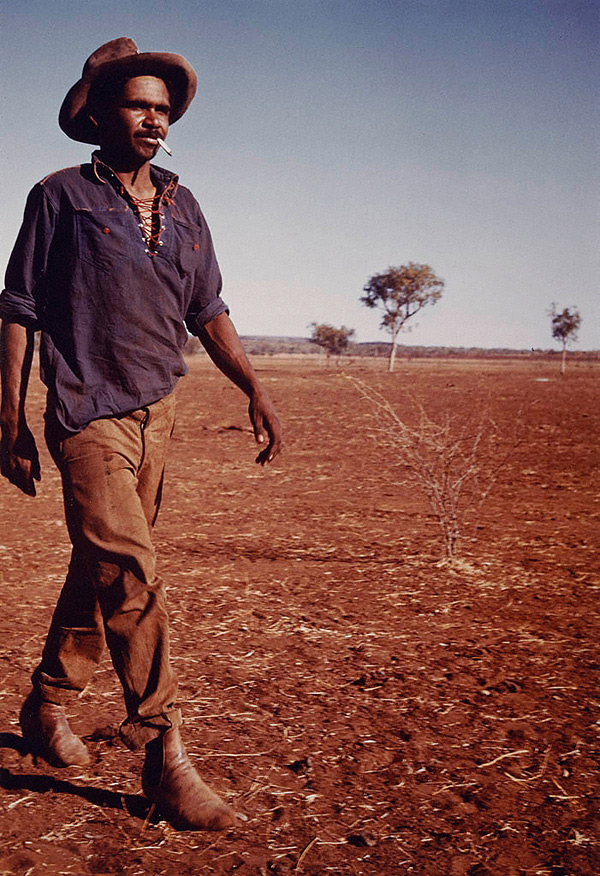
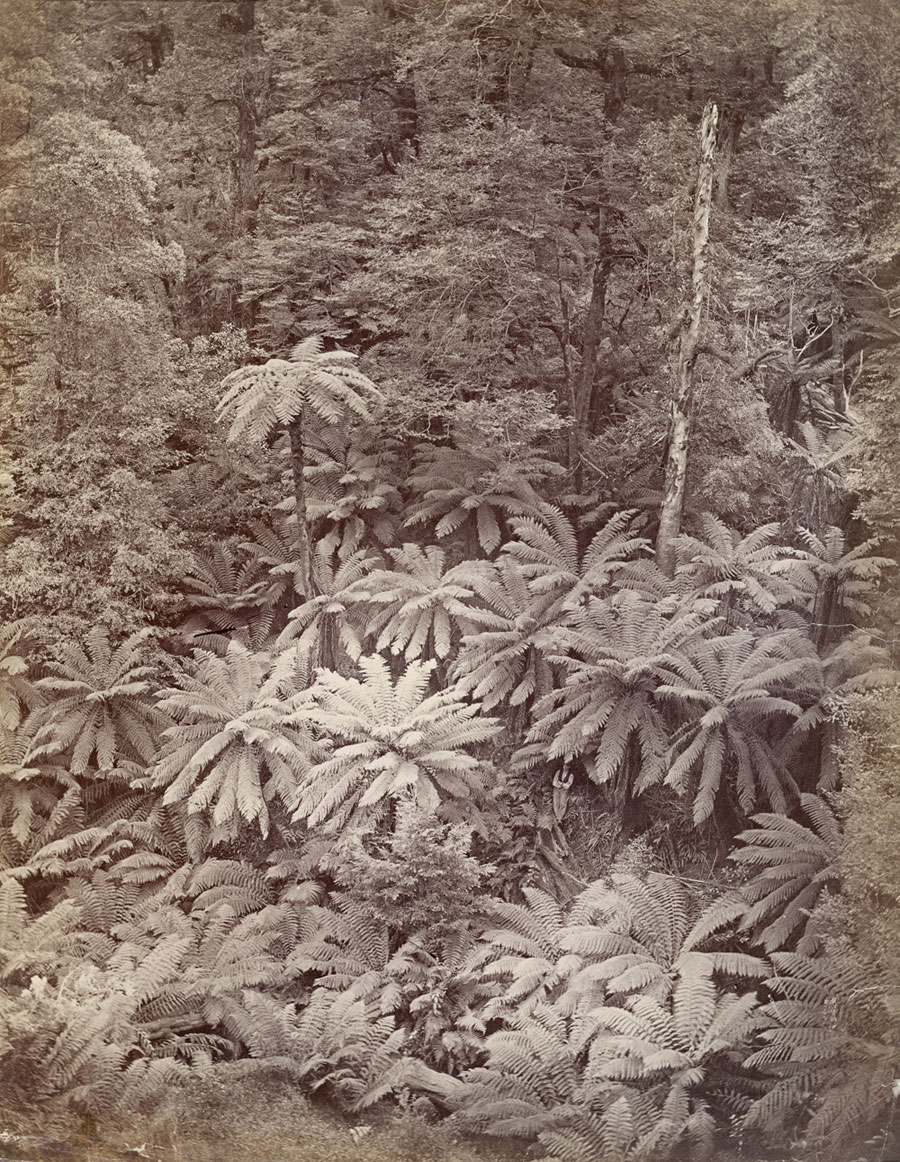
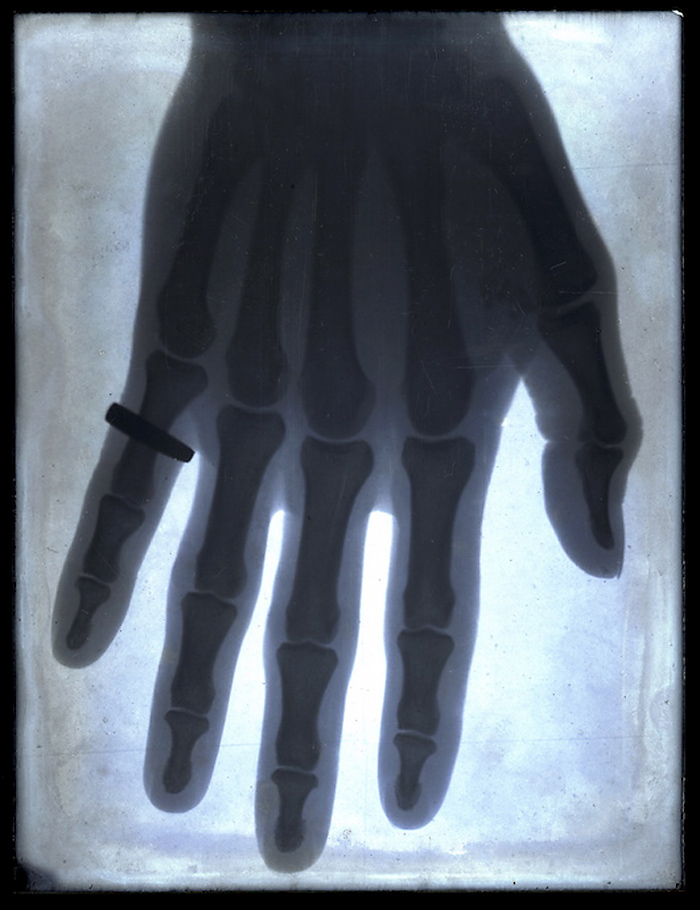
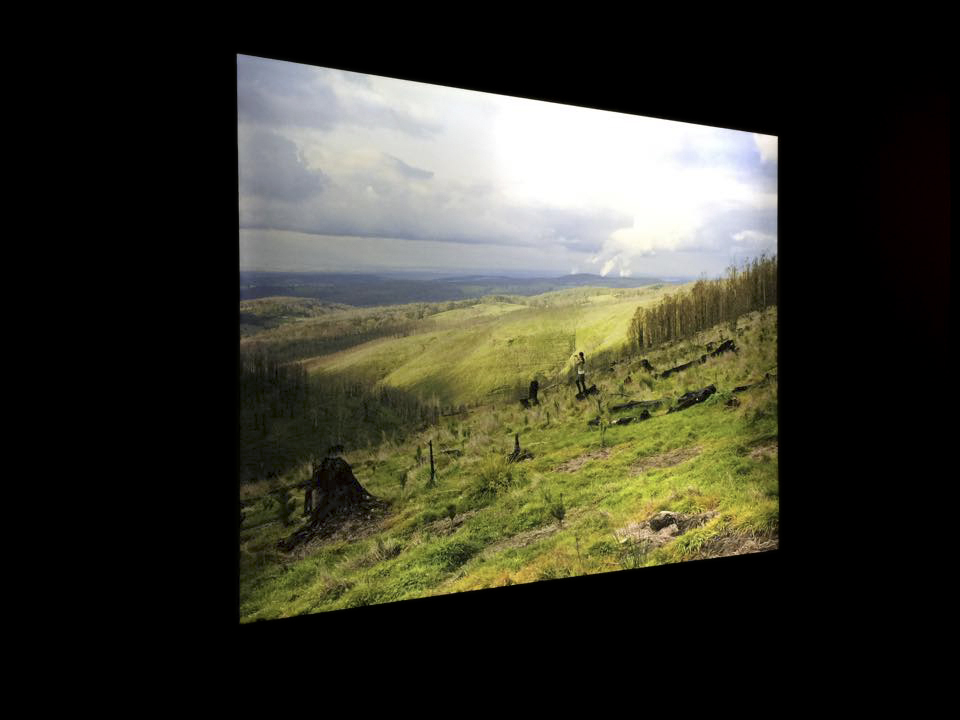
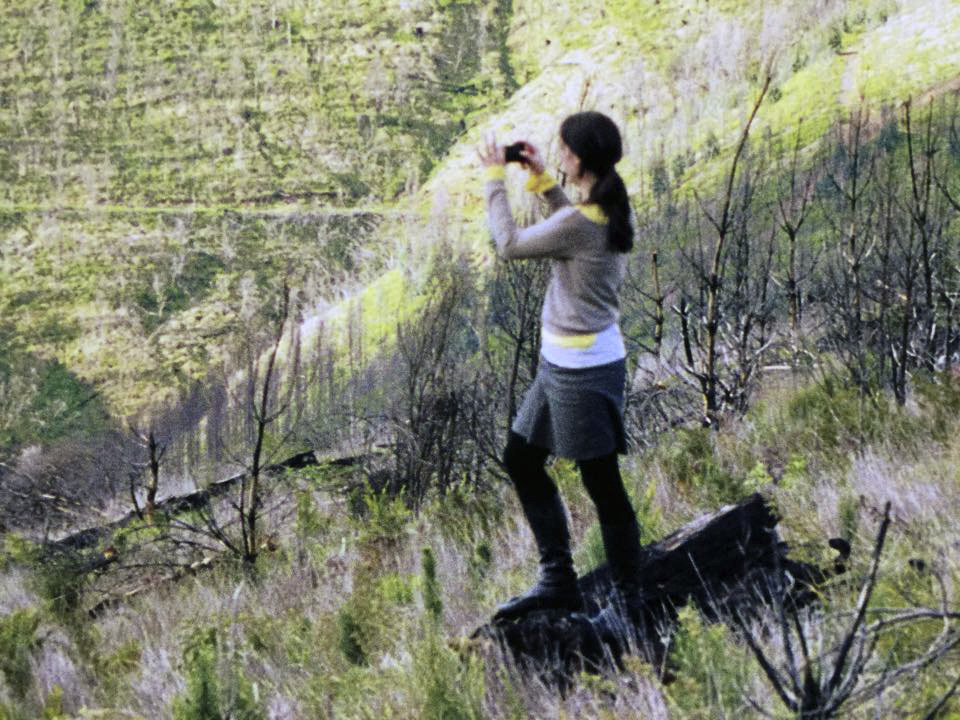
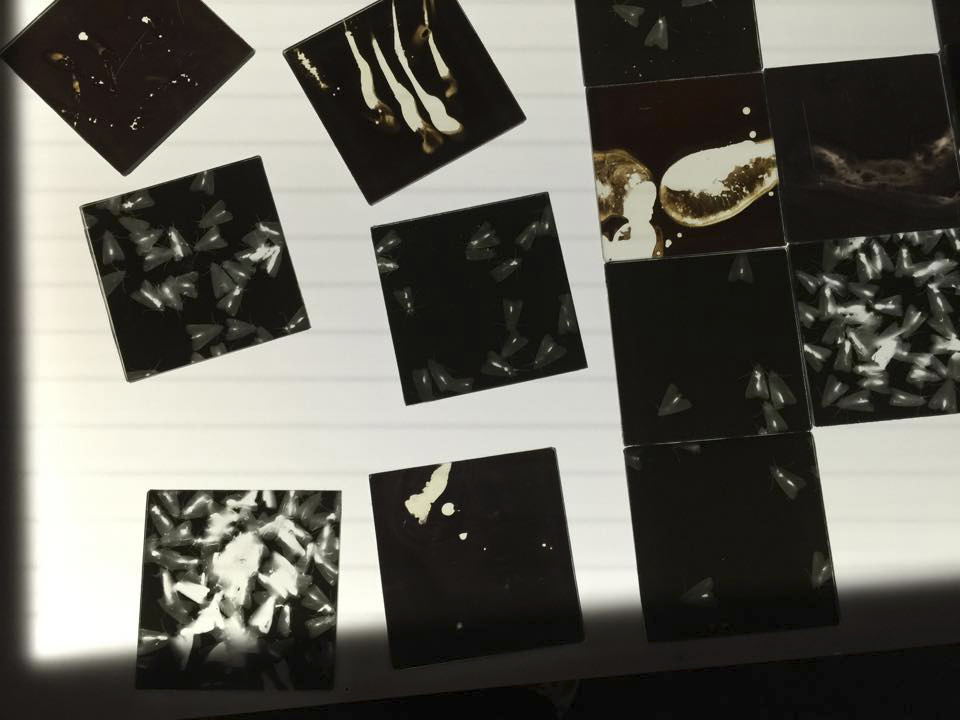
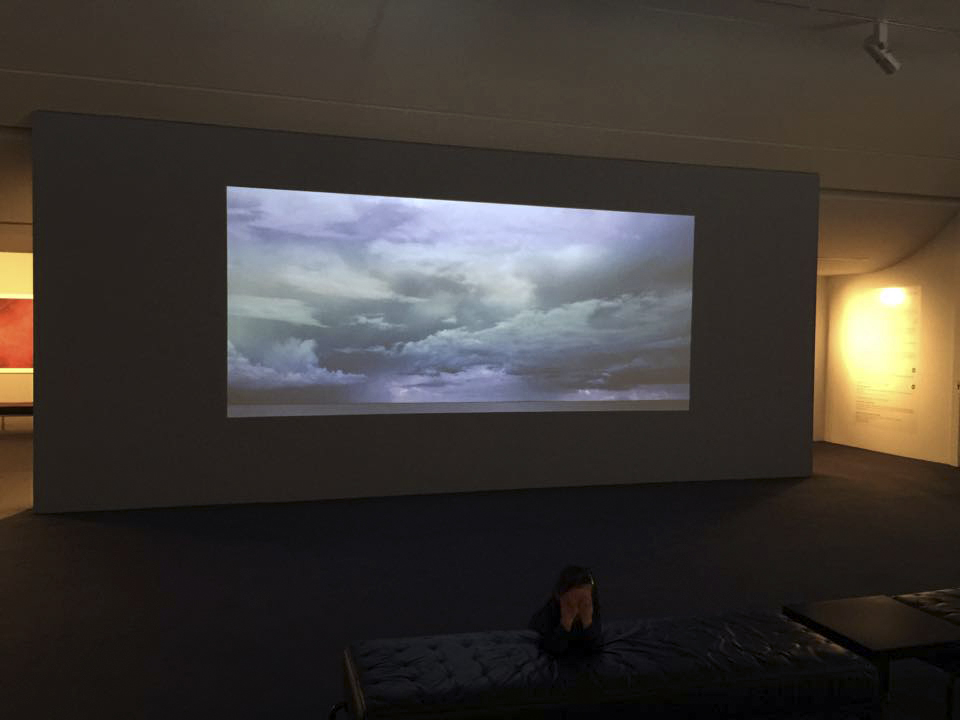
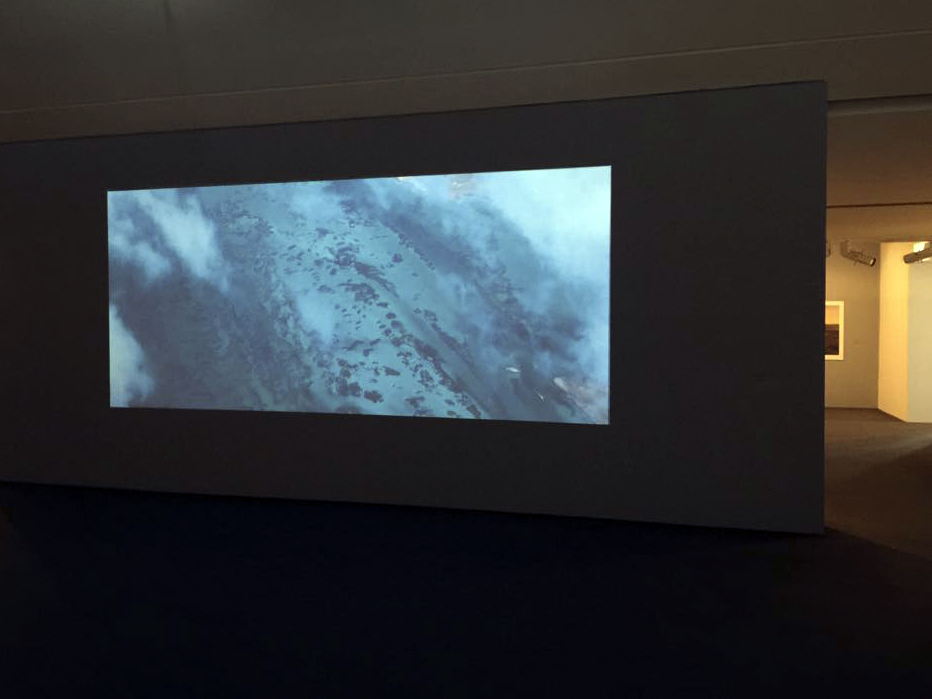
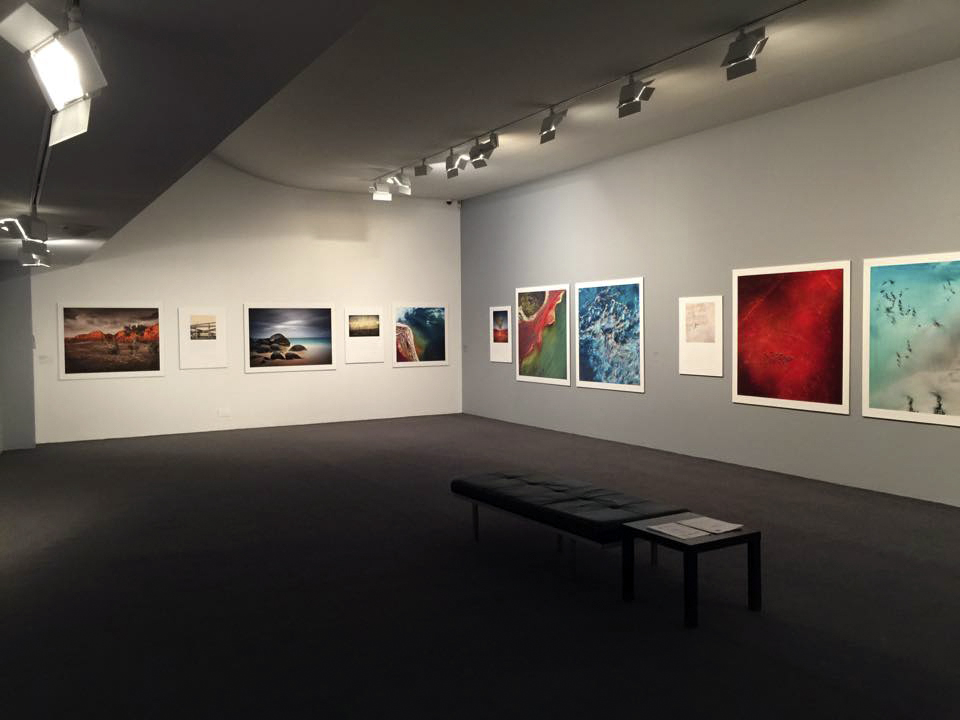
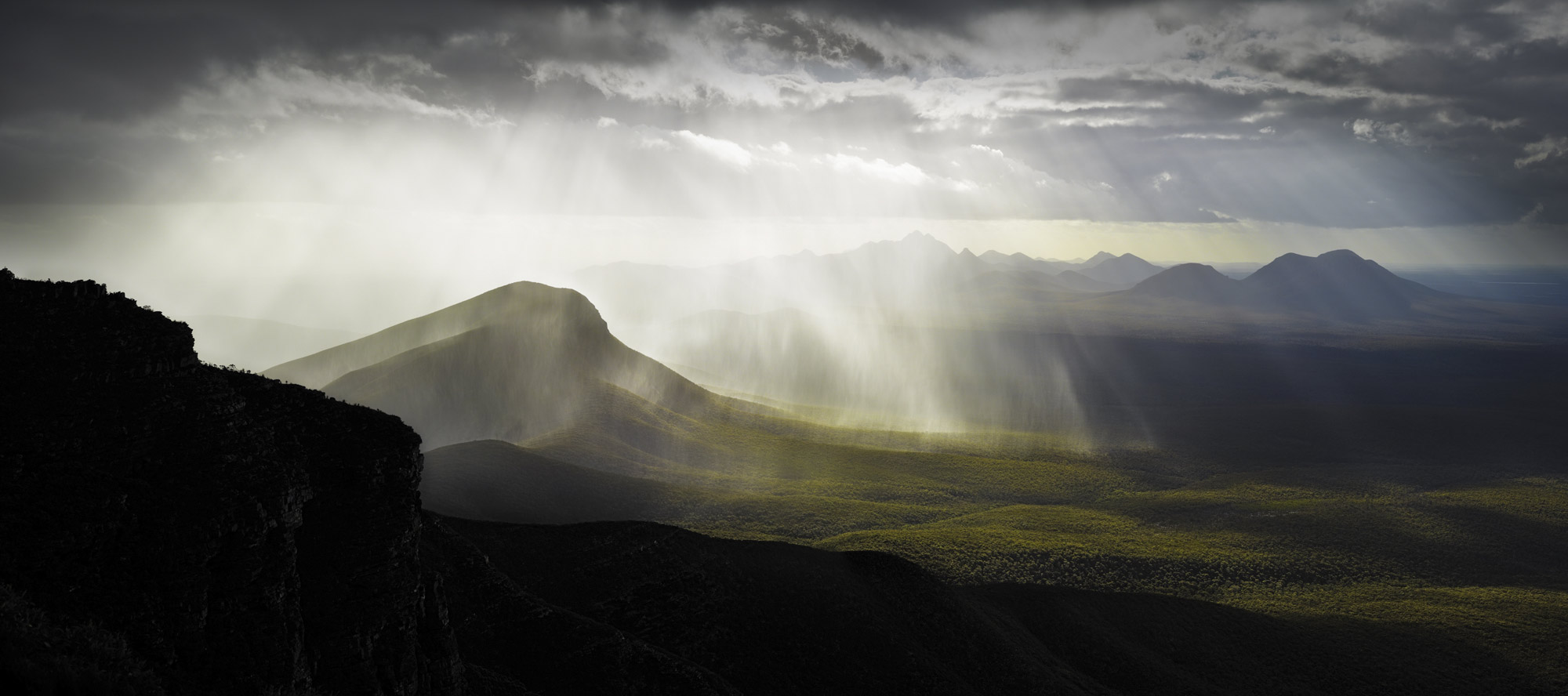
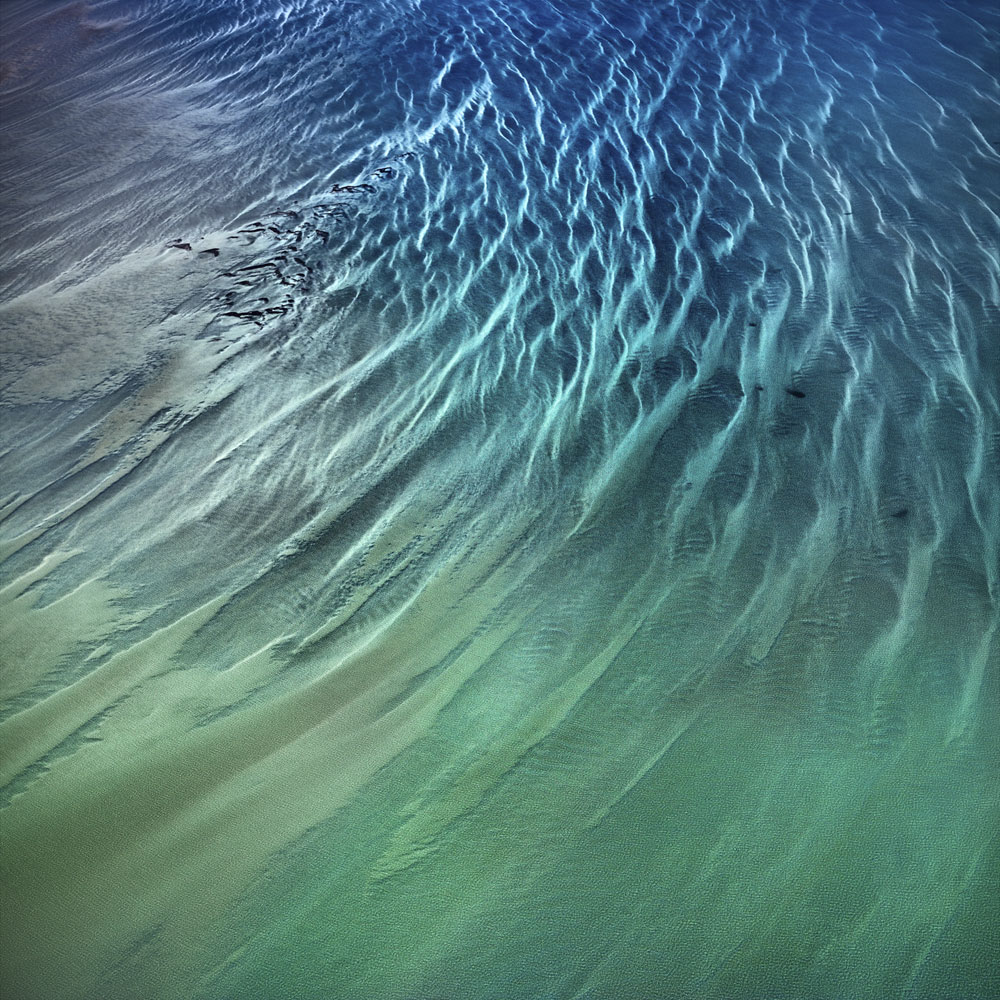
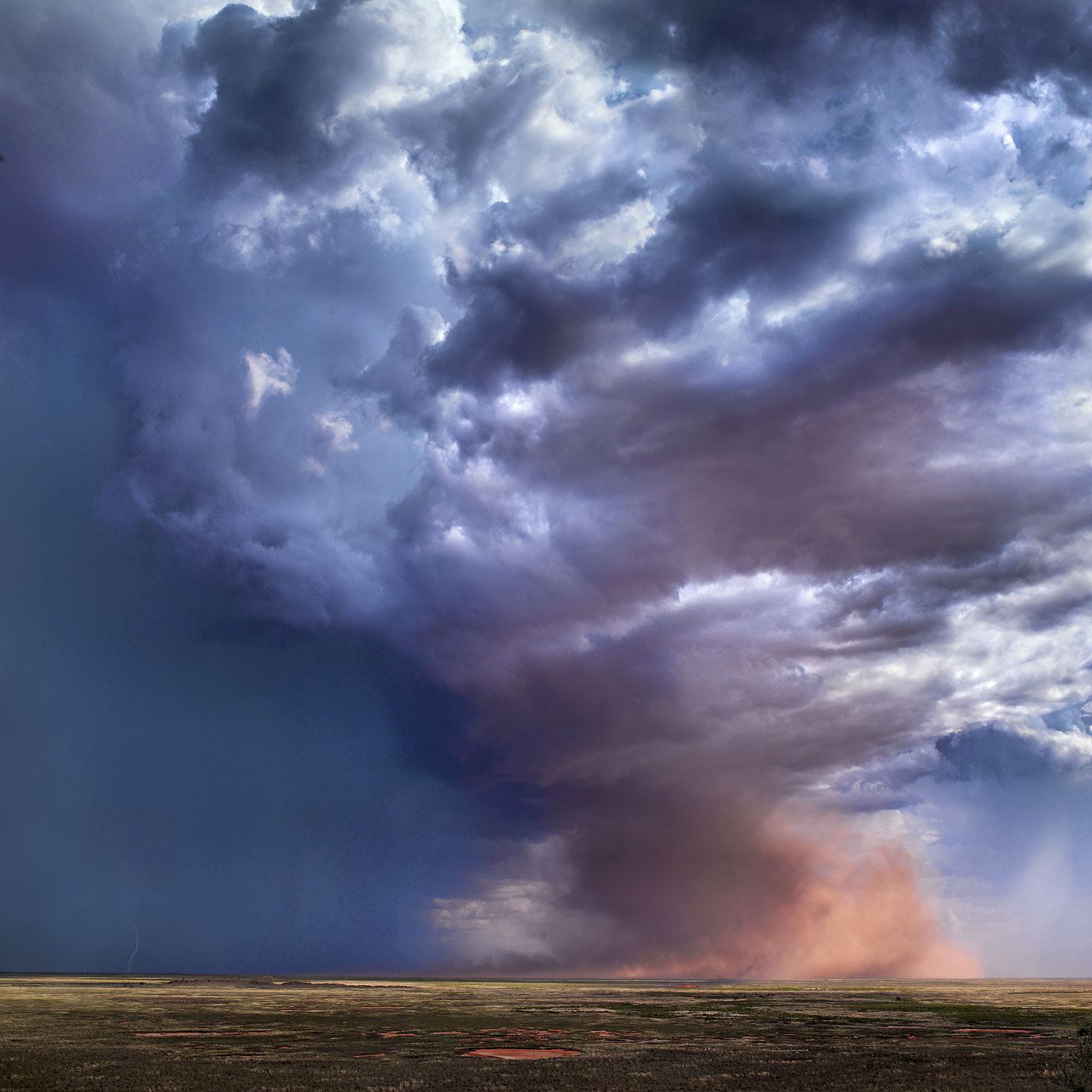
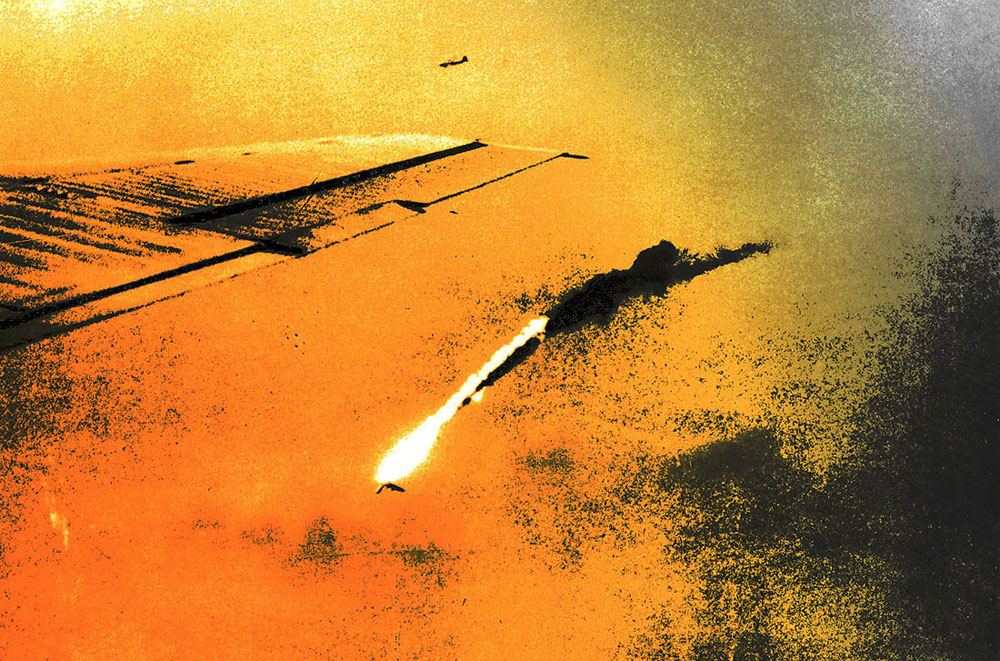
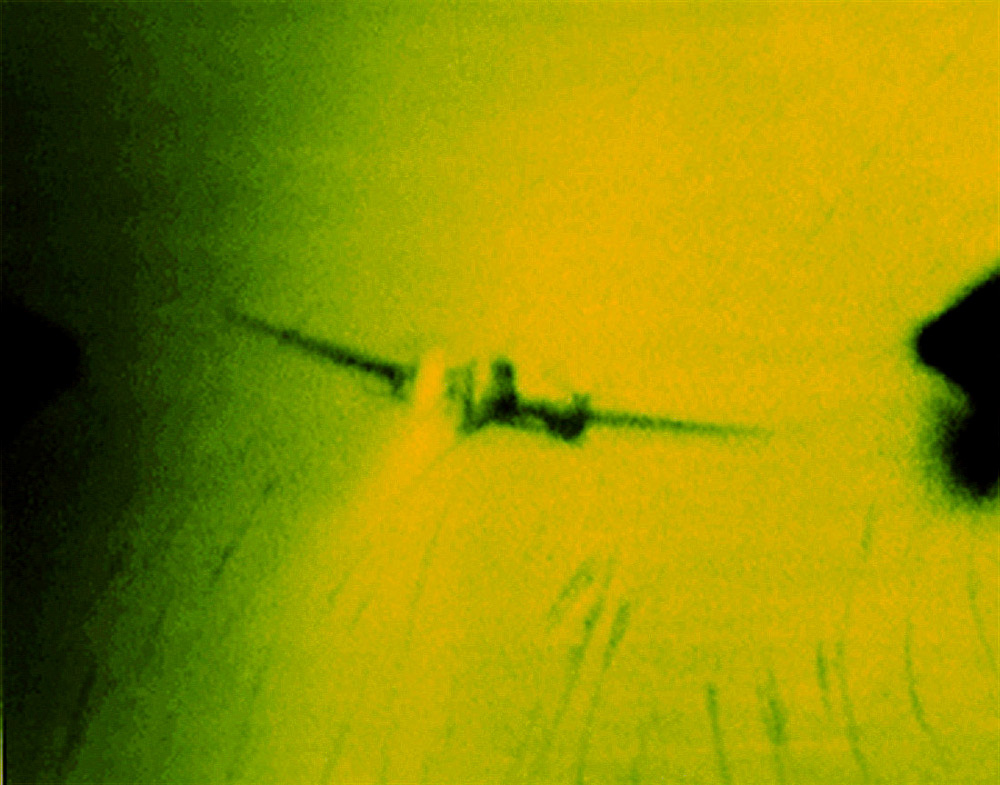
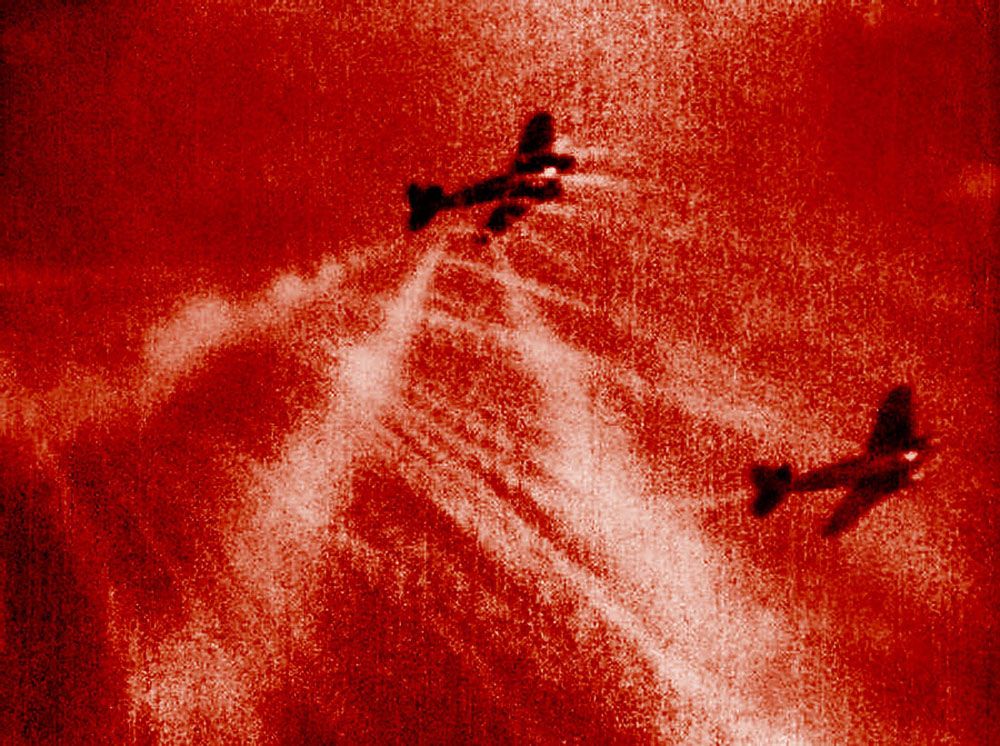
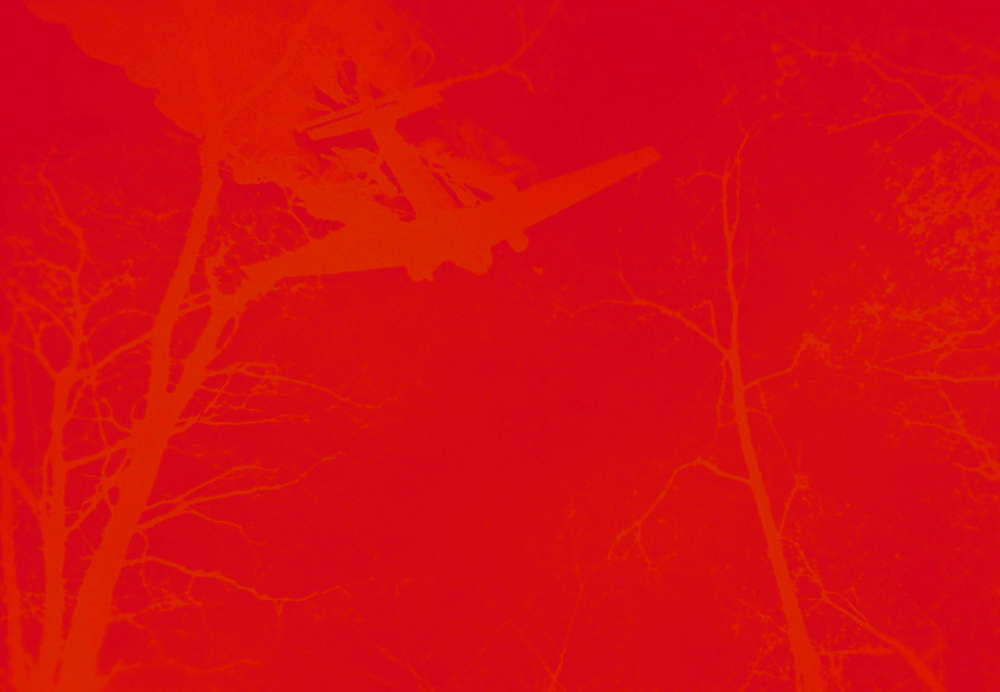
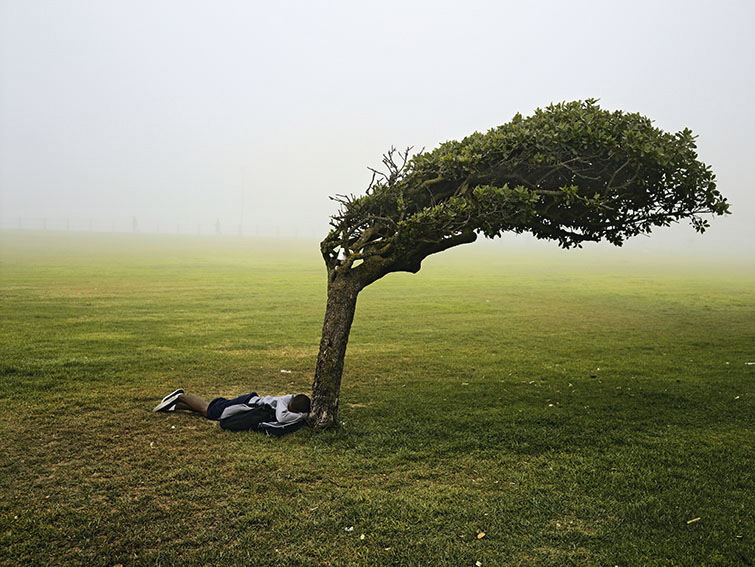
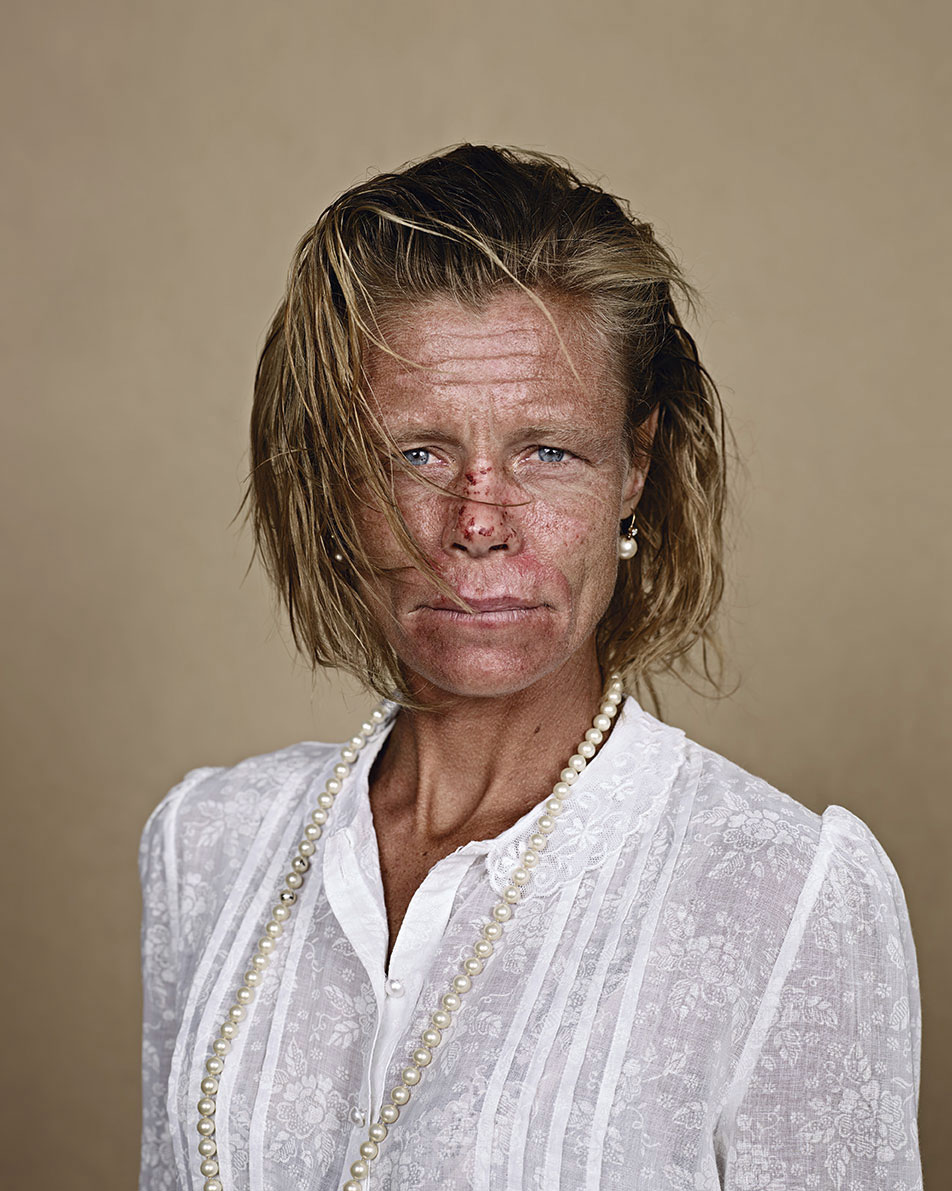
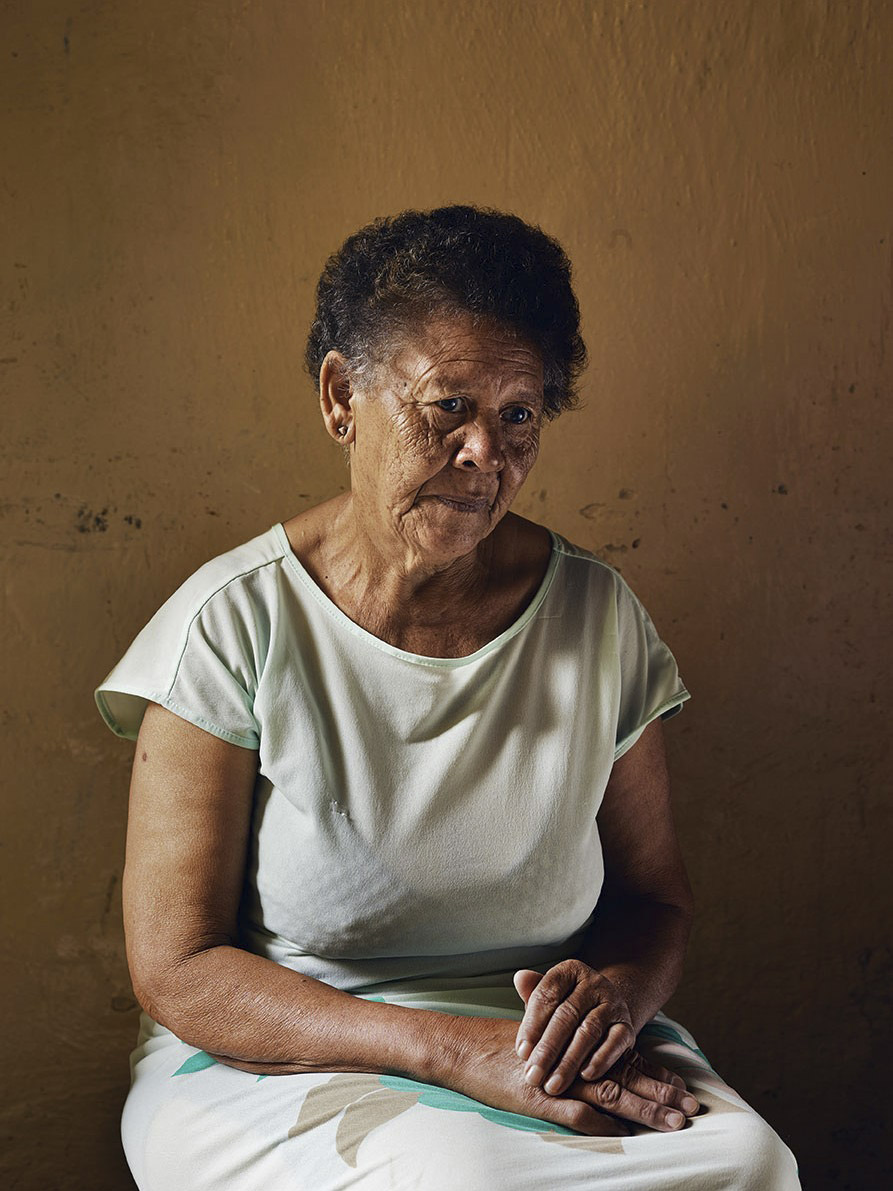
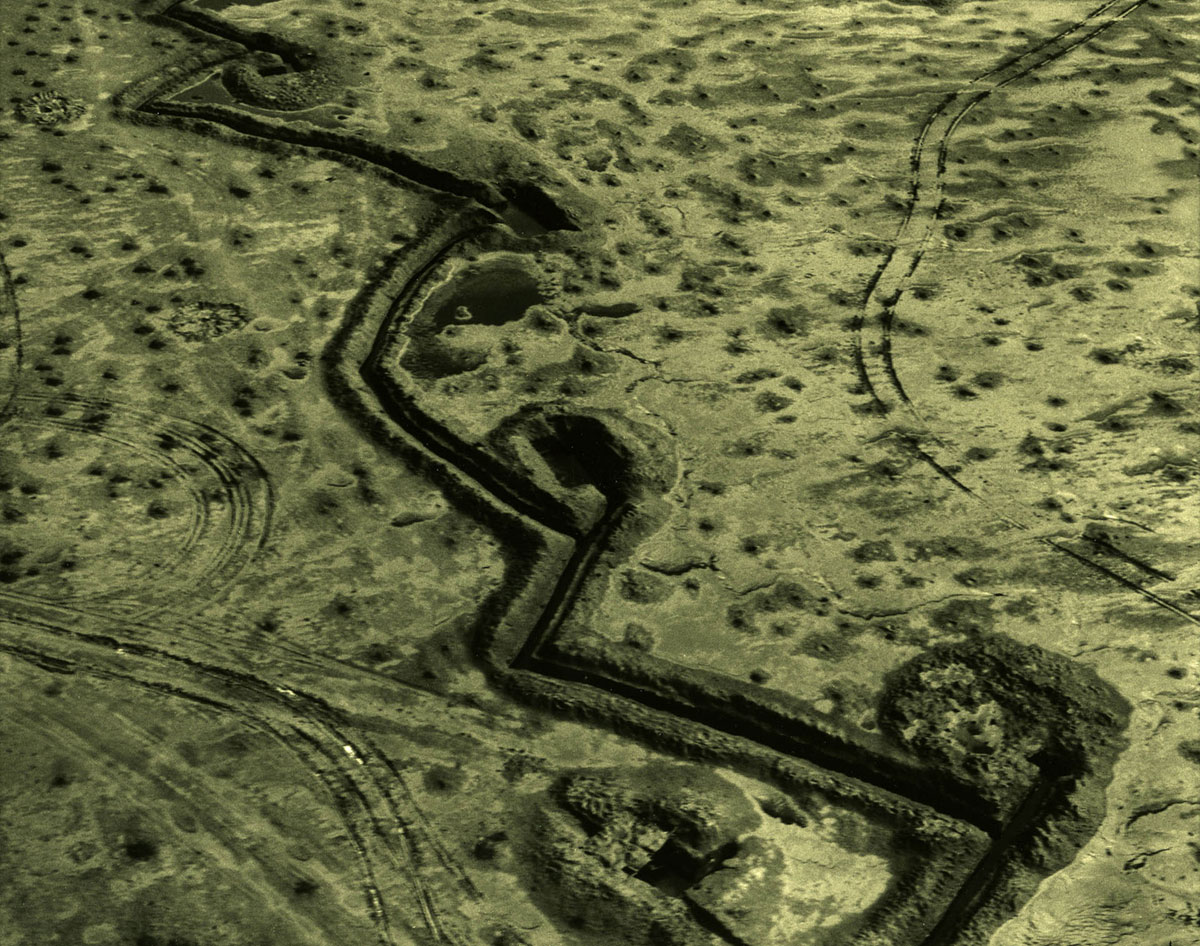
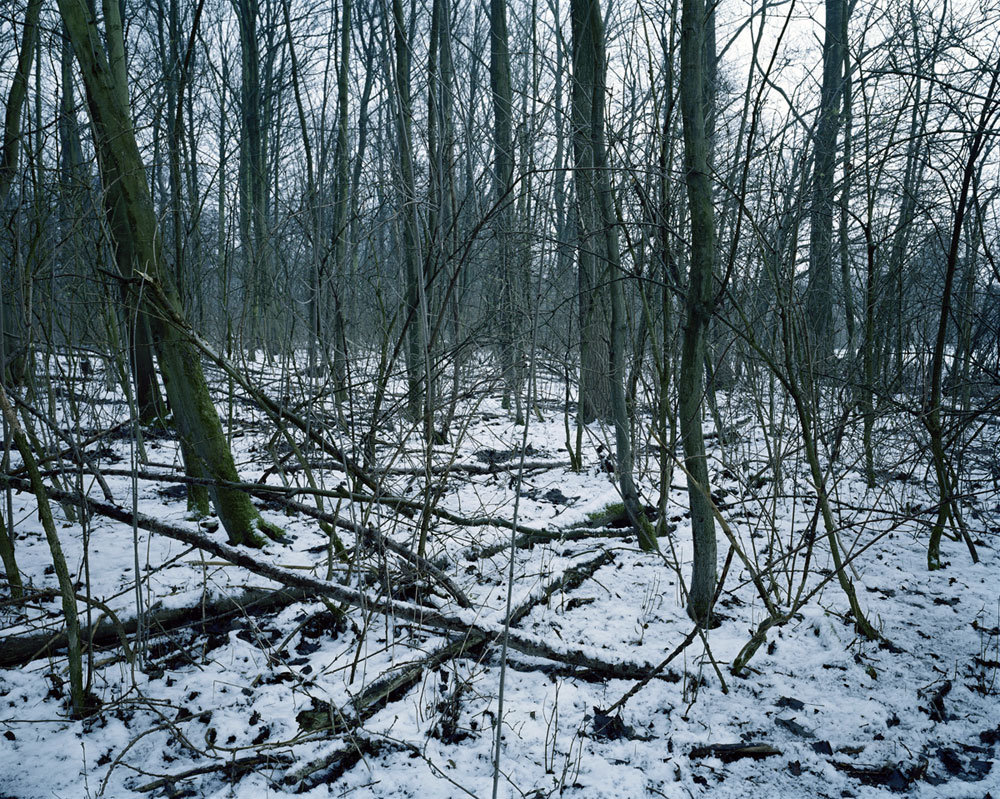
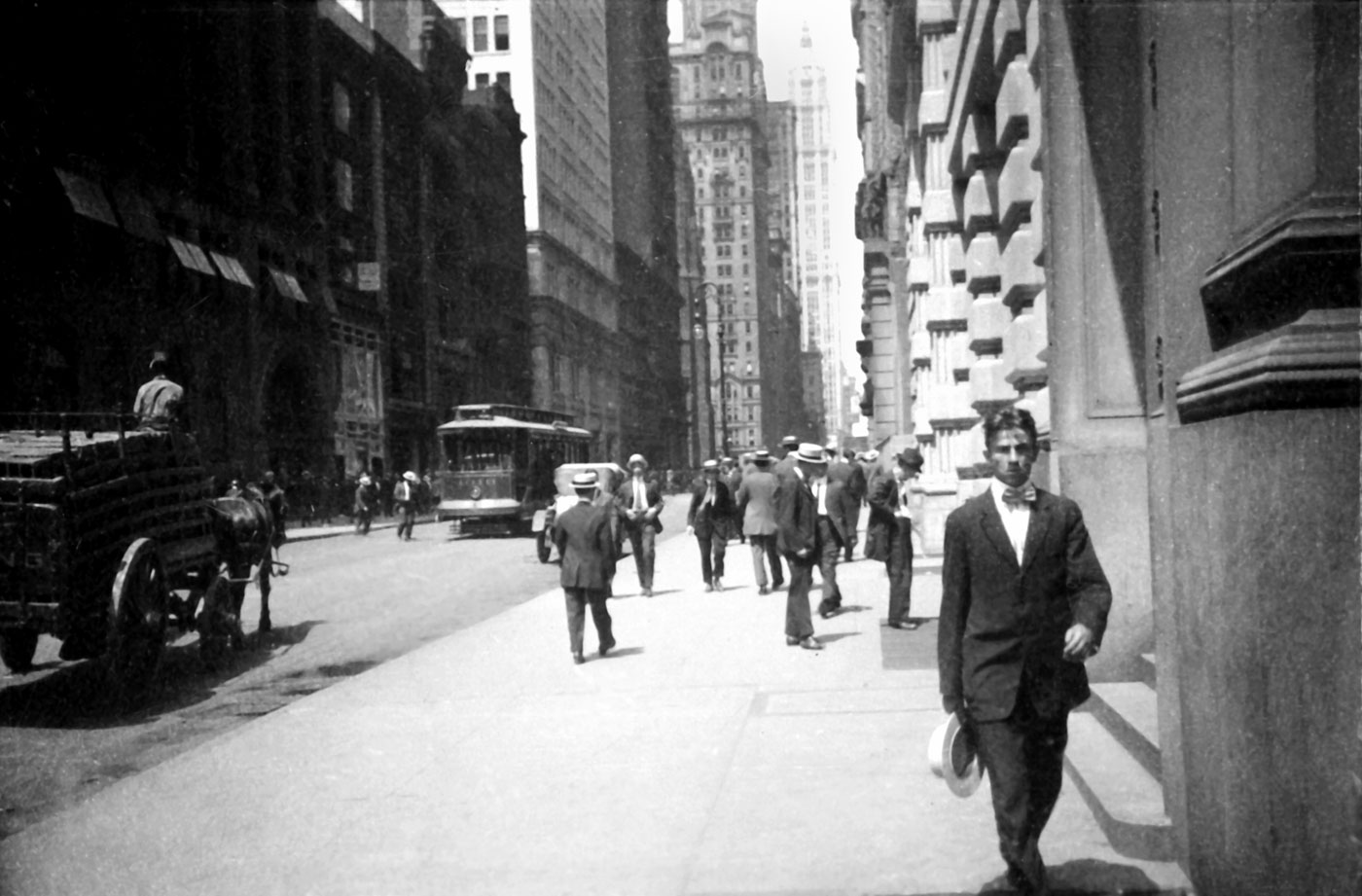
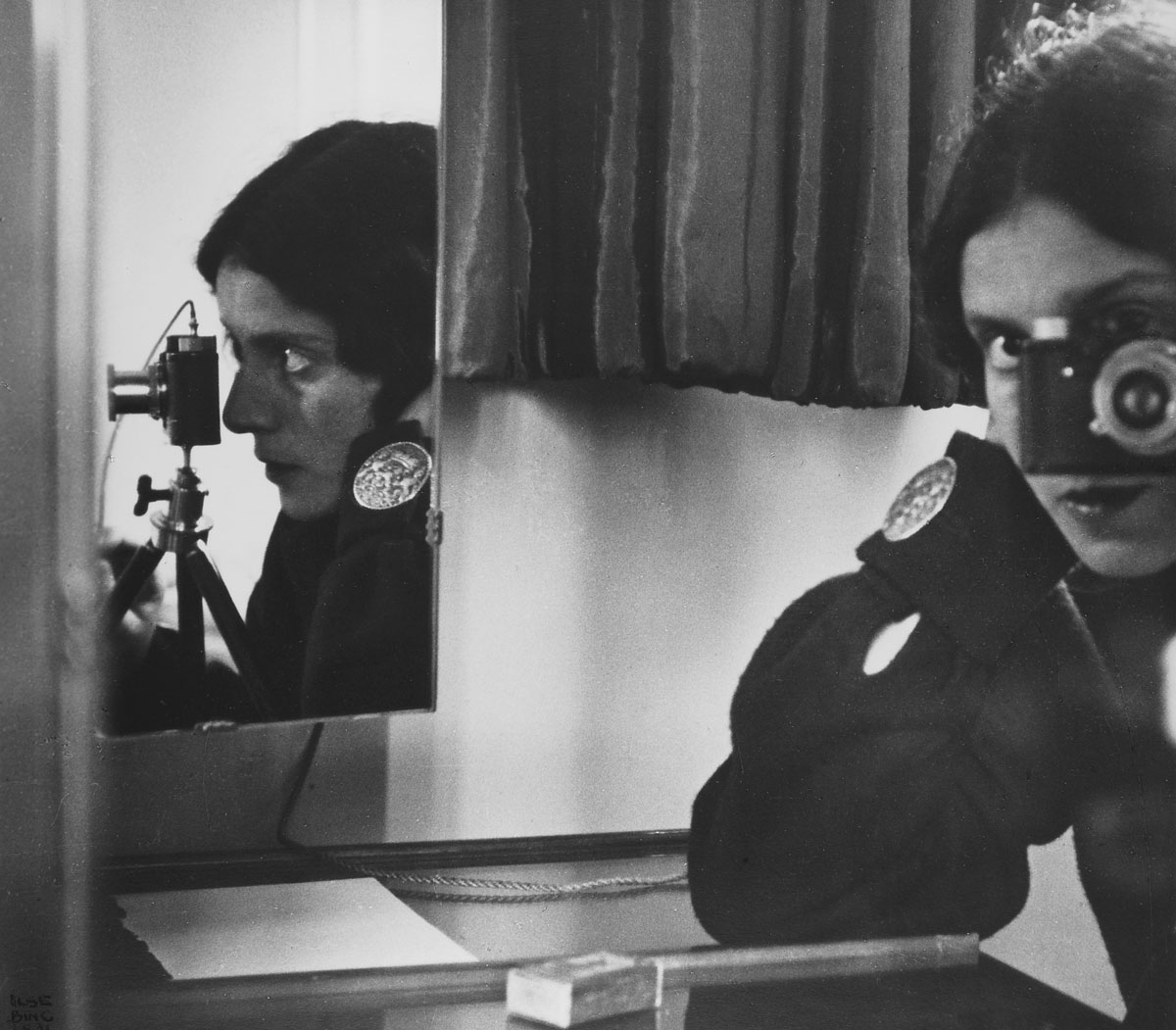
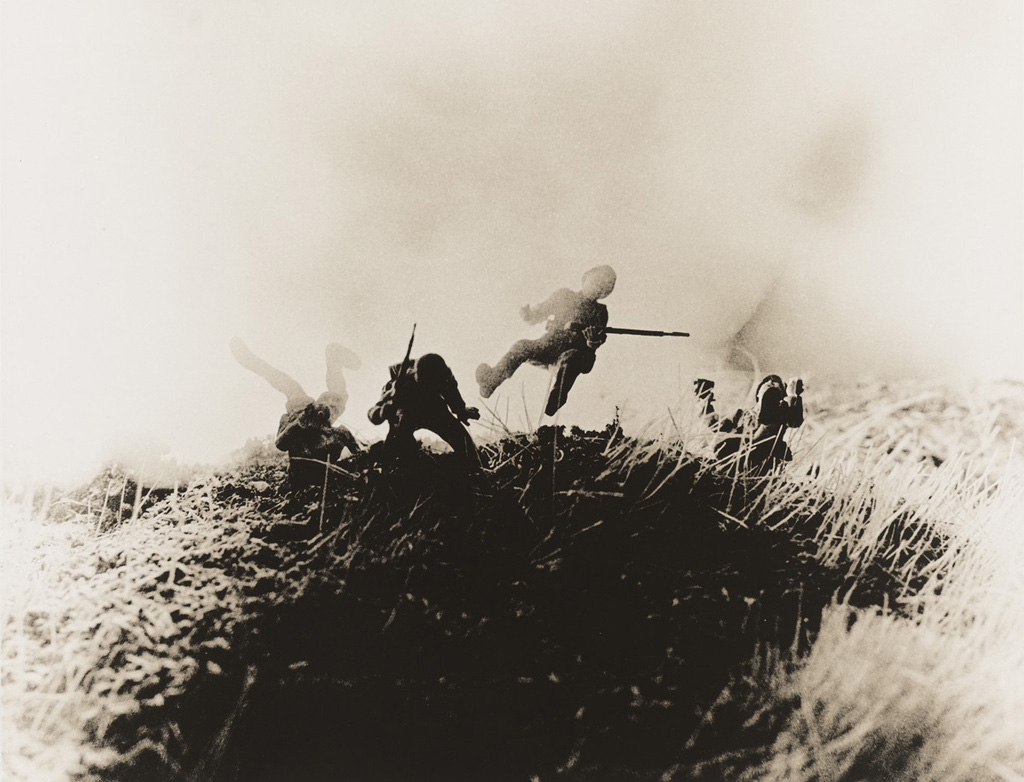
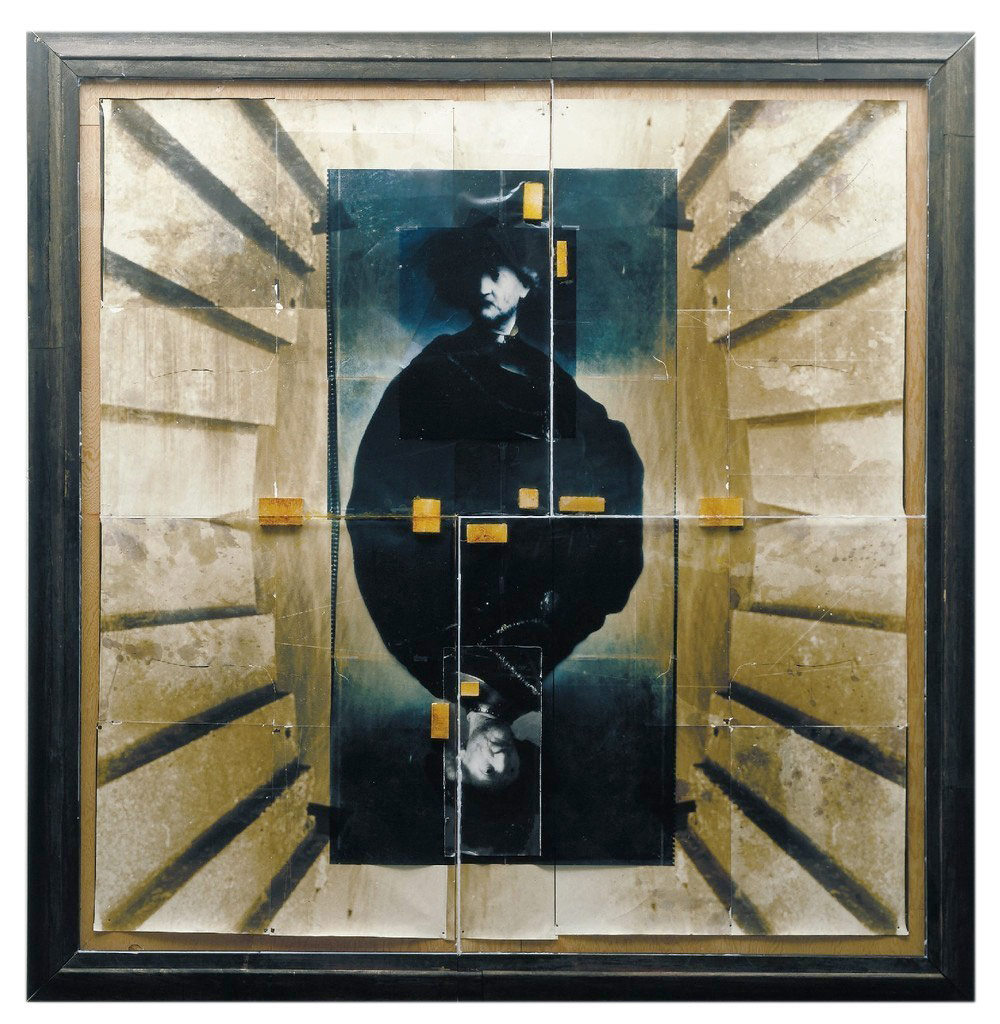
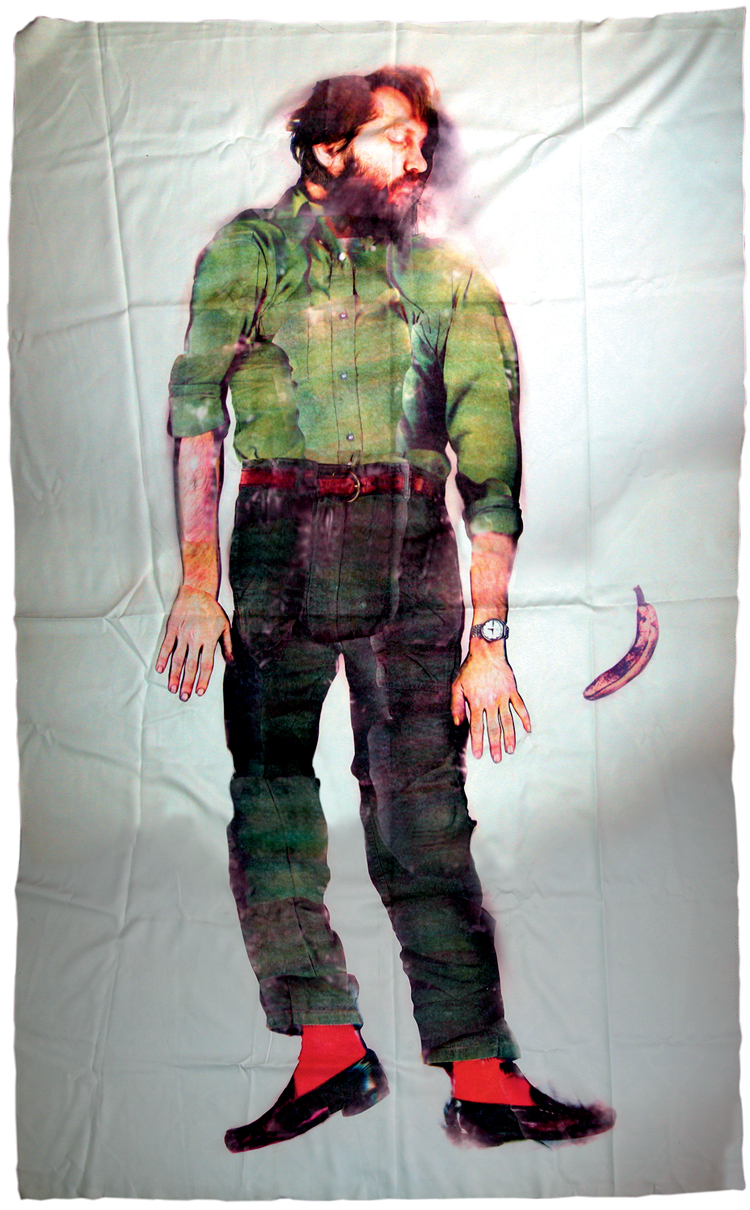
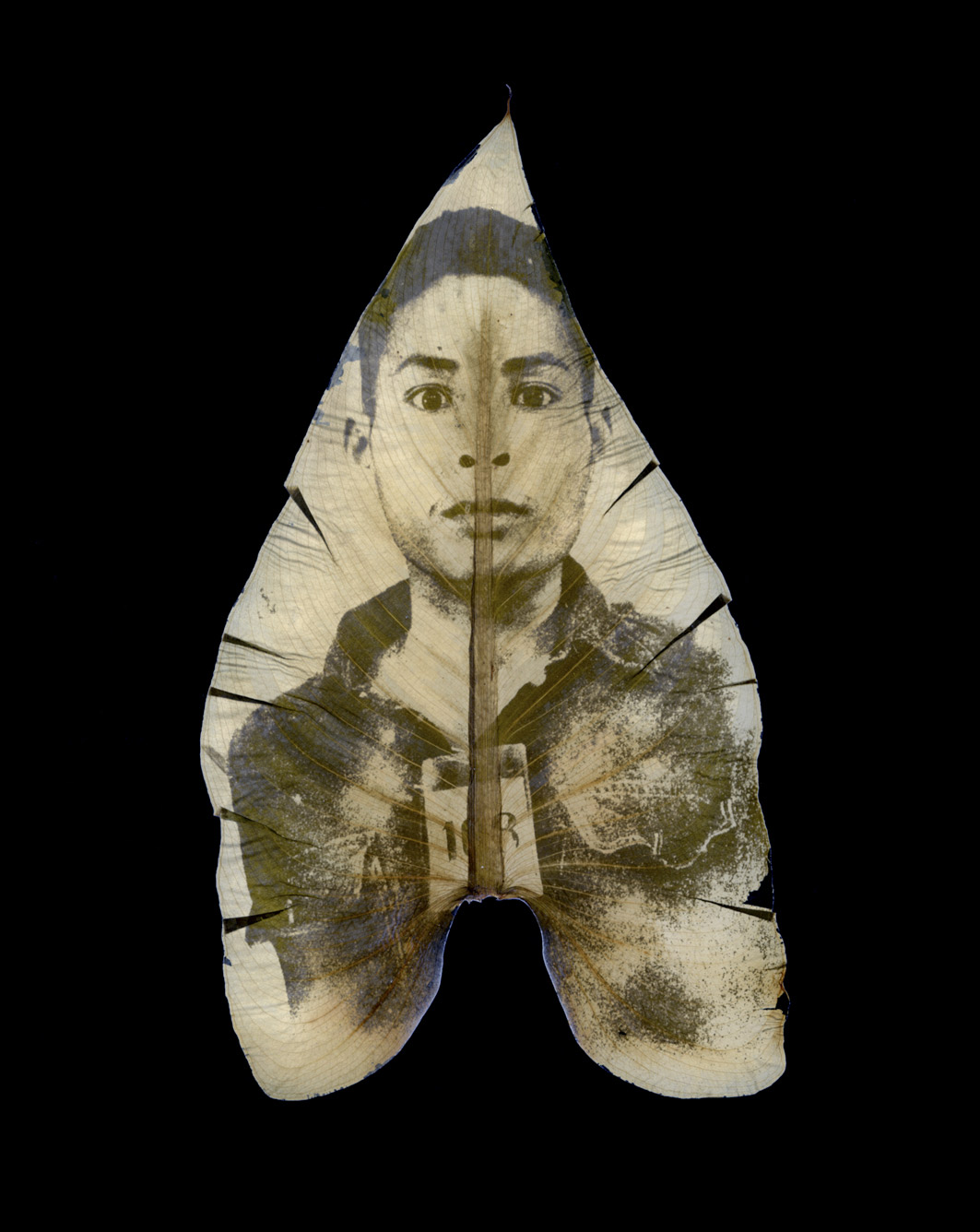
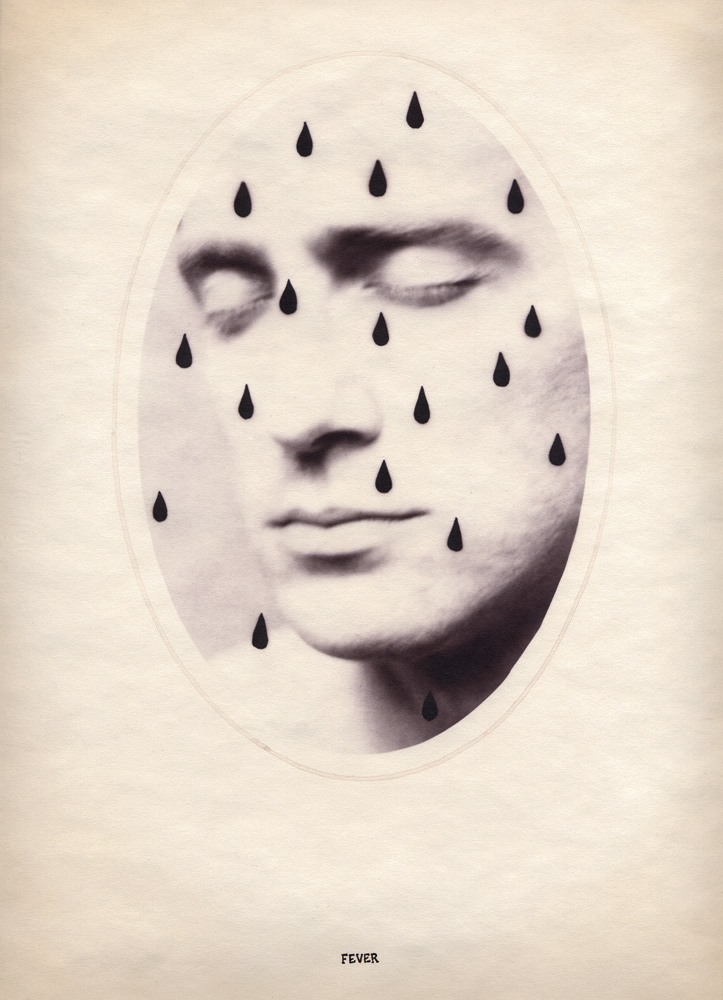
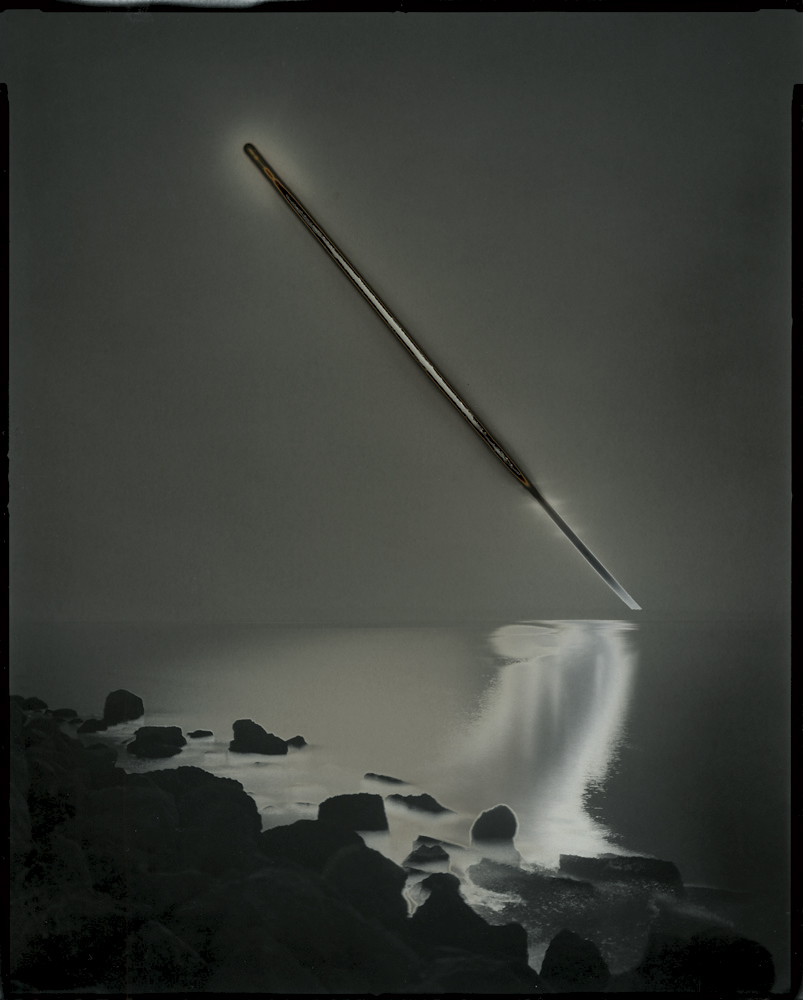
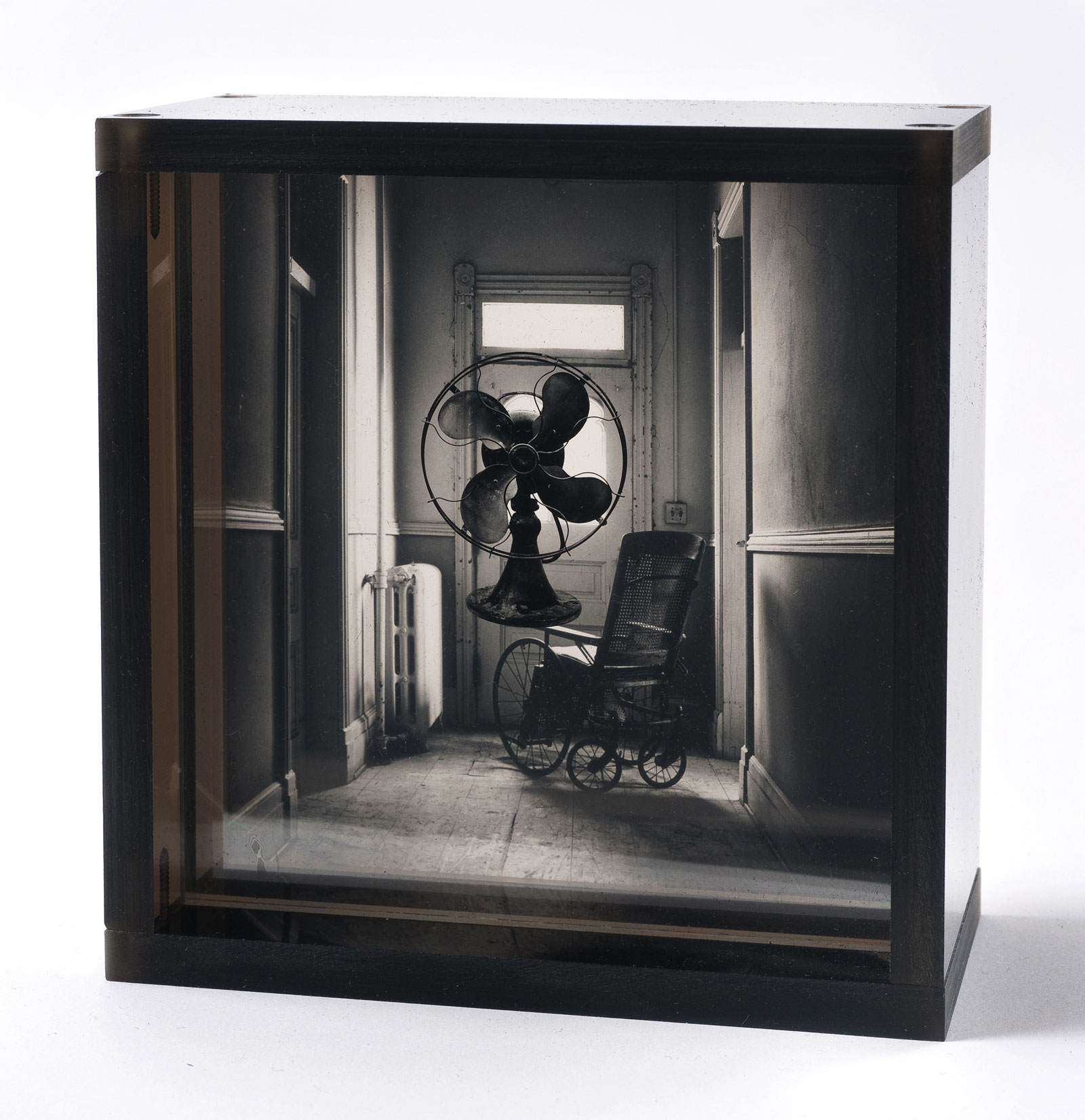
Marcus Bunyan (Australian, b. 1958) Untitled 2015 Digital photograph From the series Too Much of the Air
Too Much of the Air
After 16 months hard work, I have completed a new 52 image sequence.
These images will be printed large to reinforce the disintegration of the image, technology and human being. Tullio Crali‘s painting Before the Parachute Opens (Prima che si apra il paracadute) (1939) was one of a few starting points, inspirations, for the new sequence.
Below is a selection of images from the sequence. Please click on the photographs for a larger version of the image.
Photographs are available from this series for purchase. As a guide, a digital colour 16″ x 20″ costs $1000 plus tracked and insured shipping. For more information please see my Store web page.
“Imagine being in these planes knowing that you only had moments to live, and knowing that you could do nothing about it. What brought you to that point, what decisions did you take as a human being (or were taken for you) that enacted this scenario.
The “greatness” as the event passes is what is being worked with here. It is the inverse aspect of the sublime. Usually the sublime is regarded as beyond time … but not here. Essentially I am sustaining the last moments of a doomed life, outside of time.
We are unusually privileged to experience the sublime in this way. It is usually a lost aspect through the death of the witness.”
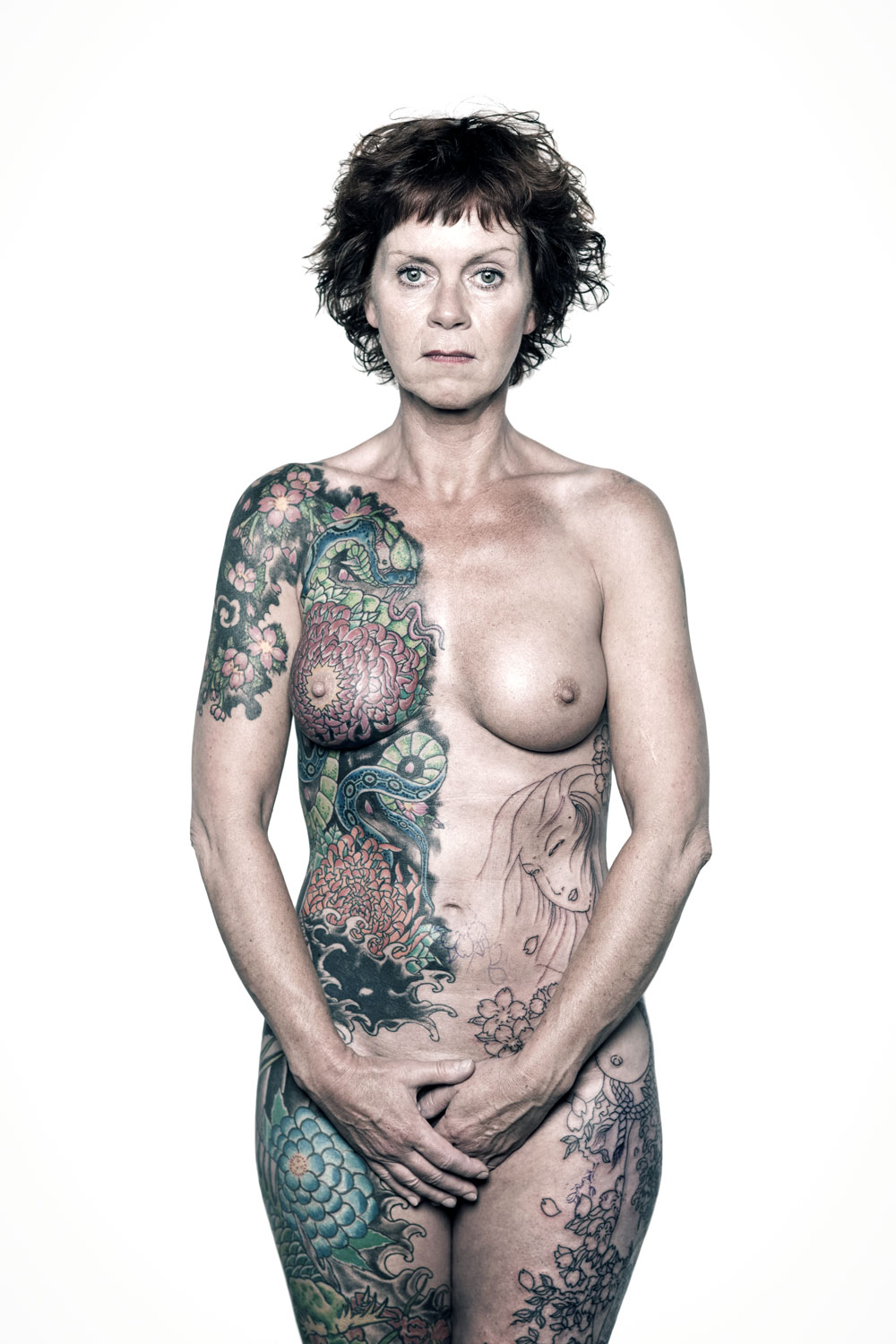
Although I have ten tattoos by different artists – including a full back job by Alex Binnie of London – and scarification done in 1992, you always remember your first tattoo. I was in my early twenties when I decided to get inked. And the person recommended for the job was the legendary Alan Oversby (aka Mr. Sebastian), an S/M tattooist and one of the primary figures in the development of contemporary body piercing.
I remember travelling down to the East End of London and rocking up to this nondescript office block, climbing to the third floor I think it was, and entering a tiny square room, Alan’s studio. What an experience it was to be tattooed by him. Not so much the tattoo itself, which was a tiger on my upper left arm – first part of my earth, air, water, fire, void elemental sequence – but his presence and being surrounded by these fantastic, outrageous photographs on all four walls, floor to ceiling. Here was men’s tackle of all different shapes and sizes, the cocks and pubic area heavily tattooed and some of them heavily pierced, lying on pristine white dinner plates. Welcome to lunch.
For a young man this was an amazing, wondrous display. I totally loved him, the photographs, and his work. Unfortunately I don’t have any photographs of that studio and there are none that I could find online. Suffice it to say that the experience only confirmed me on my path of delicious deviancy that will not stop until the day I die.
Dr Marcus Bunyan
Many thankx to Museum für Kunst und Gewerbe Hamburg for allowing me to publish the photographs and text in the posting. The videos were all sourced from YouTube. Many thankx also to Becky Nunes who I contacted directly and who provided the wonderful photographs of Tã moko facial tattoos of the Maori in New Zealand.
Alan Oversby (Mr Sebastian)
Alan Oversby (Mr. Sebastian)
Alan Oversby (20 February 1933 – 8 May 1996) was one of the primary figures in the development of contemporary body piercing in Europe. He was better known by his professional name Mr. Sebastian.
Originally an art teacher, Alan Oversby left his initial profession to pursue his interests in tattooing and piercing instead. From his studio in London, he promoted both tattooing and body piercing, especially within the gay leather community. He was a correspondent of both Doug Malloy and Jim Ward. Sponsored by Malloy, he visited Los Angeles. Malloy also sponsored trips to London to visit him, bringing along Ward and Sailor Sid Diller. These exchanges were critical to the global spread of the techniques and technology used in contemporary body piercing.
Oversby was also responsible for the adoption of the use of topical and local anaesthetics as part piercing procedure in Europe. Although they are used less now, it used to be standard practice to use anaesthetics when performing piercings in England, where in North America this practice is almost unknown. He was interviewed in the fourth issue of PFIQ. He performed much of the tattooing and piercing on Psychic TV musicians Genesis P-Orridge and Paula P-Orridge. His vocals were used in the Psychic TV track “Message from The Temple” which appeared on their first album Force the Hand of Chance.
In 1987, Alan Oversby was one of 16 men charged as a part of Operation Spanner, a series of raids that resulted in the arrest of men who were all engaged in consensual homosexual BDSM activities. Alan, like the other men, was charged with assault occasioning actual bodily harm for performing a genital piercing on a client. He was also charged with using anaesthetic without a licence and for sending obscene material through the post (photographs of piercings). As the judge was not willing to take the consensuality of the participants into account, Alan pleaded guilty along with the other 15 men. He received a sentence of 15 months, which was suspended for two years.
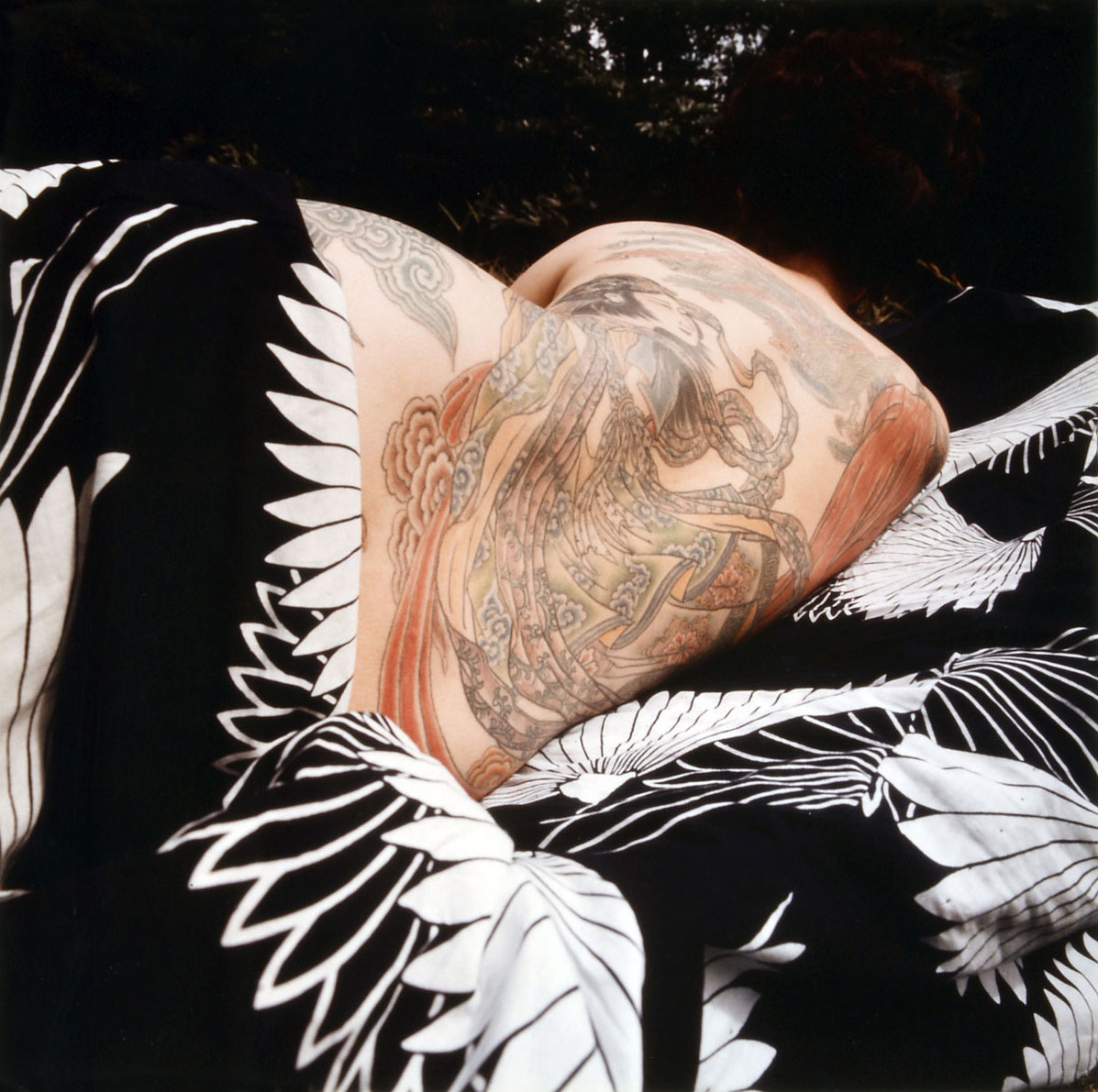
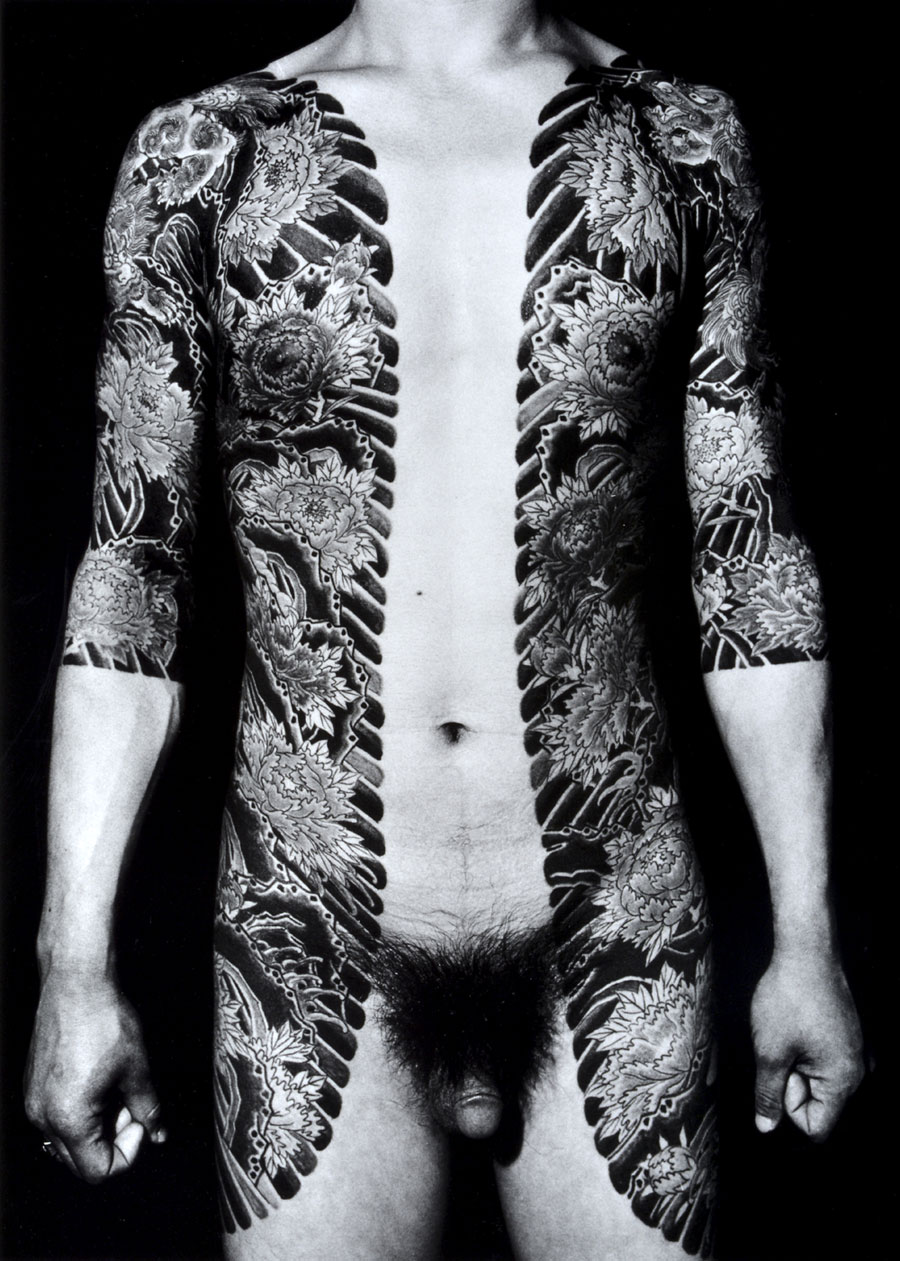
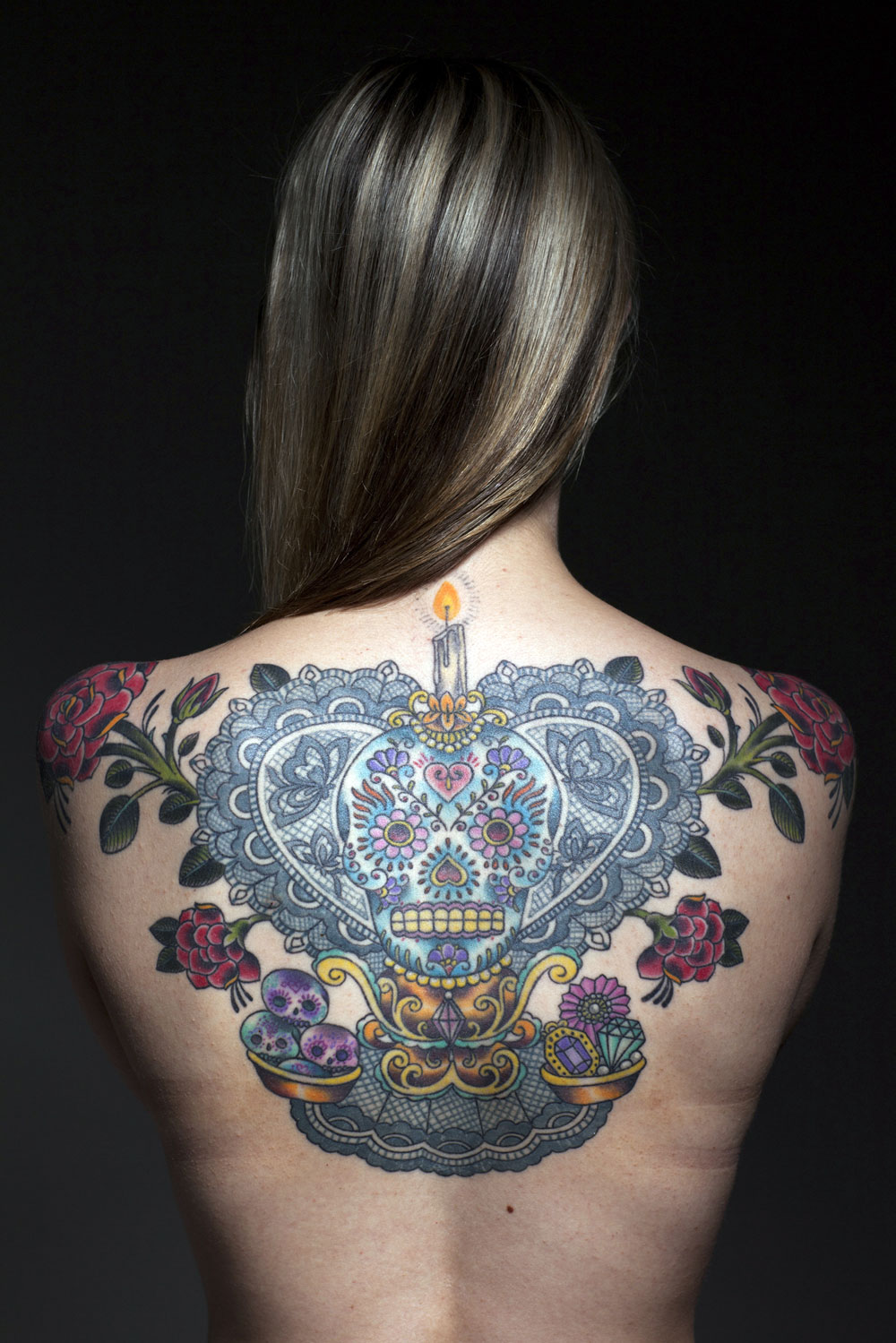
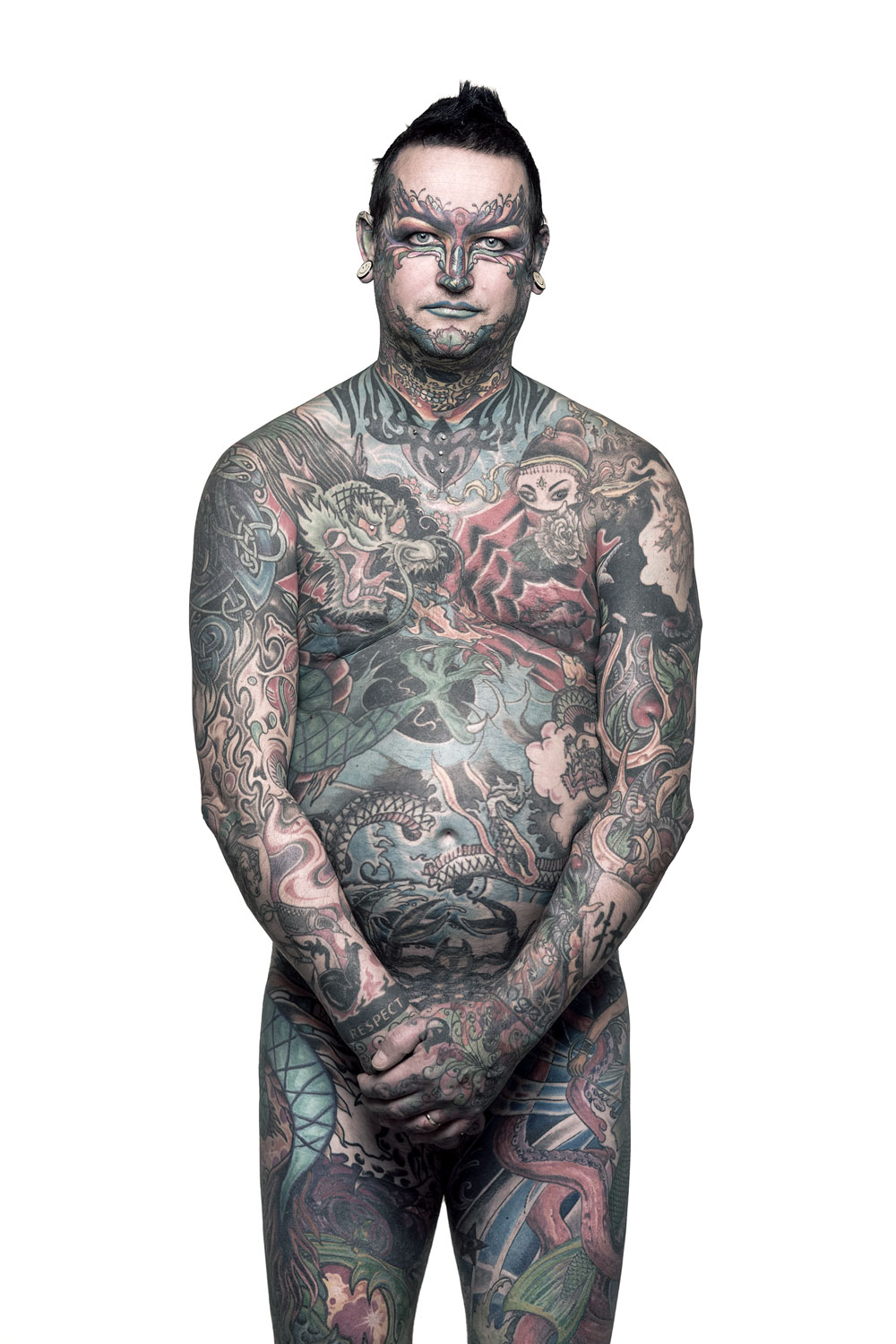
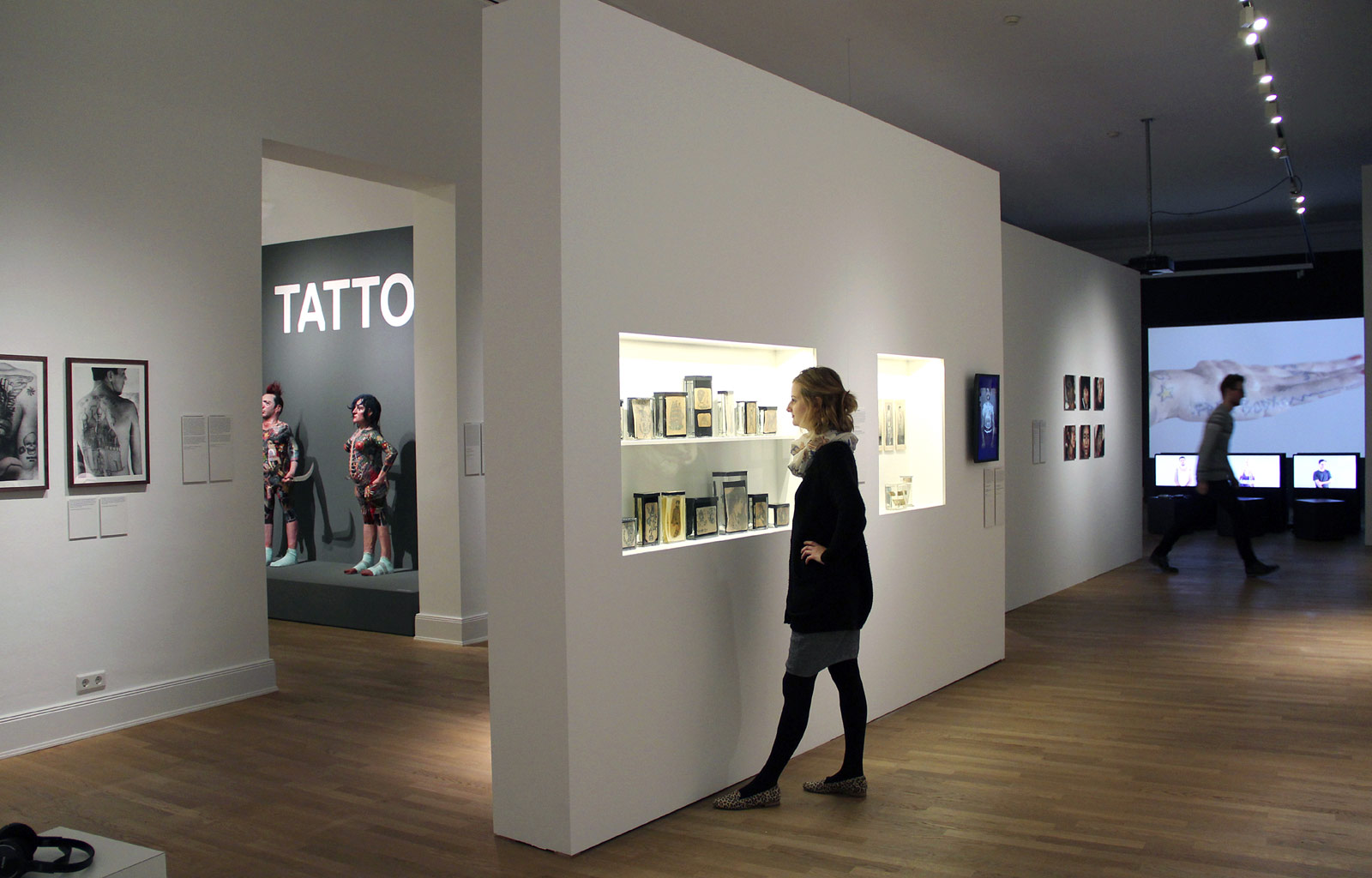
The Tattoo exhibition is dedicated to old traditions and new stories. It takes a look at the vibrant, innovative and multifaceted tattoo culture, with a focus on artistic, artisanal and culture-specific issues. International exhibits from diverse perspectives are displayed and current debates considered. This is the first time that an exhibition has brought together such a broad range of references, presenting the phenomenon of the tattoo with a particular focus on art and design, since these enduring pictures, words and symbols inspire artists and designers. The theme of the exhibition is therefore the reciprocal influence of art, traditional and lived tattoo art and visual design. The exhibition Tattoo throws light on the ambivalence of the tattoo between a mark of distinction, a sign allocating its bearer to a social class, a badge of identity and a stigma in various cultures, social classes and epochs. Tattoo shows over 250 pieces of work, including photographs, coloured woodcuts, paintings and sculptures, as well as video clips and audio installations, stencils and historical specimens of tattooed skin. From tattooing instruments made of simple tools available in nature to intricate precision machines, colours and pigments convey an impression of the craft in practice. In this show the MKG also looks back on the long tradition of the Hamburg tattoo scene, which had its cradle in the port milieu of the late 19th century. Historical photos which have never before been on public show document the typical tattoos of the working class in Hamburg around 1890. Legendary tattooists such as Christian Warlich (“The Tattoo King”) and Herbert Hoffmann exemplify a many-facetted and highly expressive art form which generates ever new experimental designs. A glimpse into this is given by work from local tattoo artists who let themselves be inspired by the museum’s collection. A picture loop shows many pieces of work by celebrated tattooists, men and women, from the current international scene, which is marked by a huge diversity of stylistic approaches and new aesthetic movements.
The traditional cultural technique
All over the world, many cultures use the human skin as a surface to carry images. The tradition of tattooing is among the earliest art forms and the most ancient crafts. The exhibition shows selected examples. The facial tattoos of Chin women in Burma are part of a rite of passage marking the transition from childhood to adulthood. With the help of thorns or needles, female tattooists incise patterns into the skin which vary from one family clan to another. Tā Moko, the facial tattoos of the Maori in New Zealand, indicate a person’s family affiliation and social status. Each part of the face is reserved for a particular type of information. A tattoo on the centre of the forehead, for instance, testifies to high status. In Thailand, sacred tattoos – known as Sak Yant – are widespread. They are intended to protect their bearer from bad luck and to help them lead a morally impeccable life. Tattoos have a long tradition in Japan too, dating back to the 3rd century. Their design follows a particular harmony and elegance and is characterised by clearly demarcated areas of colour. The tattoos often cover wide expanses of the body surface and connect to a cohesive image. The motifs often reference subjects of traditional woodcuts or represent mythological beings which are supposed to exemplify particular qualities of their bearer’s character. For instance, the dragon stands for virility, power or heaven. Since tattoos were banned from 1870 to 1948 in Japan, they were for a long time associated with the criminal milieu of the Yakuza, a Japanese mafia organisation.
The spread of tattooing in the Western world
In the 18th and 19th centuries, illustrated travel reports were a major influence on the way people viewed other cultures in far-off lands and fired curiosity about the practice of tattooing, which seemed exotic in those days. The word tattow in the Polynesian language is first mentioned in James Cook’s reports of his expeditions to the South Seas in the 18th century. Modern tattooing became widespread in the West through the very popular early ethnographic drawings and prints as well as later through photographs. At the beginning, the art of tattooing often stood for the erotically titillating flair of the exotic and magic-mystical in a world attended by strange cults and rituals. Tattoos flourished in Europe and America during the years leading up to the World War I. For this reason, the members of the American upper class and of almost all European royal families – including the German imperial family – were tattooed. In this period, this form of body decoration was regarded as an expression of good taste. In the 19th century a more ambivalent attitude towards tattooing develops, however, above all among the bourgeoisie. In consequence, very little lies between fascination and rejection in the Western historical view of tattooing: this is what underlies the dual character of tattooing as stigma and mark of distinction.
Codes and their reinterpretation
The functions and meanings attributed to tattooing proliferate due to its diffusion throughout different social classes and groups over the last century. First and foremost, its ambiguity, signalling both stigma and distinction, is symptomatically revealed in the different tattooing practices followed in different milieus. While sailors and soldiers flaunt the record of their travels with exotic images, tattoos develop into veritable badges of recognition in the criminal underworld. In the context of photographic “mugshots”, first used in the hunt for criminals at the beginning of the 20th century, tattoos already take on great significance as a means of identifying suspects. In Russian prison camps of the late 19th century tattoos and branding are systematically employed by the state to mark out people as convicts. In response professional criminals in Russia, however, get around this form of stigmatisation by adopting their own informal tattoos. They modify traditional motifs and develop a system of secret signs, which reveals the group they belong to, their convictions or their rank in the criminal hierarchy. The French photographer and filmmaker Christian Poveda has documented the heavily tattooed members of the Latin American gangs of the Mara Salvatrucha and M-18, the lettering and symbols displayed on their skin have an important function in recognition and promotion of group affinity. The work of the Austrian Klaus Pichler traces the current significance of tattoos in prisons and offers a photographic glimpse into what are actually forms of coping with imprisonment within the penal system.
Women and tattoos
Another aspect of the exhibition are objects dealing with the relationship between women and tattoos. Historical photos highlight the vicissitude, ranging from the exhibition of the heavily tattooed female body as a fairground attraction in the 1920s up to the glamour girls in the vaudeville shows of the 1960s and the first female tattooists, who independently and with great determination carved out a place for themselves in a male-dominated profession. Tattoo culture is meanwhile unthinkable without women and they play an important role as artists in the contemporary scene.
Tattoos in contemporary art
The complex spectrum of meanings conveyed also plays a major role in contemporary art. The Japanese woman artist Fumie Sasabuche, for instance, takes as the theme of her sculptural and photographic works the interplay between the traditional Japanese tattoo motifs of the Yakuza and the aesthetic impulses of Western mass culture. Enrique Marty’s sculptures from his series Art is Dangerous, too, fall back on the Yakuza iconography in order to raise ironic questions about the role of art and the meaning conveyed by tattoos in combination with the grotesque effect created by the figures. The Spanish concept artist Santiago Sierra discusses the subject from the perspective of social and capitalistic criticism in his films. He pays members of socially marginalised groups to have a continuous line tattooed on their backs as part of a performance. With the deliberately unsteadily drawn line he is alluding to the precarious existence they lead and the social stigmatisation that goes with it. The Polish artist Artur Żmijewski addresses relentlessly and provocatively the practice of tattooing prisoners in the Nazi concentration camps. His video 80064, which sparked fierce and controversial debate among its viewers, shows Josef Tarnawa, a 92-year old survivor of Auschwitz, whom the artists persuaded to have his fading camp number freshly tattooed. On the one side, Tarnawa is being stigmatized all over again by this procedure, on the other side the number on his left forearm takes on the function of a shocking admonition not to forget. Active remembrance, Artur Żmijewski seems to be saying here, is channeled today into much too orderly forms. The burn mark and the involuntary tattoo have faded out of view today in the Western history of tattooing, but what was practiced during the Second World War remains deeply engraved on the artist’s memory.
The tension between the tattoo as a work of art and its existence on the “living canvas” is the subject of an exemplary treatment by the Belgian concept artist Wim Delvoye. The exhibition shows the tattooed pig Donata, which the artist decorated under anesthetic in 2005, with the help of several professional tattooists, on his Chinese “Art Farm”. Delvoye subsequently exhibited the animal as a living work of art, and had it stuffed after it died. The second work by Delvoye shown in the exhibition picks up on this idea and articulates critical questions about moral principles in the art market, power and the right to make use of the human body as an artistic object. The Swiss Tim Steiner had a work by the Belgian artist tattooed on his back between 2006 and 2008; in 2008 it was purchased by a Hamburg art collector, together with the right to pass Tim Steiner on as an item on loan, to sell him, to bequeath him and to have his skin conserved after his death. Since then the work Tim has been the subject of great international controversy. He will be on show in the Hamburg exhibition on 11 and 12 April and on 27 and 28 June 2015.
Pricking the skin with a needle demands the same aesthetic imagination and care, the same controlled craftsmanship and knowledge of materials and color sense as any other design technique. The contemporary tattooing scene is highly innovative, transcending the traditional language of tattooing and renewing the medium. A picture loop in the exhibition shows international work in a great variety of styles and in outstanding quality.
With contributors including: Masahiko Adachi (JP) / Diane Arbus (USA) / Imogen Cunningham (USA) / Wim Delvoye (BEL) / Chris Eckert (USA) / Goran Galić & Gian-Reto Gredig (CH) / Herbert Hoffmann (DE/CH) / Mario Marchisella (CH) / Enrique Marty (ESP) / The Rich Mingins Collection (GB) / Ralf Mitsch (NL) / Becky Nunes (NZ) / Jens Uwe Par¬kitny (DE) / Klaus Pichler (AUT) / Christian Poveda (FR) / Rodolphe Archibald Reiss (DE/CH) / Fumie Sasabuchi (JP) / Santiago Sierra (ESP) / Aroon Thaewchatturat (THA) / Timm Ulrichs (DE) / Christian Warlich (D) / Artur Żmijewski (POL). Work in the picture loop by: Luke Atkinson (DE) / Curly (GB) / Mike DeVries (USA) / Thea Duskin (USA) / Lionel Fahy (FR) / Sabine Gaffron (DE) / Valentin Hirsch (DE) / Saira Hunjan (GB) / Inma (GB) / Bastien Jean (FR) / Jon John (GB) / Guy LeTatooer, (FR) / Filip Leu, (CH) / Karl Marc, (FR) / Volko Merschky & Simone Pfaff, (DE) / Lea Nahon, (FR) / Roxx (USA) / Minka Sicklinger (USA) / Liam Sparkes (GB) / Jacqueline Spoerle (CH) / Kostek Stekkos (BE) / Amanda Wachob (USA) / Seth Wood (USA).
Tattoo is a production of the Gewerbemuseum Winterthur, Schweiz, curator Susanna Kumschick, and is being shown for the first time in Germany.
Press release from the Museum für Kunst und Gewerbe Hamburg website
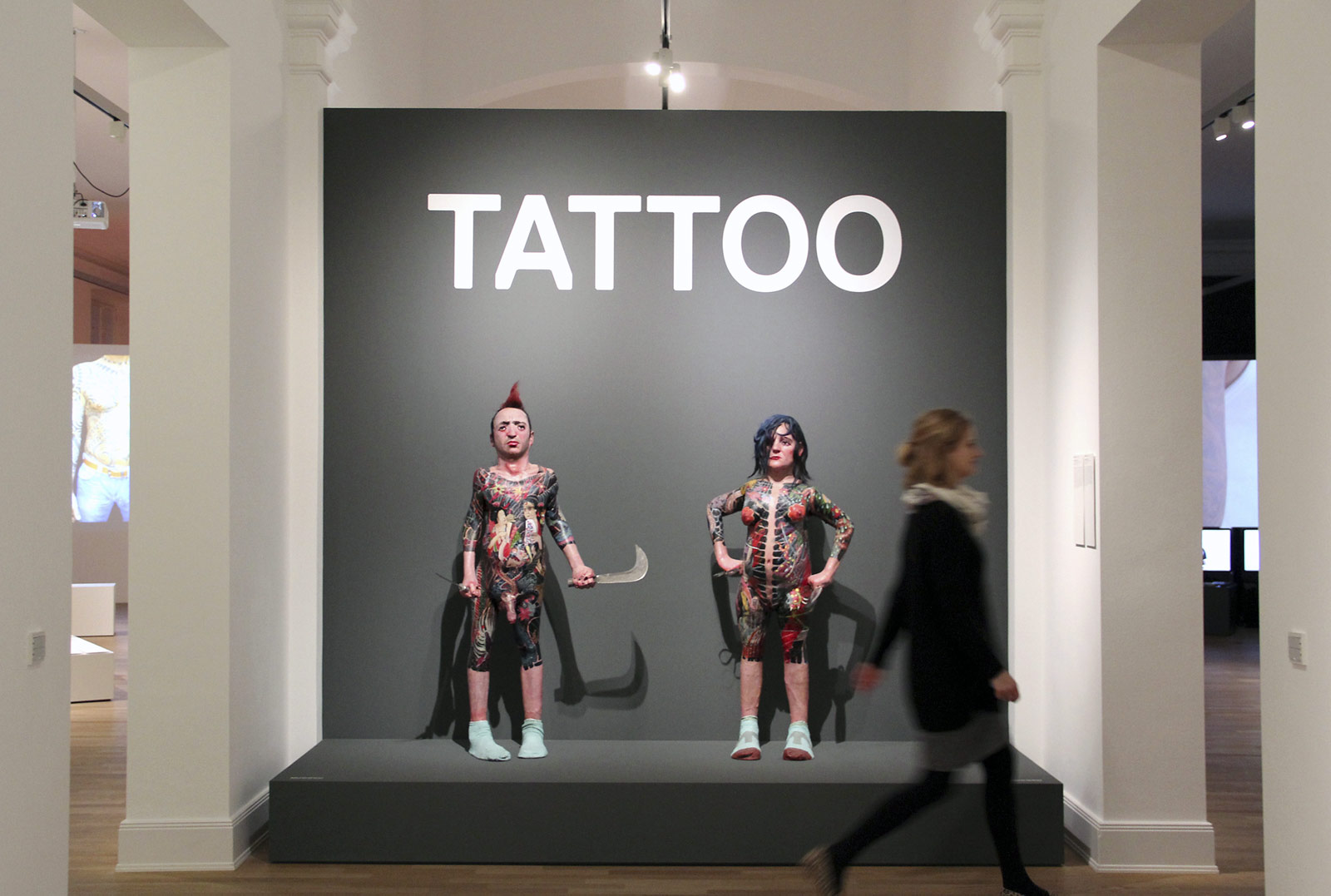
Installation views of the exhibition Tattoo at the Museum für Kunst und Gewerbe Hamburg showing in the bottom two images, photographs by Ralf Mitsch
Kept under wraps in winter and proudly displayed in summer: tattoos are now ubiquitous. However, they are much more than just a current mass phenomenon and trendy fashion accessory: many cultures throughout the world are familiar with the tradition of tattooing, and human skin has always been used as a canvas. Tattooing is one of the earliest art forms and oldest handicrafts.
Tattoos last for a lifetime. Pigments are inserted under the skin forever, yet they are as transient as the life of the person who bears them. They tell personal stories, create identity and affiliation, embellish, heal, protect – and they can both fascinate and repulse. For a long while they were most commonly known as a mark of social distinction or as a means of identifying social outcasts, and as a method of self stigmatisation used by sailors, criminals, prostitutes and gang members to distinguish themselves from “the other”. It is easy to forget that the craze for inking one’s body spread even to aristocratic circles in the later nineteenth century, in a trend that is now echoed by the current fashion for tattoos.
The Tattoo exhibition is dedicated to old traditions and new stories. It takes a look at the vibrant, innovative and multifaceted tattoo culture, with a focus on artistic, artisanal and culture specific issues. International exhibits from diverse perspectives are displayed and current debates considered. This is the first time that an exhibition has brought together such a broad range of references, presenting the phenomenon of the tattoo with a particular focus on art and design, since these enduring pictures, words and symbols inspire artists and designers. The theme of the exhibition is therefore the reciprocal influence of art, traditional and lived tattoo art and visual design.
Johann Baptist von Spix (German, 1781-1826) Journey to Brazil on command Maximilian Joseph I, King of Bavaria, in the years 1817-1820 / made and described by Johann Baptist von Spix and Carl Friedrich von Martius – Munich: [sn], 1823-1831 Loan: Museum of Ethnology, Hamburg
Expedition to Brazil
Johann Baptist von Spix, 1817-1820
Between 1817 and 1820, the zoologist Johann Baptist von Spix and the botanist Carl Friedrich Philipp von Martius undertook an expedition to Brazil at the behest of Maximilian Joseph I, King of Bavaria. They were also interested in the culture of the Brazilian indigenous tribes on the Rio Yapurà, and they published their findings in a three-volume travel report. The illustration is a portrait of Juri, “The son of a cacique of the Juri nation”.
Illustrated travel books were very popular in the 18th and 19th centuries. They shaped western ideas about foreign cultures and also indicate the early interest in exotic tattooing practices. James Cook’s reports on his expeditions to the South Seas in the 18th century contain the mention of the word “tattow” derived from the Polynesian. The term quickly spread and tattooing became popular in the Western world soon afterwards.
Early ethnographic drawings and engravings such as those made by Georg Forster and Karl von den Steinen attracted widespread interest, as did photographs at a later date such as the studio portraits taken by Felice Beato in Japan. They helped to make the art of tattooing into a symbol of the eroticised alien, and a magico-mythical world of cults and rites. Tattoos elicited a mixture of fascination and revulsion right from the start, particularly in middle-class circles during the 19th century: tattooing thus developed a dual character as both stigma and mark of distinction.
Enrique Marty (Spanish, b. 1969) Pablo & Ruth 2010 From the series Art is Dangerous Oil paint on latex on polyurethane, human hair, textiles, metal 155 x 90 x 53.5 cm/143 x 60 x 35cm Loan: Deweer Gallery, Otegem, Belgium
Real portraits are always the starting point for Enrique Marty’s tragicomic sculptures. The tattoos of Pablo & Ruth in the Art is Dangerous series reflect the iconography of the tattoo motifs in Japanese yakuza which the artist has explored in detail and incorporated into his work. His grotesque figures also make reference to early sculptural traditions such as those used in the quaint waxworks exhibitions of the 19th century. He builds on these themes and develops an original sculptural world. Ironic inversions and humour are essential strategies which he uses as an effective weapon. “Art is dangerous”: protest or parody? An allegory of the market system? Can art be dangerous? Or should it be? What role does the art of tattooing play?
Tattoo equipment
Throughout the world tattooing is performed by introducing pigments to the dermis, or second layer of skin. Pieces of wood, thorns, bones, horns, tortoiseshells, metals and shards can be worked into tools. Depending on the shape of the tattooing implement, the patterns produced may be smooth or dotted, narrow or broad. The individual instruments have not changed greatly over the years. However, one notable step forward was the use of electricity which resulted in new techniques and styles at the beginning of the 20th century after Samuel O’Reilly had patented his rotary tattoo machine in 1891. The electric motor moves the needles up and down regularly, enabling the operator to work smoothly and steadily. It is also a less painful process for the client. These electric machines are in widespread use today. Nevertheless, traditional tools, which have hardly changed, are also still employed.
Tattoo inks
It was not until the 20th century that tattoo inks began to be manufactured as industrial products. Previously, they had been mixed in small quantities according to individual recipes using pigments, oils and plant juices. Synthetic pigments not only altered the colour spectrum and production techniques of tattoo inks, but also led to new requirements and constraints as is clear from developments over the last forty years. Today, challenges in the manufacturing process for tattoo inks primarily concern the purity of the ink production process and the quality of the pigments procured. Other requirements tend to be connected with new problems which are no longer to do with the actual pigment that is inserted into the skin. Nowadays the main focus is on the risks posed by laser treatment for tattoo removal.
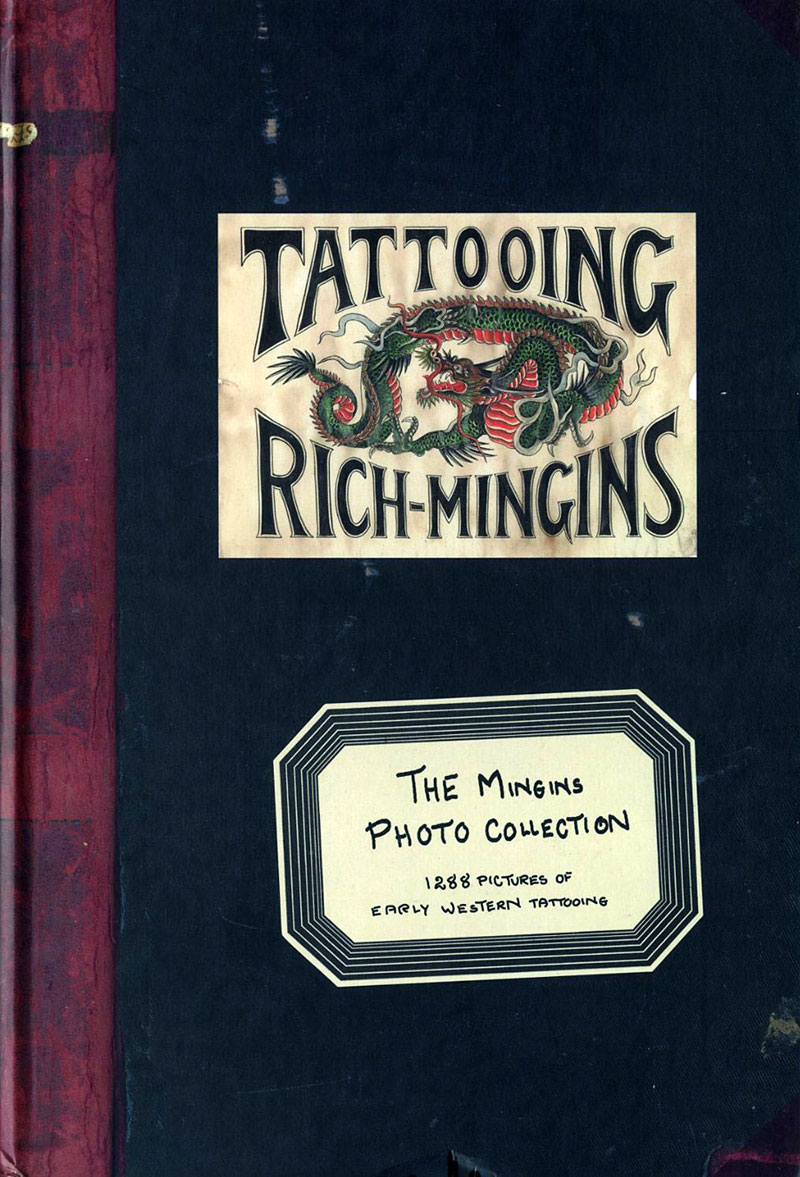
The Rich Mingins Collection: 1288 Pictures of Early Western Tattooing from the Henk Schiffmacher Collection 2011
The Rich Mingins Collection
Rich Mingins (1916-1968) ran a tattoo studio with his father and his brother Alf Mingins in Cumbria, which is in the north-west of England, and later in London. Tattooing was his passion and he was a master of his craft. He also collected photographs and newspaper cuttings about tattoos. Today all that remains is his photo album which documents the history of tattooing from 1922 to 1949. Unfortunately, it lacks a chronology or any precise dates, and no accompanying commentary has been found. The digital version with extracts from the photo album shows his clients, other well-known tattoo artists of his era, copies of pictures that were in circulation at the time and the artist himself: Rich Mingins poses for the camera with clenched fists, displaying the picture of Jesus Christ with crown, that was tattooed on his chest by his brother Alf Mingins (no. 424).
Painting The Lily! (1936, 1.12 mins.)
In this documentary, George Burchett (1872-1953) tattoos two women with permanent makeup at his studio in the West End of London. His clientele included members of the English upper classes and European royalty such as King Alfonso XIII of Spain, King Frederick IX of Denmark and King George V of England. George Burchett also tattooed Horace Ridler, the legendary Zebra Man also known as “The Great Omi”.
Tattoo Soldiers (1942, 1.15 mins.)
Three Australian soldiers talk about their tattoos from all over the world.
Woman Tattooist (1952, 1 min.)
The first British female tattooist, Jessie Knight (1904-1994), tattoos young women soldiers in Aldershot, Hampshire. She ran a number of studios from the 1920s up to the 1980s.
Tattoo Club (1954, 1.51 mins.)
The well-known British tattooist Les Skuse (1912-1973) founded the Bristol Tattoo Club in 1953 and in 1955 he organised the world’s first tattoo competition, the precursor of the tattoo conventions of today. In the 1950s the Bristol Tattoo Club was the focal point of the tattoo scene, counting famous people such as Bob Maddison, Al Schiefley, Albert Cornelissen and Tattoo Peter among its members.
Photograph from the Christian Warlich estate, 1961 Loan: Hamburg Museum, Sammlung Fotografie
Christian Warlich: the “King of the tattoo artists”
During his lifetime, Christian Warlich (1890-1964) was held to be the greatest tattoo artist in Germany and gained an international reputation as “King of the tattoo artists”. He had taught the craft to the Hamburg tattoo legend Herbert Hoffmann and later made him to be his “Crown Prince”. Warlich himself is believed to have come into this profession by chance. After an apprenticeship as a boilermaker he had gone to sea and become acquainted with tattoo artists in the United States. From there, he brought back one of the first electric tattoo machines. In 1919, Warlich opened an inn in today’s Clemens-Schultz-Straße in St. Pauli, Hamburg, where one of the corners served as a “Modern Tattoo Studio”. Warlich took on tattooing as a serious business: he promoted the store, traded with tattoo machines and tools and in addition to his tattooing, he offered a residue-free and painless removal of tattoos by using a special tincture. Warlich was not only noticed because of his business sense, his work was characterized by craftsmanship and artistic standards, too. Unlike other tattoo artists of his time, he strove for a continuous improvement of the shapes and for the modernisation of the image repertoire. For these purposes, he developed new designs and collected all kinds of templates, for instance from Chinese sample books, movie posters or advertising images. In addition, Warlich kept in contact with tattooists all over Europe, North America and Asia. They exchanged sketches photographs and celluloid stencils with which the outlines of the motifs were transferred to the skin of the customers.
The tattooist Herbert Hoffmann: a legend
The world famous tattooist Herbert Hoffmann (1919-2010) lived through and helped shape various stages of the history of western tattooing. Throughout his life he was very keen to help tattoos gain acceptance and social approval. Having been trained by Christian Warlich, he later became the proprietor of Germany’s oldest tattoo studio in the St. Pauli district of Hamburg, where he worked until 1980. He then moved to Switzerland, where he lived with his partner Jakob Acker in Schwendi bei Heiden in the canton of Appenzell Ausserrhoden. Hoffmann was active in the tattoo scene right up to his death in 2010, attending conventions throughout Europe and acting as an important role model for younger tattoo artists. He himself bore tattoos by Christian Warlich, Tattoo Peter, Tatover Ole, Horst Streckenbach and others. Throughout his life he was also a keen photographer and collector. Many of his photographs were published in the photo book Living Picture Books, Portrait of a Tattooing Passion 1878-1952, which is now out of print. The images displayed in the exhibition are from his private archive and have rarely been shown before. These are photographs from his personal albums with portraits of his friends and clients. They depict Herbert Hoffmann himself at different stages of his life, as well as his environment. At the same time, they narrate an important chapter in the history of tattooing from the 1920s to the 1970s. Unfortunately his written comments can no longer be traced.
Women and tattoos from the private collection of Herbert Hoffmann
The picture archive of the tattooist and collector Herbert Hoffmann (1919-2010) also includes photographs of tattooed women from the 1920s up to the 1970s. Some of them are photographs he took himself but others are copies and images that were circulated in various forms by like-minded people. They are not systematically arranged, most of them are undated and there is no commentary. The collection also includes iconic photographs which had a decisive impact on how tattooed women were viewed at that period. This selection of Herbert Hoffmann’s pictures is a chronicle of women with tattoos, from circus attractions of the 1920s and glamour girls of the 1960s to the predecessors of the famous “new burlesque” artists like Dita Von Teese. However, there are also photos of “ordinary women” with tattoos in the prim-and-proper 1950s and – more rarely – of female tattooists. Herbert Hoffmann’s collection ends with the “renaissance” of tattooing in the 1970s. At that time, women in particular were discovering tattoos as a sign of self-empowerment and the number of female creative tattoo artists making their way in this male-dominated profession began to increase. Today there is a huge variety of (self-)expression by tattooed women, and female tattoo artists play an essential and influential role in the rich contemporary tattoo culture.
Maud Stevens Wagner, Tattoo Artist, USA (1877-1961, photo from 1907)
Maud Stevens Wagner (American, 1877-1961)
The American tightrope walker and contortionist Maud Wagner was the first well-known female tattooist in the Western world. Like others of the small number of female tattooists in the 1920s, she learned her craft from her husband, Gus Wagner, whom she met at the St. Louis World’s Fair in 1904.
Lady Viola (American, 1898-1977) Nd
Lady Viola (Ethel Martin) (American, 1898-1977)
Ethel Martin Vangi, who became famous as “Lady Viola”, was a circus performer and later tattooist; she had portraits of presidents Woodrow Wilson, George Washington and Abraham Lincoln tattooed on her chest. Her left thigh was tattooed with pictures of popular figures of the day, such as Babe Ruth and Charlie Chaplin.
Artoria Gibbons (American, 1893-1985) Nd
Artoria Gibbons (American, 1893-1985)
Like many tattooed circus attractions, Anna Mae Burlington Gibbons was a working-class woman who had herself tattooed when she fell on hard times, and then earned good money as a result (especially as a woman). She and her husband, the tattooist Charles Gibbons, travelled all over America in the 1920s and worked as a team in the circus business. She had one tattoo showing a section of Botticelli’s Annunciation, another depicting a part of Michelangelo’s Holy Family, and her chest featured a portrait of George Washington.
Cindy Ray (Bev Robinson) (Australian, 1942-2025) Untitled [Self-portrait] Nd
Cindy Ray (Bev Robinson) (Australian, 1942-2025)
The last great circus lady, Cindy Ray – also known as “Miss Technicolor” or “The Classy Lassie with the Tattooed Chassis” – toured Australia and New Zealand in the 1960s. She learned how to do tattooing and is still working today under her real name, Bev Nicholas, at the Moving Pictures Tattoo Studio near Melbourne.
Imogen Cunningham (American, 1883-1976) Irene “Bobbie” Libarry 1976 Silver gelatin estate print 19.3 x 17.8cm Loan: The Imogen Cunningham Trust, Lopez Island, USA
Irene “Bobbie” Libarry (American, 1893-1978)
Irene “Bobbie” Libarry (1893-1978) worked as a circus performer, magician and market vendor. She was tattooed by her husband in 1918, ran her own sideshow “The World’s Strangest People” in the 1930s and later worked as a tattoo artist in San Francisco.
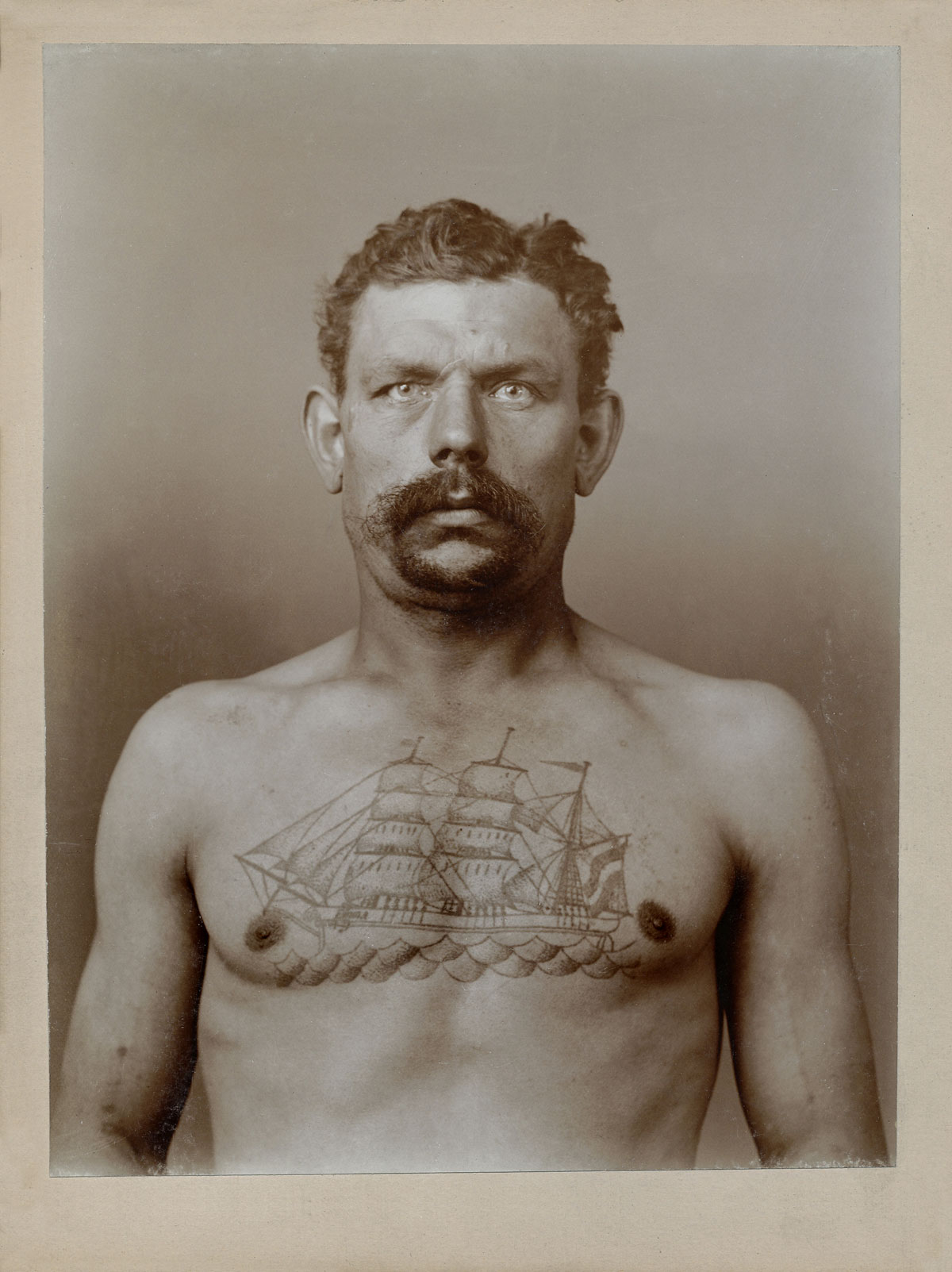
Numerous historical portraits of tattooed men have been preserved in the inheritance of the tattoo artist Christian Warlich (1890-1964). The pictures probably originate in the 1880s to 1890s [see both images above]. Especially typical contemporary garments, the beard and hair fashion of the time, relevant tattoo motifs from the German Empire under William I or the symbol of the tenth World Expo in 1889, the Eiffel Tower, give information about this type. All images are carefully rear numbered and labeled with the names of the people portrayed. On display are mainly dock workers and seafarers; members of underprivileged workers who were not used to posing in front of a camera. In the late 19th century, the loading work in the ports was extremely cumbersome and labour intensive, roosts such as the Hamburg Gängeviertel hosted thousands of working families. In this milieu relevant subjects such as anchors, sailboats or professional characters show the belonging to a social group. The tattoos document but beyond the story of people’s lives. There are references to the military service or the crossing of the equator, as well as prison stays or religious motives.
Preserved tattoo specimens
The specimens date from around 1900. At the time they were used to identify unknown corpses. Photography was not yet in routine use at that period and preserved specimens offered almost the only opportunity to document a tattoo in detail and keep it for later identification. The oldest known report of successful identification thanks to a tattoo dates back to the 11th century: King Harold II of England fell in battle and is said to have been identified by the inscription “Edith and England” tattooed above his heart, thanks to which he was buried in a manner befitting his rank.
Emile Lavril, Romeo und Julia Tattoo 14 November 1913, front
Rudolf Archibald Reiss (German-Swiss, 1875-1929)
The criminologist, lecturer and photographer founded the “Institut de police scientifique” at the University of Lausanne in 1909. He also helped to set up courses in photography for investigative purposes at the same institution. Forensic photography, which was being carried out according to standard criteria for the first time was an essential component in his teaching. Since tattoos are important identification features, Reiss paid particular attention to them [see photograph above]. However, the technology available at the time made it difficult to obtain a sharp and accurate image. Reiss used photographs purely for forensic purposes. He refused to accept the then common opinion that offenders could be recognised simply because they had tattoos.
Eyes on the stomach denote homosexuality (the penis makes the ‘nose’ of the face). Stars on the shoulders show that an inmate is a criminal ‘authority’. The medals are awards that existed before the revolution and as such are signs of defiance towards the Soviet regime.
The devils on the shoulders of this inmate show a hatred of authority. This type of tattoo is known as an oskal (grin), a baring of teeth towards the system. They are sometimes accompanied by anti-Soviet texts.
The double-headed eagle is a Russian state symbol that dates back to the 15th century. After the fall of Communism, it replaced the hammer and sickle as the Russian Federation’s coat of arms. This Soviet-era photo is a bold symbol of rage against the USSR; the Statue of Liberty implies a longing for freedom.
Photographs of Russian convicts
Up until the end of the 19th century, it was usual for the government to burn the initials “B.O.R.” (Russian for thief) into thieves’ skin as a punishment. Subsequently, tattoos developed as a distinctive feature of professional criminals; serving as demarcation, identification, as well as a secret means of communication: they transmit information such as affiliation, profession, number of convictions or position in criminal hierarchies. This informal practice transliterated the original stigmatisation inflicted through the government, using a pictorial repertoire borrowed from traditional tattoo imagery while assigning a new meaning. Most of the prison tattoos were done with primitive instruments, such as modified electric shavers with attached needles. Oftentimes, a self-made mixture of rubber and urine was used as substitute ink, bearing great health risks. Arkady Bronnikov (b. 1926) was a leading forensic doctor at the interior ministry of the USSR. From the mid-1960s until the mid-1980s he interviewed and photographed numerous inmates of labour camps in the Urals and Siberia. Today, Bronnikov is a leading expert on tattoo iconography and owns what is considered to be one of the biggest photographic collections of Russian prison tattoos.
The Austrian photographer Klaus Pichler (b. 1977) spent eight years looking for ex-prisoners, photographing their tattoos and writing down the stories behind them. The result was an impressive documentary account of the still poorly researched history of prison tattoos. The pictures and interviews were published in the book Inked for Life. The World of Prison Tattoos.
The acceptance of tattoos in Japanese society is subject to constant change. In the 19th century, large tattoos were considered decorative and were carried openly by rickshaw drivers, for example. For the scantily clad men an ornate body was helpful for their business because it attracted the attention of customers. The image of bullies and petty criminals adhered to rickshaw drivers, as well as to other professions from the simple population which led to a long-term negative perception of the skin images. As an identifying feature of “outlaws” they also function in the criminal milieu of the yakuza. In the Japanese mafia organisation, tattoos still illustrate the milieu name of the bearer (“serpent”, “dragon”, etc.) and document his gang membership. The result was a social aversion to tattoos which continues to this day and also unjustly criminalises innocent citizens. Unlike their historical predecessors, taxi drivers today would only flaunt their tattoos for a photographer; because they are not good for business. Tattoos in Japan were rarely shown openly; in public bath houses they are even forbidden to this day. It was only through the appreciation of the Japanese tattoo tradition by the American tattoo scene of the 1960s and 1970s that the taboo was partially revised.
Masahiko Adachi (Japanese, b. 1983) Flesh Color 2010 Japan Animation / 4 Min.
Japanese colour woodcuts: The 108 heroes of the “Suikoden”
The Japanese name “Suikoden” stands for a famous Chinese adventure story that became very popular in both countries. In this story, a group of rebels fights against corruption and injustice, campaigning for the poor and the disadvantaged. The story originates in the 14th century and is set in the 12th century. For the first time, Kuniyoshi displays these rebels with naked, tattooed bodies which lead to a great success of the book. Until today, the Suikoden is a well-known theme of Japanese culture such as computer games and TV series.
Fumie Sasabuchi draws irezumi tattoos on the skin of pictures of young girls taken from the children’s fashion magazine Vogue Angels. The motifs of the tattoos are part of the traditional repertoire of the Japanese yakuza mafia, and symbolise mortal danger, superhuman strength and special protection, among other things. Sasabuchi unites two media from Western and Eastern popular culture: photography from modern fashion magazines and the traditional woodcut. She combines Japanese myths with Western picture subjects and plays with the ensuing ambivalent images.
Twelve years of civil war in El Salvador came to an end in 1992. Today, gang warfare is an everyday reality in San Salvador, mainly because of two gangs: the Mara Salvatrucha (MS) and the Mara 18 (18). Every year 2,000 people die as a result. Some 14,000 abandoned youths dedicate their lives to the gangs which replace their families. They are the successors of the US gangs that were founded in the 1980s by refugees from the Salvadoran civil war. The Mara gangs today, which originated in the ghettos of Los Angeles, have over 70,000 members in El Salvador, Guatemala and Honduras. Members generally have a tattoo containing the letters M or MS, as well as the number 13 which refers to the position of M in the alphabet. Tattoos in the shape of teardrops represent the number of murders committed, or commemorate the death of a fellow Mara member and friend. The words “La vida loca” stand for “the crazy life” in the Mara, and a downward-pointing M formed with the fingers is used as a sign of recognition.
The Spanish-French photographer and documentary filmmaker Christian Poveda spent over a year with members of the Mara. He followed the lives of these “lost youths”, documenting them through interviews, impressive photographs and the film La vida loca (El Salvador / France / 2008 / 90 mins.). Poveda was killed by several shots to the head in San Salvador in 2009 while working on another film.
The face tattoos of the Chin women in Burma form part of a ritual to mark the transition from childhood to the adult world. Female tattoo artists use thorns 17 or needles to prick patterns into the skin. The symbolic meaning of the lines and dots cannot be ascertained, since no records exist. All that is known is that the patterns differentiate one clan from another. Although the tradition of facial tattooing has died out in many parts of Burma, it is now experiencing a partial revival.
The Tã moko facial tattoos of the Maori in New Zealand give information about family membership, ancestors and social position, as well as the specific abilities of the tattooed person. Each part of the face is dedicated to a particular type of information. Few people have a tattoo in the centre of the forehead, for example, since this indicates high status. Men can usually wear tattoos over the entire face, whereas women have them only on the chin area. This tattoo tradition has been suppressed for a long period, as also happened in other cultures, but the Tã moko have recently been experiencing a renaissance.
Mau Moko: photographic images of the world of Maori tattoo by Becky Nunes
“These are impressive and moving images, which deserve exhibition simply in their own right. More than that, they place moko in a contemporary context, expressing the art as a living, relevant force in our culture and not some struggling remnant of a distant past. They strongly counter the negative connotations of moko.”
Hamish Keith, Art Historian 2009
Mau Moko: the World of Maori Tattoo began as a research project at the University of Waikato, and evolved into a major publication, a scholarly yet entertaining journey from the art’s Pacific chisel origins to the marae workshops and sophisticated urban studios of Aotearoa today. It has been essentially a visual experience – the exacting portraiture of Parkinson and Jenner-Merrett, the iconic canvasses of Goldie and Lindauer, the pretty, ubiquitous postcard albums, and most recently, the brooding, elemental image-making of Westra and Friedlander, have all marked their own place, in their own time. With Mau Moko, and the consummate artistry of this collection, we reach the twenty first century. Becky Nunes’ eloquent lens engages the viewer, and the viewed, and one wonders who is saying “Tirohia, he moko!” It is about us. And yes, it is forever.
Ngahuia Te Awekotuku. May 2008
In December 2007 Penguin Books published Mau Moko, The World Of Maori Tattoo. The result of several years’ research, the book explores the cultural and spiritual issues around ta moko, and relates the stories of its wearers and practitioners. Mau Moko was authored by Ngahuia Te Awekotuku and Linda Waimarie Nikora with contemporary portraits photographed by Becky Nunes. Becky Nunes is a photographic artist and educator, making images for a range of commercial and editorial clients, as well as her own personal work. She heads the Photo Media department at Whitecliffe College of Arts & Design. For the Mau Moko project Nunes travelled through both the North and South Islands of Aotearoa / New Zealand meeting and photographing wearers and practitioners of ta moko.
Sacred tattoos known as Sak Yant are commonly found in Thailand. They protect the bearers from accidents, misfortune and crime. At the same time they help them to lead a morally upright life. However, the rules set by the tattooist must be obeyed or the tattoos lose their power. Sak Yants are not intended for public view and therefore often kept hidden. The motifs used are derived from ancient Khmer script writings and animal symbols such as tigers, dragons, birds, snakes and lizards. The tiger, or Yant Sua, is a popular subject and is associated with strength, fearlessness and power.
Tattoo Master
There are several hundred tattooists in Thailand. Monks tattoo in their temples, and tattoo masters in studios. They are authority figures and their followers also seek advice from them. The sacred tattoos link tattooist and tattooed for a lifetime. 38-year-old Achan Neng Onnut is a tattoo master in On Nut, a district of Bangkok. The pricked motif is called Pho Kae. It depicts a recluse, or hermit, and bestows wisdom, goodness and a peaceful mind to the bearer. The tattoo master recites a mantra in order to activate the tattoo.
Santiago Sierra (Spanish, b. 1966) 250 cm line tattooed on six paid people 1999 Espacio Aglutinador, Havanna / Cuba / doc. / 28.17 mins. / no sound Loan: Galerie Kow, Berlin
In 1999 Santiago Sierra recruited six young unemployed men in Havana to stand in a row and have a horizontal line tattooed on them, running continuously from one man’s back to the next, in exchange for 30 dollars each. Further versions of this performance were carried out and documented as simply as possible. It alludes to the unequal values of capitalist society and to the relative and haphazard nature of remuneration. The imprecise line drawn of the tattoos suggests scarring, so the participants in the performance – members of socially marginalised groups – were subjected to further stigmatisation.
Artur Żmijewski (Polish, b. 1966) 80064 2004 11 mins. Polish with English subtitles Loaned by the artist and Galerie Peter Kilchmann, Zürich
The Polish artist Artur Żmijewski takes an unsparing and provocative look at the tattooing that took place in the Nazi concentration camps. His video shows 92-year-old Auschwitz survivor Josef Tarnawa whom the artist persuaded to have his fading camp number re-inked. While the tattooist is renewing the numbers, Josef Tarnawa recalls the most traumatic time of his life. Artur Żmijewski’s video work polarises opinions. On the one hand, Josef Tarnawa is stigmatised for a second time, but on the other, the number on his left forearm acts as a shocking memorial. According to Artur Żmijewski, nowadays active remembrance is often far too conventional.
In the history of western tattooing, brands and involuntary tattoos have receded into the background, although the practices used during the Second World War remain deep in people’s memories. Whereas the prisoners in Auschwitz were numbered, members of the SS had their blood group tattooed on their upper arms. This meant that after the war, what had started out as a useful medical information turned out to be an irreversible identification mark. The social connotations of a tattoo change over time, with proud insider symbols becoming the stigmata of an outsider group.
Wim Delvoye (Belgium, b. 1965) Tim 2006-08 Tattoo, loan: Sammlung Reinking, Hamburg
Tim Steiner, a Swiss citizen, has had a work by the Belgian conceptual artist Wim Delvoye tattooed on his back. In 2008 the tattoo was sold to a Hamburg-based art collector who acquired the right to lend, sell and bequeath Tim Steiner as a loan object and to preserve his skin after his death. Since then, the work, called Tim, has given rise to international controversy. It raises important questions about ethics in the art market, and about power and the right to dispose of the human body (and its organs, such as the skin).
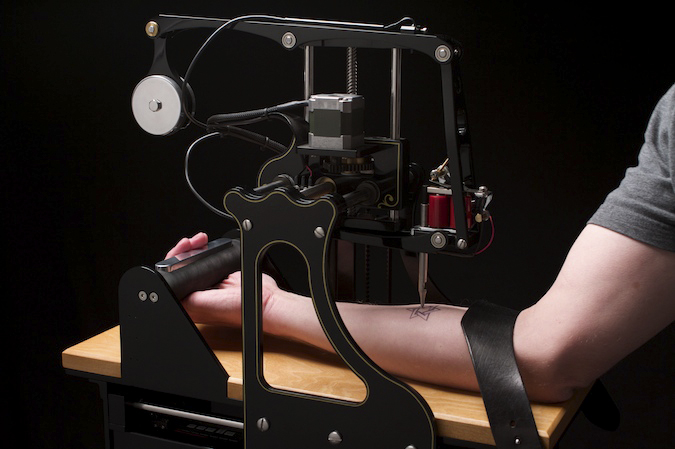
Chris Eckert (American, b. 1968) Auto Ink 2010 Metal, paint, microelectronics 137 x 56 x 50cm Loaned by the artist
Auto Ink
The strongest indication of a person’s religion is geography. You are born into your religion. That doesn’t make it irrelevant or incorrect – religion provides a framework for basic morality that’s very powerful and it gives people a cultural identity that spans borders. I’ve attended mass in Dutch, German, French, and Spanish and I’ve always felt like I belonged. While my personal experience with religion is one of inclusion, a system that unites people from different regions and cultures, the public face of religion is often one of exclusion. Muslim, Christian, and Jewish zealots who know what God wants. More specifically they know what God doesn’t want and apparently God does not want me… or you. This public face of religion is always so certain, self-confident, even arrogant. That anyone could possibly know the “truth” when that truth is randomly assigned at birth is just funny.
Auto Ink is a three axis numerically controlled sculpture. Once the main switch is triggered, the operator is assigned a religion and its corresponding symbol is tattooed onto the persons arm. The operator does not have control over the assigned symbol. It is assigned either randomly or through divine intervention, depending on your personal beliefs.
The kinetic sculpture of American artist Chris Eckert draws a random religious symbol on the arm of a volunteer subject. Membership of a religion integrates, connects and offers an ethical and moral framework for living with others. Yet many faiths compete with each other and regard the others with resentment and politically motivated enmity. Chris Eckert’s tattooing machine explores how having a particular faith can affect peaceful coexistence in a globalised world.
In European history, the now defunct tradition of religious pilgrim tattoos is an example of the practice of tattooing as a mark of identity and segregation. Examples include the crusader tattoos and tattooed guild symbols in the Middle Ages.
Inking the skin requires the same aesthetic imagination and care, the same manual dexterity, and the same knowledge of materials and colour as other artistic processes. The innovative contemporary tattoo scene is transcend¬ing the language of classical tattooing and regenerating the medium. The image loop shows a diverse range of top quality works by international tattoo artists in a huge variety of styles.
Frank Taki Über(leben) 2014
Tradition and modernity
The rich and cross-cultural collection of the MKG has served as an inspiration for creative work to artists and craftspeople for over 130 years. The classic ornaments of historism, the floral patterns of art nouveau or the spirited characters of Japanese wood cuts: the continuous examination with this kind of historic artwork and its adaption into one’s own visual language are just as much a part of the art of tattooing as the creation of new images. In the autumn of 2014, the MKG has invited a selection of Hamburg tattoo artists to use the museum’s collection as a starting point for new tattoo designs.
Timm Ulrichs (German, b. 1940) The End Eyelid tattoo, 1970/1981/1997 Inkjet print on canvas on stretcher bars, 150 x 150cm Loaned by the artist
In 1981, Timm Ulrichs had THE END tattooed on his right eyelid by “Tattoo Samy” (Horst Heinrich Streckenbach). The tattoo, which can only be read when the eye is closed, recalls the final credits of a film, the last performance and the final moment. This tattoo event was also documented on film, created in the context of the video of the same name which juxtaposes 60 final images.
Museum für Kunst und Gewerbe Hamburg Steintorplatz, 20099 Hamburg
At this moment in time, I believe that Pieter Hugo is one of the best photographers in the world.
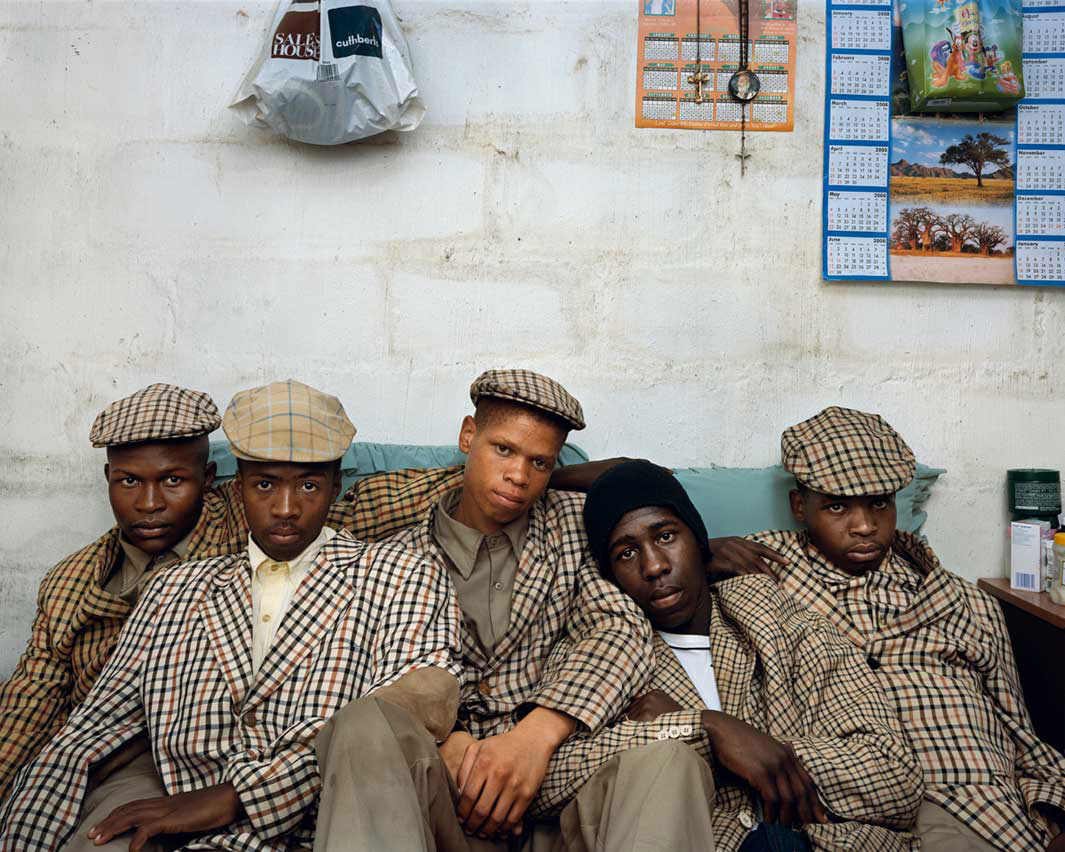
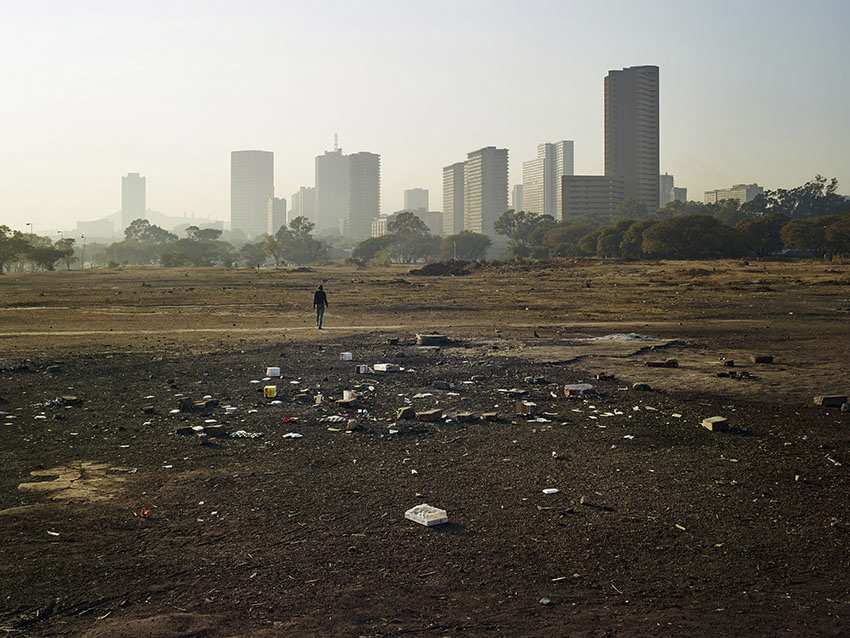
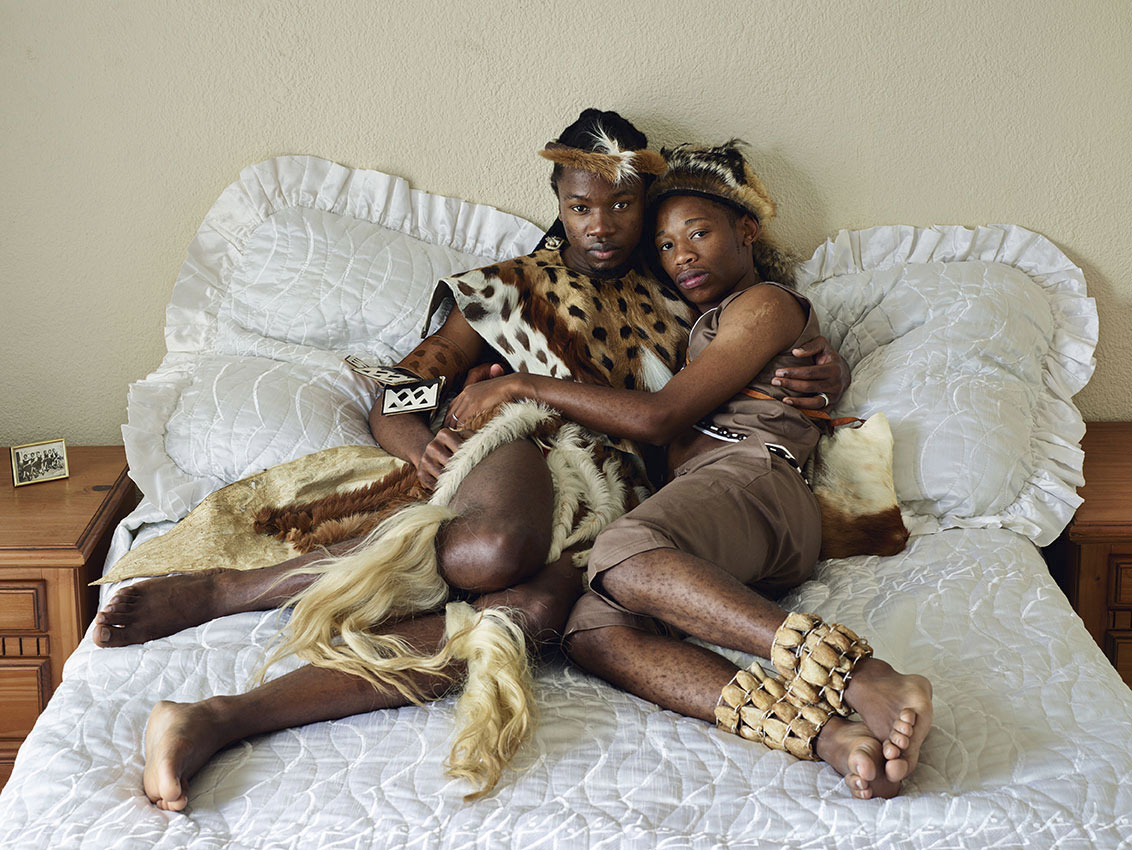
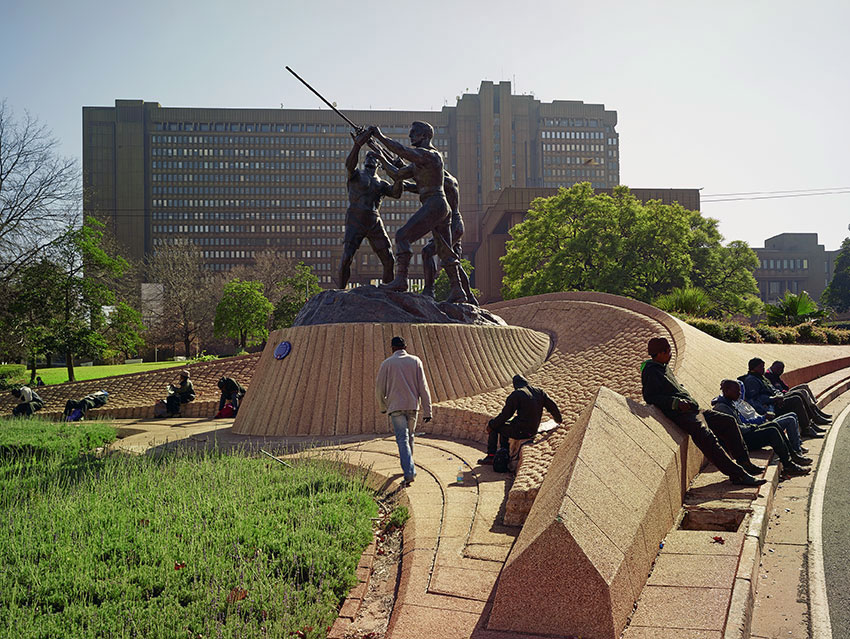
Approaching photography with a keen awareness of the problems inherent in pointing a camera at anything, Hugo’s latest series Kin is a tour de force where concept meets clarity of vision and purpose; where a deep suspicion of photography and what it can accurately portray is used in the most incisive way to interrogate identity formation and power structures, colonisation, racial diversity and economic disparity in Hugo’s homeland of South Africa. This is intelligent, beautiful, focused art.
While there is a deep suspicion about what photography can achieve, Hugo uses that suspicion… and balances it with sensitivity, respect and dignity towards subject. An enquiring mind coupled with a wonderful eye, fantastic camera position and understanding of his colour palette complete the picture. These are beautiful, classical and yes, iconic images. Not for Hugo the interchangeability of so much contemporary photobook photography, where one image, one artist, can be replaced by another with no discernible difference in feeling or form. Where single images, whole series of work even, mean very little. The re/place ability of so much post-photography.
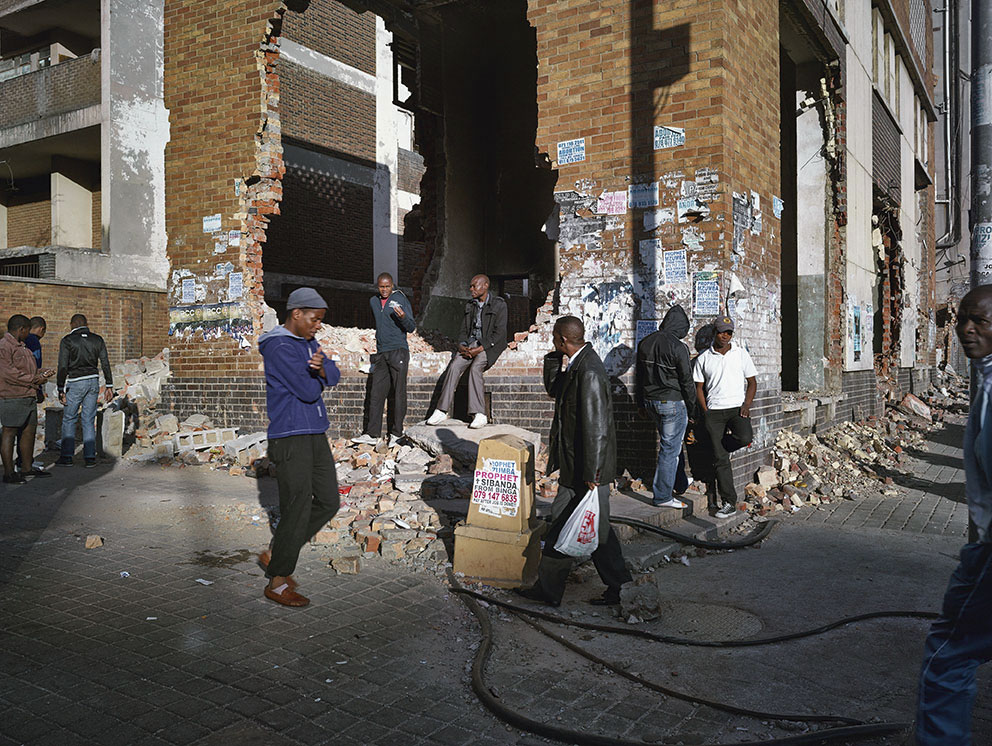
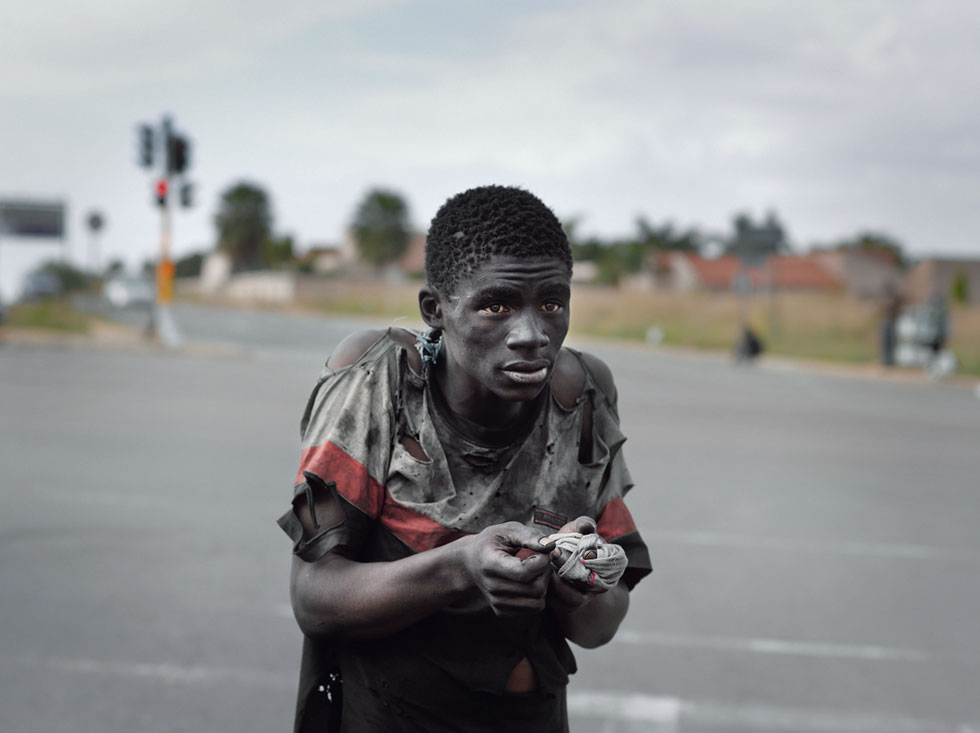
Just look at those eyes and face in Daniel Richards, Milnerton (2013, below), eyes that bore right through you; or the human being in At a Traffic Intersection, Johannesburg (2011, below) and tell me you’re not moved. Hugo is one of the brightest of stars in the photographic firmament.
Dr Marcus Bunyan
Many thankx to the Fondation Henri Cartier-Bresson for allowing me to publish the photographs in the posting. Please click on the photographs for a larger version of the image.
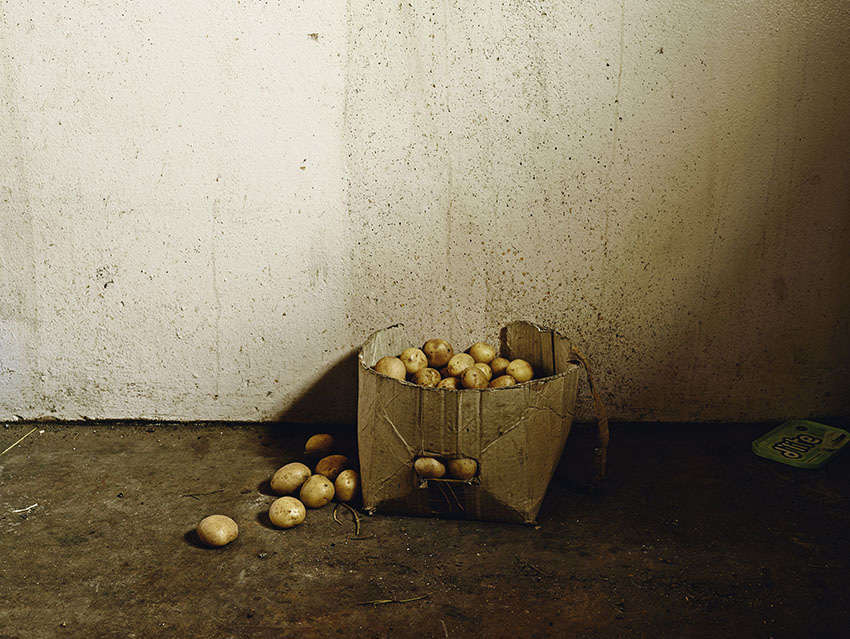
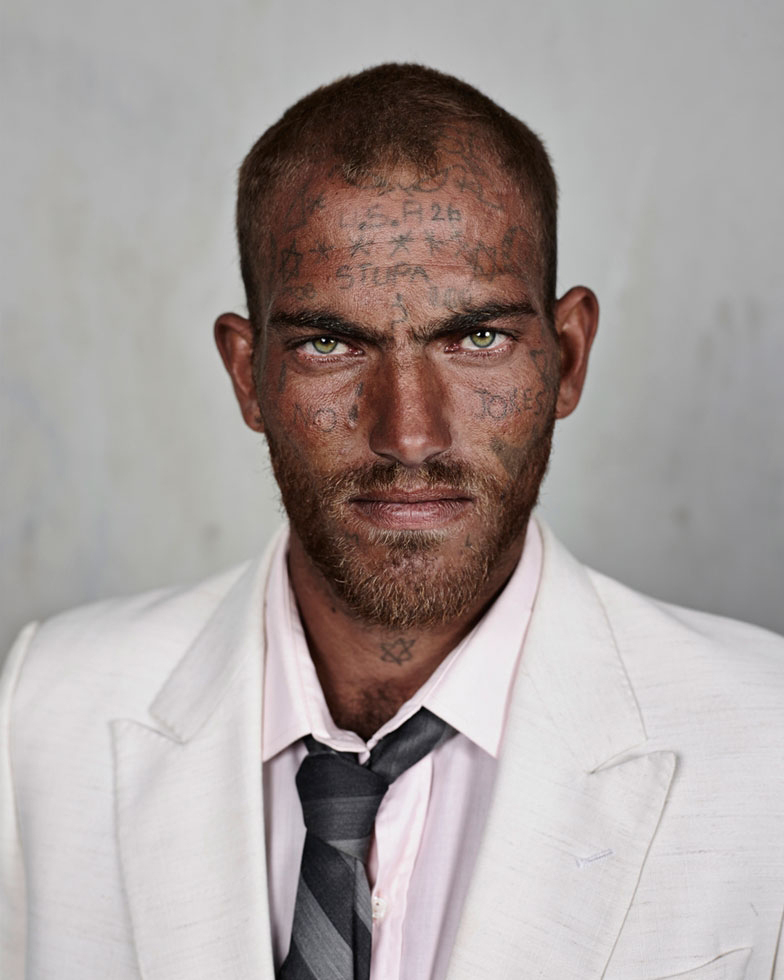
Created over the past eight years, Pieter Hugo’s series Kin confronts complex issues of colonisation, racial diversity and economic disparity in Hugo’s homeland of South Africa. These subjects are common to the artist’s past projects in Nigeria, Ghana, Liberia and Botswana; however, this time, Hugo’s attention is focused on his conflicted relationship with the people and environs closest to home. Hugo depicts locations and subjects of personal significance, such as cramped townships, contested farmlands, abandoned mining areas and sites of political influence, as well as psychologically charged still lives in people’s homes and portraits of drifters and the homeless. Hugo also presents intimate portraits of his pregnant wife, his daughter moments after her birth and the domestic servant who worked for three generations of Hugo’s family. Alternating between private and public spaces, with a particular emphasis on the growing disparity between rich and poor, Kin is the artist’s effort to locate himself and his young family in a country with a fraught history and an uncertain future.
Text from the Fondation Henri-Cartier Bresson website
“I have a deep suspicion of photography, to the point where I do sometimes think it cannot accurately portray anything, really. And, I particularly distrust portrait photography. I mean, do you honestly think a portrait can tell you anything about the subject? And, even if it did, would you trust what it had to say?… It sounds extreme, but for me to work at all as a photographer, I have to be conscious always of the problems inherent in what I do. I have to be conscious, if you like, of the impossibility of photography…
I matriculated at the end of apartheid and the photographs I grew up looking at were directly political in that they attempted to reveal, or change, what was happening. Back then, the lines were clear. You tried to tell the world what was going on with your photographs. It’s much more complex now. I am of a generation that approaches photography with a keen awareness of the problems inherent in pointing a camera at anything.
My homeland is Africa, but I’m white. I feel African, whatever that means, but if you ask anyone in South Africa if I’m African, they will almost certainly say no. I don’t fit into the social topography of my country and that certainly fuelled why I became a photographer.”
Pieter Hugo quoted in Sean O’Hagan. “Africa as you’ve never seen it,” on the Guardian website 20th July 2008 [Online] Cited 24/02/2015
From January 14th to April 26th, Fondation HCB is showing Kin, the last project of the south-african photographer Pieter Hugo. Through landscapes, portraits and still life photography exhibited for the first time in France, the photographer offers a personal exploration of South Africa. The exhibit, accompanied by a book published by Aperture is coproduced with Foto Colectania Foundation, Barcelone and Stevenson Gallery, Cape Town/Johannesburg.
Created over the past eight years, Pieter Hugo’s series Kin confronts complex issues of colonisation, racial diversity and economic disparity in Hugo’s homeland of South Africa. These subjects are common to the artist’s past projects in Nigeria, Ghana, Liberia and Botswana; however, this time, Hugo’s attention is focused on his conflicted relationship with the people and environs closest to home.
Hugo depicts locations and subjects of personal significance, such as cramped townships, contested farmlands, abandoned mining areas and sites of political influence, as well as psychologically charged still lives in people’s homes and portraits of drifters and the homeless. Hugo also presents intimate portraits of his pregnant wife, his daughter moments after her birth and the domestic servant who worked for three generations of Hugo’s family. Alternating between private and public spaces, with a particular emphasis on the growing disparity between rich and poor, Kin is the artist’s effort to locate himself and his young family in a country with a fraught history and an uncertain future.
“South Africa is such a fractured, schizophrenic, wounded and problematic place. It is a very violent society and the scars of colonialism and Apartheid run deep. Issues of race and cultural custodianship permeate every aspect of society here and the legacy of Apartheid casts a long shadow … How does one live in this society? How does one take responsibility for history, and to what extent does one have to? How do you raise a family in such a conflicted society? Before getting married and having children, these questions did not trouble me; now, they are more confusing. This work attempts to address these questions and to reflect on the nature of conflicting personal and collective narratives. I have deeply mixed feelings about being here. I am interested in the places where these narratives collide. ‘Kin’ is an attempt at evaluating the gap between society’s ideals and its realities.”
Biography
Born in Johannesburg in 1976, Pieter Hugo grew up in Cape Town where he currently lives. His work is held in the permanent collections of The Metropolitan Museum of Art, New York; Museum of Modern Art, New York; J. Paul Getty Museum, Los Angeles; San Francisco Museum of Modern Art; Musée de l’Elysée, Lausanne; Huis Marseille, Amsterdam; and the Victoria and Albert Museum, London, among others. He is the winner of numerous awards, including in 2008 the KLM Paul Huf Award and the Discovery Award at Rencontres d’Arles. He won the Seydou Keita Award at the ninth Rencontres de Bamako African Photography Biennial, Mali, in 2011, and was short-listed for the 2012 Deutsche Börse Photography Prize.
Press release from the Fondation Henri Cartier-Bresson
Exhibition dates: 31st October, 2014 – 19th April, 2015
Curator: Sarah Montross, Senior Curator at the deCordova Sculpture Park and Museum
Charles “Teenie” Harris (American, 1908-1998) Three men and three women, seated as couples in banquette in bar or restaurant advertising “Fried Shrimp Plate $.85” and “1/4 Fried Chicken $.70” c. 1959; printed 2001 Silver gelatin print Gift of Arlette and Gus Kayafas
Another fun posting to add to the archive!
Marcus
Many thankx to the deCordova Sculpture Park and Museum for allowing me to publish some of the photographs in the posting. Please click on the photographs for a larger version of the image.
Charles “Teenie” Harris (American, 1908-1998) Photographer taking picture of Muhammad Ali (Cassius Clay) possibly in Carlton House Hotel, Downtown 1963; printed 2001 Silver gelatin print Gift of Arlette and Gus Kayafas
Charles “Teenie” Harris photographed the African-American community of his hometown of Pittsburgh, primarily for the Pittsburgh Courier, the preeminent national African-American newspaper (c. 1930-1960). Photographing community members, visiting political figures, athletes, and entertainers, Harris set out to balance negative views of African-Americans and their communities. Nicknamed “One-Shot,” Harris photographed confidently and with ease, rarely asking his subjects to pose more than once. The resulting 80,000 negatives make up one of the largest collections of photographs of a black urban community in the United States. Harris’ artistic output helps define photography as a tool for preserving the past, his photographs serving as invaluable documentation of the spirit of a particular time, place, and people.
Prefiguring the paparazzi images of celebrities that pervade contemporary media, Harris’ photographs of singer / actress Lena Horne and boxer Cassius Clay (Muhammad Ali) capture his famous subjects in relaxed settings that humanise them. Furthermore, Harris’ photograph of Clay shows the boxer having his portrait taken by another photographer, giving Harris’ image of a photograph-in-process an even greater behind-the-scenes feel.
Jules Aarons (American, 1921-2008) Untitled (Bronx), from the portfolio In The Jewish Neighborhoods 1946-76 c. 1970; printed 2003 Silver gelatin print, printer’s proof II Gift of Arlette and Gus Kayafas
Jules Aarons was one of the most respected and prolific American social documentary photographers in the twentieth century. His street photography captured personal moments in the public eye within the urban neighbourhoods in which he lived: the Bronx, where he was born and raised, and Boston, where he spent the majority of his adult life. Shot with his twin lens Rolleiflex camera held at waist-level, Aarons’ images are casual, intimate, and lively. Although the artist did not personally know his subjects, his work does not exhibit the detachment found in earlier forms of social documentary photography. His deep associations with the places and people he photographed imbue his images with a warmth and familiarity.
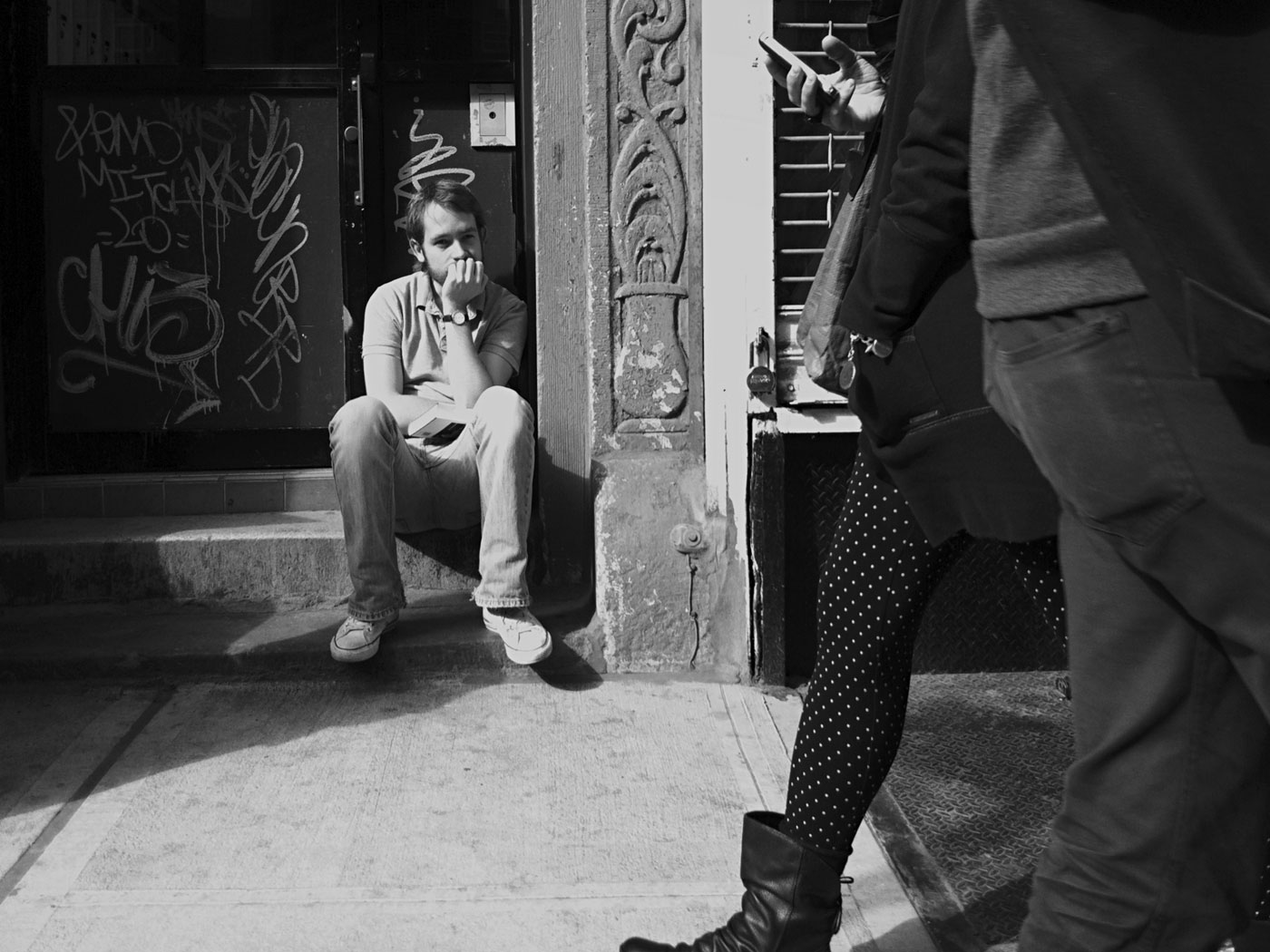
Greg Schmigel (American, b. 1969) Subway Triptych 2011 Digital photographic prints Courtesy of the artist
Greg Schmigel (American, b. 1969) An Afternoon in the Sun 2012 Digital photographic prints Courtesy of the artist
Greg Schmigel (American, b. 1969) Ideal Hosiery 2013 Digital photographic prints Courtesy of the artist
Greg Schmigel (American, b. 1969) Late Day On Broadway 2012 Digital photographic prints Courtesy of the artist
Greg Schmigel (American, b. 1969) This Isn’t Fucking Paris 2012 Digital photographic prints Courtesy of the artist
Greg Schmigel works in the vernacular of mid-twentieth century black and white street photography, capturing candid glimpses of everyday moments. While inspired by pioneering artists such as Jules Aarons, whose work is also on view in this gallery, Schmigel creates photographs with a decidedly twenty-first century quality. A mobile photographer since 2007, his device of choice is the most itinerant and convenient camera available: his iPhone. In his work, Schmigel emphasises that the production of a good photograph is due mainly to the eye of the photographer, and not necessarily dependent on the equipment he uses.
By producing black and white prints from his digital images, the artist casts a timeless aura over contemporary scenes. In photographs such as Ideal Hosiery, the faded signs of a New York City street corner provide an uncanny setting that could easily be found in a photograph taken many decades ago. In other images, however, the omnipresence of smartphones in the hands of pedestrians instantly signals the twenty-first century. In these photographs, Schmigel aptly captures the ironic isolation caused by the very technology created to increase interpersonal communication.
Presented at a time when the compulsion to digitally document and share human activity has increased exponentially, this exhibition features works from deCordova’s permanent collection that prefigure and inform current trends in social photography, as well as recent work by contemporary artists who utilise smartphones and social media to record the world around them. The Social Medium features work spanning from the mid-twentieth century to the present, and includes multiple photographic genres such as social documentary, street, society/celebrity, and portrait photography.
The Social Medium was largely inspired by a recent gift of one of Andy Warhol’s Little Red Books, which contains a set of colour Polaroids. With his camera, Warhol documented the events of his life – from glamorous celebrity parties to mundane occurrences. The arrival of these photographs, which record Warhol’s artistic and social milieu (or environment), created an opportunity to examine the work of other artists who also photograph social experience. Together, the images in this exhibition speak to the continued relevance of the photographic medium’s singular power to capture and preserve personal and societal histories, and provide a selective history of the camera’s role as an extension of memory and a tool that is at once a witness to and participant in human social activity.
Text from the deCordova Sculpture Park and Museum
Eugene Richards (American, b. 1944) First Communion, Dorchester 1976 Silver gelatin print Gift of the artist
Eugene Richards captures a specific, local community in which he was embedded, to offer us uncanny views of small-town America. In the 1970s, Richards returned to his native Boston neighbourhood and produced photographs such as First Communion, which would later comprise his seminal book, Dorchester Days (1978). Richards documented a small section of urban Boston at a time when racial tensions and economic decline were defining Dorchester along with swaths of American cities and towns in similar states of transition and decline. First Communion captures a moment that nods towards social frictions at large, where religious traditions and street life converge in ambiguously innocent tension.
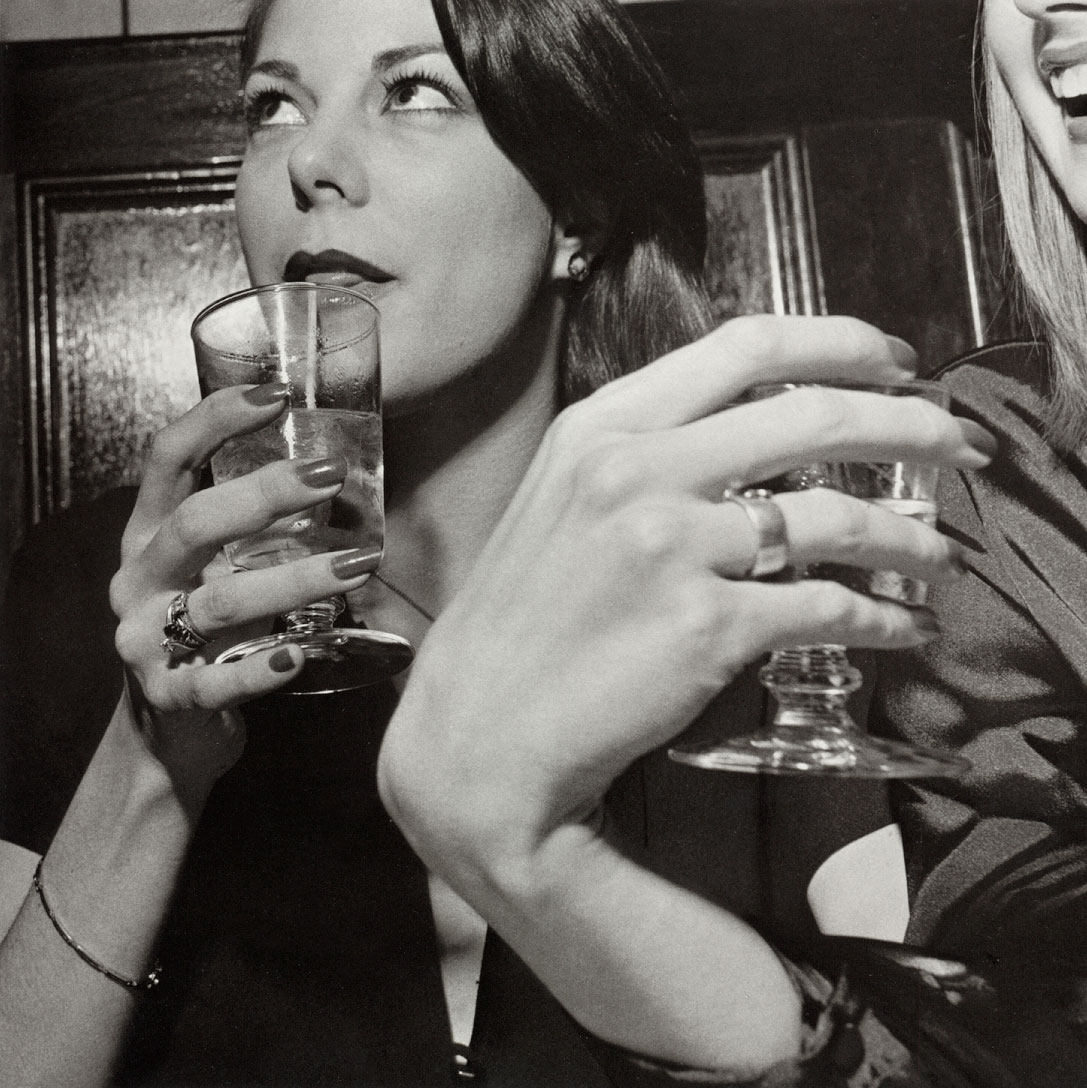
Larry Fink (American, 1941-2023) N.Y.C. Club Cornich, from the portfolio 82 Photographs 1974 to 1982 1977; printed 1983 Silver gelatin print, 28/30 Gift of Diane and Eric Pearlman
Larry Fink (American, 1941-2023) Peter Beard’s, East Hampton, from the portfolio 82 Photographs 1974 to 1982 1982; printed 1983 Silver gelatin print, 28/30 Gift of Diane and Eric Pearlman
Larry Fink is a prominent American photographer who is best known for capturing images of high-profile social events. Fink’s images from the 1970s and 1980s capture individual vignettes within social gatherings, and nod to the development of documentary photography within the image-driven culture of the second half of the twentieth century. These photographs from Fink’s series 82 Photographs 1974 to 1982 and Making Out 1957-1980 depict scenes from clubs and parties in and around New York City. Fink’s subjects are caught off-guard by his camera, and their expressions provide windows into their weariness or giddy party euphoria. Capturing groups and individuals at surprisingly intimate and vulnerable moments, his photographs subtly reveal the disconnect often found between a subject’s public image and his or her inner self. For example, in Peter Beard’s, East Hampton, Fink captures a dynamic group of people in various levels of engagement with one another. While some are intertwined, others glance outward to the party beyond, having seemingly lost interest in the gathering at hand.
Tod Papageorge (American, b. 1940) Studio 54 1977 Silver gelatin print Gift of Pete and Constance Kayafas
In this photograph, Tod Papageorge captures revellers in gritty black and white, employing straightforward photography to show significant, poetic moments from everyday life. Highlighted by the timeless quality of a silver gelatin print, his photograph of partygoers at the infamous New York City nightclub, Studio 54, captures such a scene. Dramatic without arranging its subjects, Papageorge’s photograph freezes the precise moment just before the woman’s upstretched hand makes contact with balloon floating wistfully above her head.
Phillip Maisel (American, b. 1981) Wall Photos, from the series A More Open Place 2010 Archival inkjet print Courtesy of the artist
Phillip Maisel (American, b. 1981) Profile Pictures (4702), from the series A More Open Face 2011 Archival inkjet print Courtesy of the artist
Phillip Maisel’s photographs are layered, ethereal images that evoke the fleeting nature of memories. Though nostalgic in tone, these images derive from a very contemporary source. Setting long exposures on his camera, the artist captures the images appearing on his computer screen as he clicked through his friends’ Facebook albums. The resulting picture-of-pictures is twice removed from its source, emphasising the swollen state of image culture and the manner in which digital images are created, uploaded, and discarded at an ever increasing rate.
The title of these series derives from Facebook founder Mark Zuckerberg, who noted that, through the social media platform, he was trying “to make the world a more open place.” Facebook and other sites have certainly achieved that; however, this extreme openness, the compulsion to over-share personal images and information, creates a paradox given the subsequent lack of privacy inherent in these activities. Maisel’s work comments on this contemporary phenomenon in which individuals willingly share images of their private memories in public venues. Furthermore, by reducing a collection of images to a single photograph, the artist manifests the compression of time and space in the internet age. This layering of images is also a form of erasure; each new image obscures the last, consistently degrading the significance of each individual picture and memory.
Neal Slavin (American, b. 1941) Capitol Wrestling Corporation, Washington, D.C ., from the portfolio Groups in America 1979 Color coupler print, 60/75 Gift of Stephen L. Singer and Linda G. Singer
Neal Slavin is acclaimed for his group portraits, which range from corporate associates to recreational cohorts to families. The photographs on display offer astute yet humorous studies of groups with specific shared interests that lay at the edges of societal norms. In Slavin’s images, no single member of the group pulls focus from the others and the ultimate personality of the portrait hinges upon the collective aura.
Andy Warhol (American, 1928-1987) The Little Red Book 128 1972 Twenty Polacolor Type 108 Polaroid prints Gift of The Andy Warhol Foundation for the Visual Arts, Inc. 2014
Examples of Polaroids in book. 20 total.
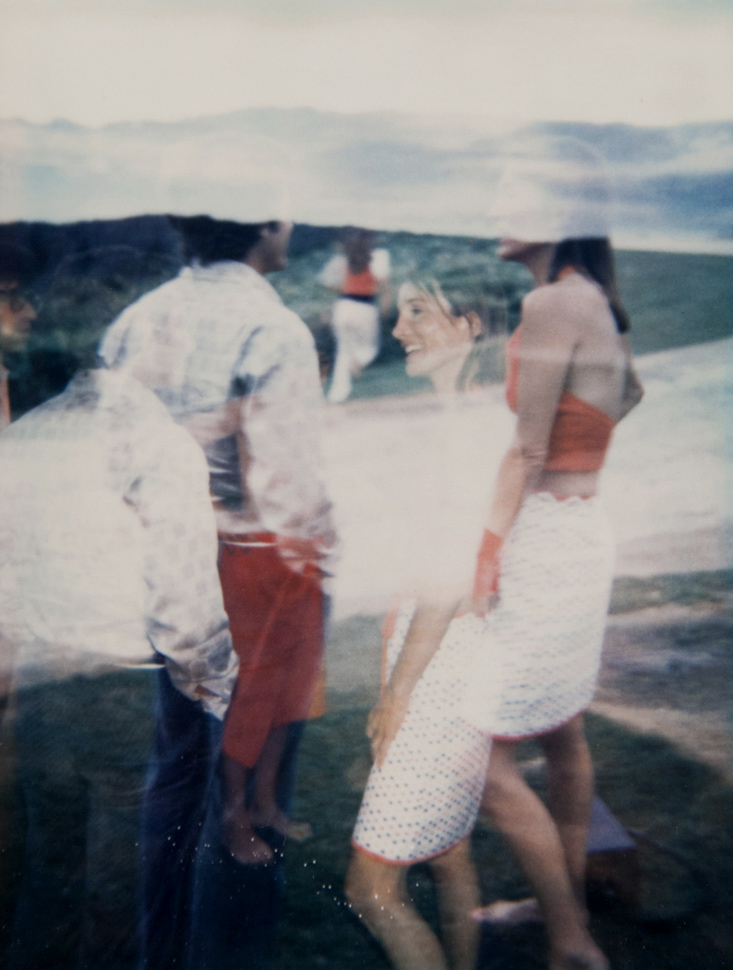
During the 1970s and early 1980s, Andy Warhol used the Polaroid colour film camera. A then-novel technology which developed photographs in a matter of seconds, he employed it to document the events of his life – from the most glamorous celebrity parties to the most mundane and inconsequential occurrences. Warhol catalogued many of these photographs into small red Holston Polaroid albums, consequently known as Little Red Books. DeCordova’s Little Red Book 128, recently donated to the museum by The Warhol Foundation, features twenty photographs from a day in 1972 that Warhol shared with acclaimed writer Truman Capote, socialite Lee Radziwill and her family, and his business associates Vincent Fremont, Fred Hughes, and Jed Johnson. Consisting of both staged portraits and casual snapshots, the book is part paparazzi portfolio and part quaint family album.
Throughout the height of his fame, Andy Warhol was rarely without a camera in hand. The enigmatic artist often preferred social situations to be passively mitigated by his camera lens, rather than experienced physically and emotionally. In many ways, Warhol’s detachment mirrors a contemporary reliance on electronic forms of communication that limit human contact. Warhol once said, “In the future, everyone will be world – famous for 15 minutes.” Unsurprisingly, in all his work and in this collection of Polaroids, the artist blurs the lines between public / private and commoner / celebrity in a manner which is eerily prophetic of current social media platforms, such as Facebook, Twitter, Instagram, YouTube, among others, which allow anyone and everyone to have their Warholian 15 minutes of fame, or perhaps even just 15 seconds of infamy.
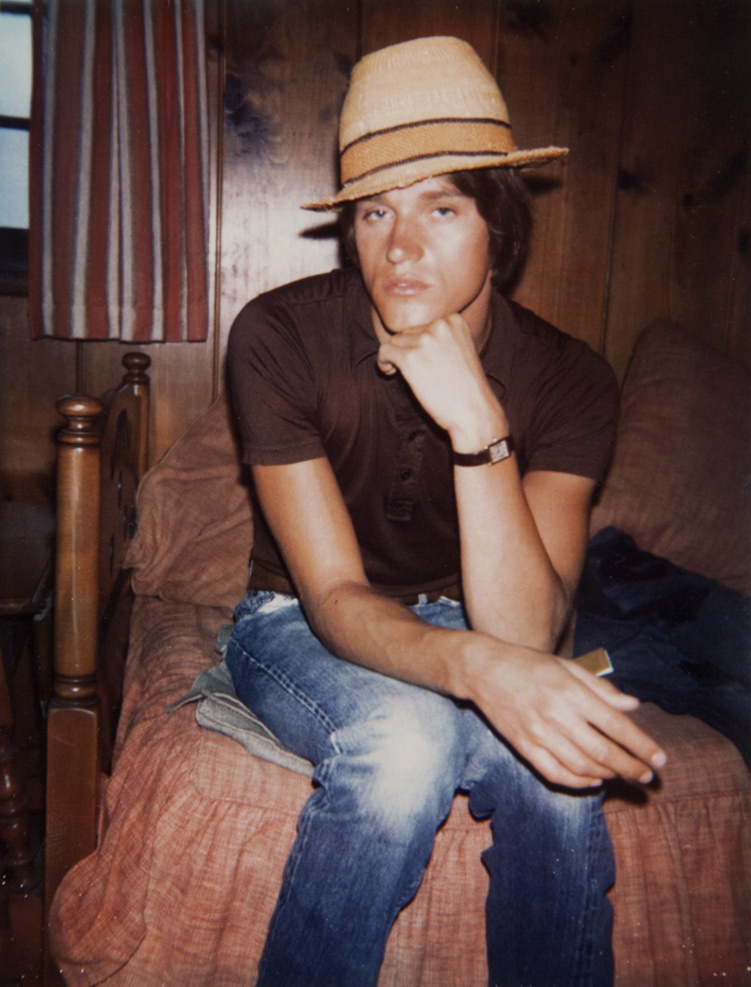
Andy Warhol (American, 1928-1987) Anthony Radziwill 1972 Polacolor Type 108 Polaroid print
Prince Anthony Stanislaw Albert Radziwill (American, 1959-1999)
Prince Anthony Stanislaw Albert Radziwill (4 August 1959 – 10 August 1999) was an American television executive and filmmaker.
Born in Lausanne, Switzerland, Radziwill was the son of socialite / actress Caroline Lee Bouvier (younger sister of First Lady Jacqueline Lee Bouvier) and Polish Prince Stanisław Albrecht Radziwiłł. He married a former ABC colleague, Emmy Award-winning journalist Carole Ann DiFalco, on 27 August 1994 on Long Island, New York.
As a member of the Radziwills, one of Central Europe’s noble families, Anthony Radziwill was customarily accorded the title of Prince and styled His Serene Highness, although he never used it. He descended from King Frederick William I of Prussia, King George I of Great Britain, and King John III Sobieski of Poland. The family’s vast hereditary fortune was lost during World War II, and Anthony’s branch of the family emigrated to England, where they became British subjects.
Radziwill’s career began at NBC Sports, as an associate producer. During the 1988 Summer Olympics in Seoul, he contributed Emmy Award-winning work. In 1989, he joined ABC News as a television producer for Prime Time Live. In 1990, he won the Peabody Award for an investigation on the resurgence of Nazism in the United States.Posthumously, Cancer: Evolution to Revolution was awarded a Peabody.His work was nominated for two Emmys.
Around 1989 he was diagnosed with testicular cancer, undergoing treatment which left him sterile, but in apparent remission. However, shortly before his wedding, new tumours emerged. Radziwill battled metastasising cancer throughout his five years of marriage, his wife serving as his primary caretaker through a succession of oncologists, hospitals, operations and experimental treatments. The couple lived in New York, and both Radziwill and his wife tried to maintain their careers as journalists between his bouts of hospitalisation. During this period, Radziwill became especially close to his aunt Jacqueline Kennedy Onassis, who was also terminally ill with cancer. He died on 10 August 1999, and was survived by his sister, Anna Christina Radziwill.
Andy Warhol (American, 1928-1987) Lee Radziwill 1972 Polacolor Type 108 Polaroid print
Andy Warhol (American, 1928-1987) Jed Johnson 1972 Polacolor Type 108 Polaroid print
Jed Johnson (December 30, 1948 – July 17, 1996) was an American interior designer and film director. Initially hired by Andy Warhol to sweep floors at Warhol’s Factory, he subsequently moved in with Warhol and became his lover.As a passenger in the First Class cabin, he was killed when TWA Flight 800 exploded shortly after takeoff in 1996.
Andy Warhol (American, 1928-1987) Truman Capote 1972 Polacolor Type 108 Polaroid print
deCordova Sculpture Park and Museum 51 Sandy Pond Rd, Lincoln, MA 01773, United States Phone: +1 781-259-8355
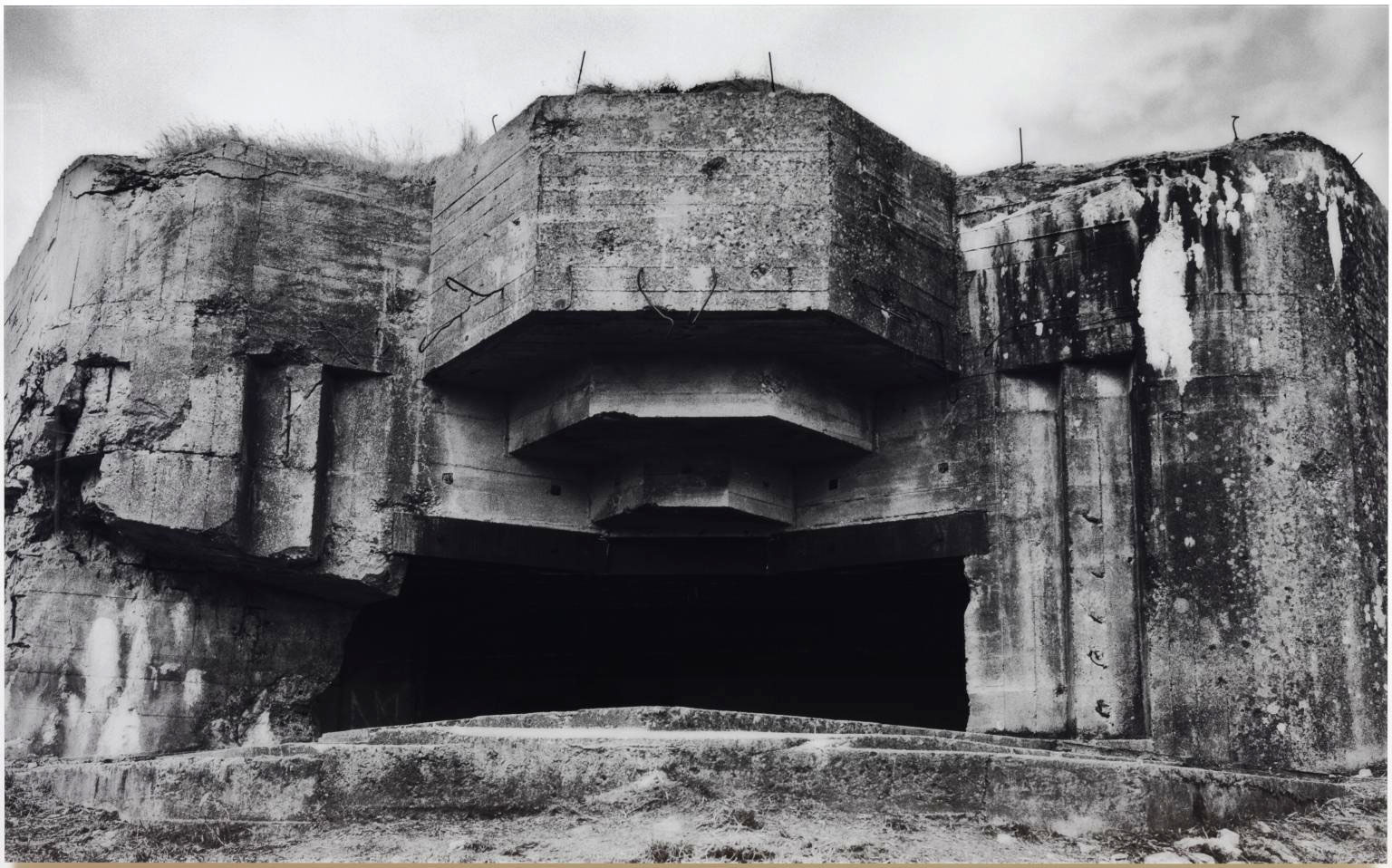
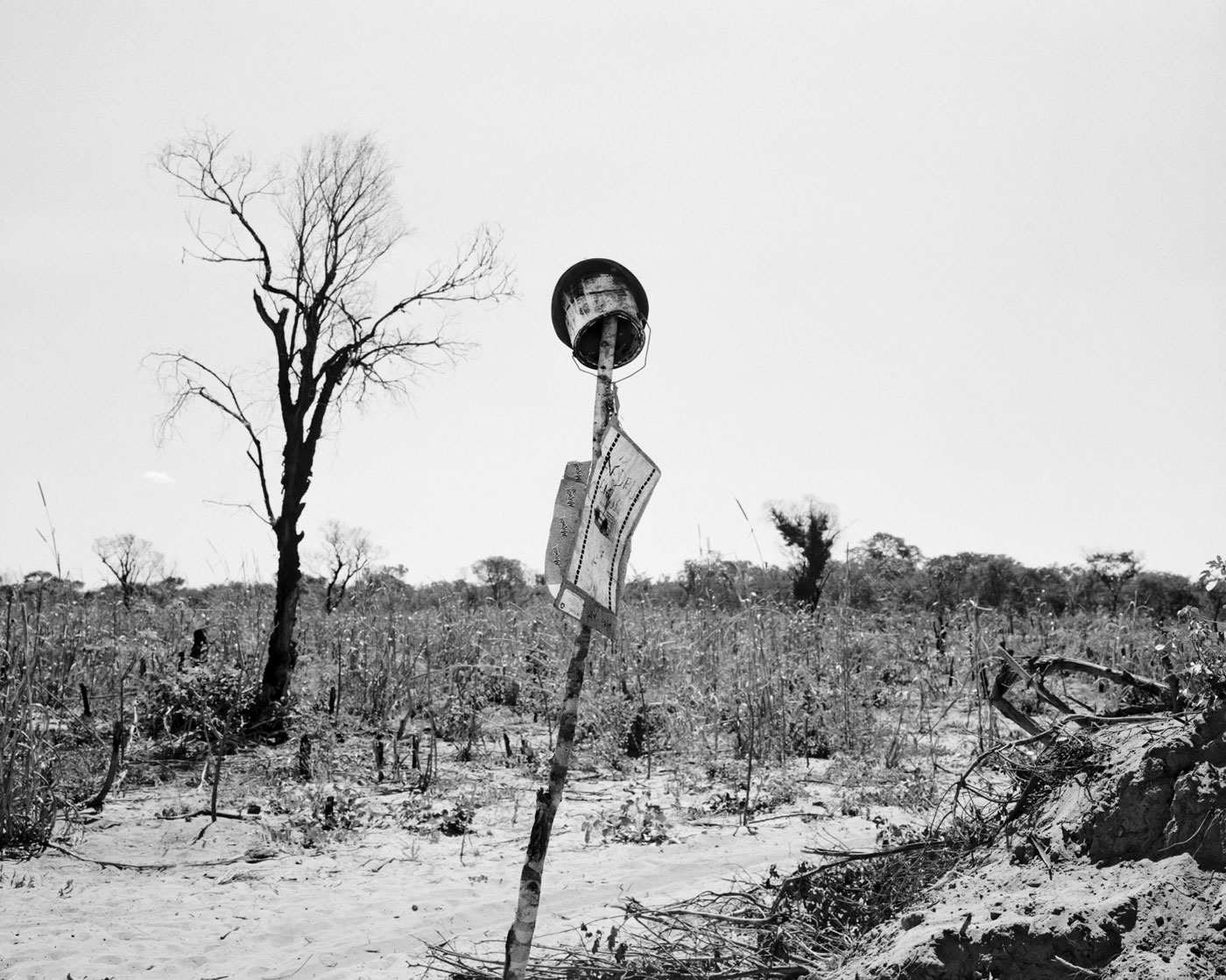
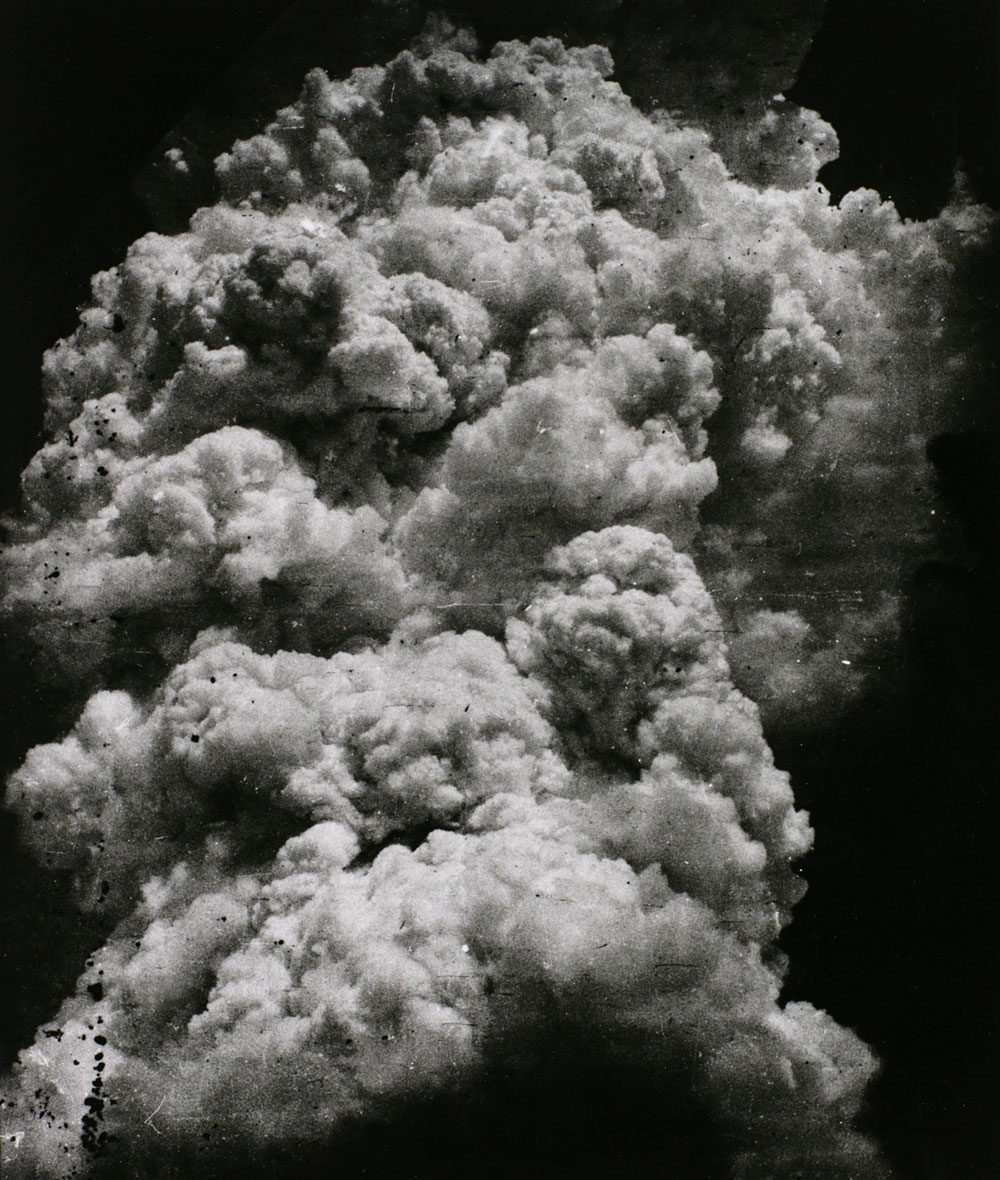
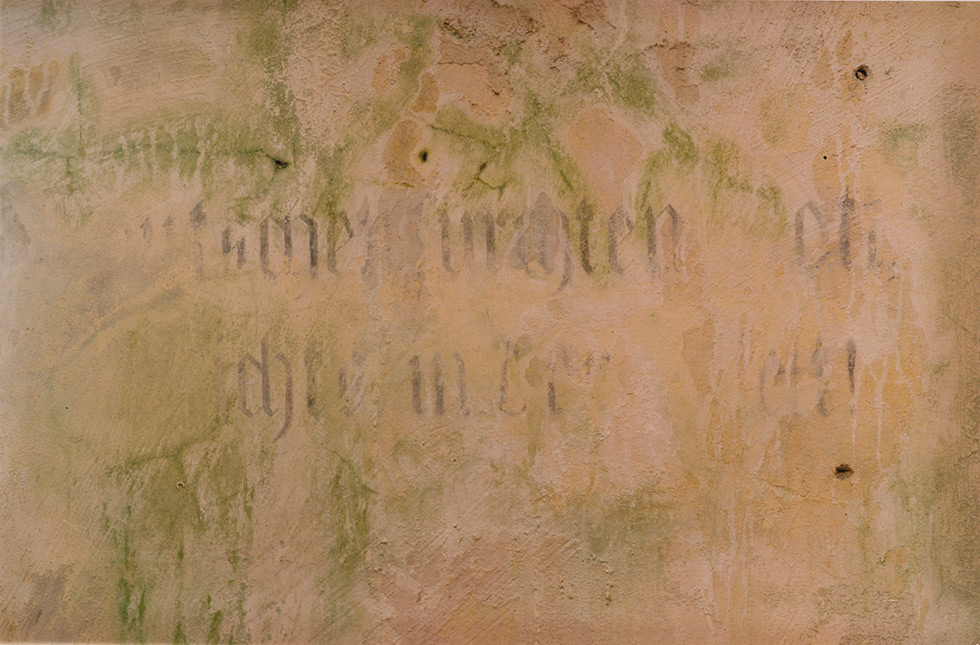
Artists: Jules Andrieu, Pierre Antony-Thouret, Nobuyoshi Araki, George Barnard, Adam Broomberg and Oliver Chanarin, Luc Delahaye, Ken Domon, Roger Fenton, Ernst Friedrich, Jim Goldberg, Toshio Fukada, Kenji Ishiguro, Kikuji Kawada, An-My Lê, Jerzy Lewczyński, Emeric Lhuisset, Agata Madejska, Diana Matar, Eiichi Matsumoto, Chloe Dewe Mathews, Don McCullin, Susan Meiselas, Kenzo Nakajima, Simon Norfolk, João Penalva, Richard Peter, Walid Raad, Jo Ratcliffe, Sophie Ristelhueber, Julian Rosefeldt, Hrair Sarkissian, Michael Schmidt, Ursula Schulz-Dornburg, Indre Šerpytyte, Stephen Shore, Harry Shunk and János Kender, Taryn Simon, Shomei Tomatsu, Hiromi Tsuchida, Marc Vaux, Paul Virilio, Nick Waplington, Jane and Louise Wilson, and Sasaki Yuichiro.
Curators: Simon Baker, Curator Photography and International Art, Shoair Mavlian, Assistant Curator, and Professor David Alan Mellor, University of Sussex
Roger Fenton (British, 1819-1869) The Valley of the Shadow of Death 1855
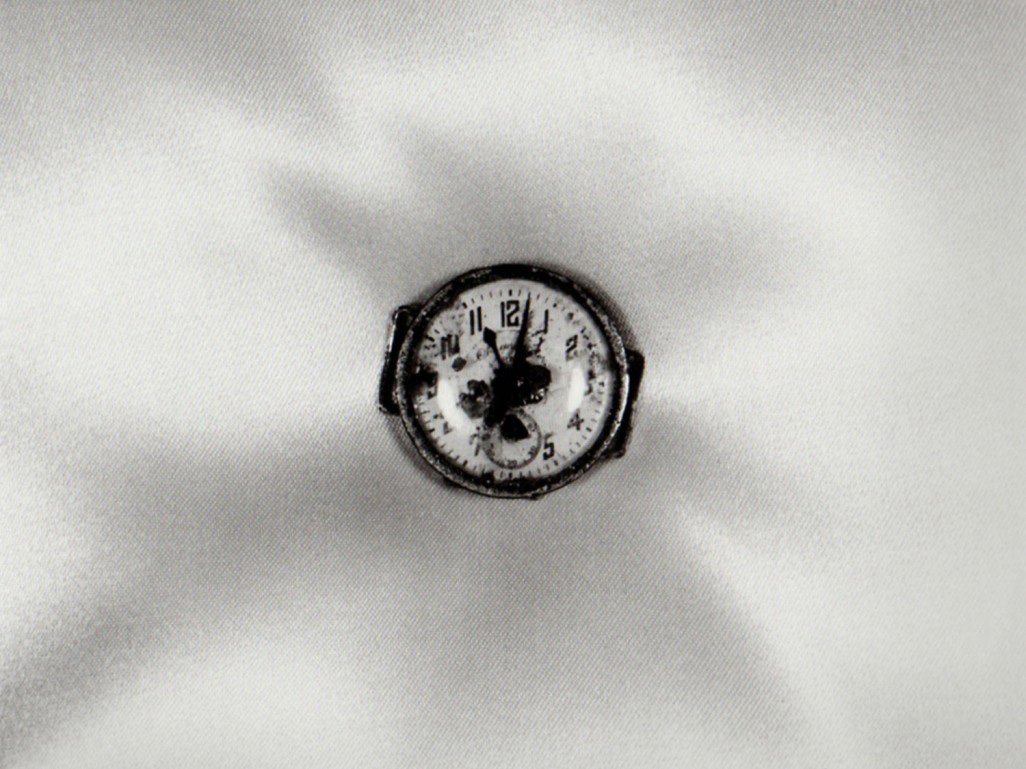
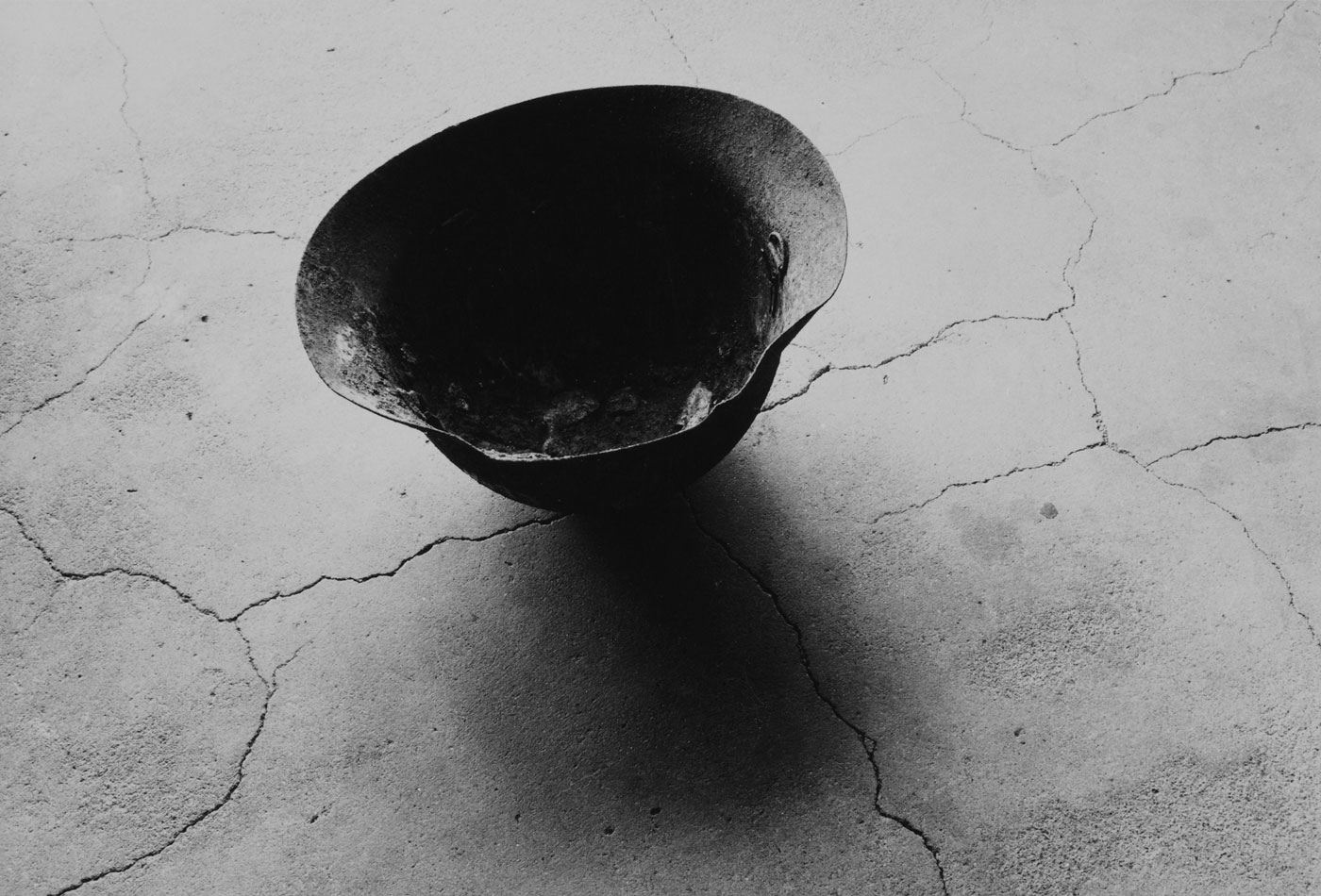
Another fascinating exhibition. The concept, that of vanishing time, a vanquishing of time – inspired by Kurt Vonnegut’s 1969 novel Slaughterhouse-Five and the Japanese photographer Kikuji Kawada’s 1965 photobook The Map – is simply inspired. Although the images are not war photography per se, they are about the lasting psychological effects of war imaged on a variable time scale.
While the images allow increasing passages of time between events and the photographs that reflect on them – “made moments after the events they depict, then those made days after, then months, years and so on” – there settles in the pit of the stomach some unremitting melancholy, some unholy dread as to the brutal facticity and inhumanness of war. The work which “pictures” the memory of the events that took place, like a visual ode of remembrance, are made all the more powerful for their transcendence – of time, of death and the immediate detritus of war.
Dr Marcus Bunyan
Many thankx to the Tate Modern for allowing me to publish the photographs in the posting. Please click on the photographs for a larger version of the image.
“… taking its cue from Vonnegut, ‘Conflict, Time, Photography’ is arranged differently, following instead the increasing passages of time between events and the photographs that reflect on them. There are groups of works made moments after the events they depict, then those made days after, then months, years and so on – 10, 20, 50, right up to 100 years later.”
Simon Baker
Shomei Tomatsu (Japanese, 1930-2012) Atomic Bomb Damage – Wristwatch Stopped at 11.02, August 9, 1945, Nagasaki 1961 Gelatin silver print on paper 253 x 251mm Tokyo Metropolitan Museum of Photography, Tokyo
Shomei Tomatsu (Japanese, 1930-2012) Steel Helmet with Skull Bone Fused by Atomic Bomb, Nagasaki 1963 Gelatin silver print on paper 226 x 303mm Tokyo Metropolitan Museum of Photography, Tokyo
“From the seconds after a bomb is detonated to a former scene of battle years after a war has ended, this moving exhibition focuses on the passing of time, tracing a diverse and poignant journey through over 150 years of conflict around the world, since the invention of photography.
In an innovative move, the works are ordered according to how long after the event they were created from moments, days and weeks to decades later. Photographs taken seven months after the fire bombing of Dresden are shown alongside those taken seven months after the end of the First Gulf War. Images made in Vietnam 25 years after the fall of Saigon are shown alongside those made in Nakasaki 25 years after the atomic bomb. The result is the chance to make never-before-made connections while viewing the legacy of war as artists and photographers have captured it in retrospect…
The exhibition is staged to coincide with the 2014 centenary and concludes with new and recent projects by British, German, Polish and Syrian photographers which reflect on the First World War a century after it began.”
Text from the Tate Modern website
“The original idea for the Tate Modern exhibition Conflict, Time, Photography came from a coincidence between two books that have captivated and inspired me for many years: Kurt Vonnegut‘s classic 1969 novel Slaughterhouse-Five and the Japanese photographer Kikuji Kawada’s 1965 photobook The Map. Both look back to hugely significant and controversial incidents from the Second World Warfrom similar distances.
Vonnegut was a prisoner of war in Dresden when what he called ‘possibly the world’s most beautiful city’ was destroyed by incendiary bombs, and struggled to write his war book for almost 25 years. Kawada was a young photographer working in post-war Hiroshima when he began to take the strange photographs of the scarred, stained ceiling of the A-bomb Dome – the only building to survive the explosion – that he would eventually publish on August 6 1965, 20 years to the day since the atomic bomb was dropped on the city.
It may seem odd that these great works of art and literature took so long to emerge from the aftermath of the events they concern. But many of the most complex and considered accounts of conflict have taken their time. To Vonnegut’s painfully slow response to the war, for example, we might add Joseph Heller’s brilliantly satirical Catch-22, published in 1961, and, even more significantly, JG Ballard’s memorial masterpiece Empire of the Sun, which did not see the light of day until 1984.
And today, in 2014, 100 years since the start of the First World War, it seems more important than ever not only to understand the nature and long-term effects of conflict, but also the process of looking back at the past…”
Extract from Simon Baker. “War photography: what happens after the conflict?” on The Telegraph website, 7th November 2014 [Online] Cited 09/02/2015. Used under fair use conditions for the purposed of education and research
An-My Lê (Vietnamese-American, b. 1960) Untitled, Hanoi 1994-1998 Gelatin silver print on paper 508 x 609mm Courtesy the artist and Murray Guy, New York
Jane Wilson (British, b. 1967) Louise Wilson (British, b. 1967) Urville 2006 Gelatin silver print, mounted onto aluminium 1800 x 1800mm Tate Purchased 2011
Jane Wilson (British, b. 1967) Louise Wilson (British, b. 1967) Azeville 2006 Gelatin silver print, mounted onto aluminium 1800 x 2900mm Tate Purchased 2011
Jo Ractliffe (South African, b. 1961) As Terras do fim do Mundo (The Lands of the End of the World) 2009-2010 Courtesy Mark McCain collection
“At first glance, Jo Ractliffe’s black-and-white shots of sun-baked African landscapes look random and bland: rocks, dirt, scrubby trees; some handwritten signs but no people. Only when reading the titles – “Mass Grave at Cassinga,” “Minefield Near Mupa” – do you learn where the people are, or once were, and the pictures snap into expressive focus.
Ms. Ractliffe, who lives in Johannesburg, took the photographs in 2009 and 2010 in Angola on visits to now-deserted places that were important to that country’s protracted civil war and to the intertwined struggle of neighbouring Namibia to gain independence from South Africa’s apartheid rule. South Africa played an active role in both conflicts, giving military support to insurgents who resisted Angola’s leftist government, and hunting down Namibian rebels who sought safety within Angola’s borders.
It’s through this historical lens that Ms. Ractliffe views landscape: as morally neutral terrain rendered uninhabitable by terrible facts from the past – the grave of hundreds of Namibia refugees, most of them children, killed in an air raid; the unknown numbers of land mines buried in Angola’s soil. Some are now decades old but can still detonate, so the killing goes on.”
My first published photo book, The Map, took me five years to complete, beginning in 1960. In late 1961 a solo show with work from the series was held at Fuji Photo Salon in Tokyo, organised in three parts.
The first featured a ruined castle that was blown up intentionally by the Japanese army during the Second World War. The second comprised photographs taken a decade after the atomic bomb exploded in Hiroshima. They showed the stains and flaking ceilings of the Atomic Bomb Dome, the only structure left standing at the heart of the detonation zone. The third part concerned Tokyo during the period of economic recovery: images of advertising, scrap iron, the trampled national flag and emblems of the American Forces such as Lucky Strike and Coca-Cola, all twisted together, their order shuffled again and again. Some appeared as a montage to be presented as a metaphor. I dare not say the meaning of it.
These works led me to attempt to create this photographic book, using the notion of the map as a clue to the future and to question the whereabouts of my spirit. Discarded memorial photographs, a farewell note, kamikaze pilots – the illusions of various maps that emerge are to me like a discussion with the devil. The stains are situated as a key image of the series by drawing a future stratum and sealing the history, the nationality, the fear and anxiety of destruction and prosperity. It was almost a metaphor for the growth and the fall.
On the back of the black cover box are written rhyming words that are almost impossible to read. The front cover shows that the words are about to burn out. Inside, the pages are laid out as hinged double fold-out spreads. The repetition of the act of opening and closing makes the images appear and disappear. I wanted to have a book design as a new object and something that goes beyond the contents. With the rich and chaotic nature of monochrome, it might be that I tried to find my early style within the illusion of reality by abstracting the phenomenon. As an observer, I would like to keep forcing myself into the future, never losing the sense of danger which emerges in the conflicts of daily life. I wish to harmonise my old distorted maps with the heartbeat of this exhibition at Tate Modern, twisting across the bridges of the centuries through conflicting space and time.
Conflict, Time, Photography brings together photographers who have looked back at moments of conflict, from the seconds after a bomb is detonated to 100 years after a war has ended. Staged to coincide with the centenary of the First World War, this major group exhibition offers an alternative to familiar notions of war reportage and photojournalism, instead focusing on the passing of time and the unique ways that artists have used the camera to reflect on past events.
Conflicts from around the world and across the modern era are depicted, revealing the impact of war days, weeks, months and years after the fact. The works are ordered according to how long after the event they were created: images taken weeks after the end of the American Civil War are hung alongside those taken weeks after the atomic bombs fell on Japan in 1945. Photographs from Nicaragua taken 25 years after the revolution are grouped with those taken in Vietnam 25 years after the fall of Saigon. The exhibition concludes with new and recent projects by British, German, Polish and Syrian photographers which reflect on the First World War a century after it began.
The broad range of work reflects the many different ways in which conflict impacts on people’s lives. The immediate trauma of war can be seen in the eyes of Don McCullin’s Shell-shocked US Marine 1968, while the destruction of buildings and landscapes is documented by Pierre Antony-Thouret’s Reims After the War (published in 1927) and Simon Norfolk’s Afghanistan: Chronotopia 2001-2002. Other photographers explore the human cost of conflict, from Stephen Shore’s account of displaced Jewish survivors of the Second World War in the Ukraine, to Taryn Simon’s meticulously researched portraits of those descended from victims of the Srebrenica massacre.
Different conflicts also reappear from multiple points in time throughout the exhibition, whether as rarely-seen historical images or recent photographic installations. The Second World War for example is addressed in Jerzy Lewczyński’s 1960 photographs of the Wolf’s Lair / Adolf Hitler’s War Headquarters, Shomei Tomatsu’s images of objects found in Nagasaki, Kikuji Kawada’s epic project The Map made in Hiroshima in the 1960s, Michael Schmidt’s Berlin streetscapes from 1980, and Nick Waplington’s 1993 close-ups of cell walls from a Prisoner of War camp in Wales.
As part of Conflict, Time, Photography, a special room within the exhibition has been guest-curated by the Archive of Modern Conflict. Drawing on their unique and fascinating private collection, the Archive presents a range of photographs, documents and other material to provide an alternative view of war and memory.
Conflict, Time, Photography is curated at Tate Modern by Simon Baker, Curator of Photography and International Art, with Shoair Mavlian, Assistant Curator, and Professor David Mellor, University of Sussex. It is organised by Tate Modern in association with the Museum Folkwang, Essen and the Staatliche Kunstsammlungen, Dresden, where it will tour in spring and summer 2015 respectively. The exhibition is also accompanied by a fully-illustrated catalogue from Tate Publishing and a programme of talks, events and film screenings at Tate Modern.
Susan Meiselas (American, b. 1948) Managua, July 2004 2004 From the series Reframing History
“Cuesto del Plomo,” hillside outside Managua, a well-known site of many assassinations carried out by the National Guard. People searched here daily for missing persons. July 1978, from the series, “Reframing History,” Managua, July 2004
In July 2004, for the 25th anniversary of the overthrow of Somoza, Susan returned to Nicaragua with nineteen mural-sized images of her photographs from 1978-1979, collaborating with local communities to create sites for collective memory. The project, “Reframing History,” placed murals on public walls and in open spaces in the towns, at the sites where the photographs were originally made.
Reframing History: Excerpt, Bus (2004)
Nick Waplington (British, b. 1965) Untitled 1993 From the series We Live as We Dream, Alone
Nick Waplington’s deeply moving and once controversial photographs of the cells of Barry Island prison, where Nazi SS Officers were held prisoner before the Nuremburg trials, were taken in 1993, almost 50 years after the prisoners had embellished the cell walls with Germanic slogans and drawings of pin-up girls and Bavarian landscapes will be displayed. The half-century that elapsed between the photographs and the creation of their subject is grim testament to the enduring legacy of conflict…
“In 1992 I was commissioned to make work by the Neue galerie in Graz, Austria and the theme was war or “krieg” as it is in German. Graz is on the border with Yugoslavia and there was war in Yugoslavia at the time. I think they were hoping that I would make something to do with the war that was taking place between Croatia and Serbia and Bosnia. I did go to the war; you went to Zagreb and got a UN pass and went in to the war zone. It was very interesting to be taken into the war zone but ultimately I got back to England and I decided – to the annoyance of the gallery – that I was thinking about Austria instead. At the time, the president of Austria, Kurt Waldheim, had been exposed as a member of the SS and had been informing Yugoslavia during the war [World War Two] and the Austrians were very unconcerned about this. I thought I’d much prefer to make work that had the Austrians confronting their Nazi past rather than about the current conflict. I knew about the prison in Barry Island in South Wales where the SS were held before they were sent to Nuremberg for the trial and I started taking a series of photographs in the prison. It was lucky that I did because it was demolished the following year by the MOD. It’s gone now. When I got there, I saw the prisoners had been drawing on the walls. They’re mossy and crumbling but you can see Germanic lettering and Bavarian landscapes and women with 1940s haircuts. They are evocative and powerful given the emotive history. “
Extract from Elliot Watson. “Nick Waplington: Conflict, Rim, Photography,” on the Hunger TV website, 26th November 2014 [Online] Cited 09/02/2015. No longer available online. Used under fair use conditions for the purposed of education and research
Sophie Ristelhueber (French, b. 1949) Fait #25 1992 71 photographs, gelatin silver prints mounted on aluminium Object, each: 1000 x 1240 x 50mm National Gallery of Canada, Ottawa. Purchased 2013
Sophie Ristelhueber (French, b. 1949) Fait #44 1992 71 photographs, gelatin silver prints mounted on aluminium Object, each: 1000 x 1240 x 50mm National Gallery of Canada, Ottawa. Purchased 2013
Sophie Ristelhueber (French, b. 1949) Fait #46 1992 71 photographs, gelatin silver prints mounted on aluminium Object, each: 1000 x 1240 x 50mm National Gallery of Canada, Ottawa. Purchased 2013
Luc Delahaye (French, b. 1962) US Bombing on Taliban Positions 2001 C-print 238.6 x 112.2cm Courtesy Luc Delahaye and Galerie Nathalie Obadia, Paris/Bruxelles
“This is a challenge still faced by photographers today. Two years ago, the British documentary photographer Chloe Dewe Mathews set about creating a series of her own responding to the World War One. Called Shot at Dawn, it expresses her shock upon discovering that during the conflict around a thousand British, French and Belgian troops were condemned for cowardice or desertion before being executed the following morning by firing squads consisting of comrades from their own battalions. “I never knew this happened,” she tells me. “Until quite recently, no one really talked about it, because the subject was so contentious and taboo.”
Researching her series, Dewe Mathews worked closely with academics to locate the forgotten places along the western front where these unfortunate combatants had been shot. She then travelled to each spot and set up her camera there at dawn, recording whatever could be seen a century after the executions had taken place.
The results are eerie and elegiac – otherwise unremarkable, empty landscapes infused with a powerful sense of mourning, outrage and loss.”
Stephen Shore (American, b. 1947) Tzylia Bederman, Bucha, Ukraine, July 18, 2012 2012 Courtesy of Stephen Shore
Pierre Anthony-Thouret (French, 1861-1926) Plate I 1927 from Reims after the war. The mutilated cathedral. The devastated city. Private collection, London
The limits of realism
“So how can photographers respond to conflict if not by employing strategies commonly found in photojournalism about war? One alternative approach is to focus less on documenting the heat of battle and more on remembrance – something that feels relevant this year, which marks the centenary of the start of the World War One.
Some of the most moving evocations of the Great War were captured by commercial photographers who arrived in northeast France in the wake of the conflict, when people began travelling to the region in order to see for themselves the extent of the devastation of local villages, towns, and cities. There was enormous appetite for images recording the destruction, available in the form of cheap guidebooks and postcards.
“This is one of the first episodes of mass tourism in the history of the world,” explains [curator Simon] Baker. “There were 300 million postcards sent from the western front, for instance by people visiting the places where their relatives had died. And the photographers had to make these incredible compromises: making photographs of places that weren’t there anymore.”
In the case of Craonne, which was entirely obliterated by artillery, the village had to be rebuilt on a nearby site, while the ruins of the original settlement were abandoned to nature. As a result, the only way for photographers to identify Craonne was by providing a caption.
“The idea of photographing absence became really important,” says Baker. “War is about destruction, removing things, disappearance. A really interesting photographic language about disappearance in conflict emerged and it is extremely powerful. How does one record something that is gone?””
Pierre Anthony-Thouret (French, 1861-1926) Plate XXXVIII 1927 from Reims after the war. The mutilated cathedral. The devastated city. Private collection, London
Tate Modern Bankside London SE1 9TG United Kingdom
A photographic revolution. So much more than just photojournalism… and it has a nice sound as well.
“Indiscreet discretion” as the photographer F. C. Gundlach puts it.
There are some memorable photographs here.
Marcus
Many thankx to the Deichtorhallen Hamburg for allowing me to publish the photographs in the posting. Please click on the photographs for a larger version of the image.
Just a few months before the outbreak of the First World War, Ernst Leitz II travelled to the USA. While there, he was able to capture photos, using a second model of the “Liliput” camera developed by Oskar Barnack, which most certainly would be found in a history of street photography.
From around the time of 1914, Oskar Barnack must have carried a prototype camera with him, particularly during his travels – the camera first received the name Leica in 1925. Perhaps his most famous sequence of images, because it has been shown continually since, is the striking series of the floods in Wetzlar, Germany, in 1920
Designed by Oskar Barnack, the first functional prototype of a new camera for 35 mm perforated cinema film stock was completed in March 1914. The camera consisted of a metal housing, had a retractable lens and a focal plane shutter, which is not overlapped, however. A bolt-on lens cap that was swivelled during film transport, prevented incidental light. For the first time film advance and shutter cocking were connected to a camera – double exposures were excluded. The camera has gone down in the history of photography under the name Ur-Leica.
Henri Cartier-Bresson (French, 1908-2004) Behind the Gare Saint-Lazare, Paris
1932
Gelatin silver print
Alexander Rodchenko (Russian, 1891-1956) Girl with Leica
1934
Gelatin silver print
Jewgenija Lemberg, shown here, was a lover of the photographer Alexander Rodchenko for quite some time. In 1992, a print of this photo brought in a tremendous 115,000 British pounds at a Christie’s auction in London. Alexander Rodchenko was continually capturing Jewgenija Lemberg in new, surprising and bold poses – until her death in a train accident.
Robert Capa (Hungarian-American, 1913-1954) Loyalist Militiaman at the Moment of Death, Cerro Muriano, September 5, 1936 1936
Gelatin silver print
At the age of 23 and equipped with his Leica, Robert Capa embedded himself in the Spanish Civil War while on assignment for the French press. On 5 September 1936, he managed to capture the perhaps most well-known war photo of the 20th century.
Henri Cartier-Bresson (French, 1908-2004) Sunday on the banks of the River Marne
Juvisy, France 1938
Gelatin silver print
This photo was taken two years after the large-scale strikes that ultimately led to a fundamental improvement in social conditions. Against this backdrop, the picnic in nature is also, above all, a political message – convincing in a formal, aesthetic way, and inherently consistent and suggestive at the same time.
Although this scene was staged, it loses none of its impact as an image and in no way hampers the resounding global response that it has achieved. The Red Army prevailed – there’s nothing more to convey in such a harmonious picture.
This photo appeared on the cover of Life magazine and grew to become one of Alfred Eisenstaedt’s most well-known images. “People tell me,” he once said, “that when I am in heaven they will remember this picture.”
W. Eugene Smith (American, 1918-1978) Guardia Civil, Spain
1950 Gelatin silver print
25.1 x 32.1 cm
W. Eugene Smith’s image of Guardia Civil is also a symbol of an imperious, backward Spain under the rule of Franco. For two months, W. Eugene Smith went scouting for a village and photographed it with the residents’ consent. What he shows us is a strange world: rural, archaic, as if on another planet.
Inge Morath (American born Austria, 1923-2002) London
1950
Gelatin silver print
Inge Morath’s photo titled “London” is well spotted, clearly composed and yet complicated in its arrangement. It also tells of a structure of domination, of hierarchies and traditions which certainly were more stable in England than in other European countries.
We shall never discover who the man is in this photo. Franz Hubmann, more or less while walking by the table, captured the guest gently balancing a cup with the tips of his fingers – viewed from above without the use of flash, without any hectic movement, and not at all staged.
Frank Horvat (French, 1928-2020) Givenchy Hat For Jardin des Modes, Paris
1958
Gelatin silver print
Abzug 1995 / Haus der Photographie / Sammlung F.C. Gundlach Hamburg
The exhibition EYES WIDE OPEN: 100 YEARS OF LEICA PHOTOGRAPHY illuminates across fourteen chapters various aspects of recent small-format photography, from journalistic strategies to documentary approaches and free artistic positions, spanning fourteen chapters. Among the artists whose work will be shown are Alexander Rodchenko, Henri Cartier-Bresson, Robert Capa, Christer Strömholm, Robert Frank, Bruce Davidson, William Klein, William Eggleston, René Burri, Thomas Hoepker and Bruce Gilden. Following its premiere in the House of Photography at the Deichtorhallen Hamburg, the exhibition will travel to Frankfurt, Berlin, Vienna and Munich.
Some 500 photographs, supplemented by documentary material, including journals, magazines, books, advertisements, brochures, camera prototypes and films, will recount the history of small-format photography from its beginnings to the present day. The exhibition, which is curated by Hans-Michael Koetzle, follows the course of technological change and photographic history.
According to an entry in the workshop records, by March 1914 at the latest, Oskar Barnack, who worked as an industrial designer at Ernst Leitz in Wetzlar, completed the first functional model of a small-format camera for 35mm cinema film. The introduction of the Leica (a combination of “Leitz” and “Camera”) which was delayed until 1925 due to the war, was not merely the invention of a new camera; the small, reliable and always-ready Leica, equipped with a high-performance lens specially engineered by Max Berek, marked a paradigm shift in photography. Not only did it offer amateur photographers, newcomers and emancipated women greater access to photography; the Leica, which could be easily carried in a coat pocket, also became a ubiquitous part of everyday life. The comparatively affordable small-format camera stimulated photographic experimentation and opened up new perspectives. In general, visual strategies for representing the world became more innovative, bold and dynamic. Without question, the Leica developed by Oskar Barnack and introduced by Ernst Leitz II in 1924 was something like photography’s answer to the phenomenological needs of a new, high-speed era.
The exhibition EYES WIDE OPEN: 100 YEARS OF LEICA PHOTOGRAPHY will attempt for the first time to offer a comprehensive overview of the change in photography brought about by the invention and introduction of the Leica. Rather than isolating the history of the camera or considering it for its own sake, it will examine the visual revolution sparked by the technological innovation of the Leica. The exhibition will take an art- and cultural-historical perspective in pursuit of the question of how the photographic gaze changed as a result of the Leica and the small-format picture, and what effects the miniaturisation of photography had on the work of amateurs, artists and photojournalists. Not least, it will also seek to determine what new subjects the camera addressed with its wide range of interchangeable lenses, and how these subjects were seen in a new light: a new way of perceiving the world through the Leica viewfinder.
Among the featured photographers are those who are internationally known for their work with Leica cameras as well as amateurs and artists who have not yet been widely associated with small-format photography, including Ilja Ehrenburg, Alfons Walde, Ben Shahn and George Grosz. Important loans, some of which have never been shown before, come from the factory archives of Leica Camera AG in Wetzlar, international collections and museums, as well as private lenders (Sammlung F. C. Gundlach, Sammlung Skrein, Sammlung WestLicht).
Press release from the Deichtorhallen Hamburg website
When a young Congolese man grabs the king’s sword from the backseat of an open-top car on 29 June 1960, Robert Lebeck manages to capture the image of his life. The photo became a metaphor for the end of the descending dominance by Europeans on the African continent.
Ulrich Mack travelled to Africa to discover the continent as a reporter – a continent that had been battered by warmongers and massacres. But all this changed: as if in a state of ecstasy, Ulrich Mack photographed a herd of wild horses, virtually throwing himself down under the animals
Elliott Erwitt (American, 1928-2023) Felix, Gladys and Rover
New York City, 1974
Gelatin silver print
Elliott Erwitt’s passion focused on dogs – for him, they were the incarnation of human beings, with fur and a tail. His photo titled “New York City” was taken for a shoe manufacturer.
René Burri (Swiss, 1933-2014) San-Cristobál
1976
Martine Franck (British-Belgian, 1938-2012) Swimming pool designed by Alain Capeilières
1976
Gelatin silver print
Bruce Gilden is an avid portrait photographer, without his photos ever appearing posed or staged. His image of humanity arises from the flow of life, the hectic everyday goings-on or – like in “Go” – the deep pit of violence, the Mafia and corruption.
François Fontaine (French, b. 1968) Vertigo from the Silenzio! series
2012
Exhibition dates: 26th October 2014 – 11th January 2015
Bruce Davidson (American, b. 1933) Untitled, from East 100th Street 1966-1968
Courtesy of Howard Greenberg Gallery, New York and Magnum Photos
What looks to be another fascinating exhibition. They are coming thick and fast at the moment, it’s hard to keep up!
Marcus
Many thankx to the Art Institute of Chicago for allowing me to publish the photographs in the posting. Please click on the photographs for a larger version of the image.
The American city of the 1960s and 1970s experienced seismic physical changes and social transformations, from urban decay and political protests to massive highways that threatened vibrant neighbourhoods. Nowhere was this sense of crisis more evident than in the country’s three largest cities: New York, Chicago, and Los Angeles. Yet in this climate of uncertainty and upheaval, the streets and neighbourhoods of these cities offered places where a host of different actors – photographers, artists, filmmakers, planners, and activists – could transform these conditions of crisis into opportunities for civic discourse and creative expression.
The City Lost and Found is the first exhibition to explore this seminal period through the emergence of new photographic and cinematic practices that reached from the art world to the pages of Life magazine. Instead of aerial views and sweeping panoramas, photographers and filmmakers turned to in-depth studies of streets, pedestrian life, neighbourhoods, and seminal urban events, like Bruce Davidson’s two-year study of a single block in Harlem, East 100th Street (1966-68). These new forms of photography offered the public a complex image of urban life and experience while also allowing architects, planners, and journalists to imagine and propose new futures for American cities.
Drawn from the Art Institute’s holdings, as well as from more than 30 collections across the United States, this exhibition brings together a large range of media, from slideshows and planning documents to photo collage and artist books. The City Lost and Found showcases important bodies of work by renowned photographers and photojournalists such as Thomas Struth, Martha Rosler, and Barton Silverman, along with artists known for their profound connections to place, such as Romare Bearden in New York and ASCO in Los Angeles. In addition, projects like artist Allan Kaprow’s Chicago happening, Moving, and architect Shadrach Wood’s hybrid plan for SoHo demonstrate how photography and film were used in unconventional ways to make critical statements about the stakes of urban change. Blurring traditional boundaries between artists, activists, planners, and journalists, The City Lost and Found offers an unprecedented opportunity to experience the deep interconnections between art practices and the political, social, and geographic realities of American cities in the 1960s and 1970s.
Organiser
The City Lost and Found: Capturing New York, Chicago, and Los Angeles,1960-1980 is organised by the Art Institute of Chicago and the Princeton University Art Museum.
Text from the Art Institute of Chicago website
James Nares (British, b. 1953) Pendulum 1976
Courtesy of Paul Kasmin Gallery, New York
James Nares’s film Pendulum illustrates the extraordinary status of Lower Manhattan during the 1970s, where disuse and decay created both the threat of demolition and the freedom to produce ambitious public art projects. The film shows a large pendulum swinging languidly in largely abandoned streets, suggesting the passage of time as well as the menace of the wrecking ball. Nares created this project by suspending a cast-concrete ball from an elevated pedestrian bridge on Staple Street on the Lower West Side adjacent to his loft. Unlike many neighbourhoods, urban renewal plans never came to fruition for this area, which still retains a connection to this precarious, yet liberating time in New York.
Romare Bearden (African-American, 1911-1988) The Block II (detail)
1972
Collection of Walter O. and Linda J. Evans
This monumental collage depicts both a specific, identifiable block in Harlem and also the importance of everyday routines to the city. From the 1960s Romare Bearden used collage to convey the texture and dynamism of urban life, combining paint and pencil with found photographs and images from newspapers, magazines, product labels, and fabric and wallpaper samples. Here Bearden showed the diverse inhabitants of Harlem apartment buildings perched in windows and on fire escapes, sitting on front stoops and street benches. The scene highlights the innumerable ways city dwellers “make do” so that their environments are more functional and liveable, from transforming front steps into a living room to turning sidewalks into playgrounds. While Bearden’s work has strong connections to avant-garde art and American and African histories, his collage technique can also be seen as a form of making do, just like the practices of his neighbours in New York.
“The American city of the 1960s and ’70s witnessed seismic physical changes and social transformations, from shifting demographics and political protests to the aftermath of decades of urban renewal. In this climate of upheaval and uncertainty, a range of makers – including photographers, filmmakers, urban planners, architects, and performance artists – countered the image of the city in crisis by focusing on the potential and the complexity of urban places. Moving away from the representation of cities through aerial views, maps, and sweeping panoramas, new photographic and planning practices in New York, Chicago, and Los Angeles explored real streets, neighbourhoods, and important urban events, from the Watts Rebellion to the protests surrounding the Democratic National Convention in Chicago. These ideas and images defined not only cities’ social and political stakes in the eyes of the American public, but they also led a new generation of architects, urban planners, and sociologists to challenge long-held attitudes about the future of inner-city neighbourhoods.
Works throughout the exhibition describe this new ideal of urban experience following three main lines of inquiry – preservation, demonstration, and renewal. The first reflects the widespread interest in preserving urban neighbourhoods and communities, including the rise of the historic preservation movement in the United States. The second captures the idea of demonstration in the broadest sense, encompassing political protests during the 1960s, as well as temporary appropriations of streets and urban neighbourhoods through performance art, film, and murals. The third, renewal, presents new and alternative visions for the future of American cities created by artists, filmmakers, architects, and planners. Together these works blur the lines between artists, activists, and journalists, and demonstrate the deep connections between art practices and the political, social, and geographic realities of American cities in a tumultuous era.”
New York
The election of Mayor John Lindsay in 1965 represented a watershed for New York, as the city moved away from administrator Robert Moses’s highly centralised push for new infrastructure and construction in previous decades. Lindsay’s efforts to create a more open and participatory city government were often in dialogue with ideas advanced by critic Jane Jacobs, who argued for the value of streets, neighbourhoods, and small-scale change. This new focus on local and self-directed interventions had a wide influence, leading to the development of pocket parks to replace vacant lots and the groundbreaking Plan for New York City’s use of photo essays and graphic design to express goals of diversity and community. In turn, many artists of the period, including Hans Haacke and Mierle Laderman Ukeles, created work that directly engaged with important social and political issues in the city, such as slum housing and labor strikes.
A multifaceted theme of preservation comes to the fore in work by the many artists and architects in New York who documented, staged, and inhabited areas where buildings were left vacant and in disrepair following postwar shifts in population and industry. The historic streets of Lower Manhattan became an integral part of projects by artist Gordon Matta-Clark and architect Paul Rudolph, for example, while low-income, yet vibrant neighbourhoods like Harlem gave rise to important bodies of work by Romare Bearden, Bruce Davidson, and Martha Rosler. James Nares’s elegiac film Pendulum and Danny Lyon’s remarkable photographs in The Destruction of Lower Manhattan are examples of a growing awareness of the struggle to preserve the existing urban fabric and cultures of New York during the 1960s and ’70s.
Mierle Laderman Ukeles (American, b. 1939) Touch Sanitation Performance 1977-1980
Courtesy of Ronald Feldman Fine Arts, New York
In 1977 Mierle Laderman Ukeles embarked on the multiyear performance piece Touch Sanitation, in which she shook the hand of every one of the 8,500 sanitation workers, or “sanmen,” employed by the city of New York, in keeping with her practice’s focus on labor. After the vilification of sanitation workers during the strikes of 1968, Ukeles’s personal and political camaraderie with the workers took on particular importance; every handshake was accompanied by the words “Thank you for keeping the city alive.” She worked the same hours as the sanmen and followed their paths through the streets of New York. Touch Sanitation was also distinguished by the importance Ukeles placed on the participation of the workers, as she explained in the brochure for the project: “I’m creating a huge artwork called TOUCH SANITATION about and with you, the men of the Department. All of you.”
Paul Rudolph (American, 1918-1997) Lower Manhattan Expressway, New York City, perspective section c. 1970
The Paul Rudolph Archive, Library of Congress
Known for high-tech buildings in concrete, architect Paul Rudolph began working on a project for Lower Manhattan Expressway in 1965, funded by the Ford Foundation as research and design exploring “New Forms of the Evolving City.” Rudolph diverged from Robert Moses’s strategy for infrastructural projects through a sensitive engagement with the scale and texture of the dense urban fabric of Lower Manhattan. He proposed a below-grade road surmounted by a large, continuous residential structure of varying heights that would protect the surrounding neighbourhood from the pollution and noise of the highway. In many places this terraced megastructure was precisely scaled to the height of the surrounding loft buildings, with entrances and gardens on existing streets, a contextual quality emphasised in his detailed drawings. Rudolph also designed the expressway complex to resonate with established functions and symbols of the city, with tall buildings flanking the Manhattan and Williamsburg Bridges like monumental gates to the city.
Thomas Struth’s 1978 photographs in the series Streets of New York City are remarkable representations of a city undergoing dramatic change, from the derelict streets of Lower Manhattan and public-housing buildings in Harlem to the dazzling, mirage-like towers of the newly built World Trade Center. Struth produced these photographs during a residency at the New York Institute for Art and Urban Resources, Inc. (now MoMA’s PS1) from December 1977 until September 1978. As he would later write, “I was interested in the possibility of the photographic image revealing the different character or the ‘sound’ of the place. I learned that certain areas of the city have an emblematic character; they express the city’s structure.” Although these photographs adopt the symmetrical framing and deadpan documentary style of his mentors Bernd and Hilla Becher, they led Struth to ask, “Who has the responsibility for the way a city is?”
Chicago
In the 1960s and ’70s Chicago emerged from its industrial past led by a powerful mayor, Richard J. Daley, who prioritised development in the downtown areas. His work to modernise the city resulted in the construction of massive highways, housing projects, and imposing skyscrapers – new architectural and infrastructural icons that were explored by many photographers of the era. The arts experienced a similar boom, with the foundation and expansion of museums and university programs. Growth came at a cost, however, and the art of this period highlights the disparate experiences of local communities in Chicago, including Jonas Dovydenas’s photographs of life in ethnic neighbourhoods and independent films exploring issues ranging from the work of African American community activists to the forced evictions caused by urban renewal projects.
Demonstrations loomed large in Chicago, where artists responded to two major uprisings in 1968, the first on the West Side, following the assassination of Martin Luther King Jr., and the second downtown, during the Democratic National Convention. These violent confrontations between protestors and police drew national attention to issues of race relations and political corruption in Chicago and led to an outpouring of new art projects as forms of demonstration, including community murals like the West Wall and an exhibition at the Richard Feigen Gallery condemning Daley’s actions during the DNC. The image of Chicago that emerged in the mass media of this period was one of destruction and resilience, a duality highlighted by contemporary artists like Gordon-Matta Clark and Allan Kaprow, whose work existed in the fragile space of opportunity between the streets and the wrecking ball.
Ken Josephson (American, b. 1932) Chicago 1969
The Art Institute of Chicago, Gift of the School of the Art Institute of Chicago
Still from Lord Thing, directed by DeWitt Beall
1970
Courtesy Chicago Film Archives
Lord Thing documents the development of the Vice Lords from an informal club for young men on the streets of Chicago’s West Side, its emergence as a street gang, and its evolution into the Conservative Vice Lords, a splinter group that aspired to nonviolent community activism. The film uses a mix of black-and-white sequences to retrospectively analyse the group’s violent middle period and contrasts these with colour sequences that show the Conservative Vice Lords fostering unity and developing black-owned businesses and social programs during the late 1960s. Together, Lord Thing argues for the agency of African Americans in the face of decades of spatialised oppression in Chicago.
Sinsabaugh’s panoramic photographs are among the most distinctive visual records of Chicago, capturing the built landscape with what Sinsabaugh called “special photographic seeing,” achieved with large-format negatives. The Department of City Planning used his photographs in a 1963 planning document to help describe the qualities of Chicago’s tall buildings “as vertical forms contrasting with these two great horizontal expanses [the flat prairie and the lakefront edge].” Sinsabaugh’s panoramas also flirt with abstraction when depicting such remarkable places as Chicago’s Circle Interchange, a monumental coil of highways completed in the early 1960s. Sinsabaugh recalled that for the photographer, like the motorist, freeways provided “an access, an opening, a swath cut right through the heart of the City in all directions.” However, his early thrill at the novelty of these developments soon gave way to an appreciation of their violence, in which entire “neighbourhoods were laid bare and their very bowels exposed.” (Please enlarge by clicking on the image)
Alvin Boyarsky (Polish-Canadian, 1928-1990) Chicago à la Carte: The City as Energy System 1970
Special issue of Architectural Design, December 1970
Courtesy Alvin Boyarsky Archive, London
The concept of the city as organism emerged during the 1960s as a response to the increasingly complex interconnections of technology, communication, and history. One exceptional project in this vein was the British architect Alvin Boyarsky’s Chicago à la Carte. Boyarsky drew on an archive of historical postcards, newspaper clippings, and printed ephemera to trace a hidden history of Chicago’s built environment as an “energy system.” This idea was represented on the cover by a striking postcard image of a vivisection of State Street in the Loop, showing subway tunnels, sidewalks, El tracks, and skyscrapers in what Boyarsky described as “the tumultuous, active, mobile, and everywhere dynamic centre of a vast distribution system.” On other pages, Boyarsky showed images of Chicago’s newly built skyscrapers with newspaper clippings of recent political protests to juxtapose the city’s reaction to recent political protests against the disciplinary tradition of modern architecture in Chicago.
Los Angeles
Los Angeles has always been known for its exceptionalism, as a city of horizontal rather than vertical growth and a place where categories of private and public space prove complex and intertwined. During the 1960s and ’70s these qualities inspired visual responses by seminal artists like Ed Ruscha as well as critics like Reyner Banham, one of the most attentive observers of the city during this period. In many other respects, however, Los Angeles experienced events and issues similar to those of New York and Chicago, including problems of racial segregation, a sense of crisis about the decay of its historical downtown, and large-scale demonstrations, with responses ranging from photography and sculpture to provocative new forms of performance art by the collective Asco.
Concerns about the future forms of urbanism in Los Angeles and a renewal of the idea of the city were major preoccupations for artists, architects, and filmmakers. Many photographers focused on the everyday banality and auto-centric nature of the city, such as Robbert Flick’s Sequential Views project and Anthony Hernandez’s Public Transit Areas series. The historic downtown core continued to hold a special place in popular memory as many of these areas – including the former neighbourhood of Bunker Hill – were razed and rebuilt. Julius Shulman’s photographs of new development in the 1960s – including Bunker Hill and Century City – focus on the spectacular quality of recent buildings as well their physical and cultural vacancy. Architects played a strong role in creating new visions for the future city, including an unrealised, yet bold and influential plan for redeveloping Grand Avenue as a mixed-use district shaped by ideals of diversity and pedestrian-friendly New Urbanism.
Julius Shulman (October 10, 1910 – July 15, 2009) was an American architectural photographer best known for his photograph “Case Study House #22, Los Angeles, 1960. Pierre Koenig, Architect.” The house is also known as the Stahl House. Shulman’s photography spread the aesthetic of California’s Mid-century modern architecture around the world. Through his many books, exhibits and personal appearances his work ushered in a new appreciation for the movement beginning in the 1990s.
His vast library of images currently resides at the Getty Center in Los Angeles. His contemporaries include Ezra Stoller and Hedrich Blessing Photographers. In 1947, Julius Shulman asked architect Raphael Soriano to build a mid-century steel home and studio in the Hollywood Hills.
Some of his architectural photographs, like the iconic shots of Frank Lloyd Wright’s or Pierre Koenig’s remarkable structures, have been published countless times. The brilliance of buildings like those by Charles Eames, as well as those of his close friends, Richard Neutra and Raphael Soriano, was first brought to wider attention by Shulman’s photography. The clarity of his work added to the idea that architectural photography be considered as an independent art form in which perception and understanding for the buildings and their place in the landscape informs the photograph.
Many of the buildings photographed by Shulman have since been demolished or re-purposed, lending to the popularity of his images.
Asco Decoy Gang War Victim 1974 (printed later)
Photograph by Harry Gamboa Jr.
Courtesy of Harry Gamboa Jr.
The Chicano art collective Asco was famous for their No Movies – works that appropriate certain stylistic qualities of the movies while maintaining a nonchalance that allows them to critique the media industry’s role in Los Angeles. Asco’s performances, therefore, function on different registers to engage with current events and issues facing the Chicano community as well as acknowledge the mainstream media’s distorted image of the city. For Decoy Gang War Victim, Asco’s members staged a fake gang shooting then circulated the images to local television stations, simultaneously feeding and deriding the media’s hunger for sensationalist imagery of urban neighbourhoods.
William Reagh (American, 1911-1992) Bunker Hill to soon be developed 1971 (printed later)
Los Angeles Public Library
From 1939 to 1990, William Reagh produced over 40,000 photographs of Los Angeles in considerable architectural detail. Reagh is also well known for his specific efforts to document the Downtown area from the 1950s to the 1980s. His collection is now part of the California State Library, and a photography center in his name, the William Reagh Los Angeles Photography Center, is located at 2332 W. Fourth Street.
The William Reagh Los Angeles Photography Center is operated by Grupo de Teatro SINERGIA in partnership with the Department of Cultural Affairs City of Los Angeles, and is the only Community Photography Laboratory in the Los Angeles area.
Reagh was on the streets: Looking. Lingering. Documenting. He walked Los Angeles and consequently saw Los Angeles — offering a different perspective than the mere suggestion of place so often gleaned in motion or generalised shorthand. He circled neighbourhoods, returned to some locations year after year, charting their evolution. And though, until his death in 1992, he became one of Los Angeles’ most prolific visual documentarians, he didn’t set out to be a photographer, nor was his trove of L.A. images meant to be a formal paean to Los Angeles. A painter and philosopher, by training and inclination, photography was something that he “picked up,” while in the service, a proficiency, that overtime became, at turns, poetic – though he, says his son, would never see it as such. …
His father’s arrival in Los Angeles, coincided with the city’s most vigorous years of growth, as well as its many phases of urban renewal. For years, his day job was work as a commercial photographer – shooting products, catalogues, art collections “whatever the clients called for,” his son recalls. But the weekends were dedicated to solely to prowling Los Angeles, uncovering and documenting its very disparate parts, assembling a sense of the whole.
To say there was a goal, a plan or even an organising thesis to his images, would be to overstate his process, Patrick suggests. His father, he says, was a wanderer who would lose himself within the intricate folds of the city, “wherever his muse led him.” Patrick remembers the meanderings of his father. “He just loved to wander downtown and walk around the streets and shoot. Sometimes it might be a streetscape, sometimes it might be people. He’d often shoot from the hip, hold the camera low. He was very good at taking pictures of people without them knowing. But really, he was so non-threatening, such a friendly guy – even in the seediest of neighbourhoods – he would make everyone feel at ease.”
While Saturdays often meant a solo trek – perhaps crisscrossing the freeways by car, touring surface streets on foot for inspiration – on Sundays, Reagh might take Patrick and his sister along. It was an opportunity to see the city through his eyes – the places he felt were important to document, even if he couldn’t articulate why in words. “Train yards, he loved. Shipyards. Amusement parks, the Pike and Pacific Ocean Park,” Reagh recalls. These were places at the edge of things – of the city or the coastline – and, metaphorically, our imaginations. The transit hubs in particular provided an interesting opportunity to see behind the scenes – an end on one story, beginning of another.
Each setting called for a different set up. “If he was downtown shooting people, he’d have his reflex, or another smaller camera, maybe his Leica. At the train yard or shipyard, he’d bring his tripod and set up his big Speed-Graphic. Back then there were no security guards asking questions: who you were and what you were doing. I would climb on stuff, those piled up streetcars. There was broken glass all over. He’d be off shooting. I’d climb. Back when you could do that sort of thing.” …
Decades later, the work reveals his heart. And what the images, taken as a whole, most eloquently preserve is not just sense of place, but a sense of the city’s humanity, its particular vernacular – its feel, pace, space; its leisureliness, and idiosyncratic visual language. “He was just interested in the passing parade.” says Reagh, “He let the camera do the talking.”
John Humble (American, b. 1944) 300 Block of Broadway, Los Angeles, October 3, 1980 1980
Courtesy of Craig Krull Gallery, Santa Monica
Brought up in a military family, John Humble spent his childhood moving around the country from one military base to another. Humble was drafted during the Vietnam War, then became a photojournalist for the Washington Post before pursuing a graduate degree at the San Francisco Art Institute. His itinerant nature continued when he traveled the world in the early 1970s, going from Europe to the Middle East, then to Africa and Asia in his Volkswagen van. However, since the summer of 1974 Humble has lived in one place: Los Angeles. His traveling instinct did not diminish despite his fixed geographical location; rather, it intensified as he traversed the length and breadth of the city (from the San Fernando Valley and East Los Angeles to Venice and the shores of Long Beach), creating images that explore the postmodern qualities of America’s second largest city. Humble’s desire to capture “the incongruities and ironies of the Los Angeles landscape” results in a compelling body of work where power lines cut across blue skies, freeways divide neighbourhoods and a river bisects the city.
Humble began working with a 35mm camera, favouring black-and-white prints, but in September 1979 he bought his first view camera and switched to colour printing, producing first Cibachrome, then chromogenic prints. In the 1970s colour emerged within the tradition of photography, most notably in the 1976 exhibition Photographs by William Eggleston at the Museum of Modern Art in New York. No longer confined to the commercial domain of advertising, colour photography gained recognition as a valid expression of fine art. For Humble, the choice was clear; to fully capture the realities of the city – what he refers to as “the urban landscape” – colour was essential.
Exhibition dates: 19th September – 13th December 2014
Artists: Thomas Barrow, Wayne Belger, Stephen Berkman, Matthew Brandt, Dan Burkholder, Darryl Curran, Binh Danh, Rick Dingus, Dan Estabrook, Robert Fichter, Robert Flynt, Judith Golden, Betty Hahn, Robert Heinecken, Robert Hirsch, Catherine Jansen, Harold Jones, Tantana Kellner, Les Krims, William Larson, Dinh Q. Lê, David Lebe, Martha Madigan, Curtis Mann, Stephen Marc, Scott McCarney, Chris McCaw, John Metoyer, Duane Michals, Vik Muniz, Joyce Neimanas, Bea Nettles, Ted Orland, Douglas Prince, Holly Roberts, Clarissa Sligh, Keith Smith, Jerry Spagnoli, Mike & Doug Starn, Brian Taylor, Maggie Taylor, Jerry Uelsmann, Todd Walker, Joel-Peter Witkin, John Wood.
Curator: Robert Hirsch
Vik Muniz (Brazilian, b. 1961) Picture of Dust (Barry Le Va, Continuous and Related Activities; Discontinued by the Act of Dropping, 1967, Installed at the Whitney Museum in New Sculpture 1965-1975: Between Geometry and Gesture, February 20-June 3, 1990)
2000
From the series The Things Themselves: Picture of Dust Framed, overall: 51 x 130 1/2 inches
Two silver dye bleach prints (Ilfochrome)
Whitney Museum of American Art, New York;/Licensed by VAGA, New York, NY
The resurgence of handmade photography in the 1960s had several sources and influences. It looked back to the “anti-tradition” of nineteenth-century romanticism, which accentuated the importance of making a highly personal response to experience and a critical response to society. It drew on contemporary popular culture. Many of the artists engaged in this movement were baby-boomers brought up on television and film, media that often portrayed photography as hip and sexy – eg. the film Blow-Up (1966) – and which drove home the significance of constructed photographic images. In addition, the widespread atmosphere of rebellion against social norms propelled the move toward handwork. The rejection of artistic standards in photography was consistent with the much broader exploration of sexual mores and gender roles that took place in the sixties. It was also consistent with the exploration of consciousness. The latter was encouraged by such counter-culture figures as Ken Kesey who, with his band of Merry Pranksters, boarded a Day-Glo bus called “Further” and took an LSD-fuelled trip across the country that echoed Dr. Timothy Leary’s decree “to tune in, turn on, and drop out.” On a broader level, the society-at-large was exposed to psychedelic exploration through Stanley Kubrick’s film 2001: A Space Odyssey (1968), which youthful audiences saw as a mysterious consciousness-expanding trip into humanity’s future. Finally, handmade photography was supported by the general growth of photographic education in the university. The ubiquity and importance of the medium in the culture at large, as well as pressure from those who championed photography from within art institutions gave credence in the post-war decades to the idea that people could study photography seriously. As new photography programs mushroomed in the universities, they produced graduates who took teaching positions in even newer programs. Many of these young teachers, who had grown up to the adage of “do your own thing,” were responsive to unconventional ways of seeing and working, and they encouraged these attitudes in their students, many of whom turned to handmade photography.
Despite the attractions of handmade photography there were in the sixties, and still are to some degree, emphatic objections to the open engagement of the hand in photographic art. One common objection is that such art constitutes a dishonest method to cover up aesthetic and technical inadequacies. Another comes from those who believe strongly in the Western tradition of positivism. These people tend to reject handmade photography on the grounds that it is unnecessarily ambiguous or irrational in its meanings. Nevertheless, more artists than ever are currently using the flexible, experiential methods of handwork. In addition to opening up an avenue to inner experience, artists find handwork attractive because it promotes inventiveness, allows for the free play of intuition beyond the control of the intellect, extends the time of interaction with an image (on the part of both the maker and the viewer), and allows for the inclusion of a wide range of materials and processes within the boundaries of photography…
[Curator] Peter C. Bunnell’s innovative exhibitions [MoMA: Photography as Printmaking (1968) and Photography Into Sculpture (1970)] demonstrated that in essence photography is nothing more than light sensitive material on a surface. The exhibitions also recognized that the way a photograph is perceived and interpreted is established by artistic and societal preconceptions about how a photographic subject is supposed to look and what is accepted as truthful. The work in the Bunnell exhibitions was indicative of a larger zeitgeist of the late 1960s that involved leaving the safety net of custom, exploring how to be more aware of and physically connected to the world, and critically examining expectations with regard to lifestyles…
In spite of post-modernism’s assault on the myth of authorship and its sardonic outlook regarding the human spirit, artists who produce handmade photography continue to believe that individuals can make a difference, that originality matters, and that we learn and understand by doing. They think that a flexible image is a human image, an imperfect and physically crafted one that possesses its own idiosyncratic sense of essence, time, and wonder. Their work can be aesthetically difficult, as it may not provide the audience-friendly narratives and well-mannered compositions some people expect. But sometimes this is necessary to get us to set aside the ordained answers to the question: “What is a photograph?” and allow us to recognise photography’s remarkable diversity in form, structure, representational content, and meaning. This acknowledgment grants artists the freedom and respect to explore the full photographic terrain, to engage the medium’s broad power of inquiry, and to present the wide-ranging complexity of our experiences, beliefs, and feelings for others to see and contemplate.
Many thankx to CEPA Gallery for allowing me to publish the photographs in the posting. Please click on the photographs for a larger version of the image.
Thomas Barrow (American, b. 1938) Dart, Albuquerque 1974
Fuji Crystal Archive Print
Barrow scratched through his landscape negatives, calling attention to the materiality of the medium itself and the fact that regardless of how much information is given, reality remains an accumulation of belief, knowledge, and one’s own experience.
Les Krims (American, b. 1942) The Static Electric Effect of Minnie Mouse on Mickey Mouse Balloons
1968
Kodalith Print
“Kodak Kodalith paper was a thin, matt, orthochromatic graphic arts paper that was not intended for pictorial purposes. However, when it was used for pictorial expression its responsiveness to time and temperature controls during development enabled one to produce a wide range of grainy, high-contrast, and sepia tonal effects. Its unusual handling characteristics also meant that photographers had to pull the print at precisely the “right” moment from the developer and quickly get it into the stop bath, making each print unique.”
Din Q Le (Vietnamese American, b. 1968) Ezekial’s Whisper
2014
C-print, linen tape
Ted Orland (American, b. 1941) Meteor! 1998
Hand coloured gelatin silver print
Brian Taylor (American) Our Thoughts Wander
2005
From the series Open Books
Hand bound book
Open Books
I create photographically illustrated books springing from my fascination with the book format and a love of texture in art. My imagery is inspired by the surreal and poetic moments of living in our fast-paced, modern world. I’m fascinated by how daily life in the 21st Century presents us with incredible experiences in such regularity that we no longer differentiate between what is natural and what is coloured with implausibility, humour, and irony.
These hard cover books are hand bound with marbleised paper and displayed fully opened to a photographically illustrated two-page folio spread. Each book is framed in a wooden shadowbox and presented as a wall piece. I like the idea of making art that contains some imagery which can be sensed but not seen. The underlying pages contain my photographs, snapshots, and work prints that “gave their lives” for the imagery visible in the open spread. These images lie beneath the open pages like history.
Robert Heinecken (American, 1931-2006) Are You Rea #15
1968
Offset lithography
David Levinthal (American, b. 1949) and Garry Trudeau (American, b. 1948) Untitled, from the series Hitler Moves East 1977
8 x 10 inches
Gelatin silver (Kodalith) print
Courtesy Paul Morris Gallery, New York City
My favourite story comes from the early days of Levinthal’s career, when he was a college student working on Hitler Moves East with Garry Trudeau. They worked with childlike enthusiasm, purchasing smoke bombs from a local theatre supply shop and growing grass inside David’s apartment to achieve maximum realism. This culminated in a huge explosion of smoke, and the photograph above. Forever making jokes, Levinthal had this to say about the situation: “I’m not even sure we had 911 those days, so that was probably helpful.” He sometimes describes incidents in which things went wrong, but thankfully this wasn’t one of those situations. Instead he successfully produced this photo and began a transition from the early works, which show toys rearranged on his linoleum floor, to photographs that are sophisticated and deceptively real looking.
Ashleigh Ferran. “From Toys to Art: Learning from David Levinthal,” on the Corcoran website August 7, 2013 [Online] Cited 02/07/2021. No longer available online
Joel-Peter Witkin (American, b. 1939) Poussin in Hell
1999
Toned gelatin silver print
Douglas Prince (American, b. 1943) Untitled
1969
Film and Plexiglas
5 x 5 x 2.5 inches
Mike and Doug Starn (American, b. 1961) Double Rembrandt with Steps
1987-1988
Toned gelatin silver print, toned ortho film, wood, Plexiglas, and glue.
108 x 108 inches
Collection of the Museum of Modern Art, New York, NY
CEPA Gallery is pleased to announce Transformational Imagemaking: Handmade Photography Since 1960, a companion exhibition to Robert Hirsch’s recently published book of the same title (Focal Press). This extraordinary exhibition features work by some of the most innovative photographers and imagemakers of the mid- 20th century through today; artists who redefined the notion of photography as a medium and left an indelible mark on contemporary photographic practices.
This extensive survey will include more than 140 works by over 40 artists spanning nearly 50 years of artistic practice unified by a curatorial arc rooted in notions that deviate from the purview of traditional photographic practice. Citing Robert Heinecken’s practice as the genesis of conceptual handmade photography, this exhibition charts an intricate universe of artists whose practice dispenses with the self-prescribed limitations of conventional photography in order to mine the boundless potential of the photographic medium as a conceptual conveyance.
Transformational Imagemaking is the culmination of Hirsch’s lifelong exploration into handmade photography and the artists whose practices were formed on the principle of unearthing new possibilities. Hirsch sites the catalyst for the project as an article he published in exposure in 2003 entitled “Flexible Images: Handmade American Photography, 1969-2002”. It has since expanded into a comprehensive publication that includes personal conversations with each artist conducted over a six-month period during 2013. CEPA will now elaborate further by mounting an exhibition that features a selection of each artist’s work.
In addition to Transformational Imagemaking, CEPA will also show the complete folio of Robert Heinecken’s seminal series Are You Rea (1966). Considered to be the grandfather of post-modern photographic practices and a major figure of 20th century art, Heinecken was a key figure in promoting new sentiments about photography as an art form, influencing artists such Richard Prince, Barbara Kruger, Sherrie Levine, and others. Heinecken’s rebellious spirit challenged conventions about the ways photographs represent the tangible world: “We constantly tend to misuse or misunderstand the term reality in relation to photographs. The photograph itself is the only thing that is real.”
Are You Rea (1966), created by contact printing magazine tear-outs onto photographic paper, are ghostly compositions that layer sexually suggestive images of women with fractured text. This provocative body of work, sexually charged and evocatively ambiguous, reflects an awareness of desire as a commercial commodity that begs us to question the very root of our own desires.
Press release from CEPA Gallery
Keith Smith (American, b. 1938) Untitled
1972
Binh Danh (American born Vietnam, b. 1977) The Botany of Tuol Sleng Genocide Museum #2 2008 From the Immortality: The Remnants of the Vietnam and American War series
Chlorophyll print and resin
The chlorophyll process is an organic alternative photography process akin to the anthotype process. However, instead of printing on the crushed extract of fruit or plant matter, the prints are bleached by sunlight directly onto the surface of leaves using a positive. The resulting images are stunningly delicate and beautiful, ranging from haunting silhouettes to crisp definition. Despite the simplicity of the finished product, the process itself can be tedious with plenty of trial and error.
Drawing on the anthotype process, Danh refined a method for securing a positive directly to a live leaf and allowing sunlight to bleach the image onto its surface naturally. He has also addressed a fundamental challenge with natural photography processes; that of fixing the image to prevent further bleaching and deterioration over time. To save his work, Dah casts his finished pieces in a layer of resin allowing them to be enjoyed for years to come.
Tiffany Pereira. “The chlorophyll process,” on the Alternative Photography website [Online] Cited 02/07/2021
Dinh Q. Lê (Vietnamese, b. 1968) Untitled, from the series Cambodia: Splendor and Darkness
1998
C-print and linen tape
Dan Estabrook (American, b. 1969) Fever 2004
Salt print with ink and watercolor
Robert Fichter (American, b. 1939) Roast Beast 3
1968
Verifax transfer with rundowns, stamping, and crayon
Robert Heinecken (American, 1931-2006) Are You Rea #1
1966
Offset lithography
Chris McCaw (American, b. 1971) Sunburned GSP #676 (San Francisco Bay) 2013
Gelatin Silver paper negative
Curtis Mann (American, b. 1979) Photographer, Scratch 2009
Bleached c-print with synthetic polymer varnish
Vik Muniz (Brazilian, b. 1961) Atlas (Carlao) 2008
Digital C-print
CEPA Gallery
617 Main Street
Buffalo, NY 14203 Phone: (716) 856-2717
Exhibition dates: 8th February – 2nd November 2014
The Edward Steichen Photography Galleries, third floor
Curators: Organised by Quentin Bajac, The Joel and Anne Ehrenkranz Chief Curator, with Lucy Gallun, Assistant Curator, Department of Photography
Peter Hujar (American, 1934-1987) David Wojnarowicz 1981
Gelatin silver print
14 x 14″ (35.6 x 35.6cm)
The Fellows of Photography Fund
Museum of Modern Art Collection
Many thankx to MoMA for allowing me to publish four of the photographs in the posting. The rest of the images were sourced from the Internet in order to give the reader a more comprehensive understanding of what this exhibition is actually about – especially if you are thousands of miles away and have no hope of ever seeing it!
Dr Marcus Bunyan
Please click on the photographs for a larger version of the image.
The exhibition is divided into 6 themes each with its own gallery space:
1/ Surveying the Studio
2/ The Studio as Stage
3/ The Studio as Set
4/ A Neutral Space
5/ Virtual Spaces
6/ The Studio, from Laboratory to Playground
A Neutral Space
Harry Callahan (American, 1912-1999) Eleanor 1948
Gelatin silver print
4 1/2 x 3 1/4″ (11.4 x 8.3cm)
Gift of the artist
Museum of Modern Art Collection
Charles Harry Jones (English, 1866-1959) Brussels Sprouts
c. 1900
Gelatin silver printing-out-paper print
6 1/8 × 8 1/16″ (15.5 × 20.5cm)
Acquired through the generosity of Robert B. Menschel
Museum of Modern Art Collection
Charles Harry Jones (1866 – 15 November 1959) was an English gardener and photographer, noted for his still lifes of fruit and vegetables.
The photographs were probably made between 1895 and 1910, and likely while he was employed at Ote Hall. Jones’ work was never exhibited in his lifetime, and was largely unknown even to his family, until the photographic prints were discovered by accident in 1981. Sean Sexton found a suitcase containing hundreds of prints of vegetables, fruits and flowers at Bermondsey antiques market. Other than a very few exceptions, Jones’ photographs exist only in unique examples. None of the glass-plate negatives have been located.
Jones isolated his vegetables, fruits and flowers against neutral dark or light backgrounds, in the manner of formal studio portraits. He used long exposures and small apertures to give depth of field.
Imogen Cunningham (American, 1883-1976) Cala Leaves 1932
Gelatin silver print
9 9/16 x 7 9/16″ (24.3 x 19.2cm)
Gift of Paul F. Walter
Museum of Modern Art Collection
Richard Avedon (American, 1923-2004) Carl Hoefert, unemployed blackjack dealer, Reno, Nevada, from the series In the American West August 30, 1983
Gelatin silver print, printed 1985
47 1/2 x 37 1/2″ (120.6 x 95.2cm)
Gift of the artist
Museum of Modern Art Collection
Peter Hujar (American, 1934-1987) Pascal (Paris) 1980
Gelatin silver print
14 5/8 x 14 11/16″ (37.1 x 37.3cm)
Gift of David Wojnarowicz
Museum of Modern Art Collection
Valérie Belin (French, b. 1964) Untitled from the series Mannequins 2003
Gelatin silver print
61 x 49″ (154.9 x 124.5cm)
Purchase
Museum of Modern Art Collection
Laurie Simmons (American, b. 1949) Allan McCollum (American, b. 1944) Untitled from the series Actual Photos 1985
Silver dye bleach print
9 5/16 x 6 5/16″ (23.7 x 16.1cm)
Joel and Anne Ehrenkranz Fund
Museum of Modern Art Collection
Josephine Meckseper (German, b. 1964) Blow-Up (Michelli, Knee-Highs) 2006
Chromogenic colour print
78 5/8 x 62 5/8″ (199.7 x 159.1cm)
Fund for the Twenty-First Century
Museum of Modern Art Collection
Christian Marclay (American and Swiss, b. 1955) Allover (Genesis, Travis Tritt, and Others) 2008
Cyanotype
Composition and sheet: 51 1/2 x 97 3/4″ (130.8 x 248.3cm) Publisher and printer: Graphic studio, University of South Florida, Tampa
Acquired through the generosity of Steven A. and Alexandra M. Cohen
Museum of Modern Art Collection
Luigi Veronesi (28 May 1908 – 25 February 1998) was an Italian photographer, painter, scenographer and film director born in Milan.
Thomas Ruff (German, b. 1958) phg.06 2012
Chromogenic colour print
100 3/8 x 72 13/16″ (255 x 185cm)
Courtesy David Zwirner, New York/London
Museum of Modern Art Collection
Man Ray (American, 1890-1976) Rayograph 1923
Gelatin silver print
9 7/16 x 7″ (23.9 x 17.8cm)
Purchase
Museum of Modern Art Collection
György Kepes (American born Hungary, 1906-2001) Abstraction – Surface Tension #2 c. 1940
Gelatin silver print
14 x 11 1/8″ (35.6 x 28.3cm)
Gift of the artist
Museum of Modern Art Collection
The Studio, from Laboratory to Playground
Barbara Morgan (American, 1900-1992) Pure Energy and Neurotic Man 1941
Gelatin silver print, printed 1971
19 1/8 x 15 1/2″ (48.6 x 39.3cm)
Gift of the artist
Museum of Modern Art Collection
Barbara Morgan (American, 1900-1992) Cadenza 1940
Gelatin silver print, printed 1971
17 7/8 x 15″ (45.4 x 38.2cm)
Gift of the artist
Museum of Modern Art Collection
Berenice Abbott (American, 1898-1991) Focusing Water Waves, Massachusetts Institute of Technology 1958-1961
Gelatin silver print
6 9/16 x 7 15/16″ (16.7 x 20.1cm)
Gift of Ronald A. Kurtz
Museum of Modern Art Collection
Berenice Abbott (American, 1898-1991) Wave Pattern with Glass Plate, Massachusetts Institute of Technology 1958-1961
Gelatin silver print
6 9/16 x 7 9/16″ (16.7 x 19.2cm)
Gift of Ronald A. Kurtz
Museum of Modern Art Collection
Heinz Hajek-Halke (German, 1898-1983) Embrace (Umarmung) 1947-1951
Gelatin silver print
15 5/8 x 11 3/8″ (39.7 x 29.0cm)
Gift of the artist
Museum of Modern Art Collection
Harold Edgerton (American, 1903-1990) Lead Falling in a Shot Tower 1936
Gelatin silver print
7 9/16 x 9 1/2″ (19.3 x 24.2cm)
Gift of Gus and Arlette Kayafas
Museum of Modern Art Collection
Harold Edgerton (American, 1903-1990) Bouncing Ball Bearing 1962
Gelatin silver print
9 9/16 x 7 11/16″ (24.3 x 19.5cm)
Gift of Gus and Arlette Kayafas
Museum of Modern Art Collection
Harold Edgerton (American, 1903-1990) This is Coffee 1933
Gelatin silver print
9 7/8 x 12 7/8″ (25.1 x 32.7cm)
Gift of the artist
Museum of Modern Art Collection
Roman Signer (Swiss, b. 1938) Sand Curtain (Sandvorhang) 1983
Super 8 film transferred to video (colour, silent)
Approximately 2 min.
Committee on Media Funds
Museum of Modern Art Collection
Roman Signer (Swiss, b. 1938) Sand Stairs (Sandtreppe) 1975
Super 8 film transferred to video (colour, silent)
Approximately 2 min.
Committee on Media Funds
Museum of Modern Art Collection
Roman Signer (Swiss, b. 1938) Rubber Motor (Gummimotor) 1983
Super 8 film transferred to video (colour, silent)
Approximately 2 min.
Committee on Media Funds
Museum of Modern Art Collection
Roman Signer (Swiss, b. 1938) Sand Cone (Sandkegel) 1984
Super 8 film transferred to video (colour, silent)
Approximately 2 min.
Committee on Media Funds
Museum of Modern Art Collection
Roman Signer (Swiss, b. 1938) Sand Pillar (Sandturm) 1987
Super 8 film transferred to video (colour, silent)
Approximately 2 min.
Committee on Media Funds
Museum of Modern Art Collection
Roman Signer (Swiss, b. 1938) Sand (Sand) 1988
Super 8 film transferred to video (colour, silent)
Approximately 2 min.
Committee on Media Funds
Museum of Modern Art Collection
Roman Signer (Swiss, b. 1938) Umbrella (Schirm) 1989
Super 8 film transferred to video (colour, silent)
Approximately 2 min.
Committee on Media Funds
Museum of Modern Art Collection
Roman Signer (Swiss, b. 1938) Barrel (Fass) 1985
Super 8 film transferred to video (colour, silent)
Approximately 2 min.
Committee on Media Funds
Museum of Modern Art Collection
Roman Signer (Swiss, b. 1938) Carriage (Wagen) 1982
Super 8 film transferred to video (colour, silent)
Approximately 2 min.
Committee on Media Funds
Museum of Modern Art Collection
Roman Signer (Swiss, b. 1938) Tube (Schlauch) 1982
Super 8 film transferred to video (colour, silent)
Approximately 2 min.
Committee on Media Funds
Museum of Modern Art Collection
Roman Signer (b. 1938 in Appenzell, Switzerland) is principally a visual artist who works in sculpture, installations photography, and video. Signer’s work has grown out of, and has affinities with both land art and performance art, but they are not typically representative of either category.It is often being described as following the tradition of the Swiss engineer-artist, such as Jean Tinguely and Peter Fischli & David Weiss.
Signer’s “action sculptures” involve setting up, carrying out, and recording “experiments” or events that bear aesthetic results. Day-to-day objects such as umbrellas, tables, boots, containers, hats and bicycles are part of Signer’s working vocabulary. Following carefully planned and strictly executed and documented procedures, the artist enacts and records such acts as explosions, collisions, and the projection of objects through space. Signer advocates ‘controlled destruction, not destruction for its own sake’.Action Kurhaus Weissbad (1992) saw chairs catapulted out of a hotel’s windows; Table (1994) launched a table into the sea on four buckets; Kayak (2000) featured the artist being towed down a road in a canoe. In documenta 8 (1987), he catapulted thousands of sheets of paper into the air to create an ephemeral wall in the room for a brief, but all the more intense moment. As the Swiss representative at the Venice Biennale in 1999, he made 117 steel balls fall from the ceiling on to lumps of clay lying on the ground.Many of his happenings are not for public viewing, and are only documented in photos and film.Video works like Stiefel mit Rakete (Boot with Rocket) are integral to Signer’s performances, capturing the original setup of materials that self-destruct in the process of creating an emotionally and visually compelling event.
Kiki Smith (American born Germany, b. 1954) My Secret Business 1993
Lithograph
23 9/16 x 18 1/8″ (59.8 x 46cm)
Gift of Howard B. Johnson
Museum of Modern Art Collection
Adrian Piper (American, b. 1948) Food for the Spirit #2 1971, printed 1997
Gelatin silver print
14 9/16 x 15″ (37 x 38.1cm)
The Family of Man Fund
Museum of Modern Art Collection
Adrian Piper (American, b. 1948) Food for the Spirit #8 1971, printed 1997
Gelatin silver print
14 9/16 x 14 15/16″ (37 x 38cm)
The Family of Man Fund
Museum of Modern Art Collection
Adrian Piper (American, b. 1948) Food for the Spirit #14 1971, printed 1997
Gelatin silver print
14 9/16 x 15″ (37 x 38.1cm)
The Family of Man Fund
Museum of Modern Art Collection
Harold Edgerton (American, 1903-1990) Indian Club Demonstration 1939
Gelatin silver print
13 x 10″ (33.0 x 26.0cm)
Gift of the artist
Museum of Modern Art Collection
Harold Edgerton (American, 1903-1990) Bobby Jones with an Iron 1938
Gelatin silver print
9 5/8 x 11 1/2″ (24.4 x 29.2cm)
Gift of the artist
Museum of Modern Art Collection
John Divola (American, b. 1949) Untitled from the series Vandalism 1974
Gelatin silver print
7 1/16 x 7 1/16″ (18.0 x 18.0cm)
Purchase
Museum of Modern Art Collection
John Divola (American, b. 1949) Untitled from the series Vandalism 1974
Gelatin silver print
7 x 7″ (17.9 x 17.9cm)
Purchase
Museum of Modern Art Collection
Robert Frank (American born Switzerland, 1924-2019) Boston (detail)
March 20, 1985
Colour instant prints (Polaroids) with hand-applied paint and collage
Each 27 3/4 x 22 1/4″ (70.3 x 56.4cm)
Acquired through the generosity of Polaroid Corporation
Museum of Modern Art Collection
Anna Blume (German, 1937-2020) Bernhard Blume (German, 1937-2011) Kitchen Frenzy (Küchenkoller) (detail)
1986
Gelatin silver prints
Each 66 15/16 x 42 1/2″ (170 x 108cm)
Acquired through the generosity of the Contemporary Arts Council of The Museum of Modern Art
Museum of Modern Art Collection
Anna Blume (née Helming; 21 April 1936 – 18 June 2020) and Bernhard Johannes Blume (8 September 1937 – 1 September 2011) were German art photographers. They created sequences of large black-and-white photos of staged scenes in which they appeared themselves, with objects taking on a “life” of their own. Their works have been shown internationally in exhibitions and museums, including New York’s MoMA. They are regarded as “among the pioneers of staged photography”. …
Anna and Bernhard Blume together created installations, sequences of large photo scenes and, mostly in the 1990s, Polaroids. Both created drawings. They staged and photographed scenes in which they appeared themselves, with objects taking on a “life” of their own. According to the Deutsche Börse Photography Foundation, their process was to create their picture sequences together and complete all related tasks without outside help. That included designing the sets and costumes, developing the negatives, and producing enlargements; at each stage the artwork was refined, polished and painted. Anna said: “Wir malen mit der Kamera, und diese malerische Arbeit findet auch noch im Labor statt.” (We paint with our camera, and this painterly work continues in the lab, too.) The images were produced without the aid of digital manipulation or post-production montages. Taking pictures of a “flying, crashing, and swirling world”, the artists used safety features such as ropes, nets and mattresses.
Exhibition dates: 8th February – 2nd November 2014
The Edward Steichen Photography Galleries, third floor
Curators: Organised by Quentin Bajac, The Joel and Anne Ehrenkranz Chief Curator, with Lucy Gallun, Assistant Curator, Department of Photography
Bruce Nauman (American, b. 1941) Composite Photo of Two Messes on the Studio Floor
1967
Gelatin silver print
40 1/2″ x 10′ 3″ (102.9 x 312.4cm)
Gift of Philip Johnson
Museum of Modern Art Collection
A bumper two part posting on this fascinating, multi-dimensional subject: photographic practices in the studio, which may be a stage, a laboratory, or a playground. The exhibition occupies all MoMA’s six photography galleries, each gallery with its own sub theme, namely, Surveying the Studio, The Studio as Stage, The Studio as Set, A Neutral Space, Virtual Spaces and The Studio, from Laboratory to Playground.
The review of this exhibition “When a Form Is Given Its Room to Play” by Roberta Smith on the New York Times website (6th February 2014) damns with faint praise. The show is a “fabulous yet irritating survey” which “dazzles but often seems slow and repetitive.” Smith then goes on to list the usual suspects: “And so we get professional portraitists, commercial photographers, lovers of still life, darkroom experimenters, artists documenting performances and a few generations of postmodernists, dead and alive, known and not so, exploring the ways and means of the medium. This adds up to plenty to see: around 180 images from the 1850s to the present by some 90 photographers and artists. The usual suspects here range from Julia Margaret Cameron to Thomas Ruff, with Laszlo Moholy-Nagy, Lucas Samaras, John Divola and Barbara Kasten in between.” There are a few less familiar and postmodern artists thrown in for good measure, but all is “dominated by black-and-white images in an age when colour reigns.” The reviewer then rightly notes the paucity of “postmodern photography of the 1980s, much of it made by women, that did a lot to reorient contemporary photo artists to the studio. It is a little startling for an exhibition that includes so many younger artists dealing with the artifice of the photograph (Ms. Belin, for example) to represent the Pictures Generation artists with only Cindy Sherman, James Casebere and (in collaboration with Allan McCollum) Laurie Simmons” before finishing on a positive note (I think!), noting that the curators “had aimed for a satisfying viewing experience, which, these days, is something to be grateful for.”
SOMETHING TO BE GRATEFUL FOR… OH, TO BE SO LUCKY IN AUSTRALIA!
Just to have the opportunity to view an exhibition of this quality, depth and breadth of concept would be an amazing thing. Even a third of the number of photographs (say 60 works) that address this subject at any one of the major institutions around Australia would be fantastic but, of that, there is not a hope in hell.
Think Marcus, think… when was the last major exhibition, I mean LARGE exhibition, at a public institution in Australia that actually addressed specific ISSUES and CONCEPTS in photography (such as this), not just putting on monocular exhibitions about an artists work or exhibitions about a regions photographs? Ah, well… you know, I can’t really remember. Perhaps the American Dreams exhibition at Bendigo Art Gallery, but that was a GENERAL exhibition about 20th century photography with no strong investigative conceptual theme and it was imported from George Eastman House.
Here in Australia, all we can do is look from afar, purchase the catalogue and wonder wistfully what the exhibition actually looks like and what we are missing out on. MoMA sent me just 10 images media images. I have spent hours scouring the Internet for other images to fill the void of knowledge and vision (and then cleaning those sometimes degraded images), so that those of us not privileged enough to be able to visit New York may gain a more comprehensive understanding of what this exhibition, and this multi-faceted dimension of photography, is all about. It’s a pity that our venerable institutions and the photography curators in them seem to have had a paucity of ideas when it comes to expounding interesting critiques of the medium over the last twenty years or so. What a missed opportunity.
Dr Marcus Bunyan
Many thankx to MoMA for allowing me to publish six of the photographs in the posting. The rest of the images were sourced from the Internet. Please click on the photographs for a larger version of the image.
Installation view of the exhibition A World of Its Own: Photographic Practices in the Studio at the Museum of Modern Art (MoMA), New York
Surveying the Studio
Uta Barth (American, b. 1958) Sundial (07.13) 2007
Chromogenic colour prints
each 30 x 28 1/4″ (76.2 x 71.8cm)
The Photography Council Fund
Museum of Modern Art Collection
Geta Brâtescu (Romanian, 1926-2018) The Studio. Invocation of the Drawing (L’Atelier. Invocarea desenului)
1979
Gelatin silver prints with tempera on paper
33 1/16 x 27 9/16″ (84 x 70cm)
Modern Women’s Fund
Museum of Modern Art Collection
Geta Brătescu was a Romanian visual artist with works in drawing, collage, photography, performance, illustration and film. In 2008, Brătescu received an honorary doctorate from the Bucharest National University of Arts for “her outstanding contributions to the development of contemporary Romanian art”. Brătescu was artistic director of literature and art magazine Secolul 21. A major retrospective of her work was held at the National Museum of Art of Romania in December 1999. In 2015 Brătescu’s first UK solo exhibition was held at the Tate Liverpool. In 2017, she was selected to represent Romania at the 57th Venice Biennale.
Man Ray (American, 1890-1976) Laboratory of the Future 1935
Gelatin silver print
9 1/16 x 7″ (23.1 x 17.8cm)
Gift of James Johnson Sweeney
Museum of Modern Art Collection
Charles Sheeler (American, 1883-1965) Cactus and Photographer’s Lamp, New York 1931
Gelatin silver print
9 1/2 x 6 5/8″ (23.5 x 16.6cm)
Gift of Samuel M. Kootz
Museum of Modern Art Collection
Bringing together photographs, films, videos, and works in other mediums, A World of Its Own: Photographic Practices in the Studio examines the ways in which photographers and artists using photography have worked and experimented within the four walls of the studio space, from photography’s inception to today. Featuring both new acquisitions and works from the Museum’s collection that have not been on view in recent years, A World of Its Own includes approximately 180 works, by approximately 90 artists, such as Berenice Abbott, Uta Barth, Zeke Berman, Karl Blossfeldt, Constantin Brancusi, Geta Brătescu, Harry Callahan, Robert Frank, Jan Groover, Barbara Kasten, Man Ray, Bruce Nauman, Paul Outerbridge, Irving Penn, Adrian Piper, Edward Steichen, William Wegman, and Edward Weston.
The exhibition considers the various roles played by the photographer’s studio as an autonomous space; depending on the time period, context, and the individual motivations (commercial, artistic, scientific) and sensibilities of the photographer, the studio may be a stage, a laboratory, or a playground. Organised thematically, the display unfolds in multiple chapters. Throughout the 20th century, artists have explored their studio spaces using photography, from the use of composed theatrical tableaux (in photographs by Julia Margaret Cameron or Cindy Sherman) to neutral, blank backdrops (Richard Avedon, Robert Mapplethorpe); from the construction of architectural sets within the studio space (Francis Bruguière, Thomas Demand) to chemical procedures conducted within the darkroom (Walead Beshty, Christian Marclay); and from precise recordings of time and motion (Eadweard Muybridge, Dr. Harold E. Edgerton) to amateurish or playful experimentation (Roman Signer, Peter Fischli / David Weiss). A World of Its Own offers another history of photography, a photography created within the walls of the studio, and yet as groundbreaking and inventive as its seemingly more extroverted counterpart, street photography.”
Text from the MoMA website
The exhibition is divided into 6 themes each with its own gallery space:
1/ Surveying the Studio
2/ The Studio as Stage
3/ The Studio as Set
4/ A Neutral Space
5/ Virtual Spaces
6/ The Studio, from Laboratory to Playground
The Studio as Stage
Unidentified photographer (French?) Untitled
c. 1855
Albumen silver print from a wet-collodion glass negative
9 3/16 × 6 1/8″ (23.4 × 15.5cm)
Gift of Paul F. Walter
Museum of Modern Art Collection
George Platt Lynes (American, 1907-1955) Untitled 1941
Gelatin silver print
7 5/8 x 9 5/8″ (19.2 x 24.4cm)
Anonymous gift
Museum of Modern Art Collection
Lucas Samaras (American born Greece, 1936-2024) Auto Polaroid 1969-1971
Eighteen black-and-white instant prints (Polapan), with hand-applied ink
Each 3 3/4 x 2 15/16″ (9.5 x 7.4cm)
Overall 14 5/8 x 24″ (37.2 x 61cm)
Gift of Robert and Gayle Greenhill
Museum of Modern Art Collection
Working in the digital realm long before it was associated with fine art, Samaras pioneered radical new modes of image making throughout his storied career, pushing and redefining the boundaries of portraiture and self-portraiture over the course of seven decades. Centering on the body and the psyche, Samaras’s autobiographical work across photography, painting, installation, assemblage, drawing, textile, and sculpture often meditates on the malleable, shapeshifting nature of selfhood. “I like remaking myself in photography,” the artist once said. …
In the late 1960s, Samaras began working with a Polaroid 360 camera, creating his iconic Auto Polaroids by altering hundreds of images, mostly self-portraits, with applications of ink by his own hand. In 1973, using a Polaroid SX-70, he took this collagist approach further by manipulating the wet emulsion of the film with a stylus or his fingertip before the chemicals set. The resulting distortions in his Photo-Transformations series took on abstract, otherworldly effects, which he would continue exploring amid the rise of other image making technologies in the following decades.
Lucas Samaras (American, 1936-2024) Auto Polaroid (details) 1969-1971
Eighteen black-and-white instant prints (Polapan), with hand-applied ink
Each 3 3/4 x 2 15/16″ (9.5 x 7.4cm)
Overall 14 5/8 x 24″ (37.2 x 61cm)
Gift of Robert and Gayle Greenhill
Museum of Modern Art Collection
Julia Margaret Cameron (British, 1815-1879) Madonna with Children 1864
Albumen silver print
10 1/2 x 8 5/8″ (26.7 x 21.9cm)
Gift of Shirley C. Burden
Museum of Modern Art Collection
Julia Margaret Cameron (British, 1815-1879) Untitled (Mary Ryan?) c. 1867
Albumen silver print
13 3/16 x 11″ (33.5 x 27.9cm)
Gift of Shirley C. Burden
Museum of Modern Art Collection
Nadar (Gaspard-Félix Tournachon) (French, 1820-1910) Adrien Tournachon (French, 1825-1903) Pierrot Surprised 1854-1855
Albumen silver print
11 1/4 x 8 3/16″ (28.6 x 20.8cm)
Suzanne Winsberg Collection. Gift of Suzanne Winsberg
Museum of Modern Art Collection
Maurice Tabard (French, 1897-1984) Untitled 1929
Gelatin silver print
6 9/16 x 6 1/2″ (16.7 x 16.5cm)
Gift of Robert Shapazian
Museum of Modern Art Collection
Edward Steichen (American born Luxembourg, 1879-1973) Anna May Wong 1930
Gelatin silver print
16 9/16 x 13 7/16″ (42.1 x 34.1cm)
Gift of the artist
Museum of Modern Art Collection
“Taking people away from their natural circumstances and putting them into the studio in front of a camera did not simply isolate them, it transformed them. Sometimes the change was subtle; sometimes it was great enough to be almost shocking. But always there was transformation.”
~ Irving Penn 1974
Cindy Sherman (American, b. 1954) Untitled #131 1983
Chromogenic colour print
35 x 16 1/2″ (89 x 41.9cm)
Joel and Anne Ehrenkranz Fund
Museum of Modern Art Collection
The Studio as Set
Barbara Kasten (American, b. 1936) Construct I-F 1979
Colour instant print (Polaroid Polacolor)
9 1/2 x 7 1/2″ (24.0 x 19.0cm)
Acquired through the generosity of Wendy Larsen
Museum of Modern Art Collection
Barbara Kasten (American, b. 1936) Construct NYC 17 1984
Silver dye bleach print
29 3/8 x 37 1/16″ (74.7 x 94.1cm)
Gift of Foster Goldstrom
Museum of Modern Art Collection
James Casebere (American, b. 1953) Subdivision with Spotlight 1982
Gelatin silver print
14 13/16 x 18 15/16″ (37.6 x 48.1cm)
Purchase
Museum of Modern Art Collection
Francis Bruguière (American, 1879-1945) Light Abstraction c. 1925
Gelatin silver print
9 15/16 x 7 15/16″ (25.2 x 20.2cm)
Gift of Arnold Newman
Museum of Modern Art Collection
Francis Joseph Bruguière (15 October 1879 – 8 May 1945) was an American photographer.
Francis Bruguière was born in San Francisco, California, to Emile Antoine Bruguière (1849-1900) and Josephine Frederikke (Sather) Bruguière (1845-1915). He was the youngest of four sons born into a wealthy banking family and was privately educated. His brothers were painter and physician Peder Sather Bruguière (1874-1967), Emile Antoine Bruguiere Jr. (1877-1935), and Louis Sather Bruguière (1882-1954), who married wealthy heiress Margaret Post Van Alen. He was also a grandson of banker Peder Sather. His mother died in the 1915 sinking of the British ocean liner SS Arabic by a German submarine.
In 1905, having studied painting in Europe, Bruguière became acquainted with photographer and modern art promoter Alfred Stieglitz (who accepted him as a Fellow of the Photo-secession), and set up a studio in San Francisco, recording in a Pictorialist style images of the city after the earthquake and fire; some of them were reproduced in a book called San Francisco in 1918. He co-curated the photographic exhibition at the 1915 Panama-California Exposition in San Diego, and nine of his photographs were included in The Evanescent City (1916) by George Sterling.
In 1918, following the decline of the family fortune, he moved to New York City where he made his living by photographing for Vanity Fair, Vogue, and Harper’s Bazaar. Soon he was appointed the official photographer of the New York Theatre Guild. In this role he photographed the British stage actress Rosalinde Fuller, who was debuting in What’s in a Name? (1920), and she partnered him for the rest of his life.
Throughout his life, Bruguière experimented with multiple-exposure, solarization (years ahead of Man Ray), original processes, abstracts, photograms, and the response of commercially available film to light of various wavelengths. Until his one-man show at the Art Centre of New York in 1927, he showed this work only to friends. In the mid-1920s, he planned to make a film called The Way, depicting stages in a man’s life, to be played by Sebastian Droste with Rosalinde doing all the female parts. To obtain funding, Bruguière took photographs of projected scenes, but Droste died before filming started; so we are left with only the still pictures.
In 1927 they moved to London, where Bruguière co-created the first British abstract film, Light Rhythms, with Oswell Blakeston. Long thought to have been lost, it has now been recovered. During World War II, he returned to painting.
Jaromír Funke (1 August 1896 – 22 March 1945) was a leading Czech photographer during the 1920s and 1930s.
Funke was recognised for his “photographic games” using mirrors, lights, and insignificant objects, such as plates, bottles, or glasses, to create unique works. In his still life imagery he created abstracts of forms and shadows reminiscent of photograms. His work was regarded as logical, original and expressive in nature. A typical feature of Funke’s work would be the “dynamic diagonal.”
Paul Outerbridge (American, 1896-1958) Images de Deauville 1936
Tri-colour carbro print
15 3/4 x 12 1/4″ (40 x 31.1cm)
Gift of Mrs. Ralph Seward Allen
Museum of Modern Art Collection
Elad Lassry (Israeli, b. 1977) Nailpolish 2009
Chromogenic colour print
14 1/2 x 11 1/2″ (36.8 x 29.2cm)
Fund for the Twenty-First Century
Museum of Modern Art Collection
The Museum of Modern Art 11 West 53 Street
New York, NY 10019 Phone: (212) 708-9400
Opening hours:
10.30am – 5.30pm
Open seven days a week
You must be logged in to post a comment.