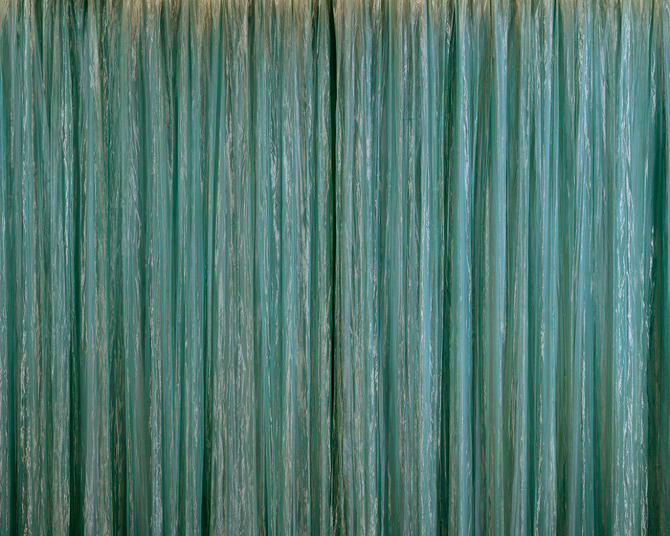
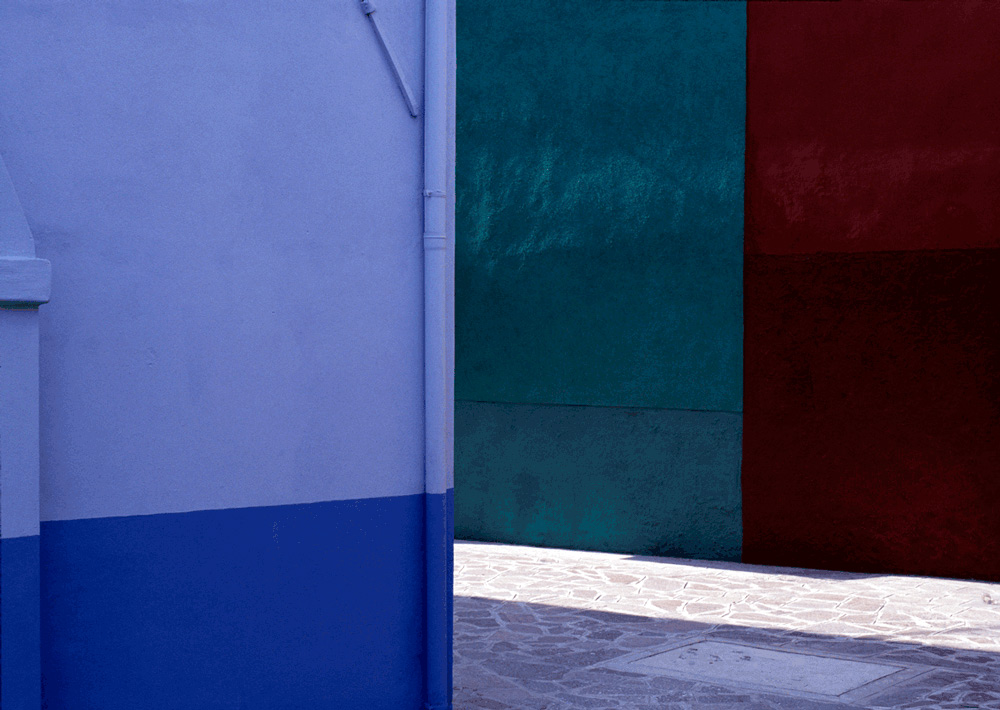
Wim Wenders (German, b. 1945) Walled In
2005
Digital C-print
131 x 125cm
Courtesy Wenders Images
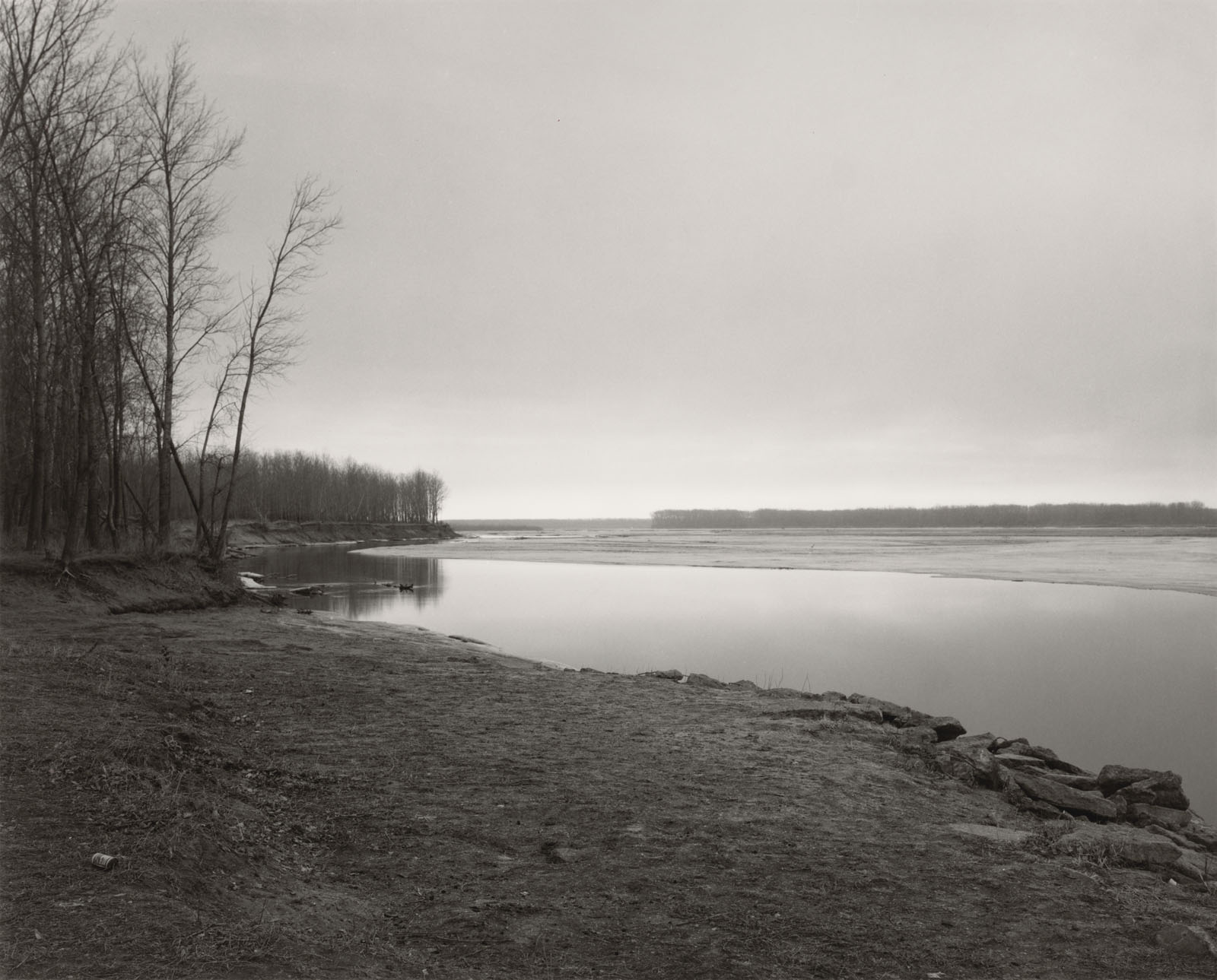
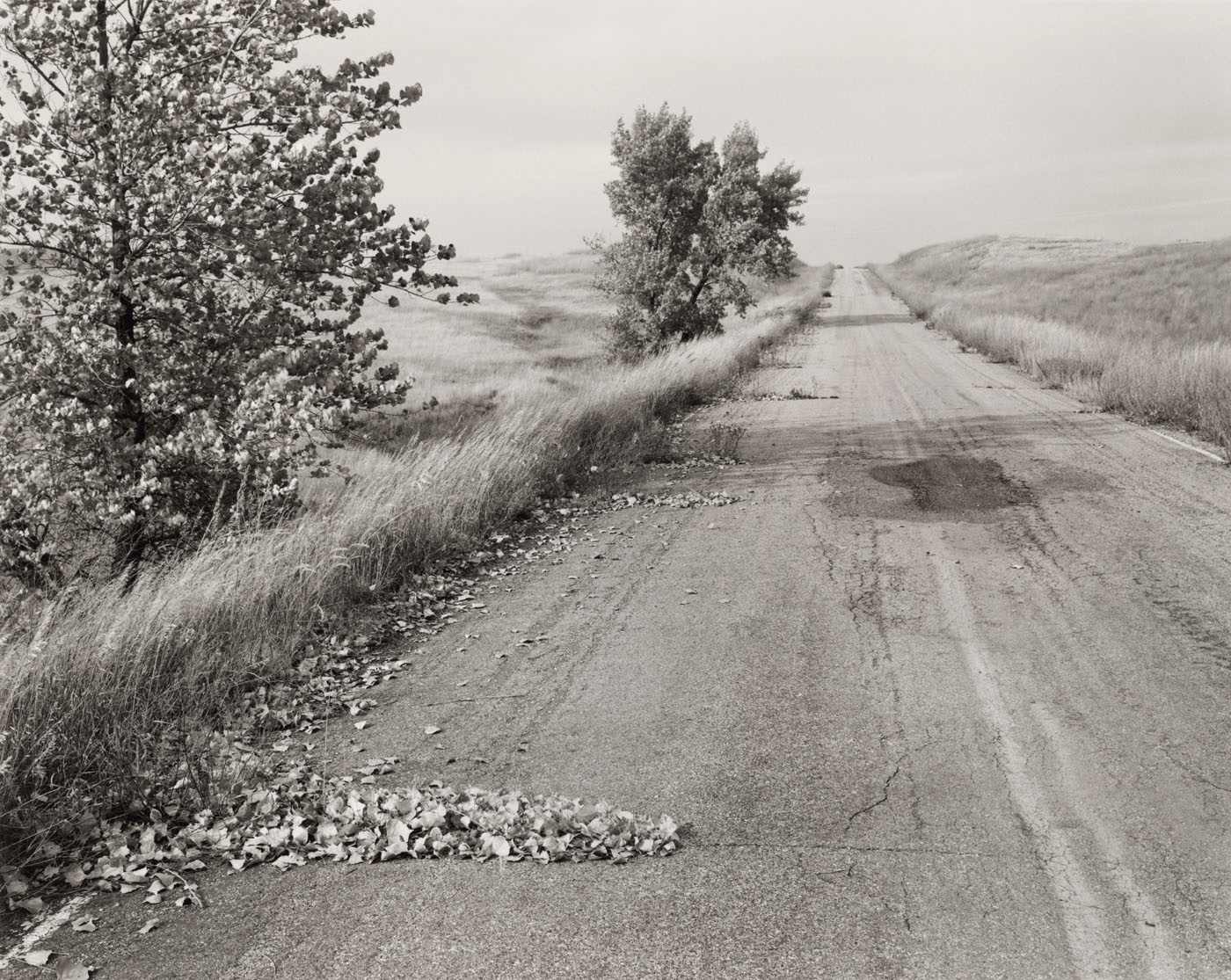
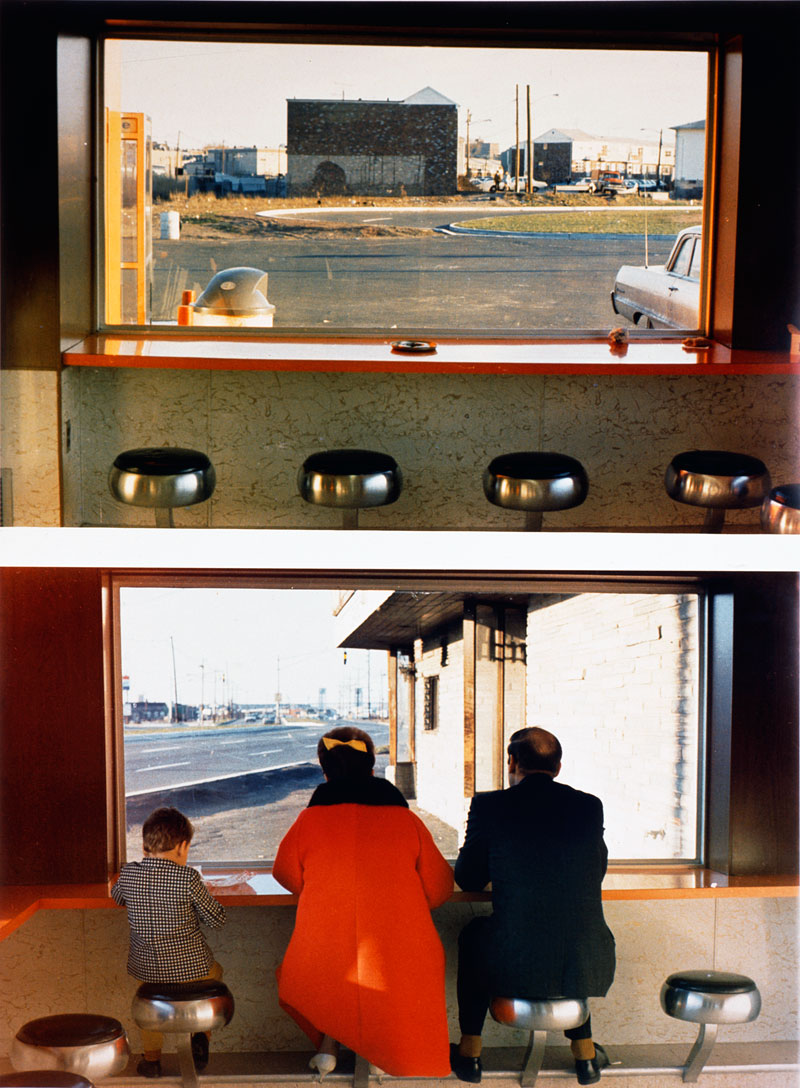
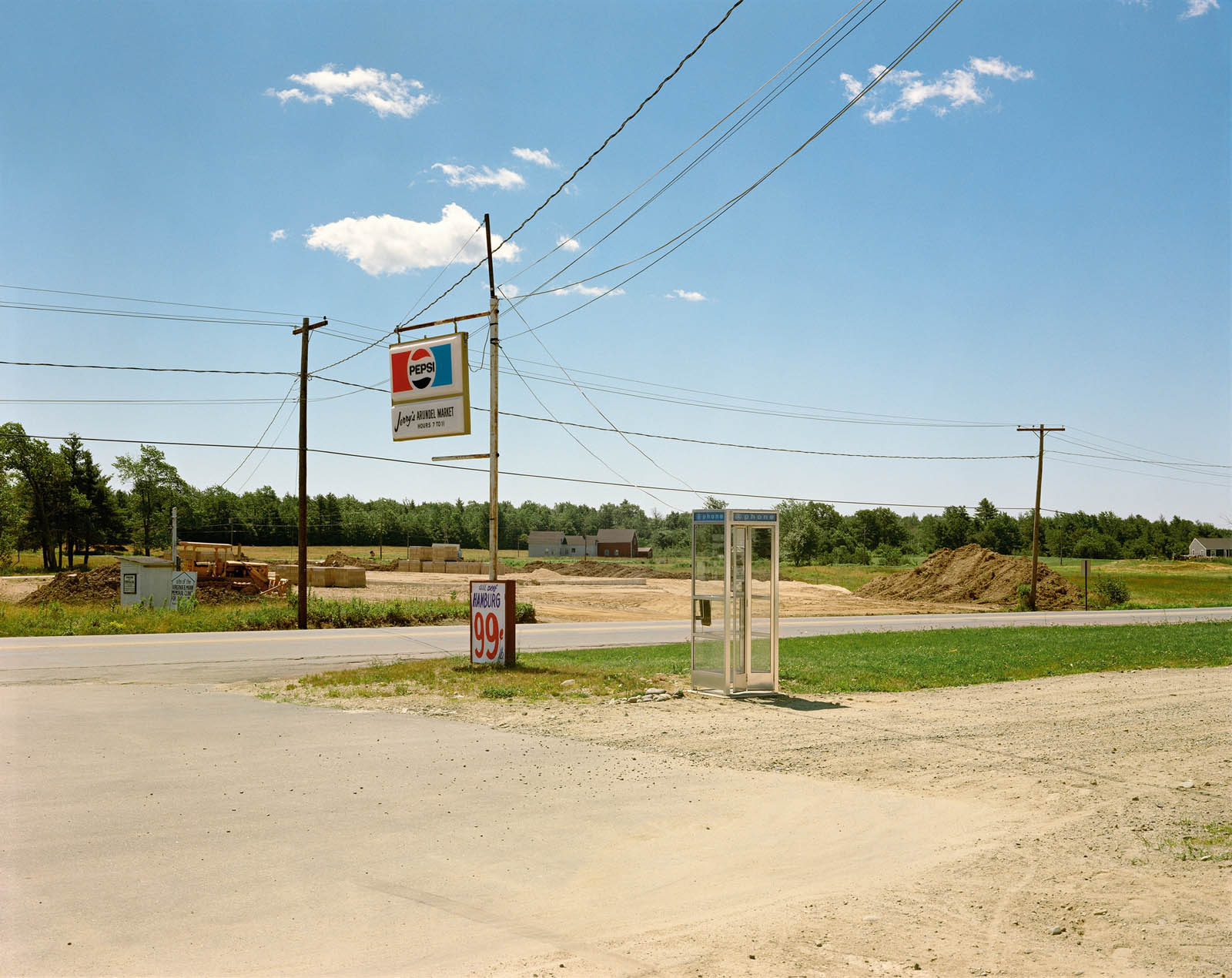
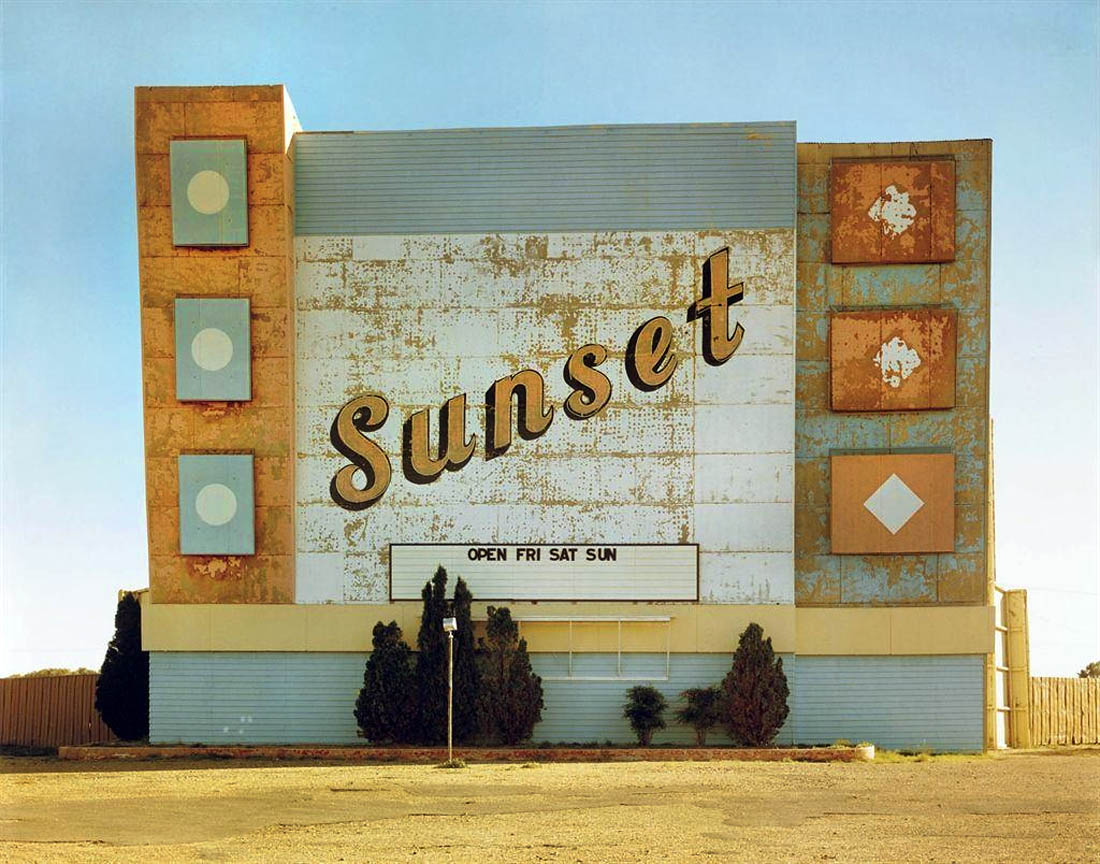
I’m not a great fan of these “moody,” “simple, composed with clean lines and brilliant colours and mostly unpopulated” photographs. Essentially, I want photography to show me something, some essence of life that I have not seen, and then let the photograph speak to me again and again, to reveal itself over weeks and years. This doesn’t happen with these photographs. They are such derivate photographs (of, for example, the great Stephen Shore) and they certainly don’t take me places that are strange and quiet.

Wenders should learn how to frame a photograph properly. The bottom left hand corner of Sun Bather, Palermo (2007, below) is just an empty negative space that simply falls out the photograph. There is no containment here, no tensioning of the diagonal of the rocks and the line of the sun beds. The photographer has even tried to “burn in” the pavement to hold up this area of image (notice how the contrast has increased!), to no avail. A poorly visualised photograph. The same can be said for the left hand side of Open Air Screen, Palermo (2007, below). The photographer simply shows no understanding of how to construct a photograph, not a film.
One photograph that takes me to a strange and quiet place is the early image Dinosaur and Family, California (1983, below). Now this really works, the light, the family, the dinosaur, the eeriness and stillness. Yes. The other photograph I really like is The Painter’s Palette, Onomichi 2005 (below), a beautifully visualised rendering of colour and form, so painterly in its affect, so unsettling in its pictorial presence.
Usually I don’t say a harsh word in my postings but not in this case. Wim Wenders, you might be a great film director but please, stay away from photography. There are more interesting places for people to go, more deserving of their energy than looking at these overrated images.
Dr Marcus Bunyan
Many thanx to Sammlung Falckenberg and Deichtorhallen Hamburg for allowing me to publish the photographs in the posting. Please click on the photographs for a larger version of the image.
Wim Wenders (German, b. 1945) The Chopper
2005
Digital C-print
124.5 x 125cm
Courtesy Wenders Images
Wim Wenders (German, b. 1945) Cowboy Clown, Brisbane
2006
C-print
132 x 148cm
Courtesy Wenders Images
Wim Wenders (German, b. 1945) Moscow Back Yard
2006
C-print
Courtesy Wenders Images
Wim Wenders (German, b. 1945) Policeman, Heiligendamm
2007
C-print
132 x 148cm
Courtesy Wenders Images
The Falckenberg Collection presents in cooperation with Wenders Images Berlin an exhibition of photographs by the internationally renowned filmmaker and artist Wim Wenders (b. 1945). Bringing together almost 60 images, taken from 1983 to 2011, this show entitled “Places, strange and quiet” will feature many photographs not yet exhibited in Germany including several very recent works.
For “Places, strange and quiet” Wenders has assembled a fascinating series of large scale photographs taken in countries around the world from Salvador, Brazil; Palermo, Italy; Onomichi, Japan to Berlin, Germany; Brisbane, Australia, Armenia and the United States. From his iconic images of exteriors and buildings to his panoramic depictions of towns and landscapes, the exhibition will present the full range of Wenders’ work, exploring how he created and honed remarkable images that continue to resonate powerfully.
In his own words, “When you travel a lot, and when you love to just wander around and get lost, you can end up in the strangest spots. I have a huge attraction to places. Already when I look at a map, the names of mountains, villages, rivers, lakes or landscape formations excite me, as long as I don’t know them and have never been there … I seem to have sharpened my sense of place for things that are out of place. Everybody turns right, because that’s where it’s interesting, I turn left where there is nothing! And sure enough, I soon stand in front of my sort of place. I don’t know, it must be some sort of inbuilt radar that often directs me to places that are strangely quiet, or quietly strange.”
Wim Wenders is a multi-faceted artist: a painter, actor, writer and one of the most successful contemporary filmmakers. He first made his name as a leading director of the New German Cinema in the 1970s, and became a cult figure on the international film scene by the mid 1980s. It was in 1983, while scouting for locations for Paris, Texas (1984) that he began to use photography as an art medium in its own right. Wim Wenders was born in Düsseldorf in 1945. After two years of studying medicine and philosophy and a yearlong stay in Paris as a painter he attended the University of Television and Film in Munich from 1967 to 1970.
One of the most important figures to emerge from the “New German Cinema” period in the 1970s, he was a founding member of the German film distribution “Filmverlag der Autoren” in 1971 and he established his own production company “Road Movies” in Berlin in 1975. Alongside directing atmospheric auteur films Wenders works with the medium of photography, and his poignant images of desolate landscapes engage themes including memory, time and movement. A major survey of his photography, “Pictures from the surface of the Earth,” was exhibited in museums and art institutions worldwide. Wim Wenders has published numerous books with essays and photographs.”
Press release from the Deichtorhallen Hamburg website
Wim Wenders (German, b. 1945) Dinosaur and Family, California
1983
C-print
127.7 x 168.3 x 5cm
Courtesy Wenders Images
Wim Wenders (German, b. 1945) Black Square
2002
C-print
Courtesy Wenders Images
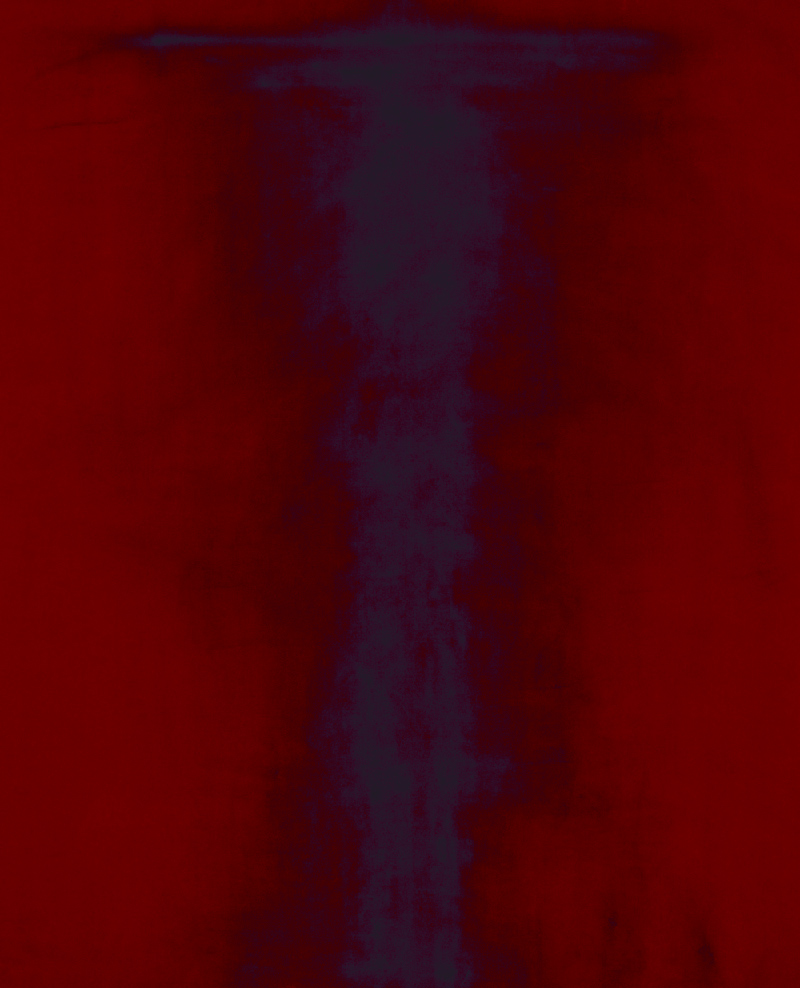
In Black Square (2002, New Mexico), the hues of blue and red contrast with, even highlight more saliently, the decaying wall and tatty old advert, which poignantly includes the words Why Not Now. This photograph shows a deft painterly skill with colour and composition, as does Street Corner in Butte (2003, Montana), with its sharp vertical and horizontal lines and stark contrasts that render the shadows almost black. With the bleak isolation and uncanny feel here, this could be a scene from an Edward Hopper (1924-67) painting; and Wenders’ nod to Hopper is clear in films like The End of Violence (1997), in which one scene recreates the painting Nighthawks (1946).
Wim Wenders (German, b. 1945) Street Corner Butte, Montana
2003
C-print
186 x 224cm
Courtesy Wenders Images
These massive pictures work best when they serve Wenders’ painterly eye. So much contemporary colour photography is neutrally descriptive, offering a bland, flat, digital obviousness. Intensely expressive colour gives Wenders’ most involving images a super-reality that becomes an aspect of their strangeness and quietness. On the roof of a skyscraper in São Paolo, waiting for a helicopter taxi, he notices the spectacularly vivid greens of the air-conditioning units – something soft, green, alien and slightly alarming is growing inside, around one of the rims. In a secluded back yard in Moscow, he chances upon a framed painting of a stag done in orange, green and yellow, which is in curious, almost too perfect harmony with the walls and fallen leaves. In a Hopperesque return to an empty street corner in Butte, Montana, he finds broad strokes of yellow, ochre, brown, pale green and blue; at this inflated, painterly scale, every last brick registers as a lustrous dab of pigment.
Installation view of the exhibition Painting in Photography. Strategies of Appropriation at the Städel Museum, Frankfurt showing Victor Burgin’s Office at Night (Red), 1985 (below)
“To understand the production of art at the end of tradition, which in our lifetime means art at the end of modernism, requires, as the postmodern debate has shown, a careful consideration of the idea of history and the notion of ending. Rather than just thinking ending as the arrival of the finality of a fixed chronological moment, it can also be thought as a slow and indecisive process of internal decomposition that leaves in place numerous deposits of us, in us and with us – all with a considerable and complex afterlife. In this context all figuration is prefigured. This is to say that the design element of the production of a work of art, the compositional, now exists prior to the management of form of, and on, the picture plane. Techniques of assemblage, like montage and collage – which not only juxtaposed different aesthetics but also different historical moments, were the precursors of what is now the general condition of production.”
“Art Byting the Dust” Tony Fry 1990 1
They said that photography would be the death of painting. It never happened. Recently they thought that digital photography would be the death of analogue photography. It hasn’t happened for there are people who care enough about analogue photography to keep it going, no matter what. As the quotation astutely observes, the digital age has changed the conditions of production updating the techniques of montage and collage for the 21st century. Now through assemblage the composition may be prefigured but that does not mean that there are not echoes, traces and deposits of other technologies, other processes that are not evidenced in contemporary photography.
As photography influenced painting when it first appeared and vice versa (photography went through a period known as Pictorialism where where it imitated Impressionist painting), this exhibition highlights the influence of painting on later photography. Whatever process it takes photography has always been about painting with light – through a pinhole, through a microscope, through a camera lens; using light directly onto photographic paper, using the light of the scanner or the computer screen. As Paul Virilio observes, no longer is there a horizon line but the horizon square of the computer screen, still a picture plane that evidences the history of art and life. Vestiges of time and technology are somehow always present not matter what medium an artist chooses. They always have a complex afterlife and afterimage.
Dr Marcus Bunyan
PS. I really don’t think it is a decomposition, more like a re/composition or reanimation.
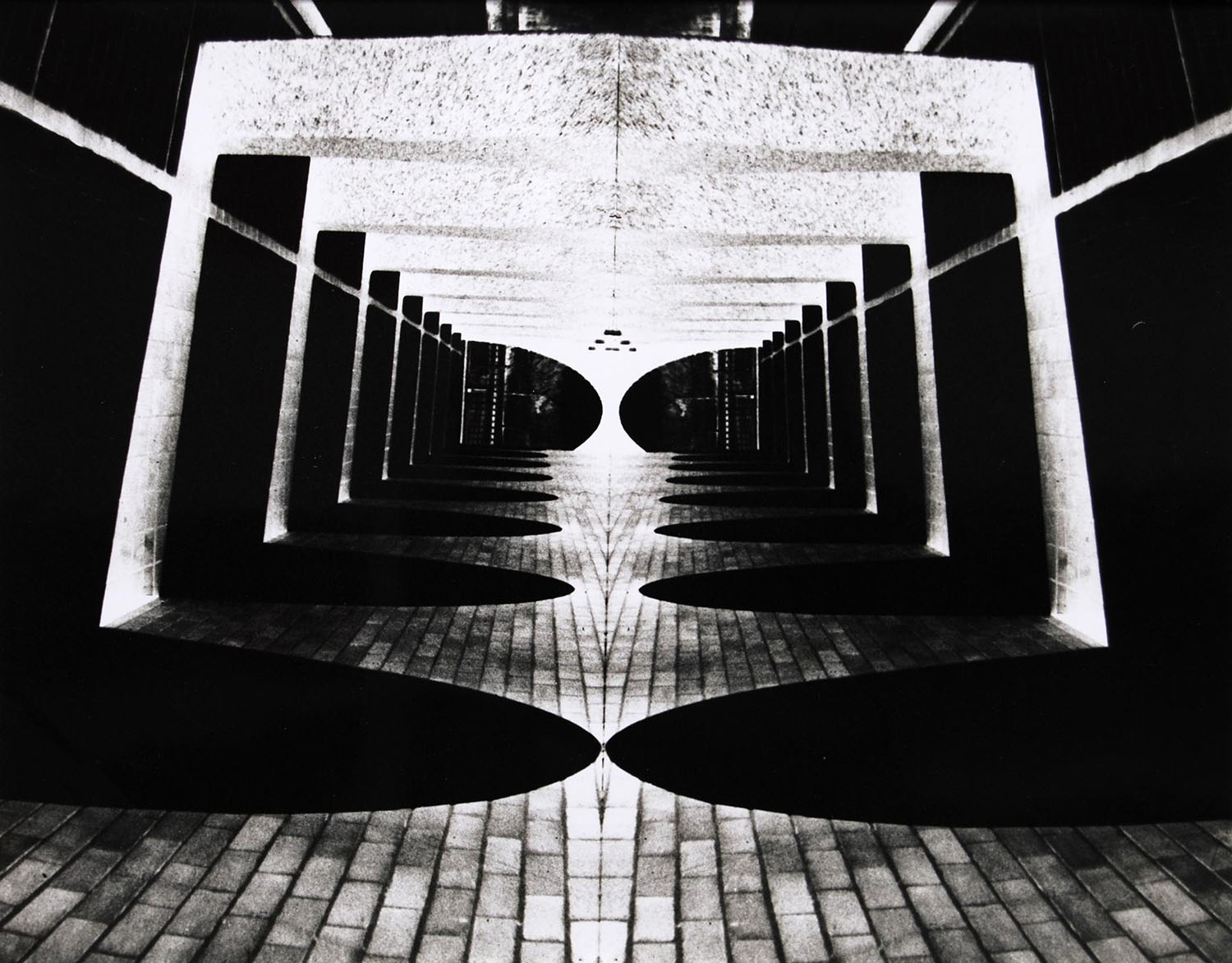
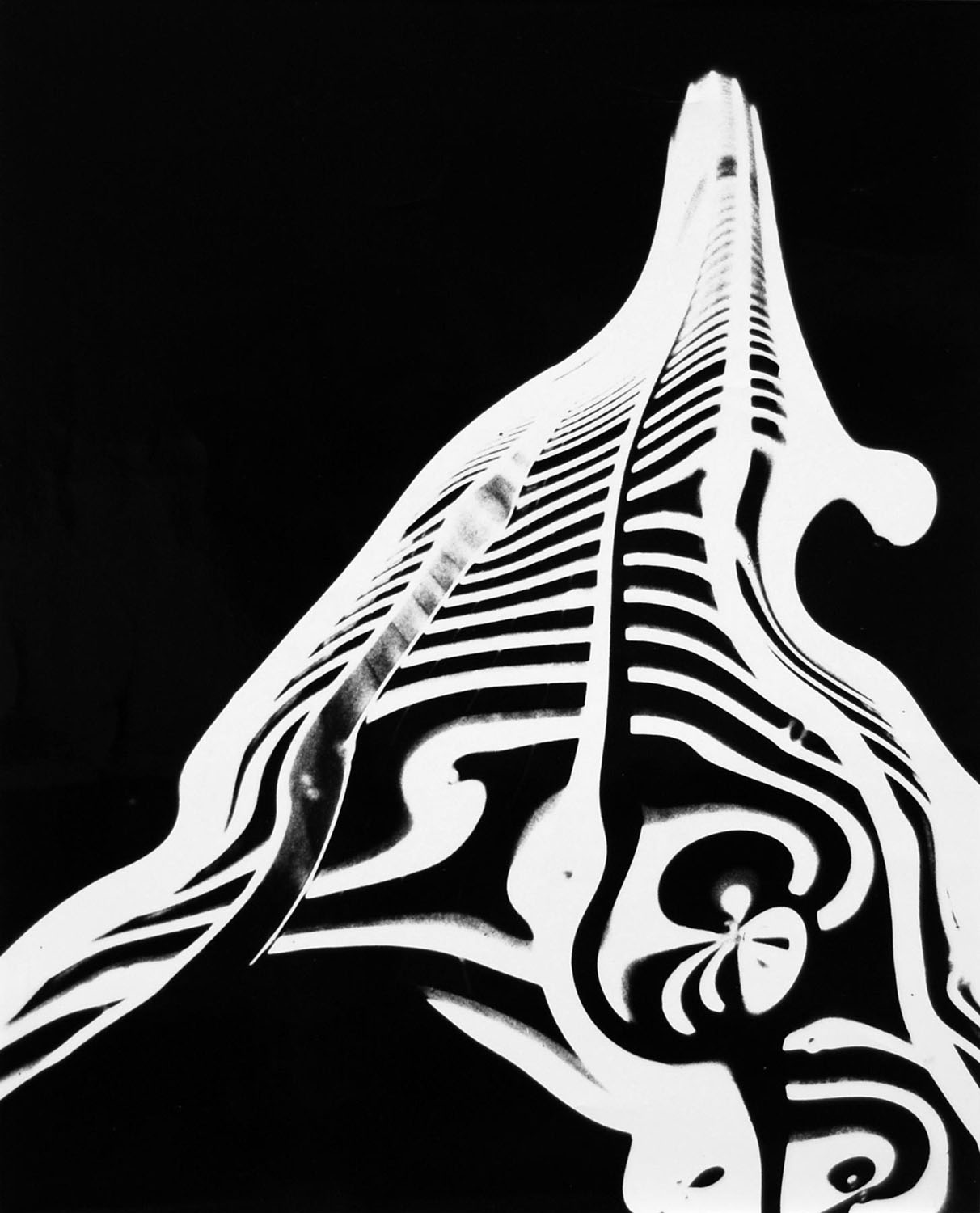
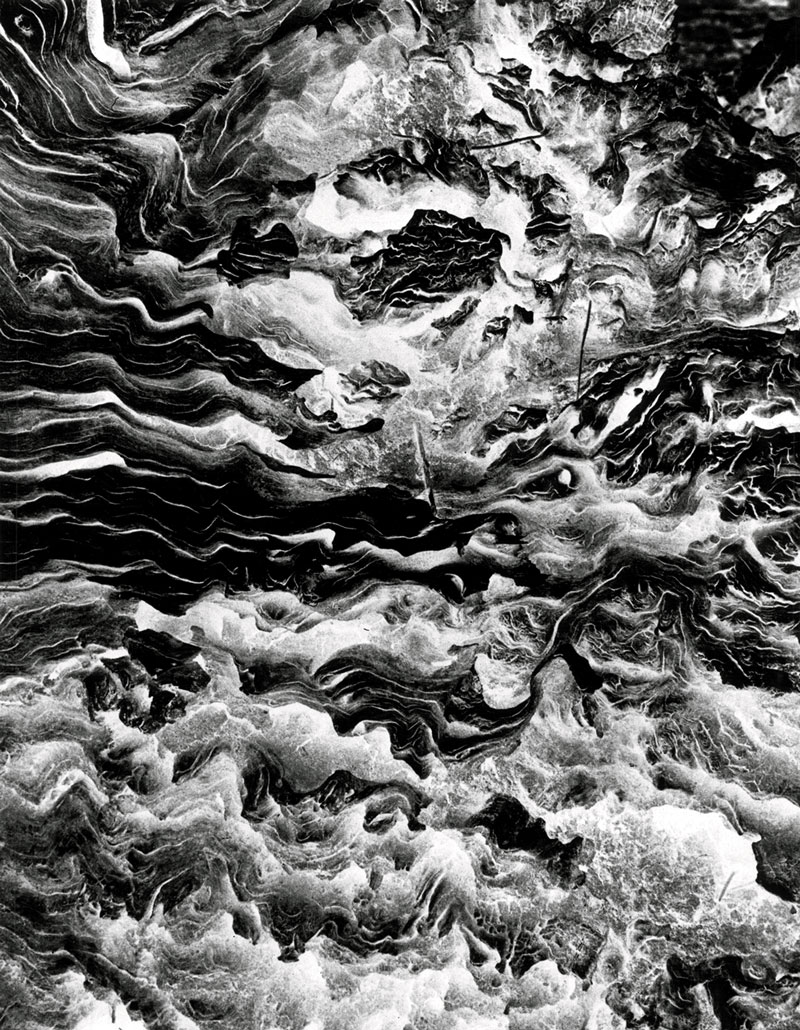
PPS. Notice how Otto Steinert’s Luminogramm (1952, below), is eerily similar to some of Pierre Soulages paintings.
1/ Fry, Tony. “Art Byting the Dust,” in Hayward, Phillip. Culture, Technology and Creativity in the Late Twentieth Century. London: John Libbey and Company, 1990, pp. 169-170
Many thankx to the Städel Musuem for allowing me to publish the photographs in the posting. Please click on the photographs for a larger version of the image.
Victor Burgin (British, b. 1941) Office at Night (Red)
1985
In a conceptual, analytical visual language, Burgin, who originally started out as a painter, refers to Edward Hopper’s painting “Office at Night” from 1940. It shows a New York office at night, in which the boss and secretary are still at work and alone. Burgin’s picture is part of a series about this depiction of a couple by Hopper (and the special role of the female motif in his work). Burgin’s picture consists of three panels, each of which uses a fictional register: letters (word), color (red is traditionally the color for lust and love) and photographic image (secretary).
Installation view of the exhibition Painting in Photography. Strategies of Appropriation at the Städel Museum, Frankfurt showing at left, Thomas Ruff’s Substrat 10 (2002, below)
Installation view of the exhibition Painting in Photography. Strategies of Appropriation at the Städel Museum, Frankfurt showing at centre, Wolfgang Tillmans Paper drop (window) (2006, below)
From 27 June to 23 September 2012, the Städel Museum will show the exhibition “Painting in Photography. Strategies of Appropriation.” The comprehensive presentation will highlight the influence of painting on the imagery produced by contemporary photographic art. Based on the museum’s own collection and including important loans from the DZ Bank Kunstsammlung as well as international private collections and galleries, the exhibition at the Städel will centre on about 60 examples, among them major works by László Moholy-Nagy, Hiroshi Sugimoto, Wolfgang Tillmans, Thomas Ruff, Jeff Wall, and Amelie von Wulffen. Whereas the influence of the medium of photography on the “classic genres of art” has already been the subject of analysis in numerous exhibitions and publications, less attention has been paid to the impact of painting on contemporary photography to date. The show at the Städel explores the reflection of painting in the photographic image by pursuing various artistic strategies of appropriation which have one thing in common: they reject the general expectation held about photography that it will document reality in an authentic way.
The key significance of photography within contemporary art and its incorporation into the collection of the Städel Museum offer an occasion to fathom the relationship between painting and photography in an exhibition. While painting dealt with the use of photography in the mass media in the 1960s, today’s photographic art shows itself seriously concerned with the conditions of painting. Again and again, photography reflects, thematises, or represents the traditional pictorial medium, maintaining an ambivalent relationship between appropriation and detachment.
Numerous works presented in the Städel’s exhibition return to the painterly abstractions of the prewar and postwar avant-gardes, translate them into the medium of photography, and thus avoid a reproduction of reality. Early examples for the adaption of techniques of painting in photography are László Moholy-Nagy’s (1895-1946) photograms dating from the 1920s. For his photographs shot without a camera, the Hungarian artist and Bauhaus teacher arranged objects on a sensitised paper; these objects left concrete marks as supposedly abstract forms under the influence of direct sunlight. In Otto Steinert’s (1915-1978) non-representational light drawings or “luminigrams,” the photographer’s movement inscribed itself directly into the sensitised film. The pictures correlate with the gestural painting of Jackson Pollock’s Abstract Expressionism. A product of random operations during the exposure and development of the photographic paper, Wolfgang Tillmans’ (b. 1968) work “Freischwimmer 54” (2004) is equally far from representing the external world. It is the pictures’ fictitious depth, transparency, and dynamics that lend Thomas Ruff’s photographic series “Substrat” its extraordinary painterly quality recalling colour field paintings or Informel works. For his series “Seascapes” the Japanese artist Hiroshi Sugimoto (b. 1948) seems to have “emptied” the motif through a long exposure time: the sublime pictures of the surface of the sea and the sky – which either blur or are set off against each other – seem to transcend time and space.
In addition to the photographs mentioned, the exhibition “Painting in Photography” includes works by artists who directly draw on the history of painting in their choice of motifs. The mise-en-scène piece “Picture for Women” (1979) by the Canadian photo artist Jeff Wall (b. 1946), which relates to Édouard Manet’s famous painting “Un Bar aux Folies-Bergère” from 1882, may be cited as an example for this approach. The camera positioned in the centre of the picture reveals the mirrored scene and turns into the eye of the beholder. The fictitious landscape pictures by Beate Gütschow (b. 1970), which consist of digitally assembled fragments, recall ideal Arcadian sceneries of the seventeenth and eighteenth centuries. The photographs taken by Italian Luigi Ghirri (1943-1992) in the studio of Giorgio Morandi (1890-1964) “copy” Morandi’s still lifes by representing the real objects in the painter’s studio instead of his paintings.
Another appropriative strategy sees the artist actually becoming active as a painter, transforming either the object he has photographed or its photographic representation. Oliver Boberg’s, Richard Hamilton’s, Georges Rousse’s and Amelie von Wulffen’s works rank in this category. For her series “Stadtcollagen” (1998-1999) Amelie von Wulffen (b. 1966) assembled drawing, photography, and painting to arrive at the montage of a new reality. The artist’s recollections merge with imaginary spaces offering the viewer’s fantasy an opportunity for his or her own associations.
The exhibition also encompasses positions of photography for which painting is the object represented in the picture. The most prominent examples in this section come from Sherrie Levine (b. 1947) and Louise Lawler (b. 1947), both representatives of US Appropriation Art. From the late 1970s on, Levine and Lawler have photographically appropriated originals from art history. Levine uses reproductions of paintings from a catalogue published in the 1920s: she photographs them and makes lithographs of her pictures. Lawler photographs works of art in private rooms, museums, and galleries and thus rather elucidates the works’ art world context than the works as such.
Beate Gütschow (German, b. 1970) PN #1
2000
C-Print, mounted on aluminium dibond
Acquired in 2013, property of Städelscher Museums-Verein e.V.
Städel Museum, Frankfurt am Main, Eigentum des Städelschen Museums-Vereins e.V.
… these images do not evoke a sense of the sublime. On closer inspection, not only is the virginity of nature lost forever, but the innocence of perception is also denied. The natural realms presented here are simply too beautiful to be true. The beauty, wildness, and potentially threatening aspects of nature have been skillfully merged into a decorative whole, as they were in landscape painting from the 17th through to the 19th century. Beate Gütschow’s photographic works reproduce traditional patterns of depiction, incorporating landscape elements that recall compositions by Nicolas Poussin (1594-1665), Jacob van Ruisdael (1628-1682), Claude Lorrain (1600-1682), John Constable (1776-1837), and Philipp Otto Runge (1777-1810). The subjects portrayed by these landscape painters were based on an idealised worldview, the construction of which reflected the dominant philosophical ethos of their time. The artists themselves, however, presented this ideal in a manner bordering on the absolute. …
Beate Gütschow photographs landscapes with a medium-format analog camera, then converts the images into digital files. From this archived material she then constructs new landscapes in Photoshop, basing their spatial arrangements and compositional structures on the principles of landscape painting. As part of this subsequent editing process, she adjusts the light and colours in the images, applying lighting techniques from the realm of painting to her photographs. Because Gütschow uses only the retouching tool and other traditional darkroom techniques offered by Photoshop, not its painting tools, the photographic surface is preserved and the joins between the component parts are not immediately visible. These digital tools make it possible to employ a painterly method without the resulting picture being a painting. The viewer is given the impression that this is a completely normal photograph. When, however, an ideal landscape is presented in the form of a photograph, it appears more unnatural than the painted version of the same view. In this way, Gütschow’s work explores concepts of representation, colour, and light – the formal attributes of painting and photography – as well as the distinctions between documentation and staging.
Extract from Gebbers, Anna-Catharina. “Larger than Life,” in Beate Gütschow: ZISLS. Heidelberg, 2016, pp. 8-17. Translated by Jacqueline Todd [Online] Cited 23/08/2022
Luigi Ghirri (Italian, 1943-1992) L’atelier de Giorgio Morandi, Bologne
1989
Luigi Ghirri (5 January 1943 – 14 February 1992) was an Italian artist and photographer who gained a far-reaching reputation as a pioneer and master of contemporary photography, with particular reference to its relationship between fiction and reality.
Amelie von Wulffen (German, b. 1966) Untitled (City Collages, VIII)
1998
Oil paint, photographs on paper
42 x 59.7cm
Acquired in 2009 with funds from the Städelkomitee 21. Jahrhundert, property of Städelscher Museums-Verein e.V.
Städel Museum, Frankfurt am Main, Eigentum des Städelschen Museums-Vereins e.V.
The starting point for Amelie von Wulffen’s city collages is the urban architecture which she has photographed herself. These photographs are affixed to a surface and then processed pictorially: the artist alienates the perspective, adds abstract patterns and confronts the scene with quirky objects. The painted forms and unreal connections intervene in the relationship to reality of the supposedly objective photograph. The combination of photograph and painting is accompanied by a reflection on the characteristics of the medium concerned. The photographic reproduction of a situation which has been experienced may adequately record the place but not necessarily the memory. With this in mind, the artist sees painting as a suitable medium to equip photography with an authentic means of expression. During the chemical process of photography, real objects are registered on the light-sensitive material, just as the mood of the place and the memory of the artist are translated into the painting process. With regard to form, Wulffen reveals a wealth of references to Constructivism, Surrealism and Dadaism.
In our “Art after 1945” series, artists introduce their artworks in the Städel collection. In this episode Amelie von Wulffen explains her series “Stadtcollagen”.
Jeff Wall (Canadian, b. 1946) Picture for Women
1979
Cibachrome transparency in lightbox
204.5 × 142.5cm (80.5 in × 56.1 in)
Picture for Women is a photographic work by Canadian artist Jeff Wall. Produced in 1979, Picture for Women is a key early work in Wall’s career and exemplifies a number of conceptual, material and visual concerns found in his art throughout the 1980s and 1990s. An influential photographic work, Picture for Women is a response to Édouard Manet’s Un bar aux Folies Bergère and is a key photograph in the shift from small-scale black and white photographs to large-scale colour that took place in the 1980s in art photography and museum exhibitions. …
Picture for Women is a 142.5 by 204.5 cm Cibachrome transparency mounted on a lightbox. Along with The Destroyed Room (1978), Wall considers Picture for Women to be his first success in challenging photographic tradition. According to Tate Modern, this success allows Wall to reference “both popular culture (the illuminated signs of cinema and advertising hoardings) and the sense of scale he admires in classical painting. As three-dimensional objects, the lightboxes take on a sculptural presence, impacting on the viewer’s physical sense of orientation in relationship to the work.”
Katrin Koenning (Australian born Germany, b. 1978) Untitled from the series Transit 2009
Transit is a stimulating body of work by Melbourne artist Katrin Koenning that documents mostly everyday journeys. As Koenning notes, “It is concerned with the space that lies between destinations, routines and obligations – the space between distances, if you so like,” where strangers are thrown together in an intimate space. The outcome of these encounters is mainly silence. In these works photography and the depiction of the lived world becomes the primer and reference point for a mediated existence, one based on longing, desire, reverie, absent presence and the phantasies of daydreams.
Compositionally the work is strong. Koenning shows an excellent understanding of the construction of the image plane and the use of colour, light and dark complements her intellectual enquiry. This much is given: these are excellent images that immerse the viewer in a visual dreamscape. What I am more interested in here is the transitional spaces of the journey, the traces of light that reflect back to us the concerns of the photographer and the conceptual ideas upon which the work is based.
Even when people are asleep in these photographs (which they sometimes are) it is as if an internal image, a day dream, a subconscious image is projected into/onto the external world in an act of scopophilic [the desire for pleasurable looking] voyeurism. It is as though our daydreams are inscribed in a physical location and we identify with this imaginary image and take it for reality.1 “This specific joy of receiving from the external world images that are usually internal… of seeing them inscribed in a physical location… of discovering in this way something almost realisable in them”2 becomes one reality of the journey. We become possessed, possessed by the phantasies of our daydreams, possessed by desire for this imaginary image.
Paradoxically these daydreams, the longing and yearning of the inner voice for a better place to be, for a holiday, for an escape from the drudgery of everyday life (for an imaginary, hallucinatory image) promote an escapism in the traveller and the absenting of presence that can be seen on any tram or train, any day of the week in cities throughout the world. The enactment of absent presence is usually performed through technology of some kind – a book, headphones, smart phones that connect to the internet, conversation on the mobile which is mainly gossip and texting – that distract people from having a quiet mind that leads to the contemplation of Self. The fear of silence is the fear of quietening the chattering voice in your head, being afraid of what you might find. The act of non-engagement is supplemented by the necessity of avoiding eye contact with fellow travellers, of making conversation, of engaging with strangers in any meaningful way. Hence the silence of forcibly intimate spaces.
The photographs that make up the series Transit form a theatrical space, a dramatic space where the people in them are separated from the outside world, neither here nor there, present but absent at one and the same time. This ritual of (non)spectatorship begins long before we begin our journey: the preparation, leaving the house with headphones and iPod, iPad, iPhone and I. This is followed by the ritual of buying a ticket (or not), boarding the train, tram, bus, plane or car being an effective way of transforming time and space. Our practices of mobility, that is our acts of moving are constituted in our acts of staying. What we take with us (for example our passport when we go overseas), always takes our place of residing, of staying, with us. Travel becomes the enactment or enfolding of bodies that move and bodies that stay, of stability.3 As Mary Louise Pratt has observed recently, the Western subject is an autonomous being with inherent conditions attached to its body and mobility is the privileged figure of its freedom, the proof and performance of its liberated state. In the metaphor of flow there is the enactment of freedom.4 Ironically, in the flow of travel envisaged in these photographs there is a dis/placement of desire onto the object of our (non)attention: in other words if we observe the world and desire it (as in the woman looking out of the window onto the distant view of the city, below) we displace our desire onto the object of our affection. If, on the other hand, we ignore the distant vista (as in the man playing with his iPod while the world flashes past outside, below) we displace our own presence through non-attention and our desire becomes a narcissistic attraction to Self. The remainer (who remains) and the remainder (what is left) is dictated by the place and placedness of the encounter, the interdependent modalities along the points of un/freedom (displacement of desires onto other may, in fact, not be freedom at all!)
In a sense, and I use that word advisedly, these images become trans-sensual, hovering between one desirous place and the next, between one condition or possibility of becoming and another. Here I must note that I see a philosophical difference between ‘transit’ and ‘in transit’. ‘Transit’ suggests a pre-determined path between point A and point B: for example in the transit of Venus that recently took place the path that Venus would take was already mapped out, even before the event happened, even if Venus was absent. The DNA of the journey, its blueprint if you like, is already formed in the knowledge: we are going to Collins Street, Melbourne, the path immanent in the tabula rasa of the journey even before it has started. ‘In transit’ on the other hand, suggests an amorphous space that has no beginning and no end. There is no boundary that defines the journey, much as in these images “amorphous thinking in visual terms is inextricably bound up with sensation and perception. In many ways, how we think is how we see and vice versa.”5 Perhaps the series should have been called In Transit, for the images visualise a conception of boundary and form that is constantly in flux, emanating as it does from the subconscious desires of the traveller. These are scenarios for an intuitive vision of an amorphous space that image a lapse in time, where energy and information, light and shadow, harmony and form challenge an absolute identity, the pre-determined path.6
Projection of inner desires onto the actual world becomes the locality for the contemporary mythologies of values, beliefs, dreams and desires.7 In a Buddhist sense, in the longing of an individual to effect his or her liberation this flow of sense-desire must be cut completely. Instead of a desire to possess the object of their longing and then to be possessed by that desire (desire to possess / possessed by desire) we must learn, as Krishnamurti has insightfully observed, not to make images out of every word, out of every vision and desire. We must be attentive to the clarity of not making images – of desire, of prejudice, of flattery – and then we might become aware of the world that surrounds us, just for what it is and nothing more.8 Then there would be less need for the absenting of self into the technological ether or the day dreams of foreign lands or the desire for a better life.
The strength of this work is the trans-sensuality of the photographs. Their trans-sensuality initiates differently configured constructions of the world, one that will not allow the world to simply be displaced by a lack of awareness, a lack of presence in the world. The photographs physically queer the performative aspect of the actor upon the stage, allowing the viewer to understand the process that is happening within the photographs and then NOT construct alternate narratives of longing and desire if they so wish. What they do for the viewer is collapse the boundaries between the subjective and the objective, between the conscious and the subconscious, inducing in the viewer a glimpse of self-actualization,9 whereby the viewer has the ability to enjoy the experience of just being. As the viewer becomes the person in the photograph (by understanding the experience of being, not by making an image) the permeability and lack of fixity of the boundaries between self and other, between self and amorphous space, between self and the physical world becomes evident. We become aware of the suspension of time and space in these momentary, (photographic) acts of transcendence. These wonderful, never ending moments.
Dr Marcus Bunyan
July 2012
1/ Leonard, Richard. The Mystical Gaze of the Cinema: the Films of Peter Weir. Melbourne: Melbourne University Press, 2009, p. 23
2/ Metz, C. Essais Sémiotiques. Paris: Klincksieck, 1977, p. 136 quoted in Leonard, Op. cit.
3/ Pratt, Mary Louise. “On Staying.” Keynote speech presented at the international conference Travel Ideals: Engaging with Spaces of Mobility. July 18th 2012 at the University of Melbourne
4/ Ibid.,
5/ Navarro, Kevin. “An Amorphous Image Process,” on Rhizome: Image Theory website. January 19th 2010 [Online] Cited 29/07/2012
6/ Ibid.,
7/ Leonard Op. cit., p. 56
8/ Krishnamurti. Beginnings of Learning. London: Penguin, 1975, p. 131
9/ “It must be noted that self-actualization is not necessarily related to vocation or career choice … From Malsow’s (Maslow, A (1970) Motivation and Personality. New York, Harper & Row) standpoint, self-actualization is not primarily concerned with results of a particular kind of activity – it is concerned with the experience of the activity itself – not the composition but the composing – not the work of art but the creative process by which it is produced – not the taste of the food, but the creativity in the cooking of it. This is not to say that the product has no importance. What Maslow is emphasizing is the fact that the self-actualized persons is fulfilling his potentiatlities in the act itself. A byproduct of this creative act is a unique outcome. He may admire the result of this process. But the enjoyment of the process itself is also extremely important. The ability to enjoy the experience of being, therefore, is one of the essential capabilities of the healthy individual.” (My italics) Benson, Lou. Images,Heroes and Self-Perceptions. Englewood Hills, New Jersey: Prentice Hall, 1974, pp. 352-354
Katrin Koenning (Australian born Germany, b. 1978) Untitled from the series Transit 2009
Transit documents people on mostly everyday journeys. It is concerned with the space that lies between between destinations, routines and obligations – the space between distances, if you so like. While I travel and observe, I write down snippets of overheard conversations. Old ladies talk about the weather, teenagers gossip, you hear laughter and bits of stories in amongst the monotonous sighing of the train or the mourning sound of an aching ship. Mostly, you hear silence – strangers are thrown together for a short while, forced to share an intimate space. They rarely talk.
Artist statement
Katrin Koenning (Australian born Germany, b. 1978) Untitled from the series Transit 2009
“Elle est tourmentée, pure, violente, orgueilleuse…”
“She is tormented, pure, violent, proud…”
Claude Sautet
Continuing my love affair with the woman that is, eternally, Romy Schneider. J’adore!
Marcus
Many thankx to the Palais des Festivals et des Congrès de Cannes for allowing me to publish the photographs in the posting. Please click on the photographs for a a larger version of the image.
Rarely has an actress been both as beautiful and moving. Rarely has an actress made history so young with an aura so accomplished, just looking, driven by a great desire for the absolute, to escape her own legend. Rarely has a star been both blessed by the gods and as much struck by fate. Rarely has a woman been as bright and as turbulent. Rarely has a foreign aura at this point incarnated France …
It is these paradoxes that this exhibition will highlight. Rare documents, personal items, professional memories and unseen photos tell stories because the route of an actress and a woman of passion, well beyond the screen, has touched the heart of audiences while accompanying the story of the century. We want this exhibition to show the height of what was Romy Schneider was, of what she represents. We want visitors to leave uplifted by her grace and beauty, by which life emerges from it despite the tragedies that have struck – by the obviousness of her talent, the wealth of her career and her encounters.
“She reminds me of those thoroughbreds who prance, hypersensitive, at the slightest glance. They need to be flattered and excited at the same time but as soon as they loose the rein, they are capable of achieving the most breathtaking performance! ”
“She is beautiful with a beauty that she has forged itself. A poisonous mixture of charm and virtuous purity. She is as proud as a Mozart concerto and recognises the power of her body and her sensuality.”
“An amazing actress, she does not manufacture the emotion, does not fake it. She recreates the very far, very deep as the huge waves that shake the sea. No trick. (…) It goes straight to the point. All the superficial, bookish, theoretical disappears. This game seems lyrical and requires musical comparisons. Sautet talking about Mozart with regard to Romy. Me, I want to talk of Verdi, Mahler … ”
Lino Tagliapietra (Italian, b. 1934) Fuji 2011
Blown glass
16 3/4 x 19 1/4 x 6 1/2 inches
Photo by Russell Johnson
Oh my, oh my, oh my these are just divine, especially the last three.
Marcus
Many thankx to the Museum of Glass for allowing me to publish the photographs in the posting. All works by Lino Tagliapietra (Italian, born 1934). Courtesy of Lino Tagliapietra, Inc. Please click on the photographs for a larger version of the image.
Lino Tagliapietra (Italian, b. 1934) Masai (Masai d’Oro)
2011
Blown glass
59 x 98 x 10 inches
Photo by Russell Johnson
Lino Tagliapietra (Italian, b. 1934)
Petra 2012
Blown glass
10 x 15 x 5 1/4 inches
Photo by Russell Johnson
Lino Tagliapietra (Italian, b. 1934) Borboleta (il giardino di farfalle)
2011
Blown glass
26 x 157 x 118 inches
Photo by Francesco Allegretto
Museum of Glass marks its 10th Anniversary with a new exhibition featuring the work of esteemed artist Lino Tagliapietra. Maestro: Recent Works by Lino Tagliapietra showcases 65 glass masterpieces created during the past decade (2002-2012). The exhibition opens Saturday, July 14, amidst the anniversary celebration weekend.
Tagliapietra is known internationally as the maestro of contemporary glass. Beginning at the age of eleven, he was trained by Muranese glass masters, perfecting his glassblowing skills through years of observation, repetition, and production. In subsequent years, his precision and mastery of molten glass became secondary to his creative expression. Tagliapietra has invented numerous new techniques and designs, creating works that are technically flawless and visually breathtaking – belying the complexity and difficulty of their creation.These works have positioned him as a cultural icon not only in the glass world but also as a seminal figure in contemporary art and have earned him the reputation as “the greatest living glassblower” by many of his peers.
At age 77, when most glassblowers have long since retired from a lifetime of strenuous physical work, Tagliapietra continues to expand his artistic achievement, earning numerous artistic and scholastic awards and being featured in solo and group exhibitions. “I hope that people see the love, the love for the material, the love for the fire. For the art I try to be honest with myself. That’s all.”
Maestro presents an overview of Tagliapieta’s most recent series. The works displayed demonstrate his evolution to larger works and use of bolder colours and patterns over his nearly fifty years as an artist. Six large-scale installations, featuring colourful butterflies (Borboleta), boats (Endeavor), seagulls (Gabbiani) and two separate collections of shields (Masai), are central to the exhibition. The final installation, a 79 x 40-inch curio case containing nearly one hundred opaque glass vessels, is titled Avventura which is Italian for ‘adventure’ and references Tagliapietra’s view of the unpredictable nature of molten glass. Some of the objects in the exhibition were created at Museum of Glass during one of Tagliapietra’s several Visiting Artist residencies in the Hot Shop.
“It is a privilege to host this exhibition – yet another salute to Lino’s lifetime of artistic achievement – at Museum of Glass,” comments executive director Susan Warner. “This body of work was created during the same timeframe that the Museum has been in existence. To celebrate this magnificent artist – who has influenced and inspired so many of the artists and visitors who have come through our doors – while we celebrate our first decade of service is very fitting.”
Press release from Museum of Glass website
Lino Tagliapietra (Italian, b. 1934)
Saturno 2011
Blown glass
27 x 34 x 7 inches
Photo by Francesco Allegretto
Lino Tagliapietra (Italian, b. 1934) Tatoosh
2009
Blown glass
26 1/2 x 12 3/4 x 8 inches
Photo by Russell Johnson
Lino Tagliapietra (Italian, b. 1934) Maui
2010
Blown glass
28 3/4 x 15 1/4 x 7 inches
Photo by Russell Johnson
Lino Tagliapietra (Italian, b. 1934)
Dinosaur 2011
Blown glass
55 3/4 x 26 x 10 1/4 inches
Photo by Russell Johnson
How can we put this. The early black and white photographs are magnificent; the later colour photographs pedestrian and mundane. It is quite amazing how an artist with such skill and panache in the 1960s-1980s can run out of ideas and make such stock standard work 30 years later. Does the artist loose the talent, the energy or just the persistence of vision that made their earlier work so vibrant and alive, or did the work just emerge from the time / space / energy of the artist in that particular period, never to appear again?
Moriyama’s black and white photographs provide “a raw, restless vision of city life and the chaos of everyday existence, strange worlds, and unusual characters.” More than that, they plunge us into a mesmerising, hypnotic world where the viewer is immersed in a fractured dream / scape / space. Kagerou (Mayfly) (1972, below) is just such an example of this holographic, bugs caught in amber view of our world; the dirty footed, fleeing creature in Untitled (woman in white dress running) (1971, below) confirms this ambiguity, the trapped animal caught by the flash of the camera. Strange, haunting and evocative, Moriyama’s black and white photographs project the derangement of the world onto the psyche of the viewer, producing an abnormal condition of the mind that promotes a loss of contact with reality. The colour photographs never stand a chance against such life changing affirmations.
Dr Marcus Bunyan
Many thankx to the Los Angeles County Museum of Art for allowing me to publish the photographs in the posting. Please click on the photographs for a larger version of the image.
Installation views of the exhibition Fracture: Daido Moriyama at the Los Angeles County Museum of Art (LACMA)
Courtesy of Daido Moriyama and Los Angeles County Museum of Art, Los Angeles
The Los Angeles County Museum of Art (LACMA) presents Fracture: Daido Moriyama, the first solo museum exhibition of photographer Daido Moriyama (b. 1938) to be shown in Los Angeles. Moriyama first came to prominence in the mid-1960s with his gritty depictions of Japanese urban life. His highly innovative and intensely personal photographic approach often incorporates high contrast, graininess, and tilted vantages to convey the fragmentary nature of modern realities.
Spanning his early years to present day, the show features nearly fifty works, including a range of Moriyama’s renowned black-and-white photographs, his many important photo books, and the debut of recent colour work taken in Tokyo.
“Daido Moriyama’s immensely inventive and prolific achievements make him one of the leading photographers of our era. Inspiring viewers and artists world-wide, Moriyama continues to demonstrate a raw and restless exploration of the fractured realities of modern times, including his most recent colour work, appearing for the first time,” observes Edward Robinson, associate curator of LACMA’s Wallis Annenberg Photography Department and curator of the exhibition.
Exhibition overview
Responding to the rapid changes that transformed post-World War II Japan, Daido Moriyama’s black-and-white works express a fascination with the cultural contradictions of age-old traditions persisting within modern society, along with the effects of westernisation and consumerism.
Providing a raw, restless vision of city life and the chaos of everyday existence, strange worlds, and unusual characters, Moriyama frequently photographs while on walks through Tokyo – particularly the dark, labyrinthine streets of the Shinjuku district – as well as when traveling on Japan’s postwar highways and during strolls through other urban centers in Japan and abroad. His work suggests the bold intuition informing the artist’s ongoing exploration of urban mystery, memory, and photographic invention.
Fracture: Daido Moriyama will display the artist’s iconic black-and-white photographs, exemplifying the are, bure, boke (grainy, blurry, out-offocus) style, in addition to a new installation of recent colour work. An accompanying video will feature documentary footage of the photographer at work, exploring by foot and responding to the vibrant cityscape of Tokyo. Also on view will be a selection of books – Moriyama has published more than forty to date – which highlights the artist’s highly influential experimentation with reproduction media and the transformative possibilities of the printed page.
About Daido Moriyama
Born in Ikeda, Osaka, Moriyama trained in graphic design, then took up photography with Takeji Iwaniya, a professional photographer of architecture and crafts. Moving to Tokyo in 1961, he assisted photographer Eikoh Hosoe for three years and became familiar with the trenchant societal critiques produced by photographer Shomei Tomatsu. Moriyama also drew inspiration from William Klein’s confrontational photographs of New York, Andy Warhol’s silkscreened multiples of newspaper images, and the writings of Jack Kerouac and Yukio Mishima.
His work has been collected by numerous public and private collections internationally, including LACMA, the Museum of Modern Art, New York, the San Francisco Museum of Modern Art, the Metropolitan Museum of Art, New York, the Getty Museum, Los Angeles, the Museum of Fine Arts, Boston, and the Centre Pompidou, Paris. Moriyama has had recent major solo shows at The Fondation Cartier pour l’Art Contemporain, Paris, The Fotomuseum, Winterthur, Switzerland, the Metropolitan Museum of Photography in Tokyo, and will be exhibited with William Klein at the Tate Modern this fall.
The “Beast III” has a Chrysler Hemi engine and was the fastest single-engine car in America in 1952. It was the first car to have its body designed in a wind tunnel.
Continuing my fascination with the design of the automobile, here are another selection of classics!
Marcus
Many thankx to the Utah Museum of Fine Arts for allowing me to publish the photographs in the posting. Please click on the photograph for a larger version of the image.
The “Mormon Meteor III,” the last Duesenberg built, set more long-distance land-speed records than any other car in history. It has a handcrafted Curtis Conqueror aircraft V12 engine.
Racing into town this summer, Speed: The Art of the Performance Automobile will be on display at the University of Utah on the first-floor galleries of the Utah Museum of Fine Arts in the Marcia and John Price Museum Building from June 2 – September 16. The exhibition comprises 19 of the world’s finest automobiles and was organised by automotive historian, museum consultant and guest curator Ken Gross.
Speed will showcase a century of automobiles that exemplify premier aerodynamics, engineering, art and design of their eras. The cars range from the menacing 1952 “Beast III” Bonneville racer to the ultra-cool 1957 Jaguar XK-SS Roadster, once owned by Steve McQueen. The cars are on loan from some of the country’s top automobile collections, including the Price Museum of Speed; National Automobile Museum; Petersen Automotive Museum; Bruce Meyer; Peter and Merle Mullin; Jon and Mary Shirley; and the Larry H. Miller Family.
“We are delighted to be presenting ‘Speed: The Art of the Performance Automobile’ and are confident that our visitors will be amazed at the beauty, engineering, and amazing stories of these incredible cars” says Gretchen Dietrich, executive director of the UMFA. “We hope many first time visitors will come to see the exhibition and be introduced to our wonderful museum and collection.”
A number of art museums in America and Europe recently presented popular exhibitions of cars, including Curves of Steel at the Phoenix Art Museum (2007), Allure of the Automobile at the High Museum of Art in Atlanta (2010) and the Portland Art Museum (2011), as well as L’Art de L’Automobile: Chef d’Oeuvres de la Collection Ralph Lauren at the Les Arts Décoratifs in Paris (2011). The first art exhibition of cars was Eight Automobiles, mounted sixty years ago at the Museum of Modern Art in New York City (1951).
The UMFA’s automobile exhibition, however, is the first of its kind. Speed will examine automobiles not only as works of art and design, but as objects of rich racing history. The featured cars were created by legendary engineers, distinguished designers, and storied automobile companies; many are speed record-setters that were owned and raced by famous drivers and other notable people of their time. This is the first and only time these 19 cars have been seen together in one venue.
Many of the cars in Speed: The Art of the Performance Automobile have a special connection to Utah’s famed Bonneville Salt Flats, where racers from all over the world traveled, and continue to travel, in attempts to break land speed records. The “Mormon Meteor III” is perhaps the most famous Bonneville race car. Designed and driven by legendary racer and former Salt Lake City Mayor David Abbott “Ab” Jenkins (1883-1956), the “Mormon Meteor III” set more long distance land speed records than any other automobile in history, and it still holds 12 of them today.
“These 19 special automobiles comprise a remarkable selection of historic racers and high performance cars, spanning more than a century,” notes guest curator Ken Gross. “Unlikely to be repeated, this exhibition represents a once-in-a-lifetime opportunity to see and study these legends on wheels.”
This is a profound exhibition of photographs that have been lost then found. Too damaged to be returned to the families of their missing owners after the 3.11 East Japan Tsunami they have been cleaned, dried, digitally catalogued and put on display. As remnants of disaster they have taken on an ethereal, abstract expressionist beauty.
Like Atget’s photographs (his “documents for artists”) they were never meant to be “art”, but through morphogenesis (‘beginning of the shape’) these snapshots of places, family and friends reveal their inherent form. This beginning of form has been exposed through displacement, washing and erasure. Through this process of erasure these anonymous images reveal their underlying structure with its link to alchemy, as the image dis/appears from view; they have become unfixed (as in the fixer that stabilises the image in the analogue darkroom) from reality. In this process they have become art.
The images are incredibly beautiful.
They hid secrets (of ownership, names, families and places, of time and space).
Something (energy, spirit?) emerges when you least expect it.
Photographs are coded, but usually so as to appear uncoded but here the link to the indexicality of the image – the idea of the visible as evidence of truth – has been broken. These photographs, taken out of their original context, have lost their specific use value in the particular time and place of their consumption. The fragmentation of this use value, together with the dissolution of their formal characteristics, means that they are freed of the conditions that limit and determine their meaning.1 As Annette Kuhn has written in The Power of the Image, “Meanings do not reside in images, then: they are circulated between representation, spectator and social function.”2 And in these images all three things have changed.
Further, the link between the image and its referent, the photograph and the thing being photographed has been irreversibly broken. As the French critic Maurice Blanchot has written, “The image has nothing to do with signification, meaning, as implied by the existence of the world, the effort of truth, the law and the brightness of the day. Not only is the image of an object not the meaning of that object and of no help in comprehending it, but it tends to withdraw it from its meaning by maintaining it in the immobility of a resemblance that it has nothing to resemble.”3 In other words (and especially in these photographs) it is this severance of meaning and its object, this resemblance of nothing.
But think about this idea:
THINK ABOUT THE IDEA OF RE(AS)SEMBLANCE!
DOES THE PHOTOGRAPH REASSEMBLE A SIGNIFICATION, A MEANING WHOLLY ITS OWN, OR IS THAT RE(AS)SEMBLANCE PART OF THE ORIGINAL MEANING OF THE OBJECT PHOTOGRAPHED?
In these photographs there is an obfuscation of reality in which the usually coded photographs now appear to be uncoded in some visceral sense. In fact there is a double obfuscation, a double effacement, as the images are displayed on the wall like a series of bathroom tiles in plastic sleeves, here not at one remove but at two (the clouding of the image and the clouding through the plastic). What emerges from this alchemical miasma is the ghost of the meaning of the object, where we acknowledge that the essence of these people did really exist. The recognition of their presence, this partial reassemblance of the context and meaning of the object originally photographed, is the strength of these images: our acknowledgment of some form of existence in the trace of the photograph, where seeing is subconsciously believing.
What we are left with in these images are vestiges of presence, remnants or traces of people that have passed on. In a kind of divine intervention, these photographs ask the viewer questions about the one fact that we cannot avoid in our lives, our own mortality, and what remains after we pass on. We can never know these people and places, just as we can never know the place and time of our death – when our “time” is up – but these photographs awaken in us a subconscious remembering: that we may be found (in life), then lost (through death), then found again in the gaze of the viewer looking at the photographs in the future present. We are (dis)continuous beings.
There is no one single reading of these photographs for “there are only competing narratives and interpretations of a world that cannot be wholly, accurately described.”4 These indescribable photographs impinge on our consciousness calling on us to remember even as the speed of contemporary life asks us to forget. This ethical act of looking, of mourning and remembering, of paying homage to presence acknowledges that we choose not to let pass into the dark night of the soul these traces of our forebears, for each emanation is deeply embedded within individual and cultural memory.
These photographs are a contemporary form of Western ‘dreaming’ in which we feel a link to the collective human experience. In this reification, we bear witness to the (re)assemblance of life, the abstract made (subconsciously) concrete, as material thing. These images of absent presence certainly reached out and touched my soul.
Vividly, I choose to remember rather than to forget.
Dr Marcus Bunyan
Footnotes
1/ Kuhn, Annette. The Power of the Image: Essays on Representation and Sexuality. London: Routledge and Kegan Paul, 1985, p. 6
2/ Ibid.,
3/ Blanchot, Maurice. The Gaze of Orpheus. New York: Barrytown, 1981, p. 85
4/ Townsend, Chris. Vile Bodies: Photography and the Crisis of Looking. Munich: Prestel, 1998, p. 10
Many thankx to Munemasa Takahashi, Kristian Haggblom and Karra Rees for their help and the CCP for allowing me to publish the photographs in the posting. Please click on the photographs to view a larger version of the image.
Opening of the Lost & Found exhibition at the Centre for Contemporary Photography, Melbourne
Lost & Found is a profoundly moving exhibition of collected photographs recovered from the devastation following the earthquake and tsunami and subsequent nuclear catastrophe that took place in the Tohoku region in 2011. The tsunami not only swept the harbour away, but also houses, cars, trains; and many people lost their lives. Although no longer in the media, people in this region are still in great need. These photographs remind us of their presence and make us aware of their silent voices. The exhibition also gives us an opportunity to think about the relationship people have with their photographs.
The Lost & Found project is attempting to return pictures from the collection to their owners by cleaning, cataloguing and creating a digital database of the photographs. Many images were too badly damaged and can not be returned; rather than discard them, the project team decided to exhibit the imagery and give people the opportunity to see these photographs in the belief that they carry powerful messages. This project was initiated by Munemasa Takahashi and Hiroshi Hatate in Japan and Kristian Haggblom from Wallflower Photomedia Gallery in Australia. Funds raised will go directly to the people of Yamamoto-cho.
Text from the CCP website
All photographs are from the exhibition Lost & Found
Andrew Follows (Australian, d. 2019) Untitled
2012
From the sequence Night’s Ocean Shore
Digital inkjet print
This sequence is part of a joint exhibition by blind photographers Andrew Follows and Rosita McKenzie titled Through the Looking Glass Dimly to be held at The Old Ambulance Depot, Edinburgh in August 2012. The exhibition is part of the Edinburgh Art Festival. On his first trip overseas Follows is travelling to Scotland with his trusty companion Eamon, his guide dog. The words below are an analysis of Andrew’s work, a photographer who only has 15% vision in one eye and is legally blind. This is the first time anyone has written about Andrew’s work in any depth. It has been great fun to work with Andrew on this project and it is a privilege to write some hopefully insightful words about his art practice.
The exhibition by Follows and McKenzie takes a twofold path. Firstly, work from both photographers will investigate the resilience of bush-fire prone landscapes in both Scotland and Australia. Secondly, work will portray the fluid spaces of the urban and natural landscape at night in both the Southern and Northern hemispheres. The exhibition is curated by Kate Martin from the Contemporary Art Exchange.
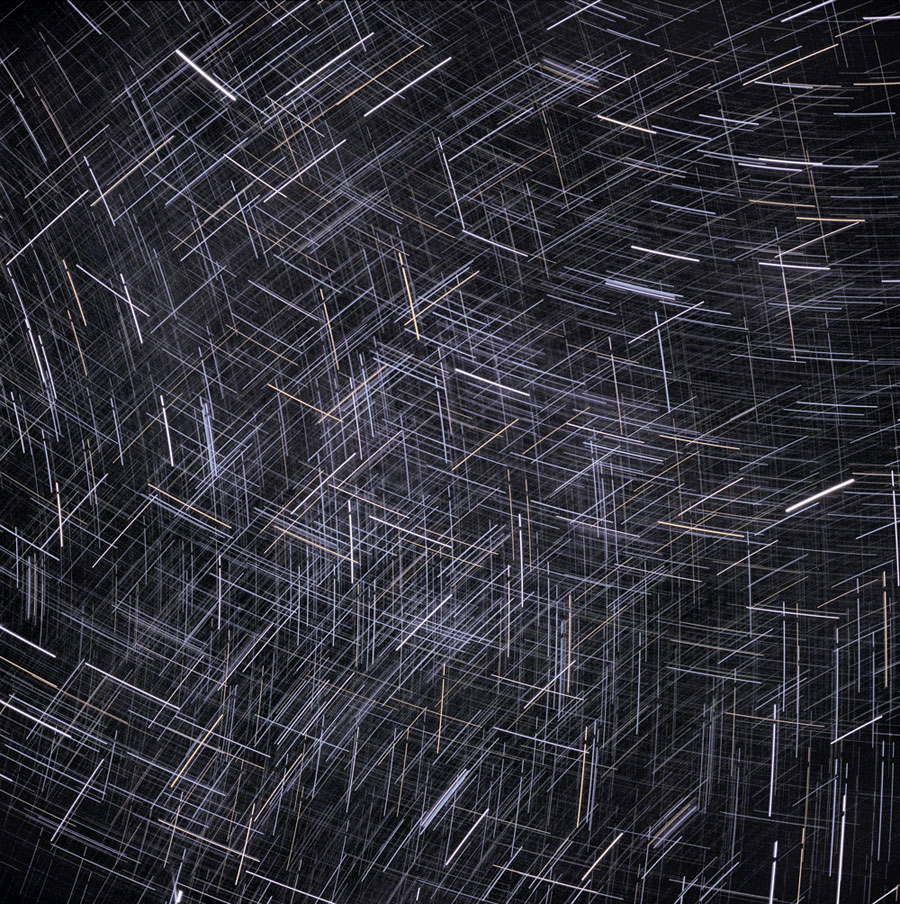
This is a beautiful, well resolved sequence that has a very intimate narrative, a journey of discovery from the stars in the night sky to our own star, the sun and on to the illumination of the earth at night. Under any circumstances, Follows’ vision is outstanding.
Dr Marcus Bunyan
Andrew Follows Night’s Ocean Shore sequence 2012
The Eye that sees the Sun: Andrew Follows and his Tabula rasa
“‘The world is my representation’: this is a truth valid with reference to every living and knowing being, although man alone can bring it into reflective, abstract consciousness. If he really does so, philosophical discernment has dawned on him. It then becomes clear and certain to him that he does not know a sun and an earth, but only an eye that sees a sun, a hand that feels the earth; that the world around him is there only as representation, i.e. only in reference to another, the representer, which is he himself.”
Arthur Schopenhauer. The World as Will and Representation 1818
Please close your left eye and place your left hand over it; now make a circle with the thumb and forefinger of your right hand and curl the rest of your fingers to make a tunnel; now place this hand to your right eye and close the aperture until you can only see a small amount of the world. Imagine, seeing the world through this one eye with only fifteen percent vision. This is the field of vision, the line of sight of artist Andrew Follows.
The artist’s visual acuity (the capacity of the eye to see fine detail, measured by determining the finest detail that can just be detected) has been with him since birth. He has always seen the world this way and does not regard it as a disability. In fact, his highly refined sense of “sight” enables spaces of poss/ability (not dis/ability) within his artistic practice. The development of an abnormal keen-sightedness helps him record his impression of the world via the medium of photography.
His is not the vision of im(pair)ment as the rest of us see the world, through two eyes, but the holistic vision of a monocular eye that becomes the root of his photography. The lens of the camera becomes an extension of Self, the shutter his very existence and the digital screen on the back of the camera his tabula rasa, a “blank slate” upon which he writes his experience and perception, his knowledge of the world. His experience of vision and the evidence of his photographs become both the beginning and the end of the work, a place in which his fundamental nature resides.
In today’s polyvocal world, with the proliferation of visual protheses (such as smart phones and digital cameras) we are now seeing the encoding of increasingly mental images of the material world. Follows’ photographs are an amalgamation of these mental images and what he can physically see on the screen, for when taking a photograph he cannot see details in the image he is taking. Follows takes the ‘I can see’ of sight, located within his field of vision, and through his organisation of the spatio-temporal field of vision and perception, he offers the viewer a unique ‘take’ on the world. His point of view is a collection of objects to which the eye is directed and on which it rests within a certain distance.
From a visual point of view this resting facilitates in Follows’ work a particular serenity and beauty. His skill as an artist is to combine his imagination with what he sees through the screens of camera and computer to create ‘other’ worlds. These other worlds are evidenced in Follows’ love of night time photography, as though his view of the environment, the spaces and places that surround him, is enhanced through a doubling of perception: of light, at night, through tunnel vision. Our eyes rest upon the effervescent lights of an oil refinery on the outskirts of Melbourne; the star trails blazing across the night sky; the reflections in water at Corio Bay, Geelong. Most importantly, it is the quality of light that imbues Follows’ work that enhances the narrative, the journey on which the artist takes us.
Follows’ shows us his world, and our world, as we have never seen it before. What is important in the work is that he asks us to embrace his vision and incorporate his photographs into our collective memory. The world is his representation, a truth valid with reference to every living and knowing being, brought by us into reflective, abstract consciousness. We the viewer become his eye, his only eye that sees Schopenhauer’s sun.
Dr Marcus Bunyan
May 2012
Andrew Follows (Australian, d. 2019) Untitled From the sequence Night’s Ocean Shore
2012
Digital inkjet prints
Contemporary Art Exchange presents Through the Looking Glass Dimly a unique collaboration and exchange project between Australian and Scottish photographers Andrew Follows (Melbourne) and Rosita McKenzie (Edinburgh). Drawn together by their shared passion for photography, their experiences of visual impairment, and a desire to share their knowledge and skills globally, Andrew and Rosita have embarked on an ambitious visual arts project to raise awareness about visual impairment issues, celebrate recent artistic achievements and create the first international network for visually impaired artists.
Digital photography is an excellent medium for reflecting and exploring blind or vision impaired artists’ life experiences. For Rosita it provides ‘a voice’ and dispels the myth that totally blind people cannot possess vision and artistic imagination or participate fully in the visual arts. For Andrew, who has Retinitis Pigmentosa – a degenerative eye condition leaving him blind in one eye and with only fifteen percent vision in the other – it is a tool that enables him to see small glimpses of his fading world.
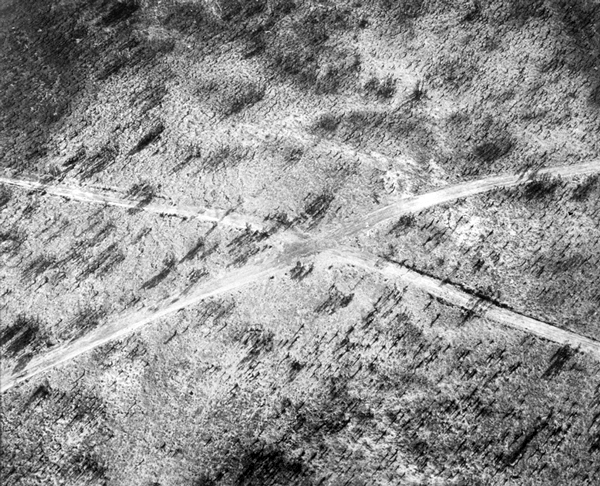
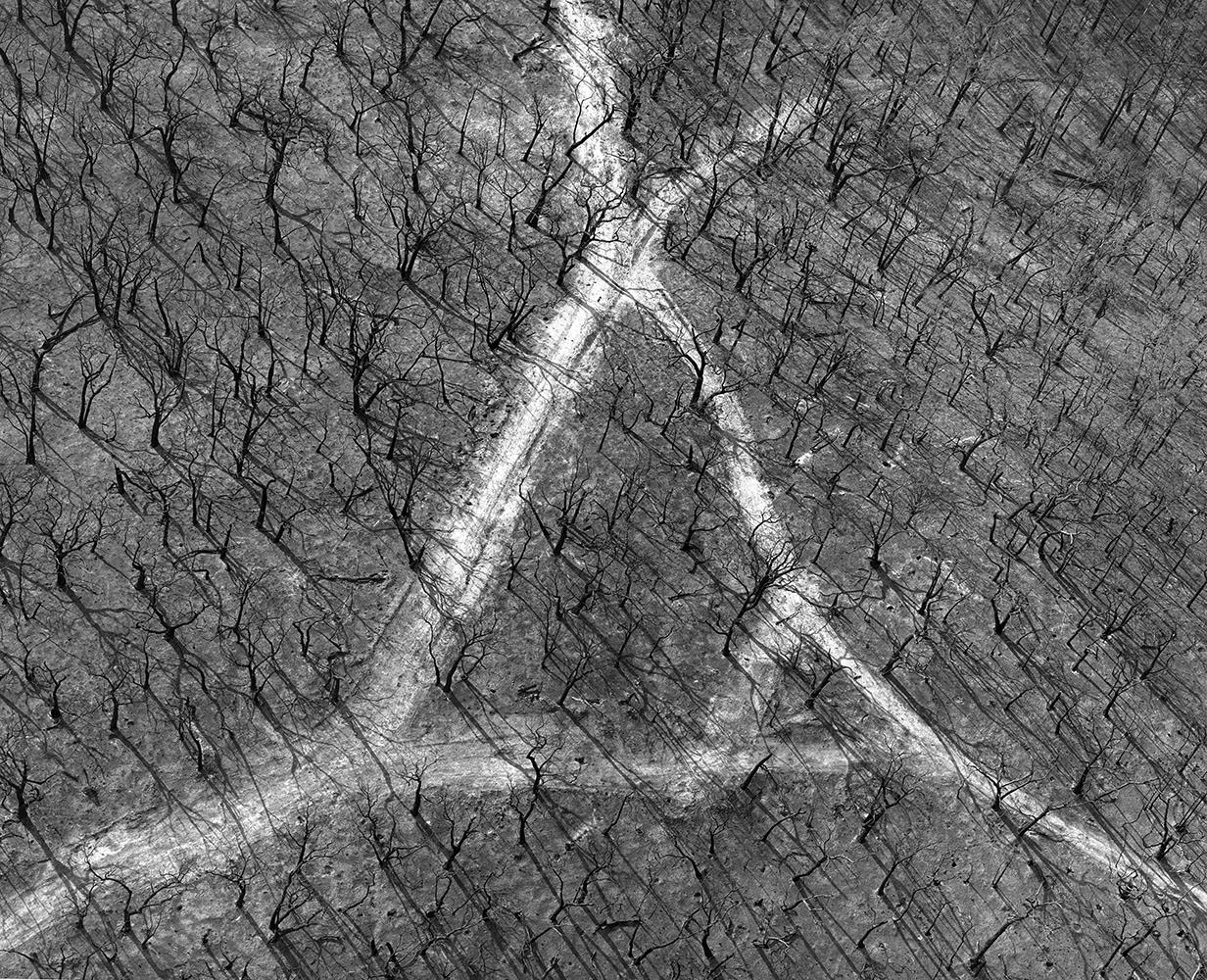
Andrew and Rosita have been collaborating to develop an exhibition of previous and new work. Since 2009, Andrew has documented the effects of, and resilience to, the devastating Black Saturday bushfires in the Victorian Highlands. Rosita, although having never ‘seen’ Andrew’s work, has responded to it by embarking on her own documentation of the effects of and regrowth after the unusual forest fires in the Scottish Highlands earlier this year. Andrew has also been experimenting with night photography and has developed a number of photographs capturing the Southern Hemisphere by night. In response, Rosita will develop a new body of work capturing the night sky from a Northern Hemisphere perspective. Both artists will also showcase examples from their wide range of photographs dealing with similar themes from natural and urban settings.
The project will be registered with the 2012 Edinburgh Art Festival and the Year of Creative Scotland. Through the Looking Glass Dimly will also coincide with other major international events taking place in Edinburgh during August such as the first International Cultural Summit, the Edinburgh International Festival, the Edinburgh Fringe Festival and the Festival of Politics at The Scottish Parliament.”
Text from the Contemporary Art Exchange
The Old Ambulance Depot
77 Brunswick Street
Edinburgh
EH7 5HS
Only open to the public during exhibitions and events
Andrew Follows (Australian, d. 2019) Untitled
2012
From the series Night’s Ocean Shore
As you may know I have been helping vision impaired Australian photographer Andrew Follows as he prepares for the greatest adventure of his life, a joint exhibition as part of the Edinburgh Art Festival titled Through the Looking Glass, Dimly. The works have all be printed and framed and are on their way to Scotland at this very moment.
You must be logged in to post a comment.