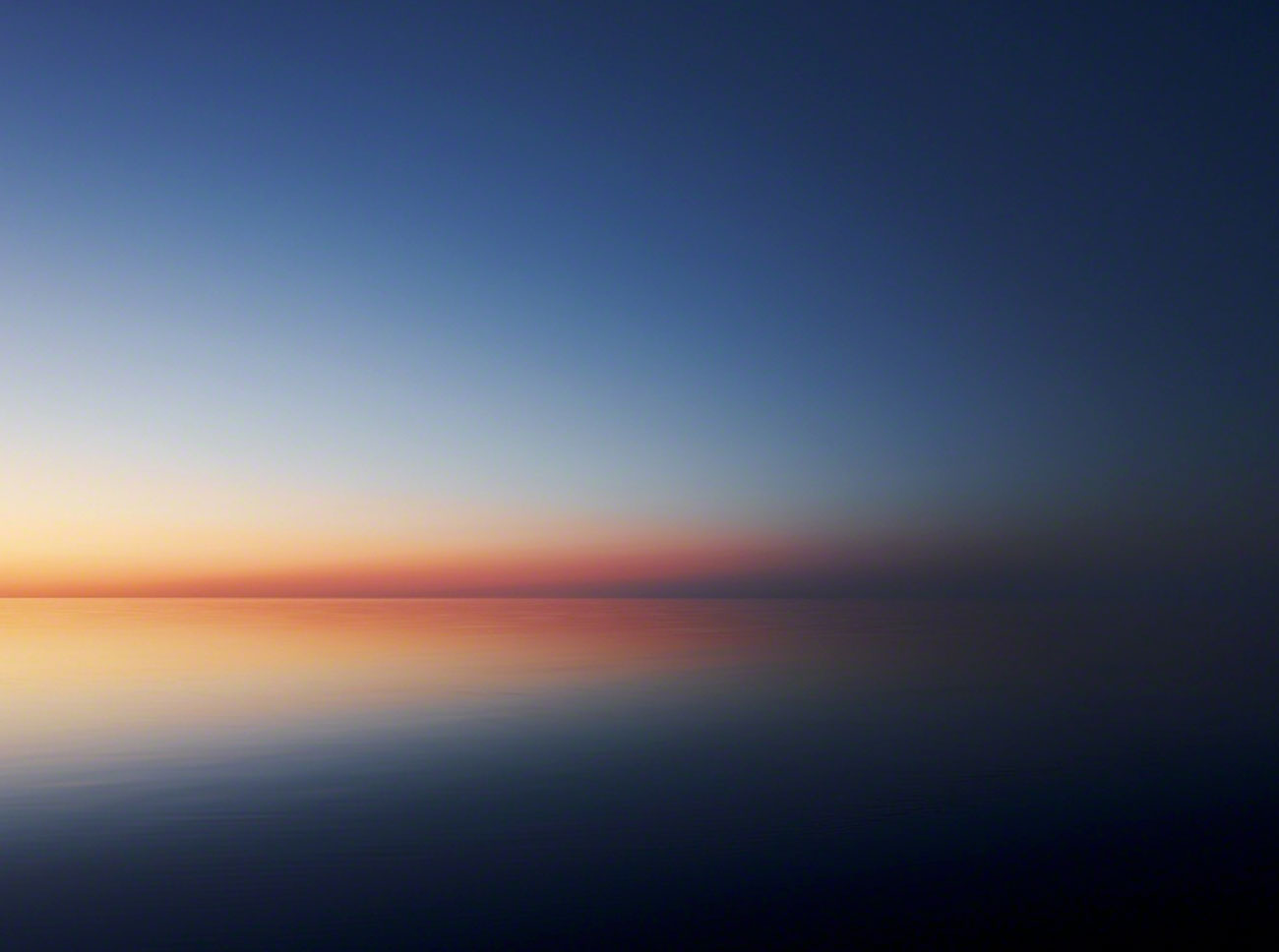
Murray Fredericks (Australian, b. 1970) Salt 271
2011
150 x 120cm
Pigment print on cotton rag
“Photographers tell me what I already know. The recognition of the beautiful, bizarre, or boring (the three photographic B’s) is not the problem. You would have to be a refrigerator not to be moved by the beauty of Yosemite. The problem is to deal with one’s total experience, emotionally as well as visually. Photographers should tell me what I don’t know.”
Duane Michals Real Dreams1
“While we cannot describe its appearance (the equivalent), we can define its function. When a photograph functions as an Equivalent we can say that at that moment, and for that person the photograph acts as a symbol or plays the role of a metaphor for something that is beyond the subject photographed.”
Minor White
Fredericks new infrared panoramic works show the strength of nature at it’s finest (9 out of 10 to nature especially when see through this type of filtration), excellent technical skills and good printing but somehow any revelation of spirit in the sublime has been lost in these photographs.
The photographer does not take me anywhere, there is no new space to step into, another view of the world that I want to spend time with. The relationship between the two series is also nebulous, the critical ice / fire space between the works adding little frisson to the exhibition.
I ask: Is it sufficient to use a digital scientific infrared back, if for no other reason that it is there? Is it sufficient to know that these climatic conditions take place in the same area each day, at the same time, place the camera down and just capture the scene? Is there really a non-decisive moment in these photographs, a poetic insight, or is this just what was, literally, hanging around so to speak?
The answer to all three questions I leave up to the reader.
Personally, I need photography to push the boundaries of elusiveness through an understanding in revelation, not just through an understanding of space and form, light and colour. I believe that conventional patterns of perception are there to be broken in ways that disrupt the technologies of the self – the self-regulating of our senses, the conventions of cultural capital – but too what do we open ourselves up to?
As Minor White says: ‘The sound of one hand clapping’.
While the photographs have the weight of serious equipment and professional acumen behind them after the initial awe on viewing they fall to earth, like the rainstorms they portray. As with my earlier review of Salt they seem to be more about the photographer than any revelation of the thing being photographed.
Duane Michals observes that, “The best artists give themselves in their work” but this giving is ego-less, the dropping away of the bells and whistles to let an’other’ emerge: in this sense I do not feel the total experience, emotionally as well as visually.
Paul Strand said that it took him 10 years to start to become an artist, to let go of ego in his work; paradoxically after this the work became more his own.
For me, these photographs never become a metaphor for something that is beyond the subject being photographed.
Dr Marcus Bunyan
1/ Michals, Duane. Real Dreams 1976 [Online] Cited 08/06/2011, on longer available online.
Many thankx to Angela Connor for her help and to Arc One Gallery for allowing me to publish the photographs in the posting. Please click on the photographs for a larger version of the image.
Murray Fredericks (Australian, b. 1970) Salt 272
2010
Pigment print on cotton rag
150 x 120cm
Murray Fredericks (Australian, b. 1970) Salt 273
2011
Pigment print on cotton rag
150 x 120cm
Salt began in 2003 and is a series of photographs of vast empty landscapes. Each image in the series is connected by the placement of the horizon running across the lower third of the frame. The horizon is the only referential form, breaking the void and providing the viewer with an element that paradoxically ‘defines’ the space. These new works add another dimension to Salt, with the water from last year’s rains now creating scenes diametrically opposed to the work occupying the adjacent walls as Hector.
Hector draws its title from an affectionately name atmospheric phenomenon that produces some of the world’s biggest thunderstorms. These new black and white works employ Murray’s methodical consistency of composition with distinctly different outcomes to the Zen-like vistas of Salt. In these works the expanse of the storm is consciously contained and forced into a barometric battle with the invisible air at its limits for the place of subject within the photograph…
By juxtaposing these series, each viewer is at once placed outside the containers which harbour these landscapes of remote territories – one calm and one facing the eye of the storm – and at the same time place in the centre of Murray’s minimal, ethereal representations of these places. In this way we can trace his exploration into these subjects – capturing the moment is our witness to a reverence to land and country.
Text from Arc One Gallery
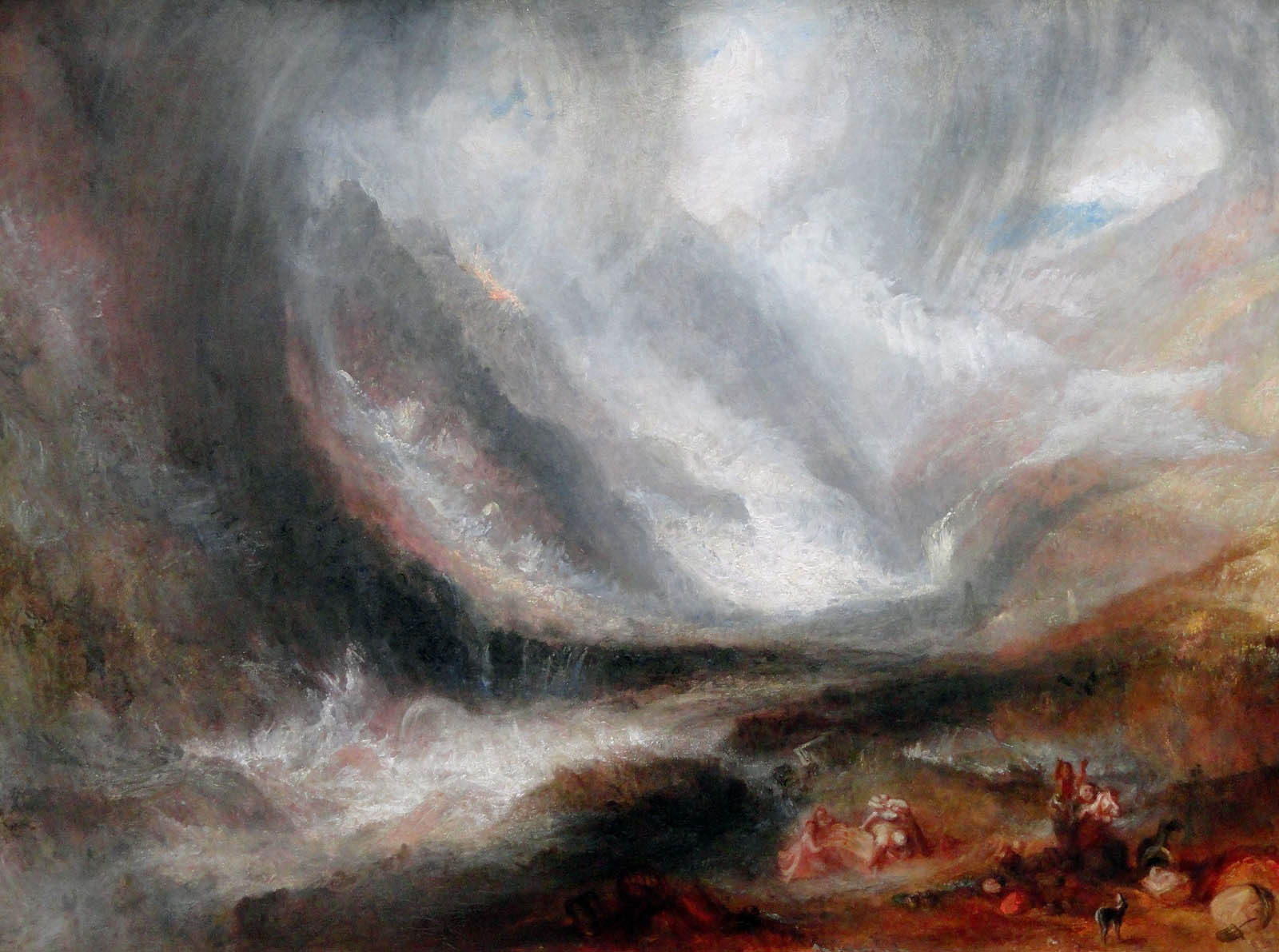
Joseph Mallord William Turner (English, 1775-1851) Valley of Aosta: Snowstorm, Avalanche, and Thunderstorm
1836/37
Oil on canvas
36 1/4 x 48 in. (92.2 x 123cm)
The Art Institute of Chicago: Frederick T. Haskell Collection
Murray Fredericks (Australian, b. 1970) Hector 10
2011
220 x 120cm
Pigment print on cotton rag
Murray Fredericks (Australian, b. 1970) Hector 11
2011
204 x 120cm
Pigment print on cotton rag
Arc One Gallery
45 Flinders Lane
Melbourne, 3000 Phone: (03) 9650 0589
Kirsten Haydon (New Zealand, b. 1973)
ice objects
2011
Enamel, copper, reflector beads
Various dimensions
“Confronted by the immensity and power of desert and ice, one cannot simply stand to the side and evaluate as though one were standing before a landscape garden and other works of art. Conflicting emotions, including fear, are aroused and simultaneously absorbed or taken over by the overmastering presence of nature.”
Yi Fu Tuan. Desert and Ice: Ambivalent Aesthetics, 1993
There are many things to like about this exhibition: the fine craftsmanship, the forms, the observation and the beauty of some of the pieces. The symbolism is simple and effective – re-imaged relics of white, vitreous enamel objects from the huts of Robert Scott and Ernest Shackleton, the use of reflector beads to imitate snow and Meccano-like steel girders to symbolise human construction and encroachment on a pristine land.
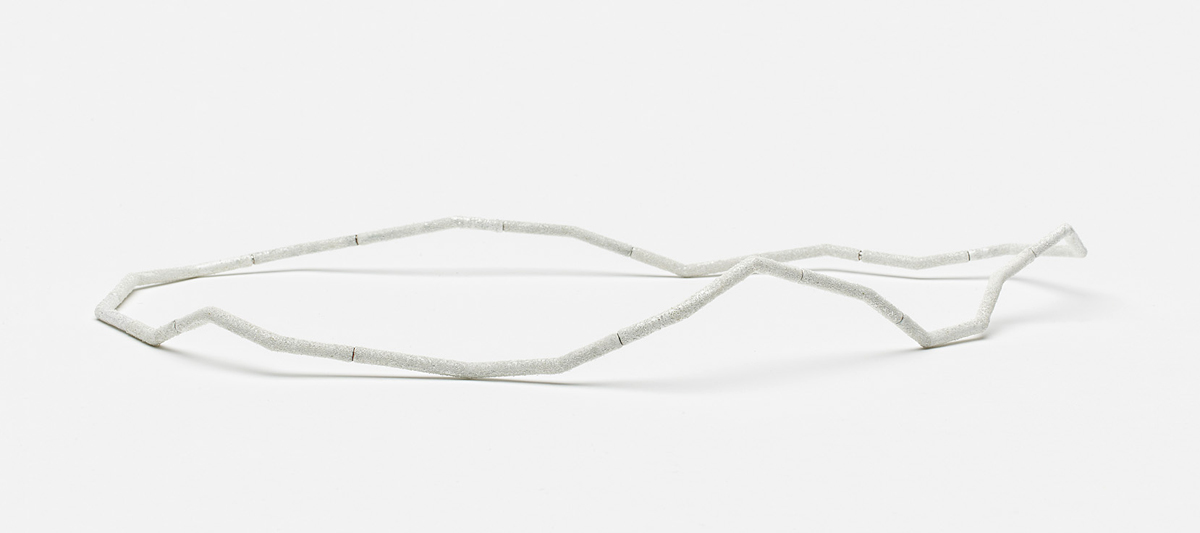
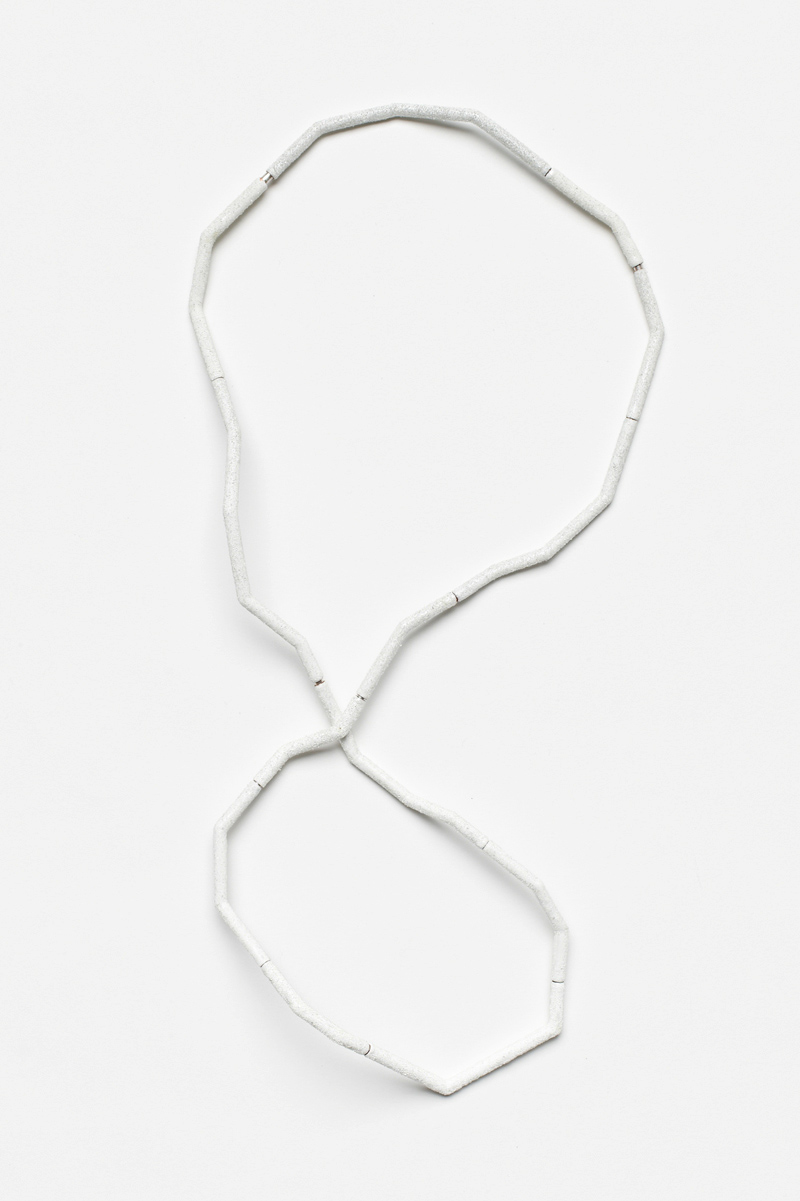
Some of the ‘objects’ remind me of the beauty and simplicity of Etruscan vessels, seemingly delicate apports, being the transference of an article from one place and time to another; the use of reflector beads at the bottom of ice sample (2011, below) is also inspired. So too is the occlusion of the image in the brooch ice plane (2011, below) which adds further mystery to an already surreal landscape. One piece is absolutely stunning. The wonderful neckpiece ice movement (2011, see two photographs below) is ravishing in it’s articulation and form, its snow-covered twig-like coolness.
Unfortunately where the exhibition fails is in the use of banal images in several works such as ice depot, ice runway, ice industry (brooch, all 2011, not pictured) and ice industry (2011, neckpiece, below). The obvious point being made is that of man made construction in a pristine landscape but the simple symbology used so effectively in other pieces becomes a little awkward in these pieces. The images used are quite ugly and while this fits the symbolic use of them it doesn’t make for very interesting or illuminating art. There needed to be more layering for the message to be effective – which is why the occluded brooch works so well, human construction blinded, dissolved.
This is a pity because the rest of the exhibition is excellent. Enter this ice world and you will be delightfully surprised!
Dr Marcus Bunyan
Many thankx to Katie Scott for her help and Gallery Funaki for allowing me to publish the photographs and text in the posting. Please click on the photographs for a larger version of the image.
Kirsten Haydon (New Zealand, b. 1973)
ice edge (left)
Object
2011, enamel, reflector beads, copper, silver
60 x 350 x 210 mm
ice sheet flow (right)
Object
2011
Enamel, reflector beads, copper, silver
70 x 130 x 195 mm
Kirsten Haydon (New Zealand, b. 1973)
ice plane
Brooch
2011
Enamel, photo transfer, reflector beads, silver, copper, steel
80 x 80 x 10 mm
Kirsten Haydon (New Zealand, b. 1973)ice industry
neckpiece
2011
enamel, copper, photo transfer, paint, silver
280 x 160 x 10 mm
I make jewellery and objects that both connect to and explore human experience and place. Since Antarctica’s discovery explorers, expeditioners, artists and writers have attempted to record and visualise this isolated continent. In 2004 I was awarded a New Zealand Antarctic Arts Fellowship en joined those who communicate their experiences of Antarctica.
Antarctica is often regarded as a pristine yet harsh environment, home to extraordinary wildlife and the domain of scientists. Due to its remoteness projects that are supported by international Antarctic programmes are predominantly science-based and as a result artistic research in Antarctica is limited. The cultural theorist, Yi Fu Tuan describes the experience of the explorer as: “the longing to be taken out of oneself and ones habitual world into something vast, overpowering and indifferent.” His statement resonates with my experience of Antarctica where I found myself drawn to the minutiae of the ice crystal and the structures and forms that I could associate with in the extraordinary landscape. While in that place, so removed from the conventions of civilisation, I came to understand the immensity of nature and to see that it exists without the necessity for human presence …
Inside the historic huts of Robert Scott and Ernest Shackleton I was captivated by the history, contained both in the interior spaces themselves and in the material artefacts left by the expeditioners … These seemingly mundane objects are transformed into a still life of significant artefacts of a previous time, preserving the memory and story of their parties of explorers.
My interpretations engage through the iconography of personal jewellery, domestic objects and the environment of Antarctica. In the course of making I continue to investigate and portray Antarctica through my own and others’ personal experiences. The objects I produce reference valued souvenir jewellery and objects now displayed in museums as historical artefacts, which were once personal mementos …
Excerpts from the catalogue text by Kirsten Haydon May 2011
Kirsten Haydon (New Zealand, b. 1973)
ice movement
Neckpiece
2011
Enamel, copper, reflector beads, silver
Kirsten Haydon (New Zealand, b. 1973)
ice sample
Object
2011
Enamel, copper, reflector beads
Gallery Funaki
Sackville House
Apartment 33
27 Flinders Lane
Melbourne 3000
Australia
Opening hours:
Wednesday – Friday 12 – 5pm
Saturday on occasion (check our socials) or by appointment
Gallery Funaki websiteLIKE ART BLART ON FACEBOOKBack to top
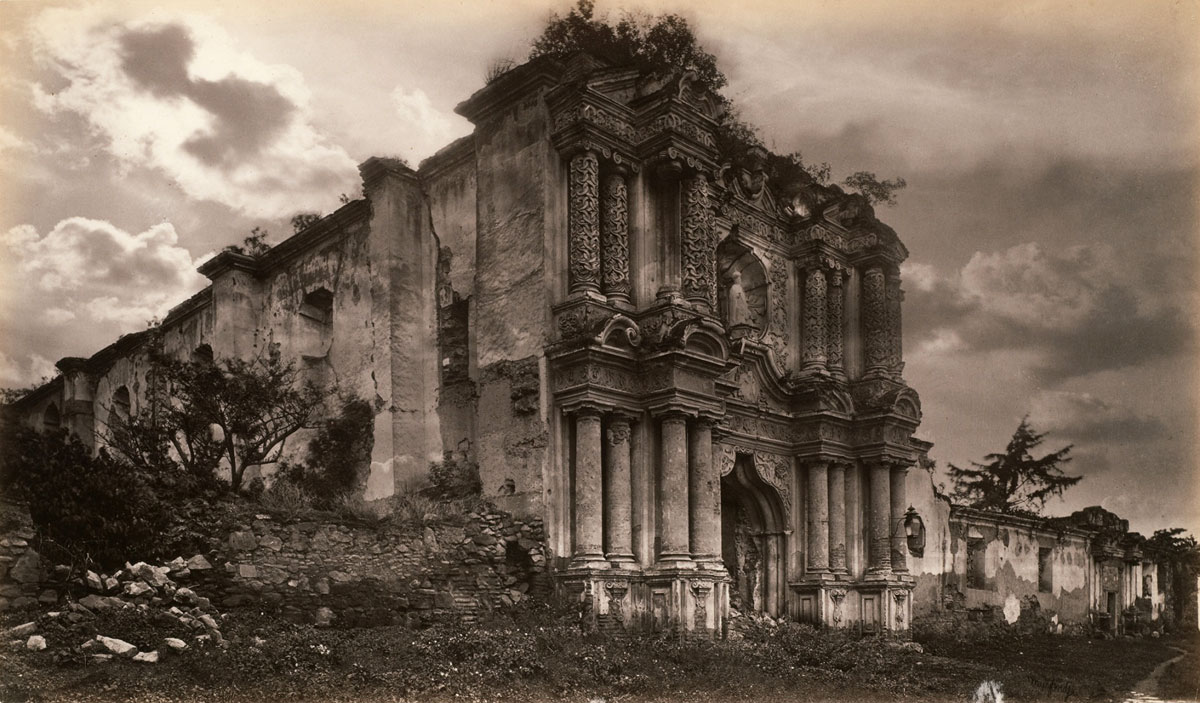
Eadweard Muybridge (English-American, 1830-1904) Ruins of a Church, Antigua, Guatemala 1875 Albumen print Collection Centre Canadien d’Architecture/Canadian Centre for Architecture, Montreal
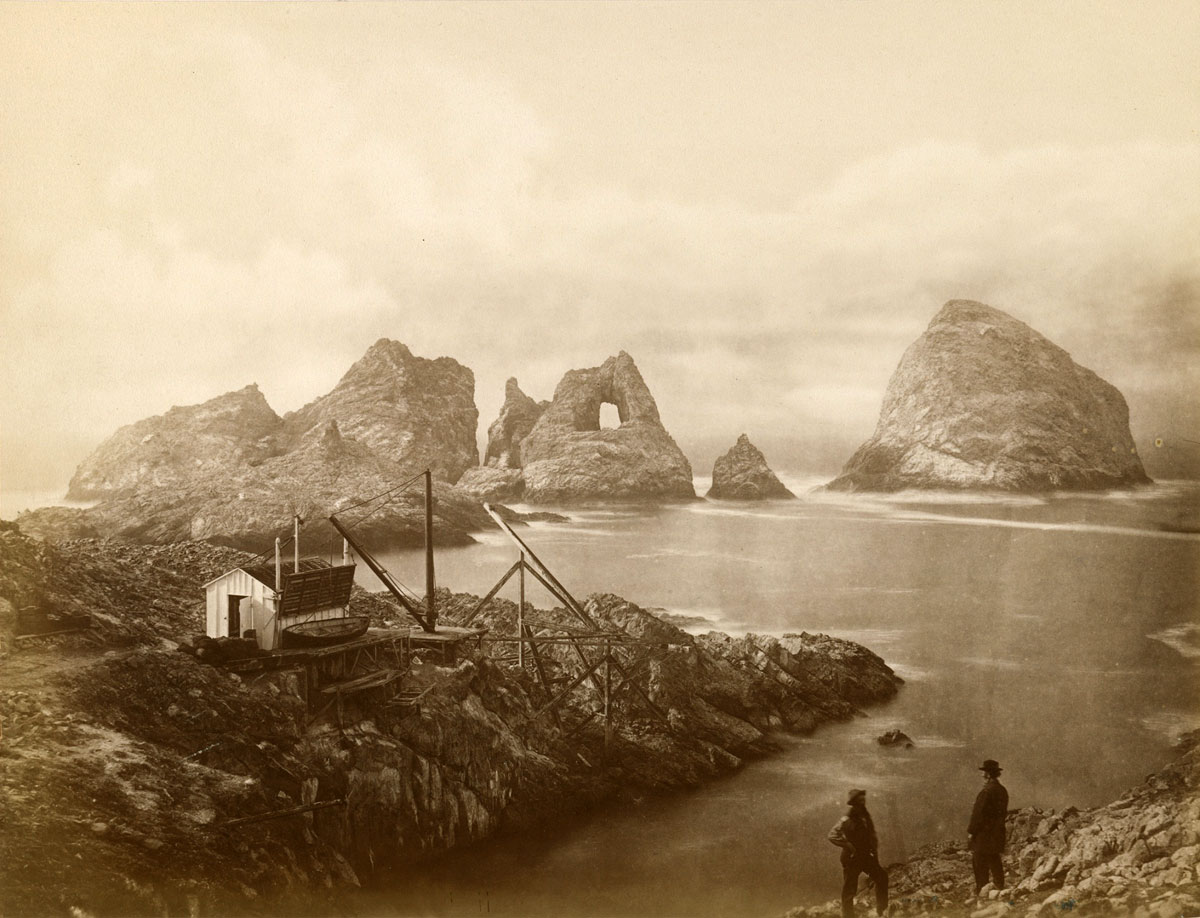
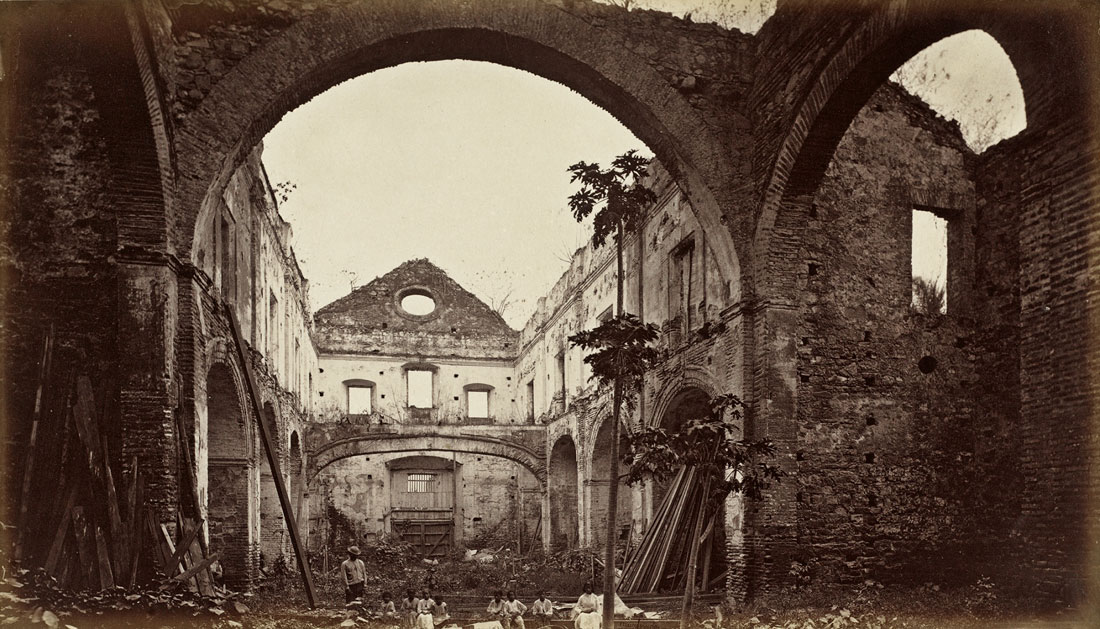
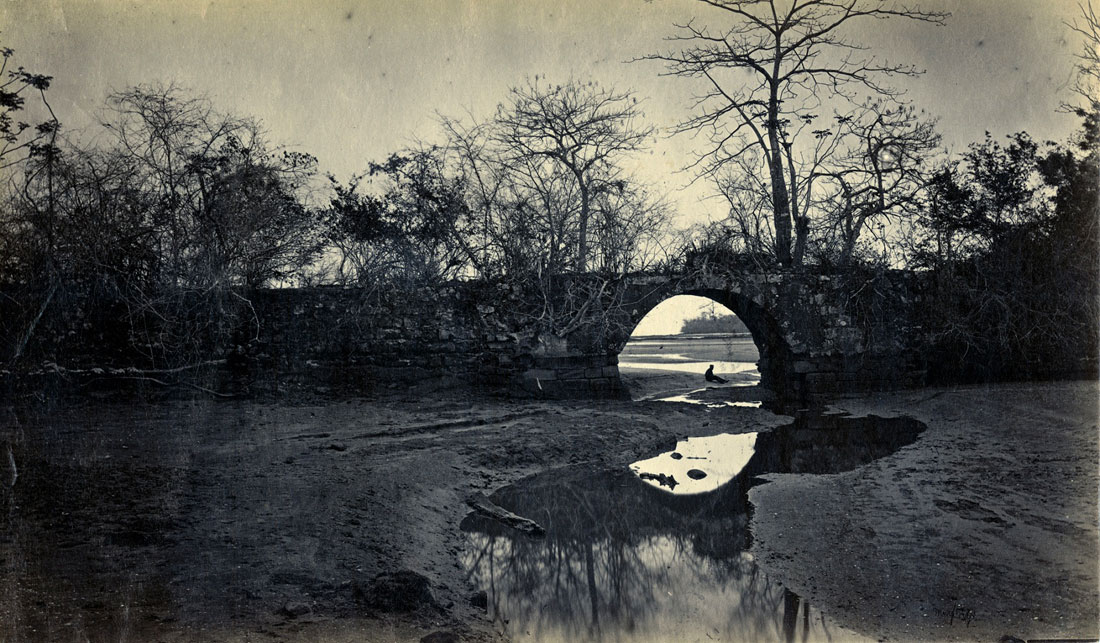
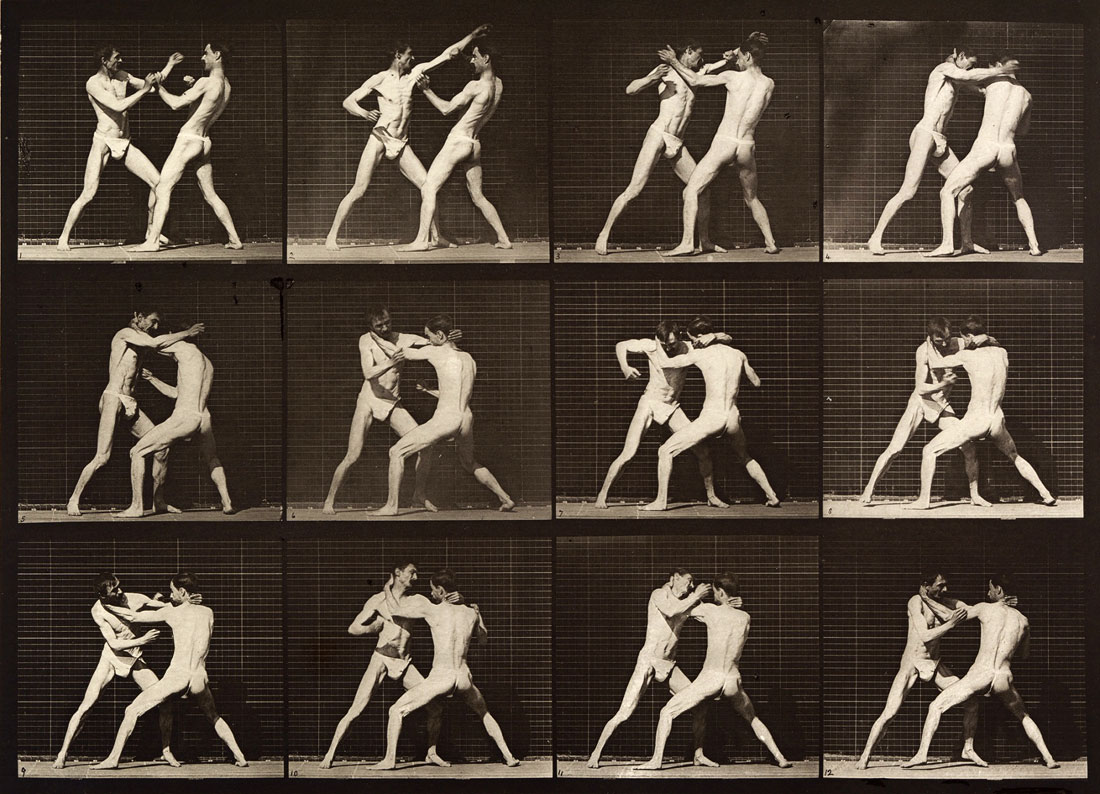
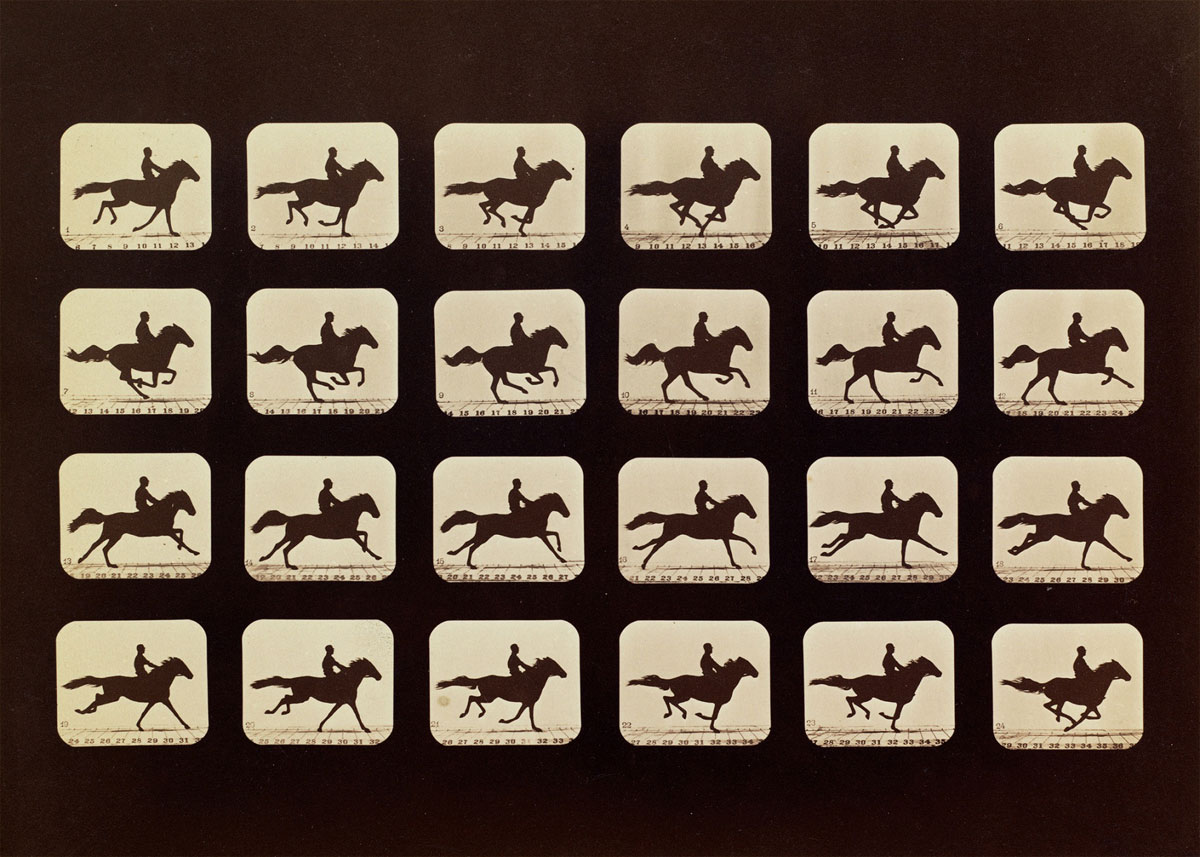
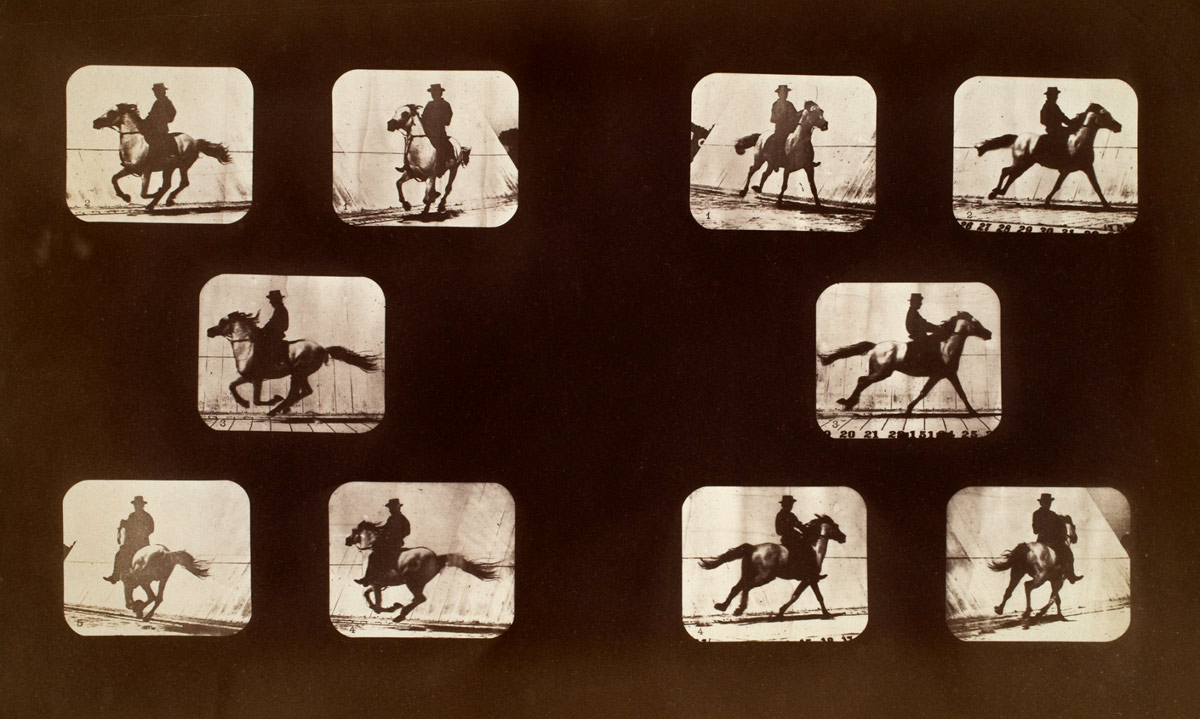
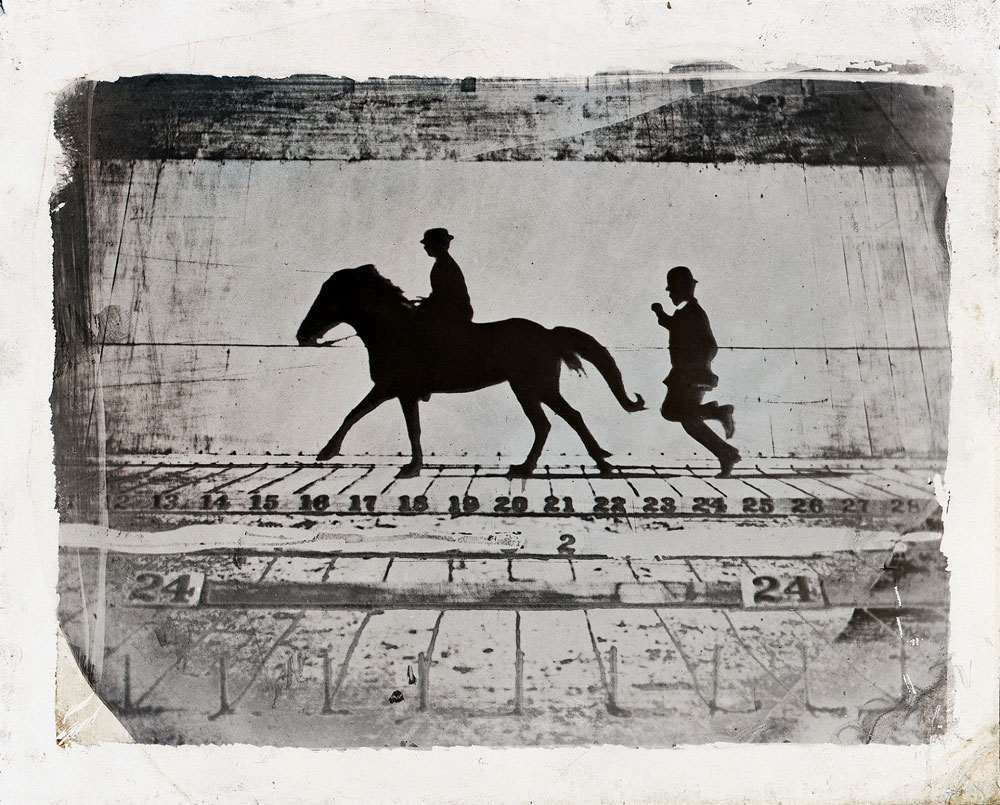
While rightly famous for his work on animal locomotion it is the first group of photographs in this posting that shine most brightly. It is often overlooked how magnificent a photographer Eadweard Muybridge was and what a brilliant eye he had. The top three photographs, especially the first one (above), are knockouts – radiant jewels in which the tensional points of the composition and the atmosphere of the scene are captured magnificently. I also love the use of human figures to give scale to the scene.
It is rare to find Eadweard Muybridge photographs other than his locomotion studies on the Internet (do a search under Google and see for yourself!), so it is a particular pleasure to post these photographs. It is something I have been wanted to do for quite a while now and finally it has come to pass; earlier iterations of this exhibition had few press images so I must heartily thank the San Francisco Museum of Modern Art (SFMOMA) for allowing me to publish the photographs in the posting.
Dr Marcus Bunyan
Many thankx to the San Francisco Museum of Modern Art (SFMOMA) for allowing me to publish the photographs in the posting. Please click on the photograph for a larger version of the image.
Eadweard Muybridge (English-American, 1830-1904) The Ramparts, Funnel Rock, Hole in the Wall, Pyramid, Sugar Loaf, Oil House, and Landing Cove on Fisherman’s Bay, South Farallon Island (4150) 1871 Albumen print U.S. Coast Guard Historian’s Office
Eadweard Muybridge (English-American, 1830-1904) Ruins of the Church of San Domingo, Panama 1875 Albumen print Image courtesy The Board of Trustees, National Gallery of Art, Washington
Eadweard Muybridge (English-American, 1830-1904) Bridge on the Porto Bello, Panama 1875 Albumen print Department of Special Collections, Charles E. Young Research Library, UCLA
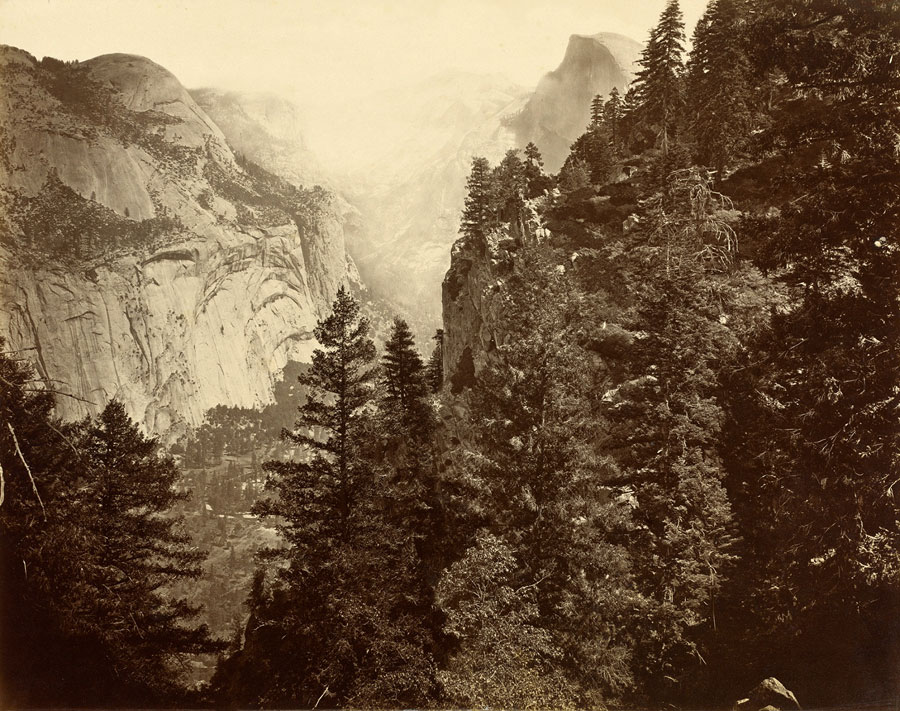
Eadweard Muybridge (English-American, 1830-1904) Tenaya Canyon. Valley of the Yosemite. From Union Point. No. 35 1872 Albumen print Collection National Gallery of Art, Washington, DC
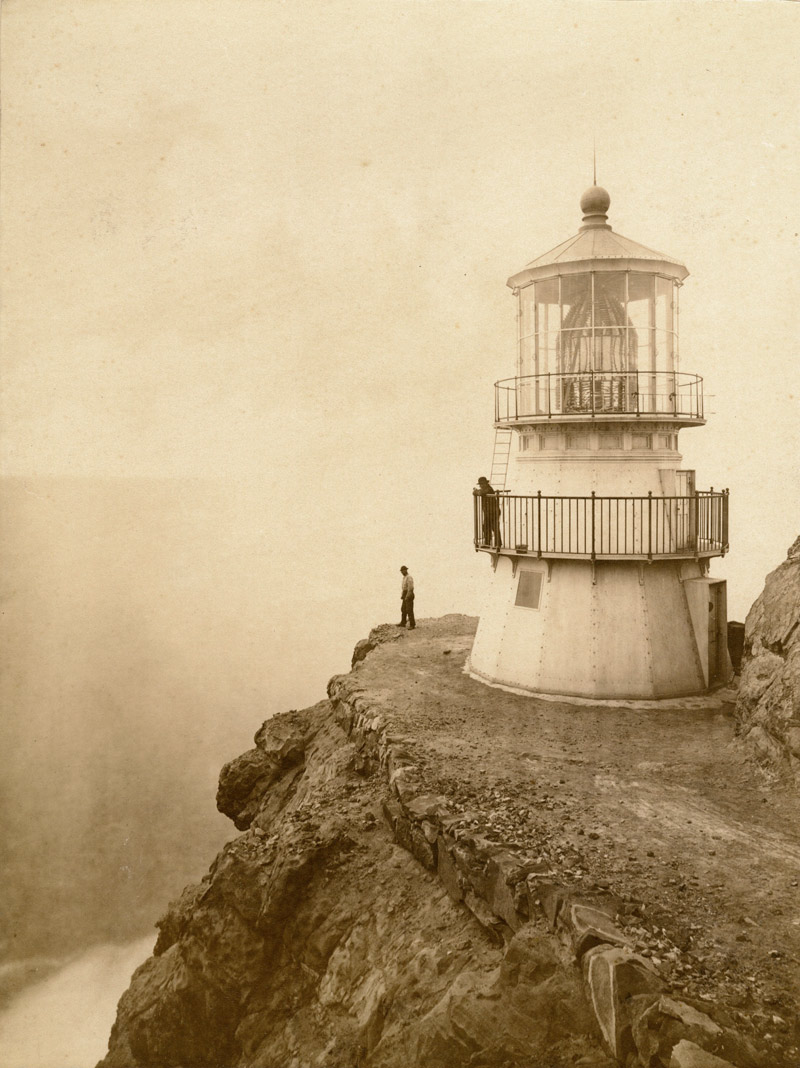
Eadweard Muybridge (English-American, 1830-1904) First-Order Lighthouse at Punta de los Reyes, Seacoast of California, 296 Feet Above Sea (4136) 1871 Albumen print U.S. Coast Guard Historian’s Office
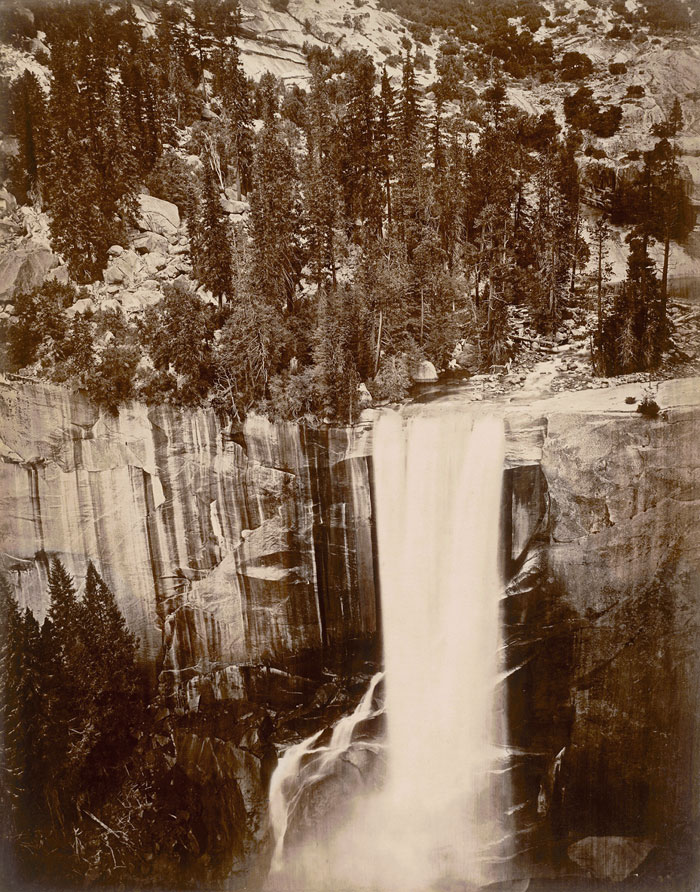
Eadweard Muybridge (English-American, 1830-1904) Pi-Wi-Ack. Valley of the Yosemite. (Shower of Stars) “Vernal Fall.” 400 Feet Fall. No. 29 1872 Albumen print Collection San Francisco Museum of Modern Art; gift of Jeffrey Fraenkel and Frish Brandt
From February 26 through June 7, 2011, the San Francisco Museum of Modern Art (SFMOMA) will showcase the first-ever retrospective examining all aspects of artist Eadweard Muybridge’s pioneering photography. Helios: Eadweard Muybridge in a Time of Change brings together more than 300 objects created between 1857 and 1893, including Muybridge’s only surviving zoopraxiscope – an apparatus he designed in 1879 to project motion pictures. Originally organised by Philip Brookman, Corcoran Gallery of Art chief curator and head of research, the San Francisco presentation is organised by SFMOMA Associate Curator of Photography Corey Keller.
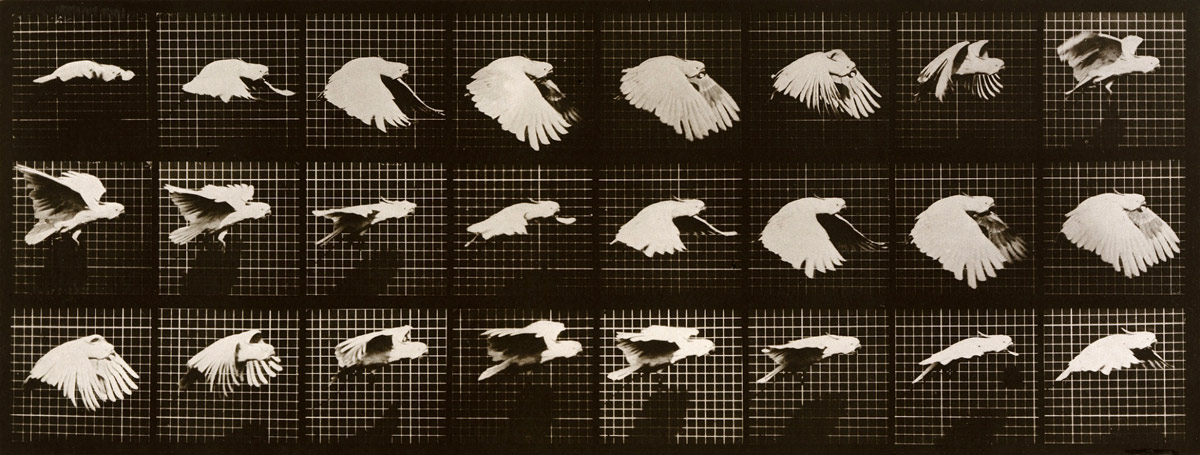
Helios: Eadweard Muybridge in a Time of Change includes numerous vintage photographs, albums, stereographs, lantern slides, glass negatives and positives, patent models, zoopraxiscope discs, proof prints, notes, books, and other ephemera. The works have been brought together from 38 different collections and include a number of Muybridge’s photographs of Yosemite Valley, including dramatic waterfalls and mountain views from 1867 and 1872; images of Alaska and the Pacific coast; an 1869 survey of the Central Pacific and Union Pacific Railroads in California, Nevada, and Utah; pictures from the Modoc War, pictures from Panama and Guatemala; and urban panoramas of San Francisco. The exhibition also includes examples from Muybridge’s experimental series of sequential stop-motion photographs such as Attitudes of Animals in Motion (1881) and his later masterpiece Animal Locomotion (1887).
The exhibition is organised in a series of thematic sections that present the chronology of Muybridge’s career, the evolution of his unique sensibility, the foundations of his experimental approach to photography, and his connections to other people and events that helped guide his work. The sections include: Introduction: The Art of Eadweard Muybridge (1857-1887); The Infinite Landscape: Yosemite Valley and the Western Frontier (1867-1869); From California to the End of the Earth: San Francisco, Alaska, the Railroads, and the Pacific Coast (1868-1872); The Geology of Time: Yosemite and the High Sierra (1872); Stopping Time: California at the Crossroads of Perception (1872-1878); War, Murder, and the Production of Coffee: the Modoc War and the Development of Central America (1873-1875); Urban Panorama (1877-1880); The Horse in Motion (1877-1881); Motion Pictures: the Zoopraxiscope (1879-1893); and Animal Locomotion (1883-1893).
Muybridge and San Francisco
Best known for his groundbreaking studies of animals and humans in motion, Muybridge (1830-1904) was also an innovative and successful landscape and survey photographer, documentary artist, inventor, and war correspondent. Born in Kingston upon Thames, England, in 1830, Muybridge immigrated to the United States around 1851. He worked as a bookseller in New York and San Francisco and returned to London in 1860 following a serious injury. Muybridge learned photography in Britain and by 1867 returned to the United States, where began his career as a photographer in San Francisco. He gained recognition through innovative landscape photographs, which showed the grandeur and expansiveness of the American West. Between 1867 and 1871, these were published under the pseudonym “Helios.”
Muybridge spent most of his career in San Francisco and Philadelphia during a time of rapid industrial and technological growth. In the 1870s he developed new ways to stop motion with his camera. Muybridge’s legendary sequential photographs of running horses helped change how people saw the world. His projected animations inspired the early development of cinema, and his revolutionary techniques produced timeless images that have profoundly influenced generations of photographers, filmmakers, and visual artists.
Press release from the San Francisco Museum of Modern Art (SFMOMA) website [Online] Cited 02/06/2011 no longer available online
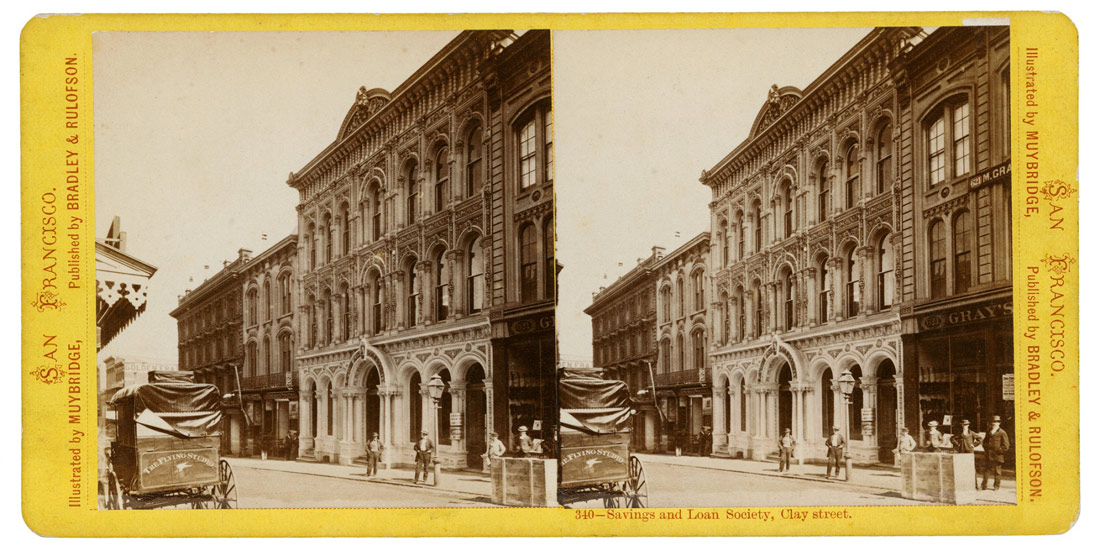
Eadweard Muybridge (English-American, 1830-1904) Savings and Loan Society, Clay Street (340) 1869 albumen stereograph Collection of Leonard A. Calle
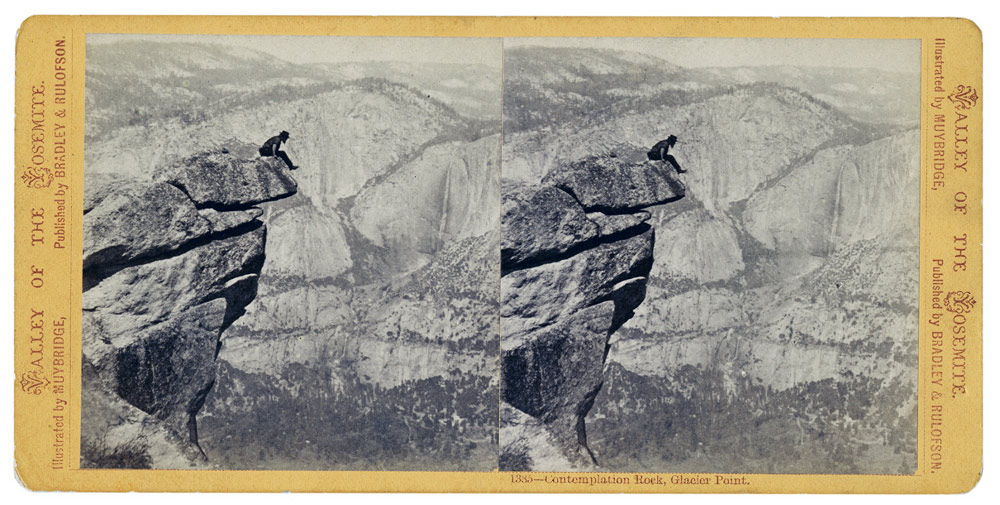
Eadweard Muybridge (English-American, 1830-1904) Contemplation Rock, Glacier Point (1385) 1872 Albumen stereograph Collection of California Historical Society
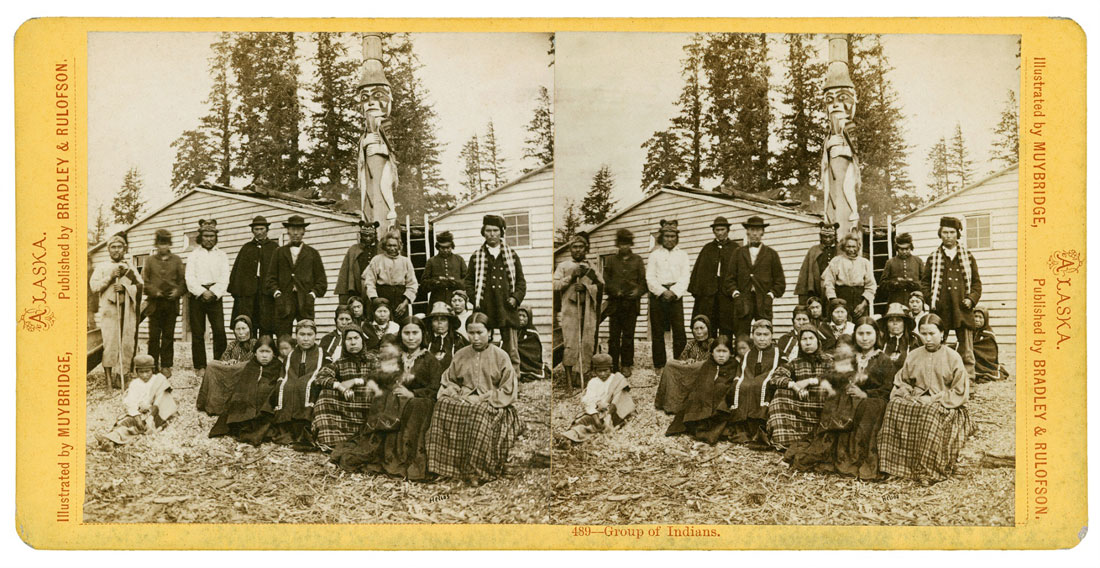
Eadweard Muybridge (English-American, 1830-1904) Group of Indians (489) 1868 Albumen stereograph Collection of Leonard A. Walle
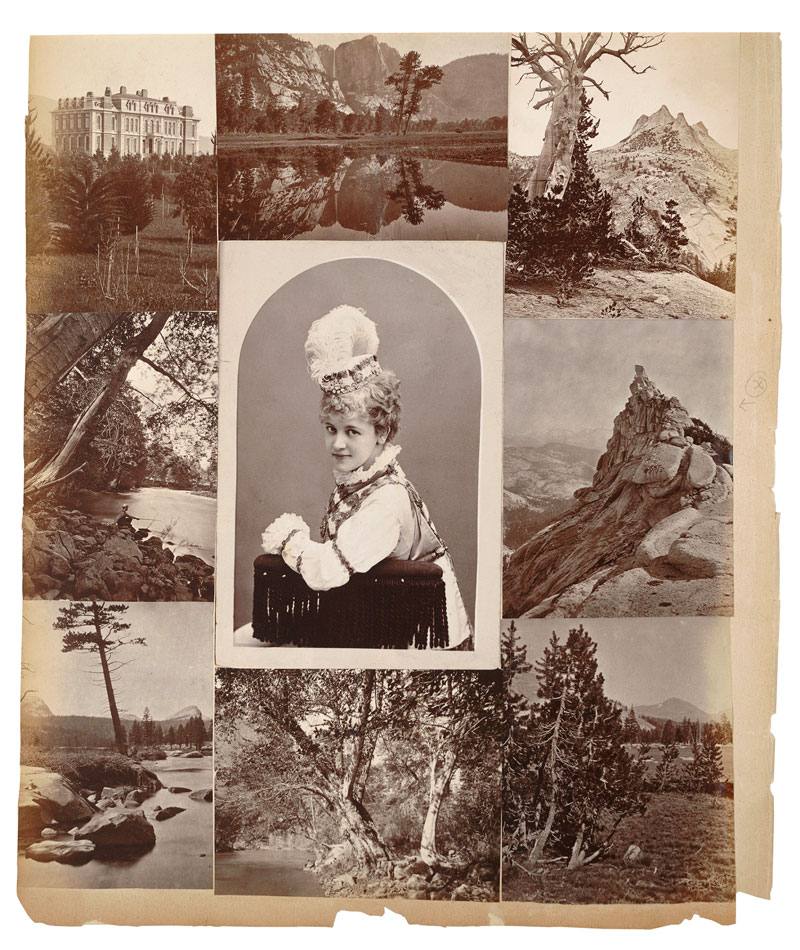
Eadweard Muybridge (English-American, 1830-1904) The Brandenburg Album of Bradley & Rolufson “Celebrities” and Muybridge Photographs, page 104 1874 Albumen prints Iris & B. Gerald Cantor Center for Visual Arts at Stanford University, Museum Purchase Fund
Eadweard Muybridge (English-American, 1830-1904) Horses. Running. Phryne L. Plate 40 1879 From The Attitudes of Animals in Motion, 1881 Albumen print Image courtesy The Board of Trustees, National Gallery of Art, Washington, Gift of Mary and Dan Solomon
Eadweard Muybridge (English-American, 1830-1904) Studies of Foreshortenings. Horses. Running. Mahomet. Plates 143-144 1879 From The Attitudes of Animals in Motion, 1881 Albumen print Chrysler Museum of Art, Norfolk, VA
Eadweard Muybridge (English-American, 1830-1904) Leland Stanford, Jr. on his pony “Gypsy” – Phases of a Stride by a Pony While Cantering 1879 Collodion positive on glass Wilson Centre for Photography
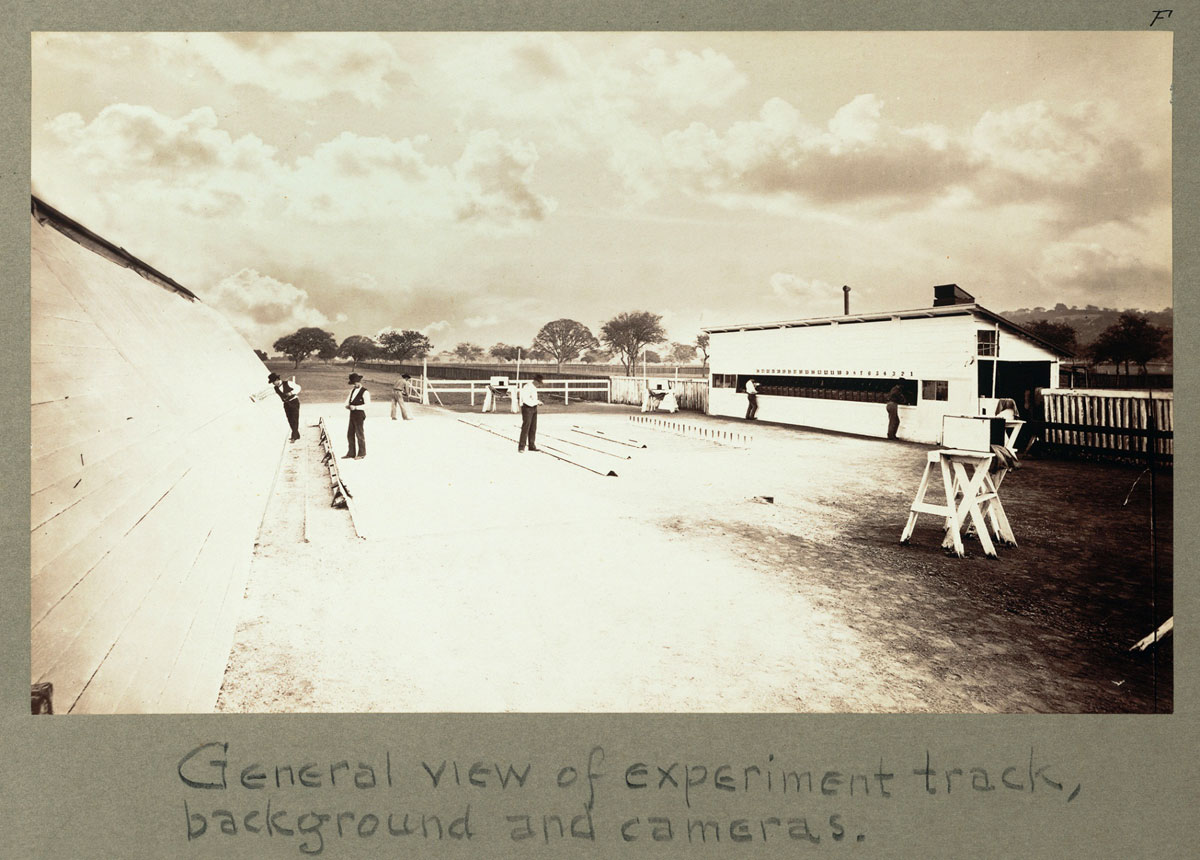
Eadweard Muybridge (English-American, 1830-1904) General view of experiment track, background and cameras, Plate F 1881 From The Attitudes of Animals in Motion, 1881 Albumen print Courtesy Special Collections, Stanford University Libraries
San Francisco Museum of Modern Art (SFMOMA) 151 Third Street (between Mission + Howard) San Francisco CA 94103
Opening hours: Friday – Tuesday 10 am – 5 pm and Thursday 10 am – 9 pm Wednesday Closed
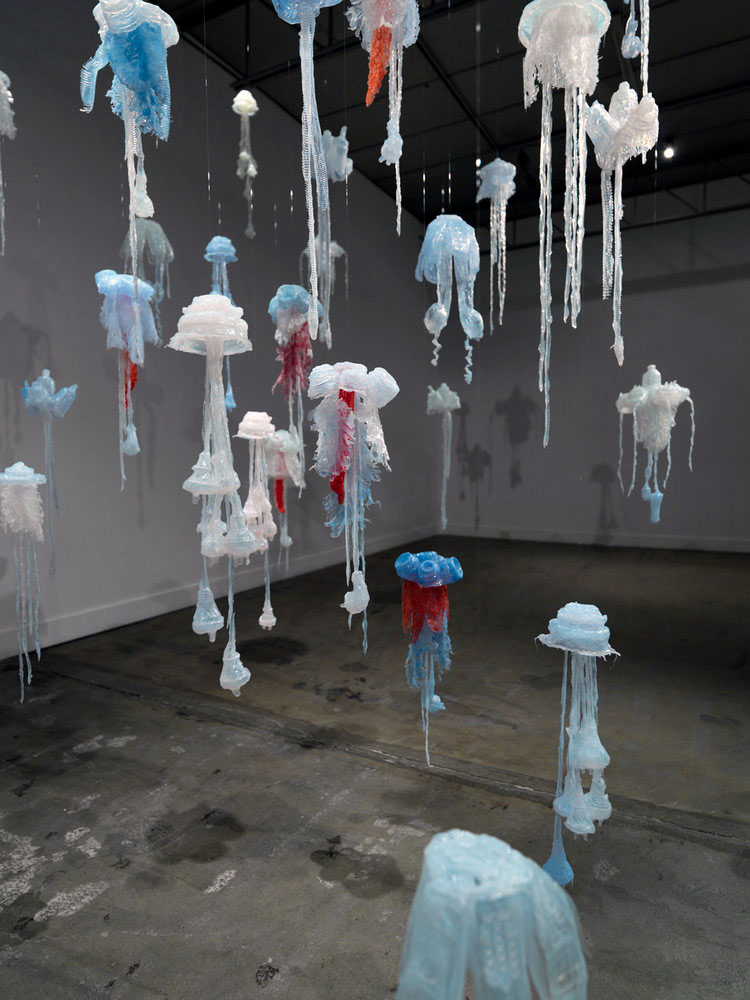
Penelope Davis (Australian, b. 1963) Smack installation 2011 Silicone, nylon thread Dimensions variable
A beautiful, hypnotic installation; one outstanding photograph (out of four); and a distance between elements, installation and photographs that, in the gallery space, seemed almost insurmountable.
The installation is intoxicating, taking the viewer into a world outside of reality – inverted, convoluted creatures “after the things of nature” (me ta physika) – in this case mobile phones, camera lenses and electrical plugs and leads, the skin of these objects flayed, extruded and made in silicone. These filamentary ‘jellies’ are wondrous. As Susan Fereday observes they are like detached skin, which “can become a kind of negative, a reversed memory, a perverse relic of its previously animated form … Detached, distraught, dangling. But there is also something slippery in these forms, something visceral, uterine, umbilical …”. The installation reminded me of the chthonian nature of the womb, our birth and that first gasp of breath – do you remember? was it all that you ever needed?
Water, blood, the detritus of birth and the emergence of life into light. Floating, gliding to the surface.
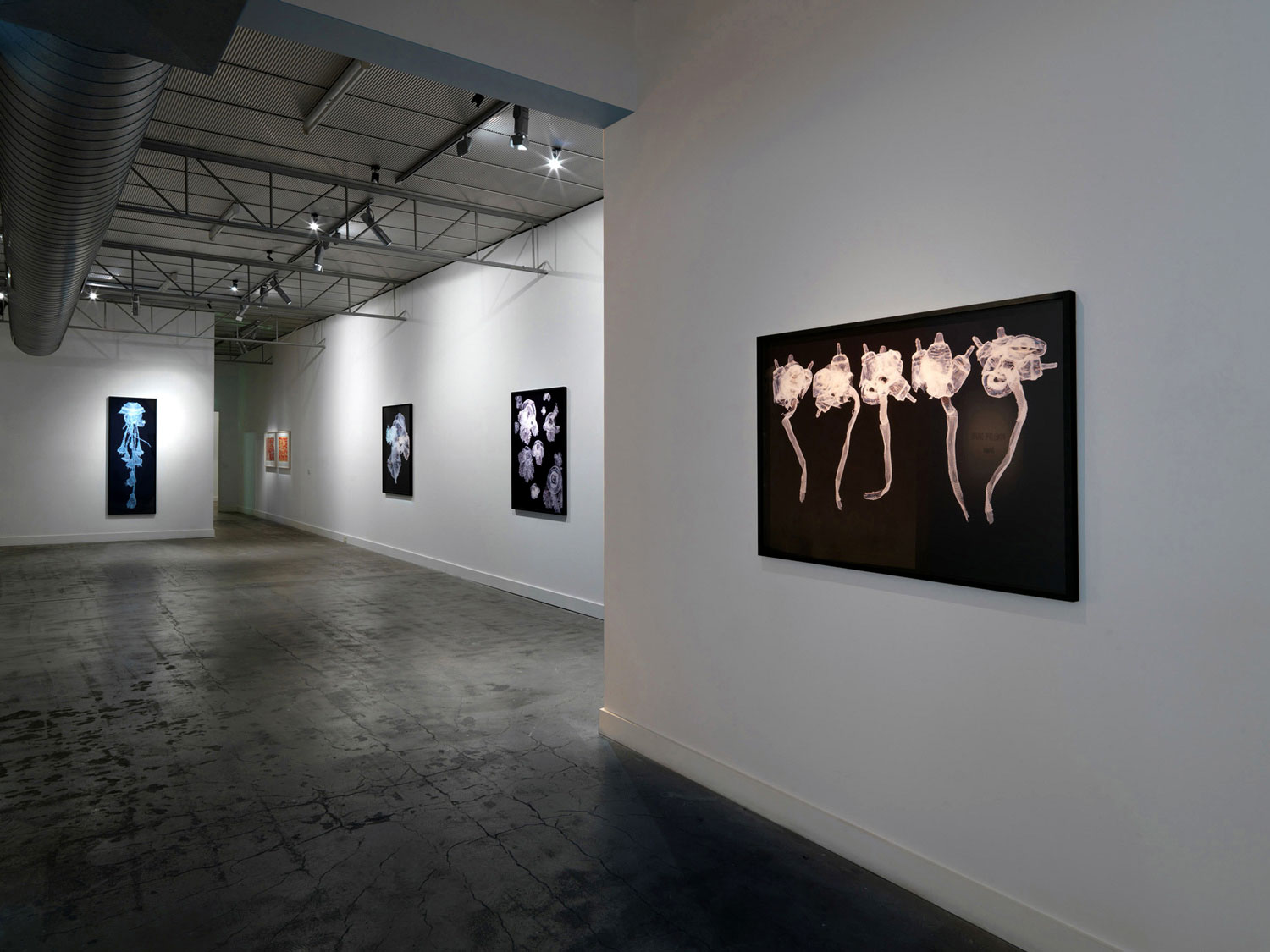
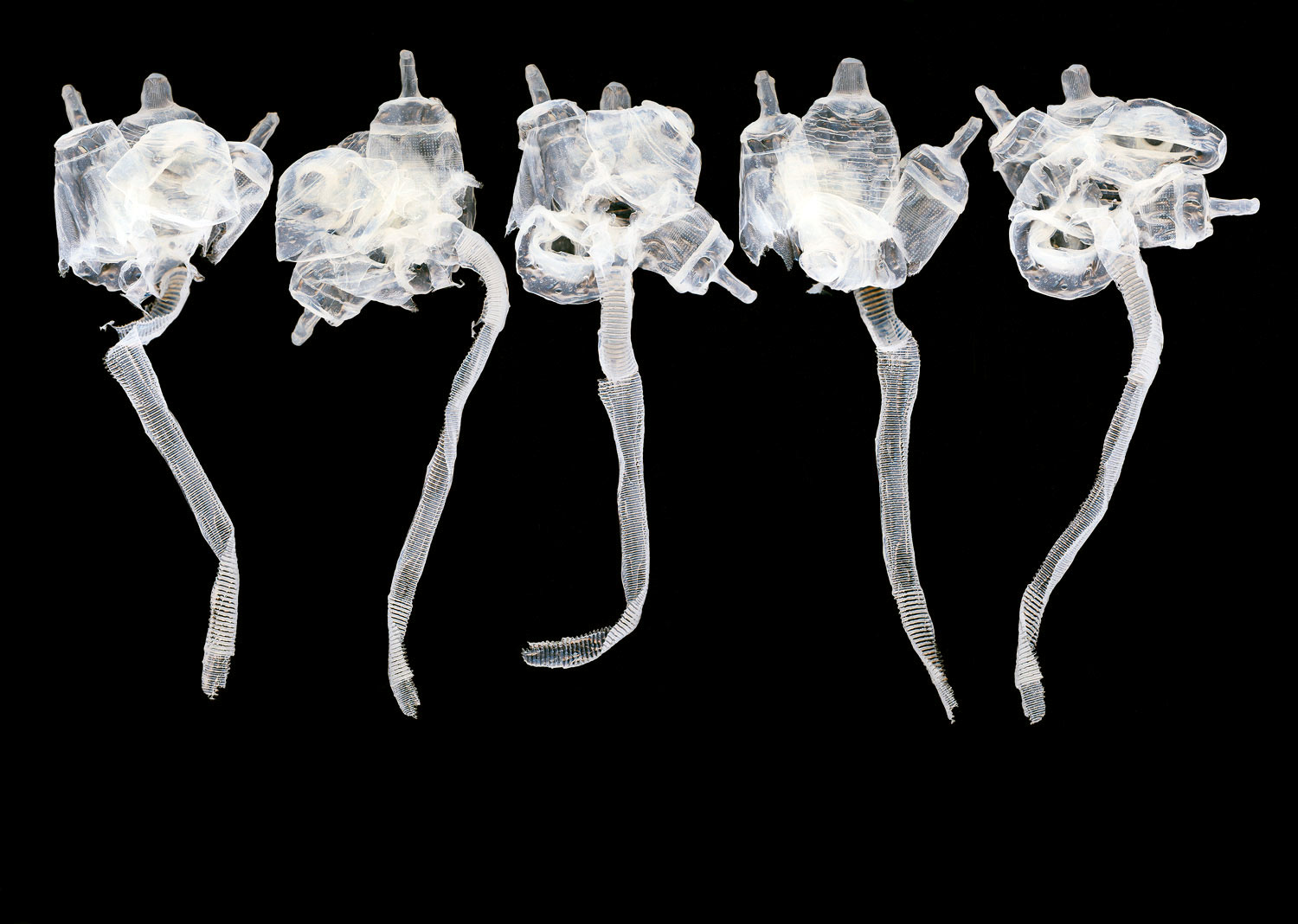
Only one photograph, Fluther (2011, below), approaches this detachment. A beauty it is too. The other three photographs felt more like addendum than adding anything further to the work and failed to achieve a ‘presence’ when compared to the installation. I suspect one of the problems was the scale of the three photographs and the fact that they are so tightly framed. Evidence of this can be seen in the installation shot below, the photograph of the blue ‘jellie’ so tightly prescribed and enclosed so as to not allow any interaction between installation and photograph. Perhaps making the photographs slightly larger and face mounting them behind PlexiGlass would have softened the edges of the photographs allowing a malleable (meta)physical air to breathe across the gallery space.
The highlight is the installation. Go and see, it is well worth the visit.
Penelope Davis (Australian, b. 1963) Smack installation 2011 Silicone, nylon thread Dimensions variable
Stretched Skin
“Where my inside meets the outside, where my body’s surfaces curve or stretch, dimple or fold, they create sensory cavities that are designed to respond to the outside world, at least to some degree. More difficult to resolve is the place that’s made when my inside turns out and there and no pickets to hide the private things – things I don’t want to look at myself, things too fleshy for the world to see, too soft, raw and pink to be exposed. Bringing the inside out, I am turned outside in and where does that leave me? In the edgeless space of the everyday saturated by grief.
Penelope Davis’ ‘jellies’ make me think about how a person’s skin can record their body’s history through marks – scars, distentions, swellings, bruises and wrinkles – just as a photograph can record a body’s outward appearance through light. We could say that skin is an index to its experiences, but it is not iconic. Skin does not reproduce the body’s image the way a photograph does, unless the skin is lifted to make a new shape. Then, just as hot wind can suck the life out of a fallen leaf and turn its veins into a street map, or sun and sea can batter a plastic bottle into a miraculous Marian figurine, detached skin can become a kind of negative, a reversed memory, a perverse relic of its previously animated form.
That’s what the ‘jellies’ look like: skin, turned inside out, photographic skin turned outside in. Detached, distraught, dangling. But there is also something slippery in these forms, something visceral, uterine, umbilical …”
Except from pamphlet text by artist and writer Susan Fereday, March 2011
Penelope Davis (Australian, b. 1963) Fluther 2011 Type C photograph 120 x 100cm
In Smack, Penelope Davis’ latest body of work, jellyfish-like forms have been assembled from a collage of components. These elements include the detritus of contemporary technologies. Among these are cameras, computer parts, mobile phones, wiring and electrical parts. Organic source materials such as leaves and seaweed (many sourced from the community garden plots surrounding Davis’ studio) are cast and intermixed with these forms. After being cast in silicone, the works are sewn together to create forms that resemble jellyfish. The resulting swarm – or smack, as the collective noun is properly known – is displayed as an installation of semi transparent, suspended forms.
A selection of these ‘jellies’ have also been placed in the digital scanner and ‘photographed’. Some digital post-production work is also employed to create large scale photographic images.
The materials and techniques used allow Penelope Davis to play with some of the procedures and assumptions central to photographic practice. The central motif of the jellyfish is a vehicle to examine critical contemporary issues of consumption and environmental degradation.
Text from the Nellie Castan website [Online] Cited 28/05/2011 no longer available online
Installation view of the exhibition Penelope Davis: Smack at Nellie Castan Gallery, Melbourne showing at right the photograph Bloom (2011, below)
Penelope Davis (Australian, b. 1963) Bloom 2011 Type C photograph 120 x 100cm
Penelope Davis (Australian, b. 1963) Smack installation (detail) 2011 Silicone, nylon thread Dimensions variable
Julia Margaret Cameron – you are one of my heroes!
Many thankx to the Musée d’Orsay for allowing me to publish the photographs in the posting. Please click on the photographs for a larger version of the image.
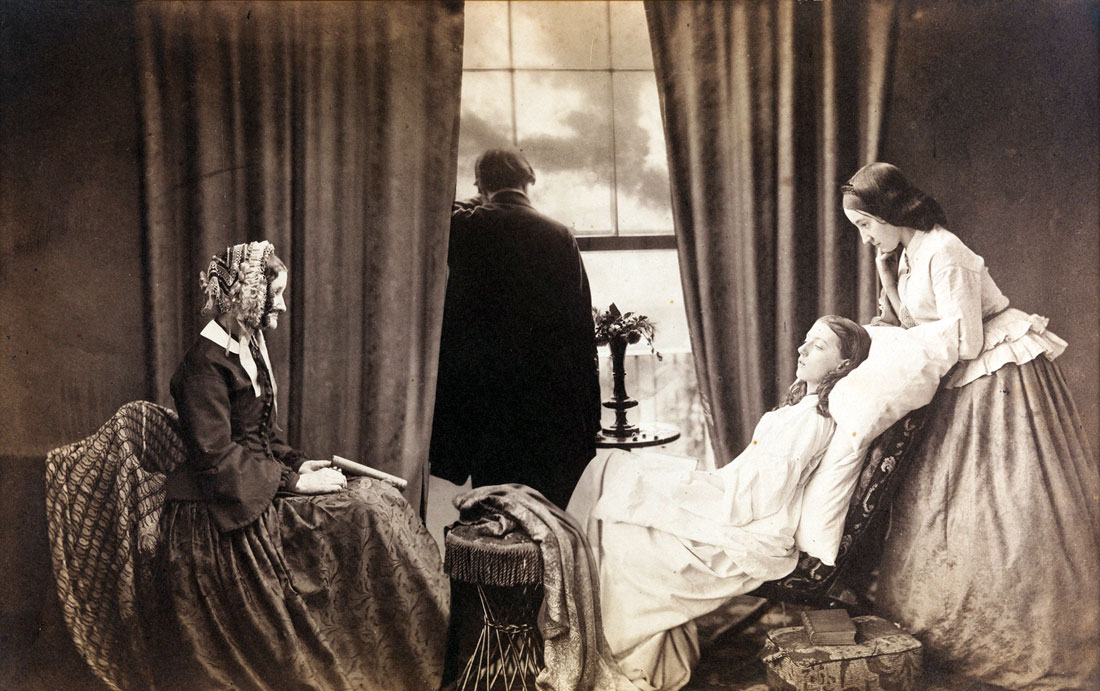
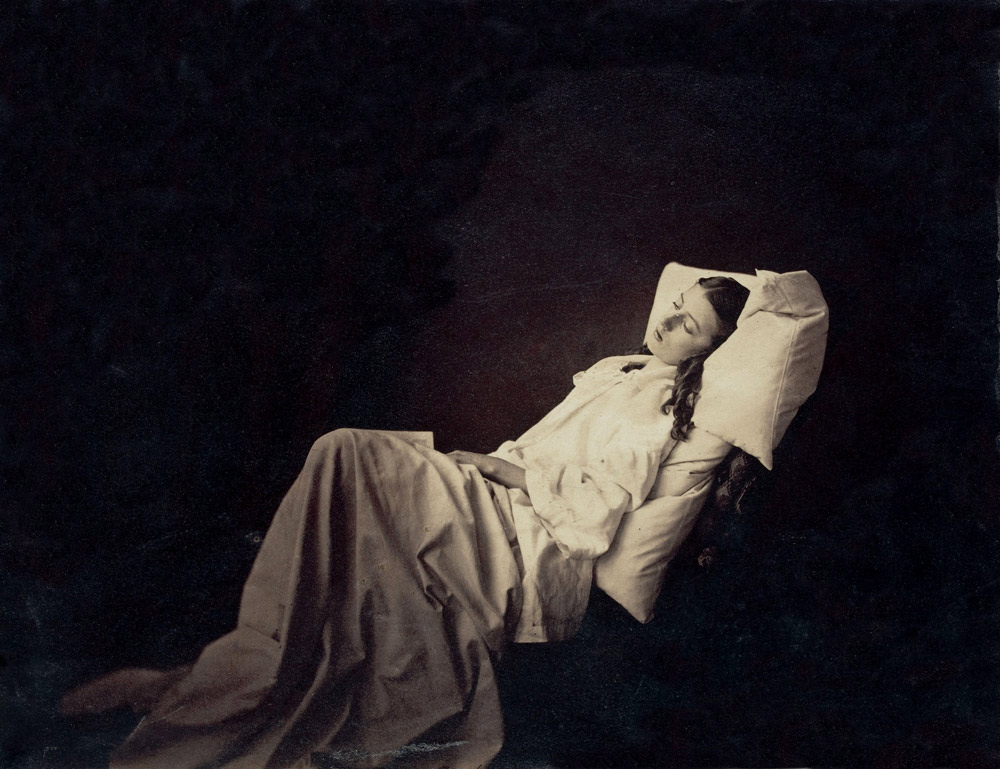
Consumed by the passion of unrequited love, a young woman lies suspended in the dark space of her unrealised dreams in Henry Peach Robinson’s illustration of the Shakespearean verse “She never told her love,/ But let concealment, like a worm i’ the bud,/ Feed on her damask cheek” (Twelfth Night II,iv,111-13). Although this picture was exhibited by Robinson as a discrete work, it also served as a study for the central figure in his most famous photograph, Fading Away, of 1858.
Purportedly showing a young consumptive surrounded by family in her final moments, Fading Away was hotly debated for years. On the one hand, Robinson was criticised for the presumed indelicacy of having invaded the death chamber at the most private of moments. On the other, those who recognised the scene as having been staged and who understood that Robinson had created the picture through combination printing (a technique that utilised several negatives to create a single printed image) accused him of dishonestly using a medium whose chief virtue was its truthfulness.
While addressing the moral and literary themes that Robinson believed crucial if photography were to aspire to high art, this picture makes only restrained use of the cloying sentimentality and showy technical artifice that often characterise this artist’s major exhibition pictures. Perhaps intended to facilitate the process of combination printing, the unnaturally black background serves also to envelop the figure in palpable melancholia.
Text from the Metropolitan Museum of Art website [Online] Cited 27/01/2020
The historian and art critic, John Ruskin, had a great influence in Great Britain not only on the Pre-Raphaelite movement created in 1848, but on the development of early photography in the 1850s. The leading Pre-Raphaelite painters, John Everett Millais, Dante Gabriel Rossetti, Holman Hunt and Ford Madox Brown and their followers, wished to change the pictorial conventions laid down by the Royal Academy, and in order to demonstrate the transformations in modern life, invented a radically new idiom marked by bright colours and clarity of detail.
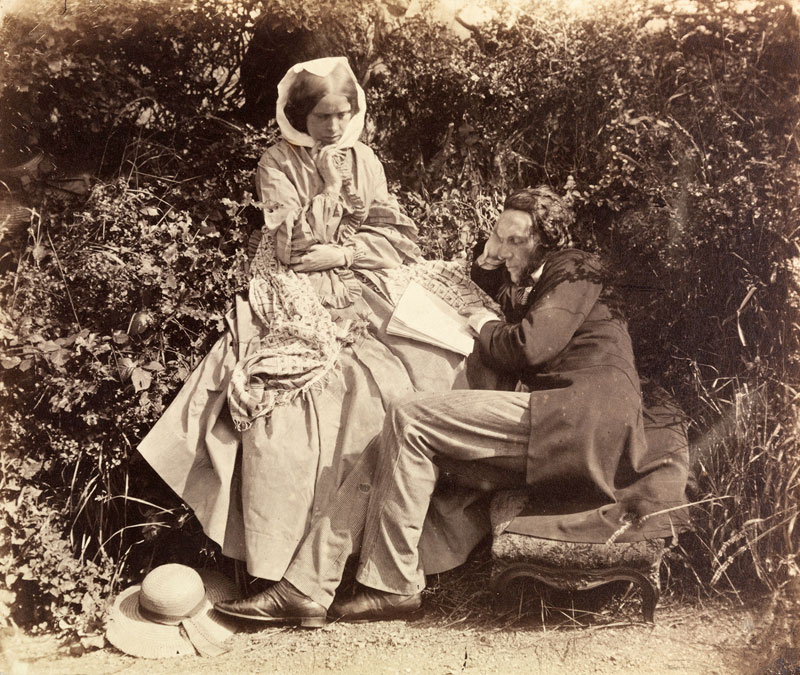
Pre-Raphaelite painters and photographers frequently made similar choices of subjects, and the photographers, particularly Julia Margaret Cameron, David Wilkie Wynfield and Lewis Carroll, were often had close links with the painters.
When painting landscapes, the Pre-Raphaelite artists answered Ruskin’s call, meticulously observing nature in order to capture every nuance of detail. For their part, photographers, such as Roger Fenton, Henry White, William J. Stillman and Colonel Henry Stuart Wortley, experimented with the new process of wet plate collodion negatives that allowed much greater image detail, and achieved similar effects. Although highly impressed at first by the daguerreotype, which enabled the eye to see tiny, overlooked details, Ruskin was nonetheless still very critical of landscape photography, which could not reproduce the colours of nature and in particular of the sky. This failing also gave rise to a major debate amongst photography critics.
In portraiture, there were clear links between the painted portraits of Watts and Cameron’s photographic portraits. By using special lenses and photographing her models in close-up, Cameron, achieved, with a glass negative, exactly the opposite effect to the clear image advocated by Ruskin, and her work was distinctive for the breadth of relief and contour, as well as the compositions evoking Raphael’s paintings, also a source of inspiration for Watts.
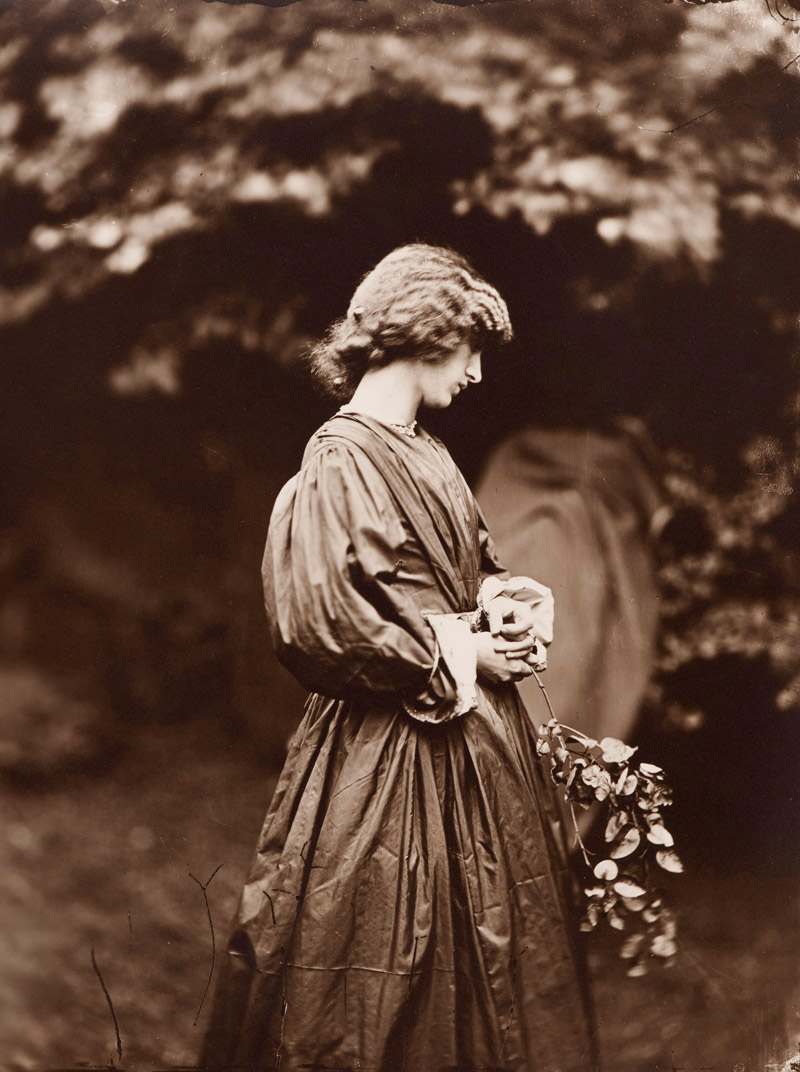
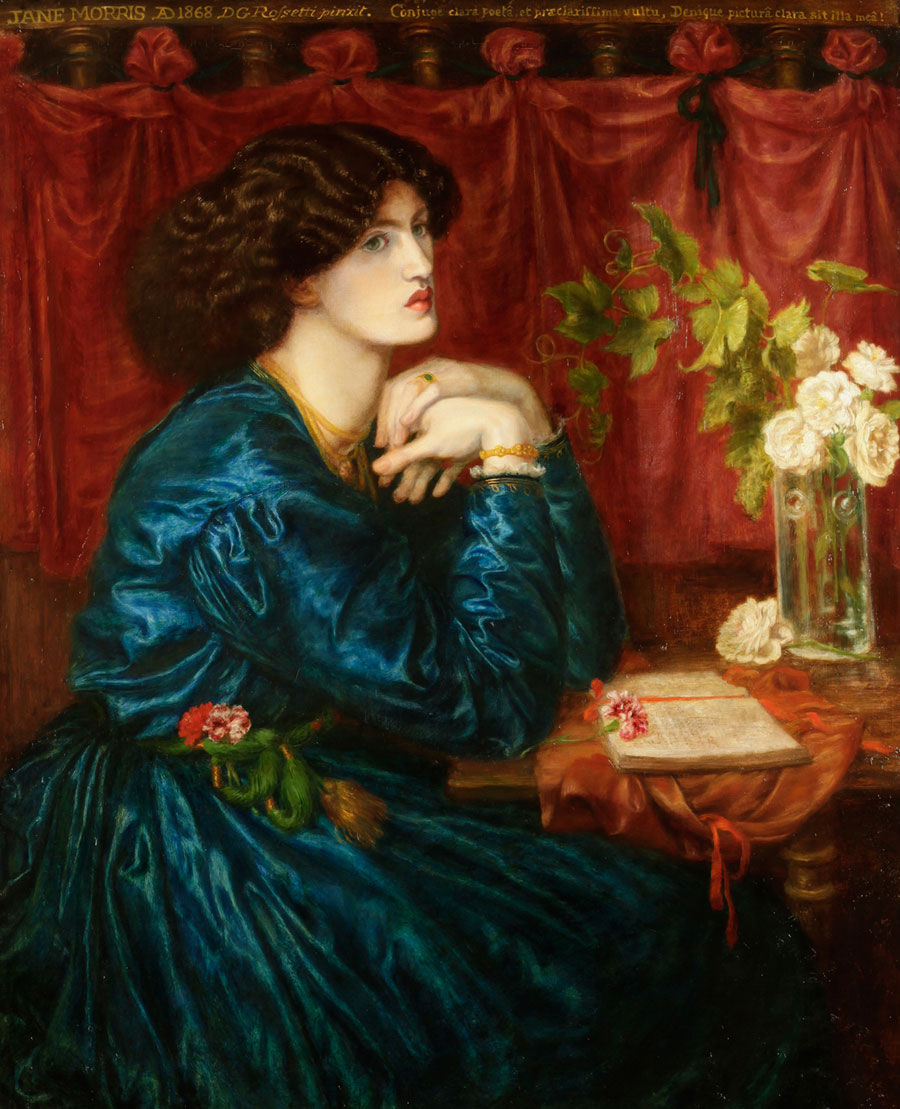
The painter Dante Gabriel Rossetti repeatedly drew and painted Jane Morris, a model with whom he was infatuated, and he asked Robert Parsons to produce a series of photographs, under his personal direction, which captured the fascinating presence of the young woman as effectively as his own paintings.
Just like the Pre-Raphaelite painters, Victorian photographers would turn to religious or historical subjects, finding a shared inspiration in the poems of Dante, Shakespeare and possibly Byron, and above all in the Arthurian legend made popular once more by Lord Tennyson, the poet laureate. From a formal point of view, Millais’ Ophelia, one of his most successful paintings, was a source for Henry Peach Robinson’s photograph, The Lady of Shalott, even though it had a different theme.
Finally, Pre-Raphaelite painters and Victorian photographers both liked to present scenes from modern life with a moralising undertone: hence She Never Told Her Love, a photograph by Robinson that was very successful when exhibited at the Crystal Palace in 1858, William Holman Hunt’s painting, Awakening of Conscience, and Rossetti’s Found, a painting depicting a countryman who comes across his former sweetheart, now a prostitute in the city.
In the 1880s, Pre-Raphaelite painting would be transformed, with artists and writers like William Morris, Burne-Jones, Whistler and Oscar Wilde, into a very different movement concerned only with the cult of beauty and rejecting Ruskin’s concept of art as something moral or useful. British photographers, however, inspired by the Pre-Raphaelites would inspire the Pictorialist movement that flourished in the 1890s, encouraged by the writings of Henry Peach Robinson and Peter Henry Emerson, extolling artistic photography.
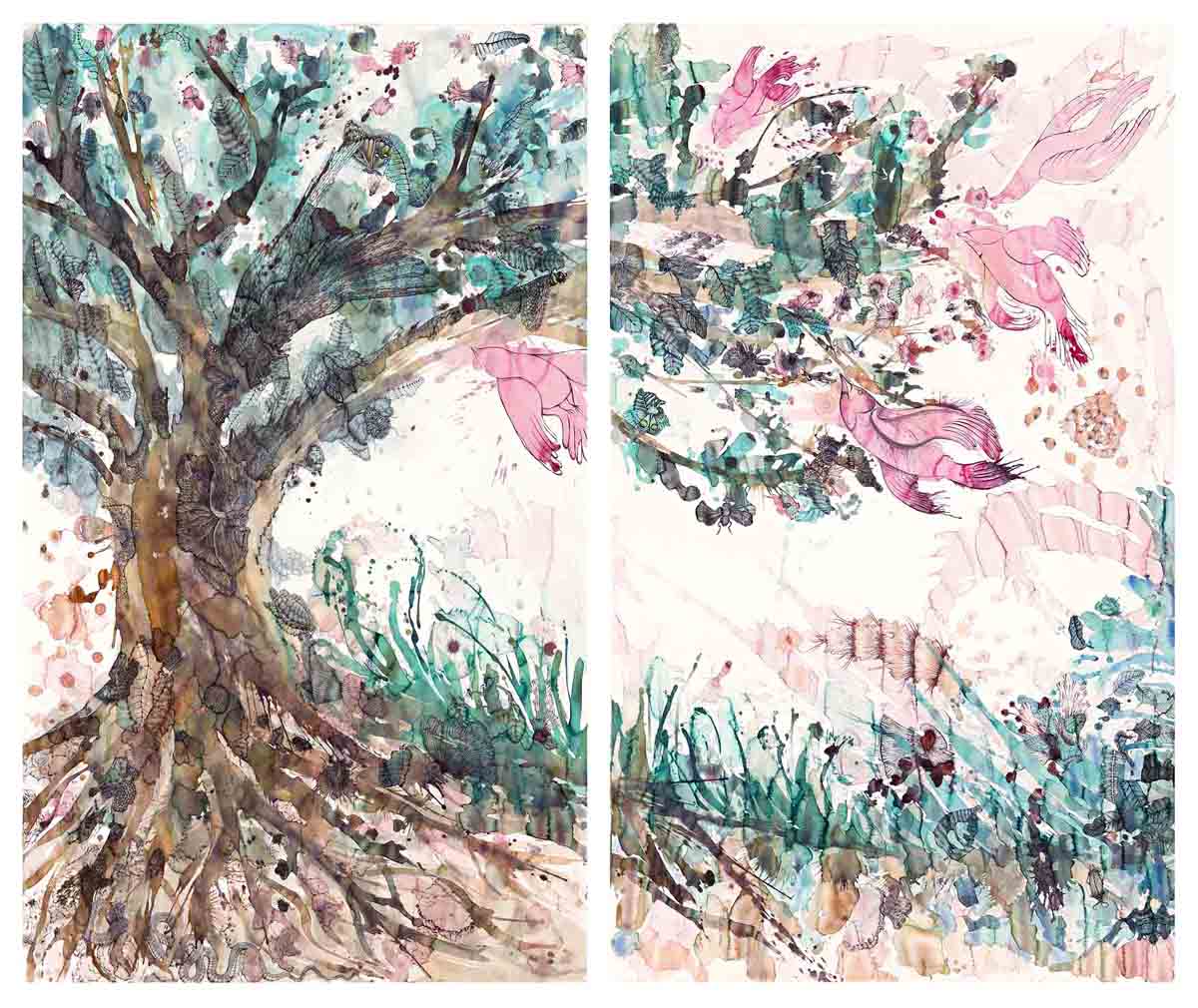
Monika Tichacek (Australian, b. 1975 Switzerland) To all my relations 2011 Diptych Gouache, pencil and watercolour on paper 244 x 300cm overall
This is a stupendous exhibition by Monika Tichacek, at Karen Woodbury Gallery. One of the highlights of the year, this is a definite must see!
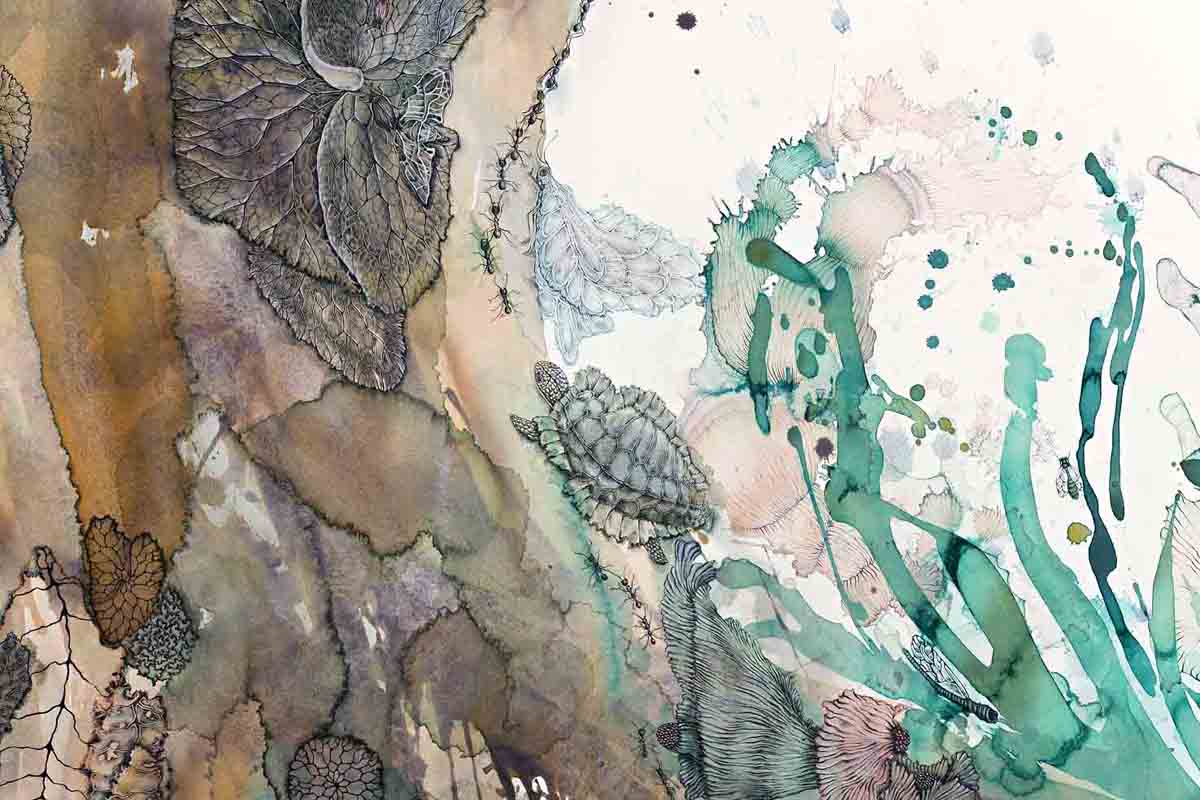
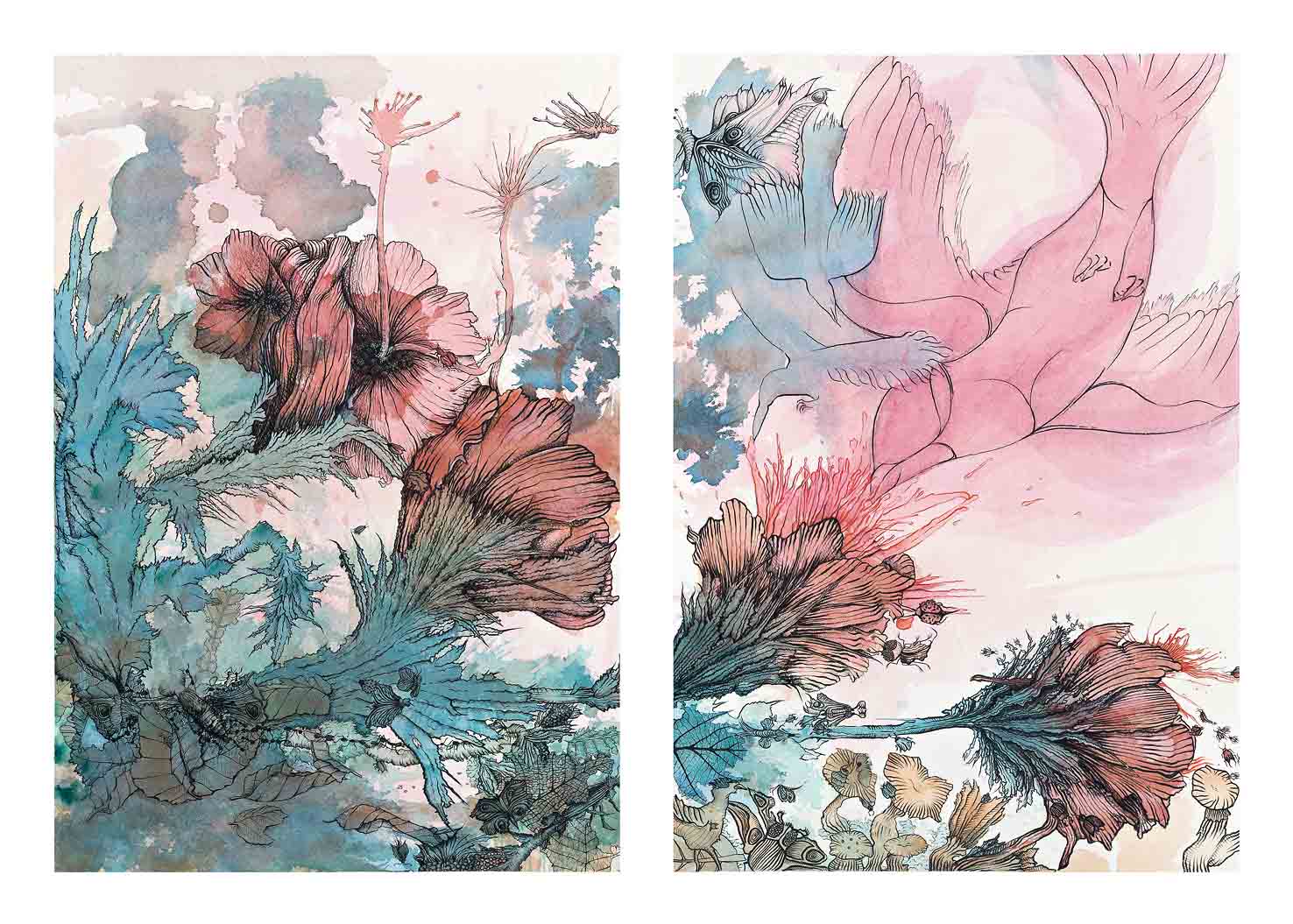
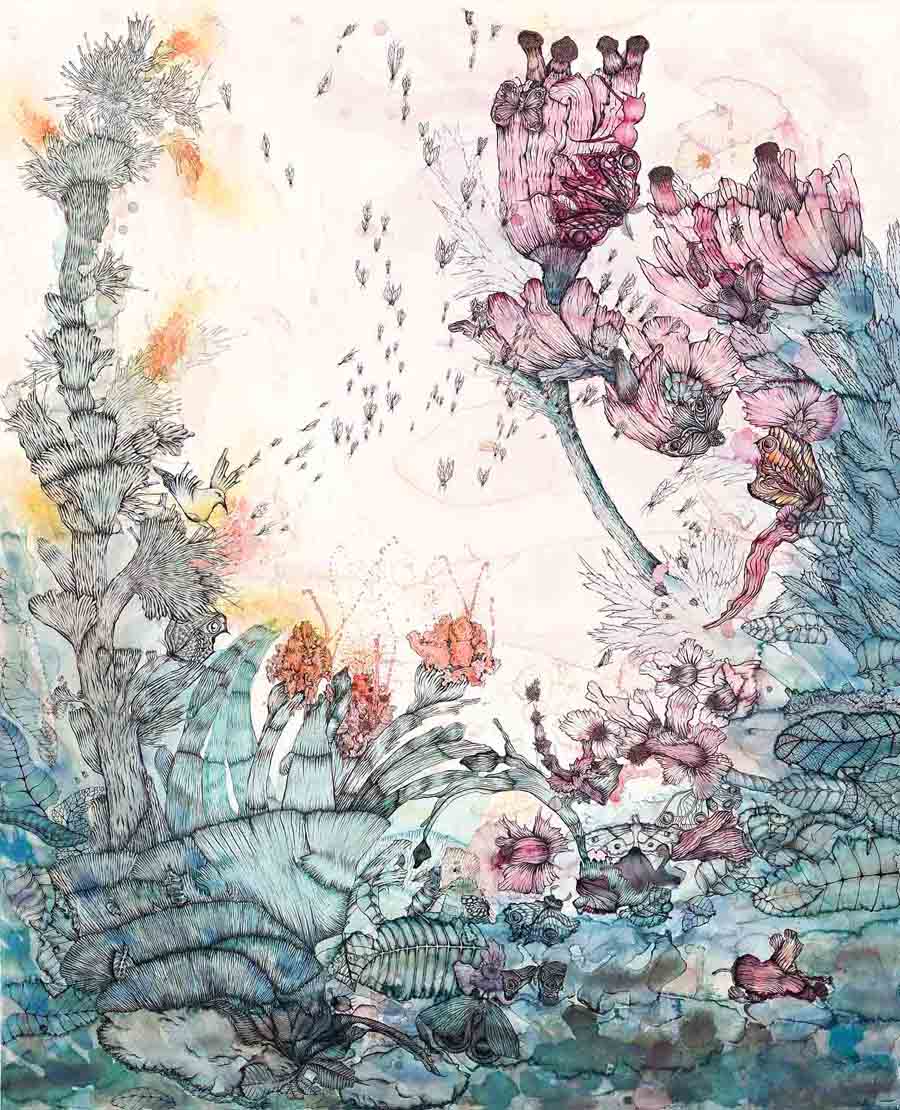
The work is glorious in it’s detail, a sensual and visual delight (make sure you click on the photographs to see the close up of the work!). The riotous, bacchanalian density of the work is balanced by a lyrical intimacy, the work exploring the life cycle and our relationship to the world in gouache, pencil & watercolour. Tichacek’s vibrant pink birds, small bugs, flowers and leaves have absolutely delicious colours. The layered and overlaid compositions show complete control by the artist: mottled, blotted, bark-like wings of butterflies meld into trees in a delicate metamorphosis; insects are blurred becoming one with the structure of flowers in a controlled effusion of life. The title of the exhibition, To all my relations,
“has inspired an understanding that all animist cultures’ peoples have who live in close relationship to the earth. We are all related, we all exist in an interdependent system. The ecosystem is such an unbelievably complex, harmonious system. Every drop of rain, every insect, every micro-organism has its place for the perfect functioning and health of nature… The title is an acknowledgement and honouring of all that is live-giving, every little element that makes up the big picture of life on earth.”1
It was very difficult to pull myself away from the beauty and intimate polyphony of voices contained within the work. I loved it!
Dr Marcus Bunyan
1/ O’Sullivan, Jane. “Artist Interview: Monika Tichacek,” on Australian Art Collector website, 19th May 2011 [Online] Cited 21/05/2010 no longer available online
Many thankx to Karen Woodbury Gallery for allowing me to publish the photographs and Art Guide Australia for allowing me to publish the text in the posting. The text by Dylan Rainforth was commissioned by Art Guide Australia and appears in the May/June 11 issue of Art Guide Australia magazine. Please click on the photographs for a larger version of the image.
Monika Tichacek (Australian, b. 1975 Switzerland) To all my relations (detail) 2011 Diptych Gouache, pencil and watercolour on paper 244 x 300cm overall
Monika Tichacek (Australian, b. 1975 Switzerland) To all my relations (detail) 2011 Diptych Gouache, pencil and watercolour on paper 244 x 300cm overall
Monika Tichacek (Australian, b. 1975 Switzerland) To all my relations (detail) 2011 Diptych Gouache, pencil and watercolour on paper 244 x 300cm overall
The Cycle of Nature – Monika Tichacek’s To All My Relations
Dylan Rainforth
Anyone used to the immaculately controlled, exactingly lit photographic and video mise en scène that Swiss-born artist Monika Tichacek presented in such series as The Shadowers, for which she won the prestigious Anne Landa Award for Video and New Media Arts in 2007, may be surprised by the direction her work has taken in her latest exhibition. To All My Relations consists entirely of works on paper – watercolour and ink drawings that evince a tension between abstract, gestural shapes and bleeds of colour, recalling (just for convenience’s sake) Kandinsky, and intricately rendered natural forms that owe more to the scientific, zoological and botanical narratives of the Endeavour voyages of Captain Cook, Joseph Banks and the artist Sydney Parkinson.
The work has come out of an intensive period over the last few years in which Tichacek spent considerable time in the jungles of South America and the deserts of the United States, as well as time spent in the New South Wales bush and studying nature books. “I’m getting more and more interested in the cellular, microscopic imagery that you get when you enlarge something and peer deeper into the structure of how material elements are composed, and that really coincides with my interest in Eastern philosophies of Buddhism and many other things too. I guess I’m looking as deeply into the nature of something as is possible but I’m trying not to do it so much with my mind – but of course that’s very challenging,” she says, laughing lightly.
“The exploration of feeling is quite important to me – it’s quite a departure from what I used to do, which were certainly works that came from a very inner landscape but then the execution would be very conceptual, obviously – it had to be and this new work is much more intimate.”
That challenge to the rational, objective Western subject is informed by Tichacek’s exposure to indigenous traditions in South America and other places.
“In 2006 I had a research grant and I went to the Amazon because I wanted to look more deeply into animist cultures, meaning cultures that really see the land as living and as alive with energy and with spirit or ‘beingness’. So I went to the Amazon and spent quite a long time there and also in the mountains in Peru and saw a little bit of Central America and also North America in the desert. I spent time there and really learnt a lot about their indigenous ways and got to participate in a lot of things and experience a lot of things. In the Amazon shamanic tradition there is a process – they call it dieting – you spend a few months more or less alone, existing on very limited foods. You get very little, limited food and very little contact and they give you different traditional plants that, through the communion they do, they are ‘told’ to give you. And you are encouraged to connect with this plant for its healing properties to come through. So that was quite an amazing time to get quite still…”
The exhibition title comes from a Native American ceremony. According to Tichacek, “It’s always said when entering the sweat lodge and it’s an acknowledgement of being related to everything in nature, every being, the understanding that without all these other relations one wouldn’t exist. In those cultures it’s much more understood – we’ve lost that understanding because we can just buy things in the supermarket and eat them but if we lived that way we would probably remember a lot more that we are closely related to everything around us.”
From this perspective we can see that this new work is not a complete departure from Tichacek’s earlier work after all, yet its intentions are radically different. Both the natural world and shamanistic knowledge played their part in The Shadowers. Professor Anne Marsh has described Tichacek’s video, played out in a violent scene occurring between three women (one of whom Marsh characterises as a witch doctor or shaman) in a forest environment, as “stretch[ing] the boundaries between body art, ritual and sado-masochism by assaulting the senses and transgressing the social realm. In psychoanalytic terms it tears at the screen of the real and immerses the viewer into the abject world of instinctual response where language has no authority.” [i]
Pain, sado-masochism, ritual and endurance certainly have their place in shamanistic traditions – one need only think of any number of initiation rites – but now Tichacek is looking for a less conflicted relationship with nature. “The work has always been very personal and I guess in The Shadowers that nature relationship was starting to come in but it was very tense and very violent and very confused. The continuation of that theme is still there – the exploration of how to understand the experience of the self and what we are doing here and how we come to exist. That’s definitely been there before but this new work is more in the realm of psychology and the previous works are more in the realm of the female body.”
To All My Relations will present several drawings, with one in particular being conceived on a massive scale that Tichacek intends to convey the sense of awe we experience when surrounded by nature. The artist will also stage a performance – something her interdisciplinary practice has always embraced – at the opening. Although she had not completely determined the details when I spoke to her the performance was inspired by a drawing she made a few years ago and will symbolically connect the artist’s body to the roots of a tree.
“I always feel like [performance serves] to bring my body into it. Although I feel like my body’s very much in these drawings there’s something about performance that’s really physically present.”
Dylan Rainforth.
Monika Tichacek (Australian, b. 1975 Switzerland) To all my relations (detail) 2011 Diptych Gouache, pencil and watercolour on paper 244 x 300cm overall
Monika Tichacek (Australian, b. 1975 Switzerland) To all my relations (detail) 2011 Diptych Gouache, pencil and watercolour on paper 244 x 300cm overall
Monika Tichacek (Australian, b. 1975 Switzerland) Birth of generosity 2011 Diptych Pencil and watercolour on paper 70 x 114cm overall
Monika Tichacek (Australian, b. 1975 Switzerland) Transmission 2011 Pencil and watercolour on paper 150 x 125cm
Exhibition marking the 100th birthday of Kurt Kranz 19th November 2010 – 29th May 2011
Kurt Kranz (German, 1910-1997) Perspective 1931 Ingrid Kranz / Stiftung Bauhaus Dessau Foto: Lars Lohrisch / Abdruck mit Genehmigung der Kunsthalle
One of the great pleasures of publishing this archive is that I get to research the life of an artist whose work I never knew before. Kurt Kranz is one such artist.
Dr Marcus Bunyan
Many thankx to the the Bauhaus Dessau for allowing me to publish the photographs in the posting. Please click on the photograph for a larger version of the image.
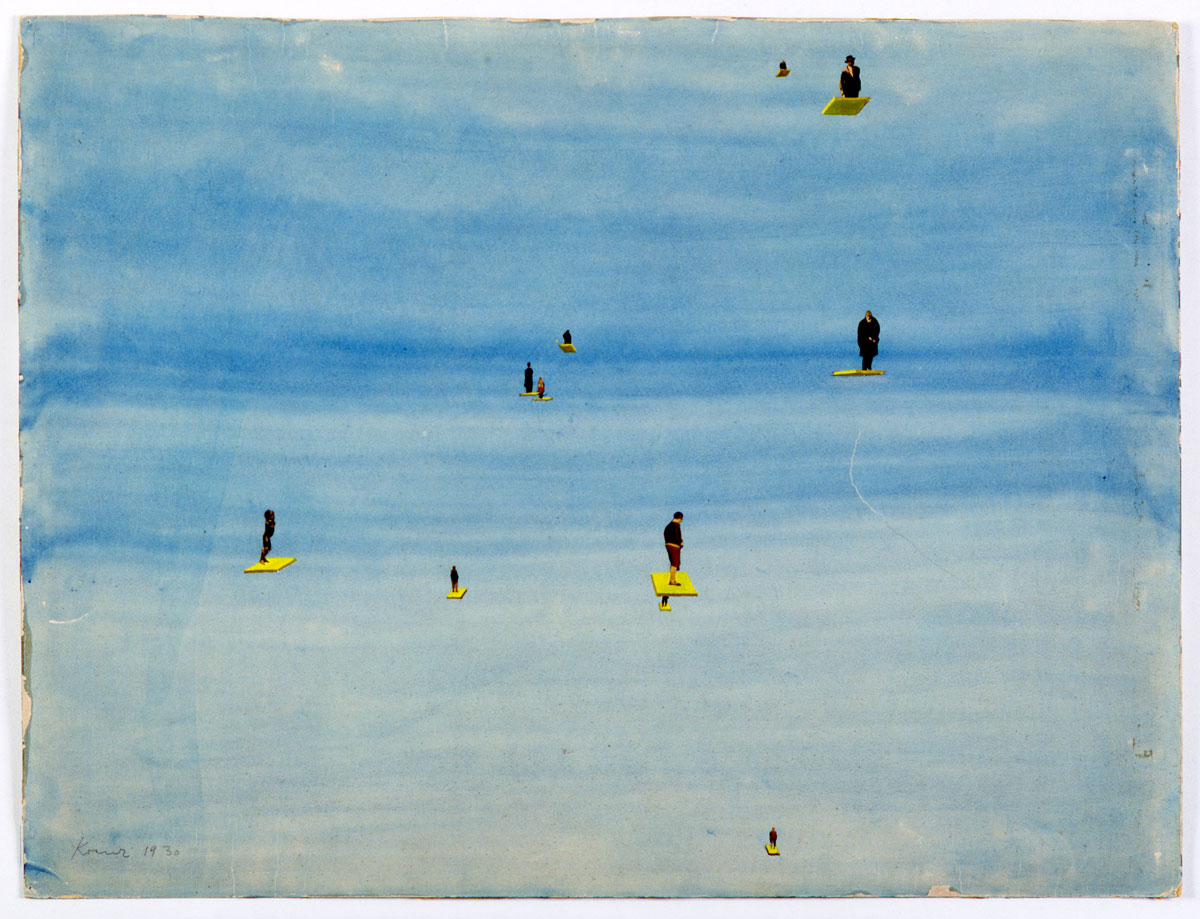
Kurt Kranz (German, 1910-1997) Vereinsamung (Isolation) Dessau 1930 Ingrid Kranz / Stiftung Bauhaus Dessau Leihgeber: Kunsthalle Bremen
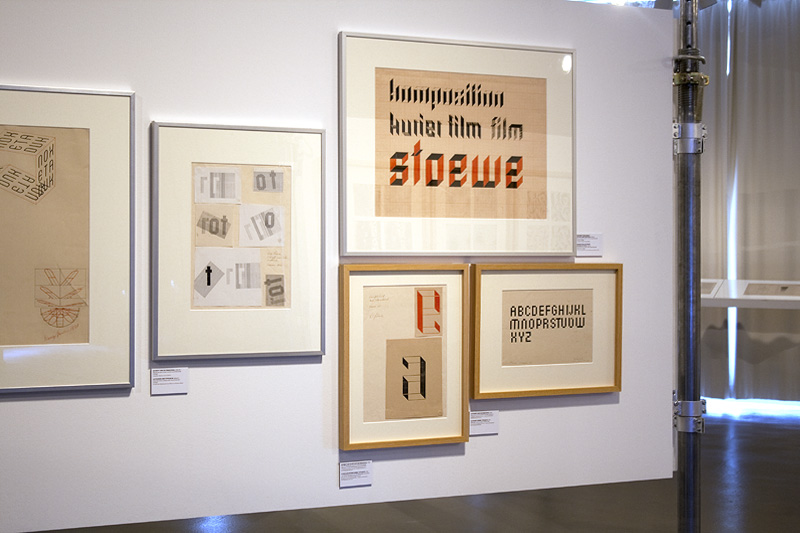
Installation photograph of Programming of Beauty by Kurt Kranz at the Bauhaus Dessau
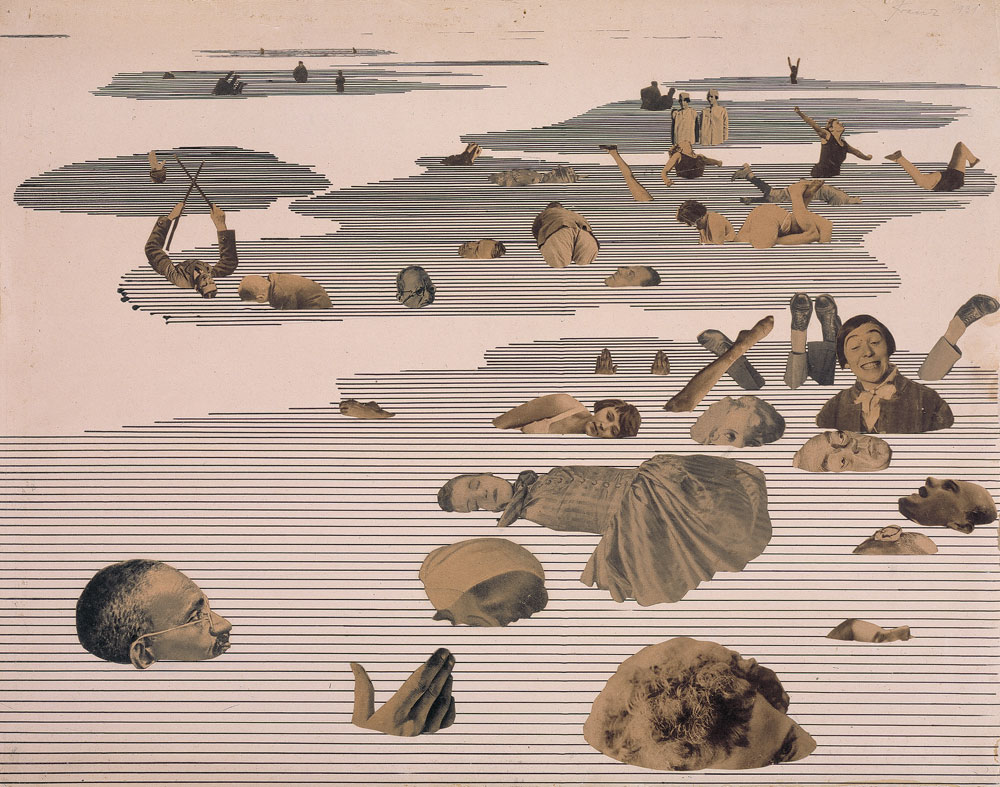
Kurt Kranz (German, 1910-1997) Versinkende (Sinking one) 1931 Ingrid Kranz / Stiftung Bauhaus Dessau
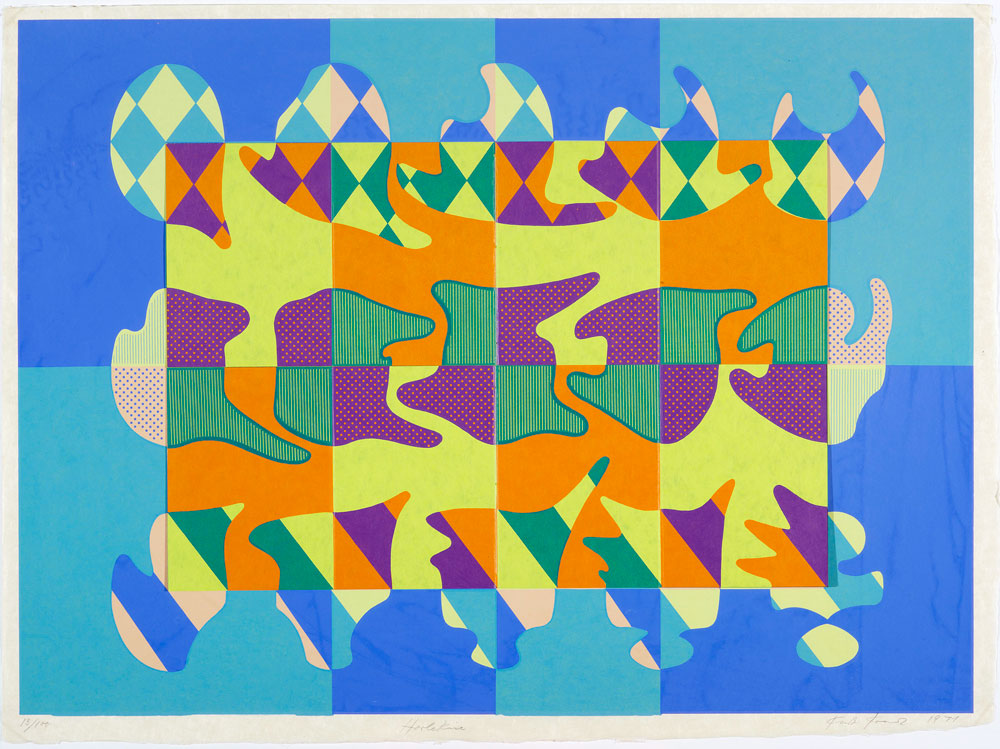
Kurt Kranz (German, 1910-1997) Persischer Garten (Persian garden) 1970 Ingrid Kranz / Stiftung Bauhaus Dessau Foto: Uwe Jacobshagen
The Bauhaus Dessau dedicates a comprehensive exhibition to the painter, graphic designer and photographer Kurt Kranz to mark his 100th birthday. In 1930, the then twenty-year-old lithographer came from Bielefeld to study at the Bauhaus Dessau, where he soon established himself as a pioneer of serial and generative methods. With his avant-garde work, Kranz’s methods anticipated those of later generations.
Inspired by a lecture by László Moholy-Nagy, Kurt Kranz came to the Bauhaus Dessau in April 1930. In Walter Peterhans’s photography class, Kranz began to experiment with photographic techniques and created some of the most striking abstract picture series to emerge from the Bauhaus. Alienated and abstracted faces and hands appear repeatedly in his dynamic picture series. These show Kranz’s early affinity for film as, page for page, the abstract forms interact with one another. Kranz drafted his first concepts for abstract films at the Bauhaus, although he was first able to realise these decades later in 1972.
The exhibition to mark the artist’s 100th birthday shows works from Kranz’s Bauhaus years and his later work as an advertising graphic designer, and focuses on a selection of his large picture cycles. Strikingly diverse leporellos dating from the 1960s onwards take centre stage, as do the so-called “Matrix-und Schiebebilder”
Text from the Bauhaus Dessau website
Kurt Kranz (German, 1910-1997) Selbstporträt en face (objektives Foto) (Self-portrait with face (objective photo)) 1931 Ingrid Kranz / Stiftung Bauhaus Dessau
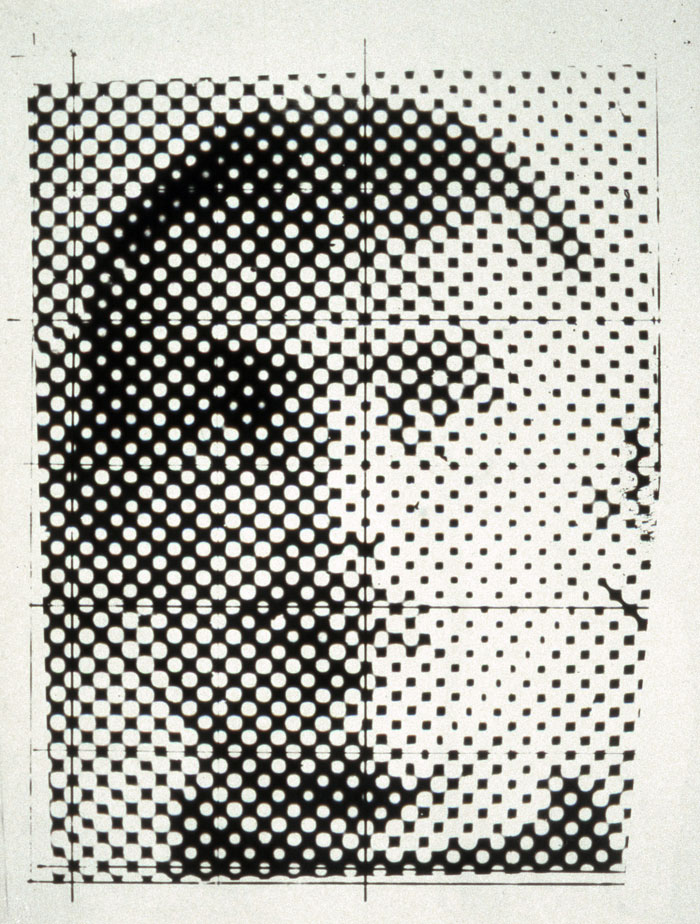
Kurt Kranz (German, 1910-1997) Rasterfoto (Raster photograph) 1932 Ingrid Kranz / Stiftung Bauhaus Dessau
Kurt Kranz (German, 1910-1997) Schwarz: Weiß (Black: White) 1928-1929 Ingrid Kranz / Stiftung Bauhaus Dessau Privatbesitz
Kurt Kranz (German, 1910-1997) Schwarz: Weiß (Black: White) 1928-1929 Ingrid Kranz / Stiftung Bauhaus Dessau Privatbesitz
Kurt Kranz (German, 1910-1997) Schwarz: Weiß (Black: White) 1928-1929 Ingrid Kranz / Stiftung Bauhaus Dessau Privatbesitz
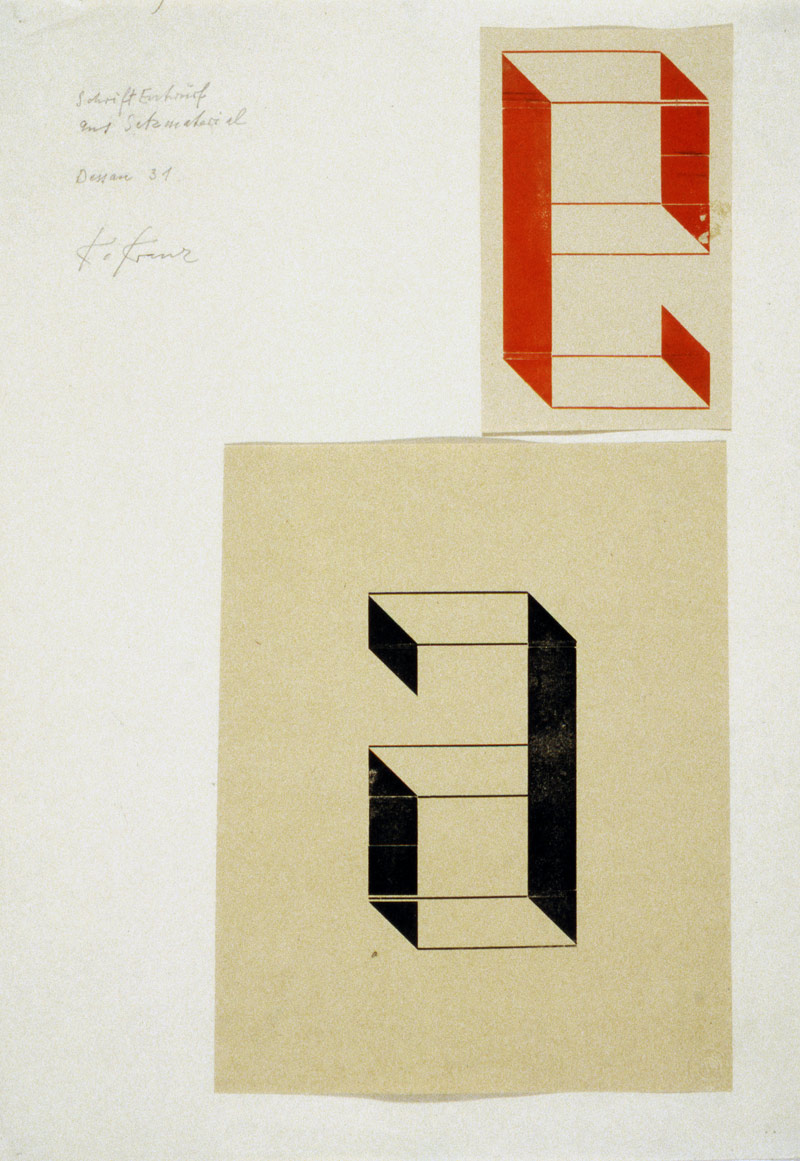
Kurt Kranz (German, 1910-1997) Schrift Entwurf aus Satzmaterial (Writing draft from sentence material) Dessau 1931 Ingrid Kranz / Stiftung Bauhaus Dessau
Kurt Kranz (German, 1910-1997) Aus der Serie “Sieben Schritte zum symmetrischen Oval” (From the series “Seven steps to the symmetrical Oval”) 1982 Ingrid Kranz / Stiftung Bauhaus Dessau Foto: Uwe Jacobshagen
After undertaking an Issues in Art Conservation subject for my Master of Art Curatorship at the University of Melbourne I have become more aware of the fragility of my black and white fibre-based prints and negatives. I have therefore decided to scan my medium format negatives (taken on my trusty Mamiya RZ67) and made during the years 1991-1997, to preserve them in the form of an online archive as a process of active memory, so that the images are not lost forever.
These photographs were images of my life and imagination at the time of their making, the ideas I was thinking about and the people that surrounded me. As such they form part of life – of Melbourne, of Australia and of humanity in general. The preservation of such moments in time are vital to the continuing enrichment of culture. See more of my early black and white photographs on the Marcus Bunyan black and white archive 1991-1997 page.
Photographs are available from this series for purchase. As a guide, a vintage 8″ x 10″ silver gelatin print costs $700 plus tracked and insured shipping. For more information please see my store web page.
Hot on the heels of my reviews of Stormy Weather: Contemporary Landscape Photography at NGV Australia and Sidney Nolan: Drought Photographs at Australian Galleries, Melbourne comes the exhibition Photography & place: Australian landscape photography, 1970s until now at the Art Gallery of New South Wales. An insightful, eloquent text by Vigen Galstyan (Assistant curator, photographs, AGNSW) accompanies the posting.
Dr Marcus Bunyan
Many thankx to Susanne Briggs for her help and to the Art Gallery of New South Wales for allowing me to publish the photographs and the text in the posting. Please click on the photographs for a larger version of the image.
Australian born and American based photographer Douglas Holleley has experimented with many aberrant photographic techniques over the course of his career. Holleley received a Bachelor of Arts in Psychology in 1971 at Macquarie University before relocating to America to undertake a Master of Fine Arts, studying at the Visual Studies Workshop in Rochester, New York between 1974 and 1976. Founded by Nathan Lyons in 1969 and affiliated with important photographers including Minor White and Frederick Sommers, the Visual Studies Workshop was a bedrock institution that fostered innovative photographic practice from the 1970s onwards. It was here that Holleley received tutelage from Ansel Adams in 1975. His early photographic output includes hand coloured black and white photographs as well as photograms and gridded arrangements of Polaroids. He later began experimenting with digital photography, applying the same principles of the photogram to his experiments with a flatbed scanner.
During the time spent studying photography in America in the 1970s Holleley became interested in Polaroid technology. When he returned to Australia in 1979, before later relocating permanently to America, Holleley commenced an extensive photographic project of documenting the Australian bush with a Polaroid SX-70 camera, effectively becoming one of the first professional practitioners of the medium in the country. The resulting images were presented as a series and published as a book – Visions of Australia – in 1980. Employing a refined formalist vocabulary, Holleley produced photographic mosaics by arranging his Polaroids into gridded compositions.
Dissected, disassembled and then collated within the pictorial frame, the landscape in Holleley’s works becomes slightly unnatural and detached. These works negate linear single point perspective by focusing on the ground and reducing the scene to a formal composite. Here, the expanse of the view and the horizon does not dominate the space of the image. The tessellating images produce a ‘whole’ that is slightly misaligned and unsettled. In some works, the photographer’s shadow is visible. It asserts itself as an ambivalent presence that is not tethered to the scene. This spectral form heightens the sense of disquiet that pervades the images.
Text from the Art Gallery of New South Wales website [Online] Cited 16/01/2020
Ian North is an Adjunct Professor of Visual Arts at both the University of Adelaide and the University of South Australia. He is a photographer, painter and writer, and was the founding curator of photography at the National Gallery of Australia 1980-1984. Throughout his career, he has been concerned with the legacy of Australian landscape, the impact of colonial narratives and their established visual conventions and, as a consequence, the politics of representing the subject. …
North’s methodology is concerned with the processes of vision and interaction as they have shaped the landscape. In Canberra Suite North presents an encyclopaedic record of Walter Burley Griffin’s intricately designed city, exploring the spatial interface between nature and humanity. The works are absent of human life – reminiscent of Ed Ruscha’s Twenty-six Gasoline Stations. The emotional ambivalence of the images is reflected in their use of colour, like that of postcards. As one of the first instances of larger format colour art photography in Australia, the images topographically map space as a depersonalised, banal subject. Yet their colour, like that of landscape painting, highlights flora, revealing the number of non-native plants included in Canberra’s design. As such, these artefacts of North’s private wanderings and systemic mode of looking are able to subtly critique colonialism.
Text from the Art Gallery of New South Wales website [Online] Cited 16/01/2020
EARTH SCANS AND BUSH RELEVANCES: Photography & place in Australia, 1970s till now
For many of us, landscape is a noun. A view from the window or the balcony, a strange immaterial ‘thing’ that makes people exclaim in awe, point to in pride, recall nostalgically, pose in front of or be used to bump up real estate prices. If one is an urban dweller, which most Australians are, then the landscape exists essentially as a mirage, something to create in the backyard, occasionally look at on holidays or hang on the walls. However, noted American cultural theorist and art historian W. J. T. Mitchell has proposed that we should think of landscape as a verb: an act of creation on our part that engenders cultural constructs, national identities and shared mythologies.
Photography & place is an exhibition that investigates this process of ‘landscaping’ through the work of 18 Australian photographers between the 1970s and now. Their significant contribution to representation of landscape broke new ground in what has always been a confounding topic. Indeed, as Judy Annear has pointed out in a 2008 essay in Broadsheet magazine, the practice of documenting and interpreting the notion of ‘place’ in Australian photography has been fragmentary in comparison to traditions in America, Europe or New Zealand. This reluctance to focus on the natural environment is perhaps a residue of the ‘terra nullius’ polemic, which shifted the attention of many photographers on the building of colonial Australia. Photography from the mid 19th to the early 20th century by photographers such as Charles Bayliss and Nicholas Caire actively documented the conquest of nature by white settlers, or presented views of untouched wilderness as epitomes of the picturesque: endless waterfalls, lakes, forests in twilights, enigmatic caves and an occasional nymph like creature prancing. Despite Bayliss’ efforts to show the indigenous people on their land, they are, as Helen Ennis observed in her 2007 book Photography and Australia, conspicuous by their absence: the land that we see surrounding them in early Australian photography by the likes of J.W. Lindt is often a mass-produced painted studio backdrop.
The advent of modernism in the 1930s only served to entrench the photographers deeper into the urban space. ‘Place’ is the city and it is here that industry, progress and culture shapes the Australian identity. It is still difficult to dislodge the iconic images of Max Dupain and David Moore as epitomes of Australianness, promulgated as they were through countless renditions in mass media and consumer culture. But as post-modern anxiety started to seep through the patchwork of the Australian dream, it was landscape that many critically informed photographers turned to as a tool for analysis and revision.
A number of factors conflated in the mid 1970s, engendering a radical shift in perspectives. One of the primary forces that began to reshape the approaches to landscape in Australian photography was the awareness of new artistic movements taking place in USA and Europe. The enormously influential exhibition New Topographics: Photographs of a Man-Altered Landscape held in 1975 at the George Eastman House, Rochester, consolidated the spread of minimalist and conceptually informed photography which was avidly embraced by a younger generation of Australian photographers. One can also cite the rise of the Australian greens movement in Tasmania, the increasing awareness of Indigenous cultures and rights and not the least, the phenomenon of university-educated photographers as key milestones during this decade.
Lynn Silverman, Douglas Holleley, Jon Rhodes, Wes Stacey and Marion Marrison were among the practitioners who pointed their lenses out of the city, often exploring the fringes of human settlement and sometimes as in the case of Silverman, Stacey and Holleley, venturing into the desert. The element that collectively stamps their work is the ostensible fragmentation of the landscape. Instead of the holistic, positivist postcard views of Australia, we get something resembling a lunar vista. The palpable sense of alienation in American expatriate Lynn Silverman’s striking Horizons series from 1979 echoes in the disorienting grid-based Polaroid assemblages by Holleley conjuring up a space that appears hostile and to a degree indifferent to our presence. The foreignness of these landscapes is not necessarily a malevolent force as was customary to show in a slate of Australian New Wave films of the 70s and 80s. Rather a much more meditative stance is taken in regards to our relationship to a place which has been claimed without being understood or in many ways respected. Ingeborg Tyssen’s photographs hint at existing presences, forms and phenomena which are full of life and meaning that remain perpetually unresolved to an outsider. The imported paradigms of Western culture can not take root in this environment. One could easily define the landscape photography of this period in Lynn Silverman’s words as “an orienting experience” and a belated attempt at a proper reconnaissance of the land.
The coolly detached outlook that underlines the investigative drive of most of these photographers is magnified by their adoption of serial or multi-panel formats. It was certainly a way to expand and collapse the accepted faculties of the pictorial field, challenging and questioning the accepted notions of photographic ‘truth’. Jon Rhodes demonstrates the inherent power of this simple device in his cinematically sequential Gurkawey, Trial Bay, NT 1974, which transforms a seemingly wild and uninhabitable swamp into a joyful playground of an Aboriginal child.
In some instances the photographic approach is more concerned with elucidating the nature of the photographic image itself and the way it can influence and control our perception. As Arnold Hauser has lucidly described in his groundbreaking Social History of Art, images have always been used to secure and infer political power. As such, the metamorphosis of a visual representation into an iconographic one carries within it an element of danger as images begin to seduce the viewer away from objectivity. Indeed, images of Australia have been the most relentlessly and carefully used signifiers in promoting a (colonial) national consciousness by political, commercial and cultural institutions. In this light, it is not difficult to see the works of Wes Stacey and Ian North as acts of iconoclasm. Stacey’s droll and gently parodic series The road 1973-1975, charts a snapshot journey that goes nowhere. Seemingly random, half-glimpsed shots of empty dirt roads, sunburnt grass mounds and endless highways emanate a sense of rootlessness and displacement, negating any possibility of objectification or identification with the landscape. Instead of epic grandeur and jingoism we get something that is confronting, uncomfortably real and in no way ‘advertisable’.
‘The Real’ is even more startling in Ian North’s subversive Canberra suite 1980-81, where the utopian dream capital has been reduced to banal ‘documents’ of depopulated, custom-made suburbia. The hyperreal concreteness of North’s Canberra gives the city an aura of a De Chiricoesque waking nightmare. In line with the set practices of conceptual photography of the period, North has distilled his images from any sign of formal mediation, forcing the viewer to focus on the raw content. It is through this forensic directness that the strange incongruity of human intervention within the landscape becomes ostensible.
Daniel Palmer has noted that North’s images “are highly prescient of much photography produced by artists in Australia today”. Certainly by the 1980s photographers became more actively engaged in analysing the nature / culture median. Strongly influenced by feminist and post-colonial theory, a number of practitioners used photography as a medium to document ideas rather than objective reality. Anne Ferran and Simryn Gill are particularly notable in this regard. Both artists are concerned with the historical and political dimensions of the locations they chose to photograph, resulting in multi-layered and complex strategies that require more involved intellectual interaction from the audience. Gill’s ‘staged’ photographs relate to us the agency of nature and time upon the cultural environment. Synthesis and amalgamation of outwardly irreconcilable elements – imported plants, Australian bush, cotton shirts – slowly, but surely melt into new, as yet unknown entities in Rampant 1999. The force of inevitable decay is absolute yet imbued with generative power as well. Exploring the constantly shifting certainties of what constitutes a ‘place’ the artist draws the audience into questioning its own role in this transformative process.
Ferran takes a more archaeological position in relation to her subject matter. Her eerie surveys of rather ordinary grass mounds in the series Lost to worlds 2008 become evocative paeans to obliterated lives, once we learn that the mounds are all that remain of the factories where convict women were sent to work. Looking at these shimmering ghost worlds one is reminded of Walter Benjamin’s essay The Ruin where the writer analyses the capacity of ruins to reveal the “philosophical truth content”. It is through this allegorical device that Ferran achieves a degree of rehabilitation for the absent histories she photographs.
History, in its manifold and troubling guises, is directly ‘exposed’ in the landscapes of Ricky Maynard, Michael Riley and Rosemary Laing. As Indigenous photographers, Maynard and Riley have played an important role in translating the cultural and political status of Aboriginal peoples into a ‘language’ that is universally understood. Their work remains firmly rooted in the traditions of contemporary art, yet the heavily symbolical slant shows a more ardent and personal engagement with the Australian landscape. Riley’s expressionistic series flyblown 1998 sums up in a few strategically juxtaposed metaphors the spiritual dimension of the landscape, while simultaneously revealing the diverging connotations of Australia’s fundamentally divided identity. The colonial legacy is shown as one of conquest and domination that clashes with the artist’s engagement with country. Maynard’s Portrait of a distant land 2005, explores the same dichotomy in more site specific terms. After permanently settling in Flinders Island, Maynard decided to return to the portrayal of Tasmanian Aborigines, taking a more collaborative approach. He sees this as a way of bypassing the propensity of the photographic image “to subjugate its subjects”. The resulting series is a profoundly poetic treatment that rises above social documentation to suggest the wider implications of historical change and disclose the ability of people to overcome what the artist has described as victimisation through a deeply compassionate relationship with the land. Ultimately Maynard gives us an edifying testimony to the affirmative power of the landscape as collective memory.
Interest in the political aspects of landscape photography has continued unabated into the 21st century. Yet a more philosophically inclined thread has become evident in the last two decades. No longer is it enough to deconstruct and pull apart ideas about landscape’s relationship to identity and nationhood. What photographers like Bill Henson, David Stephenson, Simone Douglas and Rosemary Laing question is the very possibility (or impossibility) of seeing itself. If positioning oneself in relation to nature seems like a distinct, albeit problematic proposition in the 1970s and 80s, the later works in the exhibition are resolutely ambivalent on the subject.
What can one grab onto when faced with the endless expanses of white in Stephenson’s The ice 1992, the terrifying darkness of Henson’s night scenes or the infuriating haze of Douglas’s twilight worlds? Perhaps the only recourse is to dissolve into the beckoning ‘forever’ of the vanishing point in Laing’s To walk on a sea of salt 2004. This void is not a boundary point between nature and culture – it is where culture ends and an entirely new state of consciousness begins: the realm of the sublime and the imagination. As history seems no longer to be trustworthy, ‘place’ can only be constructed as a metaphysical entity. It is a curious turnabout in some ways that echoes some of the early, turn-of-the-century encounters with the Australian landscape by photographers such as John Paine and Norman C. Deck. The sense of fear and awe towards the unfamiliar environment permeates their images, transcending the merely investigative / didactic motives of most colonial photography. What has eventuated from walking into this environment? Subjugation? Destruction? Incomprehension? Indifference? By going back to the point zero of the void and the sublime, contemporary photography negotiates a second attempt at engagement with nature through a renewed and deeper understanding of humanity’s symbiotic relationship with this life-giving force.
Vigen Galstyan Assistant curator, photographs1
1/ Galstyan, Vigen. “EARTH SCANS AND BUSH RELEVANCES: Photography & place in Australia, 1970s till now,” in Look gallery magazine. Sydney: Art Gallery Society of New South Wales, 2011, pp. 25-29.
Michael Riley received his first introduction to photography through a workshop at the Tin Sheds Gallery in Sydney, 1982. A Wiradjuri / Kamilaroi man, the artist moved to Sydney from Dubbo in his late teens. He became part of a circle of young Indigenous artists drawn together in the city at that time. A founding member of the Boomalli Aboriginal Artists Co-operative Riley was also a key participant in the first exhibition of Indigenous photographers at the Aboriginal Artists Gallery, Sydney in 1986 (curator Ace Bourke). In 2003 Riley’s work was selected for the Istanbul Biennial, and in 2006 his work was permanently installed at Musée de quai Branly, Paris. A major retrospective toured nationally in 2006-2008.
Riley’s fine art photography began in black and white but he quickly progressed to large-scale colour, a format that also expanded the cinematic qualities of his images, no doubt reflecting the influence film and video were having upon the artist as he worked simultaneously with these media. He produced, for example, the documentaries Blacktracker and Tent boxers for ABC television in the late nineties.
The photographic series flyblown bears a close relationship to the film Empire which Riley created in 1997. Like the film, these photographs give expression to the artist’s concern with the impact of European culture upon that of Australia’s Indigenous population, specifically, as he described it, the ‘sacrifices Aboriginal people made to be Christian’ (Avril Quaill, ‘Marking our times: selected works of art from the Aboriginal and Torres Straight Islander Collection at the National Gallery of Australia’, National Gallery of Australia, Canberra 1996 p. 66).
Christian iconography looms large in the series, as it has across much of Riley’s work. In flyblown, an imposing reflective cross is raised in the sky. Repeated in red, gold and blue its presence is inescapable. A symbol capable of inspiring awe, fear, devotion, Riley also engages with its elegiac qualities so that it functions as memorial marker. Another image depicting a bible floating face down in water conceptualises the missionary deluge, perhaps; submersion and loss through baptism, definitely.
flyblown reverberates with a subtle ominous hum – the quiet tension that precedes a storm. The parched earth beneath a dead galah seems to ache for the rain and water promised in the other images of clouds and dark skies. The nourishment Christianity offered and the inadvertent drowning of traditional culture that often followed is implied.
Visually linking the natural environment with religious symbolism Riley articulates Indigenous spirituality’s connections to country and widens his examination beyond to examine the sustained environmental damage. The negative side effects of pastoralist Australia are indicated by contrasting images of the long grass of cattle pastures with that of drought and wildlife death.
Riley’s success in articulating these issues and complexities, incorporating religious iconography so laden by history and meaning is a testament to his sensitivity and subtlety. Allowing room for ambiguity, Riley provides space for the mixed emotions of the subject and its history.
Text from the Art Gallery of New South Wales website [Online] Cited 16/01/2020
In Rampant, Simryn Gill turned her eye once more on Australia ‘… to see if I could find friends among the local flora’. This series of photographs was shot in sub-tropical northern New South Wales and shows unnerving images of trees and plants dressed up in clothes. In the photographs these ghostly forms are seen lingering in groves of introduced plants such as bamboo, bananas, sugar cane and camphor laurels. The plants are dressed in lungis and sarongs, generic clothing from South and South- East Asia, where many of these plants originate. Rampant is a form of memento mori, a record of the aspirations that saw plants only too successfully introduced into a pristine terrain which was unable to offer any resistance to their feral ways.
French philosopher Gaston Bachelard condenses his complex thinking on creativity and the human imagination into the metaphor of a tree, with its living, evolving growth and the simultaneity of being earth bound and heaven reaching, symbolising both the real and ideal.1 However, what happens when that tree is a camphor laurel, an admirable thing in its native land but out of place and wrecking havoc along the creeks of rural New South Wales?
Many once-useful species are now noxious weeds and over-successful colonisers, despised for their commonness, their success, their over-familiarity, and for being where we feel they should not be. They disrupt the order we would like to impose and remind us of our fallibility when attempting to play god and create our own earthly Edens. The language of natural purity that we use to protect our landscape also resonates with the nationalist rhetoric used to police our borders and to decide who are acceptable new arrivals and who are illegal aliens, often determined through scales of economic and social usefulness.
Text from the Art Gallery of New South Wales website [Online] Cited 16/01/2020
1/ Gaston Bachelard, ‘The totality of the root image’, On poetic imagination and reverie, editor and translator Colette Graudin, Spring Publications, Quebec, 1987, p. 85.
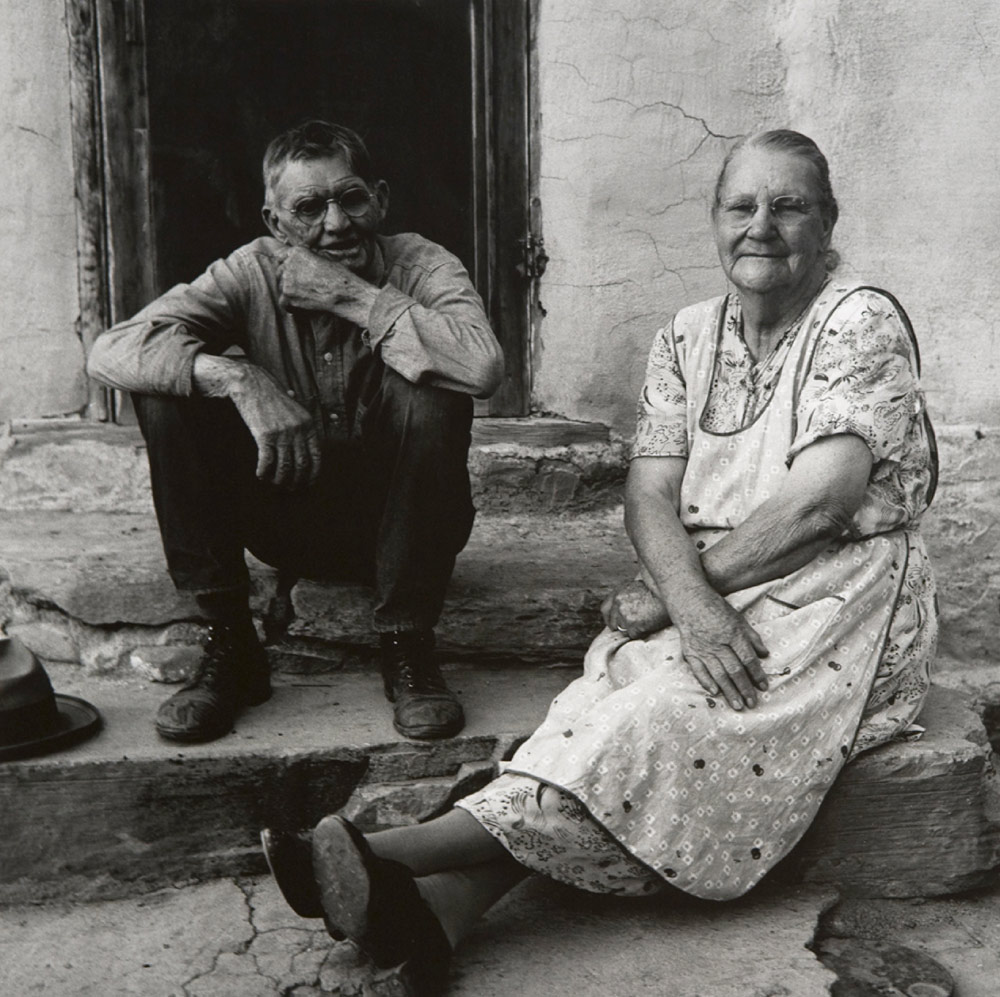
Dorothea Lange (American, 1895-1965) Couple Seated on Porch, Gunlock, Utah 1953 Silver gelatin photograph Brigham Young University Museum of Art, purchased with funds provided by Jack and Mary Lois Wheatley
“The camera is an instrument that teaches people how to see without a camera.”
Dorothea Lange
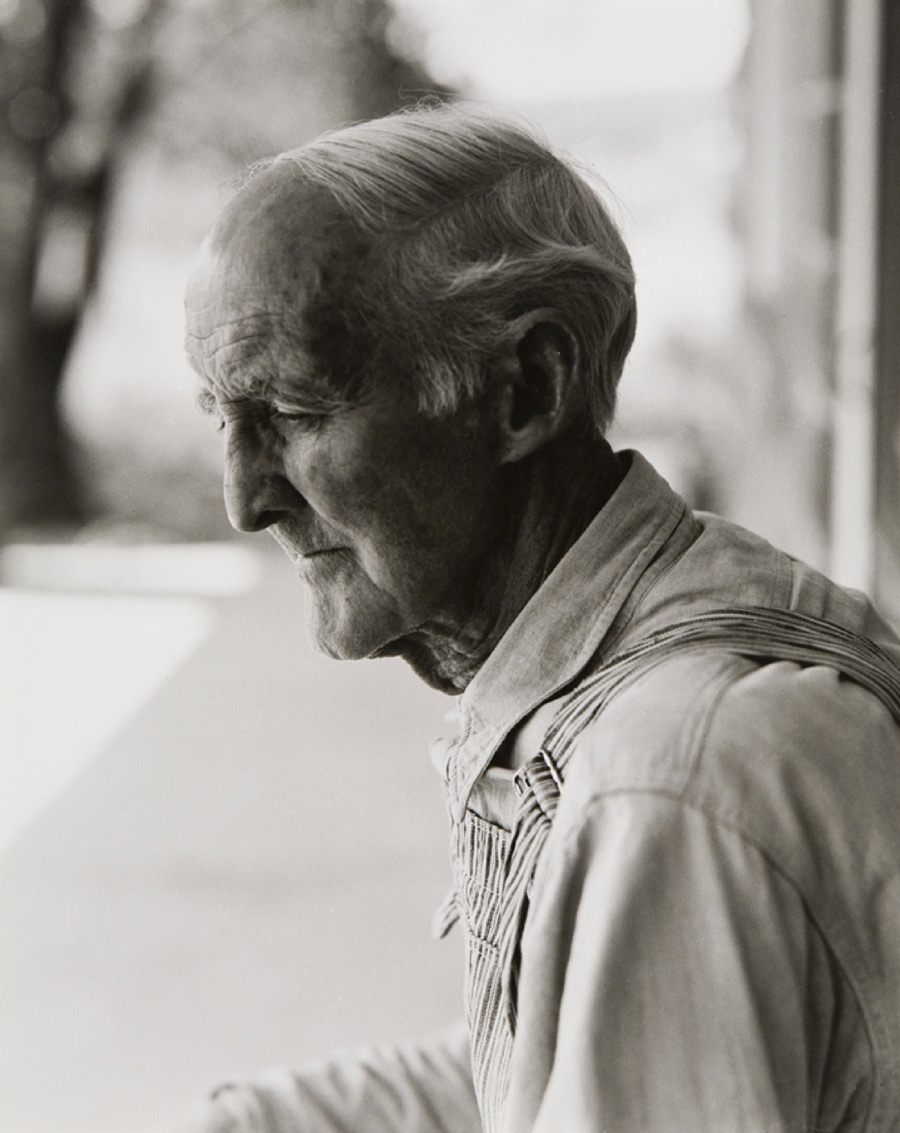
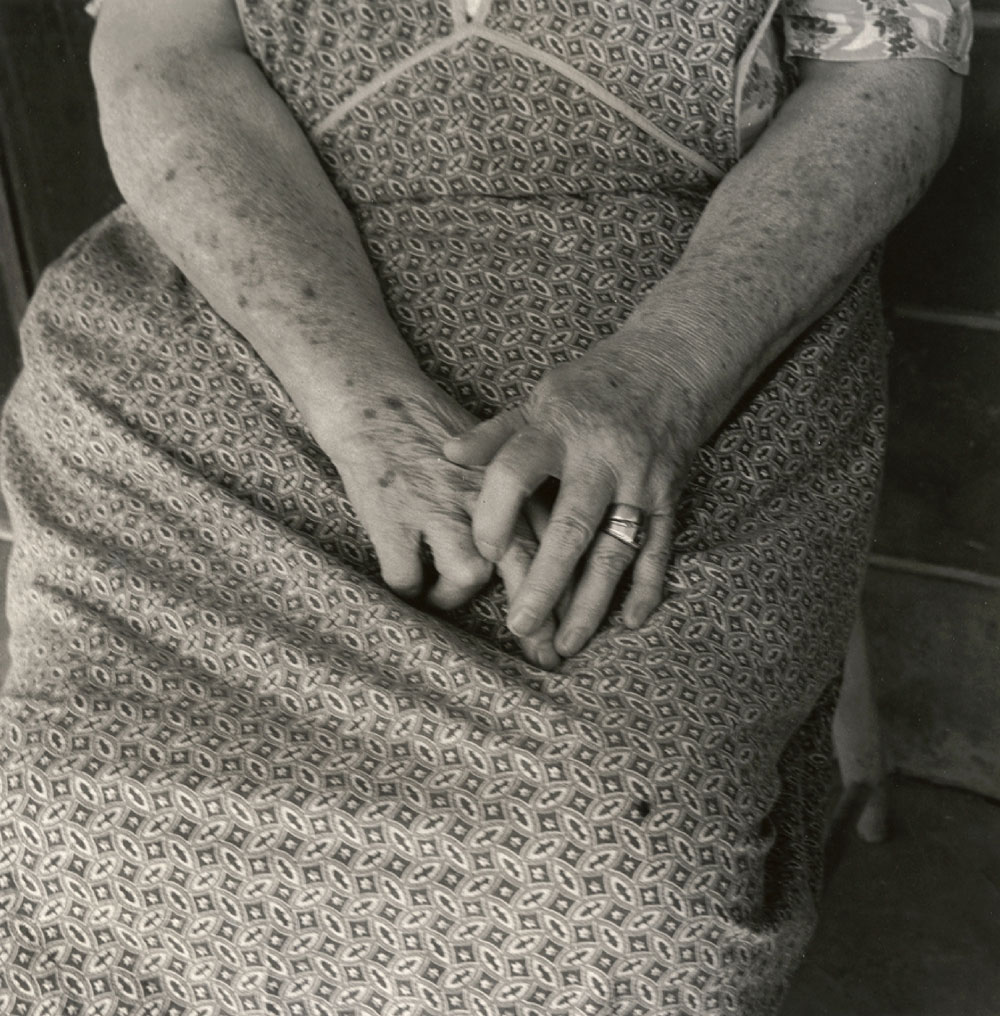
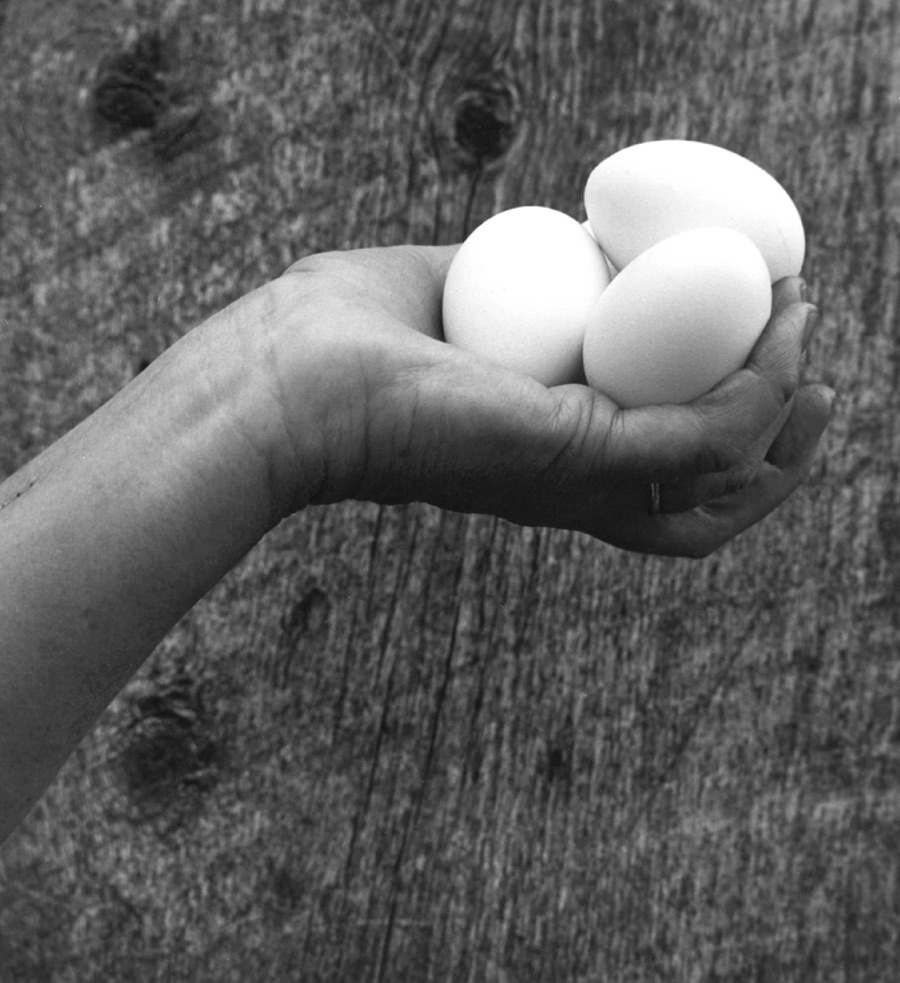
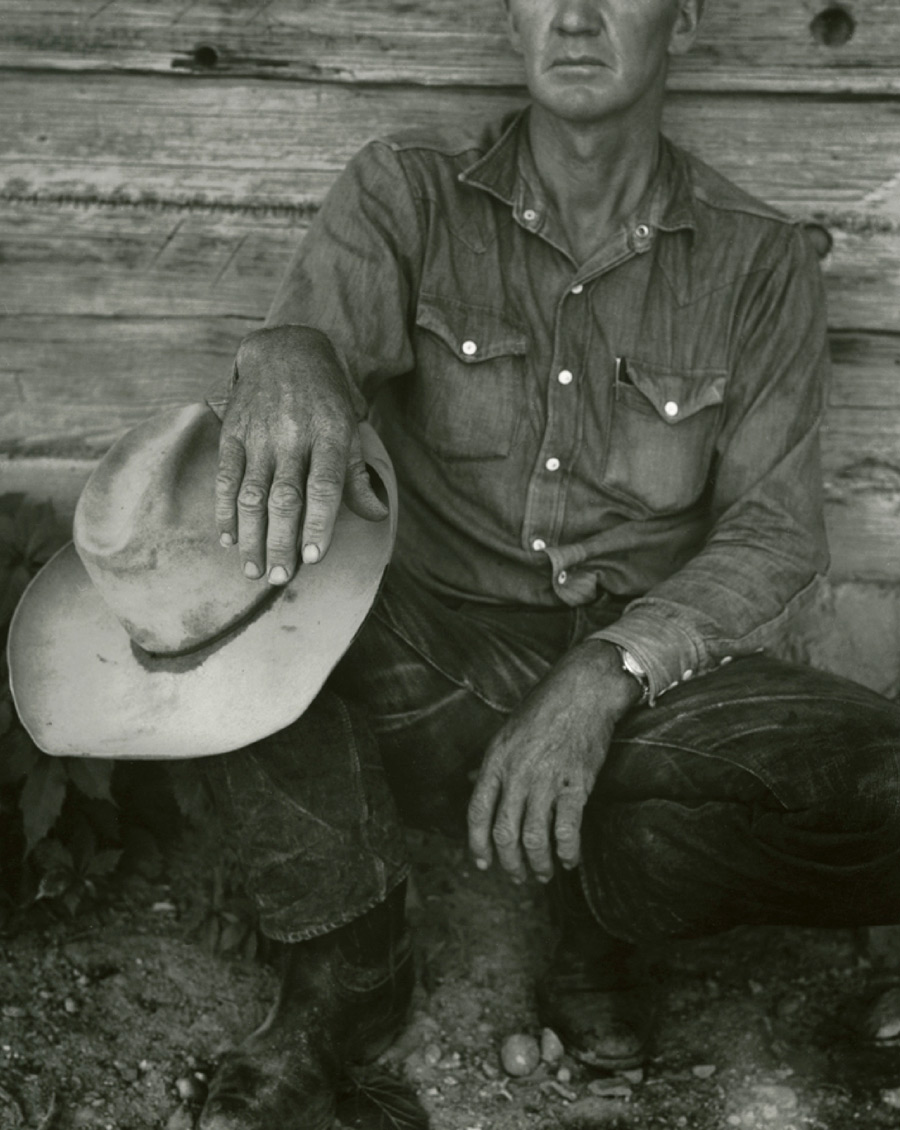
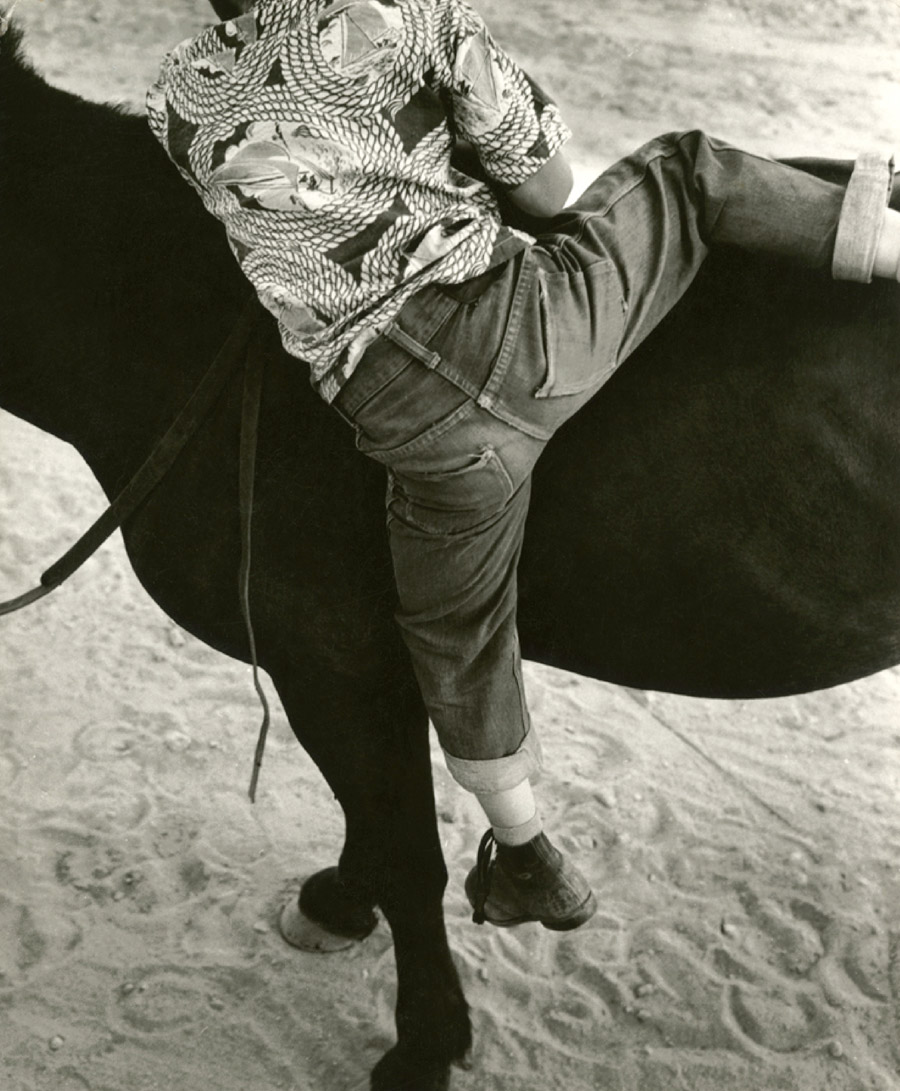
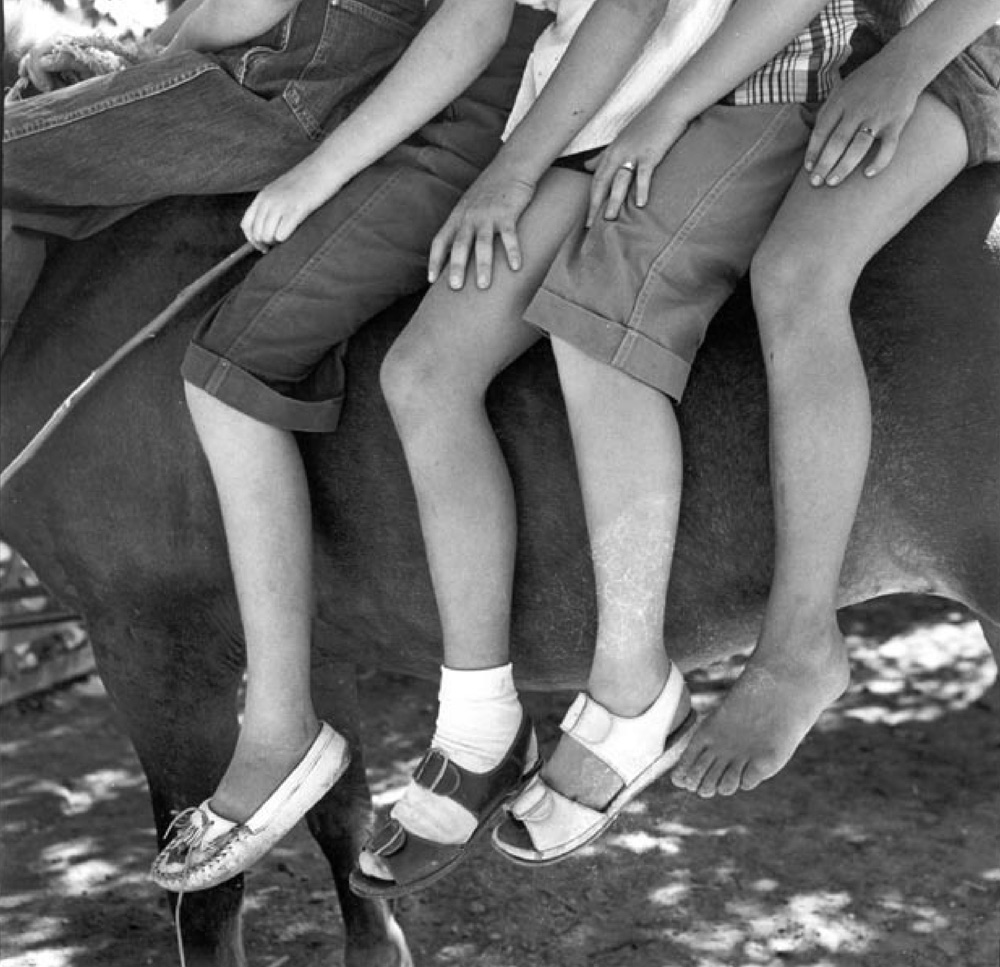
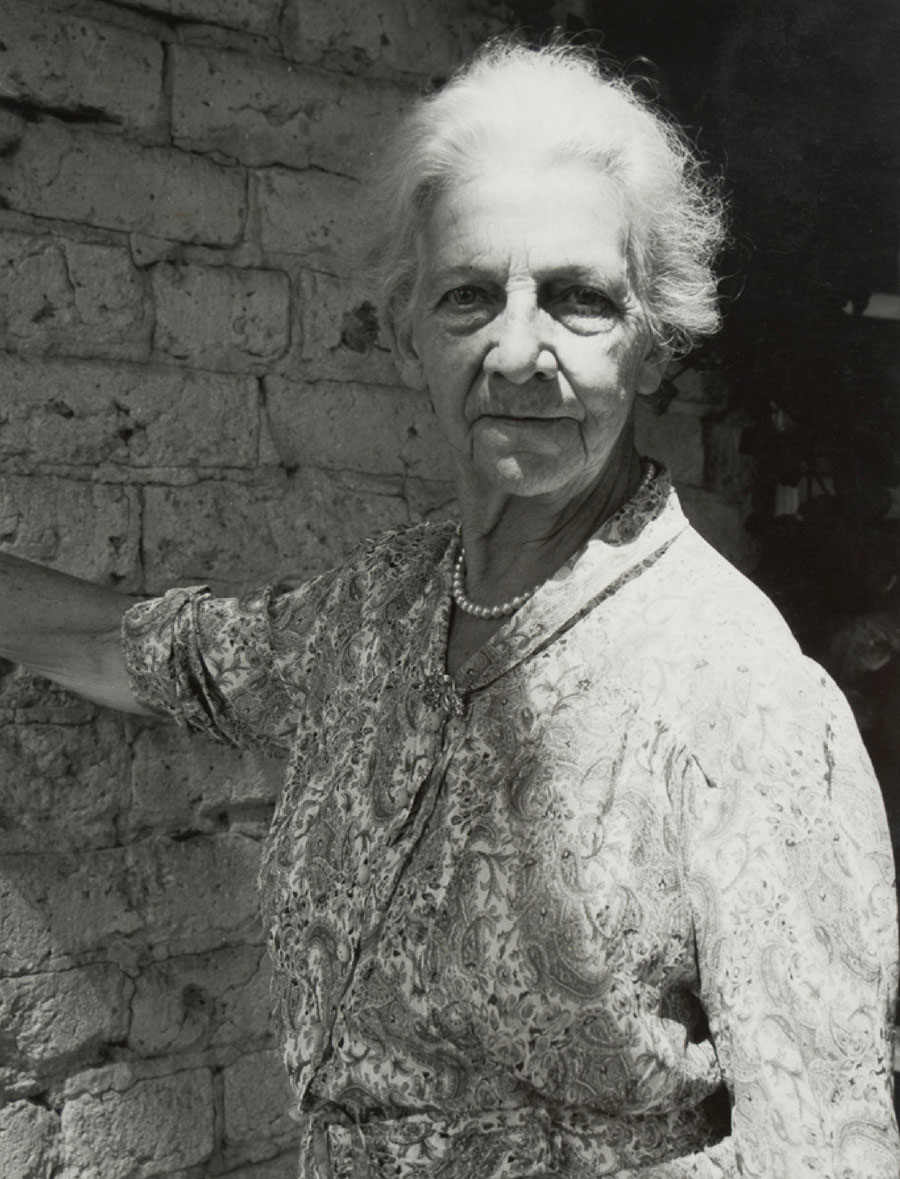
Lange observes the minutiae, the precise details that go to make up the lives of these three towns and puts them together in a wonderful symphony of beautifully calculated, seemingly happenstance associations. Masterful!
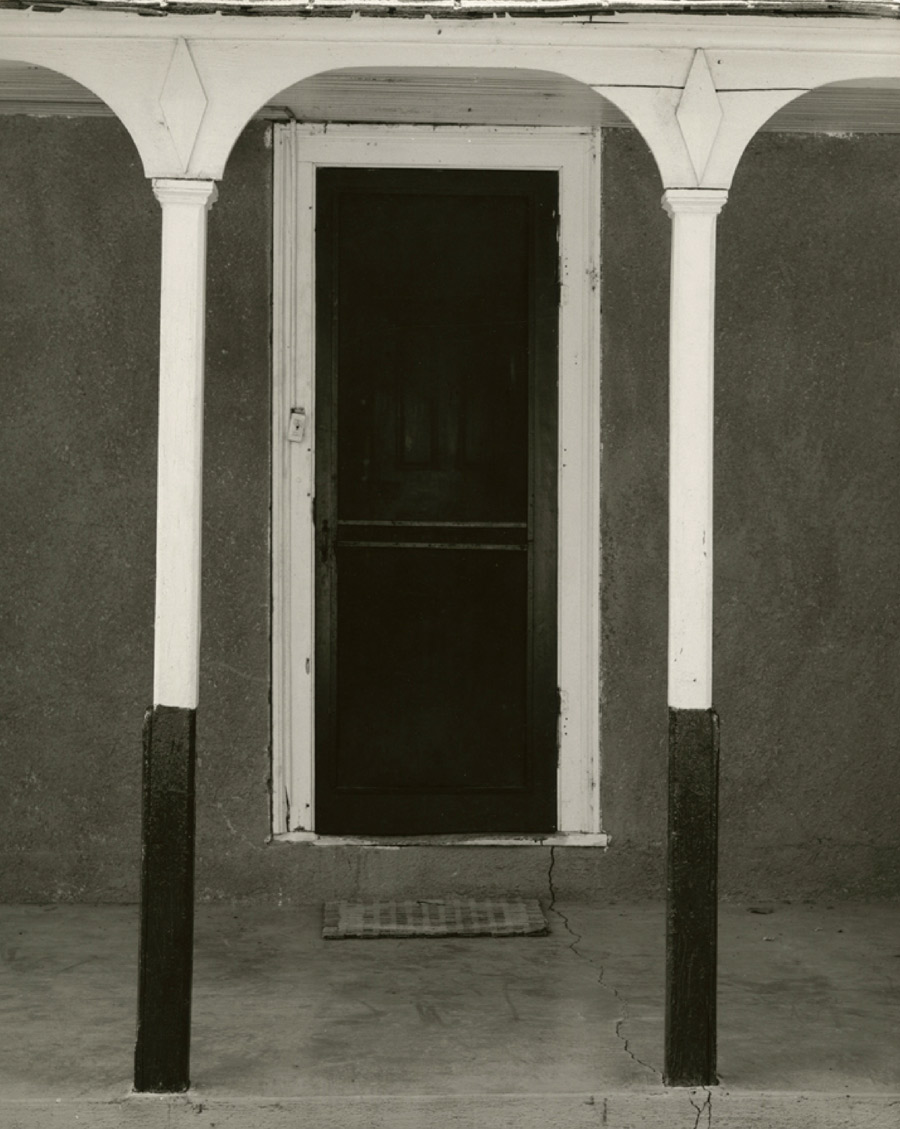
Dorothea Lange (American, 1895-1965) Doorway, Toquerville, Utah 1953 Silver gelatin photograph Brigham Young University Museum of Art, purchased with funds provided by Jack and Mary Lois Wheatley
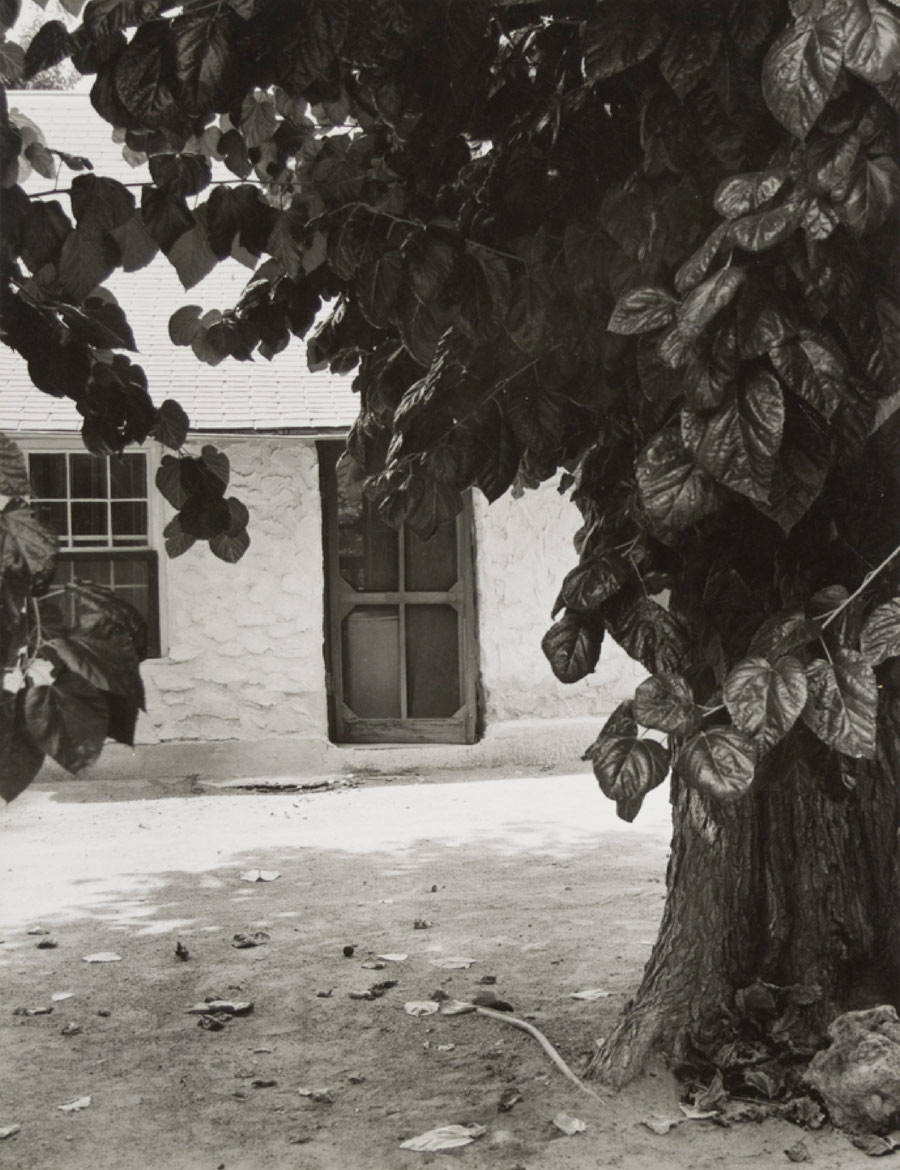
Dorothea Lange (American, 1895-1965) Mulberry Tree, Neagle Home, Toquerville, Utah 1953 Silver gelatin photograph Brigham Young University Museum of Art, purchased with funds provided by Jack and Mary Lois Wheatley
Dorothea Lange (American, 1895-1965) Riley Savage, Toquerville, Utah 1953 Silver gelatin photograph Brigham Young University Museum of Art, purchased with funds provided by Jack and Mary Lois Wheatley
Dorothea Lange (American, 1895-1965) Hands, Toquerville, Utah 1953 Silver gelatin photograph Brigham Young University Museum of Art, purchased with funds provided by Jack and Mary Lois Wheatley
Dorothea Lange (American, 1895-1965) Eggs, Toquerville, Utah 1953 Silver gelatin photograph Collection of John and Lolita Dixon
In August 1953, renowned American photographer Dorothea Lange travelled to southern Utah where she met up with her long-time friend Ansel Adams. The two photographers spent three weeks photographing the landscape and people of Toquerville, Gunlock and St. George with the intention of publishing the work in LIFE magazine.
Lange’s enthusiasm for her subject yielded hundreds of photographs from which she composed an extended essay of 135 photographs, including images by Ansel Adams. Thirty-five of those photographs with text by Daniel Dixon appeared under the title Three Mormon Towns in the September 6, 1954 issue of LIFE.
“Dorothea Lange’s Three Mormon Towns,” a new exhibition at the Brigham Young University Museum of Art, features 21 of Lange’s photographs from this series acquired by the museum. The exhibition also draws from the collections of the J. Paul Getty Museum of Art, the Museum of Contemporary Photography, Columbia College Chicago, and the collection of John and Lolita Dixon.
The 62 vintage prints in the exhibition, accompanied by excerpts from Dixon’s original text, examine Lange’s lasting interest in the people of southern Utah and their relationship with the land, their heritage and the transformation of the West in post-war America.
“Subtle and poetic, the series of photographs that has come to be known as Three Mormon Towns is a bridge between Lange’s famous Depression Era photographs and her detailed photo essays of the 1950s,” Diana Turnbow, Curator of Photography at Brigham Young University Museum of Art, said.
Utah attracted Lange’s interest when she and her first husband, Maynard Dixon, spent the summer of 1933 camping and working in Zion National Park. She originally intended to photograph southern Utah with the support of a Guggenheim Foundation fellowship in 1941; however, a family crisis, followed by the onset of World War II prevented Lange from traveling to Utah. Yet, the desire to photograph the Mormon towns of southern Utah never faded. In 1953, Lange returned to the place that had captured her attention decades earlier.
“While Lange’s photographs depict communities bound together by hard work and religion in the formidable landscape of the Colorado Plateau, they also explore the changes that were beginning to affect not only Utah, but rural communities throughout the United States,” Turnbow said. “Three Mormon Towns was a study of contrasts – of old and new, of quiet villages and a growing city, of deep roots and transient highways. In this series, Lange memorialised the dignity and simplicity of agrarian life in light of post-war urbanisation.”
Published in the September 6, 1954 issue of LIFE magazine, the series of photographs that has come to be known as Three Mormon Towns bridges Dorothea Lange’s famous Depression era photographs with her detailed photo essays of the 1950s. Featuring sixty-two vintage photographs from the series, this exhibition considers Dorothea Lange’s lasting interest in the people of southern Utah and their relationship with the land, their heritage, and the transformation of the West in post-war America.
Known for her candid and sympathetic depiction of people, Dorothea Lange (1895-1965) is one of the most revered photographers of the twentieth century. For over four decades she explored the human psyche through portraiture and documentary photography. The probing portraits of her early career prepared Lange to photograph the people involved in the tumultuous events of the San Francisco labor strikes of 1934, the Great Depression, and the Japanese internment during World War II. Her 1935 photograph, TheMigrant Mother, is one of the great icons of the American century.
In the 1950s, Lange began to create photographic essays for the popular picture and news magazine LIFE. She eventually completed five major essays for publication, with two of the essays, including Three Mormon Towns, printed in LIFE. In addition, Lange was a founding member of Aperture magazine and played a role in organising the influential Family of Man exhibition that premiered in New York in 1955.
In the later part of her life, Lange photographed and traveled extensively with her husband, Paul Taylor, in conjunction with his work in international development. Her photographs of South America, Africa, and Asia were deft and subtle, exploring a rich visual landscape populated with diverse objects and people.
In 1964, Lange was diagnosed with terminal cancer. Sustained by determination, she worked steadily to complete a number of projects including a retrospective exhibition of her work at the Museum of Modern Art in New York City. She passed away on October 11, 1965, content with the life that she had been able to live.
Text from the Brigham Young University Museum of Art website [Online] Cited 24/03/2011 no longer available online
Gunlock, Utah
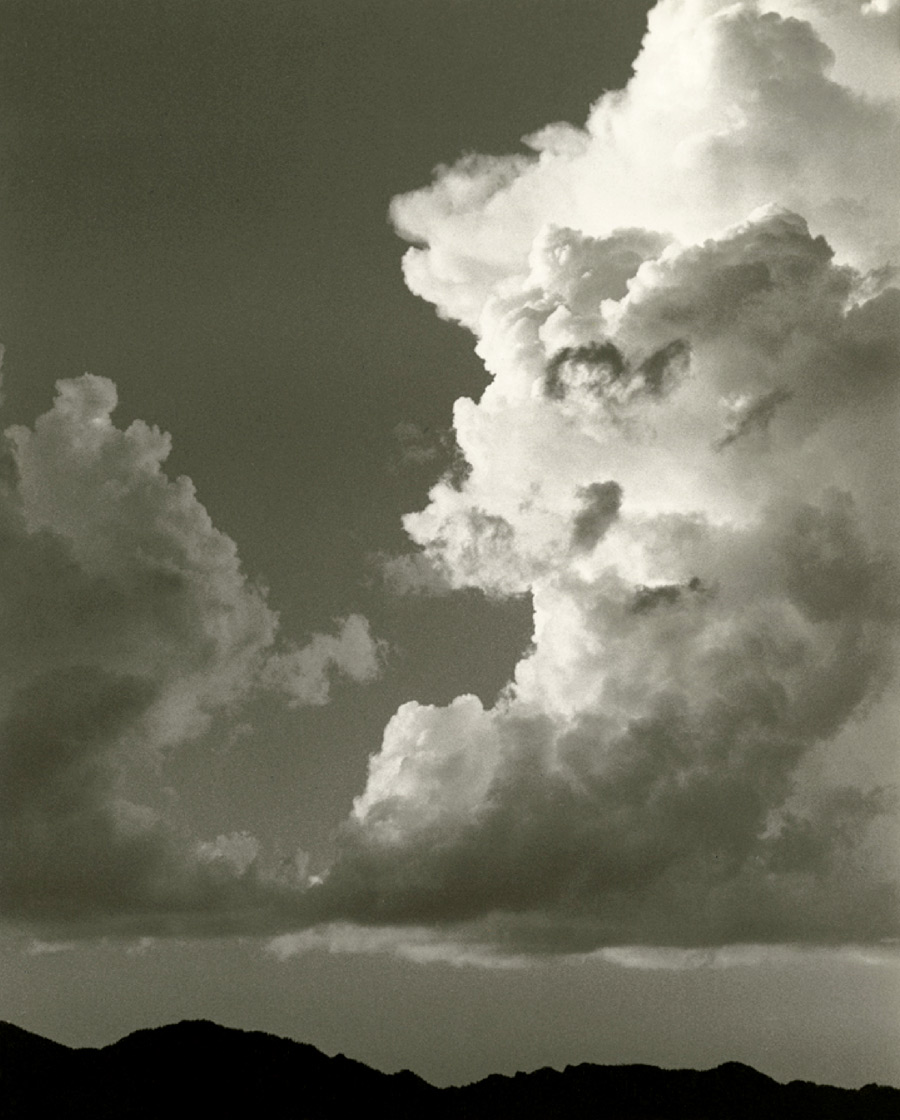
Dorothea Lange (American, 1895-1965) Sky and Clouds, Gunlock, Utah 1953 Silver gelatin photograph Brigham Young University Museum of Art, purchased with funds provided by Jack and Mary Lois Wheatley
Dorothea Lange (American, 1895-1965) Jake Jones’ Hands, Gunlock, Utah 1953 Silver gelatin photograph Brigham Young University Museum of Art, purchased with funds provided by Jack and Mary Lois Wheatley
Dorothea Lange (American, 1895-1965) Horseplay, Gunlock, Utah 1953 Silver gelatin photograph Brigham Young University Museum of Art, purchased with funds provided by Jack and Mary Lois Wheatley
Dorothea Lange (American, 1895-1965) Four Young Riders in Summer 1953 Silver gelatin photograph Museum of Contemporary Photography, Columbia College Chicago
St. George, Utah
Dorothea Lange (American, 1895-1965) Anne Carter Johnson, St. George, Utah 1953 Silver gelatin photograph Brigham Young University Museum of Art, purchased with funds provided by Jack and Mary Lois Wheatley
Dorothea Lange (American, 1895-1965) Young Woman, St. George, Utah 1953 Silver gelatin photograph Brigham Young University Museum of Art, purchased with funds provided by Jack and Mary Lois Wheatley
Brigham Young University Museum of Art North Campus Drive, Provo, UT 84602-1400

































 Art Blart _ art and cultural memory archive
You must be logged in to post a comment.