Review: ‘WHO ARE YOU: Australian Portraiture’ at NGV Australia, Federation Square, Melbourne

Exhibition dates: 25th March – 21st August, 2022
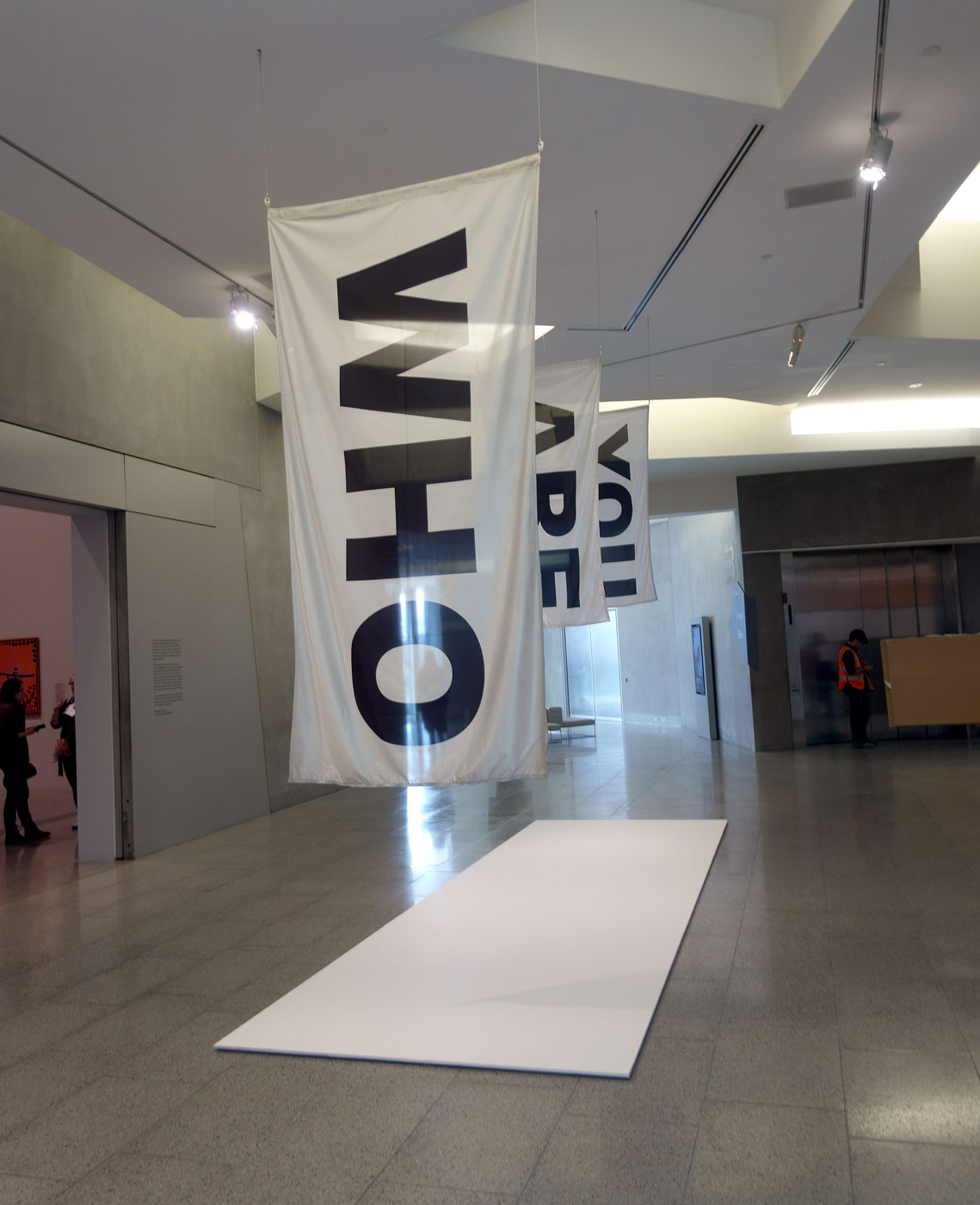
 

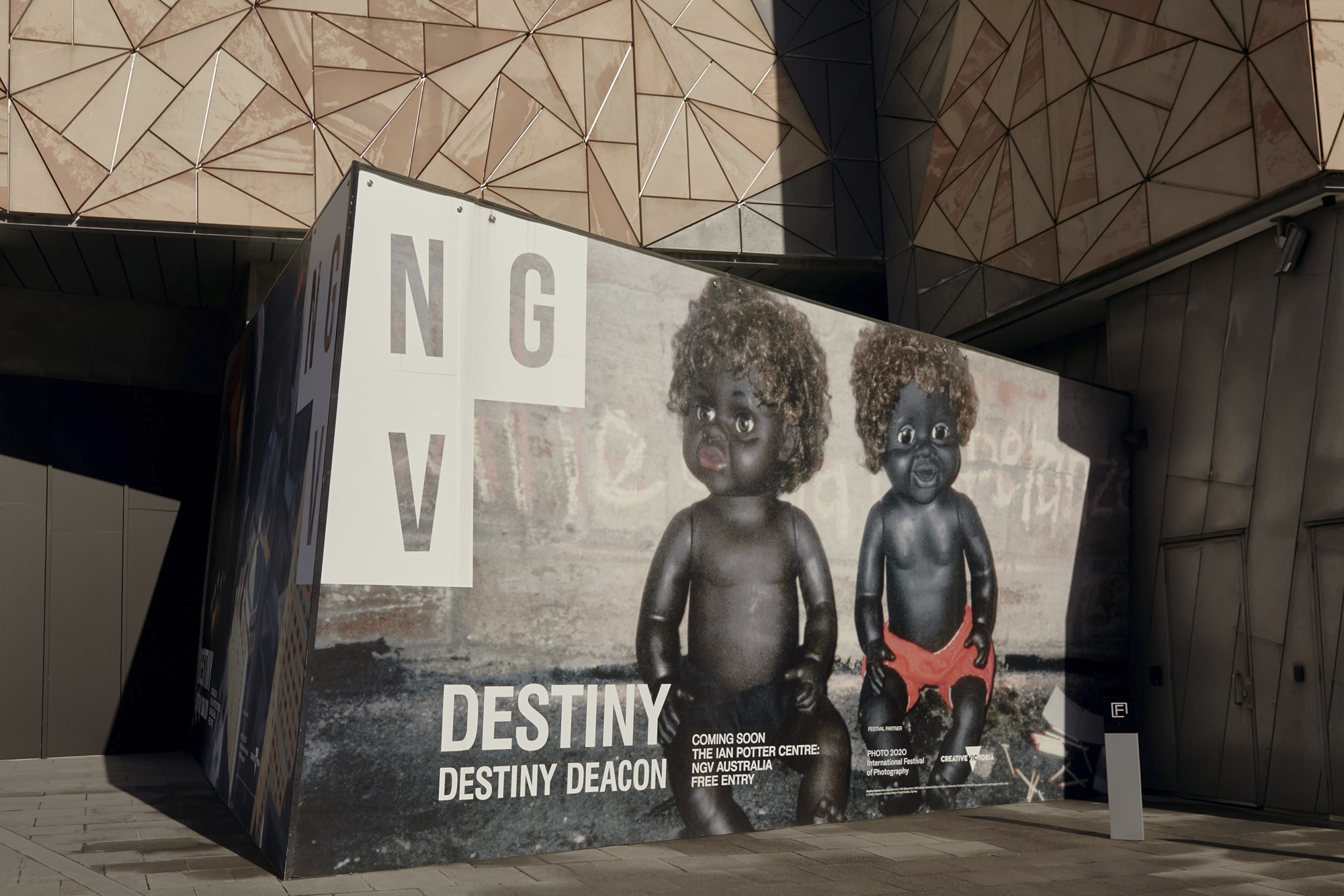
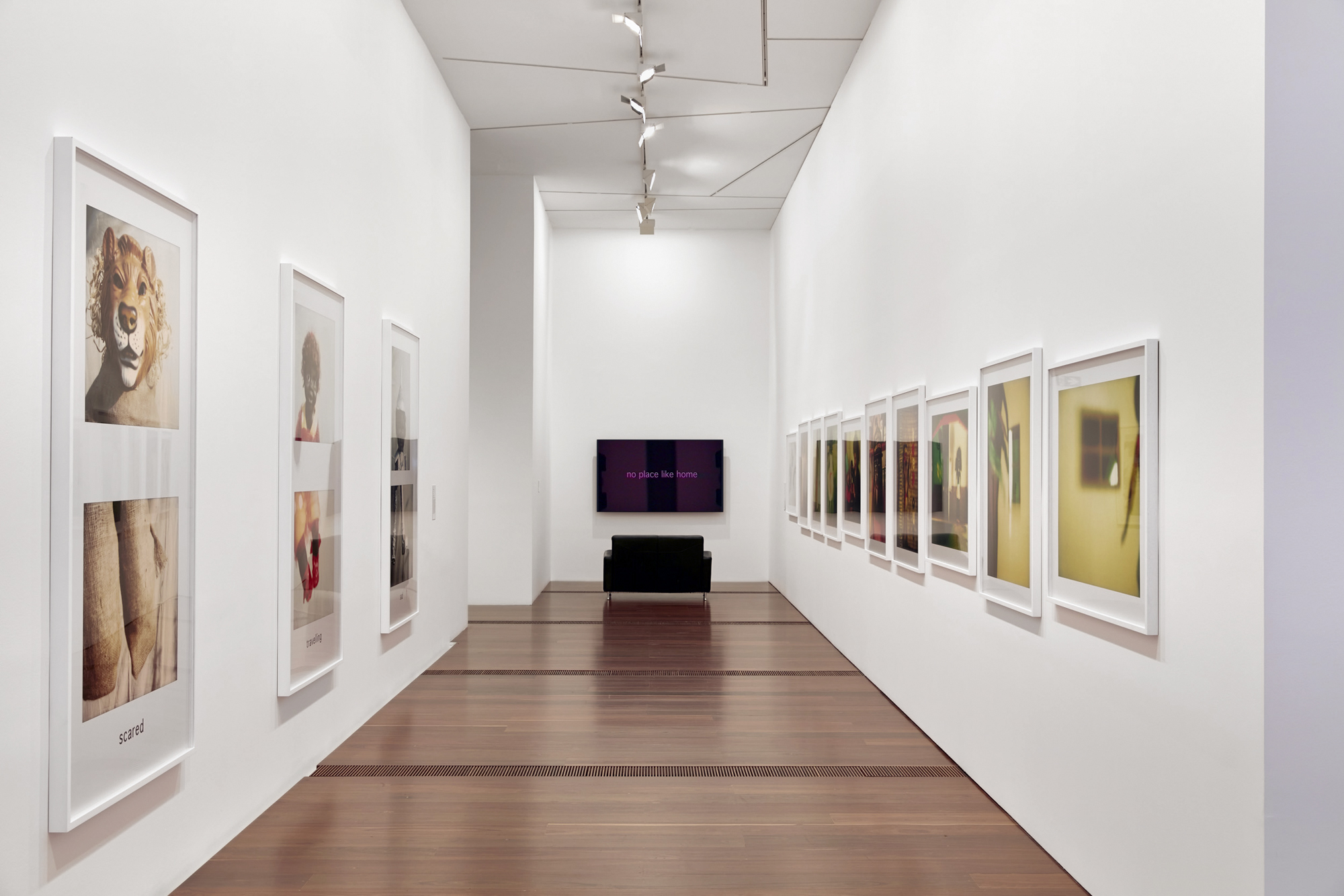
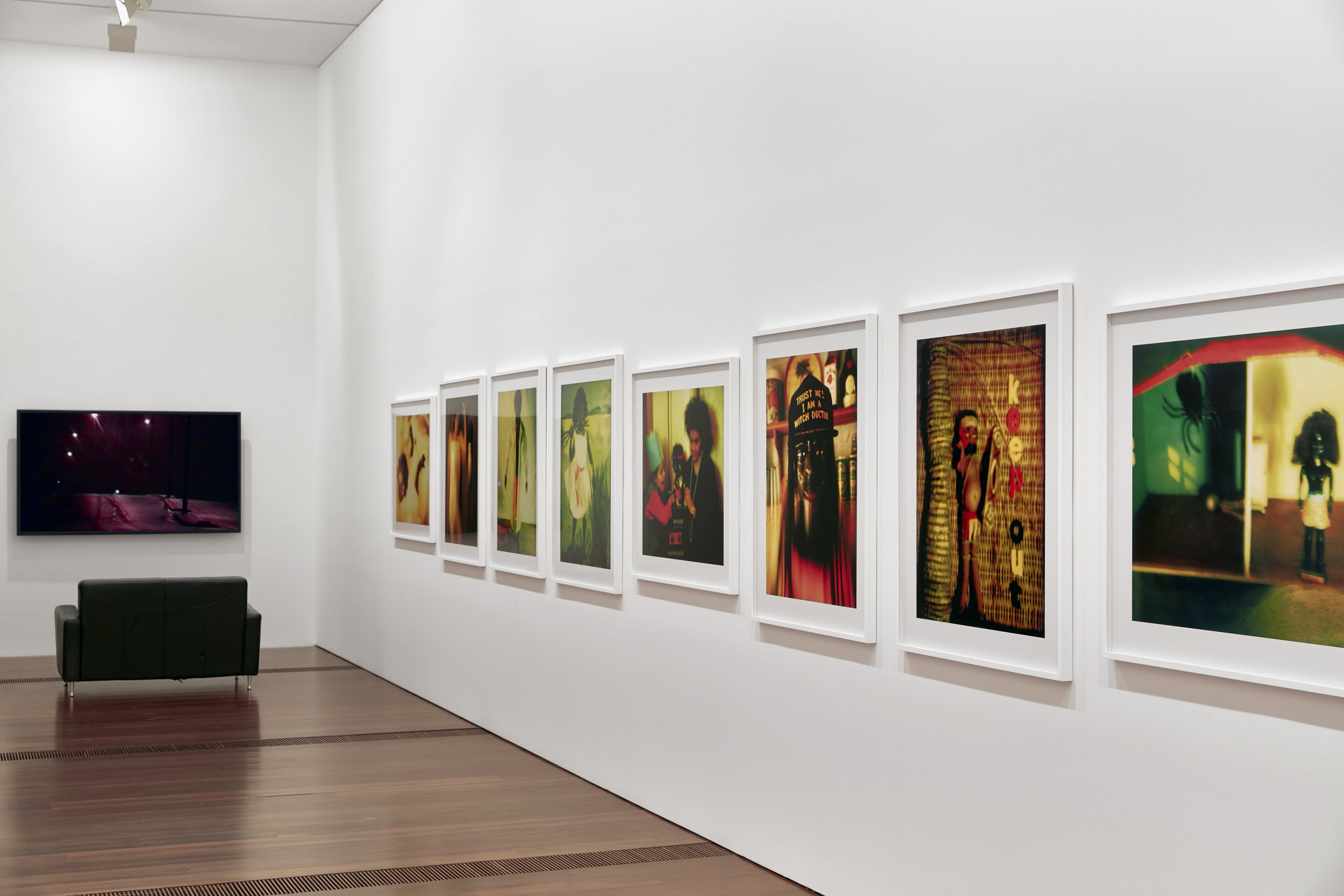
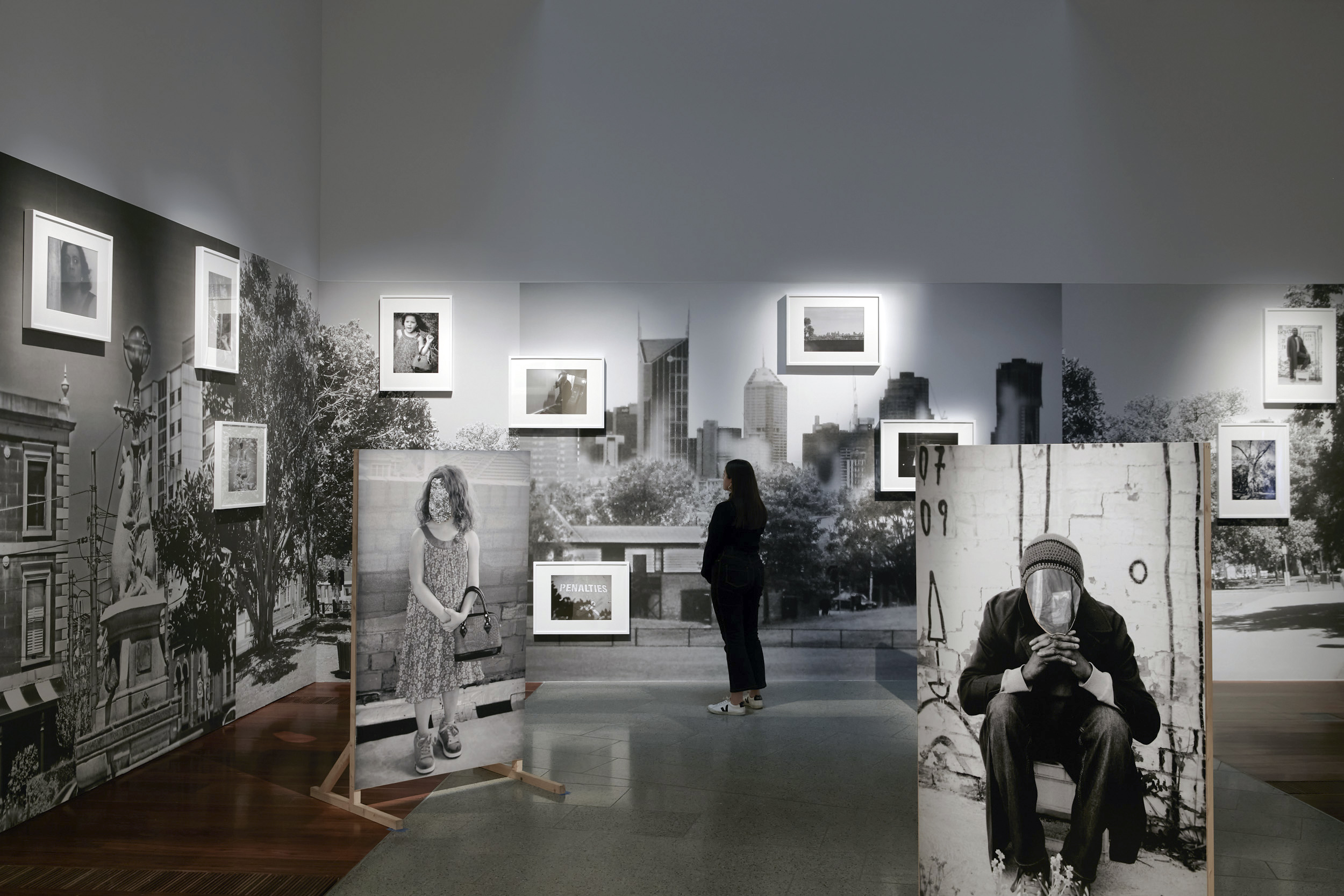
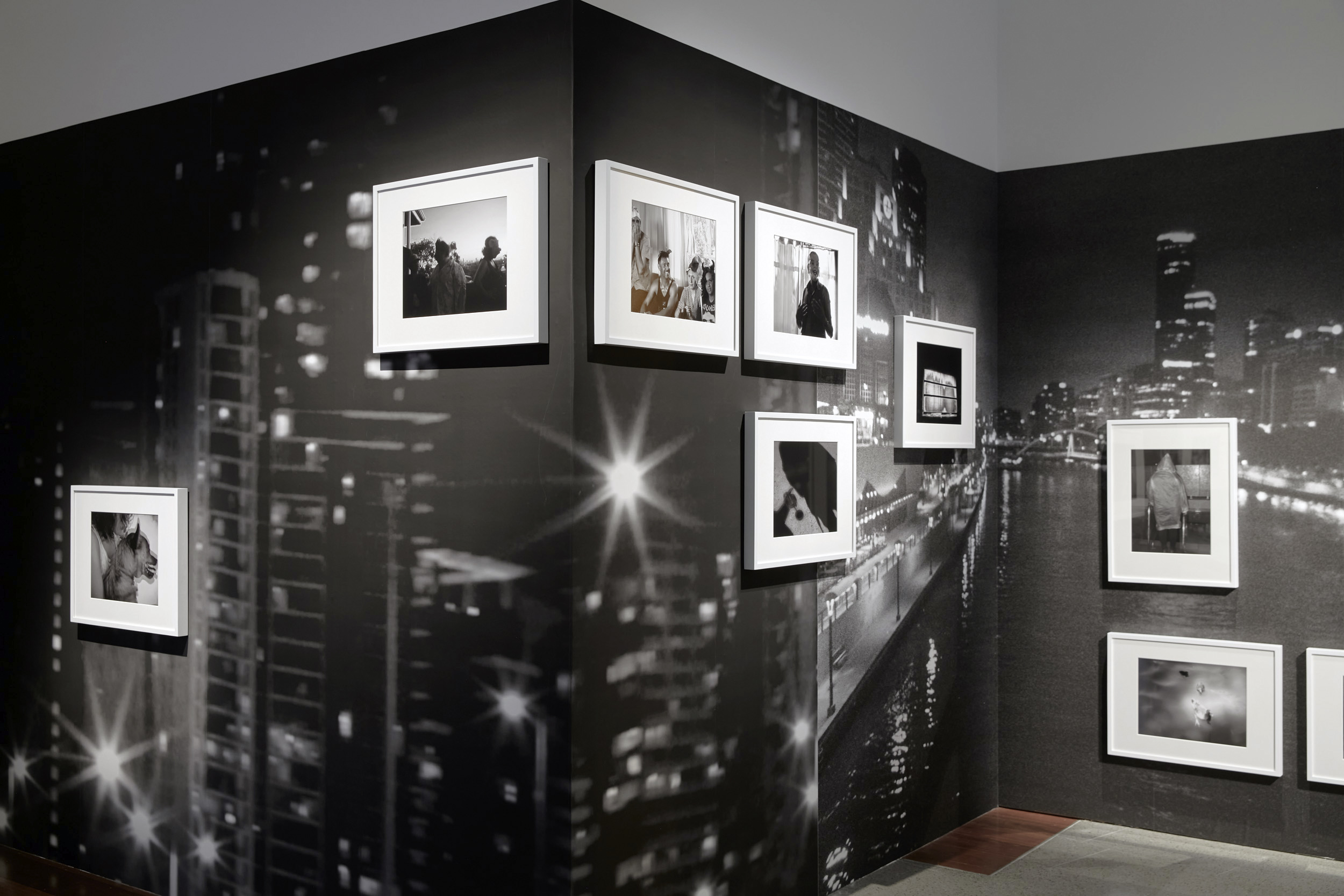
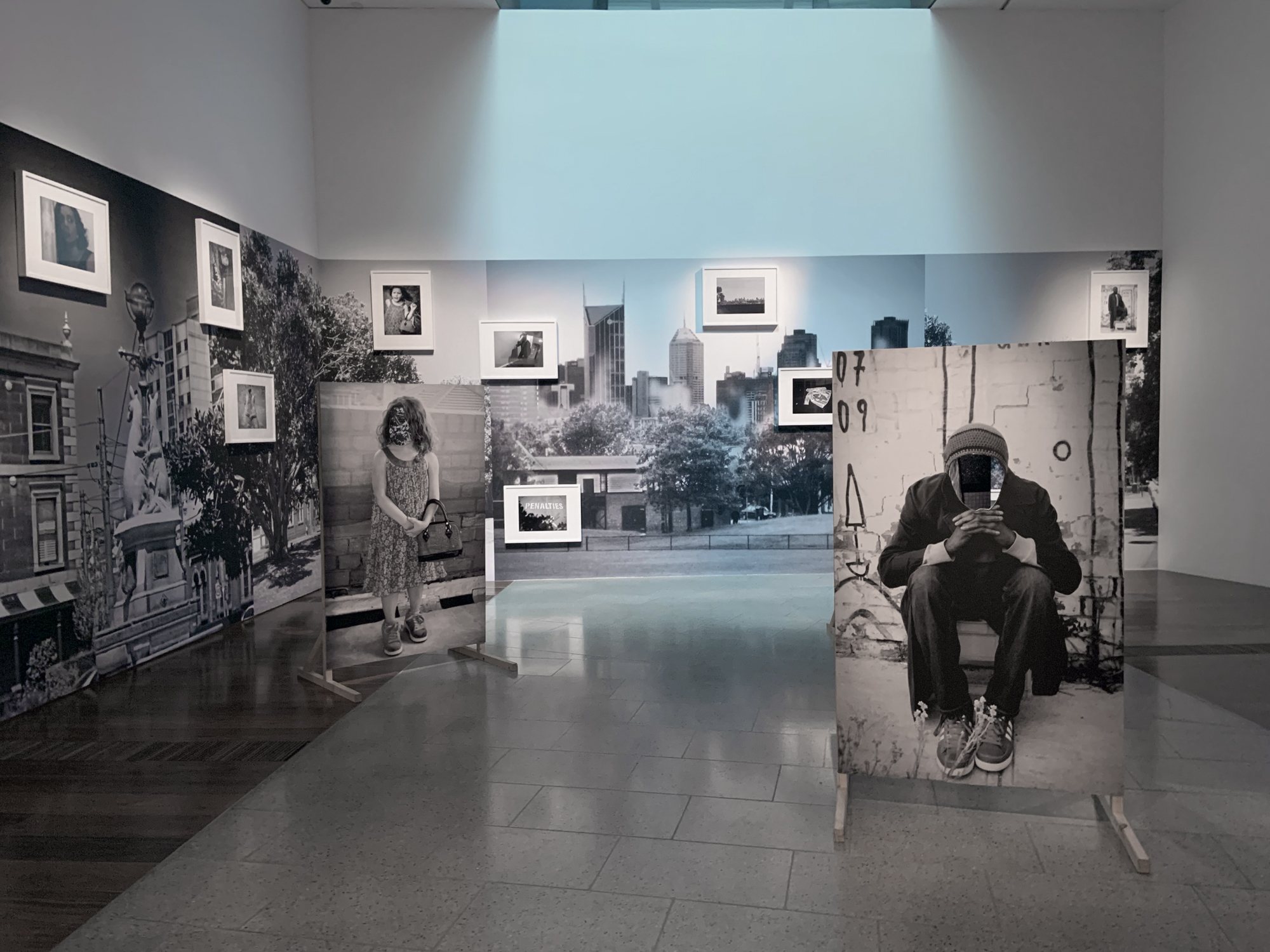
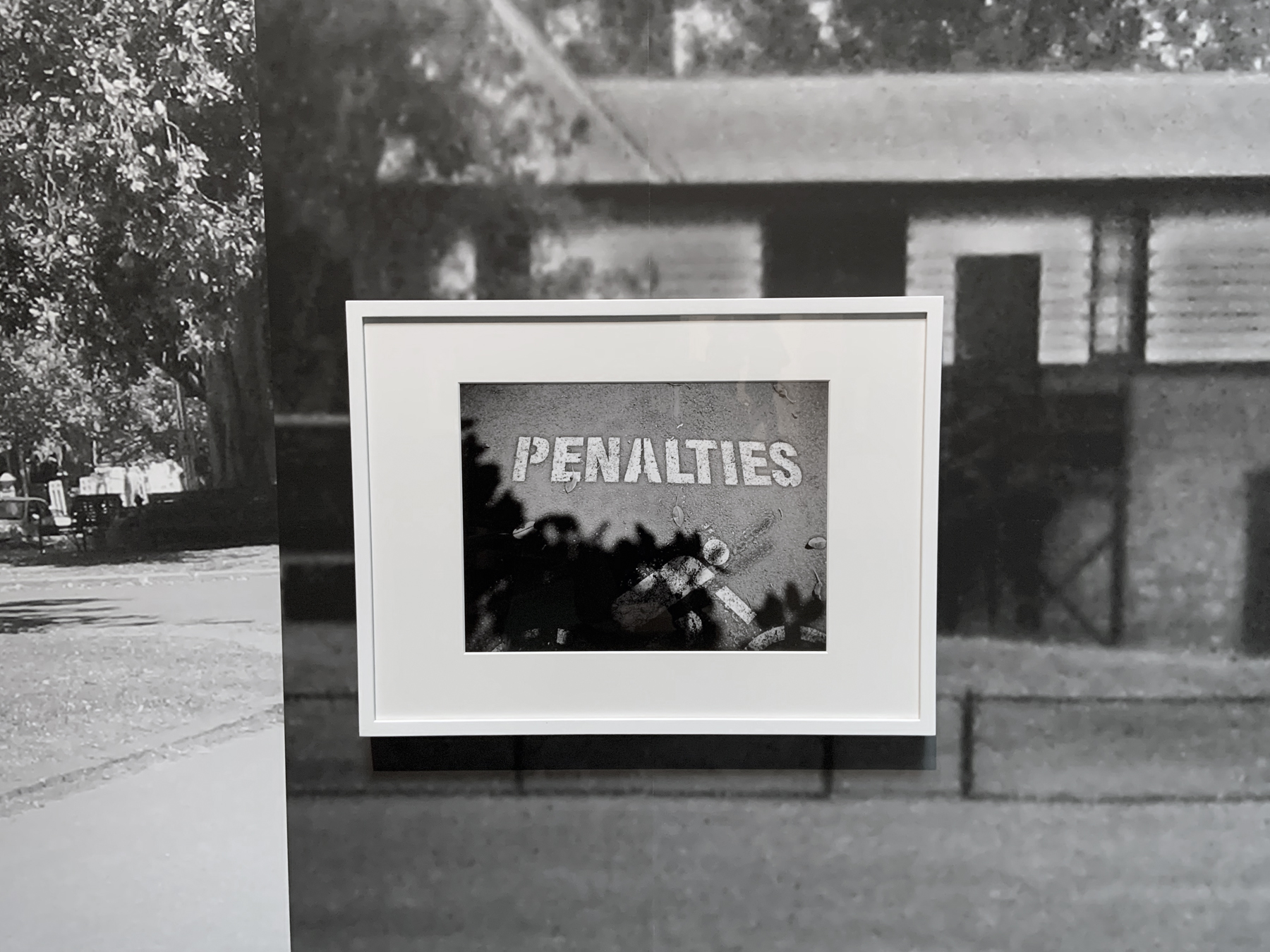
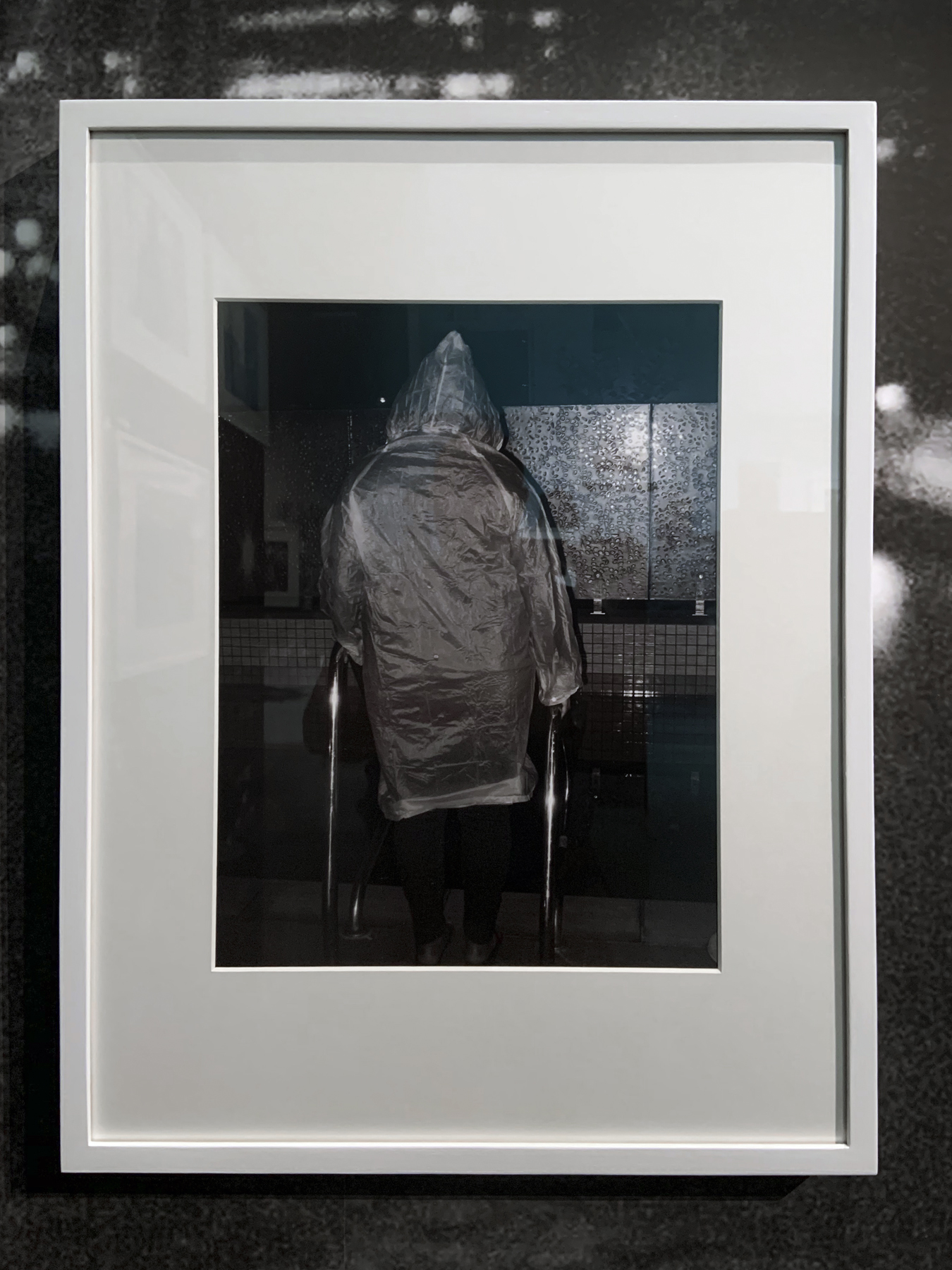
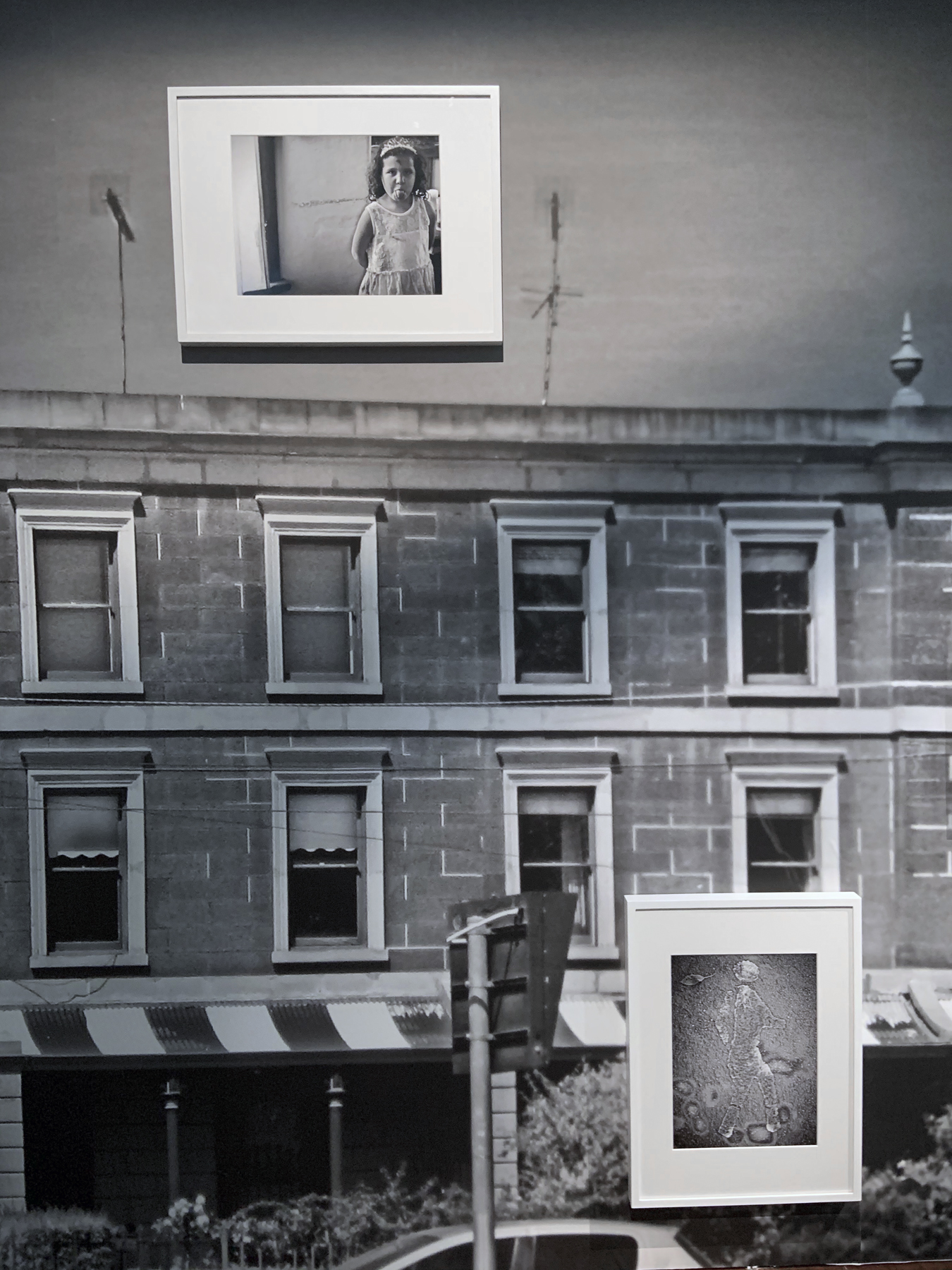
Entrance of the exhibition 'WHO ARE YOU: Australian Portraiture' at NGV Australia, Federation Square, Melbourne


Entrance of the exhibition WHO ARE YOU: Australian Portraiture at NGV Australia, Federation Square, Melbourne
Photo: Marcus Bunyan


The black and white show

This is a challenging and stimulating exhibition at NGV Australia, Federation Square that attempts to answer the question: “who are you” when coming to terms with what it is to be an Australian.

WHO ARE YOU: Australian Portraiture is one of the most comprehensive explorations of portraiture ever mounted in Australia and the first exhibition to bring together the collections of the National Gallery of Victoria (NGV) and the National Portrait Gallery, Canberra… [it] considers portraiture in Australia across time and media, as well as the role of the portraiture genre in the development of a sense of Australian national identity… The exhibition also questions what actually constitutes portraiture by examining the surprising and sometimes unconventional ways of representing likeness… Presented across five thematic sections, the exhibition raises challenging and provocative questions about who we are and how we view others – historically, today and into the future…

The exhibition opens by considering the connection between people and place, reflecting on the relationship between artists, sitters and the environment, as well as the personification of the natural world… A further section explores the artistic tradition of the self-portrait and portraits of artists, as well as how this convention has been subverted or challenged by contemporary artists working today… Ideas of intimacy and alienation are juxtaposed through images of family and community presented alongside those of vulnerability and isolation… The exhibition also explores portraiture’s surprising capacity to reveal the inner worlds and mindsets of both the sitter and the artist… The final section of the exhibition interrogates Australian icons, identities and how we construct them.” (Press release)


This is an ambitious agenda for several large exhibitions, let alone cram so many ideas into one exhibition. And in the end the central question “who are you” is unknowable, unanswerable in any definitive way… for it all depends on your ancestry, and from what point of view you are looking and in what context – and these conditions can change from minute to minute, day to day, and era to era. Identity is always partially fixed and fluid at one and the same time. It is always a construction, a work in progress, governed by social and cultural relations.

“Identity is formed by social processes. Once crystallized, it is maintained, modified, or even reshaped by social relations. The social processes involved in both the formation and the maintenance of identity are determined by the social structure. Conversely, the identities produced by the interplay of the organism, individual consciousness and social structure react upon the given social structure, maintaining it, modifying it, or even reshaping it.”1


Identity construction is a self-referential system where identities are produced out of social systems. They (identities) then act upon those very systems to alter them, and then those systems re-act again forming anew, an ever changing identity. “The task of identity formation is to develop a stable, coherent picture of oneself that includes an integration of one’s past and present experiences and a sense of where one is headed in the future.”2 But that identity formation, while seeking to be stable, is both multiple and contestatory. It is through those contests that a future sense of self can challenge hegemonic power differentials. As Judith Butler observes,

“Thus every insistence on identity must at some point lead to a taking stock of the constitutive exclusions that reconsolidate hegemonic power differentials, exclusions that each articulation was forced to make in order to proceed. This critical reflection will be important in order not to replicate at the level of identity politics the very exclusionary moves that initiated the turn to specific identities in the first place … It will be a matter of tracing the ways in which identification is implicated in what it excludes, and to follow the lines of that implication for the map of future community that it might yield.”3


In other words, learn from the mistakes of the past and don’t let them repeat themselves in future identities! Do not exclude others in order to reconsolidate the hegemonic status quo. But people always form identities based on the “norm” – how can you change that? As A. David Napier states, “We rely, sometimes almost exclusively it seems, upon the construction and reconstruction of an evolutionary(?) sequence of events that simultaneously excludes outsiders and provides some basis for justifying our social rules and actions. Thus, we minimize diversity by reflecting on who we are, by achieving, that is, a self-conscious state that is not only accepted but considered desirable…”4

Critical reflection is thus so important in challenging who we are, both individually and collectively. In this sense, an exhibition like WHO ARE YOU is important in helping to reshape social relations, helping to challenge hegemonic power differentials, which in turn affects our personal identity construction by reflecting on who we are and changing our point of view, so that we become more informed, and more empathetic, towards different cultures and different people. So that we do not exclude other people and other points of view.

But all is not roses and light in this exhibition with regard to exclusion.

Whilst a lot of people acknowledge and empathise with First Nations people we can have NO IDEA of the ongoing pain and hurt centuries of invasion, disenfranchisement, genocide, massacres, Stolen Generation, lack of health care, massive incarceration, suicide rates and shorter life expectancy, land loss, cultural loss that the violence of the white Anglo gaze has inflicted on the oldest living culture on Earth. While there are moves afoot (as there have been for years) for Aboriginal constitutional recognition through a Voice to Parliament, a permanent body representing First Nations people that would advise government on Indigenous policy; and a treaty that would help secure sovereignty and self-determination, enabling First Nations people make their own decisions and control their own lives, economy and land, free from the effects of changing governments – personally I believe until there is a complete acknowledgement of the pain invasion has caused Aboriginal people by the whole of Australia, nothing will ever change.

Having said that, contemporary Australia is now the most multicultural country it as ever been. According to the Australian Bureau of Statistics 2021 Census, 27.6 per cent of the population were born overseas and the top 5 countries of birth (excluding Australia) were, in order, England, India, China, New Zealand and the Philippines.5 In Australia, 812,000 people identified as Aboriginal and/or Torres Strait Islander in the 2021 Census of Population and Housing. Aboriginal and Torres Strait Islander people represented 3.2% of the population.6

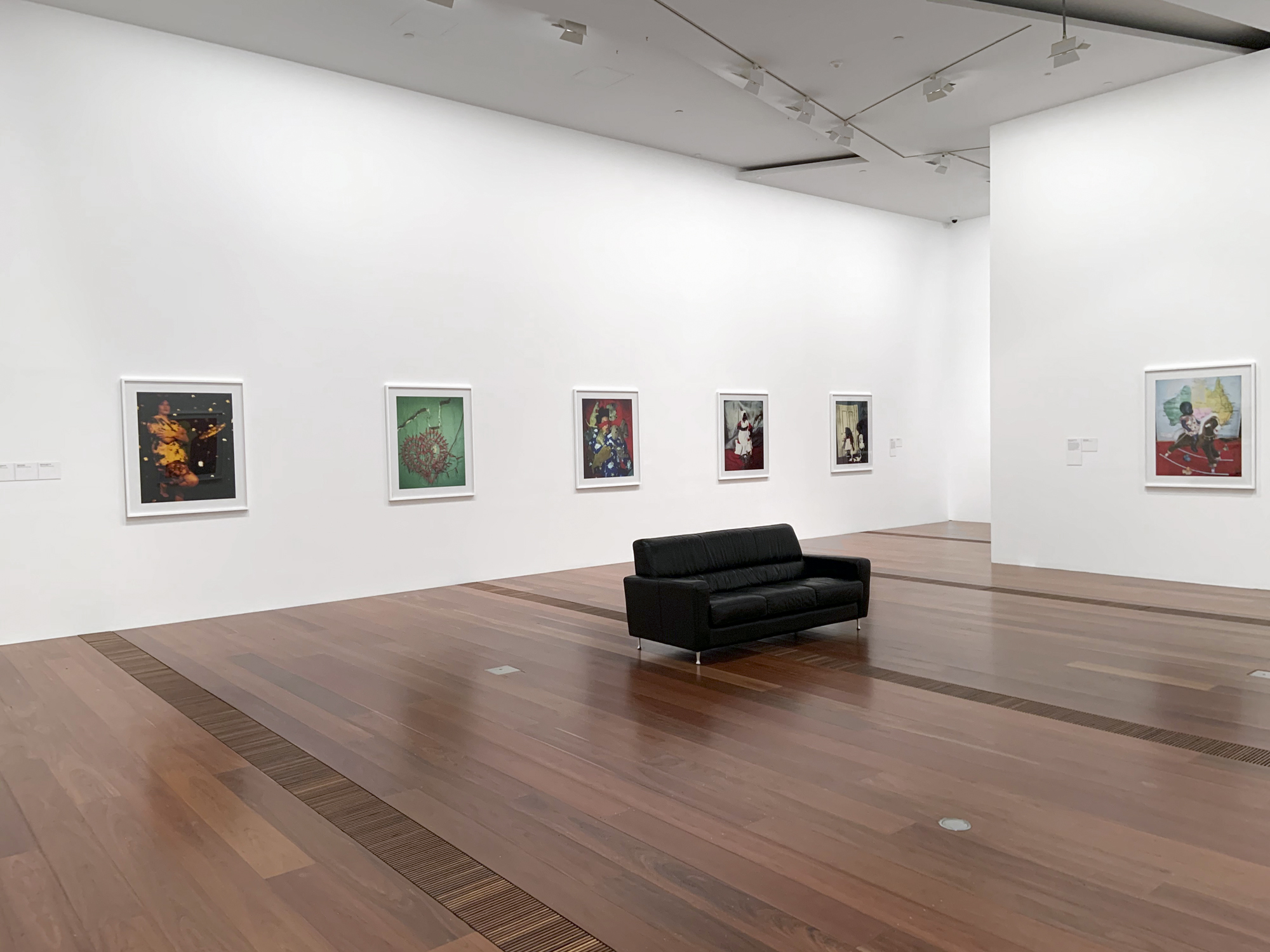
It is interesting to note that when looking through the art works in this exhibition – nearly all of which can be seen in this posting – how much of it is (historical) white art and how much of it is contemporary Aboriginal art, with a sop being made to art made by, or mentioning, other people including Chinese, Afghan, Muslim and Sudanese. Chinese people have been living in Australia for centuries, Afghan people similarly. Greek and Italian people arrived in droves in the 1950s-1960s, Vietnamese boat people in the 1970s, Sudanese, Indian and Sri Lankan people in the late 20th century. More (historical and contemporary) work from these people was needed in this exhibition because they inform the construction of modern Australian identities.

Obviously the inclusion of so much contemporary Aboriginal work is a deliberate curatorial decision, but its disproportionate representation in this exhibition makes it feel like a “catch all”. Why do the curators feel the need to include so much Indigenous work? Is that how they truly see Australian identity? Also, does the inclusion of this art mean it is the best contemporary art that is available in Australia at the moment, or does its inclusion simply exclude other voices from different nationalities and ethnic and religious backgrounds that are just as important in the construction of contemporary Australian identities? While there is no denying the historical significance of invasion there needs to be a balance in such representation, especially in an exhibition purporting to investigate “who are you” over a broad range of references. As it stands the inclusion of so much Indigenous work feels like an agenda, a set point of departure, perhaps even an apologia for white guilt. As the critic John McDonald noted recently, we are living “at a time when museums and commercial galleries have gone completely gaga for such [that is, Aboriginal] work.”

Personally, I would have liked to have seen a greater range of voices expressing themselves in this exhibition. It struck me that the inclusion of so much (historical) white art and so much contemporary Aboriginal art formed a rather limited framework in which to examine “who are you”. Rather, I would have liked a more balanced representation through art of the many voices that contribute to the formation of evolving Australian identities, which ultimately could lead to a greater insight into the construction of our own self-portrait. That is the truly important aspect of any navel gazing exercise.

Dr Marcus Bunyan

Word count: 1,450


1/ Peter Berger and Thomas Luckmann. The Social Construction of Reality: A Treatise in the Sociology of Knowledge. Allen Lane, London, 1967, p. 194.

2/ Erickson, E. Identity: Youth in Crisis. Norton, New York, 1968

3/ Judith Butler. Bodies That Matter. Routledge, New York, 1993, pp. 118-119

4/ A. David Napier. Foreign Bodies: Performance Art, and Symbolic Anthropology. University of California press, Berkeley, 1992, p.143

5/ “Cultural diversity: Census” 2021 on the Australian Bureau of Statistics website 28/06/2022 [Online] Cited 12/08/2022

6/ “Australia: Aboriginal and Torres Strait Islander population summary” 2021 on the Australian Bureau of Statistics website 28/06/2022 [Online] Cited 12/08/2022


Many thankx to the National Gallery of Victoria for allowing me to publish some of the photographs in the posting. All installation images © Marcus Bunyan and the National Gallery of Victoria. Please click on the photographs for a larger version of the image.
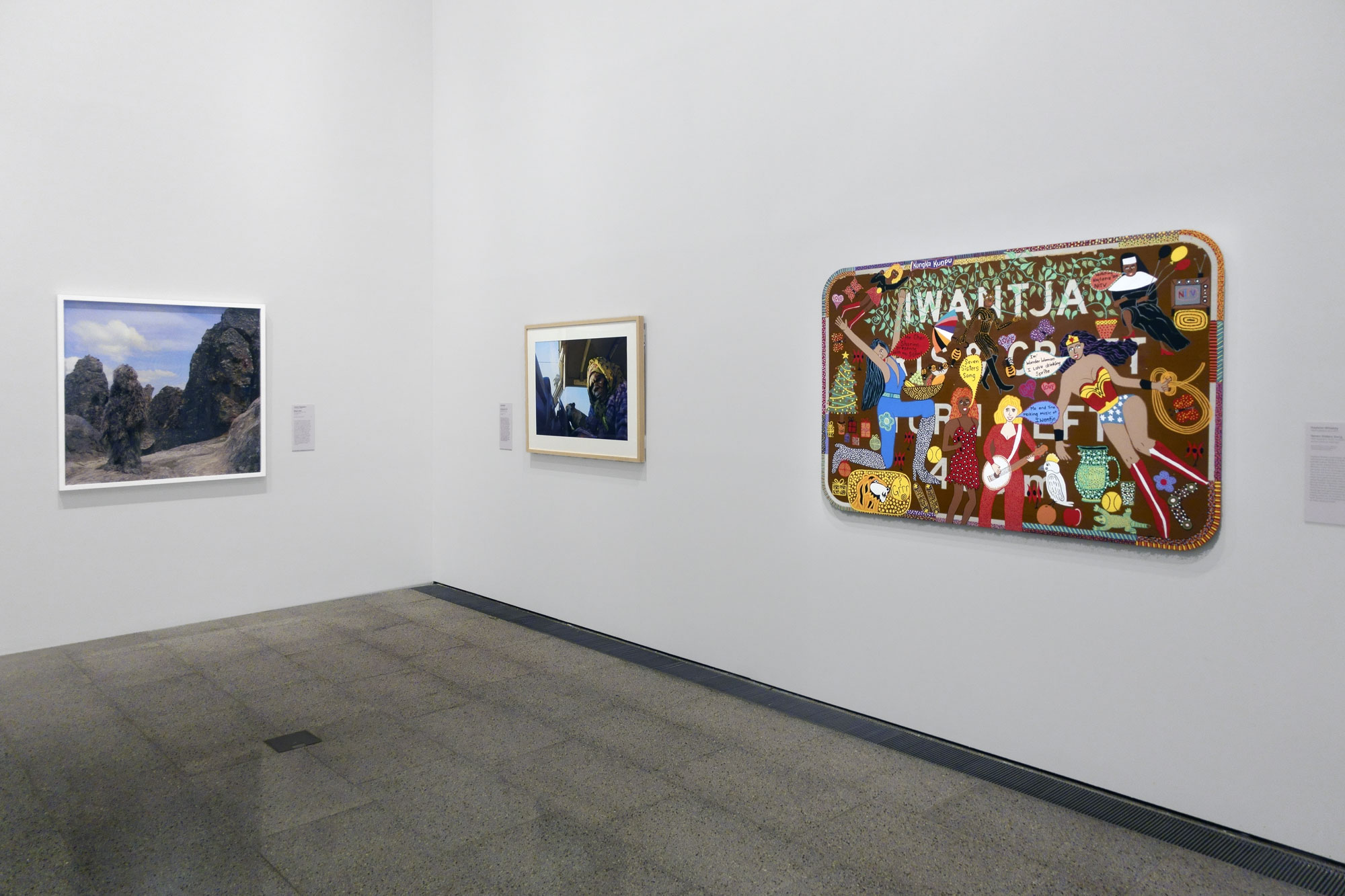


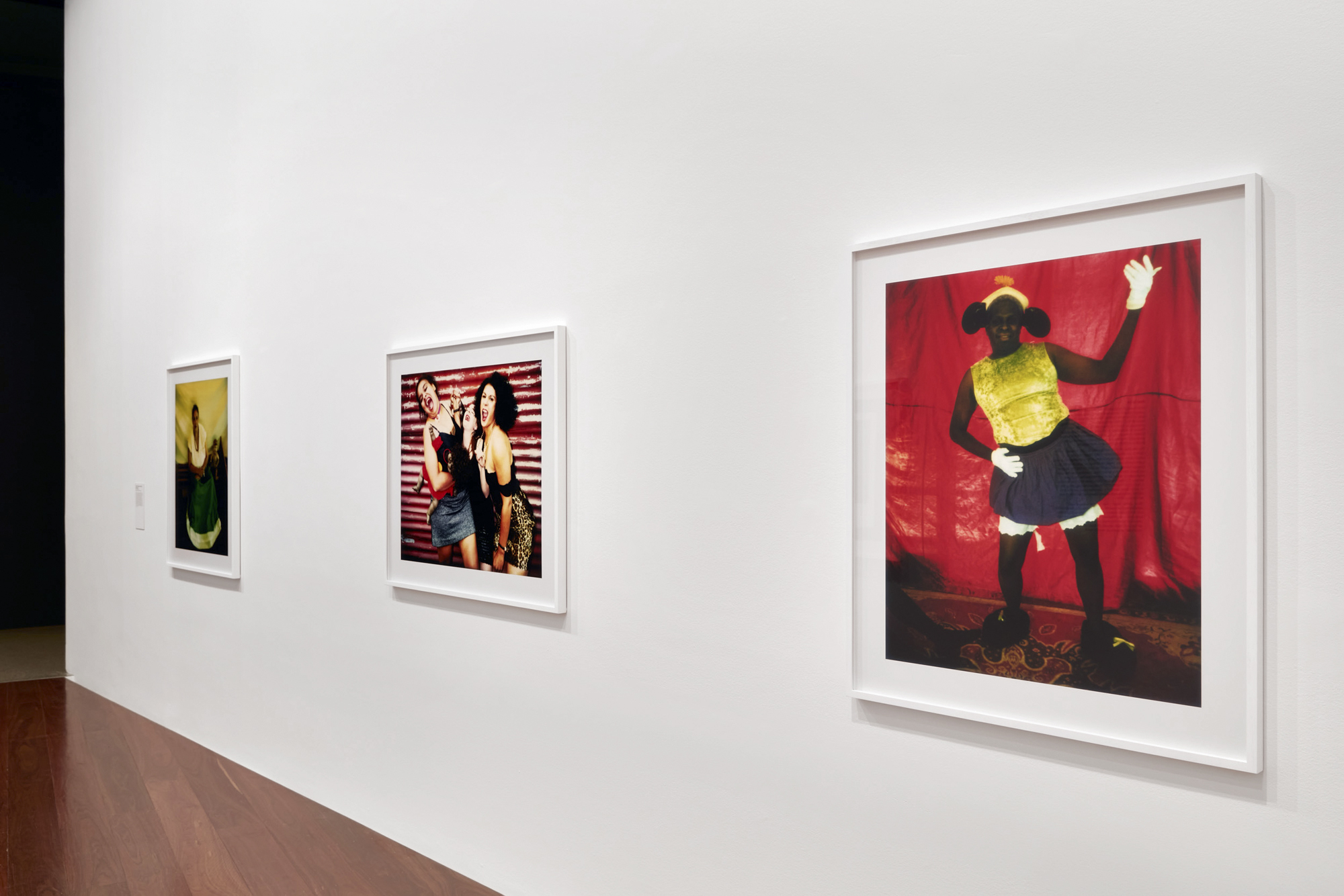
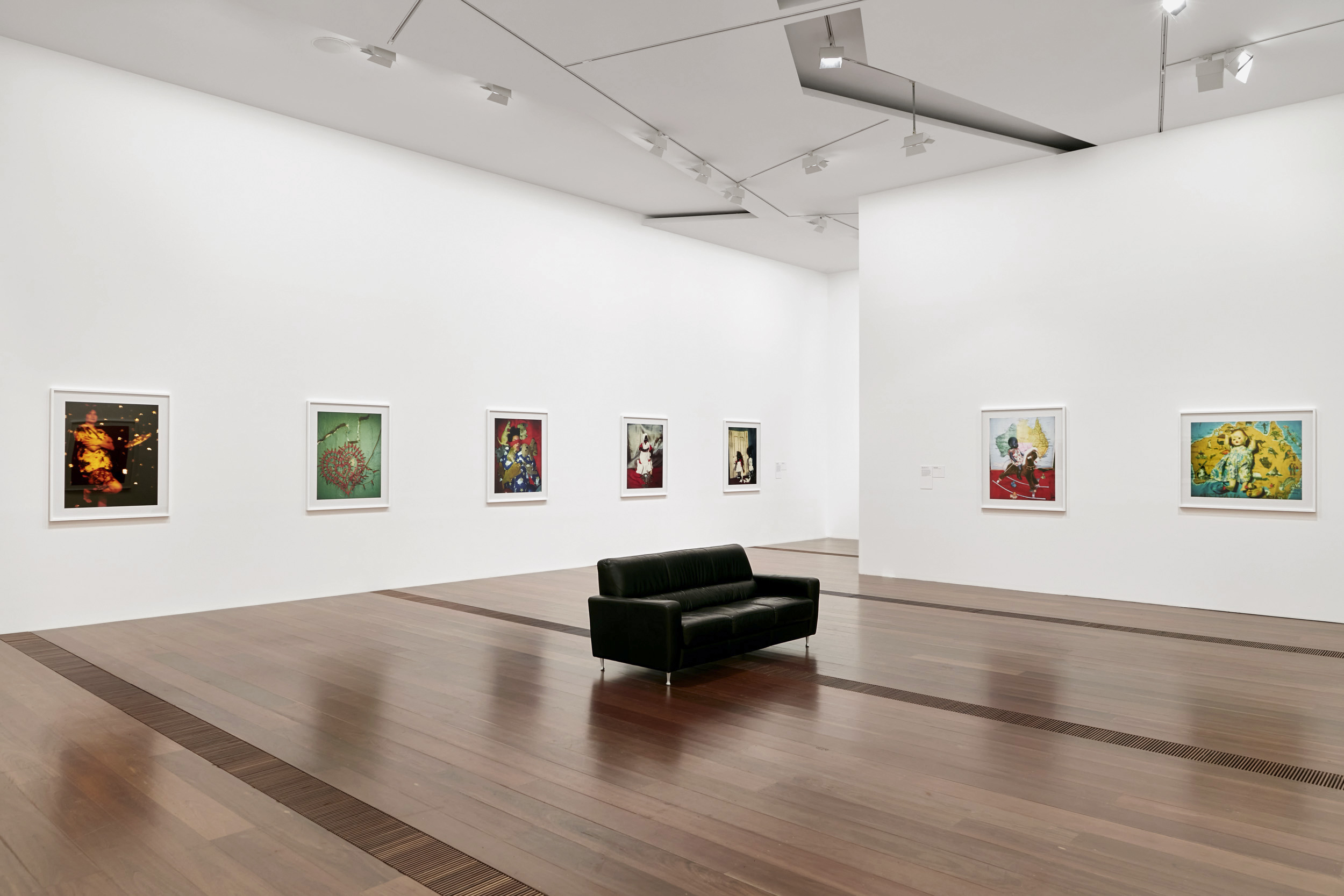
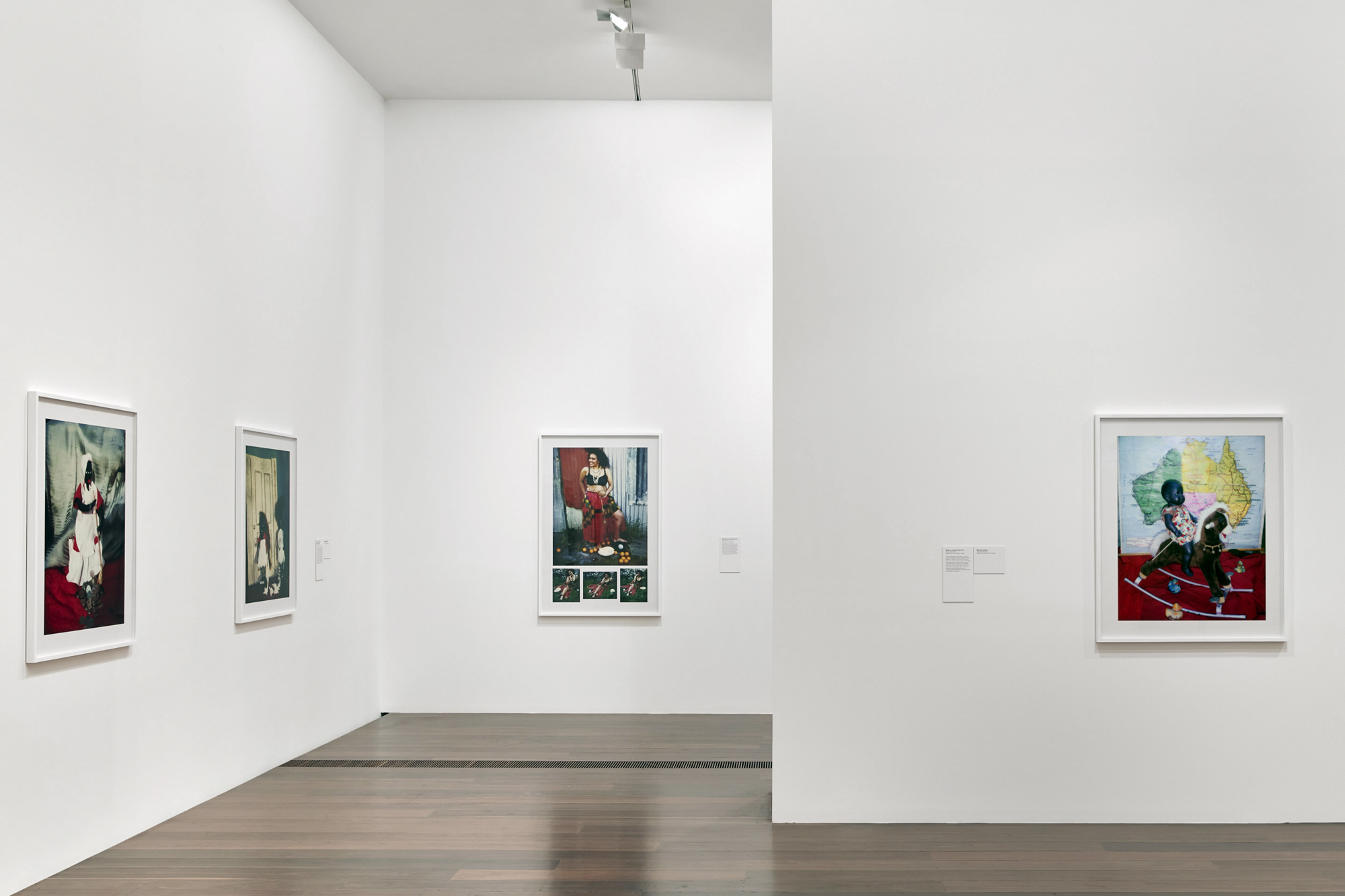
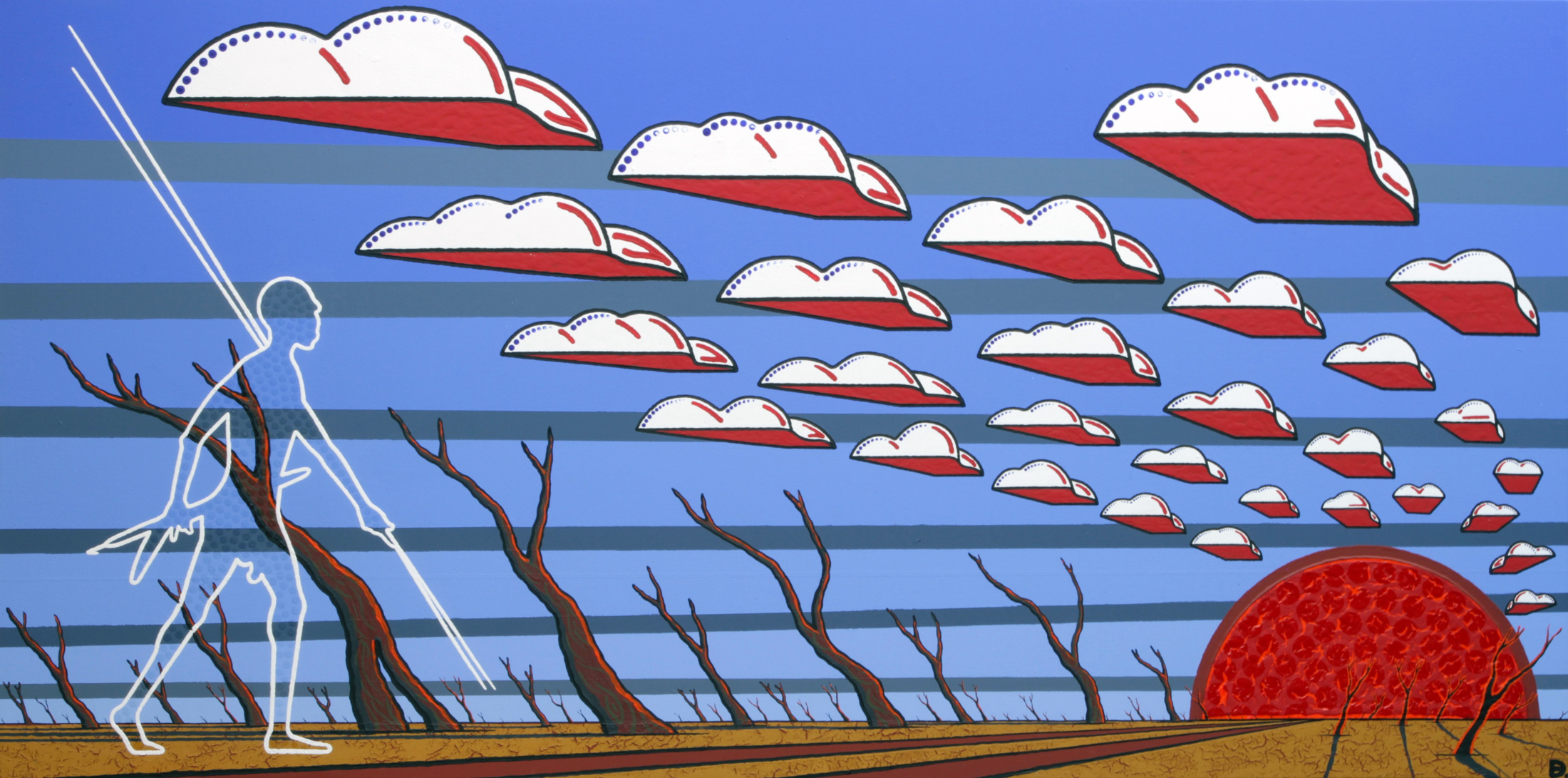
Installation view of the exhibition 'WHO ARE YOU: Australian Portraiture' at NGV Australia, Federation Square, Melbourne showing from left to right, Polixeni Papapetrou's 'Magma Man' (2012); Karla Dickens' 'Mrs Woods and 'Ere' (2013); and Kaylene Whiskey's 'Seven Sisters Song' (2021)


Installation view of the exhibition WHO ARE YOU: Australian Portraiture at NGV Australia, Federation Square, Melbourne showing from left to right, Polixeni Papapetrou’s Magma Man (2012, below); Karla Dickens’ Mrs Woods and ‘Ere (2013, below); and Kaylene Whiskey’s Seven Sisters Song (2021, below)
Photo: Marcus Bunyan
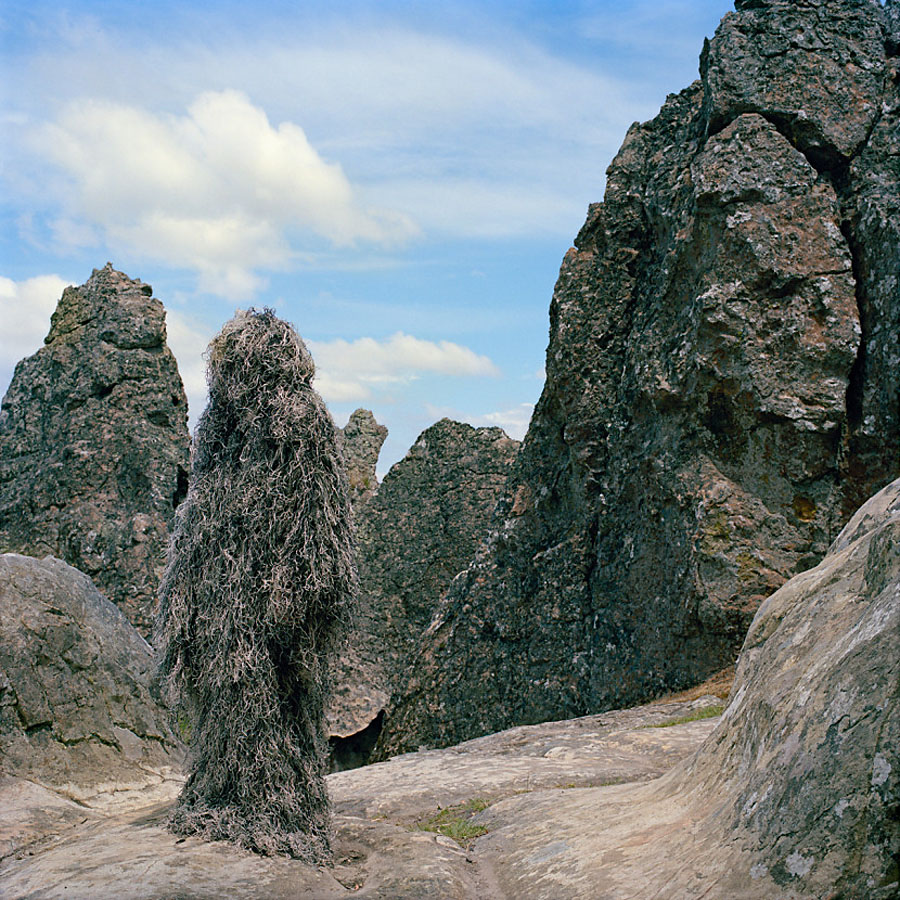
 

Polixeni Papapetrou (Australian, 1960-2018) 'Magma Man' 2012 from the exhibition 'WHO ARE YOU: Australian Portraiture' at NGV Australia, Federation Square, Melbourne, march - August, 2022


Polixeni Papapetrou (Australian, 1960-2018)
Magma Man
2012
From the series The Ghillies 2013
Inkjet print
120.0 x 120.0cm
National Gallery of Victoria, Melbourne
Purchased NGV Foundation, 2013
© Polixeni Papapetrou/Administered by VISCOPY, Sydney
Photo: © National Gallery of Victoria


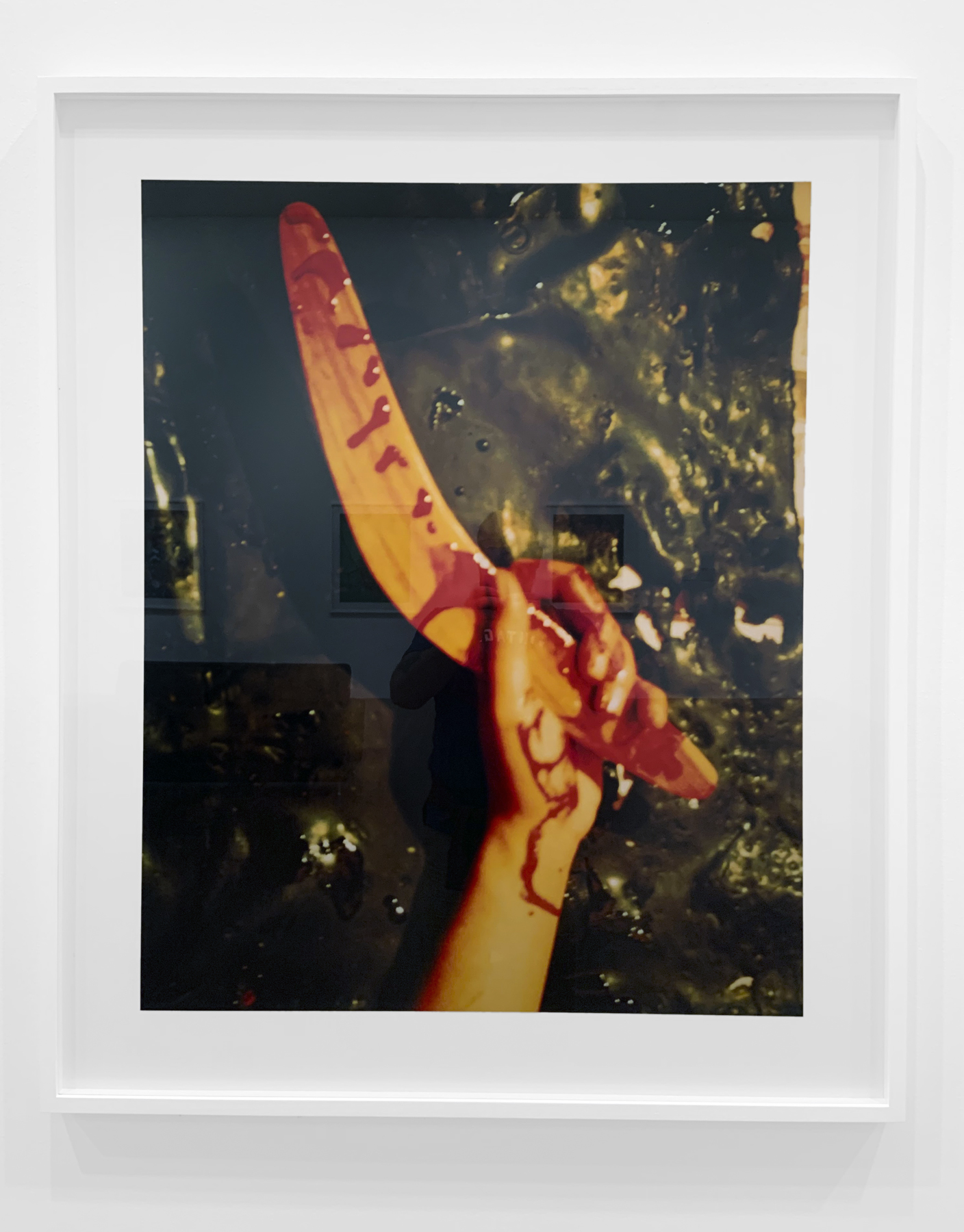
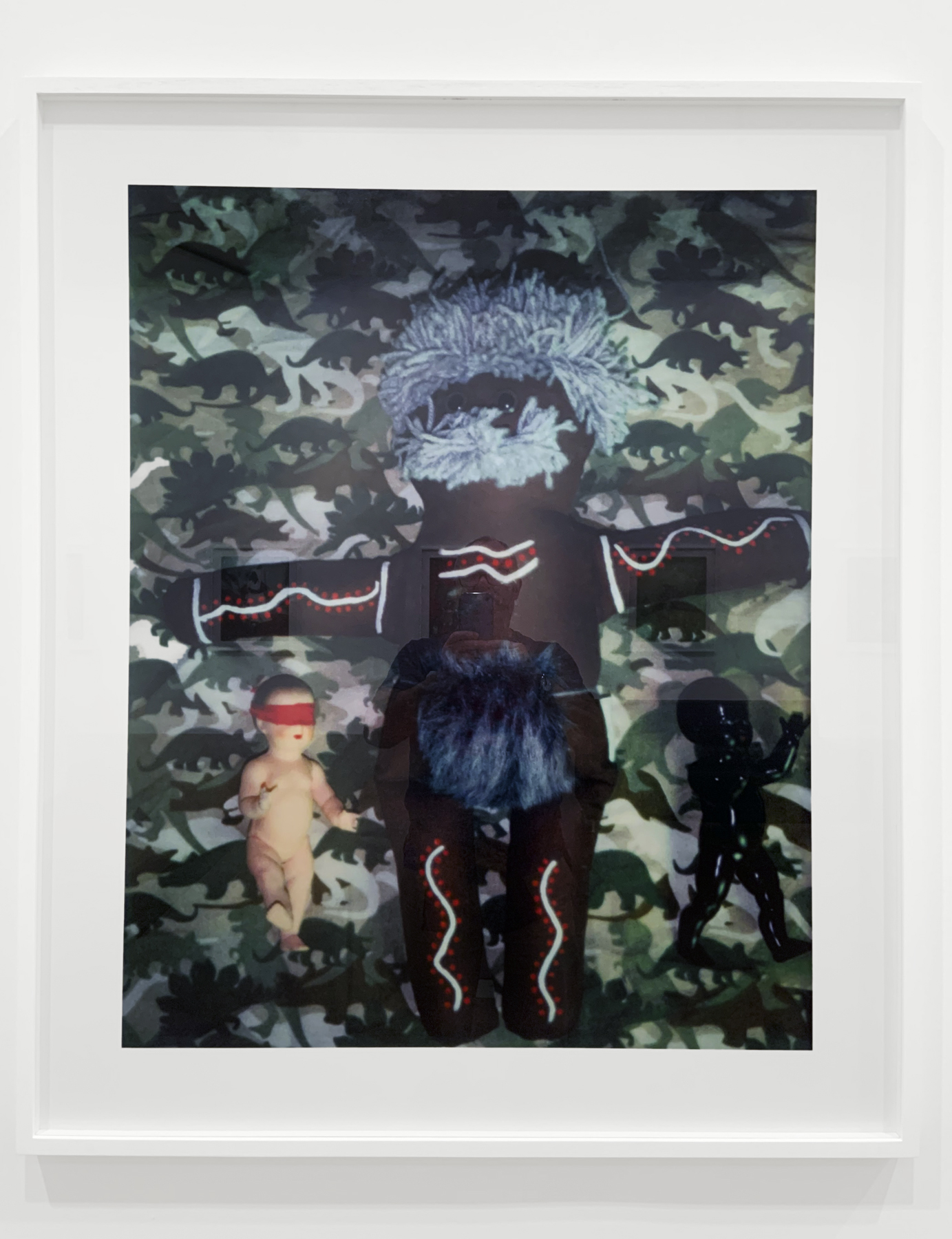
Polixeni Papapetrou’s series The Ghillies shows the artist’s son wearing extreme camouflage costumes that are used by the defence forces to blend in with their environment. The photographs reflect on the passing of childhood, and the journey out of a maternally centred world into a wider existence. Papapetrou proposes that this is a significant moment for many young men as they seek to separate themselves from their mothers, and assume the costumes and identities of masculine stereotypes, often hiding themselves in the process. Papapetrou photographed her children fro most of her career, and explored a range of stereotypes that surround childhood. These works examine the placement of children and adolescents in a society which is determined and defined by adults.

Wall text from the exhibition


Karla Dickens (Australian / Wiradjuri, b. 1967) 'Mrs Woods and 'Ere' 2013 from the exhibition 'WHO ARE YOU: Australian Portraiture' at NGV Australia, Federation Square, Melbourne, march - August, 2022


Karla Dickens (Australian / Wiradjuri, b. 1967)
Mrs Woods and ‘Ere
2013
Inkjet print on paper, ed. 3/10
Image: 66.0 x 100.cm
Sheet: 76.5 x 110.0 cm
National Portrait Gallery, Canberra
Purchased 2019
© Karla Dickens/Copyright Agency, 2022


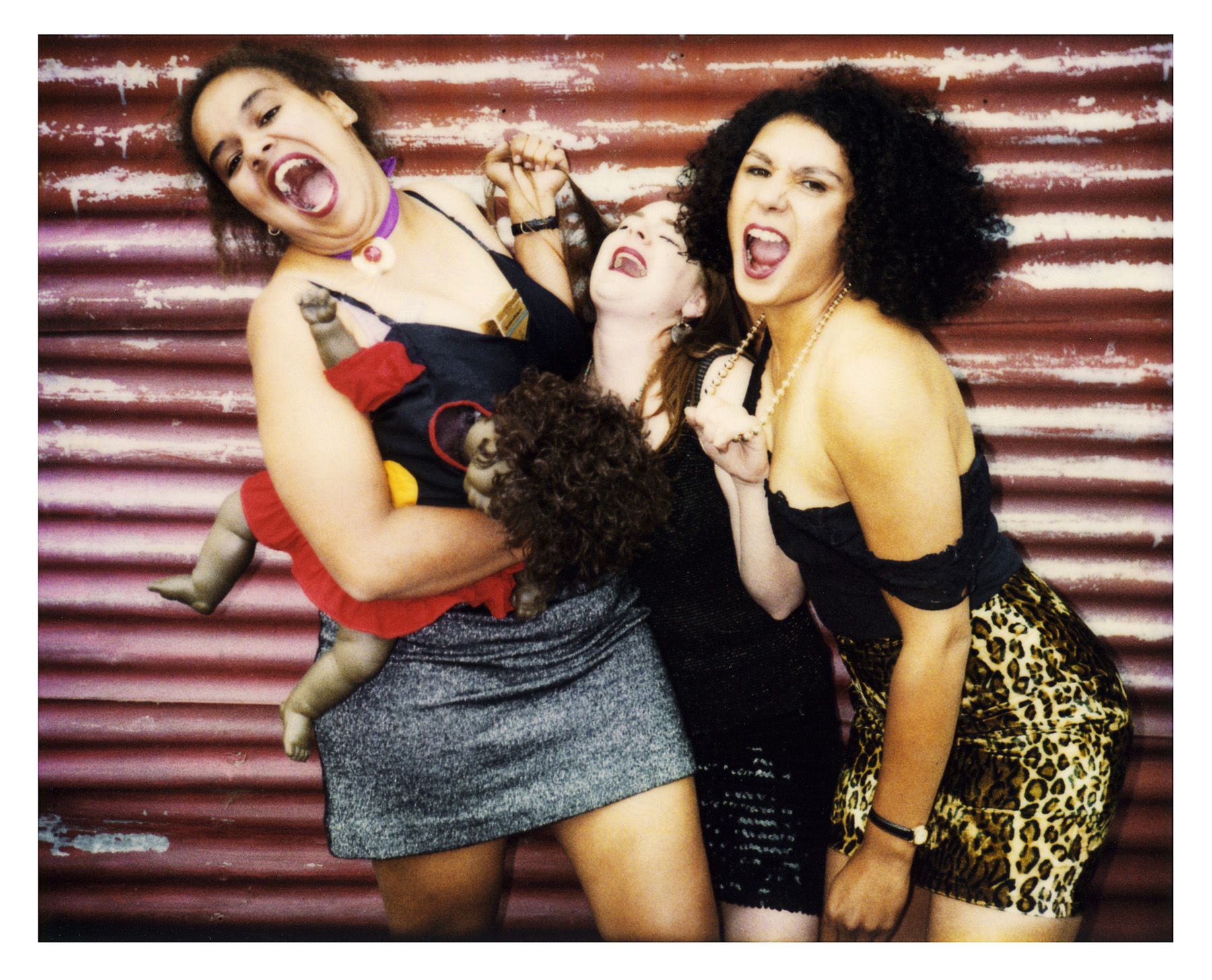
Tjayanka Woods (c. 1935-2014) was a senior Pitjantjatjara artist, born near Kalaya Pirti (Emu Water) near Mimili and Wataru, South Australia. She was a cultural custodian, leader and held significant knowledges regarding cultural law and medicine. As an artist, Woods often referred to the Kungkarrangkalpa Tjurkurpa (Seven Sisters) within her artworks. The Kungkarrangkalpa Tjurkurpa is an epic and ancient creation story revolving around the start cluster, also known as Pleiades. In 2013, Wiradjuri artist Karla Dickens, spent several weeks with Woods and other senior Pitjantjatjara artists research the creation story. During her time in Pitjantjatjara Country, Dickens photographed Woods as the aware and intelligent cultural leader she was, with dignity and strength.

Wall text from the exhibition


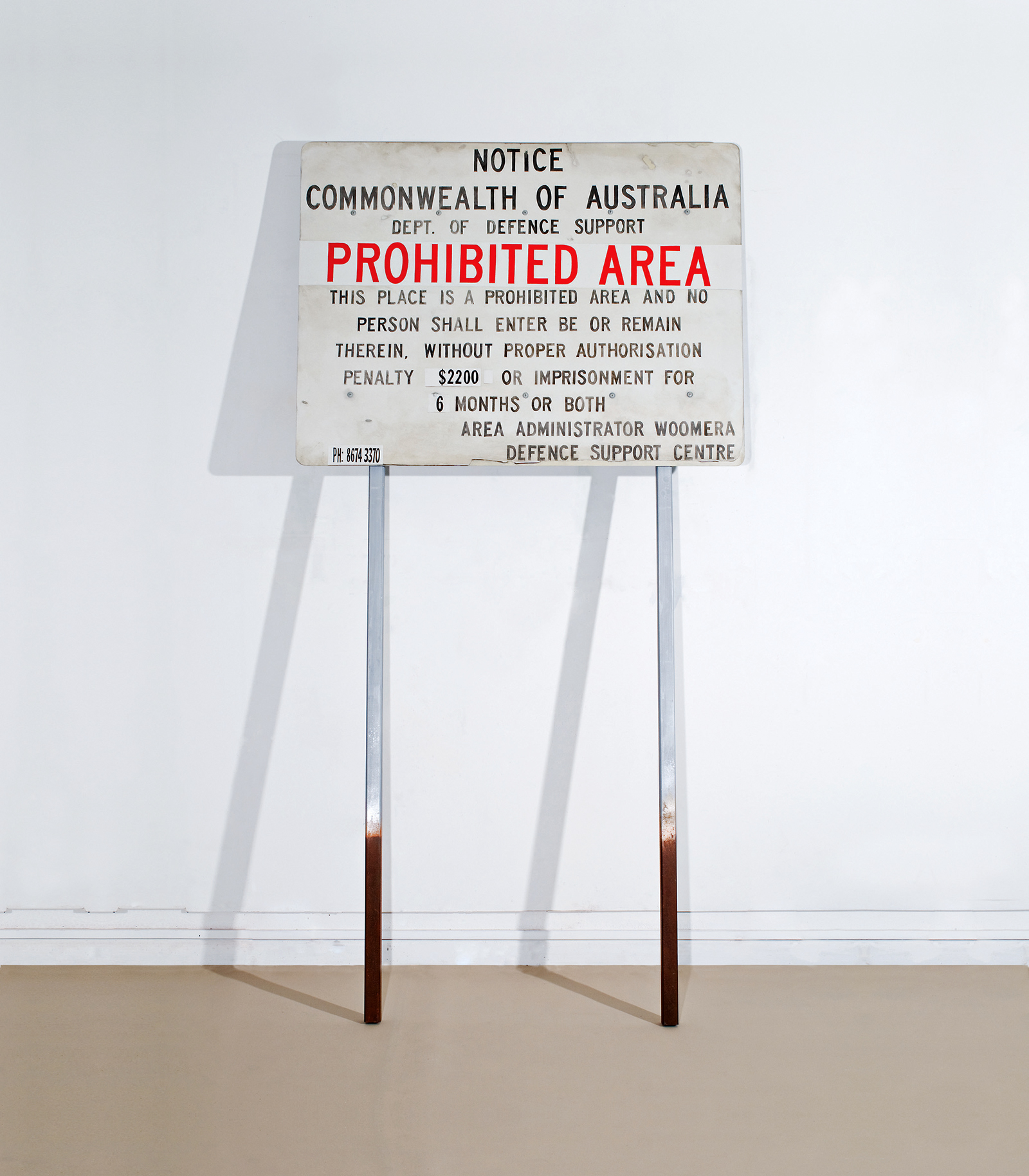
Kaylene Whiskey (Australian / Anangu Pitjantjatjara Yankunytjatjara, b. 1976) 'Seven Sisters Song' 2021 from the exhibition 'WHO ARE YOU: Australian Portraiture' at NGV Australia, Federation Square, Melbourne, march - August, 2022


Kaylene Whiskey (Australian / Anangu Pitjantjatjara Yankunytjatjara, b. 1976)
Seven Sisters Song
2021
Enamel paint on road sign
120.0 x 180.0cm irreg.
National Gallery of Victoria, Melbourne
Purchased, Victorian Foundation for Living Australian Artists, 2021
© Kaylene Whiskey. Courtesy of the artist, Iwantja Arts and Roslyn Oxley9 Gallery, Sydney


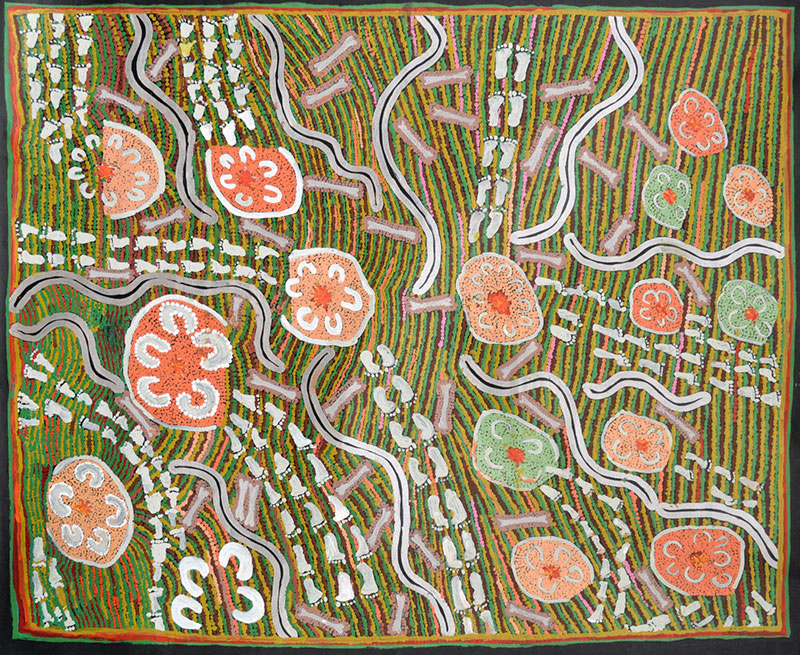
Kaylene Whiskey seamlessly combines references to daily life in Indulkana with popular culture. Painted on an old road sign, Seven Sisters Song celebrates Whiskey’s witty sense of humour and personal reflection of Kungkarangkalpa Tjukurpa, the Seven Sisters creation story. Imbued within the work themes of sisterhood and kinship bonds, Whiskey brings together two vastly different worlds. Strong female characters including Wonder Woman, Whoopi Goldberg and Dolly Parton are situated within a desert landscape and seen interacting with native plants and wildlife, including traditional Anangu activities like hunting, collecting bush tucker, and cultivating mingkulpa (a native tobacco plant).

Wall text from the exhibition


Johannes Heyer (Australian, 1872-1945) 'William Barak at work on the drawing 'Ceremony' at Coranderrk' 1902 from the exhibition 'WHO ARE YOU: Australian Portraiture' at NGV Australia, Federation Square, Melbourne, march - August, 2022


Johannes Heyer (Australian, 1872-1945)
William Barak at work on the drawing ‘Ceremony’ at Coranderrk
1902
Gelatin silver photograph, sepia toned on paper
8.7 x 8.7cm
National Portrait Gallery, Canberra
Purchased with the assistance of the Australian Decorative and Fine Arts Society 2000


Wurundjeri artist and ngurungaeta (Head Man) William Barak was an important cultural leader, diplomat and activist. Barak lived near Coranderrk Aboriginal Station, near Healesville, from 1863 until 1903, becoming an influential spokesman for the rights of his people and an informant on Wurundjeri cultural lore. The people of Coranderrk, however, were officially forbidden from observing traditional practices, so Barak began recording them in drawings, often using ochre and charcoals to depict ceremonies and aspects of Wurundjeri culture before colonisation. His artworks are significant expressions of cultural practice, and he is regarded as an important figure int he history of Indigenous Australian art.

Wall text from the exhibition


Beruk (William Barak) (1824-1903), an elder of the Wurundjeri clan of the Woi-worung, was the most famous Aboriginal person in Victoria in the 1890s. After attending the Reverend George Langhorne’s mission school, Barak joined the Native Police in 1844 and remained there until at least 1851. From 1863 until his death he lived at the government reserve at Coranderrk, at a site near the Yarra River in Victoria. The history of the reserve is one of official interference and mismanagement, and Barak played a significant part in representing the wishes of his community to the government. In the decade of the 1880s he made many paintings and artefacts, mostly of Aboriginal ceremonial subjects.


Beruk (1824-1903), artist, activist, leader and educator, was a Wurundjeri man of the Woiwurrung people, one of the five Kulin Nations whose Country encompasses Narrm (Melbourne). It is said that Beruk was present at the signing of the so-called treaty with which John Batman reckoned he’d acquired 240,000 hectares of Wurundjeri land in 1835. In reality, the men with whom Batman negotiated, including one of Beruk’s uncles, had not transferred ownership, but merely given Batman permission to stay temporarily. Beruk was given the name William Barak (a European mispronunciation) in 1844 when he joined the Native Police. He was among the group of people from across Victoria who were the first to join the settlement at Coranderrk, near Healesville, established by the Aboriginal Protection Board in 1863 following several years of petitioning by community leaders. Beruk emerged as a leader at Coranderrk, which developed into a self-sufficient agricultural settlement. Following the passing of his cousin Simon Wonga in 1874, Beruk became Ngurungaeta (head man) of the Wurundjeri people. During the same period, when European pastoral interests started lobbying for Coranderrk to be broken up and sold off, Beruk led the campaign to prevent the settlement’s closure. It was gazetted as a ‘permanent reservation’ in 1881.

By this time, Beruk was recognised as a leader of his people and as a revered custodian of language and cultural knowledge. As the people at Coranderrk were officially forbidden from observing their traditional ceremonies, including corroborees, Beruk began recording his knowledge in drawings, utilising introduced methods and materials including paper, cardboard, and watercolour to preserve and communicate important stories and aspects of culture and spirituality. On the one hand, his drawings and the artefacts he made functioned as a commodity and were sold as souvenirs to increasing numbers of tourists. Museums in Europe began acquiring examples of his work in the late nineteenth century. On the other hand, and more significantly, Beruk’s drawings represent a profound assertion of pride in his heritage and identity, and the survival of a rich and complex culture in the face of concerted attempts to diminish it. As Wurundjeri elder and Beruk’s great-great niece Aunty Joy Wandin Murphy says: “We believe that what he wanted was for people to remember those ceremonies, so that if he painted them … then people would always know about the ceremonies on Coranderrk and of Wurundjeri people.”

This photograph of Beruk was taken by Johannes Heyer, a Presbyterian clergyman called to the parish of Yarra Glen and Healesville in 1900. The drawing that Beruk is shown working on in the photograph is now in the collection of the Art Gallery of South Australia, Adelaide.

Anonymous text. “William Barak at work on the drawing ‘Ceremony’ at Coranderrk,” on the National Portrait Gallery website Nd [Online] Cited 18/06/2022


David Moore (Australia 1927-2003) 'Migrants arriving in Sydney' 1966


David Moore (Australia 1927-2003)
Migrants arriving in Sydney
1966
Gelatin silver print
National Gallery of Victoria, Melbourne
Purchased, 1961


WHO ARE YOU: Australian Portraiture is the first exhibition to comprehensively bring together the rich portrait holdings of both the National Gallery of Victoria, Melbourne, and the National Portrait Gallery, Canberra. Revealing the artistic synergies and contrasts between the two institutions’ collections, this co-curated exhibition considers portraiture in Australia across time and media.

Through the examination of diverse and sometimes unconventional ways of representing likeness, WHO ARE YOU will question what actually constitutes portraiture – historically, today and into the future. Examples of some of the more abstract notions of portraits in the exhibition include John Nixon’s Self-portrait, (1990), and Boris Cipusev’s typographic portrait of Jeff from The Wiggles, titled Jeff the wiggle, 2009-2013. Polixeni Papapetrou’s Magma man, 2013, a photograph that merges sitter and landscape until the two are almost indecipherable, and Shirley Purdie’s multi-panelled evocation of biography and Country, Ngalim-Ngalimbooroo Ngagenybe, 2018, further challenge the conventions of the genre and touch upon the intimate connection between artist, sitter and land. NGV Collection highlights include new acquisitions: Kaylene Whiskey’s Seven Sisters Song, 2021 – a playful take on portraiture by a living artist and Joy Hester’s Pauline McCarthy,1945, a rare example of Hester producing a portrait in oil.

WHO ARE YOU is the largest exhibition of Australian portraiture ever mounted by either the NGV or NPG, and is the first time the two galleries have worked collaboratively on such a large-scale project.

Text from the NGV International website


Installation view of the exhibition 'WHO ARE YOU: Australian Portraiture' at NGV Australia, Federation Square, Melbourne showing Lloyd Rees' 'Portrait of some rocks' 1948


Installation view of the exhibition WHO ARE YOU: Australian Portraiture at NGV Australia, Federation Square, Melbourne showing Lloyd Rees’ Portrait of some rocks (1948, below)
Photo: Marcus Bunyan
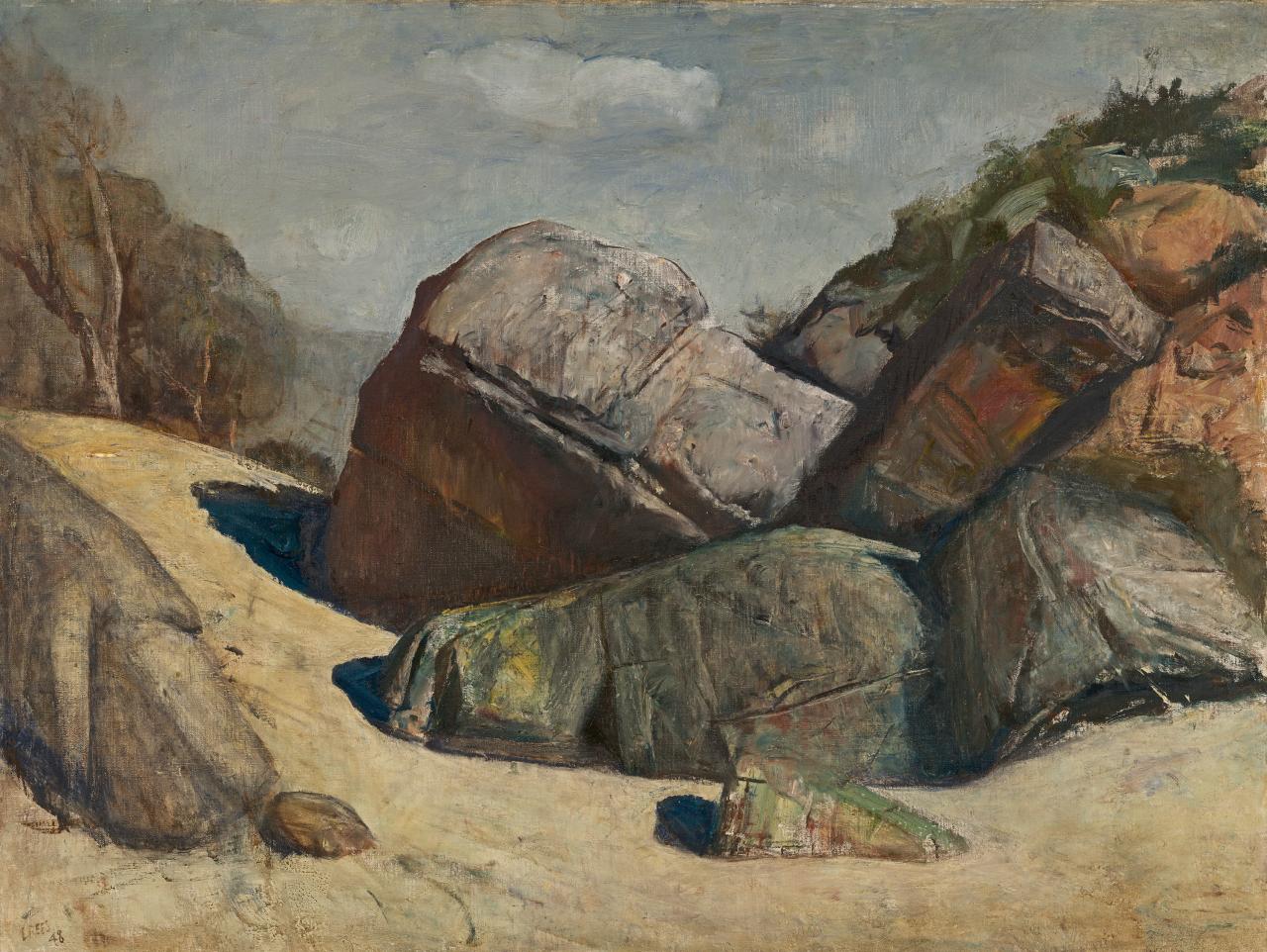
 

Lloyd Rees (Australian, 1895-1988) 'Portrait of some rocks' 1948


Lloyd Rees (Australian, 1895-1988)
Portrait of some rocks
1948
Oil on canvas
76.6 x 102.0cm
National Gallery of Victoria, Melbourne
Purchased, 1948
© Lloyd Rees/Licensed by Copyright Agency, Australia


One of Australia’s leading landscape artists of the mid-twentieth century, Lloyd Rees studied at Brisbane Technical College before moving to Sydney in 1917, where he worked as a commercial illustrator. In the early 1930s he concentrated solely on drawing, particularly the rocky landscapes around Sydney, but by the late 1930s he began painting in an increasingly romantic manner. Rocks were a meaningful subject for Rees because they evoked permanency and represented the constitution of the earth. Rees humanises his subject matter by using the word ‘portrait’ in the title, which suggests the rocks have shifted from inorganic to animate objects.

Wall text from the exhibition


Installation view of the exhibition 'WHO ARE YOU: Australian Portraiture' at NGV Australia, Federation Square, Melbourne showing at right, Marshall Claxton's 'An emigrant's thoughts of home' (1859)


Installation view of the exhibition WHO ARE YOU: Australian Portraiture at NGV Australia, Federation Square, Melbourne showing at right, Marshall Claxton’s An emigrant’s thoughts of home (1859, below)
Photo: Marcus Bunyan


Installation view of the exhibition 'WHO ARE YOU: Australian Portraiture' at NGV Australia, Federation Square, Melbourne showing at right, Marshall Claxton's 'An emigrant's thoughts of home' (1859)


Installation view of the exhibition WHO ARE YOU: Australian Portraiture at NGV Australia, Federation Square, Melbourne showing at right, Marshall Claxton’s An emigrant’s thoughts of home (1859, below)
Photo: Marcus Bunyan


Marshall Claxton (English, 1813-1881, worked in Australia 1850-1854) 'An emigrant's thoughts of home' 1859


Marshall Claxton (English, 1813-1881, worked in Australia 1850-1854)
An emigrant’s thoughts of home
1859
Oil on cardboard
60.7 × 47.0cm
National Gallery of Victoria, Melbourne
Presented by the National Gallery Women’s Association, 1974


Immigration underlies the European history of Australia. Between 1815 and 1840, more than 58,000 people, predominately from the British Isles, came to Australia in search of a better life. Women migrants were also assisted to curb a gender imbalance in the colonies, to work as domestic servants and to foster marriages and childbirth.

Text from the National Gallery of Victoria website


Immigration is central to the history of Australia. The wistful tilt of this young woman’s head and her thoughtful expression are powerful symbols of the intense nostalgia and fear of the unknown experienced by those in search of a new homeland. Despite its apparent simplicity and sentimentality, the painting captures the issues of poverty, deprivation and emigration that people, especially women, faced in the middle decades of the nineteenth century.

Wall text from the exhibition


Peter Drew (Australian, b. 1983) 'Monga Khan 1916' 2016, printed 2019


Peter Drew (Australian, b. 1983)
Monga Khan 1916
2016, printed 2019
From the Aussie series 2016
Brush and ink on screenprint
Image: 114.5 x 80.5cm
Sheet: 117.5 x 83.5cm
National Gallery of Victoria, Melbourne
Purchased, NGV Supporters of Prints and Drawings, 2020
© Peter Drew


Monga Khan was a hawker, and one of the thousands of people who applied for an exemption to the White Australia Policy, a law which came into effect in 1901. Exemptions were considered for cameleers, hawkers and other traders who were considered essential workers. Drew created this poster and others in the Aussie series using photographs from the National Archives of Australia, and pasted them around Australia’s cities.

He explains: ‘When you address the public through the street you’re entering into a tradition that emphasises our fundamental freedom of expression, over the value of property. I enjoy examining our collective identities and my aim is always to emphasise the connections that bind us, rather than the fractures that divide us’.

Wall text from the exhibition


Installation view of the exhibition 'WHO ARE YOU: Australian Portraiture' at NGV Australia, Federation Square, Melbourne showing at left, Maree Clarke's 'Walert – gum barerarerungar' (2020-2021); and at right, Uta Uta Tjangala's 'Ngurrapalangu' (1989)


Installation view of the exhibition WHO ARE YOU: Australian Portraiture at NGV Australia, Federation Square, Melbourne showing at left, Maree Clarke’s Walert – gum barerarerungar (2020-2021, below); and at right, Uta Uta Tjangala’s Ngurrapalangu (1989, below)
Photo: Marcus Bunyan


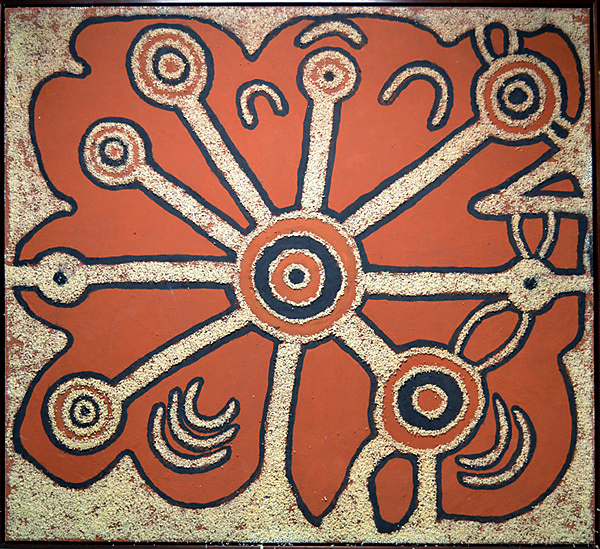
Uta Uta Tjangala (Australian / Puntupi, c. 1926-1990) 'Ngurrapalangu' 1989 (installation view)


Uta Uta Tjangala (Australian / Puntupi, c. 1926-1990)
Ngurrapalangu (installation view)
1989
Synthetic polymer paint on canvas
National Gallery of Victoria, Melbourne
Presented through the NGV Foundation by Elizabeth and Colin Laverty, Governors, 2001
Photo: Marcus Bunyan


Uta Uta Tjangala forged a new art form at Papunya during 1971-1972 with startling works such as this one. Working for the first time on a discarded scrap of composition board, artists at Papunya rendered visible and permanent ephemeral designs, formerly made only for use in closed and secret ceremonial contexts on bodies, objects or the ground. The painted designs are closely connected to the artist’s cultural identity, his understanding of Country, and of sacred men’s business, unknowable to uninitiated members of the community.

Wall text from the exhibition


Maree Clarke (Australian / Mutti Mutti/Wamba Wamba/Yorta Yorta/Boonwurrung, b. 1961) 'Walert – gum barerarerungar: Tipperary, Ireland Dunstable, Britain Yorta Yorta Trawlwoolway Boonwurrung, Muttu Mutti, Wamba Wamba' 2020-2021 (installation view)


Maree Clarke (Australian / Mutti Mutti/Wamba Wamba/Yorta Yorta/Boonwurrung, b. 1961)
Walert – gum barerarerungar: Tipperary, Ireland Dunstable, Britain Yorta Yorta Trawlwoolway Boonwurrung, Muttu Mutti, Wamba Wamba (installation view)
2020-2021
Possum pelts
National Gallery of Victoria, Melbourne
Purchase, Victorian Foundation for Living Australian Artists, 2021
Photo: Marcus Bunyan


Maree Clarke is recognised as one of the most respected possum skin cloak makers and teachers in the world. This work represents the first time Clarke produced a cloak to represent her own ancestral identity. Depicted on the cloak are seven important places, which her ancestors come from: Yorta Yorta Country, Trawlwoolway Country, Boonwurrung Country, Muttu Mutti Country and Wamba Wamba Country, as well as Tiperrary in Ideland, and Dunstable in Britain. Clarke has used a rare green ochre to represent her European ancestors. Together, these seven ancestral sites of significance inform Clarke’s identity.

Wall text from the exhibition


Maree Clarke (Australian / Mutti Mutti/Wamba Wamba/Yorta Yorta/Boonwurrung, b. 1961) 'Walert – gum barerarerungar: Tipperary, Ireland Dunstable, Britain Yorta Yorta Trawlwoolway Boonwurrung, Muttu Mutti, Wamba Wamba' 2020-2021 (installation view detail)


Maree Clarke (Australian / Mutti Mutti/Wamba Wamba/Yorta Yorta/Boonwurrung, b. 1961)
Walert – gum barerarerungar: Tipperary, Ireland Dunstable, Britain Yorta Yorta Trawlwoolway Boonwurrung, Muttu Mutti, Wamba Wamba (installation view detail)
2020-2021
Possum pelts
National Gallery of Victoria, Melbourne
Purchase, Victorian Foundation for Living Australian Artists, 2021
Photo: Marcus Bunyan


Portraiture

In its uniting of artist and sitter, the self-portrait is an intriguing facet of portraiture. The self-reflection is a format that appears to grant the viewer the assurance of revelation and intimate access to the artist’s psyche. However, what the artist intends to communicate to their audience through portraiture is highly varied, and the message each artist conveys is as individual as the artist themselves. Additionally, there is room for the viewer to question how the artist has chosen to depict their image.

Self-portraiture is a diverse genre: there are myriad ways an artist can present themselves. A typical way for the artist to portray themselves is in the role of ‘the artist’, including in the work a visual clue to their profession – for instance holding a brush or paint palette – or showing themselves at work in the studio. As part of an investigation of self, these representations can also communicate the complexities of status and gender. This selection of works explores what the artists intend to reveal or exclude about themselves through their self-representations, considering he environment in which the artists are placed, and the props and imagery they choose to include in the works.

Wall text from the exhibition


Pamela See (Australian, b. 1979) 'Making Chinese Shadows (sixteen silhouette portraits)' 2018 (installation view)


Pamela See (Australian, b. 1979)
Making Chinese Shadows (sixteen silhouette portraits) (installation view)
2018
Twelve of sixteen papercut silhouette drawings
National Portrait Gallery, Canberra
Purchased 2019
Photo: Marcus Bunyan


Brisbane-born Pamela See (Xue Mei-Ling) studied at the Queensland College of Art from 1997 to 1999. She began papercutting during a period when she was without access to a studio, and was subsequently awarded grants that enabled her to study the technique in several centres throughout China. Her method and style resemble Foshan papercutting, which is widely practices in the home of her maternal grandparents, in Guangdong province. These papercuts are from a series investigating the lives of Chinese-Australians who flourished prior to the introduction of the White Australia policy. The works connect and juxtapose European silhouette portraiture and Chinese papercutting traditions, exploring the notion that a silhouette profile provides a means of ‘measuring’ a sitter’s character with the totemic and floral symbols evoking personal narratives, identity and professions.

Wall text from the exhibition
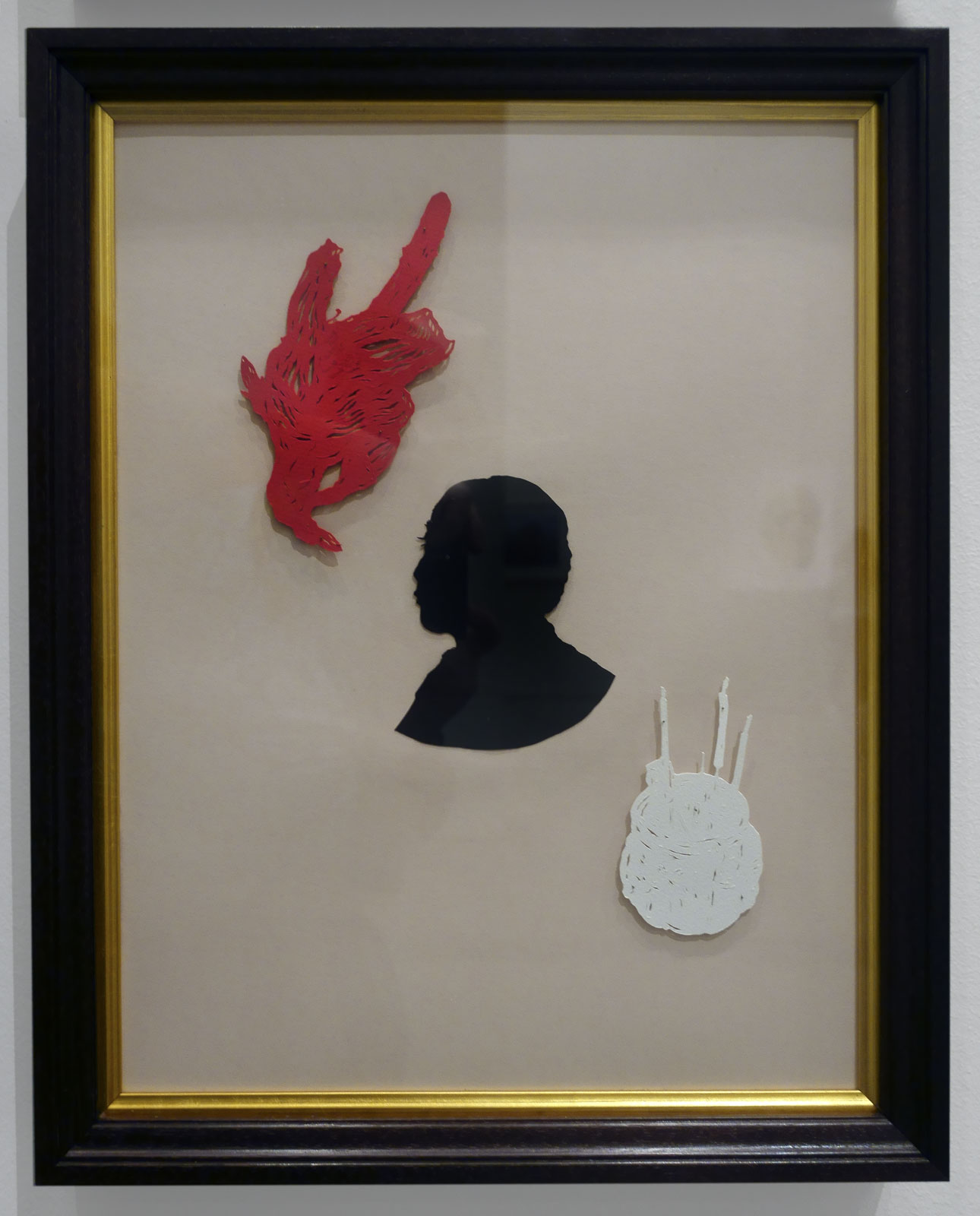
 

Pamela See (Australian, b. 1979) 'Making Chinese Shadows (sixteen silhouette portraits)' 2018 (installation view detail)


Pamela See (Australian, b. 1979)
Making Chinese Shadows (sixteen silhouette portraits) (installation view detail)
2018
Twelve of sixteen papercut silhouette drawings
National Portrait Gallery, Canberra
Purchased 2019
Photo: Marcus Bunyan


Various unknown photographers (Australian) 'William and Martha Mary Robertson and their children' 1860s-1870s (installation view)

Various unknown photographers (Australian) 'William and Martha Mary Robertson and their children' 1860s-1870s (installation view)

Various unknown photographers (Australian) 'William and Martha Mary Robertson and their children' 1860s-1870s (installation view)


Various unknown photographers (Australian)
William and Martha Mary Robertson and their children (installation views)
1860s-1870s
Eight cartes de visite, hand-coloured, contained in red leather presentation case
National Portrait Gallery, Canberra
Gift of Malcolm Robertson in memory of William Thomas Robertson 2018
Donated through the Australian Government’s Cultural Gifts Program
Photos: Marcus Bunyan


LIU Xiao Xian (Australian born China, b. 1963) 'My other lives, #7' 2000


LIU Xiao Xian (Australian born China, b. 1963)
My other lives, #7
2000
From the My other lives series 2000
Type C photograph
102.0 × 145.2cm irreg.
National Gallery of Victoria, Melbourne
Purchased with funds arranged by Loti Smorgon for Contemporary Australian Photography, 2002
© LIU Xiao Xian


Popular in nineteenth-century Australia, stereographs gave the illusion of three dimensions when placed in a handheld viewer. In this work, Liu Xiao Xian enlarges a typical example of this historical form of photographic portraiture and replaces the sitter’s face with his own on one side. Through this double-take, and the playful invitation to imagine an ‘other life’ for this sitter, this work is both a subtle self-portrait and a pointed reminder of the invisibility of the Chinese migrant experience in mainstream conceptions of Australian history and identity.

Wall text from the exhibition
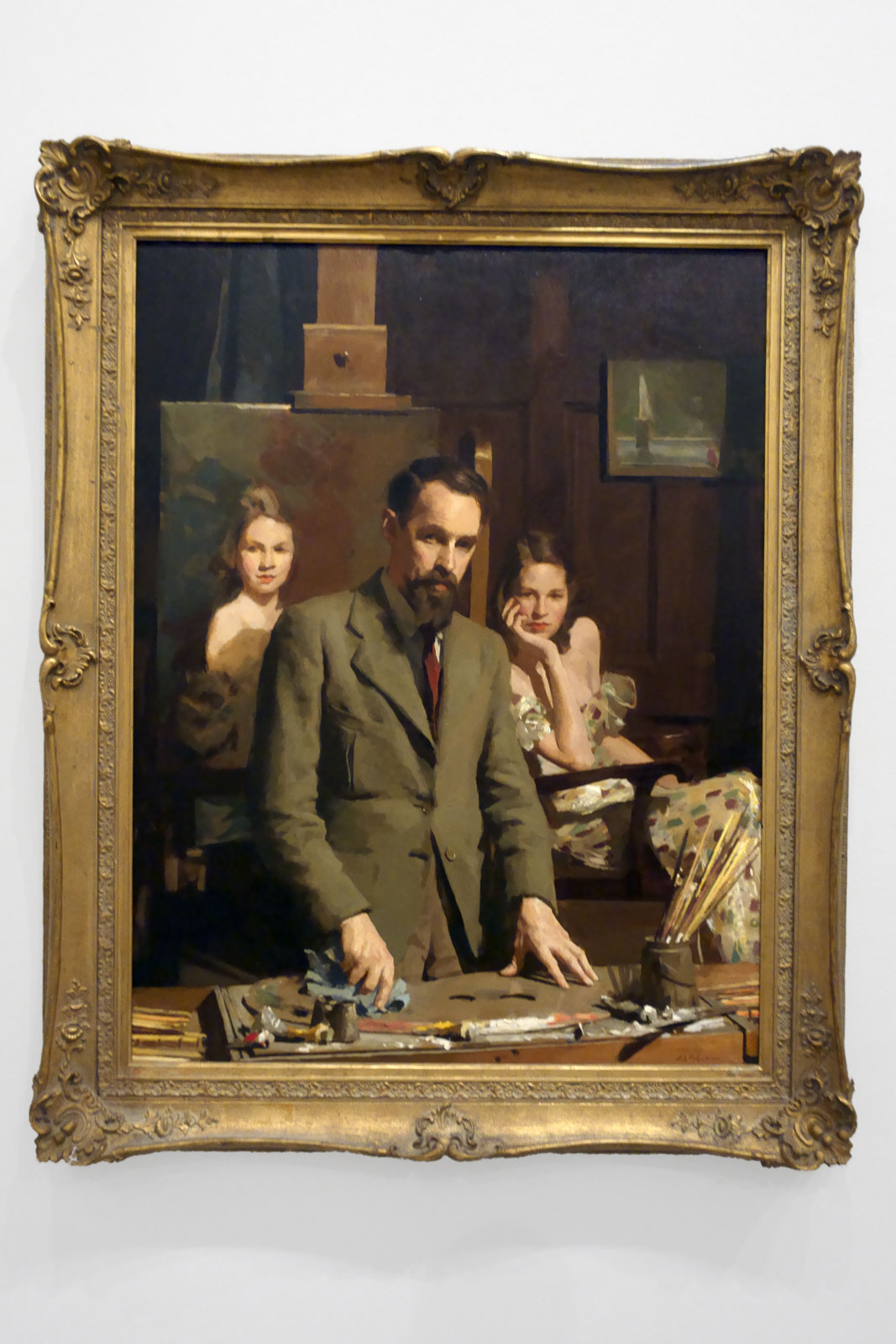
 

A. D. Colquhoun (Australian, 1894-1983) 'Artist and sitter' c. 1938 (installation view)


A. D. Colquhoun (Australian, 1894-1983)
Artist and sitter (installation view)
c. 1938
Oil on canvas
122.0 × 94.0cm
National Gallery of Victoria, Melbourne
Felton Bequest, 1940
© Dr Quentin Noel Porter
Photo: Marcus Bunyan


A. D. Colquhoun (Australian, 1894-1983) 'Artist and sitter' c. 1938


A. D. Colquhoun (Australian, 1894-1983)
Artist and sitter
c. 1938
Oil on canvas
122.0 × 94.0cm
National Gallery of Victoria, Melbourne
Felton Bequest, 1940
© Dr Quentin Noel Porter


Brush in hand, there is no mistaking A. D. Colquhoun’s occupation or the studio setting. The young, glamorous model is an essential part of this carefully orchestrated self-portrayal. By also including his painting of the model on the easel, Colquhoun presents himself in the company of not one, but two women whose presence asserts his own dominant masculinity. The artist’s gaze meets the viewer, placing them as the subject of the painter’s attention, creating a complex network of visual relationships between the artist, model and viewer.

Wall text from the exhibition


Installation view of the exhibition 'WHO ARE YOU: Australian Portraiture' at NGV Australia, Federation Square, Melbourne showing at right, Shirley Purdie's 'Ngalim-Ngalimbooroo Ngagenybe' (2018)


Installation view of the exhibition WHO ARE YOU: Australian Portraiture at NGV Australia, Federation Square, Melbourne showing at right, Shirley Purdie’s Ngalim-Ngalimbooroo Ngagenybe (2018, below)
Photo: Marcus Bunyan
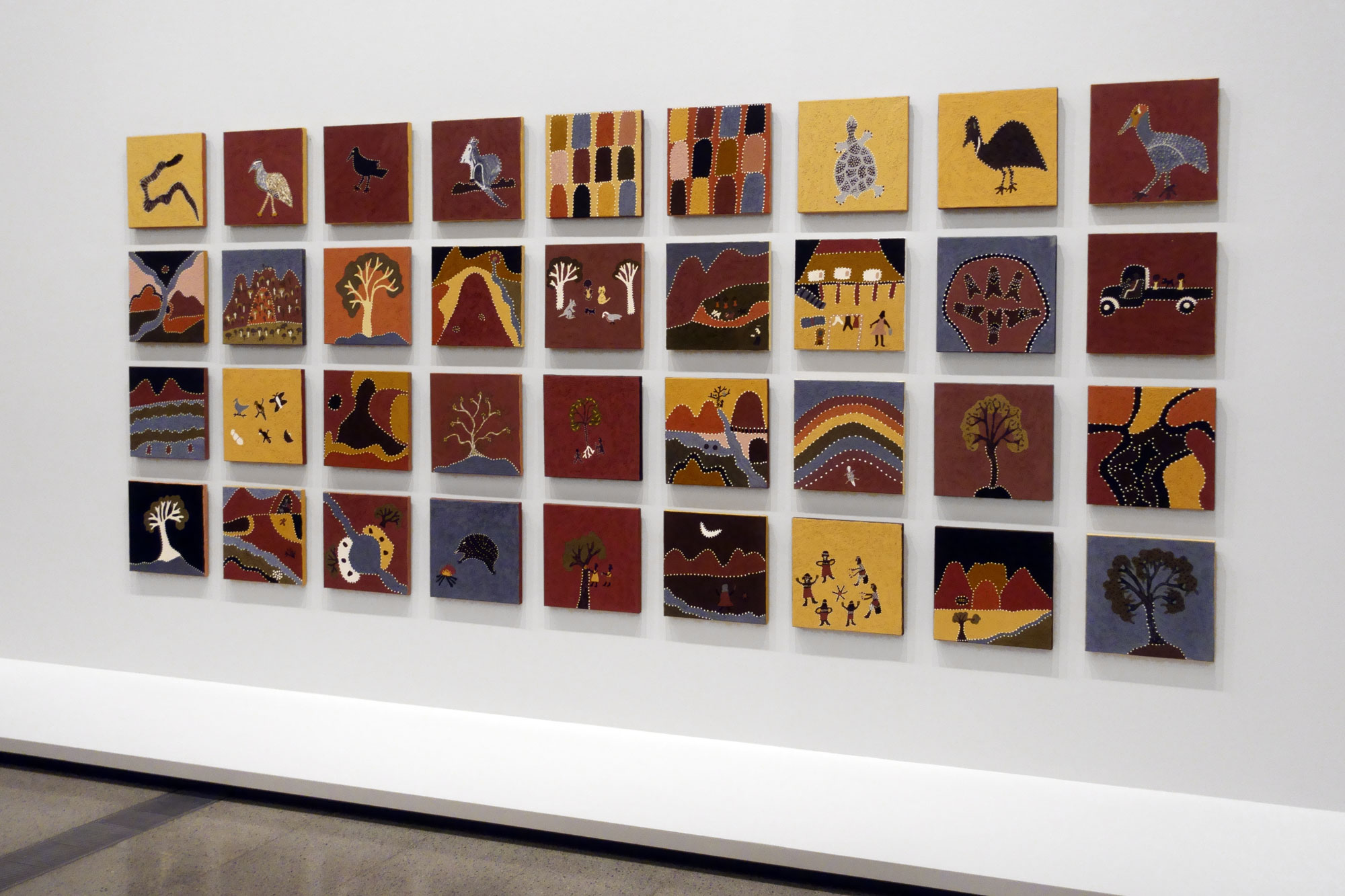
 

Shirley Purdie (Australian / Gija, b. 1947) 'Ngalim-Ngalimbooroo Ngagenybe' 2018 (installation view)


Shirley Purdie (Australian / Gija, b. 1947)
Ngalim-Ngalimbooroo Ngagenybe (installation view)
2018
Natural ochre and pigments on canvas (36 parts)
Each: 45 x 45cm
Overall: 225 x 525cm
National Portrait Gallery, Canberra
Purchased 2019
© Shirley Purdie/Copyright Agency, 2022
Photo: Marcus Bunyan


Shirley Purdie (b. 1947) is a senior Gija artist at the Warmun Art Centre who has been painting for more than twenty years. Purdie has lived on her Country, Western Australia’s East Kimberley, all her life. Inspired by senior Warmun artists, including her late mother, Madigan Thomas, she began to paint sites and narratives associated with her Country in the early 1990s. A prominent leader in the Warmun community, her cultural knowledge and artistic skill allow her to pass on Gija stories and language to the younger generations.

In 2018, Purdie was selected to contribute to the National Portrait Gallery’s 20th anniversary exhibition, So Fine: Contemporary Women Artists Make Australian History. Composed of 36 paintings, Purdie’s self-portrait Ngalim-Ngalimbooroo Ngaginbe is an eloquent and stunning visualisation of personal history, identity and connection to Country. ‘It’s good to learn from old people. They keep saying when you paint you can remember that Country, just like to take a photo … When the old people die, young people can read the stories from the paintings. They can learn from the paintings and maybe they want to start painting too.’ Using richly textured ochres collected on her Country, Purdie’s work is a kaleidoscope of traditional Gija stories and Ngarranggarni passed down to her.

Text from the National Portrait Gallery website


Shirley Purdie is senior Gija woman and a prominent leader within the Warmup Community in Western Australia’s East Kimberley. Combining her cultural knowledge with her art, Purdie creates visual depictions of Gija life and culture. Ngalim-Ngalimbooroo Ngagenybe, meaning ‘from my women’, is informed by Aboriginal ways of seeing, knowing and understanding oneself within the world. Each of the thirty-six panels shares a story about personal history, identity and Country to produce a non-representational self-portrait of the artist and her ongoing connection to women’s stories. By drawing on the significant women in her life, their relationships and histories, Purdie describes herself through these cultural connections and stories.

Wall text from the exhibition


Installation view of the exhibition 'WHO ARE YOU: Australian Portraiture' at NGV Australia, Federation Square, Melbourne showing Sam Jink's 'Divide (Self portrait)' (2011)


Installation view of the exhibition WHO ARE YOU: Australian Portraiture at NGV Australia, Federation Square, Melbourne showing Sam Jink’s Divide (Self portrait) (2011, below)
Photo: Marcus Bunyan


Sam Jinks (Australian, b. 1973) 'Divide (Self portrait)' 2011 (installation view)

Sam Jinks (Australian, b. 1973) 'Divide (Self portrait)' 2011 (installation view)


Sam Jinks (Australian, b. 1973)
Divide (Self portrait) (installation views)
2011
Silicone, resin, horse hair
National Portrait Gallery, Canberra
Purchased 2015
© Sam Jinks
Photos: Marcus Bunyan


Sam Jinks developed a talent for drawing and constructing his ideas alongside his father, a Melbourne cabinetmaker. Jinks worked as an illustrator before turning to sculpture. He worked in film and television special effects before becoming a fabricator for artist Patricia Piccinini. For the last ten years he has sculpted independently, working in silicone, fibreglass, resin and hair – human, animal and synthetic.


Max Martin (Australian, 1889-1965) 'Portrait group' 1922


Max Martin (Australian, 1889-1965)
Portrait group
1922
Oil on canvas
152.8 x 102.2cm
National Gallery of Victoria, Melbourne
Purchased through The Art Foundation of Victoria with the assistance of Dr Joseph Brown AO OBE, Honorary Life Benefactor, 1995
© Veronica Martin
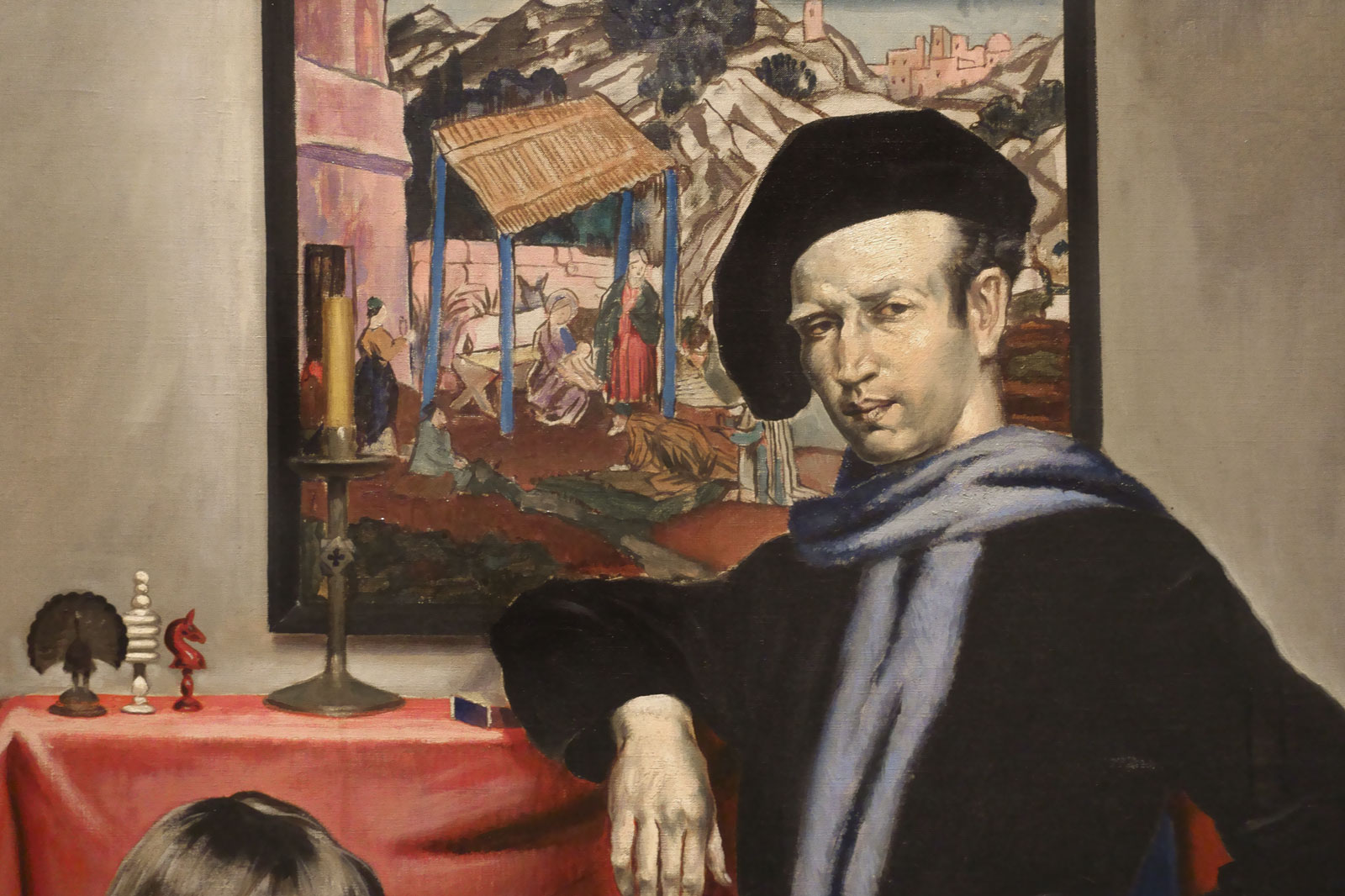
 

Max Martin (Australian, 1889-1965) 'Portrait group' 1922 (installation view detail)


Max Martin (Australian, 1889-1965)
Portrait group (installation view detail)
1922
Oil on canvas
152.8 x 102.2cm
National Gallery of Victoria, Melbourne
Purchased through The Art Foundation of Victoria with the assistance of Dr Joseph Brown AO OBE, Honorary Life Benefactor, 1995
© Veronica Martin
Photo: Marcus Bunyan
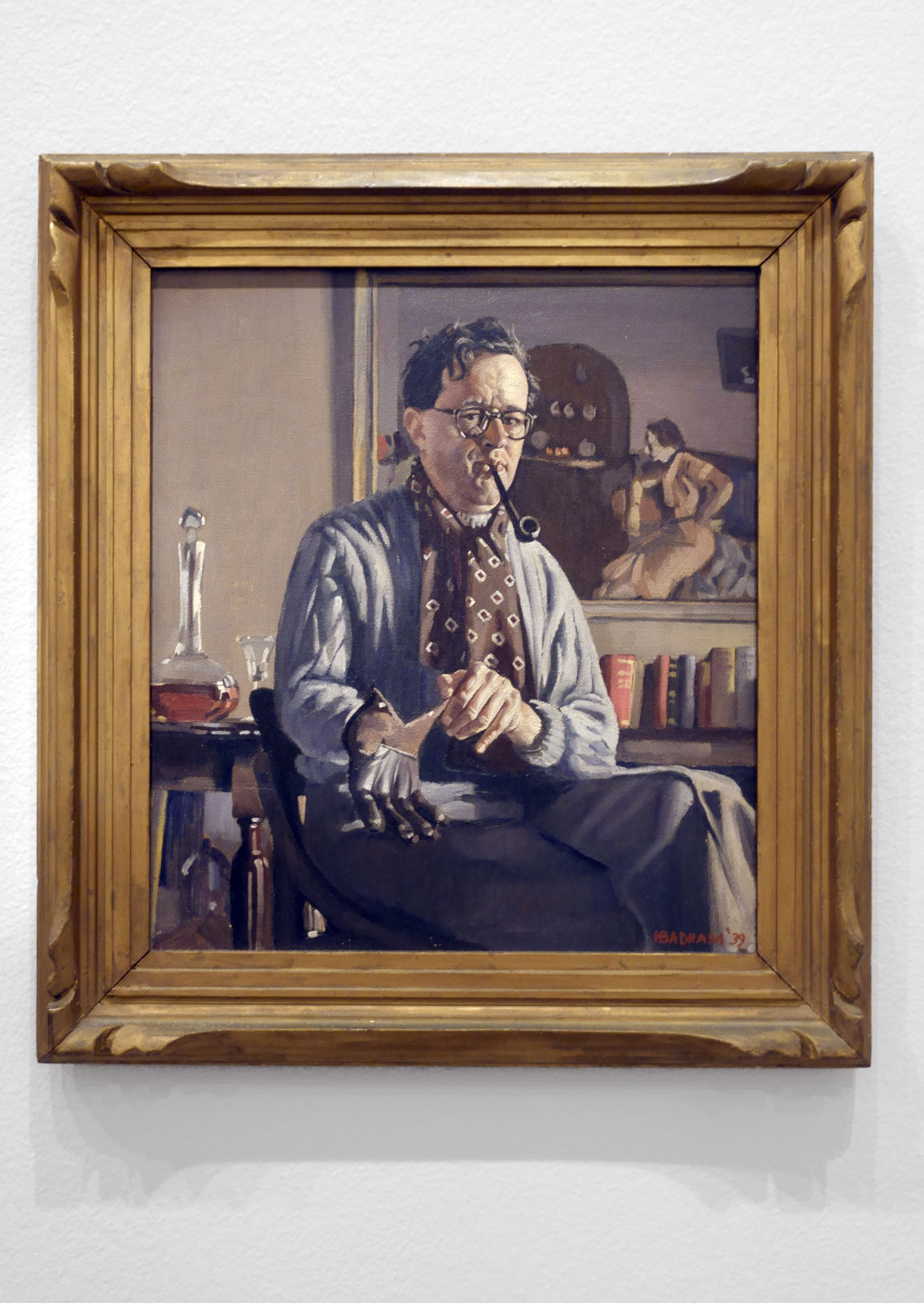
 

Herbert Badham (Australian, 1899-1961) 'Self portrait with glove' 1939 (installation view)


Herbert Badham (Australian, 1899-1961)
Self portrait with glove (installation view)
1939
Oil on canvas board
Frame: 44.4 x 40.7cm
National Portrait Gallery, Canberra
Purchased 1999
© Estate of Herbert Badham
Photo: Marcus Bunyan


Herbert Badham was an artist, writer and teacher who specialised in figures, urban life and beach scenes. Having studied for many years at the Julian Ashton School in the 1920s and 1930s, he produced a body of painting that typified the gentle, realist aspect of Sydney modernism of the prewar years. Head of the intermediate art department at East Sydney Tech from 1938 to 1961, he published the populist Study of Australian Art in 1949, and A Gallery of Australian Art in 1954. Badham’s work underwent a minor revival in the late 1980s, with a retrospective show held in Wollongong and Sydney, and three of his urban scenes were selected for the National Gallery’s Federation exhibition of 2001. Arguably the most interesting of several self-portraits of the artist, this painting was featured on the cover of the catalogue of the 1987 retrospective.

Text from the National Portrait Gallery website


Herbert Badham (Australian, 1899-1961) 'Self portrait with glove' 1939


Herbert Badham (Australian, 1899-1961)
Self portrait with glove
1939
Oil on canvas board
Frame: 44.4 x 40.7cm
National Portrait Gallery, Canberra
Purchased 1999
© Estate of Herbert Badham


Janet Dawson (Australian, b. 1935) 'Self Portrait' Between 1951 and 1953


Janet Dawson (Australian, b. 1935)
Self Portrait
Between 1951 and 1953
oil on cardboard
Frame: 57.0 x 47.5cm
National Portrait Gallery, Canberra
Gift of the artist 2000
© Janet Dawson/Copyright Agency, 2022


Janet Dawson (b. 1935) is best known for her contribution to abstract art in Australia. Following her family’s relocation from Forbes to Melbourne in the early 1940s, Dawson attended the private art school run by Harold Septimus Power. In 1951, aged sixteen, she enrolled at the National Gallery School and attended night classes with Sir William Dargie. Five years later, Dawson won a National Gallery of Victoria Travelling Scholarship and went to London, where she studied at the Slade School and the Central School. Returning to Melbourne in 1961, she held her first solo exhibition the same year and in 1963 set up an art school and workshop. Dawson was one of only three women included in the influential exhibition of Australian abstraction, The Field, at the National Gallery of Victoria in 1968. Her work is represented in all major public collections in Australia, and has been the subject of exhibitions at the NGV and the National Gallery of Australia.

Outside of her lyrical abstract work, Dawson always practised portraiture and won the Archibald Prize in 1973 with a portrait of her husband, the late writer, actor and playwright Michael Boddy. Painted during an evening class at the National Gallery School, this self portrait shows Dawson wearing an artist’s work shirt over her elegant day clothes, gazing confidently at the viewer.

Text from the National Portrait Gallery website
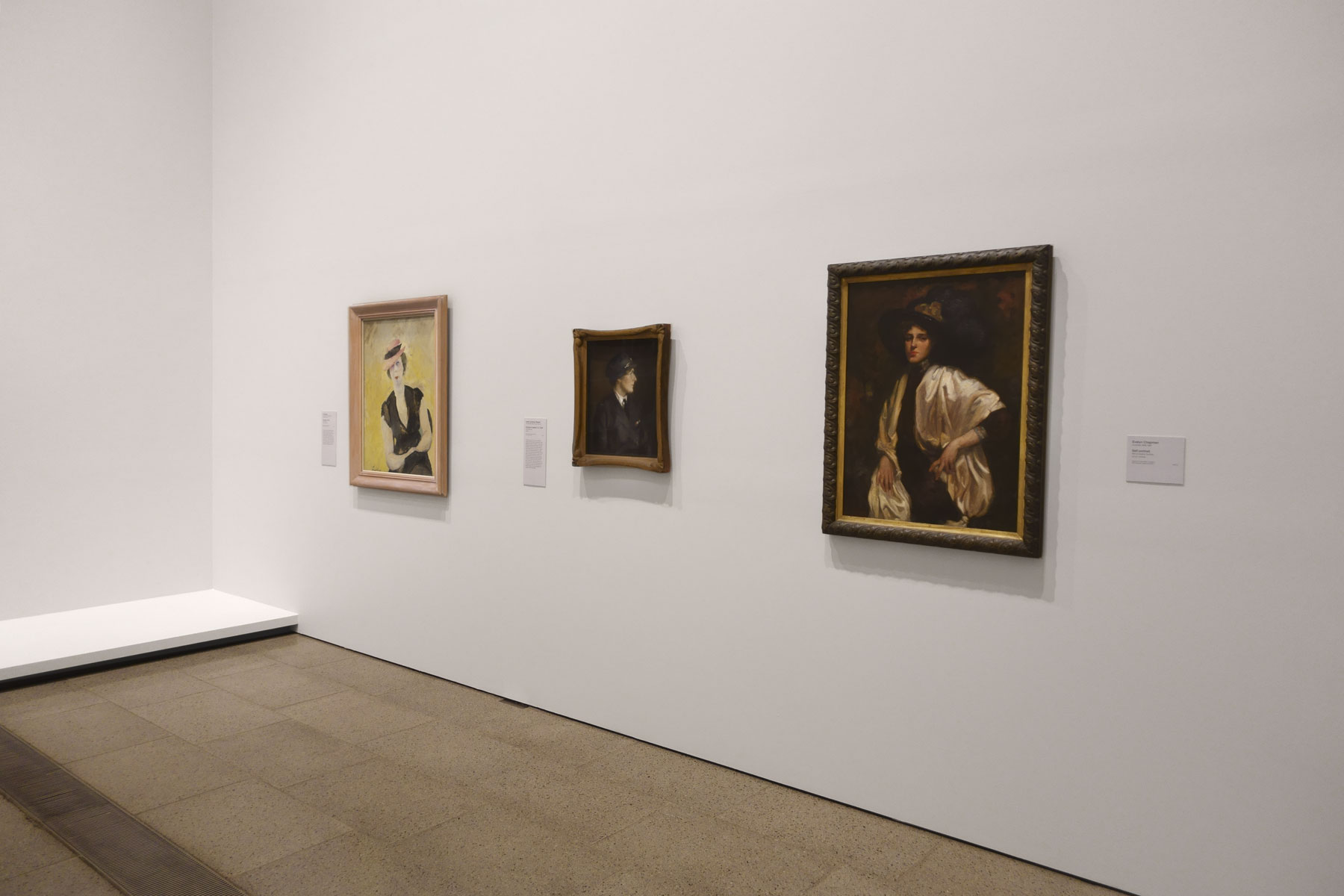
 

Installation view of the exhibition 'WHO ARE YOU: Australian Portraiture' at NGV Australia, Federation Square, Melbourne showing at left, Lina Bryans' 'The babe is wise' (1940); at middle, Janet Cumbrae Stewart's 'Portrait of Jessie C. A. Traill' (1920); and at right, Evelyn Chapman's 'Self portrait' (1911)


Installation view of the exhibition WHO ARE YOU: Australian Portraiture at NGV Australia, Federation Square, Melbourne showing at left, Lina Bryans’ The babe is wise (1940, below); at middle, Janet Cumbrae Stewart’s Portrait of Jessie C. A. Traill (1920, below); and at right, Evelyn Chapman’s Self portrait (1911, below)
Photo: Marcus Bunyan


Lina Bryans (Australian born Germany, 1909-2000) 'The babe is wise' 1940 (installation view)


Lina Bryans (Australian born Germany, 1909-2000)
The babe is wise (installation view)
1940
Oil on cardboard
National Gallery of Victoria, Melbourne
Gift of Miss Jean Campbell, 1962
Photo: Marcus Bunyan


Lina Bryans was an important part of the modern movement and a member of literary and artistic circles in Melbourne during the late 1930s and 1940s. Her vibrant paintings are characterised by bold brushwork and the expressive use of colour. In 1937, Bryans began painting portraits of her friends. Her most famous work, The babe is wise, is a portrait of the writer Jean Campbell, who had recently published a novel of the same name.

Wall text from the exhibition


Lina Bryans (Australian born Germany, 1909-2000) 'The babe is wise' 1940


Lina Bryans (Australian born Germany, 1909-2000)
The babe is wise
1940
Oil on cardboard
National Gallery of Victoria, Melbourne
Gift of Miss Jean Campbell, 1962


Janet Cumbrae Stewart (Australian, 1883-1960) 'Portrait of Jessie C. A. Traill' 1920


Janet Cumbrae Stewart (Australian, 1883-1960)
Portrait of Jessie C. A. Traill
1920
Pastel
Image and sheet: 55.5 × 45.4cm irreg.
National Gallery of Victoria, Melbourne
Gift of Jessie Traill, 1961
© Courtesy of the copyright holder


Chiefly known for her use of pastel, Janet Cumbrae Stewart devoted the most significant part of her career to producing sensuous studies of the female nude and portraits of women. Her portrait of fellow artist Jessie Traill shows Traill in the dress uniform of a Queen Alexandra Imperial Nurse. Nursing was one of the few options open to women wanting to serve in the First World War. Traill, who was living in France, volunteered and was stationed in Rouen in Northern France for three and a half years. Cumbrae Stewart and Traill were friends, both having grown up in Brighton, Victoria, and attended the National Gallery School alongside one another in the early 1900s.

Wall text from the exhibition


Evelyn Chapman (Australian, 1888-1961) 'Self portrait' 1911 (installation view)


Evelyn Chapman (Australian, 1888-1961)
Self portrait (installation view)
1911
Oil on canvas
National Portrait Gallery, Canberra
Gift of Pamela Thalben-Ball 2007
© Estate of Evelyn Chapman
Photo: Marcus Bunyan


 Evelyn Chapman (Australian, 1888-1961) 'Self portrait' 1911


Evelyn Chapman (Australian, 1888-1961)
Self portrait
1911
Oil on canvas
National Portrait Gallery, Canberra
Gift of Pamela Thalben-Ball 2007
© Estate of Evelyn Chapman


Evelyn Chapman, artist, studied with Antonio Dattilo Rubbo in Sydney and travelled overseas to paint in Paris, where she exhibited at the Salon. A few weeks after the end of World War 1 she took up the opportunity to visit the battlefields of France with her father, who was attached to the New Zealand War Graves Commission. Thus, she became the first Australian female artist to depict the devastated battlefields, towns and churches of the western front. Chapman remained overseas with her father, an organist who played in Dieppe, Venice and elsewhere, and married a brilliant organist, George Thalben-Ball, herself. After she married, she gave up painting, but she encouraged her daughter, Pamela, to pursue art. For the rest of her life, Chapman lived in England, only returning to Australia for a visit in 1960. The Art Gallery of New South Wales has her 1911 portrait of Dattilo Rubbo and a number of her paintings of France, Belgium and England. The Australian War Memorial, too, has several of her evocative French scenes.

Text from the National Portrait Gallery website


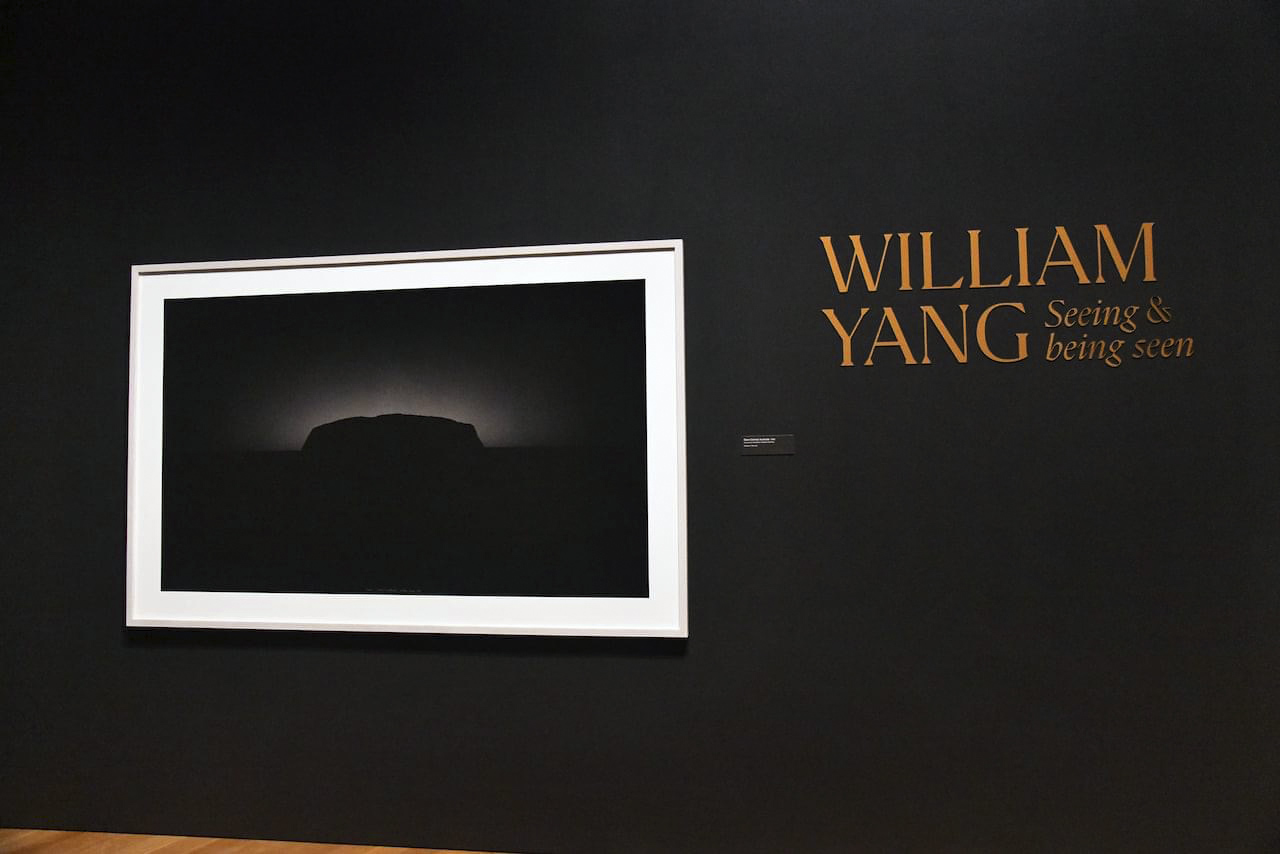
Installation view of the exhibition 'WHO ARE YOU: Australian Portraiture' at NGV Australia, Federation Square, Melbourne showing at left, William Yang's 'Self Portrait #2' (2007); and at centre in case, Alan Constable's earthenware cameras


Installation view of the exhibition WHO ARE YOU: Australian Portraiture at NGV Australia, Federation Square, Melbourne showing at left, William Yang’s Self Portrait #2 (2007, below); and at centre in case, Alan Constable’s earthenware cameras (see below)
Photo: Marcus Bunyan


William Yang (Australia b. 1943) 'Life Lines #3 – Self portrait #2 (1947)' 1947/2008


William Yang (Australian, b. 1943)
Self Portrait #2
2007
From the Self Portrait series
Inkjet print
Sheet: 84 x 50cm
National Gallery of Victoria, Melbourne
Purchased with funds donated by Ms Cora Trevarthen and Professor Andrew Reeves, 2013
© William Yang


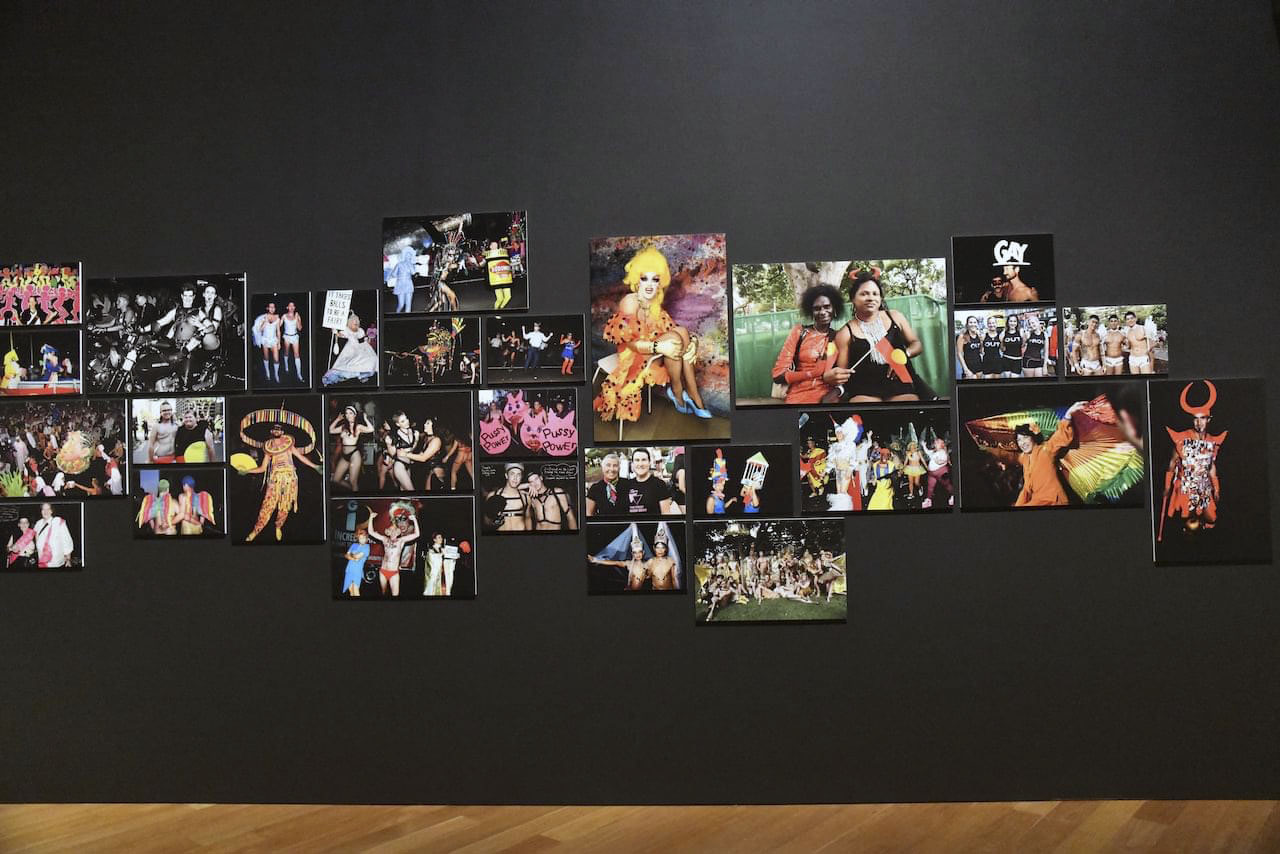
William Yang shares childhood memories in this self-portrait. He recently reflected: ‘… I cal myself Australian, but I claim my Chinese heritage because that’s the way I look. Central to my art practice is my own story, which I tell in performances with projected images and music in theatres. My story is told against a backdrop of the times. This keys into my documentary-style photography. I have done a series of self-portraits of the same stories for exhibition in galleries. So my art and my life have become entwined and they both feed into each other. And I’ve come to terms with the way I look … It’s a great relief to feel comfortable in your own skin’.

Wall text from the exhibition


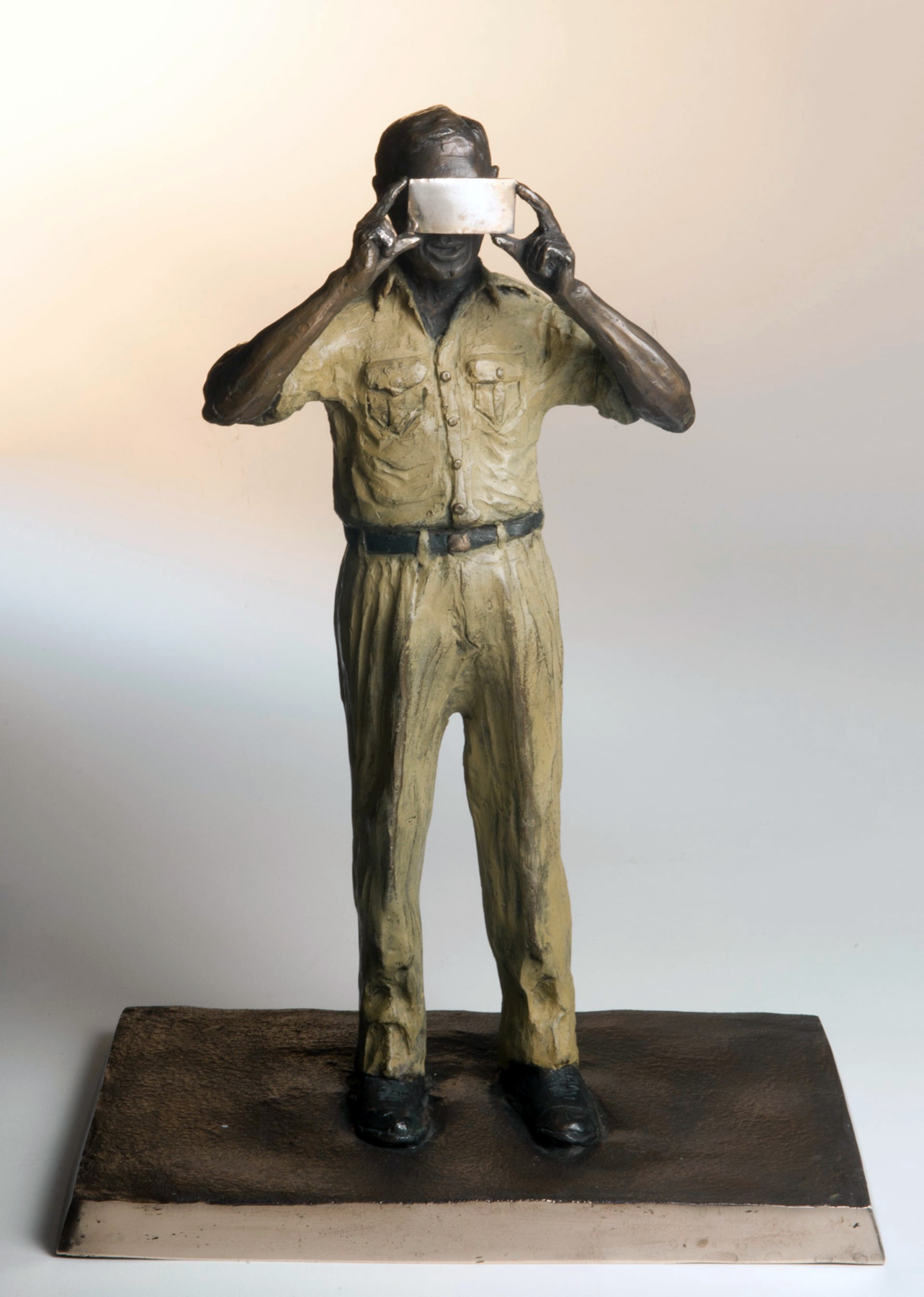
Installation view of the exhibition 'WHO ARE YOU: Australian Portraiture' at NGV Australia, Federation Square, Melbourne showing at left, Alan Constable's 'Green large format camera' (2013); and at right Alan Constable's 'Not titled (Black Mamiya large format camera)' (2013)


Installation view of the exhibition WHO ARE YOU: Australian Portraiture at NGV Australia, Federation Square, Melbourne showing at left, Alan Constable’s Green large format camera (2013, below); and at right Alan Constable’s Not titled (Black Mamiya large format camera) (2013, below)
Photo: Marcus Bunyan
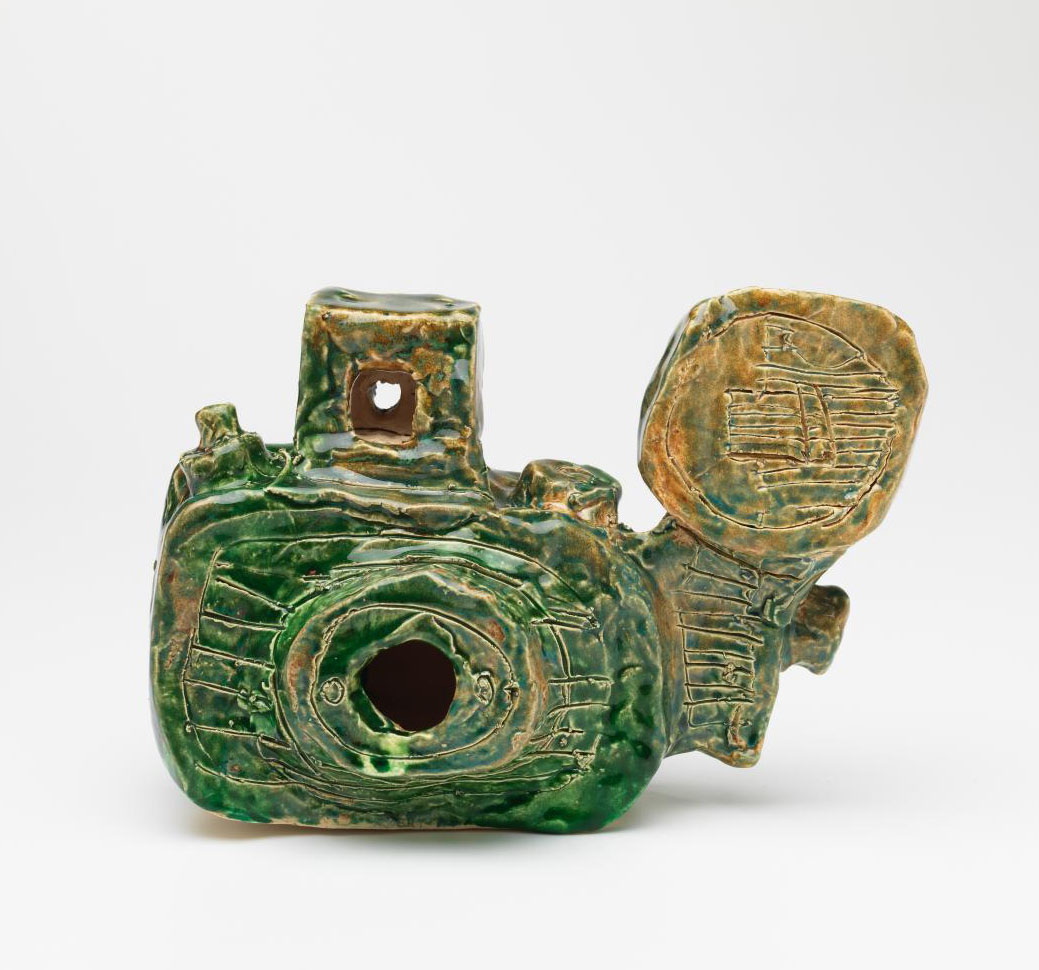
 

Alan Constable (Australian, b. 1956) 'Not titled (Green large format camera)' 2013


Alan Constable (Australian, b. 1956)
Not titled (Green large format camera)
2013
Earthenware
16.5 × 24.0 × 9.0cm
National Gallery of Victoria, Melbourne
Yvonne Pettengell Bequest, 2014
© Courtesy of the artist and Arts Project Australia, Melbourne
Photo: Marcus Bunyan
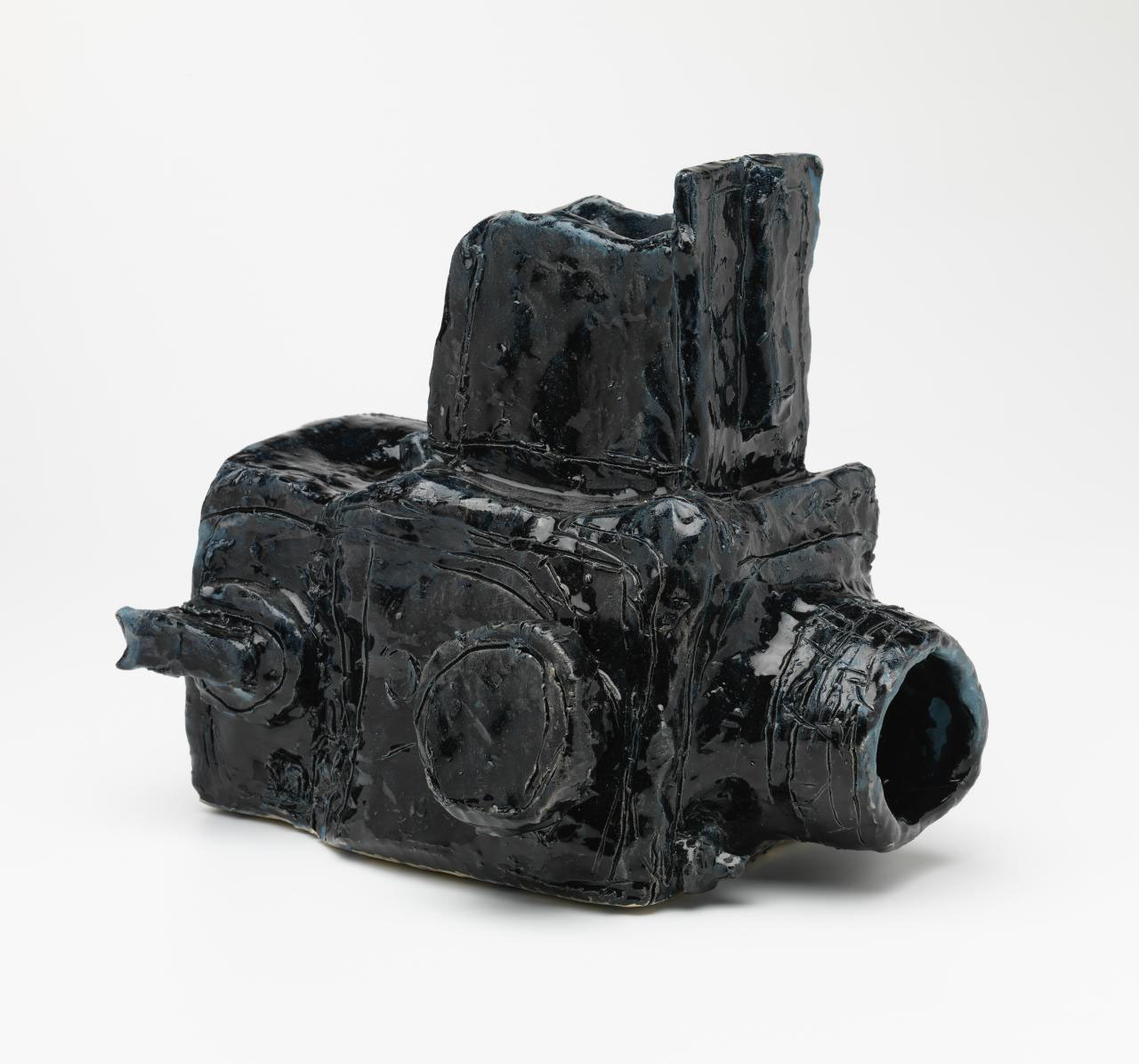
 

Alan Constable (Australian, b. 1956) 'Not titled (Black Mamiya large format camera)' 2013


Alan Constable (Australian, b. 1956)
Not titled (Black Mamiya large format camera)
2013
Earthenware
25.0 × 29.0 × 26.0cm
National Gallery of Victoria, Melbourne
Yvonne Pettengell Bequest, 2014
© Courtesy of the artist and Arts Project Australia, Melbourne
Photo: Marcus Bunyan


Alan Constable (Australian, b. 1956) 'Not titled (Box Brownie)' 2013 (installation view)


Alan Constable (Australian, b. 1956)
Not titled (Box Brownie)
2013
Earthenware
17.0 × 24.5 × 18.5cm
National Gallery of Victoria, Melbourne
Yvonne Pettengell Bequest, 2014
© Courtesy of the artist and Arts Project Australia, Melbourne
Photo: Marcus Bunyan


Alan Constable’s lifelong fascination with cameras began when he was just eight years old, as he sculpted the objects picture on cereal boxes. Legally blind, Constable’s sculptural practice sometimes extends to other optical objects, such as binoculars and video recorders. Constable’s method involves holding the camera millimetres from his eyes, as he scans and feels the object, before quickly rendering his impressions in clay. Constable has worked at Arts Project Australia since 1991 and held his first solo show in 2011. His works speak to the processes of seeing and looking, and self-reflexively capture the objects that capture the image.

Display case text from the exhibition


Christian Thompson (Australian / Bidjara, b. 1978) 'Othering the Explorer, James Cook' 2016


Christian Thompson (Australian / Bidjara, b. 1978)
Authoring the explorer, James Cook
2015, printed 2016
From the Museum of Others series 2015-2016
Type C photograph on metallic paper
National Gallery of Victoria, Melbourne
Gift of an anonymous donor through the Australian Government’s Cultural Gifts Program, 2017


‘Today, we are still conditioned by historical tropes such as the bust-style portraits of colonial men who had roles in furthering the position of colonial Britain at the height of the imperial pursuit for claiming new frontiers, at the expense of the Indigenous custodians of countries including Australia. However, as famous as these colonial figures still are, I try to demonstrate that it is never too late to pierce, subvert and re-stage the spectres of history to gain agency from the position of the other. Through the work, I am proposing: let us scrutinise your history, your identities, your flaws.’ ~ Christian Thompson, 2017

Wall text from the exhibition


WHO ARE YOU: Australian Portraiture is one of the most comprehensive explorations of portraiture ever mounted in Australia and the first exhibition to bring together the collections of the National Gallery of Victoria (NGV) and the National Portrait Gallery, Canberra. The exhibition will be on display in Melbourne from 25 March to 21 August 2022 and Canberra from 1 October 2022 to 29 January 2023.

Revealing the rich artistic synergies and contrasts between the two institutions’ collections, this co-curated exhibition considers portraiture in Australia across time and media, as well as the role of the portraiture genre in the development of a sense of Australian national identity.

Featuring more than two-hundred works by Australian artists including Patricia Piccinini, Atong Atem, Howard Arkley, Vincent Namatjira and Tracey Moffatt, and featuring sitters including Cate Blanchett, Albert Namatjira, Queen Elizabeth II, Eddie Mabo and David Gulpilil, the exhibition explores our inner worlds and outer selves, as well as issues of sociability, intimacy, isolation, celebrity and ordinariness.

The exhibition also questions what actually constitutes portraiture by examining the surprising and sometimes unconventional ways of representing likeness, such as the abstract self-portrait by John Nixon and Boris Cipusev’s typographic portrait of Jeff from The Wiggles. Polixeni Papapetrou’s Magma Man, a photograph which merges sitter and landscape until the two are almost indecipherable, and Shirley Purdie’s multi-panelled evocation of biography and Country further challenge the conventions of the genre and touch upon the intimate connection between artist, sitter and land. Alongside these works, iconic self-portraits will also be displayed by artists including John Brack, Nora Heysen and William Yang.

Tony Ellwood AM, Director, NGV, said: “This exhibition marks the first major partnership between the NGV and the National Portrait Gallery in Canberra. By combining our respective portraiture collections and curatorial expertise in this area, we have been able to stage the largest thematic portraiture exhibition in the history of either institution. This presentation will no doubt offer audiences an unprecedented insight into the genre and its place in Australian art history.”

Karen Quinlan AM, Director, National Portrait Gallery, said: “The NPG is thrilled to work with the NGV on this extensive exploration of Australian portraiture. The exhibition comes at a time when, in the current global COVID environment, stories from home, about home, and the artists and identities who have shaped and continue to shape our nation are more compelling and important than ever. It is a privilege to be able to present our collection in conversation with the NGV’s and to explore the idea of Australian identity and its many layers and facets through the lens of portraiture.”

Presented across five thematic sections, the exhibition raises challenging and provocative questions about who we are and how we view others – historically, today and into the future. The exhibition opens by considering the connection between people and place, reflecting on the relationship between artists, sitters and the environment, as well as the personification of the natural world. Highlight works include a conceptual map depicting self and Country by Wawiriya Burton, Ngayaku Ngura (My Country) 2009, as well as the NGV’s recent acquisition Seven Sisters Song 2021 by Kaylene Whiskey, a painted road sign that is filled with personally significant, autobiographical references to pop culture.

A further section explores the artistic tradition of the self-portrait and portraits of artists, as well as how this convention has been subverted or challenged by contemporary artists working today. Works include Hari Ho’s Dadang Christanto 2005, which depicts the artist buried to the neck in sand, referencing the brutal killings of Indonesians in the failed military coup of September 1965, and Alan Constable’s Not titled (Green large format camera) 2013, personifying the act of photography with a hand modelled, ceramic camera.

Ideas of intimacy and alienation are juxtaposed through images of family and community presented alongside those of vulnerability and isolation. Works include Pat Larter’s Marty 1995, a graphic collage depicting a male sex worker, challenging the ease with which society consumes images of female nudity, and Naomi Hobson’s Warrior without a weapon 2019, a photographic series in which the artist challenges stereotypes about Indigenous men from her home community in Coen, by using flowers as a metaphor for male vulnerability.

The exhibition also explores portraiture’s surprising capacity to reveal the inner worlds and mindsets of both the sitter and the artist, as exemplified by Eric Thake’s satirical vignettes of figures in dream-like settings, and Hoda Afshar’s Remain 2018, a video exploring Australia’s controversial border protection policy and the human rights of those seeking asylum.

The final section of the exhibition interrogates Australian icons, identities and how we construct them. Works featured in this section include Michael Riley’s Maria 1986 and Polly Borland’s HM Queen Elizabeth II 2002, two works displayed side by side, drawing connections between archetypal imagery of royalty, with negative renderings of ‘otherness’ found in historical ethnographic portraiture.

WHO ARE YOU: Australian Portraiture is presented by the NGV and the National Portrait Gallery and will be on display at The Ian Potter Centre: NGV Australia at Fed Square from 25 March to 21 August 2022 and the National Portrait Gallery, Canberra from 1 October 2022 to 29 January 2023.

WHO ARE YOU: Australian Portraiture is generously supported by Major Partner, Deakin University.

Press release from the National Gallery of Victoria International


Installation view of the exhibition WHO ARE YOU: Australian Portraiture at NGV Australia, Federation Square, Melbourne showing at centre left, Bert Flugelman's 'self portrait' (1985)


Installation view of the exhibition WHO ARE YOU: Australian Portraiture at NGV Australia, Federation Square, Melbourne showing at centre left, Bert Flugelman’s self portrait (1985, below). The legend of the artworks on the wall is below…
Photo: Marcus Bunyan


Installation view of the exhibition 'WHO ARE YOU: Australian Portraiture' at NGV Australia, Federation Square, Melbourne


Installation view of the exhibition WHO ARE YOU: Australian Portraiture at NGV Australia, Federation Square, Melbourne
Photo: Marcus Bunyan


Bert Flugelman (Australian born Austria, 1923-2013, Australia from 1938) 'Self portrait' c. 1985


Bert Flugelman (Australian born Austria, 1923-2013, Australia from 1938)
Self portrait
c. 1985
Stainless steel
National Portrait Gallery, Canberra
Gift of the artist 2009
Donated through the Australian Government’s Cultural Gifts Program
© Bert Flugelman/Copyright Agency, 2022


Herbert ‘Bert’ Flugelman, sculptor, painter and lecturer, came to Australia from his native Vienna in 1938, aged fifteen. In the late 1940s he trained at the National Art School; he travelled and studied overseas through the first half of the 1950s. In 1967 he won first prize at the Mildura Sculpture Triennial with a large cast-iron equestrian piece. His subsequent public commissions include the untitled copper and ceramic mosaic fountain at Bruce Hall at the Australian National University; Spheres 1977 (known locally as Bert’s Balls) for the Rundle Street Mall, Adelaide; and the Dobell Memorial 1978 for Martin Place, Sydney. Controversially, Tumbling cubes (Dice) (Untitled) 1978/1979, originally made for Cameron Offices in Belconnen ACT, was some years ago moved to a nearby park, according to the artist a ‘hopelessly inappropriate site’. Cones 1982 dominates the Sculpture Garden at the National Gallery of Australia, and the Winged figure (Lawrence Hargrave memorial) 1988 towers 6m high at Mt Keira, near Wollongong. Flugelman taught from 1973 to 1983 at the South Australian School of Art, and from 1984 to 1990 at the University of Wollongong, from which he received an honorary doctorate. There was a retrospective exhibition of his five decades’ work at the Drill Hall Gallery, Australian National University in 2009.

Text from the National Portrait Gallery, Canberra website Nd [Online] Cited 23/06/2022


Lewis Morley (Hong Kong 125 - Australia 2013, England 1945-1971, Australia from 1971) 'Self portrait in reflection' 1973 (installation view)


Lewis Morley (Hong Kong 125 – Australia 2013, England 1945-1971, Australia from 1971)
Self portrait in reflection (installation view)
1973
Gelatin silver photograph
National Portrait Gallery, Canberra
Gift of the artist 2003
Donated through the Australian Government’s Cultural Gifts Program
Photo: Marcus Bunyan


Lewis Morley (Hong Kong 125 - Australia 2013, England 1945-1971, Australia from 1971) 'Self portrait in reflection' 1973


Lewis Morley (Hong Kong 125 – Australia 2013, England 1945-1971, Australia from 1971)
Self portrait in reflection
1973
Gelatin silver photograph
National Portrait Gallery, Canberra
Gift of the artist 2003
Donated through the Australian Government’s Cultural Gifts Program
© Lewis Morley Archive LLC


Lewis Morley OAM (1925-2013)

Lewis Morley OAM (1925-2013), photographer, was born in Hong Kong and went to the United Kingdom with his family at the end of World War 2. He studied commercial art in London and spent time in Paris before taking up photography in 1954, initially working for magazines like Tatler, London Life and She. In 1961, he founded Lewis Morley Studios in Peter Cook’s London club, The Establishment. Here, he built his reputation with photographs of the celebrities that defined the hip spirit of London in the 1960s, among them Cook, Dudley Moore, Charlotte Rampling, Twiggy, Vanessa Redgrave and Jean Shrimpton. In 1963, Morley took one of the world’s most famous photographic portraits – that of Christine Keeler, short-term shared mistress of a British politician and a Soviet diplomat, naked on a Scandinavian chair. By 1971, Morley’s magazine and theatre work in London was petering out, and he emigrated to Australia, where, he said, ‘bingo! there was the sixties all over again’. Shooting increasingly in colour, Morley took many photographs for Dolly, POL, Belle and other publications that now afford an evocative record of changing Australian culture through the 1970s and 1980s. Many of Morley’s portraits from this era were shown in the National Portrait Gallery’s retrospective exhibition Lewis Morley: Myself and Eye in 2003. His work was also the subject of a major exhibitions staged by the National Portrait Gallery, London, in 1989-1990; and the Art Gallery of New South Wales in 2006.

Text from the National Portrait Gallery, Canberra website Nd [Online] Cited 23/06/2022


William Dargie (Australian, 1912-2003) 'Albert Namatjira' 1958 (installation view)


William Dargie (Australian, 1912-2003)
Albert Namatjira (installation view)
1958
Oil on canvas laid on composition board
National Portrait Gallery, Canberra
Purchased with funds donated by Marilyn Darling AC and the assistance of Philip Bacon Galleries 2000
Photo: Marcus Bunyan


Albert Namatjira was a descendant of the Western Arrant people of the Northern Territory. Inspired by the spectacular landforms and vivid colours around his home at the Hermannsuburg Mission in the 1930s, Namatjira fused Western-influenced style of watercolour with unique expressions of traditional sites and sacred knowledge. Sir William Dargie CBE described Namatjira as having ‘tremendous inner dignity’ and within this portrait, he located Namatjira in his country in the MacDonnell Ranges. Holding one of his own landscapes, the portrait represents the intrinsic connection between the artist’s painting and identity. Namatjira was, and still is, an important presence in Australian art and a leading figure in the development of Aboriginal rights.

Wall text from the exhibition


William Dargie (Australian, 1912-2003) 'Albert Namatjira' 1958 (installation view detail)


William Dargie (Australian, 1912-2003)
Albert Namatjira (installation view detail)
1958
Oil on canvas laid on composition board
National Portrait Gallery, Canberra
Purchased with funds donated by Marilyn Darling AC and the assistance of Philip Bacon Galleries 2000
Photo: Marcus Bunyan


Rennie Ellis (Australian, 1940-2003) 'Sharpies, Melbourne' 1973


Rennie Ellis (Australian, 1940-2003)
Sharpies, Melbourne
1973, printed c. 1977-1978
Gelatin silver print
National Gallery of Victoria, Melbourne
Purchased NGV Foundation, 2006


‘Rather than capturing the subjects unawares I have encouraged them to pause, and even pose, from the camera. In this way they have an opportunity to communicate directly with me and to project whatever image they believe suits them best.’ ~ Rennie Ellis

Wall text from the exhibition


Max Dupain (Australian, 1911-1992) 'Hera Roberts' 1936 (installation view)


Max Dupain (Australian, 1911-1992)
Hera Roberts (installation view)
1936
Gelatin silver photograph
23.6 cm x 21.4cm
Gift of Rex Dupain 2003
Donated through the Australian Government’s Cultural Gifts Program
Photo: Marcus Bunyan
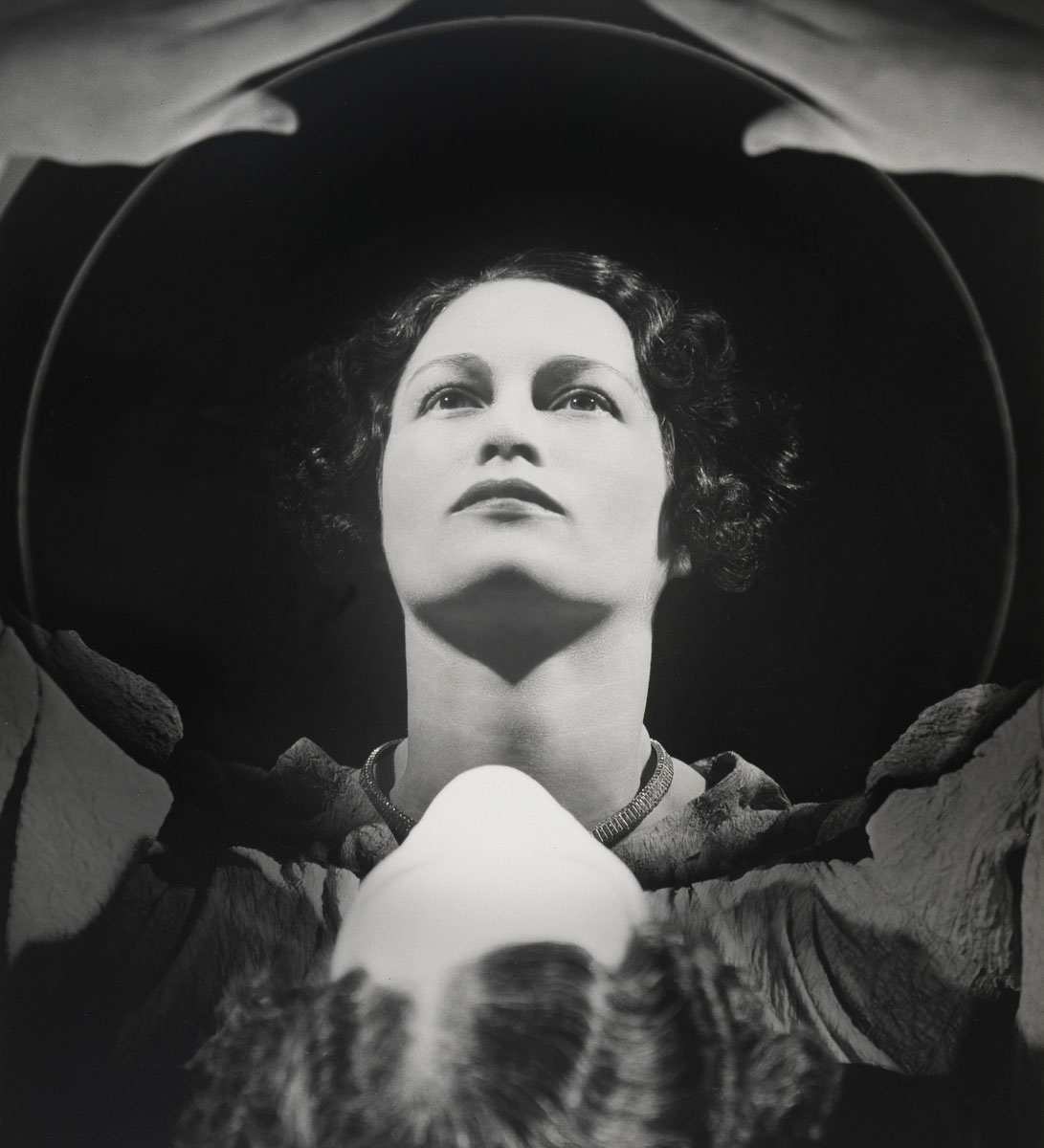
 

Max Dupain (Australian, 1911-1992) 'Hera Roberts' 1936


Max Dupain (Australian, 1911-1992)
Hera Roberts
1936
Gelatin silver photograph
23.6 cm x 21.4cm
Gift of Rex Dupain 2003
Donated through the Australian Government’s Cultural Gifts Program


Hera Roberts (life dates unknown) was a painter, illustrator, designer, commercial artist and milliner. During the 1920s and 30s she produced many covers for the Home magazine, and arranged photo spreads for the magazine promoting fashionable interiors and furniture. She designed a complete room for the Burdekin House exhibition of 1929, including furniture, and also designed furniture for her companion Sydney Ure Smith. Roberts was regarded as an authoritative commentator on matters of style. She was the student and cousin of the artist Thea Proctor, who was also part of the network of ‘lady artists’ who were able to make their careers in interior decorating and taste arbitration. Co-owner of a millinery shop in Pitt Street called ‘June’, Roberts was also one of the finest female fencers in the Southern Hemisphere, operating out of the Sydney Swords Club.

Text from the National Portrait Gallery, Canberra website Nd [Online] Cited 23/06/2022


Trevor Turbo Brown (Australian / Latje Latje, 1967-2017) 'Self-portrait, 'I am the Dingo Spirit'' 2015 (installation view)


Trevor Turbo Brown (Australian / Latje Latje, 1967-2017)
Self-portrait, ‘I am the Dingo Spirit’ (installation view)
2015
Synthetic polymer paint on canvas
National Gallery of Victoria, Melbourne
Photo: Marcus Bunyan


Trevor Turbo Brown, or ‘Turbo’ as he was known, was born in Mildura and grew up on Latje Latje Country. In 1981, Turbo moved to Melbourne were he became a celebrity in the Koori community. He trained as a boxer at the Fitzroy Stars Gym from 1986 to 1991 and would do breakdance street performances throughout Melbourne during the 1980s and 1990s. It was here that he got his nickname. Turbo was a regular character on the streets of Brunswick before he passed away in 2017. In this self-portrait Turbo impinges himself as a dingo, wild and free in the night.

Wall text from the exhibition
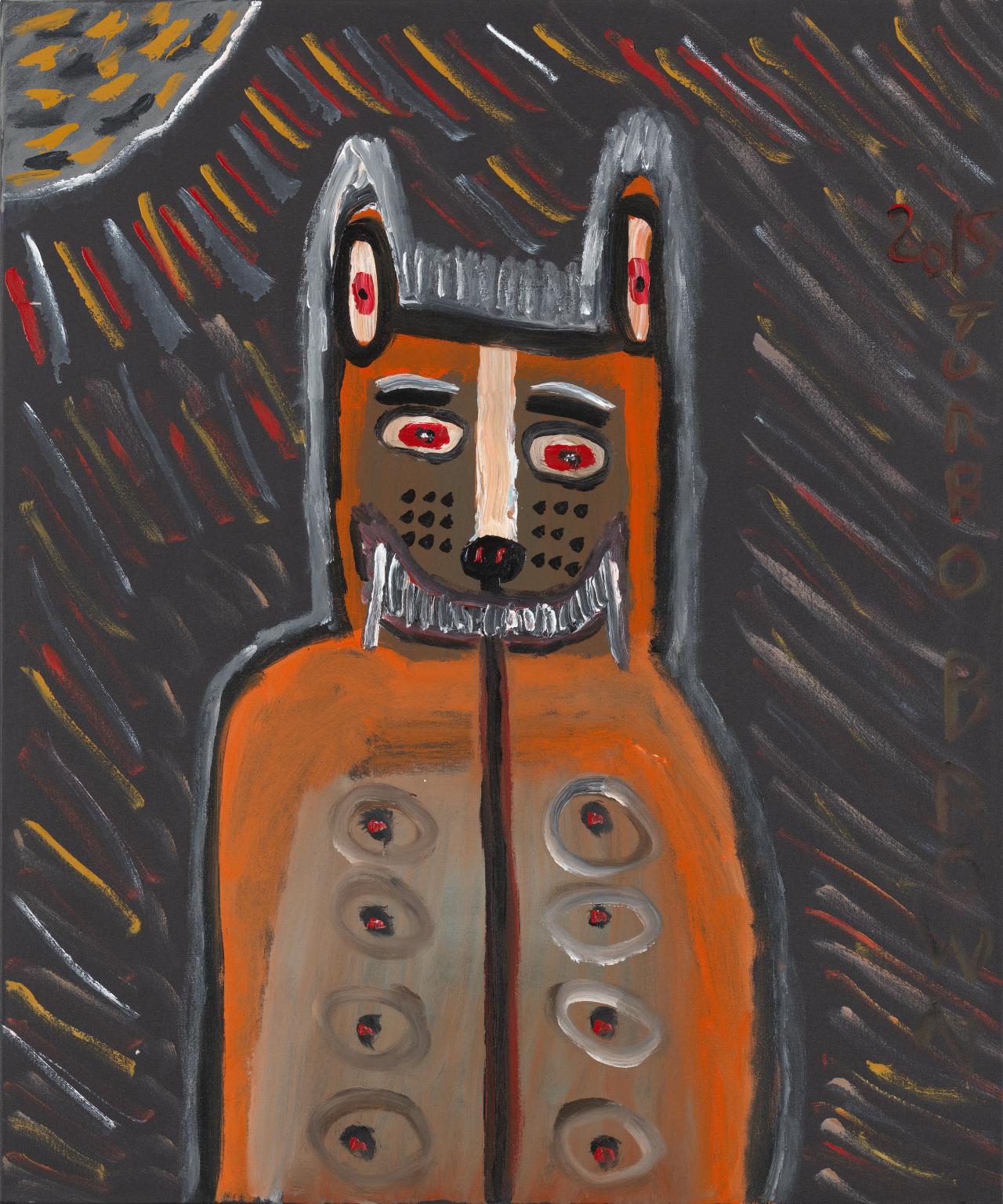
 

Trevor Turbo Brown (Australian / Latje Latje, b. 1967) Self-portrait, 'I am the Dingo Spirit' 2015


Trevor Turbo Brown (Australian / Latje Latje, b. 1967)
Self-portrait, ‘I am the Dingo Spirit’
2015
Synthetic polymer paint on canvas
122.3 x 102.2cm
National Gallery of Victoria, Melbourne
Gift of Vince Sinni in memory of Trevor Turbo Brown through the Australian Government’s Cultural Gifts Program, 2018
© the artist’s estate


John Brack. 'Self-portrait' 1955


John Brack (Australian, 1920-1999)
Self-portrait
1955
Oil on canvas
National Gallery of Victoria, Melbourne
Purchased with the assistance of the National Gallery Women’s Association, 2000


John Brack created images that explore the social rituals and realities of everyday living. Rendered in a subtle but complex colour scheme, with its subject stripped of vanity and dressed in early-morning attire, Self-portrait is a piercing study of a man engaged in the intimacy of shaving. Although images of women at their toilette have been recently depicted by both male and female Australian artists, it is unusual for men to be shown or to show themselves in this context.

Wall text from the exhibition
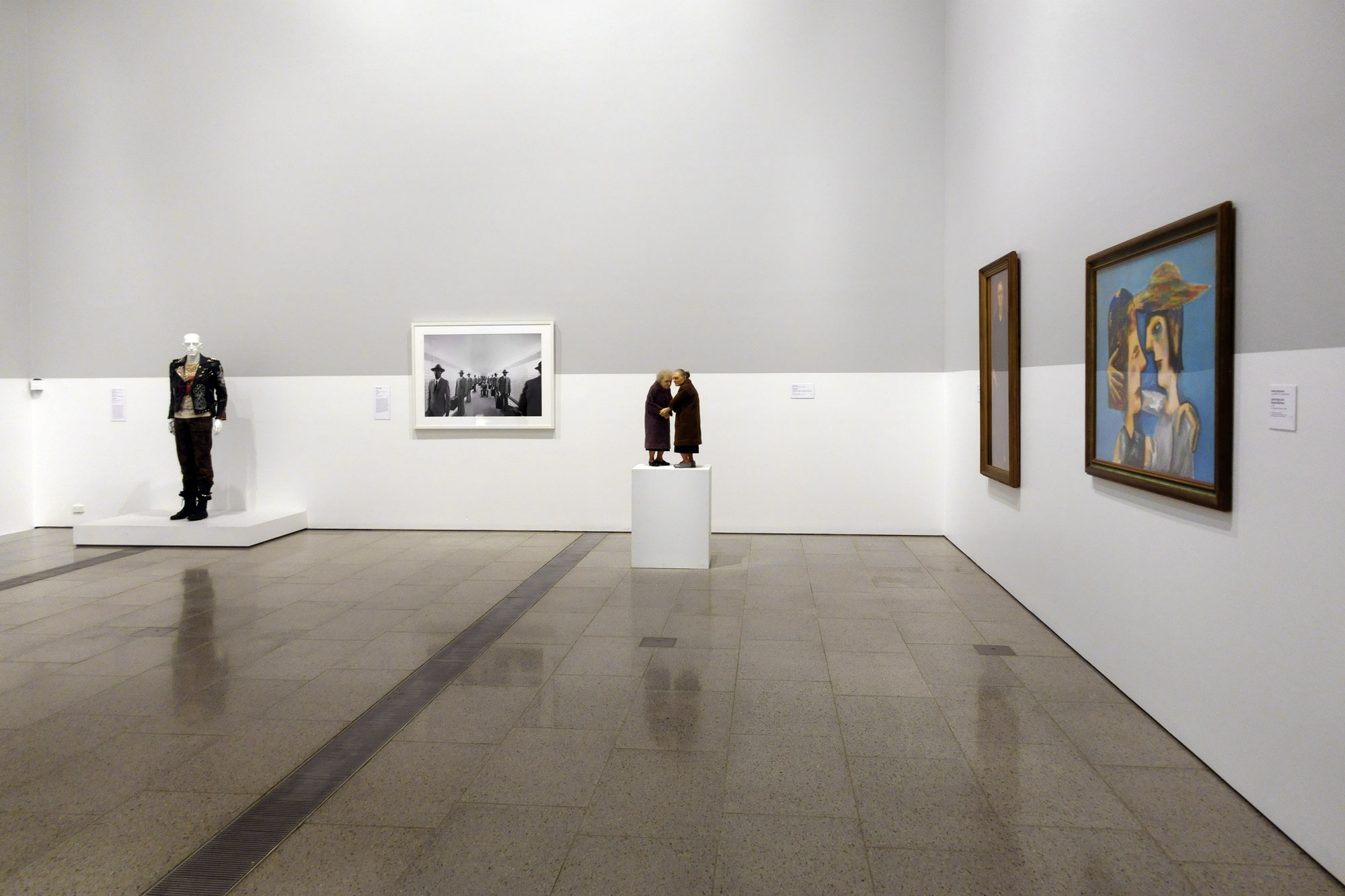
 

Installation view of the exhibition 'WHO ARE YOU: Australian Portraiture' at NGV Australia, Federation Square, Melbourne with second from left, Michael Cook's 'Tunnel No. 2' (2014); at third from left, Ron Mueck's 'Two Women' (2005)


Installation view of the exhibition WHO ARE YOU: Australian Portraiture at NGV Australia, Federation Square, Melbourne with second from left, Michael Cook’s Tunnel No. 2 (2014, below); at third from left, Ron Mueck’s Two Women (2005, below)
Photo: Marcus Bunyan


Michael Cook (Australian / Bidjara, b. 1968) 'Tunnel No. 2' 2014 (installation view)


Michael Cook (Australian / Bidjara, b. 1968)
Tunnel No. 2 (installation view)
2014
From the series Majority Rule
Inkjet print
National Gallery of Victoria, Melbourne
Ybonne Pettengell Bequest, 2014
Photo: Marcus Bunyan


‘In Majority Rule I created staged scenarios that question Australian history and the dominance of those in power. The series features the same anonymous Indigenous Man, multiplied over and over in each image. Australia’s Indigenous population comprises around three or four percent of our total population. My images seek to defy this reality and ask the viewer to speculate about an Australia where Aboriginal people constitute the majority of the country’s population; they paint a picture of a societal structure reversed … The works also serve as reminders fo the lack of Indigenous representation within Parliament, the judicial system and the business world.’ ~ Michael Cook, 2017

Wall text from the exhibition


Michael Cook (Australian / Bidjara, b. 1968) 'Tunnel No. 2' 2014


Michael Cook (Australian / Bidjara, b. 1968)
Tunnel No. 2
2014
From the series Majority Rule
Inkjet print
National Gallery of Victoria, Melbourne
Ybonne Pettengell Bequest, 2014
© Courtesy of the artist
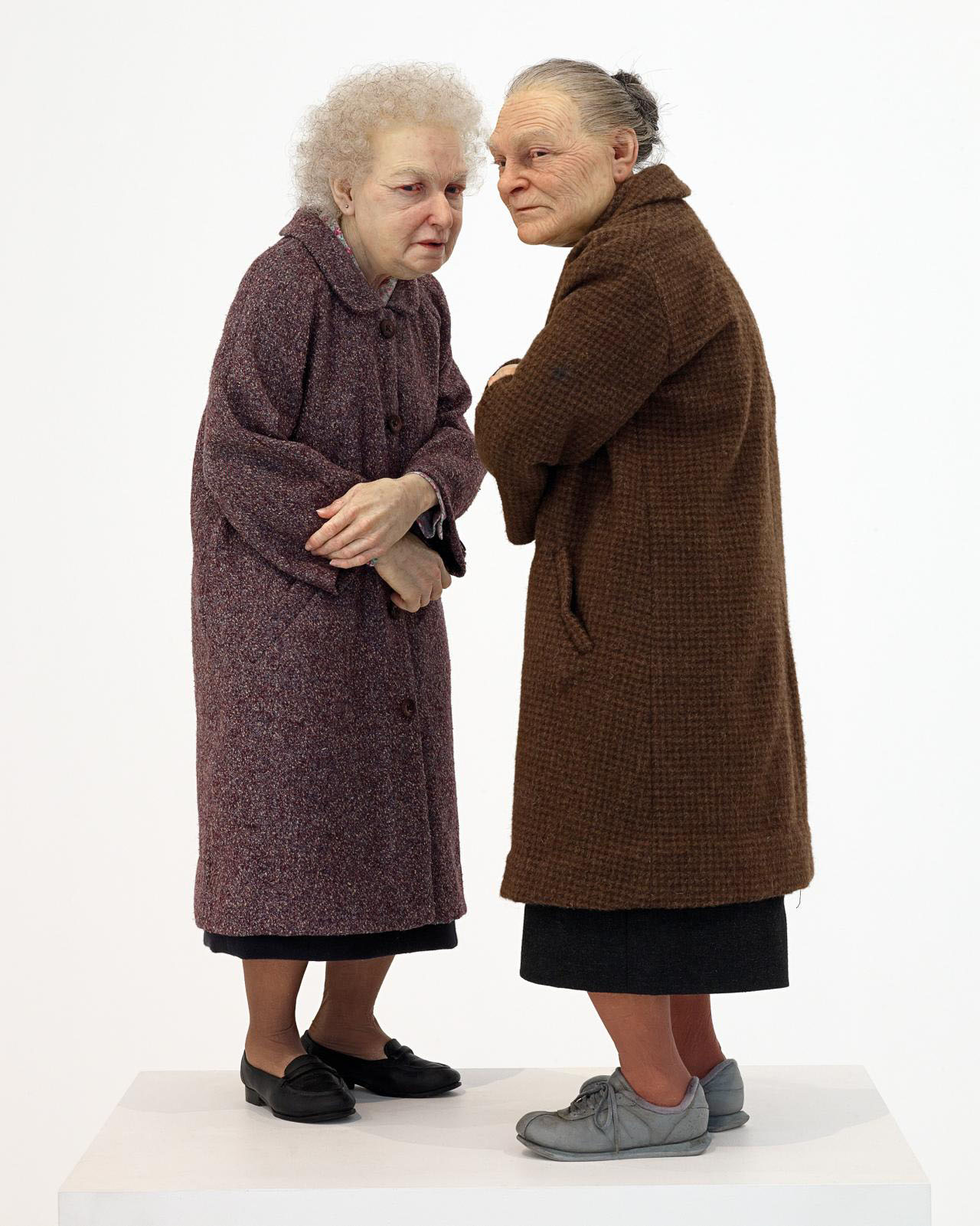
 

Ron Mueck. 'Two woman' 2005


Ron Mueck (Australian born England, b. 1958)
Two women
2005
Polyester resin, fibreglass, silicone, polyurethane, aluminium, wire, steel, cotton, nylon, synthetic hair, plastic, metal
National Gallery of Victoria, Melbourne
Purchased, Victorian Foundation for Living Australian Artists, 2007


Ron Mueck. 'Two woman' 2005 (detail)


Ron Mueck (Australian born England, b. 1958)
Two women (detail)
2005
Polyester resin, fibreglass, silicone, polyurethane, aluminium, wire, steel, cotton, nylon, synthetic hair, plastic, metal
National Gallery of Victoria, Melbourne
Purchased, Victorian Foundation for Living Australian Artists, 2007


Installation view of the exhibition 'WHO ARE YOU: Australian Portraiture' at NGV Australia, Federation Square, Melbourne showing at left, Pierre Mukeba's 'Impartiality' (2018); at second right, William Frater's 'Reclining nude' (c. 1933); and at right, Pat Larter's 'Marty' (1995)


Installation view of the exhibition WHO ARE YOU: Australian Portraiture at NGV Australia, Federation Square, Melbourne showing at left, Pierre Mukeba’s Impartiality (2018, below); at second right, William Frater’s Reclining nude (c. 1933, below); and at right, Pat Larter’s Marty (1995, below)
Photo: Marcus Bunyan
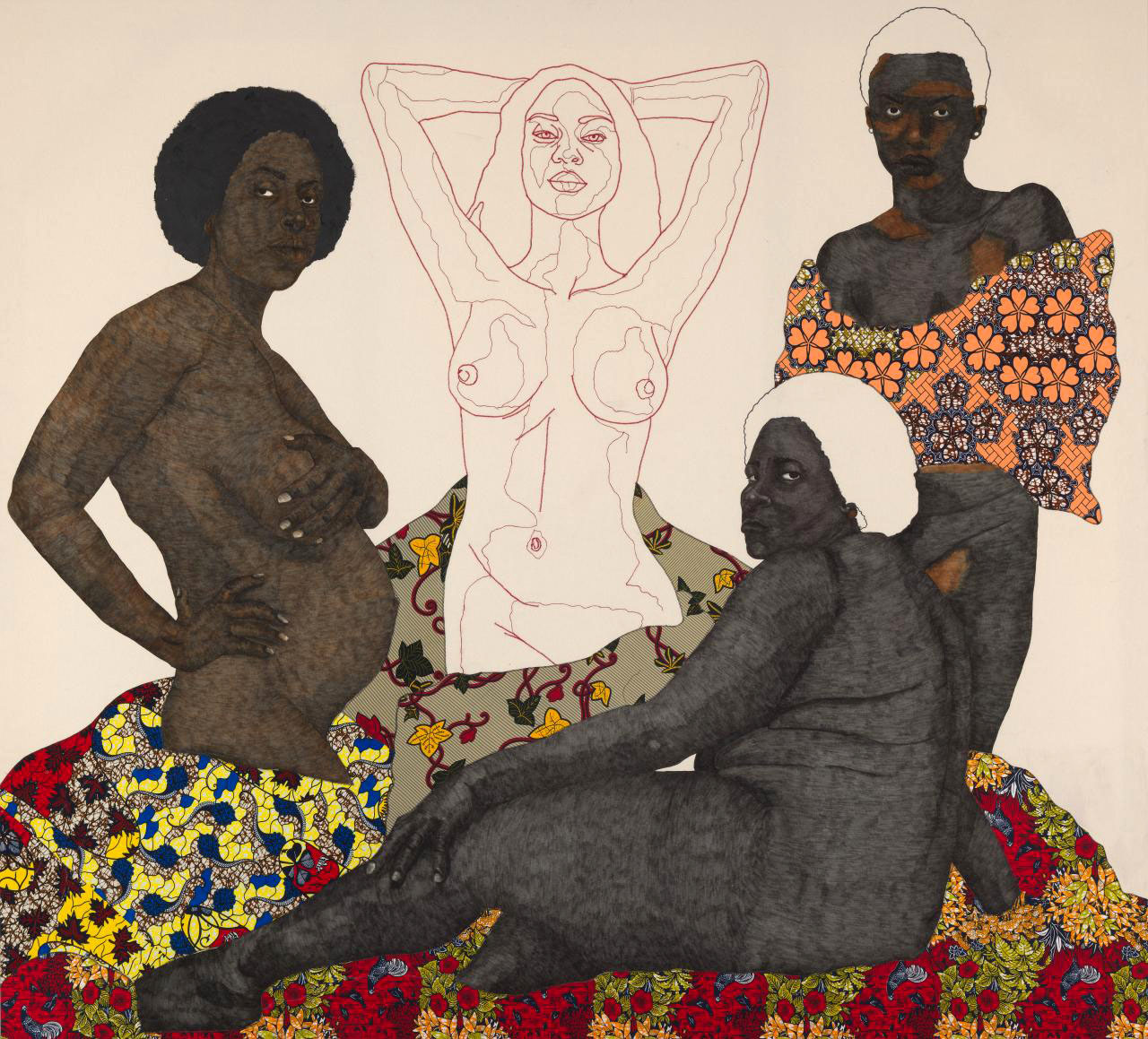
 

Pierre Mukeba (Australian born Democratic Republic of the Congo, b. 1995, Australia from 2006) 'Impartiality' 2018


Pierre Mukeba (Australian born Democratic Republic of the Congo, b. 1995, Australia from 2006)
Impartiality
2018
Fibre-tipped pen and printed fabric on cotton
245.0 × 270.0cm
National Gallery of Victoria, Melbourne
Purchased with funds donated by Anne Ross, 2018
© Pierre Mukeba, courtesy of GAGPROJECTS


Pierre Mukeba was a child when he fled with his family from the Democratic Republic of the Congo to Zambia, where they lived in a refugee camp before joining family in Zimbabwe. Following the Mugabe regime’s arrest order for non-nationals, the family applied for asylum through the Australian Embassy and relocated to Adelaide in 2006. In this work, Mukeba uses patterned Dutch wax print fabrics commonly perceived as being ‘African’, while in reality, they were appropriated from traditional Javanese bark by Dutch colonisers in the nineteenth century, mass produced in Europe and exported to Africa. This painting is part of a group of works by Mukeba, in which he draws on sociocultural standards of beauty and representations of his community.

Wall text rom the exhibition


William Frater (Australian born Scotland, 1890-1974, Australia from 1913) 'Reclining nude' c. 1933 (installation view)


William Frater (Australian born Scotland, 1890-1974, Australia from 1913)
Reclining nude (installation view)
c. 1933
Oil on canvas on cardboard
National Gallery of Victoria, Melbourne
Purchased, 1950
Photo: Marcus Bunyan


William Frater (Australian born Scotland, 1890-1974, Australia from 1913) 'Reclining nude' c. 1933 (installation view detail)


William Frater (Australian born Scotland, 1890-1974, Australia from 1913)
Reclining nude (installation view detail)
c. 1933
Oil on canvas on cardboard
National Gallery of Victoria, Melbourne
Purchased, 1950
Photo: Marcus Bunyan


William Frater (Australian born Scotland, 1890-1974) 'The artist's wife' 1915


William Frater (Australian born Scotland, 1890-1974)
The artist’s wife
1915
Oil on canvas on plywood
47.0 x 32.9cm
National Gallery of Victoria, Melbourne
The Joseph Brown Collection
Presented through the NGV Foundation by Dr Joseph Brown AO OBE, Honorary Life Benefactor, 2004


Pat Larter (Australian born England, 1936-1996, Australia from 1962) 'Marty' 1995 (installation view)


Pat Larter (Australian born England, 1936-1996, Australia from 1962)
Marty (installation view)
1995
Coloured inks, synthetic polymer paint, plastic, glitter and self-adhesive plastic collage on canvas
National Gallery of Victoria, Melbourne
Purchased, 1997
Photo: Marcus Bunyan


Throughout her career, Pat Larter produced performance art, photography and multimedia images that focus on the consumption of the naked body throughout the media. Often adapting pornographic images to encourage debate on art, the body and censorship, Larter actively looked to challenge society’s ideas of the nude by producing striking, and sometimes humorous images. Marty is part of a series for which Larter visited Sydney’s brothels to photograph male sex workers. By showing the model in a full frontal, active position, Larter reflects on the double standards of how society consumes nudity in art. Images of naked women are viewed with ease, while depictions of naked men cause shock and often outrage.

Wall text from the exhibition
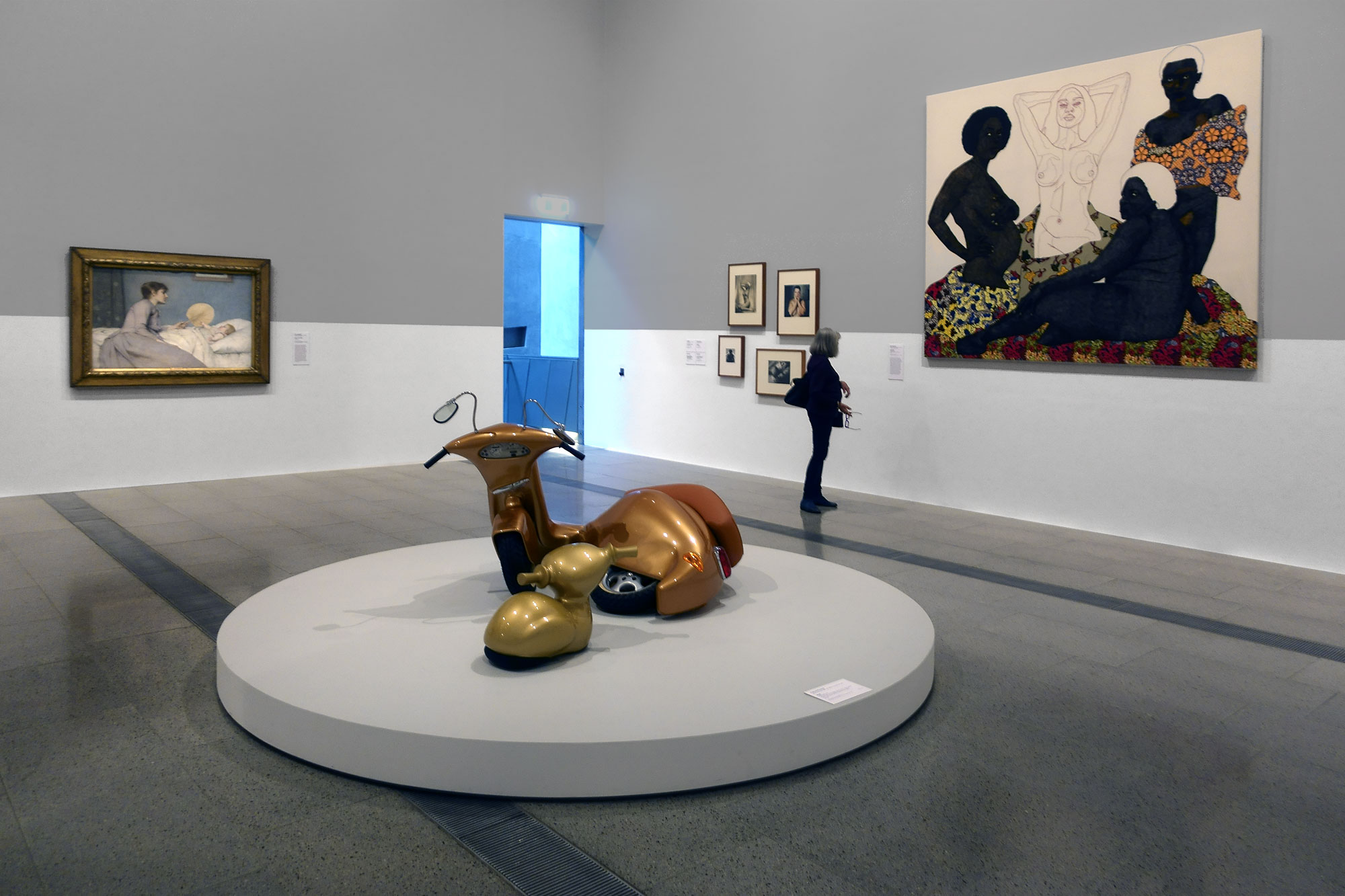
 

Installation view of the exhibition 'WHO ARE YOU: Australian Portraiture' at NGV Australia, Federation Square, Melbourne showing at left, John Longstaff's 'The young mother' (1891); at centre Patricia Piccinini's 'Nest' (2006); at second right, a group of four photographs one by each of Jack Cato, Virginie Grange, Olive Cotton and Athol Shmith; and at right Pierre Mukeba's 'Impartiality' (2018)


Installation view of the exhibition WHO ARE YOU: Australian Portraiture at NGV Australia, Federation Square, Melbourne showing at left, John Longstaff’s The young mother (1891, below); at centre Patricia Piccinini’s Nest (2006); at second right, a group of four photographs one by each of Jack Cato, Virginie Grange, Olive Cotton and Athol Shmith (see below); and at right Pierre Mukeba’s Impartiality (2018, above)
Photo: Marcus Bunyan


John Longstaff (Australian, 1861-1941, France and England 1887-1895, England 1901-1920) 'The young mother' 1891 (installation view)


John Longstaff (Australian, 1861-1941, France and England 1887-1895, England 1901-1920)
The young mother (installation view)
1891
Oil on canvas
National Gallery of Victoria, Melbourne
Purchased with funds donated by the NGV Women’s Association, Alan and Mavourneen Cowen, Paula Fox, Ken and Jill Harrison and donors to the John Longstaff Appeal, 2013
Photo: Marcus Bunyan


A gifted student, John Longstaff was awarded the National Gallery School’s inaugural travelling scholarship in 1887. Longstaff and Rosa Louisa (Topsy) Crocker married two months before departing to London in September 1887. An intimate depiction of motherhood, The young mother shows Topsy tenderly waving a palm fan over the outstretched arms of her son, Ralph, who was born in 1890. Topsy appears pale and slim after a long winter spent in their one-room apartment, divided by a curtain into sleeping and eating quarters. The subject of the mother and child has its origins in the depiction of the biblical Madonna and Child, and continued to be a popular subject for nineteenth-century artists recoding their personal and secular experiences with tenderness and conviction.

Wall text rom the exhibition


John Longstaff (Australian, 1861-1941, France and England 1887-1895, England 1901-1920) 'The young mother' 1891 (installation view detail)


John Longstaff (Australian, 1861-1941, France and England 1887-1895, England 1901-1920)
The young mother (installation view detail)
1891
Oil on canvas
National Gallery of Victoria, Melbourne
Purchased with funds donated by the NGV Women’s Association, Alan and Mavourneen Cowen, Paula Fox, Ken and Jill Harrison and donors to the John Longstaff Appeal, 2013
Photo: Marcus Bunyan


Patricia Piccinini (Australian, b. 1965) 'Nest' 2006 (installation view)


Patricia Piccinini (Australian, b. 1965)
Nest (installation view)
2006
Enamel paint on fibreglass, leather, plastic, metal, rubber, mirror, transparent synthetic polymer resin, glass
(a-b) 104.2 × 197.0 × 186.4cm (variable) (installation)
National Gallery of Victoria, Melbourne
Purchased, Victorian Foundation for Living Australian Artists, 2006
Photo: Marcus Bunyan


Patricia Piccinini (Australian, b. 1965) 'Nest' 2006


Patricia Piccinini (Australian, b. 1965)
Nest
2006
Enamel paint on fibreglass, leather, plastic, metal, rubber, mirror, transparent synthetic polymer resin, glass
(a-b) 104.2 × 197.0 × 186.4cm (variable) (installation)
National Gallery of Victoria, Melbourne
Purchased, Victorian Foundation for Living Australian Artists, 2006
© Courtesy of the artist


Installation view of the exhibition 'WHO ARE YOU: Australian Portraiture' at NGV Australia, Federation Square, Melbourne showing at top left, Jack Cato's 'No title (Nude model)' (c. 1928-1932); at top right, Virginie Grange's 'Untitled' (1990); at bottom left, Olive Cotton's 'The photographer’s shadow (Olive Cotton and Max Dupain)' (c. 1935); and at bottom right, Athol Shmith's 'No title (Nude portrait of woman on beanbag)' (1970s)


Installation view of the exhibition WHO ARE YOU: Australian Portraiture at NGV Australia, Federation Square, Melbourne showing at top left, Jack Cato’s No title (Nude model) (c. 1928-1932, below); at top right, Virginie Grange’s Untitled (1990, below); at bottom left, Olive Cotton’s The photographer’s shadow (Olive Cotton and Max Dupain) (c. 1935, below); and at bottom right, Athol Shmith’s No title (Nude portrait of woman on beanbag) (1970s)
Photo: Marcus Bunyan


Jack Cato (Australian, 1889-1971) 'No title (Nude model)' c. 1928-1932


Jack Cato (Australian, 1889-1971)
No title (Nude model)
c. 1928-1932
Gelatin silver photograph
Image and sheet: 44.1 × 33.7cm
Support: 49.1 × 37.8cm
Gallery of Victoria, Melbourne
Presented through the NGV Foundation by John Cato, Fellow, 2005


Virginie Grange (French; Australian, 1969-1990) 'Untitled' 1990


Virginie Grange (French; Australian, 1969-1990)
Untitled
1990
Type C photograph
35.0 × 35.1cm
Gallery of Victoria, Melbourne
Gift of the artist’s family, 1991
© Estate of the artist


Olive Cotton (Australian, 1911 - 2003) 'The photographer's shadow (Olive Cotton and Max Dupain)' c. 1935


Olive Cotton (Australian, 1911-2003)
The photographer’s shadow (Olive Cotton and Max Dupain)
c. 1935
Gelatin silver print
16.6 cm x 15.2cm
National Portrait Gallery, Canberra
Purchased 2010


Olive Cotton (1911-2003) and Max Dupain OBE (1911-1992) were pioneering modernist photographers. Cotton’s lifelong obsession with photography began at age eleven with the gift of a Kodak Box Brownie. She was a childhood friend of Dupain’s and in 1934 she joined his fledgling photographic studio, where she made her best-known work, Teacup Ballet, in about 1935. Throughout the 1930s, Dupain established his reputation with portraiture and advertising work and gained exposure in the lifestyle magazine The Home. Between 1939 and 1941, Dupain and Cotton were married and she photographed him often; her Max After Surfing is frequently cited as one of the most sensuous Australian portrait photographs. While Dupain was on service during World War II Cotton ran his studio, one of very few professional women photographers in Australia. Cotton remarried in 1944 and moved to her husband’s property near Cowra, New South Wales. Although busy with a farm, a family, and a teaching position at the local high school, Cotton continued to take photographs and opened a studio in Cowra in 1964. In the 1950s, Dupain turned increasingly to architectural photography, collaborating with architects and recording projects such as the construction of the Sydney Opera House. Dupain continued to operate his studio on Sydney’s Lower North Shore until he died at the age of 81. Cotton was in her seventies when her work again became the subject of attention. In 1983, she was awarded a Visual Arts Board grant to reprint negatives that she had taken over a period of forty years or more. The resulting retrospective exhibition in Sydney in 1985 drew critical acclaim and has since assured her reputation.

Text from the National Portrait Gallery, Canberra website Nd [Online] Cited 24/06/2022


Athol Shmith (Australian, 1914-1990) 'No title (Nude portrait of woman on beanbag)' 1970s


Athol Shmith (Australian, 1914-1990)
No title (Nude portrait of woman on beanbag)
1970s
Gelatin silver photograph
28.0 × 22.4cm
Gallery of Victoria, Melbourne
Presented through The Art Foundation of Victoria by the Shmith Family, Governor, 1995
© Estate of Athol Shmith


Installation view of the exhibition 'WHO ARE YOU: Australian Portraiture' at NGV Australia, Federation Square, Melbourne with at second left, Danila Vassielieff's 'Young girl (Shirley)' (1937)


Installation view of the exhibition WHO ARE YOU: Australian Portraiture at NGV Australia, Federation Square, Melbourne with at second left, Danila Vassielieff’s Young girl (Shirley) (1937, below)
Photo: Marcus Bunyan


Ruth Hollick (Australian, 1883-1977) 'Janet Armstrong, Woodbury Estate, Deniliquin, New South Wales' c. 1939


Ruth Hollick (Australian, 1883-1977)
Janet Armstrong, Woodbury Estate, Deniliquin, New South Wales
c. 1939
Gelatin silver photograph
21.6 × 28.8cm
National Gallery of Victoria, Melbourne
Gift of Mrs Lucy Crosbie Morrison, 1992
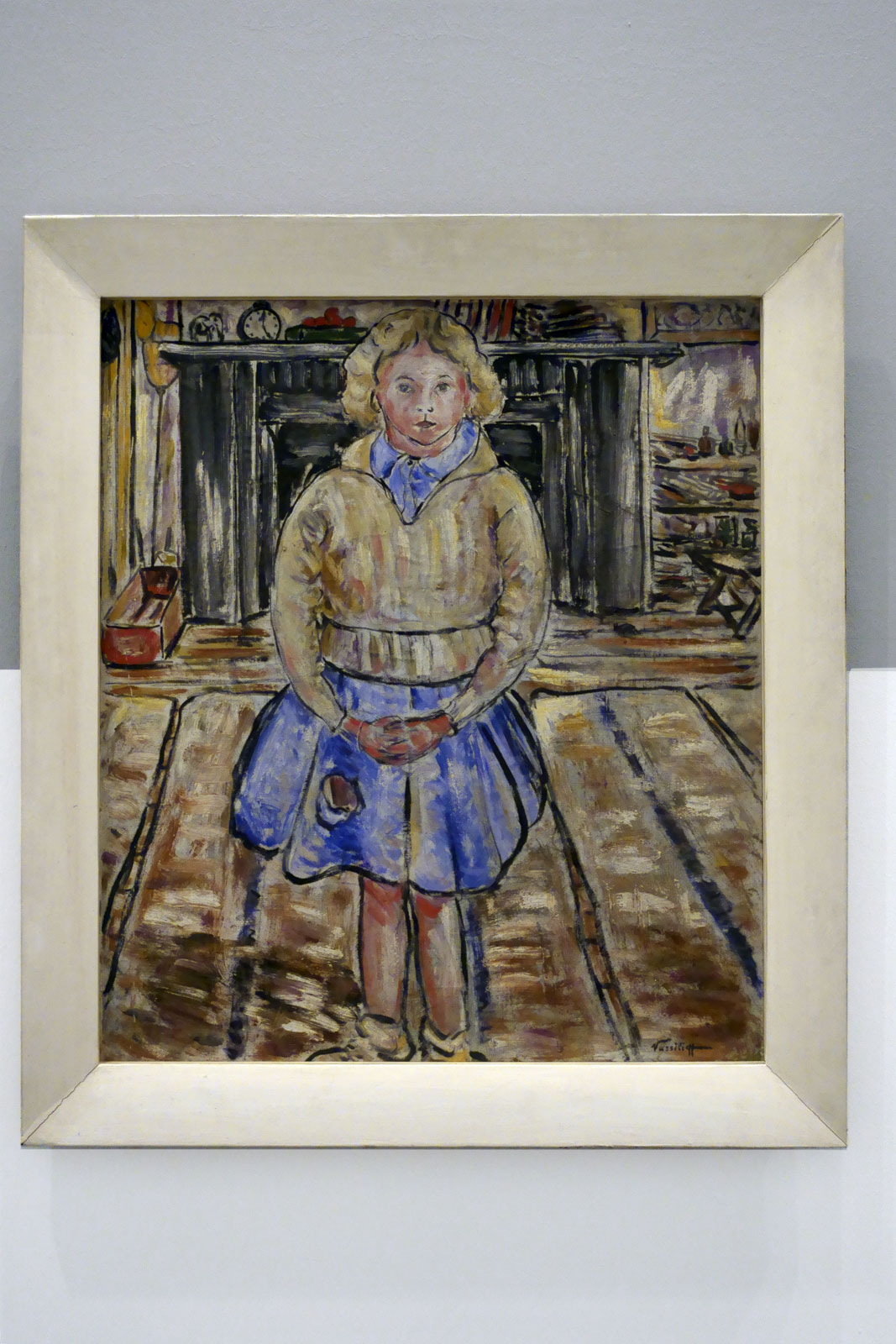
 

Danila Vassilieff (Australian born Russia, 1897-1958, Australia 1923-1929, Central and South America, Europe, England, 1929-1935, Australia from 1935) 'Young girl (Shirley)' 1937 (installation view)


Danila Vassilieff (Australian born Russia, 1897-1958, Australia 1923-1929, Central and South America, Europe, England, 1929-1935, Australia from 1935)
Young girl (Shirley) (installation view)
1937
Oil on canvas on composition board
National Gallery of Victoria, Melbourne
National Gallery Society of Victoria Century Fund, 1984
Photo: Marcus Bunyan
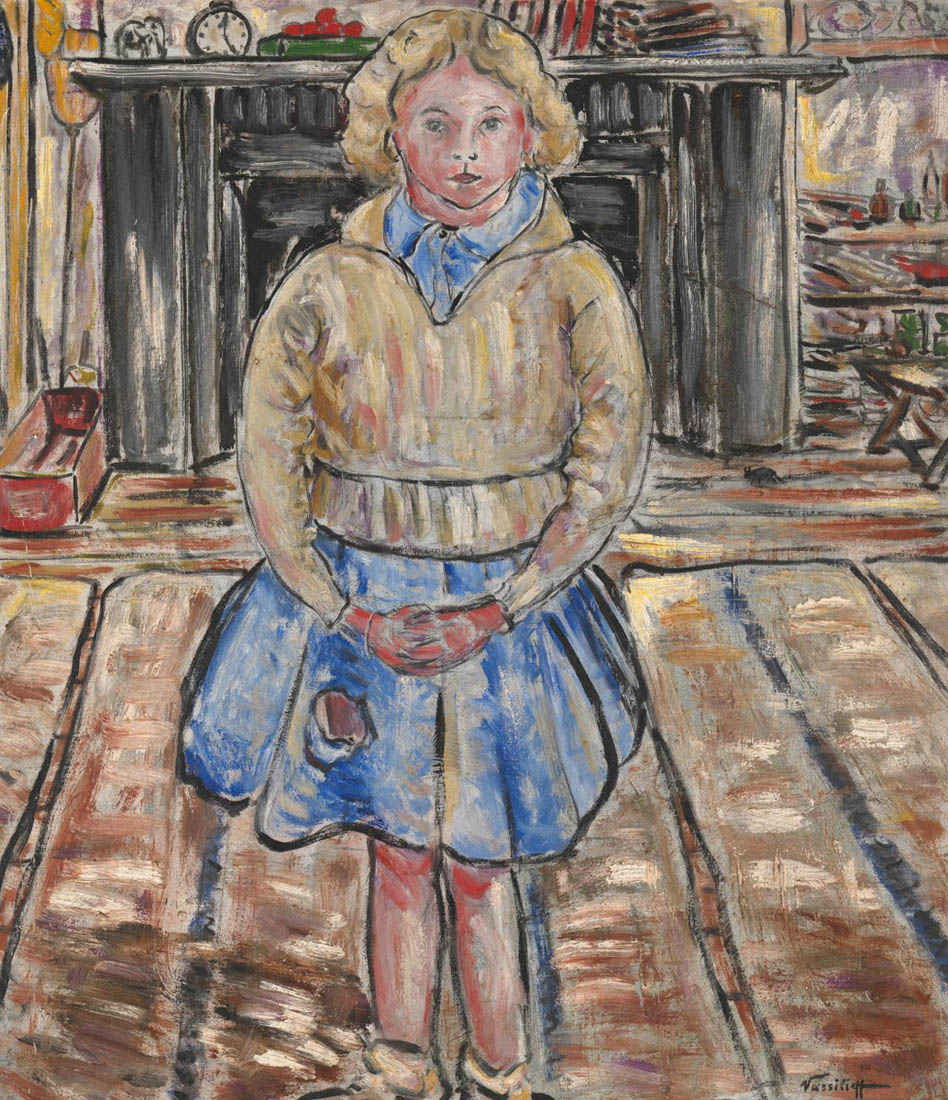
 

Danila Vassilieff (Australian born Russia, 1897-1958, Australia 1923-1929, Central and South America, Europe, England, 1929-1935, Australia from 1935) 'Young girl (Shirley)' 1937


Danila Vassilieff (Australian born Russia, 1897-1958, Australia 1923-1929, Central and South America, Europe, England, 1929-1935, Australia from 1935)
Young girl (Shirley)
1937
Oil on canvas on composition board
National Gallery of Victoria, Melbourne
National Gallery Society of Victoria Century Fund, 1984


Grace Cossington Smith (Australian, 1892-1984) 'Boys drawing' c. 1926-1927 (installation view)


Grace Cossington Smith (Australian, 1892-1984)
Boys drawing (installation view)
c. 1926-1927
Oil on plywood
National Gallery of Victoria, Melbourne
Purchased through The Art Foundation of Victoria with the assistance of the Marjorie Webster Memorial, Governor, 1983
© Estate of Grace Cossington Smith
Photo: Marcus Bunyan


Grace Cossington Smith (Australian, 1892-1984) 'Boys drawing' c. 1926-1927


Grace Cossington Smith (Australian, 1892-1984)
Boys drawing
c. 1926-1927
Oil on plywood
National Gallery of Victoria, Melbourne
Purchased through The Art Foundation of Victoria with the assistance of the Marjorie Webster Memorial, Governor, 1983
© Estate of Grace Cossington Smith


The 1920s saw the advancement of modernism in Australia, due in large part to the dedication of women artists such as Grace Cossington Smith to work in modern styles. Celebrated for her iconic urban images and luminous interiors, Cossington Smith first studied with Antonio Dattilo Rubbo in Sydney, and between 912 and 1914, she toured Germany and England with her family. Following her return to Rubbo’s school, Cossington Smith starting producing work in a cutting-edge Post-Impressionistic style. For several years Cossington Smith worked as a part-time teacher at Turramurra College, a day and boarding school for boys. During this period she developed a painting technique based on the idea that vibrations emanating from colour expressed a spiritual condition as well as optical movement.

Wall text rom the exhibition
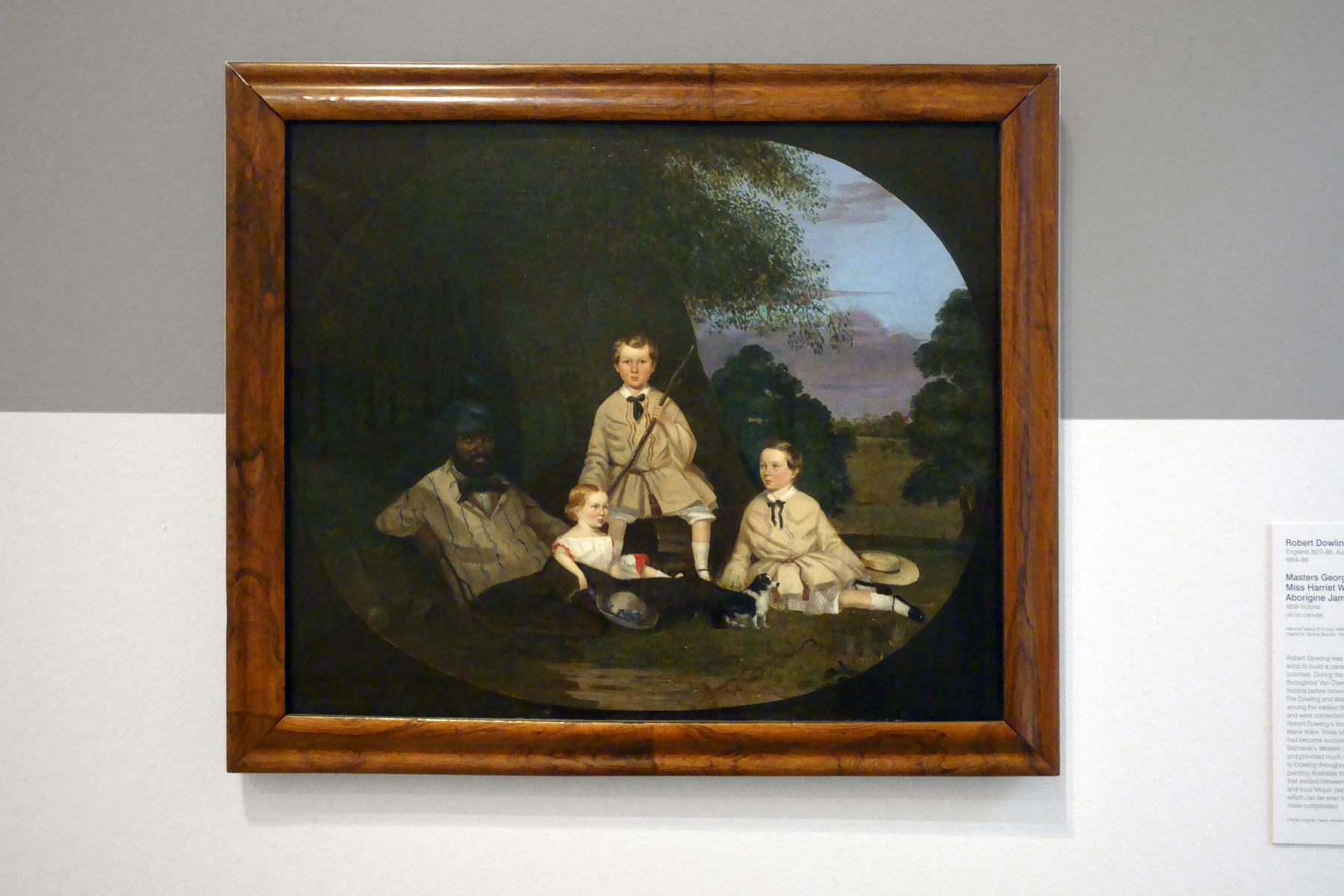
 

Robert Dowling (England 1827-1886, Australia 1834-1857, 1884-1886) 'Masters George, William and Miss Harriet Ware with the Aborigine Jamie Ware' 1856 (installation view)


Robert Dowling (England 1827-1886, Australia 1834-1857, 1884-1886)
Masters George, William and Miss Harriet Ware with the Aborigine Jamie Ware (installation view)
1856
Oil on canvas
63.7 × 76.4cm
National Gallery of Victoria, Melbourne
Eleanor M. Borrow Bequest, 2007
Photo: Marcus Bunyan


Robert Dowling (England 1827-86, Australia 1834-57, 1884-86) 'Masters George, William and Miss Harriet Ware with the Aborigine Jamie Ware' 1856


Robert Dowling (England 1827-1886, Australia 1834-1857, 1884-1886)
Masters George, William and Miss Harriet Ware with the Aborigine Jamie Ware
1856
Oil on canvas
63.7 × 76.4cm
National Gallery of Victoria, Melbourne
Eleanor M. Borrow Bequest, 2007


Installation view of the exhibition 'WHO ARE YOU: Australian Portraiture' at NGV Australia, Federation Square, Melbourne with at left, E. Phillips Fox's 'Dolly, daughter of Hammond Clegg Esq.' (1896); at second left, Nora Heysen's 'Self portrait' (1934); and at third right, Florence Fuller's 'Paper Boy' (1888)


Installation view of the exhibition WHO ARE YOU: Australian Portraiture at NGV Australia, Federation Square, Melbourne with at left, E. Phillips Fox’s Dolly, daughter of Hammond Clegg Esq. (1896, below); at second left, Nora Heysen’s Self portrait (1934, below); and at third right, Florence Fuller’s Paper Boy (1888, below)
Photo: Marcus Bunyan


Nora Heysen (Australian, 1911-2003, lived in England and Italy 1934-1937) 'Self portrait' 1934


Nora Heysen (Australian, 1911-2003, lived in England and Italy 1934-1937)
Self portrait
1934
Oil on canvas
43.1 x 36.3cm
National Portrait Gallery, Canberra
Purchased 1999
© Lou Klepac


Florence Fuller (Australian born South Africa, 1867-1946, Australia from 1868) '(Paper boy)' 1888 (installation view)


Florence Fuller (Australian born South Africa, 1867-1946, Australia from 1868)
(Paper boy) (installation view)
1888
Oil on canvas
61.2 × 45.5cm
National Gallery of Victoria, Melbourne
Gift of Krystyna Campbell-Pretty AM and Family through the Australian Government’s Cultural Gifts Program, 2020
Photo: Marcus Bunyan


Paper boys were prominent part of street life in nineteenth-century Melbourne. Mostly from disadvantaged circumstances, boys as young as eight would work long hours selling newspapers on the city’s streets, many supporting single mothers or siblings, or working to survive independently. The boys were exposed to crime and exploitation, and were seen as hardened and cheeky, yet Florence Fuller’s portrait is sensitive and nuanced. Her work is often focused on those living in poverty, which provides insight into Melbourne’s social diversity. Fuller worked as a professional artist throughout her life – encouraged by her parents and her uncle, artist Robert Dowling – and exhibited at the Paris Salon and the Royal Academy, London.

Wall text rom the exhibition


Josephine Muntz Adams (Australian, 1862-1950) 'Italian girl's head' 1913 (installation view)


Josephine Muntz Adams (Australian, 1862-1950)
Italian girl’s head (installation view)
1913
Oil on canvas
51.0 × 42.9cm
National Gallery of Victoria, Melbourne
Felton Bequest, 1936
Photo: Marcus Bunyan


Josephine Muntz Adams (Australian, 1862-1950) 'Italian girl's head' 1913


Josephine Muntz Adams (Australian, 1862-1950)
Italian girl’s head
1913
Oil on canvas
51.0 × 42.9cm
National Gallery of Victoria, Melbourne
Felton Bequest, 1936


Installation view of the exhibition 'WHO ARE YOU: Australian Portraiture' at NGV Australia, Federation Square, Melbourne showing the work of Simon Obarzanek from his series '80 Faces' (2002)


Installation view of the exhibition WHO ARE YOU: Australian Portraiture at NGV Australia, Federation Square, Melbourne showing the work of Simon Obarzanek from his series 80 Faces (2002, below)
Photo: Marcus Bunyan


Simon Obarzanek (Australian born Israel, b. 1968, United States 1995-2001) 'Untitled (80 faces) #78' 2002


Simon Obarzanek (Australian born Israel, b. 1968, United States 1995-2001)
Untitled (80 faces) #78
2002
Gelatin silver photograph
Gallery of Victoria, Melbourne
Gift of the artist through the Australian Government’s Cultural Gifts Program, 2013
© Simon Obarzanek


The black and white photographs from Simon Obarzanek’s 80 Faces series show frontal portraits of teenagers, captured from the shoulders up with a consistent, neutral backdrop. The sitters are all aged between fourteen and seventeen, the majority from Victoria’s state schools. When capturing their image, the artist only spends five minutes with each sitter, and discusses nothing about their life. In this body of work, Obarzanek explores the idea that the identity or appearance of an individual sitter reveals something new to the audience when viewed as part of a series.

Wall text rom the exhibition
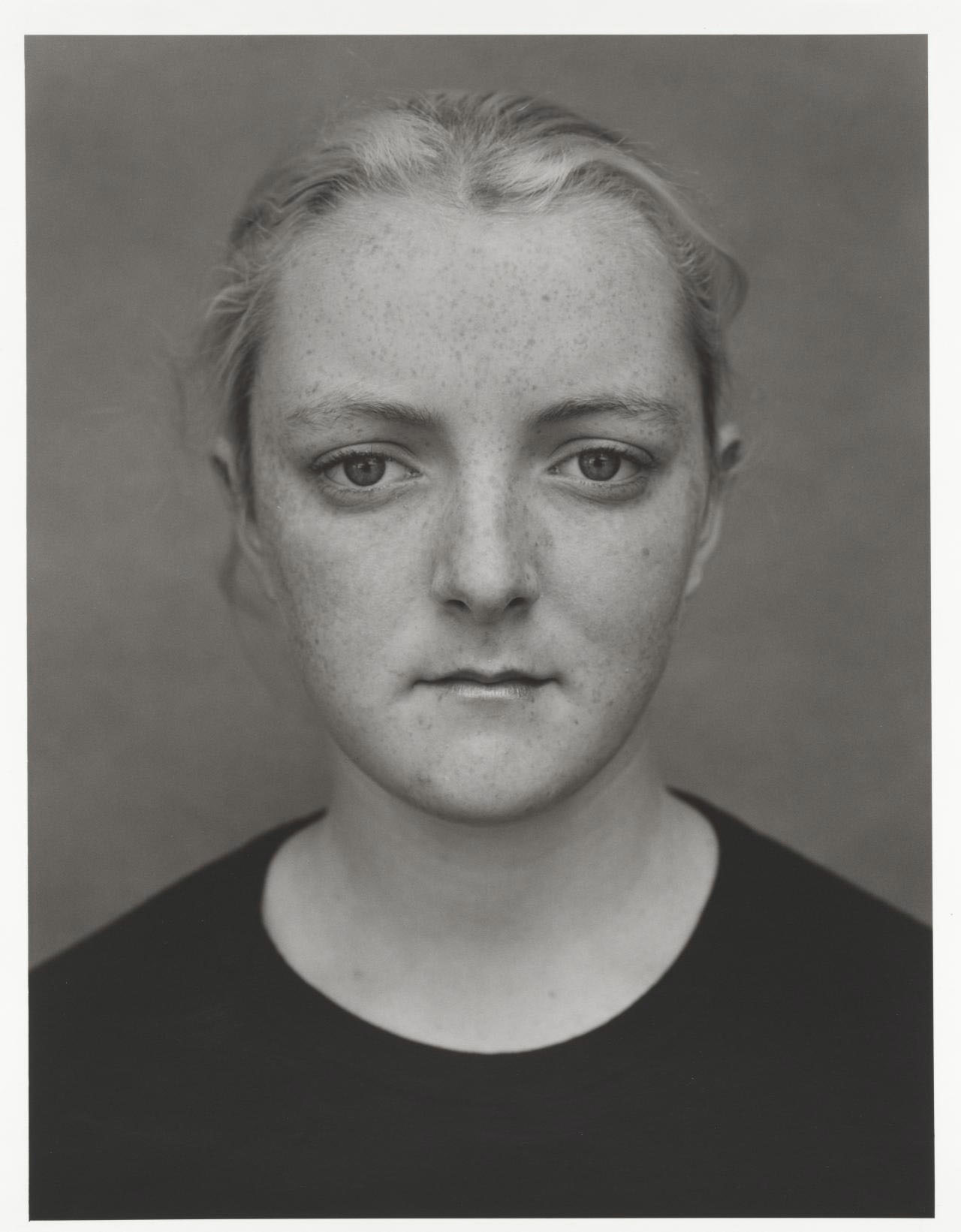
 

Simon Obarzanek (Australian born Israel, b. 1968, United States 1995-2001) 'Untitled (80 faces) #59' 2002


Simon Obarzanek (Australian born Israel, b. 1968, United States 1995-2001)
Untitled (80 faces) #59
2002
Gelatin silver photograph
Gallery of Victoria, Melbourne
Gift of the artist through the Australian Government’s Cultural Gifts Program, 2013
© Simon Obarzanek
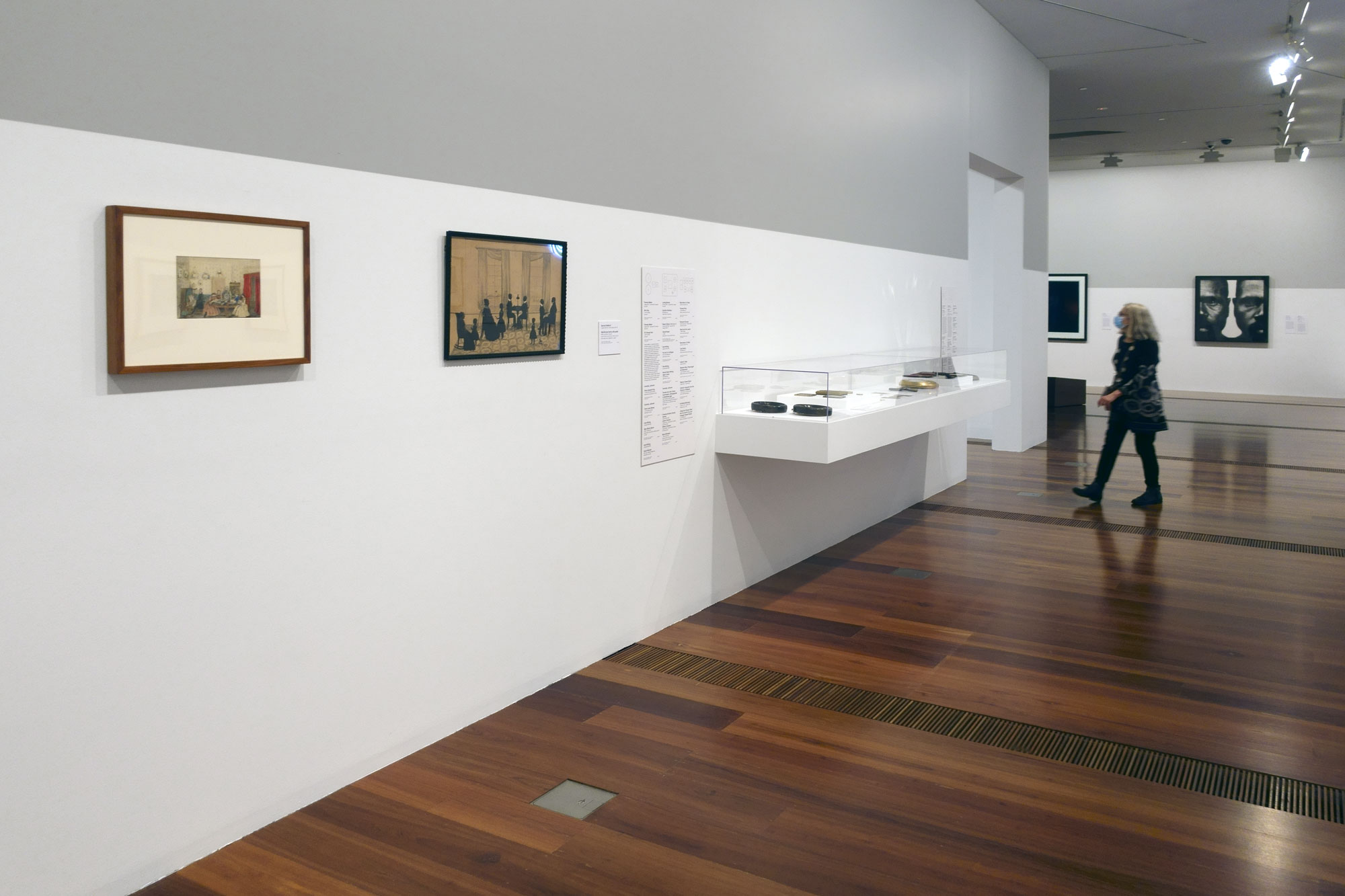
 

Installation view of the exhibition 'WHO ARE YOU: Australian Portraiture' at NGV Australia, Federation Square, Melbourne showing at left, Maria Brownrigg's 'An evening at Yarra Cottage, Port Stephens' (1857); and at second left, Samuel Metford's 'MacKenzie family silhouette' (1846)


Installation view of the exhibition WHO ARE YOU: Australian Portraiture at NGV Australia, Federation Square, Melbourne showing at left, Maria Brownrigg’s An evening at Yarra Cottage, Port Stephens (1857, below); and at second left, Samuel Metford’s MacKenzie family silhouette (1846, below)
Photo: Marcus Bunyan


Maria Brownrigg (Australian born Ireland 1812-1880, South Africa date unknown - c. 1852, Australia from 1852) 'An evening at Yarra Cottage, Port Stephens' 1857 (installation view)


Maria Brownrigg (Australian born Ireland 1812-1880, South Africa date unknown – c. 1852, Australia from 1852)
An evening at Yarra Cottage, Port Stephens (installation view)
1857
Watercolour and collage on paper
National Portrait Gallery, Canberra
Purchased, 2017
Photo: Marcus Bunyan


Maria Brownrigg (Australian born Ireland 1812-1880, South Africa date unknown - c. 1852, Australia from 1852) 'An evening at Yarra Cottage, Port Stephens' 1857


Maria Brownrigg (Australian born Ireland 1812-1880, South Africa date unknown – c. 1852, Australia from 1852)
An evening at Yarra Cottage, Port Stephens
1857
Watercolour and collage on paper
National Portrait Gallery, Canberra
Purchased, 2017


Maria Caroline Brownrigg came to New South Wales in 1852, when her husband was appointed superintendent of the Australian Agricultural Company’s operations in the Hunter River district. The family lived at Stroud and subsequently at Port Stephens, where Brownrigg made this portrait of her six children. It is the only known example of Brownrigg’s work. Though ‘amateur’, it is valuable to decorative arts and social historians, for its detailed documentation of an appropriately conducted mid nineteenth-century drawing room, and for what it reveals about Victorian gender ideals and aspirations to gentility.

Wall text rom the exhibition


Samuel Metford (England 1810-1890, lived in United States 1834-1844) 'MacKenzie family silhouette' 1846


Samuel Metford (England 1810-1890, lived in United States 1834-1844)
MacKenzie family silhouette
1846
Brush and ink, pen and ink, stencil cutout with watercolour highlights on paper
43.2 x 64.0cm
National Portrait Gallery, Canberra
Gift of the Estate of Nancy Wiseman


Samuel Metford was born in Glastonbury, into a Quaker family. In England he came to specialise in full-length silhouette likenesses, cut from black paper and embellished with gold and white paint. According to the standard text on British silhouettes, Metford made ‘some very fine family groups – Father and Mother surrounded by their children and pets, with hand-painted backgrounds of imposing rooms whose tall windows looked out on wide landscapes, or a seascape with a tall-funnelled steamship in a prominent position.’ Metford moved to America in about 1834, and spent some ten years there, working mostly in Connecticut but also in New York and South Carolina. He returned to England in the early 1840s, and lived there for the rest of his life, although he revisited America in 1869 and 1867. He died at Weston-Super-Mare.

Samuel Metford (1810-1896), specialised in full-length silhouette likenesses on hand-painted watercolour backgrounds, sometimes embellished with gold and white paint or featuring gentrified interiors. Born in Glastonbury, Somerset, he received tuition from French silhouette artist Augustin Edouart, before going to America and working for the next ten years in New York, Philadelphia and Boston. His return to England in the mid-1840s coincided with the downturn in demand for profile portraits occasioned by photography which, by the 1860s, had rendered art forms such as the silhouette passé. This silhouette depicts the family of Francis MacKenzie (1806-1851, seated far right) at Adlington Hall in Standish, Lancashire. Following Francis MacKenzie’s death, his widow, Maria (1810-1874, third from left) emigrated to Australia with her five children. Maria’s eldest son, John (1833-1917, seated, left, at the table), was Examiner of Coalfields in the Illawarra from 1863 and 1865, later becoming Examiner of Coalfields for NSW. Her sons Walter (1835-1886, seated, right, at the table) and Kenneth (d. 1903) are thought to have become clergymen. Her youngest daughter, Maria (1842-1917, second from left), married a doctor, Alexander Morson, in 1875. Another daughter, Caroline (1837-1922, fourth from left), remained unmarried and died at the family property near Dapto in 1922. Other sitters shown in the silhouette are Maria’s mother, Mrs Thomas Edwards (far left); and her youngest child, William, who died, aged six, in 1851. Maria MacKenzie died at Wallerawang in New South Wales in 1874. The silhouette was bequeathed to the Gallery by her great-grandaughter in 2007.

Text from the National Portrait Gallery, Canberra website updated 2018 [Online] Cited 28/06/2022


Installation view of the exhibition 'WHO ARE YOU: Australian Portraiture' at NGV Australia, Federation Square, Melbourne showing by unknown artists – at left, Anna Josepha King (c. 1826-1832); and at right, Fanny Jane Marlay (c. 1841)


Installation view of the exhibition WHO ARE YOU: Australian Portraiture at NGV Australia, Federation Square, Melbourne showing by unknown artists – at left, Anna Josepha King (c. 1826-1832, below); and at right, Fanny Jane Marlay (c. 1841, below)
Photo: Marcus Bunyan


Unknown artist. 'Anna Josepha King' c. 1826-1832


Unknown artist (Australia)
Anna Josepha King
c. 1826-1832
watercolour and gouache on ivory
Frame: 9.7 cm x 8.3cm
Sheet: 8.5 cm x 6.5cm
Image: 7.0 cm x 5.7cm
National Portrait Gallery, Canberra
Purchased 2018


Before the early 1840s, when photography began to take hold, portrait miniatures were a favoured means by which people might secure tangible and enduring mementos of their loved ones. Typically executed in watercolour on panels of ivory and contained in petite frames or mounted in pendants, brooches, rings, and lockets, miniatures were designed to be clutched, kissed, carried close to the heart or displayed on a bedside table. Many early Australian colonists brought British-made miniatures with them, but increasing numbers of free settlers from the 1820s onwards soon created demand for miniatures by local, readily-available artists.

Text from the National Portrait Gallery, Canberra website Nd [Online] Cited 28/06/2022


Unknown artist. 'Fanny Jane Marlay' c. 1841


Unknown artist (Australia)
Fanny Jane Marlay
c. 1841
watercolour on ivory
Frame: 7.5 cm x 6.3cm
National Portrait Gallery, Canberra
Purchased 2013


Fanny Jane Marlay (1819-1848) came to Sydney with her free-settler family around 1825. In 1838, she met John Lort Stokes (1812-1885), an explorer, naval officer and surveyor appointed to HMS Beagle, which was then engaged in a surveying voyage of the Australian coast. In the course of it, Stokes charted much of what is now the coast of the Northern Territory; gave Darwin its name (after his former shipmate, Charles Darwin); and surveyed the Gulf of Carpentaria, the Arafura Sea, the Torres Strait, the Western Australian coast, and Bass Strait. He and Fanny married in Sydney in January 1841. Later the same year, Stoke succeeded to the command of the Beagle. Their daughter was born in 1842. Fanny returned with Stokes to England in 1843 and died while en route to Sydney again in 1848. Back in England from 1851, Stokes was eventually promoted to admiral. He died at his home, Scotchwell, in Pembrokeshire, in June 1885, survived by his second wife, Louisa, whom he’d married in 1856, and by his daughter from his marriage to Fanny.

Text from the National Portrait Gallery, Canberra website Nd [Online] Cited 28/06/2022


Installation view of the exhibition 'WHO ARE YOU: Australian Portraiture' at NGV Australia, Federation Square, Melbourne


Installation view of the exhibition WHO ARE YOU: Australian Portraiture at NGV Australia, Federation Square, Melbourne
Photo: Marcus Bunyan
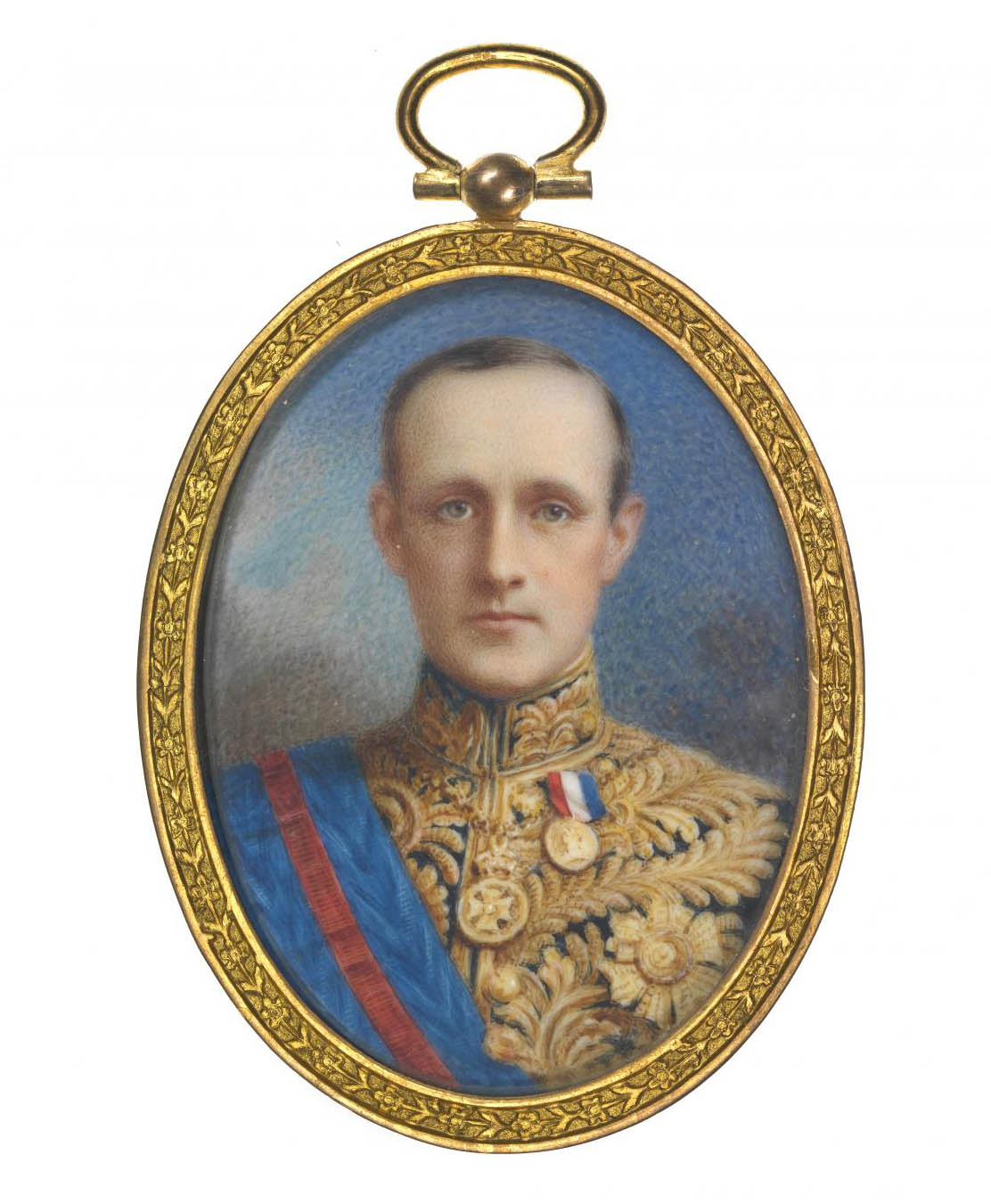
 

Ada Whiting (Australian, 1859-1953) 'The Earl of Linlithgow' 1901


Ada Whiting (Australian, 1859-1953)
The Earl of Linlithgow
1901
Watercolour on ivory
6.6 × 5.0cm
National Gallery of Victoria, Melbourne
Gift of Mrs Violet Whiting, 1989
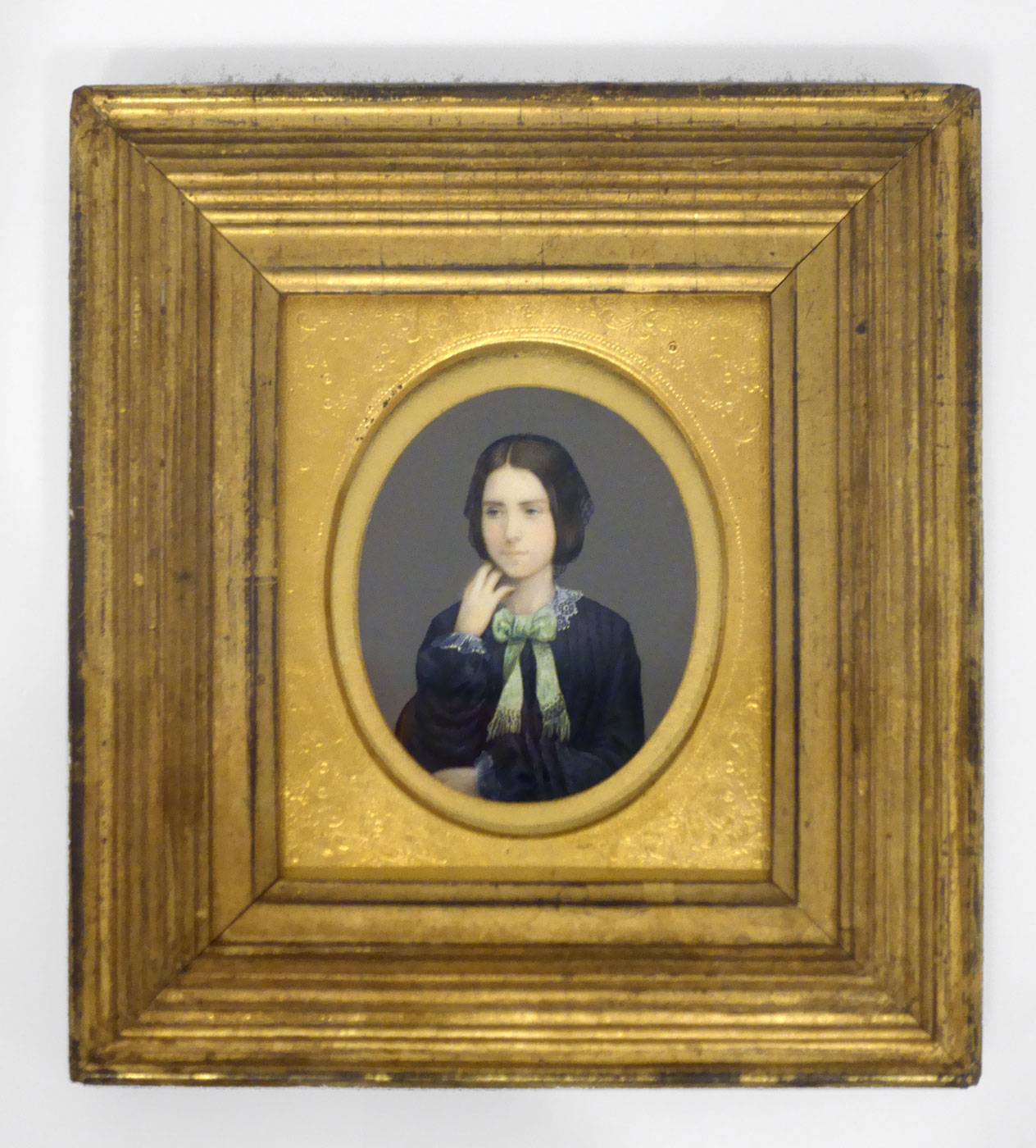
 

Ludwig Becker (Australian born Germany, 1808-1861) 'Caroline Davidson' 1854 (installation view)


Ludwig Becker (Australian born Germany, 1808-1861)
Caroline Davidson (installation view)
1854
Watercolour on fictile ivory
Image: 5.7 × 4.6cm
National Gallery of Victoria, Melbourne
Purchased, 1996
Photo: Marcus Bunyan


Unknown artist (Australia) 'Thomas and John Clarke, bushrangers, photographed in Braidwood gaol' 1867


Unknown artist (Australia)
Thomas and John Clarke, bushrangers, photographed in Braidwood gaol
1867
Albumen silver photograph laid down on a section cut from a nineteenth-century album page
National Portrait Gallery, Canberra
Purchased, 2019


John (c. 1846-1867) (left) and Thomas Clarke (c. 1840-1867), bushrangers, grew up near Braidwood and from a young age were schooled in nefarious activities including horse-theft. John was 17 when he first went to prison and Thomas was purported to have ridden with the infamous Ben Hall. In October 1865, Thomas escaped from gaol while awaiting trial for armed robbery; thereafter, aided by various mates, he embarked on a string of depredations around Braidwood, Araluen and further south. In April 1866, at Nerrigundah, the gang engaged in a hold-up that left a policeman dead. Thomas was outlawed in May, by which time John had joined him. Reports described them as ‘well-mounted, and armed to the teeth’. In September 1866 colonial secretary Henry Parkes sent four special constables to Braidwood ‘for the express purpose of hunting down the desperate marauders’. In January 1867, the four were murdered in an ambush at Jinden. The Clarkes were blamed immediately and the authorities offered rewards of £1000 each, alive or dead. Aided by an effective bush telegraph system, the brothers evaded capture until April 1867, when they were tracked to a hideout near Araluen, apprehended, and taken to Braidwood Gaol. There, an as yet unidentified photographer took portraits that were sold by a Goulburn bookseller for two shillings and sixpence each. The brothers were later tried in Sydney before Sir Alfred Stephen, who in sentencing them to death noted the more than 60 offences, excluding murders, of which they were suspected.

Text from the National Portrait Gallery, Canberra website Nd [Online] Cited 28/06/2022


Installation view of the exhibition 'WHO ARE YOU: Australian Portraiture' at NGV Australia, Federation Square, Melbourne showing a selction of cartes de visite: at top left, Freeman Brothers Studio, Sydney (Australia 1854-1900) 'Maria Windeyer' (c. 1865-1868); at second left top, Batchelder & O'Neill (Australia active 1857-1863) 'Frances Perry' (c. 1863); at second right top, Townsend Duryea (Australian born America, 1823-1888) 'Sarah and Ann Jacob' c. 1866; at top right, Batchelder & O’Neill (Australia active 1857-1863) 'Lady Barkly' (1863); at bottom left, James E. Bray (Australia 1832-1891) 'Madame Sibly, Phrenologist and Mesmerist' (c. 1870); at centre bottom, Stephen Edward Nixon (England 1842 - Australia 1910) 'Catholic clergymen from the Diocese of Adelaide' (c. 1862); and at bottom right, Archibald McDonald (Canada c. 1831 - Australia 1873, Australia from c. 1847) 'Chang the Chinese Giant with his wife Kin Foo and manager Edward Parlett' (c. 1871)


Installation view of the exhibition WHO ARE YOU: Australian Portraiture at NGV Australia, Federation Square, Melbourne showing a selction of cartes de visite: at top left, Freeman Brothers Studio, Sydney (Australia 1854-1900) Maria Windeyer (c. 1865-1868); at second left top, Batchelder & O’Neill (Australia active 1857-1863) Frances Perry (c. 1863); at second right top, Townsend Duryea (Australian born America, 1823-1888) Sarah and Ann Jacob c. 1866; at top right, Batchelder & O’Neill (Australia active 1857-1863) Lady Barkly (1863); at bottom left, James E. Bray (Australia 1832-1891) Madame Sibly, Phrenologist and Mesmerist (c. 1870); at centre bottom, Stephen Edward Nixon (England 1842 – Australia 1910) Catholic clergymen from the Diocese of Adelaide (c. 1862); and at bottom right, Archibald McDonald (Canada c. 1831 – Australia 1873, Australia from c. 1847) Chang the Chinese Giant with his wife Kin Foo and manager Edward Parlett (c. 1871)
Photo: Marcus Bunyan


James E. Bray (Australia, 1832-1891) 'Madame Sibly, Phrenologist and Mesmerist' c. 1870


James E. Bray (Australia, 1832-1891)
Madame Sibly, Phrenologist and Mesmerist
c. 1870
albumen silver carte de visite photograph
Mount: 10.1 cm x 6.2cm
Image: 9.4 cm x 5.5cm
National Portrait Gallery, Canberra
Purchased, 2017


Marie Sibly (c. 1830-1894), mesmerist and phrenologist, performed in towns throughout Australia for nearly twenty years. Purportedly French-born, she arrived in Sydney around 1867 and worked as a clairvoyant, making her first stage appearances in 1868. By 1871 she was in Melbourne, ‘manipulating heads’ for packed houses at Weston’s Opera House on Bourke Street before embarking on a tour of Victoria. Through the 1870s she toured New South Wales and Queensland, her shows incorporating séances, phrenological readings and hypnotisms whereby audiences members were induced to fight, dance, sing or behave absurdly. A report of one performance described how she convinced two men to fetch a leg of lamb from the butcher; she then made them think they were dogs and they ate it. Her later repertoire included ‘baby exhibitions’ in which prizes were awarded to the specimens with the best mental and physical capacity. She took up land at Parkes in 1877 but continued touring regardless. By the mid-1880s she was in New South Wales again, performing with her daughter, ‘Zel the Magnetic Lady’, and advertising her range of remedies for conditions such as gout, rheumatism and neuralgia. She was known by various names throughout her career although it is unclear how many husbands she had. Having ‘retired from the platform’ she ran a store at Drake, near Tenterfield, where she died in April 1894.

James E Bray ran a business called the ‘Prince of Wales Photographic Gallery’ on George Street, Sydney, which was sold in late 1865. He then went to Victoria, and by early 1868 was reported as ‘having an extensive gallery built at his place of business, Camp Street, Beechworth’. There, he was enabled to ‘execute Every Variety of Photographic Portraiture’, including ‘Cartes de Viste, Tinted or Fully Colored in Water Colors’. He appears to have stocked portraits of international celebrities (such as the conman Arthur Orton, aka The Tichborne Claimant) in addition to taking likenesses for local citizens. Notably, he was among the photographers who documented the Kelly gang and their off-shoots: such as the 22 men of Irish descent who were banged up in Beechworth Gaol for four months without charge in 1879 on the off-chance they might be Kelly sympathisers. Another of Bray’s cartes shows constable Alexander Fitzpatrick, whose attempt to arrest Dan Kelly had initiated the gang’s formation in the first place. Marie Sibly performed in the Beechworth area on several occasions during Bray’s time there. Her reading of certain gentlemen’s heads in Eldorado in August 1871 was judged so accurate that it was assumed she’d ‘received some private information about the parties’; and at a séance in Wangaratta that year, ‘a young man, while under mesmeric influence’ had ‘rudely seized’ the wife of another chap, who struck said young man with a stick. In winter 1879 Sibly was in Beechworth, Chiltern, Corowa, Bright and other towns, variously causing offence, sensation or consternation, it seems, wherever she went – and thus becoming a ‘sure card’ for photographers.

Text from the National Portrait Gallery, Canberra website Nd [Online] Cited 28/06/2022


Installation view of the exhibition 'WHO ARE YOU: Australian Portraiture' at NGV Australia, Federation Square, Melbourne


Installation view of the exhibition WHO ARE YOU: Australian Portraiture at NGV Australia, Federation Square, Melbourne
Photo: Marcus Bunyan
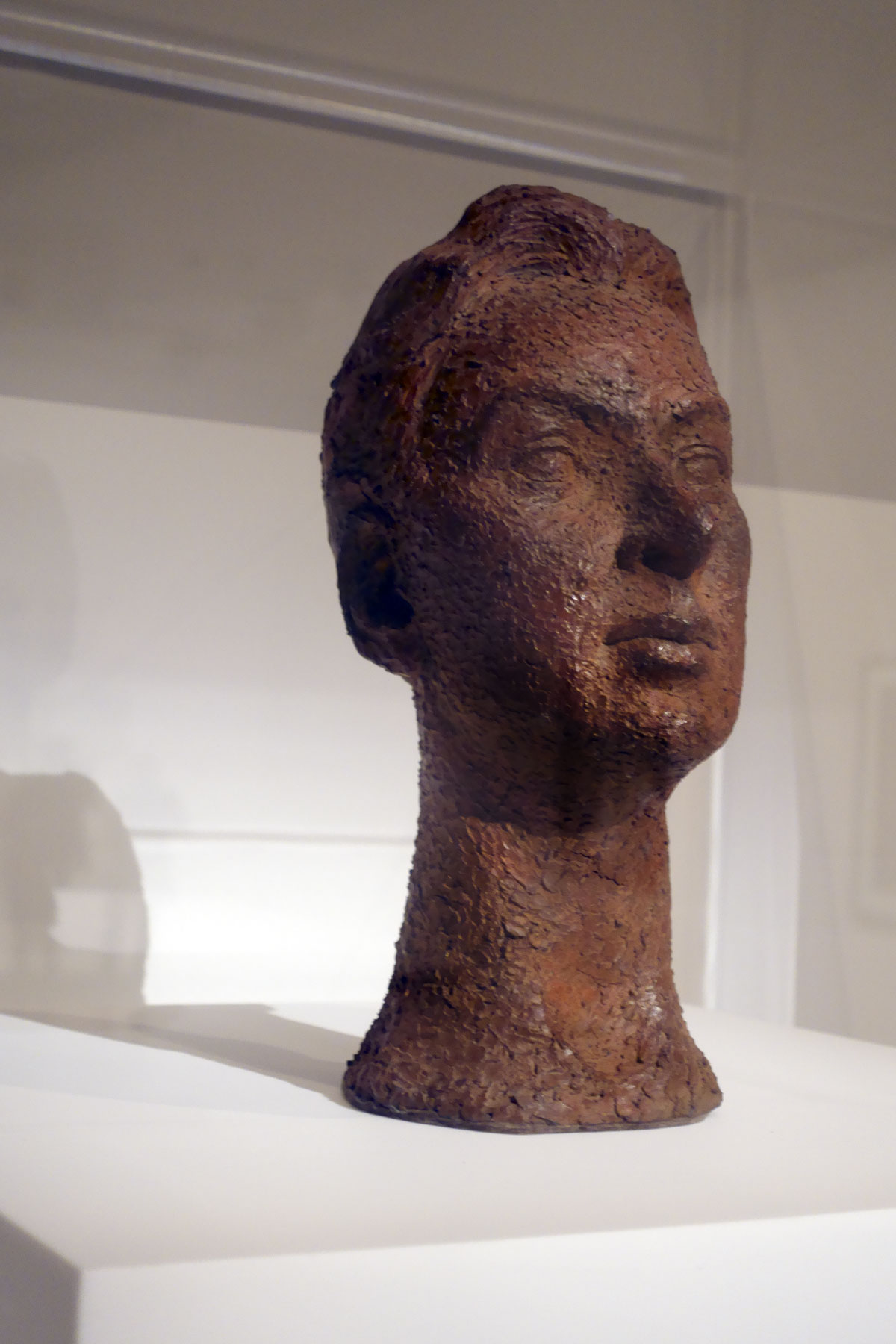
 

Ola Cohn (Australian, 1892-1964) 'Lina' 1958 (installation view)


Ola Cohn (Australian, 1892-1964)
Lina (installation view)
1958
Earthenware
34.4 x 14.9 x 21.0cm
National Gallery of Victoria, Melbourne
Gift of Mrs Lina Bryans, 1969
© Centre for Adult Education & Box Hill Institute
Photo: Marcus Bunyan


Ola Cohn (Australian, 1892-1964) 'Lina' 1958


Ola Cohn (Australian, 1892-1964)
Lina
1958
Earthenware
34.4 x 14.9 x 21.0cm
National Gallery of Victoria, Melbourne
Gift of Mrs Lina Bryans, 1969
© Centre for Adult Education & Box Hill Institute


Ah Xian (Australian born China, b. 1960) 'Dr John Yu' 2004 (installation view)


Ah Xian (Australian born China, b. 1960)
Dr John Yu (installation view)
2004
Glazed ceramic
42.0 x 42.0 depth 31.0cm
Commissioned with funds provided by Marilyn Darling AC 2004
Photo: Marcus Bunyan


Ah Xian came to Australia from Beijing in 1989, having already gained some recognition and experience as an artist here. His application for permanent residency took many years to process, and he worked for a long time as a house painter. He began casting porcelain busts and painting them with traditional Chinese designs in 1997; an artist-in-residency followed, he sold a bust to Sydney’s Powerhouse Museum, and he held his first solo show in Melbourne in 2000. The following year, he won the National Gallery of Australia’s inaugural National Sculpture Prize with his life-size painted cloisonne enamel figure Human human: “Human Human : Lotus Cloisonne Figure 1 (2000-2001)”.

Dr John Yu (b. 1934), retired paediatrician and hospital administrator, was born in Nanking, China and moved to Australia with his parents when he was three years old. Educated in Sydney, from 1961 he worked at the Royal Alexandra Hospital for Children (which became the New Children’s Hospital, Westmead), becoming Head of Medicine and serving as its Chief Executive for 19 years before retiring in 1997. For many years he chaired and served on diverse bodies related to children’s health, education, medicine and the arts. From 2004 he was Chair of VisAsia, promoting appreciation of Asian visual arts and culture. He has published a number of books and many papers on paediatrics, hospital management and the decorative arts. Accepting his Australian of the Year Award in 1996, Yu said, ‘I am proud of my Chinese heritage but even prouder to be an Australian’.

In his celadon bust, Ah Xian depicts Yu life-size with his eyes closed while four colourful miniature children clamber over him. In Chinese tradition, children indicate great prosperity and happiness. As Yu noted: ‘A lot of Chinese sculptures have young children climbing all over the subject. I was really pleased because it related to and reflected on my life work as a paediatrician.’

Text from the National Portrait Gallery, Canberra website updated 2018 [Online] Cited 28/06/2022


Ah Xian celebrates a once-threatened Chinese artisanal tradition of porcelain-ming and decoration. His portraits are a statement of creative freedom and his Chinese-Australian identity, which he shares with his sitter. The mould for this bust was cast in plaster from life – ‘a funny spooky feeling’ according to the subject, who was 1996 Australian of the Year, Dr John Yu. Yu observed of his portrait, ‘people might assume that the first thing that remains me of my heritage is my facial appearance. But it’s not. It’s actually the children … A lot of Chinese sculptures have young children climbing all over the subject. I was really pleased because it related to and reflected on my life work as a paediatrician’.

Wall text rom the exhibition


Ah Xian (Australian born China, b. 1960) 'Dr John Yu' 2004


Ah Xian (Australian born China, b. 1960)
Dr John Yu
2004
Glazed ceramic
42.0 x 42.0 depth 31.0cm
Commissioned with funds provided by Marilyn Darling AC 2004
© Ah Xian


Ricardo Idagi (Australian / Meriam Mir, b. 1957) False Evidence Appearing Real 2012 (installation view)


Ricardo Idagi (Australian / Meriam Mir, b. 1957)
False Evidence Appearing Real (installation view)
2012
Earthenware, under glaze, wood, steel, plastic and glassMeasurements
60.0 × 37.0 × 27.0cm
National Gallery of Victoria, Melbourne
Purchased, Victorian Foundation for Living Australian Artists, 2013
Photo: Marcus Bunyan


Brook Andrew. 'I Split Your Gaze' 1997


Brook Andrew (Australian, b. 1970)
I Split Your Gaze
1997, printed 2005
Gelatin silver photograph
National Gallery of Victoria, Melbourne
Purchased with funds from the Victorian Foundation for Living Australian Artists, 2005


‘I’ve cut the image in half and then reversed it so you can’t actually look at the person straight on. And I suppose that’s what racism is about. It’s about cutting racism down the centre. It’s about cutting differences down the centre. Neither part of the portrait in I split your gaze is whole and in being simultaneously halved and doubled the viewer is forced to stare blankly through the image, rather than making eye contact with the subject. Identity becomes mutable through repetition and we observe the man without really looking at him. The work operates as a metaphor for Australia as a society divided on issues concerning race relations.’ ~ Brook Andrew, 2005

Wall text from the exhibition


Mike Parr (Australian, b. 1945) John Loane (printer) (Australian, b. 1950) '12 untitled self portraits (set 3)' 1990 (installation view)


Mike Parr (Australian, b. 1945)
John Loane (printer) (Australian, b. 1950)
12 untitled self portraits (set 3) (installation view)
1990
Drypoint on 12 sheets of paper, unique state prints on paper
National Portrait Gallery, Canberra
Gift of Sara Kelly 2010. Donated through the Australian Government’s Cultural Gifts Program
Photo: Marcus Bunyan


In the early 1980s Mike Parr embarked no his ‘Self Portrait Project’, exploring representation of the psychological self. An artist who works across live performance, photography, works on paper, sculpture and installation, Parr said: ‘I am constantly finding ways to perform the alienation of likeness’. In this work, Parr’s self-image simultaneously coalesces and violently disintegrates across the drypoint plates. The work’s burrs – jagged edges where the needle has ripped through the metal – record the violence of the printing process. The butts hold more ink, creating the deep black lines and a ferocious visualisation of internal turmoil and chaos.

Wall text from the exhibition
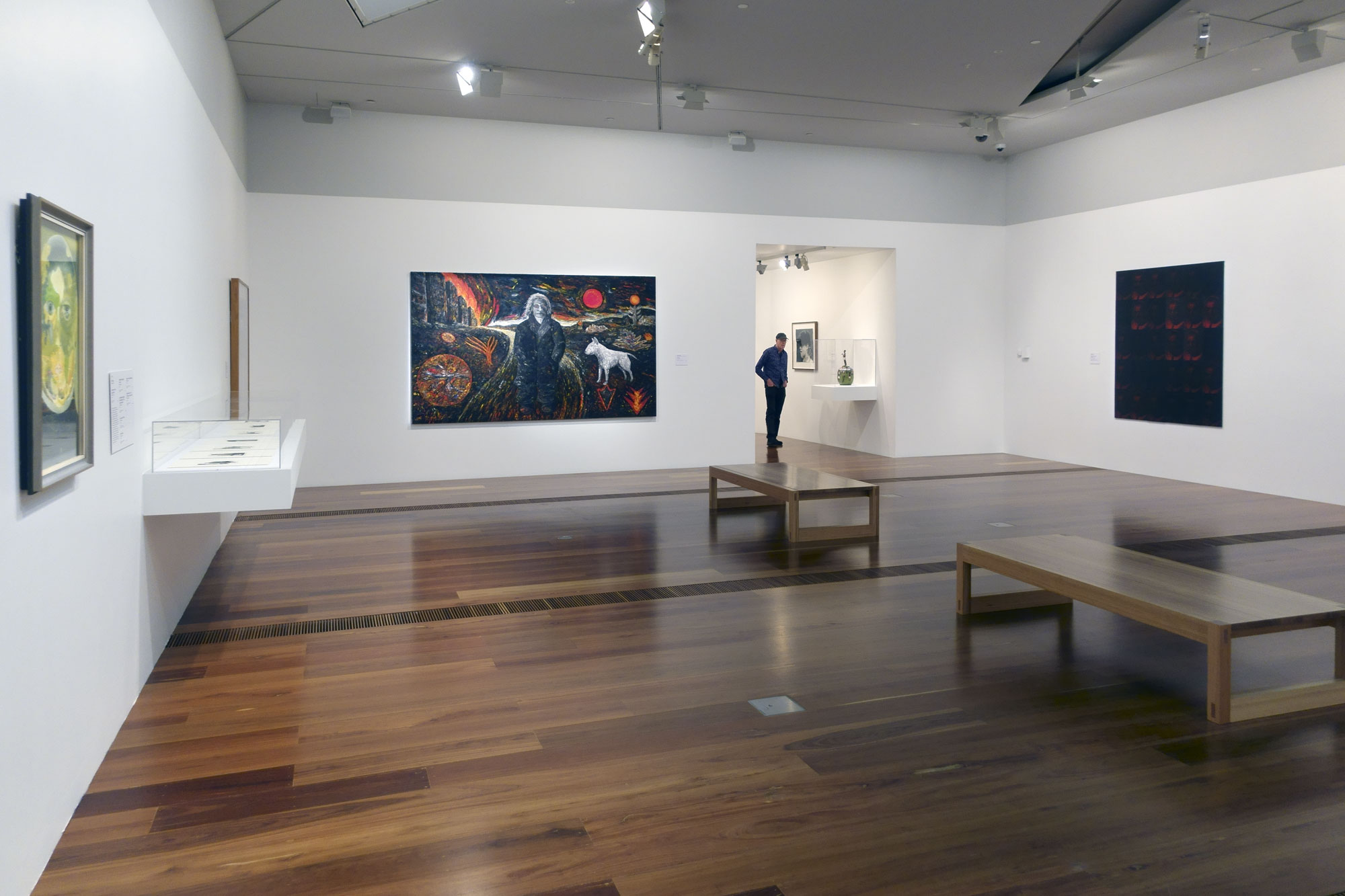
 

Installation view of the exhibition 'WHO ARE YOU: Australian Portraiture' at NGV Australia, Federation Square, Melbourne


Installation view of the exhibition WHO ARE YOU: Australian Portraiture at NGV Australia, Federation Square, Melbourne showing at centre, Peter Booth’s Painting (1977, below)
Photo: Marcus Bunyan


Peter Booth (Australian, b. 1940) 'Painting' 1977


Peter Booth (Australian, b. 1940)
Painting
1977
Oil on canvas
182.5 × 304.0cm
National Gallery of Victoria, Melbourne
Gift of the artist in memory of Les Hawkins, 1978
© Peter Booth/Licensed by Copyright Agency, Australia


Installation view of the exhibition 'WHO ARE YOU: Australian Portraiture' at NGV Australia, Federation Square, Melbourne showing at left, Selina Ou's 'Anita ticket seller' (2002); and at right, Peter Booth's 'Painting' (1977)


Installation view of the exhibition WHO ARE YOU: Australian Portraiture at NGV Australia, Federation Square, Melbourne showing at left, Selina Ou’s Anita ticket seller (2002m below); and at right, Peter Booth’s Painting (1977, above)
Photo: Marcus Bunyan


Selina Ou (Australian born Malaysia, b. 1977) 'Anita ticket seller' 2002, printed 2005


Selina Ou (Australian born Malaysia, b. 1977)
Anita ticket seller
2002, printed 2005
From the Enclosure series 2002
type C photograph
Image: 100.6 × 99.3cm irreg.
Sheet: 126.6 × 119.3cm
National Gallery of Victoria, Melbourne
Purchased with funds arranged by Loti Smorgon for Contemporary Australian Photography, 2005
© Selina Ou, represented by Sophie Gannon Gallery, Melbourne
Photo: Marcus Bunyan


Installation view of the exhibition 'WHO ARE YOU: Australian Portraiture' at NGV Australia, Federation Square, Melbourne showing at second left, Petrina Hicks' 'Lauren' (2003); at third right, Christian Waller's 'Destiny' (1916); at second right, Charles Dennington's 'Adut Akech' (2018); and at right, Tony Kearney's 'Gill Hicks' (2016)


Installation view of the exhibition WHO ARE YOU: Australian Portraiture at NGV Australia, Federation Square, Melbourne showing at second left, Petrina Hicks‘ Lauren (2003, below); at third right, Christian Waller‘s Destiny (1916, below); at second right, Charles Dennington‘s Adut Akech (2018, below); and at right, Tony Kearney‘s Gill Hicks (2016, below)
Photo: Marcus Bunyan


Petrina Hicks (Australian, b. 1972) 'Lauren' 2003


Petrina Hicks (Australian, b. 1972)
Lauren
2003
From the Lauren series 2003
Lightjet photograph
152.7 x 127.0cm (image and sheet)
National Gallery of Victoria, Melbourne
Purchased with funds arranged by Loti Smorgon for Contemporary Australian Photography, 2006
© Petrina Hicks. Courtesy of Michael Reid, Sydney; and This Is No Fantasy, Melbourne


In this series, Petrina Hicks draws on the tension between perfection and imperfection, the ideal and the real. The model, Lauren, has a look of serenity and otherworldliness – her pale skin, white hair and angelic pose are suggestive of a sculptural marble bust. However, what appears to be a picture of absolute perfection, is a skilfully manipulated image using complex studio lighting and digital technologies, techniques common to glamour and celebrity portraiture that subtly manipulate and remove physical imperfections. The result is a face that appears both fundamentally ‘real’ yet with a flawless quality, resulting in an uncanny and eerie element to the work.

Wall text from the exhibition


Christian Waller (1894-1954) 'Destiny' 1916


Christian Waller (Australian, 1894-1954)
Destiny
1916
Oil on canvas
National Gallery of Victoria, Melbourne
Purchased with funds donated from the Estate of Ouida Marston, 2011


Destiny, personified by a female figure, blows gently into a large bowl of water in which can be seen hundreds of tiny need figures floating within fragile bubbles. An allegory of unpredictable foreign, Destiny would have had a particular relevance in the early years of the First World War, a time when Australians were becoming aware of the scale of loss of life the war would bring. Painted in 1916 soon after the artist’s marriage to Napier Waller in late 1915, and in the same years that Waller left for active service in France, Destiny may also have had more personal associations for the artist.

Wall text from the exhibition


Charles Dennington (Australian, b. 1982) 'Adut Akech' 2018, printed 2020 (installation view)


Charles Dennington (Australian, b. 1982)
Adut Akech (installation view)
2018, printed 2020
Inkjet print on paper
Image: 94.9 x 71.3cm
Sheet: 111.2 x 80cm
Gift of the artist 2020
© Charles Dennington
Photo: Marcus Bunyan


Charles Dennington (Australian, b. 1982) 'Adut Akech' 2018, printed 2020


Charles Dennington (Australian, b. 1982)
Adut Akech
2018, printed 2020
Inkjet print on paper
Image: 94.9x 71.3cm
Sheet: 111.2 x 80cm
Gift of the artist 2020
© Charles Dennington


Adut Akech Bior (b. 1999), supermodel, was born in South Sudan and spent the first several years of her life in the UN’s Kakuma refugee camp in north-west Kenya, after her family fled from civil war. They came to Australia in 2008 and settled in Adelaide. Her break-out modelling assignment came at the age of sixteen, when she walked the runway for Yves Saint Laurent at Paris Fashion Week 2016. In 2017, she became only the second woman of colour to model bridal gowns for Chanel. The following year she featured in the Pirelli calendar, and made 33 appearances at Paris Fashion Week. She was selected by the Duchess of Sussex to feature in British Vogue’s ‘Forces for Change’ edition in 2019, which profiled her activism on humanitarian issues, the rights of asylum seekers, and racial and gender equality.

Charles Dennington’s portrait of Akech was originally taken for the December 2018 issue of Vogue Australia. Dennington discussed plans for the shoot with Akech in advance, giving him a deeper insight into the model’s personal life. This conceptual portrait is one of a group of images that present a funky and upbeat glimpse of the Sudanese-Australian model and her family at home in Adelaide.

Text from the National Portrait Gallery, Canberra website Nd [Online] Cited 28/06/2022


Tony Kearney (Australian, b. 1958) 'Gill Hicks' 2016


Tony Kearney (Australian, b. 1958)
Gill Hicks
2016
Inkjet print on paper, edition 1/5
Image: 129.3 cm x 101.5cm
Sheet: 138.0 cm x 110.0cm
Purchased 2016
© Tony Kearney


Gill Hicks AM MBE (b. 1968) is a peace advocate, author, musician and artist. Having grown up in Adelaide, she moved to London in 1991 and worked as publishing director for architectural magazine Blueprint and as a senior curator with the Design Council. On 7 July 2005 Hicks set out for work as usual; within hours, she was the last living casualty rescued from one of three Underground trains attacked by terrorists in the ‘7/7’ London bombings. Having lost 80 per cent of her blood, she was not expected to live. Both her legs were amputated below the knee. As soon as she was able to walk on prosthetics, Hicks visited Beeston, where three of the bombers had come from, and met members of their community, who embraced her. She returned to Adelaide in 2012, where she has continued her work within the arts, launching a studio and online business, M.A.D Minds.

Tony Kearney took this photograph of Hicks in a dark basement in one of Port Adelaide’s old woolstores. Although she was in pain, Kearney notes: ‘We worked together for more than two hours, Gill uncomplaining and cheerful. Sometimes she would need to sit absolutely still for up to sixteen seconds in order to achieve the right exposure.’

Text from the National Portrait Gallery, Canberra website Nd [Online] Cited 28/06/2022


James Gleeson (Australian, 1915-2008) 'We inhabit the corrosive littoral of habit' 1940 (installation detail)


James Gleeson (Australian, 1915-2008)
We inhabit the corrosive littoral of habit (installation detail)
1940
Oil on canvas
National Gallery of Victoria, Melbourne
Anonymous gift, 1941
Photo: Marcus Bunyan


As an artist, writer and curator, James Gleeson was a key exponent of Surrealism in Australia. In 1937 he studied at Sydney Teachers’ College where he encountered the psychoanalytical theory of Sigmund Freud, and developed an interest in the art and literature of European artists associated with the Dada and Surrealist movements. He produced his first Surrealist paintings and poem-drawings soon after, in 1938. Although his style and subject matter continued to transform, Gleeson was committed to Surrealism throughout his sixty-year career and unsettling, dreamlike imagery remained a consistent thread in his work.

Wall text from the exhibition


Del Kathryn Barton (Australian, b. 1972) 'inside another land 13' 2017 (installation view)


Del Kathryn Barton (Australian, b. 1972)
inside another land 13 (installation view)
2017
Synthetic polymer paint on inkjet print
National Gallery of Victoria, Melbourne
Purchased, Victorian Foundation for Living Australian Artists, 2018
Photo: Marcus Bunyan


In this montage, Del Kathryn Barton creates post-human imagery where the female body is both human and plant. Artists belonging to the early twentieth century art movement Dadaism used collage to access the Freudian domain of the unconscious mind, and the great Dada artist Hannah Höch was a key proponent of photomontage in her exploration of the role of women in a changing world. Similarly, Barton uses collage to critique the illusion of an orderly world, in favour of absurdity. The visual delirium induces a kind of hallucinatory experience in which new creatures seem possible. In part, Barton incorporates imagery of the flower as a widely understood symbol of female sexuality: their physical resemblance to women’s genitalia is coupled with an associate significance in their blooming, invoking the creation of new life.

Wall text from the exhibition


Del Kathryn Barton (Australian, b. 1972) 'inside another land 13' 2017


Del Kathryn Barton (Australian, b. 1972)
inside another land 13
2017
Synthetic polymer paint on inkjet print
National Gallery of Victoria, Melbourne
Purchased, Victorian Foundation for Living Australian Artists, 2018


Rona Panangka Rubuntja (Australian / Arrente, b. 1970) 'I'm black (Nicky Winmar), covered vase' 2015 (installation view)


Rona Panangka Rubuntja (Australian / Arrente, b. 1970)
I’m black (Nicky Winmar), covered vase (installation view)
2015
Earthenware
(a-b) 53.1 x 24.8cm diameter (overall)
National Gallery of Victoria, Melbourne
Purchased, Victorian Foundation for Living Australian Artists, 2015
© Rona Panangka Rubuntja/Licensed by Copyright Agency, Australia
Photo: Marcus Bunyan


Rona Panangka Rubuntja (Australian / Arrente, b. 1970) 'I'm black (Nicky Winmar), covered vase' (2015)


Rona Panangka Rubuntja (Australian / Arrente, b. 1970)
I’m black (Nicky Winmar), covered vase
2015
Earthenware
(a-b) 53.1 x 24.8cm diameter (overall)
National Gallery of Victoria, Melbourne
Purchased, Victorian Foundation for Living Australian Artists, 2015
© Rona Panangka Rubuntja/Licensed by Copyright Agency, Australia


Rona Panangka Rubuntja joined the Hermannsberg Potters in 1988 and has since established herself as a prominent ceramic artist. This work celebrates legendary AFL star Nicky Winmar, who in 1993 defiantly protested racial taunts by pointing to his skin colour. Winner’s action held widespread attention across Australian media and called to action the ongoing issues of racism in Australian sport. As the artist recalls, ‘I remember when Nicky Winmar lifted his shirt to show that he was black. We will always support Nicky Winmar’.

Wall text from the exhibition


Installation view of the exhibition 'WHO ARE YOU: Australian Portraiture' at NGV Australia, Federation Square, Melbourne showing at left, Adelaide Perry's 'Rachel Roxburgh' (1939); at second left, Joy Hester's 'Pauline McCarthy' (1945); at second right, Sybil Craig's 'Peggy' (c. 1932); and at right, Constance Stokes' 'Portrait of a woman in a green dress' (1930)


Installation view of the exhibition WHO ARE YOU: Australian Portraiture at NGV Australia, Federation Square, Melbourne showing at left, Adelaide Perry‘s Rachel Roxburgh (1939, below); at second left, Joy Hester‘s Pauline McCarthy (1945, below); at second right, Sybil Craig‘s Peggy (c. 1932, below); and at right, Constance StokesPortrait of a woman in a green dress (1930, below)
Photo: Marcus Bunyan


Installation view of the exhibition 'WHO ARE YOU: Australian Portraiture' at NGV Australia, Federation Square, Melbourne showing at left, Adelaide Perry's 'Rachel Roxburgh' (1939); at second left, Joy Hester's 'Pauline McCarthy' (1945)


Installation view of the exhibition WHO ARE YOU: Australian Portraiture at NGV Australia, Federation Square, Melbourne showing at left, Adelaide Perry‘s Rachel Roxburgh (1939, below); at second left, Joy Hester‘s Pauline McCarthy (1945, below)
Photo: Marcus Bunyan


Adelaide Perry (Australian 1891-1973) 'Rachel Roxburgh' 1939


Adelaide Perry (Australian 1891-1973)
Rachel Roxburgh
1939
Oil on canvas
Frame: 77.0 cm x 67.0cm
National Portrait Gallery, Canberra
Purchased 2018


Adelaide Perry held her first solo exhibition in Sydney in 1927, when she was described by Art in Australia magazine as ‘better equipped perhaps than any of the artist of her generation in this country’. The recipient, in 1920, of the National Gallery of Victoria Travelling Scholarship, Perry had studied in Paris and at the Royal Academy Schools, and became a founding member of the Contemporary Group after settling in Sydney in 1926. In 1933 she established the Adelaide Perry School of Art. Artist and conservationist Rachel Roxburgh studies there and, like Perry, exhibited with the Society of Artists, the Contemporary Group and at the Macquarie Galleries in the 1930s.

Wall text from the exhibition


Rachel Roxburgh BEM (1915-1991), artist, educator, conservationist, and heritage campaigner, was born in Sydney and studied at East Sydney Technical College and the Adelaide Perry Art School in the early 1930s. Subsequently, she exhibited with the Contemporary Group, the Society of Artists and at the Macquarie Galleries, and in 1940 organised an exhibition in aid of the Sydney Artists’ and Journalists’ Fund. During World War II she joined a Voluntary Aid Detachment and qualified as a nurse at Sydney Hospital. After the war she spent time in Europe, furthering her studies at the London Central and Hammersmith Art Schools and travelling and sketching in France, Italy, Spain and south-west England. She held her first solo exhibition after returning to Sydney in 1956 and the same year became a member of the newly-formed Potters Society with whom she also exhibited. During the same period she joined the National Trust of Australia (NSW), later becoming a member of its council (1961-1976) and executive (1961-1963). She also served on the Trust’s women’s committee and as a member of the survey committee worked to identify and classify the colonial architectural heritage of New South Wales. A school art teacher for over twenty years, Roxburgh also wrote several articles and books on colonial Australian architecture.

Text from the National Portrait Gallery, Canberra website Nd [Online] Cited 28/06/2022


Joy Hester (Australian, 1920-1960) 'Pauline McCarthy' 1945


Joy Hester (Australian, 1920-1960)
Pauline McCarthy
1945
Oil on cardboard
45.7 x 26.0cm
National Gallery of Victoria, Melbourne
June Sherwood Bequest, 2021
© Joy Hester Estate/Licensed by Copyright Agency, Australia


Joy Hester is known for her distinctive style of portraiture, charged with great emotion and dramatic feeling. Hester’s preferred techniques were drawing and brush and ink, and this portrait of Pauline McCarthy is a rare painting in oils by the artist. From 1938 until 1947 Hester was part of the circle of artists now known as the Angry Penguins and was associated with the group who gathered at the home of Sunday and John Reed. Hester was also a regular visitor to Pauline and Jack McCarthy’s Fitzroy bookshop and private lending library, Kismet. When Hester was diagnosed with Hodgkin’s disease at the age of twenty-seven, McCarthy provided her with both emotional and physical support. Hester died from the illness at forty years of age.

Wall text from the exhibition
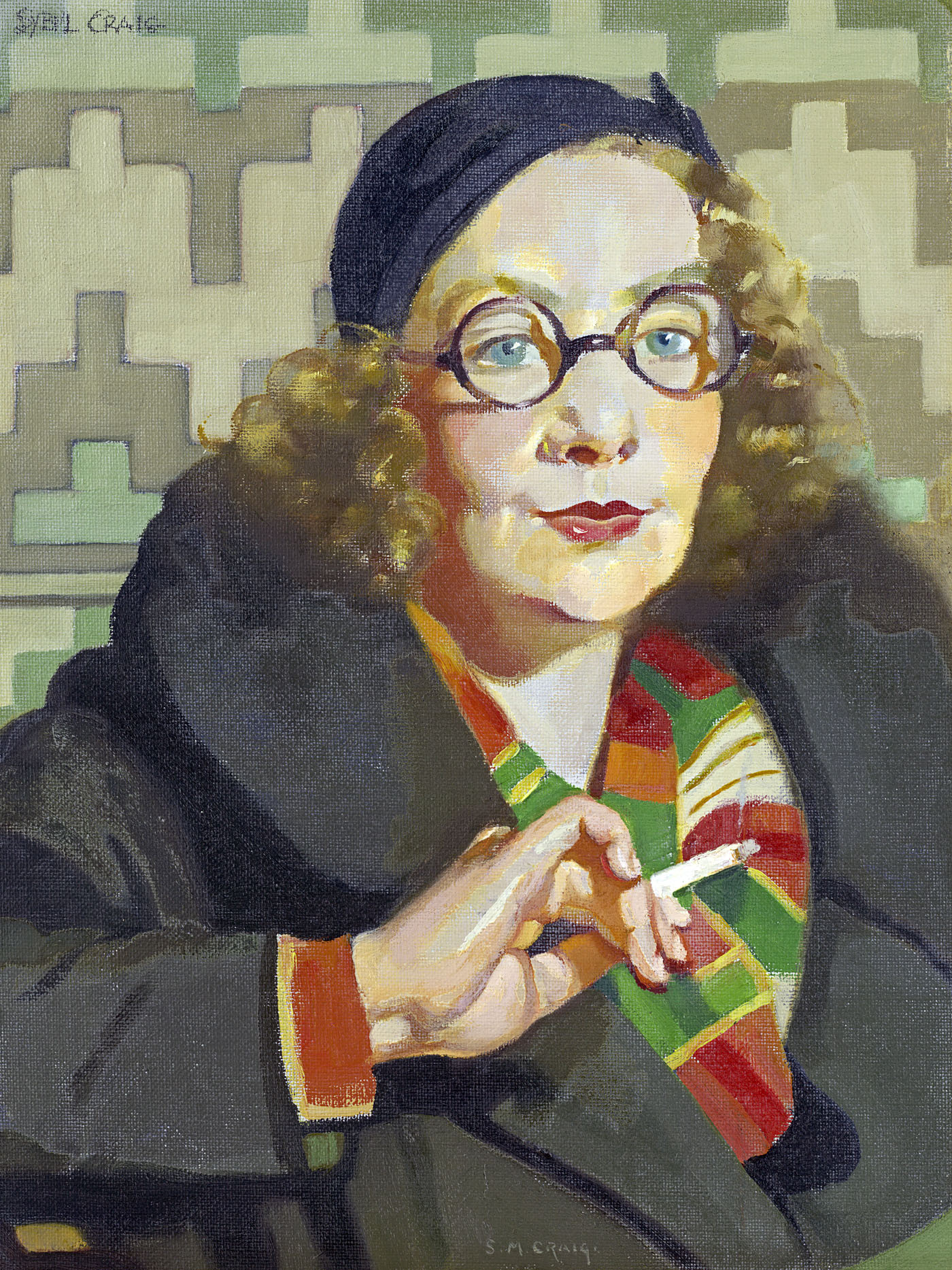
 

Sybil Craig (England 1901 - Australia 1909, Australia from 1902) 'Peggy' c. 1932


Sybil Craig (England 1901 – Australia 1909, Australia from 1902)
Peggy
c. 1932
Oil on canvas
40.4 x 30.4cm
National Gallery of Victoria, Melbourne Purchased, 1978
© The Estate of Sybil Craig


Constance Stokes (Australian, 1906-1991) 'Portrait of a woman in a green dress' 1930 (installation view)


Constance Stokes (Australian, 1906-1991)
Portrait of a woman in a green dress (installation view)
1930
Oil on canvas
National Gallery of Victoria, Melbourne
Bequest of Michael Niall, 2019
Photo: Marcus Bunyan


Installation view of the exhibition 'WHO ARE YOU: Australian Portraiture' at NGV Australia, Federation Square, Melbourne showing at second left, Polly Borland's 'HM Queen Elizabeth II' (2002); at second right, Atong Atem's 'Adut' (2015); and at right, Treahna Hamm's 'Barmah Forest breastplate' (2005)


Installation view of the exhibition WHO ARE YOU: Australian Portraiture at NGV Australia, Federation Square, Melbourne showing at second left, Polly Borland’s HM Queen Elizabeth II (2002, below); at second right, Atong Atem’s Adut (2015, below); and at right, Treahna Hamm’s Barmah Forest breastplate (2005)
Photo: Marcus Bunyan


Polly Borland (Australia, b. 1959, England 1989-2011, United States from 2011) 'HM Queen Elizabeth II' 2002


Polly Borland (Australia, b. 1959, England 1989-2011, United States from 2011)
HM Queen Elizabeth II
2002
Type C photograph on paper
National Portrait Gallery, Canberra
Purchased, 2002
© Polly Borland. Reproduced courtesy of Polly Borland and Anna Schwartz Gallery


Atong Atem (South Sudanese born Ethiopia, b. 1994) 'Adut' 2015, printed 2019


Atong Atem (South Sudanese born Ethiopia, b. 1994)
Adut
2015, printed 2019
From the Studio series 2015
Digital type C print
Image: 59.4 x 84.1cm
Sheet: 63.6 x 92.7cm
ed. 3/10
National Gallery of Victoria, Melbourne
Purchased, Victorian Foundation for Living Australian Artists, 2019
© Atong Atem, courtesy Mars Gallery, Melbourne


‘The Studio series … has developed into an exploration of my blackness and my identity and culture through African cultural iconography, black visual languages, and diasporic traditions represented in the act of posing for a photograph. The photos are traditional, staged studio photographs similar to those found in my family albums and the photo albums of many people in the diaspora – they’re bright, colourful and depict a very precarious moment in African history between traditionalism and cultural changes brought on by colonialism … This Studio series responds to the ethnographic gaze of colonial photographs of black people and speaks to the importance of creating and owning one’s own narrative and depictions.’ ~ Atong Atem, 2019

Wall text from the exhibition


Vincent Namatjira (Australian / Anangu Pitjantjatjara Yankunytjatjara, b. 1983) 'Australia in black and white' 2018 (installation view)

Vincent Namatjira (Australian / Anangu Pitjantjatjara Yankunytjatjara, b. 1983) 'Australia in black and white' 2018 (installation view)


Vincent Namatjira (Australian / Anangu Pitjantjatjara Yankunytjatjara, b. 1983)
Australia in black and white (installation views)
2018
Ink on paper
(a-p) 56.0 x 38.0cm (each)
National Gallery of Victoria, Melbourne
Purchased, Victorian Foundation for Living Australian Artists, 2019
© Vincent Namatjira/Copyright Agency, Australia
Photos: Marcus Bunyan


I’m interested in people and their stories, and how someone from today is connected with the past. I like to paint people who are famous, and paint them here in my community. Painting them in the desert puts them into an unexpected place. Having just a little bit of humour can take the power out of a serious situation, whether something is happening to you right now, or it happened long ago – it lets you be in a little bit of control again, you can get a bit of cheeky revenge. A sense of humour and a paintbrush is a powerful thing.’ ~ Vincent Namatjira

Wall text from the exhibition


Vincent Namatjira (Australian / Anangu Pitjantjatjara Yankunytjatjara, b. 1983) 'Australia in black and white' 2018 (detail)


Vincent Namatjira (Australian / Anangu Pitjantjatjara Yankunytjatjara, b. 1983)
Australia in black and white (detail)
2018
Ink on paper
(a-p) 56.0 x 38.0cm (each)
National Gallery of Victoria, Melbourne
Purchased, Victorian Foundation for Living Australian Artists, 2019
© Vincent Namatjira/Copyright Agency, Australia


Installation view of the exhibition 'WHO ARE YOU: Australian Portraiture' at NGV Australia, Federation Square, Melbourne showing centre on the pedestal, Charles Summers' 'Edmund FitzGibbon and Sarah FitzGibbon' (1877); at left, Howard Arkley's 'Nick Cave' (1999); at second left, Julie Dowling's 'Federation 1901-2001' series (2001) and at second right, Julie Rrap's 'Persona and shadow: Madonna' (1984)


Installation view of the exhibition WHO ARE YOU: Australian Portraiture at NGV Australia, Federation Square, Melbourne showing centre on the pedestal, Charles Summers’ Edmund FitzGibbon and Sarah FitzGibbon (1877); at left, Howard Arkley’s Nick Cave (1999, below); at second left, Julie Dowling’s Federation 1901-2001 series (2001, below and at second right, Julie Rrap’s Persona and shadow: Madonna (1984, below)
Photo: Marcus Bunyan


Julie Dowling (Australian / Badimaya, b. 1969) 'Federation series: 1901-2001' 2001 (installation view)

Julie Dowling (Australian / Badimaya, b. 1969) 'Federation series: 1901-2001' 2001 (installation view)


Julie Dowling (Australian / Badimaya, b. 1969)
Federation series: 1901-2001 (installation views)
2001
synthetic polymer paint, earth pigments, metallic paint and glitter on canvas
(1) 60.3 × 50.5cm (Melbin 1901-1910)
(2) 60.4 × 50.5cm (Uncle Sam 1910-1920)
(3) 60.2 × 50.4cm (Auntie Dot 1920-1930)
(4) 60.3 × 50.5cm (Ruby 1930-1940)
(5) 60.2 × 50.5cm (Mollie 1940-1950)
(6) 60.4 × 50.5cm (George 1950-1960)
(7) 60.3 × 50.4cm (Nan 1960-1970)
(8) 60.3 × 50.4cm (Ronnie 1970-1980)
(9) 60.4 × 50.5cm (Carol 1980-1990)
(10) 60.4 × 50.5cm (Julie 1990-2001)
National Gallery of Victoria, Melbourne
Purchased through the NGV Foundation with the assistance of Rupert Myer, Governor, 2001
© Julie Dowling/Licensed by Copyright Agency, Australia
Photos: Marcus Bunyan


Julie Dowling’s Federation series: 1901-2001 is a series of history paintings produced in response to the Centenary of Federation. The work registers Dowling’s dismay that the Australian Constitution did not included First Nations people when the country was declared a Federation. The narrative cycle of ten canvases, each symbolising a particular diva, presents a profound and multidimensional First Peoples history of the twentieth century. Like a family tree of resilience, the series portrays the faces of ten individual members of Dowling’s family, each affected by policies and events of history.

Wall text from the exhibition


Julie Dowling (Australian / Badimaya, b. 1969) 'Federation series: 1901-2001' 2001


Julie Dowling (Australian / Badimaya, b. 1969)
Federation series: 1901-2001
2001
synthetic polymer paint, earth pigments, metallic paint and glitter on canvas
(1) 60.3 × 50.5cm (Melbin 1901-1910)
(2) 60.4 × 50.5cm (Uncle Sam 1910-1920)
(3) 60.2 × 50.4cm (Auntie Dot 1920-1930)
(4) 60.3 × 50.5cm (Ruby 1930-1940)
(5) 60.2 × 50.5cm (Mollie 1940-1950)
(6) 60.4 × 50.5cm (George 1950-1960)
(7) 60.3 × 50.4cm (Nan 1960-1970)
(8) 60.3 × 50.4cm (Ronnie 1970-1980)
(9) 60.4 × 50.5cm (Carol 1980-1990)
(10) 60.4 × 50.5cm (Julie 1990-2001)
National Gallery of Victoria, Melbourne
Purchased through the NGV Foundation with the assistance of Rupert Myer, Governor, 2001
© Julie Dowling/Licensed by Copyright Agency, Australia


Julie Dowling (Australian / Badimaya, b. 1969) 'Julie' 2001


Julie Dowling (Australian / Badimaya, b. 1969)
Julie
2001
From the Federation series: 1901-2001 2001
synthetic polymer paint, earth pigments, metallic paint and glitter on canvas
60.4 × 50.5cm
National Gallery of Victoria, Melbourne
Purchased through the NGV Foundation with the assistance of Rupert Myer, Governor, 2001
© Julie Dowling/Licensed by Copyright Agency, Australia


Julie Dowling (Australian / Badimaya, b. 1969) 'Nan' 2001 (detail)


Julie Dowling (Australian / Badimaya, b. 1969)
Nan (detail)
2001
From the Federation series: 1901-2001 2001
synthetic polymer paint, earth pigments, metallic paint and glitter on canvas
60.4 × 50.5cm
National Gallery of Victoria, Melbourne
Purchased through the NGV Foundation with the assistance of Rupert Myer, Governor, 2001
© Julie Dowling/Licensed by Copyright Agency, Australia
Photo: Marcus Bunyan


Installation view of the exhibition 'WHO ARE YOU: Australian Portraiture' at NGV Australia, Federation Square, Melbourne showing at second left, Brenda L. Croft's 'Matilda (Ngambri)' (2020); at third right, William Buelow Gould's 'John Eason' (1838); at second right, Augustus Earle's 'Captain Richard Brooks' (1826-1827); and at right, Augustus Earle's 'Mrs Richard Brooks' (1826-1827)


Installation view of the exhibition WHO ARE YOU: Australian Portraiture at NGV Australia, Federation Square, Melbourne showing at second left, Brenda L. Croft‘s Matilda (Ngambri) (2020, below); at third right, William Buelow Gould‘s John Eason (1838); at second right, Augustus Earle‘s Captain Richard Brooks (1826-1827); and at right, Augustus Earle‘s Mrs Richard Brooks (1826-1827)
Photo: Marcus Bunyan


Brenda L. Croft (Anglo-Australian / Gurindji/Malngin/Mudburra, b. 1964) Prue Hazelgrove (wet plate collodion process technical assistant) Richard Crampton (printer) 'Matilda (Ngambri)' 2020 (installation view detail)


Brenda L. Croft (Anglo-Australian / Gurindji/Malngin/Mudburra, b. 1964)
Prue Hazelgrove (wet plate collodion process technical assistant)
Richard Crampton (printer)
Matilda (Ngambri) (installation view detail)
2020
From the Naabami (Thou shall/will see): I am/we are Barangaroo series
Inkjet print (from original tintype, wet plate collodion process) on archival paper, ed. 4/5 + 3 A/P
Image: 119.7 x 90.9cm
Sheet: 140.3 x 99.9cm
National Portrait Gallery, Canberra
Purchased with funds provided by The Calvert-Jones Foundation 2020
© Brenda L. Croft/Copyright Agency, 2022
Photo: Marcus Bunyan


Ngambri woman, Dr Matilda House, is an activist who has dedicated her life to the pursuit of social justice and equity for First Nations peoples since the 1960s. Dr House is renowned for her work in establishing the Aboriginal Legal Service in Queanbeyan and her ongoing support for the Aboriginal Tent Embassy. Using a photographic technique known as a collodion wet plate process, Dr Brenda L. Croft created a powerful series honouring the spirit of Cammeraygal woman, Barangaroo (c. 1750-1791) – one of the Eora Nations earliest influential figures. This portrait of Dr House forms part of the suite, and like Barangaroo, her resilience, cultural authority and fiercely held connection to place continues to inspire many contemporary First Nations women.

Wall text from the exhibition


Brenda L. Croft (Anglo-Australian / Gurindji/Malngin/Mudburra, b. 1964) Prue Hazelgrove (wet plate collodion process technical assistant) Richard Crampton (printer) 'Matilda (Ngambri)' 2020


Brenda L. Croft (Anglo-Australian / Gurindji/Malngin/Mudburra, b. 1964)
Prue Hazelgrove (wet plate collodion process technical assistant)
Richard Crampton (printer)
Matilda (Ngambri)
2020
From the Naabami (Thou shall/will see): I am/we are Barangaroo series
Inkjet print (from original tintype, wet plate collodion process) on archival paper, ed. 4/5 + 3 A/P
Image: 119.7 x 90.9cm
Sheet: 140.3 x 99.9cm
National Portrait Gallery, Canberra
Purchased with funds provided by The Calvert-Jones Foundation 2020
© Brenda L. Croft/Copyright Agency, 2022


Installation view of the exhibition 'WHO ARE YOU: Australian Portraiture' at NGV Australia, Federation Square, Melbourne showing at left, William Buelow Gould's 'John Eason' (1838); at centre, Augustus Earle's 'Captain Richard Brooks' (1826-1827); and at right, Augustus Earle's 'Mrs Richard Brooks' (1826-1827)


Installation view of the exhibition WHO ARE YOU: Australian Portraiture at NGV Australia, Federation Square, Melbourne showing at left, William Buelow Gould‘s John Eason (1838); at centre, Augustus Earle‘s Captain Richard Brooks (1826-1827); and at right, Augustus Earle‘s Mrs Richard Brooks (1826-1827)
Photo: Marcus Bunyan


Installation view of the exhibition 'WHO ARE YOU: Australian Portraiture' at NGV Australia, Federation Square, Melbourne showing at second left background, AñA Wojak's 'Acacius (Stigmata) – Tony Carden' (1991); at centre background, Julie Rrap's 'Persona and shadow: Madonna' (1984); and at centre on pedestal, Charles Summers' 'Edmund FitzGibbon and Sarah FitzGibbon' (1877)


Installation view of the exhibition WHO ARE YOU: Australian Portraiture at NGV Australia, Federation Square, Melbourne showing at second left background, AñA Wojak‘s Acacius (Stigmata) – Tony Carden (1991, below); at centre background, Julie Rrap‘s Persona and shadow: Madonna (1984, below); and at centre on pedestal, Charles SummersEdmund FitzGibbon and Sarah FitzGibbon (1877)
Photo: Marcus Bunyan


Installation view of the exhibition 'WHO ARE YOU: Australian Portraiture' at NGV Australia, Federation Square, Melbourne showing at centre on pedestal, Charles Summers' 'Edmund FitzGibbon and Sarah FitzGibbon' (1877); at centre background, AñA Wojak's 'Acacius (Stigmata) – Tony Carden' (1991); and at right, Julie Rrap's 'Persona and shadow: Madonna' (1984)


Installation view of the exhibition WHO ARE YOU: Australian Portraiture at NGV Australia, Federation Square, Melbourne showing at centre on pedestal, Charles SummersEdmund FitzGibbon and Sarah FitzGibbon (1877); at centre background, AñA Wojak‘s Acacius (Stigmata) – Tony Carden (1991, below); and at right, Julie Rrap‘s Persona and shadow: Madonna (1984, below)
Photo: Marcus Bunyan


AñA Wojak (Australian, b. 1954) 'Acacius (Stigmata) – Tony Carden' 1991 (installation view)


AñA Wojak (Australian, b. 1954)
Acacius (Stigmata) – Tony Carden (installation view)
1991
Oil and gold leaf on cedar panel
Support: 121.5 x 103.0cm
Gift of Lesley Saddington 2015
© AñA Wojak
Photo: Marcus Bunyan


AñA Wojak describes themselves as a ‘cross-disciplinary artist working in performance, painting, assemblage, installation and theatre design, with a particular interest in site-specificity, ritual and altered states’. Born in Australia, they studied in Gdansk, Poland in the period of martial law, attaining a master’s degree in fine arts in 1983. Wojak has been an Archibald finalist twice, a Portia Geach finalist several times and a Sculpture by the Sea finalist four times; they won the Blake Prize for religious art in 2004.

Anthony Carden (1961-1995), activist, studied acting in New York in the early 1980s before returning home to work in theatre, film and television in Sydney and Melbourne. After being diagnosed with AIDS, he joined ACTUP (AIDS Coalition to Unleash Power) and became a lobbyist for better standards of medical care, improved hospital facilities, and effective safe sex education. An activist against discrimination in all its forms, he was a prominent advocate for people living with HIV/AIDS. With Clover Moore, then the Member for Bligh in the New South Wales Legislative Assembly, he helped raise $1 million for the refurbishment of St Vincent’s Hospital’s Ward 17 South, Australia’s first dedicated ward for HIV/AIDS patients. He died five years after his diagnosis.

AñA Wojak met Carden at an ACTUP meeting in 1991, at which time the artist had begun working on a series exploring ideas of sainthood and martyrdom. Wojak painted Carden in the guise of Saint Acacius, an early Christian martyr, as he was ‘someone who was working for the rights of others whilst at the same time suffering himself’. Employing gold leaf and a blue paint derived from lapis lazuli, the work is intended to evoke Byzantine icons and Italian Renaissance altarpieces. The portrait was displayed in Don’t Leave Me This Way: Art in the Age of AIDS at the National Gallery of Australia in 1994-1995; at Carden’s wake; and later in Ward 17 South before being purchased by Carden’s mother, Lesley Saddington.

Text from the National Portrait Gallery, Canberra website Nd updated 2021 [Online] Cited 02/07/2022


AñA Wojak (Australian, b. 1954) 'Acacius (Stigmata) – Tony Carden' 1991


AñA Wojak (Australian, b. 1954)
Acacius (Stigmata) – Tony Carden
1991
Oil and gold leaf on cedar panel
Support: 121.5 x 103.0cm
Gift of Lesley Saddington 2015
© AñA Wojak


Julie Rrap. 'Persona and shadow: Madonna' 1984


Julie Rrap (Australian, b. 1950)
Persona and shadow: Madonna
1984
Cibachrome photograph
Image and sheet: 194.7 × 104.6cm
National Gallery of Victoria, Melbourne
Michell Endowment, 1984
© Julie Rrap


Julie Rrap dissects and subverts conventional visions of women in art history, so often depicted as ‘the Madonna’. This work is from a series called Persona and Shadow in which Rrap responded to her experience of seeing so few women artists represented in major contemporary art shows in Europe during the early 1980s. Rap takes outlines from work by Edvard Munch and incorporates a fractured photographic self-portrait. Her resulting vision personally and powerfully counters the dominant narrative of women in the art world.

Wall text from the exhibition


Installation view of the exhibition 'WHO ARE YOU: Australian Portraiture' at NGV Australia, Federation Square, Melbourne showing at second left, John Citizen's 'Eddie Mabo (after Mike Kelley's 'Booth's Puddle' 1985, from Plato's Cave, Rothko's Chapel, Lincoln's Profile) No. 3' (1996); at third right, TextaQueen's 'Creature from the Black Platoon starring Gary Foley 2011' (2011); and at right, Guido Maestri's 'Geoffrey Gurrumul Yunupingu' (2009)


Installation view of the exhibition WHO ARE YOU: Australian Portraiture at NGV Australia, Federation Square, Melbourne showing at second left, John Citizen’s Eddie Mabo (after Mike Kelley’s ‘Booth’s Puddle’ 1985, from Plato’s Cave, Rothko’s Chapel, Lincoln’s Profile) No. 3 (1996, below); at third right, TextaQueen’s Creature from the Black Platoon starring Gary Foley 2011 (2011, below); and at right, Guido Maestri’s Geoffrey Gurrumul Yunupingu (2009, below)
Photo: Marcus Bunyan


John Citizen (Gordon Bennett, Australian 1955-2014) 'Eddie Mabo (after Mike Kelley's 'Booth's Puddle' 1985, from Plato's Cave, Rothko's Chapel, Lincoln's Profile) No. 3' 1996 (installation view)


John Citizen (Gordon Bennett, Australian 1955-2014)
Eddie Mabo (after Mike Kelley’s ‘Booth’s Puddle’ 1985, from Plato’s Cave, Rothko’s Chapel, Lincoln’s Profile) No. 3 (installation view)
1996
Synthetic polymer paint on canvas
Support: 168.0 x 152.5cm
Purchased with funds provided by L Gordon Darling AC CMG 1999
© Gordon Bennett Estate
Photo: Marcus Bunyan


John Citizen is the artistic alter ego of Australian artist Gordon Bennett (1955-2014), painter and multi-media artist, addressed issues of identity and power in a postcolonial context. Within two years of graduating from the Queensland College of Art in 1988 he was awarded the prestigious Moët and Chandon Fellowship. He had numerous solo exhibitions and was represented in many travelling exhibitions within Australia and overseas. Of indigenous Australian and Anglo-Celtic descent, he was concerned with the use of language in delineating ethnocentric boundaries, viewing his work as ‘history painting’ in that it indicated the ways in which history is constructed after the event. Bennett is represented under both John Citizen and Gordon Bennett in many state, regional and tertiary collections.

Koiki (Eddie) Mabo (1937-1992), Torres Strait Islander man, initiated a legal case for native title against the State of Queensland in 1982. Along with his fellow Meriam people, Mabo was convinced that he owned his family’s land on Murray Island (Mer) in Torres Strait. By contrast, Queensland Crown lawyers argued that on annexation in 1879, all the land had become the property of the Crown. In 1992, the seven Justices of the High Court found 6-1 in favour of Mabo and his co-plaintiffs, overturning the accepted view that Australia had been terra nullius (empty land) before white settlement. Mabo died before the historic decision, which was to lead to the Land Title Act of 1993, and permanently to alter the way Australians think about Aboriginal land ownership.

John Citizen is the artistic alter ego of Australian artist Gordon Bennett (1955-2014). Bennett, who worked under his own name and that of John Citizen, grew up in Nambour, Queensland and only learned of his mother’s Indigenous heritage in his early teens. He went to art school as a mature student. Stating early in his career that ‘the bottom line of my work is coming to terms with my Aboriginality,’ he continued to engage with questions of cultural and personal identity, interrogating Australia’s colonial past and postcolonial present through a succession of allusive postmodern works. He won the John McCaughey Memorial Art Prize of the National Gallery of Victoria in 1997, and the NGV mounted a touring exhibition, Gordon Bennett, in 2007-2008. Bennett said that when he began to think about Eddie Mabo he ‘could not think of him as a real person … I only [knew] the Eddie Mabo of the “mainstream” news media, a very two-dimensional “copy” of the man himself.’ In making his portrait of Mabo, he used a newspaper image and headlines from newspaper articles about the Native Title furore, and combined them with an image by the American artist Mike Kelley. ‘To me the image of Eddie Mabo stood like the eye of a storm,’ Bennett said, ‘calmly asserting his rights while all around him the storm, a war of words and rhetoric, raged.’

Text from the National Portrait Gallery, Canberra website Nd updated 2020 [Online] Cited 02/07/2022


TextaQueen (Australian, b. 1975) 'Creature from the Black Platoon starring Gary Foley 2011' 2011 (installation view)


TextaQueen (Australian, b. 1975)
Creature from the Black Platoon starring Gary Foley 2011 (installation view)
2011
From the series We don’t need another hero
Fibre-tipped pen on paper
Frame: 119.0 x 135.0cm
Sheet: 97.5 x 127.2cm
National Portrait Gallery, Canberra
Purchased, 2011
Photo: Marcus Bunyan


Through a series of fictional movie posters, TextaQueen explores a re-writing of colonial history by subverting roles of power. This work combines film posters to subvert the original leading white film cast, creating a mash-up of Gary Foley as a powerful Blak militia. Foley is a renowned Indigenous activist, known for his involvement in the black Power Movement in Australia, which saw the formation of the Aboriginal Legal Service and Medical Service Redfern in the 1970s to counter the problem of police harassment. Here, TextQueen poses Foley as an outlaw of his post-apocalypse, representing him as a survivor while simultaneously creating a platform for the Indigenous experiences of colonisation and racism to be acknowledged and recognised.

Wall text from the exhibition


Gary Foley (b. 1950) Indigenous activist and historian, has written extensively on Indigenous political movements and maintains the Koori History Website, an intensive history archive and education resource. Of Gumbainggir descent, at seventeen Foley moved from his native Grafton to Sydney. There, inspired by the biography of African-American human rights activist Malcolm X, he was instrumental in establishing Sydney’s Aboriginal Legal Service and Aboriginal Medical Service, and in 1972 he came to the Aboriginal Tent Embassy in Canberra. The first Indigenous Director of the Aboriginal Arts Board, he was Senior Curator for Southeastern Australia at Museum Victoria from 2001 to 2005. Since 2005 Foley has lectured and undertaken postgraduate research at the University of Melbourne.

TextaQueen’s (b. 1975) portrait of Gary Foley is from a series featuring ‘people of colour as outlaws of their post-apocalypse, drawn as if posters for fictional movies. As an artist of colour … I’ve sought out peers from various sociocultural and racial backgrounds to propose characters, costumes, and fictional surrounds to represent themselves as survivors of their Armageddon.’ Gary Foley launched the exhibition of the series in Melbourne.

Text from the National Portrait Gallery, Canberra website Nd [Online] Cited 02/07/2022


Guido Maestri (Australian, b. 1974) 'Geoffrey Gurrumul Yunupingu' 2009 (installation view)


Guido Maestri (Australian, b. 1974)
Geoffrey Gurrumul Yunupingu (installation view)
2009
Oil on linen
National Portrait Gallery, Canberra
Gift of the artist 2011
Donated through the Australian Government’s Cultural Gifts Program
Photo: Marcus Bunyan


Born blind, Geoffrey Gurrumul Yunupingu (1970-2017), was a talented musician with an extraordinary voice. Gurrumul was a self-taught instrumentalist, playing guitar, piano, drunks and yidaki. Growing up on the remote island of Gallwin’ku (Elcho Island), Gurrumul was taught all Yolngu culture in song, dance, art and ceremony. His gentle songs draw reference to these teachings of sacred animals, the sea and seasons, ancestors and reverence for the land. Guido Maestri’s portrait of the musician was created after the artist saw Gurrumul perform in Sydney on New Year’s Eve 2008. Using just one colour and applied by building upon layers of thin oil paint, this portrait plays homage ad respect to one of Australia’s most influential musicians.

Wall text from the exhibition
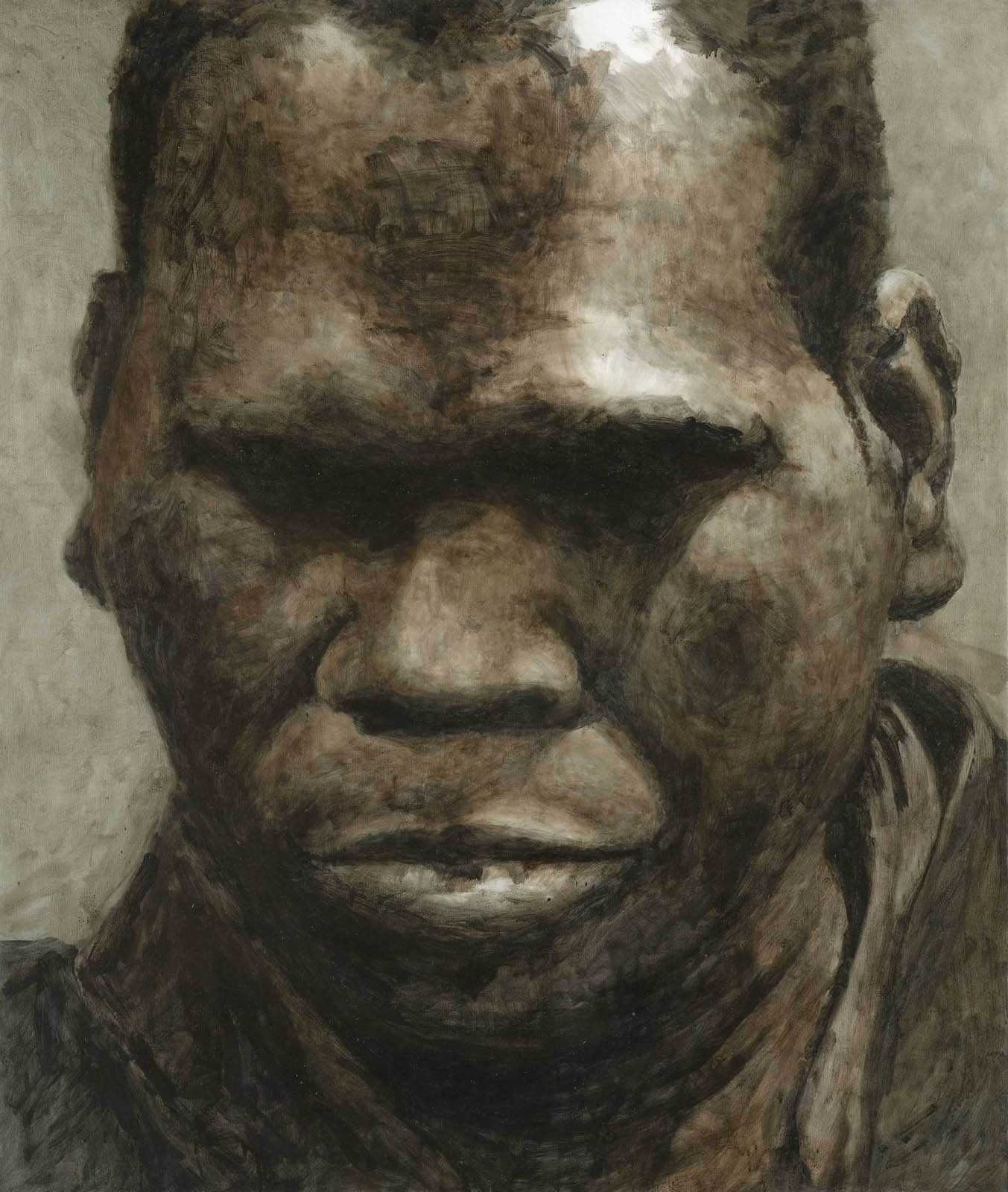
 

Guido Maestri (Australian, b. 1974) 'Geoffrey Gurrumul Yunupingu' 2009


Guido Maestri (Australian, b. 1974)
Geoffrey Gurrumul Yunupingu
2009
Oil on linen
National Portrait Gallery, Canberra
Gift of the artist 2011
Donated through the Australian Government’s Cultural Gifts Program


Ricky Maynard. ‘Arthur, Wik elder’, from the series ‘Returning to places that name us’ 2000


Ricky Maynard (Australian / Big River/Ben Lomond, b. 1953)
Arthur, Wik elder
2000
From the series Returning to places that name us
Gelatin silver photograph
96.1 × 121.3cm irreg.
National Gallery of Victoria, Melbourne
Gift of Milton and Penny Harris, 2007


Ricky Maynard (Australian, b. 1953) 'Gladys Tybingoomba' 2001


Ricky Maynard (Australian / Big River/Ben Lomond, b. 1953)
Wik Elder, Gladys Tybingoomba
2000
From the series Returning to places that name us
Gelatin silver photograph
95.5 × 123.0cm
National Gallery of Victoria, Melbourne
Gift of Milton and Penny Harris, 2007


These intimate portraits of Wik Elders from the community of Aurukun, Far North Queensland, were inspired by the hard-fought battle for custodianship and recognition of the Wik people’s connection to traditional land and waterways. In this image, Maynard documents cultural leader and activist Gladys Tybingoompa, who is remembered today as a prolific figure in the Wik vs Queensland Case and a trailblazer for Indigenous land rights across Australia.

Wall text from the exhibition


Installation view of the exhibition 'WHO ARE YOU: Australian Portraiture' at NGV Australia, Federation Square, Melbourne showing at left, Peter Corlett's 'The connoisseur II' (1984); at second left, Howard Arkley's 'Nick Cave' (1999)


Installation view of the exhibition WHO ARE YOU: Australian Portraiture at NGV Australia, Federation Square, Melbourne showing at left, Peter Corlett’s The connoisseur II (1984); at second left, Howard Arkley’s Nick Cave (1999, below)
Photo: Marcus Bunyan
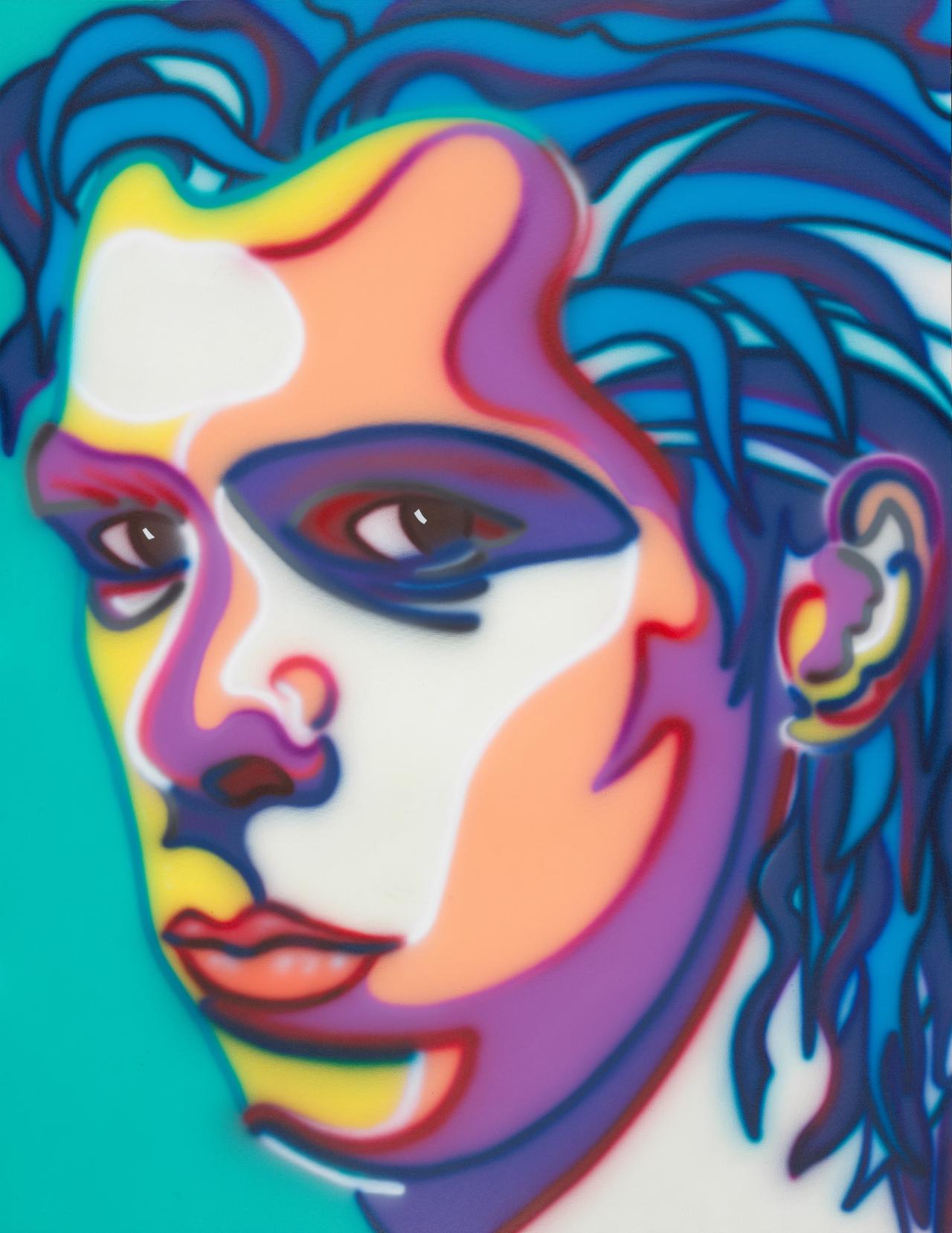
 

Howard Arkley (Australia 1951-1999) 'Nick Cave' 1999


Howard Arkley (Australia 1951-1999)
Nick Cave
1999
Synthetic polymer paint on canvas
175.2 x 135.2 x 4.3cm
National Portrait Gallery, Canberra
Commissioned with funds provided by L Gordon Darling AC CMG 1999
© Estate of Howard Arkley. Licensed by Kalli Rolfe Contemporary Art


Anne Zahalka (Australian, b. 1957) 'The surfers' 1989 (installation view)


Anne Zahalka (Australian, b. 1957)
The surfers (installation view)
1989
Type C photograph
76.4 x 92.5cm
National Gallery of Victoria, Melbourne
Purchased, 1991
© Anne Zahalka/Licensed by Copyright Agency, Australia
Photo: Marcus Bunyan


Anne Zahalka is best known for her photographs that address issues such as racial stereotyping, gender and difference. Using images largely drawn from art historical sources to create elaborately constructed sets, Zahalka’s work raises questions about identity, place and nationhood. The daughter of European immigrants displaced during the war, themes of belonging and national identity are intrinsic to Zahalka’s practice, allowing her to comment on the changing role migration and multiculturalism have had in Australia throughout history. The surfers challenge stereotypical representations of Australian beach-goers, presenting them against a painted backdrop of surf and sand.

Wall text from the exhibition
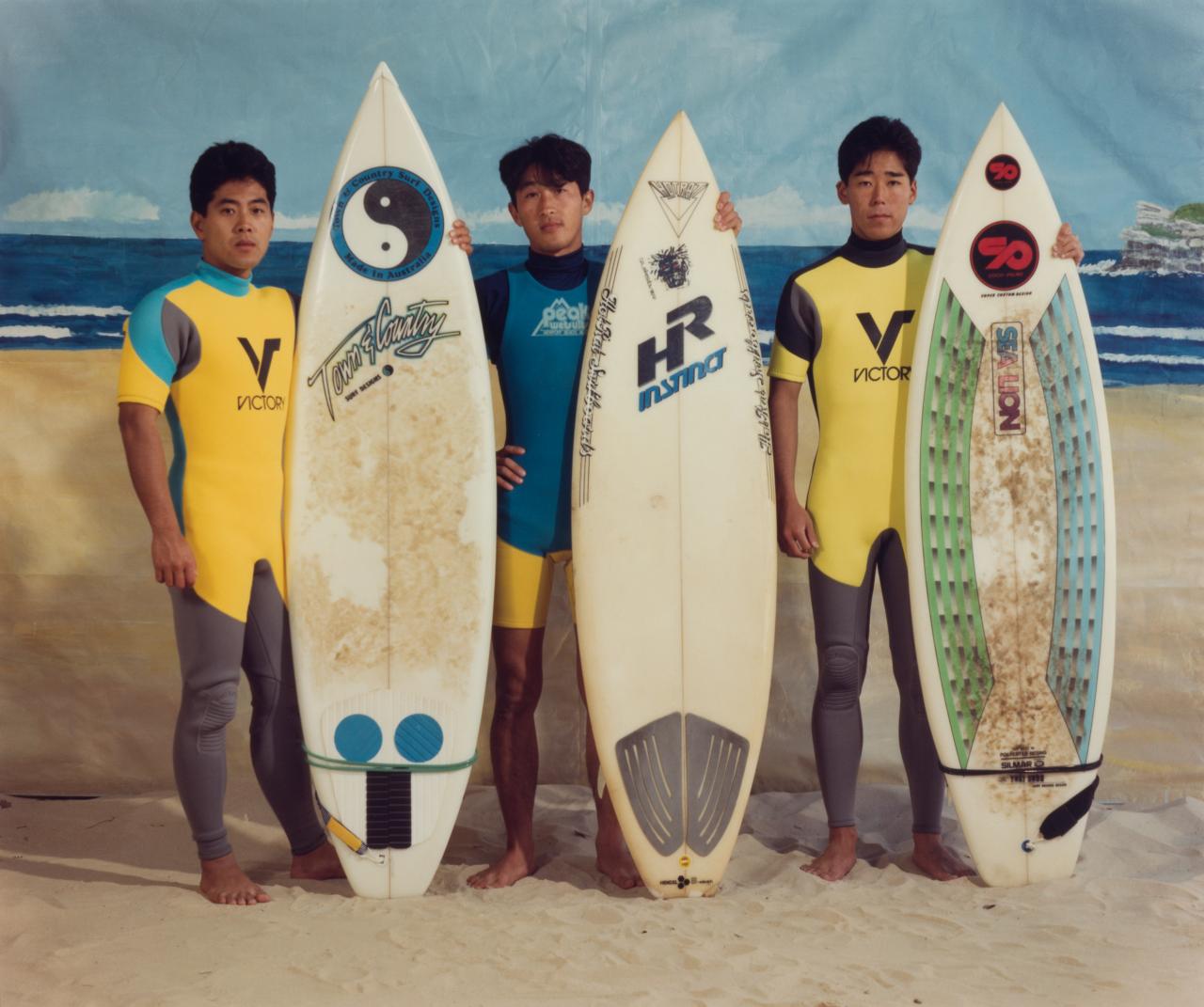
 

Anne Zahalka (Australian, b. 1957) 'The surfers' 1989


Anne Zahalka (Australian, b. 1957)
The surfers
1989
Type C photograph
76.4 x 92.5cm
National Gallery of Victoria, Melbourne
Purchased, 1991
© Anne Zahalka/Licensed by Copyright Agency, Australia


Tracey Moffatt (Australian, b. 1960) 'The Movie Star (David Gulpilil)' 1985


Tracey Moffatt (Australian, b. 1960)
The Movie Star (David Gulpilil)
1985
Type C photograph on paper
Image: 50.7 x 77.3cm
Frame: 74.5 x 99.0cm
Gift of the artist 1998. Donated through the Australian Government’s Cultural Gifts Program
Courtesy of the artist and Roslyn Oxley9 Gallery, Sydney
© Tracey Moffatt


One of Australia’s most acclaimed contemporary artists, Tracey Moffatt grew up in Brisbane and moved to Sydney after studying at the Queensland College of Art. She worked in photography, video and filmmaking, helped establish the Boomalli Aboriginal Artists Cooperative, and was part of the group of creatives engaged in reshaping the representation of First Nations peoples in the visual and performing arts. When Moffatt photographed him in 1985, Yolngu man David Gulpilil AM (1953-2021) had already appeared in several major film and television productions, including Walkabout (1971), Storm Boy (1976), The Last Wave (1977) and The Timeless Land (1980). This portrait of him was shown in NADOC ’86, which Wiradjuri / Kamilaroi artist Michael Riley described as the first exhibition where Aboriginal artists ‘were dictating … how they wanted to show images of their own people.’ Moffatt’s image of Gulpilil lazing at Bondi Beach might seem benignly tongue-in-cheek, but in fact makes an incisive reference to colonialism and the dispossession on which Australia’s supposedly egalitarian, laid-back lifestyle is based.

This work and Moffatt’s portrait of Nunukul and Yugambeh dancer Russell Page (1968-2002) were the first two photographs acquired by the National Portrait Gallery.

Text from the National Portrait Gallery, Canberra website Nd [Online] Cited 02/07/2022


Installation view of the exhibition 'WHO ARE YOU: Australian Portraiture' at NGV Australia, Federation Square, Melbourne showing photographs from Brenda L. Croft's 'A man about town' series 2004


Installation view of the exhibition WHO ARE YOU: Australian Portraiture at NGV Australia, Federation Square, Melbourne showing photographs from Brenda L. Croft’s A man bout town series (2004, below)
Photo: Marcus Bunyan


Brenda L. Croft (Australian / Gurindji/Mutpurra, b. 1965) 'A hostile landscape' 2003, printed 2004 (installation view)


Brenda L. Croft (Australian / Gurindji/Mutpurra, b. 1965)
A hostile landscape (installation view)
2003, printed 2004
From A man about town series 2004
84.0 × 124.8cm
National Gallery of Victoria, Melbourne
Purchased with funds arranged by Loti Smorgon for Contemporary Australian Photography, 2004
Photo: Marcus Bunyan


Brenda Croft stumbled upon the two photographs A hostile landscape and A man about town in 1997, while sorting the material possessions of her late father. As Croft has written, ‘I carried these images around in my mind for the next seven years, returning to them often and wondering about the city and countryscapes, the period in which they were set and the anonymous people in them’. The two photographs show Croft’s father as a solitary figure in the urban landscape. These depictions contrast with typical representations of the ‘businessman’ within society, which portray a white, middle-class man. These photographs also work to reposition prevailing imagery of Aboriginal Australians living purely in remote areas, as opposed to city environments.

Wall text from the exhibition


Brenda L. Croft (Australian / Gurindji/Mutpurra, b. 1965) 'A man about town' 2003


Brenda L. Croft (Australian / Gurindji/Mutpurra, b. 1965)
A man about town
2003, printed 2004
From A man about town series 2004
84.0 × 124.8cm
National Gallery of Victoria, Melbourne
Purchased with funds arranged by Loti Smorgon for Contemporary Australian Photography, 2004


Edward Schafer & Co., Melbourne (retailer) 'Belt buckle' c. 1900


Edward Schafer & Co., Melbourne (retailer)
Belt buckle
c. 1900
15 ct gold, garnets, enamel
(a-b) 6.2 x 8.3 x 1.8cm (overall)
National Gallery of Victoria, Melbourne
The Altmann Collection of Australian Silver
Presented through The Art Foundation of Victoria by John and Jan Altmann, Founder Benefactors, 1986


Michael Riley (Australian / Wiradjuri/Kamilaroi, 1960-2004) 'Maria' 1986, printed 2013


Michael Riley (Australian / Wiradjuri/Kamilaroi, 1960-2004)
Maria
1986, printed 2013
From the Michael Riley Portraits 1984-1990 series
Inkjet print on paper
39.1 x 40.9cm
National Portrait Gallery, Canberra.
Purchased 2013
© Michael Alan Riley/Copyright Agency, 2022
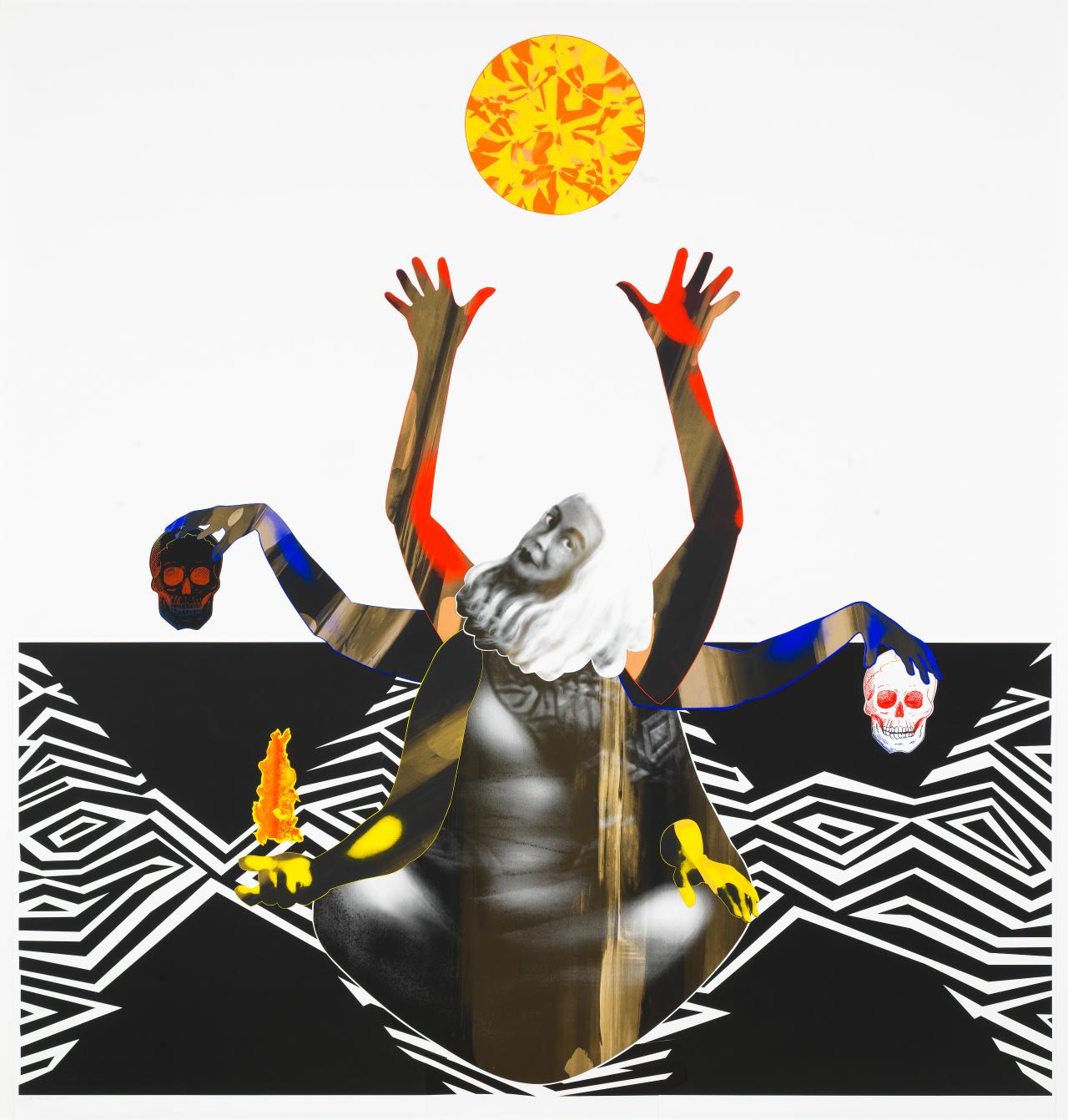
 

Brook Andrew (Australian, b. 1970) Trent Walter (printer) (Australian, b. 1980) 'Marcia Langton' 2009


Brook Andrew (Australian, b. 1970)
Trent Walter (printer) (Australian, b. 1980)
Marcia Langton
2009
Screenprint on paper
252.0 x 242.0 x 7.1cm
National Portrait Gallery, Canberra
Commissioned with funds provided by Marilyn Darling AC 2009
© Brook Andrew/Copyright Agency, 2022


John Nixon (Australian, b. 1949) 'Self Portrait (non-objective composition) (yellow cross)' 1990


John Nixon (Australian, b. 1949)
Self Portrait (non-objective composition) (yellow cross)
1990
Enamel paint on plywood
177.6 x 165.0cm
National Gallery of Victoria, Melbourne
Purchased through The Art Foundation of Victoria with the assistance of Chase Manhattan Overseas Corporation, Fellow, 1991
© Courtesy of the artist


The Ian Potter Centre: NGV Australia
Federation Square
Corner of Russell and 
Flinders Streets, Melbourne

Opening hours:
Daily 10am – 5pm

National Gallery of Victoria website

LIKE ART BLART ON FACEBOOK

Back to top

Review: ‘William Yang: Seeing and Being Seen’ at the Queensland Art Gallery | Gallery of Modern Art (GOMA), Brisbane

Exhibition dates: 27th March – 22nd August, 2021

Curator: Rosie Hays, Associate Curator, Australian Cinémathèque, QAGOMA


William Yang (Australia b. 1943) 'Golden Summer' 1987/2016 from the exhibition 'William Yang: Seeing and Being Seen' at the Queensland Art Gallery | Gallery of Modern Art (GOMA), Brisbane, March - August, 2021


William Yang (Australia b. 1943)
Golden Summer
1987/2016
Inkjet print, gold leaf on Innova Softex paper
40 x 30cm
© William Yang
Courtesy: The artist


William Yang (Australia b. 1943) ''Allan' from the monologue 'Sadness'' 1992 from the exhibition 'William Yang: Seeing and Being Seen' at the Queensland Art Gallery | Gallery of Modern Art (GOMA), Brisbane, March - August, 2021


William Yang (Australia b. 1943)
‘Allan’ from the monologue ‘Sadness’
1992
© William Yang
Courtesy: The artist


The Family of Yang

Let me tell you a story… a story made up of many smaller tales, told to me by a chronicler, diarist, writer, performance artist and filmmaker; socio-documentary photographer and historian; master of oral history and storytelling – Chinese-Australian artist William Yang.

Voluminous amounts of text have been written about Yang’s art practice and for this reason I only offer here a brief precis of his fifty year career as an artist. Indeed, it is impossible to cover such an expansive career in performance, film, text and photographs in one posting. After the precis I offer some thoughts and insights into Yang’s work.

Yang was born in 1943 into a family of Chinese immigrants in Far North Queensland. After moving to Brisbane in the mid-1960s to study architecture, he journeyed to Sydney in 1969 where he helped produce plays. Yang picked up a camera and started taking photographs of his friends, celebrities, parties and the gay scene in Sydney, Australia in the early-mid 1970s. His first exhibition Sydneyphiles at the Australian Centre for Contemporary Photography in 1977 set him on his way. Personal reflections were written directly on the mounts around his photographs something that he was to adapt further, inscribing his stories directly on the photographs in later bodies of work (“an oral tradition of storytelling transferred to the physical medium of the photograph”). In 1989, Yang began performing monologues with slide projections in theatres, integrating his skills as a writer and a visual artist.

As can be heard in the exhibition curator Rosie Hays’ video talk below, Yang’s first period was as a social life photographer / commercial photographer, earning a living selling his photographs to gay newspapers; his second period encompassed investigations into marginalised communities: queer community, Australian-Chinese community, Indigenous communities and telling alternative histories of Australia including the history of his Chinese-Australian heritage; and in the third period, Yang’s work has become more reflective, interested in ordinary things, interested in the life of the human embodied in the landscape.

.
As a documentary photographer and performance artist, Yang’s work has examined numerous linked themes. The artist investigates the intimate connections between dystopian and utopian worlds – for example, between the body racked by AIDS and the body beautiful (see above), or between the racism of his childhood and the acceptance of his Chinese heritage – as he probes the paradoxes of existence, those parallels streams of life and death, where one person looks death in the eye and the other doesn’t even know it exists… in that moment. And then proposes a reconciliation between past and present, personal and private, between the margins and the centre. Through his personal stories he exposes himself in the act of making his art, transcending his life in art. Ego drops away and he becomes entirely his own person, entirely himself, when he performs in his inimitable, self-deprecating style.

I have a suspicion, and I could be entirely wrong here, that at heart the young Yang was a very shy and insecure person. From personal experience I know that many introverts hide their shyness through extrovert behaviour, wanting to belong, wanting to be in with the in crowd, to be the life of the party. Yang was always there at any event opening or party, never without a camera, always ready to capture what life put before him because he wanted to belong. Then, to his great credit, instead of getting caught in a rut as many artists do repeating the same thing over and over again, he had the intelligence, will and creativity to push himself further, to take those next steps in his development as an artist and human being… to take those steps that descend, in metaphor, to the centre of the earth, to the centre of his existence. He was on that golden path of self discovery, another step in the evolution of himself. He wanted to know how he, and others, fitted into the great scheme of life. As a chronicler of moments, a chronicler of history, he speaks aloud the thoughts of his own becoming.

While photography is about capturing a moment and being a vehicle for storytelling, it is so much more than that. It can be about the relationship between the photographer and the subject and how that relationship evolves from a personal engagement to a universal engagement. It is the artist’s view of the world through the camera lens turned from a personal story into a universal story to which any human being can relate. Here we have empathy and humanity, diversity and racism, voyeurism and performance, public and private, bigotry and poofdom, decadence and death. The artist tells those stories, where personal is universal.

Yang is an national treasure, a living legend. People relate to William Yang. They reveal themselves to him because they feel comfortable in his presence, comfortable in his spirit and energy. He draws people to him, he is a sage – from the Latin sapere ‘be wise’ – who loves documenting people and their interactions with each other and with himself. He draws people into his orbit… and creates magical stories and intimate photographs about human existence. There is an undeniable virtu to the person and his work. All the subjects of his art are his family. Whether a celebration of life, an investigation into community, in joy and in sadness, we are all, always, part of the Family of Yang.

Dr Marcus Bunyan

Many thankx to the Queensland Art Gallery | Gallery of Modern Art (GOMA) for allowing me to publish the photographs in the posting. Please click on the photographs for a larger version of the image.


Queensland-born, Sydney-based photographer William Yang’s significant contribution to Australian photography spans five decades. Known for his reflective and joyous depictions of Australia’s LGBTIQ+ scene in the late 70s and 80s through to the present. Yang’s photography is informed by the cultural and political pressures of growing up as a gay man from a Chinese immigrant family in north Queensland.

This exhibition is a major survey of Yang’s work, which traces his career from documentary photography through to explorations of cultural and sexual identities and his depictions of landscape. Yang integrates a photographic practice with writing, video and performance. The exhibition includes Yang’s prolific social portraiture which features prominent creative identities from theatre, film, art and literature such as Patrick White, Brett Whiteley and Cate Blanchett, his revelatory insights into the LGBTIQ+ community, and insightful images of the Australian landscape.

Seeing and Being Seen also includes early social photographs of Sydney’s arts scene as well as the artist’s long exploration of his family and childhood experience in North Queensland which interrogate and celebrate his Chinese-Australian identity, Yang’s identity as a Chinese-Australian, a gay man and artist informs his marginalised experience.

While the stories and images included in the exhibition are quite specific to Yang’s life, the emotions underpinning them are instantly recognisable and acutely relatable. There is confession and courage in his storytelling – his most well-known works are often deeply personal and represent the means by which he reckons with his past, his relationships, and his experience outside the mainstream.

Text from the QAGOMA website


“Yang’s generation is not life as reported in the newspapers but ‘as I saw it’: a personal account summed up as a litany of parties, of innocence lost and worldliness gained, a continuum of his search for contact and meaning. Like his contemporaries Rennie Ellis or Michael Rosen, William Yang is a social photographer, a recorder of life. His strength lies in creating a living testament, and his medium’s strength is that it is necessarily shared. He offers no moral tale, nor any notion of karma to underscore the events: just the three basic but vital stories – birth, love and death.”


Michael Desmond, Senior Curator, National Portrait Gallery, Canberra


“For me, seeing William’s images of men, swaddled in their desire, affection and easy love for one another, continues to disentangle something that’s been knotted up inside me for as long as I can remember. Asian men occupy a very specific idea in the Australian imagination – of being non-sexual, and therefore, undesirable – that we all inevitably internalise. The raw, unashamed sensuality of William’s imagery – of his unabashed desire for the men he captures, and the framing of Asian male beauty itself – is such a potent corrective. His images remind us that desire isn’t anything to be ashamed of, and that Asian men are desirable too.”


Benjamin Law. ‘Bearing witness in the church of William Yang’ 2021


“I was a photographer, which means that I was a voyeur.”


William Yang


“It was difficult to make ends meet as a playwright, so I became a photographer as a way of making money. I was attracted to the glamorous world. I wanted to be a part of it. One way of doing this, I thought, was to be a fashion photographer but i was terrible at it – I couldn’t cover up the flaws. I was better at covering parties and events.”


William Yang, 1993


Installation view of the exhibition 'William Yang: Seeing and Being Seen' at the Queensland Art Gallery | Gallery of Modern Art (GOMA) showing at left, 'Stand Palm Beach' (1981); at middle, 'The Pool at Bondi #3' (1987); and at right, 'Golden Summer' (1987/2016)


Installation view of the exhibition William Yang: Seeing and Being Seen at the Queensland Art Gallery | Gallery of Modern Art (GOMA) showing at left, Stand Palm Beach (1981); at middle, The Pool at Bondi #3 (1987); and at right, Golden Summer (1987/2016, above)


William Yang (Australia b. 1943) 'Tamarama Lifesavers' 1981


William Yang (Australia b. 1943)
Tamarama Lifesavers
1981
Inkjet print on Hahnemühle Fine Art Pearl
39 x 70cm
© William Yang
Courtesy: The artist


William Yang: Seeing and Being Seen / Exhibition walk-through


William Yang (Australia b. 1943) 'Life Lines #3 – Self portrait #2 (1947)' 1947/2008


William Yang (Australia b. 1943)
Life Lines #3 – Self portrait #2 (1947)
1947/2008
Photographer: Unknown
Inkjet print on Innova Softex paper, ed. 2/30
100 x 70cm
Collection of The University of Queensland, purchased 2010
Photo: Carl Warner Reproduced courtesy of the artist and Andrew Baker Art Dealer, Brisbane


William Yang (Australia b. 1943) 'Alter ego' 2001


William Yang (Australia b. 1943)
Alter ego
2001
Digital inkjet print on rag paper
68 x 88cm
© William Yang
Courtesy: The artist


Installation view of the exhibition 'William Yang: Seeing and Being Seen' at the Queensland Art Gallery | Gallery of Modern Art (GOMA)


Installation view of the exhibition William Yang: Seeing and Being Seen at the Queensland Art Gallery | Gallery of Modern Art (GOMA) showing the artist standing in front of his photograph Life Lines #11 – William in scholar’s costume (1984) (1984/2009, below)


William Yang (Australia b. 1943) 'Life Lines #11 – William in scholar's costume (1984)' 1984/2009


William Yang (Australia b. 1943)
Life Lines #11 – William in scholar’s costume (1984)
1984/2009
Inkjet print on Innova Softex paper, ed. 1/20
94.6 x 61.6cm
Collection of The University of Queensland, purchased 2010
Photo: Carl Warner Reproduced courtesy of the artist and Andrew Baker Art Dealer, Brisbane


William Yang (Australia b. 1943) 'Self Portrait #5' 2008


William Yang (Australia b. 1943)
Self Portrait #5
2008
Inkjet print on Innova Softex paper
42 x 65cm
© William Yang
Courtesy: The artist


An exhibition of more than 250 works by Australian photographer and performance artist William Yang opens at the Queensland Art Gallery from tomorrow until 22 August, 2021. William Yang: Seeing and Being Seen spans the artist’s five-decade career and is the first major survey of his work to be presented by an Australian state gallery.

Queensland Art Gallery | Gallery of Modern Art Director Chris Saines said Seeing and Being Seen referred to the artist’s view of the world through the camera lens. ‘Yang captures people across all walks of life, including celebrity artists, alongside photographic explorations that throw light onto subcultures and marginalised groups, and he does not turn away from unsettling narratives or uncomfortable truths,’ Mr Saines said. ‘We are thrilled to be presenting this major exhibition encompassing every aspect of Yang’s practice and highlighting his life-long fascination with people and storytelling. We are also premiering his major new performance ‘In Search of Home’ at GOMA.’

Minister for the Arts Leeanne Enoch said QAGOMA continued to take a leading role in showcasing Queensland-born artists, such as William Yang.

‘William Yang is a noted writer, performer and visual artist with an international profile and this exhibition is an important survey of his work, celebrating inclusivity and diversity,’ Minister Enoch said. ‘The Queensland Government’s support for QAGOMA helps ensure the Gallery will continue its legacy of celebrating Queensland artists and sharing works that tell our stories.’

The exhibition includes Yang’s prolific social portraiture which features prominent creative identities from theatre, film, art and literature such as Patrick White, Brett Whiteley and Cate Blanchett, his revelatory insights into the LGBTIQ+ community, and insightful images of the Australian landscape. Seeing and Being Seen also includes early social photographs of Sydney’s arts scene as well as the artist’s long exploration of his family and childhood experience in North Queensland which interrogate and celebrate his Chinese-Australian identity.

Rosie Hays, Associate Curator, Australian Cinémathèque, QAGOMA and curator of Seeing and Being Seen said Yang’s identity as a Chinese-Australian, a gay man and artist informs his marginalised experience.

‘While the stories and images included in the exhibition are quite specific to William’s life, the emotions underpinning them are instantly recognisable and acutely relatable,’ Ms Hays said. ‘There is confession and courage in William’s storytelling. His most well-known works are often deeply personal and represent the means by which he reckons with his past, his relationships, and his experience outside the mainstream.’

Born in North Queensland in 1943, Yang grew up with little knowledge of his Chinese heritage. Even though his parents were second-generation Chinese-Australian, Cantonese was not spoken at home. After coming to Brisbane in the mid-1960s to study architecture at the University of Queensland, he moved to Sydney in 1969, and has lived and worked there ever since.

A major hard-cover publication accompanying the exhibition features essays by William Yang, curator Rosie Hays, Professor Susan Best and Benjamin Law.

Press release from the GOMA website


William Yang: Seeing and Being Seen / Illustrated Curator’s Talk

Exhibition curator Rosie Hays (Associate Curator, Australian Cinémathèque, QAGOMA) traces William Yang’s reflective and joyous career, delving deeper into the artworks and themes addressed in Seeing and Being Seen.


Artist William Yang’s slideshow performance with stories and eyewitness images from Sydney’s thrilling and turbulent gay scene from the 1970s until now.

Yang is one of Australia’s greatest storytellers, a prolific photographer and a performer of monologues with slide projections. His stories describe the experience of coming to terms with his identity as a gay Chinese Australian. Yang’s work presents a rich and celebratory visual record of this journey, from Gay Liberation in the seventies, to the emergence of the Mardi Gras and a gay subculture in the eighties, to AIDS in the nineties.


William Yang. Families and Fictions: Contemporary Photography from the Collection: Artist Talk, Queensland Art Gallery, 2005


William Yang (Australia b. 1943) '"Mother Standing" Brisbane' 1981


William Yang (Australia b. 1943)
“Mother Standing” Brisbane
1981
Gelatin silver photographs, ed. 2/10
51.3 x 61.1cm
Queensland Art Gallery Foundation Grant purchased 2004
Collection: Queensland Art Gallery | Gallery of Modern Art
© William Yang


William Yang (Australia b. 1943) '"Mother Standing" Brisbane' 1981


William Yang (Australia b. 1943)
“Mother Standing” Brisbane (detail)
1981
Gelatin silver photographs, ed. 2/10
51.3 x 61.1cm
Queensland Art Gallery Foundation Grant purchased 2004
Collection: Queensland Art Gallery | Gallery of Modern Art
© William Yang


Installation view of the exhibition 'William Yang: Seeing and Being Seen' at the Queensland Art Gallery | Gallery of Modern Art (GOMA) showing photographs for Yang's 'About my mother' portfolio


Installation view of the exhibition William Yang: Seeing and Being Seen at the Queensland Art Gallery | Gallery of Modern Art (GOMA) showing photographs for Yang’s ‘About my mother’ portfolio


William Yang (Australia b. 1943) 'Mother. Graceville. 1989' 1989


William Yang (Australia b. 1943)
Mother. Graceville. 1989
1989
From ‘About my mother’ portfolio 2003
Gelatin silver photograph ed. 2/10
51.3 x 61.1cm
Queensland Art Gallery Foundation Grant purchased 2004
Collection: Queensland Art Gallery│Gallery of Modern Art
© William Yang


Installation view of the exhibition 'William Yang: Seeing and Being Seen' at the Queensland Art Gallery | Gallery of Modern Art (GOMA) showing 'Dawn, Central Australia #3'

Installation view of the exhibition 'William Yang: Seeing and Being Seen' at the Queensland Art Gallery | Gallery of Modern Art (GOMA)

Installation view of the exhibition 'William Yang: Seeing and Being Seen' at the Queensland Art Gallery | Gallery of Modern Art (GOMA) showing at centre top, Doris Fish (1988)


Installation views of the exhibition William Yang: Seeing and Being Seen at the Queensland Art Gallery | Gallery of Modern Art (GOMA) showing in the top image, Dawn, Central Australia #3; and in the bottom image at centre top, Doris Fish (1988, below)


William Yang. 'Doris Fish' 1988


William Yang (Australia b. 1943)
Doris Fish
1988
© William Yang
Courtesy: The artist


William Yang (Australia b. 1943) 'The morning after' 1976


William Yang (Australia b. 1943)
The morning after
1976
Gelatin silver print
© William Yang
Courtesy: The artist


Morning sun raking through a window gently lights William Yang’s photograph of sleeping bodies and cast-off clothing, portraying ‘the morning after’ with the intimacy of the dawn. Yang photographed Sydney’s social scene of the 1970s and 80s, capturing wild times at discos, nightclubs and parties. Yang also captured the revellers at rest, photographing the supine forms of his naked lovers, night-clubbers passed out on city pavements and benches, and friends sharing makeshift beds on lounge-room floors.

Yang’s first solo exhibition in 1977, Sydneyphiles, was a frank depiction of the Sydney party scene and the emerging gay community. In their unposed realism, his photographs avoid any air of glamour, focusing instead on the unguarded moment and the spontaneous interactions between friends. The scrupulous honesty of his black-and-white documentary style is offset by his poignant and affectionate portrayals of those people and places familiar to him. His photographs are taken from the position of a participant in the worlds they depict, collectively describing the experience of coming to terms with his identity as a gay Chinese Australian. Yang’s visual stories are infused with a gently wry tone, mixing self-deprecating humour with insightful reflections on cultural identity. Here Yang has created images of the aftermath of intimate encounters, apparent in crumpled sheets and the shapes of sleeping bodies.

Text from the Museum of Contemporary Art, Sydney website


William Yang. 'Synthetic Diamonds at Paddington Town Hall' 1977


William Yang (Australia b. 1943)
Synthetic Diamonds at Paddington Town Hall
1977
© William Yang
Courtesy: The artist


William Yang (Australia b. 1943) 'Alpha' late 1960s


William Yang (Australia b. 1943)
Alpha
late 1960s
Gelatin silver photograph with fibre-tipped pen on fibre-based paper, ed. 6/10
26.7 x 40.2cm
Collection: The University of Queensland purchased 2001
© William Yang


William Yang (Australia b. 1943) 'Ben Law. Arncliffe' 2016/2020


William Yang (Australia b. 1943)
Ben Law. Arncliffe
2016/2020
Inkjet print on Ilford Galerie Smooth Cotton Rag
30 x 50cm
© William Yang
Courtesy: The artist


William Yang (Australia b. 1943) 'The Story of Joe' 1979/2020


William Yang (Australia b. 1943)
The Story of Joe
1979/2020
Inkjet print on Ilford Galerie Smooth Cotton Rag; single-channel video
Print: 40 x 60cm
Video: 16:9, 3:50 minutes, colour, sound; installed dimensions variable
Writer/Performer: William Yang; Director/Producer: Ben Latham Jones
Co-Director/ Co-Producer: Sophie Georgiou
Camera Operator/Editor: Dean Lever; Auslan
Consultant: Sue Jo Wright
Technical Assistant: Jack Okeby
© William Yang
Courtesy: The artist


William Yang. 'Bondi Beach' 1970s


William Yang (Australia b. 1943)
Bondi Beach
1970s
© William Yang
Courtesy: The artist


William Yang. 'Splashproof #1' 1994


William Yang (Australia b. 1943)
Splashproof #1
1994
© William Yang
Courtesy: The artist


William Yang, like many of his fellow Australian photographers, cannot help but be fascinated with the beach. In 1969, Yang left Brisbane for the bright lights of Sydney, and he fell in love with the city. At a distance from his family and Queensland’s conservatism, Sydney provided an opportunity for reinvention.

It was here that he combined his two photographic passions – landscape and people. Yang embraced the bleached allure of the city’s eastern beaches and took many iconic photographs of Bondi, Tamarama and Clovelly. …

Yang’s beach images present a refreshingly different framing of the typical Australian beach scene. The usual shots of bronzed female bodies or recreational pursuits take a backseat. Instead, Yang takes immense joy in the male figure, and his works represent a desirous male gaze on desirable male bodies.

The beach captured Yang’s eye from early in his career. At the time he started exploring the beach in his new Sydney home, Yang was also a jobbing social photographer, capturing celebrities and the ‘beautiful people’ behind the scenes at A-list parties for magazines. His approach to this work was in the photo-journalist style of capturing the unguarded moment.

Of his passion for taking images of the beach, Yang is a romantic at heart and has said:

“There’s an impulse in me that makes me go for the runny make-up, the unguarded moment, the Freudian slip. I mean I could photograph the plastic bags in the water, the rolls of fat, but the beach brings out the romantic in me. I’m overwhelmed by the beauty of it – the space, the surf, the sand and all that flesh. I’ve never gotten beyond the obvious.”

Rosie Hays. “William Yang: The Beach,” on the QAGOMA website 17 June, 2021 [Online] Cited 10/08/2021


William Yang (Australia b. 1943) 'Great Wave off Clovelly' 2005/2016


William Yang (Australia b. 1943)
Great Wave off Clovelly
2005/2016
Inkjet print on Hahnemühle Fine Art Pearl
40 x 40cm
© William Yang
Courtesy: The artist


William Yang. 'Lifesaver Double' 1987/2017


William Yang (Born 1943, Mareeba, Qld Lives and works Sydney, NSW)
Lifesaver Double
1987/2017
Digital print
© William Yang
Courtesy: The artist


William Yang (Australia b. 1943) 'Lifesavers #3' 1987


William Yang (Australia b. 1943)
Lifesavers #3
1987
Inkjet print on Hahnemühle Fie Art Metallic Pearl
32 x 49.5cm
© William Yang
Courtesy: The artist


“A prolific documentary photographer, storyteller and performer, William Yang creates works that tell an intimate, autobiographical story. Yang draws on his extensive archive of images, memories and sensual experiences, showing the unique atmosphere of freedom that prevailed on Sydney beaches in the 70s, 80s and 90s. Taken around Bondi and Tamarama, Yang has captured the joy of an era and the beauty of the elements with humour and generosity. More than reminiscence or exposé, Yang’s images reveal sensitive connections and insightful reflections about cultural identity.”


Text from the ‘Under The Sun’ exhibition 2017


William Yang 'Checking Out Bondi' 1981/2017


William Yang (Australia b. 1943)
Checking Out Bondi
1981/2017
Digital print
© William Yang
Courtesy: The artist


The Power of Being Seen

William Yang’s work, intimate and considered, draws on the artist’s own lived experience. Yang’s personal stories inform his spoken-word performances and photography, and he often scribes these stories directly onto his photographic prints. Drawn to people, Yang’s work reveals unsettling narratives in his own life, in the lives of his subjects, and in society. Adept at uncovering the unvarnished beauty and hidden foibles of our lives, storytelling is intrinsic to his practice. The artist spoke with exhibition curator Rosie Hays.

Rosie Hays: Are there stories you feel must be told? What draws you to the stories you tell from your own life?

William Yang: I [was] brought up as an assimilated Australian. Neither my brother, Alan, or my sister, Frances, or I learned to speak Chinese. Partly because my father’s clan was the Hakka, so he spoke Hakka, whereas my mother’s clan was the See Yap, and she spoke Cantonese, so English was their common language and that was what we spoke at home. My mother could have taught us Cantonese as it was generally left up to her to do that sort of thing, but she never did. She thought being Chinese was a complete liability and wanted us to be more Australian than the Australians. So, the Chinese part of me was completely denied and unacknowledged until I was in my mid-30s and I became Taoist. It was through my engagement with Chinese philosophy that I embraced my Chinese heritage. People at the time called me Born Again Chinese, and that’s not a bad description as there was a certain zealousness to the process, but now I see it as a liberation from racial suppression, and I prefer to say I came out as a Chinese.


William Yang (Australia b. 1943) 'Chinese New Year Party Year of the Rabbit' 1999


William Yang (Australia b. 1943)
Chinese New Year Party Year of the Rabbit
1999
Gelatin silver print
51 x 61.5cm
© William Yang
Courtesy: The artist


My first big success was my show ‘Sydneyphiles’ at the Australian Centre for Photography in 1977. It was mainly about my social life in Sydney, with portraits of people I had met. Besides my own set of artistic types (I knew Brett Whiteley, Martin Sharp, Jenny Kee and Linda Jackson), I brushed with celebrities on the social rounds working for magazines. The exhibition caused a sensation. I knew then that people were my subject. I found that they wanted to see themselves on the gallery walls, they wanted representation. A compromising photo might cause annoyance, but it was better than being left out. There has always been an appetite for celebrities, well, that was to be expected. A vicarious interest in celebrity life still fuels the media. But I showed many photos of the emerging gay community as well. Australian photos of this type had not been shown in institutions before and it got a mixed reaction. Some said that these works shouldn’t be shown at a public institution, but mostly the pictures were accepted, especially by the gay community. A few were angry with me for outing them, but mostly I was hailed as a hero and was metaphorically given the keys to Oxford Street. I sensed that the mood of the gay community at the time was this: throughout history our community has been invisible. These photos may not be pretty, but we recognise them, and we accept them. We want our stories told.


William Yang (Australia b. 1943) 'Four film directors' 1981


William Yang (Australia b. 1943)
Four film directors
1981
Inkjet print on solid substrate Kapaplast
53 x 80cm
© William Yang
Courtesy: The artist


William Yang (Australia b. 1943) 'Brett Whiteley, Martin Sharp, Wirian' 1982


William Yang (Australia b. 1943)
Brett Whiteley, Martin Sharp, Wirian
1982
Inkjet print on solid substrate Kapaplast
© William Yang
Courtesy: The artist


William Yang (Australia b. 1943) 'Party at the Whiteleys', Lavender Bay' 1982


William Yang (Australia b. 1943)
Party at the Whiteleys’, Lavender Bay
1982
Inkjet print on solid substrate Kapaplast
65 x 110cm
© William Yang
Courtesy: The artist


Installation view of the exhibition 'William Yang: Seeing and Being Seen' at the Queensland Art Gallery | Gallery of Modern Art (GOMA) showing at centre right, 'Brett Whiteley, Lavender Bay, Sydney' (1975); and directly below this, 'Cate Blanchett: The star in her dressing room. After "Hedda Gabler." Wharf Theatre. Sydney' (2004)


Installation view of the exhibition William Yang: Seeing and Being Seen at the Queensland Art Gallery | Gallery of Modern Art (GOMA) showing at centre right, Brett Whiteley, Lavender Bay, Sydney (1975, below); and directly below this, Cate Blanchett: The star in her dressing room. After “Hedda Gabler.” Wharf Theatre. Sydney (2004, below)


William Yang (Australia b. 1943) 'Brett Whiteley, Lavender Bay, Sydney' 1975


William Yang (Australia b. 1943)
Brett Whiteley, Lavender Bay, Sydney
1975
© William Yang
Courtesy: The artist


William Yang (Australia b. 1943) 'Cate Blanchett: The star in her dressing room. After "Hedda Gabler." Wharf Theatre. Sydney' 2004


William Yang (Australia b. 1943)
Cate Blanchett: The star in her dressing room. After “Hedda Gabler.” Wharf Theatre. Sydney
2004
Inkjet print on solid substrate Kapaplast
54 x 80cm
© William Yang
Courtesy: The artist


These days I don’t take as many photographs. I’m sorting through my collection, trying to get it into some sort of order, and trying to digitise the negatives and the colour transparencies […]. I don’t want to be a photographer who dies leaving a pile of mouldy negatives for someone else to sort out […]. Every time I look through my collection, I am surprised because I have largely forgotten what happened in the past. Photography is a major aid to memory and the photographer a witness to the past. A photograph captures a moment in time. You don’t have to do anything special for this to happen, just press the shutter. There is something in the nature of the camera to freeze these moments in time, and there is something in the nature of the world to change and move on, so these moments never occur again.

In the early 1980s I started to do slide projection. It started off as a way to show my colour photography. At the time the colour printing process, Cibachrome, was expensive, and projection was a cheaper way showing my colour images. In 1980 in Adelaide, I met Ian de Gruchy, who did slide projection as his main art form. I was interested in his dissolve unit – a device using two projectors where the projected images dissolved into each other. Music was used, usually minimal music, and the result was known as an audio-visual. When one projects slides, as in a living room slide show, there is a tendency to talk with the slides, explaining them, and I started to do that. I worked with audio-visuals for seven years during the 80s until I had nine photographic essays, or short stories, to string together into a one man show. It was called ‘The Face of Buddha’ and I presented it at the Downstairs Belvoir Street Theatre in 1989. I lost money on that show, but still consider it a success. Everyone liked the form, story-telling with images and music.


William Yang (Australia b. 1943) "William Yang performing Sadness" Sydney 1992


William Yang (Australia b. 1943)
“William Yang performing Sadness”
Sydney 1992
Photo: Peter Elfes (from ‘About my mother’ portfolio 2003)
Gelatin silver photograph, ed. 2/10 / 51.3 x 61.1cm
Purchased 2004
Queensland Art Gallery Foundation Grant
Collection: Queensland Art Gallery | Gallery of Modern Art
© William Yang


William Yang (Australia b. 1943) 'Production still from Sadness' 1999


William Yang (Australia b. 1943)
Production still from Sadness
1999
Director: Tony Ayres
Image courtesy: National Film and Sound Archive, Australia and William Yang


William Yang (Australia b. 1943) ''Allan' from the monologue 'Sadness'' 1992


William Yang (Australia b. 1943)
‘Allan’ from the monologue ‘Sadness’
1992
© William Yang
Courtesy: The artist


“Allan was a landmark for Yang and for Australian documentary photography. The combination of simple, unadorned portrait photos and diaristic, handwritten commentary made each viewer feel intimately acquainted with the subject. The step-by-step progress towards death puts us on the alert for every passing emotion in Allan’s face – he is sad, stoical, cheerful, grim, frivolous and heroic by turns. At the end of his life he has become an empty husk. It’s a devastating slice of reality smuggled into an art gallery, a piece that stops viewers in their tracks every time it’s shown.”


Extract from John McDonald. “Devastating and intimate: the landmark photos that stop viewers in their tracks,” on the Sydney Morning Herald website April 1, 2021 [Online] Cited 09/08/2021


William Yang (Australia b. 1943) ''Allan' from the monologue 'Sadness'' 1992


William Yang (Australia b. 1943)
‘Allan’ from the monologue ‘Sadness’
1992
© William Yang
Courtesy: The artist


The most popular story was called ‘About My Mother’. I told the story about my mother’s family, how they came to Australia in the 1880s from Guang Dong province in China. My mother’s sister, my Aunt Bessie, married a rich landowner, William Fang Yuen, who was murdered by the white manager on his cane farm at Marilyan in north Queensland in 1922. I got an Australia Council grant to do my third performance piece, ‘Sadness’, in 1992. There were two themes: the first involved the AIDS pandemic in Sydney where many gay men, some of them my friends, were dying; and the second was a trip I took to north Queensland to talk to my relatives about William Fang Yuen’s murder. The two themes formed a powerful story about death and legacy. It was an immediate hit and toured Australia and the world. International entrepreneurs wanted my performance pieces, which they considered unique, not my exhibitions, so I kept doing more performance pieces and they became my main artistic expression.


William Yang (Australia b. 1943) 'William in Cane Fields' 2008


William Yang (Australia b. 1943)
William in Cane Fields
2008
From ‘My uncle’s murder’ portfolio 2008
Inkjet print on Innova Softex paper
59 x 91cm
© William Yang
Photograph: Jenni Carter
Courtesy: The artist


William Yang (Australia b. 1943) 'Self Portrait, Listening' 2017


William Yang (Australia b. 1943)
Self Portrait, Listening
2017
Inkjet print on Ilford Galerie Smooth Cotton Rag
38 x 60cm
© William Yang
Courtesy: The artist


The performance pieces changed my photographic practice. Before the 1990s, I made my living from freelance work. I would do whatever jobs people would pay me money to do. Then I found I could make a living doing my performance pieces, so I didn’t have to work for other people. I was able to channel all my energy into my own work and I became more productive. My performance pieces were about stories and I realised that many of my photos had stories behind them. I started writing the text directly onto the photo with a pen. My first series was about men with whom I had had encounters. All those photos had good stories. I have continued to do written works, as I call them, and the pictures with my handwriting have become the signifier of my work. Now I often choose images because they have a story.

Rosie Hays: Do you ever feel you’re telling other people’s stories, or are they your stories that happen to intersect with other people?

William Yang: When I ran out of my own stories, I wanted to tell an Aboriginal story because I felt the Chinese and the Aboriginal people had something in common: both had suffered under British colonialism. In my commissioned piece ‘Shadows’, I tried to tell an Aboriginal story about a community in Enngonia in north-western New South Wales, and it was successful in that I made myself part of the story, but I felt a little uncomfortable telling their story. Later I found someone, Noeline Briggs-Smith, who could tell her own story, and we did a story-telling duet on stage [called] ‘Meeting at Moree’, where we told alternating chapters of our stories on stage. She […] had a much stronger story than me. She had suffered more and worse injustices than I had, but there were interesting intersections in our stories.

Rosie Hays: Something we highlight in the exhibition is your connection to landscape. How would you describe your relationship to nature / the landscape, and has it changed over time?

William Yang: Most photographers have a go at nature. Everyone has photographed a sunset. I had my first serious encounter with photographing nature when I was recovering from a bad case of hepatitis at Frogs Hollow, Maleny, in 1979. I felt fragile from the illness and taking photos made me feel I could still do things. Looking at the photos now, the pictures are a beginner’s view. That’s the thing about nature: it’s been done a billion times before, and it’s difficult [to] escape cliché, but I had to start somewhere and I got a few good ones.

When I became Taoist, I took on a whole new philosophy. I came to appreciate nature, in the form of landscape, as a source and a driving force behind everything that exists. It was constantly changing and renewing itself. Everything about nature was beautiful because it was essentially always itself. I found I could apply a concept of beauty to nature, at least compared to the human nature I was photographing at the time. Later I began to see nature as a titanic struggle for survival […].

I came to realise that the landscape which moved me the most was the country around Dimbulah in north Queensland (on the Atherton Tableland), where I had grown up. It was part of my identity, part of my idea of home. I had absorbed it, it had imprinted itself upon me, and, although I did not realise it at the time – this was before I had articulated an artistic consciousness – it was there in my consciousness and I could draw upon it. So, in the early 90s, I made several trips up to Dimbulah, checking out the country that I remembered from my childhood. Nothing quite fitted my memories, but perhaps that’s a thing about childhood and memory. Nevertheless, I photographed a series on a medium format camera, trying to recapture memories. Now I enjoy returning to Dimbulah and seeing the landscape. It still triggers off emotions, but I feel they have become more distant. This text is from my print William at Thornborough, 2006:

“I have left these places and I have changed. These places still hold me but I move around these hills like a ghost. It is the motherland which formed and nourished me, from where I came, but to which I can never return.”


William Yang (Australia b. 1943) 'Climbing Huang Shan' 2005


William Yang (Australia b. 1943)
Climbing Huang Shan
2005
Inkjet print on Innova Softex paper
41 x 48cm
© William Yang
Courtesy: The artist


Installation view of the exhibition 'William Yang: Seeing and Being Seen' at the Queensland Art Gallery | Gallery of Modern Art (GOMA) showing 'Return to the place of childhood. Dimbulah' (2016)


Installation view of the exhibition William Yang: Seeing and Being Seen at the Queensland Art Gallery | Gallery of Modern Art (GOMA) showing Return to the place of childhood. Dimbulah (2016, below)


William Yang (Australia b. 1943) 'Boranup Karri Forest #1' 2018


William Yang (Australia b. 1943)
Boranup Karri Forest #1
2018
Inkjet print on Ilford Galerie Smooth Cotton Rag
50 x 150cm
© William Yang
Courtesy: The artist


William Yang (Australia b. 1943) 'Return to the place of childhood. Dimbulah' 2016


William Yang (Australia b. 1943)
Return to the place of childhood. Dimbulah
2016
Inkjet print on Ilford Galerie Smooth Cotton Rag
50 x 150cm
© William Yang
Courtesy: The artist


Installation view of the exhibition 'William Yang: Seeing and Being Seen' at the Queensland Art Gallery | Gallery of Modern Art (GOMA)

Installation view of the exhibition 'William Yang: Seeing and Being Seen' at the Queensland Art Gallery | Gallery of Modern Art (GOMA) showing at lower left, 'Boranup Karri Forest #1' (2018)


Installation views of the exhibition William Yang: Seeing and Being Seen at the Queensland Art Gallery | Gallery of Modern Art (GOMA) showing at lower left, Boranup Karri Forest #1 (2018, above)


William Yang (Australia b. 1943) 'Earth Below, Heaven Above' 2020 (still)


William Yang (Australia b. 1943)
Earth Below, Heaven Above (still)
2020
Two-channel video, 16:9, 5:36 minutes, colour, sound
Editor: Jack Okeby
© William Yang
Courtesy: The artist


Rosie Hays: What are your aspirations as an artist? What is the aim for your work in the larger sense?

William Yang: Two of my most important realisations were, firstly, that I was not white but Chinese, and secondly, that I was not straight, but gay. I probably realised these at an early age, but it took me a long time to articulate the condition and to come to terms with it. Personally, I suffered more pain being a closeted gay than being Chinese. These are both big themes in my work. When I started including gay work in my exhibitions, some photographers told me it [was] a phase I was going through and I’d be better off dealing with universal issues. They were right, in a way, because by continuing to deal with marginalised issues, my audience base is much smaller. I would probably have made more money sticking with celebrity lives and continuing the status quo, but it is important for me to talk about being gay and to talk about racial difference, even if they are commercially unpopular subjects. Nowadays, there is more acceptance of being gay here in Australia, and likewise, there is more awareness of racial difference, but in the wider world this is not always the case. It is a cause worth pursuing, and documentary photography with a personal story thrown in is a good way of doing it. I want to acknowledge the activists around the world that have made social change happen.

I want my work to embrace my life. I’ve managed to live to a mature age – I was fortunate not to die young as many of my colleagues did during the AIDS pandemic. One lives a life, and I am not the same person as I was when I was younger. Then I had more energy, had more opinions, some of them obnoxious – in short, I had many of the traits of a young person that old people like to complain about. But one learns from life, and I have lived to this age and can see there is a shape to one’s life. It has to do with the things you believe in and the choices you make (I always knew being an artist would be a hard road), it is shaped by external forces beyond your control, and it is also shaped by luck. Still, I consider my life a fortunate one.

I think I like stories because they are about people and the world. They somehow embrace humanity. I would like my art to convey feelings, emotions, what it is like to be a sentient human: experiencing joy, laughter and sadness, to realise we are vulnerable, that we have our failings, we do bad things, but we are capable of forgiveness, kindness and love.

Rosie Hays is Associate Curator, Australian Cinémathèque, QAGOMA She spoke with the artist in 2020.

This is an edited excerpt of the original interview, which appears in the exhibition publication William Yang: Seeing and Being Seen, available at the QAGOMA Store


William Yang. 'Deposition. Innisfail Court House. 1922' 1990


William Yang (Australia b. 1943)
Deposition. Innisfail Court House. 1922
1990
From ‘About my mother’ portfolio 2003
Gelatin silver photograph on paper
51.3 x 61.1cm (comp.)
Queensland Art Gallery Foundation Grant
Collection: Queensland Art Gallery | Gallery of Modern Art purchased 2004
© William Yang


William Yang (Australia b. 1943) 'Self portrait #1' 1992, printed 2013


William Yang (Australia b. 1943)
Self portrait #1
1992, printed 2013
Inkjet print on paper
87 x 119cm (comp.)
Gallery of Modern Art Foundation Grant
Collection: Queensland Art Gallery | Gallery of Modern Art purchase 2013
© William Yang


William Yang Self portrait #1 / A Director’s Perspective

Join QAGOMA Director Chris Saines CNZM as he discusses William Yang’s Self portrait #1 1992 (printed 2013)


William Yang’s work, intimate and considered, draws on the artist’s own lived experience. Yang’s personal stories inform his spoken-word performances and photography, and he often scribes these stories directly onto his photographic prints. Drawn to people, Yang’s work reveals unsettling narratives in his own life, in the lives of his subjects, and in society. Adept at uncovering the unvarnished beauty and hidden foibles of our lives, storytelling is intrinsic to his practice.


Self Portrait #1

Yang’s unflinching photographic gaze draws from the documentary tradition. Since the 1980s, Yang has displayed an unyielding persistence in unearthing stories that society, or even his subjects, might prefer to remain hidden. His instinct and passion is to present the whole, flawed story, not just the glossy surface.

With stories such as his uncle’s murder, Yang courts his family’s disapproval by airing hidden family stories, balancing potential indiscretions with the importance of telling real stories that reveal experiences or communities often left out of public discourse.

In the mid 1980s, Yang met Yensoon Tsai, a young Taiwanese woman who would become a close friend. Tsai taught Yang the tenets of the Chinese philosophy of Taoism, which led him to explore his Chinese-Australian identity.

Throughout the late 1980s and 90s in Australia, multicultural stories emerged across various art forms. Yang was part of this wave of artists rejecting a suppression of their cultural histories, and who instead wanted to highlight and celebrate diversity. Yang travelled throughout regional and urban Australia documenting the lives of Chinese-Australians, and the landscapes reflecting the legacy of the Chinese in Australia, such as religious shrines and mining sites.

Self Portrait #1 is a landscape work (in the way Yang talks about landscape which is often rooted in people and place and memory) as much as it a portrait work. Capturing the landscape is part of Yang’s somewhat diaristic approach to processing his social and physical environment.

When Yang returns to the Queensland landscape from his childhood, he characterises it as a site to escape from. He needed to escape from racist school bullying, constrictive family expectations, and the dread that his sexuality may be met with disapproval. Yang revisits his childhood home regularly, and some of his most potent performances and photographs come from connecting family and place. The series ‘My Uncle’s Murder’ – and its recounting of an injustice borne of racism dating from 1922 – resulted from such a trip. In his later works, he makes an uneasy peace with these past experiences that are embedded in the landscape of his youth.

Rosie Hays. “William Yang’s work reveals unsettling narratives in his own life,” on the QAGOMA website 4 October, 2020 [Online] Cited 10/08/2021


William Yang (Australia b. 1943) 'Waiting for the Parade to Start' 2019


William Yang (Australia b. 1943)
Waiting for the Parade to Start
2019
Inkjet print on solid substrate Kapaplast
56.5 x 85cm
© William Yang
Courtesy: The artist


William Yang (Australia b. 1943) 'Jac Vidgen and Akira Isogawa, Sweatbox Party' 1989


William Yang (Australia b. 1943)
Jac Vidgen and Akira Isogawa, Sweatbox Party
1989
Inkjet print on solid substrate Kapaplast
© William Yang
Courtesy: The artist


William Yang (Australia b. 1943) 'Patrick White #1, living room, Martin Road' 1988


William Yang (Australia b. 1943)
Patrick White #1, living room, Martin Road
1988
Gelatin silver photograph, ed. 2/10
45.6 x 36.4cm
Queensland Art Gallery Foundation Grant purchased 1998
Collection: Queensland Art Gallery | Gallery of Modern Art


William Yang (Australia b. 1943) 'My Generation (Brett Whiteley)' 1975 (detail)


William Yang (Australia b. 1943)
My Generation (Brett Whiteley) (detail)
1975
© William Yang
Courtesy: The artist


My Generation

Queensland-born, Sydney-based artist William Yang describes a moment in Sydney when a number of creative groups came together to generate an artistic wave that swept across Australian society.

The intersections of the tight literary circle of Nobel award winner Patrick White and his partner, Manoly Lascaris, with the theatrical circle, their friends Jim Sharman and actress Kate Fitzpatrick. Fitzpatrick, in turn, models frocks in the exuberant fashion parades organised by designers Linda Jackson and Jenny Kee, while artists Peter Tully and David McDiarmid extend the tongue-in-cheek Australiana of the two fashionistas’ outfits with witty accessories. Their parades and parties at retail outlet Flamingo Park, a magnet for influential people in business, politics and the arts, determined the look of the 1970s and early 1980s. Tully and McDiarmid used their bravura visuals to jump start the Gay and Lesbian Mardi Gras, giving the event its unique and unforgettable style. The pair lived out a parallel lifestyle that might epitomise the Australian story of gay liberation, with its heady rush unfolding into aching tragedy.

Golden couple Brett and Wendy Whiteley enjoyed the creative atmosphere of the swinging ’60s and the plunge into a riotous world of sex, drugs and rock’n’roll. Yang shows Brett painting, smoking and partying with the beautiful people, and his eventual deterioration as heroin took a fearful hold. The early death of their beautiful daughter, Arkie, was another aspect of this fated family history. Linda Jackson and Jenny Kee eventually split; Kee takes Danton Hughes, the son of Robert Hughes, as a lover; Danton suicides; Kee takes up Buddhism. Yang portrays lives that unfold, flower or wither: lives lived.

Yang’s generation is not life as reported in the newspapers but ‘as I saw it’: a personal account summed up as a litany of parties, of innocence lost and worldliness gained, a continuum of his search for contact and meaning. Like his contemporaries Rennie Ellis or Michael Rosen, William Yang is a social photographer, a recorder of life. His strength lies in creating a living testament, and his medium’s strength is that it is necessarily shared. He offers no moral tale, nor any notion of karma to underscore the events: just the three basic but vital stories – birth, love and death.

Extract from Michael Desmond. “William Yang: My Generation,” in Artlines 1-2009 in “William Yang: Portraits,” on the QAGOMA website 22 September, 2017 [Online] Cited 10/08/2021.


William Yang (Australia b. 1943) 'David Gulpilil' 1978


William Yang (Australia b. 1943)
David Gulpilil
1978
Inkjet print on solid substrate Kapaplast
© William Yang
Courtesy: The artist


William Yang (Australia b. 1943) 'Linda Jackson and Jenny Kee' 1979


William Yang (Australia b. 1943)
Linda Jackson and Jenny Kee
1979
Inkjet print on solid substrate Kapaplast
© William Yang
Courtesy: The artist


William Yang (Australia b. 1943) 'Richard Neville and Bob Geldof at Wirian' 1980


William Yang (Australia b. 1943)
Richard Neville and Bob Geldof at Wirian
1980
Inkjet print on solid substrate Kapaplast
© William Yang
Courtesy: The artist


In order to make a living as a photographer, Yang began his career taking candid shots of ‘beautiful people’ at parties and events for the social pages of newspapers and magazines. Yang rubbed shoulders with celebrities, artists and performers, and discovered that the camera was an entry pass to an exclusive backstage world populated by kindred spirits, with whom he formed close bonds.

Yang’s prolific social portraiture includes some of the most prominent people in Australian theatre, film, art and literature, with more than a few international cameos. A much-loved and trusted figure who is embedded into Sydney’s social fabric, Yang’s images are taken with the razzle-dazzle of celebrity, but little of its conceit.

Within the show is a salon hang ‘social wall’ which long predates Instagram. The selection of faces is reflective of Yang’s friendships and his abiding passion for the arts – they embody both the glamour of celebrity and provide behind-the-scenes insights into the lives of artists from a range of backgrounds. With a camera around his neck, Yang came to understand that he could ask his subjects a series of personal questions, and they would reveal more of themselves than they would during the course of casual conversation.

Representing only a fraction of Yang’s social photography, these images capture the almost compulsive nature of his passion for recording people and places. His gift for eliciting the essence of his subjects through portraiture – whether candid or posed – has been apparent his entire career.

Rosie Hays. “William Yang: Celebrity and Portraiture,” on the QAGOMA website 7 May, 2021 [Online] Cited 10/08/2021.


William Yang (Australia b. 1943) 'Rainbow Angel Wings' 2003


William Yang (Australia b. 1943)
Rainbow Angel Wings
2003
Inkjet print on solid substrate Kapaplast
27 x 40cm
© William Yang
Courtesy: The artist


William Yang (Australia b. 1943) 'Marriage Equality, Mardi Gras' 2013


William Yang (Australia b. 1943)
Marriage Equality, Mardi Gras
2013
© William Yang
Courtesy: The artist


Queensland Art Gallery | Gallery of Modern Art (GOMA)
Stanley Place, South Brisbane
Queensland 4101, Australia
Phone: +61 (0)7 3840 7303

Opening hours:
Daily 10.00am – 5.00pm

Queensland Art Gallery | Gallery of Modern Art (GOMA) website

LIKE ART BLART ON FACEBOOK

Back to top

Review: ‘Do Brumbies Dream in Red? – Tom Goldner’ at the Meat Market Stables, Melbourne

Exhibition dates: 5th February – 27th February, 2021

Photography & Curation/Art Direction – Tom Goldner
Moving Image – Angus Scott
Sound – Sean Kenihan
Poetry – Dr Judith Crispin (publication)
Colourist – CJ Dobson (moving image)
Audio Visual – Toto Creative
Cover Art – Katherina Rodrigues (publication)


Tom Goldner (Australian, b. 1984) 'Untitled' from the series 'Do Brumbies Dream In Red?' 2020 from the exhibition 'Do Brumbies Dream in Red? – Tom Goldner' at the Meat Market Stables, Melbourne, February 2021


Tom Goldner (Australian, b. 1984)
Untitled from the series Do Brumbies Dream In Red?
2020


Strange Beauty

Bloated prostrate tentacles

wither into our idea of dying

overlapping human, shit

feeding foulest vegetables,

regenerating sourly

Kingdoms of foulest water

regorging sourly

Bloated brumbies, winged coal

rejigs

Strange Beauty

Floating in our mind

In grey greasy horror water

Full of surprises –

like a holocaust holding pond

At your peril


Skull twisted,

Served on corrugated soot

Land, once precious

disguised, drained

black, gold – split

burnt to reburn

charred brumbies, flying coal

rem/embers,

Millions of worst worst

Strange Beauty

lost as sources

Boiling, bubbling – like a holocaust

At your peril


Belching wishes to reassemble

Hexing new forms

Bottom of our nightmare

Bottom of our innings

Animals worst worst

Plants unredeemable

Satan not lucifer

Sky a trap

Wings a trap

Escape a trap

Strange Beauty

beside the dead and ugly

like a holocaust

Do you want to …

(At your peril)

… Remember ?


Marcus Bunyan and Ian Lobb, May 2021


Contested Ground

I saw this darkly mysterious, immersive exhibition by the artist Tom Goldner just after Melbourne suffered its mini-five day COVID lock down in February 2021, but I have been awaiting the installation photographs and video of the event to publish this posting.

This stimulating exhibition, with its wonderfully atmospheric sound track, was an overlapping animation of conceptual, documentary photographs that appear in Goldner’s book Do Brumbies Dream in Red? – and placed “the audience within the Snowy Mountains and Victorian Alpine regions during the period of 2019-2020 referred to as the Black Summer“, the project (both multimedia exhibition and book) considering “the systems which position the Snowy Mountain brumby and the catastrophic 2019-2020 Australian bushfires within a time of ecological uncertainty.” The starting point into Goldner’s investigation was that of the Snowy Mountain brumby, an Australian feral wild-roaming horse, an invasive, non-native species introduced during colonisation. The brumbies cannot see in red, and the artist wondered how the world must have appeared to them illuminated by the strange light of the raging bushfires. He uses this idea as a metonym throughout the project which acts as an entry point into both the human and nonhuman world, to begin to understand the human perception of this catastrophic event and the anthropogenic changes that are happening in the Australian landscape.

The research which underpins Goldner’s project is guided “by the work of English professor Timothy Morton and his theories on ‘ecological awareness’ in Dark Ecology (2016), which examine the intersection of places, scales and nonhuman interrelations. Running parallel to these ideas are those of American professor Donna Haraway’s most recent book, Staying with the Trouble (2016). Particularly her concept of the ‘Chthulucene’ that strives to capture a future in which all things in the world are connected, coexist and, in many cases, ‘collaborate’, and through this, we learn to ‘live and die well together’ and achieve a kind of ‘ongoingness’.” The artist seeks to flatten the hierarchy between human and nonhuman life by allowing us to recognise ourselves within the violence we inflict on the natural world during this human-assisted ecological disaster.


While the project professes to challenge the notion of clear and tidy boundaries in a time of ecological uncertainty, in reality it offers a particularly one-eyed perspective on the subject of anthropogenic changes to the landscape. I don’t mind this perspective at all, in fact I applaud it, for the ultimate goal of the photographs is to open our eyes to the destruction that human actions are inflicting on our environment. Through beautifully modulated photographs of great sensitivity Goldner pictures these spaces of destruction and re/generation. But is there ever an “original” landscape to which we must return?

In humans, a reduced sensitivity to red light due to missing or defective L-cones (or long wave cones) is known as protanopia or protanomaly. The derivation of the word protanopia is from the early 20th century: from proto- ‘original’ (red being regarded as the first component of colour vision) + an- ‘lacking’ + ‘opia’- (denoting a visual disorder). Protanomaly makes red look more green and less bright while protanopia makes you unable to tell the difference between red and green at all. People with protanopia are more likely to confuse black with many shades of red; dark brown with dark green, dark orange and dark red; some blues with some reds, purples and dark pinks; and mid-greens with some oranges (see image below).

When the first component of colour vision (red) is lacking we have a visual disorder. How, then, can we see the intersection of the human and non-human world clearly if we have a visual disorder? To what are we to return, to an untouched paradisiacal landscape pre-colonisation, pre-human inhabitation – to an “original” we can no longer see – or do we acknowledge the paradoxical “nature” of our contemporary existence on this earth in a more balanced way. Nothing is ever black and white, or in this case colour(–).1

For many generations humans have lived in the Snowy Mountains and Victorian Alpine regions, singing pastorals to the gods, seeking guidance to live on the land: the mountain ranges are thought to have had Aboriginal occupation for 20,000 years and after the areas were first explored by Europeans from the 1830s-1850s, high country stockmen followed using the mountains for grazing during the summer months (Wikipedia). Over the last few years, people of Victoria’s high country and animal lovers have rallied against the proposed culling of feral brumbies in the state’s national parks. They cite that brumbies hold “heritage value, they are part of our cultural and social history. Brumbies have lived in our Heritage National Parks for two centuries; are descendants of remounts that were sent to War with our soldiers… Brumbies were immortalised by Banjo Patterson, feature in paintings by Sydney Nolan and written about in the Silvery Brumby novels by Ellyne Mitchell. Brumbies are part of the fabric of our Australian society. It is undeniable that extremist elements must not be allowed to dictate on cultural and social values.”2 Goldner states that, “Brumbies are a symbol of national consciousness. While they may be labelled as a ‘feral species’ and a threat to native ecosystems by environmentalists, they are also valued as an important part of Australia’s history as a symbol of national spirit.”

Contested ground indeed, and perhaps one that needed to be more fully investigated in Goldner’s project.

While the second sentence in the above paragraph is true I would argue that the opposite of the first sentence is at least possible – that brumbies are an anti-symbol of national consciousness, for the animals hardly ever impinge on the collective consciousness of most Australians when they think about the Australian landscape. How often would the vast bulk of the city-dwelling Australian population think about the brumby as a symbol of national consciousness? Hardly ever would be my answer. It is not an original thought about the landscape that they would have.


Walking through the darkened spaces of the exhibition, I let the phenomena of superb images and sounds wash over me. The experience was particularly moving given the strange beauty of the limited colour palette images and the atmospheric vibrations of the music. For me, the key image of the exhibition was not that of the bloated brumby lying prostrate on the blackened earth, but that of an isolated grave standing erect in the scorched landscape. With no context to allow the viewer to anchor this grave to a historical past, all we are left with are questions and metaphors. What is this grave doing seemingly in the middle of nowhere? Who is the person buried there? The metaphors are rich indeed: the erect whiteness of the white man’s grave stone isolated against the black ness of the landscape, a landscape not their own, and perhaps not of their own making. The anonymous writing on the grave stone standing as a metaphor for any human who has ever lived. The iron fence that segregates the human from the land even as they buried in it… as though they are a part of this earth but apart from it. A masterful image if ever I saw one.

In the overlapping, interstitial, spatio-temporal dimensions of the gallery I placed myself into the existence of these works, into their networks of existence. As the artist wanted, I recognised “the violence we inflict on the natural world during this human-assisted ecological disaster” but not, I insist, through the flattening of the hierarchy between human and nonhuman life but through it’s very opposite – through an acknowledgement of the multiple, fragmented, lexias of existence,2 networks that live in multiple levels of intersectionality, like a spiders web created in the dimensions of extended space. Into this geometry of space, into the spatio-temporal ‘nature’ of photography – death, power, transcendence, timelines, delay, exposure, territorialisations, assemblage, bricolage, rhizomic structures and the author – “seeing is no longer framed or presupposed through relations of distance or perspective. Rather, the eye and the visible are embodied as they struggle with positionality, in the physical, mental, and emotional conflicts that result when you have to take responsibility for what you see, instead of conferring that responsibility on an-other.”4

Goldner’s vision embodies this ongoing thickness, this ongoing responsibility.

Dr Marcus Bunyan


Footnotes

1/ “Conceptually, wholes are divided up or taken apart, dis-integrated into component pieces. They may be reintegrated, but in a way that reflects the understanding of those pieces at the time of their disassembly; the way the functions of individual parts of a whole are seen depends on the way the whole is divided into parts. Different visions result in different views of the whole.”
Wolf, Mark. Abstracting Reality: Art, Communication, and Cognition in the Digital Age. Lanham: University Press of America, 2000, p. 196.

2/ Anonymous author. “Melbourne rally “Stop the bullets”,” media release on the Australian Brumby Alliance website May 1, 2021 [Online] Cited 09/05/2021.

3/ Lexia is perhaps the most widely applicable term for describing the linked pieces of information within a hypertext, referred to in various contexts as nodes, pages, frames and workspaces.

4/ Burnett, Ron. Cultures of Vision: Images, Media, & the Imaginary. Bloomington: Indiana University Press, 1995, pp. 137-138.


Many thankx to Tom Goldner for allowing me to publish the photographs and video in the posting. Please click on the photographs for a larger version of the image. The Do Brumbies Dream in Red? – Photo Book is available from Tom Goldner’s website.


protanopia vision


Protanopia vision


Photography & Curation/Art Direction – Tom Goldner
Moving Image – Angus Scott


Photography & Curation/Art Direction – Tom Goldner
Moving Image – Angus Scott


“A large portion of the project was made in the Snowy Mountain region of New South Wales.

During the first tip to the fire grounds in early January 2020 we came across a wild horse… It had died of a lung bleed while trying to escape the bushfires. I used the brumby as an entry point into Australia’s colonial history, proposing that the brumby is a manifestation of our collective actions.

I later learn that horses only see in blues and greens, and I wondered how the world must have appeared to them illuminated by that strange red light.

The project asks, can we too see the world differently?”


Tom Goldner on the Blackriver website [Online] Cited 05/04/2021


Do Brumbies Dream in Red? is a research-driven project which explores anthropogenic changes in the Australian landscape through the use of conceptual documentary photography. Presented as an immersive experience this collaborative project utilises large-scale projection to place the audience within the Snowy Mountains and Victorian Alpine regions during the period of 2019-2020 referred to as the Black Summer.

Do Brumbies Dream in Red? negotiates the human perception of this catastrophic event. This exhibition and publication reveals the bushfires and resulting damage through the eyes of another human-assisted ecological disaster, one of an invasive species: the Snowy Mountain Brumby.

The project considers the systems which position the Snowy Mountain brumby and the catastrophic 2019-2020 Australian bushfires within a time of ecological uncertainty. The Snowy Mountain brumby, an Australian feral wild-roaming horse, appears as a metonym throughout the project and acts as an entry point into both the human and nonhuman world.


Installation view of the exhibition 'Do Brumbies Dream In Red? – Tom Goldner' 2021

Installation view of the exhibition 'Do Brumbies Dream In Red? – Tom Goldner' 2021

Installation view of the exhibition 'Do Brumbies Dream In Red? – Tom Goldner' 2021

Installation view of the exhibition 'Do Brumbies Dream In Red? – Tom Goldner' 2021

Installation view of the exhibition 'Do Brumbies Dream In Red? – Tom Goldner' 2021

Installation view of the exhibition 'Do Brumbies Dream In Red? – Tom Goldner' 2021

Installation view of the exhibition 'Do Brumbies Dream In Red? – Tom Goldner' 2021

Installation view of the exhibition 'Do Brumbies Dream In Red? – Tom Goldner' 2021

Installation view of the exhibition 'Do Brumbies Dream In Red? – Tom Goldner' 2021

Installation view of the exhibition 'Do Brumbies Dream In Red? – Tom Goldner' 2021

Installation view of the exhibition 'Do Brumbies Dream In Red? – Tom Goldner' 2021


Installation views of the exhibition Do Brumbies Dream In Red? – Tom Goldner 2021 at the Meat Market Stables, Melbourne


“Mixed-up times are overflowing with both pain and joy – with vastly unjust patterns of pain and joy, with unnecessary killing of ongoingness but also with necessary resurgence. The task is to make kin in lines of inventive connection as a practice of learning to live and die well with each other in a thick present. Our task is to make trouble, to stir up potent response to devastating events, as well as to settle troubled waters and rebuild quiet places.”


Donna Haraway, 2016


Do Brumbies Dream in Red? is a project driven by research which explores anthropogenic changes in the Australian landscape through the use of conceptual documentary photography, video and audio recordings.

The project considers the systems which position the Snowy Mountain brumby and the catastrophic 2019-2020 Australian bushfires within a time of ecological uncertainty. The Snowy Mountain brumby, an Australian feral wild-roaming horse, appears as a metonym throughout the project and acts as an entry point into both the human and nonhuman world.

Brumbies are a symbol of national consciousness. While they may be labelled as a ‘feral species’ and a threat to native ecosystems by environmentalists, they are also valued as an important part of Australia’s history as a symbol of national spirit. Brumbies represent wildness and the way we relate to, and attempt to control, nature.

The project challenges the notion of clear and tidy boundaries in a time of ecological uncertainty. The research is underpinned by the work of English professor Timothy Morton and his theories on ‘ecological awareness’ in Dark Ecology (2016), which examine the intersection of places, scales and nonhuman interrelations. Running parallel to these ideas are those of American professor Donna Haraway’s most recent book, Staying with the Trouble (2016). Particularly her concept of the ‘Chthulucene’ that strives to capture a future in which all things in the world are connected, coexist and, in many cases, ‘collaborate’, and through this, we learn to ‘live and die well together’ and achieve a kind of ‘ongoingness’.

Do Brumbies Dream in Red? seeks to flatten the hierarchy between human and nonhuman life by allowing us to recognise ourselves within the violence we inflict on the natural world. The visual outcomes that navigate these ideas are intertwined and are driven by a series of photographs, moving images and audio recordings. The project culminates in a photobook with an accompanying poem by Australian artist and academic Dr Judith Nangala Crispin. The publication was produced to be presented alongside a mixed-media exhibition, comprising of large-format projected still and moving imagery and a soundscape.

Text from the Tom Goldner website [Online] Cited 05/04/2021


Tom Goldner (Australian, b. 1984) 'Untitled' from the series 'Do Brumbies Dream In Red?' 2020


Tom Goldner (Australian, b. 1984)
Untitled from the series Do Brumbies Dream In Red?
2020


Tom Goldner (Australian, b. 1984) 'Untitled' from the series 'Do Brumbies Dream In Red?' 2020


Tom Goldner (Australian, b. 1984)
Untitled from the series Do Brumbies Dream In Red?
2020


Tom Goldner. 'Untitled' from the series 'Do Brumbies Dream In Red?' 2020


Tom Goldner (Australian, b. 1984)
Untitled from the series Do Brumbies Dream In Red?
2020


Tom Goldner (Australian, b. 1984) 'Untitled' from the series 'Do Brumbies Dream In Red?' 2020


Tom Goldner (Australian, b. 1984)
Untitled from the series Do Brumbies Dream In Red?
2020


Tom Goldner (Australian, b. 1984) 'Untitled' from the series 'Do Brumbies Dream In Red?' 2020


Tom Goldner (Australian, b. 1984)
Untitled from the series Do Brumbies Dream In Red?
2020


Tom Goldner (Australian, b. 1984) 'Untitled' from the series 'Do Brumbies Dream In Red?' 2020


Tom Goldner (Australian, b. 1984)
Untitled from the series Do Brumbies Dream In Red?
2020


Tom Goldner (Australian, b. 1984) 'Untitled' from the series 'Do Brumbies Dream In Red?' 2020


Tom Goldner (Australian, b. 1984)
Untitled from the series Do Brumbies Dream In Red?
2020


Tom Goldner (Australian, b. 1984) 'Untitled' from the series 'Do Brumbies Dream In Red?' 2020


Tom Goldner (Australian, b. 1984)
Untitled from the series Do Brumbies Dream In Red?
2020


Tom Goldner (Australian, b. 1984) 'Untitled' from the series 'Do Brumbies Dream In Red?' 2020


Tom Goldner (Australian, b. 1984)
Untitled from the series Do Brumbies Dream In Red?
2020


Tom Goldner (Australian, b. 1984) 'Untitled' from the series 'Do Brumbies Dream In Red?' 2020


Tom Goldner (Australian, b. 1984)
Untitled from the series Do Brumbies Dream In Red?
2020


Tom Goldner (Australian, b. 1984) 'Untitled' from the series 'Do Brumbies Dream In Red?' 2020


Tom Goldner (Australian, b. 1984)
Untitled from the series Do Brumbies Dream In Red?
2020


Tom Goldner (Australian, b. 1984) 'Untitled' from the series 'Do Brumbies Dream In Red?' 2020


Tom Goldner (Australian, b. 1984)
Untitled from the series Do Brumbies Dream In Red?
2020


Tom Goldner (Australian, b. 1984) 'Untitled' from the series 'Do Brumbies Dream In Red?' 2020


Tom Goldner (Australian, b. 1984)
Untitled from the series Do Brumbies Dream In Red?
2020


Tom Goldner (Australian, b. 1984) 'Untitled' from the series 'Do Brumbies Dream In Red?' 2020


Tom Goldner (Australian, b. 1984)
Untitled from the series Do Brumbies Dream In Red?
2020


Tom Goldner (Australian, b. 1984) 'Untitled' from the series 'Do Brumbies Dream In Red?' 2020


Tom Goldner (Australian, b. 1984)
Untitled from the series Do Brumbies Dream In Red?
2020


Tom Goldner (Australian, b. 1984) 'Untitled' from the series 'Do Brumbies Dream In Red?' 2020


Tom Goldner (Australian, b. 1984)
Untitled from the series Do Brumbies Dream In Red?
2020


Tom Goldner (Australian, b. 1984) 'Untitled' from the series 'Do Brumbies Dream In Red?' 2020


Tom Goldner (Australian, b. 1984)
Untitled from the series Do Brumbies Dream In Red?
2020


'Do Brumbies Dream in Red? – Photo Book'


Do Brumbies Dream in Red? – Photo Book


Meat Market Stables
2 Wreckyn St, North Melbourne

Meat Market Stables website

Tom Goldner website

LIKE ART BLART ON FACEBOOK

Back to top

Review: ‘DESTINY’ at NGV Australia, Federation Square, Melbourne

Exhibition dates: 23rd November, 2020 – 14th February, 2021


Installation view of 'DESTINY' at The Ian Potter Centre: NGV Australia, Melbourne, 2020


Installation view of DESTINY at The Ian Potter Centre: NGV Australia, Melbourne, 2020
Photo: Tom Ross


“There is no excuse for ignorance, and you should make an effort to understand what happens in our world. How else can you be contemporary?”


Destiny Deacon


Embodied Ab/origin

This is a strong, powerful if rather repetitive exhibition by Destiny Deacon at NGV Australia, Melbourne. It’s like being hit over the head with a blakly ironic blunt object many times over, just like Aboriginal people have had both physical and cultural violence enacted upon them many times over since the arrival of the white man in terra nullius, a misnomer if ever there was one.

“Drawing from her vast collection of Aboriginalia, Deacon interrogates the way in which Aboriginal people have been, and continue to be, misrepresented within popular culture.” Aboriginalia is repurposed “historicised, interpreted and recast through Aboriginal eyes”, especially through the use of white-appropriated and conceptualised Blak dolly models that allegedly “possess a liveliness and personality, making the violence enacted on to them all the more confronting.” Deacon photographs her reclaimed dollies using Polaroids from which colour prints are enlarged. Technically and aesthetically this means the photographs loose the uniqueness, size and aura of a Polaroid, perhaps not the best outcome for the use of the instant photography process in the making of memorable images.

The exhibition never strays far from its theme: that whities will never understand the symbols of racism perpetrated against Blaks embedded in white culture, unless they are pointed out to them. This concept is expressed through the silent voice of the archetypal Blak doll – dis/embodied, headless, amputated, tied up, trapped in a blizzard, over the fence, adopted – inserted placelessly into whatever scenario bigotry and racism rears its head, a snatched headline of dispossession and grief. While the Blak dolls are a paradigm that Deacon uses to represent the “collective lives” of Aborigines under the heal of a repressive regime, no idea is ever investigated fully for the viewer is only given a snippet of information. Holistically, these snippets add up to a terrible indictment of a dominant race lording it over a vanquished one.

“Marcia Langton once described Destiny Deacon’s work as a ‘barometer of postcolonial anxiety’.” Personally, I don’t feel any sense of postcolonial anxiety when I look at Deacon’s work. I just feel sad, very sad and guilty. Sad for the invasion, sad and guilty for the lives lost, dispossession, poor health, shorter life spans, racism and inequality, the ongoing discrimination and neglect. It’s like sticking the knife in over and over again. I so wish it was different. We KNOW, if we are informed sentient beings, the injustices that Aboriginal people suffered and continue to suffer. As Deacon says, there is no excuse for ignorance. But this is preaching to the converted. How many Joe Public will come and see this exhibition to be informed and to change their mind? As a friend of mine succinctly said, “Don’t come to this exhibition if you don’t want your racism challenged.” Many will not bother. For others this will be a confronting exhibition. And in all this reclaiming of Aboriginalia, all this confrontation, all this looking back, the dredging up of every little inequality – it leaves me thinking: what is the future, where is the positiveness, where is the forward looking cultural creativity of a great people?

I believe that this contemporary reconceptualisation of history from a singular standpoint – that of a unified Ab/original people represented by Blak dolly – is pure hokum. Aboriginal culture is made up of many mobs, many voices, reflecting the difference in backgrounds and experiences of different communities which come together in diversity to present “a statement about the unity of Aboriginal people, the defiant continuity of their cultural traditions and the personal search of many individual artists for their own Aboriginal identity.”1 In this exhibition, where are the homosexual Aboriginals, the lesbian Aboriginals, the transgender Sista Girls, or an investigation into interracial marriages that are loving and kind, instead of just more and more works that reinforce injustices (of history) in the here and now, through the dis/embodied plastic body of a silent doll. Where is the positivity for the future, for example an acknowledgement of the thousands of people that attended Invasion Day rallies this year?

Collectively, the exhibition powerfully questions the processes of a problematic cultural assimilation using repurposed Aboriginalia but today Aboriginal identities, like all identities, are in a state of transformation and flux. I look at the work of contemporary African artists and I see joy, hope, colour, movement, new identities, new sites of conceptualisation in the evolving struggle to engage new definitions of nationhood in relation to the autonomous, self-governing body. They acknowledge history, discrimination, the struggle for freedom, but are more forward looking, more engaged with the possibilities of the future rather than the deficits of the past expressed in the inequalities of the present. When is a positive voice of embodied (not disembodied, decapitated) Ab/origin going to emerge in contemporary art?

Dr Marcus Bunyan


1/ Jennifer Isaacs. “Introduction,” in Jennifer Isaacs (ed.,). Aboriginality: Contemporary Aboriginal Paintings and Prints. University of Queensland Press, 1996, p. 8.


Many thankx to the NGV for allowing me to publish some of the photographs in the posting. All the other images, as noted, are iPhone images of the exhibition by Marcus Bunyan. Please click on the photographs for a larger version of the image.


Destiny Deacon is one of Australia’s boldest and most acclaimed contemporary artists. In the largest retrospective of her work to date, DESTINY marks the artist’s first solo show in over 15 years. Featuring more than 100 multi-disciplinary works made over a 30-year period, the exhibition includes the premiere of newly-commissioned works. Numerous early video works created with the late Wiradjuri / Kamilaroi photographer Michael Riley and West Australian performance artist Erin Hefferon are also on display.

A descendant of the Kuku and Erub / Mer people from Far North Queensland and Torres Strait, Deacon is internationally known for a body of work depicting her darkly comic, idiosyncratic worldview. Offering a nuanced, thoughtful and, at times, intensely funny snapshot of contemporary Australian life, Deacon reminds us that ‘serious’ art can also have a sense of humour.

Melbourne-based, Deacon works across photography, video, sculpture and installation to explore dichotomies such as childhood and adulthood, comedy and tragedy, and theft and reclamation. Her chaotic worlds, where disgraced dolls play out sinister scenes for audience amusement, subvert cultural phenomena to reflect and parody the environments around us.


Installation view of Destiny Deacon and Virginia Fraser's 'Abi see da classroom' 2006


Installation view of Destiny Deacon and Virginia Fraser’s Abi see da classroom 2006 on display in DESTINY at The Ian Potter Centre: NGV Australia, Melbourne, 2020
Photo: Tom Ross


Destiny Deacon (Kuku/Erub/Mer b. Australia 1957) Virginia Fraser (Australian) 'Abi see da classroom' 2006 (still)

Destiny Deacon (Kuku/Erub/Mer b. Australia 1957) Virginia Fraser (Australian) 'Abi see da classroom' 2006 (still)

Destiny Deacon (Kuku/Erub/Mer b. Australia 1957-2024) Virginia Fraser (Australian) 'Abi see da classroom' 2006 (still)


Destiny Deacon (Kuku/Erub/Mer b. Australia 1957-2024)
Virginia Fraser (Australian, d. 2021)
Abi see da classroom (stills)
2006
10 min. sound
National Gallery of Victoria
Photos: Marcus Bunyan


Abi see da classroom

For the fiftieth anniversary of the Australian Broadcasting Commission (ABC), Destiny Deacon and her long-time collaborator Virginia Fraser were given unrestricted access to the ABC’s archive, possibly the most significant collection of film and television held in Australia. By searching for any keywords that started with ‘Aborigin’ they were able to uncover a large assortment of videos.

In this installation, two CRT television screens play alongside each other, creating a mashup of noise and black-and-white moving images. The television on the right shows archival footage of Aboriginal children attending school, reading and playing musical instruments, while the television on the left presents a series of short clips of people in varying degrees of blackface. Switching from uncomfortable to distasteful, to overtly racist, the two channels juxtapose extreme versions of how Aboriginal people have historically been depicted on television. The footage is problematic and offensive; though, some might say ‘it was a different time’. The flashback to the 1950s prompts audiences to consider Australia’s legacy of televised racism and poses the question: how far have we actually come?


Installation view of Destiny Deacon's 'Blak lik mi' 1991 on display in 'DESTINY' at The Ian Potter Centre: NGV Australia, Melbourne, 2020


Installation view of Destiny Deacon’s Blak lik mi 1991 on display in DESTINY at The Ian Potter Centre: NGV Australia, Melbourne, 2020
Photo: Tom Ross


Destiny Deacon (Kuku/Erub/Mer b. Australia 1957-2024) 'Blak lik mi' 1991 from the exhibition 'DESTINY' at NGV Australia, Federation Square, Melbourne, Nov 2020 - Feb 2021


Destiny Deacon (Kuku/Erub/Mer b. Australia 1957-2024)
Blak lik mi
1991, printed 1995
Exhibition version printed 202
Colour laser print from Polaroid original
80.0 x 100.0cm
National Gallery of Victoria, Melbourne
© Destiny Deacon


Blak lik mi

Historically photography has been used as a tool to categorise and document Aboriginal people and their lives. In this work Destiny Deacon reclaims three images taken from a 1960s reproduction of a 1957 Axel Poignant photograph, from his photo essay, originally titled Picaninny Walkabout, later renamed Bush Walkabout. Deacon turns the colonial gaze back on the coloniser, photographing the photograph, and subverting her position as both subject and photographer.

The title Blak lik mi is a reference to John Howard Griffin’s autobiographical novel, Black Like Me, in which Griffin took large doses of an anti-vitiligo drug and spent hour daily under an ultraviolet lamp in order to change the appearance of his skin so that he ‘passed’ as Black. Deacon’s work offers a window into her own interrogation about what constitutes her Aboriginal identity. On this, Deacon often jokes that she ‘took the c, out of black little c**t’. Rude words beginning with ‘c’, of which there are many, are often used as offensive slights, and Deacon recalls being taunted with these words as a child.

‘Blak’, unlike ‘Black’, was Deacon’s way of self-determining her identity, and originating a version of the self that comes entirely from within. The legacy of this work has been massive. Countless Aboriginal people now self-determine their identity as Blak, so much so that a Google search of ‘Blak’ returns a nearly all Australian Indigenous search result.


Installation view of 'DESTINY' at The Ian Potter Centre: NGV Australia, Melbourne, 2020


Installation view of DESTINY at The Ian Potter Centre: NGV Australia, Melbourne, 2020
Photo: Tom Ross


Installation view of Destiny Deacon's 'Me and Virginia's doll (Me and Carol)' 1997 at left, 'Last laughs' 1995 at centre, and 'Where's Mickey' 2002 at right, on display in 'DESTINY' at The Ian Potter Centre: NGV Australia, Melbourne, 2020


Installation view of Destiny Deacon’s Me and Virginia’s doll (Me and Carol) 1997 at left, Last laughs 1995 at centre, and Where’s Mickey 2002 at right, on display in DESTINY at The Ian Potter Centre: NGV Australia, Melbourne, 2020


Destiny Deacon (Kuku/Erub/Mer b. Australia 1957-2024) 'Me and Virginia's doll (Me and Carol)' 1997 from the exhibition 'DESTINY' at NGV Australia, Federation Square, Melbourne, Nov 2020 - Feb 2021


Destiny Deacon (Kuku/Erub/Mer b. Australia 1957-2024)
Me and Virginia’s doll (Me and Carol)
1997, printed 2020
Lightjet print from Polaroid original


Destiny Deacon began her professional career in photography in her late thirties as a way to express herself and her political beliefs. A self-taught artist, Deacon is primarily known for her photographs and videos where she subverts familiar icons with humour and wit. Often when Deacon photographs people she poses them like paintings. In this image, Deacon presents herself as Frida, staging the image as an homage to Kahlo’s 1937 painting Me and my doll.


Destiny Deacon (Kuku/Erub/Mer b. Australia 1957-2024) 'Last laughs' 1995


Destiny Deacon (Kuku/Erub/Mer b. Australia 1957-2024)
Last laughs
1995
Lightjet photograph from Polaroid photograph
80.0 x 100.0cm
Courtesy of the artist
© Destiny Deacon


In this image Deacon both reclaims and ridicules a genre of colonial photography, which historically depicted Aboriginal women as a highly sexualised or exotic ‘other’. In the nineteenth century it was commonplace for Aboriginal women to appear naked in ethnographic photographs that were mass reproduced and distributed as souvenirs around the world. In Last laughs three Blak women pose for the camera, limbs intertwined, performing their sexuality. Unlike in the colonial photography it references, the subjects in this work are the ones in control.


Destiny Deacon (Kuku/Erub/Mer b. Australia 1957-2024) 'Where's Mickey?' 2002


Destiny Deacon (Kuku/Erub/Mer b. Australia 1957-2024)
Where’s Mickey?
2002, printed 2016
Exhibition version printed 2020
Lightjet print from Polaroid original
National Gallery of Victoria, Melbourne


Where’s Mickey? plays on the Australian slang phrase ‘Mickey Mouse’, used to refer to something that is substandard, poorly executed or amateurish. Mickey Mouse is also the archetypal figure of an (often white) American consumerist culture. In this portrait of Luke Captain, Deacon pokes fun at the cartoon icon, suggesting his animated spirit has possessed the body of an Aboriginal Australian man, who is dressed as a woman.


Installation view of 'DESTINY' at The Ian Potter Centre: NGV Australia, Melbourne, 2020 showing at left, 'Where's Mickey?' 2002, and at right 'Meloncholy' 2000


Installation view of DESTINY at The Ian Potter Centre: NGV Australia, Melbourne, 2020 showing at left, Where’s Mickey? 2002, and at right Meloncholy 2000
Photo: Tom Ross


Destiny Deacon (Kuku/Erub/Mer b. Australia 1957-2024) 'Meloncholy' 2000


Destiny Deacon (Kuku/Erub/Mer b. Australia 1957-2024)
Meloncholy
2000
From the Sad & Bad series
Lightjet photograph from Polaroid photograph
80.0 x 100.0cm
Courtesy of the artist
© Destiny Deacon


In 1970 African-American film director, Melvin Van Peebles released Watermelon Man, a movie in which a fictional, white insurance salesman wakes up one morning only  to discover he has turned Black overnight. The film is inspired by John Howard Griffin’s autobiographical novel, Black Like Me. In this image Deacon gives the watermelon a double meaning. The emptied peel of the melon cradles the doll’s body, kind of like the coolamon [Coolamon is an anglicised NSW Aboriginal word used to describe an Australian Aboriginal carrying vessel], but it is also a fruit that has been severed from its skin. She challenges the relationship between identity, skin colour, and how the world perceives and responds to both Blackness and Blakness.


Destiny Deacon (Kuku/Erub/Mer b. Australia 1957-2024) 'Adoption' 2000 (installation view)


Destiny Deacon (Kuku/Erub/Mer b. Australia 1957-2024)
Adoption (installation view)
2000; printed 2020
Lightjet print from Polaroid original
Purchased, Victorian Foundation for Living Australian Artists, 2016; copy printed 2020
Photo: Marcus Bunyan


In this image Destiny Deacon has placed a collection of plastic, black toy babies into paper cupcake shells. Titled Adoption, this work directly references Australia’s shameful history of government-sanctioned Aboriginal child removal. In addition, Adoption also pokes fun at the deeply offensive misnomer of the nineteenth century that Aboriginal mothers were both infanticidal, as well as cannibals of their newborns. Deacon describes how she came to collect dolls, saying ‘in the beginning I wanted to rescue them, because otherwise they’d end up in a white home or something, somewhere no one would appreciate them’.


Destiny Deacon, one of Australia’s boldest and most acclaimed contemporary artists, will be celebrated in her largest retrospective to date opening at the National Gallery of Victoria on 23 November 2020.

DESTINY will mark Deacon’s first solo show in over 15 years, featuring more than 100 multi-disciplinary works made over a 30-year period, and including the premiere of newly-commissioned works created with the artist and her long-term collaborator Virginia Fraser. The exhibition will also feature a number of early video works created with the late Wiradjuri / Kamilaroi photographer Michael Riley and West Australian performance artist Erin Hefferon.

A descendant of the Kuku and Erub / Mer people from Far North Queensland and Torres Strait, Deacon is internationally known for a body of work depicting her darkly comic, idiosyncratic world view. Offering a nuanced, thoughtful and, at times, intensely funny snapshot of contemporary Australian life, Deacon reminds us that art can have both pathos and humour.

Melbourne-based, Deacon works across photography, video, sculpture, and installation to explore dichotomies such as childhood and adulthood, comedy and tragedy, and theft and reclamation. Her chaotic worlds, where disgraced dolls play out sinister scenes for audience amusement, subvert cultural phenomena to reflect and parody the environments around us.

Featuring early videos which mock negative stereotypes of Aboriginal Australians – Home video 1987, Welcome to my Koori world 1992, I don’t wanna be a bludger 1999 – the exhibition will also feature an installation of a lounge room housing Deacon’s own collection of ‘Koori kitsch’. Deacon and Fraser’s highly acclaimed installation Colourblinded 2005 will also be on display. A powerful combination of photographs, sculptures, and video projections, this interactive work leaves the viewer both literally and metaphorically ‘colourblinded’.

“Featuring new NGV commissions and some of the highlights of Deacon’s 30-year career, the retrospective DESTINY pays tribute to an artist who has been challenging audiences for more than 30 years,” said Tony Ellwood AM, Director, National Gallery of Victoria. “Destiny Deacon has never shied away from confronting our country’s difficult history and her work continues to make a vital contribution to Australian cultural discourse,” said Ellwood.

Press release from the National Gallery of Victoria


Installation view of 'DESTINY' at The Ian Potter Centre: NGV Australia, Melbourne, 2020 showing at second right, 'Meloncholy' 2000 and at right, 'Over the fence' 2000


Installation view of DESTINY at The Ian Potter Centre: NGV Australia, Melbourne, 2020 showing at second right, Meloncholy 2000 and at right, Over the fence 2000
Photo: Tom Ross


Destiny Deacon (Kuku/Erub/Mer b. Australia 1957-2024) 'Over the fence' 2000 (installation view)


Destiny Deacon (Kuku/Erub/Mer b. Australia 1957-2024)
Over the fence (installation view)
2000, printed 2000
Exhibition version printed 2020
From the Sad & Bad series
Lightjet print from Polaroid original
Purchased, Victorian Foundation for Living Australian Artists, 2016
Photo: Marcus Bunyan


The nostalgic qualities in Deacon’s poignant photograph Over the fence reinforce a narrative familiar to many Aboriginal people. Two segregated dollies peer at each other across a suburban, wooden fence, leaving the audience wondering who is fenced in, and who is fenced out? The image illustrates an ‘us’ and ‘them’ mentality towards race, which many Aboriginal people would recognise beneath this seemingly ‘friendly’ neighbourhood encounter.


Destiny Deacon (Kuku/Erub/Mer b. Australia 1957-2024) 'Portrait of Peter Blazey, writer' 2004 (installation view)


Destiny Deacon (Kuku/Erub/Mer b. Australia 1957-2024)
Portrait of Peter Blazey, writer (installation view)
2004, printed 2020
Lightjet print from Polaroid original
Photo: Marcus Bunyan


Peter Blazey, journalist, author and gay activist.

Blazey was born in Melbourne in 1939 and worked for The Australian, the National Times and as a regular columnist for OutRage, a gay magazine. He published a number of books, including a political biography of Henry Bolte, and was co-editor of the short fiction anthology, Love Cries. His personal memoir, Screw Loose, appeared after his death from AIDS in 1997.

“Peter was someone with a lion’s head of loose ends that could never fit into some ideologically sound and tidy space. Storyteller, mythomane, and one of the last great conversationalists in a country wary of the free flow of uncensored language, he was a comet who flashed his tail at everyone.” ~ Tim Herbert, OutRage, 1997.

Text from the University of Melbourne Scholarship website [Online] Cited 29/01/2021


Destiny Deacon (Kuku/Erub/Mer b. Australia 1957-2024) 'Portrait of Gary Foley, activist' 1995 (installation view)


Destiny Deacon (Kuku/Erub/Mer b. Australia 1957-2024)
Portrait of Gary Foley, activist (installation view)
1995, printed 2020
Lightjet print from Polaroid original
Photo: Marcus Bunyan


Often in Deacon’s portrait photography, sitters are posed like those in paintings. In these three images, Deacon presents Gary Foley, an Aboriginal Gumbainggir activist, academic, writer and actor; Peter Blazey, the late journalist, author and gay activist; and Richard Bell, and activist and artist of the Kamilaroi, Kooma, Jiman and Gurang Gurang communities. All three men are posed in a near identical way to the 1932 painting The boy at the basin by Australian landscape and portrait artist William Dobell.


Destiny Deacon (Kuku/Erub/Mer b. Australia 1957-2024) 'My boomerang did come back' 2003 (installation view)


Destiny Deacon (Kuku/Erub/Mer b. Australia 1957-2024)
My boomerang did come back (installation view)
2003, printed 2020
Lightjet photograph from Polaroid photograph
80.0 x 100.0cm
Courtesy of the artist
© Destiny Deacon
Photo: Marcus Bunyan


Destiny Deacon (Kuku/Erub/Mer b. Australia 1957-2024) 'My boomerang did come back' 2003


Destiny Deacon (Kuku/Erub/Mer b. Australia 1957-2024)
My boomerang did come back
2003, printed 2020
Lightjet photograph from Polaroid photograph
80.0 x 100.0cm
Courtesy of the artist
© Destiny Deacon


This image is a reference to Charlie Drake’s 1961 song ‘My Boomerang Won’t Come Back’. Drake sings in a halting and staccato manner, wildly grunting ‘ho’ and ‘ugh’ as he narrates the story of an effeminate young Aboriginal boy named Mac, who has been banished from his tribe because he is ‘a big disgrace to the Aborigine [sic] race’ because his ‘boomerang won’t come back’. A single hand (Lisa Bellear’s) reachers upward, grasping a bloody boomerang in front of a black background. Deacon suggests that Drake, whose song is at best a kind of vaudevillian blackface, has assassinated himself.


Destiny Deacon (Kuku/Erub/Mer b. Australia 1957-2024) 'Hear come the judge' 2006 (installation view)


Destiny Deacon (Kuku/Erub/Mer b. Australia 1957-2024)
Hear come the judge (installation view)
2006
Exhibition version printed 2020
Lightjet print from Polaroid original
Photo: Marcus Bunyan


Deacon references the 1968 comedic funk song ‘Here Comes the Judge’ by American entertained Dewey ‘Pigmeat’ Markham, which is regarded by many to be the first recorded hip-hop song. Markham’s lyrics ridicule the formalities of courtroom etiquette by painting a picture of a make-believe world where justice is in the hands of Black people. Deacon’s photograph uses humour to disarm and interrogate something that is inherently unfunny. The Blak / Black judge is only comical because it is supposedly unbelievable, a notion Deacon challenges audiences to reconsider.


Destiny Deacon (Kuku/Erub/Mer b. Australia 1957-2024) 'Border patrol' 2006 (installation view)


Destiny Deacon (Kuku/Erub/Mer b. Australia 1957-2024)
Border patrol (installation view)
2006, printed 2020
Lightjet print from Polaroid original
Photo: Marcus Bunyan


“And they figured a dispossessed people as racial types, suggesting that authentic Aboriginal identity was purely tribal and something to be trivialised as curios and knick-knacks…

But the figurines of a racialised people, of warriors, beautiful girls and adorable children, took this interest into a different realm of curiosity, namely objectification.

Elder women, who were often savagely vilified in popular newspapers as “unsightly frights”, never appear among these figurines. Lithe young women, deep-chested warrior tribesmen, dignified elder “noble savages” and sweetly smiling “piccaninnies” were particularly prized. In the early prints of artists Peg Maltby and Brownie Downing, endearing Aboriginal children are orphaned by the bush rather than being at home in the country of their birthright. They find playmates with baby native animals but are divested of family and community. They seem to be crying out for the care that only the state, it was thought, could properly provide. …

The figures found in Aboriginalia evoke a troubling presence, in which visual appeal, sometimes libidinal, stands in for the profound ambivalence at the heart of settler-colonialism, which has benefited from the violent dispossession of a people.

While townships were campaigning to exclude Aboriginal kids from schools, families from housing and adults from pubs, these nostalgic, perplexing images were being taken into white homes in the form of bric-a-brac.

Sociologist Adrian Franklin has described the “semiotic drenching” of souvenirs with Aboriginal motifs and argues “these objects became ‘repositories of recognition’ of what was often entirely absent, denied or undermined in the everyday political and policy spheres”.

These objects, he suggests, gave some expression to the sadness surrounding dispossession and removal. In more recent years, Indigenous artists such as Destiny Deacon and Tony Albert have repurposed Aboriginalia.

Thus it is finally being historicised, interpreted and recast through Aboriginal eyes.

Deacon uses dolls and kitsch ephemera from her own extensive collection to turn the tables on the uncritical consumption of racist imagery. In one of her best backhanders, she puts plastic, black babies in cupcake shells and titles the photograph Adoption.”

Extract from Dr Liz Conor. “Friday essay: the politics of Aboriginal kitsch,” on The Conversation website March 3, 2017 [Online] Cited 29/01/2021 CC


Installation view of 'DESTINY' at The Ian Potter Centre: NGV Australia, Melbourne, 2020

Installation view of 'DESTINY' at The Ian Potter Centre: NGV Australia, Melbourne, 2020

Installation view of 'DESTINY' at The Ian Potter Centre: NGV Australia, Melbourne, 2020 showing at right 'Border patrol' 2006


Installation views of DESTINY at The Ian Potter Centre: NGV Australia, Melbourne, 2020 showing at right Border patrol 2006
Photos: Tom Ross


Installation view of 'DESTINY' at The Ian Potter Centre: NGV Australia, Melbourne, 2020 showing at second left, 'Heart broken' 2006


Installation view of DESTINY at The Ian Potter Centre: NGV Australia, Melbourne, 2020 showing at second left, Heart broken 2006
Photo: Marcus Bunyan


Destiny Deacon (Kuku/Erub/Mer b. Australia 1957-2024) 'Heart broken' 2006


Destiny Deacon (Kuku/Erub/Mer b. Australia 1957-2024)
Heart broken
2006
Lightjet photograph from Polaroid photograph
80.0 x 100.0cm
Courtesy of the artist
© Destiny Deacon


Destiny Deacon (Kuku/Erub/Mer b. Australia 1957-2024) 'Ask your mother for sixpence' 1995


Destiny Deacon (Kuku/Erub/Mer b. Australia 1957-2024)
Ask your mother for sixpence
1995
Lightjet photograph from Polaroid photograph
80.0 x 100.0cm
Courtesy of the artist © Destiny Deacon


This image takes its name from a cheeky nursery rhyme Deacon recalls learning when living in Port Melbourne as a child. The playful limerick teases audiences with the threat of a rude word: ‘Ask your mum for sixpence, to see the big giraffe, pimples on his whiskers, and pimples on his – ask your mum for sixpence’. The work was originally displayed in juxtaposition with a photograph of a half-built Crown Casino in Melbourne, challenging audiences to consider the dynamic between the main character, a Blak woman working in service sweeping up coins, and the multinational gambling corporation.


Installation view of Destiny Deacon and Michael Riley's 'I don't wanna be a bludger' 1999

Installation view of Destiny Deacon and Michael Riley's 'I don't wanna be a bludger' 1999


Installation views of Destiny Deacon and Michael Riley’s I don’t wanna be a bludger 1999 on display in DESTINY at The Ian Potter Centre: NGV Australia, Melbourne, 2020
Photos: Tom Ross


Wall text of Destiny Deacon and Michael Riley's 'I don't wanna be a bludger' 1999


Wall text from the exhibition


Installation view of 'DESTINY' at The Ian Potter Centre: NGV Australia, Melbourne, 2020 with at left, 'Whitey's watching' 1994; and at right, 'Moomba princess' and 'Moomba princeling' (both 2004)


Installation view of DESTINY at The Ian Potter Centre: NGV Australia, Melbourne, 2020 with at left, Whitey’s watching 1994; and at right, Moomba princess and Moomba princeling (both 2004)
Photo: Tom Ross


Installation view of 'DESTINY' at The Ian Potter Centre: NGV Australia, Melbourne, 2020 showing at centre, 'Moomba princess' and 'Moomba princeling' (both 2004), and at right 'Thought cone (A-F)' 1997


Installation view of DESTINY at The Ian Potter Centre: NGV Australia, Melbourne, 2020 showing at centre, Moomba princess and Moomba princeling (both 2004), and at right Thought cone (A-F) 1997
Photo: Marcus Bunyan


Destiny Deacon (Kuku/Erub/Mer b. Australia 1957-2024) 'Moomba princess' 2004 (installation view)


Destiny Deacon (Kuku/Erub/Mer b. Australia 1957-2024)
Moomba princess (installation view)
2004, printed 2020
Lightjet print from Polaroid original
Photo: Marcus Bunyan


Moomba princess and Moomba princeling show Deacon’s young niece and nephew dressed in the robes and regalia of Moomba sovereigns. Moomba is an annual parade and community festival held in Melbourne, which each year crowns a ‘Moomba monarch’. The portraits reference Elizabethan Armada portraiture, a style of painting which first depicted the Tudor queen seated in royal garb and surrounded by symbols against a backdrop depicting the defeat of the Spanish Armada in 1588. At first glance, the Moomba portraits can be read as innocent children playing dress ups, but by presenting two Aboriginal models in this type of colonial ceremonial dress, Deacon challenges audiences to consider the legacy and impact of British invasion.


Destiny Deacon (Kuku/Erub/Mer b. Australia 1957-2024) 'Moomba princeling' 2004 (installation view)


Destiny Deacon (Kuku/Erub/Mer b. Australia 1957-2024)
Moomba princeling (installation view)
2004, printed 2020
Lightjet print from Polaroid original
Photo: Marcus Bunyan


Destiny Deacon (Kuku/Erub/Mer b. Australia 1957-2024) 'Thought cone (A-F)' 1997 (installation view detail)

Destiny Deacon (Kuku/Erub/Mer b. Australia 1957-2024) 'Thought cone (A-F)' 1997 (installation view detail)


Destiny Deacon (Kuku/Erub/Mer b. Australia 1957-2024)
Thought cone (A-F) (installation view details)
1997, printed 2020
Lightjet print from Polaroid original
Photos: Marcus Bunyan


Installation view of Destiny Deacon's 'Whitey's watching' 1994


Installation view of Destiny Deacon’s Whitey’s watching 1994 on display in DESTINY at The Ian Potter Centre: NGV Australia, Melbourne, 2020
Photo: Tom Ross


Installation view of Destiny Deacon's 'Whitey's watching' 1994 on display in 'DESTINY' at The Ian Potter Centre: NGV Australia, Melbourne, 2020


Installation view of Destiny Deacon’s Whitey’s watching 1994 on display in DESTINY at The Ian Potter Centre: NGV Australia, Melbourne, 2020
Photo: Marcus Bunyan


For more than thirty years Destiny Deacon has forged a path as an international artist with a distinct brand of artistic humour unlike any other. Descended from the Kuku and Erub / Mer peoples of Far North Queensland and the Torres Strait, Deacon has been living and working in Melbourne since she arrived here as a small child.

Deacon’s work sits in the uncomfortable but compelling space between comedy and tragedy, and contrasts seemingly innocuous childhood imagery with scenes from the dark side of adulthood. She actively resists interpretation and so called ‘art speak’, instead choosing to let her work speak for itself. The more we look, the greater we understand that the world Deacon conjures is a complex one. Drawing from her vast collection of Aboriginalia, Deacon interrogates the way in which Aboriginal people have been, and continue to be, misrepresented within popular culture. Decapitated, amputated, pants down, tied up, trapped in a blizzard or flying through the air, the characters in Deacon’s world both reflect and parody the one in which we live.


Installation view of 'DESTINY' at The Ian Potter Centre: NGV Australia, Melbourne, 2020 showing at right, 'Regal eagles (A-B)' 1994


Installation view of DESTINY at The Ian Potter Centre: NGV Australia, Melbourne, 2020 showing at right, Regal eagles (A-B) 1994
Photo: Tom Ross


Destiny Deacon (Kuku/Erub/Mer b. Australia 1957-2024) 'Regal eagles (A-B)' 1994 (installation view)

Destiny Deacon (Kuku/Erub/Mer b. Australia 1957-2024) 'Regal eagles (A-B)' 1994 (installation view)

Destiny Deacon (Kuku/Erub/Mer b. Australia 1957-2024) 'Regal eagles (A-B)' 1994 (installation view)


Destiny Deacon (Kuku/Erub/Mer b. Australia 1957-2024)
Regal eagles (A-B) (installation views)
1994, printed 2020
Lightjet print from Polaroid original
Photos: Marcus Bunyan


Academic, historian and Indigenous rights activist Marcia Langton once described Destiny Deacon’s work as a ‘barometer of postcolonial anxiety’. This diptych combines two congruent images: the photo on the left shows a pair of young, white boys holding plastic Union Jacks and eating in front of a disregarded, spread-eagled Black doll. The image on the right shows another Black dolly in a Koori flag T-shirt pinned onto a board surrounded by appropriated Aboriginalia. As always in Deacon’s work, the dolls possess a liveliness and personality, making the violence enacted on to them all the more confronting.


Installation view of 'DESTINY' at The Ian Potter Centre: NGV Australia, Melbourne, 2020

Installation view of 'DESTINY' at The Ian Potter Centre: NGV Australia, Melbourne, 2020

Installation view of 'DESTINY' at The Ian Potter Centre: NGV Australia, Melbourne, 2020


Installation views of DESTINY at The Ian Potter Centre: NGV Australia, Melbourne, 2020
Photos: Tom Ross


Installation view of 'DESTINY' at The Ian Potter Centre: NGV Australia, Melbourne, 2020 showing Destiny Deacon and Virginia Fraser's 'Melbourne Noir' 2013

Installation view of 'DESTINY' at The Ian Potter Centre: NGV Australia, Melbourne, 2020 showing Destiny Deacon and Virginia Fraser's 'Melbourne Noir' 2013

Installation view of 'DESTINY' at The Ian Potter Centre: NGV Australia, Melbourne, 2020 showing Destiny Deacon and Virginia Fraser's 'Melbourne Noir' 2013

Installation view of 'DESTINY' at The Ian Potter Centre: NGV Australia, Melbourne, 2020 showing Destiny Deacon and Virginia Fraser's 'Melbourne Noir' 2013


Installation views of DESTINY at The Ian Potter Centre: NGV Australia, Melbourne, 2020 showing Destiny Deacon and Virginia Fraser’s Melbourne Noir 2013
Photos: Tom Ross


Adapting the quotidian formats of snapshot photography, home videos, community TV and performance modes drawn from vaudeville and minstrel shows, Deacon’s artistic practice is marked by a wicked yet melancholy comedic and satirical disposition. In decidedly lo-fi vignettes, friends, family and members of Melbourne’s Indigenous community appear in mischievous narratives that amplify and deconstruct stereotypes of Indigenous identity and national history. For Melbourne Now, Deacon and Fraser present a trailer for a film noir that does not exist, a suite of photographs and a carnivalesque diorama. The pair’s playful political critiques underscore a prevailing sense of postcolonial unease, while connecting their work to wider global discourses concerned with racial struggle and cultural identity.

Text from Exhibition: ‘Melbourne Now’ at the National Gallery of Victoria, Melbourne, Part 1


Installation view of 'DESTINY' at The Ian Potter Centre: NGV Australia, Melbourne, 2020 showing Destiny Deacon and Virginia Fraser's 'Melbourne Noir' 2013

Installation view of 'DESTINY' at The Ian Potter Centre: NGV Australia, Melbourne, 2020 showing Destiny Deacon and Virginia Fraser's 'Melbourne Noir' 2013

Installation view of 'DESTINY' at The Ian Potter Centre: NGV Australia, Melbourne, 2020 showing Destiny Deacon and Virginia Fraser's 'Melbourne Noir' 2013

Installation view of 'DESTINY' at The Ian Potter Centre: NGV Australia, Melbourne, 2020 showing Destiny Deacon and Virginia Fraser's 'Melbourne Noir' 2013

Installation view of 'DESTINY' at The Ian Potter Centre: NGV Australia, Melbourne, 2020 showing Destiny Deacon and Virginia Fraser's 'Melbourne Noir' 2013

Installation view of 'DESTINY' at The Ian Potter Centre: NGV Australia, Melbourne, 2020 showing Destiny Deacon and Virginia Fraser's 'Melbourne Noir' 2013

Installation view of 'DESTINY' at The Ian Potter Centre: NGV Australia, Melbourne, 2020 showing Destiny Deacon and Virginia Fraser's 'Melbourne Noir' 2013


Installation views of DESTINY at The Ian Potter Centre: NGV Australia, Melbourne, 2020 showing Destiny Deacon and Virginia Fraser’s Melbourne Noir 2013
Photos: Marcus Bunyan

Digital prints, Digital prints on plywood, wood, gelatin silver photographs, high-definition video, sound
National Gallery of Victoria, Melbourne


Wall text for the work 'Melbourne noir' from the exhibition 'DESTINY' at The Ian Potter Centre: NGV Australia, Melbourne, 2020


Wall text from the exhibition


Installation view of 'DESTINY' at The Ian Potter Centre: NGV Australia, Melbourne, 2020

Installation view of 'DESTINY' at The Ian Potter Centre: NGV Australia, Melbourne, 2020

Installation view of 'DESTINY' at The Ian Potter Centre: NGV Australia, Melbourne, 2020


Installation views of DESTINY at The Ian Potter Centre: NGV Australia, Melbourne, 2020 showing in the foreground Snow storm 2005
Photos: Tom Ross

Colour Blinded

Man & doll (a)
Man & doll (b)
Man & doll (c)
Baby boomer
Back up
Pacified
2005, printed 2020
Lightfoot print from orthochromatic film negative


Wall text for the work 'Colour blinded' from the exhibition 'DESTINY' at The Ian Potter Centre: NGV Australia, Melbourne, 2020


Wall text from the exhibition


Destiny Deacon (Kuku/Erub/Mer b. Australia 1957-2024) Virginia Fraser (Australian) 'Snow storm' 2005 (installation view)

Destiny Deacon (Kuku/Erub/Mer b. Australia 1957-2024) Virginia Fraser (Australian) 'Snow storm' 2005 (installation view)

Destiny Deacon (Kuku/Erub/Mer b. Australia 1957-2024) Virginia Fraser (Australian) 'Snow storm' 2005 (installation view)


Destiny Deacon (Kuku/Erub/Mer b. Australia 1957-2024)
Virginia Fraser (Australian)
Snow storm (installation views)
2005
Golliwogs, polystyrene and perspex cube
National Gallery of Victoria, Melbourne
Photos: Marcus Bunyan


Destiny Deacon (Kuku/Erub/Mer b. Australia 1957-2024) 'Man & doll' 2005 (installation view detail)

Destiny Deacon (Kuku/Erub/Mer b. Australia 1957-2024) 'Man & doll' 2005 (installation view detail)


Destiny Deacon (Kuku/Erub/Mer b. Australia 1957-2024)
Man & doll (installation view details)
2005, printed 2020
Lightfoot print from orthochromatic film negative
Photos: Marcus Bunyan


Installation view of 'DESTINY' at The Ian Potter Centre: NGV Australia, Melbourne, 2020 showing Destiny Deacon and Virginia Fraser's 'Koori lounge room' 2021

Installation view of 'DESTINY' at The Ian Potter Centre: NGV Australia, Melbourne, 2020 showing Destiny Deacon and Virginia Fraser's 'Koori lounge room' 2021


Installation views of DESTINY at The Ian Potter Centre: NGV Australia, Melbourne, 2020 showing Destiny Deacon and Virginia Fraser’s Koori lounge room 2021
Photos: Tom Ross


Wall text for the work 'Koori lounge room' from the exhibition 'DESTINY' at The Ian Potter Centre: NGV Australia, Melbourne, 2020


Wall text from the exhibition


Installation view of 'DESTINY' at The Ian Potter Centre: NGV Australia, Melbourne, 2020 showing Destiny Deacon and Virginia Fraser's 'Koori lounge room' 2021

Installation view of 'DESTINY' at The Ian Potter Centre: NGV Australia, Melbourne, 2020 showing Destiny Deacon and Virginia Fraser's 'Koori lounge room' 2021

Installation view of 'DESTINY' at The Ian Potter Centre: NGV Australia, Melbourne, 2020 showing Destiny Deacon and Virginia Fraser's 'Koori lounge room' 2021

Installation view of 'DESTINY' at The Ian Potter Centre: NGV Australia, Melbourne, 2020 showing Destiny Deacon and Virginia Fraser's 'Koori lounge room' 2021


Installation views of DESTINY at The Ian Potter Centre: NGV Australia, Melbourne, 2020 showing Destiny Deacon and Virginia Fraser’s Koori lounge room 2021
Photos: Marcus Bunyan


Destiny Deacon (Kuku/Erub/Mer b. Australia 1957-2024) 'Ebony and Ivy face race' 2016 (installation view)

Destiny Deacon (Kuku/Erub/Mer b. Australia 1957-2024)
Ebony and Ivy face race (installation view)
2016, printed 2020
Lightjet print
Photo: Marcus Bunyan


Destiny Deacon (Kuku/Erub/Mer b. Australia 1957-2024) 'Sand minding / Sand grabs' 2017 (installation view)

Destiny Deacon (Kuku/Erub/Mer b. Australia 1957-2024) Sand minding / Sand grabs 2017 (installation view detail)


Destiny Deacon (Kuku/Erub/Mer b. Australia 1957-2024)
Sand minding / Sand grabs (installation views)
2017, printed 2020
Inkjet print from digital image on archival paper
Photos: Marcus Bunyan


More than half of all mining projects in Australia are in close proximity to Indigenous communities. This relationship has long been, and continues to be, the source of much debate. In this work Deacon condemns the violence committed by the sand mining industry on the ecosystem, the land and its people. A latex-gloved hand makes an incision in a bag of soil, destructively releasing the sand inside. The white hand grasps the contents and takes a handful. Two disturbing characters look on with a seemingly perplexed expression, perhaps inviting us to consider the consequences of mining.


Installation view of 'DESTINY' at The Ian Potter Centre: NGV Australia, Melbourne, 2020 showing at left, 'Arrears windows' 2009; at centre, 'Sand minding / Sand grabs' 2017; and in the background 'Koori lounge room' 2021


Installation views of DESTINY at The Ian Potter Centre: NGV Australia, Melbourne, 2020 showing at left, Arrears windows 2009; at centre, Sand minding / Sand grabs 2017; and in the background Koori lounge room 2021


Destiny Deacon (Kuku/Erub/Mer b. Australia 1957-2024) 'Arrears windows' 2009


Destiny Deacon (Kuku/Erub/Mer b. Australia 1957-2024)
Arrears windows
2009
From the series Gazette
Inkjet print from digital image on archival paper
60.0 x 80.0cm
Courtesy of the artist
© Destiny Deacon


Gazette

Gossip walks
Look out!
Action men
Arrears windows
Come on in my kitchen

In 2009 Deacon produced the series Gazette. These now eerily familiar scenes appear like vignettes, offering windows into the lives of those living inside Melbourne’s public housing towers. Recent scenes from the news are echoed in Arrears windows, which shows Deacon’s collection of black and brown dolls crammed into yellow plastic tubs. The series draws attention to the individual lives and struggles of residents within these buildings, while also reminding viewers of the often-overcrowded conditions these residents live in. Each image brings to light Deacon’s idiosyncratic take on current global and national events with her semi-autobiographical edge.


Destiny Deacon (Kuku/Erub/Mer b. Australia 1957-2024) 'Action men' 2009


Destiny Deacon (Kuku/Erub/Mer b. Australia 1957-2024)
Action men
2009
From the series Gazette
Inkjet print from digital image on archival paper
80.0 x 60cm
Courtesy of the artist
© Destiny Deacon


Destiny Deacon (Kuku/Erub/Mer b. Australia 1957-2024) 'Dolly eyes (A-H)' 2020 (installation view)

Destiny Deacon (Kuku/Erub/Mer b. Australia 1957-2024) 'Dolly eyes (A-H)' 2020 (installation view detail)

Destiny Deacon (Kuku/Erub/Mer b. Australia 1957-2024) 'Dolly eyes (A-H)' 2020 (installation view detail)


Destiny Deacon (Kuku/Erub/Mer b. Australia 1957-2024)
Dolly eyes (A-H)
2020
Lightjet print
Photos: Marcus Bunyan


A doll with piercing blue eyes and dark brown skin is among the unblinking, manic faces that make up Destiny Deacon’s most recent series, Dolly Eyes, 2020. While people of colour can and do have an array of different-coloured eyes, blue eyes are often seen as a signifier of whiteness. Deacon’s tightly cropped images reduce these dollies to just eyes and skin tone, highlighting the problematic nature of using physical features to signify of racial identity.


Destiny Deacon (Kuku/Erub/Mer b. Australia 1957-2024) 'Dolly lips (A-E)' 2017


Destiny Deacon (Kuku/Erub/Mer b. Australia 1957-2024)
Dolly lips (A-E)
2017, printed 2020
Lightjet print
Photo: Tom Ross


Dolly lips extracts surprising expressions from some of Deacon’s regular models. Some of these dolls have been posing for Deacon for decades, but these sensitive and suggestive images show them in a new light.


Installation view of Destiny Deacon's 'Smile' 2017


Installation view of Destiny Deacon’s Smile 2017 on display in DESTINY at The Ian Potter Centre: NGV Australia, Melbourne, 2020
Photo: Tom Ross


Destiny Deacon (Kuku/Erub/Mer b. Australia 1957-2024) 'Smile' 2017


Destiny Deacon (Kuku/Erub/Mer b. Australia 1957-2024)
Smile
2017
Exhibition version printed 2020
Lightjet photograph from Polaroid photograph
80.0 x 100.0cm
National Gallery of Victoria, Melbourne
Purchased, Victorian Foundation for Living Australian Artists, 2016
© Destiny Deacon


Deacon undercuts our trust in the innocuous smiley face emoji and prompts the viewer to look more closely at the everyday symbols that proliferate in our lives. The dolls appear decapitated, but perhaps even more ominously the disembodied heads are actually poking through a yellow sheet. Deacon uses an op-shop boomerang to complete the smile. When broken down, the individual features that make up the happy face are all racially charged. However, when viewed at a glance, all people see is the familiar smiley face emoji.


Destiny Deacon (Kuku/Erub/Mer b. Australia 1957-2024) 'Oz Games – Under the spell of the tall poppies' 1998


Destiny Deacon (Kuku/Erub/Mer b. Australia 1957-2024)
Oz Games – Under the spell of the tall poppies
1998
Lightjet photograph from Polaroid photograph
80.0 x 100.0cm
Courtesy of the artist
© Destiny Deacon


In the lead-up to the Sydney 2000 Olympics, Deacon produced Oz, a series of works parodying the 1939 film The Wizard of Oz. In the original film, Dorothy Gale is swept away from a farmhouse in Kansas to the magical land of Oz. In this series, Deacon transforms the journey undertaken by the original characters into a contemporary recognition of Aboriginality. Dorothy, now known as the ‘traveller’, appears alongside a ‘sad’ tin man, a ‘slow’ scarecrow in blackface and a ‘scared’ cowardly lion. The character’s quest for self-realisation resembles the personal journeys many Aboriginal people go through every day.


Installation view of 'DESTINY' at The Ian Potter Centre: NGV Australia, Melbourne, 2020 showing at right, 'On reflection' 2019


Installation views of DESTINY at The Ian Potter Centre: NGV Australia, Melbourne, 2020 showing at right, On reflection 2019 (below)


Destiny Deacon (Kuku/Erub/Mer b. Australia 1957-2024) 'On reflection' 2019


Destiny Deacon (Kuku/Erub/Mer b. Australia 1957-2024)
On reflection
2019
Lightjet print
100.0 x 80.0cm
Collection of the artist
© Destiny Deacon, courtesy Roslyn Oxley9 Gallery, Sydney


Destiny Deacon (Kuku/Erub/Mer b. Australia 1957-2024) 'Escape – From the whacking spoon' 2007


Destiny Deacon (Kuku/Erub/Mer b. Australia 1957-2024)
Escape – From the whacking spoon
2007
Lightjet photograph from Polaroid photograph
80.0 x 100.0cm
Courtesy of the artist
© Destiny Deacon


Whacked

Escape – from the whacking spoon
Whacked to sleep (B)
Fence sitters (A)
The goodie hoodie family
Waiting for the bust
Whacked & coming home

2007, printed 2020
Lightjet print


This series of photographs references familiar imagery from news media and contemporary culture, making a link between themes of terrorism, surveillance, suppression and Australian nationalism. Playing with stereotypes, Deacon and her friends have masked themselves in long johns with disturbing painted faces. The images use sinister humour to highlight shared similarities between fanatics around the world.


Installation view of Destiny Deacon's 'Postcards from Mummy' 1998

Installation view of Destiny Deacon's 'Postcards from Mummy' 1998


Installation view of Destiny Deacon’s Postcards from Mummy 1998 on display in DESTINY at The Ian Potter Centre: NGV Australia, Melbourne, 2020
Photo: Tom Ross


Installation view of 'DESTINY' at The Ian Potter Centre: NGV Australia, Melbourne, 2020 showing at left 'Dolly eyes (A-H)' 2020; and at right, 'Blak' 2020


Installation view of DESTINY at The Ian Potter Centre: NGV Australia, Melbourne, 2020 showing at left Dolly eyes (A-H) 2020; and at right, Blak 2020
Photo: Tom Ross


Throughout her career, this cast of characters has become central to Deacon’s practice, as has her subversive use of language. For Deacon, language, and in particular spelling, has provided an opportunity to reframe and assert her identity on her own terms. In its deceptive simplicity the recasting of ‘Black’ to ‘Blak’ resonated with Aboriginal communities everywhere. What started as Deacon asserting her personal identity as a Kuku / Erub / Mer woman, has since morphed into a Community-owned declaration of Aboriginal pride. It is fitting to conclude this exhibition with a singular photographic work: the letters b-l-a-k emblazoned across the surface with seventeen of Deacon’s regular dolly models.


Destiny Deacon (Kuku/Erub/Mer b. Australia 1957-2024) 'Blak' 2020 (installation view)


Destiny Deacon (Kuku/Erub/Mer b. Australia 1957-2024)
Blak (installation view)
2020
Light jet print
Photo: Marcus Bunyan


The Ian Potter Centre: NGV Australia

Federation Square
Corner of Russell and 
Flinders Streets, Melbourne

Opening hours:
Daily 10am – 5pm

National Gallery of Victoria website

LIKE ART BLART ON FACEBOOK

Back to top

Pamphlet: ‘Australian Aboriginal Art’ with texts by Charles Barrett and A.S. Kenyon, National Museum of Victoria, 1952

August 2020


Cover of the pamphlet 'Australian Aboriginal Art' by Charles Barrett and A.S. Kenyon 1952


Unknown artist. Cover of the pamphlet Australian Aboriginal Art, National Museum of Victoria, 1952


I found this rare pamphlet in an op shop (charity shop). I have decided to publish it on Art Blart as part of a historical record, so that it is available to researchers into Indigenous Australian culture and art. While I believe that the text and images contain no information of secret sacred importance, if anyone has any concerns please contact me at bunyanth@netspace.net.au.

What is fascinating about the text is that it was originally published by the National Museum of Victoria in 1929, and then reprinted verbatim for this pamphlet in 1952. In other words, no new scholarship had taken place in the intervening 23 years that was noteworthy enough for the Museum to feel it needed to update the text. Other interesting facts are that Aboriginal Art was housed within the Australian Ethnology section, art as an outcome of the study of the characteristics of different people, and that it was known as “primitive art” made by “primitive peoples”. Even the National Gallery of Australia had a “primitive art” gallery up until the 1980s!

Of course, the texts are of their time. In the first text “The Primitive Artist” by Charles Barrett, he questions the quality, authenticity and age of the rock paintings at Mootwingee – whether they are a few centuries old or of old antiquity it – and apparently, it makes no difference. Barrett then praises the magic making art of Indigenous Australians, while at the same time encouraging us to look upon their art as merely pictures (Barrett, p. 11). He seems to be equally attracted and repulsed by “primitive art”, as an expression of man’s artistic tendency, in cave paintings and rock-carvings whose forms are grotesque and even repulsive.

Barrett admits that their finest decorations, on weapons and sacred objects, are magic: “Here is a magic truly; no “Art for Art’s sake.” (Barrett, p. 12). And then in the next paragraph, while extolling that we should have more interest in the Australian race, and learn its culture, he announces that Indigenous Australians are “living fossils” and are failing. Using the terminology of Edward S. Curtis (who photographed the First Nations Peoples of America in the early 20th century), they are The Vanishing Race (1904), the title of his photograph of Navajo riding off into an indeterminate distance. Destined for extinction. Further, Barrett states that every “relic” of the Aboriginals is worth preserving, as though all Indigenous people were already a historical artefact, no longer living. The use of the word relic is informative: its derivation comes from Old French relique (originally plural), from Latin reliquiae, the latter mid 17th century Latin, feminine plural (used as a noun) of reliquus ‘remaining’, based on linquere ‘to leave’. In other words, they remain and leave at one and the same time, the remainder only a husk of the original.

In the second text “The Art of the Australian Aboriginal” by A.S. Kenyon, the researcher and psychologist into Indigenous art is urged, indeed must, divest themselves of all civilised conceptions and mentality and assume those of a prehistoric man – or that of a child. “Prior or the British settlement of Eastern Australia – to be precise, prior to Governor Phillip establishing his colony at Port Jackson, there appears to be no record of aboriginal paintings or carvings.” (A.S. Kenyon, p. 22) What Kenyon seems to be suggesting is that it is only through the influence of the “civilised” Europeans that Indigenous Australians begin painting and carving. A description of the various representational techniques of Indigenous Australian art making follows, the art divided into two classes: fixed and portable. “In the first class, those of fixed objects, we have (a) rock-paintings; (b) rock-carvings; (c) tree-carvings; (d) tree-paintings; (e) ground-paintings; (f) ground-models. In the second, or portable class, there are (a) figures or models; (b) weapons, implements and utensils, decorated either by painting or carving; (c) ceremonial objects; (d) ornaments or personal adornment; (e) bark-paintings. (A.S. Kenyon, p. 27)

I believe it is important to have these texts (which are less than 100 years old), and the paradoxical historical attitudes towards Australian Indigenous culture and art they contain, published online. The pamphlet recognises Aboriginal culture yet also rules a ledger under it. (Professor Tom Griffiths’ observations on Geoffrey Blainey’s book Triumph of the Nomads). The attitude was that while this “primitive art” was worthy of study, ultimately it belonged to an archaic, fragile culture which was destined to be consigned to history.

I am so glad that this spiritual culture (and the changing Western understanding of Australian Indigenous art and culture) has proved the authors wrong.

Dr Marcus Bunyan


Please click on the photographs for a larger version of the image.


Title page of the pamphlet 'Australian Aboriginal Art' by Charles Barrett and A.S. Kenyon 1952


Title page of the pamphlet Australian Aboriginal Art with texts by Charles Barrett and A.S. Kenyon (text reprinted from the 1929 exhibition), National Museum of Victoria, 1952


Preface of the pamphlet 'Australian Aboriginal Art' by Charles Barrett and A.S. Kenyon 1952


Preface of the pamphlet Australian Aboriginal Art with texts by Charles Barrett and A.S. Kenyon (text reprinted from the 1929 exhibition), National Museum of Victoria, 1952


"The Primitive Artist" by Charles Barrett in the pamphlet 'Australian Aboriginal Art' by Charles Barrett and A.S. Kenyon


“The Primitive Artist” by Charles Barrett in the pamphlet Australian Aboriginal Art with texts by Charles Barrett and A.S. Kenyon (text reprinted from the 1929 exhibition), National Museum of Victoria, 1952, p. 5


"The Primitive Artist" by Charles Barrett in the pamphlet 'Australian Aboriginal Art' by Charles Barrett and A.S. Kenyon


“The Primitive Artist” by Charles Barrett in the pamphlet Australian Aboriginal Art with texts by Charles Barrett and A.S. Kenyon (text reprinted from the 1929 exhibition), National Museum of Victoria, 1952, p. 6-7


Mootwingee Rock Carvings


Unknown photographer. “Mootwingee Rock Carvings. Pecked Type,” in “The Primitive Artist” by Charles Barrett from the pamphlet Australian Aboriginal Art with texts by Charles Barrett and A.S. Kenyon (text reprinted from the 1929 exhibition), National Museum of Victoria, 1952, p. 6


Great Rock Shelter at Mootwingee, New South Wales


Unknown photographer. “Great Rock Shelter at Mootwingee, New South Wales,” in “The Primitive Artist” by Charles Barrett from the pamphlet Australian Aboriginal Art with texts by Charles Barrett and A.S. Kenyon (text reprinted from the 1929 exhibition), National Museum of Victoria, 1952, p. 7


Rock Engraving, Mootwingee


Unknown photographer. “Rock Engraving, Mootwingee,” in “The Primitive Artist” by Charles Barrett from the pamphlet Australian Aboriginal Art with texts by Charles Barrett and A.S. Kenyon (text reprinted from the 1929 exhibition), National Museum of Victoria, 1952, p. 7


"The Primitive Artist" by Charles Barrett in the pamphlet 'Australian Aboriginal Art' by Charles Barrett and A.S. Kenyon


“The Primitive Artist” by Charles Barrett in the pamphlet Australian Aboriginal Art with texts by Charles Barrett and A.S. Kenyon (text reprinted from the 1929 exhibition), National Museum of Victoria, 1952, p. 8-9


Painted Shields from North Queensland


“Painted Shields from North Queensland,” in “The Primitive Artist” by Charles Barrett from the pamphlet Australian Aboriginal Art with texts by Charles Barrett and A.S. Kenyon (text reprinted from the 1929 exhibition), National Museum of Victoria, 1952, p. 9


"The Primitive Artist" by Charles Barrett in the pamphlet 'Australian Aboriginal Art' by Charles Barrett and A.S. Kenyon


“The Primitive Artist” by Charles Barrett in the pamphlet Australian Aboriginal Art with texts by Charles Barrett and A.S. Kenyon (text reprinted from the 1929 exhibition), National Museum of Victoria, 1952, p. 10-11


Bark Drawing. Northern Territory. Native in canoe spearing crocodile


“Bark Drawing. Northern Territory. Native in canoe spearing crocodile,” in “The Primitive Artist” by Charles Barrett from the pamphlet Australian Aboriginal Art with texts by Charles Barrett and A.S. Kenyon (text reprinted from the 1929 exhibition), National Museum of Victoria, 1952, p. 11


"The Primitive Artist" by Charles Barrett in the pamphlet 'Australian Aboriginal Art' by Charles Barrett and A.S. Kenyon


“The Primitive Artist” by Charles Barrett in the pamphlet Australian Aboriginal Art with texts by Charles Barrett and A.S. Kenyon (text reprinted from the 1929 exhibition), National Museum of Victoria, 1952, p. 12-13


Rock Painting, South Africa


“Rock Painting, South Africa,” in “The Primitive Artist” by Charles Barrett from the pamphlet Australian Aboriginal Art with texts by Charles Barrett and A.S. Kenyon (text reprinted from the 1929 exhibition), National Museum of Victoria, 1952, p. 12


"The Art of the Australian Aboriginal" by A.S. Kenyon in the pamphlet 'Australian Aboriginal Art' by Charles Barrett and A.S. Kenyon


“The Art of the Australian Aboriginal” by A.S. Kenyon in the pamphlet Australian Aboriginal Art with texts by Charles Barrett and A.S. Kenyon (text reprinted from the 1929 exhibition), National Museum of Victoria, 1952, p. 14-15


Native Corroboree drawn by Tommy Barnes


“Native Corroboree. Drawn by Tommy Barnes, a Mission Aboriginal, showing European influence,” in “The Art of the Australian Aboriginal” by A.S. Kenyon from the pamphlet Australian Aboriginal Art with texts by Charles Barrett and A.S. Kenyon (text reprinted from the 1929 exhibition), National Museum of Victoria, 1952, p. 14.


"The Art of the Australian Aboriginal" by A.S. Kenyon in the pamphlet 'Australian Aboriginal Art' by Charles Barrett and A.S. Kenyon


“The Art of the Australian Aboriginal” by A.S. Kenyon in the pamphlet Australian Aboriginal Art with texts by Charles Barrett and A.S. Kenyon (text reprinted from the 1929 exhibition), National Museum of Victoria, 1952, p. 16-17


Prehistoric Rock Painting, Spain. Showing superimposed figures


“Prehistoric Rock Painting, Spain. Showing superimposed figures,” in “The Art of the Australian Aboriginal” by A.S. Kenyon from the pamphlet Australian Aboriginal Art with texts by Charles Barrett and A.S. Kenyon (text reprinted from the 1929 exhibition), National Museum of Victoria, 1952, p. 16


Stone Churingas from Central Australia. Showing symbolic and totemic figures


“Stone Churingas from Central Australia. Showing symbolic and totemic figures,” in “The Art of the Australian Aboriginal” by A.S. Kenyon from the pamphlet Australian Aboriginal Art with texts by Charles Barrett and A.S. Kenyon (text reprinted from the 1929 exhibition), National Museum of Victoria, 1952, p. 17


"The Art of the Australian Aboriginal" by A.S. Kenyon in the pamphlet 'Australian Aboriginal Art' by Charles Barrett and A.S. Kenyon


“The Art of the Australian Aboriginal” by A.S. Kenyon in the pamphlet Australian Aboriginal Art with texts by Charles Barrett and A.S. Kenyon (text reprinted from the 1929 exhibition), National Museum of Victoria, 1952, p. 18-19


"The Art of the Australian Aboriginal" by A.S. Kenyon in the pamphlet 'Australian Aboriginal Art' by Charles Barrett and A.S. Kenyon


“The Art of the Australian Aboriginal” by A.S. Kenyon in the pamphlet Australian Aboriginal Art with texts by Charles Barrett and A.S. Kenyon (text reprinted from the 1929 exhibition), National Museum of Victoria, 1952, p. 20-21


Rock Paintings. Prince Regent River, North-west Australia. Superimposed figures


“Rock Paintings. Prince Regent River, North-west Australia. Superimposed figures,” in “The Art of the Australian Aboriginal” by A.S. Kenyon from the pamphlet Australian Aboriginal Art with texts by Charles Barrett and A.S. Kenyon (text reprinted from the 1929 exhibition), National Museum of Victoria, 1952, p. 21


"The Art of the Australian Aboriginal" by A.S. Kenyon in the pamphlet 'Australian Aboriginal Art' by Charles Barrett and A.S. Kenyon


“The Art of the Australian Aboriginal” by A.S. Kenyon in the pamphlet Australian Aboriginal Art with texts by Charles Barrett and A.S. Kenyon (text reprinted from the 1929 exhibition), National Museum of Victoria, 1952, p. 22-23


Bark drawing representing Settler's Homestead, Lake Tyrrell, Victoria


“Bark drawing representing Settler’s Homestead, Lake Tyrrell, Victoria,” in “The Art of the Australian Aboriginal” by A.S. Kenyon from the pamphlet Australian Aboriginal Art with texts by Charles Barrett and A.S. Kenyon (text reprinted from the 1929 exhibition), National Museum of Victoria, 1952, p. 23


"The Art of the Australian Aboriginal" by A.S. Kenyon in the pamphlet 'Australian Aboriginal Art' by Charles Barrett and A.S. Kenyon


“The Art of the Australian Aboriginal” by A.S. Kenyon in the pamphlet Australian Aboriginal Art by Charles Barrett and A.S. Kenyon (text reprinted from the 1929 exhibition), National Museum of Victoria, 1952, p. 24-25


Rock Carvings, Port Jackson, New South Wales. Grooved type


“Rock Carvings, Port Jackson, New South Wales. Grooved type,” in “The Art of the Australian Aboriginal” by A.S. Kenyon from the pamphlet Australian Aboriginal Art with texts by Charles Barrett and A.S. Kenyon (text reprinted from the 1929 exhibition), National Museum of Victoria, 1952, p. 25


"The Art of the Australian Aboriginal" by A.S. Kenyon in the pamphlet 'Australian Aboriginal Art' by Charles Barrett and A.S. Kenyon


“The Art of the Australian Aboriginal” by A.S. Kenyon in the pamphlet Australian Aboriginal Art with texts by Charles Barrett and A.S. Kenyon (text reprinted from the 1929 exhibition), National Museum of Victoria, 1952, p. 26-27


Rock Painting, Prince Regent River, North-west Australia. From Bradshaw's original sketch


“Rock Painting, Prince Regent River, North-west Australia. From Bradshaw’s original sketch,” in “The Art of the Australian Aboriginal” by A.S. Kenyon from the pamphlet Australian Aboriginal Art with texts by Charles Barrett and A.S. Kenyon (text reprinted from the 1929 exhibition), National Museum of Victoria, 1952, p. 26


"The Art of the Australian Aboriginal" by A.S. Kenyon in the pamphlet 'Australian Aboriginal Art' by Charles Barrett and A.S. Kenyon


“The Art of the Australian Aboriginal” by A.S. Kenyon in the pamphlet Australian Aboriginal Art with texts by Charles Barrett and A.S. Kenyon (text reprinted from the 1929 exhibition), National Museum of Victoria, 1952, p. 28-29


Stencilled Hands in the Cave of Hands, Victoria Range, Victoria


Unknown photographer. “Stencilled Hands in the Cave of Hands, Victoria Range, Victoria,” in “The Art of the Australian Aboriginal” by A.S. Kenyon from the pamphlet Australian Aboriginal Art with texts by Charles Barrett and A.S. Kenyon (text reprinted from the 1929 exhibition), National Museum of Victoria, 1952, p. 29


"The Art of the Australian Aboriginal" by A.S. Kenyon in the pamphlet 'Australian Aboriginal Art' by Charles Barrett and A.S. Kenyon


“The Art of the Australian Aboriginal” by A.S. Kenyon in the pamphlet Australian Aboriginal Art with texts by Charles Barrett and A.S. Kenyon (text reprinted from the 1929 exhibition), National Museum of Victoria, 1952, p. 30-31


Rock Painting, Cave of the Serpent, Langi Ghiran, Victoria


“Rock Painting, Cave of the Serpent, Langi Ghiran, Victoria,” in “The Art of the Australian Aboriginal” by A.S. Kenyon from the pamphlet Australian Aboriginal Art with texts by Charles Barrett and A.S. Kenyon (text reprinted from the 1929 exhibition), National Museum of Victoria, 1952, p. 30


"The Art of the Australian Aboriginal" by A.S. Kenyon in the pamphlet 'Australian Aboriginal Art' by Charles Barrett and A.S. Kenyon


“The Art of the Australian Aboriginal” by A.S. Kenyon in the pamphlet Australian Aboriginal Art with texts by Charles Barrett and A.S. Kenyon (text reprinted from the 1929 exhibition), National Museum of Victoria, 1952, p. 32-33


Carved Tree. From a photograph by Edmund Milne


Edmund Milne. “Carved Tree. From a photograph by Edmund Milne,” in “The Art of the Australian Aboriginal” by A.S. Kenyon from the pamphlet Australian Aboriginal Art with texts by Charles Barrett and A.S. Kenyon (text reprinted from the 1929 exhibition), National Museum of Victoria, 1952, p. 32


"The Art of the Australian Aboriginal" by A.S. Kenyon in the pamphlet 'Australian Aboriginal Art' by Charles Barrett and A.S. Kenyon


“The Art of the Australian Aboriginal” by A.S. Kenyon in the pamphlet Australian Aboriginal Art with texts by Charles Barrett and A.S. Kenyon (text reprinted from the 1929 exhibition), National Museum of Victoria, 1952, p. 34-35


Decorated Shields, Carved and Painted


“Decorated Shields, Carved and Painted,” in “The Art of the Australian Aboriginal” by A.S. Kenyon from the pamphlet Australian Aboriginal Art with texts by Charles Barrett and A.S. Kenyon (text reprinted from the 1929 exhibition), National Museum of Victoria, 1952, p. 34


"The Art of the Australian Aboriginal" by A.S. Kenyon in the pamphlet 'Australian Aboriginal Art' by Charles Barrett and A.S. Kenyon


“The Art of the Australian Aboriginal” by A.S. Kenyon in the pamphlet Australian Aboriginal Art with texts by Charles Barrett and A.S. Kenyon (text reprinted from the 1929 exhibition), National Museum of Victoria, 1952, p. 36-37


Painted Bark Bags, Northern Territory


“Painted Bark Bags, Northern Territory,” in “The Art of the Australian Aboriginal” by A.S. Kenyon from the pamphlet Australian Aboriginal Art with texts by Charles Barrett and A.S. Kenyon (text reprinted from the 1929 exhibition), National Museum of Victoria, 1952, p. 36


"The Art of the Australian Aboriginal" by A.S. Kenyon in the pamphlet 'Australian Aboriginal Art' by Charles Barrett and A.S. Kenyon


“The Art of the Australian Aboriginal” by A.S. Kenyon in the pamphlet Australian Aboriginal Art with texts by Charles Barrett and A.S. Kenyon (text reprinted from the 1929 exhibition), National Museum of Victoria, 1952, p. 38-39


Bark Paintings, Alligator River, Northern Territory


“Bark Paintings, Alligator River, Northern Territory,” in “The Art of the Australian Aboriginal” by A.S. Kenyon from the pamphlet Australian Aboriginal Art with texts by Charles Barrett and A.S. Kenyon (text reprinted from the 1929 exhibition), National Museum of Victoria, 1952, p. 38


Making Tracings of Rock Paintings, Glen Isla Rock Shelter, Victoria Range, Victoria


Unknown photographer. “Making Tracings of Rock Paintings, Glen Isla Rock Shelter, Victoria Range, Victoria,” in “The Art of the Australian Aboriginal” by A.S. Kenyon from the pamphlet Australian Aboriginal Art with texts by Charles Barrett and A.S. Kenyon (text reprinted from the 1929 exhibition), National Museum of Victoria, 1952, p. 39


LIKE ART BLART ON FACEBOOK

Back to top

Text and photos: Marcus Bunyan. “Punk jacket,” in Chris Brickell and Judith Collard (eds.,). ‘Queer Objects’ MUP, 2019

October 2019


Marcus Bunyan (Australian, b. 1958) 'Self-portrait with punk jacket and The Jesus and Mary Chain T-shirt' 1992 from Marcus Bunyan. "Punk jacket," in Chris Brickell and Judith Collard (eds.,). 'Queer Objects' MUP, 2019


Marcus Bunyan (Australian, b. 1958)
Self-portrait with punk jacket and The Jesus and Mary Chain T-shirt
1992
Gelatin silver print
© Marcus Bunyan


Many thankx to University of Otago academics Chris Brickell and Judith Collard for inviting me to write a chapter for this important book… about my glorious punk jacket of the late 1980s (with HIV/AIDS pink triangle c. 1989). Aaah, the memories!

Please come along to the Australian launch of the book at Hares Hyenas bookshop (63 Johnston Street, Fitzroy, Melbourne) on Wednesday, November 6, 2019 at 6pm – 7.30pm. The book is to be launched by Jason Smith (Director Geelong Gallery). Click on the photographs for a larger version of the image.

Marcus


“Gay and lesbian identity (and, by extension, queer identity) is predicated on the idea that, as sexualities, they are invisible, because sexuality is not a visible identity in the ways that race or sex are visible. Only by means of individual expression are gay and lesbian sexualities made discernible.”


Ari Hakkarainen. “‘The Urgency of Resistance’: Rehearsals of Death in the Photography of David Wojnarowicz” 2018


Punk Jacket

I arrived in Melbourne in August 1986 after living and partying in London for 11 years. I had fallen in love with an Australian skinhead boy in 1985. After we had been together for a year and a half together his visa was going to expire and he had to leave Britain to avoid deportation. So I gave up my job, packed up my belongings and went to Australia. All for love.

We landed in Melbourne after a 23-hour flight and I was driven down Swanston Street, the main drag (which in those days was open to traffic) and I was told this was it; this was the centre of the city. Bought at a milk bar, the Australian version of the corner shop, the first thing I ever ate in this new land was a Violet Crumble, the Oz equivalent of a Crunchie. Everything was so strange: the light, the sounds, the countryside.

I felt alienated. My partner had all his friends and I was in a strange land on my own. I was homesick but stuck it out. As you could in those days, I applied for gay de facto partnership status and got my permanent residency. But it did not last and we parted ways. Strange to say, though, I did not go back to England: there was an opportunity for a better life in Australia. I began a photography course and then went to university. I became an artist, which I have now been for over 30 years.

Melbourne was totally different then from the international city of today: no café culture, no big events, no shopping on Sundays, everything shut down early. At first living there was a real culture shock. I was the only gay man in town who had tattoos and a shaved head, who wore Fred Perrys, braces and Doc Martens. All the other gay men seemed to be stuck in the New Romantics era. In 1988 I walked into the Xchange Hotel on Commercial Road, then one of the pubs on the city’s main gay drag, and said to the manager, Craig, ‘I’m hungry, I’m starving, give me a job’, or words to that effect. He thought a straight skinhead had come to rob the place, but he gave me a job, sweet man. He later died of AIDS.

I went to my first Mardi Gras in Sydney the same year, when the party after the parade was in the one pavilion, the Horden at the showgrounds, and there were only 3000 people there. I loved it. Two men, both artists who lived out in Newtown, picked me up and I spent the rest of the weekend with them, having a fine old time. I still have the gift Ian gave me from his company, Riffin Drill, the name scratched on the back of the brass belt buckle that was his present. I returned the next year and the party was bigger. I ventured out to Newtown during the day, when the area was a haven for alternatives, punks and deviants (not like it is now, all gentrified and bland) and found an old second-hand shop quite a way up from the train station. And there was the leather jacket, unadorned save for the red lapels. It fitted like a glove. Somehow it made its way back with me to Melbourne. Surprise, surprise!

Then I started making the jacket my own. Studs were added to the red of the lapel and to the lower tail at the back of the jacket with my initials MAB (or MAD as I frequently referred to myself) as part of the design. A large, Gothic Alchemy patch with dragon and cross surrounded by hand-painted designs by my best mate and artist, Frederick White, finished the back of the jacket. Slogans such as ‘One Way System,’ ‘Oh Bondage, Up Yours!’ and ‘Anarchy’ were stencilled to both arms and the front of the jacket; cloth patches were pinned or studded to the front and sides: Doc Martens, Union Jack, Southern Cross … and Greenpeace. I added metal badges from the leather bar, The Gauntlet, and a British Skins badge with a Union Jack had pride of place on the red lapel. And then there was one very special homemade badge. Made out of a bit of strong fabric and coloured using felt-tip pens, it was attached with safety pins to the left arm. It was, and still is, a pink triangle. And in grey capital letters written in my own hand, it says, using the words of the Latin proverb, ‘SILENCE IS THE VOICE OF COMPLICITY’.

I have been unable to find this slogan anywhere else in HIV/AIDS material, but that is not to say it has not been used. This was my take on the Silence = Death Collective’s protest poster of a pink triangle with those same words, ‘Silence = Death’ underneath, one of the most iconic and lasting images that would come to symbolise the Aids activist movement. Avram Finkelstein, a member of the collective who designed the poster, comments eloquently on the weight of the meaning of ‘silence’: ‘Institutionally, silence is about control. Personally, silence is about complicity.’1 In a strange synchronicity, in 1989 I inverted the pink triangle of the ‘Silence = Death’ poster so that it resembled the pink triangle used to identify gay (male) prisoners sent to Nazi concentration camps because of their homosexuality; the Pink Triangles were considered the ‘lowest’ and ‘most insignificant’ prisoners. It is estimated that the Nazis killed up to 15,000 homosexuals in concentration camps. Only in 2018, when writing this piece, did I learn that Avram Finkelstein was a Jew. He relates both variants of the pink triangle to complicity because ‘when you see something happening and you are silent, you are participating in it, whether you want to or not, whether you know it or not’.2

Finishing the jacket was a labour of love that took several years to reach its final state of being. I usually wore it with my brown, moth-eaten punk jumper, bought off a friend who found it behind a concert stage. Chains and an eagle adorned the front of it, with safety pins holding it all together. On the back was a swastika made out of safety pins, to which I promptly added the word ‘No’ above the symbol, using more safety pins, making my political and social allegiances very clear. Both the jumper and the jacket have both been donated to the Australian Lesbian and Gay Archives.

By 1993 I had a new boyfriend and was at the beginning of a 12-year relationship that would be the longest of my life. We were both into skinhead and punk gear, my partner having studied fashion design with Vivienne Westwood in London. We used to walk around Melbourne dressed up in our gear, including the jacket, holding hands on trams and trains, on the bus and in the street. Australia was then such a conservative country, even in the populated cities, and our undoubtedly provocative actions challenged prevailing stereotypes of masculinity. We wore our SHARP (Skinheads Against Racial Prejudice) T-shirts with pride and opposed any form of racism, particularly from neo-fascists.3

Why did we like the punk and skinhead look so much? For me, it had links to my working-class roots growing up in Britain. I liked the butch masculinity of the shaved head and the Mohawk, the tattoos, braces, Docs and Perrys – but I hated the racist politics of straight skinheads. ‘SHARPs draw inspiration from the biracial origins of the skinhead subculture … [they] dress to project an image that looks hard and smart, in an evolving continuity with style ideals established in the middle-to-late 1960s. They remain true to the style’s original purpose of enjoying life, clothes, attitude and music. This does not include blanket hatred of other people based on their skin colour.’4

By the very fact of being a ‘gay’ punk and skinhead, too, I was effectively subverting the status quo: the hetero-normative, white patriarchal society much in evidence in Australia at the time. I was subverting a stereotypical masculinity, that of the straight skinhead, by turning it ‘queer’. Murray Healy’s excellent book, Gay Skins: Class, Masculinity and Queer Appropriation, was critical to my understanding of what I was doing intuitively. Healy looks into the myths and misapprehensions surrounding gay skins by exploring fascism, fetishism, class, sexuality and gender. Queer undercurrents ran through skinhead culture, and shaven heads, shiny DMs and tight Levis fed into fantasies and fetishes based on notions of hyper-masculinity. But Healy puts the boot into those myths of masculinity and challenges assumptions about class, queerness and real men. Tracing the historical development of the gay skin from 1968, he assesses what gay men have done to the hardest cult of them all. He asks how they transformed the gay scene in Britain and then around the world, and observes that the ‘previously sublimated queerness of working class youth culture was aggressively foregrounded in punk. Punk harnessed the energies of an underclass dissatisfied with a sanitised consumer youth culture, and it was from the realm of dangerous sexualities that it appropriated its shocking signifiers.’5 There is now a whole cult of gay men who like nothing better than displaying their transformative sexuality by shaving their heads and putting on their Docs to go down the pub for a few drinks. Supposedly as hard as nails and as gay as fuck, the look is more than a costume, as much leatherwear has become in recent years: it is a spiritual attitude and a way of life. It can also signify a vulnerable persona open to connection, passion, tenderness and togetherness.

In 1992 I took this spiritual belonging to a tribe to a new level. For years I had suffered from depression and self-harm, cutting my arms with razor blades. Now, in an act of positive energy and self-healing, skinhead friend Glenn performed three and a half hours of cutting on my right arm as a form of tribal scarification. There was no pain: I divorced my mind from my body and went on a journey, a form of astral travel. It was the most spiritual experience of my life. Afterwards we both needed a drink, so we put on our gear and went down to the Exchange Hotel on Oxford Street in Sydney with blood still coming from my arm. I know the queens were shocked – the looks we got reflected, in part, what blood meant to the gay community in that era – but this is who I then was. The black and white photograph in this chapter (below) was taken a day later. Paraphrasing Leonard Peltier, I was letting who I was ring out and resonate in every deed. I was taking responsibility for my own being. From that day to this, I have never cut myself again.

These tribal belongings and deviant sexualities speak of a desire to explore the self and the world. They cross the prohibition of the taboo by subverting gender norms through a paradoxical masculinity that ironically eroticises the desire for traditional masculinity. As Brian Pronger observes,

“Paradoxical masculinity takes the traditional signs of patriarchal masculinity and filters them through an ironic gay lens. Signs such as muscles [and gay skinheads], which in heterosexual culture highlight masculine gender by pointing out the power men have over women and the power they have to resist other men, through gay irony emerge as enticements to homoerotic desire – a desire that is anathema to orthodox masculinity. Paradoxical masculinity invites both reverence for the traditional signs of masculinity and the violation of those signs.”6


Violation is critical here. Through violation gay men are brought closer to a physical and mental eroticism. I remember going to dance parties with my partner and holding each other at arm’s length on the pumping dance floor, rubbing our shaved heads together for what seemed like minutes on end among the sweaty crowd, and being transported to another world. I lost myself in another place of ecstatic existence. Wearing my punk jacket, being a gay skinhead and exploring different pleasures always took me out of myself into another realm – a sensitive gay man who belonged to a tribe that was as sexy and deviant as fuck.

Dr Marcus Bunyan


Marcus Bunyan. “Punk Jacket,” in Chris Brickell and Judith Collard (eds.,). Queer Objects. Manchester University Press, 2019, pp. 342-349.

Word count: 2,055


Endnotes

1/ Anonymous. ‘The Artist Behind the Iconic Silence = Death Image’, University of California Press Blog, 1 June 2017 [Online] Cited 30th October 2019. No longer available online

2/ Silence Opens Door, ‘Avram Finkelstein: Silence=Death,’ YouTube, 4 March 2010: https://youtu.be/7tCN9YdMRiA

3/ Skinheads Against Racial Prejudice was started in 1987 in New York as a response to the bigotry of the growing white power movement in 1982

4/ Anonymous, ‘Skinheads Against Racial Prejudice’:
https://en.wikipedia.org/wiki/Skinheads_Against_Racial_Prejudice

5/ Murray Healy, Gay Skins: Class, masculinity and queer appropriation (London: Cassell, 1996), p. 397

6/ Brian Pronger, The Arena of Masculinity: Sports, homosexuality, and the meaning of sex (New York: St Martin’s Press, 1990), p. 145


Marcus Bunyan (Australian, b. 1958) 'Punk Jacket' c. 1989-1991

Marcus Bunyan (Australian, b. 1958) 'Punk Jacket' c. 1989-1991

Marcus Bunyan (Australian, b. 1958) 'Punk Jacket' c. 1989-1991 (detail)


Marcus Bunyan (Australian, b. 1958)
Punk Jacket
c. 1989-1991
Mixed media
Collection of the Australian Lesbian and Gay Archives (ALGA)
© Marcus Bunyan and ALGA


Marcus Bunyan (Australian, b. 1958) 'Self-portrait with punk jacket, flanny and 14 hole steel toe capped Docs' 1991


Marcus Bunyan (Australian, b. 1958)
Self-portrait with punk jacket, flanny and 14 hole steel toe capped Docs
1991
Gelatin silver print
© Marcus Bunyan


Marcus Bunyan (Australian, b. 1958) 'Marcus (after scarification), Sydney' 1992


Marcus Bunyan (Australian, b. 1958)
Marcus (after scarification), Sydney
1992
Gelatin silver print
© Marcus Bunyan


Other Marcus photographs in the Queer Objects book


Marcus Bunyan (Australian, b. 1958) 'Two torsos' 1991


Marcus Bunyan (Australian, b. 1958)
Two torsos
1991
Gelatin silver print
© Marcus Bunyan


Marcus Bunyan (Australian, b. 1958) 'Fred and Andrew, Sherbrooke Forest, Victoria' 1992


Marcus Bunyan (Australian, b. 1958)
Fred and Andrew, Sherbrooke Forest, Victoria
1992
Gelatin silver print
© Marcus Bunyan


Marcus Bunyan website

Marcus Bunyan black and white archive

LIKE ART BLACK ON FACEBOOK

Back to top

Photographs: ‘Australia’ Part 1

December 2018

Warning: Aboriginal and Torres Strait Islander readers should be aware that this posting contains images and names of people who may have since passed away.


Anonymous photographer. 'Parlour, Broken Hill, New South Wales' 1895


Anonymous photographer
Parlour, Broken Hill, New South Wales
1895
Gelatin silver print


A German Rönisch piano with a copy of “A Country Girl” above the keyboard (I can’t find any reference online to this song?). To the right, a two-panel screen with Christmas cards, one with the words “Hearty Greetings” and another with the date “1895”.


The last posting for 2018 features a selection of Australian black and white photographs that belong to a friend of mine, who has kindly allowed me to scan and publish them. The images have been digitally cleaned after scanning. The titles of the photographs are annotated on the back of the images.

The photographs are mainly of pastoral, colonial, outback, station, homestead and mining life, and picture the remoteness of these properties and towns c. 1910s-1950s. They also evidence the nature of white, colonial, patriarchal society much in evidence on pastoral stations during this time period. Hardly a women appears in these photographs, and Indigenous Australians usually only appear as stockmen or trackers.

Of most interest to me are the photographs of Poolamacca Station, c. 1910.

In the first photograph, Christmas Day, Poolamacca Station, north of Broken Hill, New South Wales (below) what is going on in the photograph remains a bit of a mystery. A man lies, apparently comatose, on a mattress outside, on the ground, in the strong midday sun (note the short length of the shadows). The man to the right reaches forward to clasp his hand, while other men around clasp each other’s hands to form a circle around the body. Some men look down at the body on the mattress, others stare straight at the camera, smoking cigars. A handsome man with a moustache, on bended knee and wearing a waistcoat, third from left, smiles broadly at the camera. A man at the back of the group rests his head against the stone of the building, eyes closed, as though he is drunk. The length of the exposure can be judged by the several blurred figures, particularly of the man standing and the head of the man at right rear.

Several scenarios are possible: is the man lying on the mattress really ill? Is it some kind of religious play being performed on Christmas Day? Are they all drunk and mucking about? And/or is it some kind of game, a charade? The circle of hands suggests to me it is a type of friendship game for the person lying on the mattress, a bond between them all, a supposition reinforced by the handsome man smiling at the camera. If the situation were serious, he would not be smiling. The second photograph, taken at the same time (before or afterwards?), features the men now accompanied by women, piled high on a cart pulled by four horses. At left behind the front horses can be seen what I believe is the same corrugated iron and building that appears at left in the first image. We can only guess the narrative in the first photograph because we do not have enough clues. Nevertheless, the photograph and its story remain a fascinating mystery.

The third and fourth photographs also tell an enigmatic story. Again, they have both been taken at the same time, as can be seen by the same riveted water tank behind each group in the photographs. The same fair-haired child also appears at right in the first photograph and sitting in his mother’s lap in the second photograph. From the length of his white apron, the white man in the photograph is possibly a cook or butcher at Poolamacca Station. The photographs also put lie to George Dutton’s claim that “in 1910 there was only two boys left” at Poolamacca Station (see extract from The Mutawintji research project report below).

What we have here is, possibly, an interracial marriage or partnership, a frontier marriage? whose Australian

“… boundary-crossing lovers are still omitted from the historical memory of the nation. Despite their long-term, cross-generational legacies, these unions virtually became a secret of state. …

These lovers generated families at the core of the cultural and historical interface that became the Australian nation. However, the young coloniser state did not like it.

From the coming of Federation until the 1960s, love affairs between Aboriginal people and others were severely restricted across all of northern Australia. Queensland moved rapidly to curb courtship and marriage between white Australian men and Aboriginal women. Western Australia and the Northern Territory followed. That didn’t mean that relationships stopped. Love often prevailed. …

Police and missionary enforcers placed white working class men living with Aboriginal women under sexual surveillance, forcing them to either apply for permits or be arrested. Many were fined or jailed. The Chief Protectors, who had the power to decide who could marry whom, regularly refused their written requests to marry.

Although largely untouched by the new laws, magistrates, pastoralists, police and missionaries also fell in love with Aboriginal women. It was not uncommon for cattle station owners and managers to practice a form of cross-frontier polygamy, sustaining relationships with both a white wife and an Aboriginal woman. …

Australian lovers who were willing to cross these punitive marriage bars showed an uncommon courage. Out of this “illicit love” came new generations who carry on the battles for their ancestors and their communities. Some are the very same people who are required today to justify their Aboriginality because of mixed descent. They have to keep explaining who they are and why they are speaking out.”1


What these rare photographs speak of is a love, an intimacy, and affection within a family unit. Just look at the gentleness as the man holds the child’s hands and the smile on the mother’s face. It is just a gorgeous photograph of love and happiness between white and black, of a smiling women with her children. Passed down through time, it is a privilege to be able to look, to understand, to feel the power of this relationship all of these years later.

Dr Marcus Bunyan


All of these photographs have been digitally cleaned. Many thankx to my friend Daniel for allowing me to publish the photographs in the posting. Please click on the photographs for a larger version of the image.


1/ Professor Ann McGrath. “Celebrating white men and their black lovers,” on The Sydney Morning Herald website [Online] Cited 30/12/2018


1910s Australia


Anonymous photographer. 'Christmas Day, Poolamacca Station, north of Broken Hill, New South Wales' c. 1910


Anonymous photographer
Christmas Day, Poolamacca Station, north of Broken Hill, New South Wales
c. 1910
Gelatin silver print


Anonymous photographer. 'Christmas Day, Poolamacca Station, north of Broken Hill, New South Wales' c. 1910 (detail)


Anonymous photographer
Christmas Day, Poolamacca Station, north of Broken Hill, New South Wales (detail)
c. 1910
Gelatin silver print


Anonymous photographer. 'Christmas guests, Poolamacca Station, north of Broken Hill, New South Wales' c. 1910


Anonymous photographer
Christmas guests, Poolamacca Station, north of Broken Hill, New South Wales
c. 1910
Gelatin silver print


Poolamacca Station

It is situated about 50 kilometres (31 mi) north of Broken Hill and 174 kilometres (108 mi) north east of Mannahill at the eastern end of the Barrier Range adjoining Sturts Meadows. The station currently occupies an area of 40,000 acres (16,187 ha). The abandoned township of Tarrawingee is situated within the boundaries of the station.

The property was established in the 1860s with the first owners of the run being Messrs Jones and Goode. In 1867 a shepherd staged a hoax with a white quartz gold find that lead to an aborted gold rush to the area. The first property in the area was Mount Gipps Station In 1865 with Corona, Mundi Mundi and Poolamacca being established shortly afterward. Sidney Kidman worked at Poolamacca during the 1870s as a boundary rider and stockman.

In 1877 the property was put up for auction by the trustees of the estate of Messrs E. M. Bagot and G. Bennett. At this stage the property was approximately 900 square miles (2,331 km2) in size along with a flock of 34,906 sheep. The property comprised ten separate runs including the 64,000 acre Bijerkerno run to the 25,000 acre Torrowangee run.

John Brougham acquired a half share in Poolamacca in 1889 and later secured the lease outright. Brougham remained at Poolamacca until 1915 when he moved to Adelaide. In 1892 approximately 50 Aboriginal people, were moved to Poolamacca station which under the regime of the late owner, Mr J. Brougham, constituted a sanctuary for the last remaining Aboriginal inhabitants of the Barrier Ranges and adjacent areas.

The lease was later split into two properties: Poolamacca and Wilangee in the 1920s. Moss Smith sold the property in 1927 to the Pastoral company of Adelaide following the death of his daughter whose body was found buried in a warren in Poolamacca late the year before after she had gone missing for four months.

In 2002 the property was acquired by the Indigenous Land Corporation with the title holders being the Wilyakali Aboriginal Corporation when the property occupied an area of 507 square kilometres (196 sq mi).

Text from the Wikipedia website


Sydney Poolamacca map


Sydney to Poolamacca map, New South Wales, Australia


Anonymous photographer. Poolamacca Station, north of Broken Hill, New South Wales' c. 1910


Anonymous photographer
Poolamacca Station, north of Broken Hill, New South Wales
c. 1910
Gelatin silver print


Anonymous photographer. Poolamacca Station, north of Broken Hill, New South Wales' c. 1910 (detail)


Anonymous photographer
Poolamacca Station, north of Broken Hill, New South Wales (detail)
c. 1910
Gelatin silver print


Anonymous photographer. Poolamacca Station, north of Broken Hill, New South Wales' c. 1910


Anonymous photographer
Poolamacca Station, north of Broken Hill, New South Wales
c. 1910
Gelatin silver print


Anonymous photographer. Poolamacca Station, north of Broken Hill, New South Wales' c. 1910 (detail)


Anonymous photographer
Poolamacca Station, north of Broken Hill, New South Wales (detail)
c. 1910
Gelatin silver print


Extracts from The Mutawintji research project

Keith Brougham, the son of John Brougham, the owner of Poolamacca (and brother of John Brougham Jnr of Gnalta station, now part of Mutawintji National Park), describes how the first pastoralists mapped out their original station boundaries by including the best waterholes:

“The wild aborigines were a help by following their tracks, as they knew of any existing water away from the river… One old aborigine who claims to be from one of the wild tribes told me the walkabout was a good sign to watch for – at that time a mob were having a hunt for a new hunting ground and had camped about midday. While they were stopped a pregnant woman had a baby there. Next day they were off again, mother and child and went straight to a waterhole, which the white people found by following their tracks” (Brougham, K.W.C. 1920, West of the Darling, MS, State Library of South Australia, p. 14)


… In 1862, the area north-west of Mt Murchison on the Darling River near present day Wilcannia was still frontier country. Mt Gipps station7, set up in 1865 (Kearns 1982), was the first station in the Broken Hill area. It included the country to the north of Broken Hill and the hill that was to become the Broken Hill mine and city. Mt Gipps was followed soon after by Poolamacca, Corona and Mundi Mundi.

No actual descriptions of the annexation of Mutawintji by pastoralists have been found so far, but as permanent waterholes are few to the north-west of the Darling River, descriptions of the annexure of other important water sources such as Yancannia in the mid 1860s suggest that there was likely to have been conflict. Yancannia station, to the north of Mutawintji, had been established by 1865 and contemporary accounts describe conflict with the local Aboriginal people. By 1872 the Aboriginal people of Yancannia gave the owners “very little trouble” and “a few of them [were] very useful” (Reid in Shaw, M.T. 1987, Yancannia Creek, Melbourne University Press, Melbourne, p. 104).

Dr Jeremy Beckett, Dr Luise Hercus, Dr Sarah Martin (edited by Claire Colyer). The Mutawintji research project report. MUTAWINTJI: Aboriginal Cultural Association with Mutawintji National Park. Published in 2008 by the Office of the Registrar, Aboriginal Land Rights Act 1983 (NSW), pp. 9-10.


It is clear from the Bonney records that people moved backwards and forwards between Yancannia, Momba, Tarella, Wonnaminta, Poolamacca and Gnalta/Mootwingee stations from the 1860s and through the 1880s. Bonney lists about 44 people as living at Momba and Tarella around 1881; some of the people from Momba have been traced and the descendents of some of the people Bonney described are Aboriginal owners of Mutawintji National Park. …

In 1892 about 50 Aboriginal people, including Outalpa George, were camped near Olary. At about this time they moved to Poolamacca station which “under the regime of the late owner, Mr J. Brougham, constituted a sanctuary for the last remaining Aboriginal inhabitants of the Barrier Ranges and adjacent areas” (Mawson, D. and Hossfeld, P.S. 1926, ‘Relics of Aboriginal Occupation in the Olary District’, Transactions of the Royal Society of South Australia, 50, pp. 17-25).

Keith Brougham, the son of John Brougham, writes about the 1890s:

“[in] 1892 [at] Poolamacca … we were amazed by the number of Aboriginals that were there… I had a boy mate staying with me and about two hundred blacks were camped in a sort of inlet in the hills of Silverton Hill, as it was called west of the homestead … The Aboriginals were practically in their wild state and did not speak our language” (Brougham MS n.d, p.1)

“… cotton dresses, high coloured and a great favourite of the [women] went as soon as they were landed, and olive oil for the [women’s] hair, always in demand” (Brougham MS n.d, p.2).

“[the Aboriginal people] were very handy in the woolshed at shearing time. The [women] did all the piece picking and men on the tables and picking up. The pickers were excellent at their job and all had a good eye, male and female” (Brougham MS n.d, p.3)

“… At Poolamacca my mother … employed a … girl who was neat and tidy, an extra good worker, and in 1896 she was really good” (Brougham MS n.d, p.12)

“… [at] Euriowie we had a lot of aboriginals working in the creeks surrounding this country picking up slugs of pure tin and bagging it” (Brougham MS n.d, p.23).


The APB [Aboriginal Protection Board] minutes recorded between 1890 and 1901 seldom mention the Mutawintji area. The only stations in the far north-west that received help from the APB were Poolamacca, occasionally Sturts Meadows, and the fringe camps at Milparinka, Tibooburra, Wanaaring and Wilcannia. The only station that consistently received rations throughout 1890-1901 was Poolamacca. Sturts Meadows (just to the west of Mutawintji) received rations in 1893, 1897 and 1898. Most stations either managed to fully employ the Aboriginal people living there or provided food and clothing of some sort without asking for compensation. …

During John Brougham’s time at Poolamacca during the 1890s and early 1900s, the station was something of a sanctuary for Aboriginal people but many had moved on by the time the Brougham family left. Some followed the Broughams to Gnalta station (now part of Mutawintji National Park) while others went to stations like Yancannia, where a large number of Aboriginal people lived and worked (Shaw, M.T. 1987, Yancannia Creek, Melbourne University Press, Melbourne). …

According to George Dutton, who was born on Yancannia station, there was a sizeable Aboriginal population at Poolamacca until about 1910, but almost none thereafter. George Dutton told Jeremy Beckett:

“At Poolamacca in 1901 there was a big mob of blackfellas, two hundred men without the women and kids. When I went back in 1910 there was only two boys left and graves all round” (Beckett, J. 1978, ‘George Dutton’s Country: Portrait of an Aboriginal Drover’, Aboriginal History, vol. 2 (1), pp. 19).


Dr Jeremy Beckett, Dr Luise Hercus, Dr Sarah Martin (edited by Claire Colyer). The Mutawintji research project report. MUTAWINTJI: Aboriginal Cultural Association with Mutawintji National Park. Published in 2008 by the Office of the Registrar, Aboriginal Land Rights Act 1983 (NSW), pp. 14-16.


Anonymous photographer. 'Banjo playing in the garden, Broken Hill, far west of outback New South Wales' c. 1910-1920


Anonymous photographer
Banjo playing in the garden, Broken Hill, far west of outback New South Wales
c. 1910-1920
Gelatin silver print


Anonymous photographer. 'Banjo playing in the garden, Broken Hill, far west of outback New South Wales' c. 1910-1920 (detail)


Anonymous photographer
Banjo playing in the garden, Broken Hill, far west of outback New South Wales (detail)
c. 1910-1920
Gelatin silver print


Anonymous photographer. 'Banjo playing in the garden, Broken Hill, far west of outback New South Wales' c. 1910-1920 (detail)


Anonymous photographer
Banjo playing in the garden, Broken Hill, far west of outback New South Wales (detail)
c. 1910-1920
Gelatin silver print


Anonymous photographer. 'Dr Tham?, Wagga Wagga, New South Wales' c. 1900-1910


Anonymous photographer
Dr Tham?, Wagga Wagga, New South Wales
c. 1900-1910
Gelatin silver print


Anonymous photographer. 'Dr Tham?, Wagga Wagga, New South Wales' c. 1900-1910 (detail)


Anonymous photographer
Dr Tham?, Wagga Wagga, New South Wales (detail)
c. 1900-1910
Gelatin silver print


Anonymous photographer. 'Horse and trap, Wagga Wagga, New South Wales' c. 1910


Anonymous photographer
Horse and trap, Wagga Wagga, New South Wales
c. 1910
Gelatin silver print


Anonymous photographer. 'Largs Pier Hotel, North-western suburb of Adelaide, South Australia' c. 1910


Anonymous photographer
Largs Pier Hotel, North-western suburb of Adelaide, South Australia
c. 1910
Gelatin silver print


Largs Pier Hotel

Largs Pier Hotel is located on the corner of The Esplanade and Jetty Road in Largs Bay, South Australia.

The Largs Pier Hotel opened in 1882 on the same day as the Largs Bay Railway and Pier. Believed to be 23rd of December according to The Port Adelaide Historical Society. From 1882 till around 1892 the Largs Pier was the primary port of call for New Australians travelling from Europe. Many of these immigrants spent their first nights in Australia at the hotel.

Text from the Wikipedia website


Largs Pier Hotel, South Australia


Largs Pier Hotel, South Australia today


1930s Australia


Anonymous photographer. 'Alice Springs' c. 1930


Anonymous photographer
Alice Springs
c. 1930
Gelatin silver print


Anonymous photographer. 'Alice Springs' c. 1930 (detail)


Anonymous photographer
Alice Springs (detail)
c. 1930
Gelatin silver print


Anonymous photographer. 'Police camels' c. 1930


Anonymous photographer
Police camels
c. 1930
Gelatin silver print


Anonymous photographer. 'Police camels' c. 1930 (detail)


Anonymous photographer
Police camels (detail)
c. 1930
Gelatin silver print


Note the Aboriginal police tracker second from left. This could be in the Northern Territory.


Anonymous photographer. 'At the Granites' c. 1930


Anonymous photographer
At the Granites
c. 1930
Gelatin silver print


This photograph is possibly from around the Granites gold mine in the Tanami Desert of the Northern Territory of Australia. You can make out the word “gold” on the truck behind the men.

Gold was discovered in the Tanami Desert by Alan Davidson. He arrived in the area in 1898 prospecting until 1901. He took the name Tanami for the region from local Aboriginal people who visited his camp. “On inquiry [he] learned that the native name of the rockholes (from [which the party obtained water] was Tanami, and that they “never died,” he said. Davidson showed the gold specimens to these Aboriginal people, who recognised it and described “mobs of similar stone to the east, together with a large creek containing plenty of water and fish. This they said was “two days’ sleep to the south of east”.

Text from the Wikipedia website


Anonymous photographer. 'At the Granites' c. 1930 (detail)


Anonymous photographer
At the Granites (detail)
c. 1930
Gelatin silver print


Note the man crouching at left holding a Kodak box camera, and the folding camera (most probably a Kodak as well) at the feet of the man third from right.


Anonymous photographer. 'At the Granites' c. 1930 (detail)


Anonymous photographer
At the Granites (detail)
c. 1930
Gelatin silver print


1950s Australia


Anonymous photographer. 'Roy Hill Homestead, Pilbara region of Western Australia' c. 1950


Anonymous photographer
Roy Hill Homestead, Pilbara region of Western Australia
c. 1950
Gelatin silver print


Anonymous photographer. 'Roy Hill Homestead, Pilbara region of Western Australia' c. 1950 (detail)


Anonymous photographer
Roy Hill Homestead, Pilbara region of Western Australia (detail)
c. 1950
Gelatin silver print


Roy Hill Homestead

Statement of significance

Roy Hill Station has strong heritage significance as it has aesthetic, historical, scientific, and social values. It represents more than a hundred years of life on a Pilbara station, and its buildings and structures, reflect an evolutionary pattern of development. Roy Hill Station was the home of Alexander Langdon (Alex) Spring who made an enormous contribution to local government in the region between 1940-1970. He was a Councillor for 31 years, and was the first President of the East Pilbara Shire in 1972. He was made a Freeman of the Shire of East Pilbara in 1973. becoming the 13th Freeman in Western Australia.

Roy Hill continues to have significance as a large pastoral station, representing some of the other stations which owners did not want included in the Shire of East Pilbara Heritage Inventory.

History

Nat Cooke, the owner of Mallina Station near Port Hedland, founded Roy Hill Station in 1886 after searching for new pastures when Mallina had suffered a number of years of drought. With gold on his mind Cooke was always looking for gold bearing ore in his search for new grazing land. He was successful in bringing gold rock specimens to the authorities in 1886 though he had to accept a share with two other prospectors in the reward for the first gold found in the district. Despite his gold mining efforts around Nullagine, Nat Cooke started a going concern on Roy Hill Station which is situated on the headwaters of the Fortescue River. The first official lease of 20.000 acres was granted to D McKay in January 1890.

H L Spring was one of a consortium who established Roy Hill Pastoral Company in 1919 with Jim Smith as Manager. Mount Fraser. an adjoining station, was incorporated in 1919. bringing the lease up to approx. one million acres. Initially the property was set up as a cattle station. By 1925 there were 11,500 head of cattle. In 1928 sheep were introduced and the sheep numbers built up to 46.000 by the mid 1960s. At the same time 5,000-7,000 cattle were maintained. Roy Hill Station was one of the first in Australia to transport large numbers of cattle by truck from about 1925.

As Roy Hill was centrally located in relation to the other stations, it became a natural meeting point for a range of activities, particularly the meetings of the Nullagine Road Board. Roy Hill still remained an isolated station which greatly benefited from the introduction of the Flying Doctor Service and the School of the Air. Oral history collected from past employees of Roy Hill Station highlights the contribution made by the Aboriginal stockman to the running of the station. About 20 Aboriginal stockmen were employed during the 1930s.

The Spring family was associated with Roy Hill Station for many decades. It was managed after 1938 by Alex Spring who later became the first Shire President of the East Pilbara Shire, formed in 1972. The large, once gracious homestead had wide verandahs shading the windows. Surrounding the homestead were vegetable gardens and large flower beds, along with alfalfa for the milking cows and working horses, irrigated by water pumped from the river.

Evidence of the importance of Roy Hill’s central position in the district is found in the old Post Office and General Store situated next to the homestead. The old iron building still shows signs of its years of service as some furniture and shelving remain in the Post Office and Store. The main road used to lead people right past the Roy Hill Store and Post Office, but has since been realigned. The Post Office played a vital role for the people of the isolated Nullagine district, maintaining its own postcode for a number of years. The Post Office and Store closed in 1971.

Physical description

Roy Hill Homestead is situated 1km off the main road halfway between Newman and Nullagine. Roy Hill Station consists of a large number of buildings which demonstrate the dynamic process of running a pastoral station over a period of more than a century. There are a number of corrugated iron sheds built at different times for mechanical work and storage of station equipment. Close by is the aircraft directional beacon available for the nearby airstrip if a plane was lost. The original airstrip was approx. 6 miles from the homestead. Part of the very old cattle stockyards still stand next to a disused cattle killing hoist, reflecting a time when pastoralists regularly butchered cattle for their home consumption. The yards were the main trucking yards and general handling yards.

The large main house is one of a number of buildings that have been erected on the station since the turn of the century. It has cement block walls with a corrugated iron roof. Surrounding the large and once gracious home is a wide verandah. The house originally consisted of three bedrooms, a living room, guest room, dining room and school room. Nearby the house is a cluster of older buildings including a ‘Nissan hut’ shaped kitchen and dining room for workers and the old Post Office. Office and General Store.

The Post Office, Office and General Store has corrugated iron walls and a gabled tin roof. Inside the Post Office are the pigeon holes and other associated post office fittings. The service hatch for the Post Office is still visible from the outside. The General Store (to the rear of the Post Office) still has its shelves in place and much of the old equipment that has been collected there over the years gives a feeling of stepping back into another time. In the immediate vicinity of the homestead property are other remnants from the past.

Concrete pads found amongst the grass are the remains of Aboriginal stockmens quarters and the many rainwater tanks are reminders of the need to collect and store all water needed for consumption. A light aircraft parked near the airstrip is an important vehicle for transport and for mustering.
Today the house stands unoccupied and the owner and any employees live in transportable homes near the old house.

Shire of East Pilbara. “Roy Hill Homestead and former Post Office,” on the the State Heritage Office, Government of Western Australia website Nd [Online] Cited 15/03/2022


Anonymous photographer. 'Mundiwindi Station, Pilbara region of Western Australia' c. 1950


Anonymous photographer
Mundiwindi Station, Pilbara region of Western Australia
c. 1950
Gelatin silver print


Mundiwindi

Mundiwindi just off the Jigalong Mission Road in Western Australia is a locality about 1000km north-northeast of Perth. Mundiwindi is at an altitude of about 575m above sea level. The nearest ocean is the Indian Ocean about 410km north-northwest of Mundiwindi. The nearest more populous place is the town of Newman which is 71km away with a population of around 3,500.

Mundiwindi is a ghost town in the Pilbara region of Western Australia. The town is around 1,150 kilometres (710 mi) north east of Perth and 124 kilometres (77 mi) south east of Newman, along the Jigalong Mission road. The town was established in 1914 as a telegraph station. The station was closed in 1977. The telegraph station was a link on the Australian Overland Telegraph Line linking the settled regions of Australia to the submarine cable at Broome. A weather station operated at the site between 1915 and 1981.

Text from the Wikipedia website


Anonymous photographer. 'Mundiwindi Station, Pilbara region of Western Australia' c. 1950 (detail)


Anonymous photographer
Mundiwindi Station, Pilbara region of Western Australia (detail)
c. 1950
Gelatin silver print


Anonymous photographer. 'Cardawan Station, central Western Australia' c. 1950


Anonymous photographer
Cardawan Station, central Western Australia
c. 1950
Gelatin silver print


Stockman (Australia)

In Australia a stockman (plural stockmen) is a person who looks after the livestock on a large property known as a station, which is owned by a grazier or a grazing company. A stockman may also be employed at an abattoir, feedlot, on a livestock export ship, or with a stock and station agency. …

History

The role of the mounted stockmen came into being early in the 19th century, when in 1813 the Blue Mountains separating the coastal plain of the Sydney region from the interior of the continent was crossed. The town of Bathurst was founded shortly after, and potential farmers moved westward, and settled on the land, many of them as squatters. The rolling country, ideal for sheep and the large, often unfenced, properties necessitated the role of the shepherd to tend the flocks.

Early stockmen were specially selected, highly regarded men owing to the high value and importance of early livestock. All stockmen need to be interested in animals, able to handle them with confidence and patience, able to make accurate observations about them and enjoy working outdoors.

Australian Aborigines were good stockmen who played a large part in the successful running of many stations. With their intimate bonds to their tribal places, and local knowledge they also took considerable pride in their work. After the gold rushes white labour was expensive and difficult to retain. Aboriginal women also worked with cattle on the northern stations after this practice developed in northern Queensland during the 1880s. A Native administration Act later stopped the employment of women in the cattle camps. Aborigines and their families received the regular provision of food and clothing to retain their labour, but were paid only a small wage.

Text from the Wikipedia website


For more information on the role and conditions of Aboriginal stockmen, please see the book Aborigines in the Northern Territory Cattle Industry by Dr Frank Stevens, Australian National University Press, 1974.


“Perhaps nowhere in Australia have working and living conditions for Aborigines been so bad as on Northern Territory cattle stations. Though the Aborigines’ skill in handling cattle is acknowledged by their white employers, rarely have they gained recognition in any material way. None were paid full wages, many were fortunate if they received any cash wages at all, almost all lived in appalling conditions, and many were subjected to physical violence.

These facts emerge clearly from Dr Stevens’s thorough research into the conditions obtaining on Territory pastoral properties in the 1960s. During surveys in 1965 followed up in 1967, Dr Stevens questioned employers and both black and white workers in the industry, eliciting some revealing replies. It was apparent that the Aboriginal workers were fully aware of their degraded position and the way in which they were exploited.

Where possible Dr Stevens visited the Aboriginal station ‘camps’, though he met with opposition from some station owners, reluctant to allow him free access. In almost all of them the living conditions were primitive, the best of accommodation being little more than a corrugated iron hut. Few camps had running water or cooking facilities.

In the growing awareness of the Aborigines’ plight in Australia, this book is an important testimony of the conditions in which many lived and worked, conditions that must no longer be allowed to exist.”

Book jacket


Anonymous photographer. 'Cardawan Station, central Western Australia' c. 1950 (detail)


Anonymous photographer
Cardawan Station, central Western Australia (detail)
c. 1950
Gelatin silver print


Anonymous photographer. 'Railway Hotel, Lake Austin township, Murchison region of Western Australia' c. 1950


Anonymous photographer
Railway Hotel, Lake Austin township, Murchison region of Western Australia
c. 1950
Gelatin silver print


Austin, Western Australia

Austin is an abandoned town in the Murchison region of Western Australia. The town is located south of Cue on an island in Lake Austin and for this reason was also known as Lake Austin and The Island Lake Austin.

The lake and the town are both named after surveyor Robert Austin, who was the first European to explore and chart the area. Austin initially named the lake the Great Inland Marsh but the name was later changed to Lake Austin. The townsite was gazetted in 1895. When Austin travelled through the area he described it as very indifferent but also added the geological features indicate rich goldfields.

Text from the Wikipedia website


Anonymous photographer. 'Railway Hotel, Lake Austin township, Murchison region of Western Australia' c. 1950 (detail)


Anonymous photographer
Railway Hotel, Lake Austin township, Murchison region of Western Australia (detail)
c. 1950
Gelatin silver print


LIKE ART BLART ON FACEBOOK

Back to top

10th year anniversary of Art Blart

13th November, 2008 – 13th November, 2018


Art Blart 10 year anniversary


A big effort

Art Blart has a readership of 1,500 a day. It has become a research tool for artists and photographers around the world. It is also an important form of cultural memory, with over 1,300 posts in its archive. The site is itself being archived by Pandora from the National Library of Australia.

What I find most important about the archive is that it gives me the opportunity to promote artists, to promote ideas and thoughts about art and life and, most importantly, to shine a light on different aspects of art, from the under recognised concepts to the disenfranchised and forgotten artists.

Reproduced below is the first ever post on Art Blart with the key tags, life and death. Not a lot has changed in 10 years. My concerns in that first post are still present – what we are doing to the planet and to our culture, how we construct our histories and memories, and how we can embrace diversity and equality the world over. Text and images and powerful tools for promoting such egalitarian ideals.

I must thank all the amazing galleries around the world for suppling text and media images. Your efforts are truly appreciated, for without you the archive would be nothing. Your enthusiasm and willingness to help has been incredible.

And to you, the readers, I must thank you for your for your attention and continued patronage. While the website is a personal form of expression there is also a good dose of altruism amongst its postings. I hope my musings have enlightened your ideas on art and life for the better. I hope you have all enjoyed the ride as much as I have enjoyed making and writing the website.

I will continue to write into history and memory as much as I can in the following years.

Dr Marcus Bunyan


First ever post

13th November 2008


“We are such spendthrifts with our lives,” Newman once told a reporter. “The trick of living is to slip on and off the planet with the least fuss you can muster.”


Paul Newman


See the original posting

LIKE ART BLACK ON FACEBOOK

Back to top

Exhibition: ‘Black Mist Burnt Country’ at the National Museum of Australia, Canberra

Exhibition dates: 24th August – 18th November, 2018

Curator: JD Mittmann

Aboriginal and Torres Strait Islander viewers are advised that the following post may contain images and voices of people who have died.


Rosemary Laing (Australian, 1959-2024) 'One Dozen Considerations - Emu Totem I' 2013 from the exhibition 'Black Mist Burnt Country' at the National Museum of Australia, Canberra, August - November, 2018


Rosemary Laing (Australian, 1959-2024)
One Dozen Considerations – Emu Totem I
2013
C type photograph
49 x 76cm
© Rosemary Laing


The empty yet altered landscape takes on different moods with Rosemary Laing’s, One Dozen Considerations Totem 1 – Emu (2013) monument marking the site of an weapon’s test with a British flag flying behind it. Both look like conqueror’s claims to territory, powerful images of the attempts to colonise Indigenous space, to write a colonial history through markers of significance, to write out the Indigenous voice but at the same time to appropriate Indigenous ideas and language.

Larissa Behrendt. “Black Mist Burnt Country,” on the Artlink website 12 October 2016 [Online] Cited 07/11/2018


Field of thunder ~ big devil spirit ~ colonial fireworks

a/atom

late 15th century: from Old French atome, via Latin from Greek atomos ‘indivisible’, based on a- ‘not’ + temnein ‘to cut’.

a/secret

something that is not properly understood; a mystery

a/secretion

from French sécrétion or Latin secretio(n- ) ‘separation’, from secret- ‘moved apart’, from the verb secernere

a/desecration

late 17th century: from de- (expressing reversal) + a shortened form of consecrate

a/segregation

the enforced separation of different racial groups in a country, community, or establishment


Lest we forget what was bequeathed the land, Traditional Owners and servicemen by the British and Australian governments. Death, disease, displacement from Country and radioactivity so they can never return. Literally sickening.

Shame, shame and more shame.

Dr Marcus Bunyan


Many thankx to the National Museum of Australia for allowing me to publish the art work in the posting. Please click on the photographs for a larger version of the image.


There was also a lot of tearing down of Aboriginal sites according to what I’ve heard and just sort of this blinkered vision, and I think it’s a horrible education to learn that’s the way Aboriginal in those areas were perceived… and then you look at the ramifications of the health of both the people and the land and how that has been totally compromised…

Whether it came to treatment of Aboriginal people or whether it came to treatment of the environment. Hopefully [the exhibition will] engender something that people will fight, fight for their rights and fight for their land.


Waanyi artist Judy Watson


Jessie Boylan (Australian, b. 1986) 'Yami Lester at Walatinna Station, South Australia' 2006 from the exhibition 'Black Mist Burnt Country' at the National Museum of Australia, Canberra, August - November, 2018


Jessie Boylan (Australian, b. 1986)
Yami Lester at Walatinna Station, South Australia
2006
Digital inkjet print
85 x 85cm
© Jessie Boylan


Yami Lester, Walatinna Station, South Australia, 2006 – In 1953, Yami, a Yankunytjatjara man, was ten years old, living at Wallatinna Station when Totem One went off, it was part of a series of atmospheric atomic bombs that the British and Australian governments were testing during the 50’s and 60’s at Emu Field and Maralinga in South Australia and the Monte Bello Islands off the West Australian coast. He was blinded not long after the fallout.

Jessie Boylan


Yami Lester (Boylan)
Yunkunytjatjara man Yami Lester talks about the mysterious poisonous ‘black mist’ that badly affected Aboriginal area after the Totem 1 atomic test in 1952


At Maralinga, the tests caused adverse effects on both the local people and military personnel, but in many cases it was difficult to determine the extent to which people had been affected. But for Yankunytjatjara Elder Tjamu Yami Lester it was devastating. He was blinded at 10 years old as a result of the ‘black mist’ that descended onto his country.

He died last year at the age of 75.

Much of his life was spent fighting for people affected by nuclear testing, subsequently becoming the public face of a tireless campaign. He led the push for the 1984 Royal Commission into British Nuclear Tests in Australia, which resulted in a clean-up of the testing ground and compensation for the Anangu people. While reparations can never repair the damage inflicted upon Yami Lester, his people and country, his remarkable legacy lives on.

Extract from Nakari Thorpe. “Art beneath the ‘black mist’ of Maralinga,” on the NITV website 27 September 2018 [Online] Cited 07/11/2018


Blak Douglas (Australian, b. 1970) 'Tjarutja Tragedy' 2016


Blak Douglas (Australian, b. 1970)
Tjarutja Tragedy
2016
Tragedy
Synthetic polymer on canvas
100 x 200cm
© Blak Douglas


The burnt, barren trees in Blak Douglas’s Tjarutja Tragedy are bent, leaning to one side with their branches split in two representing the letter Y.

“That’s because I’m asking why did this happened to us people?”

The Dunghutti artist’s work captures a land destroyed by atomic testing in Australia and speaks to the deep displacement of its Traditional Owners.

“I wanted to create a piece that really encapsulated the return of blackfellas to their country when your country has been blasted. It’s metaphoric for a lot of blackfellas… [And] effectively it’s a metaphor for the continent en masse, and how much of us can’t return to our tribal homelands including myself.”

“Whole peoples were dispossessed from their country and this was done complicity on behalf of the British government and the Australian people really had no say in it.” …

Blak Douglas says his own work was inspired by Mr Lester’s spirited crusade [see above].

“I remember seeing images of him and I googled Maralinga on YouTube a long time ago and I saw Uncle Yami as he was blinded as result of the atomic tests,” he said.

“I’ve dedicated this painting to that mob and I’m proud of that and I’m sure that Uncle Yami, or that mob there when I meet them in due time, will be embracing of it.”

He says Maralinga was one of the “worst atrocities any blackfella has suffered.”

“To blow bombs like that on country and to name them gammin white names or code names that’s just the epitome of colonial fireworks,” he says.

Extract from Nakari Thorpe. “Art beneath the ‘black mist’ of Maralinga,” on the NITV website 27 September 2018 [Online] Cited 07/11/2018


Blak Douglas
Sydney-based artist Blak Douglas talks about his painting ‘Tjarutja Tragedy’ which is part of the exhibition Black Mist Burnt Country


Paul Ogier (New Zealand, b. 1974) 'One Tree (former emu field atom test site)' 2010


Paul Ogier (New Zealand, b. 1974)
One Tree (former emu field atom test site)
2010
Carbon pigment on rag paper
94 x 117cm
© Paul Ogier


An award-winning national touring exhibition of artworks by over 30 Indigenous and non-Indigenous artists, commemorating the British atomic tests in Australia in the 1950s, opens today at the National Museum of Australia in Canberra.

Black Mist Burnt Country features artworks from the past seven decades, selected from public and private collections, including works by Sidney Nolan, Arthur Boyd, Pam Debenham, Toni Robertson, Rosemary Laing, Jonathan Kumintjarra Brown, Judy Watson, Hilda Moodoo and Yvonne Edwards.

Developed by the Burrinja Dandenong Ranges Cultural Centre, Black Mist Burnt Country revisits the history of the British atomic test program at Maralinga, Emu Field and Montebello Islands and examines the impact on people and land, as well as its on-going legacies.

It presents works across the mediums of painting, printmaking, sculpture, photography, new media and music, while exploring the varied perspectives and creative approaches of artists from post-Second World War modernists to contemporary artists.

A variety of interactive elements enable visitors to gain insights into the social, political and environmental dimensions, while placing the Australian atomic tests in the context of the nuclear arms race and its present-day realities.

Margo Neale, Head of the National Museum’s Indigenous Knowledge Centre and Advisor to the Director, said, ‘This potent exhibition by a cast of great artists broaches a number of thresholds in the telling of Australian history through art, and the role of museums in bringing these relatively little-known stories to life. These visual stories penetrate the heart while revealing little-known truths of human consequence about a tragic event in our shared history.’

Burrinja exhibition curator JD Mittmann said, ‘It is surprising how few people are aware that atomic bombs were exploded in Australia, and how little they know about the dislocation of Aboriginal people, the exposure of Australian servicemen and the contamination of the land. This exhibition offers some remarkable insights into a chapter of our history that has long-lasting consequences, while it poses some important questions in relation to contemporary nuclear issues’.

The project has been produced by Burrinja Dandenong Ranges Cultural Centre, Upwey, Victoria and has been on tour nationally since September 2016, when it marked the 60th anniversary of the first British test at Maralinga. The project has been assisted by the Australian Government’s Visions of Australia program and developed through the Exhibition Development Fund of National Exhibition Touring Support (NETS) Victoria. The project has also received financial assistance from the Gordon Darling Foundation.

Black Mist Burnt Country received the 2017 Museums Australia Victoria Archival Survival Award (Small Museums) and a Highly Commended at the Museums Australia National Conference (Touring and Temporary Exhibitions).

Press release from the National Museum of Australia


Karen Standke (German, b. 1973) 'Road to Maralinga II' 2007


Karen Standke (German, b. 1973)
Road to Maralinga II
2007
Oil on canvas
112 x 85cm
© Karen Standke


Kate Shaw (Australian, b. 1969) 'Charcoal, UK: Maralinga' 2012


Kate Shaw (Australian, b. 1969)
Charcoal, UK: Maralinga
2012
Acrylic and resin on board
120 x 240cm
© Kate Shaw


Adam Norton (English, b. 1964) 'Prohibited Area' 2010


Adam Norton (English, b. 1964)
Prohibited Area
2010
Acrylic paint on board, wooden poles and bolts
240 x 122x 7cm
© Adam Norton


Adam Norton
Sydney-based artist Adam Norton talks about his work Prohibited Area, which is part of a series of reproduced signs he encountered in “nuclear badlands”.


'Maralinga Prohibited Area sign on Emu/Nawa Road' 1974


Maralinga Prohibited Area sign on Emu/Nawa Road
1974
National Archives of Australia NAA: A6457, P042


British nuclear tests at Maralinga

Historical context

On 3 October 1952, the United Kingdom tested its first nuclear weapon, named “Hurricane”, at the Monte Bello Islands off the coast of Western Australia. A year later the first nuclear test on the Australian mainland was Totem 1 (9.1 kilotonnes of TNT (38 TJ)) at Emu Field in the Great Victoria Desert, South Australia, on 15 October 1953. Totem 2 (7.1 kilotonnes of TNT (30 TJ)) followed two weeks later on 27 October. The Supply Minister, Howard Beale, stated in 1955 that “England has the know how; we have the open spaces, much technical skill and a great willingness to help the Motherland. Between us we should help to build the defences of the free world, and make historic advances in harnessing the forces of nature.”

The British government formally requested a permanent test facility on 30 October 1953. Due to concerns about nuclear fallout from the previous tests at Emu Field and the site’s inadequate infrastructure and water supply, the recently surveyed Maralinga site was selected for this purpose. The new site was announced in May 1955. It was developed as a joint, co-funded facility between the British and Australian governments.

Prior to selection, the Maralinga site was inhabited by the Pitjantjatjara and Yankunytjatjara Aboriginal people, for whom it had a great spiritual significance. Many were relocated to a new settlement at Yalata, and attempts were made to curtail access to the Maralinga site. These were often unsuccessful. (My emphasis) …

A Department of Veterans’ Affairs study concluded that “Overall, the doses received by Australian participants were small. … Only 2% of participants received more than the current Australian annual dose limit for occupationally exposed persons (20 mSv).” However, such findings are contested. Australian servicemen were ordered to: repeatedly fly through the mushroom clouds from atomic explosions, without protection; and to march into ground zero immediately after bomb detonation. Airborne drifts of radioactive material resulted in “radioactive rain” being dropped on Brisbane and Queensland country areas. A 1999 study for the British Nuclear Test Veterans Association found that 30 per cent of involved veterans had died, mostly in their fifties, from cancers.

Successive Australian governments failed to compensate servicemen who contracted cancers following exposure to radiation at Maralinga. However, after a British decision in 1988 to compensate its own servicemen, the Australian Government negotiated compensation for several Australian servicemen suffering from two specific conditions, leukaemia (except lymphatic leukaemia) and the rare blood disorder multiple myeloma.

One author suggests that the resettlement and denial of aboriginal access to their homelands “contributed significantly to the social disintegration which characterises the community to this day. Petrol sniffing, juvenile crime, alcoholism and chronic friction between residents and the South Australian police have become facts of life.” In 1994, the Australian Government reached a compensation settlement with Maralinga Tjarutja, which resulted in the payment of $13.5 million in settlement of all claims in relation to the nuclear testing. (My emphasis)

Media coverage

According to Liz Tynan from James Cook University, the Maralinga tests were a striking example of what can happen when the popular media are unable to report on activities that the government may be trying to hide. Maralinga was an example of extreme secrecy, but by the late 1970s there was a marked change in how the Australian media covered the British nuclear tests. Some resourceful investigative journalists emerged, whistle-blowers such as Avon Hudson [see photograph below] spoke out and political scrutiny became more intense. The investigative journalist Brian Toohey ran a series of stories in the Australian Financial Review in October 1978, based in part on a leaked Cabinet submission.

In June 1993, New Scientist journalist Ian Anderson wrote an article entitled “Britain’s dirty deeds at Maralinga” and several related articles. They are a detailed analysis of the legacy of Vixen B and the Australian government’s prolonged negotiations with the United Kingdom on cleaning up Maralinga and sharing the cost of “safe-sealing” waste plutonium. Previously, much of this highly toxic nuclear waste had simply been lightly bulldozed into the soil rather than buried in deep, secure, purpose-built, concrete bunkers. In 1993, Anderson won two Michael Daley Awards for his Maralinga articles.

Maralinga: Australia’s Nuclear Waste Cover-up is a book by Alan Parkinson about the clean-up following the British nuclear tests at Maralinga, published in 2007. Parkinson, a nuclear engineer, explains that the clean-up of Maralinga in the late 1990s was compromised by cost-cutting and simply involved dumping hazardous radioactive debris in shallow holes in the ground. Parkinson states that “What was done at Maralinga was a cheap and nasty solution that wouldn’t be adopted on white-fellas land.”

Text from the Wikipedia website


Australian Atomic Confessions

Sacrificial Lambs on the High Alter of Science

Australian servicemen and nomadic Aboriginals reveal the devastating effects of atomic weapons testing carried out in Australia by the British during the 1950s. For the first time, members of the Royal Australian Army, Air Force and Navy describe former top secret aspects of those tests. With the use of rare archival film and photographs, as well as eye witness accounts, Australian Atomic Confessions chronicles the hidden history and exposes previously hidden Government cover-ups. The consequences of nuclear testing imposed on the Australian people and land are not just skeletons of the past. Sydney’s new nuclear reactor continues to pose a threat to the environment and civilians, and the problem of removing and disposing of the old nuclear reactor remains an unanswered question. Prominent Aboriginal Elders also warn that an imminent catastrophe may occur in Central Australia as a result of two uranium mines. Australian Atomic Confessions is a chilling expose of nuclear testing and its damaging legacy, one that continues to this day.


Jessie Boylan (Australian, b. 1986) 'Portrait of a whistleblower: Avon Hudson was a leading aircraftman for the RAAF during the nuclear tests in Maralinga' 2011-2015


Jessie Boylan (Australian, b. 1986)
Portrait of a whistleblower: Avon Hudson was a leading aircraftman for the RAAF during the nuclear tests in Maralinga
2011-2015
Image: Burrinja Cultural Centre


This series chronicles Avon Hudson’s life, from early years growing up in regional South Australia, to service in the Royal Australian Air Force as a Leading Aircraftman, through the experience of British atomic bomb tests, to his “whistle blower” act of revealing Maralinga’s deadly legacy.

What Avon knew, and was prepared to tell publically about Maralinga, contributed to the establishment of the Royal Commission into British Nuclear Tests in Australia (1984-1985). His motivation was to put a halt to government plans to return Maralinga to its traditional owners, pending a full clean-up of land still contaminated by radioactive debris.

The story of nuclear testing is unknown to most Australians. Between 1952 and 1963, after a decision made by Prime Minister Menzies alone, nine atomic bombs were exploded and hundreds of ‘minor’ experiments were conducted at the British-run testing ranges at Emu and Maralinga in South Australia. Three bombs were also exploded at Monte Bello Islands in Western Australia.

The impacts of these experiments continue to play out in the ill health and changed lives of both Aboriginal and non-Aboriginal communities, who were exposed to or involved in the tests, over multiple generations. The tests have also left a deep-future legacy of environmental contamination.

It is a portrait of someone with a photographic memory, capable of grasping and articulating every detail of the atomic age as he experienced it.

It depicts a committed citizen and serviceman, husband and father, always an advocate and an activist, who in civilian life became a Wakefield councillor for over 20 years. It shows a practical man – mechanic, wood-turner and furniture maker; and portrays a nature-enthusiast and an educator on environmental and social issues.

It is also a portrait of someone who has invariably lived by his convictions – as that’s what whistleblowers do. Since the 1970s, Avon has campaigned for recognition of nuclear veterans and civilian personnel. As his co-authored book “Beyond Belief” records, “His life has been deeply affected by a sense of injustice and by the callousness of successive Australian and British governments ignoring the plight of those caught up in ‘the grand game’.”

This series is a recognition and celebration of the significant role Avon has played South Australia’s unfolding atomic history. His life as an activist seems to belong to the present, as the future of nuclear science and technology is considered anew.

Text from the Jessie Boylan website (with permission)


Boylan is a photomedia artist who explores issues relating to human impacts on the land and communities in relation to environmental and social devastation – nuclear testing, mining and war. Through her work Boylan’s has expressed ideas of history and place in relation to contemporary Australian identity, community and activism. She recently completed her MFA on the topic of photography, the campsite and the anti-nuclear movement in Australia.

Jessie Boylan is a key member of the Atomic Photographers Guild, an international group who aim to render visible all aspects of the nuclear age. She won first place in Images of Justice at Adelaide University 2015 and has been a finalist for the Josephine Ulrick and Win Schubert Photography Award in 2007, 2009 & 2012, the Spirit of Youth Award in 2009, the Head On Alternative Portrait Awards, ACP, Sydney in 2009 & 2010.

Text from the Black Mist Burnt Country website


Craig McDonald (Australian) 'Maralinga Test Dummy' 2010


Craig McDonald (Australian)
Maralinga Test Dummy
2010
Bronze sculpture
Photograph: Julie Millowick/Craig McDonald


Hugh Ramage (New Zealand, b. 1958, emigrated to Sydney in 1978) 'Taranaki' 2014


Hugh Ramage (New Zealand, b. 1958, emigrated to Sydney in 1978)
Taranaki
2014
Oil on canvas
42 x 37cm
© Hugh Ramage


Taranaki test site-and cleanup-area


Taranaki test site-and cleanup-area
(image source: Google Earth)


Jonathan Kumintjarra Brown

Pitjantjatjara artist Jonathan Kumintjarra Brown talks about his country and the effects the atomic tests had on it.

Jonathan Brown was removed from his parents at Ooldea and grew up with foster parents in Melbourne and Sydney. At a later stage of his life he located his parents at Yalata and learnt about the atomic tests, the removal of his people from their traditional lands and the destruction of country. Jonathan first came to recognition as artist when he worked with Lin Onus for the 1990 exhibition Balance at the Queensland Art Gallery. His later paintings were heavily influenced by the experiences of the Pitjantjatjara / Anangu which became the focus of his work.

Text from the Black Mist Burnt Country website


Jonathan Kumintjarra Brown (Australian, 1960-1997) 'Maralinga before the Atomic Test' 1994


Jonathan Kumintjarra Brown (Australian, 1960-1997)
Maralinga before the Atomic Test
1994
Ochres, sand and kapok on linen
227 x 205cm
Yarra Ranges McLeod Gift Collection


Much of the exhibition centres on the story of artist Jonathan Kumintjara Brown who was removed from his family at Ooldea Mission, located on the transcontinental railway near Watson about 250 kilometres west of Ceduna.

Three of his works feature in the exhibition, and grainy textures bring his pieces to life. One in particular, Black Rain, powerfully illustrates the destruction of country through a black sky punctured by white thick stripes of rain and cloud.

“He did it with such a great sense of power and visual impact,” says Burrinja Executive Director Ross Farnell.

“He would depict the landscape and then basically throw a whole heap of ochre, sand and glue over the top of it and then just obliterate most of the painting and then go that’s Maralinga after the test, ‘that’s what happened to my country’,” Mr Farnell told NITV News.

Extract from Nakari Thorpe. “Art beneath the ‘black mist’ of Maralinga,” on the NITV website 27 September 2018 [Online] Cited 07/11/2018


Jonathan’s story

One of the central stories of Black Mist Burnt Country is the story of artist Jonathan Kumintjarra Brown. Jonathan was removed from his parents at Ooldea mission station at very early age and grew up with in a foster family in Melbourne and Sydney. At a later stage of his life he located his parents at Yalata and went back to be reunited with them.

The return to his people was traumatic. Neither could he speak Pitjantjatjara, nor did he know he had a brother. He learned about the removal of his people from their country and the destruction of country through atomic testing.

Fabian Peel, who worked as a nurse in the community at the time and is now director of Tullawon Health Clinic in Yalata, took Jonathan around the country. He remembers: “It was very painful. Jonathan cried all the way.”

Jonathan went on to make several paintings depicting the impacts of the nuclear testing program on Anangu and the land, some of which will be included in the exhibition.

Text from the Black Mist Burnt Country website


Jonathan Kumintjarra Brown (Australian, 1960-1997) 'Maralinga' 1992


Jonathan Kumintjarra Brown (Australian, 1960-1997)
Maralinga
1992
Acrylic, sand and lizard skeleton on linen
Ebes Collection
© the artist estate
Photograph: Jonathan Kumintjarra Brown


Jonathan Kumintjarra Brown (Australian, 1960-1997) 'Maralinga' 1992 'Maralinga' 1992 (detail)


Jonathan Kumintjarra Brown (Australian, 1960-1997)
Maralinga (detail)
1992
Acrylic, sand and lizard skeleton on linen
Ebes Collection
© the artist estate


Jonathan Kumintjarra Brown (Australian, 1960-1997) 'Maralinga Atomic Test Dust Storm and Old Sites Significance' 1996


Jonathan Kumintjarra Brown (Australian, 1960-1997)
Maralinga Atomic Test Dust Storm and Old Sites Significance
1996
Synthetic polymer paint, natural ochres and sand on canvas
122 x 92cm
© the artist estate


Jonathan Kumintjarra Brown (Australian, 1960-1997) 'Frogmen' 1996


Jonathan Kumintjarra Brown (Australian, 1960-1997)
Frogmen
1996
Synthetic polymer paint, natural ochre and sand on canvas
122 x 92cm
© the artist estate


Kate Downhill (English, b. 1955, emigrated to Australia 2009) 'Operation Hurricane' 2013


Kate Downhill (English, b. 1955, emigrated to Australia 2009)
Operation Hurricane
2013
Acrylic on dress fabric laid on canvas
101 x 76cm
© Kate Downhill


Kate studied graphic design at Newcastle-upon-Tyne College of Art and worked in London during the 1970s as an illustrator and layout artist in various publishing houses. In the 1980s she studied painting at Exeter College of Art, graduating with a BA in Fine Art and Literature and concentrated on her purely abstract paintings in the tradition of the St. Ives School of painters with whom she trained. In the mid 1990s her working style changed dramatically and abstraction became a background element in new works where a variety of figurative styles and painting techniques were used within the same image. Since then she has worked to combine both painterly and graphic imagery to narrative effect. A life-long interest in textiles, quilting and the language of stitching is also evident in her work.

Since emigrating to Australia Kate has been concentrating on a series of paintings whose theme is the fragmentary and personal nature of memory and the process of memorialisation, as with the paintings she presents in this exhibition. Here she is using the naive imagery of rural community quilting to bring together varied scraps of information and family anecdotes about the British Australian nuclear tests. Kate’s father was a seismologist for the Atomic Weapons Research Institute and he was closely involved in the development and testing of the H Bomb during the 1950s. Her work here is a deeply personal response to historical events.

Text from the Black Mist Burnt Country website


Kate Downhill
Kate Downhill talks about her father’s involvement in the British atomic test program as a seismologist and explains her painting’s reference to quilting.


Tjariya Stanley (Pitjantjatara/Australian, 1939-2020) 'Puyu - Black Mist' 2015


Tjariya Stanley (Pitjantjatara/Australian, 1939-2020)
Puyu – Black Mist
2015
Acrylic on canvas
© Margo Birnberg and the artist


Tjariya Stanley was a Pitjantjatara woman, born in Wingellina (Irrunytju) in 1939. Until recently, she went by her birth name Nungalka, but changed to Tjariya following a death in the community. She lived and worked in Ernabella and had two daughters, one of whom (Renata) is also a senior artist at Ernabella. Tjariya has been involved in the art centre for a long time and mastered several different media.

Initially she assisted in making floor rugs, painting moccasins and knitting jumpers, the first enterprise undertaken by the Ernabella craft room. In the 1970’s she learnt batik from Daisy Baker following her visit to Indonesia, and developed into one of Ernabella’s most accomplished batik artists. She also taught herself weaving with grass and raffia (tjanpi) and crocheting mukata (beanies) with the sheep wool that she still hand spun. Stanley also developed as a painter and ceramic designer, and used these mediums to tell tjukurpa (creation stories) of her country and family, or used designs of the landscape such as tjukula (rockholes) and flowers.

Tjariya was a stalwart of the community and the heart of the art centre. Her traditional knowledge was strong and deep and she was also a ngankari (traditional healer). She was an excellent story teller, and delighted in telling stories of when she was a young girl growing up in Ernabella mission. Her grandson Ngunytjima is also an accomplished potter. Tjariya’s works are in a number of public collections including the Queen Victoria Museum & Art Gallery of Tasmania, the National Museum of Australia, the National Museum of Scotland, the National Gallery of Australia and Artbank.

Anonymous text from the Every When Art website


Hilda Moodoo (Australian, b. 1952) and Jeffrey Quema (Pitjantjatjara/Australian, 1947-2009) 'Destruction II' 2002


Hilda Moodoo (Australian, b. 1952) and Jeffrey Quema (Pitjantjatjara/Australian, 1947-2009)
Destruction II
2002
Synthetic polymer paint on canvas
101 x 122cm
Santos Fund for Aboriginal Art 2002, Art Gallery of South Australia, Adelaide
Courtesy of the artists


Hilda Moodoo painting began at Oak Valley in December 2001 when Victorian Yorta Yorta artist Lance Atkinson spent two months in the community teaching the technical skills for painting on canvas. Hilda Moodoo and Kunmanara Queama’s collaborative paintings Destruction I and II were included in the resulting Desert Oaks exhibition at the Adelaide Festival Centre in March 2002 and are now in the collection of the Art Gallery of South Australia. The Desert Oaks project was a deliberate expression of identity and an opportunity to pass on knowledge through painting.

Text from the Black Mist Burnt Country website


Queama, a Pitjantjatjara man, was born at Ooldea, on the eastern edge of the Nullabor Plain. With the dispersal of residents after the closure of the United Aborigines Mission (UAM) at Ooldea in 1952, he was sent to the Lutheran mission school at Koonibba, near Ceduna. He worked for many years on land conservation and management boards, and lobbied tirelessly for the return of the Maralinga-Tjarutja lands to the traditional owners. In 1984 the lands were been returned, and he and his wife Hilda Moodoo among others founded Oak Valley community, 150 kilometres northwest of Maralinga.

Text from the Black Mist Burnt Country website


Arthur Boyd (Australian, 1920-1999) 'Jonah on the Shoalhaven Outside the City' 1976


Arthur Boyd (Australian, 1920-1999)
Jonah on the Shoalhaven Outside the City
1976
Oil on canvas
Bundanon Trust Collection
© Bundanon Trust


In Arthur Boyd’s Jonah on the Shoalhaven – Outside the City (1976), the iconic cloud sits on the horizon, almost like a puff of dust rising off the white sand. Boyd had been conscripted into the army and became a pacifist. For him, the threat of nuclear destruction sits in the backdrop, no less menacing than Nolan’s apocalyptic response two decades earlier.

Larissa Behrendt. “Black Mist Burnt Country,” on the Artlink website 12 October 2016 [Online] Cited 07/11/2018


Sidney Nolan (Australian, 1917-1992) 'Central Desert Atomic Test' 1952-1957


Sidney Nolan (Australian, 1917-1992)
Central Desert Atomic Test
1952-1957
Oil on canvas


Nolan’s landscape sits harsh and red under a blue sky and the mushroom cloud of the bomb. Nolan was living in London at the time but news of the tests started appearing in the media. The cloud and dust were added to one of Nolan’s desert paintings as an act of protest over the events taken place back in Australia and the addition turns a rugged landscape into an image that seethes with anger at the act of destruction. In Nolan’s landscape, the bomb looms large.

Larissa Behrendt. “Black Mist Burnt Country,” on the Artlink website 12 October 2016 [Online] Cited 07/11/2018


Toni Robertson (Australian, b. 1953) 'The Royal Nuclear Show - 6' 1981


Toni Robertson (Australian, b. 1953)
The Royal Nuclear Show – 6
1981
Screen print on paper (set of 6 screenprints)
Prints, screenprints, printed in colour inks, each from four hand-cut and three photo-stencils
Flinders University Art Museum Collection
Image courtesy of National Gallery of Australia, Canberra


Toni Robertson studied fine arts at the University of Sydney in the 1970s and was a founding member of the influential Earthworks Poster Collective (1971-1980) at the University’s Tin Sheds. Robertson’s work has appeared in many group exhibitions in the 1970s and 1980s, and along with Chips Mackinolty and others she is recognised as a leading figure in Australian political printmaking. Her work is held in many public collections, including the National Gallery of Australia, the Art Gallery of New South Wales, the National Gallery of Victoria, the Australian War Memorial, Artbank and the Museum of Contemporary Art, Sydney as well as tertiary, state library and union collections.

Text from the Black Mist Burnt Country website


Toni Robertson (Sydney, New South Wales, Australia, b. 1953) and Chips Mackinolty (Morwell, Victoria, Australia, b. 1954) 'Daddy, what did YOU do in the Nuclear War?' 1977


Toni Robertson and Chips Mackinolty
Toni Robertson
(Sydney, New South Wales, Australia, b. 1953)
Chips Mackinolty
(Morwell, Victoria, Australia, b. 1954)
Earthworks Poster Collective
(commenced 1971-1980 | poster design studio (organisation))
Tin Sheds Art Workshop
(commenced 1969 | print workshop (organisation))
Daddy, what did YOU do in the Nuclear War?
1977
Prints, posters, screenprint, printed in colour inks, from multiple stencils
Printed image: 73.4 h x 48.2 w cm
Sheet: 76.2 h x 50.7 w cm
National Gallery of Australia, Given in memory of Mitch Johnson 1988
© Toni Robertson


The political poster movement in Australia was at its height in the 1970s, supporting anti-war, anti-uranium, pro-land rights and pro-feminist causes. Members of the Earthworks Poster Collective, opposed to the egotism of individual artistic fame, worked from the Tin Sheds (University of Sydney Art Workshop). In Daddy what did you do in the nuclear war? Toni Robertson and Chips Mackinolty appropriated a British recruiting poster from the First World War, adapting the children’s bodies to reflect the genetic consequences of radiation.

Christine Dixon


Victorian-born artist Chips Mackinolty was involved in the campaigns against the war in Vietnam by producing protest posters. He was a key figure in the radical poster movement and was introduced to screen printing in Goulburn Street, Sydney. During the 1970s posters became an art form artists using the cheap posters as a political tool. The Earthworks Poster Collective, established in 1971, was the most active and well-known of these groups. Earthworks operated from the Sydney University Art Workshop, commonly known as the Tin Sheds, finally demolished in 2007. Mackinolty used sharp, flat colours and increasingly professional techniques to produce posters such as “For the man who said life wasn’t meant to be easy – make life impossible.” The poster is a multi-imaged send-up of former Australian Prime Minister Malcolm Fraser. It was posted up at night around Sydney, helping to politicise a generation. His work is held in major national and international institutions.

Text from the Black Mist Burnt Country website


Pam Debenham (Launceston, Tasmania, Australia, b. 1955) 'No nukes in the Pacific' 1984


Pam Debenham (Launceston, Tasmania, Australia, b. 1955)
Tin Sheds Posters (Sydney, New South Wales, Australia | commenced 1984 (organisation))
Tin Sheds Art Workshop (commenced 1969 | print workshop (organisation))
No nukes in the Pacific
1984
Prints, posters, screenprint, printed in colour inks, from multiple stencils
Printed image: 88.0 h x 62.0 w cm
Sheet: 91.0 h x 65.0 w cm
National Gallery of Australia, purchased 1990


Pam Debenham (Launceston, Tasmania, Australia, b. 1955) 'No Nukes No Tests' 1984


Pam Debenham (Launceston, Tasmania, Australia, b. 1955)
Tin Sheds Posters (Sydney, New South Wales, Australia | commenced 1984 (organisation))
Tin Sheds Art Workshop (commenced 1969 | print workshop (organisation))
No Nukes No Tests
1984
Screenprint on paper
© Pam Debenham
Image courtesy of the National Gallery of Australia, Canberra


Adam Norton (English, b. 1964) 'Prohibited Area' 2010


Adam Norton (English, b. 1964)
Prohibited Area
2010
Acrylic paint on board, wooden poles and bolts,
240 x 122x 7cm
© Adam Norton


National Museum of Australia
Lawson Crescent
Acton Peninsula, Canberra

Opening hours:
Daily 9am – 5pm

Black Mist Burnt Country website

National Museum of Australia website

LIKE ART BLACK ON FACEBOOK

Back to top

Text: Marcus Bunyan. ‘Death and the image’ 2018

November 2018

Warning: Please be advised that this paper contains images of death and killing. Please do not look if you are upset by such images.


This text was written in 2017 for a special issue of the international magazine Text on the subject ‘Writing Trauma’. While the text was accepted, the peer-reviewers wanted heavy revisions, including reordering the piece and editing out my personal stories. At the time, I was going into hospital for an operation on my hand and such revisions were impossible to undertake.

Now, over a year later, I have reread the text… and I have amended and extended it, but otherwise I am going to leave it as I wrote it in the first place. I like the way I write and I like my personal stories. While it is a long read the writing addresses an important subject with, I hope, some interesting insights along the way.
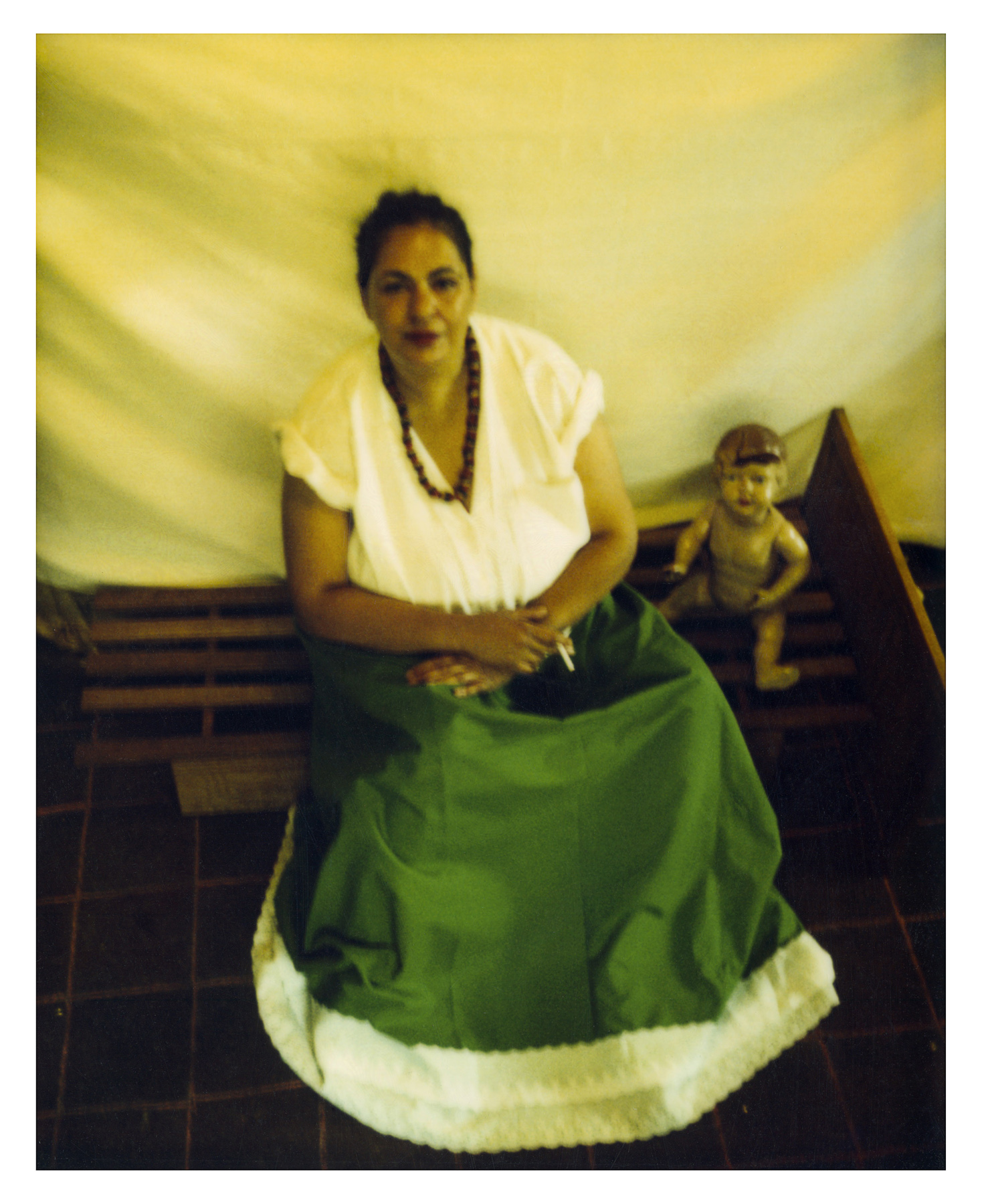
Dr Marcus Bunyan

Word count: 8,137

Download Death and the image (4.3Mb pdf)


Abstract

This text investigates how the act of photography visually writes trauma. Through an analysis of the context of images of death by artists such as Alphonse Bertillon, Robert Capa, Alexander Gardner, and Walker Evans the paper ponders how the camera captures human beings ante-mortem, at the death point, post-mortem and vita ad mortem.

It seeks to understand that line between presence and absence where life was there… and now death is in its place. Death was one step removed, now it is present. How does the act and performance of photography depict the trauma of death, this double death (for the photograph is a memento mori and/or the person in the photograph may already know that they are going to die).

“The text of eternity that the photograph proposes, imparts and imposes a paradoxical state of loss. The secret of telling truth in a photograph is that the more truthful, “the more orgasmic, the more pleasurable, the more suicidal” the pronouncement of the perfect paradox (you are dead but also alive) … then the more we are strangled while uttering it. The language of deferral in the writing of trauma in death and the image becomes the dissolve that seizes the subject in the midst of an eternal bliss. In death and the image we may actually die (be)coming.” (MB)

Keywords

Trauma, photography, death, art, memento mori, war, execution, memory, victim, representation, Alphonse Bertillon, Robert Capa, Alexander Gardner, Walker Evans, ante-mortem, point of death, death point, post-mortem, punctum, empathy, vita ad mortem, life after death.


Death and the image


“Photography, because it stops the flow of life, is always flirting with death…”


John Berger1


“On the most fundamental level there are transitions from continuous to discontinuous or from discontinuous to continuous. We are discontinuous beings, individuals who perish in isolation in the midst of an incomprehensible adventure, but we yearn for our lost continuity. We find the state of affairs that binds us to our random and ephemeral individuality hard to bear. Along with our tormenting desire that this evanescent thing should last, there stands our obsession with a primal continuity linking us with everything that is.”


Georges Bataille2


German Gen. Anton Dostler is tied to a stake before his execution


“German General Anton Dostler is tied to a stake before his execution by a firing squad in the Aversa stockade. The General was convicted and sentenced to death by an American military tribunal. Aversa, Italy.” Blomgren, December 1, 1945. 111-SC-225295. National Archives Identifier: 531326


Nazi General Anton Dostler Execution – Italy 1945 

The still photograph (above) can be seen being taken by the flash from a still camera that occurs at 1.22 secs in the YouTube film.
* An additional image of Dostler’s execution taken from a different perspective in the Addendum section of this text.


1

One of life’s recurrent themes is mortality. As Bataille notes, we are discontinuous beings: we live, we breathe, and we die. Photography’s recurrent theme is also mortality. In a ghostly evocation, the medium possesses an odour of death that sticks in the throat. So how then does photography visually write the trauma of death – over time, through space, in different contexts, with multiple narratives and different points of view?

As a first point of reference, we need to define trauma. Trauma can be an injury to living tissue; a disordered psychic or behavioural state resulting from severe mental or emotional stress or physical injury; an emotional upset and an agent, force or mechanism that causes all or any of these conditions.3 Atkinson and Richardson note that the work of theorists such as Nicolas Abraham, Maria Torok, Shoshana Felman, Dori Laub, Dominick LaCapra, and Cathy Caruth in broad terms view trauma,

“… as the delayed manifestation of a psychic wound sustained during an experience that has happened too quickly to allow registration and processing of the event at the time of its occurrence. To study trauma in literary or cultural terms, then, is to be concerned with the tension between what is known and what is not known, and with the impact and dynamics of the woundedness and machinations of trauma – not only its purely physical instantiation, but in all its reverberations. This is what brings the study of trauma to the uncertainty of truth, the impossibility of bearing absolute witness to catastrophe, the multiplicity of historical narratives.”4


Constitutive of trauma and its affects is the “piercing of the psychic shield” which protects a fragile subjectivity leaving in its wake shattered individuals, communities and even whole nations.5 Further, Michalinos Zembylas citing Kaplan (2005) notes that “an important distinction that needs to be made here is one’s positioning and context of encountering trauma,”6 between being a primary or secondary witness. Personally, I believe that a testimony (a formal written or spoken statement that something is true) in the first instance… becomes a testament (something that serves as a sign or evidence of a specified fact) in the second.

When looking death in the face, we can state that death is a trauma not only for the physical body and the psyche of the person involved (the direct trauma victim), but also for the witness of the event, be they a primary witness – one who actually witnesses the traumatic event – or a secondary witness, a person “who has no personal connection to the victim but may encounter trauma through other sources such as the media and oral or written accounts of a catastrophe.”7

These secondary encounters can never be the actual experience of trauma but, acting through language (be it oral, written or visual), they may embody sensations that stimulate feelings and thoughts in the secondary observer. A social construction of a testament may produce an empathetic engagement in viewers as “secondary witnesses.”8 Through an understanding of spectatorship, experience, aesthetic effects, narrative strategies and temporal shifts in the polyvocal nature of language we can begin to understand how the affect of secondary traumatisation – on memory, history and the body – can break down the subject-object dichotomy, can break down the realist norms of representation to produce “a mode of cognition involving sensuous, somatic and tactile forms of perception.”9 Here language (the photograph in this case, reinforced by the title of the photograph) stands in for that which is absent, but it is not in opposition to an intensity of feeling. The language of the photograph can intensify the affect of the image, especially if the photograph becomes transcendent, embodied, in the vitality and “aliveness” of the viewer.10

This mimetic experience “promotes a critical and self-reflexive empathy” and knowledge in the secondary witness that LaCapra observes is a “virtual, not vicarious, experience … in which emotional response comes with respect for the other and the realisation that the experience of the other is not one’s own.”11 Essentially, this is a social concept, a social construction of reality, a matrix-like view of the world that draws on relational and contextual dimensions for understanding trauma. This concept requires careful consideration of issues related to history, culture, race, gender, ideology, beliefs, agency and power.

“From a social constructionist and narrative perspective, people reconstruct their selves through the stories they tell about their past and the meaning they ascribe to the present in anticipation of the future. They shape their stories through active and creative interpretation of their lives and are in turn shaped by these stories. However, the self is not only a product of narratives. People are purposeful and moral beings, having the power and agency to change scripts, discourses and ideologies…”12


Here we can ask, what are the machinations of the image in the affective dynamics of photographs of trauma and how are they situated in a certain relation to trauma? What do photographs actually do that give rise to a way of thinking and feeling about trauma?

Although no representation can fully describe the first hand experience of trauma because of the partial nature of language – its gaps, elisions and impossibilities of speech13 – it is because of these very gaps that new spaces of interpretation can open up. Rather than just representing the perceived reality of trauma (this happened, at this time, in this location – an ordering of reality), images have the unique ability to transcend their indexical relationship to the real, pointing and touching (as if with the index finger) to the relationality of trauma as it touches human emotion. With its ability to police and regulate it subject, the implicit violence of photography is a predatory means of taking possession of both its victim (the subject) and its viewer.

Anna Gibbs has stated that we live, “in a more or less continuous state of mediatised emergency and traumatic aftermath, desensitised by the onslaught of images … to the affect we ought to feel.”14 I strongly disagree. I would argue that the traumatic numbing15 and supposed “death of experience”16 allegedly present in the world of image circulation, translation, and accumulation only occurs if the witness lets it be so.

Personally, I believe that something in the image is transferred to the witness pre-cognition – intuitively, imaginatively – which can then be interpreted cognitively and relationally with regard to history and memory, art and culture, politics and experience through an orthogonal movement through time and space. As viewers and interpreters, we are not fixed at a particular point in time and space, nor do we observe from one particular point of view. Our existential engagement provides a space to close the gap between affect and enunciation.

“Facts can vibrate; they can give of colors, sounds, smells, images. To talk of these facts with no recognition of this is to lack any awareness of the act of enunciation, of the gaps between language and experience and the unpredictable ways that sparks can break out of language, leap across the gap and ignite the tinderbox of traumatic memory.”17


2

Surfing Pinterest (a photo sharing website) recently, I absentmindedly clicked on an abstract image of three hanging black shapes from the pantheon of image tiles that presented itself to me. Up popped this horrific image of three Afro-Americans who had been lynched in the Southern United States in the 1920s. I was shocked and dismayed. I had such a strong emotional reaction to the image. But more than that, my feelings and memories of the bigotry that I had faced as a young gay man growing up in the 1970s swelled in my consciousness. This story is a example of how exposure to an image can bring to the surface unresolved aspects of being ‘Other’, of being different, and being persecuted for that difference. I thought about the lives of these people that had led them to that point, their families, their histories and the terror that they must have experienced on that day. You cannot begin to understand that, but you can have empathy and anger against the systems of racism and bigotry that exist in the world.

Then the cognitive part of my brain linked the image to a report I had only just seen a few days before on lynching, which told of the thousands of Afro-Americans who had been killed between 1882 and 1968.18 Mentally, I then linked this to a Facebook posting which put forward the analogy that the current killing of Afro-Americans by police in the United States was akin to a contemporary and publicly endorsed and enforced form of lynching. Finally, in my head I heard Billie Holiday singing that famous song Strange Fruit, “a dark and profound song about the lynching of African Americans in the Southern United States during the Jim Crow Era, “strange fruit,” as they hang from trees, rotting in the sun, blowing in the wind, and becoming food for crows upon being burned.”19 I watched the video of Billie Holiday singing this song on YouTube.20 Every time I think of this image I have these associations of animate thought intrinsic to the original experience,21 where the micro and macro conditions of production work to “embody and register trauma,”22 a communicable language of sensation and affect, time and time again.


Billie Holiday – Strange fruit


These chains of affect, the nexus between affect / feeling / emotion / cognition, are a form of synaesthesia where facts, emotions, feelings, memories, sounds and images vibrate against each other as an active and continuous engagement of the self with the world in which one lives. In a human being who is un/consciously aware, these real and mediated experiences may encourage a sensory intensification that elicits thought and empathic vision in the materiality of embodied experience, something (the punctum?) that takes us out of our selves into a higher register of being.

As part of this system of impressions, of an instantaneous, affective response triggered by an image,23 photographs force us to engage visually and involuntarily. “Impressions that force us to look, encounters which force us to interpret, expressions which force us to think.”24 Encounters which force us to comprehend. The conjunction of affect and critical awareness “constitute the basis of an empathy grounded … on a feeling for another that entails an encounter with something irreducible and different, often inaccessible.”25 This combination of affective and intellectual operations – about forcing oneself to look (and that process of looking/surrendering) but never forgetting your ‘point of view’, your memory, history and identity, is when empathy becomes that process of surrender, “but also the catch that transforms your perception.”26 How is this “catch” enunciated in photographs? I now want to look at a few images that explicate these phenomena.


Ante-mortem: present but absent

3

With the invention of photography in the late 1830s, the photograph as memento mori allows the spectator to observe death not at first hand, but through the representation of the image “taken from life.” Photographs provide a verification of reality through their apparent verisimilitude, while being woven into narratives – oral, textual, intertextual, spatial and temporal – that frame the event in multiple ways.

“Photographs … have come to stand in for reality … despite the fact that it is relatively easy to manipulate their meaning. As a result of their ability to project reality, images, and particularly those that depict death and destruction, are seen as potentially powerful pieces of documentary evidence…”27


Photographs are embedded in “a context of the cultural circumstances at the time, and therefore exist rarely in isolation or without meaning”28 and can be seen as having a denotative level (what they physically represent) and a connotative level (the meanings attached to that representation).29 Photography quickly changed how death was displayed because it introduced a “reality” and immediacy of representation that was democratic, personal and everyday.30


Alexander Gardner (American, 1821-1882) 'Lewis Paine' 26th April 1865


Alexander Gardner (American, 1821-1882)
Lewis Paine
26th April 1865
Albumen silver print from a Collodion glass plate negative


An example of the personal, everyday and documentary nature of photography can be seen in the photograph taken by Alexander Gardner in April 1865. This portrait is of Lewis Thornton Powell (aka Lewis Payne or Paine) who was one of the conspirators in the assassination of Abraham Lincoln which occurred the same month. The photograph has a background of dark metal, and was taken on one of the ironclads U.S.S. Montauk or Saugus, where the conspirators were for a time confined. The reality is Paine was executed in July 1865 just eight short weeks after this photograph was taken, so in effect (and in the affect on us of this knowledge), he is (already) a dead man walking. This is a double death – that death buried in the very act of taking any photograph, La petite mort or “the little death,” an idiom and euphemism for the orgasm of the photographic time freeze; and the fact that we know that he was going to die, those short weeks later.

The photograph forms the central panel of a three-panel Renaissance-like altarpiece, the form in which the three photographs are usually displayed. The left and right hand photographs were taken within minutes of each other, with the camera in the same position, whereas in the centre photograph the camera has been lowered to show more of the body, and the image has been cropped at the top. In the central plate the figure of Paine has been raised up in the frame – almost prematurely brought back to life by his placement. The centre image is the only one where Paine stares directly at the camera. He surveys the viewer with a gaze I find enigmatic.


Alexander Gardner (American, 1821-1882) 'Three photographs of Lewis Paine' 26th April, 1865


Alexander Gardner (American, 1821-1882)
Three photographs of Lewis Paine
26th April, 1865
Albumen silver prints from a Collodion glass plate negative


This is a very modern face, a very contemporary face. His hair is similar to Justin Beiber’s. Who brushed his hair across for this picture, and would it normally be this long, or has it just been ignored because of his fate? He still has good muscle tone – has he been exercising in his ironclad cell? And finally, his clothing – are they navy issue, as his top appears to have been given to him, perhaps the coarse, navy blue wool of the Northern states. If we were to place this image within the metaphysical school of photography which peaked with Paul Caponigro and Minor White we could say: Hovering above his head, has his spirit already begun to leave his body?

One reading of his gaze is that he is interested in what the photographer is doing – almost the gaze of an apprentice wanting to apply these skills in the future. Given his fate is he insane because of his interest? Another reading could be that he is looking out to the future in the hope of finding that he will be judged in another way. And another is the immediacy of his gaze – it is a gaze that is happening now!

The other thing that I find mysterious is the distance of the photographer from the subject. Was it fear or the presence of the guards that stopped Gardner getting any closer, or are there deck fittings we cannot see that prevented his approach. Imagine being Paine, having a photographer point a damn great view camera at you, documenting your countenance for prosperity. What was going on in Paine’s mind – what is his perspective on this performance by the photographer? And what brought Paine to this place?

Michel Foucault calls the methods and techniques by which human beings constitute themselves, “technologies of the self.” Foucault argued that we as subjects are perpetually engaged in processes whereby we define and produce our own ethical self-understanding. According to Foucault, technologies of the self are the forms of knowledge and strategies that “permit individuals to effect by their own means or with the help of others a certain number of operations on their own bodies and souls, thoughts, conduct, and way of being, so as to transform themselves in order to attain a certain state of immortality.”31 As we look into his eyes he knows that we know he is going to die, has already died but the intensity of that knowledge is brought into present time. In this instant, what Paine emanates is a form of i-mortality.

Roland Barthes in his seminal work Camera Lucida observes in Section 39:

“He is dead and he is going to die… The photograph is handsome, as is the boy: that is the studium. But the punctum is: he is going to die. I read at the same time: this will be and this has been; I observe with horror an anterior future of which death is the stake. By giving me the absolute past of the pose, the photograph tells me death in the future. What pricks me is the discovery of this equivalence.”32


This is Barthes anterior future, a moment where truth is interpreted in the mind of the photographer, not out there but in here (your head and your heart), where past, present and future coalesce into a single point in time: his death and our death connected through his gaze, and the knowledge of our joint discontinuity. In this moment in time, what we are doing is making a list about the human condition when we talk about something that is remarkable. Language can never fully describe the human condition, much as it may try… and this is why this photograph is remarkable, because it is ineffable, unknowable. The photograph inhabits you; it haunts you like few others, because it is a memoriam to a young man and his present death. Here he is present but absent at one and the same time.

As such, this is an image as triple death – the death of the photograph (past time / memento mori / remembrance of death), the death of the person in the photograph and also a third death, the knowledge that Paine is going to die. Death, like life, can be cyclical. This is the catch that transforms your perception, in Barthes terms the punctum of the image, in which the wounding, personally touching detail (past pose, future death) establishes a direct relationship with the object or person within it.

“The punctum (a Latin word derived from the Greek word for trauma [my emphasis]) … inspires an intensely private meaning, one that is suddenly, unexpectedly recognized and consequently remembered (it “shoots out of [the photograph] like an arrow and pierces me”); it ‘escapes’ language (like Lacan’s real); it is not easily communicable through/with language. The punctum is ‘historical’ as an experience of the irrefutable indexicality of the photograph (its contingency upon a referent). The punctum is a detail or “partial object” that attracts and holds the viewer’s (the Spectator’s) gaze; it pricks or wounds the observer.”33


This trauma, prick or wound that lifts the viewer out of themselves, out of their everyday existence, “points to those features of a photograph that seem to produce or convey a meaning without invoking any recognisable symbolic system. This kind of meaning is unique to the response of the individual viewer of the image.”34 This punctum also accounts for the importance of emotion and subjectivity in interacting with photographs; memory of that photograph displaces it from its moment of origin.35 Photography enacts the trauma of death even while being enacted upon.

Now we can read Eduardo Cadava’s comments on Walter Benjamin’s analysis of the photograph:

“As Benjamin suggests … the photograph, like the souvenir, is the corpse of an experience. A photograph therefore speaks as death, as the trace of what passes into history. I, the photograph, the spaced out limit between life and death, I, the photograph, am death. Yet, speaking as death, the photograph can be neither death nor itself. At once dead and alive, it opens the possibility of our being in time.”36


4

Photography then, can be seen as death taken away from itself.

Through the oscillation between studium (historical, social or cultural meanings extracted via semiotic analysis) and punctum (those features of a photograph that seem to produce or convey a meaning without invoking any recognisable symbolic system) the traumatic photograph of death, death’s afterimage, transcends the initial shock inducing signifier leading to a more extended form of engagement that addresses the duration of trauma in memory – through the images elisions, slippages, and conceptual, political and historical complexities. Our negotiation with imaging and imagining, therefore, takes place within ever-expanding contexts of meaning – some relating to the past and some to the present – which impact future interpretations.

I believe that these negotiations are, firstly, linked to what Deleuze calls the encountered sign, a “sign that is felt, rather than recognised, or perceived through cognition.”37 A feeling that is a catalyst for critical enquiry or deep thought. “For Deleuze, affect or emotion is a more effective trigger for profound thought because of the way in which it grasps us, forcing us to engage involuntarily…”38 Secondly, I believe that these negotiations are linked to what Barthes calls the images “third meaning.”

“In Barthes’ view, the image’s third meaning compels viewers after they encounter and deplete both its literal / informational side and its symbolic dimensions. Barthes argued that the third meaning is difficult to locate, because it is not situated structurally or in a certain place of the image. It is similarly difficult to describe, because it involves what he called the image’s obtuseness, its accent or anaphoric side.”39


Again, we have this idea of the catch, accent, or punctum that grasps us and takes us out of ourselves, that modulates the images “voice” (which is how the image takes on an already provided meaning upon its initial appearance), a voice which then also “helps us to understand both the image’s third meaning and the role of contingency in visual memory.”40


Death point

5


“Ah, wretched as I am … to dwell not among the living, not among the dead.”


Sophocles, ‘Antigone’41


Commentators such as Barbie Zelizer observe that images, especially about-to-die images, easily “reduce complex issues and circumstances to memorable but simplistic visual frames.”42 The image,

“… depicts for its onlookers a moment in an event’s unfolding to which they attend while knowing where that unfolding leads. This means that visual work often involves catching the sequencing of events or issues midstream, strategically freezing it at its potentially strongest moment of meaningful representation.”43


Other writers such as Susan Sontag note that these images have the potential to stir public emotions, simply because they freeze a moment in time and can be looked at again and again… but at the same time the repeated viewing of images of atrocity can have a numbing effect.44 The pain and fear evidenced in the photograph as seen in the victim’s eyes (for example in the photograph of the shooting of Sen. Robert F. Kennedy), expands the literal / informational side and its symbolic dimensions (chivalry, love, devotion, hope – Camelot!) into a Barthes’ third space. While Kennedy is a victim twice over (the victim of the assassin and the camera) in a guttural interpretation of the image he is to remain a victim for eternity in the contingency of the future, as long as we continue to look at this photograph.

For me, this is sad and painful photograph. I remember the day it happened. I was ten years old at the time. It’s one of those events that you will remember for the rest of your life – where you were, who you were with – like the moon landings or 9/11. I was in a car outside a small newsagent when the news came on the radio. Robert F. Kennedy had been shot: first aural, then visual on the black and white TV that night, then textual in the newspapers and then visual again with this photograph, then associative. The pain of the loss of those heady days of hope lessens not.


Boris Yaro (American, born 1938) 'LOS ANGELES. KENNEDY MOMENTS AFTER SHOOTING' June 5, 1968


Boris Yaro (American, 1938-2020)
LOS ANGELES. KENNEDY MOMENTS AFTER SHOOTING. Sen. Robert F. Kennedy Lies Gravely Wounded on the floor at the Ambassador Hotel in Los Angeles shortly after midnight today, moments after he was shot during a celebration of his victory in yesterday’s California primary election
June 5, 1968
Gelatin silver print
17.2 x 21.1cm (6 3/4 x 8 5/16 in.)
Twentieth-Century Photography Fund, 2010


While photographs of the actual moment of death are rare I have been able to find around ten images that capture this vital moment, a freezing of reality at the point of death, the death point: that line between presence and absence where life was there… and now death is in its place. Death was one step removed, now it is present.

However, I would argue that in the contextual language of the photograph, there is no singular death point. I would propose the idea of an extended period of time and space embedded in the spatio-temporal matrix of the image, so that there is no single point, no singular resolution to the traumatic moment of death – either for the person involved, nor the witness or viewer.

Setting aside the concept that the image could have been staged, in Robert Capa’s famous photograph Loyalist Militiaman at the Moment of Death, Cerro Muriano, September 5, 1936 (below), there is something about this image where space or some basic element is being democratised at the moment of death – or maybe in the choice to struggle with death. In an ontological sense of becoming, perhaps it is this that becomes the pure representation of time. In contrapunto, there is an anonymous image of a German soldier at the point of death on the steppes of Russia that is totally unknown. Why has one become famous and the other not?

Has it to do with the fame of the photographer, the pose of the person, or the agency of photography itself, where one photograph regarding the pain of others is too damning a legacy and of too plain a purpose to bare contemplating, while the other – with its masked face, outflung arm and falling, quasi-religious nature – has become possibly the most famous of war photographs through its proliferation in newspapers and magazines.

Whatever the merits of each image, these death point photographs are noteworthy for what is not said: the violence that is being perpetrated on the victim every time a person looks, and looks again, at the photograph. The writing of trauma by photography never ends, is always and forever infinite.


Robert Capa (1913-1954) 'Loyalist Militiaman at the Moment of Death, Cerro Muriano, September 5, 1936' 1936


Robert Capa (American, 1913-1954)
Loyalist Militiaman at the Moment of Death, Cerro Muriano, September 5, 1936
1936
Gelatin silver print
Photograph by Robert Capa © Cornell Capa / Magnum


Anonymous photographer. 'Falling German Soldier, Eastern Front' c. 1942


Anonymous photographer
Falling German Soldier, Eastern Front
c. 1942
akg-images / Interfoto AKG138118


Caption: A German soldier pays the ultimate price of war. German casualties were less than those of the Red Army, but the steady attrition suffered by the Wehrmacht began to undermine its effectiveness.46


Anonymous photographer. 'Russian spy laughing through his execution in Finland, 1942' 1942

Anonymous photographer. 'Russian spy laughing through his execution in Finland, 1942' 1942


Anonymous photographer
Russian spy laughing through his execution in Finland, 1942
1942
Rare Historical Photos website 2013


Caption: A Soviet spy laughs at his executioner in a picture taken in Rukajärvi, in East Karelia, in November 1942. It has been thought within the Finnish Defence Forces that the decision to withhold pictures of the fate of Russian POWs and spies may also have been prompted by concerns that pro-Soviet elements in Finnish society could have used the images for propaganda purposes. This picture was declassified by the Ministry of Defense of Finland in 2006, with the description: Unknown Soviet intelligence officer before being shot, Finland, 1942.

It’s a pretty amazing picture. To capture the last few moments of life. He knows he will die in a few seconds, in a forest in the snow. And there he will bleed out and be forgotten. His life, his experience, has come to an end. What else could he do but smile? That smile was his final defiance. Death smiles at us all, all a man can do is smile back.47


6

Here we might ask, is it possible, through the use of encountered signs, “voice”, punctum, catch or accent, to extend the unreal time of death?

Personally, I believe it is and I would argue for a sense of a Buddhist “no-time”. A transcendent time embedded into the fabric of the image. In Walker Evans’ terms an “unconscious phenomenon” that culminates in amazing accidents of composition, where things constantly rub up against each other “in the desire to create a type of friction that tests the boundaries of representation.”48 An example of this spatio-temporal dimensionality, third meaning or Thirdspace, can be seen in the interplay between the still image and film footage of the execution of German General Anton Dostler by a firing squad in the Aversa stockade December 1, 1945. By examining the film we see a flash of light at 5.16 secs, which is the still photograph at the top of this text being taken by the flash of a camera. The photographer can then be seen walking off. Later in the film another angle of the execution is shown, again with the flash of the absent camera recorded, starting at 7.10 secs. The displacement of time and space, between one point of view and another, with the absence of the still camera in both instances (in the image and in the film), is uncanny.

The fluidity of Barthes’ third meaning, where the image’s obtuseness compels viewers, has obvious links to Edward Soja’s conceptualisation of “Thirdspace”, which emerged from the spatial trialectics established by Henri Lefebvre in The Production of Space and Michel Foucault’s concept of heterotopia. Soja defines Thirdspace as, “an-Other way of understanding and acting to change the spatiality of human life, a distinct mode of critical spatial awareness that is appropriate to the new scope and significance being brought about in the rebalanced trialectics of spatiality-historicality-sociality.”49 In this amorphous space, “everything comes together… subjectivity and objectivity, the abstract and the concrete, the real and the imagined, the knowable and the unimaginable, the repetitive and the differential, structure and agency, mind and body, consciousness and the unconscious, the disciplined and the transdisciplinary, everyday life and unending history.”50

A further example of the presence of a third meaning in a still photograph can be seen in the image by an unknown photographer Photo taken at the instant bullets from a French firing squad hit a Frenchman who collaborated with the Germans (1944, below). Caught like a rabbit in headlights, the flash illuminates the collaborator kneeling, bound, and masked but it is not quick enough to freeze the explosion of wood, the dynamic breaking of the rope or the slight movement of the hands. The body seems to float on a bed of leaves. The cheap, dirty shoes and striped trousers leading up to the material that covers the victim’s face. Is that his hair, or a hat or another hood over his head? Although we know the what, why, and where of the photograph – an encounter with both its literal/informational side and its symbolic dimensions – the placing of the image, its accent and obtuseness is much more difficult to understand. The photograph and its protagonist seem to exist beyond time and space, the anonymous man surrounded by a death bed of leaves, bursting the bonds that wrapped him and held him tight. Like the mystery of Man Ray’s L’Enigme d’Isidore Ducasse (1920), the photograph has disturbed the trialectics of spatiality-historicality-sociality, destroying the imploring label, “Do not disturb.”


Unknown photographer. 'Photo taken at the instant bullets from a French firing squad hit a Frenchman who collaborated with the Germans. This execution took place in Rennes, France. 21 November 1944'


Unknown photographer
Photo taken at the instant bullets from a French firing squad hit a Frenchman who collaborated with the Germans. This execution took place in Rennes, France. 21 November 1944
1944
Silver gelatin photograph
U.S. Army Signal Corps
National Archives Identifier (NAID)


Post-mortem: absent but present

7


Letherolfsvile Oct 29 AD 1859

This is the likeness of Catherine Christ

When I am dead and in my grave

And when my bones are rotten

Remember me

When this you see

Or I shall be forgotten

The grass is green The rose is red

here is my name when I am dead 51


This short poem written on a piece of paper hidden underneath an image in a daguerreotype case implores us to remember the person – a plea to the future to remember them – through a composite narrative of portrait and text. Through the creative addition of text, the language of photographs can be supplemented which adds to the functionality of the photograph as an effective memory object.52 But what if the scene of the text (the photograph) contains an absence, no depiction of the person who has died? What happens to the writing of trauma in images of the dead then?

If we acknowledge that a photograph of a person always prefigures its subjects passing then what we are doing “in reality” is deferring the death of an/other onto the foreseen death of ourselves. In this process, we must remember that every photograph is a construct, a performative act by the photographer. What the photographer chooses to record is an act of will, whether ethical or not. Photographers have the presence of mind to attend to a certain manufacture of history. When viewing this instant narrative the viewer must acknowledge a loss of a sense of time:

“This lost sense could manifest as reliving a traumatic episode as if it is taking place in the present … In the context of trauma… a loss of sense of time deprives one of the ability of remembering and telling one’s narrative in a chronological order.”53


Emmet Gowin (b. 1941) 'Avebury Stone and Rennie Booher, England and Danville, Virginia' 1972


Emmet Gowin (American, b. 1941)
Avebury Stone and Rennie Booher, England and Danville, Virginia
1972
Gelatin silver print
Collection of Emmet and Edith Gowin
© Edith and Emmet Gowin and courtesy of Pace MacGill Gallery, New York


One way that artist’s upset this chronological order is by playing with the fragmentary nature of time, space and memory – of present absence/absent presence. In Emmet Gowin’s accidentally double-exposed negative, Avebury Stone and Rennie Booher, England and Danville, Virginia, 1972 (above), the photograph combines “a funerary image of his wife’s grandmother, Rennie Booher, with the surface of a Neolithic monumental stone he had photographed in England a few days earlier.” Floating through eternity, encased in ancient rock that nourishes her spirit, Gowin’s photograph acts as a kind of testament of absent but present, neither here not there. This loss of sense of space and time can be deeply disturbing (like trauma) as it questions one’s physical presence in the world, but it can also have a transcendental dimension as both time and space are inextricably bound to the very specific conditions of the material world. Photographs like the one of Booher have the potential to draw together what would otherwise seem to be incompatible. To form what Jacob Bronowsi calls a “hidden likeness”, one that transcends time and space, one that is reactivated with every looking.

“The poem or the discovery exists in two moments of vision: the moment of appreciation as much as that of creation; for the appreciator must see the movement, wake to the echo which was started in the creation of the work. In the moment of appreciation we live again the moment when the creator saw and held the hidden likeness. When a simile takes us aback and persuades us together, when we find a juxtaposition in a picture both odd and intriguing, when a theory is at once fresh and convincing, we do not merely nod over someone else’s work. We re-enact the creative act, and we ourselves make the discovery again…”54


An important fact about the nature of trauma is the compulsion of the human psyche to repeat traumatic events over and over again. The reproducibility of photographs and the ability to look at them again and again – their machine-like repeatability, their citationality or iterability to use Derrida’s signature term – feeds into this repetitive “death instinct” (Thanatos). However, Bronowsi’s “hidden likeness” (also the name of one of Emmet Gowin’s exhibitions and a form of punctum) is perhaps a liminal moment, one that may upset the death instinct. These liminal moments may occupy a position at, or on both sides of, a boundary or threshold. By disrupting the threshold – between life and death, between past, present and future time – they are requisite of the ghost (the soul) in the machine (the camera).

As Derrida observes, building on the work of Barthes,

“It belongs to it without belonging to it and is unlocatable in it; it never inscribes itself in the homogenous objectivity of the framed space but instead inhabits, or rather haunts it: “it is the addition [supplement]: it is what I add to the photograph and what is none the less already there.” … Neither life nor death, it is the haunting of the one by the other … Ghosts: the concept of the other in the same, the punctum in the studium, the dead other alive in me.”57


8

In this scenario, perhaps the act of writing trauma through death in the image becomes the true act of learning, and the interpretation of that act becomes an act of creation rather than one of rote memorialisation. These are images that require contemplation, time, analysis, and sensation, where the subject of the photograph is transformed “from somebody merely seen to someone really felt,” which is, as Batchen says, “an emotional exchange transacted in the heart.”58

This emotional exchange can take many forms. It can be triggered when the dead body is only metaphorically represented in the image, when the physicality of death has been transmuted. For example, photographs such as Walker Evan’s Child’s grave, Hale County, Alabama (1936, below), or the documentary image Place where the corpse was found (1901-1908, below) by the French photographer Alphonse Bertillon, propose a re-imaging and re-imagining of the life of the person. They do so through an un/ambiguous photographic context, that is, through the marking of place in the photograph. In the latter case, this marking of a life is represented by two pieces of wood lying on the ground and two pieces of wood propped at 45 degrees against the wall. As though this is all that is left of the existence of Mademoiselle Mercier in a street (Rue de l’Yvette) that still exists in Paris to this day. A photograph of pieces of wood and an empty space.


Walker Evans (American, 1903-1975) 'Child's grave, Hale County, Alabama' 1936


Walker Evans (American, 1903-1975)
Child’s grave, Hale County, Alabama
1936
Silver gelatin print
7 3/8 x 9 7/16″ (18.7 x 23.9cm)
© 2016 Walker Evans Archive, The Metropolitan Museum of Art


Attributed to Alphonse Bertillon (French, 1853-1914) 'Place where the corpse was found' 1st November 1902


Attributed to Alphonse Bertillon (French, 1853-1914)
Place where the corpse was found
1st November 1902
From Album of Paris Crime Scenes
Gelatin silver print
Overall: 24.3 x 31cm (9 9/16 x 12 3/16 in.)
Page: 23 x 29cm (9 1/16 x 11 7/16 in.)
Gilman Collection, Purchase, The Howard Gilman Foundation Gift, 2001


Other photographs picture the place of death nearly a century later in order to commemorate the traumatic death of “deserters” at the hands of a firing squad during the First World War. These are some of the most traumatic photographs of death I have seen, for they require me to imagine the mise en scène that was enacted at dawn almost 100 years ago, in the very place where these photographs were later “shot” at dawn.

The artist, Chloe Dewe Mathews, realised that “I was placing my tripod around the same spot where the firing squad had stood and looking directly at the place where the victim was placed.” It was, she says, “a solitary and sombre undertaking,” an undertaking (with that name’s etymological link to the word undertaker) which the viewer is invited to partake of, a re-imaging of those traumatic events that requires an active imagining, and thinking, in the neo-spectator. It is this duration of trauma in cultural memory which calls for an active negotiation in ways of seeing, a re-negotiation which can produce an empathic vision that “changes the terms of our engagement” with the image.


Chloe Dewe Mathews (British, b. 1982) 'Former Abattoir, Mazingarbe, Nord-Pas-de-Calais' 2013


Chloe Dewe Mathews (British, b. 1982)
Former Abattoir, Mazingarbe, Nord-Pas-de-Calais
2013
Eleven British soldiers were executed here between 1915-1918
From the series Shot at Dawn
© Chloe Dewe Mathews


Vita ad mortem: life after death

9


“… the life of spirit is not the life that shrinks from death and keeps itself untouched by devastation, but rather the life that endures it and maintains itself in it. It wins its truth only when, in utter dismemberment, it finds itself.”


George Wilhelm Frederich Hegel61


The absence/presence contained within all photographs speaks to the ultimate affect: that of la petite mort – the “little death” – the sensation of orgasm as likened to death, a short period of melancholy or transcendence as a result of the expenditure of the “life force.” While Barthes metaphorically used the concept to describe the feeling one should get when experiencing any great literature, it can also be used when some undesired thing has happened to a person and has affected them so much that “a part of them dies inside.”

A photograph can also contain this melancholy transcendence, a catastrophe that has already occurred.

“Whether or not the subject is already dead, every photograph is this catastrophe… This punctum, more or less blurred beneath the abundance and the disparity of contemporary photographs, is vividly legible in historical photographs: there is always a defeat of Time in them: that is dead and that is going to die… At the limit, there is no need to represent a body [in photographs] in order for me to experience this vertigo of time defeated.”63


Barthes’ concept of an extended punctum may be useful here, when he states, “I now know that there exists another punctum (another ‘stigmatum’) than the ‘detail’. This new punctum, which is no longer of form but of intensity, is Time, the lacerating emphasis of the noeme (‘that-has-been’), its pure representation.”64

Here Barthes is proposing a punctum of intensity; a punctum as lacerating “detail”; and/or “the vertigo of time defeated.” This “temporal hallucination” embedded and embodied in the photograph – the temporality of the “will-have-been”, they are dead (today), they are already dead (yesterday), Barthes’ anterior future – represents a symbolically mediated subject bound up in three extases of time (past, present, and future).65

The subject becomes lost in the language of the photograph, the intersection of Lacan’s the Imaginary (in which the human subject creates fantasy images of both himself and his ideal object of desire), the Symbolic (the social world of linguistic communication and inter-subjective relations), and the Real (defined as what escapes the Symbolic, the Real can be neither spoken nor written, it is impossible, but is ceaselessly writing itself). These concepts serve to situate subjectivity within a system of perception and a dialogue with the external world.

According to Lori Wike, the experience of punctum and the structure of iterability can be aligned to Lacan’s concept of the death drive (or death instinct) present in the Symbolic order, in which the signifier “materializes the agency of death.”66 This may account for the role of the photographic punctum as trauma, in which the punctum opens up “a kind of subtle beyond” where “a blind field is created (is divined)…”67 As Barthes notes, “Photography is a kind of primitive theater, a kind of Tableau Vivant, a figuration of the motionless and made-up face beneath which we see the dead.”68 Further, we can say that, “unlike the symbolic, which is constituted in terms of oppositions such as “presence” and “absence”, there is no absence in the real,” for the real is undifferentiated, “it is without fissure.”

“The symbolic introduces “a cut in the real,” in the process of signification: “it is the world of words that creates the world of things.” Thus the real emerges as that which is outside language: “it is that which resists symbolization absolutely.” The real is impossible because it is impossible to imagine, impossible to integrate into the symbolic order. This character of impossibility and resistance to symbolization lends the real its traumatic quality.”69


The “mark” of photography is eviscerated in the intensity of the real, a traumatic loss of time that confronts us with our own mortality and the knowledge that we will not be remembered. This is where images of death can take us once the initial affective connection is established – to a noumenal space where in the play of representation, the point of origin becomes ungraspable (Lacan’s différance).70

“In French, différance simultaneously contains within its neo-graphism the activities of differing and deferring, a distancing acted out temporally as well as spatially.”71 Where the moment (the time freeze of the shutter) turns in, on and around its own fulcrum, where there is always difference at the point of origin. For all of its instantaneous nature, in photography there is always a perverse moment of displacement and deferral. In its history, “a perverse complicity of continuity and resemblance with its supposed opposite, discontinuity and difference”72 … the latter only existing in a reciprocal relationship to the former.

The circle is closing and we return to where we started.


10

Human beings in their longing for lost continuity are mirrored by their photographs which transition from continuous to discontinuous and back again. While we yearn for our lost continuity, we must acknowledge that death is an unedited event, one that we cannot look back on. There is no following event to blank out that moment… and the dead are always dying. But what images of death in photography do is this: they allow us to approach the noumenal, that state of being of which we can have knowledge of, but can never know. We can approach, touch, feel, analyse, and have empathy for traumatic events in the representation of an unknowable reality. The photograph has the ability to go beyond the symbolic, to approach the impossible, the real.

The photograph may proffer a ‘releasement toward things’,73 a coexistence between a conscious and unconscious way of perceiving which sustains the mystery of the object confusing the distinction between real time and sensual time, between inside and outside, input and output becoming neither here nor there. As Martin Jolly notes, citing John Thompson, “… images of death can be seen a form of “mediated, non-reciprocal intimacy, stretched across time and space” in which we are increasingly unconstrained by our location or our time.”74 Further, John Thompson observes, “While lived experience remains fundamental, it is increasingly supplemented by, and in some respects displaced by, mediated experience, which assumes a greater and greater role in the project of self-formation.”75

In the sense that the photograph becomes la petite mort, the little death, it embodies our desire for the soul to become eternal in the form of this mediated experience… the displacement of the soul via the ghost in the machine, the soul remembered throughout time in the traumatic trace of the photograph. Death in the language of photography is always postponed and deferred: into the physicality of the photograph; into cultural memory; into the gaze (of the photographer, the camera and the viewer); and into the body of the observer. Here, a relationship exists between an impossible reality (an encounter with an “outside” which is unknowable) and a floating referent in an image that is both formative and transformative. And in that relationship, as Donna Haraway observes, “Relationship is multiform, at stake, unfinished, consequential.”76

The text of eternity that the photograph proposes, imparts and imposes a paradoxical state of loss. The secret of telling truth in a photograph is that the more truthful, “the more orgasmic, the more pleasurable, the more suicidal”77 the pronouncement of the perfect paradox78 (you are dead but also alive) … then the more we are strangled while uttering it. The language of deferral in the writing of trauma in death and the image becomes the dissolve that seizes the subject in the midst of an eternal bliss. In death and the image we may actually die (be)coming.

© Dr Marcus Bunyan 2018

Word count: 8,137


Addendum

“Empirically acknowledged as tragic, the photographic print was really just that when, at the turn of the century, it became the instrument of the three great authorities over life and death (the law, the army, medicine). This is when it demonstrated its power to reveal the unfolding of a destiny from the word go. As deus ex machina [god from the machine or, providential intervention], it was to become just as ruthless for the criminal, the soldier or the invalid, the conjunction between the immediate and the fatal only becoming more solid, inevitably, with the progress of representation.”

Virilio, Paul. The Vision Machine (trans. Julie Rose). Bloomington: Indiana University Press, 1994, p. 43.


“Written with her trademark flair and force, Sontag’s book [On Photography] inaugurated a wave of criticism, much of it influenced by Foucaultian theory, that underscored the instrumentality and implicit violence of photography, its ability to police and regulate it subjects, especially those lacking social and political power: the poor, presumed “deviants” or “criminals,” and workers. As Sontag herself acknowledged, however, photography is not only a predatory means of taking possession, but also a mode of conferring value; it can potentially be put to counter-hegemonic uses, used to see and frame in ways that affirm and legitimate, rather than strictly contain and control, the presence of culturally disenfranchised persons.”

Entin, Joseph. “Milton Rogovin’s Approach: Photography, Class, and the Aesthetics of Making Space (2008),” on the ASX website July 12, 2010 [Online] Cited 27/10/2018


“The submissions attest to our insatiable hunger for images of suffering. “Sight can be turned off; we have lids on our eyes,” says Sontag5. But sometimes we  just can’t resist taking a look. Since its inception photojournalism has traded in images of human suffering. If one of its motivations for representing tragedy has been to change the world then it has been unsuccessful. Instead the profession has turned us into voyeurs, passively consuming these images, sharing in the moment without feeling implicated or responsible for what we are seeing. Roland Barthes summed up the analgesic effect of looking at images of horror when he wrote “someone has shuddered for us; reflected for us, judged for us; the photographer has left us nothing – except a simple right of intellectual acquiescence.”6 Put another way, we look at events in photographs and feel relieved that they’re not happening anywhere near us. …

In the final analysis we were choosing between a French landscape, a dead guerrilla, an HIV positive mother and an American soldier. A strange task. Rather predictably the majority vote went to Tim Hetherington’s soldier. Yet comparing so many diverse images and ultimately declaring one of them a winner feels meaningless. Do we even need to be producing these images any more? Do we need to be looking at them? We have enough of an image archive within our heads to be able to conjure up a representation of any manner of pleasure or horror. Does the photographic image even have a role to play any more? Video footage, downloaded from the internet, conveys the sounds and textures of war like photographs never could. High Definition video cameras create high-resolution images twenty-four photographs a second, eliminating the need to click the shutter. But since we do still demand illustrations to our news then there is a chance to make images that challenge our preconceptions, rather than regurgitate old clichés.”

Adam Broomberg and Oliver Chanarin. “Unconcerned but not indifferent,” on the FOTO8 website 04 Mar 2008 [Online] Cited 20/11/2018


5. Susan Sontag, Regarding The Pain of Others (Penguin, London, 2003) p. 105

6. Roland Barthes, The Eiffel Tower and Other Mythologies (New York, Hill and Wang, 1979) p. 71. quoted in John Taylor, Body Horror: photojournalism, catastrophe and war (Manchester, Manchester University Press, 1988) p. 17


Adrien Constant de Rebecque (Swiss, Lausanne 1806-1876 Lausanne) '[Man in Chainmail Tunic Posing as a Dying Soldier]' c. 1863


Adrien Constant de Rebecque (Swiss, Lausanne 1806-1876 Lausanne)
(Man in Chainmail Tunic Posing as a Dying Soldier)
c. 1863
Albumen print from collodion glass negative
17.9 x 24.2cm (7 1/16 x 9 1/2 in.)
Gilman Collection, Purchase, The Howard Gilman Foundation Gift, 2012
The Metropolitan Museum of Art, New York


Manuel Álvarez Bravo (Mexican, 1902-2002) 'Ouvrier en grève, assassiné (Striking worker, assassinated)' 1934


Manuel Álvarez Bravo (Mexican, 1902-2002)
Ouvrier en grève, assassiné (Striking worker, assassinated)
1934
Silver gelatin print


Manuel Alvarez Bravo (Mexican, 1902-2002) 'La Buena Fama Durmiendo (The Good Reputation Sleeping)' 1939, printed c. 1970s


Manuel Alvarez Bravo (Mexican, 1902-2002)
La Buena Fama Durmiendo (The Good Reputation Sleeping)
1939, printed c. 1970s
Silver gelatin print


One of my early heroes in photography was Manuel Alvarez Bravo. Many Mexican photographs tell such stories based on the mythology of the country: there are elements of the absurd, surrealism, macabre, revolution, political and socio-economic issues, also of death, violence, beauty, youth, sexuality and religion to name but a few – a search for national identity that is balanced in the photographs of Bravo by a sense of inner peace and redemption. This potent mix of issues and emotions is what makes Mexican photography so powerful and substantive. In the “presence” (or present, the awareness of the here and now) of Mexican photography there is a definite calligraphy of the body in space in most of the work. This handwriting is idiosyncratic and emotive; it draws the viewer into an intimate narrative embrace. Two famous photographs by Bravo illustrate some of these themes (Apollonian / Dionysian; utopian / dystopian). When placed together they seem to have a strange attraction one to the other.


Anne Frank, photograph inscribed with her wish to go to Hollywood, October 10, 1942


Anne Frank, photograph inscribed with her wish to go to Hollywood, October 10, 1942


Unknown photographer - U.S. Signal Corps Photo. 'General Anton Dostler' 1945

Unknown photographer - U.S. Signal Corps Photo. 'General Anton Dostler' 1945


Unknown photographer – U.S. Signal Corps Photo
General Anton Dostler
1945
Silver gelatin photograph
From International News Photos


References

Atkinson, Meera and Michael Richardson 2013. ‘Introduction: At the Nexus’, in M Atkinson and M Richardson (eds). Traumatic Affect. Newcastle upon Tyne: Cambridge Scholars Publishing, pp. 1-21

Atkinson, Meera and Michael Richardson (eds) 2013. Traumatic Affect. Newcastle upon Tyne: Cambridge Scholars Publishing

Barthes, Roland 1981. Camera Lucida – Reflections on Photography. New York: Hill and Wang

Bataille, Georges 1962. Death and Sensuality: A Study of Eroticism and the Taboo. New York: Walker and Company

Batchen, Geoffrey 2004. Forget Me Not: Photography & Remembrance. New York: Princeton Architectural Press

Batchen, Geoffrey 1997. Burning with Desire: The Conception of Photography paperback 1999. Massachusetts: MIT Press

Bennett, Jill 2005. Empathic Vision: Affect, Trauma, and Contemporary Art. Palo Alto: Stanford University Press

Berger, John 1985. The Sense of Sight. New York: Vintage International

Brett, Donna West 2016. ‘Damaged: Ruin and Decay in Walker Evans’ Photographs’ at Walker Evans Symposium. Melbourne: Centre for Contemporary Photography

Bronowski, Jacob 1958. Science and Human Values. New York: Harper and Row

Brown, Andrew (ed. and trans,) 1987. Sophocles: Antigone. Wiltshire: Aris and Phillips Ltd.

Cadava, Eduardo 1992. ‘Words of Light: Theses on the Photography of History’ Diacritics 22 no. 3-4 (Fall-Winter), 84-114

Chaouat, Bruno 2005. ‘Image malgré tout’ (review) in L’Esprit Créateur vol. 45 no. 1, pp. 110-111

Deleuze, Gilles 1964. Proust and Signs. New York: George Braziller, 1972 in English

Edwards, Janis L. 2012. ‘Visual Literacy and Visual Politics: Photojournalism and the 2004 Presidential Debates’ in Communication Quarterly vol. 60 issue 5, pp. 681-197

Foucault, Michel 1988. ‘Technologies of the self’ in L H Martin and H Gutman and P H Hutton (eds). Technologies of the self: A seminar with Michel Foucault. Amherst: University of Massachusetts Press, pp. 16-49

Gibbs, Anna 2013. ‘Apparently Unrelated: Affective Resonance, Concatenation and Traumatic Circuitry in the Terrain of the Everyday’ in M Atkinson and M Richardson (eds). Traumatic Affect. Newcastle upon Tyne: Cambridge Scholars Publishing, pp. 129-147

Gibbs, Anna 2007. ‘Horrified: Embodied Vision, Media Affect and the Images from Abu Ghraib’ in D Staines (ed). Interrogating the War on Terror. Cambridge: Cambridge Scholars Publishing, pp. 125-142

Hanusch, Folker 2010. Representing death in the news: Journalism, Media and Mortality. London: Palgrave Macmillan

Haraway, Donna and Cary Wolfe 2016. Manifestly Haraway. Minneapolis: University of Minnesota Press

Hegel, George Wilhelm Frederich 1807. Phenomenology of Spirit Preface (trans. A. V. Miller 1977). Oxford: Oxford University Press

Heidegger, Martin 1966. Discourse on Thinking New York: Harper & Row

Houlihan, Kasia 2004. ‘Annotation on Roland Barthes’ Camera Lucida – Reflections on Photography’ New York: Hill and Wang 1981 in Theories of Media, Winter

Jolly, Martyn 2015. ‘An Australian Spiritualist’s Personal Cartes-de-Visite Album’, in A Maxwell and J Croci (eds). Shifting Focus: Colonial Australian Photography 1850-1920. North Melbourne: Australian Scholarly Publishing, pp. 71-87

Kopelson, Kevin 1990. ‘Wilde, Barthes, and the Orgasmics of Truth’ in GENDERS no. 7 Spring, pp. 22-31

Lacan, Jacques and Jeffrey Mehlman 1972. ‘The Seminar on the ‘Purloined Letter” in Yale French Studies no. 48 French Freud: Structural Studies in Psychoanalysis Yale University Press, pp. 39-72

Martin, Luther H and H Gutman and P H Hutton (eds) 1988. Technologies of the self: A seminar with Michel Foucault. Amherst: University of Massachusetts Press

Maxwell, Anne and Josephine Croci (eds) 2015. Shifting Focus: Colonial Australian Photography 1850-1920. North Melbourne: Australian Scholarly Publishing

O’Hagan, Sean 2014. ‘Chloe Dewe Mathews’s Shot at Dawn: a moving photographic memorial’ on The Guardian website Sun 29 Jun 2014

Papastergiadis, Nikos and Mary Zournazi 2002. ‘Faith without certitudes’ in M Zournazi Hope: New Philosophies for Change Annandale. NSW: Pluto Press Australia, pp. 78-97

Randell, Karen and Sean Redmond (eds) 2008. The war body on screen. New York: Continuum

Rastas, David and Maria Schlachter 2016. Art as a Sanctuary for the Mad: Six characteristics of mystical experience and their visual accompaniment in contemporary art

Rogobete, Ileana Carmen 2011. Reconstructing Trauma and Recovery: Life Narratives of Survivors of Political Violence during Apartheid. PhD thesis Cape Town: University of Cape Town

Rutherford, Anne 2013. ‘Film, Trauma and the Enunciative Present’ in M Atkinson and M Richardson (eds) Traumatic Affect. Newcastle upon Tyne: Cambridge Scholars Publishing, pp. 80-103

Sontag, Susan 1977. On Photography New York: Farrar, Straus and Giroux

Staines, Deborah (ed) 2007. Interrogating the War on Terror Cambridge: Cambridge Scholars Publishing

Strawberry 2013. ‘Roland Barthes: studium and punctum’ on the Museum of Education website March 12, 2013

Thompson, John 1995. The Media and Modernity: A Social Theory of Media. Cambridge: Polity Press

Virilio, Paul 1994. The Vision Machine (trans. Julie Rose). Bloomington: Indiana University Press

Walsh, Stephen 2000. Stalingrad: The Infernal Cauldron, 1942-43. London: Simon and Schuster

Wike, Lori 2000 ‘Photographs and Signatures: Absence, Presence, and Temporality in Barthes and Derrida’ in InVisible Culture: An Electronic Journal for Visual Studies issue 3, pp. 1-28

Zelizer, Barbie 2002. The Voice of the Visual in Memory. Annenberg School for Communication, University of Pennsylvania

Zembylas, Michalinos 2008. The Politics of Trauma in Education. New York: Palgrave Macmillan


Endnotes

[1] Berger, John 1985. The Sense of Sight. New York: Vintage International, p. 122

[2] Bataille, Georges 1962. Death and Sensuality: A Study of Eroticism and the Taboo. New York: Walker and Company, p. 15

[3] Anonymous 2016 Definition of Trauma by Mirriam-Webster, at http://www.merriam-webster.com/dictionary/trauma (accessed 8 November 2016)

[4] Atkinson, Meera and Michael Richardson 2013. ‘Introduction: At the Nexus’ in M Atkinson and M Richardson (eds). Traumatic Affect. Newcastle upon Tyne: Cambridge Scholars Publishing, p. 5

[5] Rutherford, Anne 2013. ‘Film, Trauma and the Enunciative Present’ in M Atkinson and M Richardson (eds). Traumatic Affect. Newcastle upon Tyne: Cambridge Scholars Publishing, p. 82

[6] Michalinos Zembylas 2008. The Politics of Trauma in Education. New York: Palgrave Macmillan p. 4

[7] Ibid., p. 4

[8] Rutherford Op. cit., p. 87

[9] Rutherford Op. cit., Footnote 49, 93

[10] Rutherford Op. cit., p. 94

[11] Bennett, Jill 2005. Empathic Vision: Affect, Trauma, and Contemporary Art. Palo Alto: Stanford University Press, p. 9

[12] Rogobete, Ileana Carmen 2011. Reconstructing Trauma and Recovery: Life Narratives of Survivors of Political Violence during Apartheid. PhD thesis Cape Town: University of Cape Town, at https://open.uct.ac.za/handle/11427/10884 (accessed 8 November 2016)

[13] Rutherford Op. cit., 85

[14] Gibbs, Anna 2013. ‘Apparently Unrelated: Affective Resonance, Concatenation and Traumatic Circuitry in the Terrain of the Everyday’ in M Atkinson and M Richardson (eds). Traumatic Affect. Newcastle upon Tyne: Cambridge Scholars Publishing, 130

[15] “Perhaps rather than numbness, what we actually feel is our own helplessness or impotence, and the shame of helplessness, which robs us of agency. Helplessness is what Tomkins calls an affect complex, and within it distress is the dominant affect, although there may be admixtures in it of fear, anger and shame… Helplessness immobilises, and this is what induces the shame which, as a reduction of interest, makes us lower our gaze and look away.”

Gibbs, Anna 2007. ‘Horrified: Embodied Vision, Media Affect and the Images from Abu Ghraib’ in D Staines (ed). Interrogating the War on Terror. Cambridge: Cambridge Scholars Publishing, pp. 139-140

[16] “To suffer is one thing; another thing is living with the photographed images of suffering, which does not necessarily strengthen conscience and the ability to be compassionate. It can also corrupt them. Once one has seen such images, one has started down the road of seeing more – and more. Images transfix. Images anaesthetize…”

Sontag, Susan 1977. On Photography. New York: Farrar, Straus and Giroux, p. 20

“Are we making too much of images? Are we lured by our own voyeurism and iconophilia, numbed as we are by the democracy of the spectacle? Or, on the contrary, do images open the eyes of our conscience? In other words do images merely entertain and anaesthetize us or do they shame us and awake our conscience?”

Chaouat, Bruno 2005. ‘Image malgré tout’ (review) in L’Esprit Créateur vol. 45 no. 1, at https://muse.jhu.edu/article/265181/pdf (accessed 8 November 2016)

[17] Rutherford Op. cit., 89

[18] Anonymous 2016. ‘Lynching in the United States’, at https://en.wikipedia.org/wiki/Lynching_in_the_United_States (accessed 11 November 2016)

[19] Anonymous 2016. ‘Strange Fruit: Billie Holiday’, at http://genius.com/Billie-holiday-strange-fruit-lyrics (accessed 11 November 2016)

[20] ‘Billie Holiday – Strange Fruit’, at https://www.youtube.com/watch?v=dnlTHvJBeP0 (accessed 11 November 2016)

[21] Rutherford Op. cit., Footnote 55, 95

[22] Bennett, Jill 2005. Empathic Vision: Affect, Trauma, and Contemporary Art. Palo Alto: Stanford University Press, p. 4 quoted in Rutherford, p. 95

[23] Ibid., p. 11

[24] Deleuze, Gilles 1964. Proust and Signs. New York: George Braziller (1972 in English) p. 7, in Bennett p. 161

[25] Bennett Op. cit., p. 10

[26] Papastergiadis, Nikos and Mary Zournazi 2002. ‘Faith without certitudes’ in M Zournazi. Hope: New Philosophies for Change pp. 94-95, in Bennett, p. 10

[27] Hanusch, Folker 2010. Representing death in the news: Journalism, Media and Mortality. London: Palgrave Macmillan, p. 55

[28] Ibid., p. 56

[29] Ibid., p. 56

[30] Randell, Karen and Redmond, Sean (eds) 2008. The war body on screen. New York: Continuum, cited in Hanusch, p. 30

[31] Foucault, Michel 1988. ‘Technologies of the self’, in L H Martin and H Gutman and P H Hutton (eds). Technologies of the self: A seminar with Michel Foucault Amherst: University of Massachusetts Press, 18

[32] Barthes, Roland 1980 La Chambre Claire (Camera Lucida) (1981 in English) New York: Hill and Wang Section 39, 94

[33] Houlihan, Kasia 2004 ‘Annotation on Roland Barthes’ Camera Lucida – Reflections on Photography’ New York: Hill and Wang 1981 in Theories of Media, Winter at http://csmt.uchicago.edu/annotations/barthescamera.htm (accessed 12 November 2016)

[34] Strawberry 2013. ‘Roland Barthes: studium and punctum’ on the Museum of Education website 12 March, at https://educationmuseum.wordpress.com/2013/03/12/roland-barthes-studium-and-punctum/ (accessed 11 November 2016)

[35] “For memory is always in a state of ruin; to remember something is already to have ruined it, to have displaced it from its moment of origin. Memory is caught in a conundrum – the passing of time that makes memory possible and necessary is also what makes memory fade and die.”

Batchen, Geoffrey 2004. Forget Me Not: Photography & Remembrance. New York: Princeton Architectural Press, p. 78

[36] Cadava, Eduardo 1992. ‘Words of Light: Theses on the Photography of History’ in Diacritics 22 no. 3-4 (Fall-Winter), p. 110 in Batchen, p. 172

[37] Bennett Op. cit., p. 7

[38] Ibid., p. 7

[39] Zelizer, Barbie 2002. The Voice of the Visual in Memory (accessed 13 November 2016). No longer available online

[40] Ibid.,

[41] Brown, Andrew (ed. and trans,) 1987. Sophocles: Antigone, lines 850-52. Wiltshire: Aris and Phillips Ltd., p. 91

[42] Edwards, Janis L 2012. ‘Visual Literacy and Visual Politics: Photojournalism and the 2004 Presidential Debates’ on Taylor Francis Online at http://www.tandfonline.com/doi/abs/10.1080/01463373.2012.725000 (accessed 13 November 2016)

[43] Zelizer Op. cit.,

[44] Sontag Op. cit., 18 cited in F Hanusch 2010 Representing death in the news: Journalism, Media and Mortality London: Palgrave Macmillan, 105

[45] See ‘Robert Capa: The Falling Soldier’, on The Met website, at http://www.metmuseum.org/art/collection/search/283315 (accessed 13 November 2016)

[46] Walsh, Stephen 2000. Stalingrad: The Infernal Cauldron, 1942-43. London: Simon and Schuster, p. 23

[47] Anonymous photographer 2013. ‘Russian spy laughing through his execution in Finland, 1942’, on the Rare Historical Photos website 29 December, at http://rarehistoricalphotos.com/russian-spy-laughing-execution-finland-1942/ (accessed 13 November 2016)

[48] Brett, Donna West 2016. ‘Damaged: Ruin and Decay in Walker Evans’ Photographs’ at Walker Evans Symposium Melbourne: Centre for Contemporary Photography October 7, 5 at https://www.academia.edu/29201498/Damaged_Ruin_and_Decay_in_Walker_Evans_Photographs (accessed 13 November 2016)

[49] Soja, Edward W. 1996. Thirdspace Malden (Mass.): Blackwell, p. 57

[50] Ibid., p. 57

[51] Batchen Op. cit., p. 47

[52] Ibid., p. 48

[53] Rastas, David 2016. Art as a Sanctuary for the Mad: Six characteristics of mystical experience and their visual accompaniment in contemporary art, on the David Rastas website (accessed 19 November 2016. No longer available online)

[54] Bronowski, Jacob 1958. Science and Human Values. New York: Harper and Row, p. 31

[55] Anonymous 2015. ‘Hidden Likeness: Photographer Emmet Gowin at the Morgan’, on The Morgan Library & Museum website May 22 through September 20, 2015 https://www.themorgan.org/exhibitions/emmet-gowin (accessed 08 May 2018)

[56] See Turner, Victor 1966. The Ritual Process: Structure and Antistructure. Chicago: Aldine. For a definition of liminality see Anonymous, ‘Liminality’, on the Wikipedia website https://en.wikipedia.org/wiki/Liminality (accessed 08 May 2018)

[57] Batchen, Geoffrey 1997. Burning with Desire: The Conception of Photography (paperback 1999). Massachusetts: MIT Press, p. 194

[58] Batchen. Forget Me Not, p. 94

[59] O’Hagan, Sean 2014 ‘Chloe Dewe Mathews’s Shot at Dawn: a moving photographic memorial’, on The Guardian website 29 June, at https://www.theguardian.com/artanddesign/2014/jun/29/chloe-dewe-mathews-shot-at-dawn-moving-photographic-memorial-first-world-war (accessed 25 November 2016)

[60] Bennett 2005. Empathic Vision, p. 69

[61] Hegel, George Wilhelm Frederich 1807. Phenomenology of Spirit Preface (trans. A. V. Miller 1977). Oxford: Oxford University Press, p. 10

[62] Anonymous 2016. ‘La petite mort’ Wikipedia website at https://en.wikipedia.org/wiki/La_petite_mort (accessed 25 November 2016)

[63] Barthes, Op. cit., p. 96

[64] Barthes, Op. cit., p. 96

[65] See Wike, Lori 2000. ‘Photographs and Signatures: Absence, Presence, and Temporality in Barthes and Derrida’ in InVisible Culture: An Electronic Journal for Visual Studies issue 3, at http://www.rochester.edu/in_visible_culture/issue3/wike.htm (accessed 25 November 2016)

[66] Lacan, Jacques and Jeffrey Mehlman 1972. ‘The Seminar on the ‘Purloined Letter”, in Yale French Studies, no. 48, p. 53 quoted in Wike, 2000

[67] Barthes. Camera Lucida, pp. 57-58 quoted in Wike, 2000

[68] Barthes. Camera Lucida, pp. 31-32 quoted in Wike, 2000

[69] Anonymous 2016. ‘The Real’, Wikipedia website at https://en.wikipedia.org/wiki/The_Real (accessed 25 November 2016)

[70] “Derrida sees differences as elemental oppositions working in all languages, systems of distinct signs, and codes, where terms don’t have absolute meanings but instead draw meaning from reciprocal determination with other terms… Différance is the systematic play of differences, of the traces of differences, of the spacing by means of which elements are related to each other… the a of différance also recalls that spacing is temporization, the detour and postponement by means of which intuition, perception, consummation – in a word, the relationship to the present, the reference to a present reality, to a being – are always deferred.”

Anonymous 2016. ‘Différance’ at https://en.wikipedia.org/wiki/Différance (accessed 25 November 2016

[71] Batchen. Burning with Desire p. 179. Information on photography and différance pp. 178-179.

[72] Batchen. Burning with Desire p. 186

[73] “We stand at once within the realm of that which hides itself from us, and hides itself just in approaching us. That which shows itself and at the same time withdraws is the essential trait of what we call the mystery… Releasement towards things and openness to the mystery belong together. They grant us the possibility of dwelling in the world in a totally different way…”

Heidegger, Martin 1966. Discourse on Thinking. New York: Harper & Row, pp. 55-56

[74] Thompson, John 1995. The Media and Modernity: A Social Theory of Media Cambridge: Polity Press, p. 208 quoted in M Jolly 2015. ‘An Australian Spiritualist’s Personal Cartes-de-Visite Album’, in A Maxwell and J Croci (eds). Shifting Focus: Colonial Australian Photography 1850-1920. North Melbourne: Australian Scholarly Publishing, p. 84

[75] Thompson, p. 233 quoted in Jolly, 2015

[76] Haraway, Donna and Cary Wolfe 2016. Manifestly Haraway. Minneapolis: University of Minnesota Press, p. 122, at https://muse.jhu.edu/ (accessed 26 November 2016)

[77] Kopelson, Kevin 1990. ‘Wilde, Barthes, and the Orgasmics of Truth’ in GENDERS no 7 Spring, p. 26

[78] “You are dead but also alive, the dissolution of the distinction between objective and subjective realities, “the image is an interface connecting inner and outer, past and future, affect and cognition.””

Gibbs, Anna 2007. ‘Horrified: Embodied Vision, Media Affect And The Images From Abu Ghraib’, in D Staines (ed). Interrogating the War on Terror. Cambridge: Cambridge Scholars Publishing, p. 130


LIKE ART BLART ON FACEBOOK

Back to top